Islands
Pacific
Monthly
rI r i|;i i tn n u i m i n t rm u i«|o
March, 1980
American Samoa US$l.25 Australia Asl.oo*
Fiji Fsi.Oo
Hawaii US$l.5O Nauru $A1.50 New Caledonia CFPI4O New Hebrides Asl 00 NZ, Cook Is. A Niue NZ$l.OO Norfolk Island Asl.oo Papua New Guinea Kl.OO Solomons ssl .00 Tahiti CFPISO Tonga ... Pi.oo USTT A Guam US$l.5O Western Samoa Tl.lO * Recommended retail price only.
Registered lor posting as a publication Category B.
Inside:
America
In The
Pacific
Advertisements & other items, p. 2 (1 item)
Yamaha Welcomes
the Challenges of the ’Bos
The pundits are already calling the coming decade the “age of uncertainty.” About the only thing certain about it is that far-reaching changes will occur.
At Yamaha, we don’t pretend what the future holds. Nevertheless, we’ve committed ourselves to a definite program for the 1980’s. Our plans call for increased international cooperation in every area of our activities. Already, we’re deeply involved in the ways millions live, work, and play. Our products are important to people in more than 140 countries and our technology sharing programs have helped many nations upgrade their industrial structures.
In the next ten years, we intend to continue supplying top quality products at the lowest possible prices, while developing new and improved versions to help people cope with whatever changes the future holds in store. At the same time, we will strive to broaden our relationships with other countries and peoples to become an “international company” in the truest and best sense of the word. riM ha X & i-.
A m
YAMAHA
YAMAHA MOTOR CO.. LTD.
2500 SHINGAI IWATA-SHI SHIZUOKA-KEN JAPAN
Pacific Islands Monthly
Vol 51 No 3
March 1960
[Usps 952480]
Subscriptions
PIM is airfreighted to most subscribers and agents in the Pacific Islands and the United States.
Elsewhere: SAI6 Payment by personal cheque is accepted in Australian.
US, New Zealand, UK and Fiji currency. For other remit tances please obtain a bank draft in Australian dollars made payable to the ANZ Banking Group. 88 Wentworth Avenue, Sydney, Australia.
Representatives
t US^ UA: , D,B,rlbut,on: NSW & ACT: Allan Rodney r ! g i It .l9' rcu . latlon )- Pt V *-td, PO Box 907, Darlinghurst NSW 2010, Elsewhere; Gordon & Gotch (A/asia) Ltd, Box 40 PO, Rosebery, NSW 2018 Advertising - Melbourne - Pa cific Publications (Aust.) Pty Ltd, Newspaper House, 247 B, reet, Me| bourne 3000, telephone 63 0211 ext 1666 Jeff Gates, ext 1858 Ida Padgett; Brisbane - D Wood Brisbane 4001 ■ telephone 44 3485, 44 1 546, Adelaide - Hastwell Media, PO Box 30 sfSrJSW.?* 5 ° 6 1 0 P Glen osmond Rd ' Fr ewv,li e ; SA 5063 telephone 79 1869 Perth - Adrep, 62 Wickham St, East Perth, WA 6000, telephone 325 6359. l: n Dis,r i^ ut J. on and sub »criptlons - Desai Bookshops PO Box 160, Suva, Fiji, telephone Suva 23036 Advertis ing - Fiji Times & Herald Ltd. 20 Gordon St Suva tele phone 312 111, telex FJ2124 FRENCH POLYNESIA: Distribution - Hachette Pacifique, 10 Ave Bruat. Papeete, telephone 25610 S AW ™i’ UNITED STATES: Distribution PIM, Hawaii. PO Box 22250 Honolulu, Hawaii 96822 Advertising: Roger I Brookes PO Box 10217, Waialae - Kahala, Honolulu 96816. Tel: 521 4521. Telex: 743 0296. u AP . AN > Advertising and subscriptions - Universal 666 3036° rPO ' CP ° B ° X 46 ' Tokyo telephone Tn9'i F 7°v!f Sl i A: Adv ® rtl,| ng: Roger I. Brookes, PO Box Estate® - Kahala, Honolulu, Hawaii 96816. Tel: 521 4521. Telex: 743 0296.
Ewl C m LE k D ? o' A: Dis,ri butlon - Depot Centre de 27 2434 27 4729 IeCOSt ' CBP2 Noumea ' telephone W^ ALA d D: Dis,ri bution - Gordon S Gotch PO Box intfm C J! rr R ?M d M, o ß ° Sk ' ll Auckland 4. Advertising international Media Representatives Ltd, PO Box 2313 aS and ££ Pho , n « 795 48 n- 493 389 ' cables ln,ere PS- Rny 9flQ Subscriptions - Ross Haines & Son Ltd. PO box 1289, Auckland, telephone 769 042 ? A ™ ADl#tr,b utlon - Gordon and Gotch 254§i ThL B *iV 39s, Porl Morest) y. telephone PNG Pos,-Courier. PO Box ~f*J TE . D KINGDOM: The Herald & Weekly Times Ltd 8-10 o ? ,,ei ; La ". e ' London EC4A IBU - telephone 01 831 6041, telex London 21989 JNITED STATES MAINLAND: Advertising Joshua B Powers Jr, Powers International Inc . 551 Fifth Ave New 23^. N W . YO ; k J 00 017 ' telephone 367 9580. telex HnoJ, Subscriptions - PiM, Hawai, 2812 Kahawai St Honolulu. Hawaii 96822 monthly by Pacific Publications (Aust ) Pty Ltd and printed in Australia by Paramac. Alexandria NSW '. a !l, C 0 IS commended retail only Reg.s -e ed a the GPO Sydney for transmission by post as a HoncMuhi° h Cate^° r> 8 SeCOnd Class posta 9 e paid at Honolulu, Hawaii Copyright c i 978 Pacjf(c p ub lcations
(Aust ) Pty Ltd Postmaster Honolulu Send address changes to PIM Hawaii. PO Box 22250 Honolulu. Hawaii 96822
Aust.
Other American Samoa $13 $US16 Australia $12 Canada $14 $US18 Cook Islands $13 Fiji $12 $F12 French Polynesia $14
Cfp 1700
Guam $13 $USl 6 Gilbert Islands $13 Hawaii $13 $US16 Japan $16 Y4500 Micronesia $13 $US16 Nauru $18 New Caledonia $14
Cfp 1700
New Hebrides $13 New Zealand $12 $NZ13 50 Niue $13 Norfolk Island $12 Northern Marianas $13 $US16 Papua New Guinea $13 K12 j Solomon Islands $13 Tonga $13 Tuvalu $13 United Kingdom $15 £10 US Mainland $14
Sus18
Western Samoa $13
This Month’s Features
• US in the South Pacific The problems of keeping a middle course 11 • An Official Assessment - A wider interest by the US in Islands affairs 14 • New Caledonia An American love affair 15 • New Hebrides The Yanks are coming? 17 • Solomon Islands A Peace Corps success story 17 • Norfolk Island Keeping up Thanksgiving ig • Papua New Guinea - 'A modest mission’ ' 19 • Cook Islands A far cry from Honolulu 1 9 • French Polynesia Americans, wave upon wave 22 • Fiji A cloud or two on the horizon 25 • Western Samoa - US not there yet 29 • Micronesia Questions on ‘free association’ 31 • American Samoa Synthesis politics 33 • Hawaii The Bishop Museum as a symbol 35 • US Aid What the US is doing and where 33 • ‘FSP’ Profile of a US-based aid body 37 •50 Years of PIM When General Douglas MacArthur was one of PlM’s heroes 40 • Guam Widening economic horizons 59 • Ships Fiji’s attack on inter-island shipping problems 72
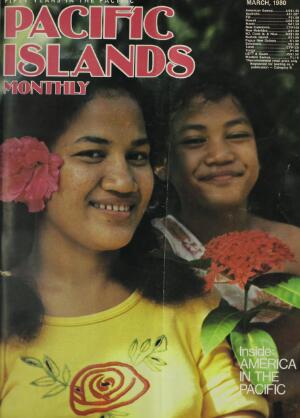
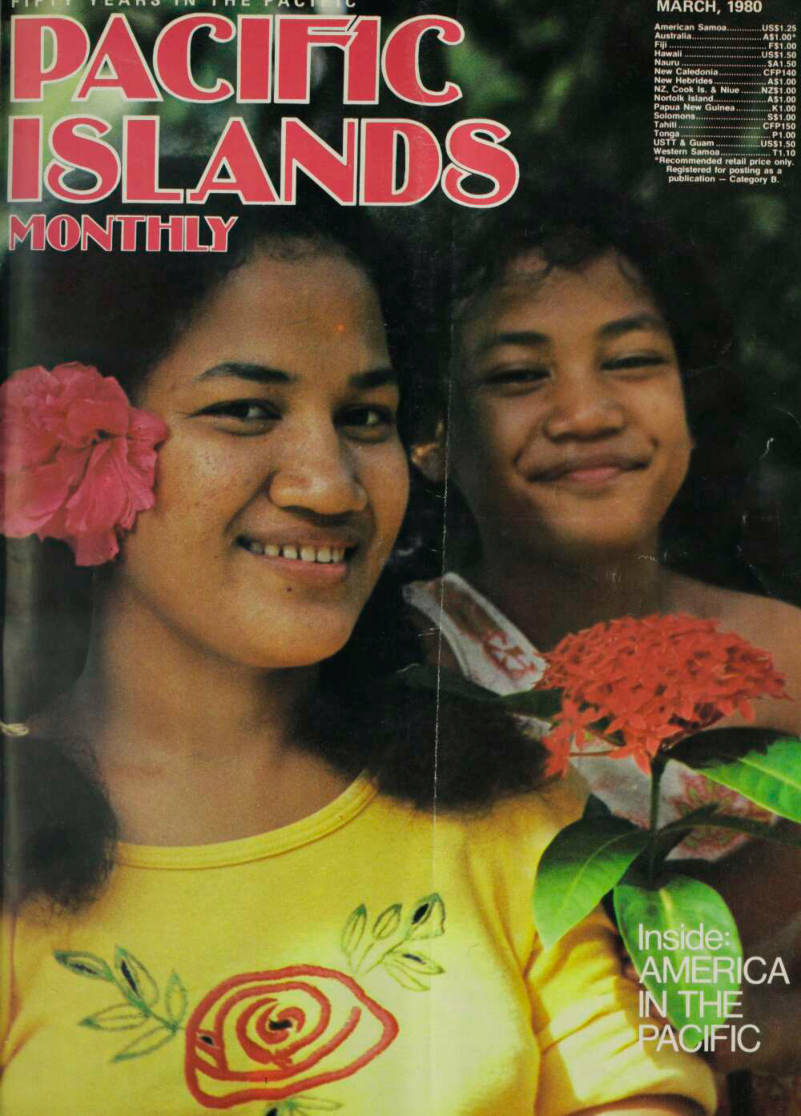
Cover: Daughters Seepa, 17, and Jane, 8. of Albert and Jane AtuaTasi of Fagasa village Tutuila, American Samoa. Jane is in the third grade at St Francis School and Seepa in her senior year at Samoana High School. Both are active in the Fagasa Assembly of God Church Photo: H. Larry Biggers.
American Samoa 33 Books 55 Cook Islands Deaths 81 Fifty years of PIM 40 F, J i 25, 72, 73 French Polynesia 22 Guam 47 Hawaii 35 Islands Press co Letters 9 Nauru 7, 73 New Caledonia 15 New Hebrides 17
Norfolk Island is Pacific Report 7 Papua New Guinea 19, 55 People 65 Ships 72 Shipping Services 77 Solomon Islands 17, 73 Tonga 25 Tradewinds 59 Travel w 47 Tropicallties 69 US In the Pacific 11, 37, 38 US Trust Territory 31, 47, 73 Western Samoa 29
Yachts 73
Advertisements & other items, pp. 3-5 (4 items)
Pacific Islands Monthly - March 1980
Founded 1930 by R. W. Robson Editor and Publisher Stuart Inder Associate Editor Malcolm Salmon Editorial Adviser John Carter Manager John Berry Advertising Sales Manager Steve Gray A Pacific Publications production 76 Clarence Street, Sydney 2000 GPO Box 3408 Sydney 2001 Cables; PACPUB Sydney Telex: Pacpub 21242 Telephone: Sydney 29 6693
1980 Means 50 Years of PIM
Displaying undiminished vitality in its 50th year, PIM this month records an all-time ‘first’ with its survey of the US presence in the Pacific. We do not pretend we’ve said all there is to say about such a vast subject. But we do believe we’ve done something that will be of use for some time to come to all who are interested in the matter both as to the US Pacific territories themselves, and also many pther Island countries, from which our correspondents report on how the US presence in the Pacific is seen from their particular vantage points. The US also looms large in this month’s instalment of PlM’s "Pacific, in which Judy Tudor traces the magazine’s experiences during the Pacific War. It starts on p 40. Our 50th anniversary issue proper will appear in August, month of our first issue in 1930.
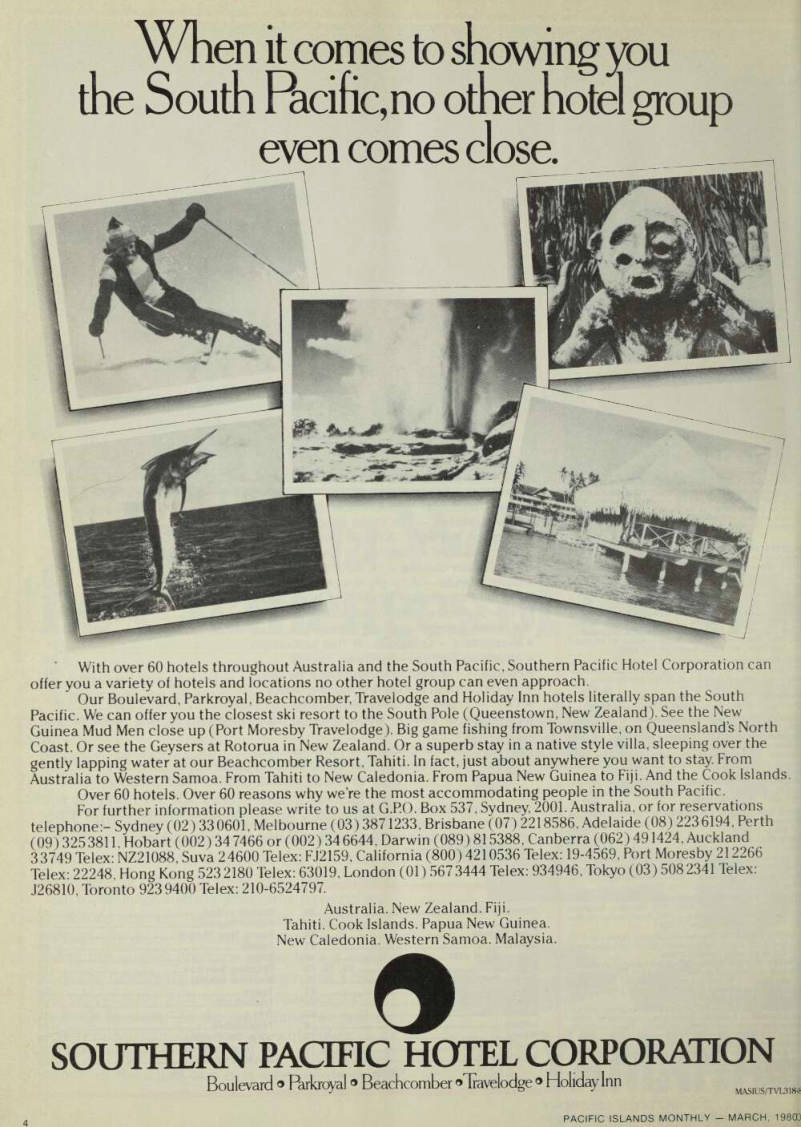
the South Pacific, no other hotel group
When it comes to showing you
even comes close.
* m p JP- * & With over 60 hotels throughout Australia and the South Pacific, Southern Pacific Hotel Corporation can offer you a variety of hotels and locations no other hotel group can even approach.
Our Boulevard, Parkroyal, Beachcomber, Travelodge and Holiday Inn hotels literally span the South Pacific. We can offer you the closest ski resort to the South Pole (Queenstown, New Zealand). See the New Guinea Mud Men close up (Port Moresby Travelodge). Big game fishing from Townsville, on Queensland’s North Coast. Or see the Geysers at Rotorua in New Zealand. Or a superb stay in a native style villa, sleeping over the gently lapping water at our Beachcomber Resort, Tahiti. In fact, just about anywhere you want to stay. From Australia to Western Samoa. From Tahiti to New Caledonia. From Papua New Guinea to Fiji. And the Cook Islands.
Over 60 hotels. Over 60 reasons why we’re the most accommodating people in the South Pacific.
For further information please write to us at G.RO. Box 537, Sydney, 2001. Australia, or for reservations telephone:- Sydney (02) 330601, Melbourne (03) 3871233, Brisbane (07) 2218586, Adelaide (08) 2236194, Perth (09) 3253811 Hobart (002) 34 7466 or (002) 346644, Darwin (089) 815388, Canberra (062) 491424, Auckland 33749 Telex: NZ2IOBB, Suva 24600 Telex: FJ2159, California (800) 4210536 Telex: 19-4569, Port Moresby 212266 Telex: 22248, Hong Kong 5232180 Telex: 63019, London (01) 5673444 Telex: 934946, Tokyo (03) 5082341 Telex: J 26810, Toronto 9239400 Telex: 210-6524797.
Australia. New Zealand. Fiji.
Tahiti. Cook Islands. Papua New Guinea.
New Caledonia. Western Samoa. Malaysia. 9
SOUTHERN PACIFIC HOTEL CORPORATION
Boulevard 9 Parkroyal ® Beachcomber ® Holiday Inn
MASIUS/TVL3I&F
1 1 i m\ E Beehive Building 94 Elizabeth Street Melbourne, Victoria Australia 3000 G.P.O. Box 8 Melbourne, Victoria Australia Cables; Telex: AA34552 Phone: 63 5094
YOUR GUARANTEE
FOR SERVICE
SINCE 1524
J Acific Islands Monthly - Marph -Icon
Pacific Report
Historic Win For Tongan Nurses
The mass resignation of 168 nurses from hospitals in Tongatapu and outer islands of Tonga in January in support of a demand for the removal of the country’s Chief Nursing Officer developed into what was probably the most serious industrial confrontation in the history of the kingdom. The 15-day crisis was resolved by the intervention of Prime Minister Tu’ipelehake in favour of the nurses’ demand. PIM correspondent Penny Hodgkinson writes from Nukualofa; ‘The prime minister resolved the crisis with a grace and dignity which obliterated earlier mistakes and won every Tongan heart. The nurses responded with a grace and dignity to match many returning to work as volunteers prior to official resumption of duty. Maybe there’s a lesson there for many more “sophisticated’’ countries where “grace” and “dignity” are words which have since dropped out of the vocabulary of industrial confrontation.’ (Full report, PIM April.)
Western Samoa Protests To U.S.
Relations between Western and American Samoa nosedived in January after a US Coast Guard vessel based in Pago Pago stopped a Western Samoan vessel at gunpoint on the seas be tween the two countries and arrested and removed a man on board. The man was a suspect in a SUSIB2 000 robbery of the American Savings Bank in Pago. But after questioning there he was released to return to Apia. The principal clue implicating him, a bag which he was carrying, was described by the bank’s manageress as ‘too old’ to be the one used in the robbery. The Western Samoa Government immediately instructed its am bassador in Washington, Maiava lulai Toma, to lodge a strong protest over the incident with the US State Department.
Png: Cabinet Comings And Goings
Papua New Guinea Prime Minister Michael Somare in February named new ministers to replace Father John Momis and John Kaputin who had resigned from Cabinet following his January Cabinet reshuffle. They claimed they had not been consulted about changes in their portfolios, and were generally dissatisfied with Mr Somare’s leadership. They had held the portfolios of Minerals and Energy and Higher Education respectively. Martin ToVadek goes to Minerals and Energy and Opal Kunangel to Higher Education. Both are members of the United Party, which now has six members in Cabinet. In addition, Mr Somare appointed a third new minister, Matiabe Yumi, as Minister for Media, a portfolio which had been dropped in the reshuffle.
Observers saw the moves as designed to head off a motion of no-confidence in the Somare government.
‘Boycott Olympics’, Say Png, Fiji
Papua New Guinea and Fiji have come out in favour of a boycott of the 1980 Olympic Games in Moscow because of Soviet actions in Afghanistan. PNG Prime Minister Michael Somare and Fiji’s Deputy Prime Minister Ratu Sir Penaia Ganilau made their positions known in separate statements. PNG also banned Soviet shipping from its ports.
France Plans New Embassies, Aid
On a swing through a number of Pacific Island countries in January, France’s Vice-Minister for Foreign Affairs Olivier Stirn announced that France would soon be appointing ambassadors to Papua New Guinea, Fiji and the New Hebrides. The ambassa dor to independent New Hebrides would also be accredited to Honiara, Solomon Islands. In Port Moresby Mr Stirn announced that France would make a $4.8 million development loan to PNG, which would be accompanied by French investment of up to $2O million. The loan is expected to be applied to hydro-power development in PNG. PNG’s Deputy Prime Minister Ebia Olewale, who had only shortly before been replaced in the post
of foreign minister by Tony Ha in a Cabinet reshuffle, said in a statement the day after Mr Stirn’s visit that PNG’s relations with France were ‘friendly and good’. But he reaffirmed that the PNG Government was going ahead with a plan to make a formal submission to the United Nations calling on France to grant self determination to New Caledonia. He said he disagreed with Mr Stirn’s claim that such action would be interference in the affairs of another state, adding: ‘lt is an international matter that all people should have the right to self-determination.’
Png To Save Bougainville Windfall
Papua New Guinea’s gain from Bougainville Copper Ltd’s large 1979 profit will amount to about SAIS2 million, but, according to PNG Government sources, will have no effect on government expenditure this year. The BCL profit was $llO million. The government’s share is made up of $28.3 million in dividends, withholding tax of almost $l6 million, estimated income tax of $lO2 million and royalties of $5.6 million. Government sources said that if gold prices remained high it might be able to sustain increased expenditure over a long term.
Malaysia’S Move Into Islands
Malaysian Foreign Minister Tunku Ahmad Rithaudeen planned visits to Fiji and Papua New Guinea as part of a move by Malaysia to establish closer links with his counterparts in the region out side the framework of the Association of South-east Asian Nations (ASEAN).
Twelfth Independence Message For Nauru
Nauru’s 12th Independence Day message, read in the absence overseas of President Hammer Deßoburt by Acting President Buraro Detudamo, was generally optimistic, while sounding cau tionary notes on such questions as the need for an improvement in the attitude to work of adult Nauruans. It said that while Air Nauru and Nauru Pacific Line were not yet profitable, they are ‘performing services we cannot do without as an independent nation’. Of the new fishing venture (PIM p 73), the message voiced hopes that the Nauru Fishing Corporation ‘will be regu larly selling fish to overseas markets as well as assuring us on Nauru of an adequate supply of fresh fish at competitive prices’.
C. J. Leaves Apia Under Cloud
Tensions between Pacific Island governments and expatriate judges have been a marked feature of the political scene ini Papua New Guinea and Fiji in recent times, and now it seems; that the same thing has happened in Western Samoa. Thei government there has failed to renew the term of expatriate Chief : Justice Bryan Nicholson. Some reports say that Prime Minister Tupuola Efi was angered by Judge Nicholson’s rulings in court: hearings following the 1979 elections in which he found four' elected MPs guilty of bribery and treating and nullified their elec tion. In doing so the judge had drawn a dividing line betweenr long-standing Samoan custom and corruption.
Solomons Seamen Back Home
Twelve Solomon Islands seamen, stranded in Taiwan for sevenr months, have been brought home with SI Government assist ance. The men were stranded when the owners of their ship,, Solomon Chief, announced they were unable to pay for the re pairs for which the ship had gone to Taiwan. Nor could they\ pay the men’s wages. Taiwan Government sources were soc impressed with the behaviour of the men during their long ordeall that they have invited them back to work in Taiwan.
Mara’S Backing For Israel
On a recent visit to Israel, Fiji’s Prime Minister Ratu Sir Kamisese= Mara reaffirmed his country’s support for Israel’s position,, pledging to maintain its voting record at the United Nations in matters concerning Israel’s role in the Middle East. Fiji soldiers are serving in the United Nations peace-keeping force im Lebanon.
Taiwan Boat Gives Tuvalu The Slip
A Taiwanese fishing vessel, No 3 Tong Chou, evaded captures in January after she was detected fishing in Tuvaluan waters..; The incident occurred only three weeks after a 19-mam
(Taiwanese delegation had paid an official visit to Tuvalu to dis cuss acquiring a licence to fish in that country’s waters.
Teargas Against Port Moresby Strikers
Police used teargas in Port Moresby in four incidents in January when some of about 500 striking workers ran riot in the suburbs of the Papua New Guinea capital. The strike was over a govern ment submission to a wages tribunal in which wage restraints were sought.
Marianas Hopes For A Fishing Win
Northern Marianas Governor Carlos Camacho hopes he has won his long fight with Washington to secure repeal of a US ban on foreign-built boats fishing in Marianas waters. The ban has brought Marianas fishing activity to a standstill, as all its boats are Japanese-built. Marianas officials were due to meet I their federal counterparts in Honolulu In February for talks.
Australian Ships To Join 20Th Century
The Australian Government will repeal 19th-century legislation this year and grant ships Australian nationality and the right to fly the Australian flag. British laws dating from 1894 lay down that ships are registered in Australia as British ships and are j authorised to fly the Australian red ensign. The red ensign will 1 now disappear and yachtsmen will have two years to replace the British blue ensign with the Australian flag.
New Paper For New Hebrides
[ Following the birth of new papers on Nauru and Guam (PIM Feb PP9, 55) the French/Bislama weekly Nabanga has announced that a new paper will shortly appear in the New Hebrides. To be called Kingfisher-Martin-pecheur, the new journal will be ' printed in English, French and Bislama. The publishing group will represent different political tendencies, comprising Hilda I Lini, sister of Chief Minister Walter Lini (and an active member I of the Vanuaaku Party), Remy Delaveuve, mayor of Vila and president of the France-Hebrides Association, and Armand Beaudoin, a local businessman. Hilda Lini told Nabanga that the new paper will be completely impartial and politically indepen dent, reflecting the views of all inhabitants of the archipelago.
Nabanga, which is supported by the French Residency, will ' cease publication on independence later this year
Png Decides - Tv It’Ll Be
j After V ears of soul-searching on the issue, the Papua New Guinea Government has decided that the country will have a [ television service. Prime Minister Michael Somare said the time table for its introduction, and the type of service, would have i to be carefully studied before final decisions were made
Telecommunications Gabfest In Hawaii
I Four hundred and seventy people attended the second Pacific Telecommunications Conference in Hawaii in January. Keynote address was given by Prime Minister Ratu Sir Kamisese Mara ; of Fiji.
N.C. Police Inspector On Murder Charge
A French police inspector in New Caledonia, Raymond Ferrot, has been charged with the murder by shooting of a Melanesian,’
Theodore Daye. A companion of Ferrot’s has also been charged with assault on Daye’s companion, Charles Teanyonen, who was wounded in the affray which occurred in January at Mont Dore, near Noumea. Commenting on the incident, High Com missioner Claude Charbonniaud condemned the social ill of al coholism, and reiterated the principle that ‘no one is entitled to take the law into his own hands’.
‘A Gift Of Love’ For Pitcairn
A group of Californian high school students have laboured for eight years to make a gift for the people of Pitcairn Island: it is Sunfire, a giant solar generator, slaved over for 400 000 hours by the students over a period of eight years. Believed to be the largest single engineering project ever attempted by young people. Sunfire stands 14.5 metres high, weighs 25.4 tonnes has 240 parabolic mirrors and a total of 66.8 square metres!
It wNi produG 0 five kW of electricity, more than enough for the 0-odd descendants of the Bounty mutineers who live on the island. The students call it a 'gift of love to all mankind’. The
problem they’re now grappling with is how they’re going to trans port it to Pitcairn. But Pasadena inventor Frank Broyles who has helped the students is confident: ‘lf they have to swim it there they’ll get it there,’ he says.
Calling Young Mathematicians
Secondary schools throughout the South-west Pacific will be invited to take part in the 1980 Australian Mathematics Compe tition. More than 110 000 high school students from Island coun tries, Australia and New Zealand are expected to take part Further information from Peter O’Halloran, Competition Director PC Box 1, Belconnen, ACT, 2616. Australia.
Prizes For Islands Tourist Films
Marianas Visitors Bureau, the new Hebrides Tourist Information Bureau and the Tahiti Tourist Board were among prize-winners with their entries in the Pacific Area Travel Association’s annual film contest.
Recognise Union’, Fiji C.M.A. Told
Fiji’s Central Monetary Authority has been told to recognise the Fiji Bank Employees’ Union, to which all but four of its staff are affiliated. The order was issued by Secretary for Labour, Indus trial Relations and Immigration, Mr Satyanand. following refusal by the CMA to recognise the union
Fua Kavenga In Suva
Tonga’s contribution to the Pacific Forum Line, the new German-built container ship Fua Kavenga (PIM Jan p 67) called at Suva late in January on her delivery voyage. The ship cost 20 million German marks to build.
Heart Disease Threat In Fiji
Fiji’s heart disease rate has leapt by 460% in eight years to make it one of the country’s worst killers. Indians are 10 times more likely to be hit by it than people of other races. They are also the main targets for two other worsening diseases, hypertension and diabetes.
Lautoka Mill’S Record Crushing
Fiji s Lautoka Sugar Mill has set a new crushing record of 1 726 000 tonnes and expected to have crushed 1 740 000 tonnes of sugar cane by the time it finished operations for the season.
Energy Project On Guam
The US Department of Energy is supporting a project on Guam designed to produce methane gas from animal manures. Meth ane might also be produced from sewage treatment systems on other US-administered islands, according to departmental scientist Dr Bennett Miller.
Raaf Plane In Bougainville Rescue
A Royal Australian Air Force Orion aircraft in February found a wooden boat with 25 people on board which had been missing north of Papua New Guinea’s Bougainville Island for four days.
The passengers had run out of water and were low on food.
Sino-Soviet Rivalry In Cruise Market
Sino-Soviet rivalries made a modest entry into the Pacific cruise market, in which the Russians are already well established, with the first voyage in January of the 168-metre, 14 224-tonne Minghua, flagship of the China Ocean Shipping Company. The vessel made her maiden voyage to Fiji, calling at Suva. A spokes man for her agents Burns Philp said she would make four trips on the route from Sydney, Auckland, Noumea, Suva, and the nearby Fiji fire-walking island of Beqa before taking in other Pa cific ports on future cruises.
Debate On Hebrides Independence Date
Debate is under way as to just when in the agreed time bracket of May-July New Hebrides independence should be declared.
The French are known to favour an early declaration (in May).
Their approach is said to be supported by the government of Chief Minister Walter Lini, eager to begin exercising full authority in the still troubled archipelago. But the British seem to be hold ing out for a later date. Among other factors, clarification of future aid agreements, and a doubt that the complex hand-over procedures can be satisfactorily completed in such a short time, are major factors in their thinking.
Advertisements & other items, p. 8 (1 item)
Pettit
ww if f »
BOTTOM PAINT STAYS ON THE BOTTOM
ANY TIME, ANY PLACE!
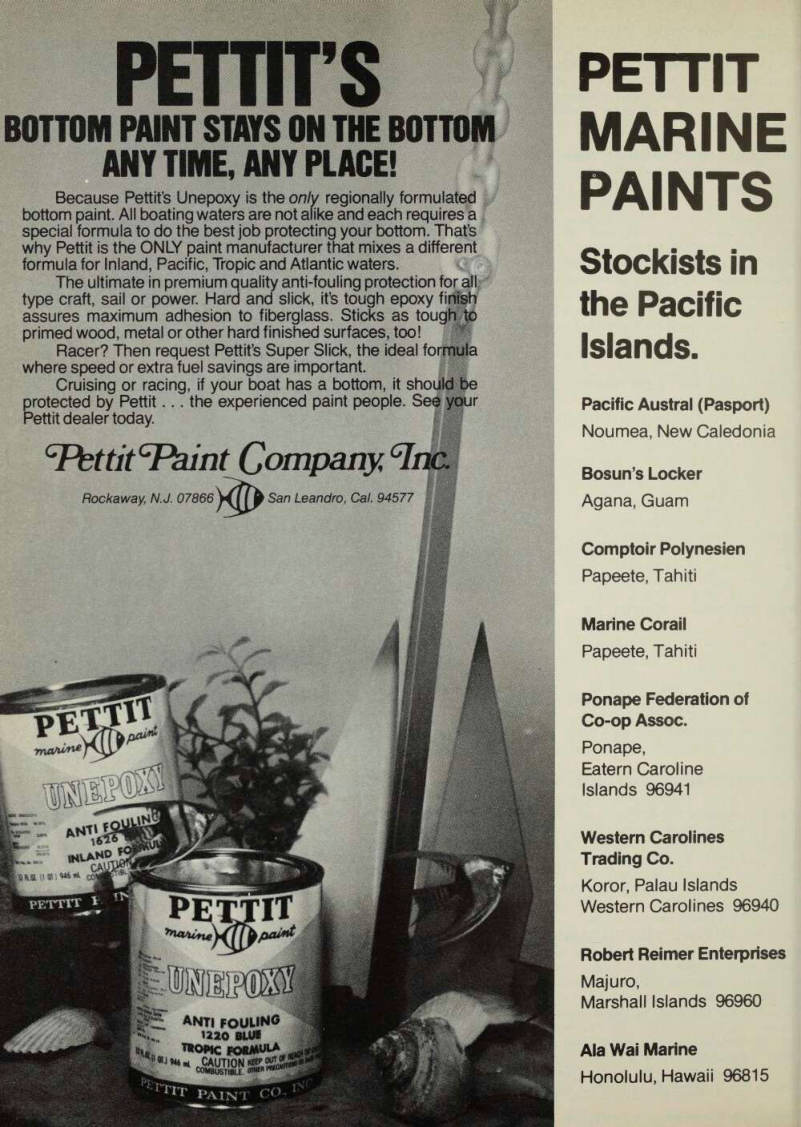
Because Pettit’s Unepoxy is the only regionally formulated bottom paint. All boating waters are not a ike and each requires a special formula to do the best job protecting your bottom. That’s why Pettit is the ONLY paint manufacturer that mixes a different formula for Inland, Pacific, Tropic and Atlantic waters.
The ultimate in premium quality anti-fouling protection for all type craft, sail or power. Hard and slick, it’s tough epoxy finish assures maximum adhesion to fiberglass. Sticks as tough to primed wood, metal or other hard finished surfaces, too!
Racer? Then request Pettit’s Super Slick, the ideal formula where speed or extra fuel savings are important.
Cruising or racing, if your boat has a bottom, it should be protected by Pettit... the experienced paint people. See your Pettit dealer today.
c Pettit G Paint Company
! >0 Rockaway, N.J. 07866 San Leandro, Cal. 94577 .
tii
3$ PB pet*** mm m ikuaho m IT P p£U*U anti fouling
1220 BLUC
owe formula I
TROPIC
PETTIT
MARINE
PAINTS
Stockists in
the Pacific
Islands.
Pacific Austral (Pasport) Noumea, New Caledonia Bosun’s Locker Agana, Guam Comptoir Polynesien Papeete, Tahiti Marine Corail Papeete, Tahiti Ponape Federation of Co-op Assoc.
Ponape, Eatern Caroline Islands 96941 Western Carolines Trading Co.
Koror, Palau Islands Western Carolines 96940 Robert Reimer Enterprises Majuro, Marshall Islands 96960 Ala Wai Marine Honolulu, Hawaii 96815
a Tahitian
Letters
PNG student has a word to a Tahitian
I am a young Papua New Guinean student and I was very annoyed to learn that a clown in Tahiti thought fit to publicise to the world that my young country is still full of i cannibals (PIM Dec 1979 p4O).
Whoever the lunatic is who wrote this may I advise him to see a doctor at once for psychi atric treatment.
In response I wish to briefly educate him on a few facts about PNG and what I think of his country, Tahiti.
PNG can be geographically divided into three main re gions, the Islands, the Coastal and the Highlands. In fact in
the Highlands region today
there is still minor tribal war fares and for God’s sake don’t ever say again that anyone who is killed in a tribal fight is quickly eaten up by the victors.
On the other hand, inhabitants of the coastal and island re gions are peaceful as ever.
Mr Tahitian, after you have thoroughly studied the cultural practices of the 700+ tribal ethnic groups of my country then I can qualify you to say anything you like about PNG, particularly on the topic of eat ing human flesh which is called in English cannibalism.
Perhaps, Mr Tahitian, you could be in a better position to know and inform us as to why the PNG Deputy Prime Minis ter, Mr Ebia Olewale, who attended the recent South Pa cific Conference there, was for tunate enough to be able to demonstrate his government’s
sympathy for a minority,
politically-minded group who are now trying to warn France of its paternalistic type of ad ministration of its so-called ter ritories.
My historical understanding
about your country, Tahiti, is that since it is poor in economic resources the French Govern
merit has been ‘spoonfeeding’ you with everything which a nation essentially requires to survive. This practice, I believe, has been going on ever since they found you. A white man’s culture has been imposed on the original inhabitants of Tahiti, therefore up until now it is probably pretty difficult for the Tahitians themselves to revive their own identity as Polynesian, Pacific Islanders. 1 am of the opinion that after reading your comments or advice, it sounds like someone who lacks understanding of rural life situations. You sound like someone who has been
lured into the city by bright
lights and have remained there for good.
Finally, I would like to again remind the Tahitian correspon dent that cannibalism is no longer a practice in PNG. It could have been a practice in the remote areas of the country in the past, however we are now a civilised independent country.
Lawrence F Kavavar
Port Moresby, PNG
A reviewer
reviewed
I refer to book reviews (PIM Dec 1979 p 45) and the bewil dering review of Sail Before Sunset by Olaf Ruhen.
Curiously, he put himself into the position of a kettle calling a pot black. For as he carefully selected paragraphs of my book on which to lay criticism, he simultaneously produced comments of such a superficial nature that it is hard to believe he is the same person who is an accepted author on Pacific sub
jects.
Take, for instance, the lo cation of the Cook monument on the island of Hawaii. He says that it is clearly visible from across the water at the
City of Refuge. The City of
Refuge is located on Honaunau Bay and the U.S.
Hydrographic Office Chart No 19320 shows the Cook monu ment on Kealakekua Bay to be four nautical miles away with two intervening headlands.
Clearly visible would you say?
Since Mr Ruhen also ques tions the existence of an ‘underwater’ monument to Cook, I would like to point out that there is both an obelisk on the shore and a bronze plaque
in the water. Mr Ruhen is re ferred to the book James Cook and New Zealand by A. C. and N. C. Begg (1970, Government Printer, Wellington, New Zealand). There in Plate 178 in living colour he will see what he apparently hadn’t observed himself. The plate caption reads: ‘Beneath the clear waters of Kealakekua Bay this bronze plaque marks the place where James Cook fell’. And my observations are super ficial?
I would also have to say that in using only the Australian Encyclopaedia to research the kindel-kindel nut, he was very shallow. The name was first told to me by our Australian crewman and later verified at the Bishop Museum. I’m sorry that I don’t have a South Pa cific publication at hand to refer you to, but my local pub lic library (6511 nautical miles from Sydney!) has the answer on its shelves. Quoting from page 324 of Handbook of North American Nut Trees by Richard Jaynes (1969, The Northern Nut Growers Association, Knoxville, Tennessee, USA): The Australian aborigine, of course, has known the macadamia, which he calls kindal-kindal (sic), since time immemorial, prizing it for its edible nuts.’ Now tell me again, Mr Ruhen, about quayside conversations.
The publisher of PIM ought to take Mr Ruhen to task for indirectly accusing you of a ‘cavalier’ attitude towards the
spelling of Polynesian words.
My authority for them, includ ing the name of the beautiful island of Raivavae, was the Eleventh Edition of the Pacific Islands Year Book which ac
companied us through the
entire voyage. If Pacific Publi cations is, indeed, cavalier, then so am I.
The only apology necessary
by the author of Sail Before Sunset is to Robert Louis Stevenson whose middle name
was misspelled.
I would appreciate space for this letter in a forthcoming issue of PIM to answer Olaf Ruhen who has unjustly im pugned my book as well as my character. I also thought your headline to be out of order.
Earl R. Hinz
Huntington Beach, CA 92647 USA (This letter edited due to its length. Ed,
Pim.)
Off the edge of your
seats now Thank you so much for publishing part of my poem about Guam (PIM Dec 1979, p 5). I must say it was quite a thrill to see it in print... is it possible for you to consider printing the rest of the poem in another issue? Perhaps some readers are on the edge of their seats, wondering how it ends!
Also, if anyone has any ques tions about the poem, feel free to send them my address.
Thank you so much.
Marilyn Kaminski
4825 Thunderbird Cir No 2 Boulder Colorado USA
Ouch! (Irregular
PIM department)
Letter received: ‘Nice review of Fiji’s Times ... a History of Fiji (PIM Jan p 49). I under stand it’s customary in book re views, though, to mention the author ... Sincerely, and not very happily, Kim Gravelle.’
Our apologies to author Gravelle, whose work on Fiji’s history, reprinted in the series of three small books reviewed, is much to be admired. The omission of his name was an oversight. The books are pub lished by the Fiji Times, Suva, and readers can judge their lit erary quality for themselves by sending for them at $F1.50 each.
And, since disasters never come singly, we also wish to apologise to Richard Geddes, marketing manager of Merid
ian Shipping and Transport
Agencies, Sydney, for having
wrongly attributed his excellent cover picture on our February issue to another pho tographer an error for which we are in the unfortunate pos ition of having nobody to blame but ourselves. Meridian Shipping are agents for the
Daiwa Navigation Company
of Osaka, which last year started a service from Sydney to Vila and Santo. Richard was in Vila on company business when he photographed our February cover group of Small Nambas at the New Hebrides National Arts Festival a pic ture which, incidentally, has caused much comment.
Advertisements & other items, p. 10 (1 item)
Is Just
THE
DIFFERENCE
BETWEENA
LONG RUN AND
AN ALSO RAN
IS JUST
ONE WORD
to custom designed bearings for special purposes, you’ll find that investing in the best costs less in the long run. Particularly when you add in a number of other factors.
Availability for example. What we and our Authorised Distributors keep on the shelf can keep you off the hook when it comes to prompt supply of bearings.
Qualified sales and service engineers are also available to help you with design, installation and maintenance problems.
Reliability is a word we’d like to talk to you about very soon.
Australian Timken Proprietary Limited Ballarat, Victoria.
TIMKEN
REGISTERED TRADE MARK
TAPERED ROLLER BEARINGS 3416 AT
TIMKEN
RELIABILITY!
Whatever you are designing, maintaining or repairing, you want a long run for your time and effort.
And Timken" tapered roller bearings ensure just that.
Throughout the world, they are manufactured to consistent standards of design and quality. So even when working with imported equipment, you know that Timken bearings bought in Australia will fit.
But it’s not quality at any price.
From off the shelf bearings to suit thousands of general applications
RIS 15
The Us Pacific
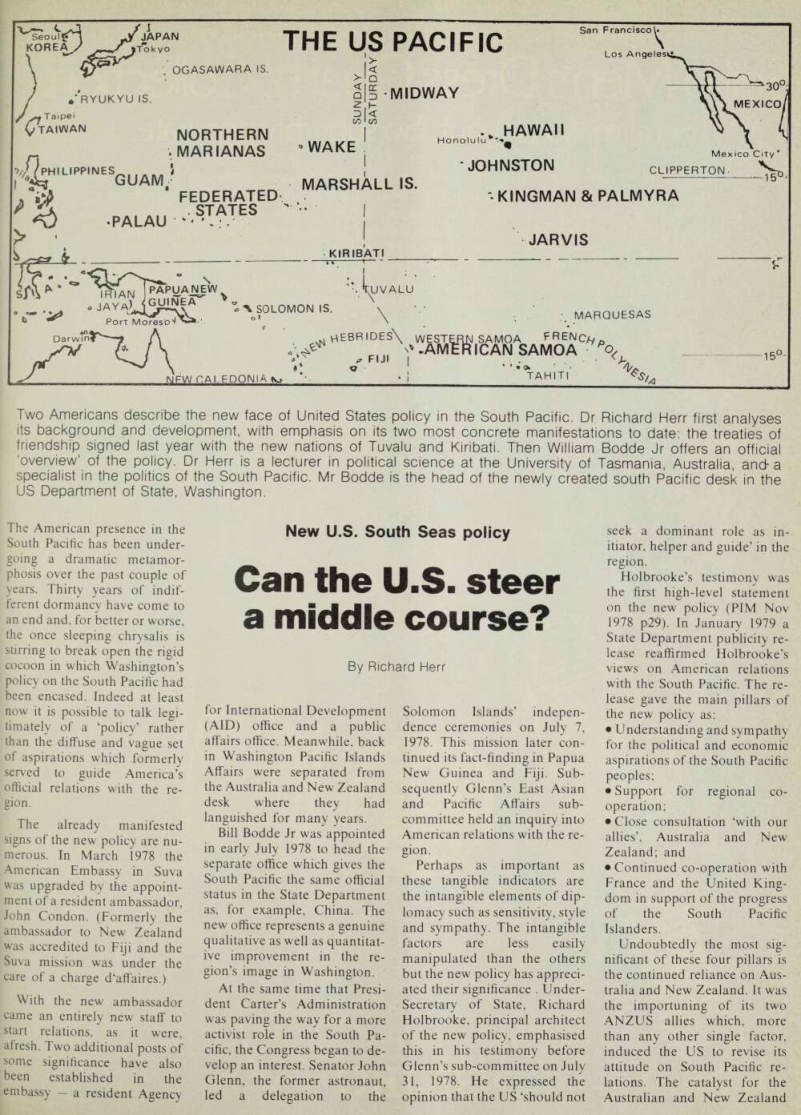
Two Americans describe the new face of United States policy in the South Pacific. Dr Richard Herr first analyses its background and development, with emphasis on its two most concrete manifestations to date: the treaties of friendship signed last year with the new nations of Tuvalu and Kiribati. Then William Bodde Jr offers an official ‘overview’ of the policy. Dr Herr is a lecturer in political science at the University of Tasmania, Australia, and-a specialist in the politics of the South Pacific. Mr Bodde is the head of the newly created south Pacific desk in the US Department of State, Washington.
Can the U.S. steer

New U.S. South Seas policy Can the U.S. steer a middle course?
By Richard Herr
The American presence in the South Pacific has been under going a dramatic metamor phosis over the past couple of years. Thirty years of indif ferent dormancy have come to an end and, for better or worse, the once sleeping chrysalis is stirring to break open the rigid cocoon in which Washington’s policy on the South Pacific had been encased. Indeed at least now it is possible to talk legi timately of a ‘policy’ rather than the diffuse and vague set
of aspirations which formerly
served to guide America’s official relations with the re
gion.
The already manifested signs of the new policy are nu merous. In March 1978 the American Embassy in Suva
was upgraded by the appoint
ment of a resident ambassador, John Condon. (Formerly the ambassador to New Zealand was accredited to Fiji and the Suva mission was under the care of a charge d‘affaires.) With the new ambassador came an entirely new staff to start relations, as it were, afresh. Two additional posts of some significance have also been established in the
embassy a resident Agency
for International Development (AID) office and a public affairs office. Meanwhile, back in Washington Pacific Islands Affairs were separated from the Australia and New Zealand desk where they had languished for many years.
Bill Bodde Jr was appointed in early July 1978 to head the separate office which gives the South Pacific the same official status in the State Department as, for example, China. The new office represents a genuine qualitative as well as quantitat ive improvement in the re
gion’s image in Washington.
At the same time that Presi dent Carter’s Administration was paving the way for a more activist role in the South Pa cific, the Congress began to de velop an interest. Senator John Glenn, the former astronaut, led a delegation to the
Solomon Islands’ indepen dence ceremonies on July 7, 1978. This mission later con tinued its fact-finding in Papua New Guinea and Fiji. Sub sequently Glenn’s East Asian and Pacific Affairs sub committee held an inquiry into American relations with the re
gion.
Perhaps as important as
these tangible indicators are the intangible elements of dip
lomacy such as sensitivity, style
and sympathy. The intangible
factors are less easily manipulated than the others but the new policy has appreci ated their significance . Under secretary of State, Richard Holbrooke, principal architect of the new policy, emphasised this in his testimony before Glenn’s sub-committee on July 31, 1978. He expressed the opinion that the US ‘should not
seek a dominant role as in itiator, helper and guide’ in the
region.
Holbrooke’s testimony was the first high-level statement on the new policy (PIM Nov 1978 p 29). In January 1979 a
State Department publicity re
lease reaffirmed Holbrooke’s views on American relations with the South Pacific. The re lease gave the main pillars of the new policy as:
• Understanding and sympathy
for the political and economic aspirations of the South Pacific peoples; • Support for regional co
operation;
• Close consultation ‘with our allies’, Australia and New Zealand; and • Continued co-operation with France and the United King dom in support of the progress of the South Pacific Islanders.
Undoubtedly the most sig
nificant of these four pillars is the continued reliance on Aus tralia and New Zealand. It was the importuning of its two ANZUS allies which, more than any other single factor, induced the US to revise its attitude on South Pacific re lations. The catalyst for the Australian and New Zealand
overtures was of course the row stemming from Russian con ■ tacts with Tonga in 1976.
Although the US places a premium on the advice of its two ANZUS partners, it is not willing to adopt their perspec tives unquestioningly. The new regime of almost weekly liaison meetings between the State Department and Aus tralia and New Zealand
embassy staffs in Washington
do not always produce perfect
agreement.
New Zealand perhaps more than Australia has had occasion to pause and reflect on the previous period when it did not have to accord the US full collegiality in South Pacific affairs.
Whether or not the new pol
t icy is altogether what New
* Zealand had in mind at the [ 1976 and 1977 meetings of the ANZUS council of ministers, t the January statement indi ‘ cated that the emergent policy has yet to fully extend its wings.
The release nominates three particular areas of ‘special attention’ for the future: • The establishment of a larger and more effective US pres ence in the area; • Participation in regional or
ganisations; and
• Termination of the Micronesian trusteeship by 1981.
What the State Department
ultimately intends by ‘a larger
and more effective US pres ence’ is still under consider ation. However, Senator Glenn’s trip report for his Solomon Islands visit pub lished in late 1978 suggests sev eral possible lines of action
including reopening the con
sulate in French Polynesia,
posting a State Department
official in Pago Pago, and more frequent visits by US officials and naval vessels to the region.
The aspirations of the Island states are expected to be a key influence on American de cisions regarding a larger re gional presence if and when the Carter budget squeeze permits new initiatives to be taken.
Indicative of both the motiv ations and directions of the new US foreign policy towards the South Pacific are the treat ies of friendship with Tuvalu and Kiribati. The Tuvalu treaty was signed in February 1979 and the one with Kiribati in
September. Both treaties were felt by Washington to be necessary to allow the US to re linquish its claims to islands in each country. Despite some op position in Hawaii and American Samoa, the Carter Administration has insisted on
demonstrating its good neigh
bourliness towards the South
Pacific by surrendering its
disputed claims to a score of islands and atolls in the Central Pacific. The treaty avenue was selected since it involves only one chamber of the Congress’s two houses the Senate and thus is presumed to ensure an easier passage of the act of re nunciation.
Nonetheless, the generosity of the US has not been extended without a quid pro quo. In the case of Tuvalu there is a clause obliging Tuvalu to consult with the US before third parties are allowed to use
Tuvaluan territory for military
purposes. Another clause seeks to facilitate a fisheries connec tion between Tuvalu and American Samoa. (Tuvalu’s waters are vital to the two large canneries at Pago Pago.) Simi lar clauses were written into the treaty with Kiribati. Undoubt edly both clauses could secure mutual advantages for all par ties in the long run, but the immediate advantages appear to favour the US. Still, official sources maintain, the revo cation of American claims to the islands is final, while the other clauses only provide for a process of consultation which can be terminated after 10 years.
The Kiribati treaty contains special provisions concerning the islands of Canton and Enderbury in the Phoenix group. While the US renounces its claim to them, the treaty provides that facilities built by the US on the islands (and on the atoll of Hull) will not be used by third parties for mili tary purposes without US agreement.
Regional organisation is seen both as a ‘pillar’ of policy and an area for ’special atten tion’ by the US. The US is anxious that regionalism should succeed in the South Pacific, but at the same time it would like to ensure its own entree into the regional
decision-making process.
Through its membership in the South Pacific Commission (SPC) the US does have some access.
Since the South Pacific Forum, however, handles all the politically sensitive issues including the vital fisheries issue this access is not always sufficient. The apparently suc cessful attempt by some states at the Niue Forum (September 1978) to hold the US at arm’s
length by keeping the
Americans out of the regional fisheries organisation is the current case in point. There appear to be few easy solutions to the dilemma of Washing ton’s desire for a larger re gional role as long as countries like Fiji, Papua New Guinea and the Solomons oppose a greater American involvement in Forum-sponsored projects.
Thus far the US has been seeking to maintain a low pro file in the controversy over South Pacific regional organis ations a low profile, that is, by its own estimation. Some critics have suggested nonetheless that the US has exacerbated some regional dis putes by pursuing its own aims
bilaterally especially in the
area of fisheries. A grain of truth in this complaint cer tainly exists in the case of the treaties of friendship with Tuvalu and Kiribati, although
virtually all the Washington
sources insist that any regional ramifications from America’s bilateral arrangements are unintentional. In the case of the Pacific Islands Develop ment Corporation’s meeting in Pago Pago in January 1979 to discuss regional fisheries issues, the charge of mischief making is less plausible. The initiative here seems to have originated almost wholly in Pago rather than Washington.
In contrast with the in creased Australian interest in the South Pacific from 1976, the American involvement has not relied heavily on develop ment assistance. Figures re
leased by the AID office in Suva show that from 1977 to September 30, 1979, the sum of $4 667 319 had been allocated to various aid-funded projects in the South Pacific. Prior to 1977 the US gave almost no aid to the South Pacific.
But the US aid programme in the South Pacific is growing.
An ultimate ceiling has not yet been established but, if and when Carter’s budget pause is lifted, something close to the European Economic Com munity figure of $5 million an
nually might be expected by
the mid-1980s. In line with US aid policy elsewhere, large pro jects are discouraged. The old ‘trickle down from the top’ view of aid has been replaced by a ‘basic human needs’ ap proach which tends to favour
appropriate technology and
small grassroots development projects. Partly as a con sequence of this outlook on aid, the US Government plans to rely heavily on non governmental aid agencies.
More than half the US aid budget in the South Pacific appears destined to be dis bursed by such private bodies as the Foundation for the Peoples of the South Pacific and the YMCA.
American military aid has been rare in the South Pacific
and developments regarding
the fisheries issue have tended to complicate the matter in re cent times, especially since the need to patrol the 200-mile led_to more interest in this form of assistance.
Conflicting reports on why
some recent requests from the Islands for military assistance (mainly patrol and surveillance
equipment and training) have
been refused only add to the confusion.
Some in the State Depart ment have suggested that it would be impolitic for American military aid to be used to capture American vessels which could be excluded from vast areas of the region if the US were not al lowed to join the regional fisheries agency. Other sources intimate that the problem is
essentially procedural there
being little expertise in the South Pacific in applying in due and proper form for mili tary assistance.
An underlying basis for the
American involvement in South Pacific affairs arises from its territorial possessions in the region. They have been both a source of strength and weakness in official US re lations with the South Pacific.
American Samoa, Guam and the Trust Territory of the Pa cific Islands contribute a
special legitimacy to the
American presence in the area.
The US is intimately in volved with the people of the region in a way that Canada, Japan and the Soviet Union are not. On the other hand, the American relationship with its possessions has caused some
disquiet among the indepen
dent states. Absorption rather than independence has charac terised the political develop ment of American territories.
The difference with other metropoles (except France) is marked. ‘Had Hawaii been retained by Britain, it would be an independent state today,’ is the view adopted by critics of America’s territorial policy in the Pacific.
The Micronesian nego tiations may help to change this colonial image. Recent developments mean that the TTPI will emerge from its trus teeship in four parts (at a mini mum). The Northern Marianas
are following precedent and
will draw closer to the US by virtue of their commonwealth status, The other three areas Palau, the central districts (known now as the Federated States of Micronesia) and the Marshalls appear destined for an enhanced version of self government referred to in the US as Tree association’. Each country is to have control of its own foreign policy and indeed each is expected to maintain separate overseas missions.
There is, however, to be a
qualification on this foreign
policy power the treaties ter minating the trust are expected to give the US a veto on matters relating to security and de fence.
On the surface, the free as sociation status would appear to be closer to full indepen dence than that enjoyed by either the Cooks or Niue where both foreign affairs and de fence are formally vested in New Zealand. Whether or not this view is adopted by the
Forum countries in ruling on the eligibility of the three future Micronesian states for
membership will depend in
part on other conditions in the termination agreement. A suc cessful result on termination could restore some of America’s tarnished image as a colonial power.
The new American foreign policy in the South Pacific is still emergent. While its shape and direction are no longer simply inchoate expectations subsumed under the perceived Australasian stance, the new policy is not fully settled. It is
uncomfortably dependent on
the personalities and interests of a few people in Washington and the Pacific.
Opposite the Charybdis of
indifference is the Scylla of domination. The US insists that its new policy does not seek to impose any form of he gemony in the South Pacific.
Nonetheless the mere presence of the US in the region could attract great-power rivalry if the US is not circumspect in its demands of the region.
The treaties of friendship with Tuvalu and Kiribati demonstrate the depth of con cern the US feels for its stra tegic and economic interests in a South Pacific which increasingly identifies with the Third World. By the same token the treaties could be said to illustrate the new sensitivity felt in Washington for Islands opinion and. indeed, even genuine attempts at accom
modating this opinion where
possible.
Somewhere along the line a balance will be struck between
the fishing lobby in Congress
and the military strategists of the Pentagon on the one hand, and those favouring a policy
which gives a high priority to
Islands aspirations on the other.
Critics continue to doubt that the US can steer a middle course between apathy and over-involvement in the long term. Those presently respon sible for American policy in the South Pacific maintain that their actions will prove other wise. What cannot be doubted is that the chrysalis is opening as the new policy stirs within.
Only time will tell whether it is to become either butterfly or moth.
Advertisements & other items, p. 12 (1 item)
Seiko Men’s Dress Quartz Collection.
As Seiko enters its second decade of world leadership in quartz technology:
So slim, so elegant. So superbly accurate.
Now you can own a quality Seiko Quartz dress watch that represents a new level in fashionable sophistication. Here is impeccable styling combined with the unsurpassed accuracy and dependability of Seiko Quartz. Crafted with trim good looks.
Engineered with Seiko's uniquely advanced technology. In a variety of starkly beautiful styles to satisfy men of excellent taste everywhere.
It's what you'd expect from Seiko, the company that sold the world's first quartz watch and that never ends its quest for quality and dedication to technology. Seiko Quartz.sQt * v % 1 \' ' » V A % r % vm VI A f W :*:■ s \ n i: I ' ■; i y % ” r ** &.' imam
SEIKO
Someday all watches will be made this way.
U.S. is taking a wider interest
wider interest
By William Bodde Jr
America’s destiny became entwined with the South Pa cific in the dark days of World War 11. It was from bases in Australia, New Zealand and the Pacific Islands that the US, together with its allies, waged war across the Pacific ending with the defeat of the Japanese in 1945. Out of the close friend ship forged in battle, the United States, Australia and New Zealand came to recog nise their common interest in the Pacific.
This perception led to the creation of a multi-lateral se curity arrangement, ANZUS, which entered into force in 1952. The Treaty provides that Australia, New Zealand and the United States take necess ary measures consistent with their own constitutional processes should the peace and security of any of the three
nations be endangered by
attack on their territory or forces in the Pacific. Such measures shall be terminated when the UN Security Council has taken the measures necess ary to restore and maintain in ternational peace and
security.
The ANZUS council consist ing of foreign ministers (or their deputies) has evolved over the years into a forum for discussing common concerns, assessing international and re gional development and as a
means for co-ordinating policy,
especially towards the region.
Beginning in the 1960 s Oceania was the scene of rapid
political change. Since 1962,
Western Samoa, Nauru,
Tonga, Fiji, Papua New
Guinea, the Solomons, Kiribati and Tuvalu have be come independent nations.
The New Hebrides are
expected to become indepen
dent in 1980.
In the American Pacific ter ritories the movement towards direct control over their internal affairs has progressed to a point where Guam and American Samoa elect their own legislatures and gover nors.
The same political process proceeded apace in Micro nesia. A directly elected legis lative body for the Trust Territories, the Congress of Micronesia, was formed in 1962 and in 1968 discussions to determine the future political status of Micronesia began be tween the Micronesians and the United States. In 1979, the northern Marianas voted over whelmingly to join the United States family and will become a US Commonwealth after the United Nations Trusteeship is terminated.
A 1978 constitutional refer endum in the rest of the Trust Territory resulted in four dis tricts banding together to form the Federated States of Micronesia (Truk, Yap, Ponape and Kosrae) while the other two the Marshalls and Palau decided to go their own separate ways. All three have their own constitutions.
The United States and the Micronesians are negotiating a free association agreement which would provide the Federated States of Micronesia, Palau and the Marshall Islands with control over foreign and domestic affairs while the United States would retain responsibility for defence matters. The United States goal is to sign the free as sociation agreement in the near future, leading to eventual ter mination of the United Nations Trusteeship in 1981.
The United States welcomed the emergence of the new independent states of Oceania.
It supports their efforts in re gional co-operation, as well as their activities on the inter national scene (Fiji for
example, is contributing troops
to the UN peacekeeping force in Lebanon). These changes have required the United States to adjust its policies towards the region. It now gives greater attention to the area and is taking develop ments in Oceania into account in foreign policy decisions. For example, the US has sought a mutually satisfactory solution
to the question of American claims to certain islands in the Pacific. It wants to resolve this issue without casting a shadow on the territorial integrity of
the newly independent states.
The establishment of 200-mile (320-km) national fisheries zones has altered the map of the Pacific. The US looks forward to co-operating with nations of Oceania in in ternational efforts to conserve, manage and exploit the marine resources of the region.
Traditionally, United States financial assistance to the re gion has been concentrated on the American territories and the Trust Territory of the Pa cific Islands projected expen diture for the 1980 fiscal year being $250 million.
Although the United States will continue to focus the bulk of its assistance on the American territories and Micronesia it has begun a very modest aid programme to sup plement Australia’s and New Zealand’s efforts. This program is channelled through
private voluntary organisations
or regional organisations.
The US Government also has made changes both in Washington and in the field to reflect the political dynamics in Oceania. A resident Ambassa dor with an enlarged staff has
been assigned to Fiji, a Deputy
Assistant Secretary of State has
been given direct responsibility
for Oceania and a separate office for the Island Nations has been set up in the State Department. In addition the US has become more active in the SPC. and American
officials spend considerably
more time visiting the region to consult with ANZUS allies and the Island leaders.
The United States will con tinue the process of consul tation and co-operation with its ANZUS allies and the Island states in the future and will support the principle of re
gional co-operation.
• What is the weight of US in fluence in the various South Pacific nations and territories, and how is the US perceived by their citi zens? PIM correspon dents throughout the region come up with some answers.
Love Affair
New Caledonia
An American
previously US Army Head quarters, and the Polyclinic, an old military hospital. At Dum bea, a few miles from town, can still be found the concrete floors of the hospital buildings and traces of the sealed roads that serviced the complex.
New Caledonia was one of those rare and fortunate coun tries to be left unscathed by war, and had the joy of acting as host for more than 150 000 American servicemen. The arrival was comparable with the landing of a flying saucer in Manhattan: jeeps, command
cars, weapon-carriers, heavy
trucks towing dismantled air craft roared through the streets of the little colonial city, shak
ing the 19th-century buildings
to their foundations. The PX store offered soft drinks, ice cream and American ciga rettes, and US soldiers packed the Grand Theatre for every movie.
Business was flourishing, and even in this very staid and proper society a few girls offered consolation, at a price, to the poor soldier. In fact, to judge by the number of Amer ican cars running around Noumea in the early 50s. they were not that poor. Nightclubs, brothels, distilleries and poker and crap clubs raked in the dol lars, while battered hospital ships sat at anchor in the har bour and aircraft roared overhead towards Guadacanal.
The dollar became as common as the French Pacific franc, but
disappeared underground at
From Adam Daniels in Noumea If Noumea has regular visits of French and other warships, the arrival of two frigates in August 1979 was a very special event; both were flying the ‘star-spangled banner’. The two daily newspapers of New Caledonia at that time, France Australe (since defunct) and Les Nouvelles, both offered generous spreads, recalling with pleasure the most import ant event in living memory, the occupation of the island by the US Forces during World War 11.
For the history of the terri tory since the arrival of the European can be split into two distinct periods; before and after the Yanks. Suburbs of Noumea still bear such un- French names as Motor Pool and Receiving Station, although a change in the traffic plan combined with the exten sion of the port buried the
‘Navy Landing’.The municipal
council is still trying vainly to evict people from some old huts which were erected by the Americans, and the modern
town still proudly displays
along its waterfront a few old ‘Nissen’ huts, called demi-lunes
(half-moons), occupied by
jacks of all trades.
The people will proudly
show visitors the premises of the South Pacific Commission,
the end of hostilities in the Pacific.
Money did literally disap
pear underground, to become the dollar touque or ‘kerosene drum dollar’. This name was chosen because the local inhabitants actually buried sealed drums of dollars in their gardens, and when the sound of a pickaxe echoed through a quiet suburb late at night, it was probably because the neighbour was going to order a new Buick or refrigerator from San Francisco the follow
ing day. ‘Drum Dollar’ import
licences were even granted for many years to permit the money-savers to spend their gains on American products.
It was not uncommon to hear in the streets of Noumea, dur ing one of the ‘bad’ years, the sigh of a businessman as he said to his neighbour: ‘lf only the American could come back.’ On some rare occasions, the wish for ‘another war’ was even heard!
From 1941 to 1945 New Caledonia was transformed.
The sleepy little French col onial town of Noumea was suddenly faced with the enor mous American machine, the apparently unlimited resources of the newest and greatest nation in the world.
The occupation has left an indelible mark, in spite of the
changes in demographic distri
bution provoked by more re cent immigrations. In New Caledonia there remain pleasant memories of the United States. Those having such memories continue to ignore the faults of the US system. If Richard Nixon was impeached, it was because of the fine example of honest democracy that exists in America. The errors in Korea and Vietnam are ignored, and if the New Caledonian uses few
American products today, the
arrival of a dishwasher or a truck ‘Made in America’ still creates a gasp of admiration.
The biggest and best are still American.
Advertisements & other items, pp. 15-16 (2 items)
PAniPir'lQlAMnomf'VMTLJivy ill n/M . .
I National
National can turn your next vacation into a“TV Special”
Nationals portable video recorder does everything a home movie system does. And lots of things no home movie system can do.
Like single-frame playback,
which could be the best thing that ever happened to your backhand.
The NV-8400 deck and WV-3300 color sound camera
use a rechargeable battery pack
(included) or house current or your car/boat battery.
A 3-hour VHS cassette lets you shoot the equivalent of 60 home movie reels without
reloading.
And it gives you the same
superb picture quality that has
made National’s VHS system the choice of most of the big TV names worldwide.
An electronic control handles all light conditions at the flick of a switch. And the camera has a zoom lens for
Hollywood-style close-ups.
Best of all, the camera’s TV monitor provides instant playback. If you don’t like what you’ve shot, just rewind the tape and take it again.
Add the optional TV tuner and you can use the deck to tape TV “off the air”. Then your favorite shows will become part of your growing video
library.
Trust National to put you in the
picture.
The portable video recorder Unauthorised recording of TV programmes and other materials may infringe me rights of others ,mr— mr
tri-*
I National
Are Coming?
New Hebrides
The Yanks
From Ken Hutton in Santo After the Eugene Peacock de bacle when the two adminis trations. acting jointly for once, scotched his ideas of 20 000 Americans living at his sub division at Santo’s Hog Har bour, or Lokulu Beach as Peacock called it, there has been a lull in the American interest in New Hebrides. It was a case of administrative fear of having to support the infrastructure of a village of 20 000 Yanks. So, using a sledgehammer to kill a gnat,
they legislated against the Pea
cock subdivision. They could have been more subtle and simply utilised the restrictive
immigration policy they had
jointly agreed to some years before. So much for that. In fact, there is only one
American family living on
Santo who came out under the Peacock scheme.
Then came the construction of the International Island Inn in Vila, and a few other oddball Americans who became chicken farmers and the like.
More recently, in fact over the last two years, a number
of plantations have changed
hands from their former French owners to Americans about six or eight properties in all.
These appear to be a dif ferent breed of American to those we saw in Peacock’s day.
These are investors in rural
agricultural projects, copper,
cocoa and cattle. Up to SUSI million has changed hands for the bigger of these plantations, half a million for medium sized ones and lesser amounts for smaller ones.
One thing which makes this type of American investment attractive is a US Government guarantee that their investment will be reimbursed and pro tected in case of nationalisation or other type of takeover. This apparently costs the investor 1% of his investment annually I guess, a sort of insurance.
There have been a number of nostalgic visits of American ex-servicemen, who, now their kids are grown up and they are
nearing retirement age. are free to revisit their old World War II haunts. Notable among these were the 43 ‘Fighting Seabees’ who built most of the big Santo Base in 1942/43. There is every indication that there will be more such tourists.
A timely reminder of the American WWII period was the photographic exhibition
put together recently by Reece
Discombe, of Vila. Apart from photographs of the New Hebrides Defence Force and famous American fighting men, such as Lt-Col H. W.
Bauer (of Bauerfield), there were shots of Eleanor
Roosevelt, Bing Crosby, Bob
Hope, Carol Landers and other famous film stars who came to the New Hebrides during
Wwii.
One story told by Reece Dis combe at the opening bears repeating - the French district agent in Santo during the 1914/18 war was based at Segond Channel. His British colleague was based at Hog Harbour (in fact where Lokulu Beach Hotel now stands). They met in the Channel one day.
The French district agent remarked that he had not seen the British district agent for some time and why was he
limping.
‘Oh, I was shot by a Ger man.’
FDA: ‘ Merde, I did not know there were Germans at Hog Harbour!’
BDA: ‘Not at Hog Harbour, old chap, but in France. I have been at the Front for the past two years.’
What makes the story even more bizarre is that it’s true.
The British district agent applied to Vila to go to World War I and was refused. He simply went AWL for two years, got wounded and re turned to his post and appar ently no one in Vila knew he had been away! They were the
good old days.
I suppose our most famous Yank was James Michener a young naval officer based in Santo during WWII, from where he got his idea for Tales
of the South Pacific.
Although he uses a lot of journalistic licence, there is no doubt Santo was the scene of the musical South Pacific. In spite of the claims of other Pacific territories where else were there Tonkinese, pig kill
ing, Bloody Mary and Bali Hai,
which I think is actually the island of Aoba, the ‘now
you-see-it, now-you-don’t’
island 40 miles east of here.
Anyway, James Michener confirmed this when he came back in 1956 and looked up his old cronies, then wrote Return to Paradise. I hope he is still well and writing a very fine gentleman indeed. His sub
sequent writings have only
enhanced his reputation.
Peace Corps
Solomon Islands
Is A Hit
From George Atkin in Honiara Solomon Islands does not re ceive bilateral, government-to government, aid from the United States, but the Solomons Government is not
complaining.
A government official says Solomon Islands gets its share of American aid through re gional organisations such as the South Pacific Bureau of Econ omic Co-operation (SPEC), the South Pacific Commission (SPC) and the University of the South Pacific (USP).
It also gets American aid
through voluntary organis
ations, with the American Peace Corps the most obvious one, the Foundation for the Peoples of the South Pacific, and World Vision.
The American Peace Corps programme in Solomon Islands is changing its form.
Now the volunteers will be
expected to help solve
problems which are met by the 95% of the country’s 200 000
population who are villagers.
These problems include water supply, food, health, sanitation and nutrition.
The Peace Corps Director for Solomon Islands and Kiribati, Terry Marshall, says that the programme is chang
ing from highly technical jobs,
which many volunteers have done in the past, to meeting ‘basic human needs’.
Mr Marshall says there is a heavy emphasis now on train
ing, particularly language
training. All volunteers must go through nine to 10 weeks training after they arrive. Be
fore they begin their work, they
must master pidgin, begin to understand Solomon Islands culture, values and customs, brush up on specific job related skills and learn how various ministries work. ‘Our training has changed to go in line with our rural emphasis,’ he says. In fact the newest group of Peace Corps volunteers lived with families at Kakabona village, about one km from Honiara. This was part of their training. They worked together with the vil lagers to build their own house
of local materials. Here they are expected to live for the next two years.
Another change is that more and more of the Peace Corps volunteers are married people, whereas in the past they had been mostly young men, gener ally in their early to mid-20s.
Mr Marshall has six couple
volunteers working together as
teams.
Of the 30-odd volunteers here at time of writing, 10 teach mechanics, carpentry, agricul ture and home economics in
the country’s provincial sec
ondary schools, which are set up by the government with the basic task of training young
people to help rural develop
ment. Five are assisting in business development, four are assistant business advisers they are based in provincial government headquarters out side Honiara four work as fisheries officers, helping to develop local fish marketing as distinct from large-scale com mercial fishing, and eight are
village-level development
workers.
Solomon Islanders do not seem to mind the Americans, especially people in the rural areas. They seem to get on with the local people better than the Australians, Englishmen and New Zealanders. This is prob ably because they do not seem to mind the dirt in the villages like others do, especially the Australians and the English.
Raymond R. Rumsey Jr, 26, of New York, a black American who is a business adviser for the Honiara Con sumers’ Co-operative store in Honiara, finds Solomon Islanders courteous and polite individuals. He finds no prob lems with the locals. ‘Maybe because I am black and others take it for granted. I don’t know,’ he told me.
He advises that the country should not develop too fast, otherwise its people will lose their real identity. Ray says the country should develop with out losing its culture ‘other wise it will be like us. We have lost our culture through our resettling in America’.
The pleasant thing about the Americans here is that they do not whine and moan when things aren’t to their liking.
They keep out of local politics
and are not trying to influence anyone with ideas about ‘this is the way the country should be run’.
Unlike the Australians, and
the English especially, they mix
with the locals more. The fact that they communicate with them in pidgin wins them more friends than others, many of whom, although they may have been here for ages, still cannot master the language. Therefore the locals tend to keep away from them.
According to government statistics only four American businesses are operating here.
The main one is the joint ven ture. Brewer Solomons Associ ates Ltd, which grows rice. The company’s head office is in Hawaii. BSAL exports its rice to Papua New Guinea, New Zealand and Europe. At home it is making every effort to get Solomon Islanders to eat BSAL rice, rather than the expensive
imported Australian product.
BSAL is a subsidiary of a multi-national company and here it runs a piggery and a chicken farm, the Honiara butchery and the Honiara Mendana Self-service, a super market which caters mainly for
expatriates.
Although BSAL is one of the
biggest employers in the
country, it is believed it is also one of the worst payers. One worker told me he has been with the company for eight years but he is just now getting $BO a month.
Whalermen
Norfolk Island
Remembered
From Ed Howard on Norfolk On a Wednesday late in each November, Thanksgiving Day is celebrated as a public hol iday on Norfolk Island. Nor folk is apparently the only place in the world outside North America that has adopted one of the United States’ most distinctive hol idays. It has been a fixture on the island for generations, having been introduced last
century by visiting whalermen
from New Bedford and Nan tucket.
It has come to be an import ant religious day on Norfolk.
The island’s churches are decorated with tall cornstalks at each pew-end, and small mountains of the best-looking produce from family farms and gardens are heaped up on the floor.
When the sermons and hymns are over the produce is carried outside and sold to all comers, the full proceeds going into the churches’ coffers.
Afterward there are island pic nics and dinners often with roast turkey and pumpkin pie.
Links between the US and five-by-eight-km Norkfolk are notable because they are unrelated to trade or com merce. The island’s tourist attracting shops in Burnt Pine
do carry a wide variety of American goods, from Kodak film to Fieldcrest linens and Anne Klein fashion jeans, but the volume is inconsequential by US standards. Mail to Nor folk shopkeepers from sup pliers in the Slates is
occasionally delayed by being
mistakenly routed to Norfolk,
Virginia.
Yet Norfolk’s sense of kin ship with the US is strong enough to have warranted a 1976 stamp series com memorating America’s bi centenary. An American whal
ing ship appeared on one
mindful of the days when as many as 20 whaleboats could be seen working the waters off Norfolk, and whalermen with names like Snell and Jackson came ashore and settled on the island. One of the stamps showed a church decorated for Thanksgiving. Another por
trayed an American warplane
over the island in World War 11, when US engineers desig ned Norfolk’s airfield. The air field was the beginning of the island’s basic tourist industry today. It was also the end of the historic ‘Avenue of Pines’, which had to go to make way for the runways. James A.
Michener told that story as one of his Tales of the South
Pacific.
Despite Norfolk’s commer
cial and political insignificance
three recent US ambassadors to Australia have paid visits to the island, as did recent Sydney Consul-General Norman Han nah. Ambassador Bill Crook, touched by the headstones of American sailors in the island’s picturesque seaside cemetery, floated the idea that US phil anthropic funds might be avail able to help groom the graveyard and restore some of the convict-era gravestones. He was very politely brushed off, island-style. Norfolk values its ties with the US, but wasn’t about to accept monetary aid from wealthy Yanks, thanks all the same.
Norfolk’s 200-mile fishing zone may introduce a new note into relationships between the two. Australia has claimed the zone as its own, but the Island has not conceded the unilateral claim. The waters include good
tuna fishing, of particular
interest to the US.
‘A Modest
Papua New Guinea
Mission’
From Angus Smales in Port Moresby Apart from the Coca-Cola franchises and the pop music scene which are worldwide anyway United States influ ences in Papua New Guinea are neither obvious nor wide
spread.
But politically, and to some extent economically, the influ
ences are important, although
subtle, and in the long term are
of far-reaching regional sig
nificance.
On the surface US involve ment and influences are very low-key, a situation which the US Embassy in Port Moresby is keen to maintain.
In products and trade US ve hicles have all but disappeared from the streets and even Aus tralian vehicles from Ford and General Motors subsidiaries
are rapidly disappearing under
a new wave of Japanese exports.
Lack of direct shipping links has reduced the availability of some US foodstuffs which were once popular in the higher price ranges, and a small earlier flow of domestic con
sumer goods and agricultural
aid has ended.
As one US citizen observed at a function in Port Moresby recently, ‘Our greatest export to your country seems to be missionaries’.
He was commenting on the fact that several branches of the Lutheran and Roman Catholic churches still draw fairly heavily on staff and aid from the US to carry out health, edu cation and religious fieldwork in PNG.
There is still an impressive amount of US technology and
products and specialised plant
and heavy machinery, aircraft
and aviation ancillary services,
mining equipment and data
processing facilities.
But although this equipment
is of US origin or design origin, the marketing and services in fluences involved and often even the manufacturing are
largely Australian.
Even baseball, the sport syn onymous with the USA, has died out in PNG after a period of intense popularity. Baseball
in PNG first got going more than 40 years ago in the Rabaul area, and was revived and intensified after World War 11.
By the late 1950 s baseball
shared top support in Rabaul
with Rugby League and
cricket, it was followed to some extent in Port Moresby, and a national championship was held for several seasons.
Now baseball has faded, cricket and League are still there, and Australian Rules football is increasing its grip.
In the PNG economy the
biggest single operation involv
ing US investment and exper tise at present is the feasibility study for copper mining in the Star Mountains of the Western inland.
The SAM million study is being carried out by the Ok
Tedi Development Company
Pty Ltd, a consortium in which the Mount Fubilan company holds an interest of 37.5%.
Mount Fubilan is a wholly owned subsidiary of the US Amoco minerals group.
The study is due for PNG Government consideration in a few weeks and if the project be comes a reality which appears almost certain Amoco will have the option to take up a share of substantial
proportions in partnership with
the PNG Government and Australian and German interests.
In terms of direct relation
ships the major issue involving
PNG and the USA at present concerns the future of tuna fishing in the Western Pacific.
It is the source of the only real diplomatic difference between the two countries and stems from the US law of not recog
nising the sovereign rights of
coastal states towards tuna re sources inside standard 200-mile marine economic zones.
The US argument is that
tuna, being a highly migratory
species, swims in everyone’s and anyone’s waters. Accord ingly, argues the US, members of any co-operative fisheries agency should have the re
gional rights to range freely in
making their catches. US officials and diplomats who visited PNG last year, includ ing the then US ambassador to the United Nations, Andrew Young, claimed this was an
over-hard interpretation of
their policy.
The fact remains however that PNG, and other Pacific Forum countries, claim sover eign rights in their own waters and fear that US involvement in a Western Pacific fisheries agency would disadvantage them because of the US policy coupled with its size and tech
nology.
In a submission to Congress the US State Department has recommended that a fisheries co-operative between USA and Western Pacific countries, par ticularly PNG, would give an
impetus to local regional
development. PNG accepts this in terms of fishing tech nology, but will not accept US involvement under its in terpretation of the present US stance.
In general relationships what the Americans call ‘the overview’ - the US is commit ted to non-involvement in PNG and Western Pacific re gional affairs, but clearly can not avoid holding certain views which sometimes lead to fringe involvement.
This evolves from legitimate US commitments to defence in the Trust Territory of the Pa cific Islands, commitments which become delicate within the US foreign affairs machine if pockets of instability seem likely to appear anywhere in
the region.
Accordingly US welcomes
the non-alignment policies
which are a cornerstone of PNG foreign policy, but takes a definite diplomatic stand if it believes any PNG action could contribute to regional
instability.
It appears no secret now, for instance, that US attitudes made up at least a part of the Western lobbying which per suaded PNG not to open its doors to simultaneous Chinese and Russian diplomatic missions.
The US feared unwanted tensions in the region if this
happened and apparently saw
PNG’s ‘friends of all, enemies of none’ foreign policy as a shade idealistic in this instance.
But in summary the power status of the US is an inhibiting rather than an abetting influ ence in hard-line diplomacy with a country such as PNG.
With three million people and
with rapidly unfolding re
sources, PNG is the biggest and most influential of the new micro-states of the Pacific.
Like the others it is fiercely sensitive of its national sover eignty after a history of exter nal administration, and it is far less tolerant than the older nations of what it might interpret as influence by out side powers in its affairs. It also has a stated policy of dis couraging Great Power rivalries in the region.
The US accordingly is anxious to maintain its low-key diplomacy in PNG and on a number of occasions the US embassy in Port Moresby has brought in speakers who have
taken pains to explain the pol
icy of ‘active interest without involvement’. As the recently appointed US ambassador, Harvey Feldman said in a radio interview in Port Moresby; ‘We have only a small mission here a prac tical working mission in a
friendly sovereign country’.
Honolulu
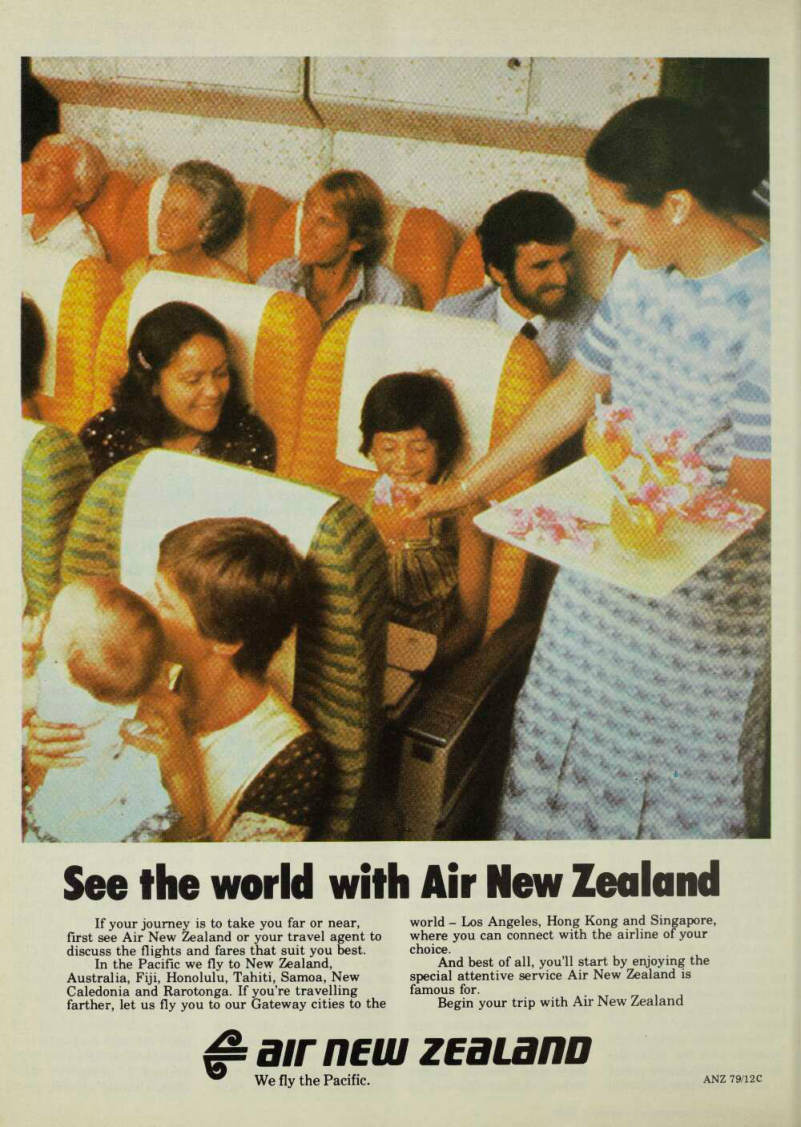
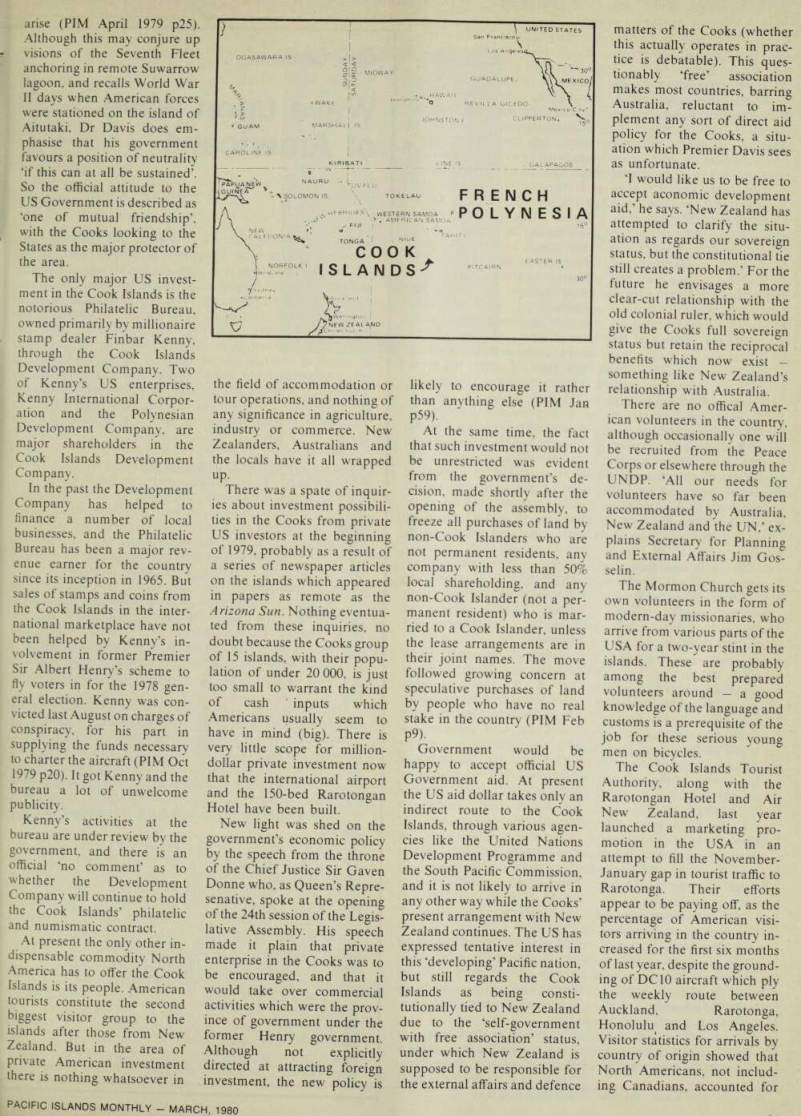
Cook Islands
Far Away
From Karen Garner-Williams in Rarotonga The attitude of the Cook Islands Government towards the Government of the United States is ambivalent. On one hand Premier Tom Davis and his colleagues view the US as the Big Brother of the South Pacific region in defence affairs, but on the other they share a Pacific-wide disap proval of American plans to dump nuclear waste on its island territories. ‘Everybody would like the Pacific to be a neutral zone,’ says Dr Davis. ‘However, if there is an emergency in which the Cook Islands is threatened along with other Pacific coun tries, the Cook Islands would welcome the protection of the parties to the ANZUS treaty and will offer whatever facilities and other assistance it can.’ In fact, it’s not so long ago that Dr Davis was down in
Wellington offering forces, and
real estate with deepwater har bours and airfields, to New Zealand foreign affairs officials should an emergency
arise (PIM April 1979 p 25).
Although this may conjure up visions of the Seventh Fleet anchoring in remote Suwarrow lagoon, and recalls World War II days when American forces were stationed on the island of Aitutaki, Dr Davis does em phasise that his government favours a position of neutrality ‘if this can at all be sustained’.
So the official attitude to the US Government is described as ‘one of mutual friendship’, with the Cooks looking to the States as the major protector of the area.
The only major US invest ment in the Cook Islands is the notorious Philatelic Bureau,
owned primarily by millionaire
stamp dealer Finbar Kenny, through the Cook Islands
Development Company. Two
of Kenny’s US enterprises, Kenny International Corpor ation and the Polynesian
Development Company, are
major shareholders in the Cook Islands Development
Company.
In the past the Development
Company has helped to
finance a number of local businesses, and the Philatelic Bureau has been a major rev enue earner for the country since its inception in 1965. But sales of stamps and coins from the Cook Islands in the inter national marketplace have not
been helped by Kenny’s in
volvement in former Premier Sir Albert Henry’s scheme to fly voters in for the 1978 gen eral election. Kenny was con victed last August on charges of conspiracy, for his part in supplying the funds necessary to charter the aircraft (PIM Oct 1979 p2O). It got Kenny and the bureau a lot of unwelcome
publicity.
Kenny’s activities at the bureau are under review by the government, and there is an official ‘no comment’ as to whether the Development Company will continue to hold the Cook Islands’ philatelic and numismatic contract.
At present the only other in
dispensable commodity North
America has to offer the Cook Islands is its people. American tourists constitute the second biggest visitor group to the islands after those from New Zealand. But in the area of private American investment there is nothing whatsoever in
* ia c j the field of accommodation or tour operations, and nothing of any significance in agriculture. industry or commerce. New Zealanders, Australians and the locals have it all wrapped U There was a spate of mquirles about investment possibilities m the Cooks from private US investors at the beginning of 1979, probably as a result of a series of newspaper articles on the islands which appeared in papers as remote as the Arizona Sun. Nothing eventuated from these inquiries, no doubt because the Cooks group of 15 islands, with their population of under 20 000, is just too small to warrant the kind of cash inputs which Americans usually seem to have in mind (big). There is very little scope for milliondollar private investment now that the international airport and the 150-bed Rarotongan Hotel have been built.
New light was shed on the government’s economic policy by the speech from the throne of the Chief Justice Sir Gaven Donne who, as Queen’s Represenative, spoke at the opening of the 24th session of the Legislative Assembly. His speech made it plain that private enterprise in the Cooks was to be encouraged, and that it would take over commercial activities which were the province of government under the former Henry government,
Although not explicitly
directed at attracting foreign
mvestment, the new policy is
, likely to encourage it rather than anything else (PIM Jan P 59).
At the same time, the fact that such investment would not be unrestricted was evident from the government’s de cision, made shortly after the opening of the assembly, to freeze all purchases of land by non-Cook Islanders who are not permanent residents, any company with less than 50% local shareholding, and any non-Cook Islander (not a per manent resident) who is mar ried to a Cook Islander, unless the lease arrangements are in their joint names. The move followed growing concern at speculative purchases of land by people who have no real stake in the country (PIM Feb p 9).
Government would be happy to accept official US Government aid. At present the US aid dollar takes only an indirect route to the Cook Islands, through various agen cies like the United Nations Development Programme and the South Pacific Commission, and it is not likely to arrive in any other way while the Cooks’ present arrangement with New Zealand continues. The US has expressed tentative interest in this ‘developing’ Pacific nation, but still regards the Cook Islands as being consti tutionally tied to New Zealand due to the ‘self-government with free association’ status, under which New Zealand is supposed to be responsible for the external affairs and defence
matters of the Cooks (whether this actually operates in prac tice is debatable). This ques tionably ‘free’ association makes most countries, barring Australia, reluctant to im plement any sort of direct aid policy for the Cooks, a situ ation which Premier Davis sees as unfortunate.
T would like us to be free to accept aconomic development aid,’ he says. ‘New Zealand has attempted to clarify the situ ation as regards our sovereign status, but the constitutional tie still creates a problem.’ For the future he envisages a more clear-cut relationship with the old colonial ruler, which would give the Cooks full sovereign status but retain the reciprocal benefits which now exist something like New Zealand’s relationship with Australia.
There are no offical Amer ican volunteers in the country,
although occasionally one will
be recruited from the Peace Corps or elsewhere through the UNDP. ‘All our needs for volunteers have so far been accommodated by Australia, New Zealand and the UN,’ ex
plains Secretary for Planning
and External Affairs Jim Gos selin.
The Mormon Church gets its own volunteers in the form of modern-day missionaries, who arrive from various parts of the USA for a two-year stint in the islands. These are probably among the best prepared volunteers around a good knowledge of the language and customs is a prerequisite of the job for these serious young men on bicycles.
The Cook Islands Tourist
Authority, along with the
Rarotongan Hotel and Air New Zealand, last year launched a marketing pro motion in the USA in an attempt to fill the November- January gap in tourist traffic to Rarotonga. Their efforts appear to be paying off, as the percentage of American visi tors arriving in the country in creased for the first six months of last year, despite the ground ing of DC 10 aircraft which ply the weekly route between
Auckland, Rarotonga,
Honolulu and Los Angeles.
Visitor statistics for arrivals by country of origin showed that North Americans, not includ ing Canadians, accounted for
12.5% of total arrivals, second after the inevitable droves of New Zealanders.
But the 1000-odd Americans were relatively unobtrusive.
Tourist Authority manager lan Fogelberg puts it this way: ‘There is no doubt that the American tourists who come here are not the archetypal loud, camera-toting “Yankee Tourist” types. They tend to be a little more adventurous, defi nitely in the upper end of the income bracket, quite inter ested and well-mannered, usually well travelled, and looking for a different experi ence.’ This off-the-beaten track image is the one that the promoters are pushing in the
Usa.
Despite its long isolation
from the major travel routes, a fair number of Americans have managed to find their way to the Cook Islands and are now
living, working and marrying
locally. Many of these are the
predictable refugees from what
they consider to be the undesirability of the American way of life. Since the time of Charles Wells Banks, who ab sconded to the Cook Islands with $2O 000 in cash from the San Francisco branch of the Wells Fargo Bank, where he worked as a clerk until 1886, Americans have been ‘getting away from it all’ in this spot which is even more distant than
legendary Tahiti.
One of the better known of these is the artist Rick Welland, who has lived in Rarotonga since the early 1960 s and earns his bread painting local land scapes and island maidens.
There is a sprinkling of Americans working in the pub lic service and in business, and they appear to integrate with ease into the local community.
Cook Islanders certainly do not regard them as a group, although it would be a fairly accurate generalisation to say that Cook Islanders tend to be very accepting of outsiders, judging them on their merits.
American involvement in the Cooks is minimal in com parison to its role in many other Pacific countries, a situ ation that is applauded by many islands residents.
Whether this will continue to be the case remains to be seen.
Already the Cook Islands
imports ‘a little bit of every thing’ from the USA. while, conversely, exports from the Cooks to the US have been negligible, apart from a tiny amount of handcrafts and the occasional dance troupe. A
new and encouraging sign
appeared however last Decem ber when the US Department of Agriculture approved the entry into the USA of Cook Islands freyh pineapple, taro and tarua. The items are the first from a list of Cooks pro duce sent to the USDA by Dr Davis to be given the go-ahead.
A spokesman for the Cooks
Ministry of Agriculture de
scribed the development as ‘a useful start’, and voiced the hope that other products would gain right of entry. He men tioned pawpaw in particular
(PIM Feb p 59).
It is perhaps interesting to note that Dr Davis lived in the USA for nearly 20 years, work ing in space medicine. Dr Davis describes the USA as ‘a country whose greatest virtue, in my personal opinion, is its freedom to allow individual endeavour... it allows per sonal initiative to blossom whether it be in business, in academic life, or in social re
lationships. but particularly in
placing high value on individual ability and endeavour.’
Ironically, he sees Cook
Islanders beginning to adopt
one of the less desirable characteristics of the American way of life, which is very much bound up with achievement and self-reliance namely, higher stress. He maintains that the individual Cook Islander is
quick to perceive opportunities
for advancement, citing the considerable local involvement in the tourist industry and the recent boom in market garden ing, and he mentions the high value which is placed on edu cation as a means to greater achievement. ‘Per unit of population I believe we have one of the highest percentages of professionally and tech nically trained people in the Pacific,’ he told me. implying that stress is a natural concomi tant.
Still, here in the Cooks, it is a far cry from life in downtown Honolulu or even Pago Pago.
No doubt most people hope it will stay that way.
Advertisements & other items, pp. 19-20 (2 items)
PAP.iFin iri A\in<s MnwTm v _ m a 1 n on
PAP.iFin iri A\in<s MnwTm v m a 1 n on
See the world with Air New Zealand
I I M * ■■ «?■ jl - See the world with Air New Zealand If your journey is to take you far or near, first see Air New Zealand or your travel agent to discuss the flights and fares that suit you best.
In the Pacific we fly to New Zealand, Australia, Fiji, Honolulu, Tahiti, Samoa, New Caledonia and Rarotonga. If you’re travelling farther, let us fly you to our Gateway cities to the world - Los Angeles, Hong Kong and Singapore, where you can connect with the airline of your choice.
And best of all, you’ll start by enjoying the special attentive service Air New Zealand is famous for.
Begin your trip with Air New Zealand
air new zEatana
We fly the Pacific.
ANZ 79/12C
of Americans
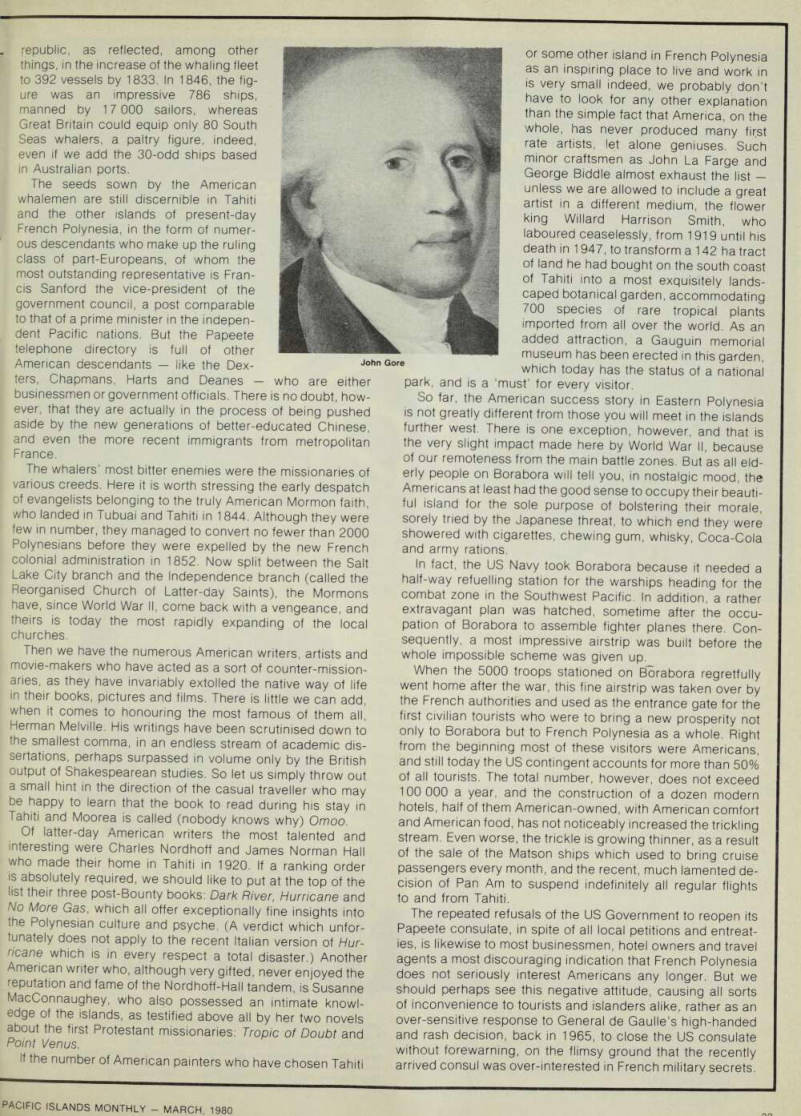
Eastern Polynesia Wave upon wave of Americans
By Marie-Therese and Bengt Danielsson, in Papeete
Of all the countless popa’a (the word the Tahitians have coined to denote white foreigners) who have been washed up, like drifting seeds and nuts, on the shores of the lush islands in Eastern Polynesia, a high percentage, if not most, have always been Americans. The most obvious explanation the proximity, and the 'slooping’ Pacific, facilitating down wind voyages from California is not entirely satisfying, since the movement began when this state had no population to speak of and had not yet become part of the Union. So let us rather attribute it to what is usually and quite vaguely called ‘the American pioneering spirit’. However this may be, for more than 200 years the Yankees have been arriving in the islands, in wave upon wave, each one throwing up a new variety of the genus homo americanus.
The first American arrived in Tahiti even before 1776 and was thus formally an Englishman. His name was John Gore and he was one of the master’s mates on the Dolphin, when Samuel Wallis discovered the island in 1767. Incredibly enough, this was Gore’s second circumnavigation of the globe, as he had already two years earlier served under Commodore Byron, who was less lucky, since he sighted only a few worthless atolls. Because of his previous experiences and his personal qualities, Gore, now promoted to third lieutenant, was again chosen by Captain Cook to accompany him during his first voyage. Having become a favourite of Joseph Banks, he missed the second voyage, but returned once more with Cook to Tahiti in 1777, during the third voy age. His supreme moment came, when, after the deaths of Cook and Clerke, he took over the expedition and sailed the two ships back to England by then a foreign country for him.
Incidentally, the US bicentenary committee badly missed the opportunity to honour this remarkable and completely for gotten American, who, after Cook’s death, was the world’s foremost authority on the Pacific. Another American explorer who has been allowed to slip into oblivion is Charles Wilkes, the commander of the scandal-plagued US Exploring Expedi tion, 1838-42, which did a particularly fine job of surveying and gathering information about the little-known Tuamotu islands.
In the meantime, Eastern Polynesia had become not only the happy hunting ground for American whalemen but their favourite playground as well. Since it took several years to fill all the barrels in the hold with oil, the crews were now and then sent ashore for what the modern US navy prudishly calls Test and recreation’. The preferred vacation spots were, of course, islands with a safe anchorage, plenty of provisions and an abundance of warm, willing women, and this meant above all the Society and the Marquesas islands.
In 1811, the number of American whalers operating in the Pacific was 53, well below the British figure. Many were de stroyed during the 1812-15 war by the far superior Royal Navy, but then again the famous Captain Porter captured about a dozen English ships and moreover built a fortified village on Nukuhiva of which he formally took possession.
After the war, trade and industries flourished in the young
republic, as reflected, among other things, in the increase of the whaling fleet to 392 vessels by 1833. In 1846, the fig ure was an impressive 786 ships, manned by 17 000 sailors, whereas Great Britain could equip only 80 South Seas whalers, a paltry figure, indeed, even if we add the 30-odd ships based in Australian ports.
The seeds sown by the American whalemen are still discernible in Tahiti and the other islands of present-day French Polynesia, in the form of numer ous descendants who make up the ruling class of part-Europeans, of whom the most outstanding representative is Fran cis Sanford the vice-president of the government council, a post comparable to that of a prime minister in the indepen dent Pacific nations. But the Papeete telephone directory is full of other American descendants like the Dex
ters, Chapmans, Harts and Deanes who are either businessmen or government officials. There is no doubt, how ever, that they are actually in the process of being pushed aside by the new generations of better-educated Chinese, and even the more recent immigrants from metropolitan France.
The whalers’ most bitter enemies were the missionaries of various creeds. Here it is worth stressing the early despatch of evangelists belonging to the truly American Mormon faith, who landed in Tubuai and Tahiti in 1844. Although they were few in number, they managed to convert no fewer than 2000 Polynesians before they were expelled by the new French colonial administration in 1852. Now split between the Salt Lake City branch and the Independence branch (called the Reorganised Church of Latter-day Saints), the Mormons have, since World War 11, come back with a vengeance, and theirs is today the most rapidly expanding of the local churches.
Then we have the numerous American writers, artists and movie-makers who have acted as a sort of counter-mission aries, as they have invariably extolled the native way of life in their books, pictures and films. There is little we can add, when it comes to honouring the most famous of them all, Herman Melville. His writings have been scrutinised down to the smallest comma, in an endless stream of academic dis sertations, perhaps surpassed in volume only by the British output of Shakespearean studies. So let us simply throw out a small hint in the direction of the casual traveller who may be happy to learn that the book to read during his stay in Tahiti and Moorea is called (nobody knows why) Omoo.
Of latter-day American writers the most talented and interesting were Charles Nordhoff and James Norman Hall who made their home in Tahiti in 1920. If a ranking order is absolutely required, we should like to put at the top of the list their three post-Bounty books: Dark River, Hurricane and No More Gas, which all offer exceptionally fine insights into the Polynesian culture and psyche. (A verdict which unfor tunately does not apply to the recent Italian version of Hur ricane which is in every respect a total disaster.) Another American writer who, although very gifted, never enjoyed the reputation and fame of the Nordhoff-Hall tandem, is Susanne MacConnaughey. who also possessed an intimate knowl edge of the islands, as testified above all by her two novels about the first Protestant missionaries: Tropic of Doubt and Point Venus.
If the number of American painters who have chosen Tahiti
or some other island in French Polynesia as an inspiring place to live and work in is very small indeed, we probably don’t have to look for any other explanation than the simple fact that America, on the whole, has never produced many first rate artists, let alone geniuses. Such minor craftsmen as John La Farge and George Biddle almost exhaust the list unless we are allowed to include a great artist in a different medium, the flower king Willard Harrison Smith, who laboured ceaselessly, from 1919 until his death in 1947, to transform a 142 ha tract of land he had bought on the south coast of Tahiti into a most exquisitely lands caped botanical garden, accommodating 700 species of rare tropical plants imported from all over the world. As an added attraction, a Gauguin memorial museum has been erected in this garden, which today has the status of a national
park, and is a ‘must’ for every visitor.
So far, the American success story in Eastern Polynesia is not greatly different from those you will meet in the islands further west. There is one exception, however, and that is the very slight impact made here by World War 11, because of our remoteness from the main battle zones. But as all eld erly people on Borabora will tell you, in nostalgic mood, the Americans at least had the good sense to occupy their beauti ful island for the sole purpose of bolstering their morale, sorely tried by the Japanese threat, to which end they were showered with cigarettes, chewing gum, whisky, Coca-Cola and army rations.
In fact, the US Navy took Borabora because it needed a half-way refuelling station for the warships heading for the combat zone in the Southwest Pacific. In addition, a rather extravagant plan was hatched, sometime after the occu pation of Borabora to assemble fighter planes there. Con sequently, a most impressive airstrip was built before the whole impossible scheme was given up.
When the 5000 troops stationed on Borabora regretfully went home after the war, this fine airstrip was taken over by the French authorities and used as the entrance gate for the first civilian tourists who were to bring a new prosperity not only to Borabora but to French Polynesia as a whole. Right from the beginning most of these visitors were Americans, and still today the US contingent accounts for more than 50% of all tourists. The total number, however, does not exceed 100 000 a year, and the construction of a dozen modern hotels, half of them American-owned, with American comfort and American food, has not noticeably increased the trickling stream. Even worse, the trickle is growing thinner, as a result of the sale of the Matson ships which used to bring cruise passengers every month, and the recent, much lamented de cision of Pan Am to suspend indefinitely all regular flights to and from Tahiti.
The repeated refusals of the US Government to reopen its Papeete consulate, in spite of all local petitions and entreat ies, is likewise to most businessmen, hotel owners and travel agents a most discouraging indication that French Polynesia does not seriously interest Americans any longer. But we should perhaps see this negative attitude, causing all sorts of inconvenience to tourists and islanders alike, rather as an over-sensitive response to General de Gaulle’s high-handed and rash decision, back in 1965, to close the US consulate without forewarning, on the flimsy ground that the recently arrived consul was over-interested in French military secrets.
John Gore
Advertisements & other items, pp. 22-24 (2 items)
22
PAP.IFir ISI AMDS MONTHLY - MARCH, 1980
A different musical experience.
The G-Series from JVC.
Beautifully designed stereo systems from JVC the fabulous G-Series —with coordinated looks and feel.
Distinctive musical experiences sure to appeal to every kind of music lover.
In every system, the kind of careful attention to detail that has helped make our reputation.
In every system, our beautiful ease of operation, handsome good looks, excellent cost/performance value.
Not to mention your choice of big or small power outputs, separate tuners and amplifiers, the ultimate in precision and accuracy.
We know. We’re JVC, the innovative audio/video electronics company with 52 years of experience.
At JVC, details count. And this is why you can always count on us for true high-fidelity reproduction. Visit a JVC dealer today and audition the different G-Series systems.
I JVC G-SERIES m-Fl SYSTEMS
’ i Australia: Hagemeyer (Australasia)B.V., 25-27 Paul Street, North Ryde, N.S.W. 2113, Australia Te 1.887-1444 Fiji Islands: D. Gokal & Co., Ltd., G.P.O. Box 501, Corner of Pier Street & Renwick Road, Suva, Fiji Tel, 25259 Cook Islands: J. & P. Ingram & Co., Ltd., P.0.80x 55, Rarotonga, Cook Islands Te 1.378457 New Hebrides; Wu ke Luong, P.0.80x 113, Rue Higginson, Port-Vila, New Hebrides Te 1.2115 New Caledonia: Caldis, 2, Route du Velodrome, B.P. Ml, Noumea, Cedex, New Caledonia Te 1.262350 Tahiti: Magasin Sincere, B.P. 215, Papeete, Tahiti Te 1.20060 Papua New Guinea: Hagemeyer(P.N.G.)Pty, Ltd., P.0.80x 90 Lae, Papua New Guinea Te 1.42-3200 New Zealand: Atlas Majestic Industries Ltd., 11, Albion Road. Otahuhu, Auckland 6, New Zealand Te 1.27-67-099
Peace Corps
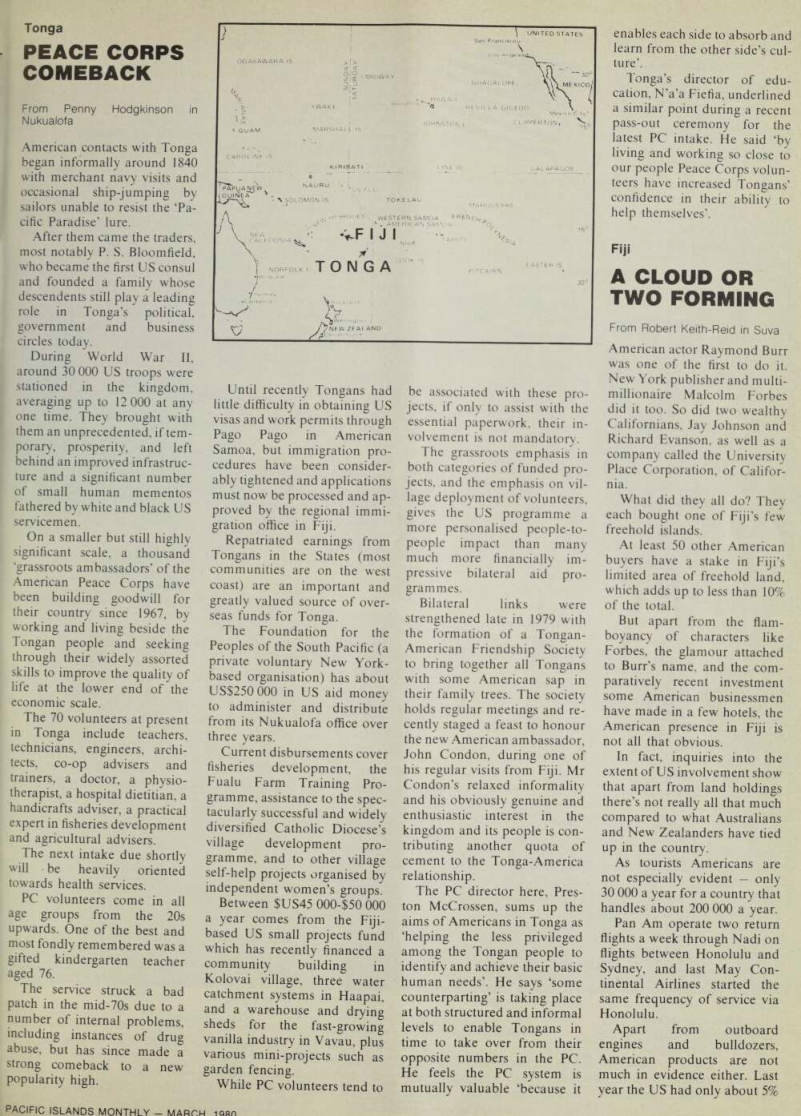
Tonga
Comeback
From Penny Hodgkinson in Nukualofa American contacts with Tonga began informally around 1840 with merchant navy visits and occasional ship-jumping by sailors unable to resist the ‘Pa cific Paradise’ lure.
After them came the traders, most notably P. S. Bloomfield, who became the first US consul and founded a family whose descendents still play a leading role in Tonga’s political, government and business circles today.
During World War 11, around 30 000 US troops were stationed in the kingdom, averaging up to 12 000 at any one time. They brought with them an unprecedented, if tem porary, prosperity, and left behind an improved infrastruc ture and a significant number of small human mementos fathered by white and black US servicemen.
On a smaller but still highly significant scale, a thousand ‘grassroots ambassadors’ of the American Peace Corps have been building goodwill for their country since 1967, by working and living beside the Tongan people and seeking
through their widely assorted
skills to improve the quality of life at the lower end of the economic scale.
The 70 volunteers at present in Tonga include teachers, technicians, engineers, archi tects, co-op advisers and trainers, a doctor, a physio therapist, a hospital dietitian, a handicrafts adviser, a practical expert in fisheries development and agricultural advisers.
The next intake due shortly will be heavily oriented towards health services.
PC volunteers come in all age groups from the 20s upwards. One of the best and most fondly remembered was a gifted kindergarten teacher aged 76.
The service struck a bad patch in the mid-70s due to a number of internal problems,
including instances of drug
abuse, but has since made a strong comeback to a new
popularity high.
Until recently Tongans had little difficulty in obtaining US visas and work permits through Pago Pago in American Samoa, but immigration pro cedures have been consider ably tightened and applications must now be processed and ap proved by the regional immi gration office in Fiji.
Repatriated earnings from Tongans in the States (most communities are on the west coast) are an important and greatly valued source of over seas funds for Tonga.
The Foundation for the Peoples of the South Pacific (a private voluntary New York based organisation) has about US$25O 000 in US aid money to administer and distribute from its Nukualofa office over three years.
Current disbursements cover fisheries development, the Fualu Farm Training Pro gramme, assistance to the spec
tacularly successful and widely
diversified Catholic Diocese’s
village development pro
gramme, and to other village
self-help projects organised by
independent women’s groups.
Between SUS4S 000-$5 O 000 a year comes from the Fiji based US small projects fund which has recently financed a
community building in
Kolovai village, three water catchment systems in Haapai, and a warehouse and drying sheds for the fast-growing vanilla industry in Vavau, plus various mini-projects such as
garden fencing.
While PC volunteers tend to
be associated with these pro jects, if only to assist with the essential paperwork, their in volvement is not mandatory.
The grassroots emphasis in both categories of funded pro jects, and the emphasis on vil
lage deployment of volunteers,
gives the US programme a more personalised people-to
people impact than many
much more financially im pressive bilateral aid pro grammes.
Bilateral links were strengthened late in 1979 with the formation of a Tongan-
American Friendship Society
to bring together all Tongans with some American sap in their family trees. The society holds regular meetings and re cently staged a feast to honour the new American ambassador, John Condon, during one of his regular visits from Fiji. Mr Condon’s relaxed informality and his obviously genuine and enthusiastic interest in the kingdom and its people is con tributing another quota of cement to the Tonga-America
relationship.
The PC director here, Pres ton McCrossen, sums up the aims of Americans in Tonga as
‘helping the less privileged
among the Tongan people to identify and achieve their basic human needs’. He says ‘some
counterparting’ is taking place
at both structured and informal levels to enable Tongans in time to take over from their opposite numbers in the PC.
He feels the PC system is mutually valuable ‘because it
enables each side to absorb and learn from the other side’s cul ture’.
Tonga’s director of edu cation, N’a’a Fiefia, underlined a similar point during a recent pass-out ceremony for the latest PC intake. He said ‘by living and working so close to our people Peace Corps volun teers have increased Tongans’ confidence in their ability to
help themselves’.
Two Forming
Fiji
A Cloud Or
From Robert Keith-Reid in Suva American actor Raymond Burr was one of the first to do it.
New York publisher and multi millionaire Malcolm Forbes did it too. So did two wealthy Californians, Jay Johnson and Richard Evanson, as well as a company called the University Place Corporation, of Califor nia.
What did they all do? They each bought one of Fiji’s few freehold islands.
At least 50 other American buyers have a stake in Fiji’s limited area of freehold land, which adds up to less than 10% of the total.
But apart from the flam boyancy of characters like Forbes, the glamour attached to Burr’s name, and the com paratively recent investment some American businessmen have made in a few hotels, the American presence in Fiji is not all that obvious.
In fact, inquiries into the extent of US involvement show that apart from land holdings there’s not really all that much compared to what Australians and New Zealanders have tied up in the country.
As tourists Americans are
not especially evident only
30 000 a year for a country that handles about 200 000 a year.
Pan Am operate two return flights a week through Nadi on flights between Honolulu and Sydney, and last May Con tinental Airlines started the same frequency of service via Honolulu.
Apart from outboard engines and bulldozers, American products are not much in evidence either. Last year the US had only about 5%
of Fiji’s $4OO 000 000 a year import market. With the excep tion of land, direct US invest ment is confined to several hotels, a timber mill, a helicop ter company, and in mineral and oil prospecting.
The Peace Corps has been around for 15 years but that is a low-key outfit also.
One of America’s biggest banks. Citibank, tried to make a go of it in Fiji, but after five years, and after incurring sev eral million dollars in losses, it
pulled out.
US aid has hardly touched Fiji, since there is little of it and, apart from the influence of American films and jargon, US ideas have little foothold either.
But as the South Pacific’s crossroads, Fiji is beginning to attract more US political and economic attention. A five
floor embassy building, leased
for 10 years with an option to
buy, stands conveniently close
to Government Buildings and contains the office of a fully fledged American Ambassa dor, Mr John Condon, who took over from the charge d’af faires who had previously headed the post.
Apparently uneasy about increasing Russian and Chinese overtures to the newly independent countries of the region, and itself interested in marine .resources such as tuna and seabed minerals, the US
has begun forging stronger pol
itical links with a region it had not previously bothered about too much.
Now Suva is shaping up as the centre for US political activity in the South Pacific.
After a mid-19th century row with Fijian chiefs over some land claims in Fiji by American adventurers, the US didn’t bother about Fiji again until World War 11, when it became a forward base for operations against the Japanese. After World War II about the only link with the US was Pan Am.
Then ip the late 1960 s
Americans began buying up
land in Fiji in a wave of specu lation that lasted until about 1974, when Fiji enacted anti
speculation legislation and a
world recession arrived.
Several scores of freehold
properties, ranging from min
ute islets to copra plantations
of 2000 acres and more, passed into American ownership and mostly remain there. But with a few exceptions the new owners have done little with
their land, being apparently
ready to wait until conditions
are ripe enough to bring them
a hefty profit, despite a 30%
speculation gains tax.
Burr has made other invest ments in Fiji, being a share holder in one of Fiji’s two daily newspapers, the Fiji Sun.
Forbes bought Laucala island, one of the biggest free hold islands available, for about $1 million. He has put in a lot of money turning it into a model plantation, with high class accommodation for his workers and a new school and
community centre.
Los Angeles businessman Jay Johnson owns Kaibu island. He’s also a substantial shareholder in the busy local service airline. Fiji Air.
In the Yasawa Islands Richard Evanson has turned Nanuyalevu into an exclusive resort. He owns Turtle Air ways, which runs non scheduled services with floatplanes about Fiji, and he has a big interest in the large Fiji Regent Hotel at Denarau Island, near Nadi.
In Vanua Levu the Courtesy Bench Corporation has 4000 ha of land. It is planting 2400 ha with pine and is think
ing about planting cocoa.
American involvement in the tourism scene started in the mid-1960s when a group of Pan
Am pilots pooled their savings
and started a company that led to the building of the Mocambo Hotel at Nadi air port, and later the 300-room Fijian resort hotel at Cuvu.
Majority control of these two hotels has since passed into Singapore hands, but the American initiative gave Fiji its first world-class resort (the
Fijian).
In the late 1960 s a California company. Commercial Invest
ment Properties Ltd, acquired
the lease of Denarau island. Its initiative has led to another big resort, the Fiji Regent, which at $2O million is the biggest single US investment in Fiji. The
Bishop Corporation of Hono
lulu has a 67% interest in the resort.
At Korolevu a Los Angeles business group took over the half-built shell of a big hotel that was started by an Aus tralian company that went bankrupt, and in December 1979, at a completed cost of $l2 million, opened it as the Hyatt Regency. Next door, Califor nian businessman Gordon Oliver has recently taken over the lease of the famous Korolevu Beach Hotel, with an option to buy it, and is talking of a $7 million re
development.
At Deuba, Honolulu busi nessman Larry Bortles has the Tropic Sands Motel, and is talking of a major resort on an
adjacent site.
Mr Bill Daly’s American Investments Ltd runs a modern sawmill at Deuba, and he and former US associates carried out a large and profitable residential and commercial sub-division at Laucala Bay, in Suva.
Seattle businessman Ed Chopot owns Pacific Crown
Aviation, Fiji’s only helicopter
company, which runs five ma chines on a wide variety of work. Another American business group recently
acquired a logging concession
near Sigatoka and is said to be planning to put up a sawmill to handle logs and later veneers.
In January 1980 the Fiji Government was disappointed when America’s giant Amax group and its Australian. Ger man and British partners de cided to shelve further exploration at Namosi indefinitely as low copper prices and low ore grades mean they are not worth mining yet.
But by the end of March another US giant. Standard Oil of California, through a sub sidiary company. Chevron, is due to start drilling Fiji’s first exploratory oil well. And the big US oil explorer. Mapco, is active in Fiji. Standard and Mapco were attracted to Fiji by the work of a small prospector.
Pacific Energy and Minerals
Ltd, of Colorado, which be sides oil has now begun a hunt
for gold.
There’s virtually no US in volvement in the local com merce and industry scene otherwise, and in 1979 US exports to Fiji were worth only $22 366 000 - only 5.7% of the total.
In Suva the embassy’s re cently established commercial office hopes to get this pro portion increased and will hold its first trade fair, with 20 US companies likely to be in volved, in July.
The embassy’s commercial secretary, Mrs Dinny Laufen bak, says: ‘US businessmen, who used to fly through Nadi to Australia without stopping, are now beginning to stop off.
They have been asking for population and trade figures and are surprised by the size of the market.’
US direct aid to Fiji is not so far significant, apart from emergency supplies and equip ment delivered after hurricane disasters, and the supply, at a nominal figure, of the three small minesweepers which make up the Fiji navy.
US universities and foun dations are another source of occasional help, and the University of the South Pacific and the University of Hawaii signed an agreement in January for a five-year co
operative programme.
Apart from the hotels, prob ably the most significant US presence in Fiji is the Peace Corps. This started work in the late 1960 s and maintains an av erage of 150 to 200 volunteers who worked in areas specified by the government. These are mainly in school teaching, in
agriculture, with co-operatives,
rural development in agencies
of the ministry of finance and planning or other technical fields.
The government prefers
older, qualified and experi
enced volunteers, and these are mainly what it gets after ex
periences with some freshly
graduated volunteers who caused some problems in the
early days.
Fiji’s British connections gave it soccer, cricket and Rugby Union, and in con sequence not much inclination for meeting Americans in sport outside of these games. Basket
Advertisements & other items, pp. 27-28 (1 item)
Quafity Video Entertammeiil
Aka Has The Features For
Akai video. Quality you can rely on. Features you can choose from.
VS-9800, with multi-speed remote-control playback.
VS-9700, with an 8-day built-in timer.
VP-7100, with a rechargeable battery for portability.
VC-60, with an easy-to use 6X zoom lens.
Akai video. Providing these quality features and more,
for every requirement.
OFFICIAL SUPPLIER OF
VIDEO HOME SYSTEM
AKAI
MOSCOW AKAI ELECTRIC CO., LTD.
Tokyo, Japan VS-9800 VP-7100
AKAI
VC-6( VT/ o es s VS-9700
AKAI
J.G. 5 Svensson (N.G.) Ltd. ). Box 705, Port Moresby Tel: 2275 i Islands >tibhai & Company Ltd. 5 Box 9175, Nadi International Airport : 72-165 iw Zealand e Ltd., Consumer Products Sector 3 Mt. Eden Rd., Mt. Eden, Auckland : 686-437 New Caledonia Menard Pacifique s.a.r.l.
B P. H 2, Noumea Tel: 275222 Tahiti Etablissements Comimpex P.O. Box 200, Papeete Tel: 20477 New Hebrides (Islands) Burns Philp (New Hebrides) Co., Ltd.
P.O, Box 27, Port Vila, New Hebrides Islands Norfolk Island Burns Philp (Norfolk Island) Co., Ltd P.O. Box 21, Norfolk Island Samoa Islands Burns Philp (South Sea) Co.. Ltd.
P.O. Box 129, Pago Pago, American Samoa Mariana Islands J.C. Tenorio Enterprises P.O, Box 137, Saipan Tel: 6444/8 Solomon Islands Security Electrical Co., Ltd.
P.O. Box 174, Honiara Tel: 881 Cook Islands JPS Enterprises Ltd.
P.O. Box 15, Rarotonga Tel: 2150, 2176 For more information, please send this coupon to our distributor in your country or to AKAI ELECTRIC CO., LTD. 12-14, 2-Chome, Higashi-Kojiya, Ohta-ku, Tokyo, Japan
for beautiful pictures
Topcon Auto Winder-II Auto-Winding is an developed original Topcon idea, to let the photographer keep his eye glued to the finder eyepiece, even while following fastbreaking actions. The new Auto Winder-II is just the right size and correct weight for handholding, as well as being perfectly balanced for handlingease, and makes an ideal combination with the RM 300 for shooting fast actions. With a 2 frames per second shooting speed, at all shutter speeds up to the fastest 1/1,000 second, no picture will ever get away from the Auto Winder-11.
Topcon AM Bayonet Mount The new AM bayonet mount (*) is compatible with one of the most extensive ranges of lenses available on the market. It's backed up by more than 100 fixed-focal length lenses (from 15mm wide angle to 500 mm telephoto) and more than 50 zoom lenses (from 24-48 mm to 120-300 mm), all with automatic diaphragm action, as well as with preset and manual diaphragm lenses, going up to the I,ooomm telephoto. (* The new AM bayonet mount is identical to the "K " bayonet mount.) ■ f
TOKYO OPTICAL CO.,LTD.
75-1, Hasunuma-cho, Itabashl Phone Telex 0272-2384 Japan Tokyo 03-967-1101 AUSTRALIA Wagner Wholesale Photographies, 524 Flinders Street, Melbourne, Victoria 3000 / NEW ZEALAND Pan Pacific Cameras Ltd., P.O. Box 478, Christchurch / NORFOLK ISLAND Miltons Department Stores Limited, P.O. Box 146, Norfolk Island 2899 / NEW HEBRIDES The Sound Centre, P.O. Box 434, Port-Vila / NEW CALEDONIA Magenta Photo BP 1723, Noumea / FIJI D. Gokal & Co. Ltd., CNR Pier Straat and Renwick Road, Suva, PAPUA NEW GUINEA Hagemeyer (PNG) Pty.Ltd., Lae, Rabaul, Port Moresby, Madang, Mt. Hagen, Wewak.
dump.
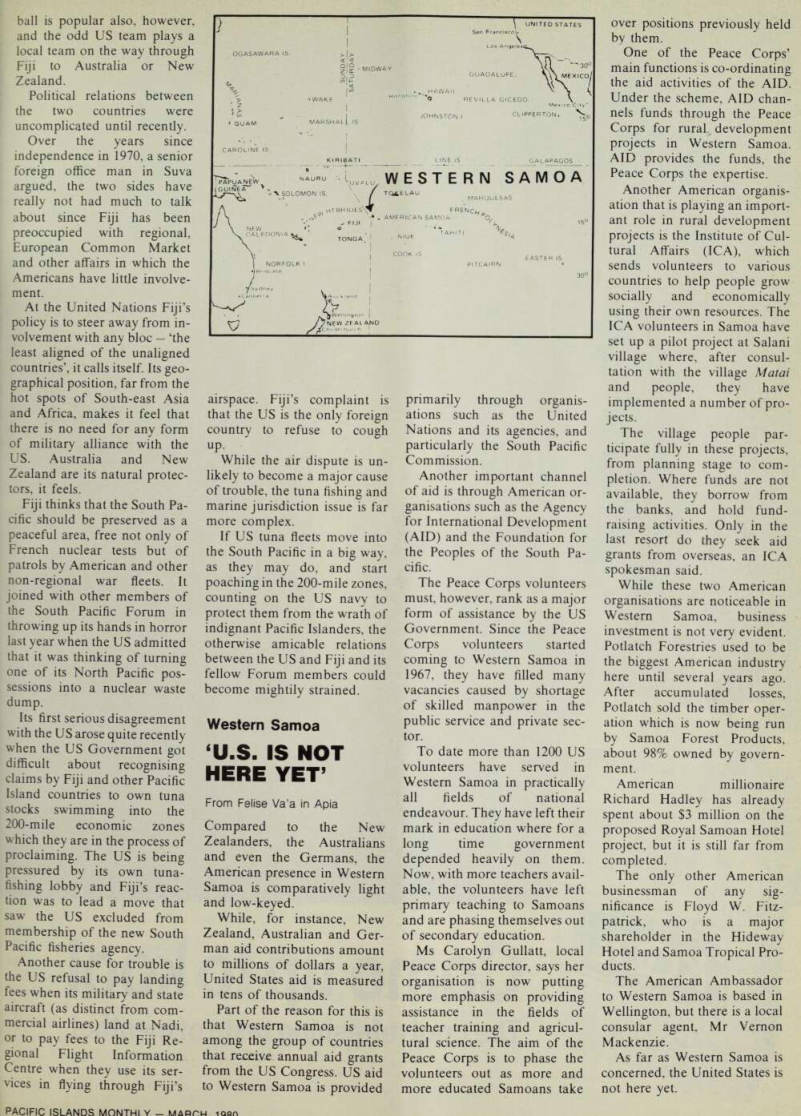
ball is popular also, however, and the odd US team plays a local team on the way through Fiji to Australia or New Zealand.
Political relations between the two countries were
uncomplicated until recently.
Over the years since independence in 1970, a senior foreign office man in Suva argued, the two sides have really not had much to talk about since Fiji has been
preoccupied with regional,
European Common Market and other affairs in which the Americans have little involve ment.
At the United Nations Fiji’s policy is to steer away from in volvement with any bloc ‘the least aligned of the unaligned countries’, it calls itself. Its geo graphical position, far from the hot spots of South-east Asia and Africa, makes it feel that there is no need for any form of military alliance with the US. Australia and New Zealand are its natural protec tors, it feels.
Fiji thinks that the South Pa cific should be preserved as a peaceful area, free not only of French nuclear tests but of patrols by American and other non-regional war fleets. It joined with other members of the South Pacific Forum in throwing up its hands in horror last year when the US admitted that it was thinking of turning one of its North Pacific pos sessions into a nuclear waste
dump.
Its first serious disagreement with the US arose quite recently when the US Government got difficult about recognising claims by Fiji and other Pacific Island countries to own tuna stocks swimming into the 200-mile economic zones which they are in the process of proclaiming. The US is being pressured by its own tuna
fishing lobby and Fiji’s reac
tion was to lead a move that saw the US excluded from membership of the new South Pacific fisheries agency.
Another cause for trouble is the US refusal to pay landing fees when its military and state aircraft (as distinct from com mercial airlines) land at Nadi, or to pay fees to the Fiji Re
gional Flight Information
Centre when they use its ser
vices in flying through Fiji’s
airspace. Fiji’s complaint is
that the US is the only foreign country to refuse to cough up.
While the air dispute is un likely to become a major cause of trouble, the tuna fishing and marine jurisdiction issue is far
more complex.
If US tuna fleets move into the South Pacific in a big way, as they may do, and start poaching in the 200-mile zones, counting on the US navy to protect them from the wrath of indignant Pacific Islanders, the otherwise amicable relations between the US and Fiji and its fellow Forum members could become mightily strained.
Here Yet’
Western Samoa
‘U.S. Is Not
primarily through organis
ations such as the United Nations and its agencies, and particularly the South Pacific Commission.
Another important channel of aid is through American or ganisations such as the Agency for International Development (AID) and the Foundation for the Peoples of the South Pa cific.
The Peace Corps volunteers must, however, rank as a major form of assistance by the US Government. Since the Peace Corps volunteers started coming to Western Samoa in 1967, they have filled many vacancies caused by shortage of skilled manpower in the public service and private sec tor.
To date more than 1200 US volunteers have served in Western Samoa in practically all fields of national endeavour. They have left their mark in education where for a long time government
depended heavily on them.
Now, with more teachers avail able, the volunteers have left
primary teaching to Samoans
and are phasing themselves out of secondary education.
Ms Carolyn Gullatt, local Peace Corps director, says her
organisation is now putting
more emphasis on providing
assistance in the fields of teacher training and agricul tural science. The aim of the Peace Corps is to phase the volunteers out as more and more educated Samoans take
From Fslise Va’a in Apia Compared to the New Zealanders, the Australians and even the Germans, the American presence in Western
Samoa is comparatively light
and low-keyed.
While, for instance, New Zealand, Australian and Ger man aid contributions amount to millions of dollars a year, United States aid is measured in tens of thousands.
Part of the reason for this is that Western Samoa is not among the group of countries that receive annual aid grants from the US Congress. US aid to Western Samoa is provided
over positions previously held
by them.
One of the Peace Corps’ main functions is co-ordinating the aid activities of the AID.
Under the scheme, AID chan nels funds through the Peace Corps for rural., development projects in Western Samoa.
AID provides the funds, the Peace Corps the expertise.
Another American organis ation that is playing an import ant role in rural development projects is the Institute of Cul tural Affairs (ICA), which sends volunteers to various countries to help people grow
socially and economically
using their own resources. The ICA volunteers in Samoa have set up a pilot project at Salani village where, after consul tation with the village Matai
and people, they have
implemented a number of pro
jects.
The village people par
ticipate fully in these projects,
from planning stage to com pletion. Where funds are not available, they borrow from the banks, and hold fund raising activities. Only in the last resort do they seek aid grants from overseas, an ICA
spokesman said.
While these two American organisations are noticeable in Western Samoa, business investment is not very evident.
Potlatch Forestries used to be
the biggest American industry
here until several years ago.
After accumulated losses, Potlatch sold the timber oper ation which is now being run by Samoa Forest Products, about 98% owned by govern ment.
American millionaire
Richard Hadley has already
spent about $3 million on the proposed Royal Samoan Hotel project, but it is still far from
completed.
The only other American businessman of any sig nificance is Floyd W. Fitz patrick, who is a major shareholder in the Hideway Hotel and Samoa Tropical Pro ducts.
The American Ambassador to Western Samoa is based in Wellington, but there is a local consular agent, Mr Vemon Mackenzie.
As far as Western Samoa is concerned, the United States is not here yet.
Advertisements & other items, pp. 29-30 (2 items)
Pacific Islands Monthi Y _ Marp.W -Icon
PACIFIC ISLANDS MONTHI Y MARP.w -icon
Come up to tool
The cool refreshing taste of menthol.
Micronesia: How free
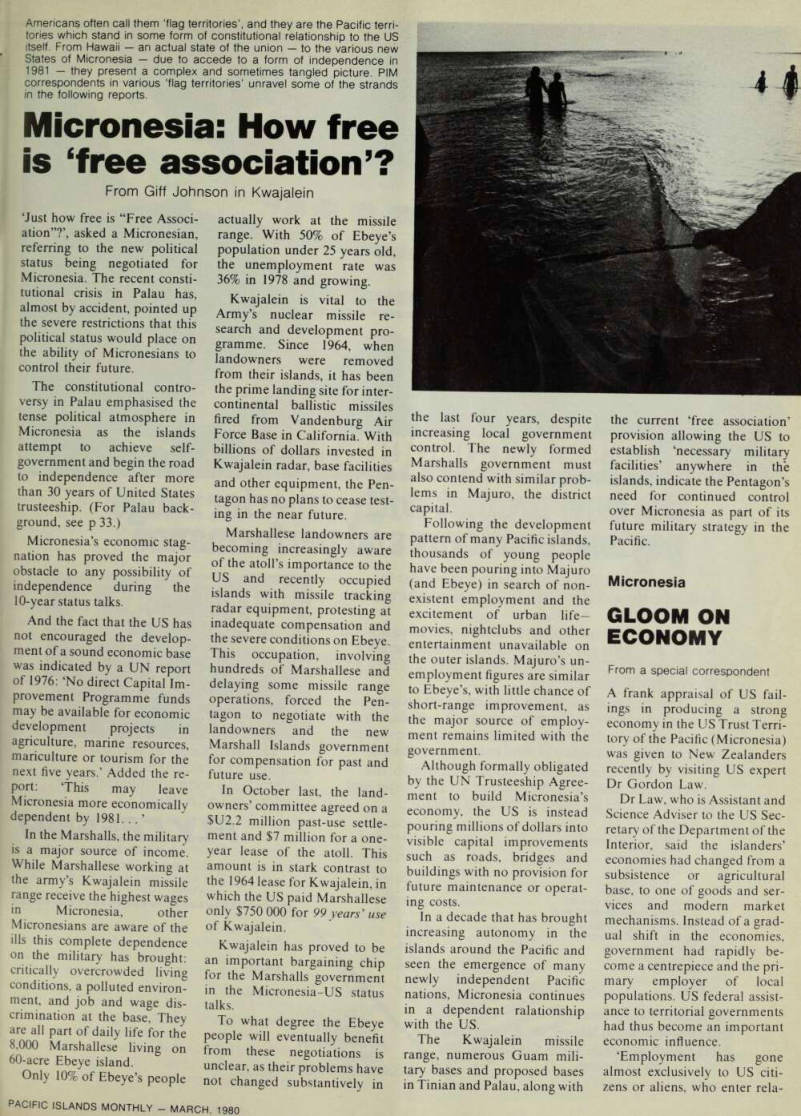
is ‘free association’?
Americans often call them 'flag territories’, and they are the Pacific terri tories which stand in some form of constitutional relationship to the US itself. From Hawaii an actual state of the union to the various new States of Micronesia due to accede to a form of independence in 1981 they present a complex and sometimes tangled picture. PIM correspondents in various ‘flag territories’ unravel some of the strands in the following reports.
From Gift Johnson in Kwajalein
‘Just how free is “Free Associ ation”?’, asked a Micronesian, referring to the new political status being negotiated for Micronesia. The recent consti tutional crisis in Palau has, almost by accident, pointed up the severe restrictions that this political status would place on the ability of Micronesians to control their future.
The constitutional contro versy in Palau emphasised the tense political atmosphere in Micronesia as the islands attempt to achieve self government and begin the road to independence after more than 30 years of United States trusteeship. (For Palau back ground, see p 33.) Micronesia’s economic stag nation has proved the major obstacle to any possibility of
independence during the
10-year status talks.
And the fact that the US has not encouraged the develop ment of a sound economic base was indicated by a UN report of 1976: ‘No direct Capital Im provement Programme funds may be available for economic
development projects in
agriculture, marine resources, mariculture or tourism for the next five years.’ Added the re port: This may leave Micronesia more economically
dependent by 1981... ’
In the Marshalls, the military is a major source of income.
While Marshallese working at the army’s Kwajalein missile range receive the highest wages in Micronesia, other Micronesians are aware of the ills this complete dependence on the military has brought:
critically overcrowded living
conditions, a polluted environ ment, and job and wage dis crimination at the base, They are all part of daily life for the 8,000 Marshallese living on 60-acre Ebeye island.
Only 10% of Ebeye’s people
actually work at the missile range. With 50% of Ebeye’s population under 25 years old, the unemployment rate was 36% in 1978 and growing.
Kwajalein is vital to the Army’s nuclear missile re search and development pro gramme. Since 1964, when landowners were removed from their islands, it has been the prime landing site for inter continental ballistic missiles fired from Vandenburg Air Force Base in California. With billions of dollars invested in Kwajalein radar, base facilities and other equipment, the Pen tagon has no plans to cease test ing in the near future.
Marshallese landowners are
becoming increasingly aware
of the atoll’s importance to the US and recently occupied islands with missile tracking radar equipment, protesting at inadequate compensation and the severe conditions on Ebeye.
This occupation, involving hundreds of Marshallese and delaying some missile range operations, forced the Pen tagon to negotiate with the landowners and the new Marshall Islands government for compensation for past and future use.
In October last, the land owners’ committee agreed on a 5U2.2 million past-use settle ment and $7 million for a one year lease of the atoll. This amount is in stark contrast to the 1964 lease for Kwajalein, in which the US paid Marshallese only $750 000 for 99 years' use
of Kwajalein.
Kwajalein has proved to be
an important bargaining chip
for the Marshalls government in the Micronesia-US status talks.
To what degree the Ebeye people will eventually benefit from these negotiations is unclear, as their problems have
not changed substantively in
the last four years, despite increasing local government control. The newly formed Marshalls government must also contend with similar prob lems in Majuro, the district capital.
Following the development
pattern of many Pacific islands, thousands of young people have been pouring into Majuro (and Ebeye) in search of non existent employment and the excitement of urban life movies, nightclubs and other entertainment unavailable on the outer islands. Majuro’s un
employment figures are similar
to Ebeye’s, with little chance of short-range improvement, as the major source of employ ment remains limited with the government.
Although formally obligated
by the UN Trusteeship Agree ment to build Micronesia’s economy, the US is instead pouring millions of dollars into visible capital improvements such as roads, bridges and buildings with no provision for future maintenance or operat ing costs.
In a decade that has brought increasing autonomy in the islands around the Pacific and seen the emergence of many
newly independent Pacific
nations, Micronesia continues in a dependent ralationship with the US.
The Kwajalein missile range, numerous Guam mili tary bases and proposed bases in Tinian and Palau, along with
the current ‘free association’ provision allowing the US to
establish ‘necessary military
facilities’ anywhere in the islands, indicate the Pentagon’s need for continued control over Micronesia as part of its future military strategy in the Pacific.
Gloom On

Micronesia
Economy
From a special correspondent A frank appraisal of US fail ings in producing a strong economy in the US Trust Terri tory of the Pacific (Micronesia) was given to New Zealanders
recently by visiting US expert
Dr Gordon Law.
Dr Law, who is Assistant and Science Adviser to the US Sec retary of the Department of the Interior, said the islanders’ economies had changed from a subsistence or agricultural base, to one of goods and ser vices and modern market mechanisms. Instead of a grad ual shift in the economies, government had rapidly be come a centrepiece and the pri mary employer of local populations. US federal assist ance to territorial governments had thus become an important economic influence. ‘Employment has gone almost exclusively to US citi zens or aliens, who enter rela
lively easily from off the island.
Citizens or nationals obtain government jobs, with the most skilled then migrating to the US. Lack of movement of the poor and unskilled into the sys tem thwarts progress towards raising levels of skills and wages,’ said Dr Law.
He said in all the US Pacific possessions, government ser vice remained the preferred employment for the indigenous population, and re liance was on wages and salaries and on the purchase of imported goods.
What agriculture remained was primarily home cultivation for family consumption, and small-scale commercial sales of productive excess. Only American Samoa had devel oped a significant fish process ing and export business, and even in Samoa, fishing was
done exclusively by foreign
boats and crews while cannery employment was primarily alien.
Dr Law said: The territories suffer from many economic disadvantages that have been hidden or obscured by the high level of US Government help.’
Politically, the US had every reason to believe that the Micronesian states would prove stable and democratic.
Economically, there was less cause for optimism.
He told New Zealand businessmen that they might be able to help play a big role in economic development in Micronesia by taking an interest in tourism, fisheries, agriculture and capital con struction projects. He said that in the next 10 years the US planned to spend $1 billion on capital construction projects.
Dr Law said that in the Pa cific there were three partially overlapping areas of US concern—the Asian countries on the Pacific rim, the South Pacific Island nations, and the US territories. South Pacific
developments inevitably had
an impact on the attitudes and aspirations of the Micronesian people and ‘it might well be that the emerging entity of Micronesia will play a major role in the formation of US policy in all three of the areas I have mentioned, as well as in our perception of our national role in the Pacific,’ Dr Law added.
Advertisements & other items, p. 32 (1 item)
the newprqgetwitli superior range
M9O& s M H
payload econo^
The Conquest is an aeroplane so superior in performance and efficiency, it’s not called a turboprop.
Butapropjet.
It takes off from a short field and climbs to 33,000 feet in 26 minutes; it cruises at 293 knots; it carries a huge load of 4,293 pounds of passengers and fuel; and it flies farther than many jets.
Even more remarkable, the Conquest propjet
outperforms every turboprop ever built-while using less fuel. Incredibly the Conquest gets six statute miles per gallon. That’s efficiency to rival many piston twins.
Compared to the most popular turboprop, the Conquest climbs faster, flies higher, cruises faster and flies farther.. .while using 30 percent less fuel. 295 knots 293 knots 2,196 n.m. 475 gals U This aeroplane has set new standards of performance and efficiency If it were anything less, we wouldn’t call it Conquest.
Max. Speed Max. Rec. Cruise Speed Max. Range Max. Usable Fuel Rate of Climb Twin Engine Single Engine Twin Engine Max. Cert. Alt.
Single Engine Service Ceiling Takeoff Dist. Over 50 ft Obstacle Landing Dist. Over 50 ft Obstacle Max. Ramp Weight Max. Zero Fuel Weight Max. Useful Load Max. Seating Engines 2,435 fpm ... 715fpm ...33,000 ft ...21,380 ft The Worlcte Number 1 Business Airline Cessna Central Information Center (P.O. Box 51. Bankstown, N.S.W. 2200) Telephone 70 0661 ..2,465 ft „ 1,875 ft . 9,925 lb .8,100 lb ,4,2931 b ll V Name.
Garrett Aißesearch TPE-331 -8-401 S ; 625 hp Position.
Pacific Area Representatives:
Noumea-Montagnat Mining, Mr. R. Gutschlag.
Fiji (Suva)-Bums Philp South Sea Company,
Mr. A.Jessop. < Company
PLEASE SEND ...
MEMORE MdresS
INFORMATION P/code
20/PIM
Telephone
ON THE
CESSNA CONQUEST
Controversy
Micronesia
The Palau
From a Palau correspondent
Long controversy, interrupted
frequently by legal challenges,
has marked the development of the Palau islands in their bid for separate republican status.
Palau, called Belau by Palauans, is the westernmost group in the Caroline Islands of the US Trust Territory. It’s divided into 16 municipalities which will become known as states when Palau becomes a
republic.
Palau’s constitution is yet to become legal, but when it does, the government of the Repub lic of Palau will have executive,
legislative and judicial
branches.
A president will head the executive branch, and will serve a four-year term, limited to two terms. There will be a vice-president as well as a cabi net formed by ‘the heads of the
major executive departments’.
A council of traditional head chiefs from each of the 16 states will advise the president on tra ditional laws and customs.
The Palau Legislature (known locally as Olbiil era Kelulau) will consist of a House of Delegates, one for each state, and a Senate.
Thejudicial branch will have a supreme court, with a chief justice and from three to six associate justices. Next is a national court, with a presiding judge and others to be deter mined. There will also be inferior courts.
Palauan and English are both recognised as the official languages. In the constitution, Koror is the temporary capital of Palau, but the permanent capital must be set up some where on Babeldaob Island within 10 years.
Palau began its move towards a constitution in 1978
by electing 38 delegates to a
constitutional convention. This was held in early 1979, but three of the 38 delegates refused to sign the completed constitution as a protest at some of its sections. Before a referendum could be held to approve the constitution, some members of the Palau Legis
lature who also opposed its approval passed a bill which nullified the legislation establishing both the conven tion and the referendum.
There followed a series of technical and legal moves as opposite sides fought to have the constitution either rejected or approved, and which was complicated by the fact that a revised constitution was pro duced by the Legislature. The main controversy was on three sections in the original consti tution, which puts limits on the territorial waters, put bans on all types of weapons and de structive materials in the re public (these were said to pose obstacles to Japanese fishing in the islands and intended US military use of the islands), and the third, which states that within three years of the prom ulgation of the constitution Palauans must renounce citi zenship of any other country, or be deprived of their Palauan
citizenship.
The constitutional deadlock was eased following election of a new Palau Legislature in Sep tember. In a referendum in October Palauans supported the original constitution, with the controversial clauses intact, by a margin of two to one.
The new Legislature is cur
rently moving to clear the legal
obstacles and allow adoption of the constitution.
Meanwhile the Legislature sent a team to the January Micronesia status talks in Hawaii, which has finally established a Compact of Free Association with the United States, and which is expected to apply equally to the Marshall Islands, the Federated States of Micronesia and what will be the Republic of Palau.
The Marshalls and the Federated States have already approved their constitutions, and the Marshalls in January also signed the Compact of Free Association.
Politics Of
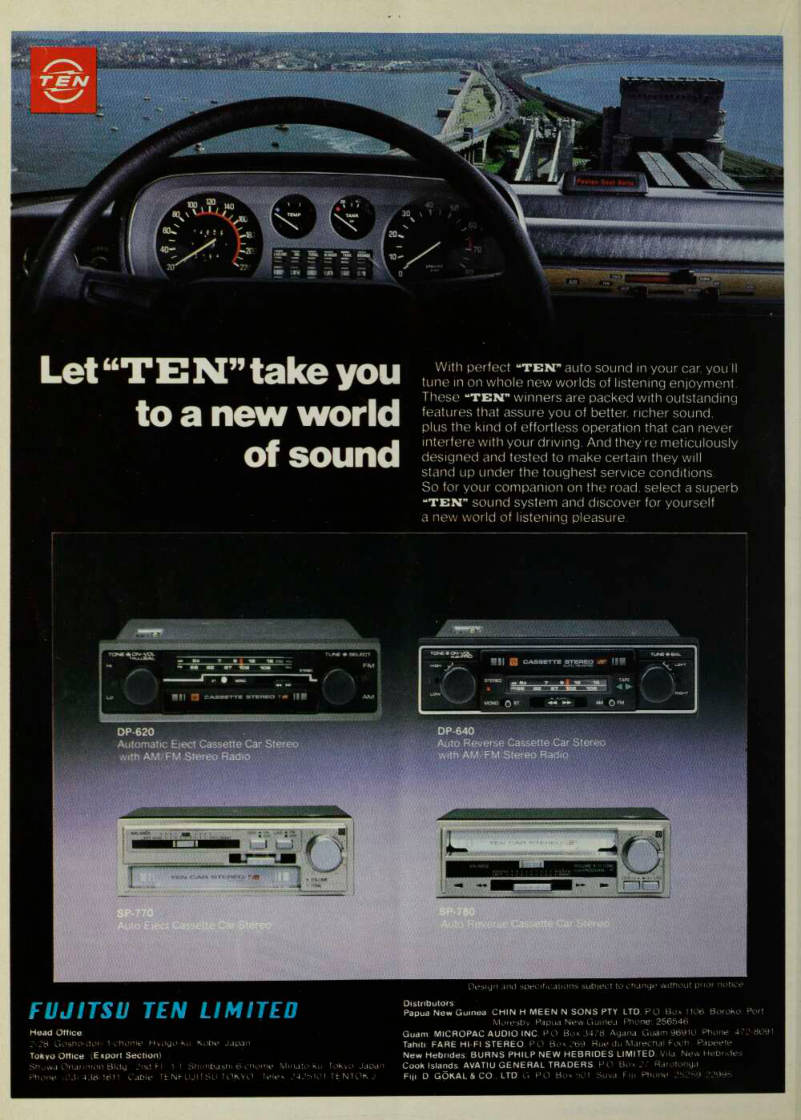
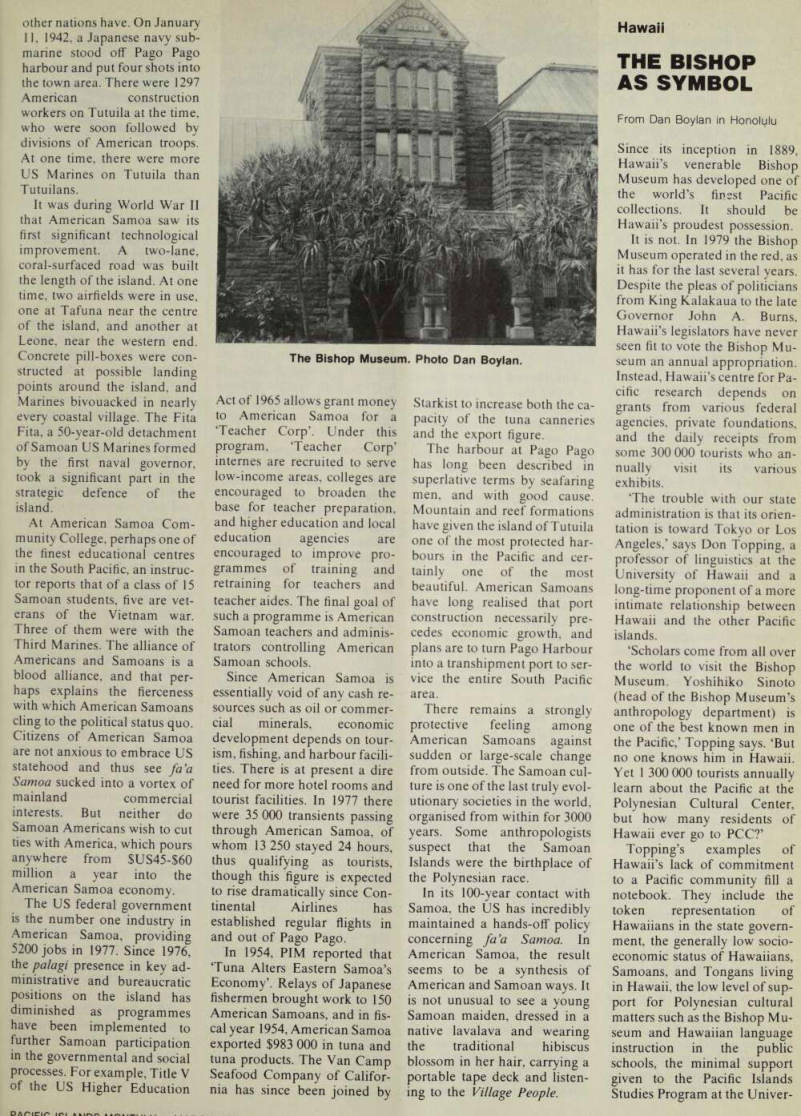
American Samoa
Synthesis
From Keith Coplin in Pago Pago In the early 19705, when the US Department of Interior sought to implement a proposal for popular elections in American Samoa, voters there rejected the proposal by a plebiscite three times in three successive years. It was not until August 1976, after vigorous campaign ing on the part of local matais (chiefs), that American Samoans agreed to elect a governor, thus ending a 77-year tradition of palagi (white) rule.
The Samoans’ distrust of local rule is based on the 3000year-old heart’s truth which is the bedrock of their society, fa’a Samoa, the Samoan Way.
A native governor is bound by
fa’a Samoa to help his family,
and in Samoa, that can be as many as 500 people; thus there was an understandable fear among Samoan voters that a Samoan governor would nat urally tend toward nepotism.
Another legitimate fear was that whereas a palagi executive officer would at least be deal ing with other palagi when
attempting to secure budget
funds for American Samoa, a Samoan would, most likely, be a stranger in a strange land.
American Samoa finds itself in an odd position during a time of world-wide decolonisa
tion and bankrupt imperialism.
The overwhelming majority of
Samoan Americans favour the political status quo. Of their four viable political options,
remaining an unincorporated
US territory is favoured by an estimated 90% of the elec torate. There is a smattering of support for statehood, and some support for reunification with Western Samoa, but only the young people favour independence. The local power structure seems to understand the realpolitik of American Samoa’s strategic and econ omic importance in the world.
It is significant that no American ships have ever fired on the island of Tutuila, the main island in the American Samoa Group. The ships of
other nations have. On January 11, 1942, a Japanese navy sub marine stood off Pago Pago harbour and put four shots into the town area. There were 1297 American construction workers on Tutuila at the time, who were soon followed by divisions of American troops.
At one time, there were more US Marines on Tutuila than Tutuilans.
It was during World War II that American Samoa saw its
first significant technological
improvement. A two-lane, coral-surfaced road was built the length of the island. At one time, two airfields were in use, one at Tafuna near the centre of the island, and another at Leone, near the western end.
Concrete pill-boxes were con
structed at possible landing
points around the island, and Marines bivouacked in nearly every coastal village. The Fita Fita, a 50-year-old detachment of Samoan US Marines formed by the first naval governor, took a significant part in the strategic defence of the island.
At American Samoa Com
munity College, perhaps one of
the finest educational centres in the South Pacific, an instruc tor reports that of a class of 15 Samoan students, five are vet erans of the Vietnam war.
Three of them were with the Third Marines. The alliance of Americans and Samoans is a blood alliance, and that per
haps explains the fierceness
with which American Samoans cling to the political status quo.
Citizens of American Samoa are not anxious to embrace US statehood and thus see fa’a Samoa sucked into a vortex of mainland commercial interests. But neither do Samoan Americans wish to cut ties with America, which pours anywhere from SUS4S-$6O million a year into the American Samoa economy.
The US federal government is the number one industry in American Samoa, providing 5200 jobs in 1977. Since 1976, the palagi presence in key ad ministrative and bureaucratic positions on the island has diminished as programmes have been implemented to further Samoan participation in the governmental and social processes. For example, Title V of the US Higher Education
Act of 1965 allows grant money to American Samoa for a ‘Teacher Corp’. Under this program, Teacher Corp’ internes are recruited to serve low-income areas, colleges are encouraged to broaden the base for teacher preparation, and higher education and local education agencies are encouraged to improve pro grammes of training and retraining for teachers and teacher aides. The final goal of such a programme is American Samoan teachers and adminis trators controlling American Samoan schools.
Since American Samoa is essentially void of any cash re sources such as oil or commer cial minerals, economic
development depends on tour
ism, fishing, and harbour facili ties. There is at present a dire need for more hotel rooms and tourist facilities. In 1977 there were 35 000 transients passing through American Samoa, of whom 13 250 stayed 24 hours, thus qualifying as tourists, though this figure is expected to rise dramatically since Con tinental Airlines has
established regular flights in
and out of Pago Pago.
In 1954, PIM reported that ‘Tuna Alters Eastern Samoa’s
Economy’. Relays of Japanese
fishermen brought work to 150 American Samoans, and in fis cal year 1954, American Samoa exported $983 000 in tuna and tuna products. The Van Camp Seafood Company of Califor nia has since been joined by
Starkist to increase both the ca pacity of the tuna canneries and the export figure.
The harbour at Pago Pago has long been described in superlative terms by seafaring men, and with good cause.
Mountain and reef formations have given the island of Tutuila one of the most protected har bours in the Pacific and cer tainly one of the most beautiful. American Samoans have long realised that port construction necessarily pre cedes economic growth, and plans are to turn Pago Harbour into a transhipment port to ser vice the entire South Pacific area.
There remains a strongly protective feeling among American Samoans against
sudden or large-scale change
from outside. The Samoan cul ture is one of the last truly evol utionary societies in the world, organised from within for 3000 years. Some anthropologists suspect that the Samoan Islands were the birthplace of the Polynesian race.
In its 100-year contact with Samoa, the US has incredibly maintained a hands-off policy concerning fa’a Samoa. In American Samoa, the result seems to be a synthesis of American and Samoan ways. It is not unusual to see a young Samoan maiden, dressed in a native lavalava and wearing the traditional hibiscus blossom in her hair, carrying a portable tape deck and listen ing to the Village People.
The Bishop Museum. Photo Dan Boylan.
Advertisements & other items, p. 34 (1 item)
of sound
. . .. -U I * ■■■ ivmmrni r* ... ' , « * - . * - ■“ -- ■ v ■-
TEN ; |PM
it* v
IP , , ■ HK
/ U /y vvu v r
£ I 6o ’ *•**» -» > < / \ 1 ’T* i V: nBHRSL «r x » Ml- < » ■ Wl tS/ •••■••
N^UNK
ZD*
TS TSi E 5« TS«
10- K V » II ■ - 0 Affl ¥
Let “TEN” take you
to a new world
of sound
With perfect “TEN” auto sound in your car. you’ll tune in on whole new worlds of listening enjoyment.
These “TEN” winners are packed with outstanding features that assure you of better, richer sound, plus the kind of effortless operation that can never interfere with your driving. And they're meticulously designed and tested to make certain they will stand up under the toughest service conditions.
So for your companion on the road, select a superb “TEN” sound system and discover for yourself
a new world of listening pleasure.
l— ——— L / ■lt B cAspFTTf nrwmtct *m tip AM ■I) E 3 CASSETTE STEREO yE> lIP 8 » » Aijrc wverwe 5 9 •*" r V ...
DP-620 Automatic Eject Cassette Car Stereo with AM? FM Stereo Radio DP-640 Auto Reverse Cassette Car Stereo with AM FM Stereo Radio
Ul LJ
Design and specifications subject to change without prior notice
FUJITSU TEN LIMITED
Head Office 2r28 Gosho-don 1-chome, Hyogo-ku. Kobe, Japan Tokyo Office .Export Section) Shuwa O.nanmon Bldg 2nd FI 1-1 Shimbashi 6-chome Mmato ku Tokyo Japan Phone iOJi 438-1611 Cable TENFUJITSU TOKYO Telex 2428101 TENTQK J Distributors Papua New Guinea CHIN H MEEN N SONS PTY LTD. PO Box 1106 Boroko Port Moresby, Papua New Guinea Phone: 256546 Guam MICROPAC AUDIO INC PO Box 3428 Agana Guam 96910 Phone 422-8091 Tahiti: FARE HI-FI STEREO PO Box 269 Rue du Marechal Foch Papeete New Hebrides BURNS PHILP NEW HEBRIDES LIMITED Vila New Hebrides Cook Islands AVATIU GENERAL TRADERS PO Box 2 ’ Rarotonga Fiji D GOKAL & CO LTD G PO Box 501 Suva Fin Phone 25259 22995
The Bishop
Hawaii
As Symbol
From Dan Boylan in Honolulu Since its inception in 1889, Hawaii’s venerable Bishop Museum has developed one of the world’s finest Pacific collections. It should be Hawaii’s proudest possession.
It is not. In 1979 the Bishop Museum operated in the red, as it has for the last several years.
Despite the pleas of politicians
from King Kalakaua to the late Governor John A. Burns, Hawaii’s legislators have never seen fit to vote the Bishop Mu seum an annual appropriation.
Instead, Hawaii’s centre for Pa cific research depends on grants from various federal
agencies, private foundations,
and the daily receipts from some 300 000 tourists who an nually visit its various exhibits. ‘The trouble with our state administration is that its orien tation is toward Tokyo or Los Angeles,’ says Don Topping, a professor of linguistics at the University of Hawaii and a long-time proponent of a more intimate relationship between Hawaii and the other Pacific islands. ‘Scholars come from all over the world to visit the Bishop Museum. Yoshihiko Sinoto (head of the Bishop Museum’s
anthropology department) is
one of the best known men in the Pacific,’ Topping says. ‘But no one knows him in Hawaii.
Yet 1 300 000 tourists annually leant about the Pacific at the Polynesian Cultural Center, but how many residents of Hawaii ever go to PCC?’
Topping’s examples of
Hawaii’s lack of commitment to a Pacific community fill a notebook. They include the token representation of Hawaiians in the state govern ment, the generally low socio economic status of Hawaiians,
Samoans, and Tongans living
in Hawaii, the low level of sup port for Polynesian cultural matters such as the Bishop Mu seum and Hawaiian language instruction in the public schools, the minimal support given to the Pacific Islands Studies Program at the Univer
sity of Hawaii, the use of the Hawaiian Islands as a store house for armed nuclear war heads, and the state’s sanction of continued boijibings of the Hawaiian island of Ka hoolawe.
Topping is no less harsh in his criticism of the Hawaiian population. T am appalled at the ignorance of local Hawaiians of the rest of the South Pacific,’ he says.
Myron Thompson is a local Hawaiian. He is one of the over 70 000 Hawaiians and part- Hawaiians who make up approximately 10% of the state’s population. He is also a trustee of the Bishop Estate, the
state’s largest private land
owner whose income supports the Kamehameha School for the education of children of Hawaiian ancestry, and a special assistant for the Pacific Islands to Hawaii’s Governor
George Ariyoshi. ‘The Gover
nor’s made it clear that he wants to develop Hawaii’s pos ition within the Pacific Islands
community,’ Thompson says.
‘lt’s true that in the past we’ve had a stronger identification with Japan, China, and Korea.
But there’s a resurgence of interest among Hawaiians in their origins and culture. ‘lt’s not just an Hawaiian renaissance,’ Thompson con tinues. ‘lt’s a renaissance of Pa cific peoples. It’s a renaissance of Maoris, Tongans, Cook Islanders. We have a sense of shared identity. I find that 30 seconds into a conversation with a Maori or a Samoan or any other Pacific Islander, I can lock-in to what they’re say
ing.’
Thompson will need those communication skills. He is
charged with coordinating a
joint effort by the US ‘flag
properties’ in the Pacific Hawaii, American Samoa, Guam, and the Northern Marianas to seek money from the US government for development aid.
The quickening of official Hawaii’s interest in the Pacific has been motivated in no small part by new federal money allocated for the region.
Hawaii and the other Pacific Islands, a 1978 publication of the state’s Department of Plan
ning and Economic Develop
ment, says as much: ‘A new
US Agency for International Development (AID) pro gramme for the region is being developed to supplement the long-standing US commitment to the South Pacific Commis sion . . . More and more high level US officials are taking an interest in the (South Pacific).
Hawaii, as a repository of Pa cific Islands expertise, will be called upon more and more to assist in these forward-looking national programmes for the Pacific. As a state of the Union, Hawaii cannot, of course, con
duct an independent foreign
policy towards the Pacific. But it can and should help US
policy-makers formulate
national policy towards the re gion, and participate in its im plementation.’
The Hawaii planners go on to argue that the state stands ready to lend aid to the other Pacific islands in agriculture, tourism, alternative energy sources, communications, and free trade zones. Indeed, as this report is written, the University of Hawaii’s College of Tropical
Agriculture and the University
of the South Pacific are about to announce a co-operative agreement whereby the Uni versity of Hawaii will adminis ter SUSS million in US aid to the University of the South Pa cific. However pecuniary Hawaii’s renewed interest in the Pacific community may be, its claim as ‘a repository of Pa cific Islands expertise’ is solidly based.
The Bishop Museum main tains a staff of 200, 30 to 40 of whom are professional scien tists at work on various projects in Hawaii and the Pacific. Its collections include rare and old
books, original manuscripts,
and botanical specimens deal ing with Melanesia, Micronesia, and Polynesia.
Edward Creutz, the museum’s director, sees it as the ‘outpost of the United States in the Pa cific with a mission to show the cultural and scientific side of the US to the other Pacific
peoples’.
Since it opened its doors in 1960, the federally funded East-West Center has provided grants of varying types to students from every island group in the Pacific. The entire educated class of some Pacific islands have taken their de
grees at the University of Hawaii on East-West Center grants. In recent years the centre has greatly reduced di rect grants to Pacific Islanders.
But the word out of Washing ton is to give more attention to the Pacific, so the centre is arranging a conference for
Spring, 1980.
On Oahu’s north shore,
Brigham Young Universi
ty/Hawaii enrols approxi
mately 450 students from Tonga, Samoa, New Zealand, Fiji and the Marshall Islands in short, from wherever Mor mon missionaries have evan gelised in the Pacific. The Mormon college also operates the 17 ha Polynesian Cultural Center. Its re-created
Polynesian villages offer the
tourist the chance to dance in a grass skirt, sample coconut meat, or be frightened by the flapping tongue and spear of a Maori warrior.
Honolulu’s two local news papers, the morning Advertiser and the afternoon Star- Bulletin, regularly carry fea tures and editorials about the Pacific. The Advertiser’s editor
in-chief, George Chaplin, and
its associate editor, John Grif fin, have both travelled exten sively in the Pacific.
The University of Hawaii’s Pacific Islands Studies
Program publishes a directory
listing 115 Pacific-related courses offered at the uni
versity’s Manoa Valley cam
pus. It also names 187 faculty members, from historians to marine biologists to horticul turalists, whose teaching and research relate to the Pacific Islands. The Program publishes a newsletter which informs its readers of visiting Pacific Islanders, or academic positions opening in the area,
of significant views expressed
by recent speakers at the university and of local research projects on the Pacific.
Hawaii’s Pacific Island expertise is considerable, but even the state’s greatest booster would admit that a lack of commitment and focus have characterised Hawaii’s role as a member of a Pacific com
munity. Perhaps the combi
nation of an Hawaiian renaissance and Uncle Sam’s abundant dollars will change all that.
A Gesture Of
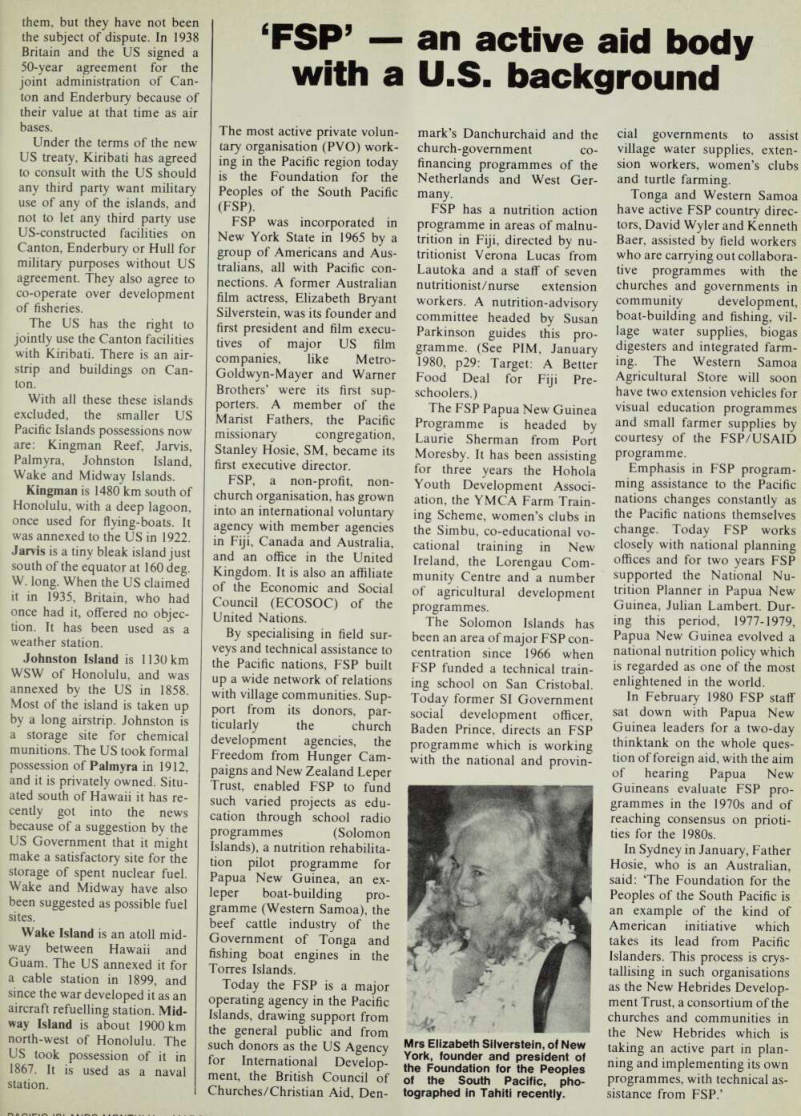
The small islands
Goodwill
By a RIM staff writer
In addition to the important territories of Micronesia, Guam and American Samoa, United States interest in the Pacific Islands has until re
cently embraced a surprising
number of small islands, most of them virtually unknown to the public. But the US is cur
rently involved in divesting
itself of the majority of them, as a practical gesture of good will to emerging Pacific nations.
In a Treaty of Friendship be tween the US and the Republic of Kiribati (formerly Gilberts) signed last September, the US
recognised Kiribati sovereignty
over the following islands pre viously claimed by the US; Canton, Enderbury, Hull, Bir nie, Gardner, Phoenix, Sydney, McKean, Christmas, Caroline, Starbuck, Malden, Flint and Vostock.
In a similar Treaty of Friendship with the Govern ment of Tuvalu (formerly
Ellice) signed in February
1979, the US recognised Tuvalu’s sovereignty over Funafuti atoll (Tuvalu’s main atoll and seat of government), Nukufetau, Nukulaelae and Niulakita.
The US is currently negotiat ing with NZ and the Cook Islands with the aim of renouncing US claims over Danger, Manahiki, Penryhn and Rakahanga atolls, and with NZ and Tokelau over Atafu, Fafaofu and Nukunono atolls.
With the exception of Can ton and Enderbury, US auth ority over any of these islands was never acknowledged in the past by Britain or New Zealand, who also claimed
them, but they have not been the subject of dispute. In 1938 Britain and the US signed a 50-year agreement for the joint administration of Can ton and Enderbury because of their value at that time as air bases.
Under the terms of the new US treaty, Kiribati has agreed to consult with the US should any third party want military use of any of the islands, and not to let any third party use US-constructed facilities on Canton, Enderbury or Hull for military purposes without US agreement. They also agree to co-operate over development of fisheries.
The US has the right to jointly use the Canton facilities with Kiribati. There is an air strip and buildings on Can ton.
With all these these islands excluded, the smaller US Pacific Islands possessions now are: Kingman Reef, Jarvis, Palmyra, Johnston Island, Wake and Midway Islands.
Kingman is 1480 km south of Honolulu, with a deep lagoon, once used for flying-boats. It was annexed to the US in 1922.
Jarvis is a tiny bleak island just south of the equator at 160 deg.
W. long. When the US claimed it in 1935, Britain, who had once had it, offered no objec tion. It has been used as a weather station.
Johnston Island is 1130 km WSW of Honolulu, and was annexed by the US in 1858.
Most of the island is taken up
by a long airstrip. Johnston is
a storage site for chemical munitions. The US took formal possession of Palmyra in 1912, and it is privately owned. Situ ated south of Hawaii it has re cently got into the news because of a suggestion by the US Government that it might make a satisfactory site for the storage of spent nuclear fuel.
Wake and Midway have also been suggested as possible fuel sites.
Wake Island is an atoll mid way between Hawaii and Guam. The US annexed it for a cable station in 1899, and since the war developed it as an aircraft refuelling station. Mid way Island is about 1900 km north-west of Honolulu. The US took possession of it in 1867. It is used as a naval station.
with a U.S. background
‘FSP’ -an active aid body with a U.S. background
The most active private volun tary organisation (PVO) work ing in the Pacific region today is the Foundation for the Peoples of the South Pacific
(Fsp).
FSP was incorporated in New York State in 1965 by a group of Americans and Aus tralians, all with Pacific con nections. A former Australian film actress, Elizabeth Bryant Silverstein, was its founder and first president and film execu tives of major US film companies, like Metro- Goldwyn-Mayer and Warner Brothers’ were its first sup porters. A member of the Marist Fathers, the Pacific
missionary congregation,
Stanley Hosie, SM, became its first executive director.
FSP, a non-profit, non church organisation, has grown into an international voluntary agency with member agencies in Fiji, Canada and Australia, and an office in the United Kingdom. It is also an affiliate of the Economic and Social Council (ECOSOC) of the United Nations.
By specialising in field sur veys and technical assistance to the Pacific nations, FSP built up a wide network of relations with village communities. Sup port from its donors, par ticularly the church development agencies, the Freedom from Hunger Cam paigns and New Zealand Leper Trust, enabled FSP to fund such varied projects as edu cation through school radio programmes (Solomon Islands), a nutrition rehabilita tion pilot programme for Papua New Guinea, an ex
leper boat-building pro
gramme (Western Samoa), the beef cattle industry of the Government of Tonga and fishing boat engines in the Torres Islands.
Today the FSP is a major operating agency in the Pacific Islands, drawing support from the general public and from such donors as the US Agency for International Develop ment, the British Council of Churches/Christian Aid, Den
mark’s Danchurchaid and the
church-government co
financing programmes of the Netherlands and West Ger many.
FSP has a nutrition action programme in areas of malnu trition in Fiji, directed by nu tritionist Verona Lucas from Lautoka and a staff of seven nutritionist/nurse extension workers. A nutrition-advisory committee headed by Susan Parkinson guides this pro gramme. (See PIM, January 1980, p 29: Target: A Better Food Deal for Fiji Pre schoolers.) The FSP Papua New Guinea Programme is headed by Laurie Sherman from Port Moresby. It has been assisting for three years the Hohola Youth Development Associ ation, the YMCA Farm Train ing Scheme, women’s clubs in the Simbu, co-educational vo cational training in New Ireland, the Lorengau Com munity Centre and a number of agricultural development programmes.
The Solomon Islands has been an area of major FSP con centration since 1966 when FSP funded a technical train ing school on San Cristobal.
Today former SI Government social development officer, Baden Prince, directs an FSP programme which is working with the national and provin-
cial governments to assist village water supplies, exten sion workers, women’s clubs and turtle farming.
Tonga and Western Samoa have active FSP country direc tors, David Wyler and Kenneth Baer, assisted by field workers who are carrying out collabora tive programmes with the churches and governments in
community development,
boat-building and fishing, vil
lage water supplies, biogas
digesters and integrated farm
ing. The Western Samoa Agricultural Store will soon have two extension vehicles for visual education programmes and small farmer supplies by courtesy of the FSP/USAID programme.
Emphasis in FSP program ming assistance to the Pacific nations changes constantly as the Pacific nations themselves change. Today FSP works
closely with national planning
offices and for two years FSP supported the National Nu trition Planner in Papua New Guinea, Julian Lambert. Dur ing this period, 1977-1979, Papua New Guinea evolved a national nutrition policy which is regarded as one of the most enlightened in the world.
In February 1980 FSP staff sat down with Papua New Guinea leaders for a two-day thinktank on the whole ques tion of foreign aid, with the aim of hearing Papua New Guineans evaluate FSP pro grammes in the 1970 s and of reaching consensus on priori ties for the 1980 s.
In Sydney in January, Father Hosie, who is an Australian, said: The Foundation for the Peoples of the South Pacific is an example of the kind of American initiative which takes its lead from Pacific Islanders. This process is crys tallising in such organisations as the New Hebrides Develop ment Trust, a consortium of the churches and communities in the New Hebrides which is taking an active part in plan ning and implementing its own programmes, with technical as sistance from FSP.’
Mrs Elizabeth Silverstein, of New York, founder and president of the Foundation for the Peoples of the South Pacific, pho tographed in Tahiti recently.
Aid: What the U.S.
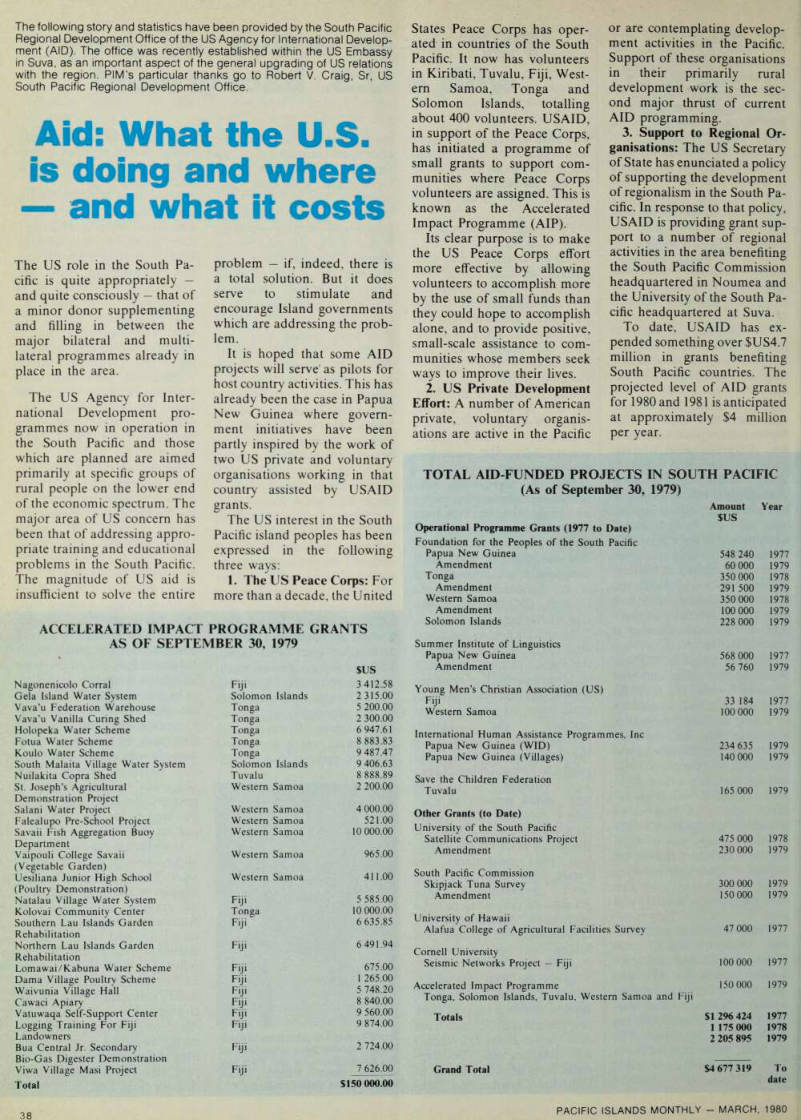
is doing and where and what it costs
The following story and statistics have been provided by the South Pacific Regional Development Office of the US Agency for International Develop ment (AID). The office was recently established within the US Embassy in Suva, as an important aspect of the general upgrading of US relations with the region. PlM’s particular thanks go to Robert V. Craig, Sr, US South Pacific Regional Development Office.
The US role in the South Pa-
cific is quite appropriately
and quite consciously that of a minor donor supplementing and filling in between the major bilateral and multilateral programmes already in place in the area.
The US Agency for International Development programmes now in operation in the South Pacific and those which are planned are aimed primarily at specific groups of rural people on the lower end of the economic spectrum. The major area of US concern has been that of addressing appro-
priate training and educational
problems in the South Pacific, The magnitude of US aid is insufficient to solve the entire
problem - if, indeed, there is a total solution. But it does serve to stimulate and encourage Island governments which are addressing the prob lem.
It is hoped that some AID projects will serve' as pilots for host country activities. This has already been the case in Papua New Guinea where govera ment initiatives have been partly inspired by the work of two US private and voluntary organisations working in that country assisted by USAID grants.
The US interest in the South Pacific island peoples has been expressed in the following three ways; 1. The US Peace Corps: For more than a decade, the United
Accelerated Impact Programme Grants
As Of September 30, 1979
States Peace Corps has operated in countries of the South Pacific. It now has volunteers in Kiribati, Tuvalu, Fiji, Westera Samoa, Tonga and Solomon Islands, totalling about 400 volunteers. USAID, in support of the Peace Corps, has initiated a programme of small grants to support communities where Peace Corps volunteers are assigned. This is known as the Accelerated
Impact Programme (AIP).
Its clear purpose is to make the US Peace Corps effort
more effective by allowing
volunteers to accomplish more by the use of small funds than
they could hope to accomplish
alone, and to provide positive, small-scale assistance to communities whose members seek ways to improve their lives. 2. US Private Development Effort: A number of American
private, voluntary organis-
ations are active in the Pacific
or are contemplating develop
ment activities in the Pacific.
Support of these organisations
in their primarily rural development work is the sec ond major thrust of current
AID programming.
3. Support to Regional Or ganisations: The US Secretary of State has enunciated a policy
of supporting the development
of regionalism in the South Pa cific. In response to that policy, USAID is providing grant sup port to a number of regional activities in the area benefiting the South Pacific Commission headquartered in Noumea and the University of the South Pa cific headquartered at Suva.
To date, USAID has ex pended something over SUS 4.7 million in grants benefiting South Pacific countries. The projected level of AID grants for 1980 and 1981 is anticipated at approximately $4 million per year.
Total Aid-Funded Projects In South Pacific
(As of September 30, 1979)
Nagonenicolo Corral
Fiji $US 3 412.58 Gela Island Water System Solomon Islands 2 315.00 Vava’u Federation Warehouse
Tonga
5 200.00 Vava’u Vanilla Curing Shed
Tonga
2 300.00 Holopeka Water Scheme Tonga 6 947.61 Fotua Water Scheme Tonga 8 883.83 Koulo Water Scheme Tonga 9 487.47 South Malaita Village Water System Solomon Islands 9 406.63 Nuilakita Copra Shed St. Joseph’s Agricultural Tuvalu 8 888.89 Western Samoa 2 200.00
Demonstration Project
Salani Water Project Western Samoa 4 000.00 Falealupo Pre-School Project Western Samoa 521.00
Savaii Fish Aggregation Buoy
Western Samoa 10 000.00 Department
Vaipouli College Savaii
Western Samoa 965.00
(Vegetable Garden)
Uesiliana Junior High School Western Samoa 411.00 (Poultry Demonstration) Natalau Village Water System Fiji 5 585.00 Kolovai Community Center Tonga 10 000.00 Southern Lau Islands Garden
Fiji
6 635.85 Rehabilitation Northern Lau Islands Garden
Fiji
6 491.94 Rehabilitation Lomawai/Kabuna Water Scheme Fiji 675.00 Dama Village Poultry Scheme
Fiji
1 265.00 Waivunia Village Hall Fiji 5 748.20 Cawaci Apiary Fiji 8 840.00 Vatuwaqa Self-Support Center Fiji 9 560.00
Logging Training For Fiji
Fiji
9 874.00 Landowners Bua Central Jr. Secondary
Fiji
2 724.00 Bio-Gas Digester Demonstration Viwa Village Masi Project Fiji 7 626.00 Total $150 000.00
Operational Programme Grants (1977 to Date) Foundation for the Peoples of the South Pacific Papua New Guinea Amendment
Tonga
Amendment Western Samoa Amendment Solomon Islands Amount $US 548 240 60 000 350 000 291 500 350 000 100 000 228 000 Year 1977 1979 1978 1979 1978 1979 1979 Summer Institute of Linguistics Papua New Guinea Amendment 568 000 56 760 1977 1979 Young Men’s Christian Association (US)
Fiji
Western Samoa 33 184 100 000 1977 1979 International Human Assistance Programmes, Inc Papua New Guinea (WID)
Papua New Guinea (Villages)
234 635 140 000 1979 1979 Save the Children Federation Tuvalu 165 000 1979 Other Grants (to Date) University of the South Pacific Satellite Communications Project Amendment 475 000 230 000 1978 1979 South Pacific Commission
Skipjack Tuna Survey
Amendment 300 000 150 000 1979 1979 University of Hawaii
Alafua College of Agricultural Facilities Survey
47 000 1977
Cornell University
Seismic Networks Project — Fiji 100 000 1977
Accelerated Impact Programme
Tonga, Solomon Islands, Tuvalu, Western Samoa and Fiji 150 000 1979 Totals $1 296 424 1 175 000 2 205 895 1977 1978 1979 Grand Total $4 677 319 To date
Advertisements & other items, p. 39 (1 item)
Aiwa
'JS Cnn component systems from AIIM.
AIW A lor crulisnionship
AIWA Co Ltd 11 9 Ueno 1 chome Taito ku Tokyo Japan m?™' 1 a* NCW Zealand A|WA Australia Pty Ltd , P O Box 339, Rockd NSW Australia 2216 Tel 597-2388/2808 American Samoa Island Pacific Agencies Inc PO Box 1018 Pago Pa A Samoa Tel 633-4687 ™ > rV S R^hK^'?^ erChan,S Ud PO Box 69 Rarotonga. Cook Isla, IJI u Hanchhod & Company, Corner of Vidilo St & Vitogo PDE P O ?"o Te ' 60227/9 Hargov.no Bros Duty Free Centre 190 Renwick Road, Suva, Fiji Tel 24350 Guam Micropac Audio, Inc PO Box 3478 Agana Guam 96910 Tel 472 8091 PNG. Oceania Indent Agency (PN G ) Pry Ltd Box 5518 Boroko Port Moresby. P N G Tel PM 256406 Solomon Islands Harvest Pacific Ltd GP O 517 Honiara Solomon Islands Tel 718 Tahiti Fare Hi-Fi Stereo Rue du Marechal Foch PO Box 269 Papeete Tahiti R r. ccn/1 a
When General Douglas MacArthur

was one of PlM’s heroes
Continuing her review of PlM’s half-century of news highlights in this, PlM’s 50th anniversary year, former editor JUDY TUDOR looks at five years and eleven months of World War from 1939 to 1945 when the South-West Pacific became a vast U.S. base. It was a time when PIM, too, nearly died.
World War II began on Sep tember 3, 1939 and, after the alarms and excursions of the previous 12 months, was some thing of an anti-climax. Con trary to expectations, the world did not immediately cave in upon itself and neither Italy nor Japan rushed to join Hitler.
The German armies on the Eastern front swiftly flattened Polish resistance only to have Russia walk in and seize half Poland plus Estonia, Latvia and Lithuania. The German- Russian pact that had stunned the rest of the world in August 1939 seemed to be working well in Russia’s favour.
The so-called phony war in Europe lasted nine months; in the Pacific it remained only a luke warm affair for a further two years. It did bring changes but for the ordinary Pacific Islander and most of the non indigenous residents, life went on pretty much as before apart
from money-raising for patri
otic purposes, such as ‘Bombers for Britain’.
Shipping became scarce and freight rates went up but there were no restrictions on travel if you could get a berth. The Sydney-New Guinea air ser vice ran to capacity and the
long delayed Pan-Am trans
pacific service, and the
Auckland-Sydney flying-boat
service run by a new outfit called Tasman Empire Air
ways, actually were inaugura
ted during this time.
Hundreds of young men in the Islands left under their own steam to join the Army, Navy or Air Force in Australia or Britain. Papua and New Guinea each raised contingents for the Second Australian
Imperial Force, with military
numbers prefixed by PX and
NGX respectively although in
Australia they were absorbed into various Army outfits.
After June 17, 1940, when
General Petain threw in the towel for France and the country was partitioned into the German-occupied zone and the non-occupied south centred on Vichy, the French colonies in the Pacific New Caledonia, French Oceania and the French part of the New Hebrides entered a period of
great disruption.
On June 10, presumably be cause Mussolini believed Hitler about to cross the Chan nel and invade England, Italy came into the war. Nonetheless it was only shortly afterwards that a tall, austere Frenchman named Charles de Gaulle whom no one had previously heard of, arrived in London and set up the French National Council, the HQ of what came to be better known as the Free French.
On August 15, 1940 the French Resident Commiss ioner in the New Hebrides, Henri Sautot, sent a telegram to de Gaulle pledging the sup port of the French in New Hebrides, the first overseas ter ritory of France to do so. His action was received with en thusiasm by PIM, which ran off a supplement in French in sup port, and by the Australian Government, but not by the Governor of New Caledonia, who was Sautot’s superior and
a more cautious individual who felt bound to the official government of France.
It was soon obvious, how ever, that the population of New Caledonia was over whelmingly for de Gaulle and in September Governor Pellicier resigned and headed for France, leaving affairs in the hands of the pro-Vichy commander of the Noumea garrison, Colonel Denis.
Leading citizens then de manded a referendum and on Denis refusing, near revolt fol lowed, up-country Frenchmen converging on Noumea armed with whatever they could lay their hands on. Meantime, Sautot landed from Vila, placed himself at the head of a column that marched on Government House and per suaded Denis to resign. Denis and a group of officials were
despatched to Indo-China by
warship at the end of the month and Sautot took con trol.
The same sort of situation
prevailed in French Polynesia,
where conservative officials were finally replaced by de
Gaulle appointees, but rallying
to Free France did not solve all their problems and it is doubt ful if all that went on behind the scenes in the French Pacific
at that time has ever been fully documented.
It was not for nothing that Churchill claimed that the heaviest cross he had to bear during the war was the Cross of Lorraine, the double-barred
symbol that represented Free
France and de Gaulle. The fact was that the Pacific colonies endured considerable inter ference plus a procession of governors and others sent by de
Gaulle including, in August
1941, a somewhat mysterious figure who a year before had been a monk in a religious in stitution. He was Rear-
Admiral Thierry d’Argenlieu,
who became military governor of New Caledonia while Sautot carried on in a civilian
capacity.
By mid-1942 Sautot and the newcomer had got across each other’s necks to the extent that d’Argenlieu ordered Sautot’s arrest, whereupon Sautot flew off to London to protest and
d’Argenlieu disappeared some
where else. Sautot surfaced later as governor of an African colony, and in February 1943 d’Argenlieu turned up with de Gaulle at Casablanca. He later became head of the Free
French Navy.
“Strange Political Events in French Colonies” was a head line in a story in PIM in June 1942, in which an effort was made, despite the Australian censor to whom everything had to be submitted before publi cation, to see some sense in the French situation.
But PIM had other more im portant things to worry about, with half our world in the front line by then and the rest disin tegrating around us.
The Pacific Campaign: In 1941 Australia had reluctantly stationed units of the army and Navy in Port Moresby and had overcome its reluctance to for tify a Mandated Territory to the extent of sending the 2/22 Bn AIF to Rabaul. Not before
time the fighting war began in the Pacific on December 7, 1941, (or on Decembers, if you lived west of the International Dateline) when Japanese bombers attacked Pearl Har bour, the US Navy base at Honolulu. Women and chil dren were immediately evacuated from Papua and New Guinea and taken off Nauru and Ocean Is.
Japan followed up its success at Pearl Harbour by launching attacks on Wake, Guam, the Philippines, North Borneo,
Malaya, Singapore and
Thailand. On Dec. 10, their bombers sank the British
battleships Repulse and Prince
of Wales , leaving PlM’s Pacific and its periphery mesmerised by the swiftness of it all.
Within two months, Guam and Wake were over-run,
Hong Kong captured,
Thailand occupied. Malaya
and North Borneo followed and on February 15, 1942, Sin gapore capitulated. By the end of the month the battle for Java began and soon ended. Rem nants of the American forces held out on Bataan, in the Philippines, wih their hours numbered.
At dawn on January 23, the Japanese landed in strength on the shores of Blanche Bay, New Britain and overwhelmed a small force composed of a unit of the New Guinea Volunteer Rifles and the 2/22nd Bn AIF assisted by half a dozen obsolete Wirraway aircraft.
When resistence became useless, the order was given the defenders to look to them selves. Most of the military took to the New Britain bush where some were rounded up within a few days. Of those who were not, a proportion
perished through ignorance of
New Guinea conditions and lack of will to go on, but several hundred managed to exist in the jungle and were
subsequently rescued by ex
perienced Territory residents
conscripted into the Army,
including the late Keith
McCarthy, and eventually got
back to Port Moresby or Aus tralia.
Such evacuation plans as had been made for the several hundred civilians left behind in Rabaul went by the board in
the general confusion and most of these became civilian pris oners who were shipped off to Japan on a vessel called Mon tevideo Maru, and lost.
PIM persisted in trying to have this investigated but got nowhere with Canberra. The
piece of bureacratic bungling
that resulted in the tragedy could have been avoided by evacuating the men on a neu tral ship that was actually load ing copra in Rabaul within a couple of days of the invasion.
Permission to do this was asked of Canberra and either ignored or refused, and no one on the spot had the sense or the fore sight to take matters into his own hands.
The Japanese followed up their successful invasion of
Rabaul by attacking New
Guinea mainland centres, which were bombed and gener
ally evacuated by Europeans,
the indigenous population
making what they could of the situation either by going bush or making their way back to
their villages or by staying put
and letting the Japanese wash over them.
Stories of escapes from the enemy were legion and kept appearing in the pages of PIM literally for years. In the first crazy months, heroes went quite unsung except for a ran dom par or story months after the event.
Other Territorians trapped by the swiftness of the Japanese advance got away in civilian aircraft whose pilots risked their own necks, in schooners, small boats or even canoes. Others did it on foot.
One party from Wewak went up the Sepik River, over the divide into the Fly and eventu ally got to the coast of Western Papua. It took nine months, but this considerable achievement got no publicity, and was recorded in PIM only for the first time in 1955.
In mid-March 1942, General Douglas MacArthur was snatched from Bataan and landed in Melbourne where he
was appointed Supreme Com
mander of Allied Forces in the SW Pacific. At the same time, American servicemen began to flood into Australia and New Caledonia, which became vast US bases and Second AIF bat
talions returned from the Middle East and went on to Port Moresby to put backbone into the Australian effort,
already threatened by the
advance of the Japanese
through NE Papua.
The Japanese plan was to use the Solomons to launch a final attack on Australia but they
spent too long consolidating
their occupation of Rabaul and did not land at Tulagi, the old capital of the Solomons, until May 1942 and on Guadal canal not until July, where they proceeded to build the large airfield that in US Marine hands later became famous as Henderson Field. By this time the Allies were strong enough to counter-attack and Guadal canal was where the southern thrust of the Japanese fin ished.
The Gilberts were, in later stages of the war, to have their
period of bloody fighting but
Fiji, the Samoas, Cook Islands, New Hebrides and French Polynesia did not. They be came bases, back-up areas or providers of airfields on for merly isolated islands and atolls for the island hopping
strategy developed by
MacArthur.
In August 1942 the US Navy with elements of the Royal Australian Navy attacked
Japanese positions on Tulagi
and Guadalcanal and US Mar ines landed to begin the first battle of Guadalcanal around Henderson Field. In the following month, Australian troops began to push the Japanese back across the Kokoda Trail from a point just 40 miles from Port Moresby, down over the Owen Stanley
Ranges, through Kokoda
settlement and eventually into the sea at Gona.
By 1943 MacArthur and his top brass had given away the idea of rooting out every Japanese on the path back to
the Philippines and Japan.
Instead it was decided which points should be taken, leaving enemy-held areas elsewhere to wither through lack of supplies and support. This island
leaping technique took the
Allied forces from Guadal canal to Rendova and Munda and from there to Empress
Augusta Bay in Bougainville,
leaving Japanese garrisons in
the Solomons, Choiseul and Kieta to be mopped up at leisure.
In P-NG it was from Papua to Lae/Salamaua, to Arawe on the south coast of New Britain, ignoring Rabaul. Then on to Manus, Hollandia and Biak. In the same way, US Marines took Tarawa in the battle for Betio in November 1943, then leaped to Kwajalein in the Marshalls and on to Guam and the southern Marianas.
Where they faced frontal attacks, as in Betio and Saipan, the Japanese literally fought to the death or committed mass suicide. Where they were by passed they were rounded up and surrendered. No less than 127,000 left behind by the receding tide of war were taken by the Australians by the time
Japan capitulated in August
1945.
After the Americans had taken Saipan and Tinian in the Marianas in mid-1944 they were at last within bombing range of the Philippines and Japan itself. It was, in fact, on the long straight runways that took up most of northern Tinian that on August 6, 1945 a 829 aircraft named ‘Enola Gay’ took off with an atomic bomb and a few hours later dropped it on Hiroshima.
Nagasaki’s bomb was loaded on another 829 at Tinian on August 9.
Japan was already defeated
by MacArthur’s strategy before the bombs were dropped. They merely hastened the decision to capitulate on August 12, 1945, ending a world war of five years and 11 months.
PlM’s War: PIM followed the Pacific campaigns inch by inch, month by month, very much pro-MacArthur. At the same time it struggled with its
own problems, provided a
means of communication for scattered Islands residents and a mouthpiece for their griev ances.
When the Japanese over-ran the S-W Pacific in early 1942 PIM lost over half its readers
virtually overnight, and
months passed before they sur faced again at addresses all over Australia and New Zea land. It also lost most of its advertising and the revenue
that went with it. Furthermore, paper-rationing did its best in cutting the magazine down to half its normal number of pages filled with war or nostal
gic pieces from Islands people
about how things once were. It lost its male staff and someone named Judy Tudor, ex-New Guinea, arrived to take their
place in July 1942.
It battled with the censor whose minions wielded their
blue pencils like bludgeons
without much sense or knowl edge of the Islands. Looking back through the issues of those war years it is extra ordinary how many innocent happenings that took place in 1942 were kept under wraps for a year or even two.
PIM, like its customers, finally survived, but at times it was a near thing. Of the hun dreds of matters that concerned the magazine in those years brief precis of a selected few follow: Fuzzy Wuzzy Angels, Coast watchers and Others: The eventual success of the Aus tralian campaign that drove the Japanese back over the Owen Stanley Ranges in 1942-43 was contributed to in no small way by 1000 Papuans and New Guineans employed as carriers and stretcher bearers. Their efforts won them in Australia the affectionate title Fuzzy Wuzzy Angels which, in 1980, sounds patronising but at the time was sincerely meant.
The recruitment and organ isation of these men was in the hands of old Territorians, notably Herbert Kienzle of the Yodda, who was awarded the MBE for the magnificient job he did.
Equally magnificent was the
work of the Coastwatchers, Australian and British, who worked hard behind or in front of enemy lines, forever on the run, lugging their precious tele radio sets and living like bush rats. Their story has been told in the excellent book that bears their name, The Coastwatchers, written by one of the men re
sponsible for the organisation,
the late Eric Feldt.
Many Coastwatchers were decorated and none more de servedly than W. J. Read and Paul Mason, who worked in
Bougainville keeping tags on
Japanese planes and ships heading south from their base in Rabaul. By warning the US Marines on Guadalcanal, the right kind of reception com
mittee was always waiting.
Read and Mason both earned the US Distinguished Service Cross.
Most Islands territories raised units for home defence; Fiji, howeverrsent two bat talions into battle in the Solomons and Bougainville. It was in the latter that Corporal Sefanaia Sukanaivalu of the 3rd Bn. FMF was posthum ously awarded the Victoria Cross, the highest British award for valour. He is buried in the Bita Paka War Cemetery on New Britain with other Fijians also killed in the Solomons and Bougainville
campaigns.
The Pacific Island Regiment with Papuan and New Guinean “other ranks” and Australian officers took part in the later New Guinea cam paigns and the mopping up of
by-passed enemy garrisons,
and the French Pacific Regi ment raised from French Oceania, New Hebrides and New Caledonia distinguished itself during the North Africa
campaign. The first casualty
list, issued in October 1942 after the battle of Bir Hakeim in Libya, showed 16 of the bat talion killed, 67 missing and 21 wounded.
Slaughter of the Innocents: In September 1945 Australian
troops reoccupied the phos
phate islands of Nauru and Ocean Is where Japanese gar risons had been by-passed.
On Nauru they found that Lieut-Col. F. R. C. Chalmers, Dr B. Quinn, W. Shugg, W. H.
S. Sayle and F. F. Hamer, all of whom had stayed behind after the general evacuation to look after the islanders, had been murdered by the Japanese after an American air-raid in 1943 and that 1200 Nauruans had been deported to Truk with two priests, Fr Kayser and Fr Elivaz. Fr Kayser died on Truk and so did over 400 Nauruans.
The story repeated itself on Ocean Is. The Europeans who stayed (C. G. F. Cartright, R.
W. Third, L. W. Cole, N. A.
Mercer, Father Pujebet and
Brother Herman) were dead, either through starvation or mysterious medical treatment by the Japanese. All the Gil bertese workers and 700 Banabans had been deported to Kusaie in the Carolines or elsewhere, with the exception of 200 Gilbertese kept as fishermen. After the capitu lation of Japan, these 200 were massacred.
The Japanese commanding
officers of Nauru and Ocean Is
were subsequently hanged for
these crimes.
After Tarawa was taken by the Americans in November 1943, it was discovered that five civilians (Rev A. L. Sadd, B. P.
Cleary, Capt. I. R. Handley, A.
M. MacArthur and R. G. Mor gan) along with 17 NZ Coast watchers, had been lined up and beheaded by the Japanese in October 1942. The Marines erected a memorial to these men with an inscription. The last sentence of it could apply equally also to those who died on Nauru and Ocean: ‘Stand ing unarmed to their posts they
matched brutality with gallan
try and met death with forti tude.’
The Civilian Front: Not everyone could be a soldier and of those who were not the most fortunate lived in Fiji, New Hebrides, New Caledonia, the Samoas, French Polynesia and Cook Islands. From 1942 they
rejoiced in a prosperity they
had not enjoyed for 20 years ‘dollar prosperity’ it was called, for obvious reasons. They could even forget the lean period between the outbreak of the war in Europe and Pearl Harbour when shipping dried up, copra piled up, unsaleable even at £4.10 a ton.
Not so the residents of Papua and New Guinea and the Solomons most of whom who were over military age found themselves evacuees in Aus tralia fighting for their future existence.
Civil administration in the Solomons did not officially cease; administration donned military gear and seemed to carry on, even if it was from a fox-hole or in exile. In Papua and New Guinea however it ended on February 12, 1942, when the military took over
and anyone over 45 was sum marily evacuated to Australia with a couple of days’ notice.
Evacuees formed the Pacific Territories Association, with HQ in Sydney, in 1942 to fight for their rights, particularly in relation to compensation for
war damage. Generally, New
Guinea property owners had no worries as their property had been knocked flat and
totally destroyed by enemy or
Allied action. Residents of Papua were differently situated as most of the damage to their property was caused by the Allies taking it over or by Aus tralian soldiers looting it. This was classed as ‘consequential damage’, according to the rele vant Act and until the PTA wore the authorities down after 2Vi years, it was not eligible for compensation.
In P-NG, as part of the mili tary set-up, the Australian New Guinea Administrative Unit (ANGAU) was set up in 1942 to administer areas cleared of the enemy and in 1943, as an offshoot of it, the Production Control Board, headed by Brigadier D. M. Cleland, came into existence to work plan
tations after fighting passed
on.
By early 1942 most of the world’s main sources of copra and rubber Philippines, East Indies, Malaya and to a lesser extent, Mandated Territory of New Guinea, were in Japanese hands and every ounce of what could be produced in the rest of the Pacific was in demand
and prices rose accordingly.
Evacuee planters in Australia could only bite their nails in frustration although a few of them were allowed to return to join the Production Control Board and others were released from the Army for the same purpose.
To make matters worse, evacuees in Australia were learning for the first time that
far from being respectable
Empire Builders and bearers of white men’s burdens, they were
exploiters of deepest dye, living
by the sweat of indentured labourers who were little better than slaves.
Australia had a Labor Government and for most of the period had, as External Territories Minister, Mr Eddie
Ward, MHR, who took the I view that in future natives were 1 to be protected from many ■ abuses that he said they had I been subjected to in the past.
I Capitalism and free enterprise,
I if not exactly out, was to be I severely stamped on. Every I theorist and academic rose in i his support and ordinary Aus- I tralians who had never thought I about New Guinea pre-war
f and only recently had learned
about Fuzzy Wuzzy Angels,
came to regard anyone ex-P-NG as a moral leper.
Britain too acquired a social ist government immediately after the war and the lot of the Solomon Islands civilian was i even tougher than those from P-NG. There was no war dam age compensation to sweeten
things up and private
enterprise was on the outer, to the extent that the big firms that had operated there before the war never did return. Government instrumentalities called Wholesale Societies were set up in both BSIP and the Gilbert and Ellice Islands to take their place.
Bits and Pieces: The death occurred in Samarai, Papua on February 27, 1940 of Sir Hubert Murray, Lieutenant- Governor of Papua since 1908.
He was 78 and had been in fail ing health for some time before he died, as he had wished, with his boots on. His body was flown back to Port Moresby where a State funeral was held.
A successor to Sir Hubert was appointed in November 1940. He was Mr Leonard
Murray, Sir Hubert’s nephew
and right-hand man. He was to be called Administrator, like the rest of Canberra’s men in top territories’ jobs. (You couldn’t have them getting ideas above their station.) Mr
Murray was unceremoniously
evacuated along with the rest of the civil administration in 1942 and did not get his job back in 1945 - another matter for grievance for old Papua hands.
And talking of Adminis trators: After the retirement of Administrator Hart of Western Samoa in 1935, Mr A. C. Turn bull was appointed Acting Ad ministrator. He continued in that capacity for eight years
being confirmed in the job only
in April 1943. Even in the realm of New Zealand bu reaucracy this must be con
sidered quite an apprentice
ship. PIM had a dig at NZ from time to time but neither Wellington nor Mr Turnbull ever uttered a word on the sub
ject.
M. V. Bulolo, the nearest the Burns Philp Line ever got to having a luxury liner, entered the New Guinea service in early 1939 and at the outbreak of war was immediately taken over by the British Admiralty.
She was in the thick of things in Europe, at the North African
landings off Normandy on
D-Day, finally becoming
Mountbatten’s HQ ship. She had a charmed life and, refur bished, returned to Sydney- New Guinea service after the war. Not so other BP vessels.
Neptuna, full of ammunition, was bombed and blew up at
Darwin during the Japanese
raid in 1942. One of BP’s best
known skippers, Captain W.
Mitchie, died in her. M. V.
Macdhui was bombed and sunk in Port Moresby harbour in June 1942 when 10 of her crew were killed.
On July 12, 1940, Pan-
American Airways inaugura
ted its flying-boat service San Francisco Los Angeles Honolulu Canton Is.
Noumea Auckland. It was suspended for the duration im mediately after Pearl Har bour.
On January 1, 1941, 496 sur vivors from vessels sunk by German raiders operating in the Pacific were landed in Aus tralia. Fifteen ships had been sunk by the raiders in the pre
vious six months, five of them, caught off Nauru in December 1940 waiting to load phos phate. The 496 survivors had been accommodated on the raiders for varying periods and had finally been dumped on isolated Emirau Is., 80 miles N.W. of Kavieng, in December 1940. The cutter belonging to a
Carpenter plantation on
Emirau was used to take the news to Kavieng and the Aus tralian Navy undertook the survivors’ rescue.
In August 1942 PIM, Lieut- Col. E. T. W. Love, com mander of the Maori Battalion in the Middle East was reported killed in action. He was the husband of Mrs Takau Rio Love, the Makea Nui Ariki
of Rarotonga.
A year after the event it was learned in February 1943 that half a dozen Europeans had been killed on the Sepik River early in 1942. ADO George Ellis had been in charge of Angoram station but was in poor health. When ADO James Taylor was sent to relieve him he refused to hand over and be came violent, calling out his
native police. During shooting
Taylor was wounded and Ellis later committed suicide where upon the police went on the rampage and, coming upon a group of European miners, shot three of them plus a patrol officer and a Chinese car penter. The incident had nothing to do with the war
although it happened during
the evacuation of N.W. New Guinea when many men were
gathering on the Sepik.
An Indian language news
paper, Fiji Samachar published
in Suva, was suppressed by the
governor under defence regu lations in 1943. It was said to
be systematically publishing
matter calculated to foment opposition to the successful prosecution of the war. This came at a time when there was serious trouble from parts of the Indian community in Fiji, particularly in the sugar indus try. As part of a campaign for higher prices for cane some Indian farmers refused to plant a new crop or to cut the mature one. Crushing had also been held up through a strike at the mills. The price of cane was fixed in London and had nothing to do with the Fiji Government, and the Indian troublemakers got little sym
pathy from Fiji’s tough war
time governor. Sir Phillip Mitchell.
The death occurred in Apia on February 21, 1944, of Mr O.
F. Nelson, for 15 years the leader of the Mau organisation that fought the New Zealand government. Mauism died out with the war.
In April 1945 Qantas
acquired the Sydney-New
Guinea service which had been run by Carpenters until sus pended in 1942. An air service with mail and passengers was recommenced with DC3 planes and an overnight stop at Townsville.
Deep mystery surrounds the selection of a new capital for the British Solomons, said PIM in May 1945. It is said to be Harira or Honiara on the Guadalcanal coast opposite the old capital of Tulagi. No infor mation was available from the BSI office in Sydney although PIM couldn’t see what security was involved, with war so far removed from the Solomons.
In September 1945 news of New Guinea’s 300-odd missing civilians was still awaited.
Nothing had been heard of them since the Japanese occu pation of Rabaul 3Vi years be fore although their wives and dependents believed them to be in POW camps in Japan. In October it was revealed that they had been shipped away from Rabaul on the Mon tevideo Maru at the end of June 1942 and that that ship had been torpedoed, with total loss of life, by an American sub marine near the Philippines.
Advertisements & other items, pp. 41-46 (3 items)
50 Years Of Pim
i gH HWiiniiii
m m mm m ■ 1 r »i m ♦i * ■■ P SN- * a ■JC*-£ * 'm
, ; 39 I M . ■ '% , ,: J? . ' '§ : * M m * &J, Mk «d **ii v OKk "I
Sr V wy^yisu. f
TOYOTA
The Toyota truck range. Built to be unbeatable.
Bad weather conditions, no problem.
Bad roads and driving surfaces, eaten up.
Difficult loads, no contest. Built tough. Built to take it.
There's a Toyota truck built for you. ( 1 * TOYOTA Land Cruiser Pickup
TOYOTA Dyna
TOYOTA Stout TOYOTA Toyo-Ace •:
xwa
TOYOTA Hi-Lux
TOYOTA Truck
TOYOTA
For unbeatable after service: GUI^. A . :^ LA MOTORS ' Scratchley Rd„ Badili, P.O. Box 675, Port Moresby. U.S. TRUST TERRITORY: MICROL CORPORATION, P.O.
Irn n J LANDS: AUTOMOTIVE SUPPLIES CO., LTD., G.P.O. Box 355, Suva. AMERICAN SAMOA: BURNS PHILP (SOUTHSEA)’CO., rn Irn ‘ WESTERN SAMOA: BURNS PHILP (SOUTHSEA) CO., LTD. P.O. Box 188, Apia. TONGA: BURNS PHILP (SOUTHSEA) Pn" Qrt ■;o„-. B ° X J?^ alofa - GUAM: ATKINS - KROLL (GUAM) LTD., P.O. Box 6248, Tamuning. NEW HEBRIDES: NEW HEBRIDES MOTORS, Paopprp Qi MENDANA ENTERPRISES (5.1.) LTD., P.O. Box 174, Honiara. TAHITI: NIPPON AUTOMOTO, B.P. 342, SOCIETY RFPI RMp N nLmm«T l . S T ANDS TRADING CORPORATION LTD., P.O. Box 92, Rarotonga. NAURU ISLAND: NAURU COOPERATIVE 169 NEW CAI WA MOTORS ' Box 36 - Bairiki Tarawa. NORFOLK ISLAND: MOUNT PITT (ENTERPRISES) LTD., P.O. Box 169. NEW CALEDONIA: SOCIETE IMPORTATION AUTOMOBILE DE PACIFIQUE, Rond-Point du Pacific (Station Total) B.P. 438 Noumea.
r - & ns stt^is >'.v. m A MM :a> Si twC y J * V ' 'M m m *>* > •a
szV
lift
some ofourcfaejs
In Papua New Guinea there are 717 different cultures, each represented by its own language and its own "chief". Few men know this country better than our chief pilot, Captain John Regan.
He's logged more than 16,000 hours flying, much of that in Papua New Guinea.
John Regan is one of ninety highly skilled Australian, New Zealand, British, and American pilots flying our aircraft to seventeen places in Papua New Guinea and eight destinations overseas.
JURNIUGINI
THE NA T/ONAL AIRLINE OF PAPUA NEW GUINEA
50 Years Of Rim
44
PACIFIC ISLANDS MONTHLY - MARCH, 1980
Travel
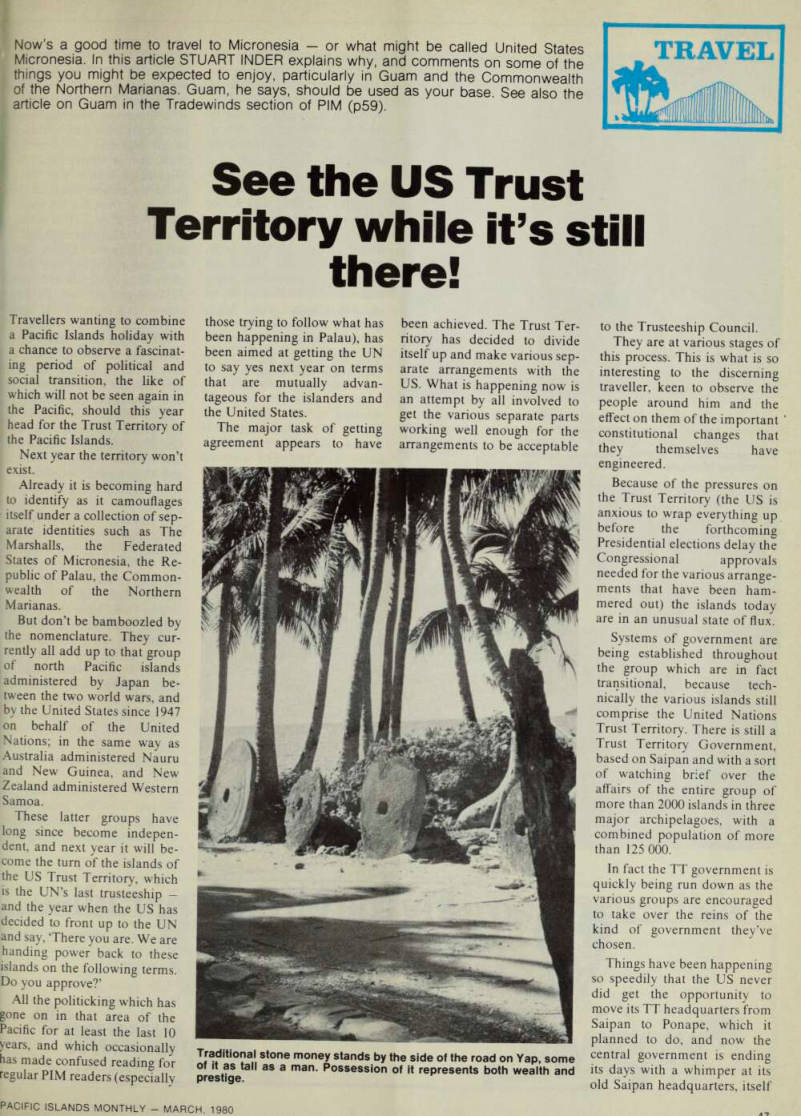
Now’s a good time to travel to Micronesia - or what might be called United States Micronesia. In this article STUART INDER explains why, and comments on some of the things you might be expected to enjoy, particularly in Guam and the Commonwealth of the Northern Marianas. Guam, he says, should be used as your base. See also the article on Guam in the Tradewinds section of RIM (p59).
See the US Trust
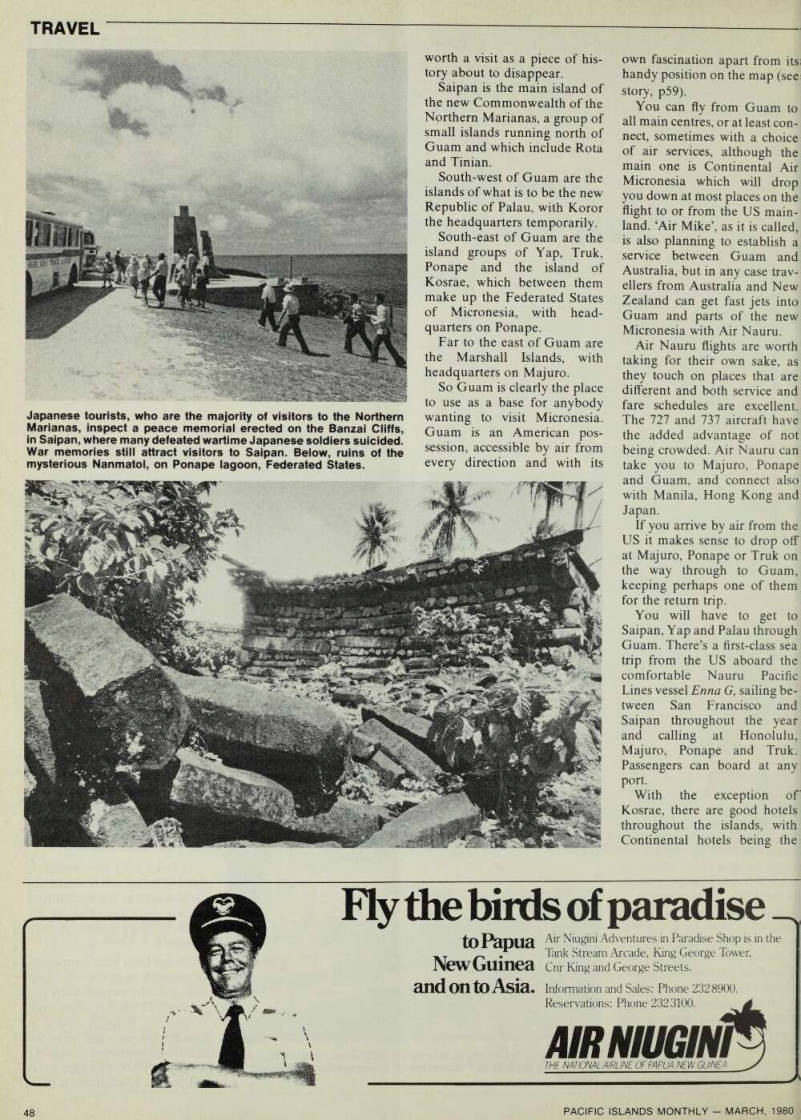
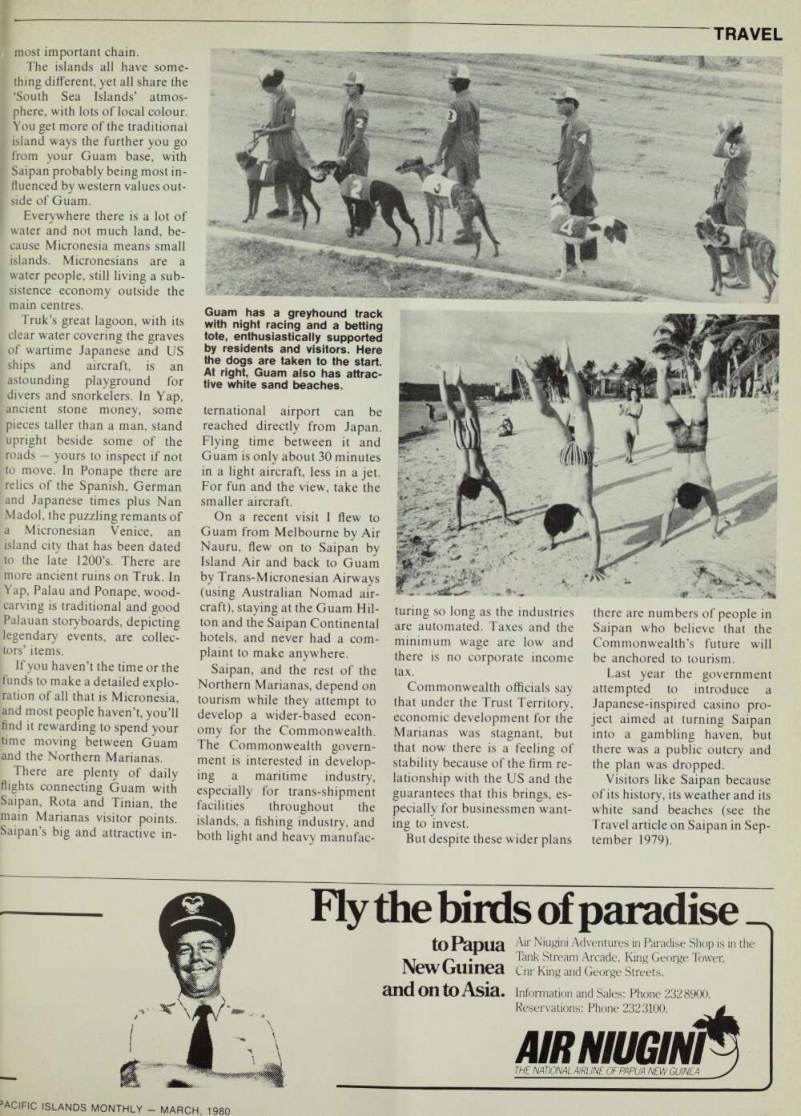

Territory while it’s still there!
Travellers wanting to combine a Pacific Islands holiday with a chance to observe a fascinat ing period of political and social transition, the like of which will not be seen again in the Pacific, should this year head for the Trust Territory of the Pacific Islands.
Next year the territory won’t exist.
Already it is becoming hard to identify as it camouflages itself under a collection of sep arate identities such as The Marshalls, the Federated States of Micronesia, the Re public of Palau, the Common wealth of the Northern Marianas.
But don’t be bamboozled by the nomenclature. They cur rently all add up to that group of north Pacific islands administered by Japan be tween the two world wars, and by the United States since 1947 on behalf of the United Nations; in the same way as Australia administered Nauru and New Guinea, and New Zealand administered Western Samoa.
These latter groups have
long since become indepen
dent, and next year it will be come the turn of the islands of the US Trust Territory, which is the UN’s last trusteeship and the year when the US has decided to front up to the UN and say, ‘There you are. We are handing power back to these islands on the following terms.
Do you approve?’
All the politicking which has gone on in that area of the Pacific for at least the last 10
years, and which occasionally
has made confused reading for
regular PIM readers (especially
those trying to follow what has been happening in Palau), has been aimed at getting the UN to say yes next year on terms that are mutually advan tageous for the islanders and the United States.
The major task of getting agreement appears to have
been achieved. The Trust Ter ritory has decided to divide itself up and make various sep arate arrangements with the US. What is happening now is an attempt by all involved to get the various separate parts working well enough for the arrangements to be acceptable
to the Trusteeship Council.
They are at various stages of this process. This is what is so
interesting to the discerning
traveller, keen to observe the people around him and the effect on them of the important constitutional changes that they themselves have engineered.
Because of the pressures on the Trust Territory (the US is anxious to wrap everything up before the forthcoming Presidential elections delay the
Congressional approvals
needed for the various arrange ments that have been ham mered out) the islands today are in an unusual state of flux.
Systems of government are
being established throughout
the group which are in fact transitional, because tech nically the various islands still comprise the United Nations Trust Territory. There is still a Trust Territory Government, based on Saipan and with a sort of watching brief over the affairs of the entire group of more than 2000 islands in three major archipelagoes, with a combined population of more than 125 000.
In fact the TT government is quickly being run down as the various groups are encouraged to take over the reins of the kind of government they’ve chosen.
Things have been happening so speedily that the US never did get the opportunity to move its TT headquarters from Saipan to Ponape, which it planned to do, and now the central government is ending its days with a whimper at its
old Saipan headquarters, itself
Traditional stone money stands by the side of the road on Yap, some of it as tall as a man. Possession of it represents both wealth and prestige.
worth a visit as a piece of his tory about to disappear.
Saipan is the main island of the new Commonwealth of the Northern Marianas, a group of small islands running north of Guam and which include Rota and Tinian.
South-west of Guam are the islands of what is to be the new Republic of Palau, with Koror the headquarters temporarily.
South-east of Guam are the island groups of Yap, Truk, Ponape and the island of Kosrae, which between them make up the Federated States of Micronesia, with head quarters on Ponape.
Far to the east of Guam are the Marshall Islands, with
headquarters on Majuro.
So Guam is clearly the place to use as a base for anybody wanting to visit Micronesia.
Guam is an American pos session, accessible by air from every direction and with its
own fascination apart from its handy position on the map (see
story, p 59).
You can fly from Guam to all main centres, or at least con nect, sometimes with a choice of air services, although the main one is Continental Air Micronesia which will drop you down at most places on the flight to or from the US main land. ‘Air Mike’, as it is called, is also planning to establish a service between Guam and Australia, but in any case trav ellers from Australia and New Zealand can get fast jets into Guam and parts of the new Micronesia with Air Nauru.
Air Nauru flights are worth taking for their own sake, as they touch on places that are different and both service and fare schedules are excellent.
The 727 and 737 aircraft have the added advantage of not being crowded. Air Nauru can take you to Majuro, Ponape and Guam, and connect also with Manila, Hong Kong and
Japan.
If you arrive by air from the US it makes sense to drop off at Majuro, Ponape or Truk on the way through to Guam, keeping perhaps one of them for the return trip.
You will have to get to Saipan, Yap and Palau through Guam. There’s a first-class sea trip from the US aboard the comfortable Nauru Pacific Lines vessel Enna G, sailing be tween San Francisco and
Saipan throughout the year
and calling at Honolulu,
Majuro, Ponape and Truk.
Passengers can board at any port.
With the exception of Kosrae, there are good hotels throughout the islands, with Continental hotels being the
Japanese tourists, who are the majority of visitors to the Northern Marianas, inspect a peace memorial erected on the Banzai Cliffs, in Saipan, where many defeated wartime Japanese soldiers suicided.
War memories still attract visitors to Saipan. Below, ruins of the mysterious Nanmatol, on Ponape lagoon, Federated States.
most important chain.
The islands all have some thing different, yet all share the ; ‘South Sea Islands’ atmos phere, with lots of local colour.
You get more of the traditional island ways the further you go from your Guam base, with
Saipan probably being most in
fluenced by western values out side of Guam.
Everywhere there is a lot of f water and not much land, be cause Micronesia means small islands. Micronesians are a water people, still living a sub sistence economy outside the main centres.
Truk’s great lagoon, with its clear water covering the graves of wartime Japanese and US j ships and aircraft, is an
I astounding playground for
divers and snorkelers. In Yap, ancient stone money, some pieces taller than a man, stand upright beside some of the i roads yours to inspect if not to move. In Ponape there are relics of the Spanish, German and Japanese times plus Nan Madol, the puzzling remants of a Micronesian Venice, an island city that has been dated to the late 1200’s. There are more ancient ruins on Truk. In Yap, Palau and Ponape, wood carving is traditional and good
Palauan storyboards, depicting
legendary events, are collec tors’ items.
If you haven’t the time or the funds to make a detailed explo ration of all that is Micronesia, and most people haven’t, you’ll find it rewarding to spend your time moving between Guam and the Northern Marianas.
There are plenty of daily
flights connecting Guam with
Saipan, Rota and Tinian, the main Marianas visitor points.
Saipan’s big and attractive in-
ternational airport can be reached directly from Japan, Flying time between it and Guam is only about 30 minutes in a light aircraft, less in a jet.
For fun and the view, take the smaller aircraft.
On a recent visit I flew to Guam from Melbourne by Air Nauru, flew on to Saipan by Island Air and back to Guam
by Trans-Micronesian Airways
(using Australian Nomad air craft), staying at the Guam Hil ton and the Saipan Continental hotels, and never had a corn plaint to make anywhere.
Saipan, and the rest of the Northern Marianas, depend on tourism while they attempt to develop a wider-based econ omy for the Commonwealth, The Commonwealth govern ment is interested in develop
ing a maritime industry,
especially for trans-shipment
facilities throughout the islands, a fishing industry, and both light and heavy manufac
turing so long as the industries are automated. Taxes and the minimum wage are low and there is no corporate income tax - Commonwealth officials say that under the Trust Territory, economic development for the Marianas was stagnant, but that now there is a feeling of stability because of the firm relationship with the US and the guarantees that this brings, especially for businessmen wanting to invest.
But despite these wider plans
there are numbers of people in Saipan who believe that the Commonwealth’s future will be anchored to tourism.
Last year the government attempted to introduce a Japanese-inspired casino pro
ject aimed at turning Saipan
into a gambling haven, but there was a public outcry and
the plan was dropped,
Visitors like Saipan because of its history, its weather and its white sand beaches (see the Travel article on Saipan in Sep tember 1979).
Guam has a greyhound track with night racing and a betting tote, enthusiastically supported by residents and visitors. Here the dogs are taken to the start.
At right, Guam also has attrac tive white sand beaches.
Stepped-up marketing activities by the Marianas Visi f tors Bureau, directed by its hard-working and dedicated I boss, J M Guerrero, brought in I a record in foreign exchange I earnings in the 1978 calendar I year and a 60% increase in the I number of visitors, which I totalled more than 91,000 for the year. They spent between f them more than $27.5 million.
The greater part of visitors come from Japan, most on
organised package deals.
The Northern Marianas re cently embarked on a promo tional campaign to educate local residents on the import ance of the tourist industry for the Commonwealth, with leaf f lets and television spots explaining how the dollars brought to the islands by ‘Mr and Mrs Sato’ permeate through the entire com
munity.
The islands of Tinian and Rota are quickly developing as tourist attractions. In Japanese times, Rota had a big sugar industry. Tinian has on its northern end the remains of the vast runways from where the aircraft took off which dropped the first A-bombs on Hiroshima and Nagasaki.
Through most of the islands there are relics of war, but these
days they are being consciously
I used as tourist bait.
The Trust Territory official enclave on ‘Mount Olympus’, or Capitol Hill, Saipan, is diminishing by the month. The area began as a highly secret
training complex for guerillas,
run by the CIA. When last I visited it, it was a thriving, well maintained Trust Territory headquarters of attractive
homes and buildings. Today
many are derelict and probably 100 are empty. The buildings are not being maintained as the Trust Territory staff leave for new and lesser jobs in the US,
or perhaps for early
retirement.
Many of these dedicated officials have spent as long as 20 years with the Trust Terri tory Government, and if they had been working for other colonial governments in the Pacific they would have ended their days with ‘golden hand shakes’ as compensation for
the premature termination of their careers, but the US Government doesn’t recognise that it ever had a colonial ser vice. Trust Territory staff are made one job offer by the Department of the Interior, and if it’s not suitable that’s it.
The buildings will be handed back to the new Common wealth.
Guam, too, has sun and beaches and good comfortable hotels. But Guam is a fascinat ing combination of the “US of A” and the Pacific Islands, with additional overtones of Spain, who once owned it.
As a first-time visitor wrote not long ago, ‘Guam is a para dox, a puzzle, a clutter of con tradictions. Such a small island should be easy to get to know, but once you start paddling around, the complexities begin to surface’.
Guam is sophisticated. It has first-rate shopping and enter tainment, plenty of eating houses of all styles and prices, a wide choice of television channels, and an Americanism which will remind many visi tors of life at the movies. For shoppers there is a great variety of American goods, European luxuries and cheap booze.
Entertainment includes a
greyhound racing track, with
an on-the-course totalisator,
owned by a Hong Kong based
firm, and established by an Australian, Norm Smith, and the locals have taken to it with enthusiasm, training their own dogs. But the new sport exists
side-by-side with cock fighting
in cock pits around the island.
In one area of Agana visitors are encouraged to take a stroll of less than one mile to view the remnants of many cultures.
The tour starts at the Agana Catholic Cathedral, Guam’s largest church, and moves on to a statue donated by the
Filipino community of Guam,
then an historic Spanish bridge, then the Plaza de Espana, which for 230 years was the seat of government for Guam and the other Mariana islands, then to the nearby re mains of the original Spanish Governor’s palace, including the ‘chocolate house’, dating
back to 1736, where wives of the Spanish governors would serve cups of chocolate to guests. The walk includes Guam’s Latte Stone Park, with ancient latte stones dating from prehistoric times. The stones, which have become a symbol for Guam, are believed to have been used as foundations for homes. Finally the visitor in spects the remains of the Spanish-built Fort Apugan.
One of the many attractive fea tures of Guam’s entertainment round is Tahitian dancer Rosalie Cao (below), a member of a Polynesian dance group of four men and four women who pro vide nightly shows in the season. All are from Papeete and
their dancing is deservedly
regarded highly for its authen ticity. But Rosalie is also re nowned in Guam’s sporting life as a star tennis player. She’s taken out the Guam open cham pionships for the last three years. Photo at right, by Manny Crisotomo, shows her at the
1979 championship.
Advertisements & other items, pp. 48-52 (2 items)
Travel
Fly the birds of paradise
to Papua
New Guinea
and on to Asia.
Air Niugini Adventures in Paradise Shop is in the Tank Stream Arcade, King George Tower, Cnr King and George Streets.
Information and Sales: Phone 2328900.
Reservations: Phone 2323100.
AIRNIUGINr
THE NATIONAL AIRLINE OF PAPUA NEW GUINEA y
Fly the birds of paradise
to Papua
New Guinea
and on to Asia.
Air Niugini Adventures in Paradise Shop is in the Tank Stream Arcade, King George Tower, Cnr King and George Streets.
Information and Sales: Phone 2328900.
Reservations: Phone 2323100. 4
AIRNIUGINr
-IE NATIONAL AIRLINE OF PAPUA NEW GUINEA
e o^2^' , i»tvO *&s&r .* •&*%&* e s^ *&%y \ i°\\^
SP^.nO*
S* O* ' S^‘ >*s *. -?
3 i * * •* s When the time next comes for you to fly out to do business fly Polynesian Airlines. Polynesian really understands the businessman’s requirements for a quick and efficient service between all Polynesian countries.
In fact, part of the reason we established our first service (Apia Pago Pago) back in 1959 was to meet the business sector’s demand for a fast and frequent service between the Samoas.
Since then Polynesian Airlines has spread its wings. Today our extensive route network covers the whole of Polynesia east of Fiji and now extends down to Auckland, New Zealand. And, as in ‘59 a lot of the people we’re carrying today are professional people. People who know that when it comes to flying anywhere in Polynesia on business there is only one airline. Polynesian Airlines, Fly Polynesian. It’s a pleasure doing business with us.
Offices In: Auckland, Tonga, Niue, Rarotonga.
Box 599 Apia, Western Samoa, Ph 21261.
WESTERN
WALLIS IS AMERICAN
SAMOA
NIUE RAROTONGA
POLYNESIAN/AIRLINES
We are Polynesia.
Nandi Airport, Nandi Ph 72733.
AUCKLAND
2067
Islands
From the
Press
A cock-and-bull story from Marianas Variety News &
Views, Saipan
A number of cockfights will be conducted as part of the Constitution Day celebration January 9. All bird owners who wish to enter may contact Gilbert C. Ada or Jess Pangelinan in the Community and Cultural Affairs Department. . . Winners of the grand prize awarded on Constitution Day will receive a Santa Gertrudis heifer and bull, donated by Pete Dela Cruz, director of Natural Resources...
Letter from reader Taputu in Cook Islands News,
Rarotonga
Yesterday’s paper contained a legend provided by Teremoana Rairi, probably of the Teachers Training College, which was written in Maori. Now this is not just some legend this is a part I of a genealogy - my genealogy (Papaanga) and it was written with mistakes.. There are legends that can be published for the world to see and there are some not meant to be seen by other people but the immediate family concerned. This legend which was published ... is from the ‘Are Korero o Mokoero’ and can only be used by a few of the family concerned for obvious reasons...
Editorial in Fiji Times, Suva If anyone had any doubt about the value to the Fiji economy of the tourist industry yesterday’s figures from the Government Statistician should have dispelled them. All those people, pouring into our sunny, friendly islands with their funny hats, their too-short shorts, and their different attitudes, kept Fiji green last year to the tune of $ 103 900 000. But it isn’t easy money, and it will become harder to make as other countries in our area get deeper into the business and offer stiffer competition. We need bright, new workable ideas... not just glib repetitions of the old and tried formulae ... Why for example does the government levy duty on wine when hardly anyone local drinks the stuff?
Australian visitors are almost unversally aghast to find in ‘duty-free’ Fiji wines from the Barossa or the Hunter Valley at three to five times their Australian prices..
News Drum, Honiara, Solomon Islands Fishermen of Nuatabu village in the north-east coast of Choiseul were frightened sometimes, and always disturbed, by a shark which went up to their canoes and watched them for about 15 minutes before going away. One fisherman said the shark was about 19 to 20 feet in length with a dark greyish spotted body.
The shark had a habit of swimming up to the canoe, gently tapping sides of the canoe with its tail before turning upside down and watching the canoe ... It was quite tame, and did not disturb t eir catches. Village elders have warned the fishermen to take care ...
Tuvalu News Sheet, Funafuti
About half of the overseas surface mailbags delivered by the MV Okeanis towards the end of last month, were found opened with their contents missing when the vessel discharged its cargo at Funafuti. The matter was immediately reported to the Police, who contacted the ports at which the Okeanis had called before arriving at the capital. A report from the Police said that a response by telegram was received from Tonga saying that the dice suspect the culprits to be among their stevedores, but no arrests have been made. The Tongan Police however, are investigating the matter under directions of the Crown Prince.
It IS believed that the incident happened at Tonga’s main wharf at Nukualofa where the containers containing the Tuvalu mailbags were shifted ashore, when the Okeanis had to unload cargoes...
Papua New Guinea Post-Courier, Port Moresby
As you know, beer advertising is banned in this country. But, ah, there are ways around it. There was a stunning display of this last Sunday when the Japanese Prime Minister, Mr Ohira, dropped in on his way home from Australia. As Mr Ohira alighted from his aircraft, the heavens opened. The waiting multitude of officials immediately opened out their umbrellas - green and yellow South Pacific brewery ones ...
The Observer, Apia
The Monetary Board is out to bankrupt us in a nice way,’ so fumed the general manager of the manufacturing company Samoa Iron and Steel Ltd, Mr Alfred Metzler. Close to agitation, Mr Metzler stuttered: Samoa would probably be the only country in the world who restrict the imports of materials for development.’ He was agonising over an allocation of $9O 000 granted his company by the Monetary Board, which is ‘less than half of what we requested’ for this year’s first quarter. As a result Mr Metzler is laying off from Monday half of his work force Pitcairn Miscellany, Pitcairn Island The weight has continued to fall off the weight watching ladies, but champion of them all must be Thelma Brown, for in the short time weight watchers has been operating Thelma has lost 30 pounds. All the men are saying how attractive she looks lately.
Well done Thelma - keep up the good work. Another keen weight watcher is Meralda. I understand she is aiming to have a fantastic figure for her 21st birthday. Just remember; If you feel you could eat like a hog Please remember to shut your gob!
Tuvalu News Sheet, Funafuti Youth association from the villages of Vaiaku, Fakai Fou and Funafuti last week at the Tauson held a food auction which netted the three groups more than $6O in proceeds. Petisone Lalua delighted the more than 100 young people in attendance with funny stories told at a price of two cents each From a letter by Mataiasi Lutu in the Fiji Times, Suva About 50% or so of Fijians marry only for the purpose of sex and nothing more. These Fijians do not bother about their households, that is whether the families are fed or clothed, let alone the teaching of the children to become good citizens. This is a matter usually left to the wives to sort out. If the husband has no love for the family, his wife should be given to another man capable of performing the husband’s duty. The outgoing husband should take and look after his own children.
Pitcairn Miscellany, Pitcairn Island Although an official register of Births, Deaths and Marriages was not begun until the mid 1860 s, it is one of the most interesting documents on Pitcairn; and if one has an hour to spare, it makes fascinating reading. For within it is recorded the small triumphs and the tragedy of the community here. Death during the early days often struck with an unexpected swiftness .. . certainly accidental death was far more common than it is today, perhaps reflecting the struggle the people had with the Pitcairn environment. And of the causes of accidental death, drowning appears to be the prime cause; for the sea has long been both friend and foe to the people here. Some of the drownings are puzzling, when apparently good swimmers were inexplicably lost ... Another major cause of accidental death on Pitcairn has been falls from rugged terrain and cliffs. Early inhabitants relied on seabirds’ eggs and young seabirds themselves to supplement their diet, but collecting these was indeed a hazardous undertaking, for the birds usually nested on narrow ledges and cliffs, and one slip by the collector meant certain death. Falls while goat hunting accounted for even more deaths, and in one bizarre accident death occurred when a hunter was killed by a rock dislodged from above
by a goat...
Advertisements & other items, pp. 53-54 (2 items)
3 Acific Islands Monthly - March, 1980
Teac
The TEAC name can’t be found on toasters or washing machines. We don’t make hundreds of different home hi-fi models. TEAC are audio specialists, and we know our job well.
Our Libero 3000 is a complete audio system in which every component has been matched in both style and performance to produce music with striking clarity and impact.
AC f s years of experience in the recording studio taught us a few things about professional , and this knowledge has gone into each Libero 3000. Ask an audio and let him tell you why an om this company means nd. It means an truly that will be paying J m ... < m I a i ent % i I m tof PO y expert abc easy-to-oper more than just westment in mu TE sy equ : for v come dividen ds ears
ill
X \ si m
TEAC
* H % •5> ts IT ■
TEAC
Where Art and Technology Meet TEAC AUSTRALIA PTY., LTD.: 165 Gladstone Street. South Melbourne, Victoria 3 KEYNOTE MUSIC HOUSE: Turumu Street, P.O. Box 1192, Boroko, Papua New Guinea HIFIVOX: 79, Rue De Sebastopol, B.P. 1458, Noumea, Nouvelle Caledonie SOUND CENTRE: Box 434, Vila, New Hebrides DIRECT IMPORTS (N.Z.) LTD.: P.O. Box 72, Hasting New Zealand ETABLISSEMENTS WIKING: 132 Rue du Mai. Foch, P.O. Box 237, Papeete, Tahiti, French Polynesia f!
Festschrift coming
A strange kind of a Festschrift coming out of Honolulu
Books
Adaptation and Symbolism: Essays in Social Organization.
Edited by Karen Ann Watson- Gegeo and S. Lee Seaton. Pub lished for the East- West Center by the University Press of Hawaii, Honolulu. 1978.
Susio.
The lure of anthropology for both the layman and initiate in the discipline lies in its descrip tive ethnography, for all of us yearn to know about distant peoples with different customs from our own. Adaptation and Symbolism: Essays on Social Organization goes over half way to satisfying that interest for the majority of PIM readers.
This edited volume is what is known as a Festschrift ', a collec tion of articles written and pub lished to celebrate (usually) a great teacher. The teacher receiving the accolade in this case is New Zealander Sir Raymond Firth, one of the most distinguished social
anthropologists alive today.
But it is an odd and disparate collection for a volume pur porting to have as its central theme Sir Raymond’s idea of ‘social organisation’.
What he means by this con cept is intentional action by a member of a society, involving choice and decision-making. ‘Social organisation’ is opposed to ‘social structure’, the latter being the formal rules of a so ciety. It is rather like the con trast between the formal laws governing the payment of income tax (social structure) and the manoeuvres (social or ganisation) most of us perform when tax time actually arrives.
The book consists of nine
articles, by nine anthropol
ogists and a political scientist (one of the editors, Seaton), and an introduction by one of the editors. These pieces vary in length from 11 pages (the introduction) to the mammoth
theoretical contribution by the
editors, which alone occupies a fifth of the book’s 228 pages.
When I said the book was xld I meant how little the
authors actually seem to have any relationship with the al leged object of their fest celebration. Three of the nine articles do not even reference Sir Raymond and the top scorer, James Peoples’ article on cargo cults, contains four passing references at the begin ning of his contribution on his supposed mentor’s work. This lack of concern with Sir Raymond’s work comes about because all participants, except Stephen Boggs, had only a fleeting contact with Sir Raymond at one or another seminar given in Chicago, Hawaii, California, or British Columbia.
The introduction to the book is very good, with the main points of the authors clearly spelled out by the senior editor, Karen Ann Watson-Gegeo. An index, potted biographies of the authors, and good biblio graphies for each of the articles complete the book.
Sir Raymond Firth’s career spans over half a century of publication and his books on
(particularly) Tikopia are fam
iliar to professional and lay man alike. His descriptive passages make him one of the best, if not the best, writer of
anthropology working today.
This concern, even love, for
descriptive ethnography fortu
nately features among the con tributions. Papua New Guinea hands will find the articles by Peoples on cargo cults, Dawn Ryan on the Toaripi, and David Wu on Chinese shop keepers, highly evocative of the place. The situations, actions, and motivations described by
Wu and Peoples ring especially
true.
I would be very interested to know what the ‘black king’, Yali, would make of Peoples’ account of this powerful leader’s rise from Madang cult leader to national politician.
After David Wu’s discussion of the rise to economic power of small shop-keepers in Papua New Guinea, the writing crosses a conceptual Rubicon, into dense prose on theoretical
concerns which will appeal much more to specialist than
layman.
Prattis writes on competing theories in the anthropological study of economics, arguing that productive and exchange systems alike tend towards an equilibrium, and that their functioning can be analysed in such terms. John Cove peers into the mysterious world of
Levi-Strauss-type structural
analysis to tell us why Cornish fishermen fear rabbits, women and clergymen near their boats.
John Attinasi produces a com plex analysis of Choi Mayan in order to discover the unique world view of this modern Mexican minority. It seems to me, that, in spite of his sophis ticated, formal, formulae, he comes to confuse grammatical convention with thought pat terns.
Finally, the editors include
the previously mentioned long
piece about theory in 20th century anthropology which concludes the book.
So, what is the purpose of Adaptation and Symbolism?
This book is not about the Pa cific as such. Nor is it really very much to do with Sir
Raymond Firth. It is a collec tibn of nine papers by 10 anthropologists who chanced to sit in for an undefined period of time on weekly meet ings given by a retired and dis tinguished academic who happened to be visiting his or her institution. In fact, most of the 10 contributors (including the two editors) met Sir Raymond in either British Columbia or Hawaii in 1968-1969.
Only Stephen Boggs, the
most senior of the contributors, can claim an older association and that goes back to 1947, when he and Sir Raymond first met in London.
The book, then, is not mainly for a popular market par ticularly with half the pages taken up with highly technical and specialist arguments.
Most odd of all is that the book comes from the East- West Culture Learning Insti tute, whose goal is supposed to be ‘to investigate the nature of cross-national interaction and to suggest ways of solving or dealing with the problems of understanding that accompany it’. Aside from the excellent pieces by Peoples, Boggs and Wu, I don’t see how these goals are realised by this publi cation.
So, the book is not about the Pacific; about Sir Raymond Firth; or ‘culture learning’; and we begin to wonder why this disparate collection appears at all in the form of a book, be tween its two covers that suggest a unity of purpose. - Grant McCall.
Getting the Tolal
story onto paper
A Mar na Kilana ta ra Lolalolo.
By N. Threlfall. $ A 6.00. An Offering Fit for a King. By H.
Linge, ed. N. Threlfall. 5A5.00.
Both published by United
Church, Rabaul, PNG.
A Mar na Kilana ta ra Lolalolo is the revised and expanded edition, translated into Kuanua, the language of the Tolai people, by Neville Threl fall of his One Hundred Years in the Islands: the Methodist/ United Church in the New Guinea Islands Region, 1875- 1975. The book records the
work of European, Fijian, Ton gan and New Guinean clergy and laymen and women from 1875, when the Reverend George Brown and a handful of Fijians and Samoans landed in the Duke of York Islands, until 1975, seven years after the Methodists had joined with the
London Missionary Society’s
successor, the Papua Ekalesia, and established the United Church of Papua New Guinea and the Solomon Islands.
In my review of One Hun dred Years in the Islands (PIM
I October 1975), I observed that i it was good to read about the I late Hosea Linge whose life I story, translated into English under the title The Erstwhile [ Savage (1931), was the first
i autobiography by a Papua
I New Guinean. Linge’s notes f for that book and his further notes, covering the years from 1931 to 1952, all written in Kuanua, and a postscript by the Reverend Stanley M.
Geddes, who knew Linge well, make up An Offering Fit for a King: the life and work of the Rev Hosea Linge, told by him
\ self, translated and edited by
Neville Threlfall.
Flosea Linge, a traditional ‘big man’, born near the end of i the last century, was one of the pioneers of Methodism among \ the peoples of New Ireland and I New Britain. His recollections I of tribal life among the Barok people of central New Iceland are of great interest because, apart from Hortense Powder maker’s Life in Lesu and articles by Father Peekel, little has been written about the be liefs and ways of the tribal groups on New Ireland prior to World War 11. Moreover,
Linge recounts his experiences
as a teacher and pastor. Much of his time was spent imparting skill in the ‘three Rs’ to students whose home back ground was not conducive to such learning. And there was the added difficulty of his own
shortcomings as a pedagogue:
modern teacher training was not given to New Guineans until the mid-19505.
As one would expect, Linge saw his experiences through the eyes of a convinced Chris tian. In his behaviour toward his first wife, Anasain Pising, and Rodi Mangin, whom he married eight years after Anasain’s death, in his fearless travels on circuit the Pacific, as we all know, is far from that for small launches - and in his
work among his people during
the Japanese occupation,
Hosea Linge truly earned his
title ‘Reverend’.
An Offering Fit for a King is of special value because almost all of the written accounts of the impact of Christian the ology and mores on the tra
ditional religious beliefs and
ways of New Guineans are by
Europeans who, whether con temporaries or latecomers, cannot tell the tale ‘from within’.
There are about 40,000 Kuanua speakers for whom A Mar na Kilana ta ra Lolalolo is a milestone in their vernacular literature. In the two books re viewed here, they and their
neighbours have the begin
nings of readily accessible and inexpensive written material about their past. (Several pub lications, such as Sister Adda’s sketch of the life of Archbishop Louis Couppe, are of minor
import.) They and everyone
else who believes that, on bal ance, Christianity has made a
positive contribution to Papua
New Guinea’s development are indebted to Neville Threl fall, author, editor and trans lator. Harry Jackman.
Advertisements & other items, pp. 55-56 (2 items)
’Acific Islands Monthly - March, 1980
the most weight in the cargo
Which airline carries
business?
Qantas has four jumbos a week between Nadi and Sydney and they all carry cargo.
They leave Nadi (very conveniently) in the early evening, and with their specialised equipment and huge capacity, they have the flexibility to handle any kind of cargo from furniture to fruit pulp.
And from Sydney Qantas can forward cargo to or from anywhere in the world.
It’s a weighty argument in favour of the world’s only all 747 airline.
Phone Qantas Cargo 72983 Nadi.
The world’s only all 747 airline. vus V /A n \ T v> £ / » v: & r\ wt \ vs \ 1 M / Si? c c X .
QFF 1010
One man’s
view of Timor
The Timor: Stillborn Nation. By Bill Nicol. Published by Vista Books, 1978. 5A8.95 paperback, $11.95 library edition.
In his preface. Bill Nicol prom ises the reader an account ‘of what really went on behind the scenes’ in the struggle for the future of East Timor, and there are many suggestions in the book that other observers of the events of 1974-75 were naive or incompetent.
Unfortunately, however,
Nicol’s own study, while con
taining some interesting
material based on his inter views with leading personali ties in the conflict, is tendentious in the extreme, based either on thin, unreliable and in many cases unverifiable sources, or upon his own highly
dubious interpretations.
The faults in the book are really summed up in his treat ment of Fretilin. Nicols is con cerned to explode the myths that have been created about its popularity, grass-roots activity and adherence to prin ciple. But what could have been an appropriate corrective to over-enthusiastic accounts of Fretilin degenerates into a grotesque caricature of the or ganisation and its leaders, who
are presented in such Machia vellian terms that we may be excused for thinking we are reading a hostile study of Lenin and the Bolsheviks.
This technique forces Nicols into countless contradictions, perhaps the most glaring of which is his description of Ramos Horta, Fretilin’s roving ambassador and its best known figure abroad, as a sinister figure who ‘preferred to be a back-room power broker rather than out on a limb in public’!
What suffers most from Nicol’s approach (apart from accuracy) is the social and in ternational relations back ground to the Timor tragedy, which is treated cursorily and
without analysis. Although, for
example, several of those inter viewed by Nicols referred to Indonesian fears of the re gional impact inside and out side Indonesia itself of Timorese independence, he makes no effort to assess this factor or the ultimate regional significance of Indonesia’s invasion. But then anyone who can claim that the pro- Indonesian Apodeti wanted autonomous status for Timor such as that enjoyed by West Irian(!), is hardly equipped to handle such issues.
My paperback copy fell to pieces before. I had finished reading it. Rex Mortimer.
Available from Vista Books, PO Box 336, Camberwell, Australia 3124.
Book Received: The Australia and New Zealand Solar Home Book A Practical Guide, S. V. Szokolay & R W. Sale, ANZ Book Co Pty Ltd, PO Box 459, Brookvale NSW 2100 Price $A7.95 String Figures of the Tuamotus, Kenneth P Emory and Honor Maude. AND Press. PO Box 4, Canberra, ACT 2600 Price $A6.00 Foreign Ships in Micronesia, A compendium of ship contacts with the Caroline and Marshall Islands 1521-1885, Fr Francis X Hezel, SJ, Micronesian Seminar, PO Box 220, Truk, Caroline Islands 96942. Price not given His tory of Samoa, Brother Fred Henry, Com mercial Printers Ltd, Apia, Western Samoa Price SWS9.SO.
Advertisements & other items, pp. 57-58 (2 items)
Books
57
’ACIFIC ISLANDS MONTHLY - MARCH, 1960
Islands
PLEASURE
of the South
Pacific
A holiday guide adventure story and history all in one
COLIN SIMPSON'S
LATEST
239 pages, including 32 colour plates. $15.95 or SUSIB.SO posted. use coupon insert in this issue.
’ORT MOl
♦ Right in tl business cej ♦ A traditiopyor l comfort andVfim food ♦ All rooms airconditioned it Restaurant * Ba ♦ Banquet hall
u C. NEUMANN
manager Phone 21*2622^
Stay at Aggie Grey’s , . . the South Pacific’s
legendary hotel.
Situated right in the heart of Western Samoa. Enjoy. Polynesian style friendliness and serviic, in cool surroundings, superb entertainment and food.
Magnificent white sand beaches only a short drive away. Air conditioned rooms, swimming pool and full bar facilities. bookings through Union Steam -ship Company of NZ. Pan Am.
Air New Zealand or direct to Aggie Urey's. Apia. Western Samoa. Cables; AC'.CIIES' Apia.
Polynesian
Bookshop..
THE PACIFIC ISLANDS
BOOK SPECIALISTS'
Write for our complimentary catalogue!
The Wbrld Trusts Mono
When it comes to providing water, the world trusts Mono Pumps. Mono make reliable bore hole pumps for almost every application, and any power source.
Mono Bore Hole Pumps raise clear, clean deep-well water and keep it flowing, year in and year out.
And with a minimum of maintenance.
That’s why, in so many remote areas all over the world, people trust Mono to provide water-and to keep on providing water.
Head Office & Works: “Mono House”, 338-348 Lower Dandenong Rd., Mordialloc, Vic. 3195. Australia.
Represented through Papua New Guinea by Steamships Machinery.
Agents in: Indonesia, Fiji, The Philippines and Singapore.
MONO
PUMPS
(AUSTRALIA) PTY. LTD.
MOVE IT WITH MONO
horizons
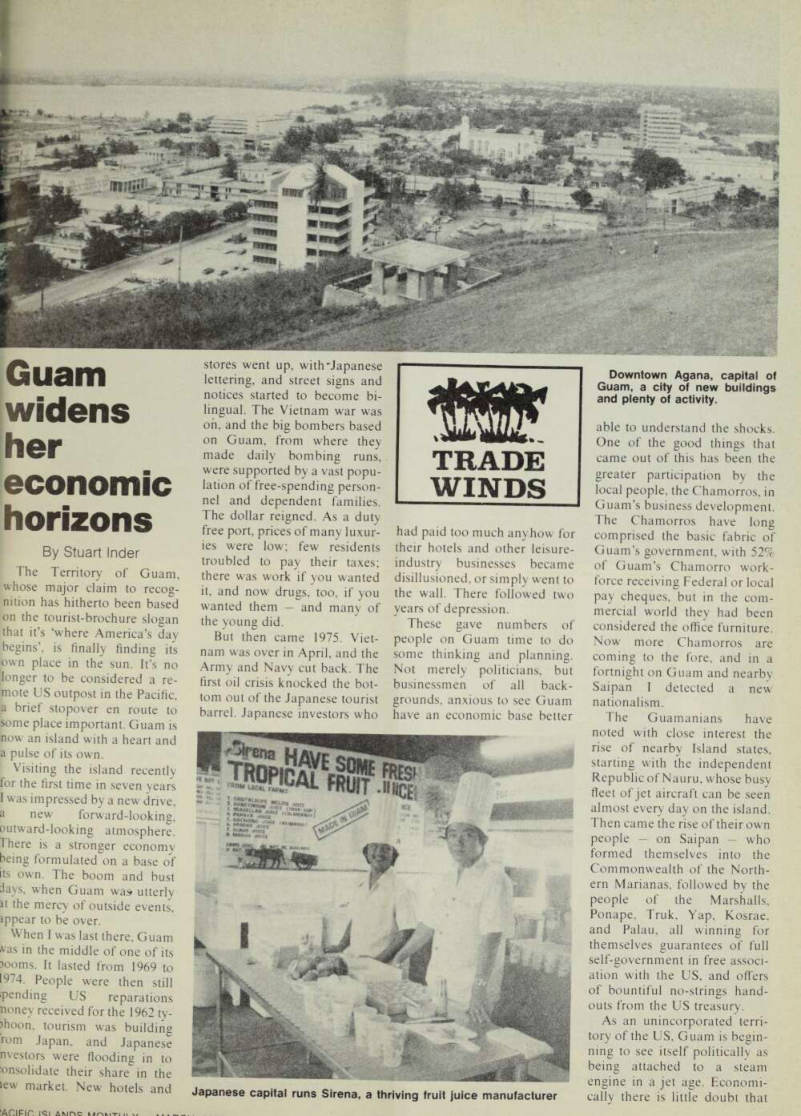
Guam widens her economic horizons
Trade
Winds
By Stuart Inder
The Territory of Guam, whose major claim to recog nition has hitherto been based on the tourist-brochure slogan that it’s ‘where America’s day
begins’, is finally finding its
own place in the sun. It’s no longer to be considered a re mote US outpost in the Pacific, a brief stopover en route to some place important. Guam is now an island with a heart and a pulse of its own.
Visiting the island recently for the first time in seven years I was impressed by a new drive,
a new forward-looking,
outward-looking atmosphere.
There is a stronger economy being formulated on a base of its own. The boom and bust Jays, when Guam was utterly it the mercy of outside events, tppear to be over.
When I was last there, Guam vas in the middle of one of its xioms. It lasted from 1969 to 1974. People were then still spending US reparations noney received for the 1962 ty
coon. tourism was building
rom Japan, and Japanese nvestors were flooding in to consolidate their share in the lew market. New hotels and
stores went up, with'Japanese lettering, and street signs and notices started to become bi lingual. The Vietnam war was oh, and the big bombers based on Guam, from where they
made daily bombing runs,
were supported by a vast popu lation of free-spending person nel and dependent families.
The dollar reigned. As a duty free port, prices of many luxur ies were low; few residents troubled to pay their taxes; there was work if you wanted it, and now drugs, too, if you wanted them and many of the young did.
But then came 1975. Viet nam was over in April, and the Army and Navy cut back. The first oil crisis knocked the bot tom out of the Japanese tourist barrel. Japanese investors who
had paid too much anyhow for their hotels and other leisure industry businesses became disillusioned, or simply went to the wall. There followed two years of depression.
These gave numbers of people on Guam time to do
some thinking and planning.
Not merely politicians, but businessmen of all back grounds, anxious to see Guam have an economic base better
able to understand the shocks.
One of the good things that came out of this has been the
greater participation by the
local people, the Chamorros, in Guam’s business development.
The Chamorros have long comprised the basic fabric of Guam’s government, with 52% of Guam’s Chamorro work force receiving Federal or local pay cheques, but in the com mercial world they had been considered the office furniture.
Now more Chamorros are coming to the fore, and in a fortnight on Guam and nearby Saipan I detected a new nationalism.
The Guamanians have noted with close interest the rise of nearby Island states,
starting with the independent
Republic of Nauru, whose busy fleet of jet aircraft can be seen almost every day on the island.
Then came the rise of their own
people on Saipan who
formed themselves into the Commonwealth of the North ern Marianas, followed by the people of the Marshalls,
Ponape, Truk. Yap, Kosrae.
and Palau, all winning for themselves guarantees of full self-government in free associ ation with the US, and offers of bountiful no-strings hand outs from the US treasury.
As an unincorporated terri tory of the US, Guam is begin ning to see itself politically as being attached to a steam engine in a jet age. Economi cally there is little doubt that
Japanese capital runs Sirena, a thriving fruit juice manufacturer
Downtown Agana, capital of Guam, a city of new buildings and plenty of activity.
Advertisements & other items, p. 59 (1 item)
AClFin I.QI AMnc Mr\MTi ii w ** . « . .
Guam has already, and will de
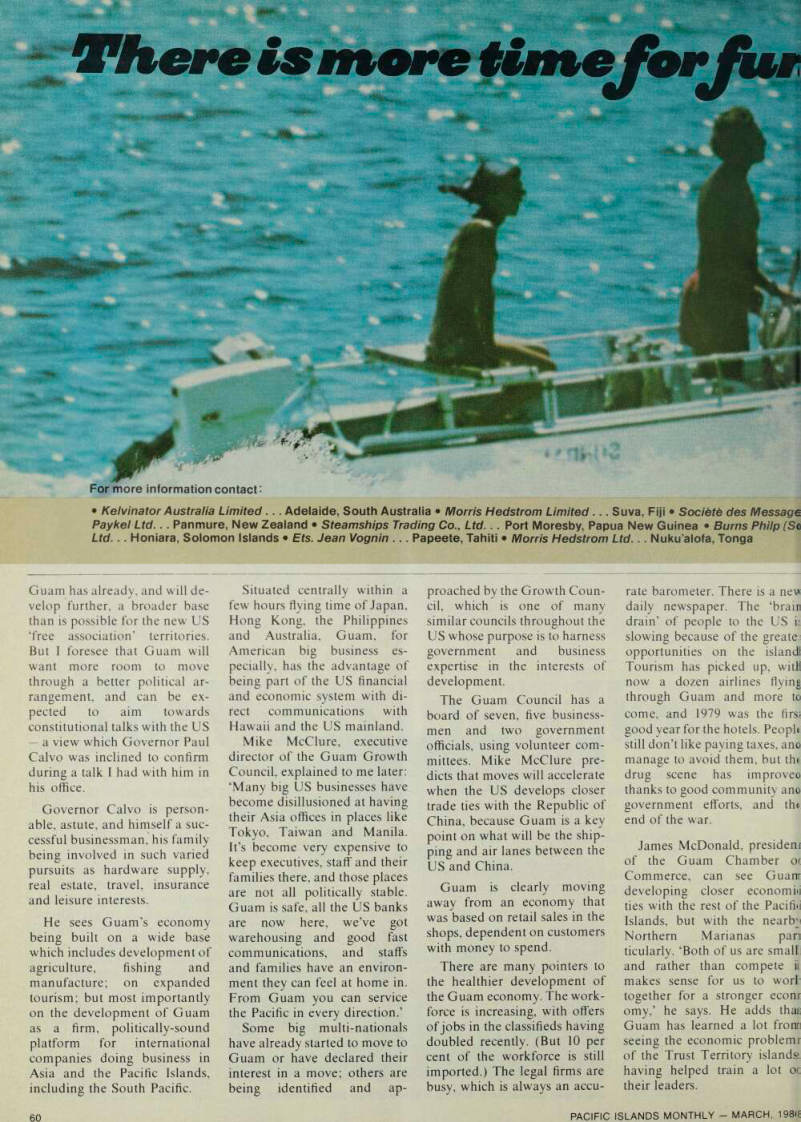


velop further, a broader base than is possible for the new US ‘free association’ territories.
But I foresee that Guam will want more room to move through a better political ar rangement, and can be ex pected to aim towards constitutional talks with the US a view which Governor Paul Calvo was inclined to confirm during a talk I had with him in his office.
Governor Calvo is person able, astute, and himself a suc cessful businessman, his family being involved in such varied
pursuits as hardware supply,
real estate, travel, insurance and leisure interests.
He sees Guam’s economy being built on a wide base which includes development of
agriculture, fishing and
manufacture; on expanded tourism; but most importantly on the development of Guam as a firm, politically-sound platform for international
companies doing business in
Asia and the Pacific Islands, including the South Pacific.
Situated centrally within a few hours flying time of Japan,
Hong Kong, the Philippines
and Australia, Guam, for American big business es pecially, has the advantage of being part of the US financial and economic system with di rect communications with Hawaii and the US mainland.
Mike McClure, executive director of the Guam Growth Council, explained to me later: ‘Many big US businesses have become disillusioned at having their Asia offices in places like Tokyo, Taiwan and Manila.
It’s become very expensive to keep executives, staff and their families there, and those places are not all politically stable.
Guam is safe, all the US banks are now here, we’ve got
warehousing and good fast
communications, and staffs and families have an environ ment they can feel at home in.
From Guam you can service the Pacific in every direction.’
Some big multi-nationals have already started to move to Guam or have declared their interest in a move; others are being identified and ap
proached by the Growth Coun cil, which is one of many similar councils throughout the US whose purpose is to harness government and business expertise in the interests of
development.
The Guam Council has a board of seven, five business men and two government officials, using volunteer com mittees. Mike McClure pre dicts that moves will accelerate when the US develops closer trade ties with the Republic of China, because Guam is a key point on what will be the ship ping and air lanes between the US and China.
Guam is clearly moving
away from an economy that was based on retail sales in the
shops, dependent on customers
with money to spend.
There are many pointers to the healthier development of the Guam economy. The work force is increasing, with offers of jobs in the classifieds having doubled recently. (But 10 per cent of the workforce is still imported.) The legal firms are busy, which is always an accu
rate barometer. There is a new daily newspaper. The ‘brain drain’ of people to the US i: slowing because of the greate; opportunities on the islandl Tourism has picked up, witH now a dozen airlines flying through Guam and more to come, and 1979 was the firs; good year for the hotels. People still don’t like paying taxes, ano manage to avoid them, but the
drug scene has improveo
thanks to good community ano government efforts, and the end of the war.
James McDonald, presidenj of the Guam Chamber o( Commerce, can see Guanr developing closer economic ties with the rest of the Pacific Islands, but with the nearby Northern Marianas pan ticularly. ‘Both of us are small and rather than compete ii makes sense for us to worl: together for a stronger econr omy,’ he says. He adds thar Guam has learned a lot fronr
seeing the economic problem:
of the Trust Territory islands having helped train a lot oc their leaders.
Although the Japanese still
have business interests in Guam which can be expected to grow, Taiwan Chinese and others are now making an impact on Guam business.
Many people see the Chinese as much shrewder (one group has an eel farm, exporting eels to Japan). But there is also
Greek shipping money, Arab
and Hong Kong money in
Guam. As one government official said, ‘You see the upfront people, but you don’t always see the backing behind
them’. Others have obviously
seen the business opportunities that Guam is about to offer.
Agricultural and other Jevelopment of Guam’s own resources are not likely to be lindered by problems of land ownership. The Federal and 3uam governments each own i third of Guam’s land, and the emaining third is freehold, fhe Guam Government’s land :an be leased for agricultural nirposes. Some is to be devel >ped for an orchard plantation )f tropical fruits for Japanese fujiro Kuwabara, who runs a hriving tropical fruit juice and
Old and new can be seen side-by-side in Agana, Guam’s developing capital and business centre. Here the Chease building in the background contrasts with walls left by the Spanish occupation. Photo: Paul Addison.
I fruit jelly business on Guam.
I called Sirena. but who can’t get enough local juice to supply demand.
Acquaculture is proving more productive per pond in Guam than in Honolulu and Taiwan. Prawn ponds are able I to supply local needs. An inter national fishing company f wants to put a base into Guam f because it has fuel, anchorages and ship repair facilities.
A man with warm faith in Guam’s expanding economy is John Kerr, who has built up businesses on Guam with com bined sales of SUSIO million
annually, and ploughs the
money back in. His companies include dry cleaning and linen
supply companies, a travel
agency, an important petrol
products marketing organis
ation. Petroco, and a fast foods [company which holds the Ken tucky franchise (which in 1975 at the top of the boom sold more Kentucky fried chicken than any other outlet in the world). ‘We’ve reached the point of consolidation in my busi nesses’. says Kerr, a pleasant, unflappable American who spent 15 years with Esso in the
States before he wondered what he was doing in the rat race and ‘gave it away’ at the age of 39, and took his wife Jean and the kids to Guam for some island living.
Now aged 49, Kerr, very much a part of the local com munity with a big comfortable house on Barrigada Hill, says of Guam. ‘I love it. This is home. I have the opportunity to do what I want. People are so warm. You don’t see it in the States.’
Kerr says if developing a business on Guam is not with out its problems, it’s thanks often to lack of support from the Federal Government. ‘We’ve been criticised for not
doing enough to help our
selves, and then when we help ourselves, they do things to us,’ he says.
What ‘doing things’ fre
quently means is that Washing ton has bowed to the requirements of powerful Washington lobbies, out to put a spoke in Guam’s wheel should it develop successful businesses in competition with those Stateside. Washington
lobbyists successfully closed a
number of garment factories
and watch assembly factories established on Guam under a US tariff schedule giving im portant duty concessions to materials ‘substantially trans formed’. There were seven gar ment factories. There are none now.
Kerr is one of those who wel comes the new out-going ap proach of Guam (indeed he has helped pioneer it), and foresees a much closer connec tion between Guam and the rest of the Pacific Islands in place of the tunnel visiion which in the past has had people look only towards the US. ‘We are a Pacific Island,’ he says. ‘That’s why I came here.’
The all-island view is one that for several years was
tirelessly echoed by Martin
Pray, who until recent months was general manager of Guam’s Visitors Bureau and is one of the architects of Guam’s expanded interest in tourists.
The work he did is only now coming to fruition with the opening of the tourist skies to international airlines.
As an inveterate traveller
himself. Pray early realised
that Guam was part of the Pa
cific Islands community, not one of the US offshore islands.
He pointed out at a Micronesia Regional Tourist Conference held in Guam last June that of the Pacific travel lers coming to Guam 22% came from Japan, 13% from the US and 8% from Aus tralia, ‘yet the North American market gets all the attention’.
He offered a plan for Pacific Islands regional airline co operation which will sell the various Pacific Island groups as tourist destinations selling them, he said, as ‘Wonderlands of Micronesia, Melanesia and Polynesia circle tours, a great carousel of travel which can be of equal access to Japanese, North Americans, Australians and others.’
One of the last important links to be established to tie Guam in with this wider Pa cific is a direct air route from Guam to Australia via Papua New Guinea, planned by Con tinental for 1981. This should bring a flood of travellers through Guam north and south, and, of course, give a further fillip to Guam’s new business horizons.
Advertisements & other items, pp. 60-64 (4 items)
VHere is more time for turn
mm mm V I •« I For more information contact: • Kelvinator Australia Limited .. . Adelaide, South Australia • Morris Hedstrom Limited ... Suva, Fiji • Societe des Message Paykel Ltd.. . Panmure, New Zealand • Steamships Trading Co., Ltd. . . Port Moresby, Papua New Guinea • Burns Philp [So Ltd... Honiara, Solomon Islands • Ets. Jean Vognin ... Papeete, Tahiti • Morris Hedstrom Ltd... Nukualofa, Tonga
Refrigerators, Freezers, Gas and Electric Ranges, Air Conditioners, Automatic Washers and Dryers, Wringer Washers, Humidifiers, Dehumidifiers, Water Coolers, Commercial Air Conditioners and Refrigeration. r 0 omoblles Neo-Caledoniennes ... Noumea, New Caledonia • New Hebrides Motors Ltd... Port-Vila, New Hebrides • Fisher & i] Company ... Pago Pago, American Samoa • Morris Hedstrom Limited ... Apia, Western Samoa . Security Electrical Co.,
If you have a problem with
COCKROACHES
the complete answer is
KEEN COCKROACH KILLER
Extracts from tests carried out
at the Pest Control Research
Laboratory in June 1978
Tests were carried out using the Blatta Orientalis (oriental cockroach). This cockroach is probably the most common pest found in wide range of premises including hospitals, schools, kitchens, factories, warehouses etc.
TEST 1 A five second spray with KEEN COCKROACH KILLER on to insects confined in a glass container of floor area 1000 cm 2 .
RESULT All insects were knocked down within one minute and all appeared dead within 30 minutes and there was no recovery within 24 hours.
TEST 2 A one second burst with KEEN COCKROACH KILLER under the same conditions as test 1.
RESULT 100% kill as in test 1.
TEST 3 The insects were exposed for one minute to a surface of corrugated cardboard that had received a five second burst with KEEN COCKROACH KILLER from 30cm then allowed to dry in air for 1 hour. The area of cardboard to which they were exposed was 200 cm 2 . This test was to simulate the use of the spray on absorptive surfaces such as wood plaster and cardboard as would be found under normal use of the spray.
RESULT Complete knockdown after 1 hour. Killed within 10 hours.
TEST 4 Repeat of the test 3 but using glass instead of cardboard in order to simulate the laminate and metallic, non absorptive surfaces that would be found in normal use.
RESULT Complete knockdown within 2 minutes. Killed within 1 hour.
Conclusions This KEEN COCKROACH KlLLERkilled with great efficiency under a variety of conditions. The speed of knockdown was remarkable, often taking less than one minute.
Throughout these tests the KEEN COCKROACH KILLER could scarcely have performed better.
ASK FOR IT AT YOUR WHOLESALER OR RETAILER
Agents: Peter Fisher Trading Pty. Ltd.,
321 Pitt Street, Sydney 2000, Australia
JM
METCARBON
Pty Limited
ANTHRACITE
filter media
ACTIVATED CARBON
powered and granulated
DESALINATION
EQUIPMENT
vapour compression and multi-effect distillation
ZEOLITES
iron and manganese removal
GARNET
3 EDEN ST, PO BOX 785
CROWS NEST 2065 NORTH SYDNEY 2060
PHONE: (02) 9290393 TELEX: 24076
Q E
offers expert insurance service throughout the Islands.
“ QBE INSURANCE UNITED
Central Office; 82 Pitt Street, Sydney.
NEW CALEDONIA - T.A. Hagen , Ste. W.A. Johnston, S.A.R.L. ■ Noumea.
NEW HEBRIDES Manager G.F. Donnelly, Vila: Santo Santr Burns Phi/p (New Hebrides) Ltd.
TAHITI - Arthur Chung: Immeuble 8.1., Front de Mer, Papeete.
NIUE, NORFOLK ISLAND, SAMOA, TONGA and other South Sea Islands - Burns Phi/p (South Sea) Company Ltd.
QUEENSLAND INSURANCE (FIJI) LIMITED
Head Office, 34 Usher St., SUVA. General Manager: L.G. Liddell. A.A.1.1.
Assistant Managers: Vijay Lai and J.T. Laidlaw. LAUTOKA Office, Burns Philp Bldg. District Manager: J.
QUEENSLAND INSURANCE (RN.C.) LIMITED
PAPUA NEW GUINEA -
Head Office, PORT MORESBY, General Manager: J.M. Dawe. Assistant Manager: R.V. Maskell.
District Managers at LAE; I.R. Martin. MOUNT HAGEN D.F. Carroll. ARAWA: J Longbut. MADANG: R.W.V. Ceilings. RABAUL: W.F. T Dalton. inker)
qBE/?^ * a o in r;
FOR:
IN OUR 86th YEAR SELLING ‘SERVICE’
TO THE PACIFIC ISLANDS
Nelson & Robertson
PTY. LTD. (Established 1895)
Plantation House, 197 Clarence Street, Sydney.
Cables: ‘IVAN\ Sydney, Brisbane. Telex: AA22381, Sydney.
INDENTS - FROM AUSTRALIA, NEW ZEALAND and OVERSEAS.
FOODSTUFFS • SOFTGOODS • HARDWARE • MACHINERY TRAVEL • INSURANCE • CANNED FISH • JUTE GOODS
• REAL ESTATE •
BRANCH OFFICES:
Nelson & Robertson Pty. Ltd., P-O- Box 575, Brisbane, Qld., Australia.
P-O. Box 2092, Govt. Bldg., Suva, Fiji.
P.O. Box 258, Lautoka, Fiji.
P.O. Box 2420, CPO Auckland 1, New Zealand
PAPUA NEW GUINEA
REPRESENTATIVES;
Rabtrad Nuigini Pty. Ltd., P.O. Box 219, Rabaul, P.N.G.
P.O. Box 1406, Lae, P.N.G.
P.O. Box 711, Madang, P.N.G.
P.O. Box 253, Kieta, P.N.G.
’Acific Islands Monthly March Iqftn
'ACIFir IQ I AKIHC KJ/' a Mu~ri n w
l inner ’s Edge
The rally's underway.
The competition is tough.
The skills that make up a champion are many.
The winner's edge — reliability. The kind of reliability you expect from Clarion car stereo.
High guality performance all the way.
Check out the full lineup. You'll find it in the winner's circle , every time. ► JE 157
l inner ’s Edge
In Car Entertainment Company
® Clarion
Clarion Co., Ltd. Tc i m ill I m
SIS!
People
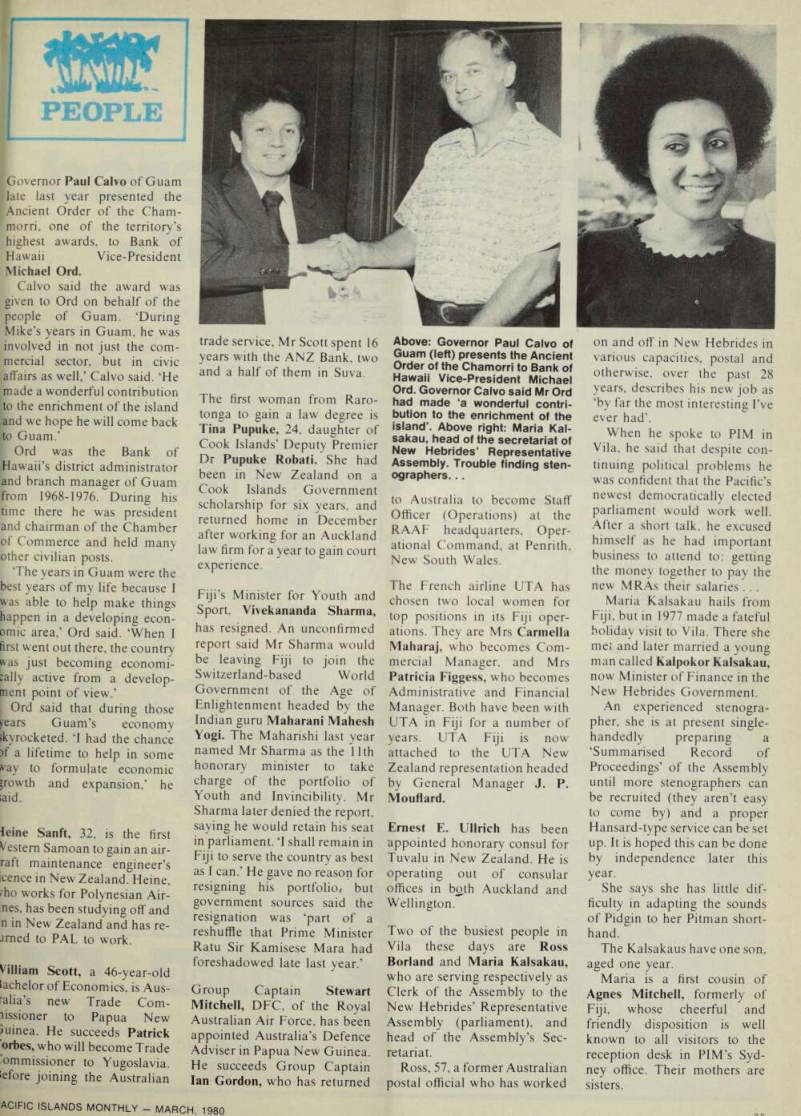

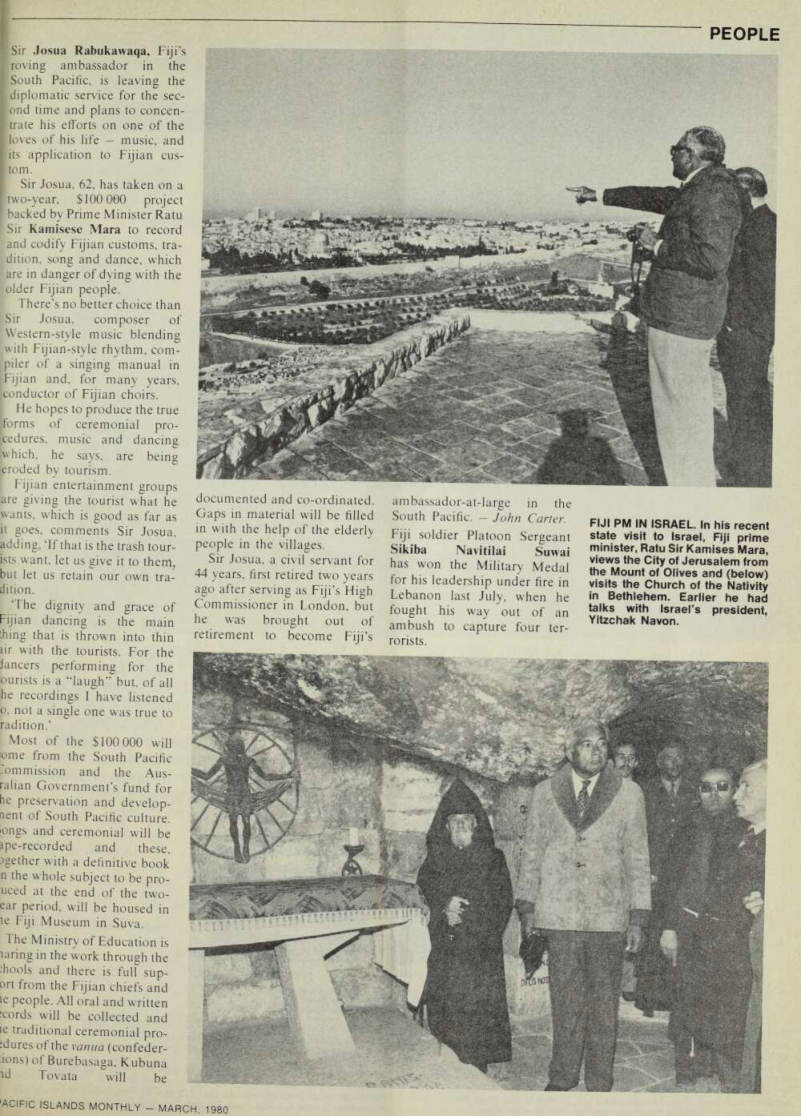
I Governor Paul Calvo of Guam [late last year presented the [Ancient Order of the Cham morri, one of the territory’s highest awards, to Bank of Hawaii Vice-President Michael Ord.
Calvo said the award was given to Ord on behalf of the
people of Guam. ‘During
Mike’s years in Guam, he was involved in not just the com mercial sector, but in civic affairs as well,’ Calvo said. ‘He made a wonderful contribution to the enrichment of the island and we hope he will come back to Guam.’
Ord was the Bank of Hawaii’s district administrator and branch manager of Guam from 1968-1976. During his time there he was president and chairman of the Chamber of Commerce and held many other civilian posts. ‘The years in Guam were the best years of my life because I
was able to help make things
happen in a developing econ omic area,’ Ord said. ‘When I first went out there, the country
was just becoming economi
cally active from a develop
ment point of view.’
Ord said that during those pears Guam’s economy ikyrocketed. i had the chance )f a lifetime to help in some vay to formulate economic growth and expansion,’ he laid. leine Sanft, 32, is the first Vestem Samoan to gain an air raft maintenance engineer’s icence in New Zealand. Heine, fflo works for Polynesian Air nes, has been studying off and n in New Zealand and has re irned to PAL to work.
Villiam Scott, a 46-year-old
lachelor of Economics, is Aus ralia’s new Trade Com
missioner to Papua New
iuinea. He succeeds Patrick orbes, who will become Trade
’ommissioner to Yugoslavia,
before joining the Australian
trade service, Mr Scott spent 16 years with the ANZ Bank, two and a half of them in Suva.
The first woman from Raro tonga to gain a law degree is Tina Pupuke, 24, daughter of Cook Islands’ Deputy Premier Dr Pupuke Robati. She had been in New Zealand on a Cook Islands Government scholarship for six years, and returned home in December after working for an Auckland law firm for a year to gain court
experience.
Fiji’s Minister for Youth and Sport, Vivekananda Sharma, has resigned. An unconfirmed report said Mr Sharma would
be leaving Fiji to join the
Switzerland-based World Government of the Age of
Enlightenment headed by the
Indian guru Maharani Mahesh Yogi. The Maharishi last year named Mr Sharma as the 11th honorary minister to take charge of the portfolio of Youth and Invincibility. Mr Sharma later denied the report, saying he would retain his seat in parliament. ‘I shall remain in Fiji to serve the country as best as I can.’ He gave no reason for
resigning his portfolio< but
government sources said the resignation was ‘part of a reshuffle that Prime Minister Ratu Sir Kamisese Mara had foreshadowed late last year.’
Group Captain Stewart
Mitchell, DFC, of the Royal Australian Air Force, has been appointed Australia’s Defence Adviser in Papua New Guinea.
He succeeds Group Captain
lan Gordon, who has returned
to Australia to become Staff Officer (Operations) at the
RAAF headquarters. Oper
ational Command, at Penrith, New South Wales.
The French airline UTA has chosen two local women for top positions in its Fiji oper ations. They are Mrs Carmella Maharaj, who becomes Com mercial Manager, and Mrs Patricia Figgess, who becomes Administrative and Financial Manager. Both have been with UTA in Fiji for a number of years. UTA Fiji is now attached to the UTA New Zealand representation headed by General Manager J. P.
Mouflard.
Ernest E. Ullrich has been
appointed honorary consul for
Tuvalu in New Zealand. He is operating out of consular offices in both Auckland and
Wellington.
Two of the busiest people in Vila these days are Ross Borland and Maria Kalsakau, who are serving respectively as Clerk of the Assembly to the New Hebrides’ Representative
Assembly (parliament), and
head of the Assembly’s Sec retariat.
Ross, 57, a former Australian postal official who has worked
on and off in New Hebrides in various capacities, postal and otherwise, over the past 28 years, describes his new job as ‘by far the most interesting I’ve ever had’.
When he spoke to PIM in Vila, he said that despite con tinuing political problems he was confident that the Pacific’s newest democratically elected parliament would work well.
After a short talk, he excused himself as he had important business to attend to: getting the money together to pay the new MRAs their salaries .. .
Maria Kalsakau hails from Fiji, but in 1977 made a fateful holiday visit to Vila. There she met and later married a young man called Kalpokor Kalsakau, now Minister of Finance in the New Hebrides Government.
An experienced stenogra pher, she is at present single
handedly preparing a
‘Summarised Record of
Proceedings’ of the Assembly
until more stenographers can be recruited (they aren’t easy to come by) and a proper Hansard-type service can be set up. It is hoped this can be done
by independence later this
year.
She says she has little dif ficulty in adapting the sounds of Pidgin to her Pitman short hand.
The Kalsakaus have one son, aged one year.
Maria is a first cousin of Agnes Mitchell, formerly of Fiji, whose cheerful and
friendly disposition is well
known to all visitors to the reception desk in PlM’s Syd ney office. Their mothers are sisters.
Above: Governor Paul Calvo of Guam (left) presents the Ancient Order of the Chamorri to Bank of Hawaii Vice-President Michael Ord. Governor Calvo said Mr Ord had made a wonderful contri bution to the enrichment of the island’. Above right: Maria Kal sakau, head of the secretariat of New Hebrides' Representative Assembly. Trouble finding sten ographers...
I Sir Josua Rabukawaqa. Fiji’s I roving ambassador in the I South Pacific, is leaving the I diplomatic service for the sec liond time and plans to concen- I trate his efforts on one of the I loves of his life music, and I its application to Fijian cus rtom. f Sir Josua. 62, has taken on a two-year, $lOO 000 project backed by Prime Minister Ratu [ Sir Kamisese Mara to record and codify Fijian customs, tra dition, song and dance, which are in danger of dying with the older Fijian people.
There’s no better choice than Sir Josua, composer of Western-style music blending with Fijian-style rhythm, com piler of a singing manual in Fijian and, for many years, conductor of Fijian choirs.
He hopes to produce the true [forms of ceremonial pro cedures. music and dancing pvhich. he says, are being eroded by tourism. [ Fijian entertainment groups are giving the tourist what he wants, which is good as far as it goes, comments Sir Josua, adding, ‘lf that is the trash tour ists want, let us give it to them, but let us retain our own tra dition.
The dignity and grace of Fijian dancing is the main ■hing that is thrown into thin tir with the tourists. For the
lancers performing for the
ourists is a “laugh” but, of all he recordings I have listened o. not a single one was true to radition.’
Most of the $lOO 000 will ome from the South Pacific Commission and the Aus ralian Government’s fund for
he preservation and develop
nent of South Pacific culture, iongs and ceremonial will be ipe-recorded and these, 3gether with a definitive book n the whole subject to be pro uced at the end of the two ear period, will be housed in le Fiji Museum in Suva.
The Ministry of Education is taring in the work through the :hools and there is full sup □rt from the Fijian chiefs and ie people. All oral and written :cords will be collected and ie traditional ceremonial pro cures of the vanua (confeder ions) of Burebasaga. Kubuna Tovata will be
documented and co-ordinated.
Gaps in material will be filled in with the help of the elderly people in the villages.
Sir Josua, a civil servant for 44 years, first retired two years ago after serving as Fiji's High Commissioner in London, but he was brought out of retirement to become Fiji’s
ambassador-at-large in the South Pacific. John Carter.
Fiji soldier Platoon Sergeant Sikiba Navitilai Suwai has won the Military Medal for his leadership under fire in Lebanon last July, when he fought his way out of an ambush to capture four ter rorists.
FIJI PM IN ISRAEL. In his recent state visit to Israel, Fiji prime minister, Ratu Sir Kamises Mara, views the City of Jerusalem from the Mount of Olives and (below) visits the Church of the Nativity in Bethlehem. Earlier he had talks with Israel’s president, Yitzchak Navon.
Advertisements & other items, pp. 65-68 (4 items)
Acific Islands Monthly - March, 1980
arugged,
When you need
high-powered
crawler tractor-
count on us
Caterpillar track type tractors are built tough to tackle the rugged terrain commonly found in developing areas of the Pacific Islands. For
dependability the high-
powered Cat-built engine features
adjustment-free fuel system, a
large radiator and heavy duty air
cleaners to ensure continuous performance in hot, dusty conditions.
Whether your job is dozing or ripping-or any other crawler appliestion-you can count on Cat-built track type tractors to meet your demands. ft f JS m
mmm
m
Wmm
»••• • • tn £■os • .>jr 111 35 m ‘"Hi m 2* m i". m V; «■»*% Mi *C in A_< vV if? *r.
SK'
HASTINGS DURING
LAE:
Milford Haven Road, Telephone 42 2355.
PORT MORESBY:
Telephone 256650.
BOUGAINVILLE:
Itakara Industrial Park, Arawa Telephone 959077
carptrac
SUVA: Carpenter Street, Raiwai.
Private Mail Bag, GPO Suva, Fiji. Ph. 381622.
Telex FJ2190 Cables CARPTRAC.
LAUTOKA: Veitari. Telephone 61877 LABASA: Vulovi. Telephone 81868
YOUR
CATERPILLAR
DEALER
Caterpillar, Cat and CB are Trademarks of Caterpillar Tractor Co.
BA 10450
People
'ACIFIC ISLANDS MONTHLY MARCH, 1980
Easy-to-hancUe stereo!
M M H M Jff
im <*%> :_,dii- T -<s <SS-tD> ~uml ■ □ % » 9M C* *»X«;
SA TDK
&ss&£&***'*' * % GO piONeen SK-7 Why leave your music home when you can take it with you? With a new Pioneer portable stereo radio cassette recorder, easyto-handle means easy-to-enjoy.
Pioneer is a leading audio company, so naturally we created these great stereo portables to put great stereo music in the palm of your hand. In other words, you can now enjoy home stereo performance with go-anywhere convenience.
SK-6 • 4* The SK-6 and SK-7 both have Pioneer’s exclusive Multi-Mode Deck™. And that includes a Song Finder function and two repeat modes; one programmable, if you choose the SK-7.
Either way, you get plenty of music power delivered through big Pioneer stereo speakers.
Come on over to see and hear them today.
They’re really stereo hi-fi with a handle on them.
From Pioneer, the company that makes it easier for you to enjoy stereo music.
SK-1A
iPIOINIEER
For further information, please contact: Australia: Pioneer Marketing Service Pty. Ltd., P.O. Box 317, Mordialloc, Victoria, 3195 Tel: 90-9011 Fiji Islands: Brijlal & Company, G.P.O. Box No. 362, Suva, Fiji Islands Tel: 22258 New Zealand: Monaco Electronics Ltd., 5 Vernon Street, Auckland, New Zealand Tel: 33-883 Norfolk Island: Burns Philp (Norfolk Island) Ltd.. Norfolk Island, South Pacific New Hebrides: Burns Philp (New Hebrides) Ltd., Vila, New Hebrides Nauru Island: Jacob Enterprises, P.O. Box No. 4, Republic of Nauru Tahiti: Ets. PERFECT, B.P 594, Papeete, Tahiti Tel: 20 407 New Caledonia: Menard Freres Ville, B.P. H 2 Cedex, Noumea. New Caledonia Tel; 27.52.22 American Samoa: Transpac Corporation, P.O. Box 1477, Pago Pago, American Samoa 96799 Tel: 633-5224 , , Rarotonga: South Seas International Ltd., P.O. Box 49, Rarotonga, Cook Islands Tel. 2c, Papua New Guinea: Bali Merchants Pty. Ltd., P.O. Box 6103, Boroko Tel; 254887
Islands photos
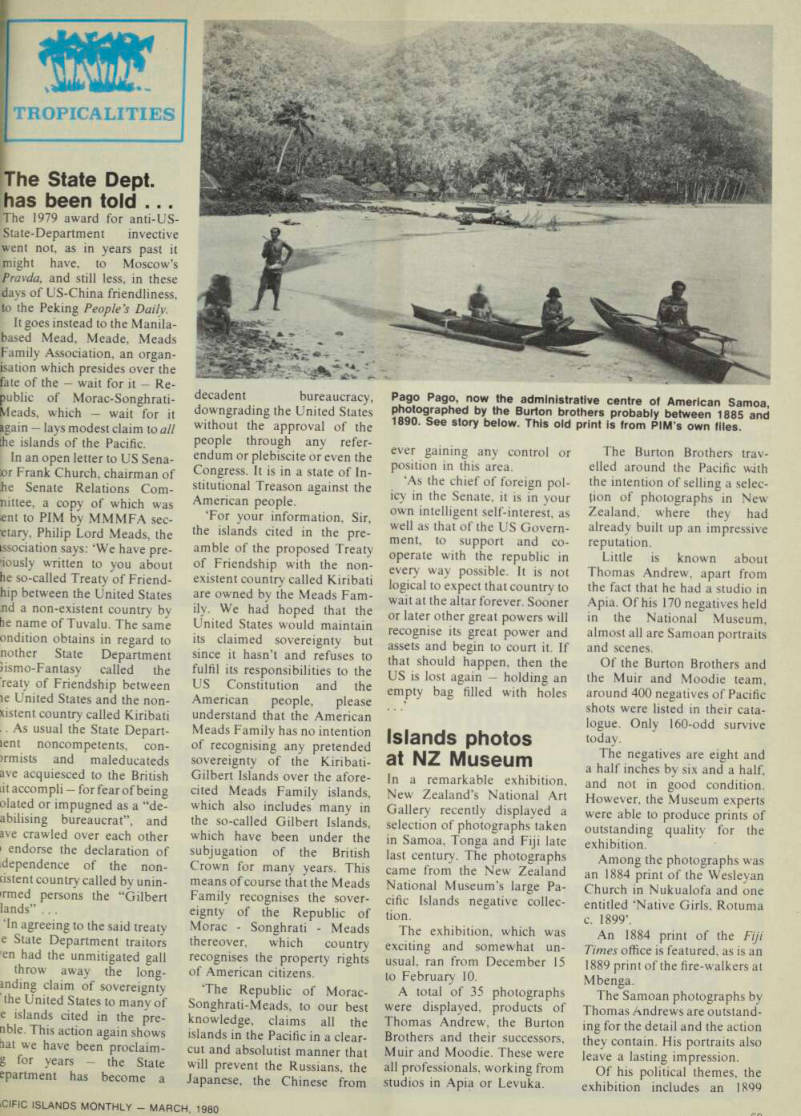
Tropicalities
The State Dept,
has been told ...
The 1979 award for anti-US- State-Department invective went not, as in years past it might have, to Moscow’s Pravda, and still less, in these days of US-China friendliness, to the Peking People's Daily.
It goes instead to the Manila based Mead, Meade, Meads Family Association, an organ isation which presides over the fate of the wait for it Re
public of Morac-Songhrati-
Meads, which wait for it again lays modest claim to all the islands of the Pacific.
In an open letter to US Sena ;or Frank Church, chairman of he Senate Relations Com nittee, a copy of which was ent to PIM by MMMFA sec tary, Philip Lord Meads, the issociation says: ‘We have pre viously written to you about he so-called Treaty of Friend hip between the United States nd a non-existent country by be name of Tuvalu. The same ondition obtains in regard to
nother State Department
nsmo-Fantasy called the reaty of Friendship between te United States and the non xistent country called Kiribati .. As usual the State Depart ment noncompetents, con irmists and maleducateds ave acquiesced to the British lit accompli - for fear of being olated or impugned as a “de abilising bureaucrat”, and ave crawled over each other • endorse the declaration of dependence of the non dstent country called by unm anned persons the “Gilbert lands” ... ‘ln agreeing to the said treaty e State Department traitors r en had the unmitigated gall throw away the long
anding claim of sovereignty
the United States to many of e islands cited in the pre mie- This action again shows bat we have been proclaim g for years - the State epartment has become a
decadent bureaucracy,
downgrading the United States without the approval of the
people through any refer
endum or plebiscite or even the Congress. It is in a state of In stitutional Treason against the American people. ‘For your information, Sir, the islands cited in the pre amble of the proposed Treaty of Friendship with the non existent country called Kiribati are owned by the Meads Fam ily. We had hoped that the United States would maintain its claimed sovereignty but since it hasn’t and refuses to fulfil its responsibilities to the US Constitution and the American people, please understand that the American Meads Family has no intention of recognising any pretended sovereignty of the Kiribati- Gilbert Islands over the afore cited Meads Family islands, which also includes many in the so-called Gilbert Islands, which have been under the subjugation of the British Crown for many years. This means of course that the Meads Family recognises the sover eignty of the Republic of Morac - Songhrati - Meads thereover, which country recognises the property rights of American citizens.
The Republic of Morac- Songhrati-Meads, to our best knowledge, claims all the islands in the Pacific in a clear cut and absolutist manner that will prevent the Russians, the Japanese, the Chinese from
ever gaining any control or position in this area. ‘As the chief of foreign pol icy in the Senate, it is in your own intelligent self-interest, as well as that of the US Govern ment, to support and co operate with the republic in every way possible. It is not logical to expect that country to wait at the altar forever. Sooner or later other great powers will recognise its great power and assets and begin to court it. If that should happen, then the US is lost again holding an empty bag filled with holes
Islands photos
at NZ Museum
In a remarkable exhibition, New Zealand’s National Art
Gallery recently displayed a
selection of photographs taken in Samoa, Tonga and Fiji late last century. The photographs came from the New Zealand National Museum’s large Pa cific Islands negative collec tion.
The exhibition, which was exciting and somewhat un usual, ran from December 15 to February 10.
A total of 35 photographs were displayed, products of Thomas Andrew, the Burton Brothers and their successors, Muir and Moodie. These were
all professionals, working from
studios in Apia or Levuka.
The Burton Brothers trav elled around the Pacific with the intention of selling a selec tion of photographs in New Zealand, where they had already built up an impressive reputation.
Little is known about Thomas Andrew, apart from the fact that he had a studio in Apia. Of his 170 negatives held in the National Museum, almost all are Samoan portraits and scenes.
Of the Burton Brothers and the Muir and Moodie team, around 400 negatives of Pacific shots were listed in their cata logue. Only 160-odd survive
today.
The negatives are eight and a half inches by six and a half, and not in good condition.
However, the Museum experts were able to produce prints of
outstanding quality for the
exhibition.
Among the photographs was an 1884 print of the Wesleyan Church in Nukualofa and one entitled ‘Native Girls, Rotuma c. 1899’.
An 1884 print of the Fiji Times office is featured, as is an 1889 print of the fire-walkers at
Mbenga.
The Samoan photographs by
Thomas Andrews are outstand ing for the detail and the action they contain. His portraits also
leave a lasting impression.
Of his political themes, the exhibition includes an 1899
Pago Pago, now the administrative centre of American Samoa, photographed by the Burton brothers probably between 1885 and 1890. See story below. This old print is from PlM’s own files.
shot of a Samoan brigade opposing Mata’afa. and the various military activities at Mulinuu around 1899. There is
an outstanding picture entitled
‘Ceremonial Firings at American Take-over, Pago Pago. American Samoa 1904'.
An 1899 Burton Brothers print is memorable for its cap tion; ‘The Fair “Saumatani" (the Samoan Beauty with the
Languishing Eyes) and Mr
Bloomfield. Pago Pago, American Samoa’.
New Zealand’s Alexander Turnbull Library also has extensive Samoan photo graphic files, although the bulk of the material is related to the New Zealand take-over in 1914. - Mike Field
Back from the
‘dead’, all smiles
One day late last year I was sit ting at my desk in the PIM office when I got the message that a gentleman wanted to see me outside in the reception area. It appeared that we had wrongly reported him to be dead! I gripped the edge of my
desk, closed my eyes, and steeled myself for what is one of the real nightmares of the
journalist’s trade dealing
with people who have been prematurely killed off. Visions
of possible legal action against
the magazine swirled before me as I took one last gulp of my afternoon tea and went out to face the music.
And what music it was! I met
a smiling, charming chap
called Arthur Wordie whom I took to be about 70 (he is actu ally in his early 80s). He was treating the whole affair as if it were one of the funniest things that had happened to him in years. Far from thinking of suing us. he almost seemed ready to pay us a fee for giving him such a great giggle.
He explained that a friend at his bowling club had brought along the May 1979 issue of PIM in which in the People sec tion (p5O) his old mate Pat Carter had referred to him as ‘the late Arthur Wordie’. His
bowling colleague had
specially equipped himself
with a bunch of cut flowers for Arthur, ‘while you can still smell them’.
Arthur and Pat had been out
of touch for a long time and be cause of Arthur’s advancing years, and the fact that he hadn’t heard from him, Pat assumed wrongly that Arthur had gone off and ‘joined the
majority’.
The item about Pat Carter, long-time executive and founding shareholder of East-
West Airlines, concerned ‘twoi firsts and a 60th' in his long: life; the ‘6oth’ was his 60th tripe to Papua New Guinea ini March last year on the occasion! of Air Niugini’s farewell recep tion for its former general man ager Bryan Grey, and the two ‘firsts’ the fact that he is the holder of the first share issued in East-West Airlines in 1946. and that he sold the first ticket his company issued in 1947, to a Tamworth man, ‘the late Arthur Wordie’.
This is the second time I’ve been reported dead,’ Arthur told me with some enthusiasm ‘I used to be in the motor trade and a trade magazine alsc wrote me off a few years back Can't imagine why I attraci that kind of publicity. It’s a bit like pointing the bone, but i doesn’t worry me . ..’
All Arthur wanted us to dc was to set the record straight! which we do happily. He alsc hoped Pat Carter would reac it.
As for myself. I’d like tc thank Arthur Wordie for one of the pleasantest little inter views I’ve had in 30 years oi
journalism. Malcolm
Salmon
Arthur Wordie today
Polynesians
losing their skills
I The Polynesians, recognised as iexperts in traditional navi
gation, are in danger of losing
[their navigational skills, says a [former pilot with Air Pacific.
I The ex-pilot, who is also a
[medical practitioner and a
navigator, is Doctor Maxwell (Johnston, who has been doing volunteer work at Western Samoa’s National Hospital.
Dr Johnston, who is working his way from the South Pacific to North America, and, in between-times, climbing the mountains on Savaii, said the ancient peoples of Oceania used the stars, the sun. birds, ocean-swell patterns and cloud formations to navigate over great distances. But, today, the
young people were no longer
interested in acquiring tra
ditional lore, which, over the centuries, has been handed down from father to son.
It is an oral tradition. The Polynesians have for centuries transmitted traditional knowl edge by word of mouth, refus ing to commit their knowledge
to writing because they would
then lose esteem, a family’s honour being reflected in the amount of lore stored by the
family head.
But, says Dr Johnston, the young people, versed in mod ern ways of living and travel, are not interested in the tra ditional ways so that knowl edge is dying with those who have preserved it over the cen turies.
Dr Johnston, who graduated as a medical practitioner at the University of Otago (NZ) flew with Air Pacific (Fiji Airways) in the 19605.
In NZ, maybe
but not in Fiji!
According to ex-Police Inspec
tor Dr A. Moodie, secretary of the New Zealand Police As sociation, Polynesian men won’t wear the lavalava in New Zealand’s streets because they have been forced to ‘knuckle under’ to the dominant
European culture.
Just to prove that he wasn’t knuckling under to anyone, he wore a caftan, a long garment which looks like a maternity gown, to the Melbourne Cup
races. Far from being dis couraged by the wolf whistles and cries of ‘I like your dress, darling’, Dr Moodie is con templating wearing skirts and dresses. It’s all part of his con cern at the growing intolerance of people against those who won’t conform to the norm.
His comments anent the Polynesians in New Zealand wouldn’t wash in Fiji, however.
The Fijian sulu isn’t likely to go out of fashion, and the New Zealander, or the Melbourne racegoer, who greeted a Fijian man with T like your dress, darling’, would get a thick ear.
When a proposal was made in the 1960 s to ‘britch’ the Fijian police constables, and make them drop their serrated sulus in favour of shorts, there was a storm of protests. The idea, and not the sulu, was
dropped very quickly.
PNG’s ‘Think
Tank’going well
Papua New Guinea’s National Library, a year old on October 30, is rapidly gaining a world wide reputation for its unique
collection of Papua New Guineana, and recognition as the main repository for materials published anywhere in the world about Papua New Guinea or by Papua New Guineans, T . ...
H an , mde P en de"“ otthe people of Aus -3 la d 15 attracting a large ° f . users a " d v,sltors 3nd ltsse 7‘ ces are used “““ffr.by scholars, scien p ’. h ‘ stona " s and " nter s. , P 6 lrom the United States, i! apan 3nd anada as well as prom neighbouring islands have been consulting its vari “V“ lle< f ions ’ op b °oks, films, P enodlcals and documents, as b e h p ll , ! h no h reStriC,lon °” al,bou g h ’ because m u eb of > be col eet, ° n 15 rare , and valuabl «- Ca " “ > ‘ he ‘‘ brary buildm g’
The Reference Library is
developing rapidly and there
are now large collections of books from Britain, the United States, Canada and Japan. The National Library collection
expanded significantly recently
with the transfer to it of the li brary of the Prime Minister’s
Department
Advertisements & other items, pp. 69-71 (3 items)
‘Cific Islands Monthly March, 1980
1 E Piglfis S |
1 E PIGLfIS S
Epiglass Everdure Timber preservative and sealer.
Hardens, protects and densities timber.
Kills all mould spores and permanently seals out moisture. 2481 Epiglass 90 Epoxy Resin and glass cloth.
Easy to apply.
Strengthens hulls, eliminates water absorption and rot and increases the value and life of your boat. i
Epiglass E-Type
Antifouling.
Gives up to 12
months
growth-free
performance.
Racing
Blue, Green
and Gold.
COOK ISLANDS: Cook Island Trading Corporation Ltd FIJIAN ISLANDS: Burns Philp (SS) Co. Ltd NEW HEBRIDES: Burns Philp (NH) Ltd NOUMEA: Enterprise Guy Limousine NIUE ISLAND; Niue Island United PAGO PAGO: Max Haleck Inc, Burns Philp (SS) Ltd PAPUA NEW GUINEA; KIETA: Nikana Wholesalers, LAE: Faulkner-Tait (NG) Pty Ltd, MADANG: Burns Philp (NG) Co.
Ltd PORT MORESBY: S A. Heath Co. Ltd, Steamships Honda Centre. RABAUL: Elvee Trading Pty Ltd, WEWAK Burns Philp (P.N.G.) SOLOMON ISLANDS: P.K.R. Pacific Sales Co TAHITI: Marine Corail, Tahiti Sport, Comptior Polynesien TONGA; Burns Philp (SS) Co Ltd WESTERN SAMOA: Burns Philp (SS) Co Ltd, E. A. Coxon Ltd, Gold Star Transport Co. Ltd, Morris Hedstrom Ltd.
NORFOLK ISLAND; Irvines Building Supplies 2481
Tropicalities
71
ISLANDS MONTHLY MARCH, 1980
inter-island shipping problems
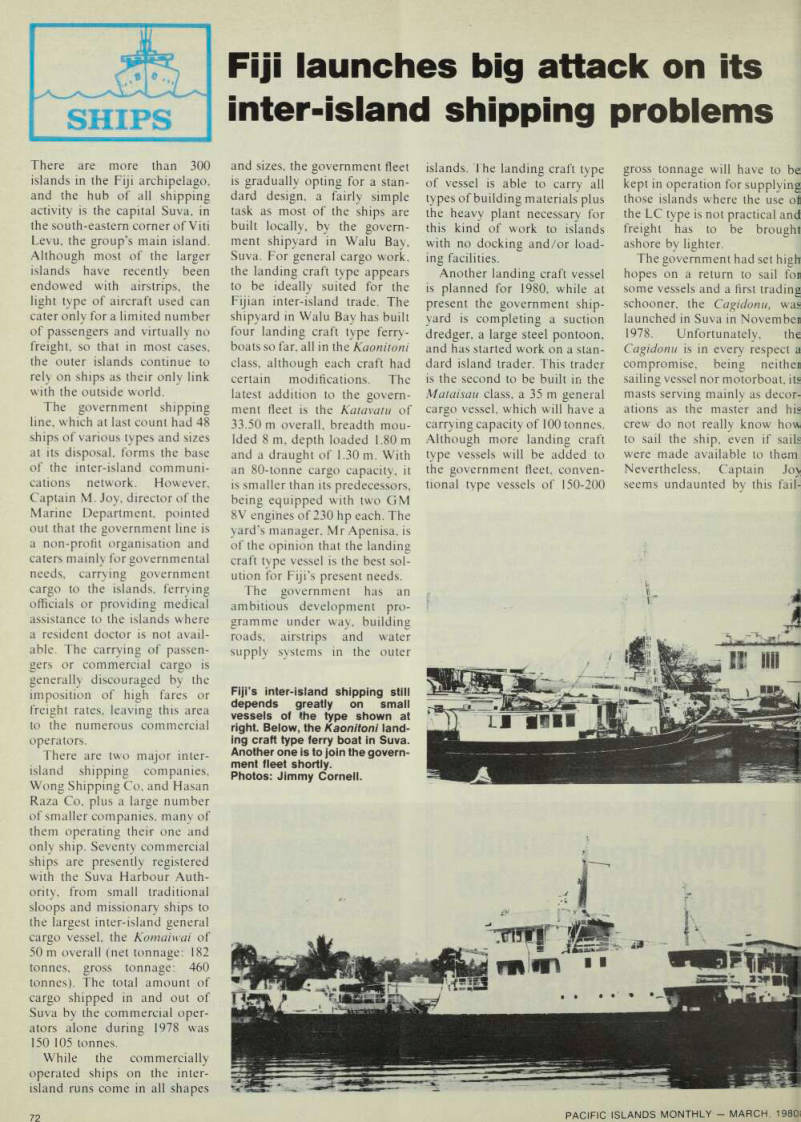
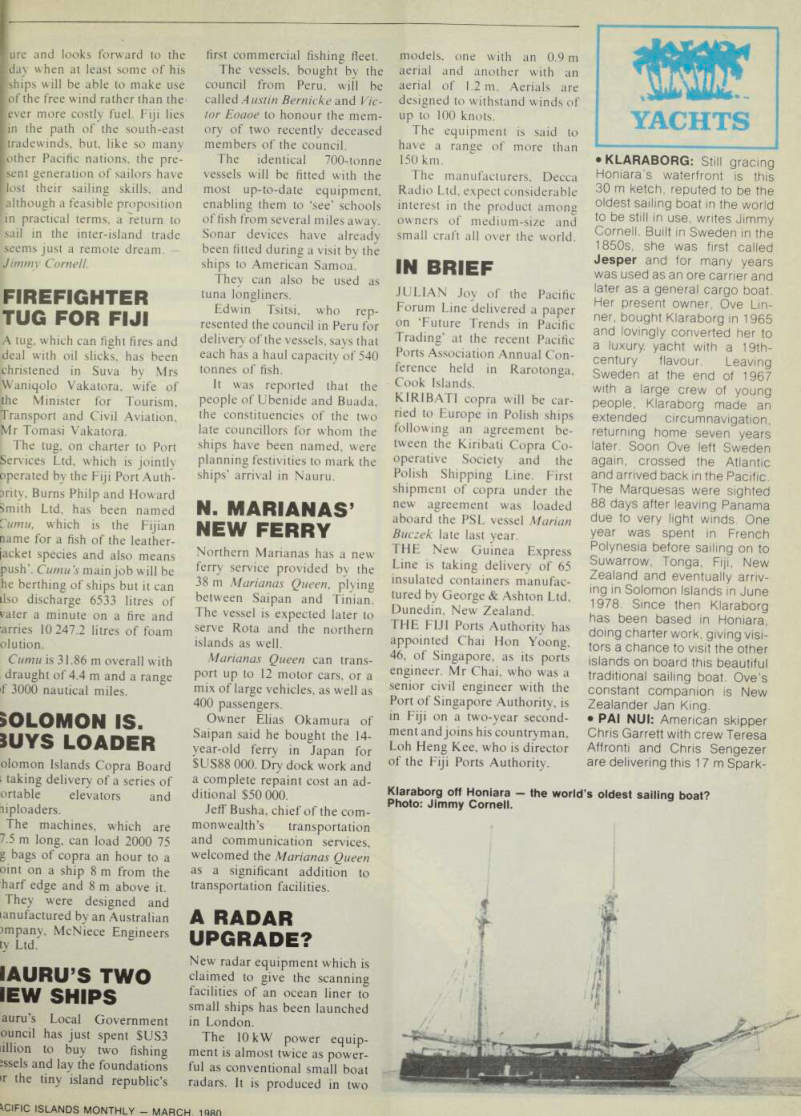
Ships
Fiji launches big attack on its inter-island shipping problems
There are more than 300 islands in the Fiji archipelago, and the hub of all shipping activity is the capital Suva, in the south-eastern corner of Viti Levu, the group’s main island.
Although most of the larger islands have recently been endowed with airstrips, the light type of aircraft used can cater only for a limited number of passengers and virtually no freight, so that in most cases, the outer islands continue to rely on ships as their only link with the outside world.
The government shipping line, which at last count had 48 ships of various types and sizes at its disposal, forms the base of the inter-island communi cations network. However, Captain M. Joy, director of the Marine Department, pointed out that the government line is
a non-profit organisation and
caters mainly for governmental
needs, carrying government cargo to the islands, ferrying officials or providing medical assistance to the islands where a resident doctor is not avail able. The carrying of passen gers or commercial cargo is
generally discouraged by the
imposition of high fares or freight rates, leaving this area to the numerous commercial operators.
There are two major inter
island shipping companies,
Wong Shipping Co, and Hasan Raza Co, plus a large number of smaller companies, many of them operating their one and
only ship. Seventy commercial
ships are presently registered
with the Suva Harbour Auth ority, from small traditional
sloops and missionary ships to
the largest inter-island general
cargo vessel, the Komaiwai of 50 m overall (net tonnage: 182 tonnes, gross tonnage: 460 tonnes). The total amount of cargo shipped in and out of Suva by the commercial oper ators alone during 1978 was 150 105 tonnes.
While the commercially operated ships on the inter island runs come in all shapes
and sizes, the government fleet is gradually opting for a stan
dard design, a fairly simple
task as most of the ships are built locally, by the govern ment shipyard in Walu Bay, Suva. For general cargo work, the landing craft type appears to be ideally suited for the Fijian inter-island trade. The shipyard in Walu Bay has built four landing craft type ferry boats so far, all in the Kaonitoni class, although each craft had certain modifications. The latest addition to the govern ment fleet is the Katavatu of 33.50 m overall, breadth mou lded 8 m, depth loaded 1.80 m and a draught of 1.30 m. With an 80-tonne cargo capacity, it is smaller than its predecessors, being equipped with two GM 8V engines of 230 hp each. The yard’s manager, Mr Apenisa, is of the opinion that the landing craft type vessel is the best sol ution for Fiji’s present needs.
The government has an ambitious development pro gramme under way, building roads, airstrips and water supply systems in the outer
islands. The landing craft type of vessel is able to carry all types of building materials plus the heavy plant necessary for this kind of work to islands with no docking and/or load
ing facilities.
Another landing craft vessel is planned for 1980, while at present the government ship yard is completing a suction dredger, a large steel pontoon, and has started work on a stan dard island trader. This trader is the second to be built in the Mataisau class, a 35 m general cargo vessel, which will have a carrying capacity of 100 tonnes.
Although more landing craft type vessels will be added to the government fleet, conven tional type vessels of 150-200
gross tonnage will have to be kept in operation for supplying those islands where the use ofl the LC type is not practical and freight has to be brought
ashore by lighter.
The government had set high hopes on a return to sail for some vessels and a first trading schooner, the Cagidonu, was launched in Suva in November 1978. Unfortunately, the Cagidonu is in every respect a compromise, being neither sailing vessel nor motorboat, its masts serving mainly as decor ations as the master and his crew do not really know how to sail the ship, even if sails were made available to them
Nevertheless, Captain Joy
seems undaunted by this fail-
Fiji’s inter-island shipping still depends greatly on small vessels of the type shown at right. Below, the Kaonitoni land ing craft type ferry boat in Suva.
Another one is to join the govern ment fleet shortly.
Photos: Jimmy Cornell.
ure and looks forward to the day when at least some of his [ships will be able to make use of the free wind rather than the ever more costly fuel. Fiji lies in the path of the south-east tradewinds, but, like so many other Pacific nations, the pre sent generation of sailors have [lost their sailing skills, and
[although a feasible proposition
in practical terms, a return to ■sail in the inter-island trade seems just a remote dream.
Jimmy Cornell.
Firefighter
Tug For Fiji
A tug, which can fight fires and deal with oil slicks, has been christened in Suva by Mrs Waniqolo Vakatora, wife of the Minister for Tourism.
Transport and Civil Aviation, Mr Tomasi Vakatora.
The tug, on charter to Port Services Ltd, which is jointly
operated by the Fiji Port Auth
ority, Burns Philp and Howard Smith Ltd. has been named Cumu, which is the Fijian name for a fish of the leather jacket species and also means push’. Cumu’s main job will be he berthing of ships but it can ilso discharge 6533 litres of vater a minute on a fire and :arries 10 247.2 litres of foam olution.
Cumu is 31.86 m overall with draught of 4.4 m and a range f 3000 nautical miles.
Solomon Is.
Suys Loader
olomon Islands Copra Board ; taking delivery of a series of ortable elevators and
niploaders.
The machines, which are 7.5 m long, can load 2000 75 g bags of copra an hour to a oint on a ship 8 m from the harf edge and 8 m above it.
They were designed and
lanufactured by an Australian
)mpany, McNiece Engineers ty Ltd.
Iauru’S Two
Lew Ships
auru’s Local Government ouncil has just spent SUS 3
lillion to buy two fishing
issels and lay the foundations
>r the tiny island republic’s
first commercial fishing fleet.
The vessels, bought by the council from Peru, will be called A ustin Bernicke and Vic tor Eoaoe to honour the mem ory of two recently deceased members of the council.
The identical 700-tonne vessels will be fitted with the most up-to-date equipment, enabling them to ‘see’ schools of fish from several miles away.
Sonar devices have already been fitted during a visit by the ships to American Samoa.
They can also be used as
tuna longliners.
Edwin Tsitsi, who rep resented the council in Peru for delivery of the vessels, says that each has a haul capacity of 540 tonnes of fish.
It was reported that the people of Übenide and Buada, the constituencies of the two late councillors for whom the ships have been named, were planning festivities to mark the ships’ arrival in Nauru.
N. Marianas’
New Ferry
Northern Marianas has a new ferry service provided by the 38 m Marianas Queen, plying between Saipan and Tinian.
The vessel is expected later to serve Rota and the northern islands as well.
Marianas Queen can trans port up to 12 motor cars, or a mix of large vehicles, as well as 400 passengers.
Owner Elias Okamura of Saipan said he bought the 14year-old ferry in Japan for SUSBB 000. Dry dock work and a complete repaint cost an ad ditional $5O 000.
Jeff Busha, chief of the com
monwealth’s transportation
and communication services, welcomed the Marianas Queen as a significant addition to transportation facilities.
Radar
Upgrade?
New radar equipment which is claimed to give the scanning facilities of an ocean liner to small ships has been launched in London.
The 10 kW power equip ment is almost twice as power ful as conventional small boat radars. It is produced in two
models, one with an 0.9 m aerial and another with an aerial of 1.2 m. Aerials are designed to withstand winds of up to 100 knots.
The equipment is said to have a range of more than 150 km.
The manufacturers, Decca Radio Ltd, expect considerable interest in the product among owners of medium-size and small craft all over the world.
In Brief
JULIAN Joy of the Pacific Forum Line delivered a paper on ‘Future Trends in Pacific Trading’ at the recent Pacific Ports Association Annual Con ference held in Rarotonga, Cook Islands.
KIRIBATI copra will be car ried to Europe in Polish ships following an agreement be tween the Kiribati Copra Co operative Society and the Polish Shipping Line. First shipment of copra under the new agreement was loaded aboard the PSL vessel Mahan Buczek late last year.
THE New Guinea Express Line is taking delivery of 65 insulated containers manufac tured by George & Ashton Ltd, Dunedin, New Zealand.
THE FIJI Ports Authority has
appointed Chai Hon Yoong,
46, of Singapore, as its ports engineer. Mr Chai, who was a senior civil engineer with the Port of Singapore Authority, is in Fiji on a two-year second ment and joins his countryman, Loh Heng Kee, who is director of the Fiji Ports Authority.
Yachts
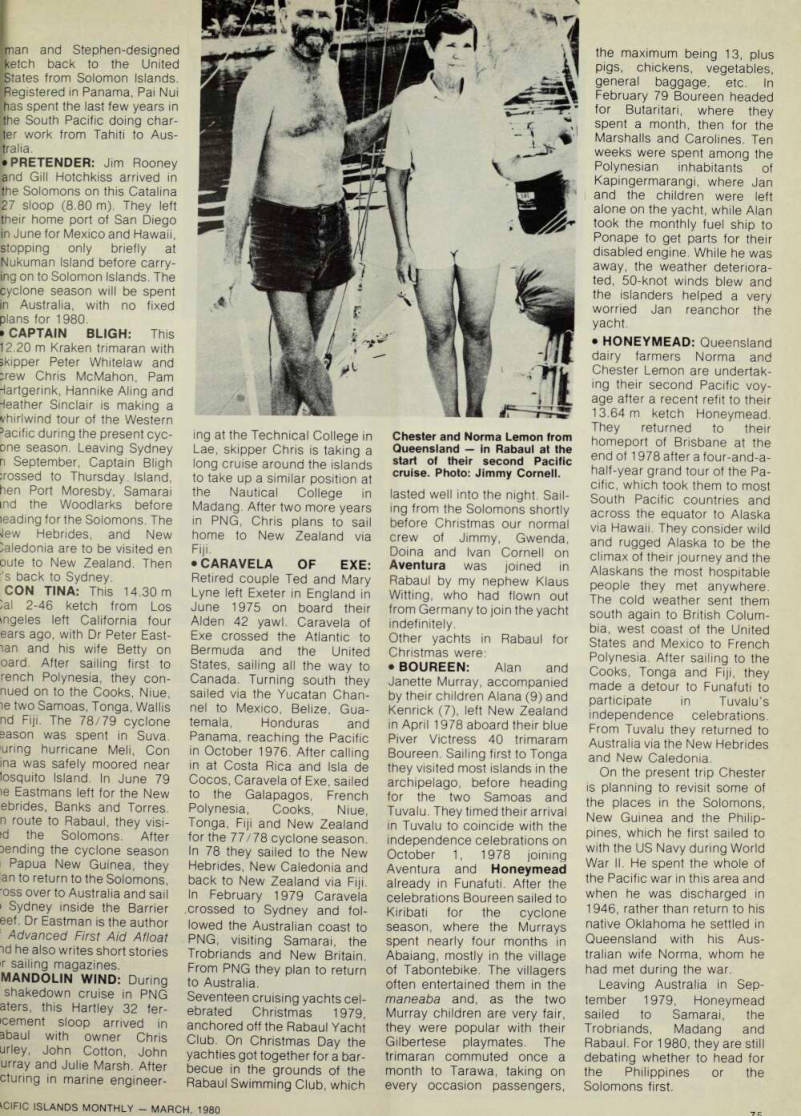
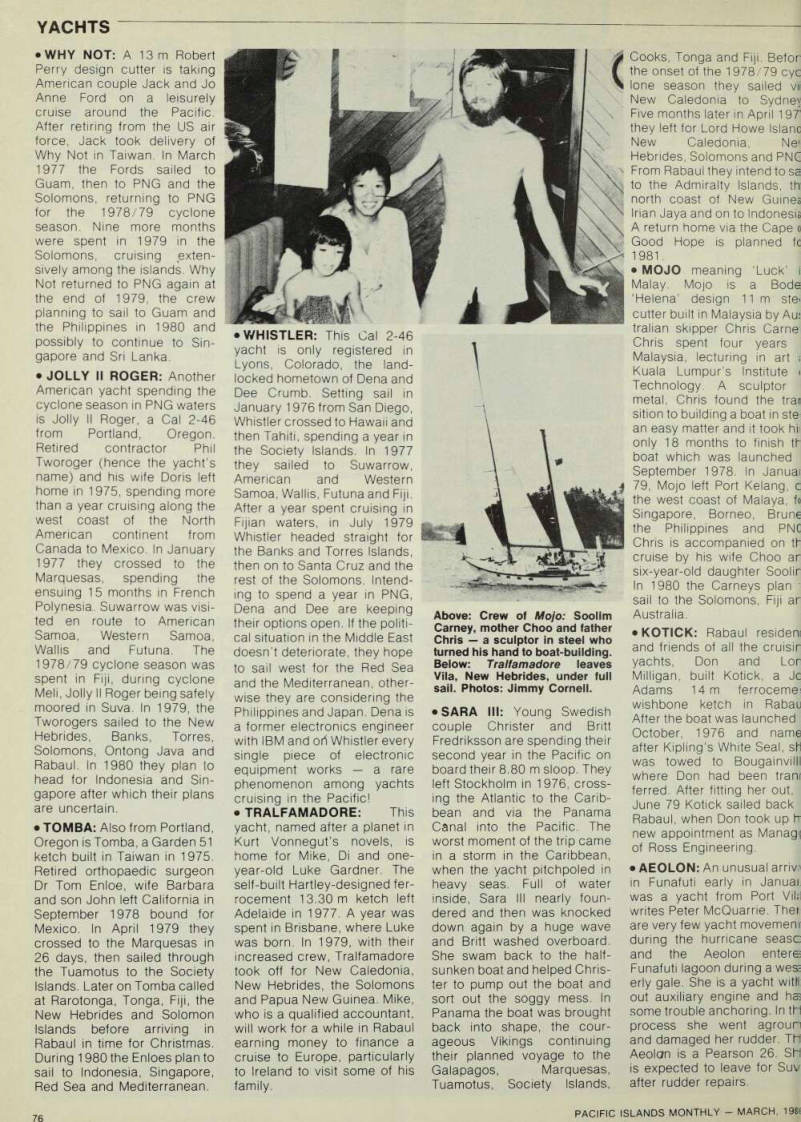
• KLARABORG: Still gracing Honiara’s waterfront is this 30 m ketch, reputed to be the oldest sailing boat in the world to be still in use, writes Jimmy Cornell. Built in Sweden in the 1850 s, she was first called Jesper and for many years was used as an ore carrier and later as a general cargo boat.
Her present owner, Ove Lin ner, bought Klaraborg in 1965 and lovingly converted her to a luxury, yacht with a 19th century flavour. Leaving Sweden at the end of 1967 with a large crew of young people, Klaraborg made an
extended circumnavigation,
returning home seven years later. Soon Ove left Sweden again, crossed the Atlantic and arrived back in the Pacific.
The Marquesas were sighted 88 days after leaving Panama due to very light winds. One year was spent in French Polynesia before sailing on to Suwarrow, Tonga, Fiji, New Zealand and eventually arriv ing in Solomon Islands in June 1978. Since then Klaraborg has been based in Honiara, doing charter work, giving visi tors a chance to visit the other islands on board this beautiful traditional sailing boat. Ove’s constant companion is New Zealander Jan King, • PAI NUI: American skipper Chris Garrett with crew Teresa Affronti and Chris Sengezer are delivering this 17 m Spark-
Klaraborg off Honiara - the world’s oldest sailing boat?
Photo: Jimmy Cornell.
irrian and Stephen-designed . ketch back to the United [States from Solomon Islands. [Registered in Panama, Pai Nui [has spent the last few years in the South Pacific doing char ter work from Tahiti to Aus tralia. • PRETENDER: Jim Rooney and Gill Hotchkiss arrived in the Solomons on this Catalina 27 sloop (8.80 m). They left their home port of San Diego in June for Mexico and Hawaii, stopping only briefly at Nukuman Island before carry ing on to Solomon Islands. The cyclone season will be spent in Australia, with no fixed plans for 1980.
• Captain Bligh: This
12.20 m Kraken trimaran with skipper Peter Whitelaw and :rew Chris McMahon, Pam Hartgerink, Hannike Aling and Heather Sinclair is making a vhirlwind tour of the Western Pacific during the present cyc one season. Leaving Sydney n September, Captain Bligh irossed to Thursday. Island, hen Port Moresby, Samarai md the Woodlarks before leading for the Solomons. The Jew Hebrides, and New Caledonia are to be visited en oute to New Zealand. Then :’s back to Sydney.
CON TINA: This 14.30 m )al 2-46 ketch from Los mgeles left California four ears ago, with Dr Peter East lan and his wife Betty on card. After sailing first to rench Polynesia, they con nued on to the Cooks, Niue, le two Samoas, Tonga, Wallis nd Fiji. The 78/79 cyclone sason was spent in Suva, uring hurricane Meli, Con ina was safely moored near losquito Island. In June 79 le Eastmans left for the New ebrides, Banks and Torres, n route to Rabaul, they visi id the Solomons. After sending the cyclone season Papua New Guinea, they an to return to the Solomons, 'oss over to Australia and sail • Sydney inside the Barrier eef. Dr Eastman is the author : Advanced First Aid Afloat id he also writes short stories t sailing magazines.
Mandolin Wind: During
shakedown cruise in PNG aters, this Hartley 32 fer •cement sloop arrived in abaul with owner Chris urley, John Cotton, John urray and Julie Marsh. After cturing in marine engineer-
ing at the Technical College in Lae, skipper Chris is taking a long cruise around the islands to take up a similar position at the Nautical College in Madang. After two more years in PNG, Chris plans to sail home to New Zealand via Fiji.
•Caravela Of Exe:
Retired couple Ted and Mary Lyne left Exeter in England in June 1975 on board their Alden 42 yawl. Caravela of Exe crossed the Atlantic to Bermuda and the United States, sailing all the way to Canada. Turning south they sailed via the Yucatan Chan nel to Mexico, Belize, Gua temala, Honduras and Panama, reaching the Pacific in October 1976. After calling in at Costa Rica and Isla de Cocos, Caravela of Exe, sailed to the Galapagos, French Polynesia, Cooks, Niue, Tonga, Fiji and New Zealand for the 77/78 cyclone season.
In 78 they sailed to the New Hebrides, New Caledonia and back to New Zealand via Fiji.
In February 1979 Caravela crossed to Sydney and fol lowed the Australian coast to PNG, visiting Samarai, the Trobriands and New Britain.
From PNG they plan to return to Australia.
Seventeen cruising yachts cel ebrated Christmas 1979, anchored off the Rabaul Yacht Club. On Christmas Day the yachties got together for a bar becue in the grounds of the Rabaul Swimming Club, which
lasted well into the night. Sail ing from the Solomons shortly before Christmas our normal crew of Jimmy, Gwenda, Doina and Ivan Cornell on Aventura was joined in Rabaul by my nephew Klaus Witting, who had flown out from Germany to join the yacht indefinitely.
Other yachts in Rabaul for Christmas were: • BOUREEN; Alan and Janette Murray, accompanied by their children Alana (9) and Kenrick (7), left New Zealand in April 1978 aboard their blue Piver Victress 40 trimaram Boureen. Sailing first to Tonga they visited most islands in the archipelago, before heading for the two Samoas and Tuvalu. They timed their arrival in Tuvalu to coincide with the independence celebrations on October 1, 1978 joining Aventura and Honeymead already in Funafuti. After the celebrations Boureen sailed to Kiribati for the cyclone season, where the Murrays spent nearly four months in Abaiang, mostly in the village of Tabontebike. The villagers often entertained them in the maneaba and, as the two Murray children are very fair, they were popular with their Gilbertese playmates. The trimaran commuted once a month to Tarawa, taking on every occasion passengers,
the maximum being 13, plus pigs, chickens, vegetables, general baggage, etc. In February 79 Boureen headed for Butaritari, where they spent a month, then for the Marshalls and Carolines. Ten weeks were spent among the Polynesian inhabitants of Kapingermarangi, where Jan and the children were left alone on the yacht, while Alan took the monthly fuel ship to Ponape to get parts for their disabled engine. While he was away, the weather deteriora ted, 50-knot winds blew and the islanders helped a very worried Jan reanchor the yacht. • HONEYMEAD: Queensland dairy farmers Norma and Chester Lemon are undertak ing their second Pacific voy age after a recent refit to their 13.64 m ketch Honeymead.
They returned to their homeport of Brisbane at the end of 1978 after a four-and-a half-year grand tour of the Pa cific, which took them to most South Pacific countries and across the equator to Alaska via Hawaii. They consider wild and rugged Alaska to be the climax of their journey and the Alaskans the most hospitable people they met anywhere.
The cold weather sent them south again to British Colum bia, west coast of the United States and Mexico to French Polynesia. After sailing to the Cooks, Tonga and Fiji, they made a detour to Funafuti to participate in Tuvalu’s independence celebrations.
From Tuvalu they returned to Australia via the New Hebrides and New Caledonia.
On the present trip Chester is planning to revisit some of the places in the Solomons, New Guinea and the Philip pines, which he first sailed to with the US Navy during World War 11. He spent the whole of the Pacific war in this area and when he was discharged in 1946, rather than return to his native Oklahoma he settled in Queensland with his Aus tralian wife Norma, whom he had met during the war.
Leaving Australia in Sep tember 1979, Honeymead sailed to Samarai, the Trobriands, Madang and Rabaul. For 1980, they are still debating whether to head for the Philippines or the Solomons first.
Chester and Norma Lemon from Queensland in Rabaul at the start of their second Pacific cruise. Photo: Jimmy Cornell.
• WHY NOT: A 13 m Robert Perry design cutter is taking American couple Jack and Jo Anne Ford on a leisurely cruise around the Pacific.
After retiring from the US air force, Jack took delivery of Why Not in Taiwan. In March 1977 the Fords sailed to Guam, then to PNG and the Solomons, returning to PNG for the 1978/79 cyclone season. Nine more months were spent in 1979 in the Solomons, cruising exten sively among the islands. Why Not returned to PNG again at the end of 1979, the crew planning to sail to Guam and the Philippines in 1980 and possibly to continue to Sin gapore and Sri Lanka. • JOLLY II ROGER: Another American yacht spending the cyclone season in PNG waters is Jolly II Roger, a Cal 2-46 from Portland, Oregon.
Retired contractor Phil Tworoger (hence the yacht’s name) and his wife Doris left home in 1975, spending more than a year cruising along the west coast of the North American continent from Canada to Mexico. In January 1977 they crossed to the Marquesas, spending the ensuing 15 months in French Polynesia. Suwarrow was visi ted en route to American Samoa, Western Samoa, Wallis and Futuna. The 1978/79 cyclone season was spent in Fiji, during cyclone Meli, Jolly II Roger being safely moored in Suva. In 1979, the Tworogers sailed to the New Hebrides, Banks, Torres, Solomons, Ontong Java and Rabaul. In 1980 they plan to head for Indonesia and Sin gapore after which their plans are uncertain. • TOMBA: Also from Portland, Oregon is Tomba, a Garden 51 ketch built in Taiwan in 1975.
Retired orthopaedic surgeon Dr Tom Enloe, wife Barbara and son John left California in September 1978 bound for Mexico. In April 1979 they crossed to the Marquesas in 26 days, then sailed through the Tuamotus to the Society Islands. Later on Tomba called at Rarotonga, Tonga, Fiji, the New Hebrides and Solomon Islands before arriving in Rabaul in time for Christmas.
During 1980 the Enloes plan to sail to Indonesia, Singapore, Red Sea and Mediterranean.
• WHISTLER: This Cal 2-46 yacht is only registered in Lyons, Colorado, the land locked hometown of Dena and Dee Crumb. Setting sail in January 1976 from San Diego, Whistler crossed to Hawaii and then Tahiti, spending a year in the Society Islands. In 1977 they sailed to Suwarrow, American and Western Samoa, Wallis, Futuna and Fiji.
After a year spent cruising in Fijian waters, in July 1979 Whistler headed straight for the Banks and Torres Islands, then on to Santa Cruz and the rest of the Solomons. Intend ing to spend a year in PNG, Dena and Dee are keeping their options open. If the politi cal situation in the Middle East doesn’t deteriorate, they hope to sail west for the Red Sea and the Mediterranean, other wise they are considering the Philippines and Japan. Dena is a former electronics engineer with IBM and oh Whistler every single piece of electronic equipment works a rare phenomenon among yachts cruising in the Pacific!
• Tralfamadore: This
yacht, named after a planet in Kurt Vonnegut’s novels, is home for Mike, Di and one year-old Luke Gardner. The self-built Hartley-designed fer rocement 13.30 m ketch left Adelaide in 1977. A year was spent in Brisbane, where Luke was born. In 1979, with their increased crew, Tralfamadore took off for New Caledonia, New Hebrides, the Solomons and Papua New Guinea. Mike, who is a qualified accountant, will work for a while in Rabaul earning money to finance a cruise to Europe, particularly to Ireland to visit some of his family.
• SARA III: Young Swedish couple Christer and Britt Fredriksson are spending their second year in the Pacific on board their 8.80 m sloop. They left Stockholm in 1976, cross ing the Atlantic to the Carib bean and via the Panama Canal into the Pacific. The worst moment of the trip came in a storm in the Caribbean, when the yacht pitchpoled in heavy seas. Full of water inside, Sara 111 nearly foun dered and then was knocked down again by a huge wave and Britt washed overboard.
She swam back to the half sunken boat and helped Chris ter to pump out the boat and sort out the soggy mess. In Panama the boat was brought back into shape, the cour ageous Vikings continuing their planned voyage to the Galapagos, Marquesas, Tuamotus, Society Islands,
Cooks, Tonga and Fiji. Befor the onset of the 1978/79 eye lone season they sailed vii New Caledonia to Sydnev Five months later in April 197' they left for Lord Howe Islanc New Caledonia, Ne' Hebrides, Solomons and PNG From Rabaul they intend to sa to the Admiralty Islands, thr north coast of New Guinea Irian Jaya and on to Indonesia A return home via the Cape o Good Hope is planned fc 1981. • MOJO meaning ‘Luck’ i Malay. Mojo is a Bode ‘Helena’ design 11 m ste« cutter built in Malaysia by Au: tralian skipper Chris Came' Chris spent four years Malaysia, lecturing in art i Kuala Lumpur’s Institute « Technology. A sculptor metal, Chris found the tran sition to building a boat in ste an easy matter and it took hii only 18 months to finish th boat which was launched September 1978. In Januai 79, Mojo left Port Kelang, c the west coast of Malaya, fo Singapore, Borneo, Brune the Philippines and PNC Chris is accompanied on th cruise by his wife Choo ar six-year-old daughter Soolir In 1980 the Carneys plan ■ sail to the Solomons, Fiji ar Australia. • KOTICK: Rabaul residem and friends of all the cruisir yachts, Don and Lor Milligan, built Kotick, a Jc Adams 14 m ferrocemei wishbone ketch in Rabau After the boat was launched October, 1976 and name after Kipling’s White Seal, sh was towed to Bougainvilll where Don had been tram ferred. After fitting her out, June 79 Kotick sailed back Rabaul, when Don took up hr new appointment as Managi of Ross Engineering. • AEOLON: An unusual arrive in Funafuti early in Januai was a yacht from Port Vihl writes Peter McQuarrie. Then are very few yacht movement during the hurricane seasc and the Aeolon enters Funafuti lagoon during a wes= erly gale. She is a yacht witH out auxiliary engine and hs some trouble anchoring. In th process she went agroun and damaged her rudder. Th Aeolan is a Pearson 26. Sh is expected to leave for Suv after rudder repairs.
Above: Crew of Mojo: Soolim Carney, mother Choo and father Chris a sculptor in steel who turned his hand to boat-building.
Below: Tralfamadore leaves Vila, New Hebrides, under full sail. Photos: Jimmy Cornell.
Advertisements & other items, pp. 73-75 (3 items)
Vcific Islands Monthly March Iqftn
Agencies Ltd
Perex
Specialists in KITSET FURNITURE.
PACIFIC AGENTS "Personality” Brand.
Perex Kraft "Alternative” Caskets Comer Bunks $ - converts to two single beds
BRANCHES NOW OPEN IN QUEENSLAND
at 3255 PACIFIC HIGHWAY - UNDERWOOD
Perex Agencies Ltd 87 Fort St Auckland Phone 795-872 Telex Ex Inst. NZ 21796 Perex
PLEASE SUPPLY ME WITH FURTHER DETAILS
NAME
ADDRESS
"I I I I I Lm ---pirn
w
WHANGAREI ENGINEERING & CONSTRUCTION
LTD. 0
A. Dillingham Affiliate
SHIPBUILDERS & GKNKRAL KNGINKKRS
Port Road, Whangarei, New Zealand - P.O. BOX 24
TELEPHONE 82-219- TELEX N.Z. 21578.
NEW
ZEALAND'S
LEADING
SHIPYARD
SHIP DESIGN AND BUILD:
Complete Facility.
SHIP REPAIR:
Quick Turn-around. AH trades integrated. 1,700 t Slipway Available.
TAM ROC’
HYBRID PIGS FOR THE PACIFIC BASIN
Hardy sunburn resistant prolific excellent foragers.
A new red-gold hybrid pig espcially developed for tropical Pacific Island conditions.
This new breeding strain has been developed from imported pedigree Duroc-Jersey and Tamworth varieties.
Young breeding stock now available.
For further information write to:
SPRINGFIELD FARM, P.O. BOX 18-050, GLEN
INNES, AUCKLAND 6, NEW ZEALAND.
WeVe just made
the ocean smaller!
Polynesia Line's new MS Polynesia 550-container ship provides regular monthly cargo service between Papeete, Pago.Pago and Apia in the South Pacific, and Long Beach and Oakland on the US Pacific Coast.
POLYNESIM.INE
Furness Interocean Corporation, General Agent £ \9 & K .s Long Beach Sk S& K 3 5* % v Apia Pago Pago Serving Polynesia is all we do—and we do it better!
Pat Agents Papeete Morgan-Vemex Boite Postal© 449 , Tahiti Cable "MOREX"
Pago Pago Polynesia Shipping Services, tnc.
POBox 1478 Pago Pago, American Samoa 96799 Gobi© “FOLYSHiP' Apia Union Steam Slip Co of New Zealand POBox 50 Apia, Western Samoa Cable "UNION"
San Francisco Furness Interocean Corporation 465 California Street, Suite 10)1 San Francisco, CA 94104 (416) 398-2000 Cable "INTERCO"
Long Beach Fumess Interocean Corporation West Ocean Boulevard, Suite 700 Long Beach. CA 90802 {213)435-7601 Cable "INTERCO"
75
ISLANDS MONTHLY - MARCH, 1980
Services
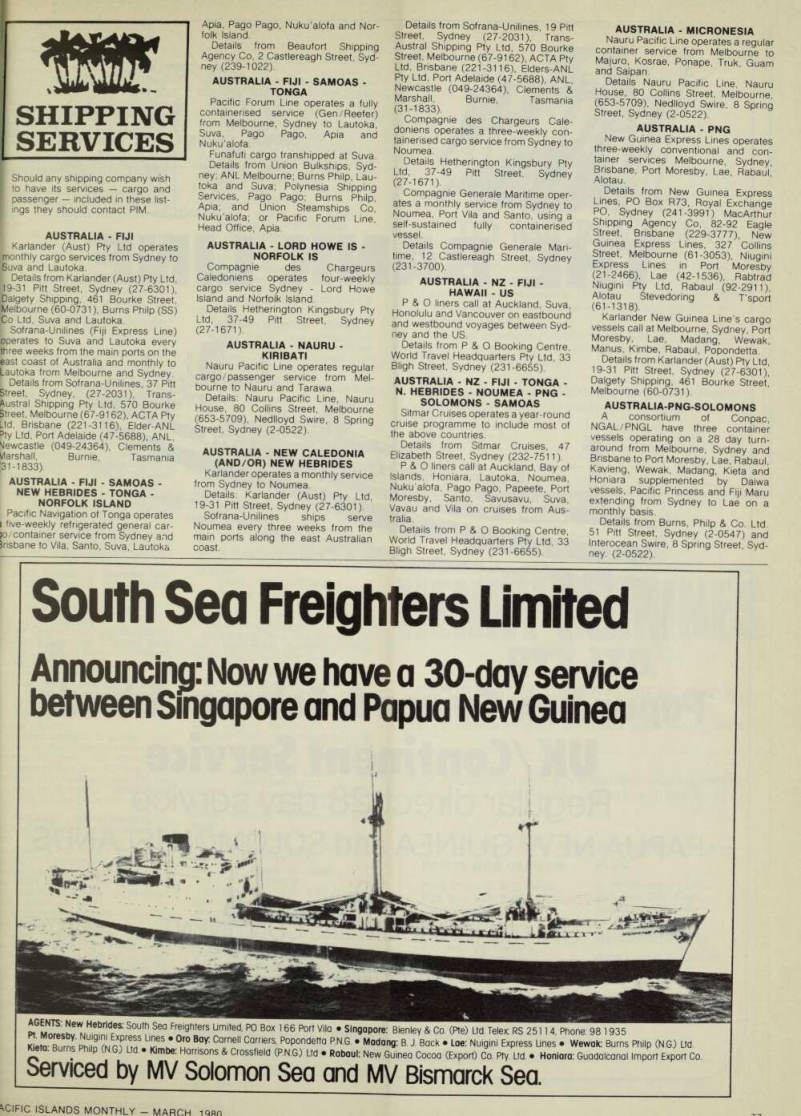
Shipping
Should any shipping company wish to have its services cargo and !( passenger included in these list ings they should contact PIM
Australia - Fiji
[ Karlander (Aust) Pty Ltd operates [monthly cargo services from Sydney to [Suva and Lautoka.
I Details from Karlander (Aust) Pty Ltd [l9-31 Pitt Street, Sydney (27-6301), Dalgety Shipping, 461 Bourke Street, Melbourne (60-0731), Burns Philp (SS) ICo Ltd, Suva and Lautoka. [ Sofrana-Unilines (Fiji Express Line) operates to Suva and Lautoka every three weeks from the main ports on the east coast of Australia and monthly to |.autoka from Melbourne and Sydney.
Details from Sofrana-Unilines, 37 Pitt Street, Sydney, (27-2031), Trans- Austral Shipping Pty Ltd, 570 Bourke Street, Melbourne (67-9162), ACTA Pty Ltd, Brisbane (221-3116), Elder-ANL Pty Ltd, Port Adelaide (47-5688), ANL, Newcastle (049-24364), Clements & Marshall, Burnie, Tasmania '3l-1833).
Australia - Fiji - Samoas -
New Hebrides - Tonga -
Norfolk Island
Pacific Navigation of Tonga operates i five-weekly refrigerated general car |o/container service from Sydney and Jrisbane to Vila, Santo, Suva, Lautoka
Apia, Pago Pago, Nukualofa and Nor folk Island.
Details from Beaufort Shipping Agency Co, 2 Castlereagh Street, Syd ney (239-1022).
Australia - Fiji - Samoas -
Tonga
Pacific Forum Line operates a fully containerised service (Gen/Reefer) from Melbourne, Sydney to Lautoka, Suva, Pago Pago, Apia and Nukualofa.
Funafuti cargo transhipped at Suva, Details from Union Bulkships, Syd ney; ANL Melbourne; Burns Philp. Lau toka and Suva: Polynesia Shipping Services, Pago Pago; Burns Philp, Apia; and Union Steamships Co, Nukualofa; or Pacific Forum Line, Head Office, Apia.
Australia - Lord Howe Is -
Norfolk Is
Compagnie des Chargeurs Caledoniens operates four-weekly cargo service Sydney - Lord Howe Island and Norfolk Island.
Details Hetherington Kingsbury Pty Ltd, 37-49 Pitt Street, Sydney (27-1671).
Australia - Nauru -
Kiribati
Nauru Pacific Line operates regular cargo/passenger service from Mel bourne to Nauru and Tarawa.
Details: Nauru Pacific Line, Nauru House, 80 Collins Street, Melbourne (653-5709), Nedlloyd Swire, 8 Spring Street, Sydney (2-0522).
Australia - New Caledonia
(And/Or) New Hebrides
Karlander operates a monthly service from Sydney to Noumea.
Details: Karlander (Aust) Pty Ltd 19-31 Pitt Street. Sydney (27-6301).
Sofrana-Unilines ships serve Noumea every three weeks from the main ports along the east Australian coast.
Details from Sofrana-Unilines, 19 Pitt Street, Sydney (27-2031), Trans- Austral Shipping Pty Ltd, 570 Bourke Street, Melbourne (67-9162), ACTA Pty Ltd, Brisbane (221-3116). Elders-ANL Pty Ltd, Port Adelaide (47-5688) ANL Newcastle (049-24364), Clements & Marshall, Burnie, Tasmania (31-1833).
Compagnie des Chargeurs Cale doniens operates a three-weekly con tainerised cargo service from Sydney to Noumea.
Details Hetherington Kingsbury Pty Ltd, 37-49 Pitt Street, Sydney (27-1671).
Compagnie Generate Maritime oper ates a monthly service from Sydney to Noumea, Port Vila and Santo, using a self-sustained fully containerised vessel.
Details Compagnie Generate Mari time, 12 Castlereagh Street, Sydney (231-3700).
Australia - Nz - Fiji -
Hawaii - Us
P & O liners call at Auckland, Suva, Honolulu and Vancouver on eastbound and westbound voyages between Syd ney and the US.
Details from P & O Booking Centre, World Travel Headquarters Pty Ltd, 33 Bligh Street, Sydney (231-6655), AUSTRALIA - NZ - FIJI - TONGA - N. HEBRIDES - NOUMEA - PNG -
Solomons - Samoas
Sitmar Cruises operates a year-round cruise programme to include most of the above countries.
Details from Sitmar Cruises. 47 Elizabeth Street, Sydney (232-7511).
P & O liners call at Auckland, Bay of Islands, Honiara, Lautoka, Noumea, Nukualofa, Pago Pago, Papeete, Port Moresby, Santo, Savusavu, Suva, Vavau and Vila on cruises from Aus tralia.
Details from P & O Booking Centre, World Travel Headquarters Pty Ltd, 33 Bligh Street, Sydney (231-6655).
Australia - Micronesia
Nauru Pacific Line operates a regular container service from Melbourne to Majuro, Kosrae, Ponape, Truk, Guam and Saipan.
Details Nauru Pacific Line, Nauru House, 80 Collins Street, Melbourne, (653-5709), Nedlloyd Swire, 8 Spring Street, Sydney (2-0522).
Australia - Png
New Guinea Express Lines operates three-weekly conventional and con tainer services Melbourne, Sydney, Brisbane, Port Moresby, Lae, Rabaul Alotau.
Details from New Guinea Express Lines, PO Box R 73, Royal Exchange PO, Sydney (241-3991) MacArthur Shipping Agency Co, 82-92 Eagle Street, Brisbane (229-3777), New Guinea Express Lines, 327 Collins Street, Melbourne (61-3053), Niugini Express Lines in Port Moresby (21-2466), Lae (42-1536), Rabtrad Niugini Pty Ltd, Rabaul (92-2911), Alotau Stevedoring & T'sport (61-1318).
Karlander New Guinea Line’s cargo vessels call at Melbourne, Sydney, Port Moresby, Lae, Madang, Wewak, Manus, Kimbe, Rabaul, Popondetta.
Details from Karlander (Aust) Pty Ltd, 19-31 Pitt Street, Sydney (27-6301)!
Dalgety Shipping, 461 Bourke Street Melbourne (60-0731).
Australia-Png-Solomons
A consortium of Conpac, NGAL/PNGL have three container vessels operating on a 28 day turn around from Melbourne, Sydney and Brisbane to Port Moresby. Lae, Rabaul Kavieng, Wewak, Madang, Kieta and Honiara supplemented by Daiwa vessels, Pacific Princess and Fiji Maru extending from Sydney to Lae on a monthly basis.
Details from Burns, Philp & Co. Ltd. 51 Pitt Street, Sydney (2-0547) and Interocean Swire, 8 Spring Street, Syd ney. (2-0522).
I Australia - Solomons -
Kiribati - Micronesia
J Daiwa Line operates a container ser vice every 30 days from Sydney to Honiara, Kieta, Tarawa and Guam. Gizo cargoes transhipped at Honiara, Baipan, cargoes transhipped at Guam.
Details Meridian Shipping & Trans port Agencies Pty Ltd, Box 3410 GPO Sydney 2001 (29-4987), Tlx.
AA25970.
Australia - Solomons -
Northern Marianas-Taiwan
Japan
I Daiwa Line offers a four-weekly ser
vice Sydney-Honiara-Guam-Taiwan-
Uapan with transhipment at Guam for Baipan.
I Details Meridian Shipping & Trans port Agencies Pty Ltd, Box 3410 GPO, lydney 2001 (29-4987). Tlx.
AA25970.
Australia - Tahiti
Daiwa Line offers a four-weekly ser vice from Australia to Papeete. Details: Meridian Shipping & Trans port Agencies Pty Ltd, Box 3410 GPO, Sydney 2001 (29-4987), Tlx: &A 25970.
Compagnie Generate Maritime oper ates a monthly service from Sydney to Papeete using a self-sustained fully containerised vessel.
Details Compagnie Generate Mari lime, 12 Castlereagh Street. Sydney [231-3700).
Australia - Tonga -
Samoas - Tahiti
Karlander operates a monthly cargo service from Melbourne and Sydney to Apia, Papeete, US west toast.
Details; Karlander (Aust) Pty Ltd, 19-31 Pitt Street, Sydney (27-6301).
Australia - W. Samoa
Compagnie Generate Maritime oper ites a monthly service from Sydney to kpia, using a self-sustained fully con ainerised vessel.
Details Compagnie Generate Mari ime, 12 Castlereagh Street, Sydney 231-3700).
Far East - Fiji - New
Zealand
New Zealand Unit Express (NZUE) perates a fortnightly palletised cargo ervice from Manila, Keelung, [aoshiung and Hong Kong to Lautoka, dva and thence to NZ.
Details from Carpenters Shipping, uva (312-244), Burns Philp, Suva 311-777), P & O S.N. Co, Wellington or Nedlloyd Swire Pty Ltd, ydney (20-522).
Nedlloyd operates bi-weekly cargo ervice with four ships from Sourabaya, akarta, Bangkok, Port Kelang and ingapore to Suva and NZ ports.
Details from Nedlloyd (Aust) Pty Ltd, Spring St, Sydney (27 3801), Burns hilp (SS) Co Ltd. Suva and Lautoka.
Far East - Mid-S. Pacific
China Navigation's New Guinea Pa fic Line (NGPL) operates a regular argo service from Hong Kong, Taiwan, lanila, Port Kelang and Singapore to tewak, Madang, Kimbe. Rabaul, Kieta, ae, Port Moresby, Honiara, Santo, ila, Noumea, Papeete, Pago Pago, pia, Tarawa and Nauru.
Details from Steamships Trading Co., ort Moresby (21-2000).
Kyowa Shipping Ltd, operates onthly services from Hong Kong, aiwan, S. Korea and Japan, to Guam, aipan, Solomons, New Caledonia, Fiji, testern and American Samoa, Tahiti, ook Is., Tonga and New Hebrides.
Details: Hetherington Kingsbury Pty :d, 37-49 Pitt Street, Sydney 17-1671).
Daiwa Line operates 30-day service cm Moji, Kobe, Nagoya and Dkohama to Papeete, Pago Pago, pia, Suva, Lautoka, Noumea, Sydney, oniara, Kieta. Tarawa, Guam and aiwan.
Details: Meridian Shipping & Trans port Agencies Pty Ltd, Box 3410 GPO Sydney 2001 (29-4987) Tlx: AA25970.
Japan - Fiji - New Zealand
China Navigation, operates a monthly service from main ports Japan to Suva and Lautoka and thence Noumea and NZ.
Details from Carpenters Shipping, Suva (312-244).
Japan - Png
Mitsui O.S.K. Lines operates a monthly service from main ports Japan and Port Moresby, Rabaul, Lae, Madang, Kieta and Kimbe, Details from J. C. Waller, Port Moresby (21-1755).
JAPAN - GUAM - FIJI - TAHITI -
Samoa - N. Caledonia -
Solomons - Kiribati
Daiwa Lines runs a monthly cargo service from Japan via Guam to Lau toka, Suva, Papeete, Pago Pago, Apia, Sydney, Noumea, Honiara, Tarawa, Guam.
Details from Burns Philp (SS) Co Ltd, Suva.
Hawaii - Samoas - Tonga
Warner Pacific Line operates uni tized/palletized and reefer cargo ser vice every 30 days Honolulu/Pago Pago-Apia-Nuku’alofa. Line Islands and Suva by inducement.
Details from Hawaii-Pacific Maritime Inc., Honolulu, Hi 96801. Tel. (808) 521-9806 Freight Dept. Tlx (RCA): 723-8330 ITT 743-0040 Cables ‘Oral’.
New Caledonia - Fiji - West
Coast North America
PAD Line operates an approx. 3weekly ro-ro service from Noumea and Suva to Honolulu and West Coast USA and Canadian ports.
Details from Sofrana-Unilines SA, BP 1602, Noumea (27-51-91), Tlx NMO4B; W. R. Carpenter, 100 Thomson St., Suva (31-11-22), Tlx FJ2199; Trans- Austral Shipping, Box R 232 PO, Royal Exchange, NSW (27-2441), Tlx AA21204.
Png - Uk/Continent
Bank Line operates regular cargo service from Kieta, Rabaul, Kimbe, Madang and Lae to Cardiff, Hamburg, Rotterdam and Antwerp.
Details from Bank Line (A'asia) Pty Ltd. 1 York Street, Sydney (27-2041); Burns Philp (PNG) Ltd, ports.
Png - Us
Bank Line operates regular cargo service from Kieta, Rabaul, Kimbe, Madang and Lae direct to New Orleans; calls at other US and Gulf and East Coast ports on inducement.
Details from Bank Line (A’asia) Pty Ltd, 1 York Street. Sydney (27-2041); Burns Philp (PNG) Ltd, PNG ports.
Solomons - Usa -
Uk/Continent
Bank Line operates regular cargo service from Honiara to New Orleans, Cardiff, Hamburg, Rotterdam and Ant werp.
Details from Bank Line (A’asia) Pty Ltd, 1 York Street, Sydney (27-2041); Trading Co, Honiara (389).
NZ - COOK IS - NIUE -
Tahiti
Shipping Corporation of NZ Ltd oper ates cargo services based on pallets and similar units from Auckland to Niue, Cook Islands and Tahiti.
Details from the Shipping Corp of NZ Ltd, PO Box 3420, Auckland (797-210), Waterfront Commission, PO Box 61, Rarotonga; Lighterage and Stevedoring Co, Aitutaki; Niue Govt Offices, Niue Island Compagnie Mari time Polynesienne, B’P’ 368, Papeete Tahiti.
Nz - Fiji
Reef operates a regular 18-day ser vice from Auckland to Suva and Lau toka.
Details from Reef Shipping Agencies PO Box 3382, Auckland, NZ (77-1221-3).
Advertisements & other items, pp. 77-79 (3 items)
Islands Monthly March Iqftn
77
South Sea Freighters Limited
Announcing: Now we have a 30-day service
between Singapore and Papua New Guinea
rr S T. Sea Fr ®'9 ,l,ers Umi,e<l - TO BOX 166 Port Vila . Singapore: Bienley & Co, (Pie) Ltd. Telex RS 25114, Pttone; 981935 Kiefa- Burns Philn fwrT ihf. B ° Y ' Carriers ; Po P° nd etta PN G, • Madang: B, J. Back • Lae: Nuigini Express Lines • Wewak: Burns Philp (N.G.) Ltd. . P L d. Kimbe. Harrisons & Crossfield (P N G.) Ltd • Rabaul: New Guinea Cocoa (Export) Co, Pty. Ltd, • Honiara: Guadalcanal Import Export Co, Serviced by MV Solomon Sea and MV Bismarck Sea.
GLOBAL SERVICE FOR SHIPPERS
THE
LINE
mtm *>*■ -Ml S Wife /
Papua New Guinea & Solomon Islands
UK/Continent Service
Regular direct 28 day service
PAPUA NEW GUINEA and SOLOMON ISLANDS
to;
UNITED KINGDOM and CONTINENT
For particulars apply:
THE BANK LINE (AUSTRALASIA) PTY LTD.
18th Floor 1 York Street Sydney N.S.W. 2000 Australia Telephone; 272041 Telex: 24063
PM&O Lines
TO MICRONESIA
The sister Containerships JADE BOUNTY and BROAD- SWORD provide regular departures from the West Coast and Hawaii to Micronesia. These unique "Strider" class vessels carry full complement of TEUS and are fully selfsustained in port.
Our new company is relatively small by world shipping standards, which enables us to assure individualized attention to shippers'needs.
Philippines, Micronesia & Orient Navigation Company
181 Fremont Street, San Francisco 94105 (415) 543-7430 Portland Agent; Honolulu Agent: Norton, Lilly & Co. Davies Marine Agencies 200 S.W. Market (503) 224-6611 608 Fort (808) 531-8531 •Direct call when port facilities completed.
PTY. LTD.
EXPORTERS o GENERAL MERCHANTS
428 GEORGE ST., SYDNEY
CABLES: HENCO SYDNEY. G.P.O. Box 3949. PHONE; 232-5377
For specialised and personalised buying service
throughout the Pacific Islands and the East.
LOCAL AGENTS AND REPRESENTATION:
PAPUA NEW GUINEA: FIJI:
RABAUL: M. & C. Seeto, P.O. Box 131, Rabaul.
Telephone 92-2919.
K. Witherlngton Ltd., P.O. Box 293, Suva.
Telephone 22-356.
MADANG: W. Double, NEW HEBRIDES:
P.O. Box 22, Madang.
Telephone 82-2696. John Lum & Associates, P.O. Box 65, Santo.
Telephone 329..
SOLOMON ISLANDS:
Mr. Tom Lo, P.O. Box 327, Honiara.
Telephone 399.
Resident Agents in other Pacific Territories. •-
79
ACIFIC ISLANDS MONTHLY MARCH 1980
Pacific Line with one ship operates
fortnightly roro cargo service New Zealand, Lautoka, Suva, Details: Sofrana Unilines, 18 Cus toms Street, Auckland (773-279) PO Box 3614, Telex: NZ2313.
NZ - FIJI - NORTH AMERICA (WC) Blue Star Line Ltd Pacific Coast con tainer services. Only direct service to and from New Zealand. Blue Star vessels call at Suva and Honolulu on NZ-US-West Coast voyages Details from Blueport ACT (NZ) Ltd, PO Box 192, Wellington (739-029) , Burns Philp (SS) Co Ltd, GPO Box 355, Suva, Fiji (311-777).
Nz - Fiji - Png
Pacific Forum Line operates a con tainerised unitised/palletised service (Gen/Reefer) from Lyttelton and Auckland to Suva, Port Moresby, Lae and Kieta.
Details from Shipping Corporation of New Zealand Ltd, Auckland, Lyttelton Burns Philp, Suva, Steamships Trading Co in Port Moresby, Lae and Kieta. (As from end March, Service will be fully containerised) NZ - FIJI - SAMOAS - TONGA Pacific Forum Line operates a con tainerised service (Gen/Reefer) from Lyttelton. Napier, Auckland to Lautoka, Suva, Pago Pago, Apia and Nuku'alofa.
Details from Shipping Corp of New Zealand Ltd, Napier, Lyttelton and Wellington; Union Steamship Co, Auckland, Lautoka, Suva, Apia, Nuku’alofa; Polynesia Shipping Ser vices, Pago. Funafuti cargo tran shipped at Suva.
Nz-N. Caledonia-N. Hebrides
Png-Solomons
Sofrana Unilines with three ships op erates to Vila and Santo, to Honiara and Papua New Guinea and to Norfolk Island and Noumea.
Details from Sofrana Unilines, 18 Customs Street, Auckland (773-279) PO Box 3614, Telex NZ2313.
Nz - Tahiti
Compagnie Tahitienne Maritime SA with one ship operates monthly service New Zealand - Papeete.
Details from Sofrana Unilines, PO Box 3614, 18 Customs St, Auckland (773-279), Tlx NZ2313
Nz- Tonga - Samoa
Pacific Navigation of Tonga operates a four-weekly cargo service, Auckland - Nukualofa - Pago Pago - Apia - Auckland.
Details from McKay Shipping Ltd.
Downtown House, Queen Street, Auckland (30-229).
Warner Pacific Line services Auckland - Nuku’alofa/Vavau/ Apia fortnightly carrying general and freezer cargoes. Also Timaru - Nuku’alofa/Vavau/Apia every 21 days carrying freezer cargo.
Details from Air Marine Services (NZ) Ltd, PO Box 2505, Auckland (796-841), Telex NZ21555.
Europe - Tahiti -
New Caledonia
Compagnie Generate Maritime oper ates services from Europe and Mediter ranean ports to Papeete and Noumea using three Ro-Ro and two multi purpose vessels thus ensuring a bi monthly sailing to and from.
Details Compagnie Generate Mari time, 12 Castlereagh Street, Sydney (231-3700).
Hamburg-Sued operates monthly cargo services from Hamburg, Dunkirk and Le Havre to Papeete. Noumea, via Panama Details from Columbus Overseas Services Pty Ltd, 333 George Street, Sydney (290-2966), Columbus Mari time Services, 17 Albert Street, Auckland (77-3460).
EUROPE - TAHITI - W. SAMOA -
Fiji - N. Caledonia
Nedlloyd offers regular cargo ser vices from Northern Europe and UK to Papeete, Apia, Fiji and New Caledonia.
Details Nedlloyd (Aust) Pty Ltd, 8 Spring Street, Sydney (27-3801).
Uk - N Continent - Fiji
The Bank Line operates a regular 28 day cargo service from Hull, Hamburg, Bremen, Antwerp and Rotterdam to Suva and Lautoka Details from The Bank Line (Aus tralasia) Pty Ltd, 1 York St, Sydney (27-2041); Burns Philp (South Sea) Co Ltd, Suva and Lautoka.
Uk/N. Continent - Png -
Solomons
The Bank Line operates a regular 28 day cargo service from Hull, Hamburg, Bremen, Antwerp and Rotterdam to Port Moresby, Lae, Madang, Kimbe, Rabaul, Kieta and Honiara and on inducement to Yandina.
Details from The Bank Line (A’asia) Pty Ltd, 1 York Street, Sydney (27-2041); Burns Philp (PNG) Ltd, PNG ports; Trading Co Honiara.
Uk/N. Continent - Tahiti -
N. Caledonia - N. Hebrides
The Bank Line operates a regular 28 day cargo service from Hull, Hamburg, Bremen, Antwerp and Rotterdam to Papeete and Noumea.
Details from The Bank Line (A’asia) Pty Ltd, 1 York Street, Sydney (27-2041); Ets A M Fare UTE, Papeete; Ets Ballande, Noumea, US - FIJI - TAHITI - NZ -
Australia
The Bank and Savill Line Ltd, oper ates regular cargo services from US Gulf ports to Australia and NZ. Calls at Suva, Lautoka and Papeete on de mand.
Details from The Bank Line (A’asia) Pty Ltd, 1 York Street, Sydney
(27-2041) or Howard Smith Industries Pty Ltd, 1 York Street, Sydney (27-5611).
Us - Hawaii - Micronesia
Philippines, Micronesia & Oriem Navigation Co (PM&O Lines) operates regular container service on self- : sustained ship with ro-ro capabilities from Oakland, Portland and Honolulu to Majuro, Kosrae, Ponape, Truk, Saipam Yap and Koror.
Details for Micronesia can be obtained from Larry Guerrero, PM&C Owners Rep, PO Box 803, Saipan, Ml
96950, Cable Commontime; Pm&C
Lines, 181 Fremont St, San Franciscoi California 94105, Cable PMONAV.
Us - Hawaii - Nauru -
Micronesia
Nauru Pacific Line operates regulau conventional/container and passenger service from San Francisco ano Honolulu to Majuro, Ponape, Truk ano Saipan. Cargo is accepted for Nauru and Kosrai with transhipment at Majuro and Ponape.
Details from Nauru Pacific Linei Nauru House, 80 Collins Street, Mel I bourne (653-5709); North American Maritime Agencies, PO Box 7302, San Francisco, California 9411 (981-0343).
Us - Noumea - Fiji
PAD Line operates an approx 3-weekly ro-ro service from West Coas< USA and Canada to Noumea ano Suva.
Details from Sofrana-Unilines SA, Bfl 1602, Noumea (27-51 -91), Tlx NMO4BI W. R. Carpenter, 100 Thomson St, Suva (31-11-22), Tlx FJ2199; Trans-Austra Shipping, Box R 232 PO, Roya Exchange, NSW (27-2441), Tlx AA21204.
Us - Tahiti - Samoa
Pacific Islands Transport operates s five weekly cargo service from North America west coast ports to Papeete; Pago Pago, Apia.
Details from Polynesia Shipping Ser es Inc, PO Box 1478 Pago Pago 6799). y 3 olynesia Line operates container 1 general cargo service from US west ast ports to Papeete and Pago 3° .
Details from Polynesia Shipping Ser es Inc., PO Box 1478, Pago Pago 5799). y IS - TAHITI - SAMOA - NZ - AUST arrell Lines Inc, operate a fast reg r lash/container cargo service from st coast ports Canada/USA to jeete and Pago Pago thence to NZ 1 Australia.
Details Wilh Wilhelmson Agency, Iney, Melbourne and Brisbane, Tlx 20136, Cable FARSHIPS Sydney; gety (NZ) Ltd, Auckland and Kington. Tlx NZ2445, Cable LSHIP Auckland; Compagnie Mari e Polynesienne, Immeuble Franco Damenne, PO Box 368, Papeete I'ti. Tel 26393, Tlx 258. FP ANSB loro, Cable OCEAN Papeete; jubuhl Maritime Service, PO Box 39’ |0 Pago, Telephone 633-5121 : 782505.
Advertisements & other items, p. 80 (1 item)
Kyowa Line
n
YOUR BUSINESS PARTNER
KYOWA
Japan
KYOWA LINE
S. Korea
To: Solomon, New Caledonia, Fiji, W Samoa, A. Samoa. Tahiti, Cook Is., Tonga, New Hebrides. Ellice Is., Nauru To: Guam, Saipan, Truk, Ponape, Majuro, Yap, Koror To: Papua New Guinea, Other Pacific Islands
mim
Taiwan: Royal Steamship Corp, Ltd., Taipei S. Korea: Dong Sue Shipping Co. Ltd , Seoul Hong Kong: Dahzun Enterprises Ltd Singapore: Ocean Shipping & Enterprises Pte, Ltd Guam: Maritime Agencies of The, Pacific Ltd., Guam Saipan: Saipan Shipping Co, Inc., Saipan Solomon; Solomon Taiyo Ltd . Honiara Tahiti: J A Cowan & Fils, Papeete Cooks; Eastern Associates Ltd, Rarotonga Tonga: E M Jones Ltd , Nukualofa New Hebrides: Pentecost Pacific S.A., Port Vila Phillippines: Sky International Inc., Manila Ponape: United Micronesia Development Association, Ponape A.Samoa: Island Pacific Agencies Inc., Pago Pago W. Samoa: Morris Hedstrom Ltd , Apia Fiji: Car penter Shipping, Suva & Lautoka Nauru: Nauru phosphate Corp.
PNG: Carpenter Shipping Agencies. Port Moresby. Rabaul New Caledonia; Agence Maritime Du Rond Point Du Pacific, Noumea Indonesia; P.T Porodisa Raya Shipping Lines, Jakarta Sabah: KOH Han Ming Shipping & Forwarding Agent, Kotakmabalu Sarawak: Pan Sarawak Agencies Sdn. Bhd . Sibu & Kuching Australia: Hethenngton Kingsbury Pty Ltd , Sydney. NSW.
Newzealand: Tussell & Summers Ltd., Aukland
KYOWA SHIPPING CO., LTD.
HEAD OFFICE OSAKA OFFICE
sth FI., Suzumaru Bldg. 39-8, 2-chome, Nishi-Shinbashi, Minato-ku, Tokyo, Japan. Frontier Bldg., 3-13 Hirano-cho, Higashi-ku, Osaka, Japan.
Phone : 03(437)2885(Rep.) Cables : “MARIQUEEN” Tokyo. Telex : 242-4651 Kyowa J. Phone : 06(227)0422(Rep.) Cables : “MARIQUEEN” Osaka. Telex : 522-3896 Kyowa 0.
Deaths
of Islands People
Ephraim Jubilee
!n Rabaul, Papua New juinea, aged 54. One of New
Britain’s leading public figures,
Hr Jubilee had served PNG for 8 years as a teacher, member f the Legislative Assembly nd a magistrate. He was re ponsible for establishing land ourts and village courts in East Britain. Speaking at his uneral. Acting Chairman of he Public Services [fission Pious Kerepia said: \s a father figure, he was nown to the community as ameone who understood them nd who could be relied on for nselfish and honest service.’
Ila Imo
t Lalovea, Western Samoa, i*ed 49. Dr Imo was one of his Duntry’s first New Zealand ualified medical prac tioners. Working from 1961 at ie National Hospital at Motu •oa. he took part in many
Dst-graduate training courses
id in the process earned many iccialist qualifications. He orked right up to the time of s death.
Aynard Neas
n December 16, 1979, in klahoma, aged 73. Mr Neas tired from the US Trust Ter ory of the Pacific adminis
tration only last May. Arriving in Micronesia in 1952. he had been District Administrator in the Marshalls, Ponape and Yap. before going to head quarters in Saipan. Before leaving the territory he told a local paper: ‘I debated long and hard before making the final break to leave and I’m still not sure, because probably I would be just as happy living here for the rest of my life.’
Emile A Tai-Gauguin
On January 6 at Punaauia, Tahiti, aged 81. Emile A Tai, natural son of the French artist Paul Gauguin, tried for some time without great success to be follow in his father’s footsteps as a painter. In his later years he was well known on the streets of Papeete as a vendor of lobster-pots and other items fashioned by himself as a skilled worker in cane.
Helen Bosgard
In Sydney on December 16, 1979. Mrs Bosgard. wife of Peter Bosgard, a well-known member of the pre-war Papuan administration and the post war Papua New Guinea ser vice, lived with her husband in Port Moresby until his retirement to Avoca Beach,
Nsw.
Gwen Fulton
In Sydney, Australia, on December 27, 1979. Mrs Ful ton went to New Guinea after World War II with her husband E. T. Fulton, and lived at the
family coconut plantation,
Makurapau, in the Kokopo
district. Following sale of the plantation they returned to live in Australia.
Gabriel Senac
On January 20, at the Georges
Pompidou Hospital, Vila, aged
55. Arriving in the New Hebrides in 1950, Mr Senac at various times held many pos itions both in private enterprise and government, including a period as representative of the French Residency on Malekula.
Richard Leigh Wood
On December 29, 1979, at Funafuti, Tuvalu, aged 56. Mr Wood had spent only three months in the country, where he was serving as attorney general. As a mark of respect.
the government arranged for a special memorial service to held, the nearest thing Tuvalu has yet seen to a state fu neral.
Louisa Jane Howell
In Sydney, after a long ill ness, at 82. A descendant of the Rosa family who settled in Laucala Island, Cakuadrove, Fiji, she was the daughter of Willian Beddows, who settled on Vunivasa estate, Taveuni, and later went to live in Suva. She married Lewis Howell of Sydney, who was then working in Suva, in 1923.
Reo Franklin
Fortune
At Cambridge University, England, aged 77. Professor Fortune, a New Zealander, and one of that country’s most dis
tinguished anthropologists,
was acclaimed as being among the first Europeans to pen etrate several regions of Papua New Guinea in the early 19305.
Advertisements & other items, pp. 81-82 (2 items)
Cific Islands Monthly - March 1980
Pacific
OVER 600 PAGES
OF ALL THE
LATEST IN
MACHINERY
FOR THE
MODERN FARMER!
• Tractors • Stationary Engines • Welding • Hand and Power Tools • Earthmoving • Alternative Energy wind, solar etc.— • Electronics • Trailers • Materials Handling • Chain Saws • Many other sections
1980 POWER
FARMING
TECHNICAL
ANNUAL
SA9POSTED
ANYWHERE
Order from:
POWER FARMING BOOKSHOP
Box 3408, GPO, Sydney, NSW, 2000, Australia.
PACIFIC
FORUm
uric
OWNED BY THE PEOPLE
OF THE PACIFIC ISLANDS
Regular Monthly Liner Services
from Australia and New Zealand
to the South and Central Pacific
FOR INFORMATION CONTACT AGENTS:
AMERICAN SAMOA
Polynesian Shipping Services Inc. P.O. Box 1478, Pago Pago.
AUSTRALIA:
The Australian National Line, 50 Queen Street, Melbourne.
Union Bulkships Pty.Ltd., 333-339 George Street, Sydney.
GILBERT ISLANDS
Gilbert Islands Shipping Corp. P.O. Box 495, Tarawa.
FIJI:
Burns Philp South Sea Co, Ltd. GPO Box 355, Suva.
NEW CALEDONIA
ETS Ballande, BP. C 4, Noumea.
NEW HEBRIDES:
Burns Philp New Hebrides Limited, Vila.
NEW ZEALAND:
The Shipping Corp. of N.Z. Ltd. P.O. Box 3344, Wellington.
PAPUA NEW GUINEA:
Steamships Trading Co. Ltd. P.O. Box 1, Port Moresby.
SOLOMON ISLANDS:
Sullivans S.l. Ltd. GPO Box 3, Honiara.
TONGA
Union Steam Ship Co. P.O. Box 4, Nukualofa.
SIX FUNCTION
SOLAR ALARI\
WATCH IN
LATEST
STYLE
Distributors & Agents Wanted Contact:
INTERCAPEH
AUSTRALIA
19-21 Lonsdale Melbourne 3000
iox*o
AND
RELICS
IBOUNTYI
HUNTER
DETECTORS
OUR AUSTRALIAN EXPERIENCE SINCE 1974
INDICATES TO US THAT THESE ARE MOST
ASSUREDLY FOR AUSTRALIAN CONDITIONS
THE VERY LATEST LIGHTWEIGHT MACHINES
FOR THE GREATEST
DEPTH PENETRA TION
IN
MAGNETIC GROUND CONDITIONS
(WHERE THE GOLD IS USUALLY LOCATED.)
BOUNTY HUNTER
"THE ONE THAT GETS THE GOLD"
MADE IN U.S.A.
25 MODELS - LIFETIME WARRANTY
-ALL PRICES
SEE THE RANGE - TEST THEM YOURSELF
AT ALL QUALITY DETECTOR STOCKISTS
AND DON'T SETTLE FOR ANYTHING LESS!
BOUNTY HUNTER HAS MORE VALUE PACKED
FEATURES. SOME MODELS ARE STANDARD
WITH 3 SEARCH COILS!
PHONE OR WRITE FOR FREE DATA PACKAGE
AND NEAREST DEALER LOCATION.
Sole S.W. Pacific Distributors & Factory-Approved Service Centre
HENDON DETECTOR COMPANY
An Associate of Southern Patagonian Holdings Pty Limited Office: 121 Plateau Rd. Telephone: (STD 02) 918 6288, 918 6667 (24 Mrs.) AH Mai! to: P.O BOX lI.V, AVALON BEACH, NSW 2107, AUSTRALIA Telex: 70560 Telegrams: "HENDONAERO SYDNEY"
REPUTABLE NEW DEALERS ARE WELCOME -
NEVER SAY NO TO A CUSTOMER - WE CAN
PUT BOUNTY HUNTER GOLD DETECTORS ON
YOUR SHELVES IN 24 HOURS!
POSTAGE STAMPS
Office or bank workers.
Do you throw away envelopes?
I pay cash for postage stamps on envelopes from Pacific Islands. (No Australian or N.Z. required). Envelopes should be neatly opened. Send in quantities of at least 50 by surface mail or write for further details to:
HARRY HAYES
48 Trafalgar Street, Batley,
West Yorkshire WFI7 7HA,
United Kingdom
A FAIR DEAL IS ASSURED
BUSINESS
OPPORTUNITIES
Bullion Jewellery, Australian manufacturer of 999.9 fine gold, 999.9 fine platinum & 999.8 fine silver jewellery for investment and wearing, requires a dealer.
Please write to: Gregory St Jacques, sth floor, 22 Mount Street, Perth 6000, West Australia
FOR SALE
Two 3-cylinder HRW AC generators - 400 volts, 60 cycles, KVA 26.25, 23.5 amps, approx. 1,000 hrs use, in good running order. $3,900 each.
Eric Ewins, Jaybel Nichomo Ltd, P.O. Box 4143, Auckland, N.Z.
Phone 31-999 Telex NZ2970
Advertising

Index
Advertiser Page:
Aggie Grey Hotel 57
Air New Zealand 20
Air Nuigini 46,48-49
Aiwa 39
Akai 2
Amatil 30
Aust Timken 68
Bankline 78
Carptrac 66
Clarion Shoji 64
Consolidated Chem 70-71
Peter Fisher 62 82
Fleets 82
Fujitsu Ten 34
Furness 74
Harry Hayes 82
Henry Cumines 79
Hendon Detectors 82
Jaybel Nichomo 82
Kyowa Shipping 80
Leonard 60-61
Matsushita 16
Metcarbon 62
Mono Pumps 58
Nelson & Robertson 63
Nz Dairy Board 83
Nissan 84
Pmo Lines 79
Pacific Forum 81
Papua Hotel 57
Perex Industries 74
Pioneer 10
Polynesian Air 52
Polynesian Bookshop 57
Pettit Paint Co 50
Qantas 56
Qbe Insurance 62
Rex Aviation 32
Seiko 12
Sony 6
South Sea Freighters 77
South Pacific Hotel Corp 4
Tatham 5
Teac 54
Tokyo Kogaku 28
Toyota 42-43
Val-U-Pak Products 74
Victor 24
Video Recorder Centre 82
Waterbed House 82
Yamaha 27
Advertisements & other items, pp. 82-84 (1 item)
Pty Ltd
FLEETS
Fast 56 ft. twin 400 h.p. diesels, profess, bit. 1973.
In survey, 10 overnight, 15 day passengers coastal, deep freeze & refrig, space, radar, auto pilot etc. $130,000
FLEETS
221 Esplanade, Wynnum Central, Brisbane.
Cable FLEETS BRISBANE.
F‘
PETER FISHER
TRADING
Pty Ltd
321 PITT St., SYDNEY, AUSTRALIA 2000
Telephone: 212 1475 Cables: "FISHERION" Sydney
EXPORTERS TO THE
PACIFIC ISLANDS
mm '• s*- ;■ - * - tr 9MK Hi -- "i v • m sac tv S&g» . ■ s|rW! r - /Ta / rL >&■ r/ti.&!&**s B 50 V ;/• " V j,"• ■; "- ;, t -- *<'!>': v" v v lr> at'#S*SV MW m -
iSK
SJPv “wKii.yjq
mmm
mwm
Ztfk
r *v M • ■ 9SP ?#
ffiSlli
Stf’S
:.~ ; i£ *ZI-7j\ <' &
nonfat
dried
* t ' M * CtKUI, MIIX W o ® ,0 " Qj
LAnchoi*
milk ¥M. u mm „npn fat Ir tedmii| c f* r instant • r *
frfm
11: j^P A ' a \ Jj'lwhoW
\ iff
JjIlH:
If 4 1
'SJ*4 i|ji k x
. ‘ , ,*■ <w I *■* / l&R.
V 3 Now -• f '
butter
Ancnor ,r obbct „ instant B