Fifty Years In The Pacific
Pacific
Islands
Monthly
r*i
* January, 1980
American Samoa US$l.25 Australia m ... Asl.oo* FIJI Fsl.oo Hawaii Jal US$l.5O Nauru $A1.50 « Nm Caledonia ..Jk CFPI4O New Hebrides ...Asl.oo NZ. Cook Is. A Niue NZ$l.OO Norfolk Island Asl.oo Papua New Guinea Kl.OO Solomons Ssl.oo Tahiti. ...CFPISO
Tonga Pi.oo
USTT A Guam US$l.25 Western Samoa Tl.lO • Recommended retail price only.
Registered for posting as a publication * Category B.*
Inside:
The New
New Hebrides
Advertisements & other items, p. 2 (1 item)
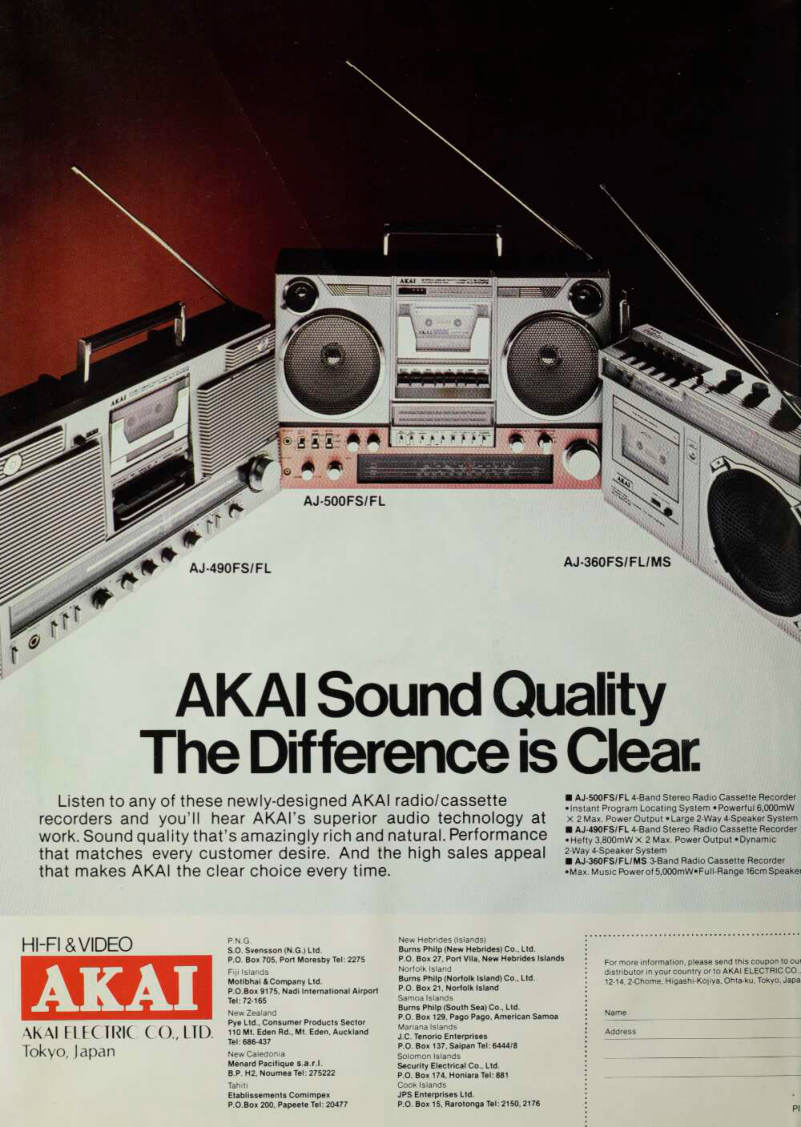
Akai
i m -m % A A Ss-
AJ-500FS/FL
AJ-360FS/FL/MS
AJ-490FS/FL
S \
AKAI Sound Quality
The Difference is Cleat
Listen to any of these newly-designed AKAI radio/cassette recorders and you’ll hear AKAI’s superior audio technology at work. Sound quality that’s amazingly rich and natural. Performance that matches every customer desire. And the high sales appeal that makes AKAI the clear choice every time. ■ AJ-500FS/FL 4-Band Stereo Radio Cassette Recorder •Instant Program Locating System • Powerful 6,000mW X 2 Max. Power Output • Large 2-Way 4-Speaker System ■ AJ-490FS/FL 4-Band Stereo Radio Cassette Recorder • Hefty 3,800mW X 2 Max. Power Output • Dynamic 2-Way 4-Speaker System ■ AJ-360FS/FL/MS 3-Band Radio Cassette Recorder • Max. Music Power of s,ooomW»Full-Range 16cm Speakei
HI-FI & VIDEO
AKAI
AKAI ELECTRIC CO., LTD.
Tokyo, Japan
P.N.G.
S.O. Svensson (N.G.) Ltd.
P.O. Box 705, Port Moresby Tel: 2275 Fiji Islands Motibhai & Company Ltd.
P.0.80x 9175, Nadi International Airport Tel: 72-165 New Zealand Pye Ltd., Consumer Products Sector 110 Mt. Eden Rd., Mt. Eden, Auckland Tel: 686-437 New Caledonia Menard Pacifique s.a.r.l.
B.P. H 2, Noumea Tel: 275222 Tahiti Etablissements Comimpex P.0.80x 200, Papeete Tel: 20477 New Hebrides (Islands) Burns Philp (New Hebrides) Co., Ltd.
P.O. Box 27, Port Vila, New Hebrides Islands Norfolk Island Burns Philp (Norfolk Island) Co., Ltd.
P.0.80x 21, Norfolk Island Samoa Islands Burns Philp (South Sea) Co., Ltd.
P.O. Box 129, Pago Pago, American Samoa Mariana Islands J.C. Tenorio Enterprises P.O. Box 137, Saipan Tel; 6444/8 Solomon Islands Security Electrical Co., Ltd.
P.O. Box 174, Honiara Tel: 881 Cook Islands JPS Enterprises Ltd.
P.O. Box 15, Rarotonga Tel: 2150,2176 For more information, please send this coupon to oui distributor in your country or to AKAI ELECTRIC CO., 12-14,2-Chome, Higashi-Kojiya, Ohta-ku, Tokyo, Japa Name Address Dl
Pacific Islands Monthly
Vol 51 No 1
January 1980
[Usps 952480]
Subscriptions
PIM is airfreighted to most subscribers and agents in the Pacific Islands and the United States
Elsewhere SAI6 ; Payment by personal cheque is accepted in Australian US, New Zealand, UK and Fiji currency For other remit tances please obtain a bank draft in Australian dollars made payable to the ANZ Banking Group, 88 Wentworth Avenue Sydney, Australia.
Representatives
AUSTRALIA; Distribution; NSW & ACT: Allan Rodney Wright (Circulation) Pty Ltd, PO Box 907, Darlmghurst NSW 2010 Elsewhere: Gordon & Gotch (A/asia) Ltd, Box 40 PO, Rosebery, NSW 2018 Advertising - Melbourne - Pa cific Publications (Aust.) Pty Ltd, Newspaper House, 247 Collins Street, Melbourne 3000, telephone 63 0211 ext 1565 Jeff Gates, ext 1858 Ida Padgett Brisbane - D. Wood, Anday Agency, Box 1918, GPO, Brisbane 4001, telephone 44 3485, 44 1 546 Adelaide - Hastwell Media, PO Box 30 Glen Osmond, SA. 5064, 233 Glen Osmond Rd Frewville SA 5063, telephone 79 1869 Perth - Adrep, 62 Wickham St, East Perth, WA 6000, telephone 325 6359 FIJI: Distribution and subscriptions Desai Booksnops PO Box 160, Suva, Fiji, telephone Suva 23036 Advertis ing - Fiji Times & Herald Ltd, 20 Gordon St Suva tele phone 312 in, telex FJ2124 FRENCH POLYNESIA: Distribution - Hacnette Pacitique, 10 Ave Bruat. Papeete, telephone 25610 HAWAII, UNITED STATES: Distribution PIM, Hawaii, PO Box 22250, Honolulu, Hawaii 96822 Advertising: Roger I Brookes, PO Box 10217, Waialae - Kahala, Honolulu Hawaii 96816. Tel: 521 4521. Telex: 743 0296.
JAPAN: Advertising and subscriptions - Universal Media Corporation, CPO Box 46, Tokyo, telephone 666 3036 MICRONESIA: Advertising: Roger I. Brookes, PO Box 10217, Waialae Kahala, Honolulu, Hawaii 96816 Tel 521 4521. Telex: 743 0296.
NEW CALEDONIA: Distribution - Depot Centre de Presse Michel Pentecost. CBP2 Noumea, telephone 27 2434 27 4729 NEW ZEALAND; Distribution - Gordon & Gotch PO Box 584 2 Carr Road Mt Roskill, Auckland 4 Advertising - International Media Representatives Ltd, PO Box 2313 Auckland, telephone 795 487, 493 389 cables Intereps, Auckland Subscriptions - Ross Haines & Son Ltd PO Box 1289, Auckland, telephone 769 042 PAPUA NEW GUINEA: Distribution - Robert Brown & Assoc PO Box 3395, Port Moresby, telephone 25855 Advertising - PNG Post-Courier PO Box 8F Port Moresby, telephone 21 2577 UNITED KINGDOM: The Herald & Weekly Times Ltd 8-10 Clifford s Inn. Fetter Lane. London EC4A IBU telephone 01 831 6041 telex London 21989 UNITED STATES MAINLAND Advertising Joshua B Powers Jr Powers International Inc . 55t Fifth Ave New York New York 100 017 telephone 367 9580 telex 236514 Subscriptions - PiM Hawaii 2812 Kahawai St Honolulu. Hawaii 96822 Published monthly by Pacific Publications (Aust.) Pty Ltd and printed in Australia by Paramac Alexandria NSW Australian cover price is recommended retail only Regis tered at the GPO Sydney for transmission by post as a publication category B Second class postage paid at Honolulu. Hawaii Copyright - 1978 Pacific Publications
(Aust ) Pty Ltd Postmaster Honolulu; Send address changes to PIM Hawaii. PO Box 22250 Honolulu. Hawaii 96822
Aust Other American Samoa $13 $US16 Australia $12 Canada $14 $US18 Cook islands $13 Fiji $12 $F12 French Polynesia $14
Cfp 1700'
Guam $13 $US16 Gilbert Islands $13 Hawaii $13 $US16 Japan $16 Y4500 Micronesia $13 $US16 Nauru $18 New Caledonia $14
Cfp 1700
New Hebrides $13 New Zealand $12 $N213 50 Niue $13 Norfolk Island $12 Northern Marianas $13 $US16 Papua New Guinea $13 K12 Solomon islands $13 Tonga $13 Tuvalu $13 United Kingdom $15 £io US Mainland $14
Sus18
Western Samoa $13
This Month
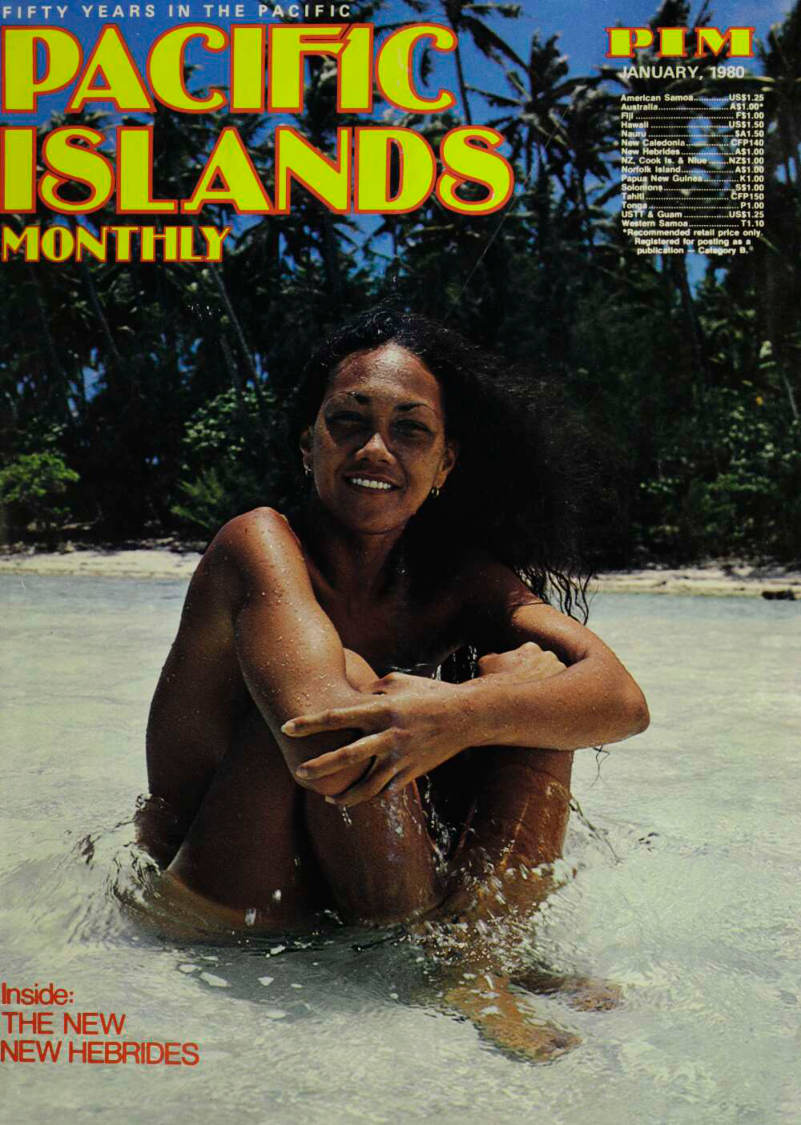
• New Hebrides The Vanuaaku Party’s sweeping victory in the November 14, 1979 elections has a troubled aftermath an exclusive PIM report from the spot l3 • Fiji Nutritional problems examined from two widely different points of view; those of athletes who took part in the South Pacific Games, and of pre-school children 27 • Tonga - Tonga’s King Taufa’ahau Tupou IV offers some free, and rather radical, advice to New Zealanders during his State visit 32 • Tuvalu Are they introducing a rabbit problem? 32 • Travel A globetrotter discovers a hotel in a Vancouver back street housing a treasure trove of works by artist Edgar William Leeteg, late of Papeete, and portrayer par excellence of Polynesian civilisation 36 • PlM’s Pacific - At the opening of the magazine’s 50th year, Judy Tudor looks back to August 16, 1930, the day the magazine was born, and then surveys its reports covering the first four years 40 • Kiribati A new book published by the government of Kiribati shows a talented group of Gilbertese looking at their nation’s history 46 • Banking A survey of the work in the South Pacific of the Asian Development Bank through the 70s 55 • Ships Ten shipping lines serving the Pacific Islands from Australia and New Zealand form a ‘co-operative’ 65 Cover: January is among the hotter months in the Pacific Islands, so we thought this cool shot of a local Tahitian beauty by young and popular Papeete photographer, Teva Sylvain, was seasonally appropriate.
Books 46 Deaths 73 Fiji 29, 49 Guam 33 Health 27, 56 Islands Press 53 Kiribati 46 Letters 5 Micronesia 33 New Hebrides 13 Norfolk Island 32, 57 Pacific Report 11 Papua New Guinea 33, 49
People 24 PlM’s Pacific 40 Political Currents 18 Ships 65 Shipping Services 71 Tonga 32, 37 Tradewinds 55 Tradewinds Intelligence 61 Travel 35 Tropicalities 32 Tuvalu 32, 57 Western Samoa 57 Yachts 67
Advertisements & other items, pp. 3-4 (3 items)
Pacific Islands Mdnthi V _ Lamhadv -.Non
PACIFIC ISLANDS MDNTHI V lAMHADv -.non
Founded 1930 by R. W. Robson Editor and Publisher Stuart Inder Associate Editor Malcolm Salmon Editorial Adviser John Carter Manager John Berry Advertising Sales Manager Steve Gray A Pacific Publications production 76 Clarence Street. Sydney 2000 GPO Box 3408 Sydney 2001 Cables: PACPUB Sydney Telex: Pacpub 21242 Telephone: Sydney 29 6693
1980 Means 50 Years of PIM
This is PlM’s 50th anniversary year. We intend to celebrate it every month throughout 1980 with special features and articles. Pacific Islands Monthly was first published in August 1930, and despite the Depression years, and the austerity years of the Pacific War, it has faithfully recorded Islands developments every month since. So one of our anniversary features is a review of 50 years of Pacific news events, as seen by PIM. Each month Judy Tudor, former PIM publisher and one of its best-known editors, will take a handful of years out of the half century and comment on them.
Her first long review of 50 years in the Pacific Islands covers 1930-1934, and it begins on p4O.
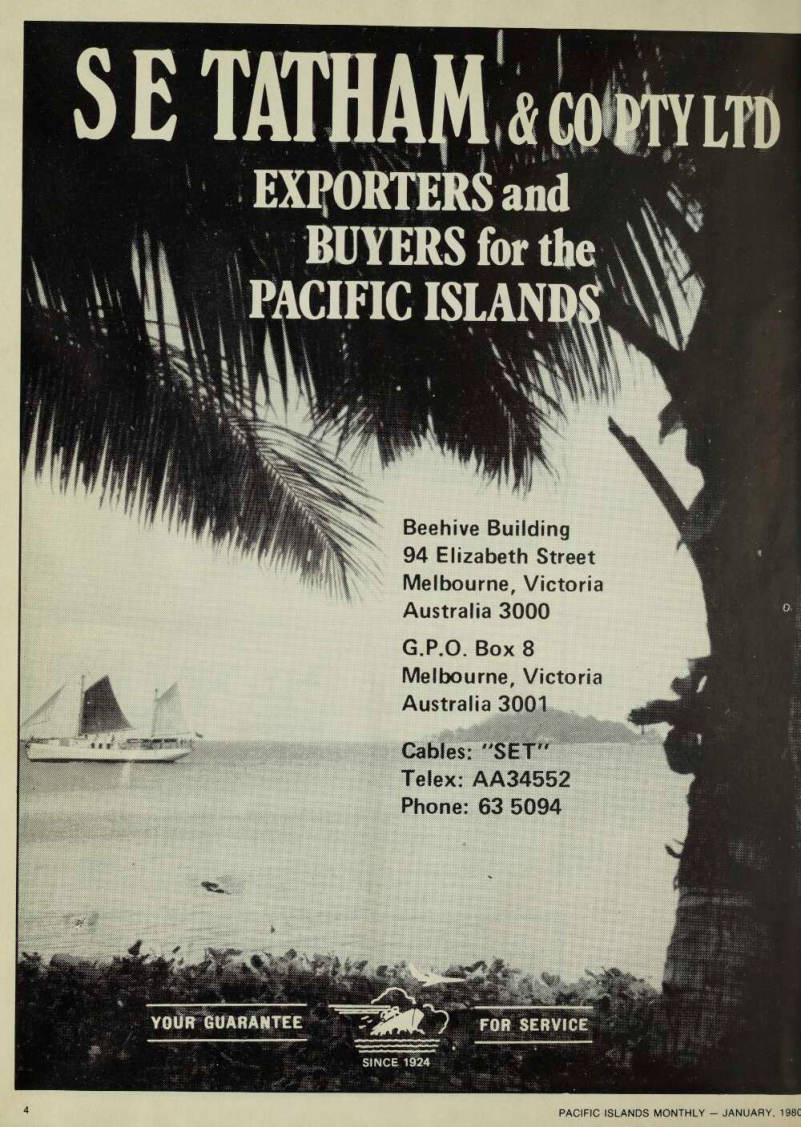
Beehive Building
94 Elizabeth Street Melbourne, Victoria Australia 3000 G.P.O. Box 8 Melbourne, Victoria Australia Telex: AA34552 Phone: 63 5094
project
Letters
Politicians to the
rear please
I would like to say how pleased I am to see that a Polynesian maiden is once again gracing your front cover (PIM, Nov).
Please take no notice of the correspondent who wrote advising that such illustrations should be beneath the dignity of PIM.
The appropriate place for
pictures of South Pacific poli ticians should be the rear pages.
Hugh Norwood
Geography Dept.
Massey University Palmerston North, NZ
Reply from
Miriama Chambault
We generally don’t read Pacific Islands Monthly. There is a long time view (in New Caledonia) that the aim of your publication is more subversion than information.
But concerning your October report of the South Pacific Games, we were surprised to read that ‘Miriama Chambault hated to win her two golds 100 m. and long-jump for the territory in which she now lives’.
You really have been gone too far! How can you write such nonsense? About a woman who came here seven years ago by her own decision after many years in New Zealand? Now married to a Frenchman, she is a mother of a child, Christopher. Do you mean that somebody FORCED her to stay in New Caledonia? But moreover, how can you say that about a woman who placed SPORTS over everything? When she thinks about sports and compe tition, she forgets the meaning
of ‘country’, ‘people’, ‘colour’
or origin. She works hard to win. That’s all!
And don’t say that this kind of thinking is due to the ‘fanatic Paris desire to convince Pacific neighbours that French is the best’. There are no ‘fanatics’ in Paris regarding New Cale donia, and we should dare to say, unfortunately for us!
Miriama Chambault would be as proud of her two gold medals whether she was living in Australia, Fiji, or New
Zealand. As a sportswoman she has had the most beautiful life that a woman can dream of: travelling around the world from Europe to USA for her
unique passion: SPORT. She
was not French, yet now she is.
And she is not so ‘rich’.
She simply discovered one day that all her philosophy was expressed in this short sentence from the Frenchman Pierre De Coubertin that you probably
know: L’important c’est depar
ticiper . . .
This could be enough for her to be proud of being a French woman. But there are also a lot of other reasons. This letter was published in La France Aus trale on November 8.
Alain & Miriama Chambault
Noumea New Caledonia • PI M's coverage of the Games was from former editor Bob Hawkins, who comments briefly
from abroad: ‘Perhaps my use of
the word “hate” was, unfortuna tely, too strong for the occasion.
What I intended to convey was the message that Miriama Chambault, whatever course her life has now taken, was first and foremost a Fijian and proud to be so. As to who finances what, it was clear at the Games that everyone, wherever they came from, had had to stretch themselves to the limit to raise enough money to get their teams to Suva. What was obvious, however, was the relative afflu ence of athletes from French col onies against that of athletes
from independent nations.'PlM
apologises to the Chambaults for any hurt they felt over the comment, which was not intended. Editor
Facts needed
on Donald McLeod
I am the great-niece of an early
Pacific pioneer. Captain
Donald McLeod, whose story I am trying to write. I’m sure it would contain much of interest from his birth at Cape Bre ton Island, Nova Scotia in 1845, to his arrival in New Zealand on the Breadalbane in 1858 at the age of 13, and his life in the New Hebrides from 1868 until his death in Noumea in 1894.
My father was Graham Kerr, of Kerr Bros, and these days, sadly, we have no connec tion with the group. I myself was born in Vila in 1917 and I’m trying to reconstruct my family’s history in the New Hebrides before it is too late.
I would be pleased to hear from any reader with infor mation about Captain McLeod.
Katherine Cawsey (Mrs)
122 Cowper Street Dickson ACT 2602
Lateiki reminds
him of Vulcan
Many thanks for the most in formative article by E. A.
Crane, on Tonga’s new island, Lateiki. (PIM, Nov.). I found
the article, pictures, diagram
and map all the more interest ing for having seen Rabaul’s Vulcan Island four or five days after it had erupted, causing such damage and hardship to that beautiful area. I well re-
member seeing coconut palms that had been snapped off like matchwood six feet or so above
ground by the accompanying
earthquake, and, as in the vicinity of Lateiki, a sea of pumice some distance from the harbour.
As all that happened over 42 years ago, there may not be too many around who were there when it actually happened, es pecially as World War II inter vened. If there is someone whose memory of it is good (es
pecially from the vulcanology
angle), I’d be delighted to hear from him/her. I am beginning to feel like the last dodo on Mauritius: I have even been told that it didn’t happen!
Again, thanks for all the good things in PIM
Kit Hetherington
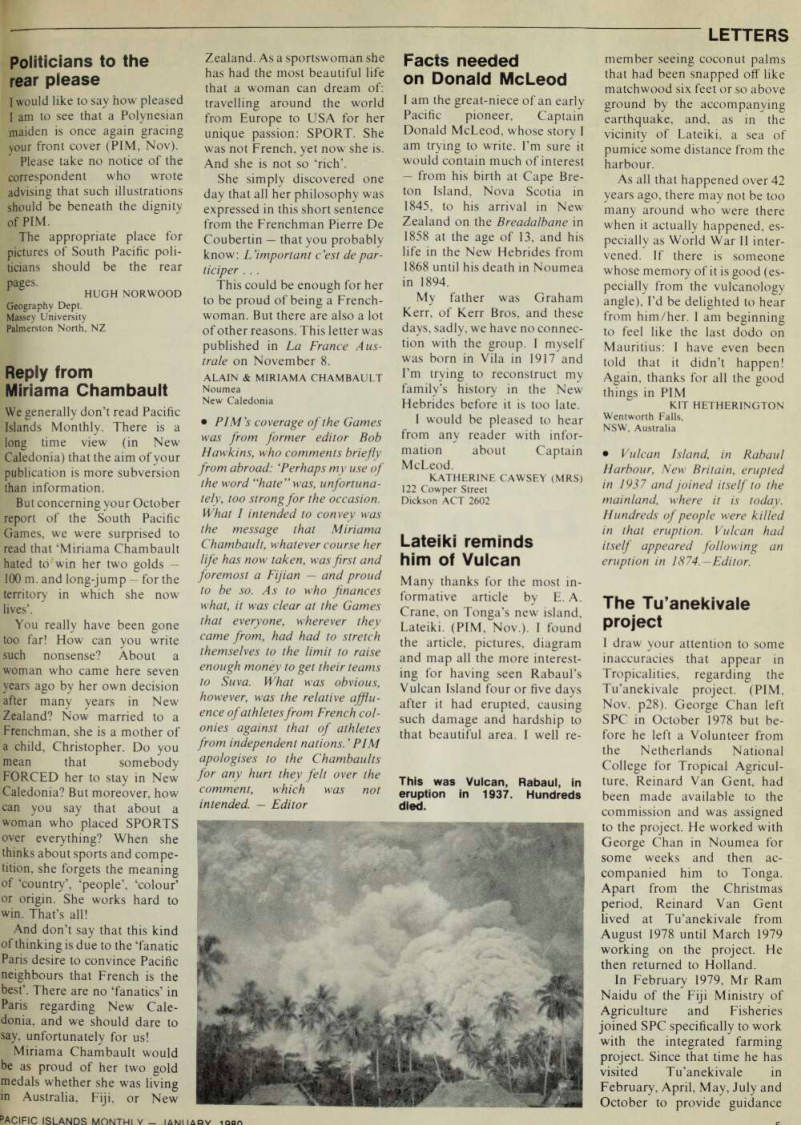
Wentworth Falls, NSW, Australia • Vulcan Island, in Rabaul Harbour, New Britain, erupted in 1937 and joined itself to the mainland, where it is today.
Hundreds of people were killed in that eruption. Vulcan had
itself appeared following an
eruption in 1874.—Editor.
The Tu’anekivale
project
I draw your attention to some inaccuracies that appear in
Tropicalities, regarding the
Tu’anekivale project. (PIM, Nov. p2B). George Chan left SPC in October 1978 but be fore he left a Volunteer from the Netherlands National
College for Tropical Agricul
ture, Reinard Van Gent, had been made available to the commission and was assigned to the project. He worked with George Chan in Noumea for some weeks and then ac
companied him to Tonga.
Apart from the Christmas period, Reinard Van Gent lived at Tu’anekivale from August 1978 until March 1979 working on the project. He then returned to Holland.
In February 1979, Mr Ram Naidu of the Fiji Ministry of Agriculture and Fisheries joined SPC specifically to work
with the integrated farming
project. Since that time he has visited Tu’anekivale in
February, April, May, July and
October to provide guidance
This was Vulcan, Rabaul, In eruption in 1937. Hundreds died.
and technical advice and to ensure liaison was maintained with the Department of
Agriculture.
A second Volunteer took up post in July 1979 Mr Arjen Hettema. He proceeded im mediately to the project and like Van Gent before him, is living in the village and is employed full time on the pro ject, with regular visits from Mr Ram Naidu providing the back-up.
The Foundation for the Peoples of the South Pacific, who were the partners in the operation with the late Dr. Alo Eva, have also continued their interest and support and as late as October 31, they advised ‘as a result of recent meetings be tween Mrs Elizabeth Silver stein, president of FSP and Mr Stanley Hosie, executive direc tor of FSP and Robert Craig,
Regional Development Offi
cer, USAID. ... we are able to
provide additional funding for
the Tu’anekivale Piggery to complete Stage I and II . . .'
W. T. Brown
Director of Programmes South Pacific Commission Noumea The future of
Islands airlines
Having read articles on airlines in the Pacific (PIM, July and Oct.) with great interest. I feel that the whole issue has come to a point where something should be done. The Pacific airline industry has come to a
point where efficiency doesn’t
seem to matter, but re
equipping fleets and expansion
does. The result is that a lot of carriers are running at a loss because they are trying to grow
too quickly and picture bright
futures that are far off.
Another major problem is
that the four major carriers: Air Niugini, Air Pacific, Air Nauru and Polynesian are try ing to become “The Regional Carrier for the Pacific.” All have a monopoly on most of their routes, in particularly Air Nauru. Because of this mon opoly high fares come into the business as the carriers know that the travelling public don’t have much of a choice.
It’s a sad thing that the re nowned “charm” of the islands
is spoilt by the politics involved
in air travel between the nations of the area.
Frequency is another prob lem. This is caused by lack of aircraft. The way things are shaping up, with Air Pacific
wanting bigger aircraft, places
like Tarawa and Funafuti are going to be lucky if they see a flight to Fiji once a month!
So, which direction will the carriers take? They have an entire ocean to serve. Each of them is government owned and to a great extent government subsidised because of heavy
operating costs.
If carriers continue the path they are on now; what with rising fuel costs etc. we’re going to have a very poor airline net
work. Full of big planes going
to small places, and, in some cases, so irregularly that they might as well not bother going at all!
Suggestions to solve their problems are thrown at the air lines all the time. I know this happens in Air Niugini’s case.
However nothing seems to
happen.
Obviously with airlines like Pan Am, who’ve already pulled out and U.T.A. and Qantas that are rapidly dropping the num ber of the flights to the region,
and Air New Zealand trying to take on the whole Pacific and treating Air Pacific and
Polynesian as competitors; the
Pacific airlines are getting a hard time, and the demand to “spread their wings,” is ever
increasing. They must surely
have to join forces.
I’m not saying that there should be one airline, but I am
saying co-operation between
carriers is essential. Wouldn’t it be nice to be able to island-hop from Tahiti to Japan without
overnighting anywhere, and by
doing so making it cheaper
than going via Auckland or Syd ney! If all the airlines made a point of having the same type of aircraft and connecting con veniently with one another we’d have a wonderful airline network in the region. Pool ser vices is another healthy way of operating, because then an air line can operate a service at a loss and have the cost balanced out by its partner, while the opposite could occur on another route.
The Pacific has great poten tial and it’s a pity that it’s being kept indoors because of a lack of co-operation. Many of the peoples of the Pacific are tra ditionally related, so why can’t
their airlines stop trying to be better than one another, and get on with the job their people want them to do serve the Pacific. Not rip it off through petty competitive behaviour.
(Master) Richard Hawkins
(aged 15) Port Moresby, Papua New Ginea
John Kciia replies
to his critics In my last letter as Acting/ Director of the Institute of Papua New Guinea Studies. I wish to make known several facts through the columns of three publications in which slurs have been cast against me; of which publications yours is one.
The institute is obliged to publish creative literature vet ted by critics competent to do so. I have set up a publications board as a further form of con trol.
My contract with the National Cultural Council obliged me to deliver for publi cation by the institute a list of named fictional and non fictional works and this was done before I took over as Acting/Director. I have refused to accept the royalties I am entitled to under that con tract.
During my period as Acting/
Director, I presented to the institute no works of mine.
Indeed, I have hardly had time to write any, but the one slim volume of the period is being published outside the institute.
During that time, however, I did have the works of others published by the institute.
The institute has published a very large number of titles, a minority of which are mine and some only are works of fiction.
Work by indigenous authors
gets preference at all times.
At no time did I seek the Directorship of the Institute but acted at the request of the Minister for Culture, Edu cation and Science.
It is not my habit to debate publicly with my critics, ama teur or otherwise, but for once, and not again, I wish to make the above facts known.
Dr. J. Kolia
Institute of Papua New Guinea Studies.
Port Moresby • More letters on p.lO.
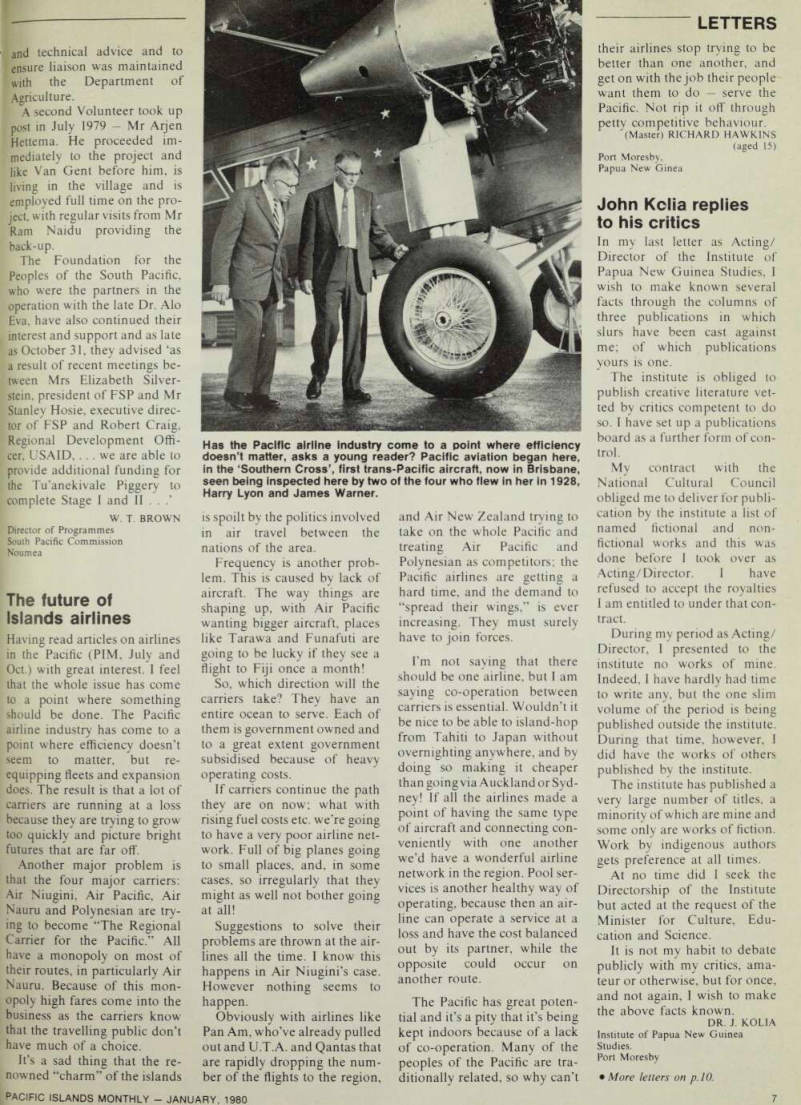
Has the Pacific airline industry come to a point where efficiency doesn’t matter, asks a young reader? Pacific aviation began here, in the ‘Southern Cross', first trans-Pacific aircraft, now in Brisbane, seen being inspected here by two of the four who flew in her in 1928, Harry Lyon and James Warner.
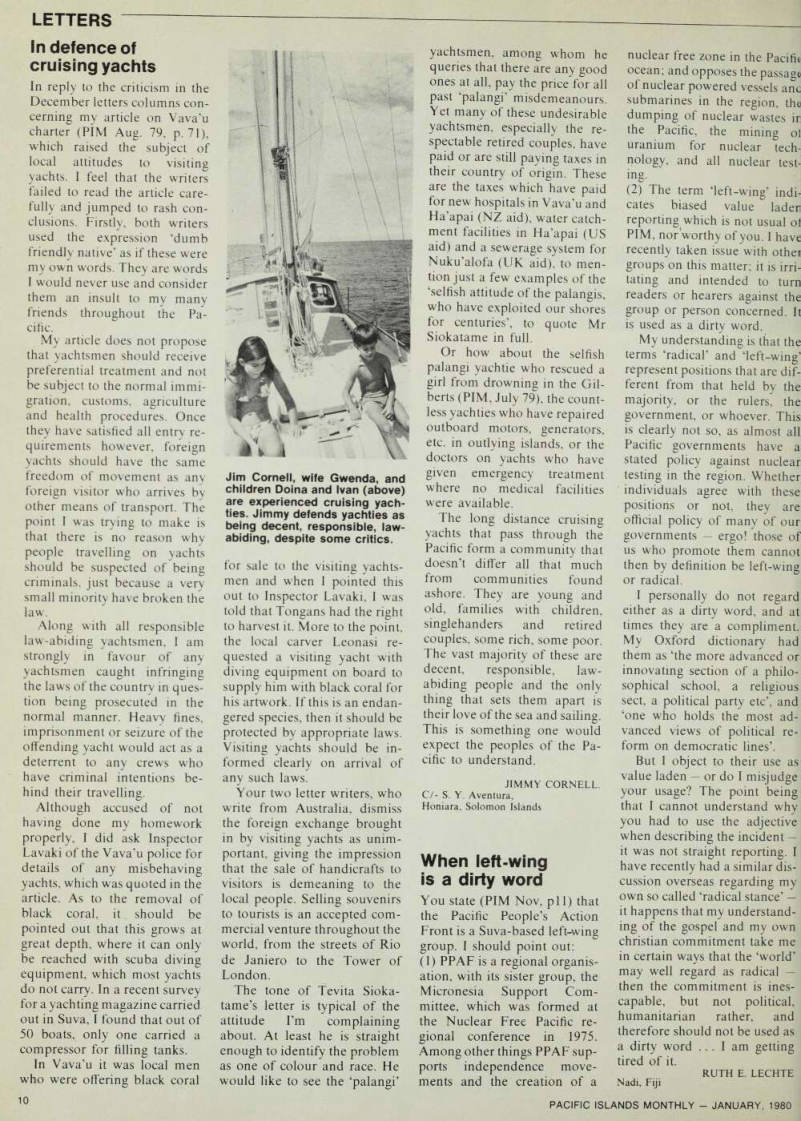
In defence of
cruising yachts
In reply to the criticism in the December letters columns con cerning my article on Vava’u charter (PIM Aug. 79, p. 71), which raised the subject of local attitudes to visiting yachts. I feel that the writers failed to read the article care fully and jumped to rash con clusions. Firstly, both writers used the expression ‘dumb friendly native’ as if these were my own words. They are words I would never use and consider them an insult to my many friends throughout the Pa cific.
My article does not propose that yachtsmen should receive preferential treatment and not be subject to the normal immi
gration, customs, agriculture
and health procedures. Once they have satisfied all entry re
quirements however, foreign
yachts should have the same freedom of movement as any foreign visitor who arrives by other means of transport. The point I was trying to make is that there is no reason why
people travelling on yachts
should be suspected of being criminals, just because a very small minority have broken the law.
Along with all responsible
law-abiding yachtsmen, I am
strongly in favour of any
yachtsmen caught infringing
the laws of the country in ques tion being prosecuted in the normal manner. Heavy fines, imprisonment or seizure of the offending yacht would act as a deterrent to any crews who have criminal intentions be hind their travelling.
Although accused of not having done my homework properly, I did ask Inspector Lavaki of the Vava’u police for details of any misbehaving yachts, which was quoted in the article. As to the removal of black coral, it should be pointed out that this grows at great depth, where it can only be reached with scuba diving equipment, which most yachts do not carry. In a recent survey for a yachting magazine carried out in Suva, I found that out of 50 boats, only one carried a compressor for filling tanks.
In Vava’u it was local men who were offering black coral
for sale to the visiting yachts men and when I pointed this out to Inspector Lavaki, I was told that Tongans had the right to harvest it. More to the point, the local carver Leonasi re quested a visiting yacht with diving equipment on board to supply him with black coral for his artwork. If this is an endan gered species, then it should be
protected by appropriate laws.
Visiting yachts should be in formed clearly on arrival of any such laws.
Your two letter writers, who write from Australia, dismiss
the foreign exchange brought
in by visiting yachts as unim
portant, giving the impression
that the sale of handicrafts to visitors is demeaning to the
local people. Selling souvenirs
to tourists is an accepted com mercial venture throughout the world, from the streets of Rio de Janiero to the Tower of London.
The tone of Tevita Sioka tame’s letter is typical of the attitude I’m complaining about. At least he is straight
enough to identify the problem
as one of colour and race. He would like to see the ‘palangi’
yachtsmen, among whom he queries that there are any good ones at all, pay the price for all past ‘palangi’ misdemeanours.
Yet many of these undesirable yachtsmen, especially the re spectable retired couples, have paid or are still paying taxes in their country of origin. These are the taxes which have paid for new hospitals in Vava’u and Ha’apai (NZ aid), water catch ment facilities in Ha’apai (US aid) and a sewerage system for Nukualofa (UK aid), to men tion just a few examples of the ‘selfish attitude of the palangis, who have exploited our shores for centuries’, to quote Mr Siokatame in full.
Or how about the selfish palangi yachtie who rescued a girl from drowning in the Gil berts (PIM, July 79), the count less yachties who have repaired outboard motors, generators, etc. in outlying islands, or the doctors on yachts who have given emergency treatment where no medical facilities were available.
The long distance cruising
yachts that pass through the Pacific form a community that doesn’t differ all that much from communities found ashore. They are young and old, families with children, singlehanders and retired couples, some rich, some poor.
The vast majority of these are decent, responsible, law
abiding people and the only
thing that sets them apart is their love of the sea and sailing.
This is something one would expect the peoples of the Pa cific to understand.
Jimmy Cornell.
C/- S. Y. Aventura, Honiara, Solomon Islands
When left-wing
is a dirty word
You state (PIM Nov, p 11) that the Pacific People’s Action Front is a Suva-based left-wing group. I should point out; (1) PPAF is a regional organis ation, with its sister group, the Micronesia Support Com mittee, which was formed at the Nuclear Free Pacific re gional conference in 1975.
Among other things PPAF sup ports independence move ments and the creation of a
nuclear free zone in the Pacific ocean; and opposes the passage of nuclear powered vessels anc submarines in the region, the dumping of nuclear wastes in the Pacific, the mining ol uranium for nuclear tech nology, and all nuclear test
ing.
(2) The term ‘left-wing’ indi cates biased value laden reporting which is not usual ol PIM, nor worthy of you. I have recently taken issue with other groups on this matter; it is irri tating and intended to turn readers or hearers against the group or person concerned. It is used as a dirty word.
My understanding is that the terms ‘radical’ and ‘left-wing’ represent positions that are dif ferent from that held by the majority, or the rulers, the government, or whoever. This is clearly not so, as almost all Pacific governments have a stated policy against nuclear testing in the region. Whether individuals agree with these positions or not, they are official policy of many of our governments - ergo! those of us who promote them cannot then by definition be left-wing or radical.
I personally do not regard either as a dirty word, and at times they are a compliment.
My Oxford dictionary had
them as ‘the more advanced or innovating section of a philo
sophical school, a religious
sect, a political party etc’, and ‘one who holds the most ad vanced views of political re form on democratic lines’.
But I object to their use as value laden or do I misjudge
your usage? The point being
that I cannot understand why you had to use the adjective when describing the incident it was not straight reporting. I have recently had a similar dis cussion overseas regarding my own so called ‘radical stance’ it happens that my understand ing of the gospel and my own Christian commitment take me in certain ways that the ‘world’ may well regard as radical then the commitment is ines
capable, but not political,
humanitarian rather, and therefore should not be used as a dirty word ... I am getting tired of it.
Ruth E. Lechte
Nadi, Fiji
Jim Cornell, wife Gwenda, and children Doina and Ivan (above) are experienced cruising yach ties. Jimmy defends yachties as being decent, responsible, law abiding, despite some critics.
Advertisements & other items, pp. 5-9 (3 items)
Pacific Islands Monthi Y _ Ia Ml Ladv 1 Aan
PACIFIC ISLANDS MONTHI Y IA Ml lADV 1 aan
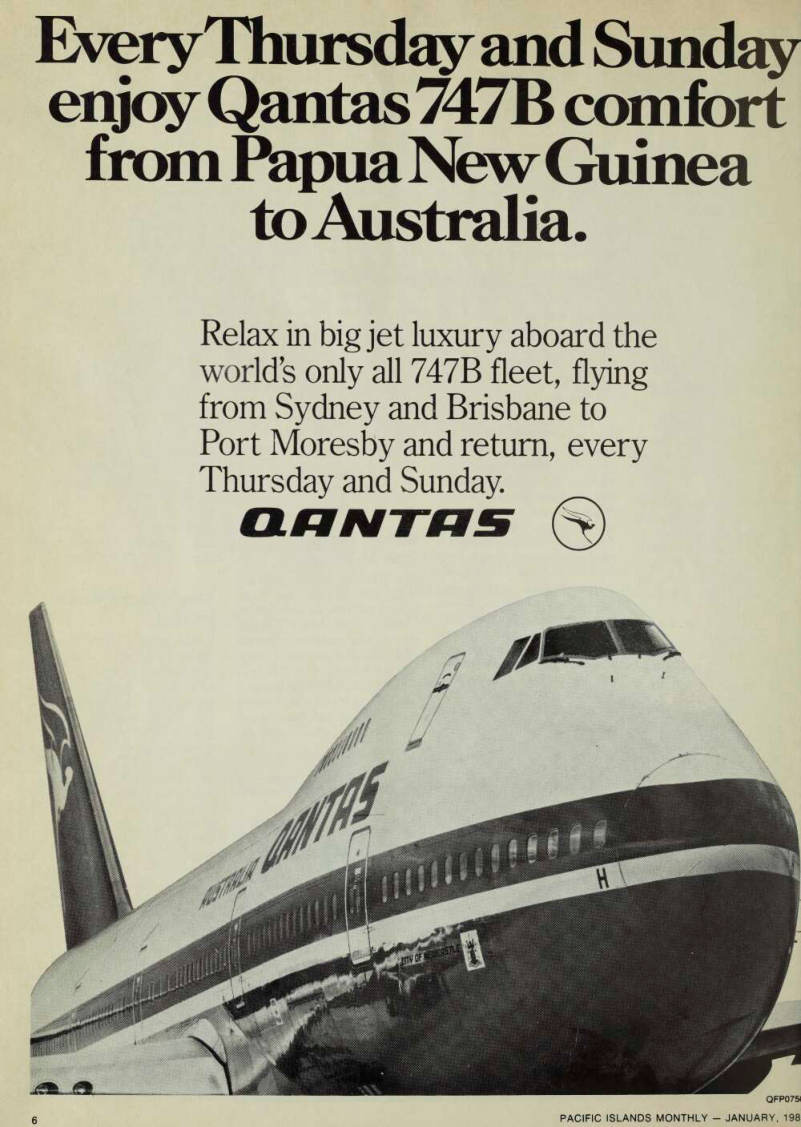
Every Thursday and Sunday
enjoy Qantas747B comfort
from Papua New Guinea
to Australia.
Relax in big jet luxury aboard the world’s only all 7478 fleet, flying from Sydney and Brisbane to Port Moresby and return, every Thursday and Sunday.
Easy-to-fe
<s-~3> -fli imii to ffe <<
Him
svv^
n » tit itit it :t: *tit lit :t it; itiV ♦ts* l^:*P it it it it ti' it ** m it it ts it :t: it it :t?
StStttttttS
titit St: V itititi ♦ft it it it : &£££s ;t;t tit: it it itit itit it itititi >?? :t:t
mmm
it >v it it itit it it it it itit it it :t: st it it iti SS tit:it* iti ♦ >.
Z<*t* 4* 5
CiD PIONEER
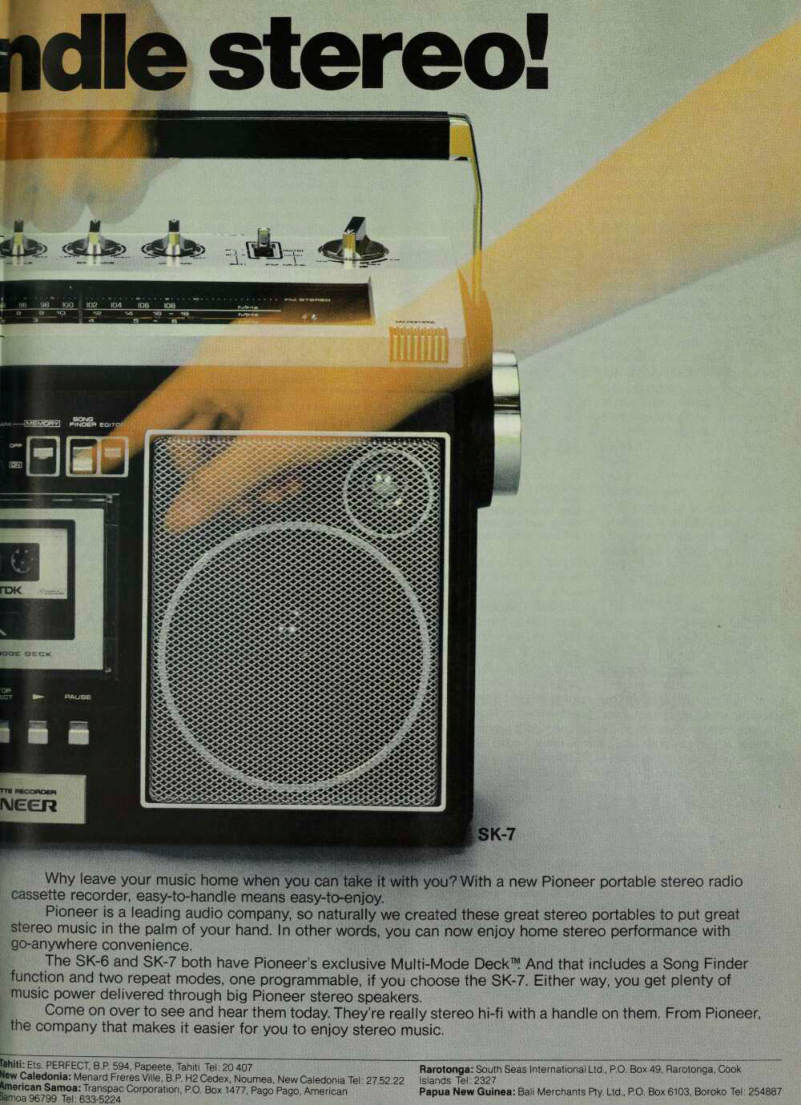
SK-1A
SK-6 For further information, please contact: New Zealand: Monaco Electronics Ltd., 5 Vernon Street, Auckland, New Zealand Tel: 33-8 Australia: Pioneer Marketing Service Pty. Ltd., P.O. Box 317, Mordialloc, Norfolk Island: Burns Philp (Norfolk Island) Ltd., Norfolk Island, South Pacific Victoria, 3195 Tel: 90-9011 New Hebrides: Burns Philp (New Hebrides) Ltd., Vila, New Hebrides Fiji Islands: Brijlal & Company, G.P.O. Box No. 362, Suva, Fiji Islands Tel; 22258 Nauru Island: Jacob Enterprises, P.O. Box No. 4, Republic of Nauru
ndle stereo!
) c j... mm Ji >:* ££& & S' ♦r Ml A vV 0M m £t> ♦♦ V? : :*:f It &>s
ttt
ss »>: z< •t It!
!SSd
titit rDK ■it it itit :t>: it z<
■ttv
ititit it •iV it it ■it :t: H gH ■it it :*: >iiiitititit titit ioor. os C < iti ’♦tv%t*t*t*t*
sssss
it itititit :t:
sttss:
it V itit it it
jSSSsES
itit itititit
isH
*** itititi it itit <titi ititit M
Sgr
itititit 5£ tit *** it tit it
i^it
it ii* i i&i tit:*: itit it it itit iS
*llll
:t i%t it ♦t*t* it 5-SSt ♦%tv ♦tit ti wSf. v*. it iti iti
NEGJR
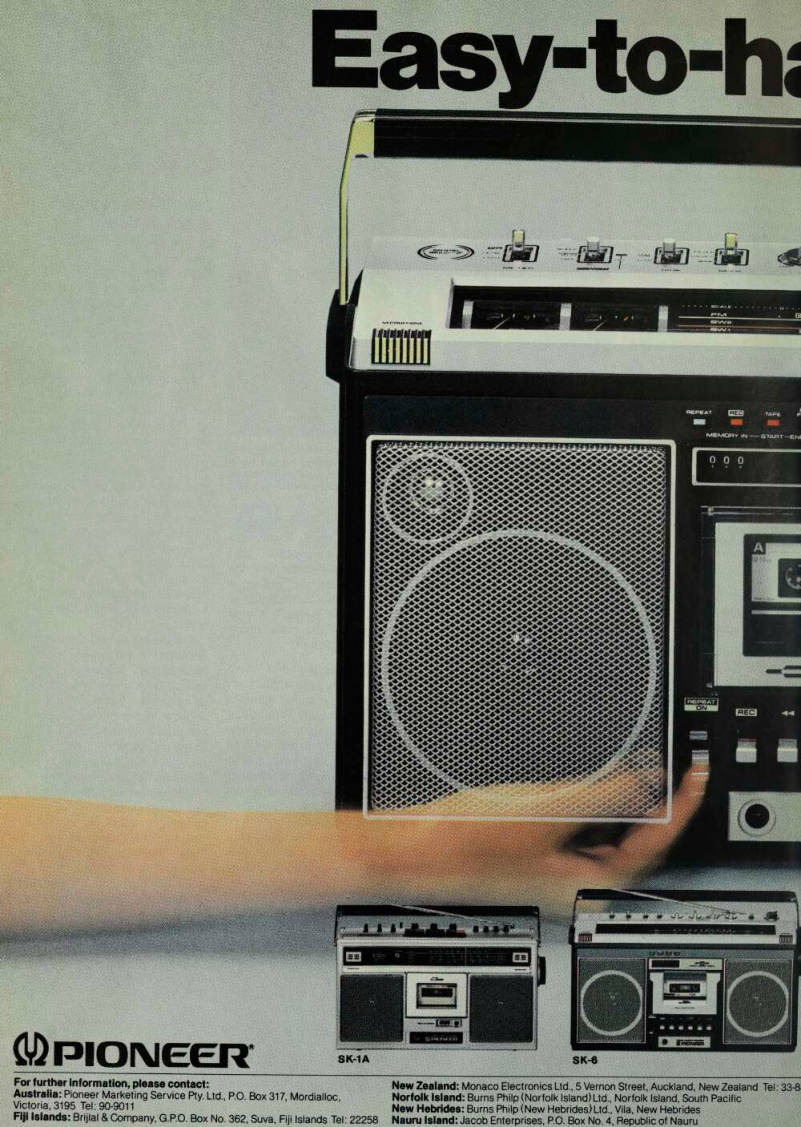
SK-7 Why leave your music home when you can take it with you? With a new Pioneer portable stereo radio
cassette recorder, easy-to-handle means easy-to-enjoy.
Pioneer is a leading audio company, so naturally we created these great stereo portables to put great stereo music in the palm of your hand. In other words, you can now enjoy home stereo performance with
go-anywhere convenience.
The SK-6 and SK-7 both have Pioneer’s exclusive Multi-Mode Deck™ And that includes a Song Finder function and two repeat modes, one programmable, if you choose the SK-7. Either way, you get plenty of music power delivered through big Pioneer stereo speakers.
Come on over to see and hear them today. They’re really stereo hi-fi with a handle on them. From Pioneer, the company that makes it easier for you to enjoy stereo music.
Tahiti: Ets. PERFECT, B.P. 594, Papeete, Tahiti Tel: 20 407 jjew Caledonia: Menard Freres Ville, B.P. H2Cedex, Noumea, New Caledonia Tel' 2752 22 American Samoa: Transpac Corporation, P.O. Box 1477, Pago Pago. American Samoa 96799 Tel; 633-5224 Rarotonga: South Seas International Ltd., P.O. Box 49, Rarotonga, Cook Islands Tel: 2327 Papua New Guinea: Bali Merchants Pty. Ltd., P.O. Box 6103, Boroko Tel: 254887
Letters
Pacific Report
New Hebrides After The Poll
The sweeping win by the Vanuaaku Party in the New Hebrides’
November 14 elections was followed by troubles created by sep aratist elements on the two islands of Santo and Tanna. As well as winning the national elections, the VP won majorities of 8-7 in the regional assemblies on these two islands. Alleging elec toral fraud, non-VP forces on the islands refused to accept the results. Full report begins pi 3.
Ratu Mara Wants Pacific Secretariat
Fiji’s Prime Minister Ratu Sir Kamisese Mara wants a Sydney based secretariat for members of the British Commonwealth in the Pacific region. He will raise the matter at the Commonwealth Heads of Government Regional Meeting (CHOGRM) in New Delhi later this year.
Fiji’S Biggest Quake In 26 Years
Roads on several islands were torn up and landslides blocked others when an earthquake, recorded at 6.5 on the open-ended Richter scale, shook several areas of Fiji in the early morning of November 17. A church and houses were damaged on Taveuni, stock was damaged in Labasa supermarkets and dam age was reported to houses on Rabi, Laucala, Vanua Levu and other islands in the northern part of the country. It was Fiji’s strongest 'quake in 26 years, but no one was injured.
High Tides Flood Majuro
Floods caused by unusually high tides destroyed about 200 houses on Majuro in the Marshall Islands late in November. A state of emergency was declared in the Darrit-Uliga-Dalap area of the island, which averages only 1.8 min height. Damage was estimated in the millions of dollars, and more than 500 residents had to be moved to 14 relief centres. No lives were lost, but three people were injured, one seriously.
PNG: JUDGE MARI KAPI ON THE BENCH Crimson robed judges all of them Australians in December welcomed Papua New Guinea’s first native-born judge, Mr Jus tice Mari Kapi (PIM Nov p. 29), at a National Court ceremony.
Judge Kapi, until recently the public solicitor, told his brother judges, lawyers, politicians and diplomats at the ceremony that he would work for the integration of customary tribal law and adopted law.
Upton From Suva To New Delhi
Gordon Upton, Australia’s High Commissioner to Fiji since July 1976, is going to New Delhi on a double-barrelled assignment: High Commissioner to India, and Ambassador to Nepal. He suc ceeds Peter Curtis, who went to New Delhi about the same time as Mr Upton started his work in Fiji.
Fiji’S Parliament To Debate Lottery
Fiji’s parliamentarians will debate and have a free vote on a pro posal to set up a state lottery. Announcing this, Prime Minister Ratu Sir Kanisese Mara said the recommendation of a special committee that a lottery would be both desirable and practicable had been endorsed by the Financial Review Committee. The lot tery would provide a new source of funds for the government’s social and other objectives. But as it was a subject of consider able public interest it would be debated in parliament
Tongan Royals Meet A Bismarck
King Tauf’ahau Tupou IV and Oueen Halaevalu Mata'aho of Tonga paid a 10-day state visit to Germany in November. In Hamburg, the Tongan royal couple were guests of Countess Gunilla von Bismarck, a descendant of ‘lron Chancellor’ Otto von Bismarck who in 1876 signed a friendship treaty with
Tonga.
Yap: ‘Be Proud Of New Hospital’
Yap’s new 50-bed Memorial Hospital began full-time operation in November. Said Yap Governor John Mangefel: ‘The new hospital cost SUS 4 million. It is the most modern and the biggest building in Yap, and the people of Yap should be proud of
Sigatoka, Levuka Happy With Councils
Two Fijian towns, Sigatoka and Levuka, created some kind of history in December when members of their municipal councils
were all returned to office without a single councillor being opposed.
John Kaputin Comes Out Fighting
Papua New Guinea’s former Minister for National Planning and Development John Kaputin (PIM Dec p 22) emerged from gaol in Port Moresby in December to launch a stinging two-pronged attack on the use of ‘foreign laws’ in PNG, and on the country’s Deputy Prime Minister Ebia Olewale. Mr Kaputin was gaoled for 10 weeks on October 10 for failing to comply with a court order to file company returns. He later filed the returns. On his release he said he believed the charge against him was ‘unnecessary’, and accused Mr Olewale of ‘intolerable misuse of political and executive power’ in failing to act on a recommendation for mercy made in the case by PNG’s Constitutional Advisory Committee.
Mr Kaputin is now a minister without portfolio.
Violence Forecast In New Caledonia
Mr Yann Celene Uregei, leader of the United Front for Kanak Liberation in New Caledonia, forecast late in November that viol ence would occur in his country and that France must accept responsibility because the French Government was protecting a fascist anti-independent group, the Movement for Order and Peace, formed by French colonials who moved to New Caledonia after failing to prevent independence in Algeria. Mr Uregei made his allegations in Port Moresby where he had talks with PNG Foreign Minister Ebia Olewale.
Solomons ‘No Confidence’ Motion Fails
Solomons Prime Minister Peter Kenilorea has survived the fourth ‘no confidence’ vote moved in parliament. The motion moved in mid-November against a government decision to release a Taiwanese fishing boat, which grounded on the reef at Ontong Java in July, was beaten by 21 votes to nine with eight absten tions. Later in the session, Mr Bartholomew Ulufa'alu led the Opposition in a walk-out in protest against the 1980 Budget.
Suva Starts A World-Wide Mission
A choir of a thousand voices and a march of 20 000 people in Suva on January 6 will launch a world-wide religious drive, the Mission to the 80’s planned by the World Methodist Council.
From its launching in Suva, the mission, with public services, demonstrations and conferences, will circle the world. On New Year’s Eve, a Round the World Prayer Event will begin in Tonga and then continue in all the countries.
Success Of Hebrides Arts Festival
The New Hebrides’ December National Arts Festival (PIM Nov p 24) was voted a big success, despite efforts by some, notably on Tanna Island, to prevent participants going to Vila. Purpose of the festival was to bring together people from all islands in the archipelago to display their many and varied forms of arts and crafts. (Full report PIM Feb.) BRITISH COUNCIL AID TO SOLOMON IS. CUT The British High Commissioner to Solomon Islands, W. D. Stump, has said overseas aid from the British Council had been cut.
As a result, the council was unable to offer training awards for 1980-81. The cut would not affect trainees already committed to awards whose studies continue into 1980-81. A spokesman for the SI Ministry of Education and Training said the cut would mean that the ministry would have to find outside sponsors for students wishing to study in the United Kingdom.
Australia Waives Nadi Debt
The Australian Government has waived an $BOO 000 debt to allow Fiji to assume full ownership of Nadi Airport.
Marianas Throws Out Casino Act
Voters in the Commonwealth of the Northern Marianas in December overwhelmingly defeated the casino gambling act and elected at least eight Democrats to the House of Represen tatives, assuring them of taking control of the chamber from the former majority, the Territorials.
Radio Cook Islands Is Tops
Radio Cook Islands was voted 1979’s Station of the Year by the North American Shortwave Club, California. Club president Robert Leingang has sought information about the radio for pur poses of publicity in the United States.
Keeping It In The Family
The Pacific Area Travel Association (PATA) reports that of a record 18.5 million visitors to the Pacific area in 1978, 53.7% came from within the Pacific area.
Advertisements & other items, p. 12 (1 item)
Yamaha
. m ■mm * * .. f k pass * At Yamaha, We're doing more with less.
Yamaha technology, as seen in its motorcycles, outboards, generators, and snowmobiles, has made life easier for millions worldwide. And now, more than'ever before, we’re turning this massive technological capability toward solving the problems of energy and resource conservation. More kilometers per liter was one of our primary engineering goals long before anyone imagined today’s energy crisis. In 1964, for example, we
developed our revolutionary reed
valve intake for two-stroke engines. This system, still un surpassed in efficiecncy, precisely controls fuel supply according to engine rpm to reduce fuel waste and provide far superior low-end torque. We were also the first company to perfect a 1:100 fuel mix for outboards.
Now available in European market, this innovation cuts running costs while almost totally eliminating engine-caused pollution.
For commercial
fishing, we’ve
created a line of
lightweight FRP
boats, which require only a fraction of the power needed to drive conventional
IHMH
•I wooden vessels of the same displacement. On a larger scale, our motorcycles and mopeds have helped millions around the world reduce their reliance on 4-wheel transportation. And by providing these safe and reliable alternatives, we’ve helps conserve massive amounts of precious fuel. In these and other important areas, our research is seeking new and better ways to stretch the world’s declining resources while making life easier and a little more fun.
Because doing more with less is something we’re all going to have to face sooner or later. And at Yamaha, we believe the best time to start doing it is now.
YAMAHA
YAMAHA MOTOR CO., LTD. 2500 SHINGAI IWATA-SHI SHIZUOKA-KEN JAPAN
haunted by high dangers
New Hebrides: High hopes are haunted by high dangers
‘Lini.’ ‘Walter Lini,’ ‘Father Lini’ ... the gravel voice of Aime Malere, member of the New Hebrides Representative
Assembly, was reading aloud
the votes cast in the election just held for chief minister at the first session of the assembly since the elections of November 14.
The scene in the New Hebrides Government Build ing in Vila on November 29 was one of vote-counting, Melanesian-style. No nonsense here about self-important scrutineers rushing off with ballot boxes to do the job in some hidden backroom. Each voting paper as it was opened was read to the assembly in exactly the form in which it was written down.
But whatever the method of counting the votes, the result was predictable: Fr Walter Lini, president of the Vanuaaku Party, received 26 votes exactly the same num ber as his party had won seats in the 39-member assembly on November 14. There were three votes for Father Gerard Leymang, chief minister in the former Government of National Unity, and three abstentions.
As the applause died down after announcement of the re sult, it was impossible not to think back to the scene in Vila two years to the day, to November 29 1977 to the boycott by the VP of the (uncontested) ‘elections’ held on that day, to its proclamation of a People’s Provisional Government, and to the civil strife to which these events gave rise in Vila. The official claim was that the timing was ‘pure coincidence’. But like many official claims it strained belief. The VP leaders can read calendars as well as if not better than most people. But the sym bolic flourish was probably
generally accepted as justified
by the recent sweeping elec toral success of the VP, and by the dramatic change in its for-
The 1980 s open with the British-French Con dominium of the New Hebrides on the threshold of independence. Some time this year, between May and July, the New Hebrides becomes the Republic of New Hebrides. The foundations for independence were laid at the end of 1979, with the promulgation of a constitution and the in augural session of the New Hebrides Represen tative Assembly, following general elections. RIM associate editor MALCOLM SALMON was in New Hebrides for these events, and visited the important regional areas of Santo and Tanna.
Here he gives the first detailed report of what took place in that heady period.
tunes from that of the ‘outlaw’ party reviled by many just two years before.
After electing the chief minister, the main business of the day was announcement of the new government. Specu lation had been rife in Vila for days as to whether the new government would be a mixed one, or one made up exclus ively of VP ministers. The
speculation was probably
fuelled by the precedent of the GNU, which was made up of five VP ministers and five non-VP, with a casting vote in the hands of the non-VP Chief Minister Fr. Gerard
Leymang.
Political insiders in Vila con cede that the GNU was a pol itical success, paving the way as it did for a unanimously agreed constitution and for the November 14 elections. But from an administrative view point it was a different story, with the GNU causing endless frustrations because of its incapacity to take firm de cisions on matters of any sub stance.
In the event, the names of the nine new ministers read out to the assembly by Walter Lini on November 29 were all of men elected on the VP ticket
(see accompanying panel).
This too was really predict able. The VP had always
strongly upheld the principle of
majority rule - that if a party can win a majority in a parlia
ment it has a right to govern.
The absence of a guarantee of majority rule was in fact one of the reasons for its boycott of the 1977 elections. It also had to face questions of an inner party character the pressure exerted for positions of re
sponsibility by many talented,
highly educated VP members in the assembly, who could under no circumstances be per suaded to stand aside for a member of one of the oppo sition groupings. Then, per haps most important of all, there was the position of the
party’s grassroots organisation
to be considered, especially the 70 or 80 ‘commissars’ who are the backbone of VP strength in rural areas.
One can imagine what their reaction to a mixed govern ment would have been. They would have reproached the VP leaders along the lines that ‘Here we’ve been slogging it out for the party in the villages for years, and you, sitting in air-conditioned comfort in Vila, make ministers of people who stood against our own VP candidates.’
So, hopes for some new form of‘coalition’ government, how ever sincerely held by some, were doomed to remain just
that hopes.
Despite the underlying ten
sions, the assembly session was quiet. As one with some experi ence of observing affairs from the vantage point of the
parliamentary press gallery in
Canberra, I was struck by the courtesy with which members treated each other. This was particularly notable in the re lations between Fr. Lini and his predecessor as chief minis ter, Fr. Leymang. Political
passions have clearly not
undermined the respect and affection existing between these two priests of the Anglican and Roman Catholic churches.
After an exchange of views between these two, the as
sembly agreed to plan for the
proclamation of the indepen
dent Republic of New Hebrides somewhere within the three-month time bracket of May-July 1980.
The session closed with a prayer recited by Pastor Sethy Regenvanu, the new Minister for Lands. I couldn’t under stand his pidgin at all well and asked my neighbour in the gal lery whether it was the Lord’s Prayer we were hearing. I was told that it was not. It was a
prayer improvised by the
speaker as he went along, and that it would become the cus tom of the assembly for the Speaker, Pastor Fred Timakata, to nominate one or other of the numerous minis ters of religion in the assembly to do likewise at the close of each session. (The-Presbyterian Church in the New Hebrides is believed to have held a crisis meeting in Vila on the week end of December 1-2 to decide what to do about the sudden drain on its pastoral strength created by the new as
sembly!)
One left the government building with the feeling that for the first time in history a
freely elected and authentically
representative government
existed in the New Hebrides, and that it would be an honest and determined government in
grappling with the country’s
problems.
Problems there are in plenty.
For example, careful readers will have noticed that while
there are 39 members of the as sembly, only 32 took any part in the election of the chief minister. The session was in fact boycotted by seven Mod erate Party members for Santo, Tanna and Aoba/Maewo.
At a brief inaugural as sembly session on November 28. Guy Prevot, Federal Party member for Vila (and the onJv person of all-French extraction in the assembly) had read a statement on their behalf in
which they alleged ‘numerous
and large-scale electoral frauds on the part of the Vanuaaku Party’ in the November 14 poll ing. Their statement added: ‘We have decided that when we have completed our investi gations and within the time al lowed by the law, we shall lodge a complaint on the sub ject of these frauds with the Electoral Disputes Committee ... Until the committee has given its decision we feel it is our duty to refrain from par ticipating in the work of the
Representative Assembly.’
The fact that most of the boycotters came from Santo and Tanna is of the greatest sig nificance. As reported earlier (PIM Nov. p 14) the New Hebrides constitution provides
not only for a national Rep resentative Assembly to sit in Vila, but also for Regional Assemblies on the two islands of Santo and Tanna. Voting for these regional bodies, which
were clearly designed as safety
valves for the particularist. not to say separatist, sentiments which are most marked in these two islands, took place simul taneously with the elections to
the Representative Assembly
on November 14.
The rub was that the Vanuaaku Party won these elections as well as the national ones, with 8-7 majorities in both Santo and Tanna. To say that this surprised the non-VP par ties would be gross under statement. They were flabbergasted and angry. Their mood was expressed in the ‘We wuz robbed’ claims voiced in
the boycott petition to the Rep
resentatives Assembly.
On Santo, Nagriamel leader
Jimmy Stevens expressed the
sentiments of the defeated groups when he told the
French/Bislama weekly
Nabanga (November 24); ‘l’m shocked and feel like a man who’s been played a dirty trick.’
But Jimmy Stevens did not
limit himself to expressions of shock, hurt and surprise. He took action.
Reasoning that the regional
assembly had been lost by his side by a margin of about 300 votes, and that the opposition VP had probably received these votes from the several hundred residents of Santo who came from other islands, he and his advisers decided that if these ‘foreigners’ could be forced off the island, and if at the same time the petition alleging electoral fraud suc ceeded in winning a re-run of the election to the regional as sembly, his side would win after all.
So, on November 19, groups of Nagriamel supporters and supporters of an associate movement. Tabwemassana of Port-Olry, took to the streets, some carrying clubs, and. gen erally bows and arrows in the case of the ‘man bush’ of Jimmy Stevens (known as ‘naked men’). In trucks
equipped with loudspeakers
they passed through areas such
as Sarakata, where there was a concentration of people from Pentecost Island, and Mango Station, where the inhabitants were predominantly from the Banks group. Their message
was simple : ‘Foreigners out.
Get back to your islands, or else ...’
Fear spread rapidly among
those who were threatened.
They fled the centre of Lugan ville, or Santo town, some taking to the bush, others head ing off to board boats at the
wharf, others again taking
refuge in the Anglican church compound and a number of other safe places. There were at
one point 359 people living in
the Anglican compound.
According to estimates, be tween 300 and 500 people actu ally left Santo as a result of the threats.
What of the police? If man)/ Third World countries suffer from overactive and inter ventionist police forces, New Hebrides appears to have the opposite problem. The twc resident commissioners were unable to agree on the use ol police during the troubles on Santo.
It is sometimes argued that the British and French concep tions of the use of police are so far apart as to be forever in compatible. The British, it is said, see the despatch of police primarily as a means of restor ing calm without resorting to force. The French on the other hand feel that police forces should be kept hidden before they are suddenly moved in and that this should be done only when the moment has come to start cracking heads.
Not even 73 years of ‘marriage’ in the condominial set-up in the New Hebrides have created a meeting of minds on this issue.
While no police were used, two senior British and French officials, Messrs Turner and Peres, went to Santo and talked to Stevens at his Fanafo encampment. To his credit, British resident commissioner Andrew Stuart also visited Santo on November 22.
But most important of all in restoring some degree of calm was the visit on Saturday, November 24, of a high powered party of New Hebridean political figures: the then Chief Minister Gerard Leymang, his then deputy Walter Lini, and two other top
politicians, George Kalkoa andl
Maxime Carlot.
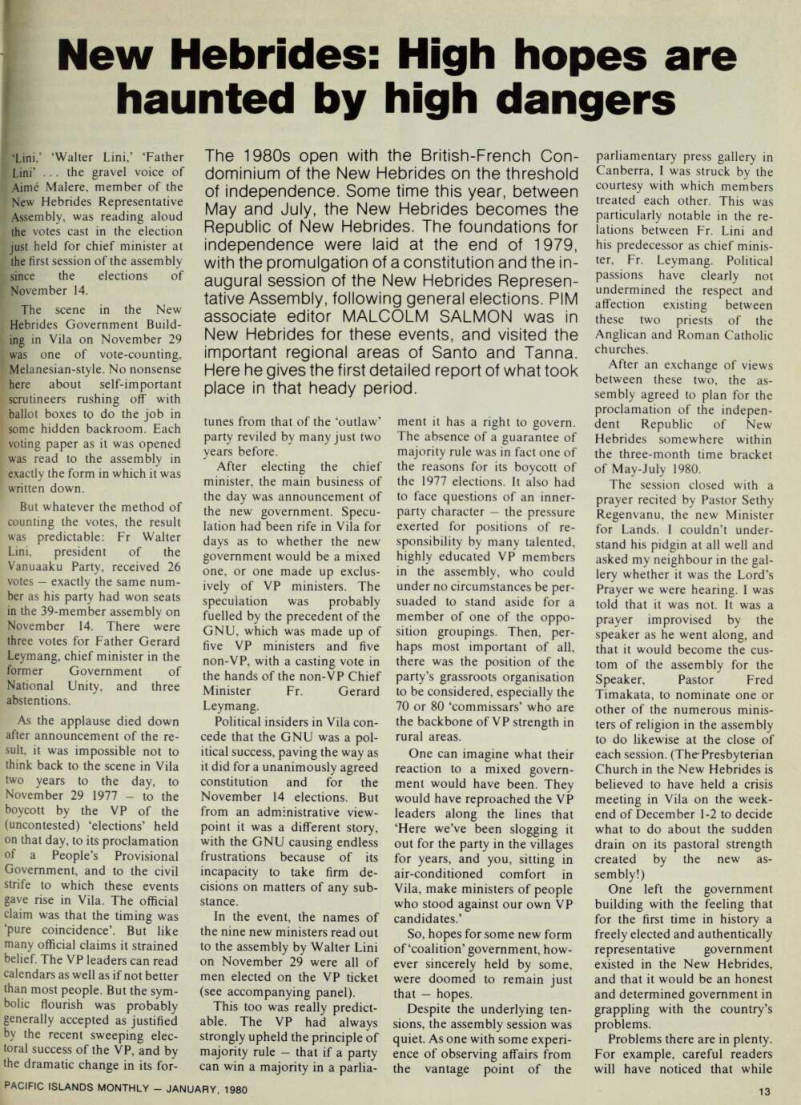
Father Gerard Leymang ... from Chief Minister to backbencher, but without bitterness. Na banga photo.
Calm had by and large re turned to Santo when I visited the island on November 30. A number but by no means all - of those who had fled to the bush had returned to the rusted old US military Quonset huts that are home to about 60% of the population of Santo town.
Although the affair was ‘black man against black man’, longtime Santo resident, den tist and cattleman, Ken Hut ton, told me he had been threatened by a youthful mem ber of one mob. ‘You British, get out!’ he yelled at Mr Hut ton. ‘You cheeky little little c . . ~’ said the forthright Mr Hutton. ‘Anyway, get your facts right.
I’m not British, I’m Australian.
And don’t wave that bloody stick in my face!’ (Meek depar ture of the youthful demon strator.) I’ve referred above to Stevens’ ‘advisors’ in this sorry affair. Wherever one inquired on Santo as to their identity, the same names would crop up.
One was that of Georges Cron steadt, a mixed-race member of the Representative As
sembly representing Santo
town, and another was that of Jean-Claude Creugnet, a businessman, of the Santo
Development Corporation.
Cronsteadt himself, in an interview in Nabanga (Nov 24) described the expulsion of the people from other islands as a
‘logical’ reaction by ‘Man
Santo’ to the defeat in the re
gional assembly elections. He
added: ‘There are lots of people who think that I’ve been somewhat responsible for what has happened. Far from it. On the contrary, I’ve restrained them greatly in what they have
been doing, things would have been worse if I hadn’t been around with them.’
Restraint, yes. When things appear to be ‘going too far’ it is normal for leaders to urge re straint even after they have offered encouragement in the
first place.
An opinion offered by ‘J. M.’ in the same issue of Nabanga as to how the affair unfolded deserves quoting. ‘J. M.’ wrote that, leaving the obvious politi cal motives aside, ‘there is one explanation that’s worth think ing about. “The man bush,” the “naked man” [such as Stevens’ followers] is, for the coast dwelling Melanesians, the “man soltwater”, rather like the Huns were for our ances tors back in the sth century.
Certainly, for many years now, there have no longer been armed conflicts between them, but an ancestral fear persists.
The naked man, carrying a club or bow and arrow, revives a certain sense of terror that was thought to be dead but in fact had only become hidden.
Perhaps this explains the scope of the panic that gripped Santo town, even among those who never saw any “naked men” but had heard by word of mouth that “they” had come.’
There is the closest relation
ship between what happened
on Santo and the events
though much less publicised,
actually much graver far to the south on Tanna. In each case the motivation was the same refusal to accept defeat in the regional assembly elec tions.
Co-ordination of ‘tactics’ be-
tween the electoral losers on both islands was plainly to be seen in the visit to Vila, and then to Santo, by Alexis Yolou, member of the Representatives Assembly for Tanna under the banner of the cultist John Frum movement. On arrival at Santo, Yolou was taken straight to Fanafo to confer with Jimmy Stevens. On his return to Tanna a move was started, exactly as on Santo, to expel non-Tannese islanders, mainly people from the small island of Futuna (not to be confused with Wallis/Futuna), about 70 km off Tanna’s east coast. It was widely said on Tanna that Guy Prevot was probably no stranger to the arz rangements necessary for Yolou’s Santo visit.
An Australian settler in the New Hebrides of 33 years standing. Bob Paul, who has lived on Tanna for many years, was in the thick of the troubles there, which included acts of arson against a ‘bush market’ greatly valued by the local
people, the uprooting of family
vegetable gardens, and the
potentially murderous action of digging holes and a trench across Tanna’s grass airstrip in an attempt to prevent the land-
ing of French and British mo bile police forces, Bob Paul has given the following account for PIM ; ‘The period prior to the elec tions on Tanna was punctuated by a series of visits by French resident commissioner Robert
handing out large quantities of
rice, tinned fish, boats, out board motors, and so on. The people of Tanna were some what taken aback by all this and the custom people re turned the gesture by deliver ing a large amount of sugar cane, taro, manioc, etc, to the French contact in the area (one Tuk Niau) to avoid being under any obligation, ‘The election itself was well run and no serious problems came up. ‘The results were a shattering blow to the “moderates”. Im mediately a planned move got underway, protests were lodged under various pretexts and a demonstration was held with club-bearing “moderates” protesting that they had been cheated ...
‘People leaving for the
National Arts Festival, an his toric event for the New Hebrides, were told by the “moderates” that as the elec
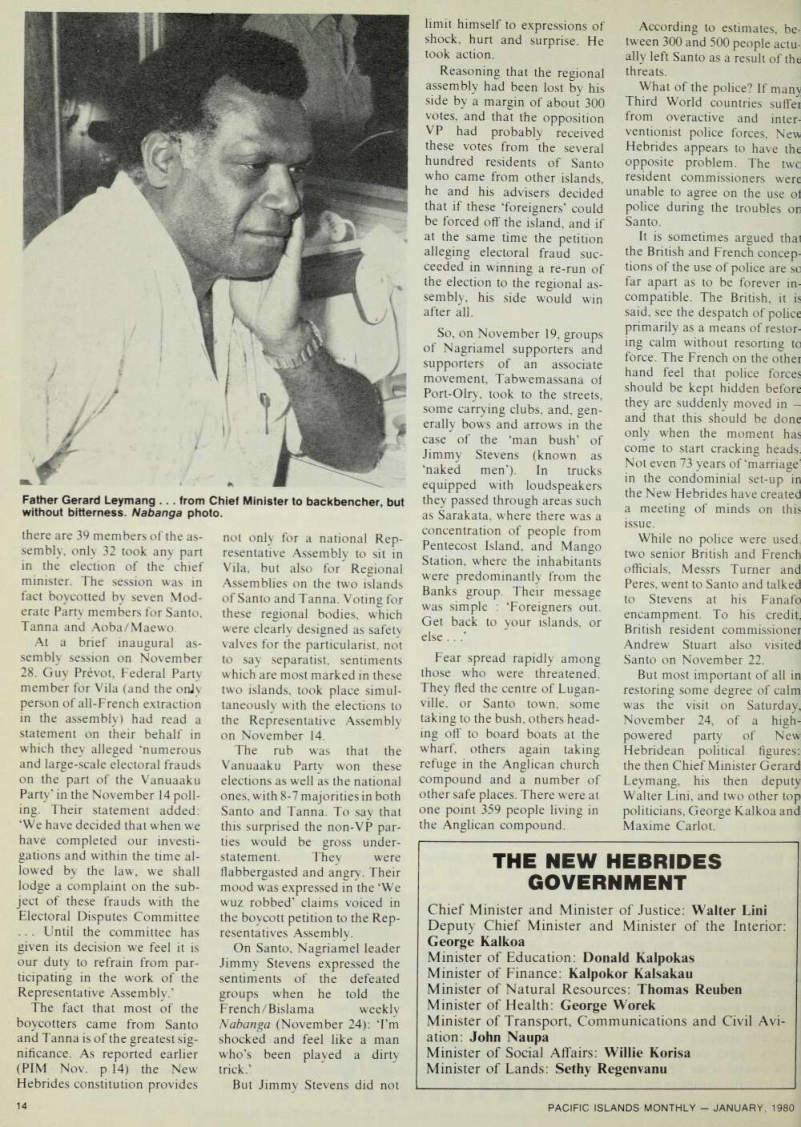
Voters wait their turn in a polling booth in Vila on November 14.
Nabanga photo.
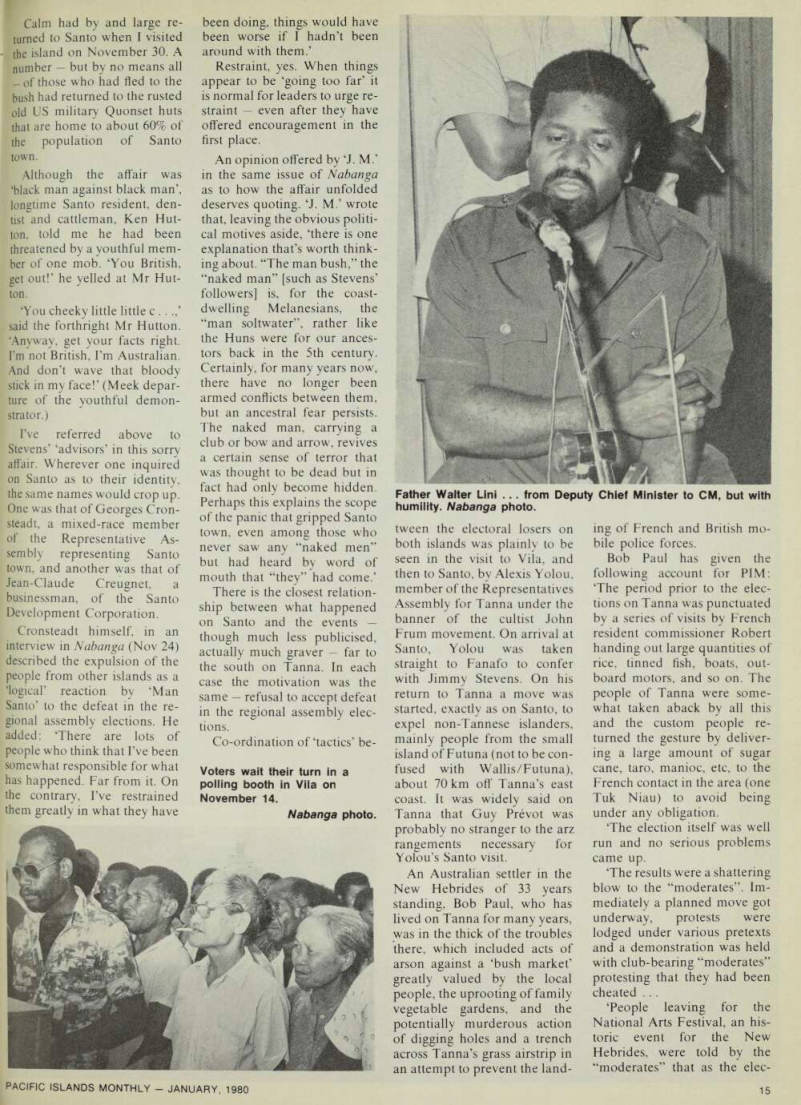
Father Walter Uni ... from Deputy Chief Minister to CM, but with humility. Nabanga photo.
tions had not been “straight” the John Frum and Kapiel would stop them going to Vila until a new election was held. ‘The people for the Arts Fes tival gathered at our property waiting for the ship and 120 Kapiel one of the many cults on this “island of cults” and John Frum standover men arrived armed with clubs and with red bands around their heads. They moved over to where the people were as sembled and their leader an nounced loud and clear in pidgin “Anyone who goes to the Arts Festival we will kill his wife and children and burn his house”... ‘After abortive talks with representatives of the British and French residencies who had arrived from Vila, and who
appeared interested in doing
nothing, I returned in disgust to my workshop where I found
people carving out weapons
they had made they had had
enough.
‘The standover men an nounced that they would be back the following morning to a) remove the Futunese on my property (80% of my staff are Futunese) as they were VP fol lowers, and b) they would burn out all the villages on the west coast from Loanei to Bethel, and c) they would prevent the projected election of five chiefs to the regional assembly due to be held the following day. ‘A night of feverish activity on my property resulted. The Futunese moved out and up into the bush as they did from the other three Futunese settle ments. The people of White sands started arriving and positioning themselves around the plantation to intercept any attackers. I was astounded when at daylight I found some
300 people busily making
weapons in and around my
workshop.
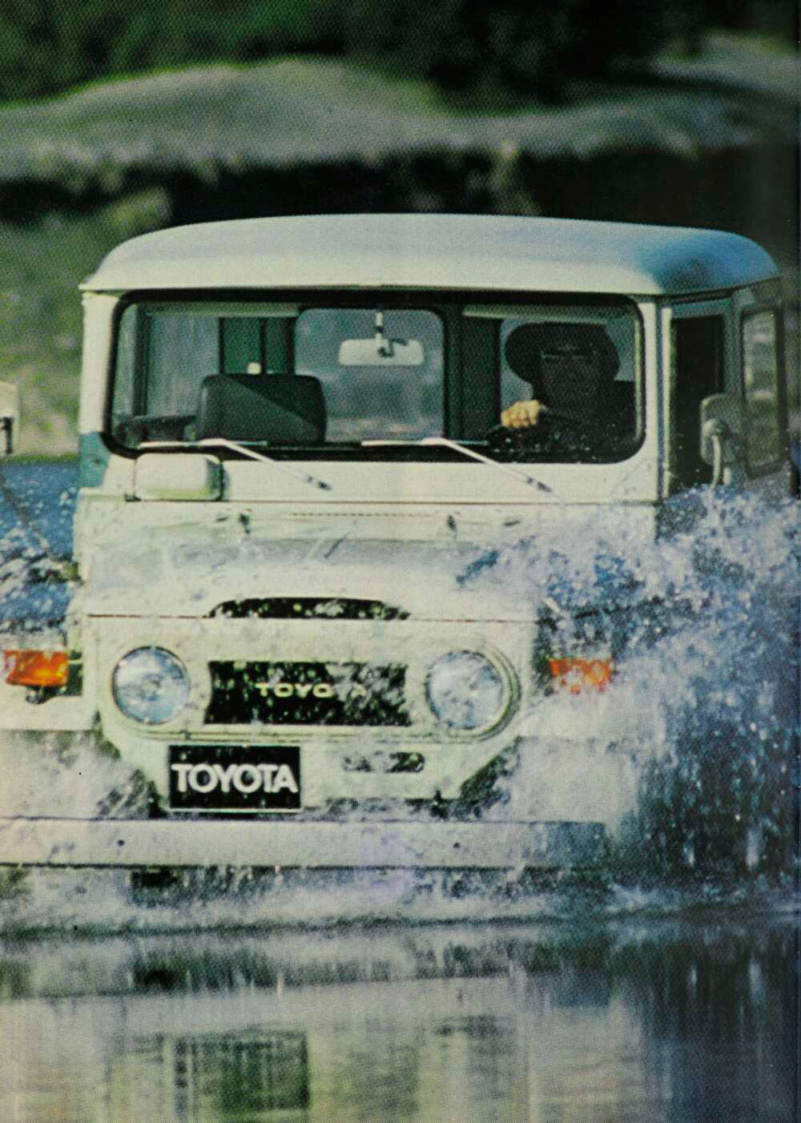
‘A message that the mobile police would be down at Tanna from Vila at 8.00 am the next morning was passed on at 10 pm. We monitored every ve hicle which passed along the road and the only one from the Agencies was the French
Toyota. Presumably this car
ried the message that the air craft were due from 8 am on and that the British police were on the first three aircraft. ‘During the night a group
moved out from the area of Alexis Yolou’s village and dug a trench across the airfield, as well as 19 holes at the landing area and invisible from the air, as the spoil from the holes had been scattered around the air field. ‘At 7.10 am Air Melanesiae advised me from Vila that the special mobile force were due from 8 am onwards. At the same time word came down from the airfield of the damage done there. How word got as far as Vila I don’t know. ‘I called on the local share holders of the New Hebrides
Airways, mostly Melanesians,
and told them that if they ral lied with me we could use the remaining 40 minutes to repair
the airstrip. Fifty-one adults,
plus children, toiled with me using three vehicles and filling the airfield markers as well with soil to carry to the holes.
Women were actually carrying
soil in their skirts. A mag nificent effort by the people to restore “their” aerodrome.
During this operation two
senior local French officials arrived on the scene, drove around but made no effort to help tried to talk to some of the people who ignored them, so they just drove off. Not a single person, truck or machine was offered by them. The air
strip was nevertheless repaired
in time. ‘Meanwhile a force of “mod erates” armed with clubs com plete with their red headbands left from Loanatum Alexis Yolou’s village and headed towards Lenakel. The crowd at my place by now was over 500 and they were spoiling for a fight. The “moderates” did not attempt to burn out the Futunese but continued on to the British and French agencies at Isangel. The Kapiel from the Middle Bush area moved and destroyed the bush market and gardens in that area. ‘We persuaded the mob at our place not to proceed to Isangel as they were too excited and, having attained a local
majority, and being armed
with various vicious weapons,
a cooling-off period was
indicated. ‘All this time, expense and misery should never have hap
pened. It will happen again and
again. I have been putting in
writing for two years now the cause of this misery. I say it
again. Stop this using of the
cargo cultists by unscrupulous characters and incredibly stu pid government officials be fore we have a real tragedy on our hands.’
Bob Paul’s account confirms the dominant impression I gathered on my short, week long visit to the New Hebrides.
It was that the real line of div ision in New Hebrides political life is not between ‘Anglophone’ and ‘Franco phone’, nor even between the British and French on the one hand and the New Hebrideans on the other. It is between New Hebrideans who have been more and those who have been less influenced by the modern world in particular those who have been influenced rather strongly by the missions, for example not so much in many cases by their religious teachings as by their edu cational, medical and other social activities. Most of these activities just happened to have been carried on in English,
although the French, especially
in recent years, have made massive efforts in the edu cational field. For example, Fr.
Walter Lini, an Anglican priest trained in New Zealand, will under no circumstances be threatening Fr. Gerard Leymang, a Roman Catholic priest trained in France, with a club.
Two short statements from
directly opposite New
Hebridean sources seem to sum up these divisions. One is an election slogan of the VP.
One saw it often on the walls of Vila in the post-election period. It said: ‘Vote for the VP the party with 10 years ex perience of politics at home and throughout the world!’
The election result shows that this kind of outward-looking, modernist approach has
obviously won the majority
support of the New Hebrides
population.
But now listen to Jimmy Stevens’ vision of politics in the New Hebrides: ‘A regional council should be formed for each island. Independence should not come all at once for the whole country. Each island should first have its own auton omy . . . There can be no New Hebrides with a strong and
authoritative central govern ment. There’s no question about this.’
As far as foreigners are con cerned, the great danger lies as Bob Paul indicates in the
manipulation of people like
Stevens and his ‘man bush’ fol lowers, and Tanna’s Alexis Yolou and his John Frums by interests as diverse as the American financial adven turers Eugene Peacock and Michael Oliver (with their way-out brand of private
enterprise fundamentalism),
conservative political figures
like Cronsteadt and Prevot,
politically prejudiced district
agents, and unwanted figures like Antoine Fornelli, who although a prohibited
immigrant after his previous
activities trying to start a cultist movement on Tanna (the so called ‘4-Corners Movement’), turned up there briefly again in November in an obvious attempt to fish in the troubled waters.
There is no doubt that the condominial powers ‘want out’, and it is certainly time they went. The whole context of their political and economic re lations is such that their situ ation in New Hebrides is rather an embarrassment to them than anything else.
It is obvious that in the pre sent situation, the French have an effective veto over con dominial actions, since the Bri tish have concluded that while New Hebrides matters little to them, it matters much more to France, especially in view of the unsettled situation in that country’s territories, par ticularly New Caledonia. It simply can’t be imagined that the British are going to do any thing to annoy the French in New Hebrides, especially in view of the delicate nature of their relations in the Common Market.
So, it is certainly time they went. New Hebrides does not need government whose de cisions are coloured by Com mon Market or NATO anxieties.
These people need a govern ment whose prime concern is the New Hebrides. There is no doubt that, whatever the prob lems it will face in the future, the government headed by Walter Lini is such a govern ment.
Advertisements & other items, pp. 14-16 (1 item)
Government
THE NEW HEBRIDES
Chief Minister and Minister of Justice: Walter Lini Deputy Chief Minister and Minister of the Interior:
George Kalkoa
Minister of Education: Donald Kalpokas Minister of Finance: Kalpokor Kalsakau Minister of Natural Resources: Thomas Reuben Minister of Health: George Worek Minister of Transport, Communications and Civil Aviation; John Naupa Minister of Social Affairs: Willie Korisa Minister of Lands: Sethy Regenvanu
TEN
fV>i
P E mr B°. 30 \ >
\ TANI
X 60-. 2CU **l 10- ' v r\ -*■: •* « ' * v ■ ■ •:••'■- mm
Let “TEN” take you
to a new world
of sound
With perfect “TEN" auto sound in your car, you’ll tune in on whole new worlds of listening enjoyment.
These “TEN" winners are packed with outstanding features that assure you of better, richer sound, plus the kind of effortless operation that can never interfere with your driving. And they’re meticulously designed and tested to make certain they will stand up under the toughest service conditions.
So for your companion on the road, select a superb “TEN" sound system and discover for yourself a new world of listening pleasure. y m tm <*o tung ♦ select FM-'| \
111 0 CASSETTE STEREO
mi ■ DP-620 Automatic Eject Cassette Car Stereo with AM/FM Stereo Radio DP-640 Auto Reverse Cassette Car Stereo with AM/FM Stereo Radio
FUJITSU TEN LIMITED
Head Office: 2-28. Gosho-don 1-chome. Hyogo-ku. Kobe. Japan Tokyo Office: (Export Section) Shuwa Onanmon Bldg . 2nd Fi . 1-1. Shimbashi 6-,chome Mmato-ku. Tokyo. Japan Phone (03) 438-1611 Cable TENFUJITSU TOKYO Telex 2425101 TENTOK J Design and specifications subject to change without pnor notice Distributors: Papua New Guinea: CHIN H MEEN N SONS PTY. LTD. PO Box 1106. Boroko Port Moresby. Papua New Guinea Phone 256546 Guam: MICROPAC AUDIO INC. PO Box 3478. Agana. Guam 96910 Phone 472-8091 Tahiti: FARE HI-FI STEREO. PO Box 269 Rue du Marechal Foch Papeete New Hebrides: BURNS PHILP NEW HEBRIDES LIMITED. Vila New Hebrides Cook Islands: AVATIU GENERAL TRADERS. PO Box 27 Rarotonga Fiji: D. GOKAL & CO.. LTD. G PO Box 501. Suva Fiji Phone 25259 22995
Prescription

Political Currents
From Africa
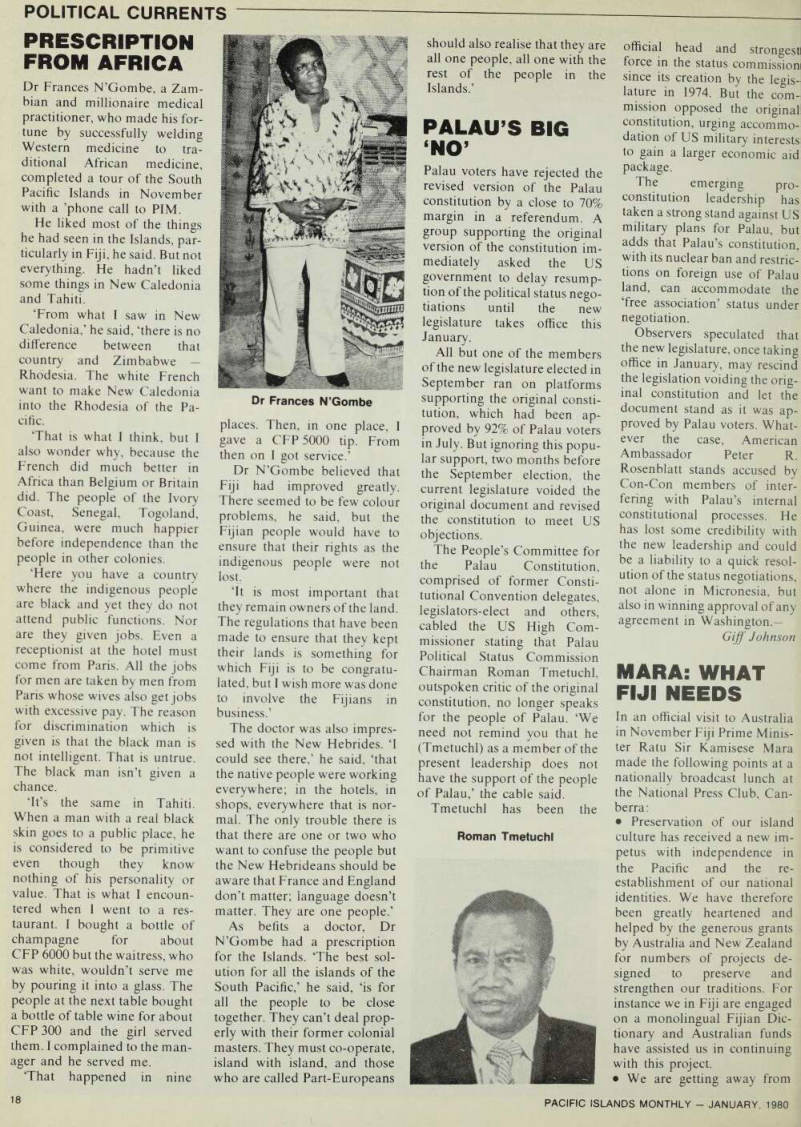
Dr Frances N’Gombe, a Zam bian and millionaire medical practitioner, who made his for
tune by successfully welding
Western medicine to tra ditional African medicine, completed a tour of the South Pacific Islands in November with a ’phone call to PIM.
He liked most of the things he had seen in the Islands, par ticularly in Fiji, he said. But not everything. He hadn’t liked some things in New Caledonia and Tahiti. ‘From what I saw in New Caledonia,’ he said, ‘there is no difference between that country and Zimbabwe - Rhodesia. The white French want to make New Caledonia into the Rhodesia of the Pa cific. ‘That is what I think, but I also wonder why, because the French did much better in Africa than Belgium or Britain did. The people of the Ivory
Coast, Senegal, Togoland,
Guinea, were much happier before independence than the people in other colonies. ‘Here you have a country
where the indigenous people
are black and yet they do not attend public functions. Nor
are they given jobs. Even a
receptionist at the hotel must come from Paris. All the jobs for men are taken by men from Paris whose wives also get jobs with excessive pay. The reason for discrimination which is given is that the black man is not intelligent. That is untrue.
The black man isn’t given a chance. ‘lt’s the same in Tahiti.
When a man with a real black skin goes to a public place, he is considered to be primitive
even though they know
nothing of his personality or value. That is what I encoun tered when I went to a res taurant. I bought a bottle of champagne for about CFP 6000 but the waitress, who was white, wouldn’t serve me by pouring it into a glass. The people at the next table bought a bottle of table wine for about CFP 300 and the girl served them. I complained to the man ager and he served me. ‘That happened in nine
places. Then, in one place, I gave a CFP 5000 tip. From then on I got service.’
Dr N’Gombe believed that
Fiji had improved greatly.
There seemed to be few colour problems, he said, but the Fijian people would have to ensure that their rights as the
indigenous people were not
lost. ‘lt is most important that they remain owners of the land.
The regulations that have been made to ensure that they kept their lands is something for which Fiji is to be congratu lated, but I wish more was done to involve the Fijians in business.’
The doctor was also impres sed with the New Hebrides. ‘I could see there,' he said, ‘that the native people were working everywhere; in the hotels, in shops, everywhere that is nor mal. The only trouble there is that there are one or two who want to confuse the people but the New Hebrideans should be aware that France and England don’t matter; language doesn’t matter. They are one people.’
As befits a doctor, Dr N’Gombe had a prescription for the Islands. ‘The best sol ution for all the islands of the South Pacific,’ he said, ‘is for all the people to be close together. They can’t deal prop erly with their former colonial masters. They must co-operate, island with island, and those who are called Part-Europeans
should also realise that they are all one people, all one with the rest of the people in the Islands.’
Palau’S Big
‘NO’
Palau voters have rejected the revised version of the Palau constitution by a close to 70% margin in a referendum. A
group supporting the original
version of the constitution im mediately asked the US government to delay resump tion of the political status nego tiations until the new legislature takes office this
January.
All but one of the members of the new legislature elected in September ran on platforms supporting the original consti tution, which had been ap proved by 92% of Palau voters in July. But ignoring this popu lar support, two months before the September election, the current legislature voided the original document and revised the constitution to meet US objections.
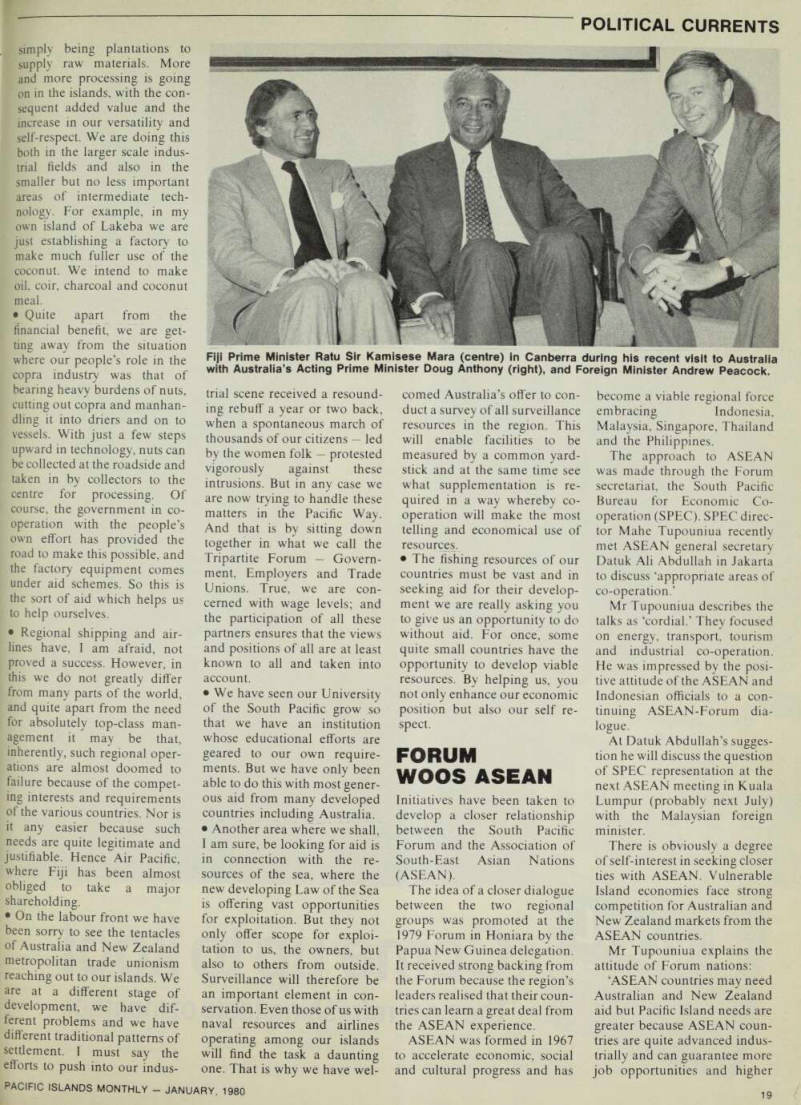
The People’s Committee for the Palau Constitution, comprised of former Consti tutional Convention delegates, legislators-elect and others, cabled the US High Com missioner stating that Palau Political Status Commission Chairman Roman Tmetuchl, outspoken critic of the original constitution, no longer speaks for the people of Palau. ‘We need not remind you that he (Tmetuchl) as a member of the present leadership does not have the support of the people of Palau,’ the cable said.
Tmetuchl has been the
official head and strongest force in the status commission since its creation by the legis lature in 1974. But the com mission opposed the original constitution, urging accommo dation of US military interests to gain a larger economic aid
package.
The emerging pro constitution leadership has taken a strong stand against US military plans for Palau, but adds that Palau’s constitution, with its nuclear ban and restric tions on foreign use of Palau land, can accommodate the ‘free association’ status under negotiation.
Observers speculated that the new legislature, once taking office in January, may rescind the legislation voiding the orig inal constitution and let the document stand as it was ap proved by Palau voters. What ever the case, American Ambassador Peter R.
Rosenblatt stands accused by Con-Con members of inter fering with Palau’s internal constitutional processes. He has lost some credibility with the new leadership and could be a liability to a quick resol ution of the status negotiations, not alone in Micronesia, but also in winning approval of any agreement in Washington.-
Gijf Johnson
Mara: What
Fiji Needs
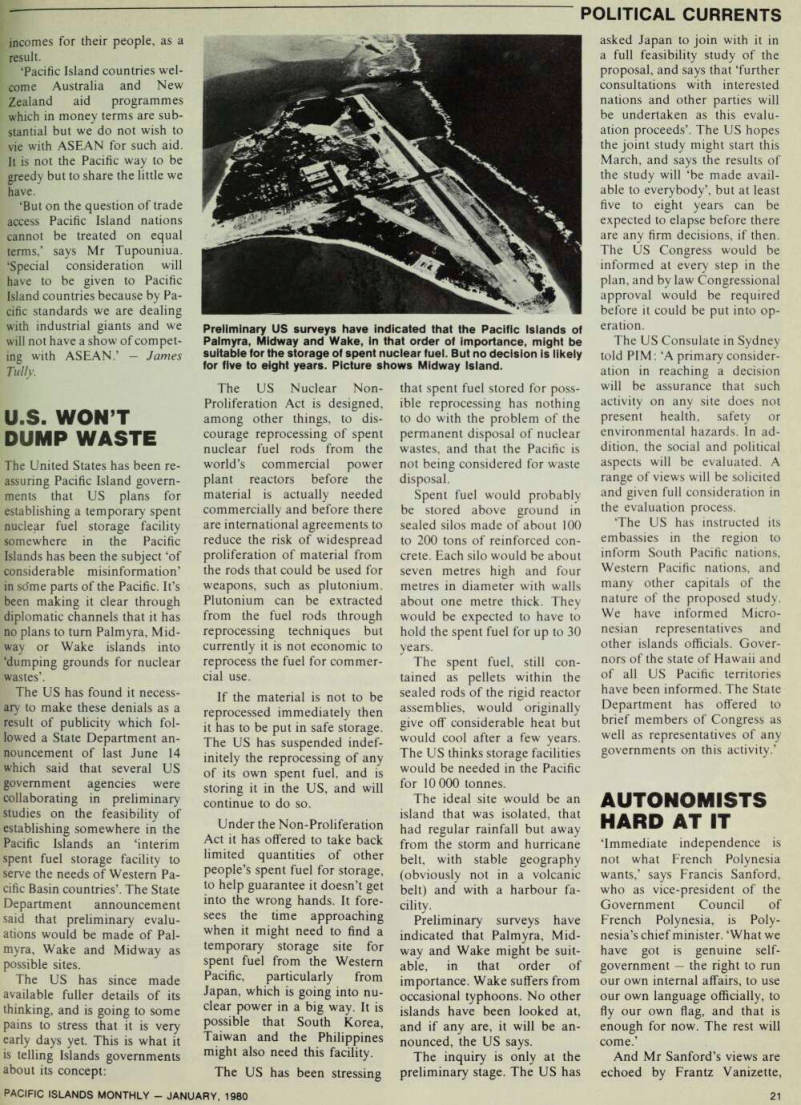
In an official visit to Australia in November Fiji Prime Minis ter Ratu Sir Kamisese Mara made the following points at a nationally broadcast lunch at the National Press Club, Can berra: • Preservation of our island culture has received a new im petus with independence in the Pacific and the re establishment of our national identities. We have therefore been greatly heartened and helped by the generous grants by Australia and New Zealand for numbers of projects de signed to preserve and strengthen our traditions. For instance we in Fiji are engaged on a monolingual Fijian Dic tionary and Australian funds have assisted us in continuing with this project. • We are getting away from
Dr Frances N’Gombe
Roman Tmetuchl
simply being plantations to supply raw materials. More and more processing is going on in the islands, with the con sequent added value and the increase in our versatility and self-respect. We are doing this both in the larger scale indus trial fields and also in the smaller but no less important areas of intermediate tech nology. For example, in my own island of Lakeba we are
just establishing a factory to
make much fuller use of the coconut. We intend to make oil, coir, charcoal and coconut meal. • Quite apart from the financial benefit, we are get ting away from the situation where our people’s role in the copra industry was that of bearing heavy burdens of nuts, cutting out copra and manhan dling it into driers and on to vessels. With just a few steps upward in technology, nuts can be collected at the roadside and taken in by collectors to the centre for processing. Of course, the government in co
operation with the people’s
own effort has provided the road to make this possible, and
the factory equipment comes
under aid schemes. So this is the sort of aid which helps us to help ourselves. • Regional shipping and air lines have, I am afraid, not proved a success. However, in this we do not greatly differ from many parts of the world, and quite apart from the need
for absolutely top-class man
agement it may be that,
inherently, such regional oper
ations are almost doomed to failure because of the compet
ing interests and requirements
of the various countries. Nor is it any easier because such needs are quite legitimate and justifiable. Hence Air Pacific, where Fiji has been almost obliged to take a major
shareholding.
• On the labour front we have been sorry to see the tentacles of Australia and New Zealand metropolitan trade unionism reaching out to our islands. We are at a different stage of development, we have dif ferent problems and we have different traditional patterns of settlement. I must say the efforts to push into our indus-
trial scene received a resound ing rebuff a year or two back, when a spontaneous march of thousands of our citizens led by the women folk protested
vigorously against these
intrusions. But in any case we are now trying to handle these matters in the Pacific Way.
And that is by sitting down together in what we call the Tripartite Forum Govern ment, Employers and Trade Unions. True, we are con cerned with wage levels; and the participation of all these partners ensures that the views and positions of all are at least known to all and taken into account. • We have seen our University of the South Pacific grow so that we have an institution whose educational efforts are geared to our own require ments. But we have only been able to do this with most gener ous aid from many developed countries including Australia. • Another area where we shall, I am sure, be looking for aid is in connection with the re sources of the sea, where the new developing Law of the Sea is offering vast opportunities for exploitation. But they not only offer scope for exploi tation to us, the owners, but also to others from outside.
Surveillance will therefore be an important element in con servation. Even those of us with naval resources and airlines operating among our islands will find the task a daunting one. That is why we have wel
corned Australia’s offer to con duct a survey of all surveillance resources in the region. This will enable facilities to be measured by a common yard stick and at the same time see what supplementation is re quired in a way whereby co operation will make the most telling and economical use of resources. • The fishing resources of our countries must be vast and in seeking aid for their develop ment we are really asking you to give us an opportunity to do without aid. For once, some quite small countries have the
opportunity to develop viable
resources. By helping us, you not only enhance our economic position but also our self re spect.
Forum
Woos Asean
Initiatives have been taken to
develop a closer relationship
between the South Pacific Forum and the Association of South-East Asian Nations
(Asean).
The idea of a closer dialogue between the two regional groups was promoted at the 1979 Forum in Honiara by the
Papua New Guinea delegation.
It received strong backing from the Forum because the region’s leaders realised that their coun tries can learn a great deal from the ASEAN experience.
ASEAN was formed in 1967 to accelerate economic, social and cultural progress and has
become a viable regional force
embracing Indonesia,
Malaysia, Singapore, Thailand
and the Philippines.
The approach to ASEAN was made through the Forum secretariat, the South Pacific Bureau for Economic Co operation (SPEC). SPEC direc tor Mahe Tupouniua recently met ASEAN general secretary Datuk Ali Abdullah in Jakarta to discuss ‘appropriate areas of
co-operation.’
Mr Tupouniua describes the talks as ‘cordial.’ They focused on energy, transport, tourism and industrial co-operation.
He was impressed by the posi
tive attitude of the ASEAN and Indonesian officials to a con tinuing ASEAN-Forum dia
logue.
At Datuk Abdullah’s sugges tion he will discuss the question of SPEC representation at the next ASEAN meeting in Kuala
Lumpur (probably next July)
with the Malaysian foreign
minister.
There is obviously a degree of self-interest in seeking closer ties with ASEAN. Vulnerable Island economies face strong competition for Australian and New Zealand markets from the ASEAN countries.
Mr Tupouniua explains the
attitude of Forum nations: ‘ASEAN countries may need Australian and New Zealand aid but Pacific Island needs are greater because ASEAN coun tries are quite advanced indus trially and can guarantee more
job opportunities and higher
Fijl Prime Minister Ratu Sir Kamisese Mara (centre) in Canberra during his recent visit to Australia with Australia’s Acting Prime Minister Doug Anthony (right), and Foreign Minister Andrew Peacock.
incomes for their people, as a result. ‘Pacific Island countries wel come Australia and New Zealand aid programmes which in money terms are sub stantial but we do not wish to vie with ASEAN for such aid.
It is not the Pacific way to be greedy but to share the little we have. ‘But on the question of trade access Pacific Island nations cannot be treated on equal terms,’ says Mr Tupouniua. ‘Special consideration will have to be given to Pacific Island countries because by Pa cific standards we are dealing with industrial giants and we will not have a show of compet ing with ASEAN.’ James
Tally.
U.S. Won’T
Dump Waste
The United States has been re assuring Pacific Island govern ments that US plans for establishing a temporary spent nuclear fuel storage facility somewhere in the Pacific Islands has been the subject ‘of considerable misinformation’ in so'me parts of the Pacific. It’s been making it clear through diplomatic channels that it has no plans to turn Palmyra, Mid way or Wake islands into
‘dumping grounds for nuclear
wastes’.
The US has found it necess ary to make these denials as a result of publicity which fol lowed a State Department an nouncement of last June 14 which said that several US government agencies were
collaborating in preliminary
studies on the feasibility of establishing somewhere in the Pacific Islands an ‘interim spent fuel storage facility to serve the needs of Western Pa cific Basin countries’. The State
Department announcement
said that preliminary evalu ations would be made of Pal myra, Wake and Midway as possible sites.
The US has since made available fuller details of its thinking, and is going to some pains to stress that it is very early days yet. This is what it is telling Islands governments about its concept:
The US Nuclear Non- Proliferation Act is designed, among other things, to dis courage reprocessing of spent nuclear fuel rods from the world’s commercial power plant reactors before the material is actually needed commercially and before there are international agreements to reduce the risk of widespread proliferation of material from the rods that could be used for weapons, such as plutonium.
Plutonium can be extracted from the fuel rods through
reprocessing techniques but
currently it is not economic to reprocess the fuel for commer cial use.
If the material is not to be
reprocessed immediately then
it has to be put in safe storage.
The US has suspended indef initely the reprocessing of any of its own spent fuel, and is storing it in the US, and will continue to do so.
Under the Non-Proliferation Act it has offered to take back limited quantities of other people’s spent fuel for storage, to help guarantee it doesn’t get into the wrong hands. It fore sees the time approaching when it might need to find a temporary storage site for spent fuel from the Western Pacific, particularly from Japan, which is going into nu clear power in a big way. It is possible that South Korea, Taiwan and the Philippines might also need this facility.
The US has been stressing
that spent fuel stored for poss
ible reprocessing has nothing
to do with the problem of the permanent disposal of nuclear wastes, and that the Pacific is not being considered for waste
disposal.
Spent fuel would probably
be stored above ground in sealed silos made of about 100 to 200 tons of reinforced con crete. Each silo would be about seven metres high and four metres in diameter with walls about one metre thick. They would be expected to have to hold the spent fuel for up to 30 years.
The spent fuel, still con tained as pellets within the sealed rods of the rigid reactor assemblies, would originally give off considerable heat but would cool after a few years.
The US thinks storage facilities would be needed in the Pacific for 10 000 tonnes.
The ideal site would be an island that was isolated, that had regular rainfall but away from the storm and hurricane belt, with stable geography (obviously not in a volcanic belt) and with a harbour fa
cility.
Preliminary surveys have indicated that Palmyra, Mid way and Wake might be suit able, in that order of importance. Wake suffers from occasional typhoons. No other islands have been looked at, and if any are, it will be an nounced, the US says.
The inquiry is only at the preliminary stage. The US has
asked Japan to join with it in a full feasibility study of the proposal, and says that ‘further consultations with interested nations and other parties will be undertaken as this evalu ation proceeds’. The US hopes
the joint study might start this
March, and says the results of the study will ‘be made avail able to everybody’, but at least five to eight years can be expected to elapse before there are any firm decisions, if then.
The US Congress would be informed at every step in the
plan, and by law Congressional
approval would be required
before it could be put into op eration.
The US Consulate in Sydney told PIM: ‘A primary consider ation in reaching a decision will be assurance that such activity on any site does not present health, safety or environmental hazards. In ad dition, the social and political aspects will be evaluated. A range of views will be solicited and given full consideration in the evaluation process. ‘The US has instructed its embassies in the region to inform South Pacific nations.
Western Pacific nations, and many other capitals of the nature of the proposed study.
We have informed Micro nesian representatives and other islands officials. Gover nors of the state of Hawaii and of all US Pacific territories have been informed. The State Department has offered to brief members of Congress as well as representatives of any governments on this activity.’
Autonomists
Hard At It
‘lmmediate independence is not what French Polynesia wants,’ says Francis Sanford, who as vice-president of the Government Council of
French Polynesia, is Poly
nesia’s chief minister. ‘What we have got is genuine self government the right to run our own internal affairs, to use our own language officially, to fly our own flag, and that is enough for now. The rest will come.’
And Mr Sanford’s views are echoed by Frantz Vanizette,
Preliminary US surveys have indicated that the Pacific Islands of Palmyra, Midway and Wake, in that order of importance, might be suitable for the storage of spent nuclear fuel. But no decision is likely for five to eight years. Picture shows Midway Island.
president of French Polynesia’s
Territorial Assembly, who says, ‘Freedom is fine, but you still have to have connections with other people. Small territories can’t survive on their own.’
The reality of self-govern-
ment has taken the heat out of the independence movement in French Polynesia. Men like Sanford who were in the vanguard of the demand for autonomy are now more busily
occupied in handling the
autonomy they’ve won And most of the population agree with their approach.
The demand for ‘independence now’ comes only from small groups with minor support, which is the reason why nobody, either in the French
establishment or the territory government, got much excited recently when PNG Deputy Prime Minister Ebia Olewale and New Hebrides Deputy Chief Minister George Kalkoa made stirring speeches at a
Papeete independence rally
(PIM Dec p 15). „,„ , . .
French Po| y nesia has been running its own affatrs, includ >"g co , nt I ro *>"S I ' s ° wn budget, since July 1977. It does it under “ ne r w constitution which both San [ ord and , Y 311126 sa y wor , ks - and whlch can and wlll evo ve ’
Mr Vanizette says the consti tution is responsible for the best relations that have ever existed between metropolitan
France and French Polynesia.
The new constitution clearly defined the State’s and Poly nesia’s responsibilities. ‘Before, there was too much ambiguity,’ he says. ‘What we got from time to time depended on who was in power in France, but not now. Power genuinely is in the hands of the Government Council for the first time. They run the
country.’
Mr Vanizette predicts that the next change will make the vice-president of the Govern ment Council into the official president of the Government Council (that title is at present held by the High Com missioner). He thinks there will also be more direct powers given the councillors who at the moment, for example, do not have the power to remove the head of a department that has to be done by the High missioner. ‘The evolution will be in the spirit of the French consti tution,’ he says, ‘which allows a local constitution to evolve with discussion.’
He believes the present con stitutional arrangement with France is more satisfactory
than complete independence,
because it enables Polynesians to discuss their needs with France ‘on a basis of equal-to
equal’.
If French Polynesia were independent today it could not possibly meet the money that was expended by France on the
development of the territory,
particularly its expenditure on
public servants, he said.
This did not mean that French Polynesia was not con scious of the need to build up its own economy. There was a time, only a few years ago, when France’s nuclear centre in French Polynesia was re sponsible for generating 60% of of the local economy. It had since been lowered to 30%, and each year French Polynesia was lowering the percentage even more, Vanizette said.
Under the constitution, France still controls French
Polynesia’s foreign affairs, citi
zenship, defence, police and
justice, and secondary edu
cation. Neither Francis San ford nor Vanizette sees the need for any of these responsi
bilities to be passed over right now, but Sanford thinks when the time does come for changes he would want to see foreign affairs passed over first be cause of its close involvement with trade.
Mr Sanford foresees a closer involvement between French Polynesia and the rest of the Pacific Islands. ‘What I woud like to see is all the groups of the South Pa cific coming together to form a kind of common market, work ing closer together on trade matters. That way we can all get stronger.’
Mr Sanford recognises the fact that some of his supporters fear he may have lost the drive drive that he once had towards full independence for French Polynesia. He doesn’t apolo gise for it; he says that once French Polynesia got the reins of government it was inevitable that it should consolidate be fore the next step.
He says: ‘Some people I know who were for indepen dence right away make visits to other places outside French Polynesia and see what is going on, and change their minds.
The fact is as long as we have the right to run our internal affairs, we are better to concen trate on developing our econ omy. That’s the big task. We have to create employment, and we are doing it’. Stuart Inder
Atmospheric nuclear tests like this one on Moruroa Atoll, French Polynesia, are a thing of the past. So are the times when the territory got as much as 60% of its budget from the nuclear testing pro gramme. According to French Polynesia’s leaders, the programme now accounts for only 30% of the budget, and this percentage will go down further.
Above: Francis Sanford; below: Frantz Vanizette.
Advertisements & other items, pp. 20-23 (1 item)
Come up to tool
The cool refreshing taste of menthol.
The G-Series from JVC.
A different musical experience
W / * Beautifully designed stereo systems from JVC - the fabulous G-Series-with coordinated looks and feel.
Distinctive musical experiences sure to appeal to every kind of music lover.
In every system, the kind of careful attention to detail that has helped make our reputation.
In every system, our beautiful ease of operation, handsome good looks, excellent cost/performance value.
Not to mention your choice of big or small power outputs, separate tuners and amplifiers, the ultimate in precision and accuracy.
We know. We’re JVC, the innovative audio/video electronics company with 52 years of experience.
At JVC, details count. And this is why you can always count on us for true high-fidelity reproduction. Visit a JVC dealer today and audition the different G-Series systems.
I JVC G-SERIES m-Fl SYSTEMS
JVC
Australia: Hagemeyer (Australasia) 8.V., 25-27 Paul Street North Ryde N.S.W. 2113. Australia Te 1.887-1444 Fiji Islands: D. Qokal & Co., Ltd.. G.P.O. Box 501, Corner of Pier Street & Renwick Road, Suva, Fiji Tel. 25259 Cook Islands: J. & P. Ingram & Co., Ltd., P.0.80x 55. Rarotonga, Cook Islands Te 1.378457 New Hebrides: Wu ke Luong. P.0.80x 113, Rue Higginson, Port-Vila New Hebrides Te 1.2115 New Caledonia: Caldis, 2, Route du Velodrome, B.P. Ml, Noumea, Cedex, New Caledonia Te 1.262350 Tahiti: Magasin Sincere, B.P. 215, Papeete. Tahiti Te 1,20060 Papua New Guinea: Hagemeyer(P,N.G.)Pty. Ltd., P.0.80x 90 Lae, Papua New Guinea Te 1.42-3200 New Zealand: Atlas Majestic Industries Ltd., 11. Albion Road, Otahuhu, Auckland 6, New Zealand Te 1.27-67-099
People
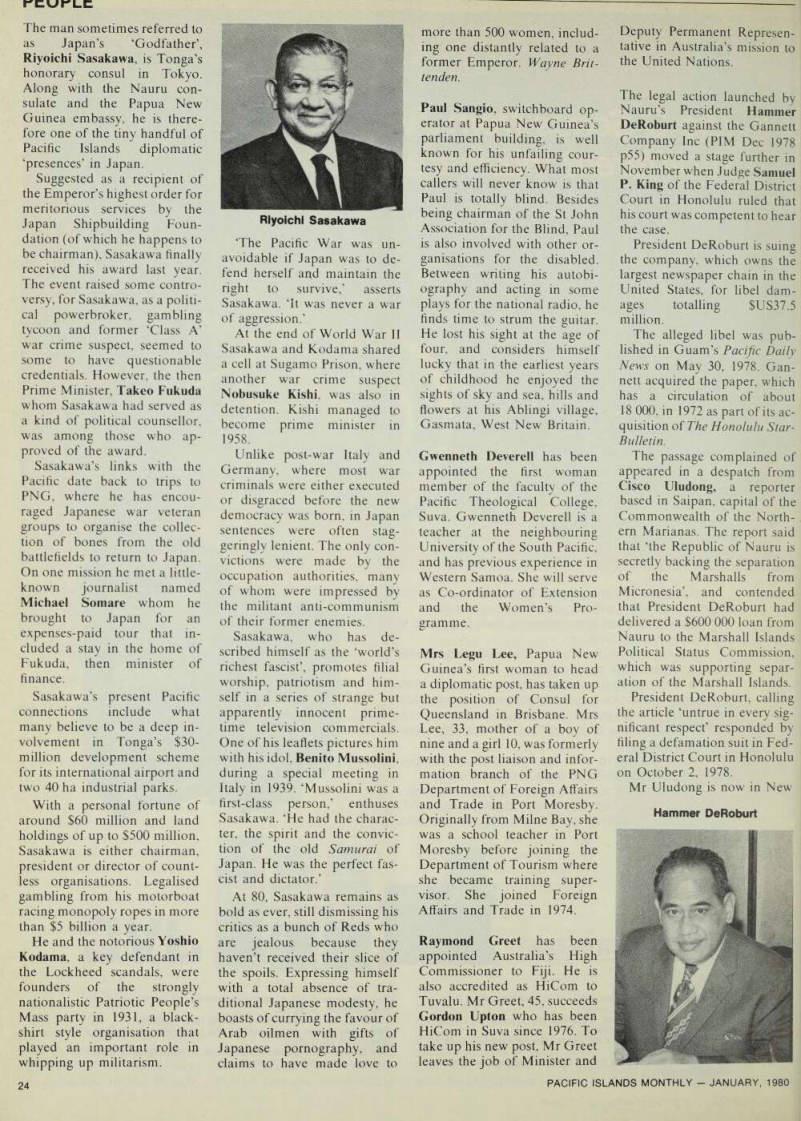
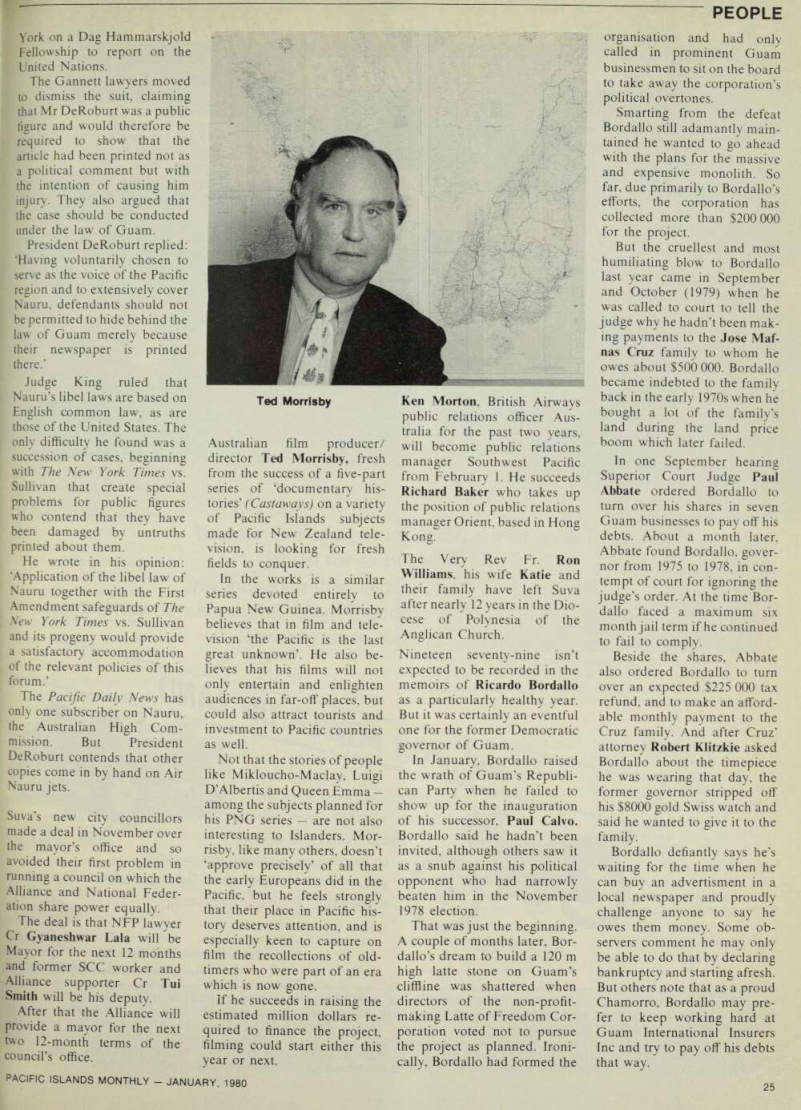
The man sometimes referred to as Japan’s ‘Godfather’, Riyoichi Sasakawa, is Tonga’s
honorary consul in Tokyo.
Along with the Nauru con sulate and the Papua New Guinea embassy, he is there fore one of the tiny handful of Pacific Islands diplomatic ‘presences’ in Japan.
Suggested as a recipient of the Emperor’s highest order for meritorious services by the
Japan Shipbuilding Foun
dation (of which he happens to be chairman), Sasakawa finally received his award last year.
The event raised some contro versy, for Sasakawa, as a politi cal powerbroker, gambling tycoon and former ‘Class A’ war crime suspect, seemed to some to have questionable credentials. However, the then Prime Minister, Takeo Fukuda whom Sasakawa had served as a kind of political counsellor, was among those who ap proved of the award.
Sasakawa’s links with the Pacific date back to trips to PNG, where he has encou
raged Japanese war veteran
groups to organise the collec tion of bones from the old battlefields to return to Japan.
On one mission he met a little known journalist named Michael Somare whom he brought to Japan for an expenses-paid tour that in cluded a stay in the home of Fukuda, then minister of finance.
Sasakawa’s present Pacific connections include what many believe to be a deep in volvement in Tonga’s $3O - development scheme for its international airport and two 40 ha industrial parks.
With a personal fortune of around $6O million and land holdings of up to $5OO million, Sasakawa is either chairman, president or director of count
less organisations. Legalised
gambling from his motorboat racing monopoly ropes in more than $5 billion a year.
He and the notorious Yoshio Kodama, a key defendant in the Lockheed scandals, were founders of the strongly nationalistic Patriotic People’s Mass party in 1931, a black
shirt style organisation that
played an important role in whipping up militarism.
‘The Pacific War was un avoidable if Japan was to de fend herself and maintain the right to survive,’ asserts Sasakawa. ‘lt was never a war
of aggression.’
At the end of World War II Sasakawa and Kodama shared a cell at Sugamo Prison, where another war crime suspect Nobusuke Kishi, was also in detention. Kishi managed to become prime minister in 1958.
Unlike post-war Italy and Germany, where most war criminals were either executed or disgraced before the new democracy was born, in Japan sentences were often stag geringly lenient. The only con victions were made by the occupation authorities, many of whom were impressed by the militant anti-communism of their former enemies.
Sasakawa, who has de scribed himself as the ‘world’s richest fascist’, promotes filial
worship, patriotism and him
self in a series of strange but
apparently innocent prime
time television commercials.
One of his leaflets pictures him with his idol. Benito Mussolini,
during a special meeting in
Italy in 1939. ‘Mussolini was a first-class person,’ enthuses Sasakawa. ‘He had the charac ter. the spirit and the convic tion of the old Samurai of Japan. He was the perfect fas cist and dictator.’
At 80, Sasakawa remains as bold as ever, still dismissing his critics as a bunch of Reds who
are jealous because they
haven’t received their slice of
the spoils. Expressing himself
with a total absence of tra ditional Japanese modesty, he boasts of currying the favour of Arab oilmen with gifts of
Japanese pornography, and
claims to have made love to
more than 500 women, includ ing one distantly related to a former Emperor. Wayne Brit tenden.
Paul Sangio, switchboard op erator at Papua New Guinea’s
parliament building, is well
known for his unfailing cour tesy and efficiency. What most callers will never know is that Paul is totally blind. Besides being chairman of the St John Association for the Blind, Paul is also involved with other or ganisations for the disabled.
Between writing his autobi ography and acting in some plays for the national radio, he finds time to strum the guitar.
He lost his sight at the age of four, and considers himself lucky that in the earliest years of childhood he enjoyed the sights of sky and sea, hills and flowers at his Ablingi village, Gasmata, West New Britain.
Gwenneth Deverell has been appointed the first woman member of the faculty of the
Pacific Theological College,
Suva. Gwenneth Deverell is a teacher at the neighbouring University of the South Pacific, and has previous experience in Western Samoa. She will serve as Co-ordinator of Extension and the Women’s Pro gramme.
Mrs Legu Lee, Papua New Guinea’s first woman to head a diplomatic post, has taken up the position of Consul for Queensland in Brisbane. Mrs Lee, 33, mother of a boy of nine and a girl 10, was formerly with the post liaison and infor mation branch of the PNG
Department of Foreign Affairs
and Trade in Port Moresby.
Originally from Milne Bay, she was a school teacher in Port
Moresby before joining the
Department of Tourism where she became training super
visor. She joined Foreign
Affairs and Trade in 1974.
Raymond Greet has been
appointed Australia’s High
Commissioner to Fiji. He is also accredited as HiCom to Tuvalu. Mr Greet, 45, succeeds Gordon Upton who has been HiCom in Suva since 1976. To take up his new post, Mr Greet leaves the job of Minister and
Deputy Permanent Represen tative in Australia’s mission to the United Nations.
The legal action launched by Nauru’s President Hammer Deßoburt against the Gannett Company Inc (PIM Dec 1978 p 55) moved a stage further in November when Judge Samuel P. King of the Federal District Court in Honolulu ruled that his court was competent to hear the case.
President Deßoburt is suing the company, which owns the largest newspaper chain in the United States, for libel dam ages totalling $U537.5 million.
The alleged libel was pub lished in Guam’s Pacific Daily News on May 30, 1978. Gan nett acquired the paper, which has a circulation of about 18 000, in 1972 as part of its ac quisition of The Honolulu Star- Bulletin.
The passage complained of appeared in a despatch from Cisco Uludong, a reporter based in Saipan, capital of the Commonwealth of the North ern Marianas. The report said that ‘the Republic of Nauru is
secretly backing the separation
of the Marshalls from Micronesia’, and contended that President Deßoburt had delivered a $6OO 000 loan from Nauru to the Marshall Islands Political Status Commission, which was supporting separ ation of the Marshall Islands.
President Deßoburt, calling the article ‘untrue in every sig
nificant respect’ responded by
filing a defamation suit in Fed eral District Court in Honolulu on October 2, 1978.
Mr Uludong is now in New
Riyoichi Sasakawa
Hammer DeRoburt
York on a Dag Hammarskjold Fellowship to report on the United Nations.
The Gannett lawyers moved to dismiss the suit, claiming that Mr Deßoburt was a public figure and would therefore be required to show that the article had been printed not as a political comment but with the intention of causing him injury. They also argued that the case should be conducted under the law of Guam.
President Deßoburt replied:
‘Having voluntarily chosen to
serve as the voice of the Pacific region and to extensively cover Nauru, defendants should not be permitted to hide behind the law of Guam merely because their newspaper is printed there.’
Judge King ruled that
Nauru’s libel laws are based on English common law, as are those of the United States. The only difficulty he found was a succession of cases, beginning with The New York Times vs.
Sullivan that create special
problems for public figures
who contend that they have
been damaged by untruths
printed about them.
He wrote in his opinion: ‘Application of the libel law of Nauru together with the First Amendment safeguards of The New York Times vs. Sullivan and its progeny would provide a satisfactory accommodation of the relevant policies of this forum.’
The Pacific Daily News has only one subscriber on Nauru, the Australian High Com mission. But President Deßoburt contends that other copies come in by hand on Air
Nauru jets.
Suva’s new city councillors made a deal in November over the mayor’s office and so avoided their first problem in running a council on which the Alliance and National Feder ation share power equally.
The deal is that NFP lawyer Cr Gyaneshwar Lala will be Mayor for the next 12 months and former SCC worker and Alliance supporter Cr Tui Smith will be his deputy.
After that the Alliance will provide a mayor for the next two 12-month terms of the council’s office.
Australian film producer/ director Ted Morrisby, fresh from the success of a five-part series of ‘documentary his tories’ ( Castaways) on a variety of Pacific Islands subjects made for New Zealand tele vision, is looking for fresh fields to conquer.
In the works is a similar series devoted entirely to
Papua New Guinea. Morrisby
believes that in film and tele vision ‘the Pacific is the last great unknown’. He also be lieves that his films will not
only entertain and enlighten
audiences in far-off places, but could also attract tourists and investment to Pacific countries as well.
Not that the stories of people
like Mikloucho-Maclay, Luigi
D’Albertis and Queen Emma among the subjects planned for his PNG series are not also interesting to Islanders. Mor risby, like many others, doesn’t ‘approve precisely’ of all that the early Europeans did in the Pacific, but he feels strongly that their place in Pacific his tory deserves attention, and is especially keen to capture on film the recollections of old timers who were part of an era which is now gone.
If he succeeds in raising the estimated million dollars re quired to finance the project, filming could start either this year or next.
Ken Morton, British Airways public relations officer Aus tralia for the past two years, will become public relations manager Southwest Pacific from February 1. He succeeds Richard Baker who takes up the position of public relations manager Orient, based in Hong
Kong.
The Very Rev Fr. Ron Williams, his wife Katie and their family have left Suva after nearly 12 years in the Dio cese of Polynesia of the
Anglican Church.
Nineteen seventy-nine isn’t expected to be recorded in the memoirs of Ricardo Bordallo as a particularly healthy year.
But it was certainly an eventful one for the former Democratic governor of Guam.
In January, Bordallo raised the wrath of Guam’s Republi can Party when he failed to show up for the inauguration of his successor. Paul Calvo.
Bordallo said he hadn’t been invited, although others saw it as a snub against his political opponent who had narrowly beaten him in the November 1978 election.
That was just the beginning.
A couple of months later, Bor dallo’s dream to build a 120 m high latte stone on Guam’s cliffline was shattered when directors of the non-profit making Latte of Freedom Cor poration voted not to pursue the project as planned. Ironi cally, Bordallo had formed the
organisation and had only called in prominent Guam businessmen to sit on the board to take away the corporation’s
political overtones.
Smarting from the defeat Bordallo still adamantly main tained he wanted to go ahead with the plans for the massive and expensive monolith. So far, due primarily to Bordallo’s efforts, the corporation has collected more than $2OO 000 for the project.
But the cruellest and most humiliating blow to Bordallo last year came in September and October (1979) when he was called to court to tell the judge why he hadn’t been mak ing payments to the Jose Maf nas Cruz family to whom he owes about $5OO 000. Bordallo became indebted to the family back in the early 1970 s when he bought a lot of the family’s land during the land price boom which later failed.
In one September hearing
Superior Court Judge Paul
Abbate ordered Bordallo to turn over his shares in seven Guam businesses to pay off his debts. About a month later, Abbate found Bordallo, gover nor from 1975 to 1978, in con tempt of court for ignoring the judge’s order. At the time Bor dallo faced a maximum six month jail term if he continued to fail to comply.
Beside the shares, Abbate also ordered Bordallo to turn over an expected $225 000 tax refund, and to make an afford able monthly payment to the Cruz family. And after Cruz’ attorney Robert Klitzkie asked Bordallo about the timepiece he was wearing that day, the former governor stripped off his $BOOO gold Swiss watch and said he wanted to give it to the
family.
Bordallo defiantly says he’s waiting for the time when he can buy an advertisment in a local newspaper and proudly challenge anyone to say he owes them money. Some ob servers comment he may only be able to do that by declaring
bankruptcy and starting afresh.
But others note that as a proud Chamorro, Bordallo may pre fer to keep working hard at Guam International Insurers Inc and try to pay off his debts that way.
Ted Morrisby
Advertisements & other items, p. 26 (1 item)
wvjJL
ini:
§i m § //;
IKmUI
Wm
'STB!
wvjJL
w 1/ *Li Taking to the open sea or to calmer waters?
Going for sport or for labor?
Get there and back in style with dependability.
Go with a Suzuki! choose that outboard motor among our powerful fleet, just matching your boating needs.
la NO
ON
pO|/V£n
fob
and
■c
SUZUKI TS 125
Look into the traditional excellence of Suzuki's performance-proven motorcycles and 4-wheel drive vehicles something to satisfy your every motoring need. Going by sea or by land . . . go with a Suzuki.
SUZUKI MOTOR CO, LTD
Hamamatsu, Japan
SUZUKI 4 WHEEL
DRIVE VEHICLE
SUZUKI
SOLOMON ISLANDS SOLOMON ISLAND SERVICE STATION LTD. • NEW CALEDONIA STE. SUPERCAL • PAPUA NEW GUINEA TUTT BRYANT PACIFIC LTD. • NEW HEBRIDES HENRI LEROUX • NIUE ISLAND BURNS PHILP (SOUTH SEA) CO., LTD. • PONAPE LEO ETSCHEIT • TAHITI NIPPON AUTOMOTO • ELLICE ISLAND TUVALU COOPERATIVE WHOLESALE SOCIETY LTD. • GUAM & SAIPAN ISLAND CYCLERY, INC. • NORFOLK MARTIN'S AGENCIES LTD. • SAMOA PACIFIC PRODUCTS, INC. • TARAWA GILBERT ISLANDS COOPERATIVE FEDERATION LIMITED • TONGA MORRIS HEDSTROM LTD. • WESTERN CAROLINES BECHESRRAK T. COMPANY • AMBROSE D. MINGINFEL'S WHOLESALER • EASTERN CAROLINES KIOMASA STORE
athletics
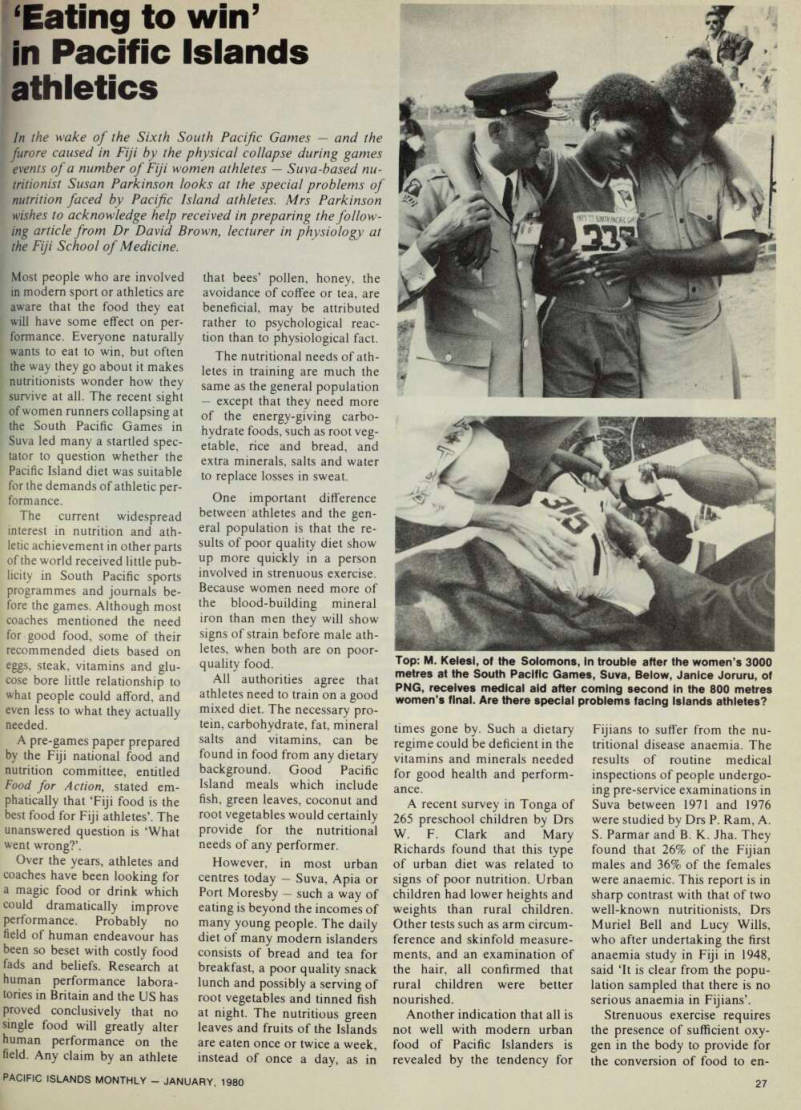

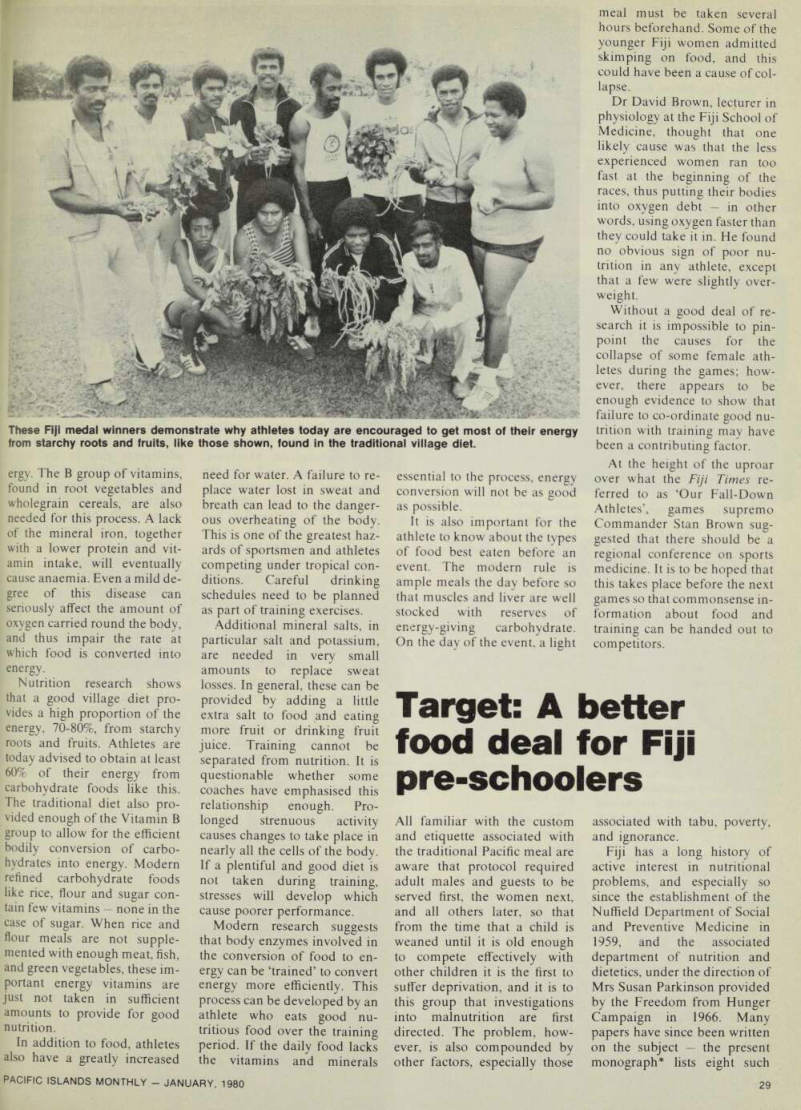
‘Eating to win’ in Pacific Islands athletics
In the wake of the Sixth South Pacific Games and the furore caused in Fiji by the physical collapse during games events of a number of Fiji women athletes Suva-based nu tritionist Susan Parkinson looks at the special problems of nutrition faced by Pacific Island athletes. Mrs Parkinson wishes to acknowledge help received in preparing the follow ing article from Dr David Brown, lecturer in physiology at the Fiji School of Medicine.
Most people who are involved in modem sport or athletics are aware that the food they eat will have some effect on per formance. Everyone naturally wants to eat to win, but often the way they go about it makes nutritionists wonder how they survive at all. The recent sight of women runners collapsing at the South Pacific Games in Suva led many a startled spec tator to question whether the Pacific Island diet was suitable for the demands of athletic per formance.
The current widespread interest in nutrition and ath letic achievement in other parts of the world received little pub licity in South Pacific sports programmes and journals be fore the games. Although most coaches mentioned the need for good food, some of their recommended diets based on eggs, steak, vitamins and glu cose bore little relationship to what people could afford, and even less to what they actually needed.
A pre-games paper prepared by the Fiji national food and nutrition committee, entitled Food for Action, stated em phatically that ‘Fiji food is the best food for Fiji athletes’. The unanswered question is ‘What
went wrong?’.
Over the years, athletes and coaches have been looking for a magic food or drink which
could dramatically improve
performance. Probably no field of human endeavour has been so beset with costly food fads and beliefs. Research at human performance labora tories in Britain and the US has proved conclusively that no single food will greatly alter human performance on the field. Any claim by an athlete
that bees’ pollen, honey, the avoidance of coffee or tea, are beneficial, may be attributed rather to psychological reac tion than to physiological fact.
The nutritional needs of ath letes in training are much the same as the general population except that they need more of the energy-giving carbo hydrate foods, such as root veg etable, rice and bread, and extra minerals, salts and water to replace losses in sweat.
One important difference between athletes and the gen eral population is that the re sults of poor quality diet show up more quickly in a person involved in strenuous exercise.
Because women need more of the blood-building mineral iron than men they will show signs of strain before male ath letes, when both are on poor quality food.
All authorities agree that athletes need to train on a good mixed diet. The necessary pro tein, carbohydrate, fat, mineral salts and vitamins, can be found in food from any dietary background. Good Pacific Island meals which include fish, green leaves, coconut and root vegetables would certainly provide for the nutritional needs of any performer.
However, in most urban centres today Suva, Apia or Port Moresby such a way of eating is beyond the incomes of many young people. The daily diet of many modern islanders consists of bread and tea for breakfast, a poor quality snack lunch and possibly a serving of root vegetables and tinned fish at night. The nutritious green leaves and fruits of the Islands are eaten once or twice a week, instead of once a day, as in
times gone by. Such a dietary regime could be deficient in the vitamins and minerals needed for good health and perform ance.
A recent survey in Tonga of 265 preschool children by Drs W. F. Clark and Mary Richards found that this type of urban diet was related to signs of poor nutrition. Urban children had lower heights and weights than rural children.
Other tests such as arm circum ference and skinfold measure ments, and an examination of the hair, all confirmed that rural children were better nourished.
Another indication that all is not well with modem urban food of Pacific Islanders is revealed by the tendency for
Fijians to suffer from the nu tritional disease anaemia. The results of routine medical
inspections of people undergo
ing pre-service examinations in
Suva between 1971 and 1976 were studied by Drs P. Ram, A.
S. Parmar and B. K. Jha. They found that 26% of the Fijian males and 36% of the females were anaemic. This report is in sharp contrast with that of two well-known nutritionists, Drs Muriel Bell and Lucy Wills, who after undertaking the first anaemia study in Fiji in 1948, said ‘lt is clear from the popu lation sampled that there is no serious anaemia in Fijians’.
Strenuous exercise requires the presence of sufficient oxy gen in the body to provide for the conversion of food to en-
Top: M. Kelesi, of the Solomons, in trouble after the women’s 3000 metres at the South Pacific Games, Suva, Below, Janice Joruru, of PNG, receives medical aid after coming second in the 800 metres women’s final. Are there special problems facing Islands athletes?
ergy. The B group of vitamins, found in root vegetables and wholegrain cereals, are also needed for this process. A lack of the mineral iron, together with a lower protein and vitamin intake, will eventually cause anaemia. Even a mild degree of this disease can seriously affect the amount of oxygen carried round the body, and thus impair the rate at which food is converted into energy.
Nutrition research shows that a good village diet provides a high proportion of the energy, 70-80%, from starchy roots and fruits. Athletes are today advised to obtain at least 60% of their energy from carbohydrate foods like this.
The traditional diet also provided enough of the Vitamin B group to allow for the efficient bodily conversion of carbohydrates into energy. Modern refined carbohydrate foods like rice, flour and sugar contain few vitamins none in the case of sugar. When rice and flour meals are not supplemented with enough meat, fish, and green vegetables, these important energy vitamins are just not taken in sufficient amounts to provide for good nutrition.
In addition to food, athletes also have a greatly increased
need for water. A failure to re place water lost in sweat and breath can lead to the danger ous overheating of the body, This is one of the greatest haz ards of sportsmen and athletes
competing under tropical con
ditions. Careful drinking schedules need to be planned as part of training exercises, Additional mineral salts, in
particular salt and potassium,
are needed in very small amounts to replace sweat losses. In general, these can be
provided by adding a little
extra salt to food and eating more fruit or drinking fruit
juice. Training cannot be
separated from nutrition. It is questionable whether some coaches have emphasised this
relationship enough. Pro
longed strenuous activity
causes changes to take place in nearly all the cells of the body, If a plentiful and good diet is
not taken during training,
stresses will develop which cause poorer performance, Modem research suggests that body enzymes involved in the conversion of food to en ergy can be ‘trained’ to convert energy more efficiently. This process can be developed by an athlete who eats good nu tritious food over the training period. If the daily food lacks the vitamins and minerals
essential to the process, energy conversion will not be as good
as possible.
It is also important for the athlete to know about the types of food best eaten before an event. The modern rule is ample meals the day before so that muscles and liver are well stocked with reserves of
energy-giving carbohydrate,
On the day of the event, a light
meal must be taken several hours beforehand. Some of the younger Fiji women admitted skimping on food, and this could have been a cause of col
lapse.
Dr David Brown, lecturer in physiology at the Fiji School of Medicine, thought that one likely cause was that the less experienced women ran too fast at the beginning of the races, thus putting their bodies into oxygen debt in other words, using oxygen faster than they could take it in. He found no obvious sign of poor nu trition in any athlete, except that a few were slightly over
weight.
Without a good deal of re search it is impossible to pin point the causes for the collapse of some female ath letes during the games; how ever, there appears to be enough evidence to show that failure to co-ordinate good nu trition with training may have been a contributing factor.
At the height of the uproar over what the Fiji Times re ferred to as ‘Our Fall-Down Athletes’, games supremo Commander Stan Brown sug gested that there should be a regional conference on sports medicine. It is to be hoped that this takes place before the next games so that commonsense in formation about food and training can be handed out to
competitors.
These Fiji medal winners demonstrate why athletes today are encouraged to get most of their energy from starchy roots and fruits, like those shown, found in the traditional village diet.
Advertisements & other items, p. 28 (1 item)
Cessna
wP p v® % yf
8 EXCELLENT SEASONS WHYI
EVERY SECOND DAY CESSNA
DEUVERS ANOTHER CITATION
Quietness . . recognised as the quietest jet in the world Speed . . cruise at 385 kts, low stall at 80 kts, VMC below stall Fuel Efficiency .at max. cruise thrust. . . 0.453 naut. miles per pound fuel Range . 1750 naut. miles with IFR reserves Cabin Capacity ..up to 2 pilots plus 11 passengers in normal corporate seating Field Length . . single engine take off distance (balanced field length) 2990 ft. ••*** Simple to Operate . .no costly, complicated control and stability systems . . . 340° horizon visibility from the cockpit .. . new technology high aspect ratio wings #• allow high cruise speed with low please send approach speeds .#• me mor e Flexibility . certified for grass and information gravel airports on the Cessna THERE ARE MANY SENSIBLE REASONS / Citation Distributors
Cessna
REX AVIATION
P. O. Box 51, Bankstown 2200 Phone (02) 70 0661 - Telex AA20738 Number one in the sky Name.
Position..
Company Address.. , P/code..
19/PIM.A
Telephone.
pre-schoolers
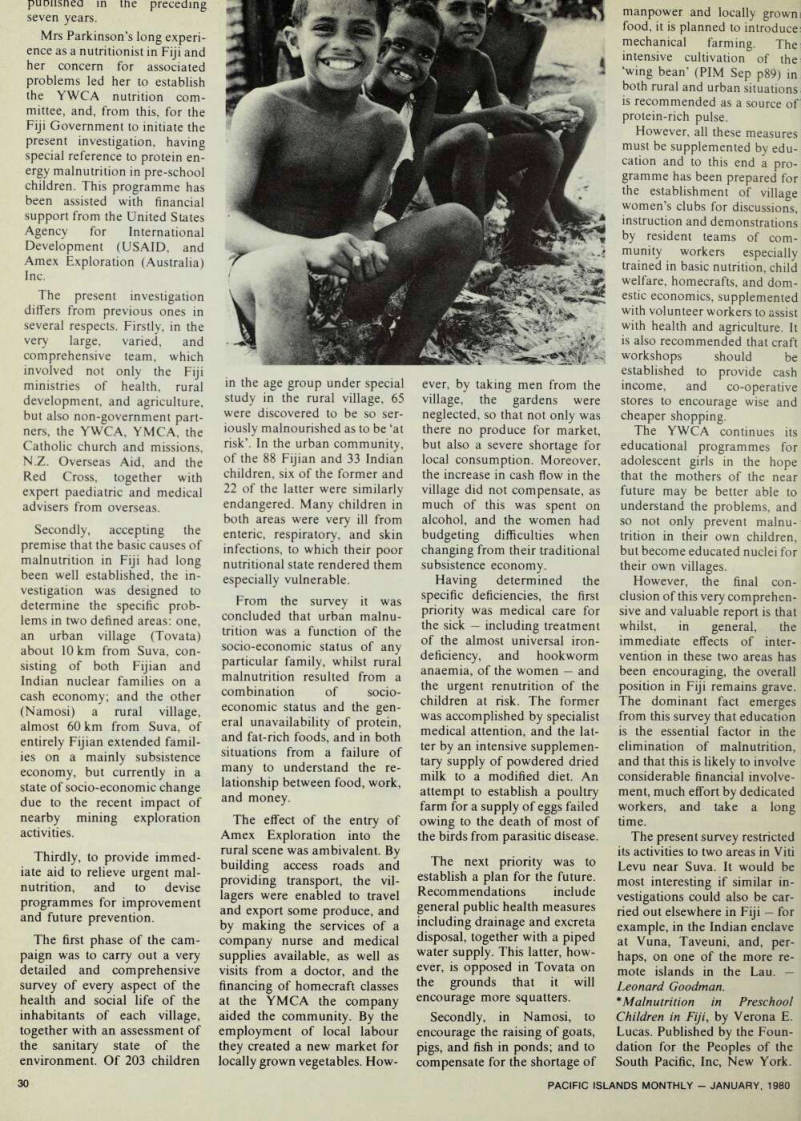
Target: A better food deal for Fiji pre-schoolers
All familiar with the custom and etiquette associated with the traditional Pacific meal are
aware that protocol required
adult males and guests to be served first, the women next, and all others later, so that from the time that a child is weaned until it is old enough to compete effectively with other children it is the first to suffer deprivation, and it is to this group that investigations into malnutrition are first directed. The problem, however, is also compounded by other factors, especially those
associated with tabu, poverty,
and ignorance,
Fiji has a long history of
active interest in nutritional
problems, and especially so
since the establishment of the Nuffield Department of Social and Preventive Medicine in 1959, and the associated department of nutrition and dietetics, under the direction of Mrs Susan Parkinson provided by the Freedom from Hunger
Campaign in 1966. Many
papers have since been written on the subject the present
monograph* lists eight such
puonsneo m me preceding seven years.
Mrs Parkinson’s long experi ence as a nutritionist in Fiji and her concern for associated problems led her to establish the YWCA nutrition com mittee, and, from this, for the Fiji Government to initiate the
present investigation, having
special reference to protein en ergy malnutrition in pre-school children. This programme has been assisted with financial support from the United States Agency for International Development (USAID, and Amex Exploration (Australia) Inc.
The present investigation differs from previous ones in several respects. Firstly, in the very large, varied, and comprehensive team, which involved not only the Fiji ministries of health, rural development, and agriculture, but also non-government part ners, the YWCA, YMCA, the Catholic church and missions, N.Z. Overseas Aid, and the Red Cross, together with expert paediatric and medical advisers from overseas.
Secondly, accepting the premise that the basic causes of malnutrition in Fiji had long been well established, the in
vestigation was designed to
determine the specific prob lems in two defined areas: one, an urban village (Tovata) about 10 km from Suva, con sisting of both Fijian and Indian nuclear families on a cash economy; and the other (Namosi) a rural village, almost 60 km from Suva, of
entirely Fijian extended famil
ies on a mainly subsistence economy, but currently in a state of socio-economic change due to the recent impact of
nearby mining exploration
activities.
Thirdly, to provide immed iate aid to relieve urgent mal nutrition, and to devise programmes for improvement and future prevention.
The first phase of the cam paign was to carry out a very detailed and comprehensive survey of every aspect of the health and social life of the inhabitants of each village, together with an assessment of the sanitary state of the environment. Of 203 children
in the age group under special study in the rural village, 65 were discovered to be so ser iously malnourished as to be ‘at risk’. In the urban community, of the 88 Fijian and 33 Indian children, six of the former and 22 of the latter were similarly
endangered. Many children in
both areas were very ill from enteric, respiratory, and skin infections, to which their poor nutritional state rendered them
especially vulnerable.
From the survey it was concluded that urban malnu trition was a function of the socio-economic status of any
particular family, whilst rural
malnutrition resulted from a combination of socio economic status and the gen
eral unavailability of protein,
and fat-rich foods, and in both situations from a failure of many to understand the re lationship between food, work, and money.
The effect of the entry of Amex Exploration into the rural scene was ambivalent. By building access roads and providing transport, the vil lagers were enabled to travel and export some produce, and by making the services of a company nurse and medical supplies available, as well as visits from a doctor, and the financing of homecraft classes at the YMCA the company aided the community. By the employment of local labour they created a new market for
locally grown vegetables. How
ever, by taking men from the
village, the gardens were
neglected, so that not only was there no produce for market, but also a severe shortage for local consumption. Moreover, the increase in cash flow in the village did not compensate, as much of this was spent on alcohol, and the women had budgeting difficulties when changing from their traditional subsistence economy.
Having determined the specific deficiencies, the first priority was medical care for the sick including treatment of the almost universal iron deficiency, and hookworm anaemia, of the women and the urgent renutrition of the children at risk. The former
was accomplished by specialist
medical attention, and the lat ter by an intensive supplemen tary supply of powdered dried milk to a modified diet. An attempt to establish a poultry farm for a supply of eggs failed owing to the death of most of the birds from parasitic disease.
The next priority was to establish a plan for the future.
Recommendations include
general public health measures
including drainage and excreta
disposal, together with a piped
water supply. This latter, how ever, is opposed in Tovata on the grounds that it will encourage more squatters.
Secondly, in Namosi, to encourage the raising of goats, pigs, and fish in ponds; and to compensate for the shortage of
manpower and locally grown food, it is planned to introduce mechanical farming. The intensive cultivation of the ‘wing bean’ (PIM Sep pB9) in both rural and urban situations is recommended as a source of protein-rich pulse.
However, all these measures must be supplemented by edu cation and to this end a pro gramme has been prepared for the establishment of village women’s clubs for discussions, instruction and demonstrations by resident teams of com
munity workers especially
trained in basic nutrition, child welfare, homecrafts, and dom estic economics, supplemented with volunteer workers to assist with health and agriculture. It is also recommended that craft workshops should be established to provide cash income, and co-operative stores to encourage wise and
cheaper shopping.
The YWCA continues its educational programmes for adolescent girls in the hope that the mothers of the near future may be better able to understand the problems, and so not only prevent malnu trition in their own children, but become educated nuclei for their own villages.
However, the final con clusion of this very comprehen sive and valuable report is that whilst, in general, the immediate effects of inter vention in these two areas has been encouraging, the overall position in Fiji remains grave.
The dominant fact emerges from this survey that education is the essential factor in the elimination of malnutrition, and that this is likely to involve considerable financial involve ment, much effort by dedicated workers, and take a long time.
The present survey restricted its activities to two areas in Viti Levu near Suva. It would be most interesting if similar in vestigations could also be car ried out elsewhere in Fiji for example, in the Indian enclave at Vuna, Taveuni, and, per haps, on one of the more re mote islands in the Lau.
Leonard Goodman. * Malnutrition in Preschool Children in Fiji, by Verona E.
Lucas. Published by the Foun dation for the Peoples of the South Pacific, Inc, New York.
Advertisements & other items, p. 31 (1 item)
inner’s Edge
The rally's underway.
The competition is tough.
The skills that make up a champion are many.
The winner's edge — reliability. The kind of reliability you expect from Clarion car stereo.
High guality performance all the way.
Check out the full lineup. You'll find it in the winner's circle, every time. *
inner’s Edge
In Car Entertainment Company
©Clarion
Clarion Co., Ltd. Tokvo. laoan Tokyo Japan r i jematta Road, Ashfield N.S.W., 2131 New Zealand: AWA New al & Co Ltd. 6'PO Box 362 Suva/Tahiti: HI-FI Shangrila Australia: Amalgamated Wireless Zealand Limited P.O. Box 50-248 & Co.. iSi: G'PO Box 362 Suva/Tahiti: HI-FI Shangrila % 8.R200 Papeete/New Caledonia: Caldis B P Ml TTbwmtfa Cedex/Guam: Guam Radio & TV Shop P.O. Box 1939 Agana.
Guam 96910/ New Hebrides: The Sound Centre P.O. Box 434 Vila/Cook Islands: South Seas International Ltd. P.O. Box 49 Rarotonga/Papua New Guinea: Hagemeyer (P.N.Qj Ply. Ltd, P.O Box 1428. Boroko. Port Moresby. ‘Dolby and the double-D symbol are trademarks of Dolby Laboratories.
Tonga’s king
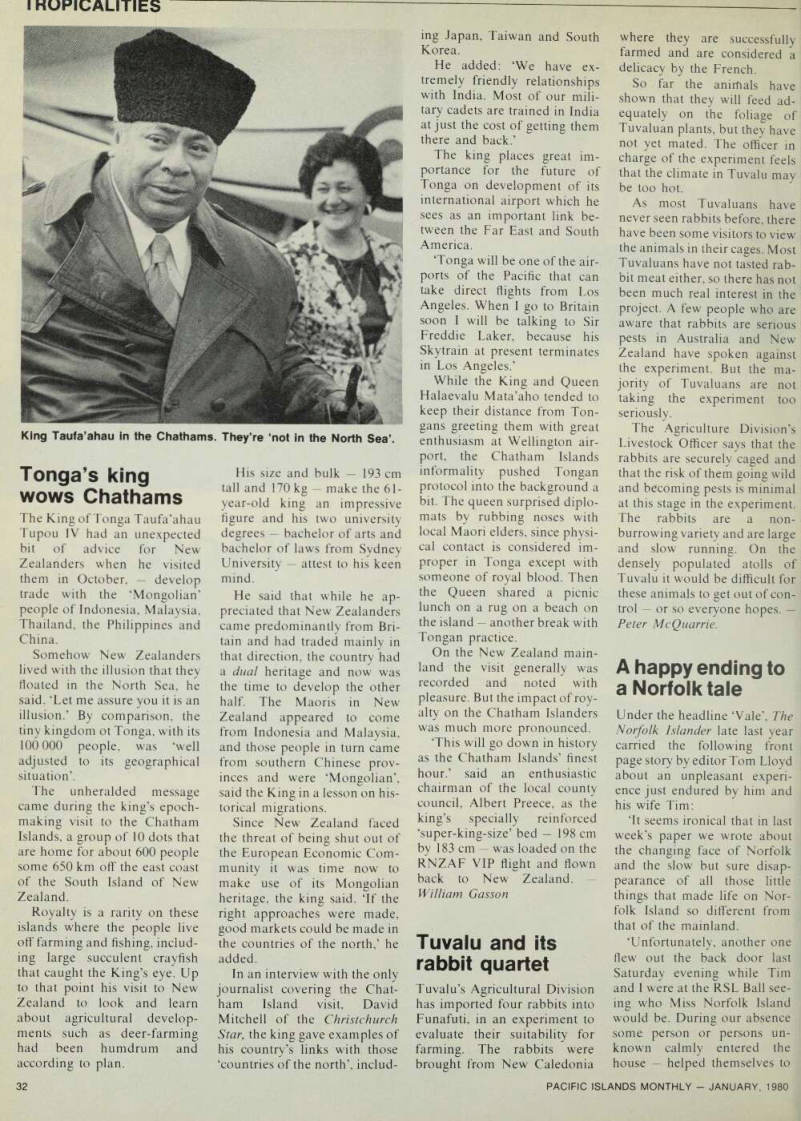
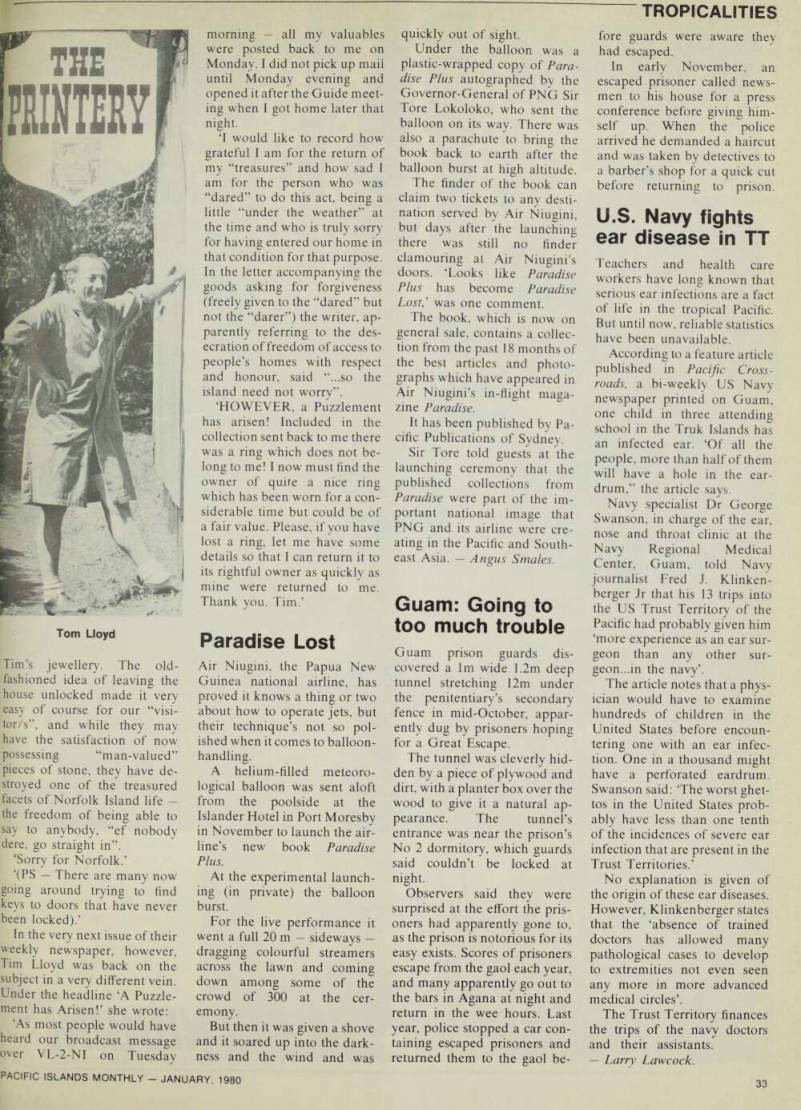
I Ropicalities
wows Chathams
The King of Tonga Taufa’ahau Tupou IV had an unexpected bit of advice for New Zealanders when he visited them in October. develop trade with the ‘Mongolian’ people of Indonesia, Malaysia, Thailand, the Philippines and China.
Somehow New Zealanders lived with the illusion that they floated in the North Sea, he said. ‘Let me assure you it is an
illusion.’ By comparison, the
tiny kingdom ot Tonga, with its
100 000 people, was ‘well
adjusted to its geographical
situation’.
The unheralded message
came during the king’s epoch
making visit to the Chatham Islands, a group of 10 dots that are home for about 600 people some 650 km off the east coast of the South Island of New Zealand.
Royalty is a rarity on these islands where the people live off farming and fishing, includ
ing large succulent crayfish
that caught the King’s eye. Up
to that point his visit to New Zealand to look and learn
about agricultural develop
ments such as deer-farming had been humdrum and according to plan.
His size and bulk 193 cm tall and 170 kg make the 61-
year-old king an impressive
figure and his two university degrees bachelor of arts and bachelor of laws from Sydney University attest to his keen mind.
He said that while he ap preciated that New Zealanders came predominantly from Bri tain and had traded mainly in that direction, the country had a dual heritage and now was the time to develop the other half. The Maoris in New Zealand appeared to come from Indonesia and Malaysia, and those people in turn came from southern Chinese prov inces and were ‘Mongolian’, said the King in a lesson on his
torical migrations.
Since New Zealand faced the threat of being shut out of the European Economic Com munity it was time now to make use of its Mongolian heritage, the king said. ‘lf the right approaches were made, good markets could be made in the countries of the north,’ he added.
In an interview with the only
journalist covering the Chat
ham Island visit, David Mitchell of the Christchurch Star, the king gave examples of his country’s links with those ‘countries of the north’, includ
ing Japan, Taiwan and South Korea.
He added; ‘We have ex
tremely friendly relationships
with India. Most of our mili tary cadets are trained in India at just the cost of getting them there and back.’
The king places great im portance for the future of Tonga on development of its international airport which he sees as an important link be tween the Far East and South America. ‘Tonga will be one of the air ports of the Pacific that can take direct flights from Los Angeles. When I go to Britain soon I will be talking to Sir Freddie Laker, because his Skytrain at present terminates in Los Angeles.’
While the King and Queen Halaevalu Mata’aho tended to keep their distance from Ton gans greeting them with great enthusiasm at Wellington air port, the Chatham Islands
informality pushed Tongan
protocol into the background a bit. The queen surprised diplo mats by rubbing noses with local Maori elders, since physi cal contact is considered im proper in Tonga except with someone of royal blood. Then the Queen shared a picnic lunch on a rug on a beach on the island another break with
Tongan practice.
On the New Zealand main land the visit generally was recorded and noted with pleasure. But the impact of roy alty on the Chatham Islanders was much more pronounced. ‘This will go down in history as the Chatham Islands’ finest hour.’ said an enthusiastic chairman of the local county council, Albert Preece, as the
king’s specially reinforced
‘super-king-size’ bed 198 cm by 183 cm was loaded on the RNZAF VIP flight and flown back to New Zealand.
William Gasson
Tuvalu and its
rabbit quartet
Tuvalu’s Agricultural Division has imported four rabbits into Funafuti, in an experiment to evaluate their suitability for farming. The rabbits were brought from New Caledonia
where they are successfully
farmed and are considered a
delicacy by the French.
So far the animals have shown that they will feed ad equately on the foliage of Tuvaluan plants, but they have not yet mated. The officer in charge of the experiment feels that the climate in Tuvalu may be too hot.
As most Tuvaluans have never seen rabbits before, there have been some visitors to view the animals in their cages. Most Tuvaluans have not tasted rab bit meat either, so there has not been much real interest in the project. A few people who are aware that rabbits are serious pests in Australia and New
Zealand have spoken against
the experiment. But the ma jority of Tuvaluans are not
taking the experiment too
seriously.
The Agriculture Division’s Livestock Officer says that the rabbits are securely caged and that the risk of them going wild and becoming pests is minimal at this stage in the experiment.
The rabbits are a non
burrowing variety and are large
and slow running. On the
densely populated atolls of
Tuvalu it would be difficult for these animals to get out of con trol or so everyone hopes.
Peter McQuarrie.
A happy ending to
a Norfolk tale
Under the headline ‘Vale’, The Norfolk Islander late last year carried the following front page story by editor Tom Lloyd about an unpleasant experi ence just endured by him and his wife Tim: ‘lt seems ironical that in last week’s paper we wrote about the changing face of Norfolk and the slow but sure disap pearance of all those little things that made life on Nor folk Island so different from that of the mainland. ‘Unfortunately, another one flew out the back door last Saturday evening while Tim and I were at the RSL Ball see ing who Miss Norfolk Island would be. During our absence some person or persons un known calmly entered the house helped themselves to
King Taufa’ahau in the Chathams. They’re ‘not In the North Sea’.
Tim’s jewellery. The old fashioned idea of leaving the house unlocked made it very easy of course for our “visi tor/s”. and while they may have the satisfaction of now
possessing “man-valued”
Pieces of stone, they have de stroyed one of the treasured facets of Norfolk Island life the freedom of being able to say to anybody, “ef nobody dere, go straight in”.
Sorry for Norfolk.’ ‘(PS There are many now going around trying to find keys to doors that have never been locked).’
In the very next issue of their weekly newspaper, however, Tim Lloyd was back on the subject in a very different vein.
Under the headline ‘A Puzzle ment has Arisen!’ she wrote: As most people would have heard our broadcast message
over VL-2-NI on Tuesday
morning all my valuables were posted back to me on Monday. I did not pick up mail until Monday evening and opened it after the Guide meet ing when I got home later that
night.
‘I would like to record how grateful I am for the return of my “treasures” and how sad I am for the person who was “dared” to do this act, being a little “under the weather” at the time and who is truly sorry for having entered our home in that condition for that purpose.
In the letter accompanying the
goods asking for forgiveness
(freely given to the “dared” but not the “darer”) the writer, ap parently referring to the des ecration of freedom of access to people’s homes with respect and honour, said “...so the island need not worry”. ‘HOWEVER, a Puzzlement has arisen! Included in the collection sent back to me there was a ring which does not be long to me! I now must find the owner of quite a nice ring which has been worn for a con siderable time but could be of a fair value. Please, if you have lost a ring, let me have some details so that I can return it to its rightful owner as quickly as mine were returned to me.
Thank you. Tim.’
Paradise Lost
Air Niugini, the Papua New Guinea national airline, has proved it knows a thing or two about how to operate jets, but their technique’s not so pol ished when it comes to balloon
handling.
A helium-filled meteoro logical balloon was sent aloft from the poolside at the Islander Hotel in Port Moresby in November to launch the air line’s new book Paradise Plus.
At the experimental launch ing (in private) the balloon burst.
For the live performance it went a full 20 m sideways dragging colourful streamers across the lawn and coming down among some of the crowd of 300 at the cer emony.
But then it was given a shove and it soared up into the dark ness and the wind and was
quickly out of sight.
Under the balloon was a plastic-wrapped copy of Para dise Plus autographed by the Governor-General of PNG Sir Tore Lokoloko, who sent the balloon on its way. There was also a parachute to bring the book back to earth after the balloon burst at high altitude.
The finder of the book can claim two tickets to any desti nation served by Air Niugini, but days after the launching there was still no finder
clamouring at Air Niugini’s
doors. ‘Looks like Paradise Plus has become Paradise Lost ,’ was one comment.
The book, which is now on general sale, contains a collec tion from the past 18 months of the best articles and photo graphs which have appeared in
Air Niugini’s in-flight maga
zine Paradise.
It has been published by Pa cific Publications of Sydney.
Sir Tore told guests at the launching ceremony that the published collections from Paradise were part of the im portant national image that PNG and its airline were cre ating in the Pacific and South east Asia. Angus Smales.
Guam: Going to
too much trouble
Guam prison guards dis covered a 1m wide 1.2 m deep tunnel stretching 12m under
the penitentiary’s secondary
fence in mid-October, appar
ently dug by prisoners hoping
for a Great Escape.
The tunnel was cleverly hid den by a piece of plywood and dirt, with a planter box over the wood to give it a natural ap pearance. The tunnel’s entrance was near the prison’s No 2 dormitory, which guards said couldn’t be locked at
night.
Observers said they were surprised at the effort the pris oners had apparently gone to, as the prison is notorious for its easy exists. Scores of prisoners escape from the gaol each year, and many apparently go out to the bars in Agana at night and return in the wee hours. Last year, police stopped a car con
taining escaped prisoners and
returned them to the gaol be
fore guards were aware they had escaped.
In early November, an escaped prisoner called news men to his house for a press conference before giving him self up. When the police arrived he demanded a haircut and was taken by detectives to a barber’s shop for a quick cut
before returning to prison.
U.S. Navy fights
ear disease in TT
Teachers and health care workers have long known that serious ear infections are a fact of life in the tropical Pacific.
But until now, reliable statistics have been unavailable.
According to a feature article
published in Pacific Cross
roads, a bi-weekly US Navy newspaper printed on Guam, one child in three attending school in the Truk Islands has an infected ear. ‘Of all the people, more than half of them will have a hole in the ear drum,” the article says.
Navy specialist Dr George
Swanson, in charge of the ear, nose and throat clinic at the
Navy Regional Medical
Center, Guam, told Navy journalist Fred J. Klinken berger Jr that his 13 trips into the US Trust Territory of the Pacific had probably given him ‘more experience as an ear sur geon than any other sur geon...in the navy’.
The article notes that a phys ician would have to examine hundreds of children in the United States before encoun tering one with an ear infec tion. One in a thousand might have a perforated eardrum.
Swanson said: ‘The worst ghet tos in the United States prob ably have less than one tenth of the incidences of severe ear infection that are present in the Trust Territories.’
No explanation is given of the origin of these ear diseases.
However, Klinkenberger states that the ‘absence of trained doctors has allowed many
pathological cases to develop
to extremities not even seen any more in more advanced medical circles’.
The Trust Territory finances the trips of the navy doctors and their assistants.
Larry Lawcock.
Tom Lloyd
Advertisements & other items, pp. 33-34 (2 items)
Tropicalities
33
’ACIFIC ISLANDS MONTHLY - JANUARY, 1980
someofmrcfaejs
-*r w-' ► > r i
<saa
m L$ V- • v T -. >-.' 3 i V - .
R» ■ v v , ‘ 4> v ' , ,o .:i
' ; >v*W ! : 'i?M
}&'f: ■ * v* 1 .
Ilf
fK.
SI ■—> >• 1
someofmrcfaejs
In Papua New Guinea there are 717 different cultures, each represented by its own language and its own "chief". Few men know this country better than our chief pilot, Captain John Regan.
He's logged more than 16,000 hours flying, much of that in Papua New Guinea.
John Regan is one of ninety highly skilled Australian, New Zealand, British, and American pilots flying our aircraft to seventeen places in Papua New Guinea and eight destinations overseas.
AIRNIUGINI
THE NA TIONAL AIRLINE OF PAPUA NEW GU/NEaM
S.P.S. 001
backstreet
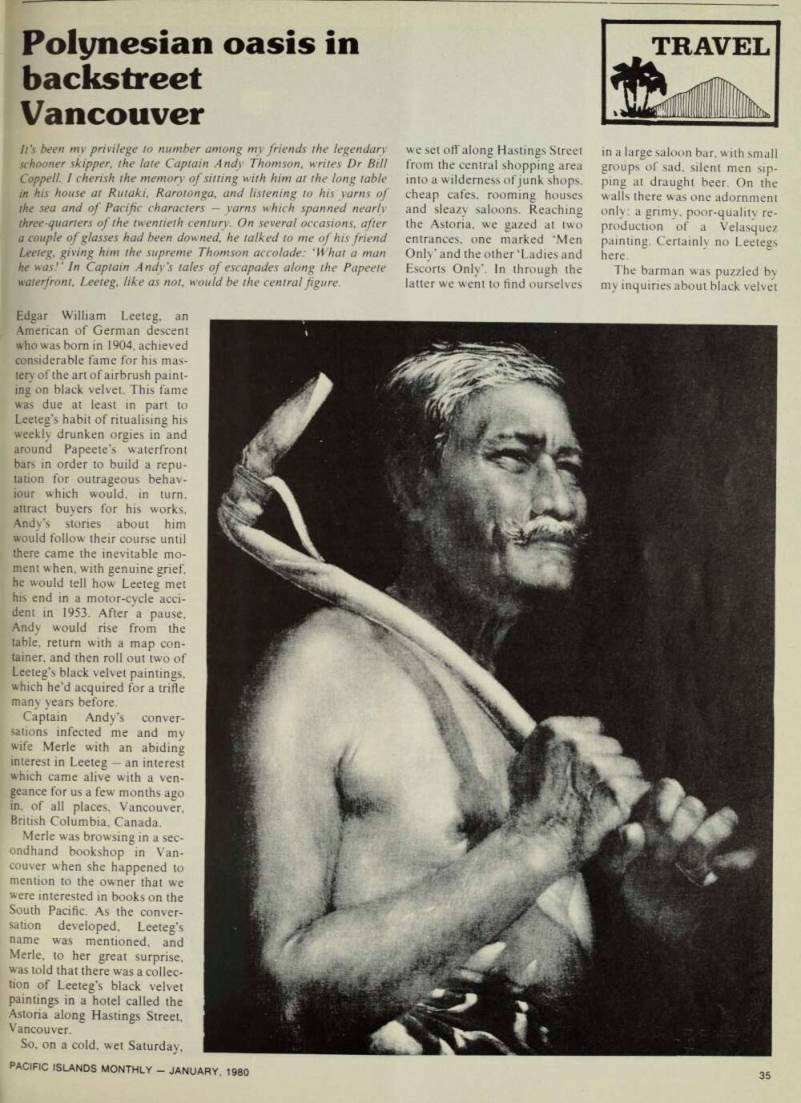
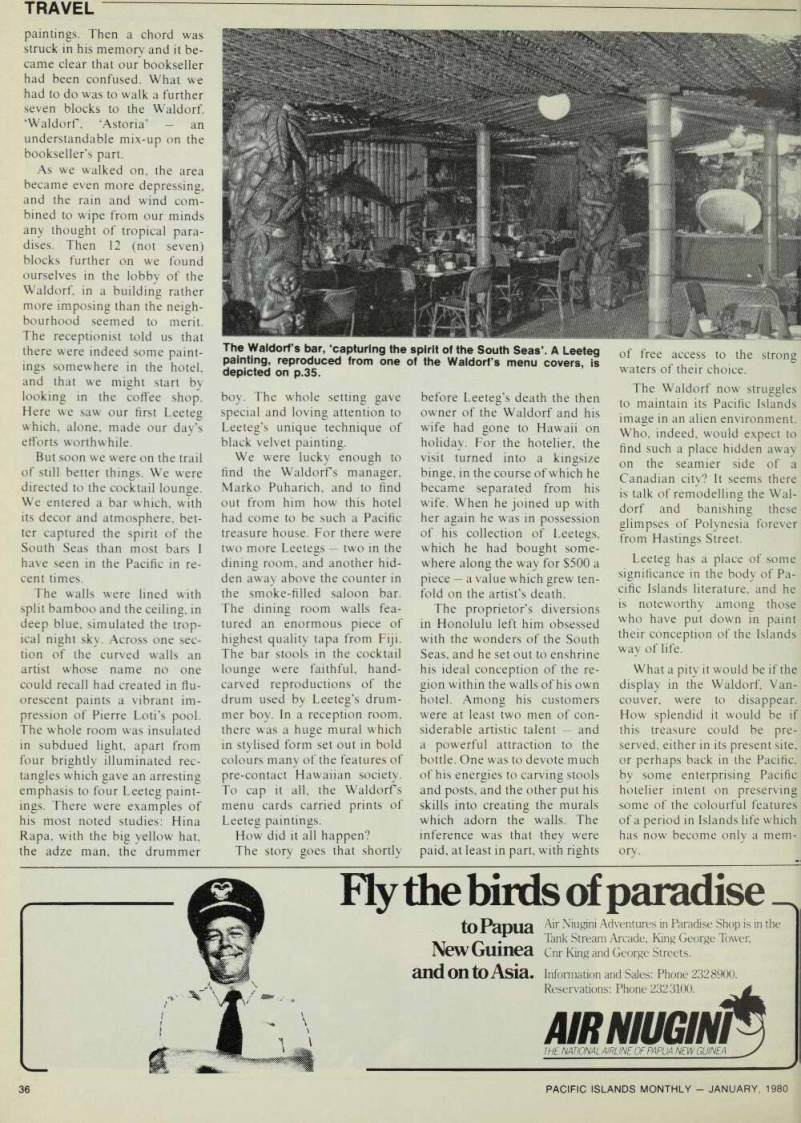
Travel
Polynesian oasis in backstreet Vancouver
It's been my privilege to number among my friends the legendary schooner skipper, the late Captain A ndy Thomson, writes Dr Bill Coppell. I cherish the memory of sitting w ith him at the long table in his house at Rutaki, Rarotonga, and listening to his yarns of the sea and of Pacific characters yarns which spanned nearly three-quarters of the twentieth century. On several occasions, after a couple of glasses had been downed, he talked to me of his friend Leeteg, giving him the supreme Thomson accolade: ‘What a man he was!' In Captain Andy's tales of escapades along the Papeete waterfront, Leeteg, like as not, would be the central figure.
Edgar William Leeteg, an American of German descent who was bom in 1904, achieved considerable fame for his mas tery of the art of airbrush paint ing on black velvet. This fame was due at least in part to Leeteg’s habit of ritualising his weekly drunken orgies in and around Papeete’s waterfront bars in order to build a repu tation for outrageous behav iour which would, in turn, attract buyers for his works, Andy’s stories about him would follow their course until there came the inevitable mo ment when, with genuine grief, he would tell how Leeteg met his end in a motor-cycle acci dent in 1953. After a pause, Andy would rise from the table, return with a map con tainer, and then roll out two of
Leeteg’s black velvet paintings,
which he’d acquired for a trifle many years before.
Captain Andy’s conver
sations infected me and my wife Merle with an abiding interest in Leeteg an interest which came alive with a ven geance for us a few months ago in, of all places, Vancouver, British Columbia. Canada.
Merle was browsing in a sec ondhand bookshop in Van couver when she happened to mention to the owner that we were interested in books on the South Pacific. As the conver
sation developed, Leeteg’s
name was mentioned, and Merle, to her great surprise, was told that there was a collec tion of Leeteg’s black velvet paintings in a hotel called the
Astoria along Hastings Street,
Vancouver.
So, on a cold, wet Saturday,
we set off along Hastings Street from the central shopping area into a wilderness of junk shops,
cheap cafes, rooming houses
and sleazy saloons. Reaching
the Astoria, we gazed at two entrances, one marked ‘Men Only’ and the other ‘Ladies and Escorts Only’. In through the latter we went to find ourselves
in a large saloon bar, with small groups of sad, silent men sip ping at draught beer. On the walls there was one adornment only: a grimy, poor-quality re production of a Velasquez painting. Certainly no Leetegs here.
The barman was puzzled by my inquiries about black velvet
paintings. Then a chord was struck in his memory and it be came clear that our bookseller had been confused. What we had to do was to walk a further seven blocks to the Waldorf. ‘Waldorf, ‘Astoria’ an understandable mix-up on the bookseller’s part.
As we walked on. the area became even more depressing, and the rain and wind com bined to wipe from our minds any thought of tropical para dises. Then 12 (not seven) blocks further on we found ourselves in the lobby of the Waldorf, in a building rather more imposing than the neigh bourhood seemed to merit.
The receptionist told us that there were indeed some paint ings somewhere in the hotel, and that we might start by looking in the coffee shop.
Here we saw our first Leeteg which, alone, made our day’s efforts worthwhile.
But soon we were on the trail of still better things. We were directed to the cocktail lounge.
We entered a bar which, with its decor and atmosphere, bet ter captured the spirit of the South Seas than most bars I have seen in the Pacific in re cent times.
The walls were lined with split bamboo and the ceiling, in deep blue, simulated the trop ical night sky. Across one sec tion of the curved walls an artist whose name no one could recall had created in flu orescent paints a vibrant im pression of Pierre Loti’s pool.
The whole room was insulated in subdued light, apart from four brightly illuminated rec tangles which gave an arresting
emphasis to four Leeteg paint
ings. There were examples of his most noted studies: Hina
Rapa, with the big yellow hat,
the adze man, the drummer
boy. The whole setting gave special and loving attention to
Leeteg’s unique technique of
black velvet painting.
We were lucky enough to find the Waldorfs manager.
Marko Puharich, and to find out from him how this hotel had come to be such a Pacific treasure house. For there were two more Leetegs two in the dining room, and another hid den away above the counter in the smoke-filled saloon bar.
The dining room walls fea tured an enormous piece of
highest quality tapa from Fiji.
The bar stools in the cocktail lounge were faithful, hand carved reproductions of the drum used by Leeteg’s drum mer boy. In a reception room, there was a huge mural which in stylised form set out in bold colours many of the features of pre-contact Hawaiian society.
To cap it all. the Waldorf’s menu cards carried prints of
Leeteg paintings.
How did it all happen?
The story goes that shortly
before Leeteg’s death the then owner of the Waldorf and his wife had gone to Hawaii on holiday. For the hotelier, the visit turned into a kingsize binge, in the course of which he became separated from his wife. When he joined up with her again he was in possession of his collection of Leetegs, which he had bought some where along the way for $5OO a piece a value which grew ten fold on the artist’s death.
The proprietor’s diversions in Honolulu left him obsessed with the wonders of the South Seas, and he set out to enshrine his ideal conception of the re gion within the walls of his own hotel. Among his customers were at least two men of con siderable artistic talent and a powerful attraction to the bottle. One was to devote much of his energies to carving stools and posts, and the other put his skills into creating the murals which adorn the walls. The inference was that they were paid, at least in part, with rights
of free access to the strong waters of their choice.
The Waldorf now struggles to maintain its Pacific Islands image in an alien environment.
Who, indeed, would expect to find such a place hidden away on the seamier side of a Canadian city? It seems there is talk of remodelling the Wal dorf and banishing these
glimpses of Polynesia forever
from Hastings Street.
Leeteg has a place of some significance in the body of Pa cific Islands literature, and he is noteworthy among those who have put down in paint their conception of the Islands way of life.
What a pity it would be if the display in the Waldorf, Van couver, were to disappear.
How splendid it would be if this treasure could be pre served, either in its present site, or perhaps back in the Pacific,
by some enterprising Pacific
hotelier intent on preserving some of the colourful features of a period in Islands life which has now become only a mem orv.
The Waldorf’s bar, ‘capturing the spirit of the South Seas’. A Leeteg painting, reproduced from one of the Waldorf’s menu covers, is depicted on p. 35.
Advertisements & other items, p. 36 (1 item)
Fly the birds of paradise.
to Papua New Guinea and on to Asia.
Air Niugini Adventures in Paradise Shop is in the Tank Stream Arcade, King George Tower, Cnr King and George Streets.
Information and Sales: Phone 2328900.
chances of Tonga
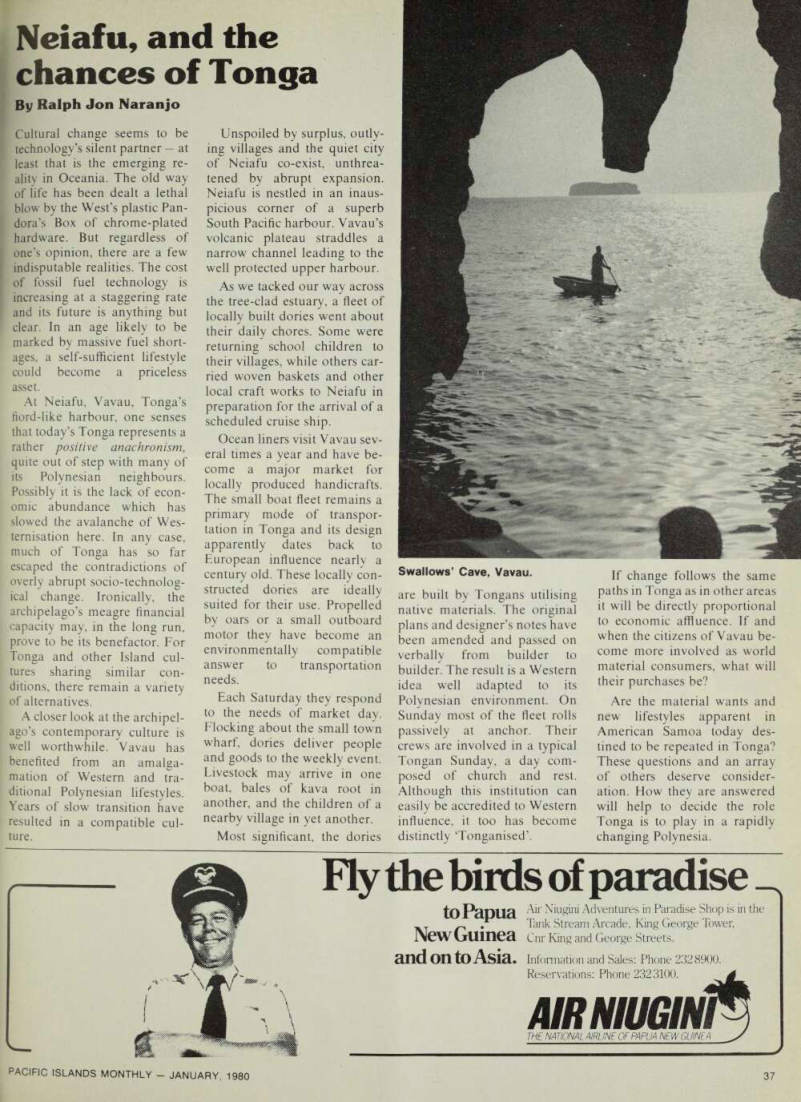
Neiafu, and the chances of Tonga
By Ralph Jon Naranjo
Cultural change seems to be technology’s silent partner at least that is the emerging re ality in Oceania. The old way of life has been dealt a lethal blow by the West’s plastic Pan dora’s Box of chrome-plated hardware. But regardless of one’s opinion, there are a few indisputable realities. The cost of fossil fuel technology is increasing at a staggering rate and its future is anything but clear. In an age likely to be marked by massive fuel short ages, a self-sufficient lifestyle could become a priceless asset.
At Neiafu, Vavau, Tonga’s fiord-like harbour, one senses that today’s Tonga represents a rather positive anachronism, quite out of step with many of
its Polynesian neighbours.
Possibly it is the lack of econ omic abundance which has slowed the avalanche of Wes ternisation here. In any case, much of Tonga has so far escaped the contradictions of
overly abrupt socio-technolog
ical change. Ironically, the
archipelago’s meagre financial capacity may, in the long run, prove to be its benefactor. For Tonga and other Island cul tures sharing similar con ditions, there remain a variety of alternatives.
A closer look at the archipel ago’s contemporary culture is well worthwhile. Vavau has benefited from an amalga mation of Western and tra
ditional Polynesian lifestyles.
Years of slow transition have resulted in a compatible cul ture.
Unspoiled by surplus, outly
ing villages and the quiet city
of Neiafu co-exist, unthrea
tened by abrupt expansion.
Neiafu is nestled in an inaus picious corner of a superb South Pacific harbour. Vavau’s volcanic plateau straddles a narrow channel leading to the well protected upper harbour.
As we tacked our way across the tree-clad estuary, a fleet of locally built dories went about their daily chores. Some were returning school children to their villages, while others car ried woven baskets and other local craft works to Neiafu in preparation for the arrival of a scheduled cruise ship.
Ocean liners visit Vavau sev eral times a year and have be come a major market for
locally produced handicrafts.
The small boat fleet remains a primary mode of transpor tation in Tonga and its design apparently dates back to
European influence nearly a
century old. These locally con structed dories are ideally suited for their use. Propelled by oars or a small outboard motor they have become an
environmentally compatible
answer to transportation needs.
Each Saturday they respond
to the needs of market day.
Flocking about the small town wharf, dories deliver people and goods to the weekly event.
Livestock may arrive in one boat, bales of kava root in another, and the children of a nearby village in yet another.
Most significant, the dories
are built by Tongans utilising
native materials. The original plans and designer’s notes have been amended and passed on verbally from builder to builder. The result is a Western idea well adapted to its Polynesian environment. On Sunday most of the fleet rolls passively at anchor. Their crews are involved in a typical Tongan Sunday, a day com posed of church and rest.
Although this institution can easily be accredited to Western influence, it too has become
distinctly ‘Tonganised’.
If change follows the same paths in Tonga as in other areas it will be directly proportional to economic affluence. If and when the citizens of Vavau be come more involved as world material consumers, what will their purchases be?
Are the material wants and new lifestyles apparent in American Samoa today des tined to be repeated in Tonga?
These questions and an array of others deserve consider ation. How they are answered will help to decide the role Tonga is to play in a rapidly
changing Polynesia.
Swallows’ Cave, Vavau.
Advertisements & other items, pp. 37-39 (1 item)
Airniugini
Fly the birds of paradise
to Papua
New Guinea
and on to Asia.
Air Niugini Adventures in Paradise Shop is in the Tank Stream Arcade, King George Tower, Cnr King and George Streets.
Information and Sales: Phone 2328900.
Reservations: Phone 2323100.
AIRNIUGINi
THE NATIONAL AIRLINE OF PAPUA NEW GUINEA /
, m 3* m 1 1 V t> • .. » Mi * m ym * * * \ V 1 rf & » * m ■j ... . |||i||
• '■** \ m r~ The Toyota truck range. Built to be unbeatable.
Bad weather conditions, no problem.
Bad roads and driving surfaces, eaten up.
Difficult loads, no contest. Built tough. Built to take it.
There's a Toyota truck built for you.
jit ,
TOYOTA Land Cruiser Pickup TOYOTA Stout
TOYOTA Hi-Lux
TOYOTA Dyna
TOYOTA Toyo-Ace in TOYOTA Truck
TOYOTA
For unbeatable after service: Rd '’ Badili< P - B ° X 675 ' Port Moresby - us - TRUST TERRITORY: MICROL CORPORATION, P.O.
LTD P O 10R7 P AUTOMOTIVE SUPPLIES CO., LTD., G.P.O. Box 355, Suva. AMERICAN SAMOA: BURNS PHILP (SOUTHSEA) CO., CO lin 1°® 7 ' Pag ° P \9°. WESTERN SAMOA: BURNS PHILP (SOUTHSEA) CO., LTD. P.O. Box 188, Apia. TONGA: BURNS PHILP (SOUTHSEA) po" Box ia’ u i/cninulf,e. a .r UAM: ATKINS, KROLL (GUAM) LTD., P.O. Box 6248, Tamuning, NEW HEBRIDES: NEW HEBRIDES MOTORS, Papeete ENTERPRISES (5.1.) LTD., P.O. Box 174, Honiara. TAHITI: NIPPON AUTOMOTO, B.P. 342, SOCIETY REPUBLIC OF k?rirat. S^Tq D a S l a,I RADING CORPORATION ltd -< po - Box 92, Rarotonga. NAURU ISLAND: NAURU COOPERATIVE 169 NEW WA MOTORS ' Box 36 - Bairiki Tarawa. NORFOLK ISLAND: MOUNT PITT (ENTERPRISES) LTD,, P.O, Box 169. NEW CALEDONIA: SOCIETE IMPORTATION AUTOMOBILE DE PACIFIQUE, Rond-Point du Pacific (Station Total) B.P. 438, Noumea.
Islands problems

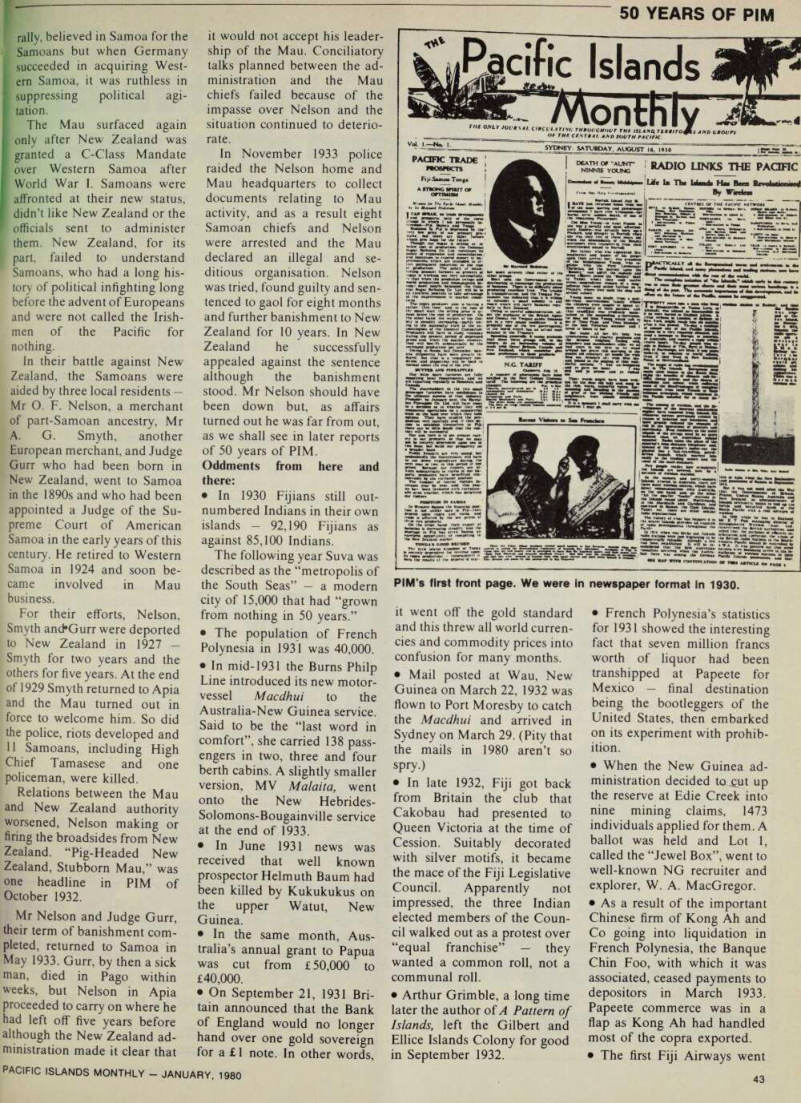
Pim Looks Back On 50 Years
And finds many Islands problems still with us
In this, our 50th anniversary year, PIM intends to review the half century of news highlights in its pages. Each month we’ll survey a four-year period under the highly-expert guidance of former PIM editor and publisher JUDY TUDOR, who has known the people who have made the news. She launches what promises to be a fascinating survey with a review of the years 1930-34.
Standing on the threshold of the 1980’s and looking back to the 16th of August 1930 when the publication made its debut, it seems that PlM’s Pacific then bore little resemblance to today’s version. But, like the poet said, the more we change, the more we remain the same, at least in some respects, and many of the Islands problems of 1930 are with us yet the price of copra, rubber or ba
nanas, political wrangles,
development and the need for investment.
At its birth PIM was of tab loid newspaper size and did not adopt its now familiar maga zine format for about 15 months. It carried a dateline August 16, September 20, etc for even longer than that, although we now wonder why, as distribution was all by sea mail and the most isolated sub scribers waited literally months for their copies. Except intern ally in New Guinea, air trans port was non-existent; Islands people were used to intervals of weeks or months between ships and were not noticeably less happy for it.
In spite of the fact that the
total European population of
the South Pacific Islands was considerably less than it is today, the inhabitants of PlM’s Pacific were indisputably white, or nearly so. Asians, called Asiatics and sometimes
coolies, were frequently “prob
lems that had to be solved’’.
Islanders were not problems, except the West Samoans who were generally ‘sullen’ or
‘unco-operative’ when they
were not being straight-out
bloody minded; and of course New Guinea kanakas, in uncontrolled areas, were oc casionally wild, fierce or war like, and during the four years under review managed to kill a number of Europeans.
In its first issue, PIM stated its aims as (1) providing world and other news that affected the Islands as a whole and (2) fostering Australian trade with them’
It proceeded to do both, in relation to (2) never letting up on the Commonwealth Government which it con sidered was doing less than it ought and making a pretty poor fist of what it did do; and in relation to (1) taking up causes with an enthusiasm that would make any editor blanch today. This made PIM enemies as well as friends, but right or wrong there was no fence sitting in PlM’s editorial pol
icy.
The infamous Wall Street collapse of October 29, 1929, which set off the Great De gression had occurred about: nine months before PlM’s first
issue. The magazine’s early
years therefore were coloured gloomily by the economic cir cumstances of the time.
But PIM, like all right minded organisations of the: time, expected its clientele to< shoulder the white man’s bur den uncomplainingly, to see; fair play and justice and set aj good example to local inhabi tants.
From its first issue, PIM la jmented the fact that there were 17 distinct administrations in
RIMS early issues in magazine format always carried this palm tree on the cover. It became the company’s
well-known logo.
the Pacific and urged an associ . ation or confederation which could discuss and deal with I problems common to all islands indigenous edu cation, health, future develop ment, quarantine laws, transport etc. It was a theme that was pushed periodically in PIM over the next 17 years, until, in fact, the South Pacific I Commission was set up after World War II as a consultative body. In the event the SPC turned out to be something of a disappointment, at least to PIM. but that was yet to come.
Other matters that took up a lot of space in PIM in its first four years included the follow
ing;
Copra: From the time in the 1860’s when the Hamburg firm of Jon Cesar Godeffroy und Sohn had pioneered the Islands copra industry from head quarters in Western Samoa, until the late 1920’5, all Islands economies floated along on this industry. Coconuts were ‘the consols of the East’ and planters believed the old saw that if you looked after them for the first seven years of their life they would keep you for the rest of yours. World War I
produced high copra prices
that boomed on into the 1920’5.
In 1926 copra brought a record £Stg29 per ton in London.
By the time PIM was born in 1930, the price had fallen to £ 14 in London and much less on an Islands beach, and planters
everywhere were showing the
first signs of panic. Amongst those most affected were the 182 returned servicemen who
had bought ex-German plan
tations in the Mandated Terri tory of New Guinea from the
Australian Expropriation
Board, the instrumentality set up to take over the German estates as part of war repar ations. Few of the Australians had paid cash, but the Expro Board made purchase reason ably easy with low interest and
long-term repayment of prin
cipal.
When copra prices nose dived in 1930, the Expro Board scrubbed interest for that year and deferred repayment of principal until June 1931, when the situation was to be re viewed. Copra prices con
tinued to sink and the moratorium was renewed year after year.
In early 1931. R. W. Robson, founder and editor of PIM, was in London and he made it his business to investigate the disastrous and to many, mys terious, falling copra market.
He attributed the slump to the general depression, to whale and other vegetable oils which when treated with new scien tific methods had become almost as suitable for mar garine as copra, but saved his biggest blast for the actions of the Unilever combine. This
had amalgamated powerful
European manufacturers of margarine with British soap makers, Lever Bros., in 1929 and as a result the combine controlled the Euro-British copra; oil seeds and whale oil markets. R. W. Robson’s stories won PIM many new readers.
Except for a brief period when Britain went off the gold standard in 1931, copra con tinued its- downward plunge, reaching £7.12.6 Stg c.i.f. Lon don in January 1934. With deductions for freight, hand
ling, shrinkage, insurance and
the rest, what the poor old
planter got ex-plantation was
below the cost of production, so news of the copra industry was always of interest to him.
Rubber which had brought 12/- a lb in 1911 was down to 3d a lb in 1930. Papua was the
biggest South Pacific producer
although Fiji and Western
Samoa has been minor ex porters. Papua’s annual 600 tons brought in .£200,000 in 1925; the same quantity in 1930-31 realised only £50,000.
The Papuan industry was saved from complete extinction by 4d a lb preference on the Aus tralian market.
The alternatives: As things went from bad to worse in established Islands industries, no issue of PIM was complete without some reference to alternative crops or new things to do with coconut oil (such as use in motor vehicles).
Castor oil seed was tried in Papua and three firms in Fiji
experimented with pineapple
growing and canning. Two
young men in the Mandated
Territory were distilling some
thing called massoi oil from trees found in the Finisterre Ranges - it was said to re semble cinnamon.
There was a plea for the resumption of Bird of Paradise shooting that had been banned in New Guinea, it being al leged that some German planters had financed their plantations on the sale of BOP skins to Europe. The ban stayed but planters were urged, 25 years before the idea did take off, to try coffee. A firm in Papua proposed to grow kapok on a large scale, others were trying sisal hemp and it was suggested that the Gulf district’s millions of nipa palms might produce power alcohol.
PIM urged everyone, every where, to try tung oil or pea nuts and Papua got a lot of publicity but no action from four groups trying to float sugar companies, leading PIM to comment sourly in an edi torial: .. so far as some of them are concerned the only kind of sugar they will ever produce is that which they will take out of the pockets of their deluded share and bond holders.”
Papua never did get a sugar industry but the fact that it was well established in Fiji allowed that colony to weather the worst of the depression in good shape due to some extent to the Ottawa Agreement that gave Fiji preference in UK and Canada. The same Ottawa Agreement gave Fiji entry to Australia for 40,000 centals of bananas per annum and de spite the screams of anguish from NSW and Queensland banana growers, shipments ac tually arrived in Sydney and Melbourne in early 1933.
Gold and air services. Gold was the great hope in the de
pressed 1930’s although when
PIM came into the picture only Papua and New Guinea had well established industries. In Papua, Misima Island was the biggest producer. In the Man dated Territory, the first phase of alluvial mining on Morobe field was over and a hiatus ensued until the viable big boys of the industry got going. At the end of 1930, 29 New Guinea
mining companies were listed
in Sydney, most of them never getting off the ground.
Those that did included Day Dawn, New Guinea Goldfields and, most impressive of all.
Placer Development/Bulolo
Gold Dredging, the last through the farsightedness of a former District Officer, C. J.
Levien, who had quit the NG service to become one of the pioneers of the Wau goldfield in the early 1920’5. Through his urging, Guinea Gold NL was formed in Adelaide in 1926 to work the Koranga leases and test 12 miles of the Bulolo River.
In 1928 Placer, a Vancouver company, took an option over Guinea Gold and proved a dredging area of 1100 acres.
Bulolo Gold Dredging was formed as a Placer subsidiary in 1930 to work the leases and by then Levien had persuaded his friends that air transport was the only way to solve the goldfields transport problem.
An old war-time DH37 plane pioneered the way and in 1927 Guinea Airways was bom, the following year purchasing two W 34 Junkers
planes, the only commercial
aircraft then capable of uplift ing the largest component of the dredges that were to be built on the Bulolo a three ton tumbler shaft. By the end of 1933, there were 26 airstrips in New Guinea and four in Papua, and New Guinea was leading the world in air trans port.
BCD’s first dredge went into operation in March 1932, No 2 in October 1932, No 3 in November 1933 and No 4 soon after. Levien never saw any of them in operation he died in Melbourne in January 1932.
In early 1932 an old prospec tor named Bill Borthwick,
grub-staked by Pat Costello,
well known resident of Fiji, discovered gold in the dry hills about seven miles inland from Tavua, in Fiji’s Viti Levu. A small paragraph appeared in PIM stating this bare fact, but from this discovery were to de velop the rich Loloma and Emperor Mines of Vatukoula,
Fiji.
The Mau. This Samoan or ganisation had its beginnings in the rivalry between the great powers for possession of Samoa at the end of last cen tury. Members, not unnatu
rally, believed in Samoa for the Samoans but when Germany succeeded in acquiring West ern Samoa, it was ruthless in
■ suppressing political agi-
F tation.
The Mau surfaced again I only after New Zealand was granted a C-Class Mandate i over Western Samoa after [World War I. Samoans were affronted at their new status, f didn’t like New Zealand or the f officials sent to administer them. New Zealand, for its f part, failed to understand Samoans, who had a long his
tory of political infighting long
before the advent of Europeans and were not called the Irish men of the Pacific for
nothing.
In their battle against New Zealand, the Samoans were aided by three local residents Mr O. F. Nelson, a merchant of part-Samoan ancestry, Mr A. G. Smyth, another
European merchant, and Judge
Gurr who had been bom in New Zealand, went to Samoa in the 1890 s and who had been appointed a Judge of the Su preme Court of American Samoa in the early years of this century. He retired to Western Samoa in 1924 and soon be came involved in Mau business.
For their efforts, Nelson,
Smyth and*Gurr were deported
to New Zealand in 1927 Smyth for two years and the others for five years. At the end of 1929 Smyth returned to Apia and the Mau turned out in force to welcome him. So did the police, riots developed and
11 Samoans, including High
Chief Tamasese and one policeman, were killed.
Relations between the Mau and New Zealand authority worsened, Nelson making or firing the broadsides from New Zealand. “Pig-Headed New Zealand, Stubborn Mau,” was one headline in PIM of October 1932.
Mr Nelson and Judge Gurr, their term of banishment com pleted, returned to Samoa in May 1933. Gurr, by then a sick man, died in Pago within weeks, but Nelson in Apia proceeded to carry on where he had left off five years before although the New Zealand ad ministration made it clear that
it would not accept his leader ship of the Mau. Conciliatory talks planned between the ad ministration and the Mau chiefs failed because of the impasse over Nelson and the situation continued to deterio rate.
In November 1933 police raided the Nelson home and Mau headquarters to collect documents relating to Mau activity, and as a result eight Samoan chiefs and Nelson were arrested and the Mau declared an illegal and se ditious organisation. Nelson was tried, found guilty and sen tenced to gaol for eight months and further banishment to New Zealand for 10 years. In New Zealand he successfully
appealed against the sentence
although the banishment stood. Mr Nelson should have been down but, as affairs turned out he was far from out, as we shall see in later reports of 50 years of PIM.
Oddments from here and there: • In 1930 Fijians still out numbered Indians in their own islands 92,190 Fijians as against 85,100 Indians.
The following year Suva was described as the “metropolis of the South Seas” a modern city of 15,000 that had “grown from nothing in 50 years.” • The population of French Polynesia in 1931 was 40,000. • In mid-1931 the Burns Philp Line introduced its new motor vessel Macdhui to the Australia-New Guinea service.
Said to be the “last word in comfort”, she carried 138 pass engers in two, three and four berth cabins. A slightly smaller version, MV Malaita, went onto the New Hebrides-
Solomons-Bougainville service
at the end of 1933. • In June 1931 news was received that well known prospector Helmuth Baum had been killed by Kukukukus on the upper Watut, New Guinea. • In the same month, Aus tralia’s annual grant to Papua was cut from £ 50,000 to £40,000. • On September 21, 1931 Bri tain announced that the Bank of England would no longer hand over one gold sovereign for a £ 1 note. In other words,
it went off the gold standard and this threw all world curren cies and commodity prices into confusion for many months. • Mail posted at Wau, New Guinea on March 22, 1932 was flown to Port Moresby to catch the Macdhui and arrived in Sydney on March 29. (Pity that the mails in 1980 aren’t so
spry.)
• In late 1932, Fiji got back from Britain the club that Cakobau had presented to Queen Victoria at the time of Cession. Suitably decorated with silver motifs, it became the mace of the Fiji Legislative Council. Apparently not impressed, the three Indian elected members of the Coun cil walked out as a protest over
“equal franchise” they
wanted a common roll, not a communal roll. • Arthur Grimble, a long time later the author of A Pattern of Islands, left the Gilbert and Ellice Islands Colony for good in September 1932.
• French Polynesia’s statistics for 1931 showed the interesting fact that seven million francs worth of liquor had been
transhipped at Papeete for
Mexico final destination being the bootleggers of the United States, then embarked on its experiment with prohib ition. • When the New Guinea ad ministration decided up the reserve at Edie Creek into nine mining claims, 1473 individuals applied for them. A ballot was held and Lot 1, called the “Jewel Box”, went to well-known NG recruiter and
explorer, W. A. MacGregor.
• As a result of the important Chinese firm of Kong Ah and Co going into liquidation in French Polynesia, the Banque Chin Foo, with which it was associated, ceased payments to depositors in March 1933.
Papeete commerce was in a flap as Kong Ah had handled most of the copra exported. • The first Fiji Airways went
PlM’s first front page. We were In newspaper format in 1930.
into service about March 1933 with two Moth planes equipped with floats. Services linked Suva, Lautoka, Levuka and Labasa. Government was subsidising the airline to the tune of £ 1500 per year for three years.
• In June 1933 all eyes were on London where an international conference was being held to try to sort out the world’s econ omic ills, including currency and exchange, trade, unem ployment and war debts. The German delegation walked out
to emphasise Germany’s de mand for the return of former colonies without which, according to Hitler who by then was in control, Germany could not survive. The con ference failed to solve any thing. Another cloud on the horizon, said PIM editorially, was Japan. ‘. . . It is inevitable that it will turn southwards.
The result is likely to be
tragedy.” PIM wasn’t always
right in its prognostications.
This time it was. • In mid-1933, a group of Papuans was sent to Sydney University for a six-month medical course, after which they would return to their vil lages as medical aides. PIM was in favour of the scheme but some Europeans in the Man
dated Territory wrathfully saw
it as another step towards mak ing the natives even more ‘big headed’ than they were. • About 500 Fiji-Indians, most of whom had gone to the col ony under the old indenture system, chose to be repatriated to India, leaving Suva on the
steamer Gabges in August
1933. • PIM editorialised in October 1933 that Britain’s efforts in the
New Hebrides were a scandal..
Although the French lookedl after their nationals, who num bered 1000, allowing them tot import labour from Indo- China and subsidising copra,.
Britain did nothing for its 200! nationals, PIM said it was not wonder that scores of British) had sold out to the French, or taken French nationality. • At the end of 1933 the firstl news of the existence of what are now the Highlands prov inces of New Guinea reached! the outside world. Explorations under Assistant District Officer J. L. Taylor and Mick andl Danny Leahy added to New Guinea an estimated 300,0001 new inhabitants and a vast pla teau and valley system of fer tile land between Bena Bena and Mt. Hagen a region pre
viously thought to be just a
continuation of uninhabited mountains.
Odd Advts Dept.
In 1931 if you were toothless in the wilds of the Islands there was no need to despair. A Syd ney dentist named Nolan undertook to send you false teeth by post first sending you a tin of wax with detailed instructions on how to take your own dental impressions.
An optician in the same city would, on demand, send an eye chart so other do-it-yourself experts could test themselves for spectacles. Someone named Wastall in Suva advertised that he would supply literature on whether or not aluminium) cookware was poisonous.
Advertisements & other items, pp. 41-45 (3 items)
50 Years Of Pim
Ricoh
Isn’t it time you started taking better pictures?
It’s easy. Start with the new Ricoh KRS. Now, snapshots are no longer potshots.. .professional results are no longer a mystery. Quite simply, here’s one SLR camera the whole family can use.
A Handling Beauty Just the right size and weighf make the KRS a pleasure to handle and carry. Insert your favorite 35mm film and the fun begins.
«mpiy treasure
For The Whole Family.
A / J KR-5
Ricoh
An SLR Viewfinder What you see is what you get.
A large, bright through-the-lens view, for accurate composition.
And versatile 3-way focusing, for edge-to-edge sharpness.
CdS Type TTL Metering Simply match the two viewfinder needles to set exposure.
Ricoh’s advanced electronics assure optimum light measurement. Day or night, indoors or out.
RICOH
A Choice of
£ Interchangeable
Lenses Group shots? Portraits?
Close-ups? Whatever the situation, take your choice of the high quality, easy-changing XR Rikenon lens selection.
And accessories.
For more information about the Ricoh KRS, write to N RICOH COMPANY, LTD. 14-6, Ginza 6-chome, Chuo-ku,Tokyo 104, Japan. ) Distributors: Australia Bell & Howell Australia Pty. Ltd. •G.P.O. Box 4778, 55-69 Murray Street, Pyrmont, N.S.W., Australia, New Zealand H.E. Perry Ltd. *145 Victoria Street, PO. Box 111, Christchurch 1, New Zealand, Norfolk Is.
Miltons Department Stores Ltd. •PO. Box 146, Norfork Island 2899, South Pacific, Fiji Narseys Limited »Renwick Road, Suva, Fiji. Tahiti Ets.
Coutimex •B.P 617, Papeete, Tahiti (French Polynesia) New Caledonia Omnium Caledonien Importation »Rue de L’Esperance, B.P. 2248, Magenta, Noumea, Nouvelle-Caledonie.
ANTHONY HORDERNS’
(Established Over 100 Years)
SPECIAL PRICES FOR
ISLAND CUSTOMERS
Swedish Safety Matches 6/- g-os; Rice, 561 b. Bags H/ 9 bag Tea, Blb. Cartons 9 . carton Tea, Half Chests, about 50 lbs. Sd. lb.
Campbell’s Boz. Soups 8 9 doz. tins Dates, by box, about 70 lbs. 4jd. Ib.
Nestles Condensed Milk, 4 dozen in case 39 - case Sugar-Coy. Golden Syrup, 56 x 2 lb. tins 30'- case Sugar, 70 Ib. Bag Coy., IA. 16/- bag Write for Monthly Food News.
COUGH MIXTURE— 2 - Bottle.
Anthony Horderns specially prepared Cough Mixture, for children up to the age of 12 years. It will soothe the most troublesome cough.
A few doses will suffice.
In two sizes. 4oz. Boz. bottles Anthony Horderns’ Price—Bottle 1/3 2 -
SKINTOX—I/6 Per Jar.
Anthony Horderns’ famous Skintox, the Family Ointment! A prompt and effective remedy for Eczema, Erysipelas, Burns, Scalds, Ringworm, Piles and all eruptions of the skin.
Anthony Horderns’ Price, per Jar 1/6
FRENCH CORN CURE— I - Tin
Anthony Horderns’ celebrated French Corn Cure. It is without doubt one of the best corn cures manufactured. In two s zes.
Anthony Horderns’ Price Small Tin, 1/-; Large Tin, 1/6
CASCARA TABLETS—I/3 Bottle
Anthony Horderns’ pharmaceutical standard Cascara Tablets. 100 in bottle.
Anthony Hordernc’ Price 3-grain, 1/3 bottle; 5-grain, 1/9 bottle
LAXATIVE VEGETABLE TABLETS—I/9
Anthony Horderns’ pharmaceutical standard Laxative Tablets. 100 tablets in bottle.
Anthony Horderns’ Price, bottle . 1/9
A.P.C. TABLETS—I/- Packet.
Anthony Horderns’ A.P.C. Powders, for Headaches, Influenza, Rheumatism, etc. 12 powders in packet.
Anthony Horderns’ Price, Packet 1/-
8-oz. PHOSPHORISED QUININE AND IRON TONIC—2/-
Anthony Horderns’ Phosphorised Quinine and Iron Tonic, for nervous debility, brain fag, loss of appetite, loss of vitality, sleeplessness, weariness, etc. Boz. bottles.
Anthony Horderns’ Price, Bottle . . 2/-
INFLUENZA MIXTURE—2/- Bottle
Anthony Horderns’ Influenza Mixture. Quickly relieves Influenza, Colds, Colds in the head, etc. Boz. bottle.
Anthony Horderns’ Price, per Bottle 2/-
INDIGESTION MIXTURE—2/6
Anthony Horderns’ Bismuthated Indigestion Mixture. A quick and effective remedy for the immediate relief of Indigestion, Heartburn, Acidity, etc. Boz. bottles.
Anthony Horderns’ Price, per Bottle 2/6 (Chemistry—Second Floor—Free Delivery City and Suburbs only) Write for Spring and Summer Fashion Catalogue. Now in preparation.
ANTHONY HORDERN & SONS LIMITED
Brickfield Hill
PITT, GOULBURN AND GEORGE STREETS, SYDNEY
BOX 2712 C, G.P.0., SYDNEY
ZERVON
PAIN POWDERS 1
are a wonderful
PAIN KILLER
safe sure speedy.
TRY THEM FOR
DENGUE and MALARIA
I- l'9 and 2'6 a box all chemists, or post fre« from
LOFBERCS PHARMACY,
'ROCKDALE'
N. S. W
Advertisements with a message from 1931 issues of PIM, Medication was an important market in the Islands.
© Reliable and com- Painlets extractions, fillings. Cold crowns fortable and lasting plate work. 28 OXFORD ST., over Winns;
Have Teeth by Post
If you are unable to visit Sydney, I can make you comfortable, natural and long lasting teeth by means of my well known method of “Self Taken Impressions.” Cut out this advertisement, attach your name and address and post to me for full particulars.
SPENCER NOLAN, Dentist
177 OXFORD ST., opposite Mcllraths; 139 ELIZABETH ST., two doors from Market St., Sydney.
Beam Wireless and Cable Address; “Fastplate,” Sydney. P.I.M.
The Vi eta Professional 460
built to handle the tough
jobs with ease
PROFESSIONAL 460 FEATURES
Victa Hi-Torque 6 two-stroke 160 cc engine.
Larger fuel tank 2.3 litres as against 1 litre Heavy duty wheels.
Easy pull zip starter Safety blade disc 46 cm (18") cut Concealed throttle cable LM carburettor Folding handle 8 position height adjuster Noise reducing muffler Side chute with safety cover Lightweight (weighs only 54 lb) Rugged 14-gauge steel baseplate Specifications and models subject to alteration without notice or obligation.
ICTA
TURNS GRASS INTO LAWN
50 Years Of Rim
44
PACIFIC ISLANDS MONTHLY - JANUARY, 1980 C
Fellow scholars
Books
Fellow scholars make a 'garland’ for Harry Maude
The Changing Pacific: Essays in Honour of H. E. Maude. Ed.
Kiel Gunson. Published by Oxford University Press. $25.
I first met Harry Maude when, as a cadet in the then (British) Colonial Service, I reached Fiji in January 1942. He had already served in the Gilberts, Pitcairn and Tonga, with an ir relevant interlude in Zanzibar, and had a vision, the equivalent of Gordon’s, of the wide reaches of the Western Pacific.
We continued together in the Gilbert and Ellice Islands, now the independent states of Kiribati ( = Gilberts in the thirteen-letter alphabet bes
towed by Bingham) and
Tuvalu; we had sequential as sociations with the South Pa cific Commission and, finally, were both at the Australian National University and in Canberra. So for the best part of forty years we have been col leagues and friends our wives as well. The ‘garland of scholarly papers’ as the editor calls them is an appropriate tribute to Professor Maude and
Robert Langdon’s opening
essay ‘Shy Proconsul, Dedi cated Pacific Historian’ aptly portrays the double helix of an unusual career.
It is no easy thing to review a collection of specialist essays.
Professor Spate sets a perspec tive in describing ‘The Pacific’ as a European artefact and the peoples of the littoral and islands as the artificers. With a few exceptions, the essays are concerned with Micronesia
and Polynesia reflecting, in
that order, the principal interests of Professor Maude himself. They are individual
pieces, mainly of anthropology
and ethnology.
Do not expect to find an account of the contemporary
voyages to political indepen
dence but rather a miscellany of traditions, customs and their
survival, adaptation or decay
notes of the music of time
which, along with many others, are now recorded.
As Islanders establish their own scholarly credentials as historians they will accept some as the authentic stuff of
history and question others
always, one hopes, empirically
re-examining the facts, in terpretations and relevance.
Professor Spoehr illustrates part of the historiographical task ahead in an essay on Spain and the Marianas that local events must needs be inter
preted in comparison with
similar events elsewhere. The meaning of‘change’ in the title seems therefore not to be just a further unfolding of the ways and doings of island societies in the past but also preparation for the histories that will inform the present.
Let us now look at the parts of the collection. Dr David Lewis, in from the cold and in the Spoehr framework, con siders the debt of Polynesian and Micronesian seafarers to ancient Asian navigation. Pro fessor Daws tantalises in another dimension the de batable value of psychohistory
in biography, alone identifying
Pitcairn with the Pacific through the execrable Joshua Hill. Because some years of my life were spent in Kiribati, I read the three articles on the maneaba, kinship and the
northern kingdom with special
interest. All were and, even as
they change, will remain sig
nificant in politics, land tenure and administration. Essays on the inhabitants of Mapia, three small coral atolls lying north of Irian Jaya, and on beach combers of the Carolines, the probable homeland of the
Mapians, complete the
Micronesian component.
A case study of depopulation by disease on Aneityum in the New Hebrides last century is one of two contributions specific to Melanesia; and the ‘care, prayer and practice’ by early missionaries in Tonga is
adjudged ‘a draw’ no worse than indigenous medicine in Tongan eyes if it failed and better for the individual and the Christian faith if it suc ceeded. Curiously, the other Melanesian essay dealing with male prestige and the lavish celebration of birth in the off shore villages of Kove, New Britain also finds an antithesis in Tonga. Death and the ob servance of funeral rites, with the major ceremonies accom panying the funeral of Queen Salote at the centre, are used to illustrate aspects of the social structure, acculturation of the young and some weakening of tradition.
Three studies of eastern Polynesia reconstruct land related customs in 18th century Tahiti and record some
equivalents today; and de
scribe the communal ap portionment of food in the Tuamotus and the violence and vice which desolated
Marquesan societies. By con
trast, the transformation of regicide and the killing of social outcasts to propitiate the gods into a masque to mark farewells is described in an essay on Niue. The timeless patience of the Pacific Islanders, at least as much part
of them as quarrels and viol ence, is well accounted in the settlement of a village dispute in Samoa. I often experienced this patience in courts and councils in Kiribati; and there, and once again in Tanna in the New Hebrides, in the settle ment of civil disorders with ori gins in cargo cults.
Two essays have been re served for final comment. On the trail in the highlands ol New Guinea, Professor West considers a parallel from the New World an extension ol the Spoehr thesis. He sees the Australian frontier there as a contact of fits and starts not with settlement as the objective an impingement on a land into which law and order have
only recently and precariously
moved. From a century earlier a quartet of contributors re mind us that Hawaiians were then composing their own his tory and I am sure that Harry Maude and the writers rep resented in this book will wel come their successors -
warmly. Yes, The Changing
Pacific is a scholarly garland
easy enough to read and enjoy and capable of stirring even more curiosity about the artifi cers and the artefact. Reia Cowell
Gilbertese eyes


scan their nation’s history
To accompany the review of a book of essays in tribute to Professor Maude, it is PI M's great pleasure to present the professor himself in a reviewer's role. He writes about a new publication on a subject dear to his heart the history of Kiribati.
Kiribati - Aspects of History.
Published by the Institute of Pa cific Studies and Extension Ser vices, University of the South Pacific, and the Ministry of Education, Training and Cul ture, Republic of Kiribati. 1979.
SF4; paperback edition SF3. A separate edition in Gilbertese, Taraan Karakin Kiribati, is published at the same price.
The government of Kiribati is to be congratulated on its de cision to commemorate independence not with a statue
or a saline fountain to disfigure the Bairiki town plaza but by
producing and publishing s
history of the Gilbertese
people: a precedent which
some other nations might copy
with advantage.
The task was entrusted to 2f Gilbertese men and women j many of them teachers and university students, who were initiated into the mysteries ol historical research and writing by a team from the University of the South Pacific and a re gional specialist, Barrie Mac
donald of Massey University.
The result is an unqualified success, in which the authors, their mentors and the Kiribati Government alike can take a
justifiable pride. Whether by
accident or good fortune the Gilbertese writers have not produced yet another European-type history, labori
ously chronicling events culled
from contemporary documen tation, but rather the fascinating story of an island people from the time of te bomatemaki, when the earth and sky were
still sealed together, through
their early migrations and
settlement, European contact
and culture change, political
tutelage and development, to
the independent republic of
today.
Even viewed as a history it is refreshingly different, for the Gilbertese story is for the first time told to us as seen by Gil bertese eyes, relying heavily on this gifted people’s wealth of mythology, saga and oral tra dition; and it is written with a natural grace and vitality
which disarm literary criti cism. The chapter on creation the work of the gods, for
example, is pure lyric.
But it is far more than a his tory in that it has a conscious purpose, apparent in many of the chapters and inherent in the others; to expound to the young Gilbertese of today the distinctive content of their cul tural heritage, to stimulate them to take a justifiable pride in this heritage and in being Gilbertese, and to think and behave accordingly. It tells us what the islanders of old be lieved and how they felt and acted, illustrating with examples the forces of change, and finally detailing the cul
tural position reached today;
and this with the aim of producing a sense of Gilbertese identity at a time when, more than ever, they need to regain an understanding and pride in te katei ni Kiribati (the Gilber tese way of life).
While limitations of space have prevented any definitive treatment of the topics dealt
with in the 12 chapters, they
give an adequate enough
conspectus for the general reader. As is inevitable in sym posia there is some overlapping and repetition, though this may well assist one to grasp unfamiliar themes. At the risk of being invidious I felt that the chapter on early Gilbertese so ciety, in particular, was a first rate exposition, well constructed and written, while
Maunaa Itaia’s eloquent plea
in the final chapter for the development of a Gilbertese identity or ethos in the face of modern cultural pressures de fines in effect the purpose of the whole book. If his words are heeded this courteous and essentially democratic com munity need have few fears for its future as an independent nation.
Both in its English and Gil bertese editions the book in cludes a wealth of illustrations (some in colour), adequate maps and a selective bibli ography. At SF3 the paperback is a real bargain and a must for
everyone who wants to learn about the Pacific’s newes< country and its 57 000 peoph living in the true citadel-hean of the South Seas - an atoll paradise of 33 islands contain i ing 684 square kilometres oi
land (though allegedly doub<
ling its size at low tide) scat] tered over no less than five million square kilometres o< ocean.
Kiribati Aspects of Histor is indeed a worthy accession te the growing volume of creative works produced by island writers as part of the literar renaissance of the Central Pai cific: perhaps the region’s mos significant cultural phenomi enon during the 19705. I use th word renaissance deliberate! since over a century ag
Polynesia with its periphera
areas, including Fiji and th Gilberts, was the locale o: countless oral epics.
Few of these were writtei down, however, except mayb< by some folklorist, but the trai dition of creativity in won
form remained; to be fanned into vigorous life by the active encouragement of the Univer sity of the South Pacific, and in particular by two of its staff, Ron and Maijorie Crocombe; by the publication outlets pro vided by the South Pacific Cre ative Arts Society and literary periodicals such as Mana; and by the example of established writers such as Western Samoa’s Albert Wendt, with others like Subramani of Fiji who both write and teach the art.
The result has been a stream of short stories, poems, plays and a few books; and now we have the first locally-written history. Its immediate success has already made it the proto type of several more being
planned by other newly
emergent states, and these will
hopefully provide the material
for the ultimate regional his tory of, by and for the Pacific
peoples suggested by Niue’s
Premier Robert Rex at the re cent South Pacific Festival of Arts. H.E. Maude.
Advertisements & other items, pp. 47-50 (1 item)
Component-like
audio performance
MIX MIC
MIX MIC
VOLUME
Mic mixing ProfessionaNike mlc mixing with independent volume control for sing along or special effects recording/playback.
Powerful 2-way 4-speaker system with true portable convenience like snap-lock quick on/off capability for dynamic stereo sound indoors or out. while you're away.
For easy connect to a stereo turntable which turns the TRK-9150W into a mini sound contro center.
in a portable
TRK-91 SOW
The TRK-91 SOW. 25 big watts of pure dynamic stereo output, and a detachable 2-way 4-speaker system. Plus, 3-band (FM stereo-MW-sw) tuner, air damp cassette eject, auto or manual record level control and other audio extras. Full features and convenient handling that adds HITAPHI up to solid stereo enjoyment's?' 1 n 1
Epiglass Everdure Timber preservative and sealer.
Hardens, protects and densities timber.
Kills all mould spores and permanently seals out moisture. 2481 Epiglass 90 Epoxy Resin and glass cloth.
Easy to apply.
Strengthens hulls, eliminates water absorption and rot and increases the value and life of your boat. «
As Seiko enters its second decade of world leadership in quartz technology;
Seiko Men’s Dress Quartz Collection
So slim, so elegant. So superbly accurate.
Now you can own a quality Seiko Quartz dress watch that represents a new level in fashionable sophistication. Here is impeccable styling combined with the unsurpassed accuracy and dependability of Seiko Quartz. Crafted with trim good looks.
Engineered with Seiko's uniquely advanced technology. In a variety of starkly beautiful styles to satisfy men of excellent taste everywhere.
It's what you'd expect from Seiko, the company that sold the world's first quartz watch and that never ends its quest for quality and dedication to technology. Seiko Quartz.sQ[ V \ t % \ p
SEIKO
Someday all watches will be made this way.
Fiji's
Times
Fiji’s Times: A History of Fiji, is a series of three booklets on Fiji. They’ve just been pub lished by the Fiji Times and Herald, Suva. The booklets comprise dozens of separate articles giving various aspects of Fiji’s history, reprinted from a weekly series in the Fiji Times. They are quite remark able value at only 5F1.50 each, as the series consists of auth entic, and colourful, accounts of Fiji life, from pre-European days to today. It’s Derrick in a handier, more readable form, and the booklets are priced to make them more attractive to schools. But the three titles, each of 84 pages, are invalu able to any collector, or for anyone interested in Pacific history. Collectors should get them while they are still avail able, because this is probably one of those unusual printings which disappears swiftly with out trace.
lt's Paradise Plus!
In the beginning there was Paradise. The world had never seen an in-flight magazine quite like it. When it first appeared in July 1976, seat pockets were empty after every flight of Air Niugini, and the airline could not meet the written requests for back copies from those who had seen or heard about it.
In 1978 the airline put together The Best of Paradise, a selection of the top stories from the first two years of Para dise magazine. It sold out almost immediately.
So now Air Niugini, in association with Pacific Publi cations, has produced Paradise Plus - bigger (144 pages, with 45 separate stories and photographic essays) and every page in full colour. It is a collection that, without doubt, will sell as quickly as the earlier one. The stories in Paradise Plus are all new, none having appeared in The Best Of Para dise.
They include reports on arts and crafts, culture, customs, canoe sailing, life on the Sepik, bird life, gold mining etc.
Many stories are about personalities, such as the one about Fred Hargesheimer, who founded the Airmen’s Memorial School in New Britain as a remarkable thank you gesture to the people who helped save his life after he was shot down during the war.
The book is available in Bookshops in Papua New Guinea and the Pacific Islands, including Hawaii, or through PI Ms Mail Order Bookshop, Box 3408, GPO, at $A 12.00 or SUSI 4.00 posted.
Advertisements & other items, p. 49 (2 items)
Books
49
’ACIFIC ISLANDS MONTHLY - JANUARY. 1980
Racing Red,
COOK ISLANDS: Cook Island Trading Corporation Ltd FIJIAN ISLANDS: Burns Philp (SS) Co. Ltd NEW HEBRIDES: Burns Philp (NH) Ltd NOUMEA: Enterprise Guy Limousine NIUE ISLAND: Niue Island United PAGO PAGO; Max Haleck Inc, Burns Philp (SS) Ltd PAPUA NEW GUINEA; KIETA: Nikana Wholesalers, LAE Faulkner-Tait (NG) Pty Ltd, MADANG: Burns Philp (NG) Co.
Ltd PORT MORESBY: S.A Heath Co. Ltd, Steamships Honda Centre RABAUL: Elvee Trading Pty Ltd, WEWAK: Burns Philp (P.N.G.) SOLOMON ISLANDS: P.K.R. Pacific Sales Co TAHITI: Marine Corail, Tahiti Sport, Comptior Polynesien TONGA; Burns Philp (SS) Co Ltd WESTERN SAMOA; Burns Philp (SS) Co Ltd, E. A. Coxon Ltd, Gold Star Transport Co. Ltd, Morris Hedstrom Ltd.
NORFOLK ISLAND; Irvines Building Supplies 2481
Epiglass E-Type Antifouling.
Gives up to 12 months growth-free performance.
Racing Red, Blue, Green and Gold.
of feeding
Problems of feeding Paeifie townsfolk
The Adaption of Traditional Agriculture: Socio-economic Problems of Urbanisation. Ed. f E. K. Fisk. Published by A us f tralian National University Development Studies Centre. : $9. [ This book contains contri butions from a number of [ world authorities to a con ference held in Honiara in late 1977 on the adaption of tra ditional agricultural pro ■ duction to the needs of urban markets.
The subject is topical and 1 important. Most South Pacific countries import substantial quantities of food to feed their I urban populations and food amounts to 20-25% of their [ total imports. This is both annoying to governments try ing to promote self-reliance
and conserve foreign exchange
and. on face value, strange for
agriculturally-based countries
with relatively low population pressures. The reason is that the staple crops of the South Pacific are root crops, which are neither easily storeable nor transportable, and that they are
I almost invariably produced by
subsistence methods. Can sub sistence production of root crops be modified to provide a sufficient surplus to feed rap idly expanding urban popu lations, and if so how? [ Unfortunately, the papers do not really get to grips with these basic questions. This is not the fault of the editor and con ference organiser. In his introductory paper, which was sent to participants when they were invited to attend the con ference, he clearly poses these questions and lists the basic problems involved in the pro cess of adaption (pp 20-21).
The conference participants did not take due note of these questions and, in general, appear to have written on re lated themes of their own interest. Unfortunately, this is not uncommon at conferences of this type.
A notable exception is the contribution by Professor Bill Clarke of Monash University, and formerly of the University of Papua New Guinea. He examines the ‘environmentally sustainable modifications’ which might be made to tra ditional agricultural systems, having first made the point that, in terms of returns to inputs of energy, traditional agricultural systems are far more efficient than indus trialised agriculture. He con cludes that it would be absurd to try to ‘power our way out’ of
food shortages by adopting
high energy technology. He
suggests the development of communities where the distinc tion between rural and urban, and between consumer and producer, is broken down and where almost everyone devotes some time to food production.
Some food for thought for
urban planners!
PNG’s National Food Policy makes some sensible points with respect to securing urban food needs from subsistence agriculture. It sees distinct
disadvantages in villagers
engaging in production of sub sistence crops for sale. In par ticular, the land will be required to support many more people, and will deteriorate, and village nutrition levels may suffer. It therefore rec ommends the encouragement
of large-scale production of
traditional staples near urban areas, and if necessary, that foreigners be allowed to be come involved. This seems to me to be, along with large-scale production of rice, a possible alternative to reliance on imported rice but this is not to underestimate the transport, marketing, mechanical and or ganisational enormities in volved in producing and delivering such production to a large number of urban con sumers. Also, large-scale pro duction will itself be a heavy user of imports and existing
small-scale producers are likely
to suffer from the compe tition. ■/ Several contributors deal with urban food supplies in Africa and Central and South America where root crop staples do provide substantial proportions of the food re
quirements of some large urban centres. In Africa this derives from a yam trade of several centuries’ standing, and also processed cassava, and does involve modification of traditional agriculture. In Cen tral and South America, root crops for urban supplies are de rived from commercial farms, both large and small-scale.
Some of this experience will be relevant to the South Pacific, but terrain and climate of the region often make rapid trans port difficult.
Despite the failure of the conference papers to tackle the major questions, the conclud
ing chapter notes a general
agreement among the par
ticipants ‘that tropical root
crops and indigenous systems of cultivation and production had a high, and in some areas
neglected, potential for raising
food production in many areas of the humid tropics, par ticularly in the Pacific region’.
The book is an impressive collection of papers on the supply of urban food needs from the production of root crop staples. It deserves to be
read widely by planners and
students of the area and its for mat and the level at which it is pitched lends itself to these audiences. Geoffrey Harris
Advertisements & other items, pp. 51-52 (1 item)
fascinating
Your
doorway
into the
fascinating
world of the South Seas 104 pages $4.00 or SUSS.OO posted.
Order form on special insert in this issue.
PORT MOl
♦ Right in tl business cei * A traditiojl, comfort and Tim food * All rooms airconditioned * Restaurant * Bai * Banquet hall
C. NEUMANN
manager Phone 21-2622,
vA v V a -X'V^WvVV
Henry Lawson’s
Bookshop
127 York St., Sydney 2000 Just half a block from Town Hall. Phone 29 7799.
We stock ONLY
AUSTRALIAN BOOKS
and Books on the Pacific. \ \ /V v a/ W / \/v\Aw \a\aa<
Stay at Aggie Grey’s . . . the South Pacific’s
legendary hotel.
Situated right in the heart ot Western Samoa. Enjoy Polynesian style friendliness and service, in cool surroundings, superb entertainment and food.
Magnificent white sand beaches only .1 short drive away. Airconditioned rooms, swimming pool and lull bar facilities. hookings through Union Steam ship Company of NZ. Pan Am.
Air New Zealand or direct to Aggie Urey's. Apia. Western Samoa. Cables: 'AC.C.IES' Apia.
Polynesian
Bookshop..
THE PACIFIC ISLANDS
BOOK SPECIALISTS'
Write for our complimentary catalogue!
336 PONSONBY Rl),
(PO Box 47 267)
AUCKLAND, NEW ZEALAND
Telephone 764-824.
When you need
more than just the
best machines
and engines
count on
Whether you need earthmoving, agricultural, materials handling or forestry machines or industrial engines and generator sets you'll want full support ... before and after you buy.
That's what you'll get with Cat-built machines and engines and our Cat Plus services.
Our Cat Plus program starts by offering you expert assistance in job planning and machine or engine selection. And, helps ensure your equipment has the right attachments to meet your requirements.
We can also tailor purchase arrangements to fit your needs.
A team of specialist mechanics can help with on-site machine or engine problems, as well as carrying out regular service or major overhauls in our wellequipped workshops. Our extensive local parts supplies help avoid long hold-ups on the job. And, our people can work with you to help prevent downtime and keep it to a minimum when trouble does occur. Caterpillar-built equipment includes track and wheel-type dozers and loaders, motor graders, wheel tractor-scrapers, excavators, compactors, off-highway trucks, log loaders, skidders and lift-trucks. And a wide range of genrator sets and industrial engines.
We are your direct access to this equipment and Cat Plus. We are a local business, staffed, stocked and equipped to offer you the full benefits of Caterpillarbuilt equipment and Cat Plus services.
Why not contact us today? m m
PIIXA?
r»RPI
X '.‘•x s
HASTINGS DURING
LAE:
Milford Haven Road, Telephone 42 2355.
PORT MORESBY:
Telephone 256650.
BOUGAINVILLE:
Itakara Industrial Park, Arawa Telephone 959077.
carptrac
SUVA: Carpenter Street, Raiwai, Private Mail Bag, GPO Suva, Fiji Ph. 381622.
Telex FJ2190 Cables CARPTRAC.
LAUTOKA: Veitari, Telephone 61877.
LABASA : Vulovi, Telephone 81888. □
YOUR
CATERPILLAR
DEALER
8A10453
Islands
From the
Press
Editorial by Ed Howard, Norfolk Island Assembly member, in his Norfolk Island News Australia’s role in the new government has been praiseworthy.
The Council had been concerned that Australia was retaining too many powers and would have no hesitation in using them. That worry may have been unnecessary. The position taken by the new Administrator and his Official Secretary can only be described as faultless. It actually appears, so far, that Australia wants Norfolk to govern itself and wants to assist where it can. The I Assembly’s powers under the new act appear to be substantial.
In the past it could take a year or longer to get a simple law ■passed through Canberra. Now it can be done in a couple of months. That is much better government. There is a clear, welcome message in those developments: if Norfolk is able, Australia seems willing.
The Fiji Times, Suva A banana-skin fall which caused a market vendor to lose his six dozen eggs and suffer injuries to his knee, hip and buttocks has : led to a $ 150 claim against Lautoka City Council. The incident occurred at Lautoka Market about 4 pm on October 5. Mr Rati Ram was carrying the eggs in cartons, balanced on each hand, down to his stall. Unable to see immediately in front of him because of his load, he unsuspectingly stepped on a loose banana skin thrown by somebody and came crashing down. Now an angry Mr Ram has gone charging for the council, which runs and maintains the market, claiming compensation from it for loss, pain, suffering and humiliation he suffered when he fell in full view of the people in the market . . .
An editorial in the Samoa Times 1... Why must we always regard New Zealand as our El Dorado? i What about us? Aren’t we the most beautiful people in the world, - the most beautiful country anywhere? Why don’t we make our [own El Dorado? Why don’t we develop ourselves? Why don’t we create enough employment, why don’t we give everybody the vote, why don’t we give everybody the chance in life so that they don’t have to immigrate to another country?
Our News published by the Papua New Guinea Office of Information [• • • Fort y P er cent of everything we do in this country is paid for by Australia. This should be recognised and appreciated because it receives very little publicity. We should all wear signs on our backs saying I am paid for by Australia’ Comment from Mr Noel Levi. Member of Parliament for New Ireland.
Tohi Tala Niue, Alofi, Niue Island Probably because the wet season is upon us, more people have been observed driving motorcycles and scooters while a passenger holds an umbrella over the driver. While appreciating that it is difficult to see in the rain without a windshield, goggles or visor, there are occasions when the umbrella prevents the person in front from seeing more than a few metres ahead. This is potentially dangerous but not as irresponsible as steering a motorbike with one s feet as has been seen on the odd occasion!
From Oliana’s ‘Tune In’ in the Observer, Apia The United States seem ready to take the world to the brink of war rather than extradite the exiled Shah of Iran. Had the Shah been a small time crook who had got away with only a few
Pacific Islands Monthly - January, 1980
thousand dollars and perhaps murdered a couple of people he would have been extradited without any trouble and, in fact, wouldn’t have got into the States in the first place. However,since he got away with two hundred million (some estimates place his take as high as six hundred million); was responsible for the torture and death of dozens if not hundreds of his political opponents and was for a long time one of America’s best customers for arms, the Shah is treated with all diplomatic niceties and obviously regarded with the highest respect by the American government. Which all goes to show that if you are going to be a crook it pays to do so on a grand scale.
The News Drum, Honiara The secretary of Ngarinasuru Cultural Centre in east Kwaio, Malaita, has complained to the Solomon Islands Tourist Authority following a visit to the centre by some tourists two weeks ago. Mr Lee Silamo said the Tourist Authority should inform the centre of proposed visits of tourists. Mr Silamo said the visitors entered the area without permission, tried to force villagers to perform custom dances (which they refused) and posted guards around houses with toy guns at night. This frightened the villagers, especially the children and the elders, he said.
From an editorial in The Fiji Times, Suva, on complaints of juveniles drinking liquor in nightclubs . . . They don’t serve drink illegally willingly because they don’t have to; they have plenty enough legitimate glasses to fill. For all the bombast the nightclubs are bombarded with, the fact is that they have an important function, and it is wrong to label them as mere sin pits. For thousands of young and not-so-young people they are a needed escape from very real city life pressures.
From a letter by Frank Taylor of Nukualofa in the Tonga Chronicle complaining of the sale in local stores of mass-produced artefacts from overseas purporting to
be Tongan
... I made a few inquiries and was told the whole thing is mass produced in Taiwan. Maybe the bamboo is Tongan. In the same store there are so many other articles that carry the little gold sticker that reads ‘Ofa Atu from Tonga’, and the only thing Tongan about them is the dust that covers them. The most disturbing thing that arises from all this is how much of this cheap junk is being mass produced as ‘authentic’ Tongan handicrafts?
The Papua New Guinea Post-Courier The Government will introduce legislation to stop the exploitation of nationals in commercialising their bodies and arts, Parliament was told yesterday. The Minister for Foreign Affairs and Trade, Mr Olewale said this when replying to Mr Sam Tulo (North Bougainville) during question time. MrTulo asked whether the Minister would take the necessary steps to stop the publication of nude pictures ... Mr Olewale, however, asked what right parliamentarians and others had to question the individual rights of Miss Tukana (appearing in the nude in an advertisement) which were guaranteed under the Constitution. ‘We are wearing clothes which have been introduced into our society. We go back to our villages and see our own people but we do not regard them as being nude.’
From a report in the Observer, Apia, of a professional
wrestling display
. . . But the night did not go without incident. A young boy was taken to hospital with severe head injuries, and several others received minor injuries after spectators started throwing chairs at each other. . . The highlight of the night for the local wrestling fanatics was when local hero Fanene Pita Maivia put King Ripper Collins to sleep. Collins had put another local hero Siva Afi in hospital a few weeks back in Hawaii and Fanene had come out to avenge his mate in front of his home crowd a sure way of attracting a crowd. Collins was put to sleep after Fanene had applied the head butt which opened Collins’ head, allowing it to bleed profusely for a few seconds.
Advertisements & other items, p. 54 (1 item)
Sony’s portable
Fill your leisure hours with the fresh sound of Sony's CFM-31S cassetterecorder with FM/MW/SWI/SW2 radio.
The 2-way speaker produces three watts of incredibly sharp sound through a 12cm woofer and a scm tweeter. A fine tuning knob gives precise SW reception indoors or out.
At a touch of a button, you can record simply and conveniently. There is also a built-in electret condenser microphone, a pause button, a 3-digit tape counter, plus cue and review. This model also shuts itself off automatically after playback.
The CFM-31S is lightweight and travels with ease. Anywhere you go, it's the portable with the fresh sound. (CFM-sil with fm/mw/sw/lw is also available.)
Sony’s portable
with the fresh sound.
Asian Development
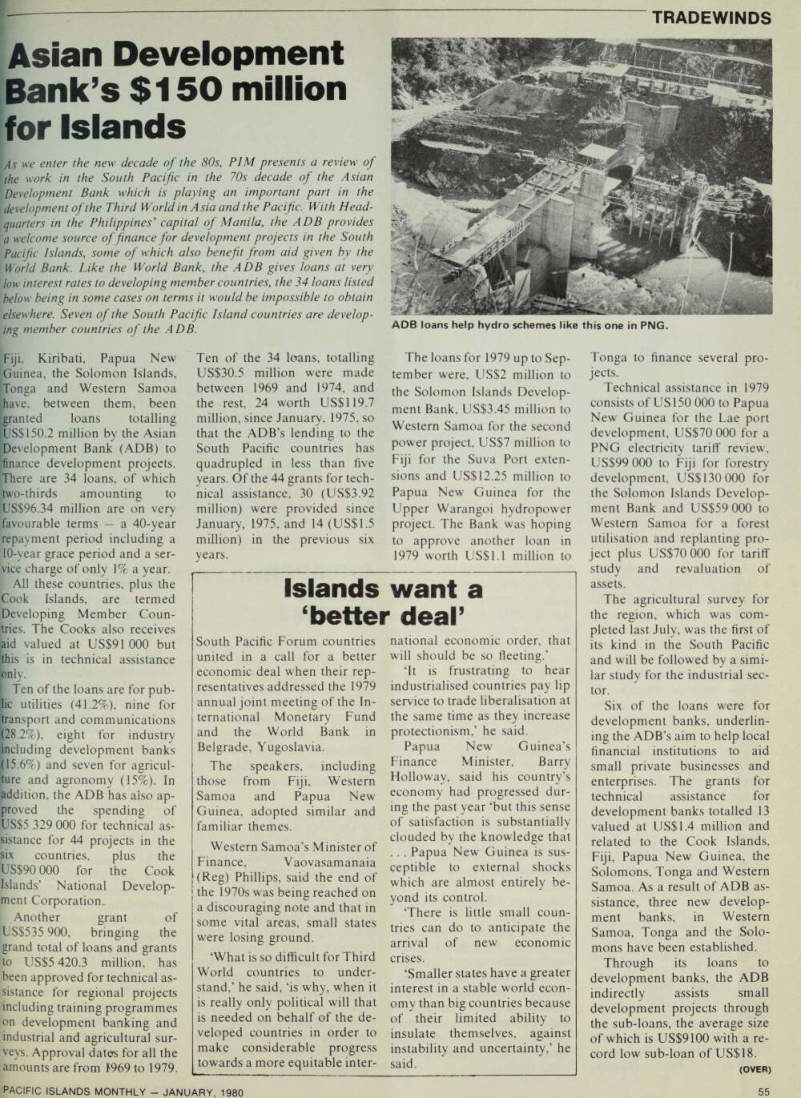
Tradewinds
Asian Development Bank’s $l50 million for Islands
As we enter the new decade of the 80s, PIM presents a review of the work in the South Pacific in the 70s decade of the Asian Development Bank which is playing an important part in the development of the Third World in Asia and the Pacific. With Head quarters in the Philippines' capital of Manila, the ADB provides a welcome source of finance for development projects in the South Pacific Islands, some of which also benefit from aid given by the World Bank. Like the World Bank, the ADB gives loans at very low interest rates to developing member countries, the 34 loans listed below being in some cases on terms it would be impossible to obtain elsewhere. Seven of the South Pacific Island countries are develop ing member countries of the ADB.
Fiji, Kiribati, Papua New
the Solomon Islands, Tonga and Western Samoa have, between them, been
granted loans totalling
U 55150.2 million by the Asian Development Bank (ADB) to finance development projects.
There are 34 loans, of which
amounting to
(U 5596.34 million are on very favourable terms a 40-year repayment period including a 10-year grace period and a ser vice charge of only 1% a year. ■ All these countries, plus the Cook Islands, are termed Developing Member Coun tries. The Cooks also receives taid valued at US$9l 000 but (this is in technical assistance
only.
I Ten of the loans are for pub lic utilities (41.2%), nine for transport and communications
eight for industry
Including development banks 8(15.6%) and seven for agricul ture and agronomy (15%). In addition, the ADB has also ap proved the spending of US$5 329 000 for technical as sistance for 44 projects in the six countries, plus the US$9O 000 for the Cook Islands’ National Develop
ment Corporation.
Another grant of US$535 900, bringing the grand total of loans and grants to US$5 420.3 million, has been approved for technical as sistance for regional projects including training programmes on development banking and industrial and agricultural sur veys. Approval dates for all the amounts are from 1969 to 1979.
Ten of the 34 loans, totalling US$3O.5 million were made between 1969 and 1974, and the rest, 24 worth U 55119.7 million, since January, 1975, so that the ADB’s lending to the South Pacific countries has quadrupled in less than five years. Of the 44 grants for tech nical assistance, 30 (U 553.92 million) were provided since January, 1975, and 14 (US$l.5 million) in the previous six years.
The loans for 1979 up to Sep tember were, US$2 million to the Solomon Islands Develop ment Bank, U 553.45 million to Western Samoa for the second power project, US$7 million to Fiji for the Suva Port exten sions and U 5512.25 million to Papua New Guinea for the
Upper Warangoi hydropower
project. The Bank was hoping to approve another loan in 1979 worth US$l.l million to
Tonga to finance several pro
jects.
Technical assistance in 1979 consists of US 150 000 to Papua New Guinea for the Lae port development, US$7O 000 for a PNG electricity tariff review, US$99 000 to Fiji for forestry development, US$l3O 000 for the Solomon Islands Develop ment Bank and US$59 000 to Western Samoa for a forest utilisation and replanting pro ject plus US$7O 000 for tariff study and revaluation of assets.
The agricultural survey for the region, which was com pleted last July, was the first of its kind in the South Pacific and will be followed by a simi lar study for the industrial sec tor.
Six of the loans were for development banks, underlin ing the ADB’s aim to help local financial institutions to aid small private businesses and enterprises. The grants for technical assistance for development banks totalled 13 valued at US$l.4 million and related to the Cook Islands, Fiji, Papua New Guinea, the Solomons, Tonga and Western Samoa. As a result of ADB as sistance, three new develop ment banks, in Western Samoa, Tonga and the Solo mons have been established.
Through its loans to development banks, the ADB indirectly assists small
development projects through
the sub-loans, the average size of which is US$9lOO with a re cord low sub-loan of US$lB.
(Over)
ADB loans help hydro schemes like this one in PNG.
The ADB carried out in 1978 a review of methods of aiding the smallest institutions in the South Pacific Islands, probably in response to a request from the South Pacific Commission which, a few years ago, was asked by the SP Conference to
explore the possibilities of
obtaining very small loans for small countries. The SPC drew a blank until the ADB, after the 1978 review, decided on a new kind of loan, a multi-project loan to a South Pacific member country which could then finance over a period several
small public sector projects.
The first such loan is expected to be for Tonga for US$l 100 000.
The loan approvals to the six countries are: „...
Fiji, power expansion, including the Monasavu hydro-e ectric project on V.t, Levu US$2O.9 mil ton, Fiji Development Bank US$2 mi ion; Suva Port US$7 ml l0n ; Kiribati, new causeway US$l.75 million.
Papua New Guinea,
Development Bank (two loans) US$ll.5 million; roads US$9.B million; water supply (two loans) US$lB.9 million; East Sepik rural development U 557.74 million; provincial mini-hydropower US$2.7 million; Highlands road im provement US$l5 million; Upper Warangoi hydropower (two loans) U 5512.25 million, Solomon Islands, beef cattle development U 553.57 million; fisheries US$3.6 million; Honiara Port US$2.O3 million; Development Bank US$2 million, Tonga, telecommunications US$l.3 million; small indus tries centre US$37O 000; Development Bank US$l.5 million.
Western Samoa, Faleolo Airport and road (two loans) us £ 296 million; beef cattle ilo( farm us s33o 000; tele £ommunications US $2.6 miuion; power (three loans) uss7 15 m ini on; Develop ment Bank ((hree loans) ussB million; coconut oil mill U 552.25 million; WSTEC agricultural development US$3 million.
‘better deal’
Islands want a ‘better deal’
South Pacific Forum countries united in a call for a better economic deal when their rep resentatives addressed the 1979 annual joint meeting of the In ternational Monetary Fund and the World Bank in
Belgrade, Yugoslavia.
The speakers, including
those from Fiji, Western Samoa and Papua New Guinea, adopted similar and familiar themes.
Western Samoa’s Minister of Finance, Vaovasamanaia (Reg) Phillips, said the end of the 1970 s was being reached on a discouraging note and that in some vital areas, small states
were losing ground.
‘What is so difficult for Third World countries to under stand,’ he said, ‘is why, when it
is really only political will that
is needed on behalf of the de veloped countries in order to make considerable progress towards a more equitable inter
national economic order, that will should be so fleeting.’ ‘lt is frustrating to hear industrialised countries pay lip service to trade liberalisation at the same time as they increase protectionism,’ he said.
Papua New Guinea’s Finance Minister, Barry
Holloway, said his country’s
economy had progressed dur ing the past year ‘but this sense of satisfaction is substantially clouded by the knowledge that . . . Papua New Guinea is sus ceptible to external shocks which are almost entirely be yond its control. ‘There is little small coun tries can do to anticipate the arrival of new economic crises. ‘Smaller states have a greater interest in a stable world econ omy than big countries because of their limited ability to insulate themselves, against
instability and uncertainty,’ he
said.
Drugs
Cheaper
Scheme
South Pacific Forum nations can look forward to an era of
cheaper drugs and medical
supplies. A World Health Organisation South Pacific Bureau for Economic Co operation meeting in Manila in mid-November called for the establishment of a South Pa cific Pharmaceutical Service
(Spps).
The idea was first raised at the South Pacific Forum which gave SPEC a mandate to inves
tigate ‘regional import require
ments to enable the bulk
purchasing of essential imports
by official agencies’. SPEC
finally recommended pharma
ceuticals as the most likely to offer maximum regional ben efit for bulk purchasing follow ing several studies.
The Manila meeting was attended by seven health ministers and 38 senior officials from 23 countries.
WHO invited non-Forui countries so they could 1 informed about this effort o technical co-operation amoi
developing countries.
SPEC director MaH Tupounuia says SPPS will K an international agency withi
joint purchasing service aim©
at obtaining drugs and othi medical supplies on the be commercial terms and with dii tribution through a centn warehouse and two suli regional warehouses. SPPS w' enable quality assurance an information on drug utilisatio
and drug toxicity.
The Asian Developmet Bank and UNDP have inch cated financial assistance be participating countries w\ bear the bulk of the start-u costs.
The New Hebrides, Tonp and Western Samoa hai offered to be centres for wan houses. The Manila meetim did not resolve this issue whid is likely to go to the Forum fi a final decision. Jamv
Tully.
Advertisements & other items, p. 56 (1 item)
Vhere is more time for fiu
if lifts* jl For more information contact: • Kelvinator Australia Limited ... Adelaide, South Australia • Morris Hedstrom Limited ... Suva, Fiji • Societe des Messao Paykel Ltd. Panmure, New Zealand • Steamships Trading Co., Ltd... Port Moresby, Papua New Guinea • Burns Philp [i Ltd... Honiara, Solomon Islands • Ets. Jean Vognin ... Papeete, Tahiti • Morris Hedstrom Ltd... Nukualofa, Tonga
Island’S New Air Links
Norfolk Island and Tuvalu are looking forward to strengthening their links with the outside world. Norfolk Islanders are to enter the jet age and Tuvalu will have an ‘ airline ’ of its own.
Norfolk Island’s airstrip is to be upgraded to take medium-size pure jets, according to a November announcement by the Australian Government.
The operation will cost between $2 and $4 million.
In anticipation of this development, East-West Airlines, which operates the Australia-Norfolk service, had held talks with visiting representauves of British
Aerospace about delivery dates
or t e new BA 146 70passenger medium jet which is due for production in 1981. It also had discussions with the Dutch Fokker company about its F2B pure jet. i East-West, meanwhile, faced a challenge to its right to operated the service from Airlines of NSW, a subsidiary of the Ansett company. Airlines of NSW applied to the Australian
Government’s Department of Transport to take over the Nor folk Island service from East- West. Airline industry observers expected Airlines of NSW to persist with its appli cation and if necessary to buy medium-sized jets for the ser
v^ce -
Tuvalu Government has been negotiating for four years to establish a seaplane service throughout the group of nine islands , Thi finally started moving with the signing of an agree ment with the Auckland firm Sea Bee Air ud ear , jer t hi s y ear Houses for air operations are completed on Funafuti where hangar and maintenance facili ties are also under construc tion. The New Zealand Government has approved $55 000 for the provision of
air/ground communications
equipment and radio beacons necessary for the navigation of the aircraft within Tuvalu.
New Zealand is expected to begin shipping out the radio
equipment soon.
In the outer islands some lagoon clearance work has been undertaken to provide landing areas, and sites for the three new radio beacons have been surveyed. Two Tuvaluans are undergoing training in New Zealand in connection with maintenance of the seaplane, a Grumman Goose, and another is training in order to take charge of the air bookings op eration.
It is expected that the service will start operations in mid-1980 and that weekly flights will be made to each of the five atolls which have lagoons. The three islands of Tuvalu which are raised coral islands without lagoons, Nanumanga, Niutao and Niulakita will not be served by the seaplane. Peter McQuar rie.
Tupuola Efi
In Squid Bid
The Prime Minister of Western Samoa, Tupuola Efi, has re vealed that Western Samoa is
seeking squid fishing rights in
New Zealand’s 200-mile exclu sive economic zone.
During a visit to New Zea land Tupuola asked for a take of 14 000 tonnes of squid a year, to be processed at the multi-million dollar fisheries complex built in the centre of
Apia by the Japanese Govern
ment.
A joint venture has been pro posed in which Western Samoa will own 70% of the shares, Japan 20% and New Zealand 10%. Japan has indicated to Western Samoa that squid from the New Zealand zone is needed for the project to be vi able.
Tupola said he had made the proposals to Mr Muldoon and the New Zealand Govern ment’s decision would deter mine whether the project
would proceed.
Advertisements & other items, pp. 57-58 (3 items)
'hen you own a, Leonard
Refrigerators, Freezers, Gas and Electric Ranges, Air Conditioners, Automatic Washers and Dryers, Wringer Washers, Humidifiers, Dehumidifiers, Water Coolers, Commercial Air Conditioners and Refrigeration. 0
LEONARD
Leonard International 1545 Clyde.flMMUflfe hmobiles Neo-Caledoniennes ... Noumea, New Caledonia • New Hebrides Motors Ltd... Port-Vila, New Hebrides • Fisher & I ) Company ... Pago Pago, American Samoa • Morris Hedstrom Limited ... Apia, Western Samoa • Security Electrical Co.,
58
PACIFIC ISLANDS MONTFILY JANUARY, 1983
€) polynesian/airlines
m m m A . ■ iiii
DO BUSINESS WITH POUTNESIAN AIRLINES
When the time next comes for you to fly out to do business — fly Polynesian Airlines. Polynesian really understands the businessman’s requirements for a quick and efficient service between all Polynesian countries.
In fact, part of the reason we established our first service (Apia — Pago Pago) back in 1959 was to meet the business sector’s demand for a fast and frequent service between the Samoas.
Since then Polynesian Airlines has spread its wings. Today our extensive route network covers the whole of Polynesia east of Fiji and now extends down to Auckland, New Zealand. And, as in ‘59 a lot of the people we’re carrying today are professional people. People who know that when it comes to flying anywhere in Polynesia on business there is only one airline. Polynesian Airlines, Fly Polynesian. It’s a pleasure doing business with us.
Offices in: Auckland, Tonga, Niue, Rarotonga.
Box 599 Apia, Western Samoa, Ph 21261
WESTERN
WALLIS IS AMERICAN
SAMOA
NIUE RAROTONGA
€) polynesian/airlines
Nandi Airport Nandi Ph 72733,
TONGA
We are Polynesia. 2067 i
Better deal in Cooks
Cooks for commerce
Tradewinds
Private enterprise in the Cook Islands is taking over commercial activities which were the province of government before the fall of the Henry regime.
The changes, which were foreshadowed in the Speech from the Throne by the Chief Justice, Sir Gaven Donne, as Queen’s Representative at the opening of the 24th session of
the Legislative Assembly, give
the commercial sector control of the Cooks’ import and export trade.
Sir Gaven said his government’s main role in trade was to achieve agreements and understandings with other nations at the political level as well as to set quality stanar^s - ‘Beyond this,’ he said, ‘it has little or no rightful role in the commercial movement or sale of our goods, any more than it has a role in the importation of goods which is currently almost entirely in the hands of the private entrepreneurial sector of our country.
The previous administrat ion took upon itself the role of exporting and marketing of our produce. Honourable mem bers will know the pitiful re suits of such a policy. The government wishes to make it clear that this failure was simply due to the fact that governments are not equipped and can never, without great cost and effort, be equipped to perform commercial oper ations efficiently or effec
lively.’
After saying that the Henry government confined the pri vate sector by ‘restrictive and ill-advised legislation as well as
unrealistic policies’ to import
trading only, the Queen’s Rep
resentative promised that ‘my government will continue with vigour to implement its policies of strong entrepreneurial activity in the export of our goods. The economic welfare of each citizen of our nation and the very economic future 0 f our nation depends upon it > r
Sir Gaven revealed that the country’s economy, which had declined over the past eight years, was showing a strong upward trend through the com bined efforts of all sectors of the community and their co operation with the govern
ment’s policies.
Agricultural production
showed an increase for the first quarter of 1979 compared with the corresponding period in 1978, copra being produced in the first quarter of 1979 at a rate equal to the total amount of copra production in 1978.
He also reported that banana production in the same period was almost six times greater than in the first quarter of 1978 and there were also marked in
creases in pineapple planting
and production on Mangaia
and Atiu, in market produce on Rarotonga and increased areas of planting, with greater care given, in the citrus orchards.
Mitiaro, on its own initiative, had planned its future around copra and had produced more copra so far in 1979 than it had ever produced in recent years.
Tourism was also growing, with the Cook Islanders them selves establishing a strong par ticipating role in the industry, and the government would continue to promote the islanders in that role.
So far as the country’s 200-mile economic zone was concerned. Sir Gaven said con tact had been established with
fishing nations and companies.
The negotiations had been ap proached with caution and care and the services of a specially constituted team had been obtained to ensure the best
possible advantage was made
of the zone.
Other moves by the govern ment in the last 12 months, Sir Gaven reported, included the reduction by 10% of public ser vice personnel by ‘natural
wastage’ and not by sackings,
the introduction of new accounting methods to control government spending, a Hous
ing Corporation to advance
loans for house-buyers and not to carry out trading and build ing activities as had been the case under the previous government.
Advertisements & other items, pp. 59-64 (2 items)
59
•ACIFIC ISLANDS MONTHLY JANUARY. 1960
'aigamfeWellington, Suva to
I mm
m-. i 4k -
iu deliver the
For comprehensive service and advice on trade, both inter-island and with Australia and Mew Zealand, see the experienced staff at your nearest ANZ branch or agency. We can help you with importing and exporting, business transactions and personal banking services. i tr*. m mt m Offices located at; Fiji; 69 Victoria Parade, Suva. 41 Waimanu Road, Suva. Maviti Street, Lautoka.
Queens Road, Madi. Kings Road, Mausori.
New Hebrides: Rue Higginson, Vila.
Solomon Islands: Mendana Avenue, Honiara.
New Guinea: ANG House, Hunter Street Port Moresby.
Hubert Murray Highway, Boroko., Elizabeth Street, Goroka.
Cnr. Coronation Drive & 7th Street, Lae.
Lightfoot Arcade, Kasagten Road, Madang.
Hagen Drive, Mount Hagen.
Mango Avenue, Rabaul. Waigani.
ANZI377R
An Invisible Line on the Sea Is Not a Wall % 2> The waters that wash the shores of Japan extend far south to the countries of the South Pacific. The oceans of the world are continuous.
In the past two or three years, however, 200-mile economic or fishing zones have been established, one after another, by many countries. From the standpoint of the world’s peoples, invisible boundary lines have been drawn on a sea which was originally indivisible. Many countries of the South Pacific as well as Japan have set up their own 200-mile zones.
Our understanding of these sea zones is that they have been proclaimed not only to conserve the fishery resources of each of these countries but also to utilize such resources effectively for the people who need them. For the nature of these resources is such that, given proper management and regeneration, they can be used in perpetuity; but, if neglected, they will only be wasted. Accordingly, we believe that the proper approach for countries whose vital interests are linked to these “invisible boundaries” is to cooperate closely in developing and utilizing their resources on the basis of mutual respect for their respective resources. The “invisible boundary” is not a solid wall; nor, in our view, should it become one.
Japan has in the past utilized the fishery resources of the South Pacific with full consideration for their conservation.
These resources have become a part of the daily lives of the Japanese people. The tuna caught in the waters of the South Pacific constitutes one of their traditional foods, being eaten in raw form when supplied at the peak of freshness. Jack mackerel, sea bream and squid caught off New Zealand are also effectively utilized by Japan as protein resources.
But our activities cover much more than just catching fish for our own consumption. The Japanese fishing industry has extended various forms of technical and economic cooperation to the nations of the South Pacific, in such areas as research on fishery resources. For example, during the three-year period from 1974, fishery experts from Japan anc New Zealand conducted joint research on fishing grounds Scientists of both countries boarded Japan’s newest mode trawlers to study previously unknown fishing grounds off the coast of New Zealand. As a result, they discovered that the area abounds in such groundfish as king, merluza, and hoki.
New Zealand is also making full use of these findings. We hear that New Zealand has recently been trying to introduce more fish products into the nation’s diet. We believe that the results of the fishing grounds research program in which we participated are contributing to the effective utilization o fishery resources in New Zealand’s 200-mile zone.
The South Pacific Commission (SPC) has, since 1977 been conducting research on skipjack resources in the Soutl Pacific, Japan has been cooperating in these efforts hi dispatching scientists, chartering research vessels for skipjad tagging and release experiments, and funding research pro_ ects. These activities have reportedly been most valuable i developing an accurate grasp of the nature of skipjac resources. We plan to be generous with such cooperation i the future as well.
We fully respect the desire of the South Pacific countrie to conserve their fishery resources and highly esteem thei efforts toward that end. Not every country in the Soutl Pacific has chosen to establish a 200-mile zone, but we wil nevertheless respect the zone as a symbol of both conservatioi and effective utilization of fishery resources. We hope, on th basis of such a tenet, that the peoples of the South Pacifi nations will develop an understanding of Japan’s fishin, industry.
The beautiful, clear-blue waters of the South Pacifi stretch before us as a treasure house of marine resource; holding infinite potential for all mankind.
For information on the fishing industry in Japan, please contact us at the address below. Also we would like to hear your opinions on the above.
JAPAN FISHERIES ASSOCIATION
Sankaido Bldg., 9-13 Akasaka 1, Tokyo, Japan
TRADEWINDS INTELLIGENCE...TRADEWINDS INTELLIGENCE.
THE PORTS Authority of Fiji will spend $7 million on improving the port of Suva to handle more container traffic and transshipment cargoes. The work will be financed with a low-interest Asian Development Bank loan.
AIR MELANESIAE, the New Hebrides airline, has announced the purchase of a new De Havilland Twin Otter Series 300 aircraft at a cost of $1.3 million. The aircraft, which will go into service this year, has a passenger capacity of 20 and estimated flight times Vila-Santo 50 minutes and Vila-Tanna 45 minutes.
A CONTRACT approved in October by the Papua New Guinea cabinet will mean $2B million a year to Australian rice exporters.
But the exporters have granted concessions which mean PNG will get its rice at prices up to 25% cheaper than ruling world rates.
The contract is for five years and involves the PNG Government and the New South Wales Ricegrowers Co-operative Mills ON NOVEMBER 11 Hawaiian Air formally celebrated the airline’s 50th anniversary by retracing its inaugural flight of November 11 1929. The airline’s flight 312 travelled from Honolulu to Maui and Hilo. The day was formally proclaimed Aviation Day by Governor George Ariyoshi.
A MAJOR symposium on the theme The Future for Petroleum in the Pacific Region will be held in Sydney, Australia, from September 14-17, 1980. Organised by the Australian Institute of Petroleum Ltd, the symposium will be open to senior officials of the petroleum and allied industries and senior government representatives. Three plenary sessions will deal with the world oil situation, Pacific region production, and Pacific region consumption. Details from the Organising Secretary, 1980 Congress 75 Miller St, North Sydney, NSW, 2060.
AIR PACIFIC is to fly to Tahiti beginning mid-January. Fiji’s national carrier has reached an arrangement with the French airline UTA to provide a once-weekly service between Nadi, Pago Pago and Papeete, pending approval by both the Fiji and French Governments.
FIJI’S Prime Minister Ratu Sir Kamisese Mara is to be a keynote speaker at the 1980 Pacific Telecommunications Conference on January 7-9 at Honolulu’s Ilikai Hotel. The other main address is to be delivered by the director-general of INTELSAT, Santiago Astrain. & THE INTERNATIONAL Development Association (IDA), the World Bank’s affiliate for concessionary lending, has approved a SUSB million credit to Western Samoa for an agricultural development project on the island of Savai’i. The project will introduce an agricultural technology and management package through the Western Samoa Trust Estates Corporation (WSTEC) a government-owned company.
NEW GUINEA Goldfields Ltd has announced production of 18.6 ozs of fine gold and 870.2 ozs of fine silver from the Golden Ridges Mill for the quarter ended September 1979. In the same period production at Edie Creek Alluvials was 36.1 ozs of fine gold and 31.4 ozs fine silver.
GUAM’S bureau of planning has retained Dames and Moore, engineering and environmental consultants, to study the feasimhty of developing ocean thermal energy conversion (OTEC) facilities on Guam. OTEC uses temperature differences between ffkity SUrfaCC waters and colder ocean depths to generate elec- AUSTRALIA’s 10th and largest trade display in Port Moresby aUraCted reCOrd sales of more than K 1 million.
MEETING in Nukualofa in October the Tonga Tourist Association adopted a new constitution aimed at co-ordination of tourist try ilHies to f ° Ster the im P rovem ent of the kingdom’s tourist indus-
Bank of
New
Zealand
ready to help you
at 22 locations.
With 22 branches and agencies throughout Fiji, Bank of New Zealand is the island group’s most widely represented bank. That’s why wherever you are in Fiji, you won’t be far from Bank of New Zealand. We have the experience and the expertise to provide helpful service in every aspect of banking; including international transactions, VISA and the cashing of travellers cheques.
Call in to your nearest Bank of New Zealand office and let us explain the range of services we have designed to suit your needs.
Branches SUVA 25 Victoria Parade. PO Box 177. Telex FJ. 2132 Phone 312-755.
Marks Street (Suva) BA - PO Box 319. Phone 74 777.
LA BAS A - PO Box 6. Phone 499.
LAUTOKA PO Box 43, Phone 60 844.
NADI - PO Box 28. Phone 70 300.
SIGATOKA PO Box 54. Phone 50 466.
NAUSORI (Sub-Branch) Private Bag. Phone 145.
AGENCIES
Gumming Street (Suva); Lami; Market (Lautoka); Nadi International Airport; Namaka; Nasea; Nasinu Teachers Training College; Navua; Pacific Harbour; Regent of Fiji (Nadi); Savu Savu; Tavua; University of the South Pacific; Walu Bay.
US
Bank of New Zealand
Here when you need
LICENCE.. .TRADEWINDS INTELLIGENCE...TRADEWINDS INTELLIGE
£ * We Findu Buyand get * parts to you
FAST
AND WE SEND ALL YOUR DOCUMENTS
Fastair Spares
P.O. Box 54, Lutwyche, Brisbane, Queensland, Australia, 4030.
Phone: 57 7600 (3 Lines) Telex: AA 41239
MANUFACTURING
ENGINEERS.
CRAIG KAY ENGINEERING
are a company involved in toolmaking, machine building and have the expertise to cover a wide range of precision engineering services.
CRAIG KAY
ENGINEERING’S
recent developments have included the creation of a 'wheeling machine' primarily aimed at the motor body building industry and already proven in its effectiveness.
A press tool measuring approx. 1.8 x 1.4 metres and weighing 4.5 tonnes (possibly one of the largest press tools to be built in New Zealand) designed for the manufacture of steel roofing tiles has been exported to Australia and 2 more similar tools are currently in negotiation for the U.S.A. market.
CRAIG KAY ENGINEERING
I invite overseas manufacturing companies and similar interested parties to contact them with regard to manufacturing under licence in New Zealand and can offer, as consultants, assistance in establishing agencies and plants and analyses of markets, locations, availability of specific skills etc. in New Zealand.
For further information contact Murray Greenwood, Manager, CRAIG KAY ENGINEERING P.O. Box 58-074 East Tamaki, Auckland, New Zealand.
Margate Industrial Park, Harris Road,Otara.
Phone Papatoetoe 46-935
o ‘ti- -2 H O in > V o
FOR
BRANCH OFFICES
-1-rxi-i. vi X \.i.mi i 1.1 MI 11 lu■- V 1.. J-1 ii-i-i. Uii 'k
IN OUR 85th YEAR SELLING ‘SERVICE’
TO THE PACIFIC ISLANDS . . .
Nelson & Robertson
PTY. LTD. (Established 1895)
Plantation House, 197 Clarence Street, Sydney.
Cables: ‘IVAN\ Sydney, Brisbane. Telex: AA22381, Sydney.
INDENTS - FROM AUSTRALIA, NEW ZEALAND and OVERSEAS.
FOODSTUFFS • HARDWARE • TRAVEL • CANNED FISH MACHINERY • INSURANCE • SOFTGOODS JUTE GOODS
• REAL ESTATE •
Nelson & Robertson Pty. Ltd., P.O. Box 575, Brisbane, Qld., Australia.
P.O. Box 2092, Govt. Bldg., Suva, Fiji. P.O. Box 258, Lautoka, Fiji.
P.O. Box 2420, CPO Auckland I, New Zealand.
PAPUA NEW GUINEA Rabtrad Niugini Pty. Ltd., P.O. Box 219, Rabaul, P.N.G.
REPRESENTATIVES: P.0.80x 1406, Lae, P.N.G. P.O. Box 711, Madang, P.N.G.
P.O. Box 253, Kieta, P.N.G.
TRADEWINDS INTELLIGENCE...TRADEWINDS INTELLIGENCE...TRA
THE NEW Guinea Islands Produce Company, Rabaul, has installed a computer system. The system, a three-terminal Data General CS/40 system, was installed by Datec Pty Ltd with general accounting packages for NGIP, which operates a number of cocoa and copra plantations, various trade stores and a motor business. The terminals will be available to students at the local secretarial college for training purposes.
HYATT Regency Fiji, the country’s newest luxury hotel, opened its doors on December 15. The hotel, whose completion was delayed by the collapse of its original promoters the Australian Mainline company, has 240 rooms and 10 suites.
AN ASIAN and South Pacific Travel Fair will be held in Fremantle, Western Australia, from August 5-10 1980. It is expected to attract between 50 000 and 100 000 visitors. Inquiries: Patrick J.
Cordier, PO Box 415. West Perth, 6005.
BEEF consumption in New Caledonia has been falling steadily - nearly 20% in 10 years. The drop has coincided with a marked increase in the consumption of poultry (up nearly 200% over the same period). Consumption of canned meats has also jumped by k!00%. j TOURISM continues to grow in New Caledonia, with the number of visitors higher than in 1978, despite the shutdown of the
Chateau Royal.
CHEVRON Overseas Petroleum Corporation, an American company, will explore for oil in Fiji’s Bligh Waters area. The company will carry out the oil-search between Viti Levu and Vanua Levu.
FIJI’S shell exports earned about $37 000 in the first quarter of 1979. With most going to Japan, the exports amounted to about 6 million tonnes of shells.
BEEF production in Fiji has hit 60% of annual consumption.
Departmental predictions suggest that the country will be selfsufficient in beef in 1990.
GRAEME Smith, formerly with Qantas and Trans World Airlines, has been appointed regional director for Australia and New Zealand for the Tahiti Tourist Board. He is the first board representative to be based in Australia, and has opened an office in Sydney at the Banque Nationale de Paris building, 12
Castlereagh St.
BURNS Philp (South Sea) Co made a $3 291 000 profit for the year 1978-79 and shareholders will get a dividend of 17.5% for the year. But BP s chairman Mr Charles Wardrop said things were not expected to improve much in the coming year. The company enjoyed the benefits of political stability in the areas it operated in, he said, referring to last year’s profit which was 0.5 per cent up on the previous year. But all areas depended on imported fuel
at escalating prices.
DURING the first quarter of this year Fiji’s Ika Corporation’s vessels landed 69% more fish than in the same period last year.
Ika’s landing of 1633 tonnes made up about 66% of the total amount landed at Pacific Fishing Co during the first quarter of 1979. A total of 2483 tonnes of tuna were landed at Levuka by the Ika Corporation, Formosan and Korean vessels, a 21% decrease in landings over the same period last year.
LIGENCE...TRADEWINDS INTELLIGENCE...TRADEWINDS INTELLIGE
Export
Coke
& iff: lllawarra Coke Company Pty Limited A subsidiary of Kembla Coal & Coke For small or large consumers to standard specifications. Bulk, bagged or containerised. Fast delivery, reliable supply and consistent quality. Stable price structure. Enquiries to Paul Abrahams, lllawarra Coke Company Pty Limited, PO Box Clifton, NSW2SIO.
Tel (042)94 1444. Telex 21818.
JODqo
200 mm x 125 mm x 100 mm x 75 mm x 40 mm x 125 mm 75mm 50mm 40mm 20mm
You haven't tasted
best-known brand
if you haven't tasted...
m . i K Vi ms wm4& m v> E M
"■ACKERf 1
lis> tomato sauc£^
HACKER^
11
PACKED BY:
NIPPON SUISAN KAISHA, LTD.
EXPORTED BY:
UNITRADE COMPANY, LIMITED
-12 3-chome Hachobori Chuo-Ku Tokyo TELEX NO.: “252-4665 KANDK J“ CABLE ADDRESS: KAYANDKAY TOKYO
‘co-operative’
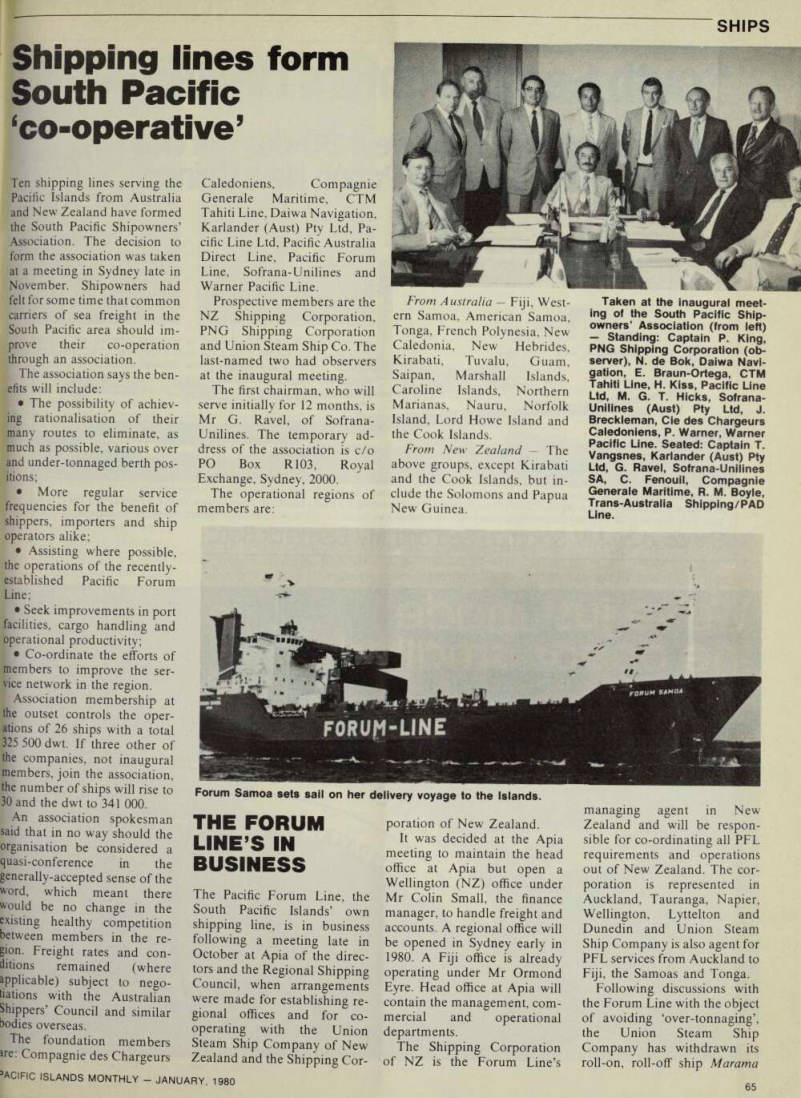
Ships
Shipping lines form South Pacific ‘co-operative’
Ten shipping lines serving the Pacific Islands from Australia and New Zealand have formed the South Pacific Shipowners’
Association. The decision to form the association was taken at a meeting in Sydney late in November. Shipowners had felt for some time that common carriers of sea freight in the South Pacific area should im prove their co-operation through an association.
The association says the ben efits will include: • The possibility of achiev ing rationalisation of their many routes to eliminate, as much as possible, various over and under-tonnaged berth pos itions; • More regular service frequencies for the benefit of
shippers, importers and ship
operators alike; • Assisting where possible, the operations of the recently established Pacific Forum Line; • Seek improvements in port facilities, cargo handling and
operational productivity;
• Co-ordinate the efforts of members to improve the ser vice network in the region.
Association membership at the outset controls the oper ations of 26 ships with a total 325 500 dwt. If three other of the companies, not inaugural members, join the association, the number of ships will rise to 30 and the dwt to 341 000.
An association spokesman said that in no way should the organisation be considered a quasi-conference in the generally-accepted sense of the word, which meant there would be no change in the
existing healthy competition
between members in the re gion. Freight rates and con ditions remained (where
applicable) subject to nego
tiations with the Australian Shippers’ Council and similar bodies overseas.
The foundation members
are: Compagnie des Chargeurs
Caledoniens, Compagnie
Generale Maritime, CTM Tahiti Line, Daiwa Navigation, Karlander (Aust) Pty Ltd, Pa cific Line Ltd, Pacific Australia Direct Line, Pacific Forum Line, Sofrana-Unilines and Warner Pacific Line.
Prospective members are the NZ Shipping Corporation,
PNG Shipping Corporation
and Union Steam Ship Co. The last-named two had observers at the inaugural meeting.
The first chairman, who will serve initially for 12 months, is Mr G. Ravel, of Sofrana- Unilines. The temporary ad dress of the association is c/o PO Box RlO3, Royal
Exchange, Sydney, 2000.
The operational regions of members are:
From Australia Fiji, Western Samoa, American Samoa, Tonga, French Polynesia, New Caledonia, New Hebrides, Kirabati, Tuvalu, Guam, Saipan, Marshall Islands, Caroline Islands, Northern Mananas, Nauru, Norfolk Island, Lord Howe Island and the Cook Islands.
From New Zealand - The om J\en Zealand Ihe above groups, except Kirabati and the Cook Islands, but indude the Solomons and Papua New Guinea
Taken at the inaugural meet ing of the South Pacific Ship owners’ Association (from left) Standing: Captain P. King, PNG Shipping Corporation (ob server), N. de Bok, Daiwa Navi gation, E. Braun-Ortega, CTM Tahiti Line, H. Kiss, Pacific Line Ltd, M. G. T. Hicks, Sofrana- Unilines (Aust) Pty Ltd, J.
Breckleman, Cie des Chargeurs Caledoniens, P. Warner, Warner Pacific Line. Seated: Captain T.
Vangsnes, Karlander (Aust) Pty Ltd, G. Ravel, Sofrana-Unilines SA, C. Fenouil, Compagnie Generate Maritime, R. M. Boyle, Trans-Australia Shipping/PAD Line.
Business
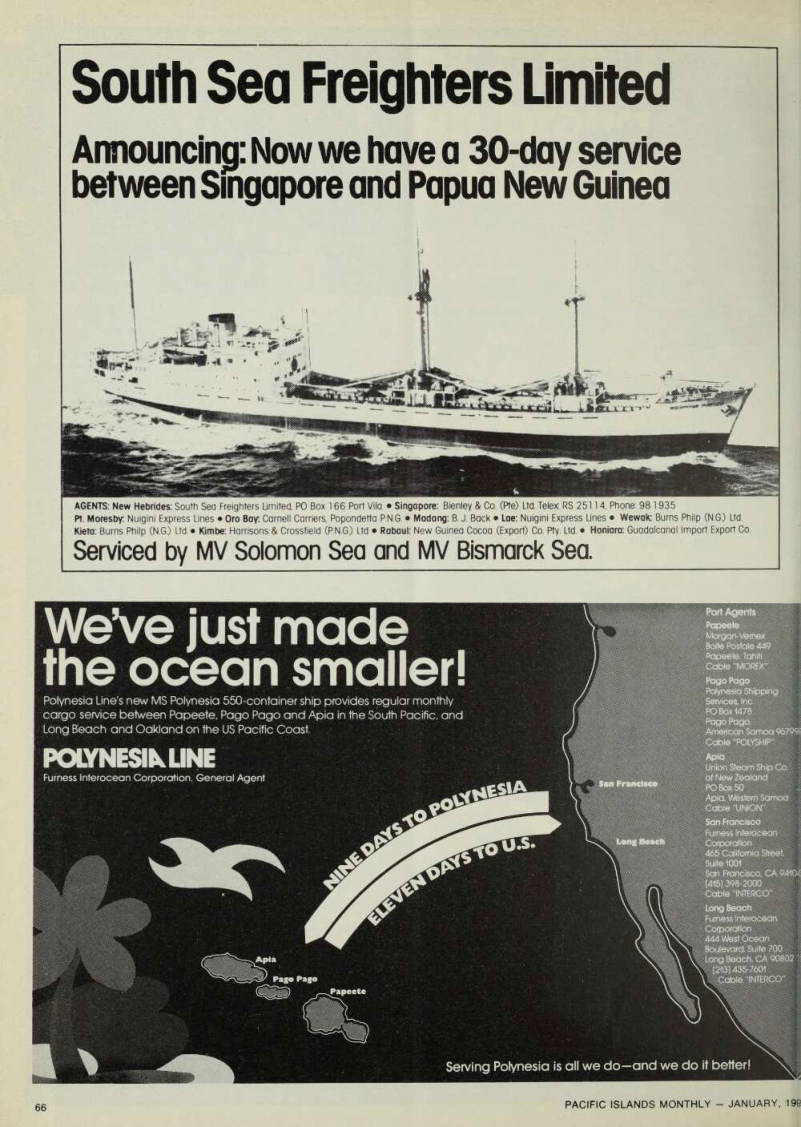
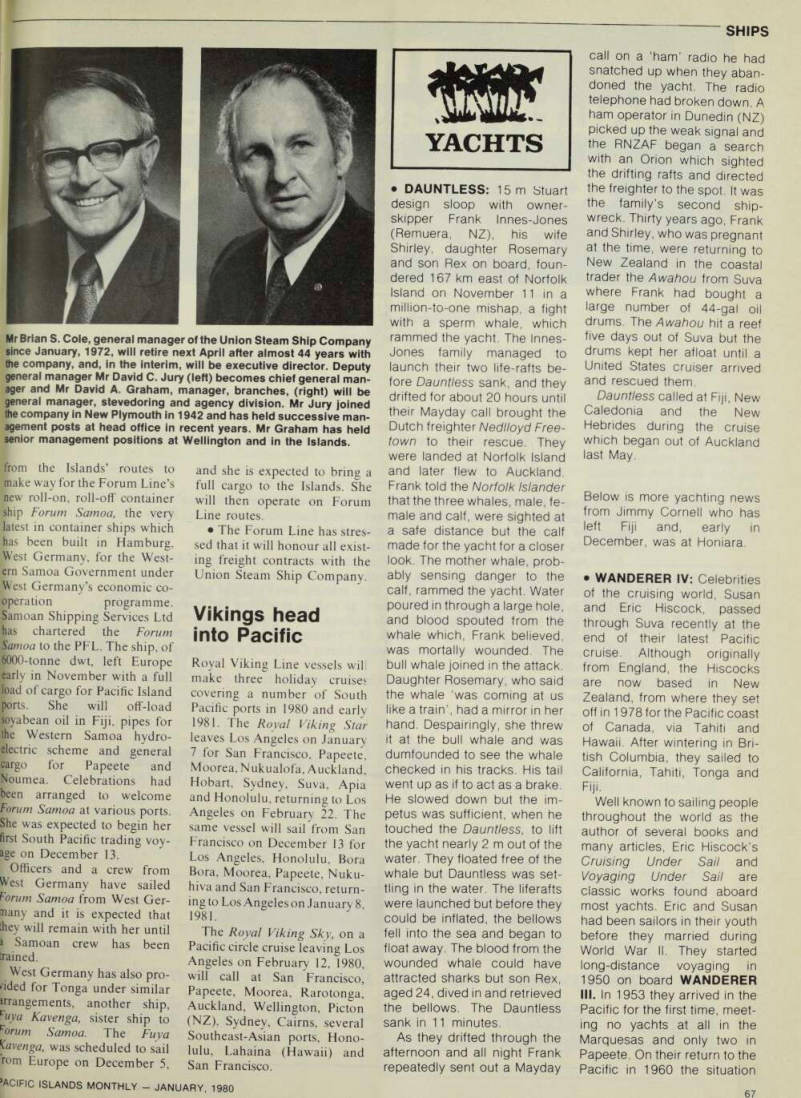
The Forum
Line’Sin
managing agent in New Zealand and will be respon sible for co-ordinating all PFL requirements and operations out of New Zealand. The cor poration is represented in Auckland, Tauranga, Napier,
Wellington, Lyttelton and
Dunedin and Union Steam Ship Company is also agent for PFL services from Auckland to Fiji, the Samoas and Tonga.
Following discussions with the Forum Line with the object
of avoiding ‘over-tonnaging’,
the Union Steam Ship Company has withdrawn its roll-on, roll-off ship Marama
The Pacific Forum Line, the South Pacific Islands’ own shipping line, is in business following a meeting late in October at Apia of the direc tors and the Regional Shipping Council, when arrangements were made for establishing re gional offices and for co operating with the Union Steam Ship Company of New Zealand and the Shipping Cor
poration of New Zealand.
WaS ec^ec * at Apia meeting to maintain the head office at Apia but open a Wellington (NZ) office under Mr Colin Small, the finance manager, to handle freight and accounts. A regional office will be opened in Sydney early in 1980. A Fiji office is already operating under Mr Ormond Eyre. Head office at Apia will contain the management, commercial and operational
departments.
The Shipping Corporation of NZ is the Forum Line’s
Forum Samoa sets sail on her delivery voyage to the Islands.
from the Islands’ routes to make way for the Forum Line’s new roll-on, roll-off container ship Forum Samoa, the very latest in container ships which has been built in Hamburg, West Germany, for the West ern Samoa Government under West Germany’s economic co operation programme.
Samoan Shipping Services Ltd has chartered the Forum Samoa to the PFL. The ship, of 6000-tonne dwt, left Europe early in November with a full load of cargo for Pacific Island ports. She will off-load soyabean oil in Fiji, pipes for the Western Samoa hydro electric scheme and general cargo for Papeete and Noumea. Celebrations had been arranged to welcome Forum Samoa at various ports.
She was expected to begin her first South Pacific trading voy age on December 13.
Officers and a crew from
West Germany have sailed
Forum Samoa from West Ger many and it is expected that they will remain with her until i Samoan crew has been trained.
West Germany has also pro dded for Tonga under similar
arrangements, another ship,
Fuya Kavenga, sister ship to
Forum Samoa. The Fuya Kavenga, was scheduled to sail Tom Europe on December 5,
and she is expected to bring a full cargo to the Islands. She will then operate on Forum Line routes. • The Forum Line has stres sed that it will honour all exist ing freight contracts with the Union Steam Ship Company.
Vikings head
into Pacific
Royal Viking Line vessels will make three holiday cruises covering a number of South Pacific ports in 1980 and early 1981. The Royal Viking Star leaves Los Angeles on January 7 for San Francisco, Papeete, Moorea, Nukualofa, Auckland, Hobart, Sydney, Suva, Apia and Honolulu, returning to Los Angeles on February 22. The same vessel will sail from San Francisco on December 13 for Los Angeles, Honolulu, Bora Bora, Moorea, Papeete, Nuku hiva and San Francisco, return ing to Los Angeles on January 8, 1981.
The Royal Viking Sky, on a Pacific circle cruise leaving Los Angeles on February 12, 1980, will call at San Francisco, Papeete, Moorea, Rarotonga, Auckland, Wellington, Picton (NZ), Sydney, Cairns, several Southeast-Asian ports, Hono lulu, Lahaina (Hawaii) and San Francisco.
Mr Brian S. Cole, general manager of the Union Steam Ship Company since January, 1972, will retire next April after almost 44 years with the company, and, In the interim, will be executive director. Deputy general manager Mr David C. Jury (left) becomes chief general man ager and Mr David A. Graham, manager, branches, (right) will be general manager, stevedoring and agency division. Mr Jury joined the company in New Plymouth in 1942 and has held successive man agement posts at head office in recent years. Mr Graham has held senior management positions at Wellington and in the Islands.
Advertisements & other items, pp. 65-70 (2 items)
65
’ACIFIC ISLANDS MONTHLY JANUARY, 1960
South Sea Freighters Limited
Announcing: Now we have a 30-day service
between Singapore and Papua New Guinea
Srx W ill « iF iai UmL ■ i&git AGENTS: New Hebrides; South Sea Freighters Limited, PO Box 166 Port Vila • Singapore; Bienley & Co. (Re) Ltd. Telex RS 25114, Phone: 98 1935 Pt. Moresby Nuigini Express Lines • Oro Bay Cornell Carriers, Popondetta PN G. • Madang: B. J. Back • Lae: Nuigini Express Lines • Wewaic Burns Philp (N.G.) Ltd.
Kiefa; Burns Philp (N.G) Ltd • Kimbe: Harrisons & Crossfield (PNG) Ltd • Rabaul: New Guinea Cocoa (Export) Co, Pty Ltd. • Honiara: Guadalcanal Import Export Co.
Serviced by MV Solomon Sea and MV Bismarck Sea.
WeVe just made
the ocean smaller!
■BBT' ; v :
Polynesia Line's new MS Polynesia 550-container ship provides regular monthly cargo service between Papeete, Pago Pago and Apia in the South Pacific, and Long Beach and Oakland on the US Pacific Coast.
POLYNESIM.INE
Furness Interocean Corporation, General Agent Port Agents Papeete Morgan-Vemex Boite Postale 449 Papeete, Tahiti Cable “MOREX"
Pago Pago Polynesia Shipping Services, Inc.
PO Box 1478 Pago Pago.
American Samoa 96799; Cable "POLYSHIP"
Apia Unton Steam Ship Co. of New Zealand
POBoxSO
Apia, Western Samoa Cable “UNION"
' V V <2 & 6 TO 9 Long Beach sS K <5 % v Apia Pago Pago Papeete is all we do—and we do it better!
Serving Polynesia
San Francisco Furness Interocean Corporation 465 California Street, Suite 1001 San Francisco, CA 9410-C (415) 398-2000 Cable INTERCO"
Long Beach Furness Interocean Corporation 444 West Ocean Boulevard, Suite 700 Long Beach, CA 90802 (213)435-7601 Cable "INTERCO"
The
"South Seas Express"
Your Pipeline to
the Pacific
Every 14 days Union Company’s roll-on roll-off vessel “Marama” leaves Auckland for five key Pacific Island ports; Lautoka, Suva, Apia, Pago Pago and Nuku’alofa, and return to Auckland.
We call her The South Seas Express.
New Zealand exporters outside Auckland can take advantage of Union Company’s internal ‘Relay’ system to connect up with the “Marama” service.
The “Marama” provides a safe, fast, reliable service to the advantage of New Zealand and Pacific Island traders, as well as providing the essential link for trade between the Pacific Islands nations.
Island traders can take advantage of “Marama” service to link through New Zealand to other world markets, using Union Company’s international relay service.
Talk Pacific Island trading with Union Company at any New Zealand or Pacific Island office.
union company
i m- JR »» mm**-* every day one of our ships is in one of your markets
HEAD OFFICE
Wellington 729-699
NEW ZEALAND
BRANCHES
Auckland 774-730 Bluff 8174 Dunedin 777-201 Lyttleton 7149 Mount Maunganui 53-199 Napier 58-788 Nelson 8M59 New Plymouth 75-459 Timaru 86-099 Wellington 850-799 Westport 7279 Whangarei 88-759
PACIFIC ISLAND
BRANCHES
Suva, Fiji 23861 Lautoka, Fiji 60577 Apia, Western Samoa 21781 Pago Pago, American Samoa C/oB.F. Kneubuhl Inc. (Agent) Nuku’alofa, Tonga 118 or 160 13495
HENRY CUMINES
PTY LTD.
EXPORTERS o GENERAL MERCHANTS
428 GEORGE ST.. SYDNEY
CABLES; HENCO SYDNEY. G.P.O. Box 3949. PHONE; 232-5377
For specialised and personalised buying service
throughout the Pacific Islands and the East.
• LOCAL AGENTS AND REPRESENTATION:
PAPUA NEW GUINEA: FIJI:
RABAUL: M. & C. Seeto, P.O. Box 131, Rabaul.
Telephone 92-2919.
MADANG: W. Double, P.O. Box 22, Madang.
Telephone 82-2696.
K. Witherington Ltd., P.O. Box 293, Suva.
Telephone 22-356.
NEW HEBRIDES:
John Lum & Associates, P.O. Box 65, Santo.
Telephone 329..
SOLOMON ISLANDS:
Mr, Tom Lo, P.O. Box 327, Honiara.
Telephone 399.
Resident Agents in other Pacific Territories. •
Regular Monthly Liner Services
from Australia and New Zealand
to the South and Central Pacific
}! OWNED BY THE PEOPLE
iFORum
un€
OF THE PACIFIC ISLANDS
PACIFIC
FOR INFORMATION CONTACT AGENTS:
AMERICAN SAMOA:
Polynesian Shipping Services Inc. P.O. Box 1478 Pago Pago
AUSTRALIA:
The Australian National Line, 50 Queen Street Melbourne Union Bulkships Pty.Ltd., 333-339 George Street Sydney
GILBERT ISLANDS.
Gilbert Islands Shipping Corp. P.O. Box 495 Tarawa
FIJI;
Burns Philp South Sea Co. Ltd. GPO Box 355 Suva
NEW CALEDONIA
ETS Ballande, BP. C 4, Noumea
NEW HEBRIDES:
Burns Philp New Hebrides Limited Vila
NEW ZEALAND:
The Shipping Corp. of N.Z. Ltd. P.O. Box 3344 Wellington
PAPUA NEW GUINEA:
Steamships Trading Co. Ltd. P.O. Box 1, Port Moresby
SOLOMON ISLANDS;
Sullivans S I. Ltd. GPO Box 3. Honiara
TONGA:
Union St eam Ship Co. P.O. Box 4, Nukualofa.
5
GLOBAL SERVICE FORT SHIPPERS
Vf
THE BANK LINE
Isrf^
Papua New Guinea & Solomon Islands
UK/Continent Service
Regular direct monthly sailings
PAPUA NEW GUINEA and SOLOMON ISLANDS
to:
UNITED KINGDOM and CONTINENT
For particulars apply:
THE BANK LINE (AUSTRALASIA) PTY LTD.
18th Floor 1 York Street Sydney IM.S.W. 2000 Australia Telephone: 272041 Telex: 24063
Yachts
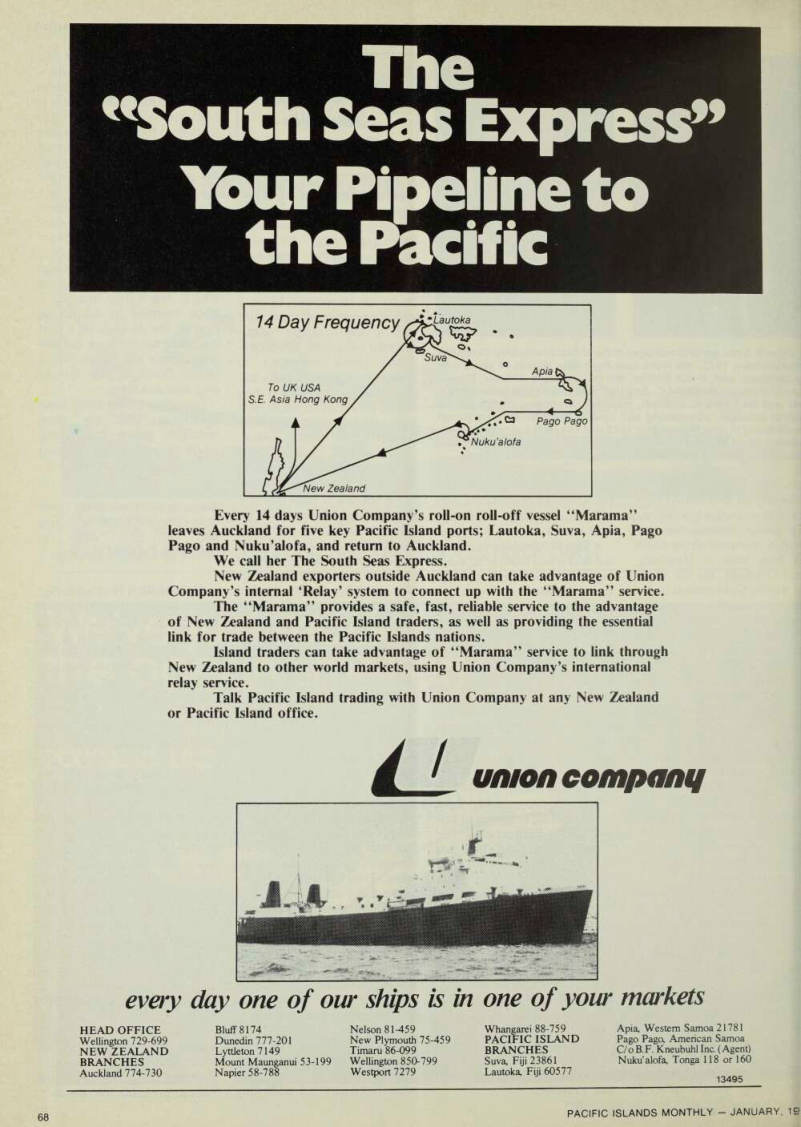
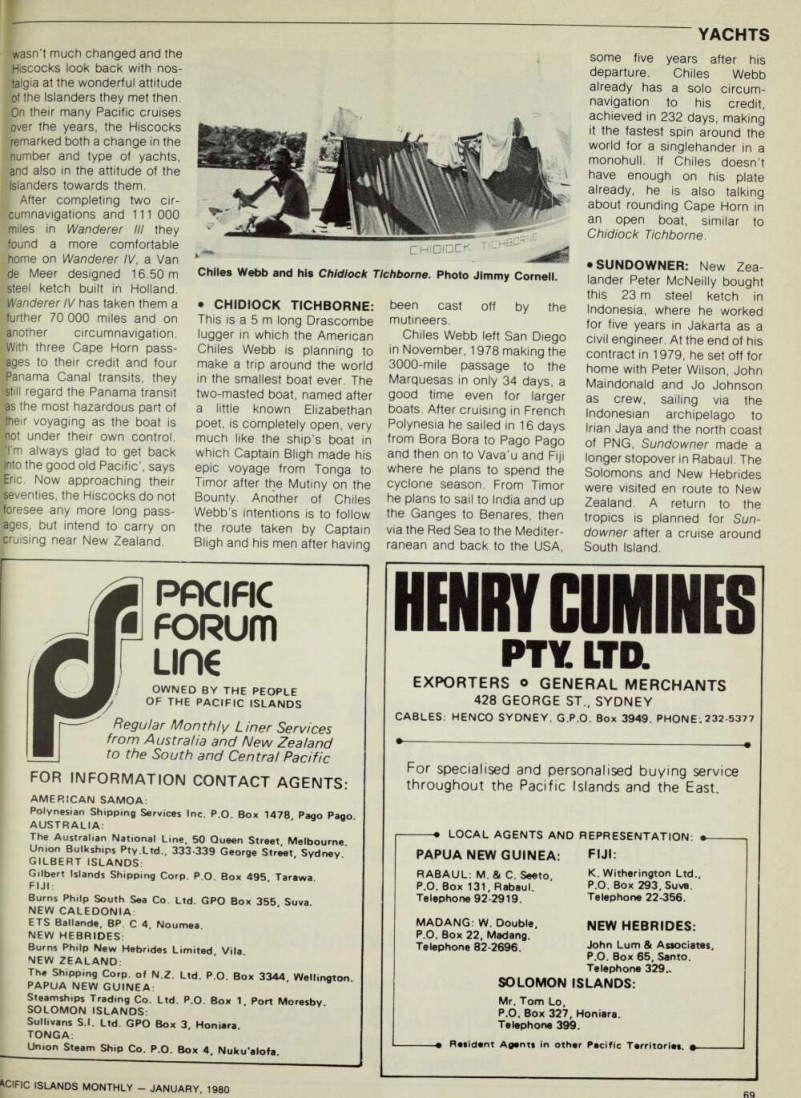
• DAUNTLESS: 15 m Stuart design sloop with owner skipper Frank Innes-Jones (Remuera, NZ), his wife Shirley, daughter Rosemary and son Rex on board, foun dered 167 km east of Norfolk Island on November 11 in a million-to-one mishap, a fight with a sperm whale, which rammed the yacht. The Innes- Jones family managed to launch their two life-rafts be fore Dauntless sank, and they drifted for about 20 hours until their Mayday call brought the Dutch freighter Nedlloyd Free town to their rescue. They were landed at Norfolk Island and later flew to Auckland.
Frank told the Norfolk Islander that the three whales, male, fe male and calf, were sighted at a safe distance but the calf made for the yacht for a closer look. The mother whale, prob ably sensing danger to the calf, rammed the yacht. Water poured in through a large hole, and blood spouted from the whale which, Frank believed, was mortally wounded. The bull whale joined in the attack.
Daughter Rosemary, who said the whale 'was coming at us like a train’, had a mirror in her hand. Despairingly, she threw it at the bull whale and was dumfounded to see the whale checked in his tracks. His tail went up as if to act as a brake.
He slowed down but the im petus was sufficient, when he touched the Dauntless, to lift the yacht nearly 2 m out of the water. They floated free of the whale but Dauntless was set tling in the water. The liferafts were launched but before they could be inflated, the bellows fell into the sea and began to float away. The blood from the wounded whale could have attracted sharks but son Rex, aged 24, dived in and retrieved the bellows. The Dauntless sank in 11 minutes.
As they drifted through the afternoon and all night Frank repeatedly sent out a Mayday
call on a ‘ham’ radio he had snatched up when they aban doned the yacht. The radio telephone had broken down. A ham operator in Dunedin (NZ) picked up the weak signal and the RNZAF began a search with an Orion which sighted the drifting rafts and directed the freighter to the spot. It was the family’s second ship wreck. Thirty years ago, Frank and Shirley, who was pregnant at the time, were returning to New Zealand in the coastal trader the Awahou from Suva where Frank had bought a large number of 44-gal oil drums. The Awahou hit a reef five days out of Suva but the drums kept her afloat until a United States cruiser arrived and rescued them.
Dauntless called at Fiji, New Caledonia and the New Flebrides during the cruise which began out of Auckland last May.
Below is more yachting news from Jimmy Cornell who has left Fiji and, early in December, was at Floniara. • WANDERER IV: Celebrities of the cruising world, Susan and Eric Hiscock, passed through Suva recently at the end of their latest Pacific cruise. Although originally from England, the Hiscocks are now based in New Zealand, from where they set off in 1978 for the Pacific coast of Canada, via Tahiti and Hawaii. After wintering in Bri tish Columbia, they sailed to California, Tahiti, Tonga and Fiji.
Well known to sailing people throughout the world as the author of several books and many articles, Eric Hiscock’s Cruising Under Sail and Voyaging Under Sail are classic works found aboard most yachts. Eric and Susan had been sailors in their youth before they married during World War 11. They started long-distance voyaging in 1950 on board WANDERER 111. In 1953 they arrived in the Pacific for the first time, meet ing no yachts at all in the Marquesas and only two in Papeete. On their return to the Pacific in 1960 the situation
wasn’t much changed and the Hiscocks look back with nos talgia at the wonderful attitude of the Islanders they met then.
On their many Pacific cruises over the years, the Hiscocks remarked both a change in the number and type of yachts, and also in the attitude of the Islanders towards them.
After completing two cir cumnavigations and 111 000 miles in Wanderer 111 they found a more comfortable home on Wanderer IV, a Van de Meer designed 16.50 m steel ketch built in Holland.
Wanderer IV has taken them a further 70 000 miles and on another circumnavigation.
With three Cape Horn pass ages to their credit and four Panama Canal transits, they still regard the Panama transit as the most hazardous part of their voyaging as the boat is not under their own control. ■l’m always glad to get back into the good old Pacific’, says Eric. Now approaching their seventies, the Hiscocks do not foresee any more long pass ages, but intend to carry on cruising near New Zealand.
• Chidiock Tichborne:
This is a 5 m long Drascombe lugger in which the American Chiles Webb is planning to make a trip around the world in the smallest boat ever. The two-masted boat, named after a little known Elizabethan poet, is completely open, very much like the ship’s boat in which Captain Bligh made his epic voyage from Tonga to Timor after the Mutiny on the Bounty. Another of Chiles Webb’s intentions is to follow the route taken by Captain Bligh and his men after having
been cast off by the mutineers.
Chiles Webb left San Diego in November, 1978 making the 3000-mile passage to the Marquesas in only 34 days, a good time even for larger boats. After cruising in French Polynesia he sailed in 16 days from Bora Bora to Pago Pago and then on to Vava’u and Fiji where he plans to spend the cyclone season. From Timor he plans to sail to India and up the Ganges to Benares, then via the Red Sea to the Mediter ranean and back to the USA,
some five years after his departure. Chiles Webb already has a solo circum navigation to his credit, achieved in 232 days, making it the fastest spin around the world for a singlehander in a monohull. If Chiles doesn’t have enough on his plate already, he is also talking about rounding Cape Horn in an open boat, similar to Chidiock Tichborne.
• Sundowner: New Zea
lander Peter McNeilly bought this 23 m steel ketch in Indonesia, where he worked for five years in Jakarta as a civil engineer. At the end of his contract in 1979, he set off for home with Peter Wilson, John Maindonald and Jo Johnson as crew, sailing via the Indonesian archipelago to Irian Jaya and the north coast of PNG, Sundowner made a longer stopover in Rabaul. The Solomons and New Hebrides were visited en route to New Zealand. A return to the tropics is planned for Sun downer after a cruise around South Island.
Chiles Webb and his Chidiock Tichborne. Photo Jimmy Cornell.
Advertisements & other items, pp. 67-69 (2 items)
67
SHIPS
’ACIFIC ISLANDS MONTHLY - JANUARY, 1980
Yachts
69
*CIFIC ISLANDS MONTHLY - JANUARY. 1980
Services
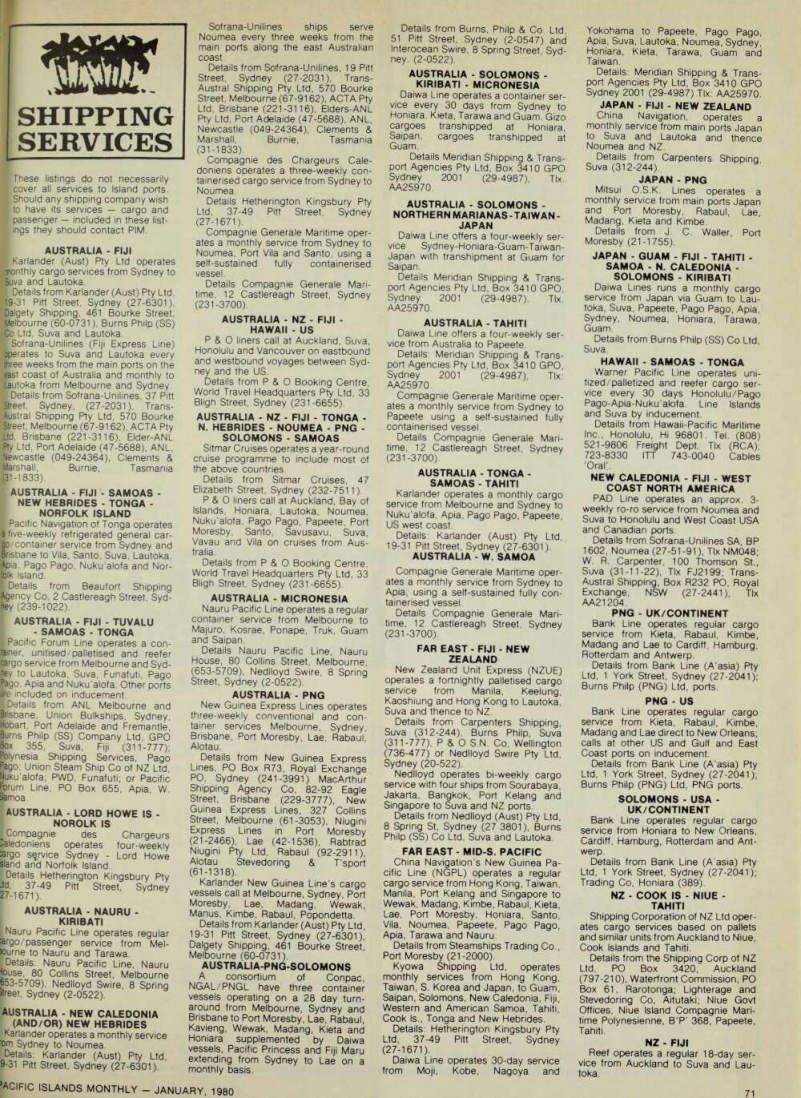
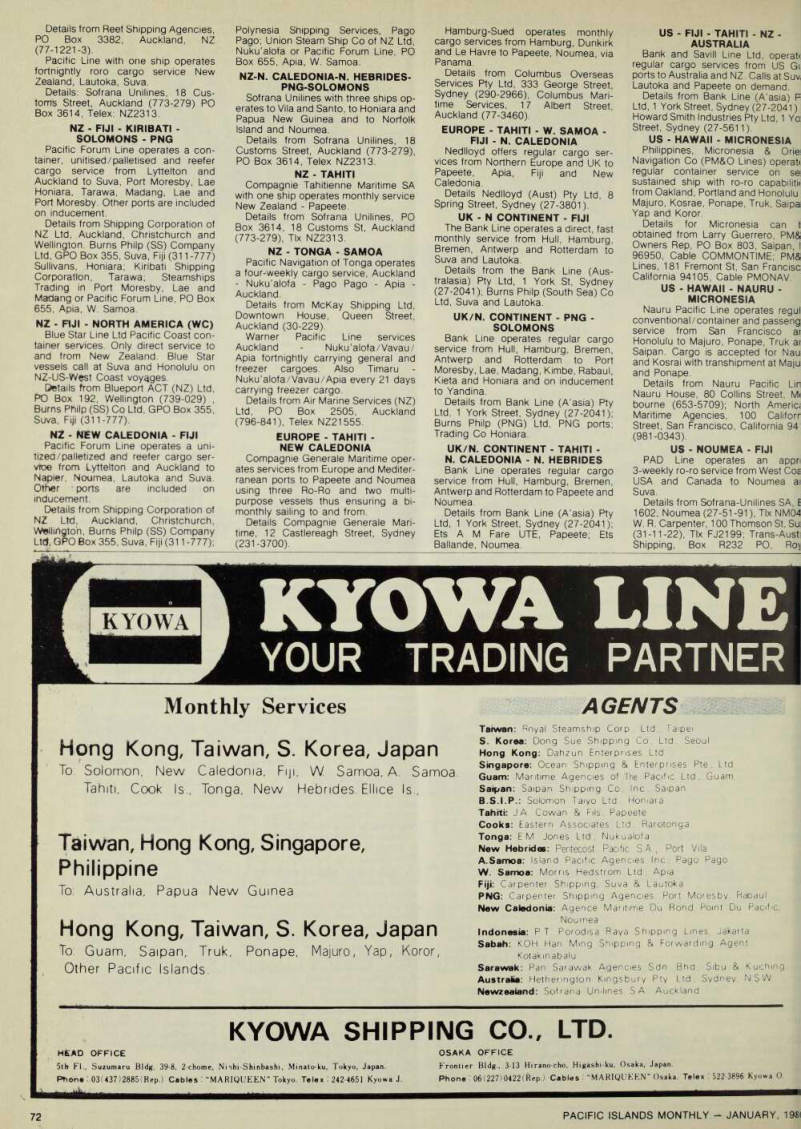

Shipping
■ These listings do not necessarily ■ cover all services to Island ports. ■ Should any shipping company wish I to have its services cargo and ■ passenger included in these list ■ ings they should contact PIM.
Australia - Fiji
■ Karlander (Aust) Pty Ltd operates monthly cargo services from Sydney to Suva and Lautoka. ■ Details from Karlander (Aust) Pty Ltd. ■9-31 Pitt Street, Sydney (27-6301), Oalgety Shipping, 461 Bourke Street, Melbourne (60-0731), Burns Philp (SS) Co Ltd, Suva and Lautoka. ■ Sofrana-Unilines (Fiji Express Line) operates to Suva and Lautoka every three weeks from the main ports on the east coast of Australia and monthly to lautoka from Melbourne and Sydney. ■ Details from Sofrana-Unilines, 37 Pitt Street, Sydney, (27-2031), Trans- Austral Shipping Pty Ltd, 570 Bourke Street, Melbourne (67-9162), ACTA Pty Ltd, Brisbane (221-3116), Elder-ANL Pty Ltd, Port Adelaide (47-5688), ANL, Newcastle (049-24364), Clements & Marshall, Burnie, Tasmania (31-1833).
Australia - Fiji - Samoas -
New Hebrides - Tonga -
Norfolk Island
I Pacific Navigation of Tonga operates a five-weekly refrigerated general car go container service from Sydney and Brisbane to Vila, Santo, Suva, Lautoka, Apia, Pago Pago, Nuku’alofa and Nor folk Island. ■ Details from Beaufort Shipping Igency Co, 2 Castlereagh Street, Syd ney (239-1022).
Australia - Fiji - Tuvalu
-Samoas - Tonga
■ Pacific Forum Line operates a con tainer, unitised/palletised and reefer cargo service from Melbourne and Syd ney to Lautoka, Suva, Funafuti, Pago Pago, Apia and Nuku’alofa. Other ports ■e included on inducement. ■Details from ANL Melbourne and Brisbane, Union Bulkships, Sydney, Hobart, Port Adelaide and Fremantle, Burns Philp (SS) Company Ltd, GPO Box 355, Suva, Fiji (311-777); Polynesia Shipping Services, Pago Pago; Union Steam Ship Co of NZ Ltd, Nuku’alofa; PWD, Funafuti; or Pacific Forum Line, PO Box 655, Apia. W.
Steimoa.
Australia - Lord Howe Is -
Norolk Is
[Compagnie des Chargeurs
operates four-weekly argo service Sydney - Lord Howe Bland and Norfolk Island, f Details Hetherington Kingsbury Pty Jd, 37-49 Pitt Street, Sydney 27-1671).
Australia - Nauru -
Kiribati
[Nauru Pacific Line operates regular largo/passenger service from Mel purne to Nauru and Tarawa. [Details: Nauru Pacific Line, Nauru jouse, 80 Collins Street, Melbourne 653-5709), Nedlloyd Swire, 8 Spring
«reet, Sydney (2-0522).
Australia - New Caledonia
(And/Or) New Hebrides
Karlander operates a monthly service om Sydney to Noumea.
Details: Karlander (Aust) Pty Ltd, 9-31 Pitt Street, Sydney (27-6301).
Sofrana-Unilines ships serve Noumea every three weeks from the main ports along the east Australian Details from Sofrana-Unilines, 19 Pitt Street, Sydney (27-2031), Trans- Austral Shipping Pty Ltd. 570 Bourke Street, Melbourne (67-9162), ACTA Pty Ltd, Brisbane (221-3116), Elders-ANL Pty Ltd, Port Adelaide (47-5688), ANL, Newcastle (049-24364). Clements &
(T,833) Burnie - Tasmania
Compagnie des Chargeurs Cale doniens operates a three-weekly con tainerised cargo service from Sydney to Noumea.
Details Hetherington Kingsbury Pty Ltd, 37-49 Pitt Street, Sydney (27-1671).
Compagnie Generate Maritime oper ates a monthly service from Sydney to Noumea, Port Vila and Santo, using a self-sustained fully containerised vessel.
Details Compagnie Generate Mari time, 12 Castlereagh Street, Sydney (231-3700) amctdai i* kit cm
Aust ' N F,' Fiji ’
. Hawam -Us
F 9 liners call at Auckland, Suva, Honolulu and Vancouver on eastbound and we stbound voyages between Syd neX and , 8 „ . , j a l! s f rom P& O Booking Centre, World Travel Headquarters Pty Ltd, 33 Bligh Street, Sydney (231-6655), AUSTRALIA - NZ - FIJI - TONGA - N. HEBRIDES - NOUMEA - PNG -
Solomons - Samoas
Sitmar Cruises operates a year-round cruise programme to include most of the above countries.
Details from Sitmar Cruises, 47 Elizabeth Street, Sydney (232-7511).
P & O liners call at Auckland, Bay of Islands, Honiara, Lautoka, Noumea, Nukualofa, Pago Pago, Papeete, Port Moresby, Santo, Savusavu, Suva, Vavau and Vila on cruises from Aus
trarl‘a
Details from P & O Booking Centre, World Travel Headquarters Pty Ltd, 33 Bligh Street, Sydney (231-6655).
Australia - Micronesia
Nauru Pacific Line operates a regular container service from Melbourne to Majuro, Kosrae, Ponape, Truk, Guam and Saipan.
Details Nauru Pacific Line, Nauru House, 80 Collins Street, Melbourne, (653-5709), Nedlloyd Swire, 8 Spring Street, Sydney (2-0522).
Australia - Png
New Guinea Express Lines operates three-weekly conventional and con tainer services Melbourne, Sydney, Brisbane, Port Moresby, Lae, Rabaul, Alotau.
Details from New Guinea Express Lines, PO Box R 73, Royal Exchange PO, Sydney (241-3991) MacArthur Shipping Agency Co, 82-92 Eagle Street, Brisbane (229-3777), New Guinea Express Lines, 327 Collins Street, Melbourne (61-3053), Niugini Lines in Port Moresby Rabtrad N'ug |n| Pty Ltd, Rabaul (92-2911), Q , stevedonn 9 & T’sport ® M n , Karlander New Guinea Line s cargo vessels call at Melbourne, Sydney, Port Moresby, Lae, Madang, Wewak, Manus, Kimbe, Rabaul, Popondetta.
Details from Karlander (Aust) Pty Ltd, 19-31 Pitt Street, Sydney (27-6301).
Dalgety Shipping, 461 Bourke Street Melbourne (60-0731).
Australia-Png-Solomons
A consortium of Conpac, NGAL/PNGL have three container vessels operating on a 28 day turn around from Melbourne, Sydney and Brisbane t 0 Port Moresby, Lae. Rabaul, vessels, Pacific Princess and Fiji Maru sar sydney ,o Lae ° n a
Details from Burns, Philp & Co. Ltd. 51 Pitt Street, Sydney (2-0547) and Interocean Swire, 8 Spring Street, Syd ney. (2-0522),
Australia - Solomons -
Kiribati - Micronesia
Daiwa Line operates a container ser vice every 30 days from Sydney to Honiara, Kieta, Tarawa and Guam. Gizo cargoes transhipped at Honiara, Saipan, cargoes transhipped at Guam.
Details Meridian Shipping & Trans port Agencies Pty Ltd, Box 3410 GPO Sydney 2001 (29-4987), Tlx.
AA25970.
Australia - Solomons -
Northern Marianas-Taiwan
Japan
Daiwa Line offers a four-weekly ser vice Sydney-Honiara-Guam-Taiwan- Japan with transhipment at Guam for Saipan.
Details Meridian Shipping & Trans port Agencies Pty Ltd, Box 3410 GPO, Sydney 2001 (29-4987). Tlx.
AA25970.
Australia - Tahiti
Daiwa Line offers a four-weekly ser vice from Australia to Papeete.
Details: Meridian Shipping & Trans port Agencies Pty Ltd. Box 3410 GPO, Sydney 2001 (29-4987), Tlx: AA25970.
Compagnie Generale Maritime oper ates a monthly service from Sydney to Papeete using a self-sustained fully containerised vessel.
Details Compagnie Generale Mari time, 12 Castlereagh Street, Sydney (231-3700).
Australia - Tonga -
Samoas - Tahiti
Karlander operates a monthly cargo service from Melbourne and Sydney to Nuku'alofa, Apia, Pago Pago, Papeete, US west coast.
Details: Karlander (Aust) Pty Ltd, 19-31 Pitt Street, Sydney (27-6301).
Australia - W. Samoa
Compagnie Generale Maritime oper ates a monthly service from Sydney to Apia, using a self-sustained fully con tainerised vessel.
Details Compagnie Generale Mari time, 12 Castlereagh Street, Sydney (231-3700).
Far East - Fiji - New
Zealand
New Zealand Unit Express (NZUE) operates a fortnightly palletised cargo service from Manila, Keelung, Kaoshiung and Hong Kong to Lautoka, Suva and thence to NZ.
Details from Carpenters Shipping, Suva (312-244), Burns Philp, Suva (311-777), P & O S.N. Co, Wellington (736-477) or Nedlloyd Swire Pty Ltd,
Sydney (20-522).
Nedlloyd operates bi-weekly cargo service with four ships from Sourabaya, Jakarta, Bangkok, Port Kelang and Singapore to Suva and NZ ports.
Details from Nedlloyd (Aust) Pty Ltd, 8 Spring St, Sydney (27 3801), Burns Philp (SS) Co Ltd, Suva and Lautoka.
Far East - Mid-S. Pacific
China Navigation’s New Guinea Pa cific Line (NGPL) operates a regular cargo service from Hong Kong, Taiwan, Manila, Port Kelang and Singapore to Wewak, Madang, Kimbe, Rabaul, Kieta, Lae, Port Moresby, Honiara, Santo, Vila, Noumea, Papeete, Pago Pago, Apia, Tarawa and Nauru Details from Steamships Trading Co., Port Moresby (21-2000).
Kyowa Shipping Ltd, operates monthly services from Hong Kong, Taiwan, S. Korea and Japan, to Guam, Saipan, Solomons, New Caledonia, Fiji, Western and American Samoa, Tahiti, Cook Is., Tonga and New Hebrides.
Details: Hetherington Kingsbury Pty Ltd, 37-49 Pitt Street, Sydney (27-1671).
Daiwa Line operates 30-day service from Moji, Kobe, Nagoya and
Yokohama to Papeete, Pago Pago, Apia, Suva, Lautoka, Noumea, Sydney!
Honiara, Kieta, Tarawa, Guam and Taiwan.
Details: Meridian Shipping & Trans port Agencies Pty Ltd, Box 3410 GPO Sydney 2001 (29-4987) Tlx; AA25970.
Japan - Fiji - New Zealand
China Navigation, operates a monthly service from main ports Japan to Suva and Lautoka and thence Noumea and NZ.
Details from Carpenters Shipping Suva (312-244).
Japan - Png
Mitsui O.S.K Lines operates a monthly service from main ports Japan and Port Moresby, Rabaul, Lae, Madang, Kieta and Kimbe.
Details from J. C. Waller, Port Moresby (21-1755).
JAPAN - GUAM - FIJI - TAHITI -
Samoa - N. Caledonia -
Solomons - Kiribati
Daiwa Lines runs a monthly cargo service from Japan via Guam to Lau toka. Suva, Papeete, Pago Pago, Apia, Sydney, Noumea, Honiara, Tarawa, Guam.
Details from Burns Philp (SS) Co Ltd.
Suva.
Hawaii - Samoas - Tonga
Warner Pacific Line operates uni tized/palletized and reefer cargo ser vice every 30 days Honolulu/Pago Pago-Apia-Nuku’alofa. Line Islands and Suva by inducement.
Details from Hawaii-Pacific Maritime Inc., Honolulu, Hi 96801. Tel. (808) 521-9806 Freight Dept, Tlx (RCA); 723-8330 ITT 743-0040 Cables ‘Oral!.
New Caledonia - Fiji - West
Coast North America
PAD Line operates an approx. 3weekly ro-ro service from Noumea and Suva to Honolulu and West Coast USA and Canadian ports.
Details from Sofrana-Unilines SA, BP 1602, Noumea (27-51 -91), Tlx NMO4B; W. R. Carpenter, 100 Thomson St., Suva (31-11-22), Tlx FJ2199; Trans- Austral Shipping, Box R 232 PO, Royal Exchange, NSW (27-2441), Tlx AA21204,
Png - Uk/Continent
Bank Line operates regular cargo service from Kieta, Rabaul, Kimbe, Madang and Lae to Cardiff, Hamburg, Rotterdam and Antwerp.
Details from Bank Line (A'asia) Pty Ltd, 1 York Street, Sydney (27-2041); Burns Philp (PNG) Ltd, ports.
Png - Us
Bank Line operates regular cargo service from Kieta, Rabaul, Kimbe, Madang and Lae direct to New Orleans; calls at other US and Gulf and East Coast ports on inducement.
Details from Bank Line (A’asia) Pty Ltd. 1 York Street, Sydney (27-2041); Burns Philp (PNG) Ltd, PNG ports.
Solomons - Usa -
Uk/Continent
Bank Line operates regular cargo service from Honiara to New Orleans, Cardiff, Hamburg, Rotterdam and Ant werp.
Details from Bank Line (A’asia) Pty Ltd, 1 York Street, Sydney (27-2041); Trading Co, Honiara (389).
NZ - COOK IS - NIUE -
Tahiti
Shipping Corporation of NZ Ltd oper ates cargo services based on pallets and similar units from Auckland to Niue, Cook Islands and Tahiti.
Details from the Shipping Corp of NZ Ltd, PO Box 3420, Auckland (797-210), Waterfront Commission, PO Box 61, Rarotonga; Lighterage and Stevedoring Co, Aitutaki; Niue Govt Offices, Niue Island Compagnie Mari time Polynesienne, B'P’ 368, Papeete, Tahiti.
Nz - Fiji
Reef operates a regular 18-day ser vice from Auckland to Suva and Lau toka.
Details from Reef Shipping Agencies, PO Box 3382, Auckland, NZ (77-1221-3).
Pacific Line with one ship operates fortnightly roro cargo service New Zealand, Lautoka, Suva.
Details: Sofrana Unilines, 18 Cus toms Street, Auckland (773-279) PO Box 3614, Telex: NZ2313.
Nz - Fiji - Kiribati -
Solomons - Png
Pacific Forum Line operates a con tainer, unitised/palletised and reefer cargo service from Lyttelton and Auckland to Suva, Port Moresby, Lae Honiara, Tarawa, Madang, Lae and Port Moresby. Other ports are included on inducement.
Details from Shipping Corporation of NZ Ltd, Auckland, Christchurch and Wellington. Burns Philp (SS) Company Ltd, GPO Box 355, Suva, Fiji (31 1 -777) Sullivans, Honiara; Kiribati Shipping Corporation, Tarawa; Steamships Trading in Port Moresby, Lae and Madang or Pacific Forum Line, PO Box 655, Apia, W. Samoa.
NZ - FIJI - NORTH AMERICA (WC) Blue Star Line Ltd Pacific Coast con tainer services. Only direct service to and from New Zealand. Blue Star vessels call at Suva and Honolulu on Coast voyages.
Details from Blueport ACT (NZ) Ltd, PO Box 192, Wellington (739-029) , Burns Philp (SS) Co Ltd, GPO Box 355, Suva, Fiji (311-777).
Nz - New Caledonia - Fiji
Pacific Forum Line operates a uni tized/palletized and reefer cargo ser vice from Lyttelton and Auckland to Napier, Noumea, Lautoka and Suva.
Other ports are included on inducement.
Details from Shipping Corporation of NZ Ltd, Auckland, Christchurch, Wellington, Burns Philp (SS) Company LtC), GPO Box 355, Suva, Fiji (311 -777);
Polynesia Shipping Services, Pago Pago; Union Steam Ship Co of NZ Ltd, Nuku’alofa or Pacific Forum Line, PO Box 655, Apia, W. Samoa.
Nz-N. Caledonia-N. Hebrides
Png-Solomons
Sofrana Unilines with three ships op erates to Vila and Santo, to Honiara and Papua New Guinea and to Norfolk Island and Noumea.
Details from Sofrana Unilines, 18 Customs Street, Auckland (773-279), PO Box 3614, Telex NZ2313.
Nz - Tahiti
Compagnie Tahitienne Maritime SA with one ship operates monthly service New Zealand - Papeete.
Details from Sofrana Unilines, PO Box 3614, 18 Customs St, Auckland (773-279), Tlx NZ2313.
Nz- Tonga - Samoa
Pacific Navigation of Tonga operates a four-weekly cargo service, Auckland - Nuku'alofa - Pago Pago - Apia - Auckland.
Details from McKay Shipping Ltd, Downtown House, Queen Street, Auckland (30-229).
Warner Pacific Line services Auckland - Nuku’alofa/Vavau/ Apia fortnightly carrying general and freezer cargoes. Also Timaru - Nuku’alofa/Vavau/Apia every 21 days carrying freezer cargo.
Details from Air Marine Services (NZ) Ltd, PO Box 2505, Auckland (796-841), Telex NZ21555.
Europe - Tahiti -
New Caledonia
Compagnie Generate Maritime oper ates services from Europe and Mediter ranean ports to Papeete and Noumea using three Ro-Ro and two multi purpose vessels thus ensuring a bi monthly sailing to and from.
Details Compagnie Generate Mari time, 12 Castlereagh Street, Sydney (231-3700).
Hamburg-Sued operates monthly cargo services from Hamburg, Dunkirk and Le Havre to Papeete, Noumea, via Panama.
Details from Columbus Overseas Services Pty Ltd, 333 George Street, Sydney (290-2966), Columbus Mari time Services, 17 Albert Street, Auckland (77-3460).
EUROPE - TAHITI - W. SAMOA -
Fiji - N. Caledonia
Nedlloyd offers regular cargo ser vices from Northern Europe and UK to Papeete, Apia, Fiji and New Caledonia.
Details Nedlloyd (Aust) Pty Ltd, 8 Spring Street, Sydney (27-3801).
Uk - N Continent - Fiji
The Bank Line operates a direct, fast monthly service from Hull, Hamburg, Bremen, Antwerp and Rotterdam to Suva and Lautoka.
Details from the Bank Line (Aus tralasia) Pty Ltd, 1 York St, Sydney (27-2041); Burns Philp (South Sea) Co Ltd, Suva and Lautoka.
Uk/N. Continent - Png -
Solomons
Bank Line operates regular cargo service from Hull, Hamburg, Bremen, Antwerp and Rotterdam to Port Moresby, Lae, Madang, Kimbe, Rabaul, Kieta and Honiara and on inducement to Yandina.
Details from Bank Line (A’asia) Pty Ltd. 1 York Street, Sydney (27-2041); Burns Philp (PNG) Ltd, PNG ports; Trading Co Honiara.
Uk/N. Continent - Tahiti -
N. Caledonia - N. Hebrides
Bank Line operates regular cargo service from Hull, Hamburg, Bremen, Antwerp and Rotterdam to Papeete and Noumea, Details from Bank Line (A’asia) Pty Ltd, 1 York Street, Sydney (27-2041); Ets A M Fare UTE, Papeete; Ets Ballande, Noumea,
US - FIJI - TAHITI - NZ -
Australia
Bank and Savill Line Ltd, operatd regular cargo services from US Gi ports to Australia and NZ. Calls at Suw Lautoka and Papeete on demand.
Details from Bank Line (A'asia) F Ltd, 1 York Street, Sydney (27-2041) Howard Smith Industries Pty Ltd, 1 Yo Street, Sydney (27-5611).
Us - Hawaii - Micronesia
Philippines, Micronesia & One- Navigation Co (PM&O Lines) operate regular container service on se sustained ship with ro-ro capability from Oakland, Portland and Honolulu Majuro, Kosrae, Ponape, Truk, Saipat Yap and Koror.
Details for Micronesia can I obtained from Larry Guerrero, PM& Owners Rep, PO Box 803, Saipan, I
96950, Cable Commontime; Pm&
Lines, 181 Fremont St, San Francisc: California 94105, Cable PMONAV.
Us - Hawaii - Nauru -
Micronesia
Nauru Pacific Line operates regul conventional/container and passeng: service from San Francisco at Honolulu to Majuro, Ponape, Truk at Saipan. Cargo is accepted for Nau, and Kosrai with transhipment at Maju. and Ponape.
Details from Nauru Pacific Lin Nauru House, 80 Collins Street, Mi bourne (653-5709); North Americ.
Maritime Agencies, 100 Califorr Street, San Francisco, California 94 (981 -0343).
Us • Noumea - Fiji
PAD Line operates an appn 3-weekly ro-ro service from West Cos USA and Canada to Noumea ai Suva.
Details from Sofrana-Unilines SA, B 1602, Noumea (27-51 -91). Tlx NMO4 W. R. Carpenter, 100 Thomson St, Sui (31-11-22), Tlx FJ2199; Trans-Austc Shipping, Box R 232 PO, Roy
Exchange, NSW (27-2441), Tlx AA21204.
Us - Tahiti - Samoa
Pacific Islands Transport operates a five weekly cargo service from North America west coast ports to Papeete, Pago Pago, Apia.
Details from Polynesia Shipping Ser vices Inc, PO Box 1478 Pago Pago (9-6799).
Polynesia Line operates container and general cargo service from US west coast ports to Paoeete and Pago Pago.
Details from Polynesia Shipping Ser vices Inc., PO Box 1478, Pago Pago (9-6799).
US - TAHITI - SAMOA - NZ - AUST Farrell Lines Inc, operate a fast reg ular lash/container cargo service from west coast ports Canada/USA to Papeete and Pago Pago thence to NZ and Australia.
Details Wilh Wilhelmson Agency, Sydney, Melbourne and Brisbane, Tlx AA20136, Cable FARSHIPS Sydney; Dalgety (NZ) Ltd, Auckland and Wellington, Tlx NZ2445, Cable DALSHIP Auckland; Compagnie Mari time Polynesienne, Immeuble Franco Oceanienne, PO Box 368, Papeete, Tahiti, Tel 26393, Tlx 258. FP ANSB Taporo, Cable OCEAN Papeete; Kneubuhl Maritime Service, PO Box 39, Pago Pago, Telephone 633-5121; Tlx 782505.
I Agricultural machinery manu
facturers Hastings Deering
have announced the appoint ment of H. Beresford Clifford Love of Port Moresby and George H. Herriott of Sydney to the board of directors of
Hastings Deering (Pacific)
Ltd.
Advertisements & other items, pp. 71-72 (2 items)
71
’ACIFIC ISLANDS MONTHLY - JANUARY, 1980
Kyowa Line
IB
YOUR TRADING PARTNER
Monthly Services
AGENTS
Hong Kong, Taiwan, S. Korea, Japan
To: Solomon, New Caledonia, Fiji, W Samoa, A. Samoa.
Tahiti, Cook Is., Tonga, New Hebrides. Ellice Is.,
Taiwan, Hong Kong, Singapore,
Philippine
To Australia, Papua New Guinea
Hong Kong, Taiwan, S. Korea, Japan
To: Guam, Saipan, Truk, Ponape, Majuro, Yap, Koror,
Other Pacific Islands.
Tarwan: Royal Steamship Corp, Ltd, Taipei S. Korea; Dong Sue Shipping Co, Ltd, Seoul Hong Kong: Dahzun Enterprises Ltd Singapore; Ocean Shipping & Enterprises Pte. Ltd Guam: Maritime Agencies of The Pacific Ltd, Guam Saipan; Saipan Shipping Co. Inc, Saipan 8.5.1. P.: Solomon Taiyo Ltd Honiara Tahiti: JA Cowan & Fils. Papeete Cooks; Eastern Associates Ltd , Rarotonga Tonga: EM Jones Ltd, Nukualofa New Hebrides: Pentecost Pacific S.A., Port Vila A.Samoa; island Pacific Agencies Inc. Pago Pago W. Samoa: Morris Hedstrom Ltd . Apia Fiji: C arpenter Shipping. Suva & Lautoka PNG: Carpenter Shipping Agencies, Port Moresby, Raoaul New Caledonia: Agence Maritime Du Rond Point Du Pacific, Noumea Indonesia; PT Porodisa Raya Shipping Lines, Jakarta Sabah: KOH Han Ming Shipping & Forwarding Agent, Kotakmabalu Sarawak: Pan Sarawak Agencies Sdn Bhd , Sibu & Kuching Australia: Hethenngton Kingsbury Pty Ltd, Sydney, NSW Newzeaiand: Sofrana Umlmes SA. Auckland
KYOWA SHIPPING CO., LTD.
HEAD OFFICE OSAKA OFFICE
5th 1 FI., Suzumaru Bldg. 39-8, 2-chome, Nishi-Shinbashi, Minato-ku, Tokyo, japan. Frontier Bldg., 3-13 Hirano-cho, Higashi-ku, Osaka, Japan.
Ptione : 03(437)2885(Rep.) Cables : “MARIQUEEN" Tokyo. Telex : 242-4651 Kyowa J. Phone : 06(227)0422( Rep.) Cables “MARIQUEEN" Osaka. Telex : 522-3896 Kyowa 0. —-■-- - - '
Deaths
of Islands People
Ratu Luke
Vuidreketi
Editor of the Fijian language newspaper Nai Lalakai from its foundation by the Fiji Times & Herald Ltd in 1962, at Suva after a long illness, aged 63. He was in the Fiji public service for about 20 years in various
capacities, fought with the Fiji
Infantry Regiment in the
Solomons campaign, and in 1959 became editor of the
Fijian language newspaper
Volagauna. He joined the CSR Company in 1960 and then Nai Lalakai. Acknowledged as an expert in the Fijian language, Ratu Luke served for five years on the Fijian Language Exam inations Board and translated a number of well-known books into Fijian. He had served on the Rewa Provincial Council
and the Fiji Council of Chiefs.
He leaves a widow, two sons and two daughters.
Reginald!.
Patterson
Oldest ex-student of Levuka Public School, in Levuka on November 28 aged 85. He and his brother installed the first
public electricity supply on
Ovalau Island. It was taken
over by the Fiji Electricity
Authority a few years ago. The two brothers also began the ferry service between Levuka and Natovi on the Viti Levu coast, a service which is now
operated by Reginald’s
nephews, Harry and Robert
Patterson. Mr Patterson’s father, Thomas, who had a smithy at Levuka, arrived there
from Newcastle-on-Tyne,
England, just after Cession in 1874. Mr Patterson, who mar ried a former student at Levuka Public School, Dora Chapman, of Savusavu, leaves four sons.
Thomas Richard
Smith
For five years Secretary- General of the South Pacific
Commission, in Wellington, NZ, on November 17 at the age of 75 years.
A Lancashire man, born in Blackburn, Mr Smith migrated to New Zealand with his parents when a child and was educated at Canterbury College and Victoria Univer sity in Wellington. He was in the public service for 22 years and later served as secretary of the Internal Marketing Depart ment and inspector for the Public Service Commission be fore becoming senior lecturer
at Victoria University College.
Then followed a year in Indonesia as a member of the Indonesian International Plan ning Bureau and guest pro fessor in public administration at the University of Indonesia, before he went for three years to Western Samoa as govern ment secretary. He was Secretary-General of the South Pacific Commission from 1958 to 1963 and later wrote a book on the commission’s first 25 years operations. He returned to New Zealand in 1963 and from then until his retirement was a lecturer at Victoria
University.
Advertisements & other items, p. 73 (1 item)
Agencies Ltd.
Perex
Specialists in KITSET FURNITURE.
PACIFIC AGENTS “Personality” Brand.
Perex Kraft “Alternative” Caskets y Comer Bunks $ - converts to two single beds
BRANCHES NOW OPEN IN QUEENSLAND
at 3255 PACIFIC HIGHWAY - UNDERWOOD
Perex Agencies Ltd 87 Fort St Auckland
PLEASE SUPPLY ME WITH FURTHER DETAILS
Phone 795-872 Telex Ex Inst. NZ 21796 Perex 1 I
NAME
I
ADDRESS
I
METCARBON
Pty Limited
ANTHRACITE
filter media
ACTIVATED CARBON
powered and granulated
DESALINATION
EQUIPMENT
apour compression and multi-effect distillation
ZEOLITES
iron and manganese removal
GARNET
3 EDEN ST, PO BOX 785
CROWS NEST 2065 NORTH SYDNEY 2060
PHONE: (02) 9290393 TELEX: 24076
Advertisers Index

Advertiser Page ANZ Bank 59 Aggie Grey 51 Abbey 51 Aiwa 75 Akai 2 AirNuigini 34,36,37 Bankline 70 Bank Of New Zealand 61 Burns, Stuart 74 Clarion Shoji 31 Carptrac 52 Craig Kay Engineering 62 Cumines 69 Cawthorn Institute 74 Consolidated Chemicals 48-49 Furness 66 Fujitsu Ten 16 Fastair 62 Fisher 74 Fleets 74 Hitachi 47 lllawarra Coke 63 Jaybel 74 Japan Fisheries 60 Kyowa Ship 72 Leonard 56-57 Metcarbon 73 Nelson & Robertson 62 Nissan 76 Rena 74 Papua Hotel 51 Pioneer 8-9 Perex 74 Pennicgtt 74 Pacific Forum 69 Polynesia Airlines 58 Polynesian Bookshop 51 Qantas 6 Ricoh 42 Rex Aviation 28 Southsea Freighters 66 Sony 54 Suzuki 26 Seiko 50 Tatham 4 Toyota 38-39 Unitrade 64 Union Steam 68 Video Recorder Centre 74 Victa 45 Victor Japan 23 Wedderspoon 74 Whangarei 74 Yamaha 12
Advertisements & other items, pp. 74-76 (1 item)
Pty Ltd
CLASSIFIED
BUSINESS WANTED
Lease or purchase. Anything considered.
Contact B. J. LLOYD 16a Kurramatta Place, Cronulla, N.S.W., Aust. Ph: (02) 523 7176
FOR SALE
3634' x 10' 9" x4' B'' cruising ketch. Vessel has made several long distance voyages. Ideal for couple with children or two couples. Sacrifice price $A20,000.
Box 447, Vila, New Hebrides.
Refrigeration, air conditioning, electrical mechanic wishing to move to the islands will consider any position from training others to setting up own business with or without local financial help.
Please reply to: Box 3408, G.P.O. Sydney 2001 P.I.M. in first instance.
FOR SALE
Investment building in excellent condition, opposite the sea. Nine new apartments of two rooms ea.
PRICE FF 690,000
Write to; PENA, B.P. 1206, Noumea, New Caledonia
a a
CAWTHRON
TECHNICAL
GROUP
CONSULTANTS & ANALYSTS
• Feasibility Studies • Environmental Studies • Resource Evaluation • Land Use Investigations • Biological Surveys • Forestry & Agriculture Box 175, Nelson Phone 82-319 Telex CTG NZ3429
m/ W
WHANGAREI ENGINEERING & CONSTRUCTION
LTD.
A. Dillingham Affiliate
SHIPBUILDERS & GENERAL ENGINEERS
Port Road, Whangarei, New Zealand - P.O. BOX 24
TELEPHONE 82-219-TELEX HZ. 21578.
NEW
ZEALAND'S
LEADING
SHIPYARD
SHIP DESIGN AND BUILD:
Complete Facility.
SHIP REPAIR:
Quick Turn-around. AH trades integrated. 1,700 t Slipway A vail able.
DISTRIBUTORS
WANTED
W. C. Wedderspoon Pty, Ltd., who are licensed to assemble Teledyne Acoustic Research Loudspeaker Systems in Australia, have recently been granted exclusive distribution rights for New Zealand, Papua New Guinea and the South Pacific Basin.
Distributors are yet to be appointed in many areas including Papua New Guinea, New Hebrides, Solomon Islands, New Caledonia and others.
If you are interested, and presently involved in the component audio industry, here is the opportunity to distribute the fastest growing loudspeaker line of international reputation and acclaim.
WRITE TO:
ACOUSTIC RESEARCH
P.O. BOX 21, GREENACRE 2190
N.S.W. AUSTRALIA
ACOUSTIC RESEARCH
SIX FUNCTION
SOLAR ALARM
WATCH IN
LATEST
STYLE
Distributors & Agents Wanted Contact:
INTERCAPE
AUSTRALIA
19-21 Lonsdale St., Melbourne 3000
FLEETS
Fleets offer WESTSAIL 42 ft fibreglass cutter, Profess, bit. 1975, teak deck, alum, mast & boom, Hood sails, mar. diesel, luxury accom., lengthy inventory, rigid inspection invited. $109,000 (Aust.)
FLEETS
221 Esplanade, Wynnum Central, Brisbane.
Cable FLEETS BRISBANE.
PETER FISHER
TRADING
Pty Ltd
321 PITT St., SYDNEY, AUSTRALIA 2000
Telephone: 212 1475 Cables: "FISHERION" Sydney
EXPORTERS TO THE
PACIFIC ISLANDS
AIWA
55 51 111 ,g&.
111 I* t w
ii n
13 - 5^ -v oc s<«o »«. m AIWA
cxmme newannenstons in s/z>
j component systems from AIIM.
AI W A for craftsmanship
AIWA
AIWA Co , Ltd 119, Ueno 1-chome, Taito-ku, Tokyo, Japan Australia & New Zealand AIWA Australia Pty., Ltd., P.O. Box 339 Rockdale N S W.. Australia 2216 Tel; 597-2388/2808 American Samoa Island Pacific Agencies Inc., PO. Box 1018 Pago Pago A Samoa Tel: 633-4687 Cook Islands Island Merchants Ltd., PO. Box 69, Rarotonga. Cook Islands Rji D. Ranchhod & Company, Corner of Vidilo St. & Vitogo PDF . P O Box 18, Lautoka, Fiji Tel: 60227/P. Hargovind Bros., Duty Free Centre 190 Renwick Road. Suva. Fiji Tel: 24350 Guam Micropac Audio. Inc . P.O. Box 3478, Agana, Guam 96910 Tel: 472-8091 P.N.G. Oceania Indent Agency (P.N.G.) Pty., Ltd., Box 5518, Boroko, Port Moresby, P.N.G. Tel: PM 256406 Solomon Islands Harvest Pacific Ltd., G.P.O. 517, Honiara, Solomon Islands Tel: 718 Tahiti Fare Hi-Fi Stereo. Rue du Marechal Foch, P.O. Box 269, Papeete, Tahiti R C 6604 A
So you keep rolling,
Datsun keeps checking...
Have you ever flown over an unexpected rise in the road at high speed, bounced over railroad tracks, or hit an unseen curbstone? Almost everyone has... that’s part of driving. It car also be a cause of expense and problems like a bent wheel that results in a flat tire or handling difficulties.
The forces on a car’s wheel are tremendous and it has to be Strong to hold up under tough Testing a wheel's strength. driving conditions and the unexpected. But, Datsun makes sure you’ll keep going because Datsun wheels are designed to take more, designed to give more. From each lot of wheels, samples are statistically picked and rigorously tested for strength and ability to z stand extreme loads... more than they’ll evei get with you doing the driving. If a sample fail to measure up to Datsun’s strict standard! it is promptly rejected. And so is the entir lot. That’s right, the entire lot. Datsun leaves nothing to chance... not ever!
We call that “extra” effort. We think you deserve it.
For the difference that makes a diffe ence, get behind the wheel of a new andl exciting Datsun. Get the feel of something extra.
Datsun’s“extra ” effort for total quality. DATSUN S Datsun Distributors Boroko Motors Ltd. P.O. Box 1259, Boroko, Port Moresby, PN G. /Carpenters Motors, Sales Division 61-63 Foster St. Walu Bay, Suva, Fiji Islands Private Mail Bag/ Mon Hedstrom Ltd. PO. Box 189, Apia, Western Samoa/ United Enterprises Ltd. P.O. Box 262, Honiara, Solomon Islands/ Sirius Motors P.O. Box 34, Norfolk Island, South Pacific/ Jacob EnM prises P.O. Box 4, Republic of Nauru/Cook Islands Motor Center Ltd. P.O Box 74, Rarotonga, Cook Islands, South Pacific/ Pentecost Pacific S.A. P.O. Box 119, Port Vila, New Hebrides Agence Alma S.A. B P. A 3, Noumea Cedex, New Caledonia/ Tahitibull S.A.R.L. B.P 359, Papeete, Tahiti / Gilbert Islands Government, Supply Division PO. Box 71, Bairiki, Tarawa, Gilbert Islam