Pacific
Islnads
Monthly
Pim
December 1979
American Samoa ...US$l.25 Australia :|Asl.oo*
Fiji Fsi.Oo
Hawaii USSI.SO Nauru 5A1.50 New Caledonia CFPI4O New Hebrldft ASI.OO NZ, Cook Is. & Niue NZSI.OO Norfolk Island... ASI.OO Papua New Guinea Kl.OO Solomons SSI.OO Tahiti CFPISO
Tonga P 1 00
USTT & Guam US$l.25 Western Samoa Tl.lO ♦Recommended retail price only.
Registered for polling as a publication oiegory B.
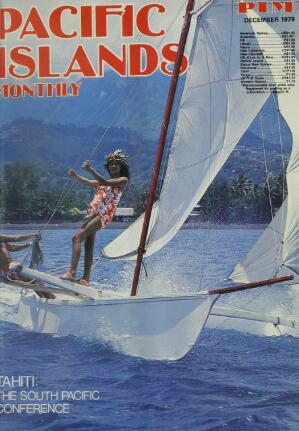
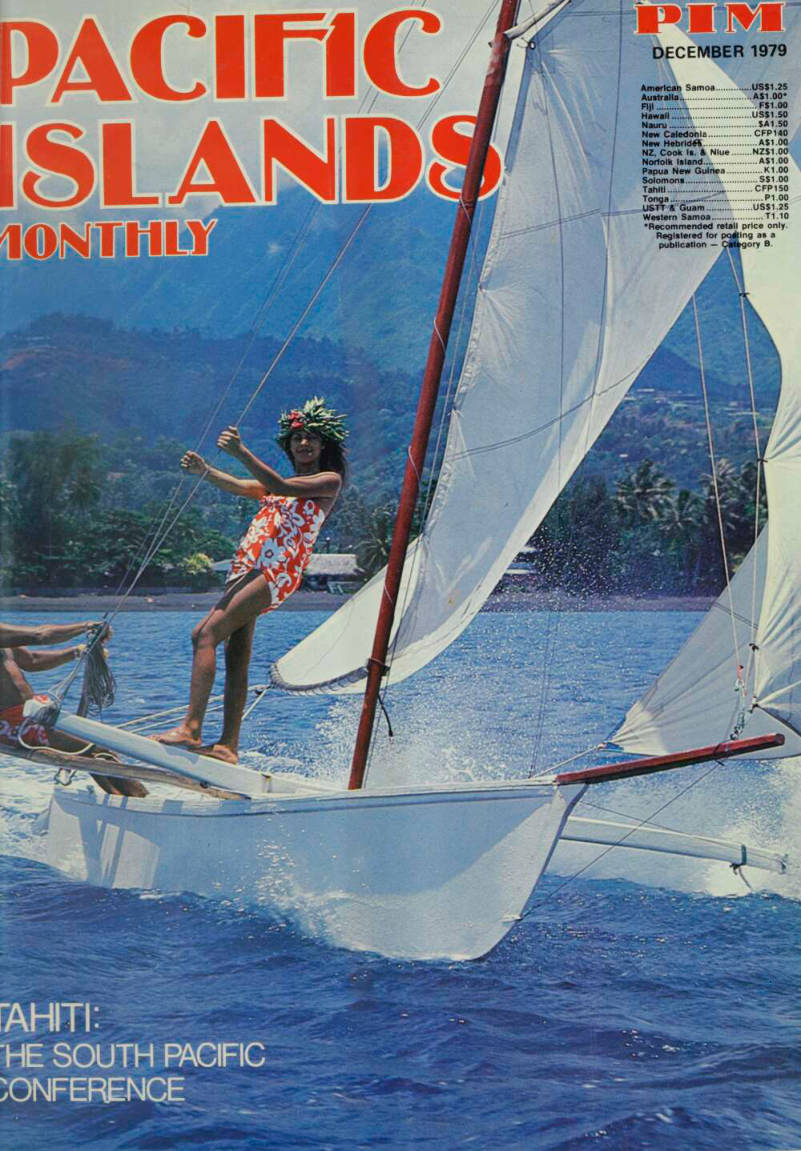
Fahiti:
"He South Pacific
Conference
Advertisements & other items, p. 2 (1 item)
Toyota
How to find a REAL economy car.
When you look at a car billed as an economy
model, ask yourself a few questions.
What sort of fuel consumption can be expected?
Good.
What about other operating costs? Oil, lubrication, that kind of thing. Low again? Great.
How about maintenance? The car has a low-breakdown record? You are definitely on the right track.
What is the average life of the car? Is it better than the average in your area? Super, That’s important in an economy car.
Now. How is the after service? Buying a car is not all in the price you know. Plenty of service outlets?
One economy car coming up. All you have to do is check the price. Then you can tell if you are really getting an economy car.
You will probably find, after asking these questions about town, that REAL economy cars come down to Toyota, the world’s economy car builder.
See Toyota first. Then you won’t have to shop around.
IHE HAPPY ECONOMIZER
TOYOTA STARLET
The car that says economy in every way.
And you will be happy for it. Big inside.
Small outside. Miserly with petrol Without sacrificing comfort. A good buy in an economy car even for Toyota.
I dl 6 L
PAPUA NEW GUINEA:
ELA MOTORS,
Scratchley Rd., Badili, P.O. Box 675, Port Moresby.
U.S. TRUST
TERRITORY: MICROL
CORPORATION,
P.O. Box 267, Saipan.
FIJI ISLANDS;
AUTOMOTIVE
SUPPLIES CO., LTD.,
G.P.O. Box 355, Suva.
AMERICAN SAMOA;
BURNS PHILP
(SOUTHSEA) CO., LTD.,
P.O. 1057, Pago Pago.
WESTERN SAMOA:
BURNS PHILP
(SOUTHSEA) CO., LTD.,
P.O. Box 188, Apia.
TONGA: BURNS PHILP
(SOUTHSEA) CO., LTD.,
P.O. Box 55, Nukualofa.
GUAM: ATKINS, KROLL
(GUAM) LTD., P.O. Box
6248, Tamuning.
NEW HEBRIDES:
NEW HEBRIDES
MOTORS,
TOYOTA
SERVICE
TOYOTA
P.O. Box 18, Vila.
SOLOMON ISLANDS:
MENDANA
ENTERPRISES (S I.)
LTD., P.O. Box 174,
Honiara.
TAHITI: NIPPON
AUTOMOTO, B.P. 342,
Papeete.
COOK ISLANDS:
COOK ISLANDS
TRADING
CORPORATION LTD.,
P.O. Box 92, Rarotonga.
NAURU ISLAND:
NAURU COOPERATIVE
SOCIETY.
REPUBLIC OF KIRIBATI:
TARAWA MOTORS,
Box 36, Bairiki Tarawa.
NORFOLK ISLAND:
MOUNT PITT
(ENTERPRISES) LTD.,
P.O. Box 169
NEW CALEDONIA;
SOCIETE IMPORTATION
AUTOMOBILE DE
PACIFIQUE, Rond-Pomt du Pacific (Station Total) B.P. 438, Noumea.
The Toyota range includes: Toyota 1000, Toyota Starlet, Toyota Corolla, Toyota Celica, Toyota Corona, Toyota Cressida, Toyota Crown
Pacific Islands Monthly
50 No 12
December 1979
(Usps 952480)
M is airfreighted to most subscribers and agents in the Pacific Islands and the United States
lyment by personal cheque Is accepted in Australian 5 New Zealand, UK and Fiji currency For other remit nces please obtain a bank draft in Australian dollars ade payable to the ANZ Banking Group, 88 Wentworth renue Sydney, Australia
Representatives
JSTRALIA; Distribution: NSW & ACT; Allan Rodney right (Circulation) Pty Ltd, PO Box 907, Darlinghurst, 3W 2010 Elsewhere: Gordon & Gotch (A asia) Ltd, Box I, PO, Rosebery, NSW 2018 Advertising Melbourne Pacific Publications (Aust.) Pty Ltd. sth Floor Alley jildmg, 75-77 Flinders Lane, Melbourne 3000, tele tone 63.0211. ext 1565 Jeff Gates ext 1858 Ida Pad •tt Brisbane D Wood Anday Agency. Box 1918 PO, Brisbane 4001 telephone 44 3485. 44 1546, lelaide Hastwell Media PO Box 30 Glen Osmond, V 5064, 233 Glen Osmond Rd Frewville, SA 5063 tele tone 79 1869 Perth Adrep, 62 Wickham St, East Perth, A 6000, telephone 325 6359 IJI: Distribution and subscriptions Desai Bookshops 0 Box 160. Suva, Fiji, telephone Suva 23036 Advertis ig Fiji Times & Herald Ltd, 20 Gordon St. Suva, tele hone 312 111. telex FJ2124 BENCH POLYNESIA: Distribution - Hacnette acitique. 10 Ave Bruat, Papeete, telephone 25610 AWAII, UNITED STATES: Distribution PIM, Hawaii, PO dx 22250, Honolulu, Hawaii 96822 Advertising: Roger I rookes, PO Box 10217, Waialae Kahala, Honolulu, awan 96816, Tel: 521 4521. Telex; 743 0296.
VPAN: Advertising and subscriptions Universal edia Corporation CPO Box 46. Tokyo telephone 56 3036 ICRONESIA: Advertising: Roger I Brookes, PO Box )217, Waialae Kahala, Honolulu, Hawaii 96816. Tel: >1 4521. Telex: 743 0296.
EW CALEDONIA: Distribution Depot Centre de r esse Michel Pentecost. CBP2 Noumea telephone 7 2434. 27 4729 EW ZEALAND. Distribution Gordon & Gotch PO Box 54 2 Carr Road Mt Roskill Auckland 4 Advertising International Media Representatives Ltd. PO Box 2313 uckland telephone 795 487. 493 389 cables Intereps, uckland Subscriptions - Ross Hames S Son Ltd PO ox 1289, Auckland telephone 769 042 APUA NEW GUINEA; Distribution Robert Brown & ssoc PO Box 3395, Port Moresby telephone 25855 dvertising PNG Post-Courier PO Box 85 Port loresby telephone 21 2577 NITED KINGDOM: The Herald & Weekly 1 imes Ltd 8-10 lifford s Inn. Fetter Lane. London EC4A IBU telephone 1 831 6041, telex London 21989 NITED STATES MAINLAND Advertising - Josnua B owers Jr Powers International Inc 551 Fifth Ave New ork New York 100 017 telephone 367 9580 telex 36514 Subscriptions - PiM Hawaii 2812 Kahawai St, onolulu. Hawaii 96822 üblished monthly by Pacific Publications (Aust ) Pty Ltd nd printed in Australia by Paramac Alexandria NSW ustralian cover price is recommended retail only Regis (red at the GPO Sydney for transmission by post as a üblication category B Second class postage paid at onolulu Hawaii Copyright r 1978 Pacific Publications
(Aust ) Pty Ltd Postmaster Honolulu Send address changes to PIM Hawaii. PO Box 22250 Honolulu Hawaii 96822
tbrţ Aust Other nencan Samoa $13 $US16 istraiia $12 jnada $14 $US18 >ok Islands $13 $12 $F 12 ench Polynesia $14
Cfp 1700'
jam $13 $US16 Ibert Islands $13 iwan $13 $US16 pan $16 Y4500 icronesia $13 $US16 iuru $18 jw Caledonia $14
Cfp 1700
jw Hebrides $13 »w Zealand $12 $NZ13 50 ue $13 jrfolk Island $12 jrthern Marianas $13 $US16 ipua New Guinea $13 K12 >lomon Islands $13 >nga $13 ivalu $13 £io uted Kingdom $15 5 Mainland $14
Sus18
estern Samoa $13 Elsewhere $A16
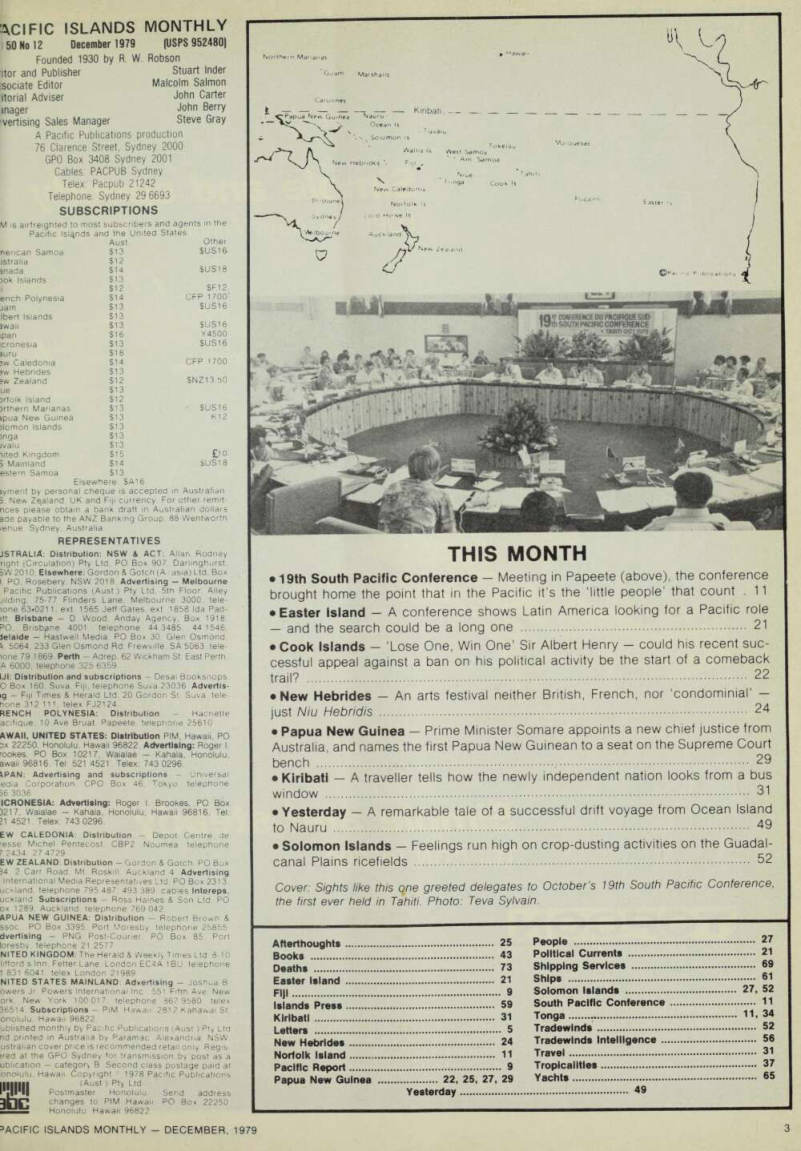
This Month
• 19th South Pacific Conference Meeting in Papeete (above), the conference brought home the point that in the Pacific it’s the ‘little people’ that count . 11 • Easter Island A conference shows Latin America looking for a Pacific role and the search could be a long one 21 • Cook Islands ‘Lose One, Win One’ Sir Albert Henry could his recent suc cessful appeal against a ban on his political activity be the start of a comeback trail? 22 • New Hebrides - An arts festival neither British, French, nor ‘condominial’ just Niu Hebhdis 24 • Papua New Guinea - Prime Minister Somare appoints a new chief justice from Australia, and names the first Papua New Guinean to a seat on the Supreme Court bench 29 • Kiribati A traveller tells how the newly independent nation looks from a bus window 21 • Yesterday - A remarkable tale of a successful drift voyage from Ocean Island to Nauru 49 • Solomon Islands Feelings run high on crop-dusting activities on the Guadal canal Plains ricefields 52 Cover: Sights like this qne greeted delegates to October's 19th South Pacific Conference, the first ever held in Tahiti. Photo: Teva Sylvain.
Afterthoughts 25 Books 43 Deaths 7 3 Easter Island 21
Fiji 9
Islands Press 59 Kiribati 31 Letters 5 New Hebrides 24 Norfolk Island 11 Pacific Report 9 Papua New Guinea 22, 25, 27, 29
People 27 Political Currents 21 Shipping Services "
Ships 91 Solomon Islands 27, 52 South Pacific Conference 11 Tonga j. 11, 34 Tradewlnds 52 Tradewlnds Intelligence 56 Travel 31 Tropicalltles 37 Yachts 65
Yesterday 49
Advertisements & other items, pp. 3-4 (2 items)
3
ACIFIC ISLANDS MONTHLY - DECEMBER, 1979
Founded 1930 by R, W. Robson itor and Publisher Stuart Inder •sociate Editor Malcolm Salmon itorial Adviser John Carter mager John Berry 'vertising Sales Manager Steve Gray A Pacific Publications production 76 Clarence Street, Sydney 2000 GPO Box 3408 Sydney 2001 Cables; PACPUB Sydney Telex: Pacpub 21242 Telephone: Sydney 29 6693
SUBSCRIPTIONS
Simple and speedy
TOPCON Auto Winder + RE 300
m rw ff Re aoo :*z #)/ Rh 32 ¥ '/
AUTO W
* Auto Winder, an original TOPCON idea, provides fast, continuous shooting at 2 fps. (RE 300) * LED exposure readout, for fast, correct exposure control. - * Backed up by a full range of TOPCOR interchangeable lenses.
Simple and steady
TOPCON RE 200
for beautiful pictures TOKYO KOGAKU KIKAI K.K. (TOKYO OPTICAL CO., LTD.) 75-1, Hasunuma-cho, Itabashi-ku, Tokyo 174, Japan Telex: 0272-2384 Phone; Tokyo 03-967-1101 AUSTRALIA Wagner Wholesale Photographies, 524 Flinders Street, Melbourne, Victoria 3000 / NEW ZEALAND Thames Camera Centre Limited, P.O. Box 345, 712 Pollen Street, North, Thames / NORFOLK ISLAND Miltons Department Stores Limited, P.O. Box 146, Norfolk Island 2899 / NEW HEBRIDES The Sound Centre, P.O. Box 434, Port-Vila / NEW CALEDONIA Magenta Photo BP 1723, Noumea / FIJI D. Gokal & Co. Ltd CNR Pier Straat and Renwick Road, Suva, PAPUA NEW GUINEA Hagemeyer (PNG) Pty. Ltd., Lae, Rabaul Port Moresby, Madang, Mt. Hagen, Wewak.
Letters
Tahitian takes
n Mr Olewale im a Tahitian student study g in Auckland and I am greatly sturbed with the statements ade by the Minister of ireign Affairs for Papua New uinea, Mr Ebia Olewale, con
rning French Polynesia’s re
tionship vis-a-vis France. As r as I am aware, Mr Oleware not Tahitian which renders s pronouncements on the bject meaningless as he has ither a right nor interest to »so.
The Prime Minister of ench Polynesia, Mr Francis
inford, has categorically
ited that French Polynesia
>es not seek full indepen ;nce but rather internal itonomy, not unlike the re tionship which the Cook
lands enjoys with New
jaland, and that of American imoa with the U.S.A. Pro
dependence parties have put
rward candidates in the elec ins for the Territorial As mbly and their lack of
ccess has conclusively proved
at the majority prefer
temal autonomy rather than
dependence.
Complete independence
auld mean the standard of
dng in French Polynesia,
hich is the highest in the >uth Pacific Islands after merican Samoa, would fall, nlike Papua New Guinea,
rench Polynesia does not
ive vast mineral resources to :port (although this fact has it raised the standard of liv g of the ordinary people in ipua New Guinea).
I submit to Mr Olewale that is a fundamental principle of temational law that the dom tic affairs of a country are be md the bounds of terference by another. Of mrse in the context of his atement it must be realised at the rule of law in Papua ew Guinea does not seem to £ observed at all. A PIM cor-
respondent reports in the October 1979 issue, page 66, that ‘there has been a massive upsurge of lawlessness in the urban areas, particularly in
Port Moresby’ and ‘peaceful
and law-abiding citizens are afraid to walk around at night, or for that matter even by day, for fear of being beaten up, robbed or raped’.
Also the abuse of law by the Papua New Guinea Govern ment in pardoning one of their ministers after being imprisoned, indicates the de gree to which the rule of law is not observed in Papua New Guinea. Unlike Port Moresby, Papeete is a safe town to live in and our people do not have to build ‘six foot high security fences’ (p 66) for fear of their lives and property. Tahitians do have respect and faith in the
judiciary and our politicians
are not above the law.
It would be interesting to hear the answers of Mr Olewale to a number of per tinent questions I would like to ask. Why hasn’t the Papua New Guinea Government protested about the invasion by Indonesia of Papua New Guinea’s close neighbours Irian Jaya and East Timor? These invasions have effectively
clogged these peoples’ rights to
self-determination. Would the Papua New Guinea Govern ment consider it a gross inter ference in their own domestic affairs? Should Tahitians help the Bougainville Island se cessionist movement in its push
for independence from Papua New Guinea?
In conclusion it seems ob vious that Mr Olewale ought to ensure the domestic affairs of his own country are in order before he ventures on to the in ternational scene, and the future of French Polynesia is to be decided by French Polynesians on our own terms, not those of Mr Olewale.
Titaua De Montlue (Ms)
Auckland, New Zealand Mr Olewale’s performance at the South Pacific Forum (and later the Conference), and his so much expressed concern for the freedom and independence of others, appear to be in con tradiction with the historical facts. They do not eliminate the reality that Mr Olewale and his government not long ago vir tually betrayed and sold their own brothers and sisters into
slavery and exploitation.
Hiding behind the incom petence of the United Nations to settle the disputes of racial and national minorities, and
depending constantly on the
advice of Australia’s Mr Pea cock, offers little hope for
freedom-seeking Pacific
Islanders, as it is hardly a pro motion of Papua New
Guinea’s ‘independence’.
Under the circumstances, perhaps Mr Olewale should be the last one to advise and talk in terms of‘decolonisation’ and ‘independence’ of others, as
frustrated freedom-seeking
Islanders could be driven towards the end of the scale, throwing the so much pro
moted ‘regional stability’ off
balance.
Fred Eiserman
Caims, Qld, Australia PS: The trouble is to find an unbiased, fact-accepting Aus
tralian publisher.
Percy Chatterton
and PNG students
After reading in ‘After thoughts’ (PIM Aug p4O) some stirring comments on the strikes at the University of Papua New Guinea, I too have been stirred into reflection.
Perhaps Dr Chatterton isn’t the old grey stallion he used to be!
Could he at his age and with
his maturity of experience be a little more wise, tolerant and humane?
Initially his airy-fairy jour
nalism is little more than irri tating! I quote: ‘lt seems beyond reasonable doubt that these periods of student unrest were accompanied by acts of intimidation, violence and van dalism; by wild ultimata and threats of national disruption; and by an arrogant assump tion that the laws of the land and the authority of the courts do not extend to the university
campus.’ It is definitely beyond
reasonable doubt that these ac cusations are but the personal view of a critic who has neither the interests of one party nor the other at heart such idle thoughts are liable to aggravate
an already irritating problem,
especially coming from some
one whom the utmost respect is held for in Papua New Guinea.
It is also a pity that the writer doesn’t try to analyse the prob lem and offer some fatherly advice, rather than give us a lecture on the misuse of lan gauge. The reason for the action taken is far more im portant than any matter of
language.
It is wonderful to see the
university developing into a
body of questioners. Surely it
is a purpose of the educated to ever be critical criticism can be constructive. The change in student attitudes is to be wel comed and encouraged. Out side encouragement is just as
important and ideas gleaned
from visiting academic staff can indeed be as educative as a set syllabus. A ‘strike’ by students in PNG is as appro-
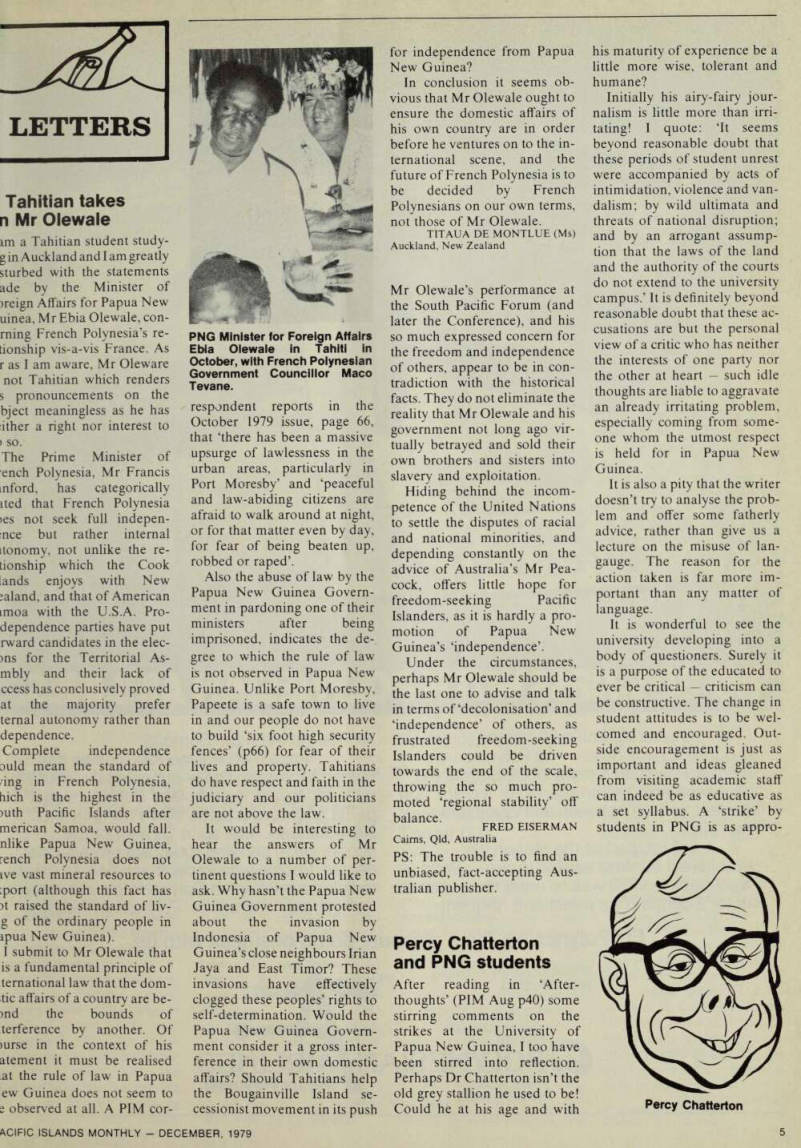
PNG Minister for Foreign Affairs Ebia Olewale in Tahiti in October, with French Polynesian Government Councillor Maco Tevane.
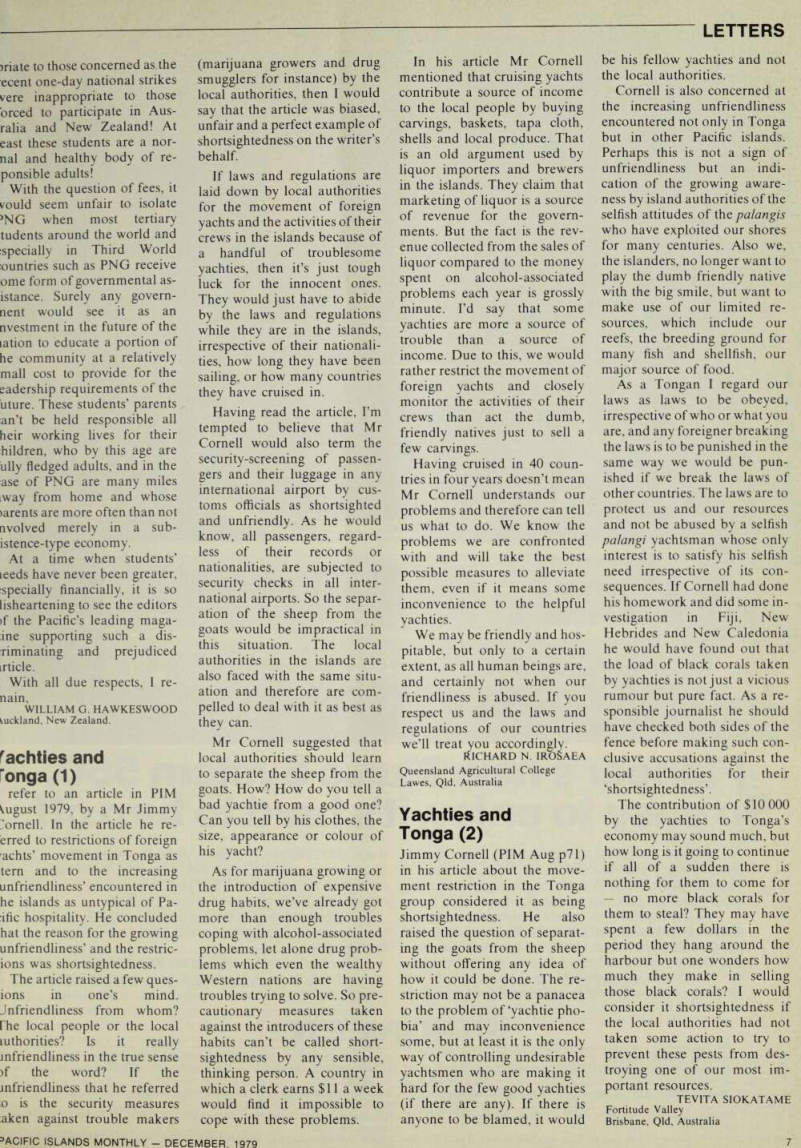
Percy Chatterton
mate to those concerned as.the ecent one-day national strikes
vere inappropriate to those
breed to participate in Aus ralia and New Zealand! At east these students are a nor
nal and healthy body of re
ponsible adults!
With the question of fees, it vould seem unfair to isolate
>NG when most tertiary
tudents around the world and specially in Third World ountries such as PNG receive ome form of governmental as istance. Surely any govern nent would see it as an nvestment in the future of the lation to educate a portion of
he community at a relatively
mall cost to provide for the
eadership requirements of the
uture. These students’ parents an’t be held responsible all heir working lives for their hildren, who by this age are ully fledged adults, and in the ase of PNG are many miles iway from home and whose >arents are more often than not avolved merely in a sub
istence-type economy.
At a time when students’ iceds have never been greater, specially financially, it is so lisheartening to see the editors »f the Pacific’s leading maga ine supporting such a dis
riminating and prejudiced
irticle.
With all due respects, I re nain,
William G. Hawkeswood
Auckland, New Zealand.
r achties and
’onga (1)
refer to an article in PIM
August 1979, by a Mr Jimmy
Cornell. In the article he re erred to restrictions of foreign achts’ movement in Tonga as tem and to the increasing unfriendliness’ encountered in he islands as untypical of Pa
ific hospitality. He concluded
hat the reason for the growing unfriendliness’ and the restric ions was shortsightedness.
The article raised a few ques ions in one’s mind.
Jnfriendliness from whom? fhe local people or the local
mthorities? Is it really
mfriendliness in the true sense )f the word? If the mfriendliness that he referred o is the security measures aken against trouble makers
(marijuana growers and drug
smugglers for instance) by the local authorities, then I would say that the article was biased, unfair and a perfect example of shortsightedness on the writer’s behalf.
If laws and regulations are laid down by local authorities for the movement of foreign yachts and the activities of their crews in the islands because of a handful of troublesome
yachties, then it’s just tough
luck for the innocent ones.
They would just have to abide by the laws and regulations while they are in the islands, irrespective of their nationali ties, how long they have been sailing, or how many countries they have cruised in.
Having read the article. I’m tempted to believe that Mr Cornell would also term the security-screening of passen gers and their luggage in any
international airport by cus
toms officials as shortsighted and unfriendly. As he would know, all passengers, regard less of their records or nationalities, are subjected to security checks in all inter national airports. So the separ ation of the sheep from the goats would be impractical in this situation. The local authorities in the islands are also faced with the same situ ation and therefore are com pelled to deal with it as best as
they can.
Mr Cornell suggested that local authorities should learn to separate the sheep from the goats. How? How do you tell a bad yachtie from a good one?
Can you tell by his clothes, the size, appearance or colour of
his yacht?
As for marijuana growing or the introduction of expensive drug habits, we’ve already got more than enough troubles coping with alcohol-associated
problems, let alone drug prob
lems which even the wealthy Western nations are having troubles trying to solve. So pre cautionary measures taken against the introducers of these habits can’t be called short
sightedness by any sensible,
thinking person. A country in which a clerk earns $ll a week would find it impossible to cope with these problems.
In his article Mr Cornell
mentioned that cruising yachts
contribute a source of income
to the local people by buying
carvings, baskets, tapa cloth, shells and local produce. That is an old argument used by
liquor importers and brewers
in the islands. They claim that marketing of liquor is a source of revenue for the govern ments. But the fact is the rev enue collected from the sales of liquor compared to the money spent on alcohol-associated problems each year is grossly minute. I’d say that some yachties are more a source of trouble than a source of income. Due to this, we would rather restrict the movement of
foreign yachts and closely
monitor the activities of their crews than act the dumb, friendly natives just to sell a
few carvings.
Having cruised in 40 coun tries in four years doesn’t mean Mr Cornell understands our problems and therefore can tell us what to do. We know the problems we are confronted with and will take the best possible measures to alleviate them, even if it means some inconvenience to the helpful
yachties.
We may be friendly and hos pitable, but only to a certain extent, as all human beings are, and certainly not when our friendliness is abused. If you respect us and the laws and regulations of our countries we’ll treat you accordingly.
Richard N. Irosaea
Queensland Agricultural College Lawes, Qld, Australia
Yachties and
Tonga (2)
Jimmy Cornell (PIM Aug p7l)
in his article about the move ment restriction in the Tonga group considered it as being shortsightedness. He also raised the question of separat ing the goats from the sheep without offering any idea of how it could be done. The re striction may not be a panacea
to the problem of‘yachtie pho
bia’ and may inconvenience some, but at least it is the only way of controlling undesirable yachtsmen who are making it hard for the few good yachties (if there are any). If there is anyone to be blamed, it would
be his fellow yachties and not the local authorities.
Cornell is also concerned at the increasing unfriendliness encountered not only in Tonga but in other Pacific islands.
Perhaps this is not a sign of unfriendliness but an indi cation of the growing aware ness by island authorities of the selfish attitudes of the palangis who have exploited our shores for many centuries. Also we, the islanders, no longer want to play the dumb friendly native with the big smile, but want to make use of our limited re sources, which include our reefs, the breeding ground for many fish and shellfish, our major source of food.
As a Tongan I regard our laws as laws to be obeyed, irrespective of who or what you are, and any foreigner breaking the laws is to be punished in the same way we would be pun ished if we break the laws of other countries. The laws are to protect us and our resources and not be abused by a selfish
palangi yachtsman whose only
interest is to satisfy his selfish need irrespective of its con sequences. If Cornell had done his homework and did some in
vestigation in Fiji, New
Hebrides and New Caledonia he would have found out that the load of black corals taken by yachties is not just a vicious rumour but pure fact. As a re
sponsible journalist he should
have checked both sides of the fence before making such con clusive accusations against the local authorities for their
‘shortsightedness’.
The contribution of $lO 000
by the yachties to Tonga’s
economy may sound much, but how long is it going to continue if all of a sudden there is nothing for them to come for no more black corals for them to steal? They may have spent a few dollars in the
period they hang around the
harbour but one wonders how much they make in selling those black corals? I would consider it shortsightedness if the local authorities had not taken some action to try to prevent these pests from des troying one of our most im portant resources.
Tevita Siokatame
Fortitude Valley Brisbane, Qld, Australia
Advertisements & other items, pp. 5-8 (3 items)
5
ACIFIC ISLANDS MONTHLY - DECEMBER, 1979
S) Polynesian/Airlines
m <6* ** 32$ €3* :s: / Am?* f . .
AIV
Sjfifiii
iiiiliipip r
AN AIRLINES
DO BUSINESS W
When the time next comes for you to fly out to do business fly Polynesian Airlines. Polynesian really understands the businessman’s requirements for a quick and efficient service between all Polynesian countries.
In fact, part of the reason we established our first service (Apia Pago Pago) back in 1959 was to meet the business sector’s demand for a fast and frequent service between the Samoas.
Since then Polynesian Airlines has spread its wings. Today our extensive route network covers the whole of Polynesia east of Fiji and now extends down to Auckland, New Zealand. And, as in ‘59 a lot of the people we’re carrying today are professional people. People who know that when it comes to flying anywhere in Polynesia on business there is only one airline. Polynesian Airlines, Fly Polynesian. It’s a pleasure doing business with us.
Offices in: Auckland, Tonga, Niue, Rarotonga.
Box 599 Apia, Western Samoa, Ph 21261.
WESTERN SAMOA
WALLIS IS
AMERICAN
SAMOA
NIUE
S) POLYNESIAN/AIRLINES
Nandi Airport Nandi Ph 72733, We are Polynesia.
AUCKLAND
Pioneer’s new Music System 550.
So easy to enjoy, it’s hard to turn off.
Pioneer’s working hard to make it easy for you to really enjoy your favorite music. Sure, our new Music System 550 is technically advanced, but not so complicated that you need a license to turn it on.
At the heart of this great Pioneer idea is the well-known Multi-Mode Deck™ with Pioneer’s exclusive Song Finder, one-touch recording and Auto-Repeat plus Dolby* for noise-free recording and playback.
Next, a tough powerful amp section. A full 45 watts of music power reproduces music so well, if you don’t believe your ears, you can check with your eyes via the LED information panel. Of course, radio fans will enjoy the FM/AM/SW tuner and record lovers will love the full-size turntable.
And on the output side, a pair of beautiful Pioneer speaker systems to make great music sound ever greater.
Pioneer’s new Music System 550. So easy to use and easy to enjoy, turning it off is the only hard thing about it. *Doib y is a registered trademark of Dolby Labs.
fID PIONEER
r further information, please contact: stralia: Pioneer Marketing Service Pty. Ltd., P.O. Box 317, Mordialloc itoria. 3195 Tel: 90-9011 i Islands: Brijlal & Company, G.P.O. Box No. 362, Suva. Fiji Islands : 22258 w Zealand: Monaco Electronics Ltd., 5 Vernon Street, Auckland, w Zealand Tel: 33-883 rfolk Island: Burns Philp (Norfolk Island) Ltd., Norfolk Island, South Pacific w Hebrides: Burns Philo (New Hebrides) Ltd.. Vila. New Hebrides Tahiti: Ets. PERFECT. B.P. 594, Papeete, Tahiti Tel: 20 407 New Caledonia: Menard Freres Ville, B.P. H 2 Cedex, Noumea, New Caledonia Tel; 27.52.22 American Samoa: Transpac Corporation, P.O. Box 1477, Pago Pago. American Samoa 96799 Tel; 633-5224 Rarotonga: South Seas International Ltd., P.O. Box 49, Rarotonga, Cook Islands Tel: 2327 Papua New Guinea: Bali Merchants Pty. Ltd., P.O. Box 6103, Boroko Tql- oc^Aaav
Letters
7
3 ACIFIC ISLANDS MONTHLY - DECEMBER. 1979
Pacific Report
Ew Testing Method On Moruroa
le coral motus that compose Moruroa Atoll have become so iturated by underground nuclear explosions that the French e now planning underground nuclear test explosions in shafts illed into the centre of the lagoon rather than on the edges ; in the past. This decision has been forced upon the scientists j a result of the controversial accident of July 25 (PIM Nov 11) which caused a tidal wave which injured seven on the atoll id which, it has been alleged, sent radiation into the sea. The jly 25 explosion took place after a nuclear device had become uck and was detonated part-way down a shaft drilled into one the motus known as Ara. The explosion caused an underwater jbsidence of the side of the mountain upon which Moruroa toll is built, causing the tidal wave. President of the Territorial ssembly Frantz Vanizette told PIM in Papeete in October that drilling into the motus there might only be 1 km of basalt be /een the point of explosion and the open sea. But by drilling to the centre of the lagoon the scientists would be drilling into e heart of the undersea mountain, and would have as much > 20 km between the explosion point and the sea. Moruroa is coral reef measuring about 9 km north to south and 23 km ist to west.
Omare Supports Dissolution
apua New Guinea’s Prime Minister Michael Somare supported motion in early November to dissolve the PNG Parliament. But ie move was defeated. Speaking on a motion moved by Sir )hn Guise which called for the dissolution on the grounds that ie credibility of the government and the whole parliament was : stake as a result of the Rooney affair, Mr Somare said he as supporting the motion in a personal capacity, and not as ader of the government. The Health Minister and leader of the nited Party, Raphael Doa, opposed the motion, saying it would nly confuse the people more.
Acific Press, Radio Heads Meet
ewspaper editors and radio officials from South Pacific coun ies met on the Fijian island of Toberua in November for a sem lar on the subject of the needs of a free, strong press, including roadcasting services, in the region. The seminar was organised y the Pacific Islands News Association under a grant from the sia Foundation. PIM was represented by its editor/publisher tuart Inder.
Onga’S King Knocks Back Land Bill
ing Taufa’ahau Tupou IV of Tonga has refused the royal assent ) a controversial amendment to the kingdom’s land act which rould have provided for confiscation of land owned by Tongan itizens absent from the country for more than two years.
Lawaii Protests On N-Ships
he Honolulu City Council and the Hawaii County Council have rotested against the docking of the sister ships Pacific Fisher nd Pacific Swan in the islands. The vessels carry spent nuclear jel from Japan to the UK and France for reprocessing.
Ipologies To Solomons From U.S.
resenting his credentials to Solomon Islands Governor-General laddeley Devesi in November, the new US Ambassador Harvey . Feldman apologised for an incident during the previous week i which helicopters from passing US warships flew over iolomon Islands territory. The Honiara government had pro ved strongly against what it called a ‘peaceful invasion’ of s territorial waters and air space.
Latu Mara And The Chief Justice
i the wake of Papua New Guinea’s Rooney Affair, it was the jrn of Fiji in November to experience strains in relations be /veen government and judiciary. Early in that month, a major iehind-the-scenes political stir arose with the disclosure by Time Minister Ratu Sir Kamisese Mara that he had written to le chief justice, British expatriate Sir Clifford Grant, suggesting ie step down within six months in favour of a local judge. Grant, Drmerly of Hong Kong, has been in Fiji 10 years. The chief jus ce responded somewhat stiffly, pointing out that only the
‘appointing authority’ (in this case Governor-General Ratu Sir George Cakobau) had the power to remove the chief justice.
His inference was that the prime minister could be interfering with the judiciary. He wrote briefly to the governor-general point ing this out, but adding that should it be decided he should go, he would do so. Opinions were sharply divided between sup porters of the prime minister and of the governor-general on the move which, some said, was related to the celebrated ‘Flour Mills’ court case (RIM Aug p 31). Prime Minister Mara went on air to the nation on Day 2 of the affair to say that he had sought in his letter merely to advise the chief justice of his opinion. Legal opinion in Suva seems to back the prime minister, despite the chief justice’s interpretation of Section 14(1) of the Indepen dence Document. Prime Minister Mara was later summoned to Government House and an early announcement by the governor-general of the chief justice’s retirement was expected.
Speculation among politicians and lawyers was that Sir Clifford’s replacement would be Mr Justice Kermode, one of the court’s three puisne judges.
New Hebrides To The Polls
As PIM went to press, a vital new stage was under way in the New Hebrides’ long march to independence the holding of the country’s first nation-wide elections. Full cover in PIM January.
Eec Links Colour Nz Views
New Zealand Tourism Minister Warren Cooper told the South Pacific Conference in Papeete that it was for the French Pacific territories themselves to determine what they wanted in associ ation with France. He added: ‘New Zealand has close ties with the South Pacific and with the EEC.’ It was the first time a New Zealand minister had said publicly what many have been saying privately for years: that New Zealand’s EEC links colour its atti tude to independence for French Pacific territories.
Crimes Of Violence Jump In Fiji
Violent crime in Fiji jumped more than 70% in the first nine months of this year compared with the same period in 1978, according to the country’s Commissioner of Police John Orme.
The official figures showed that a very large number of the crimes arose from excessive drinking. Despite the increase in violent crime, the overall figure for reported crimes was down by 282 cases.
December 12 Referendum On Norfolk
Norfolk Island voters are to have a referendum on December 12 in which they can either support the proportional represen tation method of voting used to elect their new legislative as sembly in August, or revert to the first past-the-post system by which the old Norfolk Island Council was elected. A PIM cor respondent on the island reports that the result was expected to be close.
Forum Samoa Is Launched
The Pacific Forum Line’s new container ship, Forum Samoa, has been launched in Hamburg. The vessel, with a capacity of 322 containers, and said to be among the most sophisticated of its kind in the world, is part of a German aid programme to Western Samoa. It sailed under PFL colours from Hamburg on October 18 and was expected in Apia on November 30.
435 000 Solomon Islanders By 2000?
Solomon Islands’ Statistics Office has predicted that if the country’s population growth continues at its present rate of 3.4% a year there will be 435 000 Solomon Islanders by the year 2000, more than double the present figure.
Solomon Is.-Sweden Diplomatic Links
Solomon Islands and Sweden have established diplomatic re lations at ambassadorial level, bringing to 10 the number of countries with which Solomon Islands has diplomatic ties.
W. Samoa Assembly Meets
Western Samoa’s legislative assembly met for the first time on November 13 since the country’s eventful general elections in February.
‘Emigration Is Pacific Key’ - Report
Hope for thousands of Pacific islanders could depend on large scale emigration to Australia, New Zealand and North America, according to an economic survey issued by the Asian Develop ment Bank. The survey said in view of lack of resources, ‘the
acceptance of a no-growth state of affairs may be the only re alistic option for the small countries’. ‘No-growth’ did not necessarily mean poverty, provided people were able to migrate either permanently or temporarily, the survey said
Spanish Envoy On Torres’ Track
Spain’s Ambassador to Australia Don Carlos m, Fernandez-Shaw and his wife have visited Torres Strait to retrace the track of the Spanish explorer Torres through Endeavour Strait in 1606 With the Spanish party by invitation was Captain Brett Hilder, the authority on the navigation of Torres. Also present was Cap tain John Foley, a Torres Strait pilot. The ambassador and his party later visited sites of interest in the history of Spanish Pacific exploration in Papua New Guinea, Solomon Islands and the New Hebrides.
Png Leaders’ Skeletons In Cupboard
Papua New Guinea’s public leaders have debts of at least SAI7B 000 which they have made ‘little or no attempt to settle’, according to the PNG Ombudsman’s Commission. The debts did not include normal loans, dishonoured cheques or monthly debts, but only debts investigated by the commission after com plaints. The report said 24 MPs, including some ministers, had debts totalling $132 308; departmental heads $9619 and statu tory authority members $36 094
Paying For Kwajalein
Marshall Islands President Amata Kabua has announced that the US Government has agreed to pay SUS 6 million next year for the use of the Kwajalein missile testing range. President Kabua said that after the projected end of trusteeship arrange ments in 1981, the US would be paying about $8 million a year for use of the range.
New Caledonia: An African View
'There’s no difference between New Caledonia and Zimbabwe where the coloured people are concerned,’ said visiting African personality Dr Francis N’Gombe in Sydney in November. Dr N’Gombe, millionaire expert in modern and traditional African medicine, had just visited Fiji, the New Hebrides and the French Pacific territories.
Fiji Official Arrested In Sydney
Director of the Fiji Government’s Business Opportunity and Man agement Advisory Service, Leslie Furness, has been arrested in Sydney, Australia. He faced a false pretences charge from the New South Wales police and a Commonwealth police charge alleging an earlier departure from Australia without consent.
Sydney police said Mr Furness had warrants totalling $l6 000 outstanding against him.
The Pfl Will Stay In Apia
The headquarters of the Pacific Forum Line will remain in Apia, Western Samoa. The decision was reached after tough dis cussions at a meeting of regional transport ministers in Apia in late October. Ministers rejected arguments that the HQ should be moved to either Suva or Auckland, including claims that Apia s communications network was inadequate. Fighting hard for retention of the HQ in Apia, the Western Samoa represen tative pointed out that Apia's communications facilities would be vastly improved with the opening next year of Western Samoa’s earth satellite station.
Rhinoceros Beetle Bugs U.S. Navy
The humble rhinoceros beetle, ruinous pest on coconut plan tations in many Pacific countries, is impeding the freedom of movement of the mighty US navy. Captain Harold Lewis of the visiting 18 000-tonne guided missile cruiser USS Chicago told a November press conference in Sydney that he had planned visits by the vessel to a number of Island countries on its way back to base in San Diego, California. But he had had to change plans substantially because of bans by some Island governments on visits by ships which had recently visited countries believed infested by the rhinoceros beetle.
Tuvalu Fines Koreans $25 000
The master of a South Korean fishing vessel, Samsong No 16, has been fined $25 000 for illegally fishing in Tuvalu waters. In July a Taiwanese ship was fined $2O 000 for the same offence (PIM Sep p 8). (See Topicalities.)
Landslide Kills Two In American Samoa
American Samoa’s ‘biggest landslide in years’ has killed two young people and left six families homeless at Nuumasee taga.
Usp Holds ‘Pacific Week’
Theme of the annual Pacific Week held by the University of the South Pacific in October was ‘Decentralisation and Sharing of Resources . Purpose of the Week is to increase understanding of each other’s cultures among Pacific peoples.
Png To Get Tough On Provinces
The Papua New Guinea Government plans to arm itself with new powers enabling it to sack provincial governments outright The proposed laws will give the government direct power to suspend provincial administrators who abuse their privileges or misuse public money. a
Micronesian Tourism Body Formed
Representatives of the various governments in the US Trust Ter ritory of the Pacific, together with Guam, Northern Marianas and the Republic of Nauru, have signed documents on Saipan creating the Micronesian Regional Tourism Council. The signing took place following a three-day conference of officials from these Micronesian governments.
Vd Up In Solomon Islands Capital
There were 100 cases of gonorrhea discovered in Honiara, capi tal of Solomon Islands, in the first three months of 1979, a drama tic increase over previous rates. There were also six cases of syphilis, a disease previously unknown in the country.
Eli Bonay In Png
Eli Bonay, thelrianese who was first governor of Irian Jaya after its incorporation into Indonesia, has crossed into Papua New Guinea. The PNG department of foreign affairs confirmed that Mr Bonay had crossed the northern end of the border and con tacted officials at Vanimo.
RACE TO BE COCK OF THE WORLD’
Which will be the fastest yacht in Sydney Harbour on December 16? The Cruising Yacht Club of Australia and Burns Philp, one of the Pacific Islands’ big traders, will find the answer with the help of some of the world’s leading yachtsmen who will be in Sydney for the Sydney-Hobart classic, along with the yachtsmen arriving after the Parmelia (England) to Western Australia. They will take part in the bi-annual Burns Philp International Maxi Race over 40 nautical miles. The winner will take the Cruising Yacht Club of Australia’s trophy ‘Cock of the World’.
Bp Profit Up 27%
The 1979 annual general meeting in November of Burns Philp & Co Ltd was told that the group had recorded a 27% increase in profit to $14.3 million in the year to June 30, 1979. Chairman J. D. O. Burns said that although there were variations from place to place, the group’s Pacific area operations had been helped overall by the general economic stimulation flowing from buoyant commodity prices.
Angus Smales Is New Pim Editor
Angus Smales is to become Editor of PIM from March 1, 1980.
He joins the magazine in its 50th anniversary year. Mr Bob Hawkins has relinguished the post to go into freelance jour nalism. Mr Smales, 50, has represented the Herald group of Mel bourne in Port Moresby for the past 13 years, at the same time serving as PIM correspondent in the Papua New Guinea capital. His experience of Islands journalism began as far back as 1956 when he went to Rabaul in the then Trust Territory of New Guinea to work on a short-lived revival of the Rabaul Times, a paper edited before the Pacific War by the late Gordon Thomas (Tolala of PIM). In his time in Port Moresby, Angus Smales has become widely known and respected for his interviews and com mentaries on the PNG scene for the Australian Broadcasting Commission and the PNG National Broadcasting Commission.
He has accompanied PNG delegations on visits to Pacific and Asian countries, including state visits by Prime Minister Michael Somare to China, the Philippines and Indonesia. In 1978 he was invested by PNG Governor-General Sir Tore Lokoloko with the Independence Medal of Papua New Guinea for services to the community through journalism. As Editor of PIM Angus Smales will have his home base in Sydney, along with his wife Betty and their two children.
Advertisements & other items, p. 9 (1 item)
9
ACIFIC ISLANDS MONTHLY - DECEMBER, 1979
It’s the little people who

call the Islands tune
The South Pacific Commission does have a future, and its annual South Pacific Conference, this year attended by more than 150 people in Papeete, will continue to be suc cessful because it is the forum in which the small Island territories can have their say. That’s the way STUART INDER sees it in presenting this report on what he thinks went on at the big conference.
The most successful speech made at the 19th South Pacific Conference held in Papeete was from David Buffett, sole representative of the Aus tralian Pacific territory of Nor folk Island (population 1800).
It was informative, relevant and witty, as most successful speeches are. But, more im portantly, it was a speech
whose delivery was significant
to the future of the South Pa cific Commission because it was further proof of the SPC’s need to continue.
Little Norfolk Island is the home of the descendants of the Bounty mutineers. The entire population of Pitcairn moved there in 1856 because Pitcairn was becoming overcrowded. A few homesick families later re turned to Pitcairn (the basis of the tiny Pitcairn population of today) but most remained and
prospered.
Although they consider
themselves as part of the Pa cific Islands community, as they are, Norfolk Islanders have not taken part in the SPC because they have not been permitted to by Australia. But in August, Norfolk Island got a measure of self-government with the establishment of an elected nine-man legislative as
sembly, and Australia has promised progress to self government within five years.
So in September Norfolk Island sent its first team to the South Pacific Games (and won a commendable number of four medals), and in October David Buffett, who is Norfolk’s chief minister and a great great-great grandson of one of the mutineers, appeared in Tahiti as Norfolk’s first rep resentative at any South Pacific Conference.
He was there as an ‘adviser’ to the Australian delegation, which is a traditional way of introducing new boys to the commission. So well did Mr Buffett use his opportunity and so well was he received by the conference that there should be no further doubt about Nor folk Island’s right to be there on its own behalf, with higher status than adviser.
David Buffett served to re mind the conference of its own value in the Pacific. It was, he said, a forum at which Island
people could express them selves and co-operate in the concept of regionalism; it was a means of fostering and developing the flow of local products and technical knowl edge of use to all of them; it was a means of islands gaining access to all kinds of assistance.
But, finally and importantly, it was a means of extending
friendships and goodwill, and
Norfolk Islanders, who were ‘intensely proud of their his tory’, were clearly within the Pacific community and thus very pleased to have at least a more direct representation at the conference. He was warmly applauded by the full con ference, which is unusual.
This was a successful con ference, and its continuing suc cess depends on the presence of the Norfolk Islanders of the Pacific the involvement of Niue, Tokelau, Tuvalu, Kiribati, Wallis and Futuna and others, for it is these small islands which understand the problems of the Pacific and the
need to continue the close sense of family if the islands are to survive and prosper as a
regional identity.
It is the small islands who now have the task of reminding the big Islands states of their grass roots, and the big islands which forget this do so at peril for all.
The advent of the South Pa cific Forum, to which only
independent or fully self
governing islands may belong,
must not be allowed to pose a threat to these annual con ferences. But it could if the big Forum members become insensitive to the needs of islands that have neither the land nor the resources for
development.
In my week at Tahiti I found it instructive to watch the inter action develop between the Forum powers and the small territories. The larger Forum powers are being hoisted to the
exposed position on the
coconut-shy once reserved for the metropolitan powers. Some will learn that to the little fel low, big and black is no more beautiful than big and white.
The question is not black and white, but big and little.
The Solomons, Papua New Guinea and Fiji cut no special
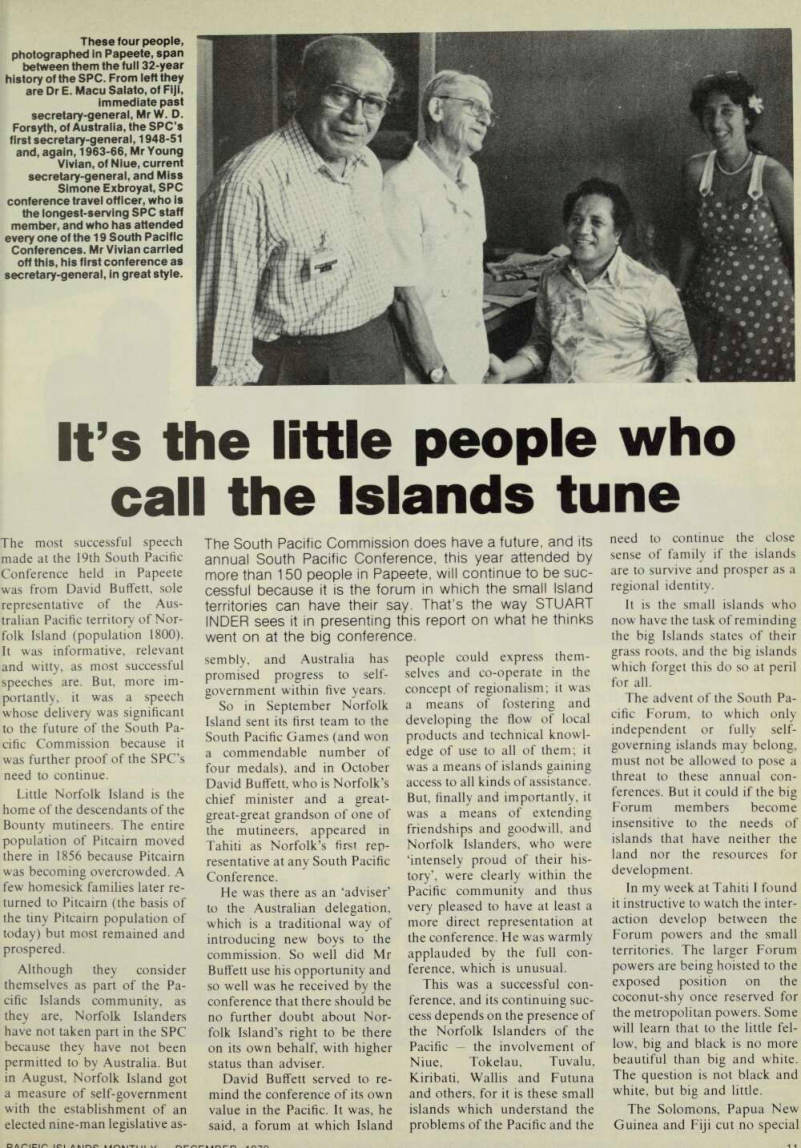
These four people, photographed In Papeete, span between them the full 32-year history of the SPC. From left they are Dr E. Macu Salato, of Fiji, immediate past secretary-general, Mr W. D.
Forsyth, of Australia, the SPC’s first secretary-general, 1948-51 and, again, 1963-66, Mr Young Vivian, of Niue, current secretary-general, and Miss Simone Exbroyat, SPC conference travel officer, who is the longest-serving SPC staff member, and who has attended every one of the 19 South Pacific Conferences. Mr Vivian carried off this, his first conference as secretary-general, in great style.
•ce at the conference simply be cause they have large popu .ations, and I noted resentment Dy some of the smaller terri :ories at the sheer volume of noise made by the bigger states, which is sometimes mistaken for arrogance.
This is unfortunate, because there are needs on both sides.
Ebia Olewale, PNG’s deputy prime minister and minister for foreign affairs, a genuine SPC supporter who works (and plays) with drive and energy for the Pacific family, cannot be accused of personal arro gance. He’s a great Pacific per sonality. But he talked at times, in his usual direct fashion, as if be were at the Forum making
a point bluntly to Australia or
New Zealand.
One of the difficulties is that if men of Olewale’s stature are to come to the conference, and it is vital that they should, then they are going to do their own thing in their own way.
It would be fatal to the SPC T conferences were to be
manned by professional
:onference-goers, of whom there is a small number developing, or by senior, unim aginative functionaries sent along as some kind of reward for loyal service.
Nor would it be good for top men to make a practice of
merely blowing in, making a
speech, and blowing out again.
If they can’t arrange to be pre sent at least for the major part of the conference it’s probably best that they don’t come at all, and thus avoid accusations of
being patronising.
Conference organisers could help resolve this last problem
by recognising that the people
who are most valuable at such
a meeting are busy people, and
reduce the number of days for the conference. This con ference ran from a Saturday to
the following Friday. The
actual meeting time could have been reduced to three-and-a half days of solid work, with periods of relaxation tacked to both ends for people to make use of according to pressures on their time elsewhere.
Apart from the invaluable influence of top men on the de liberations in the conference room, people who can speak for their country with authority are also necessary because of
the growing number of import ant observers now attending the South Pacific Conference.
They were at Papeete in larger numbers than ever.
An observer spends his most useful time outside the con ference session, at the lunch breaks, or at the inevitable eve ning social functions. Here, a diplomat from one of the rim countries not associated with the SPC can sniff the political air of the Islands, informally
discussing matters of possible
mutual interest with Islands’ ministers or foreign affairs staff, without either side being in any way committed. The contacts are invaluable for everybody. The South Pacific Forum can never offer such an informal role.
One of the larger countries which attracted some resent ment at the conference, but for a different reason, was Tonga.
The resentment was not openly expressed on the conference floor, but clearly Tonga needs to review its position in the
SPC. Although independent,
and a Forum member, it is not a participating government of the SPC which means its contributions to the SPC budget are voluntary and not
set as a percentage of the total budget. In the 1980 budget its contribution is CFP2SBO, which compares with CFP27126 each from the governments of Western Samoa, the Solomons, PNG, Nauru and even little Tuvalu.
And this figure is low in the scale compared with the volun tary contributions from other territories and countries.
Yet Tonga benefits from SPC expenditure out of pro portion to its contributions, it has a surprisingly vocal and influential participation in the Planning and Evaluation Com mittee, which virtually establishes the year’s pro gramme, and not for years has there been anything to prevent
Tonga becoming a Participat
ing Government,
That Tonga gets more than it contributes is not necessarily fair criticism; this charge can be levelled against some other countries, particularly PNG, but in any case needs vary from year to year and from country to country.
But unfortunately Tonga
takes a backseat at the con ference itself, adding little or nothing to debate. Many dele continued next page)
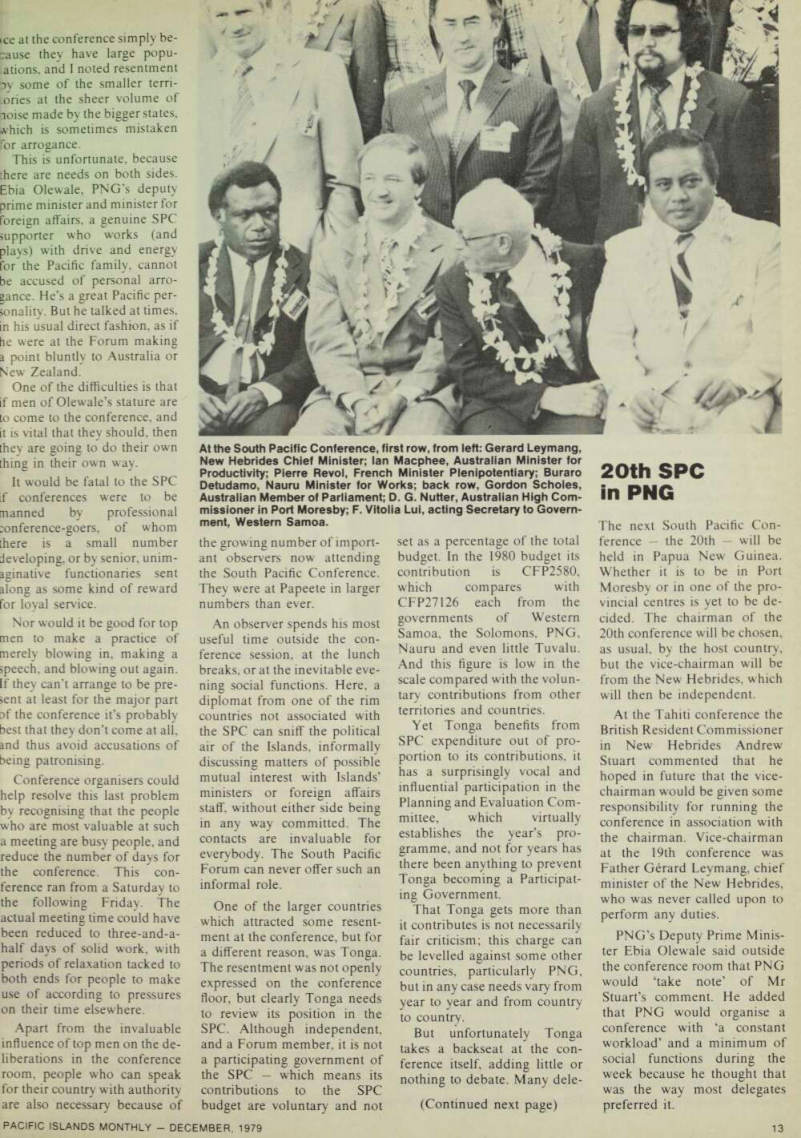
At the South Pacific Conference, first row, from left: Gerard Leymang, New Hebrides Chief Minister; lan Macphee, Australian Minister for Productivity; Pierre Revol, French Minister Plenipotentiary; Buraro Detudamo, Nauru Minister for Works; back row, Gordon Scholes, Australian Member of Parliament; D. G. Nutter, Australian High Com missioner in Port Moresby; F. Vitolia Lui, acting Secretary to Govern ment, Western Samoa.
gates consider that it is import ant that Tonga should be seen to take an active part on the floor of the conference, enter ing into the cut and thrust of
debate. Tonga apparently be
lieves it should not take active participation, and be rep resented by somebody of the calibre of say Crown Prince Tupouto’a while it isn’t a Par ticipating Government. This.is
shortsighted.
Prince Tupouto’a could do a good job for Tonga, and at the same time gain information that Tonga needs if it is to keep abreast of Islands opinion.
Meanwhile, what did every body do at the conference?
In brief, they looked at last year’s budget and works pro gramme and approved next year’s; paying lip service to the Year of the Child, they dis cussed the needs of Islands children, types of stabilisation schemes suitable for South Seas economies (and agreed to do a feasibility study in time for next year’s conference); they directed the secretariat to plan for a second meeting of
Island development planners
to discuss the problems and means of achieving balanced
rural development; they heard
and were satisfied with the planning details for the South Pacific Festival of Arts to be held in Port Moresby in July; they were critical of the atti tude of big airlines to Islands services; they involved them selves in a debate about the re lationship between the South Pacific Commission and the South Pacific Bureau for Econ
omic Co-operation; they got
sidetracked during what should have been a mere formality about the accession of the Cook Islands and Niue to the Canberra Agreement, which is the charter of the South Pacific Commission; and they heard various reports from observers on a wide-range of subjects, from the European Economic Community to the Social Com mission for Asia and Honolulu’s East-West Center.
There was little real contro versy on the floor of the con ference during the entire session.
The days when the atmos phere could have been sliced in half with a cane-knife may well have gone for good. Chairman Maco Tevane’s handling of the
conference deserved some of the credit: his pressure on the reins was light enough for the horse to feel it was free, and firm enough to keep it in the
nght direction.
He was unperturbed on those occasions when delegates involved themselves in politi-
cal grandstanding against the
terms of the SPC charter, and it never got out of hand. He seemed to take the commonsense view that a conferenceroom full of Islanders can hardly expect to discuss their everyday problems for the best part of a week without oc-
casionally talking politics.
The only signs of smoke and sometimes a little flame were to be observed during (a) the debate on Pacific aviation policies (b) as a result of some questions of the position of the French territories in the SPC
and (c) the discussion on the re spective roles of the SPC and
Spec.
• On aviation. Cooks Prem ier Dr Tom Davis, who was able to spend only a day at the conference sitting, threw in a time bomb before he departed.
He attacked the big airlines, and Air New Zealand in par ticular, for Pacific aviation policies which restricted the smaller airlines and, in turn, tourism in the Islands.
He drew attention to a resol ution of last year’s conference protesting at the inadequate air services provided the Islands as a result of high fares, in
frequent flights, and flight
times determined by the larger market at each end of the route, and said none of the governments had done any thing about the situation.
Warming to a stinging
attack, he pointed out that in adequate air services restrictec all sorts of commerce in th< Islands as well as tourism; it af fected exports, employment the availability of skilled man power; it was responsible foi adding to inflation.
In the Cooks, he said, im proved air transport was a cata lyst for economic development A large part of the Cooks tour ist plant was locally owned anc operated, yet the hotels were showing an average occupanc) rate of only 51 per cent. Recem attempts by a regional airline
(Polynesian) to develop links
between Tahiti and Rarotonga had not been successful, due ‘tc an unrealistic attitude by cer tain airline interests’.
A couple of days later, when Dr Davis had gone home, and the conference decided to examine the problem, the Premier turned out to have befriended many like-minded people. Western Samoa, which, with Niue, is also one of the links of Polynesian’s new service, made rude comments about regional co-operation
sometimes being merely lip
service. Nauru’s Kinza Clodumar, who is involved with the operations of Air Nauru and who is currently arguing with New Zealand about fare structures in an effort to make a new Air Nauru service into Auckland oper ational, said pointedly that ‘the rules of the aviation game weigh heavily against the small man’. Restrictive policies of the aviation giants squeezed out the small airlines, he said.
The New Zealand dele gation leader, Tourism Minis ter Warren Cooper, making no specific mention of Polynesian Airlines, argued that aviation
generally was passing through
a difficult period, and said that the introduction of cheap inter national air fares hadn’t brought the Pacific, meaning New Zealand, the benefits expected.
He got no sympathy, but the
debate ended inconclusively, I
with the conference expressing 1 disappointment that the Pacific j governments controlling the airlines had done nothing since ’ last year to meet the aviation I needs of the Islands. • The embarrassing question J about the French Pacific came up unexpectedly while the con
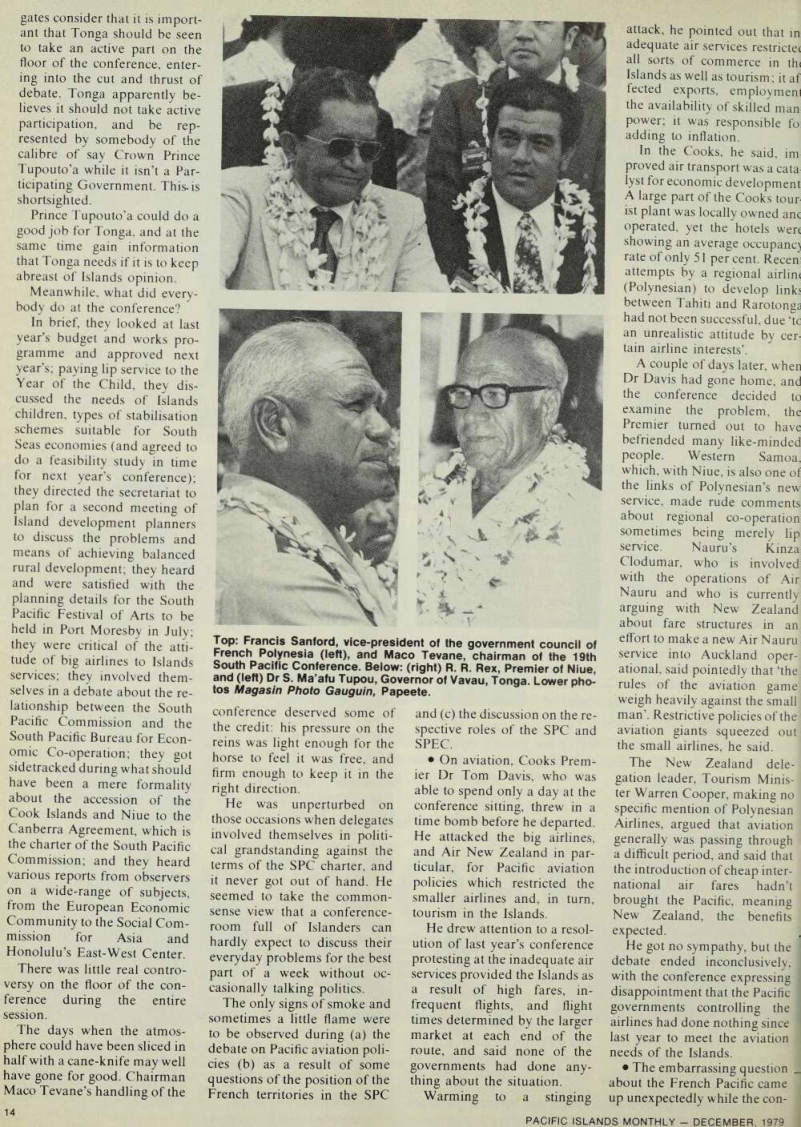
Top: Francis Sanford, vice-president of the government council of French Polynesia (left), and Maco Tevane, chairman of the 19th South Pacific Conference. Below: (right) R. R. Rex, Premier of Niue, and (left) Dr S. Ma’afu Tupou, Governor of Vavau, Tonga. Lower pho tos Magasin Photo Gauguin, Papeete.
t'erence was being told that the look Islands and Niue had not vet formally acceded to the Canberra Agreement because Ihe instruments had not been .igned, but they were to be egarded by the conference as ull members anyway.
New Hebrides Chief Minis er Father Gerard Leymang isked, almost idly, whether Polynesia and New Caledonia could accede to the Canberra Agreement. ‘What’, he asked, ‘is France’s position an this?’
French delegation leader 3 ierre Revol was so annoyed at oeing taken unawares that he
ilmost spluttered, but keeping
limself under admirable con rol, he replied evenly that he
was grateful for the question’,
md explained that it was not )ossible to divide sovereignty vithin the French republic as t was a unitary state. However, here was a door open as a re ult of the new Canberra for nula, and one would have to
;ee how things evolved.
The new formula, or amend nent to the Canberra Agree nent to which Mr Revol was
eferring, reads: ‘Any govern
nent, the territory of which is vithin the territorial scope of he Commission as defined in Article II and which is either idly independent or in free as
sociation with a fully indepen
lent government, may accede o this Agreement, if it is in cited to do so by all participat
ng governments, by depositing
in instrument of accession with he Government of Aus ralia.’
Just what Mr Revol’s reply neant was not at all clear, as he French territories are leither independent nor in free issociation, so one or two of us ook the opportunity at the norning teabreak to ask Mr levol what it was all about.
Mr Revol was still fuming out gave us a fuller interpret ition of what he had said. This vas, ‘The wording which was idopted for the amendments to he Canberra Agreement was
iebated at considerable length
;o the amendments were in ac cordance with constitutional irrangements. While this vording makes it possible to establish distinctions, we must lot forget that the structure of
(Continued next page)
ie French constitution is a nitary construction and that 11 French citizens overseas are tizens on exactly the same >oting as citizens who live in ictropolitan France. You can- Dt divide France’s sover gnty. The wording that was Jopted for the amendment :aves the door open to future langes for the territories of
ie region.’
What, I asked Mr Revol, ould be the conditions under hich the French territories >uld accede?
Replied Mr Revol; ‘Nothing
i the Canberra Agreement >uld make it possible for New aledonia and French □lynesia to accede unless irough a vote they wished to
s independent.’
• On the third controversial latter, the case of the associ tion between the SPC and the outh Pacific Bureau for Econ mic Co-operation, which is ie economic arm of the South acific Forum, has been a fes jring sore for the last year or vo. The SPC was established i 1947. The Forum was set up i 1971 to give the leaders of le independent nations in the outh Pacific the opportunity ) talk to each other about any
abject they chose, including
olitical matters not then ossible in the SPC, although
:s prohibition on political dis
ussions is now honoured more i the breach than the observ nce.
The Forum soon established PEC, designed as a secretariat 3 carry out the Forum’s aims nd supply it with facts and fig res. It was inevitable that as tie Forum became stronger, PEC would too, and that it /ould be moving at times in tie same areas as the SPC.
The latest Forum meeting, eld in Honiara in July, pro iosed that the Forum and SPC stablish a joint committee of ix to examine the relationship if SPEC and SPC with a view
o minimising these overlaps.
Tie Papeete conference agreed
o this, and elected as its epresentatives on the commit ee the New Hebrides, American Samoa and French
’olynesia, with an independent
hairman yet to be chosen.
To kick off the debate the >PC secretariat submitted a artly brief report outlining the
various areas of co-operation
already existing between SPC
and SPEC. The main message in it appeared to be that while the SPC invites SPEC to every meeting the SPC thinks might be useful to that organisation, SPEC does not invite SPC to any of its meetings, nor to Forum meetings. This was, in fact, a good point and the Forum should remedy it.
The ensuing debate covered
opinions so varying in intensity
that it served to underline the genuine need for a joint com mittee to hammer out some kind of direction.
The debate also boiled over into discussion of the relation ship of the Islands to the SPC, with American Samoa’s
conference-experienced P.
Tuiasosopo (‘Brownie’), taking
the opportunity to remind those members of the con ference who were also mem bers of the exclusive Forum, that the conference, not the Forum, alone gave the oppor tunity for all islands to express opinions about matters rel evant to everybody. He was
only momentarily upset by
some baiting from Ebia Olewale who said pointedly it was not possible for terri tories of metropolitan powers to be equal partners with Forum members because they were unable to speak their mind. Brownie retorted crisply that his instructions at the con ference came from the Govern ment of American Samoa, not the Government of the United States.
But the most biting comment came the next day from the inaugurating director of SPEC,
Mahe Tupouniua, of Tonga,
who relinquishes the post at the end of the year for Dr Gabriel Gris, of PNG. Addressing the conference by invitation, Mahe said that despite some ‘immoderate and fairly strong
language’ in the previous day’s
debate, he could say with a clear conscience that SPEC had always endeavoured to co operate closely with SPC.
Informal discussions had helped resolve unforeseen problems before they devel oped; and his own view was that relations were on a most
cordial plane.
He added: ‘By the very nature of development in the region, as issues become more complex and involvements grow and expand, there has in evitably been a certain amount of overlap, and thus the need has arisen to avoid dupli cation... That the SPEC has been misunderstood in its atti tude and the way it had gone about tackling this problem, I have no doubt, as was demon strated I thought in yesterday’s discussion. For the mistakes that we have made, I can but apologise. This is a cross one has to bear when taking up an appointment of this nature. ‘But reports or rumours of “takeovers” are without foun dation as far as SPEC is con cerned. This is a great pity and something ought to be done to correct it. Otherwise it only serves to distort the South Pa
cific regional co-operation pro
cedures in such a way that we run the risk of frittering away our resources, dealing with ap pearances when we should be grappling with the substance, the real issue, the total issue.
‘Words like “competition”,
“rivalry” and “jealousy” have
no place in the Pacific way of dealing with delicate and sensi tive issues. In such a context, words have meanings which are most un-Pacific. And I can only urge the conference that the sinister development of an “under siege” mentality that I have detected in recent utter ances from responsible quar ters who should know better is undermining the health of the South Pacific regional co operation endeavours, and the sooner it is corrected the bet ter. ‘SPEC is no more than a sec retariat which serves the independent South Pacific nations in the body of the South Pacific Forum, and acts as the Forum’s executive. It is not for us to formulate a policy, but to follow the directions given to us. This we do without embellishment.’
Mahe Tupounia has been a highly competent and dedi cated director of SPEC, a man of integrity who believes sin cerely in what he says. It’s probable though that he fails to recognise his own drive and in itiative when he says it is not for the SPEC secretariat to for mulate policy, but to follow directions. Anybody who has seen Mahe on the job in the Islands could be left in little doubt that Forum policies must sometimes be shaped and sharpened, and at times initi ated, by him.
Given the fact that the Forum leaders have heavy re sponsibilities in their own islands and don’t have the time to involve themselves to any real extent outside the few days a year devoted to Forum meet ings, even a dull executive offi cer is going to find himself
closely involved in policy.
A man of Mahe’s stature can’t really expect to do his job as he sees it without inevitably
stirring up charges of
‘takeover’! The fact is that SPEC and the SPC do at times cross each other’s bows, and will continue to do so while or
ganisations are run by people
and not computers.
The SPEC-SPC debate did slot up an important win in an unexpected quarter for French Polynesia. When the conference suggested that French Polynesia should be on
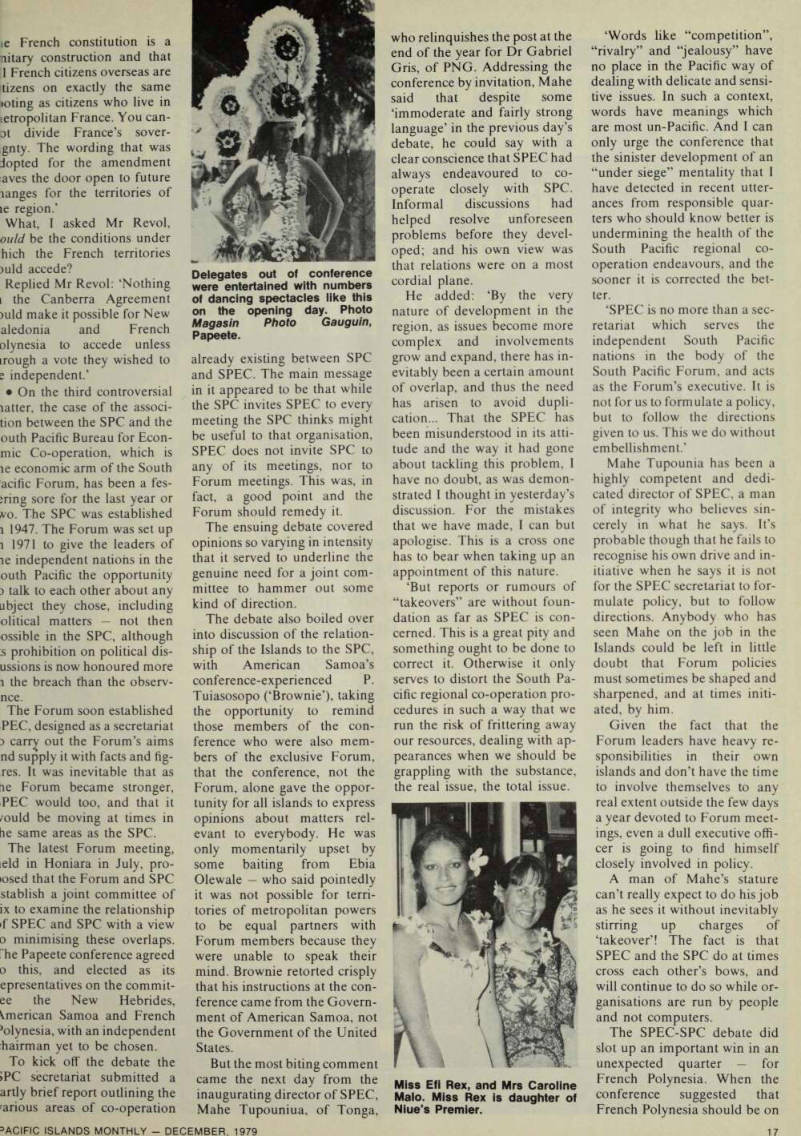
Delegates out of conference were entertained with numbers of dancing spectacles like this on the opening day. Photo Magasin Photo Gauguin, Papeete.
Miss Efi Rex, and Mrs Caroline Malo. Miss Rex is daughter of Niue’s Premier.
he review committee, the |uestion that was in every body’s mind was whether Tance would allow her terri ory to represent herself, or
vhether metropolitan France
vould want that seat. The French delegation asked for ime for discussion. The result:
-rench Polynesia got the
eat.
This was one further ixample of the changing re
ationship between metropoli
an France and French ’olynesia. The new atmos )here was an important facet >f the success of the Tahiti con erence, the first to be held here. The conference was
>rganised not by France but by
elf-governing French
’olynesia and its assembly
ind very well organised, with
;reat goodwill. The French
’olynesians showed by
xample that the weight of aetropolitan bureaucracy was
lot these days heavy, and that
fieir Pacific neighbours could
»est help Polynesia by recog
dsing that they had the re
ponsibility of running their
iwn affairs and needed the
ame sort of help and sympathy
s anybody else.
This relaxed attitude was ssisted by Mr Pierre Revol,
Tance’s representative at the
onference, who made no /aves, even managing to beam hat there were no difficulties t all about Ebia Olewale’s inexpected excursion into
acal politics (see separate
tory); that Ebia was a ‘good riend of his’.
A rumour that the organisers iad cancelled the usual end-of onference concert because of nnoyance over something 4ew Zealand Minister Warren "ooper was supposed to have aid about ‘too much feasting’, /as only a rumour. The concert /as cancelled, but because of
easons of complicated dom
stic politics not connected
/ith delegates. Mr Cooper
icvertheless later wrote from Vellington to Francis Sanford, aying he was ‘indeed sorry hat this unfortunate and ntirely incorrect report should lave appeared’, and that he
lad nothing ‘but the deepest
latitude for Tahiti’s welcome, md the warmth of its hospi
ality’.
Everyone would agree to hat.
Advertisements & other items, pp. 11-13 (3 items)
11
D AnriP ICI A MHO lIAMTI II v/ pvPAninrn •( mn
Ricoh
Simply A Pleasure
For The Whole Family.
Isn’t it time you started taking better pictures?
It’s easy. Start with the new Ricoh KRS. Now, snapshots are no longer potshots.. .professional results are no longer a mystery. Quite simply, here’s one SLR camera the whole family can use.
A Handling Beauty Just the right size and weight 7 make the KRS a pleasure to landle and carry. Insert your •avorite 35mm film and the
im begins.
KR-5 Vn SLR Viewfinder Vhat you see is what you get. \ large, bright through-the-lens lew, for accurate composition. r
RICOH
r* i !<■ 5 :4 * 1)1
Ricoh
o, •x ' f \
I JL
'lk And versatile 3-way focusing, for edge-to-edge sharpness.
CdS Type TTL Metering Simply match the two viewfinder needles to set exposure.
Ricoh’s advanced electronics assure optimum light measurement. Day or night, indoors or out.
RICOH
A Choice of Interchangeable Lenses Group shots? Portraits?
Close-ups? Whatever the situation, take your choice of the high quality, easy-changing XR Rikenon lens selection.
And accessories. •V, r more information about the Ricoh KRS, write to N RICOH COMPANY, LTD. 14-6, Ginza 6-chome, Chuo-ku,Tokyo 104, Japan.
KICOH ) Distributors. Australia Bell & Howell Australia Pty. Ltd. •G.P.O. Box 4778, 55-69 Murray Street, Pyrmont, N.S.W., y Australia, New Zealand H.E. Perry Ltd. *145 Victoria Street, PO. Box 111, Christchurch 1, New Zealand, Norfolk Is. itons Department Stores Ltd •PO. Box 146, Norfork Island 2899, South Pacific, Fiji Narseys Limited »Renwick Road, Suva, Fiji. Tahiti Ets. utimex •B.P 617 Papeete, Tahiti (French Polynesia) New Caledonia Omnium Caledonien Importation «Rue de L'Esperance. B.P 2248, Magenta,
20th SPC
in PNG
The next South Pacific Con ference the 20th will be held in Papua New Guinea.
Whether it is to be in Port Moresby or in one of the pro vincial centres is yet to be de cided. The chairman of the 20th conference will be chosen, as usual, by the host country, but the vice-chairman will be from the New Hebrides, which will then be independent.
At the Tahiti conference the British Resident Commissioner in New Hebrides Andrew Stuart commented that he hoped in future that the vice chairman would be given some
responsibility for running the
conference in association with the chairman. Vice-chairman at the 19th conference was Father Gerard Leymang, chief minister of the New Hebrides, who was never called upon to perform any duties.
PNG’s Deputy Prime Minis ter Ebia Olewale said outside the conference room that PNG would ‘take note’ of Mr Stuart’s comment. He added that PNG would organise a conference with ‘a constant workload’ and a minimum of social functions during the week because he thought that was the way most delegates
preferred it.
Polynesian independence rally
What Olewale told the French Polynesian independence rally
Island leaders who addressed a big political rally of members of the French Polynesian independence movement in Papeete on October 11, had the same advice to give: unanimity among the parties seeking independence is vital to suc cess.
There are a number of small
independence parties in
French Polynesia and they don’t all share the same views.
Nor are their views necessarily shared by the United Autonomist Front, which is in power, and not as radical in its movement towards indepen dence as some of the smaller
parties represented at the
Papeete rally. The difference probably is that Francis San ford’s government now has the task of making self government work effectively before there can be the next step, and responsibility is in clined to bring with it cooler heads. Some of the smaller par ties are critical of this.
Papua New Guinea’s Minis ter for Foreign Affairs and Trade Ebia Olewale spent about 30 minutes at the rally, which was held in Papeete, and attended by about 250 men, women and children. Olewale had just come from a cocktail party put on by the New Hebrides delegation to the South Pacific Conference to mark agreement over the New Hebrides’ new constitution, and was already late for a party hosted by the High Com missioner in French Polynesia for heads of delegations. In fact he didn’t go, but went instead to a village feast farther up the coast, and later made his apologies. This is what Olewale
told the Papeete rally:
‘This invitation gave me a pleasant surprise because it is said in other world forums where political debates take place that the people of French Polynesia do no want indepen dence and sovereign status.
You have a political party here and one of its basic principles, which is the same as what we have in Papua New Guinea as a preamble to our Constitution,
is that power belongs to the
people.
‘I am very happy to be stand ing here in front of you. I have a very short time, but my think ing is that my aspirations, and my heart, for the struggle you are now in is with you. ‘My country only became independent in 1975. PNG is a developing country, like yours.
However, we are not afraid to
speak our mind internationally
for other Pacific Island terri tories which are still being governed from outside. All of you here are friends and brothers and sisters in the Pa cific. Whatever you have to tell us, we will speak for you in the United Nations, and in the Pa cific in the Forum. ‘And a word of advice: what ever you may do for the independence movement you must stand together because those people who govern and administer us are very clever there, they will try to divide you and rule you. They can
play one group against
another. I am speaking from experience because I and many other PNG leaders have gone through all these kinds of stages you are in now. You are not alone. We are with you.
Work together and stand
together!’
Olewale was applauded sev eral times during his speech.
Later, PNG’s deputy prime
minister stood up briefly to comment on a point made by one of the French Polynesian
speakers that the independence
movement needed help from educated people. ‘We have a university in Papua New Guinea.’ he said. ‘We have students from Tonga and from Samoa. We can look after your students in PNG.’
This was greeted with ap plause.
Minister for Public Adminis tration in the New Hebrides Government George Kalkoa told the meeting that ‘some of us share Mr Olewale’s views’.
He said: ‘Especially in your
struggle for independence we
are with you in our hearts. I come from the New Hebrides,
governed by Britain and
France, and I have the same problems you have now, and we have one more step before we go through that door.
T come from one of the
strong political parties
Vanuaaku and I must re mind you again of what Olewale said, that you have a
number of political parties
going for independence and
you must have team work in what you are going to do.
Tn the New Hebrides we work together to achieve our aim, and we’ve pushed France and the UK for the last seven years and now we are about to achieve independence. The Vanuaaku Party will always be behind New Caledonia and French Polynesia in your
struggle for independence.’
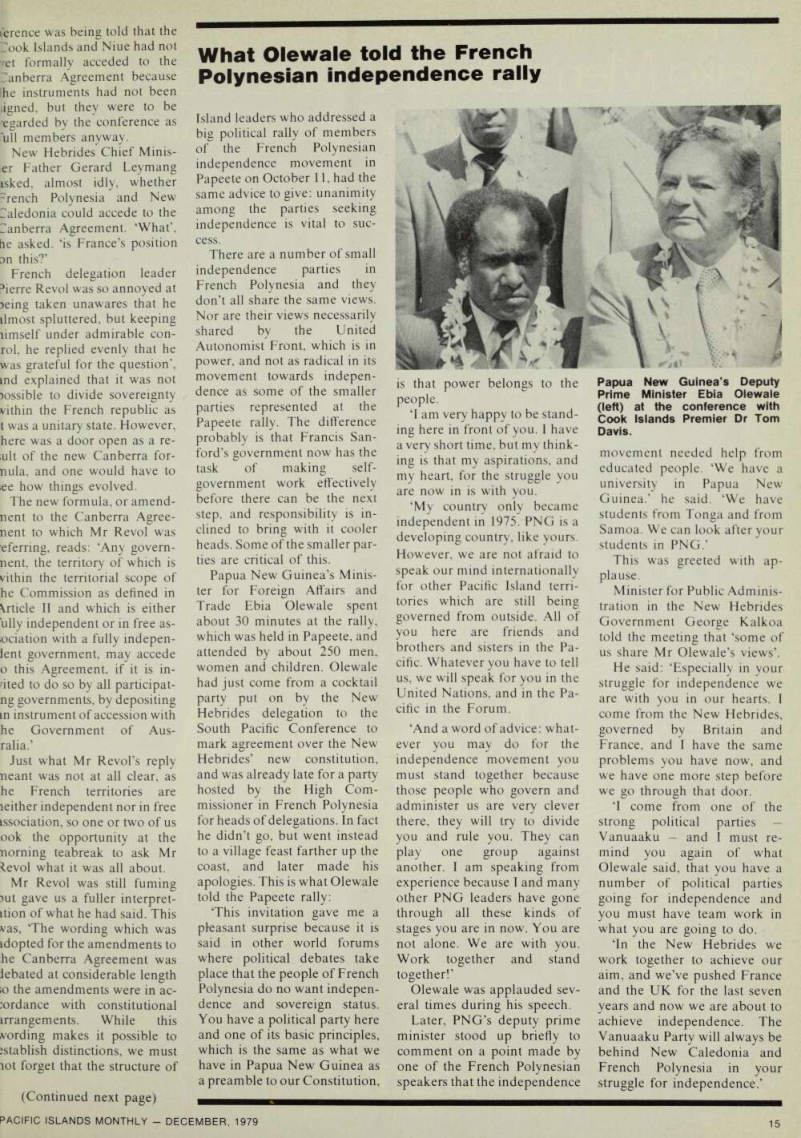
Papua New Guinea’s Deputy Prime Minister Ebia Olewale (left) at the conference with Cook Islands Premier Dr Tom Davis.
Advertisements & other items, pp. 16-18 (1 item)
Seiko Men’s Dress Quartz Collection,
As Seiko enters its second decade of world leadership in quartz technology:
So slim, so elegant. So superbly accurate.
Now you can own a quality Seiko Quartz dress watch that represents a new level in fashionable sophistication. Here is impeccable styling combined with the unsurpassed accuracy and dependability of Seiko Quartz. Crafted with trim good looks.
Engineered with Seiko s uniquely advanced technology. In a variety of starkly beautiful styles to satisfy men of excellent taste everywhere.
It's what you'd expect from Seiko, the company that sold the world's first quartz watch and that never ends its quest for quality and dedication
to technology. Seiko Quartz.s&
\ ■ \ & % ‘i / \ i* ■ * f*-?* * '■ ■ x ' .
Someday all watches will be made this way.
Beehive Building 94 Elizabeth Street Melbourne, Victoria Australia 3000 G.P.O. Box 8 Melbourne, Victoria Australia 301
Cablesr^
Telex: AA34552 Phone: 63 5094
from and where it goes
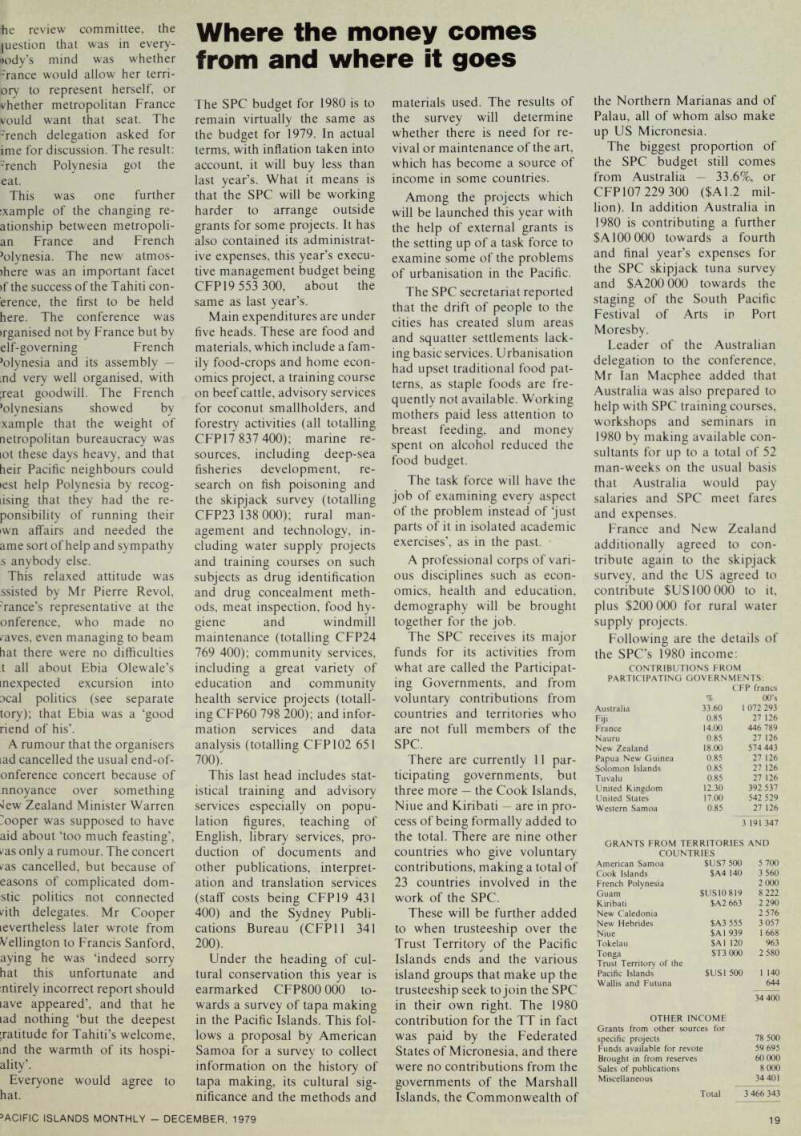
Where the money comes from and where it goes
The SPC budget for 1980 is to remain virtually the same as the budget for 1979. In actual terms, with inflation taken into account, it will buy less than last year’s. What it means is that the SPC will be working harder to arrange outside grants for some projects. It has also contained its administrat ive expenses, this year’s execu
tive management budget being
CFPI9 553 300, about the same as last year’s.
Main expenditures are under five heads. These are food and materials, which include a fam ily food-crops and home econ omics project, a training course on beef cattle, advisory services for coconut smallholders, and
forestry activities (all totalling
CFPI7 837 400); marine re
sources, including deep-sea
fisheries development, re search on fish poisoning and
the skipjack survey (totalling
CFP23 138 000); rural man agement and technology, in
cluding water supply projects
and training courses on such
subjects as drug identification
and drug concealment meth ods, meat inspection, food hy giene and windmill maintenance (totalling CFP24 769 400); community services, including a great variety of education and community health service projects (totall ing CFP6O 798 200); and infor mation services and data
analysis (totalling CFPIO2 651
700).
This last head includes stat
istical training and advisory
services especially on popu
lation figures, teaching of
English, library services, pro
duction of documents and
other publications, interpret
ation and translation services (staff costs being CFPI9 431 400) and the Sydney Publi cations Bureau (CFPII 341 200).
Under the heading of cul tural conservation this year is earmarked CFPBOO 000 to wards a survey of tapa making in the Pacific Islands. This fol lows a proposal by American Samoa for a survey to collect information on the history of tapa making, its cultural sig nificance and the methods and
materials used. The results of the survey will determine whether there is need for re vival or maintenance of the art, which has become a source of income in some countries.
Among the projects which will be launched this year with the help of external grants is the setting up of a task force to examine some of the problems of urbanisation in the Pacific.
The SPC secretariat reported that the drift of people to the cities has created slum areas and squatter settlements lack ing basic services. Urbanisation had upset traditional food pat terns, as staple foods are fre
quently not available. Working
mothers paid less attention to breast feeding, and money spent on alcohol reduced the
food budget.
The task force will have the job of examining every aspect of the problem instead of ‘just parts of it in isolated academic exercises’, as in the past.
A professional corps of vari ous disciplines such as econ omics, health and education,
demography will be brought
together for the job.
The SPC receives its major funds for its activities from what are called the Participat ing Governments, and from voluntary contributions from countries and territories who are not full members of the
Spc.
There are currently 11 par ticipating governments, but three more the Cook Islands, Niue and Kiribati are in pro cess of being formally added to the total. There are nine other
countries who give voluntary
contributions, making a total of 23 countries involved in the work of the SPC.
These will be further added to when trusteeship over the Trust Territory of the Pacific Islands ends and the various island groups that make up the trusteeship seek to join the SPC in their own right. The 1980 contribution for the TT in fact was paid by the Federated States of Micronesia, and there were no contributions from the governments of the Marshall Islands, the Commonwealth of
the Northern Marianas and of Palau, all of whom also make up US Micronesia.
The biggest proportion of
the SPC budget still comes from Australia 33.6%, or
Cfpio7 229 300 (Sai.2 Mil
lion). In addition Australia in 1980 is contributing a further $A 100 000 towards a fourth and final year’s expenses for the SPC skipjack tuna survey and SA2OO 000 towards the staging of the South Pacific Festival of Arts in Port
Moresby.
Leader of the Australian delegation to the conference, Mr lan Macphee added that Australia was also prepared to help with SPC training courses, workshops and seminars in 1980 by making available con sultants for up to a total of 52 man-weeks on the usual basis that Australia would pay salaries and SPC meet fares and expenses.
France and New Zealand
additionally agreed to con
tribute again to the skipjack survey, and the US agreed to contribute SUSIOO 000 to it, plus $2OO 000 for rural water
supply projects.
Following are the details of the SPC’s 1980 income;
Contributions From
Participating Governments:
CFP francs % 00’s Australia 33.60 1 072 293 Fiji 0.85 27 126 France 14.00 446 789 Nauru 0.85 27 126 New Zealand 18.00 574 443 Papua New Guinea 0.85 27 126 Solomon Islands 0.85 27 126 Tuvalu 0.85 27 126
United Kingdom
12.30 392 537 United Stales 17.00 542 529 Western Samoa 0.85 27 126 3 191 347
Grants From Territories
And
Countries
American Samoa $US7 500 5 700 Cook Islands $A4 140 3 560 French Polynesia 2000 Guam
Sus10819
8 222 Kiribati $A2 663 2 290 New Caledonia 2 576 New Hebrides $A3 555 3 057 Niue $A1 939 1 668 Tokelau SA1 120 963 Tonga ST3 000 2 580 Trust Territory of the Pacific Islands $US1 500 1 140 Wallis and Futuna 644 34 400
Other
Income
Grants from other sources for
specific projects
78 500 Funds available for revote 59 695 Brought in from reserves 60 000 Sales of publications 8000 Miscellaneous 34 401 Total 3 466 343
Advertisements & other items, pp. 19-20 (2 items)
19
■’ACIFIC ISLANDS MONTHLY - DECEMBER, 1979
AKAI Sound Quality
AKAI
s-m** IZ2
A A
AJ-500FS/FL
N * #■
AJ-360FS/FL/MS
AJ
490FS/FL
* \\ n &
AKAI Sound Quality
The Difference is Clear.
Listen to any of these newly-designed AKAI radio/cassette recorders and you’ll hear AKAI’s superior audio technology at work. Sound quality that’s amazingly rich and natural. Performance that matches every customer desire. And the high sales appeal that makes AKAI the clear choice every time. ■ AJ-500FS/FL 4-Band Stereo Radio Cassette Recorder •Instant Program Locating System • Powerful 6,000mW X 2 Max. Power Output • Large 2-Way 4-Speaker System ■ AJ-490FS/FL 4-Band Stereo Radio Cassette Recorder • Hefty 3,800mW X 2 Max. Power Output • Dynamic 2-Way 4-Speaker System ■ AJ-360FS/FL/MS 3-Band Radio Cassette Recorder •Max. Music Power of s,ooomW»Full-Range 16cm Speaker
HI-FI & VIDEO
AKAI
J<AI ELECTRIC CO., LTD.
okyo, Japan
P.N.G.
S.O. Svensson (N.G.) Ltd.
P.O. Box 705, Port Moresby Tel: 2275 Fiji Islands Motibhai & Company Ltd.
P.0.80x 9175, Nadi International Airport Tel: 72-165 New Zealand Pye Ltd., Consumer Products Sector 110 Mt. Eden Rd., Mt. Eden, Auckland Tel: 686-437 New Caledonia Menard Pacifique s.a.r.l.
B.P. H 2, Noumea Tel: 275222 Tahiti Etablissements Comimpex P.0.80x 200, Papeete Tel: 20477 New Hebrides (Islands) Burns Philp (New Hebrides) Co., Ltd.
P.O. Box 27, Port Vila, New Hebrides Islands Norfolk Island Burns Philp (Norfolk Island) Co., Ltd.
P.O. Box 21, Norfolk Island Samoa Islands Burns Philp (South Sea) Co., Ltd.
P.O. Box 129, Pago Pago, American Samoa Mariana Islands J.C. Tenorio Enterprises P.O. Box 137, Saipan Tel: 6444/8 Solomon Islands Security Electrical Co., Ltd.
P.O. Box 174, Honiara Tel: 881 Cook Islands JPS Enterprises Ltd.
P.O. Box 15, Rarotonga Tel: 2150,2176 For more information, please send this coupon to our distributor in your country or to AKAI ELECTRIC CO., LTD. 12-14,2-Chome, Higashi-Kojiya, Ohta-ku, Tokyo, Japan Name Address
PIM-12
Currents
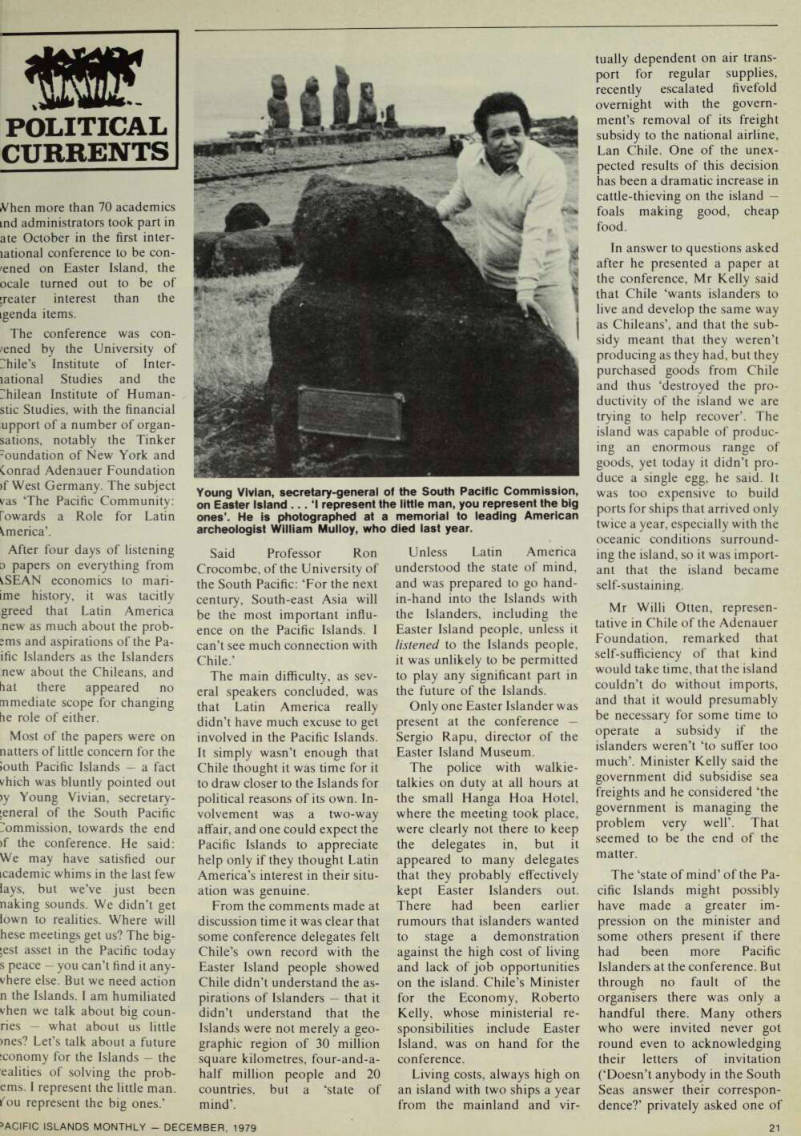
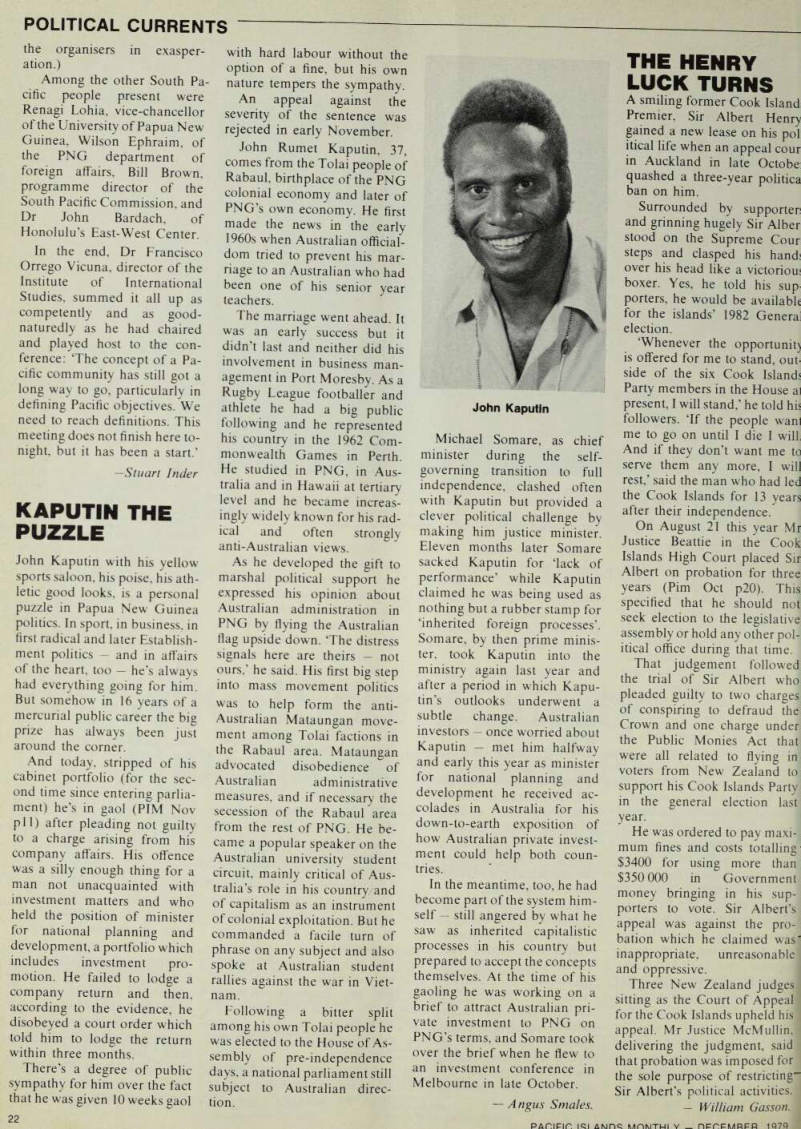
Political
iVhen more than 70 academics ind administrators took part in ate October in the first inter lational conference to be con vened on Easter Island, the ocale turned out to be of ;reater interest than the
igenda items.
The conference was con
vened by the University of
Chile’s Institute of Inter mtional Studies and the Zhilean Institute of Human stic Studies, with the financial upport of a number of organ
sations, notably the Tinker
foundation of New York and Conrad Adenauer Foundation
>f West Germany. The subject
vas ‘The Pacific Community:
towards a Role for Latin America’.
After four days of listening o papers on everything from economics to mari
ime history, it was tacitly
greed that Latin America new as much about the prob ;ms and aspirations of the Pa ific Islanders as the Islanders new about the Chileans, and bat there appeared no
mmediate scope for changing
tie role of either.
Most of the papers were on natters of little concern for the louth Pacific Islands a fact
vhich was bluntly pointed out
>y Young Vivian, secretary
;eneral of the South Pacific lommission, towards the end >f the conference. He said; We may have satisfied our icademic whims in the last few lays, but we’ve just been naking sounds. We didn’t get lown to realities. Where will hese meetings get us? The big jest asset in the Pacific today s peace you can’t find it any vhere else. But we need action n the Islands. I am humiliated vhen we talk about big coun ries what about us little mes? Let’s talk about a future :conomy for the Islands the ealities of solving the prob ems. I represent the little man. fou represent the big ones.’
Said Professor Ron Crocombe, of the University of the South Pacific: ‘For the next century, South-east Asia will be the most important influ ence on the Pacific Islands. I can’t see much connection with Chile.’
The main difficulty, as sev eral speakers concluded, was that Latin America really didn’t have much excuse to get involved in the Pacific Islands.
It simply wasn’t enough that Chile thought it was time for it to draw closer to the Islands for political reasons of its own. In volvement was a two-way affair, and one could expect the Pacific Islands to appreciate
help only if they thought Latin
America’s interest in their situ ation was genuine.
From the comments made at discussion time it was clear that some conference delegates felt Chile’s own record with the Easter Island people showed Chile didn’t understand the as pirations of Islanders that it didn’t understand that the Islands were not merely a geo graphic region of 30 million square kilometres, four-and-a half million people and 20 countries, but a ‘state of mind’.
Unless Latin America understood the state of mind, and was prepared to go hand in-hand into the Islands with the Islanders, including the Easter Island people, unless it listened to the Islands people, it was unlikely to be permitted to play any significant part in the future of the Islands.
Only one Easter Islander was present at the conference Sergio Rapu, director of the Easter Island Museum.
The police with walkie talkies on duty at all hours at the small Hanga Hoa Hotel, where the meeting took place, were clearly not there to keep the delegates in, but it
appeared to many delegates
that they probably effectively
kept Easter Islanders out.
There had been earlier rumours that islanders wanted to stage a demonstration
against the high cost of living
and lack of job opportunities on the island. Chile’s Minister for the Economy, Roberto Kelly, whose ministerial re sponsibilities include Easter Island, was on hand for the conference.
Living costs, always high on
an island with two ships a year from the mainland and vir
tually dependent on air trans
port for regular supplies,
recently escalated fivefold overnight with the govern ment’s removal of its freight subsidy to the national airline, Lan Chile. One of the unex pected results of this decision has been a dramatic increase in cattle-thieving on the island
foals making good, cheap
food.
In answer to questions asked after he presented a paper at the conference, Mr Kelly said that Chile ‘wants islanders to live and develop the same way as Chileans’, and that the sub sidy meant that they weren’t
producing as they had, but they
purchased goods from Chile
and thus ‘destroyed the pro ductivity of the island we are trying to help recover’. The island was capable of produc ing an enormous range of goods, yet today it didn’t pro duce a single egg, he said. It was too expensive to build ports for ships that arrived only twice a year, especially with the oceanic conditions surround ing the island, so it was import ant that the island became self-sustaining.
Mr Willi Otten, represen tative in Chile of the Adenauer Foundation, remarked that self-sufficiency of that kind would take time, that the island couldn’t do without imports, and that it would presumably be necessary for some time to operate a subsidy if the islanders weren’t ‘to suffer too much’. Minister Kelly said the government did subsidise sea freights and he considered ‘the government is managing the problem very well’. That seemed to be the end of the matter.
The ‘state of mind’ of the Pa
cific Islands might possibly
have made a greater im pression on the minister and some others present if there had been more Pacific Islanders at the conference. But through no fault of the organisers there was only a handful there. Many others who were invited never got round even to acknowledging their letters of invitation (‘Doesn’t anybody in the South Seas answer their correspon dence?’ privately asked one of
Young Vivian, secretary-general of the South Pacific Commission, on Easter Island ... ‘I represent the little man, you represent the big ones’. He is photographed at a memorial to leading American archeologist William Mulloy, who died last year.
the organisers in exasper ation.) Among the other South Pa cific people present were Renagi Lohia, vice-chancellor of the University of Papua New Guinea, Wilson Ephraim, of the PNG department of foreign affairs. Bill Brown, programme director of the South Pacific Commission, and Dr John Bardach, of Honolulu’s East-West Center.
In the end, Dr Francisco Orrego Vicuna, director of the Institute of International Studies, summed it all up as competently and as good naturedly as he had chaired and played host to the con ference: ‘The concept of a Pa cific community has still got a long way to go, particularly in
defining Pacific objectives. We
need to reach definitions. This meeting does not finish here to night, but it has been a start.’
Stuart Inder
Kaputin The
Puzzle
John Kaputin with his yellow sports saloon, his poise, his ath letic good looks, is a personal puzzle in Papua New Guinea politics. In sport, in business, in first radical and later Establish ment politics - and in affairs of the heart, too he’s always had everything going for him.
But somehow in 16 years of a mercurial public career the big prize has always been just around the corner.
And today, stripped of his cabinet portfolio (for the sec ond time since entering parlia ment) he’s in gaol (PIM Nov p 11) after pleading not guilty to a charge arising from his company affairs. His offence was a silly enough thing for a man not unacquainted with investment matters and who held the position of minister for national planning and development, a portfolio which includes investment pro motion. He failed to lodge a company return and then, according to the evidence, he disobeyed a court order which told him to lodge the return within three months.
There’s a degree of public sympathy for him over the fact that he was given 10 weeks gaol
with hard labour without the option of a fine, but his own nature tempers the sympathy.
An appeal against the severity of the sentence was rejected in early November.
John Rumet Kaputin, 37, comes from the Tolai people of Rabaul, birthplace of the PNG colonial economy and later of PNG’s own economy. He first made the news in the early
1960 s when Australian official
dom tried to prevent his mar riage to an Australian who had been one of his senior year teachers.
The marriage went ahead. It was an early success but it didn’t last and neither did his involvement in business man agement in Port Moresby. As a Rugby League footballer and athlete he had a big public following and he represented his country in the 1962 Com monwealth Games in Perth.
He studied in PNG, in Aus tralia and in Hawaii at tertiary level and he became increas ingly widely known for his rad ical and often strongly anti-Australian views.
As he developed the gift to marshal political support he expressed his opinion about Australian administration in PNG by flying the Australian flag upside down. ‘The distress signals here are theirs not ours,’ he said. His first big step into mass movement politics was to help form the anti- Australian Mataungan move ment among Tolai factions in the Rabaul area. Mataungan advocated disobedience of Australian administrative measures, and if necessary the secession of the Rabaul area from the rest of PNG. He be came a popular speaker on the Australian university student circuit, mainly critical of Aus tralia’s role in his country and of capitalism as an instrument of colonial exploitation. But he commanded a facile turn of phrase on any subject and also spoke at Australian student rallies against the war in Viet nam.
Following a bitter split among his own Tolai people he was elected to the House of As
sembly of pre-independence
days, a national parliament still subject to Australian direc tion.
Michael Somare, as chief minister during the self governing transition to full independence, clashed often with Kaputin but provided a
clever political challenge by
making him justice minister.
Eleven months later Somare sacked Kaputin for ‘lack of performance’ while Kaputin claimed he was being used as nothing but a rubber stamp for ‘inherited foreign processes’.
Somare, by then prime minis ter, took Kaputin into the ministry again last year and after a period in which Kapu tin’s outlooks underwent a subtle change. Australian investors once worried about
Kaputin met him halfway
and early this year as minister for national planning and development he received ac colades in Australia for his down-to-earth exposition of how Australian private invest ment could help both coun tries.
In the meantime, too, he had become part of the system him self still angered by what he saw as inherited capitalistic processes in his country but prepared to accept the concepts themselves. At the time of his gaoling he was working on a brief to attract Australian pri vate investment to PNG on PNG’s terms, and Somare took over the brief when he flew to an investment conference in Melbourne in late October.
Angus Smales.
John Kaputin
Luck Turns
The Henry
A smiling former Cook Island: Premier, Sir Albert Henry gained a new lease on his pol itical life when an appeal cour in Auckland in late Octobe; quashed a three-year politica ban on him.
Surrounded by supporter; and grinning hugely Sir Alber stood on the Supreme Cour steps and clasped his hand; over his head like a victorious boxer. Yes, he told his sup porters, he would be available for the islands’ 1982 General election. ‘Whenever the opportunity is offered for me to stand, out side of the six Cook Islands Party members in the House al present, I will stand,’ he told his followers. ‘lf the people want me to go on until I die I will.
And if they don’t want me to serve them any more, I will rest,’ said the man who had led the Cook Islands for 13 years after their independence.
On August 21 this year Mr Justice Beattie in the Cook Islands High Court placed Sir Albert on probation for three years (Pirn Oct p2O). This specified that he should not seek election to the legislative assembly or hold any other pol itical office during that time.
That judgement followed the trial of Sir Albert who
pleaded guilty to two charges
of conspiring to defraud the Crown and one charge under the Public Monies Act that were all related to flying in voters from New Zealand to support his Cook Islands Party in the general election last year.
He was ordered to pay maxi mum fines and costs totalling s34oo for using more than $350 000 in Government money bringing in his sup porters to vote. Sir Albert’s appeal was against the pro bation which he claimed wasl
inappropriate, unreasonable j
and oppressive.
Three New Zealand judges sitting as the Court of Appeal j for the Cook Islands upheld his 1 appeal. Mr Justice McMullin, j
delivering the judgment, said
that probation was imposed for the sole purpose of restricting""
Sir Albert’s political activities.
William Gasson.
Advertisements & other items, pp. 22-23 (2 items)
Political Currents
22
PAniFir iri amor momthi y npr.FMRFR 1979
Its About Time Someone Made
For decades, photographers have waited for a high performance miniature camera.
Now Pentax technology has put an end to their waiting.
Pentax Auto HO has the convenience of cartridge loading and the focus-and-shoot simplicity of automatic programmed exposure. It also has creative options like interchangeable lenses, winder, sensor flash, and close-up attachments. And because it is an SLR (single-lens-reflex) camera, its viewfinder is big and brilliant, for accurate framing and focusing.
Yet for all that, the Auto HO is smaller than conventional pocket cameras.
If you’ve never before handled an SLR, the Auto HO is an easy way to introduce yourself to the excitement of creative photography.
If you’re already an experienced photographer, the Auto HO is the camera you’ll take everywhere, to use at any time. It’s as easy to carry as your wallet-and might become just as indispensable.
Beginner or pro, it could change the way you see the world.
It’s about time you tried the Pentax Auto HO. You’re been waiting long enough.
ITS ABOUT TIME SOMEONE MADE
A CAMERA LIKE THIS.
PENTAX
auxom
Festival - Nation
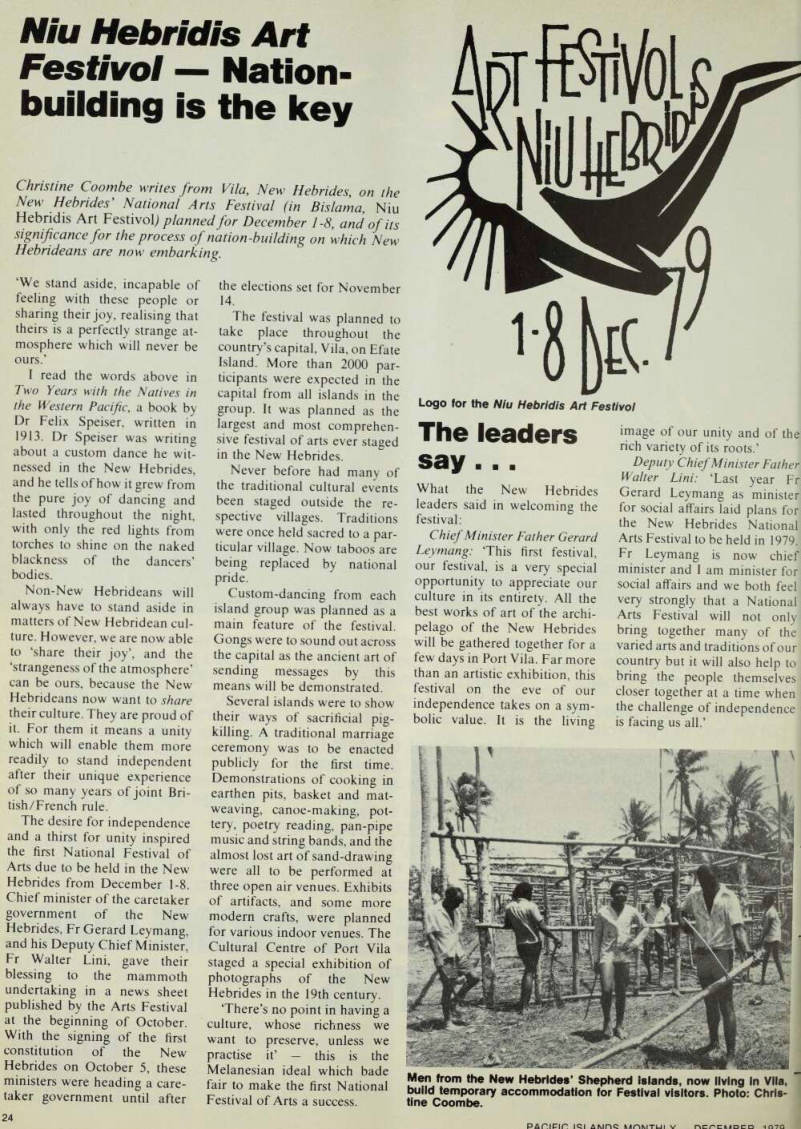
Niu Hebridis Art Festival - Nation building is the key
Christine Coombe writes from Vila, New Hebrides, on the New Hebrides’ National Arts Festival (in Bislama, Niu Hebridis Art Festivolj planned for December 1-8, and of its significance for the process of nation-building on which New Hebrideans are now embarking.
‘We stand aside, incapable of feeling with these people or
sharing their joy, realising that
theirs is a perfectly strange at mosphere which will never be ours.’
I read the words above in Two Years with the Natives in the Western Pacific, a book by Dr Felix Speiser, written in 1913. Dr Speiser was writing about a custom dance he wit nessed in the New Hebrides, and he tells of how it grew from the pure joy of dancing and
lasted throughout the night,
with only the red lights from torches to shine on the naked blackness of the dancers’ bodies.
Non-New Hebrideans will always have to stand aside in matters of New Hebridean cul ture. However, we are now able to ‘share their joy’, and the ‘strangeness of the atmosphere’ can be ours, because the New Hebrideans now want to share their culture. They are proud of it. For them it means a unity which will enable them more
readily to stand independent
after their unique experience of so many years of joint Bri tish/French rule.
The desire for independence and a thirst for unity inspired the first National Festival of Arts due to be held in the New Hebrides from December 1-8.
Chief minister of the caretaker government of the New Hebrides, Fr Gerard Leymang, and his Deputy Chief Minister, Fr Walter Lini, gave their blessing to the mammoth undertaking in a news sheet published by the Arts Festival at the beginning of October.
With the signing of the first constitution of the New Hebrides on October 5, these ministers were heading a care taker government until after
the elections set for November 14.
The festival was planned to
take place throughout the
country’s capital, Vila, on Efate Island. More than 2000 par ticipants were expected in the capital from all islands in the group. It was planned as the largest and most comprehen sive festival of arts ever staged in the New Hebrides.
Never before had many of the traditional cultural events been staged outside the re
spective villages. Traditions
were once held sacred to a par ticular village. Now taboos are
being replaced by national
pride.
Custom-dancing from each island group was planned as a main feature of the festival.
Gongs were to sound out across the capital as the ancient art of
sending messages by this
means will be demonstrated.
Several islands were to show their ways of sacrificial pig
killing. A traditional marriage
ceremony was to be enacted publicly for the first time.
Demonstrations of cooking in earthen pits, basket and mat
weaving, canoe-making, pot
tery, poetry reading, pan-pipe
music and string bands, and the almost lost art of sand-drawing were all to be performed at three open air venues. Exhibits of artifacts, and some more modern crafts, were planned for various indoor venues. The Cultural Centre of Port Vila staged a special exhibition of photographs of the New Hebrides in the 19th century.
There’s no point in having a culture, whose richness we want to preserve, unless we practise it’ - this is the Melanesian ideal which bade fair to make the first National Festival of Arts a success.
The leaders
say ...
What the New Hebrides leaders said in welcoming the festival: Chief Minister Father Gerard Leymang: ‘This first festival, our festival, is a very special
opportunity to appreciate our
culture in its entirety. All the best works of art of the archi pdago of the New Hebrides will be gathered together for a few days in Port Vila. Far more than an artistic exhibition, this festival on the eve of our independence takes on a sym bolic value. It is the living
image of our unity and of the rich variety of its roots.’
Deputy Chief Minister Father
Walter Uni: ‘Last year Fr Gerard Leymang as minister for social affairs laid plans for the New Hebrides National Arts Festival to be held in 1979.
Fr Leymang is now chief minister and I am minister for social affairs and we both feel very strongly that a National Arts Festival will not only bring together many of the varied arts and traditions of our country but it will also help to bring the people themselves closer together at a time when
the challenge of independence
is facing us all.’
Men from the New Hebrides’ Shepherd Islands, now living In Vila, build temporary accommodation for Festival visitors. Photo: Chris tine Coombe.
Advertisements & other items, p. 24 (1 item)
24
PAniPir IQI AMne MnMTU) V nCPCMDCD 1070
Independence
Afterthoughts
with Percy Chatterton in Port Moresby
Independence of the courts A warning to PNG leaders
The gaoling of Mrs Nahau Rooney, Papua New Guinea’s minister for justice, for contempt of court, has hit headlines around the world. The sentence of eight months imposed on her by the supreme court was sensational. But her release on licence after less than 24 hours in gaol by Prime Minister Somare, who had in the meantime taken over the justice port folio, was even more sensational. It sparked off a nation-wide public reaction which was in the main hostile; and though it was understandable enough in human terms, it seems to have lost Mrs Rooney a lot of the sympathy that the sentence evoked, and to have detracted from rather than enhanced Mr Somare’s stature as a national leader. It has also led to the resignation of five of the eight judges of the national and su preme courts.
Mrs Rooney’s release on licence is of course revocable, but at the moment it seems likely that the governor-general will be advised by cabinet to grant her a pardon, so that she won’t have to go back to gaol at all.
I do not want to dwell any further on this unhappy story.
But I do want to comment on some issues which arise from it.
It has been suggested that the judges have a duty to be sensi tive to the feelings and aspirations of the people. This seems to me to be a dangerous misunderstanding of the functions of the judiciary. The judges are there to uphold the constitution
as it is and to interpret the laws made under it as they are.
If the constitution and the laws made under it do not reflect the feelings and aspirations of the people, it is the business of parliament in general, cabinet in particular and most specifi cally the successive incumbents of the justice ministry, and not that of the judiciary, to see that they are changed. We have a first-rate law reform commission, but the recommendations it makes seem to take a long time to get on to the statute book.
The case which started all this bother was a case in point.
It concerned an expatriate academic who had been served with a deportation order. He appealed to the supreme court. Some of our leaders, including Mrs Rooney, felt very strongly that the deportation of unwanted foreigners is a matter in which the government should have the last say. Maybe they are right (though personally I don’t think they are); and maybe in due course the constitution will be amended in deference to their wishes. But in the meantime the judges have a clear duty to ensure that a deportee is able to exercise his constitutional right of appeal, and to exercise it effectively by being allowed to stay in the country until the appeal is heard. This they did, as they were bound to do. In the sequel the appeal was dismis sed, and the gentleman concerned left the country, so it was all very much a storm in a teacup.
The judges have been described as foreigners administering foreign laws. True, they are foreigners, but those who don’t like this need to be reminded that so far those Papua New Guinean lawyers who are eligible under the constitution for appointment as judges have shown a marked unwillingness to accept such appointment. After this incident they will prob ably be even more reluctant to do so.
As to the laws which the judges administer, they are the laws of the Independent State of Papua New Guinea, as enacted or adopted by its parliament. Many of them, it is true, are ‘imported’ laws, which maybe need more adaptation to Papua New Guinean conditions than has so far been effected.
But, once again, it is the job of parliament, not of the judges, to change them. One hopes that in doing so it won’t throw out the baby with the bath water. It is easy for enthusiasts for ‘the Melanesian Way’ to forget that an increasing number of Papua New Guineans are adopting a non-Melanesian life style with which traditional tribal law is quite unable to cope.
Luckily, we have a very level-headed law reform com mission.
It is much to be regretted that racist overtones have been allowed to emerge in this confrontation between the executive and the judiciary. It is true that the judges are expatriates; but a large and increasing proportion of the magistrates are Papua New Guineans. These would be more vulnerable than the judges to any attempt to make inroads upon the indepen dence of the courts, since they would be subjected to pressures not only from national politicians but from the growing horde
of provincial politicians too.
The most encouraging feature of this unhappy incident is the evidence that it has thrown up that a very large number of citizens of this country understand and value the indepen dence of the country’s courts, and are all set to raise hell if it is interfered with.
Our leaders assure us that they had, and have, no intention of doing so. If so, that’s fine. If not, they have been warned.
Advertisements & other items, pp. 25-26 (2 items)
25
\CIFIC ISLANDS MONTHLY - DECEMBER, 1979
Yamaha
'■ & ss u N-i - - *.l O .1, * You get more out of Yamaha because
Yamaha puts more technology in.
For whatever reason you buy an outboard, you can expect more fun and excitement when you choose a Yamaha. As one of the world’s largest small engine makers, we’ve developed a complete line of models, from 2 to 85, to fit virtually every boating need.
At speed, our big bore triples and twin never falter, with their capacitor discharge ignitions, Schnule scavenging and fuel recirculation systems.
For sailing, we offer a variety of models with such sought-after features as top-mounted shift and vertical-pull starters. Anglers apreciate the superb low-speed trolling performance of Yamahas.
At the same time, the low fuel consumption and quiet running appeal equally as much to cruising enthusiasts.
For details on how and why we can do things a little bit better than the rest, see you local dealer. He has full information and can help you make the right choice for your boat and your style of boating.
From 2 to 85.
YAMAHA
YAMAHA
People
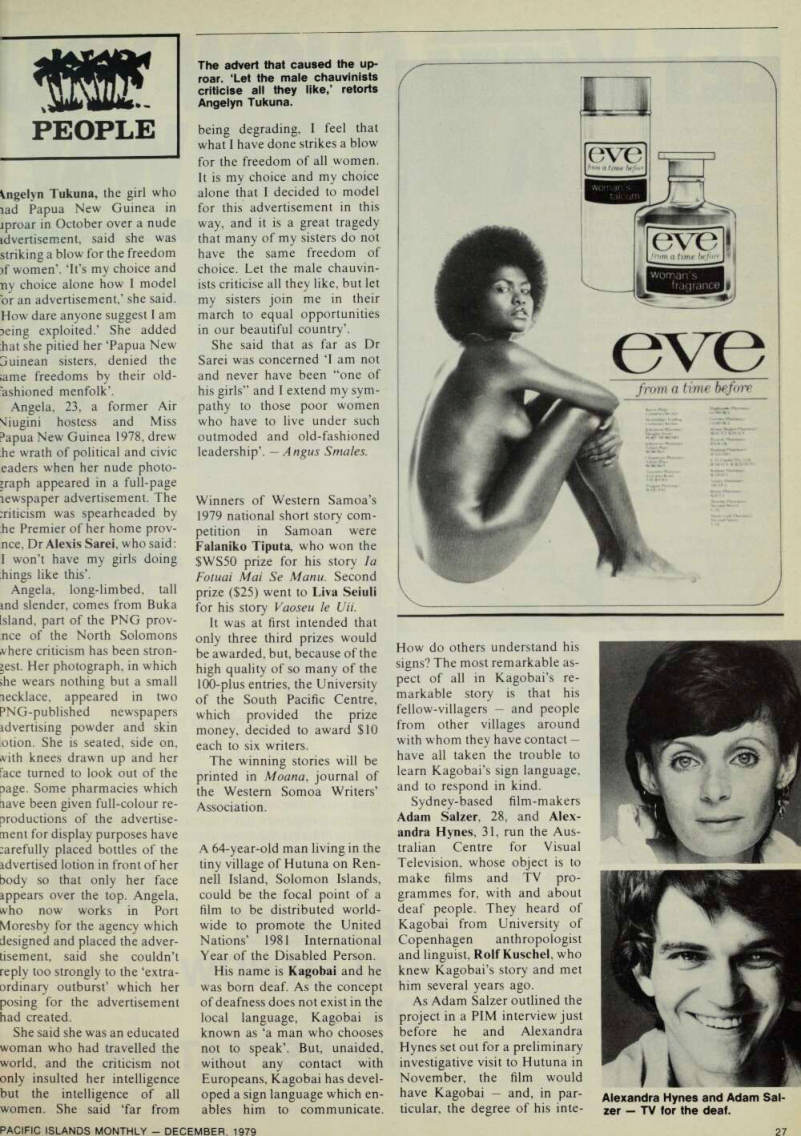

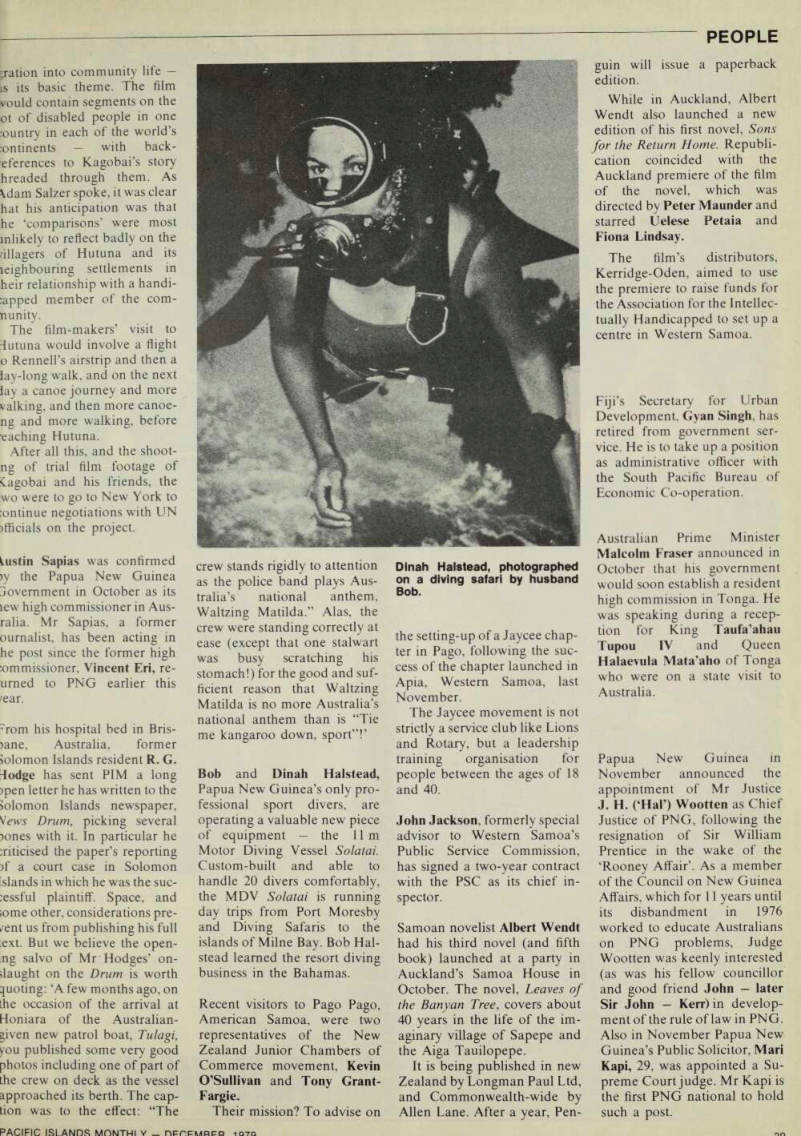
Vngelyn Tukuna, the girl who lad Papua New Guinea in jproar in October over a nude idvertisement, said she was striking a blow for the freedom )f women’. ‘lt’s my choice and ny choice alone how I model br an advertisement,’ she said.
How dare anyone suggest I am
?eing exploited.’ She added
bat she pitied her ‘Papua New Tuinean sisters, denied the ;ame freedoms by their old "ashioned menfolk’.
Angela, 23, a former Air hostess and Miss Papua New Guinea 1978, drew he wrath of political and civic eaders when her nude photo
graph appeared in a full-page
lewspaper advertisement. The
criticism was spearheaded by
be Premier of her home prov nce, Dr Alexis Sarei, who said: I won’t have my girls doing bings like this’.
Angela, long-limbed, tall
md slender, comes from Buka [sland, part of the PNG prov nce of the North Solomons ivhere criticism has been stron gest. Her photograph, in which »he wears nothing but a small
lecklace, appeared in two
PNG-published newspapers
advertising powder and skin
otion. She is seated, side on, with knees drawn up and her face turned to look out of the
page. Some pharmacies which
have been given full-colour re productions of the advertise ment for display purposes have :arefully placed bottles of the advertised lotion in front of her body so that only her face appears over the top. Angela, who now works in Port Moresby for the agency which designed and placed the adver tisement, said she couldn’t reply too strongly to the ‘extra ordinary outburst’ which her posing for the advertisement had created.
She said she was an educated woman who had travelled the world, and the criticism not
only insulted her intelligence
but the intelligence of all women. She said ‘far from
The advert that caused the up roar. ‘Let the male chauvinists criticise all they like,’ retorts Angelyn Tukuna. being degrading, I feel that what I have done strikes a blow for the freedom of all women.
It is my choice and my choice alone that I decided to model for this advertisement in this way, and it is a great tragedy that many of my sisters do not have the same freedom of choice. Let the male chauvin ists criticise all they like, but let my sisters join me in their
march to equal opportunities
in our beautiful country’.
She said that as far as Dr Sarei was concerned T am not and never have been “one of his girls” and I extend my sym pathy to those poor women who have to live under such outmoded and old-fashioned leadership’. Angus Smales.
Winners of Western Samoa’s 1979 national short story com petition in Samoan were Falaniko Tiputa, who won the SWSSO prize for his story la Fotuai Mai Se Manu. Second prize ($25) went to Liva Seiuli for his story Vaoseu le Uii.
It was at first intended that only three third prizes would be awarded, but, because of the high quality of so many of the
100-plus entries, the University
of the South Pacific Centre,
which provided the prize
money, decided to award $lO each to six writers.
The winning stories will be
printed in Moana , journal of
the Western Somoa Writers’
Association.
A 64-year-old man living in the tiny village of Hutuna on Ren nell Island, Solomon Islands, could be the focal point of a film to be distributed world wide to promote the United Nations’ 1981 International Year of the Disabled Person.
His name is Kagobai and he was bom deaf. As the concept of deafness does not exist in the
local language, Kagobai is
known as ‘a man who chooses not to speak’. But, unaided, without any contact with
Europeans, Kagobai has devel
oped a sign language which en
ables him to communicate.
How do others understand his signs? The most remarkable as pect of all in Kagobai’s re markable story is that his
fellow-villagers and people
from other villages around with whom they have contact have all taken the trouble to
learn Kagobai’s sign language,
and to respond in kind.
Sydney-based film-makers
Adam Salzer, 28, and Alex andra Hynes, 31, run the Aus tralian Centre for Visual Television, whose object is to make films and TV pro grammes for, with and about deaf people. They heard of
Kagobai from University of
Copenhagen anthropologist
and linguist, Rolf Kuschel, who knew Kagobai’s story and met him several years ago.
As Adam Salzer outlined the project in a PIM interview just before he and Alexandra Hynes set out for a preliminary investigative visit to Hutuna in November, the film would have Kagobai and, in par ticular, the degree of his inte-
Alexandra Hynes and Adam Sal zer - TV for the deaf.
;ration into community life is its basic theme. The film vould contain segments on the ot of disabled people in one :ountry in each of the world’s :ontinents with back eferences to Kagobai’s story hreaded through them. As Vdam Salzer spoke, it was clear hat his anticipation was that he ‘comparisons’ were most mlikely to reflect badly on the fillagers of Hutuna and its leighbouring settlements in heir relationship with a handi :apped member of the com nunity.
The film-makers’ visit to Jutuna would involve a flight o Rennell’s airstrip and then a lay-long walk, and on the next lay a canoe journey and more valking, and then more canoe ng and more walking, before caching Hutuna.
After all this, and the shooi ng of trial film footage of Cagobai and his friends, the wo were to go to New York to
:ontinue negotiations with UN
)fficials on the project.
Austin Sapias was confirmed >y the Papua New Guinea jovemment in October as its tew high commissioner in Aus ralia. Mr Sapias, a former oumalist, has been acting in he post since the former high :ommissioner, Vincent Eri, re umed to PNG earlier this rear.
Yom his hospital bed in Bris )ane, Australia, former Jolomon Islands resident R. G. -lodge has sent PIM a long )pen letter he has written to the Jolomon Islands newspaper,
Sews Drum, picking several
?ones with it. In particular he
criticised the paper’s reporting
)f a court case in Solomon islands in which he was the suc
cessful plaintiff. Space, and
lome other, considerations pre /ent us from publishing his full ;ext. But we believe the open ng salvo of Mr Hodges’ on slaught on the Drum is worth quoting; ‘A few months ago, on the occasion of the arrival at Honiara of the Australian-
E>iven new patrol boat, Tulagi,
you published some very good
photos including one of part of the crew on deck as the vessel approached its berth. The cap tion was to the effect: “The
crew stands rigidly to attention as the police band plays Aus tralia’s national anthem, Waltzing Matilda.” Alas, the crew were standing correctly at ease (except that one stalwart
was busy scratching his
stomach!) for the good and suf ficient reason that Waltzing Matilda is no more Australia’s national anthem than is “Tie
me kangaroo down, sport”!’
Bob and Dinah Halstead, Papua New Guinea’s only pro fessional sport divers, are operating a valuable new piece of equipment the 11 m Motor Diving Vessel Solatai.
Custom-built and able to handle 20 divers comfortably, the MDV Solatai is running
day trips from Port Moresby
and Diving Safaris to the islands of Milne Bay. Bob Hal stead learned the resort diving business in the Bahamas.
Recent visitors to Pago Pago, American Samoa, were two representatives of the New Zealand Junior Chambers of Commerce movement, Kevin O’Sullivan and Tony Grant- Fargie.
Their mission? To advise on
the setting-up of a Jaycee chap
ter in Pago, following the suc cess of the chapter launched in Apia, Western Samoa, last November.
The Jaycee movement is not strictly a service club like Lions and Rotary, but a leadership
training organisation for
people between the ages of 18 and 40.
John Jackson, formerly special
advisor to Western Samoa’s Public Service Commission, has signed a two-year contract with the PSC as its chief in spector.
Samoan novelist Albert Wendt had his third novel (and fifth book) launched at a party in Auckland’s Samoa House in October. The novel, Leaves of the Banyan Tree , covers about 40 years in the life of the im
aginary village of Sapepe and
the Aiga Tauilopepe.
It is being published in new Zealand by Longman Paul Ltd, and Commonwealth-wide by Allen Lane. After a year, Pen
guin will issue a paperback edition.
While in Auckland, Albert Wendt also launched a new edition of his first novel, Sons for the Return Home. Republi cation coincided with the Auckland premiere of the film of the novel, which was directed by Peter Maunder and starred Uelese Petaia and Fiona Lindsay.
The film’s distributors, Kerridge-Oden, aimed to use the premiere to raise funds for the Association for the Intellec tually Handicapped to set up a centre in Western Samoa.
Fiji’s Secretary for Urban Development, Cyan Singh, has retired from government ser vice. He is to take up a position as administrative officer with the South Pacific Bureau of
Economic Co-operation.
Australian Prime Minister Malcolm Fraser announced in October that his government would soon establish a resident high commission in Tonga. He was speaking during a recep tion for King Taufa’ahau Tupou IV and Queen Halaevula Mata'aho of Tonga who were on a state visit to Australia.
Papua New Guinea in November announced the appointment of Mr Justice J. H. (‘Hal’) Wootten as Chief Justice of PNG, following the resignation of Sir William Prentice in the wake of the ‘Rooney Affair’. As a member of the Council on New Guinea Affairs, which for 11 years until its disbandment in 1976 worked to educate Australians
on PNG problems, Judge
Wootten was keenly interested (as was his fellow councillor and good friend John later Sir John Kerr) in develop ment of the rule of law in PNG.
Also in November Papua New Guinea’s Public Solicitor, Mari Kapi, 29, was appointed a Su preme Court judge. Mr Kapi is the first PNG national to hold such a post.
Dinah Halstead, photographed on a diving safari by husband Bob.
Advertisements & other items, pp. 27-30 (3 items)
eve
eve in>m a time heUni
LET VSn* SHOW YOU
Victa 8 h.p. Tiller
(Model 408). • Independent rear tine and wheel drive trans missions #5 forward speeds plus reverse Chain driven totally enclosed gear boxes#Nine (9) handle positions instantly adjustable either vertically or horizontally by squeeze trigger 14" dia. tines - 20" tilling width Throttle, gear shift and handle adjustment levers are all conveniently located on handle assembly #Separate transmission levers for tine drive or wheel drive Instant depth control with spring loaded pin engagement of multi-position depth bar #Tractor tread tyres combined with front mounted counterweight for maximum traction. OPTIONAL ATTACHMENTS; Hilling Plough: Twin ploughshares adjustable in width and in angle to produce hills or furrows.
Cultivating Points: Four cultivating point assemblies, adjustable in spacing.
NOTE: The above must be used with "A"
Frame Assembly and two depth wheels, which are rear mounted.
A BETTER WAY I
professional results.
Victa 5 h.p. Tiller (Model 355). Worm drive gear box. Forward speed plus neutral and reverse, and accepting a wide range of optional attach ments. 5 h.p. B & S pull-start 4-stroke engine. Heavy-duty tines adjustable from 305 mm $ (12") to 660 mm (26") cultivating widths.
Weight 95 kg (210 lb). m. v.
Victa 3 h.p. Till-it Tiller (Model 030). Lightweight, portable, compact tiller.
Special features include: 3 h.p. Briggs & Stratton engine with easy pullstart. Spring steel tines adjust to 254 mm fia (10") or 457 mm (18") cultivating widths. Weight: 27 kg (60 lb).
Victa 3.5 h.p. Tiller (Model 100). Rugged heavy duty model with 3.5 h.p. B & S pull-start 4-stroke engine. Long-life oil filled cast iron gear box. 16 spring £ steel tines 12" diameter adjust from 305 mm (12") to 660 mm (26") cultivating widths. Weight 63 kg (140 lb). Optional attachments: Furrow opener, sweep plough, pneumatic front tyre kit.
SEE A
DEALER NOW
FORA
DEMONSTRATION.
t' f 'h. . •V '-••V >7'' *4 .>■ *S % SR sr.%*, m si ■ » ■ 18.
A-
someofmrcfriejs
In Papua New Guinea there are 717 different cultures, each represented by its own language and its own "chief”. Few men know this country better than our chief pilot, Captain John Regan.
He's logged more than 16,000 hours flying, much of that in Papua New Guinea.
John Regan is one of ninety highly skilled Australian, New Zealand, British, and American pilots flying our aircraft to seventeen places in Papua New Guinea and eight destinations overseas.
AIRNIU&NI
THE NA TIONAL AIRLINE OF PAPUA NEW GUINEA
28
n « /Mr“i i /-» i « k t a » it-i i ■ v / r%ri mm H n7Q
People
29
PACIFIC ISLANDS MDNTHI Y DPP.PMRPD iqtq
Kiribati from a
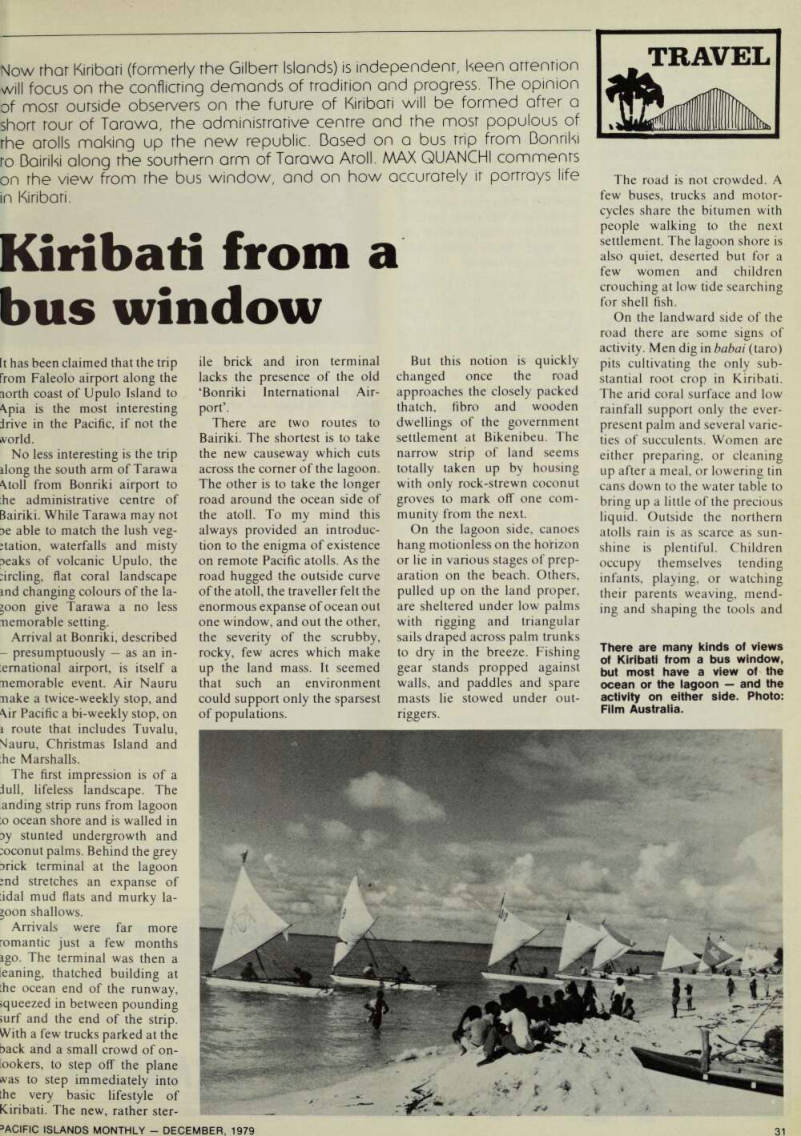
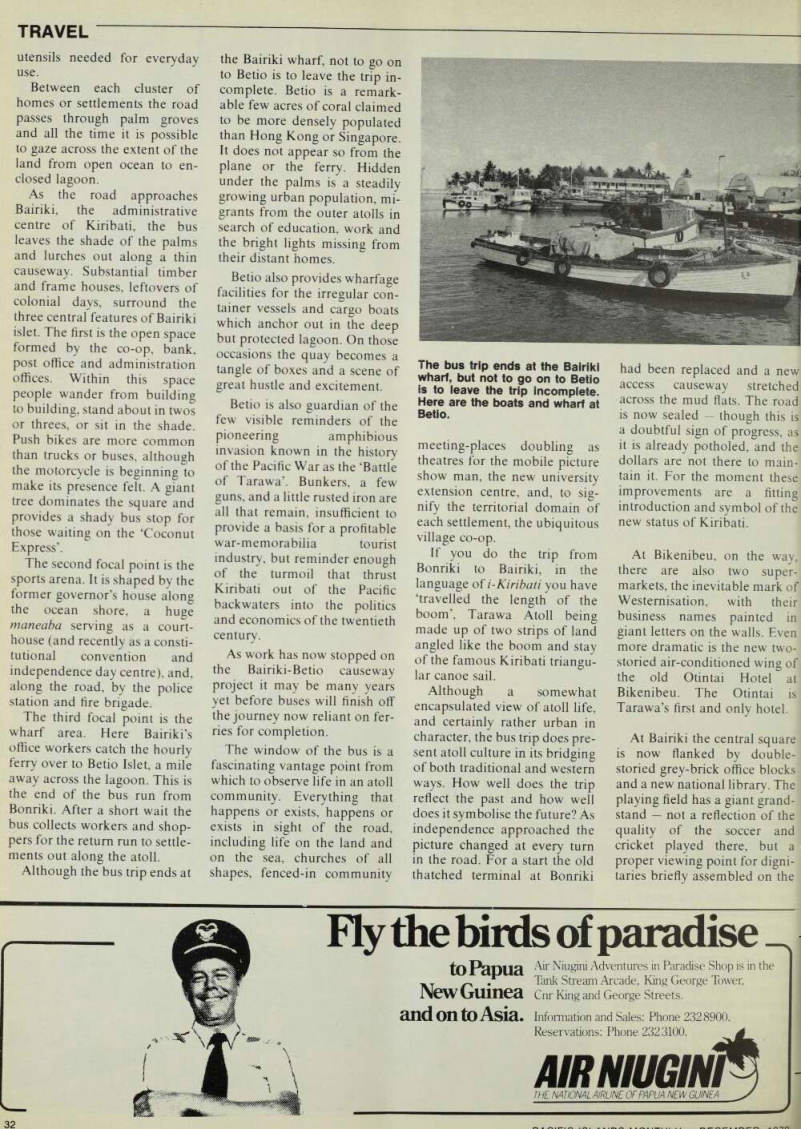
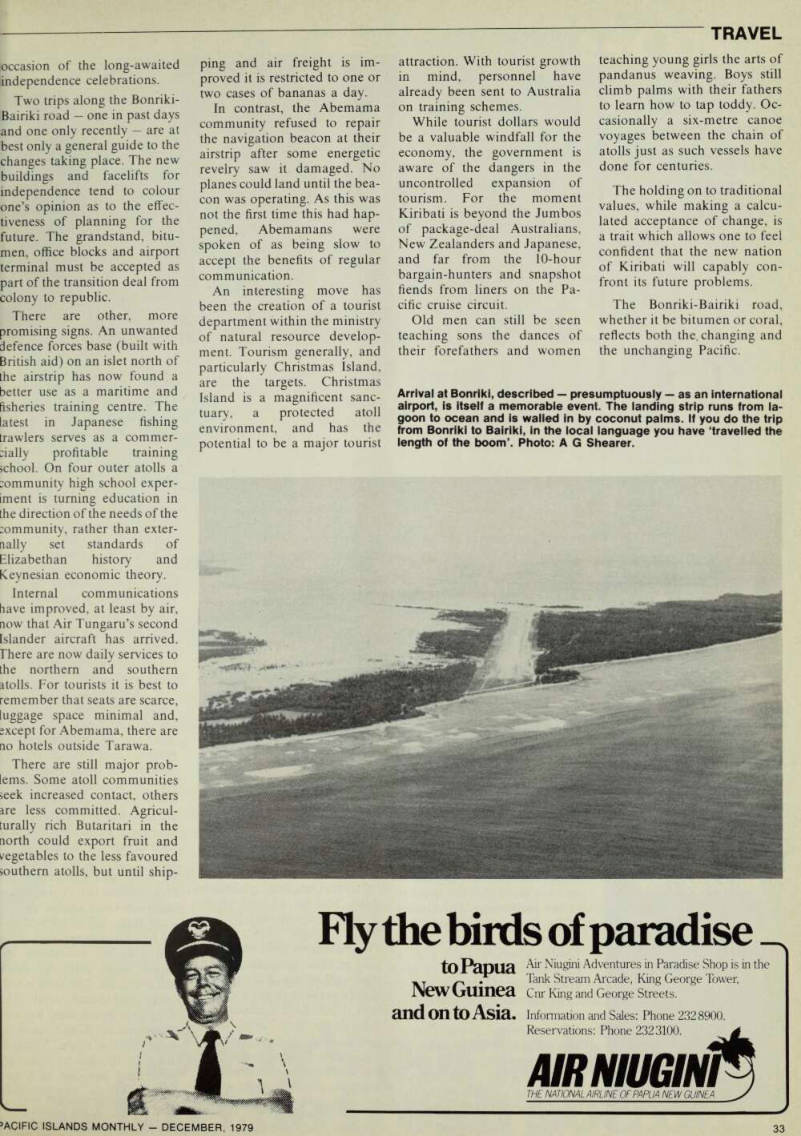
Travel
Kiribati from a bus window
Now rhor Kiribati (formerly rhe Gilbert Islands) is independent, keen attention will focus on the conflicting demands of tradition and progress. The opinion of most outside observers on the future of Kiribati will be formed after a short tour of Tarawa, the administrative centre and the most populous of the atolls making up the new republic. Dosed on a bus trip from Bonriki to Bairiki along the southern arm of Tarawa Atoll. AAAX QUANCHI comments on rhe view from rhe bus window, and on how accurately it portrays life in Kiribati.
[t has been claimed that the trip from Faleolo airport along the north coast of Upulo Island to \pia is the most interesting irive in the Pacific, if not the world.
No less interesting is the trip ilong the south arm of Tarawa Moll from Bonriki airport to :he administrative centre of Bairiki. While Tarawa may not ne able to match the lush veg
;tation, waterfalls and misty
neaks of volcanic Upulo, the
fircling, flat coral landscape
md changing colours of the la goon give Tarawa a no less
memorable setting.
Arrival at Bonriki, described - presumptuously as an in ;emational airport, is itself a memorable event. Air Nauru make a twice-weekly stop, and Mr Pacific a bi-weekly stop, on i route that includes Tuvalu, Nauru, Christmas Island and ;he Marshalls.
The first impression is of a
dull, lifeless landscape. The
anding strip runs from lagoon
;o ocean shore and is walled in
?y stunted undergrowth and
:oconut palms. Behind the grey 3rick terminal at the lagoon md stretches an expanse of ;idal mud flats and murky la
goon shallows.
Arrivals were far more romantic just a few months igo. The terminal was then a
leaning, thatched building at
the ocean end of the runway,
squeezed in between pounding
surf and the end of the strip.
With a few trucks parked at the back and a small crowd of on lookers, to step off the plane was to step immediately into the very basic lifestyle of Kiribati. The new, rather ster
ile brick and iron terminal lacks the presence of the old ‘Bonriki International Air
port’.
There are two routes to Bairiki. The shortest is to take the new causeway which cuts across the corner of the lagoon.
The other is to take the longer road around the ocean side of the atoll. To my mind this
always provided an introduc
tion to the enigma of existence on remote Pacific atolls. As the road hugged the outside curve of the atoll, the traveller felt the enormous expanse of ocean out one window, and out the other, the severity of the scrubby, rocky, few acres which make up the land mass. It seemed that such an environment could support only the sparsest
of populations.
But this notion is quickly changed once the road
approaches the closely packed
thatch, fibro and wooden dwellings of the government settlement at Bikenibeu. The narrow strip of land seems
totally taken up by housing
with only rock-strewn coconut groves to mark off one community from the next.
On the lagoon side, canoes hang motionless on the horizon or lie in various stages of preparation on the beach. Others, pulled up on the land proper, are sheltered under low palms
with rigging and triangular
sails draped across palm trunks to dry in the breeze. Fishing J ® gear stands propped against walls, and paddles and spare masts lie stowed under outr iaof»rc
The road is not crowded. A few buses, trucks and motor cycles share the bitumen with people walking to the next settlement. The lagoon shore is also quiet, deserted but for a few women and children crouching at low tide searching for shell fish.
On the landward side of the road there are some signs of activity. Men dig in babai (taro)
pits cultivating the only sub
stantial root crop in Kiribati.
The arid coral surface and low rainfall support only the ever present palm and several varie ties of succulents. Women are
either preparing, or cleaning
up after a meal, or lowering tin cans down to the water table to bring up a little of the precious liquid. Outside the northern atolls rain is as scarce as sun shine is plentiful. Children occupy themselves tending
infants, playing, or watching
their parents weaving, mend ing and shaping the tools and
There are many kinds of views of Kiribati from a bus window, but most have a view of the ocean or the lagoon - and the activity on either side. Photo: Film Australia.
utensils needed for everyday use.
Between each cluster of homes or settlements the road
passes through palm groves
and all the time it is possible to gaze across the extent of the land from open ocean to en
closed lagoon.
As the road approaches Bairiki, the administrative centre of Kiribati, the bus leaves the shade of the palms and lurches out along a thin causeway. Substantial timber and frame houses, leftovers of colonial days, surround the three central features of Bairiki islet. The first is the open space formed by the co-op, bank, post office and administration offices. Within this space
people wander from building
to building, stand about in twos or threes, or sit in the shade.
Push bikes are more common than trucks or buses, although the motorcycle is beginning to make its presence felt. A giant tree dominates the square and provides a shady bus stop for those waiting on the ‘Coconut
Express’.
The second focal point is the sports arena. It is shaped by the former governor’s house along the ocean shore, a huge maneaba serving as a court house (and recently as a consti tutional convention and
independence day centre), and,
along the road, by the police
station and fire brigade.
The third focal point is the wharf area. Here Bairiki’s office workers catch the hourly ferry over to Betio Islet, a mile away across the lagoon. This is the end of the bus run from Bonriki. After a short wait the bus collects workers and shop pers for the return run to settle ments out along the atoll.
Although the bus trip ends at
the Bairiki wharf, not to go on to Betio is to leave the trip in complete. Betio is a remark able few acres of coral claimed to be more densely populated
than Hong Kong or Singapore.
It does not appear so from the plane or the ferry. Hidden under the palms is a steadily
growing urban population, mi
grants from the outer atolls in search of education, work and
the bright lights missing from
their distant homes.
Betio also provides wharfage
facilities for the irregular con tainer vessels and cargo boats which anchor out in the deep but protected lagoon. On those occasions the quay becomes a tangle of boxes and a scene of great hustle and excitement.
Betio is also guardian of the few visible reminders of the
pioneering amphibious
invasion known in the history of the Pacific War as the ‘Battle of Tarawa’. Bunkers, a few guns, and a little rusted iron are all that remain, insufficient to provide a basis for a profitable war-memorabilia tourist
industry, but reminder enough
of the turmoil that thrust Kiribati out of the Pacific backwaters into the politics and economics of the twentieth century.
As work has now stopped on the Bairiki-Betio causeway project it may be many years yet before buses will finish off the journey now reliant on fer ries for completion.
The window of the bus is a
fascinating vantage point from
which to observe life in an atoll
community. Everything that
happens or exists, happens or exists in sight of the road, including life on the land and on the sea, churches of all
shapes, fenced-in community
meeting-places doubling as
theatres for the mobile picture show man, the new university extension centre, and, to sig nify the territorial domain of each settlement, the übiquitous
village co-op.
If you do the trip from Bonriki to Bairiki, in the language of i-Kiribati you have ‘travelled the length of the boom’, Tarawa Atoll being made up of two strips of land angled like the boom and stay of the famous Kiribati triangu lar canoe sail.
Although a somewhat encapsulated view of atoll life, and certainly rather urban in character, the bus trip does pre sent atoll culture in its bridging of both traditional and western ways. How well does the trip reflect the past and how well does it symbolise the future? As independence approached the picture changed at every turn in the road. For a start the old thatched terminal at Bonriki
had been replaced and a new access causeway stretched across the mud flats. The road is now sealed - though this is a doubtful sign of progress, as it is already potholed, and the dollars are not there to main tain it. For the moment these
improvements are a fitting
introduction and symbol of the new status of Kiribati.
At Bikenibeu, on the way, there are also two super markets, the inevitable mark of Westernisation, with their business names painted in giant letters on the walls. Even more dramatic is the new two storied air-conditioned wing of the old Otintai Hotel at Bikenibeu. The Otintai is Tarawa’s first and only hotel.
At Bairiki the central square is now flanked by double storied grey-brick office blocks and a new national library. The
playing field has a giant grand
stand not a reflection of the quality of the soccer and cricket played there, but a
proper viewing point for digni
taries briefly assembled on the
The bus trip ends at the Bairiki wharf, but not to go on to Betio is to leave the trip incomplete.
Here are the boats and wharf at Betio.
occasion of the long-awaited
independence celebrations.
Two trips along the Bonriki- Bairiki road one in past days and one only recently are at best only a general guide to the
changes taking place. The new
buildings and facelifts for independence tend to colour one’s opinion as to the effec tiveness of planning for the future. The grandstand, bitu men, office blocks and airport terminal must be accepted as part of the transition deal from
colony to republic.
There are other, more
promising signs. An unwanted
defence forces base (built with British aid) on an islet north of the airstrip has now found a better use as a maritime and
fisheries training centre. The
latest in Japanese fishing
trawlers serves as a commer
cially profitable training
school. On four outer atolls a
community high school exper
iment is turning education in the direction of the needs of the community, rather than exter nally set standards of
Elizabethan history and
Keynesian economic theory.
Internal communications
have improved, at least by air,
now that Air Tungaru’s second [slander aircraft has arrived.
There are now daily services to the northern and southern atolls. For tourists it is best to remember that seats are scarce, luggage space minimal and, except for Abemama, there are no hotels outside Tarawa.
There are still major prob lems. Some atoll communities seek increased contact, others
are less committed. Agricul
turally rich Butaritari in the north could export fruit and vegetables to the less favoured southern atolls, but until ship
ping and air freight is im proved it is restricted to one or two cases of bananas a day.
In contrast, the Abemama
community refused to repair
the navigation beacon at their
airstrip after some energetic
revelry saw it damaged. No planes could land until the bea con was operating. As this was not the first time this had hap pened, Abemamans were spoken of as being slow to accept the benefits of regular communication.
An interesting move has been the creation of a tourist
department within the ministry
of natural resource develop ment. Tourism generally, and particularly Christmas Island, are the targets. Christmas Island is a magnificent sanc tuary, a protected atoll environment, and has the potential to be a major tourist
attraction. With tourist growth in mind, personnel have already been sent to Australia on training schemes.
While tourist dollars would be a valuable windfall for the economy, the government is aware of the dangers in the uncontrolled expansion of tourism. For the moment Kiribati is beyond the Jumbos of package-deal Australians, New Zealanders and Japanese, and far from the 10-hour
bargain-hunters and snapshot
fiends from liners on the Pa cific cruise circuit.
Old men can still be seen teaching sons the dances of their forefathers and women
teaching young girls the arts of
pandanus weaving. Boys still
climb palms with their fathers to learn how to tap toddy. Oc casionally a six-metre canoe voyages between the chain of atolls just as such vessels have done for centuries.
The holding on to traditional values, while making a calcu lated acceptance of change, is a trait which allows one to feel confident that the new nation of Kiribati will capably con front its future problems.
The Bonriki-Bairiki road, whether it be bitumen or coral, reflects both the. changing and the unchanging Pacific.
Arrival at Bonriki, described presumptuously - as an international airport, is itself a memorable event. The landing strip runs from la goon to ocean and is walled in by coconut palms. If you do the trip from Bonriki to Bairiki, in the local language you have ‘travelled the length of the boom’. Photo: A G Shearer.
Advertisements & other items, pp. 31-34 (4 items)
31
3 ACIFIC ISLANDS MONTHLY - DECEMBER, 1979
32
rtbtrbhĥ
Fly the birds of paradise
to Papua
New Guinea
and on to Asia.
Air Niugini Adventures in Paradise Shop is in the Tank Stream Arcade, King George Tower, Cnr King and George Streets.
Information and Sales: Phone 2328900.
J
Fly the birds of paradise
to Papua
New Guinea
cind on to Asia.
Air Niugini Adventures in Paradise Shop is in the Tank Stream Arcade, King George Tower, Cnr King and George Streets.
Information and Sales: Phone 2328900.
Reservations: Phone 2323100.
AIRNIUGINr
THE NATIONAL AIRLINE OF PAPUA NEW GUINEA
Your
doorway
into the
fascinating
world of the South Seas 104 pages $4.00 or SUSS.OO posted.
Order form on special insert in this issue.
PORT MOl
* Right in tl business cej
* A traditioif^or 1
comfort andTin£" food ♦ All rooms airconditioned * Restaurant * Bai * Banquet hall
C. NEUMANN
manager Phone 21-2622 : 9bh
Stay at Aggie Grey’s . . . the South Pacific’s
legendary hotel.
Situated right in the heart of Western Samoa. Enjoy Polynesian-style friendliness and service, in cool surroundings, superb entertainment and food.
Magnificent white sand beaches only a short drive away. Airconditioned rooms, swimming pool and full bar facilities.
Bookings through Union Steam ship Company of NZ. Fan Am.
Air New Zealand or direct to.
Aggie Cirey’s, Apia. Western Samoa. Cables: -AC,CUES' Apia.
Travel
33
’ACIFIC ISLANDS MONTHLY - DECEMBER, 1979
‘Will they let
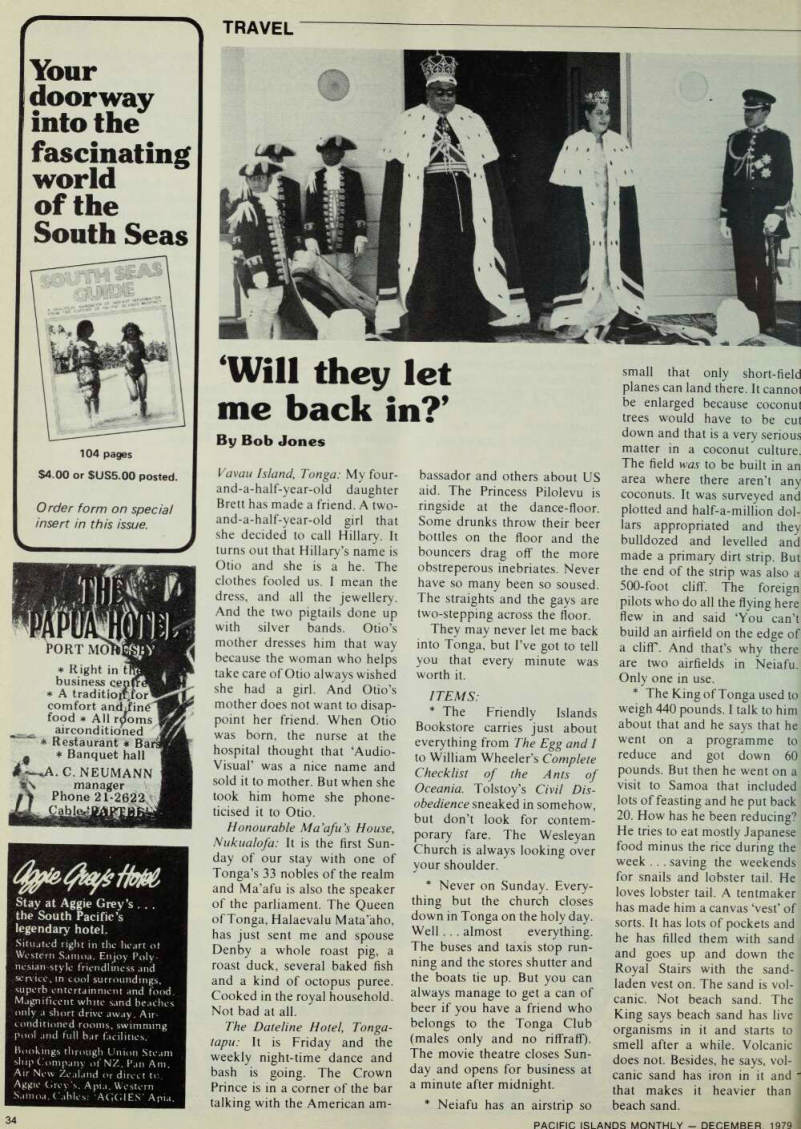
me back in?’
By Bob Jones
Vavau Island, Tonga: My four
and-a-half-year-old daughter
Brett has made a friend. A two
and-a-half-year-old girl that
she decided to call Hillary. It turns out that Hillary’s name is Otio and she is a he. The clothes fooled us. I mean the dress, and all the jewellery.
And the two pigtails done up with silver bands. Otio’s mother dresses him that way because the woman who helps take care of Otio always wished she had a girl. And Otio’s mother does not want to disap point her friend. When Otio was born, the nurse at the
hospital thought that ‘Audio-
Visual’ was a nice name and sold it to mother. But when she took him home she phone ticised it to Otio.
Honourable Ma’afu’s House, Nukualofa: It is the first Sun day of our stay with one of Tonga’s 33 nobles of the realm and Ma’afu is also the speaker of the parliament. The Queen of Tonga, Halaevalu Mata’aho, has just sent me and spouse Denby a whole roast pig, a roast duck, several baked fish and a kind of octopus puree.
Cooked in the royal household.
Not bad at all.
The Dateline Hotel, Tonga tapu: It is Friday and the
weekly night-time dance and
bash is going. The Crown Prince is in a corner of the bar talking with the American am
bassador and others about US aid. The Princess Pilolevu is ringside at the dance-floor.
Some drunks throw their beer bottles on the floor and the bouncers drag off the more obstreperous inebriates. Never have so many been so soused.
The straights and the gays are two-stepping across the floor.
They may never let me back into Tonga, but I’ve got to tell you that every minute was worth it.
Items:
* The Friendly Islands Bookstore carries just about everything from The Egg and I to William Wheeler’s Complete Checklist of the Ants of Oceania. Tolstoy’s Civil Dis obedience sneaked in somehow, but don’t look for contem porary fare. The Wesleyan Church is always looking over your shoulder. * Never on Sunday. Every thing but the church closes down in Tonga on the holy day.
We 11... almost everything.
The buses and taxis stop run ning and the stores shutter and the boats tie up. But you can always manage to get a can of beer if you have a friend who belongs to the Tonga Club (males only and no riffraff).
The movie theatre closes Sun day and opens for business at a minute after midnight. * Neiafu has an airstrip so
small that only short-field planes can land there. It cannot be enlarged because coconut trees would have to be cut down and that is a very serious matter in a coconut culture.
The field was to be built in an area where there aren’t any coconuts. It was surveyed and plotted and half-a-million dol
lars appropriated and they
bulldozed and levelled and made a primary dirt strip. But the end of the strip was also a 500-foot cliff. The foreign pilots who do all the flying here flew in and said ‘You can’t build an airfield on the edge of a clifT. And that’s why there are two airfields in Neiafu.
Only one in use. * The King of Tonga used to weigh 440 pounds. I talk to him about that and he says that he went on a programme to reduce and got down 60 pounds. But then he went on a visit to Samoa that included lots of feasting and he put back 20. How has he been reducing?
He tries to eat mostly Japanese food minus the rice during the week ... saving the weekends for snails and lobster tail. He loves lobster tail. A tentmaker has made him a canvas ‘vest’ of sorts. It has lots of pockets and he has filled them with sand and goes up and down the Royal Stairs with the sand- j laden vest on. The sand is vol canic. Not beach sand. The King says beach sand has live organisms in it and starts to I smell after a while. Volcanic does not. Besides, he says, vol canic sand has iron in it and ■] that makes it heavier than j beach sand.
Advertisements & other items, pp. 35-36 (2 items)
Sony’s portable
i 4 A
CFM-31S/L
Fill your leisure hours with the fresh sound of Sony's CFM-31S cassetterecorder with FM/MW/SWI/SW2 radio.
The 2-way speaker produces three watts of incredibly sharp sound through a 12cm woofer and a scm tweeter. A fine tuning knob gives precise SW reception indoors or out.
At a touch of a button, you can record simply and conveniently. There is also a built-in electret condenser microphone, a pause button, a 3-digit tape counter, plus cue and review. This model also shuts itself off automatically after playback.
The CFM-31S is lightweight and travels with ease. Anywhere you go, it's the portable with the fresh sound. (CFM-31L with fm/mw/sw/lw is also available.)
Sony’s portable
with the fresh sound
Overs,ooo rooms.
2.1 million guests this year.
More than4,2oo employees.
hotel
Three reasons why no othei
group can stay with us.
Over 5000 rooms. 61 hotels and resorts. 21 years of experience. That’s a lot of staying power.
But our contribution to the South Pacific goes far beyond simply being the biggest hotel and resort group in the region.
It’s what our size means that counts. It means we can providelhe best service for the more than two million people who stay with us annually.
And with 4200 people in our organisation to look after our guests, the word “service” really means something.
At the same time 4200 people employed is a lot of jobs. Again, a vital contribution to the economy of the South Pacific. And in the future, we’ll have an even bigger contribution to make.
Because we believe the South Pacific increasingly will become a centre for world tourism. Many thousands of tourists will pour millions of dollars into the South Pacific economy. Hundreds of businesses will benefit. Jobs will be assured, and many new jobs created.
WeVe prepared for that right now. And our investment is on the line to prove it.
For reservations or further information regarding investment in the South Pacific please contact us at:- 110 Bayswater Road,Rushcutters Bay,N.S.W. 2011. Australia Telephone: 310388. Telex; 21365 Boulevard. Fhrk Royal.
Beachcomber. Travelodge.
Holiday Inn.
9
SOTOHERNBftOMC HOTEL C OKPOKATKVM
9 Australia 9 New Zealand 9 Fiji 9 Tahiti 9 Cook Islands 9 Papua New Guinea 9 New Caledonia 9 Western Samoa
MASIUS TVL26O9
36
DAncir ici AMno hhamtui v IQ7Q
new territory
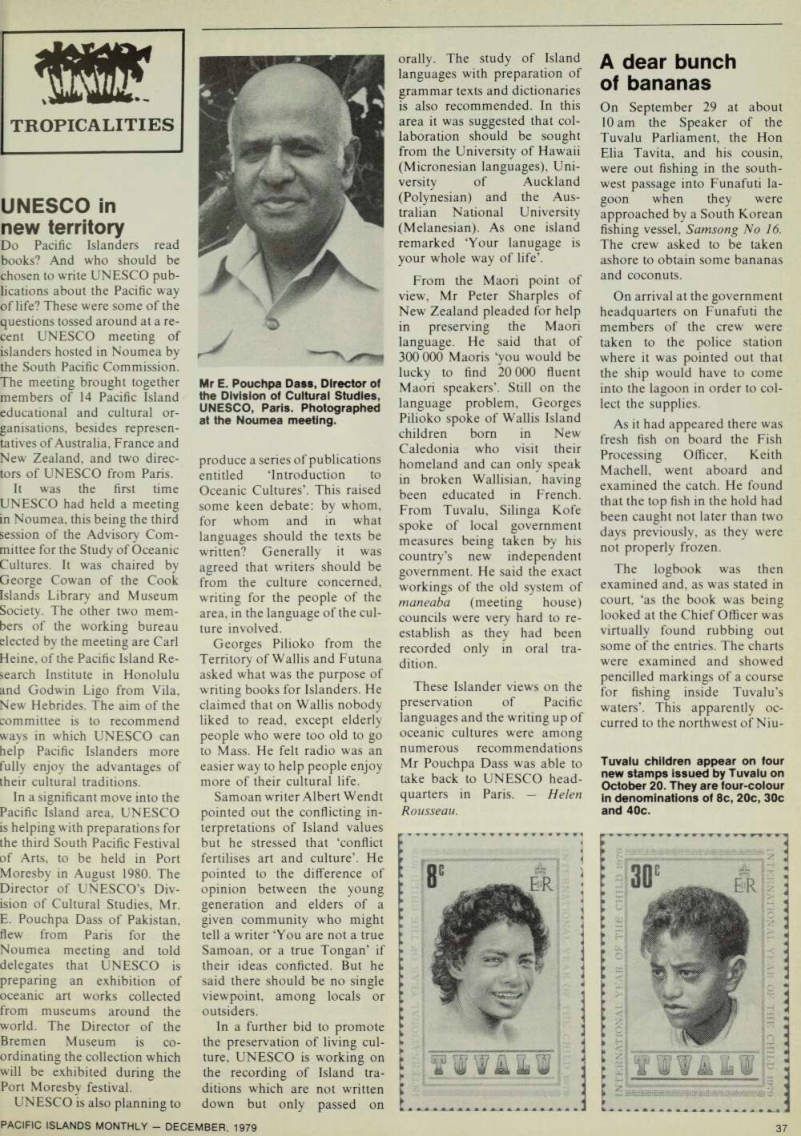

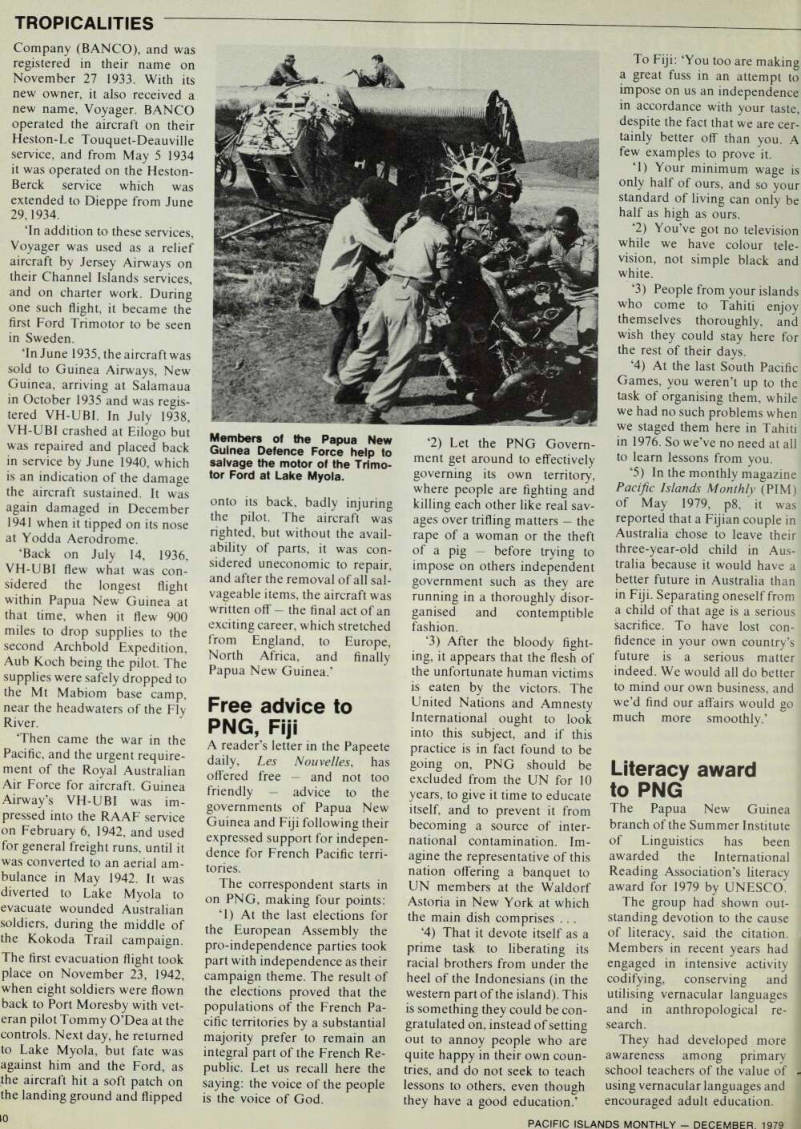
Tropicalities
Unesco In
Do Pacific Islanders read books? And who should be chosen to write UNESCO pub lications about the Pacific way of life? These were some of the questions tossed around at a re
cent UNESCO meeting of
islanders hosted in Noumea by the South Pacific Commission.
The meeting brought together
members of 14 Pacific Island educational and cultural or ganisations, besides represen tatives of Australia, France and New Zealand, and two direc tors of UNESCO from Paris.
It was the first time UNESCO had held a meeting in Noumea, this being the third session of the Advisory Com mittee for the Study of Oceanic Cultures. It was chaired by George Cowan of the Cook
Islands Library and Museum
Society. The other two mem bers of the working bureau
elected by the meeting are Carl
Heine, of the Pacific Island Re search Institute in Honolulu and Godwin Ligo from Vila, New Hebrides. The aim of the committee is to recommend ways in which UNESCO can help Pacific Islanders more
fully enjoy the advantages of
their cultural traditions.
In a significant move into the Pacific Island area, UNESCO
is helping with preparations for
the third South Pacific Festival of Arts, to be held in Port Moresby in August 1980. The Director of UNESCO’s Div ision of Cultural Studies, Mr.
E. Pouchpa Dass of Pakistan, flew from Paris for the
Noumea meeting and told
delegates that UNESCO is preparing an exhibition of oceanic art works collected from museums around the world. The Director of the Bremen Museum is co ordinating the collection which will be exhibited during the Port Moresby festival.
UNESCO is also planning to
produce a series of publications entitled ‘lntroduction to Oceanic Cultures’. This raised some keen debate: by whom, for whom and in what languages should the texts be written? Generally it was agreed that writers should be from the culture concerned, writing for the people of the area, in the language of the cul ture involved.
Georges Pilioko from the Territory of Wallis and Futuna asked what was the purpose of writing books for Islanders. He claimed that on Wallis nobody liked to read, except elderly people who were too old to go to Mass. He felt radio was an
easier way to help people enjoy
more of their cultural life.
Samoan writer Albert Wendt pointed out the conflicting in terpretations of Island values but he stressed that ‘conflict fertilises art and culture’. He pointed to the difference of opinion between the young generation and elders of a
given community who might
tell a writer ‘You are not a true Samoan, or a true Tongan’ if their ideas confided. But he said there should be no single viewpoint, among locals or outsiders.
In a further bid to promote the preservation of living cul ture, UNESCO is working on the recording of Island tra ditions which are not written down but only passed on
orally. The study of Island
languages with preparation of
grammar texts and dictionaries is also recommended. In this area it was suggested that col laboration should be sought from the University of Hawaii (Micronesian languages), Uni versity of Auckland (Polynesian) and the Aus tralian National University (Melanesian). As one island remarked ‘Your lanugage is your whole way of life’.
From the Maori point of view, Mr Peter Sharpies of New Zealand pleaded for help in preserving the Maori language. He said that of 300 000 Maoris ‘you would be lucky to find 20 000 fluent Maori speakers’. Still on the
language problem, Georges
Pilioko spoke of Wallis Island children bom in New Caledonia who visit their homeland and can only speak in broken Wallisian, having been educated in French.
From Tuvalu, Silinga Kofe spoke of local government measures being taken by his
country’s new independent
government. He said the exact workings of the old system of maneaba (meeting house) councils were very hard to re establish as they had been recorded only in oral tra dition.
These Islander views on the preservation of Pacific languages and the writing up of oceanic cultures were among numerous recommendations Mr Pouchpa Dass was able to take back to UNESCO head quarters in Paris. Helen Rousseau.
A dear bunch
of bananas
On September 29 at about 10 am the Speaker of the Tuvalu Parliament, the Hon Elia Tavita, and his cousin, were out fishing in the south west passage into Funafuti la goon when they were approached by a South Korean fishing vessel, Samsong No 16.
The crew asked to be taken ashore to obtain some bananas and coconuts.
On arrival at the government headquarters on Funafuti the members of the crew were taken to the police station where it was pointed out that the ship would have to come into the lagoon in order to col lect the supplies.
As it had appeared there was fresh fish on board the Fish Processing Officer, Keith Machell, went aboard and examined the catch. He found that the top fish in the hold had been caught not later than two
days previously, as they were
not properly frozen.
The logbook was then examined and, as was stated in court, ‘as the book was being looked at the Chief Officer was
virtually found rubbing out
some of the entries. The charts were examined and showed pencilled markings of a course for fishing inside Tuvalu’s waters’. This apparently oc curred to the northwest of Niu-
Mr E. Pouchpa Dass, Director of the Division of Cultural Studies, UNESCO, Paris. Photographed at the Noumea meeting.
Tuvalu children appear on four new stamps issued by Tuvalu on October 20. They are four-colour in denominations of 8c, 20c, 30c and 40c.
tao. The master, Jan Jin Sang, was then arrested and placed in police custody.
The arrest occurred just be fore Tuvalu got down to the business of celebrating its first year of independence October 1-2 being public hol idays. It seemed as if the matter would take some while to re solve. The vessel soon became part of the scene in the lagoon and members of the crew, who were free to wander around ashore, became familiar fig ures in the village and at the Vaiaku Langi hotel.
Behind-the-scenes moves were obviously taking place to obtain the vessel’s release. But it was not until October 10 that the general public heard any more. That day the weekly plane from Suva was a Queenair, not the usual Air Pa cific HS74B. Passengers who travelled on it reported that two irate Koreans had been left behind because the plane was overloaded. On Saturday Oc tober 13, two Koreans, Chulsik Park, Korean Consul in
Pago Pago, and Yon Ho Lee, a representative of Samsong Ind Co Ltd, arrived in a char tered plane, together with the Senior Magistrate, Mr Ken neth Moore, and his wife.
A court hearing took place that night. The reason for the weekend hearing was that the Senior Magistrate was anxious that the matter should be dealt with as soon as possible it would have been several weeks before he could get to Tuvalu otherwise. In mitigation, the master said that he had been fishing within the territorial waters only for a very short time and would not do so again. Mr Park said he was sorry for what had happened.
He felt it was due to a misun
derstanding, pointing out that
his government was at present discussing a fisheries agree ment with Tuvalu.
Giving his judgment, the
Senior Magistrate emphasised
the severity of the offence. He recalled that when he had dealt with a similar offence by a Taiwanese vessel earlier in the
year he had promised to deal severely with future cases.
However, in view of the assur ances from the master and Mr Park,, and the fact that this was a Korean ship, he was prepared to be lenient. He reminded the master that the maximum pen alty was a fine of $ 100 000 plus forfeiture of the boat and catch. He ordered him to pay a fine of $25 000 Tuvaluan (same value as Australian) within 14 days, adding: The vessel may be released as soon as the fine is paid or some bond suitable to the prosecution is made with the owners.’
In fact the latter is what hap pened, as shortly after lunch on
Sunday, Samsong No 16
weighed anchor and headed out of the lagoon, to be fol lowed soon after by the charter plane carrying the Koreans and the Senior Magistrate back to Suva.
Incidentally, the ship got her bananas and coconuts they were taken out to her shortly after she arrived, way back on September 29.
Flowering hunger
not encouraged
Now that arrangements are in full swing for the Third South Pacific Arts Festival, which will be held in Port Moresby next July, Pacific territories have been receiving from festival headquarters a check-list of things they should know about.
It’s a Pacific-style list put out by Mali Voi, the festival direc tor, and among the infor mation we note the
following;
Bilas / Salusalu /
TAIRE: Leaves and flowers for body decorations. Port Moresby will be in the middle of its dry season at festival time, so unless watering restric- ■ tions are lifted we may be short of frangipani and hibiscus j flowers, though we have plenty of croton leaves, grasses, etc.
Arrangements could be made to fly frangipani blossoms from Rabaul to be kept in cool store.
Please describe your needs for bilas with if possible English and Latin names.
CA BERING: As far as poss
ible we will try to give you Pa cific food during the two weeks. If you have any taboos, please indicate on the follow ing list; sweet potato (Kau Kau), rice, fresh beef, corned beef, pork, chicken, green leaves, taro (dalo in Fiji), pumpkin, fish, shellfish, coco nut (niu in the Pacific). Ar rangements will be made to make the variety as broad as possible. Of course, we would love those participants who would fast for two weeks!
Lateiki pumice
makes a boat
Pumice thrown up by the vol
canic eruption in Tongan
waters which produced the island of Lateiki (PIM Nov p3O) has been put to good use by a resident of Taveuni,
Fiji.
The Fiji Times reports: ‘For the last couple of months pum ice lightweight rock thrown out of volcanoes has been floating over to Fiji from an
undersea eruption in Tonga.
‘Taveuni man Mr Brian Leonard has found that when you mix pumice with resin and fibreglass to make a boat, it’s virtually indestructible and will never sink. He used the mix to build a 28ft boat in three months and having finished the
job on Sunday morning cruised
down from Taveuni to Suva in just seven hours. ‘With a load of about 10001 b and two passengers Mr Leonard said his 50 hp out board engine had no trouble
pushing them along through
rough to smooth conditions. ‘The secret is the buoyancy of pumice and the design of the boat. The bow is shaped some thing like an aircraft carrier’s which stops it from going under in big seas as a normal punt would. ‘“lt’s a great river boat and ideal for inter-island traders.”
Mr Leonard said. ‘He said that he wanted to make more of the boats and sell them at $2500 each with a 12-month guarantee.’
Oz girls dance
Fijian
Australian and Fijian girls got together to perform a tra ditional Fijian dance at a giant children’s concert planned for Melbourne on December 1.
Proceeds from the concert will go to the World Association of Girl Guides and Girl Scouts for use in helping children in
developing countries.
Life and death of
a Ford Trimotor
From the Papua New Guinea National Museum comes the
following colourful ‘biography’
of the Ford Trimotor aircraft lifted out of the lower reaches
of the Owen Stanley Ranges by
a Royal Australian Air Force Chinook helicopter (PIM Nov p 25): ‘This aircraft has had a most interesting and varied career. It is a Ford Model 5-AT-B, serial number 41, and was built by the Ford Motor Company at their Dearborn, Michigan
(USA) factory in January 1929.
According to contemporary re ports, the aeroplane had its first flight on July 5 of the same year. For almost 18 months, it was the Ford Company’s dem onstrator aeroplane in England, until it was sold to the Earl of Lovelace on December 17, 1930 as an executive aircraft and allocated the British regis tration G-ABHO. The Earl of Lovelace named the aircraft Tanganyika Star and on December 28,1930, the earl and his party departed Le Bourget (France) for Tanganyika with Captain C. D. Barnard as
pilot.
‘While on their way to Tunis, the aircraft crash-landed near
Tripoli, and was extensively
damaged, causing the flight to
be abandoned. The Earl of Lovelace, his pilot and passen gers were injured during the
crash-landing.
‘The aircraft was shipped back to England, and repaired by the Ford Motor Company, after which it was sold to the British Air Navigation
Company (BANCO), and was registered in their name on November 27 1933. With its new owner, it also received a new name, Voyager. BANCO operated the aircraft on their
Heston-Le Touquet-Deauville
service, and from May 5 1934 it was operated on the Heston- Berck service which was extended to Dieppe from June 29,1934. ‘ln addition to these services, Voyager was used as a relief
aircraft by Jersey Airways on
their Channel Islands services, and on charter work. During one such flight, it became the first Ford Trimotor to be seen in Sweden. ‘ln June 1935, the aircraft was sold to Guinea Airways, New Guinea, arriving at Salamaua in October 1935 and was regis tered VH-ÜBI. In July 1938, VH-ÜBI crashed at Eilogo but was repaired and placed back in service by June 1940, which is an indication of the damage the aircraft sustained. It was
again damaged in December
1941 when it tipped on its nose at Yodda Aerodrome. ‘Back on July 14, 1936, VH-ÜBI flew what was con
sidered the longest flight
within Papua New Guinea at that time, when it flew 900 miles to drop supplies to the second Archbold Expedition, Aub Koch being the pilot. The
supplies were safely dropped to
the Mt Mabiom base camp, near the headwaters of the Fly River. ‘Then came the war in the Pacific, and the urgent require ment of the Royal Australian Air Force for aircraft. Guinea Airway’s VH-ÜBI was im pressed into the RAAF service on February 6, 1942, and used for general freight runs, until it was converted to an aerial am bulance in May 1942. It was diverted to Lake Myola to evacuate wounded Australian soldiers, during the middle of the Kokoda Trail campaign.
The first evacuation flight took place on November 23, 1942, when eight soldiers were flown back to Port Moresby with vet eran pilot Tommy O’Dea at the controls. Next day, he returned to Lake Myola, but fate was against him and the Ford, as the aircraft hit a soft patch on the landing ground and flipped
onto its back, badly injuring the pilot. The aircraft was righted, but without the avail ability of parts, it was con sidered uneconomic to repair, and after the removal of all sal vageable items, the aircraft was written off the final act of an exciting career, which stretched from England, to Europe, North Africa, and finally Papua New Guinea.’
Free advice to
PNG, Fiji
A reader’s letter in the Papeete daily, Les Nouvelles, has offered free and not too friendly advice to the governments of Papua New Guinea and Fiji following their expressed support for indepen dence for French Pacific terri tories.
The correspondent starts in on PNG, making four points: ‘1) At the last elections for
the European Assembly the
pro-independence parties took part with independence as their campaign theme. The result of the elections proved that the populations of the French Pa cific territories by a substantial majority prefer to remain an integral part of the French Re public. Let us recall here the saying: the voice of the people is the voice of God.
‘2) Let the PNG Govern ment get around to effectively
governing its own territory,
where people are fighting and killing each other like real sav ages over trifling matters the rape of a woman or the theft of a pig before trying to
impose on others independent
government such as they are running in a thoroughly disor ganised and contemptible fashion. ‘3) After the bloody fight ing, it appears that the flesh of the unfortunate human victims is eaten by the victors. The United Nations and Amnesty International ought to look into this subject, and if this practice is in fact found to be going on, PNG should be excluded from the UN for 10 years, to give it time to educate itself, and to prevent it from becoming a source of inter national contamination. Im agine the representative of this nation offering a banquet to UN members at the Waldorf Astoria in New York at which the main dish comprises ... ‘4) That it devote itself as a prime task to liberating its racial brothers from under the heel of the Indonesians (in the western part of the island). This is something they could be con gratulated on, instead of setting out to annoy people who are quite happy in their own coun tries, and do not seek to teach lessons to others, even though they have a good education.’
To Fiji: ‘You too are making a great fuss in an attempt to impose on us an independence in accordance with your taste, despite the fact that we are cer tainly better off than you. A few examples to prove it.
T) Your minimum wage is only half of ours, and so your standard of living can only be half as high as ours. ‘2) You’ve got no television while we have colour tele vision, not simple black and white. ‘3) People from your islands who come to Tahiti enjoy themselves thoroughly, and wish they could stay here for the rest of their days. ‘4) At the last South Pacific Games, you weren’t up to the task of organising them, while we had no such problems when we staged them here in Tahiti in 1976. So we’ve no need at all to learn lessons from you. ‘5) In the monthly magazine
Pacific Islands Monthly (PIM)
of May 1979, pB, it was reported that a Fijian couple in Australia chose to leave their three-year-old child in Aus tralia because it would have a better future in Australia than in Fiji. Separating oneself from a child of that age is a serious sacrifice. To have lost con fidence in your own country’s future is a serious matter indeed. We would all do better to mind our own business, and we’d find our affairs would go much more smoothly.’
Literacy award
to PNG
The Papua New Guinea branch of the Summer Institute of Linguistics has been awarded the International
Reading Association’s literacy
award for 1979 by UNESCO.
The group had shown out standing devotion to the cause of literacy, said the citation.
Members in recent years had engaged in intensive activity j
codifying, conserving and
utilising vernacular languages
and in anthropological re search.
They had developed more
awareness among primary j
school teachers of the value of -
using vernacular languages and
encouraged adult education.
Members of the Papua New Guinea Defence Force help to salvage the motor of the Trimo tor Ford at Lake Myola.
Advertisements & other items, pp. 38-42 (2 items)
38
PACIFIC ISLANDS MONTHI Y DFCFMRFR 1979
• Kelvinator Australia Limited .. . Adelaide. South Australia • Truk Cooperative Association ... Truk, Eastern Caroline Islands • Ben
Inc.. . Yap District. Western Caroline Islands • Cook Islands Trading Corporation, Ltd... Rarotonga, Cook Islands • Carpenters Fiji Li Enterpnses .. Majuro, Marshall Islands • Electric Radio Noumea ... Noumea, New Caledonia • Pentecost Pacific SA... Port-Vila Pacific Traders, Inc... Pago Pago, American Samoa • Motor Distributors (Samoa) Ltd... Apia, Western Samoa • Guadalcanal Ele
hen you own a Kelvinator
Refrigerators. Freezers, Gas and Electric Ranges. Air Conditioners. Automatic Wash* ers and Dryers, Wringer Washers, Microwave Ovens, Humidifiers. Dehumidifiers.
Water Coolers, Commercial Air Conditioners and Refrigerators. 1
INTERNATIONAL COMPANY -
Kelvinator International Company. P.O. Box 9200, Grand Rapids. Michigan 49509. U.S.A. erprises ... Ponape, Eastern Caroline Islands • Western Carolines Trading C 0 ... Palau, Western Caroline Islands • Family Chain Stores, Suva, Fiji • Pacific International Co., Inc. .. Agana, Guam • M.S. Villagomez Enterprises ... Saipan, Mariana Islands • Robert Reimers >rides • Fisher & Paykel Ltd... Panmure, New Zealand • Bums Philp (New Guinea) Ltd. . . Port Moresby, Papua New Guinea • South ... Honiara, Solomon Islands • Ets. Rene Solari et Fils .. . Papeete, Tahiti • E.M. Jones ... Nukualofa, Tonga
D 2^5 1 See the world with Air New Zealand If your journey is to take you far or near, first see Air New Zealand or your travel agent to discuss the flights and fares that suit you best.
In the Pacific we fly to New Zealand, Australia, Fiji, Honolulu, Tahiti, Samoa, New Caledonia and Rarotonga. If you’re travelling farther, let us fly you to our Gateway cities to the world - Los Angeles, Hong Kong and Singapore, where you can connect with the airline of your choice.
And best of all, you’ll start by enjoying the special attentive service Air New Zealand is famous for.
Begin your trip with Air New Zealand
air neiu z
We fly the Pacific.
ANZ 79/12G
JVC’s Metal-Tape-Compatible
Cassette Decks are pioneers
In quality tape recording.
ItTni ' 'x.
S 2 1 » rmSt> ■ I rk / The biggest advance in cas sette recording in years is the socalled “metal tape” now being introduced by tape manufacturers. ignetic energy It stores four times as much as chrome tape.
It improves the overall record!ng/playback frequency response, gives a wider dynamic range at high frequencies., gives lower recording/playback distortion, and improves signal-tonoise ratio at high frequencies.
It is. in a word, the ultimate for cassette recording and playback, and the JVC KD-A8 is the ultimate cassette deck for metal tape recording and playback.
The KD-A8 has our exclusive SA (Sen Alloy) Heads, perfect for metal tape recording. A micro-computer-controlled system which weve named the B.E.S.T. Tuning System and which accurately and automatically adjusts for the bias, equalization and sensitivity of the tape you use. Plus many other advanced features.
The KD-A8 is at the very pinnacle of high fidelity excellence.
We know. We’re JVC. the innovative audio/video electronics company with 52 years of experience.
You can always count on us for true high fidelity sound reproduction.
Hear us, see us—in great detail—at your nearest au thorized JVC dealer today.
JVC
Australia: Hagemeyer (Australasia)B V. 25-27 Paul Street. North Ryde, N.SW 2113. Australia Tel 887-1444 Fiji Islands: D Gokal & Co, Ltd.. G.PO Box 501 Corner of Pier Street & Renwick Road. Suva, Fiji Tel 25259 Cook Islands: J & P Ingram & Co. Ltd. POBox 55. Rarotonga. Cook Islands Te 1.378457 New Hebrides: Wu ke Luong, POBox 113, Rue Higginson, Port-Vila. New Hebrides Tel 2115 New Caledonia; Caldis, 2 Route du Velodrome BP Ml Noumea, Cedex New Caledonia Te 1.262350 Tahiti; Magasm Sincere. B P 215. Papeete, Tahiti Tel 20060 Papua New Guinea: HagemeyerfP N G )Pty Ltd PO Box 90 Lae. Papua New Guinea Te 1.42-3200 New Zealand: Atlas Majestic Industries Ltd , 11 Albion Road Otahuhu, Auckland 6, New Zealand Tel 27-67-099
Skulduggery (and
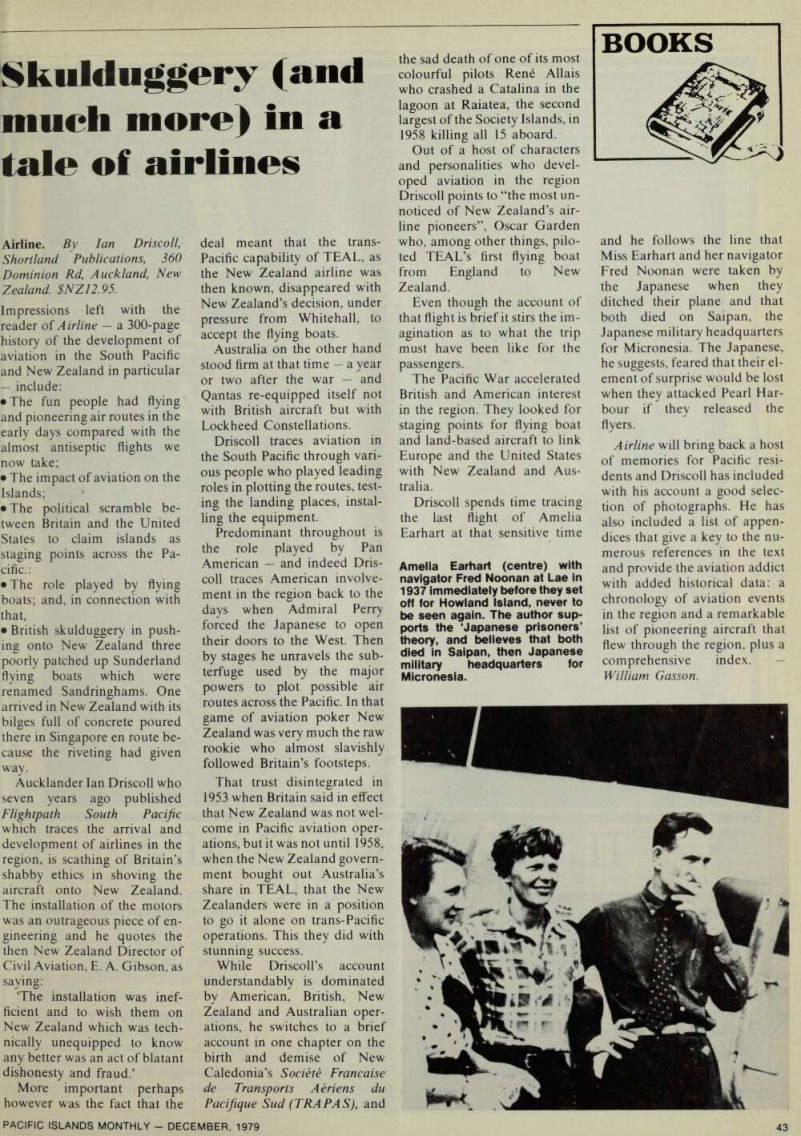
Books
Skulduggery (and much more) In a tale of airlines
Airline. By lan Driscoll, Shortland Publications, 360 Dominion Rd, Auckland, New Zealand. SNZ 12.95.
Impressions left with the reader of Airline a 300-page history of the development of aviation in the South Pacific and New Zealand in particular include; • The fun people had flying and pioneering air routes in the
early days compared with the
almost antiseptic flights we
now take; • The impact of aviation on the Islands; • The political scramble be tween Britain and the United States to claim islands as staging points across the Pa cific.:
• The role played by flying
boats; and, in connection with that, • British skulduggery in push ing onto New Zealand three
poorly patched up Sunderland
flying boats which were renamed Sandringhams. One arrived in New Zealand with its bilges full of concrete poured there in Singapore en route be cause the riveting had given way.
Aucklander lan Driscoll who seven years ago published
Flightpath South Pacific
which traces the arrival and development of airlines in the region, is scathing of Britain’s shabby ethics in shoving the aircraft onto New Zealand.
The installation of the motors was an outrageous piece of en gineering and he quotes the then New Zealand Director of Civil Aviation, E. A. Gibson, as
saying:
The installation was inef ficient and to wish them on New Zealand which was tech
nically unequipped to know
any better was an act of blatant dishonesty and fraud.’
More important perhaps
however was the fact that the
deal meant that the trans pacific capability of TEAL, as the New Zealand airline was then known, disappeared with New Zealand’s decision, under pressure from Whitehall, to accept the flying boats.
Australia on the other hand stood firm at that time a year or two after the war and Qantas re-equipped itself not with British aircraft but with Lockheed Constellations.
Driscoll traces aviation in the South Pacific through vari
ous people who played leading
roles in plotting the routes, test
ing the landing places, instal
ling the equipment.
Predominant throughout is the role played by Pan American and indeed Dris coll traces American involve ment in the region back to the
days when Admiral Perry
forced the Japanese to open their doors to the West. Then by stages he unravels the sub
terfuge used by the major
powers to plot possible air routes across the Pacific. In that game of aviation poker New Zealand was very much the raw rookie who almost slavishly followed Britain’s footsteps.
That trust disintegrated in 1953 when Britain said in effect that New Zealand was not wel come in Pacific aviation oper ations, but it was not until 1958, when the New Zealand govern ment bought out Australia’s share in TEAL, that the New Zealanders were in a position to go it alone on trans-Pacific operations. This they did with
stunning success.
While Driscoll’s account understandably is dominated by American, British, New Zealand and Australian oper ations, he switches to a brief account in one chapter on the birth and demise of New Caledonia’s Societe Francaise de Transports Aeriens du Pacifique Sud (TRAPAS), and
the sad death of one of its most colourful pilots Rene Allais who crashed a Catalina in the lagoon at Raiatea, the second largest of the Society Islands, in 1958 killing all 15 aboard.
Out of a host of characters and personalities who devel oped aviation in the region Driscoll points to “the most un noticed of New Zealand’s air line pioneers”, Oscar Garden who, among other things, pilo ted TEAL’s first flying boat from England to New Zealand.
Even though the account of that flight is brief it stirs the im agination as to what the trip must have been like for the passengers.
The Pacific War accelerated British and American interest in the region. They looked for
staging points for flying boat
and land-based aircraft to link Europe and the United States with New Zealand and Aus tralia.
Driscoll spends time tracing
the last flight of Amelia Earhart at that sensitive time
and he follows the line that Miss Earhart and her navigator Fred Noonan were taken by the Japanese when they ditched their plane and that both died on Saipan, the
Japanese military headquarters
for Micronesia. The Japanese, he suggests, feared that their el ement of surprise would be lost when they attacked Pearl Har bour if they released the flyers.
Airline will bring back a host of memories for Pacific resi dents and Driscoll has included with his account a good selec tion of photographs. He has also included a list of appen dices that give a key to the nu merous references in the text and provide the aviation addict with added historical data: a chronology of aviation events in the region and a remarkable list of pioneering aircraft that
flew through the region, plus a
comprehensive index.
William Gasson.
Amelia Earhart (centre) with navigator Fred Noonan at Lae in 1937 immediately before they set off for Howland Island, never to be seen again. The author sup ports the ‘Japanese prisoners’ theory, and believes that both died in Saipan, then Japanese military headquarters for Micronesia.
Advertisements & other items, p. 44 (1 item)
The Same
1. Ladies single stone diamond pendant in 9ct gold 8 2. Dimensional alphabet pendant in 9ct gold 9 3. Ladies seven stone diamond pendant in 18ct gold 10* 4. Ladies two stone ruby & diamond pendant in 18ct gold 11 5. Ladies diamond set tag pendant in 9ct gold 12 6. Gents diamond signet ring in 9ct gold 13 7. Gents Greek zodiac pendants in sterling silver 14 Gents sporting motif pendant in pure silver Ladies fourteen stone diamond earrings in 18ct gold Ladies two stone diamond eternity ring in 18ct gold Ladies five stone engagement ring in 18ct gold Ladies three stone engagement ring in 18ct gold Ladies five stone curved eternity ring in 18ct gold Ladies seventeen stoneypluster ring in 18ct go * m ■ -Tsc * >■* . <>oo0 4 * 12 PJ 1 -tm v-c-cv— -9 HQ J:'
THE MASTERY REMAINS
Because we are Manufacturing Wholesalers, you are ensured of top quality jewellery at competitive prices right through our product range. Whether the product is Sterling Silver or 18 Carat Gold set with precious stones, you are sure of a Masterly job from Master Jewellers.
THE SAME
Experienced designers, Expert craftsmen, Sophisticated equipment, St r ict quality control... adds up to first class jewellery in every way.
ALAN J. SWEENEY LIMITED
P.O. Box 68001, Auckland, New Zealand. Telephone 761-012 The benefits that we, as Manufacturing Wholesalers offer are manifold from our very comprehensive client service to real "Value for Money” merchandise. Give us a call - we’re Jeweller’s Jewellers.
ALAN J. SWEENEY PTY LIMITED
P.O. Box 162. Crows Nest N.S.W. 2065, Sydney, Australia. Phone 433-213.
STOCKED BY LEADING JEWELLERS THROUGHOUT THE PACIFIC - TRADE ENQUIRIES WELCOME
enjoyed - but
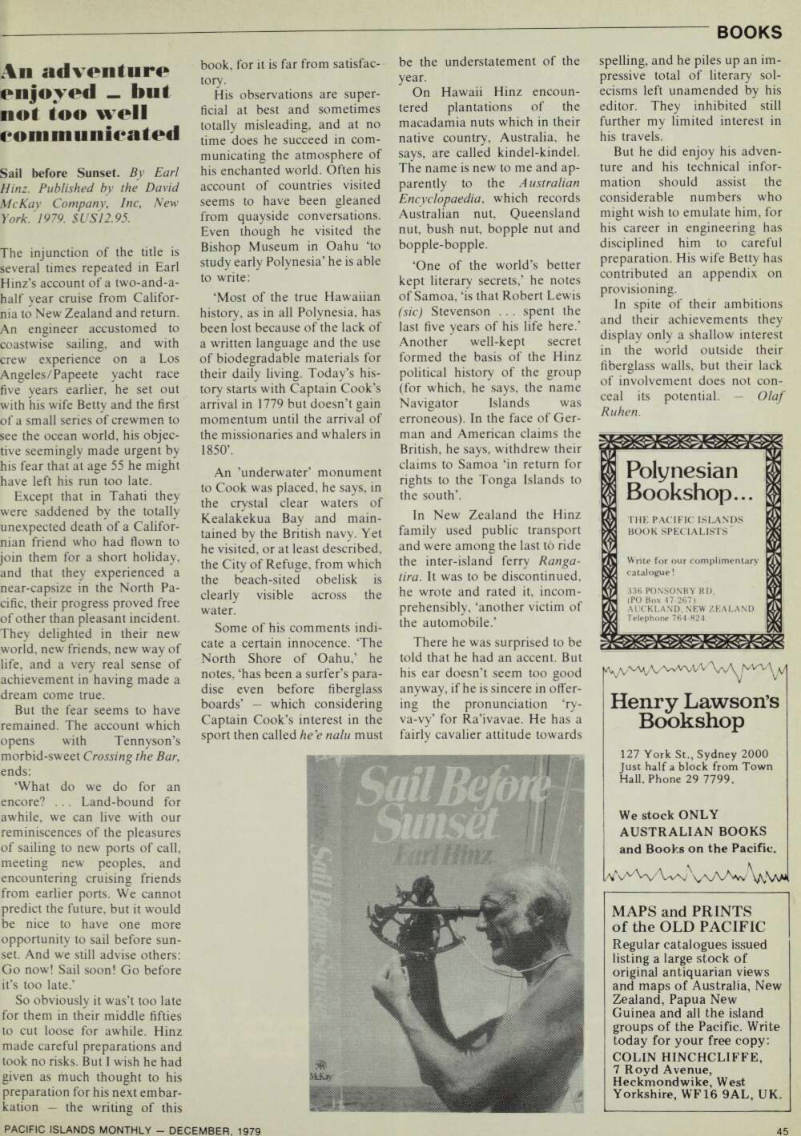
An adventure
not too well communicated
Sail before Sunset. By Earl Hinz. Published by the David McKay Company, Inc, New York. 1979. $U512.95.
The injunction of the title is several times repeated in Earl Hinz’s account of a two-and-a half year cruise from Califor nia to New Zealand and return.
An engineer accustomed to
coastwise sailing, and with
crew experience on a Los
Angeles/Papeete yacht race
five years earlier, he set out with his wife Betty and the first of a small series of crewmen to see the ocean world, his objec tive seemingly made urgent by his fear that at age 55 he might have left his run too late.
Except that in Tahati they
were saddened by the totally
unexpected death of a Califor nian friend who had flown to join them for a short holiday, and that they experienced a near-capsize in the North Pa cific, their progress proved free of other than pleasant incident.
They delighted in their new world, new friends, new way of life, and a very real sense of achievement in having made a dream come true.
But the fear seems to have remained. The account which opens with Tennyson’s morbid-sweet Crossing the Bar, ends; ‘What do we do for an encore? ... Land-bound for awhile, we can live with our reminiscences of the pleasures of sailing to new ports of call,
meeting new peoples, and
encountering cruising friends
from earlier ports. We cannot predict the future, but it would be nice to have one more opportunity to sail before sun set. And we still advise others: Go now! Sail soon! Go before it’s too late.’
So obviously it was’t too late for them in their middle fifties to cut loose for awhile. Hinz made careful preparations and took no risks. But I wish he had given as much thought to his preparation for his next embar kation the writing of this
book, for it is far from satisfac tory.
His observations are super ficial at best and sometimes totally misleading, and at no time does he succeed in com
municating the atmosphere of
his enchanted world. Often his account of countries visited seems to have been gleaned from quayside conversations.
Even though he visited the Bishop Museum in Oahu ‘to
study early Polynesia’ he is able
to write: ‘Most of the true Hawaiian history, as in all Polynesia, has been lost because of the lack of a written language and the use of biodegradable materials for
their daily living. Today’s his
tory starts with Captain Cook’s arrival in 1779 but doesn’t gain momentum until the arrival of the missionaries and whalers in 1850’.
An ’underwater’ monument to Cook was placed, he says, in the crystal clear waters of Kealakekua Bay and main tained by the British navy. Yet he visited, or at least described, the City of Refuge, from which the beach-sited obelisk is clearly visible across the water.
Some of his comments indi cate a certain innocence. ‘The North Shore of Oahu,’ he notes, ‘has been a surfer’s para dise even before fiberglass boards’ which considering Captain Cook’s interest in the sport then called he’e nalu must
be the understatement of the year.
On Hawaii Hinz encoun tered plantations of the macadamia nuts which in their native country, Australia, he says, are called kindel-kindel.
The name is new to me and ap parently to the Australian
Encyclopaedia , which records
Australian nut, Queensland nut, bush nut, bopple nut and
bopple-bopple.
‘One of the world’s better kept literary secrets,’ he notes of Samoa, ‘is that Robert Lewis (sic) Stevenson ... spent the last five years of his life here.’
Another well-kept secret formed the basis of the Hinz political history of the group (for which, he says, the name Navigator Islands was erroneous). In the face of Ger man and American claims the British, he says, withdrew their claims to Samoa ‘in return for rights to the Tonga Islands to the south’.
In New Zealand the Hinz
family used public transport
and were among the last to ride
the inter-island ferry Ranga
tira. It was to be discontinued, he wrote and rated it, incom prehensibly, ‘another victim of the automobile.’
There he was surprised to be told that he had an accent. But his ear doesn’t seem too good anyway, if he is sincere in offer
ing the pronunciation Ty
va-vy’ for Ra’ivavae. He has a fairly cavalier attitude towards
spelling, and he piles up an im pressive total of literary sol ecisms left unamended by his editor. They inhibited still further my limited interest in his travels.
But he did enjoy his adven ture and his technical infor mation should assist the considerable numbers who might wish to emulate him, for his career in engineering has disciplined him to careful preparation. His wife Betty has contributed an appendix on
provisioning.
In spite of their ambitions and their achievements they display only a shallow interest in the world outside their fiberglass walls, but their lack of involvement does not con
ceal its potential. Olaf
Ruhen.
Advertisements & other items, p. 45 (1 item)
Bookshop...
Polynesian
THE PACIFIC ISLANDS
BOOK SPECIALISTS
Write for our complimentary catalogue!
336 PONSONBY RI),
(PO Box 47 267)
AUCKLAND, NEW ZEALAND
Telephone 764-824,
Henry Lawson’s
Bookshop
127 York St., Sydney 2000 Just half a block from Town Hall. Phone 29 7799.
We stock ONLY
AUSTRALIAN BOOKS
and Books on the Pacific.
MAPS and PRINTS
of the OLD PACIFIC Regular catalogues issued listing a large stock of original antiquarian views and maps of Australia, New Zealand, Papua New Guinea and all the island groups of the Pacific. Write today for your free copy:
COLIN HINCHCLIFFE,
7 Royd Avenue, Heckmondwike, West Yorkshire, WFI6 9AL, UK.
Recalling
the wrong people
Norfolk Island 1846 The Bot any Bay of Botany Bay. by Stuart and Naylor. Published by Sullivan’s Cove, Box 1932, Adelaide, Sth Australia. SA3S.
These are interesting, if some what expensive, days for people attracted by Norfolk
Island’s history.
Late last year The Exile’s Lamentations (PIM, February, p 59), a manuscript written by a Norfolk prisoner in about 1840, was published for the first time. It will almost cer
tainly remain the outstanding
description of the Island’s dis graceful prison colony as seen through a convict’s eyes.
Two other contemporary descriptions of that foul period - euphemistically called Nor folk’s ‘Second Settlement’ have now been brought out of archives and published in a volume titled Norfolk Island 1846.
The book has 84 foolscap size pages. The quality of its paper and production is high, for these days. Only 500 num bered copies have been printed for sale. The publishers have also had 10 copies bound in leather, with the page-edges being slit in the old style, at $lB5 a copy.
The two Norfolk prison descriptions in the book are by Rev T. B. Naylor, who was the Chaplain on Norfolk from 1841-1845, and by R. P. Stuart,
who wrote an official report for the Van Diemen’s Land government (Tasmania), after a two-weeks visit in 1846.
Naylor’s and Stuart’s accounts were published in a parliamentary paper in England in 1847, titled ‘Cor respondence on Convict Disci pline and Transportation’, and have been one of the main sources of information for Nor folk historians ever since. In republishing them the Sullivan’s Cove edition adds 45 explanatory footnotes that shed further light on the people and events described. There is a helpful introduction, and an appendix listing 42 years of punishments inflicted on a
single prisoner, Denis Doherty.
Restored to the Stuart report are some passages that were expurgated in the original parliamentary paper, com
menting on homosexuality in
the prison. They are neither substantial nor lurid by current standards.
Stuart’s report is 35 pages
long, and considerably the
more descriptive. It is critical of the state of affairs on Norfolk not so much because the place was a degrading hell hole, but because the Com
mandant, Major Joseph
Childs, had let discipline go to
pieces.
The report describes Major Childs as ‘a most amiable ben evolent gentleman’, which
might possibly qualify for the
Guinness Book of Records in a new category of ‘Nicest thing ever said of a member of the Establishment by another member.’
What Norfolk needed, Stuart recommended, were
new walls inside the mess com pound, to enforce obedience; the replacement of the broken down windmill with a tread wheel, ‘offering, as that description of incessant com pulsory labour does when com bined with separate treatment, a means of effectually coercing and subduing the hardened and turbulent’; the dismissal of officers who had been trading with convicts; and similar re forms such as building a more readily supervised blacksmith
shop.
Stuart proposed that Major Childs be recalled, in favour of someone more experienced, and this was promptly done.
When his report was con sidered by the executive coun cil in Van Diemen’s Land on July 1, 1846, the Lt-Govemor said it appeared to him that Norfolk was ‘on the very verge of open mutiny’. Mutiny was in fact then breaking out on the island.
In his report Stuart carefully catalogues the routines, the be haviour of prisoners and the
physical facilities at Kingston,
Longridge and Cascade. He describes the food, the crops, the wells, the ventilation, the hospital, sanitary arrange ments, the barracks, boot
making, lighting, prayers, the
bakehouse. It is an orderly, in formative report by a police magistrate concerned to make a system work, and apparently untroubled by whether the sys tem was right or wrong.
The Rev. Thomas Naylor’s description of Norfolk is only half as long as Stuart’s. The book’s introduction charac terises it as ‘less comprehensive and less objective’ but in his torical fact it was overwhelm ingly more powerful and effective. It led to the shutting down of the prison.
Where Stuart dealt with pro cedures, Naylor dealt with principles. He felt ‘there are evils which demand instant and effectual remedy’.
He intended his paper as an open letter to the secretary of state for the colonies. He sent it to England with his wife, ask ing her to get it published as a pamphlet.
His main points appear as sub-headings. Norfolk is unfit for a penal station, he says.
There is no discipline. There are too many men herded in one place. All grades of con
victs mingle indiscriminately.
Reformation and restoration to
society are altogether
overlooked. The diet is inad equate. The expense is enor mous.
He describes the island with restrained emotion. He con cludes, ‘At all events, my Lord, you must do something. Nor folk Island cannot remain the plague-spot it is much
longer...’
Mrs Naylor showed her hus band’s paper to Alexander Maconochie, who had returned to England after his term as Norfolk’s superintendent. He persuaded her to let him send it on to an associate of Earl Grey, who was colonial sec retary.
Eight days later Lord Grey
wrote to Sir William Denison, who was about to sail to take up his post as the new Lt- Govemor of Van Diemen’s Land. He enclosed Naylor’s paper. He instructed Denison ‘with the least possible delay, to take measures at once to break up the establishment at Nor folk Island, and withdraw the whole population of that settle ment to Tasman’s Penin sula ...’
It took Denison almost a decade to do it, but the fate of
England’s most despicable
prison colony was sealed from that moment. And all because a clergyman had the courage and the principles to write an
impassioned letter.
How foolishly we let our selves be led into remembering and honouring the wrong men
in history. The steely Major
Anderson is remembered on Norfolk because he had his name inscribed at the top of
large Kingston buildings - but
the humane, admirable Alex ander Maconochie is forgotten.
The Rev Thomas Beagley Naylor’s name should be honoured in the Pacific, and people who care about Nor folk’s history will want to have this new publishing of his elo quent letter, which broke the hellish grip cruelty had on the Island, and set the stage for the Pitcairn people to be offered a 4 new homeland there a decade
later.
Ed Howard.
Advertisements & other items, pp. 46-48 (2 items)
46
DAnur ICI AMnc unMTUi v/ nr/'cmnrn -i r>7n
BOOKS
Pty Ltd
PETER FISHER
TRADING
321 PITT St., SYDNEY, AUSTRALIA 2000
Telephone: 212 1475 Cables: "FISHERION" Sydney
EXPORTERS TO THE
PACIFIC ISLANDS
More of an asset
than just a pen.
Parker 75.
m
WV. m.-.
%;<V% V*-.
It takes four precious metals to make a Parker 75 pen like this. Sterling silver for the case, 14ct gold for the beautifully responsive nib, and a wear-resistant alloy \ of platinum and ruthenium for the tip.
It s even more exceptional. The nib can turn 360° to write at the angle most natural to you.
A lifetime investment.
Also in 22ct gold and stainless steel.
Pencils, ball pens to match.
tmdUUIK
t PARKER
mkr.
m m S ' ♦V tv'
W9MO*
S5S* - V ■ ■ 'Hi \ z*. »'■ ■:* \ wM '■ *'■ ■ ■ %'s . \ V' ' * \ Worlds most wanted pern
%X- - '•tzvwm
m\ vl - .
VV>: -v‘— ■‘H. 066 P 490 R
PERFORMANCE
2) £B :<*'■
E=—-p> —F—=F
I
dependable
marine engines
When fishing Is your living, you knowyou need dependable gear working with minimum downtime and your engines have to deliver reliable power when and where you need it.
CATERPILLAR offers you a comprehensive selection of performance proven Cat Marine Diesel Engines from 85hp up to IOOOhp, backed by after sales service and replacement parts facilities that are second to none.
dependable
Whatever your electric power needs, there’s a Catbuilt generator set to meet them. Caterpillar generators feature adjustment free fuel systems, large capacity radiators, heavy duty air cleaners and quick-change fuel and oil filters to ensure dependable performance throughout the islands, in all kinds of tropical conditions. di
HASTINGS DEERING
LAE:
Milford Haven Road, Telephone 42 2355.
PORT MORESBY.
Telephone 256650.
BOUGAINVILLE:
Itakara Industrial Park, Arawa Telephone 959077.
carptrac
SUVA: Carpenter Street, Raiwai.
Private Mail Bag, GPO Suva, Fiji. Ph. 381622.
Telex FJ2190 Cables CARPTRAC.
LAUTOKA: Veitari. Telephone 61877.
LABASA: Vulovi. Telephone 81868.
YOUR
CATERPILLAR
DEALER
Caterpillar, Cat and CB are Trademarks of Caterpillar Tractor Co.
The Voyage of Taulamati
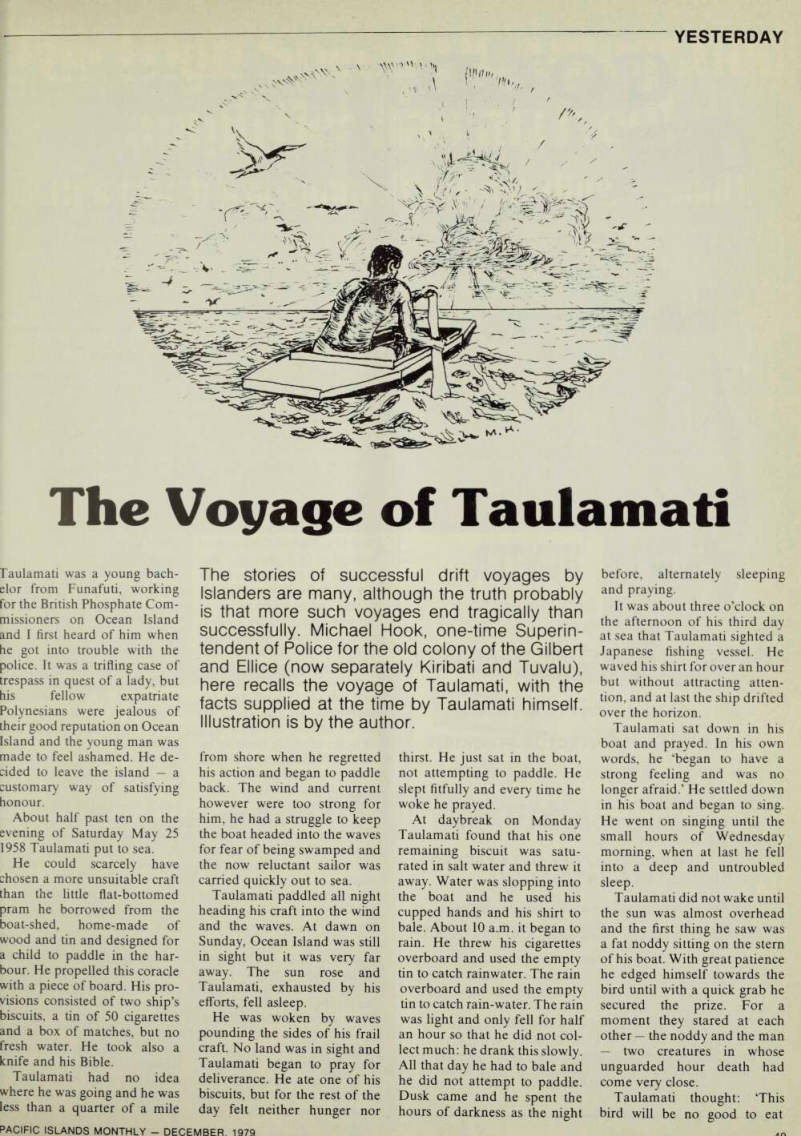

Yesterday
The stories of successful drift voyages by Islanders are many, although the truth probably is that more such voyages end tragically than successfully. Michael Hook, one-time Superin tendent of Police for the old colony of the Gilbert and Ellice (now separately Kiribati and Tuvalu), here recalls the voyage of Taulamati, with the facts supplied at the time by Taulamati himself.
Illustration is by the author.
Taulamati was a young bach
elor from Funafuti, working
for the British Phosphate Com missioners on Ocean Island and I first heard of him when he got into trouble with the police. It was a trifling case of trespass in quest of a lady, but
his fellow expatriate
Polynesians were jealous of
their good reputation on Ocean
Island and the young man was made to feel ashamed. He de cided to leave the island a
customary way of satisfying
honour.
About half past ten on the evening of Saturday May 25 1958 Taulamati put to sea.
He could scarcely have chosen a more unsuitable craft than the little flat-bottomed pram he borrowed from the boat-shed, home-made of wood and tin and designed for a child to paddle in the har bour. He propelled this coracle with a piece of board. His pro visions consisted of two ship’s biscuits, a tin of 50 cigarettes and a box of matches, but no fresh water. He took also a knife and his Bible.
Taulamati had no idea where he was going and he was less than a quarter of a mile
from shore when he regretted his action and began to paddle back. The wind and current however were too strong for him, he had a struggle to keep the boat headed into the waves for fear of being swamped and the now reluctant sailor was carried quickly out to sea.
Taulamati paddled all night
heading his craft into the wind and the waves. At dawn on Sunday, Ocean Island was still in sight but it was very far away. The sun rose and Taulamati, exhausted by his efforts, fell asleep.
He was woken by waves pounding the sides of his frail craft. No land was in sight and Taulamati began to pray for deliverance. He ate one of his biscuits, but for the rest of the day felt neither hunger nor
thirst. He just sat in the boat, not attempting to paddle. He slept fitfully and every time he woke he prayed.
At daybreak on Monday
Taulamati found that his one remaining biscuit was satu rated in salt water and threw it away. Water was slopping into the boat and he used his cupped hands and his shirt to bale. About 10 a.m. it began to rain. He threw his cigarettes overboard and used the empty tin to catch rainwater. The rain overboard and used the empty tin to catch rain-water. The rain was light and only fell for half an hour so that he did not col lect much: he drank this slowly.
All that day he had to bale and he did not attempt to paddle.
Dusk came and he spent the hours of darkness as the night
before, alternately sleeping
and praying.
It was about three o’clock on the afternoon of his third day at sea that Taulamati sighted a
Japanese fishing vessel. He
waved his shirt for over an hour but without attracting atten tion, and at last the ship drifted over the horizon.
Taulamati sat down in his boat and prayed. In his own words, he ‘began to have a strong feeling and was no longer afraid.’ He settled down in his boat and began to sing.
He went on singing until the small hours of Wednesday morning, when at last he fell into a deep and untroubled
sleep.
Taulamati did not wake until the sun was almost overhead and the first thing he saw was a fat noddy sitting on the stern of his boat. With great patience he edged himself towards the bird until with a quick grab he secured the prize. For a moment they stared at each other the noddy and the man two creatures in whose unguarded hour death had come very close.
Taulamati thought: ‘This bird will be no good to eat
uncooked.’ He opened his hand and the noddie’s strong black wings bore it swittly away on the wind of life and freedom.
Taulamati spent that day and the night which followed in prayer and short snatches of sleep. For over four days he had had nothing to eat and drink but a biscuit and a little rain-water and on the Thurs day morning he turned his attention to fishing.
Fish were swimming round his little boat and he succeeded in stabbing a large tuna and in hauling it aboard. After return ing thanks to the Sender of the fish, Taulamati cut the fish up, ate some and spread the remaining pieces in the bottom of the boat to dry.
Later that day it rained and Taulamati drank his fill and fell asleep. He awoke at mid night, ate some more fish and sang hymns until he fell
asleep.
Taulamati now had suf ficient fish to keep him going for a few days and occasional showers of rain provided him with water. He continued to pass his waking hours baling,
praying and singing hymns.
It was after dark on Friday, six days after he had begun his voyage, that numbers of sea birds appeared flying round his boat. Taulamati realised land must be not far off and his spirits rose. He redoubled his prayers and fell asleep happy.
On the Saturday morning he saw frigate birds and, although these might have come from other islands, he knew many Nauruans kept these birds as pets. Taulamati guessed he was near Nauru and with great earnestness begged God to di rect his boat towards that island.
On Saturday afternoon and
again on Sunday morning
Taulamati saw many noddies,
flying and crying as they
swooped to catch fish. On Sun day he fought to stay awake as he was afraid he might drift past Nauru in his sleep. Despite this however he did at length succumb and awoke after dark
on Sunday night.
Far away on the horizon to the westward he saw a light. He stared at it hard and long, presently made out other lights
and knew that ahead indeed lay Nauru. The distance from Ocean Island to Nauru is about 160 miles, but both are tiny islands and it was a miracle that Taulamati had made a land fall. Breathing a prayer of thankfulness he now rigged a sail using his sulu and the piece of board he had brought as a paddle. A little later, overcome by weakness and fatigue, he
fell asleep.
Taulamati awoke just before
daybreak on Monday. Nauru
was on his right and he was being carried past the south side of the island. He hastily took down his sail. He was a good way out but he could plainly see a ship moored opposite the cantilever. As he came opposite the cantilever the set of tide and wind seemed to change and he found his boat was drifting in a more
northerly direction.
As Taulamati’s craft drifted up the western shore of Nauru
he began to paddle. By nine
o’clock in the morning he was quite close to the reef at the northern end of the west coat.
A big wave hit his frail boat and Taulamati dived over board.
Although weak from his long ordeal, he struggled ashore. He drank a coconut, thanked God for saving him, had a sleep and a little later formally reported his arrival to the astonished manager of the British Phos phate Commissioners on Nauru.
Back on Ocean Island it was decided that Taulamati had had difficulties enough and the police case against him was not
pressed. The Phosphate Com
missioners decided also to per mit him to continue his employment with them on Nauru instead of on Ocean Island. Even the borrowed boat was recovered and shipped back to its owner.
Taulamati’s voyage was something of a nine days won
der. Perhaps his extraordinary 1
good fortune in landing on Nauru gave others the idea that it was easy, for two months after Taulamati’s voyage, another Ellice Islander, finding himself in trouble, left Ocean Island in a small boat.
He was never heard of again.
Advertisements & other items, pp. 50-51 (2 items)
Yesterday
Bounty Hunter
BOUNTY
HUNTER
RELICS
OUR AUSTRALIAN EXPERIENCE SINCE 1974
INDICATES TO US THAT THESE ARE MOST
ASSUREDLY FOR AUSTRALIAN CONDITIONS
THE VERY LATEST LIGHTWEIGHT MACHINES
FOR THE GREATEST
DEPTH PENETRA TION
IN
MAGNETIC GROUND CONDITIONS
(WHERE THE GOLD IS USUALLY LOCATED )
BOUNTY HUNTER
"THE ONE THAT GETS THE GOLD"
MADE IN U.S.A.
20 MODELS - LIFETIME WARRANTY
-ALL PRICES
SEE THE RANGE - TEST THEM YOURSELF
AT ALL QUALITY DETECTOR STOCKISTS
AND DON'T SETTLE FOR ANYTHING LESS!
BOUNTY HUNTER HAS MORE VALUE PACKED
FEATURES' SOME MODELS ARE STANDARD
WITH 3 SEARCH COILS!
PHONE OR WRITE FOR FREE DATA PACKAGE
AND NEAREST DEALER LOCATION.
Sole S.W. Pacific Distributors & Factory-Approved Service Centre
HENDON DETECTOR COMPANY
An Associate of Southern Patagonian Holdings Pty Limited Office: 121 Plateau Rd. Telephone: (3 Lines) STD 02 - 918 6667 (24 HRS.) AH Mai! to: P.O BOX II V , AVALON BEACH, NSW 2107, AUSTRALIA
REPUTABLE NEW DEALERS ARE WELCOME -
NEVER SAY NO TO A CUSTOMER - WE CAN
PUT BOUNTY HUNTER GOLD DETECTORS ON
YOUR SHELVES IN 24 HOURS!
The High Speed DC integrated
amplifier has arrived!
(It's last. It’s accurate. It s three-dimensional) Think of the most soul-stirring musical passage you know, with the whole orchestra playing a full crescendo.
The Kenwood High Speed DC integrated amplifier can reproduce it, with the consummate ease of a seasoned pro.
Or get down to more personal music where what you really want to hear is those sensitive fingers caressing the guitar strings. Or the lips of your favorite singer articulating each word.
The Kenwood High Speed DC integrated amplifier gives it to you, all the way.
What we’re talking about is not just a package of circuitry made-up with some front-panel cosmetics. You can get that anywhere.
Were talking about quality in reproduced sound.
And authenticity 7 .
We can tell you about the astonishing transient response of these integrated amplifiers. About their beautifully clean low-end response without phase distortion.
About their remarkable clarity throughout the audible frequency range.
Or about their state-of-the-art circuitry.
Yet it won’t mean much unless you can hear for yourself just how much space and depth these amplifiers can offer you, fresh from your speakers.
The KA-907, KA-801 and KA-701 are part of the Kenwood ideal that goes back to the beginnings of audio.
And that ideal is: authentic music reproduction at a price you can afford.
You can see full range of Kenwood new High-Speed Amplifier at 79 Australian CES
□ HI-SPEED
r y pi? 1 J f- KA-907
Guadalcanal
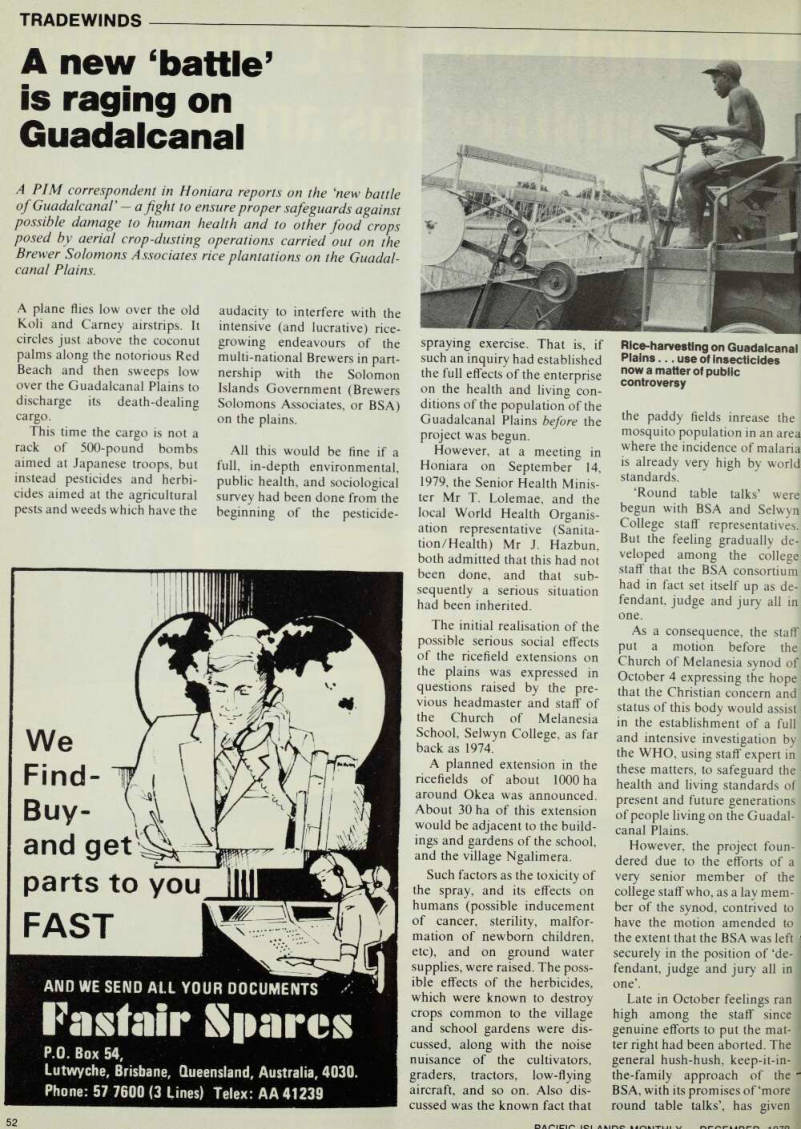



Tradewinds
A new ‘battle’ is raging on Guadalcanal
A PIM correspondent in Honiara reports on the ‘new battle of GuadalcanaP a fight to ensure proper safeguards against possible damage to human health and to other food crops posed by aerial crop-dusting operations carried out on the Brewer Solomons Associates rice plantations on the Guadal canal Plains.
A plane flies low over the old Koli and Carney airstrips. It circles just above the coconut palms along the notorious Red Beach and then sweeps low over the Guadalcanal Plains to
discharge its death-dealing
cargo.
This time the cargo is not a rack of 500-pound bombs aimed at Japanese troops, but instead pesticides and herbi cides aimed at the agricultural pests and weeds which have the
audacity to interfere with the intensive (and lucrative) rice growing endeavours of the multi-national Brewers in part nership with the Solomon Islands Government (Brewers Solomons Associates, or BSA) on the plains.
All this would be fine if a full, in-depth environmental, public health, and sociological survey had been done from the beginning of the pesticide-
spraying exercise. That is, if such an inquiry had established the full effects of the enterprise on the health and living con ditions of the population of the Guadalcanal Plains before the
project was begun.
However, at a meeting in Honiara on September 14, 1979, the Senior Health Minis ter Mr T. Lolemae, and the local World Health Organis ation representative (Sanita tion/Health) Mr J. Hazbun, both admitted that this had not been done, and that sub sequently a serious situation had been inherited.
The initial realisation of the possible serious social effects of the ricefield extensions on the plains was expressed in questions raised by the pre vious headmaster and staff of the Church of Melanesia School, Selwyn College, as far back as 1974.
A planned extension in the ricefields of about 1000 ha around Okea was announced.
About 30 ha of this extension would be adjacent to the build ings and gardens of the school, and the village Ngalimera.
Such factors as the toxicity of the spray, and its effects on humans (possible inducement of cancer, sterility, malfor mation of newborn children, etc), and on ground water supplies, were raised. The poss ible effects of the herbicides, which were known to destroy crops common to the village and school gardens were dis cussed, along with the noise nuisance of the cultivators, graders, tractors, low-flying aircraft, and so on. Also dis cussed was the known fact that
the paddy fields inrease the mosquito population in an area where the incidence of malaria
is already very high by world
standards. ‘Round table talks’ were begun with BSA and Selwyn College staff representatives.
But the feeling gradually de
veloped among the college
staff that the BSA consortium had in fact set itself up as de fendant, judge and jury all in one.
As a consequence, the staff put a motion before the Church of Melanesia synod of October 4 expressing the hope that the Christian concern and status of this body would assist in the establishment of a full
and intensive investigation by
the WHO, using staff expert in these matters, to safeguard the health and living standards of present and future generations of people living on the Guadal canal Plains.
However, the project foun dered due to the efforts of a very senior member of the college staff who, as a lay mem ber of the synod, contrived to have the motion amended to the extent that the BSA was left j securely in the position of ‘de- 1 fendant, judge and jury all in one’.
Late in October feelings ran high among the staff since 1 genuine efforts to put the mat- ; ter right had been aborted. The
general hush-hush, keep-it-in
the-family approach of the “ BSA, with its promises of‘more round table talks’, has given
Rice-harvesting on Guadalcanal Plains... use of insecticides now a matter of public controversy
ise to a feeling of grave dis quiet about the outcome of the Tattle and the subsequent effects on the welfare of the Teople of the Guadalcanal Plains.
Fiji Gets
U.S. Advice
riji should work towards closer ;conomic ties with Asian coun ries and not just Australia and Mew Zealand, according to American economist Professor Teorge Viksnins, who made a bur-day visit to Fiji in October mder the auspices of the US Dovernment.
Professor Viksnins, who caches economics at George own University in Washington DC, thinks the Asian area ould be exploited by Fiji,
Korea, Singapore, Hong
Cong, Malaysia and Thailand
ire rapidly developing indus
rial countries ... I’m sure that hey would be interested in riji’s raw materials,’ he said.
T think that Fiji is a pretty dable country in terms of natu al resources. There’s plenty of vater and sunshine and the xmntry has a well developed nfrastructure. ‘At the moment Australia md New Zealand think excess vely of the European market, riji, despite its strong links vith Britian, should begin to hink about the “Pacific Economy”.
He said the Pacific Economy tad already outstripped the
Vtlantic Economy, and Fiji
vould be wise to capitalise on his development. To do this, it hould concentrate on the levelopment of agriculture md mineral resources. ‘lt would make a lot of sense o develop copper,’ he sug gested.
The price of copper was 'oing to rise considerably, as it
lad not yet fully participated in
he basic upward trend of
vorld prices of minerals.
What about the soaring price
)f gold and therefore Fiji’s
:hances of making money from
'old again?
The professor could not say vhat Fiji stood to make out of he gold boom, but he was ceptical about the valuable netal. ‘The price of gold is going to
come down sharply in the next year.’ he predicted. ‘I think that the price will be below SUS3OO an ounce within a year.’
Professor Viksnins acts as a consultant to investment bankers L. R. Rothschild, Unterberg and Towbin.
Visiting Fiji under the US Government’s ‘Specialist Pro
gramme,’ the professor took
part in lectures and discussions with University of the South Pacific students and govern ment officials.
French Talk
On The Sea
Some 280 delegates attended the Conference on the Sea held by the French Government re cently in Noumea. The meet
ing was organised and opened
by Paul Dijoud, Minister for Overseas Territories. Par ticipants included defence per sonnel, administrators and politicians from New Caledonia, Tahiti and Wallis and Futuna, as well as scientists and industrial representatives from France and several
foreign observers.
Now that the 200-mile econ omic zone has made France the third largest marine power,
Paul Dijoud emphasised the
mineral and energy potential of French waters in the Pacific.
Mr Dijoud also stressed the im portance of the Pacific terri tories for the spreading of French influence right to the antipodes. The French Terri tories Minister said ‘the sea offers an extraordinary domain for combat and involvement’.
Fie said the main aim of the Noumea conference was to suggest to Paris the chief areas to be explored over the next 10 or 20 years. This would entail the drawing up of various agreements between metro politan France and the Pacific territories. This raised the
problem, stressed by the
Polynesians, of the overlapping
power of France and the terri tories in control of the wealth of the sea.
The Noumea meeting fol lowed another conference earlier this year organised by Paul Dijoud in Tahiti, to dis cuss tourist strategies in the French Pacific. The Polynesian government councillor respon
sible for tourism, Alec Ata, be
ifore leaving Tahiti for
Noumea, was quoted as saying
he hoped the sea conference would do better than the tour ism meeting which had been marked by the departure of Pan Am from Tahiti (in October). In the last couple of
years, as Polynesians have
battled for internal autonomy and an independent economy, Tahiti has suffered the breaking-off of air services by Air France (to Tokyo and Peru), Qantas (to Australia) and now the US airline.
At the Noumea conference, Alec Ata was chosen to chair one of eight discussion com mittees, meeting at the Point Chaleix naval base to study de fence and maritime sur veillance. Other members of this group were General P.
Barthelemy of New Caledonia, Mr Paul Cousseran, French high commissioner from Tahiti, and Admiral Y.
Leenhardt, commander of the
nuclear base in Polynesia.
Other three-day discussion groups studied deep sea and
coastal fishing, aquaculture,
local employment, and protec tion of the environment, the mineral resources group con sidered the possibility of oil in New Caledonian waters and
some-day processable nodules
in Polynesia. A member of the Atomic Energy Centre (CEA) in Tahiti led discussions on new forms of energy from the wind, sun and thermal sea energy.
The eight discussion groups led Paul Dijoud to enumerate 17 general points which the French Government could consider in future maritime
strategies. These points in
cluded recommendations to in crease maritime surveillance forces around French Pacific territories, including Wallis and Futuna. It was also sug gested that French influence in the region could be extended by the setting up of a study centre, or ‘University of the Sea’, which could help the French and neighbouring countries. This follows de Gaulle’s idea in 1966 to establish a French university in Noumea to serve the Pacific re
gion.
Helen Rousseau.
Fiji In Big
Fish Accord
Fiji has signed a ‘technical
specification agreement’ with
Japan, covering about $2 million in aid to assist its fish
ing industry.
A six-member Japanese aid team spent three weeks in Fiji in October, and agreed to
finance seven fishing projects.
The aid package includes the purchase of two boats, a skip jack training vessel for Ika Cor poration, and a research and development vessel for the country’s Fisheries Division.
Also included are a rural fishing training scheme labora tory, and an ice-making plant, which are to be constructed at Lami, a fisheries workshop for Savusavu, and a mobile work shop for the Northern Div ision.
Solar Phone
For Tuvalu
The Tuvalu Government’s telecommunications division has received new equipment which will provide a solar
powered telephone service for
the eight outer islands in the group. Two 20-watt solar panels will be used at each station and the electricity generated will be stored in bat
teries for powering single-side
band radio telephone
equipment.
This is the first application of solar electricity in Tuvalu and a demonstration system at Funafuti telecommunications headquarters has attracted much interest from govern ment officials and interested members of the public. The communications equipment is manufactured by the Canadian Marconi Company, and the whole project costing $2O 000 is funded from Canadian aid to Tuvalu.
The first outer station to be equipped with the solar power will be on Vaitupu Island, Tuvalu’s second centre, where the agriculture division has its headquarters and Tuvalu’s sec ondary school is located. The solar system was due to be in service on Vaitupu by late
November.
Peter McQuar-
rie.
Advertisements & other items, pp. 52-58 (3 items)
52
DACMCIO ICI A Kino uakitui v/ r\r/>n mm ■* r\-rn
Fasfair Spares
£ c * We r
Find- Vi \
SWL
parts to you
FAST
n 1
AND WE SEND ALL YOUR DOCUMENTS
Fasfair Spares
P.O. Box 54, Lutwyche, Brisbane, Queensland, Australia, 4030.
Phone: 57 7600 (3 Lines) Telex: AA 41239
(3 FxpCr
THE WATER WHEEL GROUP OF COMPANIES,
Winners of Australia’s Top Export Award and Flour Millers for over 100 years,
OFFER THE PACIFIC ISLANDS
THE TOPS IN QUALITY
PRODUCTS & SERVICE
YY BEST AUSTRALIAN WHEATEN
FLOUR
(High Protein, Roller, Stone ground Wholemeal, Bakers, Cake etc)
COMPLETE RANGE OF FROZEN
AND GENERAL FOOD ITEMS
☆ STOCK & POULTRY FEEDS
(Pellets or Mash form)
YY YELLOW SPLIT PEAS & WHOLE
PEAS
(Machine-Dressed)
YY REFRIGERATION EQUIPMENT
INCLUDING SALTWATER ICE
MAKERS
YY QUALITY AUSTRALIAN WINES
Papua New Guinea, Fiji, Tonga, Western Samoa, American Samoa, New Hebrides, New Caledonia, Solomon Islands and Micronesia.
All Enquiries Welcome To:
WATER WHEEL EXPORTS
Pty. Ltd.
493 Bourke Street, Melbourne, 3000, Australia Cables: Watermill-Melbourne.
Telex: AA 32165 Telephone: 602 1433
Clarion welcomes you to the wonderful world of Hi-Fi car audio. A never-ending quest for better sound quality assures the ultimate performance.
Our wealth of experience is backed by a global reputation for superior quality.
We've car stereo systems, car radios and speakers to please everyone.
In Car Entertainment Company What is your pleasure? m Clarion Clarion Co., Ltd. Tokyo, Japan r % % Amalgamated Wireless (Australasia) Ltd. 554 Parramatta Road, Ashf ield N.S.W., 2131/New Zealand: AWA New Zealand Limited RO. Box j-248 Porirua/ Fiji Islands: Brijlal & Co., Ltd. G.P.O. Box 362 Suva/Tahiti: HI-FI Shangrila B.P. 200 Papeete/New Caledonia: Caldis B.P. Ml Noumea edex/Guam: Guam Radio & TV Shop P.O. Box 1939 Agana, Guam 96910/New Hebrides: The Sound Centre P.O. Box 434> Vila/Cook Islands: outh Seas International Ltd. P.O. Box 49 Rarotonga/Papua New Guinea: Hagemeyer (P.N.G.) Pty. Ltd. P.O. Box 1428, Boroko, Port Moresby.
Superior
WE COVER YOUR SLASHING
REQUIREMENTS
QUALITY RIGHT - PRICE RIGHT
CHECK OUR RANGE OF MACHINES
FOR THE ONE TO SUIT YOUR NEEDS EXTRA BOTTOM SEAL PROTECTION IN EVERY MODEL SLASHER MOWERS to suit Kubota/Mitsubishi
□ 36" L 36 T.P.L. □42"L42T.P.L
FROM
TO ... e f 9 24"
ECONOMY SLASHERS 75 h.p Box 2 1/16 Shaft □ 48" LL4 □ 54" LL4 5
□ 60" LLS □ 72" LL6
MULTI PURPOSE SLASHERS
□ 10'LXIO □ 10' TX 10
o 12 TXI2 □ 20 TX2O □ 24' TX24
GRASS SLASHERS
□ 42"L42 □ 48"L48
SUPPLIERS TO: GOVT. DEPTS, LOCAL AUTHORITIES,
CONTRACTORS and the MAN on the LAND Tick 0 the machine you are interested in and send this advert for FREE brochure to;
SUPERIOR FARM EQUIPMENT PTY. LTD.,
782 Fairfield Road, Veerongpilly, Brisbane, Qld. 4105 Phone; (07( 392 2788.
HEAVY DUTY SLASHERS SI 00 Gear Box
□ 60" LXS □ 72" LX6
□ 84" LX7 □ 15' Trail TXIS PRICES INCLUDE CLUTCH fc CRIVESHAFT ON ALL MOOEiS ALL UNITS SOLD WITH FULL FACTORY WARRANTY SUPERIOR S EXTRA SEAL
PROTECTION ON EVERY SLASHER
NAME
ADDRESS
POSTCODE
TRADEWINDS INTELLIGENCE...TRADEWINDS INTELLIGENCE...TRAI
ATHERTON Antimony NL has pulled off a major joint venture agreement to exploit its 50% owned Vuda porphyry gold prospect in Fiji. The joint venture deal, which will be worth at least $3.3 million, was offered to Atherton by Aberfoyle Ltd through Atherton’s 50% owned Goldfields Mines Ltd.
As 2 284 081 fall in net profit has been reported by the Fiji Sugar Corporation. After paying tax it made a net profit of $4 410 600 in the year ended March 31, compared with $6 694 681 in the previous year. FSC shareholders, including the government, which owns 98% of the company, will collect a 10% dividend a rate paid for the past few years.
EMPEROR Mines Ltd, Fiji/has reported a $6883 profit for its 1978-79 year, a turnaround on the $1 630 000 loss the previous year. Much of the operation’s recovery could be attributed to a more profitable mining situation, it said in a statement. But this had been largely offset by difficulties experienced throughout the year in timber operations.
BURNS Philp (South Sea) Co made a $3 291 000 profit for the year 1978-79 and shareholders will get a dividend of 17.5% for the year. But BP s chairman Mr Charles Wardrop said things were not expected to improve much in the coming year. The company enjoyed the benefits of political stability in the areas it operated in, he said, referring to last year’s profit which was 0.5 per cent up on the previous year. But all areas depended on imported fuel
at escalating prices.
DURING the first quarter of this year Fiji’s Ika Corporation’s vessels landed 69% more fish than in the same period last year.
Ika’s landing of 1633 tonnes made up about 66% of the total amount landed at Pacific Fishing Co during the first quarter 1979.
A total of 2483 tonnes of tuna were landed at Levuka by the Ika Corporation, Formosan and Korean vessels, a 21% decrease in landings over the same period last year.
CONTINENTAL Air Micronesia’s three-aircraft fleet was reduced in October, when the third 727 jet returned to Los Angeles.
Air Mike general manager Dan Purse said the aircraft had been withdrawn because the airline had not received authority to serve a second city in Japan as well as Tokyo. He said: ‘When we received the operating rights to Narita (Tokyo), we were to receive late last year an authority to operate into the second city in Japan, probably Osaka, as part of the bilateral agreement with the Japan Civil Aeronautics Board. That authorisation never happened.’ Mr Purse said Air Micronesia was running about a SUSI. 2 million loss as a result of operating the third aircraft into the Micronesian districts.
JAPAN will be sending young co-operation volunteers to Papua New Guinea to help in the development of the country, particularly in fisheries, agriculture, vocational training and health work. Agreement was reached in talks between PNG’s Minister for Foreign Affairs and Trade, Ebia Olewale, and Japanese Ambassador to PNG Koichiro Yamaguchi.
FOUR hundred and twenty pigs from New Zealand have been sent to Majuro to be distributed to various islands in the Marshalls. About 200 of the animals have been sent to islands affected by Typhoon Alice in October 1978.
.TRADEWINDS
INTELLIGENCE...TRADEWINDS INTELLIGENCE...
offers expert insurance service
throughout the Islands.
QBE INSURANCE LIMITED
Central Office: 82 Pitt Street, Sydney.
NEW CALEDONIA - T.A. Hagen , Ste. lA/.A. Johnston, S.A.R.L. - Noumea.
NEW HEBRIDES Manager: G.F. Donnelly, Vila: Santo Santr: Burns Philp (New Hebrides) Ltd.
TAHITI - Arthur Chung: Immeuble 8.1., Front de Mer, Papeete.
NIUE, NORFOLK ISLAND, SAMOA, TONGA and other South Sea Islands Burns Philp (South Sea) Company Ltd.
QUEENSLAND INSURANCE (FIJI) LIMITED
Head Office, 34 Usher St., SUVA. General Manager: L.G. Liddell. A.A.1.1.
Assistant Managers: Vijay Lai and J.T. Laidlaw. LAUTOKA Office, Burns Philp Bldg. District Manager: J. Dalton.
QUEENSLAND INSURANCE (P.N.G.) LIMITED
PAPUA NEW GUINEA -
Head Office, PORT MORESBY. General Manager; J.M. Dawe. Assistant Manager; R.V. Maskell.
District Managers at; LAE; I.R. Martin. MOUNT HAGEN D.F. Carroll ARAWA; J Longbut. MADANG R.W.V. Colhngs. RABAUL W.F Tinker.
Q E
Mrkliksays
'Riveting is for everybody
>4
**./& rivets
sheet Introduce yourself to Marson *-
MARSON MARSON
HOME MASTER
RIVETING KITS
No. 250 MASTER MARINER. Designed for boat building and maintenance, as well as for repair and construction work in areas near the sea. Contains HP2/4 hand plier plus an assortment of over 200 rivets in copper, stainless steel and marine specification aluminium in handy steel carry-case with correct size drill.
No. 220 WORKSHOP MASTER. A similar kit to the No. 250 but containing over 200 assorted rivets suitable for tradesman and handyman application.
Here's what they do
Replaces screws, bolts and nuts, ordinary rivets, solder and adhesives. The fastening is quicker, stronger, cheaper and resistant to vibration. Use on boats, bicycles, prams, caravans, trailers, roofing, guttering, farm sheds, silos, troughing, pens, screens, awnings, metal furniture, and hundreds of other repair and construction needs around the home, farm or boat.
Here's how they work
® © Insert rivet into tool.
Insert into pre-drilled hole.
Squeeze tool to fasten.
Non Rust
STAINLESS STEEL
KUK-FAST
RIVETS
STEEL IS STRENGTH
FOR SHIPS, BOATS,
SEABOARD, MARINE AND
LIFETIME APPLICATIONS.
ALWAYS USE
MARSON
STAINLESS STEEL
RIVETS
Specification: 305/384 MARSON TOOLS ARE GUARANTEED FOR 24 MONTHS BECAUSE OF BUILT-IN STRENGTH
BY MARSON AUSTRALIA
AVAILABLE THROUGH ALL LEADING TOOL STORES
I m m : ■ , s> , wm r* * *
GBOO+S
y
GBOO
Grand Rally
GBOO+S
Grand Prix 70
You can trust Goodyear technology
to give you grip. World champion
racing drivers do. So drive on steel
belted radial car tyres developed by
Goodyear. Built for grip in any
weather. Extra high mileage too.
GOOD/YEAR
The Choice of Champions
GOODYEAR DISTRIBUTORS IN S.E. ASIA AND
Richard Pieris & Co.. Lid. Truk Trading Co.
Colombo, Sri Lanka Truk E., Caroline Is Nepal Motor Company |P| Ltd. PJt.M.I.
Biratnagar, Nepal Kolonia, Ponape Havana Ltd. Island Transport Service Co.
Dacca, Bangladesh Majuro, Marshall Is.
Dielhelm & Co.. Ltd. Yap Cooperative Ass.
Bangkok, Thailand Yap, W. Caroline Is Landis Brothers « Co., Ltd. Cook Islands Motor Centre Ltd.
Hong Kong Rarotonga, Cook Is Guam Tire & Supply Co. Ngiratkel Elpison Co. Ltd.
Agana, Guam Koror, Palau Susupe Enterprises Boroko Motors Ltd Saipan, Mariana Is. Port Moresby PNG Microl Corporation Solomon Motors Ltd.
Saipan, Mariana Is. Honiara, Solomon Is
PACIFIC BASIN
Santo Engineers Santo, New Hebrides Socometra
B.P. No. 6
Port Vila, New Hebrides
S.G.A.
Noumea, New Caledonia Buncombe Bay Garage Norfolk Is.
Coral Island Motors Suva, Fiji Morris Hedstrom Ltd.
Nukualofa, Tonga Morris Hedstrom Ltd.
Apia. Western Samoa Western Samoa Transport Cooperative Society Ltd.
Apia, Western Samoa Samoa Motors Inc.
Pago Pago, American Samoa Service Mobil Papeete, Tahiti
GOODYEAR SUBSIDIARIES
The Goodyear Tyre & Rubber Co. (Aust.) Ltd Sydney, AUSTRALIA Tel 31-0311 Goodyear India Limited New Delhi 1. INDIA Tel: 46886/9 PT Goodyear Indonesia Bogor. Republic of Indonesia. Tel: 3371/2 Nippon Goodyear Kabushiki Kaisha Tokyo, JAPAN Tel: 582-0481/8 Goodyear Malaysia Berhad Selangor, MALAYSIA Tel: 362501/5 The Goodyear Tyre & Rubber Co. of New Zealand, Limited Lower Hutt. NEW ZEALAND Tel: 684-389 The Goodyear Tyre & Rubber Company of the Philippines, Limited Makati-Metro Manila Republic of the Philippines Tel: 89-20-41 Goodyear Singapore Pvt Limited Geylang SINGAPORE 14 Tel: 408281/3 Goodyear Taiwan Limited Taipei, TAIWAN Tel: 5117135/8 Goodyear (Thailand) Limited Bangkok. THAILAND Tel: 252-6141/5
FOR FURTHER INFORMATION
PLEASE CONTACT
Goodyear International Corporation Room 1603. Wing On Center 111 Connaught Road Central
HONGKONG Tel: 5-433331
McCANN 171.0374
56
PAP.IFir. I<?l ANinc; MOMTUI V nFPFMRFD IQ7Q
Press
From the
Islands
Erwin D. Canham in Marianas Variety and News,
Saipan
Is an ‘age’ coming to an end? The ‘age’ of cheap motoring? About 60 years ago, Henry Ford helped to usher in the age of cheap motoring with his fabulous Model T, selling for about $3OO.
Gasoline prices were almost as low, and for the next half century - with some bulges for inflation the cost of driving and fuelling a motor vehicle remained in much of the world one of the greatest of all bargains. Now this all seems to be coming to an end.
Gasoline prices in the United States and here on Saipan threaten soon to break the barrier of a dollar a gallon. In many other parts of the world, they have long been two or three times as high, and the cost of the motor vehicle itself was
correspondingly steep .. .
Les Nouvelles, Papeete, Tahiti
Forty-seven children have been road accident victims since the beginning of the year. Fourteen of them have died of their injuries. There must be more care on the part of drivers, and heavier penalties against those caught driving under the influence of alcohol...
Letter from ‘Friend of the Earth’ in Cook Islands News,
Rarotonga
If as a tourist, on returning to my country, I was asked to briefly describe Rarotonga it would be thus: a small hilly island with a flat coastal plain surrounded by a ring of rubbish .. .
The Fiji Times, Suva
A dance at the Tradewinds Convention Centre had to close more than an hour early on Saturday night after fighting broke out. . .
The dance was held by a charitable organisation to raise funds to assist poor families with school fees and other needy matters. ..
It is believed the dance was an annual event but the organisers are hesitant about holding another one ...
Report in The Tonga Chronicle, Nukualofa, from George Lavaka in Canberra Tonga and Tongans should make use of two mountains in Tasmania to publicise our kingdom, the general manager of Teta Tours, Mr Tonga Lemoto said in Canberra recently. He was commenting about two mountains with very familiar names he came across while on a field study of the Tasman Peninsula of Tasmania, Australia, last month ... The two mountains are named with no other but Tonga and Tongatabu. Mr Lemoto said Tongans in Australia should make use of the mountains to publicise the ‘real’ Tonga .. . The namings of the mountains were probably done in the second half of last century ...
Mount Tonga was orginally named Tongatabu as well. But the Nomenclature Board shortened the name to Tonga to avoid confusion with the other Mt Tongatabu.
The earliest evidence shown is an Admiralty Chart (no. 1475) that was compiled from the hydrographic survey of a British survey ship, the HMS Dart, in 1893. The HMS Dart cruised in the West Pacific in 1884 (under Commander Moore) and in the South Pacific in 1886,1887 (under Commander Field), 1890,1891 (under Commander Frederick) and again in 1892 and 1893 under Lieutenant-Commander H. E. Purey-Cust. The Nomenclature Board’s Land Development said it was possible the feature north
of Port Arthur now known as Mt Tonga could have been likened by one of the Dart’s men to the main island of Tonga, from a certain direction, and called it Tongatabu. The Department said perhaps the same thing happened to Mount Tongatabu which is in the southwest of Hobart.. .
Nauru Secondary School Newsletter, Nauru BEHAVIOUR ON BUSES. I am sorry to have to tell parents that a little girl from another school died last week as a result of a rock thrown from one of the buses at lunchtime. Your children have been warned time and time again both about stone throwing and bad behaviour on buses. I will be asking the Department of Works to cancel any buses where poor behaviour occurs again. That might be the only way to make sure that people can move about in safety...
Uni Tavur student newspaper, University of Papua New Guinea, Port Moresby The transfer of the snooker tables from underneath the students Union Building to the University Club has altered the snooker life of some students at the University . . . The Secretary of the Enga Students Association, Mr Joe Tapel, who claims to be the professional in snooker playing, said his right to exhibit his profession has been deprived, in the isolated surroundings the snooker tables are now in. No doubt, about Mr Tapel’s snooker profession, he has won K 21.00 in a sequence in a single day. ‘I do not have all the enthusiastic spectators I used to have, which would put me off,’ he said . . .
Nabanga, Vila, New Hebrides, in its series of photo-reproductions from the old French-language paper Le Neo-Hebridais (issue of December 4,1918)
Allied Victory Celebrated At Port-Vila. During
the night of November 11 our wireless station brought the news that an armistice had just been signed between the Allies and Germany. At once, from house to house, people were wakened to spread the good news. A demonstration of spontaneous and general joy finished up at the Town Club where people danced and quaffed champagne until morning. Next day all Vila was decked with flags, and the public continued to express their delight. In the evening at the Club there was a 46-place dinner preceded by a 21-gun cannon salute. The dinner was attended by club members and their guests. It was a delightful evening, with Britons and French mixing together most affably. At 11 pm, the British Resident read out the day’s radiotelegramme, which gave details of the armistice terms imposed by Foch on the enemy.
His reading was literally cut to pieces by enthusiastic bravos.
Messrs King, Nielly and Seagoe made patriotic speeches which were strongly applauded. There was then drinking and dancing until dawn, the club doors having been opened for the occasion to the ladies of Port-Vila .. .
Letter from reader Shirley Barker In the Fiji Times, Suva At a recent committee debate at the United Nations, a Fiji representative, Mr F. Jitoko, spoke out strongly against countries trading with South Africa and thereby paying ‘lip service’ to the UN charter against apartheid . . .
It should interest Mr Jitoko and the Fiji government to know that in 1978, Fiji imported South African goods worth $lB7 000.
And for the first half of this year, the figure stood at nearly $lOO 000. The statistics are provisional, and include foodstuffs, a number of hardware items, and clothing and fabrics .. .
Letter signed ‘Prediction’ in Cook Islands News,
Rarotonga
‘What goes up, always comes down ’ is true in many ways but it is not so with prices. Prices seem to rise high and higher but never come down again. With this happening in the shops, it won’t be long before we have to live in a cave before we can afford the things we need from the shops . . .
Advertisements & other items, p. 60 (1 item)
Fujica
FUJICA
FUJICA
Plus O Fujica X-Series! A brand new name to designate four all-new SLR cameras An exciting series carefully designed to cover the full range of needs and budgets With a new bayonet mount. And system capabilities. More than just another series!
Star of the series is the Fujica AX-5. A highly sophisticated multi-mode camera. Five different AE (Automatic Exposure) modes aperture-priority, shutter-speed priority, programmed, stopped-down and electronic flash AE. . fully metered manual. The Fujica X-Series also includes the AX-3 and AX-1, with AE control. And the STX-1 with simple manual metering.
Finally, the Fujica X-Series is backed up by the total capabilities of Fuji Film, Japan’s largest manufacturer of photographic and allied products!
FUJI
26-30.1 d b
FILM CO., LTD.
■ 9*M ••• •• m m m m
A modern Bounty mutiny
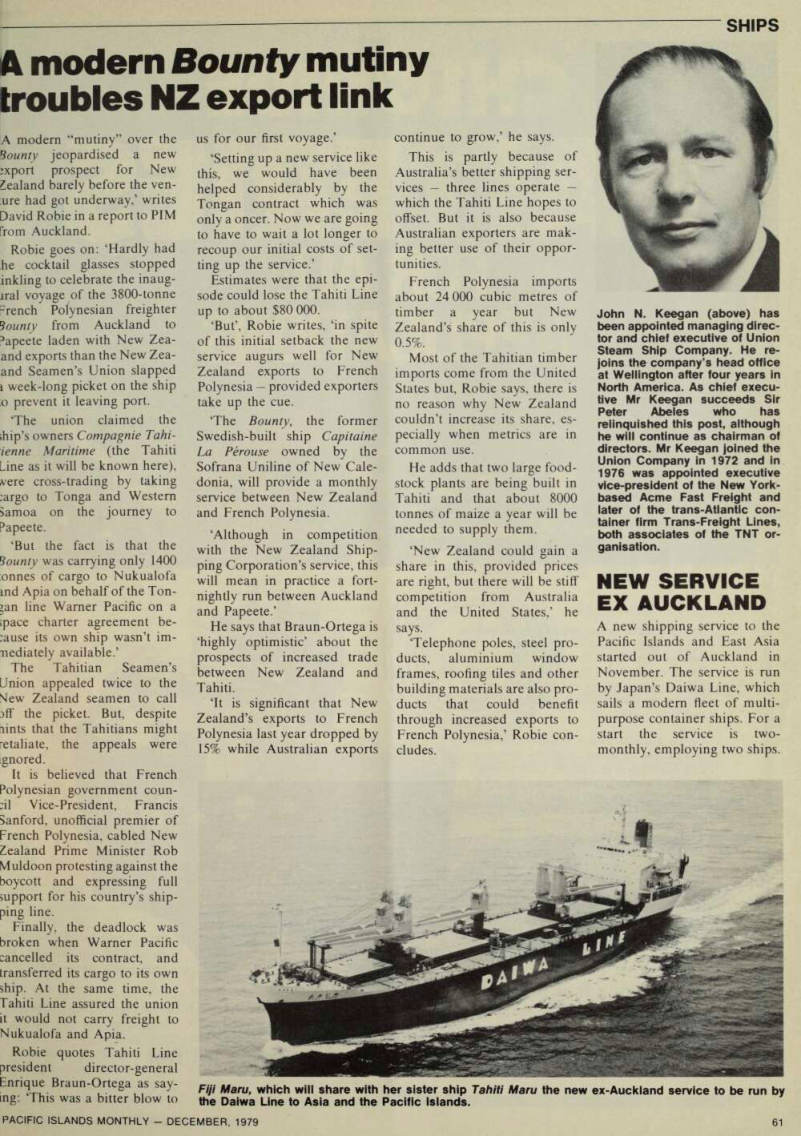
troubles NZ export link
A modem “mutiny” over the
Bounty jeopardised a new
;xport prospect for New Zealand barely before the ven ;ure had got underway,’ writes David Robie in a report to PIM from Auckland.
Robie goes on: ‘Hardly had he cocktail glasses stopped inkling to celebrate the inaug jral voyage of the 3800-tonne
~rench Polynesian freighter
Bounty from Auckland to Papeete laden with New Zea and exports than the New Zea and Seamen’s Union slapped i week-long picket on the ship o prevent it leaving port. ‘The union claimed the ihip’s owners Compagnie Tahi ienne Maritime (the Tahiti Line as it will be known here), vere cross-trading by taking :argo to Tonga and Western Samoa on the journey to Papeete. ‘But the fact is that the Bounty was carrying only 1400 onnes of cargo to Nukualofa md Apia on behalf of the Ton *an line Warner Pacific on a ;pace charter agreement be muse its own ship wasn’t im nediately available.’
The Tahitian Seamen’s Union appealed twice to the Mew Zealand seamen to call
iff the picket. But, despite
lints that the Tahitians might retaliate, the appeals were
ignored.
It is believed that French Polynesian government coun cil Vice-President, Francis Sanford, unofficial premier of
French Polynesia, cabled New
Zealand Prime Minister Rob Muldoon protesting against the boycott and expressing full support for his country’s ship ping line.
Finally, the deadlock was broken when Warner Pacific cancelled its contract, and transferred its cargo to its own ship. At the same time, the Tahiti Line assured the union it would not carry freight to Nukualofa and Apia.
Robie quotes Tahiti Line
president director-general
Enrique Braun-Ortega as say
ing: ‘This was a bitter blow to
us for our first voyage.’ ‘Setting up a new service like this, we would have been
helped considerably by the
Tongan contract which was only a oncer. Now we are going to have to wait a lot longer to recoup our initial costs of set ting up the service.’
Estimates were that the epi sode could lose the Tahiti Line up to about $BO 000. ‘But’, Robie writes, ‘in spite of this initial setback the new service augurs well for New Zealand exports to French
Polynesia provided exporters
take up the cue. ‘The Bounty, the former
Swedish-built ship Capitaine
La Perouse owned by the Sofrana Uniline of New Cale donia, will provide a monthly service between New Zealand and French Polynesia.
‘Although in competition
with the New Zealand Ship
ping Corporation’s service, this
will mean in practice a fort nightly run between Auckland
and Papeete.’
He says that Braun-Ortega is
‘highly optimistic’ about the
prospects of increased trade between New Zealand and Tahiti. ‘lt is significant that New Zealand’s exports to French
Polynesia last year dropped by
15% while Australian exports
continue to grow,’ he says.
This is partly because of Australia’s better shipping ser vices three lines operate which the Tahiti Line hopes to offset. But it is also because Australian exporters are mak ing better use of their oppor tunities.
French Polynesia imports
about 24 000 cubic metres of timber a year but New Zealand’s share of this is only 0.5%.
Most of the Tahitian timber imports come from the United States but, Robie says, there is no reason why New Zealand couldn’t increase its share, es pecially when metrics are in common use.
He adds that two large food stock plants are being built in Tahiti and that about 8000 tonnes of maize a year will be needed to supply them. ‘New Zealand could gain a share in this, provided prices are right, but there will be stiff competition from Australia and the United States,’ he says.
‘Telephone poles, steel pro
ducts, aluminium window frames, roofing tiles and other building materials are also pro ducts that could benefit through increased exports to French Polynesia,’ Robie con cludes.
Fiji Maru, which will share with her sister ship Tahiti Maru the new ex-Auckland service to be run by the Daiwa Line to Asia and the Pacific Islands.
New Service
Ex Auckland
A new shipping service to the Pacific Islands and East Asia started out of Auckland in November. The service is run by Japan’s Daiwa Line, which sails a modem fleet of multi purpose container ships. For a start the service is two
monthly, employing two ships.
John N. Keegan (above) has
been appointed managing direc
tor and chief executive of Union Steam Ship Company. He re joins the company’s head office at Wellington after four years in North America. As chief execu tive Mr Keegan succeeds Sir Peter Abeles who has relinquished this post, although he will continue as chairman of directors. Mr Keegan joined the Union Company in 1972 and in 1976 was appointed executive vice-president of the New York based Acme Fast Freight and later of the trans-Atlantic con tainer firm Trans-Freight Lines, both associates of the TNT or ganisation.
Advertisements & other items, p. 62 (1 item)
Chloride
A W V Chloride is the largest and only manufacturer of both lead acid and nickel cadmium alkaline batteries in Australia.
The Company is equipped and qualified to offer advice, guidance and service on any battery requirement no matter how large or small.
On the question of size, it could be as small as a battery for a hearing aid the dimensions of a coat button or a power station battery weighing as much as 40 tonnes.
Again it could be a no break D.C. Power System for a computor or emergency lighting for a hospital.
The Chloride Company operates in 40 countries throughout the world, and when you consider that in Australia alone its production is approaching VA million batteries per year, it gives some idea of the far reaching role that batteries play in our lives.
IX A selection of Chloride Automotive and Industrial Batteries.
Chloride Batteries Australia Limited
P.O. Box 141, Bankstown. N.S.W. 2200. Australia. Telephone: 77 0177. Telex: 21262
Yachts
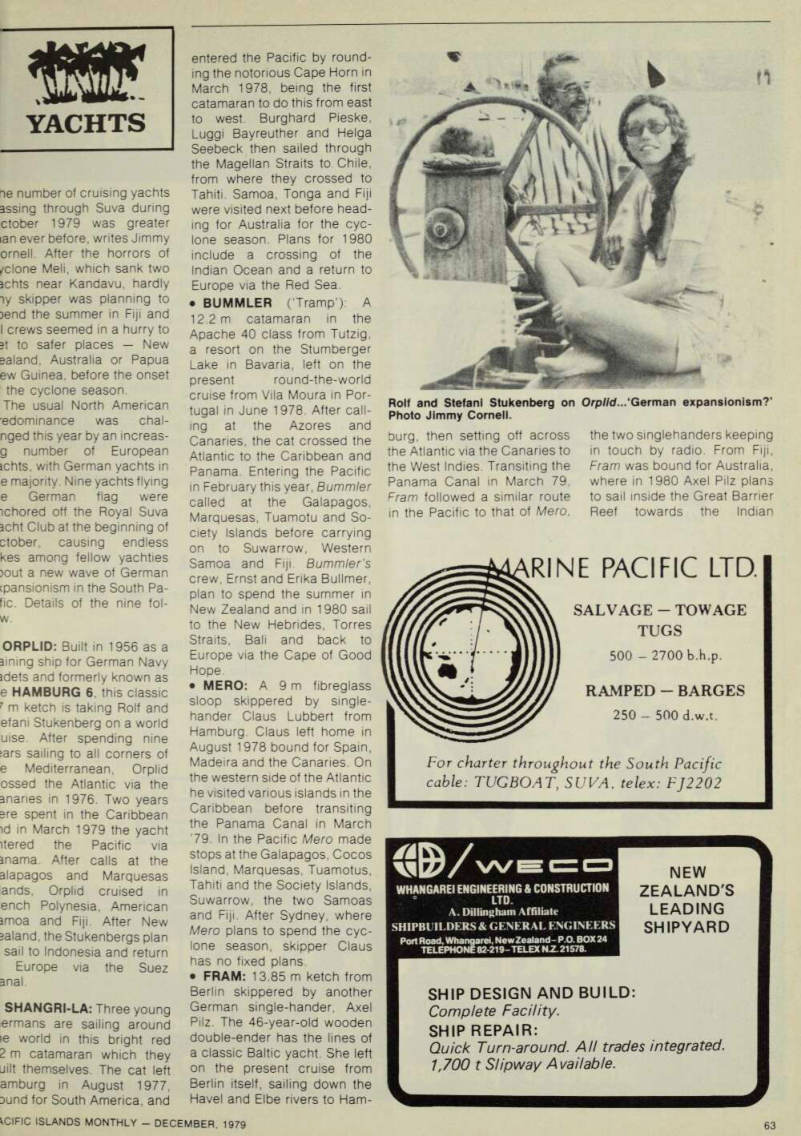

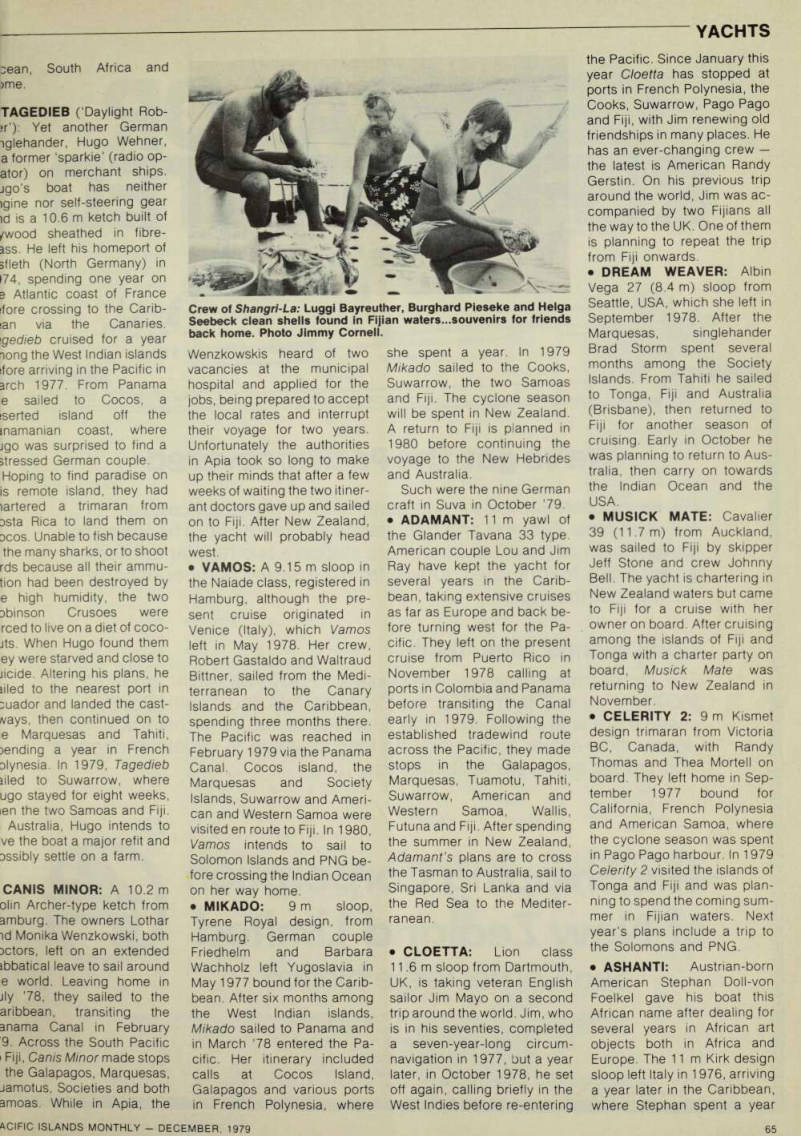
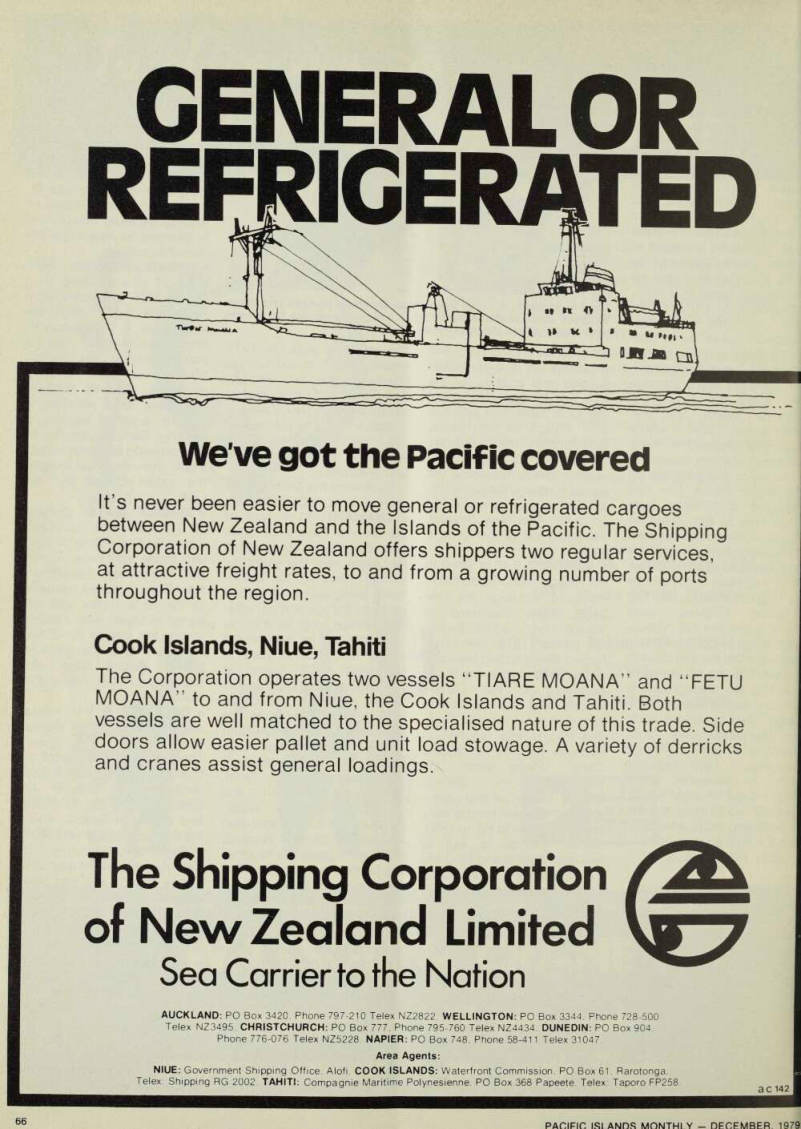
entered the Pacific by round ing the notorious Cape Horn in March 1978, being the first catamaran to do this from east to west. Burghard Pieske, Luggi Bayreuther and Helga Seebeck then sailed through the Magellan Straits to Chile, from where they crossed to Tahiti. Samoa, Tonga and Fiji were visited next before head ing for Australia for the cyc lone season. Plans for 1980 include a crossing of the Indian Ocean and a return to Europe via the Red Sea. • BUMMLER (Tramp’): A 12.2 m catamaran in the Apache 40 class from Tutzig, a resort on the Stumberger Lake in Bavaria, left on the present round-the-world cruise from Vila Moura in Por tugal in June 1978. After call ing at the Azores and Canaries, the cat crossed the Atlantic to the Caribbean and Panama. Entering the Pacific in February this year, Bummler called at the Galapagos, Marquesas, Tuamotu and So ciety Islands before carrying on to Suwarrow, Western Samoa and Fiji. Bummler's crew, Ernst and Erika Bullmer, plan to spend the summer in New Zealand and in 1980 sail to the New Hebrides, Torres Straits, Bali and back to Europe via the Cape of Good Hope. • MERO: A 9 m fibreglass sloop skippered by single hander Claus Lubbert from Hamburg. Claus left home in August 1978 bound for Spain, Madeira and the Canaries. On the western side of the Atlantic he visited various islands in the Caribbean before transiting the Panama Canal in March ’79. In the Pacific Mero made stops at the Galapagos, Cocos Island, Marquesas, Tuamotus, Tahiti and the Society Islands, Suwarrow, the two Samoas and Fiji. After Sydney, where Mero plans to spend the cyc lone season, skipper Claus has no fixed plans. • FRAM; 13.85 m ketch from Berlin skippered by another German single-hander, Axel Pilz. The 46-year-old wooden double-ender has the lines of a classic Baltic yacht. She left on the present cruise from Berlin itself, sailing down the Havel and Elbe rivers to Ham
le number of cruising yachts assing through Suva during ctober 1979 was greater lan ever before, writes Jimmy ornell. After the horrors of Meli, which sank two achts near Kandavu, hardly iy skipper was planning to )end the summer in Fiji and 1 crews seemed in a hurry to at to safer places New aaland, Australia or Papua ew Guinea, before the onset the cyclone season.
The usual North American edominance was chal nged this year by an increas g number of European ichts, with German yachts in e majority. Nine yachts flying e German flag were ichored off the Royal Suva acht Club at the beginning of ctober, causing endless kes among fellow yachties )Out a new wave of German cpansionism in the South Pa fic. Details of the nine fol w.
ORPLID: Built in 1956 as a lining ship for German Navy idets and formerly known as e HAMBURG 6, this classic 7 m ketch is taking Rolf and efani Stukenberg on a world uise. After spending nine sars sailing to all corners of e Mediterranean, Orplid ossed the Atlantic via the anaries in 1976. Two years are spent in the Caribbean id in March 1979 the yacht itered the Pacific via mama. After calls at the alapagos and Marquesas ands, Orplid cruised in ench Polynesia, American amoa and Fiji. After New
aaland, the Stukenbergs plan
sail to Indonesia and return Europe via the Suez anal.
SHANGRI-LA: Three young ermans are sailing around te world in this bright red 2 m catamaran which they uilt themselves. The cat left amburg in August 1977, aund for South America, and
burg, then setting off across the Atlantic via the Canaries to the West Indies. Transiting the Panama Canal in March 79, Fram followed a similar route in the Pacific to that of Mero,
the two singlehanders keeping in touch by radio. From Fiji, Fram was bound for Australia, where in 1980 Axel Pilz plans to sail inside the Great Barrier Reef towards the Indian
Rolf and Stefani Stukenberg on Orplid... ‘German expansionism?’
Photo Jimmy Cornell.
cean, South Africa and )me.
TAGEDIEB (‘Daylight Rob ?r’): Yet another German iglehander, Hugo Wehner, a former ‘sparkie’ (radio op ator) on merchant ships, jgo’s boat has neither igine nor self-steering gear id is a 10.6 m ketch built of /wood sheathed in fibre ass. He left his homeport of sfleth (North Germany) in 174, spending one year on a Atlantic coast of France ifore crossing to the Garib ian via the Canaries. gedieb cruised for a year long the West Indian islands ifore arriving in the Pacific in arch 1977. From Panama e sailed to Cocos, a iserted island off the mamanian coast, where jgo was surprised to find a stressed German couple.
Hoping to find paradise on is remote island, they had lartered a trimaran from DSta Rica to land them on dcos. Unable to fish because the many sharks, or to shoot rds because all their ammu tion had been destroyed by e high humidity, the two Dbinson Crusoes were reed to live on a diet of coco jfs. When Hugo found them ey were starved and close to jicide. Altering his plans, he liled to the nearest port in suador and landed the cast vays, then continued on to e Marquesas and Tahiti, lending a year in French clynesia. In 1979, Tagedieb liled to Suwarrow, where ugo stayed for eight weeks, ien the two Samoas and Fiji.
Australia, Hugo intends to ve the boat a major refit and Dssibly settle on a farm.
Canis Minor: A 10.2 M
olin Archer-type ketch from amburg. The owners Lothar id Monika Wenzkowski, both ictors, left on an extended ibbatical leave to sail around e world. Leaving home in jly ’7B, they sailed to the aribbean, transiting the anama Canal in February 9. Across the South Pacific i Fiji, Canis Minor made stops the Galapagos, Marquesas, jamotus, Societies and both amoas. While in Apia, the
Wenzkowskis heard of two vacancies at the municipal hospital and applied for the jobs, being prepared to accept the local rates and interrupt their voyage for two years.
Unfortunately the authorities in Apia took so long to make up their minds that after a few weeks of waiting the two itiner ant doctors gave up and sailed on to Fiji. After New Zealand, the yacht will probably head west. • VAMOS: A 9.15 m sloop in the Naiade class, registered in Hamburg, although the pre sent cruise originated in Venice (Italy), which Vamos left in May 1978. Her crew, Robert Gastaldo and Waltraud Bittner, sailed from the Medi terranean to the Canary Islands and the Caribbean, spending three months there.
The Pacific was reached in February 1979 via the Panama Canal. Cocos island, the Marquesas and Society Islands, Suwarrow and Ameri can and Western Samoa were visited en route to Fiji. In 1980, Vamos intends to sail to Solomon Islands and PNG be fore crossing the Indian Ocean on her way home. • MIKADO: 9 m sloop, Tyrene Royal design, from Hamburg. German couple Friedhelm and Barbara Wachholz left Yugoslavia in May 1977 bound for the Carib bean. After six months among the West Indian islands, Mikado sailed to Panama and in March ’7B entered the Pa cific. Her itinerary included calls at Cocos Island, Galapagos and various ports in French Polynesia, where
she spent a year. In 1979 Mikado sailed to the Cooks, Suwarrow, the two Samoas and Fiji. The cyclone season will be spent in New Zealand.
A return to Fiji is planned in 1980 before continuing the voyage to the New Hebrides and Australia.
Such were the nine German craft in Suva in October ’79. • ADAMANT: 11 m yawl of the Glander Tavana 33 type.
American couple Lou and Jim Ray have kept the yacht for several years in the Carib bean, taking extensive cruises as far as Europe and back be fore turning west for the Pa cific. They left on the present cruise from Puerto Rico in November 1978 calling at ports in Colombia and Panama before transiting the Canal early in 1979. Following the established tradewind route across the Pacific, they made stops in the Galapagos, Marquesas, Tuamotu, Tahiti, Suwarrow, American and Western Samoa, Wallis, Futuna and Fiji. After spending the summer in New Zealand, Adamant's plans are to cross the Tasman to Australia, sail to Singapore, Sri Lanka and via the Red Sea to the Mediter ranean. • CLOETTA: Lion class 11.6 m sloop from Dartmouth, UK, is taking veteran English sailor Jim Mayo on a second trip around the world. Jim, who is in his seventies, completed a seven-year-long circum navigation in 1977, but a year later, in October 1978, he set off again, calling briefly in the West Indies before re-entering
the Pacific. Since January this year Cloetta has stopped at ports in French Polynesia, the Cooks, Suwarrow, Pago Pago and Fiji, with Jim renewing old friendships in many places. He has an ever-changing crew the latest is American Randy Gerstin. On his previous trip around the world, Jim was ac companied by two Fijians all the way to the UK. One of them is planning to repeat the trip from Fiji onwards.
• Dream Weaver: Albin
Vega 27 (8.4 m) sloop from Seattle, USA, which she left in September 1978. After the Marquesas, singlehander Brad Storm spent several months among the Society Islands. From Tahiti he sailed to Tonga, Fiji and Australia (Brisbane), then returned to Fiji for another season of cruising. Early in October he was planning to return to Aus tralia, then carry on towards the Indian Ocean and the
Usa.
• MUSICK MATE: Cavalier 39 (11.7 m) from Auckland, was sailed to Fiji by skipper Jeff Stone and crew Johnny Bell. The yacht is chartering in New Zealand waters but came to Fiji for a cruise with her owner on board. After cruising among the islands of Fiji and Tonga with a charter party on board, Musick Mate was returning to New Zealand in November. • CELERITY 2: 9 m Kismet design trimaran from Victoria BC, Canada, with Randy Thomas and Thea Mortell on board. They left home in Sep tember 1977 bound for California, French Polynesia and American Samoa, where the cyclone season was spent in Pago Pago harbour. In 1979 Celerity 2 visited the islands of Tonga and Fiji and was plan ning to spend the coming sum mer in Fijian waters. Next year’s plans include a trip to the Solomons and PNG. • ASHANTI: Austrian-born American Stephan Doll-von Foelkel gave his boat this African name after dealing for several years in African art objects both in Africa and Europe. The 11 m Kirk design sloop left Italy in 1976, arriving a year later in the Caribbean, where Stephan spent a year
Crew of Shangri-La: Luggi Bayreuther, Burghard Pieseke and Helga Seebeck clean shells found In Fijian waters...souvenirs for friends back home. Photo Jimmy Cornell.
j a half doing odd jobs to re lish the kitty. Arriving in the pific early in 1979, he glehanded to Ecuador, ling the yacht up the river ayas. Galapagos was visi- I next, then French lynesia, the two Samoas, illis and Fiji. No plans for the ure. tERESI: 12.2 m steel ketch im Auckland bearing the me of the skipper’s wife ace, spelt in Fijian. Jack and ace Ross have fallen in love :h Fiji and have come there ery year for the last six, this \e in their own yacht. After ending the summer at their me in Te Awamutu, they m to return again to Fiji in 80.
Ioonlighter I: 14 6 M
•op from Nanaimo, BC. The pper family, with Jim, Dona, luglas, Alex and Barry on ard, left Canada in June 78 sailing first to California d Mexico. Crossing in 22 ys to the Marquesas, they ntinued to the Tuamotu and ciety Islands, Rarotonga, vau and Fiji. The summer I be spent in New Zealand, er which a second visit to vau is planned and a grad- I return home via Hawaii. lAINMAKER: Self-built rocement ketch (13 m) from irban. South African couple ter and Michelle Bjbrseth t Capetown in February 77, sailing to St Helena and ihia, spending seven months Brazil. Later they visited rinam and cruised for 18 )nths in the Caribbean be e reaching the Pacific :ean via the Panama Canal March 1979. Galapagos, snch Polynesia, Rarotonga, ue and Vavau were visited route to Fiji, where the cht arrived early in October 9. The crew planned to stop New Caledonia en route to istralia, and a return home is scheduled for 1980.
VRANGLER: 13 m ter cement ketch from Durban taking South African couple >bert and Lorraine Millar on trip around the world. After ree years of preparations, lilding the boat in their back rd, the Millars left home in jcember 1977, crossing the lantic via St Helena and >cension to Barbados. One
season was spent cruising in the Caribbean before transit ing the Panama Canal in February 1979. Galapagos, Marquesas, the Tuamotu, So ciety and Cook Islands, Tonga and Fiji were visited before heading for New Caledonia and Australia. The Millars plan to cross the Indian Ocean dur ing 1980 and return home. • HIKAROA: Misha Sperka, an American from Hawaii, left home in 1968 as crew on a sailing boat bound for Europe.
In Italy he bought Hikaroa a 15 m yawl of Italian design.
After a cruise to the Middle East, he sailed to Iceland and Greenland, then back to the Mediterranean via the Azores.
Following a route different from the majority of cruising yachts, Hikaroa transited the Suez Canal in 1977, sailing to Sudan, North Yemen, Ethiopia, Djibouti, the Mal dives and Sri Lanka, Indonesia, Malaysia, Sin gapore, the Philippines, Taiwan and Japan. Crossing the Pacific to Tahiti, Misha met and married an Austrian girl, Brigitte, in Papeete early in 1979. As expected, Hikaroa’s plans after Fiji are very vague. • HAWK: Famous 50-year-old staysail schooner better known under its previous name SEVEN SEAS. Presi dent Franklin D. Roosevelt used to sail in this elegant yacht while in office. In the late '4os, its owner was actor Errol Flynn. The present owner, Dud Dewey, a retired general con tractor, who has flown as a pilot for the US Navy in three wars (WWII, Korea and Viet nam), found the 16 m schooner in a neglected state, and practically rebuilt it, bring ing it back to its former beauty.
Accompanied by wife Barbara and two 11-year-old terriers, Dud Dewey left Florida in April 1978, cruising in the Lesser Antilles, the ABC Islands off Venezuela, Colombia and Panama, transiting the Canal in January 1979. Galapagos, French Polynesia, the two Samoas, Vavau and Fiji were visited en route to New Zealand, where Hawk will spend the cyclone season. In 1980 the Deweys plan to head for the Indian Ocean.
• GAMBOL: 11.4 m sloop from Tauranga arrived in Suva from Vavau in September, completing her six-year and 72 000 km long circumnaviga tion. Gambol's owner, New Zealander Stuart Clay, a farmer from Tipuki, left home in 1973 in the Auckland to Suva Race. After the race he decided to carry on cruising rather than go back to farming. • FORTUNA: Another Kiwi cir cumnavigator who has chased GAMBOL all round the world, catching up with her only in Tonga. Mike Morrish, ac companied by wife Anne, daughter Tina (11) and son Paul (13), also left home with out the intention of sailing right round the world. Early in 1976, they left Auckland in their 11.5 m cutter, a boat which already had seven Hobart Races and one previous round-the-world trip to her credit. • THIRD SEA: Outward bound from Christmas island in Sep tember was the 21 m auxiliary schooner Third Sea, owned and skippered by Harold Stephens, first mate Don Perkins, navigator David Wills and with a crew of four, re ports Robin J. Dannhorn. This ferrocement wishbone
schooner rigged vessel is becoming increasingly well known during its extensive travels in the Pacific after its initial three years of sailing in the seas of Asia, having been built in Singapore. Its tra ditional lines and rig attract attention wherever it goes.
This most recent cruise, last ing five months, was from its home base of Honolulu, via the Marquesas to Tahiti, where it arrived in time for the fete cel ebrations in July. Homeward bound it cruised the Society Islands and the Cooks, with a stop at Christmas Island be fore arriving back in Hawaii in early October.
Above: Circumnavigating family aboard Fortune: Anne, Paul, Tina and skipper Mike Morrish.
Below: Robert and Lorraine Millar of the South African yacht Wrangler ... far from home.
Photos Jimmy Cornell.
Advertisements & other items, pp. 63-68 (4 items)
63
ISLANDS MONTHLY - DECEMBER, 1979
Rine Pacific Ltd.
SALVAGE - TOWAGE
TUGS
500 2700 b.h.p.
RAMPED - BARGES
250 500 d.w.t.
For charter throughout the South Pacific cable: TUGBOAT, SUVA, telex: FJ2202
®/ w
WHANGAREI ENGINEERING & CONSTRUCTION
° LTD.
A. Dillingham Affiliate
SHIPBUILDERS & GENERAL ENGINEERS
Port Road, Whangarei, New Zealand - P.O. BOX 24
TELEPHONE 82-219-TELEX UZ. 21578.
SHIP DESIGN AND BUILD:
Complete Facility.
SHIP REPAIR:
Quick Turn-around. AH trades integrated. 1,700 t Slipway Available.
NEW
ZEALAND'S
LEADING
SHIPYARD
Total service 0n.,.
You can get all your needs from one supply source: water taps, valves, copper tube, tools and a host of other fittings and related plumbing equipment for domestic, industrial and multi-storey buildings.
Watson & Crane Pty Ltd have over 20,000 plumbing items in stock at their central warehouse located at Waterloo, NSW, Australia.
Years of experience in handling and shipping right throughout the South Pacific add up to another big reason for you to deal with Watson & Crane Pty Ltd.
Representatives call regularly at Papua New Guinea, the Solomons, New Hebrides and Fiji Islands to personally discuss your requirements and appropriate credit arrangements.
Write, cable or telephone today for complete plumbers' supplies service. * 5 Watson & Crane Pty. Ltd. 1037 Bourke Street, Waterloo,
NSW 2017.
Phone: Sydney 699-1333.
Telex: AA 25548.
Cables: "Watcrane" Sydney.
Pacific Island distributors of Crano Enfield copper tube for water, sanitation, engineering, refrigeration and air conditioning.
WATSON & CRANE
are organised to fulfil your needs
wherever you are in the South Pacific
GENERAL OR
REFRIG^H
TED
'•K
We've got the Pacific covered
It’s never been easier to move general or refrigerated cargoes between New Zealand and the Islands of the Pacific. The Shipping Corporation of New Zealand offers shippers two regular services, at attractive freight rates, to and from a growing number of ports throughout the region.
Cook Islands, Niue, Tahiti
The Corporation operates two vessels “TIARE MOANA” and “FETU MOANA” to and from Niue, the Cook Islands and Tahiti. Both vessels are well matched to the specialised nature of this trade. Side doors allow easier pallet and unit load stowage. A variety of derricks and cranes assist general loadings.
The Shipping Corporation
of New Zealand Limited \H J
Sea Carrier to the Nation
AUCKLAND; PC Box 3420, Phone 797-210 Telex NZ2822. WELLINGTON: PC Box 3344, Phone 728-500 Telex NZ3495. CHRISTCHURCH: PC Box 777, Phone 795-760 Telex NZ4434. DUNEDIN: PC Box 904 Phone 776-076 Telex NZ5228 NAPIER: PC Box 748, Phone 58-411 Telex 31047.
Area Agents: NIUE: Government Shipping Office, Alofi COOK ISLANDS: Waterfront Commission, PO Box 61. Rarotonga Telex: Shipping RG 2002. TAHITI: Compagnie Maritime Polynesienne. PO Box 368 Papeete. Telex; Taporo FP2SB. ac 142
Frostpak
4
Koolatron
INDUSTRIES
Portable Electronic
Solid State Refrigerators
For people on the move Ideal for Campers & Caravans Indispensable for Travellers and Holidaymakers A must for Truckdrivers Popular with Yachts.
Aircraft and Fishermen ■ Big cooling performance ■ No Gas - No Compressor ■ Large 33 Litre capacity ■ Unaffected by motion or level ■ No noise or vibration ■ Low Battery Drain ■ Low Weight - 7 KG ■ Virtually Indestructable ■ 2 Year Guarantee From 5199.00 incl. Sales Tax For Medical & Technical purposes & Food Samples Connects to 12V Battery or Cigarette Lighter Operates on 240 V with Battery Charger 297 Williamstown Road, Port Melbourne 3027 Phone 645 2068 Telex 32571
V o
GLOBAL SERVICE FOR SHIPPERS
V
THE BANK LINE
-*•1 r
Monthly Services
United Kingdom and Continent to:
PAPEETE • NOUMEA
PAPUA NEW GUINEA and SOLOMON ISLANDS
PORT VILA & SANTO BY TRANSHIPMENT
United Kingdom and Continent to:
SUVA AND LAUTOKA (FCL LCL & UNITISED ONLY) Papua New Guinea and Solomon Islands to:
UNITED KINGDOM and CONTINENT
•O*LS.
vwite For particulars apply:
THE BANK LINE (AUSTRALASIA) PTY. LTD.
18th Floor 1 York Street SYDNEY NSW 2000 Australia Tel; 272041 Telex: 24063
Yachts
65
ACIFIC ISLANDS MONTHLY - DECEMBER, 1979
Yachts
67
CIFIC ISLANDS MONTHLY - DECEMBER, 1979
Shipping
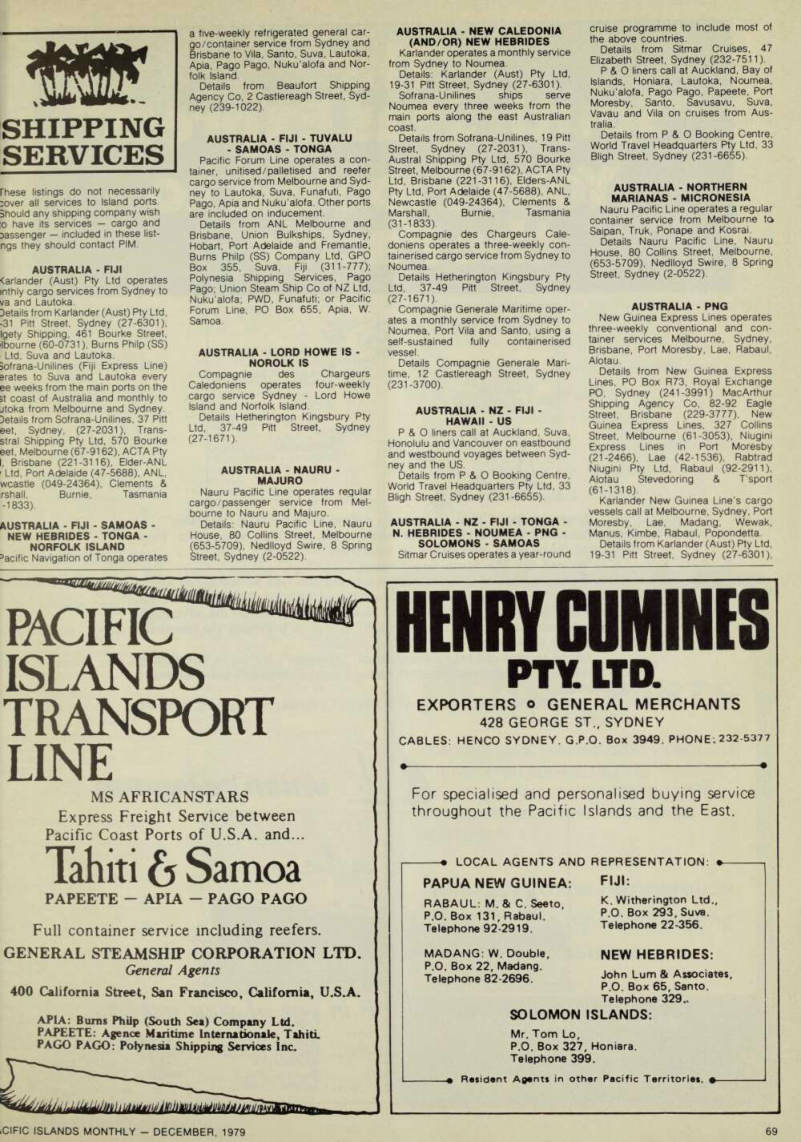
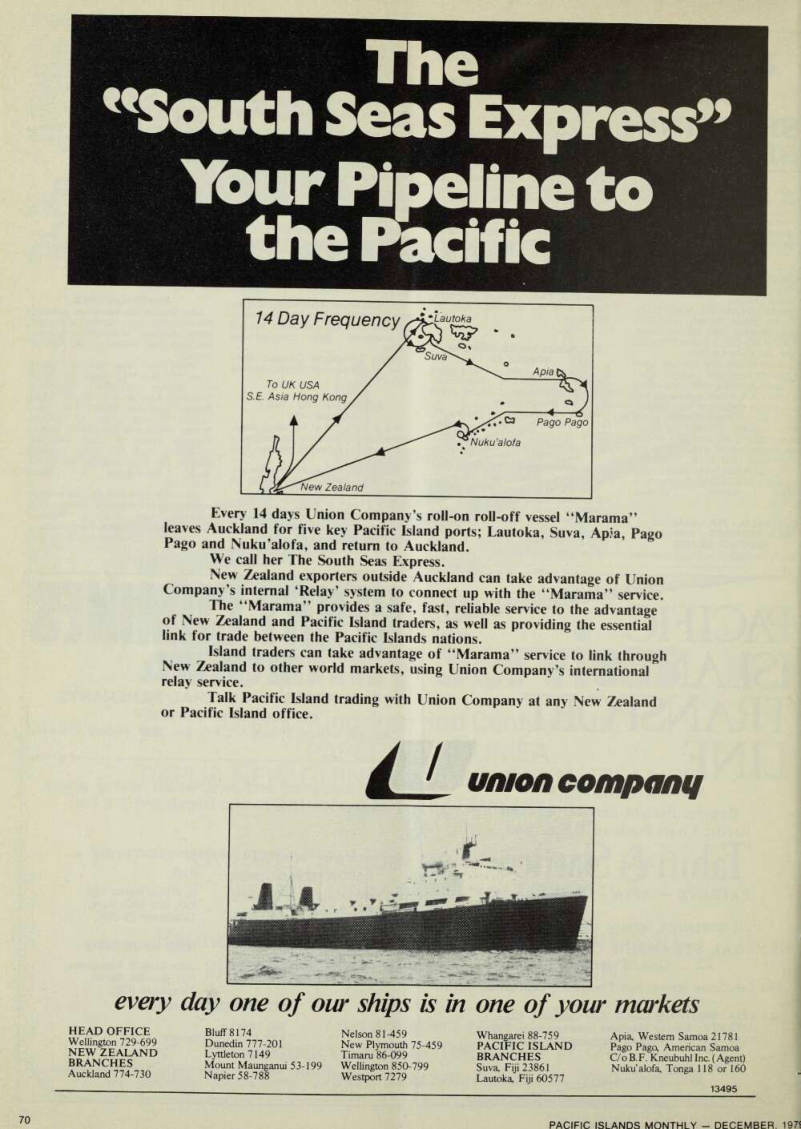
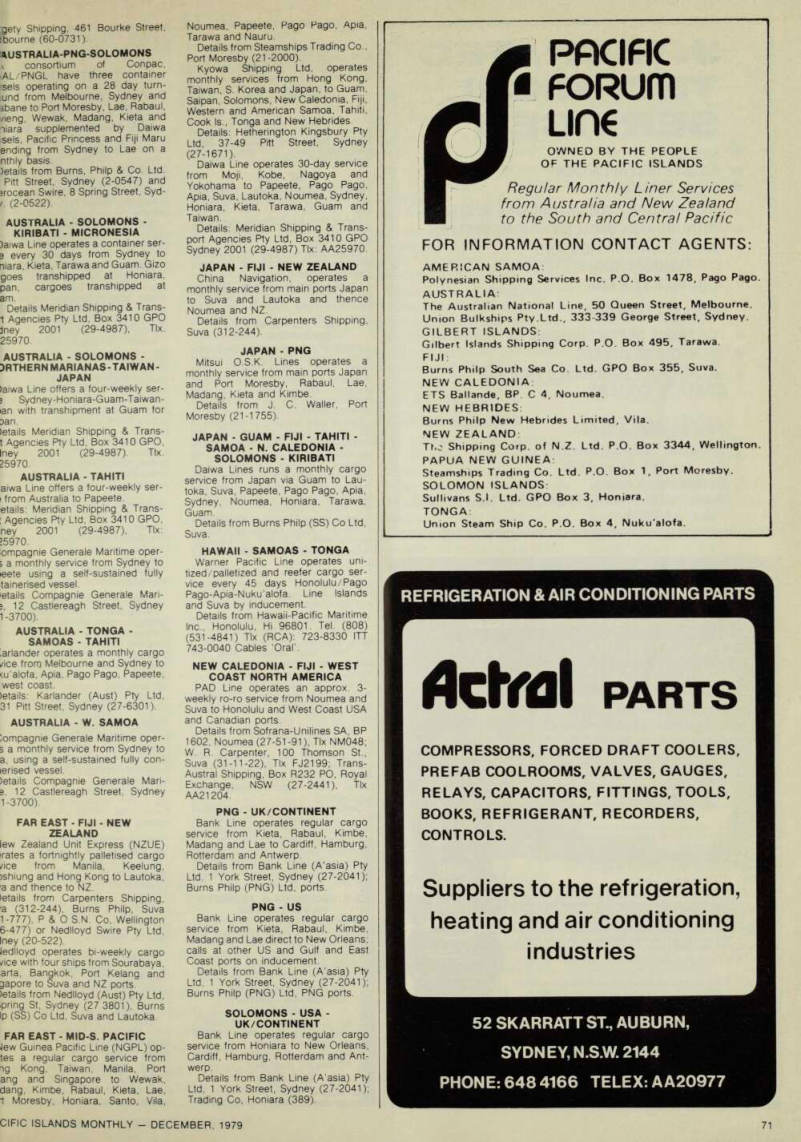
Services
fhese listings do not necessarily :over all services to Island ports.
Should any shipping company wish :o have its services cargo and aassenger included in these list ngs they should contact PIM.
Australia - Fiji
<arlander (Aust) Pty Ltd operates inthly cargo services from Sydney to va and Lautoka.
Details from Karlander (Aust) Pty Ltd, -31 Pitt Street, Sydney (27-6301), Igety Shipping, 461 Bourke Street, Ibourne (60-0731), Burns Philp (SS) Ltd, Suva and Lautoka.
Sofrana-Unilines (Fiji Express Line) srates to Suva and Lautoka every ee weeks from the main ports on the >t coast of Australia and monthly to jtoka from Melbourne and Sydney.
Details from Sofrana-Unilines, 37 Pitt eet, Sydney, (27-2031), Trans stral Shipping Pty Ltd, 570 Bourke eet, Melbourne (67-9162), ACTA Pty I, Brisbane (221-3116), Elder-ANL ' Ltd, Port Adelaide (47-5688), ANL, wcastle (049-24364), Clements & rshall, Burnie, Tasmania -1833).
Australia - Fiji - Samoas -
New Hebrides - Tonga -
Norfolk Island
3 acific Navigation of Tonga operates
a five-weekly refrigerated general car go/container service from Sydney and Brisbane to Vila, Santo, Suva, Lautoka, Apia, Pago Pago, Nuku’alofa and Nor folk Island.
Details from Beaufort Shipping Agency Co, 2 Castlereagh Street, Syd ney (239-1022).
Australia - Fiji - Tuvalu
• Samoas - Tonga
Pacific Forum Line operates a con tainer, unitised/palletised and reefer cargo service from Melbourne and Syd ney to Lautoka, Suva, Funafuti, Pago Pago, Apia and Nuku’alofa. Other ports are included on inducement.
Details from ANL Melbourne and Brisbane, Union Bulkships, Sydney, Hobart, Port Adelaide and Fremantle, Burns Philp (SS) Company Ltd, GPO Box 355, Suva, Fiji (311-777); Polynesia Shipping Services, Pago Pago; Union Steam Ship Co of NZ Ltd, Nuku’alofa; PWD, Funafuti; or Pacific Forum Line, PO Box 655, Apia, W.
Samoa.
Australia - Lord Howe Is -
Norolk Is
Compagnie des Chargeurs Caledoniens operates four-weekly cargo service Sydney - Lord Howe Island and Norfolk Island.
Details Hetherington Kingsbury Pty Ltd, 37-49 Pitt Street, Sydney (27-1671).
Australia - Nauru -
Majuro
Nauru Pacific Line operates regular cargo/passenger service from Mel bourne to Nauru and Majuro.
Details: Nauru Pacific Line, Nauru House, 80 Collins Street, Melbourne (653-5709), Nedlloyd Swire. 8 Spring Street, Sydney (2-0522).
Australia - New Caledonia
(And/Or) New Hebrides
Karlander operates a monthly service from Sydney to Noumea.
Details: Karlander (Aust) Pty Ltd, 19-31 Pitt Street, Sydney (27-6301).
Sofrana-Unilines ships serve Noumea every three weeks from the main ports along the east Australian coast.
Details from Sofrana-Unilines, 19 Pitt Street, Sydney (27-2031), Trans- Austral Shipping Pty Ltd, 570 Bourke Street, Melbourne (67-9162), ACTA Pty Ltd, Brisbane (221-3116), Elders-ANL Pty Ltd, Port Adelaide (47-5688), ANL, Newcastle (049-24364), Clements & Marshall, Burnie, Tasmania (31-1833).
Compagnie des Chargeurs Cale doniens operates a three-weekly con tainerised cargo service from Sydney to Noumea.
Details Hetherington Kingsbury Pty Ltd, 37-49 Pitt Street, Sydney (27-1671).
Compagnie Generate Maritime oper ates a monthly service from Sydney to Noumea, Port Vila and Santo, using a self-sustained fully containerised vessel.
Details Compagnie Generate Mari time, 12 Castlereagh Street, Sydney (231-3700).
Australia - Nz - Fiji -
Hawaii - Us
P & O liners call at Auckland, Suva, Honolulu and Vancouver on eastbound and westbound voyages between Syd ney and the US.
Details from P & O Booking Centre, World Travel Headquarters Pty Ltd, 33 Bligh Street, Sydney (231-6655).
AUSTRALIA - NZ - FIJI - TONGA - N. HEBRIDES - NOUMEA - PNG -
Solomons -Samoas
Sitmar Cruises operates a year-round
cruise programme to include most of the above countries.
Details from Sitmar Cruises, 47 Elizabeth Street, Sydney (232-7511).
P & O liners call at Auckland, Bay of Islands, Honiara, Lautoka, Noumea, Nukualofa, Pago Pago, Papeete, Port Moresby, Santo, Savusavu, Suva, Vavau and Vila on cruises from Aus tralia.
Details from P & O Booking Centre, World Travel Headquarters Pty Ltd, 33 Bligh Street, Sydney (231-6655).
Australia - Northern
Marianas - Micronesia
Nauru Pacific Line operates a regular container service from Melbourne to Saipan, Truk, Ponape and Kosrai.
Details Nauru Pacific Line. Nauru House. 80 Collins Street, Melbourne, (653-5709), Nedlloyd Swire, 8 Spring Street, Sydney (2-0522).
Australia - Png
New Guinea Express Lines operates three-weekly conventional and con tainer services Melbourne, Sydney, Brisbane, Port Moresby, Lae, Rabaul, Alotau.
Details from New Guinea Express Lines, PO Box R 73, Royal Exchange PC, Sydney (241-3991) MacArthur Shipping Agency Co, 82-92 Eagle Street, Brisbane (229-3777), New Guinea Express Lines, 327 Collins Street. Melbourne (61-3053), Niugini Express Lines in Port Moresby (21-2466), Lae (42-1536), Rabtrad Niugini Pty Ltd, Rabaul (92-2911), Alotau Stevedoring & T’sport (61-1318).
Karlander New Guinea Line’s cargo vessels call at Melbourne, Sydney, Port Moresby, Lae, Madang, Wewak, Manus, Kimbe, Rabaul, Popondetta.
Details from Karlander (Aust) Ply Ltd, 19-31 Pitt Street, Sydney (27-6301),
gety Shipping, 461 Bourke Street, ibourne (60-0731).
Australia-Png-Solomons
< consortium of Conpac, ■AL/PNGL have three container isels operating on a 28 day turn iund from Melbourne, Sydney and jbane to Port Moresby, Lae, Rabaul, /ieng, Wewak, Madang, Kieta and niara supplemented by Daiwa isels, Pacific Princess and Fiji Maru ending from Sydney to Lae on a nthly basis. )etails from Burns, Philp & Co. Ltd.
Pitt Street, Sydney (2-0547) and jrocean Swire, 8 Spring Street, Syd i. (2-0522).
Australia - Solomons -
Kiribati - Micronesia
)aiwa Line operates a container ser -3 every 30 days from Sydney to niara, Kieta, Tarawa and Guam. Gizo goes transhipped at Honiara, pan, cargoes transhipped at am.
Details Meridian Shipping & Trans -1 Agencies Pty Ltd, Box 3410 GPO Jney 2001 (29-4987), Tlx. 25970.
Australia - Solomons -
3Rthern Mari An As-Taiwan
Japan
laiwa Line offers a four-weekly ser > Sydney-Honiara-Guam-Taiwan ian with transhipment at Guam for Dan. letails Meridian Shipping & Trans t Agencies Pty Ltd, Box 3410 GPO, Iney 2001 (29-4987). Tlx. 25970.
Australia - Tahiti
aiwa Line offers a four-weekly ser i from Australia to Papeete, etails: Meridian Shipping & Trans : Agencies Pty Ltd, Box 3410 GPO, ney 2001 (29-4987), Tlx: >5970. ompagnie Generale Maritime oper > a monthly service from Sydney to ieete using a self-sustained fully tainerised vessel. etails Compagnie Generale Mari », 12 Castlereagh Street, Sydney 1-3700).
Australia - Tonga -
Samoas - Tahiti
larlander operates a monthly cargo /ice from Melbourne and Sydney to oi’alofa, Apia, Pago Pago, Papeete, west coast. letails; Karlander (Aust) Pty Ltd, 31 Pitt Street, Sydney (27-6301).
Australia - W. Samoa
)ompagnie Generale Maritime oper -3 a monthly service from Sydney to a, using a self-sustained fully con lerised vessel. letails Compagnie Generale Mari 3, 12 Castlereagh Street, Sydney 1-3700).
Far East - Fiji - New
Zealand
lew Zealand Unit Express (NZUE) fates a fortnightly palletised cargo /ice from Manila, Keelung, ishiung and Hong Kong to Lautoka, a and thence to NZ. letails from Carpenters Shipping, a (312-244), Burns Philp, Suva 1-777), P & O S.N. Co, Wellington 6-477) or Nedlloyd Swire Pty Ltd, Iney (20-522). ledlloyd operates bi-weekly cargo /ice with four ships from Sourabaya, arta, Bangkok, Port Kelang and gapore to Suva and NZ ports, letails from Nedlloyd (Aust) Pty Ltd, pring St, Sydney (27 3801), Burns Ip (SS) Co Ltd, Suva and Lautoka.
Far East - Mid-S. Pacific
Jew Guinea Pacific Line (NGPL) op tes a regular cargo service from ng Kong, Taiwan, Manila, Port ang and Singapore to Wewak, dang, Kimbe, Rabaul, Kieta, Lae, 1 Moresby, Honiara, Santo, Vila,
Noumea, Papeete, Pago Pago, Apia, Tarawa and Nauru.
Details from Steamships Trading Co., Port Moresby (21-2000).
Kyowa Shipping Ltd, operates monthly services from Hong Kong, Taiwan, S. Korea and Japan, to Guam, Saipan, Solomons, New Caledonia, Fiji, Western and American Samoa, Tahiti, Cook Is., Tonga and New Hebrides.
Details: Hetherington Kingsbury Pty Ltd, 37-49 Pitt Street, Sydney (27-1671).
Daiwa Line operates 30-day service from Moji, Kobe, Nagoya and Yokohama to Papeete, Pago Pago, Apia, Suva, Lautoka, Noumea, Sydney, Honiara, Kieta, Tarawa, Guam and Taiwan.
Details: Meridian Shipping & Trans port Agencies Pty Ltd, Box 3410 GPO Sydney 2001 (29-4987) Tlx: AA25970.
Japan - Fiji - New Zealand
China Navigation, operates a monthly service from main ports Japan to Suva and Lautoka and thence Noumea and NZ.
Details from Carpenters Shipping, Suva (312-244).
Japan - Png
Mitsui O.S.K, Lines operates a monthly service from main ports Japan and Port Moresby, Rabaul, Lae, Madang, Kieta and Kimbe.
Details from J. C. Waller, Port Moresby (21-1755).
JAPAN - GUAM - FIJI - TAHITI -
Samoa - N. Caledonia -
Solomons - Kiribati
Daiwa Lines runs a monthly cargo service from Japan via Guam to Lau toka, Suva. Papeete, Pago Pago, Apia, Sydney, Noumea, Honiara, Tarawa, Guam.
Details from Burns Philp (SS) Co Ltd, Suva.
Hawaii - Samoas - Tonga
Warner Pacific Line operates uni tized/palletized and reefer cargo ser vice every 45 days Honolulu/Pago Pago-Apia-Nuku’alofa. Line Islands and Suva by inducement.
Details from Hawaii-Pacific Maritime Inc., Honolulu, Hi 96801. Tel. (808)
(531-4841) Tlx (Rca); 723-8330 Itt
743-0040 Cables ‘Oral’.
New Caledonia - Fiji - West
Coast North America
PAD Line operates an approx, 3weekly ro-ro service from Noumea and Suva to Honolulu and West Coast USA and Canadian ports.
Details from Sofrana-Unilines SA, BP 1602, Noumea (27-51 -91). Tlx NMO4B; W. R. Carpenter, 100 Thomson St., Suva (31-11-22), Tlx FJ2199; Trans- Austral Shipping, Box R 232 PC, Royal Exchange, NSW (27-2441), Tlx AA21204.
Png - Uk/Continent
Bank Line operates regular cargo service from Kieta, Rabaul, Kimbe, Madang and Lae to Cardiff, Hamburg, Rotterdam and Antwerp.
Details from Bank Line (A’asia) Pty Ltd. 1 York Street, Sydney (27-2041); Burns Philp (PNG) Ltd, ports.
Png - Us
Bank Line operates regular cargo service from Kieta, Rabaul, Kimbe, Madang and Lae direct to New Orleans; calls at other US and Gulf and East Coast ports on inducement.
Details from Bank Line (A’asia) Pty Ltd. 1 York Street, Sydney (27-2041); Burns Philp (PNG) Ltd, PNG ports.
Solomons - Usa -
Uk/Continent
Bank Line operates regular cargo service from Honiara to New Orleans, Cardiff, Hamburg, Rotterdam and Ant werp.
Details from Bank Line (A’asia) Pty Ltd, 1 York Street, Sydney (27-2041); Trading Co, Honiara (389).
NZ - COOK IS - NIUE -
Tahiti
Shipping Corporation of NZ Ltd oper ates cargo services based on pallets and similar units from Auckland to Niue, Cook Islands and Tahiti.
Details from the Shipping Corp of NZ Ltd, PC Box 3420, Auckland (797-210), Waterfront Commission, PC Box 61, Rarotonga; Lighterage and Stevedoring Co, Aitutaki; Niue Govt Offices, Niue Island Compagnie Mari time Polynesienne, B'P’ 368, Papeete Tahiti.
Nz - Fiji
Reef operates a regular 18-day ser vice from Auckland to Suva and Lau toka.
Details from Reef Shipping Agencies, PO Box 3382, Auckland, NZ (77-1221-3).
Pacific Line with one ship operates fortnightly roro cargo service New Zealand, Lautoka, Suva.
Details: Sofrana Unilines, 18 Cus toms Street, Auckland (773-279) PO Box 3614, Telex: NZ2313.
Nz - Fiji - Kiribati -
Solomons - Png
Pacific Forum Line operates a con tainer, unitised/palletised and reefer cargo service from Lyttelton and Auckland to Suva, Port Moresby, Lae Honiara, Tarawa, Madang, Lae and Port Moresby. Other ports are included on inducement.
Details from Shipping Corporation of NZ Ltd, Auckland, Christchurch and Wellington. Burns Philp (SS) Company Ltd, GPO Box 355, Suva, Fiji (311 -777) Sullivans, Honiara; Kiribati Ship ping Corporation, Tarawa; Steamships Trading in Port Moresby, Lae and Madang or Pacific Forum Line, PO Box 655, Apia, W. Samoa.
Union Steam Ship Co of NZ operates a roll-on, roll-off, container/unitised service from Auckland to Lautoka- Suva-Pago Pago-Apia-Nuku'alofa on a 14 day frequency.
Details from Union Steam Ship Co of NZ Ltd, PO Box 12, Auckland or from Branch offices/agents in Fiji, Tonga and the Samoas.
NZ - FIJI - NORTH AMERICA (WC) Blue Star Line Ltd Pacific Coast con tainer services. Only direct service to and from New Zealand. Blue Star vessels call at Suva and Honolulu on NZ-US-West Coast voyages.
Details from Blueport ACT (NZ)rLtd, PO Box 192, Wellington (739-029) , Burns Philp (SS) Co Ltd, GPO Box 355, Suva, Fiji (311-777).
Nz - New Caledonia - Fiji
Pacific Forum Line operates a uni tized/palletized and reefer cargo ser vice from Lyttelton and Auckland to Napier, Noumea, Lautoka and Suva.
Other ports are included on inducement.
Details from Shipping Corporation of NZ Ltd, Auckland, Christchurch, Wellington, Burns Philp (SS) Company Ltd, GPO Box 355, Suva, Fiji (311 -777); Polynesia Shipping Services, Pago Pago; Union Steam Ship Co of NZ Ltd, Nukualofa or Pacific Forum Line, PO Box 655, Apia, W. Samoa.
Nz-N. Caledonia-N. Hebrides
Png-Solomons
Sofrana Unilines with three ships op erates to Vila and Santo, to Honiara and Papua New Guinea and to Noumea.
Details from Sofrana Unilines, 18 Customs Street, Auckland (773-279), PO Box 3614, Telex NZ2313.
Nz - New Caledonia -
Solomons - Kiribati -
Micronesia
Union Co/Daiwa Line operates a container service from New Zealand through Sydney to Guam.
Details: Union Steam Ship Co of NZ Ltd, PO Box 12, Auckland..
Nz - Tahiti
Compagnie Tahitienne Maritime SA with one ship operates monthly service
New Zealand - Papeete.
Details from Sofrana Unilines, F Box 3614, 18 Customs St, Aucklai (773-279), Tlx NZ2313.
Nz - Tonga - Samoa
(Pacific Navigation of Tonga operates a four-weekly cargo service, Aucklai - Nukualofa - Pago Pago - Apia Auckland.
Details from McKay Shipping LI Downtown House, Queen Strei Auckland (30-229).
Warner Pacific Line servio Auckland - Nuku'alofa/Vavai Apia fortnightly carrying general ai freezer cargoes. Also Timaru Nuku'alofa/Vavau/Apia every 21 da carrying freezer cargo.
Details from Air Marine Services (N Ltd, PO Box 2505, Aucklai (796-841), Telex NZ21555.
Europe - Pacific Islands
Compagnie Generale Maritime ope ates services from Europe and Medite ranean ports to Papeete and Noumi using three Ro-Ro and one mul purpose vessel thus ensuring a I monthly sailing to and from.
Details Compagnie Generale Ma time, 12 Castlereagh Street, Sydm (231-3700).
Europe - Tahiti -
New Caledonia
Hamburg-Sued operates month cargo services from Hamburg, Dunkii and Le Havre to Papeete, Noumea, v Panama.
Details from Columbus Overset Services Pty Ltd, 333 George Stree Sydney (290-2966), Columbus Mai time Services, 17 Albert Stree Auckland (77-3460).
EUROPE - TAHITI - W. SAMOA -
Fiji - N. Caledonia
Nedlloyd offers regular cargo se vices from Northern Europe and UK 1 Papeete, Apia, Fiji and Ne Caledonia.
Details Nedlloyd (Aust) Pty Ltd, Spring Street, Sydney (27-3801).
Uk - N Continent - Fiji
The Bank Line operates a direct, fas monthly service from Hull, Hamburg Bremen, Antwerp and Rotterdam ti Suva and Lautoka. (Details from the Bank Line (Aus tralasia) Pty Ltd, 1 York St, Sydne (27-2041); Burns Philp (South Sea) C Ltd, Suva and Lautoka.
Uk/N. Continent - Png -
Solomons
Bank Line operates regular carg< service from Hull, Hamburg, Bremen Antwerp and Rotterdam to Por Moresby, Lae, Madang, Kimbe, Rabaul Kieta and Honiara and on inducemen to Yandina.
Details from Bank Line (A'asia) Pt) Ltd, 1 York Street, Sydney (27-2041) Burns Philp (PNG) Ltd, PNG ports Trading Co Honiara.
Uk/N. Continent - Tahiti -
N. Caledonia - N. Hebrides
Bank Line operates regular cargo service from Hull, Hamburg, Bremen, Antwerp and Rotterdam to Papeete and Noumea.
Details from Bank Line (A'asia) Pty Ltd, 1 York Street, Sydney (27-2041); Ets A M Fare UTE, Papeete; Ets Ballande, Noumea, , US - FIJI - TAHITI - NZ -
Australia
Bank and Savill Line Ltd, operates regular cargo services from US Gulf ports to Australia and NZ. Calls at Suva; Lautoka and Papeete on demand.
Details from Bank Line (A'asia) Pty Ltd, 1 York Street, Sydney (27-2041) or Howard Smith Industries Pty Ltd, 1 York Street, Sydney (27-5611).
Us - Hawaii - Micronesia
Philippines, Micronesia & Orient Navigation Co (PM&O Lines) operates regular container service on self
■stained ship with ro-ro capabilities im Oakland, Portland and Honolulu to -ijuro, Kosrae, Ponape, Truk, Saipan, (P and Koror.
Details for Micronesia can be Itamed from Larry Guerrero, PM&O vners Rep. PO Box 803, Saipan, Ml
I 960, Cable Commontime; Pm&O
tes, 181 Fremont St, San Francisco, ilifornia 94105, Cable PMONAV.
Us - Hawaii - Nauru -
Micronesia
Nauru Pacific Line operates regular nventional/container service from ,n Francisco and Honolulu to Majuro, mape, Truk and Saipan. Cargo is cepted for Nauru and Kosrai with inshipment at Majuro and Ponape.
Details from Nauru Pacific Line, turu House, 80 Collins Street, Mel urne (653-5709); North American iritime Agencies, 100 California •eet, San Francisco, California 9411 31-0343).
Us - Noumea - Fiji
PAD Line operates an approx weekly ro-ro service from West Coast >A and Canada to Noumea and iva.
Details from Sofrana-Unilines SA, BP 02, Noumea (27-51-91), Tlx NMO4B; R. Carpenter, 100 Thomson St, Suva 1-11-22), Tlx FJ2199; Trans-Austral lipping, Box R 232 PO, Royal change, NSW (27-2441), Tlx k 21204.
Us - Tahiti - Samoa
Pacific Islands Transport operates a e weekly cargo service from North nerica west coast ports to Papeete, go Pago, Apia.
Details from Polynesia Shipping Ser es Inc, PO Box 1478 Pago Pago •6799).
Polynesia Line operates container d general cargo service from US west ast ports to Papeete and Pago go.
Details from Polynesia Shipping Ser es Inc., PO Box 1478, Pago Pago 6799).
JS - TAHITI - SAMOA - NZ - AUST Farrell Lines Inc, operate a fast reg ir lash/container cargo service from ist coast ports Canada/USA to peete and Pago Pago thence to NZ d Australia.
Details Wilh Wilhelmson Agency, dney, Melbourne and Brisbane, Tlx <20136, Cable FARSHIPS Sydney; ilgety (NZ) Ltd, Auckland and allington, Tlx NZ2445, Cable kLSHIP Auckland; Compagnie Mari te Polynesienne, Immeuble Franco :eanienne, PO Box 368, Papeete, hiti, Tel 26393, Tlx 258. FP ANSB poro, Cable OCEAN Papeete; leubuhl Maritime Service, PO Box 39, go Pago, Telephone 633-5121; : 782505.
Advertisements & other items, pp. 69-72 (3 items)
69
CIFIC ISLANDS MONTHLY - DECEMBER, 1979
Henry Cumines
PACIFIC
ISLANDS
TRANSPORT
LINE
MS AFRICANSTARS
Express Freight Service between Pacific Coast Ports of U.S.A. and...
Tahiti 6 Samoa
PAPEETE - APIA - PAGO PAGO
Full container service including reefers.
GENERAL STEAMSHIP CORPORATION LTD.
General Agents 400 California Street, San Francisco, California, U.S.A.
APIA: Bums Philp (South Sea) Company Ltd.
PAPEETE: Agenoe Maritime Internationale, Tahiti.
PAGO PAGO: Polynesia Shipping Services Inc.
HENRY CUMINES
PTY. LTD.
EXPORTERS o GENERAL MERCHANTS
428 GEORGE ST., SYDNEY
CABLES: HENCO SYDNEY. G.P.O. Box 3949. PHONE; 232-5377
For specialised and personalised buying service
throughout the Pacific Islands and the East.
LOCAL AGENTS AND REPRESENTATION:
PAPUA NEW GUINEA: FIJI:
RABAUL: M. & C. Seeto, P.O. Box 131, Rabaul.
Telephone 92-2919.
K. Witherington Ltd., P.O. Box 293, Suva.
Telephone 22-356.
MADANG: W. Double, P.O. Box 22, Madang.
Telephone 82-2696.
NEW HEBRIDES:
John Lum & Associates, P.O. Box 65, Santo.
Telephone 329..
SOLOMON ISLANDS:
Mr. Tom Lo, P.O. Box 327, Honiara.
Telephone 399.
Resident Agent* in other Pacific Territories. •-
The
"South Seas Express
Your Pipeline to
the Pacific
Every 14 days Union Company’s roU-on roll-off vessel “Marama” leaves Auckland for five key Pacific Island ports; Lautoka, Suva, Apia, Pago Pago and Nukualofa, and return to Auckland.
We call her The South Seas Express.
New Zealand exporters outside Auckland can take advantage of Union Company’s internal ‘Relay’ system to connect up with the “Marama” service.
The Marama provides a safe, fast, reliable service to the advantage of New Zealand and Pacific Island traders, as well as providing the essential link for trade between the Pacific Islands nations.
Island traders can take advantage of “Marama” service to link through New Zealand to other world markets, using Union Company’s international relay service.
Talk Pacific Island trading with Union Company at any New Zealand or Pacific Island office.
union company
M.A every day one of our ships is in one of your markets
HEAD OFFICE
Wellington 729-699
NEW ZEALAND
BRANCHES
Auckland 774-730 Bluff 8174 Dunedin 777-201 Lyttleton 7149 Mount Maunganui 53-199 Napier 58-788 Nelson 81-459 New Plymouth 75-459 Timaru 86-099 Wellington 850-799 Westport 7279 Whangarei 88-759
PACIFIC ISLAND
BRANCHES
Suva, Fiji 23861 Lautoka, Fiji 60577 Apia, Western Samoa 21781 Pago Pago, American Samoa C/oB.F. Kneubuhl Inc. (Agent) Nukualofa, Tonga 118 or 160 13495
PACIFIC
FORUm
Line
OWNED BY THE PEOPLE
OF THE PACIFIC ISLANDS
Regular Monthly Liner Services
from Australia and New Zealand
to the South and Central Pacific
FOR INFORMATION CONTACT AGENTS:
AMERICAN SAMOA
Polynesian Shipping Services Inc. P.O. Box 1478, Pago Pago.
AUSTRALIA
The Australian National Line, 50 Queen Street, Melbourne.
Union Bulkships Pty.Ltd., 333 339 George Street, Sydney.
GILBERT ISLANDS;
Gilbert Islands Shipping Corp. P.O. Box 495. Tarawa.
FIJI
Burns Philp South Sea Co Ltd. GPO Box 355, Suva.
NEW CALEDONIA
ETS Ballande, BP. C 4, Noumea.
NEW HEBRIDES
Burns Philp New Hebrides Limited, Vila.
NEW ZEALAND
The Shipping Corp. of N.Z. Ltd. P.O. Box 3344, Wellington.
PAPUA NEW GUINEA
Steamships Trading Co. Ltd. P.O Box 1, Port Moresby.
SOLOMON ISLANDS;
Sullivans S.l. Ltd. GPO Box 3, Honiara.
TONGA
Union Steam Ship Co. P.O. Box 4, Nuku'alofa.
REFRIGERATION & AIR CONDITIONING PARTS
PARTS
COMPRESSORS, FORCED DRAFT COOLERS,
PREFAB COOLROOMS, VALVES, GAUGES,
RELAYS, CAPACITORS, FITTINGS, TOOLS,
BOOKS, REFRIGERANT, RECORDERS,
CONTROLS.
Suppliers to the refrigeration,
heating and air conditioning
industries
52 SKARRATT ST., AUBURN,
SYDNEY, N.S.W. 2144
PHONE: 648 4166 TELEX: AA20977
INTEGRATED
TECHNICAL
SERVICES
• SALES
• ONSITE INSTALLATION
• FIELD SERVICE
• HF, VHF, UHF LINK AND MOBILE SYSTEMS
• GROUND/AIR COMMUNICATIONS SYSTEMS
• MARINE NAVIGATION AND
COMMUNICATIONS SYSTEMS
• AVIONICS SYSTEMS
MANUFACTURERS OF:
• PORTABLE DEPTH FINDERS
• HF RADIO SCANNERS
• MICROPROCESSER BASED PROCESS
CONTROL SYSTEMS
Field Engineering Section, Integrated Technical Services, P 0. Box 351, Cairns 4870, Queensland, Australia.
Phone: (070) 5M616, 51-4826, 53-1356, 51-3052 Telex: AA48085.
If you have a problem with
COCKROACHES
the complete answer is
KEEN COCKROACH KILLER
Extracts from tests carried out
at the Pest Control Research
Laboratory in June 1978
Tests were carried out using the Blatta Orientalis (oriental cockroach). This cockroach is probably the most common pest found in wide range of premises including hospitals, schools, kitchens, factories, warehouses etc.
TEST 1 A five second spray with KEEN COCKROACH KILLER on to insects confined in a glass container of floor area 1000 cm 2 .
RESULT All insects were knocked down within one minute and all appeared dead within 30 minutes and there was no recovery within 24 hours.
TEST 2 A one second burst with KEEN COCKROACH KILLER under the same conditions as test 1.
RESULT 100% kill as in test 1.
TEST 3 The insects were exposed for one minute to a surface of corrugated cardboard that had received a five second burst with KEEN COCKROACH KILLER from 30cm then allowed to dry in air for 1 hour. The area of cardboard to which they were exposed was 200 cm 2 . This test was to simulate the use of the spray on absorptive surfaces such as wood plaster and cardboard as would be found under normal use of the spray.
RESULT Complete knockdown after 1 hour. Killed within 10 hours.
TEST 4 Repeat of the test 3 but using glass instead of cardboard in order to simulate the laminate and metallic, non absorptive surfaces that would be found in normal use.
RESULT Complete knockdown within 2 minutes. Killed within 1 hour.
Conclusions This KEEN COCKROACH KILLER killed with great efficiency under a variety of conditions. The speed of knockdown was remarkable, often taking less than one minute.
Throughout these tests the KEEN COCKROACH KILLER could scarcely have performed better.
Agents: PETER FISHER TRADING PTY. LTD.,
321 Pitt Street, Sydney 2000, Australia
71
CIFIC ISLANDS MONTHLY - DECEMBER, 1979
Deaths
of Islands People
Ratu Alipate Dovi
Verata Logavatu
After being struck by a lorry at the Nausori end of the bridge at Laqere, 10 km from Suva, aged 61. Ratu Dovi was the son of Ratu Emori Logatavu, a high chief in the Confederation of Burebasaga, and Adi Banuve, the grand-daughter of Ratu Seru Cakobau in Kubuna Confederation. He was a high chief in both confederacies and a member of the Great Council of Chiefs. Ratu Dovi was also the uncle of Adi Lady Lala Mara, wife of Fiji’s Prime Minister Ratu Sir Kamisese Mara. Ratu Dovi was a staunch supporter of the Methodist Church in Suva and Rewa, and was deeply involved in social and community work.
Te Tama Loteba
The Kiribati newspaper, Atoll Pioneer, reports the death at Strasbourg, France, of Fr Bran stett, missionary of the Sacred Heart Fathers. Fr Branstett, known as Te Tama Oteba dur ing his long mission in Kiribati, arrived in the country in 1938, only a year after ordination. He served on various islands in the group including Tabiteuea, Nonouti, Abemama, Abaiang and Tarawa. During his time at Nonouti, he helped in building a maneaba called ‘The Ark’, which was claimed to be the
largest such building ever
erected in Kiribati. Fr Bran stett finally left Kiribati in 1973 on grounds of health.
A. W. Reed
Alexander Wyclif Reed, for many years chairman and managing director of the New
Zealand-based publishing
company A. H. & A. W. Reed, at the age of 71. A. W. Reed wrote many books on the legends and folklore of the Pa cific, in which he travelled
widely over a long period.
These included works on Fiji, Polynesia, the Maori people of New Zealand and the Aus tralian Aborigines. Mr Reed’s tally of books on educational and related subjects, as well as a number of children’s books, ran into the hundreds.
Chriss Golding
At Hornsby, NSW, Australia, of a heart disorder. Chriss Golding was well known to older residents of Norfolk Island as the wife of Alf Gold ing, who served as one of the island’s police officers for a number of years up to 1958.
Frederick Adams
In an Auckland hospital, aged 56. One of the large family of the late Ephraim Adams and his wife Amy (nee Christian), Frederick Adams was educated at the Norfolk Island Central School, leaving Norfolk at the age of 22 to live in New Zealand. He returned to Nor folk for about two years 14 years ago, but has since lived in New Zealand.
Eric Olsen
Well-known for many years on Norfolk Island, Eric Olsen has died in an Auckland hospital.
Eric was much liked on the island around the Pacific Hire Cars depot and also for his work in showing films around the hotels in those days.
Meli Masitabua
A former Fiji rugby represen tative, after a drinking party at Nasinu, near Suva, aged 31. A pathologist at the Colonial War Memorial Hospital, Suva, who conducted the post mortem examination, said: ‘He literally drank himself to death’.
Advertisements & other items, pp. 73-74 (2 items)
73
\CIFIC ISLANDS MONTHLY - DECEMBER, 1979
Service?
-count on it!
De Havilland Electronics provides service you can count on for Aircraft instruments, gyros, electronic and communications equipment Marine
JIM
S.G. Brown gyro compasses and stenting systems, Magnavox satnav systems
To: The Manager
De Havilland Electronics
division of Hawker de Havilland Australia Pty Limited P.O. Box 30 Bankstown NSW 2200 Australia Please send details of your service capabilities.
Name: Address: Area of interest:
Cal cawthron
TECHNICAL
group
CONSULTANTS & ANALYSTS
• Feasibility Studies • Environmental Studies • Resource Evaluation • Land Use Investigations • Biological Surveys • Forestry & Agriculture Box 175, Nelson Phone 82-319 Telex CTG NZ3429
i o 5 High reliability, totally marinised SOMA Windmills charge batteries to run lights, tools, water pumps, etc. 200 watt 12 volt unit SNZBSO.
FOB Auckland. 500 watt 24 volt unit SNZIOOO.
FOB Auckland.
Send for free brochure and c.i.f. quotes or send SI\JZ3.SO for post-paid Installation Manual.
SOMA
WINDMILLS LTD
P.O. Box 94, Russell, New Zealand.
FOR SALE
CATERPILLAR
GENERATOR
SETS
5 ONLY 350 K.V.A.
Caterpillar SRCR generator Type L 836 3 Phase 50 HZ Overload 110% 2 hrs. 10 wire continuous Woodwood synchronising control boards Set will be sold 1 off, or as a bank up to 5 We can supply radiators new or cooling towers Price: $25,000 Australian each D 346 Caterpillar V 8 engine
1500 R.P.M.
Twinturbo charged
P. R. WIELAND EQUIPMENT PTY. LTD.,
246 MILLER ROAD,
VILLAWOOD, N.S.W. 2163
AUSTRALIA
TELEX AA21949 GROUSR PHONE: 728 1811
Your doorway into the fascinating world of the South Seas PI 104 pages $4.00 or SUSS.OO posted.
Order form on special insert in this issue.
PRINT' 0' CRAFT
Licences available (sold out in PNG, Fiji, Solomon, N. Caled.) to creative persons preferably with experience in handicrafts or screen-printing. - This is a versatile printing system suitable for lengths of fabrics, custom-printed T-shirts, name service, clothing, gift-cards, graphics to frame, etc. No machine involved. Several colours are printed in one pass. - Small investment for training, equipment, basic supplies, designs, service. High returns for hard-working licensees.
Brochure and samples from Mr. Baudet, Eagle Heights, Qld. 4271, Australia Phone: (075) 45 1326
FOR SALE
AB Dick 385 printing press 22 x 17 printing area fully reconditioned. US$5OOO.OO Contact Transpac Corporation P.O. Box 1477, Pago Pago, American Samoa 96799
OVER 600 PAGES
OF ALL THE
LATEST IN
MACHINERY
FOR THE
MODERN FARMER!
• Tractors • Stationary Engines • Welding • Hand and Power Tools - • Earthmoving • Alternative Energy wind, solar etc.— • Electronics • Trailers • Materials Handling • Chain Saws • Many other sections
1980 POWER
FARMING
TECHNICAL
ANNUAL
SA9POSTED
ANYWHERE
SIX FUNCTION
SOLAR ALARM
WATCH IN
LATEST
STYLE
Distributors & Agents Wanted Contact:
INTERCAPE
AUSTRALIA
19-21 Lonsdale St., Melbourne 3000 mat,
FOR SALE
36Va' x 10' 9" x4' 8" cruising ketch. Vessel has made several long distance voyages, ideal for couple with children or two couples. Sacrifice price $A20,000.
Box 447, Vila, New Hebrides.
BUSINESS WANTED
Lease or purchase. Anything considered.
Contact B. J. LLOYD 16a Kurramatta Place, Cronulla, N.S.W., Aust. Ph: (02) 523 7176
FLEETS
Fast 56 ft. twin 400 h.p. diesels, profess, bit. 1973.
In survey, 10 overnight, 1 5 day passengers coastal, deep freeze & refrig, space, radar, auto pilot etc. $130,000
FLEETS
221 Esplanade, Wynnum Central, Brisbane.
Cable FLEETS BRISBANE.
FI
Advertisers Index

Actrol Parts 71 Akai 20 Air Nuigini 30,32, 33 Asahi 23 Air New Zealand 41 Aggie Grey Hotel 34 Abbey 45 Baudet 74 Burns 74 Bankline 68 Cawthorn Institute „ 73 Cu mines 69 Clarion Shoji 54 Carptrac 48 Chloride 62 Fuji Film 60 Fast Air 52 Fisher 46, 72 Fleets 74 General Steam 69 Goodyear 58 Hinchcliffe 45 Hawker De Haviland 73 Hendon Detector 50 Hitachi 75 Integrated Tech. Services 74 Kenwood Trio 51 Kelvinator 38, 39 Lloyd 74 Marson 57
Marine Pacific 63 New Zealand Shipping 66 Nissan 76 Pioneer 8 Pacific Forum 71 Polynesian Air 6 Parker Pens 47 Papua Hotel 34 Polynesian Bookshop 45 QBE Insurance 56 Ricoh 12 Superior Farm 55 Sweeney 44 Somar 74 Seiko 16 Sony 35 Transpac 74 Tokyo Kogaku 4 Tatham 18 Travelodge 36 Toyota 2 Union Steamship 70 Video Recorder Centre 74 Victa 28 Victor Japan 42 Wieland 74 Waterwheel 53 Whangarei Engine 63 Watson and Crane 64 Yamaha 26 Yachting Partners 67
Advertisements & other items, pp. 75-76 (1 item)
Component-like
flexibility,
in a compact.
The sol-nos
Hitachi 3-in-l Music System Changing the look, and sound in home stereo. t I s , /vr Receiver: MW/SW/FM mpx stereo 3-band reception. RMS output power 15WX2 Deck: Normal/Cro2 tape selector Auto Stop. 3-digit tape counter.
Turntable; Belt-drive 2-speed turntable. Auto cut/Auto lift/Auto return mechanism • Speaker System: 2-way speaker system (16cm woofers and scm tweeters).
0 HITACHI
Not too loose, not too tight..
Datsun tightens just right.
v: ■Hi i mb s ’
U ■ sag m •- Attention to detail. Oftentimes, that’s really what makes the difference between a winner and an also-ran. That’s true about most of life’s facets. And, that’s also a major reason behind Datsun’s worldwide reputation for outstanding value and quality.
Take, for example, the nuts that hold every car’s wheels on. Ordinarily, you might think one has to simply tighten them as much as is physically possible. In fact, Datsun researches have proven that there’s a certain torque value that gives the best holding power. Not too loose, but not too tight either ...and Datsun does it just right.To assure identical assembly procedures for each and every car that rolls off the highly automated production lines, Datsun developed a special machine that tightens all the nuts at one time to the precise torque value recommended for optimum holding power.
Bet you never thought about something as simple as the nuts that hold the wheels on your car...but Datsun did and that’s the “extra”
Nuts are tightened automatical effort that makes Datsun so very special.
Drive a Datsun and feel the difference. ■at
Datsun’s “extra”effort for total quality. DATSUN
NISSAN
D,S . tr . l^ >U L°A S ® orok ° Motors Ltd - P.O. Box 1259, Boroko, Port Moresby, PN G. /Carpenters Motors, Sales Division 61-63 Foster St. Walu Bay, Suva, Fiji Islands Private Mail Bag/ Morrh tiedstrom Ltd. P.O. Box 189, Apia, Western Samoa/ United Enterprises Ltd. P.O. Box 262, Honiara, Solomon Islands/ Sirius Motors PO. Box 34, Norfolk Island, South Pacific/ Jacob Enteie prises P.O. Box 4, Republic of Nauru /Cook Islands Motor Center Ltd. PO. Box 74, Rarotonga, Cook Islands, South Pacific/ Pentecost Pacific S.A. P.O. Box 119 Port Vila New Hebrides £ Agence Alma S.A. B P. A 3, Noumea Cedex, New Caledonia/ Tahitibull S.A.R.L. B.P 359, Papeete, Tahiti /Gilbert Islands Government, Supply Division PO Box 71 Bairiki Tarawa Gilbert Islandc