Pacific Islands Monthly



Pim
Pim
dfd
&si ] s{gT»Jg»jii)s i M^sg !*■'“ jj
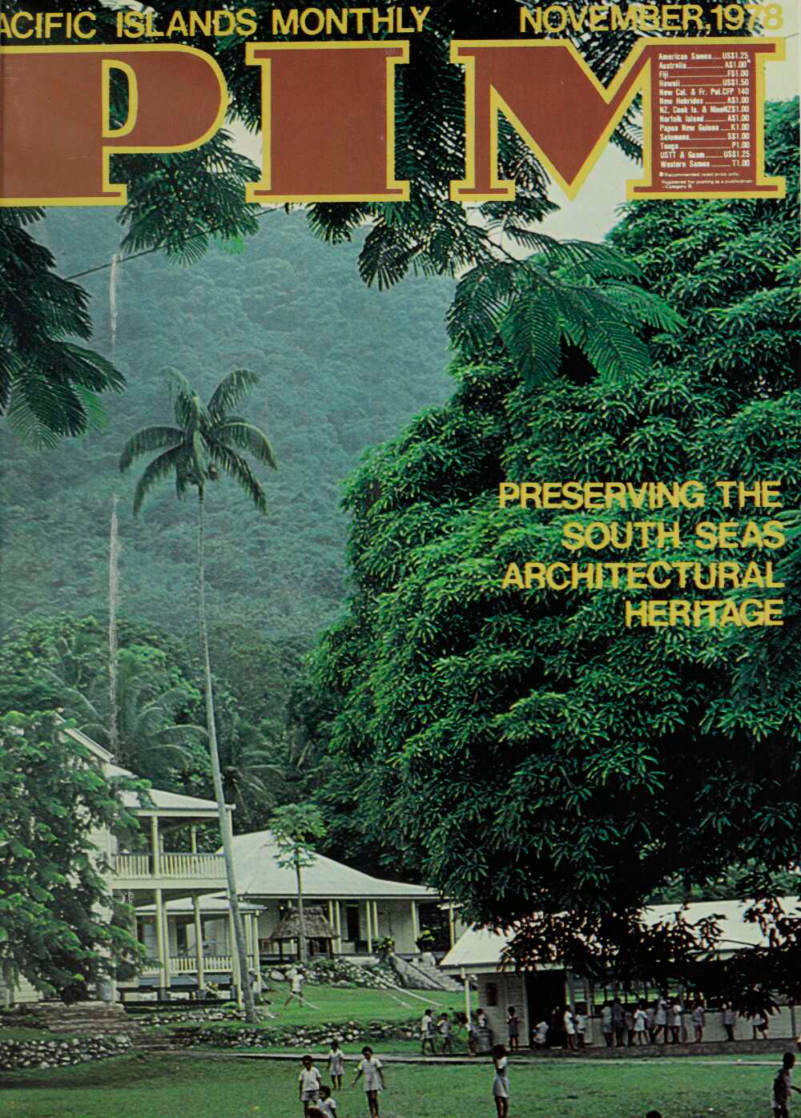
Cover: The beautiful old public school at Levuka, in Fiji, celebrates its centen ary next year. The school is of keen interest to all those people newly cons ■cious of the need for conservation of the Pacific architectural and cultural heritage.
See PI M’s special treatement of this theme on p 22, and ppso-51. (A PIM pho tograph.)
Advertisements & other items, pp. 2-8 (2 items)
by the professionals.
Eiyoy the very best sound
O § o * -•V o o o o qi /■ 1 //li if- •»»»•* »
AKAI
AKAI ELECTRIC CO., LTD.
Tokyo, Japan
P.N.G.
S.O. Svensson (N.G.) Ltd.
P.O. Box 705, Port Moresby Tel: 2275 Tahiti Etablissements Comimpex P.O. Box 200, Papeete Tel: 20477 Mariana Islands J.C.Tenorio Enterprises P.O. Box 137, Saipan Tel: 6444/8 Fiji Islands Motibhai & Company Ltd.
P.O. Box 9175 Nadi International Airport Tel: 72-165 New Hebrides (Islands) British Solomon Islands Burns Philp (New Hebrides) Co., Ltd. Security Electrical Co., Ltd.
P.O. Box 27 Port Vila New Hebrides Islands P.O. Box 174, Honiara Tel: 881 New Zealand Pye Ltd., Consumer Products Sector 110 Mt. Eden Rd„ Mt. Eden, Auckland Te1:686-437 Norfolk Island Burns Philp (Norfolk Island) Co., Ltd.
P.O. Box 21, Norfolk Island Cook Islands JPS Enterprises Ltd.
P.O. Box 15, Rarotonga Tel: 2150, 2176 New Caledonia Menard Freres Vi lie B.P. H 2, Noumea Tel: 275222 Samoa Islands Burns Philp (South Sea) Co., Ltd.
P.O. Box 129, Pago Pago, American Samoa
DAIHATSU Continues To Press Forward
In Its Quest For A Harmonious “Automobile Society”
A new car born of logic...
created to meet
the practical need|
of today’s world
charade
model XG
DAIHATSU
charade
The Daihtsu Charade is a car in which a family of 5 can travel in comfort. A car with a special functionality, thanks to its hatch-back door, and with plenty of power for excellent maneuverability under a wide variety of conditions ranging from crowded cities to fast highways. Very definitely a car of economy . . . but still a car in which all of these attributes have been concentrated into a compact as** i. W SS. ' • • r body in a very logical way.
Today we no longer live in an age in which we can afford the luxury of determining a car’s worth by its luxurious fittings and its great engine displacement. The Daihatsu Charade is therefore a new - and most logical - alternative for those who will enjoy the simple life and its simple
pleasures.
4-Wheel Drive...ideal for highways,
sand, rocks or mountain trails
Because it can go “almost anywhere”. And that includes highways, rocky trails, sand, river sides. Dry, wet, rocky, sandy surfaces.
That’s what sets this 4-Wheel Drive so far apart - and ahead - when the going gets tough. Excellent acceleration superb hill climbing, amazing tenacity . . . that’s the story of Daihatsu 4-Wheel Drive!
DAIHATSU
4 WHEEL DRIVE
DAIHATSU
DAIHATSU IVIOTOR CO, UTD.
DAIHATSU IVIOTOR
Head Office: 1, D AI H ATSU-CHO, IKEDA CITY, OSAKA PREFECTURE, JAPAN
PHONE: IKEDA (0727) 51-8811
CABLE ADDRESS. TLX5322224 DAIHATSU IKEDA OSAKA
TELEX NO.: 0-5322-251 JAPAN, 0-5322-224 JAPAN
Tokyo Office;
7, NIHONBASHI-HONCHO 2-CHOME, CHUO-KU, TOKYO.
PHONE: TOKYO (03) 279-0811
CABLE ADDRESS: DAIHATSU TOKYO
TELEX NO.: 0-222-3377 JAPAN
PAPUA NEW GUINEA: AGQUIP NEW GUINEA, P.O. Box 1121, Rabaul/ FIJI: PR A K ASH MOTORS LIMITED, P.O. Box 370, Suva/ TAHITI: ETS. ROBERT, B.P. 1047, Papeete/ NEW CALEDONIA: 5.1.D.A., B.P. 2548, Noumea/ NEW HEBRIDES: SANTO BUS COMPANY, P.O. Box 45, Santo, GARAGE RANTY & JAMMES, B.P. 627, Port Vila/ SOLOMON ISLANDS: HERTZ CAR RENTALS LIMITED, P.O. Box 333, Honiara/ REPUBLIC OF NAURU: NAURU COOPERATIVE SOCIETY/ NIUE ISLAND: NIUE ISLAND UNITED ENTERPRISES, P.O. Box 4/ NORFOLK ISLAND: W.W. SANDERS & SONS LTD., P.O. Box 86, Burnt Pine/ GILBERT ISLANDS: JONG KUM KEE BROTHERS' STORE, P.O. Box 504, Betio Tarawa
From conquering new peaks to sailing windy seas, there’s a rugged companion for your adventurous life:
Seiko Quartz
SPORTS 1
\ s \ TT % P ■**s Designed for today's men of action by the world leader in quartz technology. Sailing, swimming or mountain climbing, these watches are rugged enough to meet their active lifestyles, handsome enough to reflect their good taste, accurate enough to meet their high standards.
Every Seiko Quartz SPORTS 100 is water-tested t 100 meters, and so efficiently designed that it can run five years on a single ordinary battery. All are shock resistant and feature day/date calendars.
Hardlex scratch-protected crystal, stainless steel cases and bracelets. Seiko Quartz.
WED
$5
SEIKO
Someday all watches will be made this way.
Coleman Poly-Lites:
Feature for feature, dollar for dollar...
the best values under the sun.
These are the ones that proved just how tough “plastic” coolers and jugs can be. How efficient in holding the cold. How good-looking.
So take a close look at a Coleman Poly-Lite, like our 45 liter cooler or the 4 liter jug shown here.
Start with the most basic point.
All Coleman coolers and jugs are insulated with urethane, the best material available. And lots of it.
So they hold the cold. i Next, think tough. That highdensity polyethelene hide shrugs off all the rocks and hard places.
Keeps its bright color in the sun.
Won’t rust or corrode, even in salt water.
You’ll also find special touches.
Like handles that are smooth and round, won’t pinch. They swing P out for carrying, like on most coolers. But they also lift straight up for tight places, like a car trunk.
The snap latch is fumble proof, inside the lid where it can’t break off. Close the lid firmly for traveling. Softly, and you get the “quickseal” position so you can open it easily with one hand.
Poly-Lite coolers and jugs. Sizes, styles, colors for anyone. And the price is right.
For more information contact your local Coleman dealer or write us.
Remember: Coleman equipment can come in handy in storms, typhoons and power losses too.
:: m * n o o -* -*5
developing the
wheel loaders
Throughout the Pacific Islands you will find CATERPILLAR working to develop the land.
Caterpillar wheel loaders are among those machines. They are dependable, with the adjustment-free Cat diesel engine, rugged planetary power shift transmission and long-life sealed hydraulic system to keep you working.
Caterpillar wheel loaders give you 4-wheel drive, articulated steering and caliper disc brakes to get you in, out and around, fast. You can rely on Caterpillar to get the job done economically and efficiently.
HASTINGS DEERING
LAE :
Milford Haven Road, Telephone 42 2355
PORT MORESBY :
Telephone 256650
BOUGAINVILLE ;
Itakara Industrial Park, Arawa. Telephone 959077
PLUS
All CATERPILLAR equipment is backed by CAT PLUS service. CAT PLUS is a package of programmes designed to help you protect your investments and get the maximum return on your machines. CAT PLUS is the most comprehensive service programme available... .anytime, anywhere.
When you invest in CATERPILLAR equipment you have the full backing of your CAT Dealer and
CAT PLUS.
0 SUVA : Carpenter Street, Raiwai.
Private Mail Bag, GPO Suva. Fiji. Ph. 381622, Telex FJ2190 Cables CARPTRAC LAUTOKA ; Veitari. Telephone 61877 LABASA ; Vulovi, Telephone 81888 □
YOUR
CATBHPILLAR
DEALER
Caterpillar, Cat and B are Trademarks of Caterpillar Tractor Co.
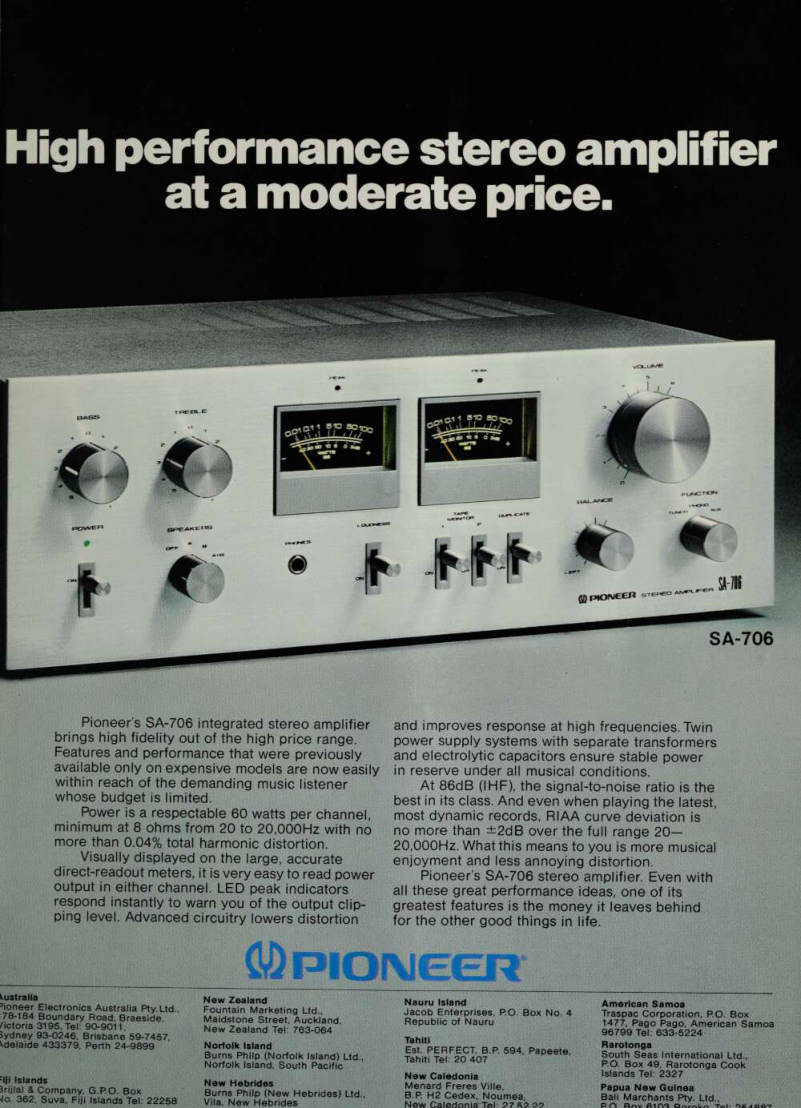
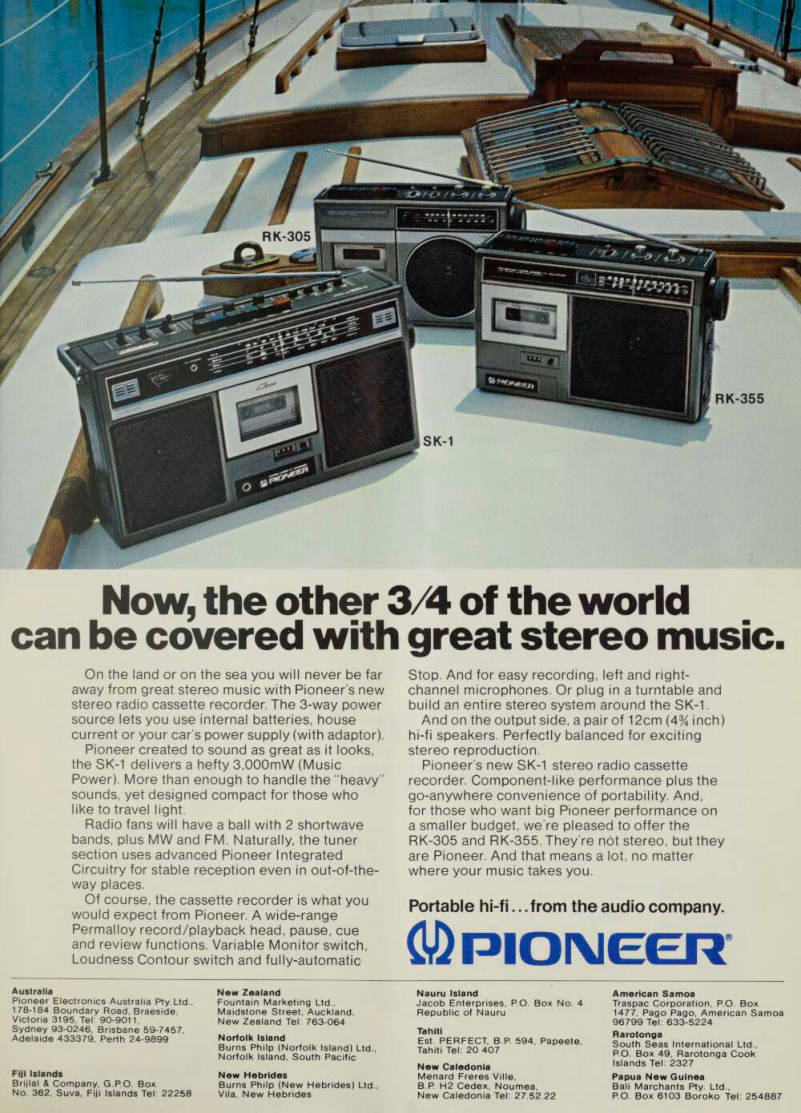
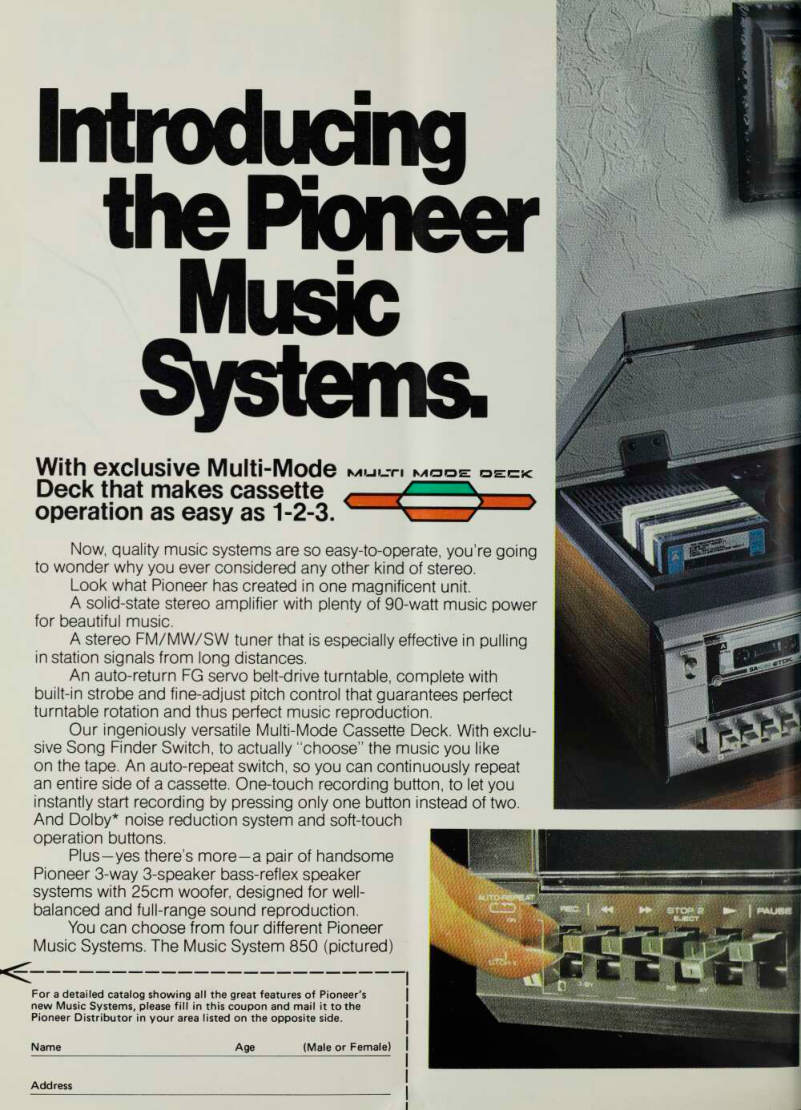
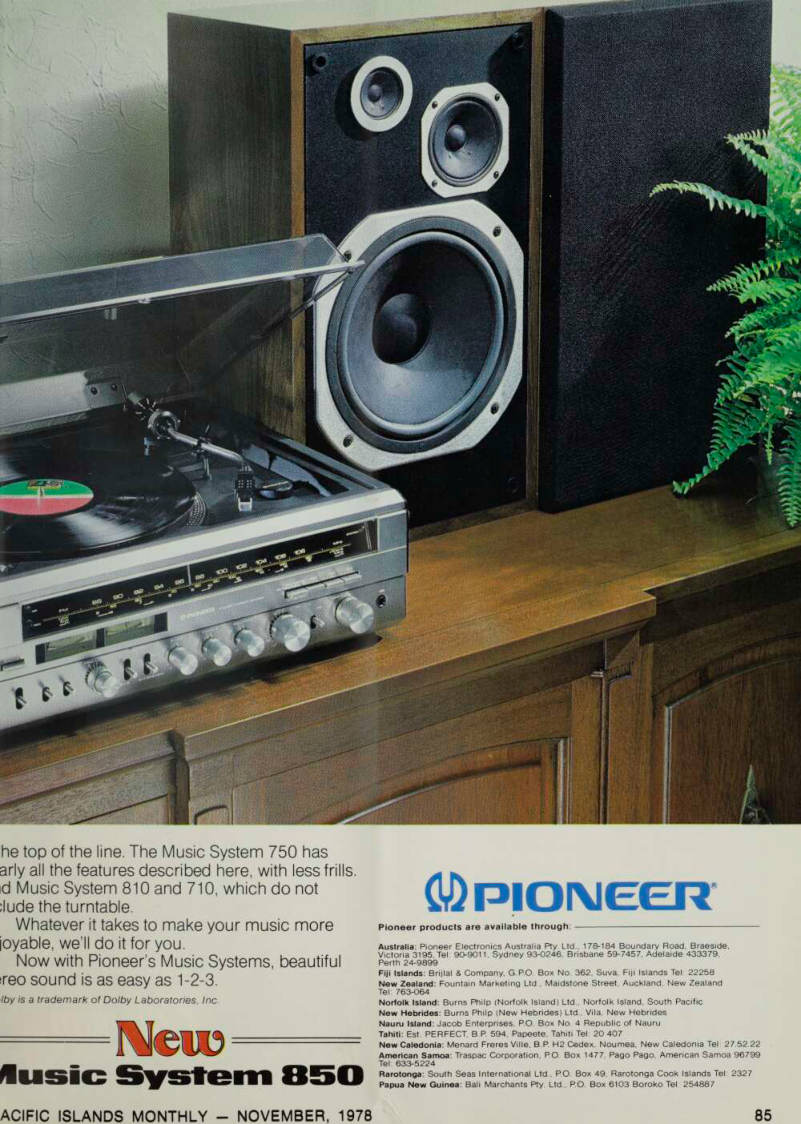
High performance stereo amplifier
at a moderate price.
m«CTON
► c f a-m SA-706 Pioneer’s SA-706 integrated stereo amplifier brings high fidelity out of the high price range.
Features and performance that were previously available only on expensive models are now easily within reach of the demanding music listener whose budget is limited.
Power is a respectable 60 watts per channel, minimum at 8 ohms from 20 to 20,000 Hz with no more than 0.04% total harmonic distortion.
Visually displayed on the large, accurate
direct-readout meters, it is very easy to read power output in either channel. LED peak indicators respond instantly to warn you of the output clip-
ping level. Advanced circuitry lowers distortion
and improves response at high frequencies. Twin
power supply systems with separate transformers
and electrolytic capacitors ensure stable power in reserve under all musical conditions.
At 86dB (IHF), the signal-to-noise ratio is the best in its class. And even when playing the latest, most dynamic records, RIAA curve deviation is no more than ±2dß over the full range 20— 20,000 Hz. What this means to you is more musical enjoyment and less annoying distortion.
Pioneer’s SA-706 stereo amplifier. Even with all these great performance ideas, one of its greatest features is the money it leaves behind for the other good things in life.
Australia ’ioneer Electronics Australia Pty.Ltd., 78-184 Boundary Road, Braeside, Victoria 3195, Tel: 90-9011.
Sydney 93-0246, Brisbane 59-7457, Adelaide 433379, Perth 24-9899 : iji Islands Jrijlal & Company. G.P.O. Box 40. 362, Suva, Fiji Islands Tel; 22258 New Zealand Fountain Marketing Ltd., Maidstone Street, Auckland, New Zealand Tel: 763-064 Norfolk Island Burns Philp (Norfolk Island) Ltd., Norfolk Island, South Pacific New Hebrides Burns Philp (New Hebrides) Ltd., Vila. New Hebrides Nauru Island Jacob Enterprises, P.O. Box No. 4 Republic of Nauru Tahiti Est. PERFECT. B.P. 594, Papeete, Tahiti Tel: 20 407 New Caledonia Menard Freres Ville, B.P. H 2 Cedex. Noumea, New Calerlnnia Tel- 07 eo OO American Samoa Traspac Corporation, P.O. Box 1477. Pago Pago. American Samoa 96799 Tel: 633-5224 Rarotonga South Seas International Ltd..
P.O. Box 49, Rarotonga Cook Islands Tel: 2327 Papua New Guinea Bali Merchants Pty. Ltd., r-v
% «ii
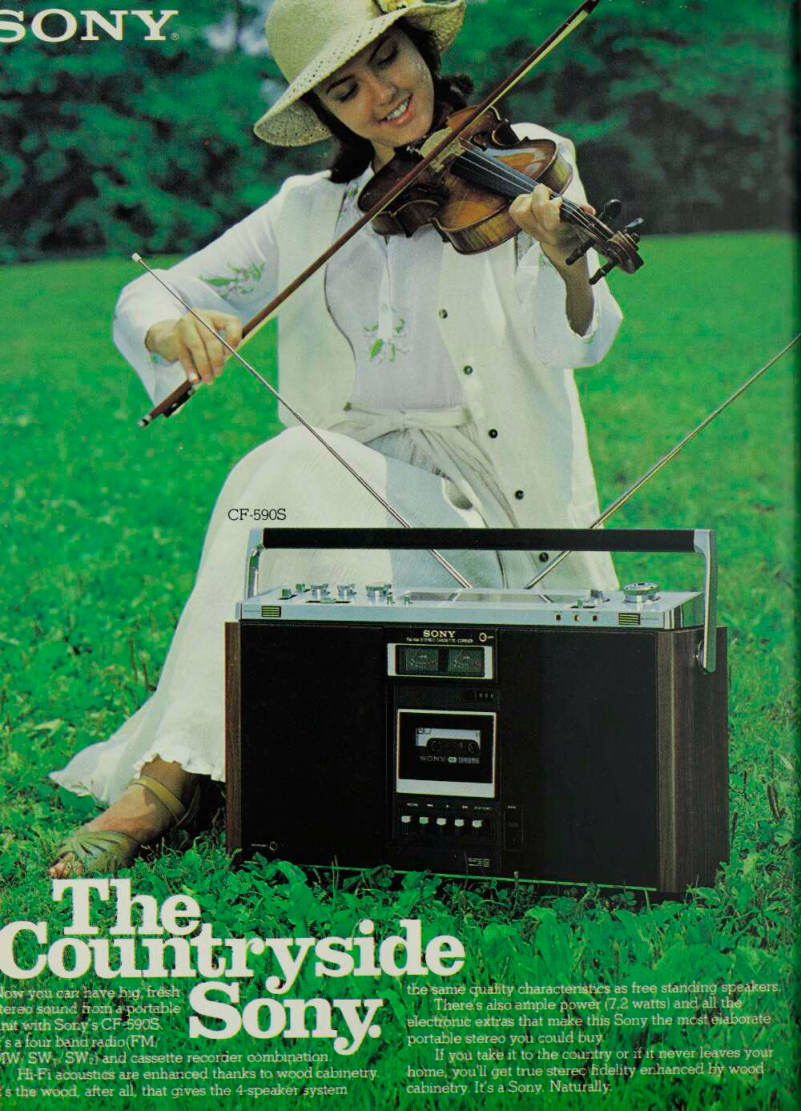
CF-590S
Mg •6 ppm m x a j » * * f \ ?:■¥** 11 yp- IRS&jfl j n :*v m ■* \ v m - '* l > *K* r V* ■%ie i % I »:• » «
3
ACIFIC ISLANDS MONTHLY - NOVEMBER, 1978
Pacific Islands Monthly
Pim
Vol. 49 No. 11
November 1978
Elsewhere: $A16 Payment by personal cheque is accepted in Australian, US, New Zealand, UK and Fiji currency For other remit tances please obtain a bank draft in Australian dollars made payable to the ANZ Banking Group, 88 Wentworth Avenue. Sydney, Australia
Representatives
AUSTRALIA: Distribution Gordon & Gotch (A asia) Ltd, Box 40, PO. Rosebery, NSW 2018 Advertising - Mel bourne - Pacific Publications (Aust.) Pty Ltd, 5th Floor, Alley Building, 75-77 Flinders Lane, Melbourne 3000, telephone 63-0211, ext 1565 Jeff Gates, ext 1858 Ida Padgett Brisbane — D Wood, Anday Agency, Box 1918, GPO, Brisbane 4001, telephone 44 3485, 44 1546; Adelaide - Harry Hastwell Media, PO Box 30, 399 Glen Osmond Rd, Glen Osmond, Adelaide 5064, telephone 79 1869, 79 5956; cables Hastmedia, Adelaide FIJI; Distribution and subscriptions - Desai Bookshops, PO Box 160, Suva, Fiji, telephone Suva 23036 Advertis ing — Fiji Times & Herald Ltd, 20 Gordon St, Suva, tele phone 312 111, telex FJ2124 FRENCH POLYNESIA; Distribution — Hachette Pacifique, 10 Ave Bruat, Papeete, telephone 2 5610 HAWAII, UNITED STATES; Distribution PIM, Hawaii 2812 Kahawai St, Honolulu, Hawaii 96822 JAPAN: Advertising and subscriptions — Universal Media Corporation, CPO Box 46, Tokyo, telephone 566 3036 NEW CALEDONIA: Distribution — Depot Centre de Presse Michel Pentecost, CBP2, Noumea, telephone 27 2434, 27 4729.
NEW ZEALAND; Distribution — Gordon & Gotch. PO Box 584, 2 Carr Road, Mt Roskill, Auckland 4 Advertising - International Media Representatives Ltd, PO Box 2313, Auckland, telephone 795 487; 493 389, cables Intereps.
Auckland Subscriptions — Pacific Publications, GPO
3ox 2229, Auckland^
3 APUA NEW GUINEA: Distribution - Robert Brown & Assoc , PO Box 3395, Port Moresby, telephone 2 5855 Advertising — PNG Post-Courier, PO Box 85, Port Moresby, telephone 212577 JNITED KINGDOM: The Herald & Weekly Times Ltd, 8-10 Clifford's Inn. Fetter Lane. London EC4A 1BU. telephone D1 831 6041. telex London 21989 JNITED STATES MAINLAND: Advertising — Joshua B Powers Jr, Powers International Inc., 551 Fifth Ave, New York, New York 100 017, telephone 867 9580, telex 236514 Subscriptions - PIM, Hawaii, 2812 Kahawai St.
Honolulu, Hawaii 96822 Published monthly by Pacific Publications (Aust) Pty Ltd and printed in Australia by Kralco, Flemmgton. NSW Australian cover price is recommended retail only Regis tered at the GPO Sydney for transmission by post as a publication — category B. Second class postage paid at Honolulu, Hawaii Pub = 952480 Copyright c 1978 Pacific Publications (Aust.) Pty Ltd
PIM is airfreighted to most subscribers and agents in the Pacific Islands and the United States Aust Other American Samoa $13 $US16 Australia $12 Canada $14 $US18 Cook Islands $13 Fiji $12 $F12 French Polynesia $14
Cfp 1700
Guam $13 $US16 Gilbert Islands $13 Hawaii $13 $US16 Japan $16 V4500 Micronesia $13 $US16 Nauru $13 New Caledonia $14
Cfp 1700
New Hebrides $13 New Zealand $12
Snz13.50
Niue $13 Norfolk Island $12 Northern Marianas $13 $US16 Papua New Guinea $13 K12 Solomon Islands $13 Tonga $13 Tuvalu $13 United Kingdom $15 £10 US Mainland $14 $US18 Western Samoa $13
Advertisements & other items, pp. 9-10 (2 items)
Vcific Islands Monthly - November, 1978
9
Founded 1930 by R. W. Robson Publisher Stuart Inder Editor Bob Hawkins Editorial Adviser John Carter Manager John Berry Advertising Manager Steve Gray A Pacific Publications production 76 Clarence Street, Sydney 2000 GPO Box 3408 Sydney 2001 Cables: PACPUB Sydney Telex: 21242 Telephone: Sydney 29 6693
SUBSCRIPTIONS
vjP vVv .06^*
A©
<^ T^© oV *
V> v * °V*
PIM SUBSCRIPTIONS
* See the lefthand column for the cost of a 12-month subscription to PIM mailed direct to your home.
WINGS OF GOLD
■c® <s> This book tells for the first time the remarkable story of the aeroplane in New Guinea. It begins in 1922 with the strange sound of a Curtiss biplane echoing across the swamps and deltas of western Papua, and it ends in 1942 with Japanese bombers blasting the last of the civil aircraft to pieces on the ground. A superb, large format production of more than 330 pages and 150 avaition photographs, most of them historic and not before published. SA3O or SUS3S, please add SA3 or SUSS for postage.
THE TONGANS
Leading South Pacific writer Olaf Ruhen and photographer Jozef Vissel capture the lifestyle of the people of the last Polynesian kingdom.
Brilliant prose and 96 sparkling full-colour photographs depict today’s Tongans at work, in church, at play. 5A9.00 (SUSIO.SO) Posted anywhere *
PNG HANDBOOK & TRAVEL GUIDE
For businessmen, schools, libraries and local residents, this up-to-the-minute handbook covers everything!
Includes an accommodation tariff guide and useful maps, including a large coloured fold-out map of Papua New Guinea. 5A8.50 (SUS 10.00) Posted anywhere • . V'° also ask us for our full mail order book list of great Pacific titles c' \' c eS- & & A V^ e e <v ... v, v. *** .//
Cffi G^°
S V ' s* 1 & 0° o *N C &
S.E. TATHAM & CO. PTY. LTD.
BEEHIVE BUILDING,
94 ELIZABETH STREET.
G.P.O. BOX 8.
MELBOURNE 3001.
AUSTRALIA,
CABLES: “SET’:
TELEX: AA34552.
TELEPHONE; 63 5094
f. > T
...BUYERS for the
PACIFIC ISLANDS.
PAPUA NEW GUINEA:
S. E. TATHAM (P N G.) PTY. LTD.
LAE:MALAITA ST. (P.O. BOX 1562).
PORT MORESBY: Cm. GOROA & MANAHU Sts.,
GORDON (P.O. BOX 6733, BOROKO).
TELEGRAMS: ALL OFFICES “SET!
YOUR GUARANTEE
FOR SERVICE
SINCE 1924
This Month
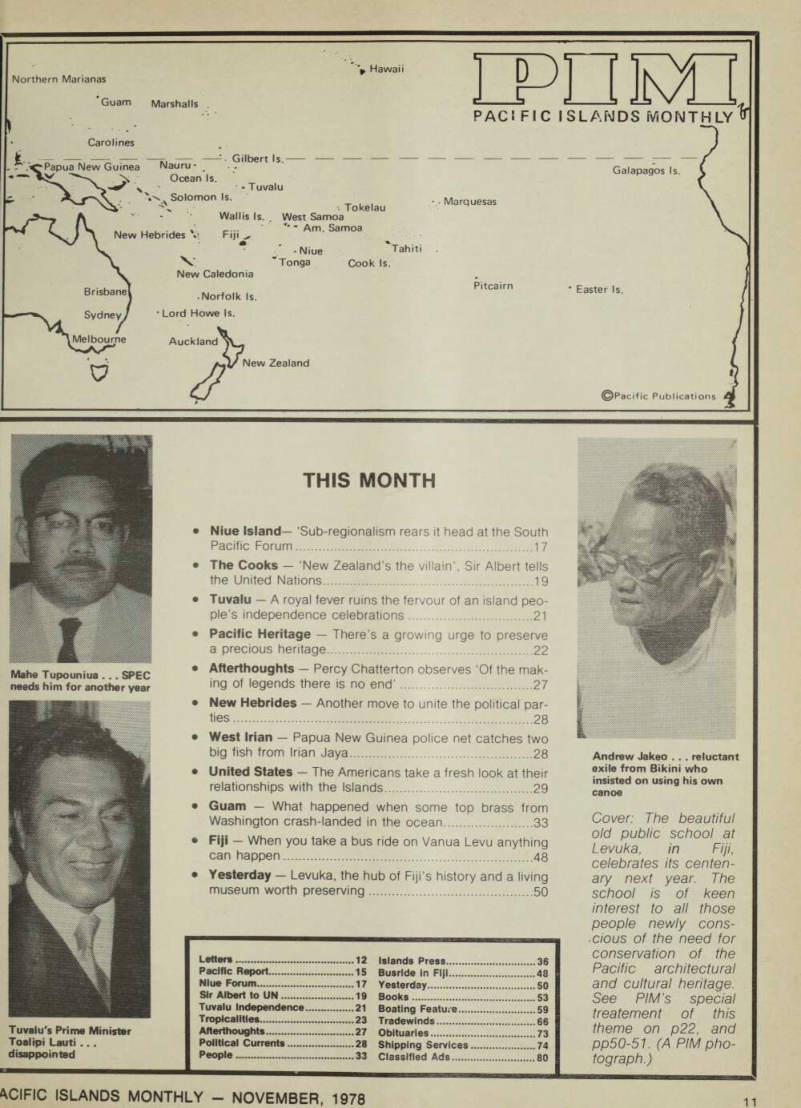
• Niue Island— ‘Sub-regionalism rears it head at the South Pacific Forum 17 • The Cooks ‘New Zealand’s the villain’, Sir Albert tells the United Nations 19 • Tuvalu A royal fever ruins the fervour of an island peo ple’s independence celebrations 21 • Pacific Heritage There’s a growing urge to preserve a precious heritage 22 • Afterthoughts Percy Chatterton observes ‘Of the mak ing of legends there is no end' 27 • New Hebrides Another move to unite the political par ties 28 • West Irian Papua New Guinea police net catches two big fish from Irian Jaya 28 • United States The Americans take a fresh look at their relationships with the Islands 29 • Guam What happened when some top brass from Washington crash-landed in the ocean 33 • Fiji When you take a bus ride on Vanua Levu anything can happen 48 • Yesterday Levuka, the hub of Fiji’s history and a living museum worth preserving 50
Letter* 12 Pacific Report 15 Niue Forum 17 Sir Albert to UN 19 Tuvalu Independence 21 Ttopicalities 23 Afterthoughts 27 Political Currents 28 People 33
Islands Press 36 Busride In Fiji 48 Yesterday 50 Books 53 Boating Featu.e 59 Tradewinds 66 Obituaries 73 Shipping Services 74 Classified Ads 80
Mahe Tupouniua . . . SPEC needs him for another year
Tuvalu's Prime Minister Toalrpi Lauti . . . disappointed
Andrew Jakeo . . . reluctant exile from Bikini who insisted on using his own canoe
Advertisements & other items, p. 11 (1 item)
11
ISLANDS MONTHLY - NOVEMBER, 1978
Letters
A Miniature
Bouquet
1 spent 40 years in all the South Pacific Islands. Your articles are wonderful.
Charles S. Deuben
(US Navy retired) Santa Maria California
And A
Bigger One
Earlier this year I wrote you a letter criticising your Pacific Islands Monthly. You so kindly responded, and 1 cannot rest until I send my wholehearted CONGRATS! Every issue is a
delight, photos, all supremely
lovely, contents informative, timely and an inspiration. My admiration goes to every mem ber of your staff, as teamwork I’m sure is a must. i have the impression the subject matter is most unbiased and that, in a turbulent world, is top achievement.
Again, my sincere congratu lations on a magnificent publi cation. May success always be yours.
I look forward to every scrap of information re Pitcairn Island. The world cares, I feel.
Ellyn Greywitt
Ohio.
Usa
How Old
The Ladies?
Mrs Alice Brewster, widow of
Adolph Brewster (formerly
Joske) who was district com missioner, Colo, Fiji, and author of The Hill Tribes of Fiji, had her 107th birthday in England on September 16. She is believed to be the second
oldest person in Britain (the eldest being 108). It would be interesting to know from your readers if her age is known to have been exceeded by (a) any indigenous persons in the Pa cific (b) any Europeans who have lived in the Pacific.
Her husband’s post was one that I held about half a century later.
A predecessor of mine as dis trict commissioner of the Lau Group in Fiji, also about 50 years earlier, was Sir Basil Thomson who arranged the 1900 Treaty of Friendship with Tonga. He had no sons and his only daughter, Mrs Enid Wise, who was given the Tongan name, Anaseini Veihola Tupou. has recently died in England aged 87. She acted at times as secretary for her father who was the son of an Arch bishop of York and, after leav ing the Pacific, became governor of several English prisons and interrogated, as head of British intelligence, German spies in the First War.
He became head of the Crimi
nal Investigation Department
at Scotland Yard, London, and managed to find time to write several books, many of them classic works on the Pacific.
Philip A. Snow
Angmering
Sussex
England
Whither The
White Horse?
I read with interest in May PIM Harald A. Rehder’s letter about the ‘Coral Route’. Mr Rehder said he was unable to locate The White Horse Inn, one of the lodging spots in Western Samoa for Coral Route passengers. Whilst I do not have the full facts, perhaps I can shed some light on the
subject.
I have been told that-it was around 1964 that The White Horse Inn last housed guests, the closure of the lodgings per haps having been caused in part by the fact that a further guest house on the Apia water front, not far from ‘Aggies’, had opened its doors.
However, The White Horse Inn continued to be available
for special specific functions up until about 1970, when it finally closed its doors. The building was converted into four self-contained flats. That’s how it is today.
It may be of interest to some of your readers to learn of the fate of the inn’s main bar.
Having been a resident of Apia from 1967 until 1973, it was in late 1971, whilst driving past The White Horse Inn during its transition stage to flats, I noticed the main bar resting on the disused tennis court. (Both the bar and tennis court were in a bad state of repair.) The princely sum of $lO purchased the bar, complete with its ‘cash’ drawer. The bar was then put on the tray of a large truck and reinstalled in the very large lounge of the old colonial Ger man house that I, a fellow-New Zealander and an Australian
were sharing.
Finally, two points that I share with some other PIM readers in New Zealand: one, we would like to see the feature ‘Twenty Years Ago this Month’ reintroduced it was not only of great interest but often
amusing and topical; second,
the present index, in terms of reference to content country by country, is very poor compared to the index in the previous smaller size editions of PIM.
Randal J. Lockie
Auckland New Zealand (*Twenty Years Ago’ we are con
sidering. Hope you approved the
new indexing introduced in Sep tember Editor.)
Thevenin:
A Reply
I read with interest and grave concern the interview between Mr Jean Massias and Mr Rene Thevenin New Hebrides Past and Present by Veteran ‘Colon’ {PlM October).
My first reaction was: Why does Mr Massias choose this time to have an interview of this nature with Mr Thevenin, who has long been seen by New Hebrideans as one who has taken and exploited lands rightfully belonging to them?
My second thought was that the interview had a marked
political colouring, and that j
this is unlikely to be the only! article of this nature which Mr] Massias will endeavour to have]
printed. Questions one mustj
ask include: What is the real purpose behind interviews of] this nature? Is PIM allowing] itself to be used as a political] instrument in this subtle pres-i entation? Is this another] attempt at dividing the people
not directly on political
grounds but rather on religious
grounds through Mr Theve
nin’s references to the work of the various Christian churches in the New Hebrides? What point is Mr Thevenin trying to make when he says things were much better in the old days than they are now would he like the New Hebrideans still to be isolated in their villages andj fighting each other with stone axes as he claims they did in the]
early days?
While Mr Thevenin has no good word for the work of the] various churches, it seems to many people in the New Hebrides that these same]
churches are largely respon-l
sible for bringing about the
peaceful conditions existing
among the people of the New Hebrides today. Indeed, the churches have succeeded in this work in many cases where the British and French Governments themselves have failed.
It would appear that only now, with his planned depar-j ture, has Mr Thevenin caught up with the modem thinking of an oppressed people who des perately want freedom and self government.
One thing that the article
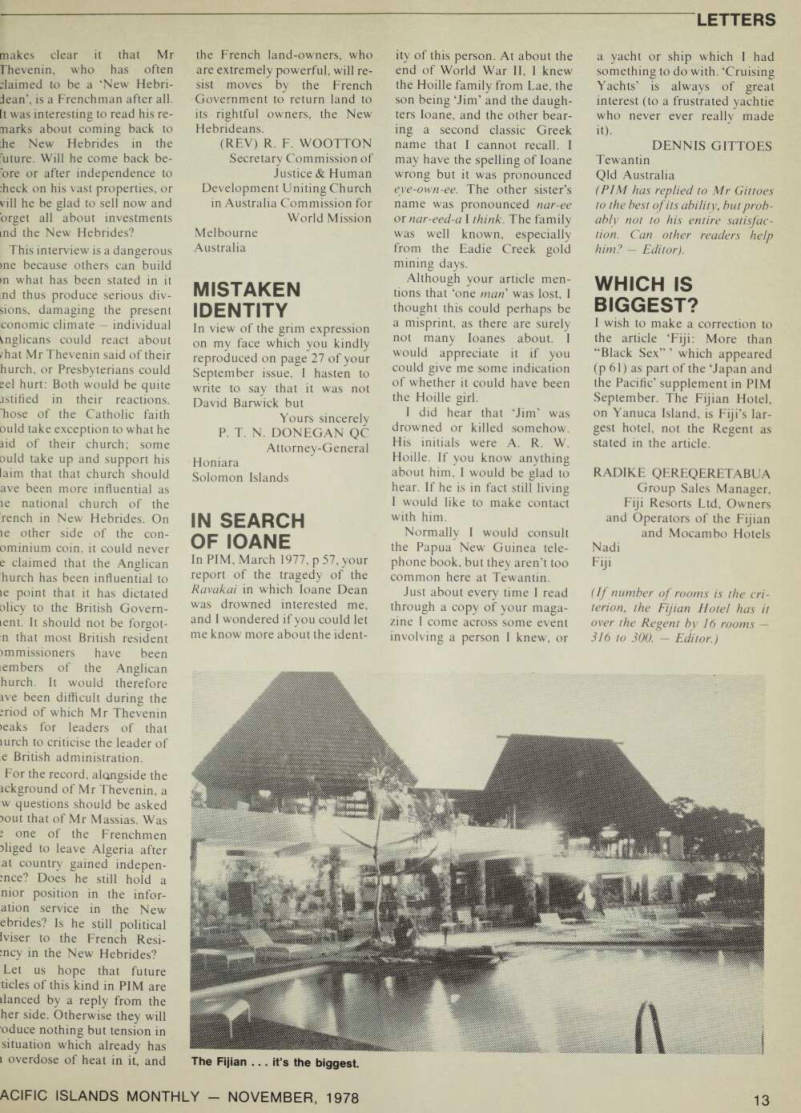
Mr Massias ... his real purpose?
makes clear it that Mr Fhevenin, who has often :laimed to be a ‘New Hebri dean’, is a Frenchman after all.
It was interesting to read his re marks about coming back to ;he New Hebrides in the 'uture. Will he come back be fore or after independence to :heck on his vast properties, or vill he be glad to sell now and brget all about investments ind the New Hebrides?
This interview is a dangerous me because others can build m what has been stated in it ,nd thus produce serious div
sions, damaging the present
conomic climate individual Anglicans could react about /hat Mr Thevenin said of their
hurch, or Presbyterians could
eel hurt: Both would be quite jstified in their reactions, 'hose of the Catholic faith ould take exception to what he aid of their church; some ould take up and support his laim that that church should ave been more influential as le national church of the Tench in New Hebrides. On le other side of the con ominium coin, it could never e claimed that the Anglican hurch has been influential to le point that it has dictated olicy to the British Govern tent. It should not be forgot n that most British resident ammissioners have been
[embers of the Anglican
hurch. It would therefore ave been difficult during the mod of which Mr Thevenin >eaks for leaders of that lurch to criticise the leader of e British administration.
For the record, alongside the ackground of Mr Thevenin, a w questions should be asked aout that of Mr Massias. Was - one of the Frenchmen )liged to leave Algeria after at country gained indepen mce? Does he still hold a nior position in the infor ation service in the New ebrides? Is he still political Iviser to the French Resi mcy in the New Hebrides?
Let us hope that future tides of this kind in PIM are
danced by a reply from the
her side. Otherwise they will oduce nothing but tension in situation which already has i overdose of heat in it, and
the French land-owners, who are extremely powerful, will re sist moves by the French Government to return land to its rightful owners, the New Hebrideans.
(Rev) R. F. Wootton
Secretary Commission of Justice & Human
Development Uniting Church
in Australia Commission for World Mission Melbourne Australia
Mistaken
Identity
In view of the grim expression on my face which you kindly reproduced on page 27 of your September issue, I hasten to write to say that it was not David Barwick but
Yours sincerely
P. T. N. Donegan Qc
Attorney-General Honiara Solomon Islands
In Search
Of Loane
In PIM, March 1977, p 57, your report of the tragedy of the Ravakai in which loane Dean was drowned interested me, and I wondered if you could let me know more about the ident
ity of this person. At about the end of World War 11, I knew the Hoille family from Lae, the son being ‘Jim’ and the daugh ters loane, and the other bear ing a second classic Greek name that I cannot recall. I may have the spelling of loane wrong but it was pronounced eye-own-ee. The other sister’s name was pronounced nar-ee or nar-eed-a I think. The family was well known, especially from the Eadie Creek gold
mining days.
Although your article men tions that ‘one man was lost, I thought this could perhaps be a misprint, as there are surely not many loanes about. I would appreciate it if you could give me some indication of whether it could have been the Hoille girl.
I did hear that ‘Jim’ was drowned or killed somehow.
His initials were A. R. W.
Hoille. If you know anything about him, I would be glad to hear. If he is in fact still living I would like to make contact with him.
Normally I would consult the Papua New Guinea tele phone book, but they aren’t too common here at Tewantin.
Just about every time I read through a copy of your maga zine I come across some event involving a person I knew, or
a yacht or ship which I had something to do with. ‘Cruising Yachts’ is always of great interest (to a frustrated yachtie who never ever really made it).
Dennis Gittoes
Tewantin Qld Australia (PIM has replied to Mr Gittoes to the best of its ability, but prob ably not to his entire satisfac tion. Can other readers help him? Editor).
Which Is
Biggest?
I wish to make a correction to the article ‘Fiji: More than “Black Sex” ’ which appeared (p 61) as part of the ‘Japan and the Pacific’ supplement in PIM
September. The Fijian Hotel,
on Yanuca Island, is Fiji’s lar gest hotel, not the Regent as stated in the article.
Radike Qereqeretabua
Group Sales Manager,
Fiji Resorts Ltd, Owners and Operators of the Fijian and Mocambo Hotels Nadi
Fiji
(If number of rooms is the cri terion, the Fijian Hotel has it over the Regent by 16 rooms 316 to 300. - Editor.)
The Fijian ... it’s the biggest.
Advertisements & other items, pp. 13-14 (2 items)
13
ACIFIC ISLANDS MONTHLY - NOVEMBER, 1978
LETTERS
Air Niugini
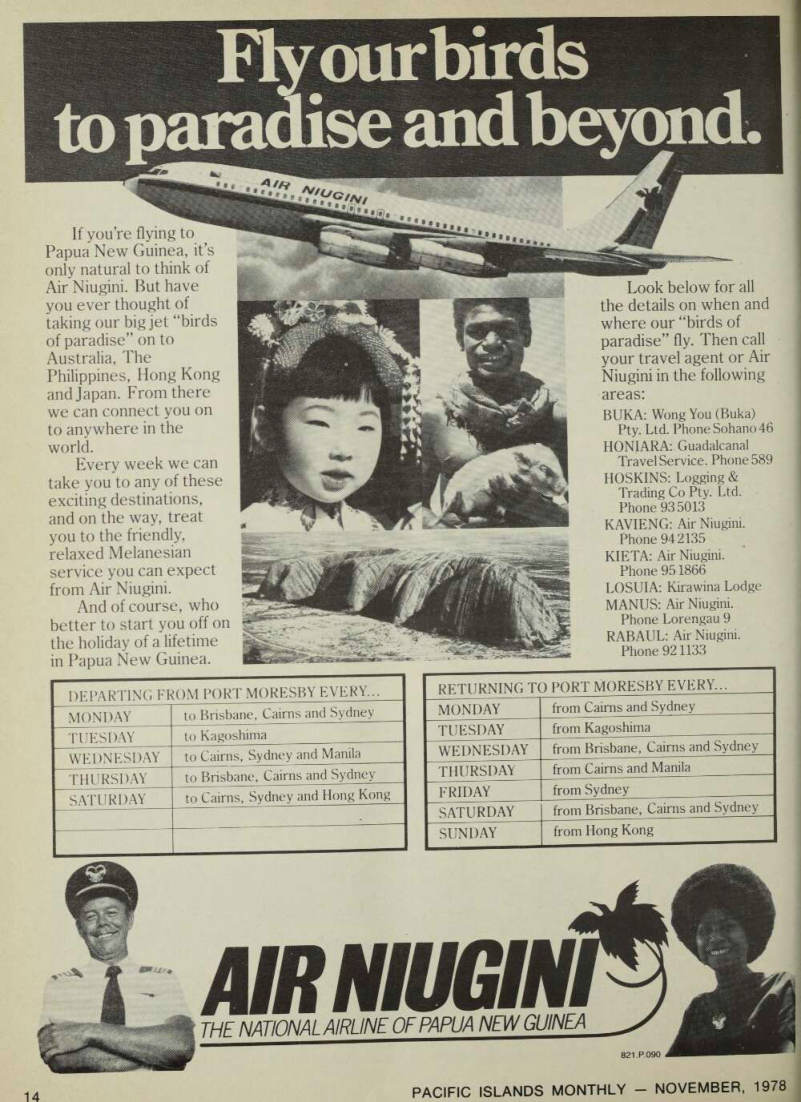
our birds
ise and beyond
■ 8 S **• >!• If you’re flying to Papua New Guinea, it’s only natural to think of Air Niugini. But have you ever thought of taking our big jet “birds of paradise” on to Australia, The Philippines, Hong Kong and Japan. From there we can connect you on to anywhere in the world.
Every week we can take you to any of these exciting destinations, and on the way, treat you to the friendly, relaxed Melanesian service you can expect from Air Niugini.
And of course, who better to start you off on the holiday of a lifetime in Papua New Guinea.
Look below for all the details on when and where our “birds of paradise” fly. Then call your travel agent or Air Niugini in the following areas: BUKA: Wong You (Buka) Pty. Ltd. Phone Sohano 46 HONIARA: Guadalcanal Travel Service. Phone 589 HOSKINS: Logging & Trading Co Pty. Ltd.
Phone 935013 KAVIENG: Air Niugini.
Phone 942135 KIETA: Air Niugini.
Phone 951866 LOSUIA: Kirawina Lodge MANUS: Air Niugini.
Phone Lorengau 9 RABAUL: Air Niugini.
Phone 921133
AIR NIUGINI
THE NATIONAL AIRLINE
821. P. 090
Pacific Report
Yet Another Oil Superport Plan
4 New York-based oil company has revealed plans to construct a multi-million dollar oil superport in the Northern Marianas, Dossibly on the island of Rota, according to the Guam news paper, Pacific Daily News. A spokesman for the company con :erned, Northville Industries, said: ‘We would only move if we /vere assured of the kind of local support which the Patau project nas not yet received.’ The proposal for an oil superport at Palau, much larger than the one now proposed, has run into strong apposition within Palau and from environmental groups through out the world.
Solomon Islands, Tuvalu, Join Forum
Solomon Islands and Tuvalu were admitted to full membership of the South Pacific Forum at its annual conference in Niue in September and immediately found the going this year was ■ougher than ever before for everybody. But there were hopeful signs, as well. See p 17.
Pacific Forum Line Cost Shocks
fhe cost of keeping the Pacific Forum Line (PFL) afloat is worry ng South Pacific Forum members, founders of the line. But they lave decided to keep it going, largely as a result of New Zealand’s offer of a further overdraft guarantee of SNZISO 000. : unds requested were much more than that in September but t seems it will continue to operate. Australia’s Prime Minister i/lalcolm Fraser, whose government has already put in almost >A3OO 000, wants a thorough costing of the operation before le commits Australia to a further input. PFL and Forum officials net in Auckland early last month to keep up the rescue vork. r OUNG VIVIAN GETS THE SRC NOD Jiue’s Young Vivian is to take over the secretary-generalship if the South Pacific Commission (SPC), but not before present ecretary-general Dr Macu Salato of Fiji has done some fence lending with the South Pacific Bureau for Economic Co •peration (SPEC). Pre-SPC conference committee sittings last lonth agreed on Mr Vivian, Niue’s Minister for Economic )evelopment, Agriculture and Education, taking over as ecretary-general by about mid-1979. Although the proposal lad not received full conference blessing as PIM went to press, was not expected it would be opposed. Dr Salato’s brief is d sort out lines of demarcation and areas of co-operation with ;PEC. Petty bickering between SPC and SPEC officials has ieen a headache for some time.
Yphoid In American Samoa
n outbreak of typhoid fever was reported in American Samoa i late September. Eleven cases were admitted to the LBJ Trop :al Center in Pago Pago between September 13-24.
Ligh: Once More Into The Longboat
et another Captain Bligh and Bounty film is on the way. Film takers have been searching for suitable Pacific Islands sites >r several months. Construction of another Bounty for the film under way in New Zealand. Meanwhile, an unenviable fate
is in store for an unnamed and fictional Pacific island: US producer-director Irwin Allen (who made the original Poseidon Adventure in 1972, the first of the modern disaster stories) plans a film called The Day The World Ended. In it a South Seas island is slammed simultaneously by an earthquake, a volcano eruption and a tidal wave the works, in fact. Stars signed for the film include Paul Newman, Michael Caine, Telly Savalas and Sally Field.
The Troubles Of A Princess
Following the contretemps of her illness at Tuvalu (see else where, PIM), Princess Margaret was annoyed while in Australia by press rumour-mongering about a ‘romance’ between her and Australian Foreign Minister, Andrew Peacock. As if this were not enough, press cables from England were simultaneously reporting that her son, Viscount Lindley, 16, had been carpeted at Bedales School in Hampshire after he was found with two schoolmates finishing off a bottle of scotch in a dormitory.
Argument On Blackbird’ Descendants
A parliamentary inquiry into the conditions of South Sea Islanders in Australia has found ‘very little evidence’ of overt racial discrimination against Islanders. A spokesman for the Islanders, descendants of ‘blackbirding’ victims of the 19th and early 20th centuries, contested the claim. He also pooh-poohed the inquiry’s estimate that there were only 3000 to 3500 people in Australia who identified themselves as South Sea Islanders.
Said he: The number would be more like 30 000.’
Magic Staircase’ Stole The Show
The ship’s escalators stole the show when a floating trade dis play came to Papua New Guinea in October. The Japan Industry Floating Fair Association had its ship, Shin Sakura Maru, on a cruise of the South Pacific displaying a big cross-section of Japanese products and technology. But cars, a helicopter, ma chinery and electronic devices took second place to ‘the magic staircase’ many among the 7000 who flocked to the ship had never before seen or heard of an escalator.
Poor Sailors Are Drowning In Hawaii
Hawaii’s coastguard authorities are concerned at the rate of fatalities in boating accidents in the State the drowning of a Kailua man in September brought the number of deaths for 1978 to 15, compared with one in the whole of 1977, and two in 1976. Correlated statistics indicated that Hawaii’s rate is five times greater than California’s, the State with the largest number of fatalities last year. Authorities say nearly all Hawaii's fatal ac cidents have been caused by lack of boating knowledge and/or carelessness.
Brazil Frost Good News For Some
Reports that frost is expected to curtail Brazil’s coffee crop led to upward movement in the stock exchange standing of Australian-based Island trading companies Burns, Philp, Steam ships Trading and W. R. Carpenter, The latter two companies stand to benefit directly from a recovery in the price of coffee.
Burns, Philp should benefit indirectly from increased prosperity in the Islands.
Hammer Strikes - Huge Libel Action
Nauru’s President Hammer Deßoburt has filed a US$7.5 million libel suit in the US District Court in Honolulu against the American newspaper giant, the Gannett Publishing Group. The president is claiming that he was libelled in a story in the Gannett-owned, Guam-based Pacific Daily News which alleged that he had flown to the Marshall Islands to personally deliver a cheque for a $678 600 loan, which the newspaper said was illegal. The article charged that Nauru was ‘secretly backing the separation of the Marshall Islands from Micronesia’. In his suit, the president said the story was ‘untrue in every significant re spect’; and that, if it was true, it would constitute accusation of the commission of four separate criminal offences under Nauru law.
Those ‘Western’ Diseases Hit W. Samoa
A survey of cardiovascular and metabolic disease will be under taken in Western Samoa. The World Health Organisation re gional adviser for chronic diseases, Dr Shoichi Endo, says hospital statistics show that the rate of cardiovascular and meta bolic disease is increasing in the country. WHO is providing a short-term consultant to investigate the problem. (See also Tropicalities.)
$250 000 House For Solomons P.M.
The Government of Solomon Islands is to build a new house for the Prime Minister in the capital Honiara. The house is expected to cost more than 515250 000.
Statisticians Huddle In Honiara
Statisticians from all over the Pacific gathered in Honiara in Sep tember at a conference sponsored by the South Pacific Com mission. The conference reviewed the 1976 round of population censuses and discussed preliminary plans for a large number of censuses to be held in 1980-81.
Nauru Buys Apia Hotel
The Nauru Local Government has bought the Apian Way beachfront hotel in Apia for SWS2BO 000 from Mrs Mary Croudace. Intentions are to pull the building down and replace it with a new structure to house the Nauru consul, Air Nauru and Nauru Pacific Shipping Line. Meanwhile, Mr Edward Annan dale, managing director of the Apia merchant firm, O.F. Nelson, has been appointed honorary consul for Nauru in Western Samoa.
Aggie Grey Dances At 81
Legendary Aggie Grey, Apia hotelier, who turned 81 on October 31, was guest of the crew of the USS Horne for a pre-birthday celebration. A navy band travelling in the Horne played music for her after Captain James A. Barber, commanding officer, presented her with a colour picture of his ship. The band music inspired Aggie to perform the siva.
Tuvalu Talks With Uncle Sam
Tuvalu, looking away from Britain, was on the verge of signing a treaty of friendship with the United States in mid-October, Prime Minister Toalipi Lauti will have none of Uncle Sam’s prom ise to drop its claims to reefs within Tuvalu’s newly declared
sovereignty. An acceptance of this sort, feels Mr Lauti, might 1 give credibility to the US claim. Washington is very eager to get 1 its own and third-nation fishing vessels into Tuvaluan waters. 1 A ‘friendship treaty’ is one way in.
Vd Outbreak At Png Co-Ed School
One student in every eight at a co-ed boarding high school in J the Papua New Guinea Eastern Highlands is suffering from VD. j One girl in every three and one boy in every five is infected. \ Some are 12-year-old first formers. Education officials, worried I by the outbreak, did not name the school in their public re port.
$350 000 Fishing Deal, Solomons-Japan
Japanese fishing associations will pay a licence fee of $350 000 J for a year's fishing in Solomon Islands’ exclusive economic J zone. A draft agreement to this effect reached after more than two weeks of talks in Honiara was subject to endorsement by j the Solomons Cabinet and the Japanese Government. Japanese pole and line vessels will be allowed to take up to 6000 tonnes! of skipjack tuna under the agreement.
TONGAN KING BACKS OFF ON SOVIET DEAL King Taufa’ahau Tupou, of Tonga, aware of concern in Australia, I New Zealand and the USA, has backed off from a .proposal by ■ Russia to build a fishing fleet base in Tonga is return for an aid ; programme including extensions to Fua’amotu airport.
Marshallese Act On Kwajalein Base
Angry Marshallese landowners were still occupying parts of the i important US army Kwajalein missile base in September. They| were demanding more land rental money from the US Govern-1 ment. The base commander said they were in no danger so.long ! as they did not ‘stray into wrong areas’.
International Sports Body In Png
Riding on the enthusiasm of its first medal win in a Common-wealth Games, Papua New Guinea is to set up an International ; Sports Foundation. The government will finance the foundation; with an annual grant of SA2SO 000. PNG boxer Tumat Sogolikj won a silver medal at the August games at Edmontonl Canada.
Wrong Medicines Bring Tragedy
Incorrect medication for minor stomach upsets is believed to have caused the deaths of eight babies and toddlers at KimbeJ Papua New Guinea, in October.
The Hard News
Major news stories of the month including the Niue meeting' of the South Pacific Forum, along with accompanying divisions« over fisheries policies, and Tuvalu independence celebrations on October 1 are covered in PlM’s early news pages, starting p 17. Other major stories - the arrest in Papua New Guinea of Irian Jaya rebel leader Jacob Prai, the new Anglo-French plans for an independent New Hebrides, and the recent, some times acrimonious, exchanges between leaders of the two Samoas appear in Political Currents, starting p 28.
Advertisements & other items, p. 15 (1 item)
15
ACIFIC ISLANDS MONTHLY - NOVEMBER, 1978
Regionalism To
The Niue Forum:
Sub-Regionalism?
PIM editor. Bob Hawkins, was in Niue in September for the meeting of the South Pacific Forum. He found the ‘Pacific Wav' under some strain as conflicting interests among
member countries emerged, and
the shadow of new, sub-regional groupings took on more sub stance than has been known be fore.
fhoughts of a sub-regional
grouping have been exercising
Polynesian minds for some ime, particularly in the eastern
3 acific. Wrangles, unaccept
ible decisions and deteriorat ng personal relationships at he South Pacific Forum meet ng in Alofi, Niue, in Sep ember, have served to leighten speculation that an
:ast Polynesian sub-regional
grouping, involving initially
Vestern Samoa and American lamoa, Niue and Cook slands, will soon be formed.
But the east Polynesians are tot alone in their thoughts. r iji’s Prime Minister Ratu Sir Camisese Mara, less than a /eek after the Niue Forum nded, said in Suva that there /as pressure at the other end f the Pacific for another sub
egional grouping. ‘We may
3in with Papua New Guinea nd Solomon Islands,’ he aid.
What then are the confor the Forum? In
ae short term, probably
othing serious. What it will lean is that problems peculiar ) one or the other end of the acific will be worked out
trough the coming sub-
Jgional groupings. Only prob
;ms of a common nature, of ital interest to all members nd on which there is reason ble hope of acceptable con msus, are likely to find their ay onto a Forum agenda.
This year’s Niue Forum was ke none before. Ratu Mara as quite openly shocked at le lobbying which went on at lofi, both on the fisheries con trition issue and on the ques on of a successor for Mahe upouniua who was supposed
to be retiring from his post as director of the South Pacific Bureau for Economic Co operation (SPEC). This had never happened before, said Ratu Mara. Western Samoa’s Prime Minister Tupuola Efi was clearly bitter at the atti tudes of Papua New Guinea, Solomon Islands and Fiji which prevented the United States from becoming a mem ber of a South Pacific Regional
Fisheries Organisation
(SPRFO). And so was Cook Islands Premier Tom Davis.
It seems that leaders from east and west are beginning to feel that as well as problems common to all, there are two other kinds of problems in the South Pacific: those that worry the little boys, and those that affect the big boys. When the little boys have a problem there’s little sympathy from the big; when it’s the other way around the feeling is mutual.
Well, anyway, that’s how some delegates at Niue saw the situ ation.
In the case of the fisheries, the little boys were eager to capitalise on the royalties as pect of their 200-mile resources zones. Premier Tom Davis summed it up this way: ‘When my own people have an econ omic status so low, any source of income is most welcome.
And the faster the better.’
From the west came the voice: ‘Royalties returns are peanuts,’ intimating that some
members couldn’t see any further than the end of some one else’s fishing line. The real way to affluence, this voice argued, was for the island nations to work vigorously toward exploiting their own re sources instead of licensing out rights to all the big distant water fishing nations to come in, take what they want and. to make matters worse not always telling their hosts how much they had taken.
Basically, the position was
this. Western Samoa. Cook Islands, Niue, possibly, with less conviction, and maybe the odd other tiny island nation, were keen to see the draft con vention, negotiated in Suva in June, on the formation of the SPRFO. signed, sealed and put into operation.
But this draft negotiated on the Forum’s behalf by SPEC with United States State Department officials and which would have allowed membership of SPRFO to dis tant water fishing nations, including the US, Britain, France, Chile and others in no way, it seemed, suited Fiji, Papua New Guinea and Solomon Islands.
While supporters of the draft were eager to get on with the
job of negotiating 200-mile
fishing agreements with distant water operators with the appar
ently comforting knowledge
that they were all in SPRFO together, the ‘antis’ were reluc tant to allow an organisation which brought in nations out side of the ranks of the Forum
membership.
Was it a distrust of US motives? Was it a concern that the US which has a federal law which does not recognise the right of coastal nations to control the exploitation of the
‘highly migratory species’ el
ement of their 200-mile fisheries wealth had been party to the Suva negotiations
with the objective of‘screwing’
the South Pacific nations en bloc in one agreement rather than having to negotiate with them one at a time and ‘screw’
then individually?
PIM, after a week of listen ing to the viewpoints of both sides, and coming to realise the complexities of the situation political and technical is not ready to comment. What did
become clear was that PNG.
Fiji and Solomon Islands went home satisfied at a job well done. Western Samoa and Cook Islands, in particular, were not impressed. By the time I got to Pago Pago to talk with American Samoa’s first elected Governor, Samoan Peter Tali Coleman, he was
positively discussing the pros
pects of a sub-regional group
ing of eastern Polynesian
interests to settle problems, peculiar to them, which are not
shared by the big boys from
centre and west.
Perhaps, logically, it was one of the two real big boys Aus tralia, the other being New Zealand who came up with
an interim proposal, ‘accepted
without a vote’, which at least got SPRFO off the ground.
Prime Minister Malcolm Fraser suggested that the Forum should decide ‘forth with’ to establish a fisheries or ganisation. with the Port Moresby declaration of 1977 as a guide but with membership restricted to the Forum ‘at this stage’. Mr Fraser’s proposal called for SPEC officials to re port ‘in not more than six months on any changes, modi fications or amplifications to the terms of reference, re sponsibilities and powers that may be required’ and, more pointedly, ‘that officials also report at the same time on the
advisability and practicality of
the draft convention together with any modifications that may be desirable’.
It seemed Australia was holding out the hope that time, more talking, and a cooling
period, might eventually lead
to a compromise, acceptable to
the big boys, which could bring
distant water fishing nations
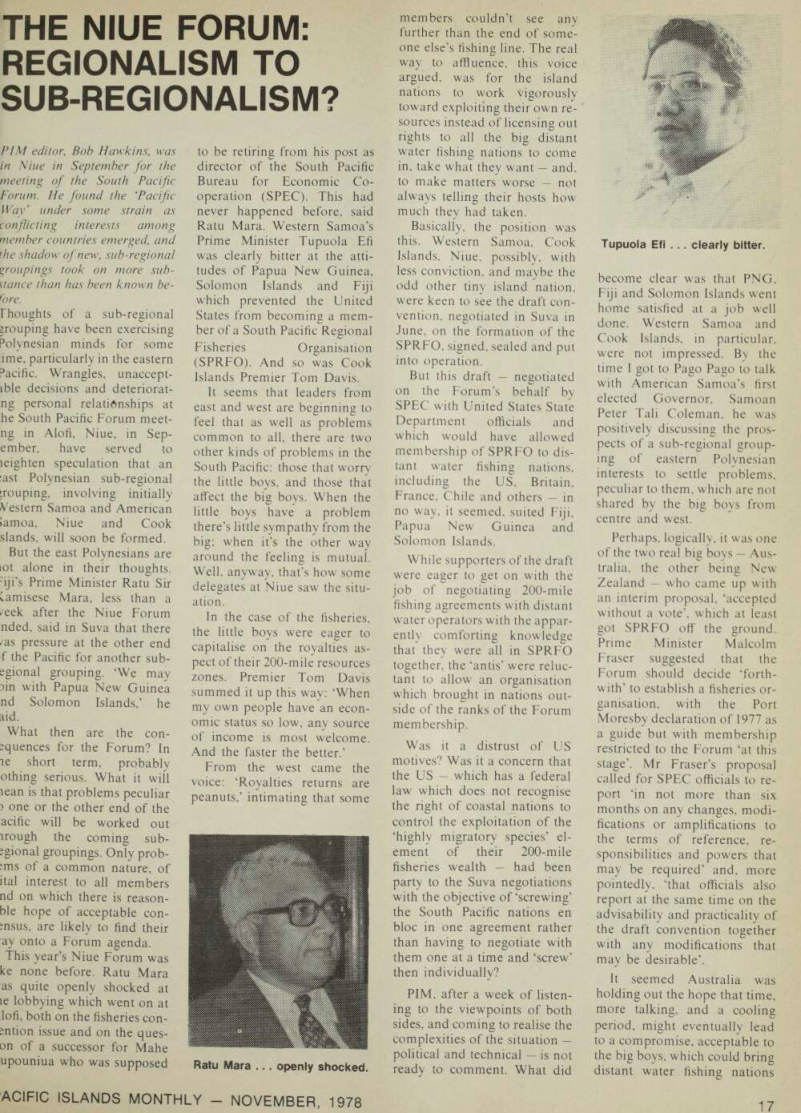
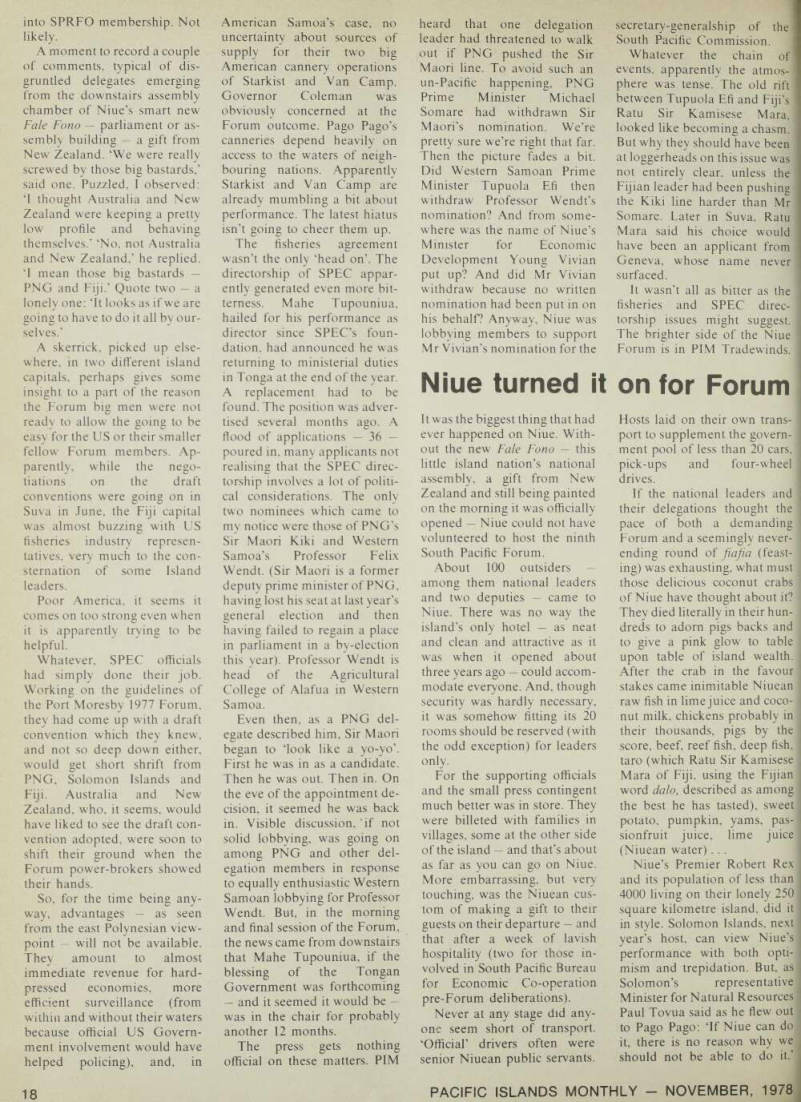
Ratu Mara .. . openly shocked.
Tupuola Efi . . . clearly bitter.
into SPRFO membership. Not likely.
A moment to record a couple of comments, typical of dis
gruntled delegates emerging
from the downstairs assembly chamber of Niue’s smart new Fale Fono parliament or as
sembly building a gift from
New Zealand. ‘We were really screwed by those big bastards,’ said one. Puzzled. I observed: ‘I thought Australia and New Zealand were keeping a pretty
low profile and behaving
themselves.’ ‘No, not Australia and New Zealand,’ he replied.
T mean those big bastards - PNG and Fiji.' Quote two a lonely one: ‘lt looks as if we are going to have to do it all by our selves.’
A skerrick. picked up else where, in two different island
capitals, perhaps gives some
insight to a part of the reason the Forum big men were not ready to allow the going to be easy for the US or their smaller fellow Forum members. Ap parently, while the nego tiations on the draft conventions were going on in Suva in June, the Fiji capital was almost buzzing with US fisheries industry represen tatives, very much to the con sternation of some Island leaders.
Poor America, it seems it comes on too strong even when it is apparently trying to be
helpful.
Whatever, SPEC officials had simply done their job.
Working on the guidelines of the Port Moresby 1977 Forum, they had come up with a draft convention which they knew, and not so deep down either, would get short shrift from PNG, Solomon Islands and Fiji. Australia and New Zealand, who, it seems, would have liked to see the draft con vention adopted, were soon to shift their ground when the Forum power-brokers showed their hands.
So, for the time being any way, advantages as seen from the east Polynesian view point will not be available.
They amount to almost immediate revenue for hard pressed economies, more efficient surveillance (from within and without their waters because official US Govern ment involvement would have
helped policing), and, in
American Samoa’s case, no uncertainty about sources of supply for their two big American cannery operations of Starkist and Van Camp.
Governor Coleman was obviously concerned at the Forum outcome. Pago Pago’s
canneries depend heavily on
access to the waters of neigh
bouring nations. Apparently
Starkist and Van Camp are already mumbling a bit about performance. The latest hiatus isn’t going to cheer them up.
The fisheries agreement wasn’t the only ‘head on’. The directorship of SPEC appar ently generated even more bit terness. Mahe Tupouniua, hailed for his performance as director since SPEC’s foun dation, had announced he was returning to ministerial duties in Tonga at the end of the year.
A replacement had to be found. The position was adver tised several months ago. A flood of applications 36 poured in, many applicants not realising that the SPEC direc torship involves a lot of politi cal considerations. The only two nominees which came to my notice were those of PNG’s Sir Maori Kiki and Western Samoa’s Professor Felix Wendt. (Sir Maori is a former deputy prime minister of PNG, having lost his seat at last year’s general election and then
having failed to regain a place
in parliament in a by-election this year). Professor Wendt is head of the Agricultural College of Alafua in Western Samoa.
Even then, as a PNG del egate described him. Sir Maori began to ‘look like a yo-yo’.
First he was in as a candidate.
Then he was out. Then in. On the eve of the appointment de cision, it seemed he was back in. Visible discussion,'if not solid lobbying, was going on among PNG and other del egation members in response to equally enthusiastic Western Samoan lobbying for Professor Wendt. But, in the morning and final session of the Forum, the news came from downstairs that Mahe Tupouniua, if the blessing of the Tongan Government was forthcoming and it seemed it would be was in the chair for probably another 12 months.
The press gets nothing official on these matters. PIM
heard that one delegation leader had threatened to walk out if PNG pushed the Sir Maori line. To avoid such an un-Pacific happening, PNG Prime Minister Michael Somare had withdrawn Sir Maori’s nomination. We’re pretty sure we’re right that far.
Then the picture fades a bit.
Did Western Samoan Prime Minister Tupuola Efi then withdraw Professor Wendt’s nomination? And from some where was the name of Niue’s Minister for Economic Development Young Vivian put up? And did Mr Vivian withdraw because no written nomination had been put in on his behalf? Anyway, Niue was lobbying members to support Mr Vivian’s nomination for the
secretary-generalship of the South Pacific Commission.
Whatever the chain of events, apparently the atmos phere was tense. The old rift between Tupuola Efi and Fiji’s Ratu Sir Kamisese Mara, looked like becoming a chasm.
But why they should have been at loggerheads on this issue was not entirely clear, unless the Fijian leader had been pushing the Kiki line harder than Mr Somare. Later in Suva. Ratu Mara said his choice would have been an applicant from Geneva, whose name never surfaced.
It wasn’t all as bitter as the fisheries and SPEC direc torship issues might suggest.
The brighter side of the Niue Forum is in PIM Tradewinds.
Advertisements & other items, p. 17 (1 item)
17
ACIFIC ISLANDS MONTHLY NOVEMBER, 1978
Niue turned it on for Forum
It was the biggest thing that had ever happened on Niue. With out the new Fale Fono this little island nation’s national assembly, a gift from New Zealand and still being painted on the morning it was officially opened Niue could not have volunteered to host the ninth South Pacific Forum.
About 100 outsiders among them national leaders and two deputies came to Niue. There was no way the island’s only hotel as neat and clean and attractive as it was when it opened about three years ago could accom modate everyone. And, though
security was hardly necessary,
it was somehow fitting its 20 rooms should be reserved (with the odd exception) for leaders
only.
For the supporting officials and the small press contingent much better was in store. They were billeted with families in villages, some at the other side of the island and that’s about as far as you can go on Niue.
More embarrassing, but very touching, was the Niuean cus tom of making a gift to their guests on their departure and that after a week of lavish hospitality (two for those in volved in South Pacific Bureau for Economic Co-operation pre-Forum deliberations).
Never at any stage did any one seem short of transport. ‘Official’ drivers often were senior Niuean public servants.
Hosts laid on their own trans port to supplement the govern ment pool of less than 20 cars, pick-ups and four-wheel drives.
If the national leaders and their delegations thought the pace of both a demanding Forum and a seemingly never ending round of fiafia (feast ing) was exhausting, what must those delicious coconut crabs of Niue have thought about it?
They died literally in their hun dreds to adorn pigs backs and to give a pink glow to table upon table of island wealth.
After the crab in the favour stakes came inimitable Niuean raw fish in lime juice and coco nut milk, chickens probably in their thousands, pigs by the score, beef, reef fish, deep fish, taro (which Ratu Sir Kamisese
Mara of Fiji, using the Fijian
word dalo, described as among the best he has tasted), sweet potato, pumpkin, yams, pas
sionfruit juice, lime juice
(Niuean water). ..
Niue’s Premier Robert Rex and its population of less than 4000 living on their lonely 250 square kilometre island, did it in style. Solomon Islands, next year’s host, can view Niue’s
performance with both opti
mism and trepidation. But, as
Solomon’s representative
Minister for Natural Resources Paul Tovua said as he flew out to Pago Pago: Tf Niue can do it, there is no reason why we should not be able to do it.’
Niue hotter than
some may think
•mall but hot. That’s how 'liueans like to think of them elves and their island nation, lut their 250 square kilometre oral outcrop home might be lotter than they think. It’s not
lews that radio-activity levels
•n Niue are the highest in the louth Pacific at least among
dands where the radio-activity
> regarded as being of natural
•rigin.
What is news is that mining iterests are now putting down sntative feelers to find out if t is uranium. ‘Who knows /hat is down there,’ said the Jiue Government’s resident conomist Ron Layton. ‘There > a radio-active anomaly. It aust have been caused by □mething. It is virtually cer ain that radio-activity of that was caused by uranium. It light be gone now. It is on that ind of basis, plus a few geo igical theories, that we are
nding out.’
The government has been airly cautious in its approach d uncovering the secret of their •land but not cautious enough s far as New Zealand, with /horn Niue has a special re ationship, is concerned. The uestion was discussed exten ively in both the Niue cabinet nd assembly and it was de
ided last year to push through
mining act to cover all contin encies before allowing in the liners.
Three individuals appear to
lake up the investigating
;am. John Barrie, who is
k.vian Mining; John Rowntree,
Canadian geologist who is ustral Syndicate; and Frank elly, whose company, F. A.
elly Ltd, is doing the drilling.
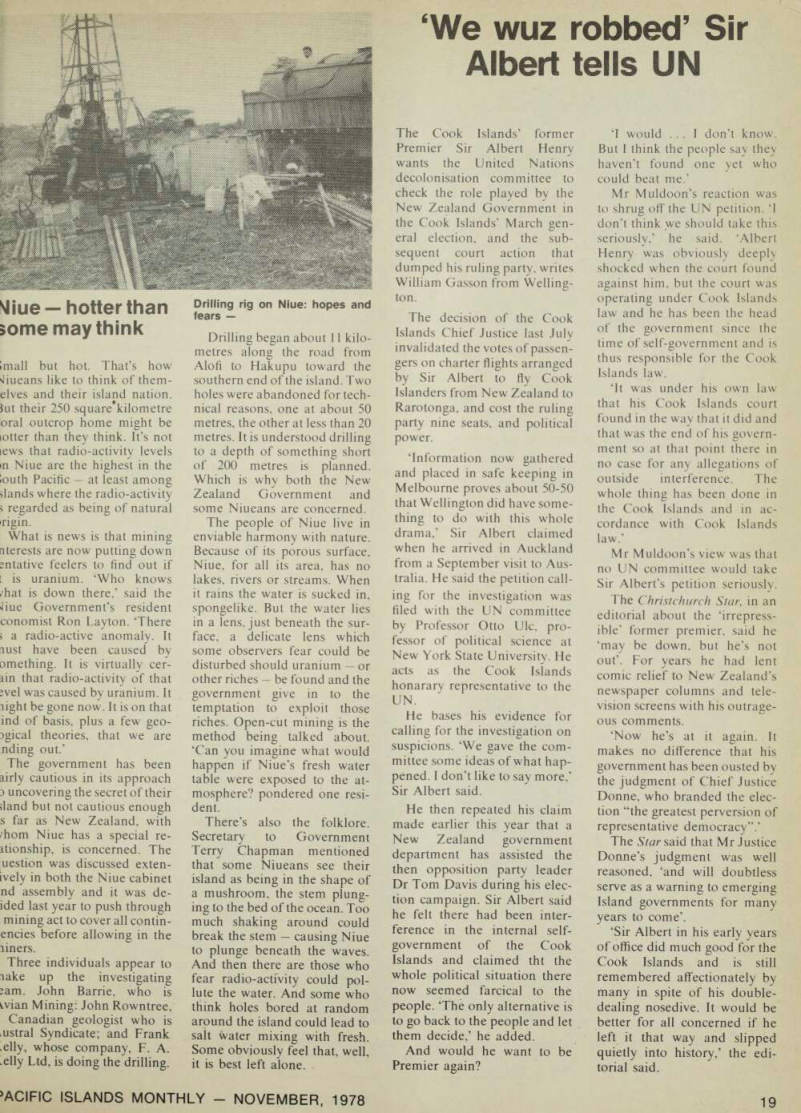
Drilling rig on Niue: hopes and fears Drilling began about 11 kilo metres along the road from Alofi to Hakupu toward the southern end of the island. Two holes were abandoned for tech nical reasons, one at about 50 metres, the other at less than 20 metres. It is understood drilling to a depth of something short of 200 metres is planned.
Which is why both the New Zealand Government and some Niueans are concerned.
The people of Niue live in enviable harmony with nature.
Because of its porous surface, Niue, for all its area, has no lakes, rivers or streams. When it rains the water is sucked in, spongelike. But the water lies in a lens, just beneath the sur face, a delicate lens which some observers fear could be disturbed should uranium or other riches be found and the government give in to the
temptation to exploit those
riches. Open-cut mining is the method being talked about. ‘Can you imagine what would happen if Niue’s fresh water table were exposed to the at
mosphere? pondered one resi
dent.
There’s also the folklore.
Secretary to Government
Terry Chapman mentioned
that some Niueans see their island as being in the shape of a mushroom, the stem plung ing to the bed of the ocean. Too much shaking around could break the stem causing Niue to plunge beneath the waves.
And then there are those who fear radio-activity could pol lute the water. And some who think holes bored at random around the island could lead to salt water mixing with fresh.
Some obviously feel that, well, it is best left alone.
‘We wuz robbed’ Sir
Albert tells UN
The Cook Islands’ former Premier Sir Albert Henry wants the United Nations decolonisation committee to check the role played by the New Zealand Government in the Cook Islands’ March gen eral election, and the sub sequent court action that dumped his ruling party, writes William Gasson from Welling ton.
The decision of the Cook Islands Chief Justice last July invalidated the votes of passen gers on charter flights arranged by Sir Albert to fly Cook Islanders from New Zealand to Rarotonga, and cost the ruling party nine seats, and political power. ‘lnformation now gathered and placed in safe keeping in Melbourne proves about 50-50 that Wellington did have some thing to do with this whole drama,’ Sir Albert claimed when he arrived in Auckland from a September visit to Aus tralia. He said the petition call ing for the investigation was filed with the UN committee by Professor Otto Ulc, pro fessor of political science at New York State University. He acts as the Cook Islands honarary representative to the UN.
He bases his evidence for calling for the investigation on suspicions. ‘We gave the com mittee some ideas of what hap pened. I don’t like to say more,’
Sir Albert said.
He then repeated his claim made earlier this year that a New Zealand government department has assisted the then opposition party leader Dr Tom Davis during his elec tion campaign. Sir Albert said he felt there had been inter ference in the internal self government of the Cook Islands and claimed tht the whole political situation there now seemed farcical to the people. ‘The only alternative is to go back to the people and let them decide,’ he added.
And would he want to be
Premier again?
i would ... I don't know.
But I think the people say they haven’t found one yet who could beat me.' Mr Muldoon’s reaction was to shrug off the UN petition. ‘I don’t think we should take this seriously,’ he said. ‘Albert Henry was obviously deeply shocked when the court found against him. but the court was operating under Cook Islands law and he has been the head of the government since the time of self-government and is thus responsible for the Cook Islands law. ‘lt was under his own law that his Cook Islands court found in the way that it did and that was the end of his govern ment so at that point there in no case for any allegations of outside interference. The whole thing has been done in the Cook Islands and in ac cordance with Cook Islands law.’
Mr Muldoon’s view was that no UN committee would take
Sir Albert’s petition seriously.
The Christchurch Star, in an editorial about the ‘irrepress ible’ former premier, said he ‘may be down, but he’s not out’. For years he had lent comic relief to New Zealand’s newspaper columns and tele vision screens with his outrage ous comments. ‘Now he’s at it again. It makes no difference that his government has been ousted by the judgment of Chief Justice Donne, who branded the elec tion “the greatest perversion of
representative democracy’’.’
The Star said that Mr Justice Donne’s judgment was well reasoned, ‘and will doubtless serve as a warning to emerging Island governments for many years to come’. ‘Sir Albert in his early years of office did much good for the Cook Islands and is still
remembered affectionately by
many in spite of his double dealing nosedive. It would be better for all concerned if he left it that way and slipped quietly into history,’ the edi torial said.
Advertisements & other items, p. 19 (1 item)
19
’ACIFIC ISLANDS MONTHLY - NOVEMBER, 1978
Andrew Jakeo, The
Reluctant Elder
Of Bikini Atoll
A merican journalist Mike Malone covered the September
relocation of Bikinians from
their home atoll to Kili made necessarry by Bikini’s continu ing high radiation levels. In par ticular he investigated the case of Andrew Jakeo, a man who, with some 30 followers, refused to make the move to Kili. He filed the following exclusive re port, with the accompanying pictures, for PIM: Andrew Jakeo was a young man of 36 when the Americans first asked him to leave his homeland in 1946. In Sep tember on Bikini, the site of 23 nuclear tests that ended in
1958, history repeated itself.
Jakeo, now a Bikini elder and traditional leader of 68 years, and about 140 other islanders, reluctantly left their coral-and-sand atoll for the second time, after learning that they were absorbing levels of radioactive cesium-137 at an
alarmingly high rate.
Their departure did not come easy. When Trust Terri tory High Commissioner Adrian P. Winkel arrived on Bikini with nearly 40 newsmen from around the world, Jakeo and his people declared their intention to stay on Bikini. For Jakeo and other Bikinians who came back here after being told by American scientists in 1968 that their homeland was safe, the news that they would be asked to leave was a bitter blow. T don’t care about radi ation on Bikini,’ Jakeo told the
high commissioner through an
interpreter. T will send out my children and family if that is necessary. Bikini is my home, my freedom, my happiness.
You can take my life now. Bury me beside my home, but I will never return to Kili.’
After being told in 1946 that their removal for atomic test ing would be for the ‘.. . good of mankind and to end all wars,’ the Bikini people trusted the Americans’ assurances that they would be well cared for.
But less than a year after their relocation to Rongerik Atoll,
they were starving. In 1948 they were taken to Kili, an isolated island of about I.3sqkm. In contrast to Bikini Atoll’s huge
lagoon surrounded by numer
ous islands, Kili lacks a lagoon and heavy seas make it inac cessible in winter months.
An American teacher on Kili, Ralph Waltz, 36, recalled
losing 18 kg in weight during
one winter when six months passed without the visit of a
supply ship. Many people refer
to Kili as ‘the prison’. ‘Thirty years ago you (the US) took us to Kili and left us there,’ Jakeo told the high com missioner. ‘Then you forgot about us. Many years passed and your promises were not kept. Now you want to take us back to Kili. I am afraid you will forget about us again.’
To ease the situation. High Commissioner Winkel brought news that Kili would only be a temporary relocation site.
Twenty-eight wooden tin-roof houses have been built there, in addition to a dispensary and a school. There is the promise of a dock to be built soon all
part of a $l5 million relocation program now being considered by the US Congress.
But the Bikinians want eventually to return to Bikini Atoll, to Eneu Island, which is thought to be safe by scientists,
although radiological tests will
continue there until next year.
Failing that, the Bikinians have asked to be given land in Hawaii or on the US main land.
However, a day of delicate negotiations with High Com missioner Winkel brought an agreement whereby Jakeo and his followers, about 30 people, would leave Bikini, but not go to Kili. Instea'd, they will settle on an uninhabited island in Majuro Atoll near the Marshalls district centre and medical facilities. The rest of the Bikinians agreed to resettle on Kili.
Before leaving Bikini, Winkel acknowledged the ‘re grettable’ error made by the scientists in 1968 when Bikini was declared ‘safe’, and praised the people for their ‘respon sible decisiofi’ to leave their homeland again. ‘As far as the present risks are concerned’, Winkel said, ‘we cannot afford to play God. The risk is indeed great. Ten years from now, who knows, maybe the scientists will determine Bikini safe again. But the risk exists if you stay.’ Medical examinations
will be given to the Bikini people every three months to I monitor their body levels of
radioactivity.
Shortly before sunset on that final day on Bikini, after all the islanders and their belongings were loaded aboard the two I ships that came to take them ] away, Jakeo walked the length 1 of his deserted home island I alone perhaps for the last] time. As a ship’s whistle sounded, Jakeo put his outrig ger canoe into the blue lagoon I and paddled out to the waiting 1 vessel.
Micronesian News Service I adds to Mike Malone’s \ account: The islanders were given a I memorandum of understand-1 ing which declares that the I Government of the United States ‘considers itself gener ally responsible for the well being of the Bikini people and their descendants’. It also pro vides that the Department of the Interior, which administers 1 the Trust Territory, will call I upon other agencies of the US j Government to assist it, par ticularly the Department of Energy. This is to ensure that, I among other things, the medi cal needs of the Bikinians will be met.
Each Bikinian was given 100 • dollars as a relocation allow-] ance to purchase necessities. Winkel emphasised that this j was ‘not intended to constitute j compensation’ but was a one time, lump-sum relocation payment. Bikinians are the i
beneficiaries of a SUS 3 million]
trust fund set up by the United States and administered 1 independently by a bank in Hawaii. Winkel said this will be doubled when Congress ap- j proves a new allocation to be j used on behalf of the Bikinians. Approval is expected this year or early next year, he said.
No restrictions were placed \ on foreign media personnel in talking with the Bikinians or
photographing events con- j
nected with the relocation.
Two events lifted the j Bikinians’ spirits and served to dispel somewhat the sadness of departure the births of babies: one on Bikini the night before the move, the other aboard ship en route to Kili. ■
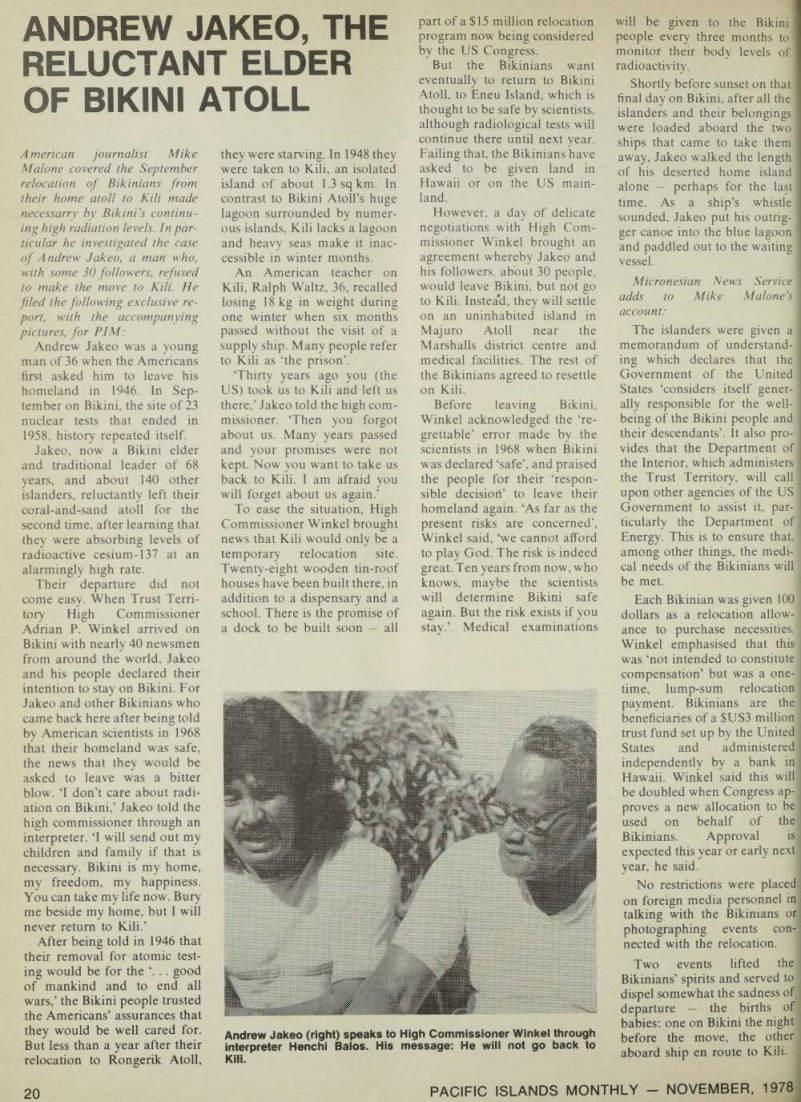
Andrew Jakeo (right) speaks to High Commissioner Winkel through interpreter Henchi Balos. His message: He will not go back to Kili.
Tuvalu: For Britain not
just a sunset but a total eclipse
Says Bob HAWKINS ;
English and unimpressed
1953 London; Coronation time. It’s pouring.
Tonga’s irrepressible Queen Salote rides the city streets in an open carriage. Britons love it. 1078 Tuvalu: Independence time. It’s raining on Funafuti. Princess Margaret, reportedly with a 104 degree F temperature, stays confined on the HMNZS Otago.
Tuvaluans do not love it.
It may not be a fair comparison. But it seems that the one and only characteristic of empire I could ever admire a refusal to surrender to whatever adversary is dead in the Briton’s soul. Or, perhaps, royal flu, penumonia, or whatever, is much more serious than the common variety.
English-born, and with residual pride, I waited in the hope that Princess Margaret would rise from her sick bed, make an eleventh hour dash ashore, and appear dra matically falteringly, if necessary at the
September 30 midnight switching hour
(Tuvalu’s flag for Britain’s). Sure, there were three cheers for Queen Elizabeth 11. But Tuvaluans, who know just how tough living can be, were nol impressed at Meg’s frailty.
One British official observed: ‘lf Margaret is not up to the job, she should say so and give it up.’
Somehow, royalty’s non-appearance fit ted the occasion. It is clear that both Tuvalu politicians and some British officials serving on Funafuti are disgruntled at the UK’s part ing attitude. Britain is finished in Tuvalu.
Prime Minister Toalipi Lauti said he was ‘disappointed’ at the outcome of London negotiations on assistance for Tuvalu after
independence. It seemed he would have liked to have come on stronger. This large man of imposing presence seemed more hurt at UK’s demeanour than its lack of gen erosity. He’s not worried about other aid sources several other nations and agen cies are willing to stand by Tuvalu. In his speech to a parting Britain, Prime Minister Lauti pointedly observed that Tuvalu had moved into constitutional and political independence; economic independence was yet to come.
All in all, it was hard to find a good word from anybody for Britain. So little it seems had been done on the ‘Brits’ part to learn about Tuvalu: so much had been done on the Tuvaluans’ part to cope with the influx of visitors on an island hard-pressed to feed its own people without a heavy import bill, let alone a crowd of hard-drinking diplo mats, officials, soldiers and sailors off five vessels, and various other interested par ties.
Tuvalu with a combination of throbbing traditional music and dancing, a ready smile, traditional hospitality, and a superb dignity personified in the presence of Prime Minister Lauti had no problem matching up to the occasion. But for the Brits, it all seemed to be summed up in Lord Napier’s pronunciation when he read Princess Mar garet’s speech for her on October 1. It just made him seem so very alien when he talked
of ‘Fun-uff-at-ee’ (say it fast).
Bob
Hawkins
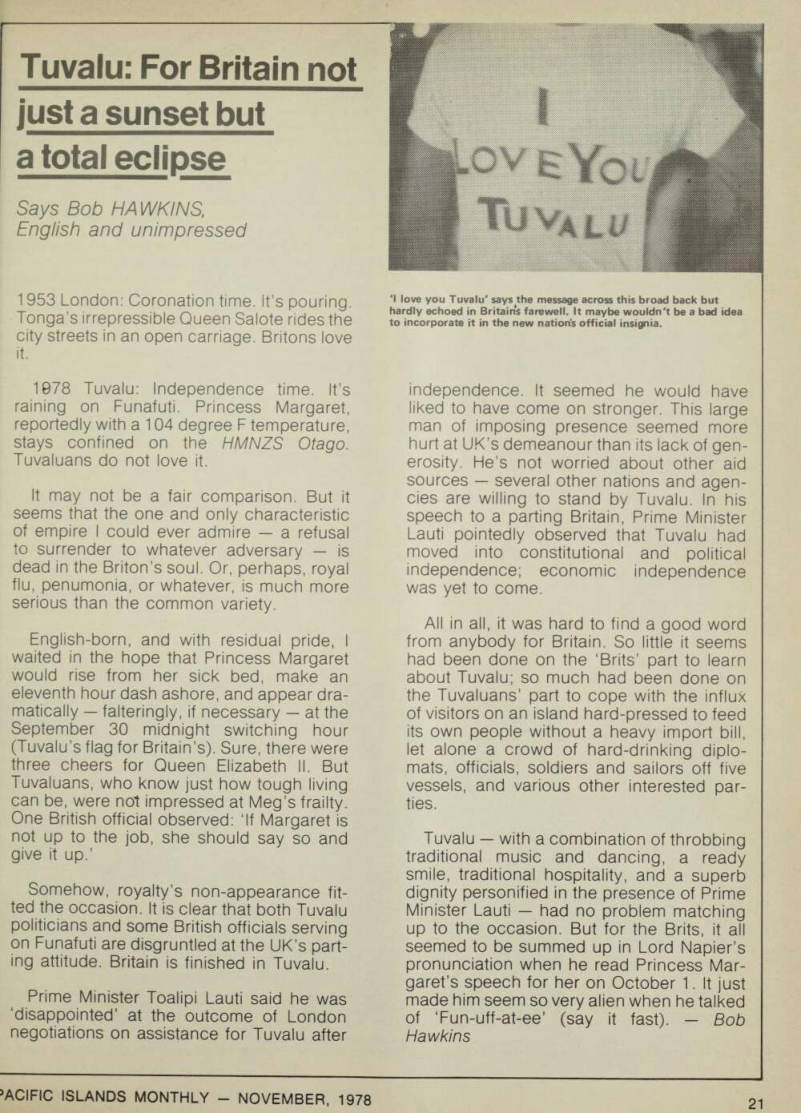
I love you Tuvalu' says the message across this broad back but hardly echoed in Britain's farewell. It maybe wouldn't be a bad idea to incorporate it in the new nation's official insignia.
Conserving the Pacific
Conservation
Conserving the Pacific heritage: Idea whose time has arrived?
There’s nothing so powerful as an idea whose time has arrived - so runs an old saying. It doesn’t seem too far-fetched to apply it to the theme of this month’s PIM cover the need for a conscious effort to pre serve the architectural and cul tural treasures of the South Seas.
Consider the following facts.
In May, 1977, PlM’s publisher, Stuart Inder, devoted his column ‘Up Front’ to this
theme, focusing particularly on
the buildings in the former Fiji capital of Fevuka. His column drew an enthusiastic response, in a letter published in PIM, September, 1977, from Honolulu architect, George J.
Wimberly, who said in part: ‘We, in the Development Authority of the Pacific Area Travel Association, are push ing very hard for just this type of preservation and are
presently exploring the means
and methods of organising (for want of a better term) what we call The Pacific Society ... ‘The Pacific area needs a great deal of help in its preser vation efforts as most of the architecture has not been con structed with very permanent materials. Even well intentioned maintenance sometimes obscures the archi tectural grace of the original structure.’
Things have moved a bit since then. A more recent letter to Mr Inder from John Kena ston of Kuala Lumpur, Malaysia, reports that last year’s 26th PATA conference, held in Hong Kong, adopted a resolution for the creation of a Pacific Heritage Society. A sub-committee was formed within the PATA under the chairmanship of Dale Keller, ‘who.’ says Mr Kenaston, ‘has achieved a position of inter national prominence for his design work and sensitivity towards the preservation and development of the heritage and regional culture in those
many areas where he has been involved’.
Among PATA documents enclosed by Mr Kenaston is one that asks the question; ‘Why should a travel organis ation concern itself with the
protection of heritage?’, and
offers the following reply: ‘ln many PATA member coun tries, the characteristics that make that country different are steadily, and in some cases rap idly, being eroded. If action is not taken to modify this situ ation we may be in danger of losing some of the qualities that led PATA, from the outset, to urge people to “discover the
friendly Pacific”...
‘Something needs to be done to draw the attention of the public in general and of the travel industry in particular to the existing dangers. It is not too late in the Pacific. We can and should take steps to pre serve that part of everyone’s ethnic or national heritage that makes them unique. Unlike Europe, which is now “trying to correct the mistakes of the
past”, we must try to “prevent the mistakes of the future”.’
The document makes some hard-headed business points: ‘Unique cultures attract man’s interest in other areas of the world and thus open the door to travel. There is, in fact, an interdependence between tour ism and conservation, in which each contributes to the econ omic viability of the other.’
Putting its money where its mouth is, PATA resolved to al locate $lO 000 ‘for activities in 1978-79 aimed at furthering the objectives and facilitating the formation of a Pacific Heritage
Society’.
Plans for 1978-79 include development of a mailing list and a membership pro gramme, completion of a re search project already begun, publication of two papers re lated to the functions and aims of the Society, and the organis ation of a Pacific-wide meet
ing.
PIM correspondent Victor Carell, w orking a parallel fur row', makes a special examin
ation of the problems of
preserving the beauties of Levuka in PI M’s Yesterday feature this month (see pp 50-51).
Vila’s big show
pulls in crowds
The sixth Vila Agriculture I Show was held in September! with seven out of every eight of I the population of the New!
Hebrides’ main island, Efate, I attending, writes Greg Nos-1 worthy from Vila. Held ini excellent conditions, a carnival! atmosphere prevailed through-] out the two-day show.
Custom dancing was prob-| ably the biggest attraction, with I a group from Tongoa Island I winning the first prize of SASOO I with their highly authentic dis-| play. A charity queen compe-1 tition is also held in I conjunction with the show and I this year FNHS7O 000 J (about 5A6900) was collected] by entrants vying for the valu-1 able prizes.
With agriculture the New]
Hebrides principal industry,!
there was no shortage of] exhibits in the livestock and I produce divisions. Ships visit-! ing outer islands collected I more than four tonnes of pro-1 duce for exhibition.
The show is held in Colar- j deau Park.
Strongly supported by all levels of government and by] Mayor Remy Delaveuve, the
agricultural show seems j
assured of continual success. I
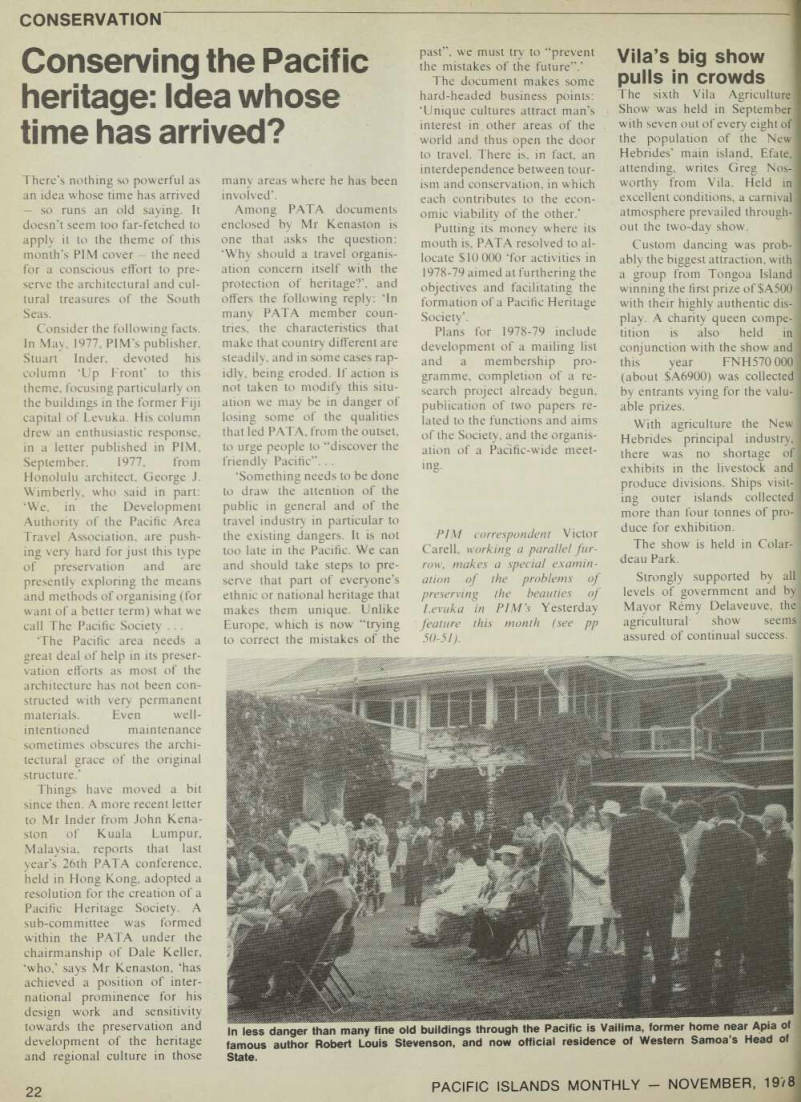
In less danger than many fine old buildings through the Pacific is Vailima, former home near Apia of famous author Robert Louis Stevenson, and now official residence of Western Samoa’s Head of State.
Galapagos
Tropicalities
Treasuring the
The leading French daily Le Monde has just carried a series of three long articles by French journalist Yvonne Rebeyrol on the Galapagos Islands, 1100 km off the coast of South America, which form part of the Republic of Ecuador. . Entitled ‘ The Enchanted Noah’s Ark\ the articles pro vide vivid descriptions of the unique flora and fauna of the Galapagos which, in 1835, pro vided Charles Darwin with im portant elements of his then
revolutionary theory of the
evolution of the species
through natural selection. The Ecuadorian Government has
proposed that the Galapagos
)e included in the world cul ural and natural heritage insti ution whose establishment
vas proposed last January by
he United Nations Edu
:ational and Scientific Organ
sation.
Rebeyrol provides details of
he strict measures taken by the icuadorian Government to
irotect this heritage, which
ould be of interest to other Pa ific governments with natural
reasures to be guarded.
She writes: The Galapagos /ere opened to tourists in 1969.
Tey have since become acreasingly popular. In 1977 here were 6790 tourists, 18.5% f them Ecuadorians. But it has ow been decided that under o circumstances will more lan 12 000 tourists be ccepted in any year. ‘Tourists cannot move about lone. Either they go on an rganised trip headed by one f the 25 official guides, or they ike one of the guides aboard
ieir yacht, or, thirdly, they can
•avel in one of the 20 fishing
oats captained by authorised
uides. All guides must do a aining course at the ialapagos’ Darwin Station be- Dre being approved by the ark service.
‘Twenty-seven itineraries
ave been planned on several f the islands (5% of the park’s irface) so that visitors may see 5 much interesting flora and luna as possible. But, accord ig to the itineraries, the num er of tourists is limited in
some cases to 80, and in others to as few as 15, a day. No dom estic animals may be taken on these trips. No food may be given to the native animals, and it is forbidden to touch them. Visitors are asked not to drop paper, fruit, plastic bags or cigarette butts (though smoking is permitted) during their walks on the islands or the sea crossings between them . . .’
Then she makes the follow ing comments, which will have a familiar ring for those who have come in contact with a certain type of tourist: ‘One
wonders why some foreigners
come from so far away to the
Galapagos. Guides welcoming
their groups sometimes hear aggressive statements like the following, made by way of introduction, by some tourists; “I don’t believe in evolution anyway .. .” Some visitors also protest: “These islands aren’t interesting at all. You can see the sea anywhere. Animals too.
Anyway, if I wanted photos, I could buy them in Quito.”
Some don’t even get out of the boats. You can also hear idiotic quesions such as: “Those birds flying over there, are they the local cormorants that can’t fly?” ...
Call for ‘million
PNG soldiers’
There is not enough money available to increase the yearly
recruitment of soldiers, Papua New Guinea’s Defence Force Minister, Mr Louis Mona has said. Mr Mona told parliament that at present the defence force was recruiting 100 men a year. He was replying to Mr Ibne Kor (Nipa-Kutubu) dur ing question time in parlia ment.
Mr Kor said he was con cerned about the size of the de fence force in comparison to Indonesia and feared that another country may invade PNG. He said there are three million people in Papua New Guinea, and at least a million of these should be soldiers. Mr Kor said many Grade 10 school leavers who did not have jobs should join the defence force.
Mr Mona said he too was concerned about the size of the defence force but could not do anything at this stage due to
financial problems.
The Club Med
puts to sea ...
The Club Mediterranee is the name, not only of a French company which has been highly successful in the tourist business, but also of one of the strangest ships to be launched since the classical iron monster, the Great Eastern, write Marie- Therese and Bengt Danielsson from Papeete. Although this magnificent, 72 m long, four-
masted ship, which cost .more than SA2 million to build, arrived here in Tahiti to a great fanfare as recently as June this year, she has already been hid den away in the local naval
yard and seemingly forgotten.
We have delved into this mys tery and have discovered what
has happened.
It should first be said that from whatever point of view we look at this extraordinary vessel, she should never have been built at all. But built she was, and for the sole purpose of allowing the famous French navigator Alain Colas (who, you might remember, in 1974 raced alone around the world in 169 days in his Polynesian catamaran Manureva) to win the trans-Atlantic race in 1976.
The organising committee did not bother to impose any re strictions on the size of par
ticipating craft, probably
thinking that common sense and limitations of finance would form a natural barrier to the entry of sea-going extravaganzas like the Club Mediterranee.
As it happened, Alain Colas’s consuming desire to beat his arch-rival Eric
The August issue of PIM, with its widely acclaimed coverage of the phenomenon of the Third Sex in Polynesia , found itself in unusual company on this news-stand at downtown Sydney’s busy Wvnvard railway station.
Tabarly, combined with the Club Med director’s love for
lavish promotions, to give
birth to a 245-tonne iron ship, with a specially built 50-tonne uranium keel and four masts, all of them of equal height at 31 m, wholly steered and manoeuvred by a push-button system from a well-protected bridge cabin. To give some idea of the degree of sophisti cation achieved, let us say only that a TV camera at the foot of each mast permitted Colas to observe on a screen at his com mand post, at any time, the exact position of every sail. The total surface of canvas employed was 972 sq m, which made it possible for the craft to maintain an average cruising speed of more than 10 knots.
Fortunately for everybody Eric
Tabarly won the race, thus showing the way back to a competition of more human dimensions, where skill and courage are the decisive fac tors.
The owner coped with the
questions of impertinent
newspapermen as to the embarrassing failure of this floating data bank to win the race saying that the ship’s ultimate destination anyway was Tahiti, as confirmed by her registry at the time of launch
ing.
As soon as the sleek monster swept into Papeete harbour on June 2 the Club Med directors proudly announced a most im
pressive schedule, according to
which she was to make every week no fewer than three trips to or around Moorea, as well as one to the Leeward Islands.
The departure and arrival times were shown for each voy age, exactly as on a railway schedule. This made many old
timers laugh incredulously. But
a few more charitable individuals remarked that we had, after all, to do with a new phenomenon a kind of ocean train. The number of passen gers to be carried was 96 for the day trips, and 40 for the longer trip to Bora Bora and Huahine.
It all worked beautifully for a few weeks, until the ship
simply vanished. On inquiries,
the representatives of the Club
Med either kept mum, or mumbled something about urgent repairs. This seemed strange, since the ship had undergone extensive remodell
ing and improvements just be
fore coming out to Tahiti.
The true explanation, as it turned out, was that the uranium keel had split ver tically, and that there was no way of repairing it short of per
haps taking the whole ship to
pieces.
We have a feeling that des tiny is pointing to the ultimate solution, which would be to cut up the hull into parts and make four separate sailing vessels of it, each with its own mast.
As to the unusual choice of metal for the keel, the only comment worth making is that to bring a 50 tonne piece of uranium to these islands, already exposed to the radioac tivity released by 42 nuclear test in the atmosphere, re sembles nothing more than carrying coals to Newcastle.
Harder to visit
Moresby’s sick
Free meals and casual round the-clock visiting are coming under the axe at the Port Moresby general hospital.
writes Angus Smales from the
Papua New Guinea capital.
Hospital officials say that long established concessions for
hospital visitors, including the
entitlement of some to free meals, were being abused.
The hospital was tightening
security following the disap
pearance of two babies from the maternity ward. (Both were later found and returned to their mothers.) Unofficial freedoms under which relatives almost camped in the wards to be with patients are being withdrawn. Visiting hours will come down from five hours a day to two. But the effective reduction in visiting hours is much greater, because unofficially visitors have been coming and going at all hours.
Hospitals in Papua New Guinea face a special problem because large numbers of rela tives often camp in the grounds when patients are brought in from outlying villages. On sev eral occasions in Rabaul, Port
Moresby and the Highlands
relatives were found sharing patients’ beds at night on a ros ter system.
Officially recognised ‘guard
ians’ of some patients are also entitled to meal tickets at
hospitals.
Hospital officials said the situation was getting out of hand. Only one guardian would henceforth be recog nised. and the new visiting hours would be rigidly enfor ced, they said.
Old frigate still
serves science
HMAS Diamantina, launched in 1944 and the last of the
Royal Australian Navy’s
World War II frigates still in service, was in Suva in late Sep tember. It was her first visit since 1967.
Her task, in conjunction with the New Zealand oceano
graphic research ship HMNZS
Tui, was the study of factors affecting underwater sound transmission. These include sea floor topography, sea floor sediment structure, sea water temperature and salinity struc ture, and local ambient noise factors.
Australian and New Zealand research establishments have a programme of such sound transmission projects in the Tasman and Coral Seas, and in the South Fiji Basin.
There was an historical side to Diamantina’s voyage as well.
The four-masted, four-in-one uranium ship Club Mediterranee a wonder, or white elephant, of the age?
Her visit to Suva almost coin cided with the 33rd anniversary of the surrender of Japanese occupation forces in Nauru (September 13, 1945), and Ocean Island (October 1). Sur render ceremonies in these places took place on Diaman
tina’s quarterdeck.
Record fund for
Leper Man Appeal
Far-reaching plans for
developing the Twomey Mem orial Hospital in Fiji into a lep rosy training centre are now well under way. A joint agree ment for the project has been signed on behalf of the Lepers’
Trust Board of New Zealand by the chairman, Mr A. H. T.
Rose, in Suva. Participants are the Lepers’ Trust Board, the Fijian Government and the
World Health Organisation.
The Twomey Memorial
Hospital, the Leper Man
Appeal’s pioneering contri
bution to leprosy treatment and prevention in the Pacific Islands, will become a training centre for the whole of the
South Pacific. Proposed train
ing programmes and other activities include a his
topathology service, laboratory
indentification of drug resist
ance, drug trials, immun
ilogical studies and
epidemiological work.
Such ambitious and compre
hensive planning was good to
see, Dr W.J. Smith, chairman if the Board’s Medical Advis ory Committee, told the Lepers’ Trust Board’s Annual
General Meeting recently.
Various planned consultant
services requested by territories
vere already progressing, he
said.
More than $2l 000 for the irst year of development was approved by the board. In the following year the Lepers’
Frust Board will contribute 8 12 760 annually to the pro ect.
About $34 000 was also
allocated for the Hospital’s
lew activities area being
Manned by the Fiji Govern nent and the Fiji Lepers’ Trust Board. This would meet a need evident for some years, Dr smith told the meeting. Rooms
for sewing, handcrafts, such as
printing and bookbinding, a
studio for Semisi Maya and a showroom, the workshop and shoe shop, will replace the pre sent cramped quarters.
The total grants announced came to a record $406 500 as a result of the 1977 Leper Man Appeal. All grants are for the South Pacific area which is the
Board’s special responsibility.
PNG man warns
Australia
Sweet talk was in short supply at the September reception in Papua New Guinea House, Sydney, to mark the third anni
versary of the country’s
independence.
PNG Consul-General Aus tin Sapias told the assembled 150 Australian businessmen and government officials; ‘Australia will have to get up north and sell or lose its market supremacy in PNG. ‘Australia is losing its hold over the $5OO million-a-year PNG market to Japan, the US and New Zealand. ‘We know what we want and that is quality with quantity.
We are looking for the right
price.’
Mr Sapias told newsmen later that although Australia still supplied half the country’s
needs and PNG was its sixth best market, other nations were
making inroads.
‘We don’t want to discrimi nate against Australia, but it is up to Australian businessmen to supply the right goods at the right price. Australia is pricing itself out of our market. We know you have industrial troubles, but your costs are eroding your position in the PNG market.'
Diseases, too,
go ‘Western’
The South Pacific Commission and the World Health Organis ation have joined forces to stage a conference on meta bolic diseases in the Pacific.
Venue was the Republic of Nauru.
According to Nauru’s official news bulletin: ‘The meeting was organised as a re sult of growing concern at the emergence of diabetes and other chronic diseases, such as high blood pressure, gout and heart disease in certain Pacific countries. ‘While these diseases appear to be uncommon in the coun tries of Melanesia and tradi tional-living Polynesian and Micronesian societies, there has been a dramatic increase in their incidence as Polynesian and Micronesian populations move from their traditional way of life to one of Western
style dietary and physical
activity patterns.’
Opening the meeting,
Nauruan Health Minister Joseph Audoa said that in the past the main emphasis of medical programmes in the Pa cific had been on infectious diseases malaria, leprosy, tuberculosis, filariasis, and so on. Medical science had done much to reduce the impact of these diseases, even though some remained problems.
But a new pattern of disease had now emerged in the related disorders of obesity, diabetes, gout, hypertension and heart disease.
He said; ‘Our health prob lems are obviously related to
important changes which have
been taking place in our lifes tyle, in the structure of our so ciety, our modes of work.’
Fuatai Sole, Western Samoa, winner of the South Pacific Coconut Climbing Contest, pictured in happy mood on palm tree trunk in Suva’s Sukuna Park after victory.
Advertisements & other items, pp. 23-26 (3 items)
23
ACIFIC ISLANDS MONTHLY - NOVEMBER, 1978
25
TROPICALITIES
=ACIFIC ISLANDS MONTHLY - NOVEMBER, 1978
We build grip
into all our
T T J
GBOO+S GBOO GBOO+S
Grand Rally Grand Prix 70
GOODYEAR DISTRIBUTORS IN S.E. ASIA AND PACIFIC BASIN
You can trust Goodyear technology
to give you grip. World champion
racing drivers do. So drive on steel
belted radial car tyres developed by
Goodyear. Built for grip in any
weather. Extra high mileage too.
GOODfVEAR
The Choice of Champions
GOODYEAR SUBSIDIARIES
Richard Pieris & Co.. Ltd.
Colombo. Sri Lanka Nepal Motor Company (P) Ltd Biratnagar Nepal Havana Ltd Dacca. Bangladesh Diethelm 4 Co . Ltd Bangkok. Thailand Landis Brothers & Co., Ltd Hong Kong Guam Tire 4 Supply Co.
Agana, Guam Susupe Enterprises Saipan. Mariarals Micro! Corporation Saipan. Mariana Is Truk Trading Co.
TrukE , Caroline Is
P.A.M.I.
Kolonia, Ponape Island Transport Service Co Majuro, Marshall Is Yap Cooperative Ass.
Yap. W Caroline Is Cook Islands Motor Centre Ltd Rarotonga, Cook Is.
Ngiralkel Etpison Co Ltd Koror. Palau Boroko Motors Ltd Port Moresby. Papua New Guinea Solomon Motors Ltd.
Honiara. Solomon Is Santo Engineers Santo. New Hebrides Pacific Motors Vila. New Hebrides
S.G.A.
Noumea, New Caledonia Duncombe Bay Garage Norfolk Is Coral Island Motors Suva. Fiji Morris Hedslrom Ltd.
Nukualofa. Tonga Morris Hedstrom Ltd.
Apia, Western Samoa Western Samoa Transport Cooperative Society Ltd Apia. Western Samoa Samoa Motors Inc Pago Pago. American Samoa Service Mobil Papeete Tahiti The Goodyear Tyre 4 Rubber Co (Aust.) Ltd.
Sydney AUSTRALIA Tel 31-0311 Goodyear India Limited New Delhi t INDIA Tel 46886/9 PT Goodyear Indonesia Bogor Republic of Indonesia Tel 3371/2 Nippon Goodyear Kabushiki Xaisha Tokyo, JAPAN Tel 582-048V8 Goodyear Malaysia Berhad Selangor, MALAYSIA Tel: 362501/5 The Goodyear Tyre 4 Rubber Co. of New Zealand. Limited Lower Hutt. NEW ZEALAND Tel 684-389 The Goodyear Tyre 4 Rubber Company ol the Philippines. Limited Makati-Metro Manila Republic of the Philippines Tel: 89-20-41 Goodyear Singapore Pvt Limited Geylang SINGAPORE 14 Tel 40828V3 Goodyear Taiwan Limited Taipei, TAIWAN Tel 5117135/8 Goodyear (Thailand) Limited Bangkok THAILAND Tel: 252-6141/5
FOR FURTHER INFORMATION
PLEASE CONTACT
Goodyear International Corporation Room 1603. Wing On Center 111 Connaught Road Central
HONGKONG Tel 5-433331
HRME171,0252
Legends, There
Afterthoughts
Of The Making Of
Is No End
with Percy Chatterton in Port Moresby
One of the most fascinating of my experiences during the half-a century in Papua New Guinea has been that of watching the growth of legend.
A persistent legend in pre-war Papua related to the pioneer London Missionary Society missionary, James Chalmers, who was killed and eaten at Goaribari Island in the Papuan Gulf country in 1901. All along the Papuan coast from west to east the story was told of how, on the day of Chalmers’ death, the sun was darkened from noon till afternoon. Those who told the story were probably not aware that in fact Chalmers’ death oc curred in the early morning, not at noon; and the resemblance of the story to the New Testament account of the crucifixion is unlikely to be accidental. Yet I have talked with elderly men who have said that they were boys at the time and that they remem bered it happening.
I have searched the records for a reference to some natural event which might have given rise to the story, but have failed to find one.
This sort of thing rather shakes one’s trust in eye-witness accounts of happenings. In this connection I recall an occasion when a rather spectacular event took place in a Papuan coastal village. A few days later I asked three of my students (adults, not children), who had been eye-witnesses of the event, to write for me an account of what had happened. The three accounts they turned in differed quite startlingly from one another in quite
important ways.
This kind of thing also makes one a bit cynical about the masses of ‘oral history’, the collection and publishing of which is now all the rage in academic circles. I am not implying of course that all ‘oral history’ is unreliable. On the contrary, in the 19505, an elderly man from a village on the shores of Hall Sound, about 60 miles north-west of Port Moresby, gave me a graphic account of the murder of two Europeans in that area in 1875. He drama tised the story in a one-man act of considerable histrionic merit.
I enjoyed the performance but took it with a grain of salt. How ever, some time later I came on a contemporary account of the event in an unpublished document in the LMS archives, which tallied point by point with the orally transmitted story handed down over four generations.
But in many cases the stream of oral history has been muddied by ingredients imported from the Bible, from European fairy tales, and even from the writings of eminent anthropologists. On one occasion a university student who had spent a vacation in his home village reported that the people of his village had a tradition that their ancestors had come from Egypt. My recollec tion is that this was published quite uncritically as a contribution
to ‘oral history’.
But to get back to the growth of legend. In the years since the war, stories have been cropping up all over the place of how, when the first missionaries arrived at the place of which the story is being told, they were met by hostile tribesmen intent on slaught ering them. At the last moment, a fearless villager sprang in front of them and declared that only over his dead body should the
strangers be harmed. Thereafter all was sweetness and light.
These stories, of course, provide marvellous material for dra matic re-enactment, and young people get a lot of fun out of blackening their faces and brandishing spears. But are the stories true? In a few cases they probably are; and of course there were some cases in which the missionaries really did get killed. But in many others, contemporary missionary accounts suggest a friendly and peaceful reception rather than a hostile one.
How then did the stories arise? I think it is because a new gener ation of admirers of the glorious Melanesian past have felt that it would have somehow been unmanly of their ancestors not to try to kill the intruders. Surely they must have done. So a new legend is bom.
The most recent crop of legends has nothing to do with mis sionaries; it is concerned with Papua New Guinea’s accession to independence in 1975. Already, only three years later, university students and other young nationalists are prating about ‘our fight
for independence’.
The fact is that the only people who had to do any fighting for Papua New Guinean independence were the successive Aus tralian Governments, which as time went on became more and more impatient with Papua New Guinea’s reluctance to accept the independence which Australia was so anxious to press upon it.
True, the Pangu Party had from its inception advocated early self-government and independence; but its supporters were heavily outnumbered by those of the United Party, which had been established specifically for the purpose of delaying indepen dence as along as possible. Right up to the end of 1971, when the second House of Assembly was prorogued. United Party spokesmen were declaring robustly that if they were returned to power in the forthcoming elections there would be no indepen dence for a long long time.
Six months later, Pangu’s Michael Somare became Chief Minister, and thereafter progress towards self-government and independence was rapid, to the relief of the Australian Govern ment. Nobody had to fight for it. But no doubt the legend of Papua New Guinea’s heroic fight for freedom will echo down the years.
It was echoed recently in a letter from a university student to the PNG Post-Courier. From there he proceeded to bundle together a declaration by Commodore Erskine in 1884, a punitive expedition mounted by C. S. Robinson in 1904, and a decision of the Australian Government implemented in 1906, and to blame Sir Hubert Murray, who began his long reign as Lieutenant- Governor in 1908, for the whole package.
He then went on to reject the names ‘Papua’ and ‘New Guinea’ as colonial impositions, and declared that the country must have a new name, a truly Melanesian name. His choice was ‘Niugini’. , I couldn’t quite follow this bit, but perhaps he thinks that phonetic spelling is a Melanesian invention.
UPNG’s library has a very fine ‘New Guinea Collection’ with a full range of contemporary records covering the whole colonial period. And the colonial period is one of the facts of history, how ever glad we may be that it is over.
It would be a good thing if more of our students had more recourse to this collection and so found out what really happened, instead of making up the history of their country out of their heads.
Currents
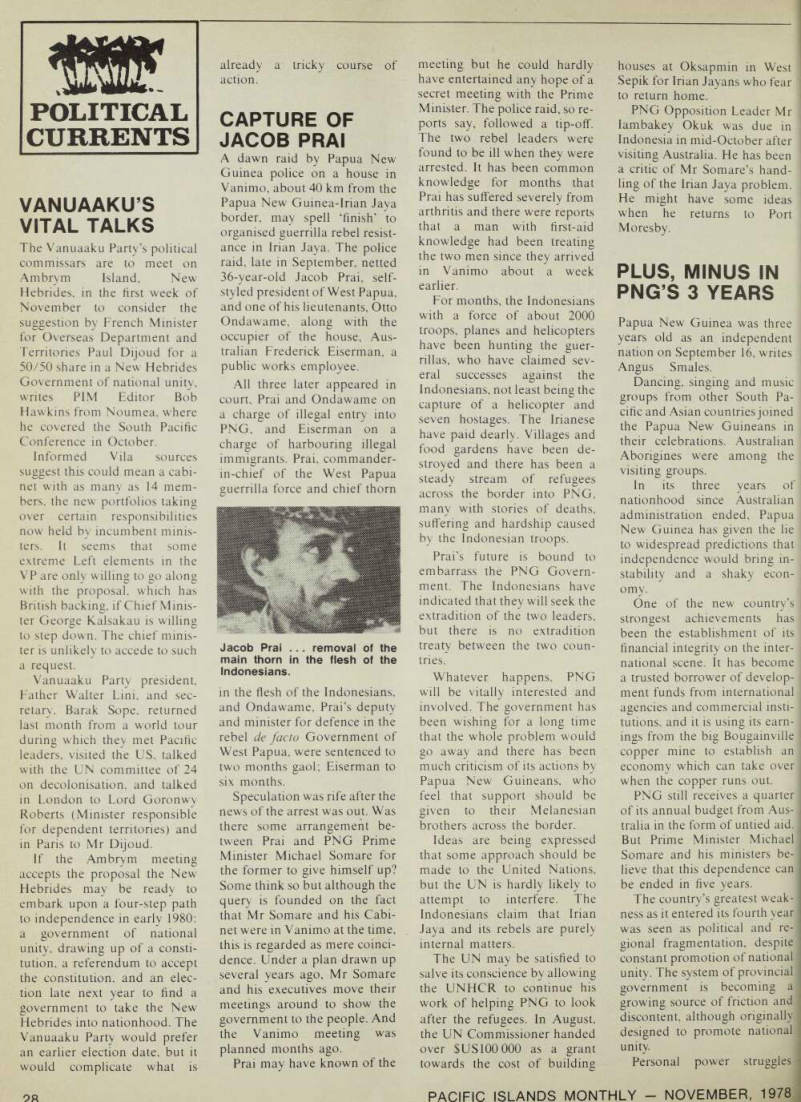
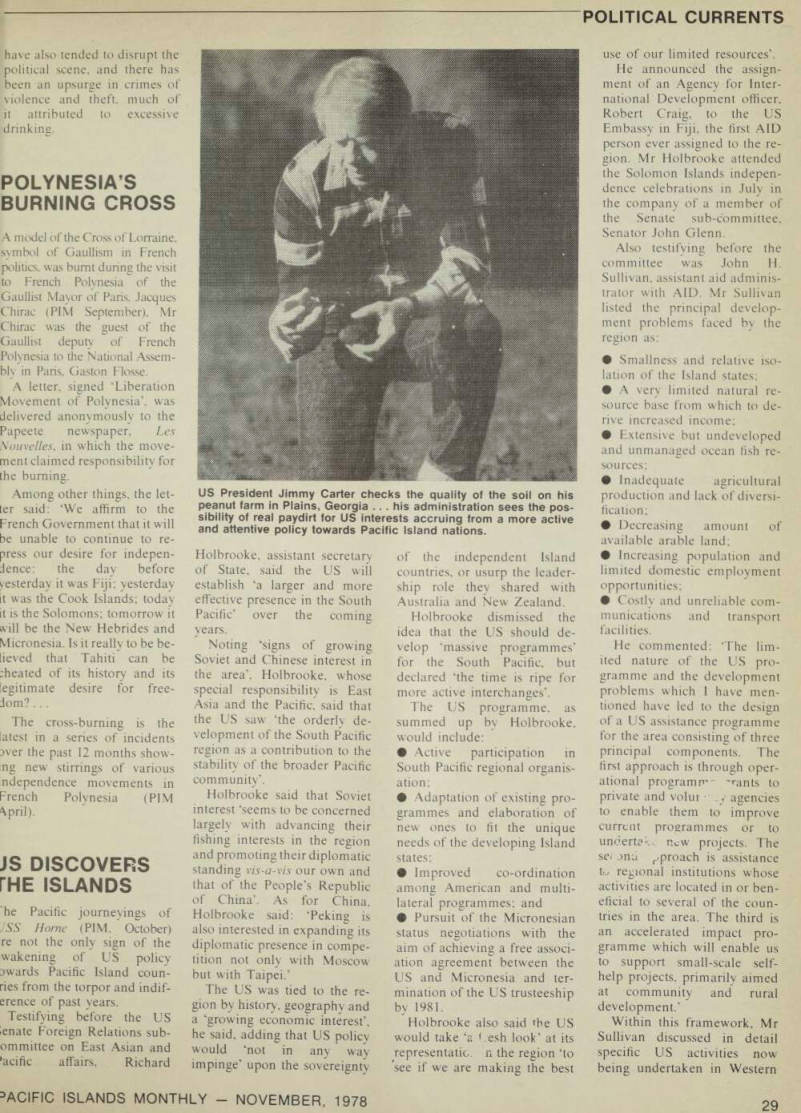
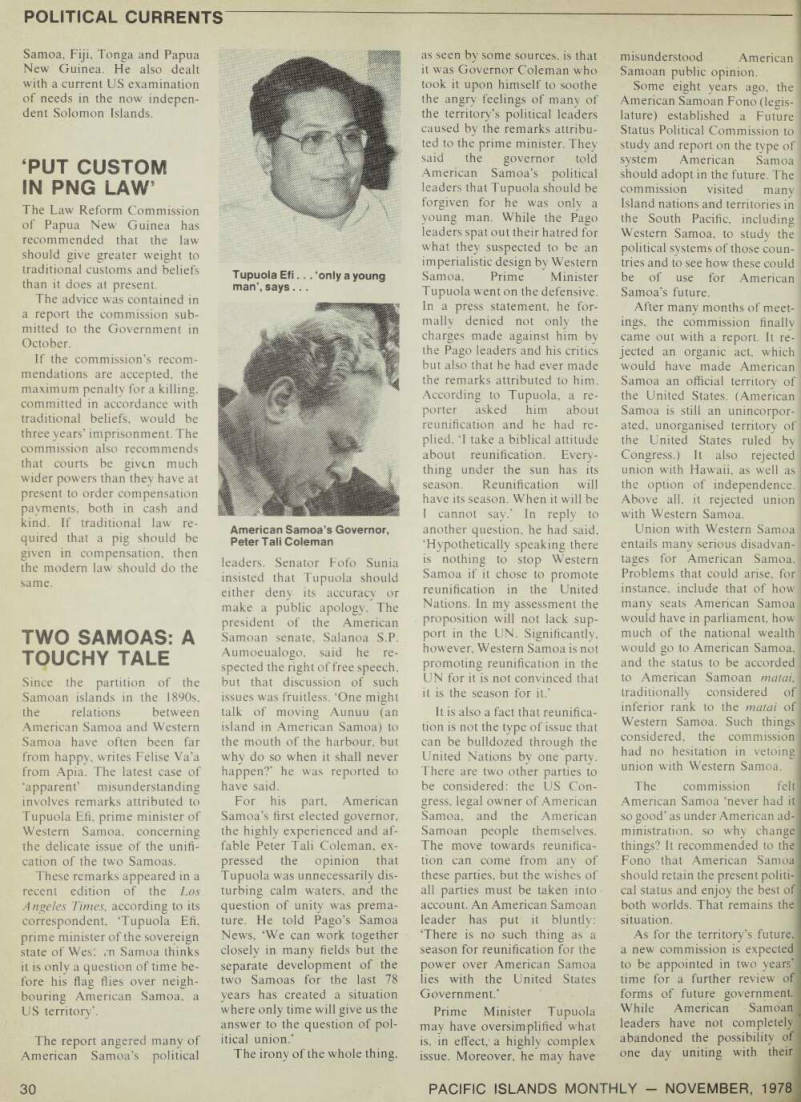
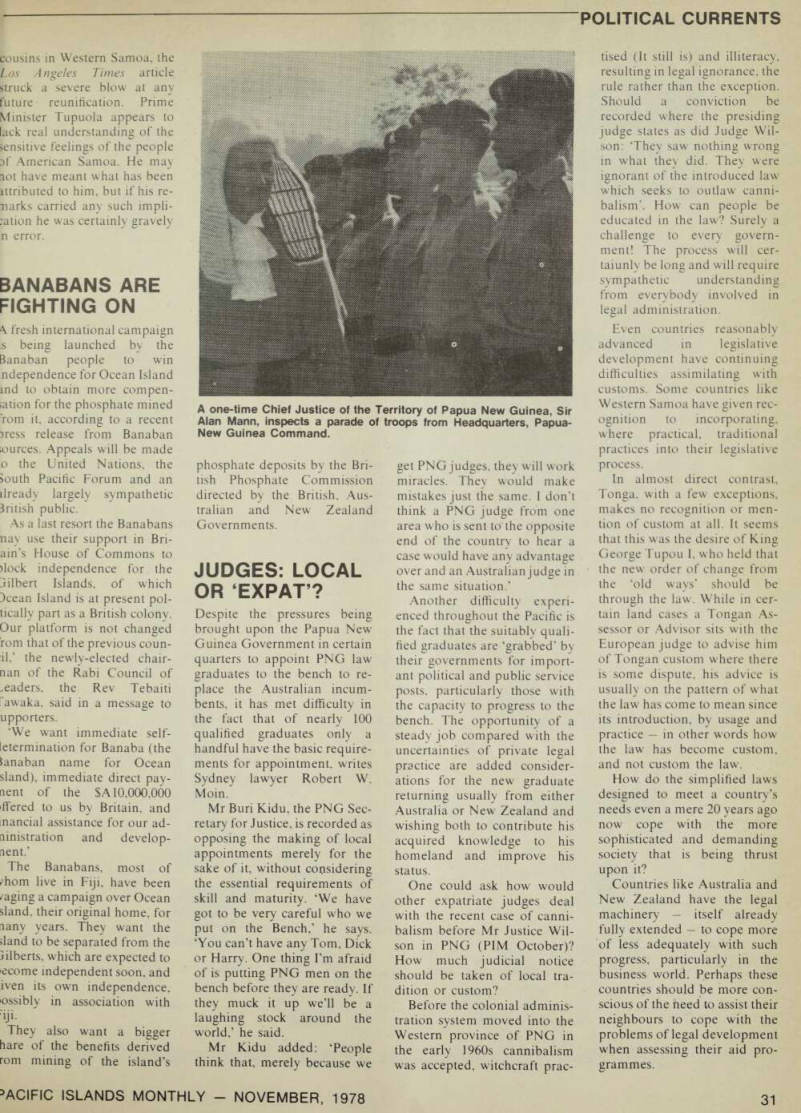
Political
Vanuaaku’S
Vital Talks
The Vanuaaku Party’s political
commissars are to meet on Ambrym Island, New Hebrides, in the first week of November to consider the suggestion by French Minister for Overseas Department and Territories Paul Dijoud for a 50/50 share in a New Hebrides Government of national unity, writes PIM Editor Bob Hawkins from Noumea, where he covered the South Pacific Conference in October.
Informed Vila sources suggest this could mean a cabi net with as many as 14 mem bers, the new portfolios taking over certain responsibilities now held by incumbent minis ters. It seems that some extreme Left elements in the VP are only willing to go along with the proposal, which has British backing, if Chief Minis ter George Kalsakau is willing to step down. The chief minis ter is unlikely to accede to such a request.
Vanuaaku Party president.
Father Walter Lini. and sec retary, Barak Sope. returned last month from a world tour during which they met Pacific leaders, visited the US, talked with the UN committee of 24 on decolonisation, and talked in London to Lord Goronwy Roberts (Minister responsible for dependent territories) and in Paris to Mr Dijoud.
If the Ambrym meeting
accepts the proposal the New Hebrides may be ready to embark upon a four-step path to independence in early 1980; a government of national unity, drawing up of a consti tution, a referendum to accept the constitution, and an elec tion late next year to find a government to take the New Hebrides into nationhood. The Vanuaaku Party would prefer an earlier election date, but it would complicate what is
already a tricky course of action.
Capture Of
Jacob Prai
A dawn raid by Papua New Guinea police on a house in Vanimo, about 40 km from the Papua New Guinea-Irian Jaya border, may spell ‘finish’ to organised guerrilla rebel resist ance in Irian Jaya. The police raid, late in September, netted 36-year-old Jacob Prai, self styled president of West Papua, and one of his lieutenants, Otto Ondawame. along with the occupier of the house, Aus tralian Frederick Eiserman, a
public works employee.
All three later appeared in court, Prai and Ondawame on a charge of illegal entry into PNG, and Eiserman on a
charge of harbouring illegal
immigrants. Prai, commander in-chief of the West Papua guerrilla force and chief thorn
in the flesh of the Indonesians, and Ondawame, Prai’s deputy and minister for defence in the rebel de facto Government of West Papua, were sentenced to two months gaol; Eiserman to six months.
Speculation was rife after the news of the arrest was out. Was there some arrangement be tween Prai and PNG Prime Minister Michael Somare for the former to give himself up?
Some think so but although the query is founded on the fact that Mr Somare and his Cabi net were in Vanimo at the time, this is regarded as mere coinci dence. Under a plan drawn up several years ago, Mr Somare and his executives move their meetings around to show the government to the people. And the Vanimo meeting was planned months ago.
Prai may have known of the
meeting but he could hardly have entertained any hope of a secret meeting with the Prime Minister. The police raid, so re ports say, followed a tip-off.
The two rebel leaders were found to be ill when they were arrested. It has been common knowledge for months that Prai has suffered severely from arthritis and there were reports that a man with first-aid
knowledge had been treating
the two men since they arrived in Vanimo about a week earlier.
For months, the Indonesians with a force of about 2000 troops, planes and helicopters have been hunting the guer rillas, who have claimed sev eral successes against the Indonesians, not least being the capture of a helicopter and seven hostages. The Irianese have paid dearly. Villages and food gardens have been de stroyed and there has been a
steady stream of refugees
across the border into PNG, many with stories of deaths,
suffering and hardship caused
by the Indonesian troops.
Prai’s future is bound to embarrass the PNG Govern ment. The Indonesians have indicated that they will seek the extradition of the two leaders, but there is no extradition treaty between the two coun tries.
Whatever happens, PNG will be vitally interested and involved. The government has been wishing for a long time that the whole problem would go away and there has been much criticism of its actions by Papua New Guineans, who feel that support should be given to their Melanesian brothers across the border.
Ideas are being expressed that some approach should be made to the United Nations, but the UN is hardly likely to attempt to interfere. The Indonesians claim that Irian Jaya and its rebels are purely internal matters.
The UN may be satisfied to salve its conscience by allowing the UNHCR to continue his work of helping PNG to look after the refugees. In August, the UN Commissioner handed over SUSIOO 000 as a grant towards the cost of building
houses at Oksapmin in West Sepik for Irian Jayans who fear to return home.
PNG Opposition Leader Mr lambakey Okuk was due in Indonesia in mid-October after visiting Australia. He has been a critic of Mr Somare’s hand ling of the Irian Jaya problem.
He might have some ideas when he returns to Port
Moresby.
Plus, Minus In
Png’S 3 Years
Papua New Guinea was three years old as an independent nation on September 16, writes Angus Smales.
Dancing, singing and music
groups from other South Pa cific and Asian countriesjoined the Papua New Guineans in their celebrations. Australian Aborigines were among the
visiting groups.
In its three years of nationhood since Australian administration ended, Papua New Guinea has given the lie
to widespread predictions that
independence would bring in
stability and a shaky econ omy.
One of the new country’s strongest achievements has been the establishment of its financial integrity on the inter national scene. It has become a trusted borrower of develop ment funds from international agencies and commercial insti tutions, and it is using its earn ings from the big Bougainville copper mine to establish an economy which can take over when the copper runs out.
PNG still receives a quarter of its annual budget from Aus tralia in the form of untied aid.
But Prime Minister Michael Somare and his ministers be lieve that this dependence can be ended in five years.
The country’s greatest weak ness as it entered its fourth year was seen as political and re-'
gional fragmentation, despite
constant promotion of national
unity. The system of provincial :
government is becoming a growing source of friction and
discontent, although originally
designed to promote national
unity.
Personal power struggles
Jacob Prai . . . removal of the main thorn in the flesh of the Indonesians.
have also tended to disrupt the political scene, and there has been an upsurge in crimes of violence and theft, much of it attributed to excessive
drinking.
Polynesia’S
Burning Cross
A model of the Cross of Lorraine, symbol of Gaullism in French politics, was burnt during the visit to French Polynesia of the Gaullist Mayor of Paris. Jacques Chirac (PIM September). Mr Chirac was the guest of the Gaullist deputy of French Polynesia to the National Assem bly in Paris, Gaston Flosse.
A letter, signed ‘Liberation
Movement of Polynesia’, was
delivered anonymously to the
Papeete newspaper. Les Nouvelles , in which the move
ment claimed responsibility for
the burning.
Among other things, the let ter said; ‘We affirm to the French Government that it will be unable to continue to re press our desire for indepen
dence: the day before
yesterday it was Fiji; yesterday
it was the Cook Islands; today it is the Solomons; tomorrow it will be the New Hebrides and Micronesia. Is it really to be be lieved that Tahiti can be :heated of its history and its legitimate desire for free dom? ...
The cross-burning is the latest in a series of incidents 3ver the past 12 months show ng new stirrings of various ndependence movements in
French Polynesia (PIM
April).
Js Discovers
Fhe Islands
'he Pacific journeyings of
JSS Home (PIM. October) re not the only sign of the
wakening of US policy
swards Pacific Island coun ties from the torpor and indif erence of past years.
Testifying before the US
lenate Foreign Relations sub
ommittee on East Asian and •acific affairs, Richard
Holbrooke, assistant secretary of State, said the US will establish ‘a larger and more effective presence in the South Pacific’ over the coming years.
Noting ‘signs of growing
Soviet and Chinese interest in the area’, Holbrooke, whose
special responsibility is East
Asia and the Pacific, said that the US saw ‘the orderly de velopment of the South Pacific region as a contribution to the stability of the broader Pacific
community’.
Holbrooke said that Soviet interest ‘seems to be concerned
largely with advancing their
fishing interests in the region
and promoting their diplomatic
standing vis-a-vis our own and that of the People’s Republic of China’. As for China, Holbrooke said: ‘Peking is also interested in expanding its diplomatic presence in compe tition not only with Moscow but with Taipei.’
The US was tied to the re
gion by history, geography and
a ‘growing economic interest’, he said, adding that US policy would ‘not in any way
impinge’ upon the sovereignty
of the independent Island countries, or usurp the leader ship role they shared with Australia and New Zealand.
Holbrooke dismissed the idea that the US should de velop ‘massive programmes’ for the South Pacific, but declared ‘the time is ripe for more active interchanges’.
The US programme, as summed up by Holbrooke, would include; • Active participation in
South Pacific regional organis
ation; • Adaptation of existing pro grammes and elaboration of new ones to fit the unique needs of the developing Island states; • Improved co-ordination among American and multi lateral programmes; and • Pursuit of the Micronesian status negotiations with the aim of achieving a free associ ation agreement between the US and Micronesia and ter mination of the US trusteeship by 1981.
Holbrooke also said the US would take ‘a Lesh look’ at its representatic. n the region ‘to see if we are making the best
use of our limited resources’.
He announced the assign ment of an Agency for Inter national Development officer, Robert Craig, to the US Embassy in Fiji, the first AID person ever assigned to the re gion. Mr Holbrooke attended the Solomon Islands indepen dence celebrations in July in the company of a member of the Senate sub-committee.
Senator John Glenn.
Also testifying before the committee was John H.
Sullivan, assistant aid adminis trator with AID. Mr Sullivan
listed the principal develop
ment problems faced by the
region as:
• Smallness and relative iso lation of the Island states: • A very limited natural re source base from which to de rive increased income; • Extensive but undeveloped and unmanaged ocean fish re sources:
• Inadequate agricultural
production and lack of diversi fication; • Decreasing amount of available arable land;
• Increasing population and
limited domestic employment opportunities; • Costly and unreliable com munications and transport facilities.
He commented: The lim ited nature of the US pro gramme and the development problems which 1 have men tioned have led to the design of a US assistance programme for the area consisting of three principal components. The first approach is through oper ational programme to private and volui .y agencies to enable them to improve current programmes or to undertake new projects. The ana is assistance to regional institutions whose activities are located in or ben eficial to several of the coun tries in the area. The third is an accelerated impact pro gramme which will enable us to support small-scale self
help projects, primarily aimed
at community and rural
development.’
Within this framework, Mr Sullivan discussed in detail specific US activities now being undertaken in Western
US President Jimmy Carter checks the quality of the soil on his peanut farm in Plains, Georgia . . . his administration sees the pos sibility of real paydirt for US interests accruing from a more active and attentive policy towards Pacific Island nations.
Samoa, Fiji, Tonga and Papua New Guinea. He also dealt with a current US examination of needs in the now indepen dent Solomon Islands.
‘Put Custom
In Png Law’
The Law Reform Commission of Papua New Guinea has recommended that the law should give greater weight to traditional customs and beliefs than it does at present.
The advice was contained in a report the commission sub mitted to the Government in October.
If the commission’s recom mendations are accepted, the maximum penalty for a killing, committed in accordance with traditional beliefs, would be
three years’ imprisonment. The
commission also recommends that courts be given much wider powers than they have at present to order compensation payments, both in cash and kind. If traditional law re quired that a pig should be
given in compensation, then
the modern law should do the same.
Two Samoas: A
Touchy Tale
Since the partition of the Samoan islands in the 1890 s, the relations between American Samoa and Western Samoa have often been far from happy, writes Felise Va’a from Apia. The latest case of
‘apparent’ misunderstanding
involves remarks attributed to Tupuola Efi. prime minister of Western Samoa, concerning the delicate issue of the unifi cation of the two Samoas.
These remarks appeared in a recent edition of the Los Angeles Times, according to its
correspondent, ‘Tupuola Efi.
prime minister of the sovereign state of Wesl vn Samoa thinks it is only a question of time be fore his flag flies over neigh bouring American Samoa, a
US territory’.
The report angered many of American Samoa’s political
leaders. Senator Fofo Sunia insisted that Tupuola should either deny its accuracy or make a public apology. The president of the American Samoan senate, Salanoa S.P.
Aumoeualogo, said he re spected the right of free speech, but that discussion of such issues was fruitless. ‘One might talk of moving Aunuu (an island in American Samoa) to the mouth of the harbour, but why do so when it shall never happen?’ he was reported to have said.
For his part, American Samoa’s first elected governor, the highly experienced and af fable Peter Tali Coleman, ex
pressed the opinion that
Tupuola was unnecessarily dis
turbing calm waters, and the question of unity was prema ture. He told Pago’s Samoa News, ‘We can work together closely in many fields but the separate development of the two Samoas for the last 78 years has created a situation where only time will give us the answer to the question of pol itical union.’
The irony of the whole thing.
as seen by some sources, is that it was Governor Coleman who took it upon himself to soothe the angry feelings of many of the territory’s political leaders caused by the remarks attribu ted to the prime minister. They said the governor told American Samoa’s political leaders that Tupuola should be forgiven for he was only a young man. While the Pago leaders spat out their hatred for what they suspected to be an
imperialistic design by Western
Samoa, Prime Minister Tupuola went on the defensive.
In a press statement, he for mally denied not only the
charges made against him by
the Pago leaders and his critics but also that he had ever made the remarks attributed to him.
According to Tupuola, a re porter asked him about reunification and he had re plied. T take a biblical attitude about reunification. Every thing under the sun has its season. Reunification will have its season. When it will be I cannot say.’ In reply to another question, he had said.
‘Hypothetically speaking there
is nothing to stop Western Samoa if it chose to promote reunification in the United Nations. In my assessment the proposition will not lack sup port in the UN. Significantly, however. Western Samoa is not promoting reunification in the UN for it is not convinced that it is the season for it.’
It is also a fact that reunifica tion is not the type of issue that can be bulldozed through the United Nations by one party.
There are two other parties to be considered; the US Con gress, legal owner of American Samoa, and the American Samoan people themselves.
The move towards reunifica tion can come from any of these parties, but the wishes of all parties must be taken into account. An American Samoan leader has put it bluntly: ‘There is no such thing as a season for reunification for the power over American Samoa lies with the United States Government.’
Prime Minister Tupuola may have oversimplified what is, in effect, a highly complex issue. Moreover, he may have
misunderstood American Samoan public opinion.
Some eight years ago, the American Samoan Fono (legis lature) established a Future Status Political Commission to study and report on the type of system American Samoa should adopt in the future. The commission visited many Island nations and territories in the South Pacific, including Western Samoa, to study the political systems of those coun tries and to see how these could be of use for American Samoa’s future.
After many months of meet
ings, the commission finally
came out with a report. It re jected an organic act, which would have made American Samoa an official territory of the United States. (American Samoa is still an unincorpor
ated, unorganised territory of
the United States ruled by
Congress.) It also rejected
union with Hawaii, as well as
the option of independence.
Above all. it rejected union with Western Samoa.
Union with Western Samoa entails many serious disadvan tages for American Samoa.
Problems that could arise, for instance, include that of how many seats American Samoa would have in parliament, how much of the national wealth would go to American Samoa, and the status to be accorded to American Samoan matai, traditionally considered of inferior rank to the matai of Western Samoa. Such things considered, the commission had no hesitation in vetoing union with Western Samoa.
The commission felt’
American Samoa ‘never had it so good’ as under American ad
ministration, so why change
things? It recommended to the Fono that American Samoa, should retain the present politi cal status and enjoy the best of both worlds. That remains the situation.
As for the territory’s future, a new commission is expected to be appointed in two years’ time for a further review of forms of future government.
While American Samoan leaders have not completely abandoned the possibility of one day uniting with their
Tupuola Efi... ‘only a young man’, says . . .
American Samoa’s Governor, Peter Tall Coleman
cousins in Western Samoa, the
Los Angeles Times article
struck a severe blow at any future reunification. Prime Minister Tupuola appears to lack real understanding of the
sensitive feelings of the people
mf American Samoa. He may not have meant what has been attributed to him, but if his re narks carried any such impli
:ation he was certainly gravely
n error.
Banabans Are
Fighting On
\ fresh international campaign
:s being launched by the
Banaban people to win
ndependence for Ocean Island and to obtain more compen ialion for the phosphate mined Tom it, according to a recent mress release from Banaban iources. Appeals will be made o the United Nations, the south Pacific Forum and an
dready largely sympathetic
British public.
As a last resort the Banabans nay use their support in Bri ain’s House of Commons to
dock independence for the
Gilbert Islands, of which Jcean Island is at present pol tically part as a British colony.
Our platform is not changed
fom that of the previous coun il.’ the newly-elected chair nan of the Rabi Council of .eaders, the Rev Tebaiti "awaka, said in a message to upporters. ‘We want immediate self letermination for Banaba (the lanaban name for Ocean sland), immediate direct pay nent of the $A 10,000,000 'ffered to us by Britain, and mancial assistance for our ad
ministration and develop
ment.’
The Banabans, most of /horn live in Fiji, have been /aging a campaign over Ocean sland, their original home, for many years. They want the >land to be separated from the jilberts, which are expected to ecome independent soon, and iven its own independence, ossibly in association with
■iji.
They also want a bigger hare of the benefits derived rom mining of the island’s
phosphate deposits by the Bri tish Phosphate Commission directed by the British. Aus tralian and New Zealand Governments.
Judges: Local
Or ‘Expat’?
Despite the pressures being
brought upon the Papua New Guinea Government in certain quarters to appoint PNG law graduates to the bench to re place the Australian incum bents, it has met difficulty in the fact that of nearly 100
qualified graduates only a
handful have the basic require ments for appointment, writes
Sydney lawyer Robert W.
Moin.
Mr Buri Kidu, the PNG Sec retary for Justice, is recorded as opposing the making of local
appointments merely for the
sake of it, without considering the essential requirements of skill and maturity. ‘We have got to be very careful who we put on the Bench,’ he says. ‘You can’t have any Tom, Dick or Harry. One thing I’m afraid of is putting PNG men on the bench before they are ready. If they muck it up we’ll be a laughing stock around the world,’ he said.
Mr Kidu added: ‘People think that, merely because we
get PNG judges, they will work miracles. They would make mistakes just the same. I don’t think a PNG judge from one area who is sent to the opposite end of the country to hear a case would have any advantage over and an Australian judge in the same situation.’
Another difficulty experi
enced throughout the Pacific is the fact that the suitably quali
fied graduates are ‘grabbed’ by
their governments for import ant political and public service posts, particularly those with the capacity to progress to the bench. The opportunity of a steady job compared with the
uncertainties of private legal
practice are added consider ations for the new graduate
returning usually from either
Australia or New Zealand and wishing both to contribute his
acquired knowledge to his
homeland and improve his status.
One could ask how would
other expatriate judges deal
with the recent case of canni balism before Mr Justice Wil son in PNG (PIM October)?
How much judicial notice should be taken of local tra dition or custom?
Before the colonial adminis tration system moved into the Western province of PNG in
the early 1960 s cannibalism
was accepted, witchcraft prac
tised (It still is) and illiteracy, resulting in legal ignorance, the rule rather than the exception.
Should a conviction be recorded where the presiding judge states as did Judge Wil son: ‘They saw nothing wrong in what they did. They were ignorant of the introduced law which seeks to outlaw canni balism’. How can people be educated in the law? Surely a challenge to every govern ment! The process will cer
taiunly be long and will require
sympathetic understanding
from everybody involved in
legal administration.
Even countries reasonably advanced in legislative
development have continuing
difficulties assimilating with customs. Some countries like Western Samoa have given rec
ognition to incorporating,
where practical, traditional
practices into their legislative
process.
In almost direct contrast, Tonga, with a few exceptions, makes no recognition or men tion of custom at all. It seems that this was the desire of King George Tupou I, who held that the new order of change from the ‘old ways’ should be through the law. While in cer tain land cases a Tongan As sessor or Advisor sits with the European judge to advise him of Tongan custom where there is some dispute, his advice is usually on the pattern of what the law has come to mean since its introduction, by usage and practice in other words how the law has become custom, and not custom the law.
How do the simplified laws designed to meet a country’s needs even a mere 20 years ago now cope with the more
sophisticated and demanding
society that is being thrust upon it?
Countries like Australia and New Zealand have the legal
machinery itself already
fully extended to cope more of less adequately with such progress, particularly in the business world. Perhaps these countries should be more con scious of the need to assist their neighbours to cope with the
problems of legal development
when assessing their aid pro grammes.
A one-time Chief Justice of the Territory of Papua New Guinea, Sir Alan Mann, inspects a parade of troops from Headquarters, Papua- New Guinea Command.
Advertisements & other items, pp. 29-32 (3 items)
29
3 ACIFIC ISLANDS MONTHLY - NOVEMBER, 1978
POLITICAL CURRENTS
31
3 ACIFIC ISLANDS MONTHLY - NOVEMBER, 1978
POLITICAL CURRENTS
EQUipmcnr
nusimunn
mousißini
made uiell...uiarks welL.sells uiell
Reliability, performance, quality of production and value for money, that’s how Australian industrial equipment and machinery have gained increasing sales in world markets.
The range is wide. From press brakes, guillotines, packaging machinery and materials handling equipment to pumps, machine drills, electric motors, welding equipment, wood working machinery and safety equipment. With Australian-made products the importer gets prompt deliveries and increased profitability, while the customer gets-an efficient, dependable product. Find out what Australia has to suit your requirements.
Quality and value that’s only hours away The Australian Trade Commissioner will be pleased to give you details of suppliers. You can contact him at: — 7th Floor, Dominion House, Thomson Street, Suva, FIJI. (Post Office Box 1252).
Telephone: 312844, or: Post Office Box 9129, Hohola, Port Moresby, P.N.G. Telephone: 25 9333. 0 □ i n □ mu M —\ □ mi i i / CD CD CD • • • • • • • •
4% Ask the Australian Trade Commissioner
People
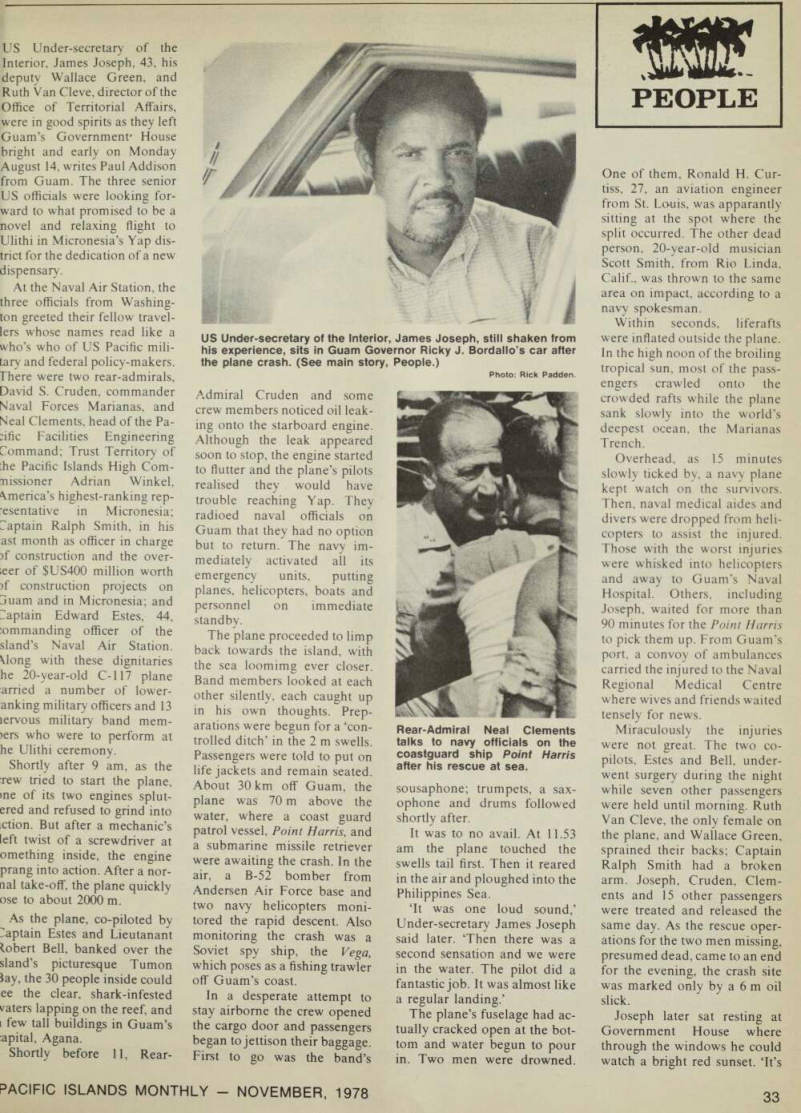
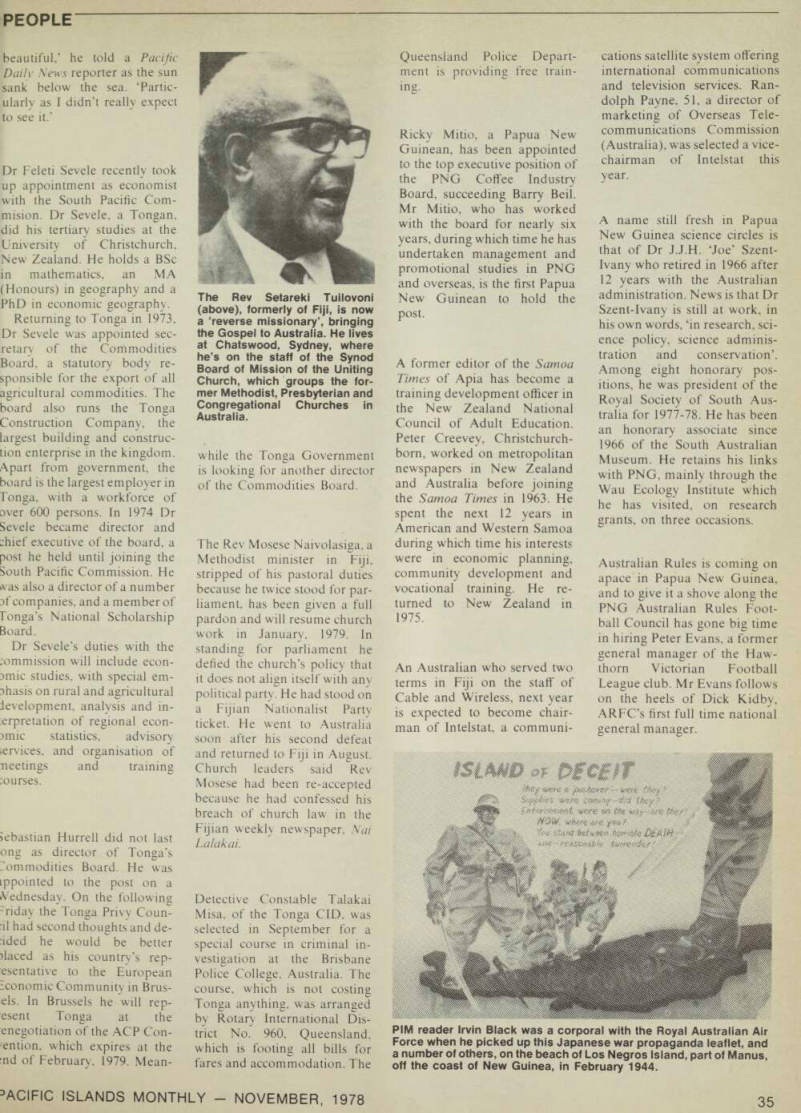
US Under-secretary of the Interior, James Joseph, 43, his deputy Wallace Green, and Ruth Van Cleve, director of the Office of Territorial Affairs, were in good spirits as they left Guam’s Government' House bright and early on Monday August 14, writes Paul Addison from Guam. The three senior US officials were looking for ward to what promised to be a novel and relaxing flight to Ulithi in Micronesia’s Yap dis trict for the dedication of a new dispensary.
At the Naval Air Station, the three officials from Washing ton greeted their fellow travel lers whose names read like a who’s who of US Pacific mili tary and federal policy-makers.
There were two rear-admirals, David S. Cruden, commander Naval Forces Marianas, and Neal Clements, head of the Pa :ific Facilities Engineering Command; Trust Territory of fie Pacific Islands High Com missioner Adrian Winkel,
\merica’s highest-ranking rep
resentative in Micronesia; Captain Ralph Smith, in his ast month as officer in charge )f construction and the over ;eer of SUS4OO million worth )f construction projects on Tuam and in Micronesia; and Captain Edward Estes, 44. :ommanding officer of the sland’s Naval Air Station,
klong with these dignitaries
he 20-year-old C-117 plane arried a number of lower anking military officers and 13
lervous military band mem
>ers who were to perform at he Ulithi ceremony.
Shortly after 9 am, as the rew tried to start the plane, me of its two engines splut ered and refused to grind into ction. But after a mechanic’s left twist of a screwdriver at omething inside, the engine prang into action. After a nor mal take-off, the plane quickly ose to about 2000 m.
As the plane, co-piloted by "aptain Estes and Lieutanant lobert Bell, banked over the
sland’s picturesque Turnon
Jay, the 30 people inside could ee the clear, shark-infested vaters lapping on the reef, and l few tall buildings in Guam’s
apital, Agana.
Shortly before 11, Rear-
Admiral Cruden and some crew members noticed oil leak ing onto the starboard engine.
Although the leak appeared soon to stop, the engine started to flutter and the plane’s pilots realised they would have
trouble reaching Yap. They
radioed naval officials on Guam that they had no option but to return. The navy im mediately activated all its emergency units, putting
planes, helicopters, boats and
personnel on immediate
standby.
The plane proceeded to limp back towards the island, with the sea loomimg ever closer.
Band members looked at each other silently, each caught up in his own thoughts. Prep arations were begun for a ‘con trolled ditch’ in the 2 m swells.
Passengers were told to put on life jackets and remain seated.
About 30 km off Guam, the plane was 70 m above the water, where a coast guard patrol vessel. Point Harris, and a submarine missile retriever were awaiting the crash. In the air, a B-52 bomber from Andersen Air Force base and two navy helicopters moni tored the rapid descent. Also monitoring the crash was a Soviet spy ship, the Vega, which poses as a fishing trawler off Guam’s coast.
In a desperate attempt to stay airborne the crew opened the cargo door and passengers
began to jettison their baggage.
First to go was the band’s
sousaphone; trumpets, a sax ophone and drums followed
shortly after.
It was to no avail. At 11.53 am the plane touched the swells tail first. Then it reared in the air and ploughed into the
Philippines Sea.
Tt was one loud sound,’
Under-secretary James Joseph
said later. ‘Then there was a second sensation and we were in the water. The pilot did a fantastic job. It was almost like
a regular landing.’
The plane’s fuselage had ac tually cracked open at the bot tom and water begun to pour in. Two men were drowned.
One of them, Ronald H. Cur tiss, 27, an aviation engineer from St. Louis, was apparantly sitting at the spot where the split occurred. The other dead person, 20-year-old musician Scott Smith, from Rio Linda, Calif., was thrown to the same area on impact, according to a
navy spokesman.
Within seconds, liferafts were inflated outside the plane.
In the high noon of the broiling tropical sun, most of the pass engers crawled onto the crowded rafts while the plane sank slowly into the world’s deepest ocean, the Marianas Trench.
Overhead, as 15 minutes
slowly ticked by, a navy plane
kept watch on the survivors.
Then, naval medical aides and divers were dropped from heli copters to assist the injured.
Those with the worst injuries were whisked into helicopters and away to Guam’s Naval
Hospital. Others, including
Joseph, waited for more than 90 minutes for the Point Harris to pick them up. From Guam’s port, a convoy of ambulances carried the injured to the Naval Regional Medical Centre where wives and friends waited tensely for news.
Miraculously the injuries
were not great. The two co pilots, Estes and Bell, under went surgery during the night while seven other passengers were held until morning. Ruth Van Cleve, the only female on the plane, and Wallace Green,
sprained their backs; Captain
Ralph Smith had a broken arm. Joseph, Cruden, Clem ents and 15 other passengers were treated and released the same day. As the rescue oper ations for the two men missing, presumed dead, came to an end for the evening, the crash site was marked only by a 6 m oil slick.
Joseph later sat resting at Government House where through the windows he could watch a bright red sunset. ‘lt’s
US Under-secretary of the Interior, James Joseph, still shaken from his experience, sits in Guam Governor Ricky J. Bordallo’s car after the plane crash. (See main story, People.) Photo: Rick Padden.
Rear-Admiral Neal Clements talks to navy officials on the coastguard ship Point Harris after his rescue at sea.
beautiful,’ he told a Pacific Daily News reporter as the sun sank below the sea. ‘Partic ularly as I didn’t really expect to see it.’
Dr Feleti Sevele recently took up appointment as economist with the South Pacific Com mision. Dr Sevele, a Tongan, did his tertiary studies at the University of Christchurch, New Zealand. He holds a BSc in mathematics, an MA (Honours) in geography and a PhD in economic geography.
Returning to Tonga in 1973, Dr Sevele was appointed sec retary of the Commodities Board, a statutory body re sponsible for the export of all agricultural commodities. The board also runs the Tonga
Construction Company, the
largest building and construc
tion enterprise in the kingdom.
Apart from government, the
board is the largest employer in
Tonga, with a workforce of over 600 persons. In 1974 Dr Sevele became director and :hief executive of the board, a post he held until joining the South Pacific Commission. He vas also a director of a number 3f companies, and a member of
Longa’s National Scholarship
Board.
Dr Sevele’s duties with the ;ommission will include econ omic studies, with special em phasis on rural and agricultural
development, analysis and in
erpretation of regional econ
omic statistics, advisory
services, and organisation of
neetings and training
xourses. iebastian Hurrell did not last ong as director of Tonga’s Zommodities Board. He was ippointed to the post on a
Wednesday. On the following
-riday the Tonga Privy Coun
cil had second thoughts and de rided he would be better )laced as his country’s rep esentative to the European
iconomic Community in Brus
els. In Brussels he will rep esent Tonga at the enegotiation of the ACP Con tention. which expires at the :nd of February, 1979. Mean-
while the Tonga Government is looking for another director of the Commodities Board.
The Rev Mosese Naivolasiga, a Methodist minister in Fiji, stripped of his pastoral duties because he twice stood for par liament, has been given a full pardon and will resume church work in January, 1979. In
standing for parliament he
defied the church’s policy that it does not align itself with any political party. He had stood on
a Fijian Nationalist Party
ticket. He went to Australia soon after his second defeat and returned to Fiji in August.
Church leaders said Rev Mosese had been re-accepted because he had confessed his breach of church law in the
Fijian weekly newspaper, Nai
Lalakai.
Detective Constable Talakai Misa, of the Tonga CID. was selected in September for a special course in criminal in vestigation at the Brisbane Police College, Australia. The course, which is not costing
Tonga anything, was arranged
by Rotary International Dis trict No. 960, Queensland, which is footing all bills for fares and accommodation. The
Queensland Police Depart ment is providing free train ing.
Ricky Mitio, a Papua New Guinean, has been appointed to the top executive position of the PNG Coffee Industry Board, succeeding Barry Beil.
Mr Mitio, who has worked with the board for nearly six years, during which time he has undertaken management and promotional studies in PNG and overseas, is the first Papua New Guinean to hold the post.
A former editor of the Samoa Times of Apia has become a
training development officer in
the New Zealand National Council of Adult Education.
Peter Creevey, Christchurch born, worked on metropolitan newspapers in New Zealand and Australia before joining the Samoa Times in 1963. He spent the next 12 years in American and Western Samoa during which time his interests were in economic planning,
community development and
vocational training. He re turned to New Zealand in 1975.
An Australian who served two terms in Fiji on the staff of Cable and Wireless, next year is expected to become chair man of Intelstat, a communi
cations satellite system offering international communications and television services. Ran dolph Payne, 51, a director of marketing of Overseas Tele communications Commission (Australia), was selected a vice chairman of Intelstat this year.
A name still fresh in Papua New Guinea science circles is that of Dr JJ.H. ‘Joe’ Szent- Ivany who retired in 1966 after 12 years with the Australian administration. News is that Dr Szent-Ivany is still at work, in his own words, ‘in research, sci ence policy, science adminis tration and conservation’.
Among eight honorary pos
itions, he was president of the Royal Society of South Aus tralia for 1977-78. He has been an honorary associate since 1966 of the South Australian Museum. He retains his links with PNG, mainly through the Wau Ecology Institute which he has visited, on research grants, on three occasions.
Australian Rules is coming on apace in Papua New Guinea, and to give it a shove along the PNG Australian Rules Foot ball Council has gone big time in hiring Peter Evans, a former general manager of the Haw thorn Victorian Football League club. Mr Evans follows on the heels of Dick Kidby, ARFC’s first full time national general manager.
The Rev Setareki Tuilovoni (above), formerly of Fiji, is now a ‘reverse missionary’, bringing the Gospel to Australia. He lives at Chatswood, Sydney, where he’s on the staff of the Synod Board of Mission of the Uniting Church, which groups the for mer Methodist, Presbyterian and Congregational Churches in Australia.
PIM reader Irvin Black was a corporal with the Royal Australian Air Force when he picked up this Japanese war propaganda leaflet, and a number of others, on the beach of Los Negros Island, part of Manus, off the coast of New Guinea, in February 1944.
Advertisements & other items, p. 34 (1 item)
Watson & Crane
Total service 0n...
plumbing supplies Fast
are organised to fulfil your needs
wherever you are in the South Pacific You can get all you need from one supply source.- water taps, valves, copper tube, tools and a host of other fittings and related plumbing equipment for domestic, industrial and multistorey buildings.
Watson & Crane Pty Ltd have over 20,000 plumbing items in stock at their central warehouse located at Waterloo, NSW, Australia.
Years of experience in handling and shipping right throughout the South Pacific add up to another big reason for you to deal with Watson & Crane Pty Ltd.
Representatives call regularly at Papua New Guinea, the Solomons, New Hebrides and Frji Istends to personally discuss your requirements and appropriate credit arrangements.
Write, cable or telephone today for complete plumbers' supplies service.
Watson & Crane Pty. Ltd. 1037 Bourke Street, Waterloo,
NSW 2017.
Phone: Sydney 699-1333.
Telex: AA 25548.
Cables: "Watcrane" Sydney.
Pacific Island distributors of Crane Enfield copper tube for water, sanitation, engineering, refrigeration and air conditioning.
Islands
From the
Press
From a message from New Zealand Prime Minister Muldoon to Cook Islands Premier Tom Davis on the 13th anniversary of self-government in the Cook Islands, as reported in the Cook Islands News: ... It is clear from recent events and the responsible reaction of the people of the Cook Islands to them that democracy in your country is alive and well. . .
From the American Samoa News Bulletin: It is estimated that nearly two and a half million that’s right, 2.5 million aluminium cans will be imported into the territory of American Samoa in 1978. This includes soft drink and beer cans as well as other various aluminium containers. Because of the devastating effect this number of cans can have on the territory if disposed of improperly, plus the fact that an enormous amount of energy and natural resource is lost when these aluminium containers are simply buried in land fills. Governor Coleman has written to the Environmental Protection Agency in Honolulu inquiring as to the feasibility of crushing and packing the cans in Samoa and sending them back to Hawaii or the West Coast to be recycled.
From The Fiji Times: Syphilis killed 22 babies in Suva in the first six months of this year. Dr Mary Schramm told the Fiji Medical Association seminar yesterday. She said that out of 2200 deliveries at Anderson Maternity Unit in the first half of this year, 60 cases had positive syphilis test results. Dr Schramm, a Colonial War Memorial Hospital consultant obstetrician and gynaecologist, said syphilis in Fiji had reached epidemic proportions .. .
From the Tohi Tala Niue: Niue has a dwindling police force at the moment with villages with no constables. It was voiced at the Assembly meeting last week all villages should have a constable. It is not that people are not law-abiding, but it is a custom they are used to, that every village should have a constable. Minor offences do occur every now and again which annoys certain parts of the community. One of the worst offenders today is traffic. During the day, all vehicles especially motor-cycles move silently along the roads making little noise. After sunset you can hear the roar of these bikes miles away.. .
From a letter by Joe Nason, ex-United States Navy, written to Papua New Guinea’s Allans Nius after a ‘nostalgic return to the Solomons and Rabaul’: ... There is, however, one bitter reaction which I will carry away from these islands, and that is the complete dearth of recognition of the role that America played in the eventual liberation of these islands. In no way do I wish to minimise the gallantry of the Aussies and New Zealanders, but the fact remains that without the United States, probably New Zealand and Australia would
have fallen to the Japanese. Yet, at the War Cemetery, I didn’t see one mention of America. No recognition of my many compatriots who died in prison or over the skies of Rabaul could I find in this city. This saddened me.
From a plea by Samoan author and poet Albert Wendt for preservation of the Samoan language, reported in the Samoa Times: . .. English seems to be the dominant language at any function.
Even on our local radio station, the local news is always read out in English before Samoan. It should be the reverse. Mr Wendt said.
From the Fiji Times: The president of Savusavu Chamber of Commerce told yesterday how the two rear wheels of one of the buses serving the town came right off on a journey from Buca Bay. Mr J.A. Khan, who was a passenger on the bus travelling back to Savusavu last week, said the wheels rolled down the road, narrowly missing oncoming traffic. The bus crunched down on to the road, grinding to a halt without causing injury, he said. ‘People here do not know when they travel by bus whether they will get home in one piece,’ he said. ‘Nowadays they travel only if they have to.’
From the American Samoa News Bulletin: Governor Peter Tali Coleman attempted to set a good example by joining ... in a clean-up party which worked their way from Faga’alu Park to Utulei Beach Park. Mrs Coleman was among the party. All along the road the Governor and Mrs Coleman found themselves practically knee deep in litter and they cleaned it all up! But when you drive home today you will notice that the roadside is again full of litter.
From the Lae Nius: Members of the newly-formed venereal disease control committee have called on the Provincial Government to repatriate unemployed non-Morobeans from Lae City. The call was made by an active leader in the committee and a representative of the Public Health Department, Dr Sugoho. Dr Sugoho claimed that venereal disease was becoming a major problem in all centres of Papua New Guinea. He said the number of cases of venereal disease had increased rapidly in the last couple of years because of unemployment and poverty which resulted in men selling their wives into prostitution . . .
From a speech by PNG Minister for Defence Louis Mona at the opening of the 1978 National Congress of the PNG Branch of the Returned Services League and reported in Allans Nius: ... In my Anzac Day speech at the Dawn Service at Bomana I spoke of how WWII united people where a black man fought alongside a white man against a common enemy, and neither man was worried about the colour of the skin of the other. I also asked for the people of PNG to forget racial discrimination and unite to make our country a better land for us, for our children, and for your children’s children. It can be done but. like localisation, it must start at the top and the bottom at the same time. As terrible as war may be, it does at least serve one good purpose, it united people. If we can do it in war, why can’t we do it in peace?
From the Cook Islands News: Some of the people worst hit by the floods of last week were our planter friends. Their taro patches were heaped up with rubbish from the hills but worse still from families who emptied their rubbish into the once-dry streams. I watched a disappointed planter close to tears, examining his newly-turned taro patch covered with debris from the neighbour’s kitchen.
Advertisements & other items, pp. 37-47 (1 item)
Cid Pioneer
Now, the other 3/4 of the world can be covered with great stereo music On the land or on the sea you will never be far away from great stereo music with Pioneer’s new stereo radio cassette recorder. The 3-way power source lets you use internal batteries, house current or your car’s power supply (with adaptor).
Pioneer created to sound as great as it looks, the SK-1 delivers a hefty 3,000mW (Music Power). More than enough to handle the “heavy” sounds, yet designed compact for those who like to travel light.
Radio fans will have a ball with 2 shortwave bands, plus MW and FM. Naturally, the tuner section uses advanced Pioneer Integrated Circuitry for stable reception even in out-of-the-
way places.
Of course, the cassette recorder is what you would expect from Pioneer. A wide-range
Permalloy record/playback head, pause, cue
and review functions. Variable Monitor switch, Loudness Contour switch and fully-automatic Stop. And for easy recording, left and rightchannel microphones. Or plug in a turntable and build an entire stereo system around the SK-1.
And on the output side, a pair of 12cm (4% inch)
hi-fi speakers. Perfectly balanced for exciting
stereo reproduction.
Pioneer’s new SK-1 stereo radio cassette
recorder. Component-like performance plus the
go-anywhere convenience of portability. And,
for those who want big Pioneer performance on a smaller budget, we re pleased to offer the RK-305 and RK-355. They’re not stereo, but they are Pioneer. And that means a lot, no matter where your music takes you.
Portable hi-fi... from the audio company.
CID PIONEER
Australia Pioneer Electronics Australia Pty.Ltd., 178-184 Boundary Road, Braeside, Victoria 3195, Tel: 90-9011, Sydney 93-0246, Brisbane 59-7457, Adelaide 433379, Perth 24-9899 Fiji Islands Brijlal & Company, G.P.O. Box No. 362, Suva, Fiji Islands Tel: 22258 New Zealand Fountain Marketing Ltd., Maidstone Street, Auckland, New Zealand Tel: 763-064 Norfolk Island Burns Philp (Norfolk Island) Ltd., Norfolk Island, South Pacific New Hebrides Burns Philp (New Hebrides) Ltd., Vila, New Hebrides Nauru Island Jacob Enterprises, PO. Box No. 4 Republic of Nauru Tahiti Est. PERFECT, B.P. 594, Papeete, Tahiti Tel: 20 407 New Caledonia Menard Freres Ville, B.P. H 2 Cedex, Noumea, New Caledonia Tel: 27.52.22 American Samoa Traspac Corporation. P.O. Box 1477, Pago Pago, American Samoa 96799 Tel; 633-5224 Rarotonga South Seas International Ltd., P.O. Box 49, Rarotonga Cook Islands Tel; 2327 Papua New Guinea Bali Marchants Pty. Ltd., P.O. Box 6103 Boroko Tel: 254887
U .
Bl n w w s mm m Mm M » •u. ■■ ££ &'mr jr -dp s mu . ~.. i ssare»»eHwBßBßaHi
You’ll like our style to all
our destinations.
We have many flights to many destinations, but on each and every one you can be sure of one thing: attentive and friendly service. Plus of course good food and fine wines served in big jet comfort.
Today this special style of Air New Zealand is yours to enjoy on direct flights to New Zealand, or on your way around the Pacific; even to the East now that the fast, friendly way there is first to fly south with us! And of course to Honolulu, Los Angeles and on to Canada, London or Europe.
Your travel agent or Air New Zealand is ready now to help you plan the trip and the fares that suit you best wherever you want to fly.
air new zeaLann
™ We fly the Pacific.
ANZ7B/3
il ' Vil fi . c I 9.9 & I 9.9
Introducing the
all-purpose small
twins with the big
difference.
Yamaha’s line of small twins, already deservedly famous among commercial boaters for rugged, reliable service, is now better than ever. Two entirely new models, rated at 9.9 hp and 15hp, are the smoothest, most economical small displacement engines we’ve ever designed.
The secret is their advanced fuel recirculation system, which allows more complete combustion of fuel. And more complete combustion means much better low-speed trolling, greater fuel economy and cleaner, smoke-free running.
Other advanced performance features include an improved noise-reducing engine shroud, box-type intake silencer and dual expansion-chamber exhaust system.
These two new engines, both available with options such as Yamaha’s Dual Thrust through-the-prop exhaust, electric starting and upward facing controls, make the line of Yamaha commercial outboards one of the most complete in the industry.
And like all Yamaha’s they’re true multi-purpose units, as reliable and responsive behind a pleasure boat as they are durable and economical for commercial boating.
Ideal for sailors and anglers, too.
From 2 to 60. Power for any purpose. 60, 55, 48. 40, 28, 25, 20. 15. 12, 9.9, 8. 6,5, 3.5, 2 mm 15
Outboard
with
YAMAHA
YAMAHA MOTOR CO , LTD
~k i &mvtis
A SHEET
<22? jv^ *** 4.*. c®.
MARSON MARSON
HOME MASTER
RIVETING KITS
No. 250 MASTER MARINER. Designed for boat building and maintenance, as well as for repair and construction work in areas near the sea. Contains HP2/4 hand plier plus an assortment of over 200 rivets in copper, stainless steel and marine specification aluminium in handy steel carry-case with correct size drill.
No. 220 WORKSHOP MASTER. A similar kit to the No. 250 but containing over 200 assorted rivets suitable for tradesman and handyman application.
Here's what they do
Replaces screws, bolts and nuts, ordinary rivets, solder and adhesives. The fastening is quicker, stronger, cheaper and resistant to vibration. Use on boats, bicycles, prams, caravans, trailers, roofing, guttering, farm sheds, silos, troughing, pens, screens, awnings, metal furniture, and hundreds of other repair and construction needs around the home, farm or boat.
Here's how they work
Insert rivet into tool.
Insert into pre-drilled hole.
Squeeze tool to fasten.
Non Rust
STAINLESS STEEL
KUK-FAST
RIVETS
STEEL IS STRENGTH
FOR SHIPS, BOATS,
SEABOARD, MARINE AND
LIFETIME APPLICATIONS.
ALWAYS USE
MARSON
STAINLESS STEEL
RIVETS
Specification: 305/384 MARSON TOOLS ARE GUARANTEED FOR 24 MONTHS BECAUSE OF BUILT-IN STRENGTH
BY MARSON AUSTRALIA
AVAILABLE THROUGH ALL LEADING TOOL STORES
* , -»■ ■ I '
The two-way nib.
The entirely new way
to write.
Parker 180.
Test-write with one now.
You’ll write with new verve and character.
This revolutionary 14ct gold nib gives you thick lines or thin. Great contrast.
You just turn the pen 180° from front to back.
Extremely elegant, too,
in four French designs.
Silver plated, gold plated, 22ct
gold electroplate and stainless steel.
All convertible to take ink fill or cartridge.
Ball-point pens to match. , - ‘ 'World's most wanted pens .. •*.>•, • .r> , i > ... ■ •••■/•-- v ..*Xvv,V • .v/- ■ \^vC\ ;,v... . vvf :-;'vvv. <*7-l • • S. f • . v: . ■ ** v % ; v w ** w > ♦'- * ■ ■ ' *e~'i . ' ; ■ v; v. a- ■ ■ ■ ■: ' -V ,r ■:.. v r;: ; v . : . • y-.v-v . .
'•Hi V PRICES IN THE PARKER COLLECTION RANGE M FROM ALMOST $2,000 TO LESS THAN $4.00, WITH ABOUT 140 IN BETWEEN.
CONSTRUCTIVE
ADVICE.
ft w —— ~' T *j **~r Swamp Bulldozers as well as Swamp Dozer Shovels.
Dozer Shovels.
Radio-Controlled Bulldozers and Dozer Shovels.
Electric Powered Dozer Shovels.
A wide range of Pipelayers.
Amphibious Bulldozers. a O P Tj M ir\ Wheel Loaders.
A wide selection of Off-Highway Dump Trucks.
Slag Dump Trucks.
And offer Motor Graders.
As well as Motor Scrapers. s„
i flpOL--
* i L-jrr Soil Compactors.
Trash Compactors Towing Tractors. 5? lf •b i i 44 til
til
1 11 IS A wide selection of Diesel Engines.
Machine Tools. a- € Mechanical and Hydraulic Presses. * A variety of Maypres Presses. OBS Power Presses. Tunnel-Boring Machines.
We're constructive in other ways. We offer castings, foundries, and important advice on construction and manufacturing projects.
•H KOMATSU LTD.
Tokyo, Japan Komatsu overseas offices: Sydney, Singapore, Jakarta, Manila, Seoul, Bangkok, Bangalore, Teheran, Dubai, Jeddah, Riyadh, Ad Dammam, Baghdad, Ankara, Moscow, London, Brussels, Dusseldorf, Stuttgart, Warszawa, Paris, Madrid, Cairo, Alger, Abidjan, Lagos, Nairobi, Johannesburg, Toronto, San Francisco, Fort Lee, Arlington, Atlanta, Detroit, Mexico City. Habana, Panama, Sao Paulo, Caracas, Lima, Buenos Aires, and distributors in over 100 countries around the world.
You name it, Mono pumps it.
Tell us your needs, we’llshowyouthepump, Forover 30 years, we’ve been pumping liquids of every viscosity, under all kinds of conditions. Fresh water, sand and water, food ingredients, chemicals, acids, corrosives and abrasives, sludges and waste, effluent and sewage, even solids in suspension.
If it can be conveyed through a pipeline, we can move it, meter it or mix it, as quickly or slowly as you wish.
And we can provide pumps that run on petrol, kerosene, diesel, electricity, or PTO tractor drive (in fact even bicycle drive).
If there’s anything you want to know about pumping, write to us at Mono. We’ve got the pumps and the experience.
Please send me details of your pumps for (describe purposes): Name: Address: Send coupon to Head Office & Works (address below).
MONO
IAPUMPS
AUSTRALIA PTY. LTD.
MOVE IT WITH MONO
Head Office & Works: "Mono House”. 338-348 Lower Dandenong Rd., Mordialloc. Vic. 3195. Australia.
Agents in; Papua and New Guinea. Indonesia. Fiji. The Philippines.
< * k m m ; - I® iy i X s r i 9 fl
few#
The Toyota truck range. Built to be unbeatable.
Bad weather conditions, no problem.
Bad roads and driving surfaces, eaten up.
Difficult loads, no contest. Built tough. Built to take it.
There's a Toyota truck built for you.
La TOYOTA Land Cruiser Pickup TOYOTA Stout
TOYOTA Hi-Lux
iA
TOYOTA Dyna
TOYOTA Toyo-Ace mm TOYOTA Truck For unbeatable after service:
TOYOTA
PAPUA NEW GUINEA; ELA MOTORS LIMITED, Scratchley Rd„ Badili, P.O. Box 75, Port Moresby. U.S. TRUST TERRITORY: MICROL CORPORATION, P.O. Box 267, Saipan. FIJI ISLANDS: AUTOMOTIVE SUPPLIES CO,, LTD., G.P.O. Box 355, Suva AMERICAN SAMOA; BURNS PHILP (SOUTH SEA) CO., LTD., P.O. 1057, Pago Pago WESTERN SAMOA: BURNS PHILP (SOUTH SEA) LTD., P.O. Box 188, Apia. GUAM: ATKINS, KROLL (GUAM) LTD., P.O. Box 6428, Tamuning. NEW HEBRIDES: NEW HEBRIDES MOTORS LTD., P.O. Box 18, Vila. SOLOMON ISLANDS; MENDANA ENTERPRISES (S I ), LTD., P.O. Box 174, Honiara. TAHITI: NIPPON AUTOMOTO, B.P. 342, Papeete. COOK ISLANDS: COOK ISLANDS TRADING CORPORATION LTD., P.O. Box 92, Rarotonga. NAURU ISLAND: NAURU COOPERATIVE SOCIETY. GILBERT & ELLICE ISLANDS COLONY: TARAWA MOTORS, Box 36, Bairiki Tarawa NORFOLK ISLAND: MARIE'S NORFOLK TOURS, LTD., P.O. Box 276. NEW CALEDONIA: SOCIETE IMPORTATION AUTOMOBILE DU PACIFIQUE, Rond-Point du Pacific (Station Total) B.P. 438, Noumea.
JO-'
JAPAN
TOKYO
KAGOSHIMA
CHINA
OKINAWA
TAIPEI
TAIWAN
HONG KONG
PHILIPPINES
MANIL
GUAM
MARSHALL
ISLANDS
. CAROLINE ISLANDS
iTPONAPE
MAJURO
TARAWA
NAURU
GILBERT
ISLANDS
:<,&•= o- » o
PAPUA
NEW
GUINEA
GUADALCANAL .*
* HONIARA R
. SOLOMON \
, ISLANDS
'I NEW
O)* HEBRIDES
<#MILA
NEW
CALEDONIA
NOUMEA
AUSTRALIA
SYDNEY
MELBOURNE
NEW ZEALAN
170°E
PEOPLE KEEP ASKING US:
a
HAWAII
WHERE DOES
AIR NAURU rar?
99
WESTERN SAMOA
APIA
Until recently, modesty and a rather small size had compelled us to keep our airline and our routes pretty much to ourselves, sharing them only with a few friends and neighbors who still maintain that the only way to fly is from island to island.
But as we ascertained that there’s really not an unpleasant island in the lot, and that our all-jet airline is the only one in the world linking the great Asian nations with Micronesia, Melanesia and Polynesia, it dawned that we might be on to something in the way of unique travel possibilities.
Say, from Hong Kong to Western Samoa. Or from Japan to Fiji.
Or Melbourne to Guam. All via our home island of Nauru.
As well as a lot of fine places in between, most of them, fortunately, blessed by pleasant weather, hospitable people, and surrounded by warm and invigorating waters.
Indeed, some travelers already think of Air Nauru as the unhurried alternative route through Nauru from Hong Kong or Taipei or Japan to Australia. Via a world of beautiful islands—both scenic and human.
While others think of us as the fastest and most direct route to such places as Majuro, Nauru, Western Samoa, Tarawa, Guadalcanal and the Solomon Islands. Or Fiji, New Caledonia and the New Hebrides.
However you choose to fly with us, along the way our promise is simple: Big airline efficiency, small airline congeniality, some genuine, unpretentious inflight cheer, delightful stopovers, an occasional Pacific feast, French wines and champagnes.
Oh yes, ladies and gentlemen, on Air Nauru—wherever we fly in our beautiful island world-we are used to doing things in style. ■■■
MR NAURU
AIRLINE OF THE CENTRAL PACIFIC
For ticketing, reservations and flight information, telephone: 740 in Apia, Western Samoa; 477-7106 in Guam; 595 or 727 in Honiara, Solomon Islands; 229 in Majuro, Marshall Islands; 312-377 in Suva, Fiji; 27-33-22 in Noumea, New Caledonia; 458 in Ponape, Caroline Islands; 27-39 in Vila. New Hebrides; 72795 in Nadi, Fiji; 448 in Tarawa, Gilbert Islands; and 653-5709 in Melbourne, Australia
Fiji ’till you’ve

Tourism
You haven’t seen Fiji ’till you’ve taken a bus ride
By Lema Low
The bus moved forward again. There wasn't space for another single thing. There was hardly space to draw a breath. I wondered how I would leave the bus when the time came, and decided the best way would be to leap through the window, rather than walk on everybody's baskets.
We turned the corner at the Three Lamps and at last headed for the Great Outback of Buca Bay and interim ports so I thought. But the bus pulled up at the first building round the corner. Linder a verandah sat a man strumming a guitar.
All the passengers (including myself) yelled, Vodo mail" meaning "Come aboard"!
Without further ado, he did with a companion, a guitar, a briefcase, two suitcases and a bundle of mats!
With a creaky protest, the dear old bus got under way again, everybody smiling happi ly, in the irrepressible Pacific way. Well (I thought) no more stops now we haven't a spare centimetre. Just then, the bell rang. A passenger, with a few muttered words to the driver, left the bus. Hooray! One less that's more like it.
The bus didn't move. The driver chewed gum and stared into space. Presently, the same passenger hurried back and clambered aboard with a suitcase!
Well (I thought) nothing else will surprise me. I've seen
everything now.
But I was speechless with wonder for the bus did not stop again until it reached my own gate. It roller-coasted over the hills and down into the valleys. It swept along the air port road in a cloud of dust, and drew up with a flourish that sent the goats scampering for cover.
"Eight cents, ma'am," chirped the driver, with a distinct twinkle in his eye.
The bus driver chewed gum and read the latest Fiji Times. To anxious enquirers, his stock rep ly was, "Leaving in 10 minutes."
There was an air of excite ment when finally, only a few minutes behind schedule, the bus moved off but, of course, that meant nothing at all. It was destined to meander all along Savusavu town before taking off for the Great Outback of Buca Bay, Napuka, Natuvu and other points east of Savusavu.
Waving an impassioned farewell to friends as if we were setting out on a voyage of discovery around the world, in stead of on the daily run for Buca Bay we wandered along the waterfront road.
The bus-driver was on the watch for his "regulars". There was a loud screech from Matai's Store and a gay sulu flapped in the breeze as a woman rushed out with a child on one hip and a parcel of groceries.
"No hurry," the driver con soled her, as he helped her aboard.
Advertisements & other items, pp. 48-49 (1 item)
Speed-E-Gas
In the home
is fast, efficient
and reliable.
Terminals throughout the Pacific.
For more information write Boral Gas Limited, 221 Miller Street,
BORAL
North Sydney 2060 *Speed-E-Gas is known in Papua New Guinea, as Guinea Gas. In Tonga as Tonga Speed-E-Gas, and in Fiji as Fiji Gas.
SPEED-E-GAS
1 is V d ih M
HOLT GS 14
** ■■■ * I *T ■ K A- ; '. £t*jl -«fe 5. ■ ,•«■• .*• ..: . as 4» -• 21% «.-*'
IMS
. - - K 3* & £>> •# » - ’-*- -i m: - ‘7 ..<• -
KC|2i
V
Come uptokool
The cool refreshing taste of menthol.
8523-4/78
Preserving old
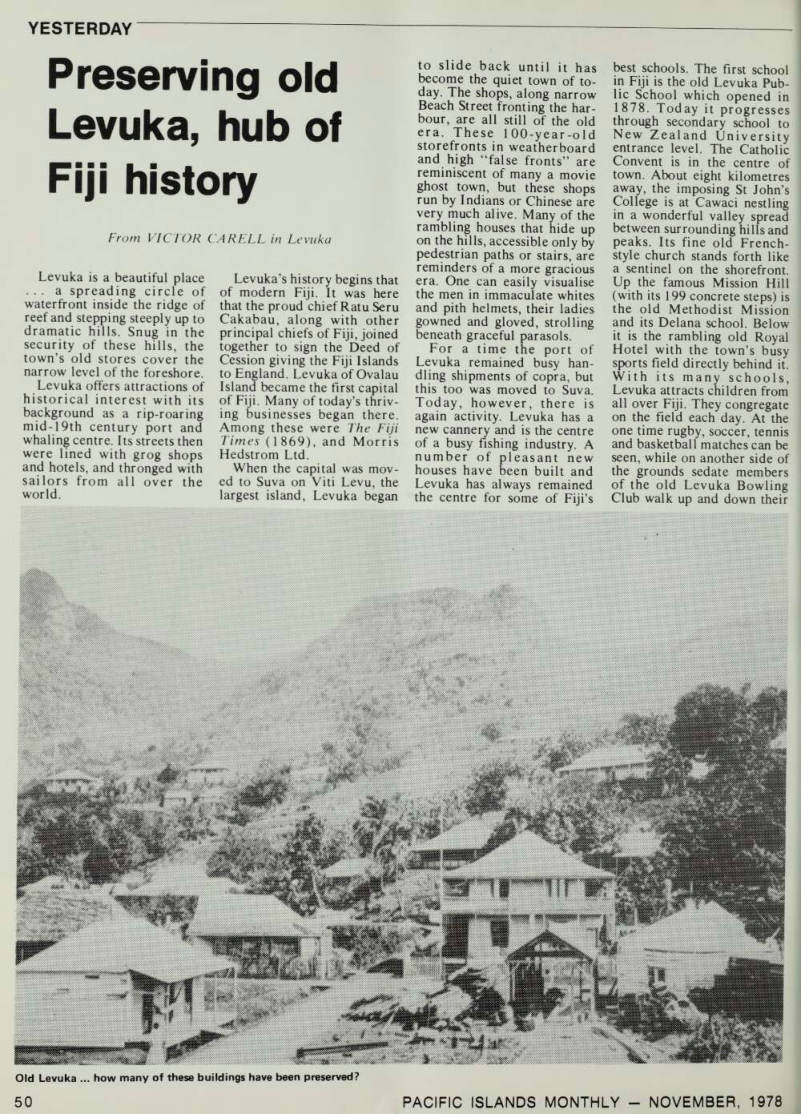
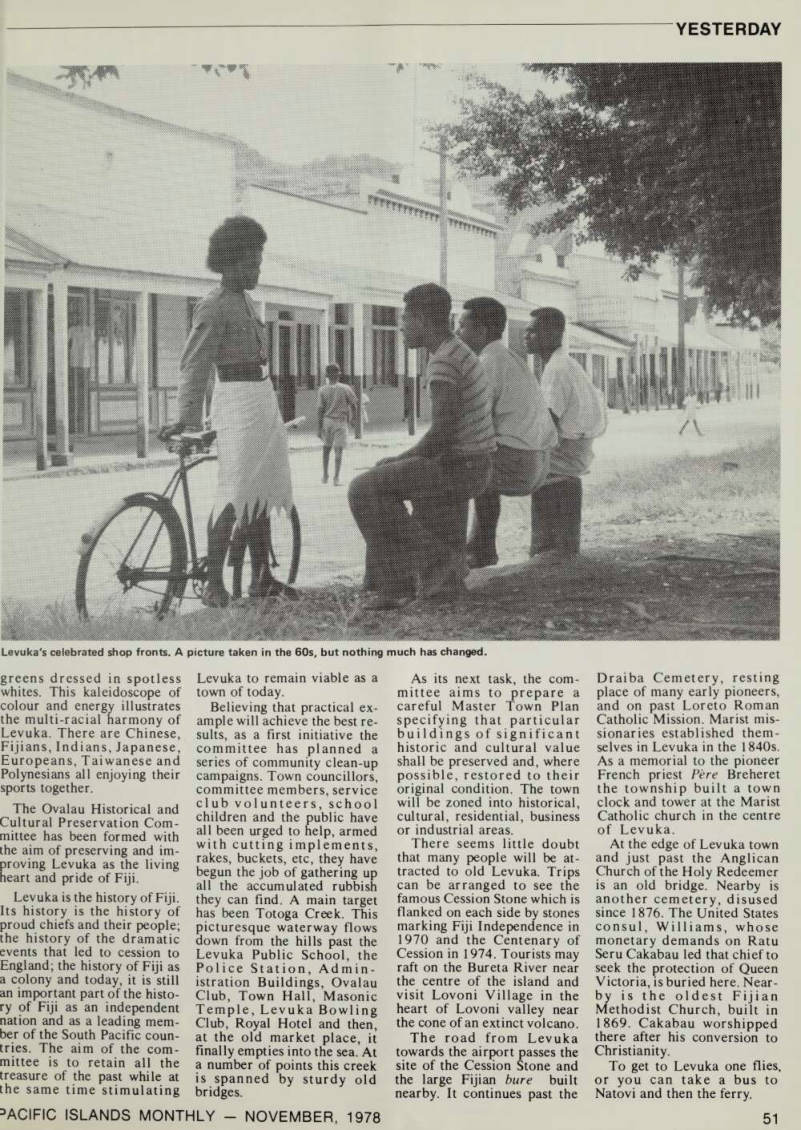
Yesterday
Preserving old Levuka, hub of Fiji history
From VICTOR CARELL in Levuka
Levuka is a beautiful place ... a spreading circle of waterfront inside the ridge of reef and stepping steeply up to dramatic hills. Snug in the security of these hills, the town’s old stores cover the narrow level of the foreshore.
Levuka offers attractions of historical interest with its background as a rip-roaring mid-19th century port and whaling centre. Its streets then were lined with grog shops and hotels, and thronged with sailors from all over the world.
Levuka’s history begins that of modern Fiji. It was here that the proud chief Ratu Seru Cakabau, along with other principal chiefs of Fiji, joined together to sign the Deed of Cession giving the Fiji Islands to England. Levuka of Ovalau Island became the first capital of Fiji. Many of today’s thriv ing businesses began there.
Among these were The Fiji Times (1869), and Morris Hedstrom Ltd.
When the capital was mov ed to Suva on Viti Levu, the largest island, Levuka began
to slide back until it has become the quiet town of today. The shops, along narrow Beach Street fronting the harbour, are all still of the old era. These 100-year-old storefronts in weatherboard and high “false fronts’’ are reminiscent of many a movie ghost town, but these shops run by Indians or Chinese are very much alive. Many of the rambling houses that hide up on the hills, accessible only by pedestrian paths or stairs, are reminders of a more gracious era. One can easily visualise the men in immaculate whites and pith helmets, their ladies gowned and gloved, strolling beneath graceful parasols.
For a time the port of Levuka remained busy handling shipments of copra, but this too was moved to Suva.
Today, however, there is again activity. Levuka has a new cannery and is the centre of a busy fishing industry. A number of pleasant new houses have been built and Levuka has always remained the centre for some of Fiji’s
best schools. The first school in Fiji is the old Levuka Pub lie School which opened in 1878. Today it progresses through secondary school to New Zealand University entrance level. The Catholic Convent is in the centre of town. About eight kilometres away, the imposing St John’s College is at Cawaci nestling in a wonderful valley spread between surrounding hills and peaks. Its fine old French style church stands forth like a sentinel on the shorefront.
Up the famous Mission Hill (with its 199 concrete steps) is the old Methodist Mission and its Delana school. Below it is the rambling old Royal Hotel with the town’s busy sports field directly behind it.
With its many schools, Levuka attracts children from all over Fiji. They congregate on the field each day. At the one time rugby, soccer, tennis and basketball matches can be seen, while on another side of the grounds sedate members of the old Levuka Bowling Club walk up and down their
Old Levuka ... how many of these buildings have been preserved?
greens dressed in spotless whites. This kaleidoscope of colour and energy illustrates the multi-racial harmony of Levuka. There are Chinese, Fijians, Indians, Japanese, Europeans, Taiwanese and Polynesians all enjoying their sports together.
The Ovalau Historical and Cultural Preservation Com mittee has been formed with the aim of preserving and im proving Levuka as the living heart and pride of Fiji.
Levuka is the history of Fiji.
Its history is the history of proud chiefs and their people; the history of the dramatic events that led to cession to England; the history of Fiji as a colony and today, it is still an important part of the histo ry of Fiji as an independent nation and as a leading mem ber of the South Pacific coun tries. The aim of the com mittee is to retain all the treasure of the past while at the same time stimulating
Levuka to remain viable as a town of today.
Believing that practical ex ample will achieve the best re sults, as a first initiative the committee has planned a series of community clean-up campaigns. Town councillors, committee members, service club volunteers, school children and the public have all been urged to help, armed with cutting implements, rakes, buckets, etc, they have begun the job of gathering up all the accumulated rubbish they can find. A main target has been Totoga Creek. This picturesque waterway flows down from the hills past the Levuka Public School, the Police Station, Admin istration Buildings, Ovalau Club, Town Hall, Masonic Temple, Levuka Bowling Club, Royal Hotel and then, at the old market place, it finally empties into the sea. At a number of points this creek is spanned by sturdy old bridges.
As its next task, the com mittee aims to prepare a careful Master Town Plan specifying that particular buildings of significant historic and cultural value shall be preserved and, where possible, restored to their original condition. The town will be zoned into historical, cultural, residential, business or industrial areas.
There seems little doubt that many people will be at tracted to old Levuka. Trips can be arranged to see the famous Cession Stone which is flanked on each side by stones marking Fiji Independence in 1970 and the Centenary of Cession in 1974. Tourists may raft on the Bureta River near the centre of the island and visit Lovoni Village in the heart of Lovoni valley near the cone of an extinct volcano.
The road from Levuka towards the airport passes the site of the Cession Stone and the large Fijian bure built nearby. It continues past the
Draiba Cemetery, resting place of many early pioneers, and on past Loreto Roman Catholic Mission. Marist mis sionaries established them selves in Levuka in the 1840 s.
As a memorial to the pioneer French priest Pere Breheret the township built a town clock and tower at the Marist Catholic church in the centre of Levuka.
At the edge of Levuka town and just past the Anglican Church of the Holy Redeemer is an old bridge. Nearby is another cemetery, disused since 1876. The United States consul, Williams, whose monetary demands on Ratu Seru Cakabau led that chief to seek the protection of Queen Victoria, is buried here. Near by is the oldest Fijian Methodist Church, built in 1869. Cakabau worshipped there after his conversion to
Christianity.
To get to Levuka one flies, or you can take a bus to Natovi and then the ferry.
Levuka's celebrated shop fronts. A picture taken in the 60s, but nothing much has changed.
Advertisements & other items, p. 52 (1 item)
Kenwood’s specialist-designed separate audio
components tme for people who want only the very best that modem life can offer. Like pure ; i i • & & Sp «'• o; - i
proof in the performance
& yotir Kenwood dealer st listening. And discover what sound quality really means! •KA-5700 Stereo integrated
amplifier
•KX-520 Cassette deck with
Dolby* N.R.
• KD-2000 Automatic return turn table • LS-770 MKH Coaxial passive
cone speaker system
LS-770 mk I / / 7 KX-520 7£l ' W'f* V - '
tit*
-si : !
KA-5700 KD-2000
lilf*#
- TRIO-KENWOOD CORPORATION 6-17, 3-chome, Aobadai, Meguro-ku, Tokyo 153, Japan AUSTRALIA TRIO-KENWOOD (AUSTRALIA) PTY LTD. Australia Tel 439-4322 NEW ZEALAND JOHN GILBERT & CO , LTD. Auckland Tel 30-839 FIJI THE DOMINION IMPORT & EXPORT PROMOTIONS Nadi Tel. 72-165 PAPUA NEW GUINEA S O SVENSSON (N.G ) LTD Port Moresby Tel 24-2275/2285 NORFOLK ISLAND BURNS PHILP (NORFOLK ISLAND) LTD SOLOMON ISLANDS TECHNIQUE RADIOS CENTRE LTD Honiara Tel 41€ NEW CALEDONIA HI-FI VOX Noumea Tel 27-2466 NEW HEBRIDES RUE HIGGINSON Vila Tel 2556 TAHITI MAI SON AURORE Papeete Tel 29703 AMERICAN SAMOA ISLAND PACIFIC AGENCIES. INC Pago Pago Tel 633-4687
REPUBLIC OF NAURU NAURU CO-OPERATIVE SOCIETY
MARIANA ISLANDS J C TENORIO ENTERPRISES Saipan Tel 6445
Mission Melanesia:
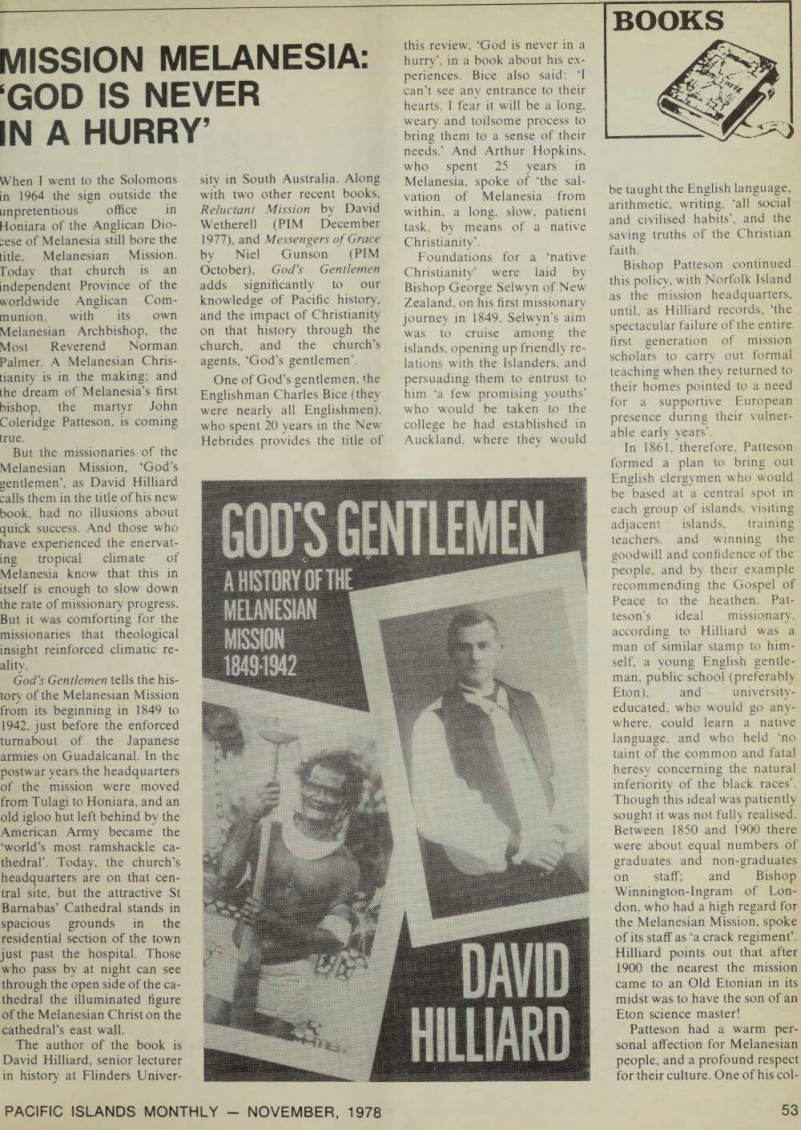
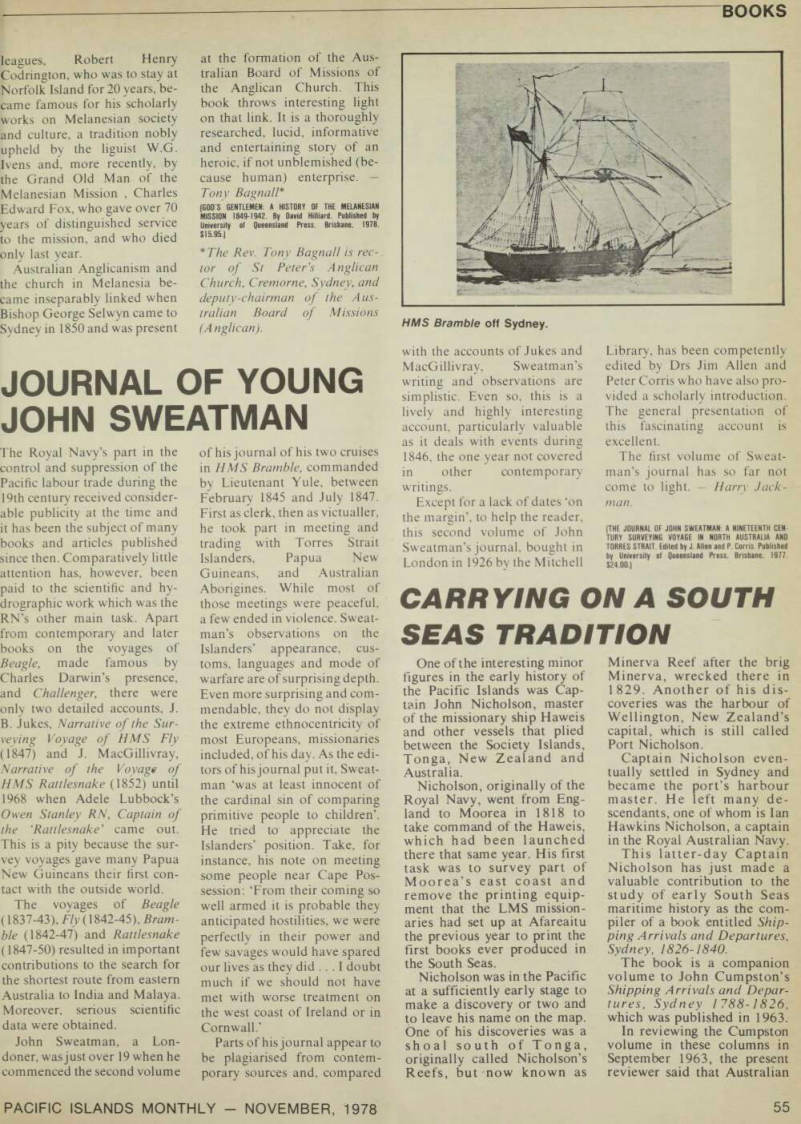
Books
‘God Is Never
In A Hurry’
When I went to the Solomons in 1964 the sign outside the unpretentious office in Honiara of the Anglican Dio :ese of Melanesia still bore the title, Melanesian Mission.
Today that church is an independent Province of the
worldwide Anglican Com
munion, with its own Melanesian Archbishop, the Most Reverend Norman Palmer. A Melanesian Chris tianity is in the making; and the dream of Melanesia’s first bishop, the martyr John
Coleridge Patteson. is coming
true.
But the missionaries of the Melanesian Mission, ‘God’s gentlemen’, as David Hilliard calls them in the title of his new book, had no illusions about quick success. And those who
have experienced the enervat
ing tropical climate of
Melanesia know that this in itself is enough to slow down the rate of missionary progress.
But it was comforting for the
missionaries that theological
insight reinforced climatic re
ality.
God's Gentlemen tells the his tory of the Melanesian Mission from its beginning in 1849 to 1942, just before the enforced turnabout of the Japanese armies on Guadalcanal. In the postwar years the headquarters of the mission were moved from Tulagi to Honiara, and an old igloo hut left behind by the American Army became the ‘world’s most ramshackle ca thedral’. Today, the church’s headquarters are on that cen tral site, but the attractive St Barnabas’ Cathedral stands in
spacious grounds in the
residential section of the town just past the hospital. Those who pass by at night can see through the open side of the ca thedral the illuminated figure of the Melanesian Christ on the cathedral’s east wall.
The author of the book is David Hilliard, senior lecturer in history at Flinders Univer
sity in South Australia. Along with two other recent books.
Reluctant Mission by David Wetherell (PIM December 1977), and Messengers of Grace by Niel Gunson (PIM October), God's Gentlemen adds significantly to our knowledge of Pacific history, and the impact of Christianity on that history through the church, and the church’s agents, ‘God’s gentlemen’.
One of God’s gentlemen, the Englishman Charles Bice (they were nearly all Englishmen), who spent 20 years in the New Hebrides provides the title of
this review, ‘God is never in a hurry’, in a book about his ex periences. Bice also said: ‘I can’t see any entrance to their hearts. I fear it will be a long, weary and toilsome process to bring them to a sense of their needs.’ And Arthur Hopkins, who spent 25 years in Melanesia, spoke of ‘the sal vation of Melanesia from within, a long, slow, patient task, by means of a native
Christianity’.
Foundations for a ‘native
Christianity’ were laid by
Bishop George Selwyn of New Zealand, on his first missionary journey in 1849. Selwyn’s aim was to cruise among the islands, opening up friendly re lations with the Islanders, and persuading them to entrust to him ‘a few promising youths' who would be taken to the college he had established in Auckland, where they would
be taught the English language, arithmetic, writing, ‘all social and civilised habits’, and the saving truths of the Christian faith.
Bishop Patteson continued this policy, with Norfolk Island as the mission headquarters, until, as Hilliard records, ‘the spectacular failure of the entire, first generation of mission scholars to carry out formal teaching when they returned to their homes pointed to a need for a supportive European presence during their vulner
able early years'.
In 1861, therefore. Patteson formed a plan to bring out
English clergymen who would
be based at a central spot in each group of islands, visiting
adjacent islands. training
teachers, and winning the goodwill and confidence of the
people, and by their example
recommending the Gospel of
Peace to the heathen. Pat teson’s ideal missionary, according to Hilliard was a man of similar stamp to him self, a young English gentle
man. public school (preferably
Eton), and university educated, who would go any where. could learn a native language, and who held ‘no taint of the common and fatal heresy concerning the natural inferiority of the black races’.
Though this ideal was patiently sought it was not fully realised.
Between 1850 and 1900 there were about equal numbers of
graduates and non-graduates
on staff; and Bishop Winnington-Ingram of Lon don, who had a high regard for the Melanesian Mission, spoke of its staff as ‘a crack regiment’.
Hilliard points out that after 1900 the nearest the mission came to an Old Etonian in its midst was to have the son of an Eton science master!
Patteson had a warm per sonal affection for Melanesian people, and a profound respect for their culture. One of his col
leagues, Robert Henry Codrington, who was to stay at Norfolk Island for 20 years, be came famous for his scholarly works on Melanesian society and culture, a tradition nobly
upheld by the liguist W.G.
Ivens and, more recently, by the Grand Old Man of the Melanesian Mission , Charles Edward Fox, who gave over 70
years of distinguished service
to the mission, and who died only last year.
Australian Anglicanism and the church in Melanesia be
came inseparably linked when
Bishop George Selwyn came to Sydney in 1850 and was present
at the formation of the Aus tralian Board of Missions of the Anglican Church. This book throws interesting light on that link. It is a thoroughly researched, lucid, informative and entertaining story of an heroic, if not unblemished (be cause human) enterprise.
Tony Bagnall
(GOD'S GENTLEMEN: A HISTORY OF THE MELANESIAN MISSION 1849-1942. By David Hilliard. Published by University of Queensland Press. Brisbane. 1978. $15.95.) *The Rev. Tony Bagnall is rec tor of St Peter's Anglican Church, Cremorne, Sydney, and
deputy-chairman of the Aus
tralian Board of Missions
(Anglican).
Advertisements & other items, p. 54 (1 item)
Qbe Insurance Limited
offers expert insurance service
throughout the Islands.
Central Office: 82 Pitt Street, Sydney.
NEW CALEDONIA - T.A. Hagen, Ste. W.A. Johnston, S.A.R.L. - Noumea.
NEW HEBRIDES - Manager: G.F. Donnelly, Vila; Santo Santc: Burns Phitp (New Hebrides) Ltd.
TAHITI - Arthur Chung: Immeuble B.L, Front de Mer, Papeete.
NIUE, NORFOLK ISLAND, SAMOA, TONGA and other South Sea Islands Burns Phitp (South Sea) Company L td.
QUEENSLAND INSURANCE (FIJI) LIMITED
Head Office, 34 Usher St., SUVA. General Manager: L.G. Liddell. A.A.1.1.
Assistant Managers: Vijay Lai and J.T. Laidlaw. LAUTOKA Office, Burns Philp Bldg. District Manager- J Dalton
QUEENSLAND INSURANCE (RN.C.) LIMITED
PAPUA NEW GUINEA -
Head Office, PORT MORESBY. General Manager; J.M. Dawe. Assistant Manager: R.V. Maskell District Managers at: LAE: I.R. Martin. MOUNT HAGEN: D.F. Carroll, ARAWA: J. Longbut. MADANG: R.W.V. Ceilings. RABAUL: W.F, Tinker.
B E
To Future Generations,
Security
Social welfare is a subject of serious consideration in most modern societies. Man in the twentieth century accepts his responsibility to bequeath to the next generation a society better than his own.
Daiwa Bank is not unique in accepting this responsibility, but Daiwa is unique in making acceptance of this role in society an integral part of their banking service.
Daiwa is the only Japanese city bank to combine banking and trust business. Daiwa is thus a fully integrated banking institution, comprising banking, international financing, trust, pension trust, and real estate business. This integration is part of our effort to fulfil our social responsibility consistent with society's needs in a contemporary environment. a fully integrated banking service
DAIWA BANK
Head Office: Osaka, Japan London and Frankfurt Branches New York and Los Angeles Agencies Singapore, Sydney, Sao Paulo, Hong Kong and Houston Representative Offices Subsidiary; Daiwa Bank Trust Company, New York Joint Venture Banks; P.T. Bank Perdania, Jakarta, International Credit Alliance, Ltd., Hong Kong
Journal Of Young
John Sweatman
The Royal Navy’s part in the control and suppression of the Pacific labour trade during the 19th century received consider able publicity at the time and it has been the subject of many
books and articles published
since then. Comparatively little
attention has, however, been paid to the scientific and hy drographic work which was the RN’s other main task. Apart from contemporary and later books on the voyages of Beagle, made famous by Charles Darwin’s presence,
and Challenger, there were
only two detailed accounts, J.
B. Jukes, Narrative of the Sur veying Voyage of HMS Fly (1847) and J. MacGillivray, Narrative of the Voyage of HMS Rattlesnake (1852) until 1968 when Adele Lubbock’s Owen Stanley RN, Captain of the ‘Rattlesnake ’ came out.
This is a pity because the sur vey voyages gave many Papua New Guineans their first con tact with the outside world.
The voyages of Beagle (1837-43), Fly{ 1842-45), Bram ble (1842-47) and Rattlesnake (1847-50) resulted in important contributions to the search for the shortest route from eastern Australia to India and Malaya.
Moreover, serious scientific data were obtained.
John Sweatman, a Lon doner, was just over 19 when he commenced the second volume
of his journal of his two cruises in HMS Bramble, commanded by Lieutenant Yule, between February 1845 and July 1847.
First as clerk, then as victualler, he took part in meeting and trading with Torres Strait Islanders, Papua New Guineans, and Australian Aborigines. While most of
those meetings were peaceful,
a few ended in violence. Sweat man’s observations on the Islanders’ appearance, cus toms, languages and mode of warfare are of surprising depth.
Even more surprising and com mendable, they do not display the extreme ethnocentricity of most Europeans, missionaries included, of his day. As the edi tors of his journal put it, Sweat man ‘was at least innocent of the cardinal sin of comparing
primitive people to children’.
He tried to appreciate the Islanders’ position. Take, for instance, his note on meeting some people near Cape Pos session: ‘From their coming so well armed it is probable they anticipated hostilities, we were perfectly in their power and few savages would have spared our lives as they did ... I doubt much if we should not have met with worse treatment on the west coast of Ireland or in Cornwall.’
Parts of his journal appear to be plagiarised from contem porary sources and, compared
with the accounts of Jukes and MacGillivray, Sweatman’s writing and observations are simplistic. Even so, this is a
lively and highly interesting
account, particularly valuable as it deals with events during 1846, the one year not covered in other contemporary
writings.
Except for a lack of dates ‘on the margin’, to help the reader, this second volume of John
Luis Sccuiiu Vuiuiiic Ul Jullll
Sweatman’s journal, bought in , , , . w . , ..
London in 1926 by the Mitchell
Library, has been competently
edited by Drs Jim Allen and Peter Corns who have also pro vided a scholarly introduction,
The general presentation of
this fascinating account is excellent.
The first volume of Sweat man’s journal has so far not
come to light.
Harry Jack-
man.
(the journal of john sweatman: a nineteenth cen- TuflY SURVEYING VOYAGE IN NORTH AUSTRALIA AND TORRES STRAIT. Edited by J. Allen and P. Corris. Published by University ol Queensland Press. Brisbane. 1977. $24.00.1
HMS Bramble off Sydney.
Carrying On A South
Seas Tradition
One of the interesting minor figures in the early history of the Pacific Islands was Captain John Nicholson, master of the missionary ship Haweis and other vessels that plied between the Society Islands, Tonga, New Zealand and Australia.
Nicholson, originally of the Royal Navy, went from England to Moorea in 1818 to take command of the Haweis, which had been launched there that same year. His first task was to survey part of Moorea’s east coast and remove the printing equipment that the LMS missionaries had set up at Afareaitu the previous year to print the first books ever produced in the South Seas.
Nicholson was in the Pacific at a sufficiently early stage to make a discovery or two and to leave his name on the map.
One of his discoveries was a shoal south of Tonga, originally called Nicholson’s Reefs, but now known as
Minerva Reef after the brig Minerva, wrecked there in 1 829. Another of his dis coveries was the harbour of Wellington, New Zealand’s capital, which is still called Port Nicholson.
Captain Nicholson even tually settled in Sydney and became the port’s harbour master. He left many de scendants, one of whom is lan Hawkins Nicholson, a captain in the Royal Australian Navy, This latter-day Captain Nicholson has just made a valuable contribution to the study of early South Seas maritime history as the com piler of a book entitled Ship ping Arrivals and Departures, Sydney, 1826-1840.
The book is a companion volume to John Cumpston’s Shipping Arrivals and Depar tures, Sydney 1788-1826, which was published in 1963.
In reviewing the Cumpston volume in these columns in September 1963, the present reviewer said that Australian
Advertisements & other items, p. 56 (1 item)
From New Zealand.
(ADVERTISEMENT)
N. & R. EXTEND SERVICE
Nelson & Robertson Pty. Ltd. have opened a branch office in Auckland, New Zealand, to support their role as Island Merchants to their many clients. As well, the New Zealand office will provide manufacturers with 'On the Spot' representation throughout Papua New Guinea and Fiji as well as active promotion of all products by means of promotional bulletins and selling trips throughout the Pacific.
N. & R. have been selling service to the Pacific since 1895 and are represented in Papua New Guinea by Rabtrad Niugini Pty. Ltd. (formerly Rabaul Trading Company Pty.
Ltd.) in Rabaul, Lae, Madang and Kieta. In Fiji N.& R. have branch offices in Suva and Lautoka. N. & R. are also the Australian buying agent for steamships Trading Company of Papua New Guinea.
Mr. Norman Nelson of Nelson & Robertson Pty. Ltd. advises that the opening of their new office in Auckland was a further move necessary to compliment the service already being provided from Australia as well as to give active support to their Fiji offices which are allready providing much assistance to the importers of Fiji.
The Manager of N. & R. in Auckland is Mr. Gordon McKenzie who has had over 13 years' experience in exporting to the Pacific. He will be providing the personalised service which has become a familiar part of the overall function of N. & R. and will ably assist clients and Manufacturers with any queries regarding the supply of all Foodstuffs, Softgoods, Hardware and Machinery from New Zealand.
Enquiries may be addressed to Nelson & Robertson Pty.
Ltd., Box 2420 CPO, Auckland 1., New Zealand Cables-
IVANZED. Telex: NZ21155.
o -o 2“ Ik O lP V G
FOR
IN OUR 84th YEAR SELLING ‘SERVICE’
TO THE PACIFIC ISLANDS...
Nelson&Robertson
PTY. LTD. (Established 1895)
Plantation House, 197 Clarence Street, Sydney.
Cables: ‘IVANT, Sydney, Brisbane. Telex: AA22381, Sydney.
INDENTS - FROM AUSTRALIA, NEW ZEALAND and OVERSEAS FOODSTUFFS • HARDWARE • TRAVEL • CANNED FISH MACHINERY • INSURANCE • SOFTGOODS • JUTE GOODS
• REAL ESTATE •
BRANCH OFFICES: Nelson & Robertson Pty. Ltd., PO. Box 575, Brisbane, QkL, Australia.
P.O. Box 2092, Govt. Bldg,, Suva, Fiji. P.O. Box 258, Lautoka, Fiji.
P.O. Box 2420, CPO Auckland 1, New Zealand.
PAPUA NEW GUINEA
REPRESENTATIVES:
aci. ny\,:. aa\: >^su:.a.V!
Rabtrad Niugini Pty. Ltd., P.O. Box 219, Rabaul, P.N.G.
P.0.80x 1406, Lae, P.N.G. P.O. Box 71 l.Madang, P.N.G.
P.0.80x 253, Kieta, P.N.G.
work on Micronesian history?
The Book of Luelen: a questionable work on Micronesian history?
“The clothes were made from breadfruit bark. They would cut down a length of breadfruit, a span long or more. They would then remove the bad part of the skin and they would then make a thing for pounding the breadfruit bark. They would take care lest it tear, and it would be spread apart and become broad, and also become longer. These were the women’s wrap arounds and also their sheets at night. When they slept they were very good, soft, and warm. This kind of cloth was called breadfruit sheets be cause it was made from the breadfruit tree.”
So writes Luelen Bemart in his book on Ponapean tra ditional lore The Book of Luelen. At first glance, it appears a shoddy attempt at recording the traditions and history of Ponape Island. The writing style is stilted, the spell ing system archaic, and the story, by admission of the author himself, incomplete.
Nonetheless, the book marks a
significant watershed in Pacific historiography: The Book of Luelen exists as the only his tory of a Micronesian island written by a Micronesian. The impact which the book has on Micronesian intellectual and social development will be well worth watching. It is ‘must’ reading for Pacific historians and all keen observers of the Islands-.
Luelen Bemart, a wise and
respected Ponapean elder with
strong familial ties to the ruling families of two of Ponape’s five kingdoms, took upon himself the task of setting down in writing the stories which tell of
Ponape’s origins and develop
ment. Luelen’s sources were oral.
That the book was written in the first place is of considerable
historiographical significance.
In cultures based on an oral tradition where “some know ledge, like coconut milk, passes from darkness to darkness”, there is no written word.
Luelen’s achievement suggests a quantum jump in Microne
sian patterns of culture. Those knowledgeable on Ponapean matters speak of others who, inspired by Luelen, have writ ten or are now writing about what they know.
What motivates a man from a totally oral tradition to set down in writing the lore of his island?
Luelen was 68 years old when he began writing this book. Perhaps the old man, aware of his failing memory, desired to make a written re cord of his knowledge for his own sake.
Political considerations pre sent still another possible mo tivation. As do people in many oral societies, Ponapeans rely upon legends as the source and justifier of their traditional pol itical system. The legends dic tate which clans and sub-clans of those clans hold legitimate claim to the chiefly titles. In an oral tradition, the possibility of deliberate distortion for politi
cal gain always exists.
In the second decade of the 20th century, a dispute arose over the succession to the title of Nahnmwarki (king) in the Kitti kingdom where Luelen lived. After much bitter debate, the title passed from the one sub-clan of the ruling clan to a second sub-clan. Legends may have been intentionally altered to assure this outcome. One very authoritative source on
Ponapean legends believes that
Luelen may have purposely written a clouded version of the legends involved in the dispute to cement the fait accompli.
Luelen was related by marriage to the sub-clan which wrested the title.
Luelen’s editors are no less
impressive than their subject.
Saul Riesenberg, former Trust
Territory anthropologist and
presently senior ethnographer
at the Smithsonian, gets the credit for “discovering” the manuscript when he first visi ted Micronesia and Ponape in 1947 and was shown a copy.
Fischer and Whiting of Har vard first came upon the manu script in the early 19505.
Anthropologists both, and at a time when their discipline was at its peak in Micronesia, they were shown other copies.
The traits which make The Book of Luelen a questionable work of history in Western eyes are the exact qualities which give it such importance and sig nificance to the Micronesian intellectual tradition. The book raises more questions than it answers; this is encouraging for those people concerned with
the preservation of Ponape’s
customs and traditions.
Hopefully the publication of
The Book of Luelen will encourage Micronesians, young and old, to redouble their search for their roots, and share some though under standably not all of what
they find.
David L. Hanlon
and Dirk A. Ballendorf
(THE BOOK OF LUELEN: LUELEN BERNART Trans lated and edited by John L. Fischer. Saul H. Riesen berg and Marjorie G. Whiting. Published by the University Press of Hawaii. Honolulu. USSIS.OO.
Annotations. Ussio.Oo.S
• David Hanlon teaches his tory at the Community College
of Micronesia , Ponape. For
merly a Peace Corps Volunteer on Ponape, he is fluent in the
language and very knowledge
able on the culture. Dirk Ballen dorf is director of the Community College and a long time Micronesia watcher.
South Seas Tradition - from p55
and Pacific historians would probably still be thumbing through it with gratitude a century hence, and those remarks may now be applied with equal justice to the Nicholson opus.
Like the original volume, Nicholson’s book-aims to provide a record of shipping movements in and out of Sydney during the 15 calendar years indicated in its title.
Each vessel is listed in chronological order according to its date of entry, and details are given of its type, master, provenance, cargo and notable passengers. If a ship happened to be wrecked after leaving Sydney, that, too, is noted.
The book was produced offset from typescript and was printed in Singapore where Captain Nicholson is currently naval attache at the Australian High Commission.
The book is title No 23 in the Roebuck Series, which John Cumpston (a former Australian consul in Noumea) launched several years ago as an outlet for “books of merit on Australian historical sub jects” that could not otherwise find a publisher. Its cost direct from the publisher in eluding postage within Australia is $16.50.
Title No 22 in the Roebuck Series is a reprint of Cumpston’s own Shipping Ar rivals and Departures, Sydney, 1788-1826, which has been out of print— but much in demand for several years. Its cost plus postage within Australia is $11.50.
The two volumes may be had for $27.00.
Roebuck books are availa ble from booksellers or from J. S. Cumpston, 42 Araba Street, Aranda, ACT, 2614 Robert Langdon.
Advertisements & other items, pp. 57-58 (1 item)
Henry Lawson’s
Bookshop
127 York Street, Sydney 2000.
Phone 29 7799.
We stock ONLY
AUSTRALIAN BOOKS
and Books on the Pacific.
TO PACIFIC
HOOD RACING and CRUISING SAILS
In World Famous Hood Sailcloth £ Hood Racing Sails have the top international race-winning record. Recent successes include: Half Ton Cup, One Ton Cup, Southern Cross Cup, Whitbread Round-the-World Race, World Ocean Racing Championship, Sydney- Hobart Race, N.Z. to Vila / Ocean Race, Single-handed Transtasman,/ etc., etc. / » / 0 Hood Cruising Sails in Hood Wide Panel Sailcloth are soft, easy to handle and stow, and longer lasting.
Hood Service. We regularly service the Pacific.
Hood Managing Director Tony Bouzaid calls frequently through the area; sailing seminars for clubs and associations by arrangement.
Deliveries. Improved air services bring New Zealand closer to you we can offer speedy deliveries at short notice.
Hoods have representatives in Noumea, /- ' A
SPAR
and
RIGGIN
Papeete, Port Moresby, Rabaul, Suva, Singapore.
Write to Hood Sail Consultants in New Zealand for quotes, advice and for prompt answers to your sails queries. &
HOOD
HOOD
NEW ZEALAND
LIMITED
23 Poore St., St. Marys Bay, Phone 794-060 P.O. Box 415, Auckland, / a .v New Zealand Cables: Hoodsai] Telex: / /->.
NZ21200 / £> / Whether you have a racing or cruising yacht and require full new rigs or replacements, contact us for prompt and efficient service. We offer Spars, Rigging, Halyards, Accessories from Quarter Ton to Maxis. For immediate service, write, phone or telex giving fullest details including sketches for replacements, and sail plans with yacht’s leading dimensions, including displacements and ballast, for new rigs.
Write for our very comprehensive catalogue.
HOODNZ
YACHTSB4RS
NEW ZEALAND LIMITED
P.O. Box 1492, Auckland. Phone 485-955, 485-536 Telex: Hood 21200. Cables: Yachts Auckland.
Solo man Willy seeks
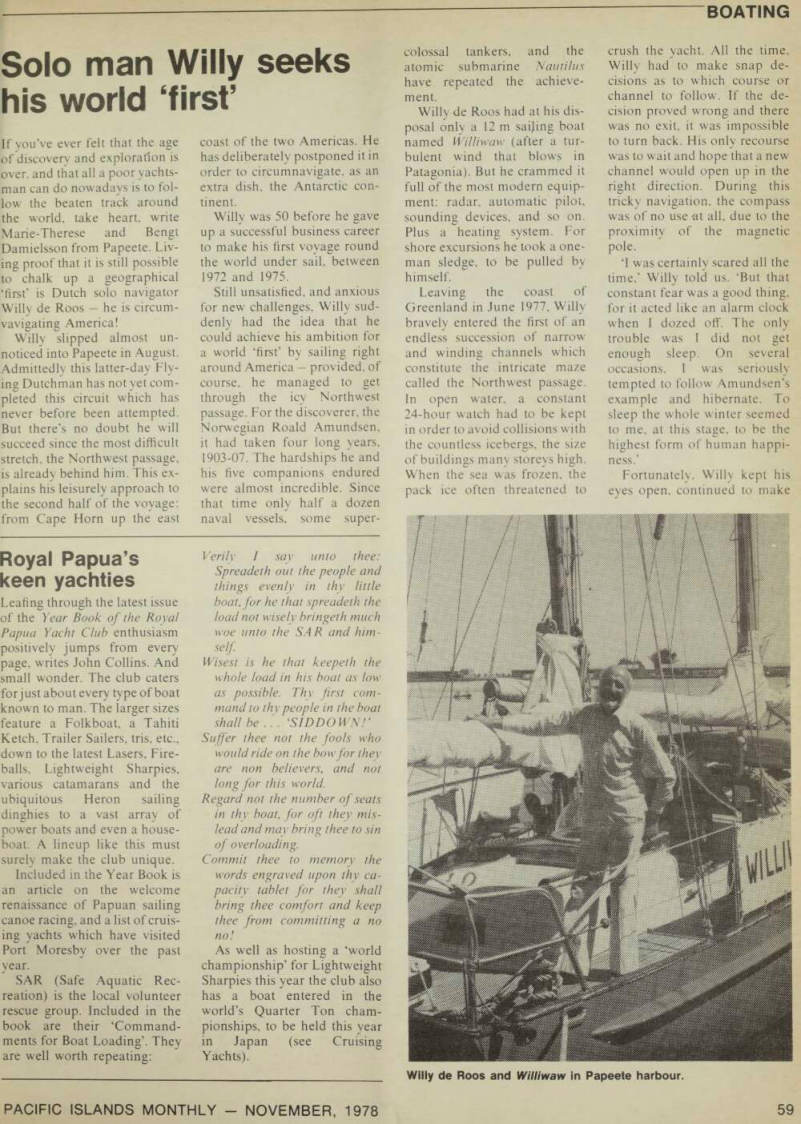
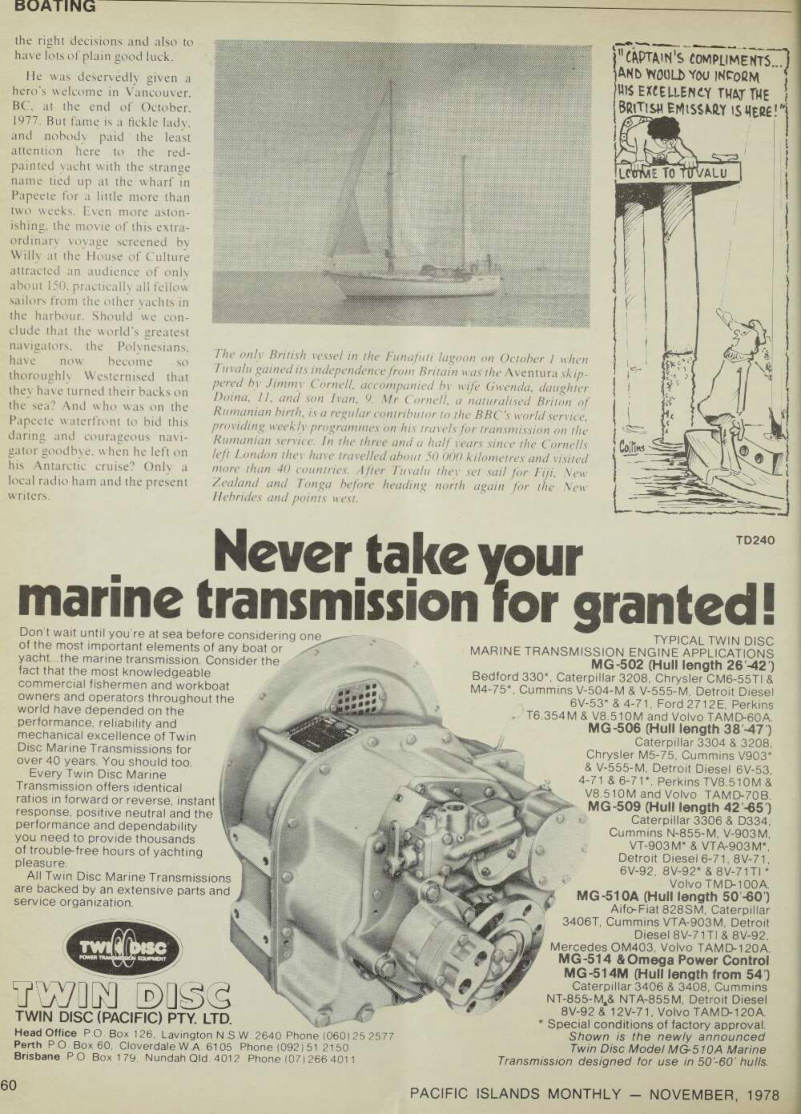
his world ‘first’
If you’ve ever felt that the age of discovery and exploration is over, and that all a poor yachts man can do nowadays is to fol low the beaten track around the world, take heart, write Marie-Therese and Bengt Damielsson from Papeete. Liv ing proof that it is still possible to chalk up a geographical ‘first’ is Dutch solo navigator Willy de Roos - he is circum
vavigating America!
Willy slipped almost un
noticed into Papeete in August.
Admittedly this latter-day Fly
ing Dutchman has not yet com pleted this circuit which has never before been attempted.
But there’s no doubt he will succeed since the most difficult stretch, the Northwest passage, is already behind him. This ex
plains his leisurely approach to
the second half of the voyage: from Cape Horn up the east
coast of the two Americas. He has deliberately postponed it in order to circumnavigate, as an extra dish, the Antarctic con tinent.
Willy was 50 before he gave up a successful business career to make his first voyage round the world under sail, between 1972 and 1975.
Still unsatisfied, and anxious for new challenges, Willy sud denly had the idea that he could achieve his ambition for a world ‘first’ by sailing right around America provided, of course, he managed to get
through the icy Northwest
passage. For the discoverer, the Norwegian Roald Amundsen, it had taken four long years. 1903-07. The hardships he and his five companions endured were almost incredible. Since that time only half a dozen naval vessels, some super
colossal tankers, and the atomic submarine Nautilus have repeated the achieve ment.
Willy de Roos had at his dis posal only a 12 m saving boat named Williwaw (after a tur bulent wind that blows in Patagonia). But he crammed it full of the most modern equip ment: radar, automatic pilot, sounding devices, and so on.
Plus a heating system. For shore excursions he took a one man sledge, to be pulled by himself.
Leaving the coast of Greenland in June 1977, Willy bravely entered the first of an endless succession of narrow and winding channels which constitute the intricate maze called the Northwest passage.
In open water, a constant 24-hour watch had to be kept in order to avoid collisions with the countless icebergs, the size of buildings many storeys high.
When the sea was frozen, the pack ice often threatened to
crush the yacht. All the time.
Willy had to make snap de cisions as to which course or channel to follow. If the de cision proved wrong and there was no exit, it was impossible to turn back. His only recourse was to wait and hope that a new channel would open up in the
right direction. During this
tricky navigation, the compass
was of no use at all. due to the
proximity of the magnetic
pole.
i was certainly scared all the time.’ Willy told us. ‘But that constant fear was a good thing, for it acted like an alarm clock when I dozed off. The only trouble was I did not get enough sleep. On several occasions, I was seriously tempted to follow Amundsen's example and hibernate. To sleep the whole winter seemed to me, at this stage, to be the highest form of human happi ness.’
Fortunately, Willy kept his
eyes open, continued to make
Willy de Roos and Williwaw in Papeete harbour.
the right decisions and also to have lots of plain good luck.
He was deservedly given a hero’s welcome in Vancouver, BC, at the end of October, 1977. But fame is a fickle lady, and nobody paid the least attention here to the red painted yacht with the strange name tied up at the wharf in Papeete for a little more than two weeks. Even more aston ishing, the movie of this extra
ordinary voyage screened by
Willy at the House of Culture attracted an audience of only about 150. practically all fellow sailors from the other yachts in the harbour. Should we con clude that the world’s greatest navigators, the Polynesians, have now become so thoroughly Westernised that they have turned their backs on the sea? And who was on the Papeete waterfront to bid this daring and courageous navi gator goodbye, when he left on his Antarctic cruise? Only a local radio ham and the present writers.
The only British vessel in the Funafuti lagoon on October I when Tuvalu gained its independence from Britain was the Aventura skip pered by Jimmy Cornell, accompanied by wife Gwenda, daughter Doina, 11, and son Ivan, 9. Mr Cornell, a naturalised Briton of Rumanian birth, is a regular contributor to the BBC's world service, providing weekly programmes on his travels for transmission on the Rumanian service. In the three and a half years since the Cornells left London they have travelled about 50 000 kilometres and visited more than 40 countries. After Tuvalu they set sail for Fiji, New Zealand and Tonga before heading north again for the New Hebrides and points west.
keen yachties
Royal Papua’s keen yachties
Leafing through the latest issue of the Year Book of the Royal Papua Yacht Club enthusiasm
positively jumps from every
page, writes John Collins. And small wonder. The club caters for just about every type of boat known to man. The larger sizes feature a Folkboat, a Tahiti Ketch. Trailer Sailers, tris, etc., down to the latest Lasers, Fire
balls, Lightweight Sharpies,
various catamarans and the
übiquitous Heron sailing
dinghies to a vast array of power boats and even a house boat. A lineup like this must surely make the club unique.
Included in the Year Book is an article on the welcome
renaissance of Papuan sailing
canoe racing, and a list of cruis ing yachts which have visited Port Moresby over the past year.
SAR (Safe Aquatic Rec reation) is the local volunteer rescue group. Included in the book are their ‘Command ments for Boat Loading’. They are well worth repeating;
Verily I say unto thee: Spreadeth out the people and
things evenly in thy little
boat, for he that spreadeth the load not wisely bringeth much woe unto the SAR and him
self.
Wisest is he that keepeth the whole load in his boat as low
as possible. Thy first com
mand to thy people in the boat shall be... ‘SID DOWN!’
Suffer thee not the fools who would ride on the bow for they are non believers, and not
long for this world.
Regard not the number of seats in thy boat, for oft they mis lead and may bring thee to sin
of overloading.
Commit thee to memory the words engraved upon thy ca pacity tablet for they shall
bring thee comfort and keep
thee from committing a no no!
As well as hosting a ‘world
championship’ for Lightweight
Sharpies this year the club also has a boat entered in the world’s Quarter Ton cham pionships, to be held this year in Japan (see Cruising Yachts).
Advertisements & other items, p. 60 (1 item)
marine transmission for granted!
Never take your
Dnn t wait i mtil i’
Don t wait until you’re at sea before considering one of the most important elements of any boat or yacht...the marine transmission. Consider the fact that the most knowledgeable commercial fishermen and workboat owners and operators throughout the world have depended on the performance, reliability and mechanical excellence of Twin Disc Marine Transmissions for over 40 years. You should too.
Every Twin Disc Marine Transmission offers identical ratios in forward or reverse, instant response, positive neutral and the performance and dependability you need to provide thousands of trouble-free hours of yachting pleasure.
All Twin Disc Marine Transmissions are backed by an extensive parts and service organization. m
■uwaKi Dm®
TWIN DISC (PACIFIC) PTY. LTD.
Head Office P.0.80x 126. Lavington N S.W .2640 Phone (060) 25 2577 Perth P.0.80x 60, Cloverdale W.A. 61 05 Phone (092)51 2150 Brisbane P.0.80x 179, Nundah Old. 4012 Phone (07) 266 4011 «» > V >■
TYPICAL TWIN DISC
MARINE TRANSMISSION ENGINE APPLICATIONS
MG-502 (Hull length 26 -42 ) Bedford 330*, Caterpillar 3208, Chrysler CM6-55T1 & M4-75*, Cummins V-504-M & V-555-M, Detroit Diesel 6V-53* & 4-71, Ford 2712 E, Perkins * T6.354M & V8.510M and Volvo TAMD-60A
MG-506 (Hull length 38-47)
Caterpillar 3304 & 3208, Chrysler M 5-75, Cummins V9o3* & V-555-M, Detroit Diesel 6V-53 4-71 & 6-71*, Perkins TVB.SIOM & V8.510M and Volvo TAMD-708 MG-509 (Hull length 42 -65 ) Caterpillar 3306 & D 334, Cummins N-855-M, V-903M,
VT-903M* & VTA-903M*,
Detroit Diesel 6-71, BV-71,
6V-92, BV-92* & BV-71TI *
Volvo TMD-100A.
MG-510A (Hull length 50 -60 ) Aifo-Fiat 828 SM, Caterpillar 3406 T, Cummins VTA-903M, Detroit Diesel BV-71TI & BV-92, Mercedes 0M403, Volvo TAMD-120A.
MG-514 & Omega Power Control MG-514M (Hull length from 54 ) Caterpillar 3406 & 3408, Cummins NT-855-M 4 & NTA-855M, Detroit Diesel BV-92 & 12V-71, Volvo TAMD-120A. * Special conditions of factory approval.
Shown is the newly announced Twin Disc Model MG-510A Marine Transmission designed for use in 50-60' hulls.
Cruising
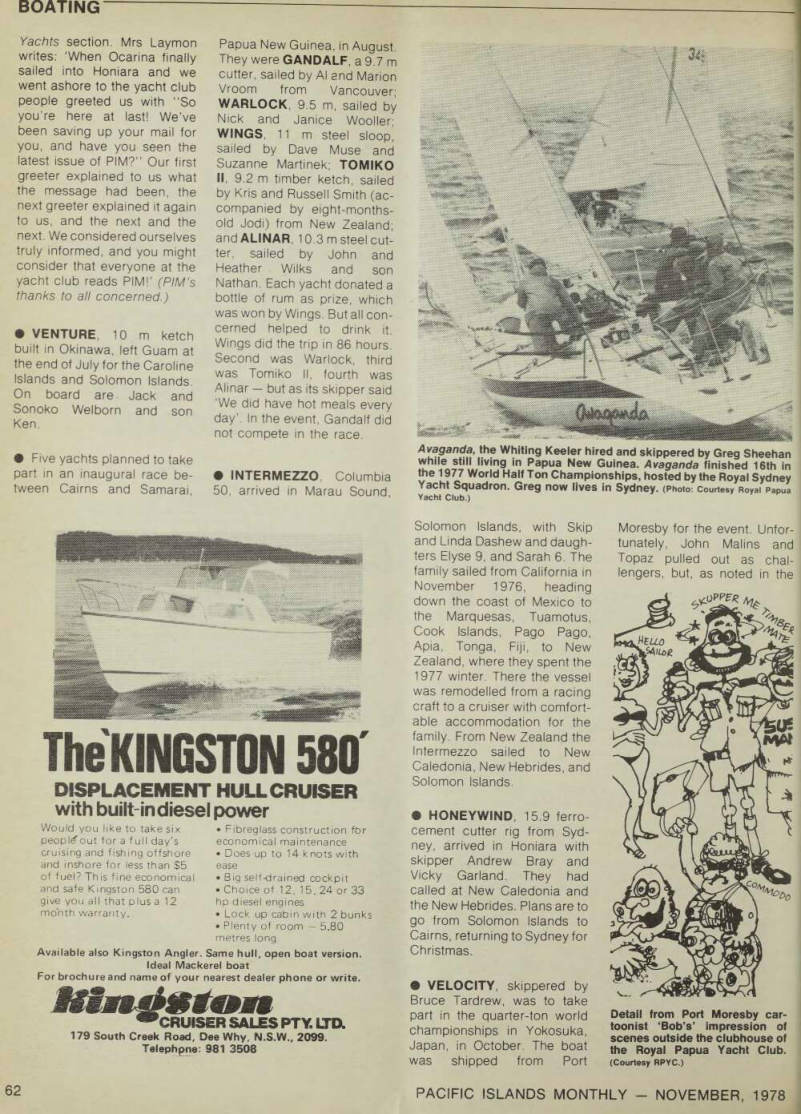
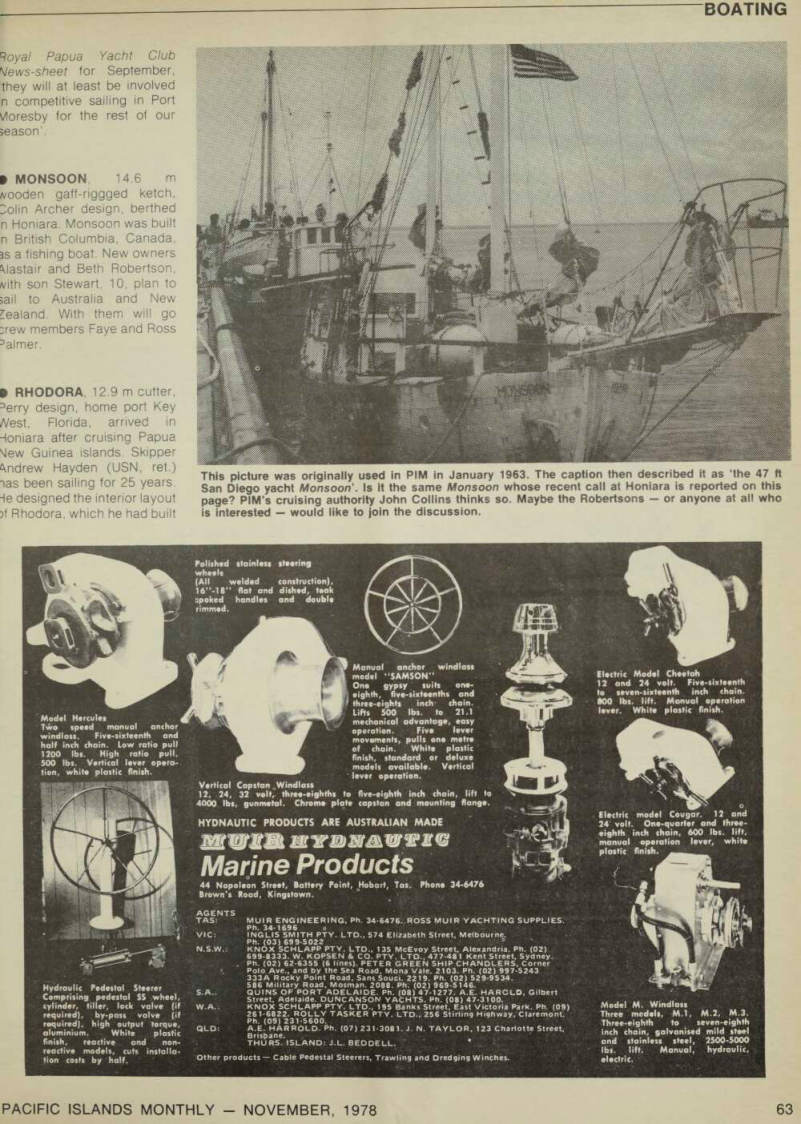
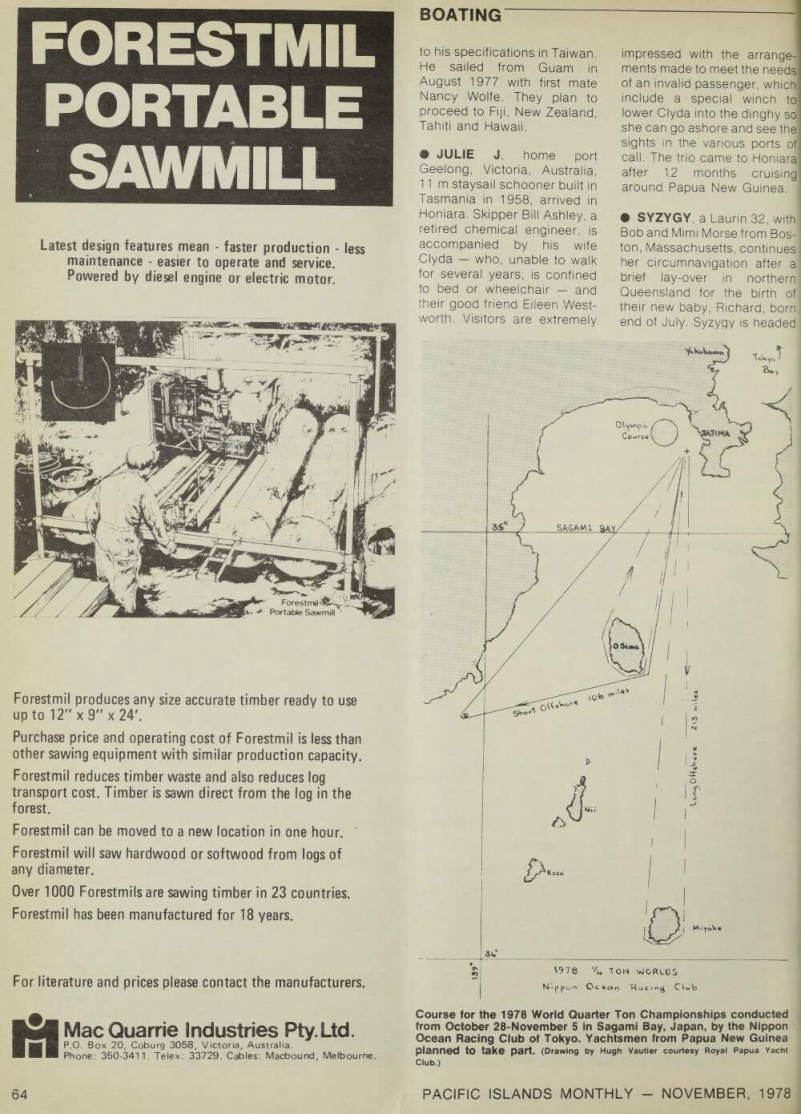
Yachts
» CHALYBIS, 10.4 m Temp :ress sloop, was outfitted for cruising in Townsville, Aus xalia, by Mervyn Flynn and his wife Rosemary. Mervyn sailed ;o Cairns, through the _ouisiades to Papua New Suinea and Solomon Islands.
It was an outrageous trip,’ he said. ‘lf a taxi had come by I’d lave gladly taken it.’ Ken A/retham, underwater photo grapher, joined the Chalybis in Honiara. The two men plan to jo extensive diving and pho ©graphing of World War II elics, sunken ships and ighter planes. • KLARABORG registered n Gothenborg, Sweden, and :hought to be the oldest work ng sailboat in the world, arrived in Marau Sound, Solomon Islands. Built in the 1850 s, Klaraborg is 36.6 m ong, has a beam of 6.9 m and a 2.6 m draft. She is a gaff- Igged ketch, displacement 120 tonnes. Ove and Jan Lin cer bought the Klaraborg in 1965 in Sweden, where she nad fallen into disuse from her days as a cargo freighter. They spent two years remodelling ner into a passenger ship with comfortable accommodation for 16 people. > KARLOO, 9.14 m Water witch class sloop, with owners Beoffrey and Ruth Goodman, arrived at Bundaberg, Queensland, on July 11 after an absence from Australia of seven and a half years, spent cruising around the islands in :he South-west Pacific. On eaving Suva, Fiji at the end of :he last cyclone season they nad a fast passage to the New Hebrides and stayed in Vila for a month. Then followed a very slow passage, with light head winds or no wind at all. to New Caledonia, where prolonged
westerlies delayed their planned early departure for Australia. More light head winds made the final stage from Noumea to Bundaberg another leisurely one. For the next few months the Good mans will be renewing ac quaintance with friends and anchorages on the Queens land coast. The Goodmans feel that yachtsmen bound for Australia could well consider making Bundaberg their port of entry. The Burnett River is a convenient and safe place for arrival, and the city of Bun daberg, 10 nautical miles up the river, has good anchorage and facilities. • VIVALDI, 17 m yawl built in Sydney, is the only yacht registered in Solomon Islands.
Roy and Margaret Clement left Sydney in September 1975 and sailed to Honiara. Roy is stationed in Solomon Islands, and does all the pleasure cruising he can find time for.
Fulltime crewman is Thomas Teago, from the Santa Cruz group. Roy is extremely proud of his newly installed Decca radar. • WINDSON 22.3 m steel ketch from Savannah, Geor gia, arrived in Marau Sound, Solomon Islands, with Jim and Cheryl Schmidt. The Dutch built Windson left the US east coast in December 1976, and sailed to the Bahamas, through the Panama Canal to the Galapagos, Tuamotus, American Samoa, Fiji, to New Zealand, where Jim’s brother Tom joined the vessel. They then proceeded to the New Hebrides and Solomon Islands. The brothers are div ing enthusiasts and plan some serious diving in Solomon Islands. Later in the year they plan to sail to Truk to explore wrecked ships. • OCARINA departed Honiara in early September for Kieta, Rabaul and Madang, Papua New Guinea. Among those on board is Mrs Roderica Laymon to whom PIM August addressed a message in the Cruising
Yachts section. Mrs Laymon writes; ‘When Ocarina finally sailed into Honiara and we went ashore to the yacht club people greeted us with “So you’re here at last! We’ve been saving up your mail for you, and have you seen the latest issue of PlM?’’ Our first greeter explained to us what the message had been, the next greeter explained it again to us, and the next and the next. We considered ourselves truly informed, and you might consider that everyone at the yacht club reads PIM!’ (PlM’s thanks to all concerned.) • VENTURE, 10 m ketch built in Okinawa, left Guam at the end of July for the Caroline Islands and Solomon Islands.
On board are Jack and Sonoko Welborn and son Ken. • Five yachts planned to take part in an inaugural race be tween Cairns and Samarai,
Papua New Guinea, in August.
They were GANDALF, a 9.7 m cutter, sailed by Al and Marion Vroom from Vancouver; WARLOCK, 9.5 m, sailed by Nick and Janice Wooller; WINGS, 11 m steel sloop, sailed by Dave Muse and Suzanne Martinek; TOMIKO 11, 9.2 m timber ketch, sailed by Kris and Russell Smith (ac companied by eight-months old Jodi) from New Zealand; and ALINAR 10.3 m steel cut ter, sailed by John and Heather Wilks and son Nathan. Each yacht donated a bottle of rum as prize, which was won by Wings. But all con cerned helped to drink it.
Wings did the trip in 86 hours.
Second was Warlock, third was Tomiko 11, fourth was Alinar but as its skipper said ‘We did have hot meals every day’. In the event, Gandalf did not compete in the race. • INTERMEZZO, Columbia 50, arrived in Marau Sound,
Solomon Islands, with Skip and Linda Dashew and daugh ters Elyse 9, and Sarah 6. The family sailed from California in November 1976, heading down the coast of Mexico to the Marquesas, Tuamotus, Cook Islands, Pago Pago, Apia, Tonga, Fiji, to New Zealand, where they spent the 1977 winter. There the vessel was remodelled from a racing craft to a cruiser with comfort able accommodation for the family. From New Zealand the Intermezzo sailed to New Caledonia, New Hebrides, and Solomon Islands. • HONEYWIND. 15.9 ferro cement cutter rig from Syd ney, arrived in Honiara with skipper Andrew Bray and Vicky Garland. They had called at New Caledonia and the New Hebrides. Plans are to go from Solomon Islands to Cairns, returning to Sydney for Christmas. • VELOCITY, skippered by Bruce Tardrew, was to take part in the quarter-ton world championships in Yokosuka, Japan, in October. The boat was shipped from Port
Moresby for the event. Unfor tunately, John Malins and Topaz pulled out as chal lengers, but, as noted in the
Avaganda, the Whiting Keeler hired and skippered by Greg Sheehan while still living in Papua New Guninea. Avaganda finished 16th in the 1977 World Half Ton Championships, hosted by the Royal Sydney Yacht Squadron. Greg now lives in Sydney. (Photo: courtesy Royal Papua Yacht Club.)
Detail from Port Moresby car toonist ‘Bob’s’ impression of scenes outside the clubhouse of the Royal Papua Yacht Club. (Courtesy RPYC.)
Poya/ Papua Yacht Club News-sheet for September, they will at least be involved n competitive sailing in Port yioresby for the rest of our season’.
> Monsoon 14 6 M
/vooden gaff-riggged ketch, Oolin Archer design, berthed n Honiara. Monsoon was built n British Columbia, Canada, as a fishing boat. New owners Mastair and Beth Robertson, vith son Stewart, 10, plan to sail to Australia and New Zealand. With them will go srew members Faye and Ross 3 almer. • RHODORA, 12.9 m cutter, 3 erry design, home port Key /Vest, Florida, arrived in Honiara after cruising Papua Mew Guinea islands. Skipper Hayden (DSN, ret.) las been sailing for 25 years.
He designed the interior layout )f Rhodora, which he had built
This picture was originally used in PIM in January 1963. The caption then described it as the 47 ft San Diego yacht Monsoon '. Is it the same Monsoon whose recent call at Honiara is reported on this page? PIM'S cruising authority John Collins thinks so. Maybe the Robertsons-or anyone at all who is interested - would like to join the discussion.
to his specifications in Taiwan.
He sailed from Guam in August 1977 with first mate Nancy Wolfe. They plan to proceed to Fiji, New Zealand, Tahiti and Hawaii. • JULIE J, home port Geelong, Victoria, Australia, 11 m staysail schooner built in Tasmania in 1958, arrived in Honiara. Skipper Bill Ashley, a retired chemical engineer, is accompanied by his wife Clyda who, unable to walk for several years, is confined to bed or wheelchair and their good friend Eileen West worth. Visitors are extremely
impressed with the arrange ments made to meet the needsj of an invalid passenger, which include a special winch to lower Clyda into the dinghy so she can go ashore and see the sights in the various ports of call. The trio came to Honiara after 1.2 months cruising around Papua New Guinea. 1 • SYZYGY, a Laurin 32, with] Bob and Mimi Morse from Bos ton, Massachusetts, continues her circumnavigation after a I brief lay-over in northern Queensland for the birth of their new baby, Richard, born end of July. Syzygy is headed 1
Course for the 1978 World Quarter Ton Championships conducted from October 28-November 5 in Sagami Bay, Japan, by the Nippon Ocean Racing Club of Tokyo. Yachtsmen from Papua New Guinea planned to take part. (Drawing by Hugh Vautier courtesy Royal Papua Yacht Club.)
or Bali, en route for the Medi erranean. The Morses will hen hurry back to Boston vhere Bob must resume his eaching job. ■ MORTAIL custom-built 2.5 m trimaran, was in Fiji Lautoka-based) in September i/ith owner-skipper Guy teach and crew, Nick Gaze England), and Joanie Harvey md Pierre Belanger, both of Canada. San Francisco egistered Mortail left Florida in March 1, 1977, sailing Trough the Panama Canal for to South Pacific. She was two /eeks in the Galapagos and nen made a 26-day passage 3 the Marquesas. After three Tenths in French Polynesia dortail spent the hurricane eason in Samoan waters and Ten three months in Tonga iefore making for Fiji. Captain teach plans to leave for New iealand in October. The rest ; uncertain, but Guy is con idering two possibilities a
voyage to the New Hebrides and Australia or through Indonesia. ‘‘lt’s a strange situ ation and a wild occupation, living your life like a song,” writes Guy to PIM. • SONGEUR, 7 m Achilles type craft, was in Rarotonga in August. Solo sailor owner Rodney Vendail left his English home port in 1976 for the USA, West Indies, Galapagos, French Poly nesia and the Cooks. On departure he headed for New Zealand. • REINGA, 7 m Achilles type craft, called at Raro tonga in August. With her crew of two skipper owner Dmitri Zotov and Sue Dunford she had come from England via Spain, Portugal, Madeira, West Indies, Galapagos, Mar quesas, and Tahiti. She left the Cooks for New Zealand.
• Summer Wind 23 M
Rhodes steel ketch, Miami registered, was in Raro tonga in August. On board, were owner Gerry Hood, skipper Robert Lad Rod man, four more Rodmans Karen, Greg, Gail and Sum mer and Nat Hanison and Dexter Baum. Summer Wind quit the Cooks for Moorea.
• Wanderlust, 17 M
craft, was in Rarotonga in September. She had come from Acapulco, Mexico via the Marquesas and Tahiti.
With owner Henry Stine on board were skipper Steve Carter and crew members Nadja Sayovic, Mitch Terkildsen, Scott Hendrick son, Marie Hendrickson, Suzie Johnstone, Martin Howe and Lorea Chilton.
Wanderlust left Rarotonga for Tonga and New Zealand. • lONA, of 9 m, home port
San Francisco, was in Raro tonga in September. With owner-skipper Y. Leßoux were crew members Lon Bubeck and Jean-Marie Pare. She left for Niue. • ISATIS, 9 m craft of Romance type, designed by Philippe Harlet, was in Rarotonga in * September.
On arrival her crew com prised owner-skipper Jean Lescure, Mme Claudin Les cure, Rebecca Lee and Jean-Marie Pare (who later transferred to Iona). Isatis had sailed from her home port of La Rochelle, France, to England, crossed the Atlantic, and after passing through the Panama Canal, visited Alaska and the Marquesas. • ATRIA, a 9 m, Golden Hind type craft, was in Raro tonga in September.
Owner-skipper James Stamps was accompanied by Roslyn Woodhead.
Advertisements & other items, pp. 61-65 (4 items)
Boating
yachting
Send now
for
Australia’s most
comprehensive
yachting
and power Boat
accessories
catalogue.
• OVER 3000 PRODUCTS
• BUY DIRECT FROM CATALOGUE BY MAIL
OR FROM OUR LARGE RETAIL OUTLET.
30 DAY RETURN PRIVILEGE. If any item does not fit, is not as expected, or even if you have simply changed your mind, you may return it within 30 days for full refund or exchange.
WHITWORTH’S
NAUTICAL WORLD
38 Green Street, Brookvale (eastern carpark Warringah Mall) Telephone 939 1055
p ™ COUPON "
•X" Please send $2 in stamps to cover handling and airmail.
X V-USTR4Z^
C 4MloG^
I Please send me your catalogue by r / enclose $2 in stamps to cover ban Whitworths Nautical World. 38 Green S Brookvale. NSW Australia. 2100.
.P/CODE
3377/PI
The KINGSTON 580
DISPLACEMENT HULL CRUISER
with built-in diesel power
Would you like to take six people out for a full day's cruising and fishing offshore and inshore for less than $5 of fuel? This fine economical and safe Kingston 580 can give you all that plus a 12 month warranty. • Fibreglass construction for economical maintenance • Does up to 14 knots with ease • Big self-drained cockpit • Choice of 12, 15, 24 or 33 hp diesel engines • Lock up cabin with 2 bunks • Plenty of room 5.80 metres long Available also Kingston Angler. Same hull, open boat version.
Ideal Mackerel boat For brochure and name of your nearest dealer phone or write.
lICSB 6AI EC
CRUISER SALES PTY LTD.
179 South Creek Road, Dee Why, N.S.W., 2099.
Telephone: 981 3508
Model Hercules Two speed manual anchor windlass. Five-sixteenth and half inch chain. Low ratio pull 1200 lbs. High ratio pull, 500 lbs. Vertical lever operation, white plastic finish.
Hydraulic Pedestal Steerer Comprising pedestal SS wheel, cylinder, tiller, lock valve (if required), by-pass valve (if required), high output torque, aluminium. White plastic finish, reactive and nonreactive models, cuts installation costs by half.
Polished stainless steering wheels (All welded construction), 16"-18" flat and dished, teak spoked handles and double rimmed.
Manual anchor model “SAMSON"
One gypsy suits oneeighth, five-sixteenths and three-eights inch- chain.
Lifts 500 lbs. to 21.1 ** mechanical advantage, easy operation. Five lever movements, pulls one metre of chain. White plastic finish, standard or deluxe models available. Vertical lever operation.
Vertical Capstan „ Windlass 12, 24, 32 volt,, three-eighths to five-eighth inch chain, lift to 4000 lbs, gunmetal. Chrome plate capstan and mounting flange.
HYDNAUTIC PRODUCTS ARE AUSTRALIAN MADE
Marine Products
44 Napoleon Street, Battery Point, Hobart, Tas. Phone 34-6476 Brown's Road, Kingstown. t Electric Model Cheetah 12 and 24 volt. Five-sixteenth to seven-sixteenth inch chain. 800 lbs. lift. Manual operation lever. White plastic finish.
AGENTS
TAS:
MUIR ENGINEERING, Ph, 34-6476. ROSS MUIR YACHTING SUPPLIES.
Ph. 34-1696 o INGLIS SMITH PTY. LTD., 574 Elizabeth Street, Melbourne.
Ph. (03) 699-5022 KNOX SCHLAPP PTY. LTD., 135 McEvoy Street, Alexandria. Ph. (02) 699-8333. W. KOPSEN & CO. PTY. LTD., 477-481 Kent Street, Sydney.
Ph. (02) 62-6355 (6 lines). PETER GREEN SHIP CHANDLERS. Corner Polo Awe., and by the Sea Road, Mona Vale. 2103. Ph. (02) 997-5243 333 A Rocky Point Road, Sans Souci. 2219. Ph. (02) 529-9534. 586 Military Road, Mosman. 2088. Ph. (02) 969-5146.
QUINS OF PORT ADELAIDE. Ph. (08) 47-1277. A.E. HAROLD, Gilbert Street, Adelaide. DUNCANSON YACHTS. Ph. (08) 47-3100.
KNOX SCHLAPP PTY. LTD., 195 Banks Street, East Victoria Park. Ph (09) 261-6822. ROLLY TASKER PTY. LTD., 256 Stirling Highway, Claremont.
Ph. (09) 231-5600.
QLD: A.E. HARROLD. Ph. (07) 231-3081. J. N. TAYLOR, 123 Charlotte Street.
Brisbane.
THURS. ISLAND: J.L. BEDDELL. *
Other products— Cable Pedestal Steerers, Trawling and Dredging Winches.
VIC:
N.S.W.:
S.A..
W.A.
Electric model Cougar. 12 and 24 volt. One-quarter and threeeighth inch chain, 600 lbs. lift, manual operation lever, white plastic finish. \ Model M. Windlass Three models, M.l, M. 2, M. 3.
Three-eighth to seven-eighth inch chain, galvanised mild steel and stainless steel, 2500-5000 lbs. lift. Manual, hydraulic, electric.
Latest design features mean - faster production - less maintenance - easier to operate and service.
Powered by diesel engine or electric motor. /> •U . tlr\ 3 Forestmil st- •*■ Portable Sawmill Forestmil produces any size accurate timber ready to use up to 12"x9"x24'.
Purchase price and operating cost of Forestmil is less than other sawing equipment with similar production capacity.
Forestmil reduces timber waste and also reduces log transport cost. Timber is sawn direct from the log in the forest.
Forestmil can be moved to a new location in one hour.
Forestmil will saw hardwood or softwood from logs of any diameter.
Over 1000 Forestmils are sawing timber in 23 countries.
Forestmil has been manufactured for 18 years.
For literature and prices please contact the manufacturers. ft
MacQuarrie Industries Pty.Ltd.
P.O. Box 20, Coburg 3058, Victoria, Australia.
Phone: 350-3411. Telex: 33729. Cables: Macbound, Melbourne.
INTRODUCING FRIGID’S New Range of Assemble-Yourself
Walk-In Aluminium Freezer & Cooler Storage Rooms Hundreds already installed. Now with attractive timber grain aluminium exterior finish, (rust-proof) with white vinyl interior finish.
Frigid Foam Polyurethane insulation. 2" in cooler storage rooms is equal to 5" polystyrene foam. 3" in freezer storage rooms is equal to 8” polystyrene foam. Lower running costs. Best insulation available. Thin wall construction. Save in freight costs. Room sizes from 90 cubic feet (2 1 /2 m 3) to 930 cubic feet (25 1 /2 m 3).
Supplied in easy-to-erect, do-it-yourself form Assemble, plug it in, and have it in operation in under eight hours!
Manufactured by:
FRIGID CABINETS PTY. LTD.
14a Duffy Ave., Thornleigh, N.S.W. Aust. 2120. Ph. 848 8292.
T 1
AVAILABLE FROM:
AUSTRALIA NEW CALEDONIA EXPORTS, 363 George St., Sydney 2000. BRECKWOLDT & CO., G.P.O. Box 5027, Sydney 2001. HAGEMEYER (A'ASIA), 59 Anzac Pde., Kensington 2033. GEOFFREY HUGHES & CO 167 Macquarie St., Sydney 2000. NELSON & ROBERTSON PTY. LTD., 197 Clarence St. Sydney 2000. E RABOT (EXPORTS) PTY. LTD., 67 Castlereagh St., Sydney 2000. RABTRAD NIUGIN I PTY. LTD., P.O. Box 1406 Lae A. RIETTE (PACIFIC) PTY. LTD., 20 Loftus St., Sydney 2000. C. SULLIVAN (EXPORT) PTY. LTD. G.P.O. Box 3373, Sydney 2001. W.S. TAIT & CO. PTY. LTD., 31 Macquarie Place, Sydney 2000
Boating
65
BOATING
ACIFIC ISLANDS MONTHLY - NOVEMBER. 1978
Towards A South
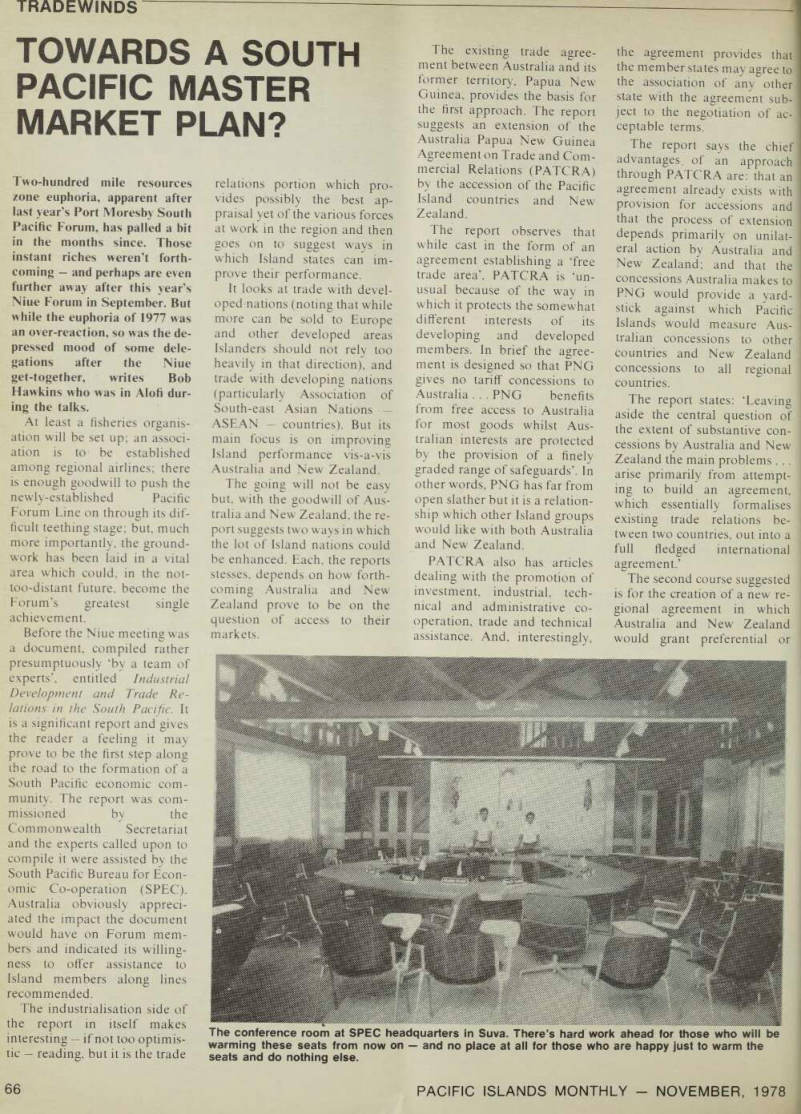
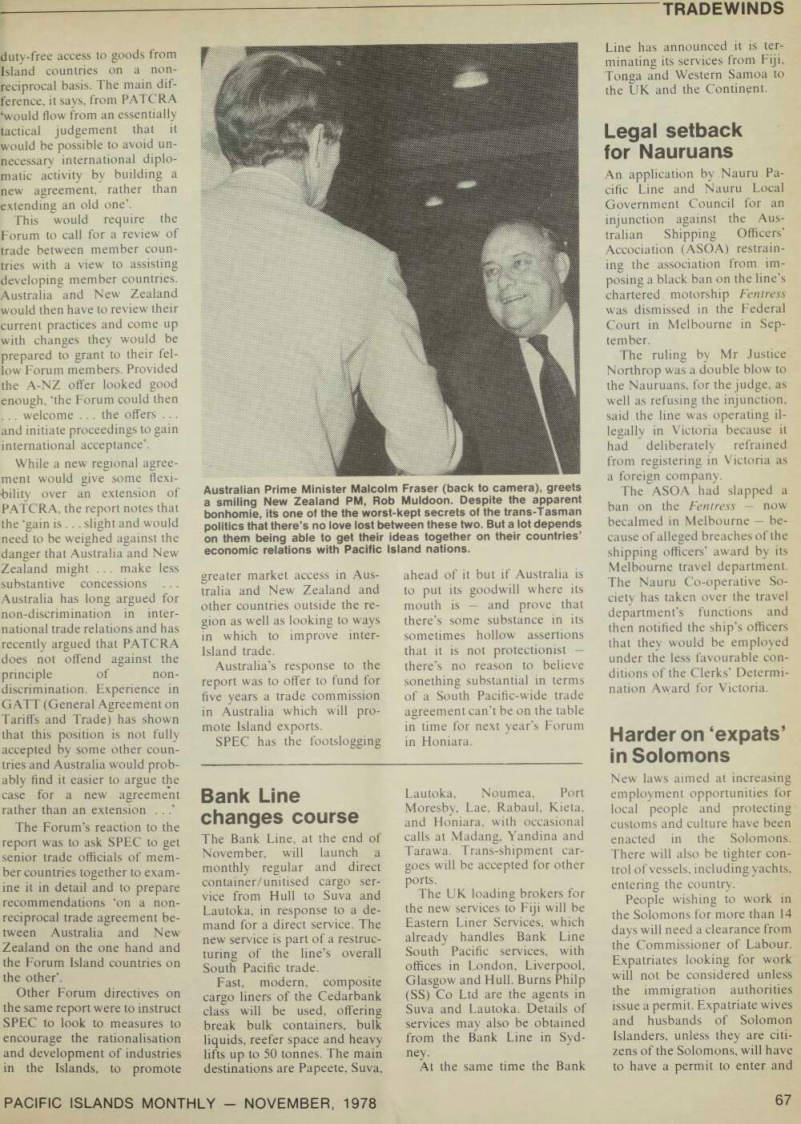
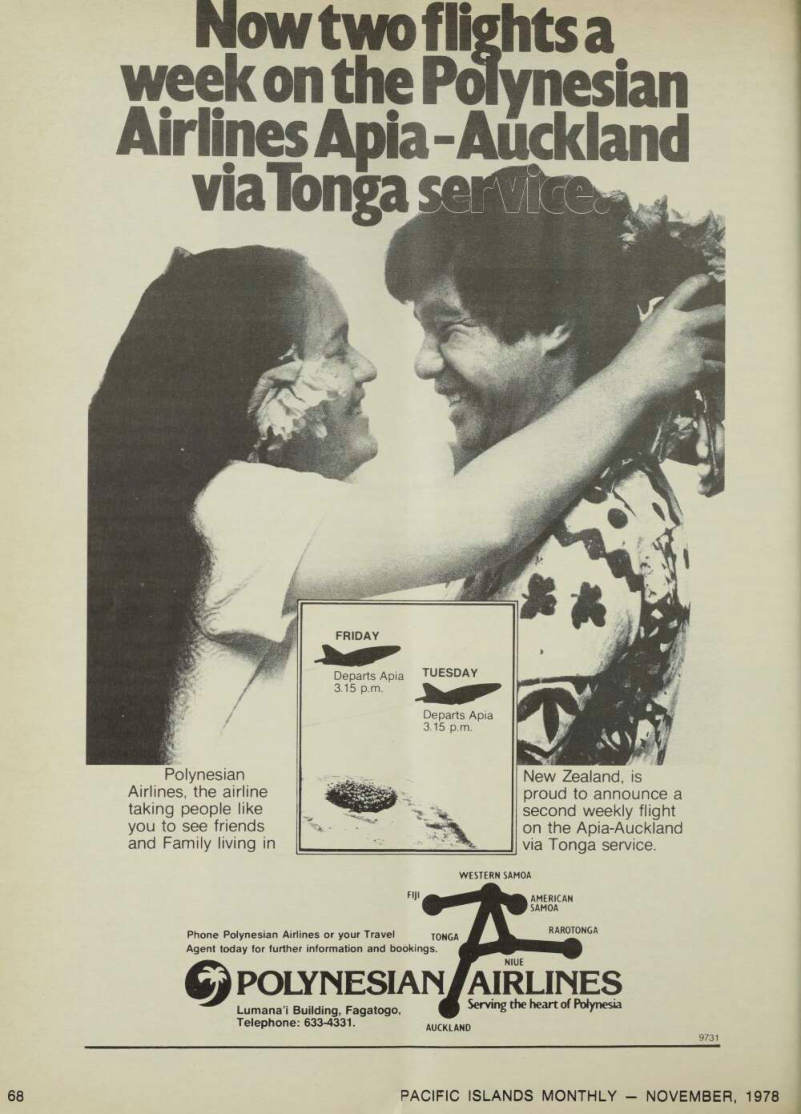
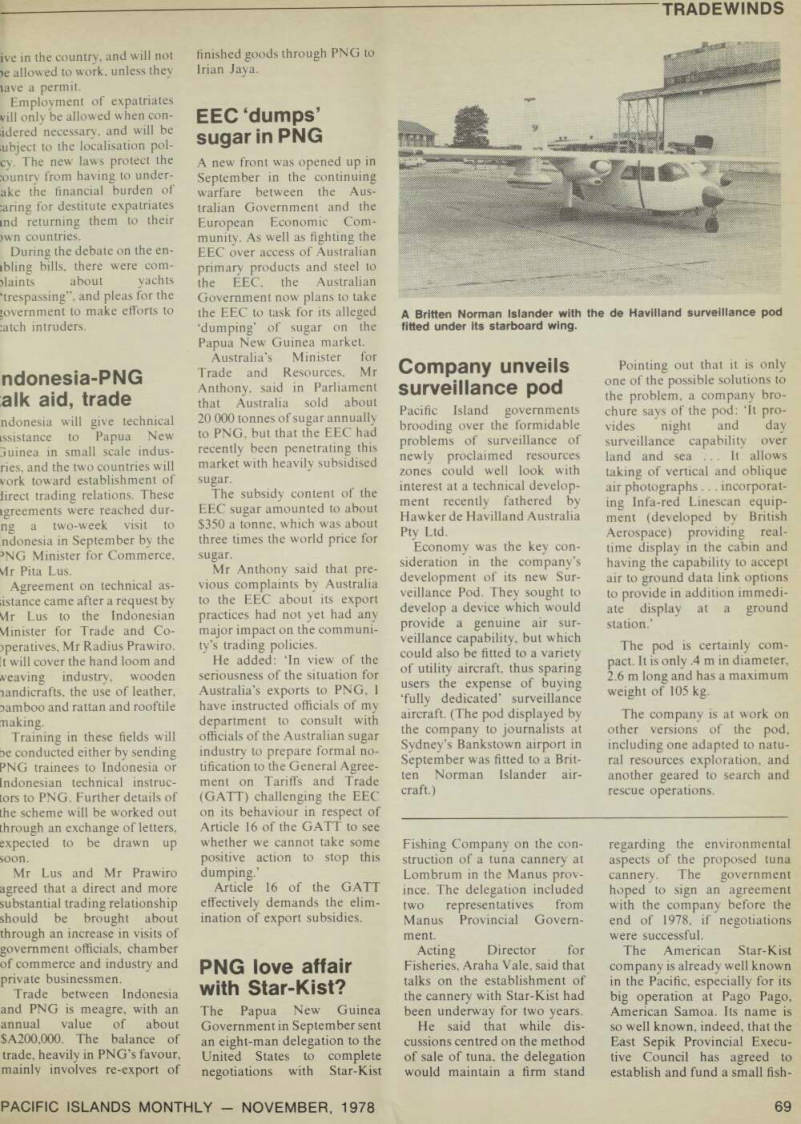
Tradewinds
Pacific Master
Market Plan?
Two-hundred mile resources zone euphoria, apparent after last year’s Port Moresby South Pacific Forum, has palled a bit in the months since. Those instant riches weren’t forth coming and perhaps are even further away after this year's Niue Forum in September. But while the euphoria of 1977 was an over-reaction, so was the de pressed mood of some dele gations after the Niue get-together, writes Bob Hawkins who was in Alofi dur ing the talks.
At least a fisheries organis ation will be set up; an associ ation is to be established among regional airlines; there is enough goodwill to push the
newly-established Pacific
Forum Line on through its dif ficult teething stage; but, much more importantly, the ground work has been laid in a vital area which could, in the not too-distant future, become the Forum’s greatest single achievement.
Before the Niue meeting was a document, compiled rather presumptuously ‘by a team of experts’, entitled Industrial Development and Trade Re lations in the South Pacific. It is a significant report and gives the reader a feeling it may prove to be the first step along the road to the formation of a South Pacific economic com munity. The report was com missioned by the Commonwealth Secretariat and the experts called upon to compile it were assisted by the South Pacific Bureau for Econ omic Co-operation (SPEC).
Australia obviously appreci ated the impact the document would have on Forum mem bers and indicated its willing ness to offer assistance to Island members along lines recommended.
The industrialisation side of the report in itself makes interesting if not too optimis tic reading, but it is the trade
relations portion which pro vides possibly the best ap praisal yet of the various forces at work in the region and then goes on to suggest ways in which Island states can im prove their performance.
It looks at trade with devel oped nations (noting that while more can be sold to Europe and other developed areas Islanders should not rely too heavily in that direction), and trade with developing nations (particularly Association of South-east Asian Nations - ASEAN countries). But its main focus is on improving Island performance vis-a-vis Australia and New Zealand.
The going will not be easy but, with the goodwill of Aus tralia and New Zealand, the re port suggests two ways in which the lot of Island nations could be enhanced. Each, the reports stesses, depends on how forth coming Australia and New Zealand prove to be on the question of access to their markets.
The existing trade agree ment between Australia and its former territory, Papua New Guinea, provides the basis for the first approach. The report suggests an extension of the Australia Papua New Guinea Agreement on Trade and Com mercial Relations (PATCRA) by the accession of the Pacific Island countries and New Zealand.
The report observes that while cast in the form of an agreement establishing a ‘free trade area’. PATCRA is ‘un usual because of the way in which it protects the somewhat different interests of its
developing and developed
members. In brief the agree ment is designed so that PNG gives no tariff concessions to Australia . . . PNG benefits from free access to Australia for most goods whilst Aus tralian interests are protected by the provision of a finely graded range of safeguards’. In other words, PNG has far from open slather but it is a relation ship which other Island groups would like with both Australia and New Zealand.
PATCRA also has articles dealing with the promotion of investment, industrial, tech nical and administrative co operation, trade and technical assistance. And, interestingly.
the agreement provides that the member states may agree to the association of any other] state with the agreement sub-1 ject to the negotiation of ac ceptable terms.
The report says the chief advantages, of an approach i through PATCRA are; that an agreement already exists with provision for accessions and that the process of extension
depends primarily on unilat
eral action by Australia and New Zealand; and that the concessions Australia makes to PNG would provide a yard stick against which Pacific j Islands would measure Aus tralian concessions to other countries and New Zealand concessions to all regional countries.
The report states: ‘Leaving aside the central question of the extent of substantive con cessions by Australia and New Zealand the main problems ... arise primarily from attempt ing to build an agreement, which essentially formalises existing trade relations be tween two countries, out into a full fledged international agreement.’
The second course suggested is for the creation of a new re gional agreement in which Australia and New Zealand would grant preferential or
The conference room at SPEC headquarters In Suva. There’s hard work ahead for those who will be warming these seats from now on-and no place at all for those who are happy just to warm the seats and do nothing else.
duty-free access to goods from Island countries on a non reciprocal basis. The main dif ference, it says, from PATCRA ‘would flow from an essentially tactical judgement that it would be possible to avoid un necessary international diplo matic activity by building a new agreement, rather than extending an old one’.
This would require the Forum to call for a review of trade between member coun tries with a view to assisting developing member countries.
Australia and New Zealand would then have to review their current practices and come up with changes they would be prepared to grant to their fel low Forum members. Provided the A-NZ offer looked good enough, ‘the Forum could then ... welcome ... the offers ... and initiate proceedings to gain
international acceptance’.
While a new regional agree ment would give some flexi bility over an extension of PATCRA, the report notes that the ‘gain is ... slight and would need to be weighed against the danger that Australia and New Zealand might ... make less substantive concessions Australia has long argued for non-discrimination in inter national trade relations and has
recently argued that PATCRA
does not offend against the principle of non discrimination. Experience in GATT (General Agreement on Tariffs and Trade) has shown that this position is not fully accepted by some other coun tries and Australia would prob ably find it easier to argue the case for a new agreement rather than an extension . . .’
The Forum’s reaction to the report was to ask SPEC to get senior trade officials of mem ber countries together to exam ine it in detail and to prepare recommendations ‘on a non reciprocal trade agreement be tween Australia and New Zealand on the one hand and the Forum Island countries on the other’.
Other Forum directives on the same report were to instruct SPEC to look to measures to encourage the rationalisation and development of industries in the Islands, to promote
greater market access in Aus tralia and New Zealand and other countries outside the re gion as well as looking to ways in which to improve inter island trade.
Australia’s response to the report was to offer to fund for five years a trade commission in Australia which will pro mote Island exports.
SPEC has the footslogging
ahead of it but if Australia is to put its goodwill where its mouth is and prove that there’s some substance in its sometimes hollow assertions that it is not protectionist there’s no reason to believe sonething substantial in terms of a South Pacific-wide trade agreement can’t be on the table in time for next year’s Forum in Honiara.
Bank Line
changes course
The Bank Line, at the end of November, will launch a
monthly regular and direct
container/unitised cargo ser vice from Hull to Suva and Lautoka, in response to a de mand for a direct service. The new service is part of a restruc turing of the line’s overall South Pacific trade.
Fast, modern, composite cargo liners of the Cedarbank class will be used, offering break bulk containers, bulk liquids, reefer space and heavy lifts up to 50 tonnes. The main destinations are Papeete, Suva,
Lautoka, Noumea, Port Moresby, Lae, Rabaul, Kieta, and Honiara, with occasional calls at Madang, Yandina and Tarawa. Trans-shipment car goes will be accepted for other ports.
The UK loading brokers for the new services to Fiji will be Eastern Liner Services, which already handles Bank Line South Pacific services, with offices in London, Liverpool, Glasgow and Hull. Burns Philp (SS) Co Ltd are the agents in Suva and Lautoka. Details of services may also be obtained from the Bank Line in Syd ney.
At the same time the Bank
Line has announced it is ter minating its services from Fiji, Tonga and Western Samoa to the UK and the Continent.
Legal setback
for Nauruans
An application by Nauru Pa cific Line and Nauru Local Government Council for an
injunction against the Aus
tralian Shipping Officers’
Accociation (ASOA) restrain ing the association from im posing a black ban on the line’s chartered motorship Fentress was dismissed in the Federal Court in Melbourne in Sep tember.
The ruling by Mr Justice Northrop was a double blow to the Nauruans, for the judge, as well as refusing the injunction, said the line was operating il legally in Victoria because it had deliberately refrained from registering in Victoria as a foreign company.
The ASOA had slapped a ban on the Fentress now becalmed in Melbourne be cause of alleged breaches of the shipping officers’ award by its Melbourne travel department.
The Nauru Co-operative So ciety has taken over the travel department’s functions and then notified the ship’s officers that they would be employed under the less favourable con ditions of the Clerks’ Determi nation Award for Victoria.
Harder on ‘expats’
in Solomons
New laws aimed at increasing
employment opportunities for
local people and protecting
customs and culture have been enacted in the Solomons.
There will also be tighter con trol of vessels, including yachts, entering the country.
People wishing to work in the Solomons for more than 14 days will need a clearance from the Commissioner of Labour.
Expatriates looking for work
will not be considered unless the immigration authorities issue a permit. Expatriate wives and husbands of Solomon Islanders, unless they are citi zens of the Solomons, will have to have a permit to enter and
Australian Prime Minister Malcolm Fraser (back to camera), greets a smiling New Zealand PM, Rob Muldoon. Despite the apparent bonhomie, its one of the the worst-kept secrets of the trans-Tasman politics that there’s no love lost between these two. But a lot depends on them being able to get their ideas together on their countries’ economic relations with Pacific Island nations.
ive in the country, and will not >e allowed to work, unless they
lave a permit.
Employment of expatriates
vill only be allowed when con idered necessary, and will be ;übject to the localisation pol cy. The new laws protect the :ountry from having to under ake the financial burden of
:aring for destitute expatriates
md returning them to their >wn countries.
During the debate on the en ibling bills, there were com
jlainls about yachts
‘trespassing”, and pleas for the jovernment to make efforts to ratch intruders.
ndonesia-PNG
alk aid, trade
ndonesia will give technical issistance to Papua New Guinea in small scale indus ries, and the two countries will vork toward establishment of
lirect trading relations. These
igreements were reached dur ng a two-week visit to ndonesia in September by the S NG Minister for Commerce, Mr Pita Lus.
Agreement on technical as ;istance came after a request by Vlr Lus to the Indonesian Minister for Trade and Co operatives, Mr Radius Prawiro. [t will cover the hand loom and
veaving industry, wooden
landicrafts, the use of leather, oamboo and rattan and rooftile
making.
Training in these fields will
;oe conducted either by sending
PNG trainees to Indonesia or Indonesian technical instruc tors to PNG. Further details of the scheme will be worked out through an exchange of letters, expected to be drawn up soon.
Mr Lus and Mr Prawiro agreed that a direct and more
substantial trading relationship
should be brought about
through an increase in visits of government officials, chamber of commerce and industry and
private businessmen.
Trade between Indonesia and PNG is meagre, with an annual value of about $A200,000. The balance of trade, heavily in PNG’s favour, mainly involves re-export of
finished goods through PNG to Irian Jaya.
EEC ‘dumps’
sugar in PNG
A new front was opened up in September in the continuing warfare between the Aus tralian Government and the European Economic Com munity. As well as fighting the EEC over access of Australian primary products and steel to the EEC, the Australian Government now plans to take the EEC to task for its alleged ‘dumping’ of sugar on the Papua New Guinea market.
Australia’s Minister for Trade and Resources, Mr Anthony, said in Parliament that Australia sold about 20 000 tonnes of sugar annually to PNG, but that the EEC had
recently been penetrating this
market with heavily subsidised sugar.
The subsidy content of the EEC sugar amounted to about $350 a tonne, which was about three times the world price for sugar.
Mr Anthony said that pre
vious complaints by Australia
to the EEC about its export practices had not yet had any major impact on the communi
ty’s trading policies.
He added; Tn view of the seriousness of the situation for Australia’s exports to PNG, I have instructed officials of my department to consult with officials of the Australian sugar industry to prepare formal no tification to the General Agree ment on Tariffs and Trade (GATT) challenging the EEC on its behaviour in respect of Article 16 of the GATT to see whether we cannot take some positive action to stop this
dumping.’
Article 16 of the GATT effectively demands the elim ination of export subsidies.
PNG love affair
with Star-Kist?
The Papua New Guinea Government in September sent an eight-man delegation to the United States to complete negotiations with Star-Kist
Company unveils
<uirvpillance nod
surveillance puu Pacific Island governments brooding over the formidable problems of surveillance of
newly proclaimed resources
zones could well look with interest at a technical develop-
ment recently fathered by
Hawkerde Havilland Australia
Pty Ltd.
Economy was the key consideration in the company’s development of its new Surveillance Pod. They sought to develop a device which would provide a genuine air surveillance capability, but which , u r /’ • . could also be fitted to a variety r . 1W e . .. ■ J of utility aircraft, thus sparing vr u • users the expense of buying ‘fully dedicated’ surveillance
aircraft. (The pod displayed by
the company to journalists at
Sydney’s Bankstown airport in
September was fitted to a Britten Norman Islander aircraft.)
Pointing out that it is only one ofthe P ossible solutions to the problem, a company bro chure says of the pod: it pro
vides night and day
surveillance capability over land and sea ... It allows taking of vertical and oblique
air photographs . .. incorporat
ing Infa-red Linescan equip
ment (developed by British
Aerospace) providing real time display in the cabin and having the capability to accept air to ground data link options to provide in addition immedi ate display at a ground station.’ ... ■ , The pod is certainly com- T • . , ■ ,• , pact. It is only .4 m in diameter, *; , , J 2.6 m long and has a maximum . . jP in .. wei & ° The company is at work on other versions of the pod, including one adapted to natu ral resources exploration, and another geared to search and
rescue operations.
Fishing Company on the con struction of a tuna cannery at Lombrum in the Manus prov ince. The delegation included two representatives from Manus Provincial Govern ment.
Acting Director for Fisheries, Araha Vale, said that talks on the establishment of the cannery with Star-Kist had been underway for two years.
He said that while dis cussions centred on the method of sale of tuna, the delegation would maintain a firm stand
regarding the environmental aspects of the proposed tuna cannery. The government hoped to sign an agreement with the company before the end of 1978, if negotiations were successful.
The American Star-Kist company is already well known in the Pacific, especially for its
big operation at Pago Pago,
American Samoa. Its name is so well known, indeed, that the East Sepik Provincial Execu tive Council has agreed to establish and fund a small fish
A Britten Norman Islander with the de Havilland surveillance pod fitted under its starboard wing.
ing company in Wewak to be known as Star-Kist Fishing.
The company, which will be 100% PNG-owned, has been initiated by a local business man and two expatriates who have come to an agreement with the East Sepik Provincial Government.
Currency cramp
condominium
One of the weirder aspects of the New Hebrides con dominium’s rule is the dual currency system, writes a Vila correspondent. Both Aus tralian dollars and New Hebrides francs are legal ten der and in the days of parity, before the Australian devalu ation of November 1976, this point was of little significance.
But today, with the generally accepted rate of 80 francs to the dollar, it makes a great dif ference, especially to the larger trading companies (Burns Philp, CFNH) which, coupled with cheap labour and lack of taxation, enhances their
already healthy profits.
The actual franc to dollar rate varies daily at each of Vila’s seven trading banks.
There are also the usually stable condominium and chamber of commerce rates to assist businessmen and retailers. The local banks work their NH franc rates directly from the French franc which has been steadily improving for most of this year.
This all seems reasonable enough until one realises that
pricing is almost universally
done in New Hebrides francs and many people, especially those in the outer islands, are paid in dollars. The large retailers are notorious for their lightning changes in rates with out notice. Any stock already on the shelves or in warehouses obviously was bought at a more favourable rate. But the writer has yet to see any compensat ing price reductions. If every
thing was imported and paid
for in French francs one could see their point, but of course this is not the case.
Both Chief Minister George Kalsakau and Vanuaaku Party leader Walter Lini agree the country needs just one cur-
rency, but nothing positive has been done. The question then would be whether Australian dollars or N.H. francs should be retained. Surely the most rational solution would be the introduction of a new cur rency.
Solomon Islands had their new currency in circulation well before independence so the ball is obviously now in the court of the New Hebrides Government.
Tuvalu service by
Auckland airline?
The Auckland-based airline Sea Bee Air is expected to form an amphibious airline to serve Tuvalu.
Managing director, Murray Pope, said the airline would need to buy Goose amphibian aircraft for the service. ‘We have been looking around and we don’t anticipate any prob lems in getting the aircraft.’ he said.
Sea Bee Air was formed two years ago and operates an am phibious service to the Hauraki Gulf islands.
This is Mr Gordon McKenzie, who is likely to become a fam iliar figure in the South Pacific Islands. He’s heading the newly established office of Nelson & Roberston in Auckland. With a record of more than 80 years of service to the Islands, Nelson & Robertson plans through their new branch to provide NZ manufacturers with ‘on-the
spot’ representation throughout
Papua New Guinea and Fiji. Mr McKenzie, who has 13 years ex perience of exporting to the Islands, will assist clients and manufacturers with any and every query.
Advertisements & other items, pp. 68-72 (2 items)
NowtwofKghtsa
week on the raynesian
Airlines Apia -Auckland
vlaTonga
% v A A
FRIDAY
Departs Apia TUESDAY 3.15 p.m.
Departs Apia 3.15 p.m.
Polynesian
Airlines, the airline
taking people like
you to see friends
and Family living in
1 7 New Zealand, is proud to announce a
second weekly flight
on the Apia-Auckland via Tonga service.
WESTERN SAMOA
AMERICAN
SAMOA
Phone Polynesian Airlines or your Travel
TONGA
RAROTONGA
Agent today for further information and bookings.
NIUE
POLYNESIAN/AIRLINES
Serving the heart of Polynesia Lumanai Building, Fagatogo Telephone: 633-4331.
AUCKLAND
9731
HEAT
SEALING.
SHRINK
PACKAGING.
CONTACT AUSTRALIA'S
FOREMOST MANUFACTURERS
OF HEAT SEALING EQUIPMENT
SERVING INDUSTRY
IN AUSTRALIA & THE PACIFIC ISLANDS
FOR OVER 25 YEARS.
HELIX ELECTRICAL PRODUCTS PTY. LTD
27 Rosebery Avenue, Rosebery, NSW 2018, Australia. 663 0487.
Express Freight Service between U S. Pacific Coast Ports &
PAPEETE - APIA • PAGO PAGO
Full Container Service including Refrigeration
GENERAL AGENTS
• fURNESS INTEROCE4N
465 CALIFORNIA STREET SAN FRANCISCO. CA 94104 Cable INTERCQj • TWX 910-372 7350 • RCA 278 207
• TEL (415) 396 2000
POLYNESIA LINE, LTD.
AGENTS
O PAPEETE - MORGAN; Vernex Boite Postale 449. Papeete Phone; 309 Cables; MOREX PAGO PAGO - POLYNESIA SHIPPING SERVICES, INC., Pago Pago Phone: 633-5169 Cables; POLYSHIP APIA - UNION S.S. CO., of N.Z. Ltd., P.O. Box 50, Apia, Western Samoa Phone; 570 Cables; UNION
WINDS INTELLIGENCE...TRADEWINDS INTELLIGENCE.TRADEWINE
’OLYNESIAN Airlines paid $l4O 000 for a nine-seater Britten sJorman Islander aircraft to operate a service between Savaii and Jpolu. Western Samoa, with occasional flights to Pago Pago, American Samoa.
PHE US Civil Aeronautics Board has given approval to a World Airways to operate a low fare ‘no-frills’ scheduled service from Jakland and Los Angeles to Hong Kong, via Honolulu and 3uam. One-way fares to Guam are $299 from Oakland and Los Angeles, $169 from Honolulu and $99 from Hong Kong.
'IJI Industries Ltd, cement manufacturer, earned a net profit of 171 000 in the year ended June 30. up 20% on the previous year. >n group revenue of a record $4 729 000. Annual dividend is 14%, ip 2%. lOYAL Brunei Airlines, paying SUS2O 000, and Air Pacific, payng SUSSSOO, have bought Air Niugini-designed computer prolamines, which are particularly suitable for small airline •peration. They ensure much more efficient operation.
HE PAPUA New Guinea Transport Department has recruited xperts for feasibility studies into construction of an airport in
he Southern Highlands.
'HE WESTERN Samoan Trust Estates Corporation has started xports of taro to Hawaii. Aim is to fly between one and two zmnes in each consignment to Honolulu.
HE ASIAN Development Bank will make an agricultural survey n its seven developing member countries in the South Pacific in an effort to identify the most promising areas for investment in rural economies in the next five to 10 years. The survey will cover agriculture, forestry and fishing in the Cook Islands. Fiji.
Gilbert Islands. Papua New Guinea. Solomon Islands. Tonga and Western Samoa.
AIR Niugini in September opened a sales office in Chicago, its first in the USA. The office will service the whole country.
REPRESENTATIVES from the European Economic Community centre for industrial development in Brussels, on a mission to the Pacific to look for joint venture deals for EEC manufacturers. concluded that best prospects lay in forestry, fishing and processing of coconut products and oils.
A MINERAL resources vessel, the Bulikula (orange cowrie), equipped with modem search instruments and costing SF2SO 000, was due for delivery in Suva last month. Its main tasks will be to pinpoint possible underwater oil deposits and to provide information about other offshore resources .
AUSTRALIA is financing a three-year Suva programme to train 18 South Pacific teachers of handicapped children. Cook Islands, Gilbert Islands, New Hebrides, Papua New Guinea, Niue, Tonga, Solomon Islands and Western Samoa have been invited to take part in the SAI9I 000 project.. .
HYUNDAI Co has been given the go-ahead to develop the Kapaluk timber lease in Papua New Guinea’s West New Britain Province.
ELLIGENCE...TRADEWINDS INTELLIGENCE TRADEWINDS INTELLI
*0
PACKED BY:
NIPPON SUISAN KAISHA, LTD.
EXPORTED BY;
UNITRADE COMPANY, LIMITED
11-12 3-chome Hachobori Chuo-ku Tokyo
TELEX NO.: “252-4665 KANDK J”
CABLE ADDRESS:“KAYANDKAY TOKYO”
HENRY CUMINES
PTY. LTD.
EXPORTERS o GENERAL MERCHANTS
428 GEORGE ST., SYDNEY
CABLES: HENCO SYDNEY. G.P.O. Box 3949. PHONE: 25-3383.
For specialised and personalised buying service
throughout the Pacific Islands and the East.
LOCAL AGENTS AND REPRESENTATION: •-
PAPUA NEW GUINEA.
PORT MORESBY: Mr. Tan,
P.O. Box 5445, Boroko.
Telephone 25 2542.
RABAUL: M. & C. Seeto, P.O. Box 131, Rabaul.
Telephone 92 2902.
MADANG: W. Double, P.O. Box 22, Madang.
Telephone 82 2696.
FIJI.
K. Witherington Ltd P.O. Box 293, Suva.' Telephone 22 356.
NEW HEBRIDES.
John Lum & Associates, P.O. Santo.
Telephone 329.
SOLOMON ISLANDS.
Lo See War Ltd., P.O, Box 327, Honiara.
Telephone 399.
Resident Agents in other Pacific Territories. 0-
FXPORIS?
pacio£
THE
TO
Breckwoldt & Co
Pty Ltd
Suite 1909, 19th Floor, King George Tower,
Corner King & George Streets, Sydney.
G.P.O. Box 5027, Sydney 2001.
CABLES: 'BREWO' SYDNEY. TELEX: AA22890.
TELEPHONES: 233 2366, 232 2315, 233 1462.
PACIFIC ISLAND OFFICES
BRECKWOLDT & CO (PNG) PTY. LTD.
PO BOX 1549, BOROKO, PORT MORESBY.
PO BOX 222, RABAUL
PO BOX 72, KIETA
PO BOX 178, WEWAK
PO BOX 185, MADANG
PO BOX 237, MT. HAGEN
PO BOX 1188. LAE
BRECKWOLDT & CO., PO BOX 47, APIA BRECKWOLDT & CO. (SI) LTD. PO BOX 140, HONIARA
BRECKWOLDT SARL BP 2369, NOUMEA
OFFICES IN:
HAMBURG
LONDON
MILAN
& WEST AFRICA
ALSO AT:
SINGAPORE
KUALA LUMPUR
BANGKOK
& HONG KONG
ENQUIRIES
FROM OVERSEAS MANUFACTURERS INVITED.
Regular Monthly Liner Services
from Australia and New Zealand
to the South and Central Pacific
OWNED BY THE PEOPLE
OF THE PACIFIC ISLANDS
PACIFIC
FORUITI
me
FOR INFORMATION CONTACT AGENTS:
AMERICAN SAMOA;
Polynesian Shipping Services Inc. P.O. Box 1478, Pago Pago.
AUSTRALIA:
The Australian National Line, 50 Queen Street, Melbourne.
Union Bulkships Pty.Ltd., 333-339 George Street, Sydney.
GILBERT ISLANDS:
Gilbert Islands Shipping Corp. P.O. Box 495, Tarawa.
FIJI:
Burns Philp South Sea Co. Ltd. GPO Box 355, Suva.
NEW CALEDONIA;
ETS Ballande, BP. C 4, Noumea.
NEW HEBRIDES:
Burns Philp New Hebrides Limited, Vila.
NEW ZEALAND:
The Shipping Corp. of N.Z. Ltd. P.O. Box 3344, Wellington.
PAPUA NEW GUINEA:
Steamships Trading Co. Ltd. P.O. Box 1, Port Moresby.
SOLOMON ISLANDS;
Sullivans S.l. Ltd. GPO Box 3, Honiara.
TONGA:
Union Steam Ship Co. P.O. Box 4, Nukualofa.
71
’ACIFIC ISLANDS MONTHLY - NOVEMBER, 1978
Deaths
of Islands People
/Lary Columba
ister Mary Columba, SM,
dio taught many Samoan
;aders and businessmen to ead and write, has died in American Samoa, aged 73. She /ent to Samoa in 1939 where he became known as an expert sacher of infants. She was also n artist and left many paint rigs as a memorial to her tai nts. The Prime Minister of
Vestern Samoa, Tupuola Efi.
nd the Governor of American lamoa, Mr Peter Coleman, ttended her funeral.
Mlikesa Balekiwai
Tlikesa Balekiwai, father-in aw of the Governor-General T Fiji, Ratu Sir George has died aged 75. He rad been living in retirement at lau. He was a well-known portsman in his younger days.
Je leaves a widow, six daught ers and two sons.
: Rank Mahony
Dr Frank Mahony, a familiar igure for six years at South Pa :ific Conferences as SPC Director of Social Programmes md later Director of Adminis ration in a reorganised sec retariat, died at La Jolla,
Zalifornia, early in September
ifter a heart attack. He was 53. \n anthropologist with a repu ation enhanced by valuable vork for the Third World in Micronesia, Africa and with the South Pacific Commission, Dr Mahony joined the com mission early in 1972 from the University of Hawaii. When he left the commission last January, he planned to take a long vacation and then seek to renew his university career at the University of Hawaii. For most of the 19505, he worked
as an applied anthropologist in
the Truk and Ponape districts of the US Trust Territory and then, for four years, was with the United States Agency for National Development in the
Somali Republic. He spent four years at Stanford Univer
sity, USA, completing his
studies for his PhD in anthro pology and followed this with four years in Honolulu before going to SPC headquarters at Noumea.
Inoke Cati
Inoke Cati, 50, master of the Fiji ship Moea, 31.7 m. was incinerated when the ship caught fire at Savusavu wharf.
He was trapped in his cabin and was unable to free himself.
The Moea was towed into the harbour after the fire broke out and later drifted ashore at Samo. about 800 m from Savusavu town.
F. E. M. Warner
Frederick Ernest Moore Warner, ISO, MBE, has died in Auckland.
Born in England, he began work as a clerk in Malaya.
Later, after a period in New Zealand as a farm worker, he was employed by an islands trading company, his work taking him around the Pacific, particularly to the Cook Islands and Samoa.
In 1944 he joined the British overseas colonial service and was invited by the Fiji Govern ment to establish a co
operative marketing system.
He headed the Fiji Co operative Department for nine years and when he left its ser vice in 1965 there were 377 co operatives and 11 500 members. He was awarded the Imperial Service Order for meritorious and long service.
After his retirement in 1968 Mr Warner agreed to oversee the transfer of Pitcairn Island administration from Suva to Auckland. He was Assistant Commissioner for Pitcairn from 1968 until 1973 when he became Commissioner, an
appointment he relinquished
in 1974.
Alan Gibson
Mr Alan Gibson who worked for Burns, Philp (SS) Co Ltd in Fiji, American Samoa and Western Samoa for about 12 years, has died in Sydney. He
was prominent in sporting
activities in Apia.
Advertisements & other items, p. 73 (1 item)
Emsim
TRY RE-CONDITIONED
VEHICLES AND EQUIPMENT
ECONOMICAL AND RELIABLE
All Inspected by Government Authorities for Export Passenger Cars, Trucks, Buses, Tractors, Fork Lifts, Cranes, Rock Crushers, Tug Boats, Generators, Pile Hammers, Graders.
YOU NAME IT. WE HAVE IT.
INCLUDING ALL SPARE PARTS.
wr,te Jo^r^f
P.0.80X 1983 CENTRAL POST OFFICE, TOKYO, JAPAN.
CP
EMSIM
Mirex is a bait concentrate that spells death to cockroach, ant and wasp*.
Mirex not only kills the individual insect but in the case of wasps and ants it also destroys the whole nest.
Mirex is sold in 10 gram sachets or 25 sachet outers.
Mirex is available in Papua New Guinea from South Pacific Machinery Pty Limited, P.O. Box 6115 Boroko, Port Moresby. Telephone: 253184.
Available in Fiji from South Pacific Chemicals, P.O. Box 899, Lautoka. Telephone: 62-889.
MIREX A
P.O. BOX 87 NELSON NEW ZEALAND AGCHEM
Services
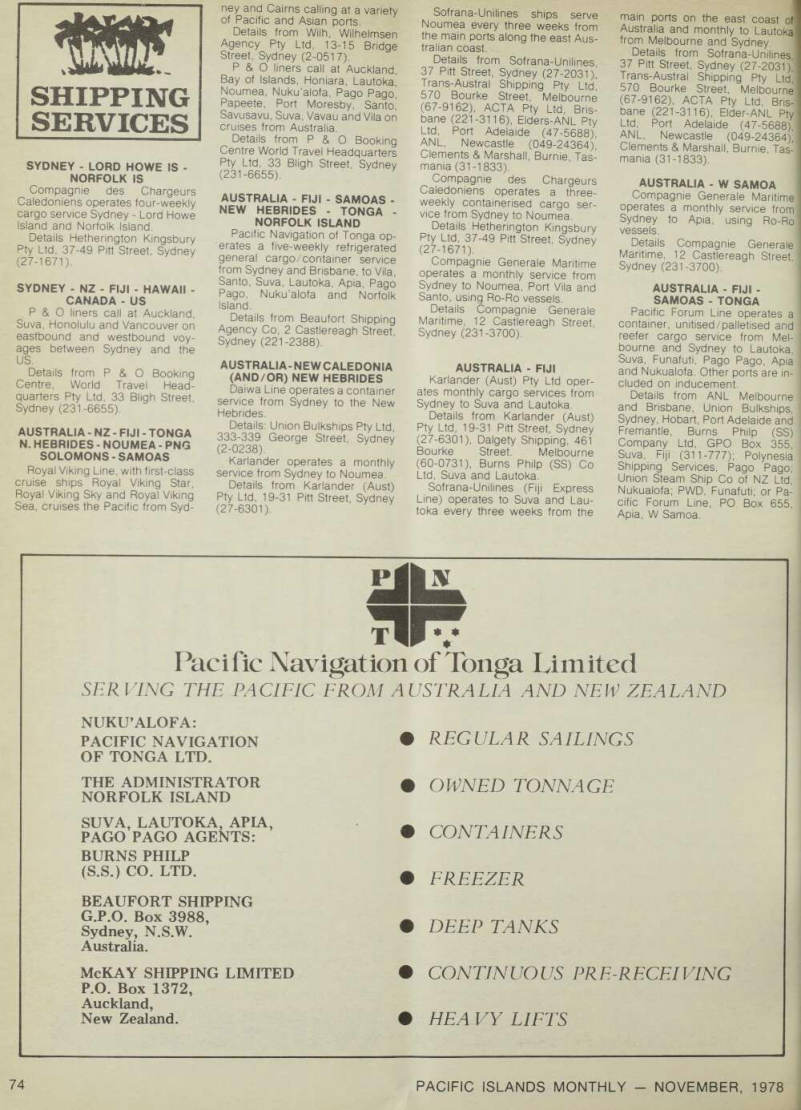
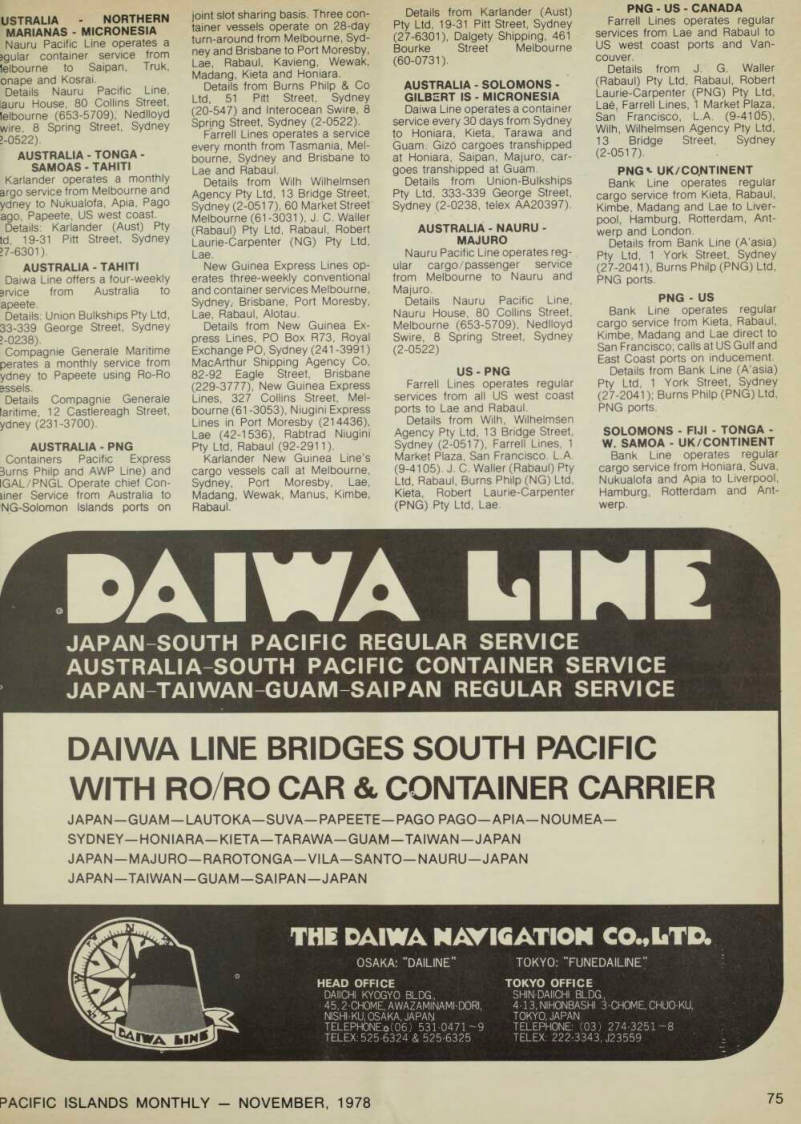
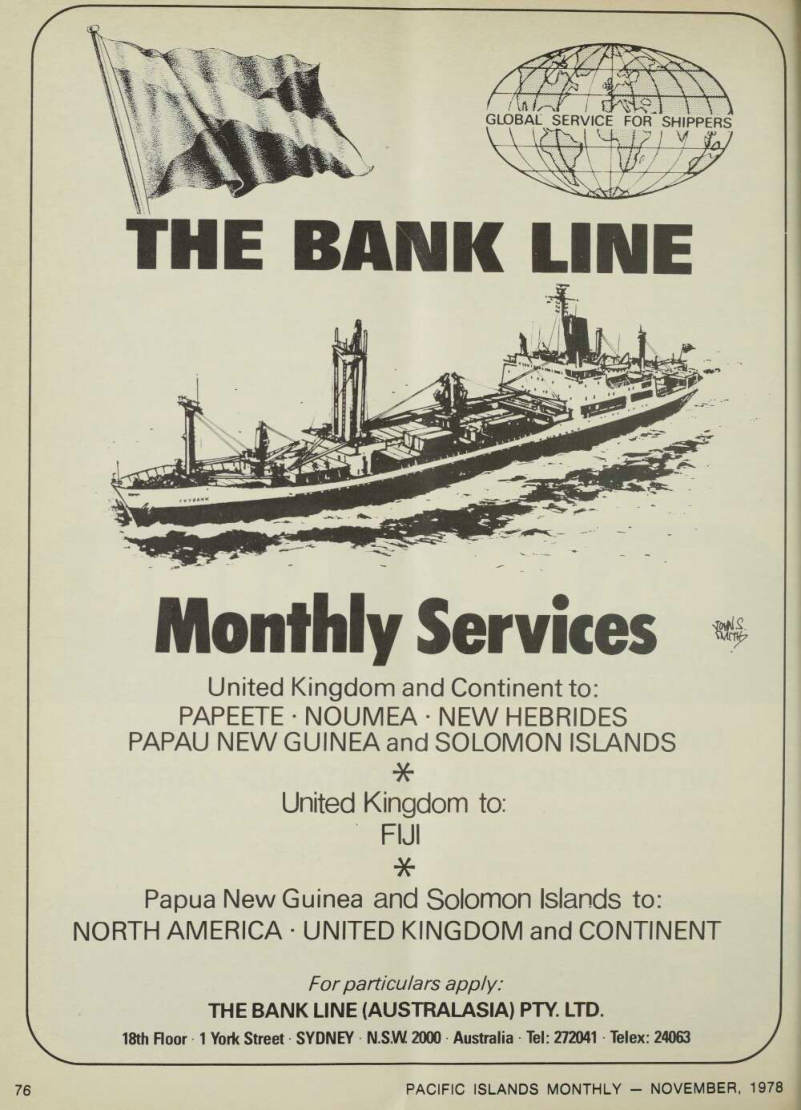
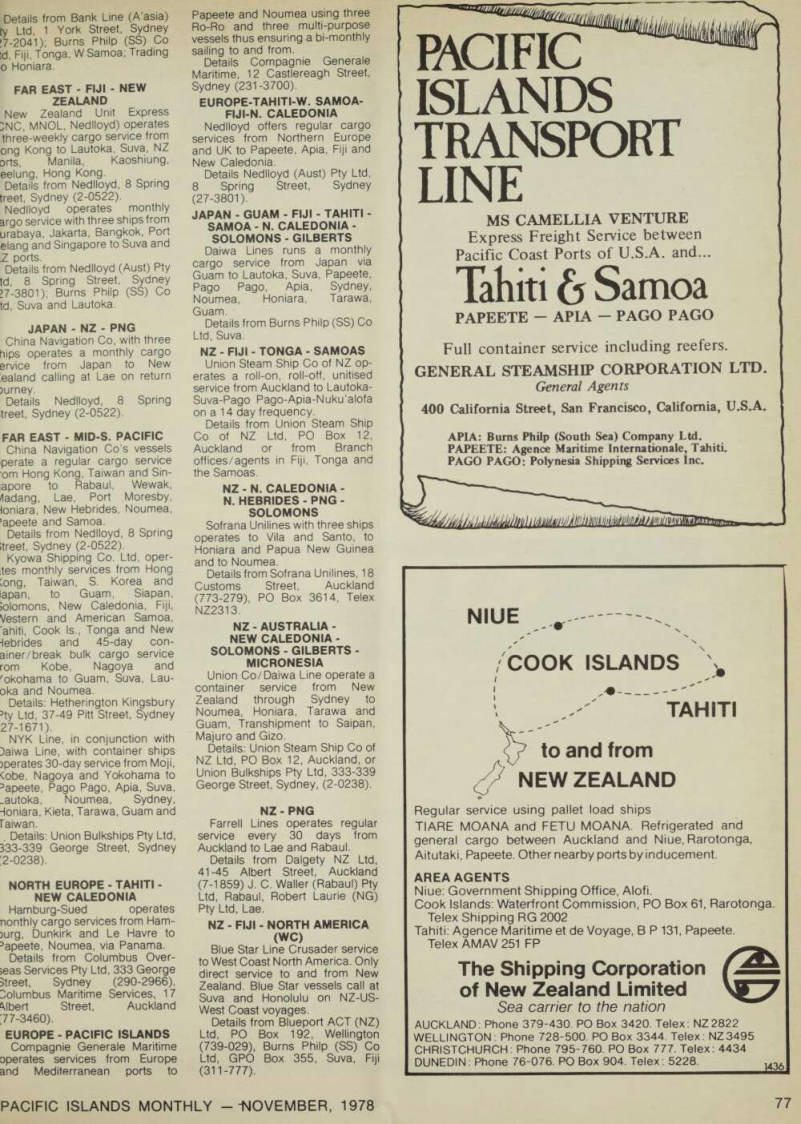
Shipping
Sydney - Lord Howe Is -
Norfolk Is
Compagnie des Chargeurs
Caledoniens operates four-weekly cargo service Sydney - Lord Howe Island and Norfolk Island.
Details Hetherington Kingsbury
Pty Ltd, 37-49 Pitt Street, Sydney (27-1671).
SYDNEY - NZ - FIJI - HAWAII -
Canada - Us
P & O liners call at Auckland, Suva, Honolulu and Vancouver on eastbound and westbound voy ages between Sydney and the US.
Details from P & O Booking Centre, World Travel Head quarters Pty Ltd, 33 Bligh Street,
Sydney (231-6655).
AUSTRALIA - NZ - FIJI - TONGA
N. Hebrides - Noumea - Png
Solomons-Samoas
Royal Viking Line, with first-class cruise ships Royal Viking Star, Royal Viking Sky and Royal Viking Sea, cruises the Pacific from Syd
ney and Cairns calling at a variety of Pacific and Asian ports.
Details from With, Wilhelmsen Agency Pty Ltd, 13-15 Bridge Street, Sydney (2-0517).
P & O liners call at Auckland, Bay of Islands, Honiara, Lautoka!
Noumea, Nukualofa, Pago Pago’
Papeete, Port Moresby, Santo!
Savusavu, Suva, Vavau and Vila on cruises from Australia.
Details from P & O Booking Centre World Travel Headquarters Pty Ltd, 33 Bligh Street, Sydney (231-6655).
Australia - Fiji - Samoas -
New Hebrides - Tonga -
Norfolk Island
Pacific Navigation of Tonga op erates a five-weekly refrigerated general cargo/container service from Sydney and Brisbane, to Vila, Santo, Suva, Lautoka, Apia, Pago Pago, Nukualofa and Norfolk Island.
Details from Beaufort Shipping Agency Co, 2 Castlereagh Street, Sydney (221-2388).
Australia-New Caledonia
(And/Or) New Hebrides
Daiwa Line operates a container service from Sydney to the New Hebrides.
Details: Union Bulkships Pty Ltd, 333-339 George Street, Sydney (2-0238).
Karlander operates a monthly service from Sydney to Noumea.
Details from Karlander (Aust) Pty Ltd, 19-31 Pitt Street, Sydney (27-6301).
Sofrana-Unilines ships serve Noumea every three weeks from the main ports along the east Aus tralian coast.
Details from Sofrana-Unilines, 37 Pitt Street, Sydney (27-2031), Trans-Austral Shipping Pty Ltd, 570 Bourke Street, Melbourne (67-9162), ACTA Pty Ltd, Bris bane (221-3116), Elders-ANL Pty Ltd, Port Adelaide (47-5688), ANL, Newcastle (049-24364)1 Clements & Marshall, Burnie, Tas mania (31-1833).
Compagnie des Chargeurs Caledoniens operates a three weekly containerised cargo ser vice from Sydney to Noumea.
Details Hetherington Kingsbury Pty Ltd, 37-49 Pitt Street, Sydney (27-1671).
Compagnie Generate Maritime operates a monthly service from Sydney to Noumea, Port Vila and Santo, using Ro-Ro vessels.
Details Compagnie Generate Maritime, 12 Castlereagh Street, Sydney (231-3700).
Australia - Fiji
Karlander (Aust) Pty Ltd oper ates monthly cargo services from Sydney to Suva and Lautoka.
Details from Karlander (Aust) Pty Ltd, 19-31 Pitt Street, Sydney (27-6301), Dalgety Shipping, 461 Bourke Street. Melbourne (60-0731), Burns Philp (SS) Co Ltd, Suva and Lautoka.
Sofrana-Unilines (Fiji Express Line) operates to Suva and Lau toka every three weeks from the
main ports on the east coast of Australia and monthly to Lautoka from Melbourne and Sydney.
Details from Sofrana-Unilines; 37 Pitt Street, Sydney (27-2031)1 Trans-Austral Shipping Pty Ltd’ 570 Bourke Street, Melbourne (67-9162), ACTA Pty Ltd, Bris bane (221-3116), Elder-ANL Pty Ltd, Port Adelaide (47-5688), ANL. Newcastle (049-24364) Clements & Marshall, Burnie, Tas mania (31-1833).
Australia - W Samoa
Compagnie Generate Maritime operates a monthly service from Sydney to Apia, using Ro-Ro vessels.
Details Compagnie Generate Maritime, 12 Castlereagh Street Sydney (231-3700).
Australia - Fiji -
Samoas - Tonga
Pacific Forum Line operates a container, unitised/palletised and reefer cargo service from Mel bourne and Sydney to Lautoka, Suva, Funafuti, Pago Pago, Apia and Nukualofa. Other ports are in cluded on inducement.
Details from ANL Melbourne and Brisbane, Union Bulkships, Sydney, Hobart, Port Adelaide and Fremantle, Burns Philp (SS) Company Ltd, GPO Box 355, Suva, Fiji (311-777); Polynesia Shipping Services, Pago Pago; Union Steam Ship Co of NZ Ltd, Nukualofa: PWD, Funafuti; or Pa cific Forum Line, PC Box 655, Apia, W Samoa.
Ustralia - Northern
Marianas - Micronesia
Nauru Pacific Line operates a jgular container service from lelbourne to Saipan, Truk, onape and Kosrai.
Details Nauru Pacific Line, auru House, 80 Collins Street, lelbourne (653-5709), Nedlloyd wire, 8 Spring Street, Sydney >-0522).
Australia - Tonga -
Samoas - Tahiti
Karlander operates a monthly argo service from Melbourne and ydney to Nukualofa, Apia, Pago ago. Papeete, US west coast.
Details: Karlander (Aust) Pty td 19-31 Pitt Street, Sydney >7-6301).
Australia - Tahiti
Daiwa Line offers a four-weekly arvice from Australia to apeete.
Details: Union Bulkships Pty Ltd, 33-339 George Street, Sydney >-0238).
Compagnie Generale Maritime perates a monthly service from ydney to Papeete using Ro-Ro assels.
Details Compagnie Generale laritime, 12 Castlereagh Street, ydney (231-3700).
Australia - Png
Containers Pacific Express 3urns Philp and AWP Line) and IGAL/PNGL Operate chief Con liner Service from Australia to NG-Solomon Islands ports on
joint slot sharing basis. Three con tainer vessels operate on 28-day turn-around from Melbourne, Syd ney and Brisbane to Port Moresby, Lae, Rabaul, Kavieng, Wewak, Madang, Kieta and Honiara.
Details from Burns Philp & Co Ltd, 51 Pitt Street, Sydney (20-547) and Interocean Swire, 8 Spring Street, Sydney (2-0522).
Farrell Lines operates a service every month from Tasmania, Mel bourne, Sydney and Brisbane to Lae and Rabaul.
Details from Wilh Wilhelmsen Agency Pty Ltd, 13 Bridge Street, Sydney (2-0517), 60 Market Street Melbourne (61-3031), J. C. Waller (Rabaul) Pty Ltd, Rabaul, Robert Laurie-Carpenter (NG) Pty Ltd, Lae.
New Guinea Express Lines op erates three-weekly conventional and container services Melbourne, Sydney, Brisbane, Port Moresby, Lae, Rabaul, Alotau.
Details from New Guinea Ex press Lines, PC Box R 73, Royal Exchange PC, Sydney (241 -3991) MacArthur Shipping Agency Co, 82-92 Eagle Street, Brisbane (229-3777), New Guinea Express Lines, 327 Collins Street, Mel bourne (61 -3053), Niugini Express Lines in Port Moresby (214436), Lae (42-1536), Rabtrad Niugini Pty Ltd, Rabaul (92-2911).
Karlander New Guinea Line’s cargo vessels call at Melbourne, Sydney, Port Moresby, Lae, Madang, Wewak, Manus, Kimbe, Rabaul.
Details from Karlander (Aust) Pty Ltd, 19-31 Pitt Street, Sydney (27-6301), Dalgety Shipping, 461 Bourke Street Melbourne (60-0731).
Australia - Solomons -
Gilbert Is - Micronesia
Daiwa Line operates a container service every 30 days from Sydney to Honiara, Kieta, Tarawa and Guam. Gizo cargoes transhipped at Honiara, Saipan, Majuro, car goes transhipped at Guam.
Details from Union-Bulkships Pty Ltd, 333-339 George Street, Sydney (2-0238, telex AA20397).
Australia - Nauru -
Majuro
Nauru Pacific Line operates reg ular cargo/passenger service from Melbourne to Nauru and Majuro.
Details Nauru Pacific Line, Nauru House, 80 Collins Street, Melbourne (653-5709), Nedlloyd Swire, 8 Spring Street, Sydney (2-0522)
Us-Png
Farrell Lines operates regular services from all US west coast ports to Lae and Rabaul.
Details from Wilh, Wilhelmsen Agency Pty Ltd, 13 Bridge Street, Sydney (2-0517), Farrell Lines, 1 Market Plaza, San Francisco. L.A. (9-4105). J. C. Waller (Rabaul) Pty Ltd, Rabaul, Burns Philp (NG) Ltd, Kieta, Robert Laurie-Carpenter (PNG) Pty Ltd, Lae.
Png - Us - Canada
Farrell Lines operates regular services from Lae and Rabaul to US west coast ports and Van couver.
Details from J. G. Waller (Rabaul) Pty Ltd, Rabaul, Robert Laurie-Carpenter (PNG) Pty Ltd, Lae, Farrell Lines, 1 Market Plaza, San Francisco, L.A. (9-4105), Wilh, Wilhelmsen Agency Pty Ltd, 13 Bridge Street, Sydney (2-0517).
Png K Uk/Co.Ntinent
Bank Line operates regular cargo service from Kieta, Rabaul, Kimbe, Madang and Lae to Liver pool, Hamburg, Rotterdam, Ant werp and London.
Details from Bank Line (A’asia) Pty Ltd, 1 York Street, Sydney (27-2041), Burns Philp (PNG) Ltd, PNG ports.
Png - Us
Bank Line operates regular cargo service from Kieta, Rabaul, Kimbe, Madang and Lae direct to San Francisco; calls at US Gulf and East Coast ports on inducement.
Details from Bank Line (A’asia) Pty Ltd, 1 York Street, Sydney (27-2041); Burns Philp (PNG) Ltd, PNG ports.
Solomons - Fiji - Tonga -
W. Samoa - Uk/Continent
Bank Line operates regular cargo service from Honiara, Suva, Nukualofa and Apia to Liverpool, Hamburg, Rotterdam and Ant werp.
Details from Bank Line (A’asia) ty Ltd, 1 York Street, Sydney 17-2041); Burns Philp (SS) Co ;d, Fiji, Tonga, W Samoa: Trading o Honiara.
Far East - Fiji - New
Zealand
New Zealand Unit Express )NC, MNOL, Nedlloyd) operates three-weekly cargo service from ong Kong to Lautoka, Suva, NZ orts, Manila, Kaoshiung. eelung, Hong Kong.
Details from Nedlloyd, 8 Spring treet, Sydney (2-0522).
Nedlloyd operates monthly argo service with three ships from urabaya, Jakarta, Bangkok, Port elang and Singapore to Suva and Z ports.
Details from Nedlloyd (Aust) Pty td, 8 Spring Street, Sydney >7-3801); Burns Philp (SS) Co td, Suva and Lautoka.
Japan - Nz - Png
China Navigation Co, with three hips operates a monthly cargo ervice from Japan to New ealand calling at Lae on return >urney.
Details Nedlloyd, 8 Spring treet, Sydney (2-0522).
Far East - Mid-S. Pacific
China Navigation Co’s vessels perate a regular cargo service om Hong Kong, Taiwan and Sin apore to Rabaul, Wewak, ladang, Lae, Port Moresby, loniara, New Hebrides, Noumea, 'apeete and Samoa.
Details from Nedlloyd, 8 Spring Itreet, Sydney (2-0522).
Kyowa Shipping Co. Ltd, oper tes monthly services from Hong tong, Taiwan, S. Korea and lapan, to Guam, Siapan, >olomons, New Caledonia, Fiji, Vestern and American Samoa, ahiti, Cook Is., Tonga and New lebrides and 45-day con ainer/break bulk cargo service rom Kobe, Nagoya and tokohama to Guam, Suva, Lau oka and Noumea.
Details: Hetherington Kingsbury >ty Ltd, 37-49 Pitt Street, Sydney 27-1671).
NYK Line, in conjunction with Daiwa Line, with container ships jperates 30-day service from Moji, <obe, Nagoya and Yokohama to 3 apeete, Pago Pago, Apia, Suva, _autoka, Noumea, Sydney, Honiara, Kieta, Tarawa, Guam and Faiwan. . Details; Union Bulkships Pty Ltd, 333-339 George Street, Sydney '2-0238).
North Europe - Tahiti -
New Caledonia
Hamburg-Sued operates nonthly cargo services from Ham )urg, Dunkirk and Le Havre to 3 apeete, Noumea, via Panama.
Details from Columbus Over seas Services Pty Ltd, 333 George Street, Sydney (290-2966), Oolumbus Maritime Services, 17 Mbert Street, Auckland 77-3460).
Europe - Pacific Islands
Compagnie Generale Maritime operates services from Europe and Mediterranean ports to
Papeete and Noumea using three Ro-Ro and three multi-purpose vessels thus ensuring a bi-monthly sailing to and from.
Details Compagnie Generale Maritime, 12 Castlereagh Street, Sydney (231 -3700).
Europe-Tahiti-W. Samoa
Fiji-N. Caledonia
Nedlloyd offers regular cargo services from Northern Europe and UK to Papeete, Apia, Fiji and New Caledonia.
Details Nedlloyd (Aust) Pty Ltd, 8 Spring Street, Sydney (27-3801).
JAPAN - GUAM - FIJI - TAHITI -
Samoa - N. Caledonia -
Solomons - Gilberts
Daiwa Lines runs a monthly cargo service from Japan via Guam to Lautoka, Suva, Papeete, Pago Pago, Apia, Sydney, Noumea, Honiara, Tarawa, Guam.
Details from Burns Philp (SS) Co Ltd, Suva.
NZ - FIJI - TONGA - SAMOAS Union Steam Ship Co of NZ op erates a roll-on, roll-off, unitised service from Auckland to Lautoka-
Suva-Pago Pago-Apia-Nuku'alofa
on a 14 day frequency.
Details from Union Steam Ship Co of NZ Ltd, PC Box 12, Auckland or from Branch offices/agents in Fiji, Tonga and the Samoas.
Nz - N. Caledonia -
N. Hebrides-Png -
Solomons
Sofrana Unilines with three ships operates to Vila and Santo, to Honiara and Papua New Guinea and to Noumea.
Details from Sofrana Unilines, 18 Customs Street, Auckland (773-279), PC Box 3614, Telex NZ2313.
Nz - Australia -
New Caledonia -
Solomons - Gilberts -
Micronesia
Union Co/Daiwa Line operate a container service from New Zealand through Sydney to Noumea, Honiara, Tarawa and Guam, Transhipment to Saipan, Majuro and Gizo.
Details: Union Steam Ship Co of NZ Ltd, PC Box 12, Auckland, or Union Bulkships Pty Ltd, 333-339
George Street, Sydney, (2-0238).
Nz-Png
Farrell Lines operates regular service every 30 days from Auckland to Lae and Rabaul.
Details from Dalgety NZ Ltd, 41-45 Albert Street, Auckland (7-1859) J. C. Waller (Rabaul) Pty Ltd, Rabaul, Robert Laurie (NG) Pty Ltd, Lae.
Nz - Fiji - North America
(WC) Blue Star Line Crusader service to West Coast North America. Only direct service to and from New Zealand. Blue Star vessels call at Suva and Honolulu on NZ-US- West Coast voyages.
Details from Blueport ACT (NZ) Ltd, PO Box 192, Wellington (739-029), Burns Philp (SS) Co Ltd, GPO Box 355, Suva, Fiji (311-777).
Nz - Fiji
Pacific Line with one ship oper ates fortnightly roro cargo service New Zealand, Lautoka, Suva.
Details: Sofrana Unilines, 18 Customs Street, Auckland (773-279) PC Box 3614, Telex: NZ2313.
Nz - Fiji - Gilberts -
Solomons - Png
Pacific Forum Line operates a container, unitised/palletised and reefer cargo service from Lyttelton and Auckland to Suva, Tarawa, Honiara, Madang, Lae and Moresby. Other ports are included on inducement.
Details from Shipping Corpor ation of NZ Ltd, Auckland, Christchurch and Wellington.
Burns Philp (SS) Company Ltd, GPO Box 355, Suva, Fiji (311 -777) Sullivans, Honiara; Gilbert Islands Shipping Corporation, Tarawa: Steamships Trading in Port Moresby, Lae and Madang or Pa cific Forum Line, PO Box 655, Apia, W. Samoa
Nz - Fiji - Samoas -
Tonga
Pacific Forum Line operates a unitised/pallatised and reefer cargo service from Lyttelton and Auckland to Lautoka, Suva, Pago Pago, Apia and Nukualofa. Other ports are included on inducement.
Details from Shipping Corpor ation of NZ Ltd, Auckland, Christchurch, Wellington, Burns Philp (SS) Company Ltd. GPO Box
355, Suva, Fiji (311-777); Polynesia Shipping Services, Pago Pago: Union Steam Ship Co of NZ Ltd, Nukualofa or Pacific Forum Line, PC Box 655, Apia, W.
Samoa.
Nz- Samoa - Tonga
Pacific Navigation of Tonga op erates a four-weekly cargo ser vice, Auckland - Nukualofa - Pago Pago - Apia - Auckland.
Details from McKay Shipping
Ltd, Downtown House, Queen Street, Auckland (33-65)6).
Warner Pacific Line services Onehunga - Nukualofa - Vavau fortnightly, and Timaru - Nukualofa - Vavau monthly and Onehunga - Apia and Pago Pago every 21 days carrying general and freezer car goes and Timaru - Apia every 21 days carrying freezer cargo.
Details from Air Marine Services (NZ) Ltd, PC Box 2505, Auckland (796-841).
NZ - COOK IS - NIUE -
Tahiti
Shipping Corporation of NZ Ltd operates cargo services based on pallets and similar units from Auckland to Niue, Cook Islands and Tahiti.
Details from the Shipping Corp of NZ Ltd, PC Box 3420, Auckland (797-210); Waterfront Com mission, PC Box 61, Rarotonga, Lighterage and Stevedoring Go, Aitutaki, Niue Govt Offices, Niue Island Compagnie Maritime Polynesienne, B’P’ 368, Papeete.
Uk/N. Continent - Tahiti -
N. Caledonia - N. Hebrides
Bank Line operates regular cargo service from Hull, Hamburg, Bremen, Antwerp and Rotterdam to Papeete, Noumea and Vila.
Details from Bank Line (A’asia) Pty Ltd, 1 York Street, Sydney (27-2041); Ets A M Fare UTE, Papeete; Ets Ballande, Noumea, Burns Philp (NH) Ltd, Vila.
Uk/N. Continent - Png -
Solomons
Bank Line operates regular cargo service from Hull, Hamburg, Bremen, Antwerp and Rotterdam to Port Moresby, Lae, Madang, Kimbe, Rabaul, Kieta and Honiara and on inducement to Yandina, Tarawa and Nauru.
Details from Bank Line (A’asia) Pty Ltd, 1 York Street, Sydney (27-2041); Burns Philp (PNG) Ltd, PNG ports; Trading Co Honiara.
San Francisco - Honolulu -
Nauru- Micronesia
Nauru Pacific Line operates reg ular conventional/container ser vice from San Francisco and Honolulu to Majuro, Nauru, Ponape, Truk and Saipan.
Details from Nauru Pacific Line, Nauru House, 80 Collins Street, Melbourne (653-5709); North American Maritime Agencies, 100 California Street, San Francisco, California 9411 (981 -0343).
Us-Fiji-Tahiti-Nz
Australia
Bank and Savill Line Ltd, oper
ates regular cargo services from!
US Gulf ports to Australia and NZ. 1 Calls at Suva, Lautoka and] Papeete on demand.
Details from Bank Line (A’asia)l Pty Ltd, 1 York Street, Sydney! (27-2041) or Howard Smith Indus-1 tries Pty Ltd, 1 York Street, Sydney! (27-5611).
US - A. SAMOA - NZ -
Aust
Farrell Lines LASH ships operate I regularly from US to Australia, vial Pago Pago and Auckland and| Canada.
Details from Wilh, Wilhelmsen] Agency Pty Ltd, 13 Bridge St., Syd-1 ney (2-0517); 60 Market Street,] Melbourne (61-0301); Farrell] Lines, 1 Market Plaza, San Fran cisco, L.A. (415-777-3300); Dal gety NZ Ltd, Auckland (7-1859);] Kneubuhl Maritime Services, Pago Pago (633-5121).
Us - Tahiti - Samoa
Pacific Islands Transport oper-j ates a five/six weekly cargo ser vice from North America west coast ports to Papeete, Pago Pago, Apia.
Details from Trans-Austral Ship ping Pty Ltd, 19 Pitt Street, Sydney (27-2441). Polynesia Line operates con-1 tainer and general cargo service from US west coast ports to Papeete and Pago Pago.
Details from Polynesia Shipping Services Inc,. PC Box 1478, Pago Pago (9-6799).
Advertisements & other items, pp. 74-80 (1 item)
Pacific Navigation of Tonga Limited
Pll^
tWv
SER VING THE PACIFIC FROM AUSTRALIA AND NEW ZEALAND
NUKUALOFA:
PACIFIC NAVIGATION •
OF TONGA LTD.
THE ADMINISTRATOR *
NORFOLK ISLAND
SUVA, LAUTOKA, APIA, A
PAGO PAGO AGENTS: •
BURNS PHILP
(S.S.) CO. LTD. Q
BEAUFORT SHIPPING
G.P.O. Box 3988, - Sydney, N.S.W. • Australia.
McKAY SHIPPING LIMITED •
P.O. Box 1372, Auckland, New Zealand.
REGULAR SAILINGS
OWNED TONNAGE
CONTAINERS
FREEZER
DEEP TANKS
CONTINUOUS PRE-RECEIVING
HEA VY LIFTS
DAIWA LIME
JAPAN-SOUTH PACIFIC REGULAR SERVICE
AUSTRALIA SOUTH PACIFIC CONTAINER SERVICE
JAPAN-TAIWAN-GUAM-SAIPAN REGULAR SERVICE
DAIWA LINE BRIDGES SOUTH PACIFIC
WITH RO/RO CAR & CONTAINER CARRIER
JAPAN—GUAM LAUTOKA—SUVA—PAPEETE— PAGO PAGO—APIA— NOUMEA—
SYDNEY—HONIARA—KIETA—TARAWA—GUAM—TAIWAN—JAPAN
JAPAN-MAJURO-RAROTONGA-VILA-SANTO-NAURU-JAPAN
JAPAN—TAIWAN—GUAM—SAIPAN—JAPAN
MV y M
THE DAIWA NAVIGATION CO., LTD.
OSAKA: “DAILINE” TOKYO: “FUNEDAILINE”
HEAD OFFICE TOKYO OFFICE
DAIICHI KYOGYO BLDG., SHIN-DAIICHI BLDG.,
45,2-CHOME, AWAZAMINAMI-DORI, 4-13, NIHONBASHI 3-CHOME, CHUO-KU,
NISHI-KU, OSAKA, JAPAN TOKYO, JAPAN
TELEPHONE:©(O6) 531-0471 ~9 TELEPHONE: (03) 274-3251-8
TELEX: 525-6324 & 525-6325 TELEX; 222-3343, J 23559
o
GLOBAL SERVICE FOR SHIPPERS
V
THE BANK LINE
Monthly Services
United Kingdom and Continent to:
PAPEETE • NOUMEA • NEW HEBRIDES
PAPAU NEW GUINEA and SOLOMON ISLANDS
United Kingdom to:
FIJI
Papua New Guinea and Solomon Islands to: NORTH AMERICA • UNITED KINGDOM and CONTINENT For particulars apply:
THE BANK LINE (AUSTRALASIA) PTY. LTD.
18th Floor 1 York Street SYDNEY N.S.W 2000 Australia Tel: 272041 Telex; 24063
ISLANDS
TRANSPORT
LINE
MS CAMELLIA VENTURE
Express Freight Service between Pacific Coast Ports of U.S.A. and...
Tahiti 6 Samoa
PAPEETE APIA PAGO PAGO
Full container service including reefers.
GENERAL STEAMSHIP CORPORATION LTD.
General Agents 400 California Street, San Francisco, California, U.S.A.
APIA; Bums Philp (South Sea) Company Ltd.
PAPEETE: Agence Maritime Internationale, Tahiti.
PAGO PACK); Polynesia Shipping Services Inc.
NIUE ...
/' N
/COOK ISLANDS \
1
TAHITI
to and from
NEW ZEALAND
Regular service using pallet load ships TIARE MOANA and FETU MOANA. Refrigerated and general cargo between Auckland and Niue, Rarotonga, Aitutaki, Papeete. Other nearby ports by inducement.
AREA AGENTS
Niue; Government Shipping Office, Alofi.
Cook Islands: Waterfront Commission, PO Box 61, Rarotonga.
Telex Shipping RG 2002 Tahiti: Agence Maritime et de Voyage, B P 131, Papeete.
Telex AMAV 251 FP
The Shipping Corporation
of New Zealand Limited
Sea carrier to the nation AUCKLAND; Phone 379-430. PO Box 3420. Telex: NZ2822 WELLINGTON: Phone 728-500. PO Box 3344. Telex: NZ3495 CHRISTCHURCH: Phone 795-760. PO Box 777. Telex: 4434 DUNEDIN: Phone 76-076. PO Box 904. Telex: 5228.
J436J
KYOWA LINE
YOUR TRADING PARTNER
Monthly Services
Hong Kong, Taiwan, S. Korea, Japan
To: Solomon Islands New Caledonia, Fiji, W Samoa, A. Samoa. Tahiti, Cook Is., Tonga, New Hebrides.
Ellice Is.,
Taiwan,Hong Kong,Singapore,Jakarta,
Philippine
To. Australia, Papua New Guinea, Sabah & Sarawak.
Hong Kong, Taiwan, S. Korea, Japan
To; Guam, Saipan, Truk, Ponape, Other Pacific Islands.,
fAGENTS.
Taiwan: Royal Steamship Corp., Ltd, Taipei S. Korea: Dong Sue Shipping Co, Ltd., Seoul Hong Kong: Dahzun Enterprises Ltd.
Singapore; Ocean Shipping & Enterprises Pte. Ltd Guam: Maritime Agencies of Pacific Ltd., Guam Saipan: Saipan Shipping Co.. Inc., Saipan 8.5.1. P.: Solomon Taiyo Ltd., Honiara Tahiti: JA, Cowan & Fils. Papeete Cooks: Eastern Associates Ltd , Rarotonga Tonga: EM Jones Ltd. Nukualofa New. Hebrides; Agence Maritime Raymond Velicite. Port Vila A.Samoa: Island Pacific Agencies Inc., Pago Pago W. Samoa: Morris Hedstrom Ltd , Apia Fiji; Carpenter Shipping, Suva & Lautoka PNG: Carpenter Shipping Agencies, Port Moresby. Rabaul New Caledonia; Agence Maritime Du Rond Point Du Pacific, Noumea Indonesia: PT Porodisa Raya Shipping Lines. Jakarta Sabah: KOH Han Ming Shipping & Forwarding Agent, Kotakmabalu Sarawak: Pan Sarawak Agencies Sdn Bhd , Sibu & Kuching Australia; Hethenngton Kingsbury Pty Ltd, Sydney, NSW Newzealand: Sofrana Umlmes SA, Auckland
KYOWA SHIPPING CO., LTD.
HEAD OFFICE
sth FL, Suzumaru Bldg. 39-8, 2-chome, Nishi-Shinbashi, Minato-ku, Tokyo, Japan.
Phone : 03(437)2885(Rep.) Cables : “MARIQUEEN” Tokyo. Telex : 242-4651 Kyowa J.
OSAKA OFFICE
Frontier Bldg., 3-13 Hirano-cho, Higashi-ku, Osaka, Japan.
Phone : 06(227) 0422(Rep.) Cables : "MARIQUEEN” Osaka. Telex : 522-3896 Kyowa 0.
Manama.
The South Seas Express.
The first regular roll-on roll-off express service between N. the Islands.
The introduction of Marama to the Islands trade will enable exporters to greatly increase their export potential by providing faster, more frequent sailings as well as the greater cargo handling flexibility which a roll-on roll-off service can provide Co-ordinated transhipment facilities from other N.Z. centres Intermodal coastal roll-on roll-off services as well as rail and road services can be utilised by shippers in other New Zealand centres to take advantage of the new Marama schedule. Your nearest Union Company office can assist you in organising the most efficient transhipment method.
International Transhipment Facilities Flexibility in cargo modules catered by this new service can provide for shipping operators and exporters the advantage of reaching international markets using onforwarding services through Union Company contacts and expertise.
Additionally Union can also arrange for cargoes originating from overseas sources to be transhipped at ports covered by Marama to their final destination to the benefit of the importer in New Zealand or the Islands. m.v. Marama Your new export incentive 6350 deadweight tonnes. u »*> rrr.: Capacity 340 seafreighter units or their equivalent, plus space for wheeled vehicles, livestock, etc.
Greater Flexibility Means a more satisfactory and versatile way to ship your consignment.
The following equipment is provided free to shippers Standard dry general cargo ISO containers 20' x 8' x B’6" box container 20' xB' x B'6'' Opensided container, Seafreighter Units For movement of general and bulk cargoes. (Internal) Length 13'9" (4.24 M) width 7'6"(2.29M) height 5' (1.52 M) N B. Units are fully collapsible and open topped to facilitate loading cargoes in excess of 1 52M height. A shower-proof cover is also provided free with every seafreighter Newsprint Flats These units are specifically designed for carriage of forest industry cargo but are also suitable for the carriage of other specified types of cargoes. (Internal) Length 15'6"(4.77M) Width 6' (1.830 M) W. Containers These containers are totally enclosed suitable for the movement of smaller consignments or valuable ones. (Internal) Length 5'7"(1.75M) Width 4’ (1.22 M) Height 5'6"(1.70M) Unit Loads This covers cargo that is unable to be containerised or is not covered by the term mobile equipment These unit loadings must be of a secure nature to facilitate handling by a forklift with 5" gluts (loading forks).
Refrigerated Cargo The following containers will be available Cold wrap containers 20' x 8' x 8' Integral containers 20' x 8' x B'6"
Livestock Livestock stalls are available for the carnage of all types of stock.
Wheeled Cargo The versatility of Marama means that all types of wheeled cargoes including cars, trucks, tractors scrapers, machinery on mobile tracks, cranes, trailers etc can.be catered for Hazardous Cargo The majority of hazardous cargoes will be accommodated on the vessels upper deck either in seafreighters. ISO containers or W. Containers. Full details are available on application
j / union
d / company
M /j moving
CLASSIFIED ADVERTISEMENTS
Per Line $5.00 Aust. Minimum 4 tines.
gig
SIS
YACHT EQUIPMENT
DIRECT FROM
BRITAIN
Send $l.OO for complete catalogue airmailed.
Thomas Foulkes (P) Lansdowne Road, London E. 11.
Frostpak.
HOLDS 48 CANS
Portable Electronic
Solid State Refrigerators
For people on the move Ideal for Campers & Caravans Indispensable for Travellers and Holidaymakers A must forTruckdrivers Popular with Yachts.
Aircraft and Fishermen For Medical & Technical purposes & Food Samples Connects to 12V Battery Operates on 240 V with B; ■ Big cooling performance ■ No Gas - No Compressor ■ Large 33 Litre capacity ■ Unaffected by motion or level ■ No noise or vibration ■ Low Battery Drain ■ Low Weight -7 KG ■ Virtually Indestructable ■ 2 Year Guarantee From 5199.00 incl. Sales Tax r Cigarette Lighter ttery Charger Unifridge 337 Queensberry Street. North Melbourne 3051 Phone 328 3583 Telex 32571
MASSEY UNIVERSITY
NEW ZEALAND
CERTIFICATE IN THE
TEACHING OF A
SECOND
LANGUAGE (ENGLISH)
Teachers of the English language or teachers who use English as the language of instruction for other subjects, may enrol for this special course of study.
All tuition is by correspondence.
For details, write to: The Department of Modern Languages, Massey University, Palmerston North, New Zealand.
PETER FISHER
TRADING
Pty Ltd
321 PITT St., SYDNEY, AUSTRALIA 2000
Telephone: 261109 Cables: "FISHERION" SYDNEY
EXPORTERS TO THE
PACIFIC ISLANDS
POSITION WANTED
Pilot/Co-Pilot position Wanted, USA FAA ATP Australian DCA Comm & Instrument, LRUet Type 8000 Mrs TT, 6500 M E 7600 PIC Age 38.
Contact CYGAN, 127, St Mary’s, Alaska 99658.
Stay at Aggie Grey's
the South Pacific's
legendary hotel.
Situated right in the heart of Western Samoa. Enjoy Polynesian-styie friendliness and service, in cool surroundings, superb entertainment and food. Magnificent white sand beaches only a short drive away. Airconditioned rooms, swimming pool and full bar facilities.
Bookings through Union Steamship Company of N 2, Pan Am, Air New Zealand or direct to Aggie Grey's, Apia, Western Samoa.
Cables: AGGIES, APIA.
THE PAPUA HOTEL
PORT MORESBY
• Right in the business centre • A tradition for comfort and fine food • All rooms air conditioned • Restaurant • Bars • Banquet Hall Telephone 21 2622 Cables PAPTEL
A. C. NEUMANN
Manager
WAIKIKI
Vacation Apartments, 2 bedroom, clean, air-conditioned. near beach, bus, zoo. and entertainment.
For more Information write to:
LEALEA HALE HOTEL
2423 Cleghorn Street
HONOLULU,
HAWAII 96815
Training
Marine
School For
Western
Samoa
A large quantity of equip
ment has arrived in Western Samoa for the new marine training school. The school is
being built by Samoa Shipping
Services Ltd, a joint Western
Samoa-Columbus Shipping
Line Company formed to oper ate and manage the vessel that Western Samoa will be con tributing to the Pacific Forum
Shipping Line.
So far 20 candidates have ap plied for entrance to the school
although formal applications
have not yet been called for.
The applicants will be inter viewed in due course by rep resentatives of Samoa Shipping Services and the Samoan Government.
The final plans and cost estimates for the school have
been prepared by the Special
Projects Development Corpor
ation of Western Samoa and the plans are being forwarded to Hamburg for approval of the head office of the Columbus Line and the West German Government.
The seamanship training
school will include three build ings providing full facilities for
seamanship training and dor
mitory accommodation. It will be established on Upolu near Satapuala, where some of the old buildings that formed part of the old sea-plane base are
being pulled down.
The school will enrol 24 students in each course. They will spend three months at the school on basic training and about nine months at sea be fore they become qualified seamen. Some of the trainees will be trained on a specially equipped vessel owned by the Columbus Line,
Advertisements & other items, pp. 81-88 (3 items)
81
ACIFIC ISLANDS MONTHLY - NOVEMBER, 1978
Casiotron timepieces.
Electronic technology that shines
on your wrist.
Casiotron. The shining example of an incredibly functional, fully-automatic precision electronic timepiece at its technological best. A timepiece that stands apart from others m its quality. , Accuracy guaranteed to within —lO~ 15 seconds a month, and fully-automatic Time Date Calendar readouts, for starters. And performance second to none. All backed by Casio's 20 years of advanced digital electronics know-how.
The choice is yours. There are Casiotrons with a stopwatch function accurate to within 1 100 of a second plus alarm, and Casiotrons with 12- and 24-hour system changeover, And there's the super-slim Casiotron, only 6.omm thick, and a Lady Casiotron designed to compliment a woman's wrist. Or choose the Casiotron Calendar 200, the first digital timepiece m the world to offer a full calendar month display along with dual time function.
Casiotron. A shining example of precision time and sterling performance that sets a new standard in digital electronic timepieces
CASIOTRON
I|%V\ im (49CGS-248 Thickness 6.omm) —vvv*. j
CAS*a
c, '
CASIO
aoAB-z
CAS
* Calendar 200
(4?GS>I2B)
- - 15S#" 24 Hour Cinvertible
(54QS-15B)
v.
Lady Casiotron
(26CGL-20L)
Casio Computer Co., Ltd., Tokyo,.Japan.
V.O°
t>oO
ev> ce . op^ 10 "; c«' c pa o' \e^ s . ,^,P op co> e<C h e^' • - h\s'® a v\o^ \o \\ce< a*® a D\e9 ua\u oO \n io<® vice e c\® de*c \o c ' u Vl a t\d lout'-;: o 9 ® e ' c,e '° ~o»<' s ' s * Toae"" 6 ~e e V^a ('"*■ w cW dM ? e W» C °'° U «rt\aP s ’ Aa\®^f’ • SC ° te \o° wxN ° S fJU 9 aC '"° O S-o“' n ' 9 a^ c N,o^’ S t • v -^rvc e
More than
500 pages
in the big
new 13th
edition
To: The Mail Order Bookshop—Pacific Publications (Aust.) Pty. Ltd., 76 Clarence Street, or G.P.O. Box 3408, Sydney, N.S.W., Australia 2001.
Attached is my payment of $A19.50 plus $A3.00 postage (or SUS 27 postage paid), for my copy of PACIFIC ISLANDS YEAR BOOK. name address postcode
ifs®.
Introducing
the Pioneer
Music
Systems.
MUP-rn mode oe < b
With exclusive Multi-Mode
Deck that makes cassette >
operation as easy as 1-2-3.
Now, quality music systems are so easy-to-operate, you’re going to wonder why you ever considered any other kind of stereo.
Look what Pioneer has created in one magnificent unit.
A solid-state stereo amplifier with plenty of 90-watt music power for beautiful music.
A stereo FM/MW/SW tuner that is especially effective in pulling in station signals from long distances.
An auto-return FG servo belt-drive turntable, complete with built-in strobe and fine-adjust pitch control that guarantees perfect turntable rotation and thus perfect music reproduction.
Our ingeniously versatile Multi-Mode Cassette Deck. With exclusive Song Finder Switch, to actually “choose” the music you like on the tape. An auto-repeat switch, so you can continuously repeat an entire side of a cassette. One-touch recording button, to let you instantly start recording by pressing only one button instead of two.
And Dolby* noise reduction system and soft-touch operation buttons.
Plus—yes there’s more-a pair of handsome Pioneer 3-way 3-speaker bass-reflex speaker systems with 25cm woofer, designed for wellbalanced and full-range sound reproduction.
You can choose from four different Pioneer Music Systems. The Music System 850 (pictured) < For a detailed catalog showing all the great features of Pioneer's new Music Systems, please fill in this coupon and mail it to the Pioneer Distributor in your area listed on the opposite side.
Name Age (Male or Female) Address /i'Ut • ; .;: i m
CSC
vA R » . i t S m m he top of the line. The Music System 750 has arly all the features described here, with less frills, d Music System 810 and 710, which do not
ilude the turntable.
Whatever it takes to make your music more
joyable, we’ll do it for you.
Now with Pioneer’s Music Systems, beautiful
reo sound is as easy as 1-2-3.
Iby is a trademark of Dolby Laboratories, Inc.
Music System 050
fliD PIONEER
Pioneer products are available through; Australia: Pioneer Electronics Australia Pty. Ltd., 178-184 Boundary Road. Braeside, Victoria 3195, Tel: 90-9011, Sydney 93-0246, Brisbane 59-7457, Adelaide 433379, Perth 24-9899 Fiji Islands: Brijlal & Company, G.P.O. Box No. 362, Suva, Fiji Islands Tel: 22258 New Zealand: Fountain Marketing Ltd., Maidstone Street, Auckland, New Zealand Tel: 763-064 Norfolk Island: Burns Philp (Norfolk Island) Ltd., Norfolk Island, South Pacific New Hebrides: Burns Philp (New Hebrides) Ltd., Vila, New Hebrides Nauru Island: Jacob Enterprises, P.O. Box No. 4 Republic of Nauru Tahiti: Est. PERFECT, B.P. 594, Papeete, Tahiti Tel: 20 407 New Caledonia: Menard FreresVille, B.P. H 2 Cedex, Noumea, New Caledonia Tel: 27.52,22 American Samoa: Traspac Corporation, P.O. Box 1477, Pago Pago, American Samoa 96799 Tel: 633-5224 Rarotonga: South Seas International Ltd , P.O. Box 49, Rarotonga Cook Islands Tel: 2327 Papua New Guinea; Bali Merchants Pty. Ltd., P.O. Box 6103 Boroko Tel 254887
Coleman. Gas Appliances:
We've got what you need.
Coleman gas products. No matter which one you choose, you get the one feature that only Coleman offers our exclusive pressure regulator.
It controls bottle-to-
appliance
fuel flow at a steady 15 PSI (pounds per sq. inch).
That means even cooking temperatures on our stoves. And even light output from our lanterns ... from full bottle to empty.
The Coleman gas line includes both single mantle and double mantle lanterns. A catalytic heater with a variable output up to 4,000 BTU’s. Plus standard and deluxe two-burner stoves. And' a compact oneburner stove.
WeVe got all the accessories you’ll need including extension hoses, adaptors, and refillable bottles for butane gas.
If you’re into gas, look into Coleman ... for quality and a price that’s right.
For more information on these or other fine Coleman products write us at Coleman International.
Remember: Coleman equipment can come in handy in storms, 7 typhoons and powerJnsses too. mm
The great outdoors
is too good to miss.
ill
The Coleman Company, the. • Wicfvtil, Kansas
Clarion
The One For The Road
larion reliability, proven on the toughest )ads and in the hottest weather. Easy-operion design, for your convenience and added riving safety. A wide selection of easy-toistall car stereos, backed by Clarion’s ;nowned quality and high performance.
Jarion—the best way to listening and riving pleasure. tt SSS GClarion ,tEF7 0m
* F M FM
0 Clarion Co., Ltd. Tokyo, Japan PE-758 ustralia: Amalgamated Wireless (Australasia) Ltd. 554 Parramatta Road, Ashfield N.S.W., 2131 /New Zealand: AWA New Zealand mited P.O. Box 50-248 Porirua /Fiji Islands: Brijlal & Co., Ltd. G.P.O. Box 362 Suva /Tahiti: ETS Comimpex B.P. 200 ipeete /New Caledonia: Caldis B.P. Ml Noumea Cedex/Guam: Guam Radio & TV Shop P.O. Box 1939Agana, Guam )910/Ncw Hebrides: The Sound Centre P.O. Box 434 Vila /Cook Islands: South Seas International Ltd. P.O. Box 49 Rarotonga
One area wh
X
atsun
sent
4 sft I ll| 1 s .
Have you ever had to slam on your brakes in a sudden emergency?
Like when a child ran out in front of you unexpectedly? Or when another car veered across your path without signalling? If so, you’re vividly aware of the importance of smooth, safe stopping to every journey you make.
Datsun’s aim in this area is single-minded and uncompromising—to equip you with brakes you can rely on in every situation. First, we choose materials with a high friction coefficient and put them through advanced technological processes to create brakes with minimal overheating and fading characteristics.
Then we conduct rigorous practical tests, using an extra wheel behind to give us full information on any variations in braking power. And we make whatever design changes are necessary to achieve light-pressure braking that’s smooth, quiet and effective. Over short distances and in any conditions.
The result is added comfort, easier operation and the assurance of greatly improved safety. To say nothing of quite remarkable brake durability.
Which helps put a stop to some of those expensive repair bills.
Tough tests: the Datsun way to total economy. ; £ MWlli
DATSUN
NISSAN
Datsun Distributors: Boroko Motors Ltd. P.O. Box 1259, Boroko, Port Moresby, P.H.G./Suva Motors Ltd. G.P.O. Box 34, Suva, Fiji/Morris Hedstrom Ltd. P.O. Box 189, Apia, Western Samoa/Gnited Enterprises Ltd. P.O. Box 262, Honiara, British Solomon Islands/Sirius Motors P.O. Box 34, Horfolk Island, South Pacific/ Jacob Enterprises P.O. Box 4, Republic of Hauru/Cook Islands Motor Center Ltd. P.O. Box 74, Rarotonga, Cook Islands, South Pacific/Pentecost Pacific S.A. P.O. Box 119, Port Vila, Hew Hebrides/Agence Alma S.A B.P. A 3, Houmea Cedex, Hew Caledonia/TAHITIBGLL S.A.R.L. B.P. 359, Papeete, Tahiti/Gilbert Islands Government, Supply Division P.O. Box 71, Bairiki, Tarawa, Gilbert Islands
85
ACIFIC ISLANDS MONTHLY - NOVEMBER, 1978