Pacific Islands Monthly

News Magazine Of The South Pacific
April, 1973
Australia, N.Z., Western Samoa 60C
P.N.G., FIJI, COOKS, TONGA, G.E.1.C., 8.5.1. P., N. HEBRIDES 50c
Nauru, Niue, Norfolk 50C
American Samoa 70C Hawaii, Micronesia $L.Oo
NEW CALEDONIA AND FRENCH POLYNESIA 100 CFP
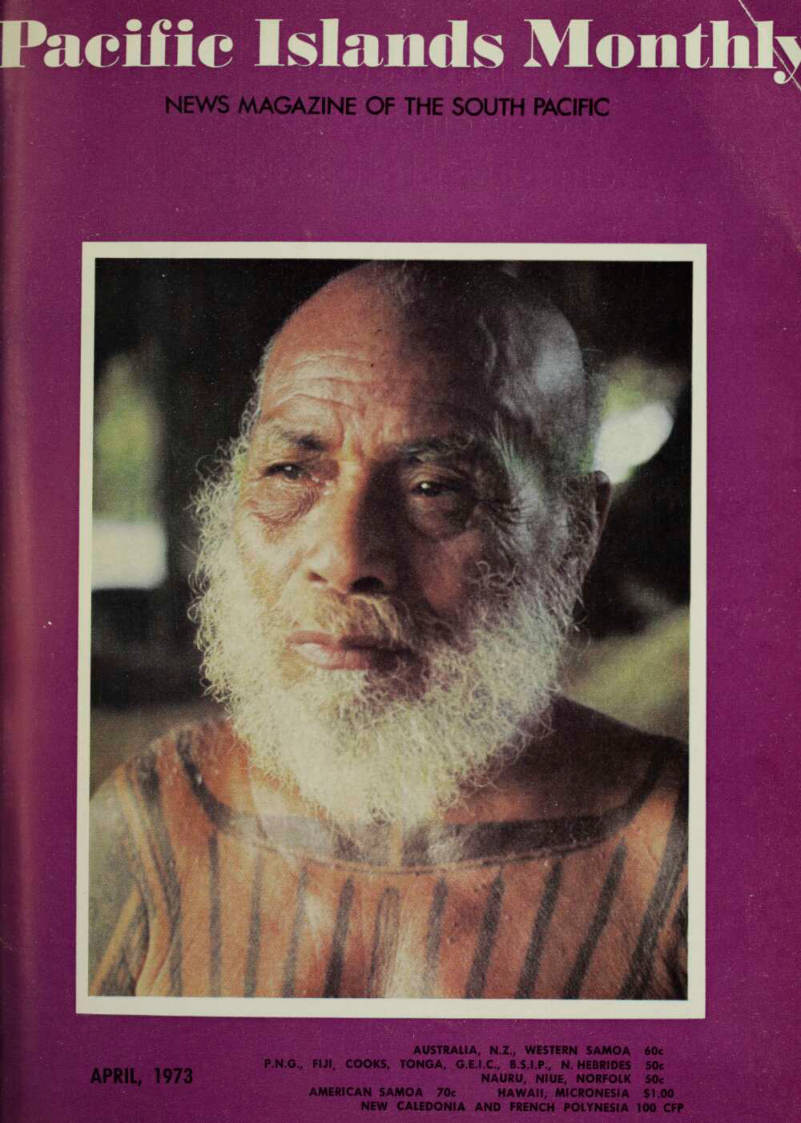
Our Cover
This Yapese, the Chief of Fossari on Ulithi atoll in the Yap District of the Western Carolines, has his whole life behind and in front of him.
His life story is told in the tattoos on his body. This strik ing study is the work of photographer Norman J.
Quinn.
Advertisements & other items, p. 2 (1 item)
the smallest, lightest
Introducing
system 35-SLR hi the world.
. .* ■ |r *3|jj^ i V I* i W Tj*% v—\ For years now a professional level 35mm SLR camera meant a heavy 35mm SLR camera. So people who wanted the advantages of SLR’s had to bear the burden.
Then Olympus developed the OM-1. With the normal lens it has a weight and size at least 35% less than most other SLR’s. But we didn’t stop there.
When we made it lighter and smaller, we made it quieter and smoother too.
Original shutter-mirror design cuts noise and shock in the OM-1 to about half the usual figure.
And we made it brighter. That’s because we reckoned the world s most versatile 35mm camera system, with 38 optically impeccable lenses, a dozen interchangeable focusing screens, a complete range of macrophotp and photomicro equipment, and the lightest motor drive ever built - in total 280 pieces of top quality equipment —, we reckoned all that deserved the biggest, brightest viewfinder we could make. , After all, the Olympus OM system is going to change the way people think and feel about photography. So there’s no point in being small about it.
OLYMPUS
OM-1
In This Issue
General
■Cheaper brides 12 ■Oceania Soccer tournament 21 (Carpenters sell agency 87 [Dollar fluctuations 105 ■Carpenters lift profits 105 Games in jeopardy 117
American Samoa
IBingo regulations 12 [ Education director appointed 15 [ Shipping breakdown 87
Cook Islands
[Premier in Wellington 11 [Cruise ships visit 83 [ Dancers in Japan 116
Fiji
■Reviving beche-de-mer industry ... 13 Call for liquor ban 14 [Film actor to retire 15 All Black to coach Fijians 15 [Civil Service changes 15 Oceania Soccer tournament 21 More USS Co ships 81 [Jetfoil service 83 Expanding shipyards 85 [Dockworkers seek rise 87 [Anti-strike legislation 107 Island for sale 107 Search for gold I®B [Sugar nationalised 116
French Polynesia
Sanford wins election 6 [Oceania Soccer tournament 21
Gilbert And Ellice Islands
UK Commissioners' visit 11 Co-operative expands 117
Lord Howe Island
Fisheries research 14
Nauru
Regional shipping line 81
New Caledonia
Pidjot wins election 7 Oceania Soccer tournament 21 More meat imports 116
New Hebrides
Teacher's scholarship 15 Budget debate 31 Jetfoil service 83 Influenza deaths 116 Anglican Diocese separates 116 Meat agreement 116 Population increase 117
Niue Island
Self-government talks 10
Norfolk Island
Tax haven ending 100
Papua New Guinea
House of Assembly 8 Trouble in Trobriands 13 MHAs join PPP 15 Chief meets Pope 15 Local man in finance 16 Blind boy's success 16 Percy Chatterton 26 On Torres Strait Islands 49 Voyage of Capt de Torres 53
Freight rates increase 86 Kennecott talks 107
Pitcairn Island
No pollution ... 14
Solomon Islands
Search for Japanese 56 Anglican Diocese to separate 116
Tonga
Champion coconut husker 14 Handball craze 22 Atenisi college 40 Regional shipping line 81
United States Trust Territory
Woman doctor returns 15 Marianas status row 29 Public Defender resigns 45 Search for ship 83 Devaluation repercussions 95
Western Samoa
Why Mataafa won the election 6,25 Journalist's marriage 15 School appointment 16 Banking problems 99
DEPARTMENTS: Up front with the Editor, 3; Tropicalities, 13; People, 15 & 16; Editor's mailbag, 33; From the Islands Press, 37; Magazine section, 53; Mana, 65; Book reviews, 74; Yesterday, 77; Pacific shipping 81; Cruising yachts, 89; Business snd development, 95; Produce, 108; Shipping and airways information, 109; Deaths of Islands people, 115; In a Nutshell, 116; Advertisers' index, 120.
Advertisements & other items, p. 4 (1 item)
Mixmaster Mixer
3 times better than any
other mixer ■ Designed especially for family food preparation. 12-speed mixfinder dial indicates the correct speed for each mixing action. Complete with 2 heat-resistant bowls and juice extractor. Sunbeam’s exclusive 3-way beating action — extra large, contained beaters, and automatic bowl movement — gives perfect aeration and more even mixing. It can handle everything from beating one egg to mixing a large fruit cake.
L83.33C
Pacific Islands
Monthly
FOUNDED BY R. W. ROBSON IN 1930
Published Monthly By
Pacific Publications (Aust.) Pty. Ltd.,
29 Alberta St., Sydney, N.S.W., 2000.
Postal Address: G.P.O. BOX 3408, SYDNEY,
N.S.W., 2001.
Telegraphic Address: PACPUB, Sydney.
Telephones: 61-9197, 61-7101, 61-4369.
‘ Consulting Directors: R. W. Robson, Judy Tudor.
Chief Executives: Manager: Selwyn Hughes.
Publisher: Stuart Inder.
Director of Advertising: W. A. Gasnier.
Pacific Islands Monthly
Editor: Stuart Inder.
Assistant Editor: John Carter.
Advertising Manager; W. A. Gasnier.
Circulation Manager: Barry Badger.
Subscription Rates;
"Pacific Islands Monthly" is airfreighted to all subscribers and agents in the Pacific Islands and the U.S.A.; copies to other areas go by surface mail.
Australia (incl. Lord Howe and Thursday Is.): $6.70 Aust., Papua New Guinea: $5.50 Aust.; Fiji, Tonga, New Hebrides, Gilbert & Ellice Islands, Solomon Islands, Nauru Island and all other Pacific territories: $5.50 (local currency); Western Samoa: $6.70 (local currency); New Zealand: $6.70 NZ; Hawaii, Micronesia and Guam: $12.00 US; US Mainland: $14.00 US; New Caledonia and French Polynesia: 1,100 CFP; United Kingdom: £3.25; Elsewhere; $6.96.
Representatives
Fiji: Pacific Publications (Fiji) Ltd., Fiji Times Building, 20 Gordon Street, Suva. Tel.: 25601; Fiji Times Office, Cnr. Vitogo Pde, and Namoli Ave, LAUTOKA. Telex: 1144. Tel.: 60-422.
Papua New Guinea: LAE, P.O. Box 227; RABAUL, Mr. Steve Simpson, P.O. Box 433 (c/- Rabaul Photographic. Tel.: 2677.) french Polynesia: Distribution—Hachette Paci fique, 10 Ave Bruat, Papeete.
New Zealand: Pacific Publications, C.P.O. Box 2229, Auckland. 379-494. Representative: John Spedding, Civic House, 291 Queen St., Auckland, Tel.: 379-494.
United Kingdom: I. B. Graham, Park House, 22 Park Street, Croydon, CR9 3NP Tel • 01-6884177.
Overseas Newspapers (Agencies) Ltd., Cromwell House, Fulwood Place, London WC 1 Tel • 01-242-0661. Cables; WESNEWS, London, DS4.
Japan: Advertising—Universal Media Corpora tion, C.P.O. Box 46, Tokyo. Tel.: 666-3036.
Victoria: Advertising—Wilke & Co. Ltd, 37 Brown's Road, Clayton, Vic., 3168 Tel • 544-8222.
Queensland: Advertising—Beale Media Services, 232 St. Paul's Terrace, Fortitude Valiev, Qld 4006. Tel.: 52-5827.
Hawaii and U.S. Mainland only: Mrs. W. A.
McGrath, 225 Queen Street, 178, Honolulu, /c j 968! 3. (Send change of address notices. Form 3579 and new subscriptions to P.O. Box 2193 Honolulu, Hawaii, U.S.A. 96805), Application to mail at second class postage rates pending at Honolulu, Hawaii.
Copyright ©, 1973, Pacific Publications (Aust.) Pty. Ltd.
April, 1973 Vol. 44, No. 4
Up Front
with the Editor
THE Sydney Morning Herald re ported: “The Colonial Sugar Refining Company has entered upon an undertaking of great magnitude, for the purpose of developing the sugar-growing resources of the Fiji Islands. Their scene of operations is on the Rewa River, about 12 miles from the ocean, where a considerable area has been planted with young cane in the last few months. Before long there will be a small colony of Europeans and natives in the em ploy of the company. The steamer Fiona leaves Sydney immediately with 20 mechanics and about 60 labourers to commence the work of erecting a large sugar mill on the banks of the Rewa.”
I was in Fiji the other day and saw, again, that now-rusted shell of the sugar mill on the banks of the Rewa, at Nausori—built in 1882, and closed in 1959 because its output could not compete with the better yields of the CSR's four other Fiji mills built or acquired later.
And now, this month the last page turns on the whole volume of CSR’s history in Fiji. On April 1 the “under taking of such magnitude” which be gan with the Nausori mill, is handed over to the Fiji Government and 90 years of CSR in Fiji ends. The new Fiji Sugar Corporation takes over the assets of South Pacific Sugar Mills, which is CSR’s operating subsidiary in the South Pacific dominion.
It’s been a painless changeover.
CSR itself decided to withdraw and sell; CSR men still in Fiji will phase themselves out; CSR will continue to lend a hand at marketing. But it’s not CSR’s show now, and nobody with any sense of history can fail to mourn the end of an era. The sugar industry made Fiji.
An American, David Whippy, be fore the arrival of the CSR, estab lished the first mill in Fiji. That was in 1862 on Wakaya Island. Other mills followed in various parts of Fiji and the growing of cane became more widespread.
But in 1884 there came a world sugar slump (and not the last of them), which wiped out most of the Fiji mills. The CSR’s Nausori was one of the few that survived, and the CSR added the Rarawai mill in 1886, Labasa in 1894 and Lautoka in 1903.
Penang, the fifth mill, was not bought until 1926, having been one of those established before the company had come to Fiji. From 1926 the CSR became the only miller in Fiji.
Half of Fiji’s citizens today have an Indian background, mostly as descendants of labourers brought to the Fiji canefields under an indenture system which began in 1879 and was abolished in 1916.
Many people assume it was the CSR which brought in the Indians, but as the dates show, the indentured system was already in operation be fore the CSR went to Fiji. The system was introduced by Sir Arthur Gordon, Fiji’s Governor of the time, and had been in operation for many years before that in other British colonies.
The labourers were indentured to the Fiji Government. They bound themselves to work where directed for five years for wages and accommo dation. Each man could work for another five years for anybody he pleased and was then entitled to free passage for his wife and family.
About 62,000 Indians were brought to Fiji under the system and only about a third asked for repatriation.
It was the CSR which “freed” the labourers and set the pattern of in dividual farming which has become the backbone of the Fiji agricultural economy.
CSR once owned or leased the land and produced the cane for its mills with the aid of this hired labour.
Then it began leasing its estates to independent farmers, particularly to former senior employees. This failed because of the shortage of labour after the indenture system was abolished. Similarly the CSR failed
in an effort to establish a settlement scheme.
Finally it decided to take the major step of dividing its estates into small blocks averaging only about 11 acres, and leasing them at low rentals to Indians who were then helped in many ways to establish themselves.
CSR guaranteed to take the cane.
“The boldest experiment in colonial agriculture during the pre sent century,” said an authority. Most people said it wouldn’t work; the Indians weren’t up to it. In 1925 Indian tenants were cultivating 1C per cent of the CSR cane lands com pared with the company’s 52 pei cent; by 1934, after the new system had been established, Indian tenants were cultivating 53 per cent com pared with the company’s six pei cent. And that soon dropped to less than three per cent.
The CSR scheme gave the Indian: economic independence; a chance t( start out on their own. The CSR, ii short, developed social and economk stability in the colony through th( creation of a body of small, in dependent farmers. It also kep individual farms to an economic size thus avoiding the fragmentation whicl brought troubles to Asia. And by it constant supervision and help th key to CSR’s activities for the small holders —it improved Fiji’s farmin practices and soil fertility.
Here was enlightened self-interes at work. Stable and efficient agricul ture was to the advantage of th CSR, the farmers and the Fiji Go\ ernment, and has remained so.
More than 15,000 farmers ar dependent on sugar—plus of cours their families. And there are 2,50 workers in the mills.
So the CSR’s work has come to ai end.
In Fiji the other day I found som apprehension that the traditions efficiency established by the CS might come unstuck now that th government is boss. That millworkei might take advantage of the ne; ownership and go slow, or pull a wildcat strikes of the type that hay become increasingly a part of Fiji industrial scene lately.
The apprehension might be uncalle for. Perhaps it’s only a case of fin night jitters.
But it won’t be CSR’s worrry.
Stuart Inder
Advertisements & other items, pp. 6-7 (1 item)
Leaders Three
Cabot’s
WOOD STAINS
• RANCH HOUSE HUES 2-coat flat finish stain for exterior windows, weatherboards, gables. • OLD VIRGINIA TINT 2-coat flat finish paint for any exterior masonry, wood, steel, asbestos cement.
Matches ranch house hues, colours. • DECK STAIN 1-coat flat finish stain for any wooden floor, seats, handrails, furniture. • STAIN WAX 1-coat hand-rubbed finish stain for any interior woodwork. • DANISH OIL 2-coat clear hand-rubbed finish for any interior woodwork and floors. • BRUSHABLE HAMMERFONE 2-coat brushable hammertone finish for any surface inside or out.
Windsor
Parquet
I^o2, Real Timber Beauty and Warmth with Individuality • 5 Distinctive designs • Lifetime durability • Different coloured timbers • New designs • Insulation of real timber • Easy cleaning
uyn II Rapid setting, early strength cement. At 1 carry most traffic, at 24 hours in 1-2-4 mix pressive strength of above 7,000 P.S.I. temperatures up to 1,300°C and resists alkalis.
I hours can has a com- Withstands acids and
Free Technical service available for all products.
GEORGE WILLS & CO. LTD.
49 Clarence Street, SYDNEY, N.S.W. 2001 Tel.: 29 6061 Agents and Distributors
IMJ
h US* c
GOOD-YEAR
TRACTION HI-MILER HI-MILER G 8
TRACTION 100
SUPER ROAD LUG
ALL SERVICE
For rugged 'stop-go' de- Round shoulder tire With 3-T cord. Abrasion resistant ex- A non-directional livery work. Gives long- for highway trucks, stronger than steel, tra-thick tread and mud and snow tire, er mileage and easier Assures extra trac- developed for bus deep-grooved, sharp an- Reduces skidding steering. tion on all surfaces, and highway trucks, gle lugs assure positive and weaving. wet and dry. traction on all types of road surfaces. m t I V.
til
S!
M m w m 0*
THE RIGHT TIRE FOR EVERY JOB
HIGHWAY - ON/OFF THE ROAD - CROSS COUNTRY Boroko Motors Ltd.
P.O. Box 1259, Boroko Port Moresby, PAPUA NEW GUINEA Solomon Motors Ltd.
P.O. Box 20, Mendana Avenue, Honiara Guadalcanal, SOLOMON ISLANDS Soci6t6 Generale d’Automobiles B.P. 554, Noumea
NEW CALEDONIA
Coral Island Traders P.O. Box 296, Suva, FIJI Guam Tire & Supply Co.
P.O. Box 1486, Agana, GUAM
SOHECO
B.P. 208, Port Vila
NEW HEBRIDES
Morris Hedstrom Ltd.
Apia, WESTERN SAMOA
Haleck Service Center P.O. Box 1138, Pago Pago
AMERICAN SAMOA 96920
Service Mobil B.P. 306, Papeete
TAHITI
P 522
Pacific Islands Monthly
Stomachs, Cars And Liquor Bars
Loomed Large In Samoa Election
From FELISE VA’A in Apia
Western Samoa’s parliamentarians had no doubt, once they had been elected themselves, who they wanted as Prime Minister. With three to choose from, the outgoing Prime Minister, Tupua Tamasese Lealofi IV, Fiame Mataafa Faumuina Mulinuu 11, whom Tamasese ousted in 1970, and young Tupuola Efi, more than half of them voted for Mataafa, giving him his most resounding victory of the three he has won out of the four con tests since independence came in 1962.
For once the street and bar gossipers were on the ball.
Though many professed, before the March elections, ignorance of political trends, they were surprisingly in accord with their criticisms of the outgoing government.
Those criticisms proved to be the death-knell of Tama sese’s chances of returning to power.
High on the list was the Tamasese government’s un popularity. It started on an optimistic note but a time wore on it became responsible for some unpopula measures—an increase in import duties which hoiste* food and car prices being the most unpopular. Wive? faced with bigger bills, grumbled and their husband remembered when they voted and ousted four cabine ministers including Finance Minister Tofa Siaosi, wh was held responsible.
Another factor was the lack of cabinet accord, o squabbles and jealousies between ministers who pr« ferred having things their own way instead of workin as a team.
Tamasese, regarded as a gentle gentleman, wasn strong enough, his critics said, to control his minister: There was also talk of ministers failing to keep appoini ments, of their love of playing and imbibing when the; should have been working. As a cabinet ministe Tupuola Eli had to take some of the blame and hi image suffered though it was probably the least of hi handicaps. Young though he is, his ability is recognise and he’ll come back for another chance. But this time conservatism was in the wind and the conservative (with a small c) were the ones who won seats. Efi j regarded as a liberal and an individualist and i Western Samoa individualists are regarded as an od group.
The reasons for Mataafa’s success are not all negativ* Pretty high in the list must come his own personality his honesty and the skilful way in which he ran h campaign. The situation was ripe for him. Perhaps h knew it and knew that all he had to do was pluc the fruit although he kept his distance from the tre until the last two weeks before the election.
He has now announced his cabinet—Laume Matolou 11, Minister of Works; Muagututia Pinafi Minister of Agriculture; Sam Saili, Minister of Finana Alfonso Philipp, Minister of Education; Seiuli Taulafo Minister of Health; Lesatale Rapi, Minister of Landl Tapuai Ene, Minister of Radio and Post Office; am biggest surprise of all, Tupua Tamasese Lealofi, Minisfi of lustice.
Is the last choice a sign that the two Tama Aigt Mataafa and Tamasese, have joined forces, recognisic the danger to themselves of the threat posed by Tupuo < Efi? It would appear that the answer is Yes. To th country at large this is a good sign—better, they saj for the Tama Aiga to agree rather than fight each otht for when the Tama Aiga agree all is well. When the fight ail is not well and things might explode, so tH Samoans reason. But will it always be like this? • For election details see p 25.
Autonomists' comeback
The autonomists in both French Polynesia and New Caledonia (see story on opposite page) are coming back. Their champions have gone back into the National Assembly, reversing the trend which put the anti-autonomists into power in the two Territorial Assemblies.
But it was a near thing in French Polynesia.
Autonomist leader Francis Sanford has squeezed back as Deputy in Paris with more than 48 per cent of the votes in the face of a strong challenge from Gaullist leader Gaston Flosse, President of the newly-elected Territorial Assembly, and labour union leader Charles Taufa.
But Sanford’s victory came only in the second round and all French Polynesia was waiting for him to choose—a return to Paris on less than his own terms, or political oblivion. Last month (PIM, March, p 7) he laid his future on the line. He told PI M’s man, Jim Boyack, that if he was not elected in the first round “it would no longer be necessary that I be in the Territorial Assembly”.
He added that he might even resign from the mayoralty. He also hoped to poll “something in the neighbourhood of 54 per cent” of the votes.
Well, he polled more than 48 per cent, which gave him the victory.
To resign would be to hand French Polynesia on a plate to the Gaullists. With those who think like him winning in New Caledonia, he decided to hold on to what he has got. At any rate, 48 per cent of the people of French Polynesia’s 120 islands put their faith in him. He could hardly hand back his mandate.
Caledonia's Gaullists
Melanesians Beat New
From a Noumea correspondent
“. . . New Caledonia’s destiny and prosperity are tied to France and eventually to Europe. Doesn’t Britain’s entry to the Common Market present practically insoluble problems for Australia and New Zealand. Why would we go and link our destiny with that of these two countries?”
This was the kind of warning pro paganda issued by the anti-auto nomists during Caledonians’ recent voting in the French national elec tions. The anti-autonomist front, with the full encouragement of the French administration, this time gave the autonomists the toughest opposition they have ever faced in the election of a deputy to represent the island in Paris, Finally, it was the predominantly Melanesian vote from the inland and outer islands that brought victory to outgoing candidate, Melanesian Roch Pidjot, representing the internal self government movement. Anti-auto nomist candidate, Jean Leques, came 1,485 votes behind, in the final ballot of March 11. (There was a 71 per cent vote, with 38.612 voting out of 52,936 registered electors). It was the first time in more than 20 years that Caledonians had to face a second round of voting in the election of their deputy. In the past the Union Caledonienne party held such an un challenged majority that their can didate was usually elected outright in the first round.
In these latest elections, on March 4, Jean Leques came out on top in the first round, with a total of 16,040 out of the 37,296 votes cast. In second place came Roch Pidjot with 15,297 votes, followed by fellow autonomist and Melanesian Yann Celene Uregei (Union Multiraciale) with 4,058 votes. Henri Martinet, well known in local aviation and tourist circles, stood as independent, anti autonomist candidate and finished with 891 votes. In the second ballot, between the two poll leaders, Martinet gave no definite advice as to whom his supporters should follow, whereas Celene urged his party to vote for Pidjot.
From the sidelines, two Territorial Assembly members, Alain Bernut and’ his colleague, have now swung their lively weekly paper Voix du Cagou behind the autonomists. This new stand now gives the autonomists a I
majority of 19 to 16 in the Territorial Assembly.
As far as the anti-autonomist cam paign was concerned, the effects of pro-French administration propaganda from Noumea radio, press and TV were most evident in the capital—in the second ballot, Leques gained 65 per cent of the votes cast in Noumea, while Pidjot gained 64 per cent of the country vote.
Tele-Noumea does not extend far beyond Nepoui and Thio on each side of the island and although French Governor Louis Verger and his top public servants have been making frequent visits to inland areas and the offshore Loyalty Islands, the Melanesians in these regions have obviously retained their autonomist loyalty for Pidjot.
Paris originally planned to have Tele-Noumea cover the whole of New Caledonia by next year, although present budgetary problems are making this more difficult. However, the need for extended television coverage is one of the arguments advanced by the governor when he urges the local assembly to approve an extra private bank loan from Paris to help cover otherwise im possible development plans.
The French state-controlled radio and TV are very powerful tools in moulding local public opinion, draw ing closer identification with metro politan France. The major portion of programmes consists of news, interviews and films, prepared in France covering events in Europe.
There is little to suggest that New Caledonia forms part of the Pacific region or that it could have its own Pacific identity.
One of the recurring complaints of anti-administration political groups is the continued refusal of the French authorities to allow politicians from Caledonian parties to express their views over radio and TV, channels which are nevertheless used by metro politan French politicians and mem bers of the French public service in Noumea. This use of the state media was highlighted in France during the elections when, as the overseas press was quick to point out. President Georges Pompidou made a stirring declaration to French voters 12 hours after the official election campaign had ended. President Pompidou told
his fellow countrymen they had a clear choice to make between his opponents, the “Marxist Socialists”, and the Gaullists, protecting the freedom of the individual.
The division had teamed up with the Rejormateurs in France, while Leques had identified with the Gaullist allies in the PDM group.
Both men are quietly mannered and unassuming: the French active dis couragement of local political self determination has not helped produce any dynamic leader with the training or purposefulness noted in some other island leaders.
Under the French system, it is undeniably the unchanging bureau cracy, the public servants, who hold the most enduring power, and they make no secret of the fact. The public is accustomed to the image of govern ments and politicans who come and go. In this system, the politician thus becomes a link, the means by which the elector can obtain something from the powerful administration or civil service. This belongs to the whole French philosophy of the “art of wrangling”, of having what they call le bras long (a long arm), by which to pull strings for personal objectives.
One gets the impression that when a Frenchman goes to vote it is not just for the man who will fight for and defend his rights, but for the man through whom he believes he can reach the seat of power, to wrangle out some exceptional treatment.
For the Frenchman’s insistence on “individual liberty” includes the
cherished idea that he as an individual is entitled to gain something better than the common mob, if he can.
And it is this sustaining thought which props up the whole system of government and control by an elite, which is not the same notion as some other countries have of democracy and a “fair deal” for the common man.
Whether the paternalistic elite, by education or family, are more desirable rulers than those produced more strictly by the “democracy means mediocrity” method, is, of course, an interesting subject to debate.
Whatever the principles involved, the fact remains in New Caledonia that both sides in the recent elections invoked fears of the opposing regime.
For the autonomists, there is the fear of continuing elimination of Caledonians from responsible positions and an increasing domina tion by France, with policy carried out by public service chiefs obedient to the governor and Paris.
The anti-autonomists invoke the fear of disorder and unpredictable econo mic problems if close ties are not retained with France. There was no lack of material to support this uneasiness: while Australia and Indo nesia were announcing concrete plans to step up development of their nickel industries. New Caledonia’s mining activity, the island’s sole industry, somehow became more and more depressed. The SLN company con tinued to reduce staff, complained it could not reasonably continue to pay Caledonian taxes and talked of further production cutbacks. The administration backed this up with figures showing declines in the work
force, a drop in car registrations and general imports, a slow-down in the inflationary wages spiral, budgetary cutbacks for infrastructure works and so on. All this added gloom to the local business picture, in contrast to the rosy picture the French admini stration has been striving to create over previous years. The tumbling statistics were ideal ammunition for the anti-autonomists, who seized upon official scare reports to convince the Caledonians that their only way out of trouble was to depend on France’s generosity.
Where the autonomists blamed Paris bungling for at least part of the nickel industry mess, the anti-autonomists insisted that local stability and attach ment to France were essential in order to gain the confidence of big outside companies that have been talking, inconclusively, for years now about investing in new nickel factories on the island.
When the electoral tussle was over, Pidjot issued a press statement thank ing the Caledonians for voting him to victory despite the fact that “the governor and the racist press waged a violent campaign against me and in favour of my opponent. . . .”
But however much ideas may con flict, the March elections cannot be expected to bring any appreciable change to French policy in New Caledonia. The Gaullists have proved most effective in promoting the French economy. They can now be counted on to continue their efforts to con vince the Caledonians that their most satisfactory future lies in forgetting about internal self-government and instead entrusting their nickel wealth to the control of the Paris govern ment.
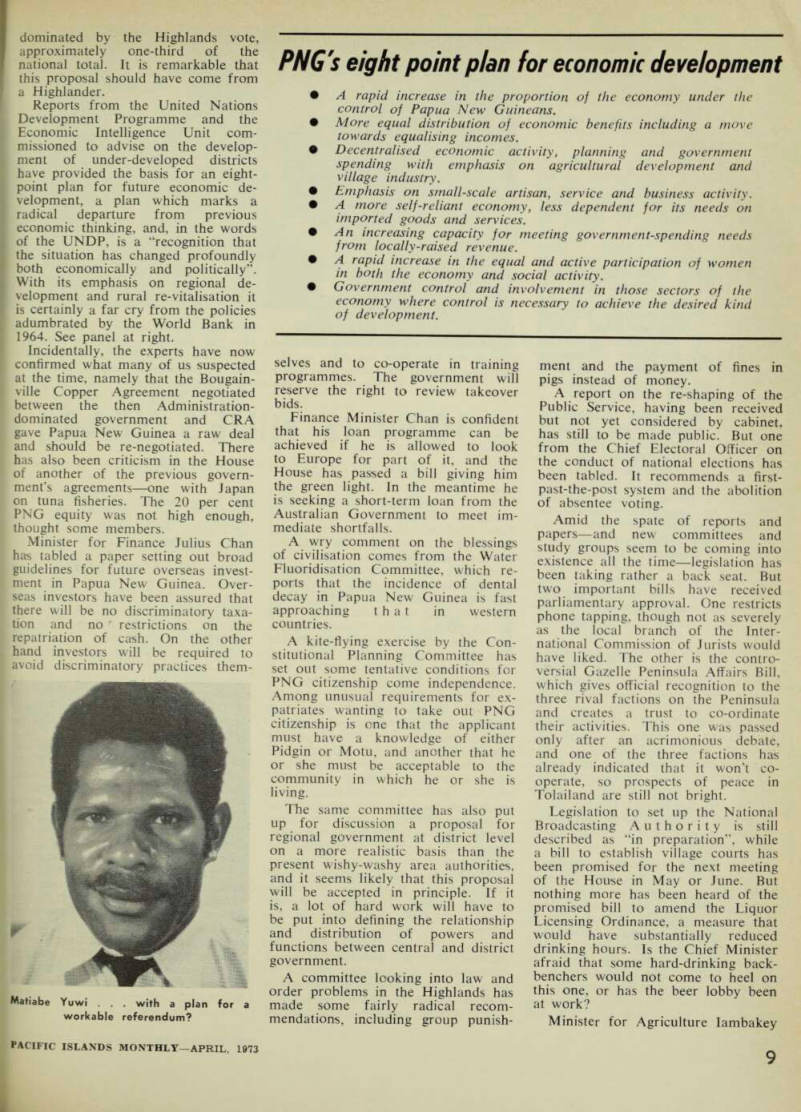
Miss
Png
An attractive ad dition to the Mel bourne Moomba Festival's Queen of the Pacific quest in March was Miss Papua New Guinea, Therese Ala'u. Aged 21, Therese comes from Manus, where she teaches at Christ the King School at Papitalai. She is wearing green snail shell jewellery from Manus. Twenty Mekeo dancers from the Kairuku people of Papua danced at the festival.
Fiji's threat
over air fares
International airlines and the International Air Transport Council {I AT A) have been threatened by Fiji Prime Mini ster Ratu Sir Kamisese Mara with an “open sky” policy which would open the country to charter operations if air fares on Fiji-Australia and Fiji-New Zea land were not cut. The Prime Minister was commenting on lATA’s new fare scale which has cut fares by as much as 44 per cent on Fiji-North America routes but left other fares from Fiji untouched. Recalling that an “open sky” policy had brought down fares in South-East Asia, Ratu Mara said, “We will not hesitate to declare Fiji an open sky for charters if that is the only way we can get lower fares”.
Passion
A Time Of
From Percy Chatterton
in Port Moresby The March meeting of Papua New Guinea’s House of Assembly has been chiefly remarkable for the com mittees, study groups and ministers.
Some of them were extremely im portant; but the stimulus for im passioned oratory came not from any of them but out of the issue of
independence.
Australia’s Prime Minister Gough Whitlam and Minister for External Territories Bill Morrison have made it clear to us that they will brook no delay in the passage from internal self-government, due at the end of this year, to outright independence.
PNG’s United Party Opposition has reacted by calling for a referendum, Chief Minister Michael Somare, caught in the cross fire, has agreed with the conservatives that we should give .self-government a go befon deciding on a date for independence, but has opposed a referendum, or the grounds that the voters have given the House a mandate to decide the issue.
He admits that a referendun would probably result in a rejectioi of early independence, but argues tha this would be due to ignorance anc fear on the part of the voters. Merni bers of the House, he claims, are ij a better position than are the peopli they represent to understand tb issues and weigh the pros and cons.
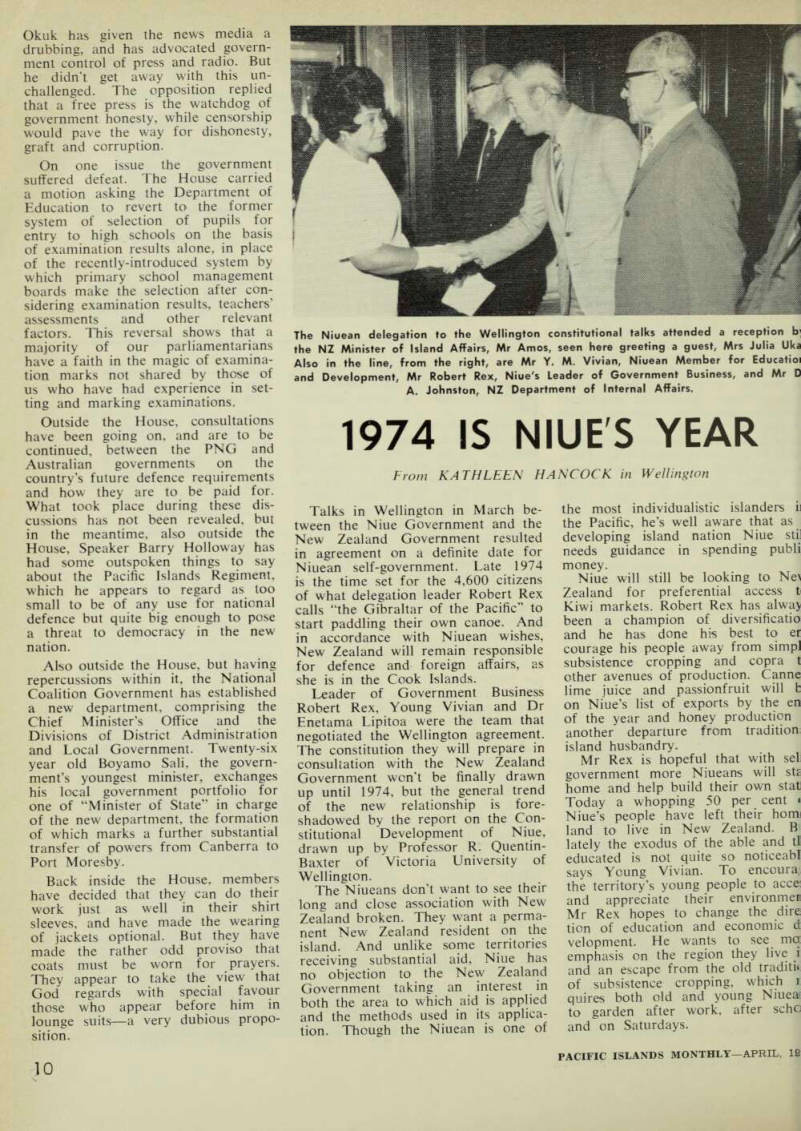
Mr Somare’s view prevailed, but onl after a sensational sitting which a one point had to be suspended b; the Speaker to allow passions to cool So a referendum is off, unless, a course, the House later on change its mind. This seems unlikely t: happen so long as the Nations Coalition is able to hold its majority But in the meantime, a Souther- Highlands member, the ebulliec Matiabe Yuwi, has come up with
idea which might well provide ai
acceptable pattern for any referen dum which might well provide at acceptable pattern for any referen dum which may be held in thi future.
He proposes that the result of referendum should be assessed by simple majority of votes in eao district, and at the national level ti a majority of districts. This pis would remove an objection frequent! advanced against the holding of referendum in Papua New Guine: namely that the result would I
dominated by the Highlands vote, approximately one-third of the national total. It is remarkable that this proposal should have come from a Highlander.
Reports from the United Nations Development Programme and the Economic Intelligence Unit com missioned to advise on the develop ment of under-developed districts have provided the basis for an eight point plan for future economic de velopment, a plan which marks a radical departure from previous economic thinking, and, in the words of the UNDP, is a “recognition that the situation has changed profoundly both economically and politically”.
With its emphasis on regional de velopment and rural re-vitalisation it is certainly a far cry from the policies adumbrated by the World Bank in 1964. See panel at right.
Incidentally, the experts have now confirmed what many of us suspected at the time, namely that the Bougain ville Copper Agreement negotiated between the then Administration dominated government and CRA gave Papua New Guinea a raw deal and should be re-negotiated. There has also been criticism in the House of another of the previous govern ment’s agreements—one with Japan on tuna fisheries. The 20 per cent PNG equity was not high enough, thought some members.
Minister for Finance Julius Chan has tabled a paper setting out broad guidelines for future overseas invest ment in Papua New Guinea. Over seas investors have been assured that there will be no discriminatory taxa tion and no • restrictions on the repatriation of cash. On the other hand investors will be required to avoid discriminatory practices them-
selves and to co-operate in training programmes. The government will reserve the right to review takeover bids.
Finance Minister Chan is confident that his loan programme can be achieved if he is allowed to look to Europe for part of it, and the House has passed a bill giving him the green light. In the meantime he is seeking a short-term loan from the Australian Government to meet im mediate shortfalls.
A wry comment on the blessings of civilisation comes from the Water Fluoridisation Committee, which re ports that the incidence of dental decay in Papua New Guinea is fast approaching that in western countries.
A kite-flying exercise by the Con stitutional Planning Committee has set out some tentative conditions for PNG citizenship come independence.
Among unusual requirements for ex patriates wanting to take out PNG citizenship is one that the applicant must have a knowledge of either Pidgin or Motu, and another that he or she must be acceptable to the community in which he or she is living.
The same committee has also put up for discussion a proposal for regional government at district level on a more realistic basis than the present wishy-washy area authorities, and it seems likely that this proposal will be accepted in principle. If it is, a lot of hard work will have to be put into defining the relationship and distribution of powers and functions between central and district government.
A committee looking into law and order problems in the Highlands has made some fairly radical recom mendations, including group punish
mem and the payment of fines in pigs instead of money.
A report on the re-shaping of the Public Service, having been received but not yet considered by cabinet, has still to be made public. But one from the Chief Electoral Officer on the conduct of national elections has been tabled. It recommends a first past-the-post system and the abolition of absentee voting.
Amid the spate of reports and papers—and new committees and study groups seem to be coming into existence all the time—legislation has been taking rather a back seat. But two important bills have received parliamentary approval. One restricts phone tapping, though not as severely as the local branch of the Inter national Commission of Jurists would have liked. The other is the contro versial Gazelle Peninsula Affairs Bill, which gives official recognition to the three rival factions on the Peninsula and creates a trust to co-ordinate their activities. This one was passed only after an acrimonious debate, and one of the three factions has already indicated that it won’t co operate, so prospects of peace in Tolailand are still not bright.
Legislation to set up the National Broadcasting Authority is still described as “in preparation”, while a bill to establish village courts has been promised for the next meeting of the House in May or June. But nothing more has been heard of the promised bill to amend the Liquor Licensing Ordinance, a measure that would have substantially reduced drinking hours. Is the Chief Minister afraid that some hard-drinking back benchers would not come to heel on this one, or has the beer lobby been at work?
Minister for Agriculture lambakey
Matiabe Yuwi . . . with a plan for a workable referendum?
Okuk has given the news media a drubbing, and has advocated govern ment control of press and radio. But he didn't get away with this un challenged. The opposition replied that a free press is the watchdog of government honesty, while censorship would pave the way for dishonesty, graft and corruption.
On one issue the government suffered defeat. The House carried a motion asking the Department of Education to revert to the former system of selection of pupils for entry to high schools on the basis of examination results alone, in place of the recently-introduced system by which primary school management boards make the selection after con sidering examination results, teachers’ assessments and other relevant factors. This reversal shows that a majority of our parliamentarians have a faith in the magic of examina tion marks not shared by those of us who have had experience in set ting and marking examinations.
Outside the House, consultations have been going on, and are to be continued, between the PNG and Australian governments on the country’s future defence requirements and how they are to be paid for.
What took place during these dis cussions has not been revealed, but in the meantime, also outside the House, Speaker Barry Holloway has had some outspoken things to say about the Pacific Islands Regiment, which he appears to regard as too small to be of any use for national defence but quite big enough to pose a threat to democracy in the new nation.
Also outside the House, but having repercussions within it, the National Coalition Government has established a new department, comprising the Chief Minister’s Office and the Divisions of District Administration and Local Government. Twenty-six year old Boyamo Sali, the govern ment’s youngest minister, exchanges his local government portfolio for one of “Minister of State” in charge of the new department, the formation of which marks a further substantial transfer of powers from Canberra to Port Moresby.
Back inside the House, members have decided that they can do their work just as well in their shirt sleeves, and have made the wearing of jackets optional. But they have made the rather odd proviso that coats must be worn for prayers.
They appear to take the view that God regards with special favour those who appear before him in lounge suits —a very dubious propo sition.
PNG's eight point plan for economic development
• A rapid increase in the proportion of the economy under the control of Papua New Guineans. • More equal distribution of economic benefits including a move towards equalising incomes. • Decentralised economic activity, planning and government spending with emphasis on agricultural development and village industry. • Emphasis on small-scale artisan, service and business activity. • A more self-reliant economy, less dependent for its needs on imported goods and services. • An increasing capacity for meeting government-spending needs from locally-raised revenue. • A rapid increase in the equal and active participation of women in both the economy and social activity. • Government control and involvement in those sectors of the economy where control is necessary to achieve the desired kind of development.
1974 Is Niue's Year
From KATHLEEN HANCOCK in Wellington
Talks in Wellington in March between the Niue Government and the New Zealand Government resulted in agreement on a definite date for Niuean self-government. Late 1974 is the time set for the 4,600 citizens of what delegation leader Robert Rex calls “the Gibraltar of the Pacific” to start paddling their own canoe. And in accordance with Niuean wishes, New Zealand will remain responsible for defence and foreign affairs, as she is in the Cook Islands.
Leader of Government Business Robert Rex, Young Vivian and Dr Enetama Lipitoa were the team that negotiated the Wellington agreement.
The constitution they will prepare in consultation with the New Zealand Government won’t be finally drawn up until 1974, but the general trend of the new relationship is foreshadowed by the report on the Constitutional Development of Niue, drawn up by Professor R. Quentin- Baxter of Victoria University of Wellington.
The Niueans don’t want to see their long and close association with New Zealand broken. They want a permanent New Zealand resident on the island. And unlike some territories receiving substantial aid. Niue has no objection to the New Zealand Government taking an interest in both the area to which aid is applied and the methods used in its application. Though the Niuean is one of
the most individualistic islanders h the Pacific, he’s well aware that as developing island nation Niue sti]
needs guidance in spending pubh
money.
Niue will still be looking to Net Zealand for preferential access t Kiwi markets. Robert Rex has alway been a champion of diversificatio and he has done his best to er courage his people away from simpl subsistence cropping and copra t other avenues of production. Canne lime juice and passionfruit will t on Niue’s list of exports by the en of the year and honey production another departure from tradition: island husbandry, Mr Rex is hopeful that with sel government more Niueans will stc home and help build their own stat Today a whopping 50 per cent * Niue’s people have left their horn land to live in New Zealand. B’ lately the exodus of the able and tt educated is not quite so noticeabl says Young Vivian. To encoura;. the territory’s young people to acce: and appreciate their environmen Mr Rex hopes to change the dire tion of education and economic d velopment. He wants to see mo; emphasis on the region they live i and an escape from the old traditu of subsistence cropping which i quires both old and young Niuea to garden after work, after sc and on Saturdays.
The Niuean delegation to the Wellington constitutional talks attended a reception by the NZ Minister of Island Affairs, Mr Amos, seen here greeting a guest, Mrs Julia Uka[?] Also in the line, from the right, are Mr Y. M. Vivian, Niuean Member for Education and Development, Mr Robert Rex, Niue's Leader of Government Business, and Mr D.
A. Johnston, NZ Department of Internal Affairs.
As Professor Quentin-Baxter says in his report, “To survive as a com munity with a normal spread of age groups Niue must be able to offer its people working and living con ditions which they find as good as or better than life in New Zealand”.
At the Wellington talks, Mr Rex, Mr Vivian and Dr Lipitoa were confident that with a continuance of help from their Kiwi neighbours they could, given time, achieve this. They think the slow pace of Niuean develop ment hasn’t been a bad thing, but that with self-government the new ; policies they will adopt will be more 1 suited to the present needs of the people on the one hand and more realistic on the other.
“Even if self-government doesn’t make us economically self-sufficient,” says Mr Rex, “it should help us pre serve our identity and our way of life in a bi-cultural community.”
Albert's
1973 may be Albert's
From Kathleen Hancock
I Cook Islands Premier Albert Henry was invited to Wellington last I month to pay his respects to New Zealand’s new Labor government ; and he was able to greet a lot of old friends dating back to his active days in the New Zealand Labor Party in Auckland.
Though this wasn’t a funds-seeking I visit, Mr Henry’s thoughts, as ever, turned to the financial situation in the Cocks and he repeated his view that if the Cook Islands were to move towards eventual self-sufficiency, co lordinated aid was needed to support all avenues of endeavour in his
! country.
“It’s not much good,” said Mr Henry, “to give aid to the banana project and forget shipping. That can be a waste of money.” He said the Cook Islands very much appreciated I New Zealand help and assistance, but they needed the right tools at the right time. “We in the Cook Islands have built up internal revenue 136 per cent,” he said. “I reckon that’s good by any international standard.”
Albert Henry’s argument is that he has been working with an administra tive structure not much changed since colonial days, and that this has re tarded development. He feels that his high administrative costs have Partly, at least, stemmed from having to work with the old cumbersome system. But he sees a glimmer of light.
“We are gradually altering the ad ministrative picture,” he said in Wellington. “This year will be spent completely reorganising the structure of government.”
Zoning has now come to the Cooks with the Land Use Act, which clearly differentiates between land to be used for residential or industrial use, for tourist hotels or for recreational pur poses. The Premier said this bill should put a stop to people buying seemingly worthless land for a song and then reaping big profits from tourist hotels built on it. Another bill that has changed the life pattern in the Cooks is the Short Term Crop Leases Act, which deals with absentee ownership. This is a major problem in a county where many acres of good land lie idle while their owners live and work in New Zealand. By the terms of this bill an absentee family can grant a five-year lease terminable at 12 months’ notice.
The procedure for Cook Islanders who want to do this is simple.
“There’s no need for expensive legal proceedings for the landlord or the lessee,” says Mr Henry. “A plain piece of paper is lodged with the Land Development Department and that’s that.”
This bill appeals to the Premier for other reasons, too. He feels it introduces his people to one more way of European thinking. It also helps willing workers to get a good return for their labour on a decent sized plot of ground. “Any way in which neglected land can be brought back into production is another step forward,” he said.
Mr Henry feels he has been mis represented in some quarters as a
dictator. He reckons the only dictatorial action he’s taken lately is the enforcement of an old statute forbidding dancing or working on Sundays. “Now this dates back to missionary days,” he said. “I feel that the missionaries wrongly made us feel dancing was an ugly thing, but I found out that 90 per cent of my people want the law kept. It was never changed under the New Zealand administration and it is still a law. I enforce it, and if this is dictatorial, then maybe I am a dictator!”
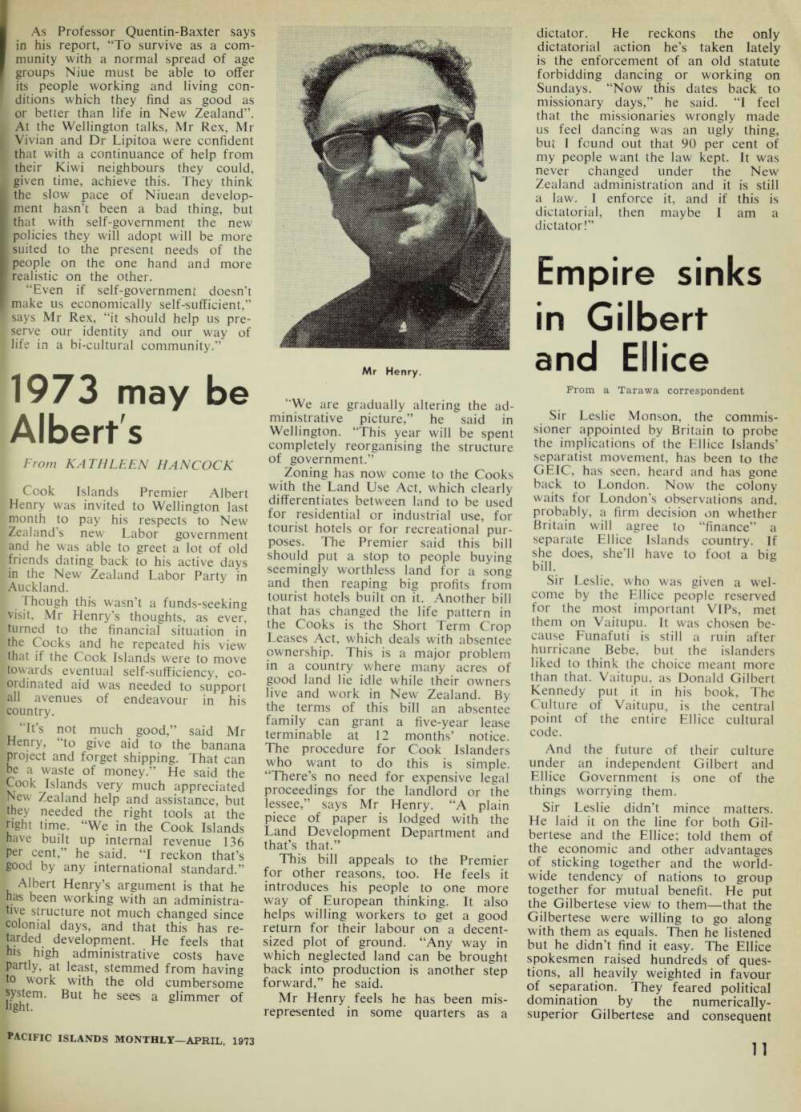
Mr Henry.
Empire sinks
in Gilbert and Ellice
From a Tarawa correspondent Sir Leslie Monson, the commis sioner appointed by Britain to probe the implications of the Ellice Islands’ separatist movement, has been to the GEIC, has seen, heard and has gone back to London. Now the colony waits for London's observations and, probably, a firm decision on whether Britain will agree to “finance” a separate Ellice Islands country. If she does, she’ll have to foot a big bill.
Sir Leslie, who was given a wel come by the Ellice people reserved for the most important VIPs, met them on Vaitupu. It was chosen be cause Funafuti is still a ruin after hurricane Bebe, but the islanders liked to think the choice meant more than that. Vaitupu, as Donald Gilbert Kennedy put it in his book. The Culture of Vaitupu, is the central point of the entire Ellice cultural code.
And the future of their culture under an independent Gilbert and Ellice Government is one of the things worrying them.
Sir Leslie didn’t mince matters.
He laid it on the line for both Gil bertese and the Ellice; told them of the economic and other advantages of sticking together and the world wide tendency of nations to group together for mutual benefit. He put the Gilbertese view to them—that the Gilbertese were willing to go along with them as equals. Then he listened but he didn’t find it easy. The Ellice spokesmen raised hundreds of ques tions, all heavily weighted in favour of separation. They feared political domination by the numerically superior Gilbertese and consequent
The promise of radiant skin beauty

radiant skin beauty
A smooth and radiant complextion has long been the dream of all women throughout the ages
Now through the dis covery of a tropically moist oil blend, every woman can be assisted in attaining the complexion she seeks simply by the daily use of a unique beauty fluid and follow ing a basic skin care routine. Because of our harsh climatic conditions, most women are con stantly faced with the problem of dry skin which if not checked can lead to the formation of tiny lines and eventually wrinkle dryness.
Flaky patches, the symptom of dryness, are primarily caused by hot sun and wind robbing the skin of its precious supply of oil and mois ture. Now it is possible to help replenish these natural fluids and give your skin the assistance it needs to always be at its radiant best.
A unique
beauty aid
Today, you need not worry about the drying effect of the elements thanks to the develop ment of a unique moist oil blend. This remark able beauty fluid provides the skin with the same even balance of oil and moisture that nature normally lavishes on the soft, flawless complexion of the very young.
Known in Britain and Europe as Oil of Ulay and in America as Oil of Olay, this beautifying fluid is available from
pharmacies and stores in the Pacific Islands as Oil of Ulan.
By smoothing Oil of Ulan over your face and neck each morning and evening you will protect your skin against loss of moisture and help pre serve a soft supple com-
plexion free from dry ness.
It protects and nur tures your skin all day and is particularly help ful if you enjoy outdoor sports such as tennis, golf, bowls, swimming or boating. Remember the sun dries out your skin at an accelerated rate and a couple of minutes
spent smoothing in your Oil of Ulan moist oil blend will help promote a healthy skin texture and retain your youthful radiant complexion.
The tissue-thin skin area surrounding your eyes needs the gentlest and tenderest of care. Finger pat your Oil of Ulan around the eyes before you apply make-up,
working from the nose and over the upper eye lid, then down and round the eyes towards the nose again. The special properties of this unique moist oil blend make it invaluable for helping keep wrinkle-dryness at bay and protecting the youthful appearance of pretty eyes.
neglect; the loss of their own identity the loss of jobs through favouritisn for Gilbertese; discontent through th< absence of development of theii islands and a host of petty complaint! —almost all irrelevant gossip.
They were all for separation— except one, Isa Paeniu, the membei for Nukulaelae, who produced argu ments, many taken up by Sir Leslie but he agreed that he’d go alonj with the majority.
Four papers were presented to Si Leslie by delegates on the financial economic, political and social situ ations which, it was prophesied would follow separation. Colin Hill Sir Leslie’s financial adviser, got to gether with the delegates’ sub committee headed by Sione Tui Klei to see how the figures on the financia paper were arrived at. The author of the paper had claimed an eight of all the 1973 budget provisions o: the simple assumption that the Ellic population would be around one eighth of the territory’s total popr lation. After a long session of th sub-committee, Mr Hill reported tha he violently disagreed with the figure: especially with those on the incom side. Mr Kleis, somewhat unable t defend his figures, said they wer based, not on knowledge but o commonsense. One wonders, in sue a crucial situation when the who] future of the Ellice was being detei mined, that Mr Kleis saw fit to us his “commonsense” rather than har facts.
Money to repair a budget defic and development funds, the delegah argued, should come from Britaii Sir Leslie said those views would 1: put to the British Government bi he warned that that was the vei thing any British Government woul feel reluctant to consider.
There was some air of embarras ment for the Britishers at the mee ing. A well-respected Vaitup dignitary, a non-delegate, made h stand in the crowded maneap bowed respectfully and solemn started off in the most typical sty of Polynesian oratory: “Our fathe from the great British Empire”. I kept repeating the phrase as a subs tute for “Mr Chairman” every tir he made a speech. The poor fellc hadn’t realised, and probably w never believe if told, that his a parently admired British Empire longer exists.
BINGO CONTROL. —There will no “wide open” bingo in Americ; Samoa. Governor John M. Haydi has vetoed a bill which would haf allowed it. The present law allo< bingo for the benefit of religioi educational and charity institutions..
Tropicalities
Troubled
Troubiands
The four warring Chiefs of Kiriwina, Trobriand Islands, were called into Port Moresby in mid- March to smoke the pipe of peace with Chief Minister Somare; a mobile unit was withdrawn from Kiriwina and the troubles of the islands were officially pronounced over. But are they?
In February-March Kiriwina looked like following the New Guinea Highlands, the Gazelle and Bougain ville into the business of ruining the idea of a united Papua New Guinea sweeping on into placid independence.
Trouble had been brewing for some time but reached a climax in early March when dissident Trobriands leader, John Kasaipwalova, usually described as a university student and sometimes as a poet was arrested and charged with “unlawfully laying hands on a police officer.”
Supporters are said to have stormed the sub-district office and had to be beaten off by police using tear gas.
Headlines appeared in newspapers as far away as Dunedin, New Zealand.
The Trobriands are unusual in Melanesian Papua New Guinea in that they have a system of hereditary chiefs. In the manner of chiefs every where, those in the Trobriands were fairly conservative and affairs generally went along in their old accustomed way until about two years ago.
That was when young Mr Kasaip walova, himself a Trobriand Islander, decided to put a few modern ideas into practice around Kiriwina. His first project was trade stores, which were set up in villages, sometimes in competition to established private enterprise trade stores, and staffed by school drop-outs.
The project seemed reasonably successful and towards the end of 1972 ideas turned towards politics.
It was Mr Kasaipwalova’s contention that the government-sponsored local government council was “irrelevant” in the Kiriwina context and so it was to launch an opposition jKabisawali (New Ways) People’s
Government. To this point most of the chiefs seemed to be with the idea but when Mr Kasaipwalova an nounced that the new “government” would levy taxes, which would be illegal, at least one of the chiefs took fright. Battle lines were then drawn— Chiefs Vanoi and Waibadi on one side and Chief Mwoyoyo and Mali butau remaining with Mr Kasaipwa lova.
It was the four chiefs who went to Port Moresby to confer with Chief Minister Somare. The official press release that was issued subsequently is remarkable in that it is a page and one half of platitudes without once mentioning Mr Kasaipwalova. Chiefs would now return to the island it said, to “bring a message of peace” and that only the “traditional leaders were able to reunite the people of Kiriwina”. Mr Somare, on his part, “gave assurances” while warning that infringements of the law must be dealt with in the normal process.
What now in the Trobriands? Does the Kasaipwalova lion lie down with the Vanoi tiger? Keep watching this column.
One of the interesting side-lights of the whole kerfuffle is the discovery by some journalists that the Trobriands or Kiriwina (it is not
clear which) means “Island of Love”.
We thought that that referred to Robert Langdon’s Tahiti and to old PNG watchers it all has overtones of Malinowski’s once famous “Sexual Life of Savages” which he wrote after a field trip to the Trobriands before World War I.
The “Sexual Life” was required reading once for anthropology students and was regarded as hot stuff by those who attended Sydney University in the thirties. One of the lecturers there long after regularly entertained his students with a parody of a coy and timid girl fronting the librarian and asking for the book.
University students are no longer coy and old Malinowski and his Trobriand savages and their sex practices are pretty tame stuff these days.
There’s money
in these slugs
The Fiji Department of Agriculture is trying to interest local Fijians— or anyone else—in reviving the beche de-mer (or trepang) industry, which flourished in the dominion up until the Pacific War. Since then there has been little interest, initially because
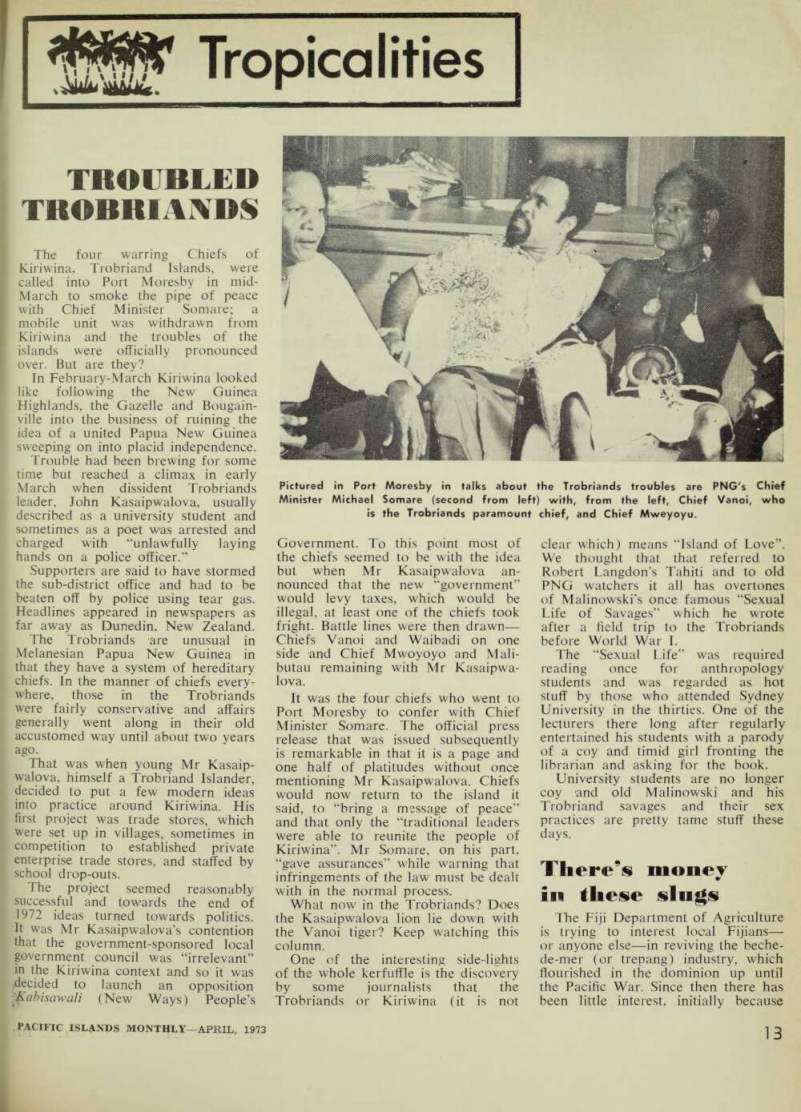
Pictured in Port Moresby in talks about the Trobriands troubles are PNG's Chief Minister Michael Somare (second from left) with, from the left. Chief Vanoi, who is the Trobriands paramount chief, and Chief Mweyoyu.
of low prices and not much demand.
Prices now are good and it is estimated that from 30 to 60 tons of dried beche-de-mer a month could find a market in Hong Kong. A bag of dried beche-de-mer of good quality was fetching $6O in Suva in December.
Preparation of beche-de-mer for export is not the most salubrious of industries but at least it needs little capital.
The department’s fisheries division is eager to give advice on curing to any interested parties. The slugs, which are harvested from coastal lagoons, have to be boiled, then gutted, cleaned and dried. When cured they can be stored for long periods without deterioration and one man can harvest 400-600 lb of the sea creatures in one day’s fishing in a good area. About 15 lb of dried beche-de-mer can be got from 100 lb of the raw slug.
Several firms in Fiji are now in the market and one is producing beche-de-mer granules ready for preparing instant-soup.
Harvesting beche-de-mer should be a useful addition to income in traditional copra producing areas which have suffered from low prices for that commodity. As yet local people have shown little interest in reviving the beche-de-mer industry.
But anyone who would like to know more should contact the local fisheries assistant or Agricultural Dept.
Huskiest husker
is in Tonga
Last year at the Fun in the Sun Carnival at Cairns, Queensland, a world championship coconut husking championship was held. The winner husked one coconut in six seconds and the result, then believed to be a world record, is to be entered in the Guinness Book of Records. Now comes news from Tonga that the real champion lives there. His name is Paula ‘Alo and he husked 54 nuts in five minutes, which works out at 5i seconds per nut.
Paula was discovered by Mr Len Barnes of Plantation Chinta, Brams ton Beach, North Queensland, who is the only commercial coconut grower in Australia. Mr Barnes and his wife were holidaying in Tonga when he became interested in the speed of the coconut buskers at the Tonga Coconut Board processing plant outside Nukualofa. He organised a competition, with startling results, and is thinking of sponsoring a visit of a Tonga champion at the next Fun in the Sun Festival at Oaims.
Lord Howe’s
foreign fish
Lord Howe Island’s piscatorial population consists mainly of foreigners and most of those are tropical types. An expedition to the island led by Dr Frank Talbot, director of the Australian Museum collected 7,000 specimens of marine life and among them identified 420 different species of which only 226 had been previously identified. The migrants, or their ancestors, had probably been swept down from the Great Barrier Reef. Fishing was done with two boats, a miniature sub marine, small charges of gelignite and fish poison.
Suzuki in a Tongam
wonderland
A trading company in Tonga ad vertised through the Japan External Trade Organisation for two sales managers and two branch chiefs “with annual salaries of $3,000 and $2,200 respectively”, says the Tokyo news paper The Yomiuri Shimbun. The organisation was upset, when it got a flood of inquiries, at the thought that so many people wanted to leave Japan to live in Tonga. So, the news paper cast around for reasons and came up with these: One can live all the year round without a jacket. Tonga is a “nice place to live in because it is said that a couple can easily manage to live with a weekly income of about $lO.
Roughly estimated, one can save as much as $2,000 a year, or $6,000 in three years if he completes the three year contract offered by the Tongan company. The Tongan company is the biggest trading house in Tonga, although its size is small internation
ally. It sounds wonderful that a Japanese will be able to use freely his management skill in these paradise islands. Considering such favourable living conditions, Tonga is considered much better than Japan even with a monthly income of around Y70,000.’ : The Yomiuri Shimbun explained that the “Tongan trading house made the offer to hire the Japanese, whc are reputed very ‘diligent’, because Caucasians, if hired, do not seem tc get along well with the native islanders, and, more important, nc white person would ever apply for £ vacancy with a salary of arounc $3,000 a year.”
Getting down from the cloud PlM’s pretty sure that anyone, what ever his colour, would apply for the job if he could save $2,000 a year!
Ilan liquor and
save money
The Senate of Fiji’s Parliament ha rejected a resolution that called fo a ban on liquor in the dominioi —but not by much. Nine senator voted against the resolution, six wen for it and two abstained. (Fivi other senators were apparent!; missing).
The motion was put by Senato Ratu Mosese Tuisawau who con tended that it has become too ex pensive to police the liquor laws which had become too liberal fo the good of the country and fo young Fijians, “hardly out of school.
Senator Ratu Jone Mataitini, how ever, was of the opinion that then would not be enough police to en force the law if prohibition were in troduced. Furthermore he felt tha the motion had been brought ii “as a means of attacking the Fijiai race.”
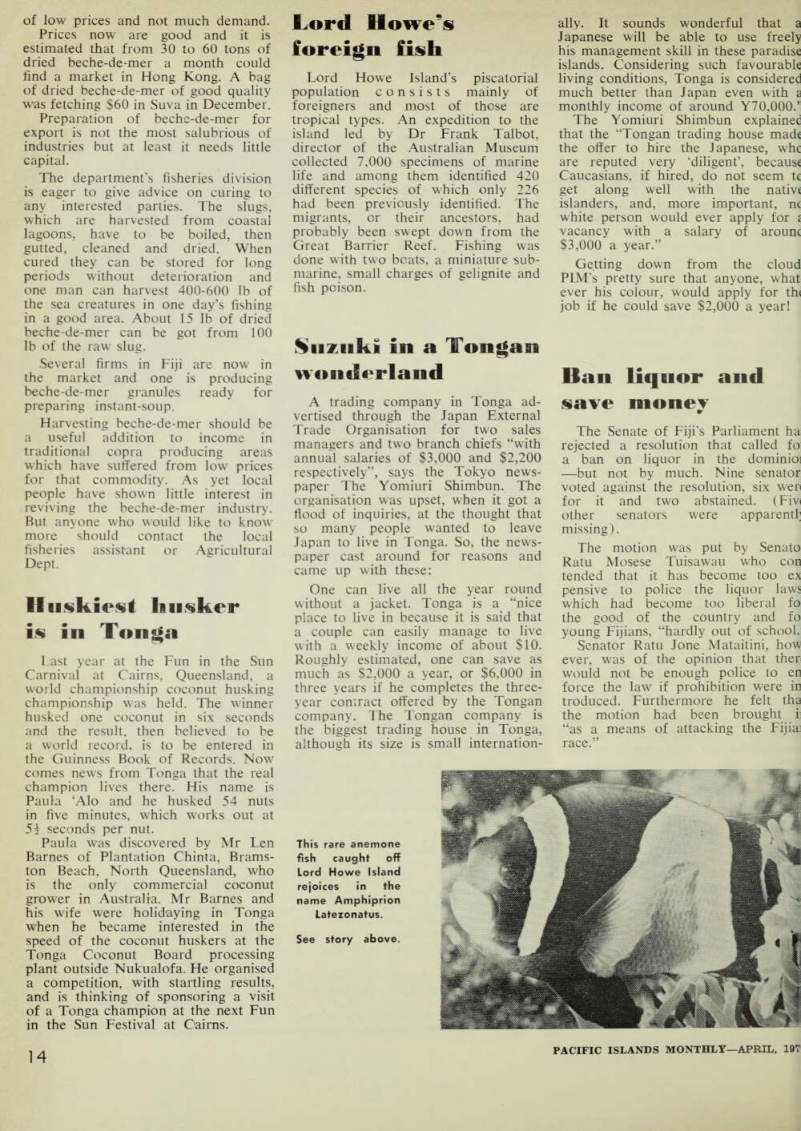
This rare anemone fish caught off Lord Howe Island rejoices in the
name Amphiprion
Latezonatus.
See story above.
People

• Mr L. W. Johnson, Papua New Guinea’s Administrator, has offered to remain at his post until indepen dence provided he isn’t in the way and can perform a useful function.
I Commenting on his position recently he said he doesn’t want to remain as a “decaying and useless relic of the ■ colonial past”. • Two independent MHA’s in Papua New Guinea have joined the Peoples’ Progress Party because their people believed they could do more I for them with party backing. One of the MHAs is Minister for Informa tion, Mr Paulus Arek, and the other is Mr Stephen Tago. Both were school teachers before being elected to the House of Assembly. • George Pilioko, nephew of Aloi Pilioko, a well-known Polynesian artist, has gone to France and Switzer land to take up a scholarship in museography. The scholarship course of one year was offered by Professor Gabus, of Neuhatel, a member of UNESCO and ICOM, who has helped to create various museums in Africa, South America and the Middle East to preserve local arts and traditions.
Mr Pilioko was born on Wallis Island in 1949. After completing his military training as a French citizen, he went to the New Hebrides to visit his
in Port Vila. He built up an interest in Oceanic art and is now about to carry that interest a stage further through his scholarship. • Andy Thompson, American turned Cook Islander, recently cele brated his 86th birthday. He first arrived in Rarotonga in 1908 in a trading schooner, and returned in 1912 to make the islands his home.
He spent his life as a mariner, serving in ships trading to the US, and New Zealand, as well as to other South Pacific groups. He retired in 1964. • Mr John Hilary Smith, Finan cial Secretary in the BSIP, has been appointed Governor of the GEIC in succession to Sir John Field. Aged 45, married with three children, Mr Smith worked in the Colonial service in Nigeria from 1951 to 1970 when he was appointed to the Solomons.
He will arrive in Tarawa in July. • Chief Nikolao Pula has been appointed American Samoa’s Director of Education. He has been with the department for 40 years, latterly as deputy director. He succeeds Mr Milton de Mello, who went to Pago Pago from Hawaii three years ago and will now go on to Washington DC for a year of advanced study. • Chris Laidlaw, ex-NZ All Blacks’ half-back, who is on the staff of the NZ High Commission in Fiji, will coach the Suva Rugby Union’s rep team this season. • Raymond Burr, television’s Iron side, plans to retire in 1975 and live on his island of Naitauba in Fiji.
But before that he will make another television serial and will film it in Fiji. After retiring, he hopes to begin another job—launching a daily news paper. • Dr Charles E. Fox, at 94 the oldest and most celebrated working missionary in the Islands, has finally retired. A career with the Anglican Church which started on Norfolk Is land in 1902 ended on March 14 when, with 500 people to see him off, he flew from Honiara to retirement in New Zealand. He will live at a small private hospital at Waipukurau, Hawkes Bay. Dr Fox arrived in the Solomons in 1908 and has served as a District Priest on San Cristoval, headmaster of All Hallow School, Ugi, as a member of the Melanesian Brotherhood for 11 years, as Principal of the Catechists’ Training College at Kohimarama, Guadalcanal and as chaplain at Taroaniara, including St Clair’s Hospital. He refused to leave the Solomons when the Pacific war broke out and he served throughout behind the Japanese lines as a coast watcher.
• From agriculture to works— that transition has been made by Mr Berenado Vunibobo, who was Secre tary for Agriculture, Fisheries and Forests in Fiji. He has succeeded Mr Jim Barron as Secretary of Com munications, Works and Tourism.
Mr Barron is on pre-retirement leave after 23 years in Fiji. Mr Winston Thompson, Director of Agriculture, has been appointed to succeed Mr Vunibobo. • Dr Alfonso Faustino, the first Micronesian physician to receive an MD degree from a US university, recently finished his internship at Providence Hospital, Portland, Oregon. • Dr Ulai T. Otobed, the first and only Micronesian woman doctor, has returned to Koror after two years at the National Women’s Hospital, Auckland, training in obstetrics and gynaecology. She graduated from the Fiji School of Medicine in 1965. In 1968 she spent six months in New Zealand training in obstetrics. Dr Otobed was born at Amelik, Babel thuap. © With the backing of the PNG Development Bank, Mr Igo Tutara of Hanuabada has become the first uncle. There he learned to speak English, and taught in French schools
Here's one of PIM's correspondents, Felise Va'a, of Western Samoa, and his wife of a few weeks, formerly Makerita Samu, second daughter of the Rev and Mrs Samu Lafoai, of Apia. They were married in American Samoa on February 26 and honeymooned in Fiji. Felise, son of Mr and Mrs Leulu Va'a, of Saleufi, Apia, is chief reporter on the Samoa Times, and Makerita is a secretary with Polynesian Airlines.
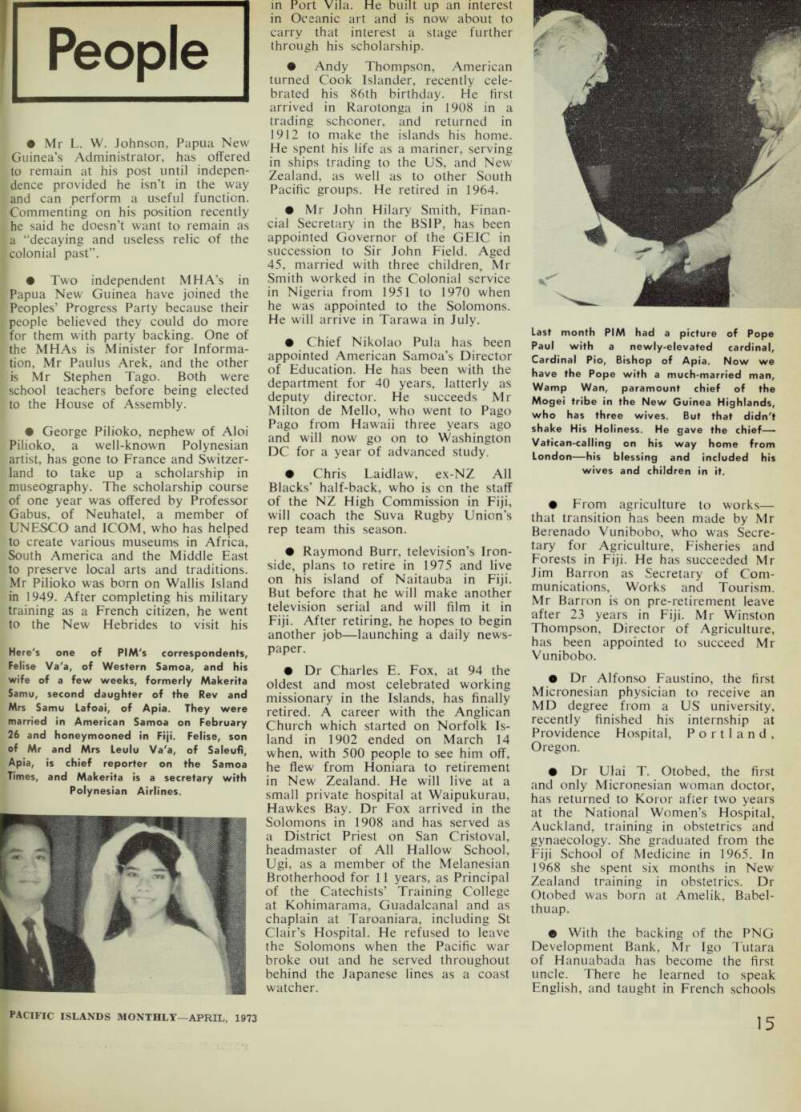
Last month PIM had a picture of Pope Paul with a newly-elevated cardinal, Cardinal Pio, Bishop of Apia. Now we have the Pope with a much-married man, Wamp Wan, paramount chief of the Mogei tribe in the New Guinea Highlands, who has three wives. But that didn't shake His Holiness. He gave the chief— Vatican-calling on his way home from London—his blessing and included his wives and children in it.
local man to run a car-hire busine: Operating at Badili, Mr Tutara h seven cars and is assisted by 1 daughter, Mea, and a nephew, L Tau. • Tufuga Samuelu Atoa has be appointed Director of Education f Latter-day Saints schools in Weste Samoa. His appointment will effective from June. A former cha man of the Public Service Comm sion, he is president of the Rota Club of Apia and of the Weste Samoa Amateur Sports Federatic Mr Atoa. resigned from the Pub Service in 1971 to become Busin* Manager for LDS schools. • A 14-year-old blind New Brit: lad, Paul Sangios, has passed an A tralian Music Board examination w high marks. Paul plays the pia and is regarded by his examiners showing considerable talent. He tends St Edmund’s School for ' Blind at Wahroonga, Sydney, wh he is sponsored by the Rabaul Lie Club. He has done well in gene
school subjects, including toui
typing and Braille and will remi at the school until he gets his leav' certificate. • Professor Y. P. Ghai, an exg on constitutional law and a law in Kenya, is in Papua New Guin He has been engaged as a specis consultant by the Constitutioc Planning Committee.
Mr Mekere Morauta, has been a[?] pointed Deputy Secretary in the Depart ment of Finance in Papua New Guinea He obtained a Bachelor of Economic degree from the University of PNG 1970, the first indigenous graduate economics from that university. Before joining the Finance Department he h[?] appointments in the Labour Department and the Administrator's Department.
Advertisements & other items, pp. 18-22 (3 items)
Corned
AN INVITATION FROM
MOTOR HOLIDAYS (N.Z.) LTD.
WHEN YOU CAN ENJOY THE WORLD IN
MINIATURE IN NEW ZEALAND, WHY GO
FURTHER AFIELD FOR THE HOLIDAY OF
YOUR LIFETIME?
PIONEERS
FOLLOWING THE
SUN SINCE '6l
COMPETITIVE RATES
HIRE MOTOR
CARAVANS FROM $3O
PER WEEK
PLUS 10c PER MILE
NORTH - SOUTH
FERRY BOOKINGS
AVAILABLE
BOOK YOUR HOLIDAY
TOUR NOW
BOOKINGS AND ENQUIRIES
412 MT. EDEN ROAD, AUCKLAND. PHONE 600-288 ■ w'
SPECIALISTS IN FULLY- EQUIPPED
MOTOR CARAVAN TOURIST
RENTALS
AVAILABLE FROM AUCKLAND
AND CHRISTCHURCH
★★★ * * Leading
SOUTH
AMERICAN
Brand
CORNED
BEEF
Sole Exporters to the Pacific Islands:
PETER FISHER TRADING PTY. LTD.
321 PITT STREET, SYDNEY, 2000, AUSTRALIA.
Telephone; 26 1109. Cables "FISHERION", Sydney.
mam I J 4 When next you are in London , you are cordially The Dunhill King Size Filter Cigarette, created and perfected by our blenders to be the best Virginia cigarette in the world. un
JNDON FfcflJS NEW YORK
The most distinguished tobacco house in the wor
Xk- & Si 3 ■■i *»i t||«|
TVM3M»
sK 4 u on i
n
they
O
u mi mi
t nc if s ■ With a little friendly help from Burns Philp!
While more and more tourists are discovering the Islands, more and more islanders are discovering the welcome flow of tourist dollars. This is business as business should be, both buyer and seller happy with the arrangement and the rest of the community profiting as well.
Throughout the Islands, Burns Philp are on the scene helping the good business to happen. Local people with local knowledge aid the tourists through a score and more of Burns Philp agencies—shipping agents, airline agents, travel agents and many others.
Over hundreds of thousands of square miles of the Pacific, the familiar Burns Philp name helps people to feel at home in these wonderful far away places.
DOING GOOD BUSINESS FOR THE ISLANDS
BURn/ PHILP
GROUP OF COMPANIES
PRINCIPAL OFFICE—7 BRIDGE STREET SYDNEY NSW 2000 AUSTRALIA
7 / X f \ s - V V s £ss m V m p 1 -
BSP?
OttS famous DISC
There is no Substitute Quality
17
ACIFIC ISLANDS MONTHLY—APRIL. 1973
Acific Islands Monthly— April, 1973
a rugby

The round ball in a rugby stronghold
From JACK NAIDU in Suva
South Pacific soccer players, who have wilted for years at the scornful retort from “football” players that their ball was the “wrong shape”, got rid of their complex recently in, of all places, New Zealand. They staged their first Oceania Soccer tournament in Auckland’s Newmarket Park and, attracting players from the host country and from Tahiti, Fiji, New Caledonia and New Hebrides, persuaded the New Zealanders that there was something to be said for the older sport.
New Zealand became the first holder of the Oceania Cup after beating Tahiti 2-0 in the final. It was a good win for New Zealand after Tahiti had held them to a 1-1 draw in the first encounter, which was a shambles.
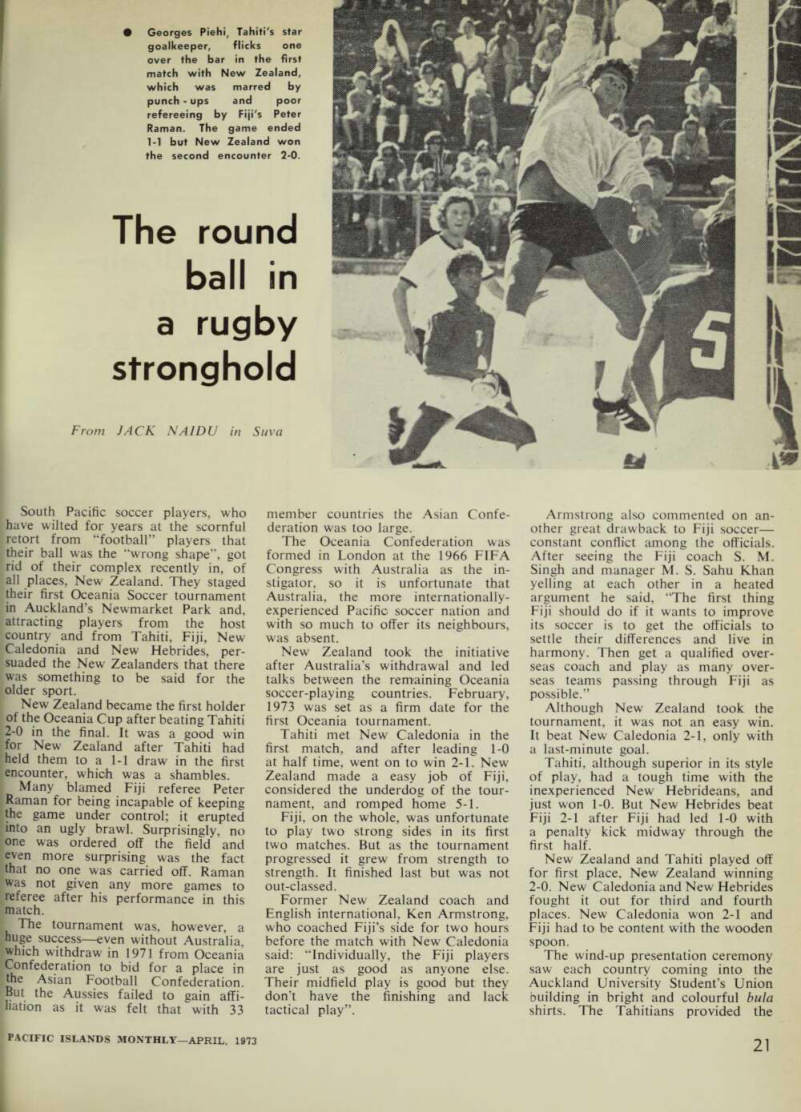
Many blamed Fiji referee Peter Raman for being incapable of keeping the game under control; it erupted into an ugly brawl. Surprisingly, no one was ordered off the field and even more surprising was the fact that no one was carried off. Raman was not given any more games to referee after his performance in this m^5 h - The tournament was, however, a . suc . cess —even without Australia, which withdraw in 1971 from Oceania Confederation to bid for a place in the Asian Football Confederation.
But the Aussies failed to gain affiliation as it was felt that with 33
member countries the Asian Confederation was too large.
The Oceania Confederation was formed in London at the 1966 FIFA Congress with Australia as the instigator, so it is unfortunate that Australia, the more internationallyexperienced Pacific soccer nation and with so much to offer its neighbours, was absent.
New Zealand took the initiative after Australia’s withdrawal and led talks between the remaining Oceania soccer-playing countries. February, 1973 was set as a firm date for the first Oceania tournament.
Tahiti met New Caledonia in the first match, and after leading 1-0 at half time, went on to win 2-1. New Zealand made a easy job of Fiji, considered the underdog of the tournament, and romped home 5-1.
Fiji, on the whole, was unfortunate to play two strong sides in its first two matches. But as the tournament progressed it grew from strength to strength. It finished last but was not out-classed.
Former New Zealand coach and English international, Ken Armstrong, who coached Fiji’s side for two hours before the match with New Caledonia said; “Individually, the Fiji players are just as good as anyone else.
Their midfield play is good but they don’t have the finishing and lack tactical play”.
Armstrong also commented on an other great drawback to Fiji soccer— constant conflict among the officials, After seeing the Fiji coach S. M.
Singh and manager M. S. Sahu Khan yelling at each other in a heated argument he said, “The first thing Fiji should do if it wants to improve its soccer is to get the officials to settle their differences and live in harmony. Then get a qualified over seas coach and play as many over seas teams passing through Fiji as possible.”
Although New Zealand took the tournament, it was not an easy win.
It beat New Caledonia 2-1, only with a last-minute goal, Tahiti, although superior in its style of play, had a tough time with the inexperienced New Hebrideans, and just won 1-0. But New Hebrides beat Fiji 2-1 after Fiji had led 1-0 with a penalty kick midway through the first half.
New Zealand and Tahiti played off for first place, New Zealand winning 2-0. New Caledonia and New Hebrides fought it out for third and fourth places. New Caledonia won 2-1 and Fiji had to be content with the wooden spoon, The wind-up presentation ceremony saw each country coming into the Auckland University Student’s Union building in bright and colourful bula shirts. The Tahitians provided the
• Georges Piehi, Tahiti's star goalkeeper, flicks one over the bar in the first match with New Zealand, which was marred by punch - ups and poor refereeing by Fiji's Peter Raman. The game ended 1-1 but New Zealand won the second encounter 2-0.
music. Sir William Walkley, donor of the Oceania Cup, was there in person to present the cup and other prizes. He said the tournament had been a great success and compli mented officials on their “sheer guts and determination” in making it so.
And now the tournament has proved itself, it is hoped that Aust ralia, which now has nowhere to play, may be persuaded to rejoin the Oceania Confederation and make the second tournament (in Fiji in 1977) truly representative of Oceania.
Tonga's
Handball- Tonga's new craze
From BETTY SANFT in Nukualofa Four years ago, soccer was started in Tonga and very quickly became a serious contender with rugby, especi ally as the women also took to it. At one stage, there were as many women’s teams registered as men’s.
They became an instant drawcard, but, after a couple of seasons, the novelty began to wear off and the women themselves began to realise that their physique couldn’t stand up to the speed and rigorous nature of the game and they were content to leave it to the men to carry on.
Then a miracle happened. A brand new game called handball appeared on the scene and overnight has be come the latest craze among Tonga’s; young women. It’s a direct transplant from the Munich Olympics to the; last remaining Polynesian kingdom oni the opposite side of the world.
The person responsible for this long-distance introduction to the game; is none other than King Taufa’ahaui Tupou IV himself. He and his con sort were on a private visit to the United Kingdom at the time of the Games and were among the millions of television viewers who watched! them. He came away with a positive idea that could work in the South Seas. He corresponded with many countries where handball is played and found that it was a cross between soccer and basketball, played by either] seven or nine-a-side. He chose the smaller and faster game and within a month a national committee was selected to organise this new sport through towns and villages.
January’s end marked handball’s gala opening when more than 3(D registered clubs, supporting more than 60 women’s teams paraded before
his Majesty and the national execu tive. Three weeks later, there were 80 teams representing well over 40 clubs registered with the association.
This is a fantastic rate of growth and the game has yet to be intro duced to the other islands in the group. All this takes place every Saturday in Tonga College’s rural setting, within easy distance of the capital, Nukualofa, where 12 courts have been marked out as the home of handball.
Overseas, handball is played by both sexes. Here in Tonga it has been tailored for women only. His Majesty believes that the sport in Tonga has prepared the men for the more vigorous contact games like rugby and soccer. The women on the other hand have played mostly basketball and volleyball and are more adapted by training and usage to the new sport where no footwork is permitted other than running and side-stepping and where everything depends on the skill and agility of the hands to bounce and pass the ball and score goals through posts similar to soccer.
The king maintained that if the men were to participate successfully in handball then the game should first be taught at school level to allow boys to grow up naturally with the sport and learn to stick meticu lously to the rules. He realises all too well the Islanders’ tendency to let games get out of hand with con sequent loss of temper and fighting.
He told players and spectators on opening day, “There is nothing in the rules of any sport in Tonga which permits any player to barge or use the knee, the head or fists to ram or fell another player. These rough and dirty tactics have evolved wholly on the local scene and have no part in the rules of sport. Because some referees are lax and fail to put an immediate stop to rough play when it occurs, the original rules of the game, which were intended to keep it clean and flowing, have become confused with these local issues lowering the standard and enjoyment of the game, for both players and spectators.”
Much to his audience’s amusement, he told them that if some placers in the name of sport were intent on killing each other off, then let them leave the sports field and choose the proper weapons for their illicit pur pose—a pair of guns for instance, and shoot it out; or bush knives to cut each other to pieces or clubs to beat each other to death. If others pre ferred fisticuffs, then let them put on boxing gloves under the eye of a referee and slog it out over 15 rounds until they had had enough. Rough justice indeed, but most effective.
Advertisements & other items, pp. 24-26 (2 items)
Buy and sell the world
with one phone call
Overseas trips to secure new markets or to investigate new trends may be beyond the financial resources of some companies ... yet the price of a local phone call can put you in touch with the world.
ANZ Banking Group will give you general or specific information about any country . . . it’s yours for the asking.
Get the facts on trade. Currency. Credit. Regulations and Legal Matters. Business transactions. Introductions.
Get through to the world through ANZ.
All enquiries to ANZ Bank, Administrative Headquarters, 351 Collins Street, Melbourne, Australia, 3000. telephone 62 0391, or to any ANZ branch in Fiji, Papua New Guinea, British Solomon Islands and New Hebrides.
▲ fMk AUSTRALIA AND NEW ZEALAND
A M BANKING GROUP LIMITED
WKfM INCORPORATING ANZ BANK AND ESA A BANK
ANZBSS
jur new ieaianr mm
Import
AIK
AIH NIkfIALAP.D
Export
AIR NEW ZEALAND
AIR CARGO
KEEPS ITS COOL
With unique temperature-controlled cargo holds, AIR NEW ZEALAND air-freights cargo faster, fresher, better.
AIR NEW ZEALAND air cargo can handle practically anything: fish or meat or strawberries or flowers or medical vaccines. Each and every one at exactly the right transport temperatures - cool or cold, chilled or frozen. So take a fresh look at your import/export needs.
Talk to your Freight Forwarder today about air cargo by
AIR NEW ZEALAND.
jur new ieaianr mm
The moving part of your marketing arm Regular and frequent air cargo services, to and from New Zealand...
FIJI, SAMOA, TAHITI, NEW CALEDONIA, USA, AUSTRALIA,
HONG KONG, SINGAPORE.
ANZ.GE.B3
. m
Four Hi-Protin milk rings give
extra protein to help children grow.
Protein is vital in assisting the healthy growth of children.
HI-PROTIN milk rings also contain essential vitamins and minerals for balanced development.
HI-PROTIN is specially baked to assist the healthy development of infants gums and jaws.
Delicious HI-PROTIN, good for everyone-from baby to grandpa 096
Kids love them
with Mataafa on top again
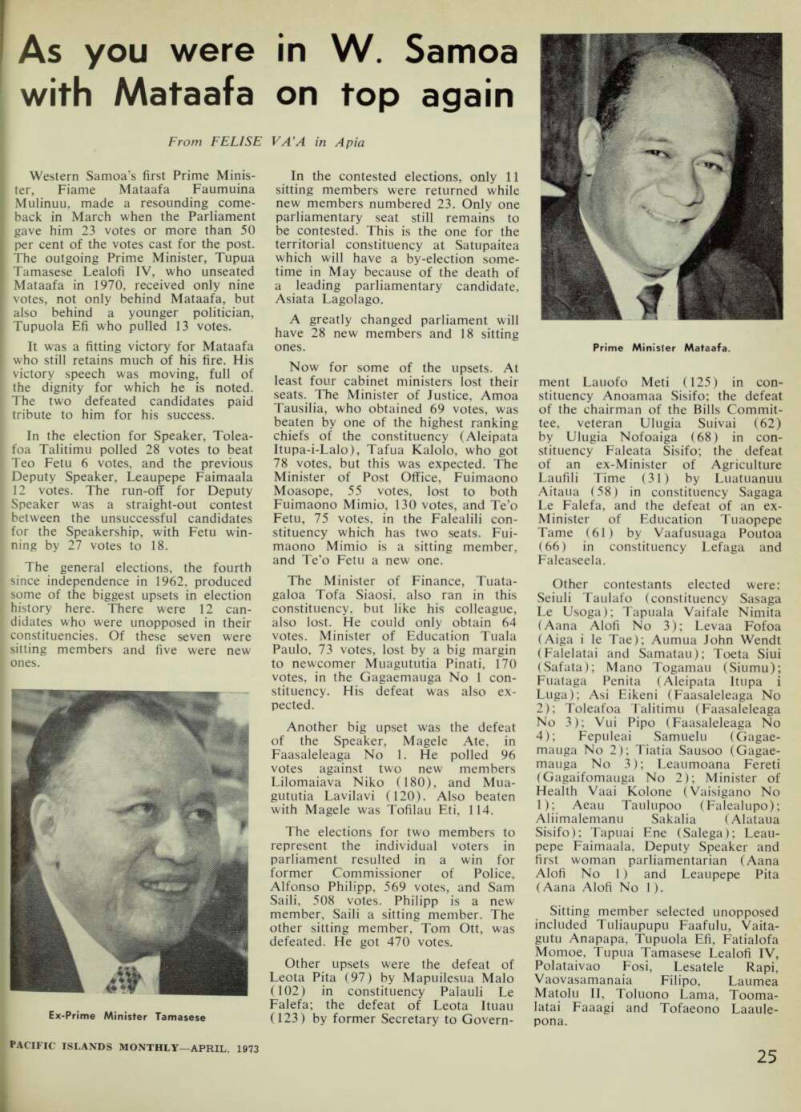
As you were in W. Samoa with Mataafa on top again
From FELISE VA’A in Apia
Western Samoa’s first Prime Minis ter, Fiame Mataafa Faumuina Mulinuu, made a resounding come back in March when the Parliament gave him 23 votes or more than 50 per cent of the votes cast for the post.
The outgoing Prime Minister, Tupua Tamasese Lealofi IV, who unseated Mataafa in 1970, received only nine votes, not only behind Mataafa, but also behind a younger politician, Tupuola Efi who pulled 13 votes.
It was a fitting victory for Mataafa who still retains much of his fire. His victory speech was moving, full of the dignity for which he is noted.
The two defeated candidates paid tribute to him for his success.
In the election for Speaker, Tolea foa Talitimu polled 28 votes to beat Teo Fetu 6 votes, and the previous Deputy Speaker, Leaupepe Faimaala 12 votes. The run-off for Deputy Speaker was a straight-out contest between the unsuccessful candidates for the Speakership, with Fetu win ning by 27 votes to 18.
The general elections, the fourth since independence in 1962, produced some of the biggest upsets in election history here. There were 12 can didates who were unopposed in their constituencies. Of these seven were sitting members and five were new ones.
In the contested elections, only 11 sitting members were returned while new members numbered 23. Only one parliamentary seat still remains to be contested. This is the one for the territorial constituency at Satupaitea which will have a by-election some time in May because of the death of a leading parliamentary candidate, Asiata Lagolago.
A greatly changed parliament will have 28 new members and 18 sitting ones.
Now for some of the upsets. At least four cabinet ministers lost their seats. The Minister of Justice, Amoa Tausilia, who obtained 69 votes, was beaten by one of the highest ranking chiefs of the constituency (Aleipata Itupa-i-Lalo), Tafua Kalolo, who got 78 votes, but this was expected. The Minister of Post Office, Fuimaono Moasope, 55 votes, lost to both Fuimaono Mimio, 130 votes, and Te’o Fetu, 75 votes, in the Falealili con stituency which has two seats. Fui maono Mimio is a sitting member, and Te’o Fetu a new one.
The Minister of Finance, Tuata galoa Tofa Siaosi. also ran in this constituency, but like his colleague, also lost. He could only obtain 64 votes. Minister of Education Tuala Paulo, 73 votes, lost by a big margin to newcomer Muagututia Pinati, 170 votes, in the Gagaemauga No 1 con stituency. His defeat was also ex pected.
Another big upset was the defeat of the Speaker, Magele Ate, in Faasaleleaga No 1, He polled 96 votes against two new members Lilomaiava Niko (180), and Mua gututia Lavilavi (120). Also beaten with Magele was Tofilau Eti, 114.
The elections for two members to represent the individual voters in parliament resulted in a win for former Commissioner of Police, Alfonso Philipp, 569 votes, and Sam Saili, 508 votes. Philipp is a new member, Saili a sitting member. The other sitting member, Tom Ott, was defeated. He got 470 votes.
Other upsets were the defeat of Leota Pita (97) by Mapuilesua Malo (102) in constituency Palauli Le Falefa; the defeat of Leota Ituau (123) by former Secretary to Govern-
ment Lauofo Meti (125) in con stituency Anoamaa Sisifo; the defeat of the chairman of the Bills Commit tee, veteran Ulugia Suivai (62) by Ulugia Nofoaiga (68) in con stituency Faleata Sisifo; the defeat of an ex-Minister of Agriculture Laufili Time (31) by Luatuanuu Aitaua (58) in constituency Sagaga Le Falefa, and the defeat of an ex- Minister of Education Tuaopepe Tame (61) by Vaafusuaga Poutoa (66) in constituency Lefaga and Faleaseela.
Other contestants elected were: Seiuli Taulafo (constituency Sasaga Le Usoga); Tapuala Vaifale Nimita (Aana Alofi No 3); Levaa Fofoa (Aiga i le Tae); Aumua John Wendt (Falelatai and Samatau); Toeta Siui (Safata); Mano Togamau (Siumu); Fuataga Penita (Aleipata Itupa i Luga); Asi Eikeni (Faasaleleaga No 2); Toleafoa Talitimu (Faasaleleaga No 3); Vui Pipo (Faasaleleaga No 4); Fepuleai Samuelu (Gagae mauga No 2); Tiatia Sausoo (Gagae mauga No 3); Leaumoana Fereti (Gagaifomauga No 2); Minister of Health Vaai Kolone (Vaisigano No 1); Aeau Taulupoo (Falealupo); Aliimalemanu Sakalia (Alataua Sisifo); Tapuai Ene (Salega); Leau pepe Faimaala. Deputy Speaker and first woman parliamentarian (Aana Alofi No 1) and Leaupepe Pita (Aana Alofi No 1).
Sitting member selected unopposed included Tuliaupupu Faafulu, Vaita gutu Anapapa, Tupuola Efi, Fatialofa Momoe, Tupua Tamasese Lealofi IV, Polataivao Fosi, Lesatele Rapi, Vaovasamanaia Filipo, Laumea Matolu 11, Toluono Lama, Tooma latai Faaagi and Tofaeono Laaule pona.
Ex-Prime Minister Tamasese
Prime Minister Mataafa.
Footnotes
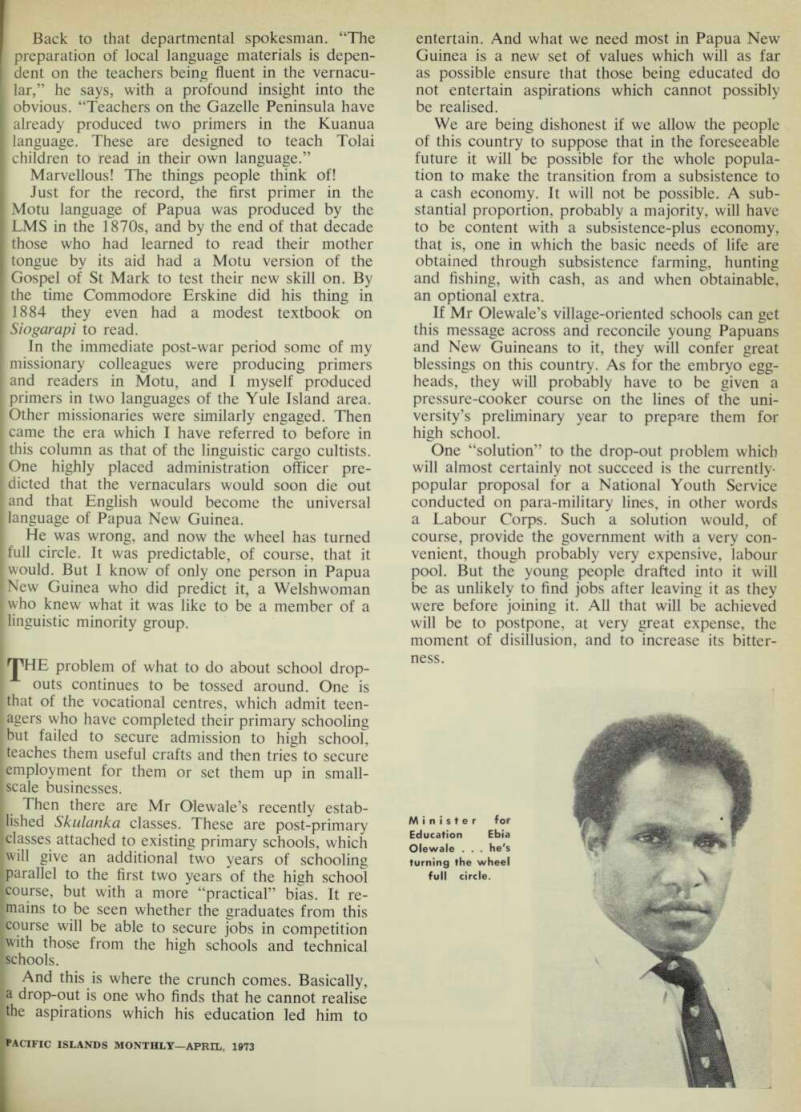
“SPHERE is nothing new under the sun,” wrote an ancient Hebrew philosopher. Listening to and reading about the latest trends in Papua New Guinea education, I feel that he was right.
A spokesman for the Minister for Education, Mr Ebia Olewale, is reported as saying that his department is developing a policy under which “children would spend half the day studying for mal subjects and half with adult villagers being schooled in fishing, native arts and culture”.
It embarrasses me to keep on harking back to what the mission I once worked for, and other missions, used to do; but the fact is that this “new” policy is precisely the policy under which the LMS and other missions working in pre-war Papua, used to operate. Mr Olewale, who was born in 1940, may be unaware of this, but it is a fact. School was held in the early morning and late afternoon hours on three, or sometimes on four, days a week, leaving the pupils plenty of
time to imbibe from their parents or other adults the traditional crafts of the village.
This policy, which I am sure was the right one for those days, led to our achieving only a modest standard in classroom learning, a fact of which we are frequently reminded —by Mr Olewale him self among others. But what was right in 1937 is not necessarily right in 1973, and one wonders what high school principals will
make of the products of the new-style primary schools.
Actually, we are here up against the perennial and perhaps insoluble problem of how to provide a primary schooling which is “right” both for those who are going no further and for those who are going on to secondary and tertiary education.
In another departmental “release” we are told about the primary schools’ cultural activities pro gramme introduced last year and to be continued and expanded. “A direct result of this cultural programme,” we are told, “has been the introduc tion in some areas of local languages in the class room. These are being used in the early stages of
So Education
Moves Forward
Into The Past
education where it is difficult to get children tc understand ideas presented in English.”
Fine, fine! This is exactly why, in pre-wai Papua, mission schools used local languages a; the medium of instruction and, where they were able to, taught English as a subject.
About 1960, give or take a year or two, th« LMS found that the job of providing schooling fo: the children of the fast-swelling population oi Hanuabada was getting beyond its resources, anc so it decided to invite the Department of Educa tion to establish a school in the area. This wa.
With Percy Chatterton
in Port Moresby
done, and over a period of a fev, years the Hagara Administratioi school was phased in and th Poreporena Mission school wai phased out.
However, a slight hitch occurred The department’s building pro gramme fell behind, as buildim programmes so often do, and thi mission was asked to make it classrooms available, temporarily to fill the gap. It agreed to do sc on one condition.
And that put the fat in the fire. A top-lev© conference was held between administration am mission representatives. I was one of the latter We debated the issue at length, but failed tj reach agreement. As a result the department de cided to put up marquees instead of classroom?!
The condition? Well, just a little matter o the use of the local language, in this case Motu in classrooms in which it had been used since thes were built in the 1920 s and in which, we felt, should continue to be used “to get children tt understand ideas” difficult to explain in Enghsl Rather than accept such a condition, the Depan ment of Education went under canvas.
Back to that departmental spokesman. “The preparation of local language materials is depen dent on the teachers being fluent in the vernacu lar,” he says, with a profound insight into the obvious. “Teachers on the Gazelle Peninsula have already produced two primers in the Kuanua language. These are designed to teach Tolai children to read in their own language.”
Marvellous! The things people think of!
Just for the record, the first primer in the Motu language of Papua was produced by the LMS in the 1870 s, and by the end of that decade those who had learned to read their mother i tongue by its aid had a Motu version of the I Gospel of St Mark to test their new skill on. By the time Commodore Erskine did his thing in 1884 they even had a modest textbook on Siogarapi to read.
In the immediate post-war period some of my missionary colleagues were producing primers and readers in Motu, and I myself produced primers in two languages of the Yule Island area.
Other missionaries were similarly engaged. Then came the era which I have referred to before in this column as that of the linguistic cargo cultists.
One highly placed administration officer pre dicted that the vernaculars would soon die out and that English would become the universal language of Papua New Guinea.
He was wrong, and now the wheel has turned 'full circle. It was predictable, of course, that it would. But I know of only one person in Papua New Guinea who did predict it, a Welshwoman who knew what it was like to be a member of a linguistic minority group. problem of what to do about school drop outs continues to be tossed around. One is that of the vocational centres, which admit teen agers who have completed their primary schooling but failed to secure admission to high school, teaches them useful crafts and then tries to secure employment for them or set them up in small scale businesses.
Then there are Mr Olewale’s recently estab lished Skulanka classes. These are post-primary classes attached to existing primary schools, which will give an additional two years of schooling parallel to the first two years of the high school course, but with a more “practical” bias. It re mains to be seen whether the graduates from this course will be able to secure jobs in competition with those from the high schools and technical schools.
And this is where the crunch comes. Basically, a drop-out is one who finds that he cannot realise the aspirations which his education led him to
entertain. And what we need most in Papua New Guinea is a new set of values which will as far as possible ensure that those being educated do not entertain aspirations which cannot possibly be realised.
We are being dishonest if we allow the people of this country to suppose that in the foreseeable future it will be possible for the whole popula tion to make the transition from a subsistence to a cash economy. It will not be possible. A sub stantial proportion, probably a majority, will have to be content with a subsistence-plus economy, that is, one in which the basic needs of life are obtained through subsistence farming, hunting and fishing, with cash, as and when obtainable, an optional extra.
If Mr Olewale’s village-oriented schools can get this message across and reconcile young Papuans and New Guineans to it, they will confer great blessings on this country. As for the embryo egg heads, they will probably have to be given a pressure-cooker course on the lines of the uni versity’s preliminary year to prepare them for high school.
One “solution” to the drop-out problem which will almost certainly not succeed is the currently popular proposal for a National Youth Service conducted on para-military lines, in other words a Labour Corps. Such a solution would, of course, provide the government with a very con venient, though probably very expensive, labour pool. But the young people drafted into it will be as unlikely to find jobs after leaving it as they were before joining it. All that will be achieved will be to postpone, at very great expense, the moment of disillusion, and to increase its bitter ness.
Minister for Education Ebia Olewale . . . he's turning the wheel full circle.
Advertisements & other items, p. 30 (1 item)
Sullivans
MELBOURNE SYDNEY
C. SULLIVAN (EXPORT) PTY. LTD.,
4TH FLOOR, KEMBLA BUILDING.
60 MARGARET STREET, SYDNEY
(G.P.O. BOX 3373).
AUCKLAND CABLES AND TELEGRAMS: “CHASULL”.
BRISBANE
LONDON
OFFERS A COMPREHENSIVE AND EFFICIENT
BUYING SERVICE TO THE PACIFIC ISLANDS
OFFICES AT:
PORT MORESBY • LAE • RABAUL • KIETA • MOUNT HAGEN • BULUMA • SUVA • LAUTOKA • NOUMEA • HONIARA • PORT VILA
SULLIVANS for SERVICE
CRUSHED ICE maker
STURT
ICE MAKER
72 TON
Block-ice maker / Crushed-ice The STURT maker 1 to 15 ton Over storage bin
ICE
CRUSHED
The
STURT
over vending depot For INVESTORS . . . PROCESS WORKERS . . .
PRODUCE YOUR OWN ICE
in commercial quantities.
THE STURT is a labour-saving, self-contained V 2 ton crushed ice manufacturing unit designed for volume ice production at low capital cost.
FEATURES INCLUDE:
• Installs over existing ice-vending depots, rooms or separate ice storage containers. • Construction is polyurethane foam fibreglass panels. Produces and crushes ice automatically. Passes through 36" doorway, assembled. • Low maintenance air cooled condenser. • Rugged Y|jr hermetically sealed compressor. • Prewired ready to /nt connect to 415 V, 3 phase and neutral power supply. • 4 lifting eyes for easy site location. Also available Ice making units, V 2 to 15 tons daily capacity with or without storage bins, pre-fab. rooms or coin-op. vending depots.
You are invited to phone or write to Resco for Literature and prices for ice-making vending equipment and modular prefab. rooms. Detail YOUR need, Resco can supply.
Module-Bild Cool Roo
MANUFACTURING REFRIGERATION ENGINEERS
RESCO PTY. LTD.
98 Grand Junction Rd., Kilburn Sth. Aust. 5084 Tel. 62 5011
Marianas status wrangle
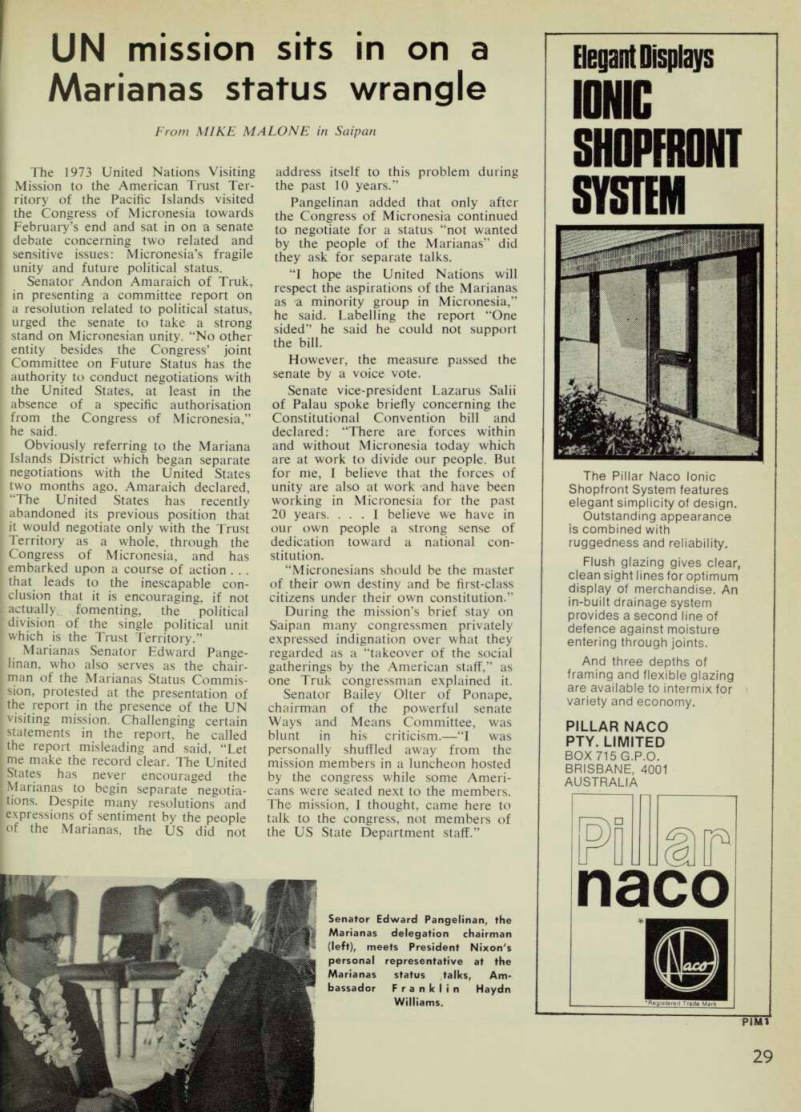
UN mission sits in on a Marianas status wrangle
From MIKE MALONE in Saipan
The 1973 United Nations Visiting Mission to the American Trust Ter- I ritory of the Pacific Islands visited the Congress of Micronesia towards February’s end and sat in on a senate debate concerning two related and sensitive issues: Micronesia’s fragile unity and future political status.
Senator Andon Amaraich of Truk, in presenting a committee report on a resolution related to political status, urged the senate to take a strong stand on Micronesian unity. “No other entity besides the Congress’ joint Committee on Future Status has the authority to conduct negotiations with the United States, at least in the absence of a specific authorisation from the Congress of Micronesia,” he said.
Obviously referring to the Mariana Islands District which began separate negotiations with the United States two months ago, Amaraich declared, “The United States has recently abandoned its previous position that it would negotiate only with the Trust Territory as a whole, through the Congress of Micronesia, and has embarked upon a course of action . . . that leads to the inescapable con clusion that it is encouraging, if not fomenting, the political division of the single political unit which is the Trust Territory.”
Marianas Senator Edward Pange linan, who also serves as the chair man of the Marianas Status Commis sion, protested at the presentation of the report in the presence of the UN visiting mission. Challenging certain statements in the report, he called the report misleading and said, “Let me make the record clear. The United States has never encouraged the Marianas to begin separate negotia tions. Despite many resolutions and expressions of sentiment by the people of the Marianas, the US did not
address itself to this problem during the past 10 years.”
Pangelinan added that only after the Congress of Micronesia continued to negotiate for a status “not wanted by the people of the Marianas” did they ask for separate talks.
“I hope the United Nations will respect the aspirations of the Marianas as a minority group in Micronesia,” he said. Labelling the report “One sided” he said he could not support the bill.
However, the measure passed the senate by a voice vote.
Senate vice-president Lazarus Salii of Palau spoke briefly concerning the Constitutional Convention bill and declared: “There are forces within and without Micronesia today which are at work to divide our people. But for me, I believe that the forces of unity are also at work and have been working in Micronesia for the past 20 years. ... I believe we have in our own people a strong sense of dedication toward a national con stitution.
“Micronesians should be the master of their own destiny and be first-class citizens under their own constitution.”
During the mission’s brief stay on Saipan many congressmen privately expressed indignation over what they regarded as a “takeover of the social gatherings by the American staff,” as one Truk congressman explained it.
Senator Bailey Offer of Ponape, chairman of the powerful senate Ways and Means Committee, was blunt in his criticism.—“l was personally shuffled away from the mission members in a luncheon hosted by the congress while some Ameri cans were seated next to the members.
The mission, I thought, came here to talk to the congress, not members of the US State Department staff.”
Senator Edward Pangelinan, the Marianas delegation chairman (left), meets President Nixon's personal representative at the Marianas status talks, Am bassador Franklin Haydn Williams.
Advertisements & other items, pp. 31-33 (2 items)
Lonic
Elegant Displays
SHOPFRONT
SYSTEM
The Pillar Naco lonic Shopfront System features elegant simplicity of design.
Outstanding appearance is combined with ruggedness and reliability.
Flush glazing gives clear, clean sight lines for optimum display of merchandise. An in-built drainage system provides a second line of defence against moisture entering through joints.
And three depths of framing and flexible glazing are available to intermix for variety and economy.
PILLAR NACO
PTY. LIMITED
BOX 715 G.P.O.
BRISBANE, 4001
AUSTRALIA
naco
A
PIMI
tropic or temperate climate —Fibreglass Refrigerated
units by George & Ashton exceed all requirements George and Ashton moulded fibreglass refrigerated units are unaffected by rust, rot, fatigue, weathering or corrosion. No joints to harbour vermin, so cleaning is easy. Used for any type of vehicle or as static storage units. Any size units can be supplied assembled or in prefabricated sections for easy shipping and erection on site.
Approved by N.Z. Depts of Health and Agriculture.
GEORGE &
ASHTON
P.O, Box 2056, South Dunedin.
New Zealand.
Phones 54-108, 54-109 George & Ashton (P. 1.) Ltd.
Box 296, Suva, Fiji.
Phone 26-249.
FIJI MEWS
i*~« The Fiji Meats unit illustrated is the second supplied to this Company
<CnBK AUSTRALIA’S FOREMOST
GLASS MERCHANTS AND
MIRROR MANUFACTURERS
• SHEET. FIGURED ROLLED 4 PLATE
GLASS
• "ARMOURPLATE” GLASS
• ANTI-GLARE 4 HEAT ABSORBING
GLASS
• LAMINATED 4 TOUGHENED
AUTOMOTIVE GLASS
• GLASS LOUVRE BLADES
• GLAZING BARS
• "COPPERBAK” MIRROR—
CUT-TO-SIZE 4 STOCK SIZES
• FRAMED 4 UNFRAMED
DECORATIVE WALL MIRRORS
• CHEVAL MIRRORS
• VANITY TABLE MIRRORS
• ONE-WAY VISION MIRRORS
• SHOP FRONTS
• ENTRANCE DOORS 4 SCREENS
• "ARMOURPLATE” DOORS
• "AQUALITE” SHOWER SCREENS
• “U-RECT-IT” STORE EQUIPMENT
• "COWDROY” 4 "LIDCO” SLIDING
GLASS DOORS 4 WINDOWS
• WINDSCREENS. TRUCK 4 CAR
LAMINATED OR TOUGHENED
ORDERS AND ENQUIRIES THROUGH THE GENERAL MERCHANTS IN YOUR AREA
‘FRANK G. O’BRIEN LTD.
FG50.44
General Glass Enquiries
45 Davies Road, Padstow, N.S.W. 2211.
Motor Glass Division
634 Botany Road, Alexandria, N.S.W. 2015.
Cable: FOBRON, Sydney.
Become a member of the South Pacific Creative Arts Society and participate in the surge of creative expression in the Pacific. As a member you will receive the annual book, MANA, which contains all the material published in the AAANA section of the Pacific Islands Monthly, plus additional new poems, stories, reviews and comments on the arts in the South Pacific. The society is also promoting seminars, workshops, visiting artists and other activities in the creative arts.
Subscription I Life Membership $lOO Fijian or equivalent.
Foundation Membership $25 Fijian. (Available for the period 1973-75 and entitles the foundation member to a three-year membership of the society.) Ordinary Membership to addresses outside the islands served by the South Pacific Commission $4.
To addresses within Pacific Islands served by the South Pacific Commission $2.50.
AA/A
Send your subscription to:
THE SECRETARY,
SOUTH PACIFIC CREATIVE ARTS SOCIETY,
BOX 5083,
SUVA, FIJI
Enclosed please find dollars (Fijian or equivalent) for membership of the South Pacific Creative Arts Society which also entitles me to receive the AAANA annual book of Pacific Islands creative arts.
Address
Country
Type of membership Life □ Foundation □ Ordinary □
Cific Islands Monthly—April. 1973
Sleight of hand
in the New Hebrides
From a Vila correspondent
Alice, whose assorted adventures in Wonderland became curiouser and curiouser, probably would have felt at home in Vila, New Hebrides, on March 13 when the budget debate in the Advisory Council was re sumed after being adjourned from December.
When the New Hebrides budget for 1973 was presented to the Advisory Council last December by the French and the British Resident Commis sioners, the members of Adco took the unprecedented step of rejecting it un animously.
Generally, members objected to total amount of expenditure proposed —606 million New Hebrides francs, and although the RCs said that it had taken four months to draft it and it had been pared to the bone, they remained adamant and the ses sion was adjourned.
Four members of the Advisory Council were then appointed to work alongside the finance section of the condominium government and at the resumption of the session on March 13, the fruit of their joint labours was presented.
Total amount of this budget was FNHI.I million more than that pre sented by the Resident Commissioners in December.
It was claimed to be a glorious victory nonetheless, and was approved without further trouble.
The explanation of what was ap parent sleight of hand was reasonable enough. Savings were made by pro posing to fill only 57 of the 95 vacant posts in the civil service but this and other economies were more than wiped out by newly-discovered expenditure—for example, an increase of FNH7 million in servicing the loans needed by the condominium to finance development projects, and in creased expenditure on setting up a price control bureau and improve ments in health and education services.
The Advisory Council’s finance committee was, however, able to tell fellow members that the administra tion had accepted the following points made when Adco had turned down the budget in December: • Import duties would not be in creased; • New posts proposed for the condominium government had been reduced; • Proposed salary revision for
civil servants to be reassessed; and • A price control bureau to be established in 1973 with worthy object of combating inflation.
The joint administration had also “taken note of” some other points made on that same occasion: the formation of a permanent Adco finance com mittee to assist in preparation of the annual budget; the possibility of ex panding civil service working hours, suppressing four of the Condo minium’s present 15 public holidays; and the improvement of inter-island marketing of local produce.
No promises were made but the joint administration professed a “sincere wish” to give genuine con
sideration to the Advisory Council’s views.
The New Hebrides is wallowing in troubled waters at the present time —with low prices for its produce on one hand and galloping inflation on the other. As most of the NH in flation is generated outside its shores, it is hard to see what effect a price control bureau is going to have, particularly as inflation’s greatest im petus in the past year has been the administration’s decision to base im port duty on a CIF value instead of FOB. This is taking a page out of Fiji’s book where this iniquitous method of calculating import duty has been in force for about 20 years.
Advertisements & other items, pp. 35-36 (1 item)
James Gready Pty. Ltd.
GLASS-JUG WASHERS
• HYGIENIC • LIFT OFF DOOR • HEAVY DUTY
• RELIABLE • CHANGEOVER COMPONENT SERVICE
We also manufacture: • S.S. URINALS • TANKS, VATS • SPECIAL PURPOSE EQUIPMENT • FOOD PROCESSING EQUIPMENT • S.S. BAIN MARIE UNITS • S.S.
FOOD TROLLEYS • JAFFLE COOKERS • PORTABLE S.S. BAR-B-Qs.
James Gready Pty. Ltd.
Pentex St., Salisbury North, Brisbane, Qld. 4107. Ph. 47-3966
Bank of Hawaii is the bank of the Pacific. \bu can bank on it... in Guam SiLTamuning t Koror -mt Yap Jf Saipan Roi Namur ijffi aSL Kwajalein iltPonape Midway,-® 1 Tahiti ik American Samoa.
All in all, we have 70 branches throughout Hawaii and the Pacific offering full banking services. May we help you?
Bank of Hawaii the bank of the Pacific V * affiliate of Banque de Tahiti J
The Editor's Mailbag



Philatelic Flippancy
Your article ‘1973 Stamp Flood . Starts’ (PIM, Feb, p 10) might well cause some misunderstanding con cerning the stamp issues of the Gil bert and Ellice Islands. The article implies a certain flippancy regarding new stamp issues among Pacific coun i tries, and a tendency to produce rather more issues than may be justi fied. While this is almost certainly true of at least two countries in the area, to tar the GEIC with the same brush, as you have done, is to be quite misleading.
The stamp issuing policies of the GEIC are highly conservative, and normally no more than three new issues appear in each year, each issue usually having a face value below one dollar. Compared with most other countries (in or out of the Pacific) this is an extremely modest pro gramme by today’s standards and one which has resulted in the enviable respectability GEIC stamps enjoy among collectors. It is to be hoped that the article does not lead anyone to equate the stamps from this colony with those of the territories whose philatelic policies are really dubious.
I note, incidentally, that the greatest offenders when it comes to over doing it, were not actually among those mentioned in the article.
G. J. Hayward.
King George V School, Bikenibeu, Tarawa,
Geic.
• But PIM agreed that “it’s all a good healthy way of adding revenue to the coffers” and printed a sample of one of GEIC’s stamps which is good healthy publicity.
... And Philatelic Fault
It is not pleasant to have to demolish a myth—especially when it is still a baby—but I think I must correct your comments on the recent Fiji stamp issue celebrating the diamond jubilee of the Fiji Rugby Union (PIM, March, p 17).
The player portrayed kicking on the 25 cents stamp is not Pio Bosco Tikoisuva, whoever he is. I suspect that he exists only in the mind of the English designer of the stamp.
In fact, to let your philatelic readers into a little secret, the three stamps were designed in 1969 and Were intended for another issue which
was later cancelled. This was to commemorate the centenary of the Rugby Football Union in 1970. Since the stamps had already been designed, the Fiji Post Office decided to add the words “Diamond Jubilee of Fiji Rugby Union” plus the badge of the Fiji RU at the bottom and use it for the recent issue instead.
It would be nice to put names to all the players as in the case of Malakai Labaibure in 1951 issue, but they are not drawn from Fiji photos whatever their origin.
Incidentally, the union was formed in 1913, not 1903. You may be interested to know that this year is also the golden jubilee of the Tongan RU.
Derek Robinson.
Dept of Agriculture, Suva, Fiji. • The date 1903 was a typo graphical error which was detected too late for correction.
Underpaid In Fiji
I am writing this from Fiji.
Do those in authority in Fiji realise how underpaid the working and poorer classes are in Fiji?
Do the labour unions realise that even though they are getting a rise of 15c an hour, that is still only 50c an hour? Do they and the Fiji Gov ernment realise the cost of living in Fiji for the working and poorer families and the way they are forced to live? The homes—so-called—of these people are beyond me to find suitable words to describe. How can they live decently with a proper diet on the pitiful wages they are paid.
I know of one case where a Fijian lass is working six to seven days per week, and she gets the very princely sum of SFI3 a week. I know of a lad who is a baker, and in Australia they get for two days’ work what he gets for one whole week, I know and have met others—all the same sad story. They are willing to work, but cannot get a decent break.
With Fijians and Indians here it is the same story, and it is breeding bad trouble, bitterness and hatred.
Sadly I say we Europeans have a lot to answer for, as a great many of these larger concerns are European firms. I also understand that even those who are in what we would call good positions do not get paid as much as a European would if in the
Letters
same position here in Fiji. Can they not see the danger of what they are doing? When one looks at the posi tion in its right perspective one can not altogether blame the firms, as the ones that can really rectify these things are the government. They should and must stand behind their own people. Fiji is their land, not ours. These wrongs cannot be righted unless the government stands behind the unions and their own people before more racial hatred is born.
The ministers of the Fiji Govern ment have called for a rise for them selves. If they cannot live, how on earth do they expect the working people of Fiji to exist on what they earn? Cost of living is not low at all.
It’s quite high, and vegetables . . . well the less said about that the better. First there was Hurricane Bebe and a cyclone has again flat tened cane and ruined the crops that were starting to grow. Yet the people bear it all and try to carry on living, and will welcome the stranger to their homes with warmth and hospitality They are afraid, a great many ol them, to stand together in case the> lose their jobs. It needs a man like our Mr Hawke, with courage to help them. I always was taught that £ good day’s work deserved a gooc day’s pay.
A. Mclean[?]
Florence St, Tweed Heads,
Nsw.
Battle For War Relics
We read with interest your articb in the February issue of PIM (p 37.
“Fate of War Relics Launches Nev, Battle for the Solomons”. The las paragraph mentions that it is interest! ing to note that Tambea Village wai told only in May, 1972 by a dive: belonging to Laurent and Co that thi Zero was where it lies etc.
The real facts are as follows: 1 1 February, 1943, a young boy name; Kanuto Tigili, standing on the bead; at Tambea, watched an aeroplanr crash into the sea at Tambea an proximately 600 to 700 ft from thr shore. All the villagers fron Komimbo and Tambea knew thr position of the plane and for pas, 25 years it has been a popular fishinr spot. This boy, Kanuto Tigili, is a shareholder of Tambea Villag Resort. Another shareholder Pen Agroseni was the man who showeo;
the exact position of the plane to the diver of Laurent and Co.
I had been told by the people about a Zero lying in the water at Tambea Bay but it was not until 1971 that I was shown the exact position. The fact remains that the Gaubata Line people at Tambea had knowledge of the position of the Zero from the time it crashed. I represented not only Tambea Village Resort but also the people belonging to the Gaubata Line in the court action.
E. O. Torling,
Managing Director, Tambea Village Ltd.
Guadalcanal,
Bsip.
Arawa Is Beautiful
Arawa or Bougainville might look ugly but it is not. The people are all a lot more friendly than those of Moresby or Lae; the natives would be about the best behaved ever, ex cept when they have their tribal disputes.
I suppose the houses might look ugly but since they are all fully furnished people cannot really com plain, not that many of them have.
The township itself took about two to three years to build and it was not as easy as pie.
Arawa is a really good town so could you please stop putting it down. Maybe if the person who wrote that article would stay there for a year or two they would see what I’m driving at. It really is a beautiful place.
R. Nothdorft (Miss).
Sydney Church of England Girls Grammar School, Moss Vale,
Nsw.
• Arawa’s young defender is referring to an article in PlM’s September issue.
Instrument Of Terror
I am shocked to learn (PIM, Jan, p 104) that the Rt Rev David Hand, Anglican Bishop of Papua New Guinea is in favour of a non-military national service.
From 1933 until VE-Day in May, 1945, this type of totalitarian op pression was one of Hitler’s chief instruments of terror. I sincerely hope that you will publish this reminder of past actions of the epitome of the anti-Christ, so that the Queen’s Bishop of Papua New Guinea may come to his senses once more.
George Von Heldreich.
PO Box 545, Heligoland Island, West Germany.
• Last of the Letters, p 39
Letters
The Dear Dead Days
Your YESTERDAY section (PIM, I Nov 1972, p 77) set me to rocking I and dreaming (well, I was already I rocking) about those dear dead days I of the 1950 s when the Solents and I Strato-clippers (or cruisers) were I making air travel such a delight.
One trip in particular stands (or I sways) out. Three of us, language I students in Tokyo, somehow per- I suaded our tight-fisted comptroller I that a trip throughout Southeast and I South Asia to round out our educa tion was a must.
Off we went. Things got a little I boozy at the farewell party before r we left Haneda Airport, and the * tempo picked up as we spread our own peculiar brand of the Charming American around the Orient. At some point, and to this day we disagree as f to where it was, one night in a bar I we ran into a group of New Yorkers on their way to Indonesia. We all sat around telling lies and swilling, to the horror of the very proper bartender, ; beer and straight shots (boilermakers in Brooklynese) until the wee.
Although we were booked on BOAC (or maybe KLM or QAN TAS) for the next leg of our trip i (whatever that was), the three of us awakened to find that we were in a bar lounge that was moving at a good clip and at about 6,000 feet.
You’ll be happy to know that this did not bother us in the least. What did bother us was that the bar was closed, a situation for which we were totally unprepared. Our leader, an intrepid US Army Infantry major, found a set of stairs going up, and up the stairs he disappeared forthwith. Reappearing in a few minutes, white-jacketed bar tender in tow, he calmly announced that the bar we were in was hooked to the bottom of an airplane! And so, to our relief, it was. A lovely, lumbering, comfortable, luxurious, piston-engined Boeing Strato-clipper (or cruiser), no less.
I After we had helped our leader get the bartender squared away and in operation, we asked him (the major) where we were headed. He hadn’t the foggiest; so we dropped the subject.
New guests began appearing at the foot of the stairs as if dropped from the heavens, and they looked so familiar that we dropped our typical American reserve and asked them who they were. Turned out that they were members of a group of New
Yorkers on their way to Indonesia. A clue at last! Not only that, but one of their members read us into the scenario. We had, it turned out, all trooped down to the airline office, awakened the manager at 0300 hours that very morning, and with little or no trouble persuaded him that E Pluribus Enum meant just what we thought it did, ie, that if we didn’t join forces then and there, all of us headed out to gether, he would have to answer to the local police as to why a bunch of Rowdy Yanks were still in town.
We exchanged our tickets, picked up our baggage, and joined them, off to Indonesia.
Wonderful trip, wonderful people, wonderful food, wonderful grog, wonderful airplane. As far as we could tell, the entire passenger and crew list was represented in that lounge most of the time, and who flew the plane we’ll never know.
Maybe it was the bartender, since we had taken over his job at once and he had nothing to do. Made a good landing and take-off, too—several times.
Ah, yesterday.
Walt Higgins.
4001 Ridge Road, Annandale, Virginia, USA 22003.
Advertisements & other items, pp. 37-44 (3 items)
Why Naco
Louvre
Windows won
the Good
Design Award
□ Sunsash Louvre Windows conform to Australian CAS3 (1970) and U.S. Standard A. 134.1 (1968) Residential Window Code requirements in terms of water penetration, airfiltration, structural sufficiency and stiffness requirements. □ Proven features—Trouble-free operation because the heavy gauge paired operating bars are protected within the channels.
Double riveted assembly provides life-long strength and reliability.
Precision hot forged special alloy bearings ensure that there is no friction between clips and channels.
PILLAR NACO PTY LIMITED
BOX 715G.P.0.
BRISBANE, 4001
AUSTRALIA
D <3.
naco
PIM3
BRAYBON
PORTABLE
PETROL
ELECTRIC
SETS
h
POWERED BY
FOUR CYCLE INDUSTRIAL ENGINES
DOMESTIC APPLIANCES
T.V ; AND POWER TOOLS
MODELS AVAILABLE
1 K.V.A. 240 VOLT
2 K.V.A. 240 VOLT
3i K.V.A. 240 VOLT
6 K.V.A. 240 VOLT
K.V.A. 240 VOLT
DIESEL SETS
MODELS
AVAILABLE:
3 K.V.A. 240 VOLT
7.5 K.V.A. 240 VOLT
10 K.V.A. 240 VOLT
18 K.V.A. 240 VOLT
25 K.V.A. 240 VOLT
Larger sets to specifications.
Write for brochure and prices ex factory, Sydney.
Ifßraybon Bros
PTY. LTD.,
2 ROTHWELL AVENUE, CONCORD WEST 2138
Tel.: 73-3246. .
Powerful Pea-Bey Insecticide
is Cuaranteed to
kill all insect pests...
m ... yet it is completely safe to spray
near food, children and pets.
Intensive scientific research into the most powerful insect killing substance known led to the development of safe, powerful Pea-Beu aerosol insecticide Pea-Beu is guaranteed to contain a high concentration of the world’s most powerful insect killing substance, yet it is absolutely safe to spray anywhere in the home, even near food, places where food is stored or in the presence of young children and household pets. Powerful, safe Pea-Beu aerosol insecticide quickly kills flies, mosquitoes, cockroaches, ants and all insect pests that carry infection and cause annoyance and irritation in your home, removing the dangers of disease.
Pea-Beu aerosol insecticide kills all insect pests Pea-Beu is the only household insecticide that will kill all insect pests including flies, mosquitoes, cockroaches, fleas, ants, moths and silverfish. Take immediate steps to eradicate all disease-carrying insect pests in your home by regular spraying with safe, powerful Pea-Beu aerosol insecticide.
Protect your family’s health Pea-Beu aerosol insecticide contains the strongest, most effective insect killing substance known, yet it is guaranteed safe to use anywhere throughout the home because Pea-Beu does not contain any of the poisonous chlorinated hydrocarbons, such as DDT, BHC, Lindane or Chlordane, all of which can irritate and cause damage to delicate nasal tissues and the lungs. The active ingredient in Pea-Beu aerosol insecticide is recognised as the strongest and safest insect killing substance, lethal to insects, but safe to humans and pets. « ♦ ♦ Remember, the health of your family depends on your choice of insecticide. Powerful, safe Pea-Beu is guaranteed to kill all disease-carrying insect pests before they have a chance to bring illness into your home and Pea-Beu is safe to use in the presence of your children, near food, or even in the children’s nursery.
S33S
Powerful Pea-Beu Guaranteed safe...
Guaranteed strong... Guaranteed to kill all insects.
NEW CALEDONIA
Pacific Motors, S.A.,
B.P. 41, NOUMEA
BRITISH SOLOMON ISLANDS
TAHITI
Ets, Donald,
P.O. Box 131, PAPEETE
NEW HEBRIDES
CONDOMINIUM
Pentecost Pacific S.A., Santo and Port Vila
These MF distributors can
show you the MF6S is
acres ahead for a real ]ob of
good, deep ploughing
The MF6S Disc Plough is equally suitable for deep or shallow ploughing in hard or light soils. There’s plenty of clearance beneath the beam and between the discs for handling heavy surface trash without clogging. 26" or 28" plain discs or 28" notched discs available. Once-a-season lubrication is all the disc bearings ever need. You’ll find the MF6S an easy plough to set and adjust. Take your choice of 2, 3 or 4 disc sizes. Match the MF6S Disc Plough with the MFI6S Tractor sand you have an unbeatable combination.
A The exclusive Ferguson System gives precise im-> plement control and automatic weight transfer.
What’s more there’s plenty of lugging power available from the MFI6S, a choice of 8 or 12 forward speeds with Multi-Power changing on the move and multiple disc, oil-immersed brakes for positive stopping power.
MP Massey Ferguson
From the
Islands Press
From the US Trust Territory Micronitor: It was announced on the radio today, February 12, that if a dog is found in Kolonia without an official tag around its neck, the dog will be killed. Regulation has been made in this town [ to tax all dogs, about 50c a dog a year. If a dog is found not taxed, the penalty is DEAD for the dog. The reactions of the people to the law? One person said, “It is good because we Ponapeans eat dogs, so go ahead and kill them”
From the Tonga Chronicle: The Chief Postmaster, Siua K Holani has issued a warning for people to return the empty Post Office mail bags which they are using as handbags. Empty mail bags which are blue, yellow, brown, black and white in colour have identification marks such as Britain, USA, Australia, New Zealand and Fiji printed on each bag's side to indicate the country of origin and are being used more and more by the people. Mr Holani advises that anyone who has any empty mail bags in his or her possession should return them to the Post Office. These bags are the property of the Post Office and no one has any right to use them.
He said he already informed the police and anyone caught using these bags will be prosecuted.
From a letter by "Fakapoupou-la-fou" in the Niue Island Tohi Tala Niue: Me no speak English. Me no been school in New Zealand. Thinking deeply about last week’s editorial brings to mind how I have always envied people who were given the chances to further their education overseas and some never would like to come back to serve their country. Td reckon that this is very unfair because government money was wasted to send these people away and parents are ashamed for what they do. May I ask—what good is bond that is signed by those scholarshippers if they do not return?
Can’t the government bring them back by using the Niuean term lisi tanga niu mai ki Niue (Grab them by the scruff of their necks and apply a well-aimed boot to their posteriors).
From the GEIC Atoll Pioneer: Some workers on Tarawa arrived in offices and workshops an hour early last Friday. Because of one of those human errors which DO occur from time to time, a sleepy but enthusiastic member of Radio Tarawa's staff started transmission an hour before the scheduled time—five-thirty instead of six-thirty. And finished an hour early, too, at seven instead of eight. There was a dash for buses and
motorbikes by people who thought that clocks and watches were wrong, and who did not stay tuned to hear the apologies which followed shortly after seven o'clock when wide-awake staff got to the studios and corrected the mistake.
From the ACA Bulletin (Bougainville) by B. J. A. Middlemiss: Without a doubt the reaction to Somare's visit to Bougainville must have shocked Canberra and the so-called confrontation at Panguna with the Guava and Moroni people. The former because of its head in the sand attitude towards the secession movement and the latter for the lack of comprehension of their aims by their elected members. In all the visit made it quite clear to all who cared to listen that Bougainville wants no part of a “Unified PNG • . . Somare proved himself to be little different to the former white Administrator D. O. Hay, when he referred the referendum issue to the Constitutional Planning Committee. A not very adroit piece of duckshoving. His reference to the referendum costing too much was not a well-taken point and when put to the test will be found wanting.
From a report in The Fiji Times: Twelve of 18 bodies a pathologist examined after people died in road accidents last year had alcohol in the blood, the Minister for Health, Mr James Shankar Singh, told the House of Representatives. Describing this as serious and alarming, Mr Singh said he would welcome legislation to introduce breath analysis tests to Fiji. “It would certainly be a deterrent,” he said. Mr Singh said alcohol was a factor in more than half the motor accidents in
Fiji.
From a letter by Dave Moss in the Micronitor: The UN Visiting Committee for 1973 will trip through Micronesia, hold endless, droning, non-effective public meetings (or staring contests), eat salmon and rice in the high school galleys of Micronesia, travel on field trips ships (with new linen, new silverware and newly informed crew and officers) pick up handicraft by the bushel and then go back to New York where they will write a long report that tells whoever reads it that things are, well, at least going in Micronesia; that the economy is slowly improving, despite the copra disaster; that the political status negotiations are proving fruitful and that the Micronesians are learning to like each other. But it's all bullshit. . . . Leave the islands dirty. Let the Visiting Mission see what Majuro's like the other 364 days a year. I don't think it'll make much difference.
A letter by Mrs Patricia Laisen in the Samoa Times; We arrived in Western Samoa yesterday and to our surprise we were told that your authorities impose a Tourist Tax Sl-$1.50 per person per night.
Originally we intended to stay for a week to 10 days.
However, the extraordinary way of taxing tourists forced us to leave after spending only one night as any type of extortion is against our principles.
Cool Comfori
WILD COLOURS
1973 FRENCH KNIT RANGE OF CAR SEAT COVERS AND BEACH WEAR ARE THE "IN THING' GIVE YOUR CAR THE BIG LIFT WITH RELAXARIDE ... THE SUPERIOR CAR SEAT COVER
french
Knit
NYLON
m
RELAXARIDE
Kill : m ■X.
V ik m : W' flBk£i
AVAILABLE FROM:
FRENCH KNIT PTY. LTD., French Knit House, 18 Commonwealth Street, Sydney, 2000. Cable; Knitmills.
TRADE ENQUIRIES:
PETER FISHER TRADING PTY. LTD., 321 Pitt Street, Sydney, 2000. Cable: Fisherion.
Mercedes Benz 300 SL Roadster by courtesy of Mr. Adrian Ashton, Melbourne, Victoria.
a Om: I. 2 or 3 or mm%4 or each momay I bowel requlentf *•* P», keep wMta Miy I
KEEP SLIM, TRIM
and HEALTHY . . .
take FORD PILLS
Ford Pills and the Ford Pill diet chart help you to lose that extra weight.
Ford Pills are a mild laxative containing the gentlest of ingredients to rid your body of excess fluids and toxins.
AVAILABLE FROM CHEMISTS AND
STORES EVERYWHERE.
W
BML
BRITISH MEDICAL LABORATORIES,
115-125 Turrella Street, Turrella, N.S.W. 2205, Australia.
KEEP IN GOOD SHAPE
WITH . . .
MACKENZIES MENTHOIDS
Mackenzies Menthoids stop
muscular and rheumatic pain.
Take Menthoids as directed.
Available from Chemists and Stores everywhere. w
COHTINTS 144
RHEUMATISM
ACHES AMO PAHS
LAXATIVE ■ HEADACO
*l J to 4 Menthoids ■ w
BML
A product of BRITISH MEDICAL LABORATORIES
(A wholly Australian owned company) DISTRIBUTORS ARE BURNS PHILP, W. R. CARPENTER, D. J. FOWLER, PETER JACKETT & CO., C. SULLIVAN 'EXPORT.
SAVE TIME AND MONEY
BY CONSTRUCTING YOUR
OWN FARM BUILDINGS
FARM BUILDING
CONSTRUCTION
HAS THE DETAILS
FBC was published to meet the needs of resourceful farmers who have the skill, following step-by-step instructions, to construct their own farm buildings, and to provide in one concise booklet the information farmers continually seek in their desire for better farm buildings.
The 50-page book provides easy-to-follow details of the fabrication of clear span buildings in three different construction materials tubular steel, rectangular hollow sections (RHS) and timber.
Each section of the book is accompanied by comprehensive architectural drawings. Welding instructions for steel materials are included and details for timber construction include embedment depths for posts, frame member sizes for span and bay lengths and truss assembly configurations— even nailing details.
PRICE: $2.00 plus 20c posted.
Available from:—
PACIFIC
PUBLICATIONS
(AUSTRALIA)
PTY. LTD.
29 ALBERTA STREET,
SYDNEY, N.S.W. 2000.
(Postal Address: Box 3408, G.P.0., Sydney,
N.S.W. 2001.)
Builds His Athens
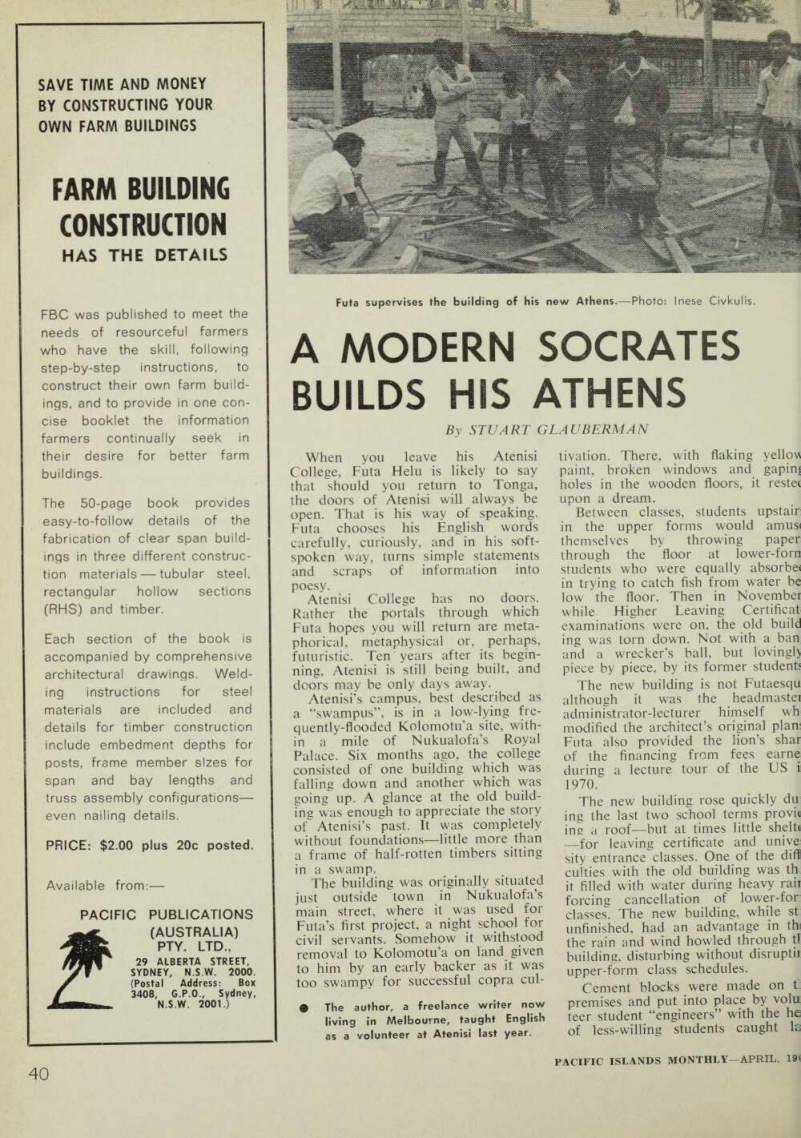
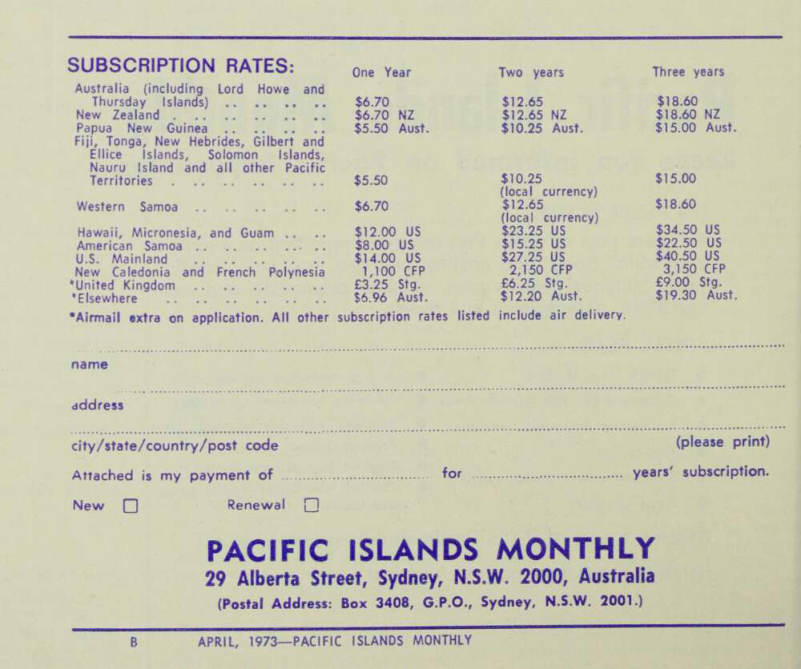
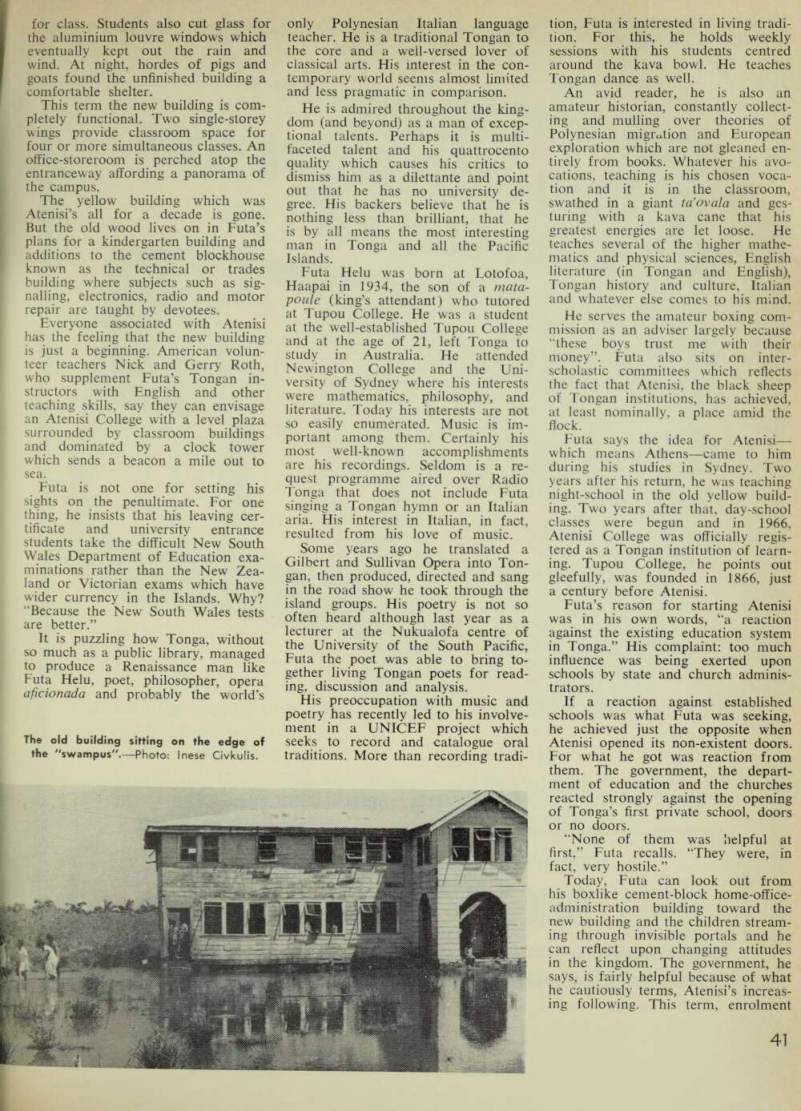
A Modern Socrates
By Stuart Glauberman
When you leave his Atenisi College, Futa Helu is likely to say that should you return to Tonga, the doors of Atenisi will always be open. That is his way of speaking.
Futa chooses his English words carefully, curiously, and in his soft spoken way, turns simple statements and scraps of information into poesy.
Atenisi College has no doors.
Rather the portals through which Futa hopes you will return are meta phorical, metaphysical or, perhaps, futuristic. Ten years after its begin ning, Atenisi is still being built, and doors may be only days away.
Atenisi’s campus, best described as a “swampus”, is in a low-lying fre quently-flooded Kolomotu’a site, with in a mile of Nukualofa’s Royal Palace. Six months ago, the college consisted of one building which was falling down and another which was going up. A glance at the old build ing was enough to appreciate the story of Atenisi’s past. It was completely without foundations —little more than a frame of half-rotten timbers sitting in a swamp.
The building was originally situated just outside town in Nukualofa’s main street, where it was used for Futa’s first project, a night school for civil servants. Somehow it withstood removal to Kolomotu’a on land given to him by an early backer as it was too swampy for successful copra cul • The author, a freelance writer now living in Melbourne, taught English as a volunteer at Atenisi last year.
tivation. There, with flaking yellow paint, broken windows and gapinj holes in the wooden floors, it restec upon a dream.
Between classes, students upstair; in the upper forms would amusi themselves by throwing paper through the floor at lower-forn students who were equally absorbe< in trying to catch fish from water be low the floor. Then in November while Higher Leaving Certificat examinations were on, the old build ing was torn down. Not with a ban; and a wrecker’s ball, but lovingl> piece by piece, by its former students The new building is not Futaesqu although it was the headmastei administrator-lecturer himself wh modified the architect’s original plan: Futa also provided the lion’s shar of the financing from fees earne: during a lecture tour of the US ii 1970.
The new building rose quickly du ing the last two school terms pro vie ine a roof —but at times little shelte —for leaving certificate and unive: sity entrance classes. One of the difll culties with the old building was th it filled with water during heavy rail forcing cancellation of lower-for classes. The new building, while st: unfinished, had an advantage in thi the rain and wind howled through tl building, disturbing without disruptir upper-form class schedules.
Cement blocks were made on t; premises and put into place by volir teer student “engineers” with the he of less-willing students caught la
Futa supervises the building of his new Athens.—Photo: Inese Civkulis.
for class. Students also cut glass for the aluminium louvre windows which eventually kept out the rain and wind. At night, hordes of pigs and goats found the unfinished building a comfortable shelter.
This term the new building is com pletely functional. Two single-storey wings provide classroom space for four or more simultaneous classes. An office-storeroom is perched atop the entranceway affording a panorama of the campus.
The yellow building which was Atenisi’s all for a decade is gone.
But the old wood lives on in Futa’s plans for a kindergarten building and additions to the cement blockhouse known as the technical or trades building where subjects such as sig nalling, electronics, radio and motor repair are taught by devotees.
Everyone associated with Atenisi has the feeling that the new building is just a beginning. American volun teer teachers Nick and Gerry Roth, who supplement Futa’s Tongan in structors with English and other teaching skills, say they can envisage an Atenisi College with a level plaza surrounded by classroom buildings and dominated by a clock tower which sends a beacon a mile out to sea.
Futa is not one for setting his sights on the penultimate. For one thing, he insists that his leaving cer tificate and university entrance students take the difficult New South Wales Department of Education exa minations rather than the New Zea land or Victorian exams which have wider currency in the Islands. Why?
“Because the New South Wales tests are better.”
It is puzzling how Tonga, without so much as a public library, managed to produce a Renaissance man like Futa Helu, poet, philosopher, opera aficionado and probably the world’s
only Polynesian Italian language teacher. He is a traditional Tongan to the core and a well-versed lover of classical arts. His interest in the con temporary world seems almost limited and less pragmatic in comparison.
He is admired throughout the king dom (and beyond) as a man of excep tional talents. Perhaps it is multi faceted talent and his quattrocento quality which causes his critics to dismiss him as a dilettante and point out that he has no university de gree. His backers believe that he is nothing less than brilliant, that he is by all means the most interesting man in Tonga and all the Pacific Islands.
Futa Helu was born at Lotofoa, Haapai in 1934, the son of a mata poule (king’s attendant) who tutored at Tupou College. He was a student at the well-established Tupou College and at the age of 21, left Tonga to study in Australia. He attended Newington College and the Uni versity of Sydney where his interests were mathematics, philosophy, and literature. Today his interests are not so easily enumerated. Music is im portant among them. Certainly his most well-known accomplishments are his recordings. Seldom is a re quest programme aired over Radio Tonga that does not include Futa singing a Tongan hymn or an Italian aria. His interest in Italian, in fact, resulted from his love of music.
Some years ago he translated a Gilbert and Sullivan Opera into Ton gan, then produced, directed and sang in the road show he took through the island groups. His poetry is not so often heard although last year as a lecturer at the Nukualofa centre of the University of the South Pacific, Futa the poet was able to bring to gether living Tongan poets for read ing, discussion and analysis.
His preoccupation with music and poetry has recently led to his involve ment in a UNICEF project which seeks to record and catalogue oral traditions. More than recording tradi
tion, Futa is interested in living tradi tion. For this, he holds weekly sessions with his students centred around the kava bowl. He teaches Tongan dance as well.
An avid reader, he is also an amateur historian, constantly collect ing and mulling over theories of Polynesian migration and European exploration which are not gleaned en tirely from books. Whatever his avo cations, teaching is his chosen voca tion and it is in the classroom, swathed in a giant ta’ovala and ges turing with a kava cane that his greatest energies are let loose. He teaches several of the higher mathe matics and physical sciences, English literature (in Tongan and English), Tongan history and culture, Italian and whatever else comes to his mind.
He serves the amateur boxing com mission as an adviser largely because “these boys trust me with their money”, Futa also sits on inter scholastic committees which reflects the fact that Atenisi, the black sheep of Tongan institutions, has achieved, at least nominally, a place amid the flock.
Futa says the idea for Atenisi— which means Athens—came to him during his studies in Sydney. Two years after his return, he was teaching night-school in the old yellow build ing. Two years after that, day-school classes were begun and in 1966, Atenisi College was officially regis tered as a Tongan institution of learn ing. Tupou College, he points out gleefully, was founded in 1866, just a century before Atenisi, Futa’s reason for starting Atenisi was in his own words, “a reaction against the existing education system in Tonga.” His complaint: too much influence was being exerted upon schools by state and church adminis trators.
If a reaction against established schools was what Futa was seeking, he achieved just the opposite when Atenisi opened its non-existent doors.
For what he got was reaction from them. The government, the depart ment of education and the churches reacted strongly against the opening of Tonga’s first private school, doors or no doors.
“None of them was helpful at first,” Futa recalls. “They were, in fact, very hostile.”
Today, Futa can look out from his boxlike cement-block home-office administration building toward the new building and the children stream ing through invisible portals and he can reflect upon changing attitudes in the kingdom. The government, he says, is fairly helpful because of what he cautiously terms, Atenisi’s increas ing following. This term, enrolment
The old building sitting on the edge of the "swampus".—Photo: Inese Civkulis.
has been boosted by nearly 50 per cent to 600.
Churches still tend to regard him suspiciously as he is often philoso phically irreligious, although never sacrilegious. His H year-old son and month-old daughter received the church’s blessings before they were born. And for reasons born of stub born traditionalism, Futa steadfastly opposes birth control, which puts him in the good graces of several Tongan religious bodies.
Ironically, he claims to be an ad herent of theories of child develop ment and modem teaching methods outlined by Dr Maria Montessori while, at the same time, he is a pro phet and practitioner of the hickory stick method of forcing progressive education upon his students. In keep ing with his traditionalism, however, the Tongan master prefers a kava stick for administering the swats of academic enlightenment.
This practice could change, he con cedes, if the students could be brought up in a Montessori environ ment from their earliest training.
Thus, his long-range plans include expanding the kindergarten and primary school and integrating them with tertiary classes. He also hopes to provide what he terms “internal educational opportunities” for stu dents with higher leaving certificate passes who can’t go overseas for further study.
This may be Futa’s way of laying the groundwork for what may some day become Atenisi University of Tonga.
What’s missing is money. Futa has the ideas. There are Tongans enough who believe in him and in Atenisi and are willing to teach their hearts out for bare-bones wages (even by Tongan standards). There are also volunteers like the Rotts who donate their talents to further what they feel is an exciting educational experiment.
And there are students who want what Atenisi has to offer—for some, freedom from school uniforms and regimentation; for others, the school’s remarkable record in accountancy, mathematics and science competitive examinations, and the opportunity to study under Futa. Each term they have come in increasing numbers from the kingdom’s every comer to the Kolomotu’a, to the school that Futa built without doors and without money.
The framework stands. Now Futa waits patiently for the benefactor who will bring the doors and the hinges, the books and the benches to fill the new building and the capital to build bigger buildings. Meantime, he teaches.
Being a classicist, Futa Helu knows that Athens was not built in a day.
Advertisements & other items, pp. 45-50 (1 item)
Pacific islands Monthly
keeps you informed on Pacific happenings
The Pacific is PIM!
For more than 40 years PIM has been reporting on events in the Pacific. Social and political changes, economic development, historical background, regular columnists and commentators, personalities and travel.
YOU’LL READ:—
• Letters from readers • A big magazine section • Extracts from the Islands Press • Shipping, airways' schedules • Fascinating historical articles • Business and development news Tropicalities Shipping and cruising yachts News of sport ♦ Produce prices ♦ Regular big picture section ♦ Plus all the latest Pacific news and views Become a part of PlM’s Pacific and subscribe now.
Rates and subscription form overleaf.
SUBSCRIPTION RATES;
Australia (including Lord Howe and Thursday Islands) $6.70 New Zealand $6.70 NZ Papua New Guinea $5.50 Aust.
Fiji, Tonga, New Hebrides, Gilbert and Ellice Islands, Solomon Islands, Nauru Island and all other Pacific Territories $5.50 Western Samoa $6.70 Hawaii, Micronesia, and Guam .. .. $12.00 US American Samoa $B.OO US U.S. Mainland $14.00 US New Caledonia and French Polynesia 1,100 CFP ‘United Kingdom £3.25 Stg. ‘Elsewhere $6.96 Aust.
Two years $12.65 $12.65 NZ $10.25 Aust. $10.25 (local currency) $12.65 (local currency) $23.25 US $15.25 US $27.25 US
2,150 CFP
£6.25 Stg. $12.20 Aust. •Airmail extra on application. All other subscription rates listed include air delivery.
Three years $18.60 $18.60 NZ $15.00 Aust. $15.00 $18.60 $34.50 US $22.50 US $40.50 US
3,150 CFP
£9.00 Stg. $19.30 Aust. name address clty/state/country/post code (please print) Attached is my payment of for years' subscription.
New Q Renewal □
PACIFIC ISLANDS MONTHLY
29 Alberta Street, Sydney, N.S.W, 2000, Australia (Postal Address: Box 3408, G.P.0., Sydney, N.S.W. 2001.)
B APRIL, 1973—PACIFIC ISLANDS MONTHLY
the man-siM.»>“,
haii-sge, cracKer.
- - ' S 3* Cl m m «&•
BROCKHOff
w 3* £ *r :v.v i 9* s* •» $ * \v d ■* & > d a *:4 d % « m v *
OZNET
i
cracker
VERSATILE
THE
Crisp ’n’ golden Brockhoff Salada snaps into action!
Straight from the pack man-size for big healthy sandwiches. savouries and sippets with soup.
Snap them in four, and Salada serves bite-size for quick tasty nibbles. Oven-crisp Brockhoff Snap them into two for snack-size Salada is three crackers in one.
There’s value, variety and quality in
BROCKHOFF BISCUITS
7913/8 x6 1 /4
Si m m > s EA
(arnation
V ~'PRODUCT
Now you can enjoy Peacock Full Cream Sweetened Condensed Milk... a top quality condensed milk made by the producers of Carnation Evaporated Milk. It’s on sale at your local store at a value-for-money price.
"V. <T ,V 5 *. ; 1 i
v PAr %
IMP
ffiftSfiP
*%E R Vf*
"’*«*» (37.4*1.8)
MASK
Wflfllß
Steel ♦ M *W* «* * com p/mv
'•vo nbV
Pu Gf Of AUSTf s«R# w fet * * -I II M ■
iSswnowrs
: :*nn mi , a
4 Loyal Opposition


Is On Trial
In Micronesia
From a Saipan correspondent Assistant Trust Territory Public Defender Arthur Rothenburg has resigned his post here at the territorial headquarters to return to his former job as a public defender in Miami, Florida.
During his 14-month stay in Micro nesia, he was involved in several highly controversial court cases, in cluding the defence of some Greek sailors after the search and seizure of the Pacific Paul last December in Koror, and more recently the Bertha borja-Esperanza San Nicholas trial on Guam.
Two months ago, however, Rothen burg and Jose A. Tenorio, an assis tant, were arrested for “obstructing justice” in their own office during another police search. With a warrant signed by TT Chief Justice Harold Burnett and on order from the Attorney-General, police were search ing for evidence against Chief TT Public Defender Roger St Pierre, a 10-year veteran at the job and often regarded as a “thorn in the side of the administration”. St Pierre was off the island at the time.
Rothenberg said it was during his arrest that he decided to leave Micro nesia. “On November 21, when local police, led by TT Police Superinten dent Carl Lindh, entered my office with a search warrant and arrested my assistant and me when we refused to co-operate, I realised no effective rule of law exists in the Trust Terri tory,” Rothenburg said the day before he left the territory. “The govern ment is free to do anything it pleases, even against men of the stature of St Pierre who has been the only American in Micronesia during the past 10 years to stand up for the rights of the people. The Congress of Micronesia has passed resolutions praising him . . . and the American government officials here send the police to raid his office.”
Rothenburg said that when St Pierre returned to Saipan he expected to be arrested on “trumped-up” charges.
Now, however, two months had passed since the police raids (the Majuro Public Defender’s Office was also searched the same day) . . .
“nothing has happened,” said Rothen burg. “No arrest, no charges, nothing.
Our civil rights were denied. The safeguards contained in the 4th and
sth Amendments of the US Constitu tion thrown to the wind. There is nothing that can be done legally in the Trust Territory.
“While I was in police custody during the search, I demanded to be brought before a magistrate and re leased on bond. I tried to telephone the Attorney-General and the High Commissioner but to no avail. I was shouting against the storm.”
Rothenburg said police searched every file, drawer, broke into a desk and filing cabinets with an electric drill, and xeroxed documents.
This writer, who, by coincidence, visited the office during the search, learned police were searching for papers relating to a Marshall Islands court case where St Pierre twice re fused, but later accepted a $7,500 “gift” for successfully settling a $30,000 estate three years ago.
“There was nothing illegal about it,” St Pierre said.
Rothenburg said his arrest, coupled with the government’s poor attempts to bring charges against St Pierre, prove that “. . . all illegal avenues of justice in the Trust Territory are closed. I prefer to return to Miami where the ‘system’ still works.
“The Interior Department has a policy here,” he said, “to govern and hold these islands. High Commis sioners, judges, bureaucrats, all political appointees, are sent here to execute that policy. The Congress of Micronesia is the only avenue for change here. Change cannot occur through the courts or through the law in Micronesia.”
Yet, Rothenburg said there is cause for optimism. “Micronesians are aware of the TT’s ‘holding action’ policies. After failing to find relief in the TT courts recently, 10 Saipan residents lost a lawsuit in the Hawaii Federal Court to stop ho t! construc tion next to the island’s best public beach area. The Eniwetok people, too, went to the Hawaii courts and successfully, at least temporarily, halted an Air Force ‘cratering experi ment’ on their tiny islands . . .”
Concerning the role of the Public Defender’s Office in Micronesia, Rothenburg said: “A man who fights for the rights of the people in Micro nesia as St Pierre has done during the last 10 years is fighting a lonely battle. But St Pierre built the office into the most respected agency in the government.”
Why does the government want to remove St Pierre?
“His independence,” Rothenburg said. “The Public Defender plays the role of the ‘loyal opposition’, and answers to the Secretary of the In terior. But for some reasons known only to top officials here, this ad versary system to them is dangerous.
The ‘loyal opposition’ apparently isn’t loyal enough.
“St Pierre, who has had resolutions passed by that congress commending his decade of work in Micronesia, has the administration scrambling to piece together the flimsiest of cases, invading his office in attempts to prosecute and remove him.
“In Micronesia, the ‘loyal oppo sition’ refused to get in with the gin drinking, back-scratching mob that runs this government. As a result, the government wants to eliminate it.”
Advertisements & other items, pp. 51-54 (2 items)
Vitamins
PEIMTAVITE
THE ABC OF
N) Nicholas
Vitamins are essential for the healthy growth of young children.
And an insufficient intake of the right kind of vitamins can sometimes lead to illnesses of one kind or another. ‘Penta-Vite’ products are specially designed to provide the daily requirements of the important vitamins when the diet is inadequate. ‘Penta-Vite’ Infant Formula supplements baby’s milk diet when breast feeding has ceased. And ‘Penta-Vite’ Syrup, with extra Vitamin C and iron, can be of special value if toddlers are a little pale and off their food.
Penta-Vite’, Australia’s leading infant vitamin supplement. From chemists only.
Nicholas Proprietary Limited 699 Warrigal Road, Chadstone.
Vic. Aust. 3148.
NPII4
we run a
We are New Zealand's biggest exporters of industrial and automotive parts. We already serve the Pacific because New Zealand is an integral part of the Pacific so we're in your backyard. And that cuts transport times and costs. Keep things simple. Any automotive part you want, we've got.
Right next door.
Motor Specialties Industries Ltd.
Group Export Division Box 22059, Otahuhu, Auckland, N.Z.
Distributed by
SS mm SPECIALTIES LTD
HEAD OFFICE. 80-90 ANZAC AVENUE, AUCKLAND. 1.
Don't let your
family down
You've worked hard to give them a home, schooling and security. Don't let that hard-won security erode away because you continued to overlook making out a Will. With a properly planned Will, you can be certain in the knowledge that your property will eventually pass to the people you specify, and also that your Estate will be as large as possible after probate and duties. In this regard, we invite you to take advantage of the advisory service we provide, entirely free of obligation. Our specialists in Estate Planning will be delighted to help you plan your Will most efficiently, or to discuss it fully with your solicitor or accountant.
THAT
T HE
BURNS PHILP TRUSTEE
COMPANY LIMITED
IXECUTOK ® ADMINISTRATOR • TRUSTEE o AIIUKNEY • AGENT Fiji Office: Mr. A. W. Cooper, Resident Manager, Rodwell Road, Suva. Telephone: 311 777.
Head Office: 51 Pitt Street, Sydney 2000.
Telephone: 241 1021. Telegrams: "BURNSTRUST," Sydney.
Branches and/or Registered Offices: Parramatta (N.S.W.), Canberra, Melbourne, Brisbane, Adelaide, Fremantle (W.A.), Port Moresby (Papua). 8P45
53 % 1 S. E. TATHAM & CO. PTY. LTD.
ASKEW HOUSE, 364 LONSDALE ST.,
MELBOURNE, 3001, AUSTRALIA.
G.P.O. BOX B—CABLES "SET"
TELEPHONE: 601125
Buyers for the Pacific Islands
AND IN
FIJI: S. E. TATHAM (FIJI) LTD.,
LAUTOKA P.O. BOX 366,
SUVA G.P.O. BOX 671,
PAPUA NEW GUINEA: S. E. TATHAM (P.N.G.) PTY. LTD
MALEKULA ST., LAE.
P.O. BOX 1562
YOUR GUARANTEE
FOR SERVICE
SINCE 1924
A loyal opposition is on trial
47
PACIFIC ISLANDS MONTHLY— APRIL, 1973
Queensland
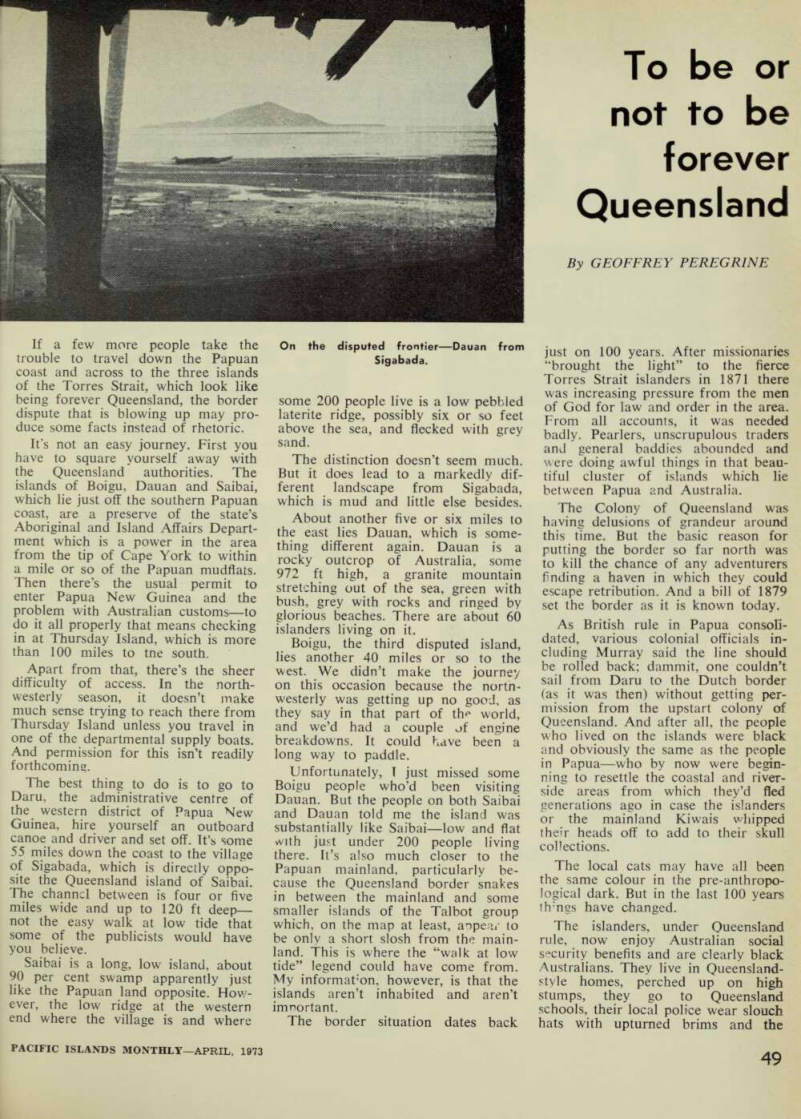
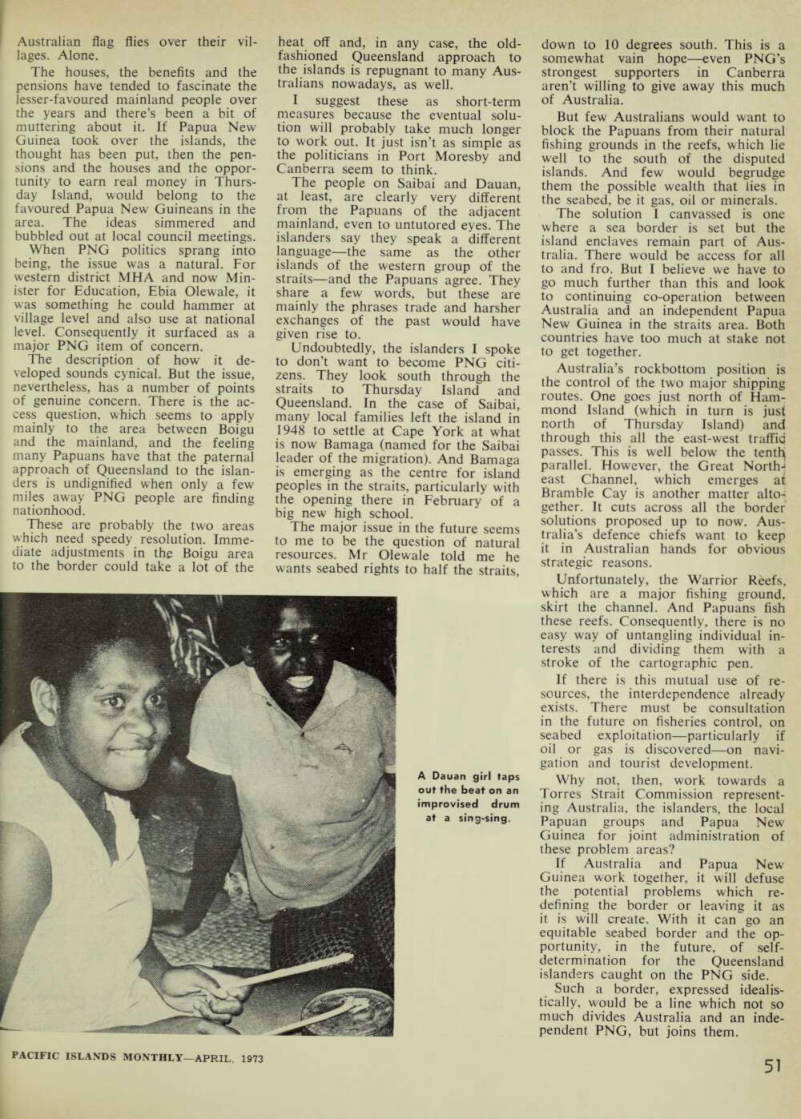
To be or not to be forever Queensland
By Geoffrey Peregrine
If a few more people take the trouble to travel down the Papuan coast and across to the three islands of the Torres Strait, which look like being forever Queensland, the border dispute that is blowing up may pro duce some facts instead of rhetoric.
It’s not an easy journey. First you have to square yourself away with the Queensland authorities. The islands of Boigu, Dauan and Saibai, which lie just off the southern Papuan coast, are a preserve of the state’s Aboriginal and Island Affairs Depart ment which is a power in the area from the tip of Cape York to within a mile or so of the Papuan mudflats.
Then there’s the usual permit to enter Papua New Guinea and the problem with Australian customs —to do it all properly that means checking in at Thursday Island, which is more than 100 miles to tne south.
Apart from that, there’s the sheer difficulty of access. In the north westerly season, it doesn’t inake much sense trying to reach there from Thursday Island unless you travel in one of the departmental supply boats.
And permission for this isn’t readily forthcoming.
The best thing to do is to go to Daru, the administrative centre of the western district of Papua New Guinea, hire yourself an outboard canoe and driver and set off. It’s some 55 miles down the coast to the village of Sigabada, which is directly oppo site the Queensland island of Saibai.
The channel between is four or five miles wide and up to 120 ft deep— not the easy walk at low tide that some of the publicists would have you believe.
Saibai is a long, low island, about 90 per cent swamp apparently just like the Papuan land opposite. How ever, the low ridge at the western end where the village is and where
some 200 people live is a low pebbled laterite ridge, possibly six or so feet above the sea, and flecked with grey sand.
The distinction doesn’t seem much.
But it does lead to a markedly dif ferent landscape from Sigabada, which is mud and little else besides.
About another five or six miles to the east lies Dauan, which is some thing different again. Dauan is a rocky outcrop of Australia, some 972 ft high, a granite mountain stretching out of the sea, green with bush, grey with rocks and ringed by glorious beaches. There are about 60 islanders living on it.
Boigu, the third disputed island, lies another 40 miles or so to the west. We didn’t make the journey on this occasion because the nortn westerly was getting up no good, as they say in that part of world, and we’d had a couple of engine breakdowns. It could have been a long way to paddle.
Unfortunately, I just missed some Boigu people who’d been visiting Dauan. But the people on both Saibai and Dauan told me the island was substantially like Saibai—low and flat vvith just under 200 people living there. It’s also much closer to the Papuan mainland, particularly be cause the Queensland border snakes in between the mainland and some smaller islands of the Talbot group which, on the map at least, anpear to be only a short slosh from the main land. This is where the “walk at low tide” legend could have come from.
My information, however, is that the islands aren’t inhabited and aren’t important.
The border situation dates back
just on 100 years. After missionaries “brought the light” to the fierce Torres Strait islanders in 1871 there was increasing pressure from the men of God for law and order in the area.
From all accounts, it was needed badly. Pearlers, unscrupulous traders and general baddies abounded and were doing awful things in that beau tiful cluster of islands which lie between Papua and Australia.
The Colony of Queensland was having delusions of grandeur around this time. But the basic reason for putting the border so far north was to kill the chance of any adventurers finding a haven in which they could escape retribution. And a bill of 1879 set the border as it is known today.
As British rule in Papua consoli dated, various colonial officials in cluding Murray said the line should be rolled back; dammit, one couldn’t sail from Dam to the Dutch border (as it was then) without getting per mission from the upstart colony of Queensland. And after all, the people who lived on the islands were black and obviously the same as the people in Papua—who by now were begin ning to resettle the coastal and river side areas from which they’d fled generations ago in case the islanders or the mainland Kiwais whipped the'r heads off to add to their skull collections.
The local cats may have all been the same colour in the pre-anlhropo logical dark. But in the last 100 years th : ngs have changed.
The islanders, under Queensland rule, now enjoy Australian social security benefits and are clearly black Australians. They live in Queensland style homes, perched up on high stumps, they go to Queensland schools, their local police wear slouch hats with upturned brims and the
On the disputed frontier —Dauan from Sigabada.
Australian flag flies over their vil lages. Alone.
The houses, the benefits and the pensions have tended to fascinate the lesser-favoured mainland people over the years and there’s been a bit of muttering about it. If Papua New Guinea took over the islands, the thought has been put, then the pen sions and the houses and the oppor tunity to earn real money in Thurs day Island, would belong to the favoured Papua New Guineans in the area. The ideas simmered and bubbled out at local council meetings.
When PNG politics sprang into being, the issue was a natural. For western district MHA and now Min ister for Education, Ebia Olewale, it was something he could hammer at village level and also use at national level. Consequently it surfaced as a major PNG item of concern.
The description of how it de veloped sounds cynical. But the issue, nevertheless, has a number of points of genuine concern. There is the ac cess question, which seems to apply mainly to the area between Boigu and the mainland, and the feeling many Papuans have that the paternal approach of Queensland to the islan ders is undignified when only a few miles away PNG people are finding nationhood.
These are probably the two areas which need speedy resolution. Imme diate adjustments in the Boigu area to the border could take a lot of the
heat off and, in any case, the old fashioned Queensland approach to the islands is repugnant to many Aus tralians nowadays, as well.
I suggest these as short-term measures because the eventual solu tion will probably take much longer to work out. It just isn’t as simple as the politicians in Port Moresby and Canberra seem to think.
The people on Saibai and Dauan, at least, are clearly very different from the Papuans of the adjacent mainland, even to untutored eyes. The islanders say they speak a different language—the same as the other islands of the western group of the straits—and the Papuans agree. They share a few words, but these are mainly the phrases trade and harsher exchanges of the past would have given rise to.
Undoubtedly, the islanders I spoke to don’t want to become PNG citi zens. They look south through the straits to Thursday Island and Queensland. In the case of Saibai, many local families left the island in 1948 to settle at Cape York at what is now Bamaga (named for the Saibai leader of the migration). And Bamaga is emerging as the centre for island peoples in the straits, particularly with the opening there in February of a big new high school.
The major issue in the future seems to me to be the question of natural resources. Mr Ole wale told me he wants seabed rights to half the straits,
down to 10 degrees south. This is a somewhat vain hope—even PNG’s strongest supporters in Canberra aren’t willing to give away this much of Australia.
But few Australians would want to block the Papuans from their natural fishing grounds in the reefs, which lie well to the south of the disputed islands. And few would begrudge them the possible wealth that lies in the seabed, be it gas, oil or minerals.
The solution I canvassed is one where a sea border is set but the island enclaves remain part of Aus tralia. There would be access for all to and fro. But I believe we have to go much further than this and look to continuing co-operation between Australia and an independent Papua New Guinea in the straits area. Both countries have too much at stake not to get together.
Australia’s rockbottom position is the control of the two major shipping routes. One goes just north of Ham mond Island (which in turn is jus( north of Thursday Island) and through this all the east-west traffid passes. This is well below the tentty parallel. However, the Great North-j east Channel, which emerges at Bramble Cay is another matter alto gether. It cuts across all the border solutions proposed up to now. Aus tralia’s defence chiefs want to keep it in Australian hands for obvious strategic reasons.
Unfortunately, the Warrior Reefs, which are a major fishing ground, skirt the channel. And Papuans fish these reefs. Consequently, there is no easy way of untangling individual in terests and dividing them with a stroke of the cartographic pen.
If there is this mutual use of re sources, the interdependence already exists. There must be consultation in the future on fisheries control, on seabed exploitation—particularly if oil or gas is discovered—on navi gation and tourist development.
Why not, then, work towards a Torres Strait Commission represent ing Australia, the islanders, the local Papuan groups and Papua New Guinea for joint administration of these problem areas?
If Australia and Papua New Guinea work together, it will defuse the potential problems which re defining the border or leaving it as it is will create. With it can go an equitable seabed border and the op portunity, in the future, of self determination for the Queensland islanders caught on the PNG side.
Such a border, expressed idealis tically, would be a line which not so much divides Australia and an inde pendent PNG, but joins them.
A Dauan girl taps out the beat on an improvised drum at a sing-sing.
Advertisements & other items, p. 56 (1 item)
Cooking
COME TO ALLIED IRONFOUNDERS
WHEN IT COMES TO
SOLID FUEL
STOVES
* LOW PRICED WELCOME DOVER”
‘CHROME TRIM *5 PLATE TOP
* 3 SIZES * OPTIONAL HOT WATER TANK
OIL FIRED
PORTABLE
BOILERS
‘“FALKIRK” TWO SIZES OF BOILERS
‘FOUR SIZES FIELD COOKING POTS-
* CAN CONVERTED SOLID FUEL
RAYBURN 620
COOKER
* RAEBURN 620 - OIL OR SOLID FUEL
* PLENTY OF FREE HOT WATER
‘NO MAINTENANCE WORRIES
COMMERCIAL
COOKING
x ■ .-MV * GAS, ELECTRIC, OIL & SOLID FUEL
MODELS
* HIGH PRODUCTIVITY & EFFICIENCY
* LOW RUNNING COSTS
DUO ENTERPRISES
Papua & New Guinea P.O. Box 494, Port Moresby
FOR
GAS, ELECTRIC,
SOLID FUEL AND
OIL COOKERS
MAIL THIS COUPON FOR FREE LITERATURE
TICK IF REQUIRED □ RAYBURN 620 □ COOKING BOILERS □ DOVER STOVES □ COMMERCIAL COOKING EQUIPMENT.
DUO ENTERPRISES Papua & New Guinea P.O. Box 494, Port Moresby, T.P.N.G.
NAME .
ADDRESS
On the track of Torres
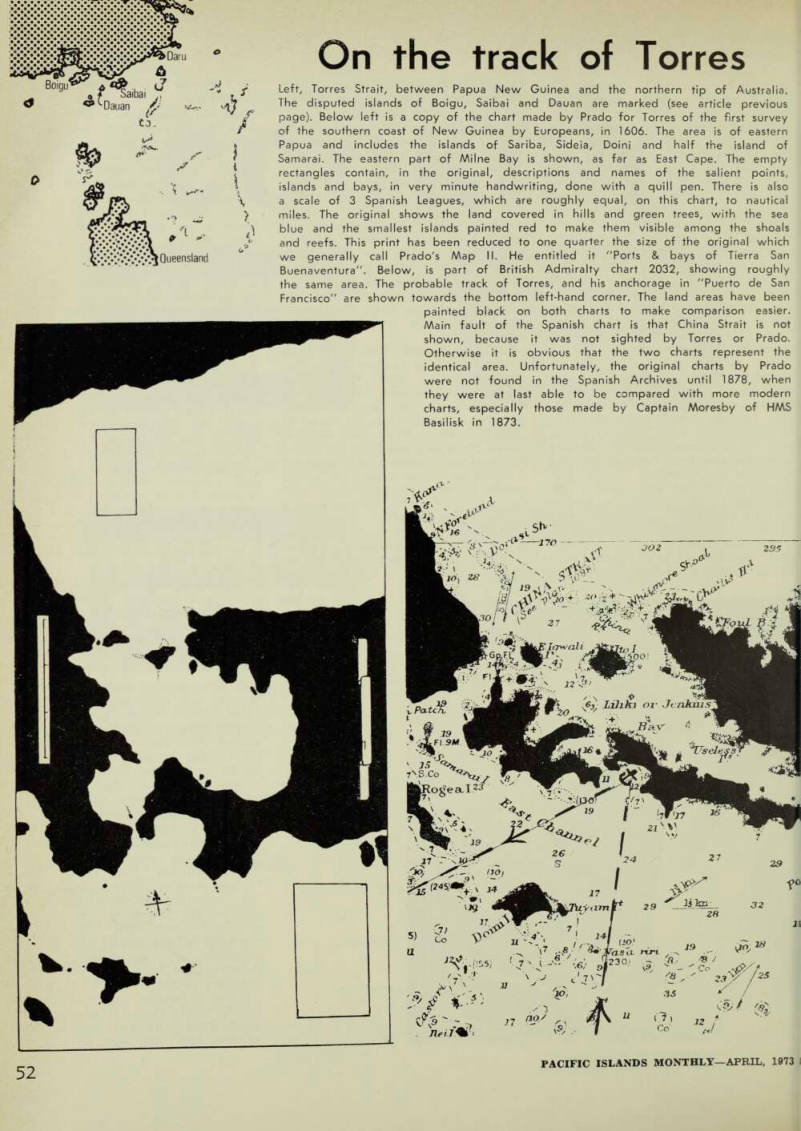
Left, Torres Strait, between Papua New Guinea and the northern tip of Australia.
The disputed islands of Boigu, Saibai and Dauan are marked (see article previous page). Below left is a copy of the chart made by Prado for Torres of the first survey of the southern coast of New Guinea by Europeans, in 1606. The area is of eastern Papua and includes the islands of Sariba, Sideia, Doini and half the island of Samarai. The eastern part of Milne Bay is shown, as far as East Cape. The empty rectangles contain, in the original, descriptions and names of the salient points, islands and bays, in very minute handwriting, done with a quill pen. There is also a scale of 3 Spanish Leagues, which are roughly equal, on this chart, to nautical miles. The original shows the land covered in hills and green trees, with the sea blue and the smallest islands painted red to make them visible among the shoals and reefs. This print has been reduced to one quarter the size of the original which we generally call Prado's Map II. He entitled it "Ports & bays of Tierra San Buenaventura". Below, is part of British Admiralty chart 2032, showing roughly the same area. The probable track of Torres, and his anchorage in "Puerto de San Francisco" are shown towards the bottom left-hand corner. The land areas have been
painted black on both charts to make comparison easier.
Main fault of the Spanish chart is that China Strait is not shown, because it was not sighted by Torres or Prado.
Otherwise it is obvious that the two charts represent the identical area. Unfortunately, the original charts by Prado were not found in the Spanish Archives until 1878, when they were at last able to be compared with more modern charts, especially those made by Captain Moresby of HMS Basilisk in 1873.
Magazine Section
The great burst of silence (as Captain Brett Milder puts it) that followed the successful passage of de Torres through the Strait that now bears his name, is being made up for these days by an equal burst of vociferousness as politicians in Papua New Guinea and Australia argue about a border, de Torres was the first European to thread his way successfully through the maze of reefs, islands and shoals that divide the tip of Australia from the south coast of the big island of New Guinea. He did it in 1606 in unusual circumstances, as Captain Milder relates in this article, but his discoveries were virtually ignored and the sailors and navigators who came after him got no benefit from his experience. Torres Strait became a graveyard of ships and out of that grew, in compara tively modern times, one of the great pilot services of the world. Somewhere between 30 and 40 master mariners in the Torres Strait Pilot Service still provide pilotage from the western approaches to eastern Australian ports. But current interest in Torres Strait and its islands grows out of Australian frus tration of the 1870 s when, thwarted in its desire that Britain annex all of Eastern New Guinea, the border between the northern tip of Australia and the south coast of New Guinea was placed as close to the New Guinea coast as possible. The islands which are the remnants of the ice-age landbridge between the two countries are included in the State of Queensland.
With the imminence of independence, Papua New Guinea now wants the border moved south, not because it wants the islands or the people who live on them, but for fishing rights and potential off shore oil deposits.
Things were very much different in 1606 in the Strait but still fraught with many difficulties for the first European men to navigate it.
Dangerous Shoals For Torres Along

Today's Disputed Frontier
By Captain Brett Milder
In July, 1606, Captain Luis Baez de Torres was sailing north in the Coral Sea in the ship San Pedro, accompanied by his small consort, Los Tres Reyes. These two ships had been deserted at Santo in the New Hebrides by the commander of the expedition, de Quiros, who had abandoned the voyage and returned in his flagship to America.
Torres, endeavouring to complete the voyage, had a copy of the Royal Orders giving the courses to be steered in search of the Great South Land. He had already been close to the Great Barrier Reef in the latitude of Mackay, in 21 deg south. From that point he was to steer north-west, up to 4 deg latitude, and sail along the north coast of New Guinea to Manila, and thence to the Moluccas and the Cape of Good Hope to Spain.
He probably realised that on a north-west course he might bump into
the bottom of New Guinea, so I am sure that he steered north instead, though he wrote NNW in his report, to be more in accordance with the orders.
Torres had with him a galaxy of officers, including three from the flagship who had disagreed with Quiros. The first of these was Ochoa de Bilbao, chief pilot of the Fleet, sacked by Quiros and sent under arrest to Torres’ ship. The next was the noble “Caballero” Captain Don Diego de Prado y Tovar, a “spare captain”, possibly intended to take command if Quiros died. He was a very versatile man, not a mariner but a military engineer, and to him we owe the excellent maps of the voyage which have survived and also the fullest account of it. The third man was the chief surgeon, Sanches de Aranda.
Having sailed north for about six
days at about four knots, with the usual tradewind from about east south-east, breakers and land were sighted ahead at dawn on July 14.
The ships turned hard a-starboard, and the sails close-hauled, on a north east course to clear the breakers, and pass to the eastward of New Guinea.
But as the sun rose the wind got too strong, and made their course im possible. So they were “forced to submit, and to sail westwards” out side the line of reefs and islands.
Torres gives the latitude of their land fall as Hi deg south, while Prado wrote 12 deg, but there can be no doubt that the land was Tagula Island (Sud-Est), with Rossel Island also in sight to the north-east.
They followed the reefs along for four days, and put out to sea each night for safety. On the fifth day they saw some high little islands like sugar loaves, and a boat was sent to look
for a passage and take soundings.
These turned out to be from seven to 10 fathoms, so the position was probably west of Uluma or Suckling Reef, and the islands must have been the Dumoulins.
Steering about north over the sunken barrier reef, they passed by the small islands and reached Sideia Island, anchoring in 14 fathoms in the first bay they came to, on July 18, 1606. They named the island Tierra de San Buenaventure, because they had first sighted the land on that feast day, the 14th.
They then named the bay the Puerto de San Francisco. Sariba Island, the next to the west, was not named as it was assumed to be part of New Guinea. On the next day they landed and climbed a hill, raid ing some native gardens on the way, and they sighted the bays and islands to the north, in what is now called Liliki or Jenkins Bay.
As they were still hopeful of finding a northern route, and thence to Manila, they put their two boats in the water with 20 armed men, to look for a passage. They found one only a mile or two to the west, but it was too narrow for their ships, being only 200 feet wide, and with very strong tides in it. The two boats were attacked by a force of 200 natives in
canoes, who were soon put to flight by volleys of powder and shot. 1 ne passage was named the Entrance of the Battle, but it is now known as Rocky Pass.
Once through the passage the Spaniards spent a few days exploring Jenkms Bay as far as Challis Head, where they had a good view of Milne Bay and East Cape, and they sus pected that ships could get through to the north-east, except that Rocky Pass barred the way.
After 15 days between Basilaki and Sideia Island Torres took possession of the land in the name of the King of Spain, and then made westwards along the coast, still in completely uncharted waters. Some charts showed the solid land of Terra Aus tralis Incognita extending here from the South Pole, while others showed nothing at all. Sailing by day with good lookouts, and anchoring each night, they worked their way to their next port, in Orangerie Bay. This name was given by Bougainville in 1767, just 161 years later. Here again Prado’s chart is much better than either Bougainville’s or Moresby’s, and extends about 55 miles from east to west, from Mullens Harbour to Mailu and Lopom Islands.
After various expeditions ashore.
including a battle with natives at Mailu, the ships sailed off this map and made west again. They probably anchored at Redscar Bay, west of Port Moresby, and again at an island which may have been Yule. Here they were struck by an easterly gale, and ran with bare masts out to sea.
The next mention is of running into shallow water of three to nine fathoms, which Torres called a placet or bank. They found themselves baulked by reefs as they tried to head NW or west, and so they anchored at an island in 9 deg south. This was probably Parana or Bampton Island, but they called it Malandanca be cause they had been “dancing around madly” among the reefs.
They were now forced by the reefs to steer away from the coast on a south-west course, going from one island to another and trying more than once to get back to the coast.
This occupied about a month, until they were nearly down to Cape York.
They anchored on the eve of San Francisco (October 3) about two miles south of Prince of Wales Island, in five fathoms.
Next day they steered west in six and seven fathoms of water, along what is now known as Endeavour Strait. They finally passed over the bar at the western end, on which is
22 ft of water at low tide, and found themselves at sunset in an open sea, with the depths slowly increasing. They probably steered west all night, and at daylight would have been in about 18 fathoms, and then steered happily north towards Manila in the Philip pines.
As there were no means at that time of measuring the longitude, and having been sailing for 10 months since leaving South America, their reckoning was bound to be very un certain. Torres, apparently, thought that he was about 1,000 miles further west, on the southern coast of Timor.
When he ran into New Guinea again and rounded False Cape, he gave it the name of Cambaru, thinking that it was Sumbawa, which was named Cambara on charts of 1600. He was disappointed to find that he was still in vast areas of shallow water and shoals. After False Cape he got into deeper water for three days, well away from the coast until he arrived off Cape Steenboom in 5 deg south.
Here at least the placel or bank ended.
The coast now ran along for a long way in about 4 deg south, with plenty of rivers, bays and good anchorages.
They anchored in three good har bours, and Prado made a map of the third, which is the area now known as Triton Bay and Iris Strait. They were anchored in the “Puerto de San Lucas” from October 18 to 26. Here they got supplies of fresh water and firewood, and supplies of fresh food from the shore and native gardens.
From the Port of St Luke they sailed west again, but had to turn south-west to get through Nautilus Strait, before working around again to a general course of WNW. This took them through groups of little islands along to the end of New Guinea, which Torres gives correctly as in H deg south, at Cape Sele. In these islands they found Chinese trade goods and some iron implements, so they realised that they were in the trading zone of the Moluccas or Spice Islands. The ships reached the equator at Jailolo Strait, off the eastern tip of Halmahera, and turned south to pass around the island south-about. This brought them into the legendary Isles of Spice, named Bachan, Kayoa, Motil, Tidore and Ternate, At Ternate they at last found a Spanish fort and trading post, with a small garrison under a commandant.
This post had only been Spanish for about six months, having been cap tured by the governor of the Philip pines. Torres spent about three months there, then resumed his voyage through waters that were at least charted; he passed up the west
coast of Mindinao and so on to the town of Manila.
He had been 17 months on his famous voyage, during which time he had lost only one man, and that by a poisoned arrow. He had collected about 20 natives from his new coast line and islands, intending to show them to the King of Spain as his newest subjects.
On his arrival at Manila on May 22, 1607, Torres found the govern ment was being run by the Audiencia until the arrival of a new governor.
They said they had no money or stores to supply Torres for his voyage to Spain, and we can only assume that Torres and his crew and ship were used in the Philippines, as we have no further news of him or the ship.
Prado alone got back to Spain, though it took him about eight years.
And so the magnificent voyage of Torres ended in a great burst of silence.
His discoveries appeared belatedly on some charts, but as all other charts ignored his work, there was grave doubt until Cook’s time about the existence of Torres Strait itself. The main information on the voyage was Torres’ letter to the King, which was unearthed in about 1770. The four maps of Prado, out of the total of seven he is known to have drawn, did not appear until 1878, and finally the narrative of Prado was found in 1929.
Other items have been found in recent years by Father Celsus Kelly, OEM, whose unremitting toil has
been mainly centred on Quiros. We are still hoping for more documentary evidence and forgotten charts, but in the meantime have to extract the utmost from what clues we have at present. Many of these have been misread, mistranslated and misinter preted by scholars and navigators through the years.
Torres remains in history as a very successful commander, but there are no personal details of his life be fore or after the voyage. Prado calls him a Breton, which probably meant that he was from Galicia in NW Spain, and his name Baez suggests that his ancestry was Basque or Biscayan. In delving through the documents we find many items of interest to study, including some which may be elucidated by anthro pologists or district officers in Papua.
Apart from four drawings of natives by Prado, or at least annotated by him, there are several names of tribes and races which it may not be too late to identify. According to Prado the names of these were, from Tagula to Samarai, the Canaiis, the Hunis and the Boniguis; on the mainland near Mailu or Toulon Island were the Ratiles or Railes; west of Port Moresby began the Helabons or Ela bons, which echo the native name of Port Moresby, Ela. The Ratiles wor shipped the sun, Nina and the moon Puri. West of Cape Steenboom they were called Papuas, which was sup posed to be a Malay word.
In the four drawings the natives near Samarai are fair-skinned, and shown with tattoos. At Orangerie Bay they are said to be corpulent; those in Torres Strait islands are black, and the Papuas are described as reddish.
There are also descriptions of the usual food in the various areas, and the weapons of warfare.
One strange item of the latter is the use of hollow canes through which lime is blown into the eyes of ad versaries in West New Guinea.
Similar canes or bamboos are men tioned by Cook on his only landing in West New Guinea, about 140 miles north of False Cape.
Prado’s drawings, or rather paint ings, of natives show signs of Euro peanisation; the bows are often with double arcs, like Cupid’s Bow, and the arrows are shown as carried in sheaves over the right shoulder, as in England in the 15th century. The items we have for research are so full of problems and apparent contradictions that it will never be possible to sort them all out with no doubts remain ing.
• The magazine section is continued on p 61 with MANA.
Advertisements & other items, pp. 60-61 (1 item)
great bunch
A
of flours.
Robert Hutchinson makes the greatest bunch of flours in the Pacific. Bakers’ flour.
Superlite cake and sponge flours.
Biscuit flour and cracker flour.
Wheafen sharps and wheaten meal.
We’re particularly proud of our bunch of flours. So we have a technical advisory service to help you use them properly.
So next time you see a Robert Hutchinson flour (or even one of our Hutmill stock feeds), remember it’s just one of the bunch. % / m * 4m
SlSf
ROBERT
HUTCHINSON
LIMITED
the flour people
Hartington Street, Glenroy, Victoria, Australia. 3046. Telephone Melbourne 306 7261 ™
TfIBRTR SKID & SCUBA DIUIAG EQUIPRIERT
The TABATA line offers the importer a complete range of RUBBER SKIN new Zealand Agents: Aiian g. witcheii inz.) ua.
K ui INUUULIN NORFOLK ISLAND Agents: Norfolk Island Sporting Centre Ltd. & SCUBA DIVING EQUIPMENT and ACCESSORIES for both the professional and amateur. Years of specialized manufacturing experience has established our line’s
REPUTATION FOR QUALITY, ATTRACTIVE and PRACTICAL
DESIGNS and VERY COMPETITIVE PRICES. We also offer a varied line of rubber sundries for golfing, skiing and other popular sports.
For full particulars on our lines, write to:
OTabata co. no
Yajima Bldg., 2-2 Yoshi-cho, Nihonbashr, Chuo-ku, Tokyo Cable: EASTABAT Tokyo TELEX: 252-2806
EASTABATATOK Tel: (663) 8651-5
OSAKA; 48 Uchiawazi-cho, 2-chome, Higashi-ku.
Osaka Tel: 06 (942) 5822
Ghost-Laying!
The Japanese Government may send an expedition to the BSIP in 1974 to see if some Japanese soldiers are still living on San Jorge Island, off Santa Y sab el. It has been reported that 37 soldiers were abandoned there when US aircraft destroyed their transport during the Japanese retreat. One of their comrades in Japan believes some of them are still living on the island.
PIM, which is a “must” for reading in Japan by government and businessmen interested in the South Pacific, posed the question of the presence of Japanese soldiers on San Jorge in an article by geologist John Grover —San Jorge’s ghosts and things that go bump in the night—in the January issue. Some of the “ghostly” visi tations related by Mr Grover could be explained by the presence of a “forgotten” company of soldiers.
Advertisements & other items, pp. 63-70 (1 item)
for extra freshness
Come up to Kool
P I m mm 9 ■ M f: * m \
KQDI
m 1 & 7*» s T te AZ U597-8/71
The
China Navigation Company
was launched on theYangtse
ninety nine years ago
In 1873 the China Navigation Company commenced operations with two paddle steamers, the “Glengyle” and the ‘Tunsin,” serving the Yangtse River trade.
Today, the China Navigation Company provides
the most extensive network of cargo routes within the area bordered by Japan, Tahiti, New Zealand. Australia and the Malay Peninsula.
The two paddle steamers have been replaced
by twenty-six cargo ships.
The Company’s early dependence on the
Yangtse and the China coast for its living is marked nowadays only by the names of some of its ships . . . traditionally of those towns and provinces in China where the Company grew to
its present high standing.
The China Navigation Company—the name that has become synonymous
with experience . . .
reliability . . . speed
. . . service.
For further details and all enquiries there are Agents at the following ports: Melbourne: P. & 0. Lines of Australia Pty. Ltd.
Brisbane: Wills, Gilchrist & Sanderson Pty. Ltd.
Papua and New Guinea: Steamships Trading Co. Ltd., Port Moresby, Samarai, Lae, Madang, Rabaul, Kieta.
Wewak: Kavieng: Burns Philp (New Guinea) Ltd.
Fiji: Morris Hedstrom Ltd., Suva, Lautoka.
Western Samoa: Morris Hedstrom Ltd., Apia.
Tonga: Morris Hedstrom Ltd., Nukualofa and Vava’u.
Tahiti: Etablissements Donald, Papeete.
Japan: Swire McKinnon, Tokyo, Yokohama, Osaka, Kobe and Nagoya.
Eastern Managers: Butterfield & Swire, 9 Connaught Rd., Central, Hong Kong.
New Caledonia: Etablissements Ballande, Noumea. 8.5.1. P.: British Solomons Trading Co. Ltd., Honiara.
New Hebrides: Les Comptoirs Francais des Nouvelles-Hebrides Vila and Santo.
VCN ) SWIRE & GILCHRIST PTY. LTD..
General Agents in Australia, 8 Spring Street, Sydney. Phone: 2 0522
THE CHINA NAVIGATION CO LTD
Member of the Swire Group SGO4I
k* I T t ... nothing else if you feel so inclined, for there’s no real problem where and how and what you drink Bacardi rum with.
Because Bacardi rum is so light, dry, highly refined and pure it complements every mixer, yet remains distinctively itself. Bacardi and Coke and ice ... Bacardi and ginger... Bacardi and tonic with a zest of lemon or lime ... Bacardi and fruit juice ... Mix up your own Bacardi party.
Because ...
Anything
goes with
Bacardi rum
BACARDI
rum-the mixableone. v C Bacardi Bat Device are-registered trade marks of Bacardi and Company Limited.
“Coca-Cola” and “Coke” are the registered trade marks of The Coca-Cola Company.
BAC/2382/72
Kiv-d v -'A x:-v ■ • 'r'K ; », ' * *"v. v c' • * «*.• >V •***.>«‘ ~4 * S- vv. •\-- r ** :\^e •... . ••.. ♦' V 8 * * 5 ■ S**\ - ' A '>' . A'V' > r"s v -V 1 * f 4 "Hni'i I'C »>.v* • ■ t • * i ,i.( » v «)* '• »*, , »*♦ */../* "* < n* _,f •‘ \ i s. ; Vi <» * , ■i '. . ! ■< ■ .v ■>■ •>',.■ S-: v.:\:' »» « . ♦ V LS ■'- . * ;-■ V % '?
V.-fN < ■> I
* iM tv ' v>v * rt* m "4 , v . * Vv ‘ ' % . . •> m . i ’ » IU
and Cruiser
OYOTA
Dyna t I
Get through
with a Toyot
When the going gets roughest, depend on Toyota to get you through everytime.
Road conditions, water,extremes of heat and cold—nothing, but nothing stops Toyota from coming through for you with the biggest loads faster and more economically.
World-famous for the engineering excellence of its automobiles, Toyota also makes a complete line of rugged, versatile commercial vehicles designed to keep costs down, profits rising.
The Toyota Land Cruiser defies all obstacles to get the job done.
The Dyna and Stout trucks come through better in the light and medium pickup categories, while the Hi-Ace makes an excellent all-purpose vehicle.
For the big jobs, Toyota offers the heavy-duty truck - to keep profits rising load after load. And for the big family, Toyota offers two roomy station wagons - the trusty Toyota 1000 and the luxurious Corolla.
Make it a point to see your nearest Toyota dealer soon. When you do, ask him to prove how Toyota can keep coming through for you again and again. 803 TOYOTA Stout
LmJ.
TOYOTA Truck TOYOTA Land Cruiser
I »jinsT^
TOYOTA 1000
TOYOTA
TOYOTA Hi Ace
3 TOYOTA Corolla PAPUA NEW GUINEA: ELA MOTORS LIMITED. Scratchley Rd., Badili, Papua U.S. TRUST TERRITORY: MICROL CORPORATION, P.O. Box 267, Saipan FIJI ISLANDS: AUTOMOTIVE SUPPLIES CO., LTD., G.P.O. Box 355, Suva AMERICAN SAMOA: BURNS PHILP (SOUTH SEA) CO., LTD.,Pago Pago WESTERN SAMOA: BURNS PHILP (SOUTH SEA) LTD., P.O. Box 188, Apia GUAM: RICKY's AUTO CO., P.O. Box 1458, Agana NEW HEBRIDES: NEW HEBRIDES MOTORS LTD., P.O. Box 18, Vila SOLOMON ISLANDS: ZEPHYR SERVICE STATION PTY LTD.. P.O Box 174, Honiara NEW CALEDONIA: SOCIETE D'IMPORTATION AUTOMOBILE DU PACIFIC, B.P. 438, Noumea TAHITI: ETABLISSEMENTS E.A. MARTIN & FILS BP 61 Papeete COOK ISLANDS: COOK ISLANDS TRADING CORPORATION LTD., P.O. Box 92, Rarotonga
It took time to perfect the
NEW Hyster electrics.
Time to make the best.
f
HYSTER
. % & We could have added new Hyster electric trucks to our extensive lift truck range some time ago. After all, we knew what people wanted, and we had the dealer and service network to back our sales Australia-wide.
But long after electric lift trucks first hit the market, we were busy perfecting a better hydraulic system to overcome the oil leaks and minimise the battery drain other manufacturers weren't so concerned about.
We wanted to make ours the top performance electric. An easy-handling truck with a short turning radius. Longer life between charges. Smoother deceleration. And single pedal control to keep the drivers happy.
Now, we’ve built these advantages into a range of Hyster electric trucks with load capacities of up to 10,000 lbs (5,000 kgs). We believe they're the world's finest, and they’re available from your Hyster dealer. Ask to see them in action. Or contact Hyster Australia Pty. Ltd., Ashford Avenue, Milperra, N.S.W. 2214. Telephone Sydney 77 0511,
HYSTER AUSTRALIA PTY. LTD.
HR39.84
J r \ Sk i \s. 0 7. & ib 4 3> o C-. ■■V o r « % >5 /i A > * ** r 4<
The b
A path
Making the endless blue and
bleach*white sands one...
HONDA.
A young man whose desire to reach the summit of success knows no limits. At work or at play, he thrives on new challenges, new ways to satisfy his zest for the active life. Every day more people are finding themselves in HONDA. Leader in motorcycles. Holder of the title of having Vs of the v/orld’s market With sales in more than 1 countries. By offering the right combination of power, performance, and ride in a wide range to suit every individual. It’s all of what it takes to be a world leader in motorcycles
... HONDA'
belo
That only
m y 4: *1 1 m K •? -7%
v Jv- -\ i*
i m - ; r ■m.
World's Largest Motorcycle . Manufacturer Wt , jf, s' , 0* * % p^j/rST'TRJi PO Box a? Rarotonga / NAURU ISLAND: Nauru „ * • *; s> « ' <st. ' —— MO csm‘cp.. LTD. TOKYO. - < ft- 'PAPUA NEW Jdtain'g Co., Ltd. 7| fEJBRJTORY; J.C. Tenorio Enterprise £O. Box 137. Saipan / I, ifUiKedsfands Oeyploßment.Aul'Kdrity Gilbert /
Mana
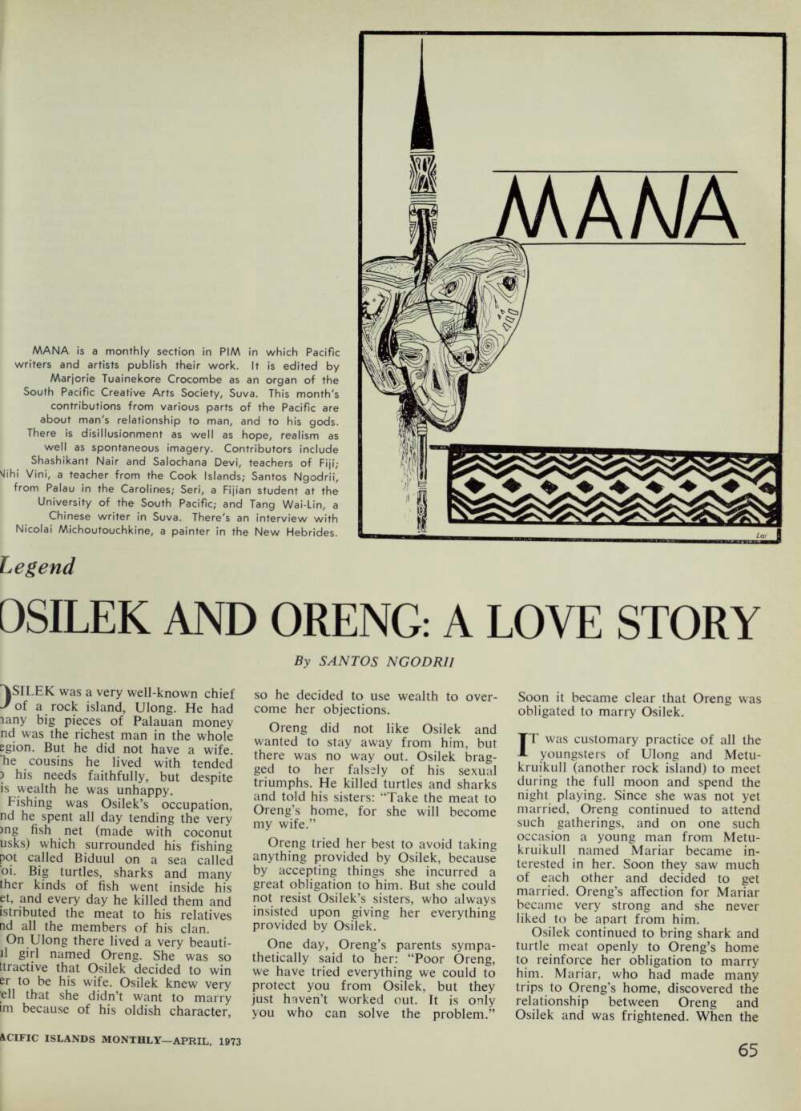
AAANA is a monthly section in PIM in which Pacific writers and artists publish their work. It is edited by Marjorie Tuainekore Crocombe as an organ of the South Pacific Creative Arts Society, Suva. This month's contributions from various parts of the Pacific are about man's relationship to man, and to his gods.
There is disillusionment as well as hope, realism as well as spontaneous imagery. Contributors include Shashikant Nair and Salochana Devi, teachers of Fiji; sJihi Vini, a teacher from the Cook Islands; Santos Ngodrii, from Palau in the Carolines; Seri, a Fijian student at the University of the South Pacific; and Tang Wai-Lin, a Chinese writer in Suva. There's an interview with Nicolai Michoutouchkine, a painter in the New Hebrides.
Legend
Osilek And Oreng: A Love Story
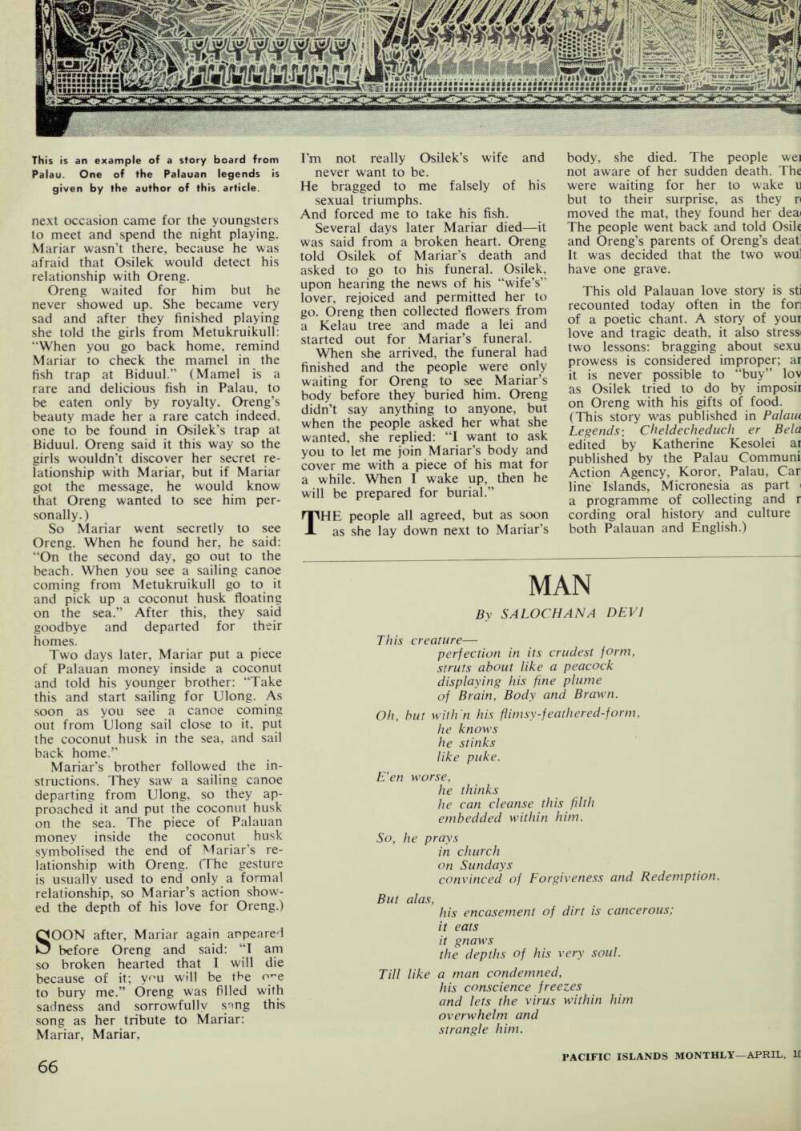
By Santos Ngodrii
SILEK was a very well-known chief Jot a rock island, Ulong. He had lany big pieces of Palauan money he h did not"
'he cousins he lived whh 3 his needs faithftdfv bm is wealth he wa nnhani! d Pte Fishine was nsMWmn.tinn nd he spent all dav verv fiction! all day tending the very )ng tish net (made with coconut usks) which surrounded his fishing pot called Biduul on a sea called oh Big turtles, sharks and many ther kinds of fish went inside his et, and every day he killed them and istnbuted the meat to his relatives nd *""?-hers of his clan. , „., o n ng th f re j ived a c X ery beautirJci 'f n % ?be was so [tractive that Osilek decided to win fw u ,° sl]lek knew very eii mat she didn t want to marry im oecause ot his oldish character,
so he decided to use wealth to overcome her objections.
Orena HiH rw uv- n c ;i o v wanted to stay away from him, but there was no way ° ut - ° silek brag- B ed to her fals ,y of his sexual triumphs. He killed turtles and sharks and told his sisters: “ Take the meat to oren B’ s home, f °r she will become my wife » Oreng tried her best to avoid taking anything provided by Osilek, because hy accepting things she incurred a B«at obligation to him. But she could not resist Osilek’s sisters, who always msisted upon giving her everything Provided by Osilek.
One day, Oreng’s parents sympathetically said to her: “Poor Oreng, we have tried everything we could to protect you from Osilek, but they just haven’t worked out. It is only you who can solve the problem.”
Soon it became clear that Oreng was obligated to marry Osilek.
T T was customary practice of all the f youngsters of Ulong and Metu kru!kull (Mother rock island) to meet dur mg the full moon and spend the night playing. Since she was not yet married, Oreng continued to attend such gatherings, and on one such occasion a vnun? man from Mptn kruikull named Mariar became in terest ed in her Soon they saw much of eac h other and dedded to eet carried Orene’s auction for MaiSj J£™ d - and she never lik dt b y Dart fr ?, m him shark and turtle meat openly to Oreng’s home to reinforce her obligation to marry him. Mariar, who had made many trips to Oreng’s home, discovered the relationship between Oreng and Osilek and was frightened. When the
next occasion came for the youngsters to meet and spend the night playing.
Mariar wasn’t there, because he was afraid that Osilek would detect his relationship with Oreng.
Oreng waited for him but he never showed up. She became very sad and after they finished playing she told the girls from Metukruikull: “When you go back home, remind Mariar to check the mamel in the fish trap at Biduul.” (Mamel is a rare and delicious fish in Palau, to be eaten only by royalty. Oreng’s beauty made her a rare catch indeed, one to be found in Osilek’s trap at Biduul. Oreng said it this way so the girls wouldn’t discover her secret re lationship with Mariar, but if Mariar got the message, he would know that Oreng wanted to see him per sonally.) So Mariar went secretly to see Oreng. When he found her, he said: “On the second day, go out to the beach. When you see a sailing canoe coming from Metukruikull go to it and pick up a coconut husk floating on the sea.” After this, they said goodbye and departed for their homes.
Two days later, Mariar put a piece of Palauan money inside a coconut and told his younger brother: “Take this and start sailing for Ulong. As soon as you see a canoe coming out from Ulong sail close to it, put the coconut husk in the sea, and sail back home.”
Mariar’s brother followed the in structions. They saw a sailing canoe departing from Ulong, so they ap proached it and put the coconut husk on the sea. The piece of Palauan money inside the coconut husk symbolised the end of Mariar’s re lationship with Oreng. (The gesture is usually used to end only a formal relationship, so Mariar’s action show ed the depth of his love for Oreng.) SOON after, Mariar again appeared before Oreng and said: “T am so broken hearted that I will die because of it; you will be the to bury me.” Oreng was filled with sadness and sorrowfully sang this song as her tribute to Mariar: Mariar, Mariar,
I’m not really Osilek’s wife and never want to be.
He bragged to me falsely of his sexual triumphs.
And forced me to take his fish.
Several days later Mariar died—it was said from a broken heart. Oreng told Osilek of Mariar’s death and asked to go to his funeral. Osilek, upon hearing the news of his “wife’s” lover, rejoiced and permitted her to go. Oreng then collected flowers from a Kelau tree and made a lei and started out for Mariar’s funeral.
When she arrived, the funeral had finished and the people were only waiting for Oreng to see Mariar’s body before they buried him. Oreng didn’t say anything to anyone, but when the people asked her what she wanted, she replied: “I want to ask you to let me join Mariar’s body and cover me with a piece of his mat for a while. When I wake up, then he will be prepared for burial.”
THE people all agreed, but as soon as she lay down next to Mariar’s
body, she died. The people wei not aware of her sudden death. The were waiting for her to wake u but to their surprise, as they n moved the mat, they found her dea< The people went back and told Osile and Oreng’s parents of Oreng’s deat!
It was decided that the two woul have one grave.
This old Palauan love story is sti recounted today often in the fori of a poetic chant. A story of your love and tragic death, it also two lessons: bragging about sexu prowess is considered improper; ai it is never possible to “buy” lov as Osilek tried to do by imposh on Oreng with his gifts of food. (This story was published in Palam Legends ; Cheldecheduch er Bela edited by Katherine Kesolei ai published by the Palau Communi Action Agency, Koror, Palau, Car line Islands, Micronesia as part < a programme of collecting and r cording oral history and culture both Palauan and English.)
This is an example of a story board from Palau. One of the Palauan legends is given by the author of this article.
Advertisements & other items, p. 71 (1 item)
Acific Islands Monthly—April, 1973
65
Man
By Salochana Devi
This creature — perfection in its crudest form, struts about like a peacock displaying his fine plume of Brain, Body and Brawn.
Oh, but with n his flimsy-feathered-form, he knows he stinks like puke.
E'en worse, he thinks he can cleanse this filth embedded within him.
So, he prays in church on Sundays convinced of Forgiveness and Redemption.
But alas, his encasement of dirt is cancerous; it eats it gnaws the depths of his very soul.
Till like a man condemned, his conscience freezes and lets the virus within him overwhelm and strangle him.
Thing
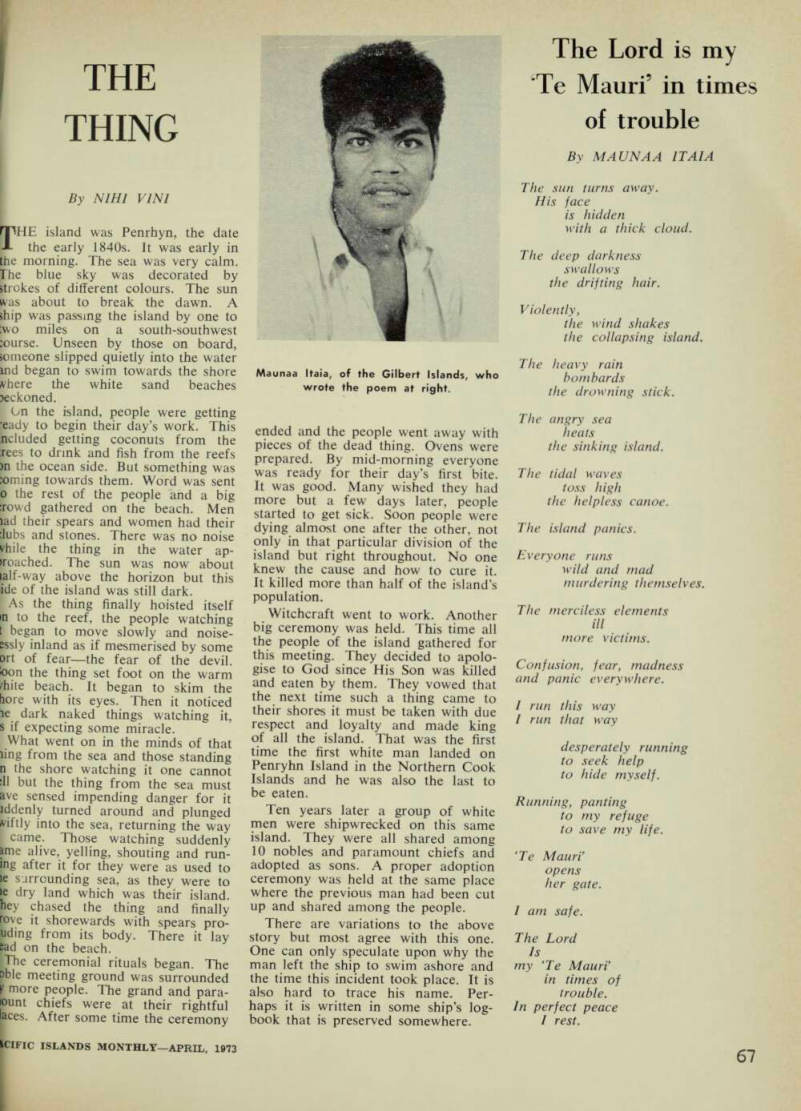
The
By Nihi Vini
THE island was Penrhyn, the date the early 1840 s. It was early in the morning. The sea was very calm.
The blue sky was decorated by strokes of different colours. The sun was about to break the dawn. A ship was passing the island by one to two miles on a south-southwest ;ourse. Unseen by those on board, someone slipped quietly into the water md began to swim towards the shore vhere the white sand beaches reckoned. i On the island, people were getting ready to begin their day’s work. This Deluded getting coconuts from the rees to drink and fish from the reefs )n the ocean side. But something was joining towards them. Word was sent 0 the rest of the people and a big :rowd gathered on the beach. Men md their spears and women had their Tubs and stones. There was no noise vhile the thing in the water ap iroached. The sun was now about lalf-way above the horizon but this ide of the island was still dark. \ As the thing finally hoisted itself m to the reef, the people watching t began to move slowly and noise essly inland as if mesmerised by some prt of fear—the fear of the devil, bon the thing set foot on the warm diite beach. It began to skim the bore with its eyes. Then it noticed ie dark naked things watching it, s if expecting some miracle.
What went on in the minds of that ling from the sea and those standing n the shore watching it one cannot ;11 but the thing from the sea must ave sensed impending danger for it iddenly turned around and plunged viftly into the sea, returning the way [ came. Those watching suddenly ime alive, yelling, shouting and run mg after it for they were as used to ie surrounding sea, as they were to j* dry land which was their island, pey chased the thing and finally rove it shorewards with spears pro tiding from its body. There it lay tad on the beach. iThe ceremonial rituals began. The able meeting ground was surrounded i more people. The grand and para jount chiefs were at their rightful pees. After some time the ceremony
ended and the people went away with pieces of the dead thing. Ovens were prepared. By mid-morning everyone was ready for their day’s first bite.
It was good. Many wished they had more but a few days later, people started to get sick. Soon people were dying almost one after the other, not only in that particular division of the island but right throughout. No one knew the cause and how to cure it.
It killed more than half of the island’s population.
Witchcraft went to work. Another big ceremony was held. This time all the people of the island gathered for this meeting. They decided to apolo gise to God since His Son was killed and eaten by them. They vowed that the next time such a thing came to their shores it must be taken with due respect and loyalty and made king of all the island. That was the first time the first white man landed on Penryhn Island in the Northern Cook Islands and he was also the last to be eaten.
Ten years later a group of white men were shipwrecked on this same island. They were all shared among 10 nobles and paramount chiefs and adopted as sons. A proper adoption ceremony was held at the same place where the previous man had been cut up and shared among the people.
There are variations to the above story but most agree with this one.
One can only speculate upon why the man left the ship to swim ashore and the time this incident took place. It is also hard to trace his name. Per haps it is written in some ship’s log book that is preserved somewhere.
Maunaa Itaia, of the Gilbert Islands, who wrote the poem at right.
of trouble
The Lord is my 'Te Mauri’ in times of trouble
By Maunaa Itaia
The sun turns away.
His face is hidden with a thick cloud.
The deep darkness swallows the drifting hair.
Violently, the wind shakes the collapsing island.
The heavy rain bombards the drowning stick.
The angry sea heats the sinking island.
The tidal waves toss high the helpless canoe.
The island panics.
Everyone runs wild and mad murdering themselves.
The merciless elements ill more victims.
Confusion, fear, madness and panic everywhere.
I run this way I run that way desperately running to seek help to hide myself.
Running, panting to my refuge to save my life. ‘Te Mauri’ opens her gate.
I am safe.
The Lord Is my ‘Te Mauri’ in times of trouble.
In perfect peace I rest.
Advertisements & other items, p. 73 (1 item)
67
ISLANDS MONTHLY— APRIL, 1973
Tapa designs
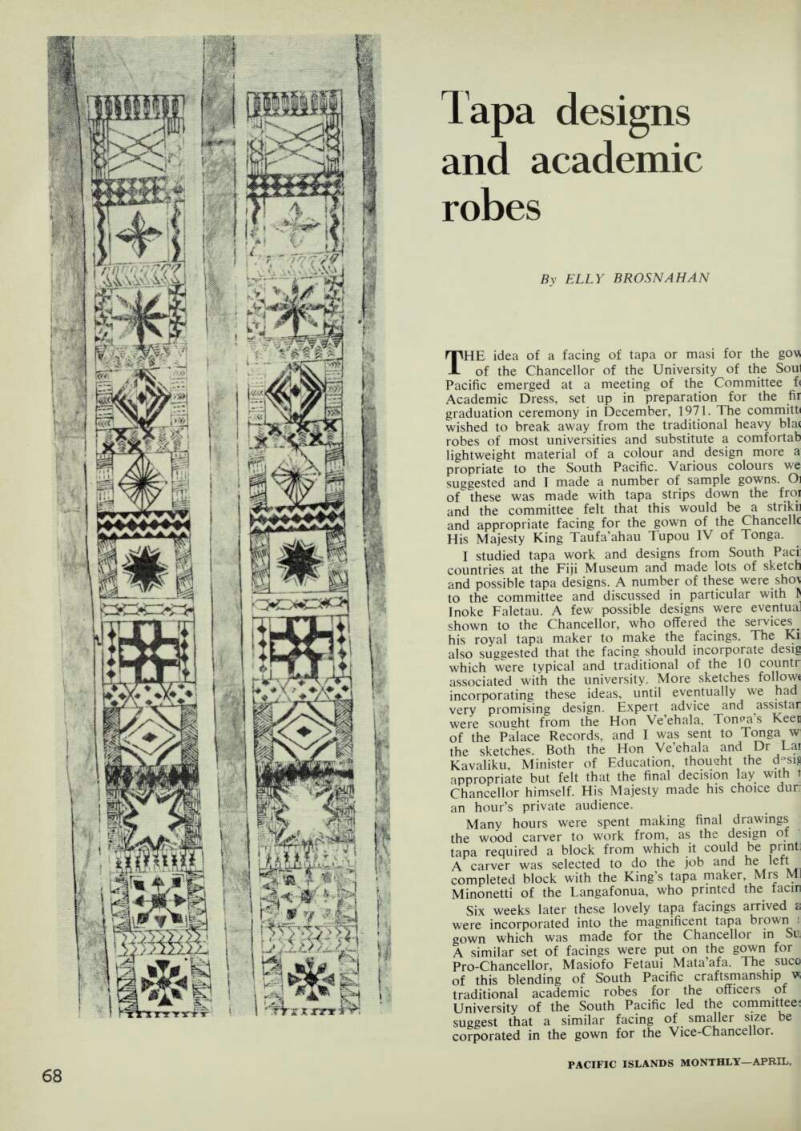
and academic robes
By Elly Brosnahan
THE idea of a facing of tapa or masi for the gow of the Chancellor of the University of the Soul Pacific emerged at a meeting of the Committee f( Academic Dress, set up in preparation for the fir graduation ceremony in December, 1971. The commith wished to break away from the traditional heavy blac robes of most universities and substitute a comfortab lightweight material of a colour and design more a propriate to the South Pacific. Various colours we suggested and I made a number of sample gowns. Oi of these was made with tapa strips down the froi and the committee felt that this would be a strikii and appropriate facing for the gown of the Chancellc His Majesty King Taufa’ahau T'upou IV of Tonga.
I studied tapa work and designs from South Pad: countries at the Fiji Museum and made lots of sketch and possible tapa designs. A number of these were sho\ to the committee and discussed in particular with > Inoke Faletau. A few possible designs were eventual shown to the Chancellor, who offered the services his royal tapa maker to make the facings. The Ki also suggested that the facing should incorporate desig which were typical and traditional of the 10 countr associated with the university. More sketches follow* incorporating these ideas, until eventually we had very promising design. Expert advice and assistar were sought from the Hon Ve’ehala, Tonpa s Keen of the Palace Records, and I was sent to Tonga w the sketches. Both the Hon Ve’ehala and Dr Lai Kavaliku, Minister of Education, thought the cLsig appropriate but felt that the final decision lay with t Chancellor himself. His Majesty made his choice dun an hour’s private audience.
Many hours were spent making final drawings the wood carver to work from, as the design of tapa required a block from which it could be print] A carver was selected to do the job and he left completed block with the King’s tapa maker Mrs Ml Minonetti of the Langafonua, who printed the facin Six weeks later these lovely tapa facings arrived a were incorporated into the magnificent tapa brown s gown which was made for the Chancellor in Suj A similar set of facings were put on the gown for Pro-Chancellor, Masiofo Fetaui Mata’afa. The suco of this blending of South Pacific craftsmanship w traditional academic robes for the officers of University of the South Pacific led the committee* suggest that a similar facing of smaller size be corporated in the gown for the Vice-Chancellor.
Prologue
By Seri
Doom’d, garlanded to fast in lovo flames.
I Harrowing the sun-begotten hibiscus unweeded I that labours to seed.
Poisoning deeper fibres within this Melanesian Submerged.
In the lust for the Papalagis’ corals like honeycombed wormwoods dead and dry Speak shark-teeth to my cenotaph.
\fiji
O, whose nativity? O, whose delight?
I Island of evil doers rotten to the core innocence and beauty never born in you Antiquity forgot, customs not known Hangover from Ant hills yonder , land of cake dungs and birddrops baked in cruel sun that I turneth cypress wood into stone.
Jaded forest paths slip I Sharp pebbles under bare feet thieves lark.
DAKUWAQA with your club rub \your blood-dust Tickle and oven-stones within Bones of your Afro-fathers Iquana delights Maggots toiled within coral’s web A vulture’s fisty fights I see in mud pools the mirage of a lost race purchased Coughing bamboo crackers — Papalagis' pearl Trinkets, trappings, trash, ash-tray glass With your land No room to spread your blankets A missing link of morality and race.
Stupidity?
Myopic blockheads.
Rat us lecherous fools You commit the blunder You sanctuarize the 'Cancerous beach-combers Lured to miraculous barking bamboos —respeaking the SKY-GOD’S anger running heart-beats aimed at Copra Mill Fall Wonders and desires knotted and Combined —like fretful eels pregnant with lust bathed the shallow waters.
Gone. [No lullabies to soothe, No herb to heal the Leprous wounds the taints of chiefly liberty.
Coconut drops and Sorceress magic brew on clammy reef-shells and sleeky melon seeds Salty balolo juice to reptiles cocktail mix oozing lavender harbours the scent A woman’s spread Legs a straddle to semi-recumbent posture.
Wriggling thick-lipped monster 4 lb tar-baby proper.
Angry laughter—the winnowing Wind Whets papa’s tool Tar-baby’s silhouette fancy rock lobsters and dilberry ducks Souped for wild dogs sup Tapa dinner suits and crocodiles’ boots Whales’ fangs hanging like tadpoles on sinnet the deep fibre of our very nature O, thick powdered faces and lipsticked noses Miniskirted bums—grass skirts discarded Limbs of your blood brothers baked in sulphureous flames greying to canonized bones. See! The leeches sucking the artery dry Stewed eye-balls and elbow chops tummy’s navel pointing Scavenges life’s brew Skinny twister lips starved in prophetic warnings.
Protoplasm massy and watery Pollute the estuary of Blood lagoons O, where will the bones be Thrown?
Supreme Joy
By Shashikant Nair
/ have sat with Gods and God alike, And 1 have seen the folly of Man.
I have sat with God and eaten His food, And mocked and laughed with Him, At Man hungry, begging and in plight.
I have seen a ship wrecked and men fed to sharks, I have seen a lone survivor, thankful to God, Land on a palm-covered island at last, I have seen him gaze at the nuts on the palms, Scratch at the nuts on the ground, praying and praying, Yet unable to reach the flesh and drink inside, And praying and praying die at last.
I have seen the mighty floods, arise and sweep.
Houses of grass, wood, tin and bricks.
Factories, dwellings, temples, churches, and mosques, Shrines to ancient Gods all out of sight.
I have seen the wars of Man at places far and wide, All bent to kill men, women and children, Praying priests and fasting Rishis, I have seen the mockery of Man, By Gods and God alike, I have sat with God and laughed, At Man in plight.
The English And Their Cup Of Tea
By Tang Wai-Lin
PEOPLE always laugh at the English and their cup of tea; in fact, English tea does not only taste different, it is quite a fascinating thing to watch them making it.
The Japanese take an hour-long ceremony over tea-making, yet no body thinks it is crazy, maybe be cause they know that the Japanese do not make tea that way every time they want a ‘cuppa’; as for the English, making a cup of tea the proper way is as important as drink ing it.
When I first went to England, which was quite a number of years ago, a neighbour called me in ‘to have a cuppa’. I followed her to her streamlined kitchen where 1 saw a dozen or more of various sizes of pots and pans hanging on the wall. A glass-fronted cupboard displayed at least four sets of fine decorative cups and saucers. Eight mugs of various designs hung on hooks beneath the cupboard.
She filled the kettle with water, then switched on the wall-plug. She put out the blue set of cups and saucers for two, two sandwich-plates and a small coffee cake on to a cake
plate which were of the same de sign.
“Why don’t you use mugs, it saves a lot of washing up?” 1 asked.
“The mugs are for Ovaltine only, besides there’s nowhere to put the teaspoon.”
“Oh . . . What do you use those enormous cups for?” pointing at the glass-fronted cupboard.
“Those are breakfast cups.”
At this moment, the kettle was call ing out for attention.
She took a teapot from the shelf and filled it with boiling water.
She held the teapot with both palms and shook it lightly. Mean while the kettle was in an uproar but she took no notice of it.
“Shall I turn off the kettle?”
“No, I must have the water very hot.”
“Why are you shaking the teapot with the hot water inside?”
“To make the teapot warm and the tea will taste better.”
Now she emptied the teapot in the sink then quick as a flash, she put three teaspoonsful of tea in it, turned off the kettle, lifted it up and poured the boiling water in the teapot from
six inches away. She used the same teaspoon, stirred the teapot four times then put the lid on and covered it up with a tea-cosy. After all that she was now able to come and sit down beside me while the tea was left brewing for two minutes. We each had a cup of really nice English tea.
“Didn’t you put rather a lot of tea in for only two persons?” I asked.
“Not at all,” she said. “You put in one spoon for each person and one for the pot,”
“How often do you drink tea?”
“Three, four times a day, it depends on whether I fancy one.”
“And you always make it like you did just now?”
“Oh yes, why?”
She was not even conscious of how much trouble she had taken over her cup of tea, and it would never have occurred to her that I was actually taking note of the whole thing.
To the English the long tiring pro cess of tea-making is their way of life and there is no other way. I have been to many parts of the world east and west, and I must confess tha I have never tasted a cup of tea nice than that one in the United Kingdom
To My Son
—on the tenth anniversary of Western Samoa’s independence.
By Albert Wendt
Don’t despise me in your dawn beauty, my Polynesian viking son.
We inhabit the same nightmare.
Ebb-tides fling up tomorrow’s creatures silhouetted in today’s computerised sunsets: stalking crab and barracuda devour the vision of our dead prophets in a decade of betrayal.
With me the smother of well groomed blubber, the slow bleed of expensive compromise dis colours conscious, chokes even the tough weeds of anger.
Noose of silver bow tie and mafia sunglasses shuts out healing sun, hides precariously the decay of a whiskey respectability. (Our nation’s dreams drown in the insatiable cocktail glass).
I’m left with envying you: youth keeps the muscles from falling, upwards pointing to godhead clear as that first independence morning when our prophets foretold universal image and symbol, a new brotherhood.
Now, the incessant gaggle of babel entombed in the air-conditioned promise of tourist miracle, the grope of steel and plastic, lean politicians whispering in the market await freedom’s fat limousine.
Our genteel age is the diplomatic night of the civilised savage, of mutant claw and hiss, the sphinx smile of the new merchant barbarian.
I’m afraid to know the depth of your terror. (I too have betrayed you). Stay angry Your only lifejacket in the nightmare to unweave.
Pacific art
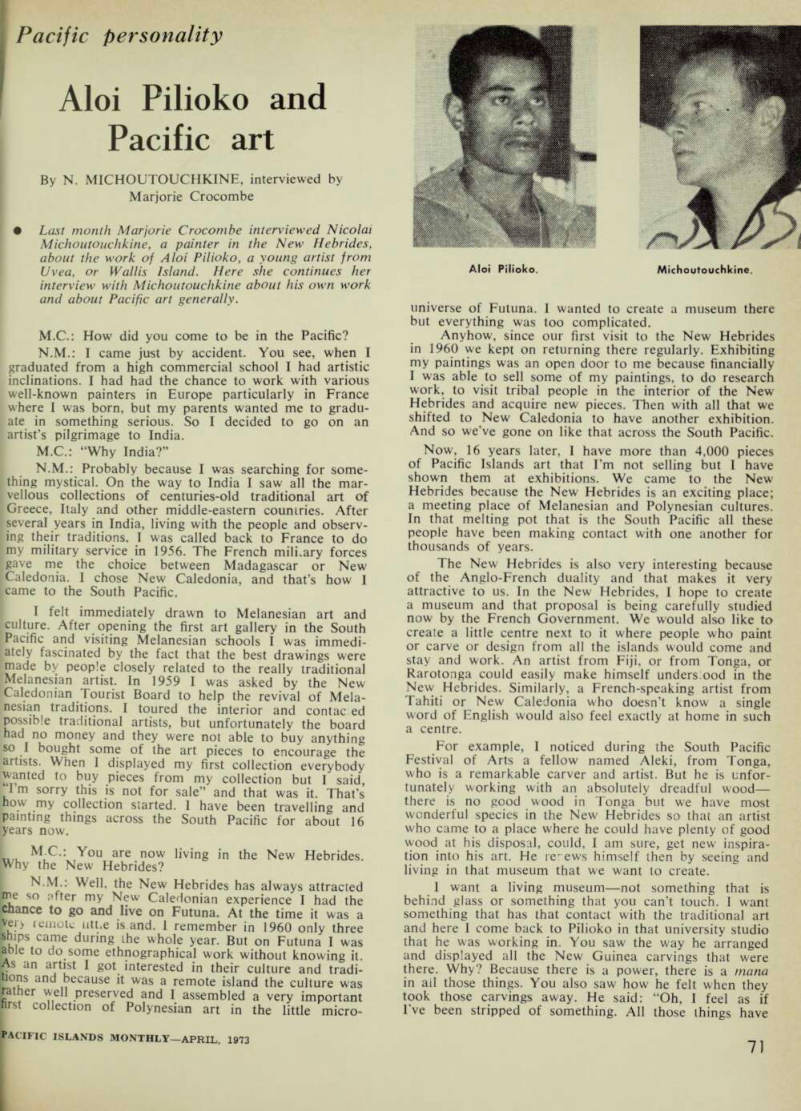
Pacific personality
Aloi Pilioko and Pacific art
By N. MICHOUTOUCHKINE, interviewed by Marjorie Crocombe
• Last month Marjorie Crocombe interviewed Nicolai Michoutouchkine, a painter in the New Hebrides, about the work of Aloi Pilioko, a young artist from Uvea, or Wallis Island. Here she continues her interview with Michoutouchkine about his own work and about Pacific art generally.
M. How did you come to be in the Pacific?
N. I came just by accident. You see, when I graduated from a high commercial school I had artistic inclinations. I had had the chance to work with various well-known painters in Europe particularly in France where I was born, but my parents wanted me to gradu ate in something serious. So I decided to go on an artist’s pilgrimage to India.
M. “Why India?”
N. Probably because I was searching for some thing mystical. On the way to India I saw all the mar vellous collections of centuries-old traditional art of Greece, Italy and other middle-eastern countries. After several years in India, living with the people and observ ing their traditions, I was called back to France to do my military service in 1956. The French military forces gave me the choice between Madagascar or New Caledonia. I chose New Caledonia, and that’s how I came to the South Pacific.
I felt immediately drawn to Melanesian art and culture. After opening the first art gallery in the South Pacific and visiting Melanesian schools I was immedi ately fascinated by the fact that the best drawings were made by people closely related to the really traditional Melanesian artist. In 1959 I was asked by the New Caledonian Tourist Board to help the revival of Mela nesian traditions. I toured the interior and contac ed possible traditional artists, but unfortunately the board had no money and they were not able to buy anything so 1 bought some of the art pieces to encourage the artists. When I displayed my first collection everybody wanted to buy pieces from my collection but I said, J m sorry this is not for sale” and that was it. That’s how my collection started. I have been travelling and painting things across the South Pacific for about 16
[years now.
L M , C ” You are now living in the New Hebrides.
Why the New Hebrides?
N.M.: Well, the New Hebrides has always attracted me so after my New Caledonian experience I had the chance to go and live on Futuna. At the time it was a |ver> remote utt.e is and. I remember in 1960 only three iships came during the whole year. But on Futuna I was able to do some ethnographical work without knowing it.
As an artist I got interested in their culture and tradi tions and because it was a remote island the culture was lather well preserved and I assembled a very important prst collection of Polynesian art in the little micro-
universe of Futuna. I wanted to create a museum there but everything was too complicated.
Anyhow, since our first visit to the New Hebrides in 1960 we kept on returning there regularly. Exhibiting my paintings was an open door to me because financially I was able to sell some of my paintings, to do research work, to visit tribal people in the interior of the New Hebrides and acquire new pieces. Then with all that we shifted to New Caledonia to have another exhibition.
And so we’ve gone on like that across the South Pacific.
Now, 16 years later, I have more than 4,000 pieces of Pacific Islands art that I’m not selling but I have shown them at exhibitions. We came to the New Hebrides because the New Hebrides is an exciting place; a meeting place of Melanesian and Polynesian cultures.
In that melting pot that is the South Pacific all these people have been making contact with one another for thousands of years.
The New Hebrides is also very interesting because of the Anglo-French duality and that makes it very attractive to us. In the New Hebrides, I hope to create a museum and that proposal is being carefully studied now by the French Government, We would also like to create a little centre next to it where people who paint or carve or design from all the islands would come and stay and work. An artist from Fiji, or from Tonga, or Rarotonga could easily make himself unders ood in the New Hebrides. Similarly, a French-speaking artist from Tahiti or New Caledonia who doesn’t know a single word of English would also feel exactly at home in such a centre.
For example, I noticed during the South Pacific Festival of Arts a fellow named Aleki, from Tonga, who is a remarkable carver and artist. But he is unfor tunately working with an absolutely dreadful wood— there is no good wood in Tonga but we have most wonderful species in the New Hebrides so that an artist who came to a place where he could have plenty of good wood at his disposal, could, I am sure, get new inspira tion into his art. He rerews himself then by seeing and living in that museum that we want to create. 1 want a living museum—not something that is behind glass or something that you can’t touch. I want something that has that contact with the traditional art and here 1 come back to Pilioko in that university studio that he was working in. You saw the way he arranged and displayed all the New Guinea carvings that were there. Why? Because there is a power, there is a mana in ail those things. You also saw how he felt when they took those carvings away. He said: “Oh, I feel as if I've been stripped of something. All those things have
Aloi Pilioko.
Michoutouchkine.
gone and I feel that I have no more inspiration”. That is powerful. There is power in all those marvellous shapes that are manifest in South Pacific art.
M. What is your real aim?
N. It is to give a chance to people to rediscover what was their cultural and artistic tradition and how beautiful it was. The South Pacific Islander, whoever he was, whether Melanesian or Polynesian, a man from Rarotonga or from Tahiti, he was a marvellous artist because in his everyday life he wanted to introduce beauty. Oceanic art is even more varied than African art. Islands artists had all that marvellous inspiration, and yet we in the South Pacific ignore it. This includes some Melanesian people who look at what their fore fathers have done and they just laugh at it for they don’t know what it is, or how powerful is that inspira tion.
What I would really like as my main aim is to give a chance to rehabilitate the South Pacific arts, crafts, and traditions and give confidence to these young people, to give them a chance to appreciate and to find their inspiration in those shapes, and for themselves to become creative artists.
To see Pilioko work, to see that there is a self confident Polynesian artist working, is an absolutely exciting thing. As soon as he started work at the uni versity 1 returned to the New Hebrides because I wanted these youngsters to see an artist of their own blood, of their own race, of the same colour. He’s practically illiterate and that makes it even more exciting. For them to see that Pilioko was a self-confident artist was a kind of magic. Descendants from the artists or priests or craftsmen in the Oceanic tradition have something absolutely fantastic. That should be developed.
Artists need to continually find a new inspiration, to see the various textures, to see the different styles and forms and shapes from the other places and become themselves re-inspired because art is practically an everyday training of oneself. Inspiration has to be re newed and the creative artist is just like a musician or a tennis player. He needs to practise every day, to find new lines, try new colours, find new ways of expressing himself.
M. What is an artist’s life like?
N. It seems an appealing life you see, but it is really an extremely hard life. First of all, you can’t sell art like you sell hot cakes. No government, no employer pays us. Some people have good tastes and want to buy art work but such people have very little money. In every community there may be perhaps 10 or 20 people who buy paintings or could afford to buy them, and they buy them if they are quite cheap, but that is not going to provide an artist with enough living to support him self, to buy the colours and also to generally support his family. So an artist’s life is not easy.
Melanesians from the neighbouring villages in the New Hebrides come and ask to buy some paintings from Aloi and me. We do not sell them for money but we just traditionally exchange them for food, taro or yams.
In every place there are only about 10 or 20 people who buy costly paintings. That’s why we have to travel to hold exhibitions and that’s also why we do some decorative work on such buildings as hotels so we can support ourselves.
Big companies that are building hotels, really should make a little more effort to help local artists. It would be marvellous to see one of these banking corporations, or travel agencies commission some unknown Pacific Islands craftsmen, and 1 don’t mean that only for Pilioko but, say, the Tongan carver Aleki for example, to do some carvings, at a fairly reasonable price. But that has never been done.
We see so many new business houses, so man; banking and trust companies and God knows what evei in the New Hebrides now. I just put myself m the plac of the young artist who would have liked to do work of art on these buildings but he has no contact wit those managers who are spending so much mone} sometimes on very ugly buildings. We really need kind of animation with South Pacific inspiration or Sout Pacific subjects. . n M.C.; Would it be a good idea then to get Pacih Island artists to form some sort of guild or association NM.: I think that should be done, but first ther must be some kind of contact between them. Everythin is so difficult because of the distances, because of costl ciii* fcircs M.C.: Could a body like the South Pacific Con mission do it? , „ ._ . .
NM.: Yes, probably the South Pacific Commissio could do so. It has tried to do certain things like tfc South Pacific Festival of Arts for instance which was very marvellous enterprise. And the South Pacific Con mission has absolutely charming people but some c them are incompetent. Even if they start something yc reach a point sometimes when you find that you don have enough money, so because we don’t have enoug money we don’t start anything. What is exciting aboi my experiment 16i years ago was that I had no mone at all when I arrived here. 1 still have little money b_ 1 have 4,000 pieces that I have assembled from tU whole Pacific and I’m still collecting.
“Yes,” they say, “but you are a very rich man No, I'm not a rich man, but we work hard and we wa. cur aim to be fulfilled. 1 could have sold all thot beautiful pieces many times over but 1 have never sot a single piece. “Yes,” they say, “but you are going make a museum and you will charge. No, that is nt interesting to me and the charges for entry to a museut never cover the costs. Tut my aims to establish this lu museum are imporiant in order to bring back that ca sciousness of one’s own art. it is something imperial for all our young people and all those potential artis< That would be the most wonderful encouragement fl them.
Him Fella Saviour
By Eti Sa’Aga
Him fella saviour up in the tree wanting to come down.
Another fella spear-carrier fun making, standing on the ground.
All the time him fella saviour make sad noise, While his momma cry begging mercy with sad voice.
Then earth-shaker come, stopping all the fun, Making all the noisy people talk little but run.
But him fella saviour just hang there on his tree, looking red, And according to some untrue reports, real dead.
Advertisements & other items, p. 79 (1 item)
the most important ingredient
mm S* i onn o 4^ ■ ** * oo *f 1 « > s rx^Si * t v- XS$ %l
ill
1
JmEYNSM,
*%PUCB Of AUSTRAL!
25 KG Iff F
V rk m ms: r*
Sr*s
** •*w t^p * 4
the most important ingredient
BREAD FLOURS:
CAKE FLOURS;
BISCUIT FLOURS:
SPECIALITY FLOURS:
• MAINTOP —high protein bread flour • ANCHOR—bakers flour • 50/50 MEAL-—brown bread • MEDIUM —cake and pastry • SPONGE —sponge cakes • SPECIAL CAKE —madeira and cup cakes • STRONG —cracker biscuits • MEDIUM —Shortbreads • SOFT —sweet biscuits • RYE flour • RYE meal • KIBBLED RYE • SHARPS—roti and chapati flour • 100% STONE GROUND
WHOLEMEAL
GILLESPIE BROS. PTY. LTD.
.. , HEAD OF fICE: BRISBANE OFFICE: 52 UNION ST., PYRMONT, SYDNEY, N.S.W. CABLE ADDRESS: ALBION, BRISBANE, QUEENSLAND. (G.P.O. BOX 2518, SYDNEY, 2001.) "GILLESPIE", (P.O. BOX 8, ALBION, BRISBANE, 4010.) PHONE: 660-4933. SYDNEY AND BRISBANE. PHONE: 6-1121
Book Reviews
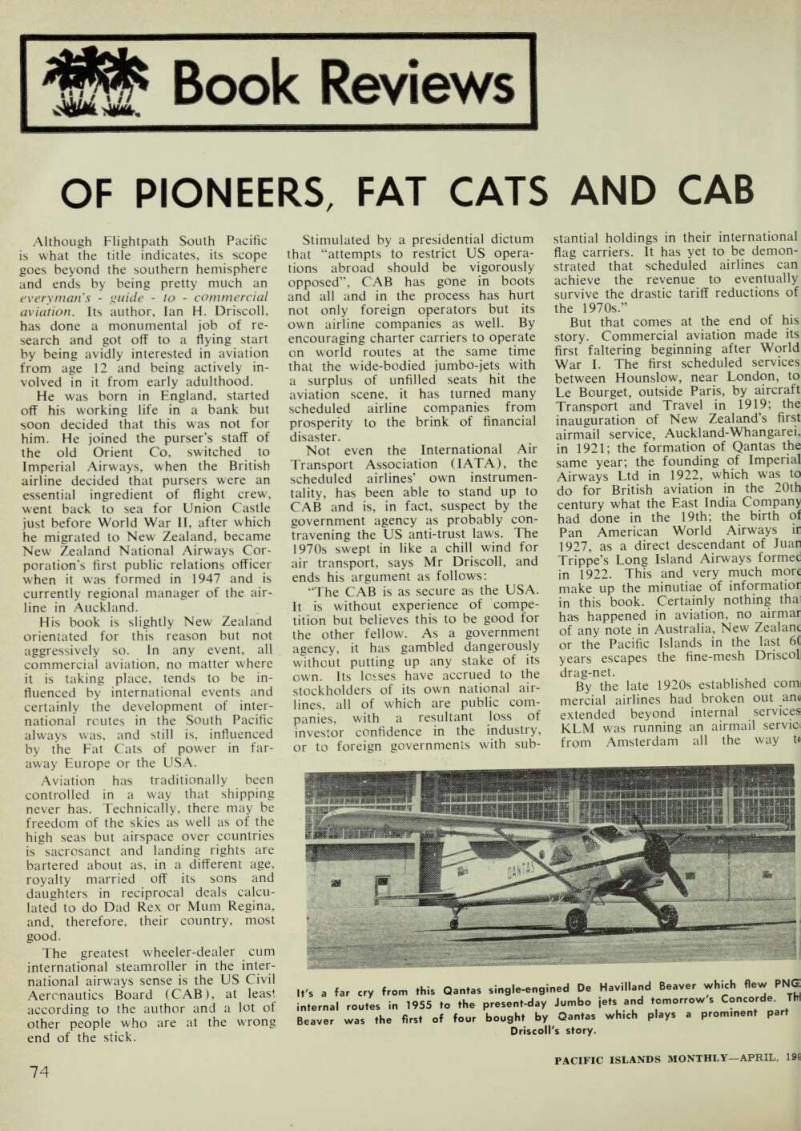
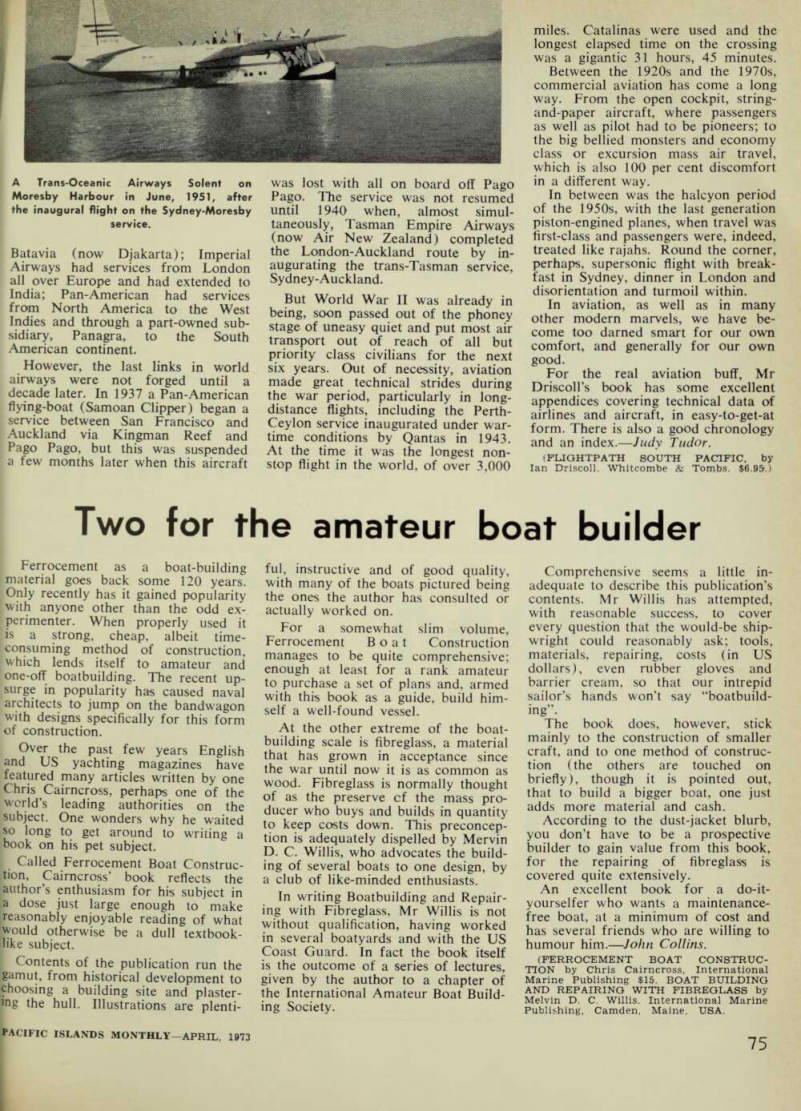
Of Pioneers, Fat Cats And Cab
Although Flightpath South Pacific is what the title indicates, its scope goes beyond the southern hemisphere and ends by being pretty much an every man’s - guide - to - commercial aviation. Its author, lan H. Driscoll, has done a monumental job of re search and got off to a flying start by being avidly interested in aviation from age 12 and being actively in volved in it from early adulthood.
He was born in England, started off his working life in a bank but soon decided that this was not for him. He joined the purser’s staff of the old Orient Co, switched to Imperial Airways, when the British airline decided that pursers were an essential ingredient of flight crew, went back to sea for Union Castle just before World War 11, after which he migrated to New Zealand, became New Zealand National Airways Cor poration’s first public relations officer when it was formed in 1947 and is currently regional manager of the air line in Auckland.
His book is slightly New Zealand orientated for this reason but not aggressively so. In any event, all commercial aviation, no matter where it is taking place, tends to be in fluenced by international events and certainly the development of inter national routes in the South Pacific always was, and still is, influenced by the Fat Cats of power in far away Europe or the USA.
Aviation has traditionally been controlled in a way that shipping never has. Technically, there may be freedom of the skies as well as of the high seas but airspace over countries is sacrosanct and landing rights are bartered about as, in a different age, royalty married off its sons and daughters in reciprocal deals calcu lated to do Dad Rex or Mum Regina, and, therefore, their country, most good.
The greatest wheeler-dealer cum international steamroller in the inter national airways sense is the US Civil Aeronautics Board (CAB), at least according to the author and a lot of other people who are at the wrong end of the stick.
Stimulated by a presidential dictum that “attempts to restrict US opera tions abroad should be vigorously opposed”, CAB has gone in boots and all and in the process has hurt not only foreign operators but its own airline companies as well. By encouraging charter carriers to operate on world routes at the same time that the wide-bodied jumbo-jets with a surplus of unfilled seats hit the aviation scene, it has turned many scheduled airline companies from prosperity to the brink of financial disaster.
Not even the International Air Transport Association (lATA), the scheduled airlines’ own instrumen tality, has been able to stand up to CAB and is, in fact, suspect by the government agency as probably con travening the US anti-trust laws. The 1970 s swept in like a chill wind for air transport, says Mr Driscoll, and ends his argument as follows: “The CAB is as secure as the USA.
It is without experience of compe tition but believes this to be good for the other fellow. As a government agency, it has gambled dangerously without putting up any stake of its own. Its losses have accrued to the stockholders of its own national air lines, all of which are public com panies, with a resultant loss of investor confidence in the industry, or to foreign governments with sub
stantial holdings in their international flag carriers. It has yet to be demon strated that scheduled airlines can achieve the revenue to eventually survive the drastic tariff reductions of the 19705.”
But that comes at the end of his story. Commercial aviation made its first faltering beginning after World War I. The first scheduled services between Hounslow, near London, to Le Bourget, outside Paris, by aircraft Transport and Travel in 1919; the inauguration of New Zealand’s first airmail service, Auckland-Whangarei, in 1921; the formation of Qantas the same year; the founding of Imperial Airways Ltd in 1922, which was to do for British aviation in the 20th century what the East India Company had done in the 19th; the birth of Pan American World Airways ir 1927, as a direct descendant of Juan Trippe’s Long Island Airways formed in 1922. This and very much more make up the minutiae of informatior in this book. Certainly nothing thai has happened in aviation, no airmar of any note in Australia, New Zealanc or the Pacific Islands in the last 6C years escapes the fine-mesh Driscoll drag-net.
By the late 1920 s established comi mercial airlines had broken out ano extended beyond internal services KLM was running an airmail servict from Amsterdam all the way tt
It's a far cry from this Qantas single-engined De Havilland Beaver which flew PNG internal routes in 1955 to the present-day Jumbo jets and tomorrows Concorde. T[?] Beaver was the first of four bought by Qantas which plays a prominent part Driscoll's story.
Batavia (now Djakarta); Imperial Airways had services from London all over Europe and had extended to India; Pan-American had services from North America to the West Indies and through a part-owned sub sidiary, Panagra, to the South American continent.
However, the last links in world airways were not forged until a decade later. In 1937 a Pan-American flying-boat (Samoan Clipper) began a service between San Francisco and Auckland via Kingman Reef and Pago Pago, but this was suspended a few months later when this aircraft
was lost with all on board off Pago Pago. The service was not resumed until 1940 when, almost simul taneously, Tasman Empire Airways (now Air New Zealand) completed the London-Auckland route by in augurating the trans-Tasman service, Sydney-Auckland.
But World War II was already in being, soon passed out of the phoney stage of uneasy quiet and put most air transport out of reach of all but priority class civilians for the next six years. Out of necessity, aviation made great technical strides during the war period, particularly in long distance flights, including the Perth- Ceylon service inaugurated under war time conditions by Qantas in 1943.
At the time it was the longest non stop flight in the world, of over 3,000
miles. Catalinas were used and the longest elapsed time on the crossing was a gigantic 31 hours, 45 minutes.
Between the 1920s and the 1970s, commercial aviation has come a long way. From the open cockpit, string and-paper aircraft, where passengers as well as pilot had to be pioneers; to the big bellied monsters and economy class or excursion mass air travel, which is also 100 per cent discomfort in a different way.
In between was the halcyon period of the 1950s, with the last generation piston-engined planes, when travel was first-class and passengers were, indeed, treated like rajahs. Round the comer, perhaps, supersonic flight with break fast in Sydney, dinner in London and disorientation and turmoil within.
In aviation, as well as in many other modern marvels, we have be come too darned smart for our own comfort, and generally for our own good.
For the real aviation buff, Mr Driscoll’s book has some excellent appendices covering technical data of airlines and aircraft, in easy-to-get-at form. There is also a good chronology
and an index.-
Judy Tudor.
(Plightpath South Pacific, By
Ian Driscoll. Whitcombe & Tombs. $6.95.)
A Trans-Oceanic Airways Solent on Moresby Harbour in June, 1951, after the inaugural flight on the Sydney-Moresby service.
Two for the amateur boat builder
Ferrocement as a boat-building material goes back some 120 years.
Only recently has it gained popularity with anyone other than the odd ex perimenter. When properly used it is a strong, cheap, albeit time consuming method of construction, which lends itself to amateur and one-off boatbuilding. The recent up surge in popularity has caused naval architects to jump on the bandwagon with designs specifically for this form of construction.
Over the past few years English and US yachting magazines have featured many articles written by one Chris Cairncross, perhaps one of the world’s leading authorities on the subject. One wonders why he waited so long to get around to writing a book on his pet subject.
Called Ferrocement Boat Construc tion, Cairncross’ book reflects the author’s enthusiasm for his subject in a dose just large enough to make reasonably enjoyable reading of what would otherwise be a dull textbook hke subject.
Contents of the publication run the gamut, from historical development to choosing a building site and plaster ing the hull. Illustrations are plenti
ful, instructive and of good quality, with many of the boats pictured being the ones the author has consulted or actually worked on.
For a somewhat slim volume, Ferrocement Boat Construction manages to be quite comprehensive; enough at least for a rank amateur to purchase a set of plans and, armed with this book as a guide, build him self a well-found vessel.
At the other extreme of the boat building scale is fibreglass, a material that has grown in acceptance since the war until now it is as common as wood. Fibreglass is normally thought of as the preserve cf the mass pro ducer who buys and builds in quantity to keep costs down. This preconcep tion is adequately dispelled by Mervin D. C. Willis, who advocates the build ing of several boats to one design, by a club of like-minded enthusiasts.
In writing Boatbuilding and Repair ing with Fibreglass, Mr Willis is not without qualification, having worked in several boatyards and with the US Coast Guard. In fact the book itself is the outcome of a series of lectures, given by the author to a chapter of the International Amateur Boat Build ing Society.
Comprehensive seems a little in adequate to describe this publication’s contents. Mr Willis has attempted, with reasonable success, to cover every question that the would-be ship wright could reasonably ask; tools, materials, repairing, costs (in US dollars), even rubber gloves and barrier cream, so that our intrepid sailor’s hands won’t say “boatbuild ing”.
The book does, however, stick mainly to the construction of smaller craft, and to one method of construc tion (the others are touched on briefly), though it is pointed out, that to build a bigger boat, one just adds more material and cash.
According to the dust-jacket blurb, you don’t have to be a prospective builder to gain value from this book, for the repairing of fibreglass is covered quite extensively.
An excellent book for a do-it yourselfer who wants a maintenance free boat, at a minimum of cost and has several friends who are willing to
humour him.-
John Collins.
(Perrocement Boat Construc
TION by Chris Cairncross, International Marine Publishing $15. BOAT BUILDING
And Repairing With Fibreglass By
Melvin D. C. Willis. International Marine Publishing, Camden, Maine, USA.
Advertisements & other items, p. 82 (1 item)
jritptte
If you’re going to Lae, book in at the Huon Gulf Motel, just down the road from Lae Airport.
The Huon Gulf is individually airconditioned in every suite. There’s a swimming pool to cool you down after your trip and attentive service for top standard meals in the modern restaurant and for liquor service to your table, suite or poolside.
For family groups there are family suites with interconnecting doors to adjoining suites.
Make the Huon Gulf Motel your base in Lae.
Book direct or through any office of Ansett Airlines of Papua New Guinea.
Huon gulf more.
Markham Road, Lae. Phone: Lae 3204.
AHO/129A
A member company of Ansett Transport Industries Limited.
For
RUM
at its best...
say
jritptte
OVERPROOF AND UNDERPROOF
In 5 oz. and 13 oz. flasks and 26 oz. and 40 oz. bottles BLENDED AND BOTTLED BY JOHN WALKER & SONS LIMITED.
2ZZZZZ2Z222Z22222222:
N
Yesterday
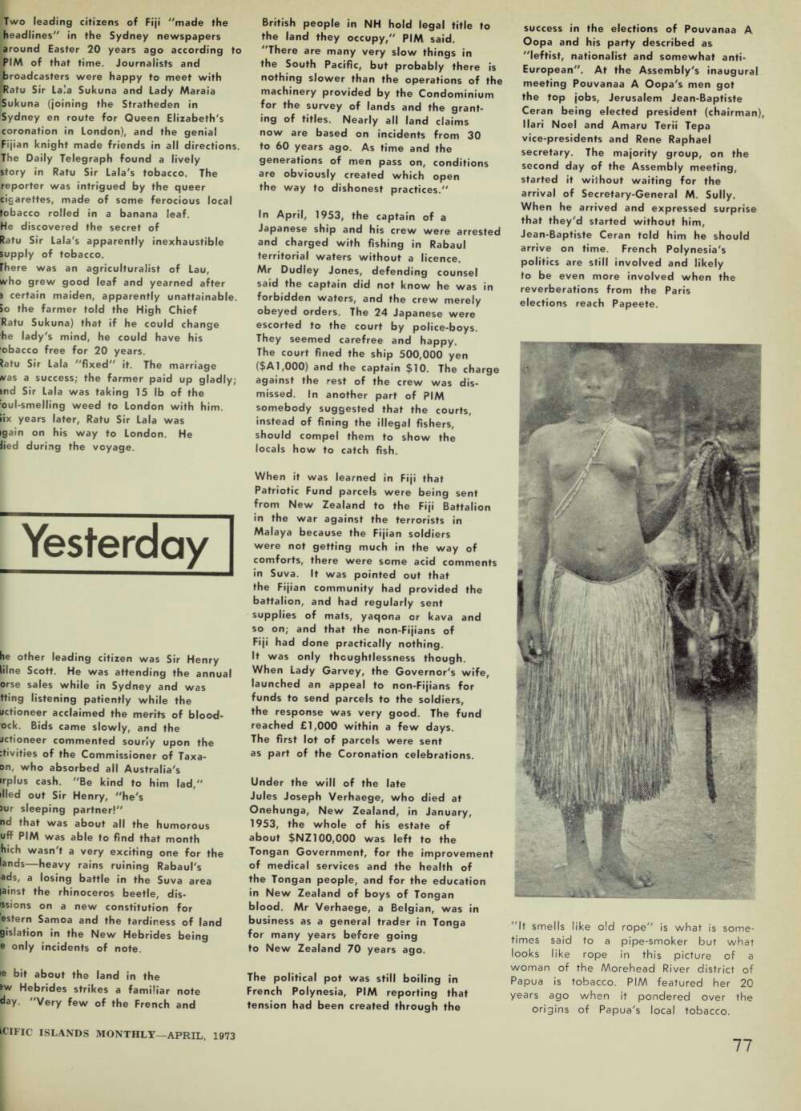
Two leading citizens of Fiji "made the headlines" in the Sydney newspapers around Easter 20 years ago according to PIM of that time. Journalists and Broadcasters were happy to meet with [Ratu Sir La.'a Sukuna and Lady Maraia Sukuna (joining the Stratheden in 'Sydney en route for Queen Elizabeth's coronation in London), and the genial Fijian knight made friends in all directions.
The Daily Telegraph found a lively story in Ratu Sir Lala's tobacco. The reporter was intrigued by the queer cigarettes, made of some ferocious local tobacco rolled in a banana leaf.
He discovered the secret of Ratu Sir Lala's apparently inexhaustible supply of tobacco. fhere was an agriculturalist of Lau, who grew good leaf and yearned after l certain maiden, apparently unattainable. >o the farmer told the High Chief Ratu Sukuna) that if he could change he lady's mind, he could have his tobacco free for 20 years, latu Sir Lala "fixed" it. The marriage was a success; the farmer paid up gladly; ind Sir Lala was taking 15 lb of the toul-smelling weed to London with him. iix years later, Ratu Sir Lala was igain on his way to London. He lied during the voyage.
he other leading citizen was Sir Henry lilne Scott. He was attending the annual orse sales while in Sydney and was tting listening patiently while the uctioneer acclaimed the merits of blood ock. Bids came slowly, and the uctioneer commented sourly upon the divities of the Commissioner of Taxa on, who absorbed all Australia's irplus cash. "Be kind to him lad," ►lied out Sir Henry, "he's
>ur sleeping partner!"
nd that was about all the humorous uff PIM was able to find that month hich wasn't a very exciting one for the lands —heavy rains ruining Rabaul's ads, a losing battle in the Suva area lainst the rhinoceros beetle, dis issions on a new constitution for estern Samoa and the tardiness of land gislation in the New Hebrides being e only incidents of note. ie bit about the land in the ■w Hebrides strikes a familiar note day. "Very few of the French and
British people in NH hold legal title to the land they occupy," PIM said.
"There are many very slow things in the South Pacific, but probably there is nothing slower than the operations of the machinery provided by the Condominium for the survey of lands and the grant ing of titles. Nearly all land claims now are based on incidents from 30 to 60 years ago. As time and the generations of men pass on, conditions are obviously created which open the way to dishonest practices."
In April, 1953, the captain of a Japanese ship and his crew were arrested and charged with fishing in Rabaul territorial waters without a licence.
Mr Dudley Jones, defending counsel said the captain did not know he was in forbidden waters, and the crew merely obeyed orders. The 24 Japanese were escorted to the court by police-boys.
They seemed carefree and happy.
The court fined the ship 500,000 yen ($A 1,000) and the captain $lO. The charge against the rest of the crew was dis missed. In another part of PIM somebody suggested that the courts, instead of fining the illegal fishers, should compel them to show the locals how to catch fish.
When it was learned in Fiji that Patriotic Fund parcels were being sent from New Zealand to the Fiji Battalion in the war against the terrorists in Malaya because the Fijian soldiers were not getting much in the way of comforts, there were some acid comments in Suva. It was pointed out that the Fijian community had provided the battalion, and had regularly sent supplies of mats, yaqona or kava and so on; and that the non-Fijians of Fiji had done practically nothing.
It was only thoughtlessness though.
When Lady Garvey, the Governor's wife, launched an appeal to non-Fijians for funds to send parcels to the soldiers, the response was very good. The fund reached £l,OOO within a few days.
The first lot of parcels were sent as part of the Coronation celebrations.
Under the will of the late Jules Joseph Verhaege, who died at Onehunga, New Zealand, in January, 1953, the whole of his estate of about SNZIOO,OOO was left to the Tongan Government, for the improvement of medical services and the health of the Tongan people, and for the education in New Zealand of boys of Tongan blood. Mr Verhaege, a Belgian, was in business as a general trader in Tonga for many years before going to New Zealand 70 years ago.
The political pot was still boiling in French Polynesia, PIM reporting that tension had been created through the
success in the elections of Pouvanaa A Oopa and his party described as "leftist, nationalist and somewhat anti- European". At the Assembly's inaugural meeting Pouvanaa A Oopa's men got the top jobs, Jerusalem Jean-Baptiste Ceran being elected president (chairman), Mari Noel and Amaru Terii Tepa vice-presidents and Rene Raphael secretary. The majority group, on the second day of the Assembly meeting, started it without waiting for the arrival of Secretary-General M. Sully.
When he arrived and expressed surprise that they'd started without him, Jean-Baptiste Ceran told him he should arrive on time. French Polynesia's politics are still involved and likely to be even more involved when the reverberations from the Paris elections reach Papeete.
"It smells like old rope" is what is some times said to a pipe-smoker but what looks like rope in this picture of a woman of the Morehead River district of Papua is tobacco. PIM featured her 20 years ago when it pondered over the origins of Papua's local tobacco.
Advertisements & other items, pp. 83-87 (3 items)
77
ICIFIC ISLANDS MONTHLY—APRIL, 1973
Millers
MARINE AND GENERAL ENGINEERS
I wm m ■ pi I il Hi wmm m mm ~rr. § ■■ aPH H .
THE "WAKAYA"
A standard 50 ft tug built for Marine Pacific Ltd to be used for berthing operations and inter-island barge towing. The propulsion unit in this tug is a 12V71M 340 H.P. 6.M.
Detroit diesel, nozzle propeller, with a bollard pull of o tons.
Work in hand ii Mission ship fo< Gilbert and Islands, 86 ft. ft. x 7 ft. 9 im ship is poweretwin 180 H.P. T
LIMITED
SHIP BUILDERS TO THE PACIFIC
A m
THE MISSION SHIP
in diesels, 2 x 20 K.V.A. alternators and is capable of a top speed of 10 knots, i has accommodation for 12 crew and 10 passengers and has a cargo capacity r 70 , tons - Also under construction is a 72 ft. fibreglassed wood hull tourist pjnch, two 40 ft. and vo 30 ft. steel work pats and six 250 ton ipacity barges. ■ W..WX...W11 U /L. 11. nuicyiQOJCU WUUU MUM IOUTK
MILLERS
P.O. BOX 296, SUVA, FIJI. PHONE: 23031.
MARINE PROPULSION DIESEL ENGINE
\ jM A c' m P b • *r *o* 6LX Marine Engine with "shallow" type Twin Disc MG. 509
gearbox showing
gearcase support members with integrally constructed bearer feet.
THE CHOICE OF THE DISCERNING OWNER
The Gardner Marine Diesel Engine sets the standard by which all other engines are judged and is the only choice for the owner requiring complete dependability, efficiency and durability second to none. Designed and built from the start as a true marine engine The complete range of Gardner engines from 56 to 230 hp are now available for immediate delivery.
For information on availability—or technical data contact:
KNOX SCHLAPP
PTY.
LTD.
135-139 McEvoy Street, Alexandria, N.S.W. 2015. Tel.: 699-8333.
Telex; AA20483. Telegrams: "Knoxschlap", Sydney.
Agents in N.S.W. and Pacific Islands for Gardner Diesels
SUB DISTRIBUTORS: SHERWOOD ENGINEERING, RABAUL
S. A. HEATH & SONS, PORT MORESBY.
Wrii for literatui on our complete ram of marine diesel engirr Name 'Address Code
POST THIS COUPON TODAY?
"HANDBOOK OF FIJI" sells in Australia and P.N.G. for $3.50 Aust. plus 45c posted; Pacific Islands and overseas countries $3.50 Aust., plus 70c posted; U.S.A., $5.40 U.S., posted.
Please send copy(ies) "Handbook of Fiji" to name address
city/state/country/post code
for which payment of is enclosed.
Pacific Publications (Aust,) Pty. Ltd.,
z 29 Alberta Street, Sydney, N.S.W, 2000. (Postal address Box 3408, G.P.0., Sydney, N.S.W. 2001) When ordering ask for our Pacific book catalogue
D APRIL, 1973—PACIFIC ISLANDS MONTHLY
79
PIFIC ISLANDS MONTHLY—APRIL, 1973
Pacific Shipping
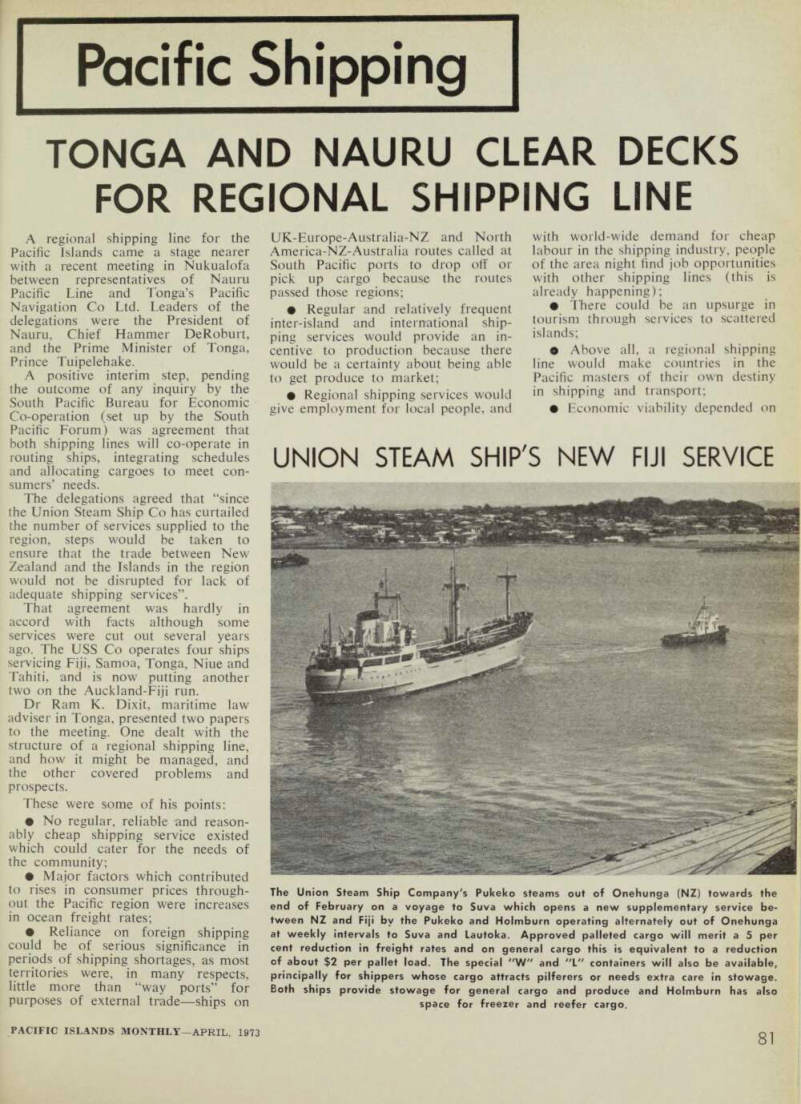

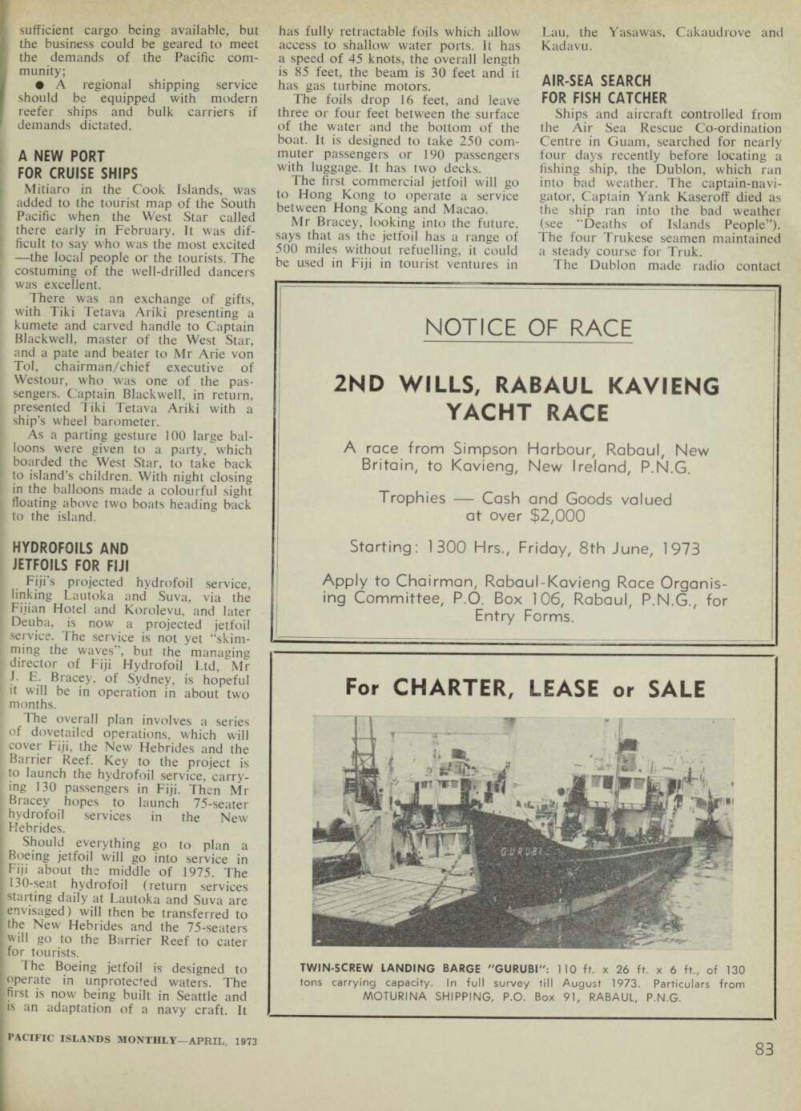
Tonga And Nauru Clear Decks
For Regional Shipping Line
A regional shipping line for the Pacific Islands came a stage nearer with a recent meeting in Nukualofa between representatives of Nauru Pacific Line and Tonga’s Pacific Navigation Co Ltd. Leaders of the delegations were the President of Nauru, Chief Hammer Deßoburt, and the Prime Minister of Tonga, Prince Tuipelehake.
A positive interim step, pending the outcome of any inquiry by the South Pacific Bureau for Economic Co-operation (set up by the South Pacific Forum) was agreement that both shipping lines will co-operate in routing ships, integrating schedules and allocating cargoes to meet con sumers’ needs.
The delegations agreed that “since the Union Steam Ship Co has curtailed the number of services supplied to the region, steps would be taken to ensure that the trade between New Zealand and the Islands in the region would not be disrupted for lack of adequate shipping services”.
That agreement was hardly in accord with facts although some services were cut out several years ago. The USS Co operates four ships servicing Fiji, Samoa, Tonga, Niue and Tahiti, and is now putting another two on the Auckland-Fiji run.
Dr Ram K. Dixit, maritime law adviser in Tonga, presented two papers to the meeting. One dealt with the structure of a regional shipping line, and how it might be managed, and the other covered problems and prospects.
These were some of his points: • No regular, reliable and reason ably cheap shipping service existed which could cater for the needs of the community; • Major factors which contributed to rises in consumer prices through out the Pacific region were increases in ocean freight rates; • Reliance on foreign shipping could be of serious significance in periods of shipping shortages, as most territories were, in many respects, little more than “way ports” for purposes of external trade—ships on
UK-Europe-Australia-NZ and North America-NZ-Australia routes called at South Pacific ports to drop off or pick up cargo because the routes passed those regions; • Regular and relatively frequent inter-island and international ship ping services would provide an in centive to production because there would be a certainty about being able to get produce to market; • Regional shipping services would give employment for local people, and
with world-wide demand for cheap labour in the shipping industry, people of the area night find job opportunities with other shipping lines (this is already happening); • There could be an upsurge in tourism through services to scattered islands; o Above all, a regional shipping line would make countries in the Pacific masters of their own destiny in shipping and transport; • Economic viability depended on
\ sufficient cargo being available, but the business could be geared to meet [ the demands of the Pacific com munity; • A regional shipping service should be equipped with modern reefer ships and bulk carriers if demands dictated,
A New Port
For Cruise Ships
Mitiaro in the Cook Islands, was added to the tourist map of the South Pacific when the West Star called there early in February. It was dif ficult to say who was the most excited —the local people or the tourists. The costuming of the well-drilled dancers was excellent.
There was an exchange of gifts, with Tiki Tetava Ariki presenting a kumete and carved handle to Captain Blackwell, master of the West Star, and a pate and beater to Mr Arie von Tol, chairman/chief executive of Westour, who was one of the pas sengers. Captain Blackwell, in return, presented Tiki Tetava Ariki with a ship’s wheel barometer.
As a parting gesture 100 large bal loons were given to a party, which boarded the West Star, to take back to island’s children. With night closing in the balloons made a colourful sight floating above two boats heading hack to the island.
Hydrofoils And
Jetfoils For Fiji
Fiji’s projected hydrofoil service, linking Lautoka and Suva, via the Fijian Hotel and Korolevu, and later Deuba, is now a projected jetfoil service. The service is not yet “skim ming the waves’’, but the managing director of Fiji Hydrofoil Ltd, Mr I. E. Bracey, of Sydney, is hopeful it will be in operation in about two months.
The overall plan involves a series of dovetailed operations, which will cover Fiji, the New Hebrides and the Barrier Reef. Key to the project is to launch the hydrofoil service, carry ing 130 passengers in Fiji. Then Mr Bracey hopes to launch 75-seater hydrofoil services in the New Hebrides.
Should everything go to plan a Boeing jetfoil will go into service in Fiji about the middle of 1975. The j 130-seat hydrofoil (return services starting daily at Lautoka and Suva are envisaged) will then be transferred to the New Hebrides and the 75-seaters will go to the Barrier Reef to cater for tourists.
The Boeing jetfoil is designed to [operate in unprotected waters. The |first is now being built in Seattle and lis an adaptation of a navy craft. It
has fully retractable foils which allow access to shallow water ports. It has a speed of 45 knots, the overall length is 85 feet, the beam is 30 feet and it has gas turbine motors.
The foils drop 16 feet, and leave three or four feet between the surface of the water and the bottom of the boat. It is designed to take 250 com muter passengers or 190 passengers with luggage. It has two decks.
The first commercial jetfoil will go to Hong Kong to operate a service between Hong Kong and Macao.
Mr Bracey, looking into the future, says that as the jetfoil has a range of 500 miles without refuelling, it could be used in Fiji in tourist ventures in
Lau, the Yasawas, Cakaudrove and Kadavu. aidcca ccAoru AIKotA btAKLn
For Fish Catcher
Ships and aircraft controlled from the Air Sea Rescue Co-ordination Centre in Guam, searched for nearly four days recently before locating a fishing ship, the Dublon, which ran into bad weather. The captain-navi gator, Captain Yank Kaseroff died as the ship ran into the bad weather (see “Deaths of Islands People”), The four Trukese seamen maintained a steady course for Truk, The Dublon made radio contact
with the search party and other ships, but it was difficult for searching planes to find it because of radio location problems and bad weather.
When found, the Dublon was about 160 miles from Guam. The Dublon was then towed to Truk by the Wan dank, one of the searching ships.
King Of The Ocean
Goes To Work
The Fiji Government’s newest ship, the Tui Ni Wasaliwa (King of the Ocean), is a fisheries research vessel, which will be able to reach the more distant waters of the country. The ship was built for the Ministry of Agriculture, Fisheries and Forests to a design in accordance with the rules of Lloyd’s Register and the Fiji Marine Board.
The 180 tons Tui Ni Wasaliwa is a welded all steel ship with a hull 81 ft 6 in, overall and 22 ft 8 in. moulded breadth. She has a General Motors motor developing 340 shaft hp and a service speed of knots.
There is accommodation for four officers and eight seamen.
The ship can operate live bait pole and line fishing and experimental stern trawling, and has limited capa city for small-scale oceanographic re search. There are bait wells, portable bait tanks and an 1,800 cu ft (about 30 tons) insulated fish hold.
This Job Could
Go With A Bang
World War II depth charges which Trust Territory authorities hope to recover from a sunken Japanese ship in Truk lagoon, will be used for blasting channels in reefs around the island. A demolition team expected to remove about 300 of the charges and about two tons of small arms ammunition and projectile fuses from a ship, believed to be the Sankisan Maru.
The project, to cost $U525,000, was to have been launched early in March, provided finance was available.
Peter S. Aiken, an expert on ex plosive ordinance disposal was lent to the Trust Territory by the US Navy, to take charge of the project.
He was to be helped by the TT Marine Resources Diving Officer, Mr John U. Oakes, and 20 men.
A training session was arranged for divers. The project was expected to take three or four weeks to com plete.
Chief Aiken found the depth charges in May, 1972, while search ing for explosives in the lagoon. He found a bomb nearby and was about to explode it when, having second thoughts, he decided to search the
Continued on p 86
ship and found the depth charges.
Had he exploded the bomb it might have set up a chain reaction and blown the whole shipment, and him self, sky-high. There could have been fatal consequences for people on a nearby island.
Higher Freight
Rates For Png
Freight rates from Australian ports to Port Moresby, Lae, Madang and Rabaul were increased by 121 per cent halfway through March. The new rates were negotiated by the Aus tralian Shippers’ Council and four companies operating to PNG Karlander, Conpac, New Guinea Aus tralia Line and New Guinea Express Line. The reason —increased stevedor ing and operating costs.
The last time shipping freight rates to Papua New Guinea were increased was in July, 1971, when they went up 9 per cent. That raise followed a 15 per cent increase only four months earlier—in March, 1971.
This big increase in freight rates could be a double-edged weapon for the shipping lines. There could be a drop in tonnage, particularly of food stuffs, as New Zealand has been taking full advantage of recent cur rency movements to get into some of Australia’s traditional markets in the Islands. One of these is Papua New Guinea.
New Zealand can undersell Aus tralia in such commodities as biscuits, canned fruit, apples, potatoes and meat, even before the projected rise in cargo charges, which will probably be in May. Having to pay higher charges will put Australian products in an even worse competitive position.
That is hardly the affair of the shipping companies, which have to operate at a profit or go out of business. But a drop in cargoes could quickly lead to too much space for too little cargo. . , The rise in freight rates is just ahead of an increase of 6 per cent in wages for PNG watersiders, due in May. This rise is the second part of a wage agreement, which came; into force in 1972. The first part of the increase was 9 per cent, applied! in 1972. The shipping companies! absorbed that increase.
The upshot of these increases, particularly if Australian exporters lose some of their markets, could be; a move to some sort of containen service for Papua New Guinea.
Internal shipping freight rates in Fiji have risen by 171 per cent. This follows higher wages for officers and seamen and other operating costs; The last blanket increase was about two years ago, except for Lau, whicH
had to pay higher rates from January, 1972. Passage rates have also been [ increased.
Freight rates between Britain and Fiji and Japan and Fiji have gone up by about 11 per cent. Both increases were made to offset devaluation of the US dollar and revaluation of the Japanese yen.
Fiji Dockworkers
Want Big Rise
Fiji dockworkers want a basic SI an hour, and that is what they will ask employers for when they negotiate a new pay agreement in August. The present is 46c an hour for regular workers guaranteed 40 hours a week, and 50c for casual workers. Those rates were achieved after the crippling strike of 1971 when the Prime Mini ster, Ratu Sir Kamisese Mara, virtu ally became the arbiter.
The wharfies want $1 an hour be cause the cost of living has risen by more than 100 per cent since the last pay agreement, says Taniela Veitata, the Fiji Dockworkers’ and Seamen’s Union’s general secretary.
He expects support from the South Pacific Dockworkers’ Council, which was formed in Suva early in Febru ary. Countries and territories repre sented on the council are Australia, NZ, Fiji, Tahiti, New Caledonia and Papua New Guinea.
The union announced its demand early to warn shipping companies and the government, and will not go on strike unless forced. There could be an interesting round of negotiations ahead—behind closed doors.
Nz Exporters
Have Problems
New Zealand exporters are pleased with the Union Steam Ship Com pany’s increased shipping services to Fiji and they intend to take full advantage of them, Mr Lloyd Brown, president of the Wellington Manu facturers’ Association said recently.
At a meeting of the Export Institute of New Zealand Mr Brown said he was only disappointed that the in creased services would operate only out of Onehunga. “The problems facing exporters outside Auckland are still present”, said Mr Brown.
Carpenters Sell
Shipping Agency
W. R. Carpenter has sold Carpenter Shipping Agencies in Papua New Guinea, and has acquired an interest in a new company, in which 20 per cent of the shareholding is reserved for local people. The new company is Robert Laurie-Carpenter Ltd, with
the Robert Laurie and Carpenter
groups holding equal shares.
The new company will incorporate the activities of the old Carpenter Shipping Agencies at Port Moresby, Lae, Rabaul, Madang and Kieta, and the stevedoring work of the Robert Laurie organisation. Robert Laurie activities were previously confined to Kieta and Lae, but will now be ex tended to take in Port Moresby and Rabaul. Robert Laurie-Carpenter will act as customs and forwarding agents at Port Moresby, Lae, Rabaul and Madang.
Mr J. H. Beer has been transferred from New Guinea Co Ltd to Robert Laurie-Carpenter as general manager.
Strike May Hit
Shipping From Usa
American Samoa is taking a pessi mistic view about shipping links with the US West Coast. With memories of the crippling 100 days’ strike in 1972 by 16,000 West Coast long shoremen, the government and local firms have been warned to prepare now for another breakdown in ship ping.
The contracts for the longshore men, who work for the members of the Pacific Maritime Association will end on July 1. Other major contracts /or transport workers are running out, and a strike by any of the unions involved could disrupt shipping.
Union Steam Ship's New Fiji Service
The Union Steam Ship Company's Pukeko steams out of Onehunga (NZ) towards the end of February on a voyage to Suva which opens a new supplementary service be tween NZ and Fiji by the Pukeko and Holmburn operating alternately out of Onehunga at weekly intervals to Suva and Lautoka. Approved palleted cargo will merit a 5 per cent reduction in freight rates and on general cargo this is equivalent to a reduction of about $2 per pallet load. The special "W" and "L" containers will also be available, principally for shippers whose cargo attracts pilferers or needs extra care in stowage.
Both ships provide stowage for general cargo and produce and Holmburn has also space for freezer and reefer cargo.
Advertisements & other items, pp. 89-92 (1 item)
Handbook
OF FIJI fourth edition
In trade and as a mecca for tourists, Fiji is growing in importance. For businessmen, travellers, students and others who want to keep abreast of events, the fourth, 1972 edition, of the Handbook of Fiji is an essential guide.
As well as sections dealing exhaustively with history, geography, government and politics, finance, trade, education, social services, etc., there is a completely revised tourist section. This is in keeping with the growing importance to Fiji of this industry. An extensive accommodation guide and a folding road-map of Viti Levu are included. With 14 other maps and attractive full-colour cover. 264 pages.
Use the form overleaf when ordering
1 ms m m ■
H Sony “70
A new generation
of stereo components
Sony's new "70" Series bring you full high-fidelity stereo sound in a series of compact, beautifully matched components.
But this is only half the story.
Now, component stereo performance is available at a price that will pleasantly surprise you.
You can buy "70" Series components individually or as a complete stereo system which can> for example, perfectly include the TC-121 stereo cassette deck.
See this new generation of stereo components at your Sony dealer's showroom today . . . hear how research makes the difference.
Research Makes the Difference SS-70 2-way stereo speaker system TC-121 Stereo cassette deck % I / - • o D 0) s ONy TA-70 ' 1 ntegrated stereo amplifier
NOTICE OF RACE
2ND WILLS, RABAUL KAVIENG
YACHT RACE
A race from Simpson Harbour, Rabaul, New Britain, to Kavieng, New Ireland, P.N.G.
Trophies Cash and Goods valued at over $2,000 Starting; 1300 Hrs., Friday, Bth June, 1973 Apply to Chairman, Rabaul-Kavieng Race Organising Committee, P.O. Box 106, Rabaul, P.N.G., for Entry Forms.
For CHARTER, LEASE or SALE
m ■ i m . fS Hi TWIN-SCREW LANDING BARGE "GURUBI": 110 ft. x 26 ft. x 6 ft., of 130 tons carrying capacity. In full survey till August 1973. Particulars from MOTURINA SHIPPING, P.O. Box 91, RABAUL, P.N.G.
Ask for FOUREX the dear sparkling amber beer...
available in BOTTLES, CANS and STUBBIES
The Popular
‘lts Quality Never V’
Wholesale Distributors:
C. SULLIVAN
{NEW GUINEA) PTY. LTD.,
Port Moresby, Lae, Mt. Hagen, Rabaul, Kieta, Lautoka and Suva, Fiji.
AGENCIES :
R. Bensley—Madang. Ping Shee & Co. —Wewak. E. V. Lawson Pty. Ltd. — Honiara, British Solomon Islands.
Brewed from the finest Ingredients by Castlemaine Perkins Limited, Brisbane, Queensland, Australia.
lor
■HAIRt
m
XXX*
*TTWAP
IU
* / r /
M/tCfV
HAND
P(//tfP££fflpefro/ fROM
Australia's best selling non-electric Iron! For reliability, ease of handling, and excellence of quality at a low price, Y°u can t beat the HANOI. It's simplicity itself to operate— NO PUMPING IS REQUIRED. IT'S IMPOSSIBLE TO OVERFILL THE FUEL TANK and one filling does approximately 2 hours effortless ironing. Attractively finished in nickel plate. Spare parts always available.
THE PORTABLE OUTDOORS COOKER at a sensible price!
Twin independent burners for fast cooking. Twin tanks for double capacity. Steel case, when opened, acts as triple-wind shield. Rustproof. Noisy or silent burners as required. Small or large porcelain enamel ovens also available separately. HANOl—the lowest priced QUALITY Twin Burner Portable! ns
ORKS
1 Compo Rd., Salisbury North, Ph. 47 2121
BRISBANE, QUEENSLAND, AUSTRALIA
its shipbuilding yards
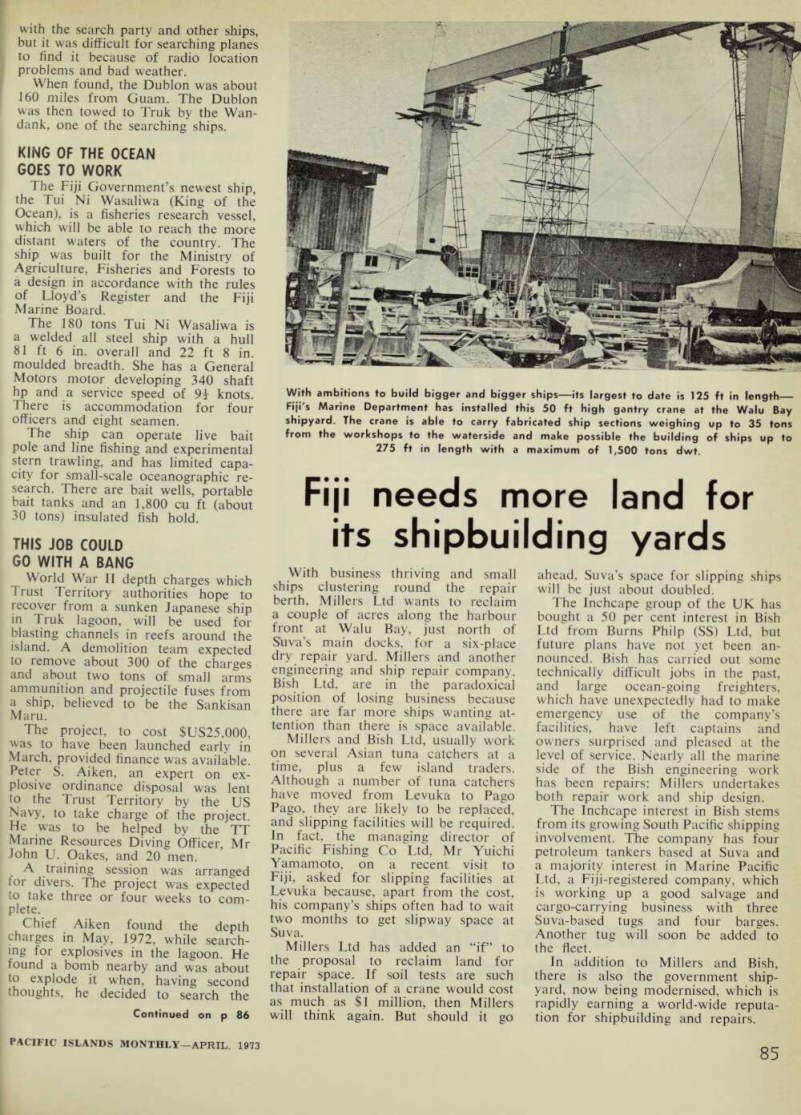
Fiji needs more land for its shipbuilding yards
With business thriving and small ships clustering round the repair berth, Millers Ltd wants to reclaim a couple of acres along the harbour front at Walu Bay, just north of Suva’s main docks, for a six-place dry repair yard. Millers and another engineering and ship repair company, Bish Ltd, are in the paradoxical position of losing business because there are far more ships wanting at tention than there is space available.
Millers and Bish Ltd, usually work on several Asian tuna catchers at a time, plus a few island traders.
Although a number of tuna catchers have moved from Levuka to Pago Pago, they are likely to be replaced, and slipping facilities will be required.
In fact, the managing director of Pacific Fishing Co Ltd, Mr Yuichi Yamamoto, on a recent visit to Fiji, asked for slipping facilities at Levuka because, apart from the cost, his company’s ships often had to wait two months to get slipway space at Suva.
Millers Ltd has added an “if” to the proposal to reclaim land for repair space. If soil tests are such that installation of a crane would cost as much as $1 million, then Millers will think again. But should it go
ahead, Suva’s space for slipping ships will be just about doubled.
The Inchcape group of the UK has bought a 50 per cent interest in Bish Ltd from Burns Philp (SS) Ltd, but future plans have not yet been an nounced. Bish has carried out some technically difficult jobs in the past, and large ocean-going freighters, which have unexpectedly had to make emergency use of the company’s facilities, have left captains and owners surprised and pleased at the level of service. Nearly all the marine side of the Bish engineering work has been repairs; Millers undertakes both repair work and ship design.
The Inchcape interest in Bish stems from its growing South Pacific shipping involvement. The company has four petroleum tankers based at Suva and a majority interest in Marine Pacific Ltd, a Fiji-registered company, which is working up a good salvage and cargo-carrying business with three Suva-based tugs and four barges.
Another tug will soon be added to the fleet.
In addition to Millers and Bish, there is also the government ship yard, now being modernised, which is rapidly earning a world-wide reputa tion for shipbuilding and repairs.
With ambitions to build bigger and bigger ships—its largest to date is 125 ft in length— Fiji's Marine Department has installed this 50 ft high gantry crane at the Walu Bay shipyard. The crane is able to carry fabricated ship sections weighing up to 35 tons from the workshops to the waterside and make possible the building of ships up to 275 ft in length with a maximum of 1,500 tons dwt.
Advertisements & other items, pp. 94-96 (1 item)
Equipment Co.
s4Bo
1 □ This is the Z-Dnve Transom Unit —a stern drive especially designed for power inputs up to 78 bhp (diesel) at 4.500 rpm and 130 bhp (petrol) at 5,000 rpm. Use it for pleasure craft—or for work boats Either way it’s a 5pointed star in marine engineering.
Ease of installation Fitting is simple and well within the scope of the do-ityourself" enthusiast. No complicated and expensive gear required Co/nes complete with close coupling kit Performance Fabulous flexibility at all engine speeds Light and compact Reliability Built to stand the high torque of a diesel engine, and heaviest of punishment from long periods at high throttle Special safety device tilts the drive should the skeg foul on underwater obstruction preventing damage to lower unit
Accessibility
By using the standard swivelling gear, the unit can oe cranked into its "parked" position from inside the boat Service Our after-sales service is second to none Price $4BO fo b. Sydney Options include power tilt and propeller Please send me details of 7-Dnvt- Transom Unit Name Address Date
Albacore Marine
Equipment Co.
31 Hoskins Ave . Bankstown, NS W Australia 2200 10453
serves the
Islands with expert
insurance service
and advice.
QUEENSLAND INSURANCE
COMPANY LIMITED
(Incorporated 1886 in Australia)
Head Office: 82 Pitt Street, Sydney FIJI —Branch Office, Suva, Manager for Fiji: F. N. Davies (AAII).
LAUTOKA District Manager: U. Singh.
PAPUA-NEW GUINEA Branch Office, Port Moresby: Manager for Papua-New Guinea: D. J. Granter. District Managers at Rabaul: C. D. Dickmgs; Lae: R. Jackson; Mt. Hagen: G. F. Donnelly.
HONIARA (8.5.1. P.) Breckwoldt & Company (5.1.) Pty.
Limited.
NOUMEA T. A. Hagen, Ste. W. A. Johnston, S.A.R.L.
VILA, SANTO Resident Officer for New Hebrides: R. J. Allsop.
TAHITI Arthur Chung: Immeuble B. L, Front de Mer, Papeete.
NIUE, NORFOLK ISLAND, SAMOA, TONGA and other South Sea Islands Bums Philp (South Sea) Co. Limited.
Assets exceed $75,000,000 L 357
SALE. CHARTER.
CARGO VESSEL. Diesel aft, about 1,100 tons dwt., built 1958, fully classed, one hold, large hatch, good cargo gear. $A130,000.
CARGO VESSEL About 330 tons dwt., diesel, one hatch, one hold, ajbout 17,000 cu. ft. cargo space, built 1960, Lloyds Class. All modern navigation aids, bridge control. $A 130,000.
DIESEL TANKER. About 250 tons dwt., 4 tanks, suit tropical trading. $A35,000.
CARGO VESSEL. About 350 tons dwt., fully classed Lloyds, one hold, two hatches. $A85,000 or reasonable offer.
REFRIGERATED CARGO VESSEL. 120 ft x 24 ft, twin diesel, vessel unemployed. Survey expired but engine room, etc., maintained. Owners inviting offers.
CARGO VESSEL. Suit Island trading. 80 ft x 20 ft, diesel aft, large hatch/hold, 3 ton derrick, in Survey. $A55,000.
LICENCED PASSENGER VESSEL. Suitable survey charter work, 55 ft x 16 ft 6 in. 6V71 G.AA. diesel. Accommodate 13, in full survey, radar, etc. $A50,000.
We obtain independent surveys of any craft we offer and subsequently arrange delivery either on ship's deck or by sea as desired. Enquiries welcomed concerning vessels we have for charter.
CART. W. L. KENNEDY PTY. LTD.
Shipbrokers Established 1931
32 BRIDGE STREET, SYDNEY, AUSTRALIA
Phone: 27-3797. Cables: "Capken" Sydney.
MORE PORTS / MORE OFTEN
with
KM9LJUUOER
KARLANDER NEW GUINEA LINE: Serving; Pt. Moresby, Samarai, Lae, Madang, Rabaul, Wewak, Manus Is., Kieta, Honiara, Yandina, Gizo, Vila, Norfolk Is., and Lord Howe Is.
KARLANDER KANGAROO LINE: Serving: Los Angeles, San Francisco,
Auckland, Melbourne, Suva, Lautoka.
AUSTRALIAN TERRITORY LINER SERVICES: Serving; Melbourne,
Sydney, Newcastle, Brisbane, Weipa, Gove, Thursday Is.
Managing Agents
KARLANDER (AUSTRALIA) PTY. LIMITED
19-31 Pitt Street, Sydney
General Agents Brisbane: F. H. Stephens Pty. Ltd.
Melbourne: F. H. Stephens (Vic.) Pty. Ltd.
Pt. Moresby: Carpenter Shipping Agencies.
Samarai: Burns Philp (N.G.) Ltd.
San Francisco: Transpacific Transportation Co.
Los Angeles: Transpacific Transportation Co.
Madang: B. J. Back Pty. Ltd.
Yandina: Levers Pacific Plantations Co. Ltd.
Santo: Burns Philp (N.H.) Ltd.
Lord Howe Is.: R. Wilson Leanda Lei.
Thursday Is.: Torres Industries Ltd.
Manus Is.: Edgell & Whiteley Ltd.
Rabaul: Rabaul Trading Co. Ltd.
Honiara: E. V. Lawson Pty. Ltd.
Kieta: Breckwoldt & Co. Pty. Ltd.
Lae: N.G.G. Trading Company.
Wewak: Burns Philp (N.G.) Ltd.
Fiji: Burns Philp (S.S.) Ltd.
Gizo: British Solomon Trading Co.
Vila: Burns Philp (N.H.) Ltd.
Norfolk Is.: Burns Philp (S.S.) Ltd.
Shipping Briefs
• Salvage of the Palau Islander, which went aground on the reef off Ebadon Island, Kwajalein, in Decem ber, 1972, has been postponed be cause of high cost of the salvage and then of restoring the ship to opera tional status. • The Waikare, a Union Steam Ship Co of NZ Ltd freighter, went aground on a reef near Lautoka on February 15 as she was entering the harbour. She refloated under her own power less that 24 hours later. • All ropes on mooring buoys in the Japanese fishing grounds at Cape Lambert, Papua New Guinea, now conform to the new standard of 10 metres. The East New Britain Dist rict Commissioner, Mr Carey, re cently visited the area to inspect the buoys after a member of the East New Britain District Advisory Coun cil criticised the length of the trailing ropes on the mooring buoys, saying they were a danger to shipping. • The PNG Government has briefed a firm of consultants to probe the economics of overseas shipping, and comment on the possibility of the country setting up its own overseas shipping line. • Rarotonga is looking forward to a boom in tourist shipping in 1974.
The ships likely to call there are the Volendam and Veendam (Holland- Amerika Lines), Royal Viking Star (Royal Viking Line), Orsova (P and O) Hamburg (German-Amerika Line) and Fairsea or Fairsky (Sitmar). • A boat, built in spare time, has been launched in Fiji for fishing and carrying passengers between the Lomaiviti islands. The boat, the Tomitomi, was built by Isoa Koroi and cost $6,200. She is built of: marine ply, is coated with fibreglass,, and is capable of 9 knots. • A writ was nailed to the mast: of the Compagnie Maritime Hebrides; ship, Erakor, in Sydney, on February 6 on behalf of Burns Philp for alleged debt. Burns Philp became; agents for the ship about six months ago. The Erakor has been trading from Australia to New Caledonia and the New Hebrides. • One of Australia’s largest trans port groups, Thomas Nationwide Transport Limited, has linked with two West German companies— Montan Transport and Hapag Lloyd.l to form a new international shipping and shipbroking company to be known as Montan-TNT.
Cruising
Yachts
• KAWAMEE, 63 ft ketch, arrived at Rarotonga on February 23 from Honolulu and Penrhvn with owner skipper Rockne H. Johnson, three paid crew and six paying crew on board. The six paying crew, Rich Hassman. Howard King, Tom Doyle, James Garsee, Warren Hanly and Fred Simmons, left the yacht at Raro tonga and left on the cruise vessel WEST STAR for Pago Pago and then home to the US and Canada. All are Americans except Mr Simmons, who is Canadian. They had intended to continue on to Tahiti with the Kawamee, but became disenchanted with the voyage and the “no drink ing” rule imposed by the skipper. The Kawamee has left Rarotonga for Tahiti where Mr Johnson, a professor of geophysics at the University of Hawaii, will carry out underwater research before sailing back to Hono lulu. • SIROCCO, 75 ft cutter owned by 30-year-old Californian, Steve Guy, and once by the late film star Errol Flynn, is in Sydney. On board on arrival were Janis Banker, Tom Banker, Bill Trevithick, Carole Grif fith, Tom Gardner and Jack Mutten, all former students of Santa Barbara University in California. Sirocco left California in 1970 for Hawaii and stayed there for seven months. Ports of call after Hawaii were Christmas Island, Apia, three months in Fiji and a year in Wangarei, New Zealand, where she was completely rebuilt.
At Christmas Island they were able to save the life of a native who was
seriously ill. They used their radio to call the US Coast Guard in Honolulu for help.
An aeroplane was sent to fly the sick man to Honolulu.
Sirocco competed in the Sydney/ Hobart race and hopes to take part in the Brisbane race this year. Still on the list to be discovered are the Queensland Coast, Port Moresby, Torres Strait, Bali, Indonesia, Singa pore, Indian Ocean then to Africa for the Cape Town/Rio De Janeiro race in January, 1975, before sailing back to California. They will leave Sydney on April 11.
O BUNDOON, 34 ft sloop, with owner Barry Goldman and wife Lois on board, was scheduled to leave Lord Howe Island early in March for the Great Barrier Reef and Gladstone and then to the Solomon Islands. • PANDEMONIUM, 54 ft ketch, is back in Port Moresby from Samarai, with a planned Far East cruise abandoned. She was carrying Keith and Veronica McCarthy when she left Port Moresby. Veronica had to leave the ketch at Alotau and go to Australia for medical treatment.
• Valuaranne Tri, Yacht,
carrying Val and Ray Goldston, re cently called at Goodenough Island on the way to Lae from Port Moresby. • DELFINI, ferro ketch, carrying owner builder Rob Dehaan and crew, made her maiden trip late in January from Alotau to Rabaul. The voyage was not without its excitement. She was nearly run down by a freighter. • SHI BUI, sloop, called in to Sariba, near Samarai to await parts, while on the way from Port Moresby to Rabaul. She was carrying Lynn and Bryan Cooper. • TAIRE HINANO, ketch, was at Rabaul late in February, after Christ mas and New Year cruising to the Trobriands and Woodlakes, carrying Bob and Robin Darragh,
• BLUE ORPHEUS, 39 ft Ameri can-owned sloop, was towed into Avatiu Harbour, Rarotonga, on March 7 after radioing for assistance miles offshore. On board were skipper Dick Williams and Jack Tolvanen, Americans; Richard Fayerman, Stephen Gregory and Carol Higgins, New Zealanders, and Rick Holden and Lyn Dunn of England.
Californian owner Dick Johnson, who was not on board, had sailed Blue Orpheus from the US to NZ. The yacht spent 13 days of the 16-day voyage battling storms, high winds and rough seas. The double-reefed mainsail was blown out in a squall when the sloop was 500 miles south of Rarotonga and this was followed by an electrical fire in the engine a few hours later. The battery cables had to be cut and the fire put out with an extinguisher and sea water.
Hatches leaked and water poured into the cabin. Next day a scuba tank blew up as the valves had been loosened by the pounding of the sea, and a good deal of water was shipped as the bow kept dipping under. The engine was repaired, but refused to start when in sight of Rarotonga.
Tahiti is the next stop.
The annual Rabaul-Kavieng yacht race will start on June 8.
The Rabaul Yacht Club, which is organising the race, is pro moting it as far away as Hong Kong, Manila, other Pacific Islands and the east coast of Australia. Two early entries from Rabaul are newcomers, Solataire II and Hinano. Landseer HI, which won in 1972, is now in the GEIC and will not enter. Trophies for the race consist of cash and goods worth more than $2,000. Further particulars are available from the Rabaul Yacht Club, PO Box 106, Rabaul, PNG.
Advertisements & other items, pp. 97-98 (1 item)
t
DAIWA BANK SERVING YOU IN PACIFIC BASIN Head Office Osaka,Japan With 137 Branches oughout Japan Los Angeles Agency 555 South Flower St. Suite 4040 Los Angeles, Calif. 90071 Affiliated Bank P.T BANK PERDANIA Djalan Raya Mangga Besar 7&9 Djakarta Our Correspondent Banks are in city— Apia, Suva, Lae.
Madang Port Moresby, Rabaul, Wewak. Guam, all Principal cities in Australia and New Zealand Contact your banker or our office. y Sydney Representative Office Bth Floor Prudential Building 39-49, Martin Place, Sydney
THE DAIWA BANK LTD.
Head Office : 21. Bingomachi 2-chome, Higashi-ku, Osaka, Japan Overseas : London, New York, Los Angeles, Frankfurt, Sydney
t
Hews
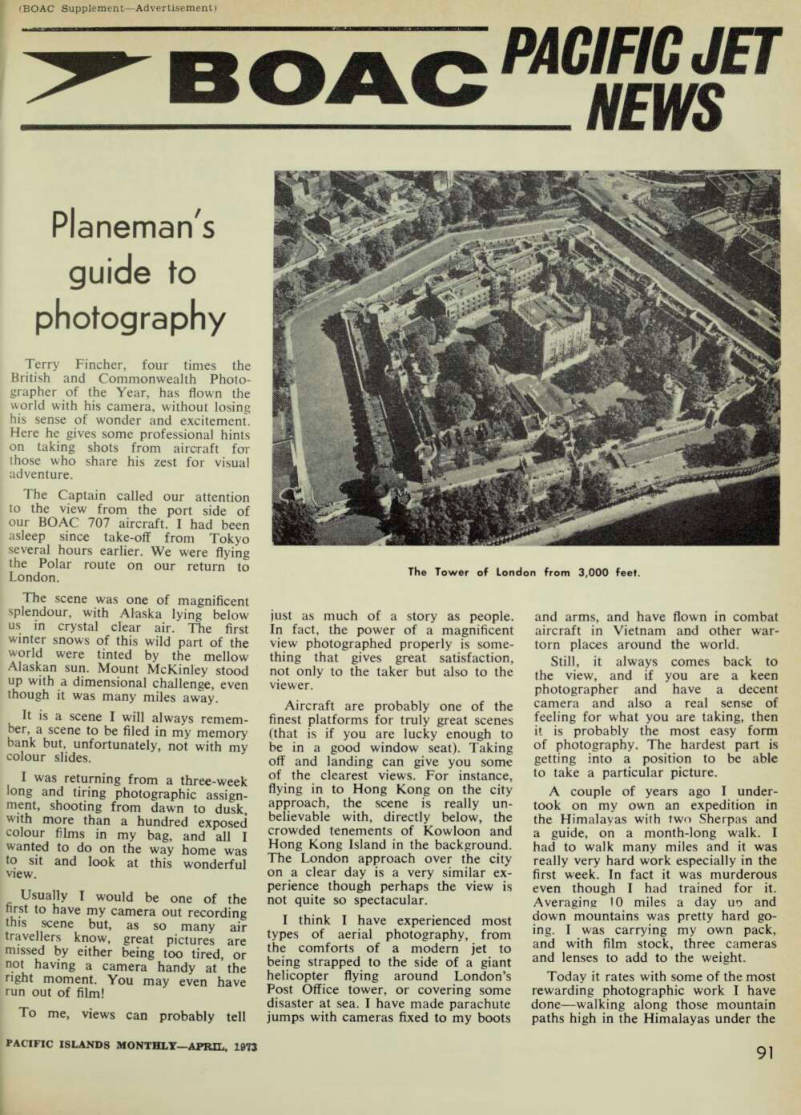
Boac
Pacific Jet
Planeman's guide to photography
(BOAC Supplement—Advertisement)
Terry Fincher, four times the British and Commonwealth Photo grapher of the Year, has flown the world with his camera, without losing his sense of wonder and excitement.
Here he gives some professional hints on taking shots from aircraft for those who share his zest for visual adventure.
The Captain called our attention to the view from the port side of our BOAC 707 aircraft. I had been asleep since take-off from Tokyo several hours earlier. We were flying the Polar route on our return to London.
The scene was one of magnificent splendour, with Alaska lying below us in crystal clear air. The first winter snows of this wild part of the world were tinted by the mellow Alaskan sun. Mount McKinley stood up with a dimensional challenge, even though it was many miles away.
It is a scene I will always remem ber, a scene to be filed in my memory bank but, unfortunately, not with my colour slides.
I was returning from a three-week long and tiring photographic assign ment, shooting from dawn to dusk, with more than a hundred exposed colour films in my bag, and all I wanted to do on the way home was to sit and look at this wonderful view.
Usually I would be one of the first to have my camera out recording this scene but, as so many air travellers know, great pictures are missed by either being too tired, or not having a camera handy at the right moment. You may even have run out of film!
To me, views can probably tell
just as much of a story as people.
In fact, the power of a magnificent view photographed properly is some thing that gives great satisfaction, not only to the taker but also to the viewer.
Aircraft are probably one of the finest platforms for truly great scenes (that is if you are lucky enough to be in a good window seat). Taking off and landing can give you some of the clearest views. For instance, flying in to Hong Kong on the city approach, the scene is really un believable with, directly below, the crowded tenements of Kowloon and Hong Kong Island in the background.
The London approach over the city on a clear day is a very similar ex perience though perhaps the view is not quite so spectacular.
I think I have experienced most types of aerial photography, from the comforts of a modern jet to being strapped to the side of a giant helicopter flying around London’s Post Office tower, or covering some disaster at sea. I have made parachute jumps with cameras fixed to my boots
and arms, and have flown in combat aircraft in Vietnam and other war torn places around the world.
Still, it always comes back to the view, and if you are a keen photographer and have a decent camera and also a real sense of feeling for what you are taking, then it is probably the most easy form of photography. The hardest part is getting into a position to be able to take a particular picture.
A couple of years ago I under took on my own an expedition in the Himalayas with two Sherpas and a guide, on a month-long walk. I had to walk many miles and it was really very hard work especially in the first week. In fact it was murderous even though I had trained for it.
Averaging 10 miles a day un and down mountains was pretty hard go ing. I was carrying my own pack, and with film stock, three cameras and lenses to add to the weight.
Today it rates with some of the most rewarding photographic work I have done—walking along those mountain paths high in the Himalayas under the
The Tower of London from 3,000 feet.
shadow of Annapurna and Dhaulagiri, and to see them through the open tent flaps as I lay in my sleeping bag and the first sunlight hit the highest tips at the start of a new day; to look down into the lush green valleys or at a water-hole where the local women in their colourful clothes meet to discuss the usual village gossip.
This is a hard part of the world; no tourist ever ventures this far, yet it is one of the most friendly and fascinating parts it has been my pleasure to visit. My camera recorded many hundreds of beautiful views and my memory will always recall the wonderful experience of staying in a Tibetan inn and being greeted with great hospitality.
In the villages food was in short supply, but on meeting a village chief (and for most of his villagers I seemed to be the first white man they had seen) they insisted on givine me some of their rice and, if a chicken was to spare, one would go in the pot to make a delicious curry for the evening meal.
Fellow travellers who are keen photographers may like a few tips.
Many may have fully automatic cameras or some may rely on an ex posure meter, which I personally pre fer for true readings. You cannot stick it out of the aircraft window, of course, but if you can use a small manual meter after a period of time you will start to understand the value of light more than work ing fully automatic through a camera. Also in very tricky lighting, and if the subject is good enough, you should ‘bracket’. This is a pro fessional term meaning several ex
posures but varying your aperture in both directions. You may think this is a bit hit-and-miss or a waste of film, but it is not really. You will get the finest result, as professionals are always expected to do.
If your camera has no exposure meter and you do not own one of any kind keep the exposure guide from the film packet. This inform ation is usually pretty accurate, but it is still worth taking notes of your own on the lighting situation.
You will see your mistakes or suc cesses once the film comes back from developing, then you have your notes for reference.
Hand baggage can always be a pro blem, and if your camera bag is pretty small take the films out of the boxes (if it is Koda-chrome don’t throw away the mailing bag). Keep films in their cans but make sure after exposure that you wind the film fully back into cassettes or else mark ‘exposed’, otherwise you will get your exposed film and unexposed film mixed up. 1 use a lot of Koda-chrome film so I always put mine into mail ing bags.
If travelling in hot climates put all exposed film into a cool drawer.
Do not carry it around with you all the time. U.V. filters are a must for all colour. 1 keep one on all the time. You will lose no film speed and it protects the lens and helps to cut out unnecessary ultra-violet light.
Next week I will be on my way to South America; next year—who knows where? One thing I do know, I will always be thrilled by the Great View.
Sal Speeds Your Parcels
A new overseas parcel service, known as SAL surface air lift which reduces time of delivery to about half of ordinary surface mail, has been introduced in Fiji. . . , The SAL service provides surface travel within the countries of origin and destinations, but by air in between. The cost is reasonable and as with all postal services it has the advantage of delivery right to the addressee.
The minimum charge for sending a parcel by this method from Fiji to Scotland, by way of example, is $2.00 with an additional $l.OO per pound weight in excess of the first two pounds. Thus, a package weighing three pounds sent from Suva to Aberdeen would cost $3.00.
It would travel from Suva to Nadi by surface, by air from there to London, where it would be transhipped to rail for the journey to Aberdeen and it should be there in about two or three weeks.
It is hoped that the system will soon be extended to other islands of the south Pacific.
America—And
All That—For
$7.75 A Day
A new package deal arrangement which makes it possible to stay at hotels in any one or more of 27 cities in the USA, Canada or Mexico for as little as U 557.75 per day is now available through BOAC.
You go where you want to (among the 27 cities from which you have the choice), stay as long as it suits you and BOAC, or your travel agent, will make the necessary arrangements for you.
This scheme is based on the same principle that produced a travel ex plosion to Europe in the sixties: the use of mass purchasing power to pro vide simple, yet exciting to enjoy, city packages at a low, uniform price.
The normal rates charged by the hotels are far higher than the U 557.75 rate and major reductions exclusive to this programme are based on their being limited to visitors from overseas. The price does not include meals or the air fare.
Having chosen the cities you would like to visit and decided the number of nights you want to stay in each, all you need to do is add up the total number of nights of your holiday or business visit to the USA, Canada or Mexico and multiply by U 557.75.
Hotels in some cities also have superior type rooms available al U 5512.50 a night.
You then pay your money tc BOAC or your travel agent and re ceive a BOAC Speedbird holiday coupon. This is exchanged by the torn operator for printed vouchers tc cover the hotels of your choice anc on arrival at the hotel you simply present the voucher to the desk clerk in full payment for your stay, includ ing services charges and taxes.
Where can you stay? Here is tht impressive list of the cities: Atlanta) Boston, Buffalo, Chicago, Denver Detroit, Honolulu, Houston, La.
Vegas, Los Angeles, Mexico City Miami, Miami Beach, Montreal, Nev, Orleans, New York, Philadelphia Phoenix, Salt Lake City, San Antonie San Diego, San Francisco, Seattle Toronto, Tucson, Vancouver, Wash ington.
Further details are contained in brochure which may be obtained from any BOAC office.
Advertisements & other items, p. 100 (1 item)
Pacific Jet
92
BOAC NEWS
PACIFIC ISLANDS MONTHLY—APRIL, 197 t
(BOAC Supplement—Advertisement)
touch of adventure)
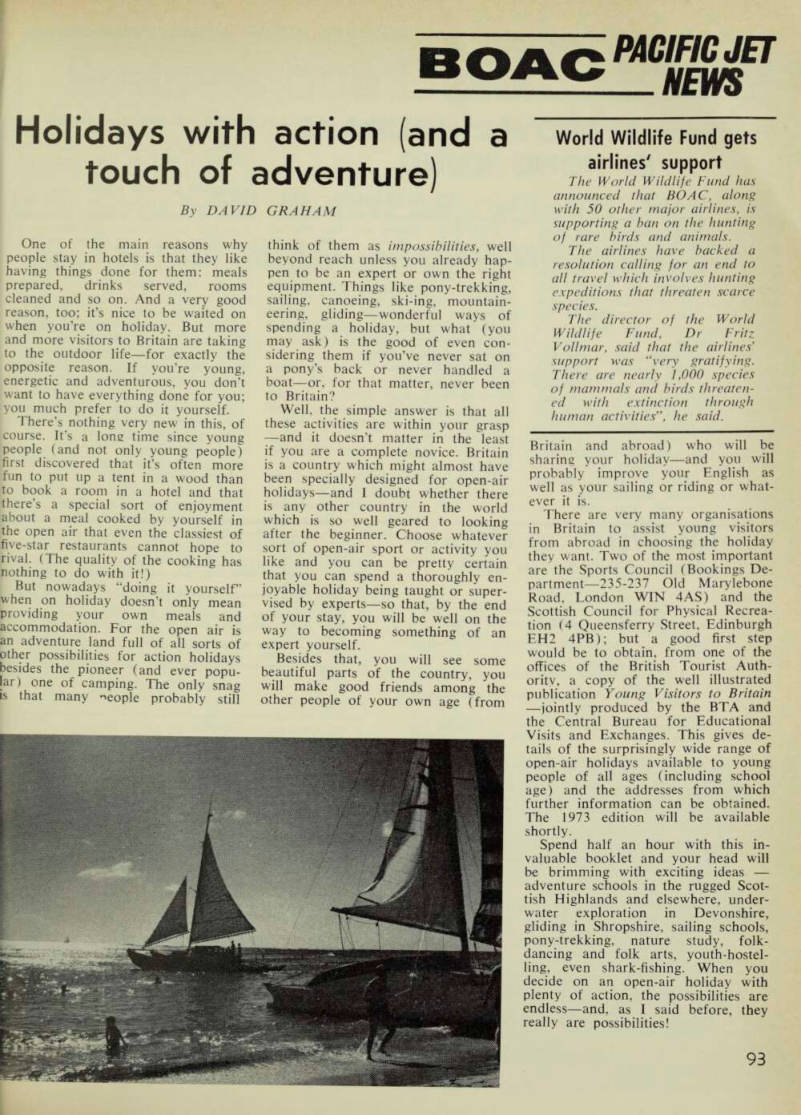
Holidays with action (and a touch of adventure)
By David Graham
One of the main reasons why people stay in hotels is that they like having things done for them: meals prepared, drinks served, rooms cleaned and so on. And a very good reason, too; it’s nice to be waited on when you’re on holiday. But more and more visitors to Britain are taking to the outdoor life—for exactly the opposite reason. If you’re young, energetic and adventurous, you don’t want to have everything done for you; you much prefer to do it yourself.
There’s nothing very new in this, of course. It’s a long time since young people (and not only young people) first discovered that it’s often more fun to put up a tent in a wood than to book a room in a hotel and that there’s a special sort of enjoyment about a meal cooked by yourself in the open air that even the classiest of five-star restaurants cannot hope to rival. (The quality of the cooking has nothing to do with it!) But nowadays “doing it yourself” when on holiday doesn’t only mean providing your own meals and accommodation. For the open air is an adventure land full of all sorts of other possibilities for action holidays besides the pioneer (and ever popu lar) one of camping. The only snag is that many people probably still
think of them as impossibilities, well beyond reach unless you already hap pen to be an expert or own the right equipment. Things like pony-trekking, sailing, canoeing, ski-ing, mountain eering, gliding—wonderful ways of spending a holiday, but what (you may ask) is the good of even con sidering them if you’ve never sat on a pony’s back or never handled a boat—or, for that matter, never been to Britain?
Well, the simple answer is that all these activities are within your grasp —and it doesn’t matter in the least if you are a complete novice. Britain is a country which might almost have been specially designed for open-air holidays—and I doubt whether there is any other country in the world which is so well geared to looking after the beginner. Choose whatever sort of open-air sport or activity you like and you can be pretty certain that you can spend a thoroughly en joyable holiday being taught or super vised by experts—so that, by the end of your stay, you will be well on the way to becoming something of an expert yourself.
Besides that, you will see some beautiful parts of the country, you will make good friends among the other people of your own age (from
Britain and abroad) who will be sharing your holiday—and you will probably improve your English as well as your sailing or riding or what ever it is.
There are very many organisations in Britain to assist young visitors from abroad in choosing the holiday they want. Two of the most important are the Sports Council (Bookings De partment —235-237 Old Marylebone Road, London WIN 4AS) and the Scottish Council for Physical Recrea tion (4 Queensferry Street, Edinburgh EH2 4PB); but a good first step would be to obtain, from one of the offices of the British Tourist Auth ority, a copy of the well illustrated publication Young Visitors to Britain —jointly produced by the BTA and the Central Bureau for Educational Visits and Exchanges. This gives de tails of the surprisingly wide range of open-air holidays available to young people of all ages (including school age) and the addresses from which further information can be obtained.
The 1973 edition will be available shortly.
Spend half an hour with this in valuable booklet and your head will be brimming with exciting ideas adventure schools in the rugged Scot tish Highlands and elsewhere, under water exploration in Devonshire, gliding in Shropshire, sailing schools, pony-trekking, nature study, folk dancing and folk arts, youth-hostel ling, even shark-fishing. When you decide on an open-air holiday with plenty of action, the possibilities are endless—and, as I said before, they really are possibilities!
World Wildlife Fund gets
airlines 7 support
The World Wildlife Fund has announced that BO AC, along with 50 other major airlines, is supporting a ban on the hunting of rare birds and animals.
The airlines have backed a resolution calling for an end to all travel which involves hunting expeditions that threaten scarce species.
The director of the World Wildlife Fund, Dr Fritz Vollmar, said that the airlines’ support was “very gratifying.
There are nearly 1,000 species of mammals and birds threaten ed with extinction through human activities”, he said.
Advertisements & other items, p. 101 (1 item)
BOAC^af
93
Cheap Stopover Holidays
In Hong Kong
Stopover packages in Hong Kong are getting cheaper and cheaper. The latest is a BOAC holiday which gives two nights’ hotel accommodation with private bath or shower, continental breakfast, service charges, transfers airport-hotel-airport by private car, and a half-day sightseeing tour—for as little as SAIB, depending on the hotel you choose. The air fare is extra, of course.
There is a choice of two sightseeing tours for the first of which the coach leaves from the central district.
At the Peak tram station in Garden Road you board the tram for the exhilarating ride to the top of the Peak seeing one of the world’s fabulous panoramic views. Continuing by coach you are taken to a viewpoint overlooking the beautiful Happy Valley racecourse and Wanchai.
Next stop is the Tiger Balm Gar-
dens to see the famous White Pagoda and the grotesque statues in the set ting of exotic plants and then on to Repulse Bay.
The return drive takes you via Deep Water Bay to picturesque Aberdeen, home of thousands of water people who are born, live and die on their junks and sampans in the crowded harbour. The return to central dis trict is by way of Hong Kong Uni versity and West Point.
To start the second tour—of Kow 10911 and the New Territories—you drive along Nathan Road, the main shopping street of Kowloon, enter the New Territories at Boundary Street and continue along Castle Peak Road to the new industrial town of Tsuen Wan.
The tour then follows the coast road with its wonderful views to Castle Peak village, site of one of
Hong Kong’s famous floating restau rants and turns west to pass rice paddies, duck farms and water buf falo to Yuen Long, and then north to Lok Ma Chau for a glimpse across the Chinese border.
From Lok Ma Chau you turn south to Fanling with its three im maculate golf courses and then on to see the sampans and fishing junks of Tai Po and to Shatin in the shadow of the Amah Rock, so called because of its shape resembling a woman holding a child looking out to sea.
Finally you visit a walled village, typical of ancient Chinese grouped houses and pass through the Lion Rock tunnel and back to Waterloo Road, an exclusive residential area leading to the busy centre of Kow loon.
If you’re in more adventurous mood, other tours, including a har bour cruise by Chinese junk or a whole day tour to Macau, can be arranged for you at additional cost.
Want to know more? If you do, a copy of the brochure may be ob tained from any BOAC office.
July
Coming Events In Britain
Some highlights of the next few months
June
2 The Queen's Official Birthday: Trooping the Colour. Horse Guards Parade, London. . . , 5 Son et Lumiere (to October 20, excluding Sundays and Mondays).
St. Paul's Cathedral, London. 6 Horse Racing; The Derby. Epsom, Surrey. n 7 Cricket: Ist Test Match—England v. New Zealand (to 9, 11, 12).
Trent Bridge, Nottingham. . 7 South of England Agricultural Show (incorporating the Richmond Royal Horse Show) (to 9). Ardingly, Sussex. 9 Horse Racing: The Oaks. Epsom, Surrey. 12 Three Counties Agricultural Show (to 14). Malvern, Worcestershire. 13 Grosvenor House Antiques Fair (to 23, excluding Sunday). Grosvenor House, London. . ... 15 York Festival and Mystery Plays (to July 8, excluding Sundays). 16 Aldeburgh Festival of Music and the Arts (to July 3). Aldeburgh, Suffolk. „ . . . 19 Horse Racing: Royal Ascot (to 22). Ascot, Berkshire. 19 Royal Highland Agricultural Show (to 22). Ingliston, near Edinburgh. 21 Cricket: 2nd Test Match—England v. New Zealand (to 23, 25, 26).
Lord's, London. 23 Greyhound Derby. White City, London. 23 Chester Festival and Mystery Plays (to July 8). Chester, Cheshire. 25 Lawn Tennis Championships (tc luly 7). Wimbledon, London. 27 Royal Norfolk Agricultural Show (and 28). Showground, New Cos tessey. Norwich, Norfolk.
July
City of Belfast International Rose Trials (July-September, pro visional. Dixon Park, Belfast. . ... . , . 2 Royal Agricultural Show (to 5). National Agricultural Centre, Kenilworth, Warwickshire. . , x 3 Llangollen International Musical Eisteddfod (to 8). Llangollen, Denbighshire. , ... 4 Henley Royal Regatta (to 7). Henley-on-Thames, Oxfordshire. 5 Cricket: 3rd Test Match—England v. New Zealand (to 7,9, 10).
Headingley, Leeds, Yorkshire. .. 6 Cheltenham Music Festival (to 15). Cheltenham, Gloucestershire 11 Royal Tournament: Displays by the Armed Forces (to 28). Earls Court, London.
11 Golf: Open Championship (to 14). Troon, Ayrshire. 14 Son et Lumiere (to September 22). Royal Observatory, Greenwich, London. . .. 14 Motor Racing: British Grand Prix. Silverstone, Northamptonshire. 17 East of England Agricultural Show (to 19, provisionally). Alwalton, Peterborough. . , ... . 20 Henry Wood Promenade Concerts (to September 15). Royal Albert Hall, London. . , 23 Royal International Horse Show (to 28). Wembley, London. 24 Royal Welsh Agricultural Show (to 26). Llanelwedd, Builth Wells, Breconshire. . 26 Cricket: Ist Test Match—England v. West Indies (to 28, 30, 31).
The Oval, London. . 27 Country Landowners' Association Game Fair (and 28). Abercairny.
Perthshire.
August
6 Royal National Eisteddfod (to 11). Ruthin, Denbighshire. 9 Cricket: 2nd Test Match— England v. West Indies (to 11, 13, 14) Edgbaston, Birmingham, Warwickshire. 17 Edinburgh Military Tattoo (to September 8). Castle Esplanade* 18 Academy Festival Exhibition (to September 16) Royal Scottish Academy, Edinburgh. ... 19 Edinburgh International Festival (to September 8). Edinburgh. 20 Son et Lumiere (to October 18). Bristol Cathedral, Br'stol. 23 Cricket: 3rd Test Match—England v. West Indies (to 25, 27, 28)( Lord's, London.
September
1 Cricket; Gillette Cup Final. Lord's London. 1 Royal Highland Gathering. Braemar Aberdeenshire 5 Cardiff Horticultural Show (to 8). Sophia Gardens Pavilion, Cardiff 8 Whitbread Round-the-World Yacht Race (to early April, 1974).
Start and finish Portsmouth, Hampshire. 15 Horse Racing: St. Leger. Doncaster, Yorkshire. 17 Festival of British Theatre (to October 13). Various venues through! 20 Golf/ Cup: Great Britain v. United States (to 22). Muirfieldt East Lothian.
October
17 International Motor Exhibition (to 27). Earls Court, London.
Advertisements & other items, p. 102 (1 item)
Boac News
94
p fl r PACIFIC JET
PACIFIC ISLANDS MONTHLY —APRIL, 1971
(BOAC Supplement—Advertisement)
Business and Development
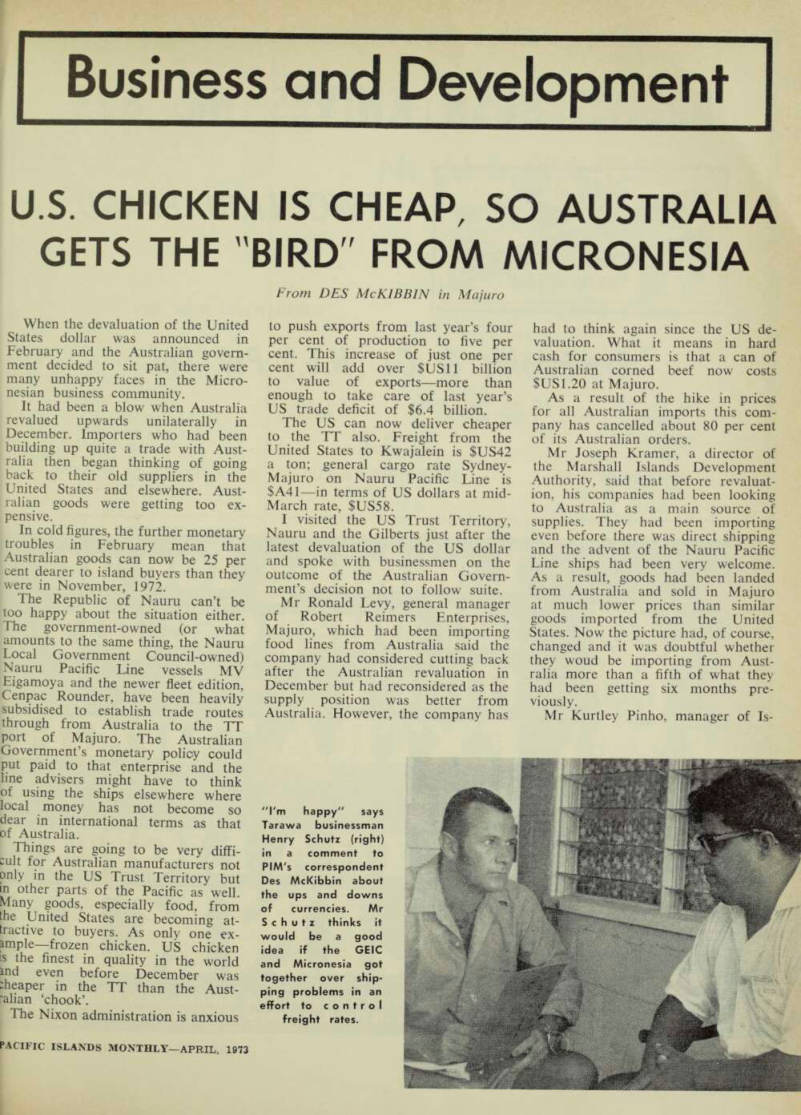

U. S. CHICKEN IS CHEAP, SO AUSTRALIA
Gets The "Bird" From Micronesia
From DES McKIBBIN in Majuro
When the devaluation of the United States dollar was announced in February and the Australian govern ment decided to sit pat, there were many unhappy faces in the Micro nesian business community.
It had been a blow when Australia revalued upwards unilaterally in December. Importers who had been building up quite a trade with Aust ralia then began thinking of going back to their old suppliers in the United States and elsewhere. Aust ralian goods were getting too ex pensive.
In cold figures, the further monetary troubles in February mean that Australian goods can now be 25 per cent dearer to island buyers than they were in November, 1972.
The Republic of Nauru can’t be too happy about the situation either.
The government-owned (or what amounts to the same thing, the Nauru Local Government Council-owned) Nauru Pacific Line vessels MV Eigamoya and the newer fleet edition, Cenpac Rounder, have been heavily subsidised to establish trade routes through from Australia to the TT port of Majuro. The Australian Government’s monetary policy could put paid to that enterprise and the line advisers might have to think of using the ships elsewhere where local money has not become so dear in international terms as that of Australia.
Things are going to be very diffi cult for Australian manufacturers not only in the US Trust Territory but m other parts of the Pacific as well.
Many goods, especially food, from the United States are becoming at tractive to buyers. As only one ex ample—frozen chicken. US chicken is the finest in quality in the world and even before December was cheaper in the TT than the Aust ralian ‘chook’.
The Nixon administration is anxious
to push exports from last year’s four per cent of production to five per cent. This increase of just one per cent will add over SUSII billion to value of exports—more than enough to take care of last year’s US trade deficit of $6.4 billion.
The US can now deliver cheaper to the TT also. Freight from the United States to Kwajalein is SUS 42 a ton; general cargo rate Sydney- Majuro on Nauru Pacific Line is SA41 —in terms of US dollars at mid- March rate, SUSSB.
I visited the US Trust Territory, Nauru and the Gilberts just after the latest devaluation of the US dollar and spoke with businessmen on the outcome of the Australian Govern ment’s decision not to follow suite.
Mr Ronald Levy, general manager of Robert Reimers Enterprises, Majuro, which had been importing food lines from Australia said the company had considered cutting back after the Australian revaluation in December but had reconsidered as the supply position was better from Australia. However, the company has
had to think again since the US de valuation. What it means in hard cash for consumers is that a can of Australian corned beef now costs SUSI.2O at Majuro.
As a result of the hike in prices for all Australian imports this com pany has cancelled about 80 per cent of its Australian orders.
Mr Joseph Kramer, a director of the Marshall Islands Development Authority, said that before revaluat ion, his companies had been looking to Australia as a main source of supplies. They had been importing even before there was direct shipping and the advent of the Nauru Pacific Line ships had been very welcome.
As a result, goods had been landed from Australia and sold in Majuro at much lower prices than similar goods imported from the United States. Now the picture had, of course, changed and it was doubtful whether they woud be importing from Aust ralia more than a fifth of what they had been getting six months pre viously.
Mr Kurtley Pinho, manager of Is-
"I'm happy" says Tarawa businessman Henry Schutz (right) in a comment to
PIM's correspondent
Des McKibbin about the ups and downs of currencies. Mr Schutz thinks it would be a good idea if the GEIC and Micronesia got together over ship ping problems in an effort to control freight rates.
land Construction Co, which distri butes machinery, building material and hardware said that his company “had been caught with its pants down.” A large steel consignment of high-value cargo like stainless steel sinks and generating equipment, was on the water at the time of the US devaluation and it was going to be impossible to pass on all the price increase to customers. He said that, as an example, it was unrealistic to expect anyone to pay $6O for a sink when a competitor down the road was selling a similar product, but made in the US, for $5O. He had cancelled all outstanding orders in Australia.
There was talk in the Trust Terri tory of placing a local ship on the Australia-TT run. This would help to some extent as a TT or US-based charter could be paid for in US dollars. Although this might be a partial solution for Australian sup pliers, the prospect is not likely to make the owners of the Nauru Pacific Line very happy.
I found that the only person in the Micronesian area who was happy with the various revaluations and de valuations was Mr Henry Schutz, of Schutz and Wilder, whose headquarters are at Tarawa, in the Gilberts. He has been trying to open a shipping service between the Gilberts and the Mar shalls. He said that already some Australian goods were cheaper when obtained through Trust Territory than when shipped direct to Tarawa. If they could get together with the Micronesians they could control their own freight rates.
He thought the United States, in an effort to get some of its own dollars back from the TT where the budget now totals $7O million plus, would subsidise freight rates to one port in the Trust Territory rather than to all TT ports as the territory was spread out over three million square miles of ocean. He could see that one port becoming a distri bution port for the whole area, tran hipping goods from the United States, Australia, China, Taiwan (which ms the cheapest cement in the vorld), Japan, and others. At the ame time, the Trust Territory itself lad big plans for local shipping and he funds available to see them hrough. I think the Gilberts and the "rust Territory should be closely issociated in the future, for their (Ritual benefit. • Ninety-five Corriedale and tomney Marsh sheep from Australia KiH k e used in research at Bena Bena ivestock station, near Goroka, PNG, 3 see if they can provide another ource of meat.
Advertisements & other items, pp. 104-106 (2 items)
_ Klinkii
BREWO BUSH KNIVES No. 625
—SUPERIOR
\ DUAL it:/ .
IJK
T INSUPERABLE
mo LION BRAND
exclusively sold by:
Breckwoldt & Co. Pty. Ltd.
P.O. Box 222,
RABAUL
P.O. Box 72,
KIETA.
P.O. Box 1549, Boroko,
PORT MORESBY.
P.O. Box 237,
MT. HAGEN.
P.O. Box 185,
MADANG.
BRECKWOLDT & CO.
P.O. Box 47, APIA.
BRECKWOLDT S.A.R.L
B.P. 65, NOUMEA.
P.O. Box 1188,
LAE.
P.O. Box 178,
WEWAK.
BRECKWOLDT & CO. (5.1.) LTD
P.O. Box 140. HONIARA.
Looking for an all-purpose ply that*s
EXTRA TOUGH
but
EXTRA LIGHT?
KLINKII
Made by Commonwealth New Guinea Timbers Ltd, Gumea pA Available from plywood suppliers in the Territory & Pacific area firi *4
FIJI ISLANDS
NEW HEBRIDES
. . . International Hotel Group Development of Hotels at Fiji . . . Nadi, Suva, Coral Coast New Hebrides . . . Port Vila . . . Investment possibilities available • • • To receive our free Brochure
SOUTH PACIFIC FINANCIAL AND
MANAGEMENT LTD.,
167 MACQUARIE STREET,
14TH FLOOR,
SYDNEY, 2000, AUSTRALIA.
TS.C ELECTRONIC
SYSTEM
WILL MOVE YOUR VEHICLE
INTO THE SPACE AGE
Leading overseas motor manufacturers are installing electronic ignition to improve the performance of their special models.
• TS.C WILL GUARANTEE AN EXCEPTIONALLY
GOOD START IN ALL CONDITIONS • WILL REDUCE PETROL CONSUMPTION UP TO 15% • WILL KEEP YOUR POINTS, SPARK PLUGS AND BATTERY IN TOP CONDITION • WILL RELIEVE THE NEED FOR
TUNE UPS • WILL REDUCE POLLUTION.
When ordering please specify battery ground polarity and voltage.
Please complete coupon for complete 1
details. BUYING AGENT ENQUIRIES 1 NAME
WELCOMED.
IGNITION
PRICE:
SA34 plus postage (weight 1 lb.)
K.B. ELECTROPLASTICS, ADDRKS
3 Angophora Crescent, Forestville, N.S.W., Aust. 2087. Phone 451-4101.
"I I
11 "**•- X / /> ■
New Kodak
pocket Listamatic
camera
The little camera for big pictures
❖ Camera measures: 4 1 /2 x 2 x 1 Small enough to slip into your pocket. Light enough to carry anywhere. So simple to use—just drop in the new 1 iodize film cartridge, aim. and shoot. Yet it takes big 3V2 x 4Vi co or pictures. Choose from the range of five new Kodak pocket Instamatic camera outfits —each complete with w r, st strap, Kodacolor II film, magicube and instructions. There s one priced to suit your pocket. See your local Island photo dealer.
KODAK (Australasia) PTY. LTD.
K6l/4391
97
ACIFIC ISLANDS MONTHLY—APRIL, 1973
Western Samoa
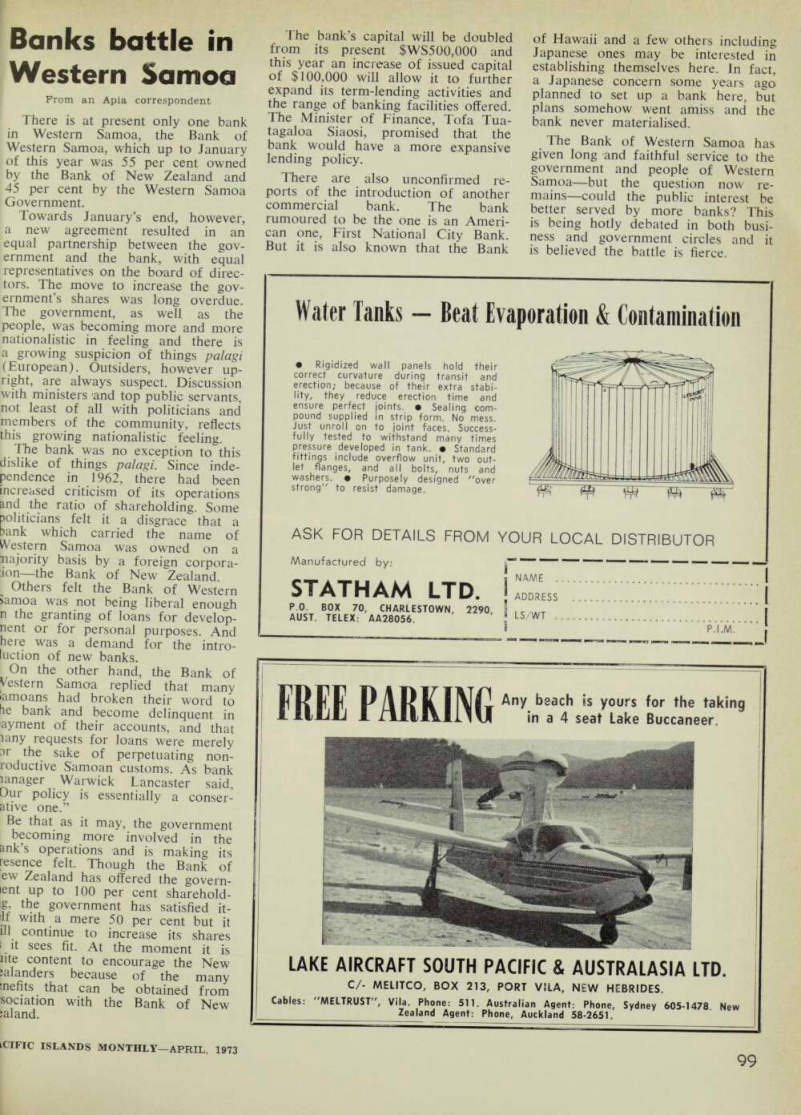
Banks battle in Western Samoa
From an Apia correspondent There is at present only one bank in Western Samoa, the Bank of Western Samoa, which up to January of this year was 55 per cent owned by the Bank of New Zealand and 45 per cent by the Western Samoa Government.
Towards January’s end, however, a new agreement resulted in an equal partnership between the gov ernment and the bank, with equal representatives on the board of direc tors. The move to increase the gov ernment’s shares was long overdue.
The government, as well as the people, was becoming more and more nationalistic in feeling and there is a growing suspicion of things palagi (European). Outsiders, however up right, are always suspect. Discussion with ministers and top public servants, not least of all with politicians and members of the community, reflects this growing nationalistic feeling.
The bank was no exception to this dislike of things palagi. Since inde pendence in 1962, there had been increased criticism of its operations and the ratio of shareholding. Some politicians felt it a disgrace that a bank which carried the name of Western Samoa was owned on a najority basis by a foreign corpora ion—the Bank of New Zealand.
Others felt the Bank of Western >amoa was not being liberal enough n the granting of loans for develop nent or for personal purposes. And here was a demand for the intro luction of new banks.
On the other hand, the Bank of Vestern Samoa replied that many amoans had broken their word to be bank and become delinquent in ayment of their accounts, and that lany requests for loans were merely 3r the sake of perpetuating non roductive Samoan customs. As bank lanager Warwick Lancaster said, Our policy is essentially a conser ative one.”
Be that as it may, the government becoming more involved in the ank’s operations and is making its resence felt. Though the Bank of ew Zealand has offered the govern ient up to 100 per cent sharehold g, the government has satisfied it 'll with a mere 50 per cent but it ill continue to increase its shares 1 it sees fit. At the moment it is nte content to encourage the New ✓slanders because of the many snefits that can be obtained from sociation with the Bank of New Jaland.
The bank s capital will be doubled from its present SWSSOO,OOO and “ inc :!'f as f, of i ssu ed capital of S 100,000 will allow it to further expand its term-lending activities and me range of banking facilities offered. 1 he Minister of Finance, Tofa Tuatagaloa Siaosi, promised that the bank would have a more expansive lending policy rn, , „ There are also unconfirmed reports of the introduction of another commercial bank. The bank rumoured to be the one is an American one, First National City Bank.
But it is also known that the Bank
of Hawaii and a few others including Japanese ones may be interested in establishing themselves here. In fact, a Japanese concern some years ago planned to set up a bank here but plans somehow went amiss and the bank never materialised f ... 4 • , Bank ? f f u e r st ? rn Samoa has glven long and faithful service to the government and people of Western Samoa—but the question now re mains—could the public interest be better served by more banks? This is being hotly debated in both busi ness and government circles and it is believed the battle is fierce.
Advertisements & other items, p. 107 (2 items)
99
LCIFIC ISLANDS MONTHLY—APRIL, 1973
J Address
Water Tanks - Beat Evaporation & Contamination • Rigidized wall panels hold their correct curvature during transit and erection; because of their extra stability, they reduce erection time and ensure perfect joints. • Sealing compound supplied in strip form. No mess.
Just unroll on to joint faces. Successfully tested to withstand many times pressure developed in tank. • Standard fittings include overflow unit, two outlet flanges, and all bolts, nuts and washers. • Purposely designed "over strong" to resist damage.
ASK FOR DETAILS FROM YOUR LOCAL DISTRIBUTOR Manufactured by;
STATHAM LTD.
PO. BOX 70, CHARLESTOWN
AUST. TELEX. AA28056.
2290,
J NAME
j ADDRESS
I LS/WT
\ P.V.M.
mP K JIVC A °y bBach 5s y° urs for the taking 1 rllllllilU in a 4 seat Lake Buccaneer ■ LAKE AIRCRAFT SOUTH PACIFIC & AUSTRALASIA LTD.
CA MELITCO, BOX 213, PORT VILA, NEW HEBRIDES.
Cables: "MELTRUST", Vila. Phone: 511. Australian Agent: Phone, Sydney 605-1478 New Zealand Agent: Phone, Auckland 58-2651.
The Norfolk Haven-Seekers
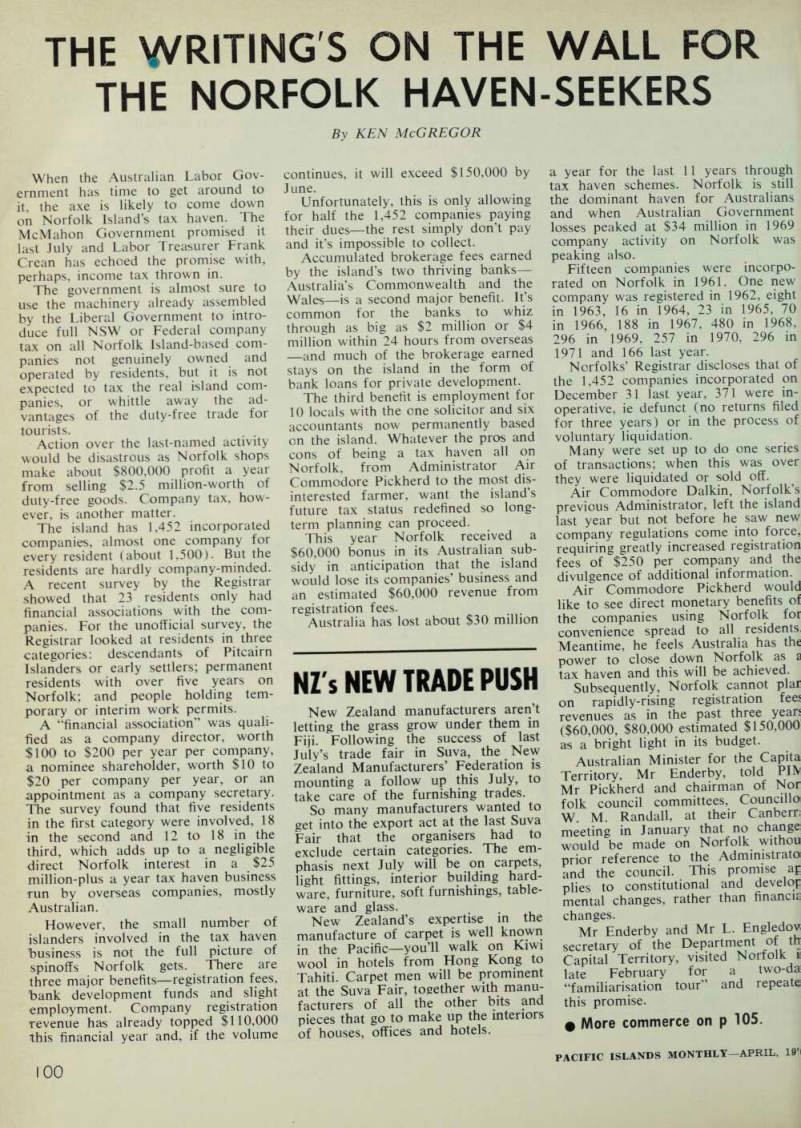


The Writing's On The Wall For
By Ken Mcgregor
When the Australian Labor Gov ernment has time to get around to it, the axe is likely to come down on Norfolk Island’s tax haven. The McMahon Government promised it last July and Labor Treasurer Frank Crean has echoed the promise with, perhaps, income tax thrown in.
The government is almost sure to use the machinery already assembled by the Liberal Government to intro duce full NSW or Federal company tax on all Norfolk Island-based com panies not genuinely owned and operated by residents, but it is not expected to tax the real island com panies, or whittle away the ad vantages of the duty-free trade for tourists.
Action over the last-named activity would be disastrous as Norfolk shops make about $BOO,OOO profit a year from selling $2.5 million-worth of duty-free goods. Company tax, how ever, is another matter.
The island has 1,452 incorporated companies, almost one company for every resident (about 1,500). But the residents are hardly company-minded.
A recent survey by the Registrar showed that 23 residents only had financial associations with the com panies. For the unofficial survey, the Registrar looked at residents in three categories: descendants of Pitcairn Islanders or early settlers; permanent residents with over five years on Norfolk; and people holding tem porary or interim work permits.
A “financial association” was quali fied as a company director, worth $lOO to $2OO per year per company, a nominee shareholder, worth $lO to $2O per company per year, or an appointment as a company secretary.
The survey found that five residents in the first category were involved, 18 in the second and 12 to 18 in the third, which adds up to a negligible direct Norfolk interest in a $25 million-plus a year tax haven business run by overseas companies, mostly Australian.
However, the small number of islanders involved in the tax haven is not the full picture of spinoffs Norfolk gets. There are three major benefits —registration fees, Fank development funds and slight employment. Company registration revenue has already topped $llO,OOO this financial year and, if the volume
continues, it will exceed $150,000 by June.
Unfortunately, this is only allowing for half the 1,452 companies paying their dues —the rest simply don’t pay and it’s impossible to collect.
Accumulated brokerage fees earned by the island’s two thriving banks— Australia’s Commonwealth and the Wales —is a second major benefit. It’s common for the banks to whiz through as big as $2 million or $4 million within 24 hours from overseas —and much of the brokerage earned stays on the island in the form of bank loans for private development.
The third benefit is employment for 10 locals with the one solicitor and six accountants now permanently based on the island. Whatever the pros and cons of being a tax haven all on Norfolk, from Administrator Air Commodore Pickherd to the most dis interested farmer, want the island’s future tax status redefined so long term planning can proceed.
This year Norfolk received a $60,000 bonus in its Australian sub sidy in anticipation that the island would lose its companies’ business and an estimated $60,000 revenue from registration fees.
Australia has lost about $3O million
a year for the last 11 years through tax haven schemes. Norfolk is still the dominant haven for Australians and when Australian Government losses peaked at $34 million in 1969 company activity on Norfolk was peaking also.
Fifteen companies were incorpo rated on Norfolk in 1961. One new company was registered in 1962, eight in 1963, 16 in 1964, 23 in 1965, 70 in 1966, 188 in 1967, 480 in 1968, 296 in 1969, 257 in 1970, 296 in 1971 and 166 last year.
Ncrfolks’ Registrar discloses that of the 1,452 companies incorporated on December 31 last year, 371 were in operative, ie defunct (no returns filed for three years) or in the process of voluntary liquidation.
Many were set up to do one series of transactions; when this was over they were liquidated or sold off.
Air Commodore Dalkin, Norfolk’s previous Administrator, left the island last year but not before he saw new company regulations come into force, requiring greatly increased registration fees of $250 per company and the divulgence of additional information.
Air Commodore Pickherd would like to see direct monetary benefits of the companies using Norfolk for convenience spread to all residents, Meantime, he feels Australia has the power to close down Norfolk as a tax haven and this will be achieved.
Subsequently, Norfolk cannot plar
on rapidly-rising registration fees
revenues as in the past three yean ($60,000, $BO,OOO estimated $150,000 as a bright light in its budget.
Australian Minister for the Capita Territory, Mr Enderby, told PIN Mr Pickherd and chairman of Nor folk council committees, Councillo W. M. Randall, at their Canberr: meeting in January that no change; would be made on Norfolk withou prior reference to the Administrate* and the council. This promise ap plies to constitutional and develop mental changes, rather than financis changes.
Mr Enderby and Mr L. Engledov secretary of the Department of th Capital Territory, visited Norfolk u late February for a two-da “familiarisation tour” and repeats this promise.
• More commerce on p 105.
111 winds blew
but Carpenters
lifted profit
W. R. Carpenter Holdings Ltd overcame a number of adverse, and diverse, factors to lift net profit by 4.65 per cent in the six months to December 31, 1972, compared with the corresponding period in 1971.
The result also reflected the shift in emphasis from Island trading to Aus tralian investment, but this was accentuated by drought and hurri cane in the Islands. Australian operations earned about 52 per cent of the net profit, compared with 40.5 per cent of the profit in the first six months of 1971-72.
The Papua New Guinea contribu tion to net profit dropped from 21.3 per cent to less than 15 per cent be cause drought caused a temporary recession in trading. There was also a reduction in tea, cocoa and copra crops, and to cap everything from that area, there was a new dividend tax.
Hurricane Bebe, which swept through Fiji in October, disrupted trading for several weeks. Fiji, like Papua New Guinea, also suffered lower world prices for produce. Re valuation of the Australian dollar caused a further reduction in profits from Fiji.
But, to put a little cream on what sounds like a cup of woe, the Car penter board expects results for the full year to be up to the 1971-72 level of about $7.05 million. The interim dividend is a steady 5c a share.
All quiet on
the dollar front
The international money scene was fairly quiet in March, allowing Pacific Islands trade a breathing space following the December re valuation of the Australian dollar and the February devaluation of the US dollar. The main produce markets changed slightly, with a buoyant demand for copra falling away towards the end of March and cocoa rising.
One of the most dramatic effects of the currency moves was what was described as a “fluctuation gain” for the company of $15,999,319 by the chairman of Bougainville Copper, Mr Frank Espie, in the company’s annual report. This flowed from the December revaluation of the Aus tralian dollar. But US dollar cash
balances held at the time of re valuation cost the company $376,257.
In Fiji the Finance Minister, Mr Charles Stinson, said that unless the imbalance of trade between Fiji and Australia changed, or if there was an Australian devaluation (both of which seemed unlikely), Fiji would have no alternative but to look elsewhere for many of her imports.
An interesting sidelight of the cur rency moves was the effect on Aus tralian visitors to Fiji. Tourists will have more Fiji money to spend there for the same number of Australian dollars and will be able to buy more.
But with the Japanese yen floating
higher and with the Australian revaluation, Fiji hoteliers and traders have to pay more for imports to cater for tourists’ wants. Hotel meals will cost more, and traders may have to put up the price of cameras, transistors, tape recorders, etc to retain their markups. The Australian tourist may be little better off. x VT TT . •. r In the New Hebrides, following revaluation of the Australian dollar, the businessmen of Vila have formed an association so that they can jointly consider financial problems and look after their own interests. The as sociation hopes to bring together 500 traders for discussions.
Fiji plans anti-strike
legislation
New laws giving the Fiji Labour Minister wider powers to ban strikes, bringing more industries into the “essential industries” net and giving the court power to gaol union leaders for inciting illegal strikes are being drafted by the Fiji Government. But the draft bill, still being considered by cabinet, was supposed to be “top secret”—until The Fiji Times ob tained a copy secretly and jumped the gun. Publication caused contio versy.
Trade unionists met to consider ways to oppose the bill and Aus tralian Waterside Workers’ Federation assistant general secretary Mr Nor man Docker accused the Fiji Govern ment of attempting to infringe the democratic rights of the Fiji workers.
He said he hoped that, in mature reflection, the Fiji Government wouid recognise that such legislation would “not only be a cause in itself of additional industrial dispute in Fiji, but would severely tarnish the image of the Fiji Government throughout the world”.
The Fiji Government planned the proposed new drastic action because of the current proliferation of wildcat strikes in Fiji, particularly in the air ine, transport, fuel supply and build ng industries. Airlines have been iverflying Nadi on occasions, thus iffecting the vital tourist industry. In tfarch, building workers throughout he dominion had embarked on a trike which halted almost all Fiji
milding operations.
Prices are increasing rapidly in Fiji, specially in imported foodstuffs.
PNG's talks
*ith Kennecott
The PNG Government is expected 3 open negotiations within the next aur months with the big American fining company Kennecott Pacific ver the mining of rich copper eposits at Ok Tedi in the Star fountains. But, first, the government ill seek advice from Peru, which as open pit copper workings and an Sreement with another US company, erro Corporation, which gives Peru large share of the profits. PNG ants to know about the possibilities, >pecially as it is not so happy about ie Bougainville agreement. Kenne )tt has spent about $l5 million on ospecting at Ok Tedi and wants isurances from the government >out profits before spending another ) million on the next stage. The ore idy is estimated at between 150 and
200 million tons averaging 0.8 per cent copper. Bougainville copper has an ore body of 900 million tons averaging 0.48 per cent copper.
Island for sale
Three million dollars is reported to be the asking price for the Fiji island of Malololailai off Nadi on which has been built the Plantation Village resort. The island was put up for sale in late March.
One of the Malolo group, the island is controlled by a syndicate which includes well-known resort owner Dick Smith, who operates the Castaway Hotel four miles away on another island off Viti Levu’s north west coast.
BP's profit rises
Estimated consolidated profit after tax for Burns Philp & Co Ltd for the half-year to December’s end com pared with the second half of 1971 rose by 6.1 per cent and group sales increased by 25.2 per cent for the same period. The company’s share of profits from the Australian and NZ operations increased to 56 per cent against 43 per cent for the same period in 1971. Return from New Guinea operations was adversely affected by the sale of 12i per cent interest in the New Guinea company to the PNG Investment Corporation and the introduction of a withholding tax of 15 per cent on dividends.
Nz's New Trade Push
New Zealand manufacturers aren’t letting the grass grow under them in Fiji. Following the success of last July’s trade fair in Suva, the New Zealand Manufacturers’ Federation is mounting a follow up this July, to take care of the furnishing trades.
So many manufacturers wanted to get into the export act at the last Suva Fair that the organisers had to exclude certain categories. The em phasis next July will be on carpets, light fittings, interior building hard ware, furniture, soft furnishings, table ware and glass.
New Zealand’s expertise in the manufacture of carpet is well known in the Pacific—you’ll walk on Kiwi wool in hotels from Hong Kong to Tahiti. Carpet men will be prominent at the Suva Fair, together with manu facturers of all the other bits and pieces that go to make up the interiors of houses, offices and hotels.
Advertisements & other items, pp. 109-115 (2 items)
(Dpioimeer
Notes with the purity of a nightingale’s call or the depth of a bullfrog’s complaint. This magnificent little cassette deck reproduces all, and better, because it has Dolby.'Dolby; An incredibly effective noise reduction system that makes natural sounds leap from the deck, especially with new chromium dioxide tape. It makes everything you record seem super-realistic like looking through a highly polished mirror.
Other sets have Dolby. But other sets don’t have the name Pioneer and extra quality features that go with the name. On the CT-4141 there’s a selector for your special chrome tapes. There’s automatic stop at tape-end in all tape travel functions. And there’s an ultra-smooth ferrite solid head (it just lasts and lasts).
We could go on and on, but your best bet is to flip on the CT-4141 at the nearest Pioneer dealers. & © C/ © <3
(Dpioimeer
Brijlal & Company, G.P.O. Box No. 362, Suva. Fiji Islands Tel; 222 58 Astronics Australasia Pty. Ltd. 161-173 Sturt Street, South Melbourne, Victoria 3205 Australia Hagemeyer (Australasia) N.V. P.O. Box No. 90, Lae, New Guinea Tel: 2718 P.O. Box No. 63, Rabaul, New Guinea Tel: 2633 P.O. Box No. 673, Madang, T.P.N.G. Tel: 2445 P.O. Box 1428, Boroko, Port Moresby. New Guinea Tel; 5784 Tee Vee Radio Ltd. P.O. Box No. 5029, Auckland, New Zealand Tel: 763-064 Burns Philp (South Sea) Co. Ltd. Norfolk Islands, South Pacific Jacob Enterprises, P.O. Box No. 4, Nauru Island Ets. PERFECT, B.P. 594, Papeete,Tahiti Tel: 20 407 Menard Freres, B.P. 123, Noumea, New Caledonia Tel: 52-22 Transpac Corporation, P.O. Box 1477, Pago Pago, American Samoa 96799 Tel; 2227 •T* “DOLBY” is a trade mark of DOLBY LABORATORIES INC.
Kenwood Makes Your Home
a Home
3r minute information.
T-i i 1 1 1 KP-2022 KA-4004 Bring concert hall sounds into your home with this powerful hi-fi system. Music makes the home. And Kenwood can help you create a new world of sound with this decor-blending music system.
Consider the following Kenwood suggestions: KA-4004: 95-watt (IHF 4 ohms) Stereo Amplifier incorporates Direct Coupling Circuitry and other technological advances; KP-2022: Belt-drive Stereo Turntable with auto-return/auto-cut mechanism and 4-pole synchronous motor; KL-3090: Bass Reflex Type 35-watt 2-way 2-speaker system designed for most sensitive sound reproduction. the sound approach to quality rite to: P-SECTION, TRIO ELECTRONICS, INC. 6-17, 3-chome, Aobadai, Meguro-ku,Tokyo, Japas
We put off today...
what others leave
until tomorrow!
This is due to side-port, unit-loading—a fast, efficient, safe way to handle cargo. Our 4 ships, “New Guinea Chief,” “Island Chief,” “Coral Chief,” and “Papuan Chief,” are specially designed for side-port unit-loading, and to save ‘turn around’ time in port they carry their own ‘on board’ forklifts to speed the loading and discharge procedure. If you would like to see how side-port unitloading can save you money on our Sydney, Brisbane, Port Moresby, Samarai, Lae, Madang, Rabaul, Kavieng, Kieta and Honiara services let us show you our 20 minute film “Cargo Revolution” ... and you will see how we can “put off today what others leave until tomorrow”.
New Guinea Australia Line Pty.Ltd
Member of the Swire Group * General Agents: PORT MORESBY—Steamships Trading Co. Ltd. SYDNEY—Swire & Gilchrist Pty Ltd Agents at: BRISBANE— W||| s, Gilchrist & Sanderson Pty. Ltd. PAPUA-NEW GUlNEA—Steamships Trading £°Vn Id a f0 o .JewGmnea Chief” at Rabaul and “Island Chief” at Kavieng—Burns Philp (N.G.) Ltd.)!
HONlARA—British Solomons Trading Co.
W X * 0™
SGO32
4 *1 I m - 2S ! 3$
PETER FISHER TRADING
PTY. LTD.
321 PITT STREET, SYDNEY, 2000, AUSTRALIA
TELEPHONE: 26-1109 CABLES: "FISHERION", SYDNEY
EXPORTERS TO THE PACIFIC
ISLANDS
Some of the firms and products we represent: GREEN LIGHT matches RED HEAD matches AAAURI BROS, yeast PMU food products TOOHEYS beer FRENCH KNIT car seat covers FRENCH KNIT ladies beachwear THREE STAR corned beef
CRAVEN confectionery
BROWNBUILT office furniture ADVANCE containers HARDIE'S building products SEBEL furniture BEARD beds and mattresses HUNTER DOUGLAS furniture KLINKII plywood STERLING bakery machinery WHITE ABBEY Scotch whisky BATA shoes SPC tinned fruit LIFESAVERS confectionery UNIVERSAL corned beef CHILTONIAN biscuits ATLAS plastic ware POLARIS stainless steel ware RENA tinned vegetables WALKER frozen meat BOND'S underwear BOND'S outerwear ANDY spotlights COUNTRY CLUB shirts WILLOW metal ware FILLETTA tinned fish PAULCALL tools PAULCALL woodcutting machinery ASTRA razor blades WENGER quality knives GLYNGORE tinned fish VAN DER LAAN tinned meat DEROPA gift paper WARBURTON FRANKI coolrooms DURABUILT prefabricated houses THREE X (XXX) tinned hake BRONTE tinned meat HEINE KEN beer LUCKY STAR tinned pilchards and sardines
AND MANY MORE
Supplying butcher’s knives, cooks’ knives, sheath knives and pocket knives from Switzerland, Sweden, Norway, Finland and other countries.
Machettes and bush knives from Portugal, Spain and other countries.
Save hundreds of dollars
on Australians most efficient
WALK IN, ALUMINIUM
COOLROOMS AND
FREEZE ROOMS
Hundreds already installed! The most economical supplementary coolrooms for bottles and food, providing the largest storage capacity of any comparable coolrooms of the same exterior dimensions. Five sizes —from 90-360 cu. ft. capacity; 16 models offering normal temp., two temp., deep freeze, or for pastry and ice slorage applications. White vinyl interior, embossed rustproof aluminium exterior. • SUPPLIED IN EASY-TO-ERECT, DO-IT-YOURSELF KIT FORM • PETROL AND PETROL-ELECTRIC MODELS ARE AVAILABLE FOR AREAS WHERE POWER IS LIMITED OR NON-EXISTENT Available from: AUSTRALIAN NEW CALEDONIA EXPORTS (SILVER & BARDA), 363 George St., Sydney, 2000 and Branches.
BRECKWOLDT & CO., 276 Pitt St., Sydney, 2000 and Branches.
PETER FISHER TRADING PTY. LTD., 321 Pitt St., Sydney, 2000.
HAGEMEYER (A'SIA), 59 Anzac Pde., Kensington, 2033 and Branches.
MILLERS LIMITED, Thompson St., Suva, Fiji.
Manufactured by:
NELSON & ROBERTSON PTY. LTD., 197 Clarence St., Sydney. 2000.
RABAUL TRADING CO. PTY. LTD., P.O. Box 219, Rabaul and Branches.
ROY GALLIMORE & ASSOCIATES, P.O. Box 179, Vila, New Hebrides.
S.E. TATHAM & CO. PTY. LTD., 364 Lonsdale St., Melbourne, 3000 and Branches. , .
C. SULLIVAN (EXPORT) PTY. LTD., 60 Margaret St., Sydney, 2000 and Branches. , „ , „„ W. S. TAIT & CO. PTY. LTD., 31 Macquarie Place, Sydney, 2000 and Branches.
<srj WARBURTON FRANK!
199 Parramatta Road, Cnr. Skarratt Street, Auburn, N.S.W. 2144, Australia. Phone; 643-1711.
Powered by Kelvinator.
Five-year warranty on compressor. Early livery.
Continually growing
in popularity
HELLABY’S CANNED MEATS
‘CROWN’
‘PACIFIC’ SIS
‘ARROW’
V/*
KERR RROS. THE VETO* PEOPEI
FOR THE PACIFIC ISLANDS
*s "Hm*
YOU'LL SPREAD A LOAD MORE ACCURATELY
WITH THE VICON VARI/SPREADER
And with the Vari/Spreader it is accuracy built to last—the use of corrosion resistant materials sees to that. • Strong, rust free, easy to clean hopper, moulded from glass fibre reinforced polyester. • Stainless steel regulating plate. • Polyester spreading bowl. • Stainless steel spout.
“Versatility" is the right word for the Vicon Vari/Spreader. It broadcasts fertilisers, grain, grass and clover seeds all with equal guaranteed precision. • Spreads as little as 5 lb of grass seed per acre t 2,500 lb per acre of fertiliser. • P.T.O. driven. • Effective spreading witli up to 24 ft.
MAKE THE VARI/SPREADER YOUR CHOICE FOR
LONG DISTANCE ACCURACY
For further information contact:
KERR BROTHERS PTY. LIMITED
65 YORK STREET, SYDNEY, N.S.W. 2000.
107
ACIFIC ISLANDS MONTHLY—APRIL, 1973
Produce Prices
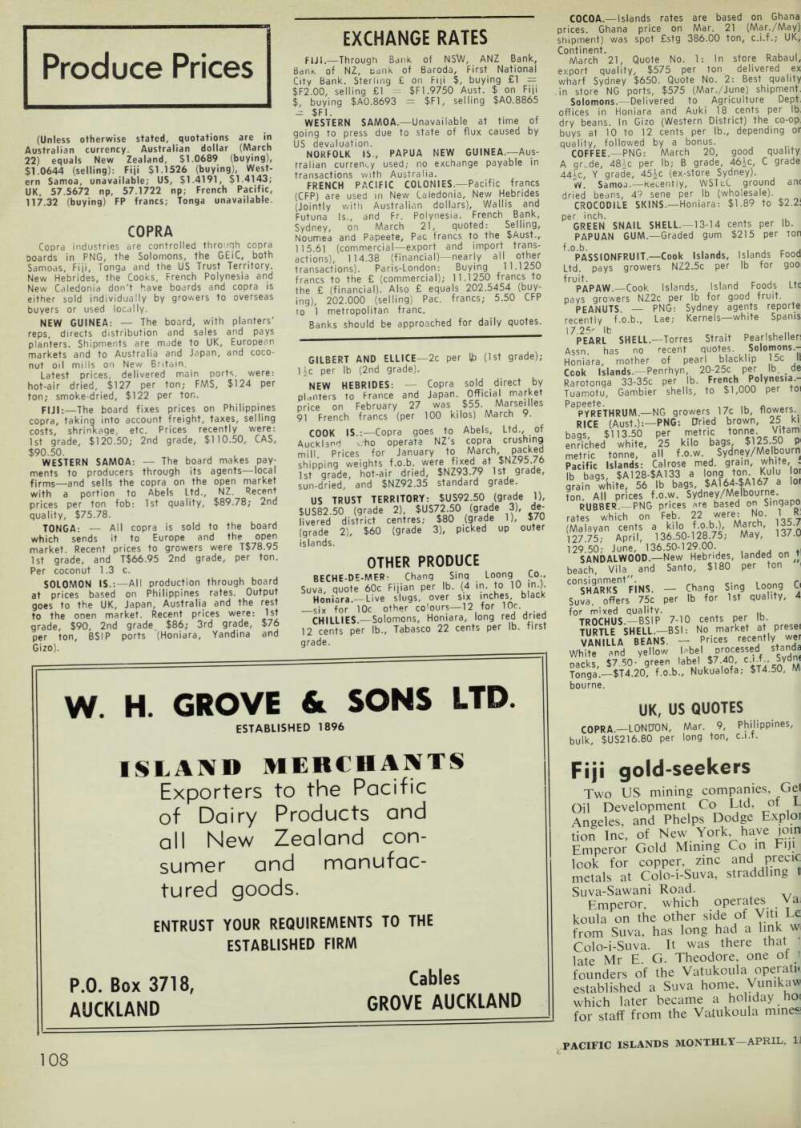
(Unless otherwise stated, quotations are in Australian currency. Australian dollar (March 22) equals New Zealand, 51.0689 (buying), $1.0644 (selling): Fiji $1.1526 (buying), West ern Samoa, unavailable; US, $1.4191, $1.4143; UK, 57.5672 np, 57.1722 np; French Pacific, 117.32 (buying) FP francs; Tonga unavailable.
Copra
Copra industries are controlled through copra boards in PNG, the Solomons, the GEIC, both Samoas, Fiji, Tonga and the US Trust Territory.
New Hebrides, the Cooks, French Polynesia and New Caledonia don't have boards and copra is either sold individually by growers to overseas buyers or used locally.
NEW GUINEA: The board, with planters' reps, directs distribution and sales and pays planters. Shipments are made to UK, European markets and to Australia and Japan, and coco nut oil mills on New Britain.
Latest prices, delivered main ports, were: hot-air dried, $127 per ton; FMS, $124 per ton; smoke-dried, $122 per ton.
F|j| : —The board fixes prices on Philippines copra, taking into account freight, taxes, selling costs, shrinkage, etc. Prices recently were: Ist grade, $120.50; 2nd grade, $110.50, CAS, $90.50.
WESTERN SAMOA: The board makes pay ments to producers through its agents—local fj rms —and sells the copra on the open market with a portion to Abels Ltd., NZ. Recent prices per ton fob: Ist quality, $89.78; 2nd quality, $75.78.
TONGA; All copra is sold to the board which sends it to Europe and the open market. Recent prices to growers were T 578.95 Ist grade, and T 566.95 2nd grade, per ton.
Per coconut 1.3 c.
SOLOMON IS.: —All production through board at prices based on Philippines rates. Output goes to the UK, Japan, Australia and the rest to the ooen market. Recent prices were: Ist grade, $9O, 2nd grade $B6; 3rd grade, $76 per ton, BSIP ports (Honiara, Yandina and Gizo).
GILBERT AND ELLICE— 2c per lb (Ist grade); Uc per lb (2nd grade).
NEW HEBRIDES: Copra sold direct by planters to France and Japan. Official market price on February 27 was $55 Marseilles 91 French francs (per 100 kilos) March 9.
COOK IS.: —Copra goes to Abels, Ltd., of Auckland v.-ho operate NZ's copra crushing mill. Prices for January to MarchP ac , k ®J shipping weights f.o.b. were fixed at $NZ95.76 Ist grade, hot-air dried, $NZ93.79 Ist grade, sun-dried, and $NZ92.35 standard grade.
Us Trust Territory: $U592.50 (Grade 1),
5U582.50 (grade 2), 5U572.50 (grade 3), de livered district centres,- $BO (grade 1), $7O (grade 2), $6O (grade 3), picked up outer islands.
Other Produce
BECHE-DE-MER- Chang Sing Loong Co., Suva, quote 60c Fijian per lb. (4 in. to 10 m.).
Honiara.— Live slugs, over six inches black —six for 10c other co'ours—l2 for 10c.
CHILLIES. —Solomons, Honiara, long red dried 12 cents per lb.. Tabasco 22 cents per lb. first grade.
COCOA.— lslands rates are based on Ghana prices. Ghana price on Mar. 21 (Mar./May) shipment) was spot £stg 386.00 ton, c.i.f.; UK, Continent. „ , March 21, Quote No. 1: In store Rabaul, export quality, $575 per ton delivered ex wharf Sydney $650. Quote No. 2: Best quality ,in store NG ports, $575 (Mar./June) shipment.
Solomons.—Delivered to Agriculture Dept, offices in Honiara and Auki 18 cents per lb. dry beans. In Gizo (Western District) the co-op, buys at 10 to 12 cents per lb., depending or quality, followed by a bonus.
COFFEE. —PNG: March 20, good quality, A gr.de, per lb; B grade, 46£c, C grade 44ic, Y grade, 45£c (ex-store Sydney).
W. Samoa. —Recently, WSTtC ground am dried beans, 49 sene per lb (wholesale).
CROCODILE SKlNS.— Honiara: $1.89 to $2.2! per inch. „ GREEN SNAIL SHELL.— I 3-14 cents per lb.
PAPUAN GUM. —Graded gum $215 per ton f °PASSIONFRUIT.—Cook Islands, Islands Food Ltd. pays growers NZ2.5c per lb for god PAPAW. —Cook Islands, Island Foods Ltd pays growers NZ2c per lb for good fruit.
PEANUTS PNG: Sydney agents reporte recently f.0.b., Lae,- Kernels—white Spanis ' 7 p 2 £ARL b SHELL.— Torres Strait Pearlshellen Assn, has no recent quotes. Solomons.- Honiara, mother of pearl blacklip 15c It Cook Islands.— Penrhyn, 20-25 c per lb. .de Rarotonga 33-35 c per lb. French Polynesia.- Tuamotu, Gambier shells, to $l,OOO per toi Papeete PYRETHRUM— NG growers 17c lb, flowers.
RICE (Aust.): — PNG: Dried brown, 25 ki bags, $113.50 per metric ton "% V]* 3 ™ enriched white/ 25 kilo bacjS/ $125.50 P* metric tonne! 6 ' all f.o.w. Sydney/Melbounr Pacific Islands: Calrose med. gram, white, lb bags, SAI2B-SAI33 a long tori. Kulu o grain white, 56 lb bags, SAI<W-SAI67 a o ton. All prices f.o.w. Sydney/Melbourne RUBBER.— PNG prices are based on Singapo rates which on Feb 22 were: No. 1 R. (Malayan cents a kilo f.0.b.), Marc L ]iyZ 127.75- April, 136.50-128.75; May, 137.0 129 50; June, 136.50-129.00. ... fl SANDALWOOD. —New Hebrides, landed on ti beach, Vila and Santo, $lBO per ton ' “sH&RKsVINS. Chang Sing Loong C( Suva, offers 75c per lb for Ist quality, 4 for mixed quality.
TROCHUS —BSIP 7-10 cents per lb.
TURTLE SHELL.— BSI: No. market- at presa.
VANILLA BEANS. Prices recently wer White and yellow label processed standa oacks, $7.50- green label $7.40, c.i.f., Sydn Tonga.—sT4.2o. f.0.b., Nukualofa; 5T4.50, iw bourne.
Uk, Us Quotes
COPRA —LONDON, Mar. 9, Philippines, bulk, $U5216.80 per long ton, c.i.f.
Fiji gold-seekers
Two US mining companies, Get Oil Development Co Ltd, of L
Angeles, and Phelps Dodge Exploi
tion Inc, of New York, have join Emperor Gold Mining Co in Eiji look for copper, zinc and P. recl< ;
metals at Colo-i-Suva, straddling t
Suva-Sawani Road.
Emperor, which operates Vai
koula on the other side of Viti Le from Suva, has long had a link w Colo-i-Suva. It was there that t late Mr E. G. Theodore, one of i founders of the Vatukoula operatic established a Suva home, Vumkaw which later became a holiday hoc for staff from the Vatukoula mines
Exchange Rates
FlJl. —Through Bank of NSW, ANZ Bank, Banx of NZ, bank of Baroda, First National City Bank. Sterling £ on Fiji $, buying £1 = $F2.00, selling £1 = $F1.9750 Aust. $ on Fiji $, buying $A0.8693 = SFI, selling $A0.8865
- Sfi.
WESTERN SAMOA. —Unavailable at time of going to press due to state of flux caused by US devaluation.
Norfolk Is., Papua New Gulnea.—Aus
tralian currency used; no exchange payable in transactions with Australia.
FRENCH PACIFIC COLONIES.— Pacific francs (CFP) are used in New Caledonia, New Hebrides (Jointly with Australian dollars), Wallis and Futuna Is., and Fr. Polynesia. French Bank, Sydney, on March 21, quoted; Selling, Noumea and Papeete, Pac francs to the sAust., 115.61 (commercial —export and import trans actions), 114.38 (financial)— nearly all other transactions). Paris-London: Buying 11.1250 francs to the £ (commercial); 11.1250 francs to the £ (financial). Also £ equals 202.5454 (buy ing), 202.000 (selling) Pac. francs; 5.50 CFP to 1 metropolitan franc.
Banks should be approached for daily quotes.
Advertisements & other items, p. 116 (1 item)
W. H. Grove &L Sons Ltd.
ESTABLISHED 1896
ISLAND MERCHANTS
Exporters to the Pacific of Dairy Products and all New Zealand consumer and manufactured goods.
ENTRUST YOUR REQUIREMENTS TO THE
ESTABLISHED FIRM
P.O. Box 3718,
AUCKLAND
Cables
GROVE AUCKLAND
Shipping & Airways Information
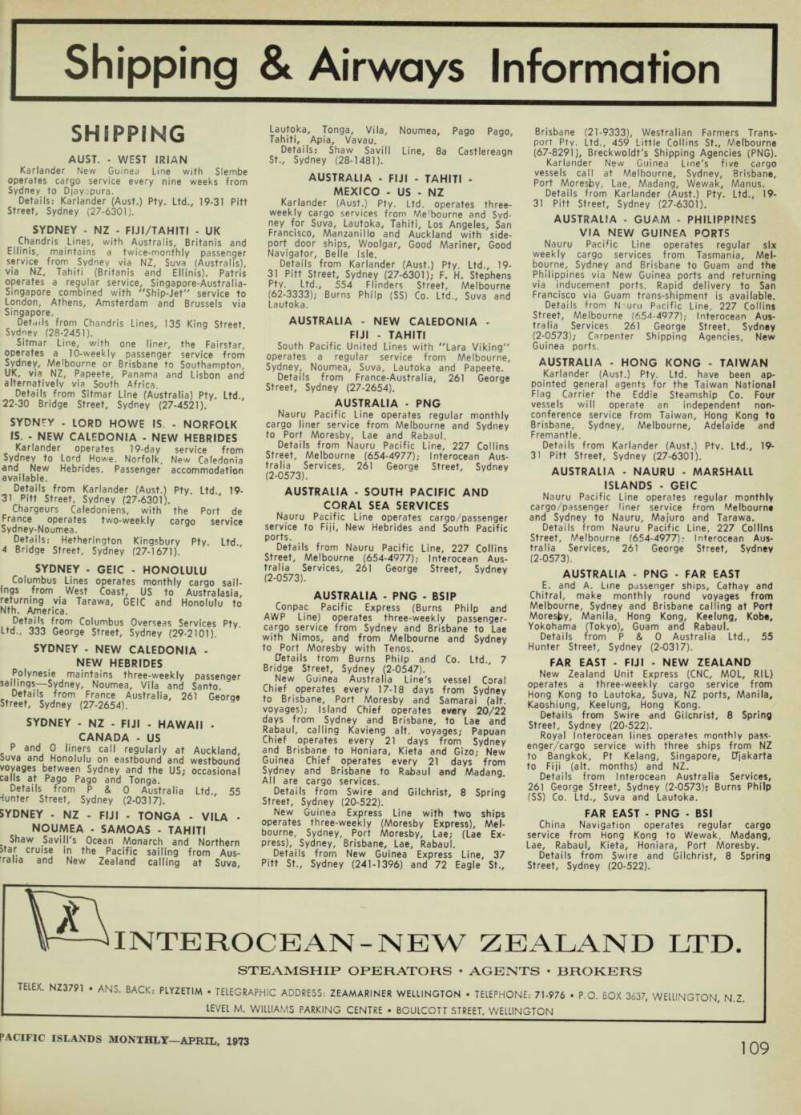
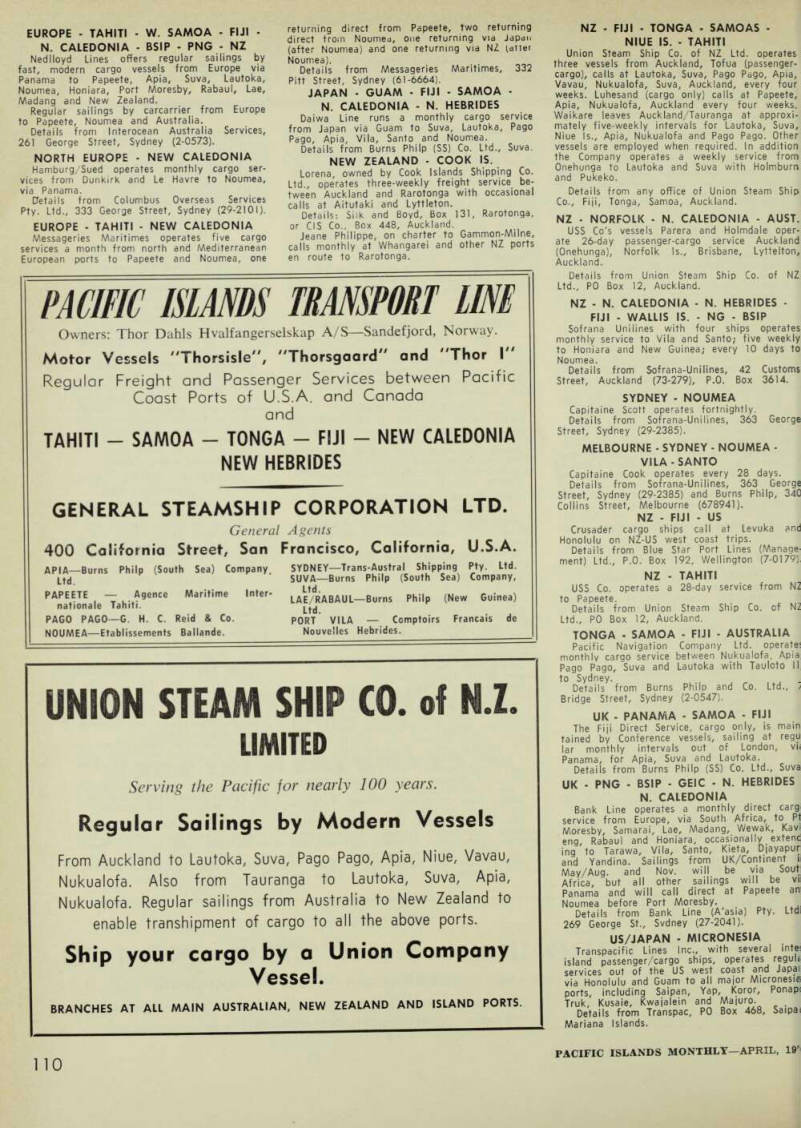
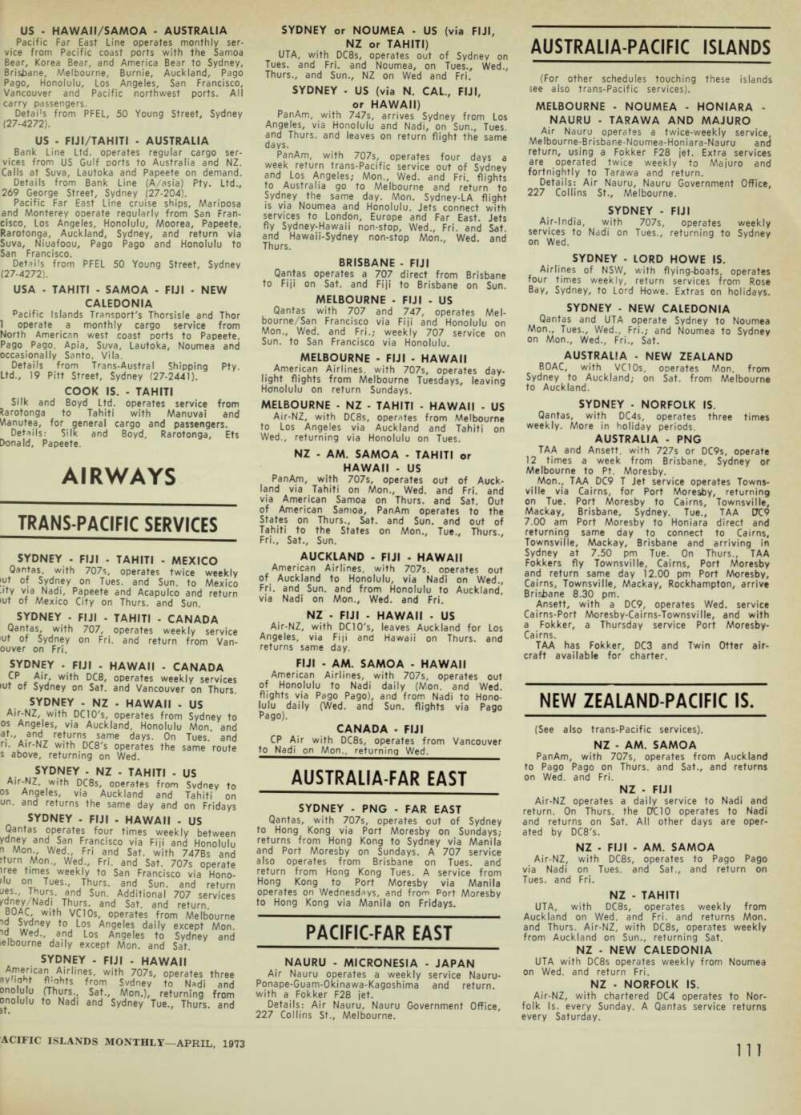
Shipping
Aust. - West Irian
Karlander New Guinea Line with Slembe operates cargo service every nine weeks from Sydney to Djayopura.
Details: Karlander (Aust.) Pty. Ltd., 19-31 Pitt Street, Sydney (27-6301).
SYDNEY - NZ - FIJI/TAHITI - UK Chandris Lines, with Australis, Britanis and Ellinis, maintains a twice-monthly passenger service from Sydney via NZ, Suva (Australis), via NZ, Tahiti (Britanis and Ellinis). Patris operates a regular service, Singapore-Australia- Singapore combined with "Ship-Jet” service to London, Athens, Amsterdam and Brussels via Singapore.
Details from Chandris Lines, 135 King Street Sydney (28-2451).
Sitmar Line, with one liner, the Fairstar, operates a 10-weekly passenger service from Sydney, Melbourne or Brisbane to Southampton, UK, via NZ, Papeete, Panama and Lisbon and alternatively via South Africa.
Details from Sitmar Line (Australia) Pty. Ltd., 22-30 Bridge Street, Sydney (27-4521).
SYDNEY . LORD HOWE IS. - NORFOLK IS. - NEW CALEDONIA - NEW HEBRIDES Karlander operates 19-day service from Sydney to Lord Howe. Norfolk, New Caledonia and New Hebrides. Passenger accommodation available.
Details from Karlander (Aust.) Pty. Ltd., 19- SI Pitt Street, Sydney (27-6301).
Chargeurs Caledoniens, with the Port de France operates two-weekly cargo service Sydney-Noumea.
Details: Hetherington Kingsbury Pty. Ltd 4 Bridge Street, Sydney (27-1671).
Sydney - Geic - Honolulu
Columbus Lines operates monthly cargo sail ings from West Coast, US to Australasia, returning via Tarawa, GEIC and Honolulu to Nth. America.
Details from Columbus Overseas Services Pty Ltd., 333 George Street, Sydney (29-2101).
Sydney - New Caledonia -
New Hebrides
Polynesia maintains three-weekly passenger sailings—Sydney, Noumea, Vila and Santo.
Details from France Australia, 261 Georqe Street, Sydney (27-2654).
SYDNEY - NZ - FIJI - HAWAII -
Canada - Us
P and 0 liners call regularly at Auckland, iuva and Honolulu on eastbound and westbound voyages between Sydney and the US; occasional calls at Pago Pago and Tonga.
Details from P & 0 Australia Ltd., 55 funter Street, Sydney (2-0317).
SYDNEY - NZ - FIJI - TONGA - VILA •
Noumea - Samoas - Tahiti
. Shaw Savijl's Ocean Monarch and Northern >tar cruise in the Pacific sailing from Aus tralia and New Zealand calling at Suva,
Lautoka, Tonga, Vila, Noumea, Pago Pago, Tahiti, Apia, Vavau, Details; Shaw Savill Line, 8a Castlereagn St., Sydney (28-1481).
Australia - Fiji - Tahiti -
Mexico - Us - Nz
Karlander (Aust.) Pty. Ltd. operates three weekly cargo services from Me'bourne and Syd ney for Suva, Lautoka, Tahiti, Los Angeles, San Francisco, Manzanillo and Auckland with side port door ships, Woolgar, Good Mariner, Good Navigator, Belle Isle.
Details from Karlander (Aust.) Pty. Ltd., 19- 31 Pitt Street, Sydney (27-6301); F. H. Stephens Pty. Ltd., 554 Flinders Street, Melbourne (62-3333); Burns Philp (SS) Co. Ltd., Suva and Lautoka.
Australia ■ New Caledonia -
Fiji - Tahiti
South Pacific United Lines with "Lara Viking" operates a regular service from Melbourne, Sydney, Noumea, Suva, Lautoka and Papeete.
Details from France-Australia, 261 George Street, Sydney (27-2654).
Australia - Png
Nauru Pacific Line operates regular monthly cargo liner service from Melbourne and Sydney to Port Moresby, Lae and Rabaul.
Details from Nauru Pacific Line, 227 Collins Street, Melbourne (654-4977); Interocean Aus tralia Services, 261 George Street, Sydney (2-0573).
Australia - South Pacific And
Coral Sea Services
Nauru Pacific Line operates cargo/passenger service to Fiji, New Hebrides and South Pacific ports.
Details from Nauru Pacific Line, 227 Collins Street, Melbourne (654-4977); Interocean Aus tralia Services, 261 George Street, Sydney (2-0573).
Australia - Png - Bsip
Conpac Pacific Express (Burns Philp and AWP Line) operates three-weekly passenger cargo service from Sydney and Brisbane to Lae with Nimos, and from Melbourne and Sydney to Port Moresby with Tenos.
Details from Burns Philp and Co. Ltd., 7 Bridge Street, Sydney (2-0547).
New Guinea Australia Line's vessel Coral Chief operates every 17-18 days from Sydney to Brisbane, Port Moresby and Samarai (alt. voyages); Island Chief operates every 20/22 days from Sydney and Brisbane, to Lae and Rabaul, calling Kavieng alt. voyages; Papuan Chief operates every 21 days from Sydney and Brisbane to Honiara, Kieta and Gizo,- New Guinea Chief operates every 21 days from Sydney and Brisbane to Rabaul and Madang.
All are cargo services.
Details from Swire and Gilchrist, 8 Spring Street, Sydney (20-522).
New Guinea Express Line with two ships operates three-weekly (Moresby Express), Mel bourne, Sydney, Port Moresby, Lae; (Lae Ex press), Sydney, Brisbane, Lae, Rabaul.
Details from New Guinea Express Line, 37 Pitt St., Sydney (24M396) and 72 Eagle St.,
Brisbane (21-9333), Westralian Farmers Trans port Pty. Ltd., 459 Little Collins St., Melbourne (67-8291), Breckwoldt's Shipping Agencies (PNG).
Karlander New Guinea Line's five cargo vessels call at Melbourne, Sydney, Brisbane, Port Moresby, Lae, Madang, Wewak, Manus.
Details from Karlander (Aust.) Pty. Ltd., 19- 31 Pitt Street, Sydney (27-6301).
Australia - Guam • Philippines
Via New Guinea Ports
Nauru Pacific Line operates regular six weekly cargo services from Tasmania, Mel bourne, Sydney and Brisbane to Guam and the Philippines via New Guinea ports and returning via inducement ports. Rapid delivery to San Francisco via Guam trans-shipment is available.
Details from N i uru Pacific Line, 227 Collins Street, Melbourne (654-4977); Interocean Aus tralia Services 261 George Street, Sydney (2-0573); Carpenter Shipping Agencies, New Guinea ports.
Australia - Hong Kong - Taiwan
Karlander (Aust.) Pty. Ltd. have been ap pointed general agents for the Taiwan National Flag Carrier the Eddie Steamship Co. Four vessels will operate an independent non conference service from Taiwan, Hong Kong to Brisbane, Sydney, Melbourne, Adefaide and Fremantle.
Details from Karlander (Aust.) Ptv. Ltd., 19- 31 Pitt Street, Sydney (27-6301).
Australia - Nauru - Marshall
Islands - Geic
Nauru Pacific Line operates regular monthly cargo/passenger liner service from Melbourne and Sydney to Nauru, Majuro and Tarawa.
Details from Nauru Pacific Line, 227 Collins Street, Melbourne (654-4977); Interocean Aus tralia Services, 261 George Street, Sydney (2-0573).
Australia - Png - Far East
E. and A. Line passenger ships, Cathay and Chitral, make monthly round voyages from Melbourne, Sydney and Brisbane calling at Port Moresby, Manila, Hong Kong, Keelung, Kobe, Yokohama (Tokyo), Guam and Rabaul.
Details from P & 0 Australia Ltd., 55 Hunter Street, Sydney (2-0317).
FAR EAST - FIJI - NEW ZEALAND New Zealand Unit Express (CNC, MOL, RIL) operates a three-weekly cargo service from Hong Kong to Lautoka, Suva, NZ ports, Manila, Kaoshiung, Keelung, Hong Kong.
Details from Swire and Gilchrist, 8 Spring Street, Sydney (20-522).
Royal Interocean lines operates monthly pass enger/cargo service with three ships from NZ to Bangkok, Pt Kelang, Singapore, Djakarta to Fiji (alt. months) and NZ.
Details from Interocean Australia Services, 261 George Street, Sydney (2-0573); Burns Philp (SS) Co. Ltd., Suva and Lautoka.
Far East - Png - Bsi
China Navigation operates regular cargo service from Hong Kong to Wewak, Madang, Lae, Rabaul, Kieta, Honiara, Port Moresby.
Details from Swire and Gilchrist, 8 Spring Street, Sydney (20-522).
EUROPE - TAHITI - W. SAMOA - FIJI - N. CALEDONIA - BSIP - PNG ■ NZ Nedlloyd Lines offers regular sailings by fast, modern cargo vessels from Europe via Panama to Papeete, Apia, Suva, Lautoka, Noumea, Honiara, Port Moresby, Rabaul, Lae, Madang and New Zealand.
Regular sailings by carcarrier from Europe to Papeete, Noumea and Australia.
Details from Interocean Australia Services, 261 George Street, Sydney (2-0573).
North Europe - New Caledonia
Hamburg/Sued operates monthly cargo ser vices from Dunkirk and Le Havre to Noumea, via Panama.
Details from Columbus Overseas Services Pty. Ltd., 333 George Street, Sydney (29-2101).
Europe - Tahiti - New Caledonia
Messageries Maritimes operates five cargo services a month from north and Mediterranean European ports to Papeete and Noumea, one
returning direct from Papeete, two returning direct from Noumea, one returning via Japan (after Noumea) and one returning via NZ latter Noumea).
Details from Messageries Maritimes, 332 Pitt Street, Sydney (61-6664).
JAPAN - GUAM - FIJI ■ SAMOA ■
N. Caledonia - N. Hebrides
Daiwa Line runs a monthly cargo service from Japan via Guam to Suva, Lautoka, Pago Pago, Apia, Vila, Santo and Noumea.
Details from Burns Philp (SS) Co. Ltd., Suva.
New Zealand - Cook Is.
Lorena, owned by Cook Islands Shipping Co.
Ltd., operates three-weekly freight service be tween Auckland and Rarotonga with occasional calls at Aitutaki and Lyttleton.
Details: Silk and Boyd, Box 131, Rarotonga, or CIS Co., Box 448, Auckland.
Jeane Philippe, on charter to Gammon-Milne, calls monthly at Whangarei and other NZ ports en route to Rarotonga.
NZ - FIJI ■ TONGA - SAMOAS -
Niue Is. - Tahiti
Union Steam Ship Co. of NZ Ltd. operates three vessels from Auckland, Tofua (passenger cargo), calls at Lautoka, Suva, Pago Pago, Apia, Vavau, Nukualofa, Suva, Auckland, every four weeks. Luhesand (cargo only) calls at Papeete, Apia, Nukualofa, Auckland every four weeks.
Waikare leaves Auckland/Tauranga at approxi mately five-weekly intervals for Lautoka, Suva, Niue Is., Apia, Nukualofa and Pago Pago. Other vessels are employed when required. In addition the Company operates a weekly service from Onehunga to Lautoka and Suva with Holmburn and Pukeko.
Details from any office of Union Steam Ship Co., Fiji, Tonga, Samoa, Auckland.
NZ - NORFOLK - N. CALEDONIA - AUST.
USS Co's vessels Parera and Holmdale oper ate 26-day passenger-cargo service Auckland (Onehunga), Norfolk Is., Brisbane, Lyttelton, Auckland.
Details from Union Steam Ship Co. of NZ Ltd., PO Box 12, Auckland.
NZ ■ N. CALEDONIA ■ N. HEBRIDES • FIJI ■ WALLIS IS. - NG ■ BSIP Sofrana Unilines with four ships operates monthly service to Vila and Santo; five weekly to Honiara and New Guinea; every 10 days to Noumea.
Details from Sofrana-Unilines, 42 Customs Street, Auckland (73-279), P.O. Box 3614.
Sydney - Noumea
Capitaine Scott operates fortnightly.
Details from Sofrana-Unilines, 363 George Street, Sydney (29-2385).
Melbourne ■ Sydney - Noumea -
Vila - Santo
Capitaine Cook operates every 28 days.
Details from Sofrana-Unilines, 363 George Street, Sydney (29-2385) and Burns Philp, 340 Collins Street, Melbourne (678941).
Nz - Fiji - Us
Crusader cargo ships call at Levuka and Honolulu on NZ-US west coast trips.
Details from Blue Star Port Lines (Manage ment) Ltd., P.O. Box 192, Wellington (7-0179).
Nz ■ Tahiti
USS Co. operates a 28-day service from NZ to Papeete.
Details from Union Steam Ship Co. of NZ Ltd., PO Box 12, Auckland.
TONGA - SAMOA - FIJI - AUSTRALIA Pacific Navigation Company Ltd. operate; monthly cargo service between Nukualofa, Apia, Pago Pago, Suva and Lautoka with Tauloto 11. to Sydney.
Details from Burns Philp and Co. Ltd., / Bridge Street, Sydney (2-0547).
UK - PANAMA - SAMOA - FIJI The Fiji Direct Service, cargo pnly, is main tained by Conference vessels, sailing at regu lar monthly intervals out of London, vi« Panama, for Apia, Suva and Lautoka.
Details from Burns Philp (SS) Co. Ltd., Suva UK - PNG ■ BSIP - GEIC ■ N. HEBRIDES
N. Caledonia
Bank Line operates a monthly direct carg< service from Europe, via South Africa, to Pt Moresby, Samarai, Lae, Madang, Wewak, Kavi eng, Rabaul and Honiara, occasionally extend ing to Tarawa, Vila, Santo, Kieta, D|ayapur; and Yandina. Sailings from UK/Continent li May/Aug. and Nov. will be via Soutj Africa, but all other sailings will be vii Panama and will call direct at Papeete an' Noumea before Port Moresby.
Details from Bank Line (A'asia) Pty. Ltdl 269 George St., Svdney (27-2041).
Us/Japan - Micronesia
Transpacific Lines Inc., with several inte; island passenger/cargo ships, operates reguu services out of the US west coast and Japaii via Honolulu and Guam to all major Micronesia ports, including Saipan, Yap, Koror, Ponapt Truk, Kusaie, Kwajalein and Majuro. , Details from Transpac, PO Box 468, Saipai Mariana Islands.
Airways
Us - Hawaii/Samoa - Australia
Pacific Far East Line operates monthly ser vice from Pacific coast ports with the Samoa Bear, Korea Bear, and America Bear to Sydney, Brisbane, Melbourne, Burnie, Auckland, Pago Pago, Honolulu, Los Angeles, San Francisco, Vancouver and Pacific northwest ports. All carry passengers.
Detai's from PFEL, 50 Young Street, Sydney (27-4272).
Us - Fiji/Tahiti - Australia
Bank Line Ltd. operates regular cargo ser vices from US Gulf ports to Australia and NZ.
Calls at Suva, Lautoka and Papeete on demand.
Details from Bank Line (A/asia) Pty. Ltd., 269 George Street, Sydney (27-204).
Pacific Far East Line cruise ships, Mariposa and Monterey operate regularly from San Fran cisco, Los Angeles, Honolulu, Moorea, Papeete, Rarotonga, Auckland, Sydney, and return via Suva, Niuafoou, Pago Pago and Honolulu to San Francisco.
Details from PFEL 50 Young Street, Sydney (27-4272).
USA - TAHITI - SAMOA - FIJI - NEW
Caledonia
Pacific Islands Transport's Thorsisle and Thor 1 operate a monthly cargo service from North American west coast ports to Papeete, Pago Pago, Apia, Suva, Lautoka, Noumea and occasionally Santo, Vila.
Details from Trans-Austral Shipping Pty.
Ltd., 19 Pitt Street, Sydney (27-2441).
Cook Is. - Tahiti
Silk and Boyd Ltd. operates service from Rarotonga to Tahiti with Manuvai and Manutea, for general cargo and passengers.
Details: Silk and Boyd, Rarotonga, Ets [>onaId, Papeete.
Advertisements & other items, pp. 117-118 (1 item)
Interocean-New Zealand Ltd.
STEAMSHIP OPERATORS • AGENTS • BROKERS
TELEX. NZ3791 • ANS. BACK: PLYZETIM • TELEGRAPHIC ADDRESS: ZEAMARINER WELLINGTON • TELEPHONE: 71-976 • P.O. BOX 3637, WELLINGTON, N.Z.
LEVEL M. WILLIAMS PARKING CENTRE » BOULCOTT STREET, WELLINGTON
PACIFIC ISLANDS TRANSPORT LINE
Owners: Thor Dahls Hvalfangerselskap A/S —Sandefjord, Norway.
Motor Vessels "Thorsisle", // Thorsgaard /, and "Thor I Regular Freight and Passenger Services between Pacific Coast Ports of U.S.A. and Canada and TAHITI - SAMOA TONGA FIJI NEW CALEDONIA
NEW HEBRIDES
GENERAL STEAMSHIP CORPORATION LTD.
General Agents 400 California Street, San Francisco, California, U.S.A.
APlA—Burns Philp (South Sea) Company SYDNEY— Trans-Austral Shipping Pty. Ltd.
Lt( l SUVA—Burns Philp (South Sea) Company, PAPEETE Agence Maritime Inter- LAE/RABAUL—Burns Philp (New Guinea) nationale Tahiti.
PAGO PAGO —G. H. C. Reid & Co. PORT VILA Comptoirs Francais de NOUMEA—Etablissements Ballande. Nouvelles Hebrides.
UNION STEAM SHIP CO. of N.Z.
LIMITED
Serving the Pacific for nearly 100 years.
Regular Sailings by Modern Vessels
From Auckland to Lautoka, Suva, Pago Pago, Apia, Niue, Vavau, Nukualofa. Also from Tauranga to Lautoka, Suva, Apia, Nukualofa. Regular sailings from Australia to New Zealand to enable transhipment of cargo to all the above ports.
Ship your cargo by a Union Company Vessel.
BRANCHES AT ALL MAIN AUSTRALIAN, NEW ZEALAND AND ISLAND PORTS.
Trans Pacific Services
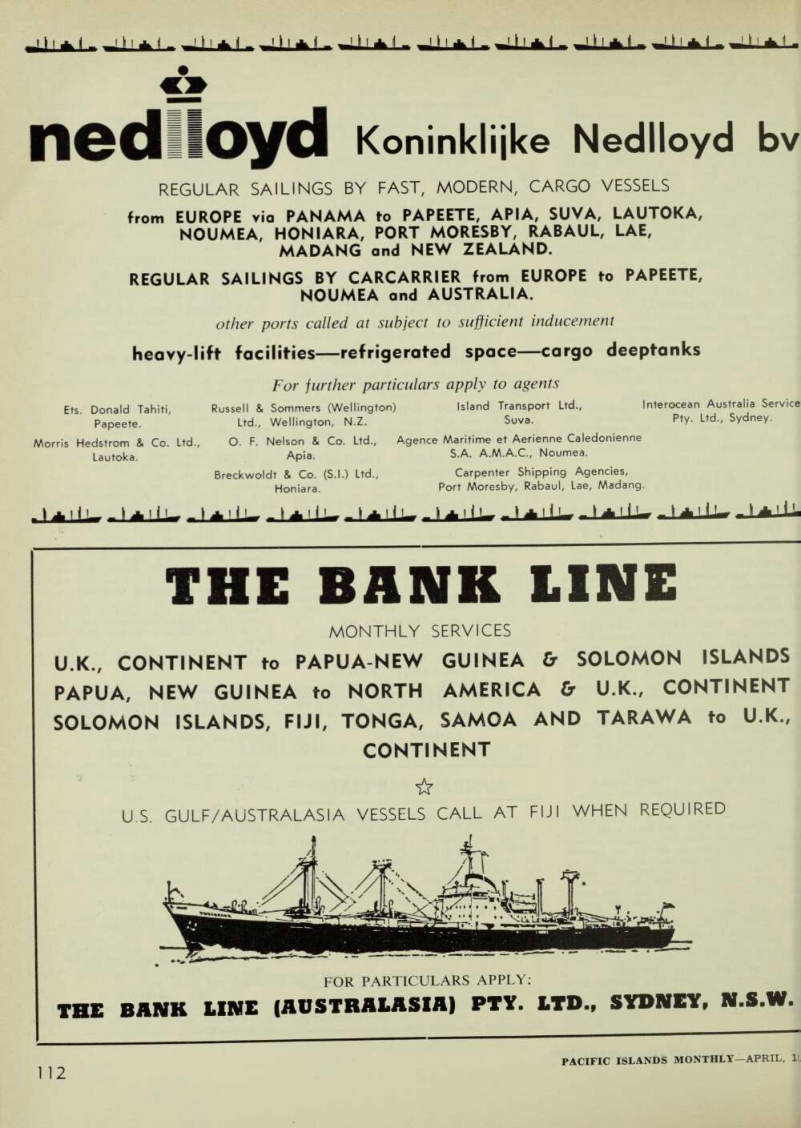
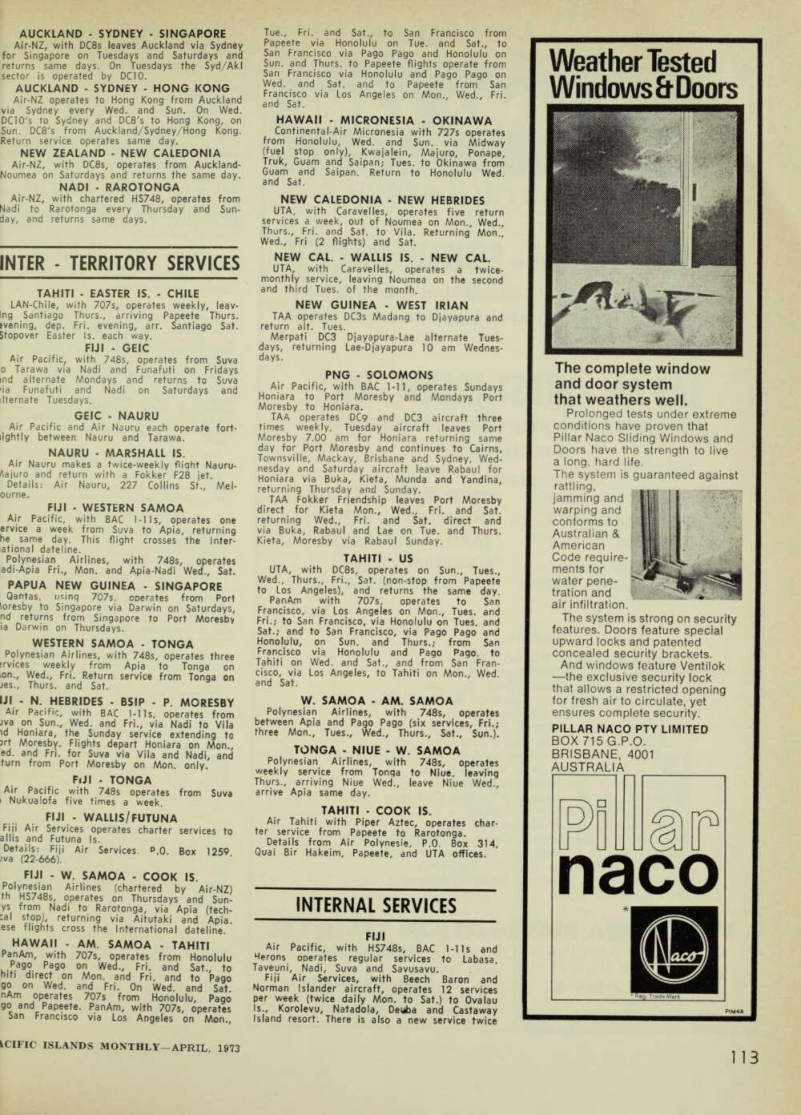
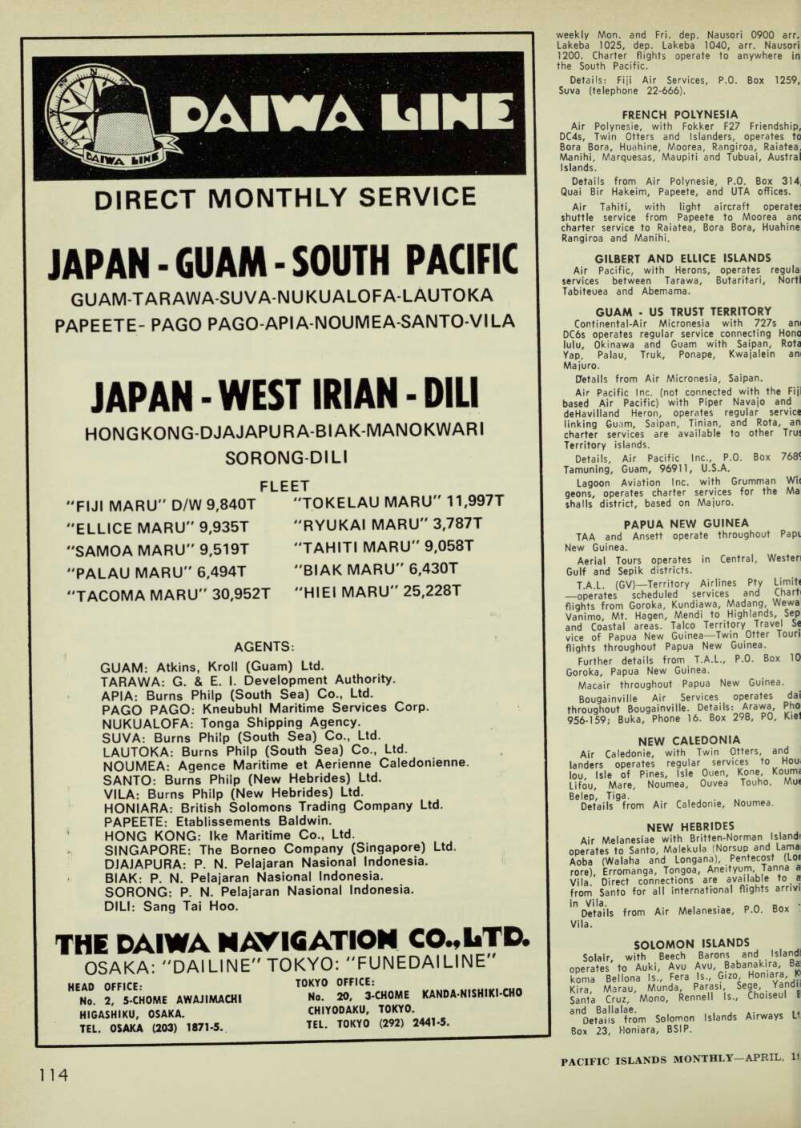
SYDNEY - FIJI • TAHITI - MEXICO Qantas, with 7075, operates twice weekly iyt of Sydney on Tues. and Sun. to Mexico ,ity via Nadi, Papeete and Acapulco and return >ut of Mexico City on Thurs. and Sun.
SYDNEY ■ FIJI - TAHITI - CANADA Qantas, with 707, operates weekly service ut of Sydney on Fri. and return from Van ouver on Fri.
SYDNEY - FIJI - HAWAII - CANADA CP Air, with DCS, operates weekly services •ut of Sydney on Sat. and Vancouver on Thurs.
SYDNEY - NZ - HAWAII - US Air-NZ, with DClO's, operates from Sydney to os Angeles, via Auckland, Honolulu Mon and • re t urns sarr| e days. On Tues. and n. Air-NZ with DCB's operates the same route s above, returning on Wed.
SYDNEY - NZ - TAHITI - US Air-NZ, with DCBs, operates from Sydney to os Angeles, via Auckland and Tahiti on un. and returns the same day and on Fridays SYDNEY - FIJI - HAWAII - US Qantas operates four times weekly between ydney and San Francisco via Fiji and Honolulu n Mon Wed Fri and Sat. with 7478 s and iturn Mon., Wed., Fri. and Sat. 707 s operate iree times weekly to San Francisco via Hono ilu on Tues., Thurs, and Sun. and return J S S " Ji nd Sun - Additional 707 services fdney/Nadi Thurs. and Sat. and return BOAC, with VClOs, operates from Melbourne id Sydney to Los Angeles daily except Mon. id Wed., and Los Angeles to Sydney and lelbourne daily except Mon. and Sat.
Sydney - Fiji - Hawaii
auKfrfl* 03 1i■ A J: line /' wit t 7075, operates three £u hts f r om Svdnev t 0 Nadi and nnnln u ♦ Th !J rS -r Sa ]''r returning from onolulu to Nadi and Sydney Tue., Thurs. and
SYDNEY or NOUMEA - US (via FIJI,
Nz Or Tahiti)
UTA, with DCBs, operates out of Sydney on Tues. and Fri. and Noumea, on Tues., Wed., Thurs., and Sun., NZ on Wed and Fri.
SYDNEY - US (via N. CAL., FIJI,
Or Hawaii)
PanAm, with 7475, arrives Sydney from Los Angeles, via Honolulu and Nadi, on Sun., Tues. and Thurs. and leaves on return flight the same days.
PanAm, with 7075, operates four days a week return trans-Pacific service out of Sydney and Los Angeles; Mon., Wed. and Fri. flights to Australia go to Melbourne and return to Sydney the same day. Mon. Sydney-LA flight is via Noumea and Honolulu. Jets connect with services to London, Europe and Far East. Jets fly Sydney-Hawaii non-stop. Wed., Fri. and Sat. and Hawaii-Sydney non-stop Mon., Wed. and Thurs.
Brisbane ■ Fiji
Qantas operates a 707 direct from Brisbane to Fiji on Sat. and Fiji to Brisbane on Sun.
Melbourne - Fiji - Us
Qantas with 707 and 747, operates Mel bourne/San Francisco via Fiji and Honolulu on Mon., Wed. and Fri.; weekly 707 service on Sun. to San Francisco via Honolulu.
Melbourne - Fiji - Hawaii
American Airlines, with 7075, operates day light flights from Melbourne Tuesdays, leaving Honolulu on return Sundays.
MELBOURNE - NZ - TAHITI - HAWAII - US Air-NZ, with DCBs, operates from Melbourne to Los Angeles via Auckland and Tahiti on Wed., returning via Honolulu on Tues.
NZ - AM. SAMOA - TAHITI or
Hawaii - Us
PanAm, with 7075, operates out of Auck land via Tahiti on Mon., Wed. and Fri. and via American Samoa on Thurs. and Sat. Out of American Samoa, PanAm operates to the States on Thurs., Sat. and Sun. and out of Tahiti to the States on Mon., Tue., Thurs., Fri., Sat., Sun.
Auckland - Fiji - Hawaii
American Airlines, with 7075, operates out of Auckland to Honolulu, via Nadi on Wed., Fri. and Sun. and from Honolulu to Auckland, via Nadi on Mon., Wed. and Fri.
NZ - FIJI - HAWAII - US Air-NZ, with DClO's, leaves Auckland for Los Angeles, via Fiji and Hawaii on Thurs. and returns same day.
Fiji - Am. Samoa - Hawaii
American Airlines, with 7075, operates out of Honolulu to Nadi daily (Mon. and Wed. flights via Pago Pago), and from Nadi to Hono lulu daily (Wed. and Sun. flights via Pago Pago).
Canada • Fiji
CP Air with DCBs, operates from Vancouver to Nadi on Mon., returning Wed.
Australia-Far East
Sydney - Png - Far East
Qantas, with 7075, operates out of Sydney to Hong Kong via Port Moresby on Sundays; returns from Hong Kong to Sydney via Manila and Port Moresby on Sundays. A 707 service also operates from Brisbane on Tues. and return from Hong Kong Tues. A service from Hong Kong to Port Moresby via Manila operates on Wednesdays, and from Port Moresby to Hong Kong via Manila on Fridays.
Pacific-Far East
Nauru - Micronesia - Japan
Air Nauru operates a weekly service Nauru- Ponape-Guam-Okinawa-Kagoshima and return, with a Fokker F2B jet.
Details: Air Nauru, Nauru Government Office, 227 Collins St., Melbourne.
Australia-Pacific Islands
(For other schedules touching these islands see also trans-Pacific services).
Melbourne - Noumea - Honiara -
Nauru - Tarawa And Majuro
Air Nauru operates a twice-weekly service, Melbourne-Brisbane-Noumea-Honiara-Nauru and return, using a Fokker F2B jet. Extra services are operated twice weekly to Majuro and fortnightly to Tarawa and return.
Details: Air Nauru, Nauru Government Office, 227 Collins St., Melbourne.
Sydney - Fiji
Air-lndia, with 7075, operates weekly services to Nadi on Tues., returning to Sydney on Wed.
Sydney - Lord Howe Is.
Airlines of NSW, with flying-boats, operates four times weekly, return services from Rose Bay, Sydney, to Lord Howe. Extras on holidays.
Sydney - New Caledonia
Qantas and UTA operate Sydney to Noumea Mon., Tues., Wed., Fri.; and Noumea to Sydney on Mon., Wed., Fri., Sat.
Australia - New Zealand
BOAC, with VClOs, operates Mon. from Sydney to Auckland; on Sat. from Melbourne to Auckland.
Sydney - Norfolk Is.
Qantas, with DC4s, operates three times weekly. More in holiday periods.
Australia - Png
TAA and Ansett, with 727 s or DC9s, operate 12 times a week from Brisbane, Sydney or Melbourne to Pt. Moresby.
Mon., TAA DC9 T Jet service operates Towns ville via Cairns, for Port Moresby, returning on Tue. Port Moresby to Cairns, Townsville, Mackay, Brisbane, Sydney. Tue., TAA DC 9 7.00 am Port Moresby to Honiara direct and returning same day to connect to Cairns, Townsville, Mackay, Brisbane and arriving in Sydney at 7.50 pm Tue. On Thurs., TAA Fokkers fly Townsville, Cairns, Port Moresby and return same day 12.00 pm Port Moresby, Cairns, Townsville, Mackay, Rockhampton, arrive Brisbane 8.30 pm.
Ansett, with a DC9, operates Wed. service Cairns-Port Moresby-Cairns-Townsville, and with a Fokker, a Thursday service Port Moresby- Cairns.
TAA has Fokker, DCS and Twin Otter air craft available for charter.
New Zealand-Pacific Is.
(See also trans-Pacific services).
Nz - Am. Samoa
PanAm, with 7075, operates from Auckland to Pago Pago on Thurs. and Sat., and returns on Wed. and Fri.
Nz - Fiji
Air-NZ operates a daily service to Nadi and return. On Thurs. the DCIO operates to Nadi and returns on Sat. All other days are oper ated by DCB's.
Nz - Fiji - Am. Samoa
Air-NZ, with DCBs, operates to Pago Pago via Nadi on lues, and Sat., and return on lues, and Fri.
Nz - Tahiti
UTA, with DCBs, operates weekly from Auckland on Wed. and Fri. and returns Mon. and Thurs. Air-NZ, with DCBs, operates weekly from Auckland on Sun., returning Sat.
Nz • New Caledonia
UTA with DCBs operates weekly from Noumea on Wed. and return Fri.
Nz - Norfolk Is.
Air-NZ, with chartered DC4 operates to Nor folk Is. every Sunday. A Qantas service returns every Saturday.
Auckland - Sydney - Singapore
Air-NZ, with DCBs leaves Auckland via Sydney for Singapore on Tuesdays and Saturdays and returns same days. On Tuesdays the Syd/Akl sector is operated by DCIO.
Auckland - Sydney - Hong Kong
Air-NZ operates to Hong Kong from Auckland via Sydney every Wed. and Sun. On Wed.
DClO's to Sydney and DCB's to Hong Kong, on Sun. DCB's from Auckland/Sydney/Hong Kong.
Return service operates same day.
New Zealand - New Caledonia
Air-NZ, with DCBs, operates from Auckland- Noumea on Saturdays and returns the same day.
Nadi - Rarotonga
Air-NZ, with chartered HS74B, operates from Nadi to Rarotonga every Thursday and Sun day, and returns same days.
Inter - Territory Services
Tahiti - Easter Is. - Chile
LAN-Chile, with 7075, operates weekly, leav ing Santiago Thurs., arriving Papeete Thurs. svening, dep. Fri. evening, arr. Santiago Sat.
Stopover Easter Is. each way.
Fiji ■ Geic
Air Pacific, with 7485, operates from Suva o Tarawa via Nadi and Funafuti on Fridays md alternate Mondays and returns to Suva da Funafuti and Nadi on Saturdays and ilternate Tuesdays.
Geic - Nauru
Air Pacific and Air Nauru each operate fort lightly between Nauru and Tarawa.
Nauru - Marshall Is.
Air Nauru makes a twice-weekly flight Nauru- Hajuro and return with a Fokker F2B jet.
Details: Air Nauru, 227 Collins St., Mel ourne.
Fiji - Western Samoa
Air Pacific, with BAC 1-1 Is, operates one ervice a week from Suva to Apia, returning he same day. This flight crosses the Inter ational dateline.
Polynesian Airlines, with 7485, operates adi-Apia Fri., Mon, and Apia-Nadi Wed., Sat.
Papua New Guinea - Singapore
Qantas, using 7075, operates from Port loresby to Singapore via Darwin on Saturdays, nd returns from Singapore to Port Moresby ia Darwin on Thursdays.
Western Samoa - Tonga
Polynesian Airlines, with 7485, operates three srvices weekly from Apia to Tonga on ion.. Wed., Fri. Return service from Tonga on jes., Thurs. and Sat.
Ul - N. HEBRIDES - BSIP - P. MORESBY Air Pacific, with BAC 1-1 Is, operates from jva on Sun., Wed. and Fri., via Nadi to Vila id Honiara, the Sunday service extending to )rt Moresby. Flights depart Honiara on Mon., ed. and Fri. for Suva via Vila and Nadi, and turn from Port Moresby on Mon. only.
Fiji - Tonga
Air Pacific with 748 s operates from Suva » Nukualofa five times a week.
Fiji - Wallis/Futuna
Fiji Air Services operates charter services to allis and Futuna Is.
Details: Fiji Air Services. p.O. Box 1259 jva (22-666).
FIJI - W. SAMOA - COOK IS.
Polynesian Airlines (chartered by Air-NZ) th HS74Bs, operates on Thursdays and Sun ys from Nadi to Rarotonga, via Apia (tech :al stop), returning via Aitutaki and Apia, ese flights cross the International dateline.
Hawaii - Am. Samoa - Tahiti
PanAm, with 7075, operates from Honolulu Pago Pago on Wed., Fri. and Sat., to hiti direct on Mon. and Fri. and to Pago go on Wed. and Fri. On Wed. and Sat. nAm operates 707 s from Honolulu, Pago go and Papeete. PanAm, with 7075, operates San Francisco via Los Angeles on Mon.,
Tue., Fri. and Sat., to San Francisco from Papeete via Honolulu on Tue. and Sat., to San Francisco via Pago Pago and Honolulu on Sun. and Thurs. to Papeete flights operate from San Francisco via Honolulu and Pago Pago on Wed. and Sat. and to Papeete from San Francisco via Los Angeles on Mon., Wed., Fri. and Sat.
Hawaii - Micronesia - Okinawa
Continental-Air Micronesia with 727 s operates
from Honolulu, Wed. and Sun. via Midway (fuel stop only), Kwajalein, Majuro, Ponape, Truk, Guam and Saipan; lues, to Okinawa from Guam and Saipan. Return to Honolulu Wed. and Sat.
New Caledonia - New Hebrides
UTA, with Caravelles, operates five return services a week, out of Noumea on Mon., Wed., Thurs., Fri. and Sat. to Vila. Returning Mon., Wed., Fri (2 flights) and Sat.
NEW CAL. ■ WALLIS IS. - NEW CAL.
UTA, with Caravelles, operates a twice monthly service, leaving Noumea on the second and third Tues. of the month.
New Guinea - West Irian
TAA operates DC3s Madang to Djayapura and return alt. Tues.
Merpati DC3 Djayapura-Lae alternate Tues days, returning Lae-D|ayapura 10 am Wednes days.
Png - Solomons
Air Pacific, with BAC 1-11, operates Sundays Honiara to Port Moresby and Mondays Port Moresby to Honiara.
TAA operates DC9 and DC3 aircraft three times weekly. Tuesday aircraft leaves Port Moresby 7.00 am for Honiara returning same day for Port Moresby and continues to Cairns, Townsville, Mackay, Brisbane and Sydney. Wed nesday and Saturday aircraft leave Rabaul for Honiara via Buka, Kieta, Munda and Yandina, returning Thursday and Sunday.
TAA Fokker Friendship leaves Port Moresby direct for Kieta Mon., Wed., Fri. and Sat. returning Wed., Fri. and Sat. direct and via Buka, Rabaul and Lae on Tue. and Thurs.
Kieta, Moresby via Rabaul Sunday.
Tahiti - Us
UTA, with DCBs, operates on Sun., Tues., Wed., Thurs., Fri., Sat. (non-stop from Papeete to Los Angeles), and returns the same day.
PanAm with 7075, operates to San Francisco, via Los Angeles on Mon., Tues. and Fri.; to San Francisco, via Honolulu on Tues. and Sat.; and to San Francisco, via Pago Pago and Honolulu, on Sun. and Thurs.; from San Francisco via Honolulu and Pago Pago, to Tahiti on Wed. and Sat., and from San Fran cisco, via Los Angeles, to Tahiti on Mon., Wed. and Sat.
W. Samoa - Am. Samoa
Polynesian Airlines, with 7485, operates between Apia and Pago Pago (six services, Fri.; three Mon., Tues., Wed., Thurs., Sat., Sun.).
Tonga - Niue - W. Samoa
Polynesian Airlines, with 7485, operates weekly service from Tonga to Niue, leaving Thurs., arriving Niue Wed., leave Niue Wed., arrive Apia same day.
Tahiti - Cook Is.
Air Tahiti with Piper Aztec, operates char ter service from Papeete to Rarotonga.
Details from Air Polynesie, P.O. Box 314, Quai Bir Hakeim, Papeete, and UTA offices.
Internal Services
Fiji
Air Pacific, with HS74Bs, BAC 1-1 Is and Herons ooerates regular services to Labasa, Taveuni, Nadi, Suva and Savusavu.
Fiji Air Services, with Beech Baron and Norman Islander aircraft, operates 12 services per week (twice daily Mon. to Sat.) to Ovalau Is., Korolevu, Natadola, Deuba and Castaway Island resort. There is also a new service twice
weekly Mon. and Fri. dep. Nausori 0900 arr.
Lakeba 1025, dep. Lakeba 1040, arr. Nausori 1200. Charter flights operate to anywhere in the South Pacific.
Details: Fiji Air Services, P.O. Box 1259, Suva (telephone 22-666).
French Polynesia
Air Polynesia, with Fokker F 27 Friendship, DC4s, Twin Otters and Islanders, operates to Bora Bora, Huahine, Moorea, Rangiroa, Raiatea, Manihi, Marquesas, Maupiti and Tubuai, Austral Islands.
Details from Air Polynesie, P.O. Box 314, Quai Bir Hakeim, Papeete, and UTA offices.
Air Tahiti, with light aircraft operates shuttle service from Papeete to Moorea anc charter service to Raiatea, Bora Bora, Huahine, Rangiroa and Manihi.
Gilbert And Ellice Islands
Air Pacific, with Herons, operates regulai services between Tarawa, Butaritari, Nortl Tabiteuea and Abemama.
Guam - Us Trust Territory
Continental-Air Micronesia with 727 s am DC6s operates regular service connecting Hono lulu, Okinawa and Guam with Saipan, Rota Yap, Palau, Truk, Ponape, Kwajalein am Majuro.
Details from Air Micronesia, Saipan.
Air Pacific Inc. (not connected with the Fiji based Air Pacific) with Piper Navajo and deHavilland Heron, operates regular service linking Guam, Saipan, Tinian, and Rota, an charter services are available to other Trus Territory islands.
Details, Air Pacific Inc., P.O. Box Tamuning, Guam, 96911, U.S.A.
Lagoon Aviation Inc. with Grumman Wl( geons, operates charter services for the Ma shalls district, based on Majuro.
Papua New Guinea
TAA and Ansett operate throughout Papi New Guinea.
Aerial Tours operates in Central, Westen Gulf and Sepik districts.
T.A.L. (GV)— Territory Airlines Pty Limite —operates scheduled services and Charti flights from Goroka, Kundiawa, Madang, Wewal Vanimo, Mt. Hagen, Mendi to Highlands, Sep and Coastal areas. Talco Territory Travel 5e vice of Papua New Guinea —Twin Otter Toun flights throughout Papua New Guinea.
Further details from T.A.L., P.O. Box 10 Goroka, Papua New Guinea.
Macair throughout Papua New Guinea.
Bougainville Air Services operates dai throughout Bougainville. Details: Arawa, Phoi 956-159; Buka, Phone 16. Box 298, PO, Kiel
New Caledonia
Air Caledonie, with Twin Otters, and I landers operates regular services to Hou. lou Isle of Pines, Isle Ouen, Kone, Koumc Lifou, Mare, Noumea, Ouvea Touho, Mue Belep, Tiga. , , . ..
Details from Air Caledonie, Noumea.
New Hebrides
Air Melanesiae with Britten-Norman Island! operates to Santo, Malekula (Norsup and Lamai Aoba (Walaha and Longana), Pentecost (Lot rore), Erromanga, Tongoa, Aneityum Tanna s Vila Direct connections are available to a from Santo for all international flights arnvi * n Details from Air Melanesiae, P.O. Box : Vila.
Solomon Islands
Solair, with Beech Barons and Islandl operates to Auki, Avu Avu, Babanakira, Ba koma Bellona Is., Fera Is., Gizo, Honiara, * Kira, Marau, Munda, Parasi, Sege, . Yandn Santa Cruz, Mono, Rennell Is., Choiseul E and Ballalae. ... • * Details from Solomon Islands Airways Lt Box 23, Honiara, BSIP.
Advertisements & other items, pp. 119-122 (3 items)
111
ACIFIC ISLANDS MONTHLY—APRIL, 1973
nedlloyd Koninklijke Nedlloyd bv
REGULAR SAILINGS BY FAST, MODERN, CARGO VESSELS from EUROPE via PANAMA to PAPEETE, APIA, SUVA, LAUTOKA,
NOUMEA, HONIARA, PORT MORESBY, RABAUL, LAE,
MADANG and NEW ZEALAND.
REGULAR SAILINGS BY CARCARRIER from EUROPE to PAPEETE,
NOUMEA and AUSTRALIA.
other ports called at subject to sufficient inducement
heavy-lift facilities —refrigerated space—cargo deeptanks
For further particulars apply to agents Ets. Donald Tahiti, Russell & Sommers (Wellington) Island Transport Ltd., Interocean Australia Service Papeete. Ltd., Wellington, N.Z. Suva. Pty. Ltd., Sydney.
Morris Hedstrom & Co. Ltd., O. F. Nelson & Co. Ltd., Agence Maritime et Aerienne Caledonienne Lautoka.
Apia.
Breckwoldt & Co. (5.1.) Ltd., S.A. A.M.A.C., Noumea.
Carpenter Shipping Agencies, Honiara.
Port Moresby, Rabaul, Lae, Madang.
THE BANK LINE
MONTHLY SERVICES
U.K., CONTINENT to PAPUA-NEW GUINEA & SOLOMON ISLANDS PAPUA, NEW GUINEA to NORTH AMERICA & U.K., CONTINENT SOLOMON ISLANDS, FIJI, TONGA, SAMOA AND TARAWA to U.K.,
CONTINENT
☆ US. GULF/AUSTRALASIA VESSELS CALL AT FIJI WHEN REQUIRED & Mii.
FOR PARTICULARS APPLY;
BANK LINE (AUSTRALASIA) PTY. LTD., SYDNEY, N.S.W.
Weather Tested
Windows & Doors
The complete window and door system that weathers well.
Prolonged tests under extreme conditions have proven that Pillar Naco Sliding Windows and Doors have the strength to live a long, hard life.
The system is guaranteed against rattling, jamming and warping and conforms to Australian & I American Code require-1 ments for water pene- j tration and * air infiltration.
The system is strong on security features. Doors feature special upward locks and patented concealed security brackets.
And windows feature Ventilok —the exclusive security lock that allows a restricted opening for fresh air to circulate, yet ensures complete security.
PILLAR NACO PTY LIMITED
BOX 715 G.P.O.
BRISBANE, 4001
AUSTRALIA
D
naco
DAIWA LINE
DIRECT MONTHLY SERVICE
JAPAN-GUAM-SOUTH PACIFIC
GUAM-TARAWA-SUVA-NUKUALOFA-LAUTOKA
PAPEETE- PAGO PAGO-APIA-NOUMEA-SANTO-VILA
JAPAN - WEST IRIAN - DILI
HONGKONGDJAJAPURA-BIAK-MANOKWARI
SORONG-DILI
FLEET
"FIJI MARU" D/W 9.840 T
"ELLICE MARU" 9,935 T
"SAMOA MARU" 9,519 T
"PALAU MARU" 6.494 T
"TACOMA MARU" 30.952 T
"TOKELAU MARU" 11,9971
"RYUKAI MARU" 3,7871
"TAHITI MARU" 9,058 T
"BIAK MARU" 6,430 T
"HIEI MARU" 25,228 T
AGENTS:
GUAM: Atkins, Kroll (Guam) Ltd.
TARAWA: G. & E. I. Development Authority.
APIA: Burns Philp (South Sea) Co., Ltd.
PAGO PAGO: Kneubuhl Maritime Services Corp.
NUKUALOFA; Tonga Shipping Agency.
SUVA: Burns Philp (South Sea) Co., Ltd.
LAUTOKA: Burns Philp (South Sea) Co., Ltd.
NOUMEA: Agence Maritime et Aerienne Caledonienne.
SANTO; Burns Philp (New Hebrides) Ltd.
VILA; Burns Philp (New Hebrides) Ltd.
HONIARA: British Solomons Trading Company Ltd.
PAPEETE: Etablissements Baldwin.
HONG KONG: Ike Maritime Co., Ltd.
SINGAPORE; The Borneo Company (Singapore) Ltd.
DJAJAPURA; P. N. Pelajaran Nasional Indonesia.
BIAK; P. N. Pelajaran Nasional Indonesia.
SORONG: P. N. Pelajaran Nasional Indonesia.
DILI: Sang Tai Hoo.
THE DAIWA NAVIGATION CO., LTD.
OSAKA; "DAILINE" TOKYO: "FUNEDAILINE"
HEAD OFFICE:
No. 2, 5-CHOME AWAJIMACHI
HIGASHIKU, OSAKA.
TEL. OSAKA (203) 1871-5.
TOKYO OFFICE:
No. 20, 3-CHOME KANDA-NISHIKI-CHO
CHIYODAKU, TOKYO.
TEL. TOKYO (292) 2441-5.
113
LCIFIC ISLANDS MONTHLY—APRIL, 1973
Islands People
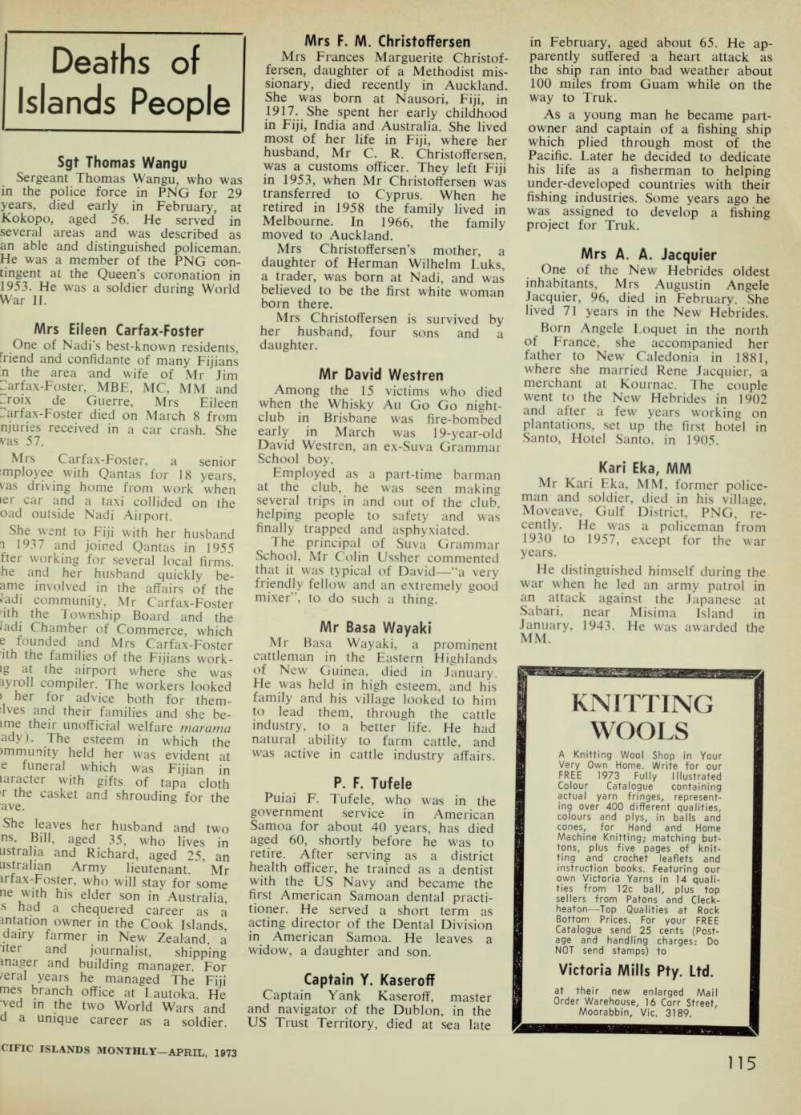
Deaths of Islands People
Sgt Thomas Wangu
Sergeant Thomas Wangu, who was in the police force in PNG for 29 years, died early in February, at Kokopo, aged 56. He served in several areas and was described as an able and distinguished policeman.
He was a member of the PNG con tingent at the Queen’s coronation in 1953. He was a soldier during World War 11.
Mrs Eileen Carfax-Foster One of Nadi’s best-known residents, friend and confidante of many Fijians n the area and wife of Mr Jim
Mbe, Mc, Mm And
-roix de Guerre, Mrs Eileen Carfax-Foster died on March 8 from njuries received in a car crash. She vas 57.
Mrs Carfax-Foster, a senior ;mployee with Qantas for 18 years, vas driving home from work when icr car and a taxi collided on the oad outside Nadi Airport.
She went to Fiji with her husband J 1937 and joined Qantas in 1955 fter working for several local firms, he and her husband quickly be ame involved in the affairs of the ladi community, Mr Carfax-Foster 'ith the Township Board and the ladi Chamber of Commerce, which e founded and Mrs Carfax-Foster ith the families of the Fijians work 's at the airport where she was ayroll compiler. The workers looked > her for advice both for them- Jves and their families and she be ime their unofficial welfare marama ady). The esteem in which the )mmunity held her was evident at e funeral which was Fijian in laracter with gifts of tapa cloth r the casket and shrouding for the ave.
She leaves her husband and two ns, Bill, aged 35, who lives in astraha and Richard, aged 25, an astralian Army lieutenant. Mr irfax-Foster, who will stay for some ne with his elder son in Australia, s had a chequered career as a mtation owner in the Cook Islands dairy farmer in New Zealand, a iter and journalist, shipping mager and building manager. For /eral years he managed The Fiji mes branch office at Lautoka He wed m the two World Wars and d a unique career as a soldier.
Mrs F. M. Christoffersen Mrs Frances Marguerite Christof fersen, daughter of a Methodist mis sionary, died recently in Auckland.
She was born at Nausori, Fiji, in 1917. She spent her early childhood in Fiji, India and Australia. She lived most of her life in Fiji, where her husband, Mr C. R. Christoffersen, was a customs officer. They left Fiji in 1953, when Mr Christoffersen was transferred to Cyprus. When he retired in 1958 the family lived in Melbourne. In 1966, the family moved to Auckland.
Mrs Christoffersen’s mother, a daughter of Herman Wilhelm Luks, a trader, was born at Nadi, and was believed to be the first white woman born there.
Mrs Christoffersen is survived by her husband, four sons and a daughter.
Mr David Westren Among the 15 victims who died when the Whisky Au Go Go night club in Brisbane was fire-bombed early in March was 19-year-old David Westren, an ex-Suva Grammar School boy.
Employed as a part-time barman at the club, he was seen making several trips in and out of the club, helping people to safety and was finally trapped and asphyxiated.
The principal of Suva Grammar School, Mr Colin Ussher commented that it was typical of David—“a very friendly fellow and an extremely good mixer”, to do such a thing.
Mr Basa Wayaki Mr Basa Wayaki, a prominent cattleman in the Eastern Highlands of New Guinea, died in January.
He was held in high esteem, and his family and his village looked to him to lead them, through the cattle industry, to a better life. He had natural ability to farm cattle, and was active in cattle industry affairs.
P. F. Tufele Puiai F. Tufele, who was in the government service in American Samoa for about 40 years, has died aged 60, shortly before he was to retire. After serving as a district health officer, he trained as a dentist with the US Navy and became the first American Samoan dental practi tioner. He served a short term as acting director of the Dental Division in American Samoa. He leaves a widow, a daughter and son.
Captain Y. Kaseroff Captain Yank Kaseroff, master and navigator of the Dublon, in the US Trust Territory, died at sea late
in February, aged about 65, He ap parently suffered a heart attack as the ship ran into bad weather about 100 miles from Guam while on the way to Truk.
As a young man he became part owner and captain of a fishing ship which plied through most of the Pacific. Later he decided to dedicate his life as a fisherman to helping under-developed countries with their fishing industries. Some years ago he was assigned to develop a fishing project for Truk.
Mrs A. A. Jacquier One of the New Hebrides oldest inhabitants, Mrs Augustin Angele Jacquier, 96, died in February. She lived 71 years in the New Hebrides.
Born Angele Loquet in the north of France, she accompanied her father to New Caledonia in 1881, where she married Rene Jacquier, a merchant at Kournac. The couple went to the New Hebrides in 1902 and after a few years working on plantations, set up the first hotel in Santo, Hotel Santo, in 1905.
Kari Eka, MM Mr Kari Eka, MM, former police man and soldier, died in his village, Moveave, Gulf District, PNG, re cently. He was a policeman from 1930 to 1957, except for the war years.
He distinguished himself during the war when he led an army patrol in an attack against the Japanese at Sabari, near Misima Island in January, 1943. He was awarded the MM.
Advertisements & other items, p. 123 (2 items)
115
CIFIC ISLANDS MONTHLY—APRIL, 1973
Knitting
WOOLS
A Knitting Wool Shop in Your Very Own Home. Write for our FREE 1973 Fully Illustrated Colour Catalogue containing actual yarn fringes, representing over 400 different qualities, colours and plys, in balls and cones, for Hand and Home Machine Knitting; matching buttons, plus five pages of knitting and crochet leaflets and instruction books. Featuring our own Victoria Yarns in 14 qualities from 12c ball, plus top sellers from Patons and Cleckheaton—Top Qualities at Rock Bottom Prices. For your FREE Catalogue send 25 cents (Postage and handling charges: Do NOT send stamps) to
Victoria Mills Pty. Ltd.
at their new enlarged Mail Order Warehouse, 16 Corr Street, Moorabbin, Vic. 3189.
Nutshell
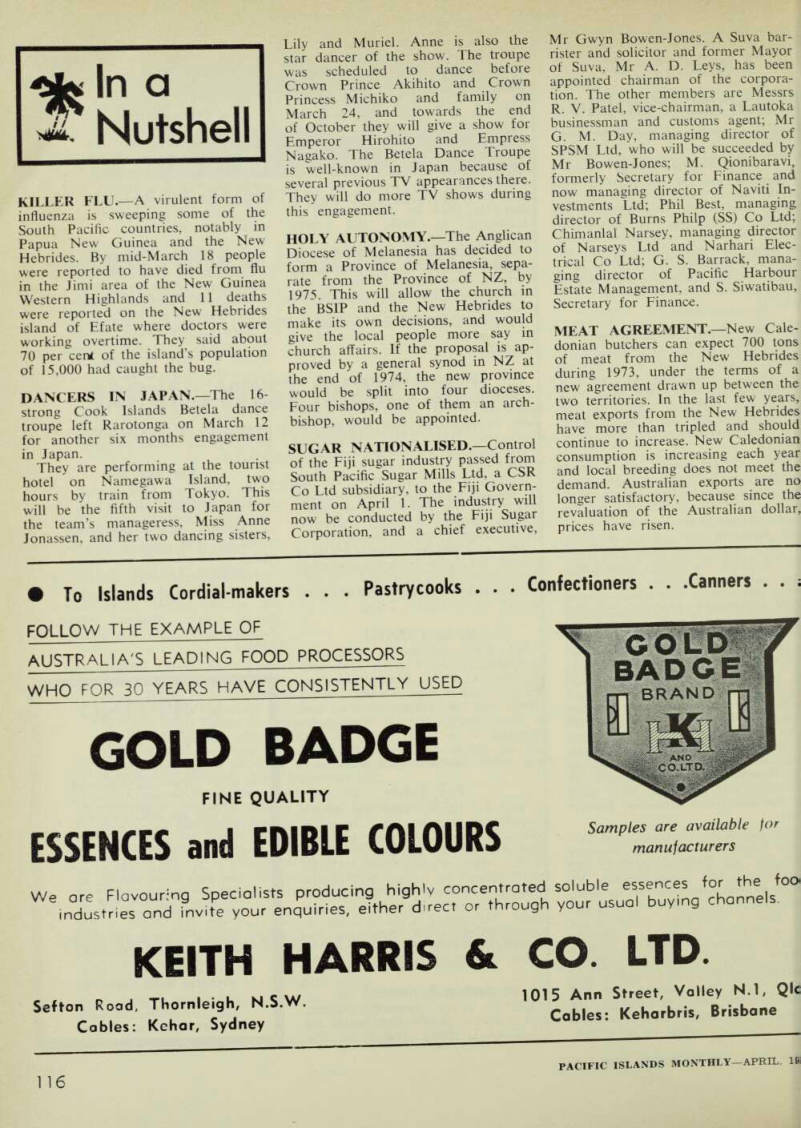
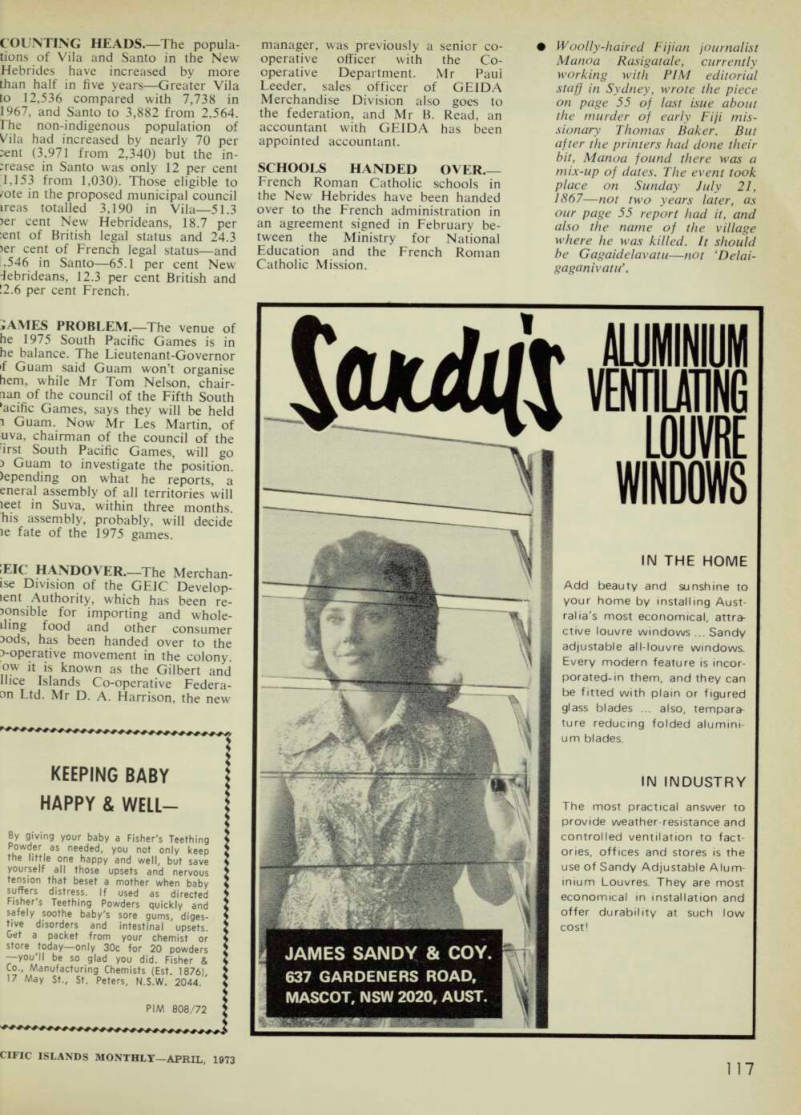
In a Nutshell
KILLER FLU. —A virulent form of influenza is sweeping some of the South Pacific countries, notably in Papua New Guinea and the New Hebrides. By mid-March 18 people were reported to have died from flu in the Jimi area of the New Guinea Western Highlands and 11 deaths were reported on the New Hebrides island of Efate where doctors were working overtime. They said about 70 per cent of the island’s population of 15,000 had caught the bug.
Dancers In Japan.— The 16-
strong Cook Islands Betela dance troupe left Rarotonga on March 12 for another six months engagement in Japan.
They are performing at the tourist hotel on Namegawa Island, two hours by train from Tokyo. This will be the fifth visit to Japan for the team’s manageress, Miss Anne Jonassen, and her two dancing sisters,
Lily and Muriel. Anne is also the star dancer of the show. The troupe was scheduled to dance before Crown Prince Akihito and Crown Princess Michiko and family on March 24, and towards the end of October they will give a show for Emperor Hirohito and Empress Nagako. The Betela Dance Troupe is well-known in Japan because of several previous TV appearances there.
They will do more TV shows during this engagement.
HOLY AUTONOMY— The Anglican Diocese of Melanesia has decided to form a Province of Melanesia, sepa rate from the Province of NZ, by 1975. This will allow the church m the BSIP and the New Hebrides to make its own decisions, and would give the local people more say in church affairs. If the proposal is ap proved by a general synod in NZ at the end of 1974, the new province would be split into four dioceses.
Four bishops, one of them an arch bishop, would be appointed.
Sugar Nationalised.— Controi
of the Fiji sugar industry passed from South Pacific Sugar Mills Ltd, a CSR Co Ltd subsidiary, to the Fiji Govern ment on April 1. The industry will now be conducted by the Fiji Sugar Corporation, and a chief executive,
Mr Gwyn Bowen-Jones. A Suva bar rister and solicitor and former Mayor of Suva, Mr A. D. Leys, has been appointed chairman of the corpora tion. The other members are Messrs R. V. Patel, vice-chairman, a Lautoka businessman and customs agent; Mr G. M. Day, managing director of SPSM Ltd, who will be succeeded by Mr Bowen-Jones; M. Qionibaravi, formerly Secretary for Finance and now managing director of Naviti In vestments Ltd; Phil Best, managing director of Burns Philp (SS) Co Ltd; Chimanlal Narsey, managing director of Narseys Ltd and Narhari Elec trical Co Ltd; G. S. Barrack, mana ging director of Pacific Harbour Estate Management, and S. Siwatibau, Secretary for Finance.
Meat Agreement. —New Cale
donian butchers can expect 700 tons of meat from the New Hebrides during 1973, under the terms of a new agreement drawn up between the two territories. In the last few years, meat exports from the New Hebrides have more than tripled and should continue to increase. New Caledonian consumption is increasing each year and local breeding does not meet the demand. Australian exports are no longer satisfactory, because since the revaluation of the Australian dollar, prices have risen.
COUNTING HEADS.— The popula tions of Vila and Santo in the New Hebrides have increased by more than half in five years—Greater Vila to 12,536 compared with 7,738 in 1967, and Santo to 3,882 from 2,564.
Die non-indigenous population of Vila had increased by nearly 70 per sent (3,971 from 2,340) but the in crease in Santo was only 12 per cent 1,153 from 1,030). Those eligible to /ote in the proposed municipal council ireas totalled 3,190 in Vila—sl.3 )er cent New Hebrideans, 18.7 per :ent of British legal status and 24.3 )er cent of French legal status—and ■ >546 in Santo—6s.l per cent New ■lebrideans, 12.3 per cent British and !2.6 per cent French. jAMES PROBLEM. —The venue of he 1975 South Pacific Games is in he balance. The Lieutenant-Governor •f Guam said Guam won’t organise hem, while Mr Tom Nelson, chair nan of the council of the Fifth South ‘acific Games, says they will be held n Guam. Now Mr Les Martin, of uva, chairman of the council of the irst South Pacific Games, will go > Guam to investigate the position. )epending on what he reports, a eneral assembly of all territories will leet in Suva, within three months, his assembly, probably, will decide le fate of the 1975 games. rEIC HANDOVER. —The Merchan ise Division of the GEIC Develop lent Authority, which has been re jonsible for importing and whole iling food and other consumer nods, has been handed over to the >operative movement in the colony, ow it is known as the Gilbert and Hice Islands Co-operative Federa on Ltd. Mr D. A. Harrison, the new
manager, was previously a senior co operative officer with the Co operative Department. Mr Paul Leeder, sales officer of GEIDA Merchandise Division also goes to the federation, and Mr B. Read, an accountant with GEIDA has been appointed accountant.
Schools Handed Over.—
French Roman Catholic schools in the New Hebrides have been handed over to the French administration in an agreement signed in February be tween the Ministry for National Education and the French Roman Catholic Mission.
• Woolly-haired Fijian journalist Manoa Rasigatale, currently working with PIM editorial staff in Sydney, wrote the piece on page 55 of last isue about the murder of early Fiji mis sionary Thomas Baker. But after the printers had done their bit, Manoa found there was a mix-up of dates. The event took place on Sunday July 21, 1867—not two years later, as our page 55 report had it, and also the name of the village where he was killed. It should be Gagaidelavatu— not ‘Delai gaganivatu’.
Advertisements & other items, pp. 124-128 (3 items)
Gold Badge
To Islands Cordial-makers . . . Pastrycooks . .
FOLLOW THE EXAMPLE OF
Confectioners . . .Canners
AUSTRALIA'S LEADING FOOD PROCESSORS
WHO FOR 30 YEARS HAVE CONSISTENTLY USED
GOLD BADGE
FINE QUALITY
ESSENCES and EDIBLE COLOURS
BRAND
B LT Samples are available jo* manufacturers
KEITH HARRIS & CO. LTD
Sefton Rood, Thornleigh, N.S.W.
Cables: Kchar, Sydney 1015 Ann Street, Valley N.l, Qlc Cables: Keharbris, Brisbane
LOUVRE
WINDOWS
IN THE HOME
Add beauty and sunshine to your home by installing Australia's most economical, attractive louvre windows ... Sandy adjustable all-louvre windows.
Every modern feature is incorporated-in them, and they can be fitted with plain or figured glass blades ... also, temperature reducing folded aluminium blades.
IN INDUSTRY
The most practical answer to provide weather-resistance and controlled ventilation to factories, offices and stores is the use of Sandy Adjustable Aluminium Louvres. They are most economical in installation and offer durability at such low cost!
KEEPING BABY
HAPPY & WELL-
By giving your baby a Fisher's Teething Powder as needed, you not only keep the little one happy and well, but save yourself all those upsets and nervous tension that beset a mother when baby suffers distress. If used as directed Fisher's Teething Powders quickly and safely so-othe baby's sore gums, digestive disorders and intestinal upsets.
Get a packet from your chemist or store today—only 30c for 20 powders —you'll be so glad you did. Fisher & Co., Manufacturing Chemists (Est, 1876) 17 May St., St. Peters, N.S.W. 2044."
PIM 808/72
EEIWi
hm*
FLEETS. Fast 37 ft. general purpose boat, profess, bit., late 1972, new 190 h.p. mar. diesel, 900 lbs. refrigeration, 5 berths, shower, radio, sounder, survey part completed. $23,000. Fleets, Rowe’s Bldg., Edward St., Brisbane, 4000. Cable; “Fleets”, Brisbane.
WIDE RANGE TRACTORS & MACHINERY.
Challenge front loaders with hydraulic or trip buckets, high lift dozer blades. Fork lifts. Rear end buckets, suit most agricultural or industrial applications. Write for literature to: David Evans Group “The Big Machinery Yard”, Box 54 P.O.
Boonah, Q., 4310.
FREEHOLD LAND FOR SALE, British
Solomon Islands. 21 acres on Guadalcanal 12 miles from Honiara, 5 miles from Henderson International Airport. Develop ment potential. M. L. Munro, P.O. Box 39 Gizo, British Solomon Islands.
Line Advertisements
Per line, 950 Anst.; Minimum rate. 4 lines.
FOR SALE
A business engaged in sawmilling, plantation, trade stores and artifact activities situated on Woodlark Island in Milne Bay district of Papua offered for sale as a going concern. Much scope for expansion and tourism.
Further details may be obtained by writing to “Woodlark”, C/- P. 6. Box 507, Port Moresby, P.N.G.
POSITION REQUIRED as Purchasing Officer, or similar. Wide experience with large company. Excellent references if required. Please reply: W. A. McNab, 73A The Parade, Bucklands Beach, New Zealand.
PENFRIENDS OVERSEAS. International Penfriendship—the greatest of all hobbies!
Tour the world by letter! For details, write now; Five Continents Company Ltd., P.O. Box 21219, Henderson, New Zealand.
WANTED—SAILING YACHT. Large sea-
going yacht from 90 feet up to be used as floating home. Must have sound hull and engines. Staterooms and living areas should be spacious and well appointed.
Price must be extremely reasonable. Age and style of boat no barrier if in sound condition. Send photographs and information to; Graham Johnson, G.P.O. Box 999, Suva, Fiji.
CONCRETE BLOCK MACHINE FOR SALE.
Makes blocks, flags, edgings, screen-blocks, garden stools —up to 8 at once and 96 an hour. SAI2O c.i.f. main ports. Send for leaflets. Forest Farm Research, Londonderry, N.S.W., 2753.
THE RAPID RESULTS COLLEGE OFFERS
TUITION FOR GCE, SCHOOL CERT; also
for professional exams in Accountancy.
Banking, Company Secretaryship, Costing, Law, Marketing. For details of our specialised courses and air-mail Tutorial Service, write for FREE copy of YOUR CAREER to Th» Rapid Results College, Dept. ZDI, Tuition House, London
SWI9 4DS.
ALL BOOKS AND JOURNALS ON AUST-
RALASIA AND THE PACIFIC BOUGHT
AND SOLD. Catalogues issued and sent free on application. Correspondence invited. Berkelouw, 15-19 Boundary St., Rushcutters Bay, Sydney, 2011. Phone: 31-8215.
BODEN’S BOAT DESIGNS PTY. LTD..
695 George St., Sydney, 2000. Get your Bodens Boat Designs and Boat Building Book from newsagents everywhere. Posted direct 5A2.20 surface mail.
C. S. & JOHNSON YOUNG CO, 191 Johnston Rd. Hong Kong, G.P.O. Box 423.
Import: Fungus, sharkfin, M.O.P. shell, beche-de-mer. Export: Lamps, fishing appliances, enamelware, garments, camphorwood chests, footwear.
STAMPS FOR SALE. Send for free price lists of stamps, albums, catalogues, etc.
Wanted to buy—Pacific Is. stamps. R. J, Meincke, 13 Percival St., Oak Park, Vic. 3046, Australia.
YOUNG ITALIAN MAN would appreciate friendly correspondence and, eventually, stamp exchange with residents in any independent Island. Write to: Giovanni de Santis. Casella Postale 97, 70100 Ban, Italy.
FOR SALE
Trade price ex Sydney. Lamps any type, tubes, components. Buzzaway (Crompton Parkinson) does not attract insects. All electrical goods E.C.A.
Pty. Ltd., P.O. Box 41, Spit Junction, Sydney, N.S.W. 2088.
WANTED
FREEHOLD LAND
Am interested in buying a large tract of freehold land in the South Pacific.
Might pay cash. Please write: "PAM", c/~ G.P.O.
Box 3408, Sydney, N.S.W. 2001, Australia.
FOR SALE
UNIQUE business opportunity in rapidly developing Capital of British Solomon Islands. Fifteen year old first class soft goods, jewellery handicrafts, cosmetics business. Location main road, centre Honiara, two-storey building with two large air conditioned shops and upstairs flat. Long term leasehold. Plot 118 ft. x 50 ft.
Apply Box 200, Honiara, 8.5.1. (Genuine buyers only.)
ESCAPE
FROM THE ORDINARY
Here is an idyllic paradise where you can ■enjoy the unspoiled beauty and serenity of a working coconut plantation. This privatelyowned Pacific retreat has been designed for a maximum of 12 people. Gracious surroundings, friendly service, relaxed accommodations with Fijian decor and American conveniences.
Activities available include: Deep sea fishing, reef and shell hunting, skin diving and snorkeling, water skiing, hiking, turf tennis court, badminton, horseback riding, and a beautiful tropical garden to relax in.
Send for free brochure: The Manager.
NAMALE PLANTATION,
SAVUSAVU, FIJI ISLANDS
PARK VIEW MOTEL—BRISBANE
Quiet location—opp. Botanic Gardens.
Single, double, family suites, all with refrig., air conditioning, phone, TV, radio tea making facilities, from $lO. Pool and restaurant. Phone 31-2695—Telex 40270.
Write for coloured brochure— Park View Motel, 128 Alice St, BRISBANE, Old., 4000.
suncourt
real
estate
mreinz estate - as an investment, for vacations or retirement.
Anywhere in New Zealand.' Write us: P,O. Box 22, Taupo. Phone 674 New Zealand
MARINE GEAR
SCOOP PURCHASE NAVAL EQUIPMENT
6,000 lbs., by weight, bronze props and shafts. 5 aluminium, 28 ft. x 9 ft. life boats fitted in. shaft. 28 in. prop. 10 SKVA, 415 V, 3PH-240v IPH gen. sets. 3 15KVA 415 V, fully automatic, diesel gen. sets. 20 Maywest distress, 5.0.5., 500K/cs, dinghy radio sets. 5 Perkins S6M, 120 h.p. marine diesels, 2:1 hyd. box and all stern gear. FORDSBERG PTY.
LTD., Box 16, P. 0., Croydon Park, N.S.W. 2133, Australia.
PAPUA
NEW GUINEA
PRINTING CO.
PTY. LTD.
Serving the Country from Aitape to Alotau Manus to Moresby Leaders in Commercial Offset and Letterpress Printing Stationery Office Supplies Office Equipment Rubber Stamps Self-Adhesive Labels In Fact:—Everything For the Office P.O. Box 633, Port Moresby P.O. Box 759, Lae P.O. Box 30, Mt Hagen P.O. Box 1239, Rabaul P.O. Box 466, Kieta P.O. Box 411, Goroka
DIESEL GENERATORS AND
ASSOCIATED SWITCHGEAR
For sale, all or singly, from hotel now connected to mains supply. Perfect condition: 6-CYLINDER DORMAN ENGINE, Stamford alternator, 100KVA rating, approximately 1,000 hours. 6-CYLINDER FORD ENGINE, English Electric alternator, 65KVA rating, 3,000 hours. 6-CYLINDER DORMAN ENGINE, Dymacon (U.K.) alternator, 85KVA rating, approximately 3,000 hours.
PLEASE WRITE: MR. D. ADAMS, BOX 310, NORFOLK
ISLAND.
THE
YORKSHIRE INSURANCE
CO. LTD
(Incorporated in England)
A MEMBER OF THE GENERAL ACCIDENT GROUP OF COMPANIES
ALL CLASSES OF INSURANCE
AUSTRALIAN HEAD OFFICE: 10-12 Spring Street, Sydney.
Group Manager for Australia: J. Adam PAPUA AND NEW GUINEA BRANCH: Douglas Street, Port Moresby Manaaer: H. M. Harvey. lhall , ICD /urn.j . CHI . EF ISLAND REPRESENTATIVES hiteley' Ltd . Iniara 'RS e p p'Ovfab, 5 (Lae > Ltd - W. Stokes; Manus, Edgell & Laubreauy'/ NnrfniV' lc| B 'a ’m' V * Lawson Ltd ’ ; Suva ' Williams & Gosling Ltd.; Noumea, Laubreaux, Norfolk Island, Martins Agencies; Apia, E. A. Coxon & Co.; Vila, C. Sullivan (INI) Pty. Ltd.
YOUR NEXT LEAVE
Modern up to the minute homes at Palm Beach, Avalon, Newport, Church Point, Mona Vale, etc., available to Island Residents for Holidays. Write for information
J. T. STAPLETON PTY. LTD.
ESTATE AGENTS,
133 PITT STREET, SYDNEY, 2000. 25-5305, 25-1737 also Box 32, P. 0., Avalon Beach, Sydney 2107. 918-2221.
& a m mm
JACK
SONS
GOOD FLAVOUR FOODS
available through our agents:
C. SULLIVAN EXPORT PTY. LTD.
SPECIALIST EXPORTERS
POTATOES ONIONS
GARLIC BLUEPEAS
FRESH FRUIT AND VEGETABLES
N.Z. DAIRY BOARD GHEE
GERRARD WIRE TYING EQUIPMENT
GENERAL MERCHANDISE COOLER
FREEZER
Current Quotations from;
TURNERS SUPPLY COMPANY LIMITED
PO Box 1370, AUCKLAND. Cables: "TUSCO" Auckland.
PACIFIC EXPORT DIVISION of TURNERS & GROWERS LTD. Wholesale Fruit and Produce Merchants, Auckland, New Zealand.
SOUTHERN PACIFIC INSURANCE
COMPANY LIMITED
Head Office: Equitable Life Building, 80 Alfred Street, Milsons Point, N.S.W., 2061.
Specialising in Pacific Island Insurance requirements for over 30 years. • FIRE • FIRE AND VOLCANIC ERUPTION • HOUSEHOLD COMPREHENSIVE • MOTOR VEHICLE • COMPULSORY THIRD PARTY • COMPULSORY WORKERS' COMPENSATION
• PUBLIC LIABILITY • MARINE
Enauiries invited for all classes of insurance from special representatives at: RABAUL- Jack T. Ray—Manager for Papua & New Guinea, Mango Avenue. P.O. Box 123.
LAE- R. H. Meyer—Manager at Lae, Kam Hong's Building, Central Avenue. P.O. Box 758 PORT MORESBY: H. A. K. McKee —Manager at Port Moresby, Maloney s Building, Cuthbertson Street. P.O. Box 136. SUVA-FIJI: L. M. Rolls—Manager for Fi|i, McGowans Building, Margaret Street. P.O. Box 521.
117
CIFIC ISLANDS MONTHLY—APRIL. 1973
119
CIFIC ISLANDS MONTHLY— APRIL, 1973
Index to Advertisers
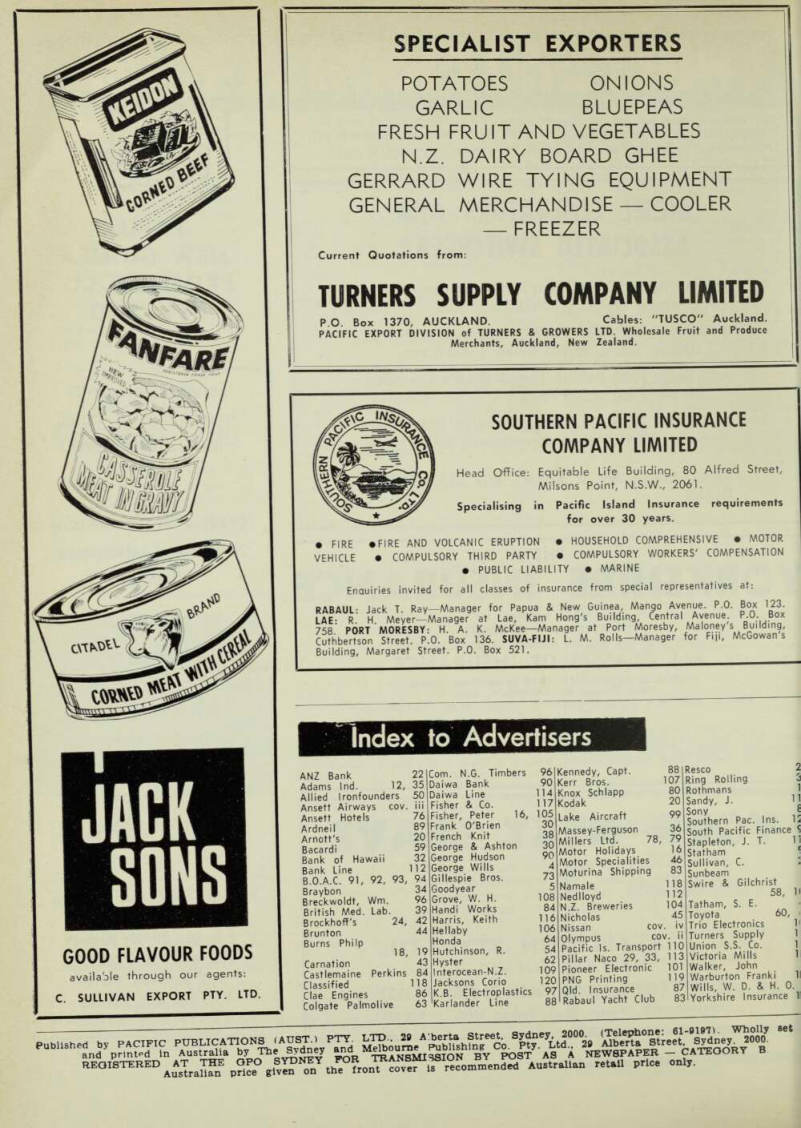
ANZ Bank 22 Adams Ind. 12, 35 Allied Ironfounders 50 Ansett Airways cov. iii Ansett Hotels 76 Ardneil 89 Arnott's 20 Bacardi 59 Bank of Hawaii 32 Bank Line 112 8.0.A.C. 91, 92, 93, 94 Braybon 34 Breckwoldt, Wm. 96 British Med. Lab. 39 Brockhoff's 24, 42 Brunton 44 Burns Phi Ip 18, 19 Carnation 43 Castlemaine Perkins 84 Classified H 8 Clae Engines 86 Colgate Palmolive 63
Com. N.G. Timbers 96 Daiwa Bank 90 Daiwa Line 114 Fisher & Co.
Fisher, Peter 16, 105 Frank O'Brien 30 French Knit 38 George & Ashton 30 George Hudson 90 George Wills 4 Gillespie Bros.
Goodyear 5 Grove, W. H. 108 Handi Works 84 Harris, Keith 116 Hellaby 106 Honda 64 Hutchinson, R. 54 Hyster 62 Interocean-N.Z. 109 Jacksons Corio 120 K.B. Electroplastics 97 Karlander Line 88
Kennedy, Capt.
Kerr Bros. 107 Knox Schlapp Kodak 20 Lake Aircraft 99 Massey-Ferguson 36 Millers Ltd. 78, 79 Motor Holidays 16 Motor Specialities 46 Moturina Shipping 83 Namale 118 Nedlloyd 112 N.Z. Breweries 104 Nicholas 45 Nissan cov. iv Olympus cov. n Pacific Is. Transport 110 Pillar Naco 29, 33, 113 Pioneer Electronic 101 PNG Printing 119 Qld. Insurance 87 Rabaul Yacht Club 83
Resco 2.
Ring Rolling <a Rothmans Sandy, J. IJj Sony ,*■ Southern Pac. Ins. N South Pacific Finance ?
Stapleton, J. T.
Statham Sullivan, C.
Sunbeam Swire & Gilchrist 58, 11 Tatham, S. E.
Toyota 60, < Trio Electronics 1' Turners Supply Union S.S. Co.
Victoria Mills H Walker, John Warburton Frank! II Wills, W. D. & H. 0.
Yorkshire Insurance If
Advertisements & other items, pp. 128-130 (2 items)
registered A *T g lv» » T t ™l on7-v"rlcotnmended Australian retail price only.
weird and
9 r / a; I \ % n 4 v f *** •'% • ■ *». «< * X. Ail - • • Is*
*Vf ,*. ■■ <&*■ //d
** '**■ f-" •*■- ■?,
Awake to this
weird and
wonderful world
The world of Papua New Guinea, the last place on earth where you can truly get away from it all.
Exciting, wildly exotic landscapes ... a profusion of plant and wild life seen nowhere else. Untamed, untrodden jungles. Acre upon acre of highly productive plantation land.
Exciting people. Like the “Mud Men" of the Eastern Highlands. Stone Age people being thrust in one lifetime into .the Space Age. A land of living legends, legends that are a part of everyday life, legends that in other countries died out centuries ago.
Papua New Guinea is the last frontier a Country that will fascinate, delight and inform you. And it is our home. We serve over fifty ports throughout the length and breadth of the land, with 150 flights every week, so when you come and make it soon, before it all changes see us.
A A
Serving the country-yesterday today & tomorrow
AIMSETT AIRLINES OF PAPUA NEW GUINEA
in conjunction with ANSETT AIRLINES OF AUSTRALIA
APOB3/PIM
« :» ' mm it! ««T. 1 M J*
tmi
r ■' -• «■ "P nfe* e * V ** / VH MO And wherever you’ll go in over 120 nations throughout the world you’ll find proud DATSUN drivers.
Perhaps the main reason is that DATSUN was designed to meet a wide variety of conditions—mountain roads and super highways, blistering suns and freezing temperatures. DATSUN is indeed the international car that has precision engineering and a stunning string of rally victories behind it.
Its superb handling, safety features and high speed efficiency make DATSUN the choice of young and old alike. DATSUN-the car that really satisfies the world over.
S 3 rk Hi
DATSUN
NISSAN
DATSUN distributor network covers the following areas; ESESDFiji T.P.N.G..W. Samoa* New Caledonia• New Hebrides* 8.5.1.P.-Timor-Norfolk- V JA. Samoa*Tahiti-Cook-Nauru* Tonga-Saipan-Guam-Australia-New Zealand