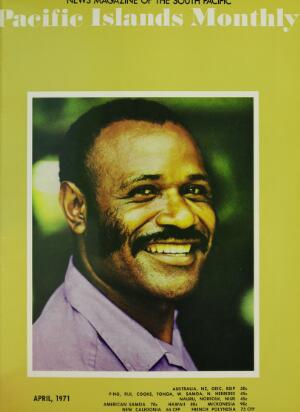
April, 1971
mlttj iy\r\\jr\x-i\ ni_ iml ouui n r/-\v^inv^
Australia, Nz, Geic, Bsip 50C
P NG, FIJI, COOKS, TONGA, W. SAMOA, N. HEBRIDES 45c
Nauru, Norfolk, Niue 45C
AMERICAN SAMOA 70c HAWAII 80c MICRONESIA 90c NEW CALEDONIA 65 CFP FRENCH POLYNESIA 75 CFP
Our Cover
He's not a Pacific big-wig.
He's not even well known in his own territory. But he has a happy smile and that counts for a lot. He's Phillip Kabeb, 27, clerk in charge of all trucking in Lae, New Guinea, for KSS Transport. He comes from Tamigudu village, in the Morobe district, and until re cently was a truck driver him self with KSS's parent com pany, Booij Bros.
Advertisements & other items, pp. 2-16 (10 items)
April 1971-Pacific Islands Month
The big link-up.
50 centres throughout Papua Melbourne, Adelaide and Perth and New Guinea on a 10,000 with the Territory, mile network. 100 centres in If you plan to take off soon, Australia. TAA links the lot. keep our big link-up in mind.
Across the Territory we give And call your Travel Agent or you more flights to pick from. TAA.
More cargo space. More seats. Port Moresby 2101, Lae 3191, Including daily Friendship Madang 2478. Rabaul 2567. services between Moresby and Goroka 8, Mt. Hagen 4or 301, all major centres. Plus daily Wewak 103.
Bird of Paradise’ T-Jet flights
connecting Brisbane, Sydney,
rjmjm No.l~the friendly one
AIRLINES OF NEW GUINEA
The big link-up.
Papua \ 319 274
THE PACIFIC
FUI, SAMOA,TONGA, NIUE Is, NORFOLK Is.
BURNS PHILP
[SOUTH SEA] CO. LTD.
REGISTERED OFFICE: SUVA, FIJI
TELEPHONE NO: 22661
TELEX NO: FJ1127
Code Address: "BURNSOUTH'
SHIPPING AGENCIES
The New Zealand Shipping Co. Ltd.
Shaw Savill & Albion Co. Ltd.
Blue Star Port Line (Management) Ltd.
Bank Line Ltd.
General Steamship Corporation Ltd.
Compagnie des Messageries Maritimes Royal Interocean Lines Daiwa Navigation Company Ltd.
Sitmar Line Flotta Lauro (Lauro Lines) Australasia Pty. Ltd.
Tonga Shipping Agency.
EXCLUSIVE
DISTRIBUTORSHIPS
INCLUDE
Akai Taperecorders Sunbeam Appliances Dunlop Products Hitachi Electronics Holden Motor Vehicles Rolex Watches Revlon Cosmetics Pentax Cameras Massey-Ferguson Tractors Olympic Tyres Penfold Wines
AGENTS FOR
Queensland Insurance Co. Ltd.
Shell Company (P. 1.) Ltd.
Bureau Veritas
ASSOCIATED COMPANIES
Burns Philp (New Hebrides) Ltd.
Burns Philp Trustee Co. Ltd.
Automotive Supplies Co. Ltd.
Corrie & Co. Ltd.
Wrought Iron and Steel Construction Co. Ltd.
Bish Ltd.
SPECIALISED SERVICES
Expert advice on Shipping; Forwarding; Customs formalities; Insurance.
COMPLETE TRAVEL
SERVICE
accredited agents for the
INTERNATIONAL AIR
TRANSPORT ASSOCIATION
OVERSEAS AGENTS: SYDNEY • LONDON • SAN FRANCISCO
Qrnott's"* Biscuits
in triple wrapped, tropical packs
ten Sco CO* 19 ton, Arnott’s SCOTCH FINGER Biscuits.
A butter-rich, chunky biscuit with the true flavour of shortbread.
Arnott’s SALTiNE Biscuits.
Light, tangy, crisp cracker biscuit . . . perfect with salads, cheese, soup or eaten plain, Biscuit* Arnott’s CHEESE JATZ Biscuits.
Crisp cracker biscuit with a fine cheese flavour — perfect for entertaining.
Arnott’s MILK ARROWROOT Biscuits.
A wholesome, nourishing biscuit especially suitable for children, but a favourite with all the family.
m m Arnott’s SAO Biscuits.
A light, crisp cracker biscuit. . . delicious with butter and cheese, ham, jam or other spreads.
Mo m
Arnott’s MONTE CARLO Biscuits.
Crisp short biscuits, flavoured with pure honey and coconut,sandwiched with vanilla cream and raspberry jam.
K m
SHREDDED
Arnott’s SHREDDED WHEATMEAL Biscuits.
A wholesome biscuit with the nutty flavour of crunchy whole wheatmeal.
Delicious plain or buttered. irJu or*, T^rr, B m Arnott’s NICE Biscuits.
A sweet plain short-texture biscuit sprinkled with fine sugar. Popular for morning tea.
There is no Substitute for Quality
E 670
Wa
SOME OF THE FIRMS
WE REPRESENT ARE:
A. W. Allens (Confectionery) Sunshine Biscuits Sunrise (Confectionery) Flamenco (Instant Coffee) Cremota (Quaker Oats, Jets Pet Foods) Merchants (Canned Soft Drinks) Highness (Canned Vegetables, Canned Fruit Drinks) Lunchtime (Honey) South Pacific Canneries (Scallops, Abalone) Safcol (Canned Tuna, Salmon) Hancock's (Spaghetti, Cereals) Melbourne Canning (Jams, Bleach) Water Wheel (Flour, Sharps, Wheat) General Food Corporation (Twisties, Twirlies) Edward Zorn (Margarine, Cooking Fats) Robert Timms (New Guinea Gold Coffees, Teas) Bx Plastics (Sandals) Homy Peds (Sandals) Magnet (Mattresses) Esteel (Cookwear) Teco (Cafe Bars) Mitchell's (Abrasives) Regent (Swiss Watches) Gainsborough (Furniture) Tamco (Melanie Crockery, Nylon Hardware) Elmaco (Plastic Household Goods, Electrical Fittings) Brownbuilt (Pre-fabricated Houses) Ryline (Fluorescent Lights) Chargemaster (Fluorescent Lamps) Franklite (Light Fittings) Electronic Industries (Electrical Household Appliances) Jex (Steel Wool) Austramax (Pressure Lamps) Preservene (Soap Products) Charles Tims (School Requisites) Ascow and Philadelphian (Shirts) Lawn Chair and Tubco (Garden Furniture) Sunrise Lustretone (S.S. Sinks, Plumbers' Supplies) Kerex (Kerosene Burners) Arena (Football Boots) Ferrari (Men's Shoes)
S. E. TATHAM
& Co. Pty. Ltd.
MELBOURNE, AUSTRALIA
G.P.O. Box 8, Cables “SET"
Telephone 60*1125
EXPORT AGENTS
PACIFIC ISLANDS
AGENTS
Australian buying and shipping agents for the Gilbert and Ellice Islands Colony Wholesale Society « i
DIRECT ENQUIRIES WELCOMED
Associate Company
S. E. TATHAM (FIJI) LTD
Suva, G.P.O. Box 671.
Lautoka, P.O. Box 366.
SINCE 1924
Australian food
goes everywhere
What's in Australia for you ? The world's greatest range of food. No less than 1,200,000,000 acres of Australia are farmed to produce butter, meat, cheese, fresh canned and dried fruit, honey, wines, cereals and other foods. All produced to the highest standards in the world. More than 150 countries purchase Australian food in quantity. This is the year to look to Australia for a wide choice of quality Australian food, competitively priced to sell at both trade and consumer levels, and available for prompt despatch by fast, frequent sea and air services.
Australian Department ol Trade and Industry.
what’s in £>
Australia
for you ? !■
Find out today. All you have to do is contact the Australian Government Trade Commissioner who will put you in touch with suppliers of Australian products: Ramson House, 18 Pratt St., SUVA, Fiji, (P.O. Box 1252). Tel: 2 5624.
LH/PC/FO/740
COLEMAN
ALSO MAKES THESE
WORLD FAMOUS PRODUCTS:
The Coleman
Cold Makers
Coleman Air Conditioners have special 'Tropical capacity" coils, Tecumseh compressors, (5 year warranty) for reliable heavy duty performance. They dehumidify, filter out dust, dirt and pollen. Coleman Air Conditioners will keep you cooler and more comfortable than you've ever been.
They operate safely, efficiently and quietly year after year.
EXPORT DIVISION
The Canadian Coleman Company Limited, 9 Davies Avenue, Toronto, Ontario, Canada^
iU39NOUiS
u ** m wm
mmmMs
mm i
THE CREST OFFERS
YOU MORE THAN JUST
ACCOMMODATION...
(filial ill!!! 1111111 l * Y wPPi ■r^m v^y^atB?!
We offer superb cuisine . . . intimate cocktail bars . . . proximity to the showground, cricket ground and beaches’ . . . free parking ... TV, radio and 'fridge in every room . . . extensive harbour views . . . and a modern shopping mall. you see . . . \ i
WE ARE NOT JUST
M OTJUST
A HOTEL. ,I*l
but more a way of life! cm
HOTEL
SYDNEY
111 DARLINGHURST ROAD
KINGS CROSS, N.S.W. 2011
Tel. 35 2755—Cable “CRESTEL”
THE BIG FLAVOURS COME TO THE
SOUTH PACIFIC
ftn 3 P
RTA HM
'OOP,
m The red hibiscus symbol proudly marks the introduction of some of New Zealand's most popular soft drinks by Island Bottlers of Fiji Ltd., from their new modern factory.
In Apia in Western Samoa the same flavourful range is produced by the Apia Bottling Company and people everywhere are asking for these famous names -
LEMON and PAEROA, TARTAN DRY GINGER
ALE and the colourful fruity range of JU'CY
SOFT DRINKS.
They're yours to enjoy . . . time after time.
Manufactured under franchise to Innes Tartan Ltd., Auckland, New Zealand by-
mm ISLAND BOTTLERS OF FIJI LTD.
W APIA BOTTLING COMPANY LTD.
a car account at the Commonwealth pain out or
paying
open one
today
a 9 Get with the Strength BmcoMMomuin
Cheezpop & Chickpop
... mm I I i
The happiest fun-foods
Cheezpop and Chickpop are great fun. Crisp . . . crackling . . . salty and flavoursome . . . pals to drinks . . . waken your palate . . . sharpen your taste for every frosty sip. Next party, snacktime or barbecue, nibble on Cheezpop or Chickpop. Or both.
They’re pop-pop-popping good fun.
For trade enquiries: Reckitt & Colman Pty. Ltd., Wharf Road, West Ryde, N.S.W., Australia. Cables: Reckitts, Sydney.
A RECKITT & COLMAN PRODUCT
SCUBA
m Agents
ISLAND
NORFOLK
Norfolk Island Sporting Centre Ltd.
EQUIPMENT
The TABATA line offers the importer a complete range of RUBBER
SKIN & SCUBA DIVING
EQUIPMENT and ACC-
ESSORIES for both the professional and amateur. Years of specialized manufacturing experience has establidied our line's
REPUTATION FOR QU-
ALITY, ATTRACTIVE
and PRACTICAL DESI-
GNS and VERY COMP-
-1 ETITIVE PRICES. We a-
Iso offer a varied line of rubber sundries for golfing, skiing and other popular sports.
For full particulars on our lines, write to:
Manufacturers TABATA. CO., LTD.
rr.ru.rttfl .OOAC C&CTiRATA Yajjma B,dg..2.2Yoshi.cho, N.honbashi ,Chu*Ku, Tokyo Cable:"EASTABA‘TokyO' TELEX:2S2 *2806 EASTABATA T0KTe,:(6 6 3,8651-5.
Ideal for tropical conditions . . . .
George and Ashton refrigerated fibreglass truck unit
for natural cheese itsbesf '
DISTRIBUTORS
SLi Ww* bacon-hams
TfUIIOIW iSMAUGOODS
iS'-l
These refrigerated truck units are fully approved by the New Zealand Departments of Health and Agriculture. They can be designed for use with any type C vehicle from pick-ups to semitrailers or they can be used as static storehouses using their own refrigerating units.
These units are made from moulded fibreglass tough, hygienic, colourful. There are no joints to harbour vermin and cleaning is guick, easy and efficient.
Enguiries welcomed.
GEORGE & ASHTON LTD
P.O. Box 2056, Dunedin New Zealand Phone:42-779
Specify Cummire power
When you order new equipment, insist on Cummins—the preferred diesel power. Cummins is offered by more than 450 different equipment manufacturers in over 1,700 different equipment models.
Why? Because Cummins has been proven the most reliable and economical diesel power. Come in and visit us—we’ll tell you where and how Cummins is applied and show you the back-up support we offer. :■ , ... ■ •i . m m m m I mm i ■ 2» f > mm S y "'.
CUI3J
N 1
CREAM
i ASSORTED
i, BISCUITS
o sOs VO * 1 Ik \\ * %
t/tiSu
you’ll love the freshness
buy some now!
Manufactured by David Webster & Sons Pty. Ltd., 468 Gympie Rd„ Kedron, Brisbane 4031.
■ J i> : 4 '■ • "%• r- v« v -< ’ ■• • . 1 *** Mr * ! V’ 3 4
If you’re in the
forestry business and
serious about making
money, it’s time you
took a good look at
wMF
Now, MF brings you a wide range of forestry machines designed to save time and cut costs on softwood or hardwood handling. Machines like the MF22O SKIDDER (1) with an 80 hp engine, 4 wheel drive, power-shift transmission, mechanical type winch of 22,000 lb. capacity MF2200 TREEVER (2) which gathers, loads, hauls, unloads and stockpiles 30 to 40 cords of pulpwood in an 8 hour day MF3366 CRAWLER DOZER (3) with hydraulic winch of 20,000 lb. pull and MFSS FOUR WHEEL DRIVE LOADER (4) with log clamp all illustrated above. In addition, there's an MF4SOS Hydraulic Excavator with Grapple Loader attachment the MF33 four wheel drive loader with sawn timber forks - MFSOO Crawler with multi-purpose forestry attachments MFII front wheel drive loader with log clamp and an MF2203 Forestry Mule One or more of these top quality machines could be of interest to you. Find out more now!
ASK YOUR MF ICM DISTRIBUTOR FOR MORE INFORMATION ... THE MAN TO SEE IS HERE
ELA MOTORS LIMITED
PORT MORESBY, PAPUA P.O. BOX 75
Branches throughout Papua and New Guinea
BURNS PHILP (SOUTH SEA) CO. LTD.
LAUTOKA. FIJI P.O, BOX 61
Branches throughout Fiji, Tonga, Western Samoa and other South Pacific territories
SOCIETE COMMERCIALE DE EQUIPMENT
MECANIQUE S.A.
NOUMEA, NEW CALEDONIA B.P. 33
(Construction Machinery only)
PACIFIC MOTORS S.A.
B P 41 NOUMEA, NEW CALEDONIA
(Industrial Wheeled Tractors only)
PENTECOST PACIFIC S.A.
PORT VILA & SANTO, NEW HEBRIDES
(Industrial Wheeled Tractors only)
R. C. SYMES PTY. LTD.
HONIARA, GUADALCANAL
BRITISH SOLOMON ISLANDS
PROTECTORATE
HENRI LOMBARD
PAPEETE, TAHITI P.O. BOX 36
» *V - ‘ V;. % ■ HU
mmm 0"**^
*m*mmm*m*rn m Meet the QS-1 stereo system, from Sansui, a historic new achievement that makes four-channel stereo possible from two-channel sources.
The key to it is the newly-developed Quadphomc Synthesizer (QS-1), a revolutionary, yet inexpensive, device which is able to render two-channel stereo with the brilliant, four-channel presence you experience in a concert hall.
To make the most of the QS-1, you'll want a very fine tape deck, one l,ke the 3-motor 4-head SD-7000, complete with advanced relay/soienoid controlled tape transport section, which offers unprecedented tonal quality along with a wealth of tape protection devices. And you'll want a quality, high precision turntable like the 2-speed SR-1050C with induced magnet cartridge.
Control amplifiers? Choose the 85 watt AU-S55A with Triple Tone Control circuit and the compact 50 watt AU-101. And you don t need a lot of high-powered speaker systems, either. Two sets of high i‘^ earl ' y f 'cp-70 systems will do very nicely. Systems like the 40 watt SP-150«nd the 30 watt :SP 70.
Y Four-channel stereo is where it's at in music today, n the South Pacific or anyplace else. And your nearest authorized Sansui dealer has it.
Kr** ScitlstilL The Symbol of Quadphonic Sound PRABHU BROTHERS LTD. P.O. Box 183, Nadi, Fiji islands Tel. 70183 / SERVONNAJ Ru€ f s6^ Ta pAUL S MO > W & CO. 9th Street, P.O.
OCEANIA INDENT AGENCY P.O. BoVlko Tel: 56546/Kamarere Street, P.O. Box 224, Box 449, LAE, Tel: 2954/CHIN H. MEEh l& SOIMS IVI T;aban Ie,P.O. * 56338/SEETO KO NG & SONS P/L Taurama Rabaoi Tel: 2462/MICHAEL C H °W & CO P _L P p J 0 fl65, Mt Hagen Tel: 385/BOUGAINVILLE COPPER Canteen, Road, P.O. Box 1218, Boroko Tel: 56445/PINCS (MT HAGEN) 2 - c home,izumi,Suginarn.-ku, Tokyo, Japan Panguna/PHOTOSONIC P.O. Box 519, Madang Tel: 2503./SANSUI ELECTRIC CU-, Liu
2
APRIL, 1971-PACIFIC ISLANDS MONTHL
5
PACIFIC ISLANDS M O N T H L Y A P R I L , 1971
6
APRIL, 1971-PACIFIC ISLANDS MONTHLI
8
APRIL. 1971 —PACIFIC ISLANDS MONTHLI
9
ISLANDS MONIHLY-APRIL. 1871
10
APRIL, 1971 PACIFIC ISLANDS MONTH.
11
PACIFIC ISLANDS MONTHII-APRIL, 1971
12
APRIL, 1971— PACIFIC ISLANDS MONTHL
Up Front
with the Editor
All is not idyllic in the Pacific Islands by any means, comments American journalist John Griffin in this issue. But for centuries, he points out, the Islands have provided Western man with an important element of mystery and dreams, of smiling friendly people—and the hope now is that the charm will continue to survive and that the best of the Pacific way of life will not die from the “disease of progress”.
GRIFFIN, an intelligent observer
who has travelled widely in the Pacific in the last two or three years, puts forward his hope not with any selfish, short-sighted attitude of keep ing all those fascinating natives in their natural state so that Westerners may amuse themselves by photo graphing them in living Kodacolour.
His hope is not so much in the inter ests of Westerners as of Islanders.
Which brings up the question of what is charm?
Apia and Nukualofa have much charm for me, but not New York.
On the other hand I find no charm in Port Moresby, although I do find that town virile and attractively brash and cynical. New York, for me, was
depressively cynical.
What is charm
made of?
Charm, for me, is concerned with people and pace. Friendly people, get ting on with their affairs at a pace I can move with without strain. Not a pace so fast and super-efficient that I am exasperated, nor one so slow and inefficient that I am frustrated.
I have been charmed in some parts of Japan and England, but not in others. Some New Yorkers I know have been charmed by Melbourne.
Will the charm of the Pacific Is lands survive John Griffin’s “disease of progress”?
I don’t think there is a simple answer. I think that at worst there must always be parts of the Pacific which remain charming to somebody,
if you accept my definition. The people and the pace must be charm ing by comparison for some of us, somewhere.
What we want to know is whether the Pacific Islands as an entity will retain their charm—whether Western visitors will continue to return home and report that their travel agent was right—that the Islanders are among the last of God’s lovely people, living in fascinating kingdoms where true values are still practised.
That question is harder to answer.
You’ll find evidence in PlM’s columns of a hardening of some attitudes in the Pacific. In growing concern in Fiji and the New Hebrides over land and speculators, of a tightening of immigration laws in some territories.
It is the Westerner who is mostly affected by the changing attitude. He has brought much of it on himself in two ways. Firstly by following poli cies, such as land speculation, which invite protective legislation by the Islanders, and secondly, but not neces sarily in that order, by giving the Islanders the reins of government.
Those Islanders still without the reins of government are eventually eoing to have it. There is nothing any body is going to do about it, and there is no reason why they should.
But Islands governments cannot necessarily be expected to behave like Westerners think they ought. They are eoing to do things their way. New Guinea’s decision a few years ago to ban playing cards, even for a game of bridge (visitors must declare playing cards to the Customs man) is a pretty useless move in most Western eyes, including mine. But that’s what the
New Guinean-dominated House of Assembly wanted, and that’s what it got.
The New Guinea House also wants to bring back hanging—which would be a return to the Dark Ages in the calendar of Western man, but appar ently not for Islands man.
The recent decision in the Cook Islands to ban Europeans from citi zenship—even if only temporarily— is a disgraceful decision in my eyes because there is little that it was introduced expressly to “get” one or two individuals who were in disfavour in some quarters. But it was an Islands government that made the decision, and it is entitled to make it, despite my objections.
Naturally governments can expect opposition to some of their policies from all kinds of people. The Cook Islands parliamentary Opposition ob jected to the recent immigration changes, for instance. So the danger is that as the common problems of the Western world intrude into Islands affairs, and are dealt with by Islands governments in their own way, we may expect a change in atmosphere.
Islanders will change as the daily pressures grow. There may not be the same harmony, and I think we may expect more cynicism.
Thus the charm of the Islands dims.
And yet I don’t mean to be as pessimistic as I probably sound. As a body, Islanders are at this moment a charming people, with a basic courtesy and strength of character that may take longer to eradicate than anybody expects.
Their charm may dim —and I expect it will —but the Islands will perhaps remain something of an oasite of calm and sanity compared with most other parts of this wide wooden world.
Stuart Inder
Pacific Islands
Monthly
Established 1930: 41st Year of Publication.
Owned And Published By
Pacific Publications (Aust.) Pty. Ltd.,
29 Alberta St., Sydney, N.S.W., 2000.
Postal Address: G.P.O. BOX 3408, SYDNEY,
N.S.W., 2001.
Telegraphic Address: PACPUB, Sydney.
Telephones: 61-9197, 61-7101, 61-4669.
Chief Executives: Managing Director: R. W. Robson.
Executive Director/Publisher: Judy Tudor.
Executive Director/Business Manager: Selwyn Hughes.
Executive Director/Chief Editor: Stuart Inder.
Pacific Islands Monthly
Editor: Stuart Inder.
Advertising Manager: W. A. Gasnier.
Branch Offices
Fiji: Pacific Publications (Fiji) Ltd., Fiji Times Building, 20 Gordon Street, Suva. Tel.: 25601.
Fiji Times Office, Mayfair Building, Namoli Ave., LAUT0KA. Telex: 1144. Tel.: 60-422.
Papua-New Guinea; Pacific Publications (N.G.) Pty. Ltd. Representatives: PORT MORESBY, P.0.
Box 16; LAE, P.0. Box 227; RABAUL, Mr.
Steve Simpson, P.0. Box 433 (c/- Rabaul Photographic. Tel.: 2677).
Representatives
Victoria: Advertising—Wilke & Co. Ltd., 37 Brown's Road, Clayton, Vic., 3168. Tel.: 544-8222.
Queensland: Advertising—Beale Media Services, 232 St. Paul's Terrace, Fortitude Valley, Qld., 4006. Tel.: 51-5827.
New Zealand: General.—J. D. Whitcombe, C.P.0.
Box 2229, Queen St., Auckland. Tel.; 456056.
Advertising.—J. E. Sanders, P.0. Box 25-015, Auckland. Tel.: 583-563.
United Kingdom: S. R. Warman, Park House, 22 Park Street, Croydon, CR9 3NP. Tel.s 01-6884177.
Overseas Newspapers (Agencies) Ltd., Cromwell House, Fulwood Place, London, W.C.l. Tel.: 01-242-0661. Cables: WESNEWS, London, DS4.
Japan: Advertising—Universal Media Corpora tion, C.P.0. Box 46, Tokyo. Tel.: 666-3036.
Agents
All main trading firms and stores in the Pacific Islands.
Pacific Publications Pty. Ltd. is the Australian agent for THE FIJI TIMES.
Subscription Rates:
"Pacific Islands Monthly" is air-freighted to all subscribers and agents in the Pacific Islands; copies to other areas go by surface mail.
Australia (including Lord Howe and Thursday Is.), B.S.I.P., Gilbert and Ellice Is.: $5.50 Aust.; Papua-New Guinea, Norfolk Island, Nauru, Tonga and New Hebrides: $5.00 Aust.; New Zealand: $5.50 NZ; Fiji, Cook Islands, Niue and Western Samoa: $5.00 (local currency); American Samoa: $8.00 US; U.S. Mainland, Micronesia (including Guam): $10.00 US; Hawaii: $9.00 US; New Caledonia: 750 French Pacific francs; Tahiti and French Polynesia: 850 French Pacific francs; United Kingdom and elsewhere: £3/5/- Stg.
Copyright ©, 1971, Pacific Publications (Aust.) Pty. Ltd.
Advertisements & other items, p. 17 (1 item)
15
PACIFIC ISLANDS MONTHLI-APRIL, 1971
Papua at war
Turn to p. 71 for the second long instalment of Tom Grahamslaw's personal account of World War II in Papua. It's a fascinating his tory of a vital time, by a Territorian who was part of it. His story sheds new light on a number of events.
Advertisements & other items, pp. 18-22 (3 items)
A Flawless Complexion
—the sign of Youthful Beauty
rphe lovely texture and fresh bloom of true skin beauty can now be your most precious asset. Every day your skin can grow a little lovelier, lavishly cared for with a unique tropical moist oil which has the nourishing, revitalising ability to capture and preserve the precious bloom of true complexion beauty.
Smoothed over your face and neck every day and used as a beautifying base beneath makeup, the hygroscopic properties of tropical moist oil of Ulan will enable your skin to benefit from the natural attraction of moisture from the surrounding atmosphere all through the day, overcoming the formation of tiny lines or wrinkle dryness and ensuring that make-up blends beautifully and stays matt.
By regular use of this tropical moist oil of Ulan your complexion will soon become soft, smooth and beautiful.
Peter Siuyvesant
I'sws.ty Wv
Suw ves® 1
Paris, Rome, Tokyo— wherever the jet routes meet, Peter Stuyvesant is there.
A wide new world of taste.
Rich choice tobaccos.
Miracle Filter — so much more to enjoy! 20 filter a .4 m 1671 1591 B .CH ;r ccos 1 b M. 0 •• / 0 £ 0 The International Passport to Smoking Pleasure.
WORLD COPYRIGHT,
NAURU PACIFIC SHIPPING LINES
HEAD OFFICE: NAURU, CENTRAL PACIFIC
Melbourne Agency Office: Woles Corner, 227 Collins Street, Melbourne.
Cables; "Deimanu", Melbourne. Telex: 31158. Telephones; 654-4977, 63-2481.
FLEET
M.V. EIGAMOIYA
M.V. ROSIE D
M.V. ENNA G
5,700 tons
1 1,993 tons
7,763 tons
D.W.T. 12
D.W.T. 48
D.W.T. 1 1 1
Passengers Passengers Passengers 1 5 Knots. 14 Knots. 16 Knots. c? <c Sr C 5 x rf' i LO ilii mi
GUIHi»
new m
COAST
AUSTRALIA
NORTH
NEW
SERVICES
NAURU MELBOURNE PORT MORESBY LAE RABAUL
KIETA NAURU MELBOURNE SUVA LAUTOKA
NUKUALOFA APIA
Other South Pacific Ports subject to inducement.
AGENTS:
Carpenter Shipping Agencies Ltd. (Port Moresby, Lae Rabaul). Carpenters Fiji Limited (Suva). Morris Hedstrom Ltd. (Lautoka). Tonga Shipping Agency (Nukualofa). 0. S. Nelson & Co. Ltd. (Apia). Russell & Sommers Ltd. (Auckland). Toei Kaiun Sangyo Kaisha Ltd. (Tokyo). Wallem & Co. (Philippines) Ltd. (Manila).
For all particulars apply:
NAURU LOCAL GOVERNMENT COUNCIL
227 COLLINS STREET, MELBOURNE, 3000
REFRESH YOURSELF!
THE NEW
ORANGE
HEALTH DRINK
WITH All THE
FLAVOUR OF
ORANGES:
One pack makes a great big pint. Available at all food stores, in Orange, Pineapple, Pine-Orange and Grapefruit flavours (Orange and Pineapple also available in big economy 12 oz. cans.) > unison
ORANGE HEALTH DRINK
* WITH VITAMINS A Si C
MAKES 1 PINT
a-v- -msm m i
Nestle’s
make the
very best
chocolate
.\ SB >» : " t ■ ■to*?** * , 1 H £ •#- .. • f c -: . -£V Nestis
MILK
CHOCOLATE I
THE NESTLE COMPANY
MILK CHOCOLATE
CJ.EAPBS : ;
rhoit I flavoured
MILK CHOCOLATE
NESTLfi’S,
MILK CHOCOLATE
NESTtTs
v i *
Pacific Islands M O N T H L Y - A P R I L 1971
In This Issue
General
Games news 26 Duke's visit 32 Americans in the Pacific 60
American Samoa
Capital problem 30 Shipping news 92
Cook Islands
"Race" bill 24 NZ aid complaint 101
Fiji
Mara on migration 24 Nadi road 25 Hotel with a jinx 31 Film censorship 32 Own shipping line? 87 Freight costs up 88 Help for Vatukoula 97 CSR shares takeover 99 Aviation name changes 100
French Polynesia
Tahitians compete in Fiji 27
Gilbert And Ellice Islands
US on Canton 25 Elections 25 Mental illness check ... 31 Missing nuns 112
Nauru
New boat 92
New Caledonia
Increased civil aviation 100
New Hebrides
Jimmy Moses petition 35, 53 Kava cure? 55
Family planning 55
Airline expands 100
Norfolk Island
Taxation "on trial" 97 Air fares up 101 Quintal case 112
Papua-New Guinea
House of Assembly 22 Gala for SPC? 22 In defence of Motu 28 Akmana expedition 40-49 Man with a cause? 50 Youngsters in crime 57 Grahamslaw, part II 71 Role of the army 79 No more "Samos" 87 Share bonanza 98 Oil permits announced 99
Solomon Islands
Making money 31 Tourist federation 31 Complaint on RIM cover 33 New boats 93
Tonga
Nurses on strike 23 Film censorship 32 Letter on juggling 35 New vessel arrives 93
United States Trust Territory
Status talks? 24 More tourists 25 Polluted Majuro 39 View of Tinian 61 Economic survey 83
Western Samoa
Film censorship 32 In reply to Sir Guy 36
DEPARTMENTS: Up Front with the Editor, 15; Footnotes with Percy Chatterton, 28; Editor's Mailbag, 33; From the Islands Press, 39; Magazine Section, 71; Yesterday, 77; People, 84; Pacific Shipping, 87; Cruising Yachts, 94; Business and Development, 97; Produce Prices, 103; Shipping and Airways Information, 105; Nutshells, 112; Deaths, 112.
Pacific Islands Monthly
A Flag, No Name, And
All Those Problems
Of Unity
From STUART IND ER , in Port Moresby
Observers seem to agree that the March meeting of the Papua and New Guinea House of Assembly, with its squabbling on racist issues, its acceptance of a political blueprint for the territory, and introduction of land-legislation of far-reaching importance, was the most significant parliamentary session in the territory’s history.
I don’t go along with that myself.
I see the three-week meeting as just another step in the painful climb of New Guinea towards the discovery of its own identity. The search is inevitable and of course highly significant.
But as a spectacle it’s dull stuff.
The entire Second House, which opened in June, 1968. and which is now running quickly downhill to the elections early next year, has been dull in comparison with that First House of 1964. It’s lacked personal!ties, men with initiative, new ideas and ability to express them.
Some who held early promise, such as Tei Abal and Tony Voutas, have not lived up to hopes, while others such as Michael Somare and Percy Chatterton, have gained further influence and respect in the House.
John Guise has been a successful Speaker, while still remaining controversial.
The widespread use of the longwinded, inexact Pidgin English, poorly interpreted in the House (which, like everything else in P-NG, is short of experienced staff), has not helped raise standards. Many members are now realising the language drawback. As one said on the floor of the House, “I now wish to speak in English so the government can understand what I want”. The next House, I hope, will give us members with a greater knowledge of English.
There is, nevertheless, progress behind scenes in the way the various political parties have been painfully negotiating alliances, and their members learning to put parliamentary procedure to better purpose. The House’s own research and information section (established by Speaker
Guise) has been gaining the confi dence of New Guinean backbenchers when they have a point to make, but no facts and figures to make it with, The research section helps them identify their ideas, or tackle the daunting piles of paper. For example, the section condensed the 209 page report of the inquiry into rural wages to 10 pages of Pidgin, to everybody’s relief.
Through the whole of this meeting ran the ogre of the elections, with member after member making a last ditch, despairing plea to the Admims tration to give their particular neglected villages the roads and bridges their electors had been de manding for so long, else there was no hope of their holding their seats, Peter Lus, of the Sepik, summed it up bitterly when he said it wasn’t a constitutional report that was needed, but “a report that will establish roads and bridges in this country”, The constitutional report was the highlight of the session, but the debate was tamer than the expen ences the touring committee had in collecting the facts, because there was really nothing much left to say.
Although committee chairman Paulus Arek irritatingly defended it against all-comers as if it were Holy Writ, the report was in fact a go<ad one, and was passed except for its pro posal for a Bill of Rights (which will come later), and for Papua and New Guinea to be known as Niugini, and the people Niuginians.
With that basic shrewdness for which the New Guinean is noted, members decided there was no point in rushing into a name. Australian Bert Counsel (Papuan Gulf), more
forthright than shrewd, said the only way he’d agree to the proposed name was if you spelled it Niugini and legally pronounced it Papua. He added, “Ask any Papuan whether he is a Niuginian and you’ll probably get a punch up the bracket".
There were mutterings off-stage when the constitutional debate abruptly ended because some mem bers thought they were voting an amendment instead of the motion itself. But later efforts by Oscar Tam mur to reopen the debate on these grounds was a terrible failure, so the House really was tired of it.
The only question on which I would like to have seen more light shed was on the suggestion by Voutas that the electors might well have voted against having regional mem bers in the next House if the wording of the committee’s questionnaire had not been loaded.
The committee’s recommendations will now go to the Australian Parlia ment, which is certain to agree to them.
Main points are: • That development of P-NG be geared to preparing the country for internal self-government during the life of the next Assembly (1972-76). & That the system of government be a central government, with one House of Parliament as at present. • That the next House consist of
18 regional members, 82 from open electorates, four official members and up to three members nominated for special purposes by the House if it thinks it necessary. • That the Administrator’s Execu tive Council should consist of the Ad ministrator, 10 ministers and three officials. ® That a crest and flag for the territory be adopted (picture, p. 29).
The Assembly building will have to be enlarged for the next House, prob ably by cutting into the public galleries, but there may have to be a new House for 1976. The meeting accepted the report of a select com mittee which suggested a cost analysis be undertaken of a possible new site for parliament in the Arena Valley, Morobe district. Which probably means it will be pigeonholed.
Later in the sitting, and apropos of nothing, Percy Chatterton, in four sentences, proposed that the Territory of Papua and New Guinea be known simply as the Territory of Papua New Guinea. John Maneke (Talasea) sup ported him, in two sentences. The motion was promptly passed on the voices without debate—surely the quickest name change any country ever had.
There was no such unity when Paul Lapun (Bougainville) proposed that a committee look into the question, once and for all, of whether the Bougain ville people wanted a referendum on the subject of secession from the rest of the territory. The motion was rejected after the Deputy Administra tor, Tony Newman, built up a head of steam warning members against the dangers of smashing up the territory by splintering it off in bits.
The unity thing was a thread run ning through the entire meeting. In stinctively members knew that with
out some kind of even rough and tumble unity the territory could not hope to proceed to self-government —yet they persisted in tempting fate by reminding each other of their dif ferences.
As for instance when Sinake Gire gire. Ministerial Member for Posts and Telegraphs, moved that if a Labour Government should get into power in Australia at the next elec tions, the territory should con sider getting the UN to find NG another administering power.
He was, it seems, testing the feel ing of the House, and the feeling was that he was stupid for even bringing the matter up. Before it was watered right down by amendment there was a wide-ranging verbal argument which put Papuans against New Guineans, coastal people against Highlanders, black against white.
Many observers were horrified that things had apparently got to this state, but it was little more than steam be ing let off at the end of a long meet ing—and more particularly after a dinner break when many hon. mem bers are inclined to dine not wisely, but too well. I particularly liked Percy Chatterton’s threat (offered be fore dinner) that if New Guineans ever became aliens in Papua, the Papuans would insist on them all speaking Motu.
The Ides of March brought a threat or two to Speaker Guise from the floor of the House. First he was attacked for going on record to the BBC on political matters, as reported in PIM, Feb., p. 33. (Guise replied that he was speaking in his capacity as Member for Alotau, and didn’t deny the accuracy of the PIM story).
He was then condemned for allegedly including the wrong man in a par liamentary delegation he was to lead
to Indonesia in ate March. He changed the man.
Guise, I suspect, will divest him self of the Speakership by year’s end, because he thinks he can do more f or b j s e i ec t o rate from the floor of House For such a long session, not much work got done. Among the more im portant legislation, the Land Bills, which will give native owners title to customary land and a better chance to develop it, will be debated next meeting. The bill to establish an In vestment Corporation as a brokerage house for the benefit of New Guineans, survived a variety of efforts to amend it and was passed. The meeting ended with a whimper for want of a quorum, on its 13th sitting day, its business unfinished.
Oala For Spc?
Oala Oala-Rarua, Papua-New Guinea’s Assistant Ministerial Member for the Treasury, is almost certain to be nominated by Australia for the post of sec retary-general of the South Pacific Commission. The post is vacant following the sudden death in February of Afioga Afoafouvale Misimoa. Misi m o a , a West Samoan, was the first Islander to have been appointed to the post, which is based in Noumea, and general feeling among SPC member governments is that another Islander should get the job.
Oala, a Papuan, approaching 37, has represented P-NG at the last two South Pacific Con ferences and is popular with some leaders. P-NG Administrator Johnson has supported Gala’s nomination, which will be dis cussed in Canberra, and if sup ported there, other member gov ernments will be sounded out for reaction. The secretary-general is usually appointed by agreement.
Stuart Inder.
Wages Revolt
In Tonga
As part of widespread Ton gan dissatisfaction with wages, nurses in all major Tongan hospitals went on strike in March, and at the month’s end Civil Service clerks were threatening strike action. The nurses returned only when the government threatened to dis miss them. Senior sisters, re tired nurses and even Girl Guides were called into hospi tals to assist during the rebel lion. The threatened Civil Ser vice strike is over a new salaries review, in which senior public servants are to receive higher proportionate increases than base clerks.
Cabinet in late March was discussing the wages revolt.
Port Moresby's bubble has burst
Most businessmen admit Port Moresby is having a recession. For the first time in years there are houses and business premises for lease, there is no building boom, property values have levelled out. Those agents making money do it by selling land in Queensland to Territorians anxious about Mr. Whitlam’s independence noises. Construction companies are unhappy; some of them may go broke in the next few months. Sales of expensive consumer items, like radios, tape recorders and cameras, have plunged steeply and some retailers are feeling the pinch. The banks are looking hard at overdrafts. The Administration is taking longer to pay its bills, and generally ordering less. P-NG has had a s3m. budget cut this year—but s2m. of it was extra money earmarked for the Arawa town development, Bougainville, so its loss is not relevant to Morseby’s recession. What’s happened is that there is a change of emphasis in P-NG development.
The government is spending on two big developments, the Bougainville copper project and the Highlands Highway. Money is not available for smaller jobs in many areas, including Moresby. Furthermore, localisation in the public service and private enterprise is beginning to have its affect in Moresby. Local people have a different spending pattern and the demand for luxury goods will probably continue to drop. Port Moresby’s bubble has finally burst. But that’s not a bad thing; Moresby is not heading for depression. It’s merely going to become part of a developing New Guinea rather than a booming suburb of Canberra. —Stuart Inder.
Advertisements & other items, p. 25 (1 item)
23
CIFIC ISLANDS M O N T H L Y A P R I L , 1971
Australian migration
Some more sniping about Australian migration
From SUE WENDT in Suva
Faced with the problem of being diplomatic about a subject he feels to be an “injustice”, Fiji’s Prime Minister, Ratu Sir Kamisese Mara, plumped for honesty when questioned in March about Aus tralia’s immigration policy. Sir Kamisese will be making an official visit to Australia in April.
Australia’s immigration policy was a domestic affair, he told a news con ference, and Australia could not be expected to like Fiji to make pro nouncements about it.
“We would not like Australia to be talking about our immigration policy”, he added.
However, he felt that most Pacific territories were not happy about the discrimination the Australian immi gration policy applied in relation to Pacific people.
When citizens of Fiji who went to Australia were treated in a discrimi nate fashion because of colour, this
had a reaction in relation to Fiji’s own racial harmony.
If some Fiji citizens were treated by Australia better than others, it made people feel bitter.
“When I was asked how I felt about the new UK immigration ar rangements, I replied that it was not new”, he said. “I pointed out that this was how Australia and New Zealand treated us.
“It is a question of colour and goes back to parentage”.
Asked if he had finalised a “shop ping list” for his visit to Australia, the Prime Minister said this was still be ing considered.
One matter he hoped to discuss was the possibility of sending Fiji citizens to Australia to be trained in skilled and semi-skilled work.
“I feel too that some of the help Australia might give the South Paci fic region could be channelled through the University of the South Pacific.
This, indirectly, would help Fiji, which now carries the lion’s share of the burden”.
Australia’s immigration policy and other aspects of Australia-Fiji rela tionships prompted lively discussion in the Fiji Senate in March, with at least one senator complaining bitterly about Australia’s preoccupation with South-East Asia and “deplorable” neglect of the South Pacific.
There were pious statements from Australian politicians about assistance for the South Pacific —but no realistic steps to follow, he said.
Another senator asked whether the Australian Government believed that by allowing Fiji people to go into Australia a social or immigration problem would be created.
Even if the whole of Fiji’s popula tion went to Australia there would be no problem, he declared.
Several senators said it would be wrong to accuse Australia of having given nothing to Fiji. Australia had helped to lay the foundations of Fiji’s business, commerce and industry. One senator pointed out that Australian missionaries had Christianised and educated Fijians.
Micronesia wants
new status talks
A new Congress of Micronesia Joint Committee on Future Status has been formed to discuss Micronesia’s political future with the US. Chairman of the com mittee, Lazarus Salii (Senator, Palau), said in mid-March that the committee would immediately take steps to see if the US had any plans for continuing the talks.
In the former committee’s report to Congress, the same chairman, Lazarus Salii, said discussions had revealed “pro found differences between the positions of the two sides” (PIM, Sept., p. 18), Whether these differences can be resolved by the new committee remains to be seen.
Other members of the new committee are: Ekpap Silk (Rep.
Marshalls) co-chairman; Edw.
Pangelinan (Marianas); Petrus Tun (Yap); Andon Amaraich (Truk); Tos i w o Nakayama (Truk): Bailey Olter (Ponape); Roman Tmetuchl (Palau); Issac Lanwi (Marshalls), and Repre sentatives Herman Guerrero (Marianas); John Mangefel (Yap), and Olter Paul (Ponape).
"Race" Bill
Cook Islands
Becomes Law
The Cook Islands controversial Entry and Departure Amendment Bill became law in March. Under it, anybody not at least 50 per cent.
Polynesian can be deported by the executive council if “he has been conducting himself in a manner that is undesirable, having regard to the attitudes, standards or requirements of the community”. Non-Cook Islanders are not protected from this order by reason of permanent citi zenship.
Government members in debate said that “aged citizens had nothing to fear”, and the Premier, Mr.
Albert Henry, said he “would not use the new law to get rid of poli tical opponents”. He would use it to get rid of two particular men, and the immigration laws would be revised with the opening of the international airport in 1972.
In Rarotonga’s High Court on March 16, Michael Swift, 32, an Englishman who has lived in the Cooks for four years and who spent nearly 10 months as a “hermit” on
MacARTHUR RETURNS. General Douglas MacArthur, World War II military com mander in the SW Pacific, "returned" re cently on this US stamp marking the 91st anniversary of his birth, and currently circulating in US Pacific territories. He is buried in Virginia.
guiTty rr to charged on the same day with hav ing marijuana in his possession and will B ao W to ß trial nn and will go to trial on April 29.
Tenders for the first stage of the reconstruction of Fiji’s Nadi-Suva road may be called in September, according to the latest official statement on the continuing saga. relatin W g e 'io r ’the central 1 relating to the central portion of the cenfra^ r< no t^° rot ° 8a *° D euba. “The It t P ortlon *••• 18 , not tp be let yet as me economic return does not . p f eBen f meet the World Bank Cri -r r I a i ’ the statem^ nt said total reconstruction of the road nas been estimated at sl3i million.
The Fiji Government hopes to borrow about SlO million of this from the bank to which it has applied for membership.
Because of delays, caused by land acquisition, new notices of intention to call for tenders were being issued. inese were going through diplomatic channels to World Bank mem- Per countries and to Switzerland. This was a requirement of the bank, which nad invited the government to apply tor a loan.
Suddenly It's Official On Canton
By Ken Mcgregor
At least a year after PIM tipped that the US was using mid-Pacific Canton Island to track its experiments with nuclear anti-missiles (July, ’69, p. 28), the British Government has confirmed that the report is correct.
With still no comment from the US Department of Defence, responsible for Canton operations, Britain has also revealed that three other islands of the Phoenix Group—Enderbury, Hull and Birnie (all uninhabited) —are being used for monitoring activities of the huge non-loaded anti-missiles and missiles.
Mr. Brian Harrison, the UK MP who has made several visits to the Islands in his private capacity, in a recent question to the House of Commons, asked for a comment on the use US forces are making of islands of the Gilbert and Ellice Colony.
Mr. Kershaw (for the government) replied that Britain had agreed to the construction of a US “instru mentation facility” on Canton, in accordance with the provisions of the US/UK Exchange of Notes of 1939 regarding the joint administration of Canton and Enderbury.
He said the facility would be an “additional terminus” of the US missile range in the Pacific. The project also involved use of the islands of Enderbury, Hull and Birnie. PIM understands the US is currently firing un
loaded missiles (MIRV) from Nevada across the Central Pacific towards Guam. They are being inter cepted by anti-missiles fired from Kwajalein.
To efficiently gauge this system, the US has a series of tracking-recovery islands stations widely spaced.
Under the UK agreement announced by Mr. Kershaw and to be formalised later this year by the Foreign and Commonwealth Office, the US cannot fire any rockets from Canton. However, it can recover spent rockets.
Canton is serviced by US and Samoan personnel out of Hawaii and Pago Pago. Although the UK has equal rights to the island it has no representative there and has no plans of sending anyone to see what exactly is going on. “Administration” is carried out from distant Tarawa, and not surprisingly news of the US Canton deal is startling to government people on Bairiki, Tarawa headquarters.
Meanwhile, in New Zealand, when the US Air Force opened a “classified” atmospheric observation station at a RNZAF base near Blenheim, South Island, the Prime Minister, Sir Keith Holyoake, asked that Press men and students be allowed to look round, after allega tions that the site’s function was related to US military needs. The students had planned protests there against the presence of the American military. But their visit to the base revealed nothing military.
A Blazing Noonday Sun
Gilbert, Ellice To The Polls Under
The Gilbert and Ellice Islands went to the polls in late March , members to an enlaroeH e*ect memoers to an enlarged
Legislative Council, which would
establish a Ministerial Member system of government The new Ledslative Council will f or the first time have a maio fv nf
dieted members (28 an? five off!
cers) and the ri « h ‘ ‘° elect a Leader of Government Business who will take over much of the role formerly played by the Assistant Resident Commissioner (PIM Jan. p. 22 Dec., p. 29). ’
The GEIC is to be separated from the Western Pacific High Commission.
On the eve of the elections the Tarawa Colony Information Notes, published by the GEIC Information Office, summed up for the electors in this colourful fashion: “We must ask ourselves why these people are running for election and what they intend to do for our colony if they get into the Legislative Council. Do they want to stand because they are genuinely determined to see something good done for the benefit of the general community in the de-
cisive steps for our future political sta * us and in ‘he fields of economic a . nd soclal servlces > or because they like t 0 earn $lO a day at the House to buy tobacco and bully-beef, earn 52.500 a year (if with luck he/she enters the Executive Council) and have that extra cash to spend on Aus ‘ tralian beer - ride in the State’s aut °mobiles > wear neck,ies and attend Par ‘ ieS beC ° me 3 Wg shot.
“ We must not also be taken un awares of the danger of electing someone who is a member of our families or is connected to us in one wa V or the other, merely for that reason, but we must recognise a per son’s true qualities and elect him or ber f° r wbat be or sbe * s —whether be comes from a different island and be or she is a Catholic, a Protestant, a Mormon, Bahai, Seventh Day Ad ventist, Buddhist, or whether he/she owns no lands or is a rich landowner, “With these things to consider and with a free conscience we must go to vote at this important stage of our constitutional development. Let us pray that we see things not in a doubt ful twilight, but under the full blaze of the noonday sun”.
Getting Ready For
The Tahiti Games
Fiji is aiming to send a team of 179 to Tahiti, including managers and coaches. For this, organisers will have to raise $46,000. The largest single group will be the athletes —33 of them, men and women.
Archery will have 10 representatives; basketball, 28; boxing, 13; golf, eight; judo, six; skindiving, three; soccer, 20; softball, 14; swimming, 10; lawn tennis, seven; table tennis, 10; volleyball, nine; weightlifting, eight; yachting, four. There will be two over-all team managers.
The cost of sending each competitor will be $256, including $173 for travel and $49 for accommodation Manager of the Fiji team, Mr.
Derek Robinson, who is also chairman of the fund-raising committee, considers since this is the first full dominion team to compete overseas and Fiji is the second biggest country in the Games, it would be “unthinkable for Fiji not to send the strongest possible team”.
The drive for funds has already started. One of the first big projects is the “spot the ball” contest in the Fiji Times from April 1. In 1969, this kind of competition raised $6,000.
Approaches have been made to clubs and firms with the idea that each
should adopt an athlete—that is, raise enough money to send one com petitor.
Fiji’s wonder boy Saimoni Tamani, currently studying and running at Brigham Young University, US, was robbed from gaining a world record for the 440 yards indoor event on boards recently. At a Houston National Federation meeting he returned a time of 475, after being boxed in by other runners, and came jecond .TTie world record is 46.2 s £ IJI s t 1 of * he yards with a time 2m. 11.45.
Fiji won’t have what would have been one certain swimming gold medalist for the Fourth South Pacific Games at Papeete later this year—l year-old Shane Gould, who learned to swim in Nadi Bay. Shane is the daughter of Ron and Shirley Gou d who spent seven years at Nadi, where R° n was manager f° r Pan Am.
Shane first showed promise as a swimmer, when three months old, in a small plastic foam tyre. She first became competent without support
when she was three. Ron had a boat and whenever he was out in Nadi Bay, Shane would tag along. She would also go to Nawaka Village, near Nadi, to swim with Fijian friends.
She did her first competitive swim ming in the pool at Nadi Airport; when the Gould family left Fiji in 1968 to return to Australia, Shane was junior champion at Nadi Air port.
Now a pupil of Turramurra High School, Sydney, she has really gone into the top class as a swimmer and is Australian champion for 100, 200 and 400 metres freestyle and 200 metres medley. She holds the Aus tralian record for all those events except the 100 metres freestyle, and in the 100 metres Dawn Fraser is the only one with a better time.
This year she is the only girl in the top 10 swimmers for all events on a world classification basis. Her best time of 2 m. 7.8 sec. for the 200 metres freestyle is only .9 sec. outside the world record set at the 1968 Olympic Games by Debbie Cole.
Ahead of Shane this year is a tour of Europe, the UK and Japan in an Australian team, and almost certain selection in the Australian team for the 1972 Olympics at Munich.
Shane just misses out on being a Kai Viti. Her parents were in Fiji in 1956 on a three months’ tour of duty. Before the tour ended Mrs.
Gould returned to Australia for con finement because of possible compli cations and Shane was born eight days later.
Western Samoa is to send nine boxers to the Games, ranging from bantam to heavyweight. And judging from their form, it looks as though Samoa will do even better in boxing at Papeete than in the previous two Games, where nine boxers took five golds and four silvers—every boxer making the finals.
Two boxers who took golds at the last Games have since reached greater heights. Moli Afakasi went on to become New Zealand champion and represented NZ in the British Commonwealth Games last year. And Laavasa Sagaga turned professional and so far is the uncrowned middle weight champion of the South Pacific.
Meanwhile, Tongan heavyweight silver medalist at Port Moresby, Fonomanu Sekona. turned profes
Arms wideflung, Tahiti's 15-year-old Danielle Guyonnet just edges Fiji's Anaseini Tabuto (right) and Livia Tui gunu (left) in the women's 100 metres. It was one of the closest finishes in the athletics contest, see story opposite page.— Photo: Bal Ram.
sional recently. He was Tonga amateur champion.
A team of six boxers and a manager from the BSIP were to visit the New Hebrides during Easter weekend to warm up for the Games.
The visit is the result of an invitation from the New Hebrides BA to pay their fares.
However, the BSIP has announced that it will not send a soccer team to Papeete because of a shortage of money. The decision by the Solomons ASA was a blow, as it was generally thought that the team would have a chance of a medal. It would cost $14,000 to send a team.
The Gilbert and Ellice Islands ASA has announced it will send 10 athletes and tennis players to represent the colony in Papeete. Trials have begun to find the sportsmen, with the fol lowing time standards set: 100 m, 11.35; 200 m, 235; 400 m, 545; 800 m, 2m. ss; 1,500 m, 4m. 20s; 5,000 m, 17m; 10,000 m, 35m; marathon (26i miles), 3hrs. 30m; high jump, 6ft; long jump, 22ft; triple jump, 43ft; discus, 130 ft; shot put (16 lb), 45ft.
The ASA stipulated that athletes setting the times would have to be watched by responsible sporting bodies, hence athletes on outer islands wishing to test themselves, would have to travel to Tarawa.
Tennis players and athletes will be able to build up for the Games with a May return meeting in Nauru and the colony national championships in July.
So far Ten Tara is the only GEIC athlete to have won a medal in a Games. He won a bronze in the 10,000 metres in 1963. In September the GEIC hope to add a few more.
An example of the weather cond itions: On a flooded discus circle,
19-year-old Joetama Panapasa elected
to take a standing throw in the discus event—a decision which earned him the winning throw of 121 ft 3 in.
Fiji's Tuisawaqa Vereniki was second with a throw of 119 ft 4 in.— Photo: Bal Ram.
Fiji and Tahiti put their
talent to the test
From SUE WENDT in Suva.
The on-again, off-again athletics and swimming confrontation between Fiji and Tahiti during the last week in February finally ended in a wash-out for the athletes.
At Buckhurst Park, Suva, Fiji was leading comfortably 89 to 70 when a tropical storm washed out the meet ing, which had already been delayed by two days because of heavy rain.
Fifteen of the 28 points-scoring events of the two-day meeting had been completed when Suva’s weather put a stop to proceedings. The Fiji girls, locked in a tight contest with the Tahitians, were leading 37-28 and the Fiji men 52-42.
One of the most spectacular per formances was turned in by Tahitian Jean Bourne, who won the 100 metres in blinding rain in 10.65, equal ling the Fiji all-comers record held by J. Pothin, of New Caledonia, and Roy Thomas, of Fiji. Fiji’s Kalivati Cavui lati was second with 10.7 s—although observers say he broke early, after two previous false starts.
Jean Bourne, who has represented France against the US, also won the match triple jump with 44ft 3Hn.
Fiji’s Etuate Kautoga was second with 43ft 3iin.
Among the highlights for Fiji was victory in the men’s 4 x 400 metres relay, with anchor Samu Bulai arriv ing home 50 metres ahead of Tahiti’s anchor Jean Tetuanui.
Although the meeting ended in conclusively, athletes and coaches agreed that the contest was a useful warm-up for the Tahiti Games in September.
On the swimming side, the outlook wasn’t so bright for Fiji.
Although Fiji team members have covered something like 40 miles in training, they hadn’t the conditioning of the Tahitians, who have been in serious, harness since last August when their superbly fast Olympic-size pool was completed.
The American champions who went to Tahiti for the grand opening of the pool commented that the water
was perhaps the fastest they’d experi enced. With showers and foot-baths a must before entering, the Tahiti pool makes the Suva sea baths look a murky mud-hole.
Nevertheless, Fiji’s girls won their section of the match 39-31, in the overall results of 93 points for Tahiti and 66 for Fiji.
Young Tyndall Probert, top Fiji swimmer, broke Olive Pickering’s Fiji record in the 100 metres butter fly by o.ls, returning a time of 1m 18.55. Her previous best was 1m 21.55. Tyndall also won two other individual events she entered—the 200 metres individual medley (2m 53.25) and the 100 metres freestyle (68.75).
She gained a maximum 15 points for the Fiji team.
Tyndall and the other Fiji girls— Torraine Emberson, Sandra Hazel man, Merilyn St. Julian and Patsy Taylor constitute the strongest women’s team Fiji has had since 1966.
In the monthly Fiji newspaper, Fiji Sport, Mike_ Hohensee commented that in Tahiti in September, it looked as though Fiji would be fighting every inch of the way with New Caledonia for top awards in the women’s events.
“Swimming honours in the South Pacific have tended to go in phases,” he pointed out, “the phases being in fluenced by the facilities becoming available to those territories which have staged the Games.
“In 1963, with no standards to go by and the only full-length pool be ing the host, Fiji, Fiji took 14 out of the 15 gold medals.
“But at the same time Tahiti did not have a swimming team and until recently relied on one 20-metre hotel pool and a river creek for training.
Tast month they came to Fiji and broke every record in their book”. • The 1971 Trust Territory Micr- Olympics scheduled for August in Palau have had to be postponed because the Congress of Micronesia has not yet provided funds for the event. A bill providing for the funds was pending when the Congress was adjourned after the chambers were burned down (PIM, March, p. 22).
Advertisements & other items, p. 29 (1 item)
27
PACIFIC ISLANDS MONTHLI-APRII, 1971
Footnotes
In Defence
Of An Ancient
Trade Language
COB A LELE is a 12-year-old Koiari boy from Efogi, a village on the Kokoda Trail.
The Koiari are a mountain tribe with a reputa tion for ferocity and sorcery which has made them greatly feared by the people of the coast, and they are only now emerging from the primitive condi tions in which they were found to be living when first visited by missionaries and administrators in the 1880 s.
No longer ago than 1942, a group of carriers from the Yule Island area, deserting from the rigours of the Kokoda Trail and trying to make their way home across country, were merci lessly massacred by a party of Koiara hunters who came upon them as they were trying to cross a river. I suppose that the Koiari felt that as the Australians were slaughtering their enemies there was no reason why they should not be allowed to do so too.
Soba Lele emerged into fame when a policeman arrived in his village after a three-day walk from Sogeri, to serve a summons for non-payment of income tax.
Soba has never enjoyed a cash income, but when the policeman asked him if his name was Soba, he said “Yes”, and accepted the summons which the policeman handed him.
As Soba can’t read he was unable to observe that the name
on the summons was that of one Soba Gemena.
Soba’s family rallied to his aid, as Papuan families are wont to do. They scraped together enough money to provide Soba and his uncle with air fares to the big smoke, with a bit over for their sustenance while there.
When Soba presented himself on the appointed day at the Port Moresby District Court, it was obvious to one and all that a mistake had been made. Why at this point Soba and his uncle were not put aboard a plane and sent back to their village is not clear. But they weren’t. The magistrate adjourned the case for a month. Soba spent the month enjoying the bright lights, and at its expiry appeared again in court, where, with the assistance of a lawyer from the Public Solici tor’s Office, he obtained $l5O in costs.
Rich beyond the dreams of avarice, and leaving behind him, no doubt, some red faces in the Departments of Taxation and Police, Soba
and his uncle boarded a plane for Efogi, where, one hopes, he will live happily ever after.
It was an odd case, and there were some odd Press and radio comments on it. The Papua- New Guinea Post-Courier said of Soba, “He can not speak English or Pidgin, communicating through Police Motu”.
Why anyone should have expected Soba to be able to speak Pidgin is hard to understand. He is a native of the Central District of Papua. His mother tongue is Koiari. In so far as he can be
With Percy Chatterton
in Port Moresby
said to have a national language, it is the ancient trade language of Papua, which was in use for centuries before the arrival of the white man, but which, due to its adoption as a lingua franca by Sir William MacGregor’s embryo police force and later by the Royal Papuan Armed Constabu lary, came to be known as “Police Motu”.
Following the post-war amal gamation of the Papuan and New
Guinea police forces and the resulting in creased use of Pidgin in the force, the designation “Police Motu” has become increas ingly incongruous, and House of Assembly Speaker Dr. John Guise’s suggestion that this still widely used Papuan lingua franca should be called “Basic Motu” is worthy of adoption.
It is, of course, true that Papuans who are exposed to Pidgin easily pick it up and use it in talking to New Guineans. But Soba Lele has never been exposed to it, and it is therefore not surprising that he has no knowledge of it.
In its broadcast report of the case the ABC added, rather unkindly, that Soba is illiterate. I do not think he need be ashamed of this short coming. According to the 1966 census figures he is one of Papua-New Guinea’s 1,126,955 illiter ates —approximately half of the total population.
As far as Papua is concerned, the level of illiteracy is probably greater now than it was
before the war when the missions were concen trating on vernacular literacy. It must be admitted that when Papuans became literate in their own language or in Motu, there wasn’t much for them to read. On the other hand, this form of literacy did provide our dusky damsels with a medium in which they could write more evocative love letters to their boy friends than their daughters and grand-daughters are able to compose nowa days in primary school English. Today’s teenage love notes are poor wishy-washy stuff compared with those I used to confiscate away back in the 19205.
Recently some missionaries in New Guinea have been advocating a return to Pidgin in New Guinea’s primary schools. I feel much sympathy with them, but doubt if the proposal is really prac ticable. I am afraid that we are stuck with English as the language of formal education. However, the idea that a vernacular or Pidgin or Basic Motu, as the case may be, should have some place in primary education, if only for the benefit of those whose education will not go any further, is gaining ground, and there are indications that it may receive more sympathetic consider ation from the newly established Territory Edu cation Board than it has in the past from the Department of Education.
But apart from this, there is tremendous scope for the promotion of literacy in the vernacu lars, and in Pidgin and Basic Motu, among adults and among those of Papua-New Guinea’s children (six out of every 10), who are unable to secure any formal education at all.
The more successful such a literacy cam
paign, the more practicable will become the pro duction of reading material, at least in Pidgin and Basic Motu, and probably in some of the major vernaculars as well.
However, for such a venture to succeed, the material published must be material composed in these languages, not stuff translated from English.
A great deal of the translation from English into Basic Motu is appallingly bad, and the worst of it is completely unintelligible. This is due some times to the translator’s inadequate understanding of the English before him, but more often to over literal translation.
I am not competent to speak about Pidgin, but I have been told by people who are that the situation is much the same in relation to transla tions into Pidgin.
Whatever is produced must be written in, not translated into, the language, whether it be a vernacular or a lingua franca.
By and large I am not an enthusiast for Pidgin. I have suffered too much during long hours spent in listening to Pidgin speeches in the House of Assembly. I am convinced that Pidgin is not a suitable medium for the discussion of political or economic problems.
But I think that it has a great future not only as a medium of social intercourse, but also in the fields of poetry, drama and short story writing.
Plays produced in Pidgin have been most effec tive, and the two small collections of Pidgin poems I have read are quite fascinating.
A literacy programme should be orientated not only towards reading in the language chosen but also towards original writing in it.
This is Papua-New Guinea's new flag, as agreed to by the House of Assembly in March. It's black and red, with a yellow bird of paradise on the red section, the five stars of the Southern Cross in white. Mr. Paulus Arek and Mr. Geoff Littler display it.
Black and red are widely used in P-NG in traditional ceremonies.
Advertisements & other items, p. 31 (1 item)
29
PACIFIC ISLANDS MONTHLY A P R I L , 1971
Tropicalities
American Samoa’s information officer, Ed Engledow, had a pretty knotty problem on his hands recently. Here’s how he explains it in a letter to the Honolulu Star-Bulletin: I had a rather difficult letter to write the other day in answer to a query from Mr. Frank J. Sutley, director of the Geography Depart ment of Encyclopedia Britannica, in Chicago. Mr. Sutley, naturally a stickler for accuracy, had discovered that in 1969 our government had supplied him with information indicating that Fagatogo is the capital of American Samoa and that in 1970 we had listed Pago Pago as the capital. He wanted to know which report was correct.
Looking at it from a strictly legal standpoint. I was able to tell him that the Territorial Constitution says, “the seat of the government shall be in Fagatogo”. After that an explanation gets a bit complicated.
For instance, a few months ago the office of the Governor and most of the Executive Department officers moved from Fagatogo to an old hospital complex in Utulei which might well be considered the territory’s capital building.
There was a bit of grumbling at the time from a few people who contended the move was unconstitutional. Governor John M. Haydon shrugged off the criticism by pointing out that the move had been authorised and budgeted by the Legislature before he took office. But he said that if it would make anyone happy he would put a chair in his old office in Fagatogo, which had been converted into a court room, and go there and sit in it for five minutes a day to keep the seat of the government constitutionally in Fagatogo.
Then in November the Legislature building, located in Fagatogo, was destroyed by fire. The Legislature is operating in makeshift quarters in Fagatogo now and no one has decided where the new permanent Legislature will be built.
How did Pago Pago manage to get listed incorrectly as the capital m th Wellfit P seems that Pago Pago as a name is well kn °wn throughout the Pacific although it is simply a very pleasant village at the head ot when you write to anyone here X ou ° or ™ address the letter to Pago Pago and it will end up m a Post Office which is located, complete with zip code 96920, smack in the ™ ldd J| k ° f t he Ba pago Pago International Airport. It is located at Tafuna which is about nine miles from Pago Pago.
PanAm, American Airlines or Air New Zealand will happily sell you a ticket to Pago Pago but try to buy one to Tafuna. It cant be d ° ne So it follows that a traveller might demand that the airport provide him with ground transportation to Pago Pago which is the destination point on his ticket. However, that will probably never happen because the traveller probably will be staying at the Pago Pago Inter-Continental Hotel. It is located in Utulei.
Speaking of hotels, the new Malaeimi Hotel is probably named because it is g located in the village of Malaeimi. But it is owned by a conation named South of Pago Pago. Inc And Malae.mt is not south of Pago Pago. It’s way over to the south-west.
Evervone seems to want Pago Pago in the act. Efforts are being made a badly needed golf course here. The prime movers behind it have named their group the Pago Athletic and Golf Organi sation (PAGO). But if and when the golf course is built it will be located about 15 miles west of Pago Pago.
This is not to say that visitors don’t ever get to Pago Pago. They do And if they find themselves afoot and thirsty they call the Pago Cab Service which is located in Fagatogo. The taxi would take them to the Pago Bar. It’s in Fagatogo, too. Or if they are non-drinker?
It's all a matter
matter of what you call it!
they might go to a movie in Pago Cinema.
It is located in Lepua. And if they fail to pay their bill they might end up doing business with the Pago Pago Collection Agency. It is located in Fagatogo.
I suppose you might charge it all up to Somerset Maugham who seemed to have a thing about Pago Pago. As I recall he mentioned no other village when he wrote about Sadie Thompson in Rain and made Pago Pago world famous and made himself a million bucks in the process.
I outlined a few of these things to Mr.
Sutley in my answer to his letter and I don’t know what decision he will reach in listing American Samoa’s capital in his future editions. I did tell him that the situation might confuse one for a while but the place is so small and so delightful that on-one ever gets lost here and no-one fails to enjoy visiting Pago Pago or any of American Samoa’s other villages.
I haven’t had an answer from him yet.
Possibly he’s too confused to write.
Cornering the
US yam market
There isn’t much that Tonga can export to the US at the moment, outside of its strong young men. But one farmer exporter has hit on the idea of providing yams for the growing number of Islanders —many homesick —living expatriate lives on the West Coast.
The Tonga yam takes some beating throughout the Pacific, and Manase Nau of Nukualofa is one of the leading growers in the kingdom. With Sunset Produce Co. of San Francisco, he is exclusive exporter of yams to California. His first shipment of 10,000 lb late last year marked the first time yams could be purchased in the US.
Since then he has shipped over 40 tons of it. and still the Islanders ask for more.
Melanesian Tourist
Fed. finds its feet
The newly formed Melanesian Tourist Federation has wasted no time in letting the travel world know what and where it is.
Formed by the tourist authorities of Papua-New Guinea, BSIP, New Hebrides and New Caledonia, it de scribes itself as a loose and friendly association formed to mutually assist member countries in promotion of travel to and within Melanesia.
At the recent Pacific Area Travel Association conference in Manila, Philippines, delegates scored a hit with bright coral coloured shirts bear ing the emblems of the four tourist authorities and the fish and coral em blem that has been chosen to portray Melanesia. They also sported Solo mon Islands shell money necklaces.
A display of masks, axes and other artifacts backed up with large scale photographs was flown to Manila, but the “give away gimmick” of the fede ration was a neat stamp wallet con taining four stamps of each country.
The cover bore the legend Stamps of Melanesia and the five emblems.
A neat way of advertising and a popu lar one judging by the appreciative comments of recipients.
For the time being effort is being directed towards telling carriers and travel agents where and what Mela nesia is and what it offers.
With three international airlines operating to Melanesia and with Aus tralia’s two domestic airlines serving one door into the chain, there’s a good choice of how to get there.
Oantas flies to and through Port Moresby twice weekly, en route to Manila and Hong Kong. It also flies to Noumea. UTA flies from Sydney to Noumea and from Auckland to Noumea. Air New Zealand flies to Noumea. All services connect with Vila.
These carriers are taking a more active interest in the Melanesian countries, as witness a recent 10-day promotion in Australia by UTA/ Oantas on New Caledonia and New Hebrides.
New Hebrides tourist identity Joe Mulders was in Australia for this promotion, while federation chairman Don Barrett flew from New Guinea to see the promotion launched and to have discussions with airlines on the federation’s future plans.
Don Barrett said in Sydney the federation was very pleased with its “launch Melanesia” campaign at Manila. It plans to hold its first an nual conference at Port Vila June 8- 10. Already he said the major airlines and P & O Line had indicated that they would send representatives.
Sold: The Fiji hotel
with a jinx
The turtle-shaped Hotel Isa Lei known in some circles as the white elephant of Fiji tourism, has been bought for an undisclosed sum bv Naviti Investments Ltd.
Since being built three years ago by Makita Holdings Ltd, the 46-room hotel has suffered a strange jinx which some attributed to bad management, some to its limited accommodation, others to bad planning. Whatever the reason, the Isa Lej couldn’t make ends jrieet —and Naviti Ltd is reported to have taken over considerable debts in the purchase deal.
Naviti, which owns the successful Gateway and Outrigger Hotels in Fiji, Plans to add 75 rooms to the hotel, possibly change the name and cer tainly run the huge turtle-shaped cabaret area as a separate operation from the accommodation.
Plans call for the eventual com plete replacement of all the existing buildings, situated on a choice site overlooking the harbour, three miles from Suva along the Queens Road.
Travelodge in BSIP
out of Apia?
The Australian Travelodge Group has been tentatively linked with the hotel site on the land formerly used by the Masonic Lodge in Honiara.
The site is known to be reserved by the BSIP Government for hotel development and has not yet been taken up.
Chairman of the Solomon Islands Tourist Authority, Mr. R. Burrow- Wilkes, was recently quoted in Honiara as welcoming the Travelodge development to counter a present shortage of hotel accommodation in Honiara (See PIM, March, p. 28).
However a Travelodge spokesman in
Sydney said “tentative” would be the right way to describe any Travelodge plans in Honiara.
Meanwhile on Norfolk Island Travelodge has formerly applied to council for permission to start build ing 100 new rooms and begin phasing out its existing Paradise Hotel.
Council’s reply was not made public.
In Western Samoa Travelodge ap pears to have lost its chance to build on the site of the old Casino Hotel (PIM, Feb., p. 53). It was announced in March that the government and Naviti Investments Ltd, a Suva public investment company, had agreed in principle to combine to redevelop the Casino Hotel site.
Announcing this. Prime Minister Tupua Tamasese said the main attrac tion of Nayiti’s participation was its proven ability to encourage participa tion by the “small man”.
Check-up on mental
illness in GEIC
Resident Commissioner of the Gilbert and Ellice Islands, Sir John Field, has appointed a committee to inquire in the state of facilities in the colony for mental patients.
The committee is to examine the adequacy of existing facilities, assess the nature and extent of the problems of treating mental patients and make recommendations regarding future provision of facilities for them.
The committee—Messrs. P. J. Le P. Quantick, lete Temoku, Babera Kirata, Tony Moy Tauniu and Mrs.
M. Arite—will no doubt be assured the full support of Sir John. In February he and Lady Field woke up to find a mentally-ill man in their bedroom. He was arrested only after he had belaboured both with a broom handle. (PIM, March p
A view of the main cabaret area of the Hotel Isa Lei in Suva.
From the air, the hotel resembles the humped shell of a turtle, complete with head and flippers.
Advertisements & other items, pp. 32-33 (2 items)
30
APRIL. 1971 —'PACIFIC ISLANDS MONTHLI
31
PACIFIr ISLANDS MONTHIY-APRIL, 1971
The Censor Moves In
The Duke
Rubs Noses
With The
Dancing
Girls
The Censor Moves In
Off the beaten track: That was in Pitcairn, Rarotonga, Western Samoa, Fiji, New Hebrides, BSIP and Papua-New Guinea, and a few stray islands between. From the start the Duke let it be known he wanted to see new faces and places, as informally as possible. He travelled in the royal yacht or by air.
Happily casual, the Duke rubbed noses in the Cooks (see above), met small and big Nambas in the New Hebrides and watched a Samoan batsman lose his lavalava in a game of cricket. But for the crowds there sometimes wasn’t the usual sense ot pageantry in seeing a Royal m slacks and open shirt, and a particularly unimaginative programme in the New Hebrides resulted m no special impact there.
Nevertheless the Duke, as always, was a personal hit m the Islands He cheerfully sat on a chair chalked with the word “throne” in BSIP, and burnt his fingers eating taro; in Pitcairn he inspected two-month-old Jacqueline Beth Christian great-
great-great-great-grand-daughter of
the mutineer; m Rarotonga he swam m the lagoon, and in Kadavu, Fiji, he was carried ashore, with Lord Mountbatten, hoisted in a 30 ft punt on the shoulders of 30 locals.
In New Guinea, his last stop, he showed the flag at the big Bougamville copper development, at Madang, parts of the Highlands and Port Moresby, before / Australia for the 50th RAAF celehis'vkit’to o 'tirtt of the > 'wo°U.
Western Samoa and Fiji have introd uced film censorship—but not without f am iii ar protests that such laws interfere with the rights of the individual.
Western Samoa, in fact, is reviving a Censorship Committee established, but rare i y used, under a 1960 ordinance ’
ThQ committee has been revived . the government, writes Felise y^ a in Apia to ’ woo the more itannical elements of the com- Although local theatres protest that serious restrictions could be financia d y disastrous for them, the SOV ernment has acted on the advice & minority groU p upset at sex on tb een appears the committee will censor scenes depicting the sexual hinting at it, on the nmtmg * iso that certain types kissing might hint at the sexual therefore be banned. new i y appo i nte d censors are Masiofo u ( (chairman), of the Head G f state; Mr.
T’nnmalatai Pekina well known j c ’ rj|jj eme Di rec -
fnr nf’the Health Department.
tor of the health V es passed legislation allowing the tauves passed icgib u & Minister fa Board which f n mm would appoint a film censor w.turn, would appoint a_n An exhibitor’s licence could be suspended
or revoked by the licensing authority or by a court. Anyone dissatisfied with a censor’s decision could appeal to the Film Board within 21 days, Of those against the legislation, Dr. Verrier (Liberal), said he opposed censorship in any form whatever.
“It is insulting the intelligence of the people we are educating, to prescribe what they shall, and shall not see.
We should do away with this censor ship from the old repressive colonial regime. Why should we have the dead hand of the past laid on us?
Tonga’s Board of Censors an nounced recently it had banned 20 out of 220 films brought into the kingdom during 1970, because of their sexual content.
Chairman of the board, Hon. ’Akau’ola, laid down his guidelines quite candidly to the Tonga Chronicle recently . H e said: “Censorship of any kind or form raises spirited controversy in many countries, and the highest courts of jurisdiction are invoked to rule on issues such as indecency. But because Tongans are very disciplined m relation to their family ties, the Crown, observance of tradition and deep respect for all things religious, ;t n J difficult to wee d out that which offends public morality, « It j s because of this conservatism that a few patrons of local cinemas may not, for some time to come yet, any controversial films m the kingdom.”
Prince Philip greets the locals in Ngatangiia, Rarotonga.
The Editor's Mailbag
Pim Covers
Sir, —Your cover illustration of November, 1970, was prejudicial, misinformative, biased and a dis service to the other racial groups in the Solomon Islands [See reproduc tion below].
As a Solomon Islander, I’ve felt rather insulted over its biased and un representative nature. What’s instantly evident, which your photographer had apparently overlooked, were the more delicate issues of race and colour whose implications and connotations could very well be precedents for future political and racial divisions and disharmony.
The Melanesians, who by numbers are the predominant group, have been sporadically belittled and de meaned by unscrupulous Europeans time after time over the past. Unless someone dare speak out on their be half, such attitudes will certainly persist. And who can tell that any thing which is done repetitiously cannot become a habit in time?
By the time you’ve read this far, you may have formed a mental pic ture of me as a hardcore racist. If I’ve succeeded in depicting myself as such, it’s because I’m patriotic and very sensitive of the consequences that would eventuate if Solomon Islanders allow “outsiders” to judge us by virtue of our skin colour.
I was reluctant to use the two inno cent children to brag about the photo grapher’s lack of balanced perspective and sound judgment concerning the racial composition of the Solomons, Did he think the Melanesian is too black and would therefore obliterate the beauty of his picture?
It doesn’t require one to be a racist to see at first glance the phenomenal contrast between the white child and her light-complexioned playmate, and the darker, crudely clothed Mela nesian boys in the background. And does he genuinely think that the place for the Melanesians of the Solomons is in the background?
I wonder whether his conscience and sense of judgment weren’t in nuended by the dictum “Blessed and beautiful is white: Cursed and ugly be the black”.
I’m in no way trying to infringe on the gentleman’s freedom of speech and his right of access to the Press, but trying to point out the fact that practical democracy must necessarily
require the sound sense of judgment and co-operation of people like Mr.
Wendt to make the slogans of racial equality a reality.
Remember that our biggest propo sition, like everywhere in the world, is to make the best of our country by assimilating the diverse people and races into one nation. As a young country we cannot hope to solve the complexities of living in a multi-racial community by merely wishing for a Utopiac society. Nor will we find solutions to these problems by adher ing to Mr. Wendt’s doctrinaire of racialism.
Shrewd favouritism of one or two categories of the community in a multi-racial society will only breed divisionism along colour lines and racial disharmony, which are incom patible with our aim of racial assimi lation.
One of the characteristics of the Solomons is the warmth and friend liness of its people to foreigners.
However, if the people are so con ditioned to behave thus to “outsiders”, isn’t it hypocritical and illusory if in the main, we remain a divided house, among ourselves, where it counts most?
On the other hand, I’ve seen much in the way of racial integration which I’m proud of. I loath Europeans who have established concepts of racial superiority and inferiority complexes because they will contaminate our be haviour and outlook toward our fellow nationals.
May I therefore warn foreigners that it would be for the good of all the different racial groups in the Solo mons that their cameras should never be used contemptuously to evoke emotionalism.
J. S. Saunana.
University of Papua and New Guinea, Port Moresby. • For what it’s worth, the photo grapher, Alex Wendt of Suva, is a quarter Fijian, a quarter Samoan and half-European.
Sir, —As a broadminded 50-year old, who has been a constant reader of your admirable magazine for many years, I endorse the views of your 15year-old correspondent, Cecilia Limo (PIM, March) re. the front cover picture on the January issue.
I was depressed and disgusted by the spectacle of a prostrate, semi-nude female, photographed at close quar ters, sprawled across the front cover of your magazine. I most sincerely hope that this editorial indiscretion will never be repeated. I feel that PIM can very well do without illustrations of this description, and very much doubt whether this lewd picture was appreciated by the vast majority of your readers.
Pictures of nude and semi-nude females are a feature of most publica tions these days, and in the past it has been a refreshing relief to peruse your magazine, from which such pic tures have been absent. Readers wish ing to gloat over pictures of nudes can easily find them elsewhere. They will not have to look far to find them.
I feel that this lamentable lapse has impaired the tone of your magazine.
Incidentally, for several months last year, I was nauseated by the “Adam and Eve” ad. for tobacco (depicting a nude man and girl smoking a pipe and munching an apple) and was re lieved to note that it has recently been deleted, but superseded by a slightly less offensive ad. for denim trousers.
PIM has functioned most success fully for four decades without pic tures of nudes and semi-nudes. Please permit your readers to be spared from them in future. A magazine of the calibre of PIM does not require these pictures to sell it.
W. S. Halt.
North Sydney.
(more letters over the page)
More On Juggling
Sir, —I noted your January story (p. 69) by Robert Langdon, concern ing the art of juggling in Tonga; in 1969 I spent a year teaching in Houma, Tongatapu, under the Volun teer Service Abroad scheme. There, and in surrounding villages such as Ha’alalo, Ha’akame, ’Utulan and Vaotu’u, I often saw young girls, and not so young, juggling small fruit— from two balls up to 10. Many of them were very proficient at it.
In August of that year the Catholic primary schools of Tongatapu held their annual sports day. Among the attractions of the day was a juggling contest in which girls (in different groups according to the number of balls they could juggle) competed.
Some had four, some six, some eight, and one or two had 10. The speed, number of times the balls circulated and the age of the contestants were taken into account.
On another occasion, at the home of my adopted family in the village of Ha’alalo, a group of girls were re hearsing some Tongan dancing for a concert in town. One of the items they arranged was a tau’olunga, in which several girls mimed the actions of juggling—throwing and catching, watching, nearly missing, and drop ping. TTiis was performed very elegantly. On other occasions I saw mimes of baseball and cricket games.
The young boys of the villages 1 knew well used to become expert stilts-walkers, and held “jousting” matches on them. Each of the oppon ents would attempt to knock the other off, while avoiding a similar fate by darting to the side and rear, or prop ping one stilt to take or ward off an assault.
Of course, many other pastimes are indulged in in Tongan villages, such as “bush” cricket, marbles (all ages), knucklestones, sikoti (hopscotch), kite-flying (to prodigious heights) and many team sports. But I think the juggling and stiltsmanship abilities struck me as the most unusual when I first encountered them, although, of course, I got rather more blase about them as the year passed.
I have bought your excellent maga zine since January, 1970, and find it invaluable for keeping in touch with Pacific affairs, and for an adjunct to my study of Island Polynesia in an thropology at Auckland University.
Roger C. Cowell.
Auckland.
Fate Of "Alexa"
Sir, —I note with interest the photo graph of the barquentine Alexa in your January issue (p. 70). Although I have not got full details of the history of this vessel, I thought the following may be of interest to you:
She was built as the Voorburg by Gebr. J & G Verstockt, Martenshoek, Holland in 1904. She was 334 tons gross and made of steel. I do not know when she was renamed Alexa.
From 1914 until she was lost, she was owned by Mr. Loo Tom Fin.
She was registered at Wellington in 1905, numbered 118466.
She made one trip from Newcastle to Auckland in 1917 and one trip from San Francisco to Auckland in the same year. She also made a trip from San Francisco to Auckland in 1918.
She was eventually destroyed by fire at Butaritari, Gilbert Islands, on February 14, 1929.
A. Wharton
Auckland.
Sir, —I was interested in your pic ture of the barquentine Alexa in PIM (Jan., p. 70), and can bring your enquiry at least a little forward.
In the early twenties she was berthed at West Circular Quay, Sydney. I had a before-the-mast friend serving in her and remember climbing the fore-mast. She was— I’m almost certain—then trading to New Zealand.
Earlier she was an occasional visitor to the Clarence River (NSW) carrying timber to NZ. The Clarence then supported a heavy traffic of the wind-ships.
Goya Henry.
Harbord, Sydney.
Sir, — Alexa was a total loss by fire in Butaritari Lagoon, Gilberts, in the late 1920’5. Captain G. H. Heyen, the then Master, later served in the phosphate ships—a fellow officer with the late Captain Albert Rhodes.
I see that Captain Heyen is still V. much on deck. A newspaper report says he recently helped in the restoration in Melbourne of the disused coal hulk, Rona, originally the three-masted barque, Polly Wood side. He drew up new plans of the ship, and the National Trust intends spending $200,000 on restoring her.
P. J. D. Milne.
Glen Iris, Victoria.
Chief Moses" Reputation
Sir, —We act on behalf of Chief James Tupou Patuntun Steven Moses, about whom an article appears in PIM, Jan., p. 38, and reads in part, “His image as a semi-religious leader is flawed by a reputation for beer, expensive trips abroad, and numerous young wives”.
This is libellous. Our client does not touch a drop of liquor, and in deed, the followers of Nagriamel pledge not to drink. As you will see from the enclosed petition, alcohol is
sought to be outlawed by the Nagria mel.
As for expensive trips abroad, our client has to travel to gain support.
New Hebrides is rather isolated, and he has to attract world attention to his plight, and seek friendships, help and advice. It is the nature of the isolation of New Hebrides that makes such trips expensive, and our client lives simply wherever he goes.
As for the numerous young wives, this is again incorrect. He has three wives, whom he has married accord ing to local custom. Your suggestion that he is morally abandoned is not correct since the article implies that he is a man of very casual morals.
I shall be obliged if you would give this matter publicity in your paper, or preferably, print a copy of this letter in your columns.
K. C. Ramrakha.
Xx A •
Ramrakhas, Barristers and Solicitors, Suva, Fiji. • The comments Mr. Ramrakha refers to were contained in a long report on the New Hebrides by Honolulu journalist John Griffin.
Shortly after receipt of the above letter we received the following letter from Mr. Ramrakha. The March report he refers to was a summary of what Chief Moses allegedly told the Fiji Alliance magazine “Nation”, and was acknowledged as such. Details of the UN petition submitted by Mr.
Ramrakha are published elsewhere in this issue.
Sir. —I refer to an article in your March issue (p. 27). In it, you state that 1 have been paid $2,000 to pre sent the case of Nagriamel to the United Nations, and that nothing has happened so far. This is quite in correct, and libellous. I made two journeys to New Hebrides and repre sented a number of men charged with criminal trespass. For this I charged and received fees.
It was later that I was requested to present the case to the United Nations by sending a petition to that body. I gave them a telegrammed petition in August, 1969, prior to which I had personally called at the United Nations and discussed the mat ter with the Secretary to the Commit tee on Colonialism. Later, I decided that it would be best to wait until Fiji became a member of the United Nations, and late last year Fiji, which had earlier become a member of the United Nations, actually became a member of the Committee on Col onialism. You will therefore see that I have not been idle, and it was in correct to state that nothing has hap pened so far.
"Hie article maligns me profession ally by suggesting that I took a large
sum of money, and then did nothing about it. Without prejudice to my right to claim damages for libel, I request you publish the contents of this letter in full in your next issue.
K. C. Ramrakha.
Father O'reilly
Sir, —I was lucky enough to meet up with Father Patrick O’Reilly, the French priest, anthropologist and his torian, in Auckland recently. He was in NZ during a two-months’ tour of the Pacific doing further research on native cultures.
Father O’Reilly agreed that it was a far cry back to 1934, when one Sunday sitting on the veranda of our mission house on Teop Island, north Bougainville, I saw coming along the beach from the seaward end of the island, two white men —and I in vited them to drink a cup of tea.
One of them was Father Patrick O’Reilly, a Frenchman with very little English, newly arrived to do anthro pological work for the Paris Museum; and the other was a German, Peter Berkenheier, representing MIVA—a German Society for helping missions with vehicles, boats, cars and aero planes! It was for aeroplanes that he was on Bougainville, for MIVA had presented the late Dr. Thomas Wade, the Marist Bishop of the Northern Solomons, with an aeroplane to help in his work (unfortunately the plane crashed on its first attempted “take off” at the mission in Kieta).
Father O’Reilly and Peter Berken heier were shipwrecked on the end of Teop Island. Their small Catholic mission vessel had gone down and they were fortunate to get ashore.
Some weeks later I was to be with both of them, and “Shorty” of Tin putz Estate, and Chris Faulkner of Teop Estate, as the first white people to witness the Upe Hat cerpmony at which youths were initiated into man hood.
I remember some time later in Burns Philp’s store in Kieta, introduc ing a Seventh-day Adventist mission ary by the name of Tutty, to Miss Beatrice Blackwood (who later wrote Both Sides of Buka Passage) and Mr. Tutty said he was going into the bush behind Inus to see a native cere mony. Miss Blackwood asked him what the ceremony was, and he re plied: “The adultery ceremony”. Miss Blackwood said: “The what, Mr.
Tutty?”, and he replied; “The adult ery ceremony—the initiation of youths into adult life!” Miss Black wood retorted: “Just call it the initi ation ceremony, Mr. Tutty”.
Well, after Pat O’Reilly returned from Bougainville to the Paris Museum, we used to correspond in termittently on ethnological subjects
Letters
until war intervened, and on Bougain ville all my records and addresses were lost. He had to suffer four years of irksome living under German domination in Paris, till better times came with the liberation armies.
Rev. A. H. Voyce.
Auckland.
In Reply To Sir Guy
Sir, —I have a deep respect for Sir Guy Powles, a man renowned for his administrative ability while he was High Commissioner in Western Samoa, and a man of proven talent in his present post as New Zealand Ombudsman. To admit it r-uite frankly, however, I am and have been extremely biased against the New Zea land administration in Western Samoa.
You have only to read Professor J. W. Davidson’s history of Samoa, and other histories, to realise that the Samoans have been traditionally against the New Zealand administra tion, mainly because, I think, the New Zealanders bungled their attempt to introduce new ideas and methods on the Samoan feudal system.
I welcome Sir Guy’s criticism of my article, “They Are Politicking in W. Samoa” (PIM, Mar., p. 29), but as a keen student of political science I am not easily fooled. The article may have caused some misunder standing, but a writer is often limited by space and he has to condense as much as possible and I would say that that article, which I wrote, and which was edited by PIM, was very condensed.
Now, I am not a revolutionary, neither am I a conservative. A revo lutionary tries to break down the existing system by force. A conserva tive, to me, is either a matai, or one who wants things to remain as they are. According to my definition Sir Guy would be a conservative. But I am in between.
Clarifying that article a bit further, I would say first that when Sir Guy hinted that the Samoan people, acting on the advice of New Zealand, had decided their own he meant the Samoan matais, who in point of fact decided the constitution. New Zealand did not even guarantee that we would have a proper democracy.
New Zealand left us without indus tries, without insuring a democratic form of government. There is no uni versal suffrage in Western Samoa to day. In my opinion, New Zealand is responsible for this.
I wish to point out that I am not
for pulling the present system down.
But in the article I merely pointed out that the present political setup, as sented to by New Zealand, had the effect of discouraging the future de velopment of the country’s political institutions.
The present system has discouraged a two-party system because of the emphasis on the loyalty to one man, preferably a man approved of and brainwashed by New Zealand. The present system has also discouraged the introduction of universal suffrage.
I pay tax to the government, but only the matais enjoy it. They alone can vote and enjoy the fruits that come with political power. Some matais may be smart. More often they are dumb-bells out of touch with modern reality. Who is responsible for all this? To me it is NZ.
When I said a multiple party sys tem, I meant two or more. I am glad to note that the new government at least has a sense that Samoa needs progress. We can still have our matai system, but that should not prevent other reforms too.
Finally, I do not agree with Sir Guy that the political situation in Samoa cannot be improved in the sense that it cannot profit from the experience of developed countries.
Would Sir Guy have said the same thing of England or France in the
Middle Ages?
Felise Va’A.
Apia,
Friendly Tongans
Sir, —After reading in PIM (Feb., p. 117) of tourists who experienced unpleasantness at the Houma Blow holes on Tongatapu, I realised that I could provide a concrete example of the usual friendliness of Tongan chil dren which you mention.
In February I also visited Houma, a lone traveller on a borrowed bicycle.
On arrival there I was met by five young girls aged about three to eight, carrying the usual beads and toy canoes. A very welcome coconut was offered for a few cents and after I declined to buy any souvenirs they re mained to chat and shared my lunch with me.
An impromptu concert was pro vided as I took their photos, my bicycle and bag were manfully lugged over the rough ground and they happily posed in the foreground of my scenic photos. Finally, a further coconut and numerous strings of patiently-made seed necklaces were pressed upon me as “present for you” and eventually I was sent on my wobbly way with sad cries of “good byee” and much waving.
(Mr.) R. Neich.
Petone, New Zealand.
Advertisements & other items, pp. 36-40 (1 item)
With Kenwood
“The Good Life”
V. ' - I I I « I » nJ** 4 ? i Life without music is certainly possible. But it’s hard to envision “The Good Life” without good music.
But good music immediately conjures up visions of lavish high-fidelity sound systems.
Kenwood feels that such an image is all wrong.
Our stereo amplifiers are extremely compact (13 // Wx4-5/8 // Hx9-7/16 // D, to be exact) and deliver absolutely top-level performance.
Choose Kenwood. Join the ranks of music lovers who refuse to settle for mere “good music” and insist on the “best”.
KA-4002: 80 W (I H F)Stereo Amp with low-low distortion, top performance KA-2002: 46 W (I H F)Stereo Amp; 2 PHONO input jacks; ideal for limited space the sound approach to quality
KENWOOD
TRIO ELECTRONICS, INC.
. . —.— . I r- 1 euik..,o Qhihnua.kn. Tokvo. Japan
SAUCES FOR COURSES.
o o 6 V : o
icv
Sag
stea
sauc
s li ta&
vacola
u
«iustari
„ sauce
- t ’?jcjah v cor (H
tiptm
Put a little excitement into all your meals. 1. Fountain Steak Sauce: An exciting blend of tastes for grills, barbecues, casseroles. 2. Fountain Mint Sauce: A high quality Mint Sauce to be served with roast lamb, lamb chops, vegetables. 3. Fountain Soy Sauce: Ideal with all Chinese courses.
Adds a delightfully piquant flavour to casseroles. 4. Fountain Mustard Sauce: A sweet mustard sauce that adds so much to corned beef, ham, etc. 5. Fountain Spicy Red Sauce: A perfect companion to seafood courses meat, salad dishes too. 6. Fountain Worcestershire Sauce: A great all rounder, but particularly suitable for grills, stews and casseroles.
O o IT u
COME
ON DOWN!
See your Travel Agent or AIR NEW ZEALAND for further information.
AIR NEW Ml AND
KNOWS THE SOUTH PACIFIC BEST,
Freshen up down South in a clean, green country where even the prices keep you cool.
There's more of everything you ever wanted to do and it's all only a few comfortable hours away by
AIR NEW ZEALAND DC-8.
Come on down to New Zealand, the clean, green country with the clearest skies in the South Pacific.
M mt Hn, fSiii - - s B is ft®!
Wlj
From the Islands Press
M 4 T HAVE seen several
A f 1 Papuans enjoying them
selves at Kamaleai and Harapa. Two of these came to visit their brother married at Kamaleai and in the course of time one of these wished to get married, but met with no luck. There are several of these Papuans and others married at Kama leai, Harapa and Laumana. To these and their kind I have a dull future to describe. Please understand that no matter who you are, if you marry a girl from these places and you have nothing back at your home to give in the way of land, you will be a com plete fool. Your silly wife will not give you much.
The Shortlands belong to the Shortlands people not to you. If Papuans cannot raise the $l,OOO or so to marry in their own place, they should not be a burden to others.
Please, can we stop the Papuan wife hunters? — Letter from D. Kane in BSIP news sheet, Honiara.
LAST Friday about 20 elderly men of Mapumai village dug a 10 ft wide trench from their taro swamp into the Makatea. The trench about H miles long, was last dug 70 years ago by these men’s grandfathers, to prevent flooding of the taro in heavy rains, but had silted up and become overgrown with weeds. The work was completed in about four hours and has safeguarded all the crops. In ap preciation, Clr. Upiri Matenga donated a large goat and others presented four large pigs and the old men were treated to a great umukai. —ltem in the “Cook Islands News”.
AROUND stone ball was found on South Malaita this month and was thought to be a fossilised coco nut (a fossil is a plant or animal from a very long time ago which has turned to a stone). A spokesman for the Geological Surveys Dept, says, how ever, that the stone ball is not a fossil. Stones like this are sometimes found in the Solomons and tests car ried out at the department have shown that they were formed long be fore coconut palms were found in the world.— ltem in BSIP news sheet, Honiara.
MAJURO ATOLL, a sleepy little turquoise kind of thing located in the middle of what everybody thought was the last place pollution would hit, has finally had it. The District Department of Health Services just spent the week putting up signs on the lagoon beach of the district centre warning that the water is con taminated and unsafe for swimming. . . . Credit for this wonderful job of cramping our lagoon is extended to everyone, of course, but special mention in the study report was made
of the leaking hospital sewage pipe line and the sewer line from the Mieco Hotel, which does not extend much beyond 15 yards from the shore.— ltem in the “Micronitor”, Majuro.
IT was a headache to me when I read the paragraph concerning the Malaita population. In years past, Malaita had a larger population than other districts, but the 1969 Census showed Malaita population has de creased, which, to me, is impossible.
Central district, which has the largest population, had a lower population in years gone by I think one of the reasons why Malaita district has that lower popu
lation is because the men who were given books to write names and numbers of people, did not do it satisfactorily. In another Census, try and do it well.— Letter from James Ofaga to the BSIP news sheet, Honiara.
IAM in doubt about the committee who censors the films. Do they know anything about film censorship? Is there a law about censorship or is it just according to custom? filmland 5 they >U should noMoad us with a heap of rubbish. A classification from the censorship board would be a help. In some places if the film is very obscene or awful to watch, men and women watch on different nights, instead of together.— Letter from ’ J. Sebastian in the “Tonga Chronicle ”.
MOST of us have lost the joy of our past. Where are our traditional dances and music? It is unfortunate that nearly all dances performed publicly do not belong to us. They are Tongan or Polynesian.
Did the missionaries stop our people performing their dances because they embody heathen practices? If this is incorrect, why introduce outside dances which are heathen and have erotic implication? Letter from Roman Kokonge in the BSIP newssheet, Honiara.
WHEN tourist figures fall and pockets are feeling the pinch, the service of the Chamber of Commerce is called upon to ‘do some-
thing’, and the meetings are cor respondingly well attended. It’s quite apparent the Christmas/New Year period has been a good one. Only 17 people attended what was to have been the annual general meeting.
Editorial comment in ‘‘The Norfolk Islander THIS letter is intended as a support of the mode of custom of our poor kingdom. There is a trace of hippyism here in Tonga at the pre sent day, but I state vehemently that this is absolutely in no way appropri ate for our civilisation, since Tonga is still under the protection of our Heavenly Father. — Letter from Vil iami Eke to the “Tonga Chronicle”.
OEVERAL hundred people attended iO the wedding at Port Adam, Malaita, recently of Father Leslie Fugui and Miss Nancy Pao. Father Fugui was on the staff of St. Barnabas Cathedral until recently. After the wedding a large celebration was held and later a three-way soccer com petition ... the wedding celebration ended with a tra-la-la that went on until the early hours of next morning, — item in the BSIP news sheet, Honiara.
WE hear continual complaints about »» drunkenness in our streets and the remedy invariably suggested is to banish liquor or make the cost of it so high that the ordinary worker who likes his beer will not be able to buy it. The opposite remedy should be taken. Make price of beer and liquor cheap and open up as many taverns as possible for 24 hours a day if necessary, where music, singing and entertainment can be enjoyed m a convivial manner by all. This would banish sly grog shops and the drink ing of dangerous home-brew and methylated spirits. Hard laws and more policemen are not the remedies for social unrest. — Letter James Crawford in “The Fiji Times”. • A MADANG man sailed his motor -TX cruiser from Townsville with Moresby as first port. He came in through the reef and went ashore at the Ela Beach RSL club for a couple of quickies before reporting to Customs.— ltem in the H M “Papua-New Guinea Post- Courier.” M M
Introduction
By The Editor.
The exploration of Papua-New Guinea has been a continuing process. Even today new groups of people occa sionally are still contacted. Not until recent years has New Guinea’s exploration been planned; much of it has been the work of miners, labour recruiters, missionaries, adventurers, with different objects in mind. Many of these people have been doers, not recorders of facts, with the result that our knowledge of the territory’s ex ploration has not kept pace with the exploration itself.
One of these early recruiters was Bill MacGregor, who aroused the envy of District Officer G. W. L. Towns end in 1929-30 by his explorations in the Central Mountains. In his book. District Officer, Townsend wrote, “He penetrated right into what are now known as the Western Highlands—the first European to do so. He had brought back a fine collection of hair-nets, wigs and stone axes, the first to come out of the Highlands. He did not get as far south as Wabag or Mt. Hagen, but I think it can be said he was in the Highlands several years before James Taylor and the Leahy brothers, who are credited with the discovery in 1933. He made an excellent map of the route he had taken. He allowed me to inspect it, but not copy it.”
The first account of that pioneering expedition is here published for the first time, with a map and photo graphs. But it is not MacGregor’s account, for MacGregor is dead and presumably left no record. In any case, he was not alone, but was merely one member of a party of five men prospecting for a company called Akmana. Their explorations were a combined effort. Three of that party are still alive—H. V. (“Pontey”) Seale, now 84, E. A. Shepherd, 73, both of Sydney, and Reg Beazley, 75, of Brisbane.
I learned of Akmana when late last year Ernie Shepherd, whom I didn’t know, phoned me to inquire about a New Guinea address. He was not sure whether Seale and Beazley were still alive—he knew the others to be dead—but he agreed to write an account of the expedition for PIM from notes taken at the time.
Before he finished it he had located his companions—Beazley through a newspaper advertisement.
In March the three men were reunited for the first time in 40 years at Shepherd’s Sydney home. Seale, who had carried a camera, brought along his original negatives, and Beazley an unpublished MS. They checked over Ernie Shepherd’s punctilious narrative, as here published, and agreed on its facts. They will make available to researchers their original material, for PlM’s account is not exhaustive.
The Akmana expeditions did not penetrate the great valleys which were later discovered by the Leahys and Taylor, whose glory remains undiminished. But they were apparently first to contact the Highlands wigmen and bring back wigs. And Seale’s photographs are historic.
Beazley and MacGregor among the Highlands wigmen in 1930. This picture was taken at a stockaded Highlands village on the Upper Maramuni, 6,500 ft.
story of New Guinea exploration
Akmana: A new name in the continuing story of New Guinea exploration
Special to PIM, by ERNIE SHEPHERD [Copyright]
On September 3, 1929, I was 32-years-old and ready for anything—so it was a great adventure when on that day I arrived at Madang from Sydney on the Bums Philp steamer Montoro, ready to search for gold in the New Guinea hinterland.
With me were Sam Freeman and H. V. (“Pontey”) Seale (a mining engineer, with the initials AMIMM) and at Madang we joined up with Reg Beazley and Bill MacGregor. We had all seen overseas service in the AIF and had had previous New Guinea experience. We now comprised the field party of the Akmana Gold Prospecting Co.
This had been formed in Sydney as a result of some prospecting that Reg Beazley had done in the mountains of the Arrabundio, a tributary of the Sepik, the previous year, 1928.
He had had two mates, Engle and Moseley, and had left them at the base in the mountains because of sickness and accident, and with a party of six—carriers and gun boys—made his way to the Upper Yuat and prospected about the Jimmi junction with that stream.
He collected a small bottle of gold,
which led to the formation of the prospecting company in Sydney through the instigation of Sam Freeman. Freeman was party leader, Seale was mining engineer and Beazley and MacGregor prospectors, who also supplied gun boys and carriers. I was responsible for transport and supplies and also handled recruiting. We all had bonus shares in the company, and Beazley a number of allotted shares.
At Madang we took over a fine 38 ft cruiser, which we had shipped from Sydney, the Banyandah, fitted with sails and powered by a 25 hp Kermath marine engine. It was a good outfit and my responsibility.
As it turned out, we were able to make two trips into the mountains— both expeditions taking us into what is now the Western Highlands of New Guinea. We went further into those Central Ranges than anybody had at that time.
From Madang that September we set off up the coast and into the mouth of the mighty Sepik and headed for Marienberg, first post of note on the Sepik at that time, We had a full complement aboard, including a good line of carriers, canoe men and gun boys—experi enced in grass country, mountain and swamp.
We reached Marienberg on Septem ber 19, 1929, where we loaded five canoes with petrol drums three quarters filled with perishables so they would float in case of capsize of the canoes. Cargo went on the pinnace and we set off up-river towing the canoes. Floating islands of soil and grass, timber, submerged trees and whirl pools due to the fast current and many turns in the stream were our hazards, made more difficult to nego tiate towing the canoes. At night only
Seale, Beazley and Shepherd at their Sydney reunion in March. They had not seen each other for 40 years. Seale and Shepherd credit Beazley with being a tough bushman, and he is still fit, active and wiry at 75. Seale is uncle of well known NG District Commis sioner Bill Seale, recently retired.
well erected nets made sleep possible with the dense hordes of mosquitoes for which the country is famous.
By October 10 we were at Yimas, furthest controlled village in that huge area of swamps and waterways. This place is on the Arrabundio, a tribu tary of the Karrawaddi (now called the Karawari).
We could take the pinnace no fur ther, so transported by canoes after this, running relays to the mountains.
We prospected the Arrabundio and tributaries, then trekked overland to the Upper Karawari—all with inter esting results, yet with nothing of importance.
It was a huge area of conglomerate formation, shedding colours of gold in every dish. We crossed the range at 4,500 ft to the Upper Yuat, meet ing that stream just north of the Jimmi junction.
It was slate country on the eastern fall, and severe on the carriers’ feet.
There was a lot of moss and roots on the so-called track, and it was a moss forest at 4,500 ft. Here on one occasion the boys bled from the nose and mouth, but soon recovered at lower levels.
We prospected in this precipitous country, clambering down spurs to prospect the streams, and then up again because the streams were too rough to travel along. The medicine box was in great demand for cuts and abrasions.
But when we later came to better country, the stream racing through channels it had cut into the slate, Sam Freeman decided he could not go on. He was a veteran of the Boer War and of World War I, with ser vice at Gallipoli, and he had stuck it out well. We were all to go back.
Before we set off on the return journey the party made first contact with the wigmen. At this time I was relaying cargo and it was Beazley, who had gone ahead of the main party, with only a half dozen gun boys, who found himself suddenly the centre of interest for about 150 High lands warriors, with bows and arrows.
Apparently they had been watching the movements of the party for some days and now chose to make them selves visible. The party had been
The two Akmana expeditions are indicated by the dotted line on the map below. The place name spellings are as Shepherd, who prepared the original of the map, understood them at the time. Some names, such as Wabag, Kompian, Lai River, etc., were of course not known in 1929-30 but have been added for easier identifi cation of the locale. Scale is about 20 miles to an inch, but the grass area is out of proportion for the sake of clarity. The map does not profess to be completely accurate. Shaded portion on the other map (left) shews the locality of the ex plorations.
noting signs of entering a greater population area.
The warriors were curious and friendly, but Beazley had completed his job and wisely retraced his steps to his previous night’s camp. There he was met by another 200 warriors, and since the first group had fol lowed him downstream he now found himself the centre of interest of 400 odd Highlanders who had never be fore seen a white man.
After some demonstrations of fire power with his rifle and the magic of matches he returned to the main camp without incident.
Our party left that area on Decem ber 14. 1929, and with light packs and a knowledge of the route, we were back in our base camp less than a fortnight later, and at Marienberg on the last day of 1929.
Freeman, Seale and Beazley left Madang for Sydney on January 6, 1930. to report to the company, which would decide whether to con tinue further.
I held the fort in Madang with the Banyandah, running it under charter to the Administration. I made excit ing and interesting runs to places up and down the coast I had not visited before, to drop patrols of police boys.
I liked Madang. A grand harbour, a beautiful area and “Tosh” Schilling and his wife to welcome you at the old German Club. [His obituary, p. 112.] T enjoyed the company of “Spess”
Wharton and Jimmy Simpson on one trin to Marienberg. They had left a claim on Edie Creek to be worked on tribute, and bought some hundreds of cattle on the plantations about Madang, which they drove to Wau via the Ramu Valley and the Markham.
That was one of the grandest droving feats I know of, and I know a few.
Spess Wharton is gone now, but I last heard of Jimmy Simpson with a stud of exotic cattle he had estab lished on the Queensland coast. I hope he is still running it.
But it seemed that the prospecting party had hardly gone when Seale and Beazley were back again in Madang—on February 19. Beazley was now leader. We picked up Mac- Gregor and on February 22 we left again for the Sepik and the moun tains of the unknown hinterland.
Within a matter of weeks we had travelled quickly through the country we had prospected to the end of 1929, and concentrated on the Mara muni area.
As we went further south we came upon greater numbers of wigmen. for we were now past the area where Beazley had made contacts with the big numbers of the Highlanders.
Some of the men had been in the party which contacted Beazley, and
they showed their delight in seeing old friends again. This indicated to US that the people who had contacted Beazley were a representative gathering from the entire area, curious and excited about the visitors.
Two-inch plane blades were in great favour for trade. These fitted readily into the haft of the people’s Stone axes after the stone heads were removed, and made an axe light and sharp. Large knives, axes and toma hawks were revered by the people.
Small knives, beads, shells, etc., bought us sweet potato in good quality and quantity. ...
From the Jimmi junction south they called the river the Baiyer. There is another Baiyer; it rises on the eastern side of the Hagen Range and is part of the headwaters of the Jimmi. I know that from today s maps —but all this country we were now going through was unexplored at this time, and we used names that the natives used. The Baiyer we knew as the Baiyer ended where the Maramuni flows in from the south-west and the Tarua from the south-east, and to that spot we gave our own name—Akmana Junction.
When the natives were referring to rivers they used the prefix “eba”.
Thus they spoke of Eba Maramuni, and Eba Tarua (“Tooyer” is how they pronounced it, according to my note at the time). We presumed that eba meant river or tributary, but when they talked of the Baiyer they did not use the prefix, so I can only imagine that perhaps Baiyer meant main stream.
j n t^e wee k s ahead, Akmana June tion became an important place to us, because we built a substantial palli saded base camp there, with the tim ber uprights close enough together to be good protection against arrows, anc j some security for our stores. We bad, up to that time, no big trouble w j t b the friendly wigmen—although we were soon to have some—but we not take any chances. All mem bers, masters and boys, were on the a j ert a t a \\ times, u , , , , . rson , a l boys would see that their master did not move far without % ™in" case mis occurred, inere was no point ‘9 tempting the wigmen with our rlches o£ steel and shell - was around the Akmana Junc tion area that we first saw wigmen in really great numbers. Most of the adults wore wigs and they were most impressive. They were made of human hair somewhat like a cossack hat, but wider on top and usually decorated with a strip of silver leaf in front and some with cassowary
The Akmana expedition, at Marienberg, on the Sepik, in 1929, photographed with some celebrated locals. From left, E. A. Shepherd, Reg Beazley, H. V. Seale, a man remembered now as "Bert", who was engineer on Dick Glasson's schooner, Father F. Kirschbaum (behind), Mrs. Walton (Glasson's niece), Dick Glasson, Sam Freeman. MacGregor probably took the photo, which is now in Shepherd's possession.
plumes on top. They were more than wigs and could truly be described as hats. They were hats.
Their attire was a lengthy front garment of fibre netting in many folds, some coming down almost to their ankles, and strips of cane around their middles in which the stone axe was carried and which held the leaves covering them behind.
There were spearmen with spears about 10 ft long, shod with the horn of the cassowary toe, making a most effective sharp point. The bow and arrow men had huge bows higher than themselves and they carried the arrows, which were not feathered, in hand. They had broad bamboo fire hardened points, sharpened to needle sharp, most effective. Their stone axes were works of art and effective.
Their cigarette papers were leaves plucked from the stern of their neigh bour when squatting near the fire and fixed upright in a hole on top of a section of bamboo used as a holder, or pipe.
The women were adorned with necklaces of many-coloured and bamboo in small to fine sections, variously coloured to deepest amber
by fire. They wore them in many folds around the neck and they were more attractive than the glass beads which we traded them. Furthermore, they estimated the value correctly and were not overly-impressed when we paid them for sweet potatoes.
They were friendly coquettes, the women, and did their own gold digging, soon acquiring all the objects of decoration which our boys could give them. They were good, tough traders in disposing of their food stuffs.
Fire-making equipment was most efficient and the locals often made fire quicker than our boys with their matches, much to the delight of the locals. A length of bamboo with sec tions cut out over half the length held tinder of dried moss, bark, etc.
The solid end was held under foot, and strip of cane which was passed around a groove in the end holding the tinder, made smoke and fire with
very few pulls of the cane. A small stone inserted at the slotted end pre vented the bamboo crushing the tin der. I would recommend the method for the survival kit of any tropical army.
These people did not know betel nut or salt. They had no garamuts, or drums, for signalling, and hailed their messages. Their deep voices fairly filled the valleys and echoed their way across the mountains.
Villages were not large. Houses were in groups scattered about the mountains, some pallisaded.
Their houses were both circular and oblong. The former were, say, three feet off the ground and under neath they were fenced with stakes, probably to shelter pigs.
The oblong houses were built on the ground, in two rows, forming a small village or hamlet. Some of these houses we entered through a small entrance in the wall, with the aid of ladders on some higher houses.
They could pull the ladders up, pre sumably for defence reasons.
Each house had a large slab of flat stone in the middle of the floor on which they built their fires. In one house visited, a sick pig was placed on one of these hot stones to cure it of some illness. Pigs were of great importance and sometimes were suckled by the women.
We were then about 6,000 ft, so it was cold. Gardens were extensive, sometimes terraced and fenced partly with split timber, to withstand the wet conditions.
The Highlanders used a piece of bamboo cut in this fashion to make fire. Tinder was placed in the open end and a pliable cane strap used to create friction; see text.
The Akmana expedition's main camp at "Akmana Junction". It was stockaded for protection, with a clearing in front, but it was raided on one occasion.
One small village on the Maramuni had a fine plantation of bamboo and casuarinas and many pigs. It was in this vicinity we saw the first cere monial ground, set out like a small showground with hedges of planted colourful plants and trees with a clearing and substantial buildings of timber and native materials, obvi ously well cared for and the grass under control. Many skulls and bones of pigs were in evidence.
Using Akmana Junction as our base, we prospected the Maramuni to its main source at 7,000 ft, and its tributaries to where the colours ran out. I suppose at the Maramuni’s source we must have been within 30 miles north-west of where Wabag is now. Ahead of us were more rugged broken mountains and more moun tains of the Central Range. 1 know now that if we had con tinued further in a westerly direction and crossed the range the country would have drained to the west to the Lagaip headwaters and on to the Strickland.
And if we had travelled south from the Upper Maramuni it would not have been distant to the Upper Lai River. But we were not interested in exploring further south. The head waters of the rivers that drained to the north coast of New Guinea via the Sepik were the ones we were pros pecting.
It was in this high and poorer coun try (although at 6,000 ft we saw a
good crop of sugar cane) that we made first contact with some “little people.” The little ones were con siderably under normal native height.
They had natives of normal native height with them. They were a friendly, happy people.
It turned out that back at Akmana Junction while we were on this Upner Maramuni job something was hap pening.
We found on our return that the Akmana camp had been raided and most of our steel and trade goods stolen. As no natives came to the camp with food for trade as usual, we decided to take the offensive.
We had very friendly relations with a wigman called Dribau, who had attached himself to the camp as friend and guide. He first joined us on the Baiyer and was a man of influence and obviously highly re spected over a wide area. Dribau was now on hand and we asked him to spread the word by hailing across the valleys that we were very angry (we described with actions that our bellies were boiling with anger).
He was to tell them that the stolen goods were to be left on a flat rock on the river below the camp, other wise we would have to raid their gar dens for food —and there would be no payment this time!
The messages were passed, but by the next day there were no results, so we helped ourselves in the gar dens, and put on a display with our
Right: These nomads were photographed on the Arrabundio. They are a different kind of people from the wig men. The party also met some "little people" of pygmy size.
Below: The wigman Dribau, who befriended the party and assisted them on several occa sions.
.303 rifles, firing them at long range in the general direction of any stray native we saw on watch, sometimes in rapid fire to make the show more impressive. The shots were meant to demonstrate that we were serious, but we were not trying to hit anyone.
This got better results. The next morning there were some stolen goods on the flat rock.
About midday we decided we would have to speed things up a bit, so Dribau passed on the news that we would “make thunder without a cloud in the sky” and that they had better watch out!
We detonated a big supply of gelig nite and made those old mountains echo and re-echo, much to the horror of those visitors who happened to be in the vicinity (who, unfortunately, didn’t include any of the miscreants).
Those near the camp clung to each other for comfort in their fear (the locals often did this also when they were perplexed and surprised, but not to such a degree of frenzy). They were also much given to holding hands, and we met one tribe where you would see warriors walking about hand in hand.
The booming of the dynamite did the iob. Next morning most of our goods were on the flat rock and it was not long before we were a friendly community again, with busi
ness as usual, and quite a few grins.
Both sides took the exercise in good humour, and the Poomani people were blamed for the raid. They were the stronger tribe who raided the locals, who tried hard to provoke trouble between them and us.
In this, and in other instances, we went to some trouble to keep on good terms with the people, for we knew that in that community, like all others, there were trouble makers and young warriors anxious to show their prowess, and the atmosphere could change in quick time. And steel and trade goods are always a temptation.
The recovery of our goods com pleted to everybody’s satisfaction, we set off next to prospect the Tarua.
This, too, was mountainous country, not steep and harsh, but on the south ern side, after a week of prospecting during which we continued to follow the river and to move further south east, we came to a big area of open downs-type grass country.
The grasses were somewhat similar to the Mitchell and Millet type grasses that grow on the north-west plains of New South Wales. This, I thought at the time, was grand cattle country, for it had strong feed (not big and coarse), and running streams. This grass country rose to a not-far-distant horizon to the south, but we did not go further south because we were working towards the south-east, where the river took us.
Looking at the maps today I would say we were then about 30 miles north-east of where Wabag is today, and that probably only a range sepa rated us from the Lai River Valley, and it could only have been a low range as there was no background of mountains to the south. We did not cross the grass country in that direc tion.
Soon we came to a timbered range where a landslide revealed the forma tion, and we were able to study the rocks and formation, which were not of interest.
It was in this grass country that we came across a sunken road. It was most impressive. We were following the well-made path across slightly undulating grass country when we came to a cutting about 30 paces long, dug through one of the undula
Right: The Akmana party on the Baiyer River, with great boulders in the background. Below: A High land house, on the upper Mara muni. Pigs are kept underneath.
lions, so that its side rose to 10 ft at the deepest part. You could drive a cart through this cutting, which was obviously built as a defensive measure to give protection to those who were following this route and who found themselves in the open grass country without any natural protection. A few warriors with bows and arrows could keep off any attackers from this effec tive defensive position.
We saw only one warrior in this area—a fine type of man standing near a grand old pine tree, one of the hoop pine variety. We said nothing and neither did he.
At this time, on the able advice of “Pontey” Seale, it was decided there was nothing to justify further explora tion. We had broken into much new country and discovered new peoples, but gold was our interest, and we had traced the rivers and tributaries as far as practicable where conditions and results justified the effort and found nothing worthwhile. In the many years since, there have been quite a few reports of prospecting parties in the area. But nothing of note has been reported: So we did not leave much behind, it seems.
We made a peaceful entry into this new country, establishing a reputation for fair trade and decent behaviour, but to stay and search further just on the off chance could not have been justified.
On our travels, despite the friendli ness of the people, we saw plenty of evidence of local wars. Houses were burned out at times, and numbers of
men showed battle scars. A number of minor adventures we had could have provoked fighting, perhaps a war, if not properly handled.
I want to pay tribute to all mem bers of that expedition of 40 years ago—friendly and enjoyable com panions all—and where every mem ber pulled his weight, including the loyal gun boys and carriers, whom I will always remember. We returned to Madang, and very shortly after to Sydney on the Montoro, leaving Madang July 3, 1930. We had been four months on our final ex pedition to the Central Ranges.
Seale is today retired in Sydney, like myself. Beazley is retired in Bris bane. MacGregor and Freeman have passed on. Seale later visited New Guinea again, following his profes sion, in 1937. MacGregor remained there and took part in the develop ment that came later. Freeman never went back and neither Beazley nor myself has returned.
After I got back from the expedi tion in 1930, I became travelling manager of a pastoral company in NSW and Queensland. Having later acquired my own interests I have had no reason to follow the many changes that have occurred in New Guinea since I saw it in those pioneering days on the Sepik and the Western High
lands. And when it comes to the Highlands, those were pioneering days.. , , . A 1 FOOTNOTE : Members of the Ak mana party donated wigs they had brought J> ac k to various museums, T. wo °* wen * t 0 the Australian Museum, Sydney (from Beazley and Shepherd). Current records at the Australian Museum show that Beaz ley s wig, described as “a cap com posed of human hair from the head aters . of ™ e , U-at River, Central Mountains, Mandlated Territory of * was lodged on January 31, 1930, presumably on his quick visit to a * ter I* l6 , h rst expedition, Shepherd presented another wig to Father Kirschbaum, who wanted to senc ll ■ to Germany. The wigs in the Australian Museum were later con £V. se ,4 5° me brought out tj l6 Highlands 10 years afterwards by Jim Taylor during his Hagen-Sepik patrol, and wrongly attributed to him when put on display,
A wigman and a young boy, taken on the Upper Maramuni.
Ernie Shepherd still has the Miner's Right issued to him for the Akmana expedition.
He had held an earlier one, in 1926, when he did some work in the Sepik for an oil exploration company.
WiKiam Hawari
Advertisements & other items, pp. 43-52 (5 items)
41
PACIFIC ISLANDS M O N T H L Y A P R I L , 1971
43
PACIFIC ISLANDS M O N T H L Y A P R I L , 1971
45
PACIFIC ISLANDS M O N T H L Y A P R I L , 1971
It's nice to know the service
doesn't stop with the plane.
O.K. the flight’s over. But if you’re on Qantas, the service isn’t. We don’t leave you stranded in a pile of luggage.at a strange airport.
We have a crew on the ground as good as the one in the air. They’re local people who are there whenever a Qantas plane lands. They’ll get you a porter or a connecting flight, look after the kids and show you where to go. They’re there because you’re there. And that’s nice to know.
These are the things that only time can teach and we’ve been flying a long time; fifty years.
We’ve flown more people between Australia and the USA than anyone else.
We know what you want from an airline. We know we have to be better at it than anyone else. And we’ve got just the people to do it. Your kind of people. . ■ % ■
Your kind of people
QANTAS, with AIR NEW ZEALAND and BOAC JW1.0508
5R1236/71) Your living room, kitchen, bedroom, bathroom. Even your office or factory.
Sisalation can make them all a lot more comfortable, by making them 15° cooler. Here's how. Sisalation is top quality reinforced aluminium foil.
When installed (simply and economically) beneath the roof, inside the walls and under the floors, it provides cooling, reflective insolation that gives you permanent sun-control. It also acts as a second roof, so should your roof be damaged, you're automatically protected against rain, damp or storms.
For your protection, the name is branded on the surfaces of
SISALATION 420 and SISALATION 450
(which is fire-resistant, too). Accept nothing less than branded Sisalation.
It costs you no more.
Sisalation srp am
mOD INSULATION - FOR GOOD b v ■ aesia; MXC Margins D.aKaNa, MaLysla: Slim • hro “" ho XLr.n;! ,^R rV e g^-A P |rp a t y 4 L. N d e '?B? U re , s SIM U Sydney. NSW 2060 AusUa„a.
M
MICK SIMMONS LTD.
THE MODERN HOME OF SPORT
adidas ROME
A strong very good looking shoe and for a long time our best seller.
Oxhide white upper, adidas Arch support, toe cap and reinforced heel counter. Now fitted with our newest patent, the "Achilles Protector".
Padded tongue and white non-slip Olympia sole. Excellent for outdoor training and competition.
PRICE $11.95
SPECIAL ATTENTION GIVEN ALL MAIL ORDERS
ORDERS AND ENQUIRIES TO MICK SIMMONS,
720 GEORGE STREET, HAYMARKET, N.S.W. 2000, AUSTRALIA
WILLEM II
THE CIGARS
WHICH MADE
DUTCH CIGARS
FAMOUS
/ w
NV. WILLEM lISIGARENFABRIEKEN
VALKEIMSWAARD HOLLAND
(: A holiday in Fiji is not complete without a stay at
KOROLEVU BEACH HOTEL
Korolevu, the South Pacific's most famous resort, is a must for all visitors to Fiji. Situated on the beautiful Coral Coast of Viti Levu, Korolevu is a holiday-maker's dream. The beautiful curving white sand beaches and the shimmering palm fronds make a stay at Korolevu a truly memorable occasion.
Other Northern Hotels at Suva, Sigatoka, Nadi, Lautoka, Ba and Tavua.
KOROLEVU BEACH HOTEL,
KOROLEVU-I-WAI, NADROGA, FIJI.
Sales Representative: Shaul International, Hotel Representatives, 34th Floor, Australia Square, Sydney, N.S.W., 2000, Australia.
Telephone: 27-4601. Cable: "Rephotel", Sydney.
Shaul International, 6th Floor, 330 Collins Street, Melbourne, 3000, Victoria, Australia.
49
PACIFIC ISLANDS MONTHLI-APRIL, 1971
Dr A Political
Man With A Cause
Opportunist?
From JOHN RYAN in Wewak.
Newest native man lined up “against the government” in Papua- New Guinea is bearded young William Hawari from the Sepik District, who, without admitting it, would dearly like to be another John Kaputin.
William Hawari, 29, second in a family of five boys and two girls, is the disgruntled son of a Kreer village (near Wewak) plantation labourer, “who only got 10 cents a month . . . like all my people, he was exploited by the white colonialists!”
I sat down with him over a beer at Wewak’s Boram Motel recently, and asked him what lay behind the fiery speeches he has been making against plantations, white men, and the Administration in P-NG.
HAWARI: “You white men came here many years ago, and just used all the natives in this country to make you rich. The natives should now be paid a real living wage—s2s a fort night, [Present wage for unskilled plantation workers ranges up to $5 monthly in cash, plus free clothing, accommodation and food.] “You white men have all got very good houses. You own all the planta tions. We natives have to live in bush huts —nothing but humpies.
“We’re sick of this. I’m telling my people [in village political rallies
notable for their fiery language, ges ticulations and quotations from Lenin, Marx and Engels] that they’ve got to be made into a powerful force to fight the white men!”
RYAN: "What do you mean by ‘fight’?”
HAWARI: "1 don’t mean with our fists. 1 mean fight against what the capitalist, colonial white men have done to us.
"When the missionaries came into the Sepik District they burned —they made us burn—all our carvings. They destroyed our culture, and left nothing. Now, we have no culture . . . and in some places, they’re mak ing us carve things again, so they can be sold for money!
“And what about these Europeans recruiting men for the plantations— they get money for every man they recruit—they’re making money by dealing in human flesh!
“Men on the plantations have got to be paid more. Their work for 60 years has made all white men rich.”
RYAN; “How much do you know about plantation production costs and overheads? How much profit are the planters making?”
HAWARI; “They’re getting rich and we’re getting nothing. We have to get more pay ... we need a “living” wage—s2s a fortnight. We’ll force them to give us more.”
William Hawari is growing a beard, and at some angles looks a Jot like the patron of Mataungan at Rabaul, Oscar Tammur, MHA. Like Tammur, William Hawari wants to “fix” the Wewak-But Multi-racial Local Government Council at Wewak so that it’s purely a “native” council, as it was in the old days. (There are three “non-natives” on the council— lay missionary Margaret Fitzgerald, teacher and tennis player Bob Davies, and Chinese Bill Seeto, a retailer with Australian citizenship).
At a recent political rally in a beachside village between Wewak and Boram, Hawari formed the national executive of his P-NG National Labor Party, declaring himself “the chief organiser —mi olsem Hitler ” (Pidgin phrase meaning “I’m the same as Hit ler”).
He was educated by the Roman Catholic Mission on Kairiru Island (off the Wewak coast) and eventually found himself in Rabaul, watching Sepik men work on the plantations.
He formed the Sepik Youth Move ment at Rabaul (a social group eventually talking politics) and last year went to Sydney— at the invita tion, Hawari says, of Labor Party man Bill Hayden. He had a “crash” education course in politics, came home toting Communist books (“I bought them myself”) and began quoting them at public meetings.
Advertisements & other items, pp. 53-54 (2 items)
51
PACIFIC ISLANDS M O N T H L Y A P R I L , 1971
Lebanon
* ON THAT LONG AWAITED WORLD TOUR OR TRIP TO EUROPE Refresh Yourself. .. is ft
BAHRAIN
. . . and savour the
unique flavour of this
ancient and delightful
Land!
Welcome to Lebanon . . . the hospitable land ... of many contrasts . . . tem-
perate climate . . . magnifi-
cent scenery . . . memories of its ancient past . . . the ideal vacation land . . . and Beirut the country's biggest jewel and Capital pulsating with excitement, variety and beauty . . .
Lebanon fully deserves its description as the "Oriental Riviera" —don't miss it.
NAIROBI
AMMAN
BEIRUT
NICOSIAX
ISTANBUL,
* 9 /I
ATHENS
CAIRO
WEST
AFRICA
GENEVA
/ /ROME
i /#/!
FRANKFURT
I
ZURICH
MILAN
BRUSSELS
PARIS
COPENHAGEN
LONDON
Then continue your journey with
MIDDLE EAST AIRLINES
“The Airline that means Business”
For further Free Information on “YOUTH “REGULAR TOURS” in Lebanon.
Post Coupon to:
MIDDLE EAST AIRLINES
170-172 Phillip Street, Sydney, 2000.
Tel: 28 6917 (Or contact your lATA Travel Agent) QU * LIIY «■
NAME
ADDRESS
STATE P/Code
BUSINESS ’ or
m
lATA
Aft TtANSPMf
MEA/2425
We believe that food should be as pure, as fresh and as tasty as possible. And at Heinz we strive for this kind of quality everytime.
Take our unique Baby Food Peak-Nutrition cooking Process.
By this method we capture all the goodness, proteins, vitamins and minerals that are lost in other ordinary cooking methods.
And the care we take in preparing Baby Food we take in all our products.
So when you buy Heinz you know you are getting a product that for taste, freshness, quality and price has absolutely no equal.
HjfffiTh
Jimmy Moses Takes
His Land Problems
To The Un
From SUE WENDT in Suva
“Chief Moses” of the New Hebrides has sent a petition to the United Nations Secretary-
General, seeking intervention in
the dispute over ownership of land in the condominium.
The petition claims that New Hebrides people are “passing through a slow process of genocide”, for which the administering powers—the British and French Governments— are directly responsible.
Bearded “Chief Moses” is presi dent of the organisation, Nagriamel, which claims 22,000 members and pledges itself to “protect and pre serve the cultural, ethnic, linguistic and political rights of the indigenous people of the New Hebrides”.
Their fight for land rights has had increasing publicity since Chief Moses (his full name, he says, is Chief James Tupou Patuntun Steven Moses, but he used to be known as plain Jimmy Stephens) visited Fiji a couple of months ago, talking of self government and possible revolution.
He was in Suva again in February in connection with the UN petition, issued on his behalf by Nagriamel’s legal representative, Mr. K, C. Ram rakha.
Chief Moses claims in his petition that protests by the indigenous peoples have been ignored. “The administration says it must honour the land laws. Natives are being imprisoned and in many cases they have been terrorised off the land,” he said.
“The administrations have proved extremely callous and indifferent to the cries of the indigenous peoples and new and sophisticated methods of clearing us off our land have been devised. The methods of using police dogs have struck a new terror in the hearts of the indigenous peoples,” he declares.
In his petition he says that the islands are one of the most backward and most neglected areas of the Pacific and “your petitioner is dis appointed that no United Nations team has come to visit the New Hebrides in the same way teams and missions have been sent to Papua- New Guinea or to West Irian”. (over)
He claims that the UK and France “took over” the territory under a joint Protocol of 1914 but that “no act of choice” similar to that given in West Irian had ever been given to the indigenes of the New Hebrides.
“We of the New Hebrides are quite ready to rule ourselves, and if there is a transfer of power we will be able to rule the country better than either the joint government or either of the two governments,” said the Nagriamel leader.
The "petition goes on to say that substantial tracts of land are being cleared and natives driven out, because the land laws favour those who acquire land for “a mere song”.
“The present laws which provide for notice in the gazette, place the onus on the indigenous people to prove that the land was acquired through fraud, etc., and in such cases, since these cases are heard after so many years, the indigenous people are unable to offer any proof even if the original alleged transferor of the land is alive,” it says, On the issue of marriage, the petition claims that the inclinations of the local people are being ignored.
They are requested to follow the condominium laws and customary marriage laws are not recognised, Dealing with liquor, the petition claims that protests by Nagriamel
over the free sale of alcohol had been ignored by the authorities.
“The naive explanation given to us is that ‘this is like boy and girl—it is up to them if they want to become engaged’. The administration leaves it to us, the chiefs among the people, to dissuade people to drink.”
“Liquor is sold freely and to people of all races. There is no real control and indeed, many indigenous people drink freely and pay the conse quences dearly in broken homes, broken lives and broken jobs.”
The petition says that no real attempt had been made to educate the indigenous people and that the burden of education was borne by the missions. There was a grave shortage of teachers and the division into French-speaking and English speaking indigenous people was dividing the country into two.
Chief Moses concluded by entreat ing the United Nations to: • Conduct a direct voting “act of choice” in New Hebrides on the issue of independence—and if in favour of independence, the same be granted in 1971. • That world sanctions along the same lines as Southern Rhodesia be enforced against the UK and France if these two powers do not move not to disturb the occupance of land
by indigenous people.
• That an immediate commission of enquiry on land be set up, since there is considerable speculation on land. • That a United Nations mission visit the country forthwith. • That alcohol be outlawed. • That customary marriage laws be recognised and steps taken to pre serve language and customs.
As an alternative, Chief Moses requested that the UN pay the ex penses of six Nagriamel representa tives so that they could be heard before the Committee on Colonial ism. • Trips by hippies with limited means of support to the New Guinea Highlands were criticised by Father John Nilles (Chimbu) in the P-NG House of Assembly in March. Father Nilles said the hippies left “bad im pressions” with the native people.
Replying, Ministerial Member for Trade and Industry, Mr. Angmai Bilas, said he was not aware of hippies in the Highlands. However, visitors to the territory needed a current ticket out of the country; they might also be required to pro duce evidence of means of support during their stay.
Advertisements & other items, pp. 55-56 (2 items)
53
PACIFIC ISLANDS MONTHII-APRIL, 1971
K€A Rljuuoer
m 4
-*mmm
The most versatile “twin” is Islander
(10 people or 1 ton of cargo) The Islander carries 9 passengers plus pilot comfortably. Stow the seats (quickly and simply) and you have a cargo capacity of over 1 ton. It’s the ideal plane for transporting people or freight, or both.
Costs less to buy, less to keep. Finance from 10% deposit, repayments up to five years. Immediate delivery. Get the facts, write:
Islander Aircraft Sales Pty. Ltd.,
Australian, T.P.N.G. and South Pacific Distributors, P.O. Box 130, Lakemba, N.S.W. 2195. Sydney 70-0692. 2701482
MORE SERVICE/MORE
MORE OFTEN
CARGOES WITH
K€A RLJUUOER
Services to and from: Sydney • Brisbane • Port Moresby • Rabaul • Lae • Samarai • Madang • Wewak • Vanimo • Manus Is. • Buka • Kieta • Kavieng • Honiara • Vila • Santo • Norfolk Island • Lord Howe Island.
KARLANDER NEW GUINEA LINE LTD.
MANAGING AGENTS: KARLANDER (AUSTRALIA) PTY. LTD.
19-31 Pitt St. (3rd Floor), Sydney, N.S.W., Australia. Tel.: 27 6301.
Brisbane: F. H. Stephens Pty. Ltd., 30 Albert St. Tel.: 31 1476.
Agents: Port Moresby—New Guinea Co. Ltd.
Samarai —Burns Philp (N.G.) Ltd.
Kieta—Breckwoldt & Co. (N.G.) Pty. Ltd.
Wewak—Burns Philp (N.G.) Ltd.
Rabaul—Rabaul Trading Co. Pty. Ltd.
Madang — B. J. Back Pty. Ltd.
Lae — N.G.G. Trading Company.
Honiara — E. V. Lawson Pty. Ltd.
BENEFIT FROM 85 YEARS
OF INSURANCE EXPERIENCE
QUEENSLAND
INSURANCE
Company Limited
(INCORPORATED 1886 IN AUSTRALIA)
HEAD OFFICE; 82 Pitt Street, Sydney FIJI —Branch Office, Suva, Manager for Fiji: K. Galloway.
LAUTOKA, BA, LEVUKA, LABASA—Bums Philp
(South Sea) Co. Limited. District Manager at Lautoka: U. Singh.
PAPUA & NEW GUlNEA— Branch Office, Port Moresby: Manager for Papua & New Guinea: D. J. Granter.
SAMARAI, LAE, MADANG, RABAUL, KAVIENG,
MT. HAGEN—Bums Philp (New Guinea) Limited District Manager at Rabaul: J. S. Bell. District Manager at Lae: J. D. Mac Lean. District Manager at Mt. Hagen: G. F. Donnelly.
HONIARA (b.s.i.p.) —Breckwoldt & Company (s.i.) riy. i -.iiiiiicu.
NOUMEA—T. A. Hagen, Ste W.A. Johnston S.A.R.L.
VILA —Bums Philp (New Hebrides) Limited SANTO —Bums Philp (New Hebrides) Limited NORFOLK ISLAND —Bums Philp (South Sea) Co. Limited.
OTHER SOUTH SEA ISLANDS —Bums Philp (South Sea) Co. Limited.
Assets exceed $A65,000,000
Kava May Cure
New Hebridean
Drunkenness
Every Saturday night in Vila
and Santo a crowd of brawling, swaying New Hebrideans collect in the street around the numerous bars. Drunkenness— whether it be the drooling or the belligerent kind—is on the in crease in the New Hebrides, and it’s estimated that alcohol is asso ciated with 75 per cent, of the crimes committed by the New Hebridean.
That’s why I support the latest idea to combat drunkenness—bringing back the comparatively harmless occupation of kava drinking.
The Administration has been con cerned about drunkenness for some time. Up to the present it has been regarded as a police matter, but in the condominium, as elsewhere, the use of police and punishment has met little success in combating what is mainly a social ill.
In 1964 an Advisory Committee on the Campaign Against Alcoholism had a few meetings. The good inten tions were lost in the general feeling current in the New Hebrides that next year is the best time for start ing a project. The good intentions petered out.
The most recent attempt to find a solution is a report by Dr. Karl Schmidt, mental health specialist of the South Pacific Commission, in which he recommends certain measures to curb drunkenness.
He identifies the problem drinker as a young New Hebridean man who is either unmarried or has left his wife at home in the islands.
He recommends increased sport and better amenities for New Hebri deans in their leisure time. More interesting, he recommends the use of kava as an alternative to alcohol.
Unfortunately this would be no easy matter.
For the past hundred years Presby tarian missionaries have outlawed the use of kava. They have not succeeded in eliminating its use
altogether, but people now grow it in the high hills where the missionaries do not go. It is drunk in secret.
It is not sold in the market or in stores because many New Hebrideans believe that the government has re inforced missionary disapproval and made it illegal.
When the small ships arrive in Vila from Tongoa or Tongariki with a load of kava, the whole supply is usually sold within an hour of the boat’s arrival, and at exorbitant prices. Kava is fairly plentiful on Tanna but the distance is too great for any but European-owned ships.
The role of the Administration. it it decided to implement Dr.
Schmidt’s suggestion, could be bringing buyer and producer together.
Perhaps the cooperative societies could start marketing it in small kava shops and bars.
Kava is prepared here from the green root, not from the dried root, as it is in Fiji. Unlike the kava of Fiji, the effect is very strong. It’s also, to a European palate, much nastier. One drinks only for the effect of being at peace with the world. The experience is just as pleasant—perhaps more so—than the swirling images, the false gaiety, the irascibility of drunkenness.
If it is just as pleasant for the individual, then for society kava instead of alcohol is infinitely better.
Drunks collect in groups, they make a great deal of noise, they break the law. The kava drinker sits alone or in the silent circle of his friends.
Tessa Fowler looks at two prob lems in the condominium—and answers them both:
Making kava —the condominium way. Photo: Coral Tours.
Planning, We
And Family
Need-Now
At first glance the New Hebrides seems the last place where a family planning programme is needed. The population density is only 14 per square mile . the soil is fertile and the people don t need to work well. the population superficially looks under con- Panning expert who recently V s ! ted the condominium waxed only in h,s proposals to set up a programme.
One had the impi: ession from the expert that a family planning pro gramme was not of any great im portance in the New Hebrides. But he couldn’t be more wrong. I would like to see family planning move from the bottom to the top of the condominium priority list. The reasons are there— if you look hard enough, Every increase in population makes j t that much harder for the New Hebridean to live off his bounty of nature. In the most heavily populated islands there is already emerging a class of dispossessed people who are having to rely on regular wages for livelihood.
The New Hebrideans in the past have been able to scorn wage-paid
labour; they could always live well in their villages if they took a dislike to paid work. Now in some parts, such as Paama, Tongoa and to some extent, T'anna, they are moving into Santo and Vila because they have to—there is not enough land in their village.
The New Hebrides has one of the fastest rates of population increase in the Pacific. Soon people will come from village to town, bringing whole families, not for a little while, but forever. Slums such as those already to be seen in Vila, will be the result and the problems that go with them.
This dispossessed labour force will soon be a political force to be reckoned with. Already land hunger is the basis of the only dissident political group in the New Hebrides—Nagriamel. In another generation, when the population has doubled, land hunger will no longer be an anxiety, it will be a revolutionary force—unless we in this generation try to limit the population.
Another argument in favour of an urgent family planning programme
is the needs of the women of the New Hebrides, who often have as many as 10 to 15 children. Herbs known to Melanesians are used to cause sterility or abortion, and tradition often requires a man to refrain from sex for as long as a year after his wife gives birth. But these contraceptive practices are dying out as other traditions die.
New ones are needed to take their place.
Dr. Makau Kalsakau, doctor at Vila Hospital and a New Hebridean member of Advisory Council, is anxious to urge the government to establish a programme to explain family planning methods to New Hebrideans.
He is perhaps the only New Hebridean to have understood that freedom of choice for the people of a country is a part of good govern ment. And perhaps he is the only New Hebridean to understand that women have the right to decide how many children they should bear. I wish him luck.
Advertisements & other items, pp. 57-58 (2 items)
55
PACIFIC ISLANDS M O N T H L Y A P R I L , 1971
we’ve
Bank of Hawaii
the bank of the Pacific
When it comes to full banking services for the Pacific, Bank of Hawaii’s got you covered.
With over 65 offices to serve you throughout Hawaii, plus Guam, Koror, Yap, Roi Namur, Wake, Kwajalein, Ponape, Midway, American Samoa and an affiliate with Banque
Why many New Guinea
youngsters turn to crime
From DON BARRETT in Rabaul.
Papua-New Guinea is faced with an ever growing social prob lem: What to do with the thousands of children who do not go beyond primary level at school—children who are making up the hard core of a crime upsurge that is hitting the territory hard.
It’s not a new problem. It was debated by the first House of Assembly in 1964 and the then Administrator, Sir Donald Cleland, thought the matter serious enough to set up a special committee to look at possible solutions. Chairman of the committee was the present Administrator, Mr. Les Johnson!
This Youth Employment Committee made a number of recommendations and it sought to get interest in districts by the setting up of district committees, to include private enter- Prise.
But most of the work of the committee was stultified by departmental jealousy and a fear by some relatively senior public servants that their power might be usurped.
Through 1965 and 1966 when the committee was functioning it considered there were three or four areas where immediate action was needed.
By 1971 the whole of Papua-New Guinea needs immediate action.
The expansion of primary educa tion to remote areas has brought social upheavals. A primary school has become a sort of status symbol —there’s even a hint of cargo cultism in the pleas of some MHAs for a share for their electorate of the good things the Treasurer hands out.
And so ever increasing numbers of young people go to primary school fully believing that six years there will open any doors, When many of the children “drop out” at the age of 12, it would need a Solomon to know what to do with them, They become disaffected with the system that has brought them this far, then shut the door. They don’t want to return to normal village life; they don’t want to work too hard— and mostly don’t have too where there is ample food at home, or when they can drift to towns and sponge on wantoks.
Young men such as these are the
nuclei of gangs that raid transports labouring up steep pinches of New Guinea’s Highlands Highway that runs from Lae to Mt. Hagen in the Western Highlands. Bandits leap aboard the slow moving trucks and throw off cargo to waiting accom plices.
Recently villagers on one section of the highway threatened reprisal kill ings of at least two truckles for the deaths of two village men in a road accident. It was no idle threat and trucks moved in convoys for safety after the threat.
In Goroka, headquarters of the Eastern Highlands, an organised gang of Highlanders calling themselves the “Rascals” often beats up coastal men abroad alone at night in the town. (PIM, Mar., p. 35.) With its well organised breaking and entering gangs, Mt. Hagen prob ably has the fastest growing crime rate in the territory. And, say police, much of it is due to the young un employed roaming town at night.
Port Moresby and Lae have their share, too, but here much can be at tributed to “foreigners” who drift into town and fail to find employment. An inescapable fact is that many of these are Highlanders, who, through popu lation pressure, move from their home districts seeking employment.
Police crack down hard on offend ers when they are apprehended, but they can’t do anything about the root cause. The ball is fairly and squarely in the Administration’s court—in fact it’s been there since 1964.
Vocational Training Centres, once thought to provide a good measure of answer by giving simple technical or basic farming skills to boys not pro ceeding to high school, just can’t cope with the numbers.
So while politicians and public ser vants are busying themselves with wage and salary levels that an inde pendent Papua-New Guinea will find a burden beyond its capacity to bear, much of the youth of the country is degenerating into idle “won’t works”. • A New Guinea Highlander was gaoled for two months in Port Moresby in March for using obscene language to a switchboard operator in Port Moresby. Anoka Aha, 18, of Kainantu, Western Highlands, pleaded not guilty to making an obscene phone call to Mrs. Delly Malare, at Boroko Motors. Mrs.
Malare said she had been receiving the calls for a week. A Posts and Telegraphs technician testified that one call was traced to a Boroko address, where Aha worked as a domestic. Denying the offence, Aha said he had been raised on a mission and knew the law.
Advertisements & other items, pp. 59-61 (1 item)
Guinea
8
A magazine
of fact
and ideas
NEW
GUINEA
AND AUSTRALIA, THE PACIFIC
AND SOUTH-EAST ASIA
Look for the latest issue on New Guinea's
neighbours.
75c A COPY
At your bookstore or from: The Sydney & Melbourne Publishing Co. Pty. Ltd. 29 Alberta St., Sydney, N.S.W. 2000. (Postal Address: Box 1813, 6.P.0., Sydney, M.S.W., 2001.)
r
W, A I
■M I mm
CON 20.87
Two vital commodities in building the Territory.
Caterpillar Tractors and fresh meat... typical examples of the variety of cargo which Conpac carries from Australia to Papua/New Guinea. Conpac is equipped to carry all kinds of cargo safely and surely.
From refrigerators to precious pottery . . . galvanised iron to steel girders. Conpac offers you the safety, convenience and flexibility of containers, refrigerated containers, pallets or flats. Why not try Conpac next time you import cargo from Australia. Contact your local Conpac Agent for details of sailing dates.
Conpac’s regular sailing schedule from Australia:
M.V. TENOS M.V. NIMOS M.V. DELOS
Sydney, Brisbane to Sydney, Brisbane. Adelaide, Melbourne, Port Moresby every to Lae every Sydney to Lae and 18 days. 19 days. Madang every 44 days.
CONPHC
CONTAINERS PaCIFIC EXPRESS LINE
a . . a r D■ i rno Dh iI n A joint enterprise of Burns Philp Anrtrolio Woct Parifir I inp SYDNEY: 7 Bridge Street, Telephone 2 0547.
BRISBANE: 133 Mary Street, Telephone 31 0391.
MELBOURNE: 340 Collins Street, Telephone 67 8941.
ADELAIDE: Dalgety Australia Ltd., 35 Baker Street, Pt. Adelaide. Telephone 4 1191.
PORT MORESBY: Musgrave Street, Telephone 2369.
LAE: Macdhui Street, Telephone 2269.
Aunmio Tolonhono 909^
When you buy chocolate
always say—‘l want Cadbury's*
Nothing else has got that Cadbury taste because there is a glass and a half of pure, fresh, full-cream milk in every half-pound of Cadbury Dairy Milk Chocolate.
Look for the famous purple wrapper.
CADBURY
DAIRY MILK CHOCOLATE
the biggest selling block chocolate in Australia mdb/82/9
Pacific, and what they want to do
What the Americans have done in the Pacific, and what they want to do
By John Griffin
Oceania’s 10,000 islands feel the influence of fringing nations in varying degrees. Above the equator, US strategic interests are strong and controversial. Below it, Australia and New Zealand are economically active. Japan is making a commercial comeback. Indonesia uncomfortably holds half of New Guinea. Yet the tropical Pacific Islands themselves remain an entity worth noting in the world arena, if only because they are largely dependent and underdeveloped—the world’s last emerg ing colonial area now coming of age.
By the usual measures, the area is not large. There are only some four million people, about the number in Rio or Peking and not much more than half of New York City. The land area of about 490,000 square miles is far smaller than Alaska or a country like Peru. Most Pacific island groups are so small that Hawaii has big-power proportions; in fact, a vast number of the islands are uninhabited.
Still, Pacific Oceania is an area emotionally, strategically, and literally bigger than the sum of its small parts, for several reasons. Among them: The sheer size gives it strategic value. As one US military planner put it: “You just can’t ignore that much of the world.” For the US even in the missile age there is a negative security aspect; a desire to keep un friendly powers out. Former Secretary of State Dean Rusk was once quoted as saying, “I want every wave in the Pacific to be an American wave.” It won’t happen in quite that jingoistic sounding manner, but the idea of a friendly-neutral buffer zone is a mini mum security interest.
In the US military pullback from Asia it seems there will be a desire for more bases in the central Pacific, notably in parts of Micronesia.
The Pacific has a variety of scien tific and technological test uses. Some are beneficial, such as weather and sea studies. A few are tolerable, if dangerous, such as ABM tests that make Kwajalein a missile shooting gallery. Some are ugly and frighten ing—the nuclear blasts of past years, nerve gas tests on Hawaii and quite possibly elsewhere, and now the stor ing of tons of deadly gas from Oki nawa on Johnston Island, 700 miles south-west of Oahu.
Even in the age of ocean-spanning jets, the Pacific provides a sea and air transport linkage, notably to Austra lia and NZ, nations who are allies and trading partners and who share a common concern about the Islands.
If the world’s oceans provide new underwater economic frontiers for food, mining, oil, etc,, the Pacific is
remarked recently that, “the Ameri cans and the French are the worst imperialists in the Islands”. Some Americans may be surprised to find themselves classed with the French, who bluntly claim that the islands they hold in Polynesia and New Cale donia are “part of France” and will not be set free.
Yet in Micronesia the US rules what is geographically the world’s biggest colony. There are only about 100,000 people and 675 square miles of land in the entire area, but there are more than 2,100 (fewer than 100 inhabited) spread over an area larger than the US mainland.
Legally, Micronesia is governed by the US as a Trust Territory under United Nations mandate. But if the definition of a colony is one people by another in the latter’s self-interest, Micronesia has long qualified.
In fact, there have been four colonial masters in 300 years; Spain came first in search of souls, gold, and national glory. Practical German traders arrived last century and for a time the two contested. That era ended with the Spanish-American War when Guam, which is part of the Marianas group, become a US posses sion and the rest of the area now called Micronesia went to Germany.
Japan seized the German islands when World War I broke out in 1914 and was formally granted rule under a League of Nations mandate in 1920. Until it ended in the bombs and bloodshed of World War 11, the Japanese period was the high point of Micronesia’s economic develop ment. To be sure, it was a Japanese effort largely by Japanese for Japan, but in economic terms it was efficient use of the islands’ limited resources.
Micronesians shared some peri pheral benefits in basic education, an introduction to Westernised progress, and a generalised feeling of satisfac tion.
Americans may regard our wartime battles in this area as something akin to the liberation of the Philippines or Guam. But that is not the perspective of many Micronesians who saw rela
the biggest of them all. New kinds of international co-operation—or compe tition —could emerge.
Aside from any unknown oil poten tial and some very important mine ral deposits in the South-West Paci fic, the Islands are no economic trea sure house. But for Japan, Australia, NZ and for some American business, they do present a market. Tourism is really just emerging as a major fac tor. Behind it is the potential of tour ism’s next phase “commuter colonies”—of part-time residents from affluent nations.
For the US especially, the Pacific is important as a moral challenge.
The immediate and pressing question involves reconciling US strategic self interest with the wishes and best in terests of the Pacific people.
And at this point the name of that problem spells Micronesia.
A prominent South Pacific leader
This is the last in the excellent series of articles by editorial page editor of the "Honolulu Advertiser", John Griffin.
Under an Alicia Patterson Fund scholar ship, Griffin made two extensive tours of the Pacific to gather the material and here he sums up the Pacific Islands from an American point of view.
lives die and the economy smashed.
A government worker on Palau put it this way: “Nobody in Micronesia asked for you to come in and bomb in World War 11, not the chiefs here, in Truk, or in the Marshalls.”
The shortcomings of American rule in Micronesia, especially after the In terior Department took over from the navy during the 19505, have been well documented. It literally became “The Rust Territory”, and the kind est explanation is that Washington followed the “zoo theory” of colonial rule. This holds that you “protect” the native culture from expensive public improvements so the people will be able to afford independence if and when it comes.
But since the good Japanese eco nomic structure was smashed by the war, the real result was stagnation at a low level. And there was basic cynicism in having such a policy when the American military security view dictated against independence and we were using the islands for a variety of highly expensive purposes, including nuclear tests, missile shots,
US does some good, too
and CIA training of Chinese Nationalist guerrillas. The improvements of the American effort in Micronesia, begun in the early 19605, also deserve to be noted The annual budget has jumped from $7 million to $5O million. The Nixon Administration has not only continued improvements, but added new programmes and new interest.
Such things are worth stressing, But they also must be judged against three other factors—the basic economic situation, political development, and US policy.
A quarter-century after the US took over a shattered Micronesia in World War 11, economic development re mains a basic need. This does not mean development on some high level a kj n t 0 Hawaii today; often it means j ust rehabilitation to the standards set b the Japanese before World War T 7 x; . ... , • • TTXT Trllo II- Visiting missions of the UN Trus teeship Council have documented this problem over the years. The latest, issued in May, noted some favourable signs. But the report also talked of “economic stagnation”.
And its first economic conclusion reads: “The visiting mission did not see signs of significant progress in the economy of the territory as a whole.
In particular, the basic infrastructure is still in a lamentable state; agri culture is stagnant and seems to be threatened by the movement of popu lation to the towns; the adverse trade balance is increasing, and, apparently, some pressure is beginning to be felt on prices.”
An even more important point is that Micronesia’s political develop ment has moved faster than economic and social improvements brought by new US policies.
Micronesia has some very talented young leaders; men who are friendly, yet able to argue persuasively that the US should live up to its own high principles in its treatment of Pacific peoples. It is to America’s credit that these leaders were offered the educa tion (much of it at the University of Hawaii) and provided a political forum for their aspirations. Despite limited legal power ,the Congress of Micronesia has won the reputation of being both responsible and determined in seeking the best possible future for the area’s people.
As this legislative development was under way in the late 19605, the US was correspondingly weak in develop ing Micronesian administrators. A vir tual crash programme has put Micro nesians in many top jobs in the past 18 months. But such improvements have come in a time of increasing Micronesian concern over future poli tical status. Thus big new US appro priations are sometimes suspiciously interpreted as a move to “buy” Micro nesian dependence and permanent ties with the US.
In this perspective, the JUS has hardly given too much in Micronesia in terms of what’s right. But Washing ington may have been too late in giv ing it in terms of its own policy.
United States policy in Micronesia seems quite clear: Washington wants agreement on a future political status that will end the UN mandate and bring Micronesia into some form of permanent association with the US.
What is not clear is how tough and rigid Washington will be. There is
(Continued on p. 125)
ample evidence that paramount con cerns are American strategic interest in having a friendly buffer, and hav ing territory for bases when we fall back from Asia. In a showdown, these concerns could be strong enough for the US to disregard any United Nations call for a plebiscite that might lead to independence.
Whether it would ever come to such an unpleasant point is now the big question.
After two years of talk and manoeuvring, the situation is at an impasse, but not frozen. Washington has offered “commonwealth” status, seemingly a form of territorial gov ernment perhaps like or better than Puerto Rico has. The Congress of Micronesia rejected this at its sum mer session. The Micronesians have called for a status titled “free asso ciation”, which in effect would give them independent self-government in the islands.
There would be financial help from Washington in return for US control over foreign affairs and defence, with an option for Americans to lease land for bases, missile test sites, etc.
The key question is whether Micro nesia would be some kind of Ameri can area where Micronesians live or a Micronesian area closely related to the US. The end result could be much the same thing. However, the most delicate point in Micronesia’s de mands seems to be one that would allow either side to withdraw from the “free association” arrangement at any time—in effect, for Micro nesia to later choose full independ ence if it wishes. Even there, how ever, it seems possible to bargain a 10-year freeze or other form of com promise.
Somewhere in the fabric of Wash ington thinking about Micronesia has to be consideration of Guam, the US island territory of 108,000 people with its blooming mini-Hawaii type economy of growing tourism, US military bases, and air and sea trans port links. Among other American failures in the area was not joining Guam and the Trust Territory long ago. Now it is too late, although the northern Marianas above Guam are the part of the Trust Territory that most favours US commonwealth status.
But, if it will not happen right away, it seems likely that the future Micro nesia, whatever its new political status, will have growing economic, and possibly later political, relations with Guam.
So what the US faces in its deal-
Dreamland?
jigs with Micronesia is a very real challenge between short—and long— range interests at a changing time :hat calls for new thinking, and per iaps new political arrangements.
What the US does about Micronesia will say something to the peoples of ;he Pacific. More important, perhaps, we will be saying something to our selves.
There are really two parts of the Pa/dfid. Islands for Americans to think about —north and south.
The North Pacific is the US sphere 3f influence. There is Hawaii, the vast Trust Territory, and the island of Guam, all under various forms of American rule.
The significant exception is part of the Gilbert Islands (Tarawa, etc..) Geographically and racially, the Gil berts are part of Micronesia, which means “small islands” and generally means small people of medium colour and often a Malay-like look.
Politically, however, the Gilberts are with the Ellice Islands, a below the-equator Polynesian group, as a British crown colony that is con sidered part of the South Pacific pic ture.
The American view of the North Pacific tropical islands tends to that of a coconut Clausewitz: If we have political problems with the Micro nesian people, the main consideration remains security. Tourism, other busi ness, and transportation links are secondary.
The South Pacific is something else.
When Americans think about this area below the equator it is usually in terms of the “South Seas” image (a mixture of dreams, history, and tourist promotion) or to harsh reali ties of the Pacific war—black natives and bloodshed.
It is that, and more.
The US political presence in the South Pacific is in American Samoa, our only territory below the equator.
The US acquired American Samoa at the turn of the century when the big powers were busy carving out coaling stations and colonies among the little islands. It’s a little place even bv Pacific standards—76 sq. miles— and only enough people (30,000) to fill a medium-sized stadium.
Here, as in Micronesia, the US re cord has improved. But the picture of Pago Pago is still shadowed by the legacy of past neglect, lack of re sources, a tendency for petty feuding, and booming population pressure re lieved only by immigration to Hawaii.
American Samoa, of course, is only
The beauty’s there
one speck of Polynesia (“many islands”), the big triangular area tak ing up most of the eastern Pacific.
Because they were originally popu lated by people from the area near Tahiti, Hawaii and NZ are far points in the triangle. Today, however, both are basically westernised groups where other races predominate.
The heart of Polynesia remains in the South Pacific. There is Tahiti, be ing commercialised, but still the capi tal of the South Sea dream. And there are other magic names and happy places—Bora Bora, Puka Puka, Rarotonga, Nukualofa, Savaii. There may be flies all over and the women are often fatter than the travel posters indicate; but often enough to raise your heart, the beauty of place and people remains by lonely lagoons or beneath towering crags rising from deep blue sea and the white line of wave-crashed reef.
Copra and bananas are no longer enough to meet rising expectations of health and comfort for the younger and more sophisticated among these islanders. Tourism is seen as the big economic hope, and it is picking up momentum. How much happiness it will bring is an open question.
Melanesia is the other half of the South Pacific —starting with Fiji, where the people show touches of Polynesia and stretching across to New Guinea, which at times seems more like an African country than a huge island between the Pacific and South-east Asia.
Melanesia means “dark islands.”
Perhaps that’s a reflection of the more Negroid look of the people. But it is also a comment on the islands: dark, brooding, often big, and sometimes rich with minerals.
These are the islands of Michener’s Tales of the South Pacific, and as in Micronesia, far north, reminders of war remain. Skeleton of a wartime control tower stands on Guadalcanal’s Henderson Field. Japanese guns still guard Rabaul. Rusting landing barges lie half buried as native chil dren play on lovely beaches. Crumb ling quonsets mark what was the big base of Santo.
But the people have changed. True, some still venerate pigs, wear leaves, and have little idea of the world be yond their mountains, but many have been well educated abroad and are preparing to lead new nations. In some places there are black power movements and even touches of Westernised youth culture that pro mise new aspects of change in the future.
In contrast to Micronesia and cen-
Colonial record
ral Polynesia, the islands of Mela lesia often have the size and poten ial resources to support themselves, fhey also have the potential for some explosive political disputes. North s acific politics are simple by contrast; hey relate to the US and its policy, n the South Pacific there are a be vildering array of multi-national in luences.
Most rigid are the French, who •reclaim their territories are part of 7 rance. In Polynesia they have a luclear test ground, dollar-producing ourism, and an emotional attach nent for Tahiti and the other islands, n New Caledonia, where almost half he people are French, they have an sland third only to Russia and Canada in nickel deposits. But in both ireas the French face increasing re entment, not so much from people vho want independence, but from hose who seek more self-government n the centralised French system.
In contrast, the British goal is to eave when possible. They still must ind a viable future for tiny Pitcairn vith its 60-some citizens, the resource ess Gilbert and Ellice colony, and he undeveloped Solomons, where hey are experimenting with a new orm of parliamentary government.
Britain and France jointly rule the •lew Hebrides in the world’s only :ondominium government. The comic >pera aspects (three sets of laws and idministration, two police forces, lual money, etc.) are overshadowed >y sales of American subdivisions, alk of a Bahama-like tax free haven or foreign business, and the develop ng aspirations of 75,000 Melanesians.
NZ, which has a considerable Is ander population, maintains commer :ial and emotional ties in the area.
But it has dispatched most of its colonial responsibilities with imagina ion. It granted Western Samoa inde aendence in 1962 and gave the Cook islands a generous form of self-gov ;rnment that could be a model for he US in Micronesia.
Australia governs the eastern half )f New Guinea and the neighbouring Bismarck Archipelago. However, it 10 longer sees the area as essential o its defence. Its plan for the vast, populous (over two million people) area is self-government as soon as aossible.
Independence or something close X) it is the goal for most Paci ic Islands. If they cannot immedi ately afford it, they assume the :olonial power will feel obligated or remain interested enough to help tide
The new Pacific
them over. In that, they are partly right.
Ihe number of independent states is growing: Western Samoa makes its poor but pleasant way with a British parlia mentary system veneer over a strati fied clan system that produces thous ands of chiefly titles.
The republic of Nauru, just below the equator, has only eight square miles, but its 8,000 people have one of the world’s highest per capita in comes because their island is essen tially one large phosphate deposit.
Tonga, the Pacific’s last real king dom, last year gave up its status as a British protected state to join the Commonwealth.
Fiji, with a size and multi-racial population akin to Hawaii, last Octo ber became the Pacific’s newest nation. It is also the only one to join the United Nations so far—thus giv ing the Islanders their first real voice in the world forum.
It seems likely that Fiji, New Guinea and other major Islands areas will be most preoccupied with their own emergence and development in the early 19705. But some thought is already being given to new forms of co-operation and unity.
There is already a forum of sorts in the South Pacific Commission. It was started in 1947 by the colonial powers to deal with health, educa tion, and economic development mat ters. But in recent years Islanders have gained more power in the SPC and nudged it towards political ques tions. In addition, some see modest Pacific Common Market potential in the Fiji-based Pacific Island Pro ducers’ Association.
Distances, under-development, lin gering colonialism, and various West ern impacts all make for confusion in trying to view how the Pacific Is lands will “emerge” in the 19705.
There is much these people need and deserve in the way of health, educa tion, and economic betterment from the West.
All is not idyllic by any means. But for centuries the Pacific Islands have also given Western man something important—an element of mystery and dreams, caught in the vision of barrier reefs, trade winds in palms, quiet lagoons, thatch villages, and smiling, friendly people.
Again, it is not that idyllic. But the charm survives, and that is im portant in a world with far too few happy dreams. The hope is that the best of the Pacific way of life will not die from a disease called pro gress.
Mute testimony to history
The need for American defence bases in the area is one reason why the United States and the Micronesian Congress don’t see eye to-eye on Micronesia’s political future. America would like some guarantees in the area. Micronesians in many districts see evidence all round them of the time when America really needed the Micro nesian islands. Micronesian Congressmen, for instance, who fly into Saipan to attend Congress meetings, pass over the small islands of Tinian as their aircraft descends for the landing at Saipan airport— and this is the view they get of Tinian’s giant wartime North Field air base, now defunct—but not forgotten. The V-shaped apron in the foreground is part of history. The black spots, now earth filled and each growing a palm, mark the site of the pits from which the Hiroshima and Nagasaki atom bombs were loaded, amid great secrecy, into American B-29’s parked over them on August 6 and 9, 1945. The aircraft took off for their final flights from one of the runways in the background, and a few hours later dropped the first A-bombs to be used in warfare. Two memorial columns, with brass plaques, have been erected on the apron. The destruction caused by the two bombs gave the Japanese a face-saving opportunity to surrender a week later .
Advertisements & other items, pp. 64-72 (1 item)
Hellaby’S
€ & m
CANNED MEATS
ff
CROWN
" PACIFIC
"ARROW
11 WO 11 s
HEUAeP
CORUtD#**
The long and short of the COLT GALANT With the Colt Galant, the distance between two points is short, with lons intervals between stops tor fuel. Low fuel consumption and trouble free performance make the sonably priced Colt Galant long on economy. The long sloping hood and short deck give the Dyna-wedge Colt Galant a fresh sporty look. Spacious interior, reclining urethane foam seats, tilt steering wheel and multi-use control lever are but a few of the features that make the Colt Galant longer on luxury and safety. Choose either of Colt Calant's two powerful Saturn engines, 87or 95 HP. See your dealer today for the long and short of the Colt Galant!
V' K : V ' »
MITSUBISHI
Jrll MOTORS CORPORATION
I
Yt A* S
O V6 R
fO* rtOST lR THt
t« e . b** hl Vho s -
(jitleApie
m
HOR
ANCHOR
FLOUR
MAINTOP HIGH PROTEIN
BISCUIT FLOURS AND WHEATMEALS
Gillespie Hours are milled from selected high quality Australian wheats and are entoleted for purity. Their consistent high quality has made them the best-known, most asked-for, brands of flour in the Islands. (Entoletion is a special purification process which reduces the risk of insect infection.)
GILLESPIE BROS. PTY. LTD.
HEAD OFFICE:
52 Union St., Pyrmont, Sydney, N.S.W (G.P.O. Box 2518, Sydney, 2001).
Phone; 660-4933
CABLE ADDRESS:
"GILLESPIE",
Sydney and Brisbane (P.O.
BRISBANE OFFICE:
Albion, Brisbane, Queensland.
Box 8, Albion, Brisbane, 4010).
Phone; 6-1121
Some people know us as a passenger ship, and some as a cargo ship. We like to think of ourselves as a cargo ship that carries passengers.
Whichever way you look at it, you can be sure of one thing: Cargo Care. The Taiyuan provides a fast, reliable and safe cargo service.
Every 21 days the Taiyuan leaves Brisbane for Sydney,
The MSTaiyuan
takes as
much care
of her cargo
as she does
other
passengers
Lautoka, Suva and Noumea then returns to Brisbane. On board is every kind of cargo: frozen and chilled foods, heavy machinery and vehicles.
The M.S. Taiyuan provides you with a transport deal over this route that is not bettered by any other carrier. All you have to do is contact one of our local agents for more details. And leave the rest to us.
A O O
MEMBER OF THE SWIRE GROUP LTD.
General Agents: SUVA—Morris Hedstrom Ltd. SYDNEY—Swire & Gilchrist Pty. Ltd. Agents in: MELBOURNE—?. & 0. Lines pf Australia Pty.
Ltd. BRISBANE—WiIIs, Gilchrist & Sanderson Pty. Ltd. NOUMEA—Etablissements Ballande, Service Maritime. LAUTOKA—Morris Hedstrom Ltd. 920/86
m * ■- 4 w m F> x V 1
■swaww*
gf \ V A- M . > <2 .
P&%
w ' * I r-.'-r ■ -*’V - £.*••■•>• • ~■ •. '- VO* • - ■■■' . •■■ *' Si* ' ;■ ■ m u ■g tvaral ■- -- aeft&s N
DATSUN
demonstrators!
They're peaceful people who know what motoring is really all about. People so pleased with DATSUN they’re ready to tell the world.
In fact, motorists of all ages in over 126 nations back them up. They know about the new DATSUN 1600's great OHC engine that zips them up to 100 mph. The independent 4-wheel suspensions. The very safe, very luxurious interiors. And extras like healthy fresh air ventilation. Anything else? And how!
Just ask any DATSUN demonstrator. He'll be proud to demonstrate for you.
NISSAN MOTOR CO., LTD.
Available at:
BOROKO MOTORS LTD.
Port Moresby, Lae, Madang, Mt. Hagen.
RABAUL GARAGE LTD. Rabaul.
SUVA MOTORS LTD. Suva, Lautoka.
MORRIS HEDSTROM LTD. Apia.
E.D. PENTECOST. Noumea.
PENTECOST PACIFIC S.A. Port Vila, Santo.
R.C. SYMES PTY. LTD. Honiara.
B.F. KNEUBUHL. Pago Pago.
SIRIUS SERVICE STATION Norfolk.
SOCIEDADE AGRICOLA Timor
PATRIA E TRABALHO LDA. Dili.
JACOB ENTERPRISES Nauru
A rather remarkable sporty family
sedan... DATSUNI6OO by Nissan
Stone-Chance
World's
largest range
of light ana
sound
equipment
No one knows more about navigational aids than Stone- Chance. Whether for terminals, platforms, radio towers, off-shore obstructions, headlands, estuaries, islands or any other marine hazard, Stone-Chance have got total capability . . . and the experience to go with it. And that combination can work for you.
There’s a free consultancy service to advise you on the ocst system for your needs. There’s also a complete project service from installation through to commissioning and subsequent servicing and maintenance.
Stone-Chance navigational aids are operationally sophisticated and they do the job they’re designed for dependably.
We think that’s the most important consideration when you’re protecting the massive capital investment involved in marine installations.
Like to know more ? Send for our publications on short to medium range, and medium to long range navigational aids.
STONE-CHANCE NAVIGATIONAL AIDS
Stonc-Platt Australasia Pty. Ltd., 66 Helen Street, Sefton, N.S.W., Australia. 1. ZF 30 Lantern 1 lori/ontal range up to 16 miles plus azimuth illumination. 2. Puwertonc Sound through 360° in horizontal plane—with down-sweep. 3. Diver—Glass fibre buoy also available with battery operated flashing light. 4. Gannet Channel marker buoy in glass fibre (other types available in steel). 5. Osprey 1 ,arge general purpose buoy in glass fibre (10 other types available in steel). 6. Power Hearn Beacon—A variety of flashing characters by revolving lens for static installations. 7. Albatross—Directional beam leading light. 1 M ■
When only the best will d 0... and isn't that all the time?
Get the PHILADELPHIA idea
r WL V m t.
I ?> m
iiIADIIPHIA
CREAM CHEESE
S
KRA
HSi f
PHILADELPHIA. BRAND* Cream
Cheese gives you a new idea on cheese cakes, savouries, dips, desserts, snacks and main course dishes.
And because it’s made from rich farm cream, PHILADELPHIA is a sheer delight to spread. Always so marvellously smooth. Try our luscious No- Bake Lemon Cheese Cake and get the PHILADELPHIA idea.
NO-BAKE LEMON CHEESE CAKE
Crumb Crust: 2 cups sweet biscuit crumbs 4 oz. butter, melted Filling: 1 packet lemon jelly crystals % cup boiling water 1 dessertspoon grated lemon rind Va cup lemon juice 12 oz. can evaporated milk, well chilled
8 oz. PHILADELPHIA BRAND Cream
Cheese, softened at room temperature 1 cup castor sugar 1 teaspoon vanilla essence Whipped cream or strawberries Crumb Crust: Combine biscuit crumbs and melted butter. Press onto bottom and sides of a buttered 9 inch cake tin with removable base. Bake in a moderate oven (350°F Gas, 375°F Electric) for 10 minutes. Cool and chill. essence and beaten evaporated milk.
Fold in the warm jelly mixture. Pour into prepared crumb crust and chill for several hours or overnight. Decorate with whipped cream or strawberries 10 to 12 servings.
FREE colour recipe booklet “44 ways with PHILLY”
For more ideas with PHILADELPHIA BRAND Cream Cheese, just write to us: Dept. P., Kraft Foods Limited, Box 5065, G.P.0., Melbourne, 3001.
Filling: Dissolve jelly crystals in boiling water, add lemon rind and lemon juice; cool slightly. Beat evaporated milk until thick. Beat the PHILA- DELPHIA BRAND Cream Cheese until smooth, blend in sugar, vanilla More good food ideas from
KRAFT
*reg’d trade mark 059-P-1 63
Magazine Section
Missionaries Slaughtered In
Grim Advance On Moresby
By Tom Grahamslaw
The north-east coastal station of Buna, which was part of my area as Australian New Guinea Administrative Unit commander in the Northern District of Papua, was about to be invaded. We had expected it for some time.
There was such a feeling in the atmosphere in the weeks up to July, 1942, that when I got word from Port Moresby that a vessel was en route with a large supply of cargo which was to be unloaded at Buna and sent by carrier to Kokoda, I decided to hold the vessel in the small harbour at Oro Bay and unload her there instead of at the open road stead at Buna, where she would be conspicuous. And I also decided to transport all the vessel’s cargo to Kokoda in one move which meant 1,500 carrier loads.
McKenna at loma and Brewer at Kokoda were instructed to provide 800 carriers between them, while Champion and I obtained the re mainder.
We got them, and Jack McKenna, a former Assistant Resident Magistrate, was the first to arrive with his quota.
But he strode into my office at Awala with blood in his eye, demanding to know why I should have made such a savage demand on the already denuded manpower in his area. He calmed down when I explained my fears, and he gave invaluable help in organising the three-day carrier haul from Oro Bay to Kokoda.
I went ahead to Kokoda to meet Captain S. V. Templeton and his men of B Coy, 39th Battalion, who had marched over the Owen Stanleys to Kokoda en route to Buna. After we met, Templeton went on to Buna for a recce and then walked back to Awala, where I joined him on the afternoon of July 21. There we began to make plans to walk to Morobe a round journey of three weeks because we had no ships when we were interrupted by Jack Mason, who had been crouched over his beloved radio.
Corporal Hanna at Ambasi, was
on the air with the urgent news that enemy ships were shelling Buna. I took over the radio and instructed him to have a good look at the ships and what they were doing and to report back every hour, so long as it was safe to do so. I got some details from him after 10 minutes, which 1 sent immediately to Port Moresby, and after that silence.
Meanwhile Captain Templeton sig nalled his troops at Kokoda to set off for Buna and he himself left straight away to join them.
It was many months before I learned that Templeton (after whom Templeton’s Crossing, on the Kokoda Track, is named) was killed by the Japanese a few days later (there is evidence that natives were also in volved in his death), and that Cor poral Hanna and a group had had to flee ahead of the Japs. On the following day Corporal Hanna’s group caught up with a party com prising the Gona missionaries (Rev.
Benson, Miss May Hayman and Miss Mavis Parkinson), a detachment of the PIB commanded by Lieut. A. A.
Smith, and several American airmen whose aircraft had been shot down.
The party was endeavouring to make its way inland when it was attacked by Japanese troops who were being guided by Orakaiva natives.
But the party escaped with the excep tion of the Rev, Benson, who was elderly and made no attempt to avoid the Japanese. Presumably because of his age his life was spared and he was a POW in Rabaul for the rest of the war.
The remaining members of the party, under Lieut. Smith, met a worse fate. They reached a village in the Sangara area, where they got food and accommodation. The people professed friendship and even offered
This is the second of a three part account of the Japanese invasion of Papua, by a man who was in the thick of it.
Last month Tom Grahamslaw described the looting of Port Moresby by Australian troops and the establishment of Angau, with himself as commander of Papua’s Northern District. This month, the Japanese arrive at Buna and Grahamslaw finds himself cornered. Grahamslaw, 70, now living in Gosford, NSW, is a former Chief Col lector of Customs in P-NG and lieutenant-colonel with Angau.
He won an OBE (Military) for his exploits.
to provide the party with carrriers on the following morning.
When morning came the village constable, whose name was Embogi, explained that the carriers had not arrived but would be available later that morning. His explanation did not satisfy the native members of the PIB, who told their European superiors that they suspected treach ery. Unfortunately, the Europeans did not believe them.
Later that morning Japanese troops, led by village people, appeared and opened fire. The native members of the PIB detachment, who had been expecting trouble and in consequence were prepared, were able to escape.
Several of the Europeans were killed in the first burst of fire. Two ran into the bush where they were pursued and speared to death by the village natives.
Lieut. Smith, who also got away into the bush, was made prisoner by the village constable. Embogi acted in a friendly manner towards Smith for the first day or so, providing him with food and shelter, but then handed him over to the Japs for execution.
Miss Hayman and Miss Parkinson were captured by the Japs, who took them to Popondetta. They were kept in one of the coffee buildings for at least a day, and then murdered.
Mavis Parkinson was an attractive young woman in her early twenties.
She was engaged to a lieutenant in the Australian Army who was stationed at Port Moresby. May Hayman, who was several years older, was engaged to an Anglican clergyman named Vivian Redlich.
They were high-spirited, intelligent young women and it was always a pleasure to call on them during my occasional visits to Gona for dis cussions with the missionary-in-charge Rev. James Benson.
Redlich lost his life several weeks after the enemy landing at Buna, when he walked overland from Kapa Kapa with a small party of natives in a gallant but abortive attempt to rescue his fiancee.
It was some months before I got the horrible details, in an unexpected manner, of the murder of the two women missionaries, but I will tell it in its proper place. I am already ahead of my story.
On the first light of July 22, I and a party left in the direction of Buna to find out what had happened to everybody. We met Alan Champion and a group, who told us that the first knowledge they had of the Jap landing at Buna was when shells began whistling over the station. They decided that discretion was the better part of valour, and got out.
I and my party, which included
McKenna, went on to Hagenahambo and later to the Arehe Creek crossing.
At Hagenahambo I instructed WO H. F. Bitmead, former Administration Medical Assistant who was in charge of the native hospital, to send his patients back to their villages and fall back to Wasida. I stressed that soon his services would be needed to tend the wounded.
However, Bitmead a dedicated man prevailed on me to let his assistant go to Wasida with medical supplies while he personally saw to it that his patients got to safety. I stationed a police constable on the track below the hospital with instruc tions for him to tell Bitmead if he saw signs of the enemy. Unfor tunately the constable later fled to his own village and the Japanese
caught Bitmead unawares, capturing him. That constable was an exception.
At Arehe Creek our party stopped for a meal. We needed it, because Our journey had been interrupted a number of times by Zeros flyingdo™ the track at a height of onlya.few hundred feet. Tea was made and we were relaxing m the shade, with a Police patrol fanned out-onguard, when we heard two shots, followed by a terrific burst of tong.
It turned out the leadmg elements of the Japanese were on bicycles and they were almost on
‘ A police co^do
The Ja'ps*^—bly thought they had run into an ambush and hundreds opened fire.
Our party , T n °Xre together then McKenna and I were together, t los t ea .S* l ot^ e r r ‘ T made a Shortly after “fijj cautiora of the some m ile s o “^^° R v this time Arehe Creek crossing. By tins time the mainibodj-of: enemy £oops had passed. They were being followed y
This Australian War Memorial photo shows Captain Grahamslaw briefing Sergeant Katui at Mendaropu prior to departure on a reconnaisance patrol in the Oro Bay area. Grahamslaw says that the native police "saved my bacon" on several occasions in 1942-43, and he pays high tribute to their courage and loyalty.
native carriers brought from Rabaul by the Japs. The carriers were in groups of what appeared to be between 20 and 30, with Jap guards at the front and rear of each group.
The natives were silent but I could distinctly hear the guards calling out to each other. Perhaps they were doing this to keep about the same distance between each group. It was quite an experience listening to voices gradually becoming louder and then just as gradually dying away.
Deciding that this was no place for me I got back into the jungle and then started to walk in what I hoped was the direction of Sangara Mission. I had no compass, and the dense rain forest country prevented me from seeing the stars.
The following morning I found myself near the main Buna-Kokoda road again, so I must have walked in circles during the night. I could hear Japanese voices and the sound of marching footsteps. I then heard a rustle and saw an Orakaiva native crawl past in the direction of the road. It was a common practice for natives to do this, and they usually succeeded in observing what was going on, without themselves being heard or seen. I was tempted to make myself known to the native, but decided against it.
In the late afternoon, finding my self at Arehe Creek several miles above the crossing, I suddenly re membered the tucker box which our party left behind when we fled. By this time I was very hungry.
I made a cautious approach along the creek and was delighted to find the tucker box intact. Hearing noises at the crossing around the bend, I investigated and saw a number of Japanese manhandling a motor truck which had bogged.
I crept back to the box and was crouched over it helping myself to a packet of army biscuits when two shots whistled past me. Apparently I must have been seen while investi gating the crossing.
I gave a convulsive leap and dashed back into the jungle, with the sound of shots spurring me on. I kept going until sheer exhaustion caused me to drop to the ground.
The following morning I came to the Ambogo River, which enabled me to get some idea of where I was in relation to Sangara Mission.
I followed the course of the river until I came across a native track.
This led me to a garden where I saw a native woman with a baby at her breast. When I spoke to her she started to shout, and almost immediately a man materialised, with a tomahawk in his hand.
1 spoke to him in the Motu language but he shook his head and advanced on me with the tomahawk. 1 drew my revolver and he backed away. As I couldn’t get any sense out of him, I stood aside and allowed him and the woman to depart.
I was now reaching the stage where hunger, instead of self-preservation, was dominant. I helped myself to a cob of corn, and adjourned to the track leading into the garden, feeling reasonably certain that the owners of the garden would investigate me when they learned of my visit.
Soon afterwards I saw two men approaching, with pig spears in their hands. 1 waited until they were within a few feet of me before showing myself. They turned and ran while I kept calling after them in Motu. Fortunately, my words penetrated and they stopped.
Then there was a welcoming shout from one of them. He turned out to be a Mongi village man named Peter whom I had known in Samarai, when he worked for a European carpenter named Young.
Peter told me that the Japs had already been to his village seeking carriers and food. His people had fled and were living in their garden places.
When I told him about the incident in the garden, Peter went to look for the man concerned. He returned with a large group of his village people,
including the man, woman and babe.
It turned out that the man could not speak Motu. He had never seen me before and my unshaven and dishevelled appearance caused him to conclude I was a Japanese.
Peter turned out to be a friend in need, and these many years later 1 am not likely to forget him. He guided me at that troubled time as far as Bofu before leaving to look after his wife and child. En route we called at Sangara Mission, which was now deserted after having been visited by the Japs, and Higaturu, also deserted.
The following morning Peter and I walked to Seapareta, where we found the former master of the E lev ala, Captain Austen, and a team which included—l was delighted to find McKenna, safe and well.
McKenna had been stationed at Buna for many years and had an intimate knowledge of the area, and so had been able to get to Higaturu without trouble after we lost each other during the encounter with the Japs.
McKenna and I decided there was no point in staying in the district now we had no means of functioning, and that we had best head for Kokoda, which we hoped was still in Australian hands. We abandoned that plan later in the day when we received words that the Japs had occupied Kokoda. The only way out now was to go south and cross the
ranges to the south coast of Papua, at Abau.
Austen, stout and elderly, declined to come with us, because he felt the long walk over rugged terrain would be too much for him. He was sure his supplies would last until his party could be rescued, and he asked me to pass on a message to the Port Moresby naval commander to send him a launch at Pongani in Septem ber. His party was subsequently ioined by Rev. Vivian Redlich, the clergyman who had gone in search of his fiancee.
McKenna and I left the next morning, going as far as Bofu with Peter, and reached Natunga, where we were surprised to get a note from Bitmead (brought to us by a village councillor from Bofu).
Bitmead had escaped from his Japanese captors at the native hos pital, had been looked after by two of his medical orderlies and had been ioined by two Americans who had been shot down in an encounter with some Zeros. They all had been headed for Pongani when natives had told him about me, and he asked now for further instructions.
Bitmead had been given a bad time by the Japs. He had repeatedly been taken before a firing squad, and at the last second, as he braced himself for the bullets, the action had always been stopped. It was a form of torture.
I replied that McKenna and I would wait at Natunga for his party to join us. The following afternoon a native guide and one of the Ameri cans, a Sergeant Thompson, arrived with a further note from Bitmead saying he was on his way but making slow progress because Captain Bender, the other pilot, had a leg wound and was being carried.
As result of this news, McKenna agreed to stay behind and take charge of Bitmead’s party, while I pushed on to Abau, and organised rescue. I set out the following day, accompanied by a Dogura Mission native.
The long journey across the moun tains to the coast was quite an experience. There were many times when I longed for the comfort of a routine peacetime patrol, with police protection, rations and equipment.
Travelling on my own, and having to pay for food and services with promises (later fulfilled) gave me sufficient incentive to maintain a pace which enabled me to complete the iourney in about half the time it would normally have taken.
Coaxing village officials to provide a guide from one area to another was not always easy. The people who helped me most were the village councillors. On the whole, they were more helpful than the village con-
stables, some of whom were inclined to doubt my bona fides when I informed them that I was the “big” government from Buna.
On arrival at a village I would demand the production of the village constable’s register. Then I would write something in it to impress the village constable. Incidentally, four years had elapsed since the previous patrol in this area by “Mac” Rich from Tufi.
My story was invariably the same: that after the land hungry Japanese, killers of men and seducers of women, had over-run Buna and Kokoda, I had decided to walk to Port Moresby by the quickest route to
guide Australian soldiers who would kill the Japanese and restore the land to its native people.
The village people always provided sufficient food without demur. This was usually sweet potato, which was the staple food in the mountain regions. Sweet potato, without the benefit of salt, is most unappetising.
Your appetite goes after a few mouthfuls. However, it was necessary to eat about 5 lb each day to keep going.
One of my main difficulties was persuading village people to supply enough firewood to keep a fire going at night. I did not possess a blanket, and at heights above 4,000 ft it gets almost unbearably cold at night.
The mountain hamlets (there were no large villages) were built on treeless spurs (for safety reasons), and firewood had to be carried for a considerable distance hence the understandable reluctance on the part of the people to meet my requests, particularly as I was unable to proffer payment.
Yet perhaps the most trying part
(Continued on p. 117)
The battle of the Kokoda Track was long and tough. Grahamslaw was involved in it after escaping from Buna, and he sug gests (see p. 117) that native carriers who "went missing" at that time might in fact have been killed by unfriendly tribes in the area. In this Australian War Memorial picture, troops and carriers rest on the track.
of the journey was having to retell my story so many times in each village. Men returning from garden places late at night would insist on visiting my hut to see me and hear my story. On these occasions it was not good for my nerves to hear stealthy noises and then glimpse silhouetted figures peering at me from the ladder leading into the hut. I would sit up and, in a matter-of-fact voice, ask them what they wanted.
Then my story would have to be told once again.
More than once on that journey I had a feeling that if I tarried awhile in any place my number would be up.
These people were quite primitive, and patrols were few. This was the first time a lone white man had appeared amongst them and there must have been the temptation to dispose of him at times.
But I was aware that primitive natives rarely commit an act of this nature until they have discussed it among themselves at some length and formulated a plan, and I made a point of arriving late and departing at first light. In the high altitudes it was rare to see any sign of activity until the sun’s warmth began to pene trate, and by that time I was well on my way.
It was not until I reached Amau Mission, on the Abau side of the Owen Stanleys, that I relaxed. Amau was established by Rev. Cecil Abel, of Kwato, near Samarai. When I
arrived the mission was being run by an ordained native teacher from Kwato, and his wife, who were extremely kind to me. It was lovely to be able to bathe and change into clean clothing, to drink tea and indulge in solid food again.
By good fortune Cecil Abel arrived at Amau several hours after I reached there. So I went by launch to Abau and to Port Moresby by sailing lugger. The leisurely trip was just what I needed and by the time I reached Port Moresby I was fit again.
Meanwhile, McKenna’s party was rescued and taken to Abau by Patrol Officer David Marsh. The privations suffered by McKenna and Bitmead resulted in them having to be sent back to Australia for several months.
Captain Bender and Sergeant Thompson went back to America to recuperate, where their experiences received much publicity, and Captain Bender was awarded a decoration.
Captain Austen and his group were not rescued. The navy had no launch to send. They were dead by Septem ber, as it turned out.
The next few weeks were even busier for me. The Japs were now approaching Port Moresby via Kokoda and the Kokoda Track, and what became the “Battle of the Kokoda Trail” had begun.
I was given the job of reconnaisance on the track, looking for enemy infiltration with a party of native police. But an initial task was to give a lecture to fresh AIF troops about the terrain ahead, how to fend
A muddy bog
for oneself in the jungle and how to treat the native people.
One of the things I stressed in my talk was that I believed that the country between Überi (where we then were) and Kokoda, was tougher than anything these troops had encountered in Greece or Crete.
There were no graded tracks ahead of us you simply went straight up and then straight down. It was clear that nobody believed me.
They changed their tune the very next day after the long haul to lorabaiwa. Apart from the steepness of the track, it had been converted into a muddy bog by the constant movement of troops and carriers. All of us, from the commanding officer (Brigadier A. W. Potts) down, carried 45 lb packs, and it was extremely heavy going. , T , , In addition to my pack I had a lantern filled with kerosene which I had got with some difficulty in Port Moresby. I had calculated that when we reached Kokoda I would be involved in a lot of night time paper work after I got native administration working again, and that I needed the light. That lantern got heavier as each day wore on. When we reached lora Creek the Medical Officer bor rowed my lantern to use in a tem porary hospital of bush materials and I was glad I had brought it along.
We got as far as Isurava, where we were involved in various adven tures before it became evident that our troops were falling back. We kept off the main track until we met it again at lora Creek, where we found the troops pulling out as we entered. I spoke to the M. 0., who said I could have my precious lantern back if I wanted, as he had left it behind in the hospital.
He also said that there were two mortally wounded soldiers in the hospital whose end was near. There had been nothing he could do for them.
I still recall the eerie feeling as I entered the hut in the gathering dusk.
The lantern was almost empty and its fitful light made little impression.
Shortly afterwards, one of the men died. I’d heard of the death rattle but this was the first time I heard a sound resembling it. The other lad died a few minutes later.
That night the police and I slept together in a lean-to which, for safety’s sake, we constructed a few hundred yards away in the bush.
The following morning we were on the track at first light. The Japs were firing into the deserted camp as we made our way up the track.
By this time the troops were falling
Legendary figure
back from Myola, and we were instructed to follow suit.
One of the impromptu tasks per formed by my party at this time was to make stretchers for wounded and sick men, and to organise carriers for use as stretcher bearers.
Two of my police were carrying 16" scrub knives. Making a stretcher only took a few minutes. First, we would cut down a couple of saplings and use strips of bark from them to sew the two sides of a blanket together. The blanket would then be drawn over the two lengths of sapling, and the result would be a serviceable, if narrow, stretcher.
We would intercept a returning line of carriers and select six as stretcher bearers four to carry and two to act as reliefs. The task of making a stretcher rarely took longer than 10 minutes and we made them when ever they were needed.
During this period I saw quite a lot of Dr. G. H. Vernon. Apart from treating sick and wounded soldiers, he was responsible for the carrier lines and at this particular time he had established a native hospital at Efogi. He became a legendary figure to all who served on the Kokoda Track.
During August and September the carriers in the forward areas were worked to the limits of their endur ance. I particularly noticed this at lora Creek. The carriers who were based on this camp had to do two return journeys to the forward lines at 11010 each day. As I recollect it, the forward journey for a fully laden carrier took about two hours, and, if he came back empty-handed (which wasn’t often, because of the need for stretcher bearers), he could get back in an hour. Because of the urgency of the situation, they were not allowed any rest days. When they were fresh they could do the two return journeys in eight hours without undue difficulty.
However, constant exposure to rain and biting cold winds sapped their strength, and towards the end it would be as late at 8 p.m. or 9 p.m. before they got back to their base camp, after having been out on the job since dawn. I’ve seen them fall to the ground almost too exhausted to eat.
The carriers were mostly coastal people, but the fortitude they dis played in the high altitudes on such rough terrain, and under the most trying conditions, was remarkable.
It can truly be said that the Australian troops would have been in desperate straits without the services
On half rations
of the native carriers. Great credit is due to Territorian Captain Herbert Kienzle, of Kokoda, for the major part he played in organising and maintaining the carrier lines across the Owen Stanleys.
The last task assigned to me by Brigadier Potts when I reported to him at Manari. was to investigate a track which it was thought the enemy might be able to use to by-pass our troops. As the task was regarded as hazardous, the brigadier insisted that I take a bodyguard of Australian soldiers (one sergeant and 11 privates) in addition to my police squad. . , .
It was a useful experience tor the troops, particularly as I had to place the party on half rations after the first day. After ranging far and wide for six days, during which we exam ined numerous native tracks, none of which would have been of benefit to the enemy, I decided there would be no point in continuing, and in any case we were short of food. We could not return to Manari as it was now in enemy hands.
By this time I’d just about had it myself. Lack of a balanced diet, constant patrolling in difficult country where it rained almost every day, and mostly without adequate shelter at night, had taken toll. In those days we wore shorts, and shirts with short sleeves. The numerous scratches on my arms and knees had festered, and by the time I reached lawarere Plantation I was suffering from dysen try, and finally ended in a casualty clearing station.
Whilst being treated there I was visited by an officer from Angau HQ who told me that, if I wished, I could be granted compassionate leave.
In my weakened condition I could imagine nothing better than a break in Australia.
A fortnight later, much fitter, 1 reported to Angau HQ preparatory to departure, when 1 learned that New Guinea Force HQ was seeking the services of an officer with first hand knowledge of the Northern District to take charge of a party to investigate enemy dispositions and activity in the Buna area.
All the experienced officers, par ticularly Brewer, McKenna and Champion, had contracted severe doses of malaria during the hardships they experienced following the enemy landing at Buna and, as a result, had been sent to Australia. My duty was clear, so I volunteered to lead the party back into the enemy’s area.
• Next month: Natives executed.
Advertisements & other items, pp. 73-78 (4 items)
71
PACIFIC ISLANDS M O N T H L Y A P R I L , 1971
73
PACIFIC ISLANDS MONTHIY-APRIL, 1971
Kodak makes it even easier
m 3 Kodak
New Kodak InstamaticX’color cameras
take flash pictures without batteries
Here’s the new Kodak X-flash system that gives you positive surefire flash every time! The new Kodak Instamatic ‘X’ cameras are the only Kodak cameras specifically designed to work with the amazing new self-powered Magicube.
No batteries are needed. The flash fires mechanically the instant you press the shutter release to take the picture. There’s no risk of flash failure caused by flat batteries. No missed pictures or wasted film. Each Magicube gives 4 sure-fire flashes, and a signal in the viewfinder tells you when a new cube is needed.
Ask your Kodak dealer to show you the three new Kodak Instamatic ‘X’ color outfits. Each outfit contains Kodacolor Film and a Magicube for taking beautiful color pictures by flash. All Instamatic ‘X’ cameras also take great color pictures by daylight. You can also have the exciting new Kodak Duo Print pictures. See your dealer now.
odak
KODAK (Australasia) PTY. LTD .. Kodak dealers everywhere. 'Kodak’. 'lnstamatic' and 'Kodacolor' are registered trademarks of Kodak (Australasia) Pty. Ltd. k«./m
INTERNOTIONAL434
...the"do-everything”
tractor that’s got
everything you
want!
V □ is The International 434 has proved itself on farms in the tropics from Queensland to Papua and New Guinea.
It’s got the power to plough and haul and the extra big tyres give you a lot of extra traction when the ground is soft.
Gears and transmission are right for the conditions around you. You II find the International 434 will beat all the others both in the better equipment it offers and the better performance it gives. Why buy anything else? None of the others come anywhere near the 434 for value. Just ask fora demonstration.
INTERNATIONAL FARM EQUIPMENT
INTERNATIONAL HARVESTER COMPANY OF AUSTRALIA PTY. LTD.
Details available
from:
FIJI: Niranjan's Auto Port, Suva and Lautoka.
NEW GUINEA: N.G.G. Trading Co., Lae.
Steamships Trading Co. Ltd., Rabaul.
New Guinea Goldfields Ltd., Wau.
Wewak Engineers, Wewak.
Govt. Council, Mt. Hagen.
NEW CALEDONIA: Marine Agricole Electrique, Noumea.
TAHITI: Produits Shelltex, Papeete.
PAPUA; Steamships Trading Co. Ltd., Port Moresby.
SOLOMON ISLANDS: Solomon Motors Ltd., Honiara.
NEW HEBRIDES: Kerr Bros. Pty. Ltd., Sydney, 5668/EX/49
75
PACIFIC ISLANDS MONTHIT-APRIL, 1971
Yesterday
April, 1951, was a month for castigating governments—a job PIM had plenty of practice at. PIM blasted the New Zealand Government for not modernising Nadi Airport amenities; the British Government came in for a barb for negotiating a sugar agreement with Cuba; the Australian Government had allowed Lae Hospital, New Guinea, to run down into “disgraceful” condition; the US Government had done world communism a favour by sacking General MacArthur. That was PlM’s Pacific 20 years ago this month.
One might have thought Britain would have bought its extra sugar from within the Empire, not without, PIM said, commenting on the news that Britain was negotiating a sugar agreement with Cuba to buy 500,000 tons for three years.
The New Zealand Government was both “indifferent and ignorant” about the miserable facilities afforded travellers at Nadi Airport, PIM said.
The airport was the responsibility of the NZ Government and since it had been upgraded to international status, it was about time travellers had better than a collection of hutments along side the strip to stay in. The hutments, dignified by the name Mocambo Hotel, were a rough place to stay in—and to make matters worse, the bar often shut just at the time weary travellers most needed it. Things have changed in 20 years. The new Mocambo is a different hotel, different site.
The pre-war buildings making up Lae Hospital, New Guinea, were hardly conducive to sanitation and segregation, PIM complained 20 years ago. Open drains were found a few feet from kitchens swarming with flies.
Thin paper walls separated wards, giving no privacy. A very senior administrative official had also com plained in the wards, that he had had to share his European nurses with Asian patients. The government had promised to do something about a new hospital, but nothing had hap pened so far, but the choosing of a site.
PIM next turned its attention to petty bureaucracy. The latest examples of their bungling were in New Guinea where native stevedores had been encouraged to cease work at noon on Saturdays, and in the Solomons, where a junior govern ment official had stopped the loading of a copra ship at Saturday noon because he thought "his precious weekend should not be interfered with".
However, there were other matters of wider interest in PIM of 20 years ago.
Captain (later Sir) P. G. Taylor took off from Australia in his Catalina and a crew of three, and arrived in
Chile 13 days later. He put down at Noumea, Suva, Satapuala Bay, Aitutaki, Papeete, Mangareva and Easter Island, before reaching Val paraiso, and there announced that although the survey flight of 8,000 miles had taken 13 days, it could eventually be covered in three days by a commercial plane. How right he was.
Talking of aviation, Trans Oceanic Airways’ Solent finally arrived for the company’s Sydney-Port Moresby flying-boat service. It was also an nounced that the Clan Shipping Line had acquired a major interest in TO A.
A Clan director on the delivery flight of the Solent, said his company was keen on the idea of getting some of the 50 million people who lived in Great Britain, shifted to other Empire countries. Looking back, it appears his ideas were followed. Britons are still pouring into Australia in their thousands every year. A new airways company also started operating in the territory that month; Amphibious Airways Ltd., based at Rabaul with two Walrus amphibians, was avail able for charter work in New Britain and New Ireland.
An Englishman espoused the use of garlic to prevent malaria. In a letter, Mr.
A. F. Newell of Radlett, Herts., said he gave his native workers in India a weak solution of garlic essence to fend off malaria and he wouldn't be a bit suprised if it also cured TB and early leprosy. At least if you try it, it won't hurt you, he added; not like quinine.
A marriage, a death and a murder.
Miss Jean Page, daughter of the late Harold Page, former Government Secretary to the pre-war New Guinea Administration, married Mr. John Adams, son of Mrs. Una and the late Mr. H. Adams of Patlangat Planta tion, New Ireland. Fathers of both bride and groom had been in the Montevideo Maru when that ship was torpedoed on its way to Japan during the war. The death was reported of Captain Dick Whitehouse,
former Senior Medical Assistant in Papua. He was famous for his part played in the American “capture” of Kiriwina. When the US landing force rushed the beach, he came out to meet it. He had been sent to take charge of the Trobriand Islands some months before, and Intelligence had apparently forgotten him. A 23-year old European was gaoled for 12 months in Port Moresby for the murder of a native. Derek Massey Layfield had been working for a seismic survey party and was in charge of a bomb scow with several natives on board. A native went over board and drowned and natives testified Layfield had pushed him over the side.
High Commissioner of Western Samoa, Mr. G. R. Powles, announced at the March opening of the Legislative Assembly that expert advice was now being received about the possibility of introducing a Samoan currency and an independent Samoan pound.
Semi paralysis of shipping in New Zealand ports, where wharf labourers were on strike, had a bad effect on Islands trade, particularly in Fiji and Western Samoa. Essential foodstuffs were running short in Samoa and there was no sign of the strike being called off. (Last month NZ water siders were again on strike for a pay rise).
PIM said Fiji had a wonderful tourist potential but this “goldmine” was being neglected because Govern ment officials didn’t understand what was needed. Fiji’s revenue from tourism was thus “almost negligible”.
Mrs. Lily Warren of Pitcairn Island
proudly wears
the medals of her son, Wilfred, killed with the AIF in World War 11. This photo was repro duced in PIM 20 years ago. For 50 years, until 1944, Mrs. War ren was Pitcairn's midwife.
Advertisements & other items, p. 80 (1 item)
napier
the tough one
we made tougher
K : * * 4?
O Q x . y a»
napier
llml/nno i
linkage disc plough
This rugged unit supersedes the toughest mounted disc plough in the business ... the Napier model 020.
How did we do it? Take a look at the massive box section frame, the rigidly fixed hanger brackets welded to the main frame, the strengthened furrow wheel arm (illus. right). Consider the heavy duty disc scrapers, the high tensile bolts used throughout. These are the reasons why the Napier 550 is easily the strongest, most dependable plough of its type ever manufactured. And it isn't just its brawn that makes this plough so outstanding. Simple, positive adjustments for depth control, disc undercut, furrow-wheel angle and main hitch bar (to control breast cut) make the 550 the easiest-to-operate plough you've ever worked with, too. All this plus a choice of 2,3, 4 or 5 furrow models accommodating 26", 28" or 30" discs, and extra ground clearance for transporting, makes the Napier 550 Mounted Disc Plough an implement you'll want to see in action, soon. So give your Napier dealer a call and ask him to put one through its paces for you. We think you'll be very impressed. / Papua and New Guinea- Boroko Motors Ltd., Port Moresby, Lac, Madang Rabaul, a G ua'm Coral ?sle .£» Philo LtdL Vila and Santo.
Solomon Islands; British Solomons Trading Co. Ltd., Honiara. Tahiti; Ets. Sin Tung Hmg Automobiles, Papeete.
Book Reviews
The Role Of The Army
In Papua-New Guinea
Dr. O’Neill’s crystal ball cer tainly did sparkle when he wrote the following opening to his
The Army in Papua-New
Guinea: “In July, 1970, the Governor- General of Australia, Sir Paul Has luck, placed the army in readiness to render aid to the civil power in the territory of Papua-New Guinea should the normal forces of law and order have proved unable to cope with Mataungan Association land squatters near Rabaul. To a man of Sir Paul’s background and record as Minister for Territories this action must have been taken with a heavy heart because it represented a break with carefully nurtured tradition and established a new precedent.
“Never before had the Pacific Is lands Regiment been confronted with the possibilities of using force against rioting mobs of civilians, and the hasty training which followed the Governor-General’s order must have left a deep impression on New Guinean soldiers who were learning the techniques of riot control for the first time. Quite clearly the Austra lian Army in New Guinea has entered a new era in which it will be the sub ject of close and penetrating scrutiny by those with a political point to press, not only in Australia, by the media, by some of those academics not in cluded in the first category, and by the public at large”.
In a recent speech in the Australian Parliament giving reasons for his resignation as Minister for Defence, Mr. Malcolm Fraser alleged that the decision to order the army on standby during the civil disturbances on the Gazelle Peninsula last year had been taken by the then Prime Minister, without adequate consultation with his cabinet.
The question of the Australian Army’s role in the territory has thus become a vital current topic among Australia’s decision-makers, though the House of Assembly at Port
Moresby has been remarkably silent on the matter.
In 1969 the then Minister for the Army summed up the basic role of the Australian Army in Papua-New Guinea as building up an efficient national army constituted of indigenes and capable of playing a vital part in the defence and providing for the future a well disciplined, stable and reliable indigenous force, completely loyal to the Administration or Gov ernment of Papua-New Guinea.
Dr. R. J. O’Neill agrees with this policy and describes action taken to implement it. He also records critic ism made of the Pacific Islands Regi ment’s civil action patrols, elite hous ing, etc,, by some who fear the PIR may become a State within a State.
And he mentions problems such as tribalism in the ranks, disturbances over pay and lack of indigenous com missioned officers.
Dr. O’Neill believes a lower stand ard of efficiency would jeopardise the army’s effectiveness in checking poten tial border infiltration (he does not expect much more) and that locally based air support and minor naval strength are essential.
He considers that an independent indigenous government will not be able to afford an adequate small de fence force and that the S3O million per annum to finance it—about 3 per cent, of Australia’s current defence vote—would be well spent in the in terests of both countries.
This is the first published study of a very serious subject. Written in cognisance of the indigenous view point by a man with the requisite military and academic qualifications and experience, the small book (31 pages) deserves wide readership.—
Hhj.
(The Army In Papua-New Guinea.
ANU, Canberra, $1.50).
A South Seas
think-maker
The publishers call it a “think-making book for child ren”. But Ships and Seafarers of the South Pacific, written and illustrated by Victor Hatcher, is just the sort of book about the Pacific that this reviewer would like to do, if she could draw (which she cannot).
The text is incidental and minimal. The story of man’s conquest of the 12 million square mile Pacific is told in diagrams and pictures. Generally one page of instruction and fact faces one full-page illustration with a pixie quality that appeals to kids of all ages from eight to 80.
The ships go all the way from the big canoes of the ancient Polynesian migrations to P & O's first Chusan, which used steam and sail to run the first regular mail service to Australia in 1852. The humans cover the same period Polynesians, Micronesians, Melanesians, ex plorers, Australia’s First Fleet, the chart makers, the whalers, the traders and the immigrants.
It has 32 big pages in full colour.—JT.
(Ships And Seafarers Of The
SOUTH PACIFIC. Collins. $2.50).
Advertisements & other items, pp. 81-82 (1 item)
On The
A SERIOUS BOOK
TERRITORY
Equipped with two stout pairs of boots, Hailey’s African Survey, Man son-Bahr on tropical medicine, and Mair’s Australia in New Guinea, hundreds of eager young men have sallied forth from the Australian School of Pacific Administration, to become patrol officers in Papua-New Guinea.
Together with Reed’s The Making of Modern New Guinea (1942), the first edition (1948) of Australia in New Guinea pioneered serious writ ing on Australia’s policies and prac tices in the territory.
In this second and considerably re vised edition, the pre-war and World War II periods have been dealt with more briefly and much useful mate rial about the years from 1945 on, has been included. The author has made a special study of the development of central and local government, no doubt knowing that this is the field
in which the indigenous people are gaining the experience needed for their moment of truth, the day of self-government.
Drawing on her wide academic knowledge of former African colonies, Professor Mair makes it clear that she considers the decision makers in what is now Ghana and other independent African nations, had been better prepared to take up the reins of government than are most present politicians in Papua-New Guinea.
She believes that independence will come too soon for development of the resources in personnel that are needed to solve the problems of a 20th century State, and too late for the end of paternal rule to be at tained without creating resentment and suspicion among its subjects.
Calling Australia’s aid lavish, Pro fessor Mair considers that, even when politically independent, the territory will depend on this aid, and she won ders whether the Australian public
will grow tired of subsidising its near est neighbour; whether Papuan-New Guinean politicians will settle for much less than the present level of aid; and whether the country’s own resources will be adequate to close the gap, should aid cease.
One would have thought as experi enced an observer as Professor Mair would have known the answer to the last question—namely “no” if de velopment is to continue at its pre sent pace and scope, and “yes” if the people are willing to progress more slowly.
This book contains so much useful information on government, labour and land that its cursory treatment of other economic and social affairs merely reflects the impossibility for any one person to write a comprehen sive book on all aspects of policy and practices in a rapidly emerging nation of 21 million people, and does very' little to detract from the value of Professor Mair’s opus.—HHJ.
(AUSTRALIA IN NEW GUINEA, Mel
bourne University Press, $6.75).
Big Fish, Blue Water
When that great old-time
game-fisherman Athel
D’Ombrain was persuaded to write a book on Australian game-fishing, he did so with tongue in cheek, mainly because he had come by his knowledge the hard way, and a lot of it not according to Hoyle; but his book Game Fishing off the Australian Coast, which came off the presses about 14 years ago was an authoritative volume which filled a big gap in this field.
Among the acknowledgements to those who gave him assistance in his project, he wrote the following: “To Peter Goadby for the enthusiasm and untiring personal effort he put into compiling the Queensland section and the notes on Queensland fish. His belief in the future of the State and his intense love of sport fishing acted as a stimulus in the writing of this book.”
Peter Goadby, as I recall, did a remarkably swept-up job in writing about Queensland fishing, something which required a lot of personal knowledge and experience, but the thing which sticks in my memory was his forecast for the future of fishing in that State.
“Cairns is the best northern base in Australia from which game fishing
can be carried out,” he wrote. Then, with almost the abandon of a vision ary, continued, “and in years to come the waters north of Cairns will pro duce the best fishing to be had any where in Australian seas. There is im mense, almost untouched, potential of game fish from here to New Guinea.
In these seas, which only mackerel fishermen and one exploratory game fishing expedition have worked, out standing results have already been achieved, and it is only a matter of time before the area is thoroughly explored by experienced game fish anglers”.
In the ensuing years, Cairns has indeed become a game-fishing centre of world renown, and the tremendous blacks which have fallen to anglers fishing from the boats of such well known skippers as George Bransford and Allan Collis bear testimony to the soundness of Peter Goadby’s predic tions, a soundness that is echoed throughout his new book on game fishing. BIG FISH AND BLUE WATER. This is a tome which will enthrall anyone interested in sport fishing—young, old, novice or pioneer.
To begin with, the book is a good looker. Its modern 8 x 10 in. format gives tremendous scope to the 12 colour plates and some 250 black and white photos which appear within.
But what perhaps makes it unique is the fact that it’s not only about
Continued p. 83
Australia, but the Pacific generally, including New Zealand, Hawaii, Tahiti, Fiji, Samoa, New Caledonia, Tonga, the Cook Islands, Marshalls and Marianas, and Papua-New Guinea.
Take a look at a map of the Paci fic and the island groups represented, and try and estimate how many hun dreds of thousands of square miles are covered in this volume. No small task, yet each area receives meticulous attention. (Even the inside front and back covers provide a lesson in big game angling. They depict marlin broaching after having taken a bait, and show one of the hazards in this sport how a leader or trace can become wrapped around a fish, some thing which in many instances can result in a break-off.) After a brief resume of the Pacific area generally and of some of the exploits, fish, and pioneer anglers of this area, he follows individual ang ling histories of Australia, NZ, Hawaii, Tahiti and Fiji, together with a number of other island groups.
Along with the text goes some fabu lous photographs.
Peter also, of course, offers ad vice on many aspects of fishing, and the ensuing chapters are some of the most interesting in the book. How to find fish, trolling practice, rigging baits, lures, drift fishing, charter-boat fishing, fighting the fish, landing the fish, fishing boats, tackle, knots, and a brief run-down on game-fish of the Pacific, all follow in this order; not forgetting bait and bait-fish and methods of rigging.
All these chapters are profusely illustrated and the entire book is so comprehensive in its extent that a novice with Big Fish and Blue Water tucked under his arm could become a do-it-yourself game fisher
man overnight.
Well almost! He would also require some of Peter’s enthusiasm and in tense love of sport-fishing.—ROß
Wright.
(BIG FISH AND BLUE WATER, Angus and Robertson, $10.) A FORMER High Commissioner of the Western Pacific, Sir John Gutch, has turned author. In England in June Hodder & Stoughton will bring out his Martyr of the Islands, which is a biography of Bishop John Cole ridge Patteson. This is the centenary year of Patteson’s murder, and Sir John traces his life from his days at Eton and Oxford, showing him as a young missionary of tremendous courage, in the face of bureaucratic bigotry on the part of politicians and fierce warfare on the part of the natives.
Advertisements & other items, pp. 82-84 (2 items)
Concessionaires
FIAT
American Samoa Silver Star Transport Inc.,
P.O. Box CB-4, PAGO PAGO.
Fiji Motibhai & Co. Ltd., P.O. Box 40, ba.
New Caledonia Agence Automobile S.A.,
P.O. BOX 842, NOUMEA.
New Guinea New Guinea Motors Pty. Ltd.,
P.O. Box 1027, BOROKA.
New Hebrides Societe Bourgeois & Cie.,
P.O. Box 28, PORT VILA.
New Zealand Torino Motors Ltd.,
P.O. BOX 6240, AUCKLAND.
Norfolk Island Red Rental Ltd.,
P.O. BOX 147, NORFOLK ISLAND.
Solomon Islands Chan Wing Motors Ltd.,
P.O. BOX 820, HONIARA.
Tahiti Agence Tahiti Poroi,
P.O. BOX 83, PAPEETE.
Western Samoa E. A. Coxon & Co. Ltd.,
P.O. Box 38, APIA.
Everyone should have at least
one Italian love affair.
(With a Rat.)
Of all the cars in your life, you will always remember your Fiat.
Made in Italy for people who love their cars.
Fast, beautiful and responsive.
When will your Italian love affair begin?
Fiat 125:4 cylinder, 1608 cc, twin overhead camshaft, 90 bhp, 100 mph, disc brakes on all 4 wheels, 4 speed synchro gears, heater/demister.
aman
888
The rich
and golden
eggs’n’butter
shortbread:
Brockhoff
Edinburgh
Shortbread.
Farm fresh eggs and creamy dairy butter a quarter by weight, make Edinburgh Shortbread melt in your mouth. Traditional Scottish biscuits that serve so deliciously with coffee or tea.
Edinburgh Shortbread is baked oven-crisp with the flavour-fresh goodness that’s unmistakably Brockhoff.
There’s value, variety and quality in
BROCKHOff
BISCUITS
\k ik m m
rrOCKHOFF
6442/BX6
81
PACIFIC ISLANDS MONTHL Y-APRIL, 1971
Few Bouquets
For Uncle Sam
In Micronesia
In 1946 a team of nearly 30 scien tists undertook an economic survey of what is now the US Trust Terri tory of the Pacific Islands. The team’s findings, published in 1951, empha sised the need for measures to change wartime devastation into a modern economy in harmony with the chang ing social structure and mores among Micronesians.
A number of the team’s recom mendations have been put into prac tice: cadastral surveys, land titles registration, improved education and health services, produce marketing co-operatives, and regular inter island communications.
Uncle Sam’s per capita grant ex ceeds by far, similar grants to other Pacific territories by their metropoli tan rulers. Even so, 100,000 Micro nesians on 100 islands with 687 square miles of land (much of it barely arable), do not look like attaining the level of economic autarky they aspire to.
If economic viability is to be the sine qua non for self-government, then Micronesians are moving further away from it. Nothing done so far has brought about economic growth apace with, let alone exceeding, the combination of a 4 per cent, per annum net population increase and
US mainland-type material expecta tions.
Experts like Nathan Associates, consultants to the top echelon of the US Government, believe that outside capital and management, urbanisation of Micronesians with consequent free ing of rural land for modern de velopment such as tourism and mech anised farming, and the integration of the islands with the US economy, are necessary if Micronesians are to enjoy higher standards of living.
The foreword to the 1971 facsimile reproduction of the first edition of Planning Micronesia’s Future (editor, D. L. Oliver) leads to the assumption that this re-issue of a report submit ted 25 years ago is intended to be a p’.ea for more consideration of tradi tional society and its values for greater emphasis on people when driving on the road to the temple of today’s god, Optimum Gross Na tional Product.—HHJ.
(Planning Micronesia’S Future,
University of Hawaii Press, $4).
INTEREST in stock exchange dealings heightened by the recent Australian boom in mining shares, is such that there is a need to set out what the newcomer, and even the old hand, needs to know about shares. James Bourke has done much to fill this need with a com prehensive guide, Playing the Share Game in Australia. (Wilke and Co.
Ltd., $5.75 overseas). He sets out fully how to invest, how to interpret market trends, and explains simply the terms used in share trading. In short, the book is a “must” for the investor’s bookshelf.—HNß.
Advertisements & other items, p. 85 (1 item)
University Of The South Pacific
MEDICAL AND DENTAL EDUCATION
A small interna ional mission will visit a number of countries in the South Pacific later this year to study the educational needs of doctors, dentists, para-medical and para-dental staffs working in the region. Persons or organisations who wish to draw the attention of the mission to relevant matters which they believe to be important in the education and training of doctors, dentists, etc., working in the South Pacific are invited to submit their views to the secre'ary of the mission in writing before 1 May, 1971.
Submissions should be as succinct as possible.
O. G. PICKARD, SECRETARY,
UNIVERSITY OF THE SOUTH PACIFIC
G.P.O. BOX 1168, SUVA, FIJI.
People
• Frau Hilde Thurnwald of Berlin has given the University of Papua and New Guinea Library a copy of the diary kept by her husband, Professor Richard Thurnwald, while he was studying in the Sepik region before and during World War I. The diary covers the period December, 1913 to October, 1915 and consists of 319 pages. Richard Thurnwald was born in Vienna in 1869, and died in Berlin in 1954. He was in German New Guinea when it was captured by the Australians in 1914 but he was allowed to return to Germany via the US. Besides his work on the Sepik he is well known for his studies in the Balkans, Micronesia, the Bismarck Archipelago, Bougain ville and East Africa. He was pos sibly the first anthropologist to have had legal training and much of his work dealt with the study of legal systems in primitive societies. The Thurnwald Range in New Guinea is named after him. • Chairman of South Pacific Sugar Mills Ltd., Mr. J. C. Potts, retired March after 46 years with the CSR Company and SPSM. He is succeeded by Mr. A. S. Hermes, former managing director of SPSM.
Mr. Potts, who plans to retire with his wife to NSW, joined CSR in 1925 as a chemist and served for four years in Australia before moving to Fiji. For the next 34 years, apart from three years’ duty in Australia during the war, he served in various capacities in Fiji’s sugar industry.
In 1946, he was promoted to Field Superintendent, Lautoka, and the fol lowing year to manager of Labasa mill. After managing first Rarawai and then Lautoka mills, Mr. Potts became CSR’s chief manager in Fiji in 1957, a post he held for six years before transferring to head office in Sydney as Fiji Inspector.
He became chairman of SPSM and general manager of the Fiji division of the CSR company upon the retire ment of Mr. H. G. Nicholls in 1968.
During the course of his busy life in Fiji, Mr. Potts took part in many public service and sporting activities. • Messrs L. J. C. Martin and C. J. Hall from the Overseas Development Administration of the British Foreign and Commonwealth Office, visited Vila recently to review conditions of service in the British Administration and to confer with officials at the British Residency.
• Mr. Arthur Archer, a Norfolk Islander now living in Auckland, has presented a Bounty plate to the Norfolk Island Historical Society for display in the museum. The plate had been handed down through the family of Midshipman Edward Voung of the Bounty, and bears the name Young inscribed on the back. The society said it was very pleased to acquire such a valuable addition to its growing collection of Bounty relics. • Mr. Tony Sanders, pilot with Air Melanesiae for almost two years, was to leave the New Hebrides on March 6 with his wife, to take up a new job flying with Qantas on its Boeing 707’s, after undertaking a training course. • Mr. Noel Bluett has been ap pointed Managing Director of New Guinea Coffee Brokers Pty. Ltd. He will be based at Goroka in the Eastern Highlands of New Guinea.
Initially New Guinea Coffee Brokers will market coffee for the Leahy and Collins families. Mr. Bluett was Executive Officer of the Papua and New Guinea Coffee Marketing Board for the past six years. • Sione Tavo, of Tonga, has been selected as one of the two most out standing athletes at Church College, Hawaii. Tavo played an important part in the CCH team which won the recent Hawaii Rugby Union cham pionship. From 1957 to 1969 Tavo was a member of the All-Tonga team and received a silver medal at the South Pacific Games in Fiji in 1963. • Former heavyweight boxing champion of the South Seas, Kitione Lave, returned to Tonga in February after a long absence in the UK. Lave paved the way for Tongan heavy weights to box overseas. He defeated nine overseas heavyweights, including the British and Empire champion, Don Cockell. In 1963 he met and lost against Tom McNeil in Boston in the elimination bout to fight with Floyd Patterson for the world title.
He had numerous business ventures in the UK and he hopes to start a discotheque or gymnasium in Tonga. • Mr. L. Fehoko Fotu, 59, Police Magistrate, has retired after 33 years of Tonga Government service. First a police constable, Mr. Fotu became a magistrate in 1951. • Dr. A. Walsh, recently appointed Superintendent of Paton Memorial Hospital in Vila, New Hebrides, arrived in Vila on February 12. He is a surgeon.
• The first Cook Islander to fight for a world boxing crown may be Toro George, who now lives in New Zealand. Toro, Commonwealth Featherweight champion, is negotiat ing to meet Japanese world champion, Sho Saijyo, in Wellington. Toro, married with five children, has won all but eight of 37 professional fights, and his chances against Sho are not being written off.
O Mrs. Alistair Hutchison, wife of one of Western Samoa’s financial ad visers, has plans to introduce a Society for the Prevention of Cruelty to Ani mals in Samoa. In New Zealand in March she said she was concerned that so many Samoans did not realise the pain they caused their animals, particularly dogs and horses, through neglect and poor feeding. Mrs. Hut chison, who has 12 dogs, conducts the English programme for children on West Samoan radio. • Mr. Kami Shing was installed as headmaster of Onesua High School, New Hebrides, on February 18. • Scots-born New Guinea hand of nearly 22 years, Col Macleod, will be back at his job as a finance clerk for the P-NG Electricity Commissoin at Wewak by mid-April. He returns
West Sepik District Commissioner John E. Wakeford in Papua-New Guinea for 30 years was to retire on March 24 to live in Port Morseby. Mr. Wakeford was based at Vanimo —the station he opened in 1947, and which has grown from a tiny settlement of five houses, to a potential centre for a $50 million Japanese Ojii wood-chip base.
from leave at his “second” home, in Sussex, UK. A confirmed bachelor of 58 sporting a white beard and mo.
Col first went to NG in 1949, several months after migrating to Sydney.
He was “in the stores” for Bulolo Gold Dredging Company for two years until joining the Admin, in 1951.
Admin, jobs have included six years at Lae in the Department of Works, two years in the Department of the Administrator and eight years with the Electricity Commission before “retiring” in 1967. Col then put in several months on Karkar Island, off Madang, on cocoa planta tions before, in January, 1969, rejoining the commission, at Wewak. • Mr. and Mrs. Kenneth Mackenzie, a young Canadian couple from Dalhousie University, Halifax, arrived in Sydney in late March to start five months research in Aus tralia, NZ, Fiji and Western Samoa on the political activities of Robert Louis Stevenson in Samoa from 1891 until the writer’s death in 1894. Ken, 32, has already gathered material on RLS in London, RLS’s birthplace, Edinburgh, and the Marist Mission, Rome. He is using the study to com plete his doctoral thesis at the univer sity and his expenses are paid by a Canadian Government scholarship. • Mr. David M. Kennedy, Ambassador-at-Large for President Nixon, was to visit the Trust Ter ritory at the end of March as part of a three-week tour of Asia. He was to visit Guam, Rota, Saipan, Yap, Truk, Majuro, Kwajalein, and then make a full report to the President on the economic problems and development prospects of the TT.
• Mr. Don Petersen, who has had close associations with Fiji and its international aviation development for over 25 years, is to be Air New Zealand’s new Suva-based manager, Pacific Islands. He succeeds Mr. R. G.
Millensted, who moves to Rarotonga as first manager, Cook Islands.
O Assistant Director of Research and Surveys with the P-NG Depart ment of Agriculture, Mr. A. W.
Charles, has resigned to work in Aus tralia. Mr. Charles, 45, first went to the territory 17 years ago as an economic botanist. He has been Assistant Director of Research and Surveys for more than 10 years. • Mr. Gordon W. Bradley is the new Trust Territory Director of Public Works. He takes over from Mr. Thaddeus Nosek. Married with three children, he has previously been involved in a Micronesian master plan project, while affiliated with a Hawaiian architectural and planning firm. • Tonga’s first women police were reviewed on March 12 by Queen Mataaho. She told them that as the first of their kind, they would be responsible for a high standard of conduct for others to follow, while the Minister of Police said his department was the first in Tonga to award women equal opportunity and pay. • Mrs. Beryl Cates, former Fiji Times reporter and PIM contributor, has left Fiji after a stay of eight years. She will settle in Singapore where her husband has taken up a new post.
• Miss Emily Viliame is back in Fiji as the first Rotuman woman to gain an MA. A former teacher at Annesley Girls’ School, Suva, she gained her degree at Nashville Uni versity, Tennessee. It wasn’t all study, however; in late 1968 she took part in an anti-Vietnam student demonstra tion. • Lisa Tine Wyss, the first child born to Peace Corps volunteers in Western Samoa, arrived on February 7. Mother is Karen Wyss, teacher at Leifiifi Intermediate School, father is Gerry Wyss, teaching at Samoa College. Peace Corps have been in Samoa three years. • Bruce Kuhn, manager of Micronesia Tours Inc., considers tourism, currently second to copra as Micronesia’s top export, will become number one within three years. About local attitudes, he said, “At first there was distrust of the tourist. But now it seems to me the people are slowly turning around. In Yap, for instance, the people seem to have discovered that the very things they want to pre serve —privacy, individuality, tradi tional ways—are just what the visitors have come to savour”. • A Samoan “prince” wants to be mayor of Philadelphia, US. Prince Galumalemana Vainupo Alailima is candidate for the Republican nomina tion in the May 18 primary. Born in Western Samoa, he moved to American Samoa at six and went to the US in 1950. He’s the son of a Methodist preacher and claims to be the great-great-great-grandson of King Malietoa Vainupo, the man who re ceived the first American official on Samoa in 1839.
A happy smiling bunch!
They're Papua-New Guinea's second batch of fully quali fied surveyors, awarded their Institute of Technology diplomas on March 12. (The territory's first group of surveyors graduated the same time last year.) This year's graduates are left to right), Livingstone Tabua, Frank Lee, Wesley Loratung, Stephen low, Francis Posa nau, Matthew Papai.
Advertisements & other items, p. 88 (1 item)
Millers
LIMITED
MARINE & GENERAL ENGINEERS
BARGE & BOAT BUILDERS FOUNDRYMEN
BOILERMAKERS SHIP REPAIRERS
METALOCK AGENTS
FIJI'S LARGEST BARGE—built for Marine Pacific Ltd., by MILLERS, of course!
Vessels up to 1,000 tons can be overhauled and fitted out at Millers' wharf and slipping facilities are available to Millers on the Government slipways. Millers have the largest workshops in Fiji, which house the latest machinery, providing prompt and efficient service. Millers can handle almost any job—Building Construction, Automotive Engineering, Joinery, Air Conditioning and Refrigeration plus Furniture and Upholstery factories.
MILLERS
P.O. BOX 296, SUVA, FIJI. PHONE 23031.
Pacific Shipping
Fiji thinks twice about regional shipping
With other territories—notably Western Samoa—talking about the possibility of setting up a regional shipping line, Fiji’s Prime Minister, Ratu Sir Kamisese Mara, appears to be lukewarm as far as his territory is concerned.
Asked at a March news conference if he intended raising the matter of regional shipping when he met Islands leaders at the forthcoming annual general meeting of the Pacific Islands Producers’ Association in Nukualofa, tie said the idea was not new. It went back to the South Pacific Conference if 1956. He had been chairman of me committee and the present King if Tonga had been chairman of an other, and both committees recom mended common shipping services for he Islands.
Nothing more had been done about ;he recommendations. This had been me of the things that had cooled the cing’s enthusiasm. The Prime Mini ster added, it had also “put my back ip”.
And Fiji Minister of Communica ;ions, Mr. Stinson, announced in late February that Fiji was definitely con sidering setting up its own line, on he same lines as Nauru.
He told the House of Representa ives: “These are not decisions that ;an be reached overnight, because here are many problems to face. This s a highly competitive field and we must make sure we would have :argoes to bring back in the ships in vhich we would take out our ex lorts”.
A sudden desire to start Islands iwned shipping services seems to have iwept the South Pacific, because the slands are dissatisfied with services md freight charges from overseas :ompanies.
Norfolk Island plans a line which would also service Lord Howe (see PIM, March, p. 97); the Cook Islands have been chartering vessels such as Thallo and Slidre Timur, Tonga for some years has operated the Niu vakai abroad; Nauru has a burgeon ing line of its own; Tamasese Lealofi, Prime Minister of Western Samoa, is all in favour of a regional line (PIM, March, p. 96).
"Samos" Goes Out, And
"Tenos" Comes In
The Australia West Pacific Line is to withdraw the Samos from the Sydney-Port Moresby service and re place it with the practically new Tenos, 6,500 tons. This service is
operated by Compac Pacific Express, a joint Burns Philp-AWP Line ven ture. The Samos will be transferred to the Australia-Far East service.
The Tenos, formerly the Marianne, went into service about nine months ago for AWP Line’s parent company, Helsingborg, of Sweden. She is a ’tween-deck type of ship, and will carry general and refrigerated cargo.
Access to her forward holds is through big twin hatches, which assure a high degree of productivity as a direct lift-on, lift-off unit loader.
Two refrigerated holds are above the engine and towards the stern.
They have a capacity of more than 30,000 cubic ft.
The Tenos has a service speed of about 17.5 knots, which will give her a turnround of about 16 days on the Sydney-Port Moresby service.
The "Tenos", which in April will replace the "Samos" on the Austraiia- Port Moresby run. She will be operated by Compac Pacific Express (Burns Philp and AWP Line).
Growing Costs
Force Up Rates
There will be a 15 per cent, rise in freight rates between Australia and Fiji in May. Three companies which service the group have definitely de cided on the raise, while two others have it “under review”.
The companies which are definite that rates will rise are Karlander, Fiji- Australia Line (China Navigation) and the Tonga Copra Board, which operates the Niuvakai on a round service taking in Tonga, Western Samoa, Fiji and Australia. The CSR Co. Ltd, which operates the Rona, has the question under review, while Messageries Maritimes (Erwin Schroeder ) is considering it.
All the companies have the same story—steeply rising costs, which the companies say they can no longer absorb. But if it is any consolation to Fiji shippers and importers, the new rates will still be proportionately lower than those elsewhere, particularly be tween Australia and New Guinea.
The Fiji-Australia Line also takes in Noumea as part of the regular service with the Taiyuan.
The rates between Australia and Nauru will rise by 20 per cent, on May 1.
Exhaust Pipe Caused
"Rogovoka" Blaze
A wooden batten in the engine room came into contact with a hot exhaust pipe, caught fire, and the flames exploded diesel gas, causing a flash fire. That’s the finding of a Marine Department inquiry into the cause of a fire on the government ship, Rogovoka, carrying Pressmen to meet the Duke of Edinburgh on March 5.
The Rogovoka had been on its way to Lau with 12 passengers when smoke was seen pouring from the engine room. The passengers were ordered to abandon ship, but were allowed to return after 20 minutes when the fire had been put out. First reports indicated the fire had been started by an exhaust pipe igniting a section of masonite ceiling in the engine room.
The 70 ft steel vessel was towed into the government shipyard at Walu Bay the next day and work men began repairs. The Rogovoka appears to carry some sort of jinx for newsmen. Earlier, the voyage had been held up an hour while a radio fault was fixed. Last October she got lost in a maze of reefs in darkness near Bau Island, while carrying Pressmen. The journalists during the fire, however, had nothing but praise for the manner in which the crew tackled the emergency.
Tourism Hopes Lost
With 'Endeavour Ll'
The magnificent sailing ship Endeavour 11 was a loss in ways other than financially when she piled up in Parengarenga Harbour, New Zealand, in late February.
Valued at $1 million, but not insured, the 138 ft replica of Captain Cook’s barque had been destined for a new future in Fiji’s tourist industry.
Apart from the money she might have earned for Consolidated Industries (Roadworks and Civil) Ltd., which had a two-year contract to charter her out of Nadi Bay, she would have been a romantic addition to the local cruise fleet.
As it was, Consolidated Industries is reported to have lost $40,000 on the deal. This was paid by the company to remove writs attached to the ship when she was in Brisbane in January.
Owner of Endeavour II was 42year-old Canadian businessman Ron Craig. After the vessel’s loss, he explained ruefully that insurance on such ships was almost impossible to get.
“As any sailor will tell you, it’s probably better to spend the money on the best safety gear. We did that, but it seems to have been an ex-
pensive exercise for me,” he said.
In early March it appeared that the ship was completely wrecked, with no hope of reasonable salvage. Crew members, who were all safe, were able to recover only a few knick knacks.
Mr. Craig, however, later indicated that an Endeavour 111 might be built in New Zealand and brought over to Fiji for the tourism trade. He said this would depend on Endeavour supporters throughout the world. The new ship would have to be built in NZ because timbers required for her were available there.
He added that he had earlier offered the Endeavour II to the Fiji Government as a naval trading vessel.
Pad's "Paralla" Goes
Through Her Paces
The Paralla, Pacific Australia Direct Line’s modern roll-on roll-off cargo ship, has gone into service between Australia and Hawaii and the US west coast. She arrived in Australia on her maiden voyage in late February, carrying a mixed cargo, including 500 cars. Her discharge rate was more than 115 tons an hour in the Australian ports she called at before reaching Sydney.
Paralla, 20,225 tons, has four decks.
She incorporates an angled ramp on the starboard quarter which enables her to berth at conventional wharves and work without shore-side facilities.
The new ship is the first of three PAD will operate. They will replace six conventional ships, which have serviced the Australia-US and inter mediate ports. But they will not stop at Fiji (PIM, Jan., p. 85). The second ship is expected to arrive in Australia in May and the third in September.
PAD is aiming at a round voyage time of 63 days.
Uss Loses Over A Million
If ownership of the Union Steam Ship Co. of NZ Ltd. changes hands, as appears likely, it will be on a rather dismal note, for there will be no last dividend for the owners, P. and O. USS in the year ended September 30, 1970, incurred a net loss of $1,583,753, and will not pay a dividend.
Chairman, Mr. F. K. McFarlane, said in the directors’ report that the cost of the Wainui ship dispute was
Like the ghost of her namesake, "Endeavour II" coasts in full sail before a stiff breeze, near Nukulau Island in Fiji. The photograph was taken last year, when the vessel was on her way to Aus tralia for the Captain Cook bi-centenary celebrations.
"Paralla"
$1,400,000. The dispute, at its height, immobilised 17 ships.
On a brighter note, the roll-on roll off services between Australia and NZ were well established, and the service had been extended with the intro duction of the Wanaka.
In mid-March, Thomas Nationwide Transport withdrew notice of pro posed takeover of USS, preparatory to submitting a new notice to comply with NZ Government requirements.
The original offer was withdrawn be cause the time limit expired March 18.
Pacific Far East Plans Ahead
The Pacific Far East Line, which recently took over Matson Line, plans to extend services in the western Paci fic area covering Japan, Guam and Australia. The company at present operates 15 ships from California to the three areas.
Mr. L. C. Ross, president of PEEL, in Australia early March on an inspection visit, said that two freighters, Sonoma and Ventura would be replaced by the end of 1971 with ships half as big again and five knots faster.
Mr. Ross did not spell out plans for further expansion in the northern Pacific, but talked generally of what the line hoped to do. A recent move was to order six barge carrying LASH (lighter aboard ship) ships at a cost of $l4O million.
• Nauru Parliament in February passed the Nauru Local Government Council Guarantee Act, which gives the Nauru Government power to guarantee the purchase by the council of a bulk phosphate carrier to be built for the council in Japan. She will be 30,000 tons. • The recently appointed Coastal Shipping Commission in Papua-New Guinea was to begin hearings in Port Moresby on March 29 and continue in various centres until May 28. The commission (PIM, Feb., p. 89) will make recommendations enabling coastal shipping to keep pace with the growing demands of the territory. • Vessels other than US vessels can now be fined up to $lOO,OOO for poaching in US and American Samoan waters. Before this US Gov ernment amendment, the fine was up to $lO,OOO. Fines for pumping bilges or oil dumping within 12 miles of American Samoa have also gone up to $lO,OOO. Coast Guard Lieutenant Richard Simpson has also reported to Governor John Hay don that his unit made 17 oil pollution patrols in Pago Pago Harbour during February and reported nine violations of pollution laws. Harbour police report ed another four. • Lau Provincial Council, Fiji, is pressing for a ship to replace the Tui Lau which sank in 1968, when she was operated by the Maritime Shipping Co-operative, a Lauan org anisation. The present ship, Uluila keba can’t cope with the numbers of passengers and size of freight, they say. • Twelve Chinese seamen who re fused to leave their ship, the Kar lander New Guinea Line, Sletfjord, recently, eventually went ashore at Point Cruz after consulting a lawyer.
Earlier they had locked themselves in their cabins. The men were being laid off at Honiara for a Solomon Island crew to take their place. They said they were unlawfully dismissed and wanted three months’ wages for being laid off—not the five weeks’ pay offered. Eventually the Sletfjord left with the Islands crew on board and the 12 Chinese flew to Hong Kong where the Commissioner of Labour will look into their case. • The Quan Hong vessel Maris Stella took a launch in tow recently which was drifting dangerously close to Alite Reef, New Hebrides. The Daphne had been drifting for 24
hours with engine trouble. The crew had no distress flares and caught the attention of Maris Stella by flashing a mirror. • The Sydney Queen, used during World War II as a floating workshop in New Guinea, was to be auctioned in Sydney on March 23, The Queen, 45 years old and 1,200 tons, was built in Scotland as the Kalang, and plied between the north and south sides of Sydney Harbour as a ferry until the bridge was opened in 1932, For the past eight years she has lain idle at Balmain, Sydney. • Cutty Sark, 60 ft steel diving vessel, belonging to Arthur Johnston, has been stolen from her moorings in Moreton Bay, Queensland. • The Nam Hae 210 a 200 ton Korean fishing ship, was pulled off the Gau reef, Fiji, on March 2. She went aground in October, 1970, on her first voyage after repairs to dam age incurred when she grounded on another reef off Levuka. Suva tug, the Wallacia. pulled the Nam Hae 210 off at high tide. Earlier attempts to get her off the reef failed. Had this attempt failed, the salvage com pany, Marine Pacific Ltd., would have abandoned the ship and borne thous ands of dollars in salvage costs.
Under the terms of its agreement with the Salvage Association in London it was an “all or nothing” attempt. • American Samoa’s first hydro graphic survey for 56 years is being carried out by the US National Oceanic and Atmospheric Administra tion. The 292 ft Surveyor will survey the harbour and its approaches and then work from Amouh towards the international airport and the sea. • The Tonga Government’s new fishing vessel, Eki Aki (meaning sea gull) arrived in Nukualofa recently having taken 21 days from Tokyo.
The Japanese longliner, formerly Taiki Maru, has a steaming range of 35 days and freezer capacity for 50 tons. She cost Tonea $120,000. in cluding complete refit, snare parts and six months’ bait supply. • The British Solomons Marine Department will soon have two new vessels in its fleet—the Bina and the Temo. Temo, a “T”-class vessel, was built at Auki, while Bina, whose hull was brought from Britain, is a cement vessel—the second of her kind in the marine fleet. • Following a recent meeting of the Pacific Islands Development Commission in Honolulu, a two year $3.4 million programme for the development of a tuna fishing
industry, involving American Samoa, the Trust Territory, Guam and Hawaii, may be set up. The money, said Governor John Haydon, would come from federal, local and industry allocations. The programme would involve aerial spotting of fish, more research, development of bait sup plies and a small boat fishing industry. The Governor added that a new 28 ft training boat would arrive from Honolulu on March 26.
If it was successful another would be ordered. • The freighter Thorsisle was expected in Pago Pago recently en route from Noumea to the US,
carrying 60,000 board ft of lumber produced by Potlatch Industries on Savai’i, Western Samoa. It was thought to be the first shipment of lumber from Western Samoa to the US. • Three stewards and a sailor from the cruise ship Marco Polo were left behind in Nukualofa in early March. The men were on a sight seeing tour and returned to find the last launch had gone. They hired the Alaimoana to take them to the ship, but had to give up for fear she would smash against its side. The men, all Chinese, later left by air for Suva, where the Marco Polo was heading.
• HIGHLIGHT, 35 ft lodestar design trimaran, has been sold by owners John and David Glennie of New Zealand, in Los Angeles. The brothers then flew to Australia where they plan to build two more tris using pvc foam and fibre glass. The two have been sailing the Pacific for the past 6i years, but now expect to be holed up near Brisbane for the next two, hard at work on the boats. • TRITON, 35 ft trimaran is in Costa Rica, where skipper Tony Spooner in March was to marry Miss Patty Dooley, of California. Patty crewed with Tony, along with Don Marmo and lan Eeles, from Hawaii.
Triton reached Hawaii via Cook Is lands and Tonga. • BRINESTORMER , 30 ft auxili ary sloop, was in Rarotonga from Tahiti recently with three brothers on board; John Skoog, 24, Leonard, 28, and James, 27. Their cruise took them down the west coast of America to Acapulco, the Galapagos and
Marquesas Islands, the Tuamotus, Tahiti and Moorea. They were due in New Zealand in February after a direct run from Rarotonga. • WANDERER IV, 49 ft steel ketch from England, with Eric and Susan Hiscock, was in South Island, NZ, recently, deciding whether to sail for Australia or stay in NZ. Eric and Susan were last heard in Apia in August. • HOUHERE, 39 ft Sydney yacht, was recently in Hawaii on her way to America with owner-skipper B. J. Tyler and crew. She was last heard of in Rarotonga last August. • TREASURE, 46 ft cutter with lohn and Maureen Guzzwell on board, was in Hawaii recently. John then returned to NZ where he and Dick Mcllvriode (former owner of Arita ) bought 60 ft ketch Tyrant.
They plan to sell Tyrant in Hawaii, and John and Maureen may settle there.
Trimarans seem to get more popular all the time. Bottom is "Rebel", 35 ft Lodestar tri, owned and skippered by Ann and Marvin Glenn and last re ported in February heading for Bougain ville. Right is "Kunda", 36 ft Wanderer tri with Jeff and Luci Montague. Photos: Ann Glenn.
In The News This Month
Alaimoana Arita Bina Cutty Sark Daphne Endeavour II Endeavour III ..
Erwin Schroeder Highlight Houhere Kalang Kunda Marco Polo Marianne Maris Stella Nam Hae 210 Niuvakai Oceania Paralla Rebel Rogovoka
Rona Samos Sletfjord Slidre Timur Sonoma Surveyor Sydney Queen Taiyuan Temo Tenos Thailo Thorsisle Triton Treasure Tuilau Uluilakeba Ventura Wallacia Wanaka Wanderer
Advertisements & other items, pp. 89-92 (3 items)
87
ACIFIC ISLANDS MONTHIT-APRIL, 1071
Marine Accessories Co. Pty. ltd.
"MAKO" MARINE PRODUCTS
EXPORTERS THROUGHOUT THE ISLANDS
"MAKO" NYLON, POLYETHELENE,
KURALON FISH NETS
"ARALDITE" BOAT SHEATHING KITS
"FERROPRO" RUST CONVERTOR
"FERROPRO" COLD GALVANISING
"FERROPRO" META SEAL N.F.
"FERROPRO" LAQUER COATING FOR
BRASS, ALUMINIUM, COPPER, CHROME
"FERROPRO" ANTI-FUNGICIDAL AND
FLUORESCENT PAINTS
"ALSAFE" LIFEJACKETS, BUOYANCY VESTS
"SOILAX" BILGE CLEANERS
AZLON NYLON FISHING LINES
"CHANDLERY" ALL YACHT, PLEASURE CRAFT,
AND SHIPS CHANDLERY
Please write and we will forward you our full catalogue on all stocks available.
Marine Accessories Co. Pty. ltd
c/- P.O. BOX 112, GLEBE, N.S.W., 2037
CABLE ADDRESS: "MAKO" SYDNEY
CTCDU'C ABOVE GROUND
J [Kn J SWIMMING POOLS
COWBOY SUITS AND ACCESSORIES
• SWIMMING POOLS • COWBOY SUITS 9 COWGIRL SUITS • WIGS • COWBOY HATS (Straw and Felt) 9 GUN AND HOLSTER SETS 9 TENTS • INDIAN SUITS.
II
aqua
pool
Swimming
POOLS
FROM 5 FT.
ROUND
BY 12 IN.
DEEP
TO 24 FT.
ROUND
BY 48 IN.
DEEP.
Area agents required. Brochures and Catalogues available.
STERN S PLAYLAND PTY. LTD.
27 BUCKLEY STREET, MARRICKVILLE, NSW. 2204, AUSTRALIA.
CABLE: "PLAYLAND”, SYDNEY. PHONE; 5M600
KLINKII
DURAPLY
%|# n'
KUHHOt
I Choose a tough,
pressure-treated
Plywood that protects
against Termites,
Decay, Weather, Insects and all Vermin!
PIM/3
ja/jtfjff/
PROTECTED AGAINST TERMITES.FUNGUS, INSECTS, WEATHER, DECAY
\ PRODUCT OF COMMONWEALTH NEW GUINEA TIMBERS LIMITED, BULOLO, NEW J^EA
DISTRIBUTORS! NEW GUINEA CO. LTD
BURNS PHILP (NEW GUINEA) LIMITED
STEAMSHIP TRADING COMPANY LIMITED
. ALL BRANCHES
. ALL BRANCHES
. ALL BRANCHES
ISLAND PRODUCTS LIMITED
COLLINS AND LEAHY PTY. LTD.
ARSHAK C. GALSTAUN
ANGORAM
89
PACIFIC ISLANDS MONTHIY-APRIL, 1971
Going, going ....
Going, going ...
Going, going, gone! Not quite as quickly as that. The "Slidre Timur", which went aground on Parker Reef off the Queensland coast on February 26, looked like this at the beginning of March, and then on March 17 it finally gave up the ghost and sank. This spectacular photo, by R. C. Macpherson, shows the bow section on the right which broke away first, followed by the forward hold which sank, and the bridge structure still intact. Some cargo, mainly wines and spirits, was salvaged, but bad weather prevented recovery of cars and boats in the afterhold. The 1,395 ton Norwegian freighter had been on its way from Sydney to Papua-New Guinea.
Advertisements & other items, pp. 93-98 (2 items)
nedlloyd Koninklijke Nedlloyd nv
REGULAR SAILINGS BY FAST, MODERN, CARGO VESSELS
from CONTINENTAL PORTS via PANAMA to
PAPEETE, APIA, SUVA, LAUTOKA, NOUMEA and
NEW ZEALAND
other ports called at subject to sufficient inducement
heavy-lift facilities—refrigerated space—cargo deeptanks
For further particulars apply to agents Ets. Donald Tahiti, Russell & Sommers (Wellington) Carpenter's Fiji Ltd., Interocean Australia Services Papeete. Ltd., Wellington, N.Z. Suva. Pty. Ltd., Sydney.
Morris Hedstrom & Co. Ltd., O. F. Nelson & Co. Ltd., Agence Maritime Pentecost, Lautoka. Apia. Noumea.
Only Pea-Ben Insecticide
guarantees to kill aH
insect pests... FAST!
Pea-Beu is the strongest insecticide
available today
A recent survey, which included laboratory testing, conclusively proved that Pea-Beu aerosol insecticide contained the highest concentration of the world’s most powerful insect-killing ingredients.
Flies, mosquitoes, in fact no insect can survive its powerful fume action. Powerful Pea-Beu penetrates to all corners with devastating effect to all flying and crawling insect pests, even seeking out and destroying those hiding in inaccessible places. Because of its strong concentration, Pea-Beu aerosol insecticide is very economical. You need only short bursts in a room to ensure complete protection from all disease-carrying insect pests.
Pea-Beu kills al[ insects
The dangers of diseases spread by insect pests cannot be stressed enough, especially to mothers of young children. Pea-Beu is the only insecticide that will kill all insect pests, even the hardy cockroach. Regular spraying with powerful Pea-Beu aerosol insecticide will eradicate insect pests such as flies, mosquitoes, cockroaches, fleas, ants, moths and silverfish and all insect pests that bring the dangers of disease into your home.
Always remember the health of your family depends on your choice of insecticide. Powerful Pea-Beu is guaranteed to kill al diseasecarrying insect pests before they have a chance to bring illness into your home.
Powerful Pea-Beu —guaranteed the strongest, most
powerful insecticide available today.
"PANEL'' (£1) HOUSING
LATEST SYSTEM OF PRE-FABRICATED HOUSE BUILDING.
POLYURETHENE PANELS, 8 FT x 4 FT SECTIONS. • NO SKILLS REQUIRED • FULLY INSULATED
• MANY DESIGNS, SIZES, STYLES.
Send for the “PANEL” Brochure now
GEORGE HUDSON, Homes Division,
186-190 Hume Highway, CABRAMATTA, SYDNEY, N.S.W. 2166.
BING, HARRIS
AND COMPANY LIMITED
ESTABLISHED 1858
• Manufacturers and wholesale distributors throughout New Zealand of all Textile and Hardware lines. • Familiar with exporting to the Pacific Islands • Stocks of a wide variety of products held in Auckland, Wellington, Christchurch and Dunedin.
Enquiries are invited from buyers in the Pacific area.
All communications should be to The Manager,
Bing, Harris and Company Limited
P.O. Box Box 1434, 20-22 Emily Place, Auckland, or P.O. Box 1299, Cnr. Victoria and Willeston Streets, Wellington,
"AH over A M
MARSON
HP-4 HAND RIVETTIHG FLIER
TEST SPECIFICATIONS
80 TONS ... ultimate tensile 2,000 lbs. approx, net effective at pulling jaws
JAW HARDNESS 58 eo rc.
CAPACITY. . . 3/32", 1/8", 5/32", 3/1-6"
KLIKFAST RIVETS
Weight, 1.25 lbs.; length overall, 9.75"
Craftsmanship—material —performance
COMPLETELY GUARANTEED BY
MARSON PRODUCTS (AUSTRALIA) PTY. LTD.
102 May Street, St. Peters, N.S.W. 51-2285
favour of good tobaccos re freshness of menthol Sow you get two kinds of cigarette in one Th m :■ W vi A] •jr|i 1%
mpine
FILTER I CIGARETTES
■mg m
mNnnct
It’s like having the
milkman call each
B
A^MIHI
Long
Milk
morning.
You could have your own private jetstrip, and airlift daily supplies of pasteurised milk. And have fresh, real milk for cuppas and coffee and breakfast cereals.
OR you could transfer a couple of cartons of PAULS LONGLIFE MILK from the cupboard to the refrigerator each night—and have the same fresh, real milk in the morning. Take your pick.
Costs a lot less with PAULS LONGLIFE MILK, that keeps weeks and weeks without refrigeration, opens up like ordinary pasteurised milk. ¥ *6 ■ri nothing taken away nothing added —just safe, high quality dairy milk for baby and the up and coming. Ideal for infant feeding, PAULS LONGLIFE MILK is completely safe because it comes out of the container entirely germ-free.
IN PINTS AND HALF PINTS
available throughout the Pacific Islands
TRADE ENQUIRIES TO:
PAULS FOODS LTD.
LONGLIFE MILK DIVISION
P.O. BOX 12
SOUTH BRISBANE 4101
AUSTRALIA.
93
PACIFIC ISLANDS MONIHLT-APRIL, 1971
Business and Development
Another Government helping hand for Fiji's ailing gold industry
In an effort to extend at least tem porarily the life of the gold town at Vatukoula, the Fiji Government has agreed to further subsidise the finan cially-ailing Emperor Gold Mining Co. to the tune of a $450,000 loan, free of interest and repayable over a period of six years.
Government will also make a grant of $150,000 to the company, to en able it to extend the Borthwick Shaft and to carry out developmental work involved in the extension.
As a positive move towards pro viding alternative employment for miners faced with redundancy, a 120acre industrial estate is to be de veloped at Vatukoula. Special incen tives will be devised in order to make the area attractive to industrialists.
In announcing the new plans in March, the Prime Minister, Ratu Sir Kamisese Mara, revealed that with out government intervention the com pany would have been obliged to lay off between 400 and 900 workers at the mines.
“The effect of the agreement is to secure continuity of employment for the existing labour force either at the mines or in other industries at Vatu koula or elsewhere”, he said. “The company has agreed to give to gov ernment, free of cost, a portion of its land at Vatukoula suitable for the creation of an industrial estate.
“The total area to be allocated to the estate is 120 acres, out of which the company will retain one-fifth to enable it to pursue its policy of diversification of its activities and in vestment”.
The interest-free loan had been de cided upon in order to “assist the company in improving its overall liquidity”.
“This loan, as with the balance out standing from previous advances made to the company, will be fully secured”, he said. He added that the balance to be repaid from previous loans was abput $BOO,OOO.
The Prime Minister said that the Borthwick Shaft “showed promise”,
but further exploration was necessary to establish its potential. “With the extension of the shaft there is reason for hope—but not certainty—that the life of the Vatukoula mine may be measurably extended”, he said.
“The company considers that a sub stantial increase in the price of gold would prolong the life of the mine much more. Regardless of these fac tors, government is looking ahead to the time when the mine will close, as all mines ultimately must do”.
The Prime Minister said industries suitable for establishment at Vatu koula included timber milling and processing, the use of gravel from the mine, concrete manufacturing and the manufacturing of drains and pipes.
There was good reading and good power at Vatukoula, he pointed out.
Taking into account the new incen tives, which were still to be decided in detail, the area was an attractive one for industrial investment.
Commenting on a trade union call for the establishment of a minimum national wage in Fiji, the Prime Minister said such a move did not seem practical at a time when there was not full employment.
“The wage-earning population is not even 50.000, out of the total population of 500,000”, he pointed out.
The move for a minimum national wage was urged by the Fiji Trades Union Congress annual conference, held at Vatukoula. The conference also approved a resolution calling for Fiji membership of the International Labour Organisation.
Norfolk's Tax Status On Trial
Will Norfolk Island remain a tax haven? For that matter has it ever been one? These questions will be decided by the High Court of Australia as soon as a result of a case listed for hearing at the session starting in Melbourne in May, Esquire Nominees Ltd. v the Commissioner of Taxation.
Basically, the plaintiff is challenging the right of the commissioner to make inquiries on Norfolk Island, and also to test the validity of an assessment passed against a NI company.
These questions have been a live issue since 1964 when trading bank facilities became available on NI, and it became possible to deal in big sums of money.
Since 1966 more and more Australian companies have become registered on NI. The annual registrations have increased like this: 1966, 67; 1967, 74; 1968, 430; 1969, 401; 1970, 350.
The Deputy Commissioner of Taxation in NSW late in February issued a large number of final notices demanding lodgement with him, within 28 days, of taxation returns from NI companies. Such returns had not previously been called for.
In the past the Commissioner of Taxation has claimed to be entitled to return of income of a NI resident from an Australian source, but did not claim a return where income of a NI resident was from a NI source.
A NI solicitor, Mr. N. H. Mclntyre, in a recent letter in the Norfolk Islander, said the basic question now was whether NI suffered taxation and became forever a poor relation of the mainland, or whether the island, maintaining the most cordial relationship with the main land, could still pursue its own destiny without taxation.
Advertisements & other items, p. 99 (1 item)
97
PACIFIC ISLANDS MONTHIT-APRIL, 1971
Bonanza For
P-Ng People
“Bona fide” residents of Papua- New Guinea will be offered one mil lion 50c shares, at $1.55 each, in Bougainville Mining Ltd. “Bona fide” residents include indigenous residents of P-NG, those with a long-term con nection with the territory, and cur rently living there, and those who have lived the greater part of each of the last five years there.
In addition, two million shares, initially paid to 1c each, but to be fully paid to 50c before dividends start, will be issued to a special terri tory foundation to be set up—Pan guna Development Foundation—and sponsored by CRA and New Broken Hill to promote the establishment of business ventures by territorians.
Details of the Bougainville float were announced at the annual meet ing of CRA in Melbourne, by the chairman, Sir Maurice Mawby.
Bougainville Mining, holding com pany for the $3OO million copper mining development on Bougainville Island, is offering 18,917,073 shares which will raise $29,321,463. The bulk of the shares—ls,63s,oo0 —will be offered to the two companies which own the project. These are Conzinc Riotinto of Aust. Ltd. (CRA) and New Broken Hill Con solidated Ltd.
Bougainville Mining Ltd. holds 80 per cent, of the operating company, Bougainville Copper Pty. Ltd., in which the P-NG Administration is subscribing $25 million for a 20 per cent, interest.
Special arrangements will be made in P-NG to expedite arrangements for residents who will take part in the issue of the one million shares.
The minimum allocation to any one applicant will be 20 shares, and the opportunity to subscribe will remain open for a longer period than applies to other subscribers.
The total cost of the whole Bou gainville mining project is expected to be about $4OO million, higher than originally expected because of some cost escalation and changes that have been made in the scope of the pro ject. At the end of 1970, $l7O mil lion had been spent on construction and pre-production work. • Papua-New Guinea postage rates and telephone charges are to in crease from April 1. The general let ter rate will go up from 5c for the first 2 oz to 7c, and other rates will rise accordingly. Local phone calls will rise 1c to 7c, and telegram charges 50c for the first 10 words, an increase of 10c.
Advertisements & other items, p. 100 (1 item)
Gar6NE£>
m F- .
M. V 'Coral Queen" by courtesy of CROWLEY AIRWA YS PTY. LIMITED
“Coral Queen” depends on
RELIABLE, ECONOMICAL
Gar6NE£>
DIESEL POWER
The charter vessel, "Coral Queen", well known to all throughout the Islands, depends on her twin Gardner BL3 main engines and 2 Gardner LW auxiliaries to keep her running at 100% efficiency. Gardner reliability is once again demonstrated by her 15 years' trouble-free service.
An outlet has been established at Rabaul with Mr. Henry Chow of the TOBOI SHIP BUILDING COMPANY, offering a good range of spares backed up by the sole agents for NSW and Pacific Islands, who hold a full range of spare parts for all models, with stocks of new engines and modern workshops to undertake all repairs and reconditioning of Gardner products. Generator sets to individual specifications, pumping units, etc., made up at the Knox Schlapp works.
Sole Agents in New South Wales and Pacific Islands
KNOX SCHLAPP-
-135-139 McEvoy Street, Alexandria, N.S.W. 2015 Telephone: 69-8333. Telegrams: "Knoxschlapp", Sydney
CSR shares in 1973
Fiji Govt, will take over CSR shares in 1973
The Fiji Government will take over, by a transfer agreement, all the CSR Co. Ltd. shares in South Pacific Sugar Mills Ltd., CSR’s Fiji subsidi ary, in April, 1973. An agreement has also been negotiated covering most of the 77,000 acres of freehold land owned by CSR or SPSM, or other leased land.
In Suva late in February and early March a negotiating team from CSR, and representatives of the Fiji Govern ment, plus a select committee which recommended that CSR’s shares in SPSM be bought, discussed terms and conditions under which the govern ment could acquire the CSR holding in SPSM.
Fiji’s Natural Resources Minister, Mr. Doug Brown, said after the talks that except for a few technical details relating to the share purchase and the provision of future specialist and man agement services, terms of the agree ment had been agreed to in principle.
However, the price of the shares was still to be decided; it would be negotiated in three months of the signing of the share purchase agree ment or it would be decided by arbi tration.
PlM’s guess is that it will go to arbitration, for at an earlier meeting in Sydney discussions barely got off the ground because of differences of opinion about the price to be paid for the shares.
Significantly, Mr. Brown said nothing about who would run the in dustry in future, but he did not repea; an earlier categorical statement that the Fiji Government had no intention of nationalising the sugar industry.
Oil permit's announced
Successful applicants for petroleum exploration permits in four areas offshore from Papua, have been announced.
Seventeen applications were received for area three, near the Trobriand Islands. The successful applicant was a consortium of AMOC Australia Exploration Co. (50 per cent.), Australian Oil and Gas Cor poration Ltd. (33£ per cent.), and Southern Pacific Petroleum/N.L. (16-2/3 per cent.).
In area four, near the D’Entre casteaux Islands, the successful ap plicant was West Pacific Oil Pty. Ltd., a subsidiary of Gumanch Plantations Pty. Ltd., of Mt. Hagen.
Texaco Overseas Petroleum Co. was successful in area five (off Milne Bay), and Hematite Petroleum Pty.
Ltd., in area six (near the Louisiade
Archipelago).
In area seven, off Bougainville, three applicants are being invited to submit revised applications. The name of the successful applicant will be announced later.
Copra situation
Mr. K, G. Oliver, general manager of the P-NG Copra Marketing Board, reported on March 23; After a rather quiet start to the second week in March the soyabean oil market attracted increased dealer interest and a bullish sentiment brought a steadier tone in prices for Dutch oil. Groundnut oil lost some
of the recent price recovery, but this reaction was checked by the appear ance of interest at lower levels.
With some origin sellers not press ing for sale, the European market for copra showed some improvement dur ing that week and dealer trading in April/May shipments from the Philip pines or Indonesia ranged up to SUS2II per ton c.i.f. North Europe.
This compared with business done earlier in the week at down to SUS2O7± per ton c.i.f. The steadier trend in copra was reflected to some extent by Philippine coconut oil, but forward shipments traded at the lower level of SUS 294 per ton c.i.f. Rotter dam/Hamburg for June/July.
Advertisements & other items, p. 101 (2 items)
99
PACIFIC ISLANDS MONTHII-APEIL, 1971
family down
Don't let your
You've worked hard to give them a home, schooling and security. Don't let that hard-won security erode away because you continued to overlook making out a Will. With a properly planned Will, you can be certain in the knowledge that your property will eventually pass to the people you specify, and also that your Estate will be as large as possible after probate and duties. In this regard, we invite you to take advantage of the advisory service we provide, entirely free of obligation. Our specialists in Estate Planning will be delighted to help you plan your Will most efficiently, or to discuss it fully with your solicitor or accountant. that mi
BURNS PHILP TRUSTEE
COMPANY LIMITED
Fiji Office: Mr. A. W. Cooper, Resident Manager, Rodwell Road, Suva Telephone: 2 4661 Also Registered Offices at Port Morseby (Papua) and Vila (New Hebrides) Head Office: 51 Pitt Street, SYDNEY 2000 Telephone: 241 1021. Telegrams: "BURNSTRUST," Sydney BPI 3
becoming a
New Caledonia's becoming a place to fly in
Concentrated exploration of New Caledonia’s mineral re sources, in the ground, is now
being matched by increased
activity in the air, in the sphere of aviation.
Apart from the commercial air lines, at the end of last year no less than 42 aircraft were based in the territory. This included six helicopters.
The aircraft are nearly all operated by mining interests, five craft being attached to large Paris-based com panies.
Independent Caledonian business men own 22 light aircraft, the leading Caledonian mine operator, Mr. Edou ard Pentecost, being proprietor of seven, including his recently acquired second helicopter.
Most popular helicopter is the French Alouette. Among the other light aircraft, most numerous in the local fleet, are the Cessna, Piper, and Morane.
According to civil aviation authori ties, the territory now has 22 airports for public use and seven operated pri vately, mainly for mining activity.
Principal airports are, of course, the international facilities at Tontouta, some 50 miles from Noumea, and the domestic airport at seaside Magenta, in the capital. Other aerodromes are sprinkled along the east and west coasts, as well as on offshore islands.
The growth of such facilities inland has encouraged the formation of local aero clubs throughout the island.
Along both coasts, Caledonians now operate eight aero clubs, with 10 planes between them.
Among the latest new facilities for flying is the helicopter pad reserved in the city centre, behind the Gaston Bourret Hospital, where emergency landings of patients are now possible.
The first company to base a heli copter in New Caledonia was the Societe Le Nickel, which introduced such transport for its mining person nel in 1955. Among the latest to ac quire a helicopter has been the Gen darmerie Nationale service, which in cludes this equipment in its rescue and traffic control operations.
An island approximately 300 miles long and 30 miles wide, with a popu lation of 100,000, New Caledonia is now becoming more accessible for certain inland travel by air, rather than by road.
Expansion for
Condominium airline
The first executive meeting of Air Melanesiae, held in Vila in February, approved a new operating programme for the company, using five Britten- Norman Islander aircraft on 48 ser vices between Vila and Santo each week, 36 of which are direct, and 19 connecting with UTA’s Caravelle ser vice to and from Noumea.
Air Melanesiae now offers over 430 seats between Vila and Santo a week.
Additionally, service frequencies to many island centres have been in creased.
Air Melanesiae since January 1 has been operated as a consortium by the British-controlled New Hebrides Air ways and the French-controlled Societe Francaise Air Hebrides. Rep resenting NHA at the meeting were Mr. Chris Ritchie, of Qantas, in Syd ney, and Mr. John Stegler, managing director of Burns Philp (NH) Ltd.
For SFAH were Mr. Gilbert Massot, vice-president of UTA and general manager for Far East, Pacific Islands and America, and Mr. Guy le Boles, regional representative for UTA in Noumea.
Two of the five Islander aircraft are owned by the Societe Francaise and three by NHA.
Name changes in
Fiji airlines
Fiji’s domestic airline has changed its name officially from Air Pacific to Fiji Air Services.
And the name, Air Pacific, will almost certainly be taken over by Fiji Airways. To confuse matters further, Fiji Airways was to have become Pacific Islands Airways from April 1, in keeping with the airline’s regional services and ownership. It now appears, as Pacific Islands Airways has been registered, the company will
operate under this name from April, but its aircraft will probably continue to fly under the present colours and name of Fiji Airways.
The airline’s board was due to meet in Suva on March 31 to consider the offer of the name Air Pacific. If it is taken up, it will take about six months to become operational.
In the meantime, Fiji Air Services’ colours will change from yellow to pale blue and white. A proposed new share issued by the company had been sanctioned by the Supreme Court, subject to formalities such as a notice in the Fiji Royal Gazette.
A nine-passenger Britten-Norman Islander was due to be delivered to Fiji Air Services in late March, on loan from Islander Aircraft Sales of Australia. It will be used on trial dur ing the next three months on service to Ovalau and along the Coral Coast, where the faster but smaller Baron currently operates daily services.
The coastal services—operating at present on Mondays, Wednesdays and Fridays—began on February 22. They provide a link-up between Nausori Airport, near Suva, Korolevu and Nadi.
American may fly
into Melbourne
American Airlines may start flying direct from the Pacific to Melbourne as a result of apparently unsuccessful talks with Australian civil aviation authorities for more flights into Sydney.
It’s understood that the company’s President, George Spater, has agreed to fly AA twice a week into Mel bourne’s Tullamarine Airport as an alternative to Sydney, bringing the company’s Australian total to five flights a week. But he will continue to press for more flights into Sydney as well.
If agreement is reached, AA will
One of Air Melanesiae's new Islander aircraft. Fiji Air Services is also flying one.
Photo, taken at Walama airstrip, Aoba, New Hebrides, by Captain A. G. Shearer.
become the first international carrier to fly direct into Melbourne from the Pacific. At the moment Qantas and PanAm fly into Melbourne from the Pacific via Sydney. AA operates at present three times a week into Syd ney from Honolulu and US, all flights stopping at Nadi.
With rights into Melbourne, AA will start promoting Melbourne in the US (by virtue of its proximity to Alice Springs), and the US and Pacific in Melbourne.
A A reported a net loss for 1970 of $U526,398,000, compared with 1969 net earnings of $U538,468,000.
Reduced traffic growth due to the current slowdown in the American national economy coupled with rising costs, and the inability to raise fares in amounts necessary to offset such costs, were said to be the principal causes of the earnings decline in 1970, Other factors included the introduc tion of the Boeing 747, and the start-up costs of American’s new services in the Pacific.
AA also announced in March it will be flying the new DC 10 on Pacific routes. The company has 25 on order and the last 10 have been flitted with long-range fuel tanks for the Pacific.
Norfolk fores go up
A sudden Qantas announcement that fares from Sydney to Norfolk Island will go up for the second time in 12 months, has caused alarm and resentment on the island, ac cording to the local Norfolk Islander.
A March editorial says the island received a “terse” memorandum from Qantas that, effective from April 1, fares would go up from $65 ($123.50 return) to $71.20 ($142.40 return).
“The resentment has been caused not so much by the fact that there is an increase,” said the editorial, “but mainly in the manner in which these increases are announced—no beg pardons—just ‘you will pay more’.”
The Norfolk Council had written to the Aviation Minister complaining about the fares, but Qantas main tained that the Norfolk Island service ran at a loss, although no figures had been given to support his.
The editorial adds: “Whether the extra $140,000 that will be collected over the next 12 months (going on a figure of 7,000 tourists) will be sufficient for them to show a profit, is anybody’s guess. If the residents were given more facts, there would not be the present hard feeling about the sudden inflationary spiral on air fares to Norfolk Island.”
Over to you Qantas.
'Too many ties'
to NZ-Cooks aid
The Cook Islands Minister of Fin ance, Mr. A. R. Henry, has expressed strong resentment at the level of New Zealand aid to the Cooks.
In his February budget speech in Rarotonga he said the aid took no notice of all large increases in costs in NZ, which were passed on to the Cook Islands whether the Cooks liked it or not. There were strings tied to most of the money granted. Of the $NZ650,000 made available for capi tal works in 1971-72, only $lOO,OOO could be spent on projects chosen by the government, he said. The rest had to be used for particular purposes only.
This present situation, he said, was not the intention of the constitutional relationship between the Cooks and NZ.
He said the Cooks Government was making every effort to increase inter nal revenue and it had risen approxi mately 80 per cent in the past four years. If NZ had done half as well there would be no cause for com plaint.
The recently announced NZ aid programme totals $6,900,000 over three years to the Cooks, of which administration expenses take $4,950,000; grants for specific capital projects, $1,130,000; loans for specific projects, $400,000; and grants or loans for projects yet to be decided, $420,000. In addition, there are spe cial loans of $225,000 and $75,000 for improving international commu nications and a new electric power generator, respectively.
Fiji committee to
attack inflation
An anti-inflation committee set up by the Fiji Government met for the first time on March 5 to consider possible measures for curbing costs and consumer price increases.
The committee, consisting of union and employers’ representatives, as well as civil servants, was examining the feasibility of a prices and incomes re straint policy—and ways in which the government might push productivity forward.
Chairman of the committee, Fiji’s Minister for Commerce, Industry and Co-operatives, Mr. Vijay R. Singh, appealed to the public for suggestions.
After all, he said, inflation affected everybody (see PIM, March, p. 26).
Mr, Singh said the proposed in crease in Australian shipping freight rates to Fiji was viewed with deep concern, because of Australia’s posi tion as Fiji’s largest individual sup plier. Australia’s imports of food items and transport equipment were vitally important to the economy.
He spoke of the possibility of a regional shipping line, operated by Pacific Islands territories, being able to play a role in keeping down freight costs —but added that the economics of such a venture were still to be examined.
The building industry was another area of concern in Fiji. While the short-term answer might be for gov ernment to rearrange its building programme to minimise pressure on the construction industry, he said, the long-term answer was to train skilled manpower.
Trade briefs
AS forecast in PIM, January, the British finance house Jessel is taking over 49-year-old Papuan rub ber, copra and cocoa grower, British New Guinea Development Company.
Eastern Produce (Holdings), a Jessel associate firm, recently an nounced in London an agreed offer of nearly £Stgl million for the 83 per cent, of BNGDC’s capital it and associates don’t already own.
A share exchange offer values BNG’s 2/- shares at 3/5d. or an alternate cash offer values BNG shares at 3/3d. BNG shareholders are entitled to retain an interim divi dend of 6i per cent, (same) for the year to January 31, in the event of the offer becoming unconditional.
BNG expects profits for the current year to be affected by recent wage rises in Papua. Profit for 1970 was $206,716. • A major Australian trade dis play is to be held at the Tradewinds Hotel, Suva, from November 9 to 11, under the auspices of the Austra lian Trade Department. • Twelve members of a 31-strong Japanese Government survey mission to Australia will visit Papua-New Guinea in early April. They will visit Port Moresby and Kieta and meet senior Administration officials and local businessmen. • Suva’s controversial “no Sunday trading” regulation has been reversed by Suva City councillors, who voted eight to five in March to allow shop keepers to do four hours Sunday business when cruise ships are in port—about four more times this year. One councillor, N. S. Niranjan, supporting the Sunday trading motion, declared that since only about 45 per cent, of the population was Christian, he did not see why non-Christians should be made to conform with Christian ideas. • Work began on placing the con crete runway at Rarotonga’s new airport in early March. • Papua-New Guinea’s Depart ment of Education is to conduct a one-year course for young Papuans and New Guineans to be trained in the tourist industry as hosts, tourist guides, receptionists and travel agent representatives. The course, first of its kind, will be held at the Koki Vocational Institute, Port Moresby.
Similar courses may later be con ducted elsewhere in the territory. • A new oil palm factory in West New Britain, constructed jointly by the P-NG Admin istration and the English firm, Har rison and Crossfield, is expected to
begin operating about July. The $7 million factory at Mosa, 20 miles west of Cape Hoskins, will extract oil from fresh fruit bunches grown on oil palm plantings belonging to the company, European and New Guinean settlers and village-owned plantations. The oil will be transport ed by road to storage tanks at Kimbe before being shipped overseas. • A three-man team was to leave Australia in March to finalise negotiations in the US for a $2l mil lion loan from the World Bank to finance stage one of the Upper Ramu Hydro-electric scheme. The team is Mr. J. A. Rutter, Electricity Com missioner, a representative from the
Commonwealth Treasury and one from the Department of External Affairs. • Fiji Industries Ltd., Suva cement manufacturer, increased consolidated sales by 3 per cent, in the latest December half-year compared with the six months to December 31, 1969.
The consolidated net profit for the latest term was 10 per cent, higher. • W. R. Carpenter Holdings Ltd. continues to lift profits. In the six months to December 31, 1970, profit was 14.5 per cent, higher than in the previous corresponding six months.
The group turnover rose by 13.5 per cent, in the same period. The interim dividend is unchanged at 10 per cent.
Advertisements & other items, pp. 103-104 (1 item)
Lake Aircraft Sales Pty. Ltd.
Picture Yourself in a Go Anywhere Lake Amphibian 3 high performance, 4 seat, models to choose from. 1,135 lbs useful load and 150 mph cruising speeds. Ruggedly constructed and corrosion proofed for salt water operation. For full details or a demonstration contact:
154 INGLEBURN ROAD, INGLEBURN, N.S.W. 2565, AUSTRALIA.
Phone Sydney 605-1478. Australasian & South Pacific Distributor,
FORESTMIL
PORTABLE
SAWMILL
tK The Forestmil is portable and completely self-contained including saw teeth sharpener.
Two inserted tooth sawblades cut at right angles, removing a complete section of timber in one operation. All sizes produced are very accurate.
Any size timber up to 12 inches by 6 inches including boards can be cut from logs any diameter. Production rate is 4,000-8,000 super feet in 8 hours.
The Forestmil is operated by only two men. Weight of the complete machine is 1,560 lbs. The heaviest section can be lifted by three men. It is erected ready for tperation in one hour.
Manufactured by—
MACQUARRIE INDUSTRIES PTY. LTD.
CORNER BAKERS ROAD AND GUILFOYLE AVENUE, COBURG, VICTORIA, AUSTRALIA.
PHONE: 35-6568, 35-6125.
N.S.W. BRANCH: DIESEL PARTS PTY. LTD.,
38 ADDERLEY STREET, SILVERWATER. PHONE: 648-1203, 648-3162.
Produce Prices
(Unless otherwise stated, quotations are in Australian currency. Australian dollar equals $l.OO New Zealand; 98-99 cents Fiji; HO French Pacific francs; $1.24 Western Samoa; $l.OO Tonga 46.67 new pence UK; $1.12 USA)
Copra
Copra industries are controlled through copra boards in NG, the Solomons, the GEIC, both Samoas, Fiji, Tonga and the US Trust Territory.
New Hebrides, the Cooks, French Polynesia and New Caledonia don't have boards and copra is either sold individually by growers to overseas buyers or used for local making of soap, etc.
The boards were born after World War II and their functions, which vary among terri tories, include orderly selling overseas, main taining stabilisation funds, raising government revenue and developing copra on long-term bases.
NEW GUINEA: The board, with planters reps, directs distribution and sales and pays planters. Shipments are made to UK, European markets and to Australia and Japan, and coco nut oil mills on New Britain.
Latest prices, delivered main ports, were: hot-air dried, $132 per ton; FMS, $129 per ton; smoke-dried, $127 per ton.
FIJI:—The board fixes prices on Philippines copra, taking into account freight, taxes, selling costs, shrinkage, etc. Prices recently were; Ist grade, $F130.75; 2nd grade, $F120.75;
Cas. $F 101.75.
WESTERN SAMOA: The board makes pay ments to producers through its agents—local firms —and sells the copra on the open market with a portion to Abels Ltd., NZ. Recent prices were SWSIIB for Ist grade, SWSIIB for Ist grade sun dried, and SWSIOS for 2nd grade.
TONGA; All copra is sold to the board which sends it to Europe and the open market. Recent prices to growers were $T115.50 Ist grade, and $T103.50 2nd grade, per ton.
Per coconut, 2c.
SOLOMON IS.: —All production through board at prices based on Philippines rates. Output goes to the UK, Japan, Australia and the rest
Auckland, who operates NZ's copra crushing mill. Prices for April 1 to June 30 were fixed, subject to freight adjustment, at $NZ179.25 Ist grade, hot air dried; $NZ177.18 Ist grade, sun dried, and $NZ175.60 standard grade.
US TRUST TERRITORY.—Board pays $U5112.50 per ton, grade 1; $lOO per ton, outer islands.
Other Produce
BECHE-DE-MER: Chang Sing Loong Co., Suva, quote F3sc (4 in. to 7 in.) to F4oc (9 in. to 11 in.) lb depending on quality.
Honiara. —Live slugs, over six mcnes, olack six for 10c, other colours —12 for 10c.
CHILLIES. — Solomons, Honiara, Tabasco, grade one, dried 22c per lb; long red, grade one, dried, 12c per lb.
COCOA. —lslands rates are based on Ghana prices. Ghana price on Mar. 23 (Mar./Apr. shipment) was spot £225.50 a ton, c.i.f., UK Continent Spot.
Mar. 23, Quote No. 1: In store Rabaul, export quality $390 per ton, delivered ex wharf Sydney $450. Quote No. 2: Best quality ex-wharf Sydney $465, in store NG ports $405 (for immediate UK, Continent and USA ship ments).
W. Samoa. —Nominal quotation for Mar. 22 was Ist grade, £Stg.2ss; 2nd grade, £Stg.23s, f.o.b. per ton.
Solomons. —4 cents a lb delivered to a fermentary, 3 cents a lb at buying points.
COFFEE: P-NG: Mar. 23, good quality A grade 44c per lb; B grade 42c; C grade 40c; X grade 42£c and native X grade 40c (ex store Sydney).
W. Samoa. —Recently, WSTEC ground and dried beans, 49 sene per lb (wholesale).
CROCODILE SKINS. Recent Sydney buyers quoted for 12 in. and over, Ist grade quality as follows: 8.5.1., Honiara —$1.80 to $2.20 per in.; Gizo: $2,10 per in.
Green Snail Shell. $350-$4Oo A Ton,
f.o.b. (nominal).
PAPUAN GUM.— Graded gum $215 per ton, f.o.b. (nominal).
PASSIONFRUIT. — Cook Islands, Islands Foods Ltd. pays growers NZ2.5c per lb for good fruit.
PAPAW. —Cook Islands, Island Foods Ltd. pays growers NZ2c per lb for good fruit.
PEANUTS. P-NG; Sydney agents reported recently f.0.b., Lae; Kernels—white Spanish 17.25 c lb.
PEARL SHELL.— Torres Strait Pearlshellers' Assn, has no recent quotes. Solomons. — Honiara, mother of pearl blacklip 15c lb, gold lip 20c lb. Cook Islands. —Penrhyn, 20-25 c per lb, del. Rarotonga 33-35 c per lb. French Poly nesia.—Tuamotu, Gambler shells, to $l,OOO per ton, Papeete.
PYRETHRUM.—NG growers 17c lb, flowers RICE (Aust.): Prices, until Mar. 31, 1971 are— P-NG: Dried brown rice, $132 per ton f.o.w. Sydney. Vitamin-enriched white rice $146.50 per ton. Other Pacific Islands: Polished white (56 lb bags) or dried brown rice (112 lb bags), $156 per ton, f.o w RUBBER. —P-NG price is based on Singapore rates which on Mar. 17 were: No. RSS prompt shipment (Malayan cents a kilo) b 103.25 c; Apr. b 104.75 c; May 106.25 c.
SANDALWOOD.—New Hebrides, landed on th* beach, Vila and Santo, $250 a ton.
SHARK FINS: Chang Sing Loong Co., Suva, offers 55c per lb for well-dried fins of commercial quality.
TROCHUS. —NG—SISO-$ 160 per ton (nominal).
TURTLE SHELL.—BSI: First grade unmarked 60c to $1.50 a lb at Gizo.
VANILLA BEANS. Prices recently were: White and yellow label processed standard packs, $7.50; green label $7.40, c.i.f., Sydney Tonga. —ST4.2o, f.0.b., Nukualofa; $T4.50, Mel bourne.
Uk, Us Quotes
COPRA.— LONDON, Mar. 19, Philippines, in bulk, SUS2I3 (reseller) per long ton, c.i.f., UK/North European ports; US Pacific coast, b
Susi 76, S Susib2.
Coconut Oil.— London, Mar. 19, £Stg.L6S.
RUBBER.— LONDON, Mar. 17, No. 1 RSS Spot (per kilo), b 15.2 new pence.
Exchange Rates
FIJI. —Through Bank of NSW, ANZ Bank, Bank of NZ, Bank of Baroda. Sterling dollar on Fiji dollar, buying £1 = $F2.11; selling $2,085. Aust. dollar on Fiji dollar, buying $A1.0117 = SFI; selling $A1.0288 = SFI.
WESTERN SAMOA. —Through Bank of Western Samoa, controlled from NZ, seller $A1.2470 to SWS Tala 1.
Norfolk Is., Papua-New Guinea. Aus
tralian currency used: no exchange payable in transactions with Australia.
FRENCH PACIFIC COLONIES.—Pacific francs fCFP) are used in New Caledonia, New Hebrides 'Jointly with Australian dollars), Wallis and c utuna Islands and Fr. Polynesia. French Bank, Sydney, on Mar. 24, quoted: Selling, Noumea and Papeete, 109 Pac. francs to $ Aust.; approx. 97 Pac. francs to US $; Noumea 100 Pac. francs equal 5.5 French francs. Paris- London: Buying 13.20 francs to £. Also, £ equals 240.04 Pac. francs, to the open market. Recent prices were: ist grade, $130; 2nd grade, $126; 3rd grade, $ll6 per ton, BSIP ports (Honiara, Yandina and Gizo).
GILBERT AND ELLICE—Board pays co-op. societies $103.60 (Ist grade) and $92.40 (2nd grade); co-op. societies pay producers $89.60 (Ist grade) and $78.40 (2nd grade).
NEW HEBRIDES: Copra sold direct by planters to France and Japan. Official market price on Mar. 16 was $75 (7,500 Pac. francs), COOK IS.:—Copra goes to Abels, Ltd., of
Stock Market
Sydney Stock Exchange share price index for ordinaries on Feb. 22 was 492.82 On Mar. 23 it was 510.24.
Sydney
Sellers
Feb. 22 Mar. 23 ANG Hold. 1.00 . . . 1.00 .90 Bali Plantations .50 .53 .51 Burns Philp 1.00 . . . 2.80 2.82 Burns Philp (SS) 2.05 . b3.10 b3.00 Carpenter .50 ... . 1.85 1.88 Choiseul Plntn. 1.00 . 2.70 2.90
C.S.R. 1.00
6.16 6.30
Dylup Plntn. .50 . . .
Fiji Industries 1.02 . . .70 .65 b2.50 2.35 Kerema Rubber .50 . . .26 .20 Koitaki Rubber .50 . . b.55 .60 Lolorua Rubber .50 . . .32 .30 Makurapau Plntn. .50 . b.60 .70 Mariboi Rubber .50 . . .24 .24 P-NG Motors .50 . . . .50 .51 Plantation Hldgs. .50 . .70 .70 Queensland Ins. 1.00 . 3.05 2.90 Rubberlands .50 . . . .17 b. 15 Sogeri Rubber ,50 . . .55 .53 Sth. Pac. Ins. .50 . . bl.05 1.30 Steamships Tdg. .50 .58 .63 Territory Brewery .50 . .40 .45
Oil And Mining Shares
Buka Min. .10 . . .04 .04
C.R.A. .50 . . .
11.10 12.20 Cultus Pacific .25 .20 .60 Emperor .10 ... .40 .38
Highland Gold .20 .
.20 .15 NG Gold Ltd. .35 . .40 .42 Oil Search .50 . . . .21 .26 Pacific 1. Mines .25 .10 .18 Placer Dev.* . . . 31.00 33.00 Southland .25 . . 2.58 2.55 * No par value
Advertisements & other items, pp. 105-106 (2 items)
103
PACIFIC ISLANDS M O N T H L Y A P R I L , 1971
Permanent Ruilding
ARBS
INVEST AT
6F/« pa
IN THE
AUSTRALASIAN
PERMANENT RUILDING
SOCIETY LIMITED
NORFOLK ISLAND, SOUTH PACIFIC
For further details and Application Forms please complete this coupon.
Name Address and mail to P.O. Box 150, Norfolk Island. (PIAA)
THE BANK LINE
MONTHLY SERVICES
U.K., CONTINENT to PAPUA-NEW GUINEA & SOLOMON ISLANDS PAPUA, NEW GUINEA to NORTH AMERICA & U.K., CONTINENT SOLOMON ISLANDS, FIJI, TONGA, SAMOA AND TARAWA to U.K.,
CONTINENT
☆ US. GULF/AUSTRALASIA VESSELS CALL AT FIJI WHEN REQUIRED & \
FOR PARTICULARS APPLY;
THE BANK LINE (AUSTRALASIA) PTY. LTD., SYDNEY, N.S.W.
FIJI
DIRECT
SERVICE
The cargo link with the U.K.
Sailings every four weeks
“ LONDON
To APIA (W. SAMOA) SUVA & LAUTOKA Also cargo at through rates with transhipment in Suva for Levuka Labasa, Nukualofa, Vavau, Niue and Pago Pago.
BETHELL, GWYN & CO. LTD.,
Beaufort House, St. Botolph Street, London, E.C.3., England.
BURNS FHILP
(SOUTH SEA) CO. LTD.,
Suva, Fiji.
Shipping
& Airways Information
Sydney - West Irian - Indonesia
P.N. Djakarta Lloyd Shipping Company operates a six to seven weeks' cargo service from Indonesia to Sydney, Melbourne and Fremantle; there are inducement calls at Djayapura and Brisbane.
Details from John Manners and Co. (Aust.) Pty. Ltd., 4 Bridge Street, Sydney (27-9164).
Sydney - Fiji
CSR operates a passenger/cargo run with the MV Rona, departing Sydney every three to four weeks for Suva and Lautoka and return.
Details from Colonial Sugar Refining Co.
Ltd., 1 O'Connell Street, Sydney (2-0515).
SYDNEY - NZ - FIJI/TAHITI - UK Chandris, with Australis, Britanis and Ell inis, maintain a two-monthly passenger service from Sydney via NZ, Suva (Australis and Britanis), Papeete (Ellinis) to Britain.
Details from Chandris Line, 135 King Street, Sydney (28-2451).
Sitmar Line, with two liners, operates a six-weekly passenger service from Sydney, Mel bourne or Brisbane to Southampton, UK via Balboa, Panama, via NZ or Papeete.
Details from Sitmar Line, 22 Bridge Street, Sydney (27-4521).
Sydney - Lord Howe
A Karlander vessel calls every month at Lord Howe from Sydney.
Details from Karlander Aust. Ltd., 19-31 Pitt Street, Sydney (27-6301).
Sydney - Norfolk Island -
New Caledonia
Jacques del Mar (owned by Societe Maritime Caledonienne, Noumea) operates a three-weekly passenger-cargo voyage from Sydney to Norfolk and Noumea.
Details from F. H. Stephens Pty. Ltd., 5 Macquarie Place, Sydney (27-8311).
Charqeurs Caledoniens, with the Ville de Noumea operates three-weekly Sydney-Noumea.
Details: Hetherington Kingsbury Pty. Ltd., 4 Bridge Street, Sydney (27-1671).
Sydney - Geic - Honolulu
Columbus Lines operate monthly passenger cargo sailings from West Coast, US to Aus tralasia, returning via Tarawa, GEIC and Hono lulu to Nth. America.
Details from Columbus Overseas Services Pty.
Ltd., 333 George Street, Sydney (29-2101).
Sydney - New Caledonia - New
Hebrides - French Polynesia
Messageries Maritimes Line passenqer-carqo vessels, Tahitian and Caledonien from Mar seilles, via West Indies and Panama, call regularly at Papeete, Taiohae (Marquesas Group), Vila, Noumea and Sydney, and return to France via S Africa or Panama.
Polynesia maintains three-weekly passenger sailings—Svdney, Noumea Vila and Santo Details from France Australia, 261 George Street, Sydney (27-2654).
Aust. - Fiji - N. Caledonia
China Navigation Line's MV Taiyuan offers a regular three-weekly service from Brisbane and Sydney to Lautoka, Suva and Noumea.
Details from Swire and Gilchrist, 8 Spring Street, Sydney (27-4701), Morris Hedstrom Ltd., Suva and Lautoka.
SYDNEY - NZ - FIJI - HAWAII
Canada • Uk
P. and 0. liners call regularly at Auckland, Suva and Honolulu on eastbound and westbound voyages between Sydney and the US; occasional calls at Pago Pago and Tonga.
Details from P. and 0. Lines of Aust. Pty.
Ltd., 55 Hunter Street, Sydney (2-0317).
SYDNEY - NZ - FIJI - AM. SAMOA -
Hawaii - Cooks - Tahiti
Shaw Savill's Northern Star, Southern Cross and Ocean Monarch make seven round-the-world voyages each year, and also cruise in Pacific.
They sail from Southampton, alternately via South Africa and Panama, calling at Sydney, Wellington, Auckland, Suva, Pago Pago, Hono lulu, Rarotonga and Papeete.
MELBOURNE - FIJI - W. SAMOA -
Tonga - Nauru
Nauru Pacific Shipping Line operates regu larly from Melbourne to Suva, Lautoka, Apia, Tonga and Nauru.
Details from Nauru Pacific Shipping Lines, Wales Corner, 227 Collins Street, Melbourne (654-4977).
AUSTRALIA - FIJI - US - NZ Karlander (Aust.) Pty. Ltd. operates three weekly cargo services from Melbourne and Syd ney for Suva, Lautoka, Los Angeles, San Francisco and Auckland with sideport door ships, Woolgar, Slevik and Wyvern.
Details from Karlander (Aust.) Ltd., 19-31 Pitt Street, Sydney (27-6301); F. H. Stephens Pty. Ltd., 554 Flinders Street, Melbourne (62-3333); Burns Philp (SS) Co. Ltd., Suva and Lautoka.
Australia - New Caledonia -
Fiji - New Hebrides
Messageries Maritimes Line with Erwin Schroeder operates monthly service from Adelaide, Melbourne, Port Kembla (occasional), Sydney, Newcastle (occasional) and Brisbane (occasional) to Noumea, Suva, Lautoka, Port Vila and Santo.
Inquiries from France Australia, 261 George Street, Sydney (27-2654).
Australia - P-Ng
Compac Pacific Express (Burns Philp and AWP Line) operates three-weekly passenger cargo service from Sydney and Brisbane to Lae with Nimos, and to Port Moresby with Tinos; every six weeks from Adelaide, Melbourne and Sydney to Lae and Madang with Cfelos.
Details from Burns, Philp and Co. Ltd.. 7 Bridge Street, Sydney (2-0547).
New Guinea Australia Line's vessel Coral Chief operates every 15-17 days from Sydney to Brisbane, Port Moresby and Samarai (alt. voyages); Island Chief operates every 21 days from Sydney to Brisbane, Lae, Madang and Rabaul; Papuan Chief operates every 21 days from Sydney and Brisbane to Rabaul, and alt. voyages to Honiara and Kavieng.
Details from Swire and Gilchrist, 8 Spring Street, Sydney (27-4701).
Karlander New Guinea Line's six cargo vessels call at Brisbane, Lord Howe, Port Moresby, Samarai, Rabaul, Lae, Madang, Wewak, Kieta, Honiara, Gizo, Yandina, Manus, Vila, Santo, Norfolk Island. Three carry passengers.
Details from Karlander Aust. Ltd., 19-31 Pitt Street, Sydney (27-6301).
Amplex NG, with Jette Bue, operates monthly Sydney-Rabaul-Lae, Fulleborn, Wilelo and Bakada.
Details: Hetherington Kingsbury, 4 Bridge Street, Sydney (27-1671).
Australia - Guam
Nauru Pacific Shipping Line operates five weekly from Melbourne to Port Moresby, lae, Madang, Rabaul, Nauru and Guam, Details from Nauru Pacific Shipping Lines, Wales Cnr., 227 Collins Street, Melbourne.
Australia - P-Ng - Far East
Austasia, with Malaysia, runs two-monthly Aust. ports Moresby - Djakarta - Singapore.
Details: Macquarie Travel, 183 Macquarie Street, Sydney (221-3799).
E. and A. Line passenger ships, Cathay and Chitral, call at Port Moresby monthly on round trip from Melbourne, Sydney and Brisbane to Manila, Hong Kong, Keelung, Kobe, Yokohama and Rabaul.
Details from E. and A. Line, 55 Hunter Street, Sydney (2-0317).
FAR EAST • FIJI • NEW ZEALAND China Navigation operates a monthly cargo service from Hong Kong to Lautoka, Suva, N 7 ports, Manila, Kaohsuing, Keelung, Hong Konq Details from Swire and Gilchrist, 8 Spring Street, Sydney (27-4701).
EUROPE - TAHITI - W. SAMOA - TONGA ■
Fiji - N. Caledonia • Nz
Nedlloyd Lines operates from Europe weekly via Panama to Tahiti, Apia, Fiji and New Caledonia; every alternate month from the Continent to Tahiti, New Caledonia and NZ.
Details from Royal Interocean Lines, 261 George Street, Sydney (2-0573).
North Europe - New Caledonia
Hamburg/Sued operates monthly services from Dunkirk and Le Havre to Noumea, via Panama.
Details from Columbus Overseas Services Pty. Ltd., 333 George Street, Sydney (29-2101).
Far East ■ New Guinea -
South Pacific
China Navigation Co. Ltd. operates monthly from Japan to NG and South Pacific ports.
Details from Swire and Gilchrist, 8 Spring Street, Sydney (27-4701).
Europe - Tahiti - New Caledonia
Messageries Maritimes operate four services a month from north and Mediterranean Euro pean ports to Papeete and Noumea, one return ing direct from Papeete, one returning direct from Noumea, one returning via Japan (after Noumea) and one returning via NZ (after Noumea).
Details from Messageries Maritimes, 332 Pitt Street, Sydney (61-6664).
Far East ■ Fiji ■ Nz
Royal Interocean Lines operates three weekly with four ships from Manila, Pt. Swettenham, Singapore, Bangkok, Hong Kong to Suva, Lautoka and NZ.
Details from Royal Interocean Lines, 261 George Street, Sydney (2-0573); Burns Philp (SS) Co. Ltd., Suva and Lautoka.
Far East - P-Ng - Bsi
China Navigation operates monthly from Japan and Hong Kong to Wewak, Madang, Lae, Rabaul, Kieta, Honiara, Port Moresby.
Details from Swire and Gilchrist, 8 Spring Street, Sydney (27-4701).
Geic - Hebrides - Sydney
The GEIC Wholesale Society operates a 12-weekly cargo service between Tarawa and Sydney, using Moanaraoi, with occasional south ward calls at Santo or Vila.
Details from Kerr Bros., 65 York Street, Sydney (29-5703).
JAPAN - SAMOA - FIJI - N. CALEDONIA •
N. Hebrides - West Irian
Daiwa Line runs a monthly cargo service from Japan via Guam to Apia, Pago Pago, Suva, Lautoka, Noumea, Vila, Santo, Djayapura, Biak and Sarong.
Details trom Burns Philp (SS), Suva.
Japan - New Guinea
Mitsui and China Nav. vessels provide 'ortnightly services from major Japanese cities ♦o major NG ports, and return.
Details from Swire and Gilchrist, 8 Spring Street, Sydney (27-4701).
New Zealand - Cook Is.
NZGS Moana Roa (40 passengers) makes monthly trips from Auckland to Rarotonga with calls at Niue and other Cook islands when cargo warrants.
Details from NZ Department of Island Territories, Wellington (71-846) or any office cf Union SS Co. of NZ, Ltd.
Nz - Cook Is. - Tahiti
Holm Shipping Co. Ltd. operate a 24-day service from NZ to Rarotonga and Papeete.
Details from Holm Shipping Co. Ltd., John Bates Building, 10 Customs St. E., Auckland (33-946).
NZ - FIJI - TONGA - SAMOAS ■
And Niue Is.
Union Steam Ship Co. of NZ Ltd, operates three vessels from Auckland. Tofua (passenger cargo) calls at Suva, Niue, Pago Pago, Apia, Vavau, and Nukualofa, Suva, Auckland, every four weeks. Taveuni (cargo only) calls at Lau toka, Suva, Pago Pago, Apia, Nukualofa, Suva, Auckland, also every four weeks to provide with Tofua a regular alternate fortnightly service. In addition, Waimate (cargo only) leaves Tauranga and Auckland at approximately six weekly intervals on the route followed by Taveuni.
Details from any office of Union Steam Ship Co., Fiji, Tonga, Samoa, Auckland.
NZ - N CALEDONIA - NG - NORFOLK NZ Export Line operates a 5-6 weeks' service from Auckland to Honiara, Kieta, Rabaul, Lae, Port Moresby, Brisbane, and return.
Details from Maritimes Services Ltd., 14-18 Customs St, E. Auckland.
Holm Shipping Co.'s vessel Holmburn operates fortnightly between Auckland and Noumea; also monthly to Norfolk Is.
Details from Holm and Co. Ltd., 10 Customs Street East, Auckland (33-946).
NZ - NORFOLK IS. - NEW CALEDONIA
New Hebrides - Fiji
Sofrana, with three ships, operates regularly out of Auckland to Tauranga (NZ), Noumea, Vila, Santo, Suva, Futuna, Lautoka, Wallis, and return.
Details from Sofrana, 57 Customs street, Auckland (37-2228, 36-4521).
Tonga - Fiji ■ Australia
Tonga Copra Board vessel Niuvakai operates a five-week cargo service from Nukualofa, Apia, Suva and Sydney. vetans from Burns Philp and Co. Ltd., 7 *ndge Street, Sydney (2-0547).
UK - PANAMA - SAMOA ■ FIJI The Fiji Direct Service is maintained by Conference vessels, sailing at regular monthly intervals out of London, via Panama, for Apia, Suva and Lautoka.
Details from Burns Philp (SS), Suva UK - PAPUA - NG - BSI Bank Line operates a monthly direct service from Europe via South Africa to Pt. Moresby, Samarai, Lae, Madang, Wewak, Kavieng, Rabaul and Honiara, occasionally extending to Tarawa, GEIC, Vila and Santo, New Hebrides, Noumea Kieta, Djayapura and Yandina.
Details from Bank Line (A/asia.) Pty Ltd., 76° George Street Sydney (27-2041).
Us/Japan - Micronesia
MILI, with several inter-island passenger cargo ships, operates regular services out of the US west coast and Japan, via Honolulu and Guam, to all major Micronesian ports Including Saipan, Yap, Koror, Ponape, Truk.
Kusaie, Kwajelein, and Maiuro.
Details from American Trading, Box 168, GPO Svdnev (25-5421).
Us ■ Hawaii/Samoa - Australia
Pacific Far East Line operates monthly ser vice from Los Angeles with the Sonoma, and Ventura to Sydney, Brisbane, Melbourne, Pago Pago and Los Angeles.
Details from PFEL, 50 Young Street, Sydney (27-4272).
Us ■ Fiji/Tahiti - Australia
Bank Line Ltd., operates regular services from US Gulf ports to Australia and NZ.
Calls at Suva, Lautoka and Papeete on demand.
Details from Bank Line (A/asia.) Pty. Ltd., 269 George Street, Sydney (27-2041).
Pacific Far East Line Mariposa and Mon terey operate regularly from San Francisco, Los Angeles, Bora Bora, Papeete, Auckland, Sydney, and return via Suva, Niuafoou, Pago Pago and Honolulu to San Francisco.
Details from PFEL. 50 Young Street, Sydney (27-4272).
USA - TAHITI - SAMOA - FIJI - NEW
Caledonia
Pacific Islands Transport's Thorsgaard, Thorsisle and Thor I operate three-weekly from West Coast Nth. American ports to Papeete, Pago Pago, Apia, Suva, Lautoka, Noumea, and occasionally Santo, Vila.
Details from Trans-Austral Shipping Pty.
Ltd., 19 Pitt Street, Sydney (27-2441).
Advertisements & other items, p. 107 (1 item)
105
PACIFIC ISLANDS M O N T H L T A P R I L , 1971
Airways
Trans Pacific Services
US - HAWAII - BRISBANE - SYDNEY Qantas, with 707's, operates Brisbane and Sydney, departing from San Francisco to Sydney on Tues.
SYDNEY - FIJI - TAHITI - MEXICO Qantas, with 707's, operates twice weekly out of Sydney on Tues. and Fri. and return out of Mexico City on Tues. and Sat. Stops at Acapulco.
SYDNEY - FIJI - HAWAII - CANADA CP Air, with DCB's, operates weekly services out of Sydney on Sat. and Vancouver on Thurs SYDNEY - NZ - HAWAII or TAHITI - USA Air-NZ, with DCB's, operates out of Svdnev and Los Angeles on Wed., Fri., Sat. and Sun., return Wed., Fri., Sat. and Sun.
SYDNEY - FIJI ■ HAWAII - USA Qantas, with 707's, operates daily services, from Sydney to San Francisco, and San Francisco to Sydney.
BOAC, with VClO's, operates from Sydney to Los Angeles on Mon., Tues., Wed., Thur« and Sat., and Los Angeles to Sydney daily except Wed.
American Airlines, with 7075, operates three daylight flights from Sydney to Nadi and Honolulu (Sat., Sun., Mon.), returning to Nadi and Sydney Thurs., Fri. and Sat. (effective April 25).
SYDNEY or NOUMEA - USA (via FIJI
Nz Or Tahiti)
UTA, with DCB's, operates out of Sydney on Mon. and Fri. and Noumea on Mon., Wed. and Sat.
SYDNEY - USA (VIA N. CAL., FIJI
Or Hawaii)
PanAm, with 747'5, arrive Sydney from Los Angeles, via Honolulu and Nadi, on Sun. and Thurs., and leave on return flight the same day.
PanAm, with 707's, operates five days a week return trans-Pacific service out of Sydney and Los Angeles; Mon., Wed. and Fri. flights to Australia, go to Melbourne and return to Sydney the same day. Mon. Sydney-LA flight
is via Noumea and Honolulu. Jets connect with services to London, Europe and Far East. Jets fly Sydney-Hawaii non-stop both ways Tues., Wed., Fri. and Sat.
NZ ■ AM. SAMOA - TAHITI OR
Hawaii - Usa
PanAm, with 707's, operates out of Auck land, via Tahiti, on Tues., and via American Samoa and Honolulu on Thurs. and Sat. for Los Angeles and San Francisco.
American Airlines, with 7075, operates out of Auckland to Honolulu, via Nadi on Wed. and Fri. and from Honolulu to Auckland, via Nadi on Mon. and Wed.
Fiji - Hawaii
American Airlines, with 7075, operates out of Honolulu to Nadi daily (Tues. and Thurs. flights via Pago Pago), and from Nadi to Hono lulu daily (Sun. and Tues. flights via Pago Pago).
Indonesia Or Malaysia - Usa (Via
Darwin, Noumea, Nz Or Tahiti)
UTA, with DCB's, operates a weekly service out of Djakarta to Los Angeles on Tues. and return on Thurs. A non-stop Noumea-Singapore flight operates on Mon., Tues. and Thurs.
Australia-Far East
SYDNEV - P NG - FAR EAST Qantas, with 707's, operates services out of Sydney on Mon., and Wed. to Port Moresby and Hong Kong, and return from Hong Kong on Tues. and Sun. Wed. and Sun. flights via Manila.
Australia-New Zealand
Qantas, Air-NZ, BOAC and PanAm operat* regular trans-Tasman services. The Qantas asc Air-NZ services link major NZ cities with Australian east coast cities.
Australia-Pacific Islands
(For other schedules touching these islaids 599 also trans-Pacific services.)
Melbourne - Nauru
Air Nauru, with a Falcon Fan jet, operates weekly Melbourne-Brisbane-Honiara-Nauru but takes no passengers for Honiara (Solomons).
Details: Nauruan Government Office, 227 Collins St., Melbourne.
Sydney . Fiji
Air-lndia, with 707's, operates weekly services to Nadi on lues., returning to Sydney on Wed.
Sydney - Lord Howe Is
Airlines of NSW, with flying-boats, operates four times weekly, return services from Rose Bay, Sydney, to Lord Howe. Extras on holidays.
Sydney - Nfw Caledonia
Qantas and UTA operate Sydney to Noumea Mon. (2 flights). Wed., Fri. and Sun.; and Noumea to Sydney on Mon., Wed., Fri., Sat. and Sun.
Sydney - New Zealand - Fiji
BOAC, with 707's, operates services out of Sydney on Mon. and Sat., and out of Nadi on Tues. and Sun. NZ call is at Auckland.
Sydney - Norfolk Is
Qantas, with DC4's, operates three times weekly. More in holiday periods.
Australia - Png
TAA and Ansett, with 727's or DC9's, operate 14 times a week from Sydney or Melbourne to Pt. Moresby.
TAA Fokkers operate Townsville, via Cairns, for Port Moresby on Tues. and Brisbane, Townsville, Cairns, Port Moresby on Mon., Port Moresby, Cairns, Townsville on Mon. and Port Moresby, Cairns, Townsville, Brisbane on Fri.
Ansett, with Fokkers, operates Wed. service Townsville-Cairns-Port Moresby-Cairns-Towns ville-Brisbane, and a Thursday service Port Moresby-Cairns-Townsville.
New Zealand-Pacific Is
(For other schedules touching these islands see also trans-Pacific services.)
Nz - Am. Samoa
PanAm, with 707's, operates from Auckland to Pago Pago on Thurs. and Sat., and returns on Wed. and Fri.
Nz - Cooks
RNZAF planes make regular calls, Auckland- Rarotonga return. Passengers are carried.
Nz - Fiji
Air-NZ, with DCB's, operates daily return services from Auckland to Nadi with BOAC using 707's.
Nz • Fiji • Am. Samoa
Air-NZ, with DCB's, operates services our of Auckland on Tues. and Sat. and from Pago Pago on Tues. and Fri.
Nz - Tahiti
UTA, with DCB's, operates weekly from Auckland on Thurs. and returns Wed. Air-NZ, with DCB's, operates weekly, Auckland on Sun., returning Sat.
Nz • New Caledonia
UTA, with Caravelles, operates weekly from Noumea on Tues. and returns Wed. Air-NZ, with DCB's, operates from Auckland on Sun., returning Sun.
Nz - Norfolk Is.
Air-NZ, with chartered Qantas DC4's, operates once weekly, leaving Nl on Sat. and Auck land on Sun.
Nz - Fiji ■ Hawaii
Air-NZ, with DCB's, operates out of Auck land to Fiji and Honolulu on Thurs., and out of Honolulu to Fiji and Auckland on Thurs.
Inter - Territory Services
Chile - Easter Is. - Tahiti
Lan-Chile, with 707's, operates weekly, leaving Santiago on Thurs., leaving Papeete on Fri. (returning to Santiago on Sat.). Stop over at Easter Island is about six hours.
Details from Lan-Chile, 88 Pitt Street, Sydney (28-9629).
Geic - Nauru
Fiji Airways and Air Nauru each operate fortnightly between Nauru and Tarawa (weekly service).
Nauru - Marshall Is.
Air Nauru makes a fortnightly flight Nauru- Majuro and return.
Fiji - Western Samoa
Fiji Airways, with 7485, operates one service a week from Nadi to Apia via Suva, leaving Fiji Thurs. Return service from Apia to Nadi via Suva, leaves Apia Mon.
Polynesian Airlines, with 7485, operates one service a week from Nadi to Apia, leaving Nadi on Mon. Return service from Apia to Nadi, leaves Apia on Thurs.
Western Samoa - Tonga
Polynesian Airlines, with 7485, operates a twice weekly service from Apia to Tonga, leaving Sun. and Wed. from Apia, arriving Tonga on Mon. and Thurs, respectively. Return service leaves Tonga on Tues. and Fri., arriving Apia on Mon. and Thurs. respectively.
FIJI • NEW HEBRIDES - BSIP •
Port Moresby
Fiji Airways, with 748's, operates from Suva on Wed., Fri. and Sun., via Vila and Santo, to Honiara. Planes leave Honiara on Tues., Thurs. and Sat. for Suva. On Mon. 748's fly direct to Pt. Moresby from Honiara and return to Honiara same day; staying overnight before flying to Fiji Tues.
Fiji Tonga
Fiji Airways, with 7485, operates from Suva to Nukualofa four times a week.
Fiji - Wallis/Futuna
Fiji Air Services operates weekly services to Wallis and Futuna Is.
Details: Fiji Air Services, P.O. Box 1259, Suva (22-666).
Hawaii - Am. Samoa
PanAm, with 707's, operates from Honolulu to Pago Pago on Wed. and Fri,
Hawaii - Am. Samoa - Tahiti
PanAm, with 707's, operates to Tahiti, via Pago Pago on Thurs. and to Tahiti direct on Tues. and Sat.
Hawaii - Nauru - Micronesia
Air Micronesia, with 727'5, operates from Honolulu on Wed. and Sun., via Midway (refuel only), Kwajalein, Majuro, Ponape, Truk, Guam and Saipan, and returns on Wed. and Sat.
Hawaii ■ Tahiti
UTA, with DCB's, leaves Papeete Tues. for Honolulu and returns same day.
New Caledonia - New Hebrides
UTA, with Caravelles, operates four return services a week, out of Noumea on Mon., Wed., Fri. and Sat,, making a call at Vila.
NEW CAL. - WALLIS IS. - NEW CAL UTA, with Caravelles, operates a twice monthly service, leaving Noumea on the second and third Thurs, of the month.
New Guinea - West Irian
TAA, with DC3's, leaves Madang on alternate Sat. for Djayapura and returns the same day.
P-Ng ■ Solomons
TAA. with Fokkers and DC3's, operates twice weekly. Wed. planes leave Moresby to Honiara, returning Thurs. Sat, leave Rabaul via Buka, Kieta, Munda, Yandina to Honiara, re turning Sun.
Tahiti - Usa
UTA, with DCB's, operates on Mon., Tues., Thurs., Fri. (2 flights) non-stop from Papeete to Los Angeles, and return the same day.
PanAm, with 707's, operates to San Francisco, via Los Angeles on Mon. and Fri.; to San Francisco, via Honolulu on Tues. and Sat.; and to San Francisco, via Pago Pago and Honolulu on Sun. and Thurs.; from San Francisco via Honolulu and Pago Pago, to Tahiti on Sat., and from San Francisco, via Los Angeles, to Tahiti on Wed. and Sat.
Air-NZ, with DCB's, flies to Los Angeles from Papeete on Sun., leaves Los Angeles Fri.
W. Samoa • Am. Samoa
Polynesian Airlines, with DC3's, operates between Apia and Pago Pago at least twice a day (all flights, 45 min.).
W. Samoa - Tonga
Polynesian Airlines, with 748's, operates Apia-Nukualofa on Wed. and Sun., and Nukua lofa-Apia on Tues. and Fri.
W. Samoa • Fiji
Polynesian Airlines, with 748's, operates Apia-Nadi on Thurs. and Nadi-Apia on Mon.
FIJI - AM. SAMOA - COOK IS.
Fiji Airways (chartered by Air-NZ) with HS74B's, operates fortnightly service from Nadi to Rarotonga, via Pago Pago (technical stop), returning via Aitutaki and Pago Pago. Service leaves Nadi on Thurs. and returns on Fri, (Fiji time).
Internal Services
Am. Samoa - West Samoa
Two charterers operate: Air Samoa Ltd. of Apia and South Seas Airways, of Pago Pago.
Air Samoa, with Islanders, flies Apia, Faleolo and Asau; South Seas, with a Cherokee seaplane, to Pago, Manua, Rose and Swains.
Fiji
Fiji Airways, with HS74B's, DC3's and Herons operates regular services to Labasa, Matei, Nadi, Nausori and Savusavu.
Details: Qantas, BOAC or Air-NZ.
Fiji Air Services, with Beech Baron and Nor man Islander aircraft, operates to Ovalau Is., Korolevu, Natadola and Vatukoula on regular service basis.
Details: Fiji Air Services, P.O. Box 1259, Suva (telephone 22-666).
French Polynesia
Air Polynesia, with DC4's, Twin Otters and a Bermuda flying-boat, operates to Bora Bora Huahine, Moorea, Papeete, Raiatea and Rangiroa.
Details from RAI, Quai Bir Hakeim, Papeete, or any UTA office.
Air Tahiti and Air Moorea, with light air craft, operate shuttle service from Papeete to Moorea and charter service to Raiatea, Bora bora, Huahine, Rangiroa and Manihi.
Air Tahiti with Piper Aztec and RAI with Twin Otter operate services from Papeete to Ua Huka.
Gilbert And Ellice Islands
Fiji Airways, with Herons, operates regular services between Tarawa, Butaritari, North Tabiteuea and Abemama.
Guam - Us Trust Territory
Air Micronesia, with 727's and DC6's. operates regular services connecting Saipan with Guam, Yap, Koror, Ponape, Truk, Kwajalein, Maiuro and Rota.
Details from Air Micronesia, Saipan and Honolulu.
Air Pacific, with Piper Navajos, operates regular services linking Guam, Saipan, Tinian, and Rota, and charter services are available to other Trust Territory islands.
Details, Air Pacific Inc., Saipan.
Papua - New Guinea
TAA, operates to Baimuru, Baiyer River, Bali, Balimo, Banz, Bialla, Buin, Bulolo, Buka, Cape Gloucester, Cape Hoskins, Chimbu, Daru, Djajpura, Esa'ala, Finschhafen, Garaina, Goroka, Gurney, Ihu, Jacquinot Bay, Kainantu, Kandrian, Kavieng, Kerema, Kieta, Kikori, Lae, Madang, Malalaua, Manus, Mini, Misima, Mt.
Hagen, Munda, Namatanai, Nissan Is., Popon detta, Pt. Moresby, Rabaul, Talasea, Tol, Wabag, Wakunai, Wau, Wapenamanda, Wewak, Yandina.
Ansett operates to Aroa, Balimo, Banz, Bereina, Buin, Buka, Bulolo, Cape Rodney, Daru, Goroka, Kainantu, Kairuku, Kavieng, Kieta, Kokoda, Kundiawa, Lae, Losuia, Madang, Mendi, Momote, Mt. Hagen, Paili, Popondetta, Port Moresby, Rabaul, Rorona, Samarai, Tapini, Tufi, Vanimo, Vivigani, Wabag, Wakunai, Wanigela, Wapenamanda, Wau, Wewak, Woitape.
Papuan Airlines operates to Aroa, Balimo, Bereina, Cape Rodney, Daru, Gurney, Kairuku, Kokoda, Losuia, Mendi, Mt. Hagen, Paili, Popondetta, Pt. Moresby, Rorona, Tapini, Vivigani, Wanigela and Woitape, Girua, Rorona, Tufi, Safia.
Also, Aerial Tours operate in the Sepik area, and Territory Airlines in the Highlands.
New Caledonia
Air Caledonie, with Twin Otters, and Is landers operates regular services to Hienghene, Houailou, Isle of Pines, Isle Ouen, Kone, Koumac, Lifou, Mare, Noumea, Ouvea, Poin dimie, Touho, Mueo, Bulep, Tiga.
Details from Air Caledonie, Noumea.
New Hebrides
Air Melanesia, with Norman Islanders, operates to Erromanga, Lamap, Longana, Lonorore, Norsup, Santo, Tanna, Tongoa, Vila and Walaha.
Details from Air Melanesia, Vila.
Solomon Islands
Solair, with Beech Barons and Islanders operates to Auki, Avu Avu, Barakoma, Gizo, Honiara, Kira Kira, Marau, Munda, Parasi, Sege, Yandina, Santa Cruz, Mono, Rennell Is. and Choiseul Bay.
Details from Solomon Islands Airways Ltd., Box 23, Honiara, BSIP. • Local citizens of Kolonia, dis trict centre of Ponape, Micronesia, subscribed $565 and new clothing for the 31-man Greek crew of 11,800 ton freighter Oceania which sank off
the reef at Ngatik Atoll, Ponape,
recently (PIM, March, p. 103). The
nickel ore-loaded freighter had been on its way from New Caledonia to Japan when it struck the reef. When it was learned that Scio Ship Co., agents for the ship, would provide enough money for the crew, the clothes were returned; but Ponape leaders refused to accept the money.
It was finally decided by the visibly moved captain that each crew mem ber would spend $l5 on souvenirs from the local co-operative. The crew will on their return to Greece buy a work of art for permanent
public display in Ponape,
Advertisements & other items, pp. 109-113 (2 items)
Micronesia Interocean Line Inc.
Regular freight and passenger service between
D.S. PACIFIC PORTS - HAWAII - JAPAN - MICRONESIA
(OTHER PORTS ON INDUCEMENT)
Inc.
Home Office: Micronesia Interocean Line, P.O. Box 471, Saipan, Mariana Islands, 96950, Trust Territory of the Pacific Cables: 'Mili' U.S. General Agents: Interocean Steamship Corp., 680 Beach Street, San Francisco, California 94109, 'Phone (415)-771-6400
TWX 910-372-7388 RCA 27-337
Cables: 'lnterco' Hawaii Agents; Hawaii Freight Lines Inc.
P.O. Box 1601, Honolulu, Hawaii 96806.
'Phone 567-031 Telex: 723-407 Cables: 'Freight' Far East General Agents: Interocean Shipping Corporation, Room 627, lino Bldg., 1-1, Uchisaiwai Cho, 2-Chome, Chiyoda-ku, Tokyo, Japan.
Telex; 781-2335 Cables: 'Oceaninter'
POLYNESIA LINE LTD.
Regular freight and passenger service between
U.S. PACIFIC PORTS - CANADA - TAHITI - SAMOA U.S. General Agents; Interocean Steamship Corp., 680 Beach Street. San Francisco, California 94109, 'Phone (415)-771-6400
TWX 910-372-7388 RCA 27-337
Cables: 'lnterco'
(OTHER PORTS ON INDUCEMENT)
Tahiti Agents: Maison Morgan-Vernex, Papeete.
Cables: 'Morex' Samoa Agents; B. F. Kneubuhl, Pago Pago.
Cables: 'Kneubuhlinc' Australian Agents; American Trading Shipping Co. (Pty.) Ltd., G.P.O. Box 168, Sydney, N.S.W., 2001, Australia Telephone No.: 25-5421 Telex; AA20486 Cable: 'Amtraco', Sydney
PAIWa LlHf
DAIWA LINE
DIRECT MONTHLY SERVICE
JAPAN/GUAM & SOUTH PACIFIC
M.V. "FIJI MARU" V-30
// Guam Suva Lautoka Pago Pago Mar.
Apr.
Apr.
Apr. 28-29 7- 8 8- 9 12-13 Apia Noumea Vila Santo Apr.
Apr.
Apr.
Apr. 13-14 19-20 28-28 29-30 AGENTS: GUAM: Atkins, kroll (Guam) Ltd.
APIA: Burns Philp (South Sea) Company, Ltd.
PAGO PAGO: B.F. Kneubuhl., Inc.
NUKUALOFA: Tonga Shipping Agency.
SUVA: Burns Philp (South Sea) Co., Ltd.
LAUTOKA: Burns Philp (South Sea) Co., Ltd.
NOUMEA: Agence Maritime Pentecost.
SANTO: South Pacific Fishing Co. (N.H.) Pty. Ltd.
VILA: Burns Philp (New Hebrides) Ltd.
HONIARA: British Solomons Trading Company Ltd.
PAPEETE: Etablissements Baldwin.
Heavy lift and reefer cargo space available. Subject to alternation with or without notice.
Next Sailing: M.V. "SAMOA MARL/" V-21 Middle April
JAPAN/WEST IRIAN
M.V. "SHUNKO MARU" V-ll
Djajapura Apr. 19-20 Sorong Apr. 24-25 Biak Apr. 21-22 Dili Apr. 28-29 AGENTS: H.K.; Dietrich Air Freight Service (H.K.) Ltd.
S'Pore: The Borneo Company (Singapore) SDN BHD Djajapura: P.N. Pelajaran Nasional Indonesia Biak: P.N. Pelajaran Nasional Indonesia Sorong; P.N. Pelajaran Nasional Indonesia Dili: Sang Tai Hoo Subject to alternation with or without notice.
Next Sailing; M.V. "SHUNKO MARU" V-12 Middle June
THE DAIWA MAViaAXIOM CO..LTD.
OSAKA: "DAILINE" TOKYO: "FUNEDAILINE”
UNION STEAM SHIP CO. of N.Z.
LIMITED
Serving the Pacific for nearly 100 years.
Regular Sailings by Modem Vessels
From Auckland to Lautoka, Suva, Pago Pago, Apia, Niue, Vavau, Nukualofa. Also from Tauranga to Lautoka, Suva, Apia, Nukualofa. Regular sailings from Australia to New Zealand to enable transhipment of cargo to all the above ports.
Ship your cargo by a Union Company Vessel.
BRANCHES AT ALL MAIN AUSTRALIAN, NEW ZEALAND AND ISLAND PORTS.
PACIFIC BANDS TRANSPORT LINE
Owners: Thor Dahls Hvalfangerselskap A/S —Sandefjord, Norway.
Motor Vessels "Thorsisle", "Thorsgaard" and "Thor I"
Regular Freight and Passenger Services between Pacific
Coast Ports of U.S.A. and Canada
and
TAHITI - SAMOA - TONGA - FIJI - NEW CALEDONIA
NEW HEBRIDES
GENERAL STEAMSHIP CORPORATION LTD.
General Agents 400 California Street, San Francisco, California, U.S.A.
APlA—Burns Philp (South Sea) Company, SYDNEY—Trans-Austral Shipping Pty. Ltd.
Ltd.
PAPEETE Agence Maritime Inter- SUVA —Burns Philp (South Sea) Company, Ltd. nationale Tahiti.
PAGO PAGO— G. H. C. Reid & Co.
NOUMEA —Etablissements Ballande.
LAE/RABAUL—Burns Philp (New Guinea) Ltd.
PORT VILA Comptoirs Francais de Nouvelles Hebrides.
APOLOGY
In the January, 1971, issue of PIM an incorrect advertisement was inserted on behalf of Daiwa Shipping Co. Ltd.
The advertisement concerned carried superseded dates of sailing.
We regret any inconvenience caused Daiwa Shipping Co. Ltd. and their many clients throughout the Pacific.
Classified Advertisements
Per line, 95c Aust.; Minimum rate. 4 lines.
FOR SALE
BODEN’S BOAT DESIGNS PTY. LTD.,
695 George St., Sydney, 2000. Get your Bodens Boat Designs and Boat Building Book from newsagents everywhere. Posted direct $A2.20 surface mail.
CONCRETE BLOCK MACHINE. Makes
blocks, flags, edgings, screen-blocks, garden stools —up to 8 at once and 96 an hour. SAIO7 c.l.f. main ports. Send for leaflets. Forest Farm Research, Londonderry, N.S.W., 2753.
NEW HEBRIDES REAL ESTATE COM-
PANY offers land in subdivisions, in town lots, several businesses as going concerns in the New Hebrides. For further information write: New Hebrides Real Estate Company, P.O. Box 149, Vila, New Hebrides.
FLEETS. 90 ton steel cargo ship bit. 1967, in Commonwealth Survey $60,000.
Also refrigerated Mother ships from $125,000. Fleets, Rowe’s Bldg., Edward St., Brisbane. Cable: Fleets, Brisbane.
FISHING VESSEL. 55 ft. x 16 ft. 8 in. X 6 ft. Steel construction, launched only July, 1970. Engines: twin 94 hp diesels, range 1,500 miles, fuel 1,000 galls., fresh water 250 gals., 5 berths forcastle, wheelhouse/galley forwd., engines aft. 16 ton/ 1,000 cuft. refrigerated hold amidships.
Equipment: Stove, Sink, Refrigerator, Radio, Echo Sounder, Automatic Pilot.
Currently shark fishing, Southern Waters.
Ideal for conversion to prawn fishing or cargo. Owner requires larger craft. Steel Boat Building Co., 3 South Wharf, South Melbourne. 69-1489, AH. 37-98507.
FERRO-CONCRETE BOAT, built as pearl shell carrier September, 1969. 55 ft x 15 ft x 6.5 ft, 25.25 tons displacement, 6LX Gardiner 3.1 reduction engine, 300 gallon fuel tank capacity, complete with two-way radio, winch and carrying tank, sleeps 5. Presently Thursday Island waters. Excellent condition. Will consider charter. Main engine SLW Gardiner, 59.9 HP. at 1,200 RPM, 2:1 reduction VC gear box, engine completely overhauled September, 1968, after which used approximately 300 hours. In excellent order and running condition. SASOO. F. 0.8.
Thursday Island. Barrier Pearls Pty. Ltd., c/o K. R. Lucas & Co. Pty. Ltd., 10 Northcote St., St. Leonards, NSW 2065. Tel. 43-2793.
CRUISING KETCH “Rendezvous”. Population explosion forces sale of this well known, thoroughly tried vessel. Present owner has lived aboard and cruised for over 10 years. All rigging brand new.
Petter diesel. 31 ft x 10 ft 4in. x 6 ft.
Plush deck. Extremely spacious above and below. Excellent self steering qualities. $7,000. Write. Alan Lucas, P. 0., Townsville, Qld. 4810.
AUXILIARY SAILING YACHT, 37 feet,
28 h.p. diesel, 2 way radio, coppered hull, good sea boat, suitable coastal or ocean cruising. $B,OOO or exchange suitable larger yacht. Glanville, Box 29, Samarai, Papua- New Guinea.
PARTNERSHIPS
HOTEL PROJECT. Interested to hear from any firm, interested in building a hotel in Fiji in partnership basis. Contact: “Advertiser”, P.O. Box 78, Lautoka, Fiji.
ACCOMMODATION
ARE YOU WONDERING where to spend your next leave? The Entrance on the beautiful Central Coast of N.S.W. offers you excellent accommodation at reasonable rates, especially from May to November. Enjoy swimming, fishing, golf, bowls, etc., in our relaxed and friendly atmosphere. Warren Taylor (7 years Pacific Islands), will be glad to advise you on your next holiday arrangement's.
Write to: Bob Lilburn Real Estate, 90 The Entrance Rd., The Entrance, N.S.W 2261. Phone; Gosford 32-2380.
THE RIDGE MOTOR INN. Cnr. Leichhardt and Henry Streets, Brisbane. Qld., 4000.
Ultra modern, superbly appointed selfcontained suites Including telephone, TV, radio, piped music. Fully air-conditioned, refrigerator & tea making facilities.
Licensed rooftop Restaurant with the best band in town. On warm days you can relax by the pool and take refreshments in the poolside snack bar. Write for attractive 4 colour brochure; Tel.: 21-5000 or Telex thru 40099.
ACE CARAVAN HIRE SERVICE, 11 Euree
St., Kenmore, Brisbane. Modern aluminium vans, annexes, etc. Special rates for long bookings.
METROPOLITAN MOTEL. Cnr. Leichhardt and Little Edward Streets, Brisbane, Qld., 4000. Quiet, old established, moderately priced. Self-contained suites including telephone, TV, air-conditioning, radio, frig, tea making facilities. Licensed Restaurant. Tel.: 21-6000. Brochures available. Telex 40099.
EDUCATIONAL
THE RAPID RESULTS COLLEGE. World
famous postal tuition for G.C.E., School Certificate, Accountancy, Banking, Insurance, Law, Marketing, Secretaryship, etc. Our Airmail Service gives you the full benefit of expert London tuition without delay. Write to-day for your FREE copy of “Your Career” to the
Principal, THE RAPID RESULTS COL-
LEGE, Dept. ZDI Tuition House, London, S.W. 19, England.
BOOKS, MAGAZINES, ETC.
ALL BOOKS AND JOURNALS ON AUS-
TRALASIA AND THE PACIFIC BOUGHT
AND SOLD. Catalogues issued and sent free on application. Correspondence invited. Berkelouw, 114 King St., Sydney. 2000. Telephone: 28-7874.
THE SACRED HENS. 45 fascinating Samoan legends. Soft cover. Equiv. $U.5.2.25 post paid, M.O. or cheque. G.
Wright, Box 587, W. Samoa.
“FOUR PAPAL DAYS”, 128 pages, fully bound, pictorial book of Paul Vi’s visit to Oceania and Australia. B,OOC copies sold in 2 months. Order now! $U.5.6.00, post free. “FOUR PAPAL DAYS”, 1/47 Phillip St., Sydney 2000.
“PLAYING THE SHARE GAME IN AUS-
TRALIA”, by James Bourke. “Bourke gives lucid explanations on how to get the best out of one’s own judgment, the press, brokers and investment advisers”— “The Australian” 2/1/71. “Share Traders who have been reflecting on the mistakes of 1970 will find much to interest them"— “Perth West Australian” 2/1/71, Send SAS or equivalent to cover cost of book and surface postage to: James Bourke, P.O. Box 96, Malvern, Victoria, 3144, Australia. Enquiries invited from booksellers.
PARK VIEW MOTEL—BRISBANE
Quiet location —opp. Botanic Gardens.
Single, double, family suites, all with refrig., air conditioning, phone, TV, radio, tea making facilities, from $10. Pool and restaurant.
Phone 31-2695—Telex 40270.
Write for coloured brochure — Park View Motel, 128 Alice St, BRISBANE, Qld., 4000.
VISITING BRISBANE?
Stay at TOWER MILL MOTEL. First class air-conditioned accommodation, T.V., private bathroom and verandah with a delightful view. Two restaurants.
From $10.00 per day.
Book through your Travel Agent or Airline office or direct to 239, Wickham Terrace, Brisbane. Telephone 31*1421.
Planning a trip to Honiara, Guadalcanal, Solomon Islands?
STAY AT BLUMS HOMETEL
Situated in the heart of Honiara. 9 Featuring modern self-contained rooms $6.00 single, $9.00 double. 9 Cafe service available all hours. ® Hire cars.
Cable BLUM HONIARA or write to Box 39, Honiara, for further information.
Stay at —
JOHN OXLEY
MOTEL
491 WICKHAM TERRACE,
BRISBANE.
(750 yards City Hall) Every possible facility.
At very sensible rates.
SEND FOR BROCHURE
POSITIONS WANTED
MARRIED MAN. 30, 2 kids, seeks empi. anywhere Pacific area. Fully exp. gen. merchandising, costing, customs (8.T.), shipping. Contact: Box 5, Rarotonga.
Cook Islands.
CANADIAN BASED NEW ZEALANDER,
aged 31. single, with 5 years experience in variety of social and recreational programs with North American Indians, desires to work and settle in South Pacific Islands. Experienced in community development, courtwork (legal), and European-native communication programs.
Replies to Box 607, Pincher Creek, Alberta, Canada.
ENGLISHMAN (47 1, University educated Last 10 years Managing Director, International Management Company, previously Africa, experience all aspects management, especially tourist development, public relations, export trading, transport, seeks challenging opportunity Pacific Islands.
Record proves considerable organising ability plus initiative Salary negotiable.
Highest references including character support, bank, government, commerce.
Presently residing Sydney. Write: “DV”, c/- G.P.O. Box 95, Sydney, 2001.
WANTED
WANTED TO BUY TRADE STORE. Any-
where in South Pacific. Please reply: “G. 8.”, c/- Box 3408, G.P.0., Sydney, 2000.
NEW HEBRIDES. Wanted to purchase for cash or lease by two active partners;— (a) Hotel, (licensed or unlicensed), Guest House or Tourist Resort, (b) Business, wholesale or retail, showing reasonable returns and potential. New Hebrides preferred but would consider a good proposition anywhere in the Pacific.
Please send details to: A. Black, P.O.
Box 2285. G.P.O. Brisbane. All replies will be acknowledged.
WANTED
FREEHOLD LAND
Am interested in buying a large tract of freehold land in the South Pacific. Might pay cash Please write: "PAM", c/- Box 3408, G.P.0., Sydney 2000, Australia.
TRADE ENQUIRIES
MAIL ORDER. Whatever you might want from Hong Kong (Photographic and Cine Equipment, Transistor Radios, Household Appliances, Chinese Brocades. Plastic Flowers, Cultured Pearls, etc.) we can supply you. Right prices and personal care assured. Please write us for quotations. Filmo Depot Ltd,. 313 Marina House, Hong Kong. Established in Hong Kong since 1936.
EXPORTERS SELLING all kinds of fittings for the manufacture of jewellery (earclips, necklaces and chains, brooch backs, connection rings, mechanisms for shirt cufflinks, etc.), kitchen utensils and cutlery made of stainless steel, novelties. Messrs.
Gunter Kampf, Import-Export, 2,000 Hamburg 70, Lavendelweg 1, Germany.
When you’re
in Fiji looking
for new markets
and every second
counts
You’ve never enough time, have you?
Make your stay in Fiji easier with Avis.
Simply book through your nearest Avis office and a car of your choice will be waiting for you in Fiji. It leaves you extra time to spend beside the pool.
Call Avis today.
Avis-we rent cars
BUY IN BRISBANE
SHIPCHANDLERY—YACHT FITTINGS
Rigging work a specialty at
THE SMALL SHIPS CENTRE
177 Wellington Rd., East Brisbane, Queensland, 4169, Australia.
PROMPT MAIL ORDER SERVICE.
SADDLERY AND RIDING EQUIPMENT
Send for FREE illustrated catalogue of:— Saddlery Horse rugs Breaking-in-gear Whips (Stock and riding) Yarding canes (sheep and cattle) Riding clothing Riding boots (elastic-side and Polo) Polo equipment Driza-bone raincoats Pony Club and Hunting Caps
HOME TANNING OUTFITS
For tanning all kinds of skins. Kangaroo, rabbit, sheep, crocodile, bullock hides, etc Price $3.50 Post FREE.
JOHN CHARLTON Cr CO. PTY. LTD.
168-170 PACIFIC HIGHWAY, ST. LEONARDS, N S W., 2065 Phones: 43-1010 , 43-6087. After Hours: 451-4718.
Telegraphic & Cable Address: "CHARLTONS", Sydney.
109
PACIFIC ISLANDS M O N T H L Y A P R I L , 1971
Beer 'Too Strong'
Fiji’s outspoken senator and leader of the Part-European Association, Senator Felix Emberson, raised some official hackles in March with an out burst on the police force.
He claimed that worsening dis orderliness and drunkenness could be blamed partly on the leadership of the police force and partly on the alcoholic strength of local beer.
He was supporting a motion in the Senate by Senator R. I. Kapadia, ex pressing concern about the incidence of drunkenness, disorderliness and petty crime in urban areas, especially in Suva.
He claimed that police no longer patrolled nublic bars as they had in days past, when people would not have dared to display drunken be haviour. Loitering, he felt, was a prime cause of crime because it en couraged young people to commit crimes out of bravado.
“I am completely unimpressed with the leadership of our police force,” he said.
He claimed that Fiji’s brewery had “pressurised” Fiji’s colonial govern ment into accepting one of the world’s strongest beers with the story that a weaker beer would make a brewery uneconomic. He maintained that it was time the alcoholic content of Fiji beer was re-examined.
Senator Emberson’s complaints brought a rebuttal from Fiji’s Minister for Defence, Ratu Penaia Ganilau.
Senator Ganilau said Senator Ember son had made some very serious alle gations relating to the inefficiency or poor leadership of the police force, which, he indicated, were not justified.
The incidence of crime was exag gerated.
Advertisements & other items, p. 113 (2 items)
111
PACIFIC ISLANDS M O N T H L Y A P R I L . 1971
For Sale
A.K. KIAKIA
Teak wood construction, 71 ft 6 in. x 17 ft 1 in. x 6 ft, gross tonnage 57.59.
Powered by Gardner 4L3 68 B.H.P. marine engine, fuel capacity 880 gallons, fresh water 600 gallons.
Currently being used as a passenger vessel on coastal and inner island voyages in the Solomon Islands.
Give away price: $B,OOO.
Available, as is, where is, in Honiara or at Marovo Lagoon, 8.5.1. P.
For complete details:
SOLOMON ENTERPRISES LTD.,
G.P.O. Box 123,
HONIARA, 8.5.1. P.
Nutshell
• Hope was fading at the end of March for two Roman Catholic mis sionary nuns missing on a boat jour ney in the Gilbert Islands. The nuns —members of the Order of Daughters of Our Lady of the Sacred Heart— are Sisters Rita Mary Skinner and John Bosco Donnelly, both of Aus tralia. With two Gilbertese they had left Tarawa Lagoon for Abaiang, a distance of 25 miles, in a 14 ft powered boat, on March 21. Sister John Bosco is Director of Catholic Schools in the Gilberts. © Verbiage and legal jargon got the better of Fiji’s Senate in March, when five bills were deferred “until further notice” after one senator said he and other senators were laymen who could not understand them.
They were the bills to give Fiji re vised and modernised law relating to property, the transfer and registration of land, libel, the limitation of actions and arbitrations, and a bill to amend the law covering maintenance for married women and children and affi liation orders covering illegitimate children.
All the bills had been passed pre viously by the House of Representa tives.
However, in moving them, the At torney-General, Mr. J. N. Falvey, said many of their clauses could really be understood only by legal experts. • The crown of thorns starfish does not threaten Australia’s Great Barrier Reef as a whole, according to an expert committee set up by the Federal and Queensland Govern ments. It said in March the starfish had caused extensive damage to the reef, but recolonisation and regenera tion of coral had occurred on all reefs examined by the committee. At the same time, Dr. Endean, Reader in Zoology at Queensland University, said that the committee’s findings were not in accordance with the facts as he knew them. • Sione Tovi Yea, who attacked Mr. F. Withana, a Ceylonese estate officer for the Tonga coconut replant ing scheme, in his home, was sen tenced to 10 years’ gaol on three charges in Tonga in March. He was given seven years for housebreaking, 10 for robbery and 10 for inflicting grievous bodily harm, to be served concurrently. In October last year, Vea forced his way into the home of Mr. Withana, beat him around the
head with a rifle butt and ransacked his house. Mr. Withana earlier this year filed a $50,000 claim for dam ages against the Tonga Government (PIM, March, p. 115), but the gov ernment has denied liability. • John Benjamin Quintal, 20, was found guilty in the Supreme Court of Norfolk Island on March 19, on one count of receiving and one of simple larceny. He was acquitted on charges of breaking and entering and stealing and the Crown withdrew a further charge of breaking, entering and stealing. Quintal was released on a three-year good behaviour bond of $250. He had pleaded not guilty to all the charges. • According to a World Health Organisation release, two-thirds of South Pacific children between five and eight suffer from tooth decay.
The UN organisation says this has been caused by a general change of diet. People now eat more imported food, some of which has less protec tion against decay than local food, which contains natural fluoride, WHO and the South Pacific Commission organised a seminar to look into the problem in January in Noumea. © Americans, Walter (41) and Yvonne (39) Steinkraus and their daughters Kerry (11) and Kathy (2) were buried alive on March 20 when 3 million tons of earth slid down from Delman (Singing Hill) cliff alongside the Tifalmin airstrip in New Guinea’s West Sepik District. Seven native people were also engulfed— three men, two women and two children. The other 111 villagers from Tifalmin were cutting wood, fishing or wandering in their gardens. A native woman eyewitness said the falling cliff destroyed the 15-house village and the Steinkraus’ home in 18 to 21 seconds. The Tifalmin villagers buried the first-found, Kathy, in a wet grave on a ridge at the foot of the airstrip “because she came here in a balus (plane) and we think she would like to be near the balus from now on”. • Sir Donald Cleland, pro- Chancellor of the University of Papua and New Guinea since March, 1969, has been appointed Chancellor of the university. He replaces Profes sor P. Karmel of the Flinders Univer sity, Adelaide. Professor Karmel was Chancellor until earlier this year when he resigned to become chair man of the Australian University Grants Committee. • The Tongan Ministry of Works store at Neiafu, Vavau, was gutted by fire on February 12—Vavau‘s most costly blaze in years.
Islands People
Deaths of Islands People
Mr. Henry Cocker The death occurred on March 3 of one of Tonga’s few remaining veterans of World War I, Mr. Henry Cocker. He was accorded a full mili tary funeral. Mr. Cocker was a grandson of the first British Consul in Tonga, from 1862 till 1866.
Kilisitina Tu'ivakano Kilisitina Tu’ivakano, well known Nukualofa resident, died on February 17, aged 92. She was the widow of the late Tu’ivakano Polutele, a mem ber of the Tongan nobility and Premier of Tonga from 1912 until his death in 1923.
Kilisitina travelled to Australia and New Zealand with her husband and for many years was a popular hostess to many distinguished and official guests.
Mr. Frank Clune Sydney author Frank Clune, who wrote dozens of travel and histori cal books, many of them on the Pacific, and who had travelled widely in the Islands, died in Sydney on March 11, aged 77.
Mr. Thomas Alfred Schilling New Guinea oldtimer and gold prospector, Thomas Alfred Schil ling, died in Canberra Hospital on March 12. He leaves a wife, Marie, and two daughters, Mrs. Irene Bogie and Mrs. Betty Hutchinson.
Another New Guinea oldtimer, Ernie Shepherd, said this of him in March. “I knew ‘Tosh’ Schilling and Alf Belfield when they were pros pecting the Arabundio and Kara wati rivers in 1929. I met them just after they had been washed out in a tremendous storm in the moun tains, losing their equipment and stores. They enjoyed a good meal on our boat, and I supplied them with enough rations and trade to see them at least to Marienberg.”
In the story of his epic expedition into New Guinea (page 43 this issue), Ernie Shepherd also refers to Mr. Schilling’s hospitality when he was in charge of the old German Club in Madang in 1930. • A broadcasting and newspaper corporation has been established in the Cook Islands. Previously both the Cook Island News and the Cook Is lands Radio came under the Internal Affairs Department.
Advertisements & other items, pp. 115-118 (2 items)
gmnjcorrs
r\ , 1 \ a w S -
S j. m
■ i/^cvS
O f&% ad
•7 r V M
: "; "USE
. - ■>»• ul a®?* a#*.
ESS
;*W
*%lsFtmhS
■A m&m
Flour that’s milled fresh
when called for by your shipping agent.
Milled fresh—when called for —then packed in clean, strong sacks or drums. That's the reason why Mungo Scott's have the largest output of any mill in Australia.
Mungo Scott's skilled laboratory staff put to practice every modern method to ensure you receive the finest quality entoleted flour.
Since 1894 . . . Mungo Scott "a good firm to do business with". We pride ourselves on documentation.
BAKERS FLOUR • SHARPS • MEALS
CAKE FLOUR • BISCUIT FLOUR • SPONGE FLOUR
MUNGO SCOTT -
FLOUR MILLERS
DIVISION OF ALLIED MILLS INDUSTRIES PTY. LTD.
Summer Hill, N.S.W., Australia r ■ Cable & Telegraphic SUPERB Sydney, [SUPERB!
- 'V.f : m & 7,J v - .ife v^ ; s£iwel- %: sifc *•» i • m .. i »/C« .
The Stylish Seventies
Let's face it, looks are important. When a new car comes out, body styling is the first thing you notice. Note the graceful wave-form body lines of the all-new CAPELLA 1600 Sedan. It's styled for the seventies. Just the right amount of chrome.
But when you have to decide what car is for you, performance, comfort and safety all play a part. Concealed in this stylish family sedan is a quiet 4cylinder OHC powerplant that puts out 104 hp at 6,000 rpm. Effortless ball and nut steering system and a surprising 4.7 meter turning radius make driving a dream. Specially designed seats to fit every driver or passenger, two independent ventilating systems and plenty of leg and shoulder room add up to luxurious comfort.
For safety's sake, you get power-assisted brakes all round with discs up front, laminated safety windshield, hazard warning flasher, padded dash, collapsible interior fixtures. Seat belts (opt.).
All this at a price competitive in its class from the world's first mass producer of the revolutionary rotary engine.
PvIVF
® MAZD
From the world's most creatin' automaker Toyo Kogyo Ca. Ltd.. Hiroshima. Japan New Zealand/CHAMPION MOTORS LTD. Du Christchurch. P O. Box 1344. Tel 60-783 Papua/PNG MOTORS LTD. P 0 Box 1394, f Western Samoa/H. & J. I American Samoa/MAX 1 Pago Pago. American Samoa 96920 Fiji/NIRANJAN'S AUTO PORT LTD. G P O, "The trademark MAZDA in this advertisement stands for AUTOMOBILES MAZDA as far as France and her territories are concerned."
The
, cargo
short-cut
Instead of having your cargo lifted up, over, then down into the hold, why not play safe and simply have it go straight in and down? That’s side-port unit-loading —the fast, safe way to load and unload cargo.
Side-port loading is standard procedure in the “Island Chief,” “Coral Chief” and “Papuan Chief.” These three vessels provide regular, scheduled services between Sydney, Brisbane and Port Moresby, Samarai, Lae, Madang, Rabaul, Kavieng and Honiara in Papua-New Guinea and The British Solomon Islands.
If you would like to know more about how to cut down your cargo costs, tell the New Guinea Australia Line that you want to see the 20-minute film ‘Cargo Revolution.’ This shows you how —and more!
For specialised assistance, please contact:
□ New Guinea Australia Line
MEMBER OF THE SWIRE GROUP
PTY. LTD.
General Agents: PORT MORESBY—Steamships Trading Co. Ltd. SYDNEY—Swire & Gilchrist Pty. Ltd.
Agents at: BRISBANE —Wills, Gilchrist & Sanderson Pty. Ltd. NEW GUINEA —Steamships Trading Co, (For “Papuan Chief” —Burns Philp (N.G.) Ltd.) 918
Great idea windows!
nMWHtttuttmiHiiittil
wmmm
& m M
Naco Sunsash Louvre Windows
Naco Sunsash Louvre Windows offer more design scope than any other window. A single column floor to ceiling! Or a complete Louvre wall. Clear glass blades or colourful metal blades!
Decorative Naco Sunsash Louvre windows adjust degreeby-degree to capture even the slightest summer breeze, or turn strong winds into calm, even- com p| ete wjndOW SyStCm Enquiries; EXPORT DIVISION, Pillar Naco Pty. Limited, G.P.O. Box 715, Brisbane, 4001. Australia Representative: Port Moresby, phone R. O’Leary 56951. Representative: A. N. Fletcher Box 49 G.P.O. Suva flowing ventilation. On rainy days, only a slight angle opening brings in the breeze, but not the rain. Naco Sunsash Louvres are beautiful, functional and economical.
Sunsash
naco
r
114
A P R I L , 1971 PACIFIC ISLANDS MONTHLY
Were Kokoda Track "Deserters" Killed?
A long time after the Kokoda Track campaign I came across some information which I believe sheds some light on how Papuan labour behaved during those days.
I was acting as District Officer when 1 had before me the case of a Mekeo charged with having attempted to murder an elderly Koiari man with an axe. The murder attempt had been made in hospital at Gemo, Port Moresby, where the Mekeo had been an orderly. The Mekeo had happened to see the old man in the ward, had stopped suddenly, rushed outside, come back with an axe and attacked him.
The Mekeo told me in Motu that he had been a carrier on the Kokoda Track in 1942 when he decided, with seven others, to desert.
They had met up with inland Koiari people, who had promised to provide them with food and directions to the coast. When they were off their guard they had been attacked by the Koiaris with spears and all had been killed except him. He escaped to the coast after being befriended by a village constable.
He had seen red when he had recognised the elderly Koiari patient as the man who had planned the ambush.
This case was of particular interest to me because I think it might explain the fate of other coastal carriers who deserted on the Kokoda
Track and were never heard of again.
—TG.
Advertisements & other items, pp. 119-136 (5 items)
Grahamslaiv’s story
117
PACIFIC ISLANDS MONTHLY APRIL, 1971
(Continued from p. 75)
Grahamslaiv’s story
I need rest—
baby's exhausted,
too —
What would
you do?
I've tried to be an attentive mother but so many times I've felt at a loss to know just how to comfort my little one.
Baby, having arrived so much later than Tim and Jen, I'd really forgotten the distressing symptoms that come with teething troubles.
Then, in desperation I remembered Fisher's Teething Powder.
You'd be amazed what an effective and soothing aid they are to baby's sore gums, digestive disturbances and intestinal upsets which are natural teething disorders.
Another great virtue of Fisher's Teething Powders is their safety.
They do not contain Calomel, Opiates, Bromides or any harmful substances. Even if the baby by mischance should eat several, they could do no harm.
By giving your baby a Fisher's Teething Powder as needed, you not only keep the little one happy and well, but save yourself all those upsets and nervous tensions that beset a mother when her baby suffers distress. Be sure to get a supply of Fisher's Teething Powders from your chemist or store. Only 30 cents for 20 powders, write direct to Fisher & Co., Manufacturing Chemists, 17 May St., St. Peters, N.S.W. Postcode 2044.
AIRVIEWS OF
NEW ZEALAND
Photographs of every district . . . also pictorial ground scenes. Representative views of South Pacific islands.
Pictures available for use in books or feature articles—send for price list.
WHITES AVIATION LTD.
C.P.O. Box 2040, Auckland, New Zealand.
NOT ONLY
Australia's
largest range of
electric
generating plants
BUT ALSO
Battery charges Belt driven alternators D/C Motors Dunlire are not only proud of their large range of generating equipment . . . they're Australia's undisputed leaders in this field. Over 30 years of continuous research and development is proof! There are over 200 models in the power plant range—engine operated, wind-driven, portable, mobile and stationary units . . . including the first Australian designed and produced BRUSHLESS alternators. Whatever your power requirements Dunlite can supply a unit to suit. The dependability of Dunlite plants is borne out by the long list of exacting users who demand real efficiency: P.M.G., Fighting Forces, Antarctic Expeditions, Heavy Industry, Radio Stations, Town Lighting Authorities.
Ask your nearest distributor for any information.
DUNLITE ELECTRICAL CO. PTY. LTD.
A MEMBER OF THE GROUP OF COMPANIES 21-27 Frome St., Adelaide, Sth. Aust., 5000 Cables/Telegrams: “Dunliteco”, Adelaide. 9 Rural Services Pty. Ltd., 65 Ipswich Road, • New Britain Electrical Co., Rabaul.
Distributed by: Woollongabba, Brisbane. • Colyer Watson (N.G.) Ltd., Goroka. • N.G.G. Trading Company Ltd., Lae.
Nothing can tempt you away... once you experience the unique flavour and distinctive aroma
of ERINMORE
I FINE
I m tobaccos I
9 SINCE 18101
RA
tfUTO^j
V Established 1890 offering merchants in the Pacific, buying service giving prompt, careful and expert attention to all requirements.
For that service with a difference, cable "Success", Sydney.
Sole Distributors in the Pacific for; Tilley lamps, Plastevic antifouling paints, Fulda tyres. Success & Tiara footwear, 4711 Eau de Cologne, Hilite batteries, Woodcemair prefab houses, Ross frozen foods, Balgay jams, Success canned fish, kerosene refrigerators, jute sacks, ice cream, torches, textiles, furniture, electric appliances.
HIGHEST PRICES OBTAINED ON WORLD MARKETS
FOR YOUR
SHELL - COCOA - COFFEE - COPRA - ETC.
31 MACQUARIE PLACE, SYDNEY, N.S.W. 2000.
G.P.O. BOX 5315, SYDNEY, 2001.
'SUCCESS'—Sydney
CABLE ADDRESSES
'TAlTCO'—Sydney
o
tVicm
W
77yM£ £0 7M/V
GMSS
INTO LAWN!
A model available to suit all conditions and every purpose Obtainable from:
SUVA MOTORS LTD.
Suva, Lautoka.
ISLAND PRODUCTS LTD
Port Moresby.
NEW GUINEA CO. LTD.
Rabaul, Madang, Lae, Mount Hagen, Minj, Goroka s's ft’
SOUTHERN PACIFIC INSURANCE
COMPANY LIMITED
Head Office: Equitable Life Building, 80 Alfred Street, AAilsons Point, N.S.W., 2061.
Specialising in Pacific Island Insurance requirements for over 30 years. • FIRE • FIRE AND VOLCANIC ERUPTION • HOUSEHOLD COMPREHENSIVE • MOTOR VEHICLE • COMPULSORY THIRD PARTY • COMPULSORY WORKERS' COMPENSATION
• PUBLIC LIABILITY • MARINE
Enquiries invited for all classes of insurance from special representatives at« RABAUL: Jack T. Ray—Manager for Papua & New Guinea, Mango Avenue. P.O. Box 123.
LAE: Alex B. Barker—Manager at Lae, Kam Hong's Building, Central Avenue. P.O. Box 758. PORT MORESBY: H. A. K. McKee —Manager at Port Moresby, Maloney's Building, Cuthbertson Street. P.O. Box 136. SUVA-FIJI: L, M. Rolls—Manager for Fiji, McGowan's Building, Margaret Street. P.O. Box 521.
* SULLIVAN EXPORT SERVICE *
C. SULLIVAN (EXPORT) PTY. LTD.
4th Floor, Kemblo Building,
60 MARGARET STREET, SYDNEY, 2000, N.S.W.
Telephone: 29-8144 (6 lines). Telegrams and Cables: CHASULL, Sydney
MELBOURNE
C. SULLIVAN (EXPORT)
PTY. LTD.
59 William Street, Melbourne, 3000, Vic.
Telephone: 62-6600.
Cables and Telegrams: CHASULL, Melbourne.
BRISBANE
C. SULLIVAN (Q'LAND)
PTY. LTD.
Empire House, cnr. Queen & Wharf Sts., Brisbane. 4000 (G.P.O. Box 1697 V, Brisbane, 4001.) Telephone: 24958.
Cables and Telegrams: CHASULL, Brisbane.
NEW ZEALAND
C. SULLIVAN (N.Z.)
LTD.
Levein Building, cnr. Paul & Airdale Sts., Auckland, 1.
Telephone: 36-0472.
Cables and Telegrams: CHASULL, Auckland.
Also at: PORT MORESBY • LAE • RABAUL • SUVA • LAUTOKA • LONDON • SAN FRANCISCO
OFFERING A COMPREHENSIVE BUYING SERVICE
TO ISLANDS CLIENTS
pefro/ IRON
'J/u / Australia's best selling non-electric Ironl For reliability, ease of handling, and excellence of quality at a low price, you can't beat the HANOI. It's simplicity itself to operate—NO PUMPING IS REQUIRED. IT'S IMPOSSIBLE TO OVERFILL THE FUEL TANK and on# filling does approximately 2 hours effortless ironing. Attractively finished In nickel plate. Spare parts always available.
THE PORTABLE OUTDOORS COOKER bt a sensible #nccl Twin independent burners for fast cooking. Twin tanks for double capacity. Steel case, when opened, acts as triple-wind shield. Rustproof. Noisy or silent burners as required. Small or large porcelalr enamel ovens also available separately. HANOl—the lowest priced QUALITY Twin Burner Portablei mu
WORKS
Compo Rd., Salisbury North, Ph. 47 2121
BRISBANE, QUEENSLAND, AUSTRALIA
Good health.
Happiness.
Australian
Dairy Foods.
They go together—
naturally.
Australian Dairy Foods provide you with the body-building goodness that you and your children need.
Concentrated energy from Australian but er. Vital protein and calcium from Australian cheese.
Australian Dairy Foods contain the natural health and strength giving properties that all of us need every day.
Always the best. Australian Dairy Food products include: Butter, Ghee, Cheese, Full Cream, Skimmed and Malted Milk Powders, Baby Food and Invalid Food. m
AUSTRALIA
For good health . . . look for the word 'Australia 7 on the label. * $
W. H. GROVE & SONS LTD.
Established 1896
Islond Merchants
16-18 FANSHAWE STREET, AUCKLAND
telegraphic and Cable Address.: "Grove”, Auckland. P.O. Bo* 490, Auckland. New Zealand Entrust your requirements to the firm with more thon 70 years* procticol experience in the Island trade.
REPRESENTING MANUFACTURERS
THROUGHOUT FIJI, SAMOA, TONGA, NEW HEBRIDES, NEW CALEDONIA SOLOMON ISLANDS, SOCIETY ISLANDS, COOK ISLANDS, NIUE. PAPUa!
NEW GUINEA, ETC.
SHIPPERS OF ALL CLASSES OF NEW ZEALAND MANUFACTURES AND PRODUCE SPECIALLY PREPARED FOR THE ISLAND TRADE IN FIJI as: W. H, GROVE & SONS (FIJI) LIMITED
FOR CONSISTENT HIGH QUALITY
USE
BTV I TV> Terry Road, Dulwich Hill, N.S.W. 2203 tr I ■ • LI Cables: "Beacon and Brunton". Phone: 56-1448.
Established 1868 Australia’s oldest export Qourmillers.
Wenger Swiss Army
unique in precision
A Sole Importers:
PETER FISHER
TRADING PTY.LTD.
321 Pitt Street
SYDNEY
Telephone 26 1109 Q
Knives,
and efficiency
WENGER
SPECIALIST EXPORTERS
POTATOES ONIONS
GARLIC BLUEPEAS
FRESH FRUIT AND VEGETABLES
N.Z. DAIRY BOARD GHEE
GERRARD WIRE TYING EQUIPMENT
GENERAL MERCHANDISE COOLER
FREEZER
Current Quotations from;
Turners Supply Company Limited
P.O. Box 1370, AUCKLAND. Cables "TUSCO" Auckland.
PACIFIC EXPORT DIVISION of TURNERS & GROWERS LTD. Wholesale Fruit and Produce Merchants, Auckland, New Zealand.
THE
YORKSHIRE INSURANCE
CO. LTD.
(Incorporated in England)
A MEMBER OF THE GENERAL ACCIDENT GROUP OF COMPANIES
ALL CLASSES OF INSURANCE
AUSTRALIAN HEAD OFFICE: 10-12 Spring Street, Sydney.
Group Manager for Australia: R. M. Trotter.
PAPUA AND NEW GUINEA BRANCH: Douglas Street, Port Moresby.
Manager: H. M. Harvey.
CHIEF ISLAND REPRESENTATIVES
Port Moresby, James Services Pty. Ltd.; Rabaul, A.S.P. (N.G.) Ltd.; Lae, Radio Cabs (Lae) Pty Ltd.; Madang, W. Stokes; Manus, Edgell & Whiteley Ltd.; Honiara, 8.5.1. P., E. V. Lawson, Ltd.; Suva, Williams & Gosling Ltd.; Noumea, R. Laubreaux; Norfolk Island, Martin's Agencies,- Apia, E. A. Coxon & Co.
I
(gntinental Tyres
Famous throughout the World for Troublefree Service - High Mileage Outstanding Quality - Superior Comfort - Maximum Safety Proved under all climatic conditions on every kind of road in more than a hundred countries (gnliiienlcil Ciumini Werhe Aktienqesellschaft Hannover Largest and Leading Tyre Manufacturers in the Federal Republic of Germany
Sole Distributors :
BRECKWOLDT & CO. (N.G.) PTY. LTD.
P.O. Box 178,
WEWAK.
BRECKWOLDT & CO.
P.O. Box 47, APIA.
BRECKWOLDT & CO. (5.1.) LTD.
P.O. Box C 5, HONIARA.
Ask for FOUREX—the clear sparkling amber beer... available in BOTTLES, CANS and CLASS CANS
‘lts Quality
Never Varies’
Wholesale Distributors:
C. SULLIVAN
(NEW GUINEA) LTD.,
Rabaul, Lae, Madang and Port Moresby Also at Lautoka and Suva, Fiji.
CASTUMAIHjj
XXXX
bitter xxxx
rASmM&IN
5000 "•'I Brewed from the finest Ingredients by Castlemaine Perkins Limited, Brisbane, Queensland, Australia.
MA«* r»AO€ m ¥0 tV
CREAM
SWEB
NEW
CARHATION
PRODUCT!
Now you can enjoy Peacock Full Cream Sweetened Condensed Milk... a top quality condensed milk made by the producers of Carnation Evaporated Milk. It’s on sale at your local store at a value-for-money price.
a * m em
THE UNITED DISTILLERS PTY. LTD.
MELBOURNE, AUSTRALIA
EDWD. WATERS & SONS
Avoues aux Brevets et Marques de fabrique
30 Russell Street, Melbourne, Australia
AVIS
L'etiquette ci-contre est la propriete et la vertiable marque de fabrique de la de Byrne Street, South Melbourne, Victoria, Australie, Societe de distillation, et utilisee par el le pour le
GIN
et les commercants et le public sont mis en garde par le presente centre toute contrefacon ou tout usage impropre de ladite etiquette.
Des poursuites legales seront entamees centre toute personne vendant ou offrant pour la vente des produits nonmanufactures par la United Distillers Proprietary Limited et portant une contrefacon de ladite marque de fabrique ou toute imitation.
iff
DISTILLED IN AUSTRALIA AND BOTTLED iw BOND UNDER THE
SUPERVISION OK THE COMMONWEALTH EXCISE.
THE UNITED DISTILLERS PTY. LTD.
MELBOURNE, AUSTRALIA
EDWD. WATERS & SONS
Patent and Trade Mark Attorneys
30 Russell Street, Melbourne, Australia
NOTICE
IS HEREBY GIVEN that the Label shown in the margin is the sole and exclusive property and proper TRADE MARK of
THE UNITED DISTILLERS
PROPRIETARY LIMITED, of
Byrne Street, South Melbourne, Victoria, Australia, Distillers, used by them in respect of
GIN
and the Trade and Public are hereby cautioned against any infringement or improper use of the same.
Legal proceedings will be instituted against any person or persons selling or offering for sale goods, not the manufacture of the aforesaid The United Distillers Prorietary Limited, bearing any representation of the said Trade Mark or any colourable imitation thereof.
NOTICE
IS HEREBY GIVEN
that the labels shown in the margin hereof are the exclusive property and proper
TRADE MARKS of
THE UNITED DIS-
TILLERS PRO-
PRIETARY LIMITED,
of 2 Rouse Street, Port Melbourne, Victoria, Australia, Distillers; used by them in respect of
WHISKY,
BRANDY, GIN
and RUM,
and the Trade and Public are hereby cautioned against any infringement or improper use of the same.
Legal proceedings will be instituted against any person or persons selling or offering for sale goods, not the manufacture of the aforesaid The United Distillers Proprietary Limited, bearing any representation of either of the said Trade Marks or any colourable imitation thereof.
EDWD. WATERS
& SONS
Patent & Trade Mark Attorneys, 30 Russell St., Melbourne, Australia.
NOTICE
VICKERS GIN
9 ® est donne ci-dessous que les etiquettes montrees dans le marge de celui-ci sont maintenant 1’ exclusive propriete et les vraies
MARQUES DE
FABRIQUES de la
UNITED DISTILLERS
PROPRIETARY
LIMITED, de 2 Rouse Street, Port Melbourne, Victoria, Australia. Distilleurs: employes par eux en ce qui concernent
WHISKY,
BRANDY, GIN
and RUM,
et et le Public sont prevenus par cette annonce centre toute fraude ou abus de ces Marques.
Les precedes legaux seront instituees contre toute personne vendant ou ofifrant pour le vente, les merchandises qui ne sont pas factures par la-dite United Distillers Pro prietary Limited, portant aucune representation de I’une ou I’autre de ces Marques de Pabriques ou aucune imitation snecieuse de ces Marques.
EDWD. WATERS
& SONS
Patent & Trade Mark Attorneys. 30 Russell St., Melbourne, Australia.
MORRIS
HEDSTROM
LIMITED
HEAD OFFICE: SUVA, FIJI
GENERAL MERCHANTS
PRODUCE BUYERS
IMPORTERS AND
EXPORTERS
PLANTATION OWNERS
COMMISSION AND
INSURANCE AGENTS
LONDON OFFICE:
MORRIS HEDSTROM LTD.,
Park House, 22 Park Street, Croydon,
CR9 BNP
AUSTRALIAN
REPRESENTATIVE:
W. R. CARPENTER & CO. LTD.,
(Merchandise Division) The A. £r N.Z. Building, 68 Pitt Street, Sydney, 2000.
Registered Cable Addresses: • DEUBA—SUVA • CAMOHE—SYDNEY • SUVAMARK—LONDON • MORRISCO—NUKU'ALOFA
• DEUBA—APIA • CODES: ALL.
AGENTS AND DISTRIBUTORS FOR:
• Bacardi International • China Navigation Co. • Crittall Hope Export • John Dewar £r Sons Ltd. • Electrolux Limited • Elizabeth Arden • Evinrude Outboard Motors • Ford Motor Co. • Glaxo Laboratories • Goodyear Tyre & Rubber Co. • Guinness Exports Ltd. • Jas Hennessy & Co. • Imperial Chemical Industries ® Mobil Oil Australia Ltd. • Max Factor & Co. Inc. • McWilliams Wines Pty.
Ltd. • Napier Bros. Ltd. • Parker Pen Company • Proctor & Gamble • Rootes Ltd. • Ronson Products Ltd. • Rowntree & Co. Ltd. • Tanqueray Gordon & Co.
Ltd. • Taubmans Ltd. • Viners of Sheffield • Yorkshire Imperial Metals Ltd.
Morris Hedstrom Ltd. are LLOYD'S AGENTS in
FIJI and WESTERN SAMOA.
For friendly service and complete satisfaction it’s Morris Hedstrom Ltd. in
FIJI - WESTERN SAMOA - TONGA
D
lapua new guinea
printing co. ply. ltd.
Supplying the Territory with:
• COMMERCIAL JOB PRINTING
• PAPER RULING
• STATIONERY REQUIREMENTS
• RUBBER STAMPS
Mail Orders Invited P.O. Box 633, Port Moresby Cables & Telegrams: P.O. Box 759, Lae Printer Port Moresby P.O. Box 30, Mount Hagen and Lae
Established Cable Address:
1870 “WEYSEAS, SYDNEY"
Place yourselves in the hands of Specialists for your requirements in
FRESH FRUIT & VEGETABLES
POTATOES & ONIONS
★ We invite your enquiries WEYMARK & SON (Overseas) Pty. Ltd.,
14-18 STEAMMILL STREET, SYDNEY, N.S.W. 2000
YOUR NEXT LEAVE
Modern up to the minute homes at Palm Beach, Avalon. Newport. Church Point.
Mona Vale. etc., available to Island Residents for Holidays Write for information
J. T. STAPLETON PTY. LTD.
ESTATE AGENTS,
133 PITT STREET, SYDNEY, 2000. 25-S3OS, 25-1737 also Box 32, P. 0., Avalon Beach, Sydney 2107. 918-2221.
A
great bunch
of flours.
Robert Hutchinson makes the greatest bunch of flours in the Pacific. Bakers’ flour.
Superlite cake and sponge flours.
Biscuit flour and cracker flour.
Wheaten sharps and wheaten meal.
We’re particularly proud of our bunch of flours. So we have a technical advisory service to help you use them properly.
So next time you see a Robert Hutchinson flour (or even one of our Hutmill stock feeds), remember it’s just one of the bunch. % n i
ROBERT
HUTCHINSON
LIMITED
(he flour people
Hartington Street, Glenroy, Victoria, Australia. 3046. Telephone Melbourne 306 7261
RHIO2
PHILP
BURNS
iiSp
Mm
OUINtAiIM
PHILP
BU ht-
HeadOffice;PORTMORESBY/PAPUACabIe:BURPHIL
agents for Burns Philp Trustee Co. Ltd.
Queensland Insurance Co. Ltd.
Lloyds of London Stewarts & Lloyds Distributors Pty. Ltd.
Shell Company (Pacific Islands) Ltd. overseas agents Burns Philp & Co., all Australian States Burns Philp & Co. Ltd., Burns Philp Co. of San Francisco IncT
TRADE INQUIRIES INVITED
shipping agents for Austasia Line Bank Line Ltd.
Burns Philp & Co. Ltd.
Cogedar Line Campagnie Des Messageries Maritimes Chandris Line Cunard Steamships Co. Ltd.
Nederland Line Royal Dutch Mail P.&O. Orient Line Royal Rotterdam Lloyd The Indo-China Steam Navigation Co. Ltd Union Steamship Co. of N.Z. Ltd. air line agents for Ansett-A.N.A.
Trans-Australia Airlines Qantas Empire Airways International Air Transport Representatives travel department Consult our experienced personnel for planning world wide travel IE! distributorships include Bferesford Pumps Briggs & Stratton Engines British Paints Buckingham and Carnatic Textiles Citizen \Natches “CecocoV Machinery Cogditionaire Air Curtain Doors Building Products yHernatjonal Majora Paints “John” Valves Joseph Lucas Electrical & C.A.V. Equipment Massey-Ferguson Tractors and Equipment Mikimoto Pearls National Radios & Appliances Noritake Chinaware Rover Power Mowers Sunbeam Appliances Tempair Air Conditioners Vauxhall Cars & Bedford Trucks exporters of Coffee & Cocoa Beans, Peanuts, Rubber & Trochus Shell branches and shopping centres PAPUA: Port Moresby, Boroko, Samarai, Popondetta and Daru NEW GUINEA: Rabaul, Kokopo, Kavieng, Lae, Wewak, Madang, Goroka, Wau, Bulolo, Kainantu and Mt. Hagen
BURNS PH lIP (New Guinea) LTD.
Head Office —Port Moresby Telex PM 116 Telegrams all centres Burphil
WORLD TRADERS
IN THE PACIFIC
ms&f
\ & 9 S K o^
COF
0 ETS i
NEW •
GUINEA
•* M \ h):
SUVA
3 //\ V 41
LD MAR
it %
SYDNEY
OR .2 r l viR
NEW ZEALAND
AUCKLAND
The W. R. Carpenter Group has been a major trader between the Pacific Islands and the rest of the world for more than 55 years. As a grower, buyer and processor of island produce such as copra, coffee and cocoa beans the Group has contributed to the economic progress of the area and
of its peoples. -
The Group is also a wholesaler and retailer and holds many
leading agencies, including
• NISSAN/DATSUN • FORD • DEWARS WHISKY
• ELECTROLUX • GORDON'S GIN
• EVINRUDE • VICTA
Associated companies of the Group in the Pacific Islands include:
PAPUA AND NEW GUINEA
W. R. Carpenter (T.P.N.G.) Limited Coconut Products Limited New Guinea Company Limited Boroko Motors Limited
FIJI
W. R. Carpenter (South Pacific) Limited Carpenters (Fiji) Limited Morris Hedstrom Limited Millers Limited Island Industries Limited Suva Motors Limited
W. R. CARPENTER & COMPANY LIMITED
68 PITT STREET CABLES: U.K. OFFICE:
119
PACIFIC ISLANDS M O N T H L Y A P R I L . 1971
Griffin’s report
125
PACIFIC ISLANDS MONTHLY - APRIL, 1971
(Continued from p. 62)
Griffin’s report
Published by PACIFIC PUBLICATIONS (AUST.) PTY. LTD., 29 Alberta Street, Sydney, 2000. (Telephone: 61-9197). Wholly set up
and printed In Australia by The Sydney and Melbourne Publishing Co. Pty. Ltd.. 29 Alberta Street. Sydney 2000.
REGISTERED AT THE QPO SYDNEY FOR TRANSMISSION BY POST AS A NEWSPAPER CATEGORY B.
Page scans (136)
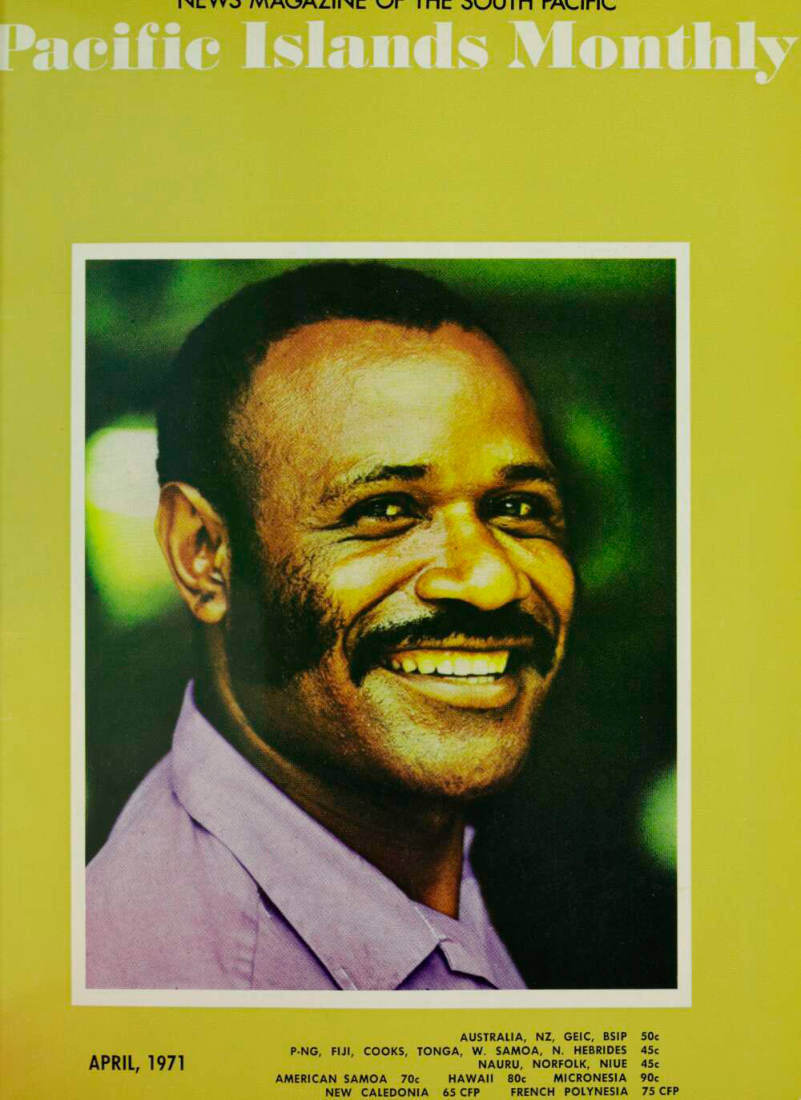 1
1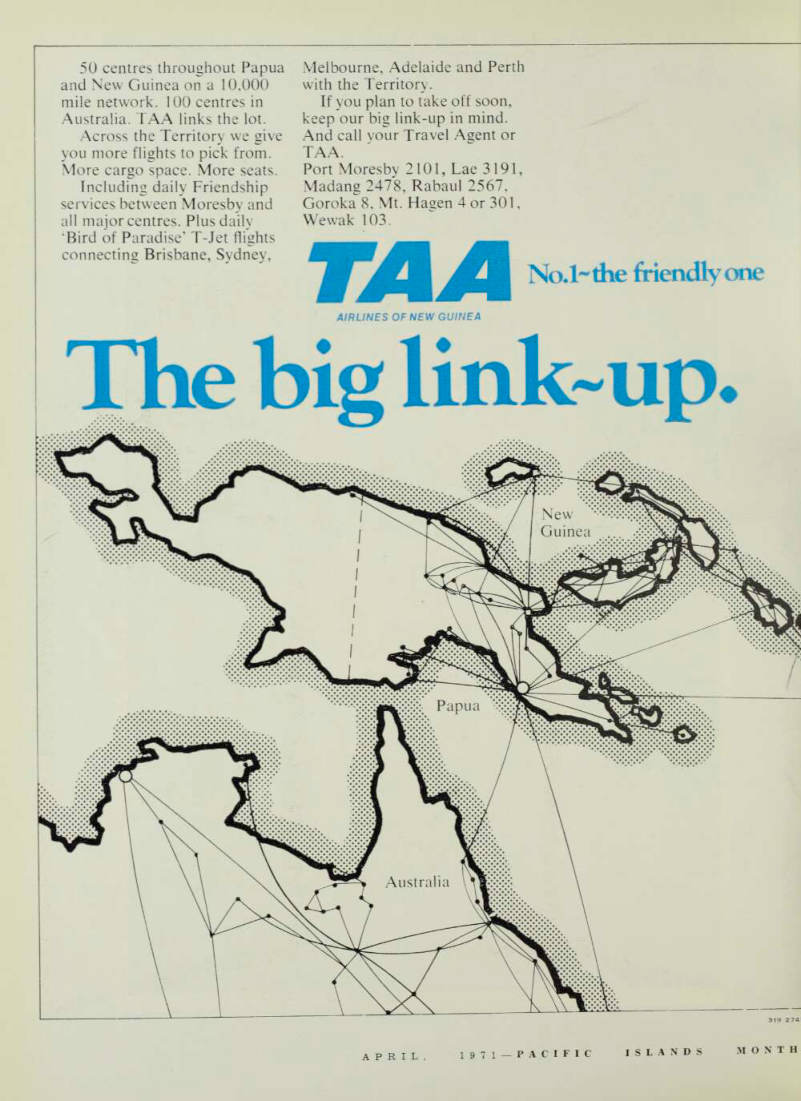 2
2 3
3 4
4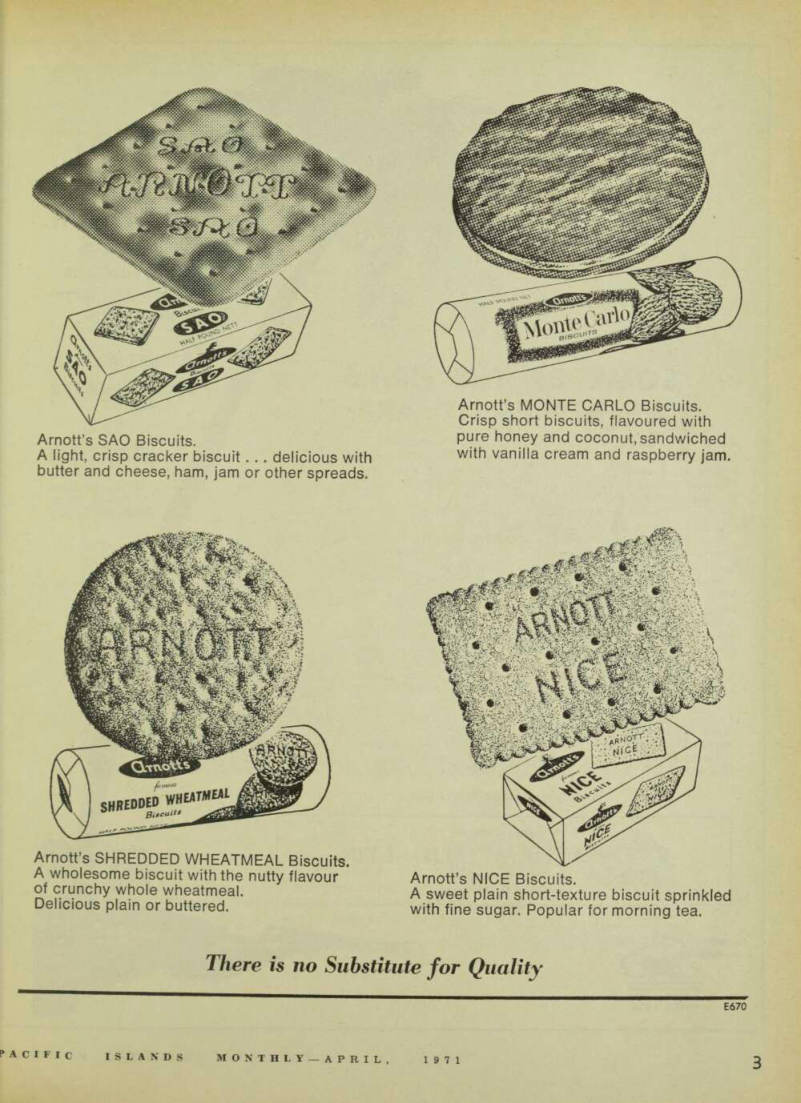 5
5 6
6 7
7 8
8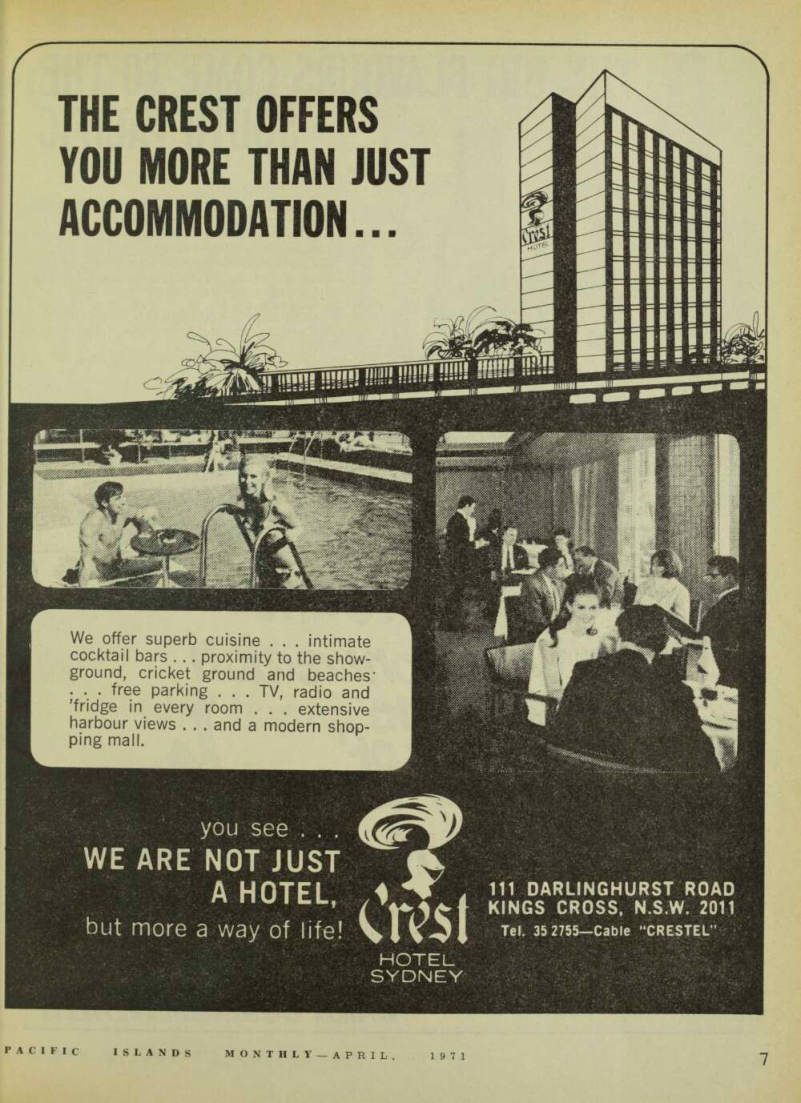 9
9 10
10 11
11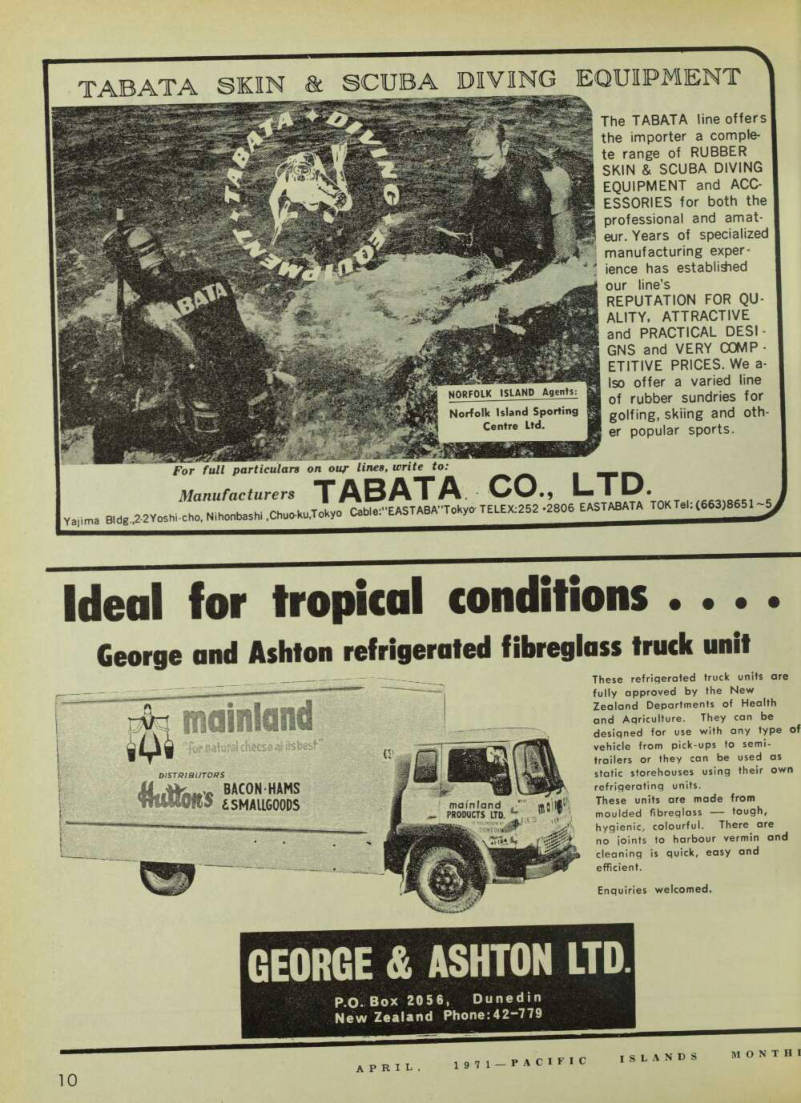 12
12 13
13 14
14 15
15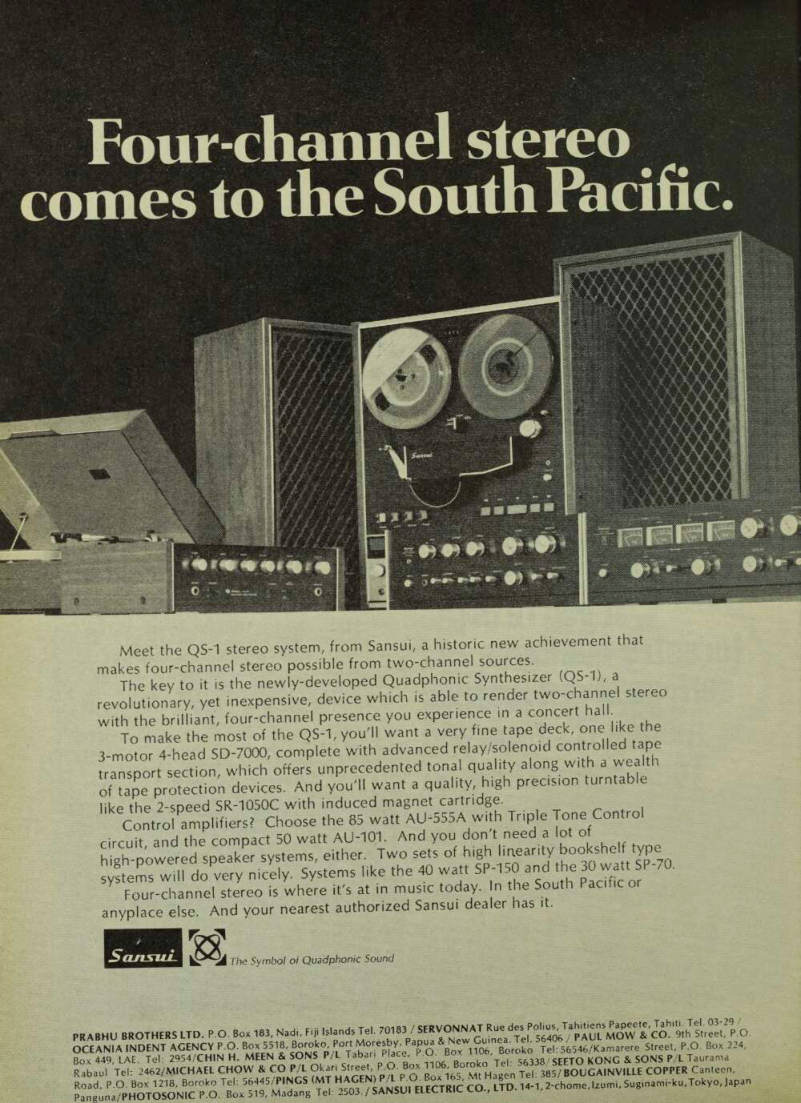 16
16 17
17 18
18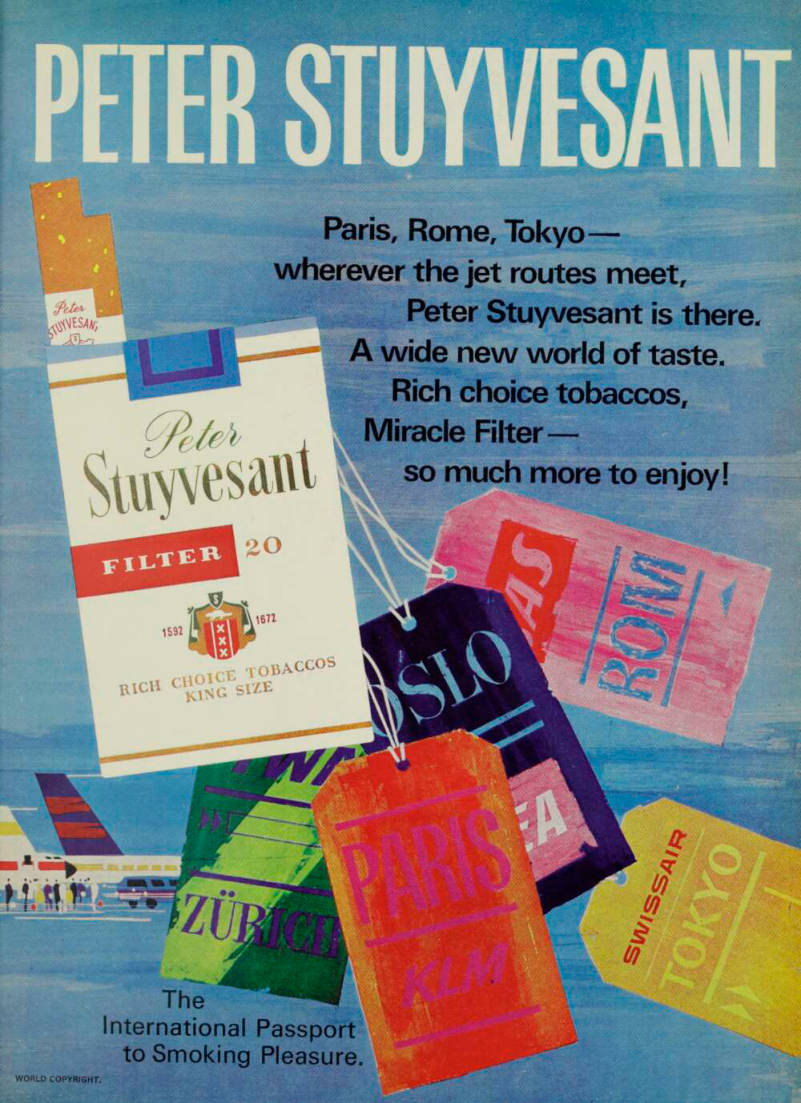 19
19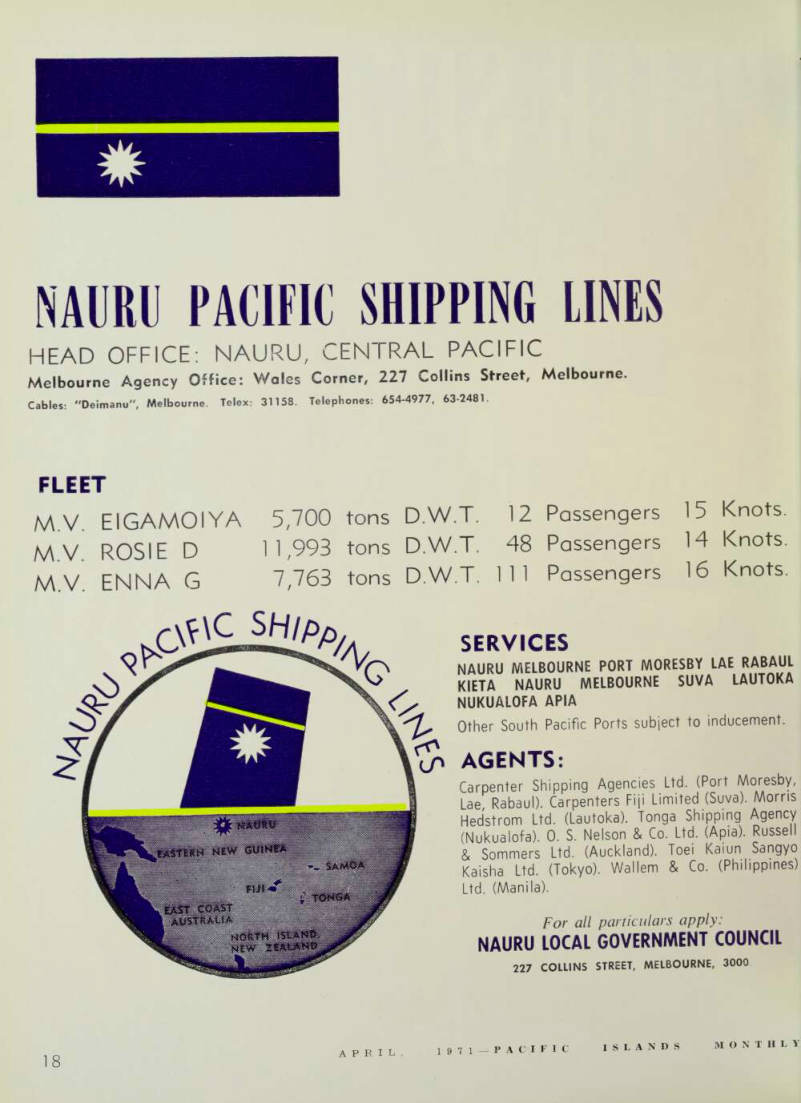 20
20 21
21 22
22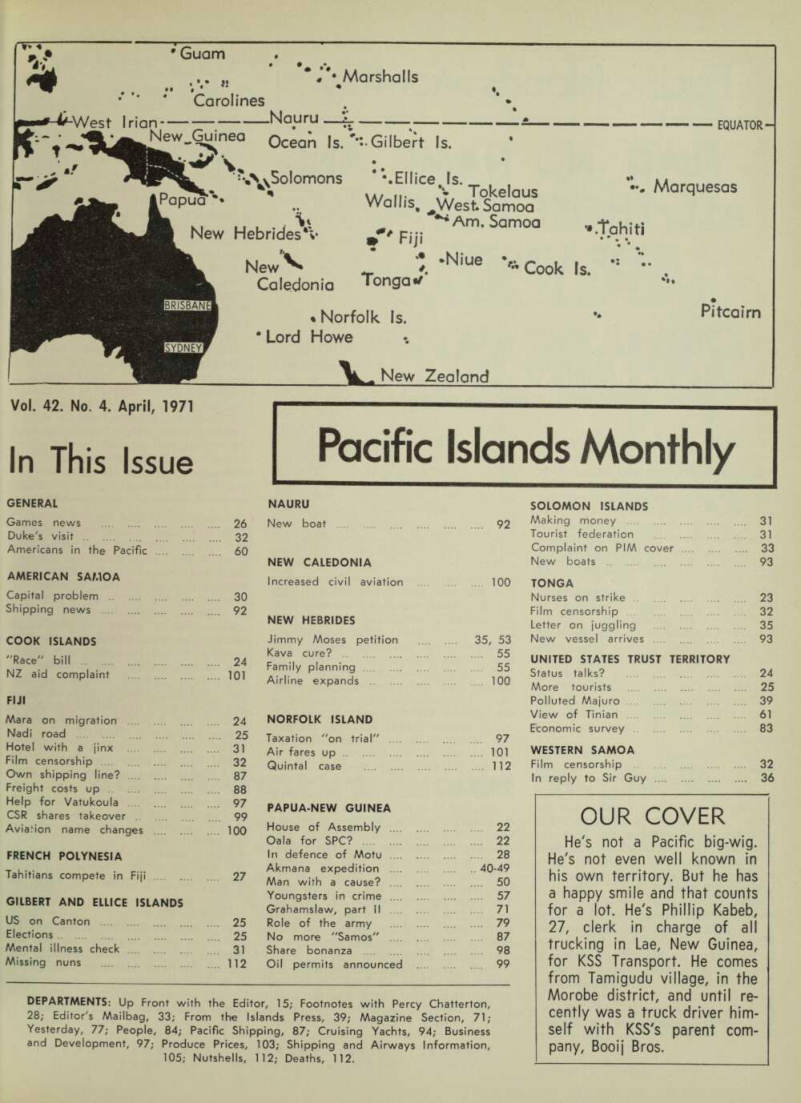 23
23 24
24 25
25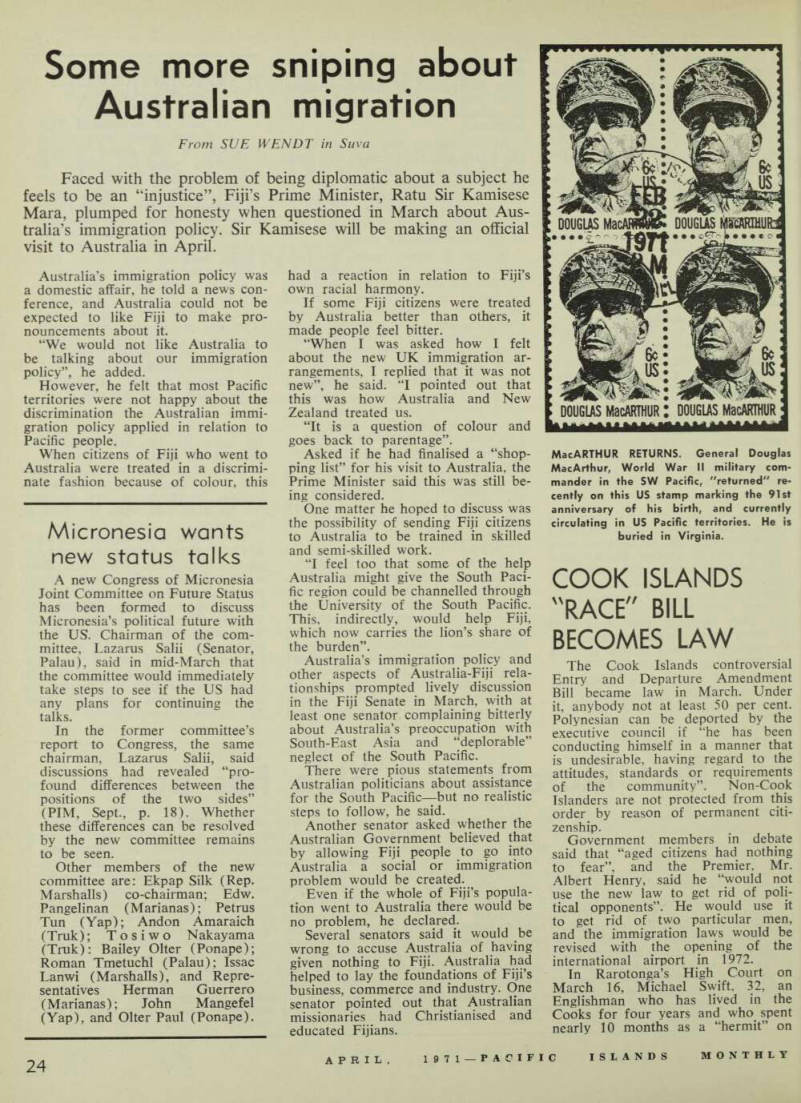 26
26 27
27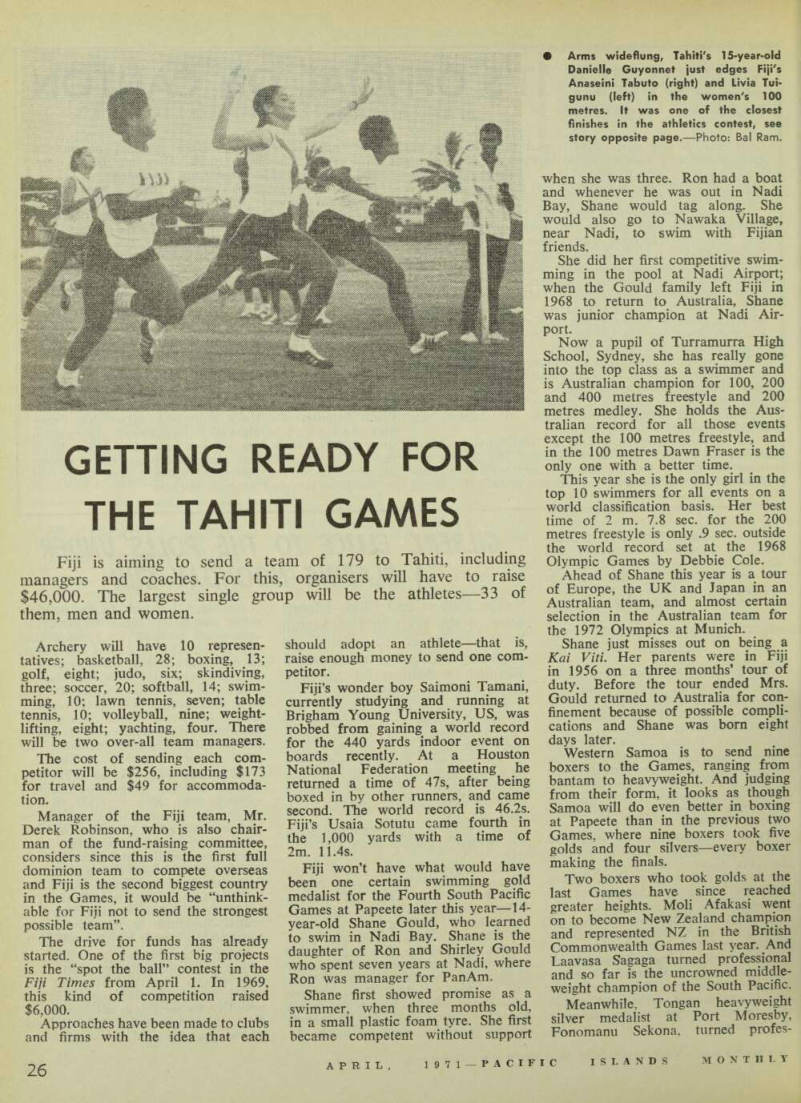 28
28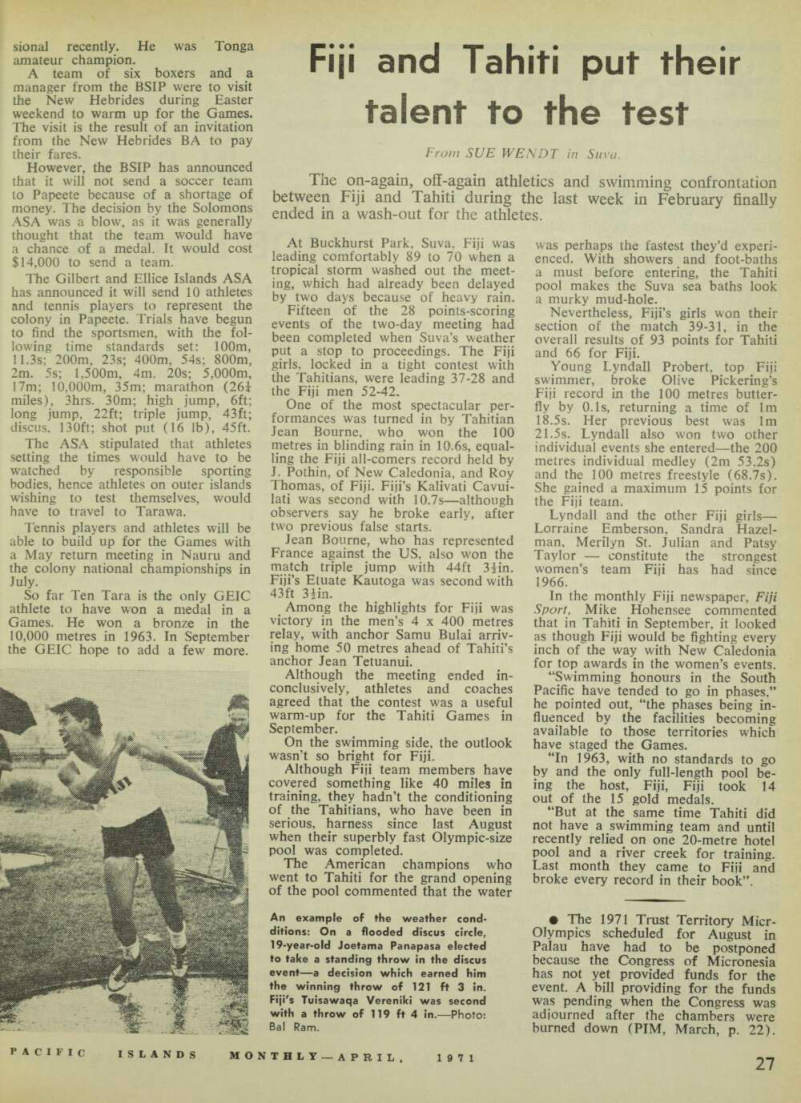 29
29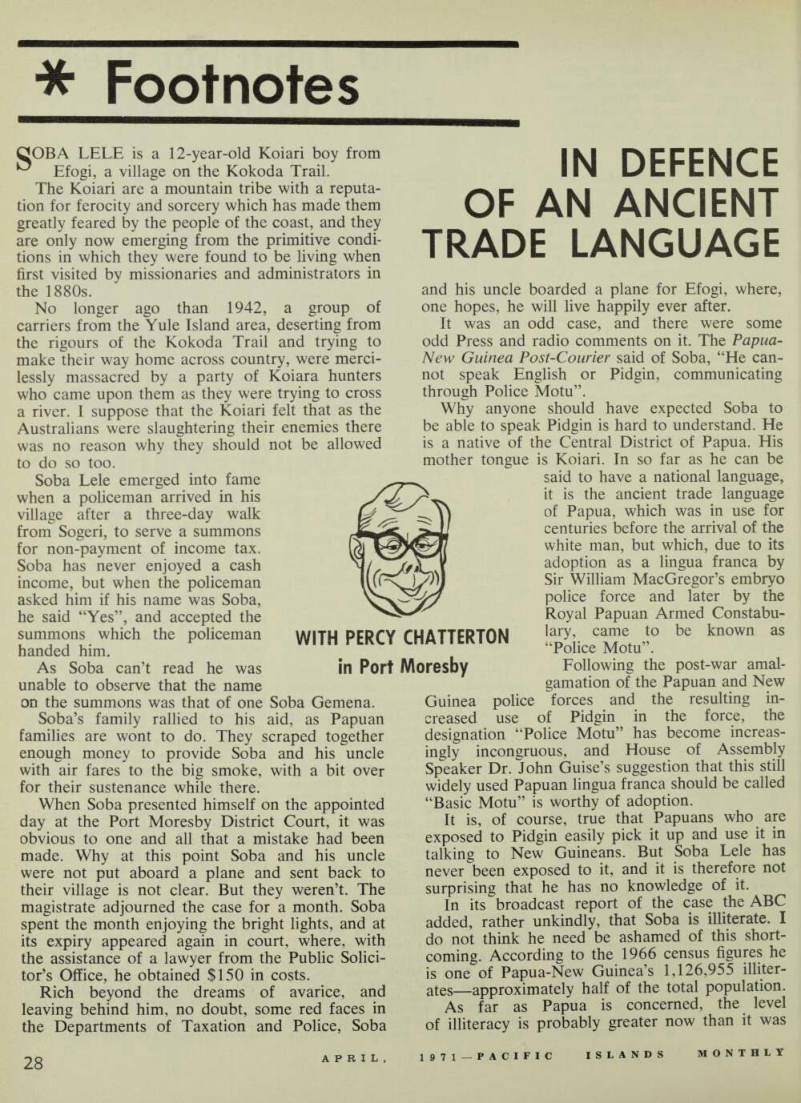 30
30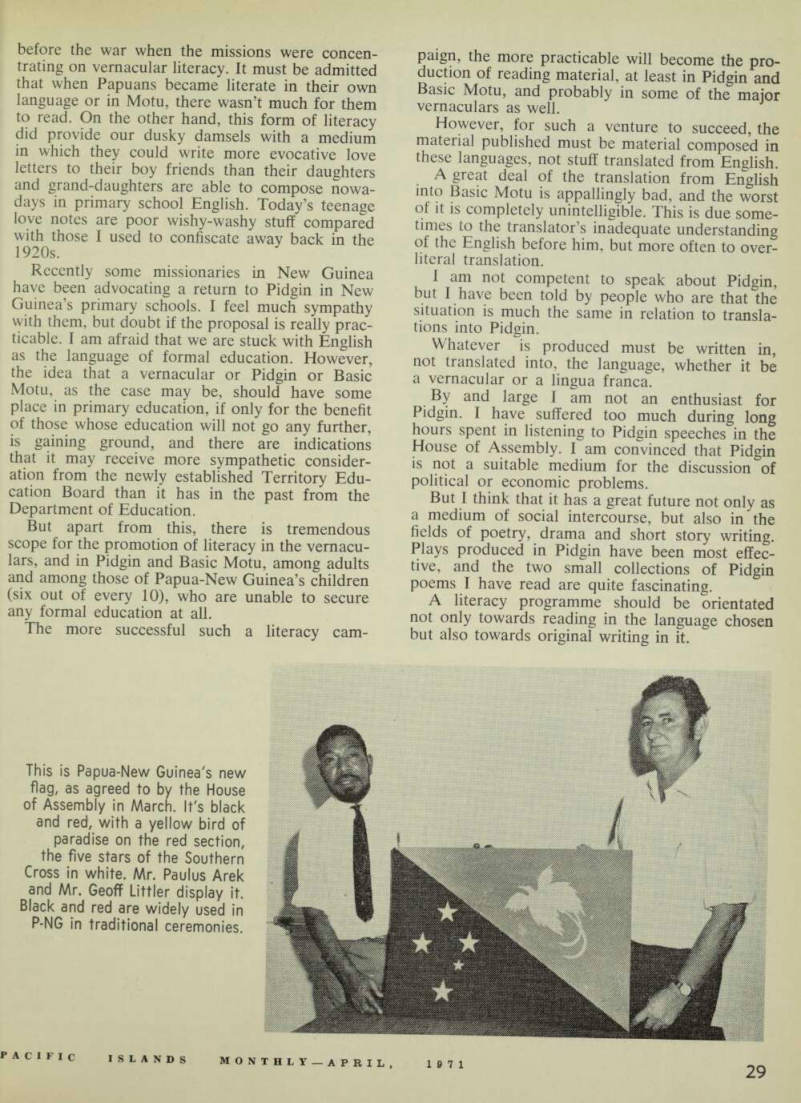 31
31 32
32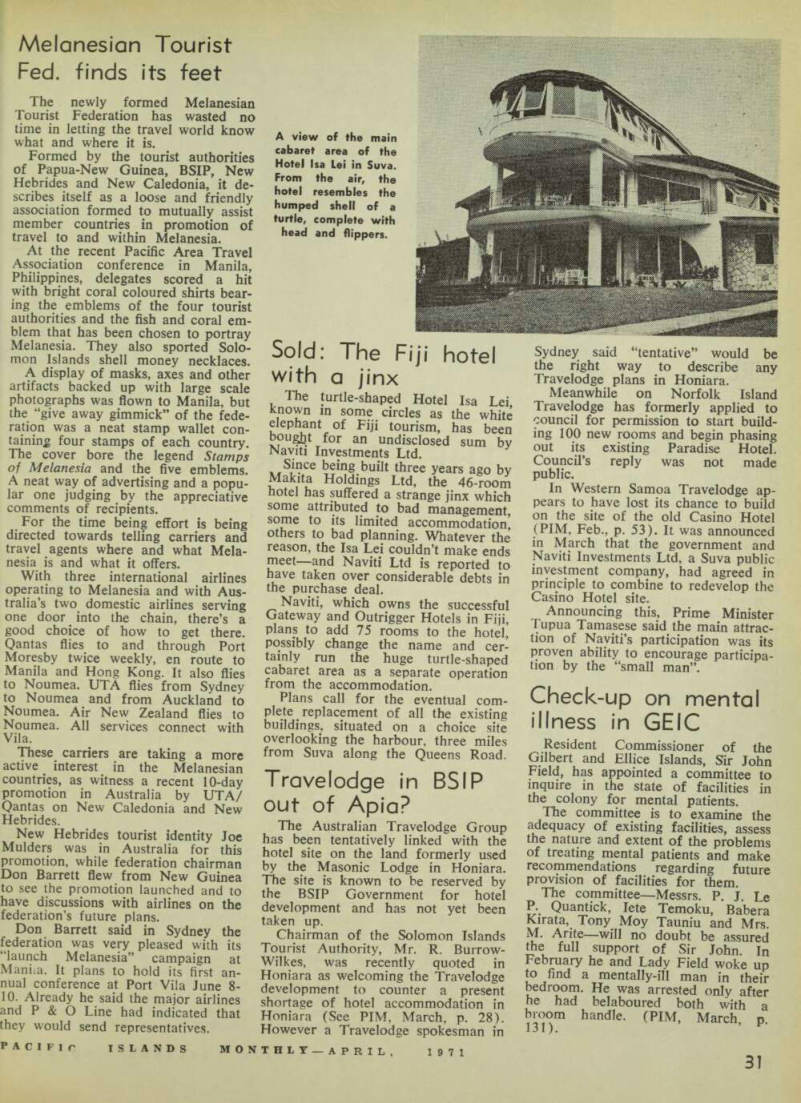 33
33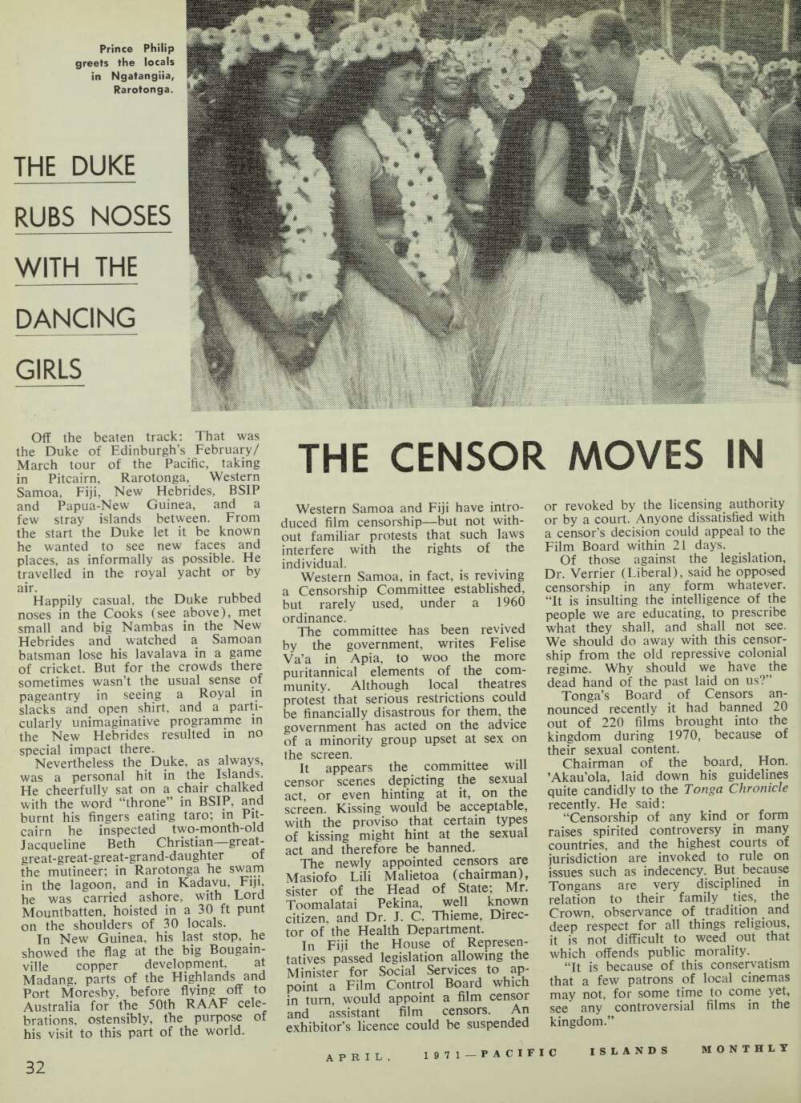 34
34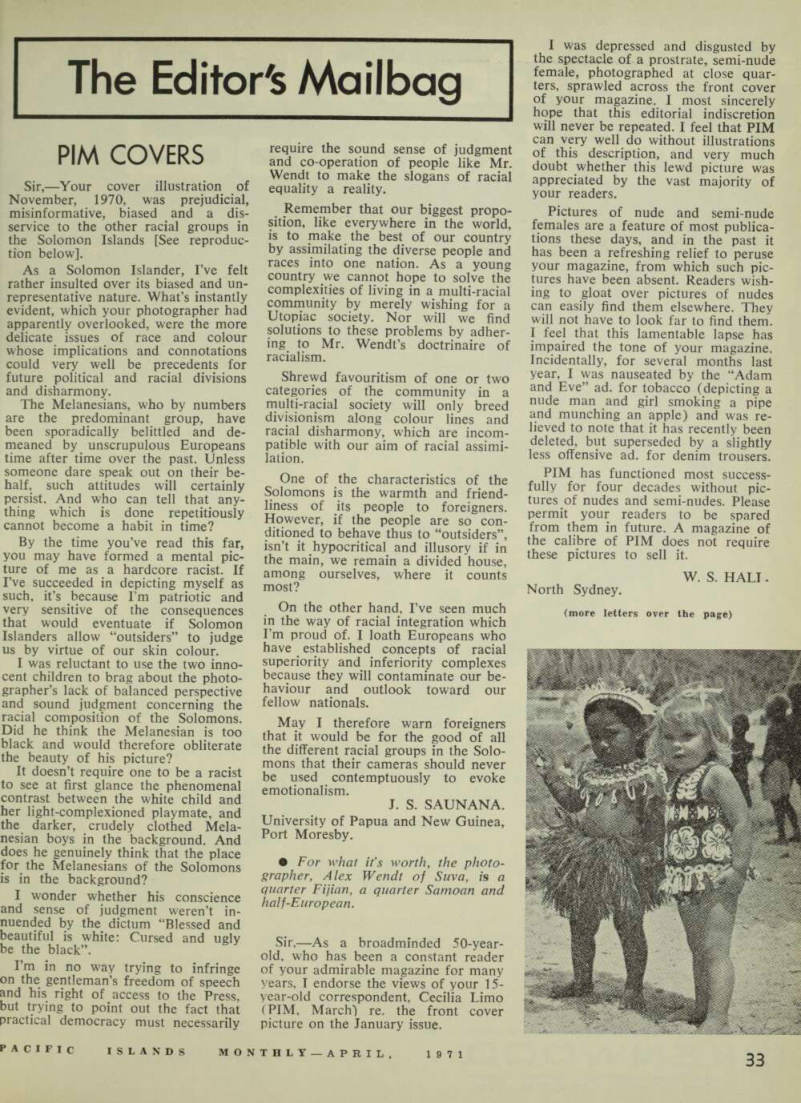 35
35 36
36 37
37 38
38 39
39 40
40 41
41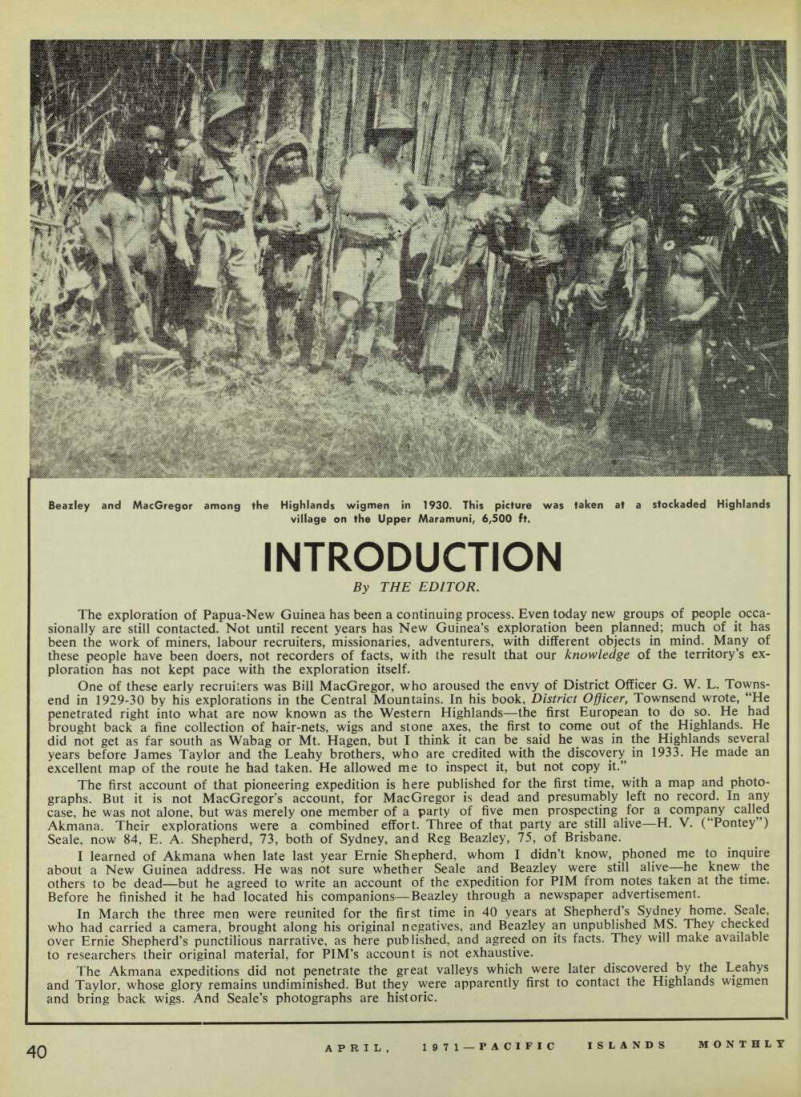 42
42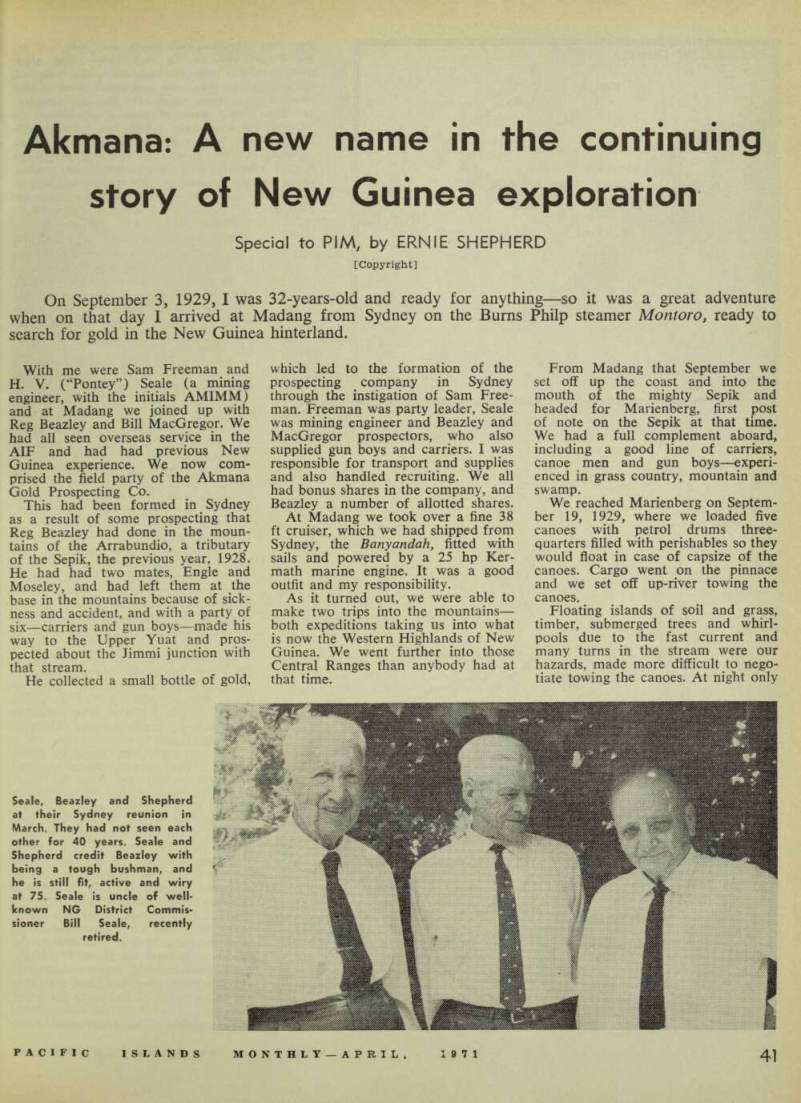 43
43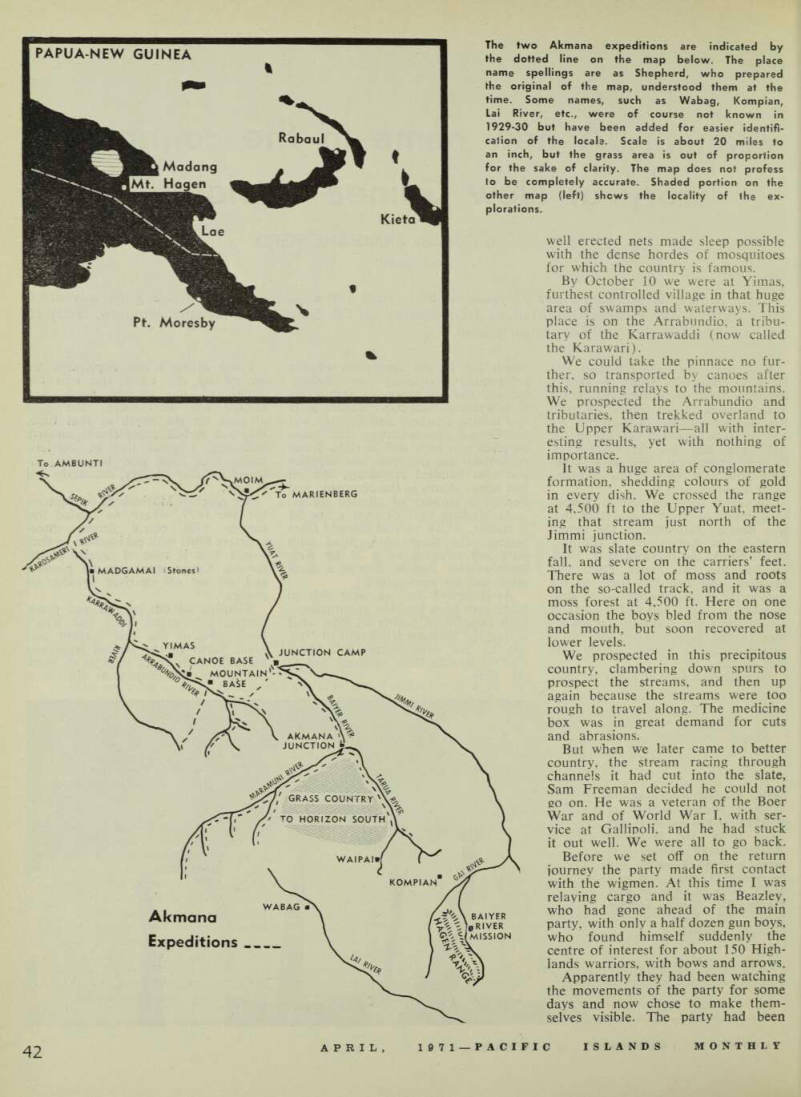 44
44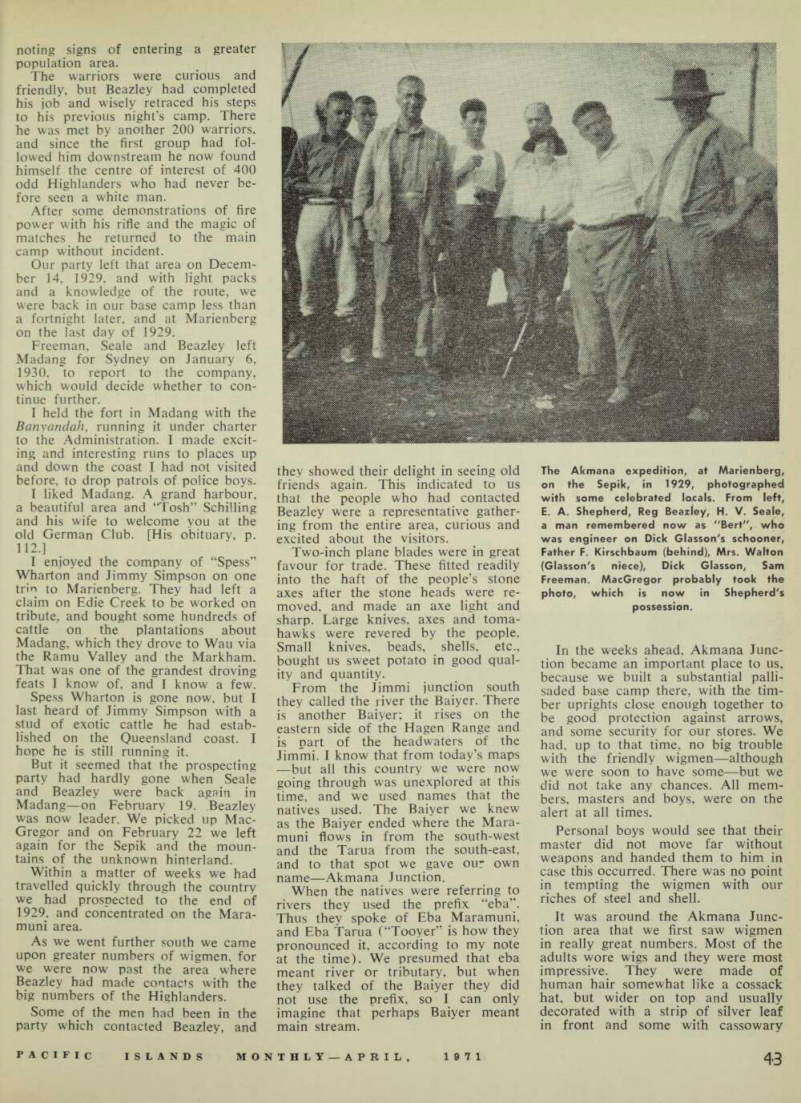 45
45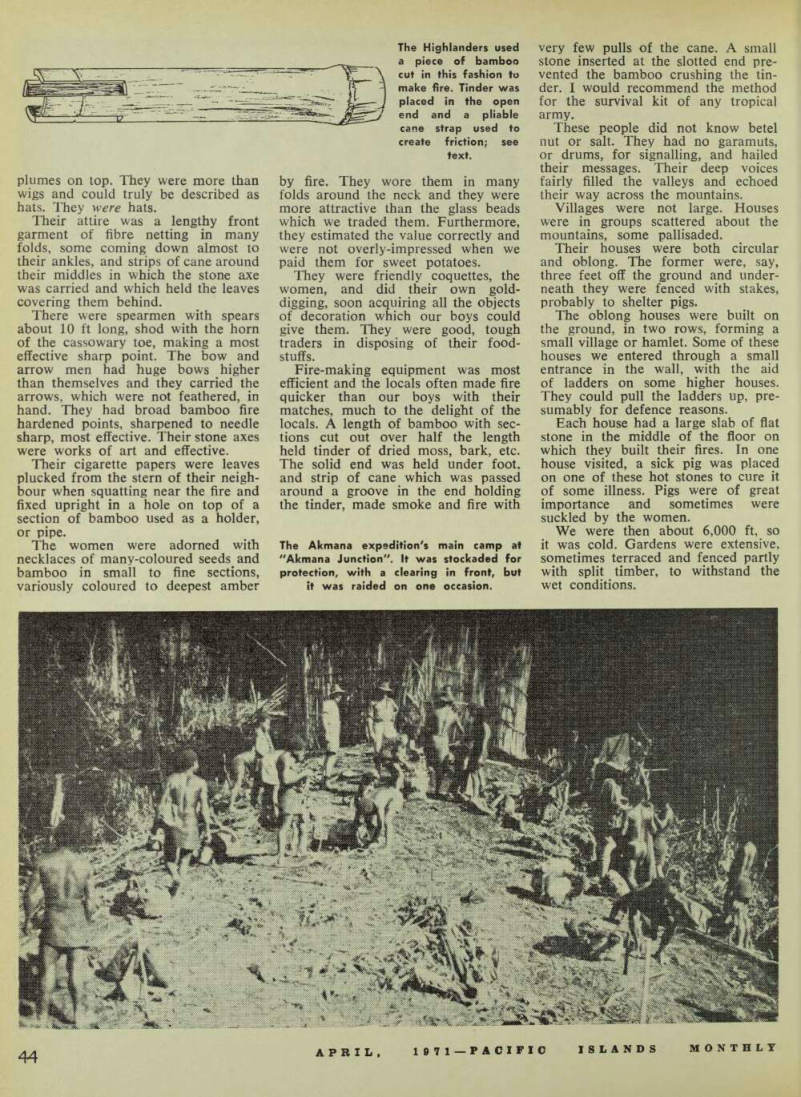 46
46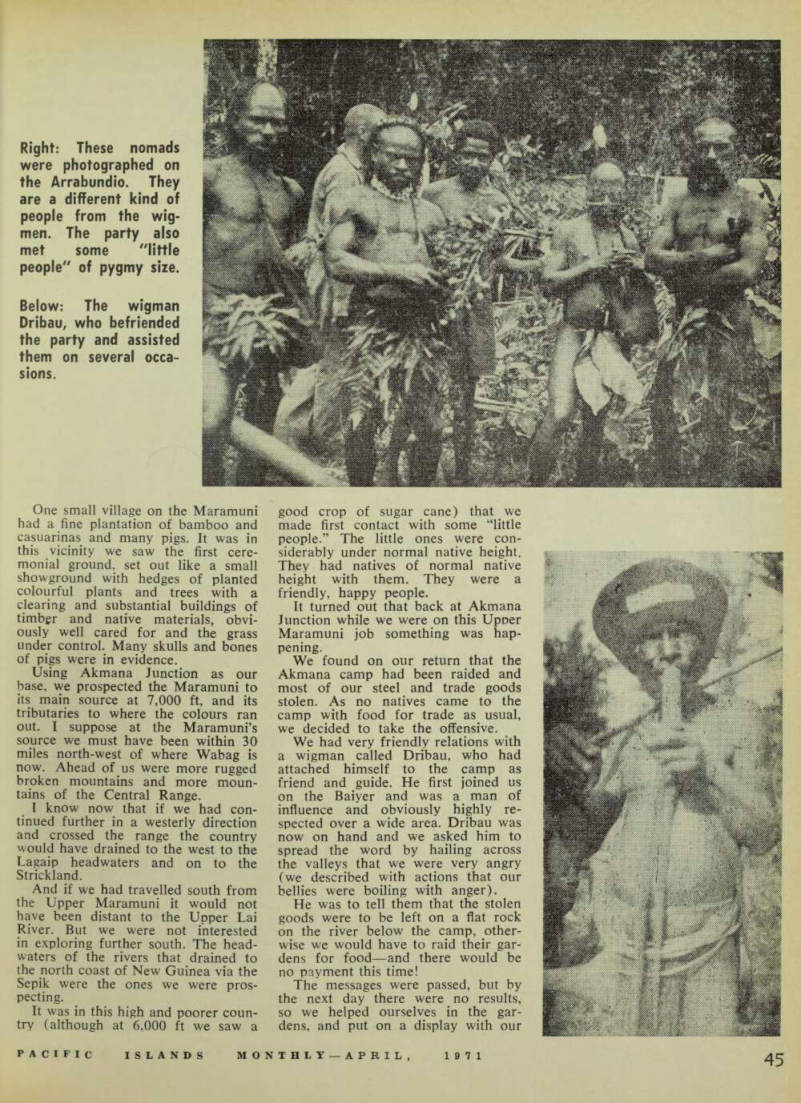 47
47 48
48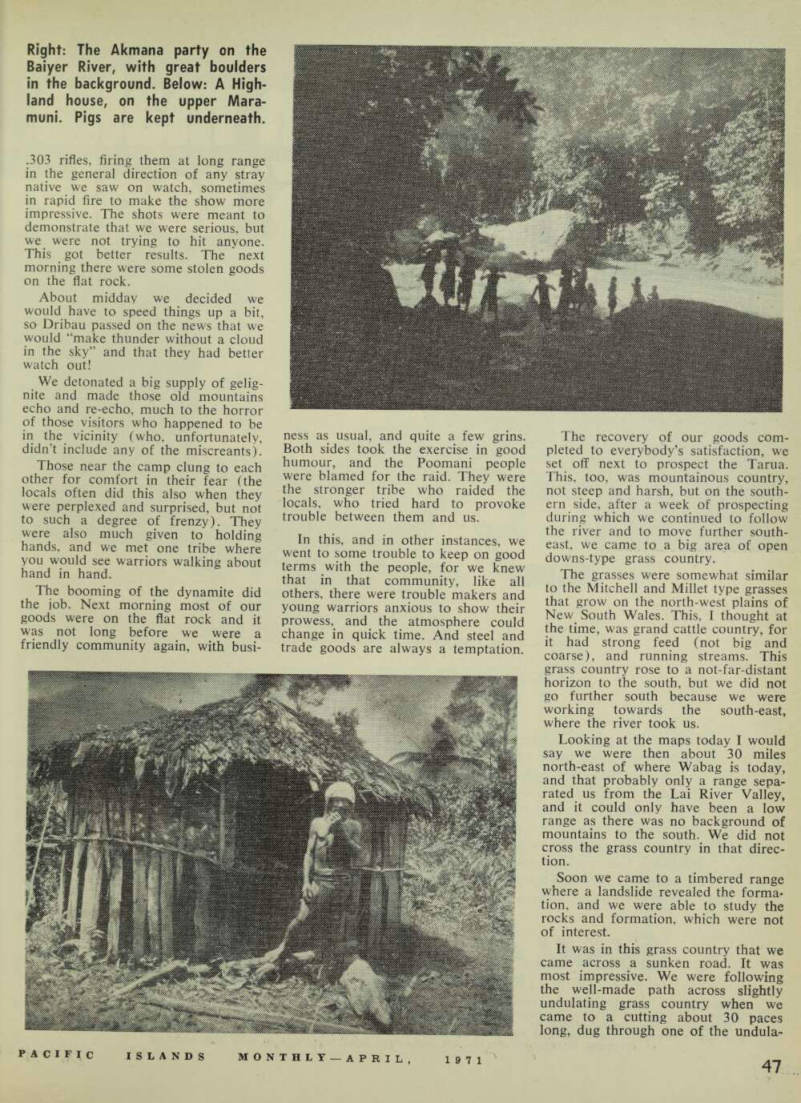 49
49 50
50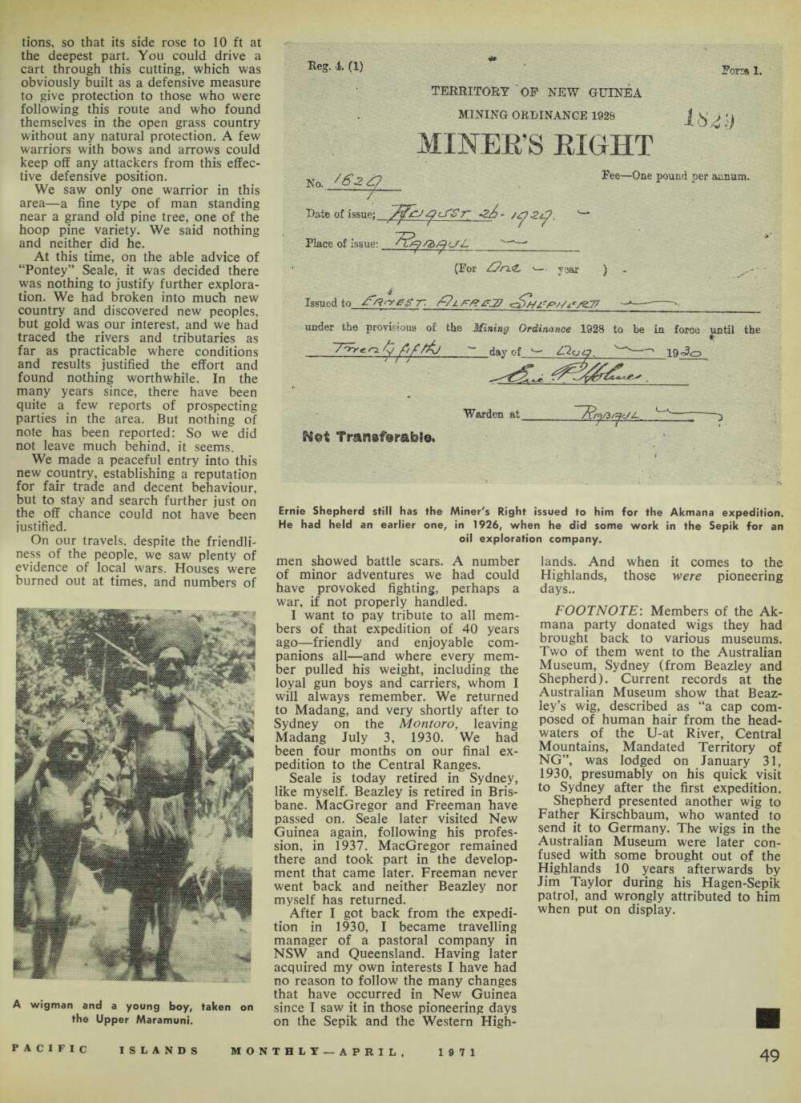 51
51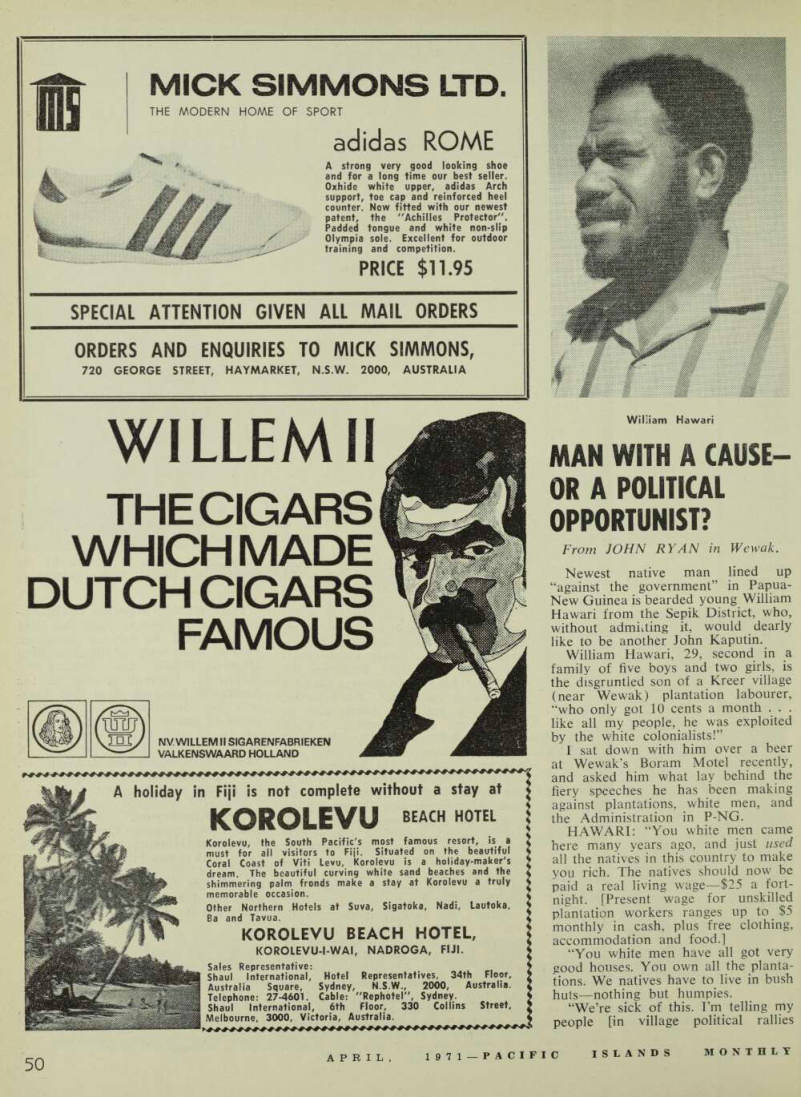 52
52 53
53 54
54 55
55 56
56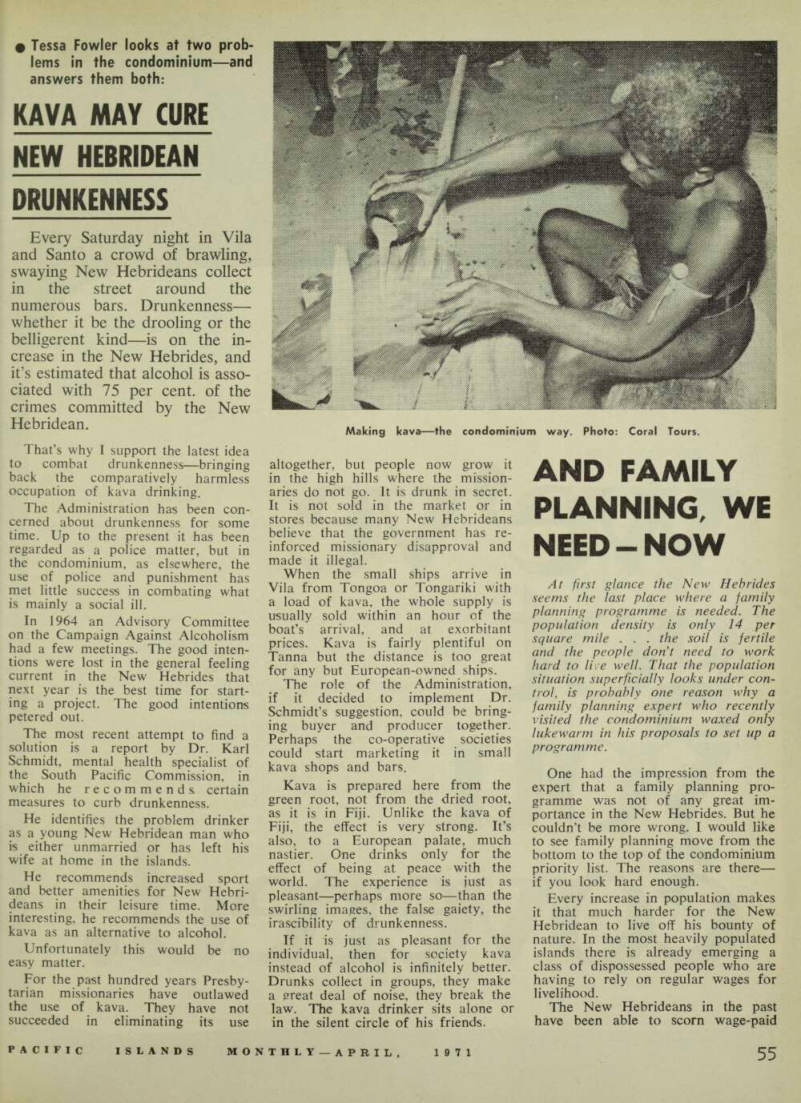 57
57 58
58 59
59 60
60 61
61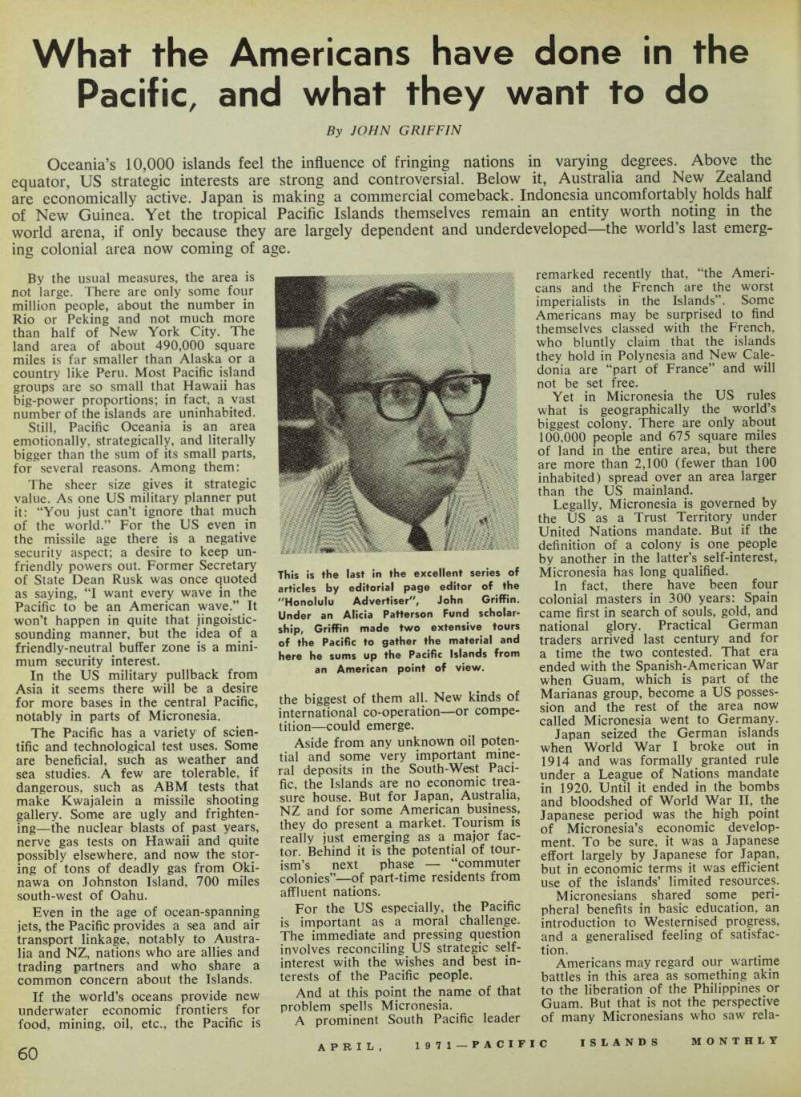 62
62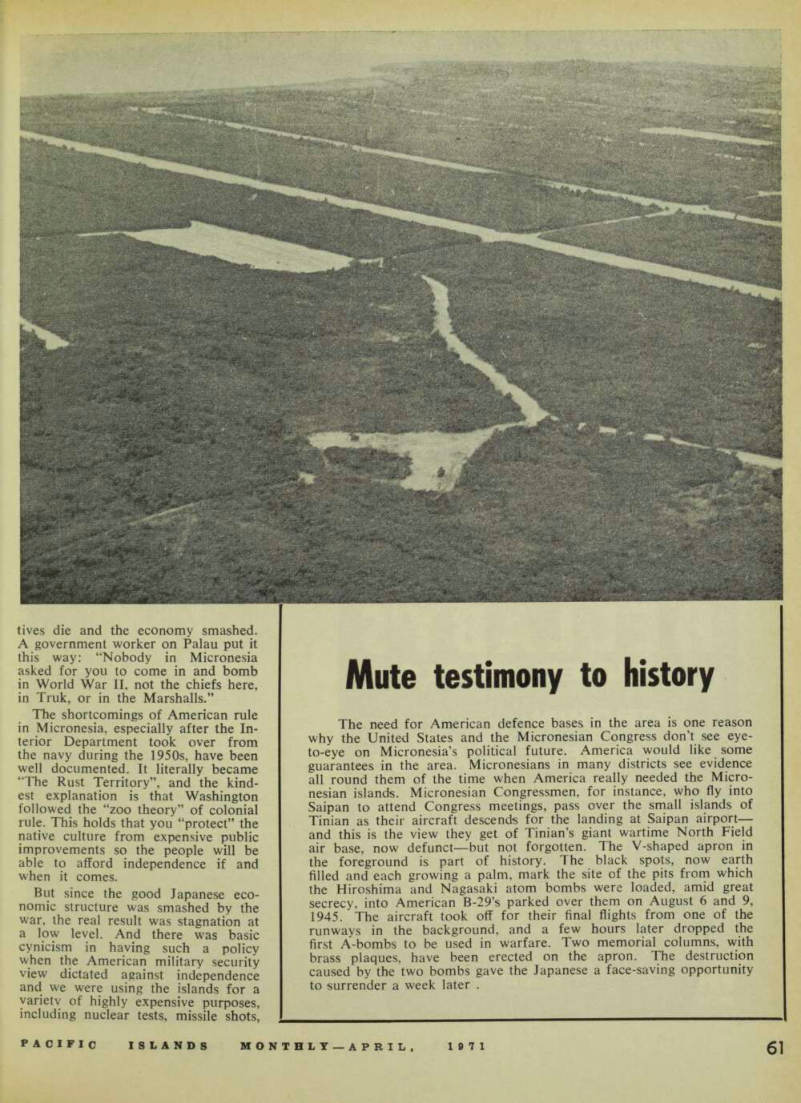 63
63 64
64 65
65 66
66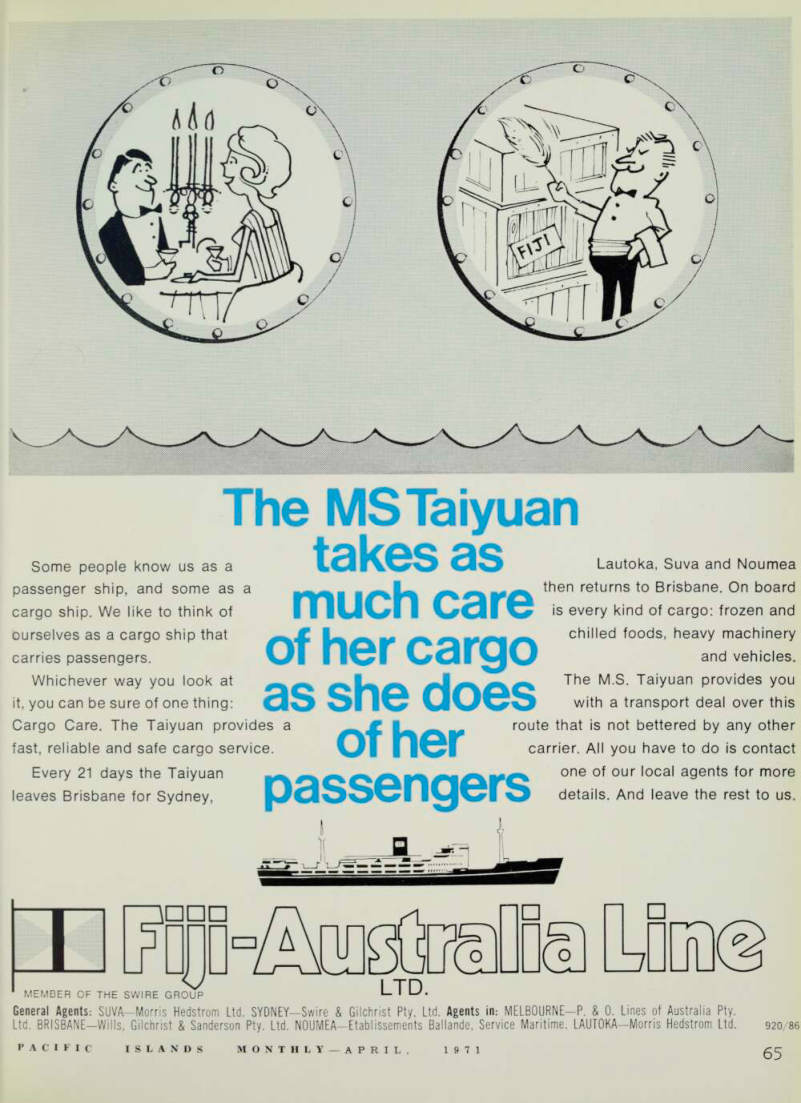 67
67 68
68 69
69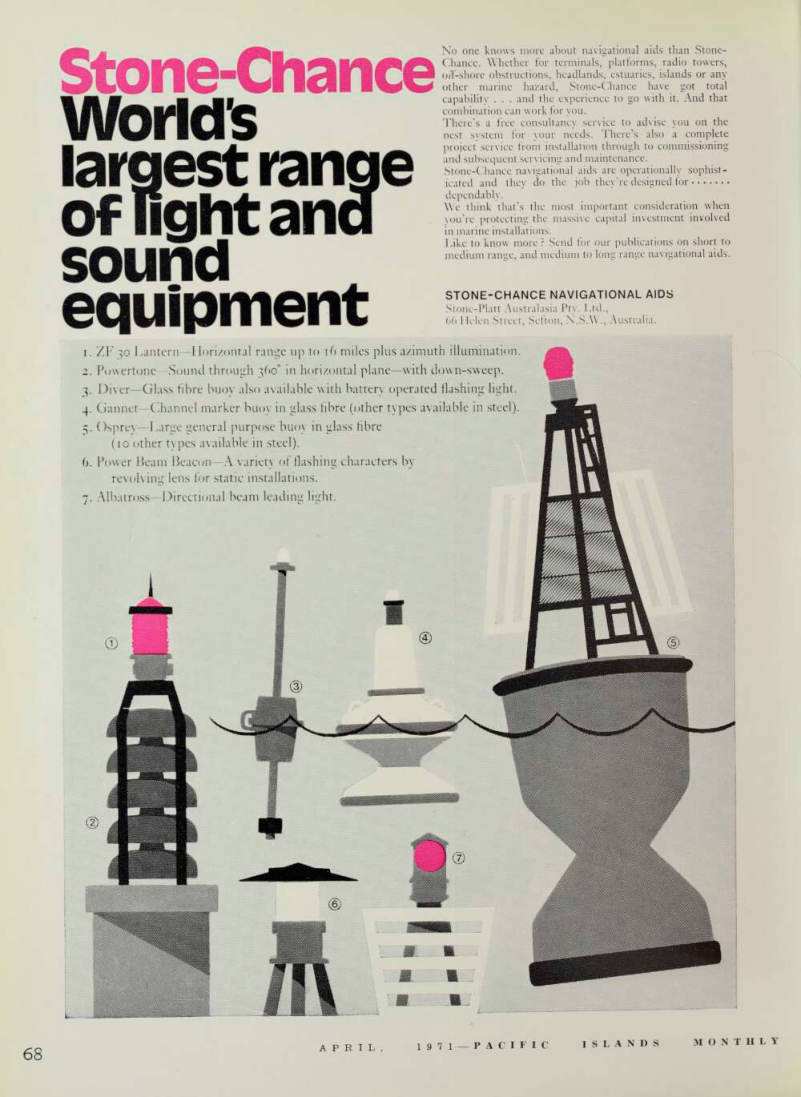 70
70 71
71 72
72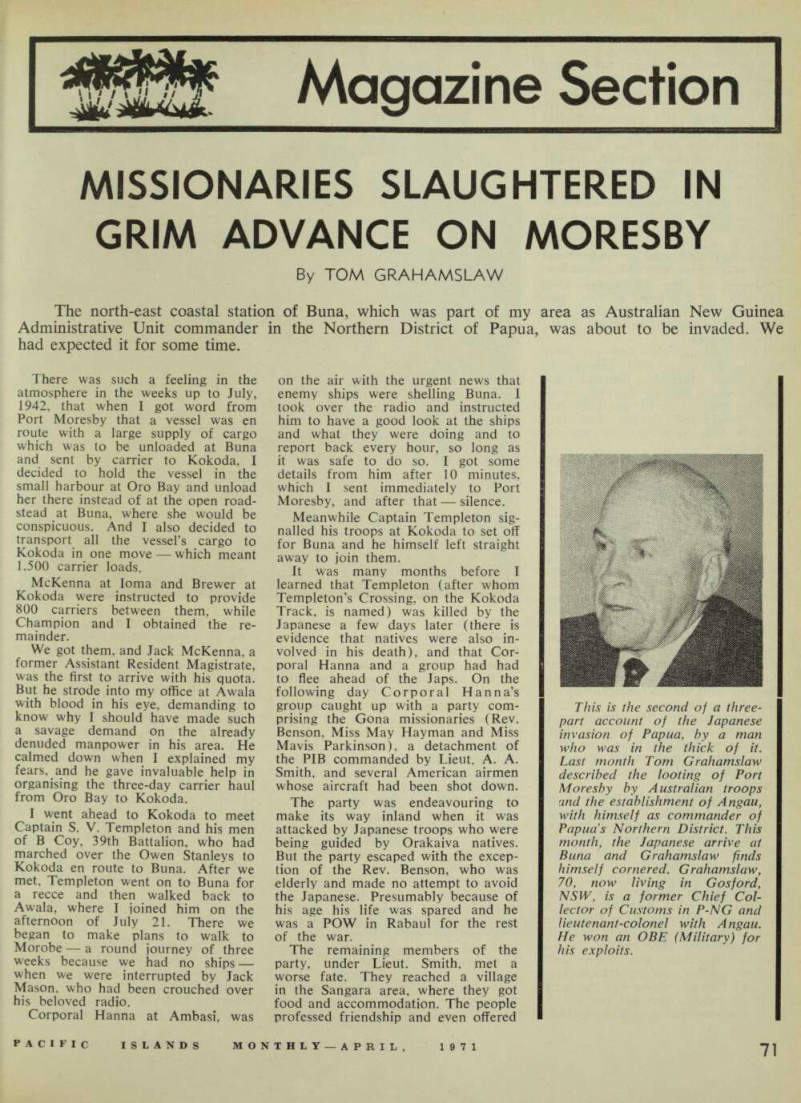 73
73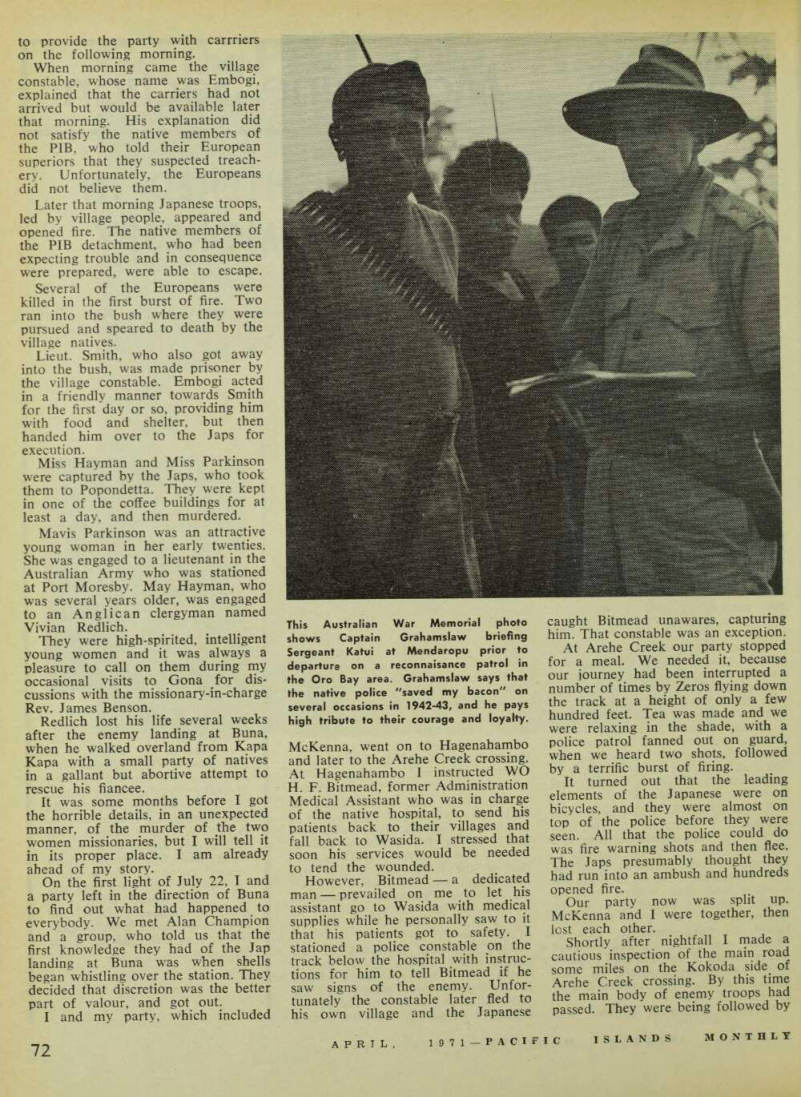 74
74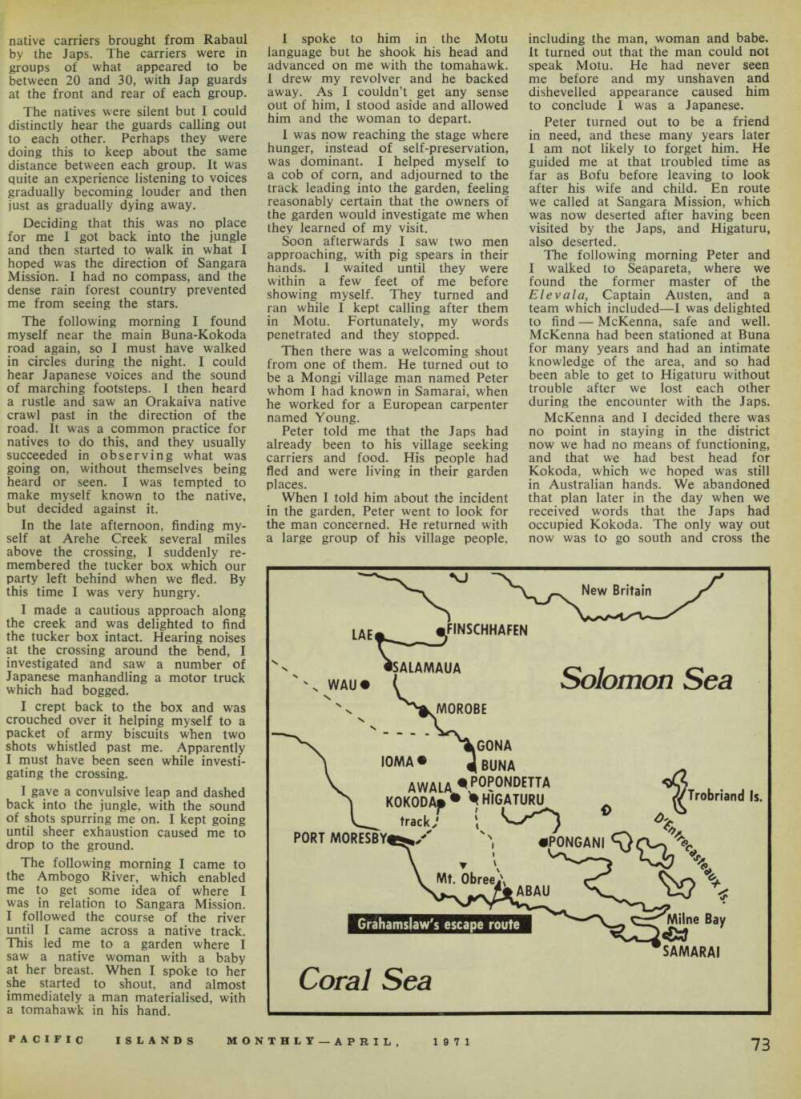 75
75 76
76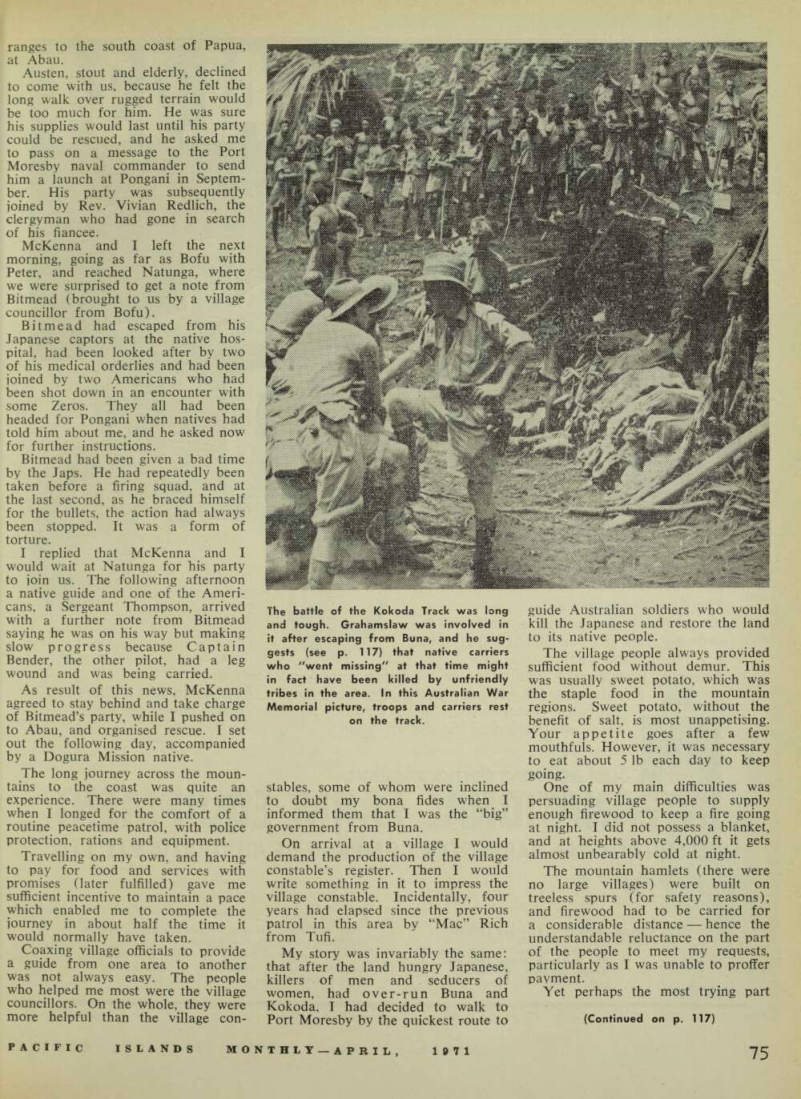 77
77 78
78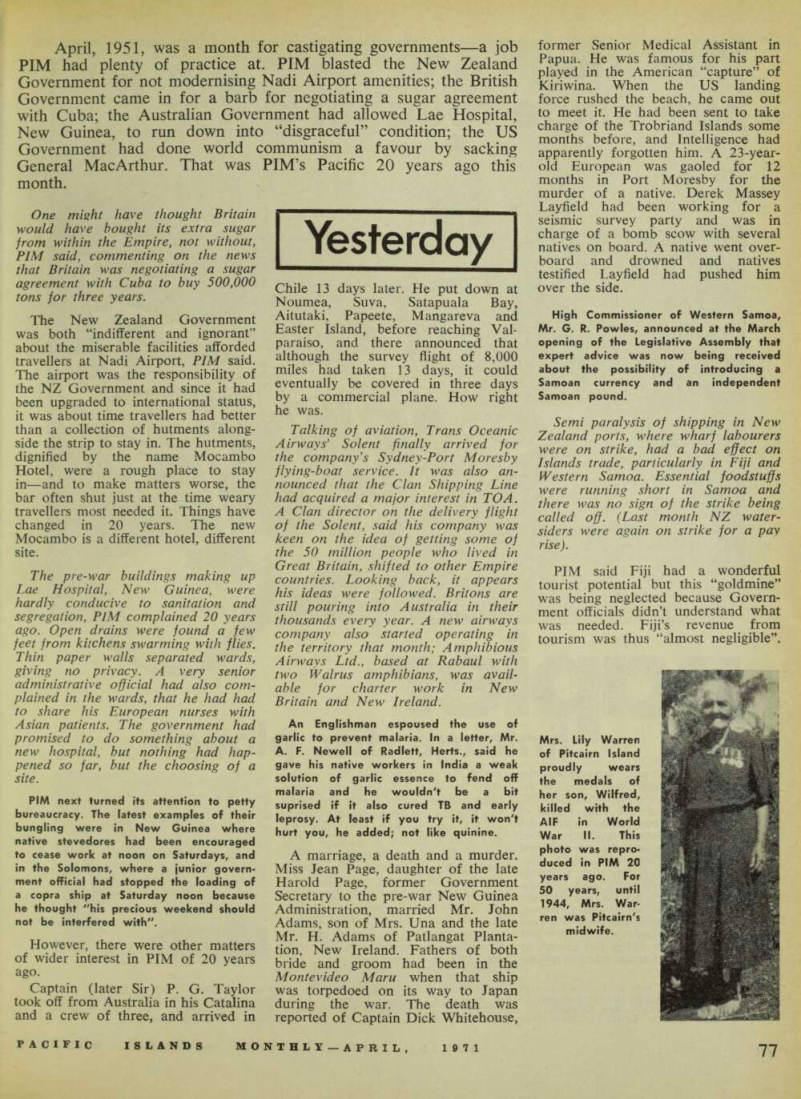 79
79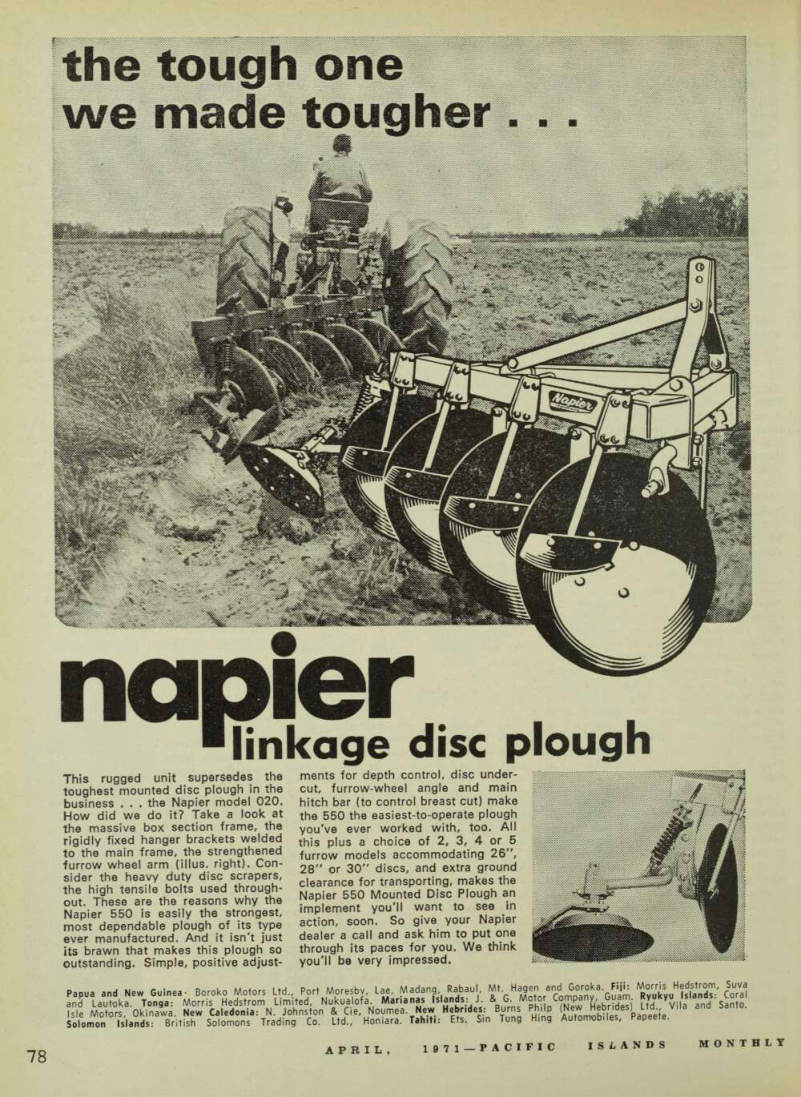 80
80 81
81 82
82 83
83 84
84 85
85 86
86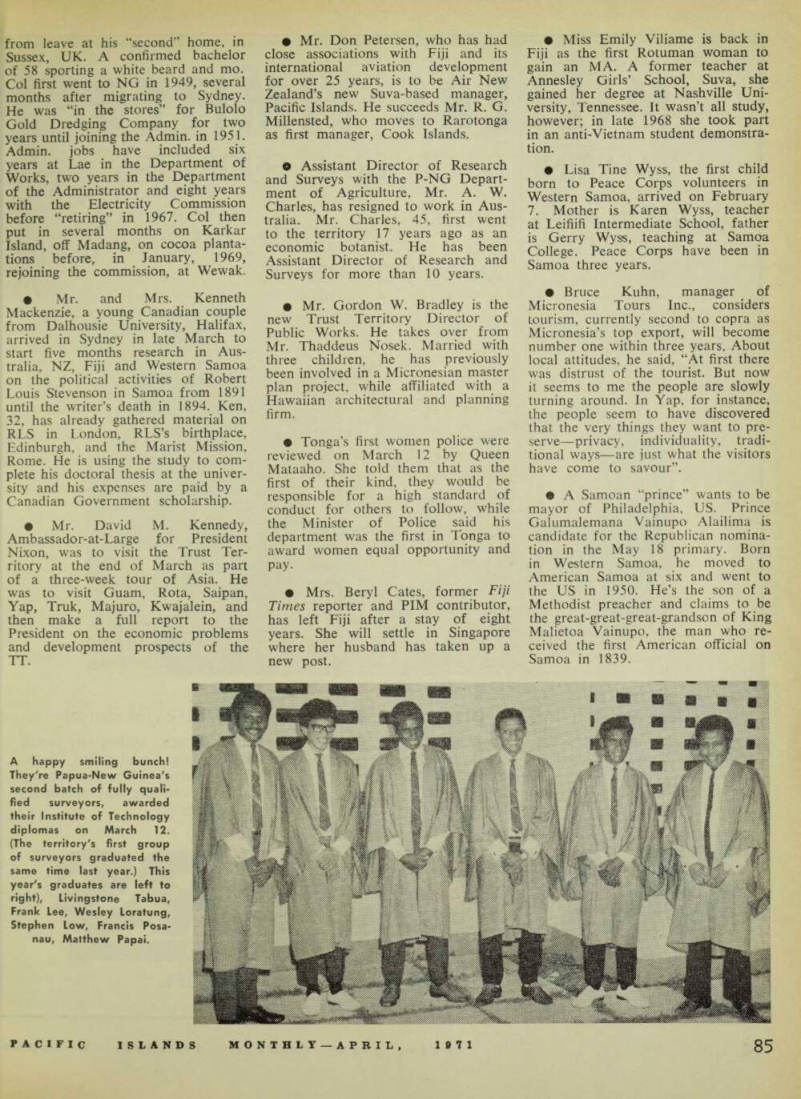 87
87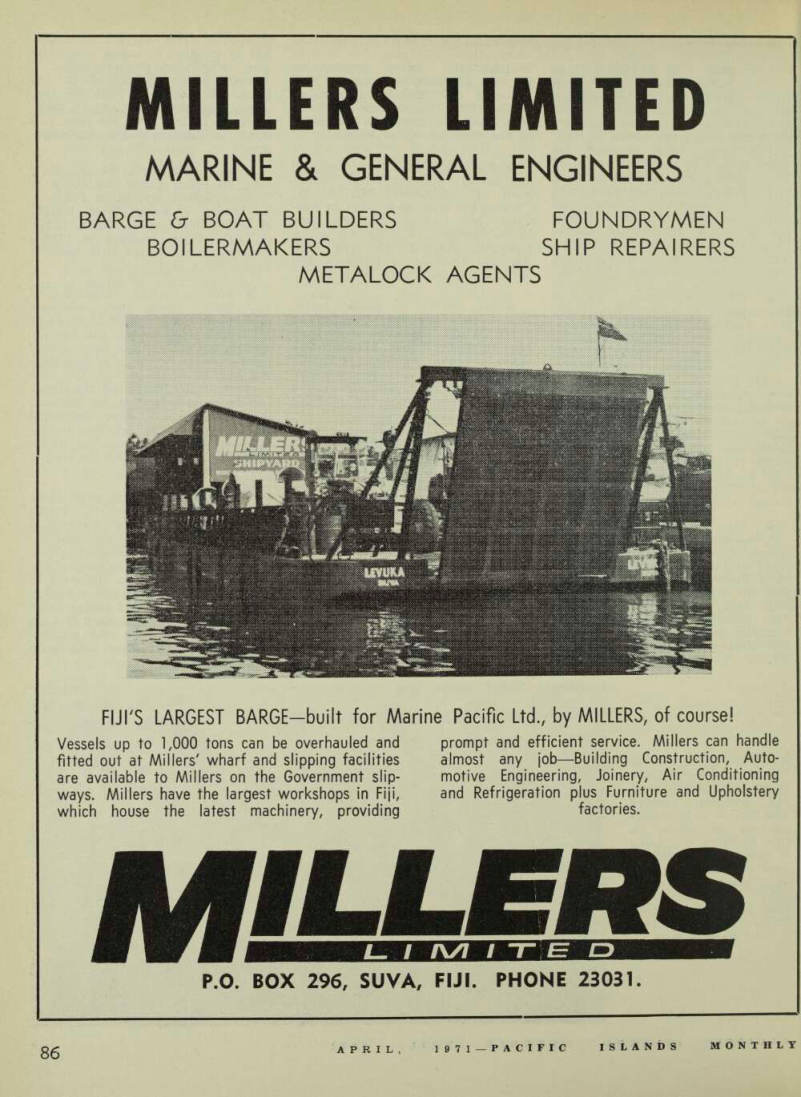 88
88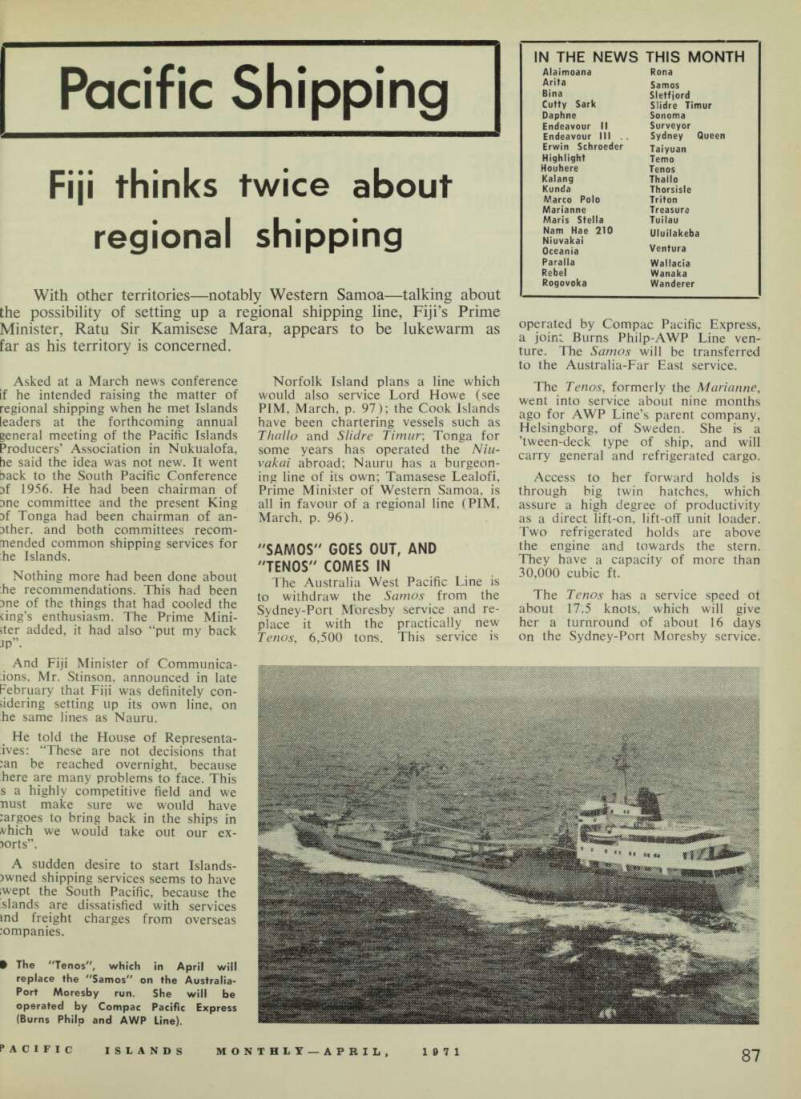 89
89 90
90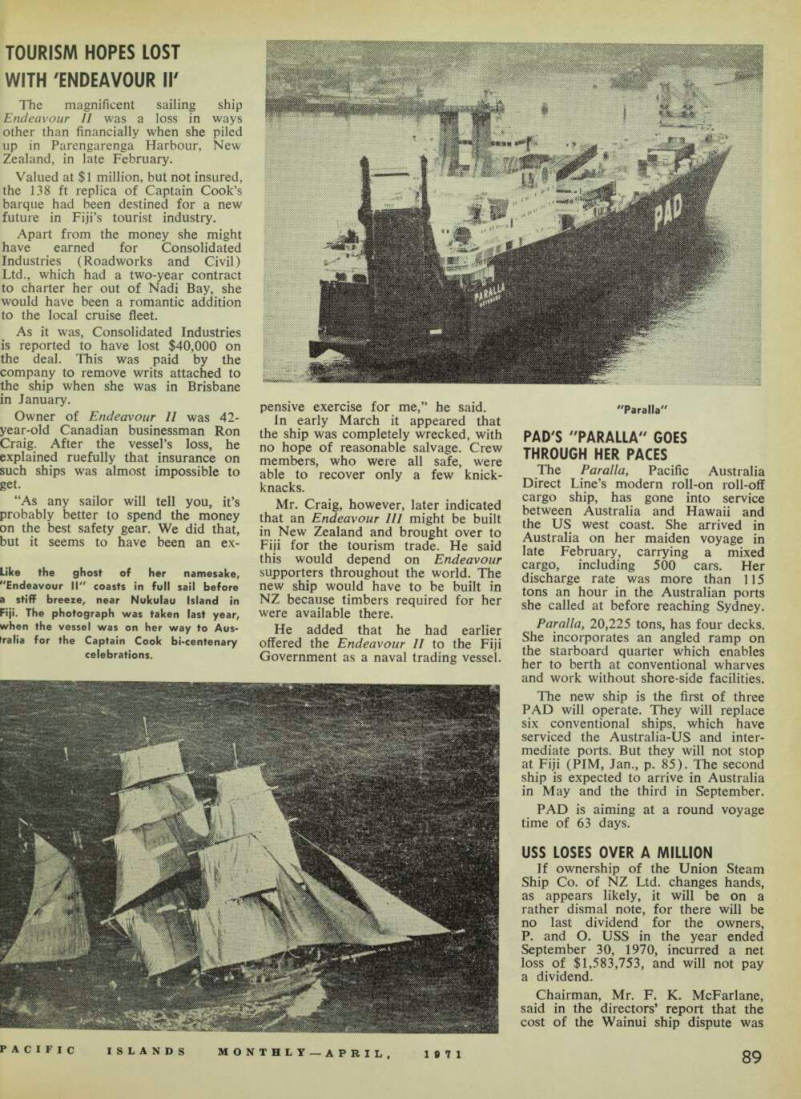 91
91 92
92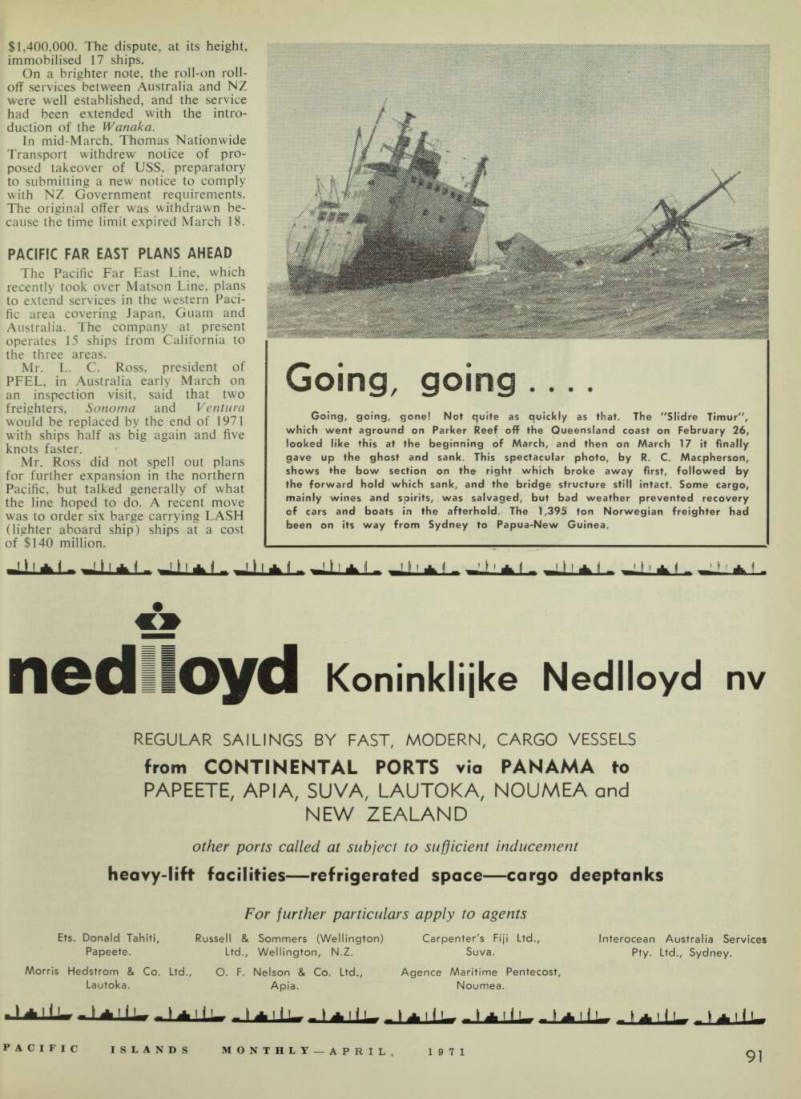 93
93 94
94 95
95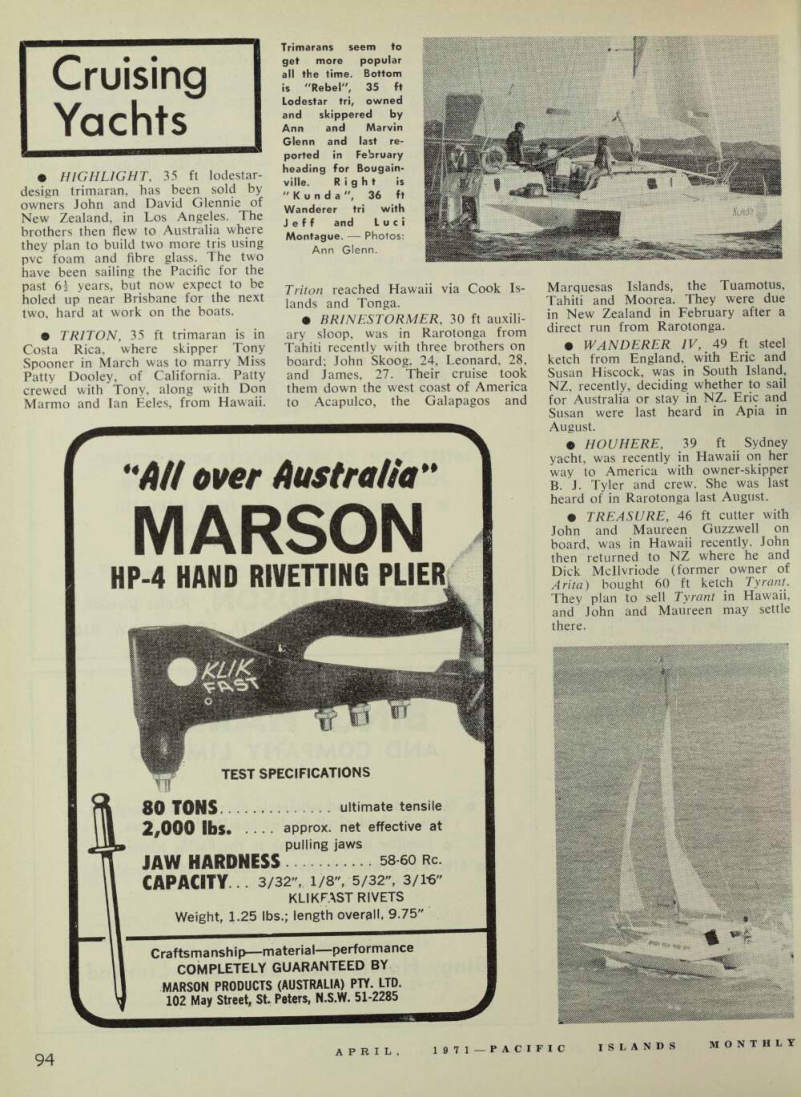 96
96 97
97 98
98 99
99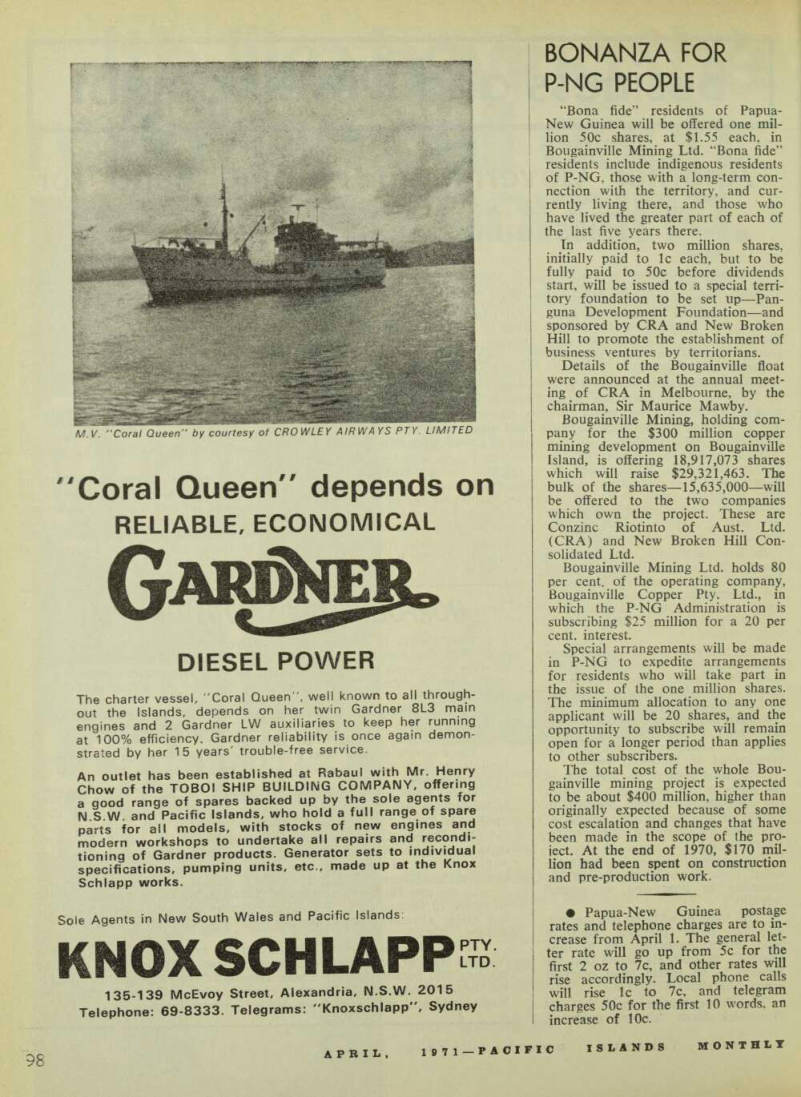 100
100 101
101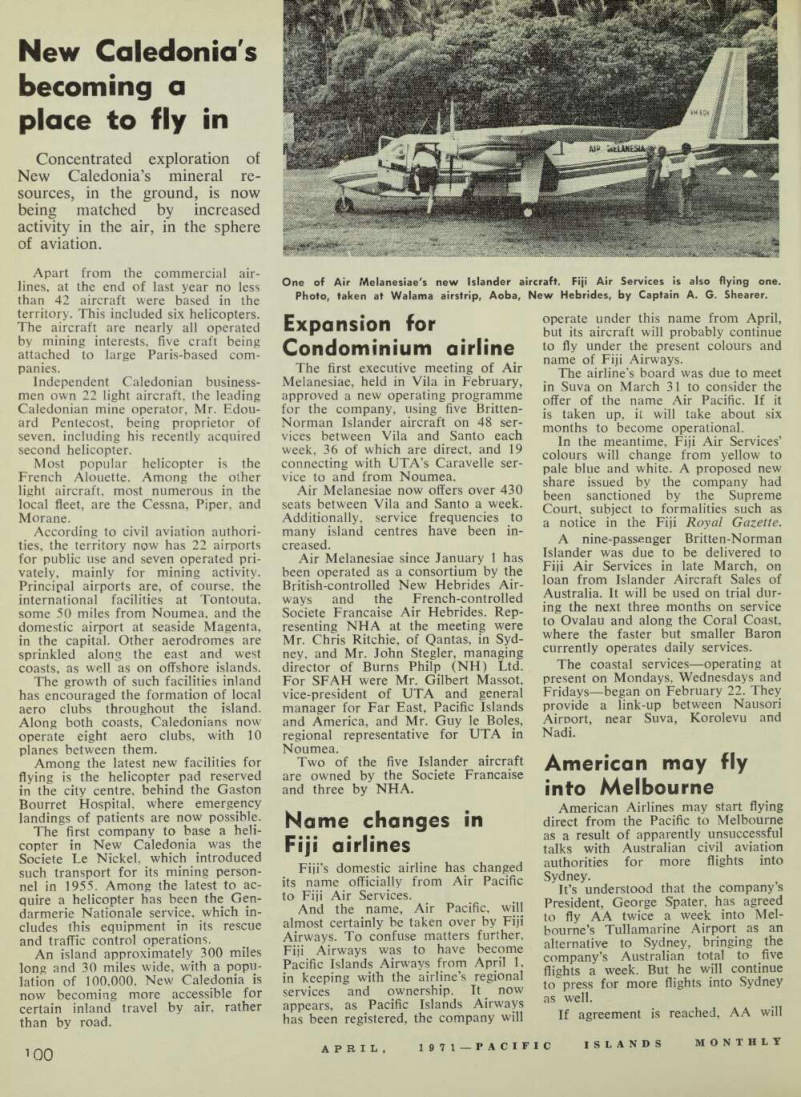 102
102 103
103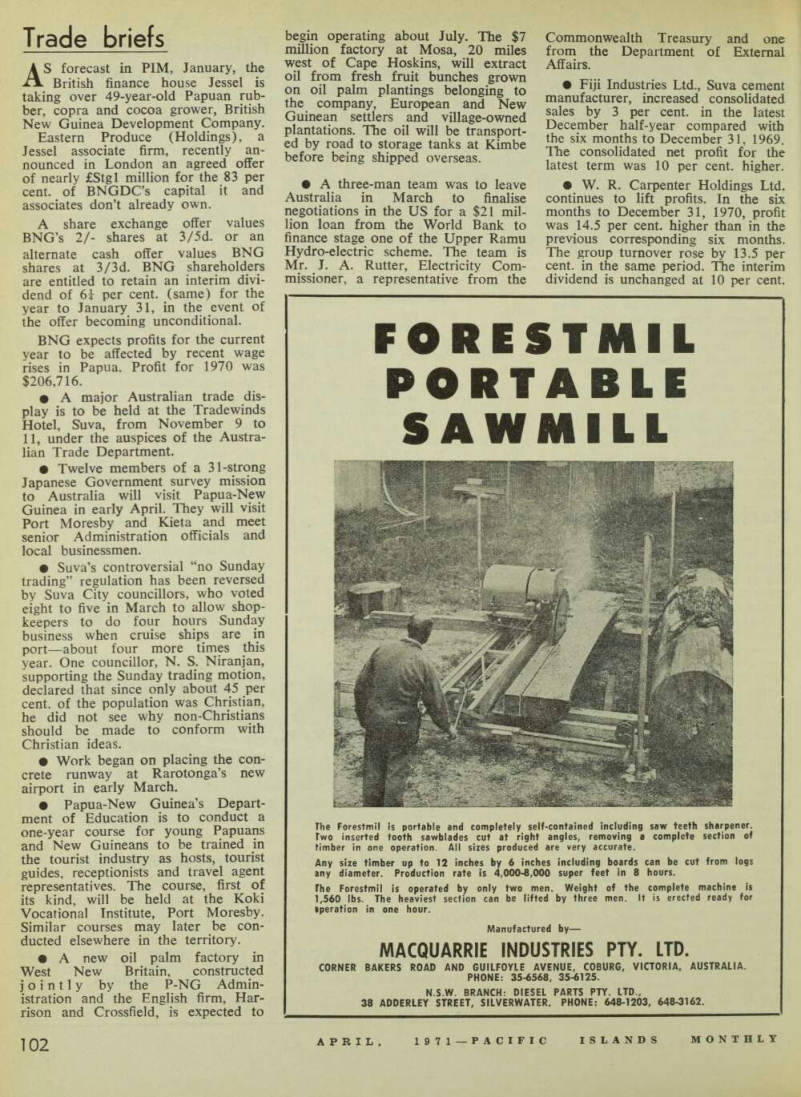 104
104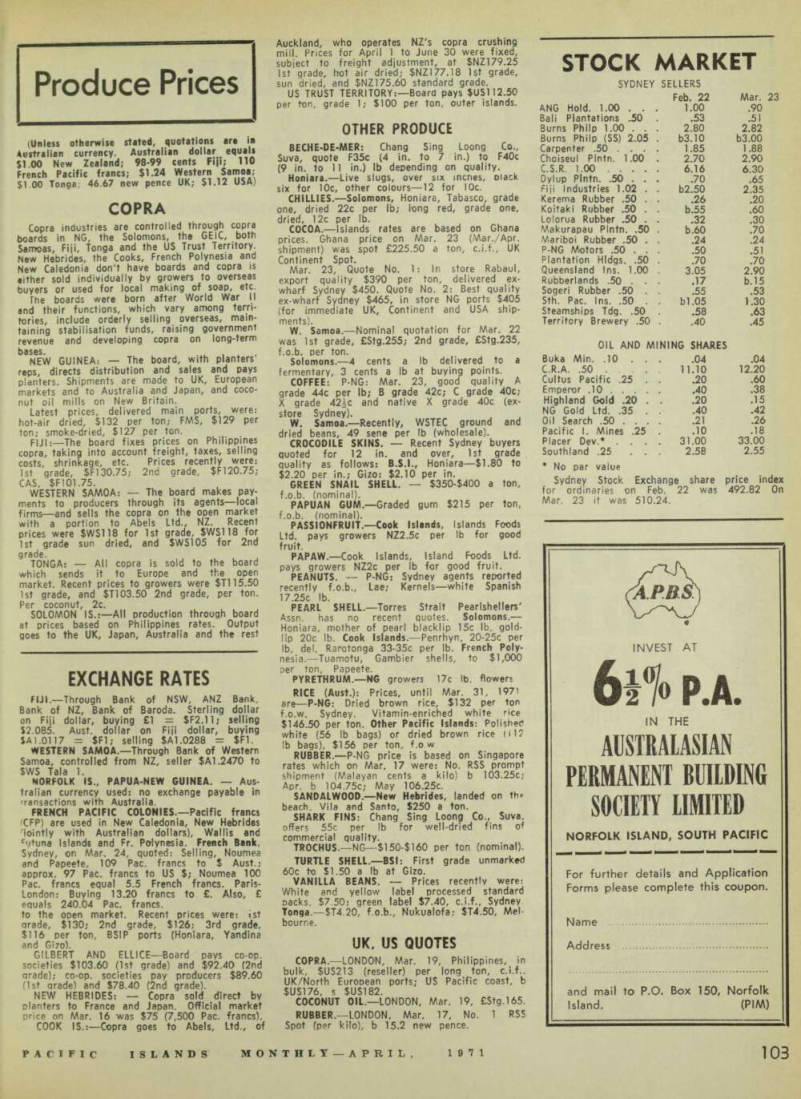 105
105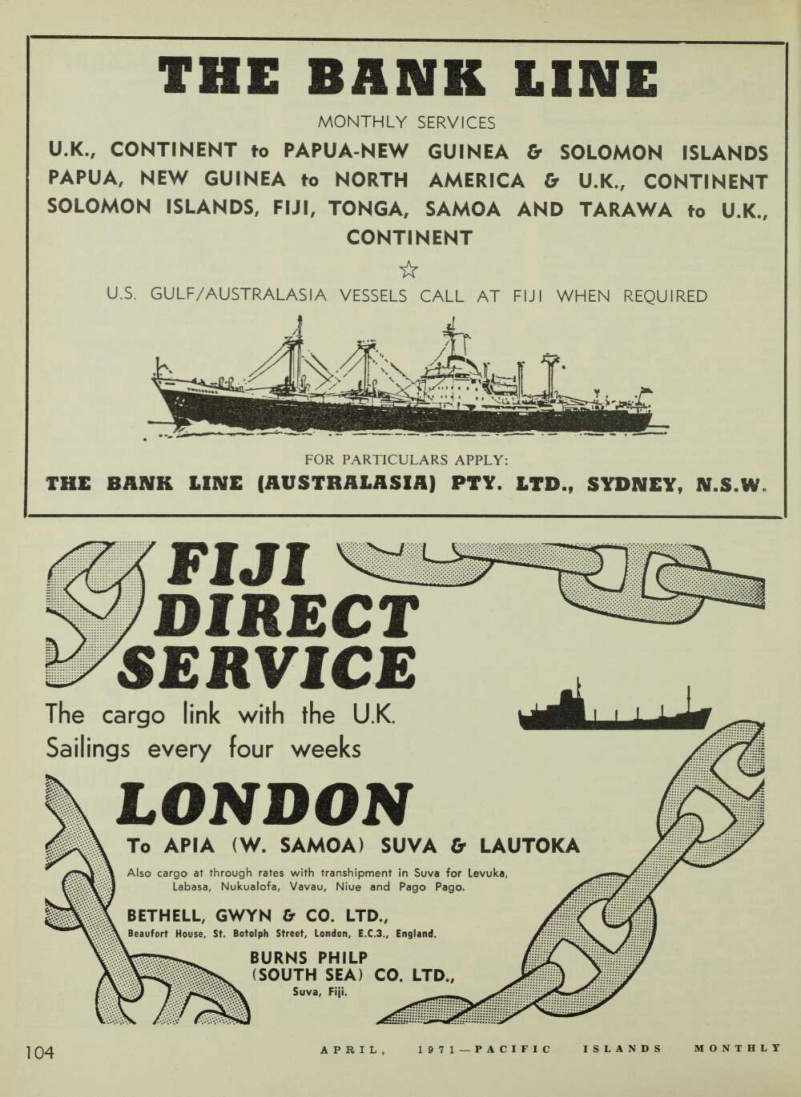 106
106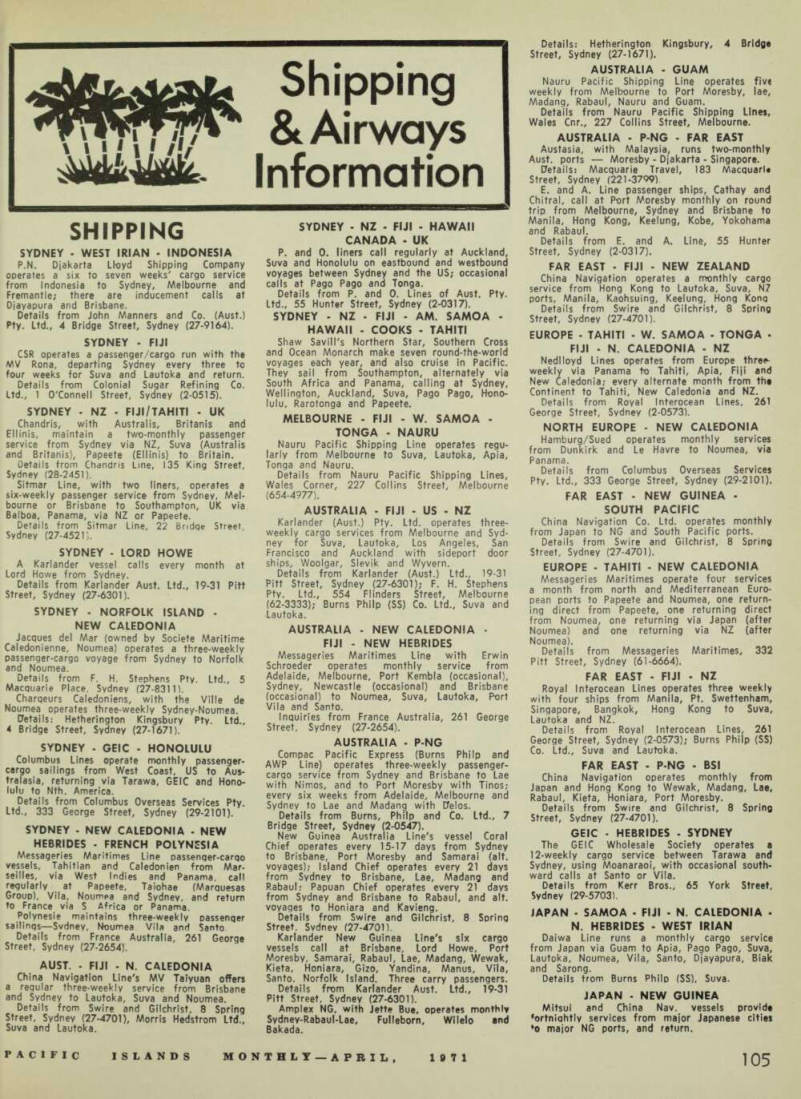 107
107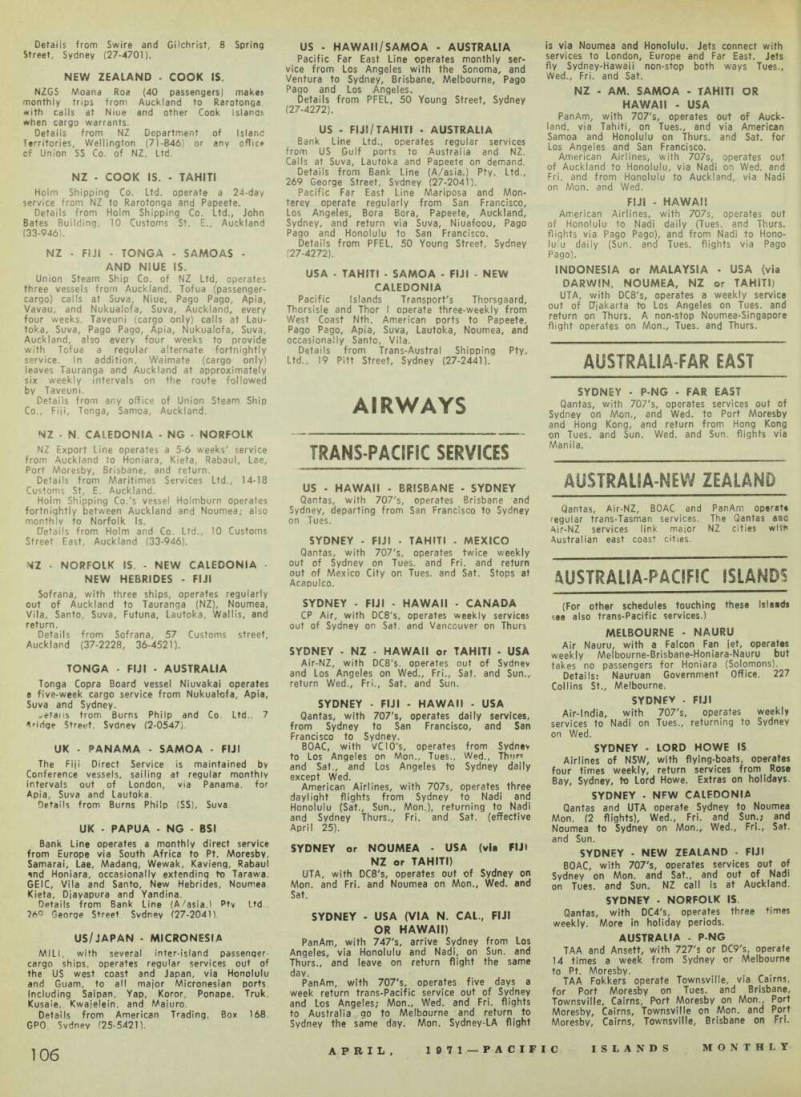 108
108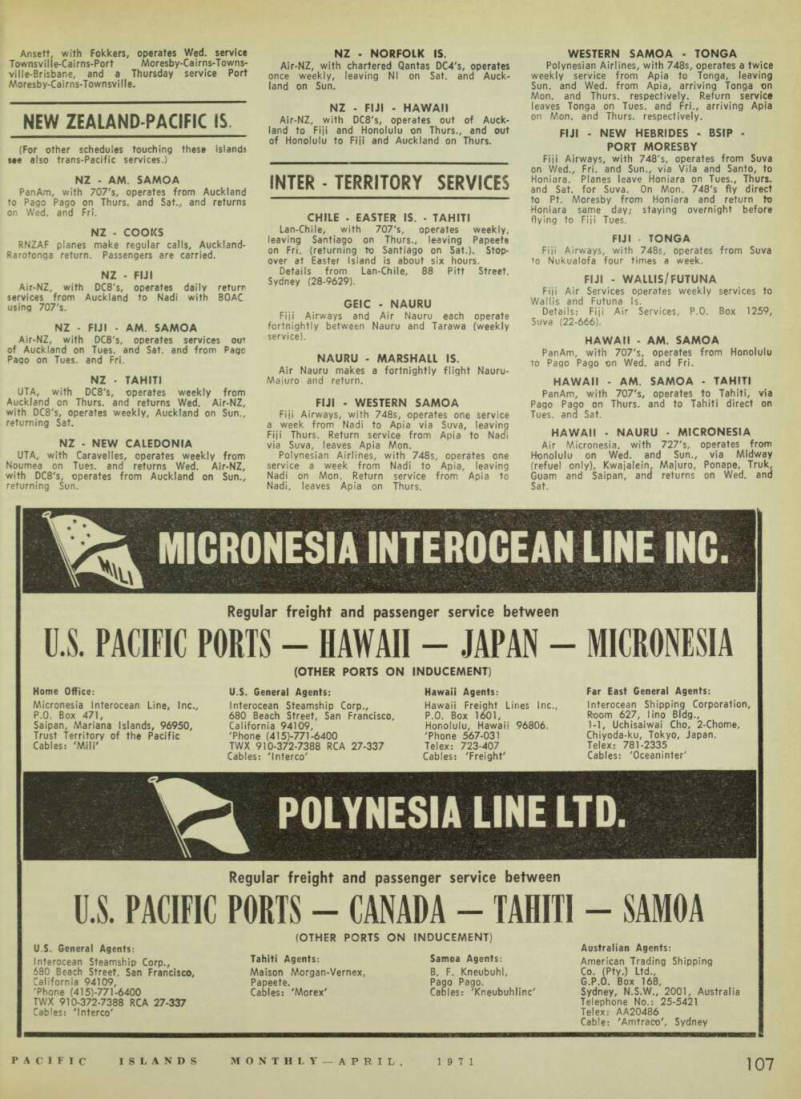 109
109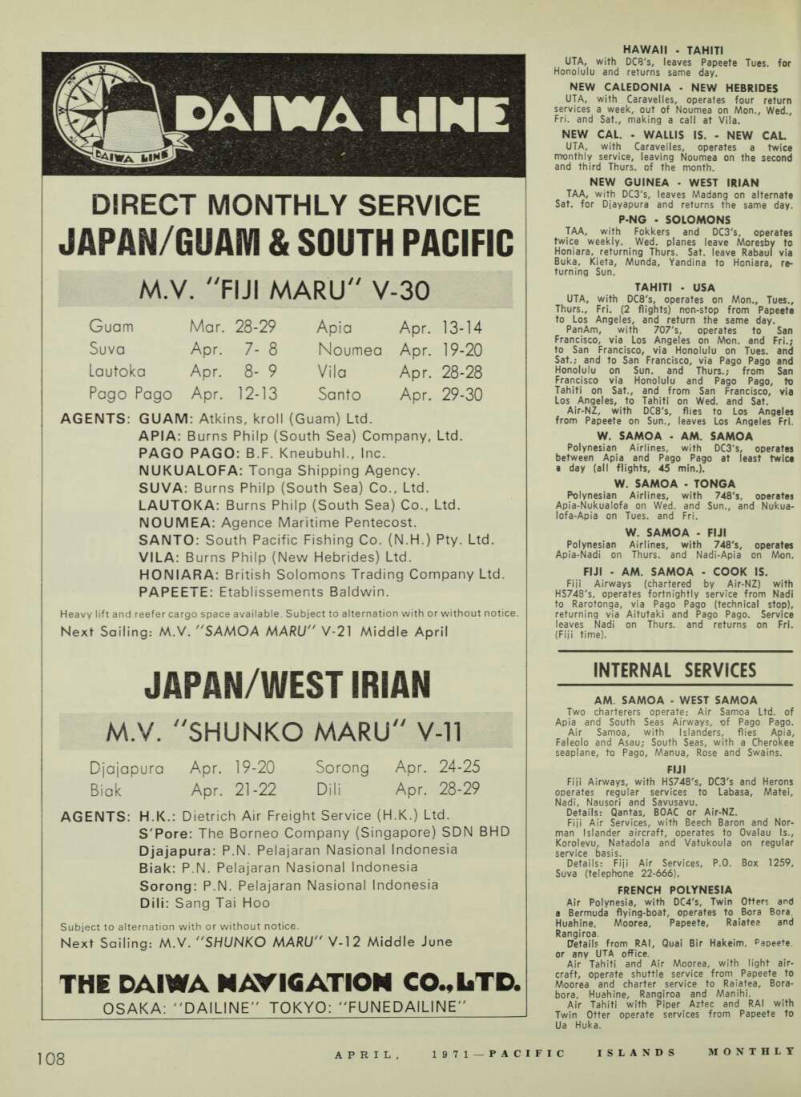 110
110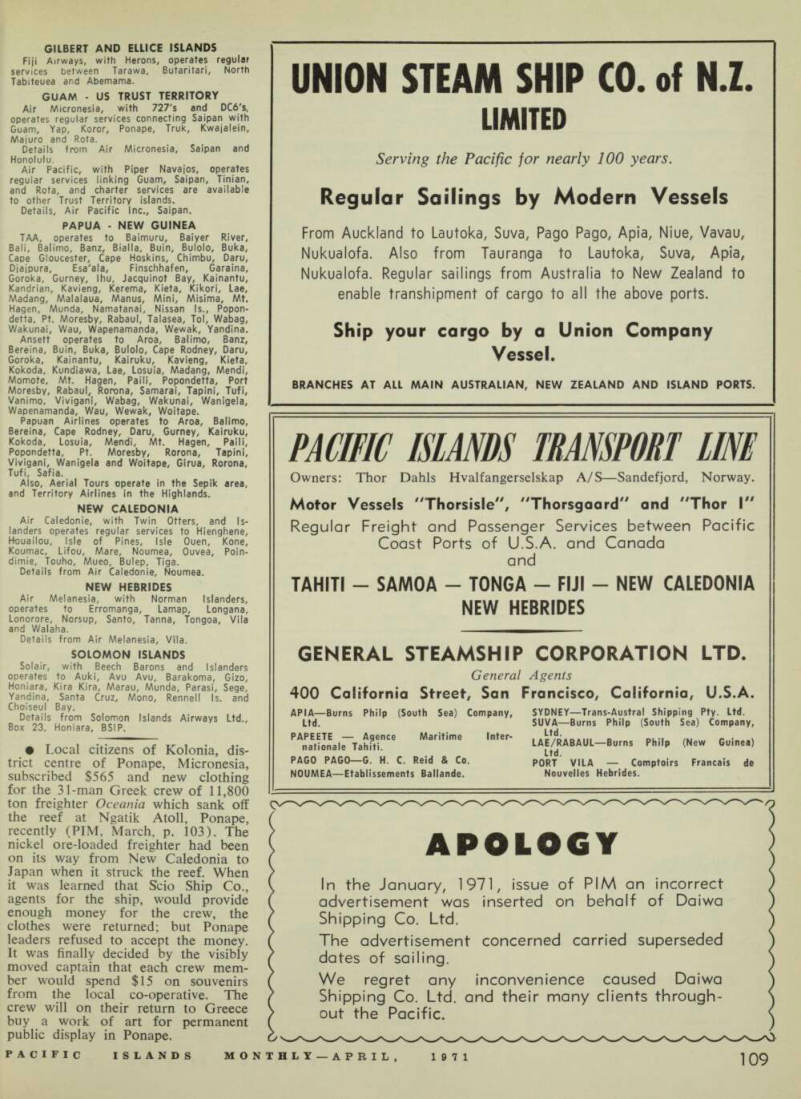 111
111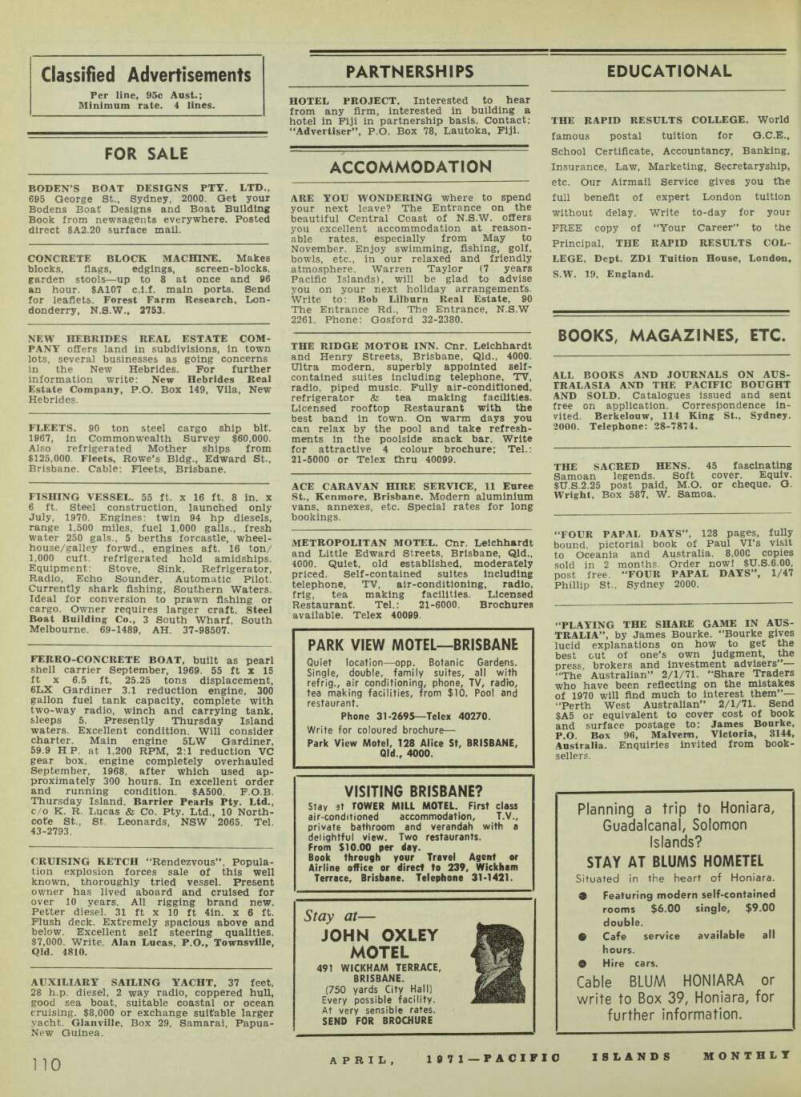 112
112 113
113 114
114 115
115 116
116 117
117 118
118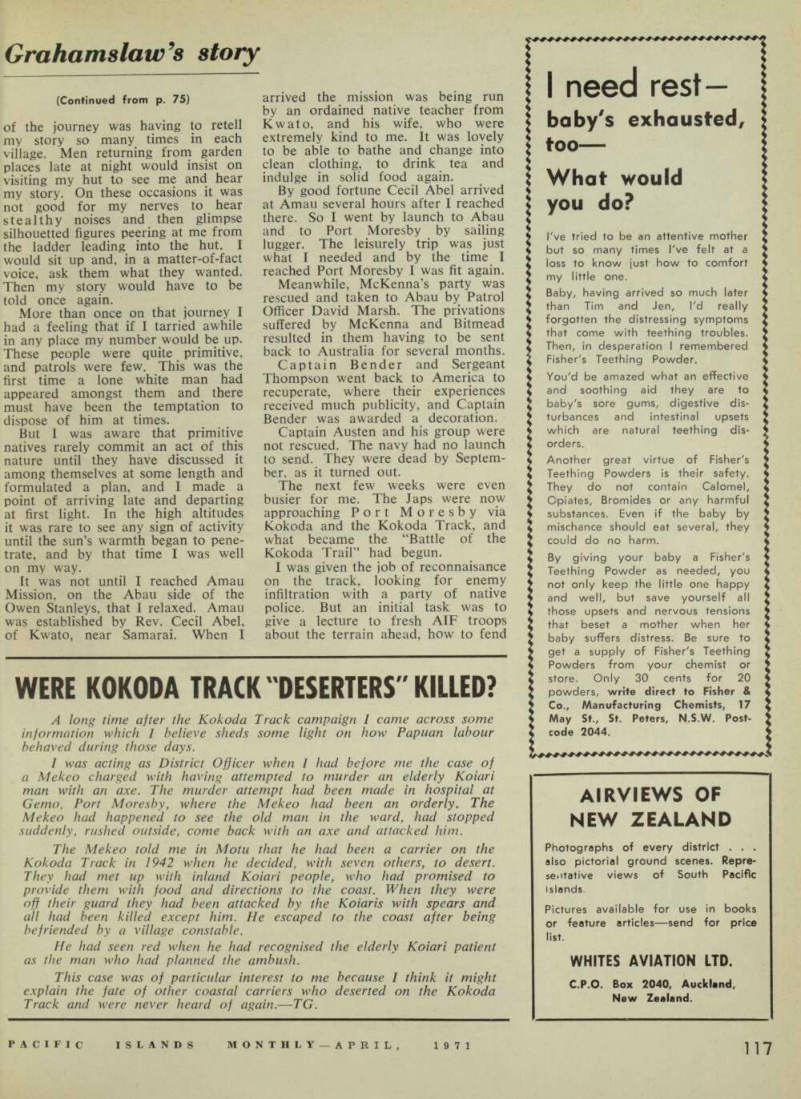 119
119 120
120 121
121 122
122 123
123 124
124 125
125 126
126 127
127 128
128 129
129 130
130 131
131 132
132 133
133 134
134 135
135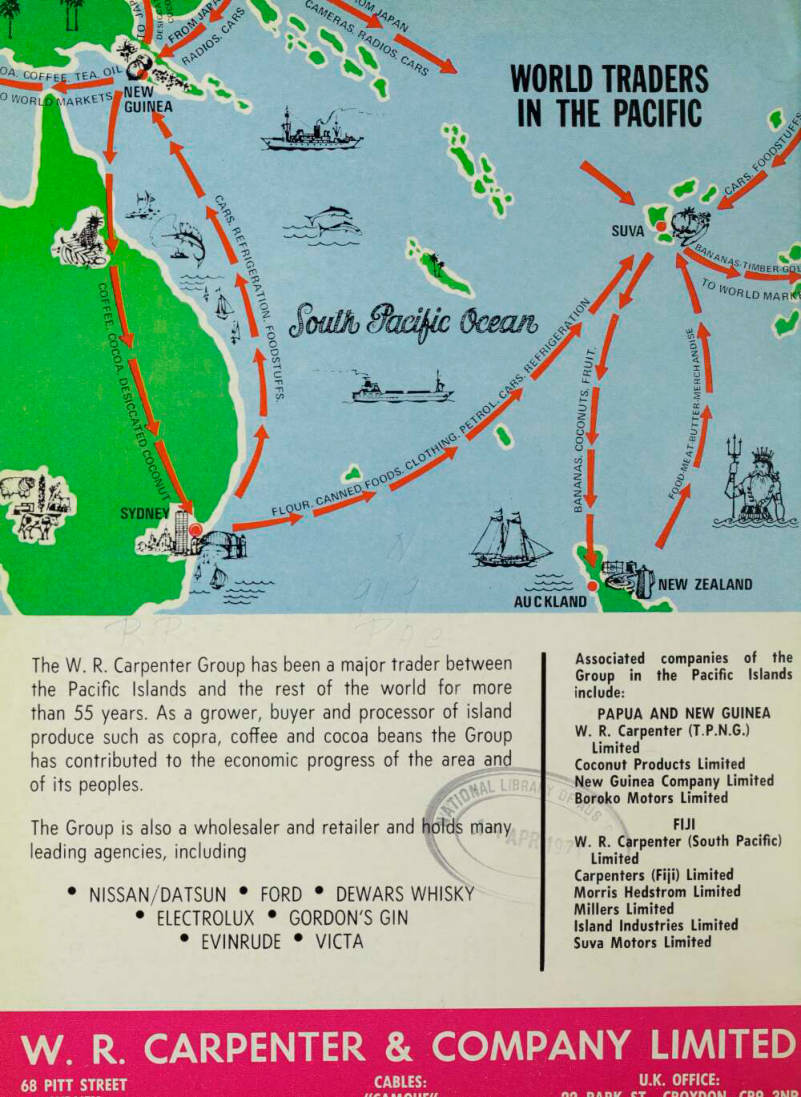 136
136