Monthly
Pacific Islands Monthly
S Magazine
Of The
Th Pacific
Stralia, 40C. • New
D, 45C. • Fiji, 3/9. •
Pac. Islands, 55 Frcs.
U.S. Pac. Territories,
P-N.G. And All Other
Territories, 35C. Local
Currency.
\AY, 1968
t
Advertisements & other items, pp. 2-11 (8 items)
May, 1968 Pacific Islands Monthl
One flight...
09
1823 miles of extra
Between Papua/New Guinea and Australia, everyone gets extra care when they fly TAA ‘Bird of Paradise’. Business or holiday travel, family travel or sentimental journey whatever your reason to fly, you’ll relax and enjoy TAA’s international standards of service with five hostesses to pamper your every need. Drinks are free first class. Meals are culinary masterpieces from canapes right through to cheese, coffee and mints. Everyone gets extra care on a ‘Bird of Paradise’ flight especially the youngsters, who’ll really enjoy their games and books. So take care to book TAA, and we’ll take extra care of you. Call your Travel Agent or TAA now.
Port Moresby 2101, Lae 2311, Madang 2478, Rabaul 2567, Goroka 8, Mt. Hagen 4, Wewak 103.
Fly TAA the Friendly Way
n
TAA 3689 67
m ■ : i s 4*. to M v kM v> y vi
ofessional Portable Record/
lyback Stereo For Use
ywhere Anytime v.„« nEnj . yl - r «.
In the comfort of your home or when enjoying yourself outdoors, this portable 4-TRACK STEREO tape recorder is just the one for you. A 7" REEL can be used, as well as smaller sizes. Also, it can be operated with either AC or DC current.
This SOLID-STATE X V has the same capacity as the large home models. It includes among its features the noiseless operation due to the long-life BRUSHLESS MICRO MOTOR and patented CROSS-FIELD HEAD. While you are shopping, look for this wonderful stereo.
ler Well Known Members
a ' BL== > m
1710W+SW-120A
X-150Dr AA-5000 SW-130
1 ,! 1800 SD M-9
3 AKAI
VI ELECTRIC CO., LTD.
HIKOJIYACHO OHTA KU TOKYO JAPAN
AUSTRALIA. Magnecord Australasia Pty.. Ltd. 210 Clarence Street. Sydnee. N.S.W. NEW ZEALAND: G. Glausiuss Coy 187-189 Hereford Street Chnstcgurch. FIJI ISLANDS: Burns Philp (South Sea) Co., Ltd., Suya. Burns Philp (South Sea) Co., Ltd., Lautoka. SAMOA; Burns Philp (South Sea) Co., Ltd., Pago Pago, American Samoa. Burns Philip (South Sea) Co., Ltd., Apia Western Samoa. NorforK Island: Burns Philo (South Sea) Co • • Ltd N °rfo lk Island South Pacific. NEW HEBRIDES: Burns Philp (New Hebrides) Ltd., Port Vila. Burns Philp (New Hebrides) Ltd Santo NEW CALEDONIE: Menard Freres Rues Jean-Jaures et du General Gallieni, Noumea. BRITISH SOLOMON ISLANDS; Msndana Enterprises (Solomon islands) Ltd., P.O. Box 12. Honiara. 8.5.1. P. NAURU; Nauru Co operative Society. COOK ISLANDS: N T. NAPA (AVARUA) Ltd.. Rarotonga TAHITI- Ets Comimpex. P.O. Box 200, Papeete. PAPUA & NEW GUINEA: S.O. Svensson (N.G.) Ltd., P.O. Box 508., Port Moresby Papua S U Diczbalis Pty. Ltd., P.O. Box 59, Madang. N.G. Pacific Indent Co.. P,O. Box 154. Rabaul, N.G.
The car;
YOU SEI
HERI
HAVE BEEh
THE INNOCENT CAR BUYER
CHANGET
The Toyota Corona Deluxe. It eliminates all those impossible alternatives you have had to face when you go to buy a car.
It will last longer than most others, with a style that will last longer, too.
Its cruising speed is 120 km/h
TO PROTEC
THE INNOCENT
(75 mph), its gas mileage is remarkable It comes furnished with the little things you’ve always payed extra for.
A radio with magnetic antenna, clock, full carpeting, and tinted glass. All at a reasonable price.
A change that takes more of the danger out of buying a car. The Toyota -h > ; Corona Deluxe.
JOVOT*,*
rggaarfittww T* Ml
TOYOTA
E INNOCENT DRIVER
Toyota Crown Deluxe. It was made with your safety id.
Dund the outside is a new, stronger perimeter frame, r brakes, dual headlights, big tail lights, too. de, Toyota has done away with all rough edges, and door handles are recessed. All knobs made of Tally safe material. 5 dashboard is impact absorbing and glare-proof, the ash trays and rear view mirror are designed to ut of harms way. iw strength, new styling. A sensible answer to the ion of safety. The Toyota Crown Deluxe. find all Toyota cars a pleasant change. Offering new, fresh solutions to auto problems. Toyota is among the top 10 automobile manufacturers in the world, exporting to over .100 countries. With a sales and service organization ready to serve you everywhere. Toyota!
)TOYOTA MOTOR
b BUTORS: NEW GUINEA & PAPUA: THE PORT MORESBY FREEZING CO., LTD., MARY ST., PORT MORESBY, * I FIJI ISLAND: AUTOMOTIVE SUPPLIES CO., LTD., P.O. BOX 1 43 LAUTOKA / AMERICAN SAMOA. BURNS ISOUTH SEA) CO., LTD., PAGO PAGO / WESTERN SAMOA; BURNS PHILP (SOUTH SEA) CO., LTD., APIA /
RICKY’S AUTO CO.. P.O. BOX AOAMA
**4 M
CON
* 15
These fine Kraft
foods from Australia
bring you health
and flavour!
KRAFT]
Delicious Raspberry Conserve for hot scones, vegemite* to add flavour and nourishment to your breakfast toast.
Tasty Cream Cheese Spread for snacks and savouries. The pick of rich cheese.
Kraft makes all these and more to help build strong, healthy bodies.
Always look for nourishing Kraft foods from Australia. They’re nature’s finest. for good food and good food ideas .♦Trade Mark krstsi
I’ve got one lighter made out of two Victorian pennies.
It’s never worked.
I’ve got another that I bought as a holiday souvenir. That went for a week.
I’ve got three other jobs that only need a new little ratchet thingummy.
I’ve got a lighter with a wick like a pyjama cord that lights in a gale and nowhere else.
Lighters ?
I’ve got a drawer full of them.
And a sore thumb.
Somebody
please give me
a Ronson
One of these will do nicely
Premier top-selling gas lighter Adonis slim gas lighter Windmaster gas lighter Comet gas lighter To givers of Ronson gas lighters. A filling lasts for months. Re-fuelling lasts 5 seconds. The lighter—with its adjustable flame —could easily last forever.
RONSON
If one buys a watch of Qualify if is taken for granted that it is SWISS and one will not settle for less
WALTHAM
TIMING THE WORLD SINCE 1850.
America's and Japan's
best selling SWISS Watch
Australia’s most popular watch
Waltham, Chicago, has signed a regular (100atm.) Automatic Calendar, 25 delivery contract with bases of the U.S. Jewels.
Navy which covers almost the whole Waltham has the most comprehensive U.S. territory. range of Gents' and Ladies' Waltham This is due to the performance of the Watches which are synonymous with Diving Watch controlled Jo 3,000 ft. Quality, Elegance and Reliability. u
Ref. 2360 CALENDAR
100% Waterproof Controlled to 90 ft.
Glass provided with tension ring, crown with "O" ring.
Retail Price (in Australia): All Steel $48.00 Rolled-Gold 20 Microns $48.00 Chrome Stainless Steel Back . $44.00 Sole Distributors for N.S.W.: Freestone & Kennedy. Durban Court, Princes Highway, Sutherland, 2232.
Fiji: Trans-Oceanic Agencies 74 Gumming Street, Suva.
New Zealand: Arthur Martin Ltd., 57 Boston Road, Auckland 3.
Island Wholesalers interested in the distribution of Waltham Watches should contact Election Importing Co. Pty. Ltd., 375 George Street, Sydney 2000, Sole Agents for Waltham Watches for Australasia and the South Pacific Islands.
For workshop
for industry
m
Industrial Gases
COMWELD Gas Welding & Cutting Plants; Rods & Fluxes; Flame Cleaning, Flame Hardening & Flame Heating Equipment.
EMF
Electric Welding
Equipment
Arc Welding Machines; Automatic Welding Machines; Electrodes.
Arnold-DeVilbiss
Spray Painting
Equipment
including spray guns, air filters and compressors—to multi-purpose units with spray booths and a full range of automatic equipment.
GIG can meet all your requirements for welding, cutting, bending, shaping and spray painting with equipment and instructive literature that cannot be matched.
Available only from
CIG NEW GUINEA PTY. LTD. P.O. Box 93 Lae.
CIG’S LOCAL TECHNICAL SALES REPRESENTATIVE MR. R. L. Steadson.
CIG New Guinea Pty. Ltd. P.O. Box 1636 Boroko T.P.N.G.
BOROKO MOTORS LTD. P.O. Box 72 Mt. Hagen.
MADANG SLIPWAYS LTD. P.O. Box 47 Madang.
N.G.G. TRADING CO. Milford Haven Road P.O. Box 459 Lae.
BOROKO MOTORS LTD. P.O. Box 1259 Boroko.
J. L. CHIPPER & CO. Box 228 Rabaul.
MESSRS. COLLINS & LEAHY PTY. LTD. P.O. Box 57 Goroka.
TISCHLER ENTERPRISES PTY. LTD. P.O. Box 812 Honiara Guadalcanal.
INDUSTRIAL GASES FIJI LIMITED G.P.O. Box 687 Suva Fiji.
BURNS PHILP (SOUTH SEA) CO. LTD.
GENERAL MERCHANTS AND SHIPOWNERS
SHIPPING, r CUSTOMS AND FORWARDING AGENTS
BRANCHES
Fiji:
SUVA
LEVUKA.
LAUTOKA.
LABASA.
SAVU SAVU.
BA.
SIGATOKA.
TAVUA.
TAVEUNI,
Samoa:
APIA.
PAGO PAGO.
Tonga:
NUKUALOFA.
HAAPAI.
VAVUA.
NORFOLK ISLAND.
NIUE ISLAND.
AGENTS FOR:
QUEENSLAND INSURANCE CO. LTD.
BURNS PHILP TRUSTEE CO. LTD.
SHELL COMPANY (P. 1.) LTD.
OVERSEAS AGENTS
BURNS, PHILP & CO. LTD., Sydney.
BURNS, PHILP & CO. LTD., London.
BURNS PHILP CO. OF SAN FRANCISCO.
SHIPPING AGENCIES
• The New Zealand Shipping Co. Ltd. • Shaw Savill & Albion Co. Ltd. • Port Line Ltd. • Bank Line Ltd. • General Steamship Corporation Ltd. • Blue Star Line • Cunard Line • Compagnie des Messageries Maritimes o British India Steam Navigation Co. Ltd. • Royal Interocean Lines • Nederland Line Royal Dutch Mail/Royai Rotterdam Lloyd.
EXCLUSIVE DISTRIBUTORSHIPS INCLUDE
• AKAI TAPERECORDERS
• DUNLOP PRODUCTS
• EPIGLASS PRODUCTS
• FERGUSON TRACTORS
• HELENA RUBENSTEIN
• HITACHI ELECTRONICS
• HOLDEN VEHICLES
• JOHNSON'S WAXES
• ROLEX WATCHES
• REVLON COSMETICS
• PENTAX CAMERAS
• SUNBEAM APPLIANCES
INTERNATIONAL AIR TRANSPORT ASSOCIATION REPRESENTATIVES for
QANTAS EMPIRE AIRWAYS LTD. AIR NEW ZEALAND UNION DE TRANSPORTS AERIENS ALITALIA PAN AMERICAN AIRWAYS
ASSOCIATED COMPANIES
BURNS PHILP (NEW HEBRIDES) LTD.
AUTOMOTIVE SUPPLIES CO. LTD.
CORRIE & CO. LTD. • WROUGHT IRON AND STEEL
CONSTRUCTION CO. LTD. • BISH LTD.
SPECIALISED SERVICES
EXPERT ADVICE ON WORLD AND LOCAL TOURS
TRAVEL SHIPPING FORWARDING CUSTOMS
FORMALITIES INSURANCE.
REGISTERED OFFICE: SUVA. FIJI
Code Address: "BURNSOUTH" 11 I I 1 I I I I I I I I I I I I I I I I • I I I I I ■ I I I J I I I 1 I I I I I I 1 I I I I I t I I I I I I t I I I 1 I 1 t I I I I I I I I I I I I I I I 1 t I I I I I I I I I I I I I I I I I I I I I I II I I t I I I 1I I II tl I I I I I I I I I I I I i I I I I I I I I I I I I I I I I I I I t I I I I I I I I I I I I I I I I I I I II I I I I I I I I I I I t I I I I I I I I I I I I I I I I II I I I I I I I I I I I I I I I I I I I I I I I I I I I I I I I I I II I I I I I M I I I I I I I I I I I I I I I I I I I I I I I I I I I I I I I II I I I I I II I I I I I I I I I
fresh new
colours and
patterns in
vinyl
flooring
Embossed CSR Vinylflex Floor Tiles. Photograph shows the new Lido Pattern. Others new are Fiesta and Colonial. Now you can choose from six embossed CSR patterns (Lido, Fiesta, Colonial, del Prado, Travertine, Seastone), in gay, exciting colours or quiet, neutral tones. Embossed CSR Floor Tiles have a thirddimensional texture, so beautiful, so easy to keep clean. (12" x 12" x 1/10" thickness.) CSR Vinylflex Floor Tiles, Marbleised Pattern. A smooth-surfaced vinyl tile in carefully selected fashion colours.
New colours have been added in accord with changing decorating styles. (9" x 9".) CSR Vinylflex Floor Tiles are long lasting, easy to clean, and unaffected by tropical conditions. Ask for coloured leaflet. * -r>.
csr Vinylflex
FLOOR AND WALL TILES
Made in Australia, Marketed by
CSR BUILDING MATERIALS SALES PTY. LTD.
AVAILABLE FROM
New Guinea & Papua: Steamships Trading Company Ltd.
Solomon Islands: British Solomon Trading Co. New Hebrides: Burns Philp (N.H ) Ltd.
Norfolk Island: Irvine’s Building Supplies. Fiji, Tonga, Samoa: Burns Philp (S.S.) Co. Ltd.
«S"
IDILDIIiS\/MATERIALS
Cific Islands Monthly May, 1968
5
CIFIC ISLANDS MONTHLY MAY, 1968
6
MAY, 1968 PACIFIC ISLANDS MONTHL
7
CIFIC ISLANDS MONTHLY MAY, 1968
8
MAY, 1968 PACIFIC ISLANDS MONTHL
9
ACIFIC ISLANDS MONTHLY MAY. 1968
Pacific Islands
Monthly
Established 1930: 38th Year of Publication.
Owned And Published By
Pacific Publications Pty. Ltd.,
29 Alberta St., Sydney, N.S.W., 2000.
Postal Address: G.P.O. BOX 3408, SYDNEY,
N.S.W., 2001.
Telegraphic Address: PACPUB, Sydney.
Telephones: 61-9197, 61-7101, 61-4369.
Chief Executives: Managing Director: R. W. Robson.
General Manager: Selwyn Hughes.
Book Publishing Division
Editor; Judy Tudor.
Pacific Islands Monthly
Editor: Stuart Inder.
Branch Offices
Melbourne: Newspaper House, 247 Collins St., Victoria, 3000. Tel.* 63-7053.
Fiji: Pacific Publications (Fiji) Ltd., Fiji Times Building, 20 Gordon Street, SUVA. Tel.: 25601.
Fiji Times Office, Vidilo Street, LAUTOKA.
Tel.: 60-422.
Papua-New Guinea: Pacific Publications (N.G.) Pty. Ltd. Representatives: Mrs. Joan Carter, P.O. Box 16, PT. MORESBY (Tel.: 2504); The Manager, P.O. Box 227, LAE; Mr. Steve Simpson, P.O. Box 154, RABAUL (Tel.: 2547).
Representatives
New Zealand: J, D. Whitcombe, C.P.O. Box 2229, Queen Street, Auckland. Tel.: 76056.
United States; Mrs. A. L. Craib, 782 Neilson Street, Berkeley, California, 5273503.
United Kingdom: S. R. Warman, Candlewick House, 116-126 Cannon Street, London, E.C.4, Tel.: Mansion 3674/7.
H. A, Mackenzie, 4A Bloomsbury Square, London, W.C.I. Tel.: Holborn 3779.
Agents
All main trading firms and stores in the Pacific Islands, Pacific Publications Pty. Ltd. Is the Australian agent for THE FIJI TIMES.
Subscription Rates:
"Pacific Islands Monthly" is air-freighted to all subscribers and agents in the South Pacific; copies to other areas go by surface mail.
Australia (incl. Lord Howe Is., and Thursday Is.): $4.50 Aust.; Papua-New Guinea, Norfolk Is, Nauru, 8.5.1., G. & E. Group, Tonga and New Hebrides: $4.00 Aust.; New Zealand: $5.25 NZ; Cook Is., Niue and Western Samoa: $4.00 (local currency); Fiji £2/5/- (local currency); American Samoa and U.S Pacific Territories: $B.OO (local currency); French Pacific Territories—New Caledonia, Tahiti, etc.: 660 French Pacific francs; United States of America: $9.00 U.S.; United Kingdom and elsewhere: £2/15/- Stg.
Airmail postage to USA, UK and elsewhere is additional.
Up Front
with the editor
N° doubt whether or not you agree with some of the comments made in Fiji recently by Malaysia’s visiting Minister for Works, Tun Sambanthan, depends on which side of the political fence you’re on. Both the Alliance and the Federation, from the look of their propaganda sheets, read different mes sages into his gospel.
BUT there is a measure of agree ment on one matter Tun Sam banthan raised—the question of a common name for the people of Fiji.
It is generally conceded in Fiji that there should be one name; the problem is to find the right one.
According to many people, the right one is not “Fijian”. The word Fijian, they say, is reserved for in digenous Fijians, and mustn’t be applied to people with Indian or European parentage, even if they were born in the colony. True Fijians, these critics say, especially resent Fiji-born Indians being referred to as “Fijians” when they are interviewed or reported on in overseas newspapers They are not “Fijians” but “Fiji- Indians”.
Various alternatives for a common name have been put forward. “Vitian” —from Viti, the real name of Fiji— has been suggested several times.
Then there is “Vanuan”, from the Fijian word Vanua, for land or place.
And since Tun Sambanthan brought the subject up again, there has been a number of weird concoctions offered by the Fiji public.
Legal support
As a result of a piece of legal machinery passed in the Fiji Legis lative Council last year, those who stick out for this “correct” use of Fijian can quote extra legal authority in their support. A person “shall be regarded as a Fijian or as a native if ... his father or any of his earlier male progenitors in the male line is or was the child of parents both of whom are or were indigenous inhabitants of the Fiji Islands, the island of Rotuma, or any island in Melanesia, Micronesia or Polynesia.”
In other words a Fijian is not only indigenous of Fiji but may be any
body from the South Pacific Island as long as he is not European, India or Chinese.
This legal definition brought som crossfire before the Legislativ Council passed it, Opposition leade A. D. Patel (who was born in India taking the view that all inhabitant of Fiji should be described a “Fijians”, and that the Fijian’s ow word for himself—“taukei” (mean mg owner)—should be sufficient t describe the indigenous Fijian. Fi’ nationalism was not helped by sup port for a narrow definition of th word Fijian, Mr. Patel indicated.
Mr. Patel was right, of course. Th constant reference to Fiji-Indians which sets almost half the population apart from the other half, has beei breeding too much resentment for to< long. Those Indians who resent ii the name the inference that they an outsiders, are entitled to resent it.
It’s not easy to argue against th recently expressed editorial view o
5 Pacific Review, Nadi, that if hitians and Samoans can legally called Fijians, why can’t people ing in Fiji?
I wonder if the thing would have ilt up over the years into the naked •ial issue it now is if various Euro ans had not been so ready to sup rt what they assumed to be a leral point of view held by the jians? Is it only in the last year two that the government has re gnised the need to sponsor nation sm and racial harmony in the der interest, and not merely in the erest of the indigenous Fijians? rely not.
Agreed that legal definitions, par ularly over land ownership and the jian administration, will be affected everyody should start using the m Fijian, but Fiji’s abundance of vyers have the wit to solve that.
This matter of one name for the ople of Fiji needs to be tackled now, the top. If, (a) the colony is not ing to change its name and solve problems that way, if (b) it is lable to find a satisfactory altern ve to the word Fijian, then (c) it tter make up its mind that Fijian the name for people who call Fiji •me.
Message for P-NG
Meanwhile there is a message in ji’s serious dilemma for the people Papua-New Guinea, some of whom ;ve recently been showing symptoms ? their own nomenclature tremens. [though, unlike Fiji, a big portion P-NG’s two million people did not rive at some stage as immigrants, ere has been a trend to identify e people separately as “Papuans” id “New Guineans.” The Admin ;ration does it all the time, and so >es the radio.
Thus thousands of locals to whom has never occurred that there is me kind of dividing line down the :ntre of the main island are now ;ing brainwashed daily into believ g there really are two distinct itions of people on the island.
There can be no real doubt now iat the Territory of Papua and New uinea has a single destiny. The ;ople need one name, and, what rev they might choose to call them slves at some future date, I can see 3 reason why they shouldn’t be died simply ‘New Guineans” now.
In the pages of PIM we have been ) referring to them for some years, le exception being in Percy hatterton’s column, because Percy equently needs to make a distinc on in drawing on his pre-war apu a n experiences. But he’ll robably soon find a way round that.
Stuart Inder
The Cover
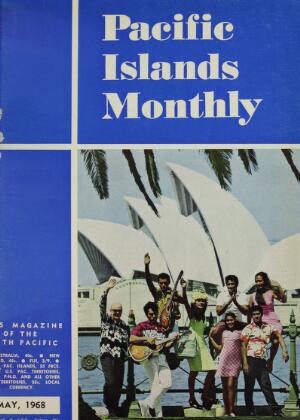
A little bit of Tahiti and a little bit of Sydney came together recently when members of this Tahitian dancing group were photographed against the back ground of the spectacular sail like roof of Sydney's Opera House, now nearing completion.
Air New Zealand arranged for the Tahitians to appear at the Paci fic Area Travel Association Con ference in Taiwan, and to visit Hong Kong and various Austra lian states to promote the airline's Auckand - Papeete - Los Angeles service. The dancers were a great success.
Advertisements & other items, pp. 13-18 (3 items)
S. E. Tatham
& Co. Pty. Ltd. m
SET"
G.P.O. Box 8, Cables
S. E. TATHAM
MELBOURNE, AUSTRALIA
Telephone 60-1125
SOME OF THE FIRMS
WE REPRESENT ARE
Sunshine Biscuits Sunrise (Confectionery) Flamenco.(lnstant Coffee) Cremota (Quaker Oats, Jets) Merchants (Canned Soft Drinks) Hancock’s (Spaghetti, Cereals) Melbourne Canning (Jams, Bleach) Water Wheel (Flour, Sharps, Wheat) General Food Corporation (Twisties) Edward Zorn (Margarine, Cooking Fats) Macßobertson’s (Chocolates, Confectionery) Rodd (Cutlery) Palm (Mattresses) Esteel (Cookware) Vendolux (Cafe Bars) Warner-Drayton (Fans) Mitchell’s (Abrasives) Regent (Swiss Watches) Gainsborough (Furniture) Austramax (Pressure Lamps) Preservene (Soap Products) Charles Tims (School Requisites) Ascow and Philadelphian (Shirts) Lawn Chair and Tubco (Garden Furniture) Sunrise Lustretone (S.S. Sinks, Plumbers’ Supplies) Electronic Industries (Electrical Household Appliances)
DIRECT ENQUIRIES WELCOMED
Associate Company
S. E. TATHAM (FIJI) LTD.
Suva, G.P.O. Box 671.
Lautoka, P.O. Box 366
EXPORT AGENTS
PACIFIC ISLANDS
AGENTS
Australian buying and shipping agents for the ngl Gilbert and Ellice Islands Colony Wholesale Society % at 1 \ 3 g 1 a
SINCE 1924
1 WHOLE WORLD IS BUYING BUAME
In the last financial year, Australia’s exports topped the SA3OOO million mark a figure that put Australia twelfth on the list of world trading nations. What does the world buy from Australia? The same kinds of products she sells to the Pacific Islands: foods, building materials, developmental equipment, automotive products, textiles and lots more.
For names and addresses of suppliers of Australian products, write, telephone or call Mr. W. R. Carney, the Australian Government Trade Commissioner, at A.N.Z.
Bank Building, Corner Pitt & Hunter Streets, Sydney. Telephone 2 0372.
AUSTRALIAN DEPARTMENT OF TRADE AND INDUSTRY
NPFJ/GE/270 f
Australian
butter & cheese
... help children grow faster
... give children more energy
pyy, A i
AUSTRA
From the rich pastures of Australia come the finest in dairy products including the finest cheese, butter, and canned or powdered milks. ■ Unsurpassed for flavour, Australian butter gives you full Vitamin A and D content. Australian cheese gives you excellent concentrated food value full of protein and rich in calcium. ■ For energy, goodness and flavour choose Australian dairy products.
Always look for the word 'Australia' on the label Trade Enquiries to: Your resident Australian Trade Commissioner or— Australian Dairy Produce Board,
G.P.O. Box 1657 N,
Melbourne, Victoria, Australia. 3001. i
GENERAL
FOODS
.bring you the good things in life! - . Vv v> * / • 2‘
*T£p-&op
ICE CREAM
<iv Good things like creamy smooth Tip Top ice cream. A whole range of flavours in take-home packs, in novelties, and in bulk. Tip Top another quality General Foods product.
Trade enquiries to General Foods Corporation Ltd., P.O Box 7 Auckland, N.Z.
A 42 ■ tr eo«' aod '
Cheezpop & Chickpop
■~ -v ' I I m ■M 1
? *»*/ eh'ske# I
The happiest fun-foods
Cheezpop and Chickpop are great fun. Crisp . . . crackling . . . salty and flavoursome . . . pals to drinks . . . waken your palate . . . sharpen your taste for every frosty sip. Next party, snacktime or barbecue, nibble on Cheezpop or Chickpop. Or both.
They’re pop-pop-popping good fun.
For trade enquiries; Reckitt & Colman Pty. Ltd., Wharf Road, West Ryde, N.S.W., Australia. Cables: Reckitls, Sydney.
A RECKITT & COLMAN PRODUCT
H 81628
Triple-wrapped packets
Qrnotts
Biscuits
19k m M - , 1 - •• • ■■ \ \ TA * a? 0 v Or.
A o ’4r Sr..
P • p <c V
... for extra energy
There is no Substitute for Quality
13
ACIFIC ISLANDS MONTHLY MAY, 1968
15
ACIFIC ISLANDS MONTHLY MAY, 1968
[?]This Issue
Neral
akemba" inquiry 21, 109 :torial series 33 stern Airlines may fly south 41 e golden rivet 83 w Qantas book 87 iide for boat owners 91 rpenter loses Columbus 100 >w ships for NZ-UK run 100 tes up on MM vessels 101 eck of "Tiare Taporo" 105 irricane over the Pacific 113 pra market report 119
Aerican Samoa
anomic survey 24
>Ok Islands
:ctions 24 ernational airport to be built ... 37 re water at low cost 67 II akemba" inquiry 21, 109 jposition is now out 23 tu George 29 :torial series 33 urism will flourish 43 litical battle "a sham" 61 >ry of yaqona 81 om-time for shipyards 97 ort awards 117
French Polynesia
Autonomists go to Paris 18 Athletic record 26 Bougainville's anniversary 28 Tahiti-Moorea tunnel 32 Two more hotels for Tahiti 47 Shipping rates up 101
Gilbert And Ellice Islands Colony
Patient back home 117 Inspector goes to England 117
Lord Howe Island
Murder charge remand 21
Nauru
Constitution 20 Regular air service 45
New Caledonia
Autonomists go to Paris 18 Paratroops cause concern 19
New Hebrides
Sister Dorothy Smith 29
Trading/passenger ship 47
"Tiare Taporo" wrecked on reef ... 105 Shell collector stung 117
Niue
Postage stamp deal 21 Horseless carriages 29
Norfolk Island
Football pools? 26
Papua-New Guinea
UN Mission 19 Final election round-up 20 Kokoda Trail death 21 Election figures 22 Misima Island's gold 25 Trek to the Star Mountains 28 Sir David Hay? 29 White "savages" 51 "Yanina" sold 52 Mount Hagen funeral 57 Church school fees 71 Tribute to Eric Feldt 77 Qantas to the rescue 87 Second issue of journal 87 Fishes and fowl 92 Coastal Shipowners' Association ... 101 Second patrol boat 101 Steel ship to be built 109 Karlander adds another vessel 109 Tariff policy 118 Encouragement for copper 118 Oil drilling plans 118
Solomon Islands
Festival of the Solomon Seas 27
Tonga
Pictorial series 33 New terminal, new airfields 49 Busy waterfront 51 Football season begins 63
Western Samoa
Prime Minister for Japan 117 At the Islanders' Association 117 New NZ High Commissioner 117
Us Trust Territory
First Micronesian jet service 45 What offers for shipping route? ... 118
DEPARTMENTS: Up Front with the Editor, 10; Port Moresby Personality, 32; To the Point, with Percy Chatterton, 30; Travel, 33; From the Islands Press, 72; Magazine Section, 77; Yesterday, 85; Shipping, 97; Cruising Yachts, 110; People in Pictures, 113; People, 117; Business and Development, 118; Produce Prices, 121; Shipping, Airways Schedules, 127; Deaths of Islands People, 130; Index to Advertisers, 131; The Practical Planter, 135.
No Open Arms In Paris For
Tahiti's Autonomists
A four-man delegation from French Polynesia’s 30-member Territorial Assembly (parliament) flew to Paris at the end of March to discuss the question of internal self-government with the French Government. However, the delegates did not get much of a hearing.
The delegates are Messrs. Francis Sanford (French Polynesia’s repre sentative in France’s Chamber of Deputies), John Teariki (a former deputy), Jean Millaud, and Henri Bouvier.
All belong to the Territorial Assembly’s two majority parties which campaigned vigorously on the self government issue at the Assembly elections last September {PIM, Oct., 1967, p. 25).
The majority parties hold 16 of the 30 Assembly seats and have the support of one independent. The other 13 Assembly members are strongly opposed to any weakening of the links between French Poly nesia and France.
Enlivened
The trip of the four-man delega tion to Paris was the latest in a series of moves on self-government which have enlivened and embittered Tahitian politics since the September elections.
Earlier moves were: • A decision by the Territorial Assembly last November by 17 votes to 10, with three abstentions, that a constitutional commission should study the question of internal self government and submit a plan for constitutional reform to the French Government (PIM, Dec., 1967, p. 17). • The resignation of Mr. Sanford from President De Gaulle’s Indepen dent Republication Party in January because, he said, the President had failed to take heed of the people’s wish for internal self-government in French Polynesia. Mr. Sanford’s resignation deprived President de Gaulle’s party of its absolute major ity in the French Parliament (PIM, Feb., p. 23). • Unofficial discussion in Papeete early in February between members of the majority parties and the Assistant Secretary-General of the United Nations, Mr. Djermakoye, about ways of approaching the UN
on the self-government issue ( PIM, March, p. 117).
So far the French Government’s only concesssion to the autonomistes is its decision to allow French Poly nesia to again have a ministerial form of government—as it did until October, 1958, when political dis turbances involving the now-exiled radical leader, Pouvanna a Oopa brought an end to it.
The French Premier, Mr. Pompi dou, told a questioner flatly in the French Parliament on February 17 that French Polynesia would not be granted self-government.
Said Mr, Pompidou: “The desire expressed by a group of territorial councillors, who represent only a fraction of the electorate and who do not have the right to speak for the whole territory, does not justify the changing of a constitution accepted with acclaim less than 10 years ago . . . and which has been of evident profit to French Poly nesia and its inhabitants.”
"Evident profit"
Mr. Pompidou detailed the “evi dent profit” that the Tahitians had derived from their present constitu tion by saying that: • Between 1959 and 1966, the number of people drawing govern ment salaries had doubled. This had given the territory full employment. • The annual value of salaries paid to government employees had quadrupled from 1,000 million French Pacific francs (SAIO million) in 1959 to 4,500 million francs in 1966. • The standard of living had more than doubled.
Mr. Pompidou’s statement failed to mention that the huge increase in government salaries in French Poly nesia in recent years was largely due to the nuclear testing project at Mururoa Atoll, which is bitterly opposed by members of the majority parties. Thus it neither satisfied nor intimidated them.
At a meeting of the Territoria Assembly’s permanent commission oi March 21, at which it was decidet to send the four-man delegation t Paris, members agreed that; • The Assembly’s resolution tha its constitutional commission shouh submit a plan for constitutional re form to the French Government ha< “not had the reception it merited” • The majority parties had beei wrongly accused of wishing to brea] away from France, whereas all the; wanted was to be able to run thei own affairs. • The French Governmen seemed to believe that the demani for self-government would loosei the links between French Polynesii and France, whereas the intentioi was to make them stronger by mak ing them “more just and valid”.
The members of the permanen commission also agreed that thi health of the exiled Pouvanaa i Oopa, who was banished fron French Polynesia until 1973, mad( it essential that he should be allowei to return from France as a matte of urgency.
The four-man delegation arrivei in Paris via Noumea on March 3( accompanied by a delegation fron New Caledonia which also wante< to discuss self-government with th< French authorities. (See story op' posite).
The delegation from Tahiti ha< only been in Paris a few days whei the French Minister for Oversea Territories, General Billotte, con firmed Mr. Pompidou’s statemen that the French Government had n< intention of granting internal self government to French Polynesia. H( also refused to see the delegation an< referred it to the director of hi department.
Papeete’s anti-autonomist Pres hailed this setback for the delegatioi with banner headlines. But in mid April the delegation was still ii Paris trying to make some headway On April 11, Mr. Sanford was re ported to have said that he woulc ask for the lifting of the residence restriction on Pouvanaa a Oopa in i written question to the government.
“It is astonishing that Pouvanas should be treated as a common lav criminal when he is, in fact, i political prisoner,” Mr. Sanford wa: reported to have added.
[?]Oumea Worries
Ore About Troops
Han Autonomy
From a Noumea correspondent Not everyone in New Cale
lia supports the move by a
egation of the local majority
•ty to join Tahitian colleagues
the move for greater autonomy
ie opposite). Generally the
slic is unhappy about As
ibly members wasting public
ney by going off to Paris with ious excuses.
'he delegation was sent as a result a resolution passed in January by v Caledonia’s popularly elected ritorial Assembly (PIM, Feb., p. , asking for internal self-govem it within the French Republic. ; minority party, the Entente \R, rejected an offer by the iority, the Union Caledonienne, to s part in the deputation—they i’t want anything to do with ;rnal self-government.
'he Melanesian members are those 3 mostly support the moves. Many v Caledonians don’t want local onomy if it means a recurrence the ministerial system which was dished a few years ago because it > abused.
Bad behaviour
situation of more urgency in umea, according to most people, he behaviour of many of the 300 I French paratroops who arrived February—ostensibly for training. increasing number of islanders : the arrival of the troops with est in the nickel industry—in er words they are there in case y are required to keep order. But y are not doing any kind of order ping. and paratroops are now ring their differences with fists, ves and foul tongues. In the past nth there have been at least half iozen brawls in Noumea, two of m serious. 3ne paratrooper in April was en six months gaol after having d a knife in a brawl. [n early May, Noumea will also a demonstration of naval power, en the French aircraft carrier ?menceau, 22,000 tons, and several ;t escorts, call in en route to hiti and the forthcoming nuclear mb test series.
That Conservative Mission
Ma V Pack Some Surprises
From a Port Moresby correspondent
The McEwen Mission to New Guinea seems to have already gone down on the record as a sound and conservative group whose report to the United Nations will not rock Aus tralia’s political boat in New Guinea. Commentators and officials have widely sung its praises. But perhaps the commentators are in for some shocks.
Sound and conservative the mission members undoubtedly are, but they are also experienced and intelligent administrators themselves and they knew exactly what they were looking at in New Guinea. They may be depended upon to be constructive in their report, but forthright.
Although their report presumably
cekb?ate r rVor a Mission (the
realism of which time has proved) the McEwen Report will undoubtedly be critical where it matters.
The four UN Mission members in their exhaustive tour heard no demands for independence, and spoke to nobody the members considered to be radicals as the world understands the term. Radicals, they think, will develop when the university gets properly established.
Nevertheless, the mission members were clearly disturbed at how little New Guineans understand Australia’s
aims in the territory. Although Mr.
Barnes has frequently repeated that Australia will build up the territory until the local people can decide their own political future, the mission found that New Guineans do not understand this; that there has been a virtual breakdown of communica
the^peopfl
™ s f n believes this is Australia’s manv New Guineans for the \ ? mind are frightened, in their ignorance, that Australia will leave them. They do no t know how to go about self government, or really understand w hat self-government is. They have no sens e of nationalism, xhe mission can be expected to i ay this lack of preparation clearly at Canberra’s feet, and Canberra may expect to get its ears boxed for allowing this situation to develop.
Canberra will need to push harder
Members of the UN Mission to New Guinea listen to Tambai, president of the Wabag Local Government Council (standing) during their NG tour. From left they are Dr.
Ward Allen, Mr. J. M. McEwen, Mr. Paul Gashignard and Mr. A. F. Caine.
and work faster, and it will need also to decentralise authority if it is to satisfy the mission.
There will certainly be criticism at Canberra’s insistence on making decisions, and the NG Administration will get higher marks for its pro gressive attitude than Canberra will.
Members of the mission were con vinced that the House of Assembly must be given a greater say in the Budget; that more must be done to localise the Public Service; that the dual pay system, which is dis criminatory, must be scrapped (although expatriate allowances would still be paid). (Reports filtering through from Canberra indicate that something is already being done to alter the dual system.) Mr. McEwen’s own NZ Department of Island Territories (whose sec retary he is) localised the Public Service in its territories by systema tically abolishing importation of the lowest grades of public servants, thus making it imperative that locals be employed. It’s not unreasonable to assume he will suggest this method for New Guinea.
The mission took the view here that public servants appointed locally should be paid local wages, and that wives of expatriate public servants who hold down good Public Service jobs in offices should receive no special allowances merely because they happen to have been born out side the territory.
During their tour mission members expressed the firm view that emerg ing people are not made responsible until they are given responsibility, and this should be a vital platform in the mission’s report.
Australia may expect to get some pats on the back. Especially for her general development of schools, colleges and training institutes in New Guinea, although the mission members felt that economic develop ment could move faster.
Advertisements & other items, p. 21 (1 item)
19
ACIFIC ISLANDS MONTHLY MAY. 1968
Nauruans discuss
a President
The Nauru Constitutional Assembly met again in late April, for the first time since the independence celebrations.
Main discussion was on draft proposals to give Nauru a Pre sident/Chief Minister and Cabinet in place of the present five-man Council of State. The meeting must approve the measures by June 30, when the assembly will cease to exist.
bring spectacular changes of
Final P-NG election results bring spectacular changes of fortune for some
From a Port Moresby correspondent
Counting of preference votes in the P-NG elections has been going on during the first half of April and is now com plete. In all but nine of the 84 electorates the leaders in the primary count held their leads and were elected. But in the nine where this was not the case preference counts brought some spectacular changes of fortune.
In each of three Highlands elec torates there was a field of 16 can didates. In Gumine Open, a can didate who was seventh in the primary count won the seat. In Sinasina Open, a candidate who in the primary count ran sixth, with only just over half as many votes as the leader, romped home to victory. And in Goroka Open the winner had been fourth in the primary count.
In the remaining six cases in which preferences affected the result, the successful candidate had been running second or third in the primary count.
Two of these results are of special interest. In Finschhafen Open, Meek Singiliong defeated former Under secretary for Treasury Zure Zurecnuoc, who had led in the primary count. And in Central Regional, Workers’ Association leader Oala Oala Rarua came up from third place in the primary count to defeat former Legco member Ron Slaughter.
22 old hands re-elected
Of the 46 elected members of the Old House (out of a possible 54) who stood again, only 22 were re elected— two Papuans, 16 New Guineans and four Europeans.
Of all the 11 under-secretaries in the old House, two did not stand again, four were defeated, and five were re elected, so that, surprisingly, under secretaries did rather better than rank and-file members. This result should be of some comfort to members of the new House who are wondering whether acceptance of a ministerial post would be political suicide.
Indigenous candidates secured four of the 15 regional seats, while Euro pean candidates won 10 of the 69 open seats.
Three conclusions stand out fairly clearly; first, that European candidates can still win in open electorates;
second, that indigenous candidates cai win in regional electorates; and third that young well-educated candidate: can defeat their elders.
This last conclusion is important.
When the special electorates wit! their racial qualification were dropped one of the arguments for replacing them by regional electorates with ar educational qualification was thal this would give young educated Ne\* Guineans a chance of success whicl they would not have if they stood against their tribal leaders in open electorates.
However, in the new House we shall have, among others, Ebia Olewale, young ex-high school teacher, who not only won the South Fly Open seat, but secured more votes in the primary count than former under-secretary Robert Tabua and former Legco member Simoi Paradi put together.
We shall also have Oscar Tamur, still in his mid-twenties, with a high school education behind him and a teacher’s certificate in his brief case, who in Kokopo Open secured an absolute majority over his three opponents, one of whom was that highly regarded veteran Yin Tobain ing.
These young men have proved that it can be done, and so have written a big question mark against the retention of regional electorates in 1972.
Two new recruits
Two other interesting recruits to the House may be mentioned. Eric Pyne, who defeated sitting member Graham Pople in Chimbu Regional, is a former co-operatives officer who has latterly been manager of the highly successful Kundiawa Coffee Society. His advent will provide the
low will political arties behave?
[official side of the House with an thoritative voice on co-operatives.
The other is Julius Chan-Sungmen 10, as member for Namatanai (one the two New Ireland open elec rates), will have the distinction of ing the first member of Chinese part-Chinese race to enter the ause.
What of the political parties?
As party organisation is still rudi ;ntary and few candidates laid any ess on their party affiliations, we Dn’t really get a true picture of the uation till the House settles down work. It seems clear, however, at Pangu Pati, with its radical plat rm including early “home rule”, s done best, with the conservative 1 Peoples Party, apparently pledged the perpetuation of paternalism, runner-up.
The National Progress Party—a ddle of the road party emphasising onomic before political develop ;nt, does not appear to have won y seats at all, though it is possible, course, that some so far unde ired members may later declare for
\Pro.
Similarly the United Democratic Tty does not appear to have won y seats, though again this appear ce may turn out to have been de ptive. This party suffered the mis rtune of having one of the main inks of its platform—seventh ite-ism - unceremoniously jerked im under it by the Minister for :ternal Territories!
Pangu Pati suffered a set-back with 3 defeat of its secretary, Albert aori Kiki. However, with its ecutive members, Michael Somare, )ia Olewale, Tony Voutas and Cecil Del all in, and with its fiery Pita is back in the House with an abso te majority of more than 4,000 er the combined scores of seven her candidates in Maprik Open, e party is well placed to make an ipact in the House.
What its actual voting strength will is anybody’s guess; guesses currently ing made range from 12 to 20.
McKinnon elated
Jim McKinnon, elated by his land de win in Middle Ramu Open, will > doubt be active in trying to recruit (committed members for his All copies Party. This party is unlikely equal Pangu in voting strength, it the confrontation of the two
should produce some lively debates and perhaps some hotly contested divisions, with each party competing energetically for the votes of un aligned members.
A question to which we still don’t know the answer is: What will be the attitude of the parties to acceptance by their members of ministerial appointments?
Such acceptance would mean that a minister who was out-voted in the Administrator’s Excutive Council would find himself ranged against his fellow party members on the floor of the House, since ministerial mem bers will be pledged not to oppose in the House policies agreed on in the council. As members of the council will also be sworn to secrecy, a min ister in such a position would not even be able to give an account of himself to his party.
One wonders whether those who propounded this quasi-ministerial system just didn’t look ahead, or whether they wanted to put difficulties in the way of the growth of a party system.
One by one those who were re garded as possibles, and even aspirants, for the Speakership have fallen by the wayside: first Home Niall, Don Barrett and Keith McCarthy; now John Stuntz and Ron Slaughter, with their experience of parliamentary pro cedure dating back to Legco days.
Who will be Speaker now? Any one of the four European survivors of the
(Continued on p. 130)
For Final Election Results
See P. 22.
P-NG Administrator Mr. David Hay was in Canberra in early May for political discussions.
first House Ron Neville, Roy Ashton, Percy Chatterton and Tony Voutas—might be considered as a possible. Among indigenous mem bers, the names of John Guise, whose experience also dates back to Legco days, Matthias Toliman and Tei Abal have been giving an airing. A third possibility would be, Canberra per mitting, the appointment of an official member as Speaker, In the absence of a gentlemen’s agreement, such as that obtaining in Great Britain, under which the Speaker is unopposed at election time, an elected member of the House whether New Guinean or European, with long-term political ambitions could hardly be blamed for thinking twice before consenting to having conferred on him an honour which might well jeopardise his chances of re-election.
Another post which may be dif ficult to fill is that of Chairman of the Public Accounts Committee, a job which in the last House Don Barrett performed with tremendous energy and great ability. However, it may well be found that among the new members there is someone with a flair for this kind of work.
What will be the attitude of the new House, bereft as it is of its staunchest traditionalists, to the com plexities of Westminster > procedures?
Within a few days of the final election results being known, the House’s translation staff announced with some pride that they had com pleted translations of Standing Orders into Pidgin and Motu.
As a feat of intellectual endurance and linquistic skill this is certainly something to be proud of. But it may be questioned whether it will really help members very much.
The plain fact is that complicated language is complicated language, in whatever tongue it is expressed, English which is hard to understand will translate into Pidgin (or Motu] which is equally hard to understand, and some members may feel that there is need to simplify not only the language but also the procedures which the language describes.
Anyway, whether the decision is to adhere to Westminster’s time honoured procedures or to modify them in the interests of simplicity and better understanding, there is good hope that the new House will tackle its job competently, even without the advice which is currently being showered on it so lavishly by its Old Boys.
Nutshell
In A Nutshell
IN a late report received in early May, a PIM correspondent in Hong Kong said it appeared likely that an inquiry would be held, after all, into last year’s sinking of the Lakemba. The correspondent said that the inquiry would take place in Hong Kong, but no date had been fixed (see p. 1 09, this issue). • Leonard Staples, 45, of Lord Howe Island, who has been charged with having murdered his 13-weeks old daughter, Teremoana Tehani Staples, on March 5, will appear in a Sydney court on May 14. Staples ap peared in court on the charge on April 3, but his case was adjourned. • A Canadian woman, Miss Sybil Dennis, 40, lost for seven days in April while attempting to walk Papua’s rugged Kokoda Trail, died from exhaustion not long after being found by a search party and before her rescuers could get her out by helicopter. • The Niue Island Assembly has approved in principle the establish ment of a philatelic bureau to boost the small island’s economy with stamp sales. The bureau will be run by a combine of Burt K. Todd and Co. and Finbar Kenny International Corporation, which also has rights in the Cook Islands. The bureau will be income tax exempt and plans to operate a light aircraft between Niue and Western Samoa to service phila telic orders, Niue has no air service at present. • PlM’s story (Apr., p. Ill) about Captain David Fifita and 13 Tongan seamen stranded in Gis borne, NZ, unable to get work, has a happy ending.
When the NZ Department of Labour refused the travellers work permits, the people of Gisborne decided to give a hand they staged a concert for the Tongans, raised some money and distributed free gifts of food and clothing.
Enough money was raised to buy a new engine for the Tongans’ yacht Aositolonoma and the island ers sailed on to Auckland, where they originally hoped to go.
Advertisements & other items, p. 23 (1 item)
21
ACIFIC ISLANDS MONTHLY MAY, 1968
These Are New Guinea's
New Members
This is the complete list of the 84 elected members of the new P-NG House of Assembly. Names of 10 official members will be announced before the inaugural meeting in Port Moresby on June 4. An asterisk denotes a sitting member. The spelling of names follows the spellings used on the ballot papers.
Bougainville Regional
Joseph Adrian Lue
North Bougainville Open
Donatus Mola
South Bougainville Open
Paul Lapun*
Central Regional
Oala Oala-Rarua
Goilala Open
Louis S. Mona
Hiri Open
Toua Kapena
Moresby Open
Percy Chatterton*
Rigo-Abau Open
Scotty Uroe
Chimbu Regional
Eric Pyne
Chimbu Open
Karigl Bonggere
Chuave Open
Yauwi Wauwi Moses*
Gumine Open
Ninkama Bomai
Kerowagi Open
Kiwi Kurondo*
Sinasina Open
Kantigane Endekan
Eastern Highlands Regional
Dennis
Daulo Open
Sinake Giregire*
Goroka Open
Sabumei Kofikai
Henganofi Open
Bono Azanifa*
Kainantu Open
Casey
Lufa Open
Pupuna-Aruno
Okapa Open
Muriso Warebu*
East And West New Britain
Regional
Roi Ashton*
Gazelle Open
Matthias Toliman*
Kandrian-Pomio Open
Koriam Michael Urekit*
Kokopo Open
Oscar Tammur
Rabaul Open
Epineri Titimur
Talasea Open
John Maneke
East Sepik Regional
Michael Tom Somare
Ambunti-Yangoru Open
Nauwi
Angoram Open
Pita Jonsen (Yang Pita)
Dreikikir Open
Kokomo Ulia
Maprik Open
Pita Lus*
Wewak Open
Beibi
Madang Regional
Garet
Bogia Open
James Meangarum*
Mabuso Open
Angmai Bilas
Middle Ramu Open
Jim McKinnon
Rai Coast Open
John Poe
Sumkar Open
John (Jon) Middleton
Manus And New Ireland Regional
Wally Lussick (Wali Lasik)
Kavieng Open
Daniel Bokap
Manus Open
Paliau Maloat*
Namatanai Open
Julius Chan-Sungmen
Milne Bay Regional
Cecil (Seselo) Abel
Alotau Open
John Guise*
Esa’Ala Open
Norman Evennett (Nomani)
Kula Open
Lepani Watson*
Morobe Regional
Toni (Anthony Constantine Voutas)*
Finschhafen Open
Meek Singiliong
Huon Gulf Open
Michael Maraveta Kaniniba
Kabwum Open
Rauke Gam
Kaindi Open
Anani
Markham Open
Tom Lae
Munya Open
Mangobing Kakun
Nawae Open
Patik Nimambot
Northern Regional
Bill Fielding
Ijivitari Open
Paulus Arek
Sohe Open
Wilson Suja
Southern Highlands Regional
Ronald Thomas Dalton Neville (Unopposed)
Lalibu Open
Turi Wari
Kagua Open
Yano-Belo
Koroba Open
Andrew Andagari Wabiria
Mendi Open
Momei Pangial*
Nipa Open
Tegi Ebei’al
Tari Open
Matiabe Yuwi
Western And Gulf Regional
V. B. Counsel
Kerema Open
Toro Lokoloko
Kikori Open
Tom Koraea
North Fly Open
Dutton Warren
South Fly Open
Niwia Ebia Olewale
Western Highlands Regional
John Watts (Jonwos)
Hagen Open
Pena Ou
Jimi Open
Kaura Duba
Kandep-Tambul
Koitaga-Mano*
Kompiam-Baiyer
Traimya Kambipi
Lagaip Open
Poio luri*
Mul-Dei Open
Mek
Wabag Open
Tei Abal* (Unopposed)
Wahgi Open
Kaibelt Diria*
Wapenamanda Open
Leme langalyo*
West Sepik Regional
Joe Paul Langro (Unopposed)
Upper Sepik Open
Wesani Iwoksim (Unopposed)
Wapei-Nuku
Yakob Talis
West Sepik Coastal Open
Brere Awol
Fiji Osition Is Now
Well And Truly Out
From a Suva correspondent
Mr. A. D. Patel and his Federation Party Opposition crossed the Rubicon at the beginning of April when they con tinued their boycott of Legislative Council to the inevitable forfeiture of their seats but, unlike Julius Caesar, Mr. Patel early encountered a sticky patch.
His Alliance opponents, he found, d the gall to be logical in their atment of him after he ceased, ough the boycott, to be the ader of the Opposition and a mber of the Legislative Council.
His invitation from the Chief Min ir, Ratu K. K. T. Mara, to be one Fiji’s team at the conference in ;neva on the World Sugar Agree ing was cancelled.
Whether there was guile in the 11 is a matter for conjecture. In ; speech at the opening of the Leg itive Council on March 29, the wernor, Sir Derek Jakeway, said •. Patel had been invited by Ratu ara to be one of the sugar talks im, and later, it was announced it Mr. Patel had accepted.
Reasons why
There were several reasons why accepted. Sugar is the mainstay the colony. He claims leadership the cane farmers, and he and Ratu ara had agreed some time before it on several matters, such as the w university, localisation of the vil Service and the sugar agree ;nt, his party would be consulted d there would be an attempt to ;sent a bi-partisan front on those liters.
Without doubt Ratu Mara would ve been glad to take him along yway, so Mr. Patel could share “ responsibility for a sugar decision lich may not be in Fiji’s best inter ts.
But Mr. Patel was to go as :ader of the Opposition, and Mr. itel ceased to be that on April 3 ien the council’s meeting closed thout any of the Federation Party having attended.
Under the regulations, any mem r who, without the Speaker’s per ission absents himself from two ccessive meetings, loses his seat.
Appearance at Geneva would ive enhanced Mr. Patel’s stature id the withdrawal of the invitation r Ratu Mara is a setback for him lespite being something of a dis
appointment for Ratu Mara). When the invitation was announced, it was obvious that the Federation mem bers of the Legislative Council would not be coming back to the council.
Was it intended to get Mr. Patel over a barrel?
Which way?
The withdrawal of the invitation came only a day or two before he would have left for Geneva. It could have come the day after the council meeting ended, or not even been extended to him until it was seen which way the party cat would jump.
Letters in the Press had argued that as Mr. Patel was no longer Leader of the Opposition he should not be a member of the team, but it’s hardly likely that letters in the newspapers would have influenced Ratu Mara.
For his part, he is likely to have been less influenced by political guile than with observing the facts of the situation.
His explanation was that, by stay ing out of Legislative Council, Mr.
Patel had “manifestly showed he will not co-operate with Government” and it would not be wise to take to Geneva someone who had showed he would not co-operate.
It’s sure that many of Mr. Patel’s opponents will be jubilant at what they will regard as a shrewd move to rub his face in the rapidly deepen ing mud of Fiji politics. But, it’s also sure that Mr. Patel will not let it get him down.
In the Legislative Council meeting there was little for any Opposition to get its teeth into, so that the nine eloquently-empty seats put up a stronger argument against the gov ernment than would nine, not always-persuasive full ones.
The Governor outlined the future policy of the government, but in the main it was a run-through the five year development plan.
It gave the ministers a platform and the opportunity to give an account of their stewardship. In the
main they weren’t bad accounts, but it all added up to a dull meeting, with several amending measures passed. It was all over in two and a half days.
There was a little meat towards the end when Ratu Mara and the Attorney-General, Mr. Justin Lewis, warned “certain newspapers” about what Mr. Lewis called “open advo cacy of racial discrimination”.
There was a threat that such news papers might run into trouble, and Ratu Mara called racialism a malig nant growth which could not be con fined to one race.
“It is a consuming and eroding dis ease which, if allowed to grow, would rot away the whole fabric of our body politic, including those who first planted the germ,” Ratu Mara said.
Racialism is what?
The Federation Party’s propagand ists refused to be cowed, and their reply to the charge of racialism, con tained in their English-language weekly, was “For what is racial, and what is not, or what is racism and what is not, is purely a matter of opinion”. And then the paper pro ceeded to publish the usual unsigned articles and letters.
What of the by-elections which will follow with the forfeiture of the Opposition’s seats?
The Federation Party are con fident they will win their seats again, and it’s not a wager a bookmaker would take on.
The Alliance Party will probably fight for all nine seats, and perhaps —they hope—win two.
Mr. A. D. Patel. The walkout is final.
Advertisements & other items, p. 25 (1 item)
23
ACIFIC ISLANDS MONTHLY MAY. 1968
In Cooks' Elections
Breakaways Seek Power
Prom a Rarotonga correspondent With the general elections due to be held on May 1, Rarotonga
was gripped by campaign fever
in April. Numerous political
meetings were held both by the
party in power—Albert Henry’s
Cook Islands Party—and the United Cook Islanders, formed
only in February.
The new party made its policy on April 8. Nobody could argue with the planks of the platform. The test will be in whether they can be achieved. They are: • To govern the Cook Islands in a democratic way by carrying out the wishes of the people for the benefit of the people. • To restore the pride of the Cook Islands people. • To work more closely with New Zealand and develop mutual respect as partners. • To raise the standard of living of all the people. • To develop the economic in dependence of the Cook Islands. • To effect a more even distribu tion of wealth between islands and people of the Cook Islands.
Prominent candidates in the UCI are Mr, Mana Strickland and Dr.
Manea Tamarua. Both men were once ardent supporters of the Cooks Islands Party, led by Mr. Henry, the Cook Islands’ Premier.
Both attained Cabinet rank, and both resigned from the Cabinet and from the Cook Islands Party, but their resignations were spaced two years apart and were completely in dependent.
Dr. Tamarua resigned in May, 1966, because he was dissatisfied with the way in which his government handled the then current Dashwood scandal.
Mr. R. J. Dashwood, then Minister of Police, was facing charges of cor ruption concerning stamp deals with certain firms.
Resigned in March
Mr. Mana Strickland resigned from his post of Minister of Education only on March 29. He believes that the Cook Islands Party Government failed to keep its election promises.
He explained his views in full in a paper he presented to the congress
of the Australian New Zealand Asso ciation for the Advancement of Science, in Christchurch, NZ, in January (P/M, Apr., p. 57).
At a meeting held in Matavera village, Rarotonga, on the same day that their platform and policy were made public, candidates of the UCI elaborated.
Speaking on the UCl’s determina tion to “restore the pride of the Cook Islands’ people” Mr. Mana Strick land said that the powers of the Ariki (High Chiefs) had not been re stored under self-government and that the party wanted to see the Ariki stand on their own feel.
The UCI policy was that the party would set up the House of Ariki as an Upper House so that it could
advise the government on all legislai tion, and if necessary review it.
The party’s plans for achievinj economic independence included thi following main points;— A research scientist would be asket to advise on the best way of increas ing agricultural production; existinj citrus blocks would be upgraded will the aim of doubling production with in three years, and new plots wouh be estabished; a marketing authority would be established in Aitutaki Atiu, Mauke and Mangaia to bu] citrus at the wharfside; talks wouU be begun to obtain better prices fo produce in NZ and at the Island Foods factory; cheaper fruit case would be investigated; efforts woul( be made to increase copra produc tion by raising yields and beginninj a long term replanting programme a regular shipping service to the oute: islands would be provided; a copn marketing authority would be estab lished.
Survey will decide where
American Samoa is going
A firm of economic consultants is to undertake a full economic survey of American Samoa to assist the administration in planning the territory’s future. A Washington grant of SUSI 10,000 for the survey was approved in April. The name of the firm is expected to be announced in a few weeks and the survey will begin shortly after, and take from six to nine months.
Governor Owen Aspinall said in Pago Pago that the main value of the survey would be to establish a methodical plan for Samoa’s economical development, “so that we are not undoing the things we did a few years ago”.
He said that “one of the things we have needed here most is long range planning, and as I see it this survey will bring about just that.
We are going to find out where we are, where we’ve come from, and where we want to go. Sometimes we can be too close to the trees to see the forest.”
The Governor added that the study would include, and would respect, Samoan custom and tradition. He had “no intention of pushing the culture of the Western world on to anyone”.
President of the American Samoa Senate Lauvao Lolo, his wife and the High Chief Leiato lull, Secretary of Samoan Affairs, were among 90 Samoans who flew to Hono lulu in April for the Samoan Flag Day ceremony, marking the first raising of the US flag in Ameri can Samoa on April 20, 1900.
Photo: Pan Am.
probably copper, or something
All that glitters isn't gold—it's probably copper, or something
By Ken Mcgregor
What has happened to Misima Island’s big gold reserves?
Has an atom bomb been dropped on the big and rugged Papuan island? Or has the gold merely sunk deeper into the earth’s core? When can Pacific Island Mines Ltd. shareholders ex pect a dividend? And why were the shareholders not given a preference to shares in a new company formed by a partner of PI Mines to evaluate Misima copper prospects?
These were a few of the pointed estions asked by shareholders at a ely annual general meeting of PI ines, held at Sydney’s plush snzies Hotel, on April 10.
The company’s new chairman, Iding and confident Mr. I. G. [Her, cleverly parried all questions a 20-minute answering session lich followed the reading of reports. >wever it was obvious that many PI Mines smaller shareholders :re perplexed by the numerous anges in the company’s activities nounced this year.
More news concerning the com ny has come to light this year than its previous 10 years of fruitless Id prospecting in Misima Island, d in a matter of weeks PI Mines s been transformed from a gold ospector to a copper prospector, in arch of another Panguna low-grade pper bonanza. (Conzinc Riotinto s located 230 million tons of low ade copper ore around Panguna, mgainville.) This was a bit much for many areholders, and they sold out. As
a result, early in April, the com pany’s 25-cent shares dropped more than 25 per cent. —from 60 cents to 42 cents.
An indication of territorians’ past faith in PI Mines is that at one time nearly 200 people were registered on the NG register as shareholders. To day there are less than 15.
The startling news that exploration
for gold had been “suspended for the time being” came in March.
Over SAI million, including nearly 5A400,000 of PI Mines shareholders’ funds had been spent since 1958 in attempt after attempt to unearth en couraging signs of high-grade ore on Misima.
The deep adit sunk by Cultus Ex ploration Ltd. of Canada failed to find the same rich ore bodies located by the shallower PI Mines adit, indi cating that the ore body terminated a lot sooner than was previously thought.
In the words of Mr. Fuller “the emphasis at Misima is now on copper”, and Cultus will spend the remainder of its committed SCI
Does Misima Island, one of Papua's bigger offshore islands, con tain huge reserves of copper-bearing ore?
A trip to the island is still quite a detour from Port Moresby, though an air service by light plane has greatly speeded up travel.
Cultus Explorations Ltd. of Canada spent a lot more money than it originally antici pated to sink a deep adit on Misima Island. Left, shows plant above the adit, and right, workers clear rubble inside the adit. Both the earlier PI Mines adit and the Cultus adit will be kept open now the emphasis has changed from gold to copper.
million checking out nearby “copper prospects”.
At the April 10 meeting Mr. Fuller said in reply to questions that Cultus had been “sincerely optimistic” in forecasts about gold profits that could be taken from Misima.
He said he hadn’t “the faintest idea” when shareholders of PI Mines would receive a dividend.
No atom bomb had dropped on Misima he told one exasperated shareholder. The fact was, he said, that the rich gold lodes had not ex tended as far as had been “previously indicated”.
He said directors were satisfied that the 40 per cent. PI Mines would have in Oceanic Minerals when Cultus had fulfilled its obligations would give shareholders a satisfactory interest in future developments without having preference in shares in a new com pany, Cultus Pacific NL.
Developments leading up to the lively meeting were: • The sudden resignation of Mr, G. W. Noe, foundation chairman for 10 years, a couple of weeks before the end of the gold search was an nounced, (Mr, Noe’s departure leaves none of the original board). • The revelation that the company suffered a $44,000 book loss after three Malayan partners withdrew from an associate company, Austral Exploration Pty. Ltd. • An announcement that with another prospector, Planet Gold Ltd., the company will examine a gold prospect near Mt. Mosquito, Queens land. PI Mines’ 40 per cent, non operating interest will cost at least $20,000. • The formation of a new com pany, Cultus Pacific NL, to be listed on Australian stock exchanges, which will continue the Cultus parent com pany’s prospecting on PI Mines’ lease on Misima Island.
Cultus of Canada has taken up just over half the shares, and more than a quarter have gone to four Australian mining companies and just under a quarter to clients of Sydney share-brokers, Patrick and Company. (PI Mines has not bought, or even offered, one share.) In July, 1965, Mr, Noe said pro duction of the Misima goldmine would start in “18 months or so after February, 1966”.
In its annual report for the 12 months to October 31, 1965, PI Mines said that Cultus had received advice from its consulting engineer that proven ore reserves in the Umuna lode had a gross value of $C9,300,000 and that ore could be mined and milled to recover a profit of more than SCS million (about SA4 million).
Advertisements & other items, p. 27 (1 item)
25
ACIFIC ISLANDS MONTHLY MAY, 1968
Big, Warm Football Pool
Norfolk May Dive Into That
By a staff writer
Norfolk Island may be the nerve centre of a massive foot ball pools operation covering Australasia and South-East Asia.
As an Australian territory, the tax-free advantages of such an operation on Norfolk have attracted the attention of the big English football pools operator, Little woods.
Littlewoods frequently make world wide news, when they, or the other big English pools’ operators, Vernons, award huge cash prizes of up to £Stg.3oo,ooo.
Both base their competitions on overall results of football matches.
Anyone can enter, and invest from a few pence to several pounds, in an effort to pick eight drawn games from approximately 50 matches.
In late April the Australian Gov ernment was considering a proposal by Littlewoods to open an admin istrative office on Norfolk, which would initially employ 50 to 100 Norfolk Islanders on a casual basis.
These islanders, probably housewives, would be supervised by several ex perienced Littlewoods staff.
Registered
Littlewoods have registered a com pany on Norfolk called Sloop Limited, with a capital of $lO,OOO. Directors of the company are Messrs. D.
Neagle and R. Ombler, both Norfolk Island businessmen.
A representative of Sloop, Mr.
George Pearce, put Littlewood’s pro posal to the Norfolk Island Council in February.
He offered the council an ex gratia payment of five per cent, of the revenue raised by Sloop in its first seven years of operation, with the payments then to be reviewed for a further period of three years, and thereafter to be reviewed annually.
If the pools are successful, Sloop anticipates company revenue would start at $20,000 a week and could possibly reach $BO,OOO a week within 12 months.
Likely postal revenue from entry forms and money orders would be enormous, with one million forms dispatched from the island a month to subscribers. The pools do not acccept cash through the post, but insist on postal orders.
Sloop hopes to have permission granted for its operations quickly so that its scheme is under way for the English winter football season,
from September this year, to April 1969. (In the English summer thi English pools are run on Australiai soccer matches).
Norfolk does not have all thi facilities to fulfil Sloop’s plans an the sorting, processing and com puterisation of the entries would hav< to be done on the Australian main land, most probably Sydney.
When first approached with thi idea, Norfolk’s Council did not maki a snap decision.
In recent months dozens of nev companies have registered on Norfolk and many islanders, including not < few councillors, feel the paramount and in some cases, only reason foi this, is the island’s attractive statui as a tax-free territory.
Is this good, or bad, for Norfolk' Islanders are divided here—and thii is obviously one of the reasons whj the council decided to refer th( application to Canberra instead ol making a quick decision, as wantec by some islanders who are fearfu the prize might be taken from theii grasp if there is too much delay.
New Pacific Record
For 200 Metres
French Polynesia's champion athlete Jean Bourne clipped another three-tenths of a second off his best time for 200 metres at an athletics meeting in Tahiti in March.
Bourne's record for the 200 metres now stands at 21.4 sec., which is six-tenths of a second better than the South Pacific Games record estab lished by P-NG's Bruce Pitcher at Suva in 1963.
Bourne established a South Pacific record of 21.8 sec. for the 200 metres at a meeting in Tahiti in April, 1967. He cut a further one tenth of a second from this at a meeting in Suva in February (PIM, March, p. 20) when he was "almost untouchable in winning the 100 and 200-metre sprints".
They're the new pride of
the Solomon Seas
From a Honiara correspondent
Life in the Solomon Islands is closely bound to the sea.
The salt-water people of the many lagoons and coastal areas are natural seamen who think nothing of setting out on long sea voyages in their large outboard-powered canoes. They have adapted readily to the motor age and provide excellent captains, bosuns and crews for the island trading vessels and small ships.
So it is surprising to find that, until ecently, not much had been done to iromote an interest and pride in the its of seamanship or in the raditional customs of the seagoing •eople of the Solomons.
For this reason, the Harbour faster at Point Cruz, Honiara, :aptain P. Frey, suggested late last 'ear an annual sea festival with com >etitions in seamanship for small 'essels, canoe races and a display of raditional canoes.
Spectacular
On Easter Monday, the first such ‘Festival of the Solomon Seas” was idd at Point Cruz harbour, hundreds of people lined the fore shore in the town area to watch 16 /essels (government, mission and privately owned) go though seaman ship trials and to see races for both small and large canoes.
The most spectacular event of the day was undoubtedly the race for tvar canoes.
Three traditional canoes—from the Roviana Lagoon in the Western Solomons and from Santa Ana and Santa Catalina in Eastern District—
took part. The 24-man Roviana canoe won the event by more than two minutes and was also judged the best-built canoe.
The prize for the overall winner of the Seamanship Trials was a trophy done in bronze in the form of a cockerel—“ Pride of the Solomon Seas”. The winner was the 62 foot long Evangel, built in Australia in 1948 and owned by the South Seas Evangelical Church. She will carry this trophy at her masthead until next year’s festival.
To win the prize, the Evangel gained most points in contests for heaving a line, dinghy and copra loading races, manoeuvring skills and in an inspection of the ships.
Having an effect
Already the decision to hold the Festival of the Solomon Seas annually is having an effect. Plans are going ahead in the Roviana Lagoon area to build two of the giant tomokos war canoes for which the region is famous. The only man left with the knowledge to build these craft, 70 years old, Opero Sasabule, has undertaken to teach the skill to a group of younger men.
The three canoes setting off for the race for war canoes which was the highlight of the "Festival of the Solomon Seas".
Foreground is the winning Roviana canoe, "New Life" (which is, in fact, a "gopu" —a vessel smaller than a war canoe).
Below, Jonathan Maneburi, skipper of the "Evangel", the overall winner of the Sea manship Trials, holding the bronze cockerel trophy. Photos: Ted Marriott.
Tropicalities
Ever since France took possession of Tahiti back in 1842, the truly French Frenchmen of that island have never been able to forgive the English navigator, Samuel Wallis, for discovering Tahiti eight months ahead of their own country man, Louis Antoine de Bougainville.
THUS it was no great surprise to us last year when the French did not get particularly excited about the fact that June 19, 1967, was the 200th anniversary of Wallis’ discov ery.
Nor did it surprise us when they announced round about that time that they planned to celebrate the bicentenary of Tahiti’s discovery this year —on the 200th anniversary of Bougainville’s arrival.
Well, the Bougainville anniversary —April 6—has now come and gone, and we must say that Tahiti did the old fellow proud, even if he was only second past the post to Tahiti.
At 9 a.m. on anniversary day, pro ceedings began with the unveiling at Bougainville’s anchorage at Hitiaa of a commemorative plaque on a huge rock that had been hauled from somewhere in the vicinity.
Park renamed
Two hours later, there was another ceremony on the Papeete waterfront when the park in which a monument to Bougainville stands (formerly called Parc Albert) was renamed Parc Bougainville and a brand-new street sign was unveiled.
Immediately after this ceremony, a group of muscular Tahitians took part in canoe and whaleboat races in Bougainville’s honour.
Other events of the day included an excellent radio play about Bou gainville performed by local actors; the issue of three new postage stamps (honouring Wallis, Bougainville and Captain Cook) by the local post office; the issue of a commemora tive medal honouring the same three explorers; special lessons and con tests featuring Bougainville in the schools; the publication of a book on Bougainville by Father Patrick O’Reilly, and a Bougainville exhibi tion in the Gauguin Museum.
Bougainville, needless to say, got the pick of the positions on the commemorative medal being the figure in the middle on the obverse side (see picture).
Second past the post, but first in their hearts
Wallis was really lucky to get on the medal at all, as no authentic por trait of him is known to exist, and the designer of the medal had there fore to draw on his imagination.
Why it rains
in Tahiti
THE question of internal self government for French Polynesia has become such a burning issue in Tahiti in recent months that rarely a day now passes without some men tion of it in the local newspapers.
One paper, Le Journal de Tahiti, which is fervently opposed to inter nal self-government, has become so politically minded that it has begun turning stories on the most innocent and unlikely topics into pieces of political propaganda.
On April 9, for example, Le Jour nal published a story, full of inter esting statistics, about the remarkable amount of rain that Tahiti had had since the beginning of last October.
Having asked itself the question why Tahiti was getting so much rain, Le Journal quoted an 88-year-old Tahitian woman, Madame Teurarii, for the answer.
Said Madame Teurarii: “The Royal Pomare family is weeping from heaven because they gave Tahiti to France and they do not wish that gift to be called into ques tion again. It also rains because the gift having once been made, no one has the right to pretend to be able to take it back without drawing the Royal family’s wrath.”
Footnote: From the beginning of
October to the end of March, rain fell in Tahiti on 120 out of the 183 days—easily the highest number of wet days on record in any six month period. It continued to rain heavily throughout the first half of April, and it seemed likely that a record for a rainy season would be established by the end of the month.
However, the amount of rain be tween October and March, some 70 inches, was 11 inches below the re cord set in October-March, 1964-65.
No easy way in
the Star Mountains
BECAUSE of modern transport, some people consider recent patrolling in P-NG to be something of a pushover. But a 100-man patrol which recently returned from a three-month hike through the Star Mountain foothills in the West Sepik district, gave the lie to that. The patrol, headed by Assistant District Commissioner L. W. Bragge, and
The two sides of the medal struck to commemorate Bougainville's landing in Tahiti on April 6, 1768.
idet Patrol Officer C. van Lieshout, jgged it out the hard way.
During their trek they climbed to itudes ranging from 1,000 ft to are than 7,000 ft, scaled sheer cliff ces, using ropes to ensure the fety of the 92 carriers, and crossed e large rivers on swaying, bush ne suspension bridges.
The patrol’s objective was to con lidate Administration influence long the people in the Atbalmin ea and the restricted Mianmin ea near the West New Guinea trder.
ir David?
OME people are wondering * whether the Queen’s Birthday onours List, due in June, will in ade a knighthood for the P-NG dministrator, Mr. David Hay. It luld be an honour deserved on the ore of his earlier work as an Aus alian diplomat abroad, as well as r the big responsibility he holds in ew Guinea —and he discharges his sponsibility there with efficiency id intelligence. Members of the UN ission which has just concluded a G survey were impressed by him.
lister Dorothy, MBE
TALKING of honours reminds us L that in the New Year Honours ist there was a well deserved MBE »r Sister Dorothy Smith, who these tys with husband Jack is living in lelbourne, although the New Heb des is really home, for they spent tore than 20 years there. They irved a mission station out of rgin bush at Ranmawatt, Pente ist. When they arrived the infant icrtality rate was something like 95 cent., but Dorothy Smith lost nly one mother in childbirth in the ext 20 years. There is a 50-bed ospital with a dental clinic there ow. In Melbourne Jack is care iker of a block of office suites.
damned horseless
sarriages
CHE Niue Treasury Department has advised importers and ex orters of the maximum government ability in the event of loss of goods arried on the Administrtion-owned ghters which ferry all Niue’s goods shore. The rather curious anomaly ppears that if your motor car lunges into the ocean then the naximum liability is $4O, but if you hould lose a horse the same way. hen you may claim $6O.
Benign
A Brett Hilder Profile
Influence
IN
Fiji
Ratu George Kandavulevu Thakombau exercises a wide and benign influence over the kingdom of his ancestors, whose title of Vunivalu of Bau he inherited in 1960.
Ratu George is best known abroad as a rugby footballer. He played against the Maories in 1938 and 1939, and he was comanager of the Fiji teams to Australia in 1952 and 1954. He was in Sydney in April with a Fiji team from Lautoka, He was born on November 6, 1912, the son of Ratu Popi Cakobau, and his wife Torika.
He was educated at Levuka and Queen Victoria schools before going on to Newington College, Sydney, and then to Wanganui Technical College, NZ.
After three years in the Fiji Civil Service he was Roko and Fijian Magistrate until the outbreak of the Pacific War in 1941.
He became C.O. of the 3rd Battalion, F.1.R., and saw active service in the Solomons campaign.
He then returned to magisterial duties in different districts in Fiji, rising to the status of Roko Tui in 1950.
He represented Fiji at the Coronation of Queen Elizabeth in 1953, and was awarded the 0.8. E.
He became Native Lands Commissioner in 1962.
Ratu George was first married in 1937, to Adi Veniana Gavoka, and then to his present wife. Lealea, daughter of Vilikisa Balikiwa, in 1956. They have one son and
three daughters, and have been living near Lautoka in recent years, but expect to return this year to the ancestral distnct of Bau. . .
While Ratu Georges position keeps him above active politics, his presence is often required in different districts during industrial unrest to encourage peaceful set tlements in the frequent labour disputes and the ever-present problems of land usage. He uppers to be just the right man for this high office.
Footnote. It will be noticed that he spells his name so that English-speaking people can pro nounce it properly. Otherwise it would be Cakobau. He did this originally to avoid being called “Kak” in England, and it is cer tainly a move in the right direc tion. The old spellling is absurd to-day, when the Pacific is open ing up so rapidly, and it would be so easy to introduce the missing “m’s” and “n’s”, and the soft “th” in place of the silly “C”. It must be 50 years since Tonga dropped the old spelling “Toga”, which was just as misleading as “Nadi” anud “Pago Pago”. It might even be Ratu George’s place to propose an official change to sensible spelling throughout Fiji,—BRETT
Hilder.
Advertisements & other items, p. 31 (1 item)
29
ACIFIC ISLANDS MONTHLY MAY. 1968
New Guinea's big towns are expensive,
but also they're necessary
I was recently shown a photograph taken in Port Moresby in the early 1920’5. It depicted the hotel at the top of Musgrave Street known at that time as the “top pub”, to distinguish it from the “bottom pub” further down the street. The photographer had waited for a moment when one of the very few cars the town then boasted was passing—an early Chev tourer by the look of it and this with the old-fashioned single storey verandah’d hotel behind it gave it the appearance of a still from an early silent movie.
The top pub was long ago replaced by the “Papua”, and the only build ing from that period still reasonably intact and recognisable is the Ela United Church, in Douglas Street, built in the 1890’s by the London Missionary Society for the few dozen Europeans who then made up Moresby’s expatriate population.
Although it has had a few bits and pieces added to it over the years, it still retains the appearance which it exhibits in early photographs.
Up on the steep slope on the opposite side of Douglas Street and just below the new Anglican Church there are some other survivals of pre war days.
Now, as then, they are occupied as Government offices, but their former broad open verandahs have been en closed to provide more office space, and the lofty inner rooms, once so cool, so pleasant, and so conducive to the leisurely transaction of busi ness, are now lit by fluorescent light ing and cooled by fans.
As it used to be
But it is not hard for an old-timer to stand on what was once the verandah of the Registrar-General’s office, and mentally strip off the ex crescences and see the building as it used to be.
Lord Casey has recently welcomed the reappearance of the verandah in Australian outback architecture. It would be wonderful to see it re appear in New Guinea.
For many years my wife and I lived in a house which had a 10foot verandah all round it. It was built in 1902.
Today, of course, the cost of such a house would be prohibitive to any but the very wealthy.
In the Port Moresby of the 1920’s there were only about 400 Europeans, and nearly all of them lived within easy walking distance of their places of work in the town. Lawes Road was a bridle track.
At Koki there was the gaol; and
To The Point
With
Percy
Chatterton
a small colony of mixed-race folk extended from there to Badili. Be yond the three-mile hill, just wide enough for two cars to pass, were the wide open spaces.
A film actress of that period claimed, on her return to wherever she came from, that she had met natives who had never before seen a white woman. As she never got further out of Moresby than the top of the three-mile hill, this claim was probably a little exaggerated; but in those days film actresses were doomed to silence on the silver screen, and it was only fair that they should be allowed a little latitude off it.
However, it was true that one could drive all the way from that point to Sapphire Creek without sighting more than two or three houses. At Sapphire Creek the road ended, and the adventurous rode up the range on horseback to view the wonders of Rouna Falls.
There was a pub at Rouna, but n< Moresbyite thought it worth makinj the trip merely to present himsel; at its bar on Sunday afternoon as £ bona-fide traveller.
It was the suddenness rather thai the extent of the expansion of For Moresby that caught us unpreparec and was responsible for many o] our present-day problems.
Heavily outnumbered
The European population of post war Moresby sky-rocketed to ter times its pre-war figure, and, with the consequent increase in job oppor tunities, there came an even more spectacular increase in the immigrant indigenous population, so that where as in pre-war Papua the immigrant population was a small fraction oi that of the local villages, the situa tion was now reversed.
The Motu and Koitapu people,
This was the first Hotel Port Moresby, photographed in 1900. It was on the site of the present Hotel Moresby, and was known as "The Dead House".
/hose great-grandfathers owned all
hey surveyed, are now heavily out tumbered by the “foreign natives” -to use a phrase which I detest, Ithough, oddly enough, the people o whom it is applied don’t seem to nind it.
These folk come from every part >f Papua and New Guinea. Those rom the Gulf of Papua are in the najority, but there are very large lumbers from the Goilala hinterland if the Central District, and it is said hat, of the total of 30,000, 2,000 ire from the Highlands.
Not interested
Some live in quarters provided by employers (not necessarily their own ;mployers), others rent houses from he Administration; a few have built heir own houses on blocks to which hey have secured a title, while 8,000 ire shanty-dwellers squatting on Vlotu- or Koitapu-owned land.
Private enterprise has not so far Deen interested in speculative building, and the size of the problem has been beyond the ability of the Adminis tration to cope with effectively.
So the recent establishment of a Housing Commission to take over the responsibilities previously handled by the Treasury Department is to be welcomed. A full-time Commissioner and four part-time Associate Com missioners have been appointed. One of the latter is a well-known and forthright New Guinean, Thomas Tobunbun, of Rabaul. Of the other three, one represents the Treasury and two private enterprise.
A good set-up, though one feels that private enterprise might have been satisfied with one representative and that the other place might profit ably have gone to a social worker with understanding of the problems
of the people who are going to live in the houses the commission is go ing to build.
Housing, of course, is only one of the problems being encountered in rapidly expanding Port Moresby.
There are the problems of essential services, roads, footpaths, recrea tional and parking areas, and so on.
And there are ever-increasing traffic problems in a town where many of the roads are hilly and winding.
The recent extension of the town boundaries and the establishment of new suburbs intensifies these problems and underlines the need for rapid progress towards urban local govern ment.
Perhaps the toughest of Moresby’s problems is that of convincing a rurally minded House of Assembly that in a country striving towards a viable cash economy towns such as Port Moresby, Lae and Rabaul, are both necessary and expensive.
So long as the economy of New Guinea was a subsistence one, towns were not necessary, and did not in fact emerge. Aside from a bit of barter trade, each village was self sufficient, and few village popula tions exceeded a thousand.
No police, no law courts
When the population of a village reached this level, the tendency was for a part of it to hive off and estab lish a new village. Perhaps at this level the problems of sanitation be came insuperable. Or perhaps the difficulty of maintaining law and order in a large community with no police force and no law courts got on top of them.
It is bard for rural folk to realise that when they switch over from growing things to eat to growing things to sell, they are embarking on
a new way of life which makes ports and the towns which grow up round them a necessity.
Perhaps some of the resentment towards Port Moresby so often evidenced in the House of Assembly arises from a feeling that, while stores and wharfs and other mani festations of commerce and industry may be necessary, the teeming hordes of public servants are not. This is
How it looked In the old days. A general view of Port Moresby taken about 1930.
Things are different today. The recently opened, 12-storey ANG House now domi nates Port Moresby's skyline.
Those arguments about land
a feeling which sometimes stirs in urban as well as in rural breasts.
One facet of urbanisation which has attracted a good deal of atten tion lately in all our three major towns has been the rush of claims by local indigenous groups that they are still the lawful owners of large areas of land on which these towns have been built.
In at least one of these cases, at Port Moresby, a decision has been given by the Lands Titles Com mission in favour of the native claim ants, though this decision may yet be the subject of an appeal to the Supreme Court.
It is easy to be cynical about these claims, and to stigmatise them as at tempts to cash in on the happy-go lucky methods of land acquisition by earlier administrations and the lack of adequate documentation of early purchases surviving in the possession of the present one.
But perhaps there is rather more to it than that.
One Papuan put it to me like this: When white men first came to live among us we were glad, and were
willing that they should have land to build their houses on, to make gardens, and even to hit a small ball from place to place on if this gave them pleasure. This was the kind of thing which we had always done among ourselves. But when they started up businesses from which they made a lot of money, we began to feel that we had let our land go too easily and that we deserved some share in the profits they were making on what had been our land.
Said another: Yes, it’s true you gave us knives and axes and cloth for our land, but you didn’t give us money.
Finding the answers
Another, better educated, inter posed: Now you are saying that we should give up exchanging goods for goods and adopt a money economy.
Why didn’t you think of that when you gave us trade goods for our land?
There is probably a good deal of rationalisation here, and it is not hard to think up answers that satisfy us.
Can we find answers to satisfy them?
At the risk of collecting another swipe from Paul Mason, I repeat what I said once before, that it is very doubtful whether Papuans and New Guineans who sold land before 1900 realised that it was the land
itself rather than the use of the land which they were selling.
Will the newly elected House of Assembly have the courage to grasp the nettle of land legislation, and the understanding to produce a generally acceptable solution?
In many Papuan minds there is im mediate suspicion of any proposal which would make it easier for ex patriates to obtain land. On the other hand, European and some indigenous business men are increasingly im patient of restrictions which they re gard as hampering economic develop ment. All too few can see both sides of the question.
One group of indigenous immi grants to Port Moresby with whom I talked recently thought that it would be a good idea for the Admin istration to be given power to com pulsorily acquire tribal lands in the vicinity of Port Moresby so that they could settle on them, but changed their tune when it was pointed out that this power, once granted, could be used to compulsorily acquire their own tribal lands back home.
In the meantime, some of Moresby’s problems—those relating to youth, both employed and unemployed— have been the subject of a report pre pared by two officers of the welfare section of the Department of Dis trict Administration.
Action
While it doesn’t say anything new, it does bring together systematically within one cover a lot of things which have been said by various people, and notably by the Council for Social Service, during the last few years. And it substitutes some authentic figures for what have previ ously been shots in the dark.
The fact that it comes from within the establishment may mean that some action will be taken.
Tahiti-Moorea
Tunnel Plan To Link
An American company has drawn up preliminary plans for a submarine traffic tunnel between Tahiti and neighbour ing Moorea, about 10 miles away. Papeete reports say the tunnel will be opened by 1975 if everything goes to plan, but there is no official confirmation that it will be built.
Tourists would be able to cross in 10 minutes by the tunnel instead of the hour now taken by the fastest ferry. They would pay a toll.
Advertisements & other items, p. 34 (1 item)
Jjlfxiy
PORT MORESBY PERSONALITY
m
Joan Johnson is one of Port Moresby’s few businesswomen.
About 10 years ago she founded a book selling business which has since flourised.
Mrs. Johnson, who was bom in Brisbane, has lived in the territory for 20 years. For six years she was secretary to the Director of District Services and Native Affairs. During this time she visited many centres in the territory. But it was in Port Moresby that she married and settled.
Mrs. Johnson is president of the Inner Wheel Club, of which she is a charter member, and for two years she has been Guides’ Division Commissioner of the Girl Guides’ Associaton. She is also a member of the Victoria League and the Country Women’s Association.
Golf is Mrs. Johnson’s hobby, and she was once a club champion.—Sibyl Lloyd.
travel
A Regular Piaa Department
Reporting News Of South
Seas Tourism And Travel
From The Inside
Around The Islands
IT’S really a matter of taste whether you travel about the South Pacific by plane or by ship.
Above, the Matua enters Suva’s magnificent, moun tain-flanked harbour, with Joske’s Thumb and the Cockcomb peaks in the background. Right, a Landrover awaits passen gers at Bonriki Interna tional Airport, Gilbert and Ellice Islands. Visitors always admire the authentic Islands atmosphere of the airport, even though they do have to go without cock tails!
Left, a jet’s-eye view of Vatoa Island, the only island in the Fiji group dis covered by Captain James Cook. (He discovered it in 1774, and named it Turtle Island.) Vatoa Island is about halfway between Fiji and Tonga on the direct air-route between the two
groups. . . . Meanwhile,
back on the ground— almost. Below left, a tri cycle cab takes a young fare down a street in Nukualofa, Tonga. Below, swoooosh! A water skier enjoys the action in Suva, Fiji.
Fiji—from mangroves to bluewater. Above, an out board craft churns up a white wake as it rounds a bend in the delta of the Rewa River. Thickets of mangroves on either side of the river give it an Amazonian appearance.
Left, spearfishermen relax as they reload for another dive into Suva harbour, with one of the local tourist operators, Ski-Dives.
Pictures on these pages by: P-NG Dept, of Information, Rob Wright, PIM and A. G. Shearer.
‘Momentous ' airport decision will launch
Cooks on international travel scene
By a staff writer
With a brief announcement in April New Zealand put the neglected Cook Islands well and truly on the tourist-destination map for the tens of thousands of additional travellers confidently expected to invade the South Pacific in the 1970’5. The announcement was that at long last an in ternational airport is to be built in the Cooks.
The island of Rarotonga from the air.
The present airstrip can be seen. The island is 20 miles in circumference and one of the most beautiful in the Pacific. Highest peak is Mt. Te Manga (2,140 ft).
egularly serviced by aircraft of the
Inzaf.
For more than a year there has ieen talk about building an airstrip tf international standard at either Ututaki or Rarotonga. In this time everal missions from NZ have isited the Cooks to inspect the avail ble facilities.
Planned some time
People living or planting at Nikao, n area at the inland end of the xisting 4,000 ft Avarua strip claimed ompensation if their land was used i airstrip plans. Presumably, they rill now be paid compensation, but 4r. Gordon did not make any men ion of this.
The very high cost of building an irfield of international standard was nother factor which delayed plans 3 start.
Many Cook Islanders are known to ave favoured the strip on Aitutaki s the better site. Last year, the 'ook Islands News —a Cl Govern lent newspaper—said: . . . the jovernment (Cl) has agreed to air trip extensions so long as they do ot have any major effect upon the eople living in or planting the Nikao rea. This certainly would not be tie case if an international jet strip constructed at Rarotonga.”
New bargaining power
For Air NZ, the NZ Government ecision will mean new bargaining ower in negotiations for flying rights cross the South Pacific—Air NZ las the Cooks on its own and the hance to be the biggest financial icneficiary of what could be the most ttractive Pacific Islands resort terri ory of the 1970’5.
For the Cooks, a stopover on a hrough-jet service across the South will mean the start of a real ourist industry (which currently con ists of periodical visits by cruise hips) and a much-needed boost for he territory’s stagnant and hurricane >rone economy.
Several NZ interests would wel :ome a chance to build a modern lotel at Rarotonga, and the Cl Gov ;rnment would be equally sure of in isting on a share of this, or a limilar project.
Overseas interests need the land, md Cook Islanders want the money—
compromise deals could be the answer to tourist developments.
The significance of the new develop ments was summed up by the Auck land Star in this editorial of April 10;
Newspaper comment
“There have been times when air port development in New Zealand has been governed more by political pressures than economic sense. No body can say that of the govern ment’s two most recent decisions. It has refused to throw money away on an international airport for Well ington. And it has decided to invest $6 million in a jet airport at Raro tonga.
“An investment it literally is. With its one hotel-cum boarding house, Rarotonga today may seem an un likely place to establish an inter national airport. The Cook Islands have had no civil airline services at all for some years.
“Apart from the monthly visits of the Moana Roa the islands have no sea contacts with the outside world either. All most tourists know of the group is what they see from the rail of a cruise ship.
“But given regular air services the tourist potential of the Cooks is almost unlimited. Several groups are interested in building hotels in Raro tonga and will presumably go ahead now that an airport is in prospect by 1971.
“New Zealand can expect three major benefits from the move. The stagnant economy of the Cooks will get a shot in the arm; Air New Zealand will have a new bargaining counter in negotiations for flying rights across America; and New Zea landers will be able to have tropical holidays without using overseas funds.
“Though Air New Zealand’s am bitions have probably been the decid ing factor in the decision to build the airport, the economic advantages of tourism in the Cooks are likely to bring the greatest returns in the long run.
“New Zealand is spending some $2 million in direct subsidies to the islands each year. The inclusion of Rarotonga on South Pacific tourist routes could tighten this burden con siderably.
“With a network of air strips through the smaller islands the un spoilt beauty of the Cooks could give the group some of the popularity of Fiji, which has been doing a brisk trade in winter holidays from New Zealand in the past few years.
“The penalty of tourist expansion will inevitably be a loss of the islands’ charm. But their isolation could not last. One by-product of the opening
jet services may be a sharply in eased flow of Islanders to New ;aland.
“The Government will need to jdy the wider implications of a cision which Mr. Gordon rightly ils ‘momentous’ for the future of e Cooks,” the editorial added.
The decision to enlarge the Raro nga airfield does not necessarily ean the Cooks will have to wait itil 1971 for air services. Polynesian irline’s chairman, Mr. E. F. Paul, still making rude noises in at npts to get his newly-acquired DC4 to the Cooks from Apia.
Samoan links
In Auckland recently he attacked e NZ Government for “missing a luable chance to earn and save erseas funds” by not allowing an ■ service to operate from Samoa the Cooks.
He added that Polynesian Airlines d applied to the NZ Government r rights to fly to the Cooks. Pre mably as Air-NZ has a share of dynesian, a DC4 link via Samoa 11 not be discouraged.
Polynesian’s upgraded 60-seat DC4 early April was put into service Polynesian Airlines’ routes to idi and to Tonga. It is also flying ree services a week between Western d American Samoa. Added to the isting DC3 services this gives Poly sian Airlines 16 flights a week be een Apia and the international air rt at Pago Pago.
The DC4 has more powerful gines than other DC4’s, giving it longer range and a cruising speed about 250 mph.
Modifying the DC4 for its 2,600 • engines was done by an American rcraft firm which is converting for economical use by smaller dines operating long-distance routes, ily five other DC4’s have been odified in this way.
Livery of the DC4 includes a palm tree insignia and the flag of Western Samoa. It will fly once a week to Nadi and to Tonga, with one of the airline’s DC3’s operating a second service to each destination (the second service to Nadi will be via Wallis Island).
Polynesian Airlines was founded in 1959 to link the two Samoas.
Niue gets airstrip
Meanwhile, little Niue, NZ ter ritory west of the Cooks, is also to get an airfield, although certainly not of international standard. But since the island may only be reached by sea at the moment this is an important development.
On the same trip which took him to the Cooks in March, NZ’s Min ister for Island Territories, Mr.
Hanan visited Niue and announced that NZ had approved the money to build the strip.
At a sod turning ceremony at the airfield site at Vaiola, Mr. Hanan said that a new era was starting for Niue. The money for the airfield was available now and work could commence immediately, and if there were any delays it “would not be New Zealand’s fault, but the Niue Island Government’s.”
He said that the airfield would be able to take the RNZAF’s biggest aircraft, the Hercules, and within 18 months he hoped to be on the first proving flight.
He said that it would be possible to fly from Auckland after breakfast, enjoy a huge island welcome as he had enjoyed, and listen to speeches “as lengthy as the Niueans were accustomed to making,” and still fly back to Auckland to be in time for a late dinner!
'plynesian Airways' New, modified DC4.
Advertisements & other items, pp. 39-42 (2 items)
travel
World-Wide
HOLIDAYS
The prices don’t amount to much . . . yet these BOAC World-Wide Holidays offer more!
More places to go, more sightseeing, more time “there” instead of “going there.” And more comfort—because you’ll travel in the BOAC Armchair, the most comfortable economy class seat in the world.
All this, and the prices are lower!
Look at these examples—then see your BOAC Travel Agent, TAA, General Sales Agent for BOAC, or clip the coupon. And learn about the hundreds of BOAC World-Wide Holidays you can afford.
ROUND-THE-WORLD HOLIDAYS . . .
from 47 days and $1,497.
NORTH AMERICAN HOLIDAYS . . .
from 30 days and $999.
BRITAIN AND THE CONTINENT HOLI-
DAYS . . . from 41 days and $1,359.
FAR EAST HOLIDAYS . . .
from 15 days and $736.
GRAND ORIENT HOLIDAYS . . .
from 14 days and $670.
BRITAIN AND EUROPE HOLIDAYS
(VIA MIDDLE EAST) . . .
from 36 days and $1,360.
FIJI AND NEW ZEALAND HOLIDAYS
. . . from 11 days and $214.
These holidays are available for sale in Australia and T.P.N.G. only.
All prices quoted from Sydney.
ALL OVER THE WORLD
TAKES GOOD CARE OF YOU.
Please send me information about □ Round-the-World holidays □ Britain and Continental Europe holidays □ North American Holidays □ Far East/Grand Orient holidays □ Fiji and New Zealand holidays □ (School project material) BOAC, 64 Castlereagh St., Sydney 2000
NAME
ADDRESS
POSTCODE
My travel agent is
BOAC:PS(^P.LKfj|
BOAC with Air India, Air New Zealand and Qantas,
Sydney s Most Luxurious
Motel Apartments
L.ODCE
34/44 New South Head Road, Edgecliff, Sydney, N.S.W., 3027, Australia.
Cables: "SAFSYD", Sydney Phone: 32-2215
MAGNIFICENT JAPANESE, FRENCH, TAHITIAN
APARTMENTS
Situated upon the foreshores of Sydney Harbour overlooking Rushcutter Park. Just a few minutes’ drive to Sydney Central and King s Cross.
Panoramic water views.
Nowhere else in Australia can guests eat, sleep and entertain in the luxury of our INTERNATIONAL suites. Private shower/bath and toilet, kitchenette, phone, fridge, T.V., radio, etc.
PRESENT THIS ADVERTISEMENT FOR INTRODUCTORY 5% DISCOUNT
ENGLAND—U.S.A.—EUROPE—CANADA—SOUTH AMERICA
SOUTH AFRICA—JAPAN
Australian International TRAVELCENTRE Pty. Ltd. will arrange steamer and air reservations on all principal services for travel anywhere.
BOOK NOW FOR 1968 AND 1969
STEAMER AIR RAIL MOTOR COACH RESERVATIONS COMPLETED Individual itineraries —a speciality—prepared FREE.
Tour Planning, Maps and Brochures Supplied.
Book Now With
AUSTRALIAN INTERNATIONAL TRAVELCENTRE PTY. LTD.
Carlton Centre, 55-63 Elizabeth Street, Sydney, N.S.W. 2000.
Phone: 25-6875 (six lines) Cables: TRAVAUST'
OFFICIAL PASSENGER BOOKING AGENTS
Drambuie
PRINCE CHARLES EDWARD'S LIQUEUR
More and more people are asking for the hi%tonc liqueur from Scotland.
The ancient recipe for Drambuie includes old Scotch whisky, heather honey and delicate herbs * Ml
DRAMBUft
TRAVEL
4
LET US BOOK YOU
ANYWHERE
ANY WAY
ANY TIME
FOR ALL TRAVEL ARRANGEMENTS
Contact Mr. Walker or Miss Pope
NELSON & ROBERTSON TRAVEL SERVICE
197 CLARENCE STREET,
SYDNEY, N.S.W. 2000
Cables: "IVAN", Sydney.
Phone: 29-2871.
New Guinea Representatives:
RABAUL TRADING CO. PTY. LIMITED
MADANG, LAE, RABAUL.
YOUR NEXT LEAVE
Modern up to the minute homes at Palm Beach, Avalon, Newport, Church Point, Mona Vale, etc., available to Island Residents for Holidays. Write for information to:
J. T. STAPLETON PTY. LTD.
ESTATE AGENTS.
133 PITT STREET, SYDNEY, 2000. 25-5305, 25-1737 or any of the Branch Offices located at Mona Vale, Newport, Avalon, Palm Beach.
Eastern Looks
Like Coming
South
Eastern Airlines will almost certainly be the second US airline to fly the South Pacific, from major eastern US cities to Aus tralia and New Zealand, via at least three stops in the Pacific Islands.
This follows the April news that the United States Civil Aeronautics Board has recommended that Eastern join Pan American Airways on the South Pacific.
After considering claims of 17 other US airlines, the board has awarded Eastern a franchise for flights from 11 US and Mexico cities to Sydney, Melbourne and Auckland.
Eastern’s projected schedules for the South Pacific by-pass the US West Coast and fly on via Hawaii, or go by way of Mexico City and Acapulco.
From there Eastern would call at Papeete, Pago Pago and Nadi before reaching Australia or New Zealand.
Must be approved
Eastern’s recommendation for the South Pacific must first be approved by several bodies before the airline gets a final clearance to operate, probably next year.
The board itself will review the recommendation and hear any ap peals by the unsuccessful airlines; then President Johnson must give his approval and then the last fence must be crossed Australian ap proval.
Eastern is on record, together with Canadian Pacific Airlines, as saying that it will cut trans-Pacific air fares 25 per cent, if it is given a profit able South Pacific service, but of course these must be fought through the all-powerful international airline association, lATA.
It is hard to see trans-Pacific fares immediately crumbling by a mighty quarter, even with a new competitor on the route—opposition is far too strong. But certainly cuts must come on the South Pacific.
If Eastern can enter the South Pacific on a good frequency basis, then Qantas may be paid-off by getting another West Coast US call, such as Los Angeles.
Advertisements & other items, pp. 43-44 (2 items)
travel
41
ACIFIC ISLANDS MONTHLY MAY, 1 8
Interocean Steamship
AN-Z
A*M*7 RANK CHEQUE accounts
M IX Lm DMIMIA savings accounts AND NEW ZEALAND BANK LIMITED-AUSTRALIA AND NEW ZEALAND SAVINGS BANK LIMITED V m
A COMPREHENSIVE AND PROGRESSIVE SERVICE
THROUGHOUT THE SOUTH WEST PACIFIC
IS PROVIDED AT THE FOLLOWING A.N.Z. BANK BRANCHES PORT MORESBY, A.N.G. House, Hunter and Douglas Streets. BOROKO (Sub-branch), Hubert Murray Highway, Port Moresby. LAE, Cnr. Coronation Drive and 7th Street. BANZ (Agency), Highland Farmers' and Settlers' Association Clubrooms. MADANG, Kasagten Road. MOUNT HAGEN, Main Street. RABAUL, Mango Avenue.
LAUTOKA, Naviti Street. NADI (Agency), Queen's Road, Nadi. SUVA, Victoria Parade. HONIARA, British Solomon Islands Protectorate. A.N.Z.975
INTEROCEAN STEAMSHIP
H
GENERAL AGENTS
680 Beach Street, San Francisco, California 94109.
Telephone: 415-771-6400 IH 910-372-7388 RCA 27-337 Cables: "INTERCO"
POLYNESIA LINE LTD.
MOTOR VESSEL "GRAZ I ELLA ZETA"
Regular Freight and Passenger Service between Pacific coast Ports of U.S.A. —Canada and Tahiti—Samoa (other ports on inducement)
MARINE CHARTERING AUSTRALIA PTY. LTD.
Box 1631, G.P.0., Sydney, N.S.W. 2001, Australia Telephone: 26-6701 Cables: "EXPLORER—Sydney'
PORT AGENTS
PAPEETE: Maison Morgan—Vernex, Cables—"Morex".
PAGO PAGO: B. F. Kneubuhl, Cables—"Kneubuhling".
Planning a trip to Honiara, Solomon Islands?
CONTACT BLUMS HOMETEL
Self contained modern flats with private toilet, shower, refrigerator and all modern facilities in each room. Low daily, weekly and monthly rates.
Cable or write: Blum's, Honiara, for bookings. Tours arranged.
Rambler's Guide to
Norfolk Island
A stimulating tour of every point of interest on this second-oldest British settlement in the South Seas. Price $l.OO Aust., plus 15c posted, or $1.40 U.S. posted.
Available from: Pacific Publications Pty. Ltd. 29 Alberta Street (G.P.O. Box 3408), Sydney.
[?]espite PIM!)
Fiji tourirm will continue to flourish' [?]espite PIM!)
From a Suva correspondent Fiji hotel operators don’t share e apparent apprehension of the M writer who asked questions
April (p. 41) about Fiji’s
•tel occupancy figures. PI M’s
see suggested that recent
ures might be a warning for
/estors that the Fiji’s hotel om was about to burst.
There is, as PlM’s article said, ne caution here in predicting re irements for the future, and this ,s worth pointing out. But the jsent position is not as serious as 5 PIM article makes it appear. On : contrary.
PlM’s argument was based on a jposed Fiji hotel occupancy rate of per cent. But this figure, quoted un official statistics, is for bed :upancy, and not room occupancy, is may not have been obvious, as ; two sets of figures can be con iing.
President of the Fiji Hotels Asso tion, Mr. D. H. P. Ragg, says: he occupany figures quoted in PIM ■ the larger hotels are based on bed basis, and this figure is con erably lower than the room :upancy figure.
“Taking into consideration the tels concerned, I should say the 3m occupancy was in excess of 66 r cent. Not a bad annual figure anybody’s language!
“It is the opinion of most ex rienced folk that Fiji’s visitor lustry will continue to flourish. The ures and estimates quoted in past •veys have, in the main, all been :eeded.
“We all love PIM, but I think the le of PlM’s articles desires a little isure on this occasion.”
New figures
The Fiji Bureau of Statistics will future publish, in addition to bed ures, room occupancy figures like ictically every other tourist coun- Meanwhile, the Harris, Kerr, rster report (they are a Californian, t a British firm) has been super led by the march of tourist ures.
In 1967 there was a total of 52,021 tying visitors in Fiji, and the aver
ge intended length of their stay was ic same as for 1966—that is, 8.2 ays. The number of beds sold to >cal and overseas visitors (i.e., bed ights) was 314,114 in 1967.
The overall figure for the year was 6 per cent., but it is obviously ifficult to fix an average figure with le present building boom, because le number of beds available changes yery month.
Look at these figures for 1967: At the beginning of the year there ere 1,253 beds available and the ed occupancy rate for January 23,847 bed nights) was 61 per ;nt.
In August there were 1,485 beds nd 33,239 bed nights for a bed ccupancy rate of 72 per cent, (note lat there were 232 more beds than i January).
By December there were 1,655 eds and 26,905 bed nights, for a ite of 53 per cent. But there were 70 more beds on the market in Dec mber than there were in August, nd 402 more than in January.
What of this year?
What now of 1968? Fiji will ave about 700 new beds on the larket during this calendar year, lat is, 361 new rooms.
If every hotel got the same amount f business, and if visitors all stayed Kactly eight days, Fiji would need n increase of about 19,150 visitors lis year, to give the hotels a level ed occupancy of 60 per cent, for ic year.
In fact, Fiji expects an increase of nly 13,000 visitors, but again, this pparent short-fall of 5,850 visitors ; misleading because not all 700 eds will be on the market from ic beginning of the year.
Probably the 361 rooms due to ecome available this year will thus ill not make any appreciable change i the bed occupany rate, which robably will be between 53-57 per ent.
This is equivalent to a room occu ancy rate of between 63-69 per ent., which is well above the mini um figure recommended by the [arris, Kerr, Forster report.
As PIM indicates, there can be no uarantee that the big yearly increase i visitors will continue at the resent rate, especially if US tourism j cut back, as President Johnson lans. Nevertheless, most Fiji opera tes agree with Mr. Ragg that the idustry will “continue to flourish”.
Advertisements & other items, pp. 45-46 (2 items)
43
ACIFIC ISLANDS MONTHLY MAY, 1968
Fiji Airways
Anew
concept in
service
Fiji Airways
new jet prop
service.
In the air, on the ground, Fiji Airways new Hawker Siddeiey 748 means better service all round. You can plan a more convenient schedule, get there faster. And the in-flight service is just what today’s high-flying traveller demands. Hostess service, meals and refreshments add up to a new concept in service. Only on Fiji Airways new Hawker Siddeiey 748!
WINGS OF THE SOUTH PACIFIC”
Victoria Parade, Suva. Offices also at Nadi Airport and throughout the South West Pacific region.
SEE YOUR TRAVEL AGENT OR FIJI AIRWAYS
I* I ■ *I ■ lii I ■ * 1 *■ *
NEDLLOYD LINES
MANAGERS •
NEDERLAND LINE • ROYAL DUTCH MAIL - AMSTERDAM
ROYAL ROTTERDAM LLOYD ROTTERDAM
REGULAR SAILINGS BY FAST, MODERN, CARGO VESSELS
from CONTINENTAL PORTS vio PANAMA to
PAPEETE, APIA, NUKUALOFA, SUVA and NOUMEA
from CONTINENTAL PORTS and U.K. via SUEZ to PORT MORESBY, HONIARA, RABAUL, LAE and MADANG other ports called at subject to sufficient inducement
heovy-lift facilities—refrigerated space—cargo deeptanks
excellent passenger accommodation For further particulars apply to agents Nelson & Co. Ltd., Burns Philp (South Sea) Co. Ltd., Agence Maritime Pentecost, Apia. Nukualofa. Noumea.
Wm. Breckwoldt & Co. (8.5.1. P.) Burns Philp (New Guinea) Ltd., New Guinea Company Ltd., Pty. Limited. Port Moresby & Lae. Rabaul & Madang. t^ilj — laiJj — t^ili — tAii_L Ets. Donald Tahiti, Papeete.
W. R. Carpenter & Co., Suva.
4 QANTAS, with AIR INDIA, AIR NEW ZEALAND. BOAC and S./ When you’re flying off to the other side of the work! for the very first time it’s nice to go with someone you know.
A/vm is someone you know 8Q1.46.48
A Regular
Nauru Gets
Air Service
AIR MICRONESIA in April an nounced its schedules for the inauguration of the first jet services in Micronesia, to begin on May 16.
Air Micronesia, recently estab lished, is owned 31 per cent, by the Los Angeles-based Continental Air lines, 20 per cent, by Aloha Airlines of Hawaii and 49 per cent, by the United Micronesia Development Association, which has local capital.
Continental Airlines will operate a Boeing 727 fan jet twice a week on a complete swing through the territory, from Saipan, to Guam, Truk, Kwajalein and Majuro, and one of these services each week will be extended to Honolulu.
In addition there will be a twice weekly round trip to Palau via Yap, which will be operated by DC6B until jet fuel storage facilities are available in Yap. The 727 is expected to service Yap and Koror within two months.
A Saipan/Guam round trip shuttle service will be operated six days a week by 727 jet, with one service on Sunday operated by the DC6B.
Continental will operate the Trust Territory’s SAI6 flying-boats on three round trip flights to Truk and Ponape each week, timed to connect with jet service from Guam and Saipan.
The island of Rota will see the Air Micronesia red and gold jet twice a week, on Mondays and Thursdays.
Cruising at close to 600 mph, the new jet will reduce travelling time from Saipan to Majuro to six hours
Fiji Airways Ltd. on April 21
extended its Fiji-GEIC run to
Nauru, giving the newly
independent phosphate - rich
island its first regular commercial air service.
The Nauru fortnightly air service is the first direct result of the March conference in Suva held to discuss regional and domestic air services of British associated territories in the South Pacific.
Other changes affecting Fiji Air ways were made at the conference and are likely to come to light late this year. One will be the purchase of a second HS 748 turbo-prop jet.
In its Nauru service, the airline now flies from Nadi every alternate Sunday to Funafuti and Tarawa, arriving at Tarawa at 2.05 p.m. and leaving at 2.50 p.m. for Nauru.
The HS 748 covers the 420-odd miles in less than two hours and arrives at Nauru at 4.10 p.m.
It leaves Nauru the following Monday at 6.30 a.m. for Tarawa, Funafuti, Nadi and finally Suva at 6.10 p.m. International connections can be made at Nadi.
These Nauruans are catching flying fish by night, with the aid of flares—a sight worth seeing. Now that the independent republic has an air service there will, no doubt, be the beginnings of tourism. At present there are no hotels or other tourist accommodation.
nd 35 minutes including stops at Juam, Truk and Kwajalein.
The three-engined 727 carries 71 assengers in international coach lass configuration, in addition to arrying 20,000 lbs of cargo in the pper deck cargo hold.
The aircraft will have two hostesses one Micronesian and one Ameri an). Six young Micronesian women /ere to begin training as hostesses at Continental Airlines’ school in Los Ingeles, in April.
General manager of Air Micro psia is Mr. Philip Yates, who rrived in Saipan on April 2 to set ip offices. He will be stationed in laipan and will be responsible for he overall direction of the new ►peration, reporting to Dominic P. tenda, president of Air Micronesia, nd senior vice president-international or Continental Airlines. Mr. Yates /as previously in charge of Con inental’s passenger services in Los Angeles. rO more hotels for Tahiti—the American-owned Taharaa and he French-owned Outu Macro—will ilmost double the number of hotel corns available in Tahiti.
When opened in December, this par, Taharaa will have 200 rooms, md Outu Maoro, scheduled to open n April, 1969, will have 232 rooms, fhey will be the largest hotels in ’apeete.
Outu Maoro is being built on Point /enus, looking out to Moorea. UTA French Airlines have a major interest n the hotel, which is owned by jrivate French interests.
Taharaa, under construction on raharaa Hill, overlooking Matavai Bay, near Papeete, will be owned :»y Inter-continental Hotels, a wholly- Dwned Pan American Airways sub sidiary. It is financed with private :apital and a French Government oan.
At a recent seminar held by the Tahiti Tourist Development Board to discuss plans for the two major hotels, French Polynesia’s Governor, Mr. Jean Sicurani, said he would request that visa requirements be suspended for tourists visiting Tahiti for periods of up to one month (in stead of 15 days, as at present).
Governor Sicurani said he also hoped to streamline and simplify customs and entry requirements at Tahiti’s Faaa International airport.
RECENTLY arrived in the New Hebrides is the MV Havanah, the first ship in the New Hebrides
inter-island trade with passenger accommodation for tourists —and she intends to take them. The Havanah is 104 ft long, with twin-screws. She will carry cargo and 16 passengers in double cabins.
The New Hebrides Chamber of Commerce, Vila, reported to PIM in April that it is planned the ship will do one seven-day trip each month with passengers only, Vila-Santo-Vila.
The ship will be alongside the wharves in Vila and Santo each for at least one day during this trip so that passengers may stay on her while in port.
The stops on the seven-day trip have not been finally decided, but will be chosen so that tourists have a chance to visit the most picturesque of the many primitive leaf villages of the New Hebrides. Stops will probably be in Undine Bay, to see one of the immense leaf houses built before the arrival of the first white settlers and a plantation. Next stop possibly will be Matasso, which is rarely visited by ships. The islanders of Matasso make the finest leaf mats and baskets in the New Hebrides and also carve outrigger canoes.
The Havanah will then thread her way through the many tiny islands off the coast of Malekula, from where there is a chance to see the fiery peak of the active volcano on Ambrym.
A slightly different route on the return journey will be designed to ensure that passengers get a glimpse of nearly all the innumerable islands of the New Hebrides.
Trips will probably be from Friday to Friday to connect with flights by both Fiji Airways and UTA. There will also be the possibility of some passengers doing a shorter trip Vila- Santo, and to return from Santo by air. Travel agents can get more in formation about this trip from the Chamber of Commerce.
THE numbers of tourists to Western Samoa from North America, which last year jumped 67 per cent, to 2,668, have shown even more spectacular increases this year.
In the first three months of this year visitors from US alone totalled 1,101, with monthly figures showing increases over last year of January 84 per cent., February 81 per cent, and March 131 per cent.
Although Aggie Grey’s Hotel has undergone considerable expansion, there is no doubt that present facilities will before very long find it impossible to cope with the inevit able flood of visitors, PlM’s Apia correspondent reported in April. He added: “There have been rumours for years about luxury hotels being erected by overseas investors but nothing has so far eventuated. This time the rumours seem likely to bear fruit.
“With the usual reticence of Samoan politicians and officials, nobody in the know will give out any information beyond the fact that the Samoan Cabinet has before it plans for a big hotel to be built by American investors at Taumeasina — a site on the lagoon about two miles out of Apia where the old quarantine station was once situated.
“The site was mentioned last year by the former Director of Economic Development, Mr. A. Gerakas, who said following his visit to a PATA conference in North America that a group of investors in Seattle was interested and would put plans before Cabinet for a $1,000,000 tourist hotel to be built at Taumeasina.
“One thing seems sure—if some body doesn’t build a new hotel soon, tourists will be joining the roadside pedlars and sleeping in the street.”
The old Nissen type facilities at Nuku alofa's airport at Fau'amotu (left) and the newly-opened air terminal (seen here having the finishing touches put to it).
Photos are by A. G. Shearer.
Advertisements & other items, pp. 47-50 (2 items)
travel
45
ACIFIC ISLANDS MONTHLY MAY, 1968
beechcraft
“Our Beechcraft Baron stops at landing
strips that no ordinary planes could touch” (an Downs, Chairman Macair Charters Pty. Ltd. Goroka, T.P.N.G. as told to J„ Benson, Beechcraft Australia How does the Baron stand up to
conditions in the Territory?
More than sturdy enough for the places we have to fly into.
And we can carry more than any other light twin ... 5300 lbs. gross a total of 63 cubic ft. space for supplies and equipment.
Are your Barons equipped with the twin 260 or 285 h.p. fuel injection engines?
The twin 2855. And at 240 mph, it’s one of the fastest light twins in the world. With that kind of power six big passengers can be carried over a range of 1,100 miles, in virtually any weather.
It’s good to know too that the Baron can clear runways in less than 600 ft., 50-ft. obstacles in 968 ft. —both at full gross. And for those who prefer airline refinements, there are thickly upholstered seats, deep carpets and fresh air system as standard. Even if you’re not a charter operator, you can rely on the Baron’s power, speed and all-round performance when minutes count. There’s the Beechcraft Turbo Baron as well. It’s the fastest light business twin in the world . . . outcarries and outclimbs all others.
Beechcraft ... aircraft with an extra margin of quality .. . from turbo-prop pressurised corporate aircraft to single engine fixed undercarriage flyabouts.
Beechcraft Australia a division of Hawker de Havilland Australia Pty. Ltd.
Sole Beechcraft Distributors for Australia and New Guinea. For more information write Beechcraft Australia P.O. Box 90, Yagoona. Located at: Bankstown Aerodrome, N.S.W.
beechcraft
Australia
Member Hawker Siddeley Group Branches: Archerfield & Mt. Isa, Old./Bankstown, N.S.W./ Jandakot & Port Hedland, W.A./Parafield, S.A./Dealers: Civil Flying Services, Moorabbin, Vic./K.W.K. Transport, Derby, W.A./ Arnhem Air Charter. Darwin, N.T./Air Pacific Limited, Suva, Fiji/ Macair Charters Pty. Ltd., Goroka, TPNG/British Solomon Airways Ltd., Honiara,'BSlP/R.U. Paul, Tana Island, New Hebrides/ Hawker Siddeley International, Wellington & Auckland, N.Z. m \ &
HF2SI6/67A
KARLANDER NEW
GUINEA LINE LTD.
MILFORD HAVEN ROAD, LAE, N.G. TELEPHONE 2381
Regular cargo vessels trading between
Australia, Papua, New Guinea and
Solomon Islands
SPECIALISING IN CONTAINER SERVICES
Agents:
PORT MORESBY—STEAMSHIPS TRADING CO. LTD.
SAMARAI—STEAMSHIPS TRADING CO. LTD.
RABAUL—RABAUL TRADING CO. LTD.
WEWAK—BRECKWOLDT & CO. (N.G.) PTY. LIMITED
KIETA—BRECKWOLDT & CO. (N.G.) PTY. LIMITED
MADANG—B. J. BACK PTY. LTD.
LAE—N.G.G. TRADING CO. LTD.
HONIARA—E. V. LAWSON LTD.
Managing Agents:
F. H. STEPHENS PTY. LTD.
5 Macquarie Place, Sydney, N.S.W., 2000, Australia. Telephone: 27-8311.
MELBOURNE—F. H. Stephens (Vic.) Pty. Ltd., off 544 Flinders St., Melbourne, 3000, Australia BRISBANE—F. H. Stephens Pty. Ltd., 30 Albert St., Brisbane, 4000, Australia
*o<m
What a wonderful way to see
fascinating, friendly
FIJI?
At fabulous KOROLEVU BEACH HOTEL—the resort that made Fiji famous—at the air-conditioned CLUB HOTEL, SUVA, or at NANDI, LAUTOKA, TAVUA, BA and SIGATOKA, wherever you travel around Viti Levu, the main island in the Fiji Group, you'll find a warm welcome at a NORTHERN HOTELS Hotel. Discuss your tour with your travel agent, he will be happy to make all arrangements, or If you prefer, write to us direct.
NORTHERN HOTELS LTD.,
BOX 285, SUVA, FIJI
Australian agents; Shaul International, 7th Floor, 291 George St., Sydney, N.S.W. Telephone: 29-2701.
MORRIS
HEDSTROM
LIMITED
HEAD OFFICE: SUVA, FIJI
LONDON OFFICE
Morris Hedstrom Limited Candlewick House, 116/126 Cannon St.,
LONDON, E.C.4.
AUSTRALIAN REPRESENTATIVE
W. R. Carpenter & Co. Ltd. (Merchandise Division) the A.&N.Z. Building 68 Pitt Street, Sydney 2000
REGISTERED CABLE ADDRESS:
DEUBA—SUVA, MORRISHED—LEVUKA, CAMOHE-
SYDNEY, SUVAMARK—LONDON, MORRISCO
NUKUALOFA, DEUBA—APIA, CODES: ALL
For Friendly Service and complete satisfaction it's Morris Hedstrom Ltd. in
General Merchants
Produce Buyers
Importers and Exporters
Plantation Owners Commission and Insurance Agents
AGENTS & DISTRIBUTORS FOR:
Adhesive Tapes, Ltd.
Bush Radios, Ltd.
Bowater—Scott Corporation, Ltd.
China Navigation Co.
John Dewar £r Sons, Ltd.
Electrolux Limited.
Evinrude Outboard Motors.
Ford Motor Co.
General Electric Co. Ltd.
Goodyear Tyre £r Rubber Co.
Guinness Exports, Ltd.
Medley, Thomas Gr Co. Ltd.
Imperial Chemical Industries, Ltd.
Matson Navigation Company.
Mobil Oil Australia Pty. Ltd.
Max Factor & Co. Inc.
Napier Bros. Ltd.
Parker Pen Company Ransomes, Simms & Jefferies, Ltd.
Rootes, Ltd.
Smiths English Clocks, Ltd.
Tanqueray Gordon & Co. Ltd.
Taubmans, Ltd.
Yorkshire Imperial Metals Ltd.
Morris Hedstrom Limited are
LLOYD'S AGENTS
in Fiji and Samoa
FIJI - SAMOA - TONGA
Waiting) For
Tonga Ready (And
The Air Age
Tonga—the land with no
locally-based planes—will have
four airfields by the middle of the year. Airfield No. 1 is the origi nal one at Fua’amotu. Airfield
No. 2, just completed, is at
Vavau. Airfields Nos. 3 and 4, at Ha’apai and ’Eua, will be operating by the middle of the year.
With an eye to keeping the tourists comfortable, as well as flowing, a new $68,000 air terminal was opened at Fua’amotu in April by King Taufa’ahau Tupou IV. The building is described as a replica of the one at Nausori, Fiji—with improvements.
Measuring 100 ft by 44 ft, this single storey, reinforced concrete ter minal is a plush place—almost a palace by comparison with the Nissen type building that had served for so long.
Soon after the opening of the new terminal, the Tonga cabinet approved an offer by Air Pacific to operate an internal service in Tonga.
It will run from Fua’amotu, to Vavau, Ha’apai and ’Eua. No time has been announced for the start of the new service.
The aircraft suggested for the in
ternal service is the two-engine 10-seater Beechcraft Queenair A 65, distributed by Hawker De Havilland.
Air Pacific is De Havilland’s dealer in Fiji.
In Sydney, De Havilland was un able to say whether the Queenair had been chosen. The company was awaiting the return from Tonga of Mr. John Benson, marketing man ager of Beechcraft Australia Division of De Havilland, with a full report on the matter. The Queenair was demonstrated in Tonga in November last year.
Captain G. U. Allan, chairman of Fiji Airways, who was in Tonga in February, advised that Tonga use a two-engine, nine-seater Britten-Nor man Islander aircraft.
In late April Fiji Airways was reported to be making a counter offer to Tonga for the service.
The man chiefly responsible for the building of the terminal is Mr. Joe Furniss, who was sent to Tonga by the British Ministry for Overseas De velopment to advise on both internal and on communication be tween Tonga and her neighbours.
He said that because of limited capital, the runways on the airfields are not constructed in permenent materials. However, with four planes weekly, two by Fijian and two by Polynesian Airways, bringing more and more traffic into the kingdom it might soon be possible to make run ways in permanent materials.
King Taufa’ahau thanked the British Government for contributing 90 per cent, of the total cost of the project and for sending Mr. Furniss to Tonga.
Much praise
The king praised the builders and the Fiji Government which had donated plans for the building and the services of an air control officer.
The officer would remain in Tonga until Tongan trainees were ready to take over.
In a droll moment, the king said he was prepared “to put the cart be fore the horse” by creating new air strips without possessing a single plane, and added: “Though some may doubt the wisdom of this policy, a start has been made and I am proud of the confidence of my government in proceeding with the four runways.
All that remains now is to find air craft to utilise them!”
The king mentioned, presumably hopefully, that there was a rumour about that an unknown philantrophist was about to reward the optimism of his government with a gift of a small aircraft for internal use!
Advertisements & other items, p. 52 (1 item)
Available!
NOW
World’s standard reference book
on the Pacific
10th edition
Pacific Islands Year Book
and WHO'S WHO
"#sr i i\ *** Covers in detail every Pacific Island in the 68 million square miles of the world's largest ocean.
Each territory is dealt with exhaustively—geography, history, method of government, people, industries, trade, commerce, transport and communications, listings of public servants, business firms, etc. —and, in addition, for people who want a quick reference, there is a "summary section" in the front of the book where the main territories and islands are treated in brief.
Well-known features, including the directory of Christian missions and missionaries, the brief history of the Pacific war, etc., have been retained.
There is also a big tourist guide, giving all available information on where to go, how to get there, what to see and where to stay.
The Who's Who section contains over 1,750 people important in, or to, the Pacific Islands.
PRICE: Australia and P.-N.G., $7.80 Aust., plus 50c posted; Pacific Islands and overseas countries, $7.80 Aust., plus 90c posted; U.S.A., $lO.OO U.S. posted.
Available from
Pacific Publications Pty. Ltd.
29 Alberta Street, Sydney, N.S.W. 2000.
(Postal Address; Box 3408, G.P.0., Sydney, N.S.W,, 2001)
Nukualofa's busy
day is a sign of things to come
From a Nukualofa correspondent
On a recent Saturday, four over seas ships were anchored at Nuku alofa and the waterfront was a bustling hive of activity. Visitors from the ships laughed and bar gained their way around town, and the International Dateline Hotel did good international business.
White and majestic, the huge P and O flagship, Canberra, was anchored some 50 yards off the Vuna Wharf. Small craft bobbed over the waves ferrying the ship’s 2,000 passengers to the shore. Things could not have seemed more serene.
But on board the Canberra there was drama. Two divers, Mr. Jack Riechelmann and a Tongan assist ant, had been sent overboard with aqualungs to locate the cause of unusual noises and vibrations that had been noticed by members of the ship’s crew as the Canberra had sailed towards Tonga.
The trouble was finally located in the starboard propeller unit.
In four dives, extending over three hours, the two divers repaired several loose bolts on the rope guard and the outer bearing seal, forward of the propeller, and an other two bolts that had sheared off on the housing over the shaft.
"Vityaz" visit
When the unsuspecting, sun burned passengers rejoined the Can berra after a day’s sightseeing, all was well, and when Tonga’s Har bourmaster piloted the liner through the reefs in the late afternoon, he reported that the noise and vibra tions had completely disappeared.
Further out in the stream was the Russian research vessel Vityaz with its complement of 65 scient ists, both men and women. It was the first time on record that a Russian vessel had called at Tonga, and cabinet approval had been sought and granted before the visit.
A long, low, sleek vessel of 5,700 tons, the Vityaz, under command of Captain M. Sobolevsky, is on its 43rd oceanographic expedition into the Indian and South Pacific Oceans.
The scientific team is under the leadership of Professor Beerskov, head geologist at the Moscow Insti tute of Oceanology.
They set out with three main tasks in view: the study of the mag nesium and iron ore content of ocean floor nodules, the study of marine biology, and the sedimenta tion of ocean particles.
The new Tongan island on the Metis Shoal (P/M, April, p. 103) was described by the Russians as a rock outcrop measuring approxi mately 10-ft high and 100-ft across.
Their trip to the South Pacific, said one of the party, was made pleasurable by good food and good company.
Afloat at the Yellow Pier was the 75-ft, all steel, refrigerated cray fisher Ata, owned and skippered by well-known yachtsman and Sydney industrialist, Mr. Peter Warner. It was Warner who rescued the Tongan castaways on the island of Ata in September, 1966.
Crayfishing
At present fishing crayfish for the American market, Mr. Warner has as his crew the very castaways he rescued. They make a good crew, although two of them jumped ship at Auckland on the way north.
Such is his faith in these lads, how ever, that he placed S6OO with the Customs authorities for their fines and fares to Tonga.
Like the Russian vessel, the Ata called at Tonga’s new island on the Metis Shoal. Mr. Warner reported that all signs of activity had ceased.
Earlier, the King of Tonga had flown over the Metis Shoal only to find the island submerged. How ever, he ordered a diver to collect samples of volcanic rock from the Shoal. The diver found warm water in some places which sug gests that activity still exists in the area.
The other ship in port on that memorable Saturday was the Nor wegian vessel Thorsgaard which carries Canadian timber to the ports of Suva, Tahiti, Pago Pago, Apia, and sometimes Tonga and the New Hebrides. So popular is the trip that the 12 berths each trip are booked years ahead.
For Tonga it was a unique day a miniature, maritimje parade of things to come and proof that she has to prepare herself to meet the demands of the tourist industry already growing rapidly with regular and increasing flights from America.
• American journalist Julia Ed wards, on assignment in New Guinea, agrees with James Anderson (RIM, Feb. p. 50), that New Guinea's tourists are in greatest danger from white savages, not black. Here she dashes off a few paragraphs to PIM on her terrifying ex periences in the Port Moresby jungle.
Strange Tribal
Beware These
Customs
The news from the Port Moresby jungle is that the “can nibals” in the hotel business may yet be pushed into the Highlands by the competition of the new
Outrigger Motel, properly
managed by Mrs. Lillian
Barclay-Millar.
But the white “savages” remain in control of banks, airlines and even beauty parlours, and slow tor ture is the fate of visitors seeking to civilise the island.
The Australian taxpayer is being bled by tribal customs ranging from inefficiency to highway robbery. But he never sees the knife that cuts him.
Adventurous businessmen see the flashing spears and depart in droves for American Samoa. But the tour ists are stuck.
Stone-age inhabitants
The original inhabitants of New Guinea are so sweet and wear such pretty headdresses that visitors will continue to defy the stone-age in habitants of Port Moresby to reach the Highlands. What is needed is a non-stop jet from Sydney to Mount Hagen, but meanwhile, tourists need protection.
For instance, the ANZ Bank, Port Moresby, short-changed me by SUS2O. When I objected, the man took out a pencil and figured that the bank was giving me more than I deserved. I had to point out that he had made an error in division.
At this, he went back into a corner with his figures. Fifteen minutes later he consulted the accountant. (Over)
Together, after another 15 min utes, they told me how they man aged it.
I had cabled my bank in New York for SUS2,OOO, paying as usual for cables and traveller’s cheques. The money came, and they took their proper 1 per cent, for the transaction. Then they took a piece of scrap paper and converted US dollars into Austra lian dollars at the buying rate. Next, they converted Australian dollars in to US dollars at the selling rate and took another 1 per cent. for scrap paper arithmetic.
No such bank transaction ever took place. I did not buy or sell Australian dollars.
Around the corner, Trans-Austra lia Airlines refused to relinquish a suitcase I sent air cargo from Sydney until I paid them three times as much as the rate quoted by Qantas in Sydney.
Qantas, Port Moresby, quoted the same rate as Sydney. So I asked Qantas to get me a refund. But after consultation between Qantas and TAA, the airlines agreed there are no cargo rates to Port Moresby and I owed excess baggage rates.
It was just my hard luck that Qantas Sydney had given me the wrong in formation.
This bag could have been shipped easily and cheaply from Sydney to my next stop, Manila, by-passing Port Moresby. Not only did I pay an outrageous fee to bring a bag I did not need into Port Moresby, I face an outrageous fee to get it out.
There is no point in tearing your hair over such treatment. The beauty parlour does that for you.
It happened when I asked for an ash blonde rinse to tone down my sunbleached hair and received in stead a honey blonde rinse calcu lated to make it brassier than before. As the operator washed it out, she snapped; “There’s always someone who thinks they know better.”
Even the native grammar is peculiar. And in Port Moresby the customer is always wrong, even about the natural colour of her hair.
THE 43 ft tourist charter launch Yanina has been sold to two Lae businessmen Messrs. T. Hayes and S. Noble and will be used for charter work out of Lae.
Previously, Yanina was used out of Kavieng, and was known as one of New Ireland’s best charter vessels.
Cockroaches
End the Problem of Cockroaches
rie cockroach is undoubtedly one of the most detestable of house hold insect pests, and an acknow ledged carrier of the germs of typhoid, cholera, gastro-enteritis and pathogens of polio. He frequently hides near sinks, boilers and hot-water pipes, inside the motor compartments of refrig erators or in radio cabinets, be cause he favours any nook or cranny that is warm or damp.
He runs with a swiftness that sometimes defeats the human eye, can safely submerge in water and emerge unscathed from fire.
Today, as always, the roach is disconcertingly at home in the habitations of man. He thrives on a bewilderingly varied diet—paint, soap, toothpaste, newspapers, old shoes, wood, ink, book-covers— and even the skin he casts off from time to time. He has a fetid odour that is unmistakable and he invariably taints any food that he finds in his wanderings around the home.
If there is no food at all available, roaches can still exist for months on end without visible ill-effect, a fact that is not really so sur prising when you consider that they were in reality among the first of the earth’s inhabitants and have been cleverly learning the art of survival for three hundred and fifty million years.
You can’t possibly escape them —they are found from the middle stretches of the Sahara to the icy wastes of Siberia. Archaeologists, delving into the conditions pre
valent a mere two million years back, have found the fossilised re mains of cockroaches in coal veins which establish that these amazing insects actually reached a length of twelve inches in the dim and distant ages.
Although in past milleniums the world has found it impossible to be finally rid of these insect pests with their amazing ability to dodge annihilation, it is a proven fact that today cockroaches cannot withstand the death-dealing pro perties of Pea-Beu aerosol spray.
They fall easy pray to the quick, powerful killing action of this deep-penetrating insecticide and cannot build up any sort of im munity to it.
In the world-wide laboratories of A.N.I. Chemical Research, safe, fine-mist Pea-Beu spray was found to be capable of ridding homes of every type of insect pest on a pattern analogous to fumigation.
Its wide “umbrella-spreading” action is particularly invaluable and it has the ability to permeate into cracks and crevices to seek out and destroy even invisible and often unsuspected infestations.
Economically advantageous be cause of its high concentration and fine-mist distribution, Pea-Beu aerosol spray may be easily and safely used to keep kitchen, pantry, living-room, bedroom, nursery and cellar pest-free. Pea-Beu in aerosol and powder form is safe to use in the presence of children, food and pets, and is available from chemists and leading stores.
Advertisements & other items, pp. 55-58 (1 item)
Paris, Rome, Tokyo —
wherever the jet routes meet, Peter Stuyvesant is there, A wide new world of taste.
Rich choice tobaccos.
Miracle Filter — so much more to enjoy! \672 1591 nirE tobaccos
BVCH CHO1 g sIXE
PaSSrl h a
M' dV'
-1 % The International Passport to Smoking Pleasure.
WORLD COPYRIGHT.
S* m m m Robert Hutchinson has a name for making the very best flours, sharps and meals Robert Hutchinson nas many years of know-how in producing quality flours, sharps and meals.
These products are brought to you in jute, calico and hessian sacks, flour and meal also being available in drums. An important feature of Hutchinson flours and sharps is that they are entoleted, a process ensuring outstanding keeping qualities even under the most adverse conditions.
Write Robert Hutchinson for full details: ■ Baker’s Flour b Wheaten Sharps b Wheaten Meal b Biscuit Flour b Cake Flour a Hutmill Stock & Poultry Food.
Robert Hutchinson Limited
RW7 Hartington Street, Glenroy, Victoria, Australia. Telephone 306-7261. Telegraph “Hutmiir
\ «s ■ H ESCO dragline buckets are engineered for faster loading.
Request catalogue 188.
I : *V* $: Greater closing power of ESCO clamshell buckets bites off bigger loads. Get catalogue 199. mm 1 ■fj ESCO shovel dippers cust<pm engineered to meet your digging requirements. See catalogue 189.
ESCO heavy duty fast hoe dippers dig faster last longer. Get catalogue 1918.
ESCO’s exclusive conical mating of point and adaptor gives full digging strength. Catalogue 187. n ESCO cutting edges and end bits wear longer won’t break! Refer to catalogue 212.
EQUIPMENT DESIGNED TO GIVE YOU A COST-CUTTING EDGE You get a big edge over competition when you have ESCO equipment working for you. Every ESCO product—whether it’s a bucket, two-piece tooth, or cutting edge—is the result of ESCO’s constant development of new and more efficient designs for higher production and lower operating costs.
ESCO equipment is job-engineered to meet your particular requirements by experienced engineers who know and understand the field conditions under which your equipment must operate. And they make sure you benefit from ESCO’s special shock- and abrasion-resistant alloys which give longer wear life.
For further particulars and supplies contact the following ESCO dealers: N.S.W.: MARINE & INDUSTRIAL POWER PTY. LTD.. 149-155 Milton St.. ASHFIELD, N.S.W., 2131. Tel.: 71-0711. NEWCASTLE,
Tel.: 68-4298; WAGGA WAGGA, Tel.: 2386.
VIC.; MARINE & INDUSTRIAL POWER PTY. LTD., 572-574 Lonsdale St., MELBOURNE. VIC., 3000. Tel.: 67-7753, 67-2247.
S. AUST.: A. NOBLE & SON LTD., 246 Port Rd.. HINDMARSH,
ADELAIDE, S.A., 5000. Tel.: 46-4022, 46-4024.
OLD.: UNDERHILL DAY & CO. PTY. LTD.. 23 Lang Parade.
AUCHENFLOWER, BRISBANE, OLD.. 4066. Tel.: 70-2141.
W. AUST.: HODGSON & CRANSTON PTY. LTD., 274 Hay St. East, PERTH, W.A.. 6000. Tel.: 23-2388. Also Boulder Rd., Kalgoorlie, W.A.. 6430. Tel.: 15. 115 and 723.
W. AUST.; MARINE & INDUSTRIAL POWER PTY. LTD., 198 Wellington St.. PERTH. W.A., 6000. Tel.: 21-5651.
TAS.: BRYCE WATSON PTY. LTD., 303 Elizabeth St., HOBART.
TAS 7000. Tel.: 34-2544, 34-2545. SOMERSET, Tel.; 35-1230.
N.T.: HUNSBURY MACHINERY (AUSTRALIA) PTY. LTD., Stuart Highway. DARWIN, N.T.. 5790. Tel.: 44-364.
N.G.: BLACKWOOD HODGE PTY. LTD., LAE, Territory Papua, New Guinea. Tel.: LAE 2692.
MALAYSIA:
J. WHYTE (Malaya) SDN. BHD.
P.O. Box 79, Petaling Jaya. Selangor, MALAYSIA.
Branch Offices: Singapore, Penang, Jesselton.
Manufactured under licence in Australia by
EQUIPMENT DISTRIBUTORS PTY. LTD.
22 O’RIORDAN STREET, ALEXANDRIA, N.S.W., 2015.
Telephone: 69 7031. 69 7032. Telegrams: "EQUIPSID” SYDNEY
. two-piece teeth, ripper teeth and
jaw crusher wearing parts. ce-4/68
Industry’s most complete line of buckets . . shanks, cutting edges, end bits, router bits —and
* 8 i as sa S 3 as i :?h *o
MBs*
£. T
"wjjjij -w
* —-“V- ■.„
Flour that's
MILLED
FRESH
ms&m
SWNCO
* y gjA g omi
when called for by
your shipping agent
*§ iiti
m *sm 1 y 4r % * i Milled fresh—when called for—then packed in clean, strong sacks or drums. That’s the reason why Mungo Scott’s have the largest output of any mill in Australia.
Mungo Scott’s skilled laboratory staff put to practice, every modern method to ensure you receive the finest quality entoleted flour.
Since 1894 . . . Mungo Scott "a good firm to do business with.
Bakers Flour Sharps Meals Cake Flour Biscuit Flour Summer Hill, NS.W., Australia Cable & Telegraphic SUPERB Sydney
RBA94f-
dead, but long
The king is dead, but long live who?
From a correspondent in Mount Hagen
Any recent visitor to the New Guinea Highlands town of Mount Hagen would have been intrigued by the large number of native people with faces and bodies painted a brilliant chrome yellow. The uninitiated visitor might have been forgiven for think ing that this was just one more manifesta tion of the Highlander’s love for colourful display, and probably indicative of some local festival.
In New Guinea’s Western High nds, to daub one’s face and body ith yellow clay, far from signifying ly festive mood, is a symbol of deep ourning. And the mourners take eir job very seriously indeed, being is some people have discovered to ieir cost) extremely intolerant of ly sign of levity from onlookers.
The recent mourning at Mount agen for Jiga clan leader, Waak opun, was attended by most of the wnspeople. Waak, of the Maipengil [ilakemb line, leader of 20 tribal oups in the Mount Hagen area, died i March 1 at the Mount Hagen eneral Hospital. Aged about 50, 5 had been receiving treatment for incer for some time. His last ad ission to the Hagen Hospital was i the day before his death.
Waak’s death was a big blow to s people, as shown by their grief his funeral on March 3. About 000 mourners, bedaubed with the aditional yellow clay, wailed and re out their hair at the burial iremony at Waak’s home village of okglamp, about two miles from [ount Hagen, and some 10,000 ;ople visited Kokglamp at different nes to pay their respects.
Mourners represented many dif
ferent clans and sub-clans, which some observers claim is an indication of a decline in the traditional enmity between these groups.
Whether this claim is justified or not, the importance of inter-group harmony was hardly exemplified by the actions of certain Christian mission adherents engaged in an un seemly battle for Waak’s remains. In the end, it was the infidel who had the final word, and Waak’s body was buried, according to native tradition, at Kokglamp village.
Still, the dispute left a nasty taste, and there was a distinct undercurrent of feeling among the mourners at the funeral.
Wamp protests!
Ominous rumblings were heard when one local mission adherent got up and publicly proclaimed that, while his church may have missed out on Waak’s mortal remains, it was not going to miss out on Wamp’s! Wamp, the still hale and hearty president of the Mount Hagen Local Government Council, obviously regarded this as highly indecent anticipation, and brought this zealous oration to a rather abrupt end.
What sort of an impression these
goings-on made on the visiting United Nations mission, whose members at tended the funeral, is not known.
The Administration was well represented at the funeral. A police guard of honour was there, Waak’s coffin was draped with the Australian flag, and Acting Western Highlands District Commissioner, Mr. Bob Bell, spoke at the graveside. Other speakers included the presidents of three Local Government Councils; and president Wamp, paying tribute to Waak’s former position as first president of the old Kui Council, placed a councillor’s badge on the coffin.
Seeing that a local funeral of such magnitude has not occurred since 1963, when the Mogei clan mourned the death of their headman, Ninje, Waak’s people could hardly have desired more honour for their dead leader. Yet it soon became apparent that the Jigas felt that some in dividuals and groups were not show-
After lowering the coffin of their tribal leader, Waak, into the grave, elders of the Jiga tribe place layers of stones on top of the coffin. Stones prevent bush pigs from digging it up.
Levity not welcome
ing sufficient grief over Waak’s pass ing.
Retribution was swift. One Southern Highlands man, who was foolish enough to ridicule a group of mourners, was lucky to escape with his life after being chased by an incensed mob of Jigas. He was later charged at the Mount Hagen District Court with offensive behaviour, fined S4O and sent back to the Southern Highlands—no doubt thanking his stars for the Administration’s inter vention. A woman who showed some amusement at the yellow-painted faces of the mourners was later manhandled by a group of Jigas, and has no doubt learned to curb her sense of humour.
If that is not enough to prove that Western Highlanders take their mourning seriously, there is the case of the young man from the Jiga Andapoints sub-clan, who was in fear of his life for some days after Waak’s furneral, even though he was not personally guilty of any disrespect towards the dead leader. However, as youngest male member of his sub clan, he was responsible for the actions of another, older member of the sub-clan who, according to the rival Jiga Maipgin sub-clan, had some connection with Waak’s death, and, furthermore, had failed to attend the funeral in suite of being the recipient of many gifts from Waak. Therefore, said the vengeful Jiga Maipgins, his young kinsman must die.
They let him live
The claim that the older man had some connection with Waak’s death had no foundation in fact. It appears that Waak had, before his death, been actively campaigning for a certain House of Assembly candidate.
His driver during these campaign trips was the Jiga Andapoints man who had later failed to attend the funeral. So, to the primitive mind, it seemed quite logical to connect him in some way with the death of their leader.
However, the story has a happy ending. The young man from the Jiga Andapoints sub-clan was allowed to remain alive. This, he explained, was due to the fact that his wife is a member of the sub-clan which was after his blood!
But the fact that this young man, a well-educated Administration em ployee, was for some days clearly terrified of tribal retribution, indicates that the Jigas are in deadly earnest about their mourning ritual. It also indicates that, contrary to some
iriews, old clan enmities die hard.
Furthermore, it indicates the extent )f Jiga misunderstanding as to the •eal cause of their leader’s death.
One wonders what might have lappened if the Jigas had decided o put the blame on the European louse of Assembly candidate for vhom Waak was campaigning before lis death! This gentleman, however, vas not foolish enough to stay away fom the funeral.
The hunt for a scapegoat now eems to have been called off. Yet nany Jigas are still resentful over vhat they consider the indecent haste vith which some groups concluded heir period of mourning.
Full week's mourning
Large-scale mourning for Waak asted a full week, during which teriod Radio Mount Hagen, the local Administration radio station, was isually full of yellow-painted tiourners, anxious to broadcast their jief. Many broadcast appeals to heir clansmen for gifts of money, tigs and food—partly, it appears in irder to sustain the mourners, but Iso in order to fulfil Waak’s last /ishes.
Shortly before his death, Waak had tarted a project to collect gifts for
his mother’s clan, and his followers are continuing this project. Which makes mourning an expensive business.
The week Of large-scale mourning culminated in a big ceremony in Mount Hagen township. On the Saturday following the funeral, many hundreds of mourners moved into town, holding up traffic while they Stopped to weep and wail and pull out handfuls of their own hair. These mourners, from the jiga and Mogei clans, gathered outside Radio Mount Hagen, a location obviously chosen SO that the proceedings could be recorded.
And what proceedings! Radio Mount Hagen staff returning to work on Monday were horrified to find the station’s one claim to beauty, its gardens, trampled into the ground, with hardly a sign that its tall flowermg shrubs had ever existed. Which makes mourning also a destructive business. One Radio Mount Hagen announcer, who, armed with a stick, attempted to drive the mob off the station gardens, is to be highly commended for bravery.
Had nine wives
, , , , While Saturday s ceremony marked the end of mourning on a grand scale, Waaks own family, including h * s .,, nme . lt wives nd numerous children, will mourn for several more months, possibly even years. And some of these long-term mourners have apparently expressed their disapprova! of the fact that others are disinclined to follow their example.
But perhaps all hard feelings will dwindle into insignificance beside the
anticipation of the great feast which Waak’s sub-clan must hold to pay b ac k o th er groups for food supplied during the mourning period. This would appear to pose quite a problem. One Administration officer pointed out that the Mogeis still haven’t managed to raise what they consider a sufficient number of pigs to hold Ninje’s “pay-back” feast. And Ninje died in 1963.
However, the Jiga clan has a more pressing problem—choosing a new leader. This is causing some concern, since most Jigas feel their clan con . tains no one w jth sufficient strength to hold the various sub-clans together, Which would appear to be yet another fact to confound those idealists who claim that the Hagen people are just one big, happy family.
But still, do people anywhere really love one another?
The helping hand. One Kokglamp villager [?]elps his friend to smear himself with [?]nud before attending the mourning cere monies.
A time for wailing and tearing of hair . . . Waak is dead. Carrying fighting spears, smeared with mud (in respect for the dead man) and dressed in bark belts and vine-string aprons, these men move slowly around the village ceremonial area.
Yellow mud is the traditional mourn ing colour. The grave was dug in the place where the day before Waak's grass house stood. Overnight the villagers pulled down his house, cleared the area and dug the grave.
Waak lived at a village about two miles from Mt. Hagen, in New Guinea's Western Highlands. The photographs on these pages were taken by the P-NG Department of Information.
Advertisements & other items, pp. 60-62 (1 item)
(Volumes 1-15)
If you’re interested in the history of the Pacific Islands, then you won’t be able to do without the . . .
CUMULATIVE INDEX
to the
PACIFIC ISLANDS
MONTHLY
(Volumes 1-15)
The index covers the 15 vital years from August, 1930, to July, 1945, when many of the events which shaped the Pacific of today took place. But PIM in those years (as is the case today) did not only concern itself with current affairs. It abounded also in articles on every aspect of Islands life both past and present—from agriculture, anthropology and aviation to shipping, tourism, vulcanology and the weather. Islands history was (as it still is) a PIM specialty.
Now, with the aid of the new cumulative index, you can find in a few seconds everything PIM ever published from 1930 to 1945 on any subject, whether it was a two-line snippet or a major article.
The index is one of the most detailed productions of its kind ever published. It is divided into nine sections—aircraft, authors of articles, biographical entries, book reviews, companies, letters to the editor, poems and short stories, ships, and territories. Nearly 10,000 people are listed in the biographical section, and there are some 200,000 entries relating to them.
The territories section, which deals with Islands groups such as the Cook Islands, Fiji, French Oceania, Papua, etc., is equally minutely indexed and cross-indexed under a wide range of headings.
The index contains 228 closely-printed, but easy-to-read pages measuring 11 by inches. It is cloth-bound and printed on tough, long-lasting paper. At $25 Aust. per copy (plus 60c packed and posted to anywhere), the index is one of the best bargains in Pacific books for many years. Get your copy from the publishers now, while the limited edition lasts! (And if you’re not currently subscribing to PIM, why not take out a subscription at the same time?)
PACIFIC PUBLICATIONS PTY. LTD.,
Box 3408, G.P.0., jLrnrnmm. Sydney, N.S.W., 2001.
k Conserves frozen foods for weeks.
Capacity up to 100-lb.
Can also be used for fresh meat, fish, vegetables, butter, etc.
Cools beer, minerals and soft drinks quickly and cheaply.
Capacity up to 80 bottles, allowing DAILY service of up to 300 bottles of really cold drinks!
THE ELECTROLUX C.BO uses no ice or electricity, operates anywhere by Kerosene, YES ANYWHERE economically
and with high efficiency.
HI
Electrolux
Kerosene
Deep Freezer
Wi 9 d For better EARNINGS and a NEW way of LIFE
ELECTROLUX CBO KEROSENE FREEZER
DISTRIBUTED BY
W. R. CARPENTER & CO. LTD
NEW GUINEA CO. LTD., Rabaul, Madang, Lae, Mt. Hagen.
ISLAND PRODUCTS LTD., Port Moresby.
MORRIS HEDSTROM LTD., Fiji, Western Samoa, Tonga.
THROUGH
COMPTOIR FRANCAIS DES NOUVELLES HEBRIDES, Santo, Vila.
BURNS PHILP LTD., Vila, Santo, Norfolk Island.
E. V. LAWSON PTY. LTD., Honiara.
Fiji’s political
party battle 'just a sham'
Controversial Fiji-born James Anthony is not particularly impressed by the Opposition’s walkout from Fiji’s Legislative Council, which will now lead to bi-elections. He says the walkout has been an embarrassment only to the ruling Alliance Party and to Fiji’s top civil servants.
Mr, Anthony, 32, a former militant union leader in Fiji who still keeps a hand on Fiji industrial affairs, gave his views in an address to students at the Australian National University, Canberra, recently.
He was speaking before the April session of the Legislative Council, which was the third meeting the Opposition had not attended, thus forfeiting their seats.
He is a research scholar at the university, undertaking a PhD thesis, which was to have taken him to New Guinea for research. Because of restrictions placed on him in New Guinea ( PIM, Mar., p. 23) he has refused to work there and for the next few months will continue his work in Canberra.
Mr. Anthony is co-author, with Professor Norman Meller, of a book shortly to be published by the East- West Center Press, Honolulu, Fiji goes to the Polls: The Crucial Legis lative Council elections of 1963.
Following are verbatim extracts from his Canberra address:
What he said
The Federation Party walk-out is merely a “flank eruption”—and a weak one at that. That it has tended to throw things off balance a little there is no doubt.
But despite the walk-out, life in Fiji goes on pretty much as usual, only to be interrupted by the occasional Federation Party meeting at which the champions of the walk out harangue their audience in a rhetoric which belongs to another generation ...
The “opposition” walk-out has embarrassed Ratu Mara and his Alliance Party colleagues—their little game of “colonial democracy” is dif ficult to play without their “official opposition”.
In short, it is the Alliance govern ment leaders and top civil servants who are disturbed about the walk out. If the walk-out can be used as
Leaders 'out of touch'
a device to electrify a disgruntled populace and thus precipitate a con stitutional crisis then Patel and his colleagues have not yet found a way to do this. . . .
Status quo
The Alliance, made up as it is of :he Fijian establishment, represent atives of the hard core of Australian nig business interests and a section af the Indian business establishment, dings steadfastly to the status quo.
Patel and his colleagues of the Federation Party claim to represent [ndian interests in Fiji and would ike the world to believe that they ■epresent the forces of progress.
But it would require little in vestigation to realise that both the \lliance and Federation parties are n fact narrowly based and revolve nainly about aging politicians who, vhen they do talk of issues, address hemselves to problems which are dther no more, or issues which are ;o broad as to be meaningless.
Fiji’s substantive problems remain mresolved while, quite ironically, its wo major parties seem locked in ‘deadly combat”. The “battle” I vould suggest is really a sham.
Neither party has a grasp of Fiji vide problems nor the ability or the vill to do anything about them. Both )arties remain hopelessly incapable )f delivering the political goods vhich Fiji’s peoples expect.
In all of this Fiji is rapidly going 0 the dogs—it is tragic to see a vhole country being castrated by so nany mediocre people including both ;xpatriales (mainly from Australia, Vew Zealand and the United King iom) and local administrators who ire fundamentally timid, unimagin itive and out of touch with grass •oots sentiments and expectations. . ..
Rafu Mara
Ratu Mara, I think, is essentially 1 good man (“good” in an ethical sense) but he has allowed himself, perhaps through a combination of Dad advice, miscalculation and political naivete, to have become Jed to the apron strings of most Australian and some Indian big busi ness men.
As a consequence of this he is now “boxed” into a corner from vhich he is completely incapable of :he kind of flexibility which might ?ive him enough “elbow-room” in vhich he might be able to face and Jo something about some of Fiji’s substantive problems. So the present
Advertisements & other items, pp. 63-64 (1 item)
Ogden Industries
OFFERS YOU I s full renge
I off hardware
No. 2258 NO. 234 Padlock Padlock »otv □
egg)
No. 210/211 Streamlatch u NO. 245 Padlock No. 201 Nightlatch No. 203 Deadbolt No. 570 Series Cylinder Mortice Locks & Latches No. 400 Door Closer No. 402 Door Closer No. 137 Locking Lever Handle No. 590 Short Back Set Cylinder Mortice Deadlocks No. 270 Coin Machine or Cabinet Lock
INCLUDING
locks for
every purpose
No. 2258 Padlock Safe, inexpensive 5-disc tumbler padlock. Solid die-cast case.
Brass shackle. 900 key changes.
No. 211 Streamlatch Solid brass cylinder and bolt.
Over 78,000 different key patterns.
Many popular durable finishes.
No. 234 Padlock 5-pin tumbler mechanism. 78,000 key changes. Solid extruded brass case, steel shackle.
No. 245 Padlock For heavy duty, top security. 5 pick-proof tumblers. 78,000 key changes. Solid extruded brass case. Shackle locks both sides.
No. 570 Series Cylinder Mortice Locks and Latches All moving parts are of solid brass, precisely machined and finished to give a lifetime of service.
No. 201 Nightlatch Solid brass bolt works on a double spring action. 78,000 key changes.
No. 400 Door Closer Pneumatic action. Specially designed for use on medium internal doors up to 70 lbs. weight.
“Hold-open” checking device holds door open at any desired angle.
No. 402 Door Closer Fast, positive pneumatic action.
Powerful internal spring. Easy to regulate closing speed. Exclusive "hold-open” feature.
No. 203 Deadbolt Ideal for back doors. 78,000 key changes.
No. 590 Short Back Set Cylinder Mortice Deadlocks For hinged or sliding metal or wooden doors.
No. 137 Locking Lever Handle 5-disc tumbler mechanism. Locks or unlocks with a 90° turn of key.
Actuating mechanism also engages or disengages with a 90° turn of lever handle when the assembly f is unlocked by the key.
No. 270 Coin Machine or Cabinet Lock 5-disc tumbler mechanism. 960 key changes. Adaptable to a wide variety of applications and functions.
(&p/tu>oocC
Manufactured in Australia by
Ogden Industries
PTY. LIMITED
Edward Street. Huntmgdale
Victoria, Australia
o*. %. t I ■A ", li m m * II i m m m m : i i I |||ip mrf
mm I 1
iwi
V 4 ' •i * i g ■ m fi
2 hours with elbow grease?
No.
10 minutes with Timbaglow’
Of course, if you enjoy working like a horse, you don’t need Timbaglow’.
It’s for people who want to give timber a rich sheen quickly and easily.
Timbaglow’ brings up the grain, shows off every detail of timber’s natural beauty.
Dulux* Timbaglow’ comes in clear, satin and ten subtle tints and every one is made right here in New Guinea.
It’s a hard finish, too.
Lasts for months. Never needs more than a quick wipe to keep it glossy.
Floors, panelled walls, furniture - for a fabulous effect, try ‘Satin Timbaglow’ on furniture-you beautify and protect them all with Timbaglow’.
'Dulux is a registered trade mark of BALM PAINTS LTD. mm
Tonga's chatter,
chatter football is on again
From Betty Sanft
in Nukualofa rOTBALL started early in Tonga this season with a visit from New Zealand’s Kahukura Club, of which the Tongan All Black lock forward, Arthur Jen nings, is a member. In three matches against local club teams this youthful side, only recently promoted to A-grade, was de feated—but not disgraced.
The visitors were a popular and enterprising group of both Maoris and Europeans who played hard, clean Rugby, and set a standard of behaviour off and on the field that would be hard to beat.
Next year Tonga is to send its first Rugby side to New Zealand, and, according to the visiting coach, the fast and heavy Tongan players should do well. He said they have to do more packing and rucking, but their clean open back play will be much appreciated.
The visiting referee was amazed at the constant chatter on the field since in New Zealand only the captain and vice-captain are permitted to speak. In Tonga all the players issue instructions and call for the ball, or for this or that movement. Naturally, they often contradict one another, and this slows the game. When both sides follow this practice it reaches alarming and ludicrous propor
tions, especially when the specta tors join in!
Tongan footballers are, of course, well known in New Zealand, where such fine players as the Batty brothers and Dave Solomon, as well as Arthur Jen nings, have worn All Black jerseys.
Arthur Jennings, incidentally, is claimed by Fiji as its Rugby hero —but only by accident of birth.
The fact is that the Jennings family has always lived in Tonga, where Jennings senior is a fore man in the timber milling industry and a respected member of the community. But it was during a family visit to Fiji that young Arthur was born. Tongans are justly proud of Arthur’s achieve ments and regard him as their own.
In years to come the claim to Arthur Jennings could be classed as a controversy similar to that of the origin of Fiji’s farewell song, Isa Lei. The same melody, with Tongan words, has been sung here since the turn of the century, and there is documentary evidence to show that its composer is the now elderly noble of Nukunuku, Tu’ivakano (see P/M, Apr., p. 85).
The last full-throated ren dition of the famous song was heard here when the victorious Fiji touring team left with the coveted Rugby trophies, the tanoa (kava mixing bowl) and lali (wooden drum).
A Tongan team presents Itself from a different angle when it gets in for some scrum practise. Rob Wright took the picture in Suva.
Wanted:A man
for all seasons
Alliance government stagnates and drifts aimlessly.
Patel, a brilliant criminal lawyer, aged and ill, a stranger to Fiji, a man who does not speak Fijian nor understand the Fijian political ethos, continues to make emotional public statements which lead only to a widening of the gap between himself, the Fijian establishment and a large section of the Fijian community— all of this further polarises both groups.
The Australian politicians in Fiji, as of old, know of no other interest and cater to none other than their own narrow commercial ones—they have invested in neither political nor social goodwill in Fiji.
As a community, the whites have lived apart, away and above the main stream of life in the islands—as a consequence most of them are strangers in a land where they have large investments.
Europeans' days numbered
Represented in the current legis lature out of all proportion to their numbers in the polity, the Euro peans’ days of political domination are numbered—they know this and their reaction has been expressed in the language of absolute intransig ence which can only make their eventual demise a lot more painful and humiliating.
The Fijian establishment is caught in a pincer movement—that of the revolution of rising expectations of their own community (expectations which have largely remained un fulfilled) and a desire to preserve it self as a modernising autocracy.
Its future is shaky—it may already have missed its last chance—its fate will probably be decided by a new Fijian leadership educated abroad, impatient for Fijian commoner pro gress and capable and willing to make some bold decision.
Failing this and facing the situa tion squarely, it might neither be unkind nor untrue to say that the Fijians, already out-numbered and economically dominated by the Indians, will increasingly find them selves at the bottom of the totem pole—the end result of this could be tragic. Though the hour is late, something might yet be done.
Perhaps one of Fiji’s main problems is what might euphemistically be described as a “crisis of leadership”.
There are no leaders in Fiji who
command respect across ethnic lines.
There are Fijian leaders who lead and are accepted by the native Fijian section of the population—but even here none of these leaders have a Fiji-wide Fijian following.
The present set of Indian repre sentatives in Legislative Council — mainly full-time lawyers and part time politicians—simply represent Indians.
1966 voting
If one examines the 1966 voting returns one is able to see that while the Federation Party has some justifi able claim to representing a majority of the Indians, the Indian minority which did not support the Federa tion is not small. The 1966 returns show clearly that the Federation has very little cross-ethnic support.
The “Europeans” (and Chinese) who comprise the smallest section of the electorate occupy an increasingly lonely niche in the contemporary Fiji political scene. There are no Euro peans, part-Europeans or Chinese who can or do claim any independent organised mass following either in their own groups or among Indians or Fijians.
There is a wide open opportunity for someone with a grasp of the all- Fiji situation to step into the breach, but the political qualifications re quired of such a leader are high.
He must be of Fiji—a local man; he must be tri-lingual in English, Fijian and Hindi; he must be able to be at home equally among Indians as he must be among Fijians; he must understand the pre sent plight of the Fijians who are now a neglected minority in their own country; he must see and under stand the Indian point of view on some of their crucial problems; he must also be able to command the respect of Europeans in Fiji and make them feel that their investments in the country are secure but he must, at the same time, make it clear that the old days of white domina tion are over.
Facts for Indians
Such a leader must also have a deep understanding of Fijian tradition, Indian religion and the role of the Christian Church—he must com mand their respect and make them feel that they have an important role to play in making the Fiji of the future.
Indians must recognise certain facts of political life in the islands. They must recognise that they are con sidered by the Fijian to be vulagi (visitors).
Now, from a legal point of view,
second and third generation Indians born in Fiji and who know no other borne but Fiji may consider it an insult to be so classified. But the fact Df the matter is that Fijians have bad it drummed into them that Indians are vulagi and it is what the Fijians believe that determines their attitudes and political behaviour to wards the Indians.
So the Indians must be taught and they must learn to respect Fijian views, for only by so doing can they reasonably expect to gain the con fidence of the Fijians—and gaining Df Fijian confidence is a major part Df any strategy of Fijian/Indian political co-operation in the future.
Patel and his colleagues, it seems to me, cannot and will not accept ;heir being vulagi —consequently any hope of their allaying the fears of the Fijians is very doubtful—perhaps impossible
Investments 'secure'
I would like to suggest very strongly that there is neither any threat now —nor is there likely to be any threat in the future—to Australian invest ments in Fiji. Australian investments in Fiji are as secure as Australian in vestments in Australia.
But Australian businessmen in Fiji must realise that their days of political domination and economic dictation in the islands are over— local political leaders having the in terests of the people of Fiji at heart will take steps to see that Australian investors in Fiji recognise that they have responsibilities to our people— we will educate them to these grave responsibilities and we will help them to meet them.
We have no intention of “killing the goose that lays the golden eggs” —we just want a few of the golden eggs for the people of our islands.
All we want, in short, is a “fair go” —and that is eminently Australian.
There is just beginning in Fiji the stirrings of a new political movement, a movement which recognises the role Fiji must play in the modern Western world, yet retains a respect for the ancient traditions of the people; a movement which sees that the way to achieve racial harmony and a stable government in a plural society is through the politics of moderation, remembering that dif ferent sections of the population have conflicting views on important con troversial issues, and that narrow sectional interests must sometimes be sacrificed to the common good, always, bearing in mind that political might does not make right, and that the Fijian, though outnumbered must never be outdone.
Advertisements & other items, pp. 66-68 (2 items)
Cadbury’S
When you buy chocolate
always say ‘I want Cadbury’s’
Nothing else has got that Cadbury’s taste because there is a glass-and-a-half of pure, fresh, full-cream milk in every half-pound of Cadbury’s Dairy Milk Chocolate.
Look for the famous purple and gold wrapper.
CADBURY’S
DAIRY MILK CHOCOLATE
the biggest selling block chocolate in Australia
MDB/16/7
Beauty
Advertisement
How to be
a Perennial
Beauty
The scientific discovery of a tropical moist oil with a consummate influence on skin cells and an ability to revive and sustain the youthful splendour of the skin now makes it possible for every woman to enjoy a complexion of youthful beauty throughout the years ahead.
The remarkable properties of this revitalising moist oil provide nature with the vital supplementary action necessary when natural oil supplies dwindle and moisture decreases. It is an isotonically balanced fluid oil that merges readily with the skin’s own fluids and its rich values are immediately utilised to ensure that the complexion withstands any inclination to atrophy and wrinkle.
A new, perennial bloom pervades the skin when this nourishing beauty fluid is smoothed daily over the face and neck and used as a protective base beneath make-up. All day long the complexion is securely “proofed” against wrinkle-dryness because the moist oil has an osmotic pressure sufficient to reach and replenish the moisture carriers (plasma colloids) of the skin. Its hygroscopic elements attract moisture from the atmosphere to the skin, constantly absorbing it so that the complexion is encouraged to retain its dewy, peachesand-cream appearance.
Known as oil of Ulay in England and as oil of Olay in other parts this beautifying moist oil is available at chemists in the Pacific Islands as oil of Ulan, a priceless gift indeed to those women who long to be the perennial beauties of this modern world.
Beauty Skin-care
Consultants
Recommend
Beauty-care consultants are now recommending that, to take full advantage of the benefits of this moist Ulan oil, it should be smoothed over the face and neck daily before applying make-up.
In this way it helps the plasma colloids to check lines and gives the skin a youthful bloom. * ♦ * Keep your complexion constantly beautiful by anointing the skin every day with a film of tropical moist oil. This unique beauty fluid is important to every type of complexion because it assists nature in the maintenance of a natural oil and moisture balance on the skin surface. Stroke the moist oil of Ulan in an upward direction from the neck until the entire complexion is covered with a lovely, dew-like film. Used as a powder-base, you will find that oil of Ulan not only beautifies and protects the skin against drying, wrinkle-making effects of the weather but ensures that your make-up smooths on evenly and has a remarkably finer finish. * * * For a beautiful smooth neck, toning is of immense value for it prevents the neck and throat from becoming slack and tired. Soak a cotton pad in lemon Delph freshener, and briskly pat both neck and throat in an upward and outward direction. This whips up the circulation so that sluggish skin cells are reactivated and any tendency to sallowness is corrected.
11 > ■ < < m 0 s m m m l O I i z 1 > '&
Iff %15 ■
>i M v* Xl w* ■ ■ ■ ii i B is m 11 illi --..a . - ...
Greenlites are the only matches
in the world that light when wet... they’re made for your part of the world Greenlites are tropical matches, waterproof. Ask for them.
Made in Australia by Bryant & May.
Rarotonga Now Hopeful Of
Pure Water At Low Cost
From W. H. PERCIVAL, in Rarotonga
The Cook Islands are a lot closer to solving their water supply problems as a result of a new visit by the South Pacific Commission’s public health en gineer, Mr. George L. Chan.
It was Mr. Chan’s third visit to Rarotonga and Mauke to investigate local water supplies. His first arrival was in April, 1966, when he sub mitted a report at the Government’s request. He made his second visit in June last year when he recom mended that a 30 ft long test infiltra tion gallery be built near the water intake in the Avana Valley.
This was done, and his recent visit, in late January and February, was to carry out tests at the Avana gallery.
Rarotonga’s water is untreated.
During his first visit Mr. Chan found some bacteria in the water used in Avarua, the Cook’s most densely populated area.
Mr. Chan’s task was to find a cheaper method of obtaining pure water than by treating it at the six intakes in the hills that supply an extensive system of ring and loop mains on the island.
Water gallery method
In January Mr. Chan explained the principles of the infiltration gallery to a gathering of prominent people, including the High Com missioner, Mr. L. J. Davis, the Premier, Mr. A. R. Henry and cabinet ministers.
The principles are simple. Ground water is naturally filtered when it seeps through sand, gravel, earth and rocks. This raw water is retained in a trench and is drawn off through pipes as a main supply.
Water galleries are cheap and easy to construct. The only imported material required is cement for the collection chamber and the pipes.
The galleries can be deepened or lengthened to suit the needs of ex panding populations.
Although new to Rarotonga, water galleries date back to old Mediter ranean civilisations which used them 1,000 years ago. Once built, they
need no attention, and running and maintenance costs are nil.
Mr. Chan found that the test gallery at Avana was producing be tween 125 and 150 gallons of raw water per hour per foot run. Taking the lower figure, he calculated that a gallery 335 ft long would be re quired to yield 1,000,000 gallons of water daily.
General supply
The water in the test gallery was ground water, and stream water from the Avana stream, which is 35 ft away. The tests took place after two months of unseasonably dry weather and when the stream level was very low.
Mr. Chan explained that even if the stream dried up, thus making the water intake useless, water could still be obtained from the gallery, which is 10 ft lower than the river bed.
Mr. Chan talked in an interview about the island’s present water supply. About half of Rarotonga’s 9,900 people live in houses scattered all over the island, and this causes technical difficulties such as “resist ance losses” in the miles of water pipes.
Mr. Chan said that the ring main could be balanced by dividing it into sections in such a way that the more heavily populated areas receive the greatest concentration of water. It would also be safer water, because full water pipes present less danger to health than those only partly filled. Sewage can be drawn into partly filled pipes.
He said owing to the scattered population of the island more than one water gallery might be required, but this was no real problem. Raw water is water that has not been treated in any way, but if an ad ditional safeguard was required for that obtained from the Avana gallery it could be achieved by chlorination at small cost, Mr. Chan said.
When he visited Mauke in Feb ruary Mr. Chan deepened the exist ing well there to 50 ft.
A Cook Islander, a foreman plumber, will now drill for water on Atiu Island and send reports to Mr.
Chan.
Advertisements & other items, p. 70 (1 item)
refrigerated fibreglass
EATS
* vm ft ii- Fop illustration shows a refrigerated container for Meats Ltd. being loaded at Lyttelton for despatch.
Middle and lower illustrations show bus panels of a type supplied to P. A. Lai and Co. Ltd., Suva, Fiji.
Ideal for tropical
conditions . ..
George and Ashton
refrigerated fibreglass
truck units
George and Ashton
fibreglass
bus and coach panels
George and Ashton refrigerated truck units are fully approved oy the N.Z. Departments of Health and Agriculture. They can be designed for use with any type of vehicle, from pick-ups to semi-trailers )r they can be used as static store houses using their own refrigerating units.
All models can be supplied complete with refrigerated units >r the purchaser can arrange for a freezer unit to be installed locally.
They are made from moulded fibreglass tough, hygienic and colourful so there are no joints to harbour vermin and cleaning is quick, easy and efficient.
George & Ashton refrigerated fibreglass truck units are just what you need for your Inter-Island trade.
George and Ashton fibreglass bus, ambulance and coach panels like the refrigerated truck units are ideal for tropical conditions : n that they are impervious to rust, rot and fatigue cracking. Complex ana pleasing designs can be incorporated economically in passenger vehicle bodies. Even the largest sections are light enough for two men to handle easily. Enquiries are welcomed.
TECHNICAL SPECIFICATIONS
George and Ashton refrigerated units use pre-polymer polyurethane foam with excellent structural and insulative qualities and good dimensional stability. It is applied in pre-froth form to eliminate the buckling associated with cavity filling. This foam has a K factor of 0.16-0.20 with little loss after several years of service.
GEORGE & ASHTON LTD.
P.0.80x 2056, Dunedin
New Zealand Phone:42-779
Start Anti-Vd
P-Ng May
Campaign
From a Port Moresby correspondent
A territory-wide campaign to
stop the spread of venereal disease may be started soon as a result of a move made by the Anglican Church in March.
The standing committee of the Diocesan Conference, meeting in Lae, asked the Bishop of New Guinea, the Rt. Rev. David Hand, to approach the Administration, with representa tives of other churches, to see if such a campaign could be run.
Bishop Hand, who raised the subject at the standing committee, told the meeting that until fairly recently VD had not been much of a problem. But with the onset of
urbanisation VD and prostitution
were increasing.
A few days later, however, a Port Moresby doctor, lan Maddocks, in a letter to the South Pacific Post, main tained that VD had always been a big problem in Papua, at any rate since the coming of the white man.
But the pattern of the disease was changing, he said. Whereas it used to be a disease of the villages it was now increasingly a disease of towns and of settlements along major roads, spread mostly by prostitutes trying to supplement low family incomes.
More men in towns
Another point, brought out at the standing committee meeting, was that due to acute accommodation short ages in the towns many men had to leave their womenfolk behind in the villages. Many of them then turned to prostitutes or other women who were not particularly discriminat ing in their sexual partners.
Whether the actual percentage of people contracting VD has risen, or whether the figures are simply keep ing pace with the growing population, one thing seems certain: there are more cases of VD now.
Some measures to counteract this are already being taken. There are more clinics, for example, and it is understood thnt the Army is starting its own anti-VD campaign.
What the church is after, of course, is a campaign aimed at en couraging moral attitudes which
Dramatic drop in South
would in themselves remove any possibility of contracting the disease —“a constructive and educational campaign designed to produce purity of heart and body”, as the standing committee puts it.
But the Anglicans believe that they ought not to “go it alone” in such a campaign. They believe that if it is to be fully effective it must be jointly organised by the Admini stration, the churches and any other interested social service bodies.
Increase in Samoa
Meanwhile, the World Health Organisation reports an increase in venereal diseases generally. In some countries the problem is as acute as it was immediately after World War 11.
And this after 20 years of hard cam paigning by WHO.
Ironically, penicillin, so effective for so long in fighting VD, has given people a false sense of security.
PlM’s Apia correspondent reports that along with Western Samoa’s spectacular increase in tourism there has been a startling increase in the number of cases of gonorrhoea. How ever, nobody has yet related the two.
Cases of gonorrhoea treated at Apia Hospital have risen as follows: 1961, 7; 1962, 35; 1963, 37; 1964, 137; 1965, 148; 1966, 195; and 1967, 206.
Officials say that the increase in VD results mainly from the large number of beerhalls now in existence and the easy access to liquor, especi ally by young people. Lack of parental control is also blamed.
A report issued by the South Pacific Commission shows that there has been a distressing rise in the number of cases of gonorrhoea in Fiji—from 455 cases in 1964 to 714 cases in 1965 (then the highest pro portion ever known in Fiji).
In Tonga until 1963 there was an increase in the number of cases of gonorrhoea (35 cases in 1957, 14 cases in 1962, and 47 cases in 1963).
However, the figure had dropped to 42 in 1964.
In the Cooks Islands, gonorrhoea is still a problem, although the SPC’s report shows an impressive decrease in the number of cases—from 132 cases in 1961 to 78 cases in 1964.
However, in 1963 there had been only 68 cases.
Yaws treatment success There is a success story with the penicillin treatment of yaws however.
The World Health Organisation re ports that since 1955 there has been a dramatic drop in yaws in the South Pacific. The drop is a result of “initial treatment surveys”—conducted by WHO —in >vhich people exposed to yaws are examined, and all positive cases, as well as contacts, are treated with a single shot of penicillin. These initial surveys are followed up by further surveys and, in some cases, by treatment from local doctors and nurses.
WHO conducted “initial treatment surveys” in five groups—Western Samoa, the Solomon Islands, Tonga, GEIC, and Fiji. Here is what the surveys found: • Western Samoa. Among 5,084 people examined in 1955, a rate of 15.3 per cent, of active yaws was found. Two years later, in another survey of 2,169 people from the same area, it was found that the rate of active cases had dropped to 0.5 per cent. During a sample survey under taken in 1964-1966 in two areas covering a population of 7,839, no case of active yaws was found. • Solomon Islands. Surveys of two areas were conducted. Area One covered 35 islands and an estimated population of 115,000. Of 112,711
people examined in this area between 1956 and 1958, 14.7 per cent, were active cases. A second survey, carried out in the same area in 1959-1960, showed that the incidence of yaws had dropped to 0.29 per cent. Area Two covered 22 islands and an esti mated population of 60,000. The over all incidence of active cases, which was 14.8 per cent, in 1958-59, was reduced to 1.7 per cent, in 1959-1960. • Tonga. A survey of 55,601 Tongans in 1962-1963 showed a very low rate of active yaws—2.2 per cent.
A re-survey has not been made. • Gilbert and Ellice Islands. In 1957, out of a population of 2,339, 138 were found with active yaws and treated. • Fiji. In 1955 an examination of 4,821 people showed that 42.6 per cent, had active yaws. This was the highest rate observed by WHO in the South Pacific. After 27 months, the rate of active yaws was sharply reduced to 0.12 per cent.
Advertisements & other items, pp. 71-72 (1 item)
High-fashion seating
is now budget-shaped
(Comfort shaped too, of course)
We asked our designer, Charles Furey, to tackle a difficult people-seating problem.
A high-fashion stacking chair at a price to please budget-conscious quantity buyers.
How did he solve it? With designer's ingenuity—and polypropylene, one of the strongest and most flexible plastics yet invented. We call this new chair The Furey.
Polypropylene seat and a sturdy metal frame. It's so light you can pick it up with two fingers, so strong you can't break it with two feet. Perfect for all installations where highly fashionable appearance, comfort, durability and low-cost are all important.
Don't buy anything else until you've seen it.
Phone or write Harry Sebel, Chair man, for the full facts.
THE PEOPLE SEATING PEOPLE
Furey chan Sebels (Aust.) Limited, 96 Canterbury Road Bankstown 2200. Phone 70.0771 18434
SEBI.B2S
m ■
HIGHSPEED
top of
the tree
*Hlk
* . . . that’s ICI Sporting Ammunition.
Tops for accuracy tops for reliability tops for hard hitting power and ail round peak performance.
There’s an ICI cartridge for every shooter, whether it be ICI shotgun cartridges for dense, even patterns and economy, ICI rimfires for hard hitting accuracy and reliability, ICI centrefire for heavier game, or ICI slugs and pellets for lots of fun at low cost.
Get with the top shooters load up with the top ammo
SPORTING
AMMUNITION
"Something For Nothing”
New Guinea Church Schools End
From a Port Moresby correspondent There is an important prin ciple behind the introduction of school fees by the Anglican church in Papua-New Guinea.
The fees are being charged this year for the first time.
The money raised—probably be tween $5,000 and $6,000 for this year —will go towards the cost of pay increases for the church’s native staff, and one of the reasons for their in troduction is the church’s chronic shortage of funds with which to finance its educational system in the territory.
But it has also been caused by a growing feeling, especially among native churchmen, that the policy of “something-for-nothing” should end and that people should be encouraged to contribute towards the cost of the services they receive.
However, the new policy will be administered in a humane fashion; there will be provision for exemption from the fees on grounds such as hardship. Each mission area will have a special committee to hear claims for exemption, and the com mittee’s recommendations will be sent for decision to the assistant bishop of the area.
The charges are $6 a year for each family with children at secondary schools and S 3 a year for each family with children in primaiy schools.
These fees are payable in addition to the equipment levy of S 3 for primary school families which are imposed by the Administration and which caused such a row when they were introduced last year.
The actual amount of the new fees was fixed only shortly before school began in January, but the de cision to introduce the charges was agreed in principle by the first Diocesan conference at Dogura last year.
From the Islands Press
WHEN three Nukualofa youths, Tlaisa Taumalolo, Tevita Latu Langi and Tavita Mila, were apprehended by police after safely stowing away in the Waimate March 4 for two days, they were not too surprised. Such were their chances, their friends had told them, in stowing away to New Zealand.
What their friends didn’t tell them, however, was that the Wai mate was headed for Samoa.
News item in “The Chronicle”, Nukualofa. \ PIG with eight legs and two tails is being looked after at Tari Hospital in the Southern Highlands. The pig also has two backbones, says Kop Yengis, a worker at the hospital. He said it belonged to a man called Mulungu from Kopari Village.
Mulungu had found the pig so unusual he decided to take it to the hospital.— News Item in “South Pacific Post”, Port Moresby.
IHAVE collected stamps for 30 years and am sure that I am not alone in mourning the sorry end to which the postal authorities are bringing the long and distin guished philatelic history of these territories (P-NG).
With the impending Ghana type, jam-label frog issue we reach rock bottom, and it is sur prising that the Director of Posts and Telegraphs did not have the courage of his convictions and re lease them on April 1.
Many countries have found out too late that you can kill the goose that lays the golden eggs.
Will P-NG follow Paraguay, Sierra Leone, Cook Islands and scores of other places into phila telic oblivion, or can the flow of unnecessary stamps be halted?
We haven’t had a “Famous Paintings” set yet, so perhaps it is not too late to stop the rot.
Letter from “Sad Philatelist” in “Times Courier”, Lae.
Doctor verrier got the biggest laugh there’s been in
the Legislative Council Chamber for many a day. Speaking yes terday in reply to the debate on the Governor’s speech the doctor pleaded for merchants to push sales of Fiji-made products.
At one stage he produced a toilet roll and said: “Without fear of offending our friends of the Opposition side I will refer to this as a common roll.”— Columnist in “The Fiji Times”, Suva.
TF the roads provide any indica tion, this country is fast going to rack and ruin. They are in an appalling condition with potholes dotting Beach Road and getting worse the further one goes out of Apia. They are far worse now than at any time over the past 20 years.
One can only hope that the visit ing Asian Bank officials were shaken up enough for some money to fall out of their capacious pockets.
The roads give a fine example of penny-pinching unimaginative financing by which attempts to save a few thousand dollars have, with accelerated deterioration from the exceptionally wet weather, now resulted in the loss of hundreds of thousands of dollars. The same pedestrian financial thinking threatens the progress made in education and agriculture over the past few years and without radical atten tion very soon the same fate will overtake them as has happened with the roads.— Columnist in the “Apia Advertiser”, Apia.
T HAVE read the various sug gestions of what the people of Fiji should be called.
Fijeon sounds all right, so does Fijianese, so does Fijistanis and Fijians.
But I like Pacificians as we are in the Pacific.
The accent is on the Cl, pro nounced SHE, so we get Paci fisheans.
This includes everybody, Samoans, Tahitians, Hawaiians, Tongans, Chinese, Japanese, Indians, and Fijians and Euro peans and the Englishmen.
Letter from D. A. Vandenherg in “The Fiji Times”, Suva.
A KINGFISH, 15-ft. long and big enough to provide food for three villages, was found in shallow water near the village of Bira on Malaita recently.
A letter to the Information Service from Johnson Mauru said that the fish was found by a man called Harry Fifunik keri, who tried to drag it up onto the beach.
But the fish was too heavy and another man came to help him. Finally, there were eight people all pulling on the fish, but it would not move.
It was decided to cut the fish up with an axe and bush knives, into three pieces. When it was all cut up, it took four men to carry the head alone. ‘‘Three villages now they kai kai. Me fella happy too much,”
J ohnson concluded.— News Item in the “BSIP News Sheet”, Hon iara. police force makes little ” attempt to investigate acci dents, they merely report that they happened: “Collision with fixed object”, or “Truck hit motor scooter”.
They leave unanswered the question that is crucial to any effective prevention programme What are the main causes of accidents in Yap mechanical failure, speed, drunkenness, poor driver training, bad road design?
We must remember that acci dents are caused by one or a combination of the above faults.
Accidents never just happen they are caused. If drivers knew policemen were directing traffic at busy intersections during rush hours, would they drive as care lessly at they do now?
Still, police should handle traf fic violations in a manner that will not embarrass them. They should bear in mind that it is not part of their job to penalise, irritate, lecture or scold the viola tor, Courtesy is prescribed for a policeman in handling violators.
Policemen should remember that their primary purpose is to pre vent violations, not to arrest people. Extract from the Opinion Page of the “Mogethin”, Yap.
Advertisements & other items, pp. 75-78 (1 item)
KuAeKaJcnrt
leisure furniture with
FABRIC
r. . * , .
door outdoor
in * 51 X r - ’
Kurehalon’s exclusive stabilised weave won’t droop or fade in searing sun and heat, won’t rot or lose its shape.
Kurehalon cleans easily with soap and water.
Kurehalon’s vibrant,
weather-fast colours of Red, Blue, Emerald and
Mandarin keep looking
bright and new, season after season. ▲ GFI9 RECLINER. Electrogalvanised tubular frame, both ends adjust to any desired position. Folds flat to Floral covered cushion at head and floral cover at foot
GFI3 ARM CHAIF
Lightweight foldin aluminium frames Weather resistant an poly-varnished arr rests
▲ GFI 4 ROUND CHAIR.
Stacks for storage. Gold anodised aluminium frame.
Ideal indoors or out k- km GFIB LOUNGER. Lightweight folding aluminium fram Adjustable back and foot rest Poly-varnished arm rests. vjf. t
A GF26
HAMMOCK.
Electro galvanised tubular metal frame Stores compactly Well padded headrest Available with colourful sunshade.
M*J GFI7 LAZER. Electro-galvanised contoured health Poly-varnished arm rests cha Manufactured by AW A Frazer Industries, Lakemba. Sydney Trade Enquiries Ballande (Aust ) Pty Ltd , Burns Philp Ltd Carpenter Group Companies, Steamships Trading Company Ltd . Nelson & Robertson Pty Ltd , C Sullivan (Export) Pty. Ltd.
2 Doors?
4 Doors?
1 Tonner?
2 Tonner?
If you have a
4-wheeled need,
NISSAN
has the answer!
And who doesn't need some kind of a vehicle these days, what with so much going on in our lives. That's why NISSAN has built its line of vehicles around a flexible choice, to bring you maximum performance, maximum economies to suit your need and suit your pocketbook. Whether it's a passenger or pickup, large or small, there's NISSAN vehicle to give you exactly what you want! DATSUN
NISSAN MOTOR CO., LTD.
Available at: BOROKO MOTORS LTD. RABAUL GARAGE LTD. SUVA MOTORS LTD.
Port Moresby, Lae, Madang, Rabaul. Suva, Lautoka.
Mt. Hagen.
NISSAN's Newest!
The DATSUN 1000-
Compact Comfort!
Economical to jnaintain, the DATSUN 1000 is an ideal light family car.
Its rugged 1000 cc 62 hp engine and short turning radius (13.1 feet) give it superb handling characteristics in congested city driving. Top speed of 84mph. Generous storage space and 5-passenger riding room.
Wrap-around windshield, fully synchromeshed 4-speed transmission.
Unitary body construction.
DATSUN Pickup-
Versatility Plus!
An economical hauler, this utility pickup pulls 2,205 pounds efficiently through city traffic and over the steepest hills. All steel corrugated platform, spacious cab, independent front suspension, safety belt anchorages plus a sturdy 67 hp 1300 cc overhead valve engine add up to superior hauling performance.
NISSAN JUNIOR -
2 Tenner Hauler!
Longer truck life for rapid turnaround and quick, easy loading.
The durable, economical 1900 cc 92hp engine gives unsurpassed climbing and acceleration. Independent front suspension, all-steel platform, roomy 3-passenger cab with sofa-soft cushioning. Wide vision windshield and windows. Long wheelbase, low center of gravity give outstanding road holding, loaded or unloaded.
[f you want
to send
kimonos
to Kobe
v Sc fl * * 1% m r* K i t V
it’s all right by us
Kimonos to Kobe. Chopsticks to China. We can arrange it. We have a regular service
connecting Japan, Hong Kong and the
Pacific Islands: an extensive fleet operating to and from the Far East.
So whatever your consignment, wherever its destination, the ships of The China Navigation Company will get it there quicker, safer. m CN co For further details see your loca’
CHINA NAVIGATION CO. Agent. We
have them at the following ports: Papua and New Guinea: Steamships Trading Co. Ltd., Port Moresby, Samarai, Lae, Madang, Rabaul.
Wewak: Burns Philp (New Guinea) Ltd, Kavieng: Burns Philp (New Guinea) Ltd.
New Caledonia: Etablissements Ballande, Noumea. 8.5.1. P.: British Solomons Trading Co.
Ltd., Honiara.
New Hebrides: Les Comptoirs Francais des Nouvelles-Hebrides, Vila and Santo.
Fiji: Morris Hedstrom Ltd., Suva, Lautoka, etc.
Western Samoa: Morris Hedstrom Ltd., Apia.
Tonga: Morris Hedstrom Ltd., Nukualofa and Vava’u.
Tahiti: Etablissements Donald, Papeete.
Japan: Butterfield & Swire (Japan) Ltd., Tokyo, Yokohama, Osaka, Kobe and Nagoya.
Eastern Managers: Butterfield & Swire, 9 Connaught Rd., Central, Hong Kong.
SWIRE & YUILL PTY. LTD ■ 8 Spring Street, Sydney. Phone 27-4701. igents for:
THE CHINA NAVIGATION CO. LTD.
Magazine Section
Pacific Islands Monthly
When Eric Feldt was boss of New Guinea’s wild and rugged Morobe
By MALCOLM WRIGHT, author of “If I Die’’ and “The Gentle Savage”.
Eric Feldt, who died in March at the age of 69, was more than the commanding officer of the Coastwatchers, and the author of their written history. He was a native affairs officer of great energy who never asked others to do what he was not prepared to do himself.
It was his experience as a New Guinea patrol officer in the early days that helped develop his bent for strategy that won him high war time reputation with the Australian and American high commands. As he used to say, “Once you have been a patrol officer you can do anything!”
Certainly it was true of Eric Feldt.
Born in 1899 at Ingham, in North Queensland, Eric Feldt grew up in a district where kanakas recruited from the Islands still worked on the sugar-cane farms and here he heard his first Pidgin English.
When he was only 13 he was selected as a cadet to become one of the inaugural class in the first Royal Australian Naval College at Geelong.
He served as a midshipman with the RN in the Atlantic in 1917-18, but the navy did not provide what he wanted, and in 1922 he elected to take his discharge, as a lieutenant.
The tang of the sea was still strong in his nostrils and he bought a yawl in Tasmania to begin crayfishing at Welshpool in Victoria. After cross ing Bass Strait the ship was wrecked, and down with it went Feldt’s hopes of making a fortune, or even a livelihood, from the sea.
Gold fever
The following year he went to New Guinea as a clerk. Here he quickly saw where his future lay and transferred to District Services as an assistant district officer. Almost immediately he was assigned with G. W. L. Townsend to John Walstab’s patrol up the almost unknown Sepik River in the Aloha. It was the first extensive exploratory patrol under taken by the Australian Administra tion.
Then in 1928, when he was the youngest Acting DO in the service 'his position was confirmed in 1932), be was given charge of the Morobe District with its headquarters at Salamaua.
Morobe was in the throes of a mighty gold-fever, and Salamaua was the hottest point. Prospectors, old hard-heads and greenhorns, came in hundreds to the tiny fort which was no more than a few saksak buildings dumped on the narrow isthmus, It was a busy time. Prospectors were employing native carriers in large numbers and native labour laws had to be enforced. Customs dues had to be collected on the great mass of cargo that was piled up on the beach with the arrival of every ship, and the normal business of government was carried on by a clerical staff of three. (One of the clerks made himself an official cap with four peaks, each with an official designation, and as he carried out
the duties of postmaster, native labour officer, Customs officer or storeman, he brought the proper peak to the fore). There was a pub at Salamaua and there were drinking bouts and fights day and night, and any law-breakers that the one police man brought before the court made his Pl ea to Eric Feldt.
Huge responsibility
J r 7 E was a huge district extending from the Rai Coast to Morobe on the coast and inland to Mount Hagen, Ee divided the district into three parts, and made a patrol officer re sponsible for the native administra ti°n °f eac h section, It was a mighty task for these
District Officer Eric Feldt is on the left of this picture taken at Lae in 1932 during a visit of the New Guinea Administrator, General Wisdom, to the Morobe District. The official party flew to Wau in the big Junkers aircraft in the background. Others in the picture, from left, are the chairman of Guinea Airways, Mr. C. T. V. Wells, General Wisdom, Mr. A. S. Cross, who was managing director of Guinea Airways, and Mr. Pat Holmes, then New Guinea's Secretary for Land (now living in Sydney).
Into the unknown Kukukuku country
hree young men—Alan Roberts, Slick Penglase and Bill Kyle—but sric Feldt was asking no more from hem than he demanded from him ;elf.
It was in Salamaua that Feldt earned how to get the most out )f staff, a knowledge that was most iseful to him in the early days of he war.
In spite of his crowded life at Jalamaua he was first into the Kuku :uku country when Baum was nurdered. It was wild, unknown egion but Eric accurately fixed the icsition and established that the scene >f the murder was on the New Juinea side of the border (by only hree miles) and so came under his urisdiction.
Head-hunting
When a report was received that , recruiter had been murdered in the .eron, he set off for the scene to ind, after many day’s walk, that he Lerons had never seen a white lan before, let alone been able to lurder one.
After Salamaua came a term in he Sepik District where he again lade the acquaintance of the river eople. Only a year or two before,
the Administration had waged a campaign against head-hunting and a number of convicted killers had been publicly hanged in their villages.
It was, I think, “Kassa” Townsend who brought the murderers to book, and when Eric Feldt went to the Sepik there was a tense situation on the river. By showing the people that by-gones were by-gones and by good administration, the Sepiks were converted into useful citizens.
After this came a relatively easy stint in Madang, where with his wife, Nan, a former Brisbane journalist, he was able to enjoy for the first time the amenities and social life of a good station.
At this time the position of warden of the Wau goldfields became vacant and Feldt was appointed to it. But after a couple of years in Wau the comparative inactivity of the job made him restless and he had thoughts of returning to District Services.
Hitler made up his mind for him, and in 1940 he was recalled to the Navy with the rank of lieutenant commander.
The "Feldt Method"
Posted to Port Moresby, Feldt’s job was to organise a coastwatching system in Papua, New Guinea and the Solomons. It was a good plan, but the Navy provided little or no money to set it up.
He proposed the use of teleradios that were already installed in the Islands —on government stations, missions, and plantations—and he
set out to link up these places to a single communication centre in Port Moresby.
Travelling by plane, schooner, truck and on foot he visited scores of people and taught them coast watching. He decided against in volving them in the use of com plicated codes. Instead he taught every one in the network how to use the commercial Playfair code with a simple modification. This became known as the Feldt Method.
His friends killed
It was used by coastwatchers for more than a year after the Japanese entered the war. So far as is known, it was never cracked by the enemy.
When the Japanese invaded New Guinea the coachwatching net work was working effectively—but the rest of that story is well known.
The Coastwatchers provided ex cellent intelligence, but the cost was great. Many were captured and killed by the Japanese, and each loss affected Eric Feldt deeply. He had known most of them personally; many of them were his close friends, who had served under him, who had drunk with him as his guests and his hosts.
He felt a personal responsibility for every man who had died, although every man knew of the danger and had volunteered for the job. It was worse in those instances when he could, from his position, see the end coming; one day the station would
district Officer Eric Feldt photographed in alamaua in 1931, just after he had re urned from Surprise Ceelc with the [ukukukus he had arrested for the murder [?]f Helmut Baum. When he took over the [?]orobe District Feldt was the youngest DO in the service.
This is the Salamaua of Eric Feldt's day. The township on the isthmus was the head quarters for the huge Morobe District, which included the wildest areas of the time.
This excellent photograph, by the now defunct Holden Airways was made available to PIM by Mr. T. G. Wright.
Coastwatcher death a 'persona! cross'
lot answer the call and there was silence.
He said that sometimes he wished le had the outlook of a hard-headed general who could push his divisions nto battle and forget about the con sequences; but deep-down he was ?lad he hadn’t, and so were his friends.
With the later operations of in serting parties of Coastwatchers into :nemy territory, the strain was no ess. To each one he said, “If it smells, don’t go in,” and each one cnew that this was not just advice, t was an order.
At this time he began to feel that le should do more himself. He was it and active and could well take command of a party, but GHQ vetoed he idea.
Instead, it was agreed that he could go to the Solomons to visit he radio bases attached to the US Vlarines.
A few days after he left he suf ?ered a coronary thrombosis. So »reat was the Americans’ regard for lim that they provided a special plane 0 fly him to Brisbane where their op surgeon, one of the greatest in he States, assisted in the operation hat saved his life.
Ashes for NG
While he was recovering he was old that he had been awarded the 3BE. “Other b—r’s efforts,” he said characteristically.
After his discharge, Eric suffered 1 great set-back when he realised that ic was unfit to return to New Guinea.
For a time he acted as secretary of he United Services’ Club but he : ound that his health would not itand the work. Now he accepted he fact that he had to take life juietly, and after a long absence, he crinkle of good humour returned o his eyes.
In his quiet retirement in the Peasant atmosphere of his home in Brisbane, he began to take a new nterest in people. Through his authorship of The Coast Watchers, vhich had also been translated into French, he had a great number of correspondents in many parts of the ivorld, and he became a letter writer af great note. With his death went a link with an era of adventure and auman endeavour. • See also the photograph on p.
Advertisements & other items, pp. 80-82 (3 items)
Everything Remploy
makes has one thing
in common-quality
Luxurious Divan Sets and Spring Interior Mattresses. Deep, durable comfort.
Remploy also make a wide range of Industrial protective clothing, and such commercial and household products as Domestic Furniture, School Satchels, Brief Cases,
Shopping Bags, Ironing Tables.
Remploy are represented in the South Pacific by
DEMKA PTY. LTD
Shell House, 2-12 Carrington Street, Sydney, New South Wales, Australia ■ ■ ■ m The spacious Gladstone Bag. One of many fine Remploy Travel Bags.
Easy armchair— one item in our range of Metal Furniture.
i m 7 J
GIMMOUR
I KESS
-Jcme
HAIR CARE PRODUCTS
Here is the hair care range
you’ve waited for
The Nutri-Tonic range contains all you need for complete hair care—to protect, vitalize and beautify the hair and ensure your lasting loveliness.
JIAIR SPRAIj
y mm CORALINE Hair Spray. The invisible holding spray that revitalizes the hair. “Regular” and "Hard-to-hold” varieties in Aerosol containers.
LOTI
MEN
M * «-
-itel
VON
mo OR mmmm nsm mm~wm
GLAMOUR TRESS WIG CARE
MATERIALS. Cleaning Fluid, Vitalizer, Conditioner and Wig Hair Spray. A complete range of Wig-care products.
NUTRI-TONIC VITALIZING
RINSE. Formulated with CHOLES- TEROL for after-shampoo application; revitalizes and restores true manageability to the hair.
NUTRI-TONIC HAIR LUXURY.
Today’s finest hair conditioner. Now in feminine plastic pack with real sales appeal.
NUTRI-TONIC HAIR TREAT-
MENT. Used to combat dry, brittle, split, frizzy or unmanageable hair, to strengthen it and restore its natural beauty.
NUTRI-TONIC MEN’S
TOILETRIES. A com-
plete range with real masculine appeal for the man of action. Aftershave lotion, shaving cream in tube or aerosol, talc and spray deodorant.
AUSTRALIA'S FAMOUS NAME IN HAIR COSMETICS
TRADE ENQUIRIES INVITED; Waval Thermal of Australia Pty. Ltd., 157 Bedford Street, Newtown, Sydney,
N.S.W., Australia 2042.
79
ACIFIC ISLANDS MONTHLY MAY, 1968
80
MAY. 1968 PACIFIC ISLANDS MONTHLI
To The Rescue
By Jane Gregor
Yaqona (or kava as it is known to most travellers) is a vital part of any Fijian ceremony. I’ve seen it served in a variety of containers, but never in one more appropriate than that used in a farewell at Nausori airport.
I had arrived at the airport early to meet a friend. As I waited I noticed that a group of people were giving a departing government offi cial a big farewell.
He was wearing a dark suit, which was making him sweat, and he appeared to be a little cowed by the heartiness of the farewell. * His staff Fijians, Indians, Euro peans were gathered about a shallow wooden yaqona bowl. Coco nut shells of yaqona were continually being circulated, I was so absorbed in these colour ful people that I failed to notice that the sky outside the waiting room had turned black.
Then the PA system crackled. A girl announced that the departure for Nadi and overseas connections had been delayed due to bad weather.
A squall raced across the airfield.
The far palms bent like bows about to launch a flight of arrows and the rain drummed on the roof of the waiting room, drowning the happy
sound of the guitar being played by one of the departing official’s younger henchmen.
Minutes went by and the bilo of yaqona kept going the rounds.
Then another announcement told us that the delay would be prolonged.
And then ... horrors. The un thinkable was about to happen . . . . the yaqona was about to run out!
Without delay the guitarist was dispatched to seek new supplies. To allay anxieties a statuesque Fijian girl flung yet another frangipani falu-salu around her boss’s neck. The group waited, dry and brooding.
Suddenly a cheer went up. The guitarist had returned. The situation was saved.
The guitarist was carrying a bright red bucket, its brim aslop with creamy yaqona. Across the side of the bucket was emblazoned the one, appropriate word ... “Fire”.
I doubt that Fiji’s national fire water has ever been served in a more fitting vessel than in the fire bucket at that airport farewell.
The Fiji yaqona (kava) ceremony can be formal, like this one, or informal like the ceremony Jane Gregor describes. Most Fijian yaqona is drunk informally. The photo is by Rob Wright.
Advertisements & other items, p. 84 (1 item)
Weet-Bix
r ri U* - V* 4 * A
Men of tomorrow need Weet-Bix t
(that goes for all the family, too) Every minute they’re awake, they’re on the go.
Where do they get the energy? From the honest-to-goodness, natural foods they eat.
Foods like Weet-Bix at breakfast time. Every golden Weet-Bix flake is a whole wheat grain, mellowed by the sun and loaded with the energy that growing youngsters need.
Pour on icy cold milk. Top with fruit.
Breakfast’s ready a breakfast that helps to build men of tomorrow.
Weet-Bix
MALTED WHOLE WHEAT BISCUITS
*•* »» W 2.6
The Day They Found
Life On The Big Pond
The Golden Rivet
One of a series, by BILL DAME
Mechanics send their apprentices to the tool shed for left handed screwdrivers, aircraft maintenance men send their ap prentices for buckets of prop-wash and at sea we barnacle encrusted oldsters send our newcomers down into the bilges to see the golden rivet. But do we pull this on the passengers?
Only in emergencies!
Children love our big trans pacific ship. There’s a playroom and special programmes de signed just for them. With a stewardess supervisor to keep them out of the way of their elders, there’s usually no problem.
But every once in a while the little darlings tire of their minor status and in devious ways be come the exasperation of every one connected with keeping them entertained or busy. When this happens, no one can predict what the outcome will be.
Some time ago we had around 24 fidgety angels aged from five to 10, and after two weeks at sea they were tired of the play room, the cartoon movies, the swimming pool and the deck picnics. One day, almost as if answering a secret signal known only to them, they spread out over the ship in small groups and defied any authority to corral them again.
'Why don't you ...?'
Five of them appeared in the Gift Shop at the very busiest hour, 11 o’clock a.m. “How much is this? How much is that? Can I —may I look at the comics?
Don’t you like little kids, mister?”
“Sure I like little kids,” I replied. “And I think I know how you can have some fun.
Why don’t you go look for the golden rivet. You can’t miss it because it’s big and gold. It’s the very first rivet put into the ship.”
“Gee! Where do we look, mister?” Five little eager, freckled faces were suddenly interested in a common goal.
“It’s somewhere on the ship; you’ll have to find it. And I’ll give a chocolate bar to the first one who does. Now skedaddle!”
They practically stumbled over
each other to get out and dis appeared running down the passageway. And I continued busi ness with the adults in relative peace.
We closed at 11.30 and had lunch, after which I snuggled into my pillow for a brief siesta. In a few minutes I was half awakened by the telephone and sleepily answered. As I listened I awoke completely and a feeling of imminent disaster swept over me. I weakly said, “I’ll be there right away.”
On my way to the Purser’s Counter a few minutes later, six small-fry ran past me, each clutching a white sheet of paper.
At the same time I heard excited little voices drifting down the staircase from the deck above, followed by the sounds of run ning feet. At the Purser’s Counter I was greeted with an angry stare from the rapidly-typing duty purser. I waited and watched as he ripped his original and five copies from the machine and handed each of the anxiously wait ing six kiddies one of the papers.
“There’s your passes, now go find your golden rivet!” He smiled at them through clenched teeth as they scampered away in different directions.
When they were gone he turned to me, glared and hissed. “You’ve really started something, Buster!
They all converged on me at 11 o’clock asking where’s the golden rivet you told them about. I had to get rid of them someway, so I typed out one pass for the lot of them and sent them on their way. BUT . . ,! They cornered the captain as he left the dining room and complained that they each wanted a pass and he’s on their side!
“Do you know what I’ve been
doing for the past half-hour? Do you? I’ve been typing passes to see the golden rivet, and it doesn’t even exist! And what will their parents do? They’ll complain, that’s what. And you know what that means, so why don’t you start packing now!”
He turned away brusquely. 1 re turned to my room expecting a summons to the Bridge and a stern lecture.
For three days, groups of in t e n t children searched the passenger areas of the ship thoroughly. They looked behind doors, behind drapes and in closets. It was an exciting search and their spirit was contagious.
Word of their quest gradually reached the adults, who par ticipated by giving clues or sug gestions. It’s back aft. It’s up forward. It’s in the theatre. Maybe it’s been painted. There were as many directions as there were directors.
Found!
On the fourth day, a triumphant six-year-old lad, followed by about 10 of his generation, came breathlessly into the shop with a glistening gold rivet in his hand.
“I found it in a power flot. . .
I mean a flower pot! Upstairs near where the drummer sits. Can I . . . may I have my candy?”
I looked at the rivet and tried not to betray my astonishment as I handed the winner his prize and watched the little gang leave to divide and consume.
The poker-faced Chief Steward appeared from nowhere and dead panned, “I think I deserve a prize, too. I saw it first.” I handed him a chocolate.
A high ranking engineer leaned across the counter and asked out of the corner of his mouth. “How much is it worth to you not to have any more golden rivets found?” He opened a small box and I saw at least a dozen more golden rivets. There was gold paint on his fingers.
“Help yourself to a chocolate, BUDDY!” I said sternly, reach ing for the box.
He kept it. “These were ordered by the entertainment staff for future emergencies,” he replied, winking.
The pass-typing purser didn’t speak to me for a long time.
Advertisements & other items, pp. 85-86 (2 items)
83
ACIFIC ISLANDS MONTHLY MAY, 1968
Resch’S
uinrouml EDDV RRDOIO m 4
"TURN THE WORLD AROUND"
Eddy Arnold
Mono LPM-3869 Stereo LSP-3869 $5.50
"THE WILLIAMS FAMILY"
Buddy, Kaye and Harold.
Mono L-101801 Stereo LS-101801 $5.50 & ■K Many more Country & Western Records available. ■ft Latest Pamphlets dispatched at your request. No charge. -K Prompt service & safe arrival guaranteed. * Most records available in MONO or STEREO. Please state your preference when ordering. -K Postage charge up to 3 lb is 80c.
THE SOUND OF COUNTRY
MUSIC ON RCA
"THE MEN IN A COUNTRY GIRL'S HEART"
It Happened just that way / Why don't you love me / Three bells / You are my sunshine / Foreign love affair / You and my old guitar / Where is that Doggone Gal of mine? / Green back Dollar, etc. VARIOUS ARTISTS. Mono CAL-984, Stereo CAS-984, $2.95.
"COUNTRY GIRLS SING COUNTRY SONGS"
Four walls / On and on and on / The race is on / Gathering flowers for the Master's bouquet / How much can a lonely heard stand, etc. Mono CAL-959, Stereo CAS-959, $2.95.
"MY CATHEDRAL" Jim Reeves Where do I go from here / Mary's little Poy Child / Beyond the clouds / Teach me how to pray / May the good Lord bless and keep you / He will, etc. Mono LPM-3903, LSP-3903, $5.50.
"NO LETTER TODAY" Montana Slim Waiting for the maple leaves to fall / It's cowboy's night to bowl / Strawberry roan / Great speckled bird / Cowboy heaven / Old Chisholm Trail, etc. Mono CAL-2171, Stereo
CAS-2171, $2.95.
The House of Better Music.
437/439 George Street, Sydney, N.S.W., 2000
Phone 29-5252
fresh ... sparkling ... cooling
RESCH’S
SPECIAL EXPORT
PILSENER
Specially brewed for tropical climates . . . never affected by even the hottest temperatures . . . refreshing . . . cooling . . . invigorating.
yesterday
The South Pacific Commission, set up in 1947 by Britain, France, Holland, New Zealand, Australia and the United States to co-ordinate administrative policy in their South Pacific territories, held its first meeting in Sydney just 20 years ago this month. Delegates from the six mem ber nations heard a powerful address by the Rt. Hon. H. V.
Evatt, PC, MP, the originator of the plan for the Commis sion, in which he said: <( Here, in this new Commission, is one practical expression of international co-operation and goodwill, to function in a world that is literally crying out for co-operation and goodwill.
THIS was one news item in PIM for May, 1948. Other items in that issue were:— THE New Zealand Prime Min ister, Mr. Frazer, formally opened the first session of the Legislative Assembly of Western Samoa. The Assembly, which took the place of the Legislative Council, was described in New Zealand as “a new step forward in the gradual process of confer ring self-government on the Samoans.”
“ A USTRALIAN Insult To Poly nesians,” declared PIM in a headline—and the Australian Min ister for Immigration, Mr.
Calwell, was under fire. Mr.
Calwell had said in Parliament that a Maori soldier married to an Australian girl would not be allowed to settle in Australia. He was immediately attacked both in Australia and New Zealand. Some people suggested that he was abusing the White Australia Policy.
The furore caused by Mr. Calwell’s statement was so great that Aus tralia’s ban on the Maori in question was lifted.
A “gold discovery” in Central New Guinea, near Wabag, was reported to be a wash-out. The Leahy Brothers were said to have gone into the area from Mount Hagen in March or April, and to have returned with the news that the gold-bearing area was small and not rich. However, some people in Port Moresby were sceptical about this report. They pointed out that prospectors who have made a rich discovery will sometimes circulate stories of a failure in order to discourage a rush—which, as it turned out, was an undeserved slur on the prospectors in question.
(Governor-General Parisot
J retired as Governor of New Caledonia after less than 18 months on the island. He was re placed by Govemor-G eneral Cournarie. PIM observed: “In re cent years a new Governor for New Caledonia has been almost a yearly event.”
NEW GUINEA suffered its worst air disaster on April 18 when a Lockheed Hudson, under charter to New Guinea Air Traders, crashed shortly after leaving Lae, killing 37. Four of the dead were crew members; the remainder were native labourers being carried to the goldfields as freight—at 3d a pound. The fact that the natives were carried as freight (the plane was not licensed for passengers) angered many Australians, and an immediate investigation was pro mised.
A SMILING and fit Queen Salote returned to Tonga after a five-month health visit to New Zealand. Among the many people who welcomed the Queen were Crov/n Prince Tupooto’a-Tungi, and Prince Tu’i Pelehake.
ONE of Fiji’s most memorable cricket seasons ended with a one-day match between Fiji (just back from a New Zealand tour) and the Rest of Fiji. Fiji thrashed the Rest, despite the fact that the star of the New Zealand tour, Ilekena Bula, as well as other top line Fiji players, had returned home to outlying parts of the group.
This old photograph, taken in the late 1920s in front of the original bar and billiard room of the Salamaua Hotel, then being built, was used in PIM's issue of March, 1948. Most of the pioneer miners in the photo are now dead. The corrugated iron shelter rep resented the only "bright lights" for miners scattered over the Morobe gold fields.
Advertisements & other items, p. 88 (1 item)
Piper
m
Fast, dependable, roomy. That's why
Papuan Airlines chose the
PIPER NAVAJO
Piper’s 9-place turbo-charged aircraft with real ‘airliner’ performance. The Navajo cruises at 247 m.p.h. at 23,500 ft. making it ideally suited to New Guinea’s difficult flying conditions. Electronic navigation and radio equipment in the Navajo is similar to that used on international jets. And with weather radar, Papuan Airlines can fly their Navajo over the Owen Stanley Ranges at 16,000 ft. even in the wet season when cloud build-up is at its worst. Papuan Airlines ordered the commuter version of the Navajo. Piper also have executive models with or without refreshment bar and cabinet, making it virtually a ‘flying’ boardroom.
There are Piper Dealers Throughout Australasia.
PIPER
For more details contact:
ANSETT GENERAL AVIATION PTY. LTD.
Bankstown Airport, N.S.W., 2200. Phone: 70-8511.
A member Company of Ansett Transport Industries Ltd. °*r
Leisurely flying-boat helped
Book Reviews
Leisurely flying-boat helped build airline's reputation
During the early days of the Pacific war, two Qantas pilots flew out-of-date DHB6 biplanes behind the Japanese lines in New Guinea to rescue 78 people stranded on the Mount Hagen Plateau.
The details of this exploit are given in one of many similar stor ies in Qantas at War, a book which traces the history of the airline from 1934-1945. Written by Sir Hudson Fysh, who directed Qantas during the period, it is the second volume in a three-volume history of Qantas. The first was Qantas Rising.
Qantas at War is divided into three main sections: Australia’s First International Air Service The DHB6 Era; Enter the Flying boat Era; and The War Era.
The title of the book is apt, for Qantas was always involved in some fight or other during those hectic years, and Sir Hudson, who knew exactly what was going on in the air, on the ground and behind the scenes at the time, records them all.
Flying-boat era
The combining of Qantas and Imperial Airways in 1934 was Aus tralia’s first step into the field of international air transport where to day Qantas is one of the world’s leaders. It also ushered in the fly ing-boat era.
It is obvious that Sir Hudson has a deep affection for these spacious and leisurely aircraft which not only afforded the passen gers every luxury, but also the room to move around and even to play games such as clock golf.
But no sooner were these great aircraft in regular service than World War II broke out and the RAAF, by taking over most of these planes, all but put Qantas out of business as flying-boat operators. ; . Qantas played _an active and important part during the war years; in fact 14 employees lost their lives in the company service during this time, as against 10 in the armed services.
One of the more spectacular
TZ “
78 M waf f
18 Rabaul survivors who had walked the length of New Britain, taken a small launch to the New Guinea mainland and had then come up through the Ramu and Wahgi Valleys to Mount Hagen.
Two DHB6 aircraft were allotted to the rescue, one piloted by Captain Orm Denny, later Qantas NG manager, who knew the country well, the other was piloted by Captain E. C. Sims.
Denny found upon arrival at the Mt. Hagen airstrip that the ground was so soft the wheels of his aircraft sank. He doubted that he and Sims would be able to get off empty let alone with a full load of passengers on board.
While discussing this problem with Sims, Denny noticed that a
large number of 1-aI had P-ple enjoyed a sing-sing , iin w ic t ey stamp and shout for hours on end hit upon a solution. He 'would a s“f-smg • He reasoned tf >a‘ if he could persuade enough natives tO . ) um P around the a.rstnp. the ground would be made sufficient y hard for the planes to take off fully loaded.
A/lysteriOUS Crashes
. u . For a day and a night 2,000 natives sang-sang , and the air strip was made planeworthy. O May 13 P !2l« May ac completed and the 78 people had been evacuated to Horn Island, In Qantas at War there are other stories of the Pacific of the “Bully Beef Bombers” of Papua, of
Sir Hudson Fysh had a deep affection for the leisurely flying-boat which gave pasengers plenty of room to move around. Island residents, particularly in New Guinea, knew them well after the war. This photograph was taken in New Caledonia by Fred Dunn on the last flight of the Qantas Sydney-New Hebrides service.
evacuating the wounded and flying in supplies to the island battle fronts.
However, the major part of the book does not deal with Pacific affairs.
The mysterious crashes involving several of the DHB6 aircraft are covered early in the book.
Another interesting story is the selection of the aircraft for the England-Australia air-link, and the survey flights that were necessary before it could become a regular passenger and mail route. (Do you remember those days when an Air Letter could be sent anywhere in the British Commonwealth for a lid?) The book ends with Qantas fac ing, and overcoming, the vast pro blems of re-organisation after the war, and it is a tribute to Sir Hud son Fysh and the men who worked with him that they succeeded so admirably.
It was at this time that the Cata lina, Lancastrian and the C 47, forerunner to the immortal DC3, were introduced into the Qantas
service.-
WT
(QANTAS AT WAR. Angus and Robert son, Sydney. $6.75.)
New Guinea Journal
The second issue of the annual Journal of the Papua and New Guinea Society, published in association with the University of P-NG, contains 136 pages of readable, useful material on sub jects ranging from problems of Australian settlers in the terri tory, through Orokaiva leader ship to comments on the New Guinea elite. Illustrations are well chosen and the journal is a credit to its editors. Single copies are available from P.O.
Box 172, Port Moresby, at Si.oo.
Advertisements & other items, pp. 89-90 (2 items)
87
ACIFIC ISLANDS MONTHLY MAY, 196
„ Y)U.<Sc
Bacardi rum:
D
light
**•»» Rl? % ’AcarO* it m <& Name a mixer. Any mixer.
Cola, Dry Ginger, Soda, Tonic, Bitter Lemon.
Light smooth Bacardi rum mixes perfectly with any of them. And for an encore, makes the base for the immortal Daiquiri and many another soul-stimulating cocktail and long drink experience.
Mf BACARDI -mWOMDfS (GMEATMUM
BACARDI AND BAT DEVICE ARE REGISTERED TRADEMARKS
OF BACARDI A COMPANY LIMITED
BACARDI INTERNATIONAL LTD.. HAMILTON. BERMUDA.
Fascinating Accounts
Of The Goldfields
THE Australian gold rush era of last century was as colourful as the rushes on the Klondike, or Cali fornia, and some of the adventure of it rubs off in Gold Fever, a col lection of accounts, some only a few words long, written by men and women who worked or observed the Australian goldfields between 1851 and the 1890 s, Together, the stories give an in sight into the comic, heroic or vil lainous human stories of the dig gings. The scope is wide, from Bendigo, in Victoria, to Cooktown, in northern Queensland. Many of the stories have not been published before and thus we have some gen uine Australiana, Edited by Nancy Keesing, the book contains many contemporary drawings of the goldfields, and, of the miners themselves. Fascinating, valuable. —K McG. (GOLD FEVER. Angus and Robertson. $6.75.)
Best of the Paperbacks
Question: Who are those men drinking over there by the beer keg, eating pie with sauce, avoid ing the girls, and talking about horses? Answer: Average Aus tralians.
Heard it before? Of course you have.
The image of Australians as uncultured provincials has been popular since Mayfair ladies learnt to say: “Good on yer, cobber.”
The fact that it is insulting matters not at all. What does matter is that it is boring, for there is now nothing older than an old slouch hat.
Sad to say the old image appears a lot in Cyril Pearl’s So, You Want To Be An Australian? (Ure Smith, 90 cents). Pearl gives us the same surly barmaids, the same brutal taxidrivers, the same beer-swilling men.
Thankfully, towards the end of this 96-page paperback, he does give us some good, new fun.
"Paddo"
His description of a “dry sherry conversation”, for instance, is first rate; and his advice on how to use a public phone merits a long laugh and a quote: “When you have finished your conversation, tear the telephone book into small pieces, cut the receiver from the instrument with a sharp knife, and jump on it . . .
Then eat an orange and scatter the skin on the floor, plug the mouthpiece with chewing gum, and write PIG-IRON 808 on the wall of the booth.”
That’s good and new. It’s a pity there isn’t more of it in his book.
Two other new Australian paperbacks worth reporting on are Paddo (by Arthur Staples, Humorbooks, 70 cents) and Age of Consent (by Norman Lindsay, Humorbooks, 80 cents).
Staples grew up in Paddington in the 1930’5. It was not then the “Montmartre of the South Seas”, nor was it a place to visit for shrill little dinner parties. In those days Paddington was home to a lot of good and ordinary people.
Home to Staples was a terrace house, an out-of-work dad, a hard working mum, an Uncle Charlie (who had to be persuaded to take a bath) and two lodgers. Life was good and generous, even though money was short.
Staples’ descriptions of the trams, the Saturday-night excur sions to the flicks and his visits to the City Markets (where you could buy a meat pie with peas, potatoes, coffee and sweets for ninepence) are excellent.
And his description of the death, from TB, of his 12-year-old girlfriend (she had to ask him to be her fellow because he was too shy to ask her to be his girl) is heartrending in its brevity, simplicity and compassion.
"Age of Consent"
Age of Consent, banned in Australia until 1962, is now be ing filmed in Queensland with James Mason. It’s not an appro priate setting because Consent is set on the south coast of NSW.
However, Queensland is probably better box office.
As many people will know (Consent was first published, in New York, in 1938), the book is about an artist, Bradly, who rents a shanty on a deserted beach. He meets a young girl under the age of consent and persuades her to pose for him. This causes considerable local outrage.
There is tenderness, intolerance and hilarity in this book. Lind say has a droll, and rather cruel, sense of humour, as when he describes Bradly knocking on a bar to awaken a landlord; “Bradly’s knocking roused him (the landlord) from complete to partial imbecility.”
As well as being very funny, this book paints a fascinating, and seemingly accurate, picture of an Australian coastal village in the
1930’5.
SR.
Advertisements & other items, p. 92 (1 item)
Tahiti off fate
Available in June!
An entirely new and up-dated edition of
Robert Langdon's
Tahiti off fate
CRITICS PRAISE
The author writes in a pleasantly relaxed style . . . and has captured the essence and feel of the island. —Times Literary Supplement.
Vivid and often politically complex history . . , expertly documented.—George Farwell, The Advertiser, Adelaide.
Strangely enough the varied and colourful story of Tahiti has never been brought together before in a single book. Robert Langdon is certainly to be congratulated on the way he has assembled the known facts.— Sphere, London.
PRICE: $1.95 Aust., plus postage.
Pacific Publications Pty. Ltd. 29 Alberta St., Sydney, N.S.W. 2000 (Postal Address: Box 3408, G.P.0., Sydney, N.S.W. 2001.)
Keep pace with, the
Entertainment WoM!
MGM’S LATESTS GREATEST
SCREEN TRIUMPHS inl6™
CONTACT our agents listed below and hear the whole exciting story! Current triumphs 1 in the entertainment centres of the world are now available to YOU!
PAPUA & NEW GUINEA
Mr. Geo. Page, Territory Film Distributors, P.O. Fox 25,
PORT MORESBY.
Tel. 2258, 5086
FIJI
Stinsons Limited, G.P.O. Box 240,
SUVA.
Tel.: 2372, 2877
TONGA
Mr. R. Vea, P.O. Box 41,
NUKUALOFA.
Tel. 457
WESTERN SAMOA
Mr. R. H. Carruthers, P.O. Box 578,
APIA.
Tel. 88 Our Agents are continually supplied with the latest releases. If it is not convenient to call, write to your nearest agent for the latest MGM catalogue.
Clear And Practical
Guide For The
Boat Owner
The scudding upsurge of in vest in boating, both power and
sail, during the past couple of
fears in Australia, NZ and the [slands, has produced a crop of
ceen but often inexperienced
veekend boatmen. Small Boats ?y J. H. Prince (Angus &
Robertson Ltd.; $2.50) is de
signed to assist them in boat landling, maintenance and navi
gation.
An American professor now living n Sydney, Mr. Prince, has drawn leavily on how-to-do-it books and nagazines, and has come up with a :ompact guide for boat-owners that las few frills but is long on corn nonsense and practical knowledge.
The advice given impartially to hose two daggers-drawn fraternities —sailing and hot-water boats—can lot, of course, take the place of jersonal experience out in the bay >r offshore. But his counsel, par icularly on safety at sea and the lading of boats in bad weather, could vith profit be learned by rote: After ill, you usually don’t have time to urn to page x of a textbook when 'our “donk” won’t kick over as the leas are rising and a cumulonimbus itorm builds up; or as a slip on ipray-wet varnished decks brings a ihout of “man overboard”; or as :arelessness starts fire in the galley m refuelling.
Everything you want
If you are new to the game, the mthor will lead you on from choos ng a small boat, to equipping it, hen getting it smoothly away from he jetty and heading for the line vhere sea and sky meet. He deals ilso with towing and handling boat railers (for these days not every joatowner has a waterfront), general lavigation, position calculation, and brows in a bit of “met”.
The numerous line drawings are dear and instructive. There are dates, too, of typical cloud forma ions and of cruisers and sailboats, hough some of these appear too rammed with smallish illustrations.
SH.
Advertisements & other items, p. 93 (1 item)
CqasMlE)
BY PERFORMANCE
Proved by sa/es too
For
tens, scores or hundreds of
circulars, office forms, price lists,
minutes, multi-colour drawings,
memos, specifications, etc.
Simply type , write or draw in up to seven colours on ONE Fordigraph paper master Put it in here
and get a copy per second!
FORDIGRAPH
CONSUL
DE LUXE
MODEL
tkJr
Less than V20 per copy!
Automatic Consul inkless (spirit) duplicator produces up to 500 copies in up to seven colours simultaneously from one original.
Clean and simple to use. No inks or costly stencils, no involved preparation. Also low-cost electric Consul De Luxe model and lowerpriced hand-fed Consul.
PHONE 25 2821 NOW
OR WRITE OR CALL FOR DEMONSTRATION,
FORDIGRAPH, 428 GEORGE STREET, SYDNEY
Having Trouble Deciding on a Birthday Gift?
May we suggest a 12 months' subscription to
Pacific Islands Monthly
Full subscription details on page 10.
Of New Guinea fishes
and fowl
“The Fishes of New Guinea ” (published by the Department of Agriculture. Stock and Fisheries, Port Moresby), is described as the first complete handbook on the fishes to be found in New Guinea and adjacent waters. And some handbook it is, too!
With 78 half-tone plates, six plates in full colour and 23 line drawings, describing 1,100 species, the book runs to more than 700 pages. Its selling price, $14.50, is good value.
A brief technical diagnosis is given for every species of New Guinean fish. Basic body proportions, fin counts, scale counts, the number of teeth and colouration are recorded in detail.
The book is aimed both at the marine specialist and the enthusiastic amateur fisherman (the kind who must know the name of every monster he pulls from the deep).
For the non-specialist there is a “how-to-use-this-book” section which describes how to identify a fish by using the technically-orientated text.
The Fishes of New Guinea is a handsome book. It would look good
on the shelves of any keen territorian who has a yen for the things in the sea.
The author, lan S. R. Munro, is principal research officer with the Division of Fisheries and Ocean ography, CSIRO, Cronulla, NSW.
Mr. Munro’s first step in preparing the book was to establish a check-list of fish in the New Guinea region. This was published in the New Guinea Agricultural Journal in 1956. In 1964 he added a further paper, giving de tails of new species of fish found in the region.
The Fishes of New Guinea will no doubt become a standard textbook on the marine life of the area and also a valuable reference for fish found off the northern and north-east Australian coast. It is being dis tributed by the Agriculture Depart
ment, Port Moresby, and also through the Sydney office of the Department of External Territories.
ANOTHER New Guinea technical work available is Annotated List of Birds of the Adelbert Mountains, New Guinea. It sells for SUS2.50, and is published by the American Museum of National History, New York.
Prepared by the late E. Thomas Gilliard and Mary Lecroy, the bulletin is the result of a journey made by Gilliard and his wife to the southern, and highest, peak of the Adelberts in 1959.
During that trek 385 specimens of birds were obtained, of some 130 species. The species are listed and described.
The bulletin runs to 81 pages and
contains six handsome plates.-
SR.
Advertisements & other items, pp. 94-98 (3 items)
Erinmore
MIXTURE
FLAKE OR
MIXTURE TOBACCO
IN VACUUM TINS
such good rich flavour
-distinctive aroma
-there's more of both in ERINMORE
Erinmore makes friends in any company. Smokers welcome its good rich flavour. Others, womenfolk especially, enjoy its distinctive aroma. This comes from the century-old blending process, secret to the makers of Erinmore.
No other tobacco can give you so cool and sweet a smoke.
ERINMORE
Made in Northern Ireland by Murray, Sons & Company Limited, Belfast. Manufacturers of fine tobacco since 1810
(jitleApie J
m
HOR
ANCHOR
FLOUR
MAINTOP HIGH PROTEIN and BISCUIT FLOURS
Gillespie flours are milled from selected High quality Australian wheats and are entoleted for purity. Their consistent high quality has made them the best-known, most asked-for, brands of flour in the Islands. (Entoletion is a special purification process which reduces the risk of insect infection.)
HEAD OFFICE:
52 Union St., Pyrmont, Sydney N.S.W. (G.P.O. Box 2518, Sydney, 2001).
CABLE ADDRESS;
"GILLESPIE",
Sydney and Brisbane
BRISBANE OFFICE:
(P.O.
Albion, Brisbane, Queensland.
Box 8, Albion, Brisbane, 4010).
Phone: 6-1121
tt. -1
Philips
for the modern
kitchen
There's no better help for a modern housewife than a Philips kitchen appliance. They make work in the kitchen much easier and much shorter for her. All Philips kitchen appliances carry a complete guarantee and are perfectly safe in operation.
HA2660. Unique, absolute safe, low pressure gasifier system of the Philips kerosene gas range. Odourless, clean and comfortable cooking. Easy operation.
Very low running-costs. * HM3060 Beautifulthree speed Philips hand-mixer. It is light-weight and consequently very easy to handle.
HM3420. Toasting according to taste.
Light, medium or brown. The Philips automatic toaster will supply fresh toast within seconds.
HM3210. The Philips electric coffee grinder grinds coffee to any degree of fineness in minimum time.
Absolutely safe. m
du 11 me
PHILIPS
for lasting value
o m w fi P:
EARN
P.A.
CURRENT RATE
. . . watch
your money
grow!
... invest in the
Earlwood-Canterbury Permanent!
Here are six good reasons why: 1. Your money is safe. It is invested in “bricks and mortar security” and in addition, is guaranteed by the Permanent Building Societies Guarantee Fund up to $lO,OOO. 2. No fixed investment term. Your money is available for withdrawal at short notice, either in whole or part. 3. Earns 6% P.A. dividend. This is the current dividend paid to investors on July 3rd, January 3rd. 4. Net return on your money. You receive a full dividend, not one less deductions or market losses. 5. How much may be invested? From $1 up to $lO,OOO. 6. Your investment is “gilt-edged.” Your money is invested in literally hundreds of first quality homes. As a member of the Association of Permanent Building Societies of N.S.W. we operate to very strict standards of conduct and liquidity to give complete protection to you, the investor.
EARLWOOD-CANTERBURY PERMANENT
BUILDING SOCIETY LIMITED
142 Beamish Street, Campsie, N.S.W. 2194, Australia Gentlemen, Forward me Application Form for investment in the Earlwood- Canterbury Permanent.
NAME
ADDRESS
ECP4
Materials
on the
j0b...
equipment
on the
plantation.
goo
ont
true
They all need protection.
And the best covering you can get is . . .
MylexVynaprufe
RVISO
The unique construction of Mylex ‘Vynaprufe’ RVISO makes it the best protection you can get a tough nylon mesh laminated between two layers of super-strong vinyl. Best outside because it remains unaffected by all weather conditions. Goods are carefully protected even if out in the open for months at a time. Best inside, because it’s lightweight, easier to handle, and has exceptional tear resistance. And in various colours including safety colour for night-driving yellow. Mylex ‘Vynaprufe’ won’t rot or mildew. Is impervious to oil, grease and fertilisers. Is waterproof a wet tarpaulin is never a problem. You just fold it and stow away. Mylex ‘Vynaprufe’ RVISO. Best protection a man can get!
See for yourself. Fill in this coupon. We’ll send you samples. Right away.
TO: Export Division NYLEX CORPORATION LIMITED, 165 Cremorne Street, Richmond, Melbourne, Victoria, Australia.
Please forward brochure and samples of ‘Vynaprufe’ RVISO for use as— Name:— Company Address:-
93
’ ACIFIC ISLANDS MONTHLY MAY, 1968
95
ACIFIC ISLANDS MONTHLY MAY, 1968
Cruising Yachts
Pacific Shipping And
Its boom-time in Fiji's shipyards
From MATT WILSON , in Suva
It is night-time but the shipyard is still humming with activity. Spotlights reveal in stark detail a Korean fishing ship high on the slip and the men working on her. b
:uva is now the most important ) repair and building centre in the ith Pacific Islands.
We have so much work that we *k nights and weekends, too”, says . Arthur Bennett, manager of Bish a Suva engineering works.
Word is getting around that the ward of work is high and the ilities are here.” it the moment the repair boom is tred around Korean, Japanese and nese fishing boats.
Bish services and overhauls more than 130 vessels operating from Pago Pago and Levuka Fiji’s former capital, on the island of Ovalau.
Wnrlr nrnuimn
woiK growing
And the firm has just gained a new contract to service another 90 ships owned by Taiwan companies, which also operate from Pago Pago.
Mr. Bennett is reluctant to reveal financial details of the repair and
servicing work, but it is understood that this new contract will be worth more than $F 100,000 annually.
In nine months last year, Bish dealt with 90 ships. This year the company will probably handle more than 150 ships.
“So far this year 30 ships have been slipped for docking survey and another 30 have been serviced,” Mr.
Bennett says.
“I reckon we can turn out as good, if not better, a job more cheaply and quickly than firms in Australia and New Zealand”.
To cope with the increasing flood of work, the firm is planning to in troduce more machinery and to ex tend its premises.
But one headache facing the com pany is a lack of skilled tradesmen.
Says Mr. Bennett: “The problem
These slips at Walu Bay, Suva, are never empty these days.
to get hold of marine engineers I marine fitters, although we do e a nucleus of first-class men who rate the various gangs.”
"he firm has a work-force of 250 i at the moment but within the t three months this will be bi ased to 300. )own the road at the engineering ■ks of Millers Ltd., chief engineer . Keith Dobson describes his firm’s ) repair and building facilities.
We can build ships of up to 200 s deadweight and have built a nch-way to facilitate ship build ” he says. he speaks his men are tackling lajor re-plating job on a massive II Company barge, used for trans ting fuel. ,ast year the firm constructed two barges for the Carpenter group Fiji, and built another one for the bert and Ellice Islands Govern it.
French warships
fillers also carry out repair work the Carpenter group’s Komaiwai, okula and Tovata, and other ships rating around Fiji.
'he Fiji Government is also tak a bite of the ship repair cake, nch warships from French Pacific itories arrive at the Government )yard about four times a year for airs. lere also ships for the Fiji Marine lartment fleet, which totals 35 ;els, are designed, built and main ed. Four ships are being built at moment.
Tie Fiji Government has a policy
of encouraging ship repair work in the colony. When a vessel comes for repairs it pays wharfage, port and lighterage dues at half rate.
There is also a subsidy element in the running of the Government’s three major slipways, which are hired „ , i,
“«£* TZr m T t 0
wharfage facilities. There is also a _i„ x __j i r strips It is difficult to estimate what the ship repair and building industry is worth annually to Fiji, but one marine official felt it could be nearing the £500,000 mark.
To this could be added the increased trade in paint, provisions and other commodities, which comes with the ships—not forgetting the money crew men spend in Fiji while their ships are being repaired, Qne prob|em at the moment is that the industry is too dependent on S? S • ’ , so might the work. So there is ci need * » * Cher ship wor ' Fiji shipyards believe there is no reason why the industry should not be able to get a share of the New Zealand and Australian markets.
Columbus Agency
Goes Elsewhere
The W. R. Carpenter subsidiary American Trading and Shipping has lost its main shipping agency the German shipping compam Columbus Line.
Columbus Line operates month ly cargo-passenger services frou West Coast USA ports to Australii and New Zealand with regular call at Tarawa, GEIC, and occasions calls at Papeete and Pago Pago. 1 The change was announced i early April when the managin director of American Trading, Mi Rex Morris, said he had resigned and formed a new agency cone pany called Sea Transport Sei vices Pty. Ltd.
Sea Transport would represer the Columbus Line in Australia Mr. Morris said. He added the his brother, Neil S. Morris, wh was his assistant at American Trac ing, will join him in the new con pany.
The decision by the Morri brothers to leave American Tra( ing ends a long-standing conne( tion with the W. R. Carpente Group. American Trading we started by their father, Mr. Neil Morris, with Carpenters holding major interest.
American Trading will contini its other broking and shippir businesses and a Sydney trav< agency.
W. R. Carpenter announced reorganisation of American Tra( ing following the loss of the Co umbus Line agency. Mr. J. I Beer, 45, who has had 17 year experience in shipping, was a] pointed manager of America Trading’s shipping department an also shipping manager of W. I Carpenter Ltd.
Carpenters plan to work in close co-operation with American Tra< ing in shipping matters and also 1 expand the activities of their Sy( new travel agency, Amtraco Travi Centre.
New Ships By
Year's End
The two new refrigerated shij under construction for the P and < subsidiary, New Zealand Shippir Company Matauru and Mam pouri will both be operating o the company’s NZ-UK run vi Papeete late this year.
They will replace NZ Shippir Company’s three vessels, Ruahim Rangitoto and Rangitane.
Matuara, of 11,500 tons, will I delivered in NZ in mid-May froi its builders, Tamano Works c
litsui Shipbuilding and Engineer ig Company, of Japan, and the f anapouri will be delivered in mgust.
Both ships will be equipped to arry cargoes preslung in units, argoes conventially and cargoes on allets. Space will be allowed for rveral containers in hatch squares.
Ates Up On
Tm Vessels
Passenger and cargo rates were used 10 per cent, on the three lessageries Maritimes passenger irgo vessels Caledonien, Tahi sn and Polynesie —from April 1.
The price rises only apply to outh Pacific routes, not to the >mpany’s Marseilles-Sydney run.
The most-affected routes are fdney-Noumea, Sydney - Tahiti id Noumea-Tahiti. A Messageries laritimes spokesman in Sydney id that increased general costs in e Pacific Islands, including steve iring charges, had caused the in ease.
The company last raised charges early 1964, he said.
He denied a Noumea report that e Caledonien and Tahitien, both ) years old, were to be sold and placed by the Cambodge and ios, two other Messageries Mari nes ships on the Far East run.
Caledonien and Tahitien operate gular Marseilles-Sydney schedules, fling at Papeete, Taiohae (Mar lesas Group), Vila and Noumea the Pacific Islands.
G Shipowners 7 Association
) Be Formed
A Territory Coastal Shipowners’ ssociation, to represent most local ipowners in New Guinea, will be rmed in late May or early June.
This follows an initial meeting re ntly in Rabaul of shipowners from abaul, Lae and Madang. About 1 different companies were repre nted.
Main object of the association ill be to protect shipowners’ inter ts in NG and, if possible, regulate sight charges. Three members of preliminary committee who will aw up a constitution for the asso ation are Messrs. M. W. Fish ick and Alan Tong, and Mrs. *ian Connelly.
:Cond Patrol Boat
)R New Guinea
A second Royal Australian Navy itrol boat to be based at Manus land, NG, left Sydney for Manus, a Port Moresby and Samarai, on pril 9,
Aboard the boat—HMAS Samarai —were five New Guinea sailors.
HMAS Samarai will join HMAS Aitape at Manus (PIM, Mar., p. 106). The RAN has plans for three more patrol boats to join these two at Manus.
Inter-Territory
Service Begins
A new, regular shipping service to New Guinea’s main ports, with a 965-ton deadweight motor vessel Lemana, started in mid-April.
Lemana left Port Moresby on her first 17-day run to Rabaul, Lae and back to Port Moresby. On her return to Port Moresby in early
May she was scheduled to make a 24-day trip to Rabaul, Lae, Madang, Lae and Port Moresby.
The service is operated by Southern Cross Shipping Pty. Ltd., a newly-formed wholly-owned sub sidiary of Messrs. Hetherington Kingsbury Pty. Ltd., a Sydney based shipping agency with more than 15 years’ experience in ship ping.
Southern Cross has chartered the Lemana, built 12 years ago for Bass Strait conditions, from a Hetherington Kingsbury associate firm, Hethking Steamships Pty. Ltd., for an initial period of four years.
Her master is NG skipper, Cap tain J. Hague, and her complement
icludes four European officers and 2 New Guinean crew.
Lemana is 212 ft long and has vo 42 ft by 20 ft hatchways, with ne hold, and her equipment in ludes three lifts of five tons and ne lift of 10 tons.
In the company’s first direct ven ire into NG shipping, Hethering m Kingsbury aims to build up a diable frequency of service with le Lemana. However, other major fG ports could see the Lemana fter her first few months of ser- Ice.
Ruise Liners To Get
Etter Deal In Ng
Tourist liners to Papua-New ruinea will be able to reserve srths in territory ports in future— rovidng they let the NG Harbours oard know six months ahead.
This move should eliminate lin s having to anchor in ports, par sularly Port Moresby and Rabaul, hich the liners’ owners certainly m’t like, and also encourage more ops by liners in NG giving a xist to NG’s underdeveloped tour t industry.
Ore Container
Essels For Pacific
Farrell Lines, which makes onthly calls with passenger-cargo ;ssels at Papeete on southbound >yages from Panama to Australia, ill have five 19,750-ton container :ssels built for its east coast USA ustralia and NZ trade.
Tenders for the construction of e container ships will close in me, and the first ship is expected be operating by December, 1970.
A spokesman for the line’s Syd ■Y agents, Wilh Wilhelmsen gency Pty. Ltd., said Papeete was >t on the scheduled stops for mtainer ships, “at this stage”, argo from Tahiti to Australia or om the US to Tahiti did not war nt a call.
He said it was not impossible the ships would include Tahiti, because in two or three years’ time trade might have built up sufficiently to warrant calls. Southern ports for container ships will initially be Sydney, Melbourne and Auckland, he said.
Inquiry Into "Wallisien"
A formal marine inquiry into the stranding of the 527-ton cargo ship Wallisien on Nukutolo Reef, Fiji, last year ( PIM , June, 1967, p, 41) was opened in Suva on April 16.
The start of the inquiry was adjourned from an earlier date to
The 294 ft, 66-man rew submarine HMS "Tabard" aroused nuch interest during [?]ts three-day visit to Apia in April. The übmarine took the [?]rime Minister, Mata'afa, most of lis Cabinet, the NZ righ Commissioner, Mr. O. P. Gabites, and the UN regional [?]epresentative, Mr. [?]. Hixon, on a two our trial run and dive.
liable additional evidence to be Elected.
Meanwhile the freighter, which is remained on Nukutolo Reef, ill not be salvaged. Her owners, [cNicholl Industries (Fiji) Ltd. ill strip deck equipment but not lake any attempts to refloat the »P.
Freck Of "Tiare Taporo"
Sids An Era
Tiare Taporo, the best-known d time schooner in the South Seas, ;came a complete loss after she as driven onto a reef off Aneit jm, New Hebrides, in early March y strong winds from Hurricane lorence.
On the night the hurricane hit ic southern half of the New Heb des, Tiare Taporo snapped her ichor chain and was driven raight onto the Aneitvum reef.
Huge breakers finished the job id within a short time the proud Id mariner was completely recked.
Tiare Taporo meaning Lime lossom in Tahitian—was built in uckland, NZ, in 1913 for A. B. •onald Ltd., NZ shippers and aders to the Cook Islands and rench Polynesia.
A beautiful schooner, she was 107 long and weighed 173 tons gross ith a 23 ft beam.
A. B. Donald first used her based Papeete, to sene the outer iciety Islands.
After World War I she entered ic Cook Islands trade and also Derated a regular NZ-Cook Islands ipeete run, sometimes in conjunc
tion with the old motor vessel Tagua.
For more than 32 years she was a familiar sight to people of the major and minor Cook Islands and French Polynesia, carrying vital supplies and picking up all types of Islands produce.
Two of the South Seas famous skippers Captains Viggo Ras mussen and Andy Thomson—com manded her for many years and
"Tiare Taporo", which has now ended her days on a reef, taken when she was built. her name cropped up in many books about Polynesia.
When Captain Rasmussen was taken from Rarotonga in late 1946 to die peacefully on Penrhyn Island a few weeks later, he was carried on the Tiare Taporo and said he would not regret it if he died on board the ship he had commanded for so many years.
Tiare Taporo survived many hur ricanes and rough seas in the tens of thousands of miles she travelled in the South Seas, although at times she received severe damage.
To the people of islands like Aitutaki, Mangaia, Manuae, Pal merston, Pukapuka and Raka hanga, she was the only link with the outside world for much of the 1930’s and 1940’5.
In recent years a big copra fire on her decks caused most of her decks to be rebuilt, with new cabins and cargo equipment in stalled.
In June, 1964, she was sold to Mr. W. B. Christophers, of Rotorua, NZ, who resold her a few months later to Mr. Tom Low, of Vila, New Hebrides.
Mr. Low used her for the in ternal trade in the New Hebrides and it is a paradox that after so many escapes in Polynesia Tiare Taporo ended her days on a jagged Melanesian reef.
RICH PRIZE. The "Fiji Maru No. 28", which ran aground not far from Suva last year, was salvaged in March by McNicholl Industries (Fiji) Ltd., which had bought her as a long shot. The company will use her for refrigerated cargo between Suva and the outer islands.
Faveuni" Is Name For
Ew Uss Freighter
The Union Steam Ship Com my’s replacement for the old (atua —the recently-bought Argen nean Reefer (PIM, Apr., p. 101) -will be called Taveuni, after iji’s third biggest island. She is pic ired above.
The 3,355-ton deadweight ship aveuni will be handed over to USS : a European port about late May nd undergo modifications to suit iland requirements.
Her delivery voyage to NZ is ex ected to start in late June or arly July and her first run to iji, Tonga and Western Samoa is :heduled in August. No passenger :commodation will be available.
New Port For
Apua—But Where?
Work is going on to determine hich of three spots—-Oro Bay, !una or Sanananda—will be the est site for a new port to serve le needs of Northern District of apua.
The Australian Commonwealth ►epartment of Works is currently irrying out feasibility surveys of lese sites for the NG Co-ordinator f Transport, Mr. G. J. McDonnell.
Results of these surveys should be vailable by June, and if a favour ble site is chosen, work on the ew port will start in early 1969.
Buna and Sanananda have the ight edge over Oro Bay because icy are both closer to Popondetta nd thus road freight costs would be ;duced at these two sites
Lew Service Via Fiji
Suva and Lautoka will be regular ills on a new, monthly Australia test Coast USA and Canada cargo jryice to start in May with the eighter Hong Kong Surety, one of >ur vessels to be used on the service.
Orient Overseas Line, a Hong long-based company, will be using iree other ships Hong Kong
Truth, Hong Kong Observer and Hong Kong Beauty —by late this year on the run.
Initial ports of call will be Adelaide, Melbourne, Sydney, Bris bane, Suva, Lautoka, San Francisco, Puget Sound and Vancouver. Aus tralia agents are H. C. Sleigh Ltd.
Wharf Announcement Soon
An announcement is expected any day now detailing plans for the con struction of the long-awaited, deep water concrete wharf for Vila, New Hebrides. Shipping operations, par ticularly loading and off-loading cargo, have for many years been hampered in the main port of the New Hebrides because Vila has never boasted a wharf capable of handling even medium-sized freighters.
Eel Ships To Begin
Ilding In Rabaul
Work will start in June near haul on the first all-steel ship be built in New Guinea. The ft ship, to cost about $lOO,OOO, [1 be built for Steamships Trad r, Company by a newly-formed iw Guinea and Japanese com ny, New Guinea Shipbuilding mpany Pty, Ltd., at its own ipyards on the Rabaul harbour •eshore.
Chairman of New Guinea Ship ilding, well-known businessman ■. Henry Chow, said in April that t ship would be 120 tons dead ight and capable of carrying 60 is of cargo and have 200 cubic :t of freezer room.
Hydraulic lifting gear for cargo ndling in Papuan waters would fitted, he said.
New Guinea Shipbuilding is a nt enterprise between Rabaul sinessmen and Tsuneishui Ship ilding Company of Tokyo. Its ■mation follows the decision by ; NG Administration last year to low Japanese technicians to >rk in NG for limited periods.
Four Japanese technicians arrived Rabaul in March to supervise >rk on the company’s shipyard, lich will be the biggest in the j Islands.
Its workshop will be 2,000 feet ig, 50 feet wide and 30 feet
high; and it will include a head gantry, capable of lifting ships’ sec tions of up to 10 tons.
Initially the workshop will em ploy about 50 men—including 10 Japanese, five Chinese and 33 New Guineans.
Karlander Adds
Another Vessel
Karlander New Guinea Line, which operates regular cargo ser vices from Australia to NG and
the Solomons, has bought a fifth cargo vessel MV Slidre for these routes.
MV Slidre, capable of carrying over 2,000 tons of cargo, arrived at Lae from Europe on April 19 and loaded for Brisbane and Sydney.
With her master, Captain J.
Olsen, she will make her first trip from Sydney on May 7 to Bris bane, Port Moresby, Lae and re turn.
The other Karlander vessels are Sletholm, Sletfjord, Sarang and Saidor.
Advertisements & other items, pp. 99-100 (2 items)
97
CIFIC ISLANDS MONTHLY MAY, 1968
Diesel Power
IN GOOD COMPANY-
f# mmm
SCOUAHD
i! Motor Vessel
SEEKER 1
Owner:
P. Settree,
Husklsson,
N.S.W.
moms m scorn In company with continuous working craft throughout the world, "SEEKER" operates under reliable
DIESEL POWER
The excellently equipped and competent "SEEKER" is powered by a Gardner 6L38 Marine Diesel Engine with 2:1 reduction gear, set to develop 150 B.H.P. at 1,000 R.P.M. (This is a continuous rating). 6L38 Gardner Marine Diesel engines are designed for closed circuit fresh water cooling.
Generations of operators and owners throughout the world have, and still do, place their faith in Gardner diesel engine design performance and trouble-free economy.
MODELS
FOR
VESSELS
OF ALL
TYPES
Gardner offers a range of engines virtually custom built for every type of craft —new or old . Full specifications are available from: Sole Agents for N.S.W., Papua, New Guinea and South West Pacific Islands.
FERMER & DICKINSON
PTY. LTD.
Telegrams: "FERREOUS", Sydney.
SALES SERVICE SPARE PARTS
Herbert Street, Artarmon, N.S.W., Australia Telephone: 43-1215
POSTAL ADDRESS;
P.O. Box 21, Artarmon, N.S.W., 2064 Australia
In The News This Month
okula »pe »gee entinean Reefer a :chus la Dea edonien obodge aira ite Deo intless ;overy e per apee t Lady i Maru No. 28 ig Kong Beauty ig Kong Observer ig Kong Surety ig Kong Truth icle II iie W tiwake aaiwai enia emba s Lei Lassen lana lapouri atua
Matauru Matua Myonie Narhval Polynesie Procax Rangitane Rangitoto Rebel Renee Tigh Robert Hartley Roselle La Douce Ruahine Saidor Samara!
Sarabande Sarang Sea Wanderer Seabee Sletfjord Sletholm Slidre Solo Tabard Tagua Tahitien Taveuni Tiare Taporo Tovata Vaquero Victoria Wallisien
Advertisements & other items, pp. 101-110 (8 items)
99
CIFIC ISLANDS MONTHLY MAY, 196
Landing Barges
For SALE, HIRE or CHARTER
for Oil, Mining, Pastoral, Fishing, Constructional and Coastal Survey work. raw Shallow draught barges of any size built to specification in compliance with Commonwealth survey standards.
Powered by G.M. marine diesels or motors to order.
MARINE CONTRACTORS PTY. LTD.
Phone: 2822; or P.O. Box 1034, Darwin, N.T., Australia.
Experienced Barge Operators, Shipbuilders, Contractors and Marine Engineers.
FOR ALL WHO DESIRE BETTER COATINGS
AND SURFACES
jpjrmineH
r r
gloss
-• I’ on m
FORMINEX POLYURETHANE COATINGS:
Give a luxurious finish to all types of surface interiors, timber floors, furniture, kitchen cupboards, cement floors, etc.
FORMARINE: For boats, swimming pools, skis, homes, etc.
SPECIAL INDUSTRIAL COATINGS: For all industries. In clear and 20 attractive colours.
FORMINEX FORLINYL: For vinyl and lino floors—never needs
polishing.
FORMINEX PAINT STRIPPER: 100% effective on any paint surface.
FORMINEX BRUSH KLEEN: Removes all paint from any brush.
FORMINEX DEWAXER: Floor cleanser and concentrated dewaxer.
FORMINEX THINNERS: Specially formulated and recommended for use with Forminex coatings.
FORMARINE VARNISH: In clear and timber shades.
Available throughout the South Pacific from:
BROWN & WOOD LTD., BURNS PHILP & CO. LTD., GILLMAN & CO. (AUST.) PTY. LTD., NELSON & ROBERSTON PTY. LTD., STEAMSHIPS TRADING CO.
LTD., W. R. CARPENTER & CO. LTD., ISLAND PRODUCTS PTY. LTD., NEW GUINEA CO. LTD., MORRIS HEDSTROM LTD., HOME DECORATORS PTY.
LTD., THEO. THOMAS & CO. PTY. LTD., W.S.T. (SALES) PTY. LTD.
M. R. HORNIBROOK
(PTY.) LIMITED
SHIPBUILDERS
NEWSTEAD, BRISBANE 4006, QLD.
la 'M 100 ft. beach landing craft “Vula”, designed and built for the Marine Department, British Solomon Islands Protectorate.
Enquiries invited for Small Steel Ships and Barges. Dry Dock; Machine, Electrical and Woodworking Shops available.
PHONE: 51-1831
TELEX: 40358
MILLERS LIMITED
MARINE & GENERAL ENGINEERS
BOILERMAKERS FOUNDRYMEN
BOAT-BUILDERS SHIP-REPAIRERS
■ * 3 m G'<& VESSELS UP TO 500 TONS GROSS CAN BE OVERHAULED AND FITTED OUT AT OUR WHARF. SLIPPING FACILITIES FOR VESSELS UP 1,000 TONS GROSS CAN BE HANDLED AT THE GOVERNMENT SLIPWAY, WHICH IS AVAILABLE TO US.
Modern Machinery Largest Work Shops in Colony Providing Efficient Service
MILLERS LIMITED
P.o. BOX 296, SUVA, FIJI
We con arrange
SALE• PURCHASE • DEUVERY • CHARTERING
of Most Types of Vessels We have a consultancy department and we invite shipowners and operators to approach us when considering any items appertaining to the purchase of new or second hand tonnage. We can investigate, develop and operate all forms of shipping projects on an international basis and work is already being undertaken by us in this field.
We Specialise in the Delivery of Ships.
CHARTS • HYDROGRAPHIC PUBLICATIONS
We are principal agents for the sale of British Admiralty, New Zealand and R.A.N. charts and Hydrographic Publications. We carry large stocks and will airmail your orders.
NAVIGATION FOR
YACHTSMEN
This correspondence course by Captain G.
W. Dunsford, AA.I.N. (Master Mariner— Square Rigged) has been completely revised. It teaches Ocean and Coastal navigation. Quick, accurate and simple methods, an interesting course beautifully bound and complete with chart instruments, etc. Special Australian Supplement on local coastal navigation.
TRANS PACIFIC MARINE LTD.
P.O, Box 3269, Auckland, 1. N.Z.
Cables; "PACMARINE", Auckland.
D Q 0 o o O rg If
ail: -sl_sfl .
I H ■ I I * ■ ii UJ
ms a a
; 1 '■'H
International Paints can take it
For homes and buildings there is a complete range of Majora Paints.
For surfaces needing a matt P.V.A. finish use Majora “FRESH.” Inside or outside use Majora “BRITE” all purpose full gloss enamel — why buy 2 when 1 will do?
I EGISTERED
... because “International” have the skills to make paints for tough going. The new “Ninsa II,” has been given the “International” treatment for island service. For every type of vessel, from the largest to the smallest, “International” have developed the best primers, topside finishes, varnishes, and the world’s strongest anti-fouling—whatever the coating, “International” can supply it.
“Ninsa II” was constructed by the Ballina Slipway and Engineering Company, Ballina, N.S.W.
TRADE MARK
INTERNATIONAL MAJORA PAINTS PTY. LTD.
HEAD OFFICE and FACTORY: PHILLIPS STREET, CONCORD, N.S.W. 73 1201 ALSO AT • MELBOURNE 30 4831 • BRISBANE 56 4565 • ADELAIDE 4 3435 • FREMANTLE 5 3291 • NEWCASTLE 2 5669
CAIRNS DRYDOCK AND ENGINEERING COY.
CAIRNS, NORTH QUEENSLAND, AUSTRALIA
DRYDOCKING AND REPAIR
FACILITIES
to handle all classes of
BOTH WOOD AND STEEL VESSELS
Up to 200 ft. Length Overall All classes of wood and steel vessels built to client's specifications.
Wholly owned subsidiary of:
KEITH HOLLANDS SHIPPING CO. PTY. LIMITED
23A Spence St., Cairns, P.O. Box 892, Cairns, Queensland
Perfect Reception shortwave or broadcast
SOLE AUSTRALIAN AGENTS
in:
V PTY. LTD.
608 COLLINS ST., MELBOURNE, VIC. 3000.
64 ALFRED ST., MILSON’S FT., N.S.W. 2061.
CABLES: “CUNNIG” MELBOURNE.
The Battery operated Eddystone transistorised Receiver ECIO, made in England, is a professional standard set ideally suited to Islands weather and reception conditions.
ECIO is compact (12 1 /2" x 8" x 6 3 /4"), light (14 lbs. with its 6 U 2 cells), rugged (steel cabinet, printed circuits), powerful (12 transistors) —and it is expertly “tropic-proofed”.
All wave band receiver. All broadcast frequencies, plus continuous s/w tuning to 30 MhR Accurate, smooth tuning, plus auxiliary logging scale for future reference.
Order Now
$A.150 ex Bond f.o.b.
A.C. mains power pack available as an extra at only $A.15.90.
M 474
€ • M • e
Jmw/STZ
HELLABY’S
CANNED MEATS <
’k ” 1
" CROWN ”
PACIFIC
ARROW
ff *Ro M ill
RIP.
S 3
CORHtD#**
u
FLOUR ELEVATOR
AND SIFTER
(All Steel) Sieves and Elevates 150 lbs. of Flours in 90 Seconds.
Direct driven through Worm Box, Gears running in oil.
Motor specially protected against flour entering bearings.
Sieves and Brushes easily cleaned.
Very Compact and Efficient.
FLOOR SPACE: 3 ft. by 2 ft. HEIGHT: 6 ft. 6 ins.
SMALL & SHATTELL
PTY. LTD.
Bakery Engineers
41-49 Johnston Street, Fitzroy, Melbourne, Victoria 3065, Australia. Phone: 41-2167.
An indispensable and comprehensive tourist guide
Jfe RAMBLER'S GUIDE to NORFOLK ISLAND
y Available from: SAI .00 plus 15c posted.
PACIFIC PUBLICATIONS PTY. LTD., 29 Alberta St., Sydney, N.S.W. 2000.
MICK SIMMONS
“The Home of Sport”
Sydney's Leading Sports Store
Everything for the Sportsman . . , • Surfing and Spearfishing Equipment • Guns and Accessories • Baseball • Body Building • Boxing Apparel • Football (all codes) • Golfing Requirements • Hockey • Ski Wear 9 Judo e Squash e Tennis • Cricket Headquarters: 720 George St., Haymarket, N.S.W. (P.O. Box 18, Haymarket, Sydney, N.S.W. 2000.) V//X **4 iUI
GUARANTEED
QUALITY
Wholesalers and Resellers Wanted
TEMMAH PRODUCTS
AUST. PTY. LTD.
339 Pacific Highway, Artarmon,
N.S.W. 2064.
Phones: 43-3325, 86-3904.
Cables: "TEMMAH", Sydney.
100
MAY, 1968 PACIFIC ISLANDS MONTHL
101
ACIFIC ISLANDS MONTHLY MAY, 1968
103
ACIFIC ISLANDS MONTHLY MAY, 19 6 8
104
MAY, 1968 PACIFIC ISLANDS MONTHLI
105
ACIFIC ISLANDS MONTHLY MAY, 1968
107
ACIFIC ISLANDS MONTHLY MAY, 1968
Inquiry Likely
No "Lakemba"
There is not likely to be any public inquiry into the loss of the 7,500-ton Lakemba, off Vatu lele, Fiji, last October.
Full settlement of insurance has been made by the under writers, Lloyds, and PIM under stands that neither the under writers nor the owners, W. R.
Carpenter and Co., have been told there is to be an inquiry md neither will ask for one.
An insurance payout does not necessarily mean that an inquiry will not be held into a sinking, but in view of the passage of time since the Lakemba’s loss md the absence of any move to hold an inquiry, it is not likely now that an inquiry will be held.
Advertisements & other items, p. 111 (2 items)
109
CIFIC ISLANDS MONTHLY MAY, 1968
for Amateurs
Y our F amily’s
Future is no Job
Your best friend may be most devoted and conscientious-but unless he’s a professional at the job, he’s not the man to manage your Estate.
Estate management and planning are highly sophisticated activities, requiring expertise and training. These qualities are at your service through Burns Philp Trustee Company Limited. It is, indeed, the surest safeguard of your family’s future.
Ask for the Company’s 20-page brochure at any B.P. Branch. It explains why this professional Executor should accept full responsibility for your assets and for those who will benefit from them. Executive Officers at Head Office handle the business affairs of every Islands client. A senior executive of Burns Philp Trustee Company Limited visits Papua-New Guinea every few months. Should you need urgent advice, write to the Head Office now. You will not place yourself under any obligation.
BURNS PHILP TRUSTEE COMPANY LIMITED
Executor: Administrator: Trustee: Attorney: Agent Directors: J. D. O. Burns. P. T. W. Black. E. P. Lee. L. N. Stanford.
Manager: A. H. E. Furze.
Thi Secretary: J. H. L. Bathgate, F.E.T.I.
Head Office: 7 Bridge Street, SYDNEY. Box 543, G.P.O. 2001.
Telegrams: “BURNSTRUST”, Sydney. Also Registered Offices at Melbourne, Brisbane, Port Moresby (Papua) and Vila (New Hebrides).
Canberra Agent: BURNS PHILP TRUSTEE COMPANY (CANBERRA) LIMITED, Landtrust Building, East Row, CANBERRA CITY, A.C.T. 2601. 9.574
Cruising Yachts
• JELLICLE 11, 25 ft sloop which reached Russell, NZ, last December (PIM, Feb., p. 114), looks like staying in NZ waters for some time, says her single-handed skipper Mike Bayles.
Mike sailed his original Jellicle out from England to NZ in 1955, but was recalled for naval service in England after a week’s stay. He then sold Jellicle in Auckland. Last November he made a brief call at Rarotonga.
• Sea Wanderer, 36 Ft
ketch, has been in NZ since last December but her skipper, author Edward Allcard made a recent flight home to England following the death of his father. Sea Wanderer re mained on a NZ slipway at West haven. Mr. Allcard expects to continue his leisurely cruise around the world later this year. Pacific Islands stops have included the Tuamotus, Tahiti, Aitutaki and Nukualofa. • DISCOVERY, 33 ft ketch, was to leave Papeete in early April for the Tuamotus, Marquesas and then Hawaii. Before leaving, the Hogan family—Ben, 35, his wife Carol, Robbie, 12, and Starri, 12—
all hoped to spend about two weeks on Moorea. • RENEE TIGH, 30 ft ketch, left Papeete on March 14 for the lower' Society Islands with Eajrl Koepe and Kevin Hann, After stops in several of these islands Renee Tigh will head south for Rarotonga and then west for Fiji and Australia. • APOGEE, 30 ft American yacht, left Durban in late March for the West Indies with single hander Alan Eddy and his pet cat Christine. Alan began sailing around the world in 1963 and passed through the Pacific Islands in 1966-67. He picked up Christine at Christmas Island, Indian Ocean.
See also item under Bona Dea, p. 111. • DOVE, Lee Graham’s 24 ft fibreglass sloop, left Durban on March 8 for the West Indies.
Graham, now 19, left San Pedro, California, in July, 1965 to attempt to be the youngest yachtsman to sail round the world. He crossed the South Pacific in 1965-66. Our last paragrah on Lee appeared when he was stranded in Mauritius with a broken mast (PIM, Dec., 1967, P- 115). • NARHVAL, 35 ft gaff-rigged American cutter, left Durban on March 1 for the West Indies.
Narhval reached Thursday Island last July with skipper David Erlen kotter, of Honolulu, Peter Serine and Eric Williamson, both of Queensland. Pacific Islands stops before Thursday Island included Gizo, Shortland Islands, Vella Lav ella, Bougainville, Rabaul, Samarai and Port Moresby. • ATE A, 30 ft American fibre glass ketch, left Durban in late January for the West Indies with the Symons family. The family Gordon, his wife Cookie and Carol, 17—left Los Angeles in June, 1964, and made stops at Tahiti, Cook Is lands, Samoa, Fiji, and Port Moresby in the Pacific Islands before reaching Durban via Darwin, Christmas Island, Cocos, Mauritius and Reunion. See also p. 111. • DRIVER, 62 ft luxury yacht from Vancouver, left Papeete on March 13 for the outer Society Islands, and then Rarotonga. Driver is sailed by skipper Phil Graham, a Vancouver businessman, with his wife Joan and his four sons, Phil, 16, Chris, 15, Bruce, 11, and Laurence, seven. In Papeete Mr.
Graham signed on a new cook and engineer, Roger Grey.
• CAMIRA, 41 ft yawl, wi four Italian migrants to Australia Bruno Vata, Nino Yugovaz, Lucia de Gastani and Luigi Romolo ■ left Sydney on April 7 for Noume After Noumea, Camira will stop Suva, Pago Pago, Papeete and t Marquesas before heading f Trieste, Italy. The four men bu the yawl in a Sydney backya three years ago (PIM, Apr., 116). • JESSIE W, 35 ft triman with an 80-year-old Australi clergyman, the Rev. Fredrick Watts, left Suva in early April f the outer islands of Fiji.
With the support of the Bish in Polynesia, Bishop J. C. Vockli Mr. Watts will carry out missio ary work in the outer islands a; also work for the American Pea Corps workers in Fiji who are present short of a boat.
He left Sydney for the islan last July ( PIM, Aug., 1967, p. 112
The "Camira" on Sydney Cove. In t[?] background is the Opera House. S[?] item below.
• Sarabande, 36 Ft Nz
;ch, was to leave NZ in April for cruise through the Pacific Islands Hawaii, and then around the rid. Her skipper is Basil Diet m, who previously did some lising on the big American looner Dante Deo (wrecked off ;tnam in 1967), and her crew 1 include an Australian girl and Scot. • DAUNTLESS, 28 ft trimaran m Seattle, which reached Rus 1, NZ, late last year after cross the South Pacific (PIM, Mar., 109), will leave NZ in May on ther travels. Her crew, students •ol Preston and Curt Huffman, re been fruit picking to earn extra ids. » PROCAX, 34 ft Norwegian ter, with Guy Cappeliez and wife Viviene, was to leave Auck d in April for Tonga, Fiji, New inea, Indonesia, Mauritius, Dur i, Capetown, St. Helena, Ascen n Island and the Azores before ching Belgium about April, >9.
Ihe young Belgian couple left igium in Procax in October, >6, and called at most major ts in Polynesia before reaching Procax arrived at Rarotonga ; September {PIM, Nov., 1967, 109). » MATATUA, 36 ft NZ cutter, ich appeared in these columns eral times in 1966 and early >7, was up for sale in NZ recent for SNZ6,OOO. Her yachting tiers were Mr. and Mrs. George tcher, of Auckland, and their . David, who made many stops French Polynesia aboard Mata
» Lei Lei Lassen, 26 Ft
•eglass yacht, with singlehander tann Trauner, of Kalgenfurt, stria, was to leave Papeete in ril for the Samoas. The yacht ched Papeete on January 2 after trip from Balboa, Panama, with ps in the Marquesas. i KYRENIA, five-ton yacht, 5 to leave Papeete on March 20 the lower Society Islands, the ok Islands and then NZ. Aboard re skipper Alastair Robertson and i brothers, Yves and Jack rioud. i REBEL, 35 ft US trimaran, with irvin and Ann Glenn, was still Sydney in April, contemplating winter voyage via the Barrier
Reef to New Guinea, and then on to South Africa. If this contemplation comes to nothing, then they will head for New Zealand, which really should confuse their friends, In the last few months they have completed a car and ferry trip to Tasmania. • BONA DEA, 41 ft cruising ketch has won the first Port Moresby to Durban cruising yacht race, covering the 6,959 miles sailed at an average of 138 miles a day.
Bona Dea, skippered by Mr.
Andrew Price, won a $lOO cash prize, donated by Mr. Noel Maloney, of Port Moresby. She left Port Moresby
on July 23, 1967, and reached Dur ban on October 18, after eight stops en route.
Two other well-known cruising yachts—Alan Eddy’s Apogee and Mr. G. Symons’ A tea filled second and third places in the race, with daily averages of 132 and 120 miles respectively.
The race was judged and arranged by the Papua Yacht Club and the Point Yacht Club, Durban, During 1967 six cruising yachts took log sheets on their departure from Port Moresby to compete in the race but by December 31, only three of the six had completed forms.
• KITTIWAKE, Ed Boden’s yacht, reached Sydney on March 28 from Russell, N.Z, So far Ed has made stops at Tahiti, Moorea, Aitu taki, Rarotonga and Tonga {PIM, Mar., p. 112). • VICTORIA, 36 ft double ended, gaff-rigged cutter, left Sydney on April 3 for NZ, Fiji, New Cale donia, Tonga, the New Hebrides and then Port Moresby.
Aboard were a Canadian draughts man, Mr. Harry Gilbert, and his fiancee, Adrienne Matzenik, the former nurse of the late Australian poetess, Dorothea Mackellar.
Mr. Gilbert reached Sydney last October after a solo trans-Pacific crossing from San Diego, via Nuka hiva, Rangiroa, Tahiti, Huahine, Raiatea, Bora Bora, NZ and Port Stephens, NSW.
He plans to reach Port Moresby in November and wait out the hurricane season until April, 1969, and then set out aross the Indian Ocean to South Arica and then the West Indies.
Miss Matzenik, who formerly lived in a flat opposite where Victoria was moored in Sydney, told PIM she “fell in love with the cutter first, and Harry second”.
She added that they would pn baby get married in Mexico. • SOLO, 57 ft Sydney yawl, wil Swiss-born skipper Vic Meyer, 6 and crew Mary Peitsch, 30, and A 1 son Holster, 33, was to leave Sm in late April for Honolulu, Sa Francisco, Acapulco and the Gal; pagos Islands.
Solo reached Suva in early Api after leaving Sydney on March 1 ( PIM, Apr., p. 114).
• Roselle La Douce, 37
cutter, was to leave Suva in la April or May for Australia with r tired sea captain, Jack Elsdon, < Northumberland, UK, and his wif Captain Elsdon recently mastere the island trader Vuniwai on a tr from Suva to Cikobia Island, norl of Vanua Levu, to pick up a se iously-ill woman. • FAST LADY, 31 ft sloo which was wrecked on Aitutaki, Coc Islands, last December, reache Raratonga in late January after slow, five-day sail from Aitutaki.
At Aitutaki her Japanese owne sold her to an expatriate Coc Islands public servant, Mr. Jc Wort (PIM, Mar., p. 109). Wil a Cook Islands crew of four 1 navigated the sloop to Rarotong by beaming a transistor off Aitutal and Rarotonga, • ESCAPEE, 41 ft cutter wil owner-skipper Mr. Ralph Syk( and his wife Vivienee, both Can; dians, was to leave Whangarei, Ni for further cruising in the Soul Pacific.
In a note to PIM, Mr. Syk< said Escapee recently beat tl American 40 ft ketch Bacchus i a race from Tonga to Russell, N. 2 by a few hours.
“On checking our charts v found we were close to each oth( the whole trip, but didn’t see sign of each other,” Mr. Syk« said. • MY ON lE, 36 ft America ketch, on her third circumnavig: tion, was to leave Auckland i March for a visit to Suwarro 1 Island, in the Cooks, and a sho: stay with NZ-er Tom Neale.
Myonie's crew, husband and wil A 1 and Helen Gehrman. inten sailing around the north of Austn lia after Suwarrow, and into th Indian Ocean, working their wa slowly home to Miami, via Sout Africa.
of yachtsman
Sudden death of yachtsman
“Chuck” Kenahan, of the 32 ft NZ cutter Vaquero, has died in Sydney, Mr. M. A. Madder, of the motor yacht Seabee, who knew Chuck up north, writes to say he made a social call on Chuck aboard the cutter in Sydney on January 28, and was shocked to find him dead in the cabin.
Mr. Madder arranged for his cremation. His ashes were scattered at sea from the 41 ft sloop Robert Hartley, owned by Cecil Auty, who is a member of the Seven Seas Cruising Asso ciation of California, as Chuck was.
Vaquero had recently sailed from Port Moresby and Chuck had been looking forward to an other Islands cruise.
Advertisements & other items, pp. 112-114 (4 items)
110
MAY, 1968 PACIFIC ISLANDS MONTHL
111
CIFIC ISLANDS MONTHLY MAY, 1968
Millers
R-E-L-A-X
in Big City Comfort
( Wherever you are in the Pacific)
IN INVITING FOAM-RUBBER UPHOLSTERED
LOUNGE CHAIRS FROM
MILLERS LIMITED
From their headquarters in Suva Millers are constantly shipping to islands in the Pacific, items of furniture ranging from expertly - sewn cushions to luxurious lounge suites. Convertible divans, cupboard units . . . whatever you require can be made to order by Millers" experienced craftsmen. And don't forget MILLERS stock a delightful range of Fijian raintree in tables, trays, bowls and novelties.
MILLERS
SUVA C LAUTOKA
G.P.O. Box 296, Suva.
Complete—on the spot—
printing and stationery service
• All Types Commercial Job Printing and Paper Ruling • Stationery Requirements • Rubber Stamp Suppliers • Mail Orders Invited. 1 apu< new guinea printing co. ply. ltd.
P.O. Box 633, Cables & Telegrams: Port Moresby Printer Port Moresby
Nothing quite compares with a
Nikon
Your personal NIKON (or NIKONOS, NIKKOREX, NIKKORMAT) carried so casually, immediately identifies you to those who know cameras as a person who can afford the finest and will not settle for less.
As sole P-NG distributors for Nippon Kogaku K.K. we can offer you these fabulous 35mm system cameras at savings up to $lOO.OO compared with prices in Australia.
Why settle for less choose NIKON!
CUSTOM DEVELOPING - PRINTING: Dissatisfied with the "sausagemachine"? Send your films to us for hand-processing by skilled European staff.
RABAUL PHOTOGRAPHIC
“The Territory's Premier Camera Store”
Box 164, Mongo Ave., Roboul, New Guinea. Tel. 2677
112
MAY, 1968 PACIFIC ISLANDS MONTHL
The Path Of
A Hurricane
CHESE pictures, taken from the US satellie ESSA-3, show the path of the urricane which caused such havoc in West rn Samoa recently ( PIM, April, p. 117).
'he pictures, relayed to Nadi Airport via /ashington, D.C., from the satellite, [lowed the airport’s chief meteorological fficer, Mr. A. Anfinson, to give Niue a earning of the storm’s approach 12 hours arlier than would have been possible nor xally. Picture 1, taken on February 10, iows the “eye” of the storm which was loving north-south along longitude 170 W, >cated about 270 miles SSE of Apia and bout 100 miles north of Niue. Picture 2, iken on February 11, showe the “eye” bout 90 miles south of Niue. Picture 3, iken on February 12, shows the “eye” bout 500 miles SSW of Niue.
Advertisements & other items, p. 115 (1 item)
Acific Islands Monthly-May, 1968
Pacific People
in Pictures
Above, during a recent visit to P-NG, the Minister for the Army, Mr. Malcolm Fraser (who has since been replaced by Mr. P.
R. Lynch), pinned new badges of rank to the uniform of Warrant Officer Osi Ivalaoa, to make him the first New Guinean to become a Warrant Officer Class 1. Above right, Harold Ara'a, trainee in formation officer with the P-NG Depart ment of Information, listens as Bernard Narracobi, a law student at Sydney Uni versity, discusses territory life with these attractive visitors to the exhibit of the Department of External Territories at Sydney's Easier Show. Right, the Roman Catholic Bishop-elect of Apia, the Right Rev. Pio Taofinu'u, SM, arrives at Mulivai Cathedral, flanked by Father L. Ross (left) and Father M. Mulipola. He will be conse crated in May. This photo by Andy Forsgren.
op, after the ball! In March, the rugby season tarted in Apia and this picture by Andy Fors iren shows a tense moment in the Morris Hed trom Shield match (senior A competition) be ween St. Joseph's and Saleimoa. St. Joseph's von 6-0. Above, Josefa Naguana, at 104 one of The oldest Fijians, says that he has slept like this —with a kali (wooden headrest) —for more than [?]00 years. Josefa is a villager of Votua in [?]adroga (photo: Stan Whippy). Right, a recent redding in Apia, when New Zealander Paul key was married to Lina Mackenzie, daughter of Mr. Vernon Mackenzie, Apia merchant, and Mrs. M. Mackenzie. Best man was Alex Brunt and bridesmaid was Britta Forsgren (photo: A.
Forsgren).
Advertisements & other items, p. 117 (1 item)
115
ACIFIC ISLANDS MONTHLY MAY, 1968
People
i FTER several postponements, V. Prime Minister Fiame Mata’afa ; Western Samoa will visit Japan, om June 17-22.
The visit, at the invitation of the ipanese Government, is officially a >odwill trip, but unofficially there e hopes that it might result in me badly-needed development aid -particularly in the form of heavy [uipment for roadmaking.
The Prime Minister will be accom inied by his wife, Masiofo Fetaui, s private secretary, Sua Ropati, and icretary to the Government, luofo Meti. While in Japan ata’afa will meet Prime Minister ito, and Cabinet Ministers.
Commenting on the visit, Mata’afa id: “Trade between Western Samoa id Japan has been increasing over cent years and the healthy interest at Japanese investors have been king in the country encourages me say that this relationship will be me stronger in time.” • Harry Apted and Elenoa Phil is have been named Fiji Sportsman d Sportswoman of the Year. Mr. pted was vice-captain of the Fiji presentative cricket team which re ntly toured NZ. He is also a ckey and boxing administrator, iss Phillips is an all-round athlete, celling in hockey and basketball as ;1I as track and field events. The /ards were sponsored by Carreras Fiji and the two were selected by committee from a list of names rich included Josateki Nasova d Pat Raddock (Rugby), Prem landra (golf), Jese Ligairi and dsi Naivalauvou (table tennis), liame Liga (athletics), Aporosa atadigo (boxing), Talica Marama etball), Jiko Cavu (softball), elanie Samuels (indoor basketball) d Judy Hawksley (yachting).
Mrs. Julie Bruce, who hails from Apia, Western Samoa, danced the "siva" at The Islanders As sociation of Sydney's first social night in March. Julie is known in Australia as the girl who appears in the TV commercial for a brand of ice cream.
• Mrs. Louisa Miller, a great grand niece of the famous Queen Emma and a resident of New Britain for the past 72 years, is still going strong, living quietly at her home at Vuvu, near Rabaul. She arrived in the New Britain area in 1895, when the German Administration was at Kokopo, 20 miles south of Rabaul. • Four years ago Silati and Metia Tealofi, of the Gilbert and Ellice Islands, gave birth to a daughter.
She had no legs and they called her Fakaaloa, which means “Pity”.
In August, 1967. little Fakaalofa, escorted by Talisa Salesa, set off for Melbourne’s Royal Children’s hospi tal to be fitted with a pair of artificial legs. Their fares were paid by the government, and Fakaalofa’s treat ment was paid for by the Red Cross.
Today Fakaalofa is back home— walking. At present she has to use sticks, but specialists predict that very soon she will be able to walk unaided. • Inspector Mote Teraoi, of the Gilbert and Ellice Islands Police Constabulary, is in England on a six-month police course at Bram shill, Hampshire.
This is Mote’s second trip to Eng land. His first was in 1958 when he attended a six-month police course at Hendon College. • Mr. D. J. Gilberd, well-known on Niue for supervising the con struction of the island’s new fleet of steel lighters, arrived at Asau, Savaii, in Western Samoa, recently to start a three-month contract to provide a water supply system for Asau. • Sydney journalist Miss Sue Jordan will marry Alex Wendt, of Suva, in Sydney on May 30. The couple will live in Suva, where Mr.
Wendt is with Hunt’s Travel Service.
They met in Fiji last October, when Miss Jordan was covering an annual tourist convention for her news paper, The Australian. • A shell collector, Mr. Fred Lewala, had a recent escape from death when he was stung on a finger by the deadly cone shell, Conus geo graphus. He was wading at Malapoa Point, Efate, New Hebrides, when he picked up the shell.
Friends took him to hospital where he was treated for shock, paralysis of the lower limbs, swelling of the throat and severe pain in the finger.
There have been several deaths
from Conus stings in recent years in the Western Pacific. Scientists have yet to develop an antidote for the venom of the cone shell. • Brigadier L. D. King, the last Administrator of Nauru—before the island’s independence on January 31 —has been appointed Administrator of Christmas Island.
Christmas Island is an Australian territory, administered by the Aus tralian Department of External Terri tories, lying south of Sumatra in the Indian Ocean.
New NZ High Commissioner in Western Samoa is Mr. R. B. Taylor, seen here with his wife. Mr. Taylor, born in 1920, has been NZ Consul-General in New York since 1965 and succeeds Mr. O. P. Gabites in Samoa.
Advertisements & other items, p. 119 (1 item)
117
ACIFIC ISLANDS MONTHLY-MAY, 1968
Development
Business and
Changes on way for New Guinea tariff policy
Papua-New Guinea’s tariff
policy is currently being reshaped
to further encourage secondary industry in the territory. Re cently, the Australian Minister for External Territories, Mr. C.
E. Bames, hinted that the policy was being reviewed and many NG businessmen see this as a definite sign that changes are on the way for the territory’s 1965 Pioneer Industries Ordinance.
Some Australian exporters to NG take a different view and feel Mr. Barnes was talking about in creasing revenues in NG by raising existing tariffs and so increasing the territory’s indirect taxation system.
Speaking at the April 19 opening of NG’s tallest building, 12-storey ANG House, in Port Moresby, Mr.
Barnes said that taxation, land acquisition for industrial purposes and tariffs must be “shaped” to stimulate the setting-up and expan sion of industries.
“For instance, a reshaping of tariff policy and the development of more effective tariff machinery is important for the growth of second ary industry,” he said.
Mr. Barnes didn’t mention the Pioneer Industries Ordinance in his prepared text.
The ordinance provides for a “tax holiday” of five years for any manufacturer setting up a new secondary industry in NG. Share holders’ dividends from the new in dustry are tax-free for the same period.
In its first 18 months of opera tion, eight pioneer certificates were issued to producers of a range of products in which the total capital Investment was about $H million.
Businessmen feel that the Adminis trator’s Council, which decides if an industry is eligible for the concession, may be given wider powers to allo cate applications in a freer and quicker manner.
Earlier in his speech, Mr. Barnes had referred to three gaps in the
territory’s economy—a revenue gap, an import gap and an investment gap.
He said of NG’s 1967-68 budget of about $l4O million, only about 40 per cent., or $63 million, came from locally-raised revenue including loan funds.
Mr. Barnes said that over the past 12 months NG’s export earnings were only sufficient to pay for about 40 per cent of the cost of imports.
When development projects matured, in a few years, this trade gap would be narrowed.
Dealing with the investment gap, Mr. Barnes said private enterprise was needed. Efforts to attract over seas funds would be intensified.
A comment in Mr. Barnes’ speech that the P-NG Development Bank has lent “more than half a million dollars” was puzzling in the light of a release in his own department’s P-NG Newsletter nearly a month earlier that the bank had loaned $2,439,439. Who can’t count?
Placer encouraged
by NG copper
Initial work by Placer Develop ment Limited in New Guinea has yielded “encouraging” copper anom alies, directors reveal in the com pany’s 1967 report to shareholders.
The Canadian-based NG gold miner, timber-supplier, shipper and beef-cattle producer, has about 2,000square miles of prospecting leases in the NG Islands and the NG main land.
Regions where the copper anom alies have been located, by stream testing, are south New Ireland, three spots in central New Britain and the loma area of north Papua.
The company is currently con centrating on the loma anomalies, re portedly similar to anomalies Cultus Pacific NL has located on Misima Island.
Placer will soon extend its prospect ing operations into Fiji, following the granting in April by the Fiji Govern ment of a 238-square mile prospect ing area near Wainimala village, north of Suva, on Viti Levu.
Directors reported that operations of the two Placer timber companies —South Pacific Timbers, of Lae, and Commonwealth-New Guinea Timbers
Limited (a 49.9 per cent, interest increased during 1967.
Plywood and veneer demands ir creased and Placer received $C270,000 dividend from Commor wealth-New Guinea Timbers.
Placer’s cattle herd on the Lero Plains, in the Morobe District, furthe increased to 6,150 head—a suitabl carrying capacity for the grazing are —and directors said the beef produ< tion market could be met by thes cattle in the “present and immedial future”.
Esso-Oil Search
drilling soon
The first well to be drilled by ti Esso Exploration-Oil Search Lt< Papuan partnership will start in lal July or early August on Ini Islan< in Deception Bay, Gulf of Papu; Esso will have to spend about tw months piling a structure for the rig to drill on, because Ini Island sometimes submerged by very hig tides.
The selected site is a mere 13 mil< from where Phillips Australia 0 Company recorded a huge gas flo of 22.4 million cubic feet per day i 6,169 ft from its oil rig Glom Conception, in early February {PU Mar., p. 22).
Under its agreement with 0 Search, Esso can earn a 50 per cer
interest in 3,900-square miles of Oil Search’s Papuan concession areas by carrying out an exploration pro gramme and drilling four wells. This programme could cost Esso $6 million ( PIM , Aug., 1967, p. 136).
Anticipation of the announcement of the pair’s first well and the actual announcement in late April sent Oil Search 50 cent shares on Australian stock exchanges jumping from 68 cents to 85 cents.
Big turnovers were reported, and some buyers predicted that the shares would be worth over $1 when killing starts.
No clear trend in
copra market
Chairman of the P-NG Copra Vlarketing Board, Mr. lan McDonald, >ave the following report on the vorld copra market, in Port Moresby an April 22: “Since the beginning of the month, Philippine copra prices have been ’ailing steadily, and were down about £A9 per ton to SA23B at mid nonth—not a great deal percentage vise, but enough to make one vender when and where the market vill level out.
“Supply prospects are still un certain, but only in the short term, is there are indications of a settle nent of the political situation in Nigeria and seasonal conditions have improved in the Philippines. This means that additional supplies of >oth copra and palm kernels should jecome available over the next few months. ‘"However, consumers in both Europe and the US, having had to >ay high prices for lauric oils for the ast six months or so, are increasing heir endeavours to find and use sub titute oils. Although this is not easy is far as coconut oil and palm kernel )il are concerned, their efforts will 10 doubt continue. It is therefore >ossible that the present price decline vill continue, although much will de >end on the supply situation, which it the moment is not very clear.”
PIM correspondents reported price luctuations for copra in three Pacific slands territories—the Solomons, Hook Islands and Tonga—in April.
Official prices to producers in the lolomons, which have remained steady it rates up to $l2O a ton for copra ince October, 1966, despite ignificant advances during this period m Philippine copra prices, went up >y $2O a ton for each grade.
Now, Solomons copra fetches $l4O i ton first grade, $136 a ton second ;rade and $126 a ton third grade, fhe higher prices will particularly
help producers on the territory’s biggest island, Malaita, still recovering from a crop-ravaging hurricane of about 18 months ago.
Abels Ltd. of New Zeland, who buy most Cook Islands copra for process at the company’s Auckland crushing mill, announced higher rates for this territory’s copra for April, May and June.
Tonnage rates leapt SNZSO: to 5NZ218.28 for first grade, to $NZ216.19 for second grade and to $NZ214.63 for third grade. These prices are the best in the Cooks for many years and the highest single pay-out on copra for any Pacific Islands territory at present.
However, the Cooks will not be able to take full advantage of these good markets, because most major plantations are still suffering after effects from last December’s devastat ing hurricane.
In an unexpected adjustment in April the Tonga Copra Board cut STT6.2O and 5T8.20 off prices for first and second grade copra. This took prices to $136.80 and $T112.80 respectively.
This board does not base its prices on current world ruling rates for copra to the same extent as other Pacific Islands territories, and Syd ney producers suggested the board may be trying to build up revenues.
Lower plantation
profits
Two New Britain-based copra and cocoa-growing companies Makura pau Estates Ltd. and Plantation Hold ings Ltd.—have reported steady or slightly lower profits for the half-year ended December 31, 1967.
Directors of Plantation Holdings said higher costs for fertilisation in creased costs and they added that liquidity would be “temporarily affected” by fertilisation and “expen sive” development programmes.
No interim dividend was an nounced because the company usually pays a final dividend. Last year, this was eight per cent.
Directors of Makurapau Estates said the company made lower profits because of lower copra prices. No figures were given, although interim dividend was maintained at four per cent.
Prices currently being received by the Copra Marketing Board were “most satisfactory”, directors said. (NG’s prices for its three grades of copra were recently raised by $2O a ton each, to top prices of $156.)
Steamships' shares
move upwards
The early April announcement that a $3 million, 12-storey hotel and office block would be built in Champion Parade, Port Moresby, for Steamships Trading Company Ltd.
sent the company’s shares on Aus tralian stock exchanges moving firmly upwards after months of stag nation at little above par rates.
From a low of 52 cents earlier this year, Steamies 50 cent shares climbed to a year-high of 70 cents, levelling off in late April at 69 cents.
Steamies’ directors announced an “appreciable increase” in pre-tax profits for the December half-year a day before the hotel news and many shareholders at first asked: “OK, but where is the money for the hotel coming from?”
Fears that another drain on the company’s acute liquidity position was on hand were quickly quelled with the statement that finance for the hotel would come from “funds raised in Europe”.
Just who is backing Steamies more than 15,000 miles away was not disclosed. But the fact that some one was behind the company at a time when the company’s share prices could be tabbed unencouraging was good enough.
Steamies will have its hotel built on a prime position on Moresby’s foreshore, on land already owned or leased by the company in front of its main retail store.
It will include at least two floors of prestige offices, 150 beds and sev eral dining rooms.
Steamies already own one of the territory’s two international-standard hotels The Melanesian at Lae.
The other—The Gateway—is along side Port Moresby’s international air port.
Fiji copper trial
mining begins
Trial operations at the $2 million Udu copper mine at Vanua Levu, Fiji, began recently. From April to June planned production is an esti mated 446 tons of dry copper con centrate a month—with an estimated copper content of 25 per cent.
From July, this figure is expected to rise to about 770 tons a month, with an estimated copper content of 22 per cent. Nearly 100 local miners and nine Japanese staff are employed at the mine, owned by Banno Mining Company Ltd. Copper will be shipped to Japan to a leading copper smelting firm, Daiwa Mining Company Ltd.
Oysters for Fiji?
Fiji Agricultural Department officers are closely watching about 5,000 oyster seeds which have been placed in experimental bamboo rafts between Naqumu and the Fiji Industries Ltd. wharf in the Bay of Islands.
If successful, the Japan seeds could be the start of a table oyster industry in Fiji to supply, initially, the hotel trade.
Business Roundup
SINCE its inception in July last year, the Papua and New Guinea Development Bank, up to February 28 this year, has approved loans totalling $2,439,439 to 118 applicants, A typical loan was one of $3,300 to two New Guineans to set up 25 acres of tea in the Western High lands. • International Nickel Company of Canada’s role in a third consortium to exploit low-grade untapped nickel ore deposits on New Caledonia ( PIM .
Nov., 1967, p. 135) was an “initial step toward significant increases” ir the world’s supply of nickel.
Mr. Henry S. Wingate, chairmar and chief officer of the company, sak this at International Nickel’s annual meeting at Toronto, Canada, or April 17. He didn’t say any more about the company’s New Caledoniar interests. • The Kalena Timber Company which began exporting timber from the New Georgia Group of the Solomons in April, 1967, will builc a new sawmill at Vim Harbour, Nev Georgia, capable of producing 20,(MX super feet of sawn timber a day ir full operation.
Eight Filipino technicians, whe arrived in the Western Solomons ir early March, have already startec erecting the mill. They will late: erect a mill outside Honiara to handle timber produced from Vim.
What Offers For A
Shipping Route?
One of the largest shipping routes on earth is now up for offers. The US Trust Territory of Micronesia is seeking takers for a 10-year contract to provide a direct shipping service from the US west coast, and to service the Trust Territory’s six scattered districts: the Mariana Islands, the Marshalls, and Yap, Palau, Truk and Ponape in the Caroline Islands.
Micronesia recently handed out air rights on the same basis (see p. 45) and the administration says it hopes to “elicit com parable imaginative and dynamic proposals for sea transportation’
Advertisements & other items, pp. 120-122 (3 items)
118
MAY 1 9 6 8 -PACIFIC ISLANDS MONTHL
a packaging
when you have
problem ...
New Guinea Containers Pty. Ltd. can help you solve it. We have the facilities and experience to advise you how to acquire the right pack at the most attractive price.
If your problem concerns packaging in fibre board, glass or plastic, we can help you.
The technical facilities and economical production methods of the A.C.I. Group of packaging companies are at your disposal, bringing you the latest developments in all types of packaging.
It's worth remembering your packaging problems are our concern.
New Guinea Containers Pty. Ltd.
Ist Floor, Kam Hong Building, Coronation Drive, Lae.
Tel. 2674.
A Group Member of
’REG. TRADE MARK
AC1329/68
FOR SALE
Pair of Ruston V.C.B. Alternating Sets
ONE 5 CYLINDER 143 K.V.A. ONE 6 CYLINDER 175 K.V.A.
Low time units, coupled to Laurence Scott Alternators, complete with three panel switch board and two distribution panels and synchroscope. Two automatic voltage regulators will be supplied also air bottle but less compressor.
Price delivered to wharf, at Brisbane: $B,OOO.
Also pair of Ruston V.C.R.; one of 63 K.V.A. four cylinder and one of 120 K.V.A. five cylinder. The latter mounted on heavy RSJ bed.
Also one Heavy Duty Gibson Twin Rig in A 1 condition. Price; $2,000.
DON RUMING & CO.
Brodies Plains, INVERELL, N.S.W., 2360, Australia.
120
MAY, 1968-PACIFIC ISLANDS MONTHLI
Produce Prices
Unless otherwise stated, quotations are Australian currency. Australian dollar uals $l.OO New Zealand; 9/7 Fiji; 98 •ench Pacific francs: $1.23 Western imoa; $l.OO Tonga; 9/3 sterling and
.12 Usa.)
Copra
PAPUA-NEW GUINEA;—AII production delivered to Copra Marketing Board, ntrolled by six members, including three anters’ representatives. The board directs stribution and sales, and makes pay ents to the producers. Production goes ainly to (a) Unilever, in UK, (b) Aus alia for local consumption, (c) crushing -111 in Rabaul, and (d) Japan (surplus available). Prices generally tally with ling rate in Philippines with premiums r hot-air dried.
P-NG purchase prices for copra de ered main ports in April were hot r dried, $156 per ton; FMS $153 per a; smoke-dried, $l5l per ton.
FIJI: —The Fiji Coconut Industry Board ces the prices to be paid for Fiji pra on a formula based on that for lilippines copra, and taking into account sight, taxes, selling costs, shrinkage, :. The copra must be graded at centres Suva, Levuka, Lautoka, Savusavu and iveuni. Prices in Suva to May 19 :re: Ist grade, £F96/2/6; 2nd grade, F9l/5/-; CAS, £FBO/10/-. A scale of ductions has been established for copra livered to grading centres other than va.
WESTERN SAMOA: —All production is Id to the Copra Board of Western moa at fixed prices. The Board makes yments to producers through its agents the local firms—and sells the copra on e open market with a portion to Abels d., NZ. Prices in April were SWSI22 r grade one, SWSII7 for grade one n dried, and SWSIO9 for grade two.
TONGA: All copra is sold to the Tonga pra Board which sends it to Europe d the open market. April prices to iwers were $T136.80 first grade and 112.80 second grade.
SOLOMON IS.: All production marketed rough official BSI Copra Board, at ices based on Philippines rate. Output es to Unilever, UK; to Australian
crushers; and the balance on to the open market. Prices on Apr. 11 were: Ist grade, $140; 2nd grade, $136; 3rd grade, $126 per ton, BSIP ports (Honiara, Yandina and Gizo).
GILBERT AND ELLlCE:—Production marketed in Europe through official Copra Board, at prices based on Philippines rates less freight, etc. The Copra Board subsidises the price at $67.20 per ton for first grade.
NEW HEBRIDES:—Copra sold direct by planters to France and Venezuela. Official market. Price on Apr. 11 was $llO (11,000 Pac. Francs). French price was 1,240 francs per metric ton, c.i.f., Marseilles.
COOK IS.; —Copra goes to Abels, Ltd., of Auckland, who operate the only NZ copra crushing mill. Price paid is average London price for previous three months, less handling charges. Prices for April, May and June, have been fixed, subject to freight adjustment, at $NZ218.28 first grade, hot air dried; $NZ216.19 first grade, sun dried, and $NZ214.63 standard grade, all per ton packed f.o.b.
Other Produce
BECHE-DE-MER; Chang Sing Loong Co., Suva, quoted F 2- (4 in. to 7 in.) to F3/- (9 in. to 11 in.) lb for well processed commercial varieties.
Honiara.—Live slugs, over six inches, black—six for 10c, other colours—l2 for 10c.
COCOA:—lslands prices are usually based on the rates for Ghana cocoa.
On Apr. 18 they were £Stg.27o per ton. c.i.f., UK (Apr.-June), On Apr. 23. Quote No. 1: In store Rabaul, export quality $490 per ton, ex wharf Sydney, $555. and steady. Quote No- 2: Best quality, ex-wharf Sydney, $550, in store NG ports $484 (for UK Continent and USA shipments).
W. Samoa.—Latest prices quoted in Sydney, on Apr. 23, were; Grade 1, £ Stg 287/10/-; grade 2, £Stg.26o per ton, f.0.b., Apia (May-June shipments).
COFFEE, P-NG: Apr. 23, Quote No. 1, good quality A grade 37c to 40c per lb; B grade 37c to 38V 2 c; C grade 35c to 36c; X grade 36c to 39c and native X grade 33.5 c to 34c (ex-store Sydney).
Crocodile Skins. On Apr. 23
Sydney buyers quoted for 12 in. and over first grade quality as follows: P.-N G— 53.00 per in., f.o.b. P-NG ports, small scale (salt water); large scale (fresh £ a on r l s £°,° per in - Honiara: $1.89 to $2.10 per in.; Gizo: $2.10 per in.
GREEN SNAIL SHELL.—A Sydney buyer quoted; Apr. 23. No. 1, Ist grade, $5OO, fob. Islands ports, 2nd grade, nom., $240 on wharf, Sydney. Honiara: 16c lb.
PAPUAN GUM: New Guinea graded gum $lB5 per ton, f.0.b., Samarai un graded gum $174, f.0.b., NG.
PEANUTS.—P.-N.G.: Sydney agents re posed Apr. 23. f.0.b., Lae; Kernels— white Spanish 15c lb.
PEARL SHELL. Torres Strait Pearl shellers’ Assn, recently quoted these prices for MOP: AA grade, $1,250 per ton; A $1,450; B, $1,800; C, $1,900; D, $1,220;
E, $Boo And Ee, $6Oo. ’
Solomons. Honiara, mother of pearl blacklip 15c lb, goldlip 20c lb.
Cook Islands.—Penrhyn Island, SNZ7OO (approx.), f.0.b., Rarotonga.
RICE (Aust.): Prices, until Mar. 31, 1969, are—P.-N.G.: Dried brown rice, 112 lb bags, $136 per ton, f.o.w. Sydney or 56 lb bags, $153 per ton, f.o.w. Brown Melbourne. Vitamin enriched white rice’
40 lb bags $146 per ton. Other Pacific Islands; Polished white (56 lb bags) or dried brown rice (112 lb bags), $l6l per ton, f.o.w.
RUBBER. P-NG price Is based on Singapore rates, which on Apr. 19 were: Prompt nominal shipment 50 Malayan cents per lb; May, M49V 2 cents per lb and June M 48 7 /s cents per lb (all about 14y 2 Aust. cents per lb).
SHARK FINS; Chang Sing Loong Co., Suva, offers F4/6 per lb for well-dried flnt of commercial quality. ICEP Pty Ltd 22 Taylor St., North Curl Curl, Sydney, quote 65c to 85c lb., ex-store Sydney according to quality.
TROCHUS.—A Sydney buyer Indicated the following quotations to Islands pro ducers: Apr. 23 Papua $175-$lB5 per ton; N.G., 8.5.1.-$l5O-$l6O per ton, fo b. Islands ports—direct shipment to overseas markets.
TURTLE SHELL.—BSI: first grade un marked 60c to $1.50 a lb at Gizo.
VANILLA BEANS.—Victor Karp Tulk <k Co., Sydney, buy mainly from Tahiti for Sydney and Melbourne essence makers.
Prices on Apr. 20 were: white and yellow label processed, standard packs, $5.30. green label, $5.20, c.1.f., Sydney.
Uk, Us Quotes
COPRA: LONDON, Apr. 19, Philippines, in bulk, SUS 277 per long ton, c.i.f.
UK/Nth. European ports. US Pacific Coast, Philippines, SUS24O per short ton.
Coconut Oil: London, Apr. 19
Ceylon, 1% in bulk, £Stg.l73 per ton.’ c.i.f. UK/Nth. European ports.
Rubber: London, Apr. 19, Spot
™ Stg. lb; May 17 %d Stg. lb; July i/vaci otg. Id.
Exchange Rates
FlJl. —Through Bank of NSW, ANZ nk, Bank of NZ, Bank of Baroda. stralian dollar on Fiji pound, buyer 1235, seller 2.0576. Fiji-London, £F104.5 £ Stg. 100.
WESTERN SAMOA.—Through Bank of sstern Samoa, controlled from NZ. seller 1 to SWS Tala 1.2470.
Vorfolk Is. And Papua-New
flNEA. —Australian currency used: no :hange payable in transactions with stralia.
-'Rench Pacific Colonies.—Pacific
,ncs (CFP) are used in New Cale lia, New Hebrides (jointly with Aus lian dollars), Wallis and Futuna inds and Fr. Polynesia. French Bank, Iney, on Mar. 26, quoted: Selling, umea and Papeete, 98 Pac. francs to kust.; approx. 90 Pac. francs to US $; umea 18 Pac. francs to 1 French franc nversion rate: 1 Pac. franc equals 55 French franc). Paris-London; Buy -11.84 francs to £Stg. Also, £Stg, lals 214.53 Pac. francs.
Stock Market
Last Sales
Sydney
Mar. 25 Apr. 22 A. Lemon .50 . . . .73 .73 ANG Hold. 1.00 .90 .90 Bali Plantations .50 .52 .52 Burns Philp 1.00 . . 3.30 3.77 Burns Philp (SS) 2.05 3.20 3.30 Camelec .50 . . . .54 .55 Carpenter .50 . . . 1.96 2.00 Choiseul Plntn. 1.00 2.70 2.90
C.S.R. 1.00 . . . .
4.43 4.71 Dylup Plntn. .50 .68 .68 Fiji Industries 1.02 . 2.32 2.34 Hackshalls .50 . . 1.75 1.85 Kerema Rubber .50 .15 .18 Koitakl Rubber .50 .52 .58 Lolorua Rubber .50 .33 .32 Makurapau Plntn. .50 .50 .51 Mariboi Rubber .50 .27 .27 Plantation Hldgs. .50 .35 .38 Queensland Ins. 1.00 5.25 6.00 Rubberlands .50 . . .20 .18 Sogeri Rubber .50 . .56 .55 Sth. Pac. Ins, .50 . 1.98 1.50 Steamships Tdg. .50 .58 .69 Watkins Cons. .50 , .72 .73
Oil And Mining Shares
C.R.A. .50 ... .
12.00 14.70 Emperor .10 . . . . 1.90 1.65 NG Gold Ltd. .35 . .80 .71 Oil Search .50 . . .73 .84 Pacific I. Mines .25 .55 .45 Papuan Apln. .50 . .40 .39 Placer Dev.* . . . 29.50 32.00 • No par value Sydney stock exchange share price index for ordinaries on Apr. 23 was 515.68. On Mar. 25 it was 464.10.
Advertisements & other items, pp. 123-124 (3 items)
121
\CIFIC ISLANDS MONTHLY MAY, 1968
122
MAY, 1 9 6 8 PACIFIC ISLANDS MONTHL
The Bank Line
MONTHLY SERVICES
UNITED KINGDOM AND CONTINENT
TO AND FROM
PAPUA, NEW GUINEA AND THE SOLOMON ISLANDS
ALSO :
FIJI, TONGA, SAMOA AND TARAWA TO UNITED KINGDOM AND CONTINENT ☆
U.S. GULF/AUSTRALASIA SERVICE VESSELS CALLING AT
FIJI, ETC., WHEN SUFFICIENT INDUCEMENT OFFERS FROM U.S. GULF PORTS I) T v\
FOR PARTICULARS APPLY:
THE BANK LINE (AUSTRALASIA) PTY. LTD., SYDNEY, N.S.W.
SOUTHERN CROSS-NORTHERN STAR
Linking the
PACIFIC ISLANDS with . . .
England, West Indies, New Zealand,
Australia and South Africa
• One Class liners, Southern Cross (20,000 tons) and Northern Star (24,000 tons) —airconditioned with the latest in amenities.
Regular sailings approximately every six weeks via Panama Canal and South Africa, calling at a selection of the following ports: Fiji, Rarotonga, Tahiti, Acapulco, Balboa, Curacao, Trinidad, Barbados, Miami (Pt. Everglades), Bermuda, Lisbon, Southampton, Las Palmas, Cape Town, Durban, Fremantle, Melbourne, Sydney, Wellington, Auckland.
For full particulars apply: — Fiji—Any branch or agency of Burns Philp (South Sea Co. Ltd.).
Cable Address: Burphil.
Tahiti. Messageries Maritimes, Papeete.
Cable Address: Messagerie Papeete.
SHAW SAVILL LINE
s
Shipping, Airways
Information
Shipping Timetables
AUSTRALIA - FIJI - USA - CANADA Pacific-Australia Direct Line, owned by ;he Transatlantic Steamship Co. Ltd., of Sweden, operates a fast cargo service, ieparting Adelaide, Melbourne, Sydney md Brisbane every three to four weeks [or Lautoka and Suva en route to West 3oast, USA, and Canada.
Details from Trans-Austral Shipping Pty. Ltd., 275 George Street, Sydney [29-2551).
Orient Overseas Line, with four cargo ressels, operates a monthly service from Adelaide, Melbourne, Sydney and Bris >ane to Suva, Lautoka, San Francisco, Puget Sound and Vancouver.
Details from H. C. Sleigh Ltd., 115 (fork St., Sydney (2-0253).
Brisbane - Sydney ■
West Irian - Indonesia
The P.N. Djakarta Lloyd Shipping Company operates a monthly cargo service !rom Indonesia to Sukarnapura, Brisbane, Sydney and Melbourne with three 12,000- :on freighters.
Details from John Manners and Co. (Aust.) Pty. Ltd., general agents, 4 Bridge 3t., Sydney (27-9164).
Sydney - Fiji
CSR operates a passenger/cargo run vith the MV Rona, departing Sydney ;very three to four weeks for Suva and Lautoka and return.
Details from Colonial Sugar Refining Co.
Ltd., 1 O’Connell St., Sydney (2-0515).
SYDNEY - FIJI - TONGA - SAMOA Union Steam Ship Co. maintains i six-weekly cargo service with the iVaimate from Sydney to Lautoka, Suva (including transhipments for Vavau and Siue), Nukualofa and Apia with return :o Sydney via Auckland. The return trip jccasionally takes in Malua (Fiji) and Pauranga (NZ) for timber.
Details from Union Steam Ship Co. of NZ. 247 George St., Sydney (2-0528).
SYDNEY - NZ - FIJI/TAHITI - UK Chandris liners Australis and Elllnls maintain a two-monthly passenger service from Sydney via NZ, Suva (Australis jnly), Papeete (Ellinis only) to Southamp :on, returning via South Africa.
Details from Chandris Line, 135 King 3t., Sydney (28-2451).
Sitmar Line, with four liners, operates i monthly passenger service from
Sydney, Melbourne or Brisbane to Balboa, Panama, via NZ, Fiji or Papeete.
Details from Sitmar Line, 22 Bridge St., Sydney (27-4521).
Sydney - Geic - Honolulu
Columbus Lines of New York, operate approximately monthly passenger-cargo sailings from West Coast, USA (with occasional calls at Papeete or Pago Pago) to Australia and New Zealand, returning via Tarawa, GEIC (with transhipments to Majuro in the Marshall Islands) and Honolulu to Los Angeles or Vancouver.
Details from American Trading and Shipping Co. Pty. Ltd., 19 Bridge Street, Sydney (27-4149).
Sydney ■ Lord Howe ■ Norfolk
Is. - New Caledonia
Jacques del Mar n (owned by Societe Maritime Caledonienne, Noumea), makes a regular three weekly passenger-cargo voyage from Sydney or Melbourne to Lord Howe, Norfolk and Noumea.
Details from P. H. Stephens Pty. Ltd., 5 Macquarie Place, Sydney (27-8311).
Sydney - New Caledonia -
New Hebrides - Fr. Polynesia
Messageries Maritimes Line passenger cargo vessels, Tahitien and Caledonien from Marseilles, via West Indies and Panama, call regularly at Papeete, Taiohae (Marquesas Group), Vila, Noumea and Sydney, and return by same route.
Polynesie maintains three - weekly passenger sailings between Sydney, Noumea, Vila and Santo.
Details from Messageries Maritimes, 2 Young St., Sydney (27-2654), SYDNEY - NZ - FIJI - HAWAII -
Canada - Usa
P. and O. Lines passenger vessels call approximately monthly at Auckland, Suva and Honolulu on eastbound and westbound voyages between Sydney and Vancouver, San Francisco, Los Angeles, with occasional calls at Pago Pago and Tonga.
Details from P. and O. Lines of Aust.
Pty. Ltd., 55 Hunter St., Sydney (2-0317).
SYDNEY - NZ - FIJI - TAHITI -
Panama - Uk
Southern Cross and Northern Star passenger vessels each make four round the-world voyages per year, from Southampton, UK, alternatively via South Africa and Panama, calling at Sydney, Wellington, Auckland, Rarotonga, Suva, and Papeete.
Details from Shaw Savlll Line, 8a Castlereagh St., Sydney (28-1828).
Sydney - Nz - Tahiti -
Panama - Usa
Holland-America Line passenger vessel Maasdam leaves Sydney twice a year for Panama and USA, calling at Wellington and Papeete.
Details from Holland-America Line, cnr.
Bridge and Pitt Sts., Sydney (27-6432).
Sydney - Norfolk Is. - New
Hebrides - Bsi
MV Tulagi (passenger-cargo) leaves Sydney about every six weeks for Norfolk Is., Vila, Santo, Honiara and BSI ports.
Details from Burns, Philp and Co. Ltd., 7 Bridge Street, Sydney (2-0547).
Sydney - Papua - New Guinea
Australia-West Pacific Line operates a regular cargo/passenger service from Mel bourne, Sydney and Brisbane to Port Moresby, Lae, Madang and Rabaul.
Details from Wilh. Wilhelmsen Agency Pty. Ltd., 13 Bridge St., Sydney (27-6301).
Burns Philp passenger/cargo vessels maintain regular services from the Aus tralian East coast to New Guinea ports.
Braeside sails every eight weeks from Melbourne and Sydney to Pt. Moresby, Samarai, Rabaul, Wewak, Madang, Lae, Port Moresby, Sydney, Melbourne.
Malekula maintains a seven-weekly service from Sydney and Brisbane to Lae, Manus, Kavieng, Rabaul, Bougainville ports and return.
Moresby maintains a service from Sydney and Brisbane to Lae, Madang, Rabaul and return to Brisbane and Sydney.
Montoro sails every four weeks from Sydney to Brisbane, Port Moresby, Samarai and return.
Details from Burns, Philp and Co. Ltd., 7 Bridge Street, Sydney (2-0547).
China Navigation vessel Papuan Chief leaves Sydney every two weeks for Bris bane and Port Moresby.
Details from Swire and Yuill Pty. Ltd., 2 Spring St., Sydney (27-4701).
Karlander New Guinea Line’s five cargo vessels leave Sydney approx, weekly for P-NG ports, calling at Brisbane, Pt.
Moresby, Samarai, Rabaul, Lae, Madang, Wewak, Kieta, Fulleborn, Gizo, Honiara, Buka and Vanimo.
Details from F. H. Stephens Pty. Ltd., 5 Macquarie Place, Sydney (27-8311).
Amplex NG Lines, with the freighter Jette Bue, operates a three-weekly service from Sydney to Lae, Rabaul and Fulleborn, and return.
Details from Auscan Shipping Pty. Ltd,, 68 Pitt St., Sydney (28-0721).
• PlM's shipping and airways schedules are revised each month just before publication from infor mation supplied by the shipping and airways companies. Detailed information on ships' sailing dates should be obtained from shipping agents.
Sydney - P-Ng - Far East
Austasia Line’s passenger/cargo vessels Australasia and Malaysia run monthly between Australian ports (turn round at Melbourne) and Singapore, via Pt.
Moresby and Djakarta.
Details from Blue Star Line (Aust.) Pty. Ltd., 32-34 Bridge St., Sydney (27-1271).
Australia-West Pacific Line vessels maintain a passenger/cargo service from Adelaide, Melbourne, Sydney, Brisbane to Lae thence Taiwan, Hong Kong and Manila, with return to Australia occasionally via Island ports.
Details from Wilh. Wilhelmsen Agency, 13 Bridge St.. Sydney (27-6301).
China Navigation Co. Ltd. cargo vessels Woosung, Wenchow and Wanliu call monthly at Rabaul, Lae and Madang on their way north from Melbourne, Sydney and Brisbane to Hong Kong, Okinawa and Japan.
China Navigation Co. Ltd. vessels Changsha and Taiyuan provide a monthly passenger-cargo service calling at Pt.
Moresby when northbound between Aus tralia, Manila, Keelung and Hong Kong.
Details from Swire and Yuill Pty. Ltd., 8 Spring St., Sydney (27-4701).
Dominion Far East Line vessels Francis Drake and George Anson maintain monthly passenger-cargo services between Sydney and Japan (via Manila, Hong Kong and Formosa), return via Guam.
Details from H. C. Sleigh Ltd., 115 York Street, Sydney (2-0253).
Europe - Tahiti - New
Caledonia - Australia
Messageries Maritlmes vessels Marquisien, Malais, Mauricien and Maori, run monthly between France and New Zealand or Australia via Panama Canal, calling at Papeete and Noumea.
Messageries Maritimes passenger-cargo vessels Vivarais, Vanoise, Velay, Ventoux and Vosges run monthly between France and Noumea via South Africa and Aus tralia. From Sydney, vessels go to Noumea: return to France via Brisbane and southern Australian coastal ports.
Details from Messageries Maritimes, 2 Young St., Sydney (27-2654).
EUROPE - TAHITI - W. SAMOA -
Tonga - Fiji - N. Caledonia
Nederland Line Royal Dutch Mail and Royal Rotterdam Lloyd operate a regular passenger/cargo service from the Con tinent and UK every three weeks via Panama to Tahiti, Western Samoa, Fiji and New Caledonia, and every alternate month from Panama to Tahiti, New Cale donia and New Zealand. Transhipments for Tonga, Am. Samoa, Niue and Fiji ports are off-loaded at Suva (Fiji) and Apia (Western Samoa).
Details from Royal Interocean Lines, 261 George St., Sydney (2-0573).
Far East - Fiji
China Navigation Co. Ltd. vessels Kwangsi, Norman, Nanchang and Kwangtung operate a monthly passenger cargo service from Japan and Hong Kong southwards to Fiji direct, returning to Japan via NZ and the Far East.
Details from Swire and Yuill Pty. Ltd., 8 Spring St., Sydney (27-4701).
Far East - Fiji - Nz
Royal Interocean Lines operate a monthly return service with the Straat Torres, Straat Madura and Houtman from Hong Kong, Bangkok (opt.), Pt. Swetten ham and Singapore to Fiji and NZ, calling at Suva and Lautoka, and returning via the Philippines.
Details from Royal Interocean Lines, 261 George St., Sydney (2-0573).
Far East - P-Ng
China Navigation vessel Ninghai main tains a regular passenger/cargo service from Japan to Lae and Pt. Moresby, thence Tasmania, Melbourne and Fremantle.
Details from Swire and Yuill Pty. Ltd., 8 Spring St., Sydney (27-4701).
FAR EAST - P-NG - BSI - NEW
Hebrides - New Caledonia
China Navigation vessels Chefoo, Chengtu and Chekiang maintain a monthly cargo service from Japan and Hong Kong to Rabaul, Kavieng, Madang, Lae, Samarai, Pt. Moresby, with regular calls at Wewak, Honiara, Santo and Noumea returning to Japan direct.
Details from Swire and Yuill Pty. Ltd., 8 Spring St., Sydney (27-4701).
JAPAN - SAMOA - FIJI - N.
Caledonia - N. Hebrides - Bsi
Daiwa Navigation runs a monthly passenger/cargo service from Japan via Guam to Apia, Pago Pago, Suva, Labasa, Lautoka, Noumea, Vila, Santo and Honiara.
Details from Banno Oceania Ltd., Suva.
New Zealand - Cook Is.
NZGS Moana Roa (40 passengers) makes monthly trips from Auckland to Rarotonga, with calls at Niue and other Cook Islands when cargo warrants.
Details from NZ Department of Island Territories, Wellington (71-846) or any office of Union SS Co. of NZ, Ltd, NZ - FIJI - TONGA - SAMOA Union Steam Ship Co. passenger/cargo vessels Tofua and Matua depart from Auckland alternately every two weeks for Fiji, Tonga and Samoa.
Tofua maintains a service every four weeks from Auckland to Suva, Pago Pago, Apia, Niue, Vavau, Nukualofa, Suva, and return to New Zealand (usually Auck land).
Matua maintains a service every four weeks from Auckland to Lautoka, Apia, Nukualofa, Suva, and return to New Zealand (usually Auckland).
Details from USS of NZ, Quay and Commerce Sts., Auckland (40-430).
Nz - New Caledonia -
Norfolk Island
Holm and Co. Ltd. vessel Holmburn provides a two-monthly service from NZ to Noumea and Norfolk Island and return.
Details from Holm and Co. Ltd., Cus toms Street East, Auckland (49930).
• PlM's shipping and airways timetables are correct to time of publication.
Nz - Tahiti • Cook Islands
Holm and Co. Ltd, passenger-cargo vessel Magga Dan maintains a two monthly service from Auckland, NZ, to Papeete and Rarotonga, with calls at Lautoka, Suva, Apia and Nukualofa when, cargoes warrant.
Details from Holm and Co. Ltd., Customs Street East, Auckland (49930).
New Zealand - Tahiti - Uk
New Zealand Shipping Co. Ltd. vessels.
Ruahine, Rangitoto and Rangitane, operating between NZ and UK, via Panama, make a call every two months at Tahiti, northbound and southbound.
Details from NZ Shipping Co. Ltd., Customhouse Quay, Wellington, NZ.
Nth America - Tahiti -
Am. Samoa
Polynesia Line vessel Graziella Zeta maintains a regular seven-week cargo route (with limited passenger space) from Los Angeles, San Francisco, Coos Bay (British Columbia) to Papeete and Pago Pago and return the same way.
Details from Marine Chartering (Aust.) Pty. Ltd., Box 1631, GPO, Sydney (27-8505).
Tonga - Fiji ■ Australia
The Tonga Copra Board vessel Niuvakai operates a seven-weekly passenger-cargo service from Melbourne and Sydney to Lautoka, Suva, Apia, Pago Pago and Nukualofa.
Details from Burns Philp and Co. Ltd,, 7 Bridge Street, Sydney (2-0547).
Tonga - Fiji - Samoa
Tonga Shipping Agency operates a cargo-passenger run from Nukualofa and Fiji (Suva, Lautoka, Ellington, Rotuma) with MV Aoniu. Calls are also made aa required at Apia and Pago Pago.
Details from Burns Philp (SS), Suva.
UK ■ PANAMA - SAMOA - FIJI The Fiji Direct Service is maintained by Conference vessels, sailing at regular monthly intervals out of London, via Panama, for Apia, Suva and Lautoka.
Bethell, Gwyn and Co. Ltd., act as Load ing Brokers in London.
Details from Burns Philp (SS), Suva, UK - PAPUA - NG - BSI Bank Line onerates a monthly direct service from Europe via South Africa tc Pt. Moresby, Samaral, Lae, Madang, Wewak, Kavieng, Rabaul and Honiara, occasionally extending to Tarawa, GEIC, or Vila and Santo, New Hebrides.
Details from Bank Line (A/asla.) Pty.
Ltd., 269 George St., Sydney (27-2041).
UK - TAHITI - NZ - AUSTRALIA Cogedar Line vessel Flavla, operates a passenger service four times a year from Southampton, via Panama, Papeete and Auckland, to Sydney.
Details from agents: H. C. Sleigh, 113 York St., Sydney. (2-0253).
Usa - Am. Samoa - Hawaii
Australia
Matson-Oceanic Line operates a monthly passenger-cargo service from Los Angeles with the Sonoma. Sierra and Ventura. Regular calls Include Sydney, Brisbane, Melbourne, Adelaide, Burnie, Pago Pago and Honolulu.
Details from Matson Lines, 50 Young St., Sydney (27-4272).
USA - PACIFIC PORTS - NZ -
Australia ■ Usa
Bank Line Ltd., operates regular services from US Gulf ports to Australia and NZ. Frequency of sailings offering fortnightly availability for calls at Suva and Lautoka on demand.
Details from Bank Line (A/asia.) Pty.
Ltd., 269 George St., Sydney (27-2041).
Matson Line liners Mariposa and Monterey maintain a regular passenger/ sargo service every three weeks from San Francisco and Los Angeles to Bora Bora, Papeete, Rarotonga, Auckland, Sydney, ind return via Noumea, Suva, Niuafoou, Pago Pago and Honolulu to San Francisco.
Details from Matson Lines, 50 Young Street. Sydney (27-4272).
Usa - Tahiti - Australia
Farrell Lines passenger-cargo ships on CJS Atlantic Coast-Panama-Sydney service nake three-weekly calls at Tahiti on louthbound voyages.
Details from Wilh. Wilhelmsen Agency, 13 Bridge St., Sydney (27-6301).
USA - TAHITI - SAMOA - FIJI -
New Caledonia
Pacific Islands Transport Line’s vessels rhorsgaard and Thor I maintain approxl nately monthly services from West Coast Tth. American ports to Papeete, Pago Pago, Apia, Suva, Noumea, occasionally liautoka, Vila and return.
Details from Trans-Austral Shipping Pty.
Ltd., 275 George St., Sydney (29-2551).
Advertisements & other items, p. 126 (1 item)
124
MAY, 1968 PACIFIC ISLANDS MONTHLI
Airways Timetables
(International Dateline is crossed be iween Nadi and Honolulu.)
Trans-Pacific Services
SYDNEY - BRISBANE - HAWAII - US QANTAS (with 707’s) Churs.: Dep. Syd. 1700, arr, Bris. 1815, dep, 1900, arr. Honolulu 0755, dep. 0900, arr. San Francisco 1645. rhurs.: Dep. San Francisco 2100, arr.
Honolulu 2255, dep. 2359, arr. Bris. 0525, dep. 0610, arr. Syd. 0725.
SYDNEY - FIJI - HAWAII - USA QANTAS (with 707’s) rues., Fri., Sat., Sun.: Dep. Syd. 1700, arr. Nadi 2245, dep. 2330, arr. Hono lulu 0735, dep. 0900, arr. San Francisco 1645. lon., Wed., Fri., Sat.: Dep. Syd. 1900, arr. Nadi 0045, dep. 0130, arr. Hono lulu 0935, dep. 1100, arr. San Francisco 1845.
Mon., Wed., Fri., Sun.; Dep. San Francisco 2000, arr. Honoloulu 2155, dep. 2300, arr. Nadi 0315, dep. 0400, arr. Syd. 0615.
Mon., Tues., Fri., Sat.: Dep. San Francisco 2100, arr, Honolulu 2255, dep. 2359, arr. Nadi 0415, dep. 0500, arr. Syd. 0715.
BOAC (with 707’s) Tues., Thurs., Sun.; Dep. Sydney 1900, arr. Nadi 0045, dep. 0130 Wed., Fri., Mon. (cross Dateline), arr. San Fran cisco 1845, Tues., Thurs., Sat.: From London, New York, dep. San Francisco 2000, arr.
Honolulu 2155, dep. 2300 (cross Date line), arr. Nadi Thurs., Sat., Mon. 0315, dep. 0400, arr. Sydney 0615.
SYDNEY - FIJI - TAHITI - MEXICO QANTAS (with 707’s) Wed.: Dep. Syd. 2000, arr. Nadi 0145 Thurs., dep. 0230, arr. Papeete 0845 Wed., dep. 2230, arr. Acapulco 1230 Thurs., dep. 1130, arr. Mexico City 1220 (to London).
Sat.: Dep. Mexico City 2200, arr. Acapulco 2255, dep. 2355, arr. Papeete 0400 Sun., dep. 0500, arr. Nadi 0745 Mon., dep. 0830, arr. Syd. 1045.
• PlM’s shipping and airways schedules are correct to time of publication.
Sydney - Hawaii {Via N. Cal,
rin ... ... ' FIJI, NZ OR AAA. SAMOA) - USA PANAM (with <o< s) Tues., Wed., Fri., Sun.: Dep. Sydney 1730 (arr. Nadi 2315, dep. 2359), Honolulu arr. Tues., Wed., Fri., Sun. 0805, dep. 1000 for Los Angeles, arr. 1755.
Mon.: Dep. Syd. 1600 for Noumea (arr. 1930, dep. 2030), Pago Pago (arr. Mon. 0145, dep. 0225), Honolulu (arr. Mon. 0830, dep. 1000), Los Angeles, arr. 1755.
Thurs.: Dep. Sydney 1600 for Auckland (arr. 2045, dep. 2145) for Honolulu. arr. Thurs. 0800, dep. 1000 for Los Angeles, arr. 1755.
Sat.: Dep. Syd. 1600 for Auckland (arr.
2045, dep. 2140), Pago Pago (arr. Sat. 0210, dep. 0250), Honolulu (arr. Sat. 0855, dep. 1000), Los Angeles, arr. 1755.
Sun., Mon., Wed., Fri.; Dep. Los Angeles 2145 for Honolulu, Nadi, arr. Tues., Wed., Fri., Sun. 0515, dep. 0615, and Sydney, arr. 0830.
Sat.: Dep. Los Angeles 2145 for Honolulu, Pago Pago, arr. Sun. 0510, dep. 0610, Noumea, arr. Mon. 0755, dep. 0845, Sydney, arr. Mon. 1035.
Tues.: Dep. Los Angeles 2145 for Hono lulu, Auckland, arr. Thurs. 0745, dep. 0825 for Sydney, arr. 0930.
Thurs.: Dep. Los Angeles 2145 for Hono lulu, Pago Pago, arr. Fri. 0510, dep. 0610, and Auckland, arr. Sat. 0855, dep. 0945 for Sydney, arr. 1050.
Sydney/Noumea - New
Caledonia - Fiji - Nz -
Tahiti - Usa
Uta Airlines (With Dos’S)
Mon.: Dep. Noumea 1120, arr. Nadi 1400, dep. 1445, arr. Papeete 2050 Sun., dep. 0900 Mon., arr. Los Angeles 1955.
Thurs.: Dep. Noumea 1020, arr. Auckland 1340, dep. 2345, arr. Papeete 0630 Thurs., dep. 0900, arr. Los Angeles 1955.
Fri.: Dep. Sydney 2050, arr. Papeete 0730 Fri., dep. 0900, arr. Los Angeles 1955.
Mon.; Dep. Los Angeles 2345, arr. Papeete 0500 Tues., dep. 0645, arr. Auckland 1030 Wed., dep. 1230, arr. Noumea 1415.
Thurs.: Dep. Los Angeles 2345, arr.
Papeete 0500 Fri., dep. 0645, arr.
Sydney 1055.
Fri.: Dep. Los Angeles 2345, arr. Papeete 0500 Sun., dep. 0745, arr. Nadi 1030 Mon., dep. 1115, arr. Noumea 1215.
Sydney/New Zealand - Fiji -
Hawaii - Canada
Canadian Pacific (With Dcs’S)
Alt. Sun. (May 12, 26): Dep. Sydney 1900, arr, Nadi 0055 Mon., dep. 0140, arr.
Honolulu 0950 Sun., dep. 1130, arr.
Vancouver 1950 Sun.
Alt. Fri.; Dep. Vancouver 1800, arr. Hono lulu 2040, dep. 2245, arr. Nadi 0305 Sun., dep. 0345, arr. Sydney 0600 Sun.
Alt. Sun. (May 19, June 2): the DCS’s end and start at Auckland, leaving at 2105 and arriving at 0640.
Sydney ■ Nz - Hawaii Or
Tahiti - Usa
AIR-NZ (with DCS’s) Wed., Fri.; Dep. Syd. 1500, arr. Auckland 1945, dep. 2100, arr. Honolulu 0720, dep. 0830, arr. Los Angeles 1525.
Sun.; Dep. Syd. 1815, arr. Auckland 2300, dep. 2359, arr. Papeete 0655, dep 0800, arr. Los Angeles 1750.
Wed., Sun.: Dep. Los Angeles 2000, arr Honolulu 2315, dep. 0030, arr. Auck land 0715 Fri.. Tues., dep. 0900, arr Syd. 1005.
Fri.; Dep. Los Angeles 2000, arr. Papeete 0215 Sat., dep. 0330, arr. Auckland 0715 Sun., dep. 0900, arr. Syd. 1005.
Nz - Am. Samoa, Tahiti Or
Hawaii - Usa
PANAM (with 707’s) Mon.: Dep. Auck. 2355, arr. Papeete 064 J Mon., dep. 0745, arr. Los Angeles 1830 Thurs.; Dep. Auck. 2145, arr. Honoluli 0800 Thurs., dep. 1000, arr. Loi Angeles 1755.
Sat.: Dep. Los Angeles 2359, arr. Papeete 0510 Sun., dep. 0610, arr. Auck. 0950 Sat.: Dep. Auck. 2140, arr. Pago Page 0210, dep. 0250, arr. Honolulu 0855 dep. 1000, arr. Los Angeles 1755.
Tues.: Dep. Los Angeles 2145, arr. Hono lulu 2355, dep. Wed. 0100, arr. Auck land 0745 Thurs.
Thurs.; Dep. Los Angeles 2015, arr Honolulu 2355, dep. 0100 Fri., arr Pago Pago 0510, dep. 0610, arr. Auck land 0855 Sat.
Indonesia - Darwin - Noumea -
Nz - Tahiti - Usa
Uta Airlines (With Dcs’S)
Wed.: Dep. Djakarta 2020, arr. Darwir 0225 Thurs., dep. 0305, arr. Noumes 0905, dep. 1020, arr. Auckland 1340 dep. 2345, arr. Papeete 0630, dep. 0900 arr. Los Angeles 1955.
on.: Dep. Los Angeles 2345, arr. Papeete 0500 Tues., dep. 0645, arr. Auckland 1030, dep. 1230, arr. Noumea 1415, dep. 0820 Thurs., arr. Djakarta 1240.
Australia-Far East
Sydney - P-Ng - Far East
QANTAS (with 707’s) iurs.; Dep. Syd. 1130, arr. Pt. Moresby 1525, dep. 1625, arr. Manila 1920, dep. 2005, arr. Hong Kong 2250. i.; Dep. Hong Kong 0900, arr. Manila 0940, dep. 1025, arr. Pt. Moresby 1725, dep. 1825, arr. Syd. 2155.
Australia-New Zealand
Brisbane - Auckland
QANTAS/AIR-NZ (with 707’s and DOS’s) Three times weekly, both ways.
Brisbane - Wellington
QANTAS/AIR-NZ (with Eiectras) One service weekly, both ways.
Melbourne - Auckland
QANTAS/AIR-NZ (with Eiectras) Four times weekly, both ways.
Melbourne - Christchurch
QANTAS/AIR-NZ (with Eiectras) Four times weekly, both ways.
Melbourne - Wellington
QANTAS/AIR-NZ (with Eiectras) Three times weekly, both ways.
Sydney - Auckland
ANTAS/AIR-NZ (with 707’s and DOS’s) Daily both ways.
BOAC (with 707’s) Twice weekly, both ways.
PAN AMERICAN (with 707’s) Two services weekly, both ways.
Sydney - Christchurch
ANTAS/AIR-NZ (with DOS’s and 707’s) Daily both ways.
Sydney - Wellington
QANTAS/AIR-NZ (with Eiectras) Daily both ways.
Ustralia-Pacific Islands
Sydney - Fiji
AIR-INDIA (with 707’s) ies.: Dep. Sydney 1045, arr. Nadi 1630. ed.; Dep. Nadi 0800, arr. Sydney 1025.
Sydney - Lord Howe Is.
IRLINES OF N.S.W. (with Flying-boats) bout twice weekly from Rose Bay. Time of departure depends on high tide in the lagoon at Lord Howe Is.
Sydney - New Caledonia
QANTAS/CTA (with *o7’s) on., Fri.: Dep. Sydney 1100, arr. Noumea 1440, dep. 1600 for Sydney, arr. 1755.
Tues., Sat.: Dep. Noumea 0930, arr. Syd. 1150, dep. 1310, arr. Noumea 1715.
Sydney - New Zealand - Fiji
BOAC (with 707’s) Mon., Sat.: Dep. Sydney 0900, arr. Auck land 1345, dep. 2130, arr, Nadi 0020 (Tues., Sun.).
Tues., Sun.: Dep. Nadi 0505, arr. Auck land 0755, dep. 0930, arr. Syd. 1035, thence London via Singapore.
Sydney • Norfolk Is.
QANTAS (with DC4’s) Wed., Sat.; Dep. Sydney 0800, arr. NI 1445. Flight extends NI-Auckland-NI
Wed., Sat. only (See “NZ —Pacific Islands”).
Thurs., Sun.: Dep. NI 1445, Sydney, arr. 1845.
Australia - P-Ng
Trans Australian Airlines and Ansett- ANA each operate from Sydney or Mel bourne to Pt. Moresby and return five times a week, with Boeing 727’5.
Northbound
Ansett-ANA: Mon.: Dep. Melb. 0700, arr.
Syd. 0805, dep. 0835, arr. Bris. 0945, dep. 1035, arr. Pt. Moresby 1325.
Wed.; Dep. Syd. 0630, arr. Bris. 0740, dep. 0820, arr. Pt. Moresby 1110.
Fri.: Dep. Syd. 0700, arr. Bris. 0810, dep. 0850, arr. Pt. Moresby 1140.
Sat.: Dep. Melb. 0700, arr. Syd. 0805, dep. 0910, arr. Pt. Moresby 1250.
Sun.: Dep. Syd, 0700, arr. Pt. Moresby 1040.
TAA; Tues., Thurs., Sat., Sun.; Dep. Syd. 0700, arr. Bris. 0810, dep. 0850, arr.
Pt. Moresby 1140. (Sun. 10 mins, later).
Fri.: Dep. Melb. 0700, arr. Syd. 0825, dep. Syd. 0910, arr. Pt. Moresby 1250.
Southbound
Ansett-ANA: Mon.: Dep. Pt. Moresby 1415, arr. Bris. 1655, dep. 1800, arr. Syd. 1910, dep. 2000. arr. Melb. 2110.
Wed.: Dep. Pt. Moresby 1200, arr.
Bris. 1440, dep. 1545, arr. Syd. 1655, dep. 1800, arr. Melb. 1910.
Fri.: Dep. Pt. Moresby 1230, arr. Bris. 1510, dep. 1615, arr. Syd. 1725, dep. 1800, arr. Melb. 1910.
Sat.: Dep. Pt. Moresby 1340, arr. Syd. 1710, dep. 1800, arr. Melb. 1915.
Sun.: Dep. Pt. Moresby 1130, arr. Bris. 1410, dep. Bris, 1500, arr. Syd 1610, dep. Syd. 1800, arr. Melb. 1910.
TAA: Tues., Thurs., Sat.; Dep. Pt Moresby 1230, arr. Bris. 1510. dep. 1545, arr. Syd. 1655, dep. 1800, arr.
Melb. 1910.
Fri.: Dep. Moresby 1340. arr. Syd. 1705, dep. 1800, arr. Melb, 1910.
Sun.: Dep. Pt. Moresby 1240, arr. Syd 1605, dep. 1800, arr. Melb. 1910.
TAA and ANA each operate a weekly DC4 from Sydney to P-NG with cargo only. These are: ANA: Thurs., Dep. Syd. 1930, arr. Bris. 2205, dep. 2320, arr. Pt. Moresby 0610.
Sat.: Dep. Pt. Moresby 0800, arr. Bris. 1440, dep. 1735, arr. Syd. 2015.
TAA: Sat., Dep. Syd. 2000, arr. Bris. 2241 dep. 2310, arr. Pt. Moresby 1610 Sun dep. 0735, arr. Lae 0900.
Mon.: Dep. Lae 0630, arr. Pt. Merest 0755, dep. 0845, arr. Bris. 1545, del 2015, arr. Syd. 2305, dep. 0005, ar Melb. 0250 Tues.
Queensland - Papua
TAA (with Friendships) Mon.: Dep. Townsville 1230, arr. Cain 1325, dep. 1430. arr. Pt. Moresby 165 Wed.: Dep. Pt. Moresby 1445, arr, Cain 1705, dep. 1800, arr. Townsville 1855.
ANSETT-ANA (with Viscounts) Thurs.: Dep. Cairns 1340, arr. Pt. Merest 1600.
Fri.: Dep. Pt. Moresby 0745, arr. Cain 1005.
New Zealand-Pacific Is.
Nz ■ Am. Samoa
PANAM (with 707’s) Pri.: Dep. Pago Pago 0610, arr. Aucklan Sat. 0855.
Sat.; Dep. Auckland 2140, arr. Pago Pag Sat. 0210.
Nz - Fiji
AIR-NZ (with DOS’s) Daily: Dep. Auckland 2130, arr. Na< 0020, dep. Nadi 0505, arr. Aucklan 0755.
Sat.: Dep. Auckland 0800, arr. Na< 1050.
NOTE: Mon., Sat. flights ex-Aucklan and Tues., Sun. flights ex-Nadi ai operated by BOAC.
Nz ■ Fiji - Am. Samoa
AIR-NZ (with DCS) Sat., Dep. Auckland 0800, arr. Nadi 105( dep. Nadi 1145 (cross Dateline), ar: Pago Pago 1445 Fri.
Sat.; Dep. Pago Pago 1600 (cross Date line), arr. Nadi Sun. 1700, dep. Nac 1800, arr, Auckland 2050.
Thurs.: Dep. Auckland 2130, arr. Nac 0020, dep. 1020, arr. Pago Pago 050 Thurs.
Thurs.; Dep. Pago Pago 0615, arr. Nac 0715, dep. Nadi 0830 Fri., arr. Auck land 1120.
Nz - New Caledonia
Air-Nz (Dos’S)
Sun.: Dep. Auckland 1300 for Noumee arr. 1445.
Sun.; Dep. Noumea 1600 for Aucklanc arr. 1930.
Nz - Norfolk Is.
AIR-NZ (with Qantas DC4’s on Charter Mon., Wed., Sat.: Dep. NI 1600, Auckland arr. 1945.
Tues., Thurs., Sun.: Dep. Auckland 1030 arr. NI 1330.
Nz - Tahiti
UTA-French Airlines (with DCB’s) ’hurs.: Dep. Auckland 2345 for Papeete (cross Dateline), arr. Thurs. 0635. ’hurs.. Dep. Papeete 0725 for Auckland (cross Dateline), arr. Fri. 1055.
Nter - Territory Services
Chile - Easter Is. - Tahiti
LAN-Chile (with DC6-B’s) Monthly services operate from Santiago ) Papeete, via Easter Island. Aircraft send a four-day stopover in Tahiti efore returning to Chile.
Details from LAN-Chile, Santiago.
Fiji - Geic - Nauru
Fiji Airways (With Hs74B)
It. Sun. (May 19, June 2): Dep. Suva 0530, arr. Nadi 0605, dep. 0650, arr.
Funafuti 0950, dep. 1035,, arr. Tarawa 1405, dep. 1450, arr. Nauru 1610. it. Mon. (May 20, June 3): Dep. Nauru 0630, arr. Tarawa 0850, dep. 0935, arr.
Funafuti 1305, dep. 1350, arr. Nadi 1650, dep. 1735, arr. Suva 1810.
Fiji - New Hebrides - Bsi
Fiji Airways Ltd. (With Hs74B)
burs.: Dep. Suva 0700, arr. Nadi 0735, dep. 0830, arr. Vila 1000, dep. 1045, arr. Santo 1145, dep. 1230, arr.
Honiara 1535. :i.; Dep. Honiara 0730, arr. Santo 1030, dep. 1115, arr. Vila 1215, dep. 1300, arr. Nadi 1630, dep. 1715, arr. Suva 1750.
Fiji - Tonga
Fiji Airways Ltd. (With Hs74B)
ed., Sat.: Dep. Suva 1000, arr. Tonga 1300, dep. 1345, arr. Suva 1445.
Fiji - Western Samoa
Fiji Airways Ltd. (With Hs74B)
ies.: Dep. Suva 0745 (cross Dateline), arr. Apia Mon. 1145. on.: Dep. Apia 1230 (cross Dateline), arr. Suva Tues. 1430.
Hawaii - Am. Samoa - Tahiti
PANAM (with 707’s) xes.; Dep. Honolulu 1200, arr. Pago Pago 1610, dep. 1655, arr. Papeete 2045. ies.: Dep. Papeete 2230, arr. Pago Pago 0040 Wed., dep. 0130, arr. Honolulu 0735, dep. 0900, arr. Los Angeles 1655.
Jew Caledonia • New Hebrides
UTA (with DC4) ies.: Dep. Noumea 0800, arr. Santo 1040, dep. 1110, arr. Vila 1215, dep. 1530, arr. Noumea 1725. i.; Dep. Noumea 0800, arr. Vila 0955, dep. 1315. arr Santo 1420, dep. 1450, arr. Noumea 1730.
EW CAL - WALLIS IS. - NEW CAL.
UTA (with DC4) Second Wed. each month. ed. (May 8, 22): Dep. Noumea 0800, arr. Wallis 1530.
Thurs. (May. 9, 23): Dep. Wallis 1100, arr. Noumea 1630.
New Guinea - West Irian
TAA (with DC3’s) Fortnightly flights leave Lae, via Wewak, to Sukarnapura and return the next day (May 7, 21).
P-Ng - Solomons
TAA (with Fokker Friendships) Tues.: Dep. Pt. Moresby 0700, arr. Lae, 0800, dep. 0840 for Buka, Munda, Yandina, Honiara, arr. 1630.
Wed.: Dep. Honiara 0730 for Yandina, Munda, Buka, Rabaul, Lae, Pt. Moresby arr. 1415.
The Fokker calls at Yandina on alternate Tuesdays (May 14, 28), and Wednes days (May 15, 29).
Tahiti - Usa
UTA-French Airlines (with DOS’s) Wed.; Dep. Papeete 1000, arr. Los Angeles 1955, dep. Wed. 2345, arr. Papeete Thurs. 0610.
Fri.; Dep. Papeete 1000, arr. Los Angeles 1955, dep. Fri. 2345, arr. Papeete 0610.
Sat.: Dep. Papeete 0810. arr. Honolulu 1340, dep. 1505, arr. Los Angeles 2200.
PANAM (with 707’s) Thurs.: Dep. Los Angeles 1300, dep. Hono lulu 1630, arr. Papeete 2155.
Fri.: Dep. Papeete 0800, arr. Honolulu Fri. 1320, dep. 1500, arr. Los Angeles 2255 Fri.
Sat.: Dep. San Francisco 2200, dep. Los Angeles 2359, arr. Papeete 0510 Sun.
Mon.: Dep. Papeete 0745, arr. Los Angeles Mon. 1830.
Tues.; Dep. Papeete 2230, arr. Pago Pago Wed. 0040, dep. 0130, arr. Honolulu 0735, dep. 0900, arr. Los Angeles 1655.
Tues.: Dep. Los Angeles 0830, arr. Hono lulu 1040, dep. 1200, arr. Pago Pago 1610, dep. 1655, arr. Papeete 2045.
W. Samoa - Am. Samoa
Polynesian Airlines (With Dcs)
Daily: Dep. Apia 1600, arr. Pago 1640, dep. Pago 1705, arr. Apia 1745.
Mon., Tues., Wed., Thurs., Fri., Sat.: Dep.
Apia 0800, arr. Pago 0840, dep. Pago 0905, arr. Apia 0945.
Sun.; Dep. Apia 0445, arr. Pago 0525, dep. 0600, arr. Apia 0645.
W. Samoa - Tonga
Polynesian Airlines (With Dc4)
Sun.; Dep. Apia 0800, arr. Tonga Mon. 1025.
Mon.: Dep. Tonga 1200, arr. Apia Sun. 1435.
W. SAMOA - WALLIS IS. - FIJI
Polynesian Airlines (With
Dcs, Dc4)
Thurs.: Dep. Apia 0830 (cross Dateline), arr. Wallis 0915 Fri., dep. 0945, arr.
Nadi 1245.
Sat.: Dep. Nadi 0600, arr. Wallis 0900, dep. 0930 (cross Dateline), arr. Apia 1215 Fri.
Sat.: Dep. Apia 0830 (cross Dateline), arr. Nadi 1045, dep. 1145, arr. Apia 1610 Sat.
Internal Services
Fiji
Fiji Airways, with Herons, DC3’s and a HS74B operates regular services to Labasa, Matei, Nadi, Suva and Savusavu.
Details from Fiji Airways, Victoria Parade, Suva.
French Polynesia
RAI, with DC4’s and a Bermuda flying boat, operates regular services to Bora Bora, Huahine, Papeete, Raiatea and Rangiroa.
Details from RAI, Quai Bir Hakeim, Papeete, or any UTA office.
Guam - Us Trust Territory
Pan American Airways, under contract, with SAl6’s and DC4’s, operates regular services to Guam, Koror, Kwajalein, Majuro, Pagan, Ponape, Rota, Saipan, Truk and Yap.
Details from any Pan-Am office.
Papua - New Guinea
TAA, with Fokker Friendships, DC3’s, Twin Otters and Aztecs, operates regular services to Baimuru, Baiyer R., Balimo, Banz, Buin, Bulolo, Buka, Cape Gloucester, Cape Hoskins, Chlmbu, Daru, Finschhafen, Garaina, Goroka, Gurney (Samarai), Jacquinot Bay, Kandrian, Kavieng, Kerema, Kieta, Lae, Madang, Malalaua, Manus, Minj, Mislma, Mt. Hagen, Munda, Nissan Is., Popondetta, Pt. Moresby, Rabaul, Talasea, Wabag, Wakunal, Wau, Wapenamanda and Wewak.
Ansett-MAL, with Fokker Friendships, DC3’s and Piaggios. operates regular services to Aitape, Ambunti, Angoram, Banz, Bulolo, Erave, Goroka, Hayfield, lalibu, Kainantu, Kagua, Kavieng, Kundiawa, Lae, Lumi, Madang, Mendl.
Minj, Mt. Hagen, Momote, Nuku, Pt.
Moresby, Rabaul, Tari, Telefomin, Vanimo, Wabag, Wapenamanda, Wau, Wewak and Yangoru.
Papuan Airlines Pty. Ltd., with DC3’» and Piaggios, operates regular services to Aroa, Balimo, Bereina, Cape Rodney, Daru. Gurney, Kairuku, Kokoda, Losula.
Mt. Hagen. Paili, Popondetta. Pt. Moresby, Rorona, Tapini, Vivigani, Wanigela and Woitape.
New Caledonia
Air Caledonie, with Herons and Aztecs operates regular services to Hienghene, Houailou, Isle of Pines, Kone, Kouaoua, Koumac, Lifou, Mare, Noumea, Ouvea.
Poindimie, Thio, Tiga and Voh.
Details from Air Caledonie, Noumea.
New Hebrides
Air Melanesia, with Drovers, operates regular services to Aneityum, Epl, Erromanga, Lamap, Longana, Norsup, Santo, Tanna, Tongoa and Vila, Details from Air Melanesia, Vila.
Solomon Islands
Megapode Airways, with Apache and Dove aircraft, operates regular services to Auki, Aru Avu, Barakoma, Honiara.
Kira Kira- Marau, Munda, Sege and Yandina.
Details from Megapode Airways, PO Box 103, Honiara. BSIP.
Advertisements & other items, pp. 127-131 (5 items)
125
ACIFIC ISLANDS MONTHLY MAY, 1968
Daiwa Line
m m ST
DIRECT MONTHLY SERVICE
JAPAN GUAM & SOUTH PACIFIC
M.V. "TOKAI MARU" V-6
Dep. JAPAN June 30.
GUAM July 5.
PAGO PAGO July 15.
APIA July 15-16.
SUVA July 18-19.
*LABASA July 19-20.
LAUTOKA July 21-22.
NOUMEA July 25-26.
VILA August 4.
SANTO August 5-6. * Subject to cargo inducement.
Heavy lift, reefer space available.
Subject to alteration with or without notice.
Next Sailing—M.V. “Fiji Mam” V-19, end July.
THE BAIWA NAVIGATION <O., LTD.
OSAKA: "DAILINE" TOKYO: "FUNEOAILINE"
AGENTS:
GUAM; Atkins, Kroll (Guam) Ltd.
APIA: Burns Philp (South Sea) Company, Ltd.
PAGO PAGO: B. F. Kneubuhl.
NUKUALOFA; Tonga Shipping Agency.
SUVA: Banno Oceania Ltd.
LAUTOKA: Banno Oceania Ltd.
NOUMEA: Agence Maritime Pentecost.
SANTO: South Pacific Fishing Co. (N.H.) Pty. Ltd.
VILA; Burns Philp (New Hebrides) Ltd.
HONIARA: British Solomons Trading Company Ltd.
PAPEETE: Etablissements Baldwin.
PACIFIC ISLANDS TRANSPORT LINE
Owners: Thor Dahls Hvalfangerselskap A/S —Sandefjord, Norway.
Motor Vessels "THORSGAARD" and "THOR I"
Regular Freight and Passenger Services between Pacific
Coast Ports of U.S.A. and Canada
and
TAHITI - SAMOA - TONGA - FIJI - NEW CALEDONIA
NEW HEBRIDES
GENERAL STEAMSHIP CORPORATION LTD.
General Agents
1 Bush Street, San Francisco 4, California, U.S.A.
APlA—Burns Philp (South Sea) Company, Ltd.
PAPEETE Agence Maritime Internationale Tahiti.
PAGO PAGO—G. H. C. Reid & Co.
NOUMEA—Etablissements Ballande.
SYDNEY—Trans-Austral Shipping Pty. Ltd.
SUVA—Burns Philp (South Sea) Company, Ltd.
LAE/RABAUL—Burns Philp (New Guinea) Ltd.
PORT VILA Comptoirs Francais de Nouvelles Hebrides.
UNION STEAMSHIP CO. OF N.Z.
LIMITED
Serving the Pacific for nearly 100 years.
Regular Sailings by Modern Vessels
From Sydney to Lautoka, Suva (including transhipments for Vavau and Niue), Nukualofa and Apia.
Also from Auckland to Lautoka, Suva, Pago Pago, Apia, Niue, Vavau, Nokualofa and from New Zealand to Port Moresby direct.
Ship your cargo by a Union Company Vessel.
BRANCHES AT ALL MAIN AUSTRALIAN, NEW ZEALAND AND ISLAND PORTS.
AUSTRALIA-WEST PACIFIC LINE
KID GLOVE SERVICE
Exporters/Importers. Your cargo to and from Papua/ New Guinea is assured “Kid Glove Service” when entrusted to Australia-West Pacific Line.
By advanced, modern techniques in cargo handling, the proven service of A.W.P.L. is still second to none in the Papua/New Guinea Trade.
Your cargo is treated V.I.P. when shipped A.W.P.
For further enquiries, please contact A.W.P.L. Agents:— 1 Sydney, Melbourne and Brisbane—Wilh. Wilhelmsen Agency Pty. Ltd.
Adelaide—Dalgety and New Zealand Loan Ltd.
Lae, Rabaul, Madang—New Guinea Company Limited.
Port Moresby—lsland Products Limited.
AUSTRALIA WEST PACIFIC LINE
Holidays in
Sydney?
Before you visit Sydney contact us about buying a near-new Holden. We’ll have the Holden you want ready when you arrive. When you leave we’ll BUY
BACK AT A PRE-
ARRANGED PRICE.
Why not write us now and get full details. You’ll find it’s cheaper than hiring a car. / I
SUTTONS MOTORS - homebush
112 Parramatta Road, Homebush, N.S.W. Phone: 76-0333
FIJI DIRECT SERVICE
via PANAMA Regular Sailings every four weeks
London to Suva & Lautoka
Through Bills of Lading to LABASA - LEVUKA - APIA - PAGO PAGO
NUKUALOFA - VAVAU - NIUE
For further particulars apply to BETHELL, GWYN & CO. LTD. BURNS PHILP Beaufort House, Gravel Lane, (SOUTH SEA) CO. LTD.
London, E.l. Suva.
126
MAY, 1968 PACIFIC ISLANDS MONTHL
127
ACIFIC ISLANDS MONTHLY— MAY, 1968
129
ACIFIC ISLANDS MONTHLY MAY, 1968
Deaths Of Islands People
Mr. Otto G. Sanft The death occurred on March 24 of Otto G. Sanft, of Neiafu, Vavau, Tonga. He was the head of the firm of O. G. Sanft and Sons, well-known island traders, which was founded by his father, A. G. Sanft, in 1890. In 1952 he extended his trading and theatre business to Nukualofa. He was a keen seaman and acted as pilot to shipping in Vavau. He is survived by his wife and two sons.
Mr. James Clyde Grahame Mr. James Clyde Grahame, popular as a leading community worker and airport foreman on Norfolk Island for nearly 20 years, died in Sydney in early April. He was 56. Born in New Zealand, Mr. Grahame served in the RNZAF in World War 11, serv ing in evacuation operations in the Solomons.
He made his home on Norfolk in 1945, and from behind scenes played an active part in island activities, par ticularly as a supporter for the central school. Mr. Grahame is survived by his wife, Betty, and three young children.
Mrs. Gladys Lewis Mrs. Gladys Lewis, a descendant of a pioneer European family in Fiji, died in Auckland recently, aged 72.
Her husband, Mr. Arthur Lewis, was in the stevedoring industry for many years.
Mrs. Lewis was the second daughter of Captain and Mrs. Frank Williams.
She leaves three daughters.
Adi Seini Vakaoca Adi Seini Vakaoca, a grand daughter of Ratu Cakobau, who ceded Fiji to Great Britain in 1874, died in April, aged 90.
She was born at Bau, the daughter of Ratu Timoci Tavanavanua, a son of Ratu Seru Cakobu, and was educated at Levuka Public School.
Her husband, Ratu Ilaijia Toroca, who was Buli Nausori for about 20 years, died in 1930.
She leaves four daughters and a son.
Mr. William Kennedy Mr. William M. C. Kennedy, known everywhere as Bill, who was for many years a P-NG patrol officer and in re cent years a Sydney journalist, col lapsed and died on April 25 after
taking part in the Sydney Anzac Day march. He was 43. Born in NSW, Mr. Kennedy fought in the closing stages of the Owen Stanley Campaign with the AIF, before transferring to ANGAU, where he was a S/Sgt. He joined the P-NG Administration in 1947 as a patrol officer. He was con spicuous for his relief work follow ing the Mt. Lamington eruption in 1951. 111-health forced him to “go finish” from P-NG in 1958, and in Sydney he worked on several magazines and with the Daily Telegraph, but he still kept in close touch with old NG mates, and occasionally reported for the P-NG newspapers and for PIM.
He is survived by his wife Gwen, and two children, aged 8 and 5.
Mr. Teupoo Wichman Mr. Teupoo Wichman, well known as an energetic planter in the Cook Islands and also as the manager of one of the old island bakeries, died recently at Rarotonga. He was about 86.
Mr, Wichman is survived by his wife and several children—the best known of whom is Constable George Wichman, of the Cook Islands Police.
Gen. Hanford MacNider General Hanford MacNider, an American soldier who will be remem bered by many who served in New Guinea during World War 11, died recently in Florida. He was 78.
The late Bill Kennedy
Advertisements & other items, p. 132 (1 item)
New Guinea elections
130
New Guinea elections (Continued from p. 21)
MAY, 1968 PACIFIC ISLANDS MONTHLI
Index to Advertisers
Jams Industries . 52, 65, 144, 146 ;ai Electric Co. Ltd. ... 1 isett General Aviation Pty.
Ltd 86 nott, Wm. Pty. Ltd. .. 16 istralia & New Zealand Bank Ltd 42 istralian Dairy Produce Board 13 istralian Department of Trade & Industry .. .. 12 ist. International Travel Centre Pty. Ltd 39 icardi International Ltd. .. 88 U.M Paints Ltd 62 ink Line (Australasia) Pty.
Ltd.. The 122 echcraft Australia .. 46 ithell, Gwyn & Co. Ltd. 128 urn, A. J. & G 42 0. 38 eckwoldt, Wm. & Co. (NG) Pty. Ltd 131 itish Solomons Trading Co.
Ltd 145 ownbuilt Ltd 138 unton & Co 144 P. 1, 109, 144, cov. iii yant & May 66 dbury-Fry-Pascall Pty. Ltd. 64 rnation Co. Pty. Ltd. insert rpenter, W. R. & Co. Ltd. 60, cov. iv 1. Ltd 7 assified Advertisements .. 132 ammond Radio Co 147 S.R. Building Materials Sales Pty. Ltd 9
Cunningham, R. H., Pty. Ltd. 106 Cystex 143 Daiwa Shipping Line .. .. 125 Drambuie Liqueur Co. . .. 39 Dunlite Electrical Co. Ltd. .. 134 Earlwood & Canterbury Per manent Building Society Ltd 95 Election Importing Co. . .. 6 Equipment Distributors Pty.
Ltd 55 Facade Bookshop 142 Ferrier & Dickinson Pty.
Ltd 98 Fiji Airways Ltd 43 Filrno Depot Ltd 142 Fordigraph Pty. Ltd 91 Forminex Pty. Ltd 100 Frazer, A. W. A 73 General Foods Corp. (N.Z.) Ltd 14 George & Ashton Ltd. . .. 68 Gillespie Bros. Pty. Ltd. .. 93 Grove, W. H. & Sons Ltd. 148 Hand! Works Pty. Ltd. ..136 Harris, Keith & Co. Ltd. ..148 Hellaby, R. &W„ Ltd. .. 107 Hollands Keith Shipping Co.
Pty. Ltd 106 Hornibrook, M. R. (Pty.) Ltd. 101 Hutchinson, Robert Ltd. .. 54
1.C.1.A.N.Z. Ltd 70
International Harvester Co. of Aust. Pty. Ltd 140 International Majora Paints Ltd 104
J. Stanley Johnston .. .. 84 Karlander New Guinea Line Ltd 47 Kerr Bros. Pty. Ltd 144 Kraft Foods Limited .. 4 Lingard Investments .. .. 146 Marine Contractors Pty.
Ltd 99 Mendaco 146 M. 90 Mick Simmons 108 Millers Ltd 102,111 Morris Hedstrom Ltd 48 Motel Lodge 44 39 Mungo Scott Pty. Ltd. . . 56 Murray, Sons & Co. Pty.
Ltd 92 Nederland Line & Royal Rotterdam Lloyd 44 Nelson & Robertson Pty. Ltd. 40 N. Aust. Line 76 Nissan Motor Co. Ltd. . 74, 75 Nixoderm 143 Northern Hotels Ltd 47 Nylex Corporation Ltd. . 96 Ogden Industries Pty. Ltd. . 61 Pacific Islands Society, The 142 Pacific Islands Transport Line 126 Pacific Publications Pty. Ltd. 42, 50, 58, 90, 91, 143 Papua-New Guinea Printing Co. Pty. Ltd 112 Philips N.V 94 Polynesia Line Ltd 42 Qantas 44 Old. Insurance Co. Ltd. 142
Rabaul Photographic ..112 Rabone Chesterman Ltd. .. 14 Reckitt & Oolman Pty. Ltd. 15 Remploy Ltd 78 Ronson Products Ltd 5 Rothmans of Pall Mall (Aust.) Ltd 53 Shaw Savill & Albion Co.
Ltd 122 Sebels (Aust.) Ltd 69 Small & Shattell Pty. Ltd. . 108 Southern Pacific Insurance Co. Ltd 146 Stapleton, J. T., Pty. Ltd, . 40 Stewarts & Lloyds (CTist.) Pty. Ltd 147 Stokoe Motors Pty. Ltd. .. 132 Sullivan (Export) Ltd. . .. 145 Suttons Motors 128 T.A.A cov. ii Tait, W. S. & Co. P/L .. 133 Tatham. S. E„ & Co. P/L 11 Tooth & Co. Ltd 84 Toyota Motors Sales Co. Ltd. 2, 3 Trans Pacific Marine Ltd. .. 103 Tulloch Ltd 136 Turners Supply Co. Ltd. .. 146 Union Steam Ship Co. of N.Z. Ltd 126 Victa Mowers 143 Vi-stim 144 Waval-Thermal of Aust. Pty.
Ltd 80 Weymark Pty. Ltd 146 Whites Aviation 142 Wilhelmsen, W., Agency P/L 127 Wise Bros. Pty. Ltd 142 Yorkshire Insurance Co. Ltd. 143
Advertisements & other items, pp. 133-136 (5 items)
131
ACIFIC ISLANDS MONTHLY MAY, 1968
Brewo Bush Knives No. 625
SUPERIOR
QUALITY
INSUPERABLE
TWO LION BRAND
exclusively sold by:
Wm. Breckwoldt& Pty, Ltd.
RABAUL
P.O. Box 222.
Tel: 2143
MADANG
P.O. Box 185.
PORT
MORESBY
P.O. Box 409.
LAE
P.O. Box 1.
KIETA
P.O. Box.
WEWAK
P.O. Box 178
HONIARA
Breckwoldt & Co. (5.1.) Pty. Ltd.
P.O. Box C 5. Tel: 84
APIA
P.O. Box 47.
Tel.: 76-3 R
SYDNEY
G.P.O. Box 5027, 2001.
Tel: 61-7110
POSITION WANTED
DUTCHMAN, used to working with natives, seeks position Pacific Islands.
Experience covers all kinds of workshop and factory maintenance including some electricity, petrol and diesel engines.
Has 5V 2 years experience as mechanical superintendent in factory and workshop of Bandoengsche quinine factory, Indonesia. At present employed by Tasmanian Govt. Railways as fitter in dieselshop.
References available. Go anywhere.
Replies: Y. Oldigs, 18 Tompson’s Lane, Newnham, Tasmania, 7250, Aust.
WANTED
ARTIFACTS, handicrafts, stonecarving, featherwork, and other interesting items from the South Pacific. One piece or an entire collection, please send photos, price and description. I must have every interesting item I can find. Jon Keen, C/- Round-The-World Imports Inc., 929 Auahi Street, Honolulu, Hawaii, 96814.
WANTED TO BUY
SEA SHELLS. K. Mijts, Agronomy Department, University of New England, Armidale, N.S.W., 2351, Australia,
WANTED BUTTERFLIES
From All Islands in the Pacific, Common or Rare and the larger Moths from any Island in New Guinea Borneo Indonesia Malaysia India Philippines —or anywhere in the world. Collectors who can supply good quality—prefect Butterflies, please write. Will pay for all samples, plus postage.
Use strong box for mailing, Free Instruction—
BUTTERFLY CO.,
291 East 98th St., Brooklyn, 12,
N.Y., U.S.A.
STAMPS Cr COINS
TOP PRICES PAID FOR ISLAN
STAMPS. Current issues, old accumulatioi (used or unused), covers, collection Seven Seas Stamps Pty. Ltd., Sterlii Street, Dubbo, N.S.W., 2830, Aust.
STAMPS, wanted, mint or used, Briti!
Solomon Is., Christmas Is., Cook Is., Fi Nauru, Norfolk Is., N.Z., Papua-N.C Pitcairn Is., Tonga. St. George Stanr and Coins, Box 27, P. 0., Beverley Hill N.S.W., 2209, Aust.
TRADE ENQUIRIES
MAIL ORDER. Whatever you might wai from Hong Kong (Photographic and Cii Equipment, Transistor Radios, Househo Appliances, Chinese Brocades, Plast Flowers, Cultured Pearls, etc.) we c t supply you. Right prices and person care assured. Please write us fi quotations. Filmo Depot Ltd., 313 Marii House, Hong Kong. Established in Hoi Kong since 1936.
HAND MADE fish net. Please subrr nylon size, mesh eye, depth, length. Rigl price supply. All enquiries welcoir Mercantile Co., Box 131, Hong Kong.
ACCOMMODATION
SUN, SURF, HOLIDAY. New 8 stor
luxury home units. Ocean front, one bloi from shops, large pool, full servi optional, covered car park, elevate realistic tariffs. Sahara Court, Surfe Paradise, Q’ld., 4217.
PENFRIENDS
INK SPOTS FOR GOD. (Pen Pal Clu Teenagers. Growing Membership. Mai countries. Quarterly Magazine. Annu Membership. Cost five shillings. Writ 23 Grandridge Close, Fulbourn, Cambridg England.
BOOKS, MAGAZINES, ETC
ALL BOOKS AND JOURNALS ON AU!
TRALASIA AND THE PACIFIC BOUGH
AND SOLD. Catalogues issued and sei free on application. Correspondence li vited. Berkelouw, 114 King St., Sydne 2000. Telephone: 28-7874.
LARGE TWO COLOUR ILLUSTRATE
CATALOGUE of Modern Adult Novels, A Books and Magazines, send Internation Reply Coupon value 1/-, fast and reliab mail order service. Jasmit Publicatioi (Dept. PIM), 42 Station Road, Padihai Lancashire, England.
FREE OF CHARGE. Old books, journa and newspapers free on request. Ser address and 6d stamp postage. C. Tuko: 322 Canton Road, 5/F., Kowloon, Hor Kong.
Classified Advertisements
Per line, 60c Aust.; Minimum rate. 4 lines.
FOR SALE
BODEN’S BOAT DESIGNS. The well
known Naval Architect, Cecil E. Boden, has compiled two excellent Boatbuilding Books for the amateur builder. One Is a manual on Boatbuilding, the other a Design Book describing and pricing over one hundred boats to build. These books can be yours for $3.20 including postage. 3 Rawson Place. Sydney, N.S.W., 2000, Australia.
FLEETS. 60 ft trawler, professionally built 1964, machinery aft, hold space amidships, in survey, $30,500. 49 ft, general purpose boat, profess, built 1965, 6LX Gardner, in survey, hold aft, big deck space, $28,000. Fleets, Rowe’s Building, 235 Edward St., Brisbane, Qld., Aust.
TIMBER WORK BOATS, designed and built. Let us quote for your requirements.
Bindley & Roberts, Menai, Sydney, 2232, Aust.
CONCRETE BLOCK MACHINE. Makes
blocks, flags, edgings, screen-blocks, garden stools—up to 8 at once and 96 an hour.
SAB3 c.i.f. main ports. Send for leaflets.
Forest Farm Research, Londonderry,
N.S.W., 2753.
SHIRTS made to order by mail or copy.
Yours for $A2.20 upwards. Latest fabric offered. Write for material samples and charts. See us when visiting Hong Kong for clothing and gift requirements.
Personal care assured. Other goods handled. Hon Kee RW Co., 20-B, Carnarvon Road. Ist. Floor, Kowloon.
Hong Kong (K.P.O. Box 6111).
“SAMOAN SONGS OF LOVE AND
DANCING”. 33-1/3 LP record containing 14 of the most melodic Samoan songs— recorded in Apia. £2/10/- Samoan currency, post paid. Samoa Records, P.O.
Box 139. Apia. Western Samoa.
SUPERIOR
GENERATING SETS
(NEW)
Automatic Stop Start or Manual 10 KVA Single or 3-phase 2 Cyl. Fetters Diesel 15 KVA 3-phase 3 Cyl. Fetters Diesel.
LIMITED NUMBER ONLY.
From $l,OOO FOB Melbourne Further Details Contact —
STOKOE MOTORS PTY LTD.
36 Macaulay Road, North Melbourne 3051, Australia
1967-68 Edition
"POWER FARMING TECHNICAL ANNUA
Price; $2.75 post free.
Available from: "POWER FARMING', Box 181 G.P.0., Sydney, Aust.
WE ARE BUYING AGENTS
Since 1890 V. S. TAIT & Co. Pty. Ltd.
31 Macquarie Place, Sydney, N.S.W., 2000
POSTAL ADDRESS: Box 5315, G.P.0., Sydney 2001.
TELEGRAPHIC ADDRESS: "Success", Sydney.
DR PROMPT, CAREFUL AND
<PERT ATTENTION TO
EQUIREMENTS OF
MERCHANTS IN
HE PACIFIC
Hi &
•GARDLESS OF THE
10DUCT, OR THE
EIGIN, WE
IN SUPPLY
in the
Pacific of:
"FULDA" Tyres ’MYNOR" Cordials "ROWCO" Scrubcutters "SEBEL" Steel Furniture "RIVIERA" Casual Shoes
'MISS MUFFET" Jams
"NOBEL" Intercom Phones "HOADLEYS" Confectionery "FAIRWAY" Fibreglass, Lifebuoys, Rafts, etc.
PLASTEVIC" Vinyl Antifouling Paint
AND
CANNED FISH
BISCUITS
GROCERIES
DRIED PRAWNS
STOVES
TORCHES
TOOLS
EDIBLE OILS
STAINLESS STEEL SINKS
KEROSENE IRONS
KEROSENE REFRIGERATORS
OREGON TIMBER
TOYS
TEXTILES
BLANKETS
SACKS
PAPER PRODUCTS CIGARETTES
WE SELL ON WORLD MARKETS
Coffee • Cocoa • Shell • Copra, efc. lUR
EDS.
S'
SPECIALISTS IN All FAR EAST GOODS
W. £>. T. (£ales) Ptij.
21 Macquarie Place, Sydney, N.S.W. 2000 POSTAL ADDRESS: Box 5315, G.P.0., Sydney 2001.
TELEGRAPHIC ADDRESS: "Taitco", Sydney.
WE ARE SELLING AGENTS
—— it
in
electric
power
plants
DUNLITE
sets
the
standard
It has been so for over 30 years. Continuous research.
Development. Field testing under the most adverse running conditions. Single-unit designs. Ready-to-run package units.
Simplified maintenance. Guarantee of rated output. Simplified control panels. 0.8 power factor alternators. Precise voltage regulation. Elimination of D.C. windings. Engine hour metres.
Tropic proofing. Whenever an improvement is made to generating equipment Dunlite has pioneered it!
And now again . . . the first Australian designed and manufactured BRUSHLESS Alternator. A new standard is set.
Maintenance-free —elimination of all wearing electrical surfaces.
Self exciting. Self regulating. Self protecting. Special DIOTRAN solid state control. With capacities from 6 to 150 KVA.
It makes real sense to buy from the manufacturer who sets the standard. Ask your nearest distributor—he knows which Dunlite plant from a range of over 200 models will exactly suit your electric power needs.
DUNLITE
Distributed by: Rural Services Pty. Ltd., 65 Ipswich Road, Woollongabba, Brisbane.
N.G.G. Trading Company Ltd., Lae.
New Britain Electrical Co., Rabaul.
Colyer Watson (N.G.) Ltd., Goroka.
ELECTRICAL CO. PTY. LTD.
21-27 Frome Street,
Adelaide,
Sth. Aust. 5000 ■■ ■* Cables/ T ele grams:
“DUNLITECO”
132
MAY, 1968 PACIFIC ISLANDS MONTHL
133
CIFIC ISLANDS MONTHLY MAY, 1968
134
MAY, 1968 PACIFIC ISLANDS MONTH
How To Grow And
The Practical Planter
Market Pepper
■ This is the first of a series of articles on spices—on how to grow them, where to grow them and how to market them. Other spices to be covered in the series include chilli, cinnamon, casia, vanilla, ginger and cardamon.
?y E. Brown, B.Sc., and Miss D. E. Reader, Colonial Products Advisory Bureau (Plant and Animal), London.
Pepper is produced from the its of the perennial climbing e Piper nigrum L. This vine indigenous to the moist low d forests of Ceylon and South lia, but it is now widely grown many tropical regions, the ef sources of supply being In
lesia, Thailand, Sarawak and
ia.
Tie pepper vine requires a hot, lid climate with an average rain of at least 70-100 inches per um, fairly evenly distributed, e the plant cannot withstand ods of prolonged drought. The it can be grown successfully at :udes up to 3,500 ft but it is irted to do best at elevations not ceding 1,700 ft, although some lorities are of the opinion that
knowledgement is made to the British nment's Tropical Products Institute which led PIM with this article.
land below 300 ft gives the best results.
Level ground is most suitable, particularly along river banks, pro vided such land is not susceptible to flooding. Hill slopes may be used if precautions are taken to prevent erosion. Good drainage, however, is essential, especially in regions of very heavy rainfall, where the soils tend to become sodden and water logged, unless deep and well-laid drainage channels are provided.
Under cultivation, pepper will grow on a variety of soils although a loam is preferable, but where humus is absent, heavy manuring is essential. In Malaya, the plant has been grown successfully on stiff yellow clay soils, poor in potash, but the fertility has been maintained in the past by the heavy use of burnt earth and wood ash. In Indonesia, a sandy clay is favoured, and on the island of Bangka the Chinese planters are reported to choose light yellow soils that are not too sandy. In West Borneo, a humus-rich top soil is con sidered necessary with a yellow sub soil, hard red clay sub-soils being regarded as unsatisfactory. Heavy
clay soils, or soils of a peaty or boggy nature, are quite unsuitable as the pepper roots are very sus ceptible to rot where soil drainage is poor.
Pepper may be grown from seed, although cuttings are usually used.
From Seed. Propagation from seed is simple, and vigorous plants are usually produced. Unfortunately, plants raised from seed do not usually begin fruiting until at least the sixth or seventh year. Moreover, owing to cross fertilisation, the re sulting plants are very variable and there is also a danger of the vines reverting to the unproductive uni sexual male type. However, the pepper growers in Malabar are re ported to have favoured propagation from seed. This method has also been used for establishing pepper in new areas remote from existing gardens when it has not been pos sible to transport cuttings easily and quickly.
When seed is used for propaga tion, the following points should be observed: • Choose healthy, ripe fruit.
Remove the pulp before drying the seeds.
Store in a cool dry place im mediately after drying.
Soak the seeds in water for at least 24 hours before sowing.
Some authorities recommend a period of at least three days. lie seed should be sown in well pared seed beds with adequate ie. Reports indicate that under Durable conditions about a 90 per t germination is obtained in from to six weeks. When two or three iths old, the seedlings may be isplanted into nursery beds, 1 ft rt. lenerally speaking the seedlings not ready for planting out in the [ until about 18 months after ing, although seedlings raised at Malayan Experimental Plantation SCuala Lumpur were successfully ted out when only three months having then attained a height of rom Cuttings. When propagated tatively, selection of the parent from which to take the cuttings great importance, since the pepper ts take about four years to come bearing, and it is only after period that any clear indication tie quality of the new plants can ibtained. Pepper is dioecio-poly □us which means that male ers and female flowers can be e on different plants and yet r plants can be hermaphrodite carry both pistils and stamens he same spike). Obviously, from up-bearing point of view, herma dite plants are the most desir and every effort should be made ike a cutting from these, rong cuttings from 1 to 2 ft are usually selected, although Mysore, India, longer cuttings ar to be favoured. There they usually taken from the branches ing from the base of the vine.
Ceylon, cuttings with lateral :hes taken from the upper part ie vine are said to be used, but cuttings require greater care basal cuttings, although plants lished from them are reported ■uit earlier.
Bangka, only cuttings from the :hes of young plants that still signs of vegetative growth are The upper part of a branch :en, and the tip, all side branches all the leaves, except the top are cut off.
The most satisfactory method for raising the cuttings is in the nursery beds. Tliese should be on good, well drained soil in a sheltered position.
In Malaya, the nursery beds are sometimes placed under fruit trees, and, after planting out, the cuttings are kept shaded with palm trees until they are well established.
Frequent watering
In dry weather frequent watering is often necessary. If basal cuttings are used they have the advantage of already possessing roots and so take more easily. It was found at Serdang, Malaya, that nursery beds of fine sand give the best results, provided they were kept well watered and shaded.
The use of cuttings having at least five nodes, with three nodes placed below the soil surface, has also been recommended.
Nevertheles, it seems that pepper cuttings are somewhat difficult to establish—one Ceylonese expert even put the percentage that take as low as 5 per cent. In the nursery, growth usually commences after three or four months, after which the plants are ready to be transplanted into the field.
Under favourable soil conditions, cuttings can be planted direct in the field at the beginning of the rainy season. It appears that this is widely done by growers in Mysore, where pepper is often grown in conjunction with betel nuts. As would be ex pected, the percentage of cuttings that fail to root is very high indeed, and this method is considered very wasteful.
As pepper is a climbing vine, pro vision must be made for supports.
These may be either living trees, or
concrete or hardwood posts. The use of living trees is more economical provided care is taken not to over shade the vines too much or exhaust the soil. Trees selected should be quick-growing, able to withstand heavy pruning, and preferably leguminous.
The jak tree (Artocarpus integer ), the betel nut, the mango, kapok, dadaps ( Erythrina indica and E. lithosperma) and Morinda tinctoria have been widely used in India and Ceylon. In Malaya and Indonesia hardwood or concrete posts have been more favoured, although their provision entails a heavy initial ex pense when establishing a pepper garden.
Trials carried out in Malaya with a view to comparing the yield of pepper vines grown on living sup ports with those of hardwood posts indicated that when grown on living supports, the vines were slower in establishing themselves and took longer to commence fruiting. The yield per vine was also reduced, no doubt owing to the competition between the pepper plant and its living support.
Trees, however, have the advantage of giving shade to the vines, especially during the first two or three years. The question of shade depends very much on local con ditions. Although pepper is naturally a shade plant, too much shade can reduce the yield considerably.
Some authorities, however, have recommended the provision of moderate shade by planting Leucaena glauca and Deguelia microphylla, but according to one authority, the Chinese in Indonesia have planta tions with no shade at all, at very low altitudes. In Sarawak, shade is
A newly
made pepper garden. Note that it is free of weeds and grass.
ften dispensed with the high jmidity tends to make it unneces iry.
Spacing
Cuttings or seedlings are trans anted to the field during the wet ason. Malayan planters recommend at three or four rooted cuttings be anted a few inches from each post, e posts being 6 to 7 ft apart each ay. The Chinese are reported to ic a closer spacing of 4 ft x 4 ft.
Tien living supports are used for e vines, planting distances appear vary according to the tree used. ;tel nut or dadap planted 8 ft x ft usually carry only one vine per ;e. Kapok planted 18 ft x 18 ft n carry two vines, and in the case mango or jak trees planted 25 to I ft apart, each tree may carry ree or four vines.
Once established in the field, the ties should receive applications of inure frequently. Most growers re mmend keeping the surrounding il well cultivated and free from ;eds, at least for the first year. r ter this initial period, clean weed g is often recommended, although :ent work in Sarawak indicates at it is unnecessary and may be desirable. In some areas, irriga •n may be necessary during the V m season, especially when estab hing a pepper garden. Chinese :>wers often protect the roots of ; vines with cut grass or leaves, d in Sarawak mulching with mbier refuse used to be widely ictised with beneficial results, in helping to maintain iwth during a dry spell.
Adequate manuring is essential for j successful cultivation of pepper. the past, burnt earth was con ered essential, particularly in rawak where is was estimated that Tie five or six acres of land were juired to maintain one acre of pper.
However, since the war, the pepper -dens there have had to be re ablished, and the work of the partment of Agriculture has shown it bean meal, fish and prawn use, and, whenever obtainable, ano and artificial fertilisers, are most satisfactory. Although burnt ‘th is still employed by many the Chinese in Sarawak, its use belived to be on a much reduced le compared with before the war. [n Sarawak, it has also been found it digging in cover crops of Cro atia and Calopagonium and thick ilching with lalang have been
beneficial, together with the use of potassium muriate and rock phosphate in addition to guano.
In Thailand, however, it has been reported that the use of commercial fertilisers has been harmful in many instances, and growers there now recommend their judicious use in combination with burnt earth and such organic manures as dung.
In Malabar, fish manure is re ported to be applied at the rate of about i lb per vine at regular inter vals. In addition, cattle manure is often used.
Manurial experiments carried out by the Madras Department of Agri culture over a nine-year period have been recorded. The following infor mation has been compiled from the experiments:
In Bangka, the vines are usually manured twice a year. For a long time the chief fertiliser was burnt earth, next came groundnut cake, fish waste and dung. In recent years,
however, manuring with artificial fertilisers has largely replaced burnt earth, though, it appears, not always with very good results.
Periodic pruning is necessary as the plant grows to prevent its be coming bushy at the top. In Malaya, the vine is heavily pruned when a year old to induce lateral branching, the object being to cover the post with a mass of growth from the ground to the top. In Sarawak, it used to be customary for the plants first to be trained round the base of the support to form a ring, thus ensuring a strong vigorous rooting system.
Nowadays, two cuttings are planted on either side of the stakes and allowed to climb. This system, known as “two fighting bulls”, makes it possible to obtain the first crop of pepper after three years instead of possibly six to 12 months later, as with the older system. The more experienced growers, however, at tribute the decline in vigour of the pepper plant that has occurred in recent years to the adoption of this system.
Pests and diseases
Pepper is subject to a number of diseases and pests, and reports on research on this subject date back to about 1880. One of the most im portant diseases, which at one time almost wiped out the pepper industry of Sarawak, is the “black berry”, caused by a brown alga, Cephaleuros
Pepper berries nearly ready for harvesting.
Treatment Yield in Madras Measures* of green Leaf mould pepper, per vine 4.91 Leaf mould plus lime 4.32 Oil cake 5.22 Cattle manure .. 6.06 Ashes 4.57 Fish manure 6.38 Leaf mulch 8.76 * A Madras measure — 100 cu. in.
ycoidea. This attacks the skin of rries, which become spotted, and riously attacked berries turn black d drop prematurely. It is generally nsidered that “black berry” disease ily attacks vines already on the dine and that efficient cultivation ethods, with adequate fertilising, Duld do much to prevent this.
Most growers recommend the moval of all flower spikes to pre nt the vines bearing a crop before e third year. The plants may bear commercial crop in their third or urth year, and are considered to in full bearing from about seven 10 years. After this their pro ictivity begins to decline. The life the vine varies according to the il condition and the attention they ceive as regards manuring, etc., it most authors consider it to be om 12 to 20 years. However, ac rding to one authority, vines have en economically productive for as ng as 25 to 30 years.
In Malaya and India there are ually two crops per annum, though fruiting often continues to limited extent throughout the lole year. In Malaya the two crops e usually in August/September id March/April. In India the prin pal crop is in December.
According to Dutch literature, in donesia there is one principal irvest in the year, the time of tiich varies according to weather •nditions. This harvest is followed few months later by a much laller crop yielding smaller fruits : lower quality.
The pepper fruits are borne on spikes and are at first green; they then become yellowish and finally, when ripe, bright red. Many growers pick the berries as they begin to turn red, gathering the whole spike off the vines. The Chinese, however, recommend that fruit for black pepper should be picked when the green berries begin to turn yellow, and for white pepper the berries should not be picked until they are completely ripe (i.e. bright red), otherwise the husk is very difficult to remove and the grains shrivel on drying. If picking is delayed, the ripe berries fall off and are lost, and the Chinese have found it necessary for white pepper production to harvest the berries at three-weekly intervals.
The yield from pepper vines is generally stated as being in the region of 1 lb of dry pepper for the first year of cropping, rising to 3 or 4 lb per vine by about the seventh year. Heavier yields have been re ported in Indonesia, where yields as high as 20 lb of dry pepper per vine have been known.
Black pepper consists of the whole dried berries, and white pepper con sists of fully ripe decorticated fruit.
In the past, white pepper was mainlv prepared by the Chinese, although some planters produced both kinds according to circumstances, chiefly price and local conditions.
For instance, in Indonesia, Sumatra specialised in the production of black pepper and Bangka in white. The
yield from 100 lb of berries of black pepper is of the order of 36 lb, while that of white pepper only 24 lb.
Black pepper is produced simply by drying the clusters of berries.
Usually, after picking, the clusters are piled into heaps and left in the sun for several days, when fermenta tion sets in and the berries burn black. Sometimes the berries are first plunged into boiling water for 10 minutes before drying. Boiling results in the skin turning black rapidly and accelerates the drying process.
It is also reported to improve the quality of the pepper. After either process the bunches of berries are separated and left to dry thoroughly in the sun. Artificial drying appears to be rather the exception unless weather conditions are extremely un favourable. When dried, berries are detached from the spikes by beating with sticks or rubbing off by hand.
Finally, the black or red berries are passed through a wide-mesh sieve to free them from impurities.
White pepper is usually prepared by putting the ripe fruit into bags and placing these in running water for one or two weeks. This treatment softens the skins which are then easily removed by hand or by treading on the berries with the feet.
After the skins have been removed, the smooth white kernels are care fully washed and then dried as quickly as possible by spreading them out on mats in the sun.
Watch for mould
Sometimes artificial dryers are used and in Java small smoke houses, built from palm trees, are used. Very damp wood is burnt in these houses, producing a thick smoke which is led through a pipe and released under the floor on which the berries are spread out to dry.
Pepper is highly susceptible to mould and rapid drying is therefore essential to produce a first-class com mercial product. Should the drying have to be delaved, it is recom mended that the decorticated berries be kept under water to prevent discolouration developing. Whether dried by sun or artificial heat the berries must be raked over fre quently to prevent mildew.
When drying is considered com plete, the peppercorns may be tested by being bitten. If they solit in two they are not sufficiently dry, as when thoroughly dry they crumble easily into several small pieces. The dry peppercorns are then packed into bags ready for marketing.
The harvest.
Advertisements & other items, pp. 138-152 (11 items)
Tulloch
TROPICAL BUILDINGS
lor PERSONNEL, PRODUCE
and PUBLIC UTILITIES
• simple
construction
minimum
maintenance
easier to
transport
improved hygiene
TULLOCH Kingstrand buildings with their flexible modular design are readily adaptable to a wide variety of tropical building requirements, Their simple, economical method of construction, by local labour, and their immunity to corrosion, fire and insect attack are also advantages in tropical areas.
The inherent strength of the construction method used and the minimum maintenance requirements make a TULLOCH Kingstrand building a proposition well worth investigating to meet your needs.
Write tor comprehensive literature and technical information.
TULLOCH
building products division
TULLOCH Kingstrand aluminium sheets reflect sun’s rays and tests show interior room temperatures are up to 10% cooler than buildings constructed of other materials.
Precision fabrication and standardisation of parts, together with step by step instructions and provision of all necessary tools, ensure minimum finishing cost.
The smooth surface finish of TULLOCH Kingstrand aluminium sheets will not harbour vermin or fungus; will not accumulate grease or dust; can be wiped clean with a damp cloth . , . ensure an easily maintained standard of hygiene. <*c "J&
HOUSES
STORES
*« «l
HOSPITALS
TULLOCH LIMITED, Concord Rd„ Rhodes, N.S.W. 73 0477 SPECIALISTS IN METAL BUILDING MATERIALS
Pt/MPt£S£pefmi
0 Australia's best selling non-electric Iron! For reliability, ease of handling, and excellence of quality at a low price, you can't beat the HANOI. It's simplicity itself to operate—NO PUMPING IS REQUIRED. IT'S IMPOSSIBLE TO OVERFILL THE FUEL TANK and one filling does approximately 2 hours effortless ironing. Attractively finished in nickel plate. Spare parts always available.
THE PORTABLE OUTDOORS COOKER at a sensible price!
Twin independent burners for fast cooking. Twin tanks for double capacity Steel case, when opened, acts as triple-wind shield. Rustproof. Noisy or silent burners as required. Small or large porcelair enamel ovens also available separately. HANOI —the lowest pncec QUALITY Twin Burner Portable!
Better buy HANDI! Available at leading stores or direct from manufacturers:—
rrrrrn
Compo Rd., Salisbury North, Ph. 47 2121
BRISBANE, QUEENSLAND, AUSTRALIA
BROWNBUILT
ROOFING WAS
USED FOR THESE
COMMONWEALTH
DEPARTMENT OF
WORKS
PROJECTS:
New Guinea Housing for Papuan Infantry Regiment.
Taurama Army Barracks.
Commonwealth Banks.
Reserve Bank, Honiara, Port Moresby.
Lae Army Barracks.
P.M.G. Station, Rabaul.
Australian Capital Territory Orroral Valley Tracking Station. 2CA Canberra.
Tidbinbi Ila Tracking Station.
Bureau of Mineral Resources.
The Secretariat Building.
Royal Military College —Duntroon.
Dept, of Navy— H.M.A.S. Harman Barracks.
Northern Territory Darwin Hospital.
Reserve Bank.
Commonwealth Education Dept.
R.A.A.F. Hangars.
New South Wales Holsworthy Army Camp.
R.A.A.F. Base, Richmond.
Kapooka Army Camp.
D.C.A. Buildings, Mascot.
Atomic Energy Commission. . . . and similar projects in other States.
Fiji Derrick Technical Institute, Suva.
Suva Post Office.
Why many
Government
architects and engineers
specify Brownhuilt
roofing
Brownbuilt's unique button-punching process.
Positive concealed fixing. No nail holes, no need to puncture sheeting. Proven button-punching process for sheet interconnection results in a completely secure, weather-proof and maintenance-free roof . . . withstands winds of cyclone force . . . unaffected by heat expansion.
Deep rib profile gives greatest span strength—permits economical roof frame structure designs.
Most versatile—adaptable to all roof designs . . . flat, skillion, steep pitch, up-and-over and radial pitch.
Wide selection of materials—galvanised steel, copper, aluminium, stainless steel, pre-coated “COLORARMOR.”
Unmatched service—qualified technical representation cpupled with smooth-running shipping facilities through our Export Division.
Brownbuilt
HnBBHHHH LIMITED ■■■
VIETAL SECTION DIVISION li it £
199 Princes Highway, Kirrawee, Sydney, 2232. Cable: Metform. .ocal Distributors rtorobe Constructions Pty. Ltd., Saraga Street, 6 Mile, Port Moresby. ). C. Watkins Ltd., Angau Drive, Boroko, Port Moresby, lohn Stubbs & Sons (Papua) Ltd., Lawes Road, Port Moresby.
Ytedang Building Supplies, Madang. .ae Plumbing Ltd., Lae. teddy Constructions, Suva, Fiji.
BB:P19
m W.
an extra ratio
27Zextra power
31? extra speed
mlamly...
WMm
ii m X Flick a lever. Feel the immediate, smooth, responsive surge of power to overcome that tough spot. Flick it back. Instantly your original ground speed is restored for normal going —no declutching, no loss of engine or PTO speed or power. This is fingertip farming at its best. This is 434 Speed Amplifier at work.
Speed Amplifier gives you 16 forward gears ... an extra ratio in each gear, 27% extra power or 37% extra speed. Safe? You have engine braking in every gear. No roll-back on slopes either, even when starting off on hillsides.
Why not ask your IH distributor to demonstrate the advantages of this 40 h.p. Speed Amplifier tractor.
Compare its price. Compare its value. You won’t do better anywhere else.
FOR FURTHER INFORMATION, CONTACT:
NEW GUINEA; N.G.G. Trading Co., Lae.
Steamships Trading Co. Ltd., Rabaul.
New Guinea Goldfields Ltd.. Wau.
Auto Repairs, Banz.
Wewak Engineers, Wewak.
TAHITI: Hintze & Company, Papeete.
PAPUA: Steamships Trading Co. Ltd., Port Moresby.
SOLOMON ISLANDS: Solomon Motors Ltd., Honiara.
NEW HEBRIDES: Kerr Bros. Pty. Ltd., Sydney.
FIJI: Niranjan's Auto Port, Suva and Lautoka.
NEW CALEDONIA: Agence Automobile, Noumea.
H2129/E/32
MONO
Bread Slicer and
Heat Sealer Machine
“Slice and Wrap Bread for Increased Profits ” m m**-
Favorit Bread Roll & Bun
Divider Rounder Machine
30 pieces per operation.
ALSO AVAILABLE;
MONO 6 in. Table Dough Moulder.
MONO Half-Sack or One-Sack High Speed Dough Mixer.
MONO Pasty and Turnover Machine. »«® s - Pr K /,
WISE BROS. PTY. LTD.
20 BRIDGE STREET, SYDNEY, 2000, AUSTRALIA
CABLES: "PURITY SYDNEY". PHONE: 27-3335.
Fiji enquiries: PARAMOUNT AGENCY, SUVA, FIJI.
For freshly milled bakers' flour, sharps, biscuit flour, wheatmeal. a.
ISO LBS. WHEN PACKED
PYRAMID FLOUR
AND TURTLE SHARPS
Introducing
CORRASCOPE FILM!
in Beautiful Colour!
50 ft. (8 mm.) 100 ft. (16 mm.)
200 DIFERENT SUBJECTS
Japan Hong Kong Philippines - Vietnam Bangkok Singapore - Borneo Ceylon India Tehera Greece France Italy Spa Switzerland Netherlands Englan U.S.A. Panama PeTj Boliv Honolulu Taniti Fiji, Etc.
Catalogues Upon Request
FILMO DEPOT
313 Marina House, Hong Kong
FACADE BOOKSHOP
PING'S ARCADE, RABAUL, T.N.G.
P.O. Box 542 Fiction, Penguins and Pelicans, technical and specialised texts, juvenalia, art docks, magazine subscriptions.
Write for our comprehensive catalogue.
AIRVIEWS OF
NEW ZEALAND
Photographs of every district . . . also pictorial ground scenes. Representative views of South Pacific Islands.
Pictures supplied for use in books or feature articles —send for price list.
WHITES AVIATION LTD.
C.P.O. Box 2040, Auckland, New Zealand.
QUEENSLAND INSURANCE (0. LTD.
(Incorporated 1886 in Australia) Assets Exceed $40,000,000.
Head Office: QUEENSLAND INSURANCE BUILDING, 80-83 PITT STREET, SYDNEY.
Specialists in South Sea Fire, Marine & Accident Insurance Apply FlJl—Branch Office, Suva: R. Quartermaine, Manager and at
LAUTOKA, BA, LEVUKA, LABASA—Burns
Philp (South Seas) Co. Limited. Resident Officer at Lautoka: S. D. Shanna.
NOUMEA—W. Johnston.
VILA —Burns Philp (New Hebrides) Limited.
SANTO —Burns Philp (New Hebrides) Limited.
PAPUA & NEW GUINEA, PORT
MORESBY —D. J. Granter, Manager for Papua & New Guinea. to:—
PORT MORESBY, SAMARAI, LAE,
MADANG, RABAUL, KAVIENG—Burns
Philp (New Guinea) Limited. Resident Officer at Rabaul: A. Leong. Resident Officer at Lae: J. D. Maclean.
HONIARA (8.5.1. P.): Breckwoldt & Company (8.5.1. P.) Pty. Limited.
PAGO PAGO: Bums Philp (South Sea) Co. Ltd.
OTHER SOUTH SEA ISLANDS: Burns
Philp (South Sea) Co. Ltd.
Also at any of the Company’s Offices in Australia or N.Z.
The Pacific Islands Society
Box 2433, G.P.0., Sydney, 2001.
Phone: 59-1778.
A social and cultural centre for thos interested in the Pacific Islands.
Regular meetings and social gatheringi with lectures, are held at the Feminij Club Rooms, 7th Floor, 77 King St Sydney, on the last Thursday of eac month at 8 p.m.
Fiery Eczema
OuicklyCurbed
Don't let ugly, disfiguring Pimples, Kcwma, Acne, Ringworm, Psoriasis, Blackheads or ttching, Cracking, Peeling, Bumtoe Scln Troubles make Hie miserable and spoil your fun.
Don’t be embarrassed and feel Inferior because of a bad skin.
How every chemist has a new American Hospital Discovery sailed Nixoderm that stops the ttch In 7 minutes, kills germs and fungus and in 34 hours begins to heal the skin cteir, soft and smooth. No matter how long Cu have suffered or what you ve tried, get Nixoderm from vour chemist to-day under positive guarantee to return your money If not entirely satisfied.
Turn grass into lawn easier with a ’6B
ICTA
Obtainable from: SUVA MOTORS LTD., Suva, Lautoka.
ISLAND PRODUCTS LTD., Port Moresby.
NEW GUINEA CO. LTD., Rabaul, Madang, Lae, Mt. Hagen, Mini, Goroka.
Fifth Edition
HANDBOOK OF P-N.G.
Completely revised and enlarged.
It is a reference book for businessmen, travellers, schools, universities and libraries, Government departments, tourists and territory residents. The latest edition contains full details of the structure of the administration including the names of officials, and, of special importance, a summary of the major political developments in the territory.
Price: $2.00 Aust., plus postage, 20c British Commonwealth, 35c Foreign, $2.75 U.S. posted.
From your bookseller or
PACIFIC PUBLICATIONS PTY. LTD.,
29 Alberta Street, Sydney (G.P.O. Box 3408).
RidKMneysof
Poisons&Adds
If you suffer from Rheumatism.
Sleepless Nights, Leg Pains.
Backache, Lumbago, Nervousness, Headaches and Colds, Dizziness, Circles Under Eyes, Swollen Ankles, Loss of Appetite or Energy, you should know that vour system is being poisoned because germs are impairing the vital process of your kidneys.
Ordinary medicines can’t help much, because you must kill the germs which cause these troubles, and blood can’t be pure till kidneys function normally.
Stop troubles by attacking cause with Cystex—the new scientific discovery which starts benefit In 2 hours. Cystex must prove entirely satisfactory and be exactly the medicine you need or money back is guaranteed. Qet Cystex from your chemist or store today.
THE
YORKSHIRE INSURANCE
CO. LTD.
(Incorporated in England)
Australian Control Office: 20 Queen St., Melbourne, 3000. Manager for Australia: H. N. Crawley.
ALL CLASSES OF INSURANCE
Including FIRE • ACCIDENT • GUARANTEE • MOTOR • WORKERS • MARINE PAPUA AND NEW GUINEA BRANCH: James Arcade, Cuthbertson Street, Port Moresby.
Manager, J. L Walters.
CHIEF ISLAND REPRESENTATIVES
Port Moresby, James Services Pty. Ltd.; Rabaul, A.S.P. (N.G.) Ltd.; Lae, New Guinea Industries Pty. Ltd.; Madang, C. Sidaway; Manus, Edgell & Whiteley Ltd.; Honiara, 8.5.1. P., E. V. Lawson, Ltd.; Suva, Williams & Gosling Ltd.; Noumea, R. Laubreaux; Norfolk Island, Martin's Agencies; Apia, E. A. Coxon & Co.
Advertisement
Soften
Those Forehead
Lines
Cherish the smooth serenity of your forehead by firmly coaxing a film of vitalizing night cream into the skin from brow to hairline, using the fingers of both hands in upward movements.
Now, placing the hands on the centre of the forehead with fingers interlocked, pull the fingers apart, so that the Ulan vitalizing night cream is smoothed across the forehead to ease away any vertical lines.
KINKELDER Spraying Equipment
Produced by Leading European Specialists in Plant Protection There is a mode! for
EVERY
PLANTATION,
CROP,
BUDGET and Most makes of Tractors With the "KINKELDER" LOW VOLUME mist blowing system you can SAVE UP TO 40% on your Spraying Costs— Write for free brochure describing this system to: Sole Distributors for Pacific Islands —
KERR BROTHERS PTY. LIMITED
4 O'Connell Street, Sydney 2000.
P.O. Box 3838, G.P.0., Sydney 2001. Cable Address: "Carefulness".
BURNS PHILP (New Hebrides) LTD,
REGISTERED Office: VILA, NEW HEBRIDES
Branch office at SANTO
Exporters, Importers and General Merchants
Commission, Shipping and Custom Agents
Representatives for BURNS PHILP TRUSTEE CO. LTD., OUEENS- CO - LTD< AND LL OYD S OF LONDON, Agents nlr EETR °LLS SHELL DES ILES FRANCAISES uu rACIrIQUE, and numerous overseas manufacturers of all classes of merchandise.
Sydney Agents: BURNS, PHILP & CO. LTD., 7 Bridge St.
San Francisco Agents: BURNS-PHILP CO. OF SAN FRANCISCO INC 311 California St. "
London Agents: BURNS. PHILP & CO. LTD., 35 Crutched Friars. E.C.3.
ttelUKO
Vigour Renewed
WITHOUr OPERATION
If you feel old before your time or suffer from nerves, brain and physical weakness, you will find new happiness and health In an American medical discovery which restores youthful rim and rigour quicker than gland operation. It Is a simple home treatment In tablet form, discovered by an American doctor. Absolutely harmless and easy to take, but the newest and most powerful invlgorator known to science. It acts directly on your glands, nerves and vital organs, builds new pure blood, and works so fast that you can see and feel new body power and vigour in 24 ts 41 hours. Because of its natural action on glands and nerves, your power and memory often
Improve amazingly.
And this amazing new gland and vigour restorer, called Tl- BUm, has been tested and proved by thousands In America, and Is now available at all chemists here. Oet VI-St Ins from your chemist to-day Put It to the test. See the big Improvement In 34 hours Take the full bottle under the guarantee that It must make you full of vtm. rigour and energy, and feel 10 to 30 years younger, sr money back. « Y* a • To restore
Vi-Stim T^r‘
PLAIN AND
StU* RAISING
FLOUR.
CUkfob
ESTABLISHED 1868
Agents for Fiji, Tonga and Samoa: C. SULLIVAN (PACIFIC ISLANDS) LTD., Suva, Fiji
* SULLIVAN EXPORT SERVICE ★
C. SULLIVAN (EXPORT) PTY. LTD.
4th Floor, Kemblo Building,
60 MARGARET STREET, SYDNEY, 2000, N.S.W.
Telephone: 29-8144 (6 lines). Telegrams and Cables; CHASULL, Sydney.
C. SULLIVAN (Q'LAND) PTY. LTD.
Empire House, cnr. Queen & Wharf Sts., Brisbane. 4000 (G.P.0., Box 1697 V, Brisbane, 4001.) Telephone: 24958. Cables and Telegrams: CHASULL, Brisbane.
C. SULLIVAN (N.Z.) LTD.
Windsor House, Queen Street, Auckland Telephone: 43-307. Telegrams and Cables: CHASULL, Auckland.
Offices at: LONDON, SAN FRANCISCO,
AND AT SUVA AND LAUTOKA, FIJI;
RABAUL AND LAE, NEW GUINEA.
BRITISH SOLOMONS TRADING CO. LTD.
P.O. BOX 94, HONIARA, CABLES: "TRADE" GIZO,
GUADALCANAL. WESTERN SOLOMONS
WHOLESALE and RETAIL MERCHANTS SHIPOWNERS, TRAVEL AGENTS, INSURANCE AGENTS, IMPORTERS and EXPORTERS, SHIPPING AGENTS, etc.
AUSTRALIA:
D. A. Gubbay Pty. Ltd., 149 Castlereagh Street,
SYDNEY 2000.
Overseas
JAPAN:
Mitsui & Co., P.O. Box 822,
TOKYO.
U.S.A.:
Burns Philp Company, 311 California Street,
SAN FRANCISCO.
UNITED KINGDOM;
Morris Hedstrom, Candlewick House, Cannon Street, LONDON.
QuadaicanJ Oravet Se
Guadalcanal travel Service For travel around the World. Tours of Guadalcanal and outer Islands of the Solomons.
INTERNATIONAL AIR TRANSPORT ASSOCIATION REPRESENTATIVES. MEMBERS: P.A.T.A.
SUPPLIERS TO THE 8.5.1. P. GOVERNMENT.
Bank Line Ltd.
China Navigation Co. Ltd.
Daiwa Line Karlander Line (Gizo) Lloyds Triestino Messageries Maritimes Pacific Islands Transport Line P. & 0. Orient Line Royal Interocean Lines Shaw Savill & Alibion Co. Ltd.
Sitmar Line A.M.P. Life Assurance Lloyd's of London Yorkshire Insurance (Sub-Agents) A.N.Z. Bank (Gizo)
AGENTS FOR THE FOLLOWING
British Motor Corporation Honda Scooters & Motor Cycles Fordson Tractors McCulloch Chain Saws Johnson Outboard Motors Shell Co. (P. 1.) Ltd.
Hawker De Havilland Little Ships Boat Finishes Selleys Products Black & Decker Pty. Ltd.
Coseley Prefab. Buildings C.S.R. Building Materials Cyclone Products Klinkii Plywood Taft Industries Beefeaters Gin Dewars Whisky Gordons Gin Heinekins Beer Martell Brandy San Miguel Beer Tooheys Brewery Long Life Milk Noritake China Willow Ware Mikimoto Pearls Fitwear Knitwear Taubman's Paints Canon Cameras
EMAIL Ltd.
Hoover Ltd.
Longines Watches Rolex Watches Seiko Watches MMM (Aust.) Pty. Ltd.
Philips Electrical Co.
Toshiba Radios, etc.
Weston Electronics 8.5.1. P. Copra Board British Phosphate Commission Burns Philp & Co. Ltd.
Alfred Grant (Real Estate)
Advertisement
Nourish Your
Complexion
Youthful, line-free loveliness is restored to the complexion when it is generously nourished at night. After removing your make-up, massage gently with Ulan vitalizing night cream, paying particular attention to the crow’s-feet area where ageing lines and wrinkles first appear.
The vital blend of vitalizing elements and moist oils contained in the Ulan cream protects against wrinkle dryness and renders the skin wonderfully soft and velvety. This skin nourishment should be maintained during the day by smoothing in a film of oil of Ulan before making-up.
TURNERS & GROWERS LTD.
AUCTIONEERS FRUIT & PRODUCE MERCHANTS
AUCKLAND, NEW ZEALAND
WE SPECIALISE IN THE EXPORT TO THE TROPICS
OF NEW ZEALAND PRODUCE, POTATOES, ONIONS,
APPLES AND FRUITS IN SEASON
All Inquiries to our Export Organisation:
Turners Supply Company Limited
Box, 1370 Cables Auckland, N.Z. “Tusco”, Auckland
Established Cable Address:
1870 “WEYSEAS, SYDNEY ”
Place yourselves in the hands of Specialists for your requirements in
FRESH FRUIT & VEGETABLES
POTATOES & ONIONS
★ We invite your enquiries WEYMARK & SON (Overseas) Pty. ltd.
14-18 STEAMMILL STREET, SYDNEY, N.S.W. 2000
SCIENCE ’
w °iMDen cATAi-oe
EXPERIMENT KITS
SCIENCE, COMPUTERS, MATHS,
GAMES FOR THINKERS, SPACE AGE,
[LIBRARY OF KNOWLEDGE, SCALE MODELS,;
ARTS AND CRAFTS, ETC. j
Minna
MUM
If you cough, wheeze, can’t breathe or sleep well due to Asthma, Catarrh or Bronchitis attacks, get MENDACO from your chemist or store today.
MENDACO works through the blood and bronchial tubes to dissolve and remove offending phlegm congestion. Then your cough Is curbed, you can breathe freely, sleep like a baby, and regain natural energy.
Satisfaction or money back Is guaranteed. Save this notice.
Specialising in Pacific islands
Insurances
FIRE • MOTOR VEHICLE • MARINE • HULLS AND CARGO
• EMPLOYER'S LIABILITY.
Bonds—in accordance with Administration Ordinances —COPRA insured from drier to buyer—and all other classes arranged at lowest current rates.
Established Agencies throughout the Territory of Papua and New Guinea.
RABAUL, T.N.G. —Managing Agents: New Guinea Co., Ltd. Island Representative: J. V. Marten, Rabaul Branch.
SUVA, FlJl —Colony of Fiji Branch Office: McGowan's Building, Margaret Street, Suva. Branch Manager: L. M. Rolls.
SOUTHERN PACIFIC INSURANCE CO., LTD.
Head Office: The Wales House, 66 Pitt Street, Sydney 2000.
m m -V
asss
m t*
STEWARTS AND LLOYDS
IN THE PACIFIC ISLANDS
PIPES FOR TROPICAL CONDITIONS
• Steel Pipe—Galvanised, Ungalvanised, Screwed and Socketed or Plain End for pressure and structural applications • Steel and Malleable Screwed Pipe Fittings • Linepipe and Buttwelding Fittings for welded pipeline installations • Steel Piling Tubes • Cast Iron Pipes • Electric Conduit—Steel and P.V.C. • Light-Gauge Precision Steel Tube • Plastic Pipes—P.V.C. and Low and High-Density Polythene.
For enquiries and supplies contact the following merchants: — 0. F. Nelson & Co. Ltd.
Steamship Trading Co.
Island Products Ltd.
The New Guinea Company Ltd.
Rabaul Metal Industries Ltd.
Burns Philp (New Guinea) Company Ltd.
Burns Philp (South Sea) Company Ltd.
Morris Hedstrom Ltd.
W. R. Carpenter (Suva) Ltd, Millers Ltd.
I. H. Carruthers Ltd.
STEWARTS AND LLOYDS (DISTRIBUTORS) PTY. LIMITED
Herbert Street, St. Leonards, N.S.W. 2065.
S&LS6IOA
Increased POWER Greater RELIABILITY and PERFORMANCE
■r
LM CRAMMOND — CTR66 TRANSCEIVER
Q • For all Marine and Land based services where
IT’S all NEW! and features
* Fibreglass printed cfaxoft beards for reliability. ★ Silicon Transistors.
SILICON Transistors, the latest advance in solid state circuitry providing GREATER RUGGEDNESS . . . GREATER
RELIABILITY.
. . . You'll like the New Styling, too!
2-TONE BAKED ENAMEL FINISH
Transmitter input power 70 watts —50 watts Aerial Power. Tuning meter, plus tuning light for ease of transmitter tuning. 5 transmitter channels —Receiver tunable 2-10 Megacycles and Broadcast Band with crystal locking provision on 5 channels. Full 3 Watt Receiver Audio Power. reliable long distance communication is essential. • Size 13 in. x 17 in. x 8 in. Weight 30 lbs. 12 or 24 Volts DC.
• P.M.G. APPROVAL.
Automatic Noise Limiter. Full reverse polarity protection. Low battery drain. Gimbal Mounting Bracket. Fibreglass Whip Aerials and bases. Model CTR66 L for services restricted to 25 Watts Aerial Power.
CRAMMOND
Mnfg. Co. Pty. Ltd.
463 VULTURE STREET, EAST BRISBANE.
QUEENSLAND. AUSTRALIA.
ALL ENQUIRIES DIRECT OR SEE YOUR LOCAL CRAMMOND AGENT
W. H. GROVE & SONS LTD.
Established 1896
Island Merchants
16-18 FAHSHAWE STREET, AUCKLAND
Telegraphic and Cable Address: “Grove”, Auckland. P.O. Box 490, Auckland, New Zealand Entrust your requirements to the firm with more than 70 years' practical experience in the Island trade.
REPRESENTING MANUFACTURERS
THROUGHOUT FIJI, SAMOA, TONGA, NEW HEBRIDES, NEW CALEDONIA, SOLOMON ISLANDS, SOCIETY ISLANDS, COOK ISLANDS, NIUE, PAPUA,
NEW GUINEA, ETC.
SHIPPERS OF ALL CLASSES OF NEW ZEALAND MANUFACTURES AND PRODUCE SPECIALLY PREPARED FOR THE ISLAND TRADE IN FIJI as: W. H. GROVE & SONS (FIJI) LIMITED
• To Islands Cordial-makers . . . Pastrycooks . .
FOLLOW THE EXAMPLE OF
Confectioners . . .Canners
AUSTRALIA'S LEADING FOOD PROCESSORS
WHO FOR 30 YEARS HAVE CONSISTENTLY USED
GOLD BADGE
FINE QUALITY
ESSENCES and EDIBLE COLOURS
BRAND
0]
AND
co.iia . -0' Samples are available for manufacturers We are Flavouring Specialists producing highly concentrated soluble essences for the foe industries and invite your enquiries, either direct or through your usual buying channels.
KEITH HARRIS & CO. LTD
Sefton Road, Thornleigh, N.S.W.
Cables: Kehar, Sydney 1015 Ann Street, Valley N.l, Qlc Cables: Keharbris, Brisbane
Head Office: Port Moresby, Papua
Cable Address: BURPHIL.
AGENTS FOR:
Burns Philp Trustee Co. Ltd.
Queensland Insurance Co. Ltd.
Lloyds of London Stewarts & Lloyds Distributors Pty. Ltd Shell Company (Pacific Islands) Ltd.
OVERSEAS AGENTS:
Burns Philp & Co. Ltd., all Australian States Burns Philp & Co. Ltd., London Burns-Philp Co. of San Francisco Inc.
TRADE INQUIRIES INVITED
SHIPPING AGENTS FOR:
Bank Line Ltd.
Burns Philp & Co. Ltd.
Cogedar Line Campagnie Des Messageries Maritimes Crusader Shipping Co. Ltd.
Cunard Steamships Co. Ltd.
Nederland Line Royal Dutch Mail P. & O. Orient Line Royal Rotterdam Lloyd The indo-China Steam Navigation Co. Ltd.
DISTRIBUTORSHIPS
INCLUDE:
Beresford Pumps Briggs & Stratton Engines British Paints Buckingham & Carnatic Textiles Canon Cameras "Cecoco" Machinery Conditionaire Air Curtain Doors International Majora Paints 'John" Valves Joseph Lucas Electrical & C.A.V. Equipment Land Rovers & Rover Cars Massey-Ferguson Tractors and Equipment Mikimoto Pearls National Radios & Appliances Noritake Chinaware Pioneer Chain Saws Rover Power Mowers
Sunbeam Appliances
Tempair Air Conditioners Vauxhall Cars & Bedford Trucks
EXPORTERS OF:
Coffee & Cocoa Beans, Peanuts, Rubber & Trochus Shell.
AIR LINE AGENTS FOR:
Ansett-A.N.A.
Trans-Australia Airlines Qantas Empire Airways international Air Transport Representatives
TRAVEL DEPARTMENT:
Consult our experienced personnel for planning world wide travel.
BRANCHES ond SHOPPING
CENTRES:
PAPUA: Port Moresby, Boroko, Samarai, Popondetta and Daru NEW GUINEA; Rabaul, Kokopo, Kavieng, Lae, Wewak, Madang, Goroka, Wau, Bulolo, Kainantu and Mt. Hagen.
SHOPPING CENTRE
W. R.CARPENTER & CO.LTD
OF *1 33 m Yi K 4.,
GENERAL MERCHANTS
For more than 50 years the W. R. Carpenter Group has brought progress and service to the Pacific Islands —as wholesalers and retailers; as buyers of island produce such as copra, coffee and cocoa beans; and by creating industries and facilities which have contributed to the economic development of the area.
The Group is a buyer of merchandise from world markets, and holds many valuable agencies. These include • ELECTROLUX • NISSAN/DATSUN • DEWARS WHISKY • FORD • GORDON'S GIN • VICTA MOWERS
• EVINRUDE OUTBOARD MOTORS * CHRYSLER
W. R. CARPENTER & CO. LTD
HEAD OFFICE: 68 PITT STREET, SYDNEY, N.S.W., AUSTRALIA Associated companies of th Group in the Pacific Island include:
PAPUA/NEW GUINEA
Island Products Limited New Guinea Company Limited Coconut Products Limited Boroko Motors Limited
FIJI
W. R. Carpenter & Co. (Fiji) Ltd Morris Hedstrom Limited Island Industries Limited Suva Motors Limited
CABLE ADDRESS:
"CAMOHE"
TELEPHONE:
25-5421.
LONDON OFFICE:
116-126 CANNON STREET, E.C.4.
137
IFIC ISLANDS MONTHLY MAY, 1968
Practical Planter
138
MAY, 1968 PACIFIC ISLANDS MONTHI
Cific Islands Monthly May, 1968
Practical Planter
140
MAY, 1968 PACIFIC ISLANDS MONTHL
141
Practical Planter
Acme ISLANDS MONTHLY MAY, 1968
143
ACIFIC ISLANDS MONTHLY MAY, 1968
145
ACIFIC ISLANDS MONTHLY MAY, 1968
147
ACIFIC ISLANDS MONTHLY MAY, 1968
Published by PACIFIC PUBLICATIONS PTY. LTD., 29 Alberta Street, Sydney, 2000. (Telephone: 61-9197). Wholly set up ana
printed in Australia by The Sydney and Melbourne Publishing Co. Pty. Ltd., 29 Alberta Street, Sydney, 2000.
Acific Islands Monthly May, 1968
Page scans (152)
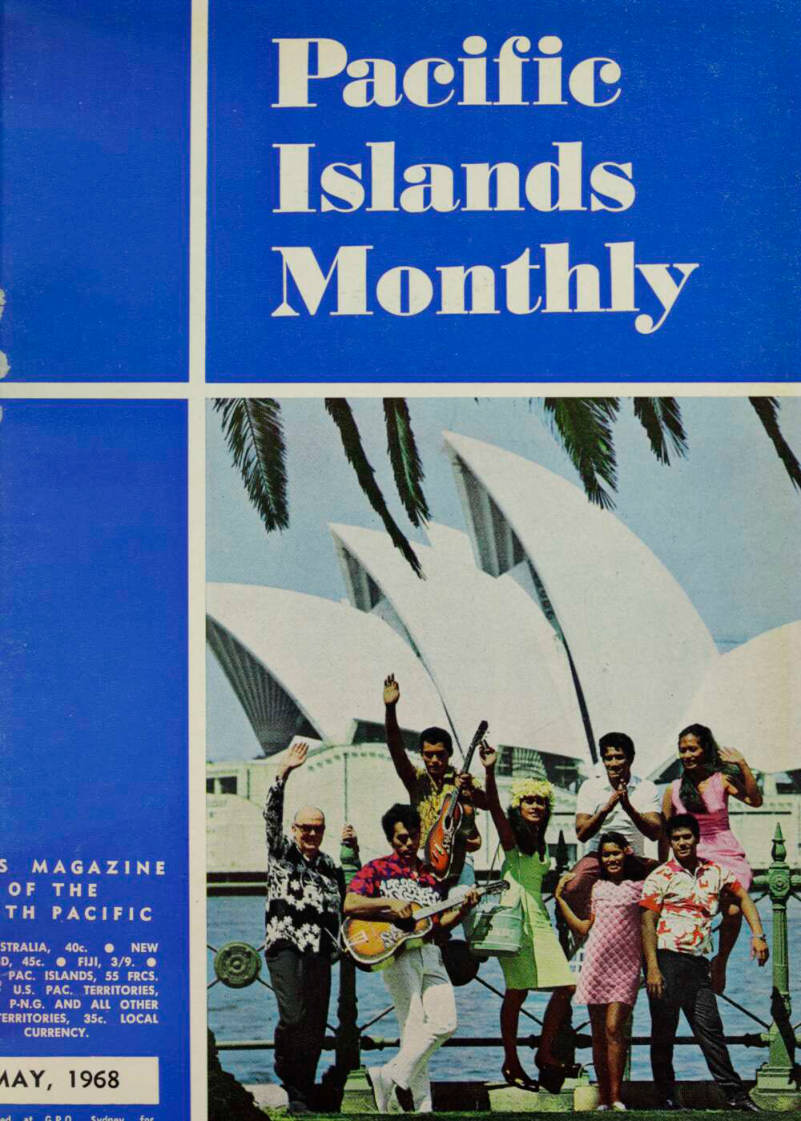 1
1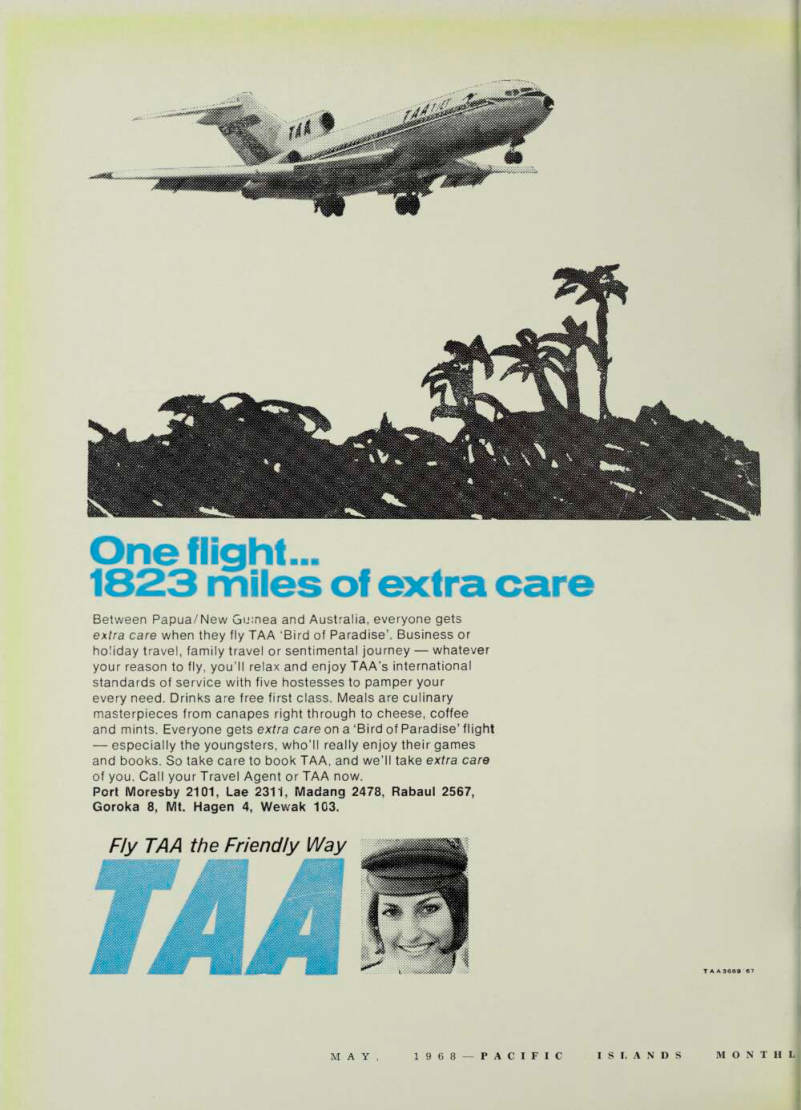 2
2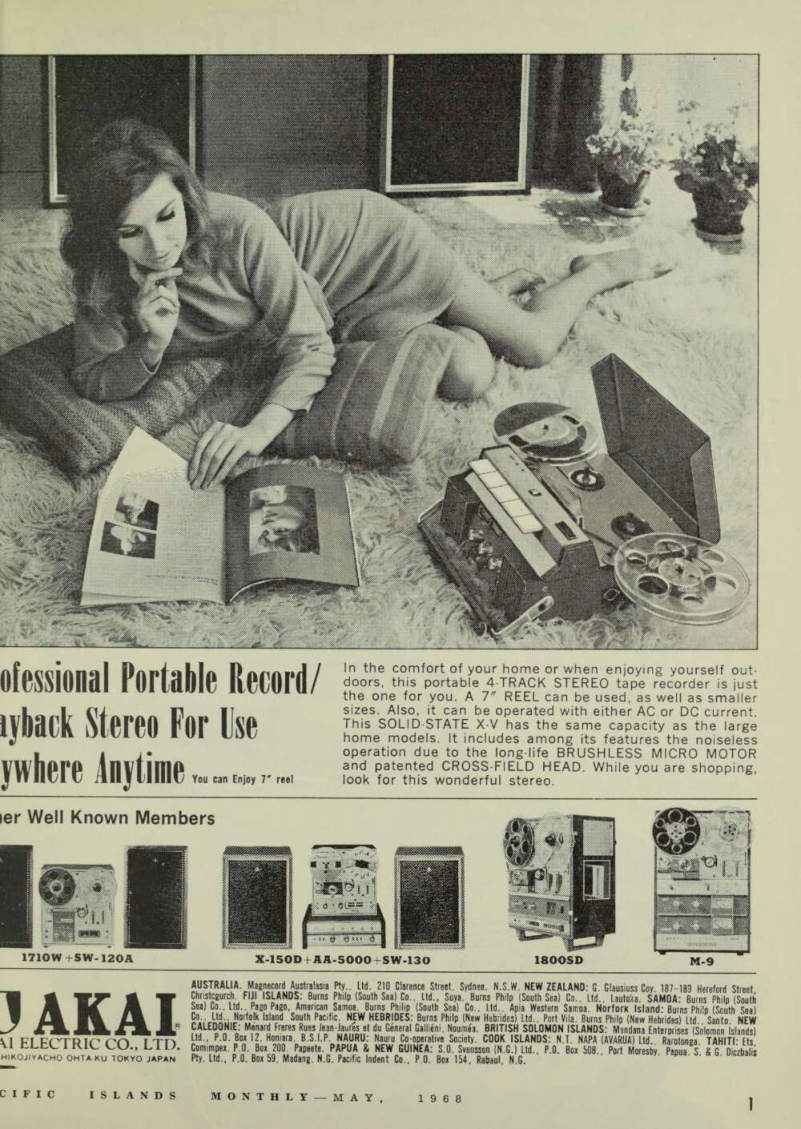 3
3 4
4 5
5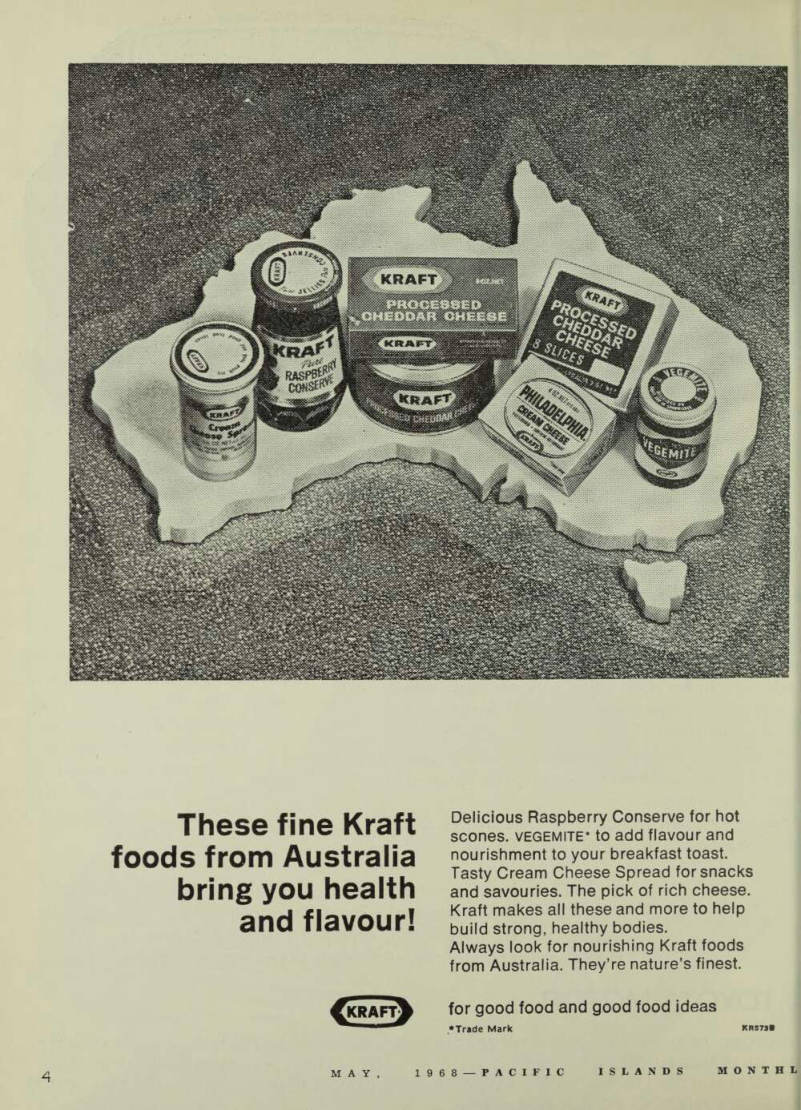 6
6 7
7 8
8 9
9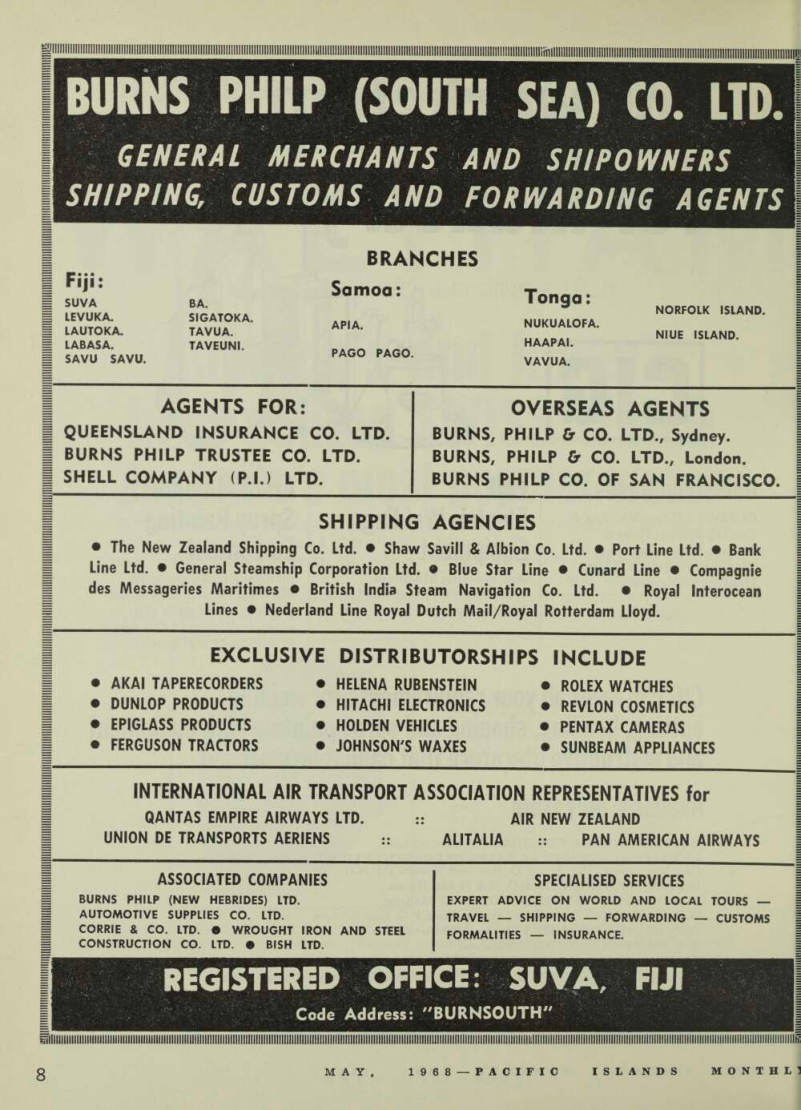 10
10 11
11 12
12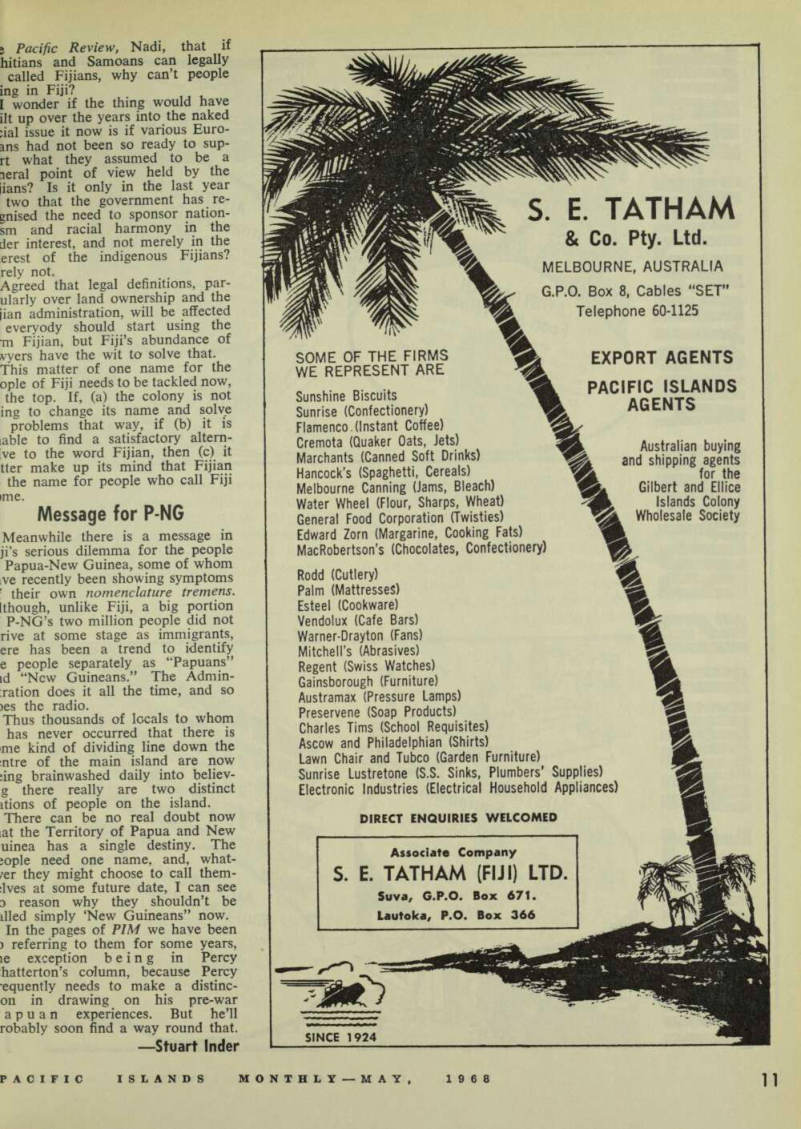 13
13 14
14 15
15 16
16 17
17 18
18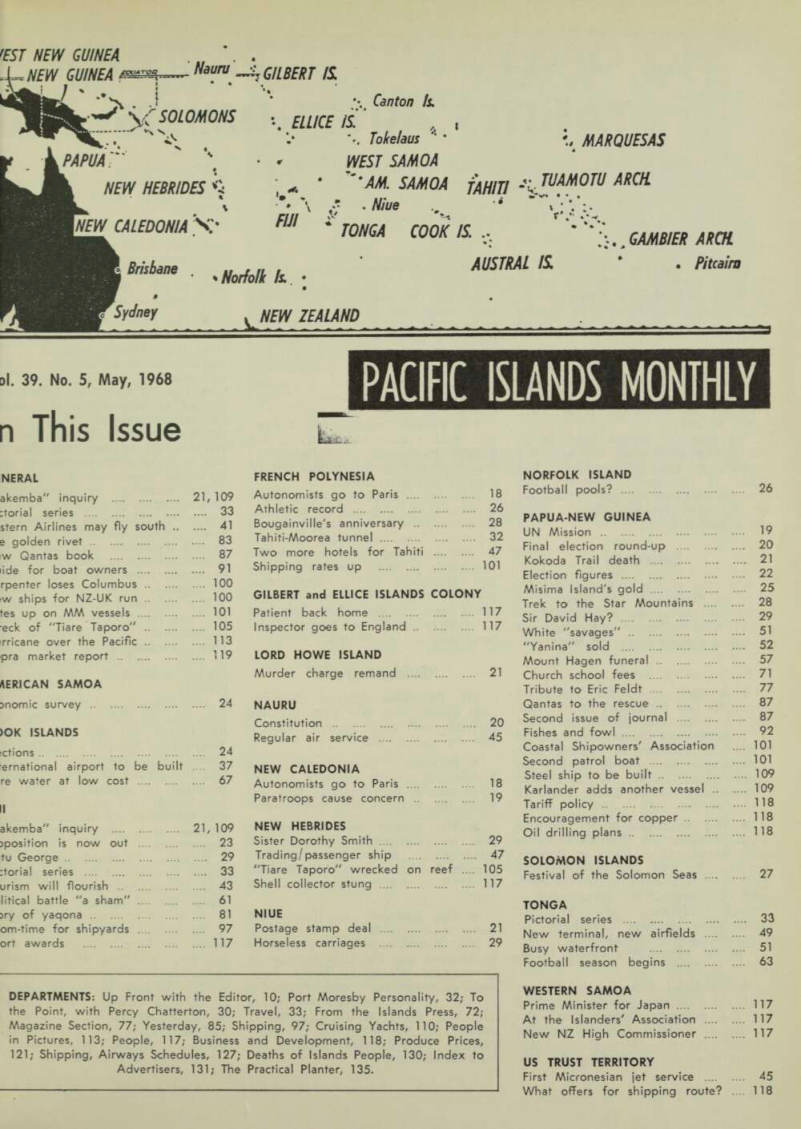 19
19 20
20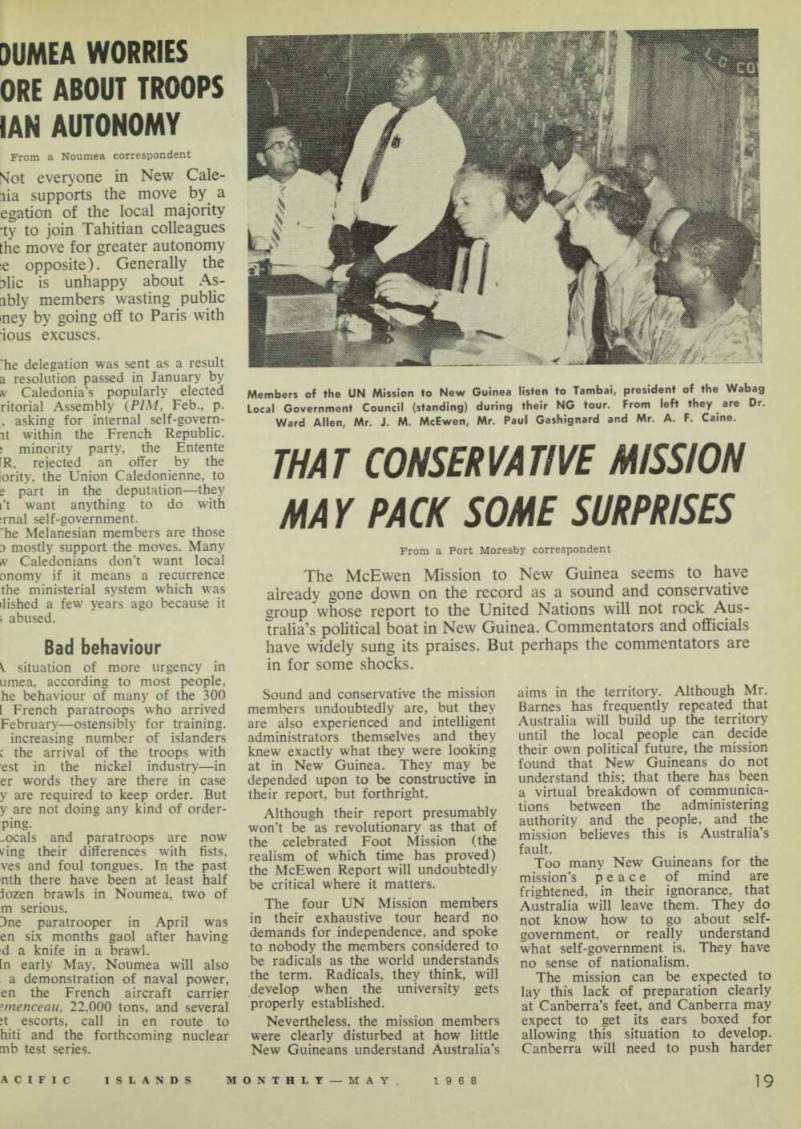 21
21 22
22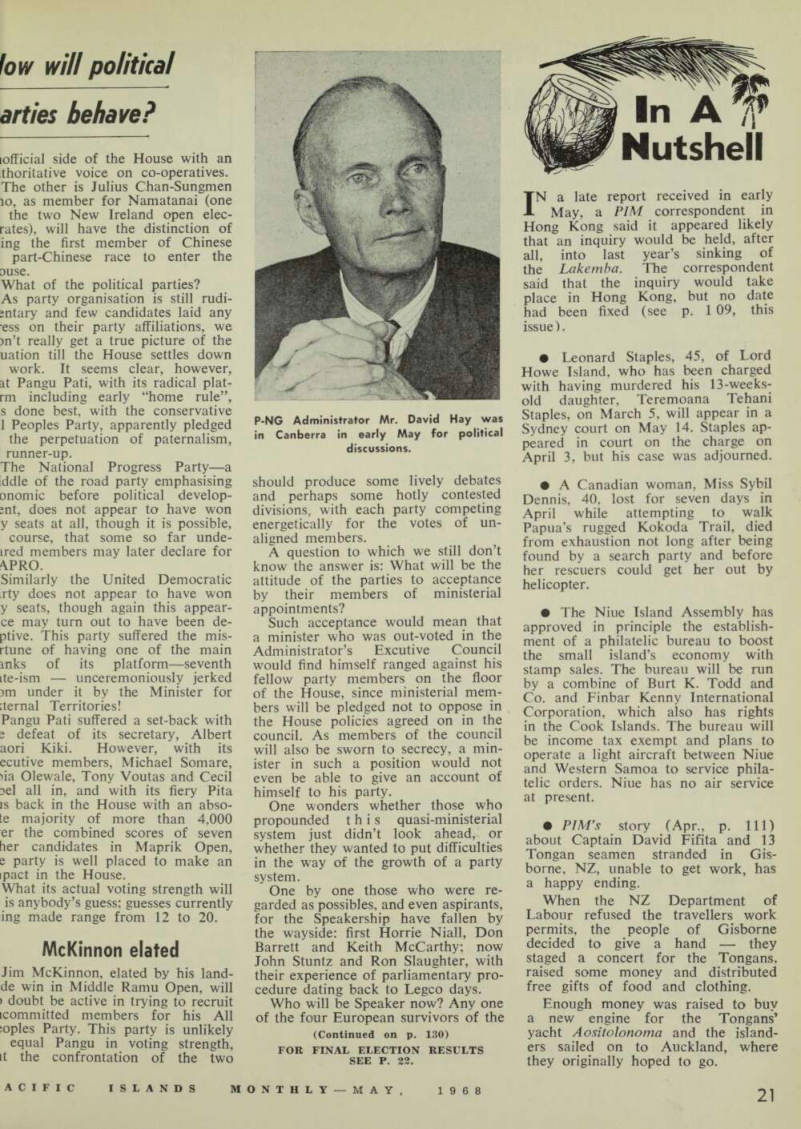 23
23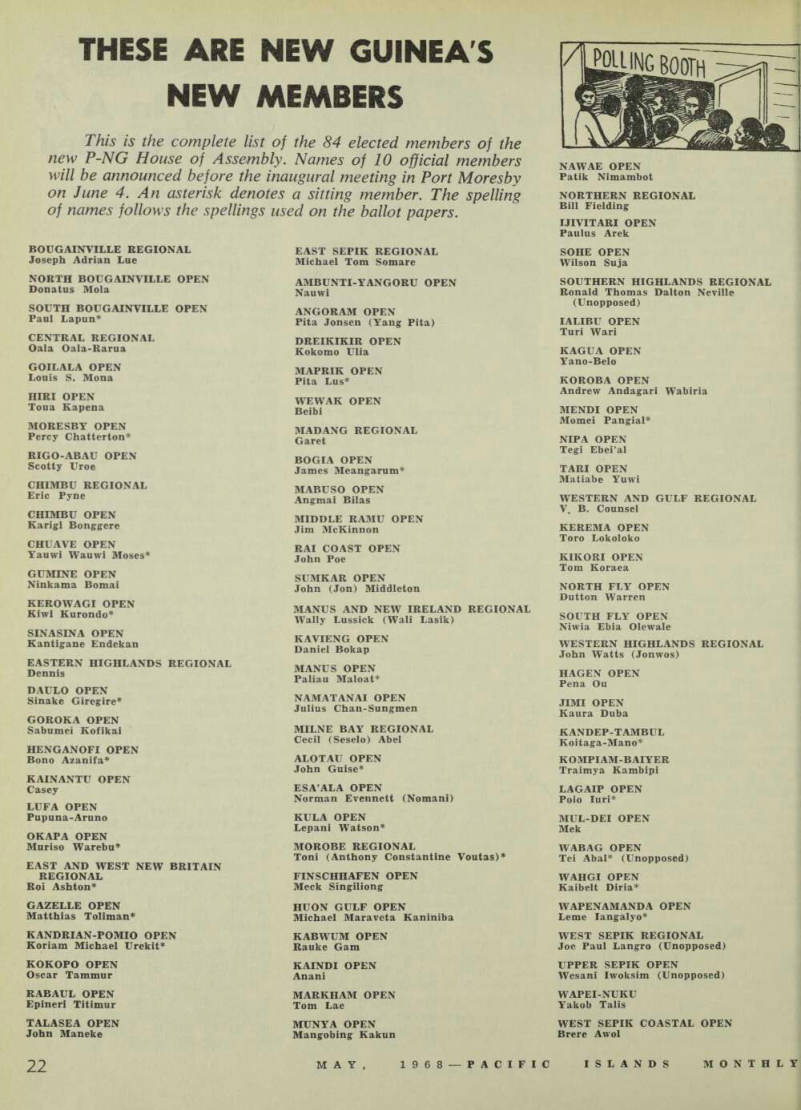 24
24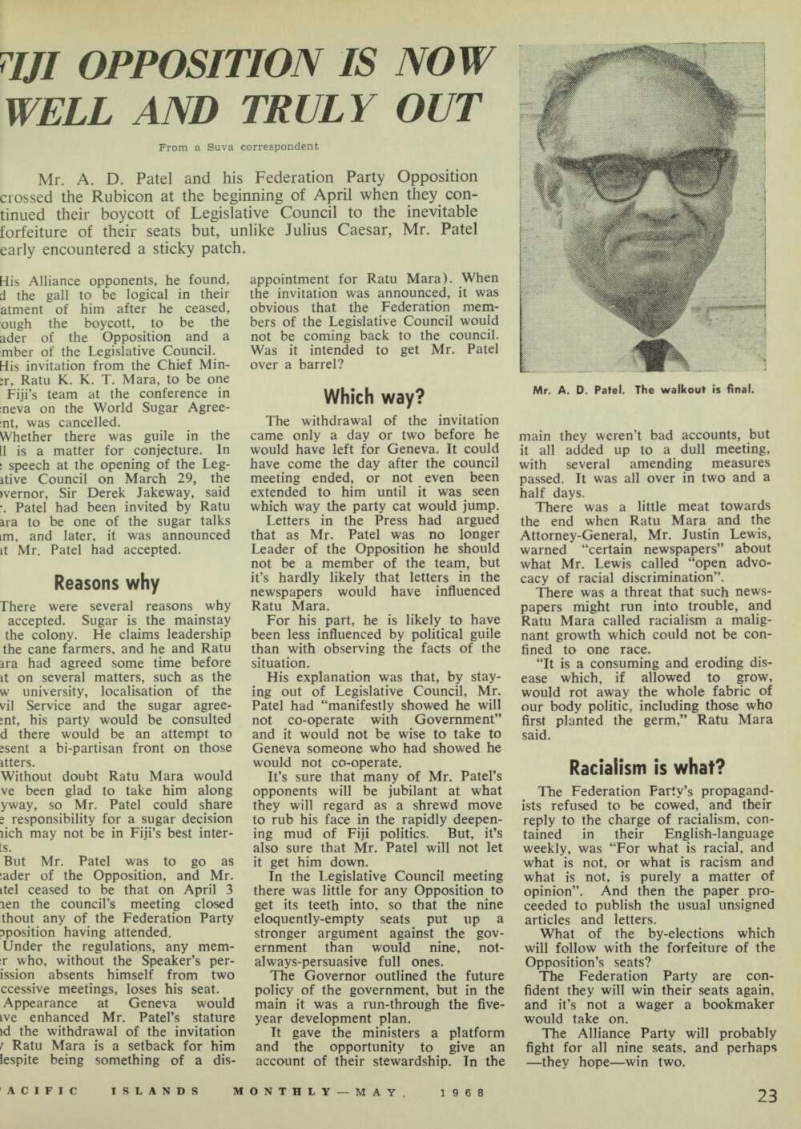 25
25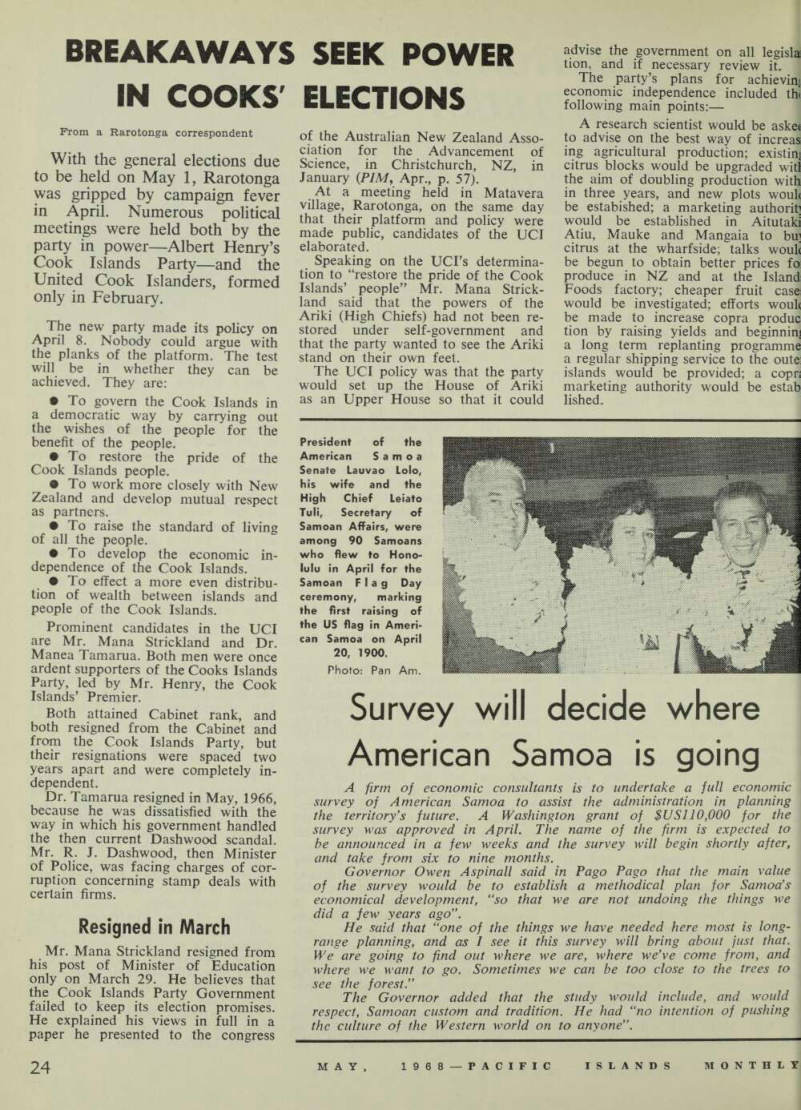 26
26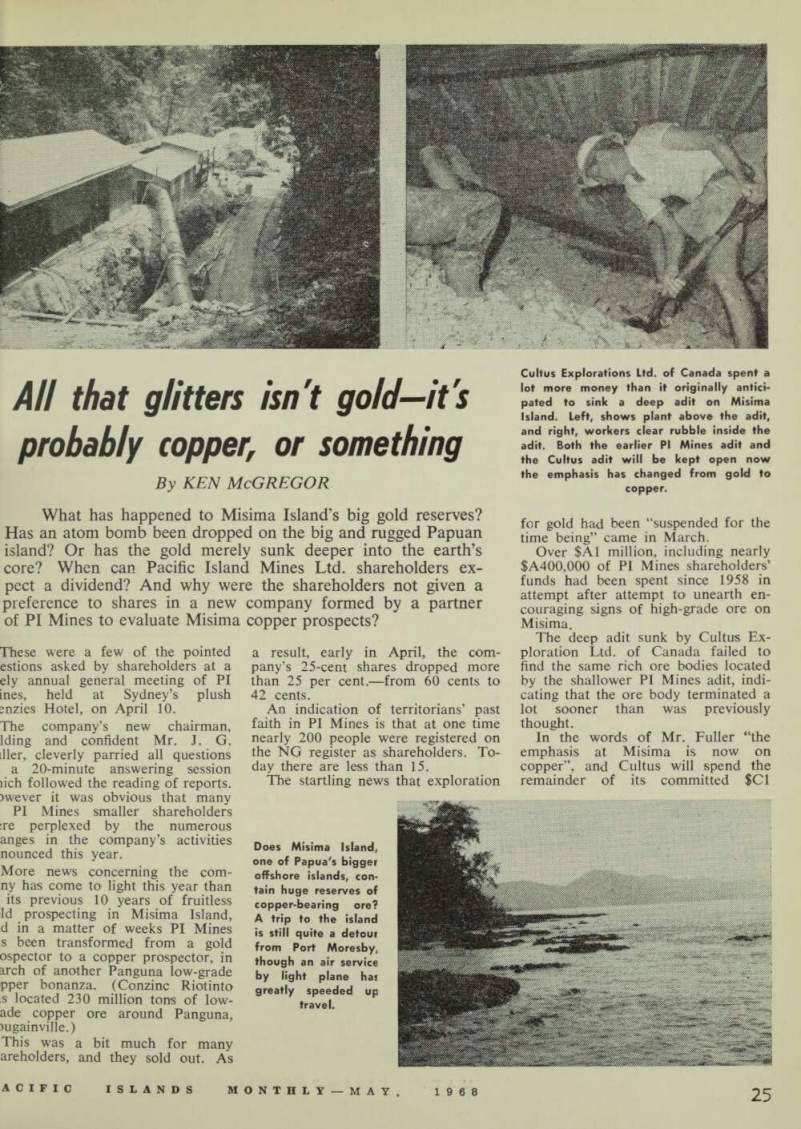 27
27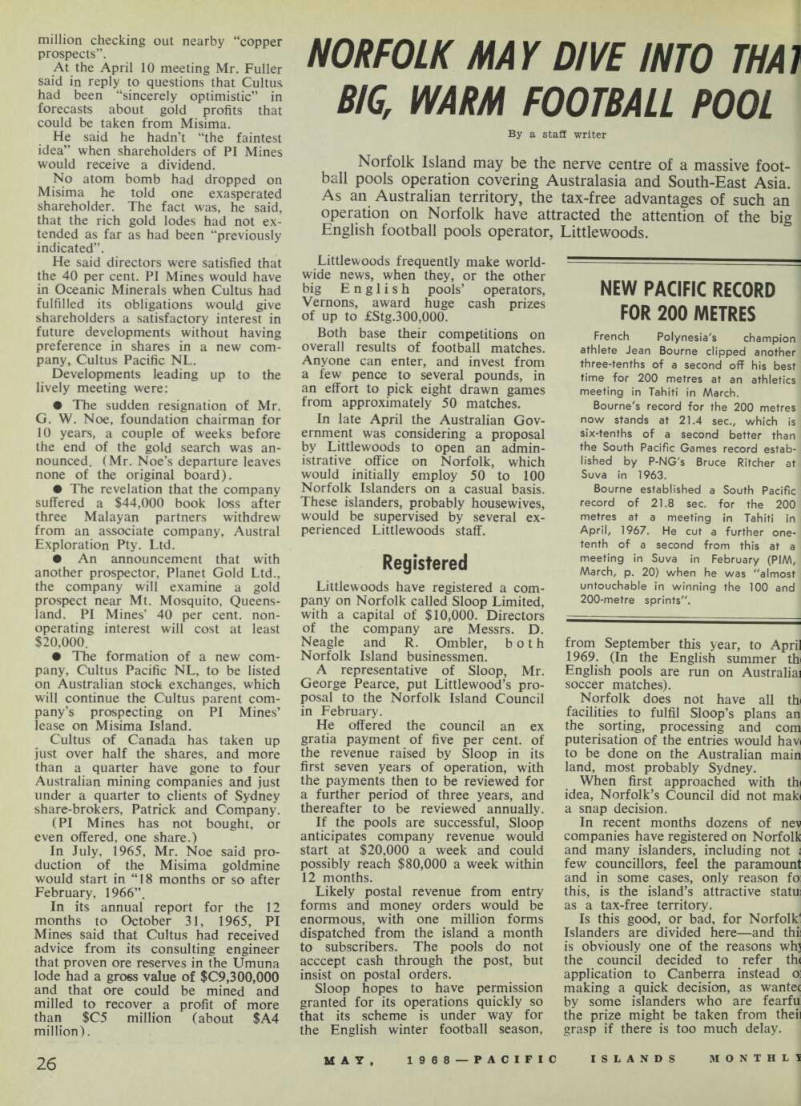 28
28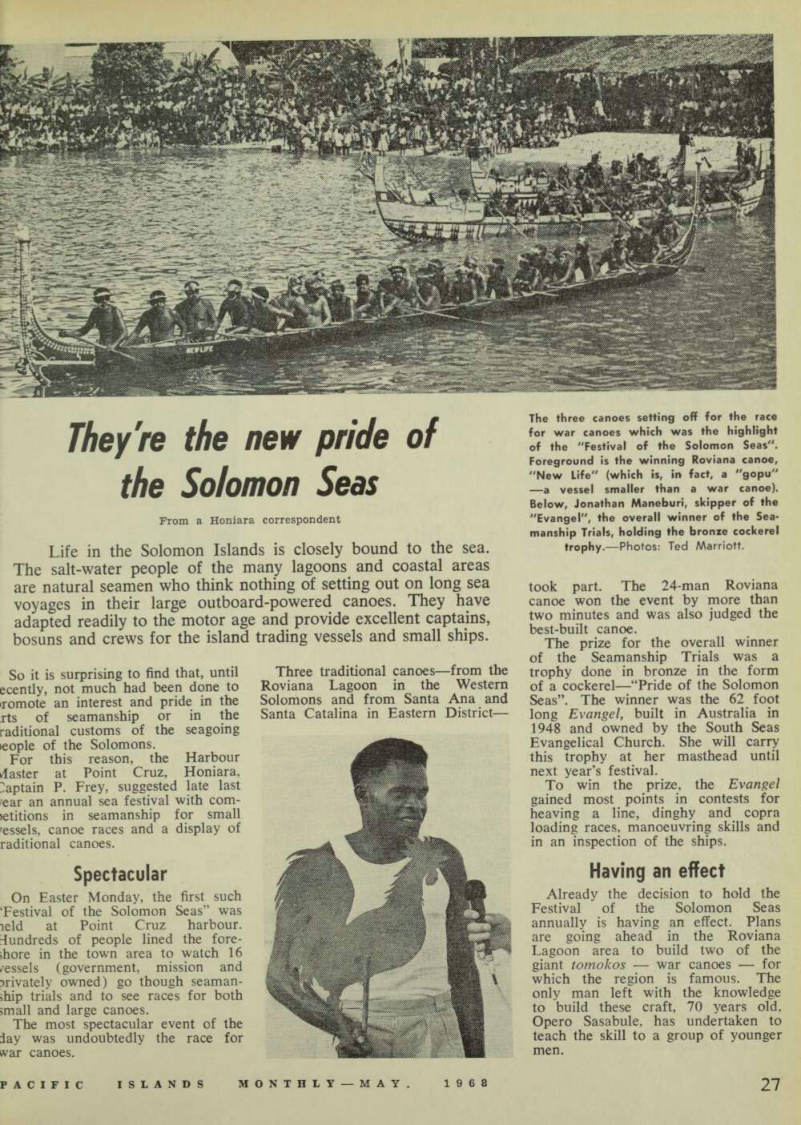 29
29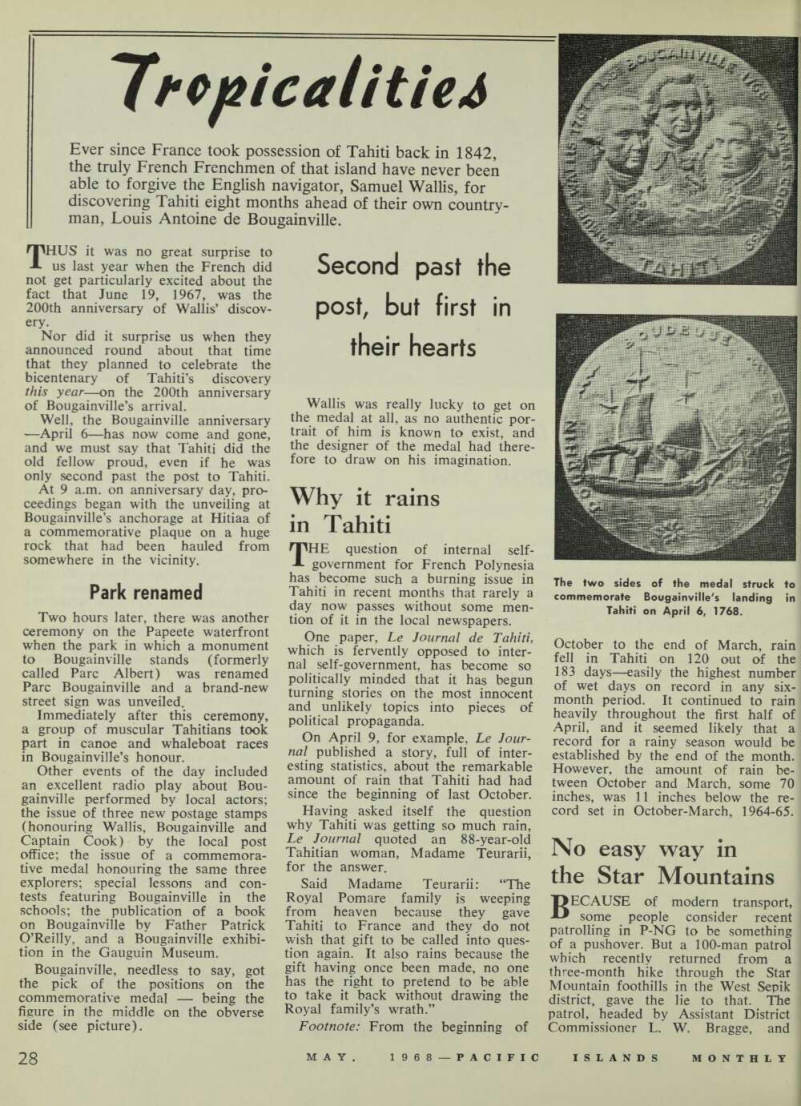 30
30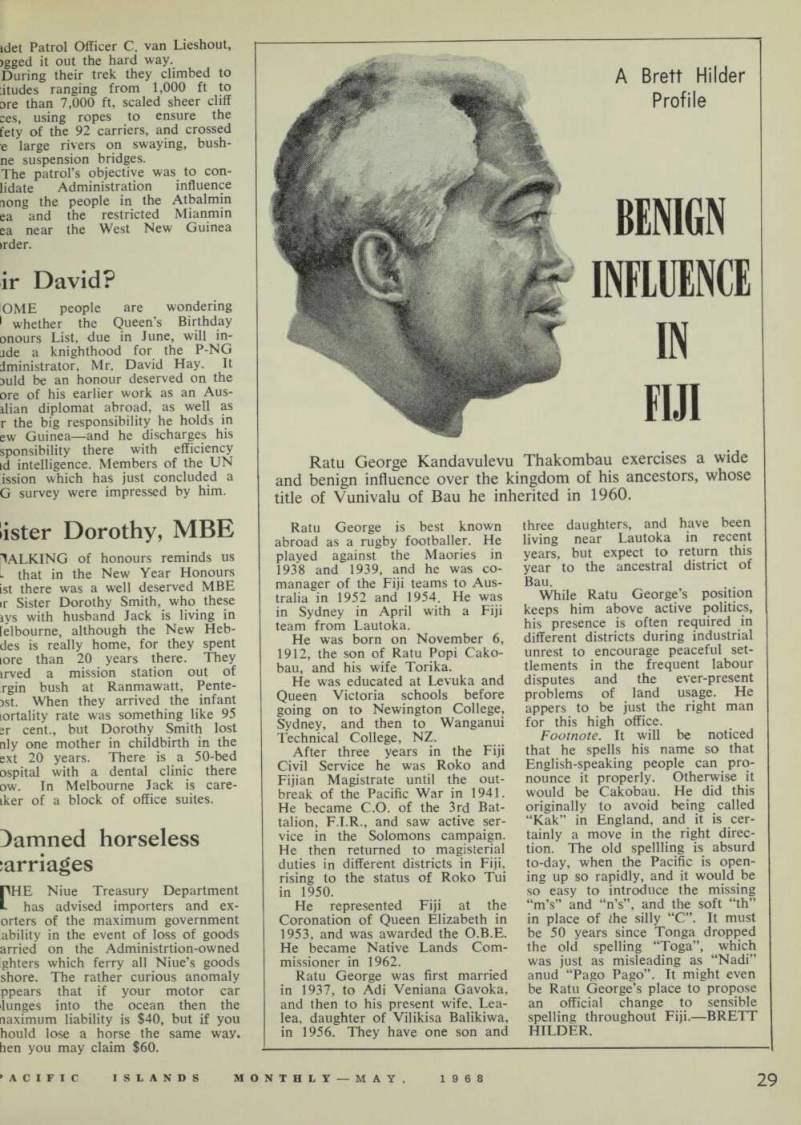 31
31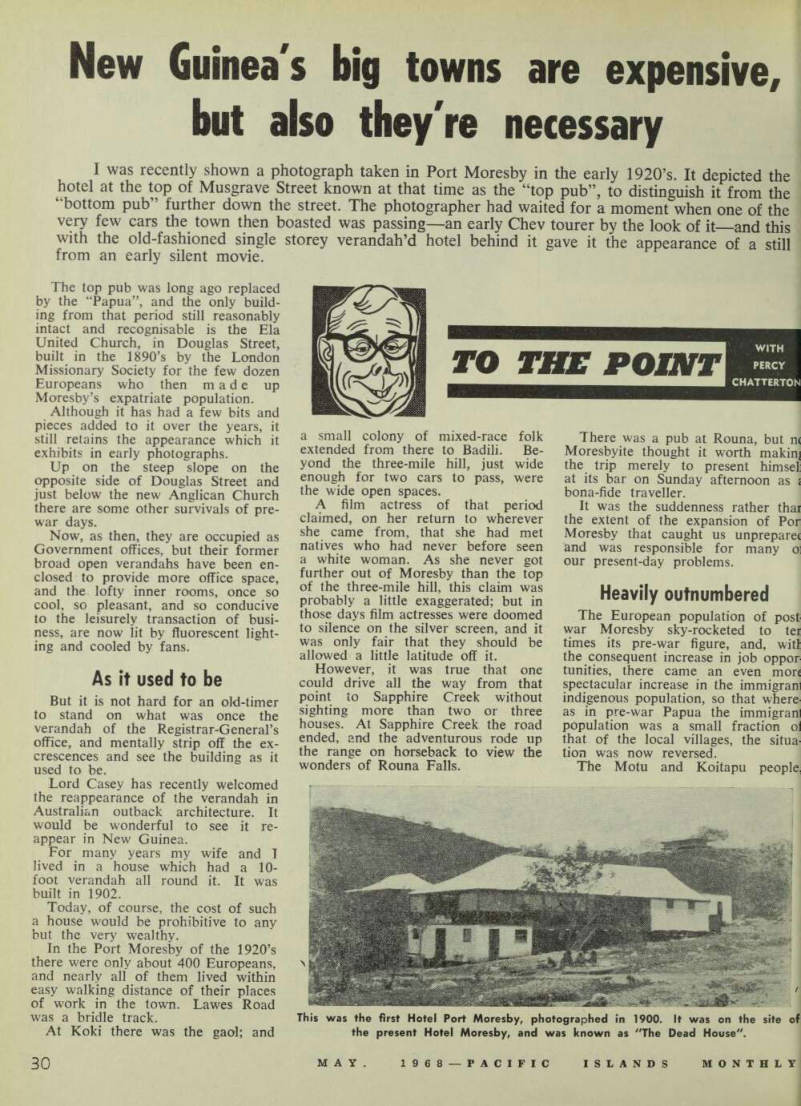 32
32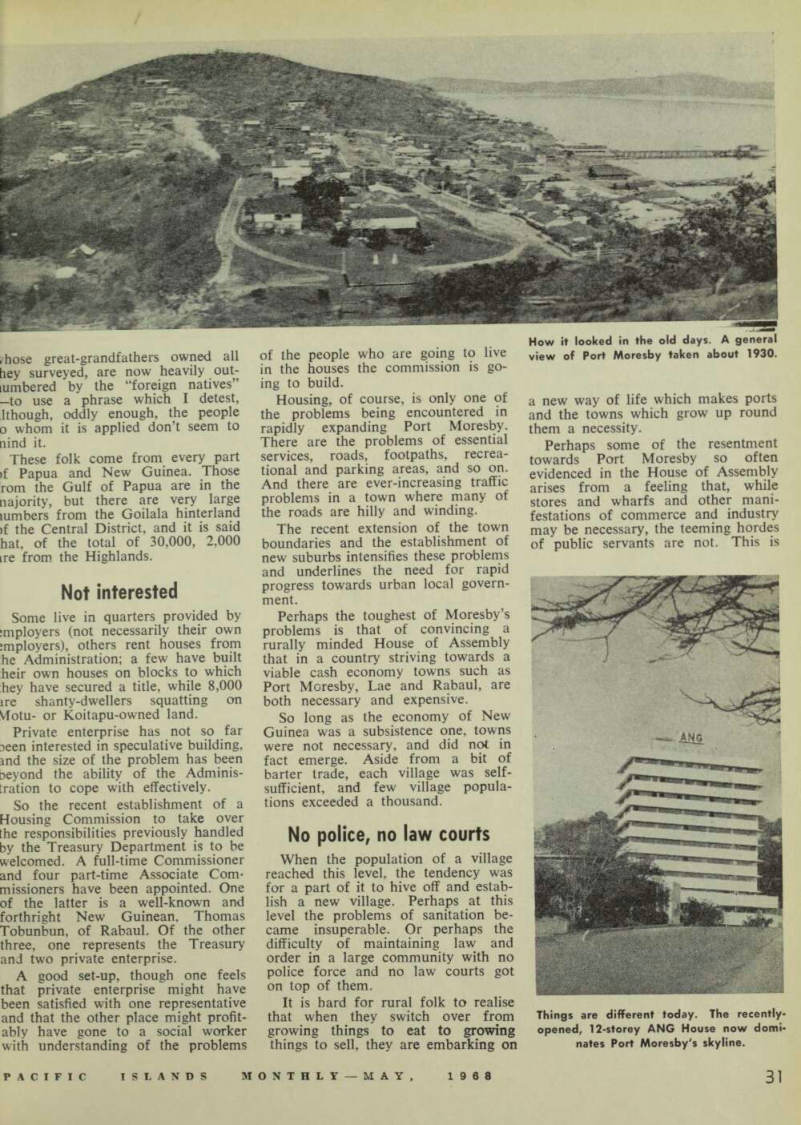 33
33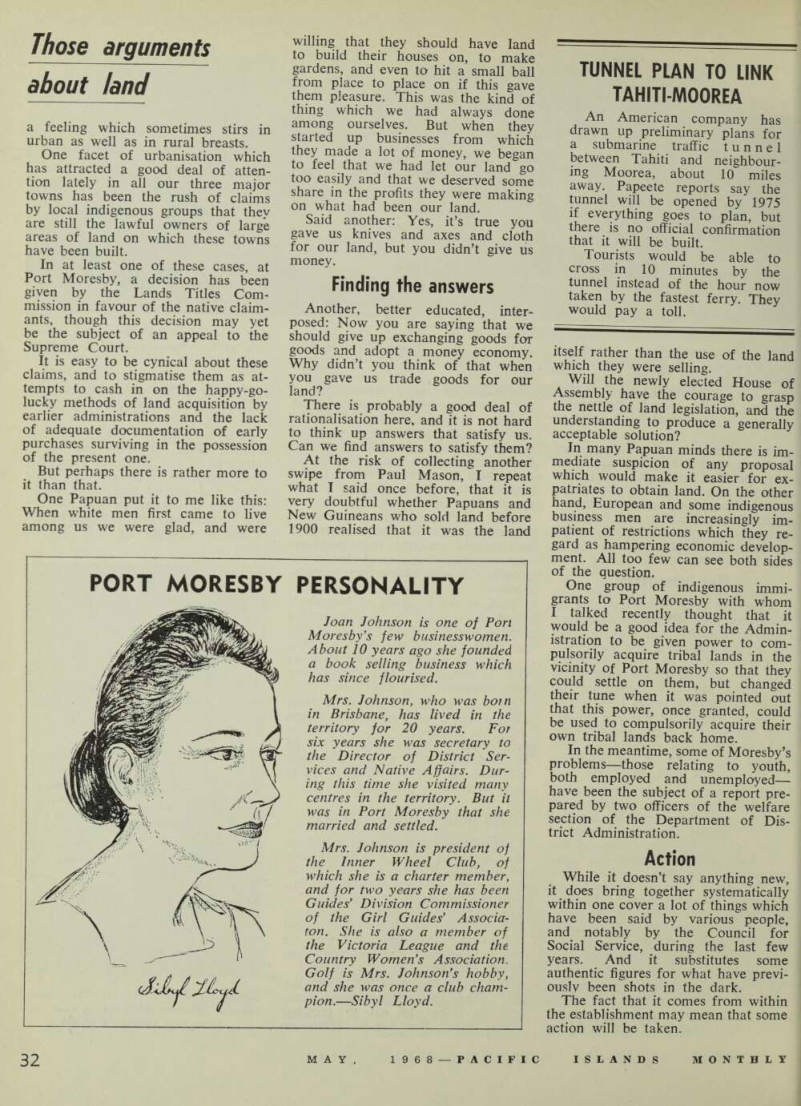 34
34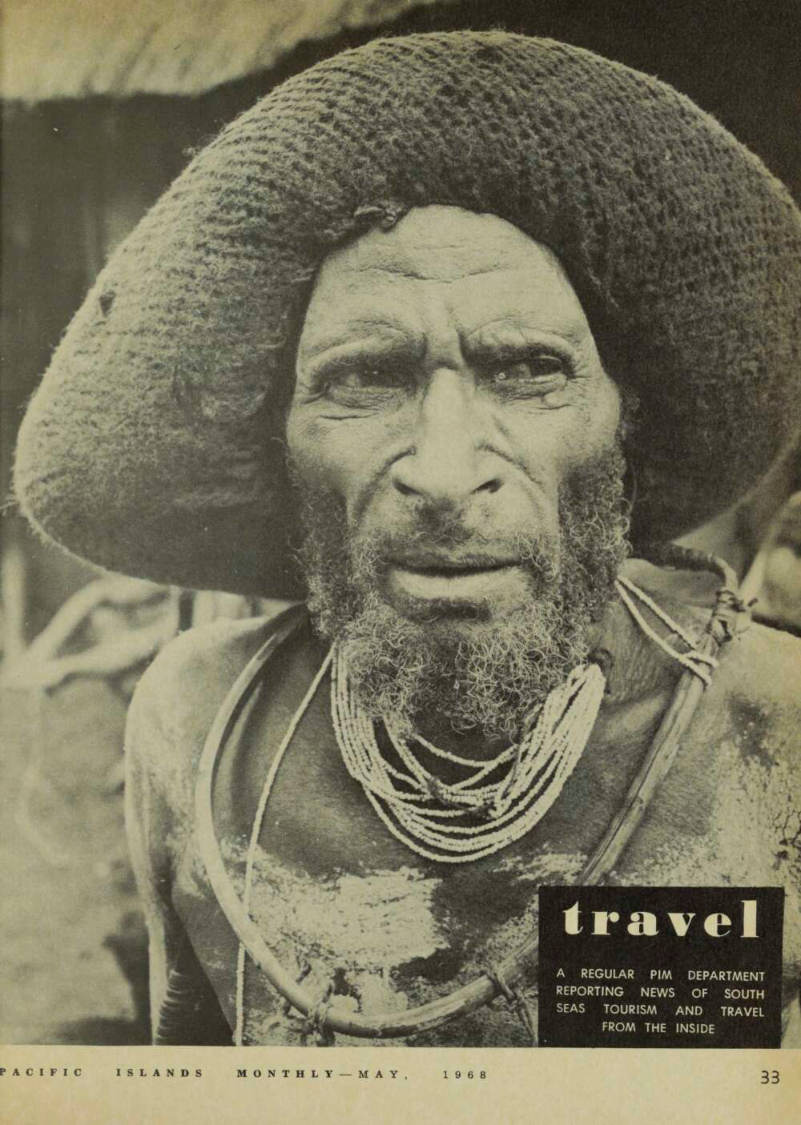 35
35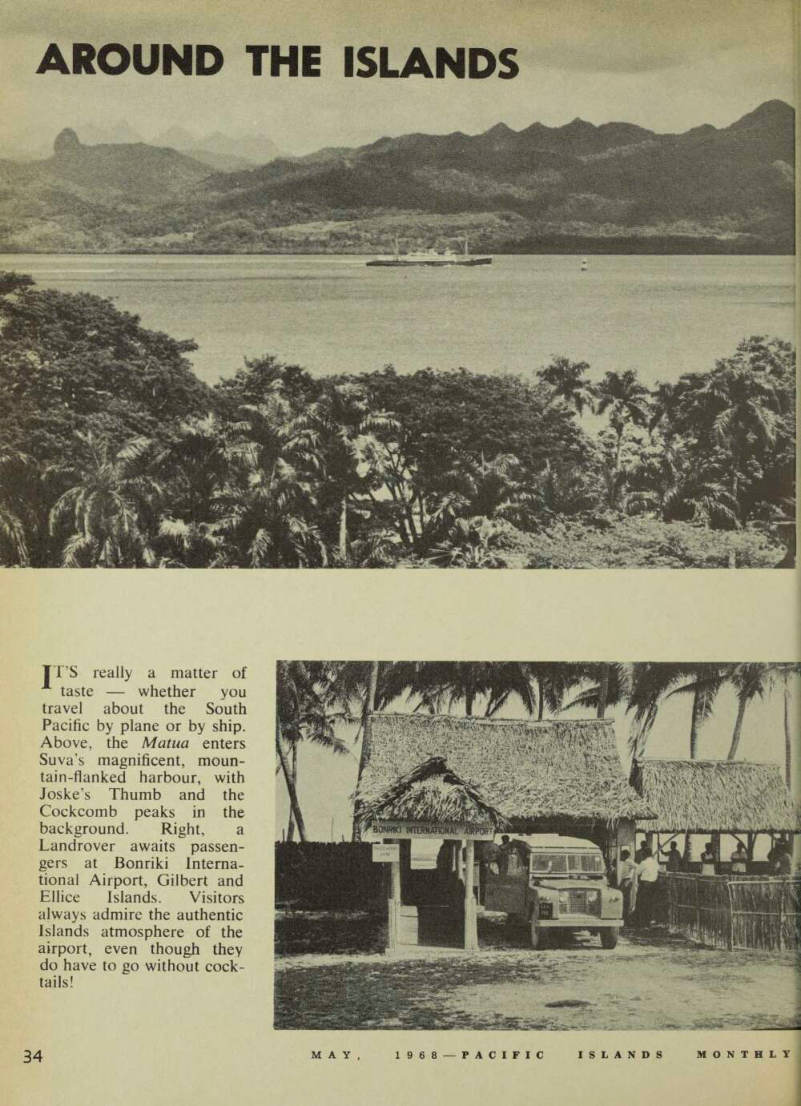 36
36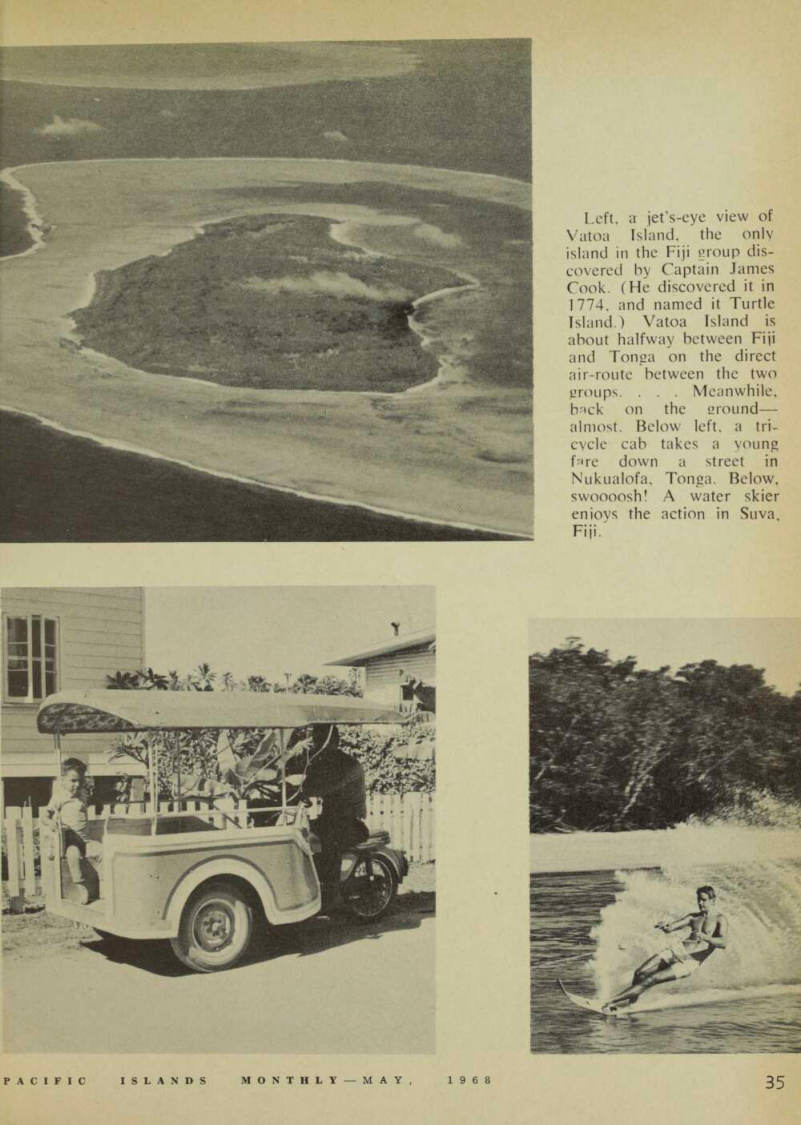 37
37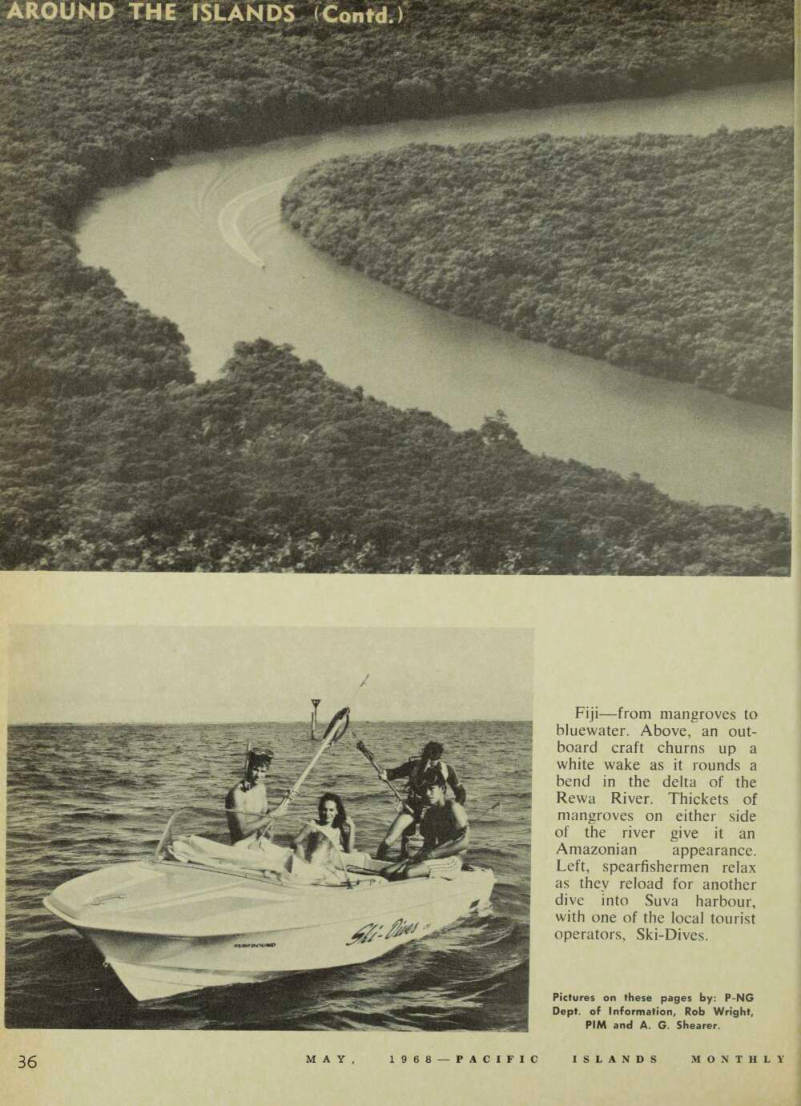 38
38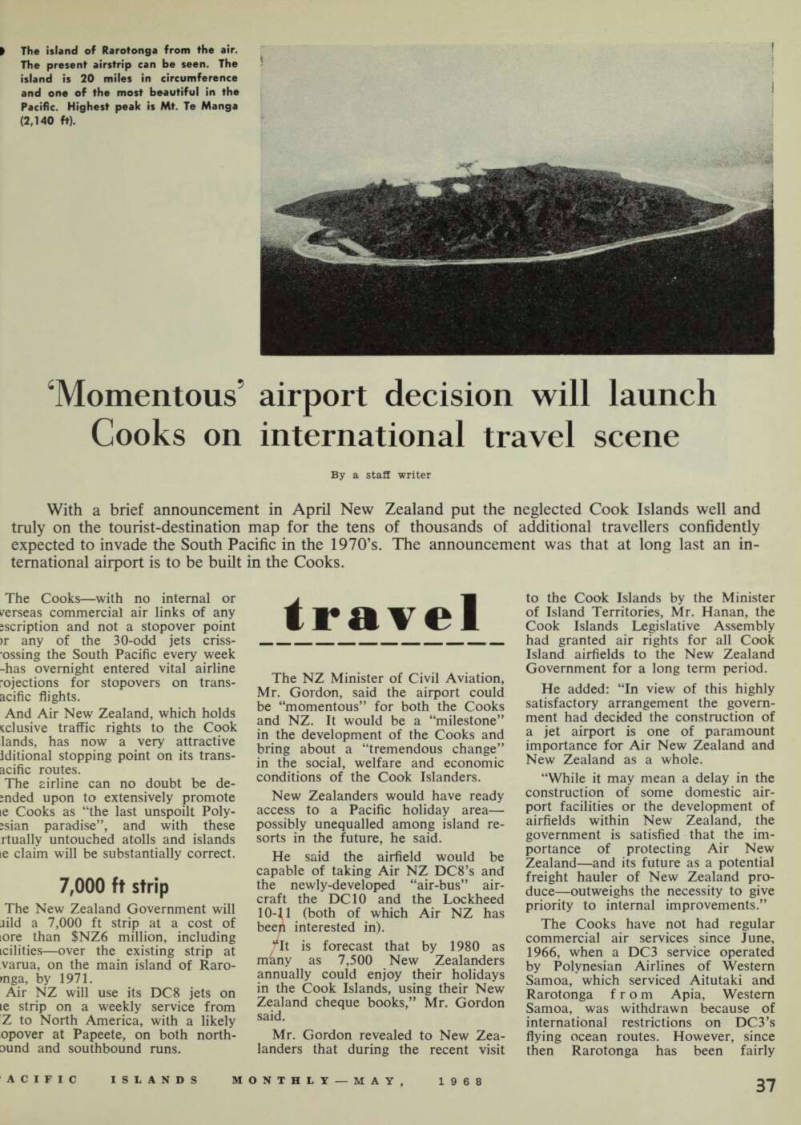 39
39 40
40 41
41 42
42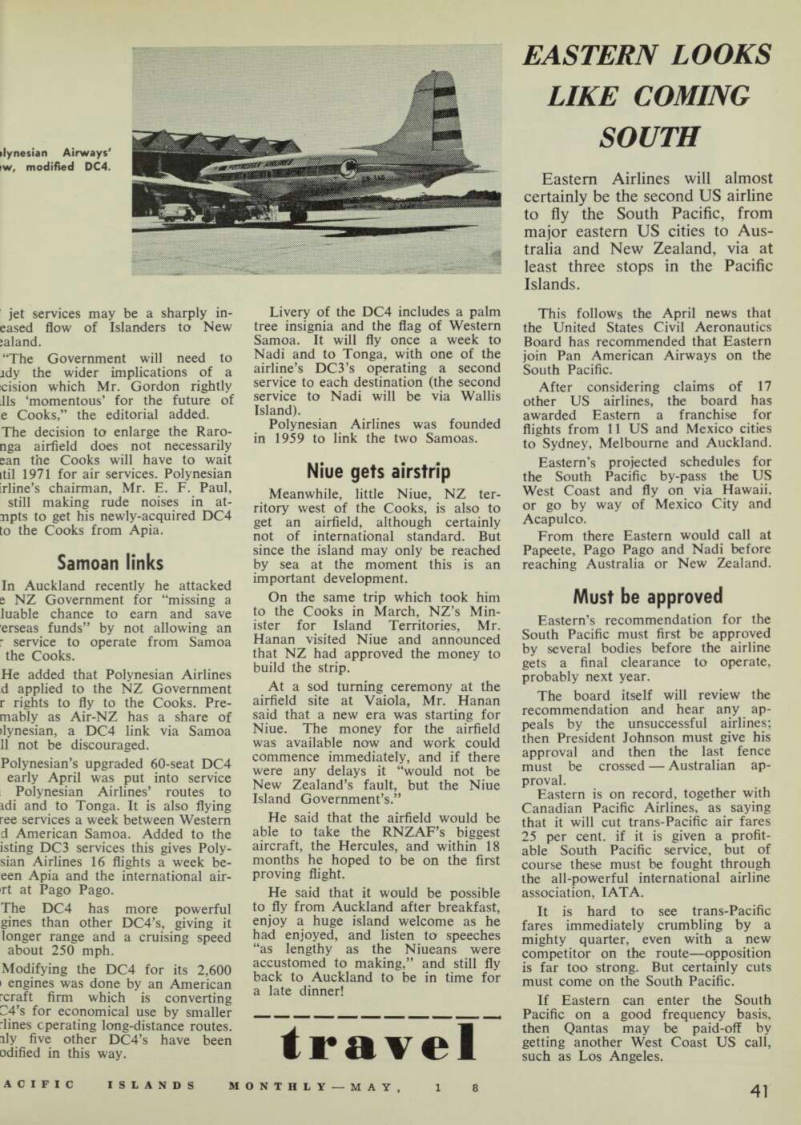 43
43 44
44 45
45 46
46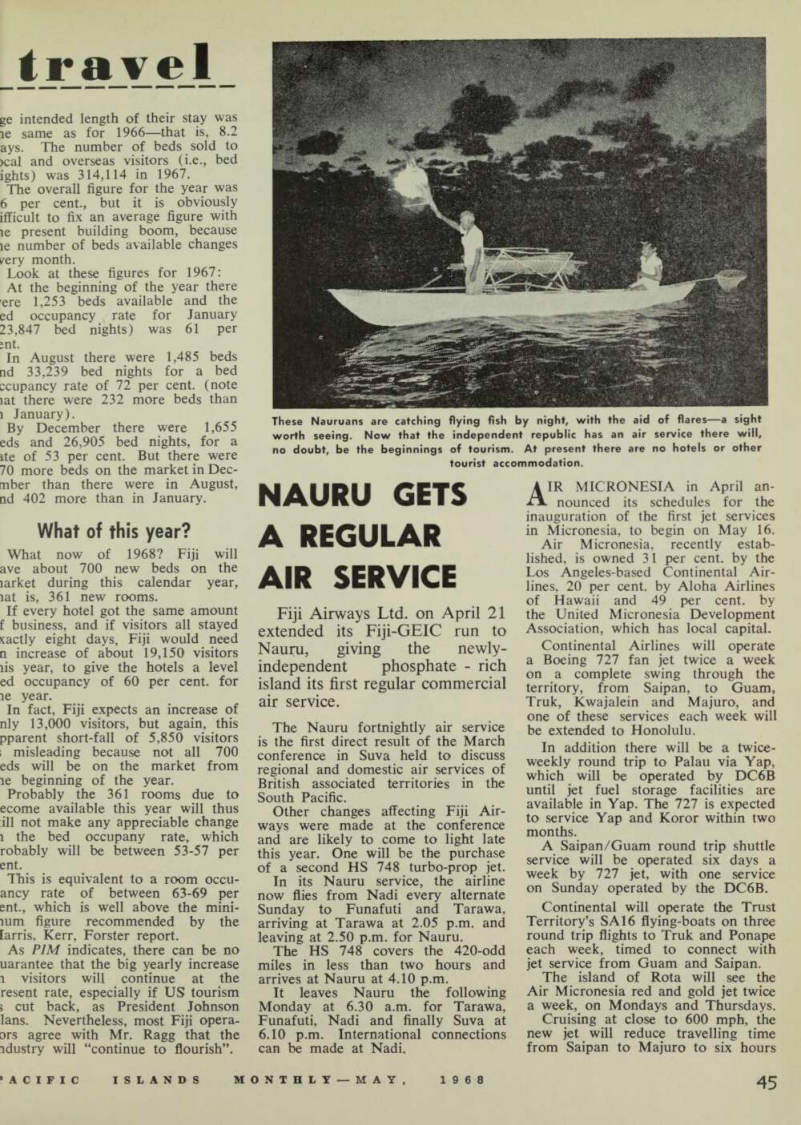 47
47 48
48 49
49 50
50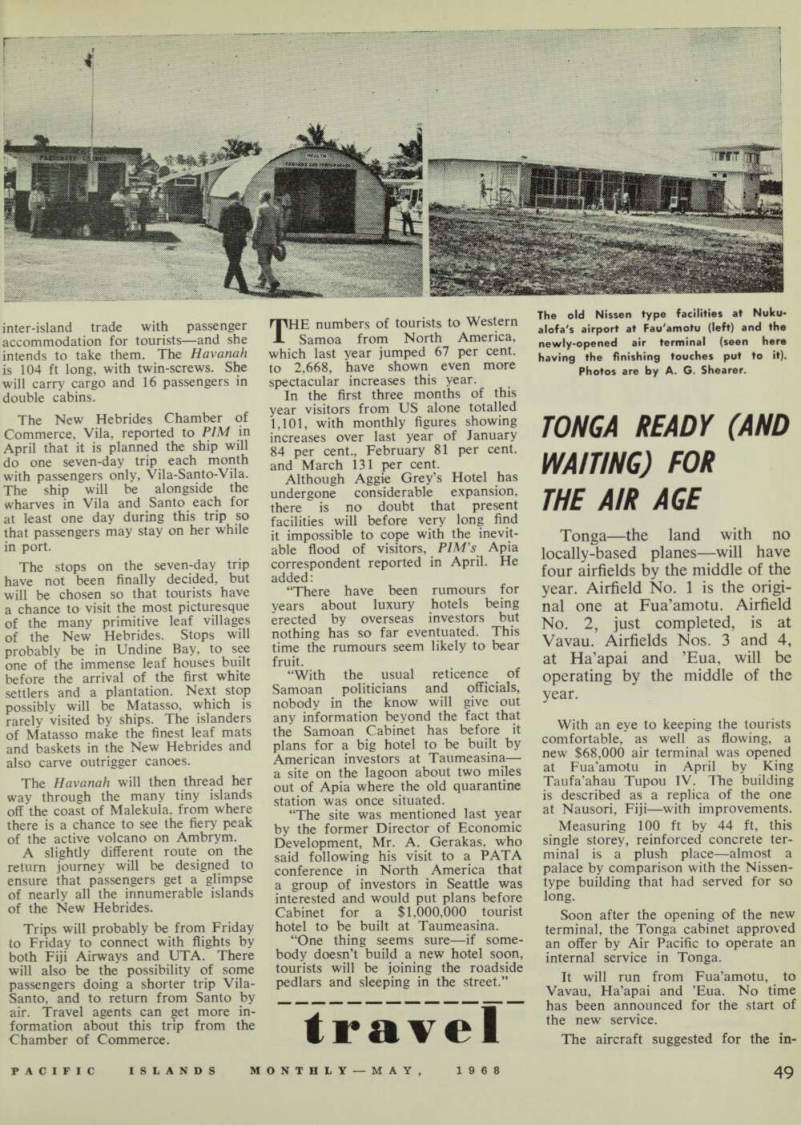 51
51 52
52 53
53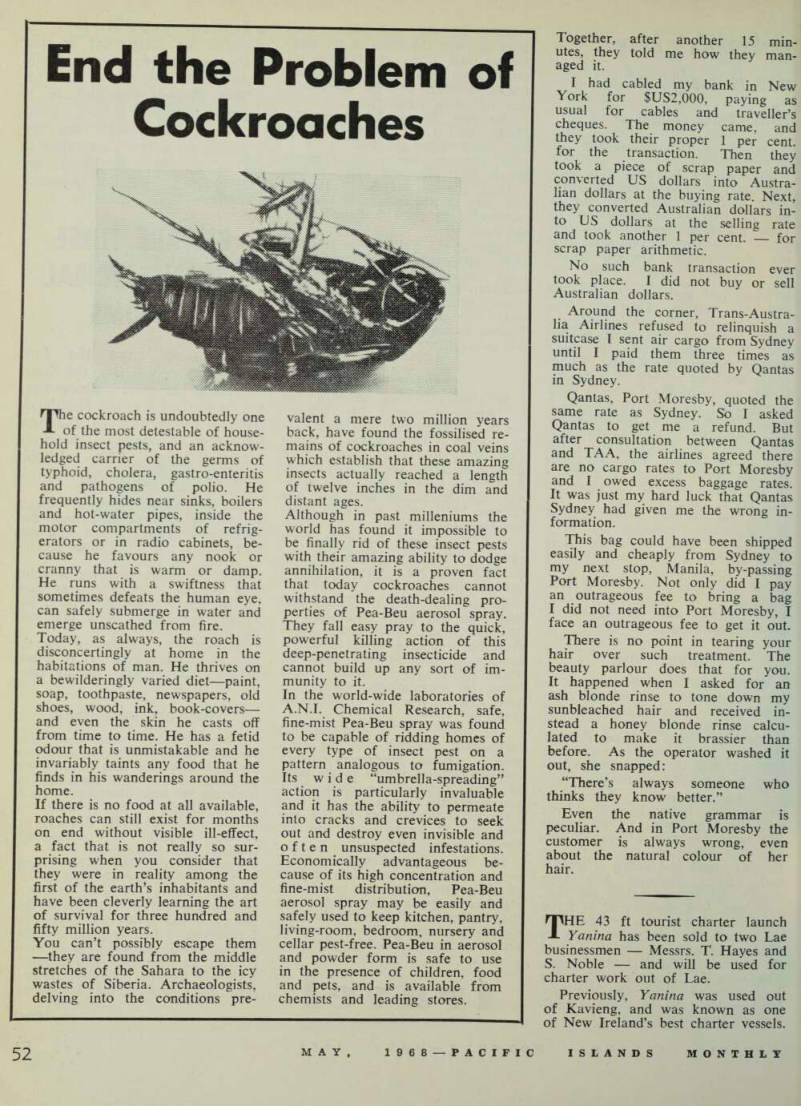 54
54 55
55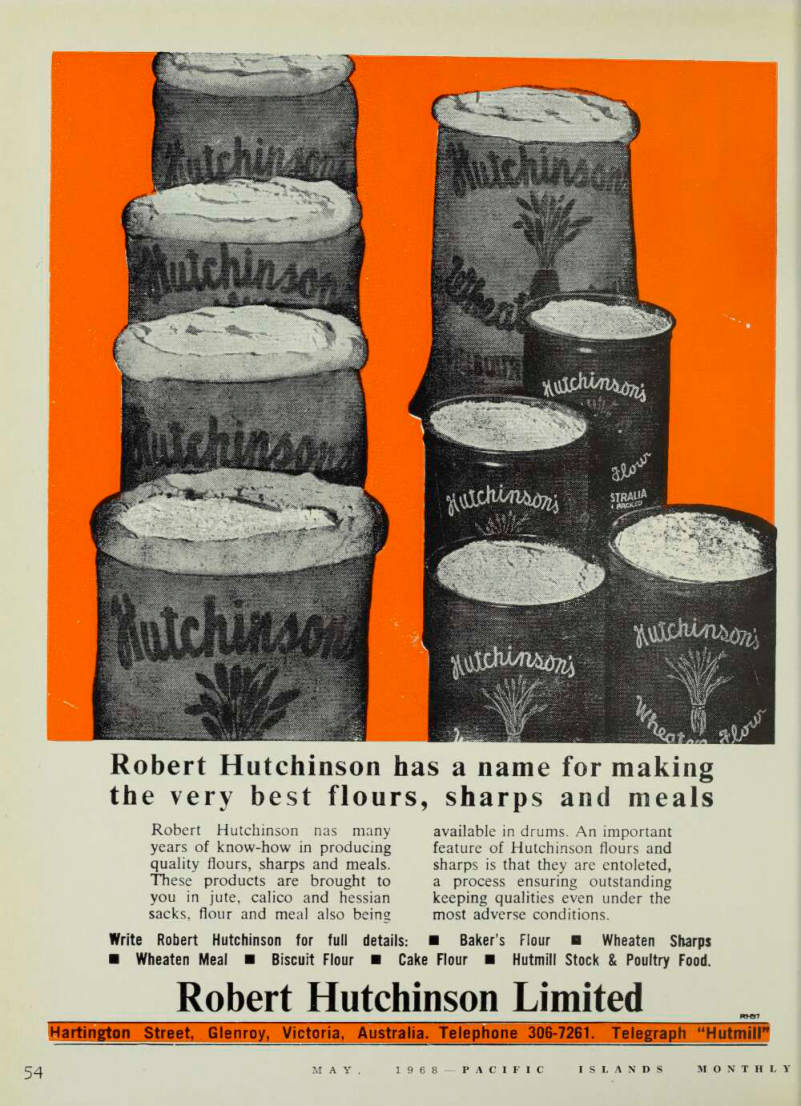 56
56 57
57 58
58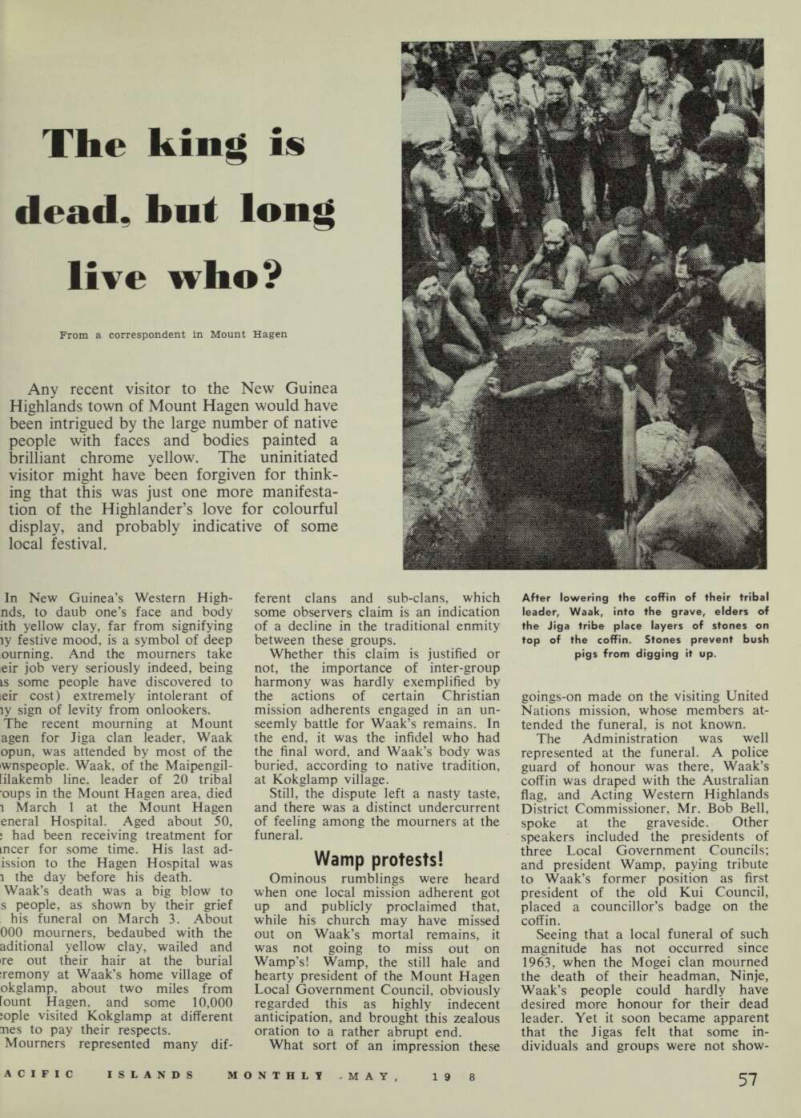 59
59 60
60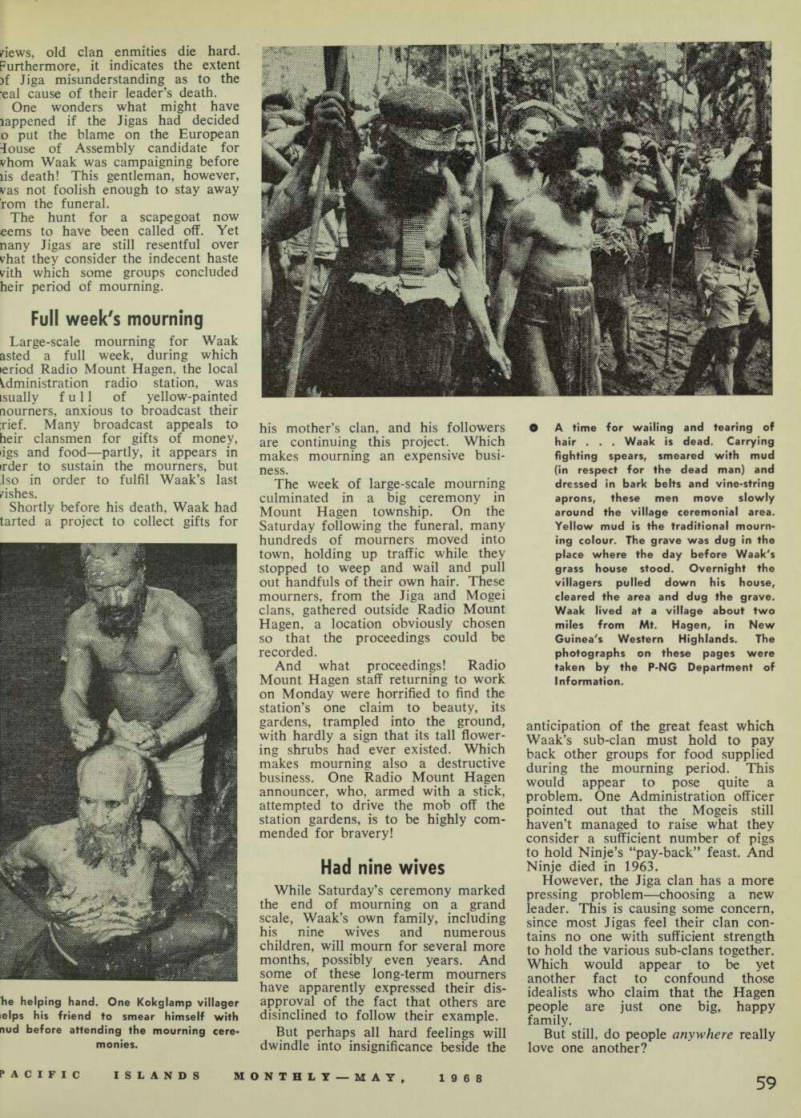 61
61 62
62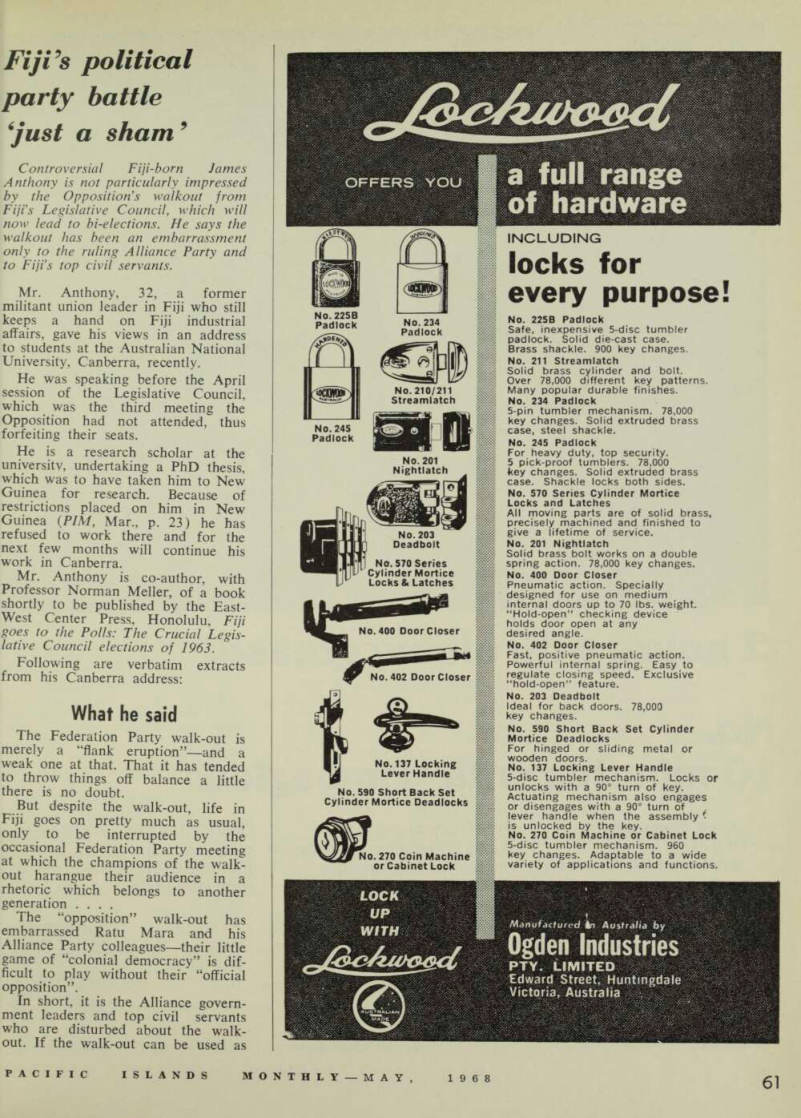 63
63 64
64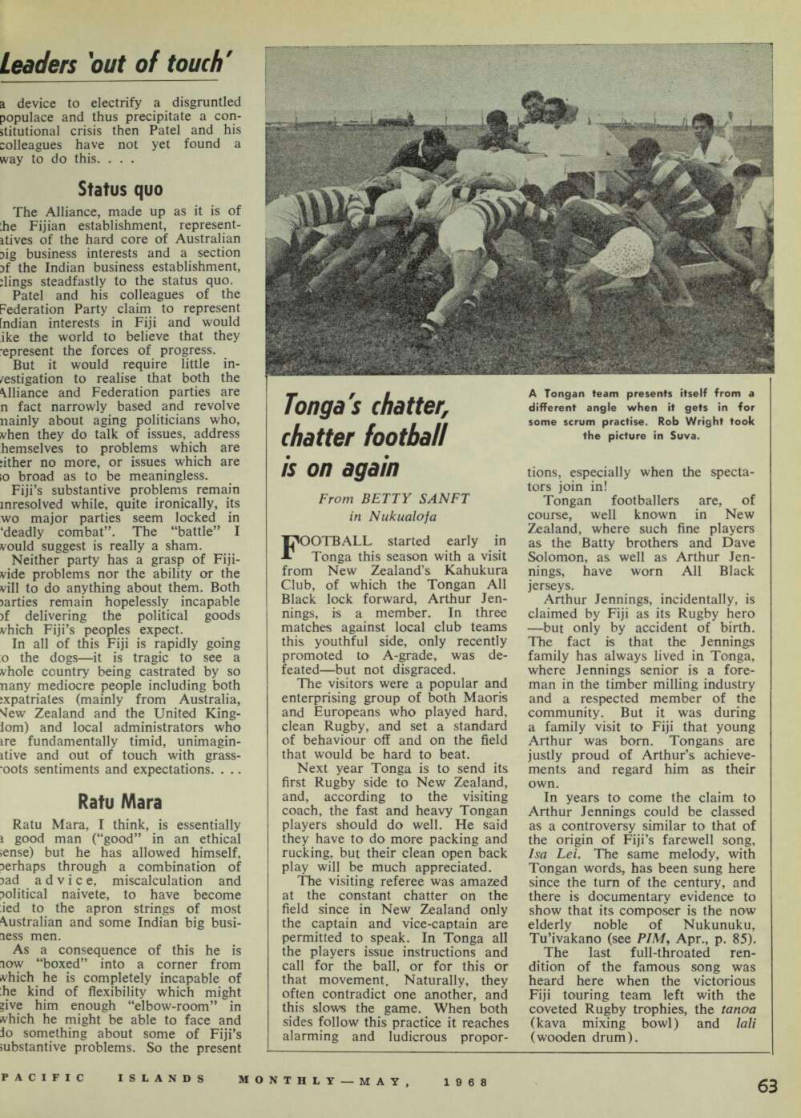 65
65 66
66 67
67 68
68 69
69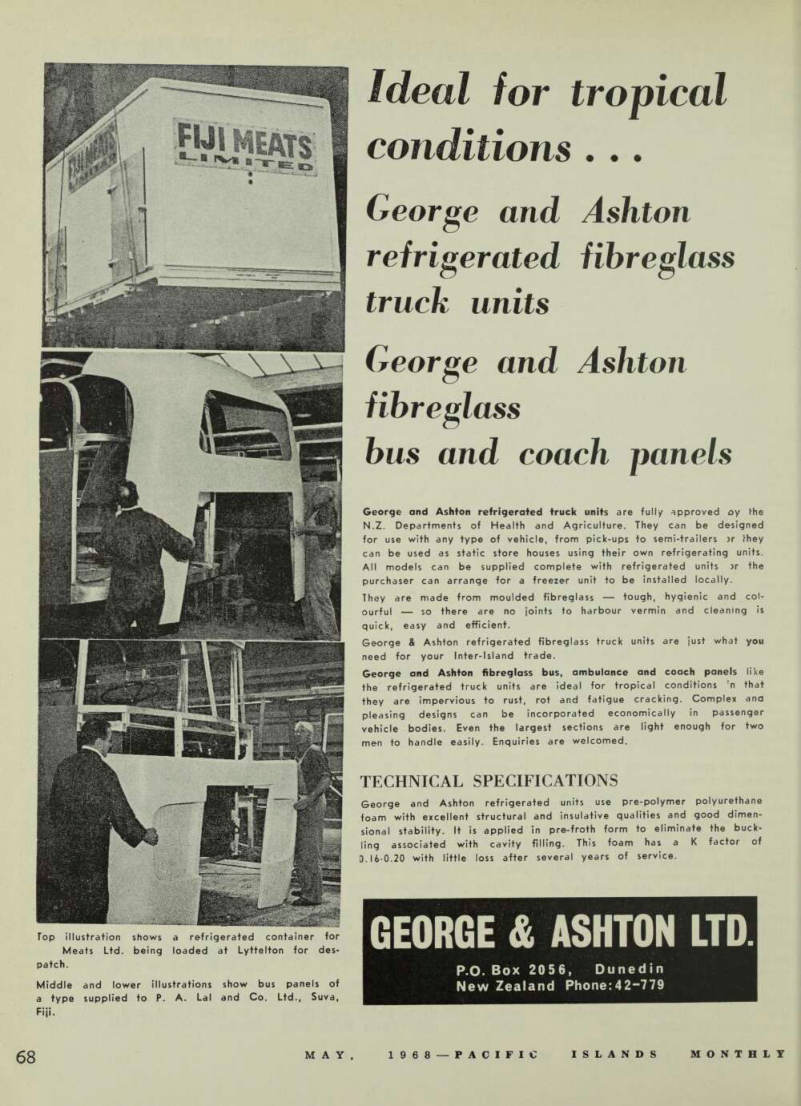 70
70 71
71 72
72 73
73 74
74 75
75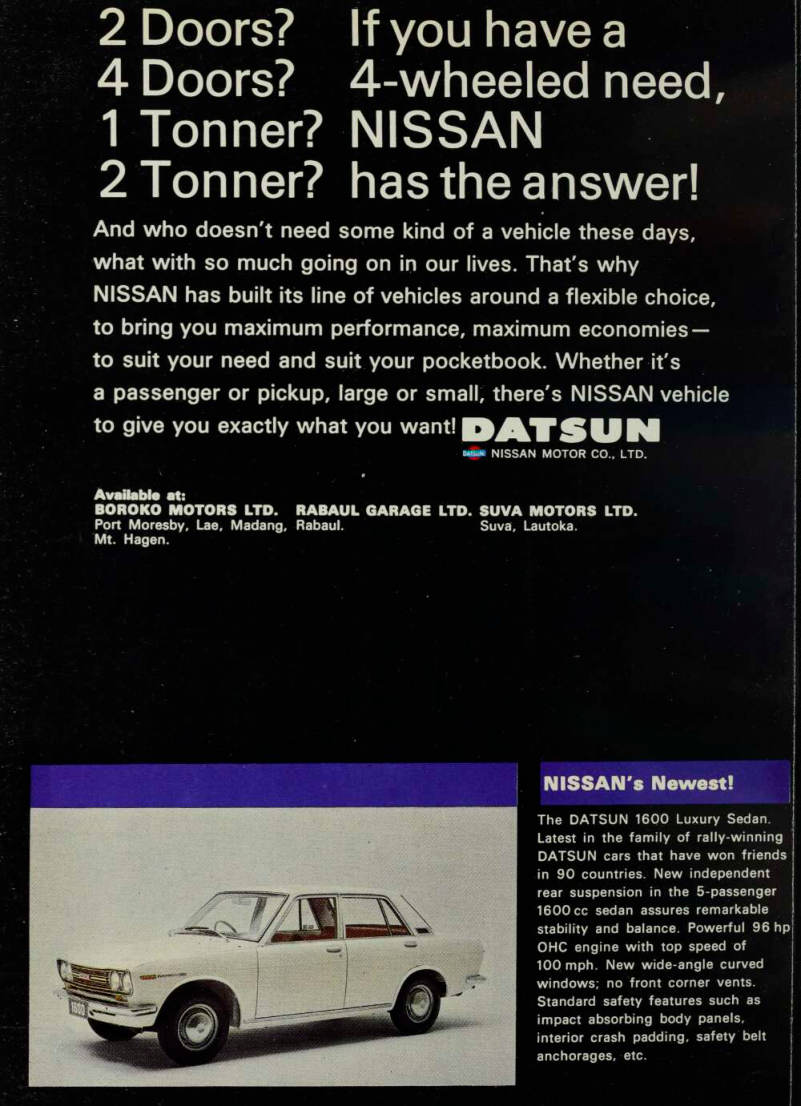 76
76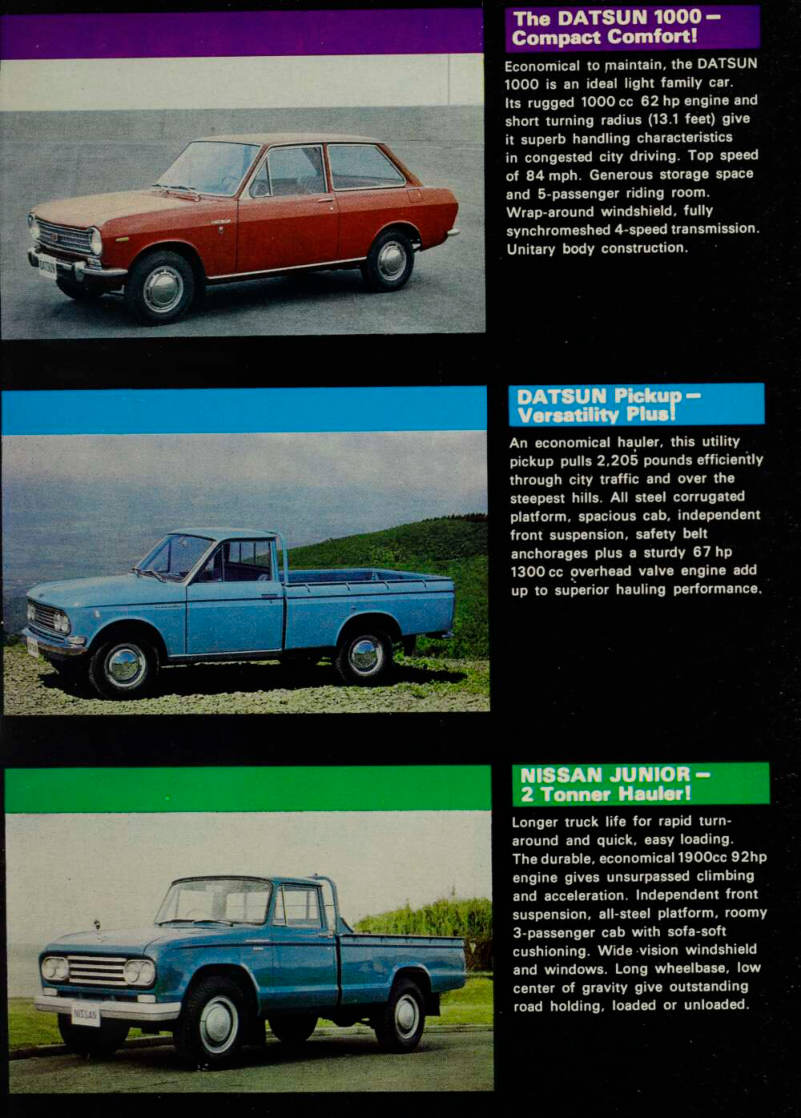 77
77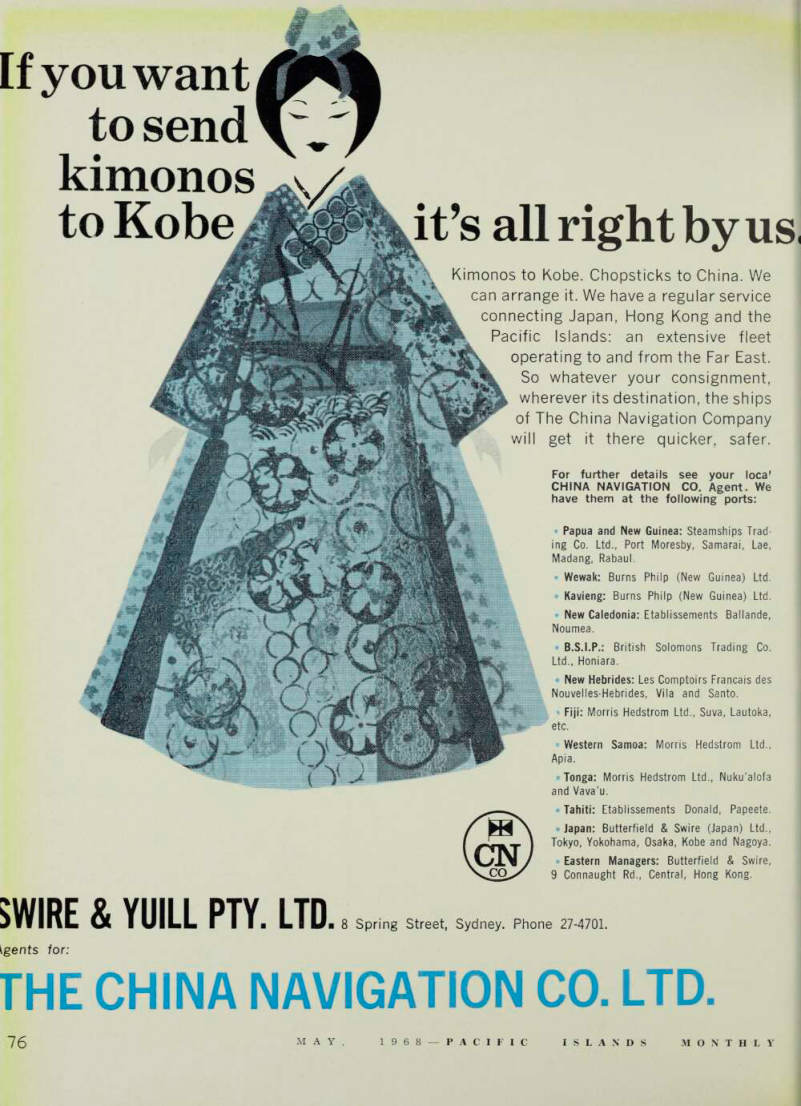 78
78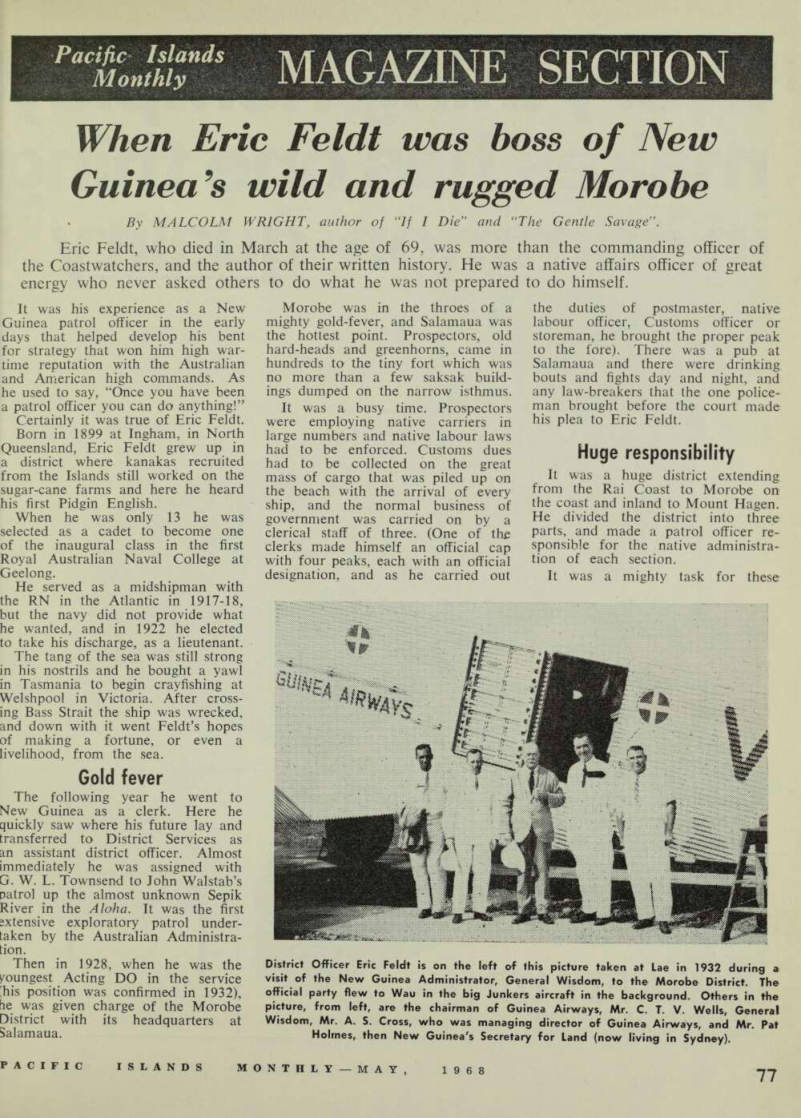 79
79 80
80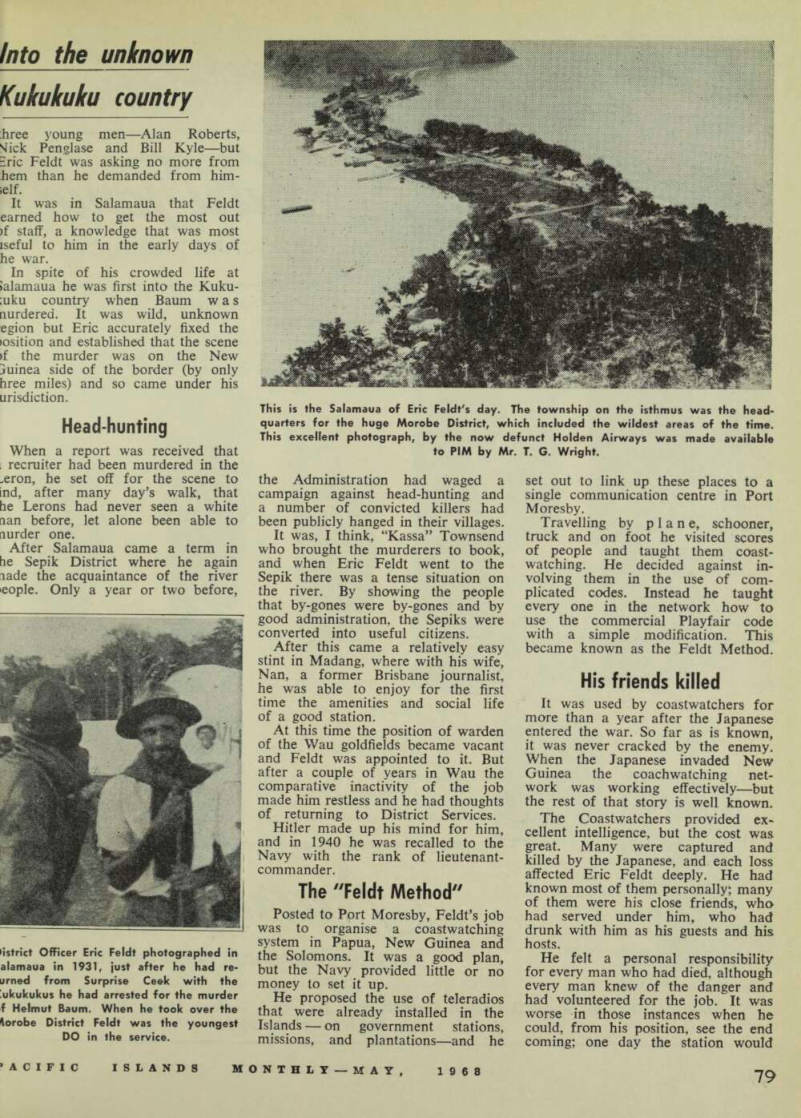 81
81 82
82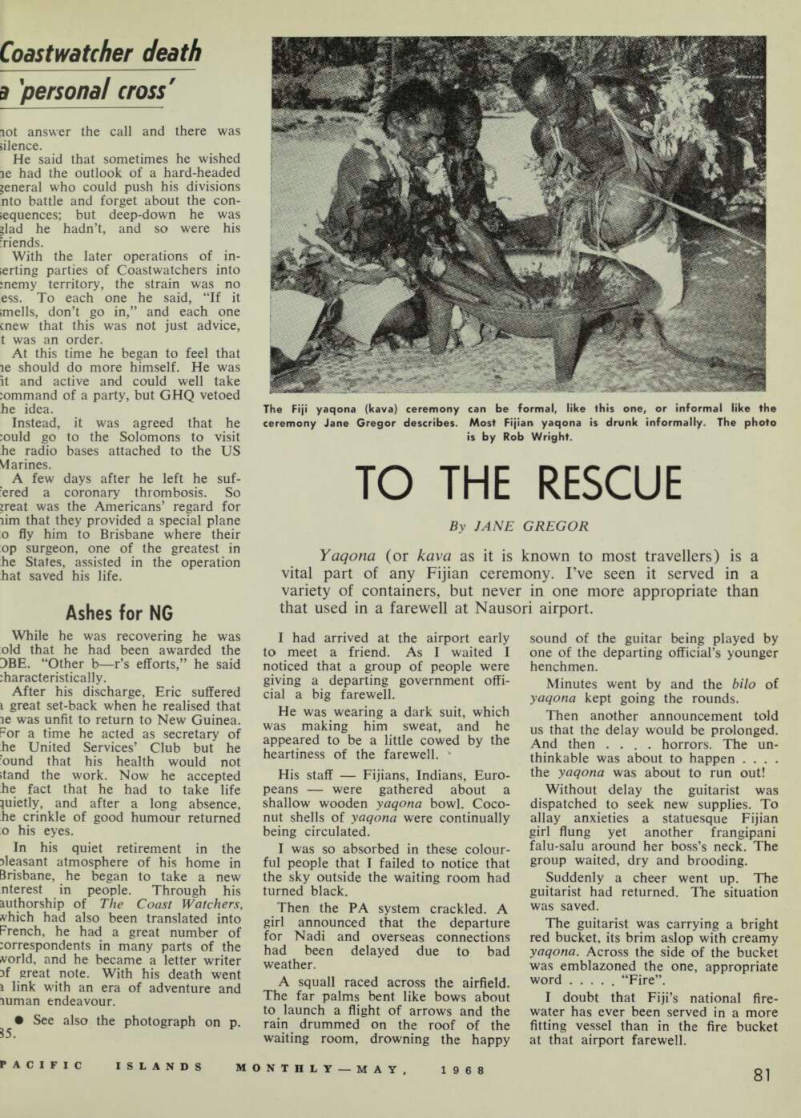 83
83 84
84 85
85 86
86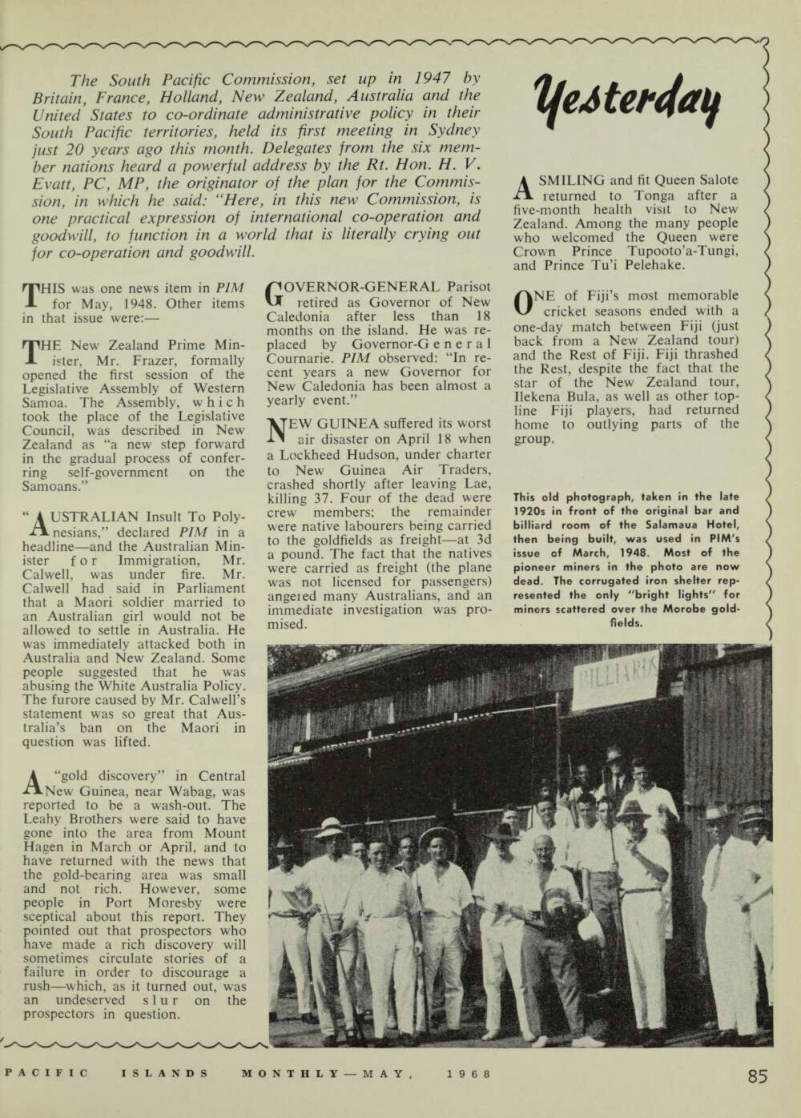 87
87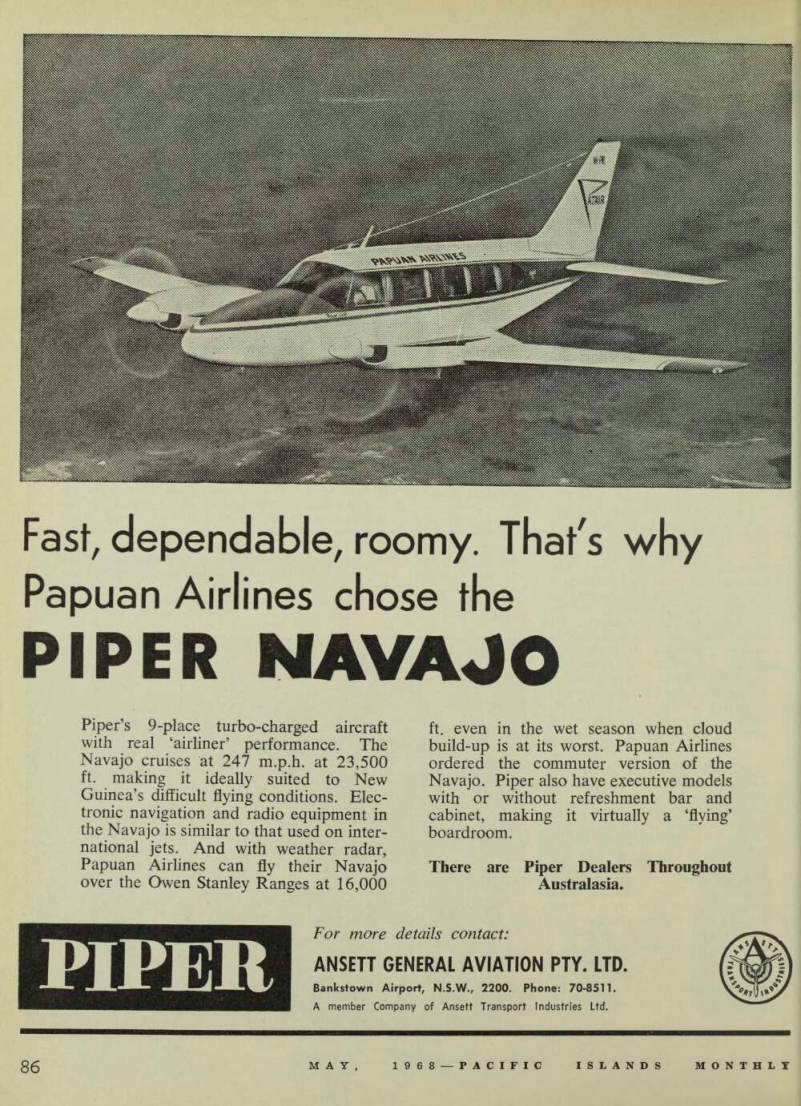 88
88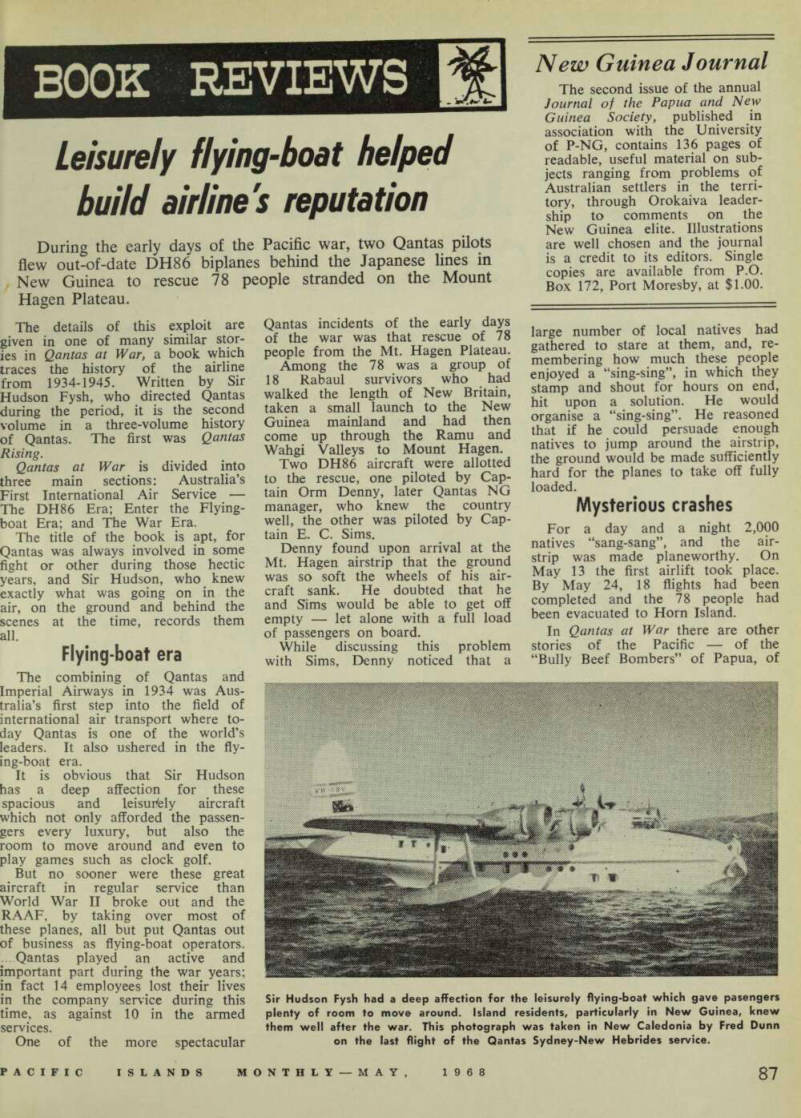 89
89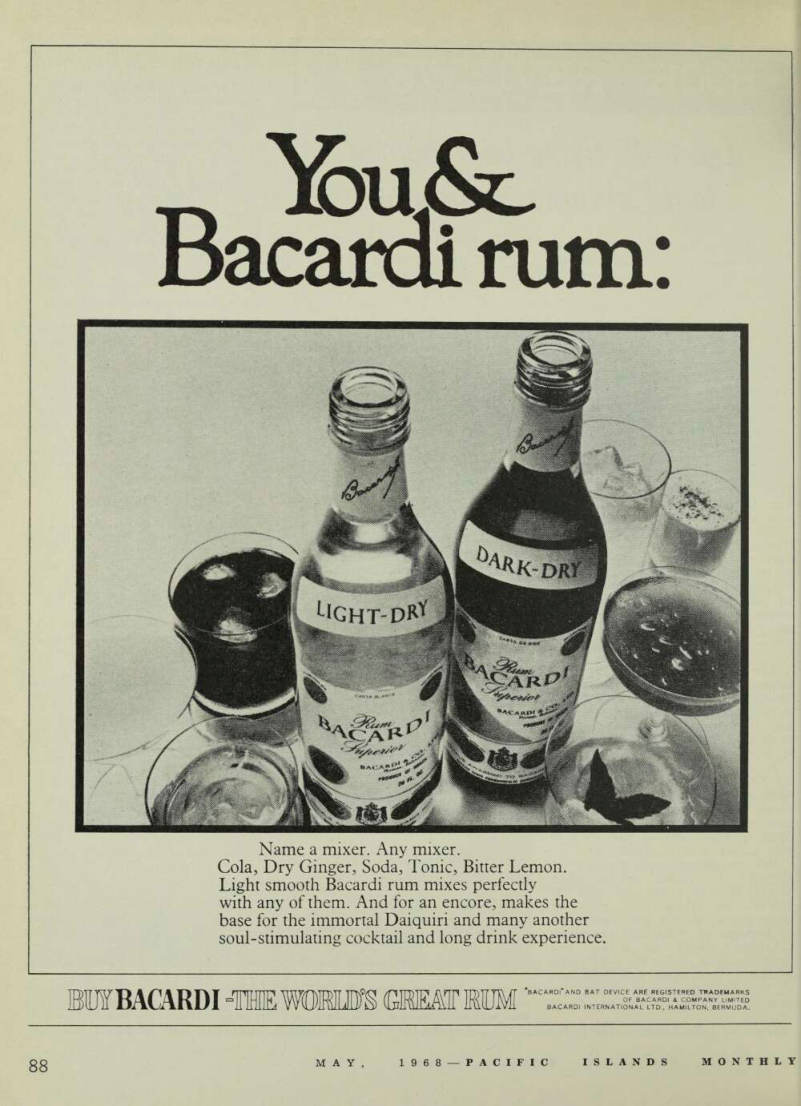 90
90 91
91 92
92 93
93 94
94 95
95 96
96 97
97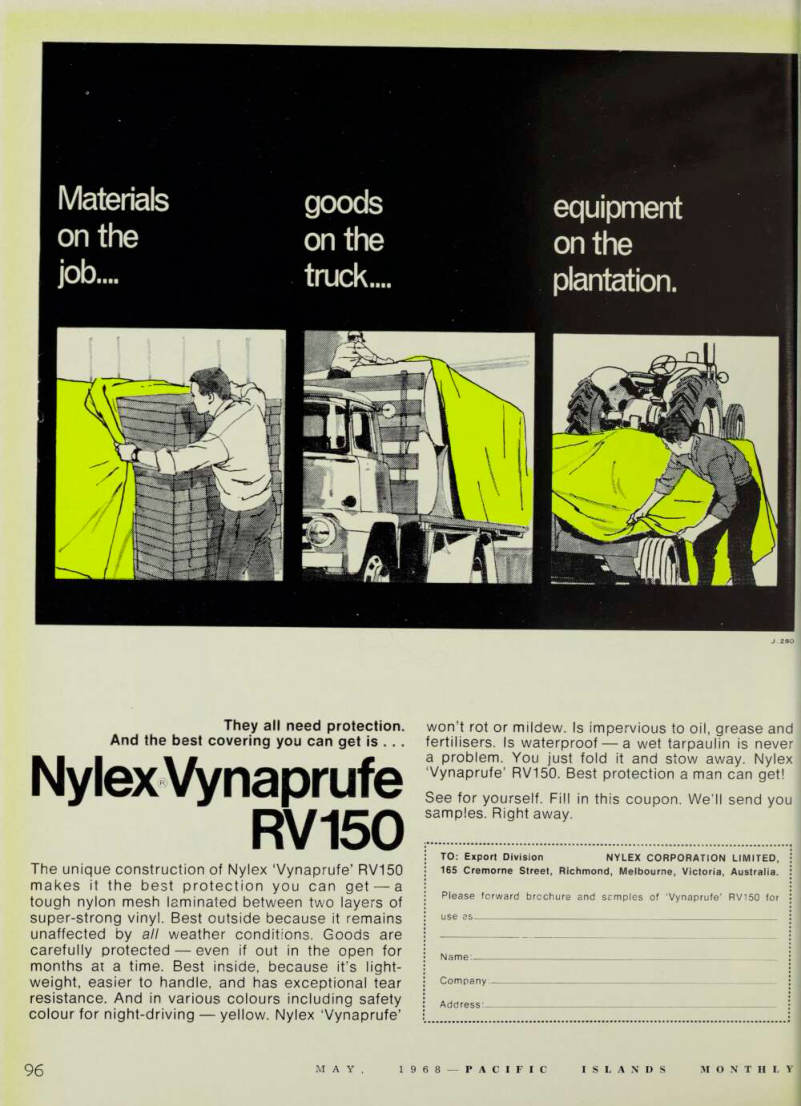 98
98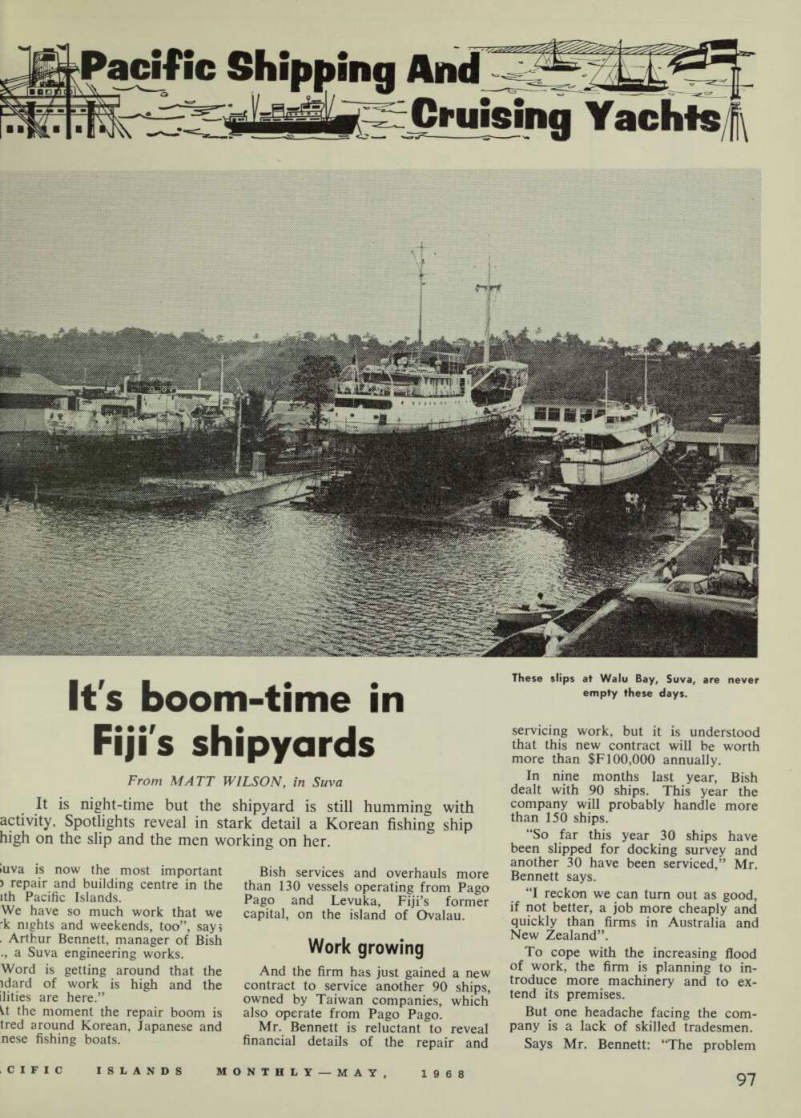 99
99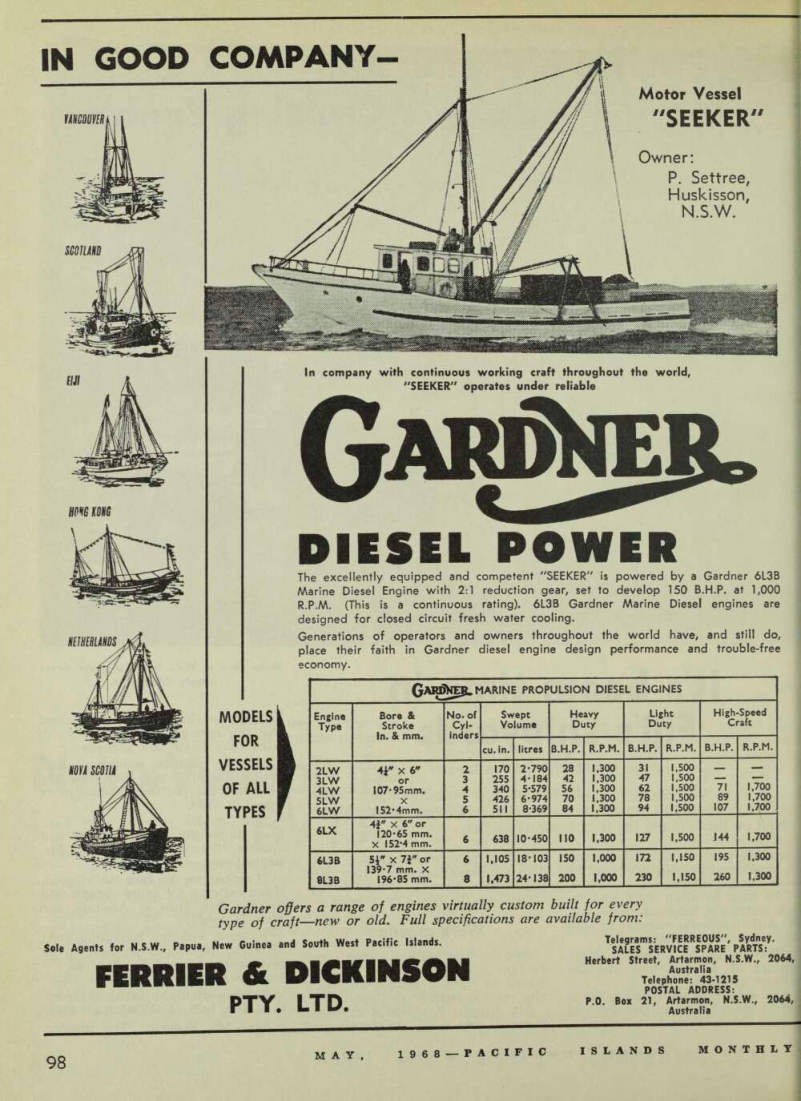 100
100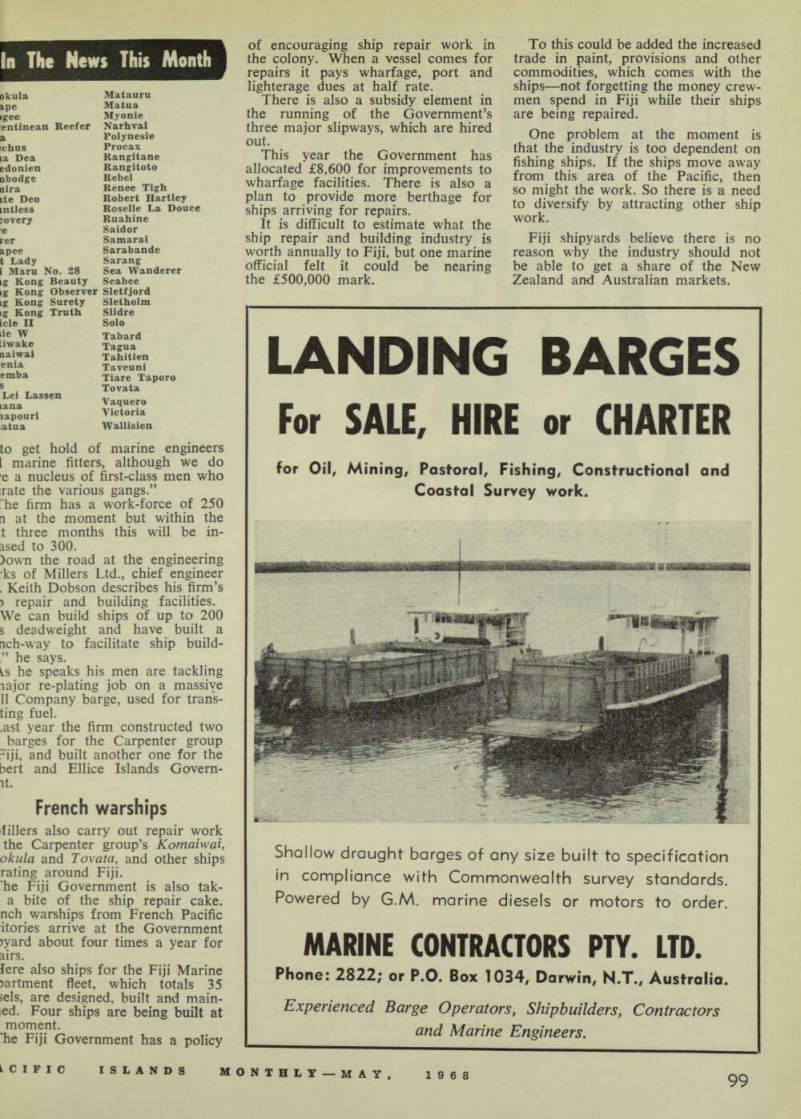 101
101 102
102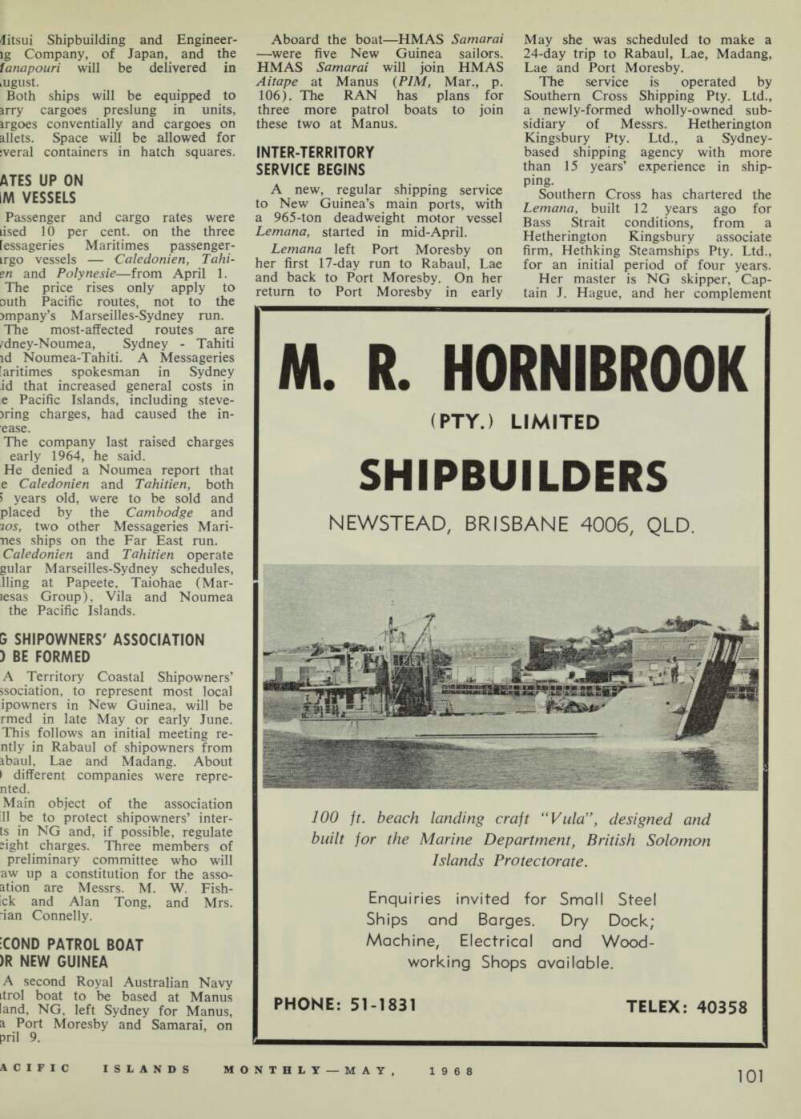 103
103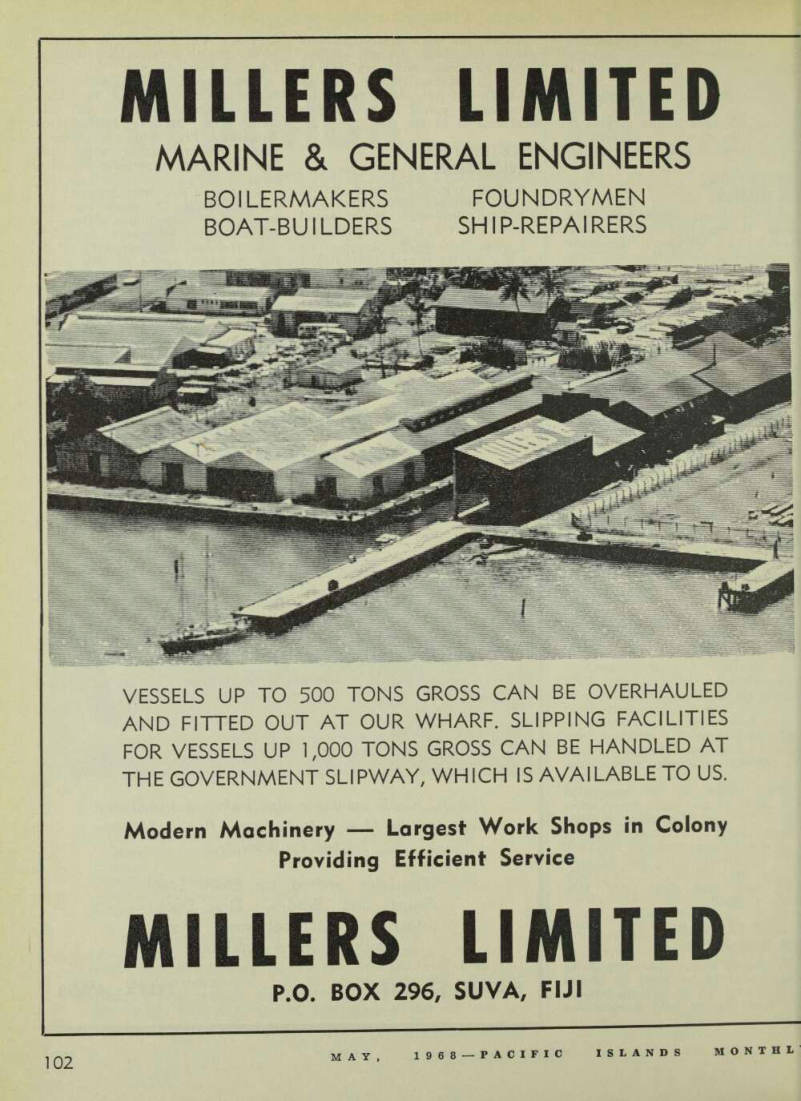 104
104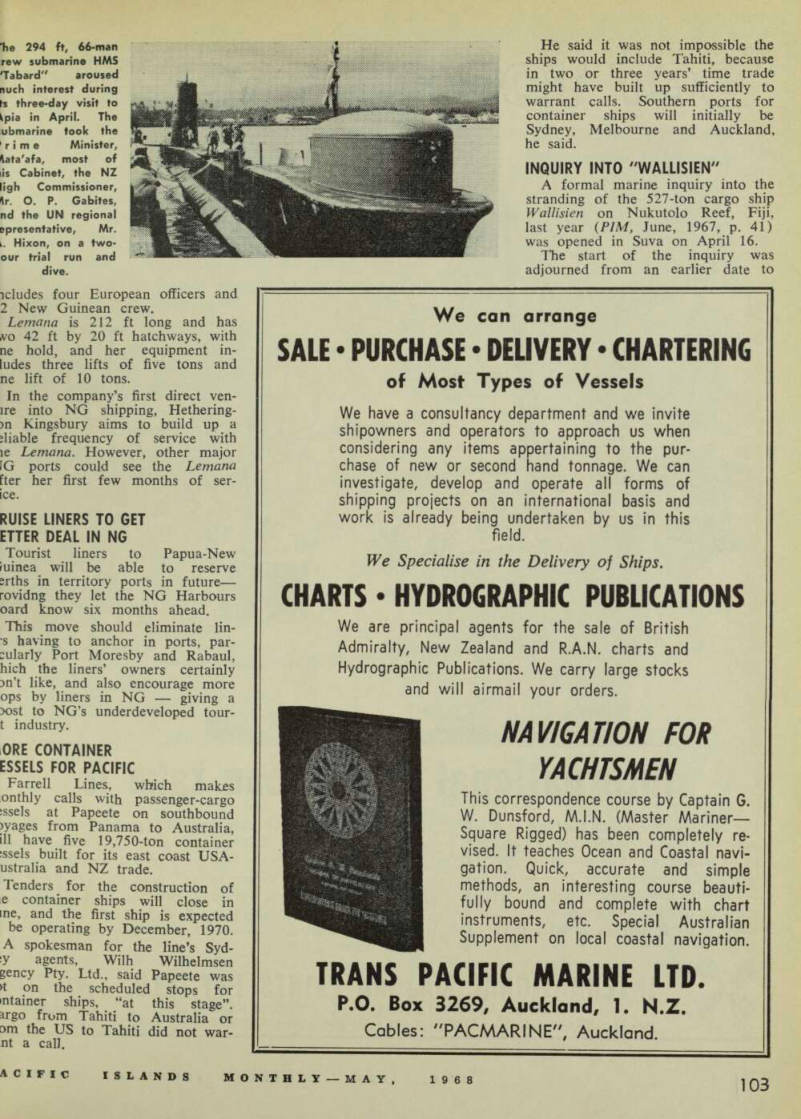 105
105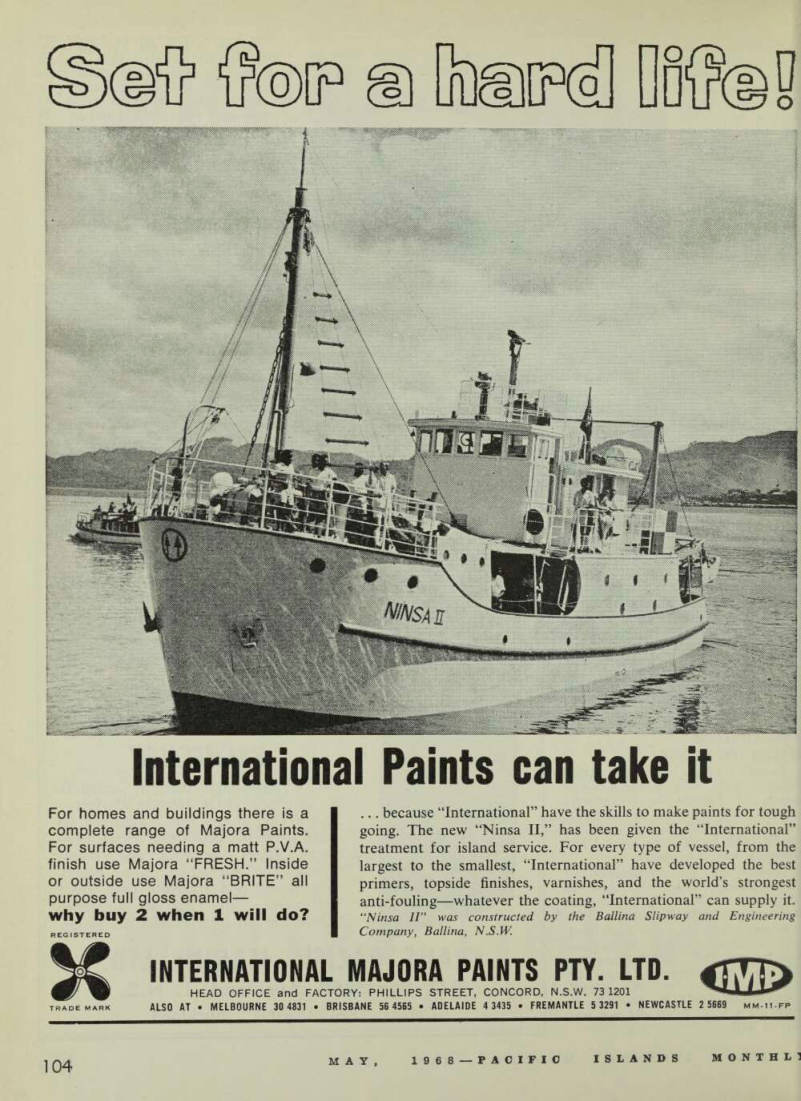 106
106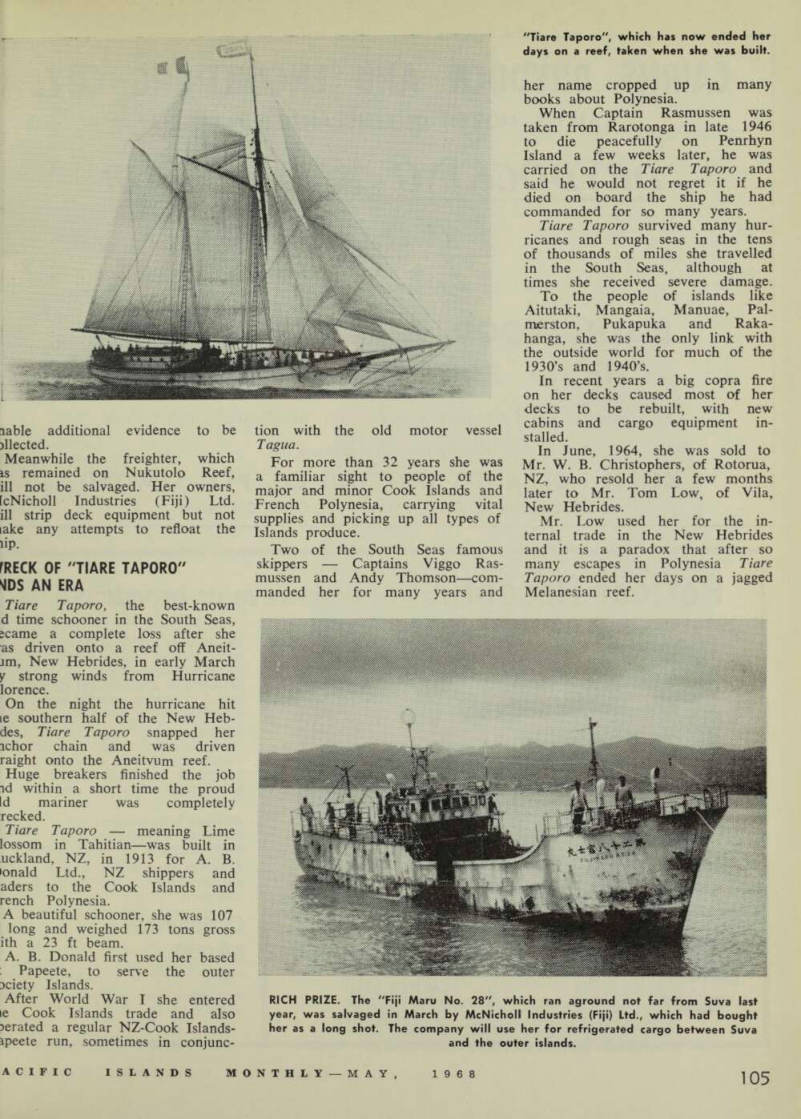 107
107 108
108 109
109 110
110 111
111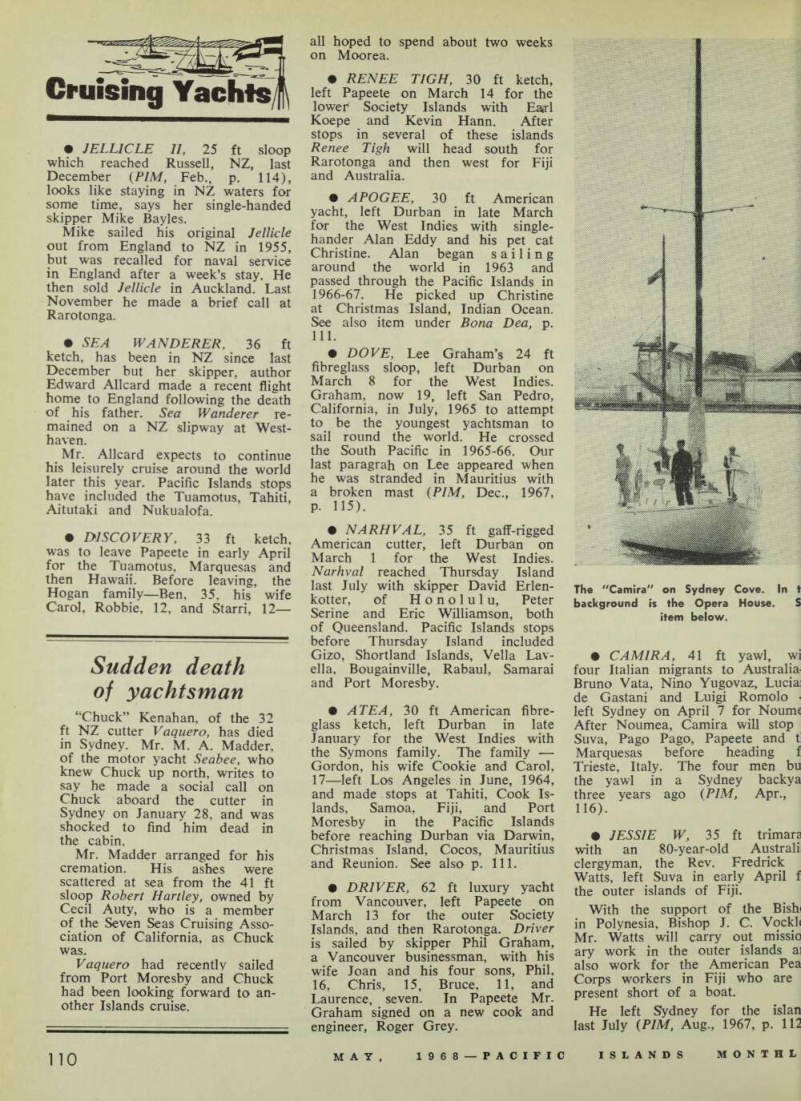 112
112 113
113 114
114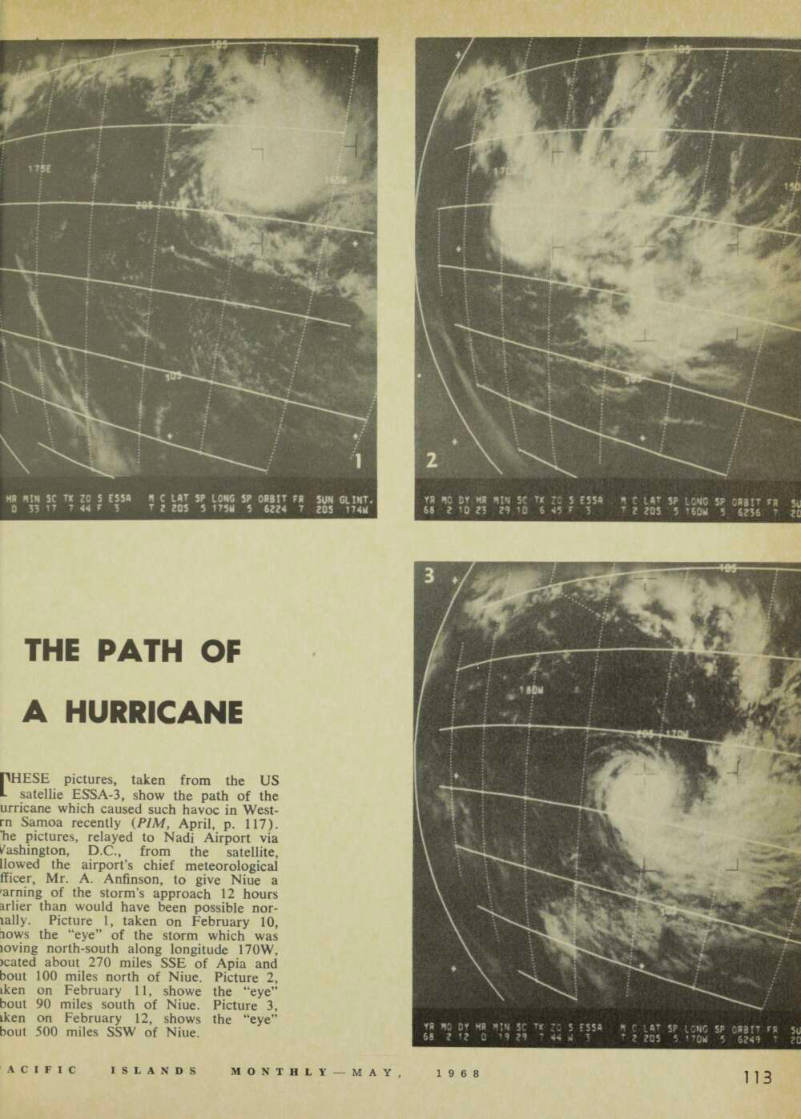 115
115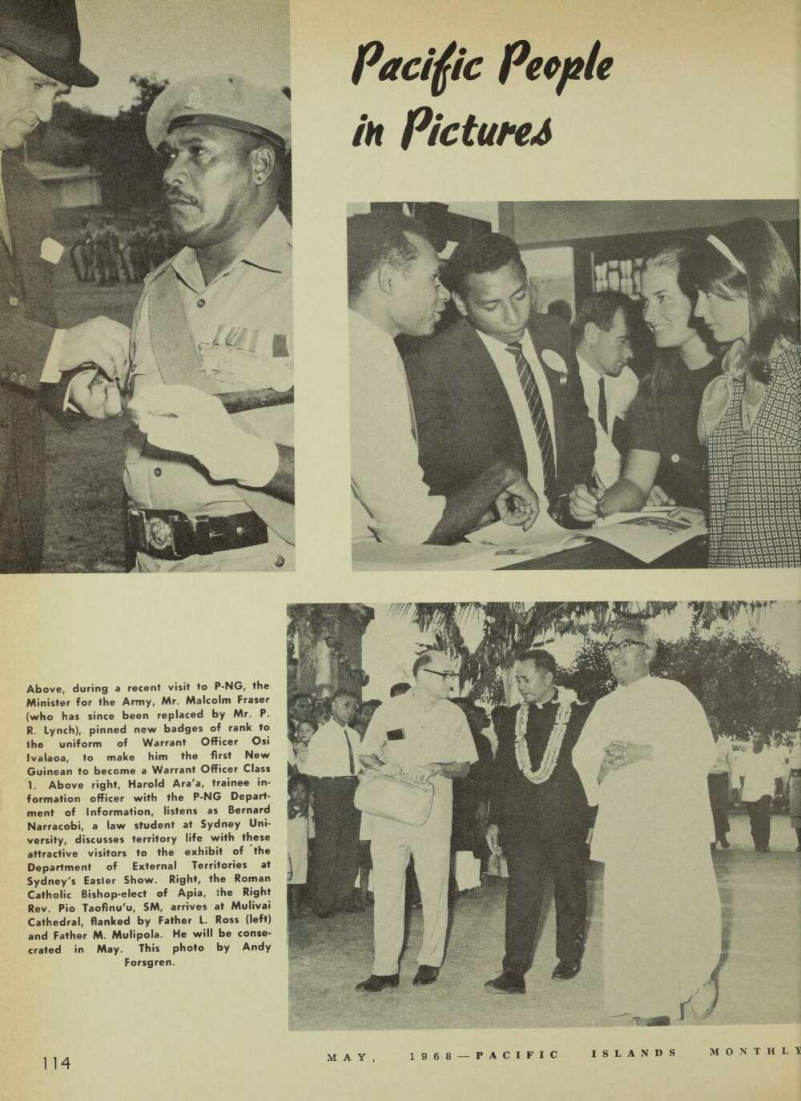 116
116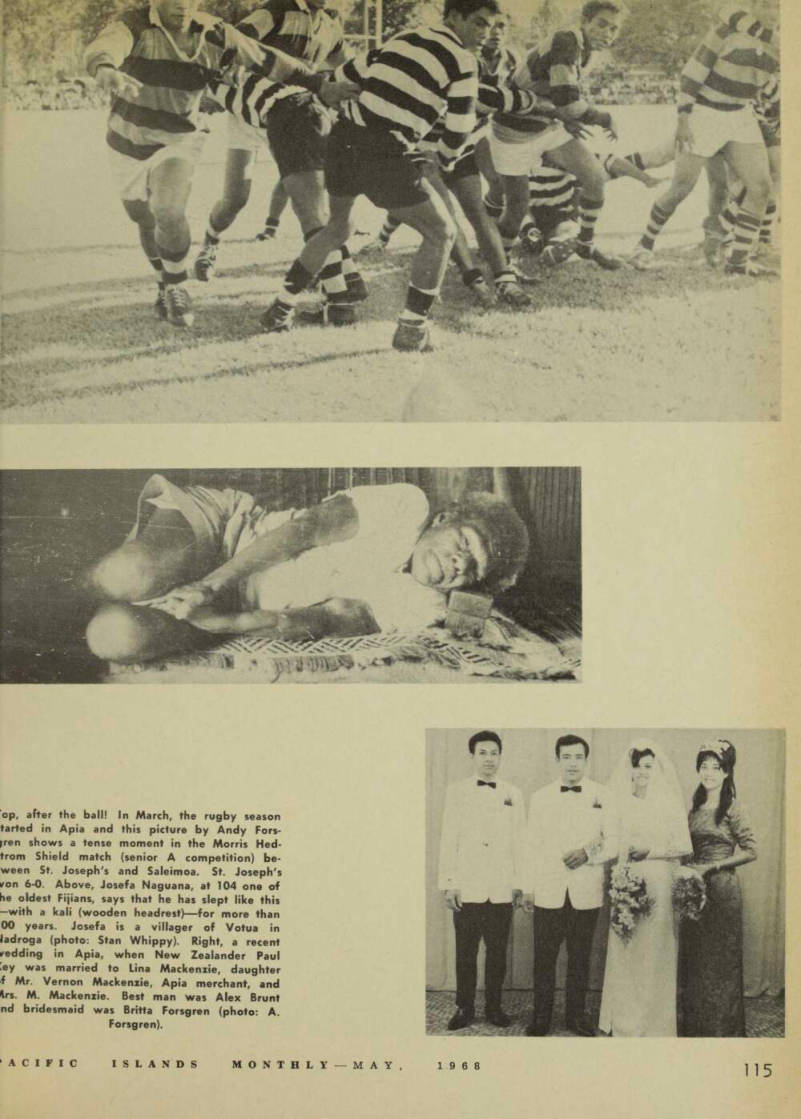 117
117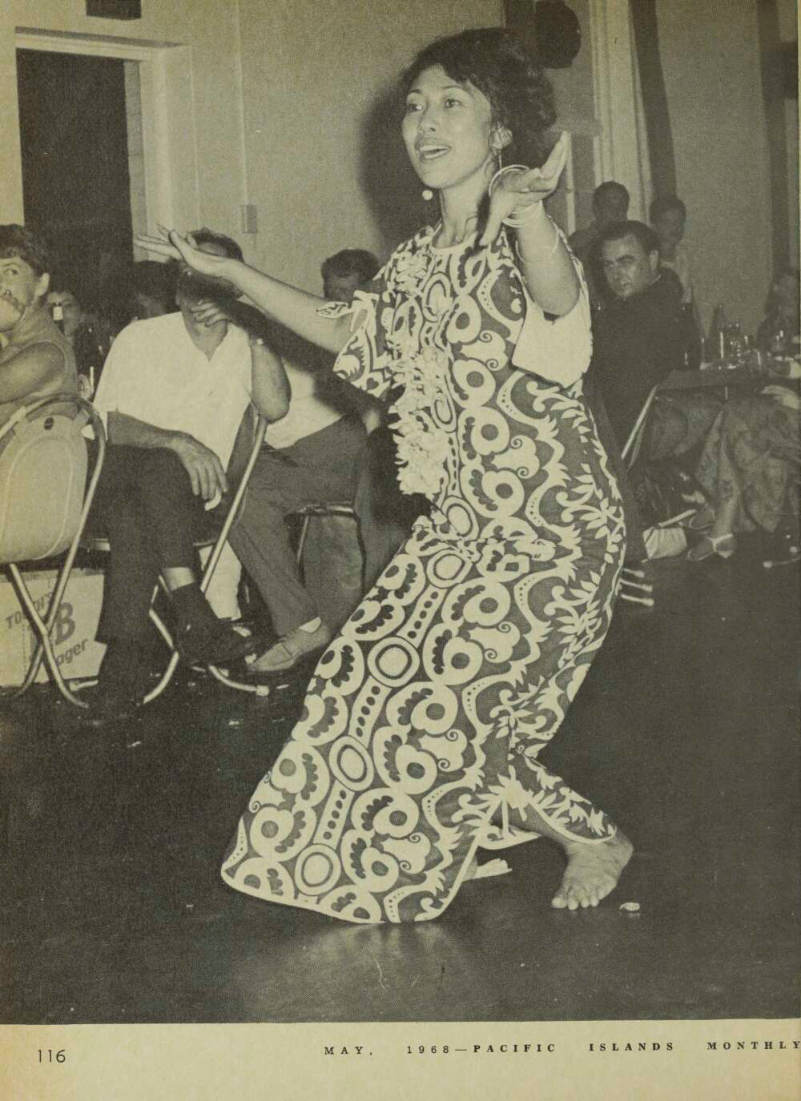 118
118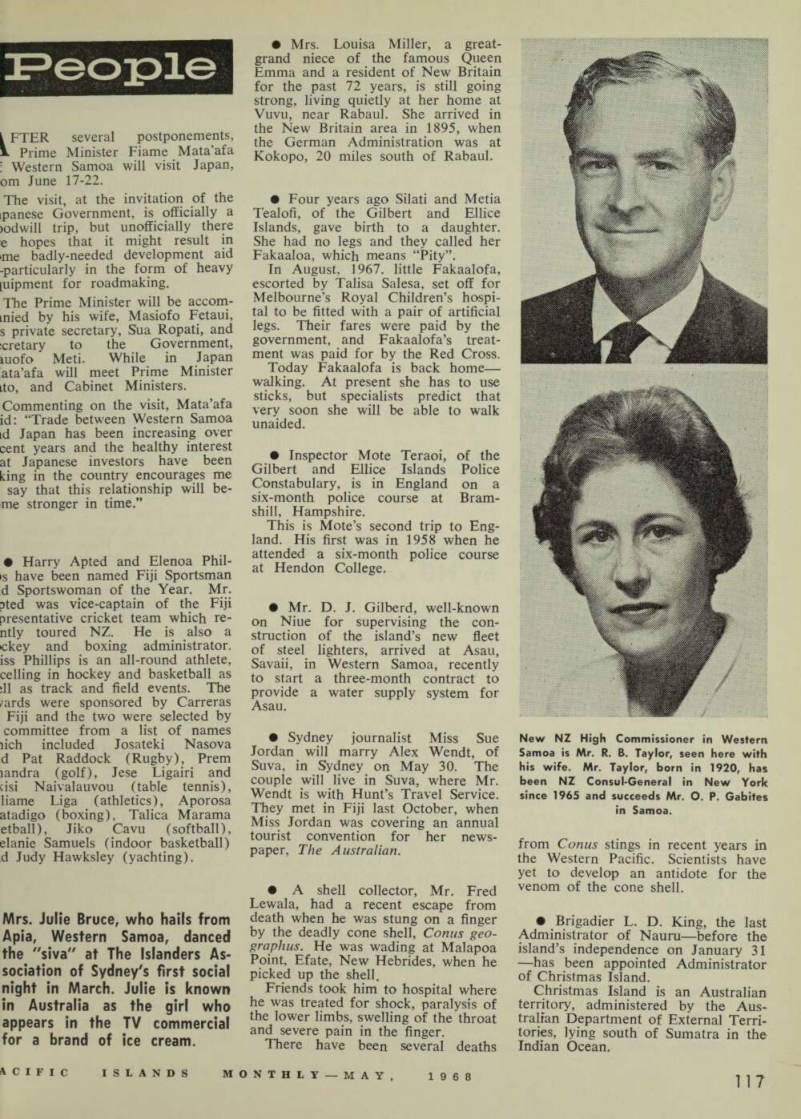 119
119 120
120 121
121 122
122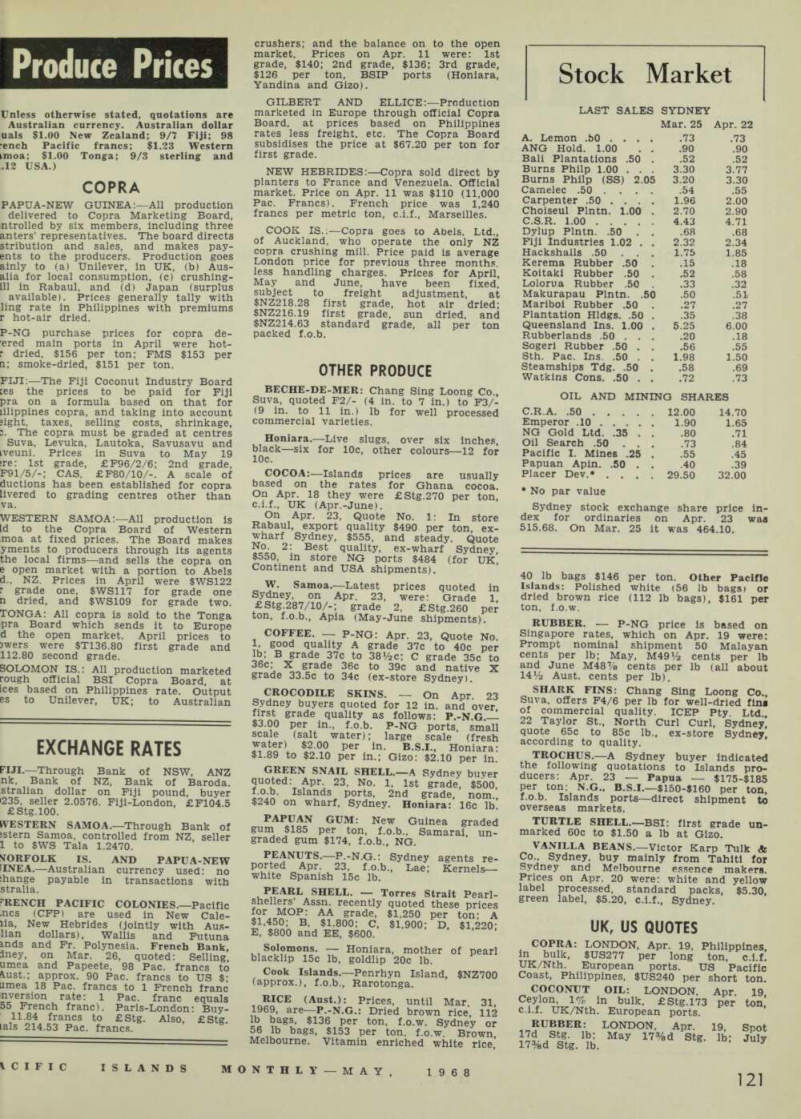 123
123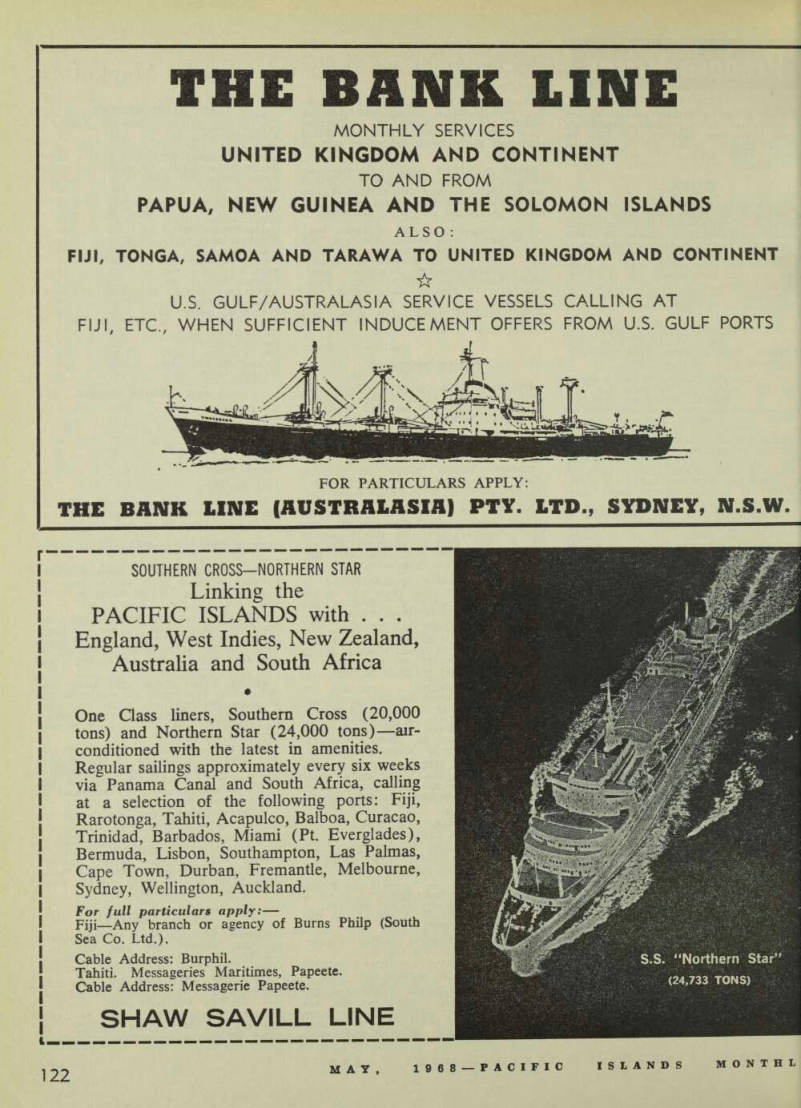 124
124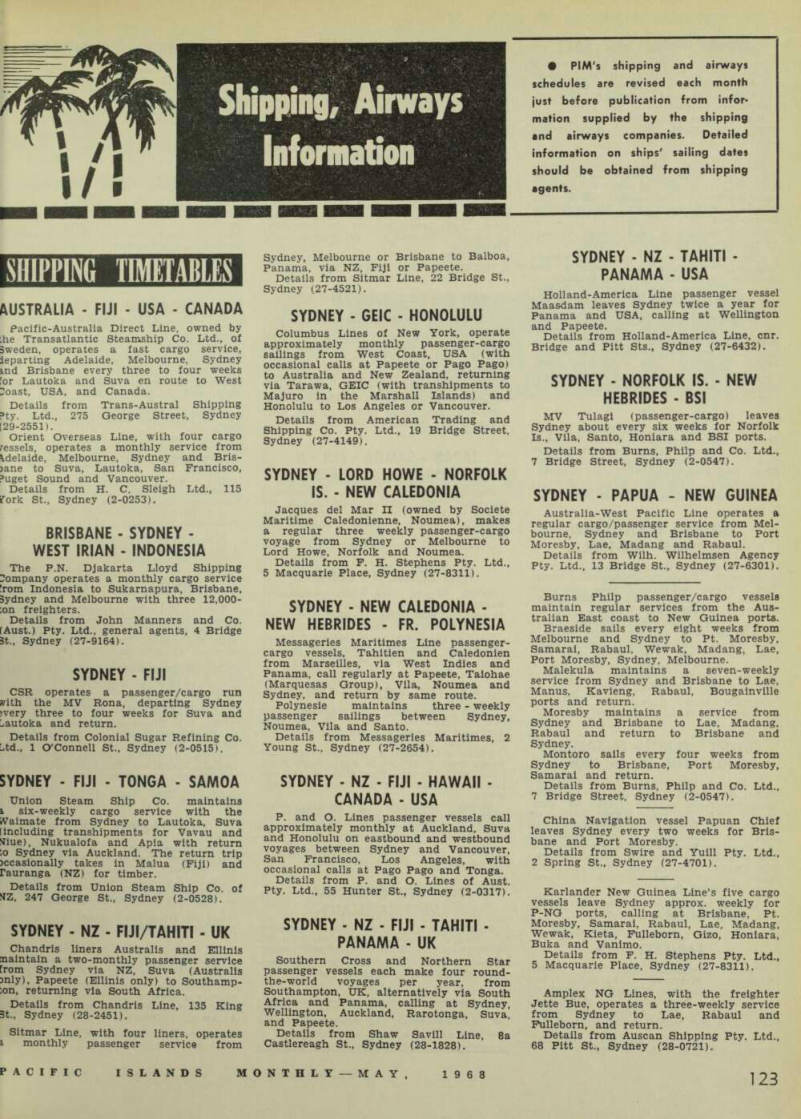 125
125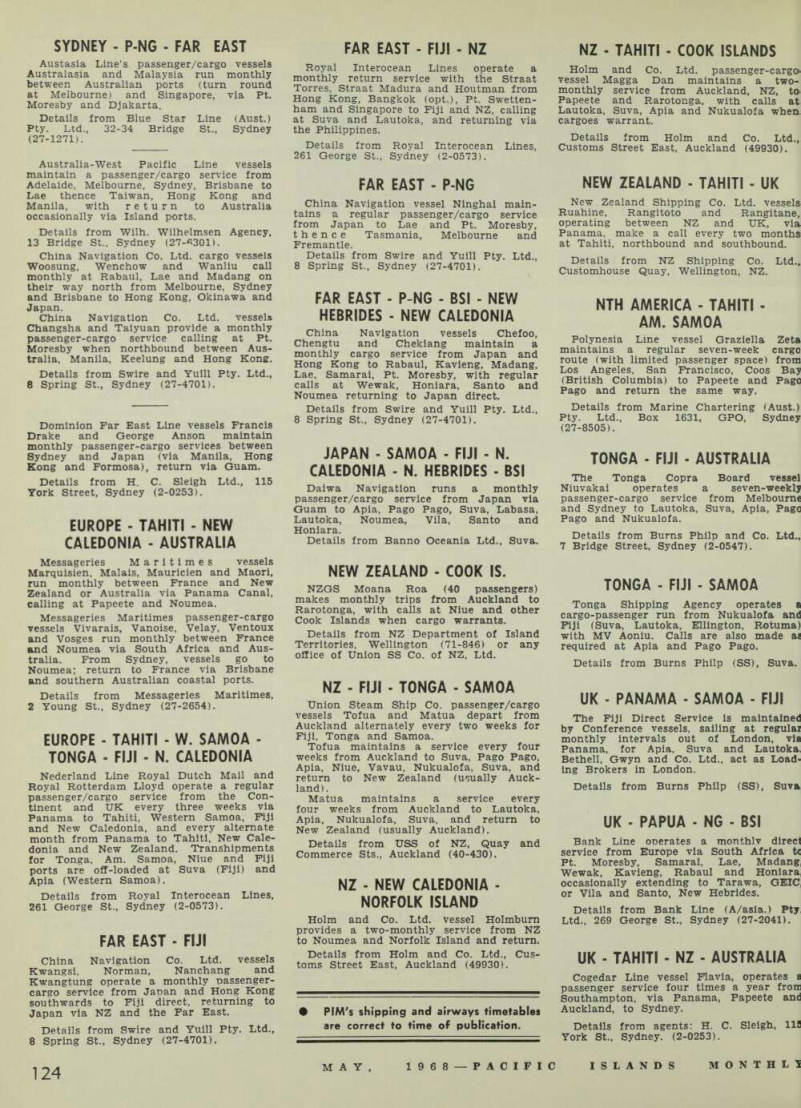 126
126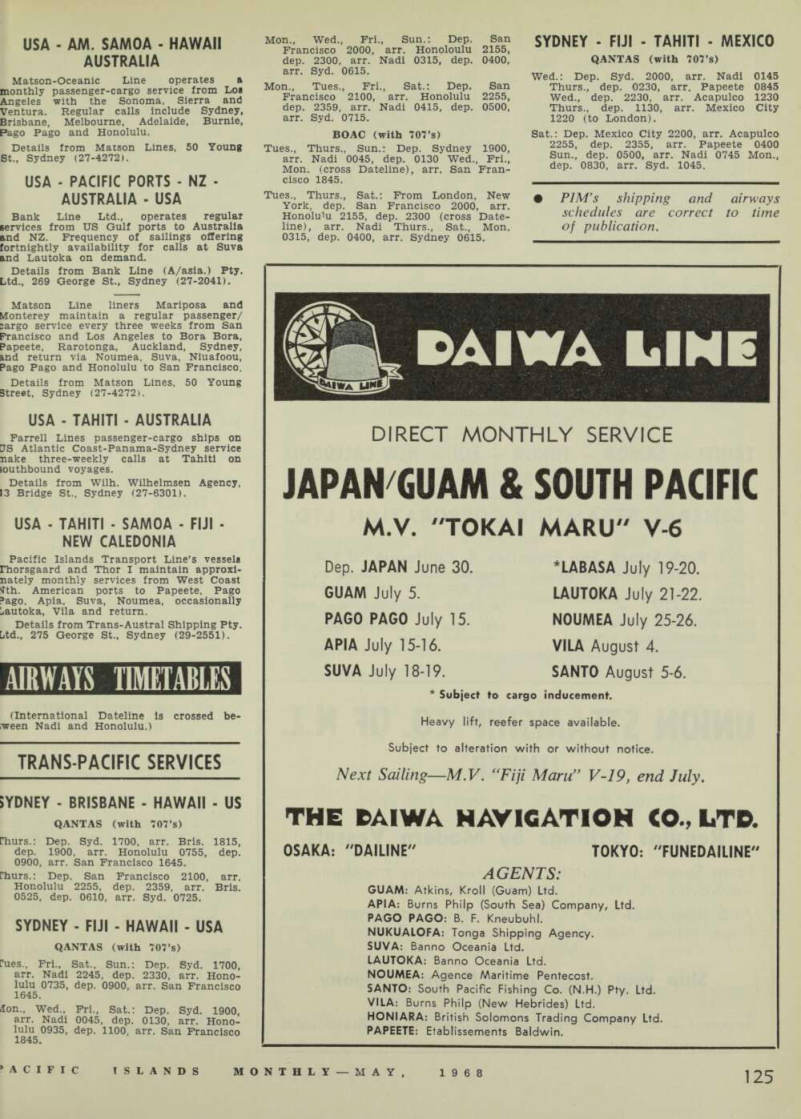 127
127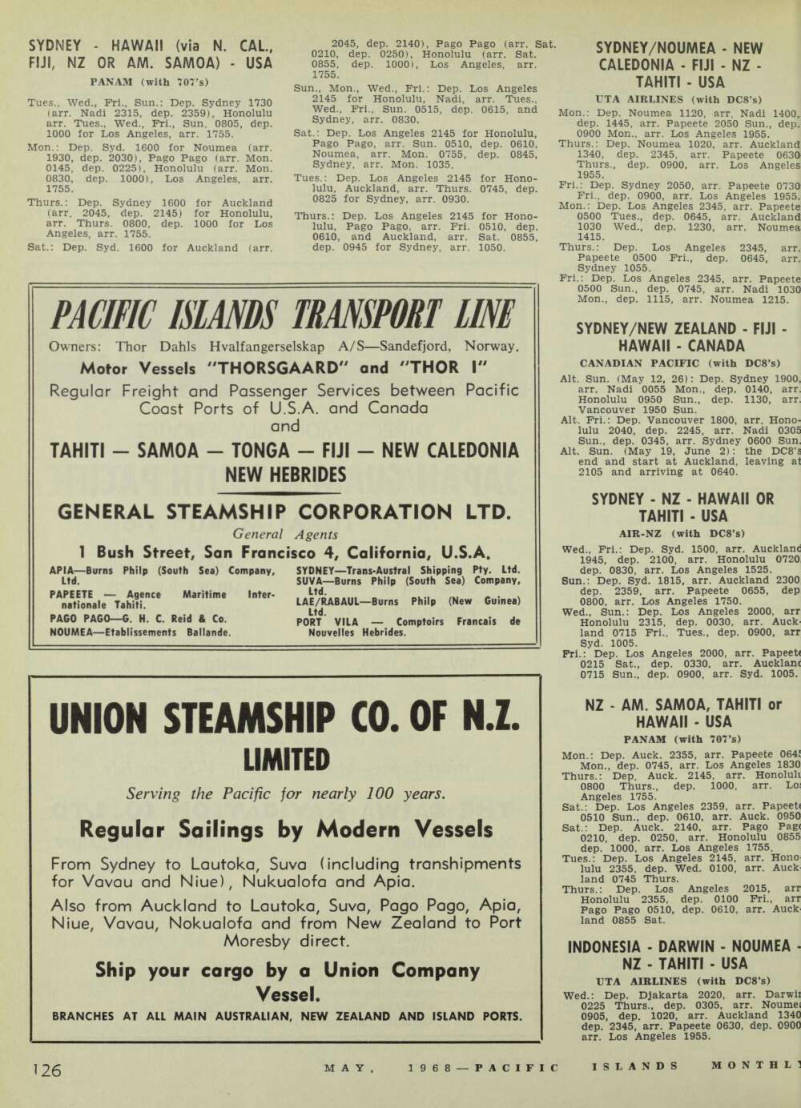 128
128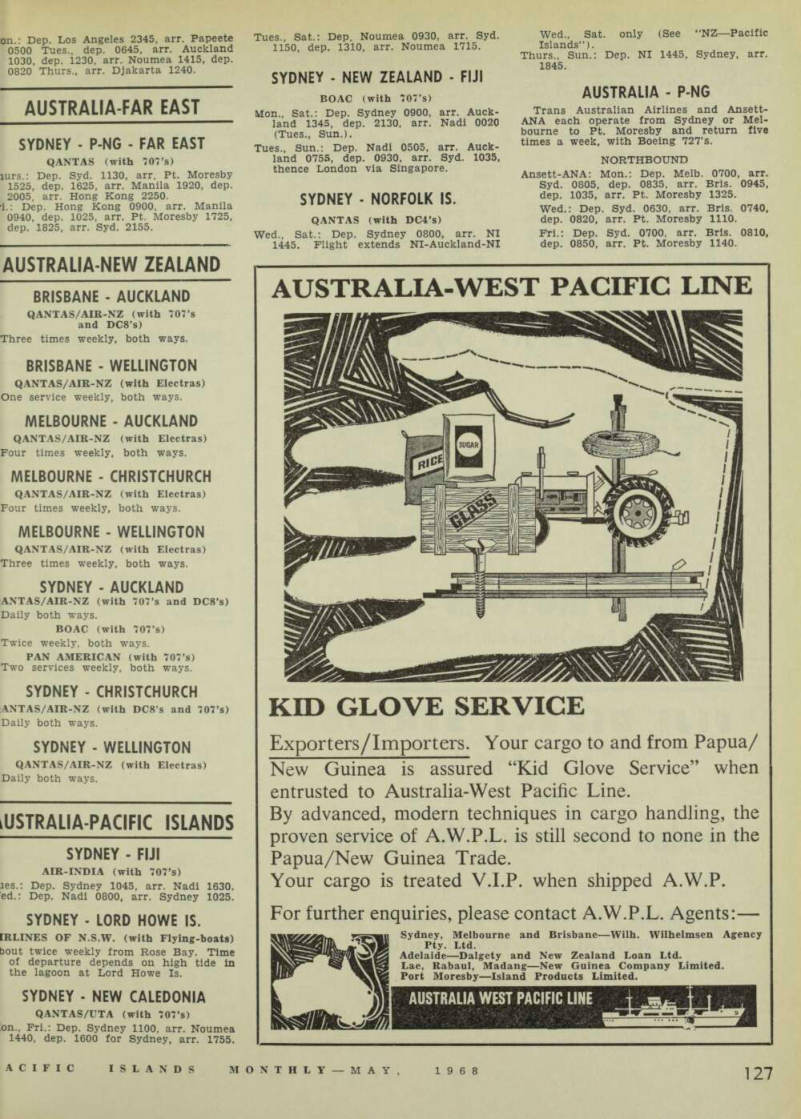 129
129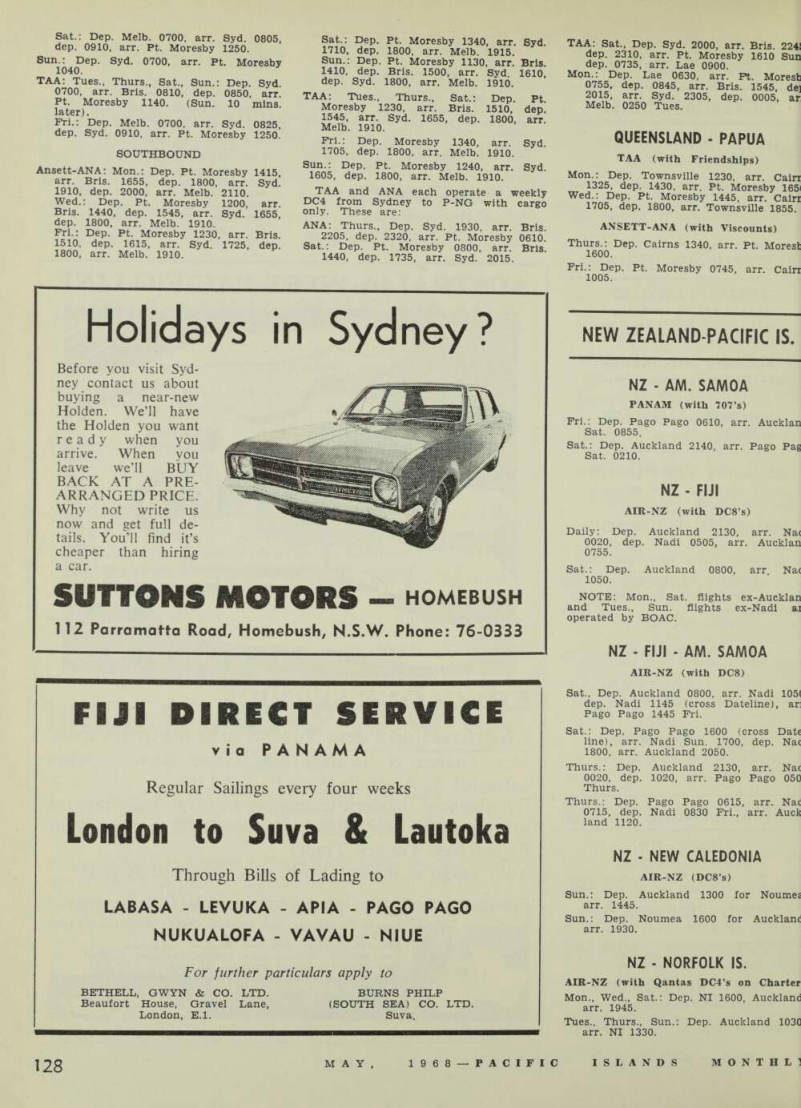 130
130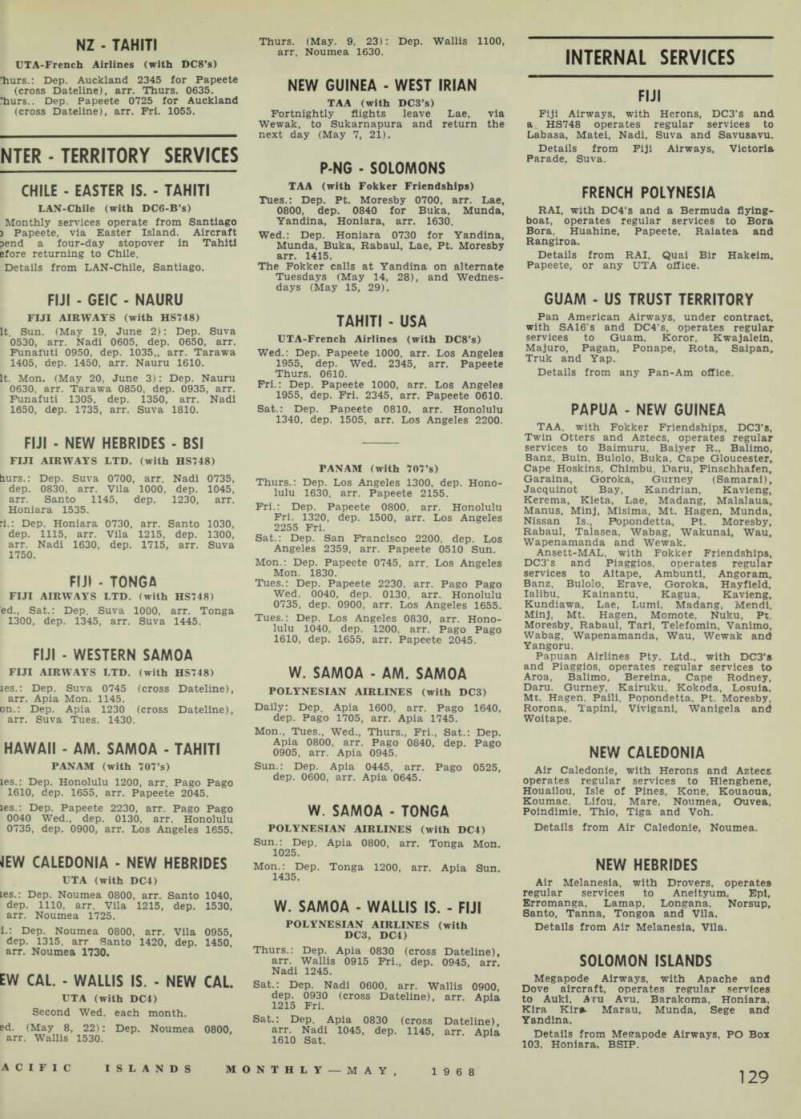 131
131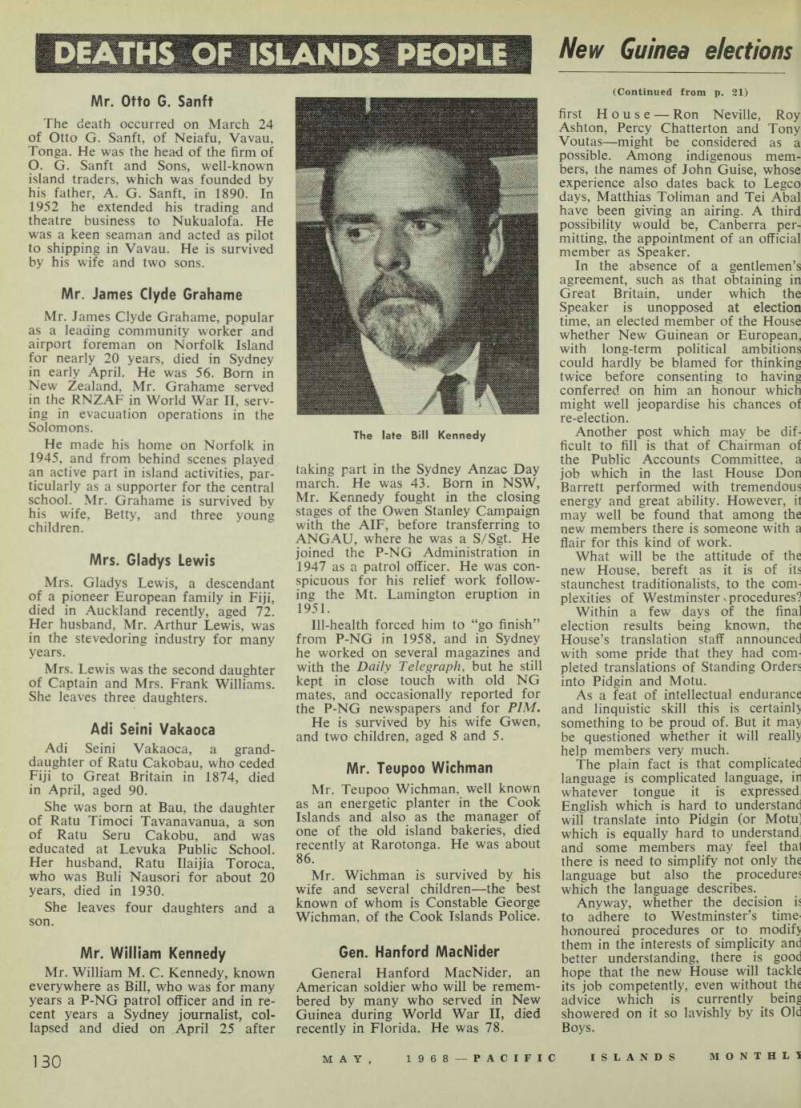 132
132 133
133 134
134 135
135 136
136 137
137 138
138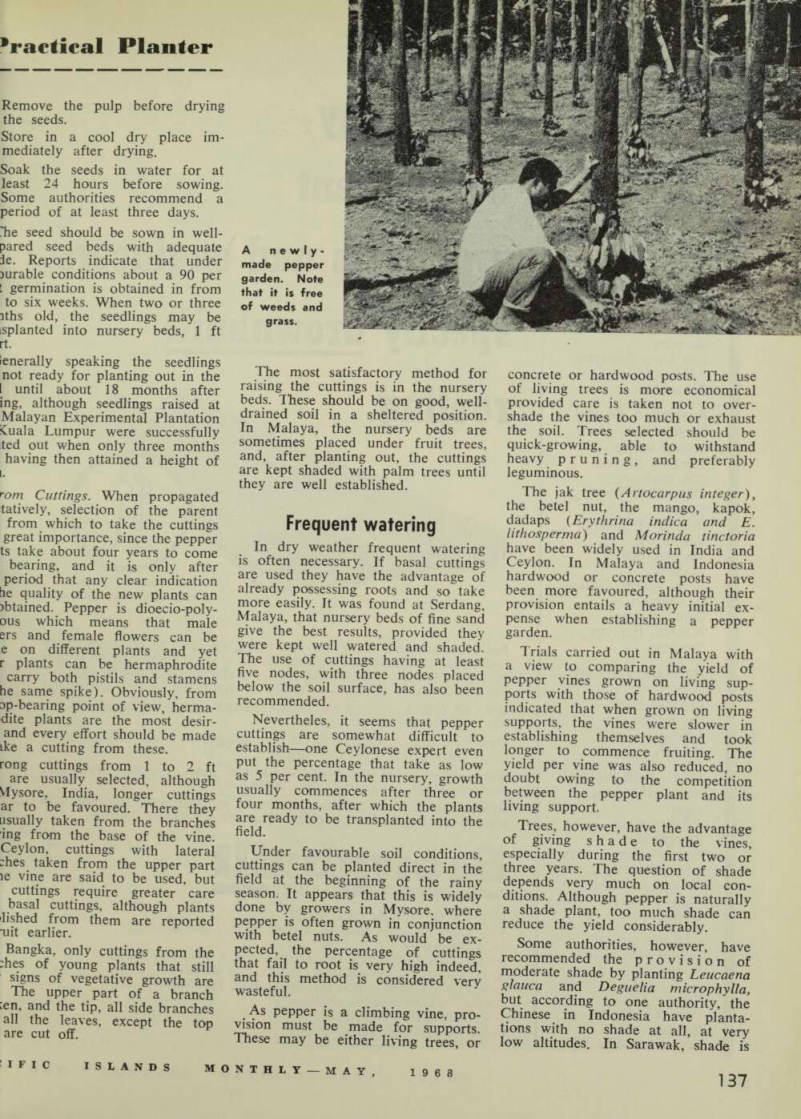 139
139 140
140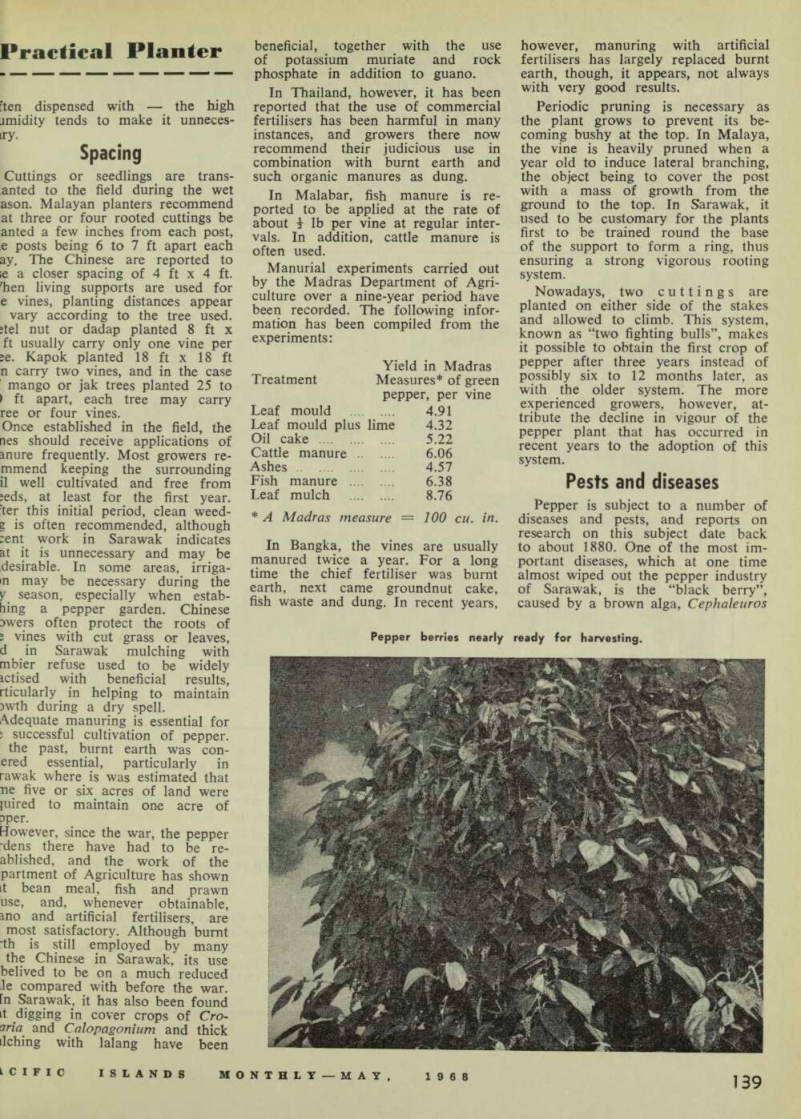 141
141 142
142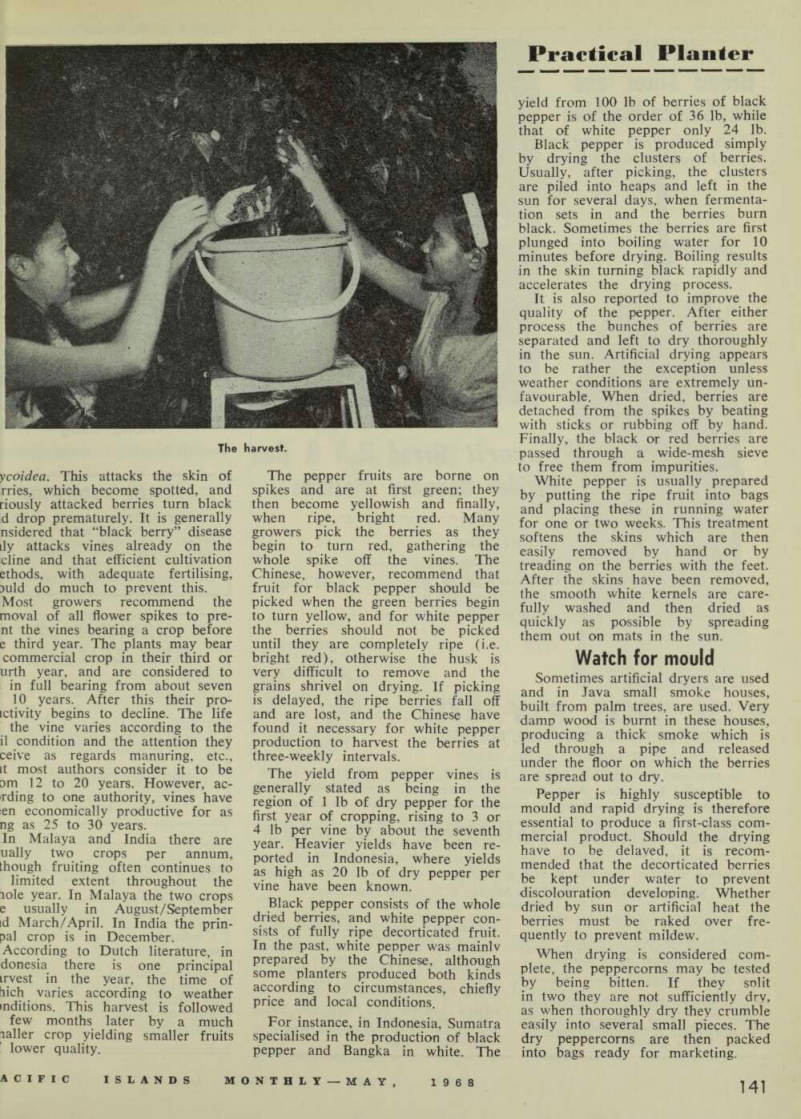 143
143 144
144 145
145 146
146 147
147 148
148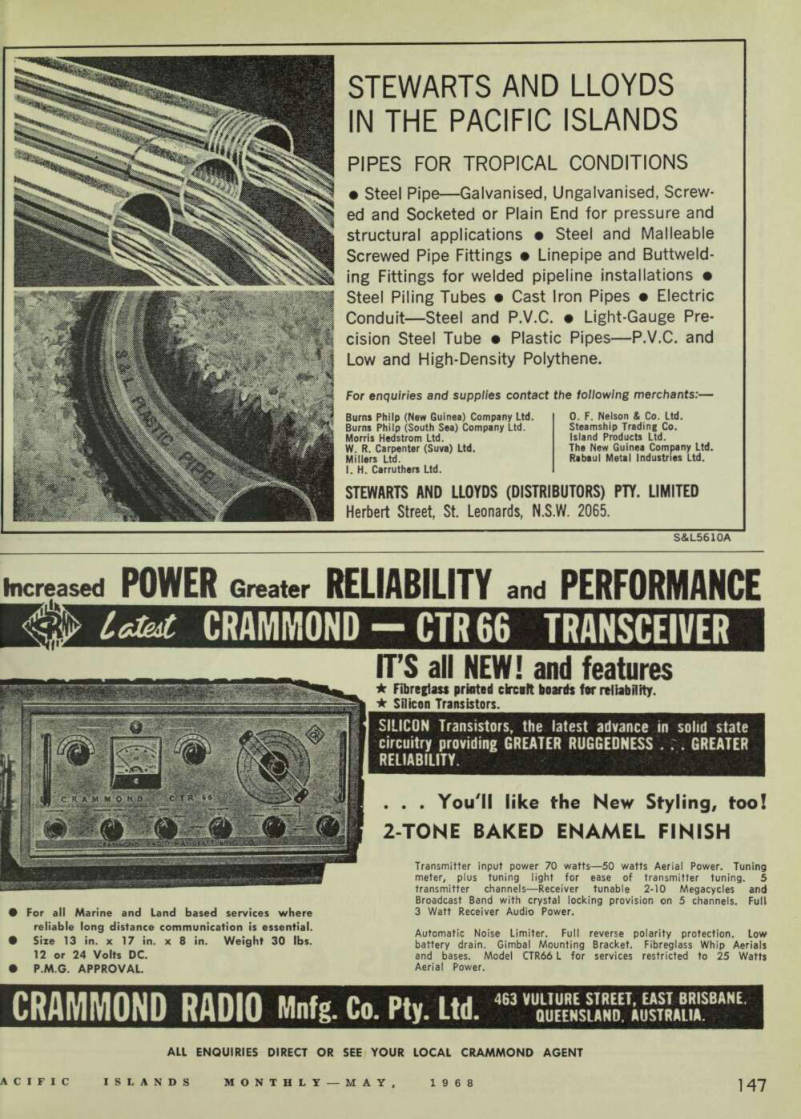 149
149 150
150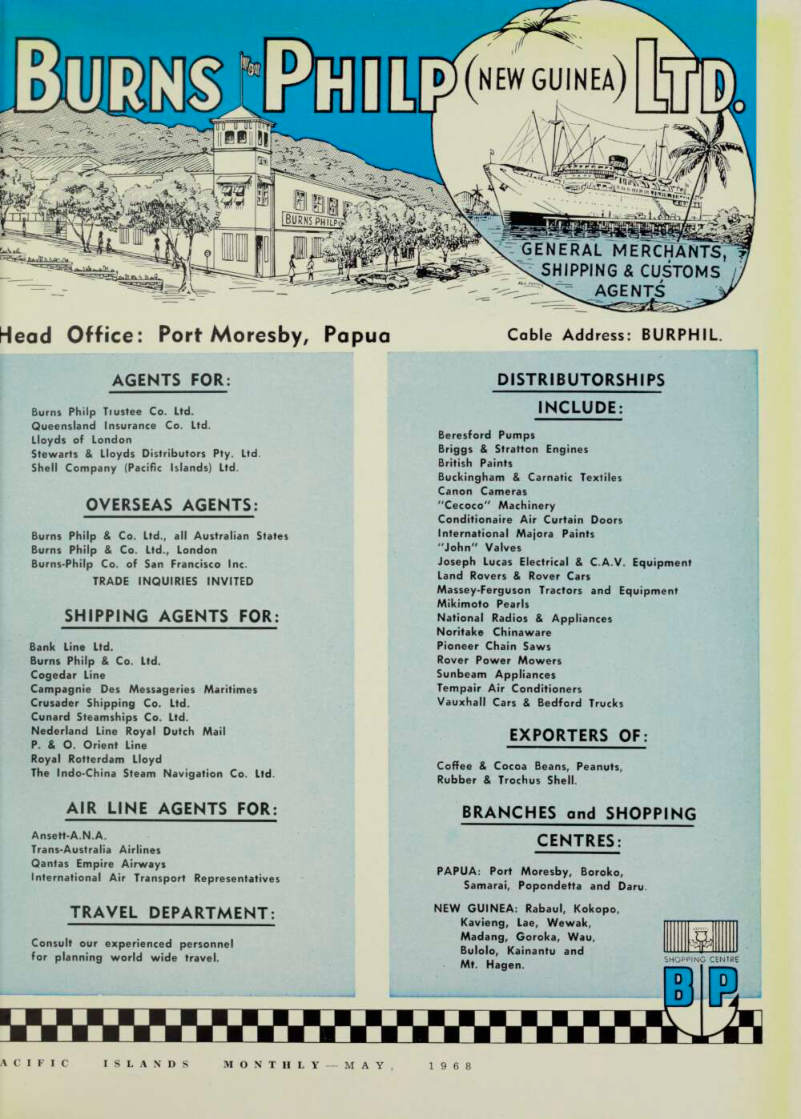 151
151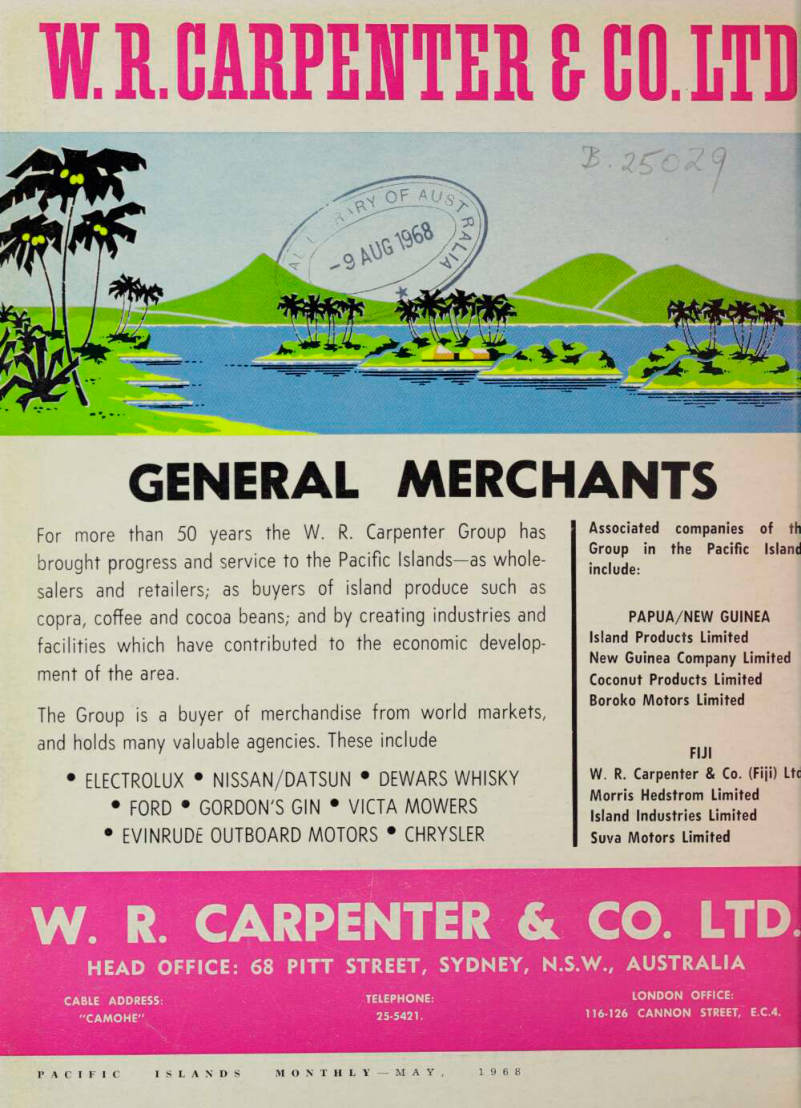 152
152