Pacific
Islands
Monthly
May, 1949
Vol. XIX. No. 10.
Established 1930.
IRegistered at the G.P.0., Sydney, j ok transmission by post as a newspaper ]
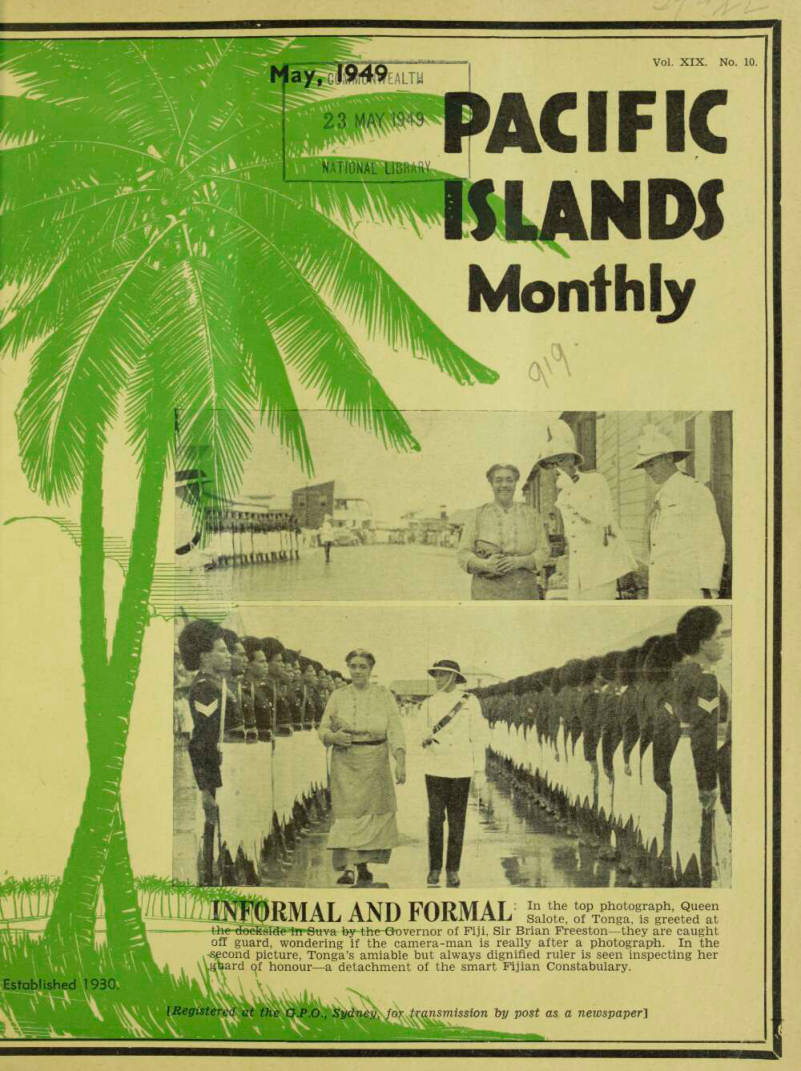
INFORMAL AND FORMAT : In the top P h otograph, Queen Salote, of Tonga, is greeted at the dockside in Suva by the Governor of Fiji, Sir Brian Freeston—they are caught off guard, wondering if the camera-man is really after a photograph. In the second picture, Tonga’s amiable but always dignified ruler is seen inspecting her guard of honour—a detachment of the smart Fijian Constabulary.
Advertisements & other items, pp. 2-4 (1 item)
Qcwtab
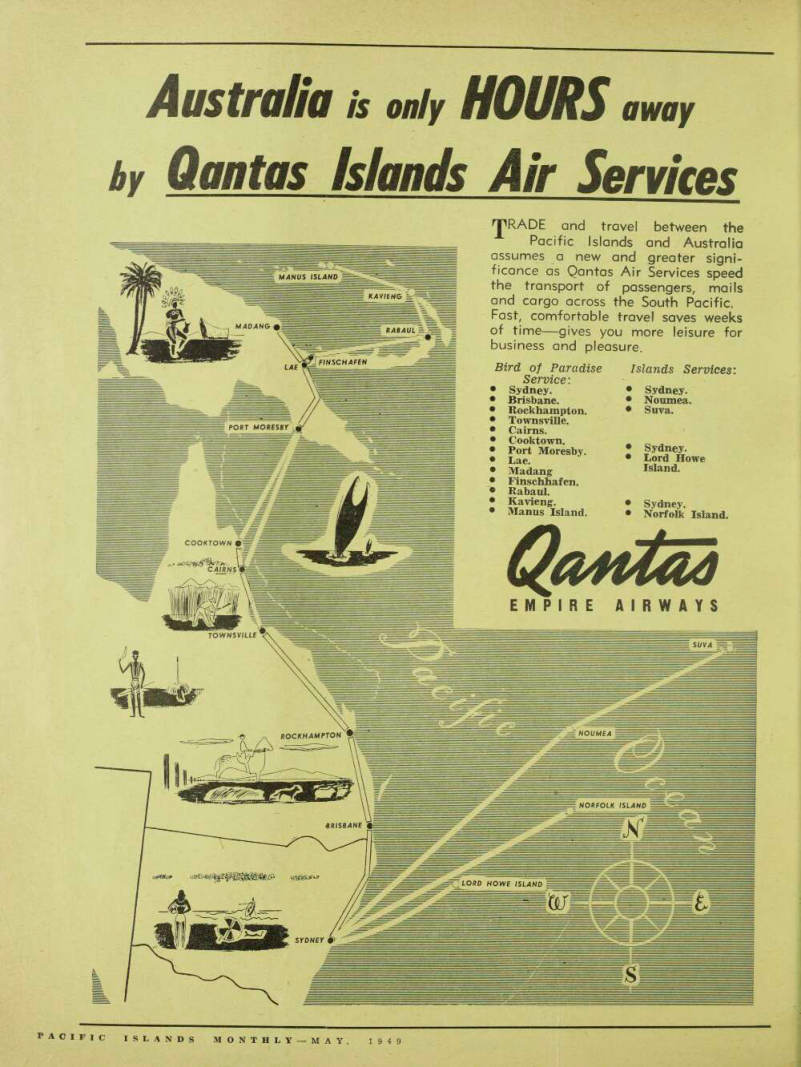
Australia is only HOURS away
by Qantas Islands Air Services
MANUS ISLAND
K A VIE NO
KIADANG m
RABAUL SJ
FINSCHAFEN
LAE
PORT MORESBY »
'J'RADE and travel between the
Pacific Islands and Australia
assumes a new and greater signi-
ficance as Qantas Air Services speed
the transport of passengers, mails
and cargo across the South Pacific.
Fast, comfortable travel saves weeks
Qcwtab
COOKTOWN • i
EMPIRE AIRWAYS
TOWNSVILLE
SUVA P*-
ft
Jm NOUMEA
ROCKHAMPTON
NORFOLK ISLAND
■BRISBANE
LORD HOWE ISLAND
SYDNEY 0
s
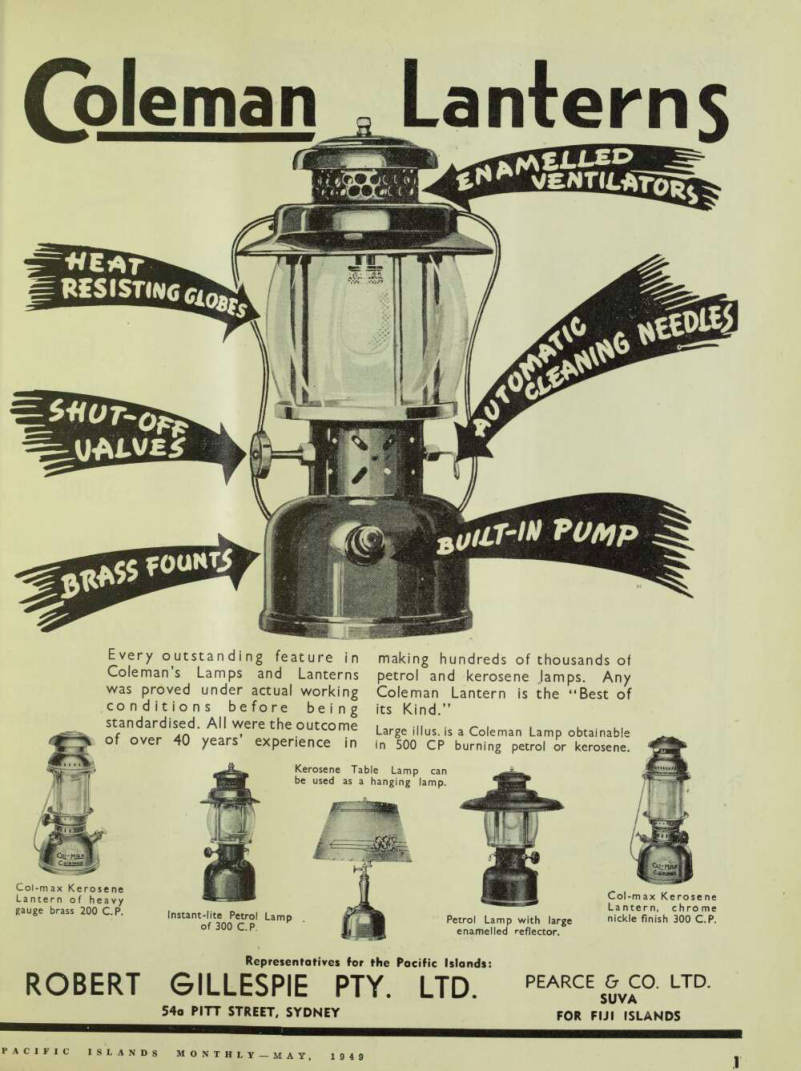
(oleman Lanterns
fh9 TT“ rn * L / tzL'm*
Every outstanding feature in
Coleman’s Lamps and Lanterns was proved under actual working conditions before being standardised. All were the outcome of over 40 years’ experience in making hundreds of thousands of
petrol and kerosene Jamps. Any
Coleman Lantern is the “Best of its Kind.”
Large ill us. is a Coleman Lamp obtainable in 500 CP burning petrol or kerosene.
Col-max Kerosene Lantern of heavy gauge brass 200 C.P. i Kerosene Table Lamp can be used as a hanging lamp.
Instant-lite Petrol Lamp of 300 C.P.
Petrol Lamp with large enamelled reflector.
Col-max Kerosene Lantern, chrome nickle finish 300 C.P.
Representatives for the Pacific Islands:
ROBERT GILLESPIE PTY. LTD
54a PITT STREET, SYDNEY
PEARCE & CO. LTD.
SUVA
FOR FIJI ISLANDS
7a 7a V,
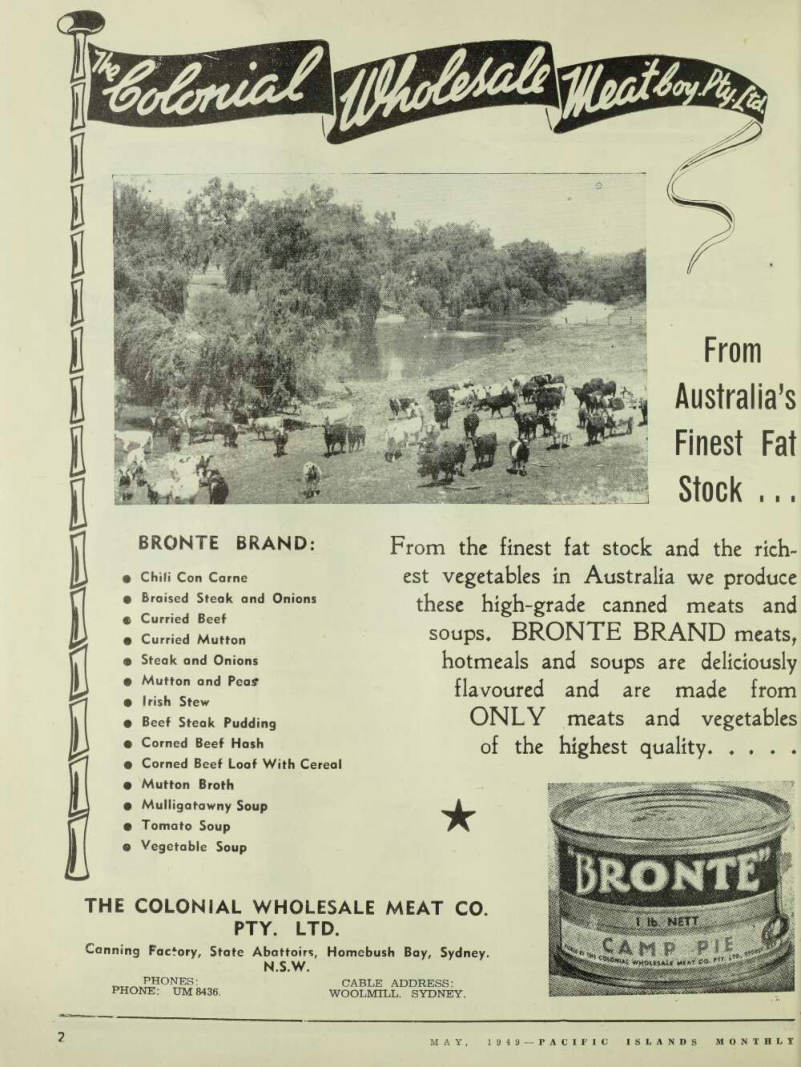
BRONTE
BRAND:
Chifi Con Came Braised Steak and Onions Curried Beef Curried Mutton Steak and Onions Mutton and Pea?
Irish Stew Beef Steak Pudding Corned Beef Hash Corned Beef Loaf With Cereal Mutton Broth Mulligatawny Soup Tomato Soup ® Vegetable Soup
From
Australia’s
Finest Fat
Stock
From the finest fat stock and the rich-
est vegetables in Australia we produce
these high-grade canned meats and
soups. BRONTE BRAND meats,
hotmeals and soups are deliciously
flavoured and are made from
ONLY meats and vegetables
of the highest quality. . . . ★
THE COLONIAL WHOLESALE MEAT CO.
PTY. LTD.
Conning Factory, State Abattoirs, Homebush Bay, Sydney.
N.S.W.
PHONES:
PHONE: UM 8436.
CABLE ADDRESS:
WOOLMILL. SYDNEY.
11 P P F re
Index to Advertisers
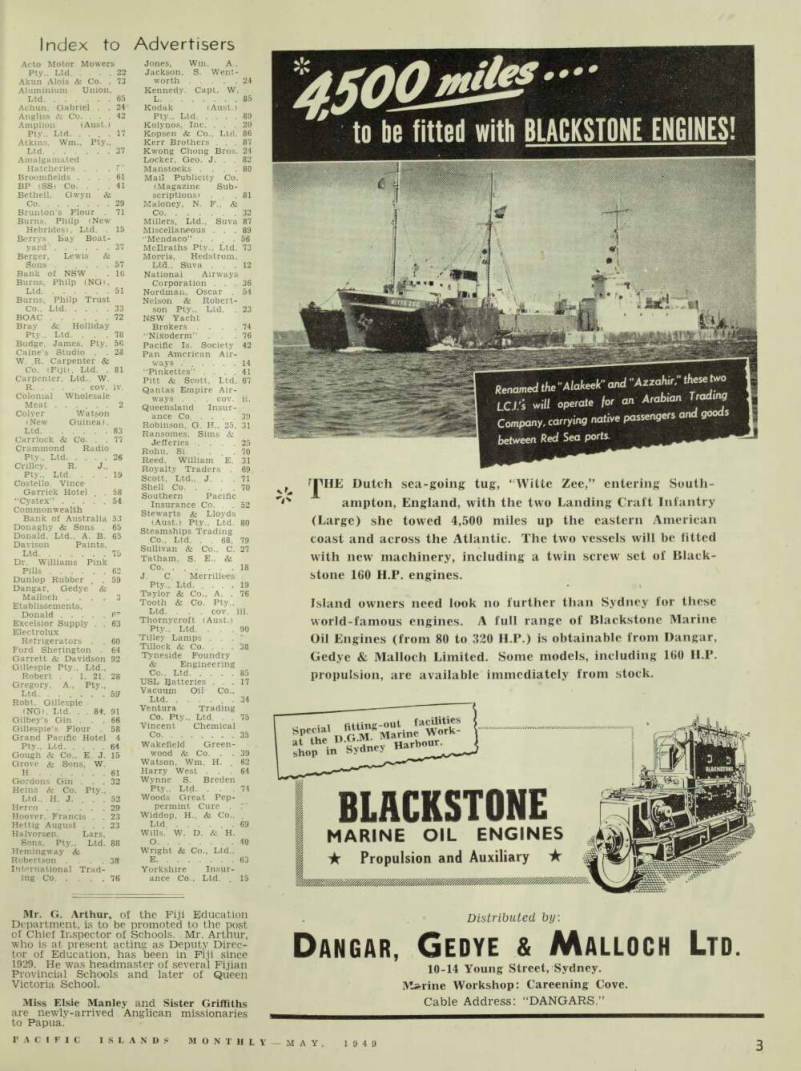
Acto Motor Mowers Pty., Ltd. ... 22 Akun Alois & Co. . 73 Aluminium Union, Ltd 65 Achun, Gabriel . . 24 Angliss & Co. ... 42 Amplion (Aust.) Pty.. Ltd. ... 17 Atkins, Wm., Pty., Ltd 37 Amalgamated Hatcheries . . . f Broomfields ... 61
Bp (Ssi Co. . 41
Bethell. Gwyn & Co 29 Brunton’s Flour . 71 Burns, Philp (New Hebrides), Ltd. . 15 Berrys Bay Boat yard 37 Berger, Lewis & Sons . . ... 57 Bank of NSW . . 16 Burns, Philp (NG), Ltd 51 Burns, Philp Trust Co.. Ltd 33
Boac ... 72
Bray & Holliday Pty.. Ltd. ... 78 Budge, James, Pty. 56 Caine’s Studio . . 28 W, R. Carpenter & Co. (Fiji). Ltd. . 81 Carpenter, Ltd.. W.
R cov. iv.
Colonial Wholesale Meat ... 2 Colyer Watson (New Guinea), Ltd 83 Carrlock & Co. . . 77 Crammond Radio Pty., Ltd 26 Crilley, R. J., Pty.. Ltd. ... 19 Costello. Vince Garrick Hotel . . 58 “Cystex” 54 Commonwealth Bank of Australia 53 Donaghy & Sons . 65 Donald, Ltd.. A. B. 65 Davison Paints, Ltd 75 Dr. Williams Pink Pills 62 Dunlop Rubber . . 59 Dangar, Gedye & Malloch ... 3 Etablissements, Donald P n Excelsior Supply . . 63 Electrolux Refrigerators . . 60 Ford Sherington . 64 Garrett & Davidson 92 Gillespie Pty.. Ltd., Robert . . 1. 21, 28 Gregory, A., Pty., Ltd. ... 59 Robt. Gillespie (NG). Ltd. . . 84. 91 Gilbey’s Gin ... 66 Gillespie’s Flour 58 Grand Pacific Hotel 4 Pty., Ltd 64 Gough & Co.. E. J. 15 Grove & Sons, W.
H 61 Gordons Gin ... 32 Heinz & Co. Pty., Ltd.. H. J. . . . 52 Herco 29 Hoover, Francis . . 23 Hettig August ... 23 Halvorsen. Lars, Sons. Pty.. Ltd. 88 Hemingway & Robertson ... 38 International Trad ing Co 76
Jones, Wm. A..
Jackson, S. Went worth 24 Kennedy. Capt. W.
L 85 Kodak (Aust.) Pty.. Ltd 89 Kolynos, Inc. ... 20 Kopsen & Co., Ltd. 86 Kerr Brothers ... 87 Kwong Chong Bros. 24 Locker, Geo. J. . . 82 Manstocks ... 80 Mail Publicity Co. (Magazine Sub scriptions) ... 81 Maloney, N. F., & Co 32 Millers, Ltd., Suva 87 Miscellaneous ... 89 "Mendaco” ... 56 McHraths Pty.. Ltd. 73 Morris, Hedstrom, Ltd., Suva ... 12 National Airways Corporation ... 36 Nordman, Oscar . 54 Nelson & Robert son Pty., Ltd. . 23 NSW Yacht Brokers . . . .74 “Nixoderm” ... 76 Pacific Is. Society 42 Pan American Air ways ... 14 “Pinkettes” ... 41 Pitt & Scott. Ltd. 67 Qantas Empire Air ways . . . cov. ii.
Queensland Insur ance Co. ... 39 Robinson, G. H., 25, 31 Ransomes, Sims & Jefferies ... 25 Rohu, Si ... 70 Reed. William E. 31 Royalty Traders 69 Scott, Ltd., J. . .71 Shell Co 70 Southern Pacific Insurance Co. . . 52 Stewarts & Lloyds (Aust.) Pty.. Ltd. 80 Steamships Trading Co.. Ltd. . . 68, 79 Sullivan & Co., C. 27 Tatham, S. E.. & Co. ... 18 J. C. Merrillees Pty., Ltd. ... 19 Taylor & Co., A. . 76 Tooth & Co. Pty..
Ltd. . . . cov. iii.
Thornycroft (Aust.) Pty.. Ltd. ... 90 Tilley Lamps . . . r Tillock & Co. ... 38 Tyneside Foundry & Engineering Co., Ltd 85 TJSL Batteries ... 17 Vacuum Oil' Co., Ltd . 34 Ventura Trading Co. Pty., Ltd. . . 75 Vincent Chemical Co 35 Wakefield Green wood & Co. . . 39 Watson, Wm. H. . 62 Harry West ... 64 Wynne S. Breden Pty., Ltd. ... 74 Woods Great Pep permint Cure .
Widdop. H.. & Co., .
Ltd. ... 69 Wills. W. D. & H. 0 40 Wright & Co., Ltd., E 63 Yorkshire Insur ance Co.. Ltd. 15
Mr. G. Arthur, of the Fiji Education Department, is to be promoted to the post of Chief Inspector of Schools. Mr. Arthur, who is at present acting as Deputy Direc tor of Education, has been in Fiji since 1929. He was headmaster of several Fijian Provincial Schools and later of Queen Victoria School.
Miss Elsie Manley and Sister Griffiths are newly-arrived Anglican missionaries to Papua.
Advertisements & other items, p. 5 (1 item)
Blackstone
T HE Dutch sea-going tug, ‘ Witte Zee,” entering Southampton, England, with the two Landing Craft Infantry (Large) she towed 4,500 miles up the eastern American coast and across the Atlantic. The two vessels will be fitted with new machinery, including a twin screw set of Blackstone 160 H.P. engines. • » Island owners need look no further than Sydney for these world-famous engines. A full range of Blackstone Marine Oil Engines (from 80 to 320 H.P.) is obtainable from Dangar, Gedye & Malloch Limited. Some models, including 160 H.P. propulsion, are available immediately from stock. a l fitting-out facilities I GM. Marine Work V Sydney Harbour.
MARINE OIL ENGINES
★ Propulsion and Auxiliary ★
Distributed by\
Dangar, Gedye & Malloch Ltd
10-14 Young Street, Sydney.
Marine Workshop: Careening Cove.
Cable Address: “DANGARS.”
In This Issue:
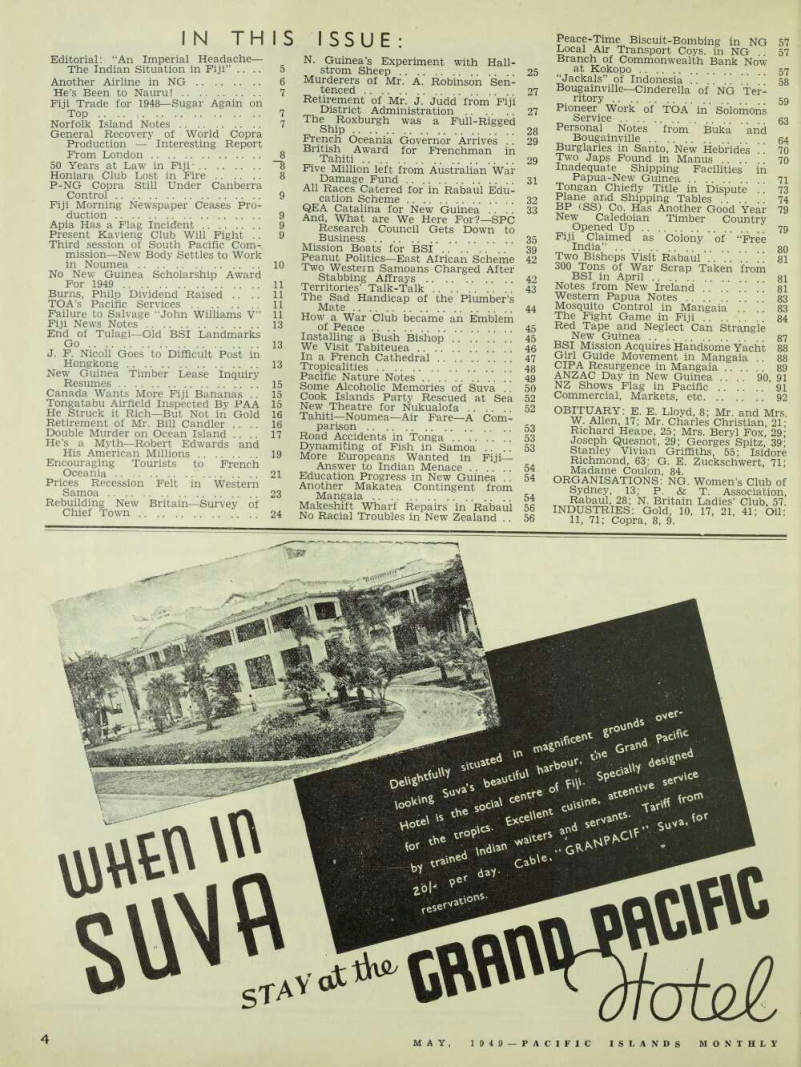
Editorial: “An Imperial Headache— The Indian Situation in Fiji” ... 5 Another Airline in NG 6 He’s Been to Nauru! 7 Fiji Trade for 1948 —Sugar Again on Top 7 Norfolk Island Notes 7 General Recovery of World Copra Production Interesting Report From London _8 50 Years at Law in Fiji- 8 Honiara Club Lost in Fire 8 P-NG Copra Still Under Canberra Control 9 Fiji Morning Newspaper Ceases Pro duction 9 Apia Has a Flag Incident 9 Present Kavieng Club Will Fight .. 9 Third session of South Pacific Com mission—New Body Settles to Work in Noumea 10 No New Guinea Scholarship Award For 1949 11 Burns, Philp Dividend Raised .. .. 11 TOA’s Pacific Services 11 Failure to Salvage “John Williams V” 11 Fiji News Notes 13 End of Tulagi—Old BSI Landmarks Go 13 J. P. Nicoll Goes to Difficult Post in Hongkong 13 New Guinea Timber Lease Inquiry Resumes 15 Canada Wants More Fiji Bananas .. 15 Tongatabu Airfield Inspected By PAA 15 He Struck it Rich—But Not in Gold 16 Retirement of Mr. Bill Candler ... 16 Double Murder on Ocean Island ... 17 He’s a Myth—Robert Edwards and His American Millions 19 Encouraging Tourists to French Oceania 21 Prices Recession Felt in Western Samoa 23 Rebuilding New Britain—Survey of Chief Town 24
N. Guinea’s Experiment with Hall strom Sheep 25 Murderers of Mr. A. Robinson Sen tenced 27 Retirement of Mr. J. Judd from Fiji District Administration 27 The Roxburgh was a Full-Rigged Ship . 28 French Oceania Governor Arrives 29 British Award for Frenchman in Tahiti 29 Five Million left from Australian War Damage Fund 31 All Races Catered for in Rabaul Edu cation Scheme 32 QEA Catalina for New Guinea ... 33 And, What are We Here For?—SPC Research Council Gets Down to Business 35 Mission Boats for BSI 39 Peanut Politics—East African Scheme 42 Two Western Samoans Charged After Stabbing Affrays 42 Territories’ Talk-Talk 43 The Sad Handicap of the Plumber’s Mate 44 How a War Club became an Emblem of Peace 45 Installing a Bush Bishop 45 We Visit Tabiteuea 46 In a French Cathedral 47 Tropicalities 43 Pacific Nature Notes 49 Some Alcoholic Memories of Suva .. 50 Cook Islands Party Rescued at Sea 52 New Theatre for Nukualofa 52 Tahiti—Noumea—Air Pare—A Com parison 53 Road Accidents in Tonga 53 Dynamiting of Fish in Samoa .. .. 53 More Europeans Wanted in Fiji— Answer to Indian Menace 54 Education Progress in New Guinea .. 54 Another Makatea Contingent from Mangaia 54 Makeshift Wharf Repairs in Rabaul 56 No Racial Troubles in New Zealand .. 56
Peace-Time Biscuit-Bombing in NG 57 Local Air Transport Coys, in NG .. 57 Branch of Commonwealth Bank Now at Kokopo 57 “Jackals” of Indonesia 53 Bougainville—Cinderella of NG Ter ritory 59 Pioneer Work of TOA in Solomons Service 53 Personal Notes from Buka ’ arid Bougainville 34 Burglaries in Santo, New Hebrides !70 Two Japs Found in Manus ... 70 Inadequate Shipping Facilities in Papua-New Guinea 71 Tongan Chiefly Title in Dispute .. 73 Plane and Shipping Tables 74 BP (SS) Co, Has Another Good Year 79 New Caledoian Timber Country Opened Up 79 Fiji Claimed as Colony of “Free India” go Two Bishops Visit Rabaul 31 300 Tons of War Scrap Taken from BSI in April gl Notes from New Ireland ... 81 Western Papua Notes 33 Mosquito Control in Mangaia .. .. 83 The Fight Game in Fiji ... 34 Red Tape and Neglect Can Strangle New Guinea 37 BSI Mission Acquires Handsome Yacht 88 Girl Guide Movement in Mangaia 88 CIPA Resurgence in Mangaia 89 ANZAC Day in New Guinea ... 90, 91 NZ Shows Flag in Pacific ... 91 Commercial, Markets, etc 92 OBITUARY: E. E. Lloyd, 8; Mr. and Mrs.
W. Allen, 17; Mr. Charles Christian, 21; Richard Heape, 25; Mrs. Beryl Fox, 29; Joseph Quesnot, 29; Georges Spitz, 39; Stanley Vivian Griffiths, 55; Isidore Richmond, 63; G. E. Zuckschwert, 71; Madame Coulon, 84.
ORGANISATIONS: NG. Women’s Club of Sydney, 13; P. & T. Association, Rabaul, 28; N. Britain Ladies’ Club, 57.
INDUSTRIES: Gold, 10, 17, 21, 41; Oil: 11, 71; Copra, 8, 9.
Advertisements & other items, p. 6 (1 item)
STAVtf^
ds ° ver * '" o r, tne
*>*. o( ff. *■**
* WR he soc>a' «** c 0 * lar tf ft**.**' , t^ e " e ° . se , c u ya.«° r rrOP' CS ‘ ,c r\f ’ ** e - U^w tr^ 6 C^' e ’ 7 or <W‘ t*\ k " ns
r es^°°
Pacific Islands Monthly
The Newspaper-Magazine of the South Seas
L Registered at the G.P.0., Sydney , for transmission by post as a newspaper ] Published Once Each Month and Circulated in Australia and New Zealand and in the following Pacific Territories and Islands Groups:
Australian Territory of Papua.
Trustee Territory (Australia) of New Guinea.
Australian Territory of Norfolk Island.
New Zealand Territory of Cook Islands.
Trustee Territory (NZ) of Western Samoa.
British Colony of Fiji.
British Solomon Islands Protectorate.
British Protectorate of Tongan Islands.
British Crown Colony of Gilbert and Ellice Islands.
Trustee Territory of Nauru.
British and French Condominium of New Hebrides.
French Colony of New Caledonia.
French Colony of Oceania (Tahiti, etc.).
American Territory of Eastern Samoa.
American Territory of Hawaiian Islands.
Owned and Produced by Pacific Publications Pty., Ltd., Union House, 247 George Street, Sydney.
Telephone: General Office and Advertising, BW 5037.
P.O, Box 3408
Registered Address for Telegrams, Radiograms, and Cables: “Pacpub,” Sydney.
Contributions.
Articles, Stories, and Photographs dealing with Pacific Islands subjects are invited and will be paid for on publication.
Subscription Rates.
Per Annum, Pre-paid, Including Postage.
In Australia. New Zealand, Fiji, New Guinea, Papua, Western Samoa, Cook Islands, Tonga, British Solomons, Gil bert and Ellice Colony, Nauru, and United Kingdom 15 o Elsewhere $3 18 0 Single Copies 1 g
Editor and Publisher:
R. W. Robson, F.R.G.S.
Assistant Editor: JUDY TUDOR.
General Office: Union House. 247 George Street Sydney. Telephone: BW 5037.
Advertising Manager: W. E. Rogers.
Representative In London.
J. T. Wallis, Coronation House, 4 Lloyds Avenue, London, E.C.3. from whom may be obtained copies of Pacific Islands Monthly.
Pacific Is. Year Book, advertising schedules, etc.
Representative In U.S.A.
Pacific Islands Trading Co.,
244 California St., San Francisco, U.S.A.
Agents.
The following are authorised to receive sub scriptions for Pacific Islands Monthly:— Burns. Phllp & Co., Ltd., and Burns Phllp (South Sea) Co., Ltd. All branches.
W. R. Carpenter & Co., Ltd. All branches.
Morris, Hedstrom, Ltd. All branches.
Steamships Trading Co., Papua. All branches.
W. M. Caldwell, Suva. Fiji.
Cook Islands Trading Co., Rarotonga. Cook Is.
Oscar Nordman, Papeete, Tahiti.
Islands Branches and Representatives of W. H.
Grove & Sons, Ltd., Auckland, New Zealand.
Ed. Pentecost, Noumea, New Caledonia.
Societe Gubbay Kerr et Cie, Noumea, New Caledonia.
Vol. Xix. No. 10.
May, 1949
r 1/6 Per Copy Price ] Prepaid, p.a.: 15/- Aus. ( In USA. p.a.: $3.
An Imperial Headache :: The Indian
Situation In Fiji
INDIAN journalists in India, and the editor of a newly-established Indian “Review” (published in Ehglish) in Fiji, have been using their pens lately in a cheeky and aggressive way, on the subject of Fiji. They have not contri buted much to a solution of the ever growing problem of what is to be done with the Indian community in Fiji.
The claim that the Indian community has some paramount interest in Fiji is so silly that it does not merit serious discussion. Yet, if these Indian journal ists are not checked with a recital of cold facts—they “babble like a Babu lawyer” —the tireless repetition of their claims may eventually make some impression upon uninstructed minds.
When the Fiji Islands were discovered, a primitive but very virile Melanesian people, numbering 200,000 or 250,000, had been strongly established there for cen turies. According to all international practice and precept, their title to the archipelago is unchallengeable. During the 19th century, the Fijians tried to carry on as a homogeneous nation in a world by then dominated by European ideas and customs. Failing in that, they sought the protection of a European Power; and, after two or three appeals to Britain, the Territory of Fiji was ceded to the British Crown.
In the 75 years which since have passed, Britain has most honourably carried out her pledges to the Fijians. The country has been developed; the native people have been helped in many ways to adjust them selves to a new and changing world— and in three directions, especially, they have reason to be grateful to the British: — • Because they had no inbred immunity
to , overseas diseases, their numbers de clined disastrously during the 19th cen tury, so that, after the ’flu epidemic in 1920, there were only 80,000 left. Under British care, the race has recovered, so that it now numbers 125,000, and is satis factorily increasing. • The British Government consistently has resisted all moves to alienate large areas of Fiji land, so that most of the cultivable parts remain the absolute pro perty of the natives. • The British, over the decades, with exemplary patience, have applied them selves to the task of teaching the Fiji people to govern themselves; and now they are reaping a reward almost beyond their hopes. Year by year, we have increasing evidence that the new generations of Fijians are capable of acquiring all the arts and crafts that are necessary for their maintenance as a free nation.
We need only continue and develop there our applied systems of health and education, and in another couple of de cades we shall see a great and growing proportion of the administration in the hands of native Fijians.
BUT into this simple and apparently practical plan there is now obtruded a factor which, if not checked, spells dislocation of the Colony’s economy, and great danger for the Fijians. The Indian community wants to dominate the colony and, perhaps, even tack it on to the newly-created India. The attitude of such sections of the Indians as are articu late is one of contempt and patronage to wards the Fijians, and of savage hostility towards the British. This does not make for peaceful conditions or happy prospects
within the Colony. Whence comes this noisy Indian demand?
The Colony’s economy revolves around sugar. The Indians were brought in to work the sugar plantations and mills, when the industry was established sixty years ago. It never was contemplated, at any time, that these indentured labourers should be allowed to remain in Fiji as colonists. But—just as was the case with Chinese labourers brought into Samoa and Tahiti and New Guinea—the horror of returning to their overcrowded Asiatic homeland created in the minds of these Indian labourers an overpowering desire to stay in the new country: and, one way and another, this undesirable and unnec essary foreign community was allowed to take root.
Certain British officials accepted the argument that the establishment of Indian peasant communities as cane growers would solve some of the Colonial Sugar Refining Co.’s major difficulties.
They may not be blamed for that—there was reason in the argument—but where they did display weakness and shockingly bad judgment was in permitting The entry to the Colony of swarms of small traders, artisans, lawyers and what-not, to cluster around the cane-growers in the sugar townships.
NEARLY all Fiji’s present-day political troubles spring from this section of the Indian community. The sugar workers generally are decent, peaceable, industrious folk, who create little trouble in Fiji, and would create less if they were left alone by the urban mischief-makers, and the unscrupulous agents of Indian nationalism.
Until very recent times, there always was the hope that the solution of the Fiji problem might be found in changes in the social conditions and mental outlook of the Fijian-born Indians. We placed much hope in a soundly-based education system for Indian children. There was no reason why the younger generations of these
people should not forget the traditions, inhibitions and warped social ideas of their Asiatic home, and became loyal citizens of a new country in the South Seas. Fundamentally, there is a world of difference between the Indian and the Fijian—among other things, there is nothing to show that the Indian can justly rule the people of another race.
But it was considered possible that, once his ancient background and associations were removed the Fiji-born Indian could get closer to the Fijian, to the advantage of both.
BUT all events of the last two years tend to make such a solution unlikely.
Britain, in honourable fulfilment of what she deemed to be a moral obligation, gave India her independence—something that would have been granted in this way by no other world Power, except the United States.
If the British expected to receive, in re turn, the gratitude and goodwill of the Indians, they already have been disil lusioned. Hatred of the British seems to be the outstanding quality of the new India’s foreign policy; and hostility, in solence, and non-co-operation towards the British Administrations are already mani fest in Natal, Mauritius, Fiji—wherever Indian communities have managed to get a foothold in the British Empire.
It is an irritating, disappointing thing; but at least we have now the proof that we were right in arguing that India was not fit for self-government, and that Indian politicians generally may not be trusted. All these little nastinesses of Indian politicians and journalists in Fiji merely give backing to our contention that in the name of justice and decency we cannot allow such people to have any authority whatever over the Fijian com munity.
BUT this means, unhappily, that we are farther away than ever from a solu tion of the problem. Yet the Fiji situation cannot be allowed to remain in definitely where it is. It is, however, only one of a hundred headaches in the British Empire; some of those headaches are far more urgent than our troubles in Fiji; and so we must be patient—Britain, in due time, will get around to this trouble, and deal with it.
Meapwhile, the British Colonial Office would be wise to remember that the Fijian people are growing up, and thinking for themselves. It is not a good policy to give the Indian top much liberty, because he turns it into license; and, in permit ting his arrogance and insolence, we may easily forfeit the goodwill and confidence of the Fijian, which we gained in seventy years of sound and ,just administration.
By the circumstances of his coming, by his deplorable record in the Pacific War, and by the nature of his present propa ganda, the Indian cannot lay claim to any fundamental rights in Fiji. He should be informed of that, officially, and point edly, and soon. It might put an end to the present obvious attempt, by Delhi
to get concessions out of the Britain’s bemused Socialist Government, in relation to Fiji, before the Socialists go to the poll, this year, for their inevitable defeat.
C. N. Sandford Receives
His Dso
ON March 15, in Melbourne, the Gover nor of Victoria formally handed the Distinguished Service Order to Flight Lieutenant C. N. Sandford —otherwise “Sandy," of Numa Numa Plantation, Bougainville, New Guinea. Mr. and Mrs.
Sandford returned home by April “Bulolo,” after three months in Australia, Mr. Sandford, with Mr. Raleigh Farlow (now DO in Bougainville) and Mr. Stan Tame, was among the first men from Bougainville to enlist in 1939. After RAAF training, he went to the South Pacific Area as a Liaison Officer with the American XIV Corps, during which time he was closely associated with the First Battalion of the Fiji Infantry. Prom October, 1944, until the end, he was with the AIB; and it was for his outstanding work with the AIB on Bougainville that he was awarded the highly coveted DSO.
His citation praises his courage and re source in leading native troops through the Bougainville jungles, in the course of which they inflicted severe losses upon the Japs.
His brother received both DSO and DFC for special services while commanding a Beaufighter squadron in the Pacific area.
Guinea
Another Airline In New
Effect of Socialism and High Price of Copra
LAE, April 30. * NEW freight and passenger air ser vice has been started in New Guinea by Guinea Air Traders, whose head quarters are at Lae. . . . . „ , The service is weekly, and it runs be tween Wewak (on the northern coast pf N?w Guinea mainland, near the Sepik an £ Kavieng the northern tip of New Ireland). Between those two Points, regular calls are made at Madang, Lae and Rabaul.
Qantas also run a regular plane over part of this route.. It starts from Lae, and flies to Manus via Rabaul and Kavieng.
New Guinea now is better served by a variety of airlines than it was 15 years ago, in the booming days of the goldfield, The gold industry has not recovered; but increasing production of copra, at a record price, is releasing a good deal of money, to pay for air transportation. The latter is more costly than shipping: but as the policy of the Australian Socialist admin istration is to discourage private enter prise in coastal shipping, while making a tragic muddle of Government-owned shipping and port facilities, the airlines are given a chance to flourish.
The Scots Have A Name For It
The threepenny piece has been restored to circulation in Fiji.
PROSPECTIVE TOURIST: Aye, Dugald, they tell me they have the three penny piece back in wee Fiji. Mon, it’s a real tourist attraction!
Advertisements & other items, p. 8 (1 item)
Handy Sydney Addresses
PACIFIC ISLANDS SOCIETY meets every fourth Wednesday of each month at History House, 8 Young Street. Sydney.
President: Major A. C. Swinbourne.
Tel.: XJ 3205.
NEW GUINEA WOMEN’S CLUB meets in
the Feminist Club Booms, 7th Floor, 77 King Street, every Thursday morning at 11; and approximately once each month in the evening.
POLYNESIAN CLUB OF SYDNEY meets
every Monday evening at 38 Clarence Street, Sydney (near Margaret Street).
Hon. Sec.: W. Byron. Polynesian visitors always welcome.
Pacific Travel Agency and Sydney office of Fiji Tourist Board—7th Floor. Union House, 247 George Street, Sydney.
BW 5037.
Production
General Recovery Of World Copra
Interesting Report From London Association
Prom a Special Correspondent
London, May 5.
ALL commodity markets in the United Kingdom have been confused and unsettled for some time, withou) any particular feature of interest to residents of the South Seas. However, the follow ing extract from the chairman’s report to the London Copra Association, whi:h will be presented at a general meeting this month, will be of interest to copra producers.
The chairman reports:—
Philippine Islands: A Year Ago I
reported to you the result of my investi gations, in the Philippines, of the causes of the bad shipments of Philippine co ra during the previous year.
I stated then that the best way in which buyers could protect their interests was to adopt the following course: By avoiding all shippers and sellers who are not regarded as of the highest standing and integrity.
By insisting on buying only on c.i.f. or c. & f. conditions, landed weights (at port of discharge) and on the terms of the London Copra Association Con tract.
It appears that buyers have adopted this course. In spite of very heavy fluc tuations, there have been very few reports of defaults by shippers during the past year. As a result of buyers’ nolicy of caution, business has been guided back again into the normal, regular channels and irresponsible elements have, very largely, been weeded out.
The most satisfactory feature of the past year has been the general agree ment by Philippine shippers to sell landed weights at port of discharge. The result has been remarkable and out-turns have improved greatly compared with the pre vious year. Many more transactions to Europe are now concluded on this Asso ciation’s contract which is very satis factory.
Shipments of copra during 1948 amounted to 625,600 tons. The consider able reduction from 1947 was due to the severe damage caused by the typhoon on Christmas Day, 1947. The greater part of the damage has been repaired through out the past year and we may confidently look to increased production from last year’s level.
SOUTH SEA COPRA; Production in Papua and New Guinea is continuing to improve and it has been estimated that this year’s production may reach as much as 60,000 tons, although the latest esti mate indicates that only 45,000 tons will be available for export.
Of this quantity, approximately 25,000 tons will be required by Australia and the rest will be taken up by the UK Ministry of Food. A nine-year contract has been concluded with the Ministry of Food—the price for 1949 is reported to be £4B Stg. per ton f.o.b. For each subse quent year the price must be agreed anew, but not less and not more than 10 per cent, of the price of the preceding year.
INDONESIA: Good progress in rehabi litation is continuing. You will remem ber that last year I estimated that ship ments in 1948 would reach 300,000 tons.
Actually, shipments were 238,400 tons, to which must be added 20,000 tons of coconut oil and also a further quantity of 100,000 tons of copra shipped from areas outside the Copra Fund control.
This makes a total of copra equivalent, shipped from Indonesia, around 370,'.00 tons. Exports in 1949 should exceed 400.000 tons from all parts of Indonesia.
During the first quarter of this year the Copra Fund in Batavia, which con trols the export of copra, had already sold 150.000 tons for shipment during 1949.
STRAITS: It will be lemembered that nearly a year ago a letter was addressed .to the Ministry of Food suggesting that all restrictions on the export of copra and coconut oil from Malaya be freed in order to increase the total exportable sur plus to any destination.
Action was taken on these lines in the middle of September, from which time Malaya was freed from all export restric tions. Total export of oil and copra, in terms of copra, amounted to 43,192 tons in 1948 compared with only 20,000 tons in 1947.
Due to the stricter control over all copra exports by the NEI Copra Fund since the second police action, it is feared that imports of Indonesian copra in'o Singa pore will be appreciably smaller,, and this in turn may cause a falling off again in Malayan exports.
CEYLON: As a result of the visit of the Minister of Commerce of Ceylon to London, a new agreement was reached between the Ministry of Food and the Government of Ceylon. The agreement supersedes the existing agreement in re spect of the period, July 1, 1948, to De cember, 1950. and provides that any quan tity taken by the UK during the period, July 1 to December, 1948, shall be at the price of £5O per ton of copra f.o.b. Ceylon ports.
Under the new agreement the price for a minimum quantity of 40,000 tons as oil in 1949 is based on a price of £55 per ton of copra f.o.b. Ceylon ports.
The price for 1950 is to be agreed on towards the end of 1949, in conjunction with negotiations for a long-term con tract, possibly for five years, to include the year 1950.
During the latter part of last year fair quantities of coconut oil were sold for export at high prices but since then Cey lon has not followed the general decline in the Philippines. Indonesia and Malaya, and no sales have been reported for a con siderable time.
Total shipments from Ceylon last year amounted to 54,461 tons as copra and 75,730 tons as oil. making a total, in terms of copra, of 174,667 tons. It is feared that as a result of a period of severe drought in Ceylon at the end of 1948, shipments in 1949 will not exceed 120,000 tons in terms of copra. classes have been commenced bv the Education Department in Rabaul, NG.
Mrs. M. Byron and Miss Egan are con ducting classes in English and commercial subjects in the Chinese School, Mon day and Wednesday. Although primarily for Chinese residents, Europeans or Malays may also attend.
Late News Items
Mr. H. E. Maude
NOUMEA, May 11.—Mr. H. E. Maude, who originally was appointed Deputy Sec retary General of the South Pacific Commission, has been made a full-time member (Member for Social Development) of the Research Council. He has been acting in that capacity since the Council was inaugurated.
Oh, For An Adequate Thirst!
AUCKLAND, May 11.—The Union Ex port Co.’s small motor vessel “Melva” sailed to-day for Port Moresby witn 93,000 bottles of beer, the product of two Auck land breweries. N.Z. beer is going to the Islands in increasing quantities. Owing to local industrial conditions, the well known Australian breweries, like Tooth & Co., Ltd., and Carlton United, which formerly held these markets, have diffi culty in arranging shipments.
Not Enough Ships
APIA, May 7. —Western Samoa copra is accumulating here. The ships which nominally come in to load copra are gen erally nearly full when they arrive.
Fruit For Nz
SUVA, May 12.—The Fiji Banana Board plans considerable extension of banana shipments to NZ when the new Union SS Co.’s “Tofua” (5,300 tons) comes into commission in 1951.
RAROTONGA, May 6. —By the time the new “Tofua” comes into service, Raro tonga will be ready to quadruple its orange exports to N.Z.
N.G. Club Restored
RABAUL, May 12—Premises of New Guinea Club, attractively reconstructed, will be opened shortly.
Waterhouse Memorial
RABAUL, May 12 —In formal ceremony to-day, a plaque was affixed to Nodup native village school naming it “J. H. L.
Waterhouse Memorial School,” in honour of the man who did splendid service in the thirties in connection with native education.
Drunken Natives
RABAUL, May 6.—The District Court sent 21 natives to hard labour for six months for drunkenness.
Anglican Church In Rabaul
RABAUL. Mav 12.—Bishop Strong of Papua, and Bishop Caulton, of Melan esia, and a representative meeting decided that New Britain should be rem oved from Anglican Diocese of Melan esia and attached to the Diocese of Papua. Rabaul hitherto has been under control of the Solomons church; but communications are difficult.
Phenomenal Rainfall
SUVA. May 5. No less than 14.5 inches of rain fell in 24 hours.
There was considerable flood damage, especially to copra and coconut meal at the Island Industries’ mill.
SUVA, May 14. —The sub-chaser which was picked up at sea in Februarv, 1948, with Mr. R. E. Johnson aboard, and towed 100 miles to Suva, has been converted into a trading ship for the Suva-Lau Islands, named the “Purple Sea,” and has left on her first trip.
Boom Over In Fiji, Too
SUVA, April 25.
THE indications all point to the fact that business, as far as shopkeepers concerned, is not what it used to be in the Suva area.
A pre-Easter boom is reported to have been followed by a slowdown which has affected businesses as far apart as Indian tailors and hotels.
People spend in spasms but the imme diate post-war era of sustained buying has ended.
He’S Been To Nauru!
Minister’s List of Promises To
Complaining Chiefs
AS reported in April PIM, the Aus tralian Acting Minister for Terri tories went off on a hurried visit to Nauru at the end of March, because it was reported that the Nauru native chiefs proposed to complain to the Trusteeship Council about Australian Administration.
When he returned, about a month later, Mr. Chambers reported that he had made the following promises to the Council of Chiefs: • Construction of 250 houses, work on 12 of which has already begun. • A complete review of the Nauruan system of education, including advanced secondary training. • Clinical examination, in a drive to prevent and wipe out tuberculosis. • Expansion of the training scheme for medical staff and appointment of a dentist. • Review of wages and working con ditions of natives and Europeans. • The island’s sanatorium and lepro sarium to be improved immediately, and the hygiene and sanitation campaigns intensified. • The payment of war damage com pensation to Nauruans to be discussed with the Prime Minister.
The Council of Chiefs undertook not to proceed with their petition to the Trusteeship Council.
Mr. Chambers expressed the opinion that the housing and education systems on the Island were unsatisfactory, sug gesting that Australia was open to censure by the Council. He also said that the term of the present Admini strator, Mr. Ridgway, expires in August.
He said nothing about another appoint ment.
Editorial Note
THE implication apparently is that Mr Ridgway placed Australia in an in vidious position and that this en ergetic Minister, by devoting a whole month of his precious time to an unex pected scamper to Nauru, has saved Australia from embarrassment and censure by the lords of the Trustee Council. The facts are that: (a) the Nauruan natives, as a result of the royal ties they draw from Nauruan phosphate, are among the richest natives in the Pacific: (b) they are exceedingly well treated, and could not sustain any appeal to the UNO instrumentality—which should not be taken too seriously, any way; (c) the spectacle of an Australian Minister grovelling in this way to the Nauruan chiefs is not exactly elevating: and (d) Mr. Ridgway is an experienced officer of good reputation who should not be condemned out of hand by any pere grinating junior Minister who has never had one hour’s practical experience of tropical administration.
Mr. E. V. O’Brien, of Madang, NG, who had a strenuous time during the war, and who has not spared himself in the management of his five plantations since 1945, was taken south bv Mrs. O’Brien in April and placed in Helenie Hospital, Randwick, Sydney, to get attention to a wonky heart. Like many other old timers of the Territories, he refused to believe that the years take toll of every one. It is expected that a few weeks in hospital will put him squarely on his feet again.
Fiji Trade For 1948
Sugar Again Tops Exports
FIGURES recently released in Fiji show that sugar again headed Fiji’s ex ports for the year 1948. The value of the 149,494 tons of raw sugar and 25,402 tons of molasses was over 4 1 million pounds.
Other exports, in order of value, were: —
The value of the Colony’s total over seas trade in 1948 was £13,734,346. Goods valued at just under six million pounds were imported. Exports were valued at £7,789,512.
£ Copra and Coconut Products .. 1,807,485 Gold and Silver Bullion .. .. 1,019,614 Canned and Fresh Pineapples 129,588 Bananas 94,996 Biscuits 34,960 Hides 12,601 Trocas Shell 7,177 Beche de Mer 3,423 Raw Rubber 2,745 Timber 1,886
Congratulations For Sir
Henry Milne Scott
ONE of Fiji’s leading citizens, Sir Henry Milne Scott, KC, recently was enter tained at a special dinner in Suva, to mark the completion of 50 years of ac tive work as a lawyer in that Colony. He was admitted to the Bar in Fiji in 1899, and took silk in 1912.
Sir Henry is a distinguished student of constitutional law. In August last, in Suva, three hours before the judgments were delivered, he gave the editor of “PIM” an almost exact forecast of the verdict of the High Court in the Aus tralian Bank Nationalisation case.
Despite a busy and very successful pro fessional life, he has given much public service to Fiji; and he still is active and alert. His father, the late Mr, William Scott, founded the well-known legal firm in Levuka in the early 70’s, and was closely associated with the cession of Fiji to the British Crown. He died in 1898, and the practice was taken over by his youngest son (now Sir Henry), then only 22. Sir Henry’s son, Mr. Maurice Scott, who won distinction in World War 11, is now also a well-known legal practitioner in Fiji, and is taking a prominent place •in public life.
Fiji Golfers
Members of Fiji’s Vatukoula Golf Club Committee, photographed by H. J. Pollock; (standing): A. Miller, R. Ward, N. Rasmussen; (seated): N. E. Neilsen, D. T. Mitchell, L.
Abel, P. Dunlop.
Norfolk Is. Notes
By Vernon Wheatley
/Congratulations: To Mr. And Mrs.
Most of the Island attended either the garden party or the social evening.
The guest-list would fill a “PIM” page The Administrator attended the informal gathering in the evening and many musical items were enjoyed.
PITCAIRN: Mrs. and Miss Warren spent a couple of weeks on the Island visiting friends and relations. They were holidaying in NZ and took the oppor tunity of coming to Norfolk, before re turning to Pitcairn.
ANZAC DAY: Was observed by a gathering of ex-Servicemen, a band of school children and other interested residents. Wreaths were placed on the Memorial by the Administrator, the presi dents of the Advisory Council, RSS and AILA and others. t FORESIGHT: We are to have electric light soon. The generator, diesel-powered, is on order in England. A census shows 90 per cent, of residents in favour.
BACCHUS: The Liquor Bond Store in stead of being open half days on Mon days, Wednesdays and Fridays, will now be open only on Fridays, and will be closed when vessels are in “port.” It is reported that this peculiar arrangement came into being because someone ap proached Canberra and said that an open Bond Store was not conducive to the rapid handling of cargo. The change has aroused anger and indignation.
TOURISTS from NZ complain that the Socialists there seem to be placing difficul ties in the way of people who desire to spend holidays outside of NZ. The over seas peregrinations of the politicians—at the country’s expense—suggest that over seas travel will shortly become an ex clusive political privilege. But November 1949 (NZ elections) may see a change.
WHISPERED—That Qantas is propos ing the erection of an accommodation house.
ROOFING and tank iron was recently released to the public. It was of a light gauge and salt-corroded, and definitely not cheap. Nevertheless, it was welcome— but there was no flat iron for the tons and bottoms of the tanks!
BLACKMARKET—You can get all the
cement you want from NZ, if you care to pay 17/6 per bag, plus freight. It looks as if my wooden steps will remain wooden for some time.
WOULDN’T IT?—I recently read a contradictory article on “lonely Pitcairn.” In one breath, the author stressed the isolation of Pitcairn (Nor folk’s “Mother Country”). In the next breath he stated that 22 ships visited the Island in 25 weeks. Norfolk’s quota just now is about 22 ships in 4 years. Just as well we have an air service.
The Rev. A. T. Hill, Angli can Mission, Papua, is to spend his leave in the UK.
Tng Copra
Still Under Canberra Control
ALTHOUGH many inquiries have been made, New Guinea copra interests still are unable to obtain clarification of the intentions of the Australian Gov ernment in relation to New Guinea’s major industry. (See article on page 4 of April “PIM.”) The copra producer, as from January 1, is receiving £4B Australian from the Production Control Board, at main Terri tory ports. The British Ministry of Food is taking over, as at the same points, all the copra the Australian Government can spare, at £4B sterling.
The difference between £4BA. and £4B stg. is £I2A, We inquired at Canberra what became of the £l2, and were offi cially informed by the Department of Ex ternal Territories, on April 14 (G. 183.1.2), that the sum is accounted for as follows: Australian Currency Storage, handling, selling commission, insurance, shrinkage, etc 3 8 6 Account stabilisation ... 500 Account Customs Duty 311 6 Producer, on delivery ex ship’s slings from inter island vessels, or into Board’s warehouse when de livery is by road, at main Territory ports 48 0 0 60 0 0 £6O Australian, of course, is equal to the £4B Stg. which the Production Control Board receives from Britain.
Copra authorities, commenting on these figures, say that both the £3/8/6 for charges, and the £3/11/6 for export duty are excessive; and neither the planters nor anyone else knows anything about the so-called Stabilisation Fund.
THE Fund was instituted by Minister Ward, when Civil Administration was resumed, as a means of “cu shioning” price recessions, which seem to come periodically to the copra industry.
Up until the end of 1948. £8 per ton was deducted from planters’ returns, and credited to a Stabilisation Fund; but no one—planter, politician or pressman— could find out from the bureaucrats the amount of the Fund, what was being done with it, and how it was proposed eventually to dispose of it.
It was presumed, when the new ar rangement with Britain, under a nine years’ guarantee, was entered into—this being tantamount to stabilisation of the market—that the Fund would disappear.
The Acting Minister for Territories told planters, informally, in New Guinea, that the Fund would be distributed to pro ducers in proportion to the quantity of copra they had sent in. But that was not officially confirmed.
When the new price was announced, in March, it was clear that some extra ordinary deductions were being made; and the Departmental figures which we now publish show that these deductions include £5 for stabilisation.
But there is nothing to show how the £5 was arrived at, where it goes and how it will be disposed of. It, and the other deductions, appear to be just arbitrary figures arrived at by some Minister or official, at his own sweet will. And there seems to be no way of appeal.
The cold fact of the matter is that the Australian Socialist Administration simply cannot bear to see the “emissaries of private enterprise,” the planters, getting anything like £6OA. per ton, and so they have devised this system of deductions.
The system probably will continue so long as the Socialists hold power.
Prom the New Guinea annual report for 1947-48, we learn that the Stabilisa tion Fund on June 30, 1948, was £137,573.
Assuming that copra has been delivered since that date at the rate of 40,000 tons per annum (deductions being £8 per ton in the second half of 1948 and £5 per ton since), the Fund must now be in the vicinity of £3so,ooo—quite a windfall if it is distributed pro rata among producers.
There is little hope of their getting this money under present conditions; but if there is a change of government in the next Australian elections, they should be able to count upon it.
IT will be remembered (see April “PIM”) that the PCB has been paying to pro ducers a delayed sum in respect of smoke-dried copra. But these prices have been adjusted only up to June 30, 1948. We inquired at Canberra about this, and have the following reply:— “Prices (for smoke-dried copra) from July 1 are tentative. Final prices in respect of the year 1948-49 will be de termined after the close of trading for that financial year.”
Which means that smoke-dried copra will be finally paid for in the latter part of 1949.
Although it was officially announced months ago that the Production Control Board would be abolished, and some new system of handling NG copra introduced, the PCB is still handling copra, and Can berra is silent concerning any change.
It is presumed that, if there is a change, such Government control as remains will be exercised by the Department of Agri culture’s Division of Production and Marketing, whose function is “Control of commercial plantations and native agri cultural projects, grading and market ing of produce.”
Fiji Morning Newspaper
Ceases Publication
THE “Oceania Daily News,” established over a year ago to provide Suva with a morning daily, and generally to advance the views of the European Elec tors’ Association, ceased publication at the end of March owing to labour troubles, and has not been re-started. It is understood that the plant is for sale.
A number of well-known men had in vested in the project, but a large part of the capital was found by Mr. J. P. Bayly, a well-known Fiji business man who has strong views in relation to political re form, and who is not afraid to spend his own money on the things he believes in.
Judged by its inability to get a quorum at its annual meeting, there is a recession of public interest in the European Elec tors’ Association. The following officers were elected early in April:— President, Mr. D, M. N. McFarlane; vice-presidents, Messrs. A. A, Ragg, J. P.
Bayly, H. B. Gibson, F. G. Archibald, F.
V. Dunstan; secretary, Mr. R. L. Barn father; auditor, Mr. B. Lawlor; committee, Messrs. K. A. E. Marlow, A. Groom, E.
M. Heatly, N. Levy, C. S. Phillips, H. N.
Murray, K. Witherington, J. B. Turner, D. A. Dunstan, J. B. Stinson, E. H. McEl wain, J. S. Rushton, W, J. Ragg, B.
Wakeham and T. F. Patton.
The Wrong Name
IT was stated in a paragraph on page 13 of the April “PIM’ that Societe Francaise des Nouvelles-Hebrides was a Company controlled by Maison Ballande of Bordeaux. We are advised that this is incorrect—the organisation referred to should have been Comptoirs Francaise des Nouvelle Hebrides. The first named corporation is under the control of the French Government.
Incident”
Apia Has A “Flag
Series of Remarkable Events Follows Darts Game
From Our Own Correspondent APIA, April 26.
TWO associate members of the Returned Servicemen’s Association, H. Krone and B. Brownlee, at the Clubroom and bar of the Association (the so-called USO HALL) late in April, when playing darts, inadvertently threw some darts at the new Samoan flag, suspended on the wall of the hall. The flag fell to the ground, and they tried to remove the darts.
The incident was reported to the two Fautua, the Hon Tamasese and Malietoa.
It caused excitement and criticism among Europeans and Samoans, par ticularly as some versions of the incident were greatly exaggerated.
A meeting of the State Council (which consists of the High Commissioner and the two Fautua) was called and for a time feeling ran high. It was argued that the action of the two Europeans constituted a deliberate insult to the new Samoan flag.
Both the Europeans, who are old resi dents, strongly denied that any insult or disrespect was intended. They stated that their action had been purely acci dental, and that they sincerely respected the new Samoan Government and its flag.
Both the executive of the Returned Servicemen’s Association and Messrs.
Krone and Brownlee appeared before the Council of State, and expressed their sin cere regret and tendered their apologies, which were accepted.
The High Commissioner, on April 23, broadcast an explanation of the incident over the Apia station, and asked the Samoan people to follow the good example of their leaders in accepting the apologies tendered and to consider the incident closed. The High Commissioner’s state ment was followed by the explanations and apologies of Messrs. Krone and Brownlee, broadcast in English and Samoan.
As a precautionary measure, the USO hall and bar were temporarily closed by the Police.
Present Kavieng Club Will
Fight
Petition For Winding-Up of Old Club Heard In June
ABOUT 25 people attended the meeting, in Kavieng, on April 16, with a view to resuming the activities of the Kavieng Club which were suspended (or terminated) at the time of the Japanese invasion in 1942.
The sole surviving trustee of the old Club has appealed to the Supreme Court of Papua-New Guinea for direction in disposing of the funds of the old Club.
The case is due for hearing in Port Moresby in June.
Some residents of New Ireland hold that the club activities were merely sus pended and that it never went out of business.
The most important decision at the meeting on April 16 was the motion that “the Kavieng Club now resumes its func tions which were interrupted by the Jap anese invasion of 1942 arid take appropri ate action to contest the petition for the winding up of same.”
The steps to be taken to contest the petition are being kept a close secret for the present.
Third Session Of S. Pacific Commission
New Body Settles To Work in Noumea
Noumea, May 9.
THE Third Session of the South Pacific Commission opened in Noumea, New Caledonia, on May 7, at
the recently-established permanent
headquarters of the Commission, with delegations in attendance from the six member nations Australia, France, Netherlands, New Zealand, United Kingdom, and the United States.
Governor-General Cournarie, of New Caledonia, welcomed the dele gations at the Commission head quarters in the Pentagon.
“The subject of your activities wakes a great feeling of interest among all the French population of the Pacific,” said the Governor-General.
“The co-operative research that you undertake, seeking the ways and means that could be used by the participating Governments to improve the living condi tions of man, and to promote along rational lines the economy of countries, is so closely related to the aims that France has always had in view in all the territories of the French Union, that we are bound to give you our fullest assis tance and to wish to play a useful part in the studies and research work that you are going to undertake. We are convinced that their outcome will be successful, not only because substantial advantages will come out of it, but mostly because the existence of your Commission will pro mote cultural intercourse between terri tories separated by large expanses of sea, and bring them to know, to understand and to appreciate each other better, and to achieve better work in common. Thus, outside of any political action, by a goodwill accomplishment, the South Paci fic Territories will play an honourable part in bringing peace throughout the world.”
M. R. Lassalle-Sere, Permanent Com missioner for Prance, as chairman of the Second Session, thanked the New Cale donia administration for its efforts in es tablishing the Commission at its Noumea headquarters, and praised the Secretary- General, the Secretariat and members of the Research Council, for the work they had accomplished.
Mr. J. B. D. Pennink (Netherlands Minis ter at Wellington, NZ, and Senior Commis sioner for the Netherlands) assumed the chairmanship of the Third Session, in conformation with the Commission policy of rotating the chairmanship to each member government in alphabetical order.
“All those who have come here from different parts are working for one com mon purpose—international co-operation in furthering the welfare of non-self governing peoples in the South Pacific,” said Chairman Pennink. He said that much investigation and research would have to be undertaken in several branches of science in the wide territory that the Commission has as its responsibility, while the Commission, at its home in Noumea, would have to build up its organisation, to form the basis of fruitful work and success in the future.
DELEGATION S present represented the member nations as follows:
Australia
Acting Senior Commissioner: Rev. Dr. J. W.
Burton, ex-President General Methodist Church of Australia.
Acting Commissioner: Dr. J. T. Gunther, Director Public Health, Papua-New Guinea.
Alternate Commissioner: Mr. T. A. Pyman, Officer
in Charge of South Pacific Section, Pacific Division, Department of External Affairs, Canberra.
Advisers: Mr. W. C. Groves, Director of Edu cation, Papua-New Guinea; and Mr. H. S.
Barnett, Australian Consul, Noumea.
Secretary: Mr. M. F. Manning, Acting Officer in Charge, International Convention and Re search Section, Department of Internal Territories, Canberra.
France
Senior Commissioner: M. Robert F. J. Lassalle- Sere, Inspector-General of Colonies.
Commissioner: M. Pierre C. J. Bonnard, Directeur du Cabinet du Haut-Commissaire de France dans le Pacifiquie, Noumea.
Adviser: M. Alfred H. Fourcade, Administrator of Colonies, Noumea.
Netherlands
Senior Commissioner: Mr. J. B. D. Pennink, Netherlands Minister, Wellington.
Commissioner: Mr. A. J. Beversluis, Senior Official at the Department of Social Affairs, Batavia.
Alternate Commissioner: Mr. G. P. K. van Eechoud, Resident Magistrate, Hollandia.
Advisers: Mr. A. H. Hasselman, Secretary, Netherlands Legation, Canberra; Mr. F.
Verkuyl, Netherlands Consul, Noumea.
Adviser-Secretary: Mr. J. Boerwinkel, Officer of the General Secretariat of the Government of Indonesia, Batavia.
New Zealand
Senior Commissioner: Mr. C. G. R. McKay, formerly Secretary of Department of Island Territories.
Commissioner: Lieut.-Colonel F. W. Voelcker, DSO, formerly Administrator of Western Samoa.
Adviser: Mr. R. Hunter Wade, Assistant Official Secretary, Office of the High Commissioner for New Zealand in Australia.
United Kingdom
Senior Commissioner: Sir Brian Freeston, KCMG, OBE, Governor of Fiji, High Commissioner for the Western Pacific.
Commissioner; Mr. H. H. Vaskess, CMG. OBE, formerly Secretary, Western Pacific High Commission.
Secretary: Miss A. Harcourt.
United States
Senior Commissioner: Dr. Felix M. Keesing, Pro fessor of Anthropology, Stanford University.
Commissioner: Mr. Orsen N. Nielsen, US Consul- General, Sydney.
Advisers: Dr. Douglas Oliver, Department of State, Washington: Mr. Robert R. Robbins, Department of State, Washington; Commander William J. Germershausen, Jr., USN.
Secretary: Miss Orpha Soine.
The Commission has a large and im portant Agenda, much of it representing submissions by the Research Council.
First Meeting of Research
Council
THE first meeting of the Research Council of the South Pacific Commission opened on April 30 at Noumea, with Dr. J. T. Gunther (part time member for health), Director of
Public Health, Papua-New Guinea,
elected as chairman for the confer ence.
The Secretary - General, W. D.
Forsyth, welcomed the members at the first session.
Full-time Research Council members present included: Prof. Dr. L. G. M. Baas Becking, Deputy Chairman; Dr. E. Massal, health: Dr.
H. G. MacMillan, economic development; H. E.
Maude, social development (acting). Part-time members in attendance were:— Dr. H. de Rook, health, Chief Medical Officer, NNGPM, Sorong, Netherlands, New Guinea; Lieut. L. A. Jachowski, USN. health, Head, Filariasis Research, Pago Pago, American Samoa (alternate for Capt. W. P. Stephens, USN); Dr. J. C. Lopdell, health, Chief Medical Officer, Western Samoa; Dr. F. Bugnicourt, economic development, Director. Institut Francais d’Oceanie, Noumea: Dr. Douglas Oliver, economic development, Department of State, Washington (alternate for Dean K. A. Ryerson); B. E. V. Parham, economic development.
Senior Agricultural Officer, Suva, Fiji; J. G. Crawford, economic development, Director Commonwealth Bureau of Agricultural Econo mics, Canberra, Maurice Grangie, social development, Director of Education, New Caledonia;
(Continued next page)
Turner-Mackenzie Wedding
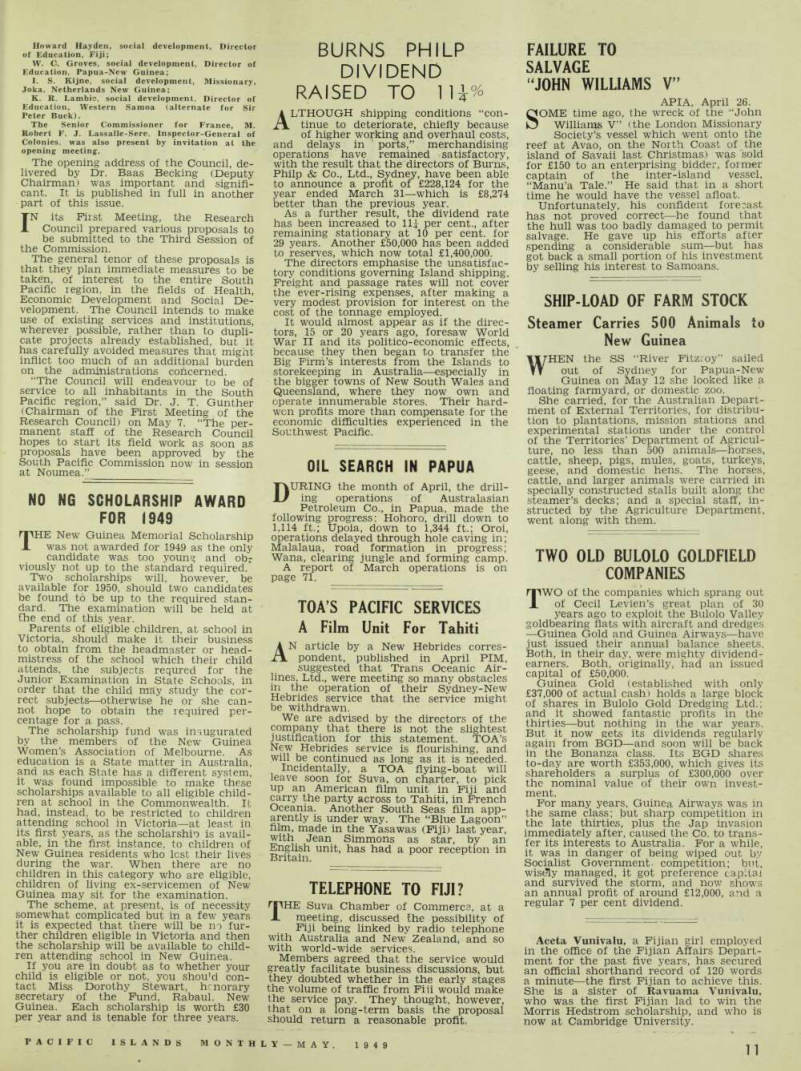
THIS photograph was taken at the wedding of Miss Pele Flora Mac kenzie, daughter of the late Gordon Hay-Mackenzie, of Wellington, NZ, and Mrs. Aggie Grey of Apia, Western Samoa, to Mr. Campbell H. Turner, of the Apia Broadcasting Station.
The bride’s mother is the well-known hotel owner of Apia.
The bride’s attendants were her sister, Mrs. Maureen White, of Sydney, who was matron-of-honour, and her cousin, Miss Nina Meredith, who was bridesmaid. Mr.
R. J. Mulligan and Mr. J. L. Anderson were best man and groomsman.
The wedding took place at the Catholic Rectory, Mulivai, Apia, where the bride was given away by her uncle, Mr. P. C.
Fabricius. One hun dred and twenty feet of tapa cloth were laid from the gates of the church grounds to the Rec tory and on this the bridal party walked to their cars. An evening reception for 350 guests was given by Mrs. Grey at her home at Vaisigane.
Mr. and Mrs. Tur ner will make their home in Wellington,
NZ, where Mr. Turner will be attached to the New Zealand Broadcasting Service.
BGD Returns
DURING April eight BGD dredges handled 1,170,960 yards of gravel for a total recovery of 6,620 ounces of fine gold.
Mr. George Waring, of the Fiji Lands Dept, has passed in three subjects of the first section of the examination for Licensed Surveyors of Australia.
Howard Hayden, social development, Director of Education, Fiji; W. C. Groves, social development, Director of Education, Papua-New Guinea; I. S. Kijne, social development, Missionary, Joka, Netherlands New Guinea; K. R. Lambie. social development. Director of Education, Western Samoa (alternate for Sir Peter Buck).
The Senior Commissioner for France, M.
Robert F. J. Lassalle-Sere, Inspector-General of Colonies, was also present by invitation at the opening meeting:.
The opening address of the Council, de livered by Dr. Baas Becking (Deputy Chairman) was important and signifi cant. It is published in full in another part of this issue.
IN its First Meeting, the Research Council prepared various proposals to be submitted to the Third Session of the Commission.
The general tenor of these proposals is that they plan immediate measures to be taken, of interest to the entire South Pacific region, in the fields of Health, Economic Development and Social De velopment. The Council intends to make use of existing services and institutions, wherever possible, rather than to dupli cate projects already established, but it has carefully avoided measures that might inflict too much of an additional burden on the administrations coricerned.
“The Council will endeavour to be of service to all inhabitants in the South Pacific region,” said Dr. J. T. Gunther (Chairman of the First Meeting of the Research Council) on May 7. “The per manent staff of the Research Council hopes to start its field work as soon as proposals have been approved by the South Pacific Commission now in session at Noumea.”
No Ng Scholarship Award
For 1949
THE New Guinea Memorial Scholarship was not awarded for 1949 as the only candidate was too young and obr viously not up to the standard required.
Two scholarships will, however, be available for 1950, should two candidates be found to be up to the required stan dard. The examination will be held at the end of this year.
Parents of eligible children, at school in Victoria, should make it their business to obtain from the headmaster or head mistress of the school which their child attends, the subjects requred for the Junior Examination in State Schools, in order that the child may study the cor rect subjects—otherwise he or she can not hope to obtain the required per centage for a pass.
The scholarship fund was inaugurated by the members of the New Guinea Women’s Association of Melbourne. As education is a State matter in Australia, and as each State has a different system, it was found impossible to make these scholarships available to all eligible child ren at school in the Commonwealth. It had, instead, to be restricted to children attending school in Victoria —at least in its first years, as the scholarship is avail able, in the first instance, to children of New Guinea residents who lest their lives during the war. When there are no children in this category who are eligible, children of living ex-servicemen of New Guinea may sit for the examination.
The scheme, at present, is of necessity somewhat complicated but in a few years it is expected that there will be no fur ther children eligible in Victoria and then the scholarship will be available to child ren attending school in New Guinea.
If you are in doubt as to whether your child is eligible or not, you shouM con tact Miss Dorothy Stewart, henorary secretary of the Fund, Rabaul. New Guinea. Each scholarship is worth £3O per year and is tenable for three years.
Burns Philp
Dividend
Raised To 11¼%
ALTHOUGH shipping conditions “con tinue to deteriorate, chiefly because of higher working and overhaul costs, and delays in ports,” merchandising operations have remained satisfactory, with the result that the directors of Burns, Philp & Co., Ltd., Sydney, have been able to announce a profit of £228,124 for the year ended March 31—which is £8,274 better than the previous year.
As a further result, the dividend rate has been increased to 11] per cent., after remaining stationary at 10 per cent, for 29 years. Another £50,000 has been added to reserves, which now total £1,400,000.
The directors emphasise the unsatisfac tory conditions governing Island shipping.
Freight and passage rates will not cover the ever-rising expenses, after making a very modest provision for interest on the cost of the tonnage employed.
It would almost appear as if the direc tors, 15 or 20 years ago, foresaw World War II and its politico-economic effects, because they then began to transfer the Big Firm’s interests from the Islands to storekeeping in Australia —especially in the bigger towns of New South Wales and Queensland, where they now own and operate innumerable stores. Their hard wcn profits more than compensate for the economic difficulties experienced in the Southwest Pacific.
Oil Search In Papua
DURING the month of April, the drill ing operations of Australasian Petroleum Co., in Papua, made the following progress: Hohoro, drill down to 1,114 ft.; Upoia, down to 1,344 ft.; Oroi, operations delayed through hole caving in; Malalaua, road formation in progress; Wana, clearing jungle and forming camp.
A report of March operations is on page 71.
Toa’S Pacific Services
A Film Unit For Tahiti
AN article by a New Hebrides corres pondent, published in April PIM, suggested that Trans Oceanic Air lines, Ltd., were meeting so many obstacles in the operation of their Sydney-New Hebrides service that the service might be withdrawn.
We are advised by the directors of the company that there is not the slightest justification for this statement. TOA’s New Hebrides service is flourishing, and will be continued as long as it is needed.
Incidentally, a TOA flying-boat will leave soon for Suva, on charter, to pick up an American film unit in Fiji and carry the party across to Tahiti, in French Oceania. Another South Seas film app arently is under way. The “Blue Lagoon” film, made in the Yasawas (Fiji) last year, with Jean Simmons as star, by an English unit, has had a poor reception in Britain.
Telephone To Fiji?
rpHE Suva Chamber of Commerce, at a X meeting, discussed the possibility of Fiji being linked by radio telephone with Australia and New Zealand, and so with world-wide services.
Members agreed that the service would greatly facilitate business discussions, but they doubted whether in the early stages the volume of traffic from Fiji would make the service pay. They thought, however, that on a long-term basis the proposal should return a reasonable profit.
Failure To
Salvage
“John Williams V”
APIA, April 26.
SOME time ago, the wreck of the “John Williams V” (the London Missionary Society’s vessel which went onto the reef at Avao, on the North Coast of the island of Savaii last Christmas) was sold for £l5O to an enterprising bidder, former captain of the inter-island vessel, “Manu’a Tale.” He said that in a short time he would have the vessel afloat.
Unfortunately, his confident forecast has not proved correct —he found that the hull was too badly damaged to permit salvage. He gave up his efforts after spending a considerable sum—but has got back a small portion of his investment by selling his interest to Samoans.
Ship-Load Of Farm Stock
Steamer Carries 500 Animals to New Guinea
WHEN the SS “River Fitzroy” sailed out of Sydney for Papua-New Guinea on May 12 she looked like a floating farmyard, or domestic zoo.
She carried, for the Australian Depart ment of External Territories, for distribu tion to plantations, mission stations and experimental stations under the control of the Territories’ Department of Agricul ture, no less than 500 animals —horses, cattle, sheep, pigs, mules, goats, turkeys, geese, and domestic hens. The horses, cattle, and larger animals were carried in specially constructed stalls built along the steamer’s decks; and a special staff, in structed by the Agriculture Department, went along with them.
Two Old Bulolo Goldfield
Companies
TWO of the companies which sprang out of Cecil Levien’s great plan of 30 years ago to exploit the Bulolo Valley goldbearing flats with aircraft and dredges —Guinea Gold and Guinea Airways—have just issued their annual balance sheets.
Both, in their day, were mighty dividend earners. Both, originally, had an issued capital of £50,000.
Guinea Gold (established with only £37,000 of actual cash) holds a large block of shares in Bulolo Gold Dredging Ltd.; and it showed fantastic profits in the thirties —but nothing in the war years.
But it now gets its dividends regularly again from BGD—and soon will be back in the Bonanza class. Its BGD shares to-day are worth £353,000, which gives its shareholders a surplus of £300,000 over the nominal value of their own invest ment.
For many years, Guinea Airways was in the same class; but sharp competition in the late thirties, plus the Jap invasion immediately after, caused the Co. to trans fer its interests to Australia. For a while, it was in danger of being wiped out by Socialist Government competition; but, wisely managed, it got preference capital and survived the storm, and now shows an annual profit of around £12,000, and a regular 7 per cent dividend.
Aceta Vunivalu, a Fijian girl employed in the office of the Fijian Affairs Depart ment for the past five years, has secured an official shorthand record of 120 words a minute —the first Fijian to achieve this.
She is a sister of Ravuama Vunivalu, who was the first Fijian lad to win the Morris Hedstrom scholarship, and who is now at Cambridge University.
Advertisements & other items, p. 14 (1 item)
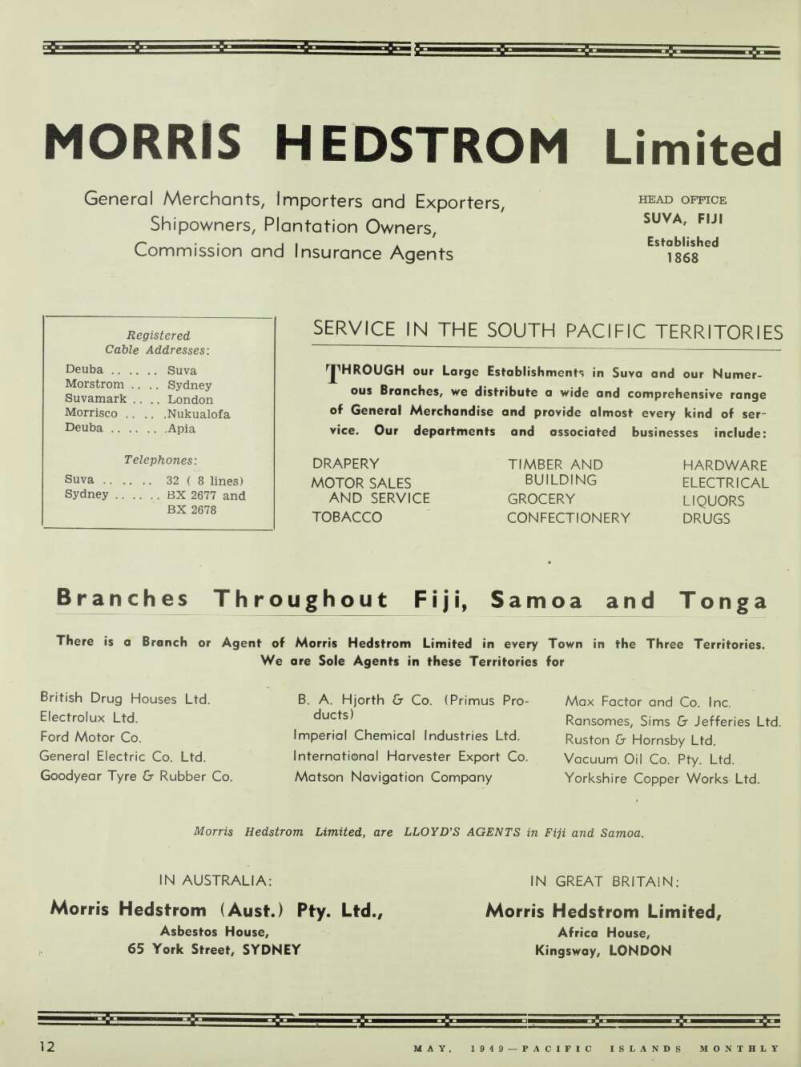
Morris Hedstrom Limited
General Merchants, Importers and Exporters,
Shipowners, Plantation Owners,
Commission and Insurance Agents
HEAD OFFICE
SUVA, FIJI
Established 1868
SERVICE IN THE SOUTH PACIFIC TERRITORIES
r I HROUGH our Large Establishments in Suva and our Numerous Branches, we distribute a wide and comprehensive range of General Merchandise and provide almost every kind of service. Our departments and associated businesses include:
DRAPERY
MOTOR SALES
AND SERVICE
TOBACCO
TIMBER AND
BUILDING
GROCERY
CONFECTIONERY
HARDWARE
ELECTRICAL
LIQUORS
DRUGS
Branches Throughout Fiji, Samoa and Tonga
or Agent of Morris Hedstrom Limited in every Town in the Three Territories.
We are Sole Agents in these Territories for There is a Branch British Drug Houses Ltd.
Electrolux Ltd.
Ford Motor Co.
General Electric Co. Ltd.
Goodyear Tyre Gr Rubber Co.
B. A. Hjorth £r Co. (Primus Products) Imperial Chemical Industries Ltd.
International Harvester Export Co.
Matson Navigation Company Max Factor and Co. Inc.
Ransomes, Sims Gr Jefferies Ltd.
Ruston Gr Hornsby Ltd.
Vacuum Oil Co. Pty. Ltd.
Yorkshire Copper Works Ltd.
Morris Hedstrom Limited, are LLOYD'S AGENTS in Fiji and Samoa.
IN AUSTRALIA: IN GREAT BRITAIN;
Morris Hedstrom (Aust.) Pty. Ltd., Morris Hedstrom Limited, Asbestos House, Africa House, 65 York Street, SYDNEY Kingsway, LONDON
Fiji News Notes
From Our Own Correspondent
Suva, May 2.
LAUCALA Bay (where the flying-boat base is situated at Suva’s side door) was deluged with 11.8 in. of rain be tween 6 p.m. and 8.15 p.m. on April 29.
The Suva town area reported 4.25 in. in the same period, and Walu Bay escaped with a mere 3.99 in.
In case of disbelief it is added that the Laucala Bay record was checked by two gauges. * The Union Company’s ship, “Matua,” took 12,803 cases of bananas and 1,810 cases of citrus fruit when she sailed from Suva for Auckland on April 30. The ship’s accommodation was filled to capacity and about 200 cases of fruit had to be left, * Twenty-five young Fijians at Canton Island, all of them employees of Pan American World Airways, have sent a gift of a large, handsomely mounted clock to the Jubilee Methodist Church. Suva.
The clock was brought to Fiji by plane
by one of the donors, Viliame Batibila, of Nadi, who presented it at the evening service on April 24.
Viliame described how the Fijians at Canton had formed their own choir and started their own church services, which are frequently attended by other Pacific Islanders and Americans at the island. * Mr. John Neil Falvey has been admitted as a barrister and solicitor in Fiji by his Honor, Mr. Justice Carew, at the Supreme Court, Suva. * Mr. D. M. N, McFarlane was elected Deputy Mayor of Suva at a special meet ing of the Town Council on April 26. * The death has occurred of one of the first Fijian women who trained as a nurse at the old hospital (now demolished) at Korovou, Suva. She was Fine Liku, wife of Samisoni Fotu, a very well-known Lauan Assistant Medical Practitioner.
Nurse Fine was a trainee as long ago as 1909. When she became seriously ill recently, she was brought from Loma loma, Lau, where her husband is stationed, to Suva by an RNZAF Cata lina flying-boat. She died at the Colonial War Memorial Hospital.
Among the representative gathering at the funeral were Lady Maraia, nurses of the CWM Hospital and medical students.
Nurse Fine, who was associated with various Fijian women’s organisations, in cluding the Matanisiga and the Ruve, is survived by her husband, three daughters and three sons, one of whom, Tevita Fotu, is an AMP. * Providing an excellent boost for the current campaign to organise Fijian amateur athletics for the coming British Empire Games in New Zealand and, later, the Olympics, a young Fijian, Mataika Tuicakau, in spite of a slippery ground and the lack of spiked shoes, put a 16i lb. shot 45 ft. 31 in. at an inter-school meet
ing at Suva. This compares more than favourably with the present Empire stan dards. * Members of Fiji’s Copra Board have been appointed as follows: —Mr. S. H. Wil son, MLC; Ratu George Toganivalu, MLC; Messrs. J. M. Hedstrom and W. G. John son (for two years); and Messrs. S. A.
Bull, C. H. Came, H. Petersen and Ulaiasi Bosabalavu (for one year). * Fiji Golf Club Associates elected the following officers at the annual meet ing:—Captain, Mrs. W. V. Banting; se cretary, Mrs. D. J. Warren; committee, Mesdames Leys, Olsen and Roth (re elected) .
The Fiji Basketball Association’s officers for 1949 are;—Patron, Lady 1 Freeston; president, Miss A. Naylor; vice-presidents, Miss Robertson, Mrs. Weaver, Mr. C.
Hokin; treasurer, Miss Bradley; secretary, Mr. Hokin; committee, one member from each team.
After less than two years of basketball in Fiji, the association has 26 teams (eight Fijian, nine Indian and nine Euro pean). ♦ After being crushed against the railing of the. Suvavou Bridge, near Suva, when a bus skidded on the bridge, an 11-year old part-European girl, Ania Rogers, died soon after her admission to hospital.
A 16-year-old Fijian student, Ratu Apenisa Veikoso, was killed when, cycling down the Bypass Road, Suva, he collided with a bus. ; The mounting toll of road accidents in the Suva area is causing serious concern.
Ng Women's Club Of
Sydney
The New Guinea Women’s Club, of Sydney, will hold a social function, commencing at 8 p.m., on June 10, in the Feminist Club Rooms, 77 King Street.
The Annual General Meeting of the Club will be held this year on the evening of July 22, at the same address.
End Of Tulagi
Old BSI Landmarks Go
From Our Own Correspondent HONIARA, April 14.
PRE-WAR the Capital of the Protec torate, post-war a Government station, and for the past four years the subject of controversy, Tulagi is now almost deserted.
Early this month the Government station was finally closed down and moved over to headquarters at Honiara, ter minating Tulagi postal facilities, district gaol, etc.
All that the Government will maintain there in future is a dispensary and dres ser, one auxiliary vessel and a small marine department to handle shipping repairs. Messrs. Carpenter retain their offices there. Qantas and TOA flying boats will base there, as formerly but customs duties and clearance of aircraft will be carried out by officers from Honiara.
Soon work will begin on pulling down the old Residency to provide materials for the new Residency, to be built shortly on a ridge overlooking Honiara. With a vast floor space of beautiful hardwood, to be laid down in the new Residency, the old Residency has been a Tulagi land mark since it was built in 1932. When Tulagi was flattened in the struggle be tween Americans and Japanese in August, 1942, the Residency remained intact— only damage being to a flight of steps from a near-miss bomb.
The Japs apparently found the old house quite comfortable when they briefly held Tulagi. Then the Americans used it as a club.
The old office buildings on the fore shore, which also miraculously escaped annihilation and were used during the war, are to be removed to help the cur rent material shortage.
J. F. Nicoll Goes to Hongkong
Very Capable Men for a Difficult Post
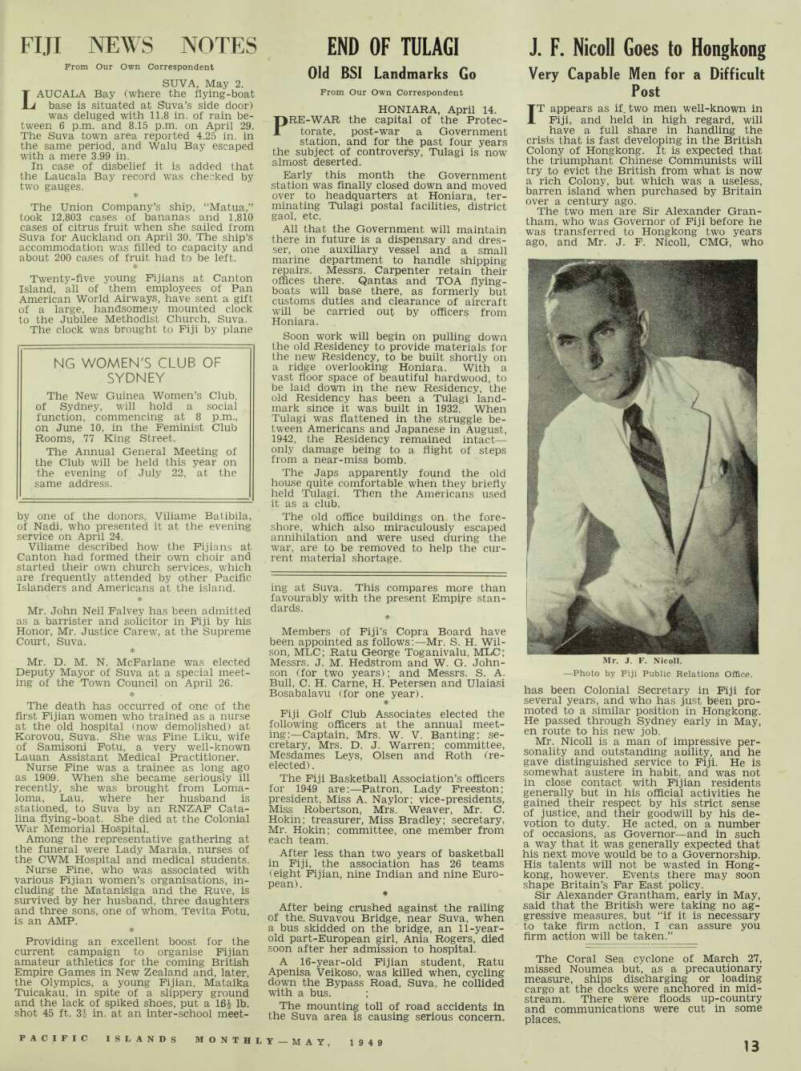
IT appears as if two men well-known in Fiji, and held in high regard, will have a full share in handling the crisis that is fast developing in the British Colony of Hongkong. It is expected that the triumphant Chinese Communists will try to evict the British from what is now a rich Colony, but which was a useless, barren island when purchased by Britain over a century ago.
The two men are Sir Alexander Gran tham, who was Governor of Fiji before he was transferred to Hongkong two years ago, and Mr. J. F. Nicoll, CMG, who
has been Colonial Secretary in Fiji for several years, and who has just been pro moted to a similar position in Hongkong.
He passed through Sydney early in May, en route to his new job.
Mr. Nicoll is a man of impressive per sonality and outstanding ability, and he gave distinguished service to Fiji. He is somewhat austere in habit, and was not in close contact with Fijian residents generally but in his official activities he gained their respect by his strict sense of justice, and their goodwill by his de votion to duty. He acted, on a number of occasions, as Governor —and in such a way that it was generally expected that his next move would be to a Governorship.
His talents will not be wasted in Hong kong, however. Events there may soon shape Britain’s Far East policy.
Sir Alexander Grantham, early in May, said that the British were taking no ag gressive measures, but “if it is necessary to take firm action, I can assure you firm action will be taken.”
The Coral Sea cyclone of March 27, missed Noumea but, as a precautionary measure, ships discharging or loading cargo at the docks were anchored in mid stream. There were floods up-country and communications were cut in some places.
Mr. J. F. Nicoll. —Photo by Fiji Public Relations Office.
Advertisements & other items, p. 16 (1 item)
Take the thrifty Clipper* way
m
to LONDON via u s
New low fare in pounds (no dollars needed) takes care of all transportation costs. Allows you sight-seeing stopovers in principal U.S. cities. wm 4 Si * % if « v o'S*'- 4 It one /\O/ t 327 tT\p
OnW *
tSB9
rov3n /\o/o P
Sydney
*rom Stop-over in lovely Honolulu . . . spend a day in San Francisco . . . sight-see in New York to your heart’s content! That’s the way you go when you fly by Clipper to London.
At no extra cost. And at new low fares.
The Flying Clippers take-off from Sydney every Tuesday, Friday and Sunday for San Francisco. You enjoy restful Sleeperette* service (no extra cost). And from New York, London-bound' Clippers cross the Atlantic daily.
For help with your Clipper trip, see your Travel Agent or . . . -o*6 Fiy,* * $ “SPEED YOUR PARCEL BY CLIPPER CARGO 99 Rue Jean Joures, NOUMEA Bank of N.S.W. Building , SUVA. \ *Trade Marks, Pan American Airwavs. Inc. s**
Mr. E. J. Ward
Discussion Before NG Timber Lease Inquiry
THE Australian Royal Commissioner (Mr. Justice Uigertwood) who is in quiring into the circumstan:es of the New Guinea “timber leases, 1 ’ so far as the case affects the integrity and admin istration of Mr. E. J. Ward, Minister for Australian Pacific Territories, resumed his sittings in Sydney on May 10.
All the evidence was submitted several weeks ago, and the Commissioner now is hearing the addresses of counsel.
Counsel assisting the Commissioner, Mr. Shand, KC, in his analysis of the evidence, declared that there was nothing to prove that Ward took a bribe in any shape or form, or that he had any guilty knowledge of the activities of the syndi cate (J. S. and Harcourt Garden, Ray Parer and Farrell). Mr. Shand also sug gested that the attitude and activities of the Queensland timber company (Han cock and Gore Pty., Ltd) contributed to the trouble.
Mr. Justice Ligertwood said that, if Mr.
Shand’s submissions were correct; • J. S. Garden might not be guilty of forgery (for which he was jailed). • But Garden might be deeper in the conspiracy of which he was acquitted.
Mr. Shand’s later argument contained a strong attack on Hancock and Gore Ltd., and their solicitor Mr. Biggs.
The inquiry had no: concluded when this journal went to press. There is no indication of when the report of the Commissioner will be presented to the Prime Minister. Meanwhile, although Mr. Ward has been relieved of his port folios and Mr. Chambers is acting as Territories Minister, Mr. Ward apparently still has the salary and status and some of the privileges of a Commonwealth Minister.
Canada Wants More Fiji
Bananas
Prom Our Own Correspondent
Suva, May 2.
THE Vancouver agents for Fiji’s banana exports to Canada are anxious to in crease the number of bunches shipped in the “Aorangi.” according to a report at a meeting of the Fiji Banana Board.
At least 1,500 bunches are wanted at Vancouver (an increase of 500 bunches).
It was pointed out that shipping space is available and that it is “eminently de sirable to develop this alternative market.”
The Colony’s banana-exporting in dustry is largely in the hands of Fijian growers and forms an important item in Fijian economy, particularly in areas
where there is no copra-growing.
After examining the financial return from past shipments to Canada (the buy ing price left little margin), the board increased the price paid to the grower from 4/- to 5/- a bunch and will review this price within three months.
New Zealand has been complaining about the frailty of Fiji’s standard banana case, and the board has decided on a trial shipment of 200 cases in a slightly smaller but stronger case.
The recent p*ice increase to growers of 6d. a case, to 6/6 (in Viti Levu), for New Zealand shipments was confirmed.
Tongatabu Airfield
THE Pan American air-liner, on its regular Auckland-Fiji run on April 21, was diverted to Tongatabu, in the Tongan group, in order that airline officials might examine the airfield there.
The Co. always has regarded Nausori field (near Suva) and Norfolk Island field as alternatives to Nadi (northwest Fiji) in the event of the latter being un available. Recently, however, Nausori has been under repair, and unavailable; ana, as a routine precautionary measure, it is proposed to place Tongatabu in the list of airfields that might be alternative to Nadi.
Monsieur Henri Lafleur, New Cale donian mining man, has had his term as Councillor of the French Republic, re presenting New Caledonia, renewed for a six year period. It was he who made the preliminary arrangements for a new in flux of Javanese workers into New Cale donia after proposals for Japanese,
Korean or Chinese workers had fallen through.
Advertisements & other items, p. 17 (1 item)
Insurance
THE
YORKSHIRE
CO. LTD.
(Incorporated in England)
ALL CLASSES OF
INSURANCE
Including Fire Motor Guarantee Accident Workers Marine Island Representatives:
PORT MORESBY: E. A. James
RABAUL: G. B. Black LAE: New Guinea Industries Ltd.
MADANG: R. MacGregor SUVA: Williams & Gosling Ltd.
NOUMEA: Y. Mortensen
NORFOLK ISLAND:
A. E. Martin
BURNS PHILP (New Hebrides) LTD.
Registered Office: VILA, NEW HEBRIDES
Branch Office at SANTO
I
Exporters, Importers and General Merchants
(Retail and Wholesale) Commission, Shipping
and Customs Agents
Representatives for BURNS PHILP TRUST COMPANY LIMITED, QUEENS- LAND INSURANCE CO., LTD., and LLOYDS OF LONDON. Agents for SOCIETE DES PETROLES SHELL DES ILES FRAN C AISES DU PACIFIQUE, and numerous overseas manufacturers of all classes of merchandise.
San Francisco Agents: Sydney Agents; Burns. Philp Co. of San London Agents; Burns, Philp & Co., Ltd.. Francisco, Burns, Philp & Co., Ltd., 7 Bridge Street. Matson Building, 35 Crutched Friars, E.C.3 215 Market Street.
P* I r* f \ Bond Street, Sydney, Australia ll* •V y J| V Tel. BU 2195. Box 3615 G.P.O.
SUPPLIERS OF GENERAL MERCHANDISE TO LEADING FIRMS THROUGHOUT THE
PACIFIC ISLANDS
Exporters ... Importers ... . Manufacturers' Representatives Bankers: Bank of N.S.W. Bank of Adelaide. Comptoir Nat. d’Escompte de Paris.
Cable Address; “SEAFOODS.” SYDNEY.
Codes: Bentley’s, 2nd and Comp. Phrase; A.8.C., sth and 6th; Peterson, 2nd and 3rd; Banking: Acme.
He Struck it Rich—But Not On Gold
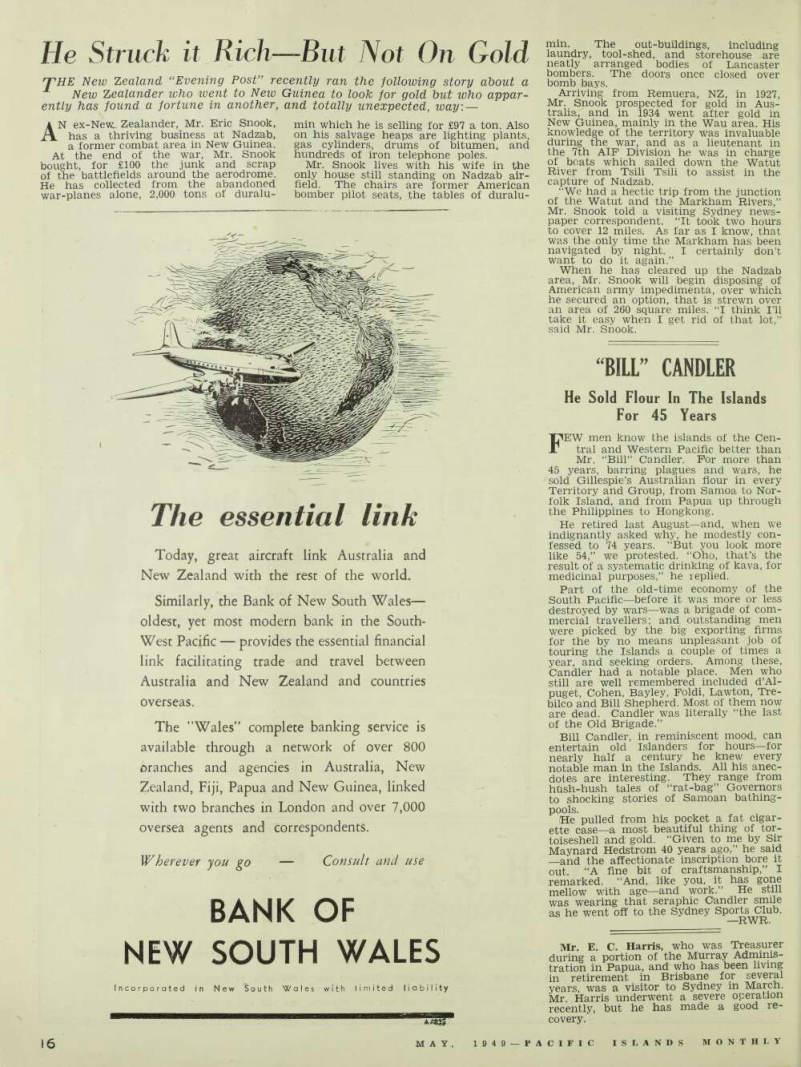
r PHE New Zealand “Evening Post” recently ran the following story about a New Zealander who went to New Guinea to look for gold hut who appar ently has found a fortune in another, and totally unexpected, way. —
AN ex-New- Zealander, Mr. Eric Snook, has a thriving business at Nadzab, a former combat area in New Guinea.
At the end of the war, Mr. Snook bought, for £lOO the junk and scrap of the battlefields around the aerodrome.
He has collected from the abandoned war-planes alone, 2,000 tons of duralu-
m in which he is selling for £97 a ton. Also on his salvage heaps are lighting plants, gas cylinders, drums of bitumen, and hundreds of iron telephone poles, Mr. Snook lives with his wife in the only house still standing on Nadzab air field. The chairs are former American bomber pilot seats, the tables of duralu
min. The out-buildings, including laundry, tool-shed, and storehouse are neatly arranged bodies of Lancaster bombers. The doors once closed over bomb bays.
Arriving from Remuera, NZ, in 1927, Mr. Snook prospected for gold in Aus tralia, and in 1934 went after gold in New Guinea, mainly in the Wau area. His knowledge of the territory was invaluable during the war, and as a lieutenant in the 7th AIF Division he was in charge of boats which sailed down the Watut River from Tsili Tsili to assist in the capture of Nadzab.
“We had a hectic trip from the junction of the Watut and the Markham Rivers,”
Mr, Snook told a visiting Sydney news paper correspondent. “It took two hours to cover 12 miles. As far as I know, that was the only time the Markham has been navigated by night. I certainly don’t want to do it again.”
When he has cleared up the Nadzab area, Mr. Snook will begin disposing of American army impedimenta, over which he secured an option, that is strewn over an area of 260 square miles. “I think I’ll take it easy when I get rid of that lot,” said Mr, Snook.
“Bill” Candler
He Sold Flour In The Islands For 45 Years
FEW men know the islands of the Cen tral and Western Pacific better than Mr. “Bill” Candler. For more than 45 years, barring plagues and wars, he sold Gillespie’s Australian flour in every Territory and Group, from Samoa to Nor folk Island, and from Papua up through the Philippines to Hongkong.
He retired last August—and, when we indignantly asked why, he modestly con fessed to 74 years. “But you look more like 54,” we protested. “Oho, that’s the result of a systematic drinking of kava, for medicinal purposes,” he replied.
Part of the old-time economy of the South Pacific —before it was more or less destroyed by wars—was a brigade of com mercial travellers; and outstanding men were picked by the big exporting firms for the by no means unpleasant job of touring the Islands a couple of times a year, and seeking orders. Among these, Candler had a notable place. Men who still are well remembered included d’Al puget, Cohen, Bayley, Foldi, Lawton, Tre bilco and Bill Shepherd. Most of them now are dead. Candler was literally “the last of the Old Brigade.”
Bill Candler, in reminiscent mood, can entertain old Islanders for hours—for nearly half a century he knew every notable man in the Islands. All his anec dotes are interesting. They range from hush-hush tales of “rat-bag” Governors to shocking stories of Samoan bathing
pools.
He pulled from his pocket a fat cigar ette case—a most beautiful thing of tor toiseshell and gold. “Given to me by Sir Maynard Hedstrom 40 years ago,” he said —and the affectionate inscription bore it out. “A fine bit of craftsmanship,” I remarked. “And, like you, it has gone mellow with age—and work.” He still was wearing that seraphic Candler smile as he went off to the Sydney Sports Club.
—Rwr.
Mr. E. C. Harris, who was Treasurer during a portion of the Murray Adminis tration in Papua, and who has been living in retirement in Brisbane for several years, was a visitor to Sydney in March.
Mr. Harris underwent a severe operation recently, but he has made a good re covery.
Advertisements & other items, p. 18 (1 item)
Bank Of
r>: xr ---
The essential link
Today, great aircraft link Australia and New Zealand with the rest of the world.
Similarly, the Bank of New South Wales — oldest, yet most modern bank in the South- West Pacific provides the essential financial link facilitating trade and travel between Australia and New Zealand and countries overseas.
The "Wales” complete banking service is available through a network of over 800 oranches and agencies in Australia, New Zealand, Fiji, Papua and New Guinea, linked with two branches in London and over 7,000 oversea agents and correspondents.
Wherever you go Consult and use
BANK OF
NEW SOUTH WALES
corporated in New South Wales with limited liability
■BBP
Double Murder
ON
Ocean Island
A CIVIL engineer employed by the British Phosphate Commission on Ocean Island, Mr. W. Allen, and his wife, were brutally murdered in their bungalow on the night of Thursday, April 28. No motive for the crime has been ascertained.
The man believed to be the murderer immediately took refuge in an almost in accessible part of the island—which is lightly wooded, but has an extremely broken surface. He was reported to be heavily armed.
Mr. Allen’s body was found beside his bed. The murderer apparently leaped on his back, and attacked him with great ferocity. Then, apparently, he attacked Mrs. Allen. Her body was found, horribly injured, on the floor of the lounge-room— a telephone was still in her hand. She evidently had tried to summon help when her husband was attacked.
There are no police on the island, and the male members of the white community of 80 immediately formed armed patrols.
Details were radioed to Administration headquarters, in Suva; and the High Commission, in turn, appealed to Australia for help. The freighter “Edenbark” was sailing up the Australian coast, bound for Nauru. She stopped off Brisbane on April 30, and three Queensland detectives joined her there, to be landed at Ocean Island about May 6 —representing a slight de viation from the course to Nauru.
Meanwhile, the Ocean Island community remained on guard.
Mrs, and Mrs. W. Allen were old resi dents of Ocean Island—Mr. Allen had been in the BPC service there for about
25 years. Mrs. Allen also, before she married, was in the BPC service at Ocean Island. Both were held in high regard—she was described by other Ocean Island women as “sweet and lovable.”
Mr. J. Garnett, aged 22, son of Mr. and Mrs. Claude Garnett of Suva, was found dead at Nadi airport on April 27, as the result of a gunshot wound. He was em ployed by Pan American Airways.
Bulolo Gold Dredging Limited
FOR the month of March, eight dredges, working in the Bulolo Valley, NO, handled 1,041,800 yards of gravel for a total recovery of approximately 5,592 ounces of fine gold.
The Rev. and Mrs. Coates, Methodist Mission, Papua, were on leave in Aus tralia in May.
Advertisements & other items, pp. 19-20 (1 item)
Ahipuoh
EXPORT QUOTAS AVAILABLE
FOR THE TERRITORIES OF
NEW GUINEA 8 PAPUA
AND THE ISLANDS OF THE PACIFIC
OF
U.S.L.
MOTOR CAR AND TRUCK
BATTERIES
Trade inquiries to:
U.S.L DISTRIBUTORS PTY., LTD.
KEMBLA BUILDING, MARGARET STREET, SYDNEY, N.S.W.
Cable Address: LAWSTRING, Sydney.
AMPLION PRIMING PUMPS
for Irrigation, Fire Fighting or other uses.
PRICE, £77/10/9, F. 0.8., Sydney. *
AMPLION 1 H P. ENGINES
So light a man can carry (40 lbs.).
RUNS 8 hours on a gallon of petrol. Used for DRIVING pumps, concrete mixers, cultivators, post borers, grinders, spraying equipment, wherever power is required.
AMPLION "AMPLITE"
LIGHTING PLANTS
Bring you brilliant Electric Light in your home, weekender, or farm. In 12 or 32 volt models. Low operating and first costs.
Treated for the Tropics.
PRICE, £65/12/6, F. 0.8.
SEND FOR FREE
LITERATURE BY
RETURN MAIL.
AhiPUOH
AUSTRALASIA PTY., LTD.
36-40 Parramatta Road,
Camperdown, N.S.W.
ENGINE ONLY
PRICE £36/0/6 F. 0.8.
Ample Spares Available. w:
MUBOm
PACIFIC
E j
25 years experience in in-
ternational trading enables
us to handle the innu-
merable details attached
to Export to-day. Our
efficient service provides
prompt shipment.
PRICES: Keenest available QUALITY: The highest INSPECTION: Prior to shipment PACKING: Special for Tropical Export
THE GREAT AUSTRALIAN
INDUSTRIAL CENTRE
★ MAC ROBERTSON—the great name in confectionery. Specially wrapped and packed for export to the Tropics, the famous “Old Gold”
Chocolates in i lb. Boxes, “Columbines” and “Milk Kisses” are now available for prompt shipment. ★ “TOM PlPER”—the name of goodness in fresh Canned Foods. The many Tom Piper products are in great demand in Australia for their superb, consistent quality. ★ ENAMELWARE in white and granite. High quality Stewpans, Pie Dishes, Plates, Mugs, Trays, Rice Bowls, Wash Basins, Chambers, Kettles, Tea-Pots, etc. ★ ‘‘DIAMOND” BATTERIES and Torch Refills. For longer life and economical service. i BROWN PAPER BAGS — all sizes from i’s to B’s in Long, Square and Side types.
Butter, Ghee, Soups, Canned Vegetables, Canned Meats and Sausages all varieties. Glucose, Honey, Jams. Canned Fruits. Fruit Cordials. Berry Syrups. Pickled Products. Patent Medicines.
Cast Iron Pots and Boilers—Cast Aluminium Ware—Kerosene Pressure Lamps and Cookers— Electric Immersion Heaters—Automobile Accessories—Steel Fencing Posts.
Your valued orders and inquiries should be placed with your own representative in Australia, other-
wise direct with us.
S. E. TATHAM & COMPANY
178 Collins Street
MELBOURNE - AUSTRALIA
Established 1924 Cables "SET" Melbourne
He’S A Myth!
Robert Edwards, His Millions, And A Norfolk Is. Claim
A CIRCUMSTANTIAL story of how the Norfolk Island relations of the late Robert Edwards of New York were claiming a share of his Manhattan estate, said to be worth over £200,000,000, was published on page 6 of the April “PIM.”
It was a condensation of an article that had appeared in Australian newspapers.
We now have, received the following article by Claire Cox, of the United Press, written in New York early in May;— The ghost of Robert Edwards—a fabulous fellow who really never existed at all —is making one of his periodical calls at Surrogate’s Court, and he’s get ting a mighty frigid reception from the staid old judges.
Court officials thought, 15 years ago, that they had finally got rid of the trouble some little man who wasn’t there, and it was with no little consternation that they greeted his unheralded return, under the auspices of a portly Norfolk islander who hoes weeds in a convicts’ ancient grave yard.
Robert Edwards, you see, is a myth.
But authorities are beginning to think his ghost is very real. In the past 50 years, hundreds of persons have written to the Surrogate’s Court, which handles wills, declaring that they are the rightful heirs to the 850,000,000 dollars left by Robert Edwards, along with the ground on which the Empire State Building, the Woolworth Building, and the White House are built, and 40 precious acres of Manhattan.
The Court established definitely long ago that there never was a Robert Edwards—at least, not a Robert Edwards with all those assets. They thought the myth had been destroyed when the late Franklin D. Roosevelt, as Governor of New York, issued a statement telling claimants they were barking up the wrong family tree.
But then came a letter from Norfolk Island, from Vic Edwards, 48, a graveyard caretaker, who wrote on behalf of himself and his 75-year-old father, Charles, who cultivates bean seed for export to Aus tralia. Edwards said that he and his father definitely were the heirs to all that wealth, although their documents proving it have disappeared.
“That’s the way it goes,” said deputy clerk William V. Pickett. “They haven’t a leg to stand on.”
Pickett said people write in all the time claiming they are heirs to about a dozen mythical estates, and that all of the claims are about the same. The mys terious thing about it is that a lot of letters will come from one part of the world one year, and another part the next, and knows how the legend ever
Creeper Is A Pest In
G. And E. Colony
VERY recently, a green creeping plant (Convolvulus ?) has appeared in the Gilbert and Ellice Colony and to day is growing rapidly over the scars of battle and old camp sites. There is little doubt that if left to itself it will oust the remaining small green vegetation.”
The foregoing is from “Polynesian Society’s Journal,” from an article by Mr.
I. G. Turbott, an officer of the G. & E.
Administration. It gives warning of a parasitical weed that may do much harm on those coral atolls where, already, the light vegetation—including the few food plants grown by the natives—is extremely limited.
Judge Ralph T. Gore and Mrs. Gore, of Papua-New Guinea, who suffered a serious blow in the death of their only
son, and who have been spending leave in Queensland, are expected back in Port Moresby about the end of May.
Advertisements & other items, pp. 21-22 (1 item)
M-Nivens
FOR ALL ISLAND SUPPLIES, FORWARD YOUR
ORDERS AND INQUIRIES TO
R. J. CRILLEY PTY. LTD
123 SUSSEX STREET, SYDNEY
All classes of merchandise purchased on behalf of Island clients at best wholesale rates—original invoices provided—prompt attention assured all orders, large or small.
Cables: “Rejam,” Sydney.
M-NIVENS
ICE GREAHI
Supplied in:
VANILLA
STRAWBERRY
CHOCOLATE
COCOANUT
TUTTI-FRUITI FLAVOURS
AVAILABLE FOR SHIPMENT TO THE PACIFIC ISLANDS
ON SUITABLE VESSELS
MS NIVEN’S CONES & WAFERS
DRINKING STRAWS Cr CONFECTIONERY
m
ORDER YOUR
PURE ICE CREAM
f ■LJ sickness at Lautoka, Fiji, was attri- % bated to locally-made ice cream, • bacteriological examination of ice cream has been found to be unsafe Ice Cream From Our Own Correspondent SUVA, March 28. gINCE a fairly widespread outbreak of ■ From the Sole Distributing Agents for the Pacific Islands’
J. C. MERRILLEES PTY. ITD.
Suppliers of Cordials and all Milk Bar Requirements.
191 MACQUARIE ST., SYDNEY, AUSTRALIA
Cable Address: “MERRILLEES, Sydney”
Fiji Distributor for McNiven’s Cones: A. S. FABEBBOTHER, Suva, Fiji.
Have * eeth
that f t
perfect' 1 !
clean ■ ■ ■
f ZTO^
jt,oveu^ s$
<2 & 3K sd I * \ r c^\ and save money a the same time! a? <s> £ o >s> % o>. fo X ■v< % V\^ Yes! Kolynos does save you money. Kolynos lasts longer because it is highly concentrated. Half an inch on a dry brush is all you need to leave your teeth surgically clean, and gleaming. Always ask for Kolynos.
DENTAL
CREAM
(&LEANS BETTER-WASTES BETTER- &ASTS LONGER.
Encouraging Tourism to French Oceania
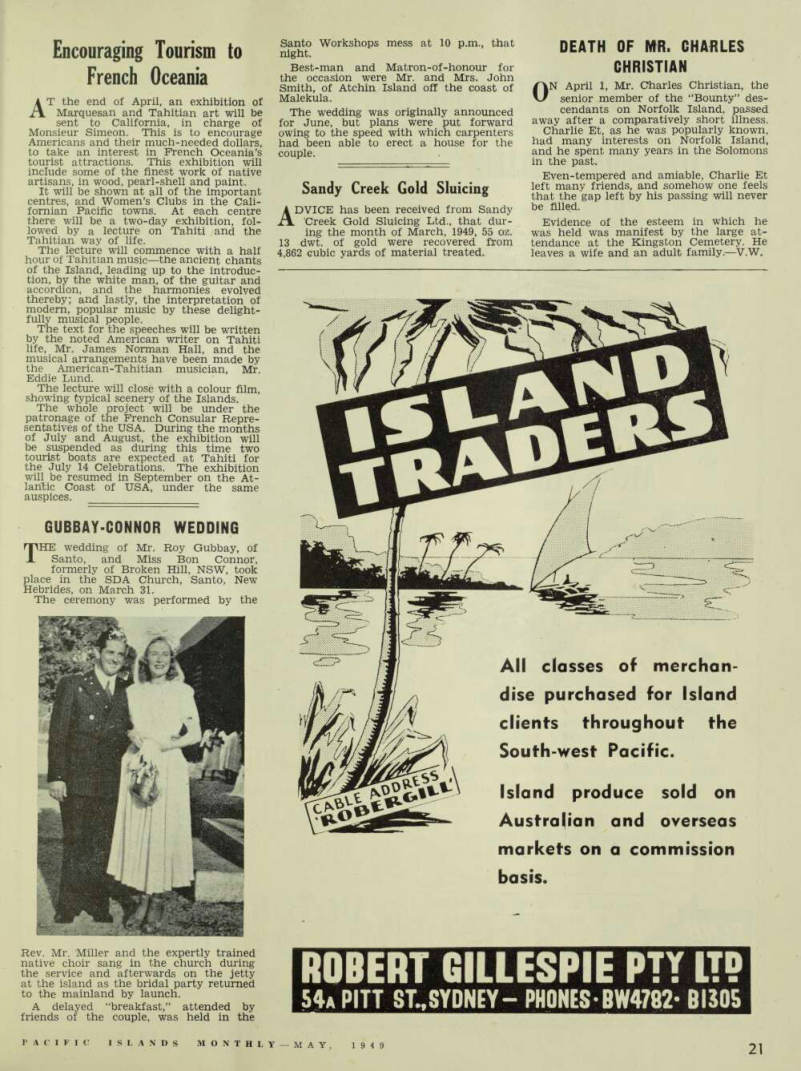
French Oceania
AT the end of April, an exhibition of Marquesan and Tahitian art will be sent to California, in charge of Monsieur Simeon. This is to encourage Americans and their much-needed dollars, to take an interest in French Oceania's tourist attractions. This exhibition will include some of the finest work of native artisans, in wood, pearl-shell and paint.
It will be shown at all of the important centres, and Women’s Clubs in the Cali fornian Pacific towns. At each centre there will be a two-day exhibition, fol lowed by a lecture on Tahiti and the Tahitian way of life.
The lecture will commence with a half hour of Tahitian music—the ancient chants of the Island, leading up to the introduc tion, by the white man, of the guitar and accordion, and the harmonies evolved thereby; and lastly, the interpretation of modem, popular music by these delight fully musical people.
The text for the speeches will be written by the noted American writer on Tahiti life, Mr. James Norman Hall, and the musical arrangements have been made by the American-Tahitian musician, Mr.
Eddie Lund.
The lecture will close with a colour film, showing typical scenery of the Islands.
The whole project will be under the patronage of the French Consular Repre sentatives of the USA. During the months of July and August, the exhibition will be suspended as during this time two tourist boats are expected at Tahiti for the July 14 Celebrations. The exhibition will be resumed in September on the At lantic Coast of USA, under the same auspices.
Gubbay-Gonnor Wedding
THE wedding of Mr. Roy Gubbay, of Santo, and Miss Bon Connor, formerly of Broken Hill, NSW, took place in the SDA Church, Santo, New Hebrides, on March 31.
The ceremony was performed by the
Rev. Mr. Miller and the expertly trained native choir sang in the church during the service and afterwards on the jetty at the island as the bridal party returned to the mainland by launch.
A delayed “breakfast,” attended by friends of the couple, was held in the
Santo Workshops mess at 10 p.m., that night.
Best-man and Matron-of-honour for the occasion were Mr. and Mrs. John Smith, of Atchin Island off the coast of Malekula.
The wedding was originally announced for June, but plans were put forward owing to the speed with which carpenters had been able to erect a house for the couple.
Sandy Creek Gold Sluicing
ADVICE has been received from Sandy Creek Gold Sluicing Ltd., that dur ing the month of March, 1949, 55 oz. 13 dwt. of gold were recovered from 4,862 cubic yards of material treated.
Christian
Death Of Mr. Charles
ON April 1, Mr. Charles Christian, the senior member of the “Bounty” des cendants on Norfolk Island, passed away after a comparatively short illness.
Charlie Et, as he was popularly known, had many interests on Norfolk Island, and he spent many years in the Solomons in the past.
Even-tempered and amiable, Charlie Et left many friends, and somehow one feels that the gap left by his passing will never be filled.
Evidence of the esteem in which he was held was manifest by the large at tendance at the Kingston Cemetery. He leaves a wife and an adult family.—V.W.
Advertisements & other items, pp. 23-24 (1 item)
Robert Gillespie Pty It?
I * I u c* All classes of merchandise purchased for Island clients throughout the South-west Pacific.
Island produce sold on Australian and overseas markets on a commission basis.
54a PITT ST.,SYDNEY - PHONES 8W4782- BISOS
DEAL FOR IDE ISLANDS...
The Famous
ATCO Products!
ATCO—BOATIMPELLER
(HtC • Simple to handle • Light—easily carried Surprisingly economical It's easy starting, has smooth power and gives trouble-free performance.
ATCOSCYTHE
i m Cut time and labour costs with this dependable machine. It's eight to twelve times as rapid as hand-scything. Ideal for cutting long grass, weeds, tall undergrowth, etc.
Just fill in the coupon below for illustrated booklets which will be sent post free. § *
SEND
NOW FOR
DETAILS
MOTOR TRACTORS PTY. LTD.
369-385 Wattle Street, Ultimo, Sydney.
Please send me Atco Booklets.
p NAME.
ADDRESS.
ATCO MOTOR MOWER
There's a full range from the 12 and 14 inch models up to the 17, 20, 28 and 34 inch for big-area requirements. The ATCO is a self-contained unit and will go anywhere.
MOTOR TRACTORS
PTY. LIMITED
369-385 Wattle Street, Ultimo, Sydney Telegrams: “Sellmotors,” Sydney.
Western Samoa
Prices Recession Felt in Western Samoa Trade Figures Released
From Our Own Correspondent APIA, April 20.
PRELIMINARY figures have been made available recently of Imports and Exports of the Territory of Wes tern Samoa for the calendar year, 1948.
These figures show a recession from the year of 1947, which was an all-time re cord in both imports and exports. The droo was in volume of exports only as export values, during most of 1948, re mained the same as in 1947, the fall in the cocoa price occurring only toward the latter end of 1948. This drop in price will affect cocoa export figures in 1949, of course.
The following comparative figures are given for the years 1946, 1947 and 1948.
Imports for the years 1946, 1947 and 1948, were £478,695, £923,773 and £956,723 thus the Territory had favourable trade balances in 1946 and 1947, but in 1948 imports exceeded exports by £48,568.
Actually the 1948 cocoa crop was ap proximately of the same volume as the 1947 crop, but the drop in actual exports was due to a heavy carry-over in Apia sheds on December 31, 1948, of over 1,000 tons of cocoa beans. Copra on hand in
Apia sheds at the same date was 1,399 tons.
AT the present time there is a heavy accumulation of copra in Apia sheds of approximately 4,000 tons, of which only 900 tons are to be shipped by the SS “Shirrahbank” end of April. It is hoped that more transport will be made available shortly to relieve the conges tion.
Western Samoa is suffering from a trade depression due to the drop in cocoa price—plus the fact that this season’s cocoa crop is small because of adverse weather conditions. Reduction of the purchasing power of the public has re sulted in keener competition in business — many new stores and trading stations in Apia and the outside districts on the islands of Upolu and Savaii opened up during the peak year of 1948, and are now finding the going hard. Some of the Apia firms are carrying heavy stocks of food stuffs and drapery and have to reduce prices and hold sales in order to avoid heavy losses, as prices of American and
English goods come down. Property values are also on the down grade.
Government revenue is bound to suffer from the drop in imports and exports and it seems unlikely that there will be a re petition of the heavy budget surpluses of the last few years. This, in turn, will mean some re-orientation of the Ter ritory’s public works and development plan.
Mr. S. Bennett, who is at the head of Etablissements Donald, Tahiti, was in Sydney at the end of March, on his way home from Singapore, where he purchased a handy type of modem motor-vessel for the Tahiti-Cook Islands trade. The ves sel will arrive soon in Auckland, where she will undergo extensive fitting before proceeding to Papeete. Mr. Bennett will remain in Auckland for the present.
Cocoa Copra Value £ Value £ 1946 207,109 340,669 1947 448,794 722,272 1948 312,921 440.530
Desiccated Bananas Coconut Other Total Value £ Value £ Value £ Value £ 86,421 50,462 34,389 719,050 70,317 79,249 31,138 1,351,770 69,004 71,316 14,384 908,155
The 40 ft. Canadian yacht, “Escapee,” arrived at Nuku’alofa at the end of March from Suva with its owner, Mr. P.
H. G. Brock and two companions, Messrs.
J. Wells and R. Fortune, on board. The
party will spend some time in Tongan waters before resuming their return voyage to Vancouver, the yacht’s home port, by way of Rarotonga, Tahiti and Honolulu.
Advertisements & other items, pp. 25-26 (1 item)
Nelson & Robertson "I.
FRANCIS HOOVER
4 Castlereagh Street, Sydney Cables: Petwer, G.P.0., Box 4623.
ISLAND TRADERS
All classes of merchandise supplied. Careful attention given to big and small orders.
NELSON and ROBERTSON Pty. Ltd.
Established 1895
Shipowners - Brokers and
Islands Merchants
All classes merchandise purchased at Best Wholesale Prices. Original Invoices supplied to Island Clients. Cocoa Beans, Copra, Rubber, Trochus Shell and All Islands' Produce Sold on Commission.
Entrust your requirements to the firm with fifty years' practical experience in the Pacific Islands.
Inquiries Solicited.
Prompt attention given to all inquiries
NELSON & ROBERTSON "I.
12 SPRING STREET, SYDNEY, AUSTRALIA
Telegraphic Address: IVAN, SYDNEY.
as
S. WENTWORTH JACKSON
(F. 1.0, SYD.)
Optometrist & Optician
185 ELIZABETH ST., SYDNEY
ANNOUNCING NEXT VISIT TO THE TERRITORY:
PT. MORESBY . . . 7-16 JULY
RABAUL ... 22 JULY-4 AUG.
HAVE YOUR EYES EXAMINED
Gabriel Achun
Malaguna Road RABAUL, T.N.G.
WHOLESALE MERCHANT AND IMPORTER
CORDIAL MANUFACTURER
Piecegoods for Native Trade. (Large shipment of variety arrives with every Eastern boat.) Other Lines of Trade Goods.
High-class Aerated Water and Cordials. Beer, Wines and Spirits.
Quotations and Samples of Materials gladly sent upon request.
Telephone: Cables & Radios: No. 104 Gabriel Achun, Rabaul
KWONG CHONG BROTHERS
General Merchants and Planters
Have now re-established their business on their original pre-war site, and are carrying stocks of Trading and Plantation requirements. All enquiries welcomed and service assured.
Sydney Representatives:
NELSON & ROBERTSON PTY., LTD.,
Electra House, 12 Spring Street, Sydney, N.S.W.
KWONG CHONG BROTHERS
KEMARERE STREET, RABAUL
Rebuilding New Britain
Survey of Chief Town Commenced
Pram Our Own Correspondent RABAUL, April 21, THE preliminary work of establishing the new “capital” of New Britain (in place of Rabaul of historic and tragic association) seems to have begun.
A survey is now being carried out by the Department of Works and Housing in Rapopo (near Kokopo) for the new town ship; and soundings are being taken for the wharf to be built at Kokopo, which will serve it. As Kokopo offers very little in the way of a natural harbour, the wharf will be built on a coral reef.
In the meantime, a road is being opened up into the Kerevat River in the Waren goi Valley where, it is planned, hydro electricity will be generated to serve the new township. This road, as far as the proposed powerhouse site, was expected to 'be completed for jeep traffic by about mid-May. A preliminary survey has also been made for a new air-strip on the Gazelle Peninsula, which presumably will serve the new capital.
However, the most welcome Works De partment achievement, as far as Rabaul residents (and visitors thereto), are con cerned, was the sealing of some of the dirt roads of that town soon after our first post-war consignment of bitumen arrived in the “Empire Mountain,” early in March. To date, St. George’s Crescent, Mango Avenue and part of Yarra Avenue have been sealed —and we await the second consignment before the work on township roads can be completed.
The first instalment has already re duced the dust-menace —and the swirling dust, beaten up by every jeep, car and truck, has been one of the most uncom fortable aspects of post-war existence in the town. Rabaul’s dust is particularly fine and has constituted a problem since the eruption of 1937. However, before the Jap invasion and subsequent Allied blitz, most of the town’s roads were tar sealed. These were destroyed, along with the rest of the town, in 1942-45 and until now have remained, except in the wet, rivers of powdery dust.
Another step forward —Yarra Avenue, once one of the town’s beauty spots, has been replanted with trees. The original trees were damaged during the 1937 eruption and completely ruined during the Jap occupation. What remnants re mained after the Australian reoccupation had to be cut down.
As well as local constructional progress, we have to report that contracts have been let for two large hospitals of per manent character —one for Sohano, the cost of which will be £15,000; and one for Kavieng, at a cost of £lB,OOO.
Death Of Richard Heape
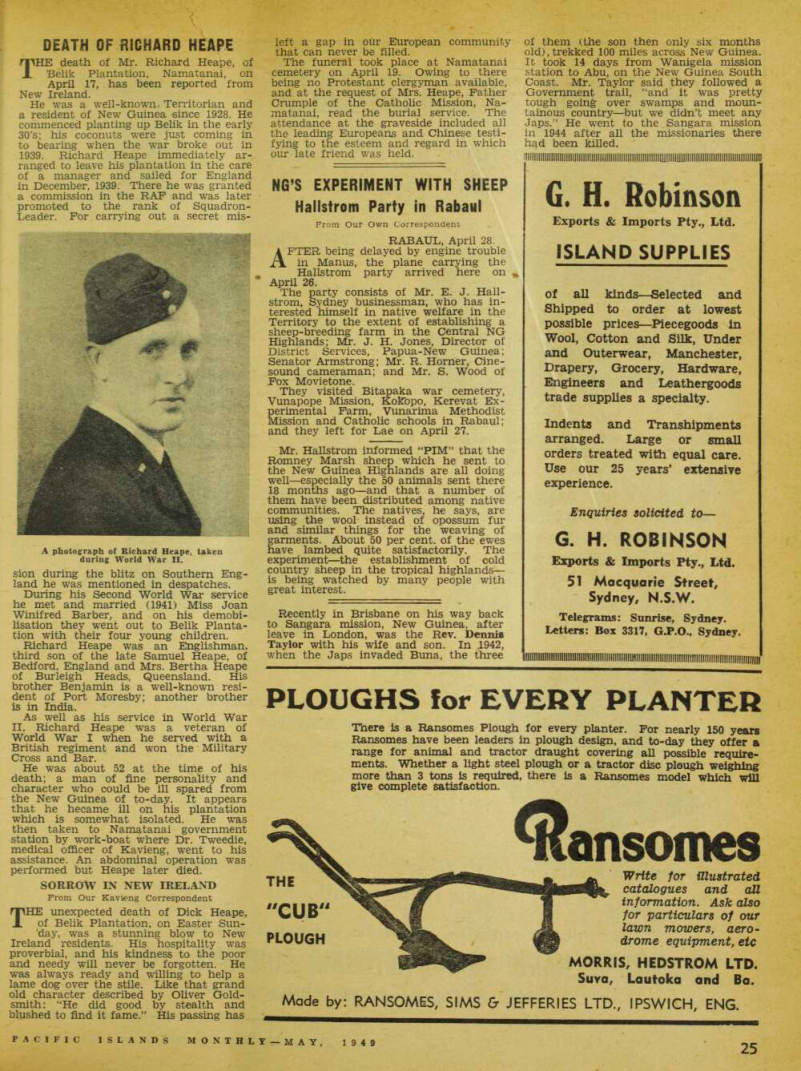
THE death of Mr. Richard Heape, of Belik Plantation, Namatanai, on April 17, has been reported from New Ireland.
He was a well-known. Territorian and a resident of New Guinea since 1928, He commenced planting up Belik in the early 30 T s; his coconuts were just coming in to bearing when the war broke out in 1939. Richard Heape immediately ar ranged to leave his plantation in the care of a manager and sailed for England in December, 1939. There he was granted a commission in the RAP and was later promoted to the rank of Squadron- Leader. For carrying out a secret mis-
sion during the blitz on Southern Eng land he was mentioned in despatches.
During his Second World War service he met and married (1941) Miss Joan Winifred Barber, and on his demobi lisation they went out to Belik Planta tion with their four young children.
Richard Heape was an Englishman, third son of the late Samuel Heape, of Bedford, England and Mrs. Bertha Heape of Burleigh Heads, Queensland. His brother Benjamin is a well-known resi dent of Port Moresby; another brother is in India.
As well as his service in World War 11, Richard Heape was a veteran of World War I when he served with a British regiment and won the Military Cross and Bar.
He was about 52 at the time of his death; a man of fine personality and character who could be ill spared from the New Guinea of to-day. It appears that he became ill on his plantation which is somewhat isolated. He was then taken to Namatanai government station by work-boat where Dr. Tweedie, medical officer of Kavieng, went to his assistance. An abdominal operation was performed but Heape later died.
Sorrow In New Ireland
Prom Our Kavieng Correspondent THE unexpected death of Dick Heape, of Belik Plantation, on Easter Sun 'day, was a stunning blow to New Ireland residents. His hospitality was proverbial, and his kindness to the poor and needy will never be forgotten. He was always ready and willing to help a lame dog over the stile. Like that grand old character described by Oliver Gold smith: “He did good by stealth and blushed to find it fame.” His passing has
left a gap in our European community that can never be filled.
The funeral took place at Namatanai cemetery on April 19. Owing to there being no Protestant clergyman available, and at the request of Mrs. Heape, Father Crumple of the Catholic Mission, Na matanai, read the burial service. The attendance at the graveside included all the leading Europeans and Chinese testi fying to the esteem and regard in which our late friend was held.
A photograph of Richard Heape, taken during World War II.
Ng’S Experiment With Sheep
Hallstrom Party in Rabaul
From Our Own Correspondent RABAUL, April 28.
AFTER being delayed by engine trouble in Manus, the plane carrying the Hallstrom party arrived here on April 26.
The party consists of Mr. E. J. Hall strom, Sydney businessman, who has in terested himself in native welfare in the Territory to the extent of establishing a sheep-breeding farm in the Central NG Highlands; Mr. J. H. Jones, Director of District Services, Papua-New Guinea; Senator Armstrong; Mr. R. Horner, Cine sound cameraman; and Mr. S. Wood of Fox Movietone.
They visited Bitapaka war cemetery, Vunapope Mission, Kokbpo, Kerevat Ex perimental Farm, Vunarima Methodist Mission and Catholic schools in Rabaul; and they left for Lae on April 27.
Mr. Hallstrom informed “PIM” that the Romney Marsh sheep which he sent to the New Guinea Highlands are all doing well—especially the 50 animals sent there 18 months ago—and that a number of them have been distributed among native communities. The natives, he says, are using the wool instead of opossum fur and similar things for the weaving of garments. About 50 per cent, of the ewes have lambed quite satisfactorily. The experiment—the establishment of cold country sheep in the tropical highlands— is being watched by many people with great interest.
Recently in Brisbane on his way back to Sangara mission, New Guinea, after leave in London, was the Rev. Dennis Taylor with his wife and son. In J 942, when the Japs invaded Buna, the three
of them (the son then only six months old), trekked 100 miles across New Guinea.
It took 14 days from Wanigela mission station to Abu, on the New Guinea South Coast. Mr. Taylor said they followed a Government trail, “and it was pretty tough going over swamps and moun tainous country—but we didn’t meet any Japs.” He went to the Sangara mission in 1944 after all the missionaries there had been killed.
Advertisements & other items, pp. 27-28 (1 item)
Ransomes
G. H. Robinson
Exports & Imports Pty., Ltd.
ISLAND SUPPLIES
of all kinds—Selected and Shipped to order at lowest possible prices—Piecegoods in Wool, Cotton and Silk, Under and Outerwear, Manchester, Drapery, Grocery, Hardware, Engineers and Leathergoods trade supplies a specialty.
Indents and Transhipments arranged. Large or small orders treated with equal care.
Use our 25 years’ extensive experience.
Enquiries solicited to—
G. H. ROBINSON
Exports & Imports Pty., Ltd. 51 Macquarie Street, Sydney, N.S.W.
Telegrams: Sunrise, Sydney.
Letters: Box 3317, G.P.0., Sydney.
PLOUGHS for EVERY PLANTER
There is a Ransomes Plough for every planter. For nearly 150 years Ransomes have been leaders in plough design, and to-day they offer a range for animal and tractor draught covering all possible requirements. Whether a light steel plough or a tractor disc plough weighing more than 3 tons is required, there is a Ransomes model which will give complete satisfaction.
THE
CUB
ii
PLOUGH
Ransomes
I Write for illustrated catalogues and aJX information. Ask also for particulars of our lawn mowers, aerodrome equipment, etc
MORRIS, HEDSTROM LTD.
Sura, Lautoka and Ba.
Made by: RANSOMES, SIMS & JEFFERIES LTD., IPSWICH, ENG.
CSAMHONDS ARE SPECIALISTS
In the manufacture of Receivers
for use in the Tropics
lisii
THE CRAMMOND TROPIC
EAGLE
Available for Vibrator, All Dry Cell or All Electric operation.
Continuous coverage, 16-150 metres on Short-waves. Broadcast 200-550 metres.
Exclusive features’.
Completely Tropic-proofed. Sealed in rustless steel cabinet. Embodies built-in moisture absorber.
Crammonds will design and build any type of receiver to meet special requirements.
Presenting A NEW CRAMMOND TROPICAL
PORTABLE. Cabinet of waterproofed bondwood, detachable lid protects all controls.
Triple or Dual Wave. Available for Vibrator, All Dry Cell or All Electric operation.
Components used of highest quality. Tropicproofed by our Infra Red Ray process.
Presenting THE NEW CRAMMOND 6 VALVE ALL DRY CELL PORTABLE. Cabinet of waterproofed bondwood, good quality leatherette covered.
Suitable for use in areas where humidity is not excessive.
Crammonds are specialists in the manufacture of Hospital and
School radio installations.
Write for particulars—lllustrations and Price Lists to-day.
CRAMMOND RADIO MANUFACTURING COMPANY. PTY. LTD.
No. 8 Queen Street, Brisbane
Murderers of Mr. A. Robinson
Sentenced
FOUR natives were brought to trial at the Supreme Court, Rabaul, on April 7 for the murder of Mr. Alf Robinson, at a remote village in New Britain in mid-December, 1948. One of the accused was subsequently discharged by Mr. Justice Phillips on the submission that the native in question struck Robin son with an axe after he was dead and not while he was still living.
Robinson had been on a recruiting trip, trying to engage labour for his planta tion. The area in which he was killed had been seldom, if ever, visited by Euro peans. Eight native labourers who were with him were also killed.
Robinson was an experienced Terri torian, an ex-Administrative official with a good record of work among the natives.
He was one of the few survivors from the Tol massacre of early 1942 when the Japs lined up exhausted refugees from Rabaul and butchered them. Robinson succeeded in dashing away from his captors and lived for a considerable time in the bush before he was picked up by an Austra lian patrol and sent to Australia. Tol Plantation is not so very far from the village in which Robinson was murdered.
The trial of the natives lasted five days.
At the end pf it three of them were con victed of the wilful murder of Robinson.
The death sentence-was recorded with a recommendation to mercy as the area where they live is not fully under ad ministrative control.
AT the same sitting of the Supreme Court, Mr. Justice Phillips sentenced another native to nine months’ im prisonment for manslaughter.
Some time ago, local natives were ex tracting the charges from Japanese am munition in order to sell the brass containers. The native who was convicted had ignited a large quantity of the powder which had been removed and scattered on the ground. Five natives were seriously burned in the explosion and one died later in hospital.
Hospitality
Economic Problem of Fijian Hospitality
Prom Our Own Correspondent . SUVA, April 25.
THE impossibility of squaring rigid Fijian traditions of hospitality with present-day conditions in the over crowded towns is the subject of an article by a Fijian in the “Fiji Times.”
The main difficulty is the habit of country relations who visit towns to live temporarily at the expense of Fijian wage-earners.
Added to this is the fact that Indian owners of tenements and other houses immediately (and illegally) demand higher rents if more people are added to those already accommodated in their properties.
Describing this as another example of Indian exploitation of Fijians, the writer of the article suggests that the only way out of the muddle is for the Fijian authorities to discourage temporary mi grations from the villages to the towns.
Mr. R. L. Barnes, of the Methodist Overseas Mission, New Ireland, was ordained as a Methodist minister, in Bris bane, on February 28.
Retirement of Mr. J. Judd From Fiji District Administration
Fiji District Administration
AFTER 34 years service in Fiji, Mr. J.
Judd retires from the District Ad ministration. After leave in Aus tralia he will take up work in connection with the Fiji Native Land, Trust Board.
His place as District Commissioner Southern will be filled by Mr. G. K. Roth.
Mr. Judd was appointed a Sub-Inspector of Constabulary in June. 1915, and re mained in the Police until 1924, when he became a District Commissioner. He has since served in almost every district in the Colony.
In 1927 he went to India on a special mission in connection with the re-emigra tion of Indians. Before the post was abolished, he acted on a number of oc casions as Secretary for Indian Affairs.
Mr. Judd has held many public offices during his long service in Fiji. He has been a member of Legislative Council, a member of the Suva Town Board, chair man of the Publicity Board, a member of the Board t)f Education, the Mining Board and the Board of the Trustees of the Fliji Museum. He was Deputy Chairman of the Coronation Committee in 1936, and in 1938 was appointed chairman of the committee to organise Fiji’s exhibits at the New York World Pair and the New Zealand Centennial Exhibition. He has been a member of the Boards of Examiners in both Fijian and Hindustani and, for a time, he was a member of the Civil Service Board.
Mr. and Mrs. E. J. Wauchope, of Ma dang, New Guinea, who have spent several weeks in Australia —in the course of which they were present at the wedding of their daughter—returned to New Guinea by the “Malaita” at the end of March.
The New Guinea coastal ship, ‘‘Mai muna,” broke a fuel line and drifted helplessly out of fuel for some time near the Witu Islands on March 30. The Fairymead Sugar Company ship, “Cy rena,” went to her assistance and sup plied her with sufficient fuel to make Rabaul.
Advertisements & other items, pp. 29-30 (1 item)
C. Sullivan Pty. Ltd.
Island Merchants
Over 30 years' experience in the Pacific Island Trade.
Expert Buying Service Original Invoices Furnished Sellers of Island Produce.
Represented in all Australian States, New Zealand, England, France, United States, etc.
BANKERS.- Bank of New South Wales, Comptoir National d’Escompte de Paris, Bank of New Zealand.
C. SULLIVAN PTY. LTD.
379 KENT STREET, SYDNEY
Telegrams & Cables: CHASULL, Sydney. Phone: MJ4657 (6 lines).
KODAK FILMS
and all Photographic Supplies
WHOLESALE AND RETAIL
CAINE'S STUDIOS
P.O. Box 8, Suva Photographers. Est. 1904.
Write for free price lists.
miMßm i n m A 0 % £
ACiCOy^^^if^SEZrja^
=L jjtm jpr jjwjfc
•smtowt
GIVES FULL LIGHT AND AIR
WITH YEAR ROUND WEATHER PROTECTION
This ultra modern window comprises a series of glass blades swung one above the other and inclinable to any angle.
Air entering the room is diverted towards the ceiling thus preventing draughts. AGCO Supaluvres have all the advantages of other louvre windows plus exclusive features.
The specially designed rain guards cannot be fouled by the glass holders and provide flush finish so that fly screens, curtains or blinds can be attached. By an automatic locking device AGCO Supaluvres can be locked open in four positions, thus eliminating rattle and are also fitted with rack and pinion movement. All exposed surfaces are made of rust resisting zincanneal metal.
For Verandahs, Sun-rooms, Lounge-rooms, Kitchens and Laundries Illustrated leaflet, price list and installation instructions on request.
Sole Agents for South-west Pacific :
ROBERT GILLESPIE PIT IT?
S 4« PITT ST.,SYDNEY- PHONES 8W4782- 81305
P & T Association Has Six-Hours
Meeting to Discuss Problems
From Our Own Correspondent
RABAUL, April 21.
WHAT was to have been a Special General Meeting of the Planters’ & Traders’ Association of New Guinea, on March 31, developed into the Annual General Meeting. The meeting was held at the residence of Mr. and Mrs.
J. J. Gilmore, Rabaul, and was some what of a marathon. It commenced at 10 a.m., and, with A break for luncheon, concluded at 5.30 p.m.
Twenty-two members, all from the New Britain district, attended. It was decided that the elected committee of the New Britain branch be empowered to act as the Executive Council of the Association until the meeting of delegates of all branches of the Association meet in July this year.
The balance sheet as at January 31, 1949, was adopted and selection of office bearers for the coming year resulted in the following being elected:—president, J. Chipper; vice-presidents, J. T. Allan, D.
Barrett; Committee, J. Dunbar-Reid, E.
Pulton, J. Thurston, S. McCosker, J. Dale, J. Gilmore, W. Moore.
During the lengthy meeting members expressed their views freely on a variety of subjects of particular interest to the planting and trading communities.
Among the affairs that received special attention were:— • 'Formulation of the Association’s policy; • Recruiting; • Co-operative buying; • Insurance Agency; • Residence and office of the Associa tion; • Copra agreement with the British Ministry of Food; • Membership subscriptions.
Supply of Quonsett Huts
PLANTERS will shortly.be able to ob tain some Quonsett huts ex-Manus.
Their requirements should have been submitted to the secretary of the Associa tion, Mr. W. R. Paul, in March.
Full-Rigged Ship
The “Roxburgh” Was A
Letter to the Editor IN the March, 1949, issue of “PIM” is published an interesting article on the 1906 cyclone, which did so much damage around Tahiti. Reference is made to the loss of the ‘‘County of Rox burgh,” but your correspondent defers to her as a “barque.” This vessel was a four-masted full-rigged ship and, in the photograph of her on the reef, it can be seen clearly that she crossed yards on the mizzen. All of R. & J. Craig’s fine fleet of “County” sailing ships were four masted, full-rigged vessels, built of iron .by Barclay, Curie & Co. at Glasgow.
The “County of Roxburgh,” which was the largest of the “Counties,” was built in 1886, with a gross tonnage of 2,209, and 2,091 tons net. Her dimensions were 286 ft. x 44 ft. x 24 ft. Her sister ship, the “County of Linlithgow,” built the following year, eventually was sold to a Greek firm, re-named “Katherine,” and suffered the ignominy of being converted to an auxiliary.
I am, etc.,
Lance M. Burnett.
Concord, NSW, 24/4/49.
The Rabaul Tennis Club was opened on March 26 by the District Officer. At present, only one court is open for play wire-netting is awaited from Australia before the second court can be brought into use. Those wishing to join should contact Miss Dorothy Bridges, secretary; or Miss Dorothy Martin, treasurer. At the opening of the club. Mr. and Mrs.
E. Britten, two members of the original Rabaul Tennis Club, were present.
Loss Of Tahiti Patriot
(A Letter to the Editor) PAPEETE, April 21.
TAHITI mourns the passing of Mr.
Joseph Quesnot, Senator and Presi dent of the Representative Assembly of French Oceania, who passed away on board the SS “Eridan,” on March 31, while bound for France.
The Governor of French Oceania, rep resentatives of the Government, and a host of friends attended a Requiem Mass at the Catholic Cathedral, Papeete.
British Award For Frenchman
Prom Our Own Correspondent PAPEETE, April 19.
A RECEPTION was held at the British Consulate, Papeete, on March 25, the guest of honour being the Com mander of the Navy of French Oceania, Monsieur Riviere.
He was presented with the King’s Medal of Courage for exceptional bravery during the German occupation of Prance. He had, at that time, acted as liaison officer between the RAF, the French Maquis units, and inmates of the Amiens prison, which had led to a combined attack on the prison, at the moment when 50 hos tages were to be shot. In li hours 600 French prisoners were delivered from the hands of the enemy.
The British Consul, Mr, C. Henderson, presented the medal and thanked Com mander Riviere in the name of His Majesty’s Government for his meritorious service to the Allied cause in one of the most critical periods of history.
The King’s Medal of Courage is a de coration specially created by the British Government for award to foreign allies of Great Britain.
Picnic
Tragedy at New Britain Launch Picnic
From Our Own Correspondent RABAUL, April 21.
A VISITOR to Rabaul, Mrs. Beryl Fox, disappeared from a picnic launch on April 17, and is presumed drowned.
She was one of a party of 16 who had spent the day at the Duke of York Islands. When returning about 7 p.m. she fell overboard from under a per manent awning. An immediate search was made but Mrs. Fox had disappeared completely. Police, when informed, con tinued the search until the next day.
Mrs. Fox had arrived from Australia, to visit friends in the town only two days previously.
New Governor For French
Oceania
Prom Our Own Correspondent PAPEETE, April, 21.
ON April 21 the SS “Ville d’Amiens” ar rived at Papeete from Marseilles, carrying on board the new Governor, His Excellency, Monsieur Anziani, and his wife.
They received a warm welcome from Papeete, and were greeted at the gangway by the Secretary-General of the Colony, Monsieur Girault,\ and members of the Municipality and Representative As sembly.
Advertisements & other items, pp. 31-32 (1 item)
J. C. Mernllees Pty. Ltd., Sydney
LONDON-SUVA
VIA
PANAMA
For Sailings and Further Particulars Apply To:— BETHELL, GWYN & CO., BURNS, PHILP (SOUTH SEA)
138 LEADENHALL ST., CO., LTD.,
LONDON, E.C.3. SUVA.
<c Vf. c
SMOOTH HANES
/ k Y y V >• 4 S« tL V ik y t*.
LuUev rW
BASE
MAKE
mr* •% >y A S $ %
SMOOTH
SKIM
These goods are stocked by all the leading stores of the Pacific Islands. Order through your usual channels. Further enquiries to:
J. C. Mernllees Pty. Ltd., Sydney
TILLEY LAMPS
(BURN ORDINARY KEROSENE)
The Modern Form of PORTABLE LIGHTING
ATTENTION TO DETAIL
is the characteristic of all British products
TILLEY LAMPS
a are British made throughout at Hendon & Cricklewood, England.
THE TILLEY LAMP COMPANY LTD. of ENGLAND London Offices and Showrooms: 33 SACKVILLE STREET, PICCADILLY, W.l
REPRESENTATION :
MELBOURNE: T. H. Bentley, Pty. Ltd., 123-125 William Street, Melbourne, Cl.
TASMANIA: Mr. C. Sellars, 108 a Charles Street, Launceston.
FIJI : Mr. K. Witherington, 2 Burns Philp Buildings, Suva.
Five Millions
Left
Australian War Damage Fund Is Wound Up
THE Australian War Damage Commis sion issued its seventh, and final, re port in early 1949, thus winding up a Government organisation that has had a unique reputation with the public it served.
In a country where it is customary to hurl brickbats at all Government instru mentalities, the WDC collected singularly few. And, for the people of Papua-New Guinea, in the war and post-war period, it provided the only leavening in an other wise dark and demoralising situation.
The claims of these residents of the Australian territories, who lost virtually all their material property through war damage, were met fairly, and even gener ously, by the Commission. The rehabilita tion of Papua-New Guinea, protracted though it has been, would have been a more heart-breaking business had it not been for the existence of the WDC; in this connection, one has only to contrast the lot of planters in the British Solomon Islands and Gilbert Islands (who had no war-damage compensation scheme) with that of the planters of Papua-New Guinea.
THE scheme was inaugurated shortly after the commencement of the Pacific war. In Australia and Ter ritories, owners of buildings were forced to contribute to a fund on a fixed rate of 8/- per cent. They had the option of insuring other property at the same rate.
Later, when it was considered that the Fund was sufficiently financial to meet any claims then likely to occur, the com pulsory contributions were discontinued.
As well as its functions under the War Damage to Property Act, the Commission also acted in conjunction with Mr. H.
Alderman, KC, in assessing and paying for damage done, or acquisitions made by the Australian and Allied forces; paid claims in relation to small vessels left in evacuated areas; paid subsidies for the re-clearing of secondary growth due to compulsory abandonment of plantation land in Papua-New Guinea; and settled claims from Commonwealth employees for property loss in Nauru.
Payments made under these heads were:— On behalf of forces, £1,221,501; vessels, £119,395; clearing, £83,288; Nauru, £5,124.
THE total contributions to the Fund from the inception of the scheme until August 15, 1948, were £14,786,714.
During that period the Commission re ceived 10,077 claims, of which 9,309 have been settled.
The outstanding liability in respect of all claims not yet assessed and recorded at August 15, 1948, was, for Papua-New Guinea, as follows: War Behalf of Clearing Damage Forces Vessels Subsidy £400,000 £175,000 £25,000 £170,000 Property, other than fixed, was insur
able under various heads, and apart from buildings, plant, stock, etc., the most im portant from the Papua-New Guinea planter's point of view, was that section covering growing trees.
The values of growing trees were as sessed as follows:
At August 15, the losses on trees on 552 plantations in Papua-New Guinea had been assessed and investigations on 116 plantations were incomplete. In all, the following amounts had been paid:—
The assessing of damaged trees on plantations not yet fully dealt with will now be completed under the control of the Commission's Deputy-Controller in Port Moresby (Mr, E. A. James), who is now working on a part-time basis.
AFTER presenting their seventh annual report, the War Damage Commission disbanded and their powers and ob ligations were transferred to the Com monwealth Treasury, which made local arrangements for dealing with the com paratively few claims outstanding and those which may still be presented. It was estimated that the outstanding liability of the Commission, at the time it disbanded, was £1,070,000. The Fund was, at that time, in credit to the extent of £6,499,889. No indication is given in the report as to the eventual disposal of the surplus £si million.
Two Europeans were charged in Rabaul District Court on April 27, with passing valueless cheques. Both pleaded guilty.
One was sentenced to imprisonment until the rising of the Court; the other, J. K.
Benbow, was sentenced to 14 days hard labour.
After three years of excellent service to the British and foreign communities in French Oceania, the British Consul at Papeete, Mr. C. Henderson, is to take a four months vacation in a cooler climate.
During his absence his place will be taken by Mr. George Hunt, who arrived in Tahiti, with his wife, aboard the SS “Waitamata,” on March 25.
Maximum Average value value s. d. s. d.
Coconuts 18 0 9 1.5 Cocoa 11 3 7 9.8 Coffee 48 47.7 Rubber 12 6 10 7.8
In respect of — Coconut trees .. ..
Cocoa Coffee Rubber Misc .. .. £1,171,874 ... 215.882 .. .. 39,052 Total £1,477,632
Place New Guinea and No. of Value of Claims Claims assessed Papua 6.142 £8,130,266 Queensland ..
Northern Terri- 775 13,505 tory Western Austra- 2,751 354,399 lia 237 49,619 Other 172 10,077 2,236 £8,550,025
Advertisements & other items, p. 33 (1 item)
Assemble
"IT'S NEW RIGHT THROUGH"
Built by Jowetts, of Bradford, Yorkshire.
The JOWETT “JAVELIN” Car, English Body Work. Flat Four Engine, 75 m.p.h. 30-32 m.p.g.
ALSO
The BRADFORD 10 cwt. Lorry, Van, 6-seater Utility and Utility de Luxe. Ample Power and 40 m.p.g.
Pacific Islands Distributors : G. H. ROBINSON EXPORTS & IMPORTS PTY. LTD 51 Macquarie Street, Sydney For early deliveries Telegraph; “Sunrise, Sydney.”
ASSEMBLE
THIS BOAT
YOURSELF!
It's Easy .
PROOFWOOD BOAT ASSEMBLY KITS, made from PROOFWOOD, the famous marine plywood—for 8 ft., 11 ft., 3 in., and 16 ft. craft—come to you complete with all components. All parts are machine finished to exact size.
They can be assembled, in a very little time, into a beautifully designed craft, light in weight, yet immensely strong. Simplified plans accompany every kit. Send for illustrated brochure giving full details of PROOFWOOD
BOAT ASSEMBLY KITS.
Sole Export Agents for South Pacific :
WILLIAM E. REED
145 a George Street, Circular Quay,
Sydney Cables: “WILREED”, Sydney.
All Races Catered For in Rabaul Education Scheme
From Our Own Correspondent
RABAUL, April 21.
THERE are now six varieties of government school functioning in the Rabaul district, but by far the largest individual unit of them is the Administration School for Chinese in Rabaul, which has an enrolment of 300 pupils and 11 teachers—five European and six Chinese. Two of the buildings are in
total disrepair; two of them are fair. It is hoped to have some building replace ments here in the near future.
The school for European children, also run by the Administration, functions in temporary quarters, too. At present it has 30 pupils.
There are two schools for Malays—one in Rabaul and one at Kokopo. Native
enrolments at schools in the district now number about 1,650. These schools have just been regrouped with a native super visor in charge of a group. Possibly the most important establishments, from the native-education point of view, are ihe Keravat Education Centre and the Tech nical Training Centre, at Malaguna. The Keravat Centre represents about the ul timate in higher education for New Guinea natives. The central school there has an enrolment of 160 and the teachers’ training centre, in the same establish ment, has 75 trainees. Selected pupils from Wewak, Madang, Morobe, etc., are sent here, as well as those worthy of higher education from among the local population.
The 176 trainees enrolled at Malaguna are being instructed in carpentry, plumb ing and mechanical engineering, with some attention to native arts and crafts.
Native education in New Guinea has a long way to go before it catches up with education in more enlightened native countries; but considering the extraordinary obstacles that had (and still have) to be overcome, one can say that the start has been satisfactory—at least in this district. At the same time, there is no cause for complacency when the over-all New Guinea picture is con sidered. The Rabaul natives are con siderably more advanced, and have had more advantages, than their outport cousins. When the same six varieties of school that function in Rabaul are avail able to children, all over the Territory, we will really be getting somewhere.
A daughter, Christine, was born to Mr. and Mrs. D. H. Maclean, of Namatanai, at Rabaul Hospital, New Guinea, on April 25.
Captain George Bailly, harbourmaster and pilot of Papeete, Tahiti, who has been on vacation in France, returned to the Colony on the “Ville d’Amiens” on April 2.
During his absence Captain Carlson has been acting harbourmaster.
Advertisements & other items, p. 34 (1 item)
Gordon's
FOR SALE
QUANTITY OF NEW PLUMBING FITTINGS
GALVANISED AND BLACK FITTINGS, i
in. to 6 in.
BRASS COCKS, 818, BALL, ETC., i in. to 1 in. * 3 in. and 4 in. Johns Pattern Gate and Check Valve.
Write for Complete Catalogue.
N. F. MALONEY & CO.,
Agents, Port Moresby, PAPUA Cab. add: MALCO. P.M.
0$ By Appointment Gin Distillers to H.M. King George VI Tanqueray, Gordon & Co. Ltd.
Gordon's
Stands Supk&mz
Qea Catalina For New
Guinea
AQANTAS Empire Airways’ Catalina flying-boat will depart from Sydney in May for service in New Guinea and adjacent territory.
It will be based on Port Moresby, and supplement the QEA fleet of 12 land planes engaged on operations in the New Guinea area. It will serve the east and west coast of Papua, Buka, Rabaul, and on other routes where good alighting areas are available on the water, but not on land.
Administration outposts as well as com mercial interests will benefit when the Catalina commences on regular services and charter flights over routes never previously flown.
Before going into regular use, the Cata lina will be used to survey routes for the future services. Captain Hugh Birch will be in command, with a crew com prised of first officer, engineer and purser.
In addition to the crew of four, the aircraft has seats for 24 passengers. The seats are collapsible, permitting the Catalina to be quickly converted for use as a freighter.
Library
Taking Good Reading To
Ng Outports
Helpful Service from Rabaul Library
Prom Our Own Correspondent RABAUL, April 21.
THE Rabaul Regional Library was re furbished a couple of months ago when it was newly painted, supplied with cane chairs, pictures, pot-plants and other oddments to make it more attrac tive to those of the reading public who wish to spend a quiet evening there.
A special Children's Corner has been installed also—with nurserv-rhyme frieze and low shelves and benches. Pupils of the European school are brought along to visit en masse one afternoon per fort night when they are instructed in library usage and entertained with a story hour.
Most important of all, the library has received some hundreds of new books and more are on the way.
One of the most popular services that the library supplies is the forwarding of parcels of boqks to outport readers.
Applications for parcels of books may be made by individuals or grouns who ex change the books amongst themselves.
The post-office carries them free and masters of coastal vessels are co-operative in delivering and picking up books from remoter outposts.
Parcels of magazines and newspapers are also sent to registered country bor rowers. * Readers may select titles of books from a catalogue supplied by the library but frequently he or she merely indicates the variety of reading preferred and leaves the rest to the librarian.
Extra Shipping and New Hotel
For French Island
Prom Our Own Correspondent PAPEETE. April 21.
IT is reported here that ships of the Messaseries Maritimes Lines will now call at Raiatea, lies Sous le Vent Group, on both outward and inward journeys from Prance.
Further to this we understand that Mr.
Yves Sanquer will soon open a new hotel at Uturoa, on Raiatea.
Advertisements & other items, pp. 35-36 (1 item)
Burns Philp Trust
'THAT
w
6 ThT*
Pick up
This Pilot Now
Like the skipper who takes chances in unfamiliar waters, the private executor lacks first-hand knowledge of the difficulties ahead. The administration of an estate never a simple matter these days is doubly difficult for the man who lives in the Islands. Sound advice on finance, taxation, and investments must be available at all times. The appointment of Burns Philp Trust Company Limited as executor or trustee secures this advantage, together with the collective first-hand knowledge of experienced directors and efficient officers.
Full details of the Company's helpful services are given in Hands That Never Leave the Wheel." A complimentary copy of this valuable booklet can be obtained from any branch of Burns Philp (South Sea) Company, Burns Philp (New Guinea) Limited, or direct from the Head Office of
this Company.
DIRECTORS:
James Burns Joseph Mitchell P. T. W. Black Eric Priestley Lee MANAGER: L. S. Parker SECRETARY: E. R. Overton. A.F.I.A.
Burns Philp Trust
COMPANY LIMITED
EXECUTOR • TRUSTEE • AGENT
Constituted by Special Act of the N.S.W. Parliament
HEAD OFFICE: 7 BRIDGE STREET. SYDNEY
fel. BU 5901 Box 543, G.P.O,
a/ne
In keeping with its policy of similarity of brand names for its famous products, the Vacuum Oil Company Pty. Ltd. announces a change in the brand names of certain of its high quality petroleum products, thus bringing them into the well known group of Mobil products-Mobiloil, Mobilgrease,Mobi!
Distillate etc. These are:-
MOBIL POWER KEROSENE
Formerly known as Voco, Mobil Power Kerosene will give efficient and economical service.
MOBILITE
Sold previously under the brand name of Vaclite, Mobilite, a waterwhite spirit of exceptionally high volatility, gives unsurpassed service in petrol lamps, lanterns, irons and all hollow - wire lighting systems, I
MOBIL DIESEL FUEL
Replaces Stanvac. A diesel fuel eminently suitable for all low and medium speed diesel engines.
MOBIL WHITE SPIRIT
Formerly Vacuum Dry Cleaner, Mobil White Spirit is ideally suitable for all dry cleaning jobs. Its solvent power cleans fabrics quickly and economically. 003 n
VACUUM OIL COMPANY PTY. LTD.
MP49I
[INCORPORATED IN AUSTRALIA]
And What Are We Here For?
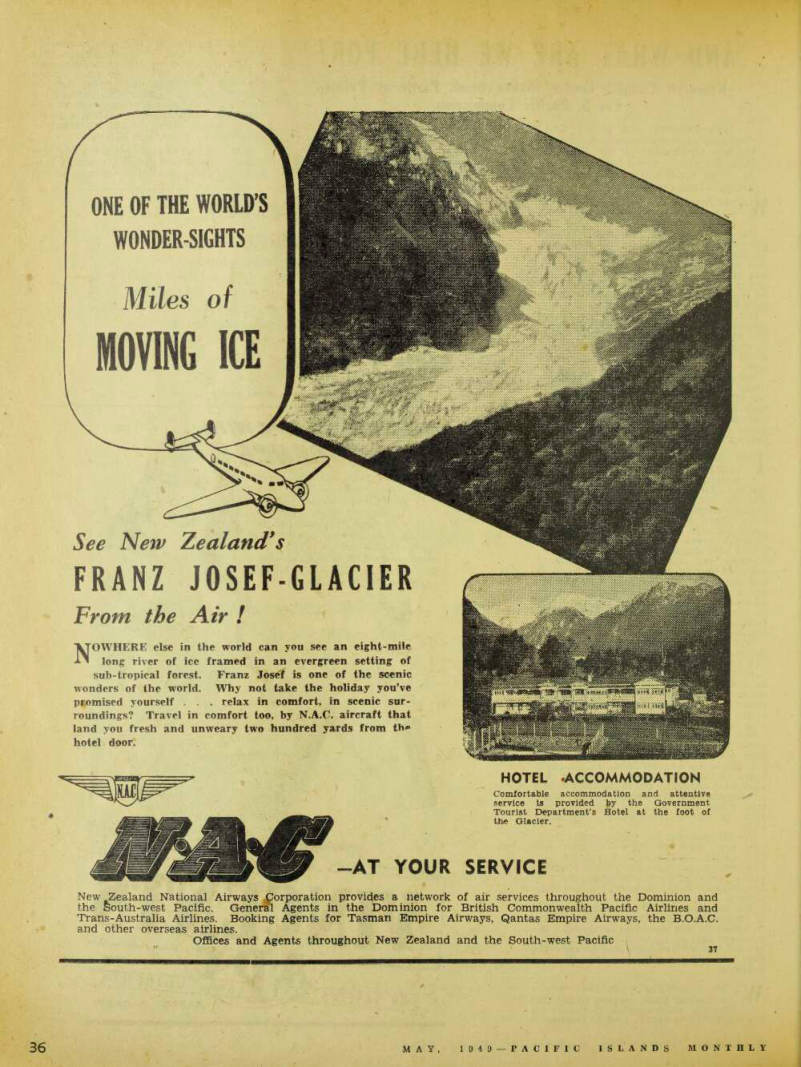
Research Council Leader Makes Some Pertinent Points For S. Pacific Commission
The purpose, the policy and the hopes of the new South Pacific Commission were discussed in a scholarly and very notable address by the Deputy Chairman of the Commission’s Research Council (Dr. L. G. M.
Baas Becking), when he opened the Council’s sessions in Noumea on April 30. The following is the text of the address, complete except for some unimportant omissions.
WE are here as the wards, the trustees, and the partners of the indigenous population.
We have been working in the tropics, according to our lights, for 300 years now.
We have played our role in the emancipa tion of the native population. This role has been ill-defined, for the conception of our task has been partly dependent up on Government policies and partly deter mined by our own convictions.
But, to-day, we fortunately meet on the common ground of the technical aspect of this problem. Our role has been defined as relating to the economic development, social development and hygiene of the area.
We welcome you here as experts in many fields, and we sincerely hope that our efforts will result in the initiation of various projects which will strengthen co operation in promoting the economic and social welfare and advancement of the peoples in this region.
THE small group of four, the full-time members of the Research Council, which I represent here, have met in the last three months a number of organ isations, specialists, administrations and average citizens, native and European. We have heard about a great number of plans, policies and wishes. We have re ceived a great many projects to be put before this Council. Often we had to re member our own personal background, acquired during our previous sojourn in this area or in the tropics. Often, when our a priori ideas threatened to hamper us we had to forget them. We had to try to find a communis opinio, the largest common denominator, in an ocean of opinions.
With your help we will consider the proposals made to us, and together we will prepare a report to the Commission.
And it is .up to this meeting to decide whether, as often happens (as in many more august senates), it will only con sume cellulose and produce carbon di oxide, or whether we shall put our ideas into operation.
Our ideal must be to help you in your work, not to burden the workers in the field with more than you already carry.
We are in no way inclined, on the other hand, to take over existing duties or ser vices that rightfully belong to the existing administrations. We should strive to pro pose plans that bind the area together, plans to combat provincialism and isola tion. v We should leave the controversial topics to others, and remember that our role lies outside the realm of politics. If, however, social injustice or other misery exists, we should not shirk our duty, as an advisory body, to warn, our Commis sioners.
We are all aware of our lack of means, in “books, bricks and brains,” in materials, in buildings and technical personnel. We are here first to make the “halt lead the blind,” but we are here also to cure the paralysis and the blindness of both these patients.
WE are something more than a co ordinating body, created to act like the old encyclopedist, to gather all the data on the region and to publish it
in heavy tomes. We are here to prepare for speedy action. It is our opinion mat at the present time the theoretical and the academic have to yield place to the practical. We must be guided by the master mind of Pasteur; “La Science n’a jamais plus de grandeur que dans ses ap plications bienfaisantes.” When a house is on fire it seems foolish to repair a telephone or to varnish a floor.
Still, the fact that we are scientists here together, men that, speak a common lan guage as an expression of common mental
tenets, is of inestimable advantage to our work. Any practical measures proposed will carry with them scientific implica tions. And their consequences should be investigated when our first campaign is over.
The only fear, if fear it be called, is that our work may suffer from the wiles and whims of territorial governments. It would be deplorable, indeed, if projects were to be left half-finished, like broken promises, like friendships forgotten. This has been the tragedy of tropical govern ments; the flower to-day in bloom often fades to-morrow. And this has been clearly recognised by the natives them selves.
We have been deeply impressed by the great trust placed in us. All over the region people expect us to do things; and there will be no excuse if we betray this trust. . . .
IN the course of conversations with vil lage chiefs, teachers, publicans, labourers and scientists, in discussions with administrations and in the proposals made by the Commission and to the Com mission, one catch-phrase seems to stick in my mind, “the impact of Western civilisation.”
This term describes only very imper fectly the actual influence of black birders, sailors, traders, planters, Govern ment officials, teachers, missionaries, and last, but not least, the American garri sons in the period 1942-46. Obviously these influences have drawn native com munities hither and thither, have often disrupted them or decimated their popu lation. But above all these influences, both destructive and constructive, there has been the changing policy of those who governed, and later developed into administrations.
In the exploratory phase, from the late
Seventeenth to the end of the Eighteenth Century, the original idea of those govern ing was much the same as that expressed at the birth of the pre-war French co lonial policy as “la mission civilisatrice.”
Not only the missionaries, but nearly everyone concerned, seemed convinced that it was our duty to impose the Wes tern mode of thinking, of life and of be haviour upon the ignorant native.
Prior to, and during the French Revo lution, the attitude changed, although the influence of Jean-Jacques Rousseau and his admiration of “natural man” has per haps been over-estimated. It was now thought that Freedom, Equality and Fra ternity should embrace the whole human race. But, unfortunately for the emotion alists, the post-Napoleonic period was in this region, one of exploitation, during which even exploration remained in the background.
Later in the Nineteenth Century the pendulum swung back to the idea of “la mission civilisatrice,” and our role in the non-self-governing areas of the world is still by many interpreted as such.
However, the Twentieth Century brought a renewed feeling of guilt and impotence to the white races. These feel ings, as interpreted by such historian philosophers as Spengler and Ortega y Gasset caused, in many respects, a revival of what could be called “Rousseauism.”
A common ground for the “civilisers” and the “conservators” may be found in those aspects of Western civilisation that are to be considered beneficial. For no intelligent person to-day would seriously suggest forcing a Western mode of living upon the native races of the Pacific. But it is equally true that nobody would sug gest, on the other hand, preserving the native races in the Neolithic Age forever.
The tenets of the period of exploitation, which is not yet over, were simple. Eco
nomic motives came to be the chief guid ing star of human existence. The gathering of goods, the increase in wants (often artificially induced), the effort to increase production as well as population were, and are still considered by many, part of an inescapable necessity. Others (without always adhering to the theory of “paradise islands”) urge that the facts have disproved the primary importance of economic laws.
(Continued next page)
BUT, while economic factors play a role in any socium, the happiness of man depends upon non-economic factors as well.
Culture cannot be transplanted, for its roots are too deep in history. Civilisation is the material expression of culture. We have therefore to ask ourselves: which are the elements of Western civilisation that can be grafted upon existing local culture in order that the happiness of the natives may be promoted? This may be the modern version of the new super annuated “mission civilisatrice.”
Freedom is the general goal to which all Governments are striving. Only too often this word is interpreted as only political freedom. In order to be free, man should be able to control his en vironment; and his relations with other human beings are only part of his en vironment.
One most difficult freedom must be at tained; freedom from sickness. It is clear
that all of us agree to this at least. In order to obtain this freedom all forces in the socium have to collaborate. For it is not only a matter of hygiene and medicine. Improvement of native diet is a primary factor. But this cannot be at tained without improvement of horticul tural crops, by fisheries, by the raising of stock. It implies also improved housing, 'drainage, sewerage-disposal and, most of all, it implies education. In order to im plement all this the community should, preferably by means of co-operatives, con tribute to world economy, lest it become a benevolent society paid for by far-off governments.
There are countries which may be des cribed as economically “extrovert.” By this I mean a country like New Zealand, that contributes to world trade, import and export added, £l4O per capita per an num, Other countries are economically “introvert,” like India, Indonesia, and China, where the per capita contribution
might be lower than £l. We should not hastily assume that this goes with “back wardness.” Self-sufficiency, a form of in troversion, also enters into the picture.
A settler, or an autochthonous farmer, may reach a degree of self-sufficiency either on his farm or in its immediate vicinity that enables him to turn his back on the external turmoil. He boils his own soap, he tans his leather, bakes his bread, fells his trees, raises crops and stock. The women weave and the pottery wheel turns in the shed. Maybe there is no better life.
And so, in many cases, we are inclined to leave the self-sufficient people alone.
A wealthy brotherhood of nations may well afford it. An impoverished world, however, will continue to look askance at these secluded paradises. To them, in creased production to satisfy world de mand is a prime necessity for the con tinuance of the human race.
WE meet with many self-contained tribes and villages and individuals in our region. We want labour to increase trade: they stand apathetically by, then silently return to their villages.
They are not interested. If we educate these people (if “educate” be the right word) the fear of labour may possess them. This is an international fear which makes men all over the world look upon labour as a nasty ritual only intended to provide them with wages. We have dragged the people from their little gar dens, where they worked with love and pride, in order to throw them into the Babel of our own restlessness.
While there is no solution, I cannot help thinking about these things.
If we must disturb the self-sufficiency of this region, the least harmful way may be by means of co-operatives. The co operatives, fortunately, can be grafted in most cases upon local culture. It is only in New Guinea, with its multiplicity of languages, that the graft will have diffi culty in growing on the wildling scion.
WHEN we centre our attention on the improvement in health, it appears, therefore, that both economic and sociological development is involved. In analysing the problem into factors we find that it is necessary to: (1) Further native co-operatives and the raising of export products, the benefit from the trade reverting partly to the co-operative and partly to the administration., (2) Further education. (3) Further the development of native horticulture, agriculture, fisheries and stock-raising.
And in order to assure the future of the community, an administrative policy of: (4) Planned land utilisation and hydrological reserves. Measures against burning, fallowing, clean felling, over-grazing and other dissipatory practices should be implemented.
The above, however, is by no means all that is necessary to assure the future of a country.
The more successful a Government is in its health programme and in the im provement of economic efficiency, the more the population will increase. And on this point I fully subscribe to the opinion of Warren Thompson, (Popula tion and Peace in the Pacific, 1945): “. . . to reduce the birthrate is in con trast with primary colonial aims; cheap labour to produce cheap raw materials. . . .” and further, because in this area these materials are chiefly agricultural, we may quote again; . . areas which are primarily agri cultural and produce chiefly raw
(Continued on Page 55)
materials have never been able to trade on reasonably just terms with more developed industrial areas, even within national boundaries. . . .”
As long as our region is going to de pend almost entirely on the export of copra alone, it will be very difficult to materially raise the standard of living.
If we were to write down a sequence of “economic density” both in relation to land-usage and possible population, it would run as follows: (1) Stockraising—many acres needed to support one family. (2) Agriculture—fewer acres needed to support one family, (2) Horticulture —one acre may sup port one family. (4) Industry—one acre may support several families.
If we want increased population as well as increased prosperity, industries have to be developed. Industries, in the first instance, centred about that most abun dant economic plant, the cocos palm. In that case finished products will be ex ported instead of raw materials. Agricul ture, horticulture, fisheries —all would be come a background for industry.
Apart from “das Dritte Reich,” no country ever developed a consistent popu lation policy. But the extermination of undesirables and genocide were its results, which made such a policy rather unpopu lar.
Still, the question remains: are we going to be able, in spite of migration and in dustrisalisation, to take care of the in creasing population which automatically follows any benevolent measure? % Here I shall again have recourse to Warren Thompson and quote: “. . . Only an international organisa tion which is first and foremost in terested in colonies as a part of the world organisation can be expected to encourage the control of population growth in the interest of higher levels of living among these colonial people ”
This, again, requires education.
N EDUCATION has the attention of every Government. Education is, however, often thought of as a post-Napo leonic system of a sequence of the “three R’s,” then secondary education, culminat ing in a university. And the sub-conscious adherence to this (to us, Europeans, self evident) system has often wrought havoc in the minds of natives—more than any where else the dictum “a little wisdom is a dangerous thing” applies here.
The recognised system is such that there can be no “half-way houses.” Primary education is not an end in itself. It creates thirst instead of quenching it; it makes half (or less than half) educated creatures, that merely assume some of the outward trappings of Western “white collar” workers. It gives a young man just enough to make him at war with the world.
The newly educated does not want to follow the royal road. He wants to sit behind a long-coveted desk and look im portant. He has not learned that educa tion is the creation of an inner receptivity for the assimilation of ideas. To him it is only means to an end, and that end is only too often hot to lead his people but to feel superior to them. Leadership should be based upon achievement, and a practical leader should have mastered the fundamentals of hygiene, house-build ing, and horticulture. . . .
The wider aim of Fundamental Educa tion has now been defined. It is to
help men and women to live fuller lives in adjustment with their changing en vironment, to develop the best elements of their own culture, and to achieve the economic and social progress which will enable them to take their place in the world. Fundamental Education should thus be designed to provide a first step to further education.
While universal literacy may be a de sirable ideal, the teaching of reading and writing is not only, or even always the most immediate, purpose of Fundamental Education. . , , AS I said in the beginning, the division of our activities into three groups is rather artificial. If we want to syn thesize, the question may be put: “What shall be our role in these regions?”
The tendency nowadays is gradually to liquidate ourselves and our influence.
Some of the nations represented here have over three centuries of experience in the tropics. To those of us who have been interested in these questions for genera tions a farewell to the tropics would be unthinkable.
Our own mind is not made up. The pendulum is swinging slowly from one ex treme to the other, and only the future historian will be able to determine the period and the amplitude of this move ment. Let us hope that we will enter into a close partnership with the inhabitants.
There is Governmental and there is private enterprise. The former may be come over-organised and impractical; the latter may become odious when it is out only “to buy cheap and to sell dear.” But Government has been learning a lot from business, and officialdom, fortunately, is in many places efficiently organised.
Private enterprise, when it also assumes proper care for its personnel and when it adequately recognises its social task, may be a boon to the community. Govern ment enterprise and private enterprise should meet on common ground: the well-being of the land, so that happy people may dwell thereon.
In the Senates, in Governments and, to a lesser degree, in administrations, prob lems do not loom so large as at the peri phery, where the work has to be done.
It would be lovely to write a report, let us say on land-spoliation, in Washing ton, in London or in Paris. It would not be so lovely if we had to write a report here. It would be more difficult to write it in a territory.
But let us not write reports. Let us go to places where the actual misery exists.
For most of us have come to the tropics, not to further our own interests, but to be of real service to the community. As the French poet, Paul Verlaine, has said: “Je voudrais voir le monde en fete.”
Advertisements & other items, pp. 37-40 (1 item)
Conf/C£Mc£
I / ''l 4 m
ixi
is ever immune To cold epidemics in May and June.
Neither senior nor junior should ever forget That July and August are wild and wet.
Neither junior nor senior need ever feel doubt When dread influenza is spreading about.
Neither senior nor junior will anguish endure While taking Woods’ Great Peppermint Cure.
Be prepared for Coughs? Colds Woods' (iroat Poppormint I nro
taxc meemrs a. pc mm.
CONF/C£MC£
Confidence brings success!
Place your confidence in the hospital formula of genuine Vincent’s a.p.c. For over 25 years the medical profession has had absolute confidence in this better-balanced prescription Take Vincent's A.P.C With Confidence.
For HEADACHE AND NERVE m
AND MUSCULAR PAIN!
ONE OF THE WORLD’S
WONDER-SIGHTS
Miles of
MOVING KE
See New Zealand’s
FRANZ JOSEF-GLACIER
From the Air !
NOWHERE else in the world can you sec an eight-mile long river of ice framed in an evergreen setting of sub-tropical forest. Franz Josef is one of the scenic wonders of the world. Why not take the holiday you’ve promised yourself . . . relax in comfort, in scenic surroundings? Travel in comfort too, by N.A.C. aircraft that land you fresh and unweary two hundred yards from th«» hotel door.
HOTEL .ACCOMMODATION
Comfortable accommodation and attentive service Is provided by the Government Tourist Department’s Hotel at the foot of the Glacier.
—AT YOUR SERVICE
New Zealand National Airways Corporation provides a network of air services throughout the Dominion and the South-west Pacific. General Agents in the Dominion for British Commonwealth Pacific Airlines and Trans-Australia Airlines. Booking Agents for Tasman Empire Airways, Qantas Empire Airways, the 8.0.A.C. and other overseas airlines.
Offices and Agents throughout New Zealand and the South-west Pacific EC
BERRY’S BAY
BOATYARD
(B. J. Halvorsen—Manager)
Specialists in Island vessels.
All kinds of boat-building and repairing.
New and used boats and engines for sale.
Quotations and estimates free.
BERRY'S BAY BOATYARD
John Street, North Sydney. N.S.W,
William Atkins Ptjr. Ltd.
Head Office, 449-451 KENT ST., SYDNEY
Iron & Steel Merchants-Engineers' Supplies
Coach & Motor Hardware
ESTABLISHED OVER 50 YEARS
TRADE
MARK
CakU Address: WILATKIN, Sydney.
STEEL DEPARTMENT
MILD STEEL:
Rounds, Squares, Flats, Half-rounds, Hexagons, Bevel, Shoeing, Tyre, Angles, Tees, Sheets, Plates, Girder Plates, Chequer Plates, Channels, Hoops, Etc.
BRIGHT STEEL:
Rounds, Squares, Hexagons.
Extra Special High Speed Tool Steel, Mining Steel, Blister Steel and Spring Steel, Rounds, Flats & Squares!
Bar Iron—All sections and sizes.
Engineers' Supplies: Set Screws, Studs, Metal Thread Screws, Coach Screws, Piles, Cotter Pins, Bright and Black Bolts, Rivets, Etc., Hack Saw Blades.
Power Tronsmission Geor: Including Plummer Blocks, Couplings, Collars, Etc.
Coach and Motor Hardware: Axles, Springs, Wheelstufl, Duck, Paints.
Farriers' Supplies: Horse Nalls, Anvils, Vices, Etc.
Motor-Trimmers and Motor Builders' & Motor Painters' Requirements Pacific Island Agents : Corrie & Co., Suva, Fiji DUCO Lacquers and DULUX Enamels—FAßßEX Motor Toppings and Leather Cloths, House & Decorators' Points, Varnishes & Brusbware.
Sole Distributors of CHAMPION'S Decorators Paint Products.
Distributing Agents for BROLITE Lacquers, SYNFLEX Enamels and “POLYGLOSS" Finish
YOUR FUTURE CAREER . . .
Merchants, Accountants, Secretaries, Bankers and Business Managers ... all hold responsible positions with commensurate salaries. You too can enhance your prospects in this ever-expanding commercial field, which yields abundant returns to those with adequate qualifications. H.R.I. prepare ambitious men and women for all business positions from junior to senior executive. Tuition is practical authoritative up-to-date time saving . . . and certain in its successful results. The H.R.I. is available always to advise you write or wire for information free and without obligation.
H.R.I. tutorial service is proved by the winning of more honours than all coaches in Australasia combined.
M.R.L Career Training • ACCOUNTANCY • SECRETARYSHIP • COST ACCOUNTANCY
• PRACTICAL BOOKKEEPING • MARKETING SELLING
ADVERTISING • BANKING • LOCAL GOVERNMENT EXAMS.
Hemingway Robertson Institute
Founded and Owned by Hemingway & Robertson Pty. Ltd.
Consulting Accountants Professional Tutors 126 BANK HOUSE. BANK PLACE. MET. BOURNE 126 BARRACK HOUSE. 16 BARRACK STREET, SYDNEY 126/815
AUNT
MARYS
BAKING POWDER
For the best in delicious baking results A product of TiLLOCK AND CO. PTY. LTD. manufacturers of all the famous Aunt Marys Pure Foods
Death Of Georges Spitz
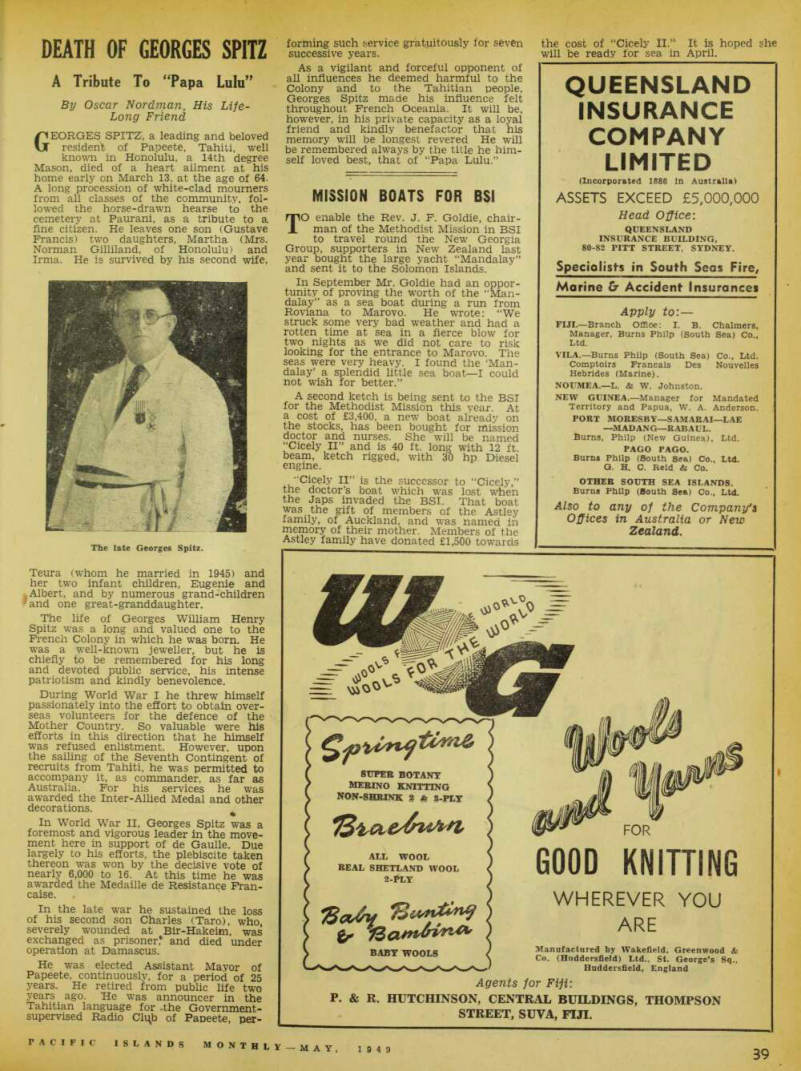
A Tribute To “Papa Lulu”
By Oscar Nordman, His Life- Long Friend
GEORGES SPITZ, a leading and beloved resident of Papeete, Tahiti, well known in Honolulu, a 14th degree Mason, died of a heart ailment at his home early on March 13, at the age of 64.
A long procession of white-clad mourners from all classes of the community, fol lowed the horse-drawn hearse to the cemetery at Paurani, as a tribute to a fine citizen. He leaves one son (Gustave Francis) two daughters, Martha (Mrs.
Norman Gilliland, of Honolulu) and Irma. He is survived by his second wife,
Teura (whom he married in 1945) and her two infant children, Eugenie and .Albert, and by numerous grand-children 'and one great-granddaughter.
The life of Georges William Henry Spitz was a long and valued one to the French Colony in which he was born. He was a well-known jeweller, but he is chiefly to be remembered for his long and devoted public service, his intense patriotism and kindly benevolence.
During World War I he threw himself passionately into the effort to obtain over seas volunteers for the defence of the Mother Country. So valuable were his efforts in this direction that he himself was refused enlistment. However, upon the sailing of the Seventh Contingent of recruits from Tahiti, he was permitted to accompany it, as commander, as far as Australia. For his services he was awarded the Inter-Allied Medal and other decorations.
In World War 11, Georges Spitz was a foremost and vigorous leader in the move ment here in support of de Gaulle. Due largely to his efforts, the plebiscite taken thereon was won by the decisive vote of nearly 6,000 to 16. At this time he was awarded the Medaille de Resistance Fran caise.
In the late war he sustained the loss of his second son Charles (Taro), who, severely wounded at Bir-Hakeim, was exchanged as prisoner,* and died under operation at Damascus.
He was elected Assistant Mayor of Papeete, continuously, for a period of 25 years. He retired from public life two years ago. He was announcer in the Tahitian language for ..the Government supervised Radio of Papeete, per
forming such service gratuitously for seven successive years.
As a vigilant and forceful opponent of all influences he deemed harmful to the Colony and to the Tahitian people, Georges Spitz made his influence felt throughout French Oceania. It will be, however, in his private capacity as a loyal friend and kindly benefactor that his memory will be longest revered He will be remembered always by the title he him self loved best, that of “Papa Lulu.”
The late Georges Spitz.
Mission Boats For Bsi
TO enable the Rev. J. F. Goldie, chair man of the Methodist Mission in BSI to travel round the New Georgia Group, supporters in New Zealand last year bought the large yacht “Mandalay” and sent it to the Solomon Islands.
In September Mr. Goldie had an oppor tunity of proving the worth of the “Man dalay” as a sea boat during a run from Roviana to Marovo. He wrote: “We struck some very bad weather and had a rotten time at sea in a fierce blow for two nights as we did not care to risk looking for the entrance to Marovo. The seas were very heavy. I found the ‘Man dalay’ a splendid little sea boat—l could not wish for better.”
A second ketch is being sent to the BSI for the Methodist Mission this year. At a cost of £3,400, a new boat already on the stocks, has been bought for mission doctor and nurses. She will be named “Cicely II” and is 40 ft. long with 12 ft. beam, ketch rigged, with 30 hp Diesel engine. -Cicely II” is the successor to “Cicely,” the doctor’s boat which was lost when the Japs invaded the BSI. That boat was the gift of members of the Astley family, of Auckland, and was named in memory of their mother. Members of the Astley family have donated £1,500 towards
the cost of “Cicely II” It is hoped she will be ready for sea in April.
Advertisements & other items, pp. 41-42 (1 item)
Knitting
QUEENSLAND
INSURANCE
COMPANY
LIMITED
(Incorporated 1886 in Australia)
ASSETS EXCEED £5,000,000
Head Office:
QUEENSLAND
INSURANCE BUILDING,
80-82 PITT STREET, SYDNEY,
Speciolists in South Seas Fire,
Marine & Accident Insurances
Apply to:—
FlJl.—Branch Office: I. B. Chalmers, Manager, Burns Philp (South Sea) Co., Ltd.
VlLA.—Burns Philp (South Sea) Co., Ltd.
Comptolrs Francais Des Nouvelles Hebrides (Marine).
NOUMEA.—L. & W. Johnston.
NEW GUlNEA,—Manager for Mandated Territory and Papua, W. A. Anderson.
PORT MORESBY—SAM ARAI—LAE
—MADANG—RABAUL.
Sums, Philp (New Guinea), Ltd.
PAGO PAGO.
Burns Philp (South Sea) Co., Ltd.
G. H. C. Reid & Co.
OTHER SOUTH SEA ISLANDS.
Burns Philp (South Sea) Co., Ltd.
Also to any of the Company’s Offices in Australia or New
Zealand.
SUPER
BOTANY
MERINO
KNITTING
NON
SHRINK
FLY
FOR
GOOD
KNITTING
ALL
WOOL
BEAL SHETLAND WOOL
PLY
IScunvi'n**'
is
BABY
WOOLS
WHEREVER YOU
ARE
Manufactured by Wakefield, Greenwood & Co. (Huddersfield) Ltd., St. George’s Sq., Huddersfield, England
Agents for Fiji :
P. & R. HUTCHINSON, CENTRAL BUILDINGS, THOMPSON
STREET, SUVA, FIJI.
An ornate example of historical keys, this XVlth Century French key features the sporting motif in its club and animal carvings. It seems to have been the key to a Duke’s country lodge.
A' 1 in s m s mm.
A R S
The
key
ok Pi to r m n 9 e a it e i s
CAPSTAN
FINE CUT
NAVY CUT
TOBACCOS
or . 48
Bananas And South Seas
Silliness
What An Examination of The Markets Discloses
A SENIOR officer of the NZ Marketing Department, Mr. F. S. Hunter, has been visiting Fiji, Tonga, and Samoa, familiarising himself with the organisa tion of the banana industry in three territories.
According to Fijian Government sources, he promised an experimental pur chase of bananas in hand and quarter hand bunches to see how they travelled, although he pointed out that the Market ing Department preferred bananas in cases.
It appears that New Zealand might take, from Fiji, Samoa and Tonga, a total of 50,000 cases of bananas per annum (of which Fiji’s share would be 40 per cent.) but this is dependant on shipping. The USS Go’s new refrigerated ship, “Tofua,” due on the run in 1951, may help the situation.
New Zealand’s Marketing Department buys bananas from the Fiji Government, and distributes them in New Zealand. The Fiji Government now pays the growers 6/6 and 5/6 per case; but, with cases, transport, packing charges, labour, wastage, etc., the Department pays more than twice those figures, FOB, Suva.
IN the old days, before we enjoyed the blessings of Socialism, the banana trade between the islands and NZ was in the hands of the trading firms. They bought the fruit from the growers, col lected it, shipped it, and distributed it to the consumers in New Zealand.
The-growers, comparatively, were better
off; good quality fruit got quick trans port: and, above all, the NZ consumers got an abundance of fruit at low rates.
But traders, shippers and fruit retailers made profits—they were even known, as a result of good management, hard work and thrift, to become rich—and this horrible social sin could not be permitted.
So, to-day, the trade is in the hands of the bureaucrats. Growers are no better off; and the prices paid by the NZ con sumers for a limited quantity of fruit are shocking. But the leisurely bureaucrats are happy in their well-paid jobs, and the accursed exploiters have been wiped out.
In Fiji, Mr. Hunter was informed that the planters would produce more bananas, if given an assured market. Mr. Hunter said that New Zealand could consume many more bananas, but he could give no guarantee, because of lack of shipping.
So there is an impasse, more or less complete.
In the old days, all these things were taken care of by the law of supply and demand, governed by competition, and no such silly situation could develop.
Misima Goldmine
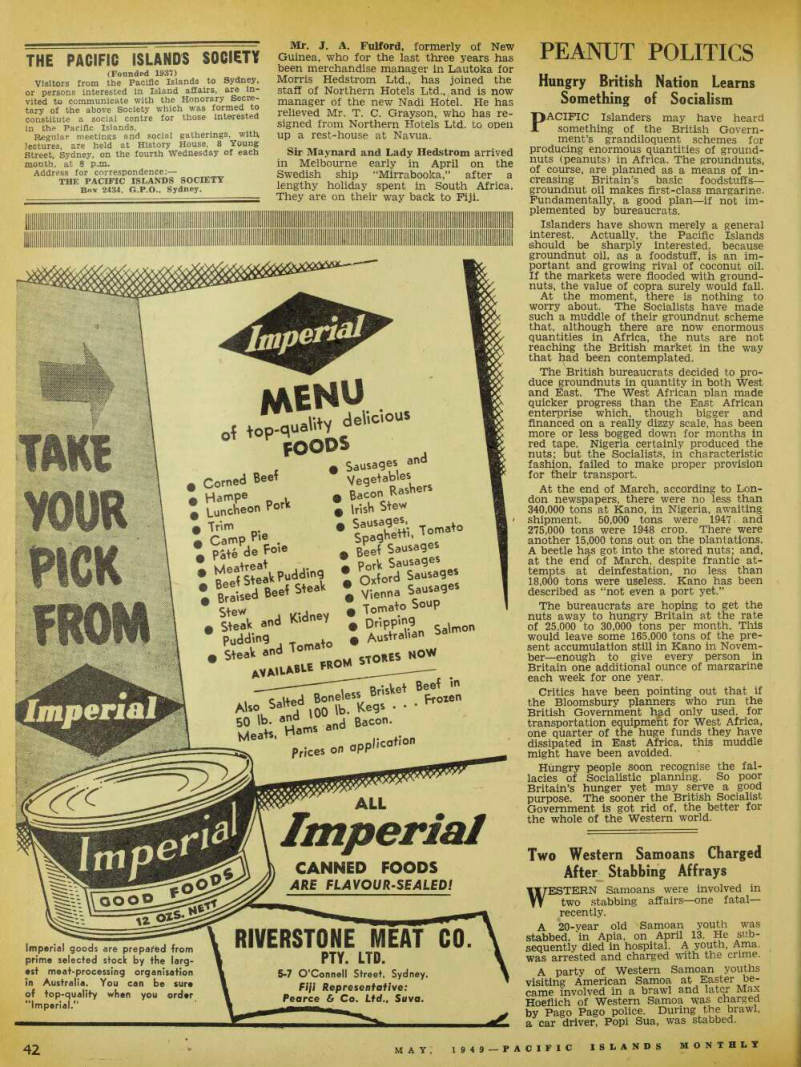
REPORT of Cuthbert’s Misima Gold mine Ltd., for year ended December 31 discloses no profit. “Mine rehab ilitation and plant reconstruction were seriously delayed because of shortage of native labour and of supplies” says the directors. This was a disappointment: it had been hoped to resume production from this very rich mine during 1948.
However, “Cuthbert’s Bonanza” has suffered exactly the same conditions of frustration and embarrassment as have been experienced by most other goldmines in Papua and New Guinea.
Gold production was commenced early
in 1949, and will be increased as additional labour is employed.
The official history of the Fiji Military Forces has been published in the United Kingdom and copies of the book are ex pected to arrive in the Colony in April.
The book was written by Mr. R. A. Hew lett, of Fiji, with the assistance of a military committee. Price will be 7/6 to the public, but ex-members of the FMF will be able to obtain it more cheaply. It will also be on sale in New Zealand.
Mr. J. A. Fulford, formerly of New Guinea, who for the last three years has been merchandise manager in Lautoka for Morris Hedstrom Ltd., has joined the staff of Northern Hotels Ltd., and is now manager of the new Nadi Hotel. He has relieved Mr. T. C. Grayson, who has re signed from Northern Hotels Ltd. to open up a rest-house at Navua.
Sir Maynard and Lady Hedstrom arrived in Melbourne early in April on the Swedish ship “Mirrabooka,” after a lengthy holiday spent in South Africa.
They are on their way back to Fiji.
Advertisements & other items, pp. 43-44 (1 item)
Borns Philp (South Sea) Go. Ltd.
The Twinkle in
Your Eye
COMES FROM ACTIVE
DIGESTION
Good normal digestive and liver activity means good, normal health and fitness. If yo* are becoming gloomy and feel tired out, the cause may be a congested state of your Intestinal tract. So many people are troubled with constipation, which, through the retention of waste In the digestive system, causes sick headache, biliousness, pimply skin, unpleasant breath, Irritability, slackness and dull eyes.
Regain your bright and attractive appearance by banishing constipation with Plnkettes. Tiny, perfectly harmless, gentle yet effective, these famous laxative and liver pills painlessly exercise and strengthen the bowels, keep the food tract clean and active, stir the liver, and thus banish sick headache, bilious attacks, pimples, unpleasant breath and gloom. All chemists and stores sell Plnkettes, the perfect laxative and liver pills.
BORNS PHILP (SOUTH SEA) Go. Ltd.
Registered Office: SUVA, FIJI
Code Address: “BURNSOUTH”
ISLAND TRADERS AND SHIPOWNERS
General Merchants (Wholesale and Retail)
Shipping, Customs and General Agents
Representatives for QUEENSLAND INSURANCE CO. LTD.
Distributing Agents for SHELL COMPANY (PACIFIC ISLANDS) LTD.
BRANCHES:
FIJI— SAMOA—
SUVA. APIA.
LEVUKA. PAGO PAGO.
LAUTOKA.
LABASA. TON GA-
BA. NUKUALOFA.
SIQATOKA. HAAPAI.
ROTUMA ISLAND. VAVAU.
NORFOLK IS.— NIUE IS.—
Sydney Agent*:
BURNS, PHILP & CO., LTD.,
7 Bridge Street.
London Agents:
BURNS, PHILP & CO., LTD.,
35 Crutched Prlars, 8.0.3.
San Francisco Agents:
BURNS, PHILP CO. OP SAN FRANCISCO,
Matson Building, 215 Market Street, Agencies Throughout the World.
THE PACIFIC ISLANDS SOCIETY
(Founded 1937) Visitors from the Pacific Islands to Sydney, or persons interested in Island affairs, are invited to communicate with the Honorary Secretary of the above Society which was formed to constitute a social centre for those interested in the Pacific Islands.
Regular meetings and social gatherings, with, lectures, are held at History House, 8 Young Street, Sydney, on the fourth Wednesday of each month, at 8 p.m.
Address for correspondence:—
THE PACIFIC ISLANDS SOCIETY
2434. G.P.0., Sydney.
Mtnv .
„t toV^*« , ;. der ' aous
FOODS
„ Sausages and
Vegetables
9 Bacon Rashers Irish Stew ,„ r . • |£“& • p^e P de Po« e * Beef Sausages • steak Pudding • Sausages *, Braised Beet Steak yienn a Sausages • Steak and Kidney • Upping • Pudding . Australian
• *eaV »" d STORES HO'M
Corned Beef
SX-r- 1
Trim Camp P'® pjte de F° ,e r <. 0000 *Ol \Z
ALL
Imperial
CANNED FOODS
ARE FLAVOUR-SEALED!
Imperial goods are prepared from prime selected stock by the largest meat-processing organisation in Australia. You can be sure of top-quality when you order "Imperial."
RIVERSTONE MEAT CO.
PTY. LTD.
5-7 O'Connell Street, Sydney.
Fiji Representative: Pearce & Co. Ltd., Suva.
Peanut Politics
Hungry British Nation Learns Something of Socialism
PACIFIC Islanders may have heard something of the British Govern ment’s grandiloquent schemes for producing enormous quantities of ground nuts (peanuts) in Africa. The groundnuts, of course, are planned as a means of in creasing Britain’s basic foodstuffs— groundnut oil makes first-class margarine.
Fundamentally, a good plan—if not im plemented by bureaucrats.
Islanders have shown merely a general interest. Actually, the Pacific Islands should be sharply interested, because groundnut oil, as a foodstuff, is an im portant and growing rival of coconut oil.
If the markets were flooded with ground nuts, the value of copra surely would fall.
At the moment, there is nothing to worry about. The Socialists have made such a muddle of their groundnut scheme that, although there are now enormous quantities in Africa, the nuts are not reaching the British market in the way that had been contemplated.
The British bureaucrats decided to pro duce groundnuts in quantity in both West and East. The West African plan made quicker progress than the East African enterprise which, though bigger and financed on a really dizzy scale, has been more or less bogged down for months in red tape. Nigeria certainly produced the nuts; but the Socialists, in characteristic fashion, failed to make proper provision for their transport.
At the end of March, according to Lon don newspapers, there were no less than 340,000 tons at Kano, in Nigeria, awaiting shipment. 50,000 tons were 1947 and 275,000 tons were 1948 crop. There were another 15,000 tons out on the plantations.
A beetle has got into the stored nuts; and, at the end* of March, despite frantic at tempts at deinfestation, no less than 18,000 tons were useless. Kano has been described as “not even a port yet.”
The bureaucrats are hoping to get the nuts away to hungry Britain at the rate of 25,000 to 30,000 tons per month. This would leave some 165,000 tons of the pre sent accumulation still in Kano in Novem ber-enough to give every person in Britain one additional ounce of margarine each week for one year.
Critics have been pointing out that if the Bloomsbury planners who run the British Government had only used, for transportation equipment for West Africa, one quarter of the huge funds they have dissipated in East Africa, this muddle might have been avoided.
Hungry people soon recognise the fal lacies of Socialistic planning. So poor Britain’s hunger yet may serve a good purpose. The sooner the British Socialist Government is got rid of. the better for the whole of the Western world.
After Stabbing Affrays
Two Western Samoans Charged After Stabbing Affrays
WESTERN Samoans were involved in two stabbing affairs—one fatal— recently.
A 20-year old Samoan youth was stabbed, in Apia, on April 13. He sub sequently died in hospital. A youth, Ama, was arrested and charged with the crime.
A party of Western Samoan youths visiting American Samoa at Easter be came involved in a brawl and later Max Hoeflich of Western Samoa was charged by Pago Pago police. During the brawl, a car driver, Popi Sua, was stabbed.
Magazine Section
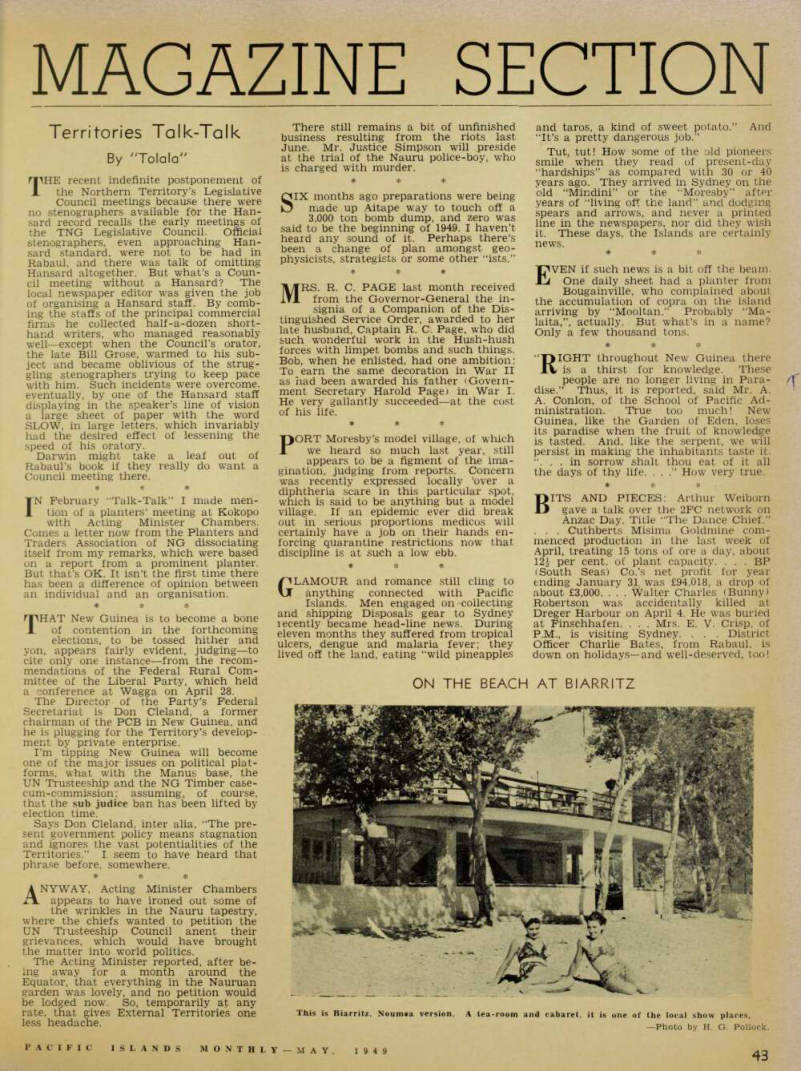
Territories Talk-Talk
By "Tolala"
THE recent indefinite postponement of the Northern Territory’s Legislative Council meetings because there were no stenographers available for the Han sard record recalls the early meetings of the TNG Legislative Council. Official stenographers, even approaching Han sard standard, were not to be had in Rabaul, and there was talk of omitting Hansard altogether. But what’s a Coun cil meeting without a Hansard? The local newspaper editor was given the job of organising a Hansard staff. By comb ing the staffs of the principal commercial firms he collected half-a-dozen short hand writers, who managed reasonably well —except when the Council’s orator, the late Bill Grose, warmed to his sub ject and became oblivious of the strug gling stenographers trying to keep pace with him. Such incidents were overcome, eventually, by one of the Hansard staff displaying in the speaker's line of vision a large sheet of paper with the word SLOW, in large letters, which invariably had the desired effect of lessening the speed of his oratory.
Darwin might take a leaf out of Rabaul’s book if they really do want a Council meeting there. ♦ * ♦ IN February “Talk-Talk” I made men tion of a planters’ meeting at Kokopo with Acting Minister Chambers.
Comes a letter now from the Planters and Traders Association of NG dissociating itself from my remarks, which were based on a report from a prominent planter.
But that’s OK. It isn’t the first time there has been a difference of opinion between an individual and an organisation. ♦ * * rpHAT New Guinea is to become a bone 1 of contention in the forthcoming elections, to be tossed hither and yon, appears fairly evident, judging—to cite only one instance —from the recom mendations of the Federal Rural Com mittee of the Liberal Party, which held a conference at Wagga on April 28.
The Director of the Party’s Federal Secretariat is Don Cleland, a former chairman of the PCB in New Guinea, and he is plugging for the Territory’s develop ment by private enterprise.
I’m tipping New Guinea will become one of the major issues on political plat forms, what with the Manus base, the UN Trusteeship and the NG Timber ca&e cum-commission; assuming, of course, that the sub judice ban has been lifted by election time.
Says Don Cleland, inter alia, “The pre sent government policy means stagnation and ignores the vast potentialities of the Territories.” I seem to have heard that phrase before, somewhere. ♦ * * ANYWAY, Acting Minister Chambers appears to have ironed out some of the wrinkles in the Nauru tapestry, where the chiefs wanted to petition the UN Trusteeship Council anent their grievances, which would have brought the matter into world politics.
The Acting Minister reported, after be ing away for a month around the Equator, that everything in the Nauruan garden was lovely, and no petition would be lodged now. So, temporarily at any rate, that gives External Territories one less headache.
There still remains a bit of unfinished business resulting from the riots last pollce ' boy ’ who is charged with murder. * * * SIX months ago preparations were being made up Aitape way to touch off a 3,000 ton bomb dump, and zero was said to be the beginning of 1949. I haven’t heard any sound of it. Perhaps there’s been a change of plan amongst geophysicists, strategists or some other “ists.” * * * M__, „ i 4. . .
RS. R. C. PAGE last month received from the Governor-General the insigma of a Companion of the Distinguished Service prder awarded to her late husband, Captain R. C. Page, who did such wonderful work in the Hush-hush forces with limpet bombs and such things, Bob. when he enlisted, had one ambition: To earn the same decoration in War II as had been awarded his father (Goveinment Secretary Harold Page) in War I.
He very gallantly succeeded—at the cost of his life. * * * , , , , , . , PORT Moresby s model village, of which XT we heard so much last year, still appears to be a figment of the imagination, judging from reports. Concern was recently expressed locally 'over a diphtheria scare in this particular spot, which is said to be anything but a model village. If an epidemic ever did break out in serious proportions medicos will certainly have a job on their hands enforcing quarantine restrictions now that discipline is at such a low ebb. * * * GLAMOUR and romance still cling to anything connected with Pacific Islands. Men engaged on collecting and shipping Disposals gear to Sydney lecently became head-line news. During eleven months they suffered from tropical ulcers, dengue and malaria fever; they lived off the land, eating “wild pineapples
and taros, a kind of sweet potato.” And “it’s a pretty dangerous job.”
Tut, tut! How some of the old pioneers smile when they read of present-day “hardships” as compared with 30 or 40 years ago. They arrived in Sydney on the “Mindini or the "Moresby ’ after printed fP fhp nfiwsnaners nnr did thev wish
H These are clrta^nlv
Jf- „ Tnese days - tne islands are certainly * * * 17WEN if such news is a bit off the beam.
One daily sheet had a planter from Bougainville, who complained about the accumulation of copra on the island arriving by “Mooltan.” Probably “Ma iaita,”, actually. But what’s in a name? only a few thousand tons, , OIGHT throughout New Guinea there IV is a thirst for knowledge. These people are no longer living in Para disc.” Thus, it is reported, said Mr. A.
A. Conlon, of the School of Pacific Ad ministration. True too much! New Guinea, like the Garden of Eden, loses its paradise when the fruit of knowledge j S tasted. And, like the serpent, we will persist in making the inhabitants taste it. . . in sorrow shalt thou eat of it all the days of thy life. . . .” How very true, * * * T _, O axt . ‘ ... I>ITS AND PIECES: Arthur Weiborn XJ gave a talk oyer the 2FC network on Anzac Day. Title “The Dance Chief.” ■ • • Cuthberts Misima Goldmine corn menced production in the last week of April, treating 15 tons of ore a day, about 12£ per cent, of plant capacity. ... BP (South Seas) Co.’s net profit for year ending January 31 was £94,018, a drop of about £3,000. . . . Walter Charles (Bunny) Robertson was accidentally killed at Dreger Harbour on April 4. He was buried at Finschhafen. . . . Mrs. E. V. Crisp, of P.M., is visiting Sydney. . . . District Officer Charlie Bates, from Rabaul. is down on holidays—and well-deserved, too!
Advertisements & other items, p. 45 (1 item)
On The Beach At Biarritz
This is Biarritz, Noumea version. A tea-room and cabaret, it is one of the local show places. —Photo by H. G. Pollock.
The Sad Handicap of the Plumber's
Mate
THE time having arrived when the toilet cistern would neither fill nor empty, in its usual noisily uninhibited fashion, Mrs. Gordon asked her hus band to call in at the Public Works De partment and get the advice of a plumber.
She awaited the outcome with interest, feeling that a Guadalcanal plumber must surely not only live up to the piquant re putation of the profession but should, as well, have something individual to contri bute to the lustre of plumbing in general.
So on a brilliant morning when the glittering air overhead was torn to shreds by the swooping of a flock of dove-white birds —contradicting their seraphic ap pearance with harsh screams of cockatoo derision —the plumber came. He came panting up the hill in a war veteran of a jeep. He was sixteen stone of Fijian, with a little Solomon Islander —either terrified or else very sulky—bringing up the rear.
The plumber came thumping cheerfully into the house and, while she faced his flow of greetings and comments on the weather, Mrs. Gordon’s uneasily roving eye caught a provocative glimpse of the plumber’s Solomon Islander mate fur tively edging away behind the house wash.
The plumber wore a white shirt and boiler suit, teamed with a pair of sand shoes reminiscent of landing barges.
Talking richly and rapidly, he stumped into the bathroom and gallantly squeezed himself into the toilet annexe. Still talk ing and pawing affectionately at the newly-painted walls with large and dingy hands, he rapidly sized up the cistern situation.
Saying philosophically., “Trouble com ing every day” (about the only bit of his conversation that Mrs. Gordon was able to take to her heart), the plumber next lived up to all stories involving plumbers by intimating that he must send for various tools-of-trade necessary to cover the job. He leant upon the gallery rail and bellowed into the middle distance for plumber’s mate, who emerged nervously from his retreat and then went hurtling obediently down the hill in search of tools.
MRS. GORDON returned to her sewing but, from the bathroom, the Fijian continued to fire off mangled re marks about the weather, the architec ture of the bungalow, how, to take the stains off the fibrolite ceiling and, if Mrs. Gordon’s quivering ears did not de ceive her, about the deficiencies of his own personal plumbing.
He then thumped out of his seclusion to ask whether he might borrow a pocket knife.
Opening and shutting drawers in her desk and going into little trances in an effort to remember just where she had seen a pocket knife lying about, Mrs.
Gordon was roused from her research by the plumber clicking open a large pocket knife right in her ear, at the same time informing her (Mrs. Gordon thought) that this was one he had found in the bathroom, that he had been using it satisfactorily for the past ten minutes, that it strongly reminded him of a pocket knife he had owned in earlier days, that he wouldn’t mind being offered a knife like this any day now. ( He also added something about its be ing so useful for something or other, at the same time gesturing with the open blade towards his ample stomach. Pre ferring to interpret this as an intimation that a knife was ever so handy to clip on to the belt, Mrs. Gordon was pleased to
notice plumber’s mate back again, plus tools, and skulking uneasily behind a paw-paw tree.
This fact being drawn to the plumber’s attention, he charged outside with shouts of “You come!” and herded plumber’s mate towards the steps. Here the plum ber stopped dead, bent down and removed the landing barges, which for the rest of the morning stood monumentally at the foot of the steps—whether for their sake or the sake of the bathroom floor Mrs. Gordon was unable to decide.
JUDGING from sounds in the bathroom, work then began in earnest. But suddenly plumber’s mate was seen to burst out wildly and make a dash for the house-wash, with barefoot plumber in angry pursuit, waving the borrowed pocket-knife and looking alarmingly in fluential.
By Rosa Moore
Plumber’s mate circled the house-wash and bounded up the steps and back again to the bathroom. His part in the subse quent curious proceedings seemed to com prise alternate dashes for cover and en forced returns (with much vituperation) to the job in hand. He was a rather black youth, with a slipping grey calico and hair worn in a lime-bleached pagoda.
He had the air of one who never did keep up those correspondence lessons on plumbing and was therefore utterly out of his depth.
The floor vibrating suddenly, Mrs.
Gordon realised that the plumber had again materialised behind her. He asked for a cold drink. Opening the door of the icebox a mere crack so as not to dis play the beer too openly, she fished him out some fresh lime-juice.
He drained this resignedly and lum bered back to the job, shouting men acingly, “You better come back, eh?” to a small area of grey calico incautiously protruding round the corner of the house wash.
There was quite a long interval, broken by sounds of cataracting water and muffled thumps, before the plumber again accosted Mrs. Gordon. He seemed to be asking to borrow one of the coir mats, at the same time saying that he felt tired and there was far too much water.
Jumping to the conclusion that the plum ber had drunk too much lime-juice, had come out in a heavy perspiration and was forced to lie down for a little while, Mrs. Go? don nodded assent,rather than attempt to delve further int - the situa tion. " V Mat and plumber’s mate (flushed out of brief sanctuary in the house-motorcar) disappeared into the bathroom. Mrs.
Gordon was left to sew and diagnose the hammerinp- and skirmishing.
FIVE minutes before knock-off time, the plumber waved her up to the scene of activities and she noted, without surorise, plumber’s mate filtering quietly down the side steps to the garden as she approached.
“Now you look here, miss,” (he plumber said, seating himself in reverse on the toilet seat and turning up a bland brown
face. “You see this one here—he won’t work until to-morrow. But all right for you to use to-night if afterwards you push this one nere and see the water not coming up more high than to here. A little bit of trouble, yes, but all well to morrow. I forget the other tool now, but to-morrow I come back and take out tnis wrong pipe here and close him. You use him all right to-night, to-morrow I come back and fix him proper.”
And he added, in a bellow, “Here, YOU —you come quicktime, catch’im tool.”
Plumber’s mate failed to materialise, being by this time well out of control.
The plumber continued to sit enthroned and explained, with a gusty sigh, “This boy has a tabu. He say it is tabu for him to work with lavatories. He is frightened too much. He say debbils get very cross about lavatories. I tell him— I do him, and it not kill me yet. More better he take some other job now, I think.”
Then he arose heavily, brushed down his boiler suit and prepared to depart.
“I come to-morrow,” he cried, thril lingly. "But for now—all right you start to use him.”
Beaming, he donned his landing barges.
Angrily, he scanned the empty landscape.
Waving companionably, away he drove.
Mrs. Gordon sympathetically stayed to watch plumber’s mate emerge cautiously from round the corner of the poultry run. He looked sadly as if he were weighing tangible angry plumber against hypothetic? 1 avenging debbils.
With rolling eyes, he went streaking off down the hill after the receding jeep.
Conspirators
(To be Sung to the Tune of “Here We Go Gathering (Coco) Nuts in May.”) We’ve ninety boys in the labour line— Labour line— Labour line — We’ve ninety boys in the labour line— But never a word about it!
The little houseboys rise and shine— Rise and shine— Rise and shine — One is seven, the other nine (But never a word about it!) We shipped some copra off to-day— Off to-day— Off to-day— A bundled and ninety bags (hooray!) But never a word about it!
We’ve ninety boys in the labour line— Labour line— Labour line — And the bossboy’s just turned ninety nine— (But never a word about it!)
Noelle Taylor.
Mr. W. E. Sansom assumed duties as District Officer, Rabaul on March 17, when he took over from Mr. C. D. Bates who proceeded on leave. Mr. Bates had been continuously on duty in Rabaul for almost four years—three with Civil Ad ministration and one with the Army.
Mr. A, W. Small, who is a member of the Fiji Administration and now is stationed at Savu Savu, will retire in October next, after more than 39 years’ service. His family has close ties with Fiji. His father, the Reverend A. J.
Small, who died in 1925, was Chairman of the Methodist Mission in Fiji for many years. His children, however, appear to be looking towards New Zealand rather than Fiji—Tony, aged 16, is taking up a berth with the Radio Corporation of New Zealand, and Phyllis, 22, is a nurse at the New Plymouth Public Hospital.
How a War Club Became
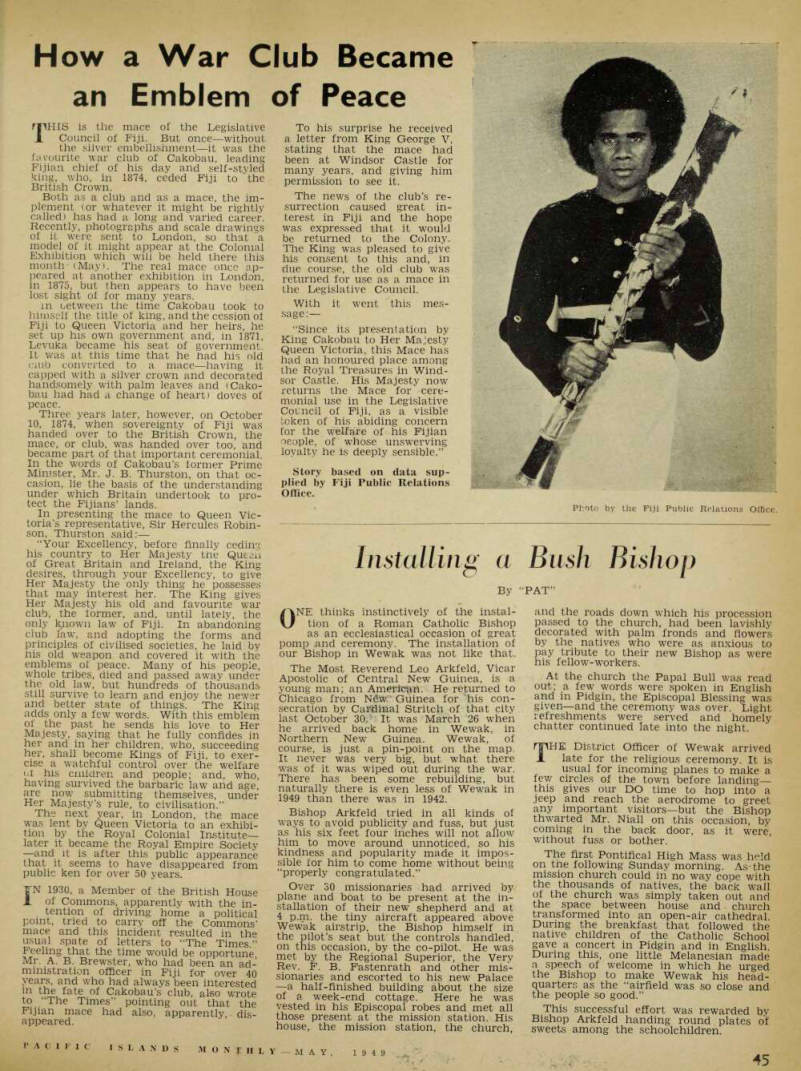
an Emblem of Peace
riIHIS is the mace of the Legislative 1 Council of Fiji. But once—without the silver embellishment —it was the favourite war club of Cakobau, leading Fijian chief of his day and self-styled king, who, in 1874, ceded Fiji to the British Crown.
Both as a club and as a mace, the im plement (or whatever it might be rightly called) has had a long and varied career.
Recently, photographs and scale drawings of it were sent to London, so that a model of it might appear at the Colonial Exhibition which will be held there this month (May). The real mace once ap peared at another exhibition in London, in 1875, but then appears to have been lost sight of for many years. in between the time Cakobau took to himself the title of king, and the cession oi Fiji to Queen Victoria and her heirs, he set up his own government and, in 1871, Levuka became his seat of government.
It was at this time that he had his old emb converted to a mace—having it capped with a silver crown and decorated handsomely with palm leaves and (Cako bau had had a change of heart) doves of peace.
Three years later, however, on October 10, 1874, when sovereignty of Fiji was handed over to the British Crown, the mace, or club, was handed over too, and became part of that important ceremonial.
In the words of Cakobau’s former Prime Minister, Mr. J. B. Thurston, on that oc casion, lie the basis of the understanding under which Britain undertook to pro tect the Fijians’ lands.
In presenting the mace to Queen Vic toria’s representative, Sir Hercules Robin son, Thurston said:— “Your Excellency, before finally ceding his country to Her Majesty the Queen of Great Britain and Ireland, the King desires, through your Excellency, to give Her Majesty the only thing he possesses that may interest her. The King gives Her Majesty his old and favourite war club, the iormer, and, until lately, the only known law of Fiji. In abandoning club law, and adopting the forms and principles of civilised societies, he laid by his old weapon and covered it with the emblems of peace. Many of his people, whole tribes, died and passed away under the old law, but hundreds of thousands still survive to learn and enjoy the newer and better state of things. ‘ The King adds only a few words. With this emblem of the past he sends his love to Her Majesty, saying that he fully confides in her and in her children, who, succeeding her, shall become Kings of Fiji, to exer cise a watchful control over the welfare of his cmidren and people; and, who, having survived the barbaric law and age, are now submitting themselves, under Her Majesty’s rule, to civilisation.”
The next year, in London, the mace was lent by Queen Victoria to an exhibi tion by the Royal Colonial Institute— later it became the Royal Empire Society —and it is after this public appearance that it seems to have disappeared from public ken for over 50 years.
IN 1930, a Member of the British House of Commons, apparently with the in tention of driving home a political point, tried to carry off the Commons’ mace and this incident resulted in the usual spate of letters to “The Times.”
Feeling that the time would be opportune Mr. A. B. Brewster, who had been an ad ministration officer in Fiji for over 40 years, and who had always been interested in the fate of Cakobau’s club, also wrote to “The Times” pointing out that the Fijian mace had also, apparently, dis appeared.
To his surprise he received a letter from King George V, stating that the mace had been at Windsor Castle for many years, and giving him permission to see it.
The news of the club’s re surrection caused great in terest in Fiji and the hope was expressed that it would be returned to the Colony.
The King was pleased to give his consent to this and, in due course, the old club was returned for use as a mace in the Legislative Council.
With it went this mes sage:— “Since its presentation by King Cakobau to Her Majesty Queen Victoria, this Mace has had an honoured place among the Royal Treasures in Wind sor Castle. His Majesty now returns the Mace for cere monial use in the Legislative Council of Fiji, as a visible token of his abiding concern for the welfare of his Fijian oeople, of whose unswerving loyalty he is deeply sensible.”
Story based on data sup plied by Fiji Public Relations Office.
Photo by the Fiji Public Relations Office.
Installing a Bush Bishop
By “Pat”
ONE thinks instinctively of the instal tion of a Roman Catholic Bishop as an ecclesiastical occasion of great pomp and ceremony. The installation of our Bishop in Wewak was not like that.
The Most Reverend Leo Arkfeld, Vicar Apostolic of Central New Guinea, is a young man; an American. He returned to Chicago from Ndw Guinea for his con secration by Cardinal Stritch of that city last October 30. It was March 26 when he arrived back home in Wewak, in Northern New Guinea. Wewak, of course, is just a pin-point on the map.
It never was very big, but what there was of it was wiped out during the war.
There has been some rebuilding, but naturally there is even less of Wewak in 1949 than there was in 1942.
Bishop Arkfeld tried in all kinds of ways to avoid publicity and fuss, but just as his six feet four inches will not allow him to move around unnoticed, so his kindness and popularity made it impos sible for him to come home without being “properly congratulated.”
Over 30 missionaries had arrived by plane and boat to be present at the in stallation of their new shepherd and at 4 p.m. the tiny aircraft appeared above Wewak airstrip, the Bishop himself in the pilot’s seat but the controls handled, on this occasion, by the co-pilot. He was met by the Regional Superior, the Very Rev. F. B. Fastenrath and other mis sionaries and escorted to his new Palace —a half-finished building about the size of a week-end cottage. Here he was vested in his Episcopal robes and met all those present at the mission station. His house, the mission station, the church,
and the roads down which his procession passed to the church, had been lavishly decorated with palm fronds and flowers by the natives who were as anxious to pay tribute to their new Bishop as were his fellow-workers.
At the church the Papal Bull was read out; a few words were spoken in English and in Pidgin, the Episcopal Blessing was given—and the ceremony was over. Light refreshments were served and homely chatter continued late into the night.
THE District Officer of Wewak arrived late for the religious ceremony. It is usual for incoming planes to make a few circles of the town before landing— this gives our DO time to hop into a jeep and reach the aerodrome to greet any important visitors—but the Bishop thwarted Mr. Niall on this occasion, by coming in the back door, as it were, without fuss or bother.
The first Pontifical High Mass was held on the following Sunday morning. As the mission church could in no way cope with the thousands of natives, the back wall of the church was simply taken out and the space between house and church transformed into an open-air cathedral.
During the breakfast that followed the native children of the Catholic School gave a concert in Pidgin and in English.
During this, one little Melanesian made a speech of welcome in which he urged the Bishop to make Wewak his head quarters as the “airfield was so close and the people so good.”
This successful effort was rewarded by Bishop Arkfeld handing round plates of sweets among the schoolchildren.
Advertisements & other items, p. 47 (1 item)
45
I’ACIFIC ISLANDS MONTHLY-MAY, 1949
Tabiteuea
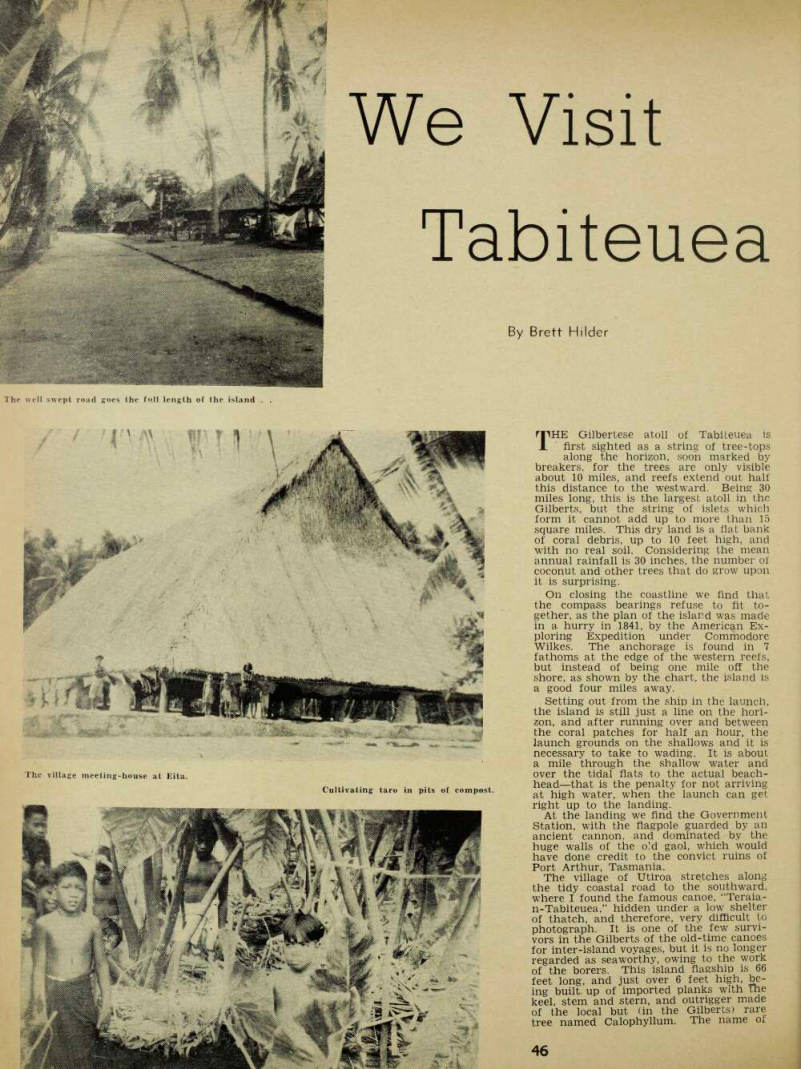
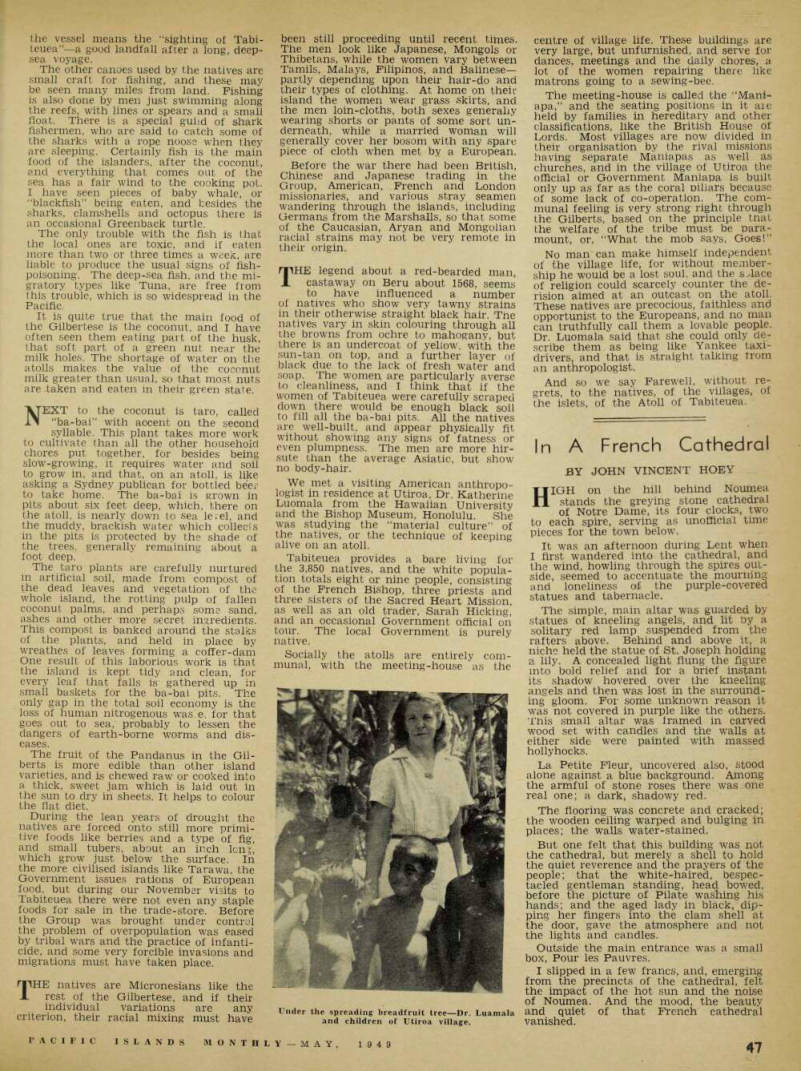
We Visit
By Brett Milder
rpHE Gilbertese atoll of Tabiteuea is L first sighted as a string of tree-tops along the horizon, soon marked by breakers, for the trees are only visible about 10 miles, and reefs extend out half this distance to the westward. Being 30 miles long, this is the largest atoll in the Gilberts, but the string of islets which form it cannot add up to more than 15 square miles. This dry land is a flat bank of coral debris, up to 10 feet high, and with no real soil. Considering the mean annual rainfall is 30 inches, the number of coconut and other trees that do grow upon it is surprising.
On closing the coastline we find that the compass bearings refuse to fit to gether, as the plan of the island was made in a hurry in 1841, by the American Ex ploring Expedition under Commodore Wilkes. The anchorage is found in 7 fathoms at the edge of the western reefs, but instead of being one mile off the shore, as shown by the chart, the island is a good four miles away.
Setting out from the ship in the launch, the island is still just a line on the hori zon, and after running over and between the coral patches for half an hour, the launch grounds on the shallows and it is necessary to take to wading. It is about a mile through the shallow water and over the tidal flats to the actual beach head —that is the penalty for not arriving at high water, when the launch can get right up to the landing.
At the landing we find the Government Station, with the flagpole guarded by an ancient cannon, and dominated by the huge walls of the old gaol, which would have done credit to the convict ruins of Port Arthur, Tasmania.
The village of Utiroa stretches along the tidy coastal road to the southward, where I found the famous canoe, “Teraia n-Tabiteuea,” hidden under a low shelter of thatch, and therefore, very difficult to photograph. It is one of the few survi vors in the Gilberts of the old-time canoes for inter-island voyages, but it is no longer regarded as seaworthy, owing to the work of the borers. This island flagship is 66 feet long, and just over 6 feet high, be ing built up of imported planks with the keel, stem and stern, and outrigger made of the local but (in the Gilberts) rare tree named Calophyllum. The name oi
The well swept road goes the full length of the island . .
The village meeting-house at Eita.
Cultivating taro in pits of compost.
the vessel means the “sighting of Tabi teuea”—a good landfall after a long, deep sea voyage.
The other canoes used by the natives are small craft for fishing, and these may be seen many miles from land. Fishing is also done by men just swimming along the reefs, with lines or spears and a small float. There is a special guild of shark fishermen, who are said to catch some of the sharks with a rope noose when they are sleeping. Certainly fish is the main food of the islanders, after the coconut, and everything that comes out of the sea has a fair wind to the cooking pot.
I have seen pieces of baby whale, or “blackfish” being eaten, and besides the sharks, clamshells and octopus there is an occasional Greenback turtle.
The only trouble with the fish is that the local ones are toxic, and if eaten more than two or three times a week, are liable to produce the usual signs of fish poisoning. The deep-sea fish, and the mi gratory types like Tuna, are free from this trouble, which is so widespread in the Pacific.
It is quite true that the main food of the Gilbertese is the coconut, and I have often seen them eating part of the husk, that soft part of a green nut near the milk holes. The shortage of water on the atolls makes the value of the coconut milk greater than usual, so that most nuts are taken and eaten in their green state.
NEXT to the coconut is taro, called “ba-bai” with accent on the second syllable. This plant takes more work to cultivate than all the other household chores put together, for besides being slow-growing, it requires water and soil to grow in, and that, on an atoll, is like asking a Sydney publican for bottled beer to take home. The ba-bai is grown in pits about six feet deep, which, there on the atoll, is nearly down to sea level, and the muddy, brackish water which colled s in the pits is protected by the shade of the trees, generally remaining about a foot deep.
The taro plants are carefully nurtured in artificial soil, made from compost of the dead leaves and vegetation of the whole island, the rotting pulp of fallen coconut palms, and perhaps some sand, ashes and other more secret ingredients.
This compost is banked around the stalks of the plants, and held in place by wreathes of leaves forming a coffer-dam One result of this laborious work is that the island is kept tidy and clean, for every leaf that falls is gathered up in small baskets for the ba-bai pits. The only gap in the total soil economy is the loss of human nitrogenous was e, for that goes out to sea, probably to lessen the dangers of earth-borne worms and dis eases.
The fruit of the Pandanus in the Gil berts is more edible than other island varieties, and is chewed raw or cooked into a thick, sweet jam which is laid out in the sun to dry in sheets. It helps to colour the flat diet.
During the lean years of drought the natives are forced onto still more primi tive foods like berries and a type of fig, and small tubers, about an inch long, which grow just below the surface. In the more civilised islands like Tarawa, the Government issues rations of European food, but during our November visits to Tabiteuea there were not even any staple foods for sale in the trade-store. Before the Group was brought under control the problem of overpopulation was eased by tribal wars and the practice of infanti cide, and some very forcible invasions and migrations must have taken place. natives are Micronesians like the rest of the Gilbertese, and if their individual variations are any criterion, their racial mixing must have
been still proceeding until recent times.
The men look like Japanese, Mongols or Thibetans, while the women vary between Tamils. Malays, Filipinos, and Balinese— partly depending upon their hair-do and their types of clothing. At home on their island the women wear grass skirts, and the men loin-cloths, both sexes generally wearing shorts or pants of some sort un derneath, while a married woman will generally cover her bosom with any spare piece of cloth when met by a European.
Before the war there had been British, Chinese and Japanese trading in the Group, American, French and London missionaries, and various stray seamen wandering through the islands, including Germans from the Marshalls, so that some of the Caucasian, Aryan and Mongolian racial strains may not be very remote in their origin. 11HE legend about a red-bearded man, castaway on Beru about 1568, seems to have influenced a number of natives who show very tawny strains in their otherwise straight black hair. The natives vary in skin colouring through all the browns from ochre to mahogany, but there is an undercoat of yellow, with the sun-tan on top, and a further layer of black due to the lack of fresh water and soap. The women are particularly averse to cleanliness, and I think that if the women of Tabiteuea were carefully scraped down there would be enough black soil to fill all the ba-bai pits. All the natives are well-built, and appear physically fit without showing any signs of fatness or even plumpness. The men are more hir sute than the average Asiatic, but show no body-hair.
We met a visiting American anthropo logist in residence at Utiroa, Dr. Katherine Luomala from the Hawaiian University and the Bishop Museum, Honolulu. She was studying the “material culture” of the natives, or the technique of keeping alive on an atoll.
Tabiteuea provides a bare living for the 3,850 natives, and the white popula tion totals eight or nine people, consisting of the French Bishop, three priests and three sisters of the Sacred Heart Mission, as well as an old trader, Sarah Kicking, and an occasional Government official on tour. The local Government is purely native.
Socially the atolls are entirely com munal, with the meeting-house as the
centre of village life. These buildings are very large, but unfurnished, and serve for dances, meetings and the daily chores, a lot of the women repairing there like matrons going to a sewing-bee.
The meeting-house is called the “Mani apa,” and the seating positions in it aie held by families in hereditary and other classifications, like the British House of Lords. Most villages are now divided in their organisation by the rival missions having separate Maniapas as well as churches, and in the village of Utiroa the official or Government Maniapa is built only up as far as the coral pillars because of some lack of co-operation. The com munal feeling is very strong right through the Gilberts, based on the principle tnat the welfare of the tribe must be para mount, or, “What the mob says, Goes!”
No man can make himself independent of the village life, for without member ship he would be a lost soul, and the solace of religion could scarcely counter the de rision aimed at an outcast on the atoll.
These natives are precocious, faithless and opportunist to the Europeans, and no man can truthfully call them a lovable people.
Dr. Luomala said that she could only de scribe them as being like Yankee taxi drivers, and that is straight talking from an anthropologist.
And so we say Farewell, without re grets, to the natives, of the villages, of the islets, of the Atoll of Tabiteuea.
Under the spreading breadfruit tree—Dr. Luamala and children of Utiroa village.
In A French Cathedral
By John Vincent Hoey
HIGH on the hill behind Noumea stands the greying stone cathedral of Notre Dame, its four clocks, two to each spire, serving as unofficial time pieces for the town below.
It was an afternoon during Lent when I first wandered into the cathedral, and the wind, howling through the spires out side, seemed to accentuate the mourning and loneliness of the purple-covered statues and tabernacle.
The simple, main altar was guarded by statues of kneeling angels, and lit by a solitary red lamp suspended from the rafters above. Behind and above it, a niche held the statue of St. Joseph holding a lily. A concealed light flung the figure into bold relief and for a brief instant its shadow hovered over the kneeling angels and then was lost in the surround ing gloom. For some unknown reason it was not covered in purple like the others.
This small altar was framed in carved wood set with candles and the walls at either side were painted with massed hollyhocks.
La Petite Fleur, uncovered also, stood alone against a blue background. Among the armful of stone roses there was one real one; a dark, shadowy red.
The flooring was concrete and cracked; the wooden ceiling warped and bulging in places; the walls water-stained.
But one felt that this building was not the cathedral, but merely a shell to hold the quiet reverence and the prayers of the people; that the white-haired, bespec tacled gentleman standing, head bowed, before the picture of Pilate washing his hands; and the aged lady in black, dip ping her fingers into the clam shell at the door, gave the atmosphere and not the lights and candles.
Outside the main entrance was a small box, Pour les Pauvres.
I slipped in a few francs, and, emerging from the precincts of the cathedral, felt the impact of the hot sun and the noise of Noumea. And the mood, the beauty and quiet of that French cathedral vanished.
Tropicalities
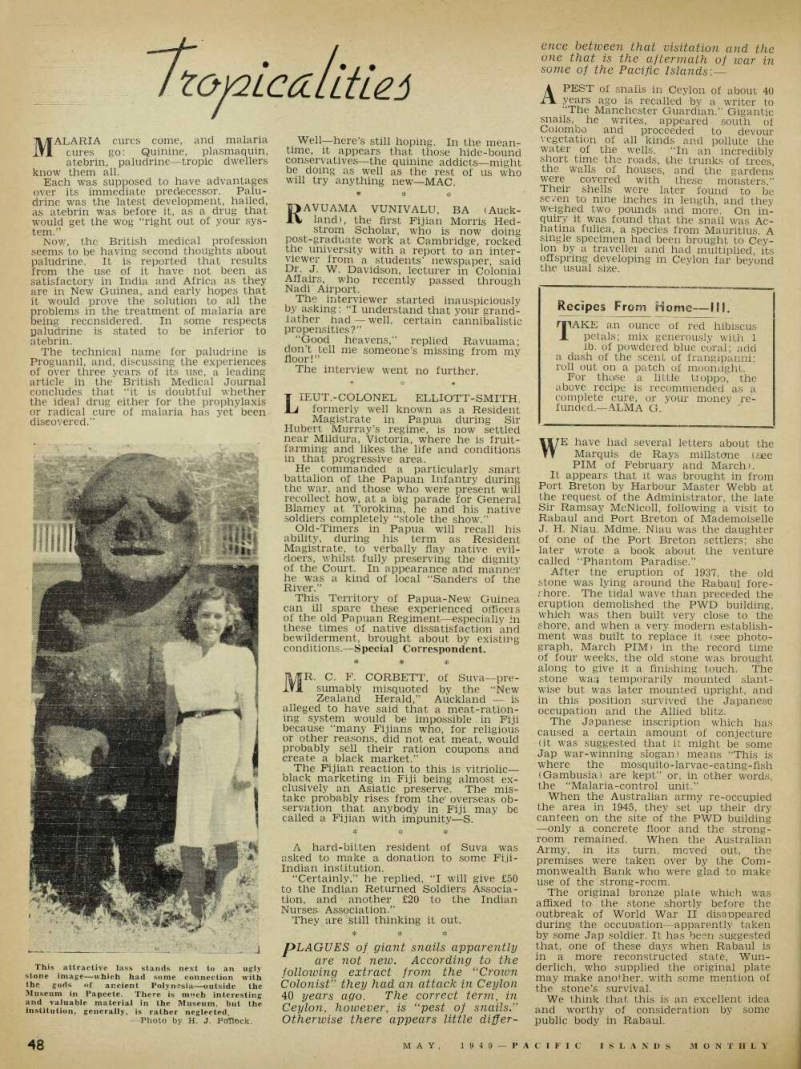
MALARIA cures come, and malaria cures go: Quinine, plasmaquin, atebrin, paludrine—tropic dwellers know them all.
Each was supposed to have advantages over its immediate predecessor. Palu drine was the latest development, hailed, as atebrin was before it, as a drug that would get the wog “right out of your sys tem.”
Nov/, the British medical profession seems to be having second thoughts about paludrine. It is reported that results from the use of it have not been as satisfactory in India and Africa as they are in New Guinea, and early hopes that it would prove the solution to all the problems in the treatment of malaria are being reconsidered. In some respects paludrine is stated to be inferior to atebrin.
The technical name for paludrine is Proguanil, and, discussing the experiences of over three years of its use, a leading article in the British Medical Journal concludes that “it is doubtful whether the ideal drug either for the prophylaxis or radical cure of malaria has yet been discovered.”
Well—here’s still hoping. In the mean time, it appears that those hide-bound conservatives—the quinine addicts—might be doing as well as the rest of us who will try anything new—MAC. * * *
Ravuama Vunivalu, Ba (Auck
land), the first Fijian Morris Hed strom Scholar, who is now doing post-graduate work at Cambridge, rocked the university with a report to an inter viewer from a students’ newspaper, said Dr. J. W. Davidson, lecturer in Colonial Affairs, who recently passed through Nadi Airport.
The interviewer started inauspiciously by asking: “I understand that your grand father had well, certain cannibalistic propensities?”
“Good heavens,” replied Ravuama; don t tell me someone’s missing from my floor!”
The interview went no further. * « * Lieut. -colonel elliott-smith. formerly well known as a Resident Magistrate in Papua during Sir Hubert Murray’s regime, is now settled near Mildura, Victoria, where he is fruit farming and likes the life and conditions in that progressive area.
He commanded a particularly smart battalion of the Papuan Infantry during the war, and those who were present will recollect how, at a big parade for General Blarney at Torokina, he and his native soldiers completely “stole the show.”
Old-Timers in Papua will recall his ability, during his term as Resident Magistrate, to verbally flay native evil doers, whilst fully preserving the dignity of the Court. In appearance and manner he was a kind of local “Sanders of the River.”
This Territory of Papua-New Guinea can ill spare these experienced officers of the old Papuan Regiment—especially in these times of native dissatisfaction and bewilderment, brought about by existing conditions.—Special Correspondent. * * * MR. C. F. CORBETT, of Suva—pre sumably misquoted by the “New Zealand Herald,” Auckland is alleged to have said that a meat-ration ing system would be impossible in Fiji because “many Fijians who, for religious or other reasons, did not eat meat, would probably sell their ration coupons and create a black market.”
The Fijian reaction to this is vitriolic— black marketing in Fiji being almost ex clusively an Asiatic preserve. The mis take probably rises from the' overseas ob servation that anybody in Fiji may be called a Fijian with impunity—S.
H* $ A hard-bitten resident of Suva was asked to make a donation to some Fiji- Indian institution.
“Certainly,” he replied, “I will give £5O to the Indian Returned Soldiers Associa tion, and another £2O to the Indian Nurses- Association.”
They are still thinking it out. ❖ ❖ ❖ pLAGUES of giant snails apparently are not new. According to the following extract from the “Crown Colonist” they had an attack in Ceylon 40 years ago. The correct term, in Ceylon, however, is “pest of snails.”
Otherwise there appears little differ
mice between that visitation and the one that is the aftermath of war in some of the Pacific Islands: A PEST of snails in Ceylon of about 40 years ago is recalled by a writer to “The Manchester Guardian.” Gigantic snails, he writes, appeared south of Colombo and proceeded to devour vegetation of all kinds and pollute the water of the wells. “In an incredibly short time the roads, the trunks of trees, the walls of houses, and the gardens were covered with these monsters.”
Their shells were later found to be seven to nine inches in length, and they weighed two pounds and more. On in quiry it was found that the snail was Ac hatma fulica, a species from Mauritius. A single specimen had been brought to Cey lon by a traveller and had multiplied, its offspring developing in Ceylon far beyond the usual size.
WE have had several letters about the Marquis de Rays millstone (see PIM of February and March).
It appears that it was brought in from Port Breton by Harbour Master Webb at the request of the Administrator, the late Sir Ramsay McNicoll, following a visit to Rabaul and Port Breton of Mademoiselle J. H. Niau. Mdme. Niau was the daughter of one of the Port Breton settlers; she later wrote a book about the venture called “Phantom Paradise.”
After the eruption of 1937, the old stone was lying around the Rabaul fore shore. The tidal wave than preceded the eruption demolished the PWD building, which was then built very close to the shore, and when a very modern establish ment was built to replace it (see photo graph, March PIM) in the record time of four weeks, the old stone was brought along to give it a finishing touch. The stone way temporarily mounted slant wise but was later mounted upright, and in this position survived the Japanese occupation and the Allied blitz.
The Japanese inscription which has caused a certain amount of conjecture (it was suggested that it might be some Jap war-winning slogan) means “This is where the mosquito-larvae-eating-fish (Gambusia) are kept” or, in other words, the “Malaria-control unit.”
When the Australian army re-occupied the area in 1945, they set up their dry canteen on the site of the PWD building —only a concrete floor and the strong room remained. When the Australian Army, in its turn, moved out, the premises were taken over by the Com monwealth Bank who were glad to make use of the strong-room.
The original bronze plate which was affixed to the stone shortly before the outbreak of World War II disappeared during the occunation —apparently taken by some Jap soldier. It has been suggested that, one of these days when Rabaul is in a more reconstructed state, Wun derlich, who supplied the original plate may make another, with some mention of the stone’s survival.
We think that this is an excellent idea and worthy of consideration by some public body in Rabaul.
This attractive lass stands next to an ugly stone image—which had some connection with the gods of ancient Polynesia—outside the Museum in Papeete. There is much interesting and valuable material in the Museum, but the institution, generally, is rather neglected. —Photo by H. J. PoTlock.
Recipes From Home—III.
TAKE an ounce of red hibiscus petals; mix generously with 1 lb. of powdered blue coral; add a dash of the scent of frangipanni; roll out on a patch of moonlight.
For those a little troppo, the above recipe is recommended as a complete cure, or your money re funded. —ALMA G.
Pacific Nature Notes
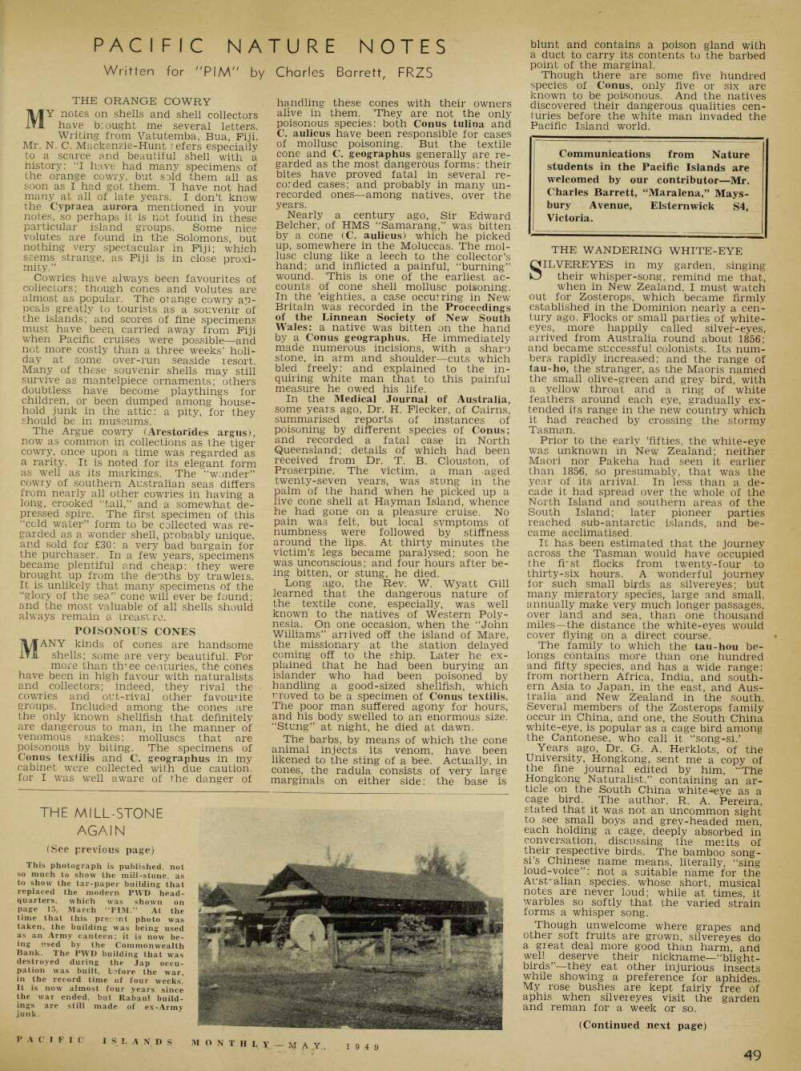
Written for "PIM" by Charles Barrett, FRZS
The Orange Cowry
MY notes on shells and shell collectors have b: ought me several letters.
Writing from Vatutemba, Bua, Fiji, Mr. N. C. Mackenzie-Hunt i efers especially to a scarce and beautiful shell with a history: “I have had many specimens of the orange cowry, but said them all as soon as I had got them. 'I have not had many at all of late years. I don’t know the Cypraea aurora mentioned in your notes, so perhaps it is not found in these particular island groups. Some nice volutes are found in the Solomons, out nothing very spectacular in Fiji; which seems strange, as Fiji is in close proxi mity.”
Cowries have always been favourites of collectors; though cones and volutes are almost as popular. The oiange cowry an neals greatly to tourists as a souvenir of the islands: and scores of fine specimens must have been carried away from Fiji when Pacific cruises were possible—and not more costly than a three weeks’ holi day at some over-run seaside resort.
Many of these souvenir shells may still survive as mantelpiece ornaments; others doubtless have become playthings for children, or been dumped among house hold junk in the attic: a pity, for they should be in museums.
The Argue cowry (Arestorides argus), now as common in collections as the tiger cowry, once upon a time was regarded as a rarity. It is noted for its elegant form as well as its markings. The “wonder” cowry of southern Australian seas differs from nearly all other cowries in having a long, crooked “tail,” and a somewhat de pressed spire. The first specimen of this “cold water” form to be collected was re garded as a wonder shell, probably unique, and sold for £3O: a very bad bargain for the purchaser. In a few years, specimens became plentiful and cheap: they were brought up from the depths by trawlers.
It is unlikely that many specimens of the “glory of the sea” cone will ever be found; and the most valuable of all shells should always remain a treasure.
Poisonous Cones
jl/fANY kinds of cones are handsome shells; some are very beautiful. For more than ttree centuries, the cones have been in high favour with naturalists and collectors; indeed, they rival the cowries and out-rival other favourite groups. Included among the cones are the only known shellfish that definitely are dangerous to man, in the manner of venomous snakes: molluscs that are poisonous by biting. The specimens of Conus textilis and C. geographus in my cabinet were collected with due caution, for I was well aware of the danger of
handling these cones with their owners alive in them. They are not the only poisonous species: both Conus tulina and C. aulicus have been responsible for cases of mollusc poisoning. But the textile cone and C. geographus generally are re garded as the most dangerous forms: their bites have proved fatal in several re corded cases: and probably in many un recorded ones—among natives, over the years.
Nearly a century ago, Sir Edward Belcher, of HMS “Samarang,” was bitten by a cone (C. aulicus) which he picked up, somewhere in the Moluccas. The mol lusc clung like a leech to the collector’s hand; and inflicted a painful, “burning” wound. This is one of the earliest ac counts of cone shell mollusc poisoning.
In the ’eighties, a case occurring in New Britain was recorded in the Proceedings of the Linnean Society of New South Wales: a native was bitten on the hand by a Conus geographus. He immediately made numerous incisions, with a sharo stone, in arm and shoulder—cuts which bled freely: and explained to the in quiring white man that to this painful measure he owed his life.
In the Medical Journal of Australia, some years ago, Dr. H. Flecker, of Cairns, summarised reports of instances of poisoning by different species of Conus; and recorded a fatal case in North Queensland; details of which had been received from Dr. T. B. Clouston, of Proserpine. The victim, a man aged twenty-seven years, was stung in the palm of the hand when he picked up a live cone shell at Hayman Island, whence he had gone on a pleasure cruise. No pain was felt, but local symptoms of numbness were followed by stiffness around the lips. At thirty minutes the victim’s legs became paralysed; soon he was unconscious: and four hours after be ing bitten, or stung, he died.
Long ago, the Rev. W. Wyatt Gill learned that the dangerous nature of the textile cone, especially, was well known to the natives of Western Poly nesia. On one occasion, when the “John Williams” arrived off the island of Mare, the missionary at the station delayed coming off to the ship. Later he ex plained that he had been burying an islander who had been poisoned by handling a good-sized shellfish, which uroved to be a specimen of Conus textilis.
The poor man suffered agony for hours, and his body swelled to an enormous size.
“Stung” at night, he died at dawn.
The barbs, by means of which the cone animal injects its venom, have been likened to the sting of a bee. Actually, in cones, the radula consists of very large marginals on either side: the base is
blunt and contains a poison gland with a duct to carry its contents to the barbed point of the marginal.
Though there are some five hundred species of Conus, only five or six are known to be poisonous. And the natives discovered their dangerous qualities cen turies before the white man invaded the Pacific Island world.
The Wandering White-Eye
SILVEREYES in my garden, singing their whisper-song, remind me that, when in New Zealand, I must watch out for Zosterops, which became firmly established in the Dominion nearly a cen tury ago. Flocks or small parties of white eyes, more happily called silvel--eyes, arrived from Australia round about 1856; and became successful colonists. Its num bers rapidly increased: and the range of tau-ho, the stranger, as the Maoris named the small olive-green and grey bird, with a yellow throat and a ring of white feathers around each eye, gradually ex tended its range in the new country which it had reached by crossing the stormy Tasman.
Prior to the early ’fifties, the white-eye was unknown in New Zealand: neither Maori nor Pakeha had seen it earlier than 1856, so presumably, that was the year of its anival. In less than a de cade it had spread over the whole of the North Island and southern areas of the South Island: later pioneer parties reached sub-antarctic islands, and be came acclimatised.
It has been estimated that the journey across the Tasman would have occupied the fust flocks from twenty-four to thirty-six hours. A wonderful journey for such small birds as silvereyes; but many migratory species, large and small, annually make very much longer passages, over land and sea, than one thousand miles—the distance the white-eyes would cover flying on a direct course.
The family to which the tau-hou be longs contains more than one hundred and fifty species, and has a wide range: from northern Africa, India, and south ern Asia to Japan, in the east, and Aus tralia and New Zealand in the south.
Several members of the Zosterops family occur in China, and one, the South China white-eye, is popular as a cage bird among the Cantonese, who call it “song-si.’
Years ago, Dr. G. A. Herklots, of the University, Hongkong, sent me a copy of the fine journal edited by him, “The Hongkong Naturalist,” containing an ar ticle on the South China white-*eye as a cage bird. The author, R. a. Pereira, stated that it was not an uncommon sight to see small boys and grey-headed men, each holding a cage, deeply absorbed in conversation, discussing the meiits of their respective birds. The bamboo song si’s Chinese name means, literally, “sing loud-voice”: not a suitable name for the Australian species, whose short, musical notes are never loud; while at times, it warbles so softly that the varied strain forms a whisper song.
Though unwelcome where grapes and other soft fruits are grown, silvereyes do a great deal more good than harm, and well deserve their nickname—“blight birds”—they eat other injurious insects while showing a preference for aphides.
My rose bushes are kept fairly free of aphis when silvereyes visit the garden and reman for a week or so.
(Continued next page)
Rarest of all the white-eyes is a pygmy form, found only on Mount Kinabalu in Borneo; where, too, the olive-black species, another rare bird, also is at home. I met with the mountain whiteeye, which ranges from Celebes and the Moluccas to the Philippines in Bali: it occurs also in Java and Timor, but I did not get a glimpse of it during my brief visit to the last-named island.
Silver-eyes build dainty, cup-shaped nests, pendent from leafy twigs, usually at the end of a slender branch. Woven of fine grasses, and lined with horsehair in many cases, sometimes they are ornamented sparingly with moss: frail, almost flimsy cradles. The eggs may be visible when one looks up at a white-eye’s nest with sunlight shining through it. Four
eggs form the clutch as a rule. They are among the prettiest of all birds’ eggs, be ing pale greenish-blue, or much the same colour as those of a song-thrush, but minus the black markings, My notes refer to the grey-backed Zos terops of eastern and southern Australia, and Tasmania, which migrated to New Zealand so many years ago. By the way, I recall that the late Dr. J. A. Leach thought it possible that strong winds con nected with Black Thursday—that appall ing day of bush fires in Victoria—may have carried thousands of small birds over the Tasman; including silvereyes, some of which survived to become colonies of their kind in the land to which high winds had borne them.
The Mill-Stone
Again
(See previous page)
This photograph is published, not so much to show the mill-stone, as to show the tar-paper building that replaced the modern PWD head quarters. which was shown on page 15, March "PIM.“ At the time that this present photo was taken, the building was being used as an Army canteen; it is now be ing used by the Commonwealth Bank. The PWD building that was destroyed during the Jap occu pation was built, before the war, in the record time of four weeks.
It is now almost four years since the war ended, but Rabau! build ings are still made of ex-Army junk.
Advertisements & other items, p. 51 (2 items)
49
PACIFIC ISLANDS MONT H L Y - Ay , i 9 4 9
Communications from Nature
students in the Pacific Islands are welcomed by our contributor—Mr.
Charles Barrett, “Maralena,” Maysbury Avenue, Elstemwick S 4, Victoria.
Some Alcoholic Memories of Suva
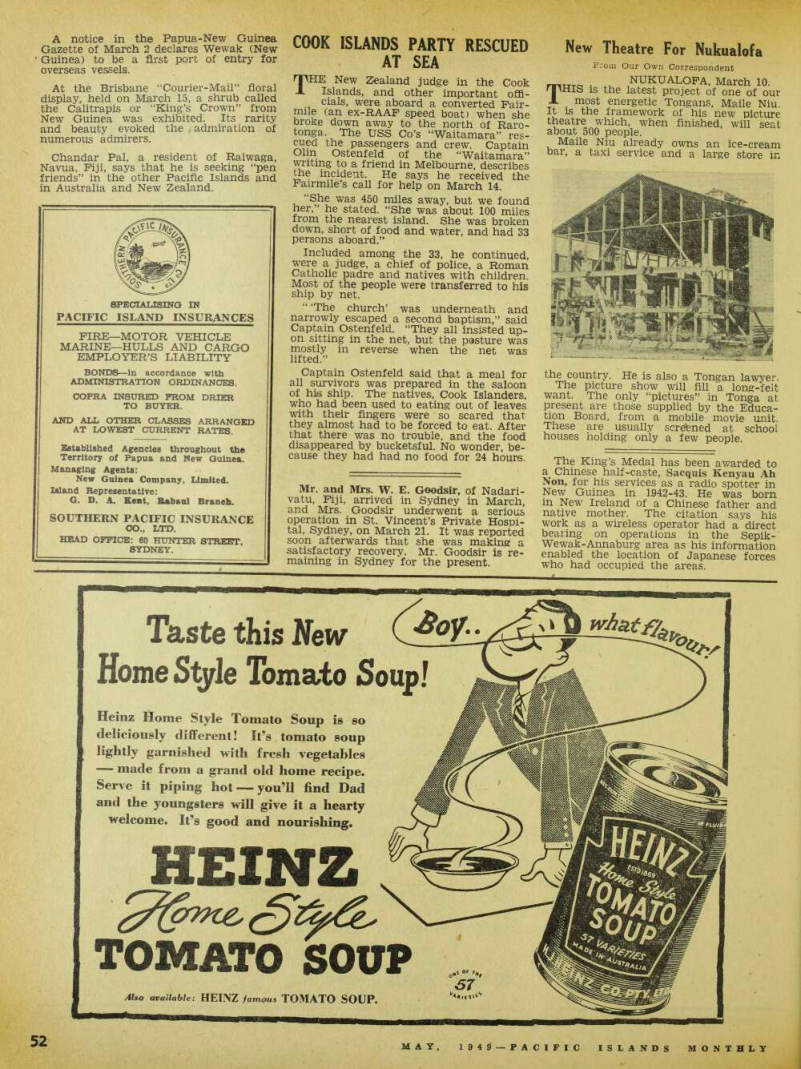
(By Na Vokai)
IN the good old prewar days in the Islands —when there was always an assured supply of beer, and a man could raise a thirst and the wherewithal to quench it —some amusing stories were told along the Beach. The following are a few tales of what must now be almost a forgotten era in Suva.
Scene: The bar of a well-known Suva hotel, one evening about half-time at the movies. Two well-known brothers and a friend imbibing—two of them feeling playful. Finishing their drinks, the trio walked through the door of the crowded lounge and toward the street.
Then, ranging themselves one on either side of their friend, the brothers each solicitously took an arm, loudly assuring their quite sober mate that he would be all right—they would see him home. “Now take it easy, Frank, we’ll get a taxi,” was the tenor of their remarks to their highly indignant friend, who made matters worse by struggling to free himself, at the same time abusing the humorists in undertones.
It took Frank quite a long time to con vince some of the occupants of the lounge, who afterwards chipped him about being “tight,” that he had been cold sober—even then, some did not believe him. ♦ * * THEN there was a rather well-known character, an employee of one of the big firms, who, during the Christ mas season, had a couple too many, at luncheon.
When it was time to return to work, he ’phoned his chief with the remark: “It’s Blank here, Mr. -—. Now some call it ’flu, and some say they’ve got dengue: but the fact of the matter is, I’m drunk, and I won’t be at work this afternoon.”
This engaging frankness so tickled his chief that the celebrant got away with it. * * * ON one occasion, when an important football match was being played in New Zealand, a party of “sports” gathered in a Suva friend’s home one Saturday afternoon to listen to the broadcast. To add to the ioy of the occasion they had a good supply of home brew on hand. During the afternoon, one gentleman took more than was good for him and, in due course, he disposed of it in the backyard. A little later, another member of the party found a set of den tures in the yard. The first-mentioned “sport” had left the narty by then, for home and bed, and Bill, the finder, care fully put the dentures in his pocket for safety.
Late on Saturday night the toothless one was dashing around Suva, looking for Bill, whom he had been told had his teeth. By the time he found him, Bill himself was a bit the worse for wear, and could not find the missing plate in his pocket, or for that matter, anywhere else.
Came Sunday morning; and, after a loathsome breakfast of soft tack, there was a frantic and very abusive young man still looking for his teeth.
It was not until Bill had occasion to call at his place of business, later in the day, that he found the dentures in a drawer, where he had placed them for safe keeping some time on Saturday night. It was fortunate; for by this time the dentures’ desperate owner was fol lowing him around with an axe. * * * ARREST of a European for a liquor offence was a comparatively rare occurrence in Suva; and, when it did happen, it was usually a case of: "No appearance, your Worshin,” followed by formal evidence and forfeiture of bail.
Now, in those days, the Fiji ordinance only made provision for “drunk and dis orderly”—there was no plain “drunk” sec tion.
Came the day when the name of a citizen was duly called, and the usual formalities complied with. The constable gave evidence that defendant had been found under the influence, asleep on the Triangle garden plot.
The prosecuting officer was about to ask for conviction and forfeiture of bail when the magistrate, probably with a twinkle in his eye, nonplussed the constable by asking where the disorderly conduct came in.
The upshot was that the case was ad journed till later in the day for the pro duction of evidence of disorderliness.
When this was not forthcoming, it was dismissed by an RM who held that, as the ordinance stood, there was no offence disclosed in getting drunk and going to sleep in a public garden. ♦ * * ARRIVAL of friends among the ships’ companies of regular liners on the Pacific run was often a cause for some form of celebration, and one such nearly disrupted a very elaborate amateur theatrical show.
Music for the production had been scored and was to be played by a brilliant pianist, who was very much one of the lads of the village. First performance went well; but the next day one of the Matson liners arrived and the pianist met an officer friend who was celebrating his birthday. One thing led to another, and
at 5 p.m. the local lad was fast asleep in his pal’s cabin, just behind the bridge of the liner. The Matson boats pulled out with the regularity of clockwork at 5 p.m., and a little after five our friend came to, to find himself in strange sur roundings.
Ambling out, he was amazed to find himself on the liner’s bridge confronting an irate American master-mariner who wanted to know what the hell he, a pas senger, was doing there.
On being informed that the visitor was not a passenger, the master-mariner was abusive. By that time, Suva was slip ping into the background, as the ship approached the Passage.
Frantic signals brought the harbour master’s launch to the rescue, and, roundly cursed, the still-fuddled cele brant was decanted ashore.
It was getting close to curtain-time for the second night of the show when the stage manager discovered that the pianist was missing and what had happened to him.
There followed much rushing around in taxis, making of black coffee, enforced cold showers and assisted dressing before the pianist was placed in front of his in strument in the Town Hall and told to play. The first act, he afterwards said, was a struggle, but after he warmed up he sailed through in good style. But he was angry and indignant when he found that the stage manager had given orders at the performers’ bar, at the rear, that the pianist was not to be served with any thing stronger than lemonade before the final curtain. * * * ANOTHER Suva lad got himself into an embarrassing situation when, in the course of a late afternoon ses sion, he reached the helpless stage of drunkenness. A friend picked him up and decided to take him home and put him to bed. The friend got the happy one into a taxi, all right, but then ensued an argument as to destination.
“I live at Lami,” claimed the drunk.
"No, you don’t! I know where you live,” said the other, “and I’m taking you there.”
After further argument the friend be came impatient and neatly laid his charge out with a swift one to the jaw.
Off sped the taxi to a town boarding house, and the good Samaritan lugged the drunk inside and put him to bed.
What the friend did not know was that the drunk recently had changed his abode and in fact did live at Lami, but a young lady who came home later was more than surprised to find an amiable but fuddled gent in her bed. Fortunately, she knew him and his habits well, and took it in good part. * * * THERE have been many good stories told of missing bottles: but one of the brightest originated at a Satur day night party at Suva Point.
One of the party passed out in the course of the evening, and a close friend noticed that he had a full bottle of Johnny Walker in his pocket.
Thinking that it might come to some harm, or that someone might steal it, he lifted it himself and took it home.
On Sunday morning he phoned the owner on some pretext, and was imme diately regaled with the tale of “some lousy so-and-so who pinched my bottle of wads.”
Full of sympathy, the listener invited the bereaved one down for a drink.
The bottle had gone round a couple of times before the guest was informed that he was drinking his own whisky.
A notice in the Papua-New Guinea Gazette of March 2 declares Wewak (New ’ Guinea) to be a first port of entry for overseas vessels.
At the Brisbane “Courier-Mail” floral display, held on March 15, a shrub called the Calitrapis or “King’s Crown” from New Guinea was exhibited. Its rarity and beauty evoked the admiration of numerous admirers.
Chandar Pal, a resident of Raiwaga, Navua, Fiji, says that he is seeking “pen friends” in the other Pacific Islands and in Australia and New Zealand.
Advertisements & other items, pp. 53-54 (1 item)
Burns Philp (New Guinea) Limited
General Merchants (Wholesale and Retail)
Shipping, Customs and General Agents
Head Office: PORT MORESBY, PAPUA
BRANCHES:
NEW GUINEA: Rabaul, Kokopo, L.ae Gr Madang.
PAPUA: Samarai.
REPRESENTATIVES FOR:
AUSTRALIAN AGENTS:
LONDON AGENTS:
SAN FRANCISCO AGENTS:
QUEENSLAND INSURANCE CO. LTD.
LLOYDS OF LONDON
BURNS PHILP TRUST CO. LTD.
BURNS, PHILP & CO. LTD.
All States.
BURNS, PHILP & CO. LTD.
"London House", 35 Crutched Friars, E.C.3.
BURNS, PHILP CO. OF SAN FRANCISCO INC 510 Matson Building.
Distributing Agents, Territory of Papua-New Guinea for:
SHELL COMPANY OF AUSTRALIA LIMITED
Petroleum Products
GENERAL MOTORS CORPORATION
Chevrolet, Buick, Pontiac and Oidsmobile Cars Chevrolet and GMC Trucks Frigidaire Refrigerators
VAUXHALL MOTORS LIMITED
Vauxhall Cars and Bedford Trucks
R. A. LISTER & CO., BRISTOL
Producers of Petrol, Parrafin and Diesel Engines Pumps and Lighting plants
RUSTON HORNSBY LIMITED
Engines
CROSSLEY MARINE ENGINES
l&s
SPECIALISING IN
PACIFIC ISLAND INSURANCES
FIRE—MOTOR VEHICLE
MARINE—HULLS AND CARGO
EMPLOYER’S LIABILITY
BONDS—In accordance with
ADMINISTRATION ORDINANCES.
COPRA INSURED PROM DRIER
TO BUYER.
AND ALL OTHER CLASSES ARRANGED
AT LOWEST CURRENT RATES.
Established Agencies throughout the Territory of Papua and New Guinea.
Managing Agents: New Guinea Company, Limited.
Island Representative: G. D. A. Kent, Babaul Branch.
SOUTHERN PACIFIC INSURANCE
CO., LTD.
HEAD OFFICE: 60 HUNTER STREET,
SYDNEY.
Cook Islands Party Rescued
At Sea
THE New Zealand judge in the Cook Islands, and other important offl cials, were aboard a converted Fair mile (an ex-RAAF speed boat) when she broke down away to the north of Raro tonga. The USS Co’s “Waitamara” res cued the passengers and crew. Captain Olm Ostenfeld of the “Waitamara” writing to a friend in Melbourne, describes the incident. He says he received the Fairmile’s call for help on March 14.
“She was 450 miles away, but we found her,” he stated. “She was about 100 miles from the nearest island. She was broken down, short of food and water, and had 33 persons aboard.”
Included among the 33, he continued, were a judge, a chief of police, a Roman Catholic padre and natives with children.
Most of the people were transferred to his ship by net.
“ ‘The church’ was underneath and narrowly escaped a second baptism,” said Captain Ostenfeld. “They all insisted up on sitting in the net, but the pasture was mostly in reverse when the net was lifted.”
Captain Ostenfeld said that a meal for all survivors was prepared in the saloon of his ship. The natives. Cook Islanders, who had been used to eating out of leaves with their fingers were so scared that they almost had to be forced to eat. After that there was no trouble, and the food disappeared by bucketsful. No wonder, be cause they had had no food for 24 hours.
Mr. and Mrs. W. E. Goodsir, of Nadari vatu, Fiji, arrived in Sydney in March, and Mrs. Goodsir underwent a serious operation in St. Vincent’s Private Hospi tal, Sydney, on March 21. It was reported soon afterwards that she was making a satisfactory recovery. Mr. Goodsir is re maining in Sydney for the present.
New Theatre For Nukualofa
From Our Own Correspondent
Trrro • NUKUALOFA. March 10.
His is the latest project of one of our most energetic Tongans, Maile Niu.
It is the framework of his new picture theatre which, when finished, will seat about 500 people.
Maile Niu already owns an ice-cream bar, a taxi service and a large store in
the country. He is also a Tongan lawyer.
The picture show will fill a long-feit want. The only “pictures” in Tonga at present are those supplied by the Educa tion Board, from a mobile movie unit.
These are usually screened at school houses holding only a few people.
The King’s Medal has been awarded to a Chinese half-caste, Sacquis Kenyan Ah Non, for his services as a radio spotter in New Guinea in 1942-43. He was born in New Ireland of a Chinese father and native mother. The citation says his work as a wireless operator had a direct bearing on operations in the Sepik- Wewak-Annaburg area as his information enabled the location of Japanese forces who had occupied the areas.
Advertisements & other items, p. 54 (1 item)
Heinz
Taste this
Home Style Tom ato Soup?
Heinz Home Style Tomato Soup is so deliciously different! It’s tomato soup lightly garnished with fresh vegetables made from a grand old home recipe.
Serve it piping hot you’ll find Dad and the youngsters will give it a hearty welcome. It’s good and nourishing.
HEINZ
TOMATO SOUP
S 7 Also available: HEINZ famous TOMATO SOUP.
Tahiti-Noumea Air Fare :
A Comparison
Letter to the Editor 1 THINK it should be pointed out that one of the most useful air services in the South Pacific—that run by TRAPAS between New Caledonia and Tahiti—is of little use to non-French travellers because of the very high fares charged.
A friend who travelled not long ago be tween Papeete and Noumea says he had to pay no less than 160,000 Pacific francs for the seat—equal to £100 Australian.
The plane left Tahiti at 10 a.m., and spent the night at Rarotonga; left Raroconga at 6 a.m., and arrived at Apia at noon; left Apia at 2 p.m., and reached Nadi at 6 p.m., and spent the night there; left Nadi at 6 a.m., and arrived in Noumea about 11.30, It carried about a dozen passengers.
As most of the British Pacific air services now run shuttle services between Australia (or New Zealand) and the in dividual territories (the New Zealand National Airways service between Auck land, Fiji, Samoa and Cook Islands be ing the only exception) this Noumea-Fiji- Samoa-Cook Is.-Tahiti line —a kind of cross-service in the Pacific —is very handy; but the fares tend to scare off prospective travellers.
In view of the fact that TRAPAS uses three British territories in the flight be tween the two French Territories, TRAPAS should treat British travellers with greater consideration.
I am. etc..
Traveller.
Melbourne, 7/4/49.
EDITORIAL NOTE —The fare Noumea- Tahiti (2,300 miles) does seem high, in comparison with other air fares. The fare from Sydney to Auckland (1,200 miles) is over £3O; from Sydney to Nadi (1,700 miles) is £5O; from Sydney to Rabaul (about 2,000 miles, via Port Moresby and Lae) £5l. The fare from Sydney to Tahiti by the French MM liner, via Noumea and Vila, is £lOO.
Road Accidents In Tonga
Letter to the Editor THE second fatal accident within three months occurred on Tongatabu on March 10, when a child was run over and killed by a Government lorry.
The first fatality was at Christmas when one of the New Zealand airport trucks swerved across the road and hit an old man with the rear end of the platform.
The vehicles in both fatalities are alleged to have been going at excessive speeds.
By a coincidence, the case against the driver of the airport lorry was commenced in Nukualofa on the day of the second fatality. When is the speed-limit to be fixed in Tonga? Government drivers are the worst offenders, in this regard.
Are the drivers of these two vehicles, having each killed another human being, to be allowed to drive a motor vehicle again? I am, etc.,
August Hettig.
Nukualofa, Tonga.
An American tank landing ship, “Rawhiti,” after 13 months in idleness in port, in New Zealand, sailed for Suva on March 21. She is owned bv the Roose Shipping Co., Ltd., of Mercer, NZ, but will be registered in Fiji. It is understood that from Suva she will proceed to the Solo mons where she will load war disposals goods for the Australian government. Her cargo capacity is between 2,000 and 3,000 tons. Her master will be Captain D. K.
Mathieson, formerly master of the schooner “Tagua.”
Dynamiting Of Fish In
Samoan Waters
Prom Our Own Correspondent
Apia. Apr. 20.
MANY complaints have recently been made about the large-scale dynamit ing of fish on the coasts of Savaii and South Upolu.
Supplies of gelignite, imported by the Government for blasting on the new roads, now in course of construction, have found their way into the hands of unauthorised people who use it for large-scale fishing, thereby destroying large numbers of im mature fish and affecting the future fish supplies in waters around Western Samoa.
It is hoped that in the interests of the Samoan people, the Samoan Government will take energetic steps to stop this illegal practice.
Mrs. Gordon Harris, formerly of Djaul Island plantation, in the New Ireland sec tion of New Guinea, arrived in Sydney from London in April, after an absence of ten y ears - In 1939 » when war came, Mrs. undertake war service. They were in the forces for a long time—Mrs. Hams was a WREN for over six years—and now they have transferred their interests to Kenya. Mr. Miller was lost in the Jap invasion—his fate in not known, exactly— and his estate has been somewhat of a muddle, and the Djaul plantation of some 30,000 coconuts (half of which have sur vived) has been sadly neglected. Mrs.
Harris intends to spend some time in Australia, looking after the interests which she and her husband still retain in the plantation.
Advertisements & other items, pp. 55-56 (1 item)
iflbmmonwcaltb JBank
WE w
CAN ffiU> YOU
With Full banking facilities at our Island Branches
RABAUL ... LAE
PORT MORESBY
MADANG
The Service links with our Branches throughout Australia, also our Agents and correspondents all over the world.
iflbmmonwcaltb JBank
of Australia.
Every Branch of the Bank conducts Savings Bank business.
Rid Kidneys Of
Poisons And Acids
If you suffer sharp, stabbing pains, if Joints are swollen, it shows your blood Is poisoned through faulty kidney action. Other symptoms of Kidney Disorders are Backache, Aching Joints and Limbs, Sciatica, Neuritis, Lumbago, Sleepless Nights, Dizziness, Nervousness, Circles under Eyes, Loss of Energy and Appetite and Frequent Headaches and Colds, etc. Ordinary medicines can’t help much because you must get to the root cause of the trouble.
The Cystex treatment is specially compounded to soothe, tone and clean kidneys and bladder and remove acids and poisons from your system safely, quickly and surely, yet contains no harmful or dangerous drugs. Cystex works In 3 ways to end your troubles. 1. Starts killing the germs which are attacking your Kidneys, Bladder and Urinary System In two hours, yet Is absolutely harmless to human tissue.
S. Gets rid of health-destroying, deadly poisonous acids with which your system has become saturated. 3. Strengthens and relnvigorates the kidneys, protects from the ravages of disease-attack on the delicate filter organism, and stimulates the entire system.
Praised by One-time Sufferers
Cystex Is approved by one-time sufferers In 73 countries from the troubles shown above.
Mr. Reg Thomas, Townsville, Queensland, recently wrote: “My joints were all stiff, I had leg pains, my back nsed to ache day and night.
My bladder was weak. I had headaches and no appetite. The first dose of Cystex helped me and before I finished three boxes my health and strength came back.”
Guaranteed to Satisfy or Money Back Get Cystex from your chemist or store to-day Give it a thorough test. Cystex Is guaranteed* to make you feel younger, stronger, better lx every way. or your money back If you return the empty package.
Now in % sizes—4/-, */-.
Cystex
for Your Kidneys, Bladder, Rheumatism.
TAHITI
To Shipmasters ond Visitors When calling at Tahiti, and seeking SHIPS SUPPLIES and FRESH
PROVISIONS, see—
OSCAR G. NORDMAN
Supply Agent for Messageries Maritimes, Union SJS. Co. of N.Z., Ltd., Matson- Oceanic Line, United States Line, General S.S. Corp., Etc- We supply general Service—lnformation about the Islands— Real Estate Service—Make Reservations—Act as Shipping Agents
OSCAR G. NORDMAN
Ship Chandler
PAPEETE. TAHITI
Wire before your arrival to
OCEANIC PAPEETE—Our
registered cable address.
Fiji
More Europeans Wanted In Fiji One Answer To The Indian Menace
1 COULD tell you in a very few sen tences exactly whaT to do with the surplus Indians in Fiji,” writes a resi dent of Vanua Levu.
“But one thing is certain —we do not want them here in Vanua Levu. They have been trying very hard to buy free hold land from various Europeans in this big island, and I am afraid that in some cases they have succeeded; but generally the owners of the freehold, even where they want to sell, are patriotic enough to keep the land out of the hands of the Indians.
“After all, apart from the Fijians, who is entitled to this land—the Europeans who pioneered it, or the Indians who have done little or nothing to make it fit for settlement?
“It is in my opinion a shocking thing that there should be so few Europeans in this magnificent island —it could carry thousands of European settlers, instead of a few score. If only we had an Adminis tration with a developmental impulse, a great deal could be done to encourage settlement. Private enterprise, under en couragement, could provide a pineapple factory, goat, pig and poultry farming— and all the industries established on Viti Levu, and a few more as well.
“Viti Levu already has been spoiled by over-population. This other big island of Vanua Levu has far more attractions from the point of view of European settle ment, and it is a shameful thing that nothing is being done about it.
“Why does the British Adm nistration sit with folded hands, resigning itself to its belief that the archipelago is going to be over-run by Indians, when, with a little enterprise and energy, it could build up a very substantial European settlement in this Colony as a bulwark against the ever-encroaching Indians?”
Probate has been granted in the will of the late Geoffrey Hampden Vernon, medical practitioner, of Port Glasgow, Papua. Personalty was £3,806 gross.
Planners May Overlook Import
Education Progress In New
Guinea
Planners May Overlook Import ance of Economic Development
WARM praise for what already has been accomplished in Papua-New Guinea by the Territory’s Depart ment of Education is given by Mr. Osmar White, a special correspondent of Mel bourne Herald.
He says that no one could claim that the Australian taxpayers have had a fair return for the £2,000,000 of their money spent annually in Papua-New Guinea by the Australian Government, but at least the Education people have something to show for their share of it. He was im pressed with the average native’s eagerness for education—especially technical.
One senior official said that their first jobs there, in order of priority, were to 'maintain and extend law and order, to improve native health, and educate the natives. Mr. White says that is probably correct.
“However, the practical factor it did not take into account was that these ends can never be attained without the develop ment of a New Guinea economy—that the whole project is far too expensive an un dertaking for a nation of 7 million people preoccupied with their own great develop mental problems.
“If the classes and choirs of Sogeri are ever to become the classes and choirs of a h New Guinea, it will be only because there are sawmills in the mountains, oil wells and mines producing mineral wealth, plantations cropping tea, coffee, cocoa, copra and commercial fibres.
“The tapping of New Guinea’s hidden wealth is a job that can be undertaken only by people with a tradition of tech nological skill. If Australians move in more promptly than they are doing a* present, someone else is going to take over . . . and the achievement at Sogeri will not count for very much if that happens ”
From Mangaia
Another Makatea Contingent
From Our Own Correspondent
MANGAIA, February.
THE native labourers from this Island who recently returned home after a year’s service on the phosphate island of Makatea have again departed, along with a fresh labour force, for further ser vice on the French-owned island.
A steamer in January was formerly an unheard-of thing here, that month being a doubtful one in the hurricane season; but this year the “Marabank” defied tra dition, and was rewarded with an almost perfect day for her call to pick up the local labour.
Mangaian residents temporarily domi ciled in Rarotonga were not slow to seize the chance of returning home offered by this January call. Mr. and Mrs. H. H.
Hickling, who are in charge of the local schools, were passengers by the “Mara bank,” as also was Father Charles of the Sacred Heart Mission; Mr. Edwin Gold of the cliff-village; and Pastor Robert Serna of the LMS.
This time phosphate workers go on a six month contract only—the shortest term yet offered to the Mangaians, who up till now have signed-on for at least a year upon the phosphate diggings. With improved conditions, the six-month con tract is likely to seem too short to the new hands, who are looking forward to the amusements and amenities described in glowing terms by those who have had experience, and who have returned at the expiration of their contract with many good things bought at Makatea, and never seen in the local stores.
Vivian Griffith
Death Of Mu. Stanley
THE death occurred on April 9 at Nor folk Island Hospital of Mr, Stanley Vivian Griffith, aged 55 years.
He was invalided out of the Imperial Navy in 1944 and was in ill health thenceforth.
Seven months ago he took up residence, with his wife, on Norfolk Island hoping that the climate would be beneficial.
Mr. Griffith had lived in Tahiti, Raro tonga and Fiji prior to the war.
An Easter Fancy Dress Ball was held at the Kokopo Club, New Britain, on April 16. Prize for the best dressed couple went to Mr. and Mrs. Malcolm English.
Advertisements & other items, p. 57 (2 items)
55
AND WHAT ARE WE HERE FOR?
(Continued from page 38)
PACIFIC ISLANDS MONTHLY MAY, 1&49
Day-Old
Chicks
BY AIR
Amalgamated Hatcheries
(Reg.) of Bankstown, near Sydney, N.S.W., can dispatch limited numbers of chicks by
PLANE TO
RABAUL, PORT MORESBY,
LAE, NOUMEA, SUVA.
and all other islands of the Pacific served by vresent AND PROJECTED air services.
Amalgamated Hatcheries are the largest distributors of dayold chicks in Australia, last year over 1,000,000 chicks being sold by us in N.S.W. alone.
Our scientific method of packing and dispatch has resulted in a loss of less than 1 per cent, of chicks sent by plane.
If any chicks in your consignment arrive dead, we will replace them frees provided the extra freight is paid by the purchaser.
Chicks available are R.1.R., Austrolorps, and W.L.
Price, £lO per 100, landed at your airport, for unsexed chicks, and £l4 per 100 for all pullets. (Guaranteed 96 per cent, accurate sexing.) These chicks are the cream of Australia’s stock, produced under ultra - violet rays to guard against disease; the adult stock is blood-tested monthly by veterinary officers and each individual order carries a N.S.W.
Government certificate that the chicks are healthy and from tested stock.
Payment for chicks should be made by draft with the order, or credit arranged through our Bankers, the Commercial Bank of Australia, Ltd., Bankstown,
N.S.W.
Drafts and remittances can be sent direct to Amalgamated Hatcheries, Bankstown, N.S.W., or to the following agents: Messrs. Burns, Philp (South Sea) Co., Suva-Ba-Fijl, or any Island Branch. Also to: Marcel Legras, 38 Rue de Verdun, Noumea.
WRITE BY AIR-MAIL OR
CABLE.
AMALGAMATED
HATCHERIES
BANKSTOWN, N.S.W.
For Rabaul
Makeshift Wharf Repairs
From Our Own Correspondent RABAUL, April 21.
SOME attempt is at last being made to improve Rabaul’s wharf facili ties.
During the war, of course, the old Government wharf was destroyed and a Japanese ship was sunk alongside. Now work has commenced on building an ap proach to the sunken ship which is to be filled in and surfaced as a wharf for inter-island shipping. It should be ready for use shortly.
No Racial Troubles In
New Zealand
WHILE Australia’s policy of excluding all coloured races (including not only Asiatics, but also the friendly Polynesians of the Pacific Islands) is creating growing ill-will everywhere, a special correspondent in Melbourne “Herald” (April 13) says that New Zea land has no such problems. By good luck or good management, or by a combina tion of the two —plus an immigration policy which does not discriminate
harshly against Asiatic peoples—New Zealand has escaped all problems such as those which have recently embar rassed Australia.
A Chinese (says this writer) represented the South Island at Rugby Union football some years ago. Another had a distin guished record in the RNZAF.
In the past few months, the University of New Zealand has sponsored the fur ther training in Britain of a New Zealand Chinese student who has been acclaimed as the most promising research worker since Lord Rutherford.
There are American and West Indian negroes who have lived in New Zealand for many years. A family of Kaffirs won prominence in football in Auckland, where an Abyssinian became one of the most respected citizens.
A Tongan represented New Zealand at rugby football for several years after the war. A New Zealand Japanese, who is now a Rugby referee, was decorated for valour.
Samoans, Cook Islanders, and other Polynesians have become New Z-ealand residents in increasing numbers in recent years. For a considerable period, Fiji has sent native and Indian students to New Zealand for education at exclusive schools.
Because the admission of Chinese and Indians to New Zealand has been sub stantially confined to males, there has been a fairly appreciable degree of inter marriage, conspicuously with Maoris. The effect on the general population has been trivial, although Maori spokesmen have, from time to time, objected to Asiatic miscegenation.
New Zealanders, aware of their small numbers, do not throw open their doors indiscriminately, but they do refrain from abusing strangers at their gates. And the strangers within the gates suffer no hardship.
Advertisements & other items, p. 58 (1 item)
Budge
Asthma, Bronchitis Coughing, Curbed in 3 Minutes
spasms first night and he haa bad none since In orer two years.
Money Bock Guarantee
The very first dose of Mendaco goes right to work circulating through your blood and helping nature relieve you of the effects of Asthma. Try Mendaco under an iron-clad money back gaurantee. You be the Judge. If you don’t feel fully satisfied after taking Mendaco Just return the empty package and the full purchase price will be refunded. Get Mendaco from your chemist to-day and see how well you sleep to-night and how much better you feel to-morrow. The guarantee protects
RELIEVES ASTHMA
Mendaco
Now in 2 sizes ... 6/- and 12/-
Do you hare attacks of Asthma or Bronchitis so bad that you can't sleep? Do you feel weak, unable to work, and have to be careful not to take cold and can’t eat certain foods?
No matter how long you hare suffered or what you have tried, there is new hope for you In a doctor’s prescription called Mendaco.
No dopes, no smokes, no injections, no atomizer.
All you do Is take two tasteless tablets at meals and In 3 minutes Mendaco starts working through your blood, aiding nature to remove phlegm, promote free easy breathing and bring sound sleep the first night, so that you soon feel years younger and stronger.
No Asthma in 2 Years
Mendaco not only brings almost Immediate comfort and free breathing but builds up the system to ward off future attacks. For Instance. J. Richards, Hamilton. Ont., Canada, had lost 40 lbs., suffered coughing every night, couldn’t sleep. Mendaco stopped Asthma
BUDGE
REFRIGERATION dud
ICE MAKING
EQUIPMENT
COMMERCIAL AND INDUSTRIAL
UNITS
(not domestic) Ammonia and Methyl Chloride machines of large or small capacity.
The illustration is of a small (nine 28 lb. blocks) electric, Methyl Chloride Icemaking plant.
Enquirers should mention dimensions of cold room (or cabinet) and of amount of ice (if any) required per day; also if electric motor or internal combustion engine is to be included.
JAMES BUDGE PTY. LTD.
REFRIGERATION ENGINEERS
McEvoy Street, Alexandria, Sydney
Telephones: LA 5034-5-6 Established 1890
Peace-Time “Biscuit
Bombing” In Ng
A QANTAS Douglas freighter recently undertook the job of dropping sup plies in the Purari River area, Papua, for an Australian petroleum com pany field party. In all, 90,000 lb. of supplies were dropped, involving a total of 16 lifts. Only loss incurred during the operation was one 40 lb. bag of sugar.
Earlier dropping operations were car ried out in this same area in November and December, 1948.
Similar operations to the Goilala Valley, which were carried out in October and November, 1948, successfully de livered, among other items, 11,200 lb. of rice, 2,805 tins of meat, 180 lb, of tobacco, 3 shotguns and 600 shotgun cartridges.
Supplies still have to be dropped by air in many parts of New Guinea where no landing facilities exist.
In addition to the Qantas Empire Air ways’ Bird of Paradise airlines linking New Guinea and Papua to Australia, there are 12 QEA aircraft based in New Guinea for internal operations.
These operations consist of services to Kavieng and Manus, and charter flights to many areas in the Highlands.
Local Air Transport Co's In
New Guinea
THERE now is an important local air transport industry in New Guinea, based on Lae.
In addition to Qantas 'local services there are the organisations run by Man dated Airlines Ltd. (W. R. Carpenter and Co., Ltd.), and Guinea Air Traders Ltd., which absorbed Taylors Air Transport some time ago.
Gibbs’ Sepik Airways, run by a well known airman, and based on Wewak, provides service in that end of the main land.
Ben Hall’s Sepik River Trading Co., which ran from Madang to the Highlands, Wewak and Lae, sold out to Qantas re cently and Mr. Hall, following his mar riage, has settled down on the late V. C.
Johnston’s plantation near Madang.
Nb Ladies’ Club Farewells
Popular Secretary
Erection of New Club Premises
From Our Own Correspondent RABAUL, April 21.
A DANCE was held by members of the New Britain Ladies’ Club on April 9, to farewell their energetic secre tary, Mrs. Mildred Costello, who was shortly to leave the Territory for an ex tended holiday in the United Kingdom.
One of the last jobs undertaken by Mrs.
Costello before she left was the arranging of sufficient materials for the building of the new club premises, the contract for its erection now having been let.
The New Britain Ladies’ Club was formed about a year ago and it is by no means just a gathering of chattering women with purely social aims. The Club is interested in anything relative to the welfare of women in the Territory gen erally. They visit the hospital, welcome new residents and generally provide a centre for womenfolk, not only of Rabaul, but of outports.
Since its inauguration, Club members have raised sufficient funds to make a start on the building of the new club house. This will consist of a public hall, two bedrooms and a kitchen and a suit able room for preparing and serving food
for any club function. It is hoped that this building will provide accommodation for outport women awaiting hospitalisa tion in Rabaul. These people will be given priority. At present, to their own embarrassment, they must stay at the hotel.
Miss Flora Stewart, daughter of Mrs.
F. Stewart of Lae, New Guinea, returned to the Territory recently by Qantas Em pire Airways. She has been holidaying in Toowoomba (Qld.), Adelaide and Mel bourne. Mrs. Stewart, who also has been enjoying an Australian holiday, will re turn to Lae in May.
Kokopo Branch of Commonwealth
Bank
From Our Own Correspondent RABAUL, April 21.
FROM May 3, the Commonwealth Bank will be operating a branch at Koko po, New Britain.
The branch will be open on only one day per week—that is, each Tuesday, when hours for business will be 9.30 a.m. to noon; and 1.30 p.m. unth 2.30 p.m.
Mr. Dudley Jones has now set up prac tice as a solicitor in Rabaul, New Guinea.
Dr. John Wesley Coulter, Professor of Human Geography at the University of Cincinnati, has accepted an appointment in the Trusteeship Division of the Se cretariat of the United Nations, where he will be specialist on Pacific Islands and Pacific Asia. Upon taking up his duties, at UN headquarters at Lake Success, NY, Dr. Coulter was placed third in command of the UN Trusteeship Division and in top command for the Pacific Islands and Pacific Asia. Dr. Coulter lived for many years in the Pacific and has personal knowledge of the native peoples. He was
for* 13 years on the staff of the University of Hawaii. He is the author of many publications on the Pacific Islands, in cluding “Fiji: Little India of the Pacific,” published by the University of Chicago Press. Dr. Coulter was in New Zealand in February, at the Pacific Science Congress.
Mrs. Florence Gilmore, well-known resi dent of New Guinea was attending a round of farewell parties in Rabaul in April. She left Rabaul on April 22 by plane for Sydney. In June she expects to sail for the United Kingdom in the “Orion” for a 12-months’ holiday.
Advertisements & other items, pp. 59-60 (1 item)
Finishes
TropH* 11
Every Berger finish must withstand test after test to prove worthy of the Berger label . . . every product must satisfy the Berger technicians and chemists that it will meet the challenge of all climates from tropic heat to arctic cold.
KEEP ON KEEPING ON!
GILLESPI
The Flour
- SY DN EY -
TRADE
MARK
’S' * of the Islands
I me Garrick Hotel
; if II A ..
I JliPVa
SUVA
FIJI
This well-known Hotel is centrally situated in Suva's main business quarter Modern accommodation provides comfort in all climatic conditions Only the best of Beers, Spirits and Wines is served Telephone: 80. VINCE COSTELLO, Proprietor.
Richards On
‘Jackals’
Of Indonesia
TUCKED away in the London cable news in the daily press recently was a paragraph which should be brought to the notice of all those Reds and Pinks in Australia who are so prompt to rush to the defence of their Indonesian com rades, and to condemn the Dutch for their actions in Indonesia.
Lord Milverton, better known to peoples of the Pacific as Sir Arthur Richards, speaking in the House of Lords, said the Dutch action in Indonesia was fundamentally right.
Dr. Soekarno and his colleagues were really war criminals, he added. The Dutch were opposing the possibility of the whole of Indonesia falling into the hands of a small group, he said. Apart from a relatively small extremist element, the native population welcomed the re turn of the Dutch.
“There is a great paralysis of human indecision lying across Britain’s foreign and colonial policy,” continued Lord Milvertone. “It seems that once more the last laugh will not be in London, New York or Delhi, but in the Kremlin, and it will be difficult for us to avoid a large share of the blame.”
Lord Milverton gave what he termed “a warning” about what is likely to happen if we do not stiffen our policy and face the actual facts in Indonesia.”
He added: “The Indonesian leaders are not crusaders. They are no better than jackals, preying on a war-ravaged, be wildered native population.”
That is the opinion of a man of proved administrative ability, whose wide ex perience of colonial territories, particu larly in the East, fits him to speak with real authority—which is more than can be said of the “experts” at Canberra and their Moscow-inspired Union bosses, who dictate Australia’s foreign policy.
Arthur Richards started his Colonial Service career in Mayala, and served there for many years before becoming Governor of British North Borneo. Then he was successively Governor of Gambia, Fiji, Jamaica and Nigeria, before his re tirement and elevation to the peerage.
By Na Matanivanua.
Detention Of Tongan
Prisoners In Suva Gaol
A SPECIAL Bill to enable the Fiji Government to “accommodate”
Tongan prisoners in Fiji gaols will come before the next meeting of the Fiji Legislative Council.
Prison facilities in Tonga are inade quate and in recent years there have been many prison-breaks—particularly by one prisoner who usually follows up by stealing a boat- in which he makes for some of Fiji’s outer islands.
When Tonga made a request to Fiji recently that this prisoner be retained in the Suva Gaol, the Fiji Government was .willing to accede to the request, but found that it was unable to do so be cause there is no provision in Fiji law.
The new Bill will legalise the reception and detention in Suva gaol of a prisoner sentenced by a Tongan court. The Tongan government has already passed legislation to deal with the matter.
Mrs. and Mrs. R. Booker, of Manus, New Guinea, have a son, born in Mel bourne, Victoria, on April 6.
How Bougainville’s Copra Productiveness Is Being Hamstrung

Cinderella Of The New Guinea Territory
Prom a Special Correspondent
Bougainville, April 9.
THIS area has become known to its residents as “Forgotten Bougain ville.” Being at the. extreme south eastern end of the Territory, the district certainly misses out on many things that more favoured localities receive, so- that the disabilities of the geographical posi tion are severely felt.
A Missionary from the district attended a conference at Port Moresby some while ago and remarked, upon his return, that there was a tendency amongst Adminis tration officials and others there to over look our needs when proposals were put forward.
It is as well to remind those in authority that this was formerly one of the heaviest copra producing districts in the Territory and can be made so again— with shipping and labour, and a modicum of supplies.
Plea For Air Service
THIS must be the only district in the Territory that is without a plane service, which is such a vital need these days to enable quick receipt and despatch of mails. It would also allow fast and comfortable transport for offi cials, planters, and others who have busi ness to do in Rabaul and Moresby. Un der existing circumstances these people and their wives are often held up for weeks in Rabaul through lack of trans port.
It is very galling for those §o situated
to see residents of Manus, New Ireland, Madang, Lae and Port Moresby being able to flit home at regular and frequent
intervals. The Buka and Bougainville unfortunates, when their turn comes — often after many false starts and altered dates—“pig it” homeward in small, in convenient and often overcrowded vessels.
There is a drome on Southern Buka — of pre-war origin and enlarged by the Japs—which, it is generally considered, could be quickly put into shape to take planes. This despite certain official re
ports (which strongly suggest that the whole matter is being conveniently “side tracked’’).
It is a matter for speculation as to what happens—somewhere along the line —to our air mail from Australia.
Quite recently, several air mail letters, posted in Australia in November, reached nere in March, after a tedious trip of four months. The envelopes looked jaded!
However, the best effort of all was when air mail letters posted in Australia in May turned up at this end in September— fortunately, in the same year! Their wanderings cannot be traced as they bear only the original post-mark.
Strangely enough, air mail letters from the USA are always among those bearing .the latest post marks when mail arrives!
It is all most annoying and, obviously, snows gross carelessness somewhere.
Insufficient Ships
DISTRICT copra production seems to i> be keeping on at a steady late—ootn plantation and native trade copra— but tne Directorate ships are not keeping pace with transporting it.
A short time ago it was estimated that 14,000 bags were awaiting shipment, from various plantations and stores, and, at tnat, no plantation is producing to capa city. Quite a number nave not been re opened since the war ended.
Appeals from the District Officer and Planters’ Association have in the situation being only partly relieved.
If the ships had big enough carrying capacity tne number coming heie would be sufficient for our needs, but as it is these toy vessels “huff and putt’’ and ar rive with a hatful of cargo and depart with a hatful of copra.
One explanation offered us is that want of port facilities in Rabaul prevents a quick turn around. Whatever tne reasons, the fact remains that the shipping ser vice is inadequate. The biggest vessel on the run—the “Katika” —carries 2,uuo bags of copra and is a veritable giant amongst the rest of the fleet.
The smaller vessels have no pinnaces, but only a surf boat in which to offload cargo and handle copra where there is no wharf. It is becoming a frequent occurrence for customers at the Chinese stores at Buka Passage to be told that there is neither flour, sugar nor smoking tobacco, whilst other items are often in
short supply.
The store proprietors for some reason most probably for want of shipping space—are unable to get all their cargo out from Rabaul, but, at times are able to also charter a vessel to bring out a load. There are often some hundreds of tons of Bougainville cargo backed up in Rabaul. It is no uncommon thing for cargo, consigned from Sydney to Bougain ville, to be held up for months.
Local residents are indignant at the state of things as there is an increasing population, and absence of essential com modities affects morale, more particularly when there are such a number of women and children included in the community.
Not Enough Labour
THE difficulty of getting local labour— one avoids using the term “efficient labour” these days—for plantation work is increasing in both Buka and Bougainville.
This is probably due to War Damage distributions of cash, generous education schemes, native copra production and an over-riding disinclination to either toil or spin.
Most plantations are hoping to get natives over from Aitape, as soon as re cruits and shipping become available, and several plantations in Bougainville are now being satisfactorily worked by Aitapes. Those fortunate enough to be thus situated wear a happy smile and are
content for the locals to sit in their vil lages, attend their frequent religious ob servances, chew their betel nut, and fol low their own devices. Trying to get work out of them is much like trying to extract blood from a stone, and the process weareth a Christian down.
So is the well-known “Buka boy”—once famous for his ability and for general faithfulness and reliability—now descend ing into the depths! Owing to the present Administration policy of extreme indul gence to the natives, and with so much easy money about, they have become quite independent and are contemptuous of Europeans; though—as a matter of policy —they give some lip service to Adminis tration officials whom they contact.
Those who heard the Administrator’s address to a crowd of Rabaul natives in
October last—wherein he stressed 'the need for all natives to work faithfully at whatever job they undertook, and the necessity for them to produce plenty of native foods, and not to forget village health, sanitation, roads and coconut groves—wish that such a doctrine would be promulgated by all District Offices. On the occasion referred to, D. O. Charley Bates, of Rabaul, interpreted to the mul titude with ability, emphasis and some relish!
Cargo Cult Again!
THE old familiar “Cargo Cult” has been raised again in this area by its de voted followers, who cannot be con vinced, or greatly deterred, by friendly ana fatherly talks by District Services officials. The high priests of the cult
merely observe more caution in their proceedings, and, if need be, go under ground.
Those most closely in touch with natives —the Missions —are well aware of the disturbing effects of this cult on the native population, its ordinary life and morals, and their Micawber-like tendency to wait for something to turn up in the way of ready cash and all kinds of desir able cargo—thus killing all desire to work.
One native recently constituted himself a Central Bank in Buka, and invited
credulous natives to lodge deposits with him and see them grow miraculously! He got together quite a number of cus tomers and, among them, most of the Head Men of the area, who, with sport ing instinct, “gave it a go.”
Another old-time and respected Luluai, of one of the largest villages in Buka, developed the idea —after consultation with the initiated —that for many years he had been missing a good income be cause of his failure to demand toll from every vessel that passed between his island and the Buka mainland! He wasn’t too sure about this rule applying to small launches and canoes, though!
The “Cargo Cult” supporters had ses sions in 1932, 1935 and 1939 in Buka and parts of Northern Bougainville, though in 1932 they were a bit unlucky in having ADC Ken McMullen to deal with at Buka Passage. He took prompt and effective measures with those concerned.
The whole business has an anti-Euro pean flavour about it and is both mis chievous and disturbing, and might well develop into something worse. In both 1932 and 1935 part of the doctrine put forward was that white people should be got rid of, either by moral suasion or force.
It’s a question as to whether or not there are still Japanese firearms in the area, and it is quite a possibility that there are. And it must be remembered that since the last manifestation of the “Cargo Cult” a good number of these natives have learned the use of arms and have fought either with, or against, the Allied cause. But in the matter of “Cargo” all these former friends and foes are brothers in a joint cause, as they maintain that the White Man receives goods that really belong to them.
Further, the prestige of the White Man has been distinctly lowered of recent years through various causes.
The recent murder of Mr. Alf Robin son, and his eight accompanying natives, in New Britain, not to mention the mur dering of Upper Markham natives, by other natives armed with Japanese rifles, should be a warning to officials and others of the futility of the “it couldn’t happen here” attitude of mind. Experience over the years shows that it could happen any where in these days of grace.
Advertisements & other items, pp. 61-64 (1 item)
So/ Ccntjctt ...
A. GREGORY PTY, LTD.
IMPORTERS, EXPORTERS AND
MANUFACTURERS
Leather Saddlery and Paint Merchants ALL CLASSES OF LEATHER SUPPLIED FROM STOCK Apply direct to: A. GREGORY PTY., LTD., 107 York St, Sydney
So/ Ccntjctt ...
Snug Waterproofs, Thigh, Knee and Ankle Boots for wet weather wear in styles and sizes for men women and children.
ALL THE YEAR ROUND
Dunlop Footwear is designed to relieve the jolts and fatigue of hard work and long wear and will be available soon in an extensive range of sizes and styles to suit every member of
the family.
Genuine Dunlop Kromhyd Soles guaranteed to out- Sport and Sandshoes for every wear two leather recreational occasion. soles.
DUNLOP *,
Rubber heels for comfort and economy. 4ft
There is only one
ELECTROLUX
THE MODERN KEROSENE-OPERATED REFRIGERATOR
THAT ACHIEVES THE MIRACLE OF ICE FROM HEAT
Lasting Efficiency, Silent Operation, Streamlined Beauty
m m ■ Mil m . . is Economically operated by kerosene, with a simple precision-built freezing unit that has no moving parts and is GUARANTEED FOR
FIVE (5) YEARS.
Obtainable from :
NEW GUINEA COMPANY, LIMITED.
Rabaul, Madang, Lae, Kavieng.
J. R. CLAY & CO., LTD., Port Moresby.
W. R. CARPENTER & CO. (Sol. Is.), LTD., Tulagi.
For New Hebrides, Butaritari, Noumea, New Caledonia: Apply— Model LKSSI
PRICES ON APPLICATION.
Storage capacity: 5i cub. ft. (approx.); shelf area, 9 sq. ft. food shelves, six—five removable; 2 self-supporting when half drawn. Ice-making: Four trays—s lb. ice per freezing: 80 cubes. Fuel consumption: 1.8 pints kerosene per day (approx.).
Height: 4 ft. 10 in. Depth: 2 ft. in.
Weight, unpacked, 406 lb. Packed, 574 lb.
W. R. CARPENTER fir CO., LTD. Head Office: 16 O'Connell St., Sydney, N. S. Wales
W. H. GROVE & SONS
Limited
Established 1896.
AUCKLAND
Island Traders. P.O. box 490.
Telegraphic and Cable Address: “Grove”, Auckland.
Entrust Your Orders to the Firm with Fifty Years Practical Experience in the Island Trade.
Shippers of all classes of New Zealand products.
Representing English Manufacturers throughout the Cook and Society Islands, Fiji, Tonga, Samoa, Niue, New Hebrides, the Solomon Islands and New Caledonia.
In FIJI as—W. H. Grove Cr Sons (Fiji) Ltd.
BROOMFIELDS Ltd.
Suppliers of
Building Hardware
Ship Chandlery, Paint Materials
1
WRITE DIRECT TO:
Broomfields Ltd., 152 Sussex Street, Sydney
If You
Cannot Sleep
FEEL FIT FOR NOTHING.
You may be anaemic or bloodless, for this ailment plays havoc with your health and nervous energy. You feel terribly nervy; suffer headaches and dizzy spells, have poor appetite, cannot sleep at night —losing those precious hours of rest and recovery, essential for your health and fitness.
Many people have recovered from these miseries by taking Dr. Williams’ Pink Pills, which have reinvigorated, strengthened their systems and banished the vague pains and weariness.. Dr. Williams' Pink Pills always help to enrich and increase the blood supply, giving beneficial help to the nerves, tissues and organs of the body. With enriched blood you cannot help feeling happier, sleeping better, becoming reinvigorated.
Stop anaemia making you a suffering invalid without delay. Take Dr. Williams' Pink Pills and soon notice the difference in your eyes, skin, nerves and general health. At all chemists and stores.
Sacred Heart School Carnival In
Rabaul
From Our Own Correspondent RABAUL, April 21.
THE Sacred Heart School carnival at tracted streams of visitors on Easter Monday and Tuesday. The function was held at the Catholic Chinese Kinder garten site at Matupi Farm, Rabaul.
The carnival was opened by Mr. W.
E. Sansom, Acting District Officer, New Britain. He appealed for public support for the carnival —funds raised would be devoted to the education of youth.
On the platform with Mr. Sansom were Father Ormonde, Mr. and Mrs. Ron Hicks, Mr. and Mrs. J, Gilmore Snr., Mr. Gabriel Achun, Mr. and Mrs. Bernard Chan and Mr. and Mrs. August Chan, also Mr. and Mrs. Achok and Mr. John Chan Achai.
The organisers estimate that the amount raised will be about two thou sand pounds. Three raffles were drawn on the last night of the carnival. The drawing of the major raffle —the first prize for which is an English six-cylinder Vauxhall sedan—will take place in May.
With the seven other prizes in this raffle, the prize money is about £2,000. Although a ticket costs £2, Rabaul people have bought out the limited number of tickets in the raffle.
Advertisements & other items, p. 64 (1 item)
William H. Watson
ESTABLISHED 1930
RAROTONGA, COOK ISLANDS
Wholesale and Retail Trader
LICENSED STAMP DEALER
Agent For:—
BRITISH TRADERS' INSURANCE CO.
CORONA & L. C. SMITH TYPEWRITERS
KAISER & FRAZER MOTOR CARS
t
B.S.A. CYCLES AND MOTOR CYCLES
AMERICAN LEAD PENCIL CO.
WHITES AVIATION LTD.
Manufacturers of; FOOTWEAR, ALL CLASSES SUITABLE FOR NATIVE TRADING , . . MO P. PRODUCTS, INCLUDING ROUND EAR-RING BLANKS AND BUTTON BLANKS Exporter of: “Rarotonga” Hula-Skirts.
Sea-Shell Necklaces.
M.O.P. Jewellery.
Island Produce.
Cable Address: “Watson” Rarotonga Wholesale and Retail Inquiries Invited.
Prepared to Consider Agencies for all Class of Goods.
Bankers: Importer of: Textiles.
General Hardware.
Fancy Goods.
General Merchandise.
Bank of New Zealand, Auckland.
Pioneer Work

Of Toa
The Solomons Service
Letter to the Editor AN article in your March issue, under the heading “Qantas on the Sydney- Solomon Islands Run,” written by your correspondent from Honiara is, I feel, extremely misleading, due to the number of incorrect statements it con tains.
I should be grateful of the opportunity to express my views on the matter of air services to the Solomon Islands, and to correct any wrong impressions.
In the first place, Qantas have not yet succeeded in establishing a service to the British Solomon Islands—one hears that they find the Catalina not so suitable.
However, it is a fact that an oil company did refuse to supply petrol to Trans Oceanic Airways in favour of Qantas and, when one considers that the fuel stocks were laid principally for use by Trans Oceanic Airways, one can only assume that the Government airline has consider able sway over the oil company concerned.
Naturally, TOA was forced to make other arrangements, and future fuel supplies are now assured.
Your correspondent states that twelve passengers awaited the “uncertain” re turn of the TOA flyingboat, from Feb ruary 13. As the plane was not scheduled to leave Sydney, northbound, until Feb ruary 15 these passengers would have been very foolish had they done so. Actually, due to the extension of this flight to the Caroline Islands, and the delay in obtain ing fuel supplies, everyone had been ad vised that the flying boat would return on the 23rd, and on the 23rd it did return, passengers leaving Honiara by boat early on the morning of the 24th to embark the same day at Tulagi.
It was also stated that “allocation* of seats for the through flight (Solomons- Sydney) have necessarily been very limited” and that therefore “the new ser vice is welcomed.” Has anyone from BSI ever been refused a passage on TOA? De finite priority has always been given to travellers from the Solomons, whether they were booked right through to Syd ney or not, as it was realised that alter native means of transport for them was very limited.
The statement that the Solomon Islands Government is “welcoming the new service” may be right; but to say that they are “cutting away a consider able amount of red tape” is most unfair to the administration. From personal acquaintance with these officers, and a knowledge of the policy of the Govern ment, I am sure that all legitimate opera tors would be treated in the same way.
Both individually and collectively, the administration has fostered and sup ported Trans Oceanic Airways from the inception of the service, and it is only natural that they would similarly aid any other desirable operator. But to say that they would grant unfair advantages over the company who pioneered the ser vice is a reflection on their integrity.
May I take this opportunity of remind ing your correspondent, and others who may have the same leanings, that TOA is a private enterprise, is staffed entirely by ex-servicemen and did pioneer the route at a time when shipping was by no means plentiful. It has provided the BSIP with a regular connection for almost two years, giving safe and comfortable travel by large four-engine flying-boat.
Which reminds me that one of the few things the South Pacific Air Conference decided, when it met some years ago, was
that there was an awful lot of water in the Pacific and that air services in that area were a job for four-engine aircraft.
I am, etc.,
Bryan W. Monkton
Managing Director Trans Oceanic Airways Pty., Ltd.
Sydney, 18/4/49. « In St, Columba’s Church, Wilston, Bris bane, on March 5, Miss Margaret J. Cheet ham was married to Mr. Donald M. Briggs of New Britain.
Death Of Ititoro
From Our Own Correspondent PAPEETE, April 21.
WE have to report the death in Papeete, Tahiti, of Mr. Isidore Richmond, known to all as “Ititoro.”
On the eve of the departure of his wife and children for San Francisco, Ititoro climbed an alligator-pear tree, to gather some fruit for his family’s journey. He slipped, and fell to the ground, breaking his neck and both legs. He died next day without regaining consciousness.
The Rev. J. H. Stewart Hurse, BA, with Mrs. Hurse and their small child, will proceed to Ambrym in the New Hebrides, about May next, to take up missionary
work there for the Presbyterian Church, in succession to the Rev. W. P. Paton, who retired from that field at the end of 1948.
Advertisements & other items, p. 65 (2 items)
Pacific Island? Monthly May, 1949
Limewashing And
Woven Wire for all Industry
COPRA DRYING TRAYS, FLOORS, Etc.
FRUIT DRYING TRAYS, MINING SCREENS.
Heavy Mosquito Gauze in Phosphor Bronze and other Metals Impervious to Salt Sea Air.
WIRE DOOR MATS AND GENERAL WIRE WORKS
E. WRIGHT & CO. LTD.
Office and Works: 148-152 Cleveland Street, Sydney, N.S.W.
Telegraphic Address: “Wrlghtmake,” Chippendale.
The Most Extensive Manufacturers in the British Empire of
RUBBER STAMPS,
INKS, STENCILS,
Marking Devices,
ACME STAMP PADS
OFFICE & STATIONERY SUPPLIES
s £ We also Manufacture & Supply a Complete Line of
LIMEWASHING AND
SPRAYING MACHINES
for all purposes.
Let us know your requirements and we will quote by return.
WRITE FOR OUR GENERAL CATALOGUE
Lime washing Machine
EXCELSIOR SUPPLY CO. PTY. LTD.
278 Post Office Place,
MELBOURNE, VIC.
HEAD OFFICE :
160 BROADWAY,
Formerly known as George St., West,
SYDNEY. N.S.W.
50 Victoria Street,
WELLINGTON, N.Z.
And Bougainville
Personal Notes From Buka And Bougainville
Prom a Special Correspondent MR. and MRS PAUL MASON, of Inus Plantation, Bougainville, have booked passage for England on the “Mooltan,” which leaves Sydney in June.
Friends will wish them a very happy trip as they are a popular couple hereabouts.
Paul, of course, is now Bougainville’s best known citizen, owing to his long residence and splendid record with the Coast Watchers in the desperate days of 1942-43. His daring and initiative earned him high British and US decorations, and the thanks of Admiral Halsey, at Guadal canal.
Miss Ette Taylor, of Sydney, who has been spending a holiday with her sister, Mrs. Paul Mason, at Inus, has now re turned to Sydney carrying pleasant re collections or the district and people.
Mr. A. M. Stewart is back from southern leave and has taken over the management of Teopasine Plantation again. Mrs.
Stewart is remaining in Australia for the present.
Our old friend, Skipper Ernie Vider, is here temporarily with the Administration trawler “Comworks,” relieving the local Administration trawler, which is away having its “innards” overhauled Ernie knows these waters well and when there is a run to do time, tide and weather seldom delay him. He must be the senior skipper in the Administration service now.
Ernie took his former ship out of Rabaul Harbour in January, 1942, at the eleventh hour, as the Japanese were arriving, and made good his escape. He is a veteran of World War I and served in last war as well.
A popular figure at Sohano is Mr. G.
Mackenzie, who is in charge of Public Works in the area, which includes mechanical matters on the island. Soon after his arrival he restored the electric light plant, which had been very unwell for a long time. This meant light for longer periods and the brightening of dark places. Busy housewives who are able to use their electric irons, bless his name. “Mac” has married since his arrival and Mrs. Mackenzie has settled to life at Sohano.
Word comes that Ron Pickwell, that energetic an i cheery soul, who was Medical Assistant at Sohano for quite a time, has returned from a long leave in Australia and is now stationed at Rabaul.
Mrs. Pickwell returned with him and likes Rabaul after out-station life. Residents of the district remember with gratitude the breezy manner of Ron and his ready assistance to those requiring same.
Mr. Jiin~Joyes, of Iwi Estate, Kieta, recently arrived back from a recruiting trip to Aitape, bringing some 25 natives for work on his plantation. Although landing these recruits in Bougainville was an expensive matter, he is convinced that it is the only way to keep up copra pro duction. The local indolent indigene ap pears to have given up all manner of work, owing to the horrible effects it has on the system! Jim has put in some hard work on Iwi since his return in 1946, and has achieved results.
"Mr. (Charley Cooke, who was well known in Buka as manager of Tulaen Plantation, is back in the Territory after a long spell in Australia, and is now at Pondo, New Britain. Mrs. Cooke is with him. They were at Ehiirau (Squally Island), north of Kavieng when the three German raiders called there in December, 1940, and landed 500 or so prisoners from Allied ships that
they had sunk. Before landing them a German officer came off, and, meeting Charley and wife on the road, politely an nounced their intention. Charley says he hardly liked to refuse them!
Mr. Ernie Wilkinson, who has been Medical Assistant at Sohano for some months, is proceeding on southern leave with Mrs. Wilkinson and son John. Ernie has done a good job whilst here and resi dents will be sorry to part with him and his popular wife. Both of them served in the recent war.
Mrs, Elma Good has now taken over the active management of her plantation, Kessa, in North Buka area. She resided on the plantation for many years before the war and her husband, Percy Good, met a tragic end there at the hands of Japanese naval forces. It is no light job to run a plantation and all admire her grit and wish her success in the under taking.
Mr. Percy Cream, who has been in charge of Kessa for seven months, pro ceeded to Rabaul by “Mirigini” at end of March.
Bishop T. J. Wade, of the Marist Mis sion, is back again after spending some months in Australia, during which, in characteristic style, he covered a lot of country. He is now moving round his Diocese in his speedy launch, but he has become used to constant sea travel in his 24 years in the Solomons, and takes good and bad weather as it comes.
Mr. Bennie White, who has managed Arigua Plantation, Bougainville, for two years, has gone south with his wife and family for a spell. Bennie was in a Com mando unit that operated in Bougainville during the Jap occupation, and later won a DCM when associated with Paul Mason in their geurilla warfare at the southern end of the Island. Bennie has taken well to plantation life and fits in nicely.
Pastor Cyril Pascoe, of the Seventh Dav Adventist Mission, has been transferred to Lae, much to the regret of his friends.
He was of pre-war vintage and knew the Bougainville natives very well. Like all “Seventh Day” natives his flock were noted for their civility, cleanliness and the manner in which their villages were kept.
During the Japanese occupation of Bougainville their assistance to the Coast Watchers was of great value. The de- Sarture of Pastor Pascoe and wife will e felt, as their motto has always been “Service with a smile” to all whom they could help along.
Advices received here say that Group Captain Billy Duncan, who owns Lalahan Plantation in Buka Passage, is now in China, where he holds a responsible
position with UNRA. Billy was an ex officer of the Air Force and was called up for duty at outbreak of war in 1939.
He is a son of Captain Jimmy Duncan, of Rapopo Plantation, Kokopo.
A recent addition to local vessels is the “Midas” which was brought up from Aus tralia by Buka Plantations Ltd., who own Numa Numa. The vessel now looks very trim and is in charge of Mr. Frank Riordan, who attends to all engineering matters at Numa Numa.
Mr. Claude Campbell, of Raua Estate, Bougainville is preparing to take an ex tended holiday in Australia, after a strenuous three years re-opening the coconut plantation and replacing build ings and dryers with such materials as were available. He had made a good job of it all, and has the place in fine shape generally. Claude was the last man to leave his plantation in Bougainville in 1942 and was the first to tackle the re habilitation problem in March, 1946. He and Mrs. Campbell hope to leave for the South in July. They will be accompanied by their daughter, Mrs, Nari Forster.
Mr. and Mrs. W. J. Kelly have also pro ceeded to Buin where Mr. Kelly has been posted as Patrol Officer. He served a pre vious term in this district.
Mr. Bob Coles has returned from leave and again takes up his duties as ADO at
Buin. He has made his name there as an efficient and wide awake officer and satisfaction is expressed at his return to the same area. Mrs. Coles accompanies her husband to Buin.
Rev. Clarry Luxton, of Skeleton Mis sion, is leaving for the BSI where he will take up duty as Assistant Chairman of Methodist Missionary Society of New Zealand. He came to Buka some 10 years ago and has many regrets at leaving; but he is taking an upward step, and also takes with him many good wishes. In January, 1942, when Kieta was evacuated, he took the District Officer and staff, to gether with the Medical staff and some plantation people—l 4 in all—ln his ketch “Biloea” to Port Moresby, and safety.
Mr. Hamish Munro is in charge of postal matters at Sohano and has earned the gratitude of the district residents by his constant courtesy at the District Office, and the care with which he handles the mail. His desire to ensure safe and prompt delivery of mail matter to outside people is much appreciated by all con cerned. Hamish is pretty well known in TNG having served a pre-war apprentice ship with Burns, Philp, and was with ANGAU during the war. Mrs. Munro and son, Donald, are also at Sohano.
Mr. and Mrs. Sandford, of Numa Numa, went south a few weeks ago on furlough.
“Sandy” is one of our elder residents now and has spent all his time at Numa Numa.
During the war period he served with the RAAF and later with the AIB in Bougain ville. His work gained him a DSO.
Old timers were grieved to hear of the death, through accident, of Mr. Tom Skiffington, on the goldfields. He was on Kessa Plantation for a time and left there in 1932 to go to Edie Creek, to take up mining. Tom, who had been a gold, tin and gem miner in his younger days in Australia, came to New Guinea in 1922,
and managed coconut plantations in Manus Group and in Buka for 10 years before returning to his beloved mining.
He will long be remembered for his cheer fulness, boundless energy, and generosity to friends or a good cause. Though self educated, he was a well-read man, and, having a prodigious memory, held his own on most subjects. He was a soldier in World War I and served in France with the AIF, and fellow Diggers have testified to his loyalty and courage. The Territory is the loser by his passing.
The Methodist Mission at Kekesu, Teop has had a run of bad luck recently. Both Rev. and Mrs. Trevor Shepherd have been severely ill, as has Sister Merle Carter.
Fortunately that capable person, Sister Winifred Poole, was on the spot and handled the situation with her usual energy and efficiency. Sister Poole holds high New Zealand nursing degrees and residents regret her impending departure for the British Solomons. Sympathy is felt for the members of the hospitable Kekesu household and it is hoped they will have better luck in the future.
Mr. Frank Boisen, of the Education De partment, with Mrs. Boisen, have been residents at Sohano for some months.
Frank produces a roneo sheet weekly, called “Buka News” which gives in formation of local happenings, in Pidgin English, to the local natives. This helps to off-set the wild rumours that spring from the source known as “Coconut Wireless” and thus serves an excellent purpose. One meets natives who carry the latest “city” edition in a cleft stick as they proceed homewards. After perusal the sheet can be used for smoking paper in these times of scarcity. Frank is at pre sent busy with the opening of a Native School down Buin way. He served in Bougainville during the war period, and, like so many others, got to like its pic turesque ruggedness.
The engagement is announced of Miss Florence Fraser, of Fiji, to Mr. George C.
Kavanagh, of Cleveland, Queensland.
Mrs Katherine Cahill has returned to Madang, New Guinea after spending several months in Brisbane and Sydney.
Mr. and Mrs. George Purdy left Bris bane recently for their home in Aoba, New Hebrides. They expect to settle in Queensland towards the end of this year.
Advertisements & other items, pp. 66-70 (1 item)
lghkhk
GLOBITE
TRAVEL CASES
As manpower and raw materials become, available, increased quantities of Globites will be manufactured. So I ask first for Globitel K Made by ford sherington ltd.
WILLIAM A JONES PTY. LTD.
Livestock Exporters
Livestock Exported To All Ports Inquiries Invited Address:
108 QUEEN ST., MELBOURNE
Telegrams: “VALKYRIE,” Melbourne.
lghkhk
KANGAROO BRAND
Ropes,
Cordage,
and Twines for every purpose Backed by 86 years of service Manufactured hy:
M. DONAGHY AND SONS,
Pfy. Ltd., Geelong and Sydney.
Fiji Representatives :
PEARCE AND CO.
LIMITED
P.O. BOX 237, SUVA
A. B. DONALD Ltd.
AUCKLAND
ISLAND TRADERS & GENERAL MERCHANTS
P.O. Box 1509. Cables & Telegrams, "Kingdom/' Auckland.
Aluminium Roofing
K< . IL( , f . O
jjgg
Now available for shipment to Pacific Islands Aluminium Corrugated Roofing is rustless and is the hghtest of all fabricated roofing materials. This Is a point worth remembering when considering freight costs. Heat due to solar radiation is substantially reduced when Aluminium roofing is used.
Inquiries to:-
ALUMINIUM UNION LIMITED
(Incorporated in the Dominion of Canada) Largest Distributors of Aluminium and its alloys in the British Commonwealth OCEAN HOUSE, 34 MARTIN PLACE, SYDNEY, N.S.W.
A Member of the Aluminium Limited Group. Montreal, Canada
DON'T SAY Q I M
SIM DON'T SAY
DON'T SAY GIM
SIM DON'T SAY
DON'T SAY G I M
SIM DON'T SAY
DON'T SAY G I M
® I M DON'T SAY
DON'T SAT G I
SIM DON'T SAY
DON'T SAY G I M
SIM DON'T SAY
DON'T SAY GIN
DON'T SAY GIN
GIN DON'T SAY
DON'T SAY GIN
GIN DON'T SAY
DON'T SAY GIN
GIN DON'T SAY
DON'T SAY G I N
GIN DON'T SAY
DON'T SAY G I N<
GIN DON'T SAY
DON'T SAY GIN
G I N DON'T SAY
DON'T SAY G I N
DON'T SAY G I N
G SAY
% T
DON'T SAY GIN
GIN DON'T SAY
DON'T SAY G I M
DON'T SAY
M Y
DON
6 s * Ll Ou *lb IT 0 °Ur * De c O C KT *tlS * w HI ey I
SKIP
r ish
DON'
GIM DON'T I
DON'T SAY G I M
DON'T SAY G I M
G SAY
DO G D AY M
SAY
IM
T SAY
DON'T I
DON'T SAY G I W
GIM DON'T SAY
DON'T SAY GIM
DON'T SAY
M Y S AY Sty * N A/ ®/i>o ♦ °c^
SAY
* i
T SAY
IN
DON'T
GIN DON'T
DON'T SAY GIN DON'T
Telegrams and Cables: "GILBEYS,” Melbourne, Address all inquiries to:
W. & A. GILBEY LTD.
33 ROSSLYN STREET, WEST MELBOURNE.
Telegrams and Cables: “GILBEYS.” Sydney.
109 REGENT STREET, SYDNEY.
Wc Will Buy
It For You
Any goods you may require from English shops or factories Purchased and Shipped.
Small or large orders catered * for.
ALL SERVICES UNDER-
TAKEN FOR RESIDENTS
ABROAD.
PITT & SCOTT
LIMITED
(Established 1876) General Shipping and Buying Agents. 1/3, St. Paul's Churchyard, London, England Cables. Shipping London.
ETABLISSENENTS DONALD TAHITI
HEAD OFFICE—QUAI DU COMMERCE—PAPEETE
TELEGRAPHIC ADDRESS—“DONALD, PAPEETE"
General Merchants (Wholesale & Retail) & Shipowners
Importers & Exporters—Branches Throughout Marquesas Islands
Lloyd’s Agents
ASSOCIATE
HOUSES:
A. B. DONALD, LTD.
AUCKLAND, NEW ZEALAND.
A. B. DONALD, LTD.
RAROTONGA, COOK ISLANDS.
DOMINION FRUIT CO.,
SUVA, FIJI ISLANDS.
Agents and Distributors for :
FRANCE:
HENNESSY COGNACS
MARIE BRIZARD & ROGER
LIQUEURS
CHARLES HEIDSIECK
CHAMPAGNES
PERRIER WATER
GRUBER BEER
U.S.A.:
GENERAL STEAMSHIP CORP.
RADIO CORP. OF AMERICA
BROWN & WILLIAMSON, LTD.
CIGARETTES: LUCKY STRIKE,
WINGS, OLD GOLD
CHAMPION SPARK PLUG CO.
KAINIER BEER
ENGLAND:
RECKITTS & COLMAN
(OVERSEAS), LTD.
PHILLIPS BICYCLES
NEW ZEALAND:
VACUUM OIL CO. PTY., LTD.
PETROLEUM PRODUCTS
SWEDEN:
HJORTH & CIE
PRIMUS STOVES
Sydney Agents :
BURNS, PHILP & CO., LTD.
London Agents :
BURNS, PHILP & CO., LTD.
San Francisco Agents :
BURNS, PHILP CO. OF
SAN FRANCISCO.
Agents in France :
HARTH & CIE, PARIS.
A. BICKART, MARSEILLES
HEAVY MACHINERY AND EQUIPMENT
FOR THE ISLANDS TERRITORIES
Steamships Trading Company Ltd.
AUTOMOTIVE and MACHINERY DEPARTMENT
Distributors in Papua and New Guinea for~
MOTOR CARS
ROOTS, LTD.—Hillman Minx—Humber Hawk— Humber Snipe and Sunbeam—Talbot Cars.
WILLYS-OVERLAND —Universal Jeeps—Jeepsters —Jeep Station Waggons.
Papua only.
ROAD TRANSPORT
INTERNATIONAL HEAVY DUTY "MOTOR
TRUCKS —15 cwt. to 8 tons Gross Carrying Capacity. Utility Bodies—Platform Bodies— Tippers—Semi-Trailers—Low Loaders, etc.
AGRICULTURAL MACHINERY
McCORMICK-DEERING FARM TRACTORS, all
sizes, Wheel and Crawler Types.
FARM MACHINERY to suit every Purpose— Ploughs Harrows Cultivators Planters Harvesters Grass-Mowers Hay Rakes & Power Pressers—Chaff Cutters—Feed Grinders —Hammer Mills, Etc.
RICE-MILLING MACHlNERY—Hullers—Pearlers Polishers Threshers £r Dressers Seed Graders—Aspirators—also Mills from 100 to 3,000 lb. capacity rice per hour.
EARTH-MOVING EQUIPMENT
Bullgraders Dozers Excavators Front End Loaders—Road Graders—Road-Rippers—Waggon Scoops—Quarry Dumpers—Bitumen Sprayers, Etc.
TIMBER LOGGING AND
MILLING EQUIPMENT
Diesel Logging Tractors—Timber Trucks—Timber Jinkers—Log Haulers—Tractor Logging Winches —Truck Mounted Loading Gr Front End Pull Winches—Wire Rope, Etc.
SAW-MILLING MACHINERY Circular Saw
Benches—Circular Rack Saws Gr Log Mills up to 31" depth of cut.
INDUSTRIAL EQUIPMENT
DIESEL STATIONARY ENGINES—from 5 h.p.
upward, all purposes.
DIESEL MARINE ENGINES—from 5 h.p. upward W/Reverse & Reducing Gears.
OUTBOARD MOTORS—2* to 22 h.p.
MOBILE CRANES—Wharf Gr Material Handling, 1 to 5 tons Capacity.
PUMPS Gr PUMPING PLANTS—Agriculture- Mining and General Purpose Pumps.
ELECTRIC GENERATING SETS—sizes to suit every purpose—A.C.-D.C. current.
ELECTRIC MOTORS—GENERATORS—FractionaI
sizes upwards—A.C. and D.C. current.
GANG & POWER GRASS MOWERS—Municipal,
Golf Course and Airfield use.
REFRIGERATORS
ELECTRIC COMPRESSOR and KEROSENE
OPERATED Food Storage Capacity. Models 4 to 7 Cubic Feet.
AUTOMOTIVE EQUIPMENT
STORAGE BATTERIES —for every purpose—Car —Truck—Radio—Marine —Lighting sets.
TYRES Gr TUBES—Cars—Trucks—Tractors— Industrial Equipment.
HYDRAULIC LIFTING JACKS —i ton to 10 ton capacity.
GENERAL CAR AND TRUCK ACCESSORIES—
Electrical Gr Hydraulic Replacements—Clutch Linings, Brake Linings, Etc.
Adequate stocks of spare parts are available for all vehicles and machinery at our
SERVICE PARTS DEPOT
PORT MORESBY
Cable Address: Telephone : Postal Address : “Steamships,” Port Moresby Moresby, 476 Port Moresby, Papua
New Technical Centre For Levuka
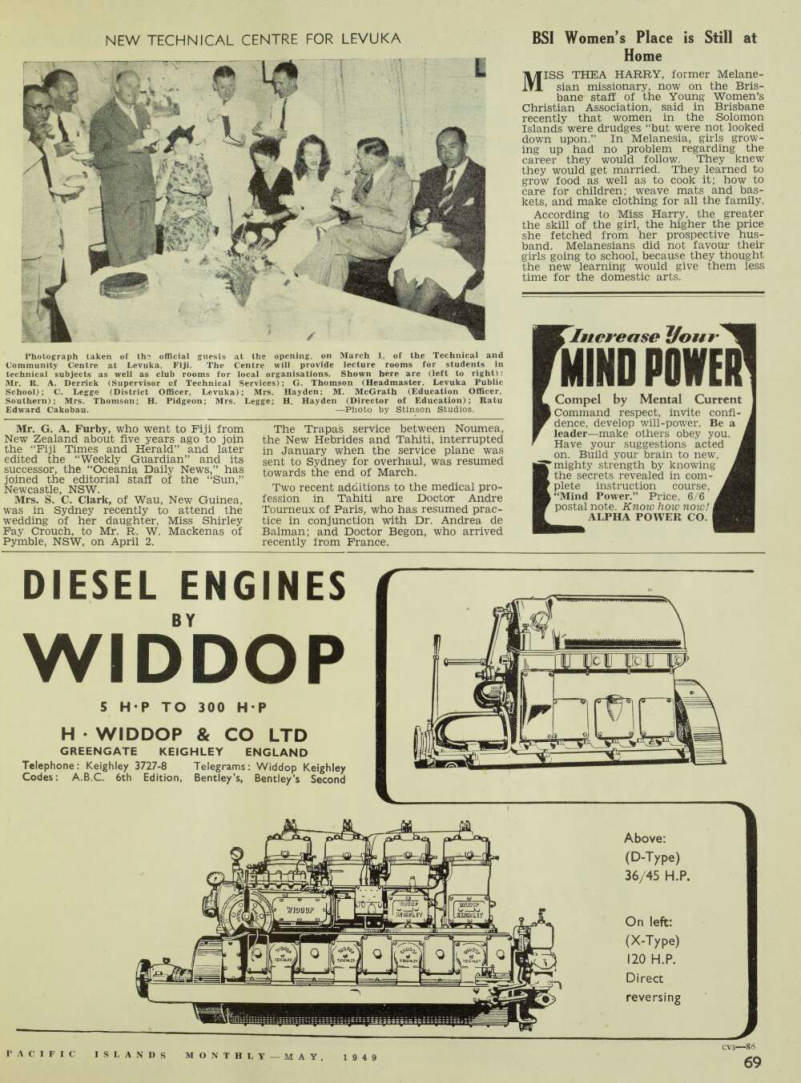
Mr. G. A. Furby, who went to Fiji from New Zealand about five years ago to join the “Fiji Times and Herald” and later edited the “Weekly Guardian” and its successor the “Oceania Daily News,” has joined the editorial staff of the “Sun,”
Newcastle, NSW.
Mrs. S. C. Clark, of Wau, New Guinea, was in Sydney recently to attend the wedding of her daughter, Miss Shirley Fay Crouch, to Mr. R. W. Mackenas of Pymble, NSW, on April 2.
The Trapas service between Noumea, the New Hebrides and Tahiti, interrupted i n January when the service plane was sent to Sydney for overhaul, was resumed towards the end of March, A , ... , .
Two recent additions to the medical pro fession in Tahiti are Doctor Andre Tourneux of Paris, who has resumed prac tice in conjunction with Dr. Andrea de Balman; and Doctor Begon, who arrived recently from France.
Photograph taken of the official guests at the opening, on March 1, of the Technical and Community Centre at Levuka, Fiji. The Centre will provide lecture rooms for students in technical subjects as well as club rooms for local organisations. Shown here are (left to right): Mr. B. A. Derrick (Supervisor of Technical Services); G. Thomson (Headmaster, Levuka Public School); C. Legge (District Officer, Levuka); Mrs. Hayden; M. McGrath (Education Officer, Southern); Mrs. Thomson; H. Pidgeon; Mrs. Legge; H. Hayden (Director of Education); Ratu Edward Cakobau. —Photo by Stinson Studios.
BSI Women’s Place is Still at Home
Home
MISS THEA HARRY, former Melane sian missionary, now on the Bris bane staff of the Young Women’s Christian Association, said in Brisbane recently that women in the Solomon Islands were drudges “but were not looked down upon.” In Melanesia, girls grow ing up had no problem regarding the career they would follow. They knew they would get married. They learned to grow food as well as to cook it; how to care for children; weave mats and bas kets, and make clothing for all the family.
According to Miss Harry, the greater the skill of the girl, the higher the price she fetched from her prospective hus band. Melanesians did not favour their girls going to school, because they thought the new learning would give them less time for the domestic arts.
M. Edouard Mercier, prominent Noumea business man and owner of the town's chief bakery, died at the age of 80. He had been a member of the New Caledonian General Council and the Noumea Municipal Council. One of his sons
played a prominent part in thq anti d’Argenlieu riots in 1942, and afterwards served with the New Caledonian contin gent in North Africa. Another son is Emil Mercier, well-known Sydney car toonist.
Advertisements & other items, pp. 71-72 (1 item)
widdop
Wlnerease Jfour%
MIND POWER 1
W 1 r
Compel by Mental Current
B Command respect, invite confidence, develop will-power. Be a W leader—make others obey you.
' Have your suggestions acted on. Build your brain to new, HT mighty strength by knowing the secrets revealed in complete instruction course, “Mind Power.” Price, 6/6 postal note. Know how now! ,
ALPHA POWER CO.
DIESEL ENGINES
widdop
5 H P TO 300 H P
H • WIDDOP & CO LTD
GREENGATE KEIGHLEY ENGLAND
Telephone: Keighley 3727-8 Telegrams: Widdop Keighley Codes: A.B.C. 6th Edition, Bentley’s, Bentley’s Second m r m 'vi £ * £ tm -1 Q lvi Q ■iliciuyJJl lIV, /] W Above: (D-Type) 36/45 H.P.
On left: (X-Type) 120 H.P.
Direct reversing
CVS —86
OUR HANDS MAKE GOOD ARMS
SIL
For your Fishing and Shooting Wants Consult Us.
Lithgow .22 Cal. Repeating Rifles ... £ll 14 0 ] Post Lithgow .22 Cal. Single Shot 5 1 3 Extra.
RO H U 143 ELIZABETH STREET, SYDNEY.
m •••V m ma I m m V
SYMBOL of
Qualitm
The Shell Co. of Aust., Ltd. (Inc. in Great Britain).
Burglaries In Santo, Nh
Prom Our Own Correspondent DURING recent months, Santo stores have experienced four audacious robberies.
Attackes have been aimed exclusively at the two leading stores on the island—one French, the other British. Both stores have been broken into twice. Stocks stolen have been light—but it is the bold ness and planning of these robberies which calls for investigation.
The first occurred in January. The French store was broken into through a side door. A miscellany of articles was removed, but any attempt to trace them or the thieves was impossible.
The second took place several weeks later. This time a bulk shed belonging to the British firm was entered. Several bags of rice were removed.
The third robbery occurred in March, in the British firm’s main store. To enter it the thieves cut away the outside locks.
Only one piece of calico was missing. The motive remains a mystery, for the store was well stocked with a wide variety of desirable, practical articles. Possibly, the burglars sought cash—but the day’s tak ings were safe elsewhere.
The fourth robbery occurred in April, when the thieves entered the French store making a hole through the floor boards. Again, the amount of goods stolen did not seem to warrant such a premed itated and well-planned robbery.
No clues of any kind were left by the thieves. The police apparently are unable to do a thing about it. If the burglaries continue, the community may have to take special steps for its own protection.
They Deserted in 1944
Two Japs Found In Manus
CAPTAIN R. C. CLAMMER, an inspec tor of the Royal Papuan Constabu lary, who is visiting Brisbane on vacation, exploded the belief that Japanese soldiers, rather than desert, would commit hari-kari.
Two Japanese deserters, he said, had hidden in tabu country on Manus Island for five years, living like Robinson Crusoe until thev were cantured recently bv six natives from Mali Bay. The natives were on a pig hunting expedition.
The deserters were brought to police district headquarters at Lorengau, where they were interrogated, and were being held in the Japanese war criminals’ com pound until they could be returned to Japan.
Captain Crammer said the men, when captured, were in perfect health, shaven, and appeared to register little surprise when they learned the war had ended.
They had deserted from the Army in February, 1944, when the Allies landed at Los Negros. “The Americans were too strong,” the deserters declared, so they fled inland for threel days and reached a fertile area where coconut trees and other signs of cultivation were evident. Overgrown gardens contained kau kau and taro.
From scraps of iron found, one of the Japanese, who was a blacksmith by trade, had made knives, razors and spearheads.
The other Jan was a farmer.
Food was obtained by hunting wild pigs and other game, and in order to over come the absence of mineral salt, the Japanese had burnt a species of tree and used the ash.
When the deserters were captured in March, 1949, they were wearing ragged shirts, trousers made of pigskin sewn with gut, and pigskin sandals. Pieskin was also used for making water bags.
Death Of G. E. Zucksghwert
Prom Our Own Correspondent
Nukualofa, April 7.
IN the death of Mr. G. E. Zuckschwerdt, one of the best-known and highly respected residents of the Kingdom, on April 1, after a long illness, there was severed one of the few remaining links with the “good old days” of Tonga.
He was born in Germany in 1866; grew pineapples in Hawaii in 1891; joined the DH and PG firm in Western Samoa in 1893 and became their accountant in Haapai; served later in Vavau and Apia; and about 50 years ago established in Apia the firm that later became zuckschwert and Voigt. He sold out, purchased the store of old Mrs. L. Krause, in Nukualofa, built a flourishing business, and became one of Tonga’s most esteemed merchants.
His fine character and honesty in business endeared him to the Tongan people. He married the daughter of a South Ameri can German merchant and his two child ren, Herman and Edith, survive him.
The funeral, which was attended by a large gathering representative of the various sections of the community, was conducted by the Rev. E. F. Webber of the Anglican Mission.
Oil Exploration in Papua
THE following progress, was made dur ing the month of March, 1949, in the Australian Petroleum Company’s operations in Papua-New Guinea:— OROI. Drilling was continued to 1,980 feet at which depth it was decided to in sert 9| in. casing to isolate the upper gas and water which continue to impede drilling progress.
UPOIA. The parted drill collar has been recovered and drilling in heavy shale formation has been continued to 1,344 feet.
HOHORO. The hole was spudded in during the month and has reached a depth of 1,065 feet. Preparations are in hand to insert 18| in. casing.
MALALAUM. The road to the test site has been formed for 6i miles of its total length of 9J miles.
WAN A. A drilling site has been se lected in close proximity to the left bank of the Era River approximately 5 miles north-north-west of Port Romilly. Little road making is required, and clearing of jungle for rig site, service buildings and staff and labour accommodation is in progress.
In order to obtain stratigraphical in formation in a zone remote from pre vious drilling in Papua, a National “50”
Drilling Rig will be loaned to Island Ex ploration Company Pty., Ltd. for the drill ing of a test well on that Company’s adjacent permit area.
All stratigraphical information obtained by Island Exploration Company Pty., Ltd. from the drilling of this well will be made available to Australian Petroleum Company Pty., Ltd.
On March 15, an American plane ar rived in Papeete, bringing Doctor John Kessel, chairman of the Department of Bacteriology of the University of Southern California, and Doctor Willard Wright, Chief of the Division of Tropical Medicine, of the US Public Health Ser vice. They conferred with Doctor Bye, Doctor Edgar, and the French Health Ser vice on work being done on Philorias re search in Tahiti. During their short stay they were guests of the Philorias Insti tute.
Tahiti Officials Return to France
From Our Own Correspondent PAPEETE, March 25.
PASSENGERS sailing on the “Eridan” from Papeete on March 16 numbered 148 for France and 14 for Cristobal.
Her cargo consisted of 1,500 tons of copra, 400 cases of tuna fish, and 400 cases of vanilla.
Monsieur Rene Haza, Chef de Cabinet to the Governor, and Monsieur Liauzun, with respective families, were among the officials returning to France.
Monsieur Rene Haza will be greatly missed in Tahiti, where he has carried out his duties with energy and efficiency, and earned the respect of the community by his sympathetic attention to all need ing his services.
Monsieur Joseph Quesnot, Counsellor to the Republic of France for French Oceania, and Monsieur Coulon, Delegate to the Union Francaise the Colony, also left for the motherland.
On departure, the captain of the vessel reported two members of his crew miss ing. They were taken into custody in Papeete the following day.
Inadequate Shipping
Facilities In Papua-Ng
IT is reported in Sydney that both the Harbourmaster and the Assistant Harbourmaster in Port Moresby have resigned their posts. The former—Mr.
Bell, who served as a Lieut. Commander in World War 11, and who formerly was well known in the Australian Lighthouse and Navigation services—arrived in Syd ney during April. He took up the job of port manager at Port Moresby about 18 months ago.
It has been stated, repeatedly, in Aus tralian newspapers in recent months that the port facilities in Papua-New Guinea have deteriorated so much in the past two or three years that they are now unsuit able for regular shipping, and that navi gational controls on the coast of the Ter ritories are not satisfactory.
Some reports say that there has been extraordinary muddling in relation to the supply of material and labour for the re pair of Territories wharves—especially in Port Moresby—and that the authorities in Canberra and Port Moresby do not see exactly eye-to-eye in the matter of plac ing the blame.
Advertisements & other items, pp. 73-74 (1 item)
ScottV'Renown”Brand Rope,
PRODUCING UNIFORM GOOD RESULTS SINCE 1868
jj^S-
ALWAYS ASK FOR IT
ScottV'Renown”Brand Rope,
Cable Address Ropeyard Sydney.
VaJV*.*-- v.
SS>m*r,
■SSSSSm*m»C:
S§bsSS|
'^»ssss^-
Cordage and
Binder
Twine
of Every
Description
MANUFACTURED AT
MASCOT, N.S.W.
By
J. SCOTT
PTY. LTD.
Head Office and Store
163 CLARENCE STREET,
SYDNEY,
N.S.W.
cc
I’m a pioneer
.ag|5:
)QU|t
in modern dress!
These days, some people don’t think that tradition counts for much. But I know better. Pioneering my own business twenty years ago taught me that tradition is a priceless ingredient that you have to earn. It’s not something you can buy on the open market. The way I look at it, every tradition has a pioneer for a father and its mother is experience.
Take the example of B.O.A.C. ... Its 150,000 miles of world-wide air services between five continents and forty-two countries didn’t just happen. There was always a ‘first time’ for every route. Because B.O.A.C. has the imagination and the determination to be and stay a leader, it always looks and plans ahead.
That’s why it’s not surprising that B.O.A.C. pioneered the air route between Britain and Australia over ten years ago. Or that it was the first and for two years the only airline to fly the present North Atlantic route as a twoway, year-around service. Nor is it surprising that B.O.A.C’s 30-year-old tradition of Speedbird service and experience is reflected by all its personnel.
Yes, I say — never underestimate the importance of tradition !
GREAT BRITAIN
MIDDLE EAST
SOUTH AFRICA
AUSTRALIA
• U.S.A. • BERMUDA
• WEST AFRICA
• PAKISTAN • INDIA
NEW ZEALAND • FAR EA!
• CANADA
EAST AFRICA
• CEYLON
JAPAN
B.O.A.C. TAKES GOOD CARE OF YOU
FLY ,r B
A3/AU
Information & Bookings : Qantas Empire Airways , Sydney , Melbourne , Brisbane , Townsville , „ Cairns , Darwin {General Agents in Australia ), or from Booking Agents in all cities.
BRITISH OVERSEAS AIRWAYS CORPORATION WITH Q.E.A., S.A.A. AND T.E.A.L
In Dispute
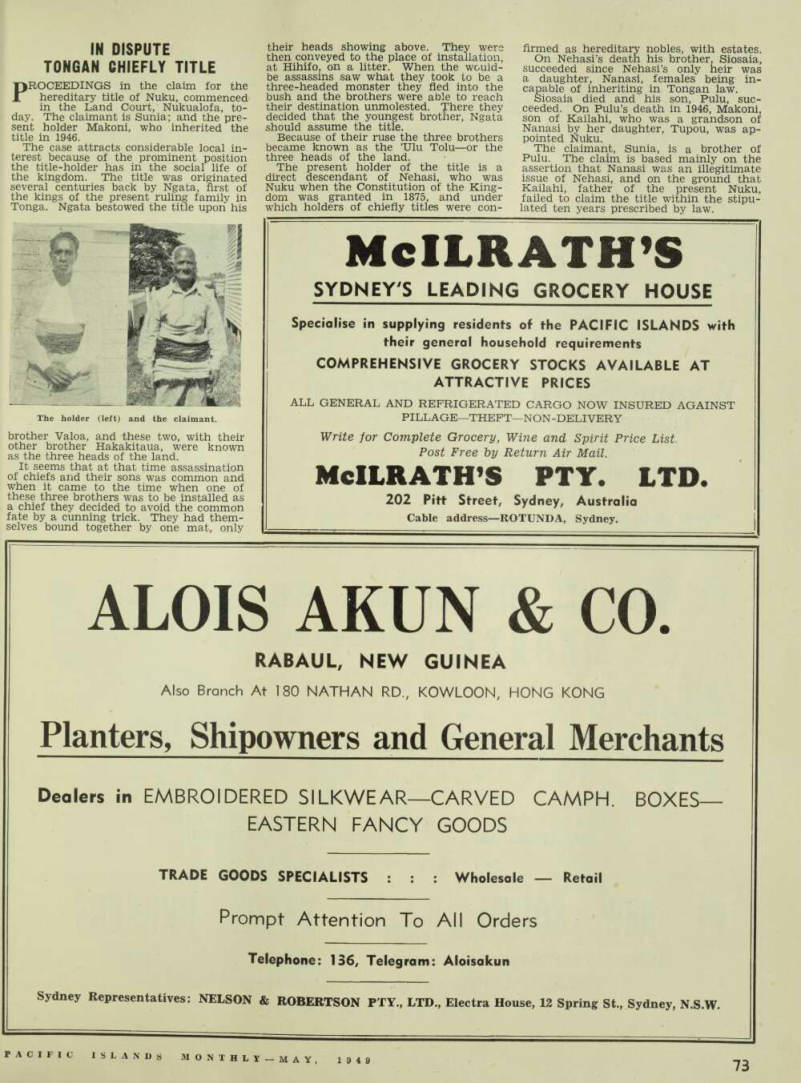
Tongan Chiefly Title
PROCEEDINGS in the claim for the hereditary title of Nuku, commenced in the Land Court, Nukualofa, to day. The claimant is Sunia; and the pre sent holder Makoni, who inherited the title in 1946.
The case attracts considerable local in terest because of the prominent position the title-holder has in the social life of the kingdom. The title was originated several centuries back by Ngata, first of the kings of the present ruling family in Tonga. Ngata bestowed the title upon his
their heads showing above. They were then conveyed to the place of installation, at Hihifo, on a litter. When the would be assassins saw what they took to be a three-headed monster they fled into the bush and the brothers were able to reach their destination unmolested. There they decided that the youngest brother, Ngata should assume the title.
Because of their ruse the three brothers became known as the ’Ulu Tolu —or the three heads of the land.
The present holder of the title is a direct descendant of Nehasi, who was Nuku when the Constitution of the King dom was granted in 1875, and under which holders of chiefly titles were con
firmed as hereditary nobles, with estates.
On Nehasi’s death his brother, Siosaia, succeeded since Nehasi’s only heir was a daughter, Nanasi, females being in capable of inheriting in Tongan law.
Siosaia died and his son, Pulu, suc ceeded. On Pulu’s death in 1946, Makoni, son of Kailahi, who was a grandson of Nanasi by her daughter, Tupou, was ap pointed Nuku.
The claimant, Sunia, is a brother of Pulu. The claim is based mainly on the assertion that Nanasi was an illegitimate issue of Nehasi, and on the ground that Kailahi, father of the present Nuku, failed to claim the title within the stipu lated ten years prescribed by law.
The holder (left) and the claimant. brother Valoa, and these two, with their other brother Hakakitaua, were known as the three heads of the land.
It seems that at that time assassination of chiefs and their sons was common and when it came to the time when one of these three brothers was to be installed as a chief they decided to avoid the common fate by a cunning trick. They had them selves bound together by one mat, only
Advertisements & other items, p. 75 (1 item)
Alois Akun & Co.
McILRATH’S
SYDNEY'S LEADING GROCERY HOUSE
Specialise in supplying residents of the PACIFIC ISLANDS with their general household requirements
COMPREHENSIVE GROCERY STOCKS AVAILABLE AT
ATTRACTIVE PRICES
ALL GENERAL AND REFRIGERATED CARGO NOW INSURED AGAINST
PILLAGE-THEFT—NON-DELIVERY
Write for Complete Grocery, Wine and Spirit Price List.
Post Free by Return Air Mail.
McILRATH’S PTY. LTD.
202 Pitt Street, Sydney, Australia Cable address —ROTUNDA, Sydney.
ALOIS AKUN & CO.
RABAUL, NEW GUINEA
Also Branch At 180 NATHAN RD., KOWLOON, HONG KONG
Planters, Shipowners and General Merchants
Dealers in EMBROIDERED SILKWEAR—CARVED CAMPH. BOXES—
EASTERN FANCY GOODS
TRADE GOODS SPECIALISTS : ; : Wholesale Retail Prompt Attention To All Orders Telephone: 136, Telegram: Aloisakun Sydney Representatives: NELSON & ROBERTSON PTY., LTD., Electra House, 12 Spring St., Sydney, N.S.W.
Sydney-NZ-Fiji-Hawaii-Nth. America
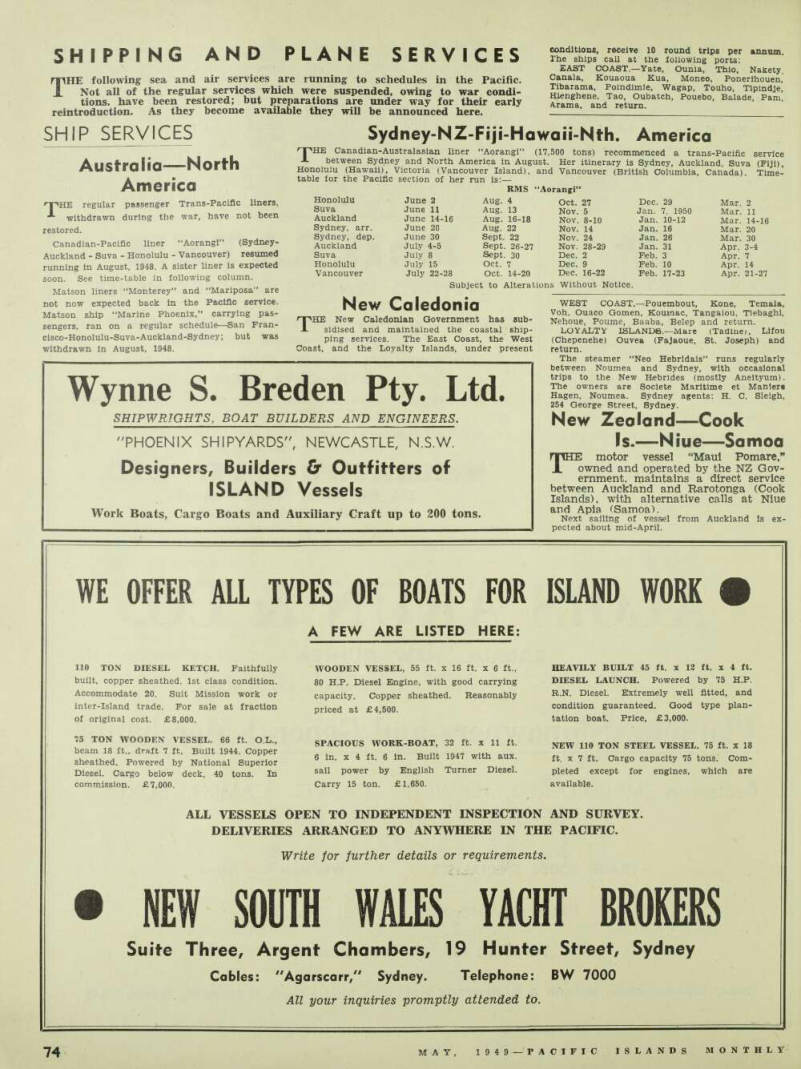
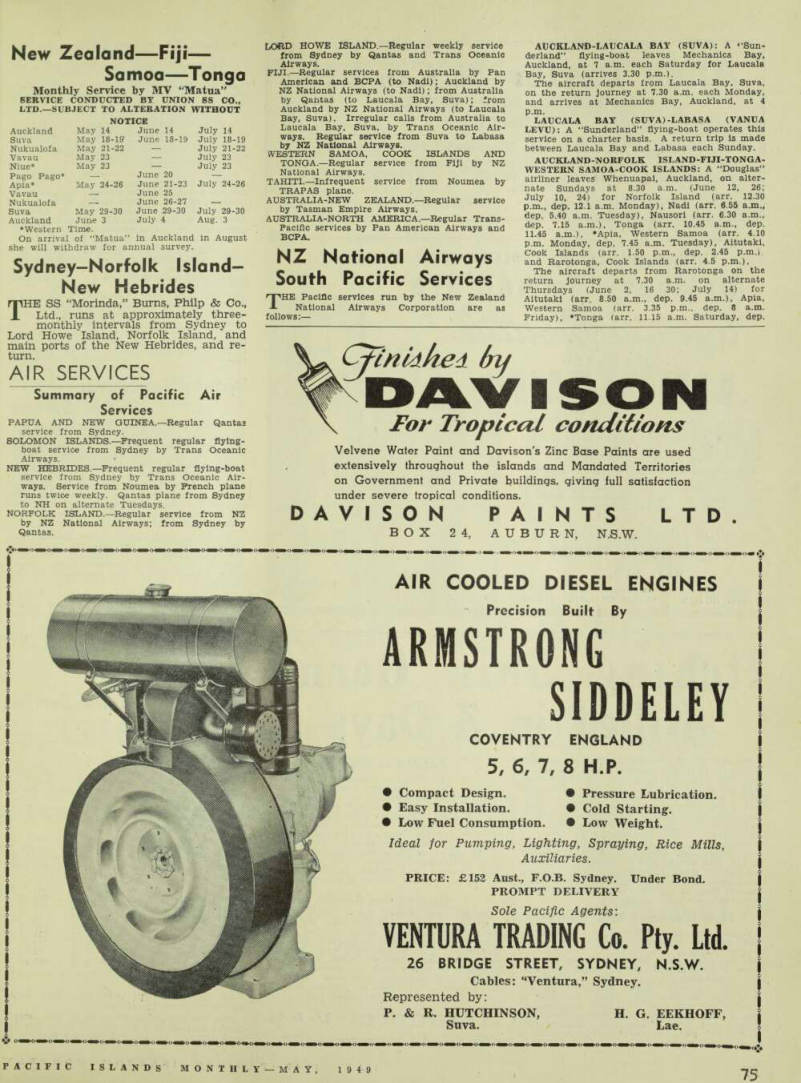
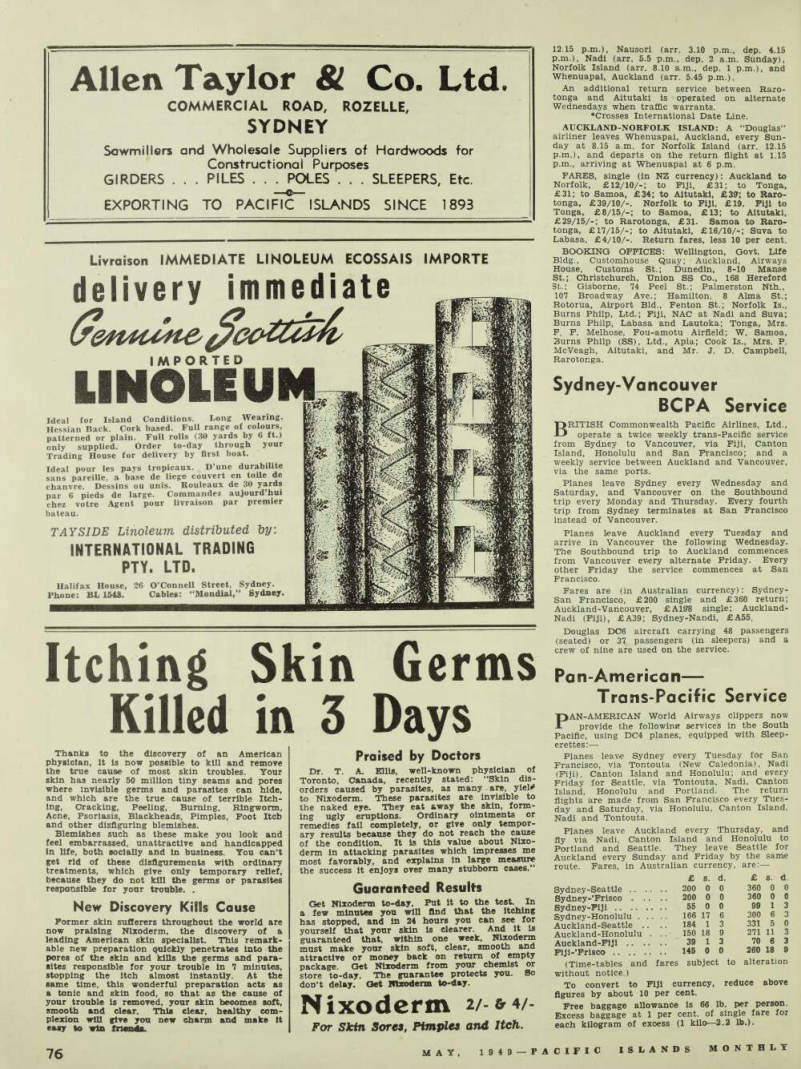
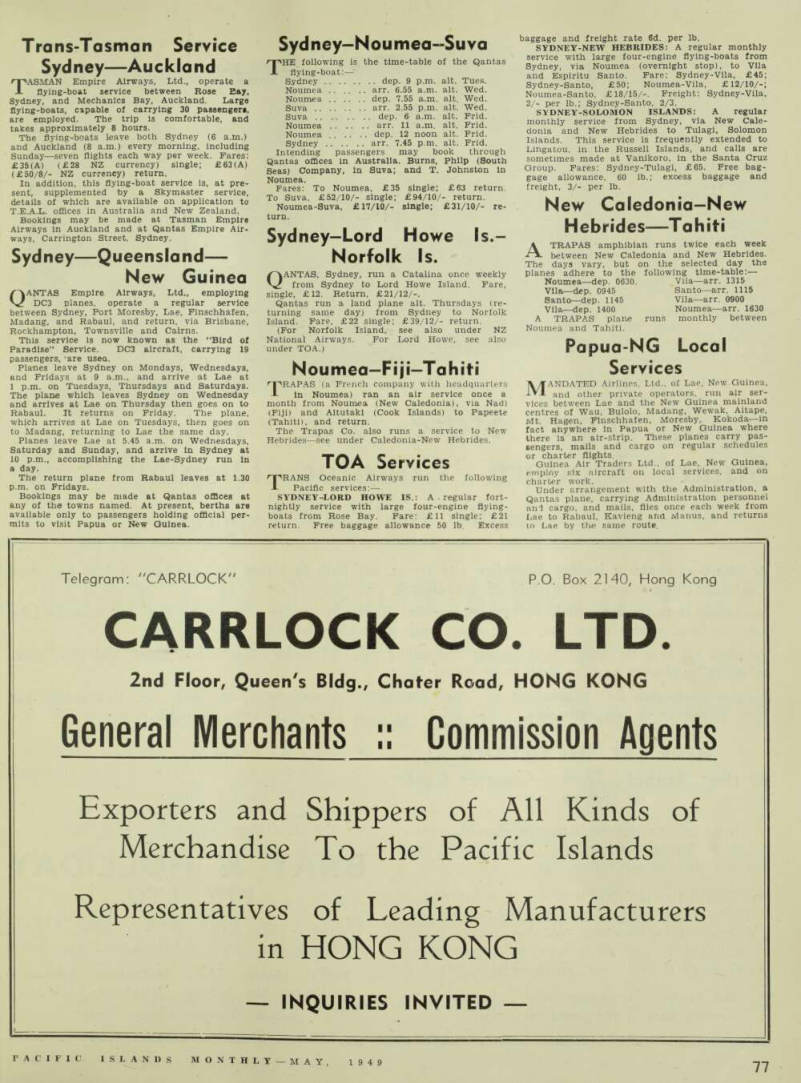
Shipping And Plane Services
THE following sea and air services are running to schedules in the Pacific.
Not all of the regular services which were suspended, owing to war condi tions. have been restored; but preparations are under way for their early reintroduction. As they become available they will be announced here.
Ship Services
Australia —North
America
nr'HE regular passenger Trans-Pacific liners, withdrawn during the war, have not been restored.
Canadian-Pacific liner “Aorangi” (Sydney- Auckland - Suva - Honolulu - Vancouver) resinned running in August, 1948. A sister liner is expected soon. See time-table in following column.
Matson liners “Monterey” and “Mariposa” are not now expected back in the Pacific service.
Matson ship “Marine Phoenix,” carrying pas sengers, ran on a regular schedule—San Fran cisco-Honolulu-Suva-Auckland-Sydney; but was withdrawn in August, 1948.
Sydney-NZ-Fiji-Hawaii-Nth. America
r T'HE Canadian-Australasian liner “Aorangi” (17,500 tons) recommenced a trans-Pacific service A between Sydney and North America in August. Her itinerary is Sydney, Auckland, Suva (Fiji), Honolulu (Hawaii), Victoria (Vancouver Island), and Vancouver (British Columbia, Canada). Time table for the Pacific section of her run is:—
New Caledonia
THE New Caledonian Government has sub sidised and maintained the coastal ship ping services. The East Coast, the West Coast, and the Loyalty Islands, under present
conditions, receive 10 round trips per annum.
The ships call at the following ports; EAST COAST.—Yate, Ounia, Thio, Nakety.
Canala, Kouaoua Kua, Moneo, Ponerihouen, Tibarama, Polndlmle, Wagap, Touho, Tipindje, Hienghene, Tao, Oubatch, Pouebo, Balade, Pam, Arama, and return.
WEST COAST.—Pouembout, Kone, Temala, Voh, Ouaco Gomen, Koumac, Tangaiou, Tiebaghi, Nehoue, Poume, Baaba, Belep and return.
LOYALTY ISLANDS. —Mare (Tadlnej, Llfou (Chepenehe) Ouvea (Fajaoue, St. Joseph) and return.
The steamer “Neo Hebrldais” runs regularly between Noumea and Sydney, with occasional trips to the New Hebrides (mostly Aneityum).
The owners are Societe Maritime et Manlere Hagen, Noumea. Sydney agents; H. C. Sleigh, 254 George Street, Sydney.
New Zealand—Cook
Is. —Niue—Samoa
fTTHE motor vessel “Maul Pomare,”
X owned and operated by the NZ Gov ernment, maintains a direct service between Auckland and Rarotonga (Cook Islands), with alternative calls at Niue and Apia (Samoa).
Next sailing of vessel from Auckland is ex pected about mid-April.
RMS “Aorangi”
Honolulu June 2 Aug. 4 Oct. 27 Dec. 29 Mar. 2 Suva June 11 Aug. 13 Nov. 5 Jan. 7. 1950 Mar. 11 Auckland June 14-16 Aug. 16-18 Nov. 8-10 Jan. 10-12 Mar. 14-16 Sydney, arr. June 20 Aug. 22 Nov. 14 Jan. 16 Mar. 20 Sydney, dep. June 30 Sept. 22 Nov. 24 Jan. 26 Mar. 30 Auckland July 4-5 Sept. 26-27 Nov. 28-29 Jan. 31 Apr. 3-4 Suva July 8 Sept. 30 Dec. 2 Feb. 3 Apr. 7 Honolulu July 15 Oct. 7 Dec. 9 Feb. 10 Apr. 14 Vancouver July 22-28 Oct. 14-20 Dec. 16-22 Feb. 17-23 Apr. 21-27 Subject to Alterations Without Notice.
New Zealand—Fiji—
Samoa—Tonga
Monthly Service by MV “Matua”
Service Conducted By Union Ss Co.,
Ltd.—Subject To Alteration Without
On arrival of “Matua” in Auckland in August she will withdraw for annual survey.
Sydney-Norfolk Island-
New Hebrides
THE SS “Morinda,” Burns, Philp & Co., Ltd., runs at approximately three monthly intervals from Sydney to Lord Howe Island, Norfolk Island, and main ports of the New Hebrides, and re turn.
Air Services
Summary of Pacific Air
Services
PAPUA AND NEW GUlNEA.—Regular Qantas service from Sydney.
SOLOMON ISLANDS.—Frequent regular flying boat service from Sydney by Trans Oceanic Airways.
NEW HEBRlDES.—Frequent regular flying-boat service from Sydney by Trans Oceanic Air ways. Service from Noumea by French plane runs twice weekly. Qantas plane from Sydney to NH on alternate Tuesdays.
NORFOLK ISLAND.—Regular service from NZ by NZ National Airways; from Sydney by Qantas.
LORD HOWE ISLAND.—Regular weekly service from Sydney by Qantas and Trans Oceanic Airways.
FIJI. —Regular services from Australia by Pan American and BCPA (to Nadi); Auckland by NZ National Airways (to Nadi); from Australia by Qantas (to Laucala Bay, Suva); from Auckland by NZ National Airways (to Laucala Bay, Suva). Irregular calls from Australia to Laucala Bay, Suva, by Trans Oceanic Air ways. Regular service from Suva to Labasa by NZ National Airways.
Western Samoa, Cook Islands And
TONGA. —Regular service from Fiji by NZ National Airways.
TAHITI. —Infrequent service from Noumea by TRAPAS plane.
AUSTRALIA-NEW ZEALAND.—ReguIar service by Tasman Empire Airways.
AUSTRALIA-NORTH AMERICA.—Regular Trans pacific services by Pan American Airways and
Bcpa.
NZ National Airways
South Pacific Services
THE Pacific services run by the New Zealand National Airways Corporation are as follows: —
Auckland-Laucala Bay (Suva): A “Sun
derland” flying-boat leaves Mechanics Bay, Auckland, at 7 a.m. each Saturday for Laucala Bay, Suva (arrives 3.30 p.m.).
The aircraft departs from Laucala Bay, Suva, on the return journey at 7.30 a.m. each Monday, and arrives at Mechanics Bay, Auckland, at 4 p.m.
Laucala Bay (Suva)-Labasa (Vanua
LEVU): A “Sunderland” flying-boat operates this service on a charter basis. A return trip is made between Laucala Bay and Labasa each Sunday.
Auckland-Norfolk Island-Fiji-Tonga
Western Samoa-Cook Islands: A “Douglas”
airliner leaves Whenuapal, Auckland, on alter nate Sundays at 8.30 a.m. (June 12, 26; July 10, 24) for Norfolk Island (arr. 12.30 p.m., dep. 12.1 a.m. Monday), Nadi (arr. 6.55 a.m„ dep. 5.40 a.m. Tuesday), Nausori (arr. 6.30 a.m., dep. 7.15 a.m.), Tonga (arr, 10.45 a.m., dep. 11.45 a.m.), ‘Apia, Western Samoa (arr. 4.10 p.m. Monday, dep. 7.45 a.m. Tuesday), Aitutaki, Cook Islands (arr. 1.50 p.m., dep. 2.45 p.m.) and Rarotonga, Cook Islands (arr. 4.5 p.m.).
The aircraft departs from Rarotonga on the return journey at 7.30 a.m. on alternate Thursdays (June 2, 16 30; July 14) for Aitutaki (arr. 8.50 a.m., dep. 9.45 a.m.), Apia, Western Samoa (arr. 3.35 p.m.. dep. 8 a.m.
Friday), ‘Tonga (arr. 11.15 a.m. Saturday, dep.
Notice
Auckland May 14 June 14 July 14 Suva May 18-19' June 18-19 July 18-19 Nukualofa May 21-22 — July 21-22 Vavau May 23 — July 23 Niue* May 23 — July 23 Pago Pago* — June 20 — Apia* May 24-26 June 21-23 July 24-26 Vavau — June 25 Nukualofa — June 26-27 — Suva May 29-30 June 29-30 July 29-30 Auckland June 3 July 4 Aug. 3 •Western Time.
12.15 p.m.), Nausori (arr. 2.10 p.m., dep. 4.15 p.m.), Nadi (arr. 5.5 p.m., dep. 2 a.m. Sunday), Norfolk Island (arr. 8.10 a.m., dep. 1 p.m.), and Whenuapai, Auckland (arr. 5.45 p.m.).
An additional return service between Raro tonga and Aitutaki is operated on alternate Wednesdays when traffic warrants. •Crosses International Date Line.
Auckland-Norfolk Island: A ‘Douglas”
airliner leaves Whenuapai, Auckland, every Sun day at 8.15 a.m. for Norfolk Island (arr. 12.15 p.m.), and departs on the return flight at 1.15 p.m., arriving at Whenuapai at 6 p.m.
PARES, single (in NZ currency): Auckland to Norfolk, £l2/10/-; to Fiji, £3l; to Tonga, £3l; to Samoa, £34; to Aitutaki, £39; to Raro tonga, £39/10/-. Norfolk to Fiji, £l9. Fiji to Tonga, £B/15/-; to Samoa, £l3; to Aitutaki, £29/15/-; to Rarotonga, £3l. Samoa to Raro tonga, £l7/15/-; to Aitutaki, £l6/10/-; Suva to Labasa, £4/10/-. Return fares, less 10 per cent.
BOOKING OFFICES: Wellington, Govt. Life Bldg., Customhouse Quay; Auckland, Airways House, Customs St.; Dunedin, 8-10 Manse St.; Christchurch, Union SS Co., 168 Hereford 3t.; Gisborne, 74 Peel St.; Palmerston Nth., 107 Broadway Ave.; Hamilton, 8 Alma St.; Rotorua, Airport Bid., Fenton St.; Norfolk Is., Burns Philp, Ltd.; Fiji, NAC at Nadi and Suva; Burns Philp, Labasa and Lautoka; Tonga, Mrs.
P. P. Melhose, Fou-amotu Airfield; W, Samoa, Burns Philp (SS), Ltd., Apia; Cook Is., Mrs. P, McVeagh, Aitutaki, and Mr. J. D. Campbell, Rarotonga.
Sydney-Vancouver
BCPA Service
BRITISH Commonwealth Pacific Airlines, Ltd., operate a twice weekly trans-Pacific service from Sydney to Vancouver, via Fiji, Canton Island, Honolulu and San Francisco; and a weekly service between Auckland and Vancouver, via the same ports.
Planes leave Sydney every Wednesday and Saturday, and Vancouver on the Southbound trip every Monday and Thursday. Every fourth trip from Sydney terminates at San Francisco instead of Vancouver.
Planes leave Auckland every Tuesday and arrive in Vancouver the following Wednesday.
The Southbound trip to Auckland commences from Vancouver every alternate Friday. Every other Friday the service commences at San Francisco.
Pares are (in Australian currency): Sydney- San Francisco, £2OO single and £360 return; Auckland-Vancouver, £AI9B single; Auckland- Nadi (Fiji), £A39; Sydney-Nandi, £ASS.
Douglas DC6 aircraft carrying 48 passengers (seated) or 37 passengers (in sleepers) and a crew of nine are used on the service.
Pan-American —
Trans-Pacific Service
PAN-AMERICAN World Airways clippers now provide the following services in the South Pacific, using DC4 planes, equipped with Sleep erettes: — Planes leave Sydney every Tuesday for San Francisco, via Tontouta (New Caledonia), Nadi (Fiji), Canton Island and Honolulu; and every Friday for Seattle, via Tontouta, Nadi, Canton Island, Honolulu and Portland. The return flights are made from San Francisco every Tues day and Saturday, via Honolulu, Canton Island, Nadi and Tontouta.
Planes leave Auckland every Thursday, and fly via Nadi, Canton Island and Honolulu to Portland and Seattle. They leave Seattle for Auckland every Sunday and Friday by the same route. Pares, in Australian currency, are:—
(Time-tables and fares subject to alteration without notice.) To convert to Fiji currency, reduce above figures by about 10 per cent.
Free baggage allowance is 66 lb. per person.
Excess baggage at 1 per cent, of single fare for each kilogram of excess (1 ki10—2.2 lb.).
£ s. d. £ s. d
Sydney-Seattle .. .
.. 200 0 0 360 0 0 Sydney-’Frisco . . . 200 0 0 360 0 0 Sydney-PIJi 55 0 0 99 1 3
Sydney-Honolulu . .
. .. 166 17 6 300 6 3 Auckland-Seattle .. 184 1 3 331 5 0 Auckland-Honolulu , .. 150 18 9 271 11 3 Auckland-Pljl .. .. 39 1 3 70 6 3 Fijl-’Frisco 145 0 0 260 18 9
Trans-Tasman Service
Sydney—Auckland
TASMAN Empire Airways, Ltd., operate a flying-boat service between Rose Bay, Sydney, and Mechanics Bay, Auckland. Large flying-boats, capable of carrying 30 passenger*, are employed. The trip is comfortable, and takes approximately 8 hours.
The flying-boats leave both Sydney (6 a.m.) and Auckland (8 a.m.) every morning, including Sunday—seven flights each way per week. Fares: £35 (A) (£2B NZ currency) single; £63 (A) (£5O/8/- NZ currency) return.
In addition, this flying-boat service is, at pre sent, supplemented by a Skymaster service, details of which are available on application to T.E.A.L. offices in Australia and New Zealand.
Bookings may be made at Tasman Empire Airways in Auckland and at Qantas Empire Air ways, Carrington Street, Sydney.
Sydney—Queensland—
New Guinea
QANTAS Empire Airways, Ltd., employing DCS planes, operate a regular service between Sydney, Port Moresby, Lae, Finschhafen, Madang, and Rabaul, and return, via Brisbane, Rockhampton, Townsville and Cairns.
This service is now known as the “Bird of Paradise” Service. DC3 aircraft, carrying 19 passengers, *are usea.
Planes leave Sydney on Mondays, Wednesdays, and Fridays at 9 a.m., and arrive at Lae at 1 p.m. on Tuesdays, Thursdays and Saturdays, The plane which leaves Sydney on Wednesday and arrives at Lae on Thursday then goes on to Rabaul. It returns on Friday. The plane, which arrives at Lae on Tuesdays, then goes on to Madang, returning to Lae the same day.
Planes leave Lae at 5.45 a.m. on Wednesdays, Saturday and Sunday, and arrive in Sydney at 10 p.m., accomplishing the Lae-Sydney run in a day.
The return plane from Rabaul leaves at 1.30 p.m. on Fridays.
Bookings may be made at Qantas offices at any of the towns named. At present, berths are available only to passengers holding official per mits to visit Papua or New Guinea.
Sydney-Noumea—Suva
THE following is the time-table of the Qantas flying-boat:—
Intending passengers may book through Qantas offices in Australia. Burns, Phllp (South Seas) Company, in Suva; and T. Johnston In Noumea.
Fares: To Noumea, £35 single; £63 return.
To Suva, £52/10/- single; £94/10/- return.
Noumea-Suva, £l7/10/- single; £3l/10/- re turn.
Sydney-Lord Howe ls.-
Norfolk is.
QANTAS, Sydney, run a Catalina once weekly from Sydney to Lord Howe Island. Fare, single, £l2. Return, £2l/12/-.
Qantas run a land plane alt. Thursdays (re turning same day) from Sydney to Norfolk Island. Fare, £22 single; £39/12/- return. (For Norfolk Island, see also under NZ National Airways. For Lord Howe, see also under TOA.)
Noumea-Fiji-Tahiti
TRAPAS (a French company with headquarters in Noumea) ran an air service once a month from Noumea (New Caledonia), via Nadi (Fiji) and Altutakl (Cook Islands) to Papeete (Tahiti), and return.
The Trapas Co. also runs a service to New Hebrides —see under Caledonia-New Hebrides.
TOA Services
TRANS Oceanic Airways run the following Pacific services:— SYDNEY-LORD HOWE IS.: A . regular fort nightly service with large four-engine flying boats from Rose Bay. Fare: £ll single; £2l return. Free baggage allowance 50 lb Excess
baggage and freight rate 6d. per lb.
SYDNEY-NEW HEBRIDES: A regular monthly service with large four-engine flying-boats from Sydney, via Noumea (overnight stop), to Vila and Espiritu Santo. Fare; Sydney-Vila, £45; Sydney-Santo, £5O; Noumea-Vila, £l2/10/-; Noumea-Santo, £lB/15/-. Freight; Sydney-Vila, 2/- per lb.; Sydney-Santo, 2/3.
Sydney-Solomon Islands: A Regular
monthly service from Sydney, via New Cale donia and New Hebrides to Tulagi, Solomon Islands. This service is frequently extended to Lingatou, in the Russell Islands, and calls are sometimes made at Vanikoro, in the Santa Cruz Group. Fares: Sydney-Tulagi, £65. Free bag gage allowance, 60 lb.; excess baggage and freight, 3/- per lb.
New Caledonia-New
Hebrides—Tahiti
ATRAPAS amphibian runs twice each week between New Caledonia and New Hebrides.
The days vary, but on the selected day the planes adhere to the following time-table; — Noumea —dep. 0630. Vila —arr. 1315 Vila—dep. 0945 Santo —arr. 1115 Santo —dep. 1145 Vila —arr. 0900 Vila—dep. 1400 Noumea—arr. 1630 A TRAPAS plane runs monthly between Noumea and Tahiti.
Papua-NG Local
Services
MANDATED Airlines, Ltd., of Lae, New Guinea, and other private operators, run air ser vices between Lae and the New Guinea mainland centres of Wau, Bulolo, Madang, Wewak, Aitape, Mt. Hagen, Plnschhafen, Moresby, Kokoda —in fact anywhere in Papua or New Guinea where there is an air-strip. These planes carry pas sengers, mails and cargo on regular schedules or charter flights.
Guinea Air Traders Ltd., of Lae, New Guinea, employ six aircraft on local services, and on charter work.
Under arrangement with the Administration, a Qantas plane, carrying Administration personnel and cargo, and mails, flies once each week from Lae to Rabaul, Kavleng and Manus, and returns to Lae by the same route.
Sydney dep. 9 p.m. alt. Tues.
Noumea arr. 6.55 a.m. alt. Wed.
Noumea dep. 7.55 a.m. alt. Wed.
Suva arr. 2.55 p.m. alt. Wed.
Suva dep. 6 a.m. alt. Frid.
Noumea arr. 11 a.m. alt. Frid.
Noumea .. .. .. dep. 12 noon alt. Frid.
Sydney arr. 7.45 p.m. alt. Frid.
Advertisements & other items, pp. 76-80 (1 item)
• New Sooth Mb Yacht Brokers
Wynne S. Breden Pty. Ltd.
SHIPWRIGHTS. BOAT BUILDERS AND ENGINEERS.
"PHOENIX SHIPYARDS", NEWCASTLE, N.S.W.
Designers, Builders & Outfitters of ISLAND Vessels Work Boats, Cargo Boats and Auxiliary Craft up to 200 tons.
WE OFFER ALL TYPES OF BOATS FOR ISLAND WORK •
A FEW ARE LISTED HERE:
110 TON DIESEL KETCH. Faithfully built, copper sheathed. Ist class condition.
Accommodate 20. Suit Mission work or inter-island trade. For sale at fraction of original cost. £B,OOO. 75 TON WOODEN VESSEL. 66 ft. 0.L., beam 18 ft., draft 7 ft. Built 1944. Copper sheathed. Powered by National Superior Diesel. Cargo below deck, 40 tons. In commission. £7,000.
WOODEN VESSEL, 55 ft. x 16 ft. x 6 ft., 80 H.P. Diesel Engine, with good carrying capacity. Copper sheathed. Reasonably priced at £4,500.
SPACIOUS WORK-BOAT, 32 ft. X 11 ft. 6 in. x 4 ft. 6 in. Built 1947 with aux. sail power by English Turner Diesel.
Carry 15 ton. £1,650.
HEAVILY BUILT 45 ft. x 12 ft. x 4 ft.
DIESEL LAUNCH. Powered by 75 H.P.
R.N. Diesel. Extremely well fitted, and condition guaranteed. Good type plantation boat. Price, £3,000.
NEW 110 TON STEEL VESSEL. 75 ft. X 18 ft. x 7 ft. Cargo capacity 75 tons. Completed except for engines, which are available.
ALL VESSELS OPEN TO INDEPENDENT INSPECTION AND SURVEY.
DELIVERIES ARRANGED TO ANYWHERE IN THE PACIFIC.
Write for further details or requirements.
• NEW SOOTH MB YACHT BROKERS
Suite Three, Argent Chambers, 19 Hunter Street, Sydney
Cables: "Agarscarr," Sydney. Telephone: BW 7000
All your inquiries promptly attended to.
Cpnldked
For Tropical conditions
Velvene Water Paint and Davison's Zinc Base Paints are used extensively throughout the islands and Mandated Territories on Government and Private buildings, giving full satisfaction under severe tropical conditions.
DAVISON PAINTS LTD.
BOX 24, AUBURN, N.S.W.
I P I
AIR COOLED DIESEL ENGINES
Precision Built By
ARMSTRONG
SIDDELEY
COVENTRY ENGLAND
5,6, 7, 8 H.P. • Compact Design. • Pressure Lubrication. • Easy Installation. • Cold Starting. • Low Fuel Consumption. • Low Weight.
Ideal for Pumping, Lighting, Spraying, Rice Mills, Auxiliaries.
PRICE: £152 Aust., F. 0.8. Sydney. Under Bond.
PROMPT DELIVERY
Sole Pacific Agents :
VENTURA TRADING Co. Ply. Ltd.
26 BRIDGE STREET, SYDNEY, N.S.W.
Cables: “Ventura,” Sydney.
Represented by: P. & R. HUTCHINSON, H. G. EEKHOFF, Suva. Lae.
Allen Taylor & Co. Ltd.
COMMERCIAL ROAD, ROZELLE,
SYDNEY
Sowmillers and Wholesale Suppliers of Hardwoods for Constructional Purposes GIRDERS . . . PILES . . . POLES . . . SLEEPERS, Etc.
EXPORTING TO PACIFIC ISLANDS SINCE 1893
Livraison IMMEDIATE LINOLEUM ECOSSAIS IMPORTE
delivery immediate
L%
IMPORTED
LINOLEUM
Ideal for Island Conditions. Long Wearing.
Hessian Back. Cork based. Full range of colours, patterned or plain. Full rolls (30 yards by 6 ft.) only supplied. Order to-day through your Trading House for delivery by first boat.
Ideal pour les pays tropicaux. D’une durabilite sans pareille, a base de liege couvert en toile de chanvre. Dessins ou unis. Rouleaux de 30 yards par 6 pieds de large. Commandez aujourd’hui chez votre Agent pour livraison par premier bateau.
TAY SIDE Linoleum distributed by:
INTERNATIONAL TRADING
PTY. LTD.
Halifax House, 26 O’Connell Street, Sydney.
Phone; 8L1548. Cables: “Mondial,” Sydney.
Pi m
Itching Skin Germs Killed in 3 Days
Thanks to the discovery of an American physician, It is now possible to kill and remove the true cause of most skin troubles. Your skin has nearly 50 million tiny seams and pores where invisible germs and parasites can hide, and which are the true cause of terrible Itching, Cracking, Peeling, Burning, Ringworm, Acne, Psoriasis, Blackheads, Pimples, Foot Itch and other disfiguring blemishes.
Blemishes such as these make you look and feel embarrassed, unattractive and handicapped in life, both socially and in business. You can't get rid of these disfigurements with ordinary treatments, which give only temporary relief, because they do not kill the germs or parasites responsible for your trouble. .
New Discovery Kills Cause
Former skin sufferers throughout the world are now praising Nlxoderm, the discovery of a leading American skin specialist. This remarkable new preparation quickly penetrates into the pores of the skin and kills the germs and parasites responsible for your trouble in 7 minutes, stopping the itch almost instantly. At the same time, this wonderful preparation acts as a tonic and skin food, so that as the cause of your trouble is removed, your skin becomes soft, smooth and clear. This clear, healthy complexion will give you new charm and make it easy to win friends.
Praised by Doctors
Dr. T. A. Ellis, well-known physician of Toronto, Canada, recently stated: “Skin disorders caused by parasites, as many are, to Nixoderm. These parasites are invisible to the naked eye. They eat a way the skin, forming ugly eruptions. Ordinary ointments or remedies fail completely, or give only temporary results because they do not reach the cause of the condition. It is this value about Nixoderm in attacking parasites which impresses me most favorably, and explains in large measure the success it enjoys over many stubborn cases.”
Guaranteed Results
Get Nixoderm to-day. Put It to the test. In a few minutes you will And that the itching has stopped, and in 24 hours you can see for yourself that your skin is clearer. And it is guaranteed that, within one week. Nixoderm must make your skin soft, clear, smooth and attractive or money back on return of empty package. Get Nixoderm from your chemist or store to-day. The guarantee protects you. So don’t delay. Get Nixoderm to-day.
Nixoderm */-*♦/-
For Skin Sores, Pimples and, Itch.
Telegram: "CARRLOCK" P.O. Box 2140, Hong Kong »
CARRLOCK CO. LTD.
2nd Floor, Queen's Bldg., Chafer Road, HONG KONG
General Merchants :: Commission Agents
Exporters and Shippers of All Kinds of Merchandise To the Pacific Islands Representatives of Leading Manufacturers
in HONG KONG
INQUIRIES INVITED
Price at Works: £36/10/- Extra for 10 inch additional shelf and brackets (if required): £2 Glass Server to Top (if required): £l/10/- Packing and Transport to Wharf: £lO/10/- The display case is securely packed in two substantial crates occupying shipping space of 37 cubic feet. Total weight, when packed, 5 cwt.
Equip
Smart
m a* W * ■ 1:1 :
Your Store with this
Modern Counter Display Case
Specially Built for Export
As smart as those in leading Australian city stores, and built by a firm that has been making fine store and office fittings for over a third of a century.
Moreover, it is specially built for export, so that it can be readily securely packed, and assembled by anyone, from simple directions, in an hour, with no tools other than a screwdriver.
Retailers all over the world have learned the selling value of modern display equipment, and this “silent salesman” will soon pay for itself in increased sales.
Volume production has enabled us to make economies in manufacturing costs, and this saving has been passed on to our customers. The price has been substantially reduced, and is now only £36/10/-.
HERE ARE THE DETAILS
of the #/ Brahol #/ Export Counter Case (as illustrated) To help you to get an accurate picture of the "Brahol" Special Export Glass Counter Case, here are the main specifications:- • Overall size is 6 feet long x 1 ft. 9 ins. deep x 3 ft. 3 ins. high. Made from first-class, wellseasoned Queensland Maple, hand french polished, wax finished, in natural maple colour.
Glass parts are i inch British plate glass. • The inside is lacquered ivory colour, and the recessed base is lacquered burgundy. • There is a pair of solid core sliding doors, and one glass shelf, 14 inches wide, on adjustable nickel-plated brackets. • Storage space below is 1 1 inches high. • The plate glass front is 22 inches high.
BRAY & HOLLIDAY
PTY. LTD.
Makers of Fine Store and Office
Fittings for over a third of a century.
Brahol House, 66-74 McLachlan Avenue, Rushcutter Bay, Sydney. Telephone: FA 4121.
Cable & Telegraphic Address: “Brahol”
Service Section
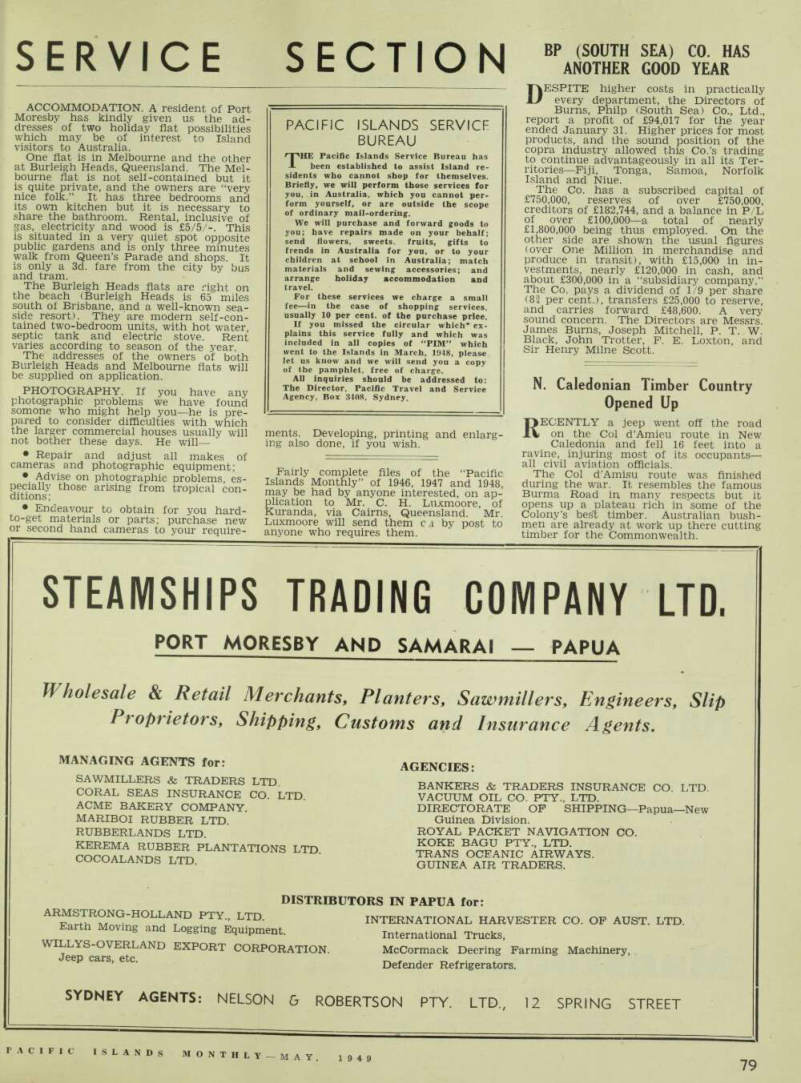
ACCOMMODATION. A resident of Port Moresby has kindly given us the ad dresses of two holiday flat possibilities which may be of interest to Island visitors to Australia.
One flat is in Melbourne and the other at Burleigh Heads, Queensland. The Mel bourne flat is not self-contained but it is quite private, and the owners are “very nice folk.” It has three bedrooms and its own kitchen but it is necessary to share the bathroom. Rental, inclusive of gas, electricity and wood is £5/5/-. This is situated in a very quiet spot opposite public gardens and is only three minutes walk from Queen’s Parade and shops. It is only a 3d. fare from the city by bus and tram.
The Burleigh Heads flats are right on the beach (Burleigh Heads is 65 miles south of Brisbane, and a well-known sea side resort). They are modern self-con tained two-bedroom units, with hot water, septic tank and electric stove. Rent varies according to season of the year.
The addresses of the owners of both Burleigh Heads and Melbourne flats will be supplied on application.
PHOTOGRAPHY. If you have any photographic problems we have found somone who might help you—he is pre pared to consider difficulties with which the larger commercial houses usually will not bother these days. He will— • Repair and adjust all makes of cameras and photographic equipment; • Advise on photographic problems, es pecially those arising from tropical con ditions; • Endeavour to obtain for you hard to-get materials or parts; purchase new or second hand cameras to your require
ments. Developing, printing and enlarg ing also done, if you wish.
Fairly complete files of the “Pacific Islands Monthly” of 1946, 1947 and 1948, may be had by anyone interested, on ap plication to Mr. C. H. Luxmoore, of Kuranda, via Cairns, Queensland. Mr.
Luxmoore will send them ca by post to anyone who requires them.
Pacific Islands Service
Bureau
THE Pacific Islands Service Bureau has been established to assist Island re sidents who cannot shop for themselves.
Briefly, we will perform those services for you, in Australia, which you cannot per form yourself, or are outside the scope of ordinary mail-ordering.
We will purchase and forward goods to you; have repairs made on your behalf; send flowers, sweets, fruits, gifts to frends in Australia for you, or to your children at school in Australia; match materials and sewing accessories; and arrange holiday accommodation and travel.
For these services we charge a small fee—in the case of shopping services, usually 10 per cent, of the purchase price.
If you missed the circular which' ex plains this service fully and which was included in all copies of “PIM” which went to the Islands in March, 1948, please let us know and we will send you a copy of the pamphlet, free of charge.
AU inquiries should be addressed to: The Director, Pacific Travel and Service Agency, Box 3408, Sydney.
Bp (South Sea) Co. Has
Another Good Year
DESPITE higher costs in practically every department, the Directors of Burns, Philp (South Sea) Co., Ltd., report a profit of £94,017 for the year ended January 31. Higher prices for most products, and the sound position of the copra industry allowed this Co.’s trading tp continue advantageously in all its Ter ritories—Fiji, Tonga, Samoa, Norfolk Island and Niue.
The Co. has a subscribed capital of £750,000, reserves of over £750,000, creditors of £182,744, and a balance in P/L of over £lOO,OO0 —a total of nearly £1,800,000 being thus employed. On the other side are shown the usual figures (over One Million in merchandise and produce in transit), with £15,000 in in vestments, nearly £120,000 in cash, and about £300,000 in a “subsidiary company.”
The Co. pays a dividend of 1/9 per share (85 per cent.), transfers £25,000 to reserve, and carries forward £48,600. A very sound concern. The Directors are Messrs.
James Burns, Joseph Mitchell, P. T. W.
Black, John Trotter, F. E. Loxton, and Sir Henry Milne Scott.
Opened Up
N. Caledonian Timber Country Opened Up
RECENTLY a jeep went off the road on the Col d’Amieu route in New Caledonia and fell 16 feet into a ravine, injuring most of its occupants— all civil aviation officials.
The Col d’Amisu route was finished during the war. It resembles the famous Burma Road in many respects but it opens up a plateau rich in 'some of the Colony’s best timber. Australian bush men are already at work up there cutting timber for the Commonwealth.
Advertisements & other items, p. 81 (1 item)
Steamships Trading Company Ltd
PORT MORESBY AND SAMARA!
PAPUA
If holesale & Retail Merchants, Planters, Sawmillers, Engineers, Slip
Proprietors, Shipping, Customs and Insurance Agents.
MANAGING AGENTS for:
SAWMILLERS & TRADERS LTD.
CORAL SEAS INSURANCE CO. LTD.
ACME BAKERY COMPANY.
MARIBOI RUBBER LTD.
RUBBERLANDS LTD.
KEREMA RUBBER PLANTATIONS LTD.
COCOALANDS LTD.
AGENCIES:
BANKERS & TRADERS INSURANCE CO. LTD.
VACUUM OIL CO. PTY., LTD.
DIRECTORATE OP SHIPPING—Papua—New
Guinea Division.
ROYAL PACKET NAVIGATION CO.
KOKE BAGU PTY., LTD.
TRANS OCEANIC AIRWAYS.
GUINEA AIR TRADERS.
DISTRIBUTORS IN PAPUA for:
AR F^rth R ™ NG^ -HOLLAND PTY., LTD. INTERNATIONAL HARVESTER CO. OF AUST. LTD.
Earth Moving and Logging Equipment. International Trucks, WILLYS-OVERLAND EXPORT CORPORATION. McCormack Deering Farming Machinery, Jeep cars, etc.
Defender Refrigerators.
SYDNEY AGENTS: NELSON G ROBERTSON PTY. LTD., 12 SPRING STREET
Fiji Claimed As Colony Of “Free India"
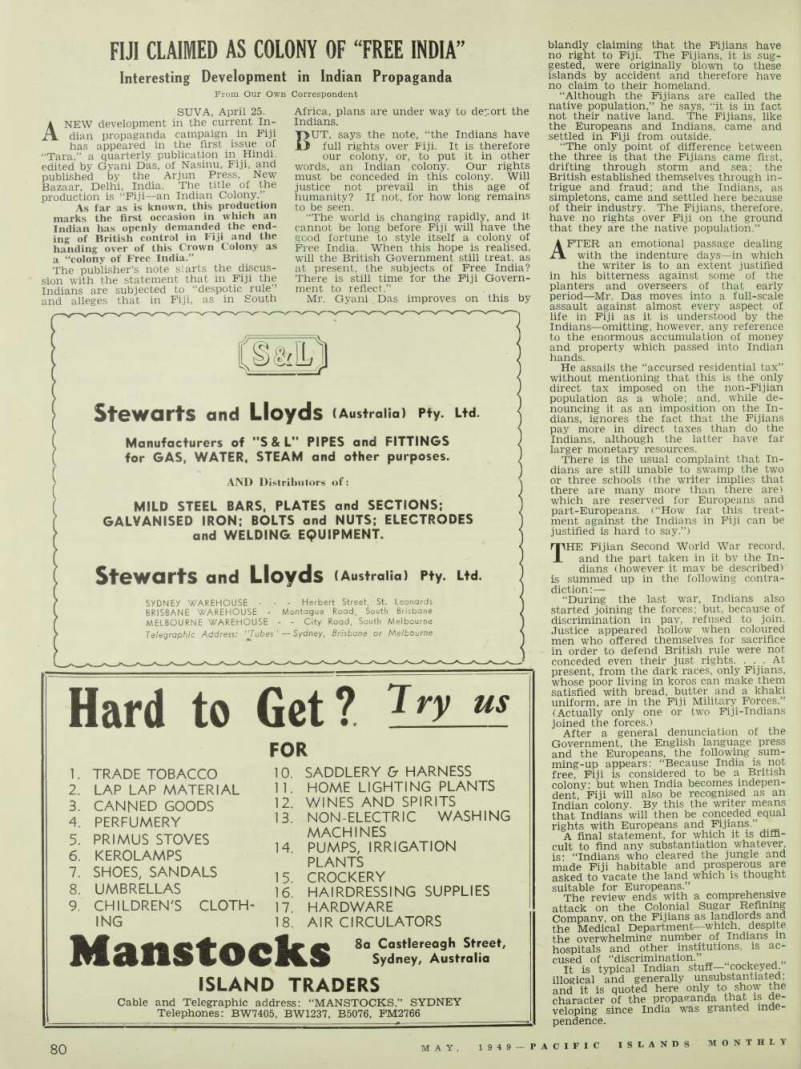
Interesting Development in Indian Propaganda
From Our Own Correspondent
SUVA, April 25.
ANEW development in the current Indian propaganda campaign in Fiji has appeared in the first issue of “Tara,” a quarterly publication in Hindi, edited by Gyani Das, of Nasinu, Fiji, and published by the Arjun Press, New Bazaar, Delhi, India. The title of the production is “Fiji—an Indian Colony.”
As far as is known, this production marks the first occasion in which an Indian has openly demanded the ending of British control in Fiji and the handing over of this Crown Colony as a “colony of Free India.”
The publisher’s note starts the discussion with the statement that in Fiji the Indians are subjected to “despotic rule” and alleges that in Fiji, as in South
Africa, plans are under way to deport the Indians.
T>UT, says the note, “the Indians have full rights over Fiji. It is therefore our colony, or, to put it in other words, an Indian colony. Our rights must be conceded in this colony. Will justice not prevail in this age of humanity? If not, for how long remains to be seen, “The world is changing rapidly, and it cannot be long before Fiji will have the good fortune to style itself a colony of Free India. When this hope is realised, will the British Government still treat, as at present, the subjects of Free India?
There is still time for the Fiji Govern ment to reflect.”
Mr. Gyani Das improves on this by
blandly claiming that the Fijians have no right to Fiji. The Fijians, it is sug gested, were originally blown to these islands by accident and therefore have no claim to their homeland.
“Although the Fijians are called the native population,” he says, “it is in fact not their native land. The Fijians, like the Europeans and Indians, came and settled in Fiji from outside.
“The only point of difference between the three is that the Fijians came first, drifting through storm and sea; the British established themselves through in trigue and fraud; and the Indians, as simpletons, came and settled here because of their industry. The Fijians, therefore, have no rights over Fiji on the ground that they are the native population.”
AFTER an emotional passage dealing with the indenture days—in which the writer is to an extent justified in his bitterness against some of the planters and overseers of that early period—Mr. Das moves into a full-scale assault against almost every aspect of life in Fiji as it is understood by the Indians —omitting, however, any reference to the enormous accumulation of money and property which passed into Indian hands.
He assails the “accursed residential tax” without mentioning that this is the only direct tax imposed on the non-Fijian population as a whole; and, while de nouncing it as an imposition on the In dians, ignores the fact that the Fijians pay more in direct taxes than do the Indians, although the latter have far larger monetary resources.
There is the usual complaint that In dians are still unable to swamp the two or three schools (the writer implies that there are many more than there are) which are reserved for Europeans and part-Europeans. (“How far this treat ment against the Indians in Fiji can be justified is hard to say.”) THE Fijian Second World War record, and the part taken in it by the In dians (however it mav be described) is summed up in the following contra diction; — “During the last war, Indians also started joining the forces; but, because of discrimination in pav, refused to join.
Justice appeared hollow when coloured men who offered themselves for sacrifice in order to defend British rule were not conceded even their just rights. . . . At present, from the dark races, only Fijians, whose poor living in koros can make them satisfied with bread, butter and a khaki uniform, are in the Fiji Military Forces.” (Actually only one or two Fiji-Indians joined the forces.) After a general denunciation of the Government, the English language press and the Europeans, the following sum ming-up appears: “Because India is not free, Fiji is considered to be a British colony: but when India becomes indepen dent, Fiji will also be recognised as an Indian colony. By this the writer means that Indians will then be conceded equal rights with Europeans and Fijians.”
A final statement, for which it is diffi cult to find any substantiation whatever, is* “Indians who cleared the jungle and made Fiji habitable and prosperous are asked to vacate the land which is thought suitable for Europeans.”
The review ends with a comprehensive attack on the Colonial Sugar Refining Company, on the Fijians as landlords and the Medical Department—which, despite the overwhelming number of Indians m hospitals and other institutions, is ac cused of “discrimination.” . „ It is typical Indian stuff— cockeyed, illogical and generally unsubstantiated; and it is quoted here only to show the character of the propaganda that is de veloping since India was granted inde pendence.
Advertisements & other items, p. 82 (1 item)
Hard to Get? lr v us
Stewarts and Lloyds (Australia) Pty. Ltd.
Manufacturers of "S & L" PIPES and FITTINGS for GAS. WATER, STEAM and other purposes.
AND Distributors of:
MILD STEEL BARS, PLATES and SECTIONS;
GALVANISED IRON; BOLTS and NUTS; ELECTRODES
and WELDING EQUIPMENT.
Stewarts and Lloyds (Australia) Pty. Ltd.
SYDNEY WAREHOUSE - - - Herbert Street, St. Leonards BRISBANE WAREHOUSE - Montague Road, South Brisbane MELBOURNE WAREHOUSE - - City Road, South Melbourne Telegraphic Address: "Tubes ' Sydney, Brisbane or Melbourne
Hard to Get? lr v us
FOR
1. TRADE TOBACCO 10.
2. LAP LAP MATERIAL 11.
3. CANNED GOODS >2.
4. PERFUMERY 13 -
5. PRIMUS STOVES , .
6. KEROLAMPS
7. SHOES, SANDALS , 5
8. UMBRELLAS 1 6 '
9. CHILDREN'S CLOTH- n'
ING 18.
SADDLERY & HARNESS
HOME LIGHTING PLANTS
WINES AND SPIRITS
NON-ELECTRIC WASHING
MACHINES
PUMPS, IRRIGATION
PLANTS
CROCKERY
HAIRDRESSING SUPPLIES
HARDWARE
AIR CIRCULATORS
jn 8o Castlereagh Street.
JflOllv liUwKv Sydney, Australia
ISLAND TRADERS
Cable and Telegraphic address: “MANSTOCKS,” SYDNEY Telephones: 8W7405, 8W1237, 85076, FM2766
Two Bishops Visit New
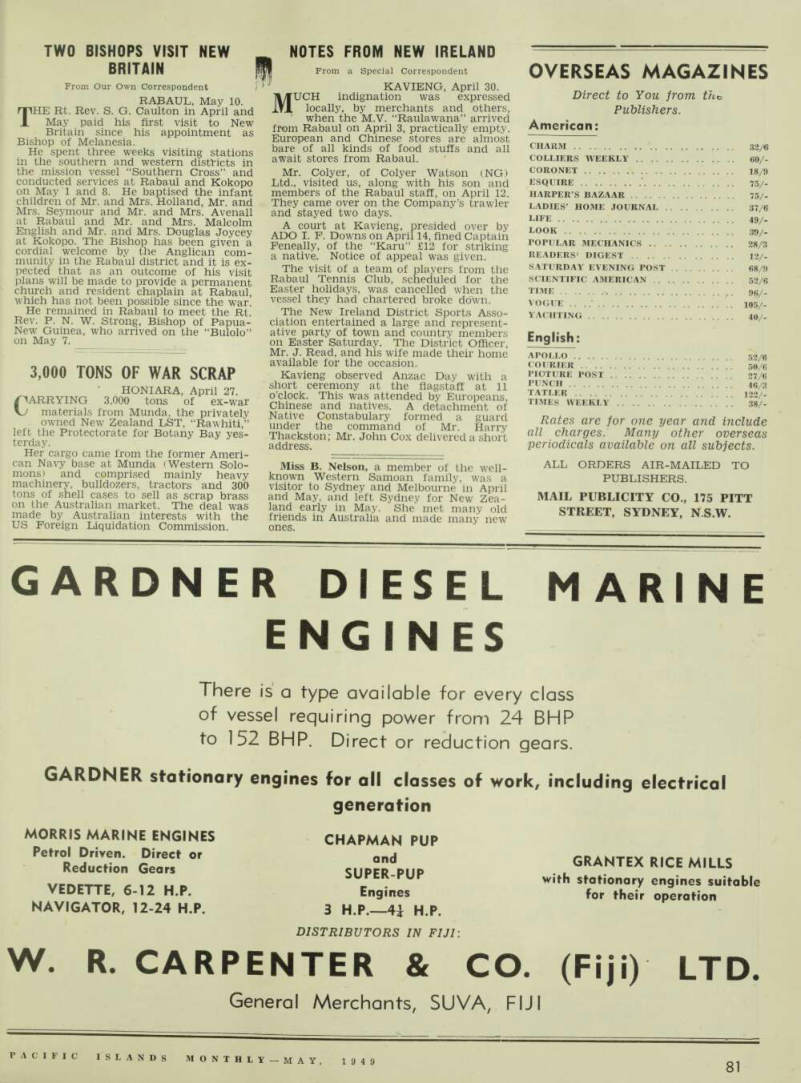
Britain
From Our Own Correspondent
Rabaul, May 10.
THE Rt. Rev. S. G. Caulton in April and May paid his first visit to New Britain since his appointment as Bishop of Melanesia.
He spent three weeks visiting stations in the southern and western districts in the mission vessel “Southern Cross” and conducted services at Rabaul and Kokopo on May 1 and 8. He baptised the infant children of Mr. and Mrs. Holland, Mr, and Mrs. Seymour and Mr. and Mrs. Avenall at Rabaul and Mr. and Mrs. Malcolm English and Mr. and Mrs. Douglas Joycey at Kokopo. The Bishop has been given a cordial welcome by the Anglican com munity in the Rabaul district and it is ex pected that as an outcome of his visit plans will be made to provide a permanent church and resident chaplain at Rabaul, which has not been possible since the war.
He remained in Rabaul to meet the Rt.
Rev. P. N. W. Strong, Bishop of Papua- New Guinea, who arrived on the “Bulolo” on May 7.
3,000 Tons Of War Scrap
HONIARA, April 27.
C CARRYING 3,000 tons of ex-war j materials from Munda, the privately owned New Zealand LST, “Rawhiti,” left the Protectorate for Botany Bay yes terday.
Her cargo came from the former Ameri can Navy base at Munda (Western Solo mons) and comprised mainly heavy machinery, bulldozers, tractors and 300 tons of shell cases to sell as scrap brass on the Australian market. The deal was made by Australian interests with the US Foreign Liquidation Commission.
Notes From New Ireland
nj From a Special Correspondent KAVIENG, April 30.
MUCH indignation was expressed locally, by merchants and others, when the M.V. “Raulawana” arrived from Rabaul on April 3, practically empty.
European and Chinese stores are almost bare of all kinds of food stuffs and all await stores from Rabaul.
Mr. Colyer, of Colyer Watson (NG) Ltd., visited us, along with his son and members of the Rabaul staff, on April 12.
They came over on the Company’s trawler and stayed two days.
A court at Kavieng, presided over by ADO I. F, Downs on April 14, fined Captain Feneally, of the “Karu” £l2 for striking a native. Notice of appeal was given.
The visit of a team of players from the Rabaul Tennis Club, scheduled for the Easter holidays, was cancelled when the vessel they had chartered broke down.
The New Ireland District Sports Asso ciation entertained a large and represent ative party of town and country members on Easter Saturday. The District Officer, Mr. J. Read, and his wife made their home available for the occasion.
Kavieng observed Anzac Day with a short ceremony at the flagstaff at 11 o’clock. This was attended by Europeans, Chinese and natives. A detachment of Native Constabulary formed a guard under the command of Mr. Harry Thackston; Mr. John Cox delivered a short address.
Miss B. Nelson, a member of the well known Western Samoan family, was a visitor to Sydney and Melbourne in April and May, and left Sydney for New Zea land early in May. She met many old friends in Australia and made many new ones.
Advertisements & other items, pp. 83-84 (1 item)
Engines
OVERSEAS MAGAZINES
Direct to You from t’uo Publishers.
American:
CHARM 32/6
COLLIERS WEEKLY 607-
CORONET 18/9
ESQUIRE ’ 757-
HARPER’S BAZAAR 757-
LADIES’ HOME JOURNAL 37/6
LIFE 497-
LOOK 39/.
POPULAR MECHANICS 28/3
READERS’ DIGEST 12/-
SATURDAY EVENING POST 68/9
SCIENTIFIC AMERICAN 52/6
TIME .. 96/.
VOGUE .. . 105/.
YACHTING 40/-
English:
APOLLO 52/6
COURIER 50/6
PICTURE POST 27/6
PUNCH 46/3
TATLER 122/-
TIMES WEEKLY 38/.
Rates are for one year and include all charges. Many other overseas periodicals available on all subjects.
ALL ORDERS AIR-MAILED TO
PUBLISHERS.
MAIL PUBLICITY CO., 175 PITT
STREET, SYDNEY, N.S.W.
GARDNER DIESEL MARINE
ENGINES
There is a type available for every class of vessel requiring power from 24 BHP to 152 BHP. Direct or reduction gears.
GARDNER stationary engines for all classes of work, including electrical
generation
MORRIS MARINE ENGINES
Petrol Driven. Direct or Reduction Gears
VEDETTE, 6-12 H.P.
NAVIGATOR, 12-24 H.P.
CHAPMAN PUP
and
SUPER-PUP
Engines
3 H.P.— 4i H.P.
DISTRIBUTORS IN FIJI :
GRANTEX RICE MILLS
with stationary engines suitable for their operation W. R. CARPENTER & CO. (Fiji) LTD.
General Merchants, SUVA, FIJI
GEORGE J. LOCKYER & COMPANY
CONSULTING ENGINEERS DOCKYARD MACHINERY
In association with GEORGE J. LOCKYER (Far East) & CO. and GEORGE J. LOCKYER (Overseas) & CO.
ENGINEERING SUPPLIES, GENERAL HARDWARE EXPORTERS AND MERCHANTS Agents for the Finest Australian Liquors Aerated Water and Cordial Manufacturing Machinery, Bottling and Capping Machinery, etc.
IF YOU ARE INTERESTED IN:—
MILLS
Flour mills. Hard semolina mills. Self-contained Colonial Flour Mills. Flour improving equipment. Feed milling equipment. Grinding and blending plants. Saw dust mills. Grinding and blend plants for spices and colours. Laboratory equipment.
HULLING INDUSTRY
Hulling mills for rice, barley (for making groats), oats (for flakes and groats), peas, buckwheat, millets, kauliang, lentils, Dal and other pulses.
OIL MILLING
Complete equipments for the manufacture and refining of vegetable oils and fats. Pressing, Extraction-, and Refining plants. Oil separating plants for wool and leather. Margarine granulators, Melting and Tempering Pand for the manufacture of margarine.
SUGAR TREATING MACHINERY
Installations for drying, cooling and assorting granulated sugar. Conveying plants. Grinding plants for pile and granulated sugar. Manufacture of powdered sugar.
MALTING AND BREWING PLANTS
Equipments of complete maltings and breweries. Barley and Malt cleaning plants. Pneumatic Maltings (Drum and Saladin Box Maltings). Malt Kilns. High Capacity Malt Kilns. Floor Stores and Silos for barley and malt.
Pneumatic and mechanical handling plants for barley and malt. Malt crushing plants. Brew house equipment. Mash filters. Wort colling plants. Fermentation and Storage Tanks. Conveying plants for barrels and bottles. Laboratory equipments.
MACHINES FOR SOAP MAKING
Soap boiling equipment. Pumps. Soap slabs cooling plants. Cutting machines. Presses. Drying plants.
Milling equipment. Pendulum cutter. Flaking rolls.
Soap-powder plants.
MACHINES FOR THE CHOCOLATE INDUSTRY
Cocoa beans crushing, cleaning and grinding plants.
Cocoa presses. Cocoa and chocolate roller mills.
CONSTRUCTION OF GRANARIES AND
WAREHOUSES
Construction of Export and Import Granaries. Agricultural and Mill Granaries for all kinds of grain, oil fruits, pulses, and seed, in bulk or in sacks. Mechanical and pneumatic handling plants for loading and unloading ships and railway cars with the above-named goods. Steel Silos. Grain Cleaning Plants. Machinery for dressing seed.
PNEUMATIC HANDLING PLANTS
For grain, bran, flour, oil seed, coal, salt, chemical products, ashes, blast furnace dust, wood chips, woodshavings. Floating pneumatic elevators. Floating pneumatic grain elevators. Stationary and travelling ship discharging plants. Conveying plants for rubbish from wash plants and rubbish disposal plants for mines.
MECHANICAL HANDLING PLANTS
For all kinds of goods in bulk and packages, such as grain, qoal, salt, earth and ores, stornes, bags, cases, bales, barrels, wood logs, etc. Mechanical equipment for warehouses of salt works and the chemical industry.
Trans-shipping plants for loading salts into ships and railway cars. Coal handling plants for boiler houses.
Equipment for the automatic operation of mail offices.
CEMENT WORKS AND ROCK CRUSHING
PLANTS
Equipment of complete cement works. Crushing, burning, grinding, and conveying equipment for the chemical industry; specially for Dolomite, Magnesite, and Aluminium Works. Installations for salt mills and salt stores. Crushing and grinding plants for coal.
Road metal plants, etc.
MECHANICAL PULP AND BOARD MILLS
Complete equipment for mechanical wood pulp mills and board mills of every size. Preparing plants for cellulose and pulp wood. Wood barking plants. Installations for handling wood sticks and pulp.
- CONSULT US -
All communications to be addressed to The General Manager, G.P.0., Box 4553, Sydney.
Bankers: Telegraphic and Cable Address: Commonwealth Bank of Australia. Sydney. "LOCKMACH,” Sydney.
Also Bank of N.S.W., Sydney.
Western Papua Notes
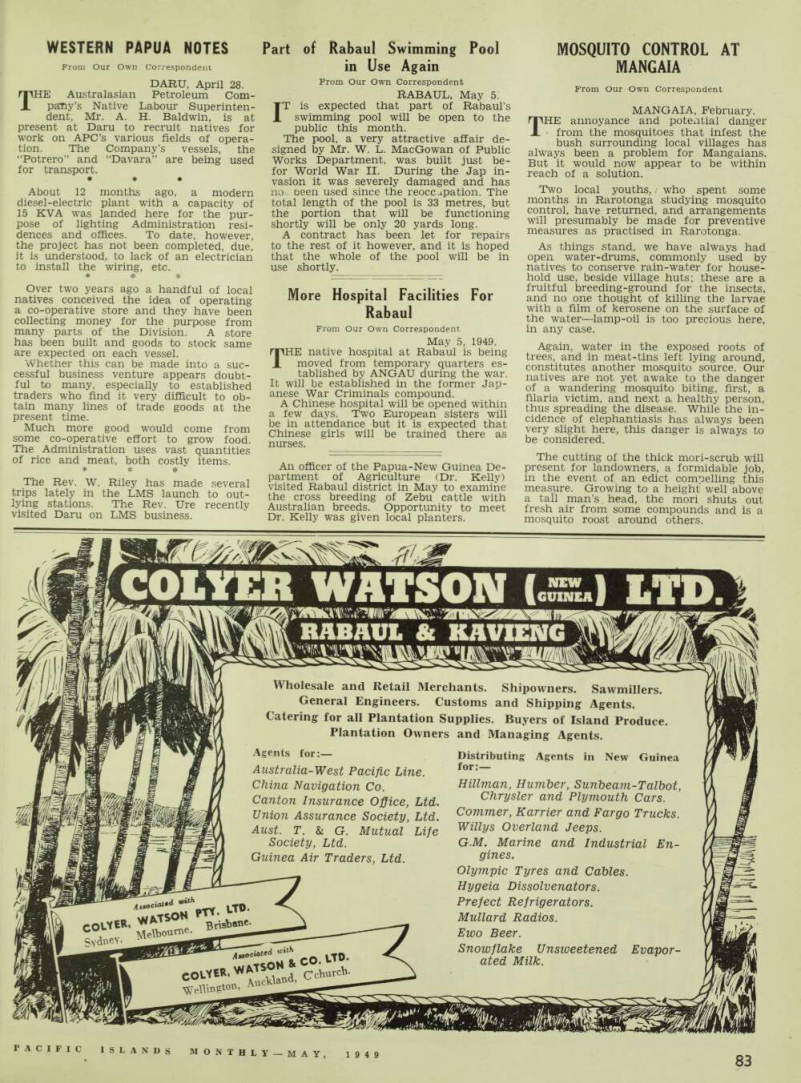
From Our Own Correspondent DARU, April 28.
THE Australasian Petroleum Com pany’s Native Labour Superinten dent, Mr. A. H. Baldwin, is at present at Daru to recruit natives for work on APC’s various fields of opera tion. The Company’s vessels, the “Potrero” and “Davara” are being used for transport. • ♦ * About 12 months ago, a modern diesel-electric plant with a capacity of 15 KVA was landed here for the pur pose of lighting Administration resi dences and offices. To date, however, the project has not been completed, due, it is understood, to lack of an electrician to install the wiring, etc. * * * Over two years ago a handful of local natives conceived the idea of operating a co-operative store and they have been collecting money for the purpose from many parts of the Division. A store has been built and goods to stock same are expected on each vessel.
Whether this can be made into a suc cessful business venture appears doubt ful to many, especially to established traders who find it very difficult to ob tain many lines of trade goods at the present time.
Much more good would come from some co-operative effort to grow food.
The Administration uses vast quantities of rice and meat, both costly items. * * * The Rev. W. Riley has made several trips lately in the LMS launch to out lying stations. The Rev. Ure recently visited Daru on LMS business.
Part of Rabaul Swimming Pool
in Use Again
From Our Own Correspondent
Rabaul, May 5.
IT is expected that part of Rabaul’s swimming pool will be open to the public this month.
The pool, a very attractive affair de signed by Mr. W. L. MacGowan of Public Works Department, was built just be for World War 11. During the Jap in vasion it was severely damaged and has no oeen used since the reoccapation. The total length of the pool is 33 metres, but the portion that will be functioning shortly will be only 20 yards long.
A contract has been let for repairs to the rest of it however, and it is hoped that the whole of the pool will be in use shortly.
More Hospital Facilities For Rabaul
Rabaul
Prom Our Own Correspondent May 5, 1949.
THE native hospital at Rabaul is being moved from temporary quarters es tablished by ANGAU during the war.
It will be established in the former Jap anese War Criminals compound.
A Chinese hospital will be opened within a few days. Two European sisters will be in attendance but it is expected that Chinese girls will be trained there as nurses.
An officer of the Papua-New Guinea De partment of Agriculture (Dr. Kelly) visited Rabaul district in May to examine the cross breeding of Zebu cattle with Australian breeds. Opportunity to meet Dr. Kelly was given local planters.
Mosquito Control At
Mangaia
From Our Own Correspondent
MANGAIA, February.
THE annoyance and potexitial danger from the mosquitoes that infest the bush surrounding local villages has always been a problem for Mangaians.
But it would now appear to be within reach of a solution.
Two local youths, < who spent some months in Rarotonga studying mosquito control, have returned, and arrangements will presumably be made for preventive measures as practised in Rarotonga.
As things stand, we have always had open water-drums, commonly used by natives to conserve rain-water for house hold use, beside village huts; these are a fruitful breeding-ground for the insects, and no one thought of killing the larvae with a film of kerosene on the surface of the water —lamp-oil is too precious here, in any case.
Again, water in the exposed roots of trees, and in meat-tins left lying around, constitutes another mosquito source. Our natives are not yet awake to the danger of a wandering mosquito biting, first, a filaria victim, and next a healthy person, thus spreading the disease. While the in cidence of elephantiasis has always been very slight here, this danger is always to be considered.
The cutting of the thick mori-scrub will present for landowners, a formidable job, in the event of an edict compelling this measure. Growing to a height well above a tall man’s head, the mori shuts out fresh air from some compounds and is a mosquito roost around others.
Advertisements & other items, p. 85 (1 item)
Colyer Watson (A) Ltd
mith iai*d
LTD
Assoe ?n
WATSON ( GUINEA
pNhuv rztmassaaasm
RABAUL & KAVIENG
piasmmikwp'Tigj
Wholesale and Retail Merchants. Shipowners. Sawmillers.
General Engineers. Customs and Shipping Agents.
Catering for all Plantation Supplies. Buyers of Island Produce.
Plantation Owners and Managing Agents.
Agents for:— Australia-West Pacific Line.
China Navigation Co.
Canton Insurance Office, Ltd.
Union Assurance Society, Ltd.
Aust. T. & G. Mutual Life Society, Ltd.
Guinea Air Traders, Ltd.
Auociated rvith Distributing Agents in New Guinea for:— Hillman, Humber, Sunbeam-Talbot, Chrysler and Plymouth Cars.
Commer, Karrier and Fargo Trucks.
Willys Overland Jeeps.
G.M. Marine and Industrial Engines.
Olympic Tyres and Cables.
Hygeia Dissolvenators.
Prefect Refrigerators.
Mullard Radios.
Ewo Beer.
Snowflake Unsweetened Evaporated Milk.
The Fight Game in Fiji
From Our Own Correspondent
Suva, May 2.
WITH a flourish of trumpets the Box ing and Wrestling Associaticm of Fiji was revived and reconstituted in 1947 but, after announcing an ambi tious programme, it promptly relapsed in to its former coma.
Sharp prods from the press having failed to stimulate it to any signs of ac tivity, there are indications that boxing supporters (mainly Fijian, European and part-European) may take matters into their own hands.
Boxing promotion in Fiji, oddly enough, is almost entirely in the hands of the Indians, who, on the whole, do the job well, but inevitably with an eye to the profits rather than to the interests of the Fijian and part-European boxers who do the actual fighting. Boxing is thus a business, and amateur boxing, despite the obvious demand for it, is virtually non existent.
Matters appear to have come to a head over a recent contest at Ba in which Sireli Saro. a brilliant and popular Fijian middleweight, was matched, at 11 st., with a formidable opponent named Miliano (12 st. 5 lb.). The result was inevitable.
Monsieur Tresch, director-general of the French Pacific flying service TRAP AS, on whose directorate he represents the interests of the Air France company, was expected in Noumea late in April. His background achievements are managing Air France in Syria and Far East, and in 1947 he attended the international Civil Air Conference held in Melbourne as one of the French delegates.
Malayan Wasps For Hawaii
MALAYAN wasps have been sent from Singapore by air to Hawaii and Mexico to fight fruit-tree insect pests, the Oriental fruit fly in Hawaii, and the black fly plague in Mexico.
Larvae of the Malayan wasps hatch in side the larvae of the Hawaiian and Mexican pests, and destroy them.
Americans are concerned about Mexico’s fly plague because the pest threatens to invade 18 million citrus trees owned by orchardists in the United States, 250 miles off the border.
Death of Madame Margot
Coulon
Madame pierrot coulon, nee Margot Lehartel, died at Papeete Hospital on March 19 after an operation.
Three years ago, Madame Coulon was riding in a buggy on the island of Tubuai with her husband. The horse took fright, M. Coulon was thrown out, and, as the buggy seemed about to strike the bridge and overturn, he called for his wife to jump. She did so, but a wheel passed over her body.
As she felt little ill effect at the time, the accident was taken lightly. However, complications later arose which necessi tated the amputation of one leg. From this operation she did not rally.
The funeral service was held in the Catholic Cathedral, Papeete, and a large crowd followed to the cemetery of Paurani.
She was one of the most attractive women of the younger generation in Tahiti. Her grand-parents came to the Colony in the old sailing days, and their family still forms part of the little settle ment of Papara.
Forbidden
Gelignite For Fishing Is
APIA, April 26.
AS reported recently, the indiscriminate use of gelignite for getting fish evoked criticism by the public and by Samoan leaders because it would do irreparable damage to fishing in Samoan waters.
The Samoan Government has now se verely restricted the issue of gelignite for any purposes other than roadmaking and public works. Blasting is allowed only by employees of the Public Works Depart ment.
Western Samoan Assembly
APIA, April 26.
THE Legislative Assembly of Western Samoa is in session at present to dis cuss a number of important new ordin ances and to debate the Government Esti mates for the coming year. It is expected that work on the new road plan for the island of Savaii, and probably other pub lic works, will be greatly curtailed, owing to reduced Government revenues, caused by the drop in the cocoa price and the smaller exports of copra.
Following the departure of Mr. J. F.
Nicoll to his new post in Hongkong, Mr. D. P. MacDonald is acting as Colonial Secretary of Fiji, and Mr. E. R. Bevington as Assistant Colonial Secretary.
Queen Salote, of Tonga, returned to her home in Nukualofa in April after a pri vate visit to New Zealand. The Queen was met by the Governor on arrival in Suva, on her way to Tonga on the “Matua,” and accorded the usual honours.
Advertisements & other items, p. 86 (1 item)
'Masse
J r 1 3 &
BATTERIES
“are tigers for work
9?
It is impossible to build a better battery than the Masse. Every part of a Masse Battery is of one hundred per cent, quality . . . every stage of its manufacture is carried out in the Masse factory. When you recommend a Masse Battery to your customer, you can do so, with the utmost confidence that it will him more starts and longer give service.
ROBERT GILLESPIE JSC. LTD.
RABAUL AND LAE
Sudden Death Of E. E. Lloyd
From Our Own Correspondent
Apia, May 5.
THE manager and announcer of Apia broadcasting station, Mr. E. E. Lloyd, who was only 49, died suddenly from heart failure when attending a meeting of the Returned Servicemen’s Association on April 28. He was an experienced NZ broadcaster; he attained the rank of major while on active service; he then became an Administrative Officer in the Gilbert and Ellice Colony; and was thence ap pointed to take over 2AP two years ago.
He was successful and popular, and the community was shocked by his untimely death. Mrs. Lloyd, another popular figure, left for NZ only a few weeks ago.
Camp '
Honiara Club Loses AH in Fire
From Our Own Correspondent HONIARA, April 27.
HONIARA had a spectacular fire on April 16 (Easter Saturday) when the big, open, leaf-roofed premises oc cupied by the Guadalcanal Club were burnt to the ground.
Erected during the war as the BSIP De fence Force Officers’ club and mess, the building was lent to the newly-formed Guadalcanal Club in 1945, and served as a meeting-place and entertainment high spot for locals.
Starting on -the seaward side, the fire was not detected until the flames sud denly swept across the building. At that time, nearly all Honiara residents were two miles away at a cocktail party. There was to be a dance that night which meant that considerable stocks of liquor and cash were on the premises. The only Club property saved comprised a few old chairs and tables. The Club com mittee estimates its loss at £600.
Before the fire spread to the kitchen and restaurant operated by Ho Man, which formed one wing of the building volunteers and kitchen staff managed to remove icebox, safes, crockery, etc. The restaurant has now re-opened in tem porary quarters converted from the as yet unused native market. The Club meanwhile is homeless.
No specific reason for the fire has been determined. Attention has' been focused on the need for an organised fire-fighting
unit in Honiara. It was fortunate on this occasion that a land breeze carried burn ing debris out to sea instead of menacing the adjacent leaf-roofed buildings of the
Camp '
According to the “ABM Review ” half the 2 000000 neonle in the South Panifir are professing 'ChrisSans it is Stated that Sf the l 000 000 Sthers the Fifi
wuFbe Z?d°e°st FlJ ‘
Advertisements & other items, p. 87 (1 item)
CHULA” Copra Dryer
CAPTAIN W. L. KENNEDY
Ship and Yacht Broker, 63 Pitt Street, Sydney
LISTING FOR SALE:
£4O MO SteamsSn c JrL nf v C , arry approX ' 400 tons - built 1940 ' in class 12 knots, Price around rry approx - 1.000 tons, permit to sail arranged, silrvlv ca?rv R T^ !n ?„n tor Cargo Vessel ’ steel construction in Federal Carao y, Ketrh y fin 3B v 1R al ’^- 12^’ 000 super timber - good accommodation, £31,500.
Sirbp? nt 15 \ ®? rdl " or di escl engine, sails carry 40 tons, £4,500. Several other Ketches listed. Diesel Trawlers from £1,260.
New 300-ton Cargo, wood construction. 125 x 25, carry 70 000 feet timber twin 200 Another Se 3oo au ? lliaries - electric winches. 9V 2 knots, in Federal survey’. £34.000 Another 300-ton Vessel, in survey. Twin Diesels, Electric Winches, £22,000.
Modern Sea-going Steel Tug, 240 h.p. Vivian diesel, built 1948 diesel auxiliaries hydraulic stearl J g ' can trtfugal ftre pump, 65 xlB x 10, £13,000. Steel Tug, built 1949,’ x 18 X 11, 240 B.H.P. Crossley diesel, seagoing. £15.000. Tusa Tug. 270 ho Nationa Superior diesel. £B,OOO. 45 x 13 Harbour Tug, 250 h.p. diesel, £5,250. Na «onal Pri .f ft> F * sh,n g Boat, 10-12 Simplex. £320. Also, we have a number of Sydney’s finest Cruisers and Auxiliaries for Sale. Priced moderateyl.
New Steel Cargo Vessel, carry 70 tons, diesel power, available time charter. 4> o nn ai T i J e ’,r ood » order ’ JP" gines and nttin S s - £2.100. Lock-up Steel Lighter, 80 tons £9OO. Refuelling Barge, £350. Fire-fighting Barge, complete engine, pumps and holes' £B5O Large Steel Punt, suitable dredge or ersne, £BOO. New 42 H.P. 3-1 Reduction Southern Cross Diesel quantity spares, £750. BW 6461. 1 be SSST \o h p°Xt^ TReal EState and BUSIneSS Branch lor Sydney Pr °P e »‘“ *lll
p 7 r V v/k
few
ij rr 7 i
BIGGER PRICES for BETTER COpRA!
/ > i l vVi i \
when dried by Ihe scientific
process made possible by the
CHULA” Copra Dryer
• • • most practical and efficient machine for drying nuts in bulk, which produces copra of a higher standard than that dried in the open, without discolouration, free from mould, thoroughly and evenly dried throughout. The “Chula" produces its two tons of copra every 24 hours, irrespective of the weather, and with a minimum ofllabour.
THE INVENTORS AND MANUFACTURERS OF
THE ‘ CHULA ’ COPRA DRYER ALSO MAKE
DESICCATED COCONUT
MACHINERY
(Parers, Disintegrators, Sifters, Dryers)
TEA DRYERS
FISH DRYERS
RUBBER MACHINERY
(Continuous Sheeters, Crepeing Batteries)
TYNESIDE FOUNDRY &
ENGINEERING CO. LTD.
ELSWICK • NEWCASTLE-ON-TYNE • ENGLAND
Telegrams & Cables •.‘■FOUNDRY, NEWCASTLE-ON-TYNE " ♦ Codes : ABC, sth & 6th Eds. new catalogue of the
"CHULA"
COPRA DRYER
has just been printed.
Send for Your Copy! .U d
New Baby Tractor
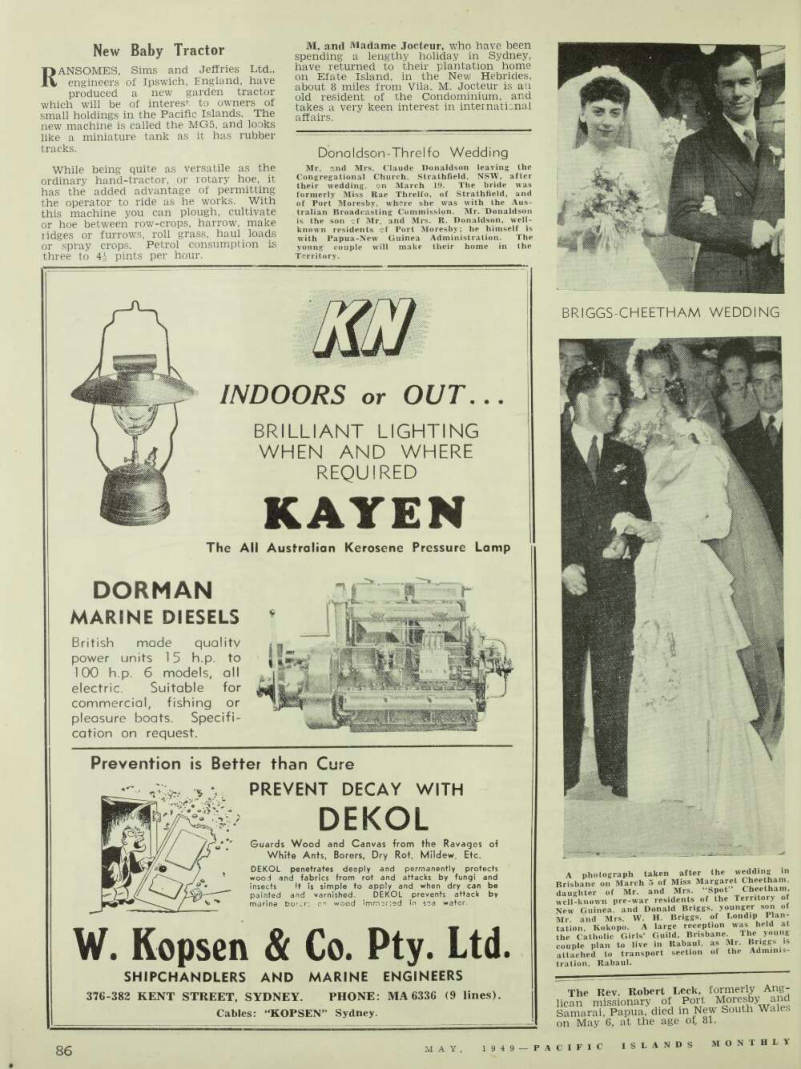
RANSOMES, Sims and Jeffries Ltd., engineers of Ipswich, England, have produced a new garden tractor which will be of interest to owners of small holdings in the Pacific Islands. The new machine is called the MGS, and looks like a miniature tank as it has rubber tracks.
While being quite as versatile as the ordinary hand-tractor, or rotary hoe, it has the added advantage of permitting the operator to ride as he works. With this machine you can plough, cultivate or hoe between row-crops, harrow, make ridges or furrows, roll grass, haul loads or spray crops. Petrol consumption is three to 4£- pints per hour.
M. and Madame Jocteur, who have been spending a lengthy holiday in Sydney, have returned to their plantation home on Efate Island, in the New Hebrides, about 8 miles from Vila. M. Jocteur is an old resident of the Condominium, and takes a very keen interest in international affairs.
Donaldson-Threlfo Wedding
Mr. ?,nd Mrs. Claude Donaldson leaving the Congregational Church. Strathfield, NSW, after their wedding, on March 19. The bride was formerly Miss Rae Threlfo, of Strathfield, and of Port Moresby, where she was with the Aus tralian Broadcasting Commission. Mr. Donaldson is the son cf Mr. and Mrs. R. Donaldson, well known residents of Port Moresby; he himself is with Papua-New Guinea Administration. The young couple will make their home in the Territory.
The Rev. Robert Leek, formerly Ang lican missionary of Port Moresby and Samarai, Papua, died in New South Wales on May 6, at the age of, 81.
Briggs-Cheetham Wedding
A photograph taken after the wedding in Brisbane on March 5 of Miss Margaret Cheetham, daughter of Mr. and Mrs. “Spot" Cheetham, well-known pre-war residents of the Territory of New Guinea, and Donald Briggs, younger son of Mr. and Mrs. W. H. Briggs, of Londip Plan tation, Kokopo. A large reception was held at the Catholic Girls’ Guild, Brisbane. The young couple plan to live in Rabaul, as Mr. Briggs is attached to transport section of the Adminis tration, Rabaul.
Advertisements & other items, p. 88 (1 item)
Kayen
INDOORS or OUT.
BRILLIANT LIGHTING
WHEN AND WHERE
REQUIRED
KAYEN
The All Australian Kerosene Pressure Lamp
DORMAN
MARINE DIESELS
British made quality power units 15 h.p. to 100 h.p. 6 models, all electric. Suitable for commercial, fishing or pleasure boats. Specification on request. wvlL. ... - v< Prevention is Better than Cure J. l o
PREVENT DECAY WITH
DEKOL
Guards Wood and Canvas from the Ravages of White Ants, Borers, Dry Rot. Mildew, Etc.
DEKOL penetrates deeply and permanently protects wood and fabrics from rot and attacks by fungi and insects It is simple to apply and when dry can be painted and varnished. DEKOL prevents attack by marine borer: on wood immer:od in sea water.
W. Kopsen & Co. Pty. Ltd.
SHIPCHANDLERS AND MARINE ENGINEERS
376-382 KENT STREET, SYDNEY. PHONE: MA 6336 (9 lines).
Cables: “KOPSEN” Sydney.
Red-Tape and Neglect Can Strangle
Papua-N.Guinea Development
I” a long letter to the Melbourne “Herald,” an anonymous resident of Port Moresby, Papua, comments on the series of articles that recently were written by a “Herald” reporter , Osmar White.
The Port Moresby resident, who signs himself “Moresby,” makes an appeal for a fair deal for the 15,000 lohite people in the Territory and cites many of the disadvantages under which Moresby residents noiv live. His arguments may be right, but his figures seem to be astray. Before the war the European population of New Guinea was stated at 4,804 and of Papua at 1,822—6,626 in all. There are less, rather than more, whites there in 1949 than there were in 1939.
Or does the reported increase of 8,400 represent the larger Papua-New Guinea Public Service, about which ice have heard much?
We publish, below, a summary of
“Moresby’s” charges. We do not say they are correct; but they certainly indicate the beliefs of a large propor tion of Europeans in the Territories : HAVING fought for New Guinea, Aus tralia should retain it and develop it, not only as an outer defence but because it is an asset, in that it will grow some things that Australia cannot produce.
Living conditions in Port Moresby are understated by Osmar White, if anything.
The scandalous housing position applies not only to public servants but to all resi dents, many of whom have been waiting vears, not months, for houses. There are frames of houses that have been stand ing for two years, while their owners wait for flooring, roofing and wall materials.
Almost every second person one meets is a Government employee, and there is a general opinion that there are far more of them than is required to run this country.
Moresby’s wharf, which Mr. White men tioned, must be the only one of its kind in existence. It is hard to understand how it stands up to the strain of mooring a ship, for it is just a patched-up mass of odd-sized timber, sitting on piles that are all eaten away beneath the wate** line, providing little, if any, support.
Some shortages may be expected, at times, in the tropics; but in Moresby they are continuous and unnecessary. They are caused because monopoly is allowed to exist —this monopoly, with only one line of ships calling, can spell only poor service, and until there is competition in the shipping and retail trades, Moresby will not progress.
Although the town has a population of over 2,000, it has only the stores run by the three big firms. There is no news paner, barber, bootmaker, frock shop milliner, tobacconist or any of the other businesses one would find in a small Australian country town of the same size.
Diet is poor in Moresby, for the simple reason that there is only one freezer in the tctwn. It is a disgrace that a place of this size has no fresh milk supply— but that is not the fault of the public Prices for meat, butter, eggs and vege tables at the freezer are exorbitant, and
rise with each new shipment; but (he public has no option but to deal there.
New Guinea can become a great pro ducing country; but under the present conditions we are not permitted to pro gress.
Much has been said in Canberra by ill-informed people about the “exploita tion” of natives. Actually, it is the white race that is being exploited. Eight months ago it was announced that the Govern ment had decided to abolish the Produc tion Control Board which controls the sale of copra. The Board is still going and although world parity for copra is more
than £6O per ton, local planters are still receiving only a little more than £4O per ton.
Mr. C. W. T. Johnson, who for several years filled the post of British Consul and Agent in Tonga, left Nukualofa for Fiji on March 24 and will sail from Suva on May 6 for Britain, via Canada. Mr. John son’s successor, Mr. Windrum, arrived in Tonga and took over the Consulate be fore Mr. Johnson departed, * * * Wartime dollar earnings partly account for the fact that there are now nearly 3,200 motor vehicles serving New Cal edonia’s small white or partly-white population of fewer than 20,000. This figure does not include army and adminis tration vehicles. Passenger cars number 1,630, trucks and utilities 1,365, and motor-cycles 225.
Advertisements & other items, p. 89 (1 item)
Millers Ltd.
Box 3838 GPO, Cable Address, “Care” Sydney.
Sydney. Australia
ISLAND MERCHANTS
4 YORK ST., SYDNEY
All kinds Island Produce sold on commission. All merchandise purchased at best wholesale price and original invoices supplied.
Use our 50 years’ experience as Island Merchants.
Every Branch Of
ENGINEERING and BUILDING CONSTRUCTION
MILLERS LTD.
SUVA and LAUTOKA
Sawmillers and Timber Merchants; Shipwrights and Sailmakers; Joinery and Furniture Manufacturers; Upholsterers; Plumbers; Electricians; Hardware Merchants; Motor Dealers.
AGENCIES :
Chevrolet, Bedford, Vauxhall, Nash Motors. Firestone Tyres.
Fetters Marine and Stationary Engines. G.E.C. Radio Sets.
British Australian Lead Manufacturers Pty., Ltd., Atlas Assurance Co., Ltd.
There is no need to send to Australia or New Zealand for Repairs or Replacements. We can give you a sound Quotation and guarantee First-Class
Workmanship
Handsome Ketch
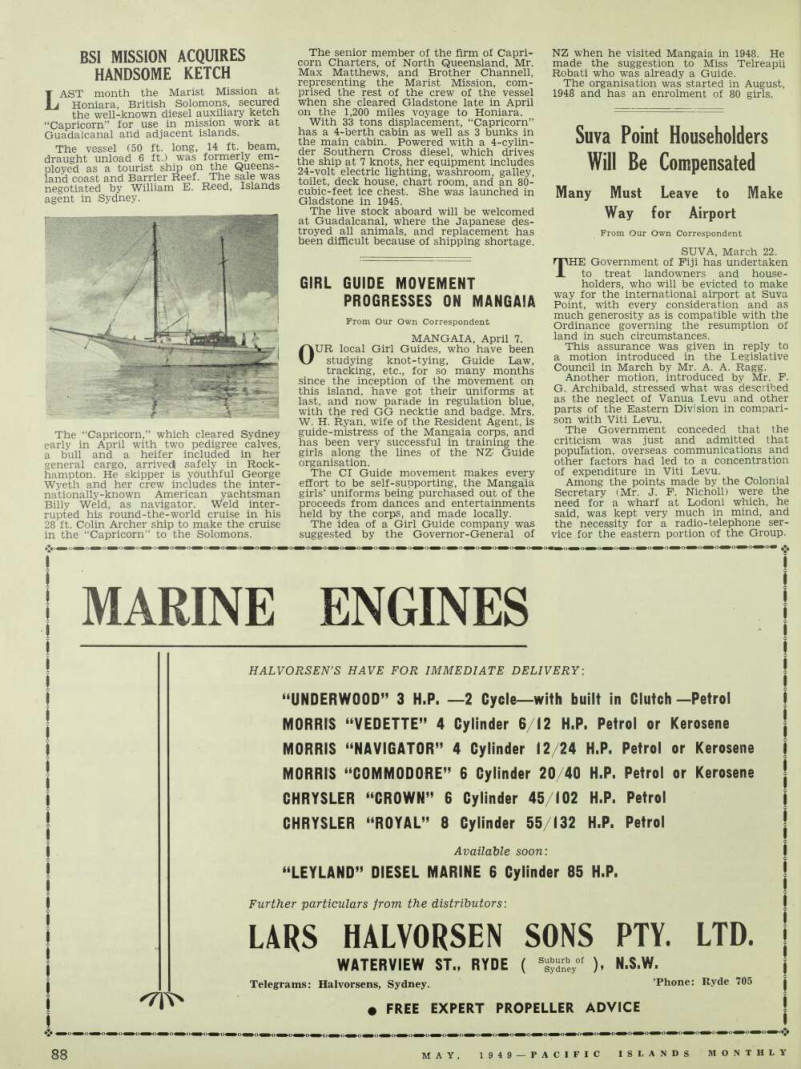
Bsi Mission Acquires
LAST month the Marist Mission at Honiara, British Solomons, secured the well-known diesel auxiliary ketch “Capricorn” for use in mission work at Guadalcanal and adjacent islands.
The vessel (50 ft. long, 14 ft. beam, draught unload 6 ft.) was formerly em ployed as a tourist ship on the Queens land coast and Barrier Reef. The sale was negotiated by William E. Reed, Islands agent in Sydney.
The “Capricorn,” which cleared Sydney early in April with two pedigree calves, a bull and a heifer included in her general cargo, arrived safely in Rock hampton. He skipper is youthful George Wyeth and her crew includes the inter nationally-known American yachtsman Billy Weld, as navigator. Weld inter rupted his round-the-world cruise in his 28 ft. Colin Archer ship to make the cruise in the “Capricorn” to the Solomons.
The senior member of the firm of Capri corn Charters, of North Queensland, Mr.
Max Matthews, and Brother Channell, representing the Marist Mission, com prised the rest of the crew of the vessel when she cleared Gladstone late in April on the 1,200 miles voyage to Honiara.
With 33 tons displacement, “Capricorn” has a 4-berth cabin as well as 3 bunks in the main cabin. Powered with a 4-cylin der Southern Cross diesel, which drives the ship at 7 knots, her equipment includes 24-volt electric lighting, washroom, galley, toilet, deck house, chart room, and an 80cubic-feet ice chest. She was launched in Gladstone in 1945.
The live stock aboard will be welcomed at Guadalcanal, where the Japanese des troyed all animals, and replacement has been difficult because of shipping shortage.
Girl Guide Movement
Progresses On Mangaia
From Our Own Correspondent MANGAIA, April 7.
OUR local Girl Guides, who have been studying knot-tying, Guide Law, tracking, etc., for so many months since the inception of the movement on this island, have got their uniforms at last, and now parade in regulation blue, with the red GG necktie and badge. Mrs.
W. H. Ryan, wife of the Resident Agent, is guide-mistress of the Mangaia corps, and has been very successful in training the girls along the lines of the NZ‘ Guide organisation.
The Cl Guide movement makes every effort to be self-supporting, the Mangaia girls’ uniforms being purchased out of the proceeds from dances and entertainments held by the corps, and made locally.
The idea of a Girl Guide company was suggested by the Governor-General of
NZ when he visited Mangaia in 1948. He made the suggestion to Miss Telreapii Robati who was already a Guide.
The organisation was started in August, 1948 and has an enrolment of 80 girls.
Suva Point Householders
Will Be Compensated Many Must Leave to Make Way for Airport
From Our Own Correspondent SUVA, March 22.
THE Government of Fiji has undertaken to treat landowners and house holders, who will be evicted to make way for the international airport at Suva Point, with every consideration and as much generosity as is compatible with the Ordinance governing the resumption of land in such circumstances.
This assurance was given in reply to a motion introduced in the Legislative Council in March by Mr. A. A. Ragg.
Another motion, introduced by Mr. F.
G. Archibald, stressed what was described as the neglect of Vanua Levu and other parts of the Eastern Division in compari son with Viti Levu.
The Government conceded that the criticism was just and admitted that population, overseas communications and other factors had led to a concentration of expenditure in Viti Levu.
Among the points made by the Colonial Secretary (Mr. J. F. Nicholl) were the need for a wharf at Lodoni which, he said, was kept very much in mind, and the necessity for a radio-telephone ser vice for the eastern portion of the Group.
Advertisements & other items, pp. 90-91 (1 item)
Marine Engines
HALVORSEN’S HAVE FOR IMMEDIATE DELIVERY:
“UNDERWOOD” 3 H.P. —2 Cycle—with built in Clutch —Petrol MORRIS “VEDETTE” 4 Cylinder 6/12 H.P. Petrol or Kerosene MORRIS “NAVIGATOR” 4 Cylinder 12/24 H.P. Petrol or Kerosene MORRIS “COMMODORE” 6 Cylinder 20/40 H.P. Petrol or Kerosene CHRYSLER “GROWN” 6 Cylinder 45/102 H.P. Petrol CHRYSLER “ROYAL” 8 Cylinder 55/132 H.P. Petrol Available soon: “LEYLAND” DIESEL MARINE 6 Cylinder 85 H.P.
Further particulars from the distributors :
LARS HALVORSEN SONS PTY. LTD.
WATERVIEW ST., RYDE ( s gXy of )- N.S.W.
Telegrams: Halvorsens, Sydney. ’Phone: Ryde 705
• FREE EXPERT PROPELLER ADVICE
Classified Ad vertisments
Estate Notices
Estate of Eleanor Florence Andrews, also known as Florence (or Florance) Ellenor Andrews or Rodgers, deceased.
Take notice that the Public Trustee of New South Wales is the Administrator of the Estate of the abovenamed deceased, who died intestate at Gladesville, New South Wales, on May 16, 1946. The deceased, who died without issue, was married on January 18, 1913, to Charles Alfred George Andrews. If the said Charles Alfred George Andrews survived the deceased he would be entitled to share in the Estate. If the said Charles Alfred George Andrews did not survive the deceased, the Estate will be distributable between brothers and sisters of the deceased, the issue of any such brother or sister who predeceased the deceased taking per stirpes the share to which their parent would have been entitled. Therefore, let Charles Allred George Andrews or his Legal Personal Representative or any one claiming through him take notice that unless a claim by them or any of them to be the next of skin of the deceased is received by the Public Trustee, 19 O’Connell Street, Sydney, New South Wales, on or before July 26, 1949, the Public Trustee will distribute the estate of the said Eleanor Florence Andrews amongst the next of kin of whose claims he then has notice.
MASLEN. A LEGACY OF ABOUT £lOO under the will of James Maslen is held for William Maslen, son of James Maslen and Margaret Hamilton Barr, born about 1882, who was last heard of at Bundaberg, Queensland, in 1918 Will he or anybody knowing of his whereabouts, marriage or death, kindly communicate with the
PUBLIC TRUSTEE, 19 O'CONNELL STREET,
SYDNEY
Stamps!!
Correspondents required in Pacific Islands to exchange stamps and despatch “First-Day Covers’’ (new issues). All Island stamps required, common or otherwise, used or unused.
J. Ramsay, Torbay, Auckland, New Zealand.
Positions Vacant
Plantation Manager Wanted.
Experienced manager wanted for Kekere Estate, Bougainville. Knowledge of cocoa desirable, but not essential. Good salary and commission. Send details of experience, condition, salary required, and when available to:— J. M. Joyes, Iwi Estate, via Rabaul, New Guinea, “Private Bag.”
Positions Wanted
Plantation position wanted. Young ex-Serviceman, 32. Married. Very keen. Good education First-class references. Experience in sugar, cocoa and coffee and copra, and in handling native labour. Administrative and commercial experience. Is most anxious to obtain position on a plantation in the Islands. Available immediately. Write:— P. Legh, Branksome Gardens, City Beach, Perth, W.A.
Certified Mechanical Engineer, non-drinker, aged 36 years, married, has own 54 ft. ketch and car, experienced native management, references available, would like purchase Plantation or would manage Plantation providing proposition was good. Apply, “Engineer,” c/o Box No. 3408.
G.P.0., Sydney.
The newly dedicated Martyrs’ Memorial School (Anglican Mission), at Sangara, Papua, is now open, although the buildings are not yet complete. Two classrooms and the dormitory have already been built. There are 40 boarders and 30 day boys. Lessons are to be given in
typing, bookkeeping, carpentry and engin-
eering.
Cipa Resurgence At Mangaia
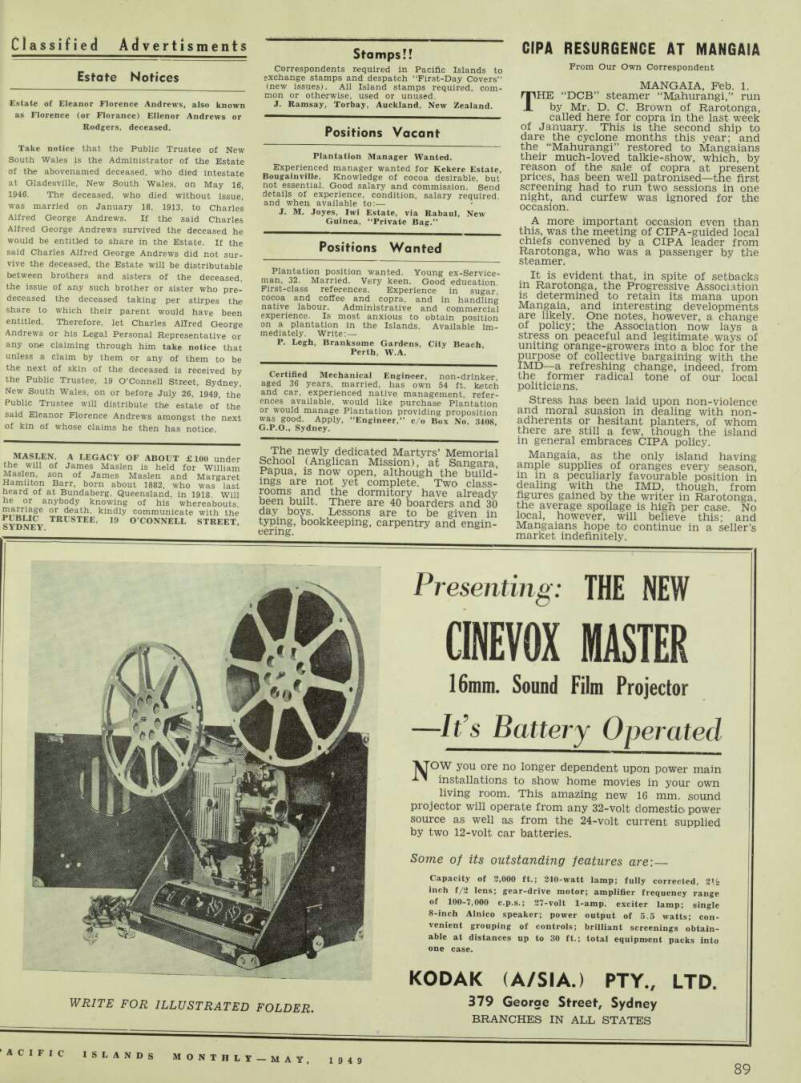
From Our Own Correspondent
Mangaia, Feb. 1.
THE “DCB” steamer “Mahurangi,” run by Mr. D. C. Brown of Rarotonga, called here for copra in the last week of January. This is the second ship to dare the cyclone months this year; and the “Mahurangi” restored to Mangaians their much-loved talkie-show, which, by reason of the sale of copra at present prices, has been well patronised—the first screening had to run two sessions in one night, and curfew was ignored for the occasion.
A more important occasion even than this, was the meeting of CIPA-guided local chiefs convened by a CIPA leader from Rarotonga, who was a passenger by the steamer.
It is evident that, in spite of setbacks in Rarotonga, the Progressive Association is determined to retain its mana upon Mangaia, and interesting developments are likely. One notes, however, a change of policy; the Association now lays a stress on peaceful and legitimate ways of uniting orange-growers into a bloc for the purpose of collective bargaining with the IMD—a refreshing change, indeed, from the former radical tone of our local politicians.
Stress has been laid upon non-violence and moral suasion in dealing with non adherents or hesitant planters, of whom there are still a few, though the island in general embraces CIPA policy.
Mangaia, as the only island having ample supplies of oranges every season, in in a peculiarly favourable position in dealing with the IMD, though, from figures gained by the writer in Rarotonga, the average spoilage is high per case. No local, however, will believe this; and Mangaians hope to continue in a seller’s market indefinitely.
Advertisements & other items, p. 91 (1 item)
Tinevox Master
WRITE FOR ILLUSTRATED FOLDER.
Presenting: THE NEW
16mm. Sound Film Projector
It's Battery Operated NOW you ore no longer dependent upon power main installations to show home movies in your own living room. This amazing new 16 mm. sound projector will operate from any 32-volt domestic, power source as well as from the 24-volt current supplied by two 12-volt car batteries.
Some of its outstanding features are : Capacity of 2,000 ft.; 240-watt lamp; fully corrected, 2½ inch ½ lens; gear-drive motor; amplifier frequency range of 100-7,000 c.p.s.; 27-volt 1-amp. exciter lamp; single 8-inch Alnico speaker; power output of 5.5 watts; convenient grouping of controls; brilliant screenings obtainable at distances up to 30 ft.; total equipment packs into one case.
KODAK (A/SIA.) PTY., LTD.
379 George Street, Sydney
BRANCHES IN ALL STATES
Cogea, a Village InVanua Leva, Fiji
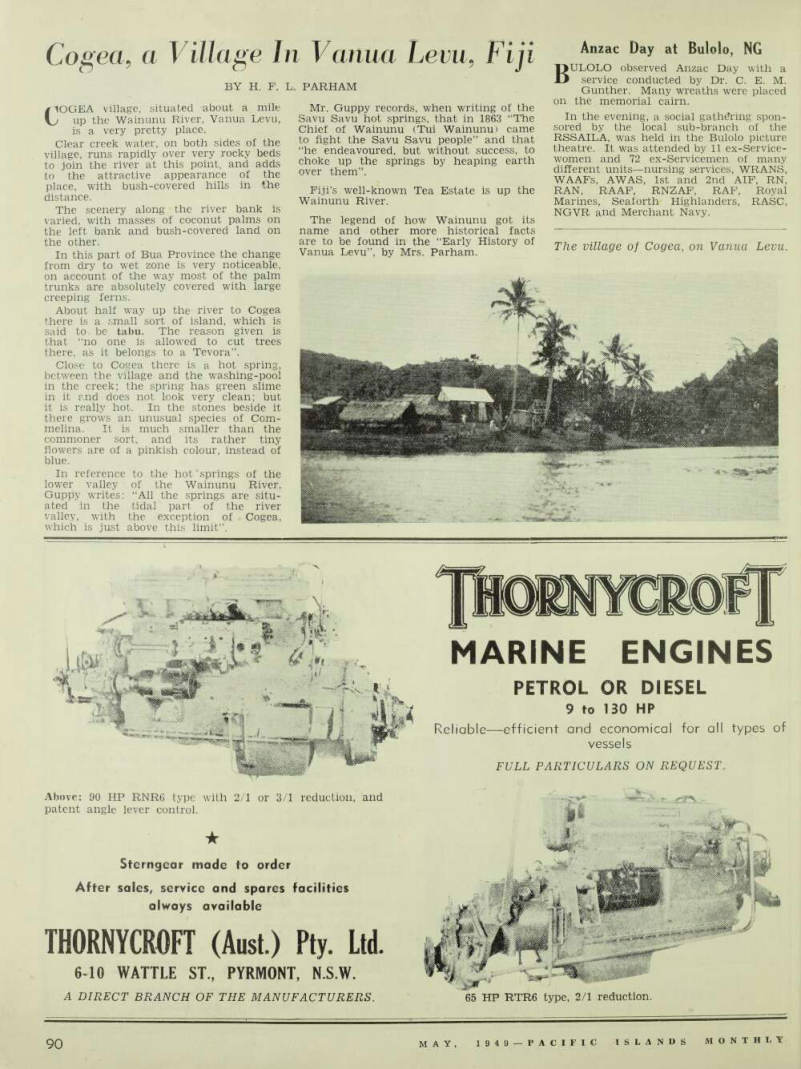
By H. F. L. Parham
CIGGEA village, situated about a mile j up the Wainunu River, Vanua Levu, is a very pretty place.
Clear creek water, on both sides of the village, runs rapidly over very rocky beds to join the river at this point, and adds to the attractive appearance of the place, with bush-covered hills in the distance.
The scenery along the river bank is varied, with masses of coconut palms on the left bank and bush-covered land on the other.
In this part of Bua Province the change from dry to wet zone is very noticeable, on account of the way most of the palm trunks are absolutely covered with large creeping ferns.
About half way up the river to Cogea there is a small sort of island, which is said to be tabu. The reason given is that “no one is allowed to cut trees there, as it belongs to a Tevora”.
Close to Cogea there is a hot spring, between the village and the washing-pool in the creek; the spring has green slime in it and does not look very clean; but it is really hot. In the stones beside it there grows an unusual species of Com melina. It is much smaller than the commoner sort, and its rather tiny flowers are of a pinkish colour, instead of blue.
In reference to the hot springs of the lower valley of the Wainunu River, Guppy writes: “All the springs are situ ated in the tidal part of the river valley, with the exception of Cogea, which is just above this limit”.
Mr. Guppy records, when writing of the Savu Savu hot springs, that in 1863 “The Chief of Wainunu (Tui Wainunu) came to fight the Savu Savu people” and that “he endeavoured, but without success, to choke up the springs by heaping earth over them”.
Fiji’s well-known Tea Estate is up the Wainunu River.
The legend of how Wainunu got its name and other more historical facts are to be found in the “Early History of Vanua Levu”, by Mrs. Parham.
The village of Cogea, on Vanua Leva.
Anzac Day at Bulolo, NG
BULOLO observed Aiizac Day with a service conducted by Dr. C. E. M, Gunther. Many wreaths were placed on the memorial cairn.
In the evening, a social gathering spon sored by the local sub-branch of the RSSAILA, was held in the Bulolo picture theatre. It was attended by 11 ex-Service women and 72 ex-Servicemen of many different units —nursing services, WRANS, WAAFs, AWAS, Ist and 2nd AIF, RN,
Ran, Raaf, Rnzaf, Raf, Royal
Marines, Seaforth Highlanders, RASC, NGVR and Merchant Navy.
Advertisements & other items, p. 92 (1 item)
THORNYCROFT (Aust.) Pfy. Ltd.
J wjwy •• V "a* Jill * .. 4 , m. <T; ■ > ' 'l ‘l* J? >K'.
Jj-, "
'•iW ‘ * : —*j J. j - Above: 90 HP RNR6 type with 2/1 or 3/1 reduction, and patent angle lever control. ★ Sterngcar made to order After sales, service and spares facilities always available
THORNYCROFT (Aust.) Pfy. Ltd.
6-10 WATTLE ST., PYRMONT, N.S.W.
A DIRECT BRANCH OF THE MANUFACTURERS.
OFF
1 □
MARINE ENGINES
PETROL OR DIESEL
9 to 130 HP Reliable—efficient and economical for all types of vessels
FULL PARTICULARS ON REQUEST.
fil
I , 65 HP RTR6 type, 2/1 reduction.
Showing NZ Flag In
The Islands
milE Royal New Zealand Navy’s four X new frigates, which arrived from Britain recently, manned largely by ex-RN personnel, are to make independent cruises to the Pacific Islands between late May and early August, They are HMNZ Ships “Taupo” (Commander L. P. Bourke, DSC, and Bar), “Hawea” (Lieutenant- Commander A. C. B. Blomfield, DSC, and two bars), “Pukaki” (Lieutenant-Com mander L. E. Herrick, DSC) and “Kaniere” (Lieutenant T. W. Stocker). The itiner aries are:—
Tt will be noted that Hawea and Pukaki will be together in Apia late in July, and that all four frigates Will as semble in Suva, Fiji, in the first week of August.
Taupo
Place Arrive Depart Auckland 23/5 Suva, Fiji . . 27/5 2/6 Nurakita. Ellice Is 4/6 5/6 Funafuti, Ellice Is 6/6 9/6 Nui, Ellice Is 10/6 10/6 Nanumea. Ellice Is 11/6 11/6 Rotuma. Fiji 13/6 15/6 Suva, Fiji 17/6 27/6 Ocean, Gilbert Is 2/7 5/7 Nauru 5/7 8/7 Tarawa, Gilbert Island .. . . 9/7 22/7 Makin. Gilbert Is . . . 23/7 25/7 Bcru. Gilbert Is 26/7 28/7 Arofae. Gilbert Is. 29/7 29/7 .
Suva, Fiji 2/8
Hawea
Place Arrive Depart Auckland 23/5 Papeete, Tahiti 30/5 6/6 Rarotonga, S. Cook Is 8/6 10/6 Mangaia. S. Cook Is 11/6 11/6 Mauke. S. Cook Is 12/6 12/6 Mitiaro. S. Cook Is :. 13/6 13/6 Atiu. S. Cook Is 14/6 14/6 Aitutaki. S. Cook Is 15/6 15/6 Rarotonga, S. Cook Is 16/6 17/6 Palmerston, N. Cook Is. . . 18/6 1976 Niue 21/6 22/6 Tongatabu. Tonga Gr 23/6 23/6 Suva, Fiji 26/6 15/7 Apia. W, Samoa 17/7 20/7 Fakaofo. Tokelau Gr. .. . 21/7 21/7 Nukunono. Tokelau Gr 22/7 22/7 Atafu. Tokelau Gr 23/7 23/7 Apia, W. Samoa 25/7 31/7 Suva, Fiji 4/8
Kanieri
Place Arrive Depart Auckland 23/5 Suva. Fiji 27/5 2/6 Christmas. Line Is 8/6 10 6 Fanning, Line Is 11/6 13/6 Canton. Phoenix Is 16/6 19/6 Hull, Phoenix Is 20/6 20 6 Gardner. Phoenix Is 21/6 21/6 Suva, Fiji .. 25/6 3/7 Rarotonga. S. Cook Is 7/7 9/7 Penrhyn. N, Cook Is 12/7 14/7 Rakahanga. N. Cook Is 15/7 15/7 Manahiki, N. Cook Is 16/7 16/7 Suvarov. N. Cook Is. . 18/7 19/7 Nassau, N. Cook Is 20/7 20/7 Danger, N. Cook Is. ... 21/7 22/7 Apia, W. Samoa 24/7 31/7 Suva. Fiji 4/8
Pukaki
Place Arrive Depart Auckland 23/6 Raoul. Kermadec Is 25/6 27/6 Ata, Tonga Gr 29/6 29/6 Tongatabu, Tonga Gr. 30/6 4/7 Haapai Gr.. Tonga Gr 5/7 8/7 Vavau Gr.. Tonga Gr 9/7 12/7 Keppel. Tonga Gr. . . . 13/7 14/7 Lakemba, Fiii 15/7 15/7 Ono-i-lau. Fiji .. 16/7 16/7 Suva. Fiji 18 '7 22/7 Lautoka. Fiii .. 22/7 25/7 Yasawa. Fiii 26/7 27/7 Lambasa, Fiii .. .. 28/7 29/7 Tavenui, Fiii 30/7 31/7 Levuka. Fiji 31 n 3/8 Suva, Fiji .. .. 3/8
Anzac Day in New Britain
WELL attended Anzac Day services were held at Rabaul and Bitapaka, New Britain, on the morning of April 25.
The service at the Bitapaka Memorial which marks the area in which first Australians fell in 1914-18 war, was very impressive with a Native Constabulary guard and the Catholic Mission Band.
Both the Rabaul and Bitapaka services were conducted by the Rev. B.
Chenoweth. The acting District Officer, Rabaul, gave an address at the picture theatre, Rabaul, where residents gathered before going on to the cemetery where Father Ormonde delivered an address.
Frederick William Cuthbert. a 93-year old mine-owner of Georgetown (Q’ld.i, who died on October 25, 1948, left £128,987
£ cash to K.&ared among .his> relatives Known as the man with the Midas touch” because, wherever he went he found gold, Cuthbert, m 1928, With a partner, bought a mine property on Misi ma Island, Papua, for £2,000. In 1935 he and his partner sold it for £95,000 (£75,000 in cash and £20,000 in shares) to a com pany. Cuthtaelrt was reputed to have made £BO,OOO out of Misima.
The Kumgunan native brass band from Kokopo gave a recital in the grounds of th e sacred Heart School, Rabaul, on the evening of May 1. The Band has 45 pieces and is conducted by the principal of the school, Brother Joseph Landinger. Al though the membership of the Band is continually changing owing to coming and going of natives at the School, Brother Landinger has brought it to a high standard of playing. Kingunan School is one of the Catholic Mission Schools operating under the Common wealth Reconstruction Training Scheme.
Advertisements & other items, p. 93 (1 item)
Robert Gillespie
WHO LESALEfiifIAERCH ANTS
MANUFACTURERS AGENTS
BE [ m re er ■s mb 0&j n^* o. c e Cf m
ROBERT GILLESPIE
NEW GUINEA J Q
HEAD OFFICE LAE
BRANCH OFFICE RABAUL
tf&f. ROBERT GILLESPIE PTY.LTD. 5 Street*
Islands Produce
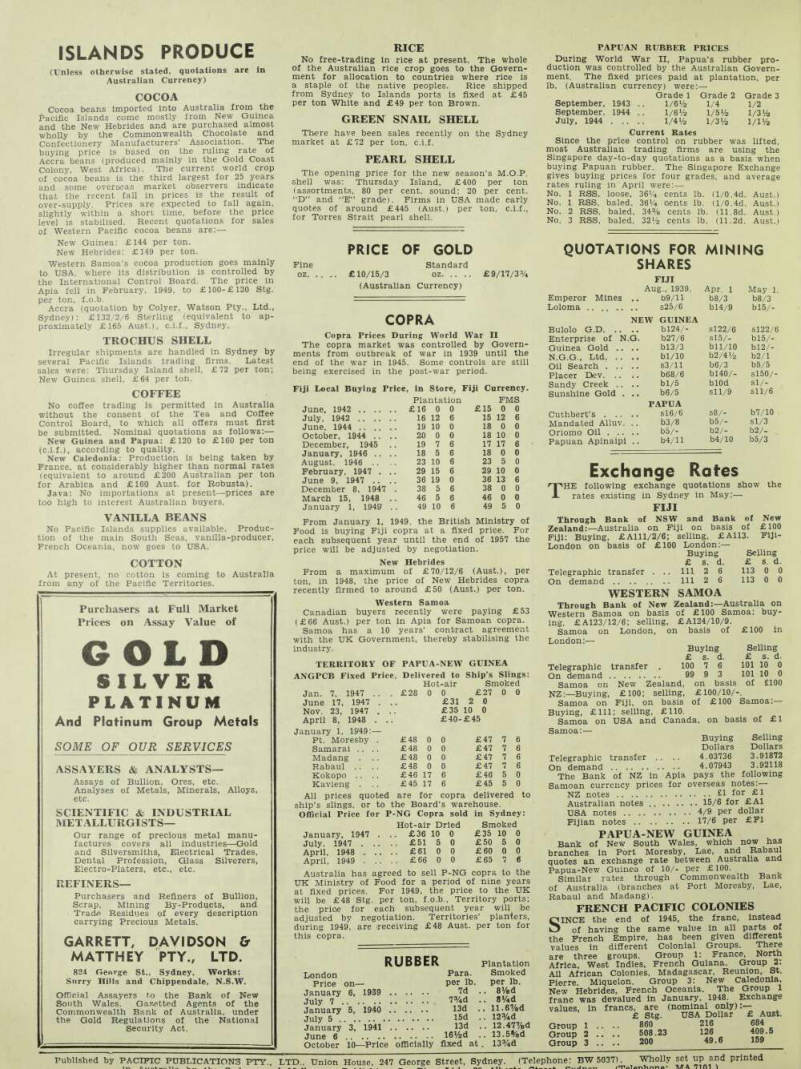
(Unless otherwise stated, quotations are in Australian Currency)
Cocoa
Cocoa beans imported into Australia from the Pacific Islands come mostly from New Guinea and the New Hebrides and are purchased almost wholly by the Commonwealth Chocolate and Confectionery Manufacturers’ Association. The buying price is based on the ruling rate of Accra beans (produced mainly in the Gold Coast Colony, West Africa). The current world crop of cocoa beans is the third largest for 25 years and some overseas market observers indicate that the recent fall in prices is the result of over-supply. Prices are expected to fall again, slightly within a short time, before the price level is stabilised. Recent quotations for sales of Western Pacific cocoa beans are:— New Guinea; £144 per ton.
New Hebrides: £149 per ton.
Western Samoa’s cocoa production goes mainly to USA, where its distribution is controlled by the International Control Board. The price in Apia fell in February, 1949, to £lOO-£l2O Stg. per ton, f.o.b.
Accra (quotation by Colyer, Watson Pty., Ltd., Sydney): £132/2/6 Sterling (equivalent to ap proximately £165 Aust.), c.i.f., Sydney.
Trochus Shell
Irregular shipments are handled in Sydney by several Pacific Islands trading firms. Latest sales were: Thursday Island shell, £72 per ton; New Guinea shell, £64 per ton.
Coffee
No coffee trading is permitted in Australia without the consent of the Tea and Coffee Control Board, to which all offers must first be submitted. Nominal quotations as follows; — New Guinea and Papua: £l2O to £l6O per ton (c.i.f.), according to quality.
New Caledonia: Production is being taken by France, at considerably higher than normal rates (equivalent to around £2OO Australian per ton for Arabica and £l6O Aust. for Robusta).
Java: No importations at present—prices are too high to interest Australian buyers.
Vanilla Beans
No Pacific Islands supplies available. Produc tion of the main South Seas, vanilla-producer, French Oceania, now goes to USA.
Cotton
At present, no cotton is coming to Australia from any of the Pacific Territories.
Rice
No free-trading in rice at present. The whole of the Australian rice crop goes to the Govern ment for allocation to countries where rice is a staple of the native peoples. Rice shipped from Sydney to Islands ports is fixed at £45 per ton White and £49 per ton Brown.
Green Snail Shell
There have been sales recently on the Sydney market at £72 per ton, c.i.f.
Pearl Shell
The opening price for the new season’s M.O.P. shell was: Thursday Island, £4OO per ton (assortments, 80 per cent, sound; 20 per cent.
“D” and “E” grade). Firms in USA made early quotes of around £445 (Aust.) per ton, c.i.f., for Torres Strait pearl shell.
Advertisements & other items, p. 94 (1 item)
Price Of Gold
Fine oz. . £10/15/3 Standard oz £9/17/3% Currency) (Australian
Copra
Prices During World War II The copra market was controlled by Govern ments from outbreak of war in 1939 until the end of the war in 1945. Some controls are still being exercised in the post-war period.
From January 1, 1949, the British Ministry of Food is buying Fiji copra at a fixed price. For each subsequent year until the end of 1957 the price will be adjusted by negotiation.
New Hebrides From a maximum of £7O/12/6 (Aust.), per ton, in 1948, the price of New Hebrides copra recently firmed to around £5O (Aust.) per ton.
Western Samoa Canadian buyers recently were paying £53 (£66 Aust.) per ton in Apia for Samoan copra.
Samoa has a 10 years’ contract agreement with the UK Government, thereby stabilising the industry.
Territory Of Papua-New Guinea
ANGPCB Fixed Price, Delivered to Ship’s Slings:
All prices quoted are for copra delivered to ship’s slings, or to the Board’s warehouse.
Official Price for P-NG Copra sold in Sydney:
Australia has agreed to sell P-NG copra to the UK Ministry of Food for a period of nine years at fixed prices. For 1949, the price to the UK will be £4B Stg. per ton, f.0.b., Territory ports; the prioe for each subsequent year will be adjusted by negotiation. Territories’ planters, during 1949, are receiving £4B Aust. per ton for this copra.
Fiji Local Buying Price
in Store,
Plantation Fiji Currency.
Fms
June, 1942 July, 1942 £16 0 0 £15 0 0 16 12 6 15 12 6 June, 1944 19 10 0 18 0 0 October, 1944 . . .. 20 0 0 18 10 0 December, 1945 .. 19 7 6 17 17 6 January, 1946 .. 18 5 6 18 0 0 August. 1946 .. 23 10 6 23 5 0 February, 1947 . .. 29 15 6 29 10 0 June 9. 1947 .. .. 36 19 0 36 13 6 December 8. 1947 . 38 5 6 38 0 0 March 15, 1948 .. 46 5 6 46 0 0 January 1, 1949 .. 49 10 6 49 5 0
Hot-air Smoked Jan. 7, 1947 .. . £28 0 0 £27 0 0 June 17. 1947 . .. £31 2 0 Nov. 23, 1947 ... £35 10 0 April 8. 1948 ... £40-£45 January 1, 19‘49: — Pt. Moresby . £48 0 0 £47 7 6 Samarai ... £48 0 0 £47 7 6 Madang ... £48 0 0 £47 7 6 Rabaul .. .. £48 0 0 £47 7 6 Kokopo ... £46 17 6 £46 5 0 Kavieng ... £45 17 6 £45 5 0
Hot-air Dried Smoked January, 1947 . £36 10 0 £35 10 0 July. 1947 . .. £51 5 0 £50 5 0 April, 1948 . .. £61 0 0 £60 0 0 April. 1949 . .. £66 0 0 £65 7 6
Rubber
Plantation
Papuan Rubber Prices
During World War 11, Papua’s rubber pro duction was controlled by the Australian Govern ment. The fixed prices paid at plantation, per lb. (Australian currency) were:—
Current Bates Since the price control on rubber was lifted, most Australian trading firms are using the Singapore day-to-day quotations as a basis when buying Papuan rubber. The Singapore Exchange gives buying prices for four grades, and average rates ruling in April were;— No. 1 RSS, loose, 36V 4 cents lb. (1/0.4d. Aust.) No. 1 RSS, baled, 36y 4 cents lb. (1/0.4d. Aust.) No. 2 RSS, baled, 34% cents lb. (11.8 d. Aust.) No. 3 RSS, baled, 32% cents lb. (11.2 d. Aust.)
London Para.
Smoked Price on— per lb. per lb.
January 6, 1939 . 7d . . SVad July 7 . 7%d .
SVid January 5, 1940 . 13d .. , 11.6%d July 5 . 15d . . 12%d January 3, 1941 . 13d . . 12.47 7 / B d June 6 16V 2 d . . 13.5*/ad October 10—-Price officially fixed at . 13 3 / 4 d
Grade 1 Grade 2 Grade 3 September, 1943 1/6 Vi 1/4 1/2 September. 1944 i/6 Me 1/5 Me 1/3 Me July, 1944 1/4 y 2 1/3 Me 1/1 Me
Quotations For Mining
Shares
Fiji
Aug., 1939.
Apr. 1 May 1.
Emperor Mines b9/ll b8/3 b8/3 Loloma bl4/9 bl5/- Bulolo G.D. ..
New Guinea
S122/6 S122/6 Enterprise of N.G. b27/6 sl5/bl5/- Guinea Gold .. bl3/3 bll/10 bl2/- N.G.G., Ltd. .. bl/10 b2/4V 2 b2/l Oil Search . ..
S3/11 b6/3 b5/5 Placer Dev. .. b68/6 bl40/- S150/- Sandy Creek .. bl/5 blOd sl/- Sunshine Gold . b6/5 sll/9 sll/6 Cuthbert’s . ..
Papua
S16/6 s8/b7/10 Mandated Alluv. b3/8 b5/sl/3 Oriomo Oil . .. b5/b2/b2/- Papuan Apinaipi b4/ll b4/10 b5/3
Exchange Rates
THE following exchange quotations show the rates existing in Sydney in May:—
Fiji
Through Bank of NSW and Bank of New Zealand: —Australia on Fiji on basis of £lOO Fiji: Buying. £Alll/2/6; selling, £AII3. Fiji- London on basis of £lOO London: —
Western Samoa
Through Bank of New Zealand: —Australia on Western Samoa on basis of £lOO Samoa: buy ing, £AI23/12/6; selling, £AI24/10/9.
Samoa on London, on basis of £lOO in London;—
Samoa on New Zealand, on basis of £lOO NZ;—Buying, £100; selling, £lOO/10/-.
Samoa on Fiji, on basis of £lOO Samoa:— Buying, £111; selling, £llO.
Samoa on USA and Canada, on basis of £1 Samoa: —
Papua-New Guinea
Bank of New South Wales, which now has branches in Port Moresby, Lae, and Rabaul quotes an exchange rate between Australia and Papua-New Guinea of 10/- per £lOO.
Similar rates through Commonwealth Bank of Australia (branches at Port Moresby, Lae, Rabaul and Madang).
French Pacific Colonies
SINCE the end of 1945, the franc, instead of having the same value in all parts of the French Empire, has been given different values in different Colonial Groups. There are three groups. Group 1: France, North Africa, West Indies, French Guiana. Group 2: All African Colonies, Madagascar, Reunion, St.
Pierre, Miquelon. Group 3: New Caledonia, New Hebrides, French Oceania. The Group 1 franc was devalued in January, 1948. Exchange values, in francs, are (nominal only):
Buying Selling £ s. d. £ s. d.
Telegraphic transfer . .. Ill 2 6 113 0 0 On demand .. Ill 2 6 113 0 0
Buying Selling £ s. d. £ s. d.
Telegraphic transfer . 100 7 6 101 10 0 On demand 99 9 3 101 10 0
Buying Selling Dollars Dollars Telegraphic transfer .. .. 4.03736 3.91872 On demand 4.07943 3.92118 The Bank of NZ in Apia pays the following Samoan currency prices for overseas notes: — NZ notes £1 for £1 Australian notes 15/6 for £A1 USA notes 4/9 per dollar Fijian notes 17/6 per £F1
va £ stg. USA Dollar £ Aust.
Group 1 .. .. 860 216 684 Group 2 .. .. 508.23 126 409.5 Group 3 .. .. 200 49.6 159
Advertisements & other items, pp. 94-96 (3 items)
Published by PACIFIC PUBLICATIONS PTY., LTD., Union House. 247 George Street, Sydney. (Telephone: BW 5037). Wholly set up and printed
ivt 1 J.l t - «i .1 nn *ll m i O.t/lnAtT /TolonVinPO * TVTA 7im .1
Gold
Purchasers at Full Market Prices on Assay Value of
SILVER
PLATINUM
And Platinum Group Metals
SOME OF OUR SERVICES
ASSAYERS & ANALYSTS—
Assays of Bullion, Ores, etc.
Analyses of Metals, Minerals, Alloys, etc.
SCIENTIFIC & INDUSTRIAL
METALLURGISTS—
Our range of precious metal manufactures covers all industries —Gold and Silversmiths, Electrical Trades, Dental Profession, Glass Silverers, Electro-Platers, etc., etc.
REFINERS—
Purchasers and Refiners of Bullion, Scrap, Mining By-Products, and Trade Residues of every description carrying Precious Metals.
GARRETT, DAVIDSON &
MATTHEY PTY., LTD.
824 George St., Sydney. Works: Surry Hills and Chippendale, N.S.W.
Official Assayers to the Bank of New South Wales. Gazetted Agents of the Commonwealth Bank of Australia, under the Gold Regulations of the National Security Act.
tropical thirst...
To quench a
j ' <r
V C J
fi « k v « •OS IRau* ,fj ffiiiiiiiiiiiiilii K 1.1.41 When you’re hot and tired,
there is nothing quite so satisfying
and thirst quenching as a long, cold glass of “K. 8.” Your friends and guests, too, will ap-
preciate this really fine
Lager, for “Everybody
drinks K. 8.”
TOOTH’S
LAGER
Capital £1,000,000
ESTABLISHED 1914
'k ★
COPRA MERCHANTS & MILLERS
ASSOCIATED COMPANIES THROUGHOUT THE PACIFIC ISLANDS
Buyers and exporters of all kinds of Islands produce. Copra Merchants and Millers.
Agents for Australian, European and American Manufacturers. Distributors of every description of merchandise.
Thirty years of Pacific Islands development and service.
IN LONDON
W. R. CARPENTER & CO.
(LONDON) LTD.
Coronation House. 4 Lloyd’s Avenue, London, E.C.
DISTRIBUTING
AGENTS FOR :
IN NEW GUINEA
New Guinea Company Limited., Rabaul, Lae, Madang, Kavieng.
IN PAPUA
J. R. Clay & Co., Ltd.,
IN FIJI
W. R. Carpenter & Co. (Fiji) Ltd. ★
THE W.R.C. LINE
Ford Motor Company of Canada.
Electrolux Refrigerators.
T. C & C. Bolinders (Engines).
Chrysler Corporation.
Westinghouse Electrical Co.
Caterpillar Tractors.
Etc., Etc.
THE FIRST DIRECT AND
REGULAR CARGO AND PASSENGER SERVICE BETWEEN EUROPE AND
PACIFIC ISLAND PORTS WAS ESTABLISHED BY
W. R. CARPENTER & CO. LTD.
Head Office: 16 O'CONNELL STREET, SYDNEY.
Cable Address:
C AMO HE.
Telephone: Postal Address: BW 4421. P.O. Box No. 168, Sydney.
PACIFIC ISLANDS MONTHLY MAY, 1949