Pacific
Islands
Monthly
March 18, 1947
Vol. Xvii. No. 8.
Established 1930.
[Registered at the hy post as a newspaper ]
l/-
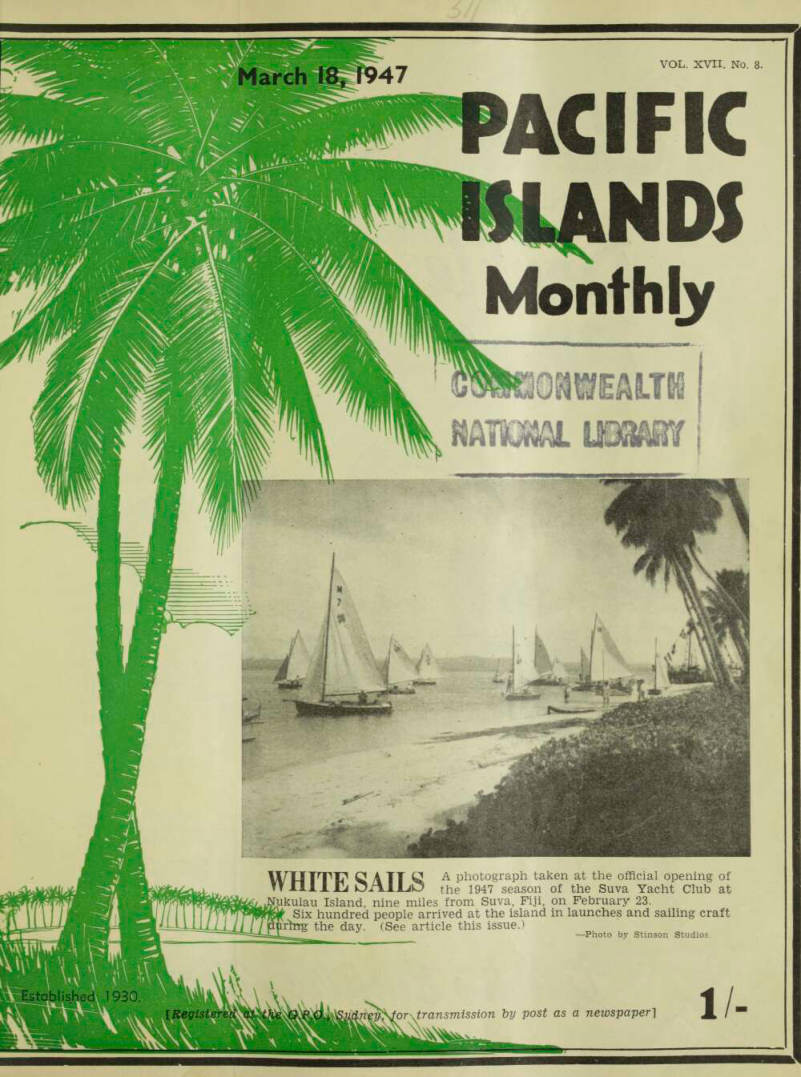
WHITE SAILS A photograph taken at the official opening of the 1947 season of the Suva Yacht Club at Nukulau Island, nine miles from Suva, Fiji, on February 23.
Six hundred people arrived at the island in launches and sailing craft during the day. (See article this issue.) —Photo by Stinson Studios.
Advertisements & other items, pp. 2-4 (1 item)
Check
AND
hcuhle
Check
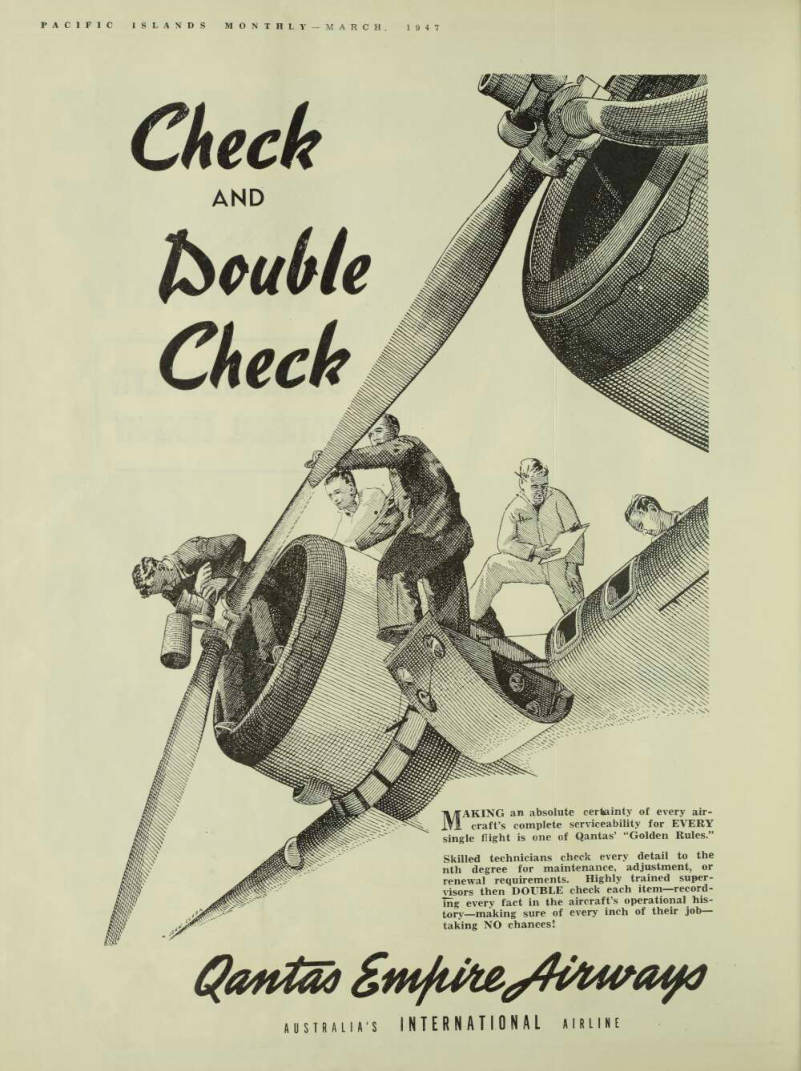
Gk 4.' m MAKING an absolute certainty of every aircraft’s complete serviceability for EVERY single flight is one of Qantas’ “Golden Rules.’
Skilled technicians check every detail to the nth degree for maintenance, adjustment, or renewal requirements. Highly trained supervisors then DOUBLE check each item—recording every fact in the aircraft’s operational history—making sure of every inch of their job taking NO chances!
AUSTRAL
as INTERNATIONAL airline
3fc ■■ ✓
40uea*t (pebtMtce.
MttstoC eAtefof
thi&nuut Stchte
m y
Sms's** 1
ui=A i« m * zsSf't* m ■ : 3O
os<t« 01,(1
l» P ,eh “sto 6
• ,th TS^ ot
>n ° ne •» \ quo** er ,n 3 y posit' 00 itt\e<J *• foe' seo '' ,ut ketosen 6 * cop se t \s bt° sS >t- lhe A V." ° ot '° t-ptoo' ° P'intus. ,et »YP eS \
Day after day, week
after week, for over 40 years Coleman's have specialised in making Stoves and Lamps. Is it any wonder, then, that
their products give
the utmost in satisfaction and service.
sSif*
cooklm
sfov e !*° ! >Urn et L£
srov f
re <?u/r es PortabU "•9 o„ d ’" ,res no Pfe , 6 °n fro , J°s ‘nst anf * at - Safety sh 0 a„y h eot it ** hut -aff v l, de 9ree. e °ch t i^ eSS ° ry f o >e r l nakei Has , e e s, ov e j . £"n>#> f °' safe Vo6,e fue 9hted Obtain. . an <> COci.
***' »« *— ■« fi«S d
Representatives for the Pacific Islands; ROBERT GILLESPIE PTY. LTD. PEARCE £ v f° LTD 54a PITT STREET, SYDNEY FOR FIJI ISLANDS
THE
YORKSHIRE
INSURANCE
CO. LTD.
(Incorporated in England)
ALL CLASSES OF
INSURANCE
Including
FIRE
GUARANTEE
WORKERS
MOTOR
ACCIDENT
MARINE
Island Representatives:
PORT MORESBY: E. A. Janies
RABAUL: G. B. Black LAE: Morobe Transport Co. Ltd, MADANG: R. MacGregor
BURNS PHILP
(SOUTH SEA) CO. LTD.
Inc. In FIJI Island Traders and Shipowners Registered Office ;
SUVA
FIJI
Also Branches at: \Fiji: Levuka, Lautoka, Labasa, Ba, Sigatoka, Rotuma.
Tonga: Nukualofa, Haapai, Vavau.
Samoa: Apia, Pago Pago (American Samoa).
Solomons: Makambo, Gizo, Faisi.
New Hebrides: Vila.
Code Address: Gilberts: Tarawa.
"Bumsouth*. Norfolk Is. Niue. Wallis Is. Futuna Is.
Sole Australian Concessionaries :
GEORGE BROWN & CO. PTY. LTD.
267 Clarence Street, Sydney.
The Ultimate factory has made the change-over from its wartime set-up.
Designs for the new models are now completed and production is about to commence.
These models should be available early in 1946—they will be well worth waiting for. Watch for further announcements.
SERVICE: Servicing of all kinds of radio sets, amplifiers and Rola speakers will continue to be available.
New Cars For Fiji
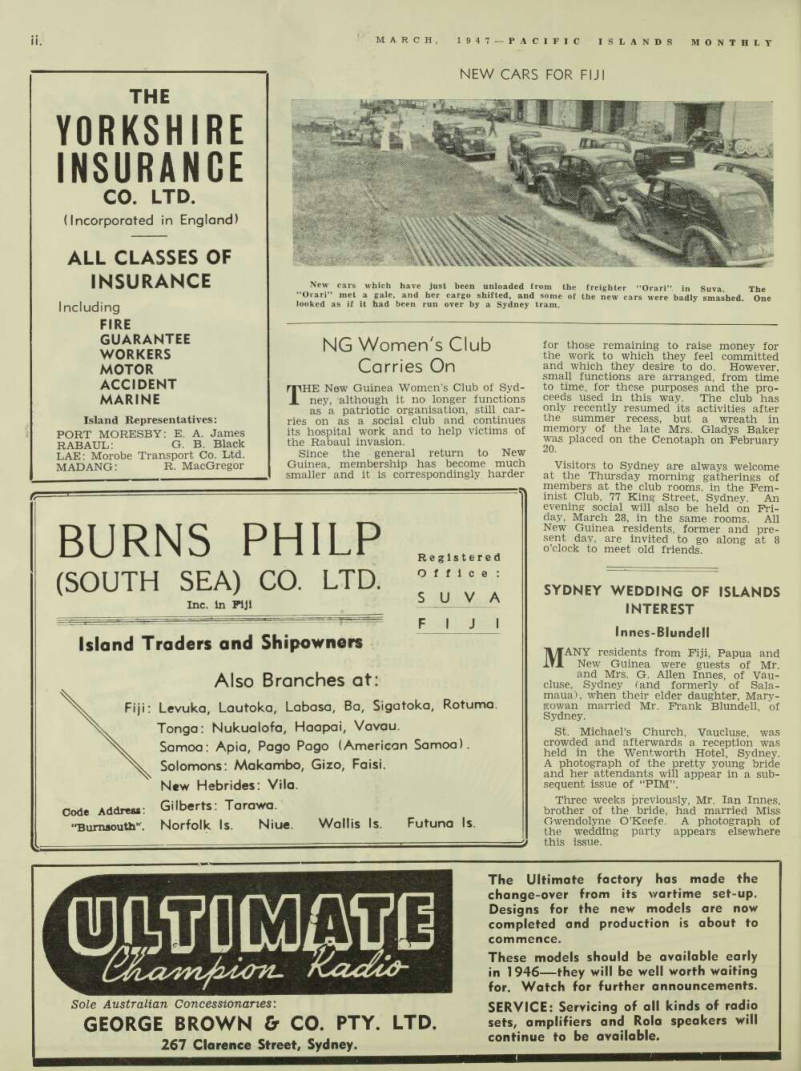
New cars which have just been unloaded from the freighter “Orari” in Suva The “Orari” met a gale, and her cargo shifted, and some of the new cars were badly smashed. One looked as if it had been run over by a Sydney tram.
NG Women's Club
Carries On
THE New Guinea Women’s Club of Syd ney, although it no longer functions as a patriotic organisation, still car ries on as a social club and continues its hospital work and to help victims of the Rabaul invasion.
Since the general return to New Guinea, membership has become much smaller and it is correspondingly harder
for those remaining to raise money for the work to which they feel committed and which they desire to do. However, small functions are arranged, from time to time, for these purposes and the pro ceeds used in this way. The club has only recently resumed its activities after the summer recess, but a wreath in memory of the late Mrs. Gladys Baker was placed on the Cenotaph on February 20.
Visitors to Sydney are always welcome at the Thursday morning gatherings of members at the club rooms, in the Fem inist Club, 77 King Street, Sydney. An evening social will also be held on Fri day, March 28, in the same rooms. All New Guinea residents, former and pre sent day, are invited to go along at 8 o’clock to meet old friends.
Sydney Wedding Of Islands
Interest
Innes-Blundell
MANY residents from Fiji, Papua and New Guinea were guests of Mr. and Mrs. G. Allen Innes, of Vau cluse, Sydney (and formerly of Sala maua), when their elder daughter, Mary gowan married Mr. Frank Blundell, of Sydney.
St. Michael’s Church, Vaucluse, was crowded and afterwards a reception was held in the Wentworth Hotel, Sydney.
A photograph of the pretty young bride and her attendants will appear in a sub sequent issue of “PIM”.
Three weeks previously, Mr. lan Innes, brother of the bride, had married Miss Gwendolyne O’Keefe. A photograph of the wedding party appears elsewhere this issue.
Advertisers

Amplion (Aust.), Ltd 29 Angliss & Co. . . 34 Aust. Fishing In dustries ... 33 Atkins Pty., Ltd., Wm 57 Bethell, Gwyn & Co 19 Lewis Berger & Sons, Ltd. ... 43 Brown & Co., Ltd. ii.
Brunton’s Flour . . 3 Brial & Ball ... 19 Burns, Philp Trust Co., Ltd 51 Budge, James, Pty., Ltd 69 Broomfields ... 77 BP (SS) Co. . . . ii.
Bulowat Transport Co 76 W. R. Carpenter & Co. (Fiji), Ltd 74 Carlton & United Breweries, Ltd. . 31 Caine’s Studios, Suva 15 Carpenter, Ltd., W.
R cov. iv.
Chivers, Ltd. . . .62 Church, R. H., & Sons 28 Coleman Lamp & Stove Co 25 Costello, Vince, Garrick Hotel . 21 “Cystex” 73 Colonial Wholesale Meat 27 Crosse & Blackwell, Ltd .23 Dalmore Preserving 52 Donaghy & Sons . 59 Donald, Ltd., A. B. 76 Paul, A. Dorn . . 58 Dr. Williams Pink Pills 55 Dangar, Gedye & Malloch ... 63 Dunlop Rubber (A/sia), Ltd. . . 17 Ecco Products . . 53 Excelsior Supply Co 45 Electrolux Refrigerators . . 30 Garrett & Davidson 78 Gillespie Pty., Ltd., Robert . . . i. & 17 R o b t. Gillespie (NG), Ltd. ... 61 Gilbey’s Gin ... 59 Gillespie’s Flour . . 64 Gough & Co., E. J. 21 Grand Pacific Hotel 2 Grove & Sons, W.
H 26 Heinz & Co. Pty., Ltd., H. J. . . . 55 Hemingway & Robertson ... 26 Hislop Lloyd Pty., Ltd 1 Horlicks Malted Milk 24
Hyde, Victor ... 14 Ingram Shaving Cream 65 Ipana Tooth Paste 16 Kentucky Stud . . 73 Kopsen & Co., Ltd. 20 Lockyer, Geo. J. . 60 M. & M. Island Traders 77 Merrillees, J. C., & Co 23 Miscellaneous . . .
“Mum” Deodorant . 71 “Mendaco” ... 48 Mcllraths Pty., Ltd. 21 Morgan, P. J., & Co 25 Morris, Hedstrom, Ltd, Suva ... 13 Nelson & Robertson Pty., Ltd 46 NSW Bookstall Co.
Pty., Ltd 20 “Nixoderm” ... 64 Nordman, Oscar . 61 Pacific Islands Trading Co., 72, 18, 60 Pacific Is. Society . 57 “Pinkettes” ... 32 Pitt & Scott, Ltd. . 36 Proprietary Products 56 Qantas Empire Air ways ... cov. ii.
Queensland Insur ance Co 27 Ransomes, Sims & Jefferies . . . . 32 Robinson, G. H. . 48 Rose’s Eye Lotion, 47, 65 Rohu, Sil 44 Scott, Ltd., J. ... 68 Shell Co 15 Southern Pacific Insurance Co. . .28 Steamships Trading Co., Ltd 49 Stokoe Motors Pty., Ltd 14 Sullivan & Co., C. 70 Swallow & Ariel . 50 South Sea Islands Club 28 Taylor & Co., A. . 62 “Tenax” Soap . . 68 Tillock & Co., Ltd. 56 Tooth & Co., Ltd cov. iii.
Tilley’s Lamps . . 22 ‘Vitalis” Hair Tonic 58 Vacuum Oil Co., Ltd 67 Watson, Wm. H. . 47.
Harry West ... 49 Wikara, Buddy . . 66 Widdop, H., & Co., Ltd 44 Whites Aviation, Ltd 71 Wills, W. D. & H. 0 54 Wright & Co., Ltd., E 53 Yorkshire Insur ance Co., Ltd. . . ii.
Mr. lan Innes, only son of Mr. and Mrs.
Allen Innes, well-known former residents of Salamaua, New Guinea, was married on February 8, at St. Michael’s Church, Vaucluse, Sydney, to Miss Gwendolyne O’Keefe, only daughter of Mr. and Mrs.
V. W. O’Keefe, of Mosman. The recep tion was held at Rancliffe, Woollhara, where a number of New Guinea folk toasted the happy couple. lan, who spent his earlier years in New Guinea, served with distinction in the RAAF during the war. (Photo on page 73).
In the 1946 Commonwealth Loan Quiz, Mr. S. H. Chance, late Resident Mag istrate at Kikori, Papua, survived the elimination contest (placed 7th) and won the third heat of the semi-finals, and was in the first Queensland team of four.
Victcria won the contest. Queensland, with two other States equal in marks, ran second. In the 1947 Quiz, Mr. Chance has already survived the first and second
elimination contest, and is a member of the second City team of six to broadcast on March 25.
The Methodist Overseas Mission pro-
poses to erect a Memorial Library at Sala mau, Papua, to the late Rev. J. S. Rundle, who gave outstanding service to the Papuans.
Advertisements & other items, p. 5 (1 item)
Floor
PRODUCING UNIFORM GOOD RESULTS SINCE 1868
ALWAYS ASK FOR IT
★ BUYING * SHIPPING ★
SEND FOR
FREE copy Of
“THE
MOTORISTS
MAIL"
our quarterly catalogue
AUTOMOTIVE SPARES,
ACCESSORIES
REPLACEMENT
t
What you want,
When you want it
PARTS
YES! Practically everything in
Auto Spares for most makes and types of motors. Batteries, Spark Plugs, Cables and Wiring, Pistons and Rings, Brake Linings. In fact, all necessities and accessories for the motor trade are in our stock bins for prompt delivery.
Cables: “Hisloyd” Sydney.
Codes: Bentley’s. A.B.C. 6th.
Hislop, Lloyd Pty. Ltd.
335-7 PITT STREET, SYDNEY
In This Issue:
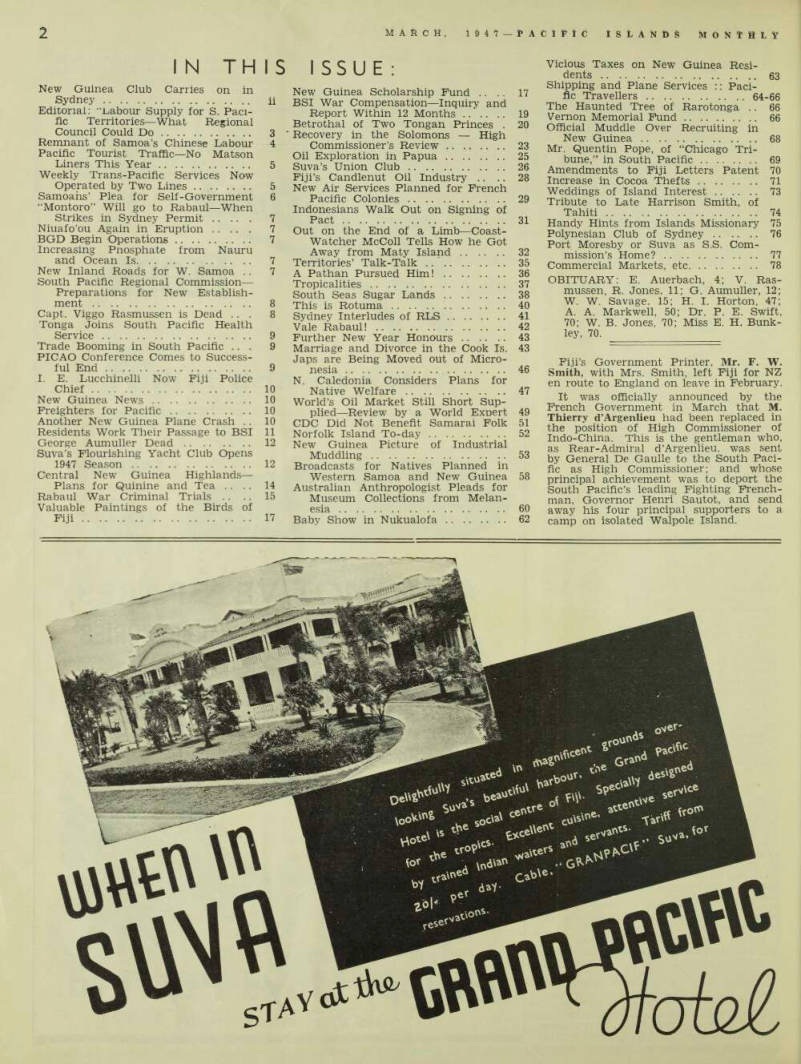
New Guinea Club Carries on in Sydney ii Editorial: -‘.Labour Supply for S. Paci fic Territories—What Regional Council Could Do 3 Remnant of Samoa’s Chinese Labour 4 Pacific Tourist Traffic —No Matson Liners This Year 5 Weekly Trans-Pacific Services Now Operated by Two Lines 5 Samoans’ Plea for Self-Government 6 “Montoro” Will go to Rabaul—When Strikes in Sydney Permit 7 Niuafo’ou Again in Eruption 7 BGD Begin Operations 7 Increasing Pnosphate from Nauru and Ocean Is 7 New Inland Roads for W. Samoa .. 7 South Pacific Regional Commission— Preparations for New Establish ment 8 Capt. Viggo Rasmussen is Dead ... 8 Tonga Joins South Pacific Health Service 9 Trade Booming in South Pacific ... 9 PICAO Conference Comes to Success ful End 9 I. E. Lucchinelli Now Fiji Police Chief 10 New Guinea News 10 Freighters for Pacific 10 Another New Guinea Plane Crash .. 10 Residents Work Their Passage to BSI 11 George Aumuller Dead 12 Suva’s Flourishing Yacht Club Opens 1947 Season 12 Central New Guinea Highlands— Plans for Quinine and Tea .. .. 14 Rabaul War Criminal Trials .. .. 15 Valuable Paintings of the Birds of Fiji 17
New Guinea Scholarship Fund ... 17 BSI War Compensation—lnquiry and Report Within 12 Months 19 Betrothal of Two Tongan Princes . 20 * Recovery in the Solomons High Commissioner’s Review 23 Oil Exploration in Papua 25 Suva’s Union Club 26 Fiji’s Candlenut Oil Industry .. .. 28 New Air Services Planned for French Pacific Colonies 29 Indonesians Walk Out on Signing of Pact 31 Out on the End of a Limb —Coast- Watcher McColl Tells How he Got Away from Maty Island 32 Territories’ Talk-Talk 35 A Pathan Pursued Him! 36 Tropicalities 37 South Seas Sugar Lands 38 This is Rotuma 40 Sydney Interludes of RLS 41 Vale Rabaul! 42 Further New Year Honours 43 Marriage and Divorce in the Cook Is. 43 Japs are Being Moved out of Micro nesia 46 N. Caledonia Considers Plans for Native Welfare 47 World’s Oil Market Still Short Sup plied—Review by a World Exnert 49 CDC Did Not Benefit Samarai Folk 51 Norfolk Island To-day 52 New Guinea Picture of Industrial Muddling 53 Broadcasts for Natives Planned in Western Samoa and New Guinea 58 Australian Anthropologist Pleads for Museum Collections from Melan esia 60 Baby Show in Nukualofa 62
Vicious Taxes on New Guinea Resi dents 63 Shipping and Plane Services :: Paci fic Travellers 64-66 The Haunted Tree of Rarotonga .. 66 Vernon Memorial Fund 66 Official Muddle Over Recruiting in New Guinea 68 Mr. Quentin Pope, of “Chicago Tri bune, in South Pacific 69 Amendments to Fiji Letters Patent 70 Increase in Cocoa Thefts 71 Weddings of Island Interest 73 Tribute to Late Harrison Smith, of Tahiti .. .. 74 Handy Hints from Islands Missionary 75 Polynesian Club of Sydney 76 Port Moresby or Suva as S.S. Com mission’s Home? 77 Commercial Markets, etc 78 OBITUARY: E. Auerbach, 4; V. Ras mussen, R. Jones, 11; G. Aumuller, 12; W. W. Savage. 15; H. I. Horton, 47; A. A. Markwell, 50; Dr. P. E. Swift, 70; W. B. Jones, 70; Miss E. H. Bunk ley, 70.
Fiji’s Government Printer, Mr. F. W.
Smith, with Mrs. Smith, left Fiji for NZ en route to England on leave in February.
It was officially announced by the French Government in March that M.
Thierry d’Argenlieu had been replaced in the position of High Commissioner of Indo-China. This is the gentleman who, as Rear-Admiral d’Argenlieu, was sent by General De Gaulle to the South Paci fic as High Commissioner; and whose principal achievement was to deport the South Pacific’s leading Fighting French man. Governor Henri Sautot, and send away his four principal supporters to a camp on isolated Walpole Island.
Advertisements & other items, p. 6 (1 item)
in
> < & ca Q
Pacific Islands Monthly
The Newspaper-Magazine of the South Seas
[Registered at the G.P.0., Sydney, for transmission by post as a newspaper.'] Published Once Each Month and Circulated in Australia and New Zealand and in the following Pacific Territories and Islands Groups:
Australian Territory of Papua.
Mandated Territory (Australia) of New Guinea.
Australian Territory of Norfolk Island.
New Zealand Territory of Cook Islands.
Mandated Territory (NZ) of Western Samoa.
British Colony of Fiji.
British Solomon Islands Protectorate.
British Protectorate of Tongan Islands.
British Crown Colony of Gilbert and Ellice Islands.
Mandated Territory of Nauru.
British and Free French Condominium of Ne* Hebrides.
French Colony of New Caledonia.
French Colony of Oceania (Tahiti, etc.).
American Territory of Eastern Samoa.
American Territory of Hawaiian Islands.
Owned and Produced by Pacific Publications Pty. Ltd., Union House, 247 George Street, Sydney.
Telephones: General Office and Advertising, BW 5037.
P.O. Box 3408
Registered Address for Telegrams, Radiograms, and Cables: "Pacpub”, Sydney.
Contributions.
Articles, Stories, and Photographs dealing with Pacific Islands subjects are invited and will be paid for on publication.
Subscription Rates.
Per Annum, Pre-paid, Including Postage.
In Australia, New Zealand, Fiji, New Guinea, Papua, Western Samoa, Cook Islands, Tonga, British Solomons, Gil bert and Ellice Colony, Nauru, and United Kingdom 10 0 Elsewhere 15 0 Single copies 1 3
Editor and Publisher:
R. W Robson. Fr O S
Assistant Editor: JUDY TUDOR.
General Office: Union House, 247 George Street, Sydney. Telephone: BW 5037.
Advertising Manager: W. E. Rogers.
Representative In Fiji.
Pacific Publications (Fiji), Ltd., Bank of NSW Building, Suva (same office as W. H. Grove & Sons, Ltd.). Stocks of Pacific Islands Monthly and Pacific Islands Yearbook on hand.
Representative In London.
J. T. Wallis, Coronation House, 4 Lloyds Avenue, London, EC.3, from whom may be obtained copies of Pacific Islands Monthly, Pacific Is. Year Book, advertising schedules, etc.
Representative In U.S.A.
Pacific Islands Trading Co.,
244 CALIFORNIA ST., SAN FRANCISCO, U S.A.
Agents.
The following are authorised to receive sub scriptions for Pacific Islands Monthly:— Burns, Philp & Co., Ltd., and Burns Phllp (South Sea) Co., Ltd. All branches.
W. R. Carpenter & Co., Ltd. All branches.
Morris, Hedstrom, Ltd. All branches.
Steamships Trading Co., Papua. All branches.
W. M. Caldwell, Suva, Fiji.
Cook Islands Trading Co., Rarotonga, Cook Is.
A. C. Rowland, Papeete, Tahiti.
Islands Branches and Representatives of W. H.
Grove & Sons, Ltd., Auckland, New Zealand.
Ed. Pentecost, Noumea, New Caledonia.
Societe Gubbay Kerr et Cle, Noumea, N. Caledonia.
T. A. Wyborn, 12a Alpin Street, Cairns.
Vol. XVII. No. 8.
March 18, 1947
Prirp II 1/3 Per Copy rriCc if p re paid: 10/- p.a.
Labour Supply tor South Pacific Territories
What the New Regional Commission Could Do
WHILE the Socialistic planners are directing their thoughts and energies to the uplift of the South Seas natives, and the confusion of “exploiters” and private enterprise generally, the biggest over-all prob lem in the South Pacific is only partially recognised and seldom dis cussed. It is the problem of providing the South Pacific Territories with an adequate supply of labour.
Let us make a quick survey, taking the Territories from West to East.
In Papua-New Guinea, where there are the important, European-owned industries of planting and mining, the Australian Government, up until the Japanese invasion, provided an adequate labour supply by permitting primitive natives to be indentured as labourers, on a system that had been evolved through a quarter-century of trial and error, and which was very strictly policed. In 1945 Australia, making a magnificent gesture calcu lated to impress the ILO and similar institutions, swept away the inden tured labour system. Nothing ade quate has been put in its place and the Australian Territories, indus trially and commercially, are crippled.
Before the war, those Territories produced copra, gold and rubber worth at least £3,000,000 p.a. If there is to be any future there for Euro peans, if anything like that produc tion is to be restored, Papua-New Guinea must be provided with from 30,000 to 40,000 labourers. Where are they to come from? The declared
policy of the Ward Administration — which is one of training 1,000,000 natives, at the Australian taxpayers’ expense, to become “peasant farmers’’ —makes no provision for a labour force.
BEFORE the invasion, the British Solomon Islands produced each year some 25,000 tons of copra, worth £300,000. This came mostly from plantations operated by Europeans, with indigenous natives, employed on a system similar to that in New Guinea. So far, the British Adminis tration has given no indication that it wishes the European planters to return; but it has been making elab orate plans for training natives to produce copra and other crops for themselves. Out of the estimated 90,000 natives in the group, some 5,000 Malaita-men were indentured as labourers. If any future use is to be made of the Solomons by the “ex ploiters,” at least 5,000 labourers will be needed.
Before the war, the French in New Caledonia required, for the operation of important industries based on minerals, a labour force of at least 15,000; and two-thirds of this was pro vided by indentured labourers from Java and from Indo-China. During the Pacific War, this system com pletely collapsed. For a couple of years, some 9,000 Indonesians were roaming around, some working but most of them undergoing some kind of social ferment. However, most of the Tonkinese and some of the Javan ese now have been repatriated. New
Caledonian mining interests are try ing desperately to find labour. The latest report is that they are planning to bring in Chinese.
The French planters in the New Hebrides Condominium could not depend to any extent on indigenous labour, and they brought in Tonkin ese. There were about 1.000 of them there when war came, and many have been repatriated. The labour prob lem remains.
I FURTHER east, in the Colony of Fiji, there are at least 125,000 Fijians and 125,000 Indians; and, as the majority of these people now are consumers of European goods, one would imagine that economic needs would provide a labour force. But Fijians generally, being landowners and free Islanders, are disinclined to labour. Some thousands of them work, but not enough to represent a dependable and calculable economic factor The Fiji Indians are industries enough; but all available Indian labour is divided two ways in cane growing, for the CSR, in the country, and trading, on their own account, in the towns.
By and large, the demand for labour, for the plantations and indus tries, is just as keen in Fiji as else where; and all development in that rich Colony definitely is governed by the labour supply in sight. 11THEN we reach Samoa, we are in n Polynesia; and all future calcu lations must take into consideration that, in the Polynesian countries, the Europeans are moving out and the indigenous people are taking over whatever industries are necessary to the economy of those countries.
Samoa is a good example of that.
When it was a flourishing German colony, just before World War I, there were about 1,000 Europeans there, 1,100 Euronesians and some 30,000 native Samoans. Today, there are 60,000 Samoans, nearly 4.000 Euro nesians and only some 300 Europeans.
In the German time, the 1,000 Euro peans employed over 2,000 Chinese and 1,000 Solomon Islanders all indentured. To-day, only a few score of the Chinese remain. Samoa is producing copra and cocoa on an impressive scale but an increasing proportion of the producers are in digenous, and most of the work is being done by Samoans and Eurone sians.
There is a somewhat similar story to be told in the other Polynesian Territories Tonga, Cook Islands.
French Oceania, and the Ellice and Gilbert Islands. It is a pleasing pic ture for those eager planners who are so anxious to rid the Pacific of the European “exploiters”; so it is neces sary to emphasise that what has been done in Polynesia, in bringing the native races along to the stage where they can handle their country’s in dustries, cannot be done in Melanesia —anywhere west of Fiji—for another two or three generations, at least.
BEFORE discussing the question of a co-ordinated labour-supply policy for the countries of Melanesia, it is desirable that the nations con cerned should have a common policy regarding European residence, settle ment and development in those countries.
Take New Guinea, for example.
Until 1941 brought the twin curses of War and Wardism, it was the deli berate policy of Australia to encourage Europeans to enter her Pacific Terri tories, and develop their great natural wealth. In doing that, the Europeans most definitely paci fied and opened up the Territories, assisted the Stone-Age natives to wards better standards of life, and made the Territories self-supporting.
Thousands of Europeans, assisted and encouraged bv the Australian Government, made their homes there.
They were displaced by the Jap invasion; but during all 1945-6-7 they have been struggling back to what they regard as their homes and trying to re-establish themselves.
If these people are expected to re establish themselves and their industries, they must as part of administrative policy be provided with an adequate labour force.
But if it is now Australian policy to discourage European settlement, knock back private enterprise on the ground that it is “exploitation,” and generally keep the Territories as a close preserve for those primitive natives, then a clear statement of policy should be made. The present muddled set-up, in which baffled settlers and well-intentioned but un instructed officials are stumbling around in the murk and gloom created bv professional politicians, is most un fair and unjust to everyone con cerned including the natives.
The same need for a clear-cut policy is apparent in the case of the British in the Solomons, the French in New Caledonia, and the Anglo- French in the New Hebrides. The French, being realists, already are out after indentured Chinese labour. The others, like Australia, are just fumbl ing about.
Here is a chance for the new South Pacific Regional Commission to do something really worth while in co ordination and enunciation of policy.
Then, if European settlement in those Territories is to continue, the prob lem of providing a dependable labour supply can be attacked in a scientific manner.
Death of Mr. E. Auerbach
MR. EDWARD AUERBACH, the well known owner of “Muwo” planta tion, in the Trobriand Islands, Eastern Papua, died at his sister’s resi dence in Sydney several weeks ago. He was advanced in years, and had been in poor health for some time.
Mt. Kasi Mines Winding Up
STEPS are being taken to wind up Mount Kasi Mines Ltd.—an Austra lian company which operated a profitable gold-mine at the western end of Vanua Levu, Fiji, for several years.
The lode worked out, and the directors had to decide whether to seek new country —there are good prospects thereabouts— or close up. Because they did not think they had sufficient Governmental en couragement, they took the latter course.
Most of the plant has been sold, and the staff dispersed.
The Rev. W. F. and Mrs. Paton, who have been residing temporarily in Tas mania. expect to return to the New Hebrides mission field by the March-April “Morinda”.
Samoa's
Remnant' of Samoa's Chinese Labourers
OF .the 2,200 Chinese labourers who were in Samoa as German plantation labourers when New Zealand took over the Territory in 1914, only 294 now remain.
Some have died; but most of them have been repatriated in accordance with New Zealand’s policy of clearing inden tured Asiatics out of Samoa.
Of the 294 remaining, 127 have indi cated their wish to return to China, and will depart shortly. To 80, the Ad ministrator has given “qualified” free dom—they are free from indenture; they may work where they will—but only as plantation labourers—they may not en gage in trade; and they may marry Samoan natives if they wish. The re mainder. about 80. are aged men, and no further action is contemplated re garding them.
Thus ends an interesting era in the in dustrial history of Samoa.
Missing Soldiers
rE UNITED STATES takes the great est care of and interest in their men who fought so well in World War 11, writes a New Guinea correspondent.
They have patrols, or parties of invest igation, carrying out the most intensive searches throughout New Guinea for missing men and all details regarding killed and missing. The slightest clue or information is thoroughly investigated.
Australia should follow their example.
Mrs. S. Sprott of the Melanesian Mis sion, has returned to her work on Ysabel Island, BSI. After the Jap. in vasion of the Solomons in 1942, Mrs.
Sprott took to the jungle where she was helped by faithful natives for months before she found her way to the Allied lines and was sent to New Zealand.
Lays the Golden Eggs
Killing the Goose That Lays the Golden Eggs
Fiji Government Execu tioner: “Never mind the axe, lad. I prefer killing it the humane way—bleeding it to death.”
(The new policy of the British Colonial Office, which plans much more interference with the mining industry—on the ground that “the people” should have a larger share of the precious metals taken out of their earth! —has been under criticism lately.)
Pacific Tourist
Traffic
No Matson Liners This Year
IT was officially announced from San Francisco on March 10 that while the Matson liner Lurline will be ready for the Frisco-Los Angeles-Honolulu service in September, the liners Mariposa and Monterey will not be restored to the trans-Pacific run until late in 1947. Un foreseen circumstances have delayed re construction.
It is not now expected that the Union liner Aorangi will be ready for Pacific service before 1948.
These circumstances definitely retard plans for the organisation of a Pacific Islands tourist traffic, for which many Administrations and business firms have been waiting.
Fiji, particularly, is interested in the development of tourism. Of all the Paci fic archipelagoes, there is none better placed than Fiji in this regard.
But, even if the steamers were running again, Fiji could not undertake tourist business to any extent, because of the lack of hotel accommodation in Suva.
Suva’s lamentable lack of housing has driven so many people into the town’s seven hotels that there is little room for travellers. Two big boardinghouses have closed up owing to lack of servants. Plans are announced for two or three new hotels, and additions to others. But these are held up by lack of material and skilled labour.
Even if Fiji applies itself now to the task of providing hotel accommodation, it can scarcely get ready in time for the inevitable tourist rush when it comes.
Mr. and Mrs. P. Costello, Suva, left Fiji by Sunderland on February 17, to spend several weeks’ holiday in New Zealand.
Opened by Two Lines
Weekly Air Services Opened by Two Lines
WITH Skymasters which left North America and Australia north-east wards and south-westwards, in the last week of February, the two airways companies—Australian National Airways (flying on behalf of British Common wealth Pacific Airlines) and Pan-Ameri can Airways—inaugurated regular weekly services across the Pacific.
The huge planes, each carrying nearly 40 passengers, made their journeys with out misadventure of any kind. ANA or ganised a couple of small functions to mark what is an occasion of great his toric interest; PAA were content just to fly.
The ANA planes do not go to New Caledonia: they make the direct hop be tween Sydney and Nadi, in Fiji. The PAA planes include New Caledonia in all flights, whether the terminal is Sydney or Auckland.
With those exceptions both lines follow the same route—Sydney-New Caledonia- Fiji-Canton Is.-Honolulu-San Francisco The North American terminal of ANA is Vancouver, of course; but they now (under the reciprocal agreement of De cember 3) set down most of their passen gers in San Francisco.
Nadi Or Nausori?
THERE has been much discussion in Fiji and elsewhere concerning accom modation for trans-Pacific air trav ellers in Fiji. Sir Leonard Isitt, who is head of New Zealand National Airways (a Government concern) and therefore responsible for the conduct of the Nadi airfield hostel, in north-west Fiji, was in Fiji and Australia during the month examining the situation. Mr. Harold Gatty (Panair’s regional manager) has also been busy.
The question being debated was whether the idea of sending the planes to Nausori (12 miles from Suva) should
be abandoned, and the Nadi establish ment improved; or whether Nausori field should be built up and passengers given the chance to visit Suva, instead of being marooned in a semi-desert at Nadi.
The indications were that Nadi would have to be used, because the Suva hotels are already overcrowded.
Long Stops May Be Cut Out
THE problem probably will be solved by the airways themselves. Both lines are making preparations to accom modate their passengers in the planes during the whole Pacific crossing, with stops of from one to two hours only at Tontouta (New Caledonia). Nadi (Fiji), Canton Island and Honolulu. Passengers may have time when on land for a bath and a meal, but otherwise they will spend all their time in the air.
Under that system they will not miss anything, Tontouta, Nadi and Canton Island are desolate wildernesses, with nothing to see, and only comfortless, barrack-like accommodation.
Honolulu, of course, has many attrac tions to offer, including good accommo dation. The same could have been said of Fiji, if it had been possible to use Nausori airfield and take passengers to Suva.
At present, ANA planes mostly fly dur ing the nights and lie at the airports during the days. PAA planes fly mostly in daylight and lie up at nights.
The new system, if adopted, will con siderably reduce the time of the trans pacific journey.
Better Service For Nz
IT has just been announced that, com mencing in the third week of March, Pan-American Airways will make another trans-Pacific plane available for the New Zealand service. This means that, instead of one in four of the PAA trans-Pacific flights terminating in Auck land, giving NZ one trans-Pacific plane per month, NZ will get a plane direct to San Francisco every two weeks.
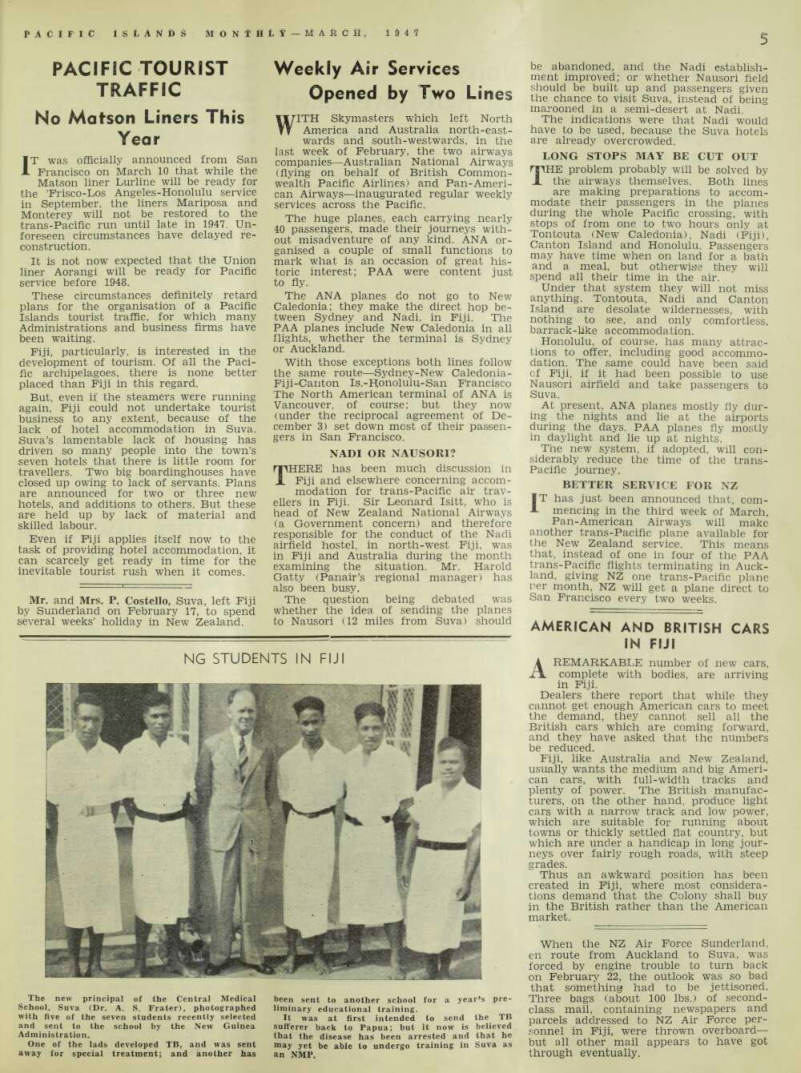
Ng Students In Fiji
The new principal of the Central Medical School, Suva (Dr. A. S. Prater), photographed with five of the seven students recently selected and sent to the school by the New Guinea Administration.
One of the lads developed TB, and was sent away for special treatment; and another has
been sent to another school for a year’s pre liminary educational training.
It was at first intended to send the TB sufferer back to Papua; but it now is believed that the disease has been arrested and that he may yet be able to undergo training in Suva as an NMP.
American And British Cars
In Fiji
A REMARKABLE number of new cars, complete with bodies, are arriving in Fiji.
Dealers there report that while they cannot get enough American cars to meet the demand, they cannot sell all the British cars which are coming forward, and they have asked that the numbers be reduced.
Fiji, like Australia and New Zealand, usually wants the medium and big Ameri can cars, with full-width tracks and plenty of power. The British manufac turers, on the other hand, produce light cars with a narrow track and low power, which are suitable for running about towns or thickly settled flat country, but which are under a handicap in long jour neys over fairly rough roads, with steep grades.
Thus an awkward position has been created in Fiji, where most considera tions demand that the Colony shall buy in the British rather than the American market.
When the NZ Air Force Sunderland, en route from Auckland to Suva, was forced by engine trouble to turn back on February 22, the outlook was so bad that something had to be jettisoned.
Three bags (about 100 lbs.) of second class mail, containing newspapers and parcels addressed to NZ Air Force per sonnel in Fiji, were thrown overboard — but all other mail appears to have got through eventually.
Advertisements & other items, p. 9 (1 item)
5
PACIFIC Islands MONtfltl - MAfiCH, 1 9 4 1
and Self-Government
Samoans’ Plea For Unity and Self-Government Europeans in Favour of a "Period of Transition"
mHE petition signed by 46 Samoan X chiefs and members of the Council, praying for self-government for a united Samoa (that is, that Western and Eastern Samoa be brought together as one nation) came before the Trusteeship Council of the United Nations in New York on March 10. So far as is known, it is still under consideration.
“It is difficult to guess what the out come may be/’ said an authority on Samoan affairs recently. “The Samoan Trusteeship Agreement, as between New Zealand and the Trusteeship Council, now has been accepted by the Council, and, legally, there seems nothing more to be done about it. The Mandate under which Western Samoa has been held for 25 years by New Zealand was a C Class Mandate, which means that the Samoan people actually have no official voice in the manner of how they are to be gov erned.
The Samoan people themselves do not take that view, however. In any event, they appear determined to press on with their demand for an ever-increasing measure of self-government.
We have received verbatim reports of important public meetings held in Apia, for discussion of matters relating to the future of Samoa, the transfer of control to the Trusteeship Council, and the Samoan people’s demand for the union of Western and Eastern Samoa and self government.
“Self-Government —Yes —But
How And When?”
A MEETING of European residents of Western Samoa held in Apia on De cember 17, was addressed by the Ad ministrator, Colonel F. W. Voelcker. The latter had had several discussions with the Samoans concerning the Agreement, and he deemed it wise, at that stage, to explain what had happened, what was now being done, and what was likely to happen.
His Honor presented a detailed, his torical sketch, covering events in Samoa
during the past 50 years, and the con trol of me country after World War I by New Zealand, subject to the League ox Nations. He carefully explained me provisions of the C Class Mandate; and ne claimed that New Zealand’s record in Samoa was good and creditable.
New Zealand, in drafting the Agree ment under which Samoa would be transferred from the League of Nations Mandate to the Trusteeship Council of the United Nations, had the assistance of Britain, United States, France and Australia. The Agreement reached him in Apia at the end of October; and it was submitted to a Fono of all Samoa on November 13, and was discussed in de tail by the Samoans. The Samoans re jected the Agreement on the ground that it was not essentially different from the Mandatory system, and took no cogni sance of the Samoans’ 25-years-old de mand for self-government. The Samoans men presented a petition for transmis sion to the Trusteeship Council. (See page 12 of December PIM.) His Honor took the Agreement, clause by clause, and argued that it represented “a tremendous advance” on the Mandate, and was worthy of acceptance by the Samoan people. He then similarly an alysed the Samoans’ petition. He sym pathised with their wish for union with Eastern Samoa but explained that that was outside his jurisdiction.
There was no fundamental difference between the Samoans’ wishes and the Agreement plan, he said. The United Nations agreed that the ultimate aim was self-government—the only difference between them was how and when. The Samoans apparently wanted self-govern ment at once; the Europeans argued that there must be a fairly long period of education and preparation—otherwise the condition of the Samoans would not im prove, but would deteriorate.
His Honor said that the petition had been sent forward for presentation to the Trusteeship Council in March, and the Samoans’ arguments and representa-
tions and arguments also would be pro perly presented.
Commenting later, the Hon Tatasese Tamasese said: “There is an idea that we cannot have self-government because we have no trained people. That might be true; but I would refer you to Tonga, where self-government was established before they had any qualified people, and so long as we have self-government we can employ anyone from any part of the world.”
A Period Of Transition
A MEETING of European residents of Samoa was held on February 3 to discuss the Trusteeship Agreement The Hon. A. G. Smyth, MLC, was chair man; and the attendance was about 120.
Mr. Smyth said they did not know what kind of self-government the Samoans wanted. In any event, Samoa should be placed permanently within the British Empire, either as a Crown Colony or as a dependency of New Zealand. “I do not think Samoa is yet ready to be an independent self-governing State,” said Mr. Smyth. “A democratic system of self-government is impossible until the Samoan social and political systems emerge from their present state and de velop into something more in accord with modern ideas.”
Mr. P. W. Glover, in an interesting and closely reasoned address, argued that the Samoans were not yet ready for self government; their present social and political organisation could not take care
(Continued on page 71)
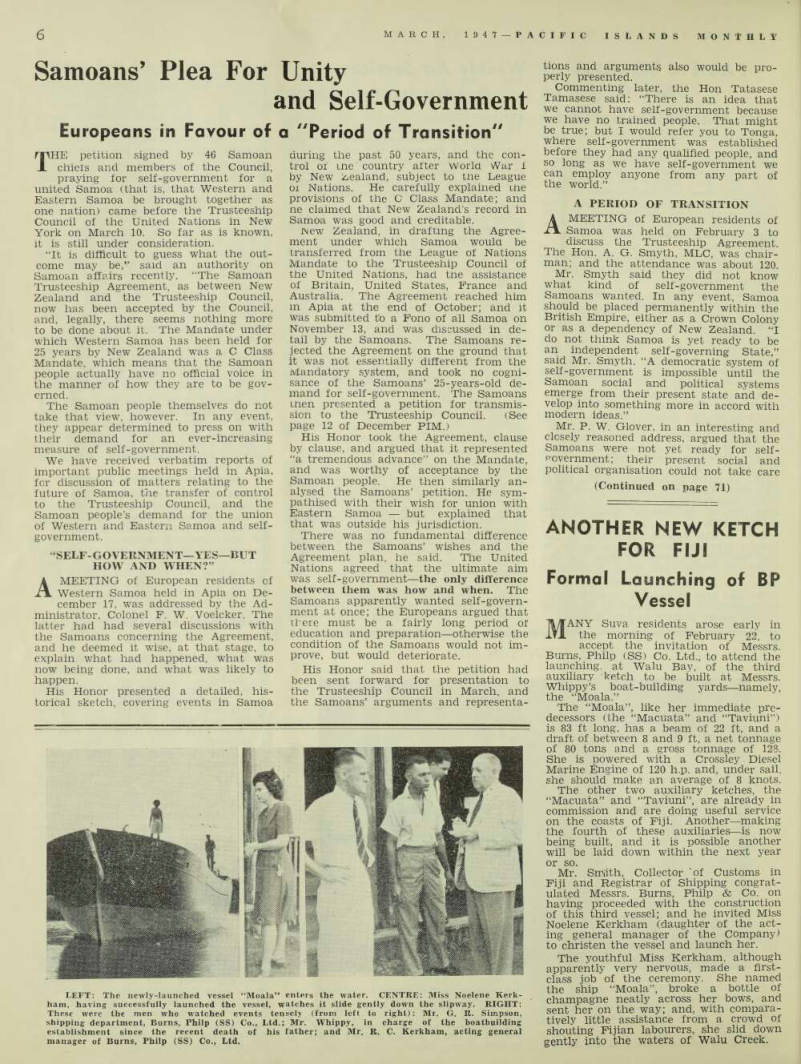
LEFT: The newly-launched vessel “Moala” enters the water. CENTRE: Miss Noelene Kerk ham, having successfully launched the vessel, watches it slide gently down the slipway. RIGHT; These were the men who watched events tensely (from left to right): Mr. G. R. Simpson, shipping department, Burns, Philp (SS) Co., Ltd.; Mr. Whippy, in charge of the boatbuilding establishment since the recent death of his father; and Mr. R. C. Kerkham, acting general manager of Burns, Philp (SS) Co., Ltd.
of their newly-acquired material knowl edge and modern conditions. “Theirs is a system of patriarchy modified by the early stages of feudalism. Is it any won der that their ideas on affairs of State, justice, finance, public service, general administration and so on are frequently at variance with those of Europeans?”
He urged that they should advise the Administrator that the plan of self-gov ernment for Samoa should be postponed for fifty years.
Hon. A. Stowers, MLC, said that if the Europeans would leave alone the 62,000 Samoans and the 5,000 Euronesians, they could look after themselves and manage their own affairs. When he was born in Samoa in 1883 Samoa was an indepen dent kingdom. The Europeans brought trouble into the country, and had kept trouble there ever since. He moved that they support the Samoan move for self government, and that the period of tran sition between present conditions a,nd self-government be considered by an elected committee representing the Euro peans, the Samoans and the Administra tion.
Mr. E. F. Paul pointed out that the Samoans did not ask for “immediate self government.” “I would not support the motion if it were for immediate self government. The time is not yet ripe; but I do believe that, in time, the Samoans will be capable and able to run their own affairs,” He argued in favour of “a period of transition,” when Sam oans would be given the chance to train themselves, with the assistance and sup port of New Zealand.
Mr. Glover said that, while he objected to immediate self-government, he did not object to self-government ultimately.
The motion was carried unanimously; and the following committee of 12 (pre sumably to represent the Europeans on the committee to discuss “the period of transition”) was elected; E. Annandale, Mrs. G. F. D. Betham, G. F. D. Betham, R. G. Bruce, R. H. Carruthers, F. Helg, J. Heig, Aleck Macdonald, H. W. Moors, Miss J. R. Nelson, E. F. Paul, R. Wetzell.
Philippines Example
ALL the indications are that the New Zealand Government, with the ap proval of the Trusteeship Council, will agree to a “period of transition,” during which the Samoans will be trained for virtual self-government.
Therefore, it would be to the advantage of all concerned to study the way in which the United States, having taken over the Philippines from Spain in 1898, gradually transferred governmental powers to the inexperienced hands of the Filipinos. There was a “transition period” between the passing of the Tydings- McDuffie Act of 1934 and the establish ment of almost complete independence in 1946. Many of the practical difficulties in the way of the Samoan plan are in dicated in the Philippines history.
Mr. “Biinny”Hammond, who has been acting as the representative of Guinea Airways Ltd., in New Guinea during the rehabilitation period, has now returned to Australia. The directors of Guinea Airways Ltd., have made no plans for the resumption of their air transportation services in New Guinea—it is presumed they are awaiting the result of the var ious air nationalsiation projects of the Commonwealth Government.
Formal Launching of BP
Another New Ketch
For Fiji
Vessel
MANY Suva residents arose early in the morning of February 22. to accept the invitation of Messrs.
Burns, Philp (SS) Co. Ltd., to attend the launching, at Walu Bay, of the third auxiliary ketch to be built at Messrs.
Whippy’s boat-building yards—namely, the “Moala.”
The “Moala”, like her immediate pre decessors (the “Macuata” and “Taviuni”) is 83 ft long, has a beam of 22 ft, and a draft of between 8 and 9 ft, a net tonnage of 80 tons and a gross tonnage of 128.
She is powered with a Crossley Diesel Marine Engine of 120 h.p. and, under sail, she should make an average of 8 knots.
The other two auxiliary ketches, the “Macuata” and “Taviuni”, are already in commission and are doing useful service on the coasts of Fiji. Another—making the fourth of these auxiliaries—is now being built, and it is possible another will be laid down within the next year or so.
Mr. Srrtith, Collector 'of Customs in Fiji and Registrar of Shipping congrat ulated Messrs. Burns, Philp & Co. on having proceeded with the constructipn of this third vessel; and he invited Miss Noelene Kerkham (daughter of the act ing general manager of the Company) to christen the vessel and launch her.
The youthful Miss Kerkham, although apparently very nervous, made a first class job of the ceremony. She named the ship “Moala”, broke a bottle of champagne neatly across her bows, and sent her on the way; and, with compara tively little assistance from a crowd of shouting Fijian labourers, she slid down gently into the waters of Walu Creek.
"Montoro" Will Go to Rabaul
Rabaul After All Sailing Despite Mis-information of Australian Shipping Board in Sydney
a t this writing (March 10) the “Mon- A toro” is scheduled to sail from Syd ney to ports in Papua and New Guinea' on March 22. Last sailing was on January 13—which will mean that over two months will have elapsed be tween shipments of goods, freezer sup plies and sea-borne passengers to the Territory Nor is it by any means certain that she will get away on the 22nd That depends upon the whim of the Sydney watersiders. * “Montoro” will go to Rabaul this time —despite the solemn assurance last month bv the New Guinea section of the Aus tralian Shipping Control Board that, it would not go this trip—or any trip—be cause it was impossible for the slow moving “Montoro” to carry sufficient coal to complete the trip. Our informa tion comes this time from Burns. Philp & Co., who operate the ship, and it pre sumably is more reliable. We do not know how the coal difficulty is to be overcome; perhaps in her long weeks of resting in Australian ports, the old “Mon toro” has been mysteriously rejuvenated. mHE question arises at this stage as to how rpfiphle is the information supplied bv the Australian Shipping Board with regard to movements of ships between Australian and New Guinea ports.
A month ago we were informed by the Svdnev office of the Board that posi tively the only three ships which could go to Rabaul in the next month or so were the “Salamaua.” the “Reynella” and the “Malaitq” (when she comes out of dock). Casual conversation with an offi cial of a shipping company the next day revealed that the “Merkur. then loading in Sydney, would carry essential food stuffs to Rabaul on he way to Japan; and that she would do so had been known in shipping circles for over a week.
At the beginning of March, the Board was still insisting 'that the “Montoro” would not, and could not go to Rabaul.
However, pressed to do so by an irate would-be passenger, an official of the Board consented to ring Burns, Philp and to his evident astonishment he found that “Montorc” would this time call at Rabaul.
It would be interesting to know who decides the movements of ships. The shipping companies do not and obviously no official of the Sydney branch of the Board is competent to give correct information concerning those movements.
Presumably the power of direction is in the hands of some rarified “authority” who sits in Canberra and whose belief is that the less the travelling public knows about the movements of ships between Sydney and New Guinea ports the better for all concerned.
Residents of Rabaul, and of outports in New Britain and New Ireland will, at all events, be glad to see the “Mon toro” when she does arrive. It will be their first real relief from isolation since the “Duntroon” called at Rabaul in Nov ember.
♦Sydney wharfies are again on strike and the ’’Montoro” is unlikely to sail until later In the month.
Eruption
Niuafo'ou Again in Eruption
A ROUND-THE-WORLD- yachtsman, Mr. F. M. Agnew of the yacht “Alone” has reported in Suva, Fiji, that when he passed the Tongan island of Niuafo’ou on the nights of January 26 and 27, volcanoes on the island were again in violent eruption. He said that the glow from the island was visible for a great distance and that the sea around the island was thickly coated with vol cano ash. (Due to wide-spread devastation fol lowing eruptions in September it was de cided by the Tongan government that the island should be abandoned and 1.200 inhabitants evacuated to Tongatabu.
The evacuation was carried out by the “Matua” in December.)
BGD Begin Operations
IT was announced in Sydney in early March that 1 dredge of Bulolo Gold Dredging Limited commenced operations in the Bulolo Valley, New Guinea, on February 20, and has since been in steady operation.
Dredge No. 2. is expected to be oper ating before the end of March and two others should commence digging gravel by May—if certain equipment arrives to schedule. Commencement dates of the other four dredges are an unknown quan tity at present.
Dredges 1 and 2 are functioning with the help of improvised equipment and the Company stres’ses the fact that until this is replaced, there is always a danger of stoppages.
Increasing Phosphate From
Nauru And Ocean Is.
A RAPIDLY increasing supply of phos nhatic rock is now coming out of Nauru and Ocean Islands. The two equatorial islands were released from Jap occupation late ip, 1945, and the heavy task of repairing the huge instal lations was undertaken by the British Phosphate Commission. Full production, however, will not be attained for another three years.
Most of these supplies are going to Australia and New Zealand and, to assist the latter countries in regaining their fertilisation programmes inter rupted during the war—the BPC is pur chasing phosphate supplies from other areas.
It Is Claimed That
Candlenuts Did This
rpHE Sydney newspaper heading “Natives JL Get Drunk on Candle-nuts” opens up new and exciting possibilities for consistent Island drinkers.
It apperas that wharf labourers, un loading a vessell from the East Indies, thought a consignment of candle-nuts looked good; and, as that is all that matters to a Sydney watersider, they ate of them copiously. (History does not relate how they got the shell off the candle-nuts. That is the problem that makes life so interest ing in the candle-nut world.) Within a short time, 15 wharfies bit the dust. All became intoxicated and fV »en violently ill: three were rushed to hospital for treatment: one is said to have gone blind for half an hour.
Island owners of pillaged cargoes from Svdney at least have something to thank candle-nuts for.
Cool Highlands
New Roads For
Samoa
Apia May Get Access to Cool Highlands
OUT of funds—about £50,000 —made available by the New Zealand Gov ernment from the profits of the Re parations Estates, the Administration of Western Samoa will build a good road around Savaii Island, and another road across Upolu, to connect Apia district with the South Coast.
These new roads will do much to open up both islands to new settlement.
The Upolu road may make some of the high and cool country of the interior readily accessible to residents of Apia, who suffer a good deal from the humid heat of that area.
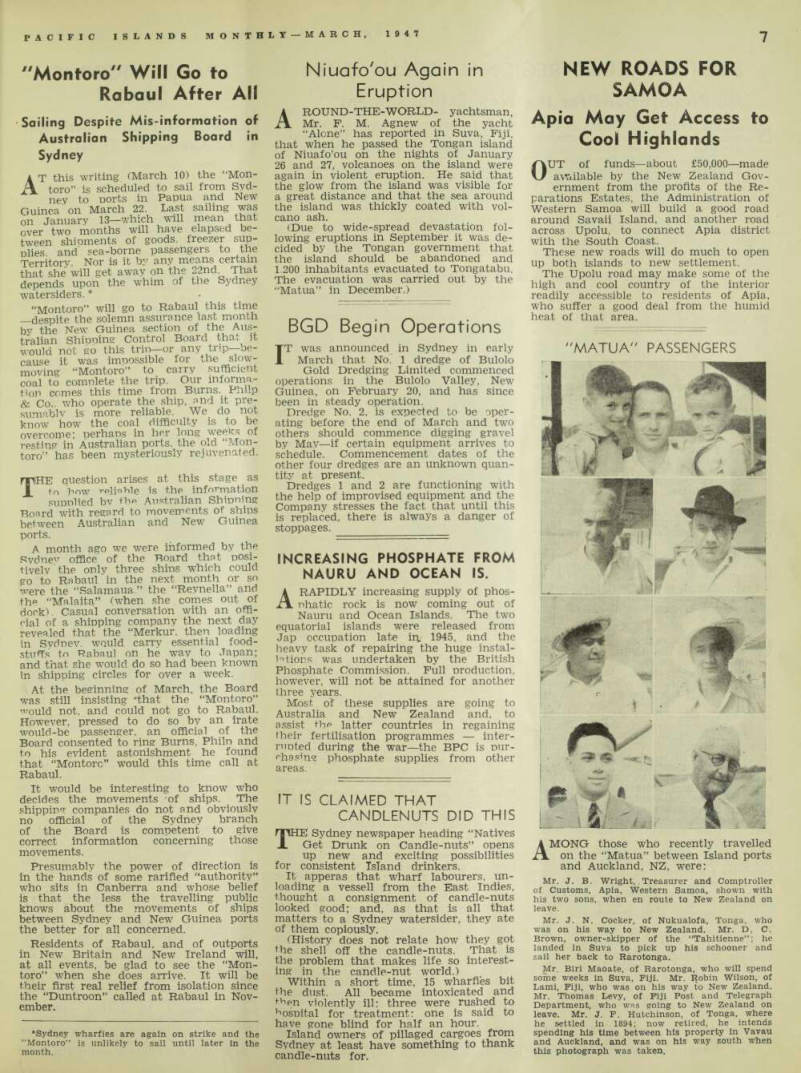
"Matua" Passengers
AMONG those who recently travelled
on the “Matua” between Island ports
and Auckland, NZ, were:
Mr. J. B. Wright,, Treasurer and Comptroller of Customs, Apia, Western Samoa, shown with his two sons, when en route to New Zealand on leave.
Mr. J. N. Cocker, of Nukualofa, Tonga, who was on his way to New Zealand. Mr. D. C.
Brown, owner-skipper of the “Tahitienne”; he landed In Suva to pick up his schooner and sail her back to Rarotonga.
Mr, Biri Maoate, of Rarotonga, who will spend some weeks in Suva, Fiji. Mr. Robin Wilson, of Lami, Fiji, who was on his way to New Zealand.
Mr. Thomas Levy, of Fiji Post and Telegraph Department, who was going to New Zealand on leave. Mr. J. F. Hutchinson, of Tonga, where he settled in 1894; now retired, he intends spending his time between his property In Vavau and Auckland, and was on his way south when this photograph was taken.
South Pacific Regional Commission
Preparations for the New Establishment
SINCE the South Pacific Regional Conference broke up early in February, the staff of the Australian Department of External Affairs has been busy with preparations for the establishment temporarily) in Sydney of the headquarters of the newly-created South Pacific Regional Commission. .. , f About March 20. the address of the Commission, and the name of the Organising Secretary, will be announced. A staff is being selected. As New Zealand
is jointly responsible with Australia for the plan, there will be a New Zealand officer included in the new staff in Syd ney.
The new staff will be immediately con cerned with procedure, the selection of a Secretary-General, and the preparations for the first meeting of the Commission.
Ml the nations concerned (Australia, Britain, United States, France, New Zea land and the Netherlands) will appoint members to the Commission, which will meet in Sydney in June or July.
Delegates 1 Reaction to the Canberra Conference
By R. W. Robson
IT was with regret that I found myself unable to attend the South Pacific Regional Conference in Canberra on January 26—an old-standing business arrangement kept me in New Zealand at that time.
But, as it turned out, this was an ad vantage. The politicians, after their fashion, closed the doors of the Confer ence against the press, except for two sessions; and all the really interesting discussions took place in camera. From the point of view of publicity—and I submit that in a thing like this publicity is essential—that was unwise. The large panel of journalists who had assembled in the belief that there would be real “meat” in this Conference were left kicking their heels in the Canberra heat; and, as is to be expected, their final sum maries were embittered and not very en couraging.
I was in New Zealand and Fiji when all the homing delegates bound east passed through—to New Zealand, to Fiji, to Western Samoa, to the Cook Islands and to French Oceania —and I had unexpected opportunities of discussing the Conference with them.
GENERALLY speaking, the favourable reactions to the ANZAC plan of set ting up a South Pacific Regional Commission were off-set, to an extent, by the non-Australian delegates’ resent ment of Australia’s attempt to “hog” the whole set-up. The non-Australian dele gates feel— and quite rightly—that most important territories of the Pacific lie outside Australian Territories of Papua and New Guinea. Why, then, should Australia try, in so stubborn a fashion, to shape the Conference and dominate the Commission?
The Australian delegates and spokes men left the non-Australians with the impression—probably quite unintentional and erroneous, but none the less a fact — that in their opinion no administrative record worthy of the name had been made in the other Territories, and that the policies of other countries in relation to native government in the Islands were not comparable in brilliance and design with the policies which the Australian Socialist Government is now trying to put into operation in Papua and New Guinea.
Australia’s readiness to pay 30 per cent, of the total cost of the new Commission, and her insistence that the headquarters of the Commission should be in either Australia or in the depressing little toy)n of Port Moresby at the extreme end of the region concerned, did nothing to lessen the other delegates’ suspicions.
IN a general way, the delegates were suspicious of certain plans more or less thrust upon them by Australia;
and I found everywhere a definite fear that the advisory function of the new South Pacific Regional Conference would be changed by the Socialist Governments of Australia, Britain and New Zealand into something more than advisory.
Another thing which troubled the dele gates lay in the haste and eagerness of the Australian Government in pushing on with widespread plans for research, by a variety of experts. Sober-thinking people argue that in this period of intense wide-world disturbance there is no great urgency in developing new and far reaching plans for the uplift of the Islands peoples. Time enough to make plans for the brown-skinned races when the majority of the white-skinned races have got over their post-war sicknesses and returned to better standards of life.
Instead of hurrying to appoint teams of exnerts, it is argued, it would be better to spend the next twelve months, while the world is recovering from its numerous sicknesses, in a general survey of admin istrative, health, educational and indus trial conditions in all the territories of the South Pacific, with a view to recog nising and lining up for consideration the actual needs of those nlaces, and the degree of examination and co-ordination required in any expert investigation.
IT is recognised that, as Australia was instrumental in calling the confer ence, and is naying 30 per cent, of the cost of the Commission, Australia is entitled to call most of the tune; but it will be a great mistake at this stage if the tune is loud and blatant and self assertive, and kept on a socialistic key.
Not everyone outside of Australia admires Australian Ministers’ performances as much as the Australian Ministers do.
I should be doing a completely wrong thing if I gave the impression that the dispersing delegates regarded the Confer ence as a failure and the new Commis sion as cock-eyed in its set-up. Pract ically all of them are supporters of the Commission. But some are not happy re garding immediate plans; and this is the time to sound a note of warning.
The new Commission has a tremendous possibility for good, and if it is wisely handled in its early and formative stages it will represent an achievement of which its early sponsors may well be proud.
But it is most necessary to remind the people in charge of it at this stage that Australia is not the world; that Austra lia’s share of the Pacific is represented only by a section of primitive Melanesia; and there are many South Pacific Terri tories which cannot be judged or legis lated for in terms of Melanesia.
The next meeting of the Fiji Legis lative Council has been tentatively set for the second week in March.
"Papa" Viggo Is
Dead
Life Story of Famous South Seas Captain and Trader
From Our Own Correspondent
Rarotonga, Feb. 21
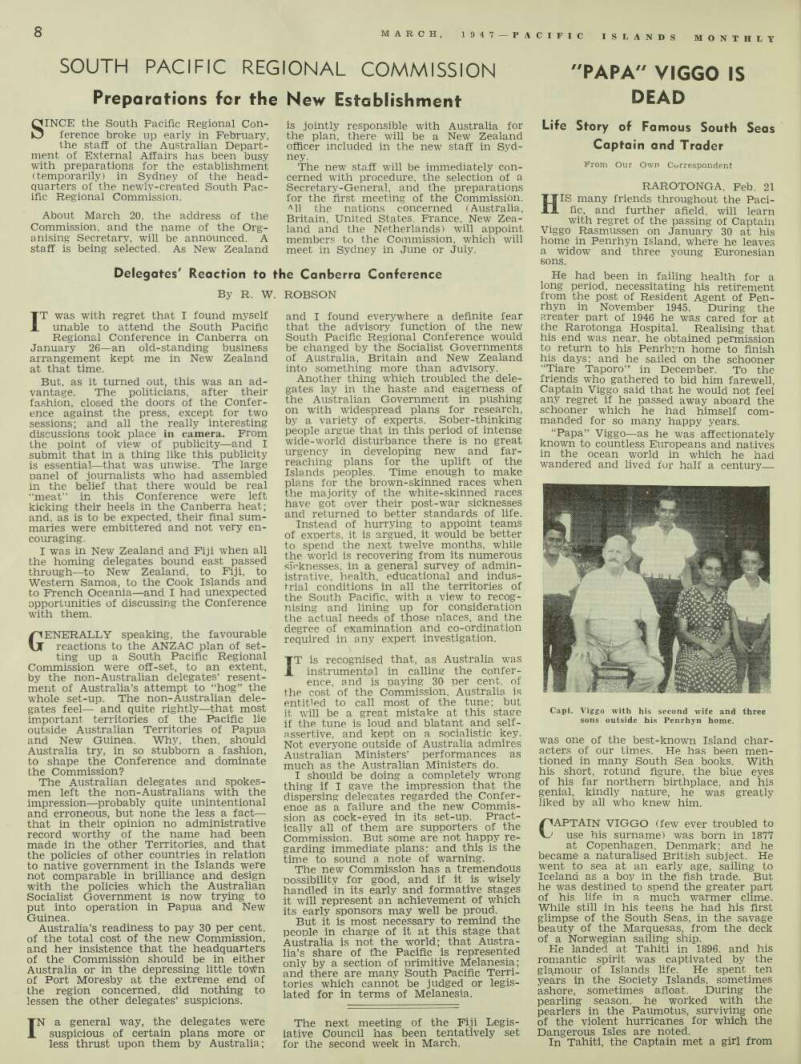
HIS many friends throughout the Paci fic, and further afield, will learn with regret of the passing of Captain Viggo Rasmussen on January 30 at his home in Penrhyn Island, where he leaves a widow and three young Euronesian sons.
He had been in failing health for a long period, necessitating his retirement from the post of Resident Agent of Pen rhyn in November 1945. During the greater part of 1946 he was cared for at the Rarotonga Hospital. Realising that his end was near, he obtained permission to return to his Penrhyn home to finish his days: and he sailed on the schooner “Tiare Taporo”’ in December. To the friends who gathered to bid him farewell, Captain Viggo said that he would not feel any regret if he passed away aboard the schooner which he had himself com manded for so many happy years.
“Papa” Viggo—as he was affectionately known to countless Europeans and natives in the ocean world in which he had wandered and lived for half a century
was one of the best-known Island char acters of our times. He has been men tioned in many South Sea books. With his short, rotund figure, the blue eyes of his far northern birthplace, and his genial, kindly nature, he was greatly liked by all who knew him.
CIAPTAIN VIGGO (few ever troubled to ' use his surname) was born in 1877 at Copenhagen, Denmark: and he became a naturalised British subject. He went to sea at an early age, sailing to Iceland as a boy in the fish trade. But he was destined to spend the greater part of his life in a much warmer clime.
While still in his teens he had his first glimpse of the South Seas, in the savage beauty of the Marquesas, from the deck of a Norwegian sailing ship.
He landed at Tahiti in 1896. and his romantic spirit was captivated by the glqmour of Islands life. He spent ten years in the Society Islands, sometimes ashore, sometimes afloat. During the pearling season, he worked with the pearlers in the Paumotus, surviving one of the violent hurricanes for which the Dangerous Isles are noted.
In Tahiti, the Captain met a girl from
Capt. Viggo with his second wife and three sons outside his Penrhyn home.
the small island of Mitiaro, in the Cook Group. He decided to make her his wife and set up as the lone trader on her home island. Arriving in the Cook Islands in 1906, he made preparations for the venture. He built himself a neat little home and a store on Mitiaro and for a number of years he lived happily there as business manager, friend and adviser of the people.
Again the irresistible call of the sea pre vailed, and Viggo the sailor cruised among the widespread islands and atolls, first as a supercargo, and later as skipper of the schooners “Vaite” and “Tiare Taporo”, until declining health forced him reluct antly to give up the life that he loved so well.
As sailor and trader, Captain Viggo worked for the Cook Islands firm of Don ald and Edinborough—later A, B. Donald Ltd.—for 30 years.
On the recommendation of his long ex perience of islanders and island affairs, he was appointed Resident Agent at Pen rhyn Island in 1936. rE hoped-for tranquility of his last years was rudely shattered when his remote and peaceful atoll was sud denly pounced upon as an ideal landing base for American bombers. The troubles and trials of those swift tumultuous years were graphically told by James Norman Hall in his story “Lost Island”, in which gentle “Papa” Viggo is the leading char acter, doing his best as liaison officer between the incoming American troops and the simple, bewildered Penrhyn natives.
The mental stress of those trying times told heavily on the ageing man.
Captain Viggo was a lover of poetry and good literature, and he was also an artist of considerable ability. Most European homes in the Cook Islands and others in Tahiti have one or more Viggo oil-paint ings. Mostly they are of white-winged sailing ships on blue seas beneath trade wind skies. But they are not all South Sea schooners. Some depict old Danish and Norwegian sailing ships slogging through the cold North Sea. They are memory sketches of the ships whose swaying decks the artist once trod.
Thus, scattered throughout the Islands are permanent reminders of a man who loved the Islands and the sea. He left paintings on the ceiling of his house in Mitiaro. They are still there, but sooted and begrimed by the mosquito-smudge and cooking-fires of native residents, so that they are barely recognisable.
He was a musician too. We shall always remember the jolly little sailorman and his rollicking accompaniments on his accordian to sea-chanties and songs of the islands.
So Captain Viggo Rasmussen, a South seaman who always remembered with affection his Scandinavian homeland, rests among the white coral, forever within sound of the breaking surf.
Samoan Faipule On Tour
Apia, March 3 A PARTY of four members of the Samoa Fono of Faipule has left for a trip to New Zealand, at the invi tation and as guests of the New Zea land Government. They are accom panied by an interpreter and will be away for some three weeks.
The Faipule are To’omatua Tua and Te’o Simaile, from Savai’i, and Tuilagi Fetu and Ale Malu from Upolu, with the interpreter Matatumua A.
Pacific Health Service
Tonga Joins South Pacific Health Service
rE Government of Tonga has ac cepted an invitation to join the South Pacific Health Service.
The original members of the Service, which was established in September, 1946, were Fiji, the Gilbert and Ellice Islands Colony, the British Solomon Islands Protectorate, Western Samoa, the Cook Islands and the Tokelau Islands.
Marriage Of Former
Rabaul Resident
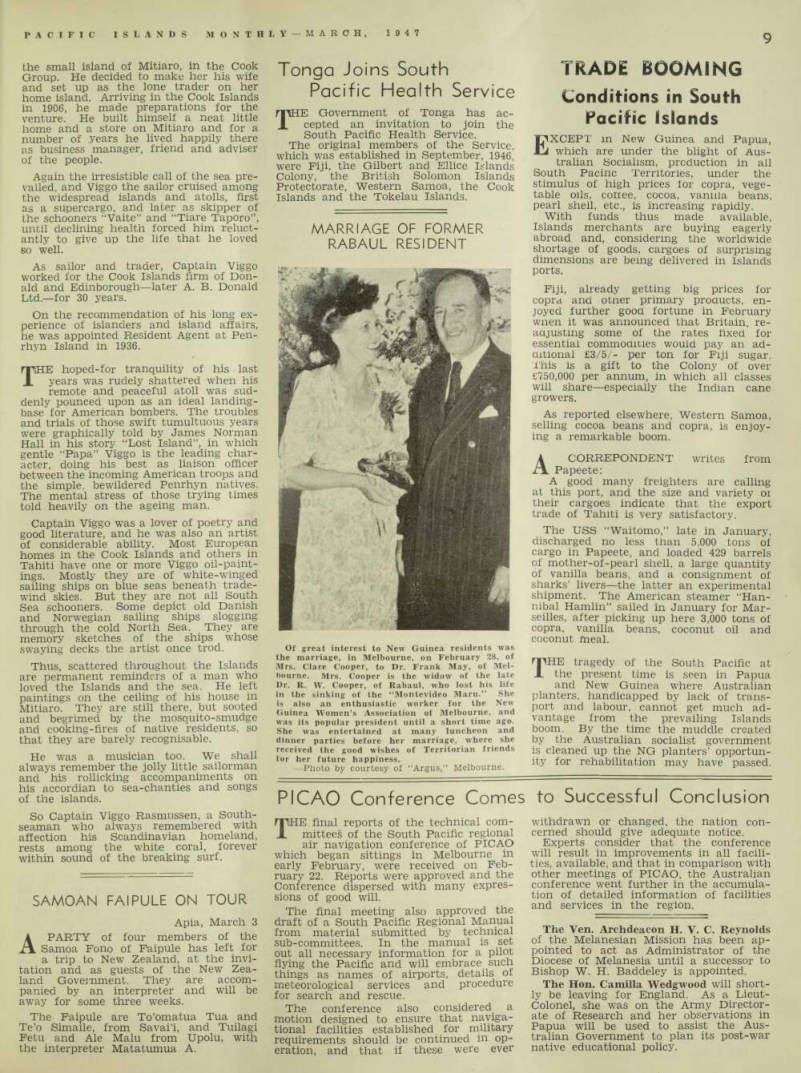
Of great interest to New Guinea residents was the marriage, in Melbourne, on February 28, of Mrs. Clare Cooper, to Dr. Frank May, of Mel bourne. Mrs. Cooper is the widow of the late Dr. R. W. Cooper, of Rabaul, who lost his life in the sinking of the “Montevideo Maru.” She is also an enthusiastic worker for the New Guinea Women’s Association of Melbourne, and was its popular president until a short time ago.
She was entertained at many luncheon and dinner parties before her marriage, where she received the good wishes of Territorian friends for her future happiness. —Photo by courtesy of “Argus,” Melbourne.
Trade Booming
Conditions in South Pacific Islands
EXCEPT in New Guinea and Papua, which are under the blight of Aus tralian Socialism, production in all South Pacinc Territories, under the stimulus of high prices for copra, vege table oils, cohee, cocoa, vanilla beans, pearl shell, etc,, is increasing rapidly.
With funds thus made available, Islands merchants are buying eagerly abroad and, considering the worldwide shortage of goods, cargoes of surprising dimensions are being delivered in Islands ports.
Fiji, already getting big prices for copra and otner primary products, en joyed further good fortune in February wnen it was announced that Britain, re adjusting some of the rates fixed for essential commodities would pay an ad ditional £3/5/- per ton for Fiji sugar.
This is a gift to the Colony of over £750,000 per annum, in which all classes will share—especially the Indian cane growers.
As reported elsewhere, Western Samoa, selling cocoa beans and copra, is enjoy ing a remarkable boom.
ACORREPONDENT writes from Papeete: A good many freighters are calling at this port, and the size and variety oi their cargoes indicate that the export trade of Tahiti is very satisfactory.
The USS “Waitomo,” late in January, discharged no less than 5,000 tons of cargo in Papeete, and loaded 429 barrels of mother-of-pearl shell, a large quantity of vanilla beans, and a consignment of sharks’ livers —the latter an experimental shipment. The American steamer “Han nibal Hamlin” sailed in January for Mar seilles, after picking up here 3,000 tons of copra, vanilla beans, coconut oil and coconut fneal.
THE tragedy of the South Pacific at the present time is seen in Papua and New Guinea where Australian planters, handicapped by lack of trans port and labour, cannot get much ad vantage from the prevailing Islands boom. By the time the muddle created by the Australian socialist government is cleaned up the NG planters’ opportun ity for rehabilitation may have passed.
PICAO Conference Comes to Successful Conclusion
rE final reports of the technical committees of the South Pacific regional air navigation conference of PICAO which began sittings in Melbourne in early February were received on February 22. Reports were approved and the Conference dispersed with many expressions of good will The final meeting also approved the draft of a South Pacific Regional Manual from material submitted by technical sub-committees. In the manual is set out all necessary information for a pilot flying the Pacific and will embrace such things as names of airports, details of meteorological services and procedure for search and rescue.
The conference also considered a motion designed to ensure that navigational facilities established for military requirements should be continued in operation, and that if these were ever
withdrawn or changed, the nation con cerned should give adequate notice, Experts consider that the conference will result in improvements in all facili ties, available, and that in comparison with other meetings of PICAO, the Australian conference went further in the accumula tion of detailed information of facilities and services in the region. , , _, The Yen. Archdeacon H. V. €. Reynolds of the Melanesian Mission has been ap pointed to act as Administrator of the Diocese of Melanesia until a successor to Bishop W. H. Baddeley is appointed, The Hon. Camilla Wedgwood will short ly be leaving for England. As a Lieut- Colonel, she was on the Army Director ate of Research and her observations m Papua will be used to assist the Aus tralian Government to plan its post-war native educational policy.
Fiji
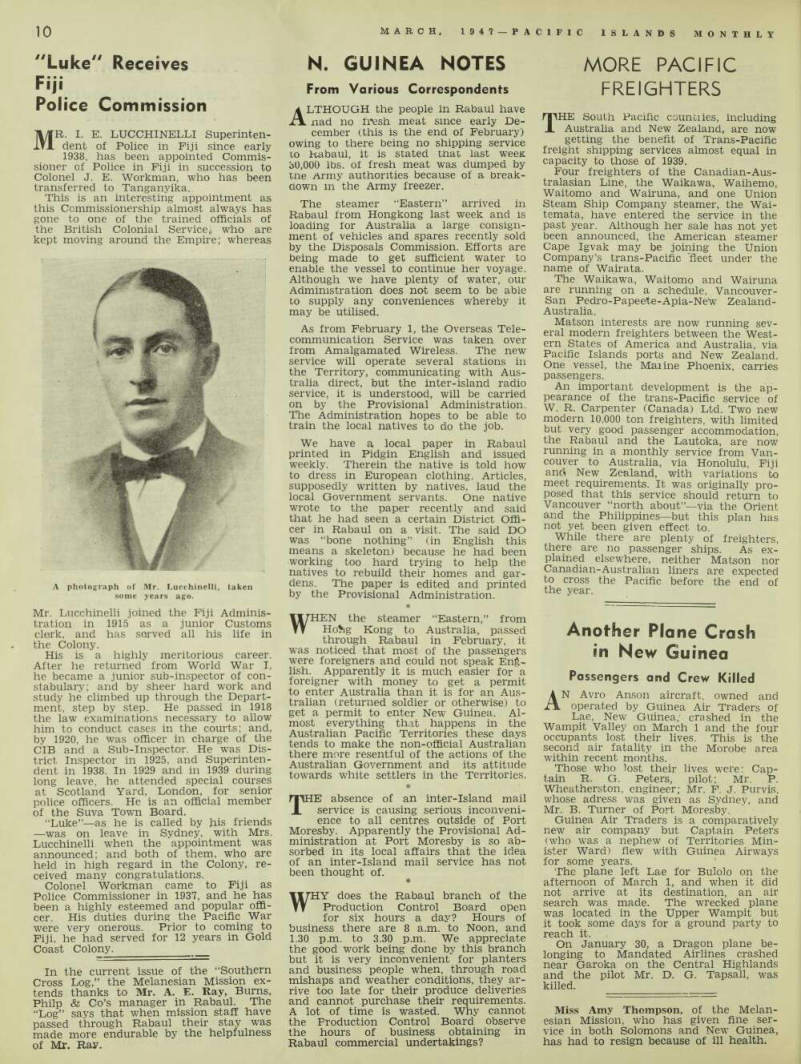
"Luke" Receives Fiji Police Commission
MR. I. E. LUCCHINELLI Superinten dent of Police in Fiji since early 1938, has been appointed Commis sioner of Police in Fiji in succession to Colonel J. E. Workman, who has been transferred to Tanganyika.
This is an interesting appointment as this Commissionership almost always has gone to one of the trained officials of the British Colonial Servicej who are kept moving around the Empire; whereas
Mr. Lucchinelli joined the Fiji Adminis tration in 1915 as a junior Customs clerk, and has served all his life in the Colony.
His is a highly meritorious career.
After he returned from World War I, he became a junior sub-inspector of con stabulary; and by sheer hard work and study he climbed up through the Depart ment, step by step. He passed in 1918 the law examinations necessary to allow him to conduct cases in the courts; and, by 1920, he was officer in charge of the CIB and a Sub-Inspector. He was Dis trict Inspector in 1925, and Superinten dent in 1938. In 1929 and in 1939 during long leave, he attended special courses at Scotland Yard, London, for senior police officers. He is an official member of the Suva Town Board.
“Luke” —as he is called by his friends —was on leave in Sydney, with Mrs.
Lucchinelli when the appointment was announced; and both of them, who are held in high regard in the Colony, re ceived many congratulations.
Colonel Workman came to Fiji as Police Commissioner in 1937, and he has been a highly esteemed and popular offi cer. His duties during the Pacific War were very onerous. Prior to coming to Fiji, he had served for 12 years in Gold Coast Colony.
In the current issue of the “Southern Cross Log,” the Melanesian Mission ex tends thanks to Mr. A. E. Ray, Burns, Philp & Co’s manager in Rabaul. The “Log” says that when mission staff have passed through Rabaul their stay was made more endurable by the helpfulness of Mr. Ray.
A photograph of Mr. Lucchinelli, taken some years ago.
N. Guinea Notes
From Various Correspondents
ALTHOUGH the people in Rabaul have nad no fresh meat since early De cember (this is the end of February) owing to there being no shipping service to Rabaul, it is stated that last weex 30,000 lbs. of fresh meat was dumped by tne Army authorities because of a break down in the Army freezer.
The steamer “Eastern” arrived in Rabaul from Hongkong last week and is loading for Australia a large consign ment of vehicles and spares recently sold by the Disposals Commission. Efforts are being made to get sufficient water to enable the vessel to continue her voyage.
Although we have plenty of water, our Administration does not seem to be able co supply any conveniences whereby it may be utilised.
As from February 1, the Overseas Tele communication Service was taken over from Amalgamated Wireless. The new service will operate several stations in the Territory, communicating with Aus tralia direct, but the inter-island radio service, it is understood, will be carried on by the Provisional Administration.
The Administration hopes to be able to train the local natives to do the job.
We have a local paper in Rabaul printed in Pidgin English and issued weekly. Therein the native is told how to dress in European clothing. Articles, supposedly written by natives, laud the local Government servants. One native wrote to the paper recently and said that he had seen a certain District Offi cer in Rabaul on a visit. The said DO was “bone nothing” (in English this means a skeleton) because he had been working too hard trying to help the natives to rebuild their homes and gar dens. The paper is edited and printed by the Provisional Administration.
WHEN the steamer “Eastern,” from Hohg Kong to Australia, passed through Rabaul in February, it was noticed that most of the passengers were foreigners and could not speak Eng lish. Apparently it is much easier for a foreigner with money to get a permit to enter Australia than it is for an Aus tralian (returned soldier or otherwise) to get a permit to enter New Guinea. Al most everything that happens in the Australian Pacific Territories these days tends to make the non-official Australian there more resentful of the actions of the Australian Government and its attitude towards white settlers in the Territories. * rE absence of an inter-island mail service is causing serious inconveni ence to all centres outside of Port Moresby. Apparently the Provisional Ad ministration at Port Moresby is so ab sorbed in its local affairs that the idea of an inter-island mail service has not been thought of. * 117 HY does the Rabaul branch of the ▼ ▼ Production Control Board open for six hours a day? Hours of business there are 8 a.m. to Noon, and 1.30 p.m. to 3.30 p.m. We appreciate the good work being done by this branch but it is very inconvenient for planters and business people when, through road mishaps and weather conditions, they ar rive too late for their produce deliveries and cannot purchase their requirements.
A lot of time is wasted. Why cannot the Production Control Board observe the hours of business obtaining in Rabaul commercial undertakings?
More Pacific
Freighters
THE South Pacific countiies, including Australia and New Zealand, are now getting the benefit of Trans-Pacific freight shipping services almost equal in capacity to those of 1939, Four freighters of the Canadian-Aus tralasian Line, the Waikawa, Waihemo, Waitomo and Wairuna, and one Union Steam Ship Company steamer, the Wai temata, have entered the service in the past year. Although her sale has not yet been announced, the American steamer Cape Igvak may be joining the Union Company’s trans-Pacific 'fleet under the name of Wairata.
The Waikawa, Waitomo and Wairuna are running on a schedule, Vancouver- San Pedro-Papeete-Apia-Ne'w Zealand- Australia.
Matson interests are now running sev eral modem freighters between the West ern States of America and Australia, via Pacific Islands ports and New Zealand.
One vessel, the Maiine Phoenix, carries passengers.
An important development is the ap pearance of the trans-Pacific service of W. R. Carpenter (Canada) Ltd. Two new modern 10,000 ton freighters, with limited but very good passenger accommodation, the Rabaul and the Lautoka, are now running in a monthly service from Van couver to Australia, via Honolulu, Fiji and New Zealand, with variations to meet requirements. It was originally pro posed that this service should return to Vancouver “north about”—via the Orient and the Philippines—but this plan has not yet been given effect to.
While there are plenty of freighters, there are no passenger ships. As ex plained elsewhere, neither Matson nor Canadian-Australian liners are expected to cross the Pacific before the end of the year.
Another Plane Crash
in New Guinea Passengers and Crew Killed
AN Avro Anson aircraft, owned and operated by Guinea Air Traders of Lae, New Guinea, crashed in the Wampit Valley on March 1 and the four occupants lost their lives. This is the second air fatality in the Morobe area within recent months.
Those who lost their lives were: Cap tain R. G. Peters, pilot; Mr. P.
Wheatherston, engineer; Mr. F. J. Purvis, whose adress was given as Sydney, and Mr. B. Turner of Port Moresby.
Guinea Air Traders is a comparatively new air company but Captain Peters (who was a nephew of Territories Min ister Ward) flew with Guinea Airways for some years.
The plane left Lae for Bulolo on the afternoon of March 1, and when it did not arrive at its destination, an air search was made. The wrecked plane was located in the Upper Wampit but it took some days for a ground party to reach it.
On January 30, a Dragon plane be longing to Mandated Airlines crashed near Garoka on the Central Highlands and the pilot Mr. D. G. Tapsall, was killed.
Miss Amy Thompson, of the Melan esian Mission, who has given fine ser vice in both Solomons and New Guinea, has had to resign because of ill health.
Residents Work Their Passage to BSI
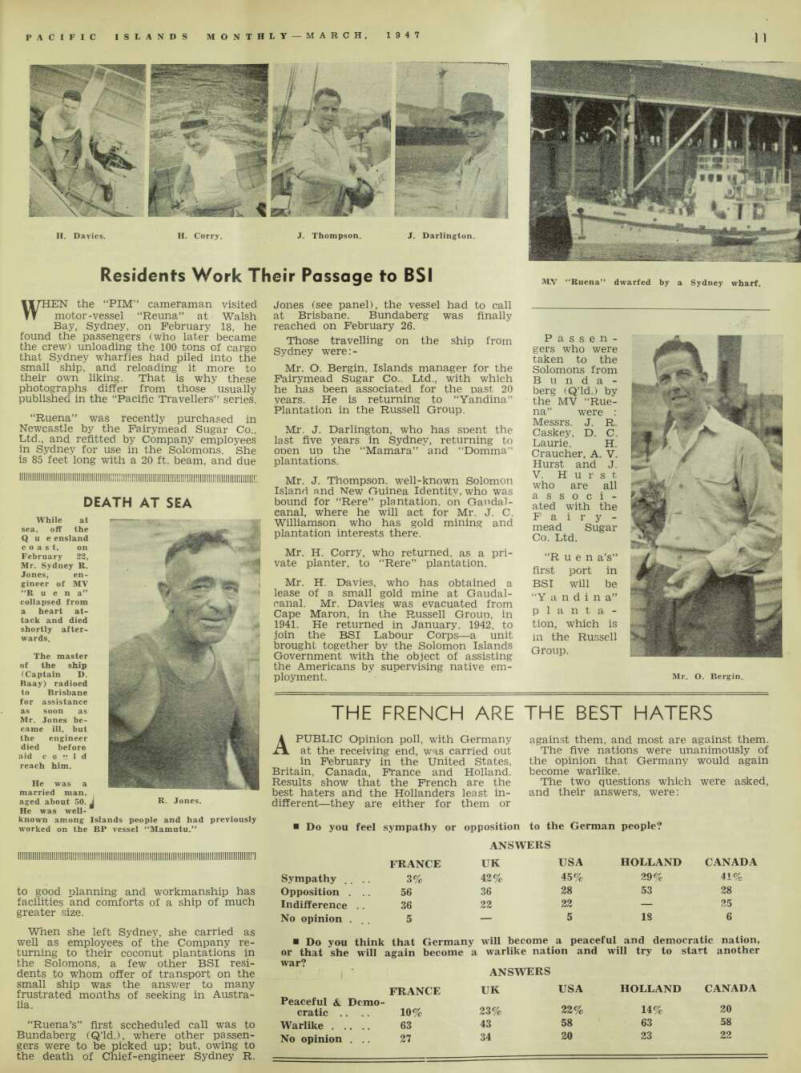
117 HEN the “PIM” cameraman visited TT motor-vessel “Reuna” at Walsh Bay, Sydney, on February 18, he found the passengers (who later became the crew) unloading the 100 tons of cargo that Sydney wharfies had piled into the small ship, and reloading it more to their own liking. That is why these photographs differ from those usually published in the “Pacific Travellers” series.
“Ruena” was recently purchased in Newcastle by the Fairymead Sugar Co..
Ltd., and refitted by Company employees in Sydney for use in the Solomons. She is 85 feet long with a 20 ft. beam, and due
to good planning and workmanship has facilities "and comforts of a ship of much greater size.
When she left Sydney, she carried as well as employees of the Company re turning to their coconut plantations in the Solomons, a few other BSI resi dents to whom offer of transport on the small ship was the answer to many frustrated months of seeking in Austra lia.
“Ruena’s” first sccheduled call was to Bundaberg (Q’ld.), where other passen gers were to be picked up; but, owing to the death of Chief-engineer Sydney R.
Jones (see panel), the vessel had to call at Brisbane. Bundaberg was finally reached on February 26.
Those travelling on the ship from Sydney were: - Mr. O. Bergin, Islands manager for the Fairymead Sugar Co., Ltd., with which he has been associated for the past 20 years. He is returning to “Yandina”
Plantation in the Russell Group.
Mr. J. Darlington, who has spent the last five years in Sydney, returning to open up the “Mamara” and “Domma" plantations.
Mr. J. Thompson, well-known Solomon Island and New Guinea Identity, who was bound for “Rere” plantation, on Gaudal canal, where he will act for Mr. J. C.
Williamson who has gold mining and plantation interests there.
Mr. H. Corry, who returned, as a pri vate planter, to “Rere” plantation.
Mr. H. Davies, who has obtained a lease of a small gold mine at Gaudal canal. Mr. Davies was evacuated from Cape Maron, in the Russell Group, in 1941. He returned in January. 1942, to join the BSI Labour Corps—a unit brought together by the Solomon Islands Government with the object of assisting the Americans by supervising native em ployment.
H. Davies.
H. Corry.
J. Thompson.
MV “Ruena” dwarfed by a Sydney wharf.
Mr. O. Bergin.
Passen gers who were taken to the Solomons from Bund a berg (Q’ld.) by the MV “Rue na” were: Messrs. J. R.
Caskey, D. C.
Laurie, H.
Craucher, A. V.
Hurst and J.
V. Hurst who are all associ ated with the Fairy mead Sugar Co. Ltd.
“Ruena’s” first port in BSI will be "Yandina” planta tion, which is in the Russell Group.
J. Darlington.
Death At Sea
While at sea, off the Q u e ensland coast, on February 22, Mr. Sydney R.
Jones, en gineer of MV “R u e n a” collapsed from a heart at tack and died shortly after wards.
The master of the ship (Captain D.
Baay) radioed to Brisbane for assistance as soon as Mr. Jones be came ill, but the engineer died before aid could reach him.
He was a married man, aged about 50.
He was well
known among Islands people and had previously worked on the BP vessel “Mamutu.”
R. Jones.
The French Are The Best Haters
A PUBLIC Opinion poll, with Germany at the receiving end, was carried out in February in the United States, Britain, Canada, France and Holland.
Results show that the French are the best haters and the Hollanders least indifferent—they are either for them or
against them, and most are against them, The five nations were unanimously of the opinion that Germany would again become warlike.
The two questions which were asked, and their answers, were:
ĦJhĴ
Do you feel sympathy or opposition to the German people?
Answers
France
UK
Usa
Holland
Canada
Sympathy 3% 42% 45% 29% 41% Opposition . 56 36 28 53 28 Indifference 36 22 22 — 25 No opinion . 5 — 5 IS 6 ■ Do you think that Germany will become a peaceful and democratic nation, or that she war?
. V f i
will again become a warlike nation and will try to stai
Answers
rt another
France
Peaceful Demo- UK
Usa
Holland
Canada
cratic 10% 23% 22% 14% 20 Warlike . .. 63 43 58 63 58 No opinion . 27 34 20 23 22
George Aumuller
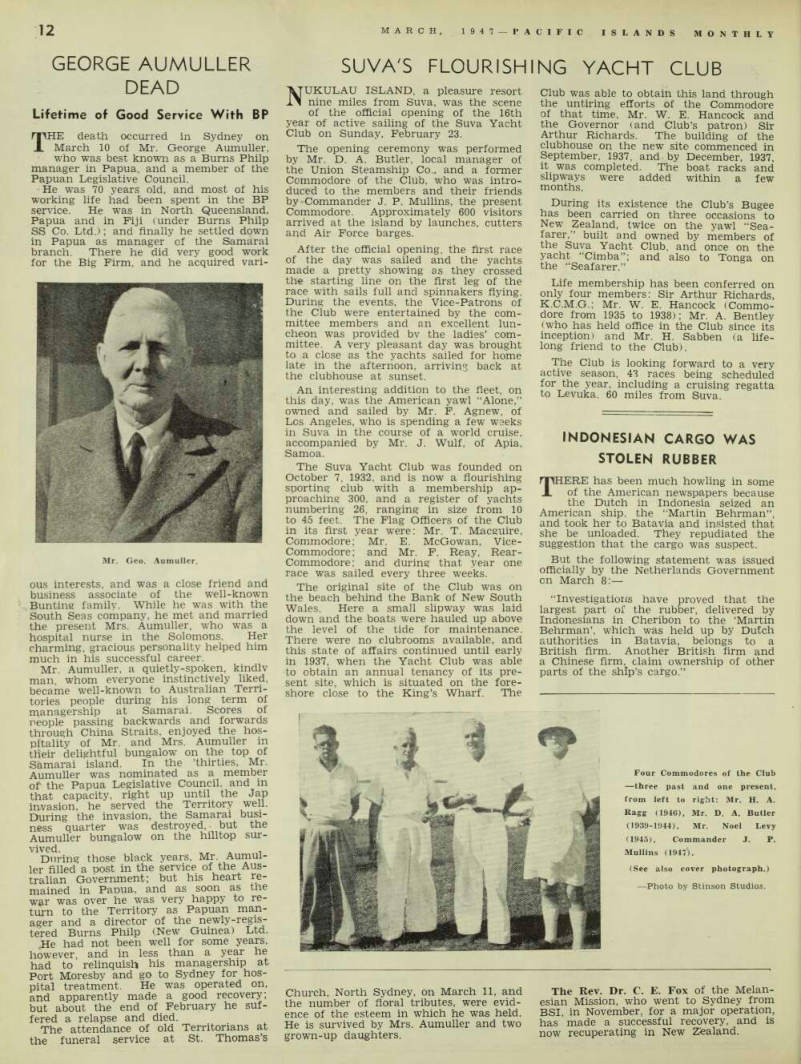
Dead
Lifetime of Good Service With BP
THE death occurred in Sydney on March 10 of Mr. George Aumuller, who was best known as a Burns Philp manager in Papua, and a member of the Papuan Legislative Council.
He was 70 years old, and most of his working life had been spent in the BP service. He was in North Queensland, Papua and in Fiji (under Burns Philp SS Co. Ltd.); and finally he settled down in Papua as manager of the Samarai branch. There he did very good work for the Big Firm, and he acquired vari-
ous interests, and was a close friend and business associate of the well-known Buntine family. While he was with the South Seas company, he met and married the present Mrs. Aumuller, who was a hospital nurse in the Solomons. Her charming, gracious personality helped him much in his successful career.
Mr. Aumuller, a quietly-spoken, kindly man. whom everyone instinctively liked, became well-known to Australian Terri tories people during his long term of managership at Samarai. Scores of people passing backwards and forwards through China Straits, enjoyed the hos pitality of Mr. and Mrs. Aumuller in tlieir delightful bungalow on the top of Samarai island. In the ’thirties, Mr.
Aumuller was nominated as a member of the Papua Legislative Council, and in that capacity, right up until the Jap invasion, he served the Territory well.
During the invasion, the Samarai busi ness quarter was destroyed, - but the Aumuller bungalow on the hilltop sur vived. , During those black years, Mr. Aumul ler filled a oost in the service of the Aus tralian Government; but his heart re mained in Papua, and as soon as the war was over he was very happy to re turn to the Territory as Papuan man ager and a director of the newly-regis tered Burns Philp (New Guinea) Ltd.
Jle had not been well for some years, however, and in less than a year he had to relinquish his managership at Port Moresby and go to Sydney for hos pital treatment. He was operated on, and apparently made a good recovery; but about the end of February he suf fered a relapse and died.
The attendance of old Territorians at the funeral service at St. Thomas’s
Church, North Sydney, on March 11, and the number of floral tributes, were evidence of the esteem in which he was held.
He is survived by Mrs. Aumuller and two grown-up daughters.
The Rev. Dr. C. E. Fox of the Melan esian Mission, who went to Sydney from BSI, in November, for a major operation, has made a successful recovery and is now recuperating in New Zealand.
Mr. Geo. Aumuller.
Four Commodores of the Club —three past and one present, from left to right: Mr. H. A.
Ragg (1946), Mr. D. A. Butler (1939-1944), Mr. Noel Levy (1945), Commander J. P.
Mullins (1947).
(See also cover photograph.) —Photo by Stinson Studios.
Suva's Flourishing Yacht Club
NUKULAU ISLAND, a pleasure resort nine miles from Suva, was the scene of the official opening of the 16th year of active sailing of the Suva Yacht Club on Sunday, February 23.
The opening ceremony was performed by Mr. D. A. Butler, local manager of the Union Steamship Co., and a former Commodore of the Club, who was intro duced to the members and their friends by Commander J. P. Mullins, the present Commodore. Approximately 600 visitors arrived at the island by launches, cutters and Air Force barges.
After the official opening, the first race of the day was sailed and the yachts made a pretty showing as they crossed the starting line on the first leg of the race with sails full and spinnakers flying.
During the events, the Vice-Patrons of the Club were entertained by the com mittee members and an excellent lun cheon was provided by the ladies’ com mittee. A very pleasant day was brought to a close as the yachts sailed for home late in the afternoon, arriving back at the clubhouse at sunset.
An interesting addition to the fleet, on this day, was the American yawl “Alone,” owned and sailed by Mr. F. Agnew, of Los Angeles, who is spending a few weeks in Suva in the course of a world cruise, accompanied by Mr. J. Wulf, of Apia, Samoa.
The Suva Yacht Club was founded on October 7, 1932, and is now a flourishing sporting club with a membership ap proaching 300, and a register of yachts numbering 26, ranging in size from 10 to 45 feet. The Flag Officers of the Club in its first year were: Mr. T. Maceuire, Commodore: Mr. E. McGowan, Vice- Commodore; and Mr. F. Reay, Rear- Commodore : and during that year one race was sailed every three weeks.
The original site of the Club was on the beach behind the Bank of New South Wales. Here a small slipway was laid down and the boats were hauled up above the level of the tide for maintenance.
There were no clubrooms available, and this state of affairs continued until early in 1937, when the Yacht Club was able to obtain an annual tenancy of its pre sent site, which is situated on the fore shore close to the King’s Wharf. The
Club was able to obtain this land through the untiring efforts of the Commodore of that time, Mr. W. E. Hancock and the Governor (and Club’s patron) Sir Arthur Richards. The building of the clubhouse on the new site commenced in September, 1937, and by December, 1937, it was completed. The boat racks and slipways were added within a few months.
During its existence the Club’s Bugee has been carried on three occasions to New Zealand, twice on the yawl “Sea farer,” built and owned by members of the Suva Yacht Club, and once on the yacht “Cimba”; and also to Tonga on the “Seafarer.”
Life membership has been conferred on only four members: Sir Arthur Richards, K.C.M.G.; Mr. W. E. Hancock (Commo dore from 1935 to 1938); Mr. A. Bentley (who has held office in the Club since its inception) and Mr. H. Sabben (a life long friend to the Club).
The Club is looking forward to a very active season, 43 races being scheduled for the year, including a cruising regatta to Levuka. 60 miles from Suva.
Indonesian Cargo Was
Stolen Rubber
mHERE has been much howling in some A of the American newspapers because the Dutch in Indonesia seized an American ship, the “Martin Behrman”, and took her to Batavia and insisted that she be unloaded. They repudiated the suggestion that the cargo was suspect.
But the following statement was issued officially by the Netherlands Government on March 8: “Investigations have proved that the largest part of the rubber, delivered by Indonesians in Cheribon to the ‘Martin Behrman’, which was held up by Dutch authorities in Batavia, belongs to a British firm. Another British firm and a Chinese firm, claim ownership of other parts of the ship’s cargo.”
Advertisements & other items, p. 17 (1 item)
Morris Hedstrom
General Merchants, Importers and Exporters,
Shipowners, Plantation Owners,
Commission and Insurance Agents
Limited
HEAD OFFICE
SUVA, FIJI
Established 1868
SERVICE IN THE SOUTH PACIFIC TERRITORIES
our Large Establishments in Suva and our Numerous Branches, we distribute a wide and comprehensive range of General Merchandise and provide almost every kind of service. Our departments and associated businesses include:
DRAPERY
MOTOR VEHICLES
AND SERVICE
TOBACCO
TIMBER AND
BUILDING
GROCERY
CONFECTIONERY
HARDWARE
ELECTRICAL
LIQUORS
DRUGS
Branches Throughout Fiji, Samoa and Tonga
There is a Branch or Agent of Morris Hedstrom Limited in every Town in the Three Territories.
We are Sole Agents in these Territories for British Drug Houses Ltd.
Crosse Gr Blackwell Ltd.
Electrolux Ltd.
Ford Motor Co. Ltd.
General Electric Co. Ltd.
Goodyear Tyre & Rubber Co. Ltd.
Imperial Chemical Industries Ltd.
International Harvester Export Co.
Matson Navigation Company Max Factor and Co. Inc.
Ruston & Hornsby Ltd.
Vacuum Oil Co. Pty. Ltd.
Yorkshire Copper Works Ltd.
Morris Hedstrom Limited, are LLOYD’S AGENTS in Fiji and Samoa.
IN AUSTRALIA: IN GREAT BRITAIN:
Morris Hedstrom (Aust.) Pty. Ltd.,
Asbestos House, 65 York Street, SYDNEY
Morris Hedstrom Limited,
Africa House, Kingsway, LONDON
Retiring Bishop Of
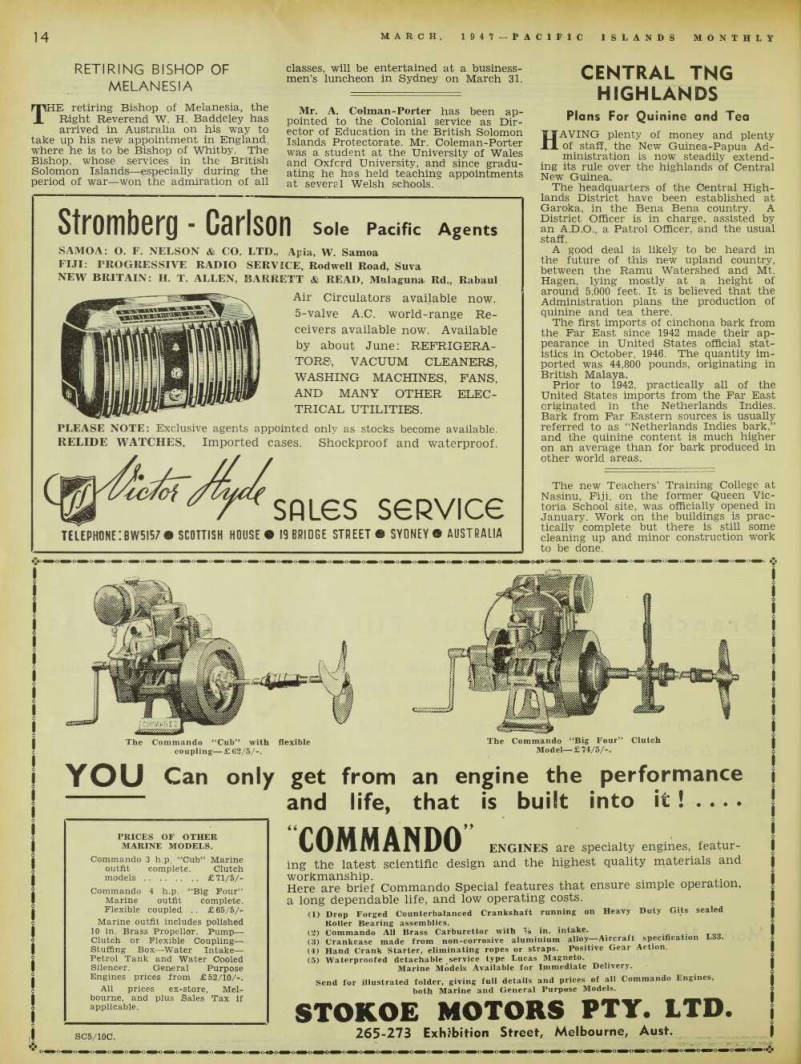
Melanesia
rE retiring Bishop of Melanesia, the Right Reverend W. H. Baddeley has arrived in Australia on his way to take up his new appointment in England, where he is to be Bishop of Whitby. The Bishop, whose services in the British Solomon Islands—especially during the period of war —won the admiration of all
classes, will be entertained at a business men’s luncheon in Sydney on March 31.
Mr. A. Colman-Porter has been ap pointed to the Colonial service as Dir ector of Education in the British Solomon Islands Protectorate. Mr. Coleman-Porter was a student at the University of Wales and Oxfcrd University, and since gradu ating he has held teaching appointments at several Welsh schools.
Central Tng
Highlands
Plans For Quinine and Tea
HAVING plenty of money and plenty of staff, the New Guinea-Papua Ad ministration is now steadily extend ing its rule over the highlands of Central New Guinea.
The headquarters of the Central High lands District have been established at Garoka, in the Bena Bena country. A District Officer is in charge, assisted by an A.D.0., a Patrol Officer, and the usual staff.
A good deal is likely to be heard in the future of this new upland country, between the Ramu Watershed and Mt.
Hagen, lying mostly at a height of around 5,000 feet. It is believed that the Administration plans the production of quinine and tea there.
The first imports of cinchona bark from the Far East since 1942 made their ap pearance in United States official stat istics in October. 1946. The quantity im ported was 44,800 pounds, originating in British Malaya.
Prior to 1942, practically all of the United States imports from the Far East originated in the Netherlands Indies.
Bark from Far Eastern sources is usually referred to as “Netherlands Indies bark,” and the quinine content is much higher on an average than for bark produced in other world areas.
The new Teachers’ Training College at Nasinu, Fiji, on the former Queen Vic toria School site, was officially opened in January. Work on the buildings is prac tically complete but there is still some cleaning up and minor construction work to be done.
Advertisements & other items, p. 18 (1 item)
Commando
Stromberg ■ Carlson Sole Pacific Agents
SAMOA: O. F. NELSON & CO. LTD., Apia, W. Samoa FIJI: PROGRESSIVE RADIO SERVICE, Rodwell Road, Suva NEW BRITAIN: H. T. ALLEN, BARRETT & READ, Malaguna Rd., Rabaul if ii Air Circulators available now. 5-valve A.C. world-range Receivers available now. Available by about June: REFRIGERA-
TORS I , VACUUM CLEANERS,
WASHING MACHINES, FANS,
AND MANY OTHER ELEC-
TRICAL UTILITIES.
PLEASE NOTE: Exclusive agents appointed only as stocks become available.
RELIDE WATCHES. Imported cases. Shockproof and waterproof.
sepvice
TELEPHONE !BWSIS7 • SCOTTISH HOUSE • 19 BRIDGE STREET ® SYDNEY ® AUSTRALIA
The Commando “Cub” with flexible coupling— £ 62/5/-.
The Commando “Big Four” Clutch Model—£74/5/-.
YOU Can only get from an engine the performance and life, that is built into it! ...
PRICES OF OTHER
MARINE MODELS.
Commando 3 h.p. “Cub” Marine outfit complete. Clutch models £7l/5/- Commando 4 h.p. “Big Four”
Marine outfit complete.
Flexible coupled .. £65/5/- Marine outfit includes polished 10 in. Brass Propellor. Pump— Clutch or Flexible Coupling— Stuffing Box—Water Intake— Petrol Tank and Water Cooled Silencer. General Purpose Engines prices from £52/10/-.
All prices ex-store, Melbourne, and plus Sales Tax if applicable.
COMMANDO
SCS/10C.
ENGINES are specialty engines, featur-
ing the latest scientific design and the highest quality materials and
workmanship. . ,
Here are brief Commando Special features that ensure simple operation, a long dependable life, and low operating costs. (1) Drop Forged Counterbalanced Crankshaft running on Heavy Duty Gits sealed Roller Bearing assemblies. (2) Commando All Brass Carburettor with Vs in. intake. (3) Crankcase made from non-corrosive aluminium alloy— Aircraft specification L 33. (4) Hand Crank Starter, eliminating ropes or straps. Positive Gear Action. (5) Waterproofed detachable service type Lucas Magneto.
Marine Models Available for Immediate Delivery.
Send for illustrated folder, giving full details and prices of all Commando Engines, both Marine and General Purpose Models.
STOKOE MOTORS PTY. LTD.
265-273 Exhibition Street, Melbourne, Aust.
Trials
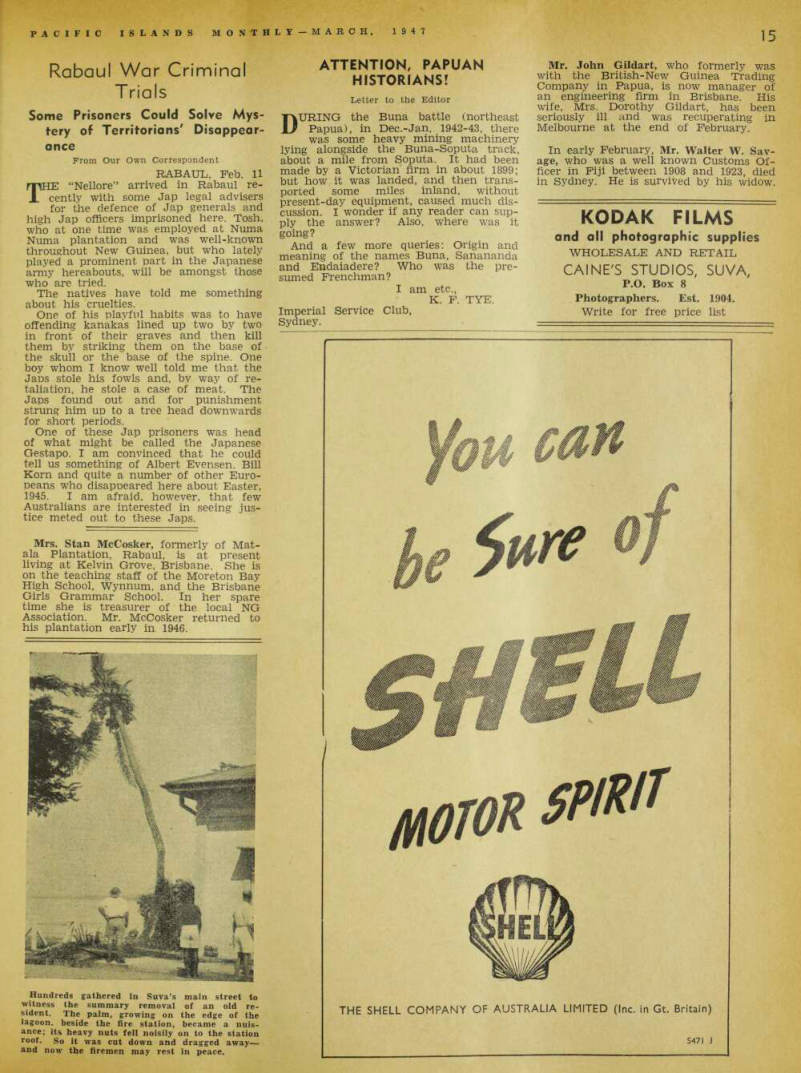
Robaul War Criminal Trials Some Prisoners Could Solve Mys tery of Territorians' Disappear ance
Prom Our Own Correspondent
Rabaul, Feb. 11
r[E “Nellore” arrived in Rabaul re cently with some Jap legal advisers for the defence of Jap generals and high Jap officers imprisoned here. Tosh, who at one time was employed at Numa Numa plantation and was well-known throughout New Guinea, but who lately played a prominent part in the Japanese army hereabouts, will be amongst those who are tried.
The natives have told me something about his cruelties.
One of his playful habits was to have offending kanakas lined up two by two in front of their graves and then kill them by striking them on the base of the skull or the base of the spine. One boy whom I know well told me that the Japs stole his fowls and, by way of re taliation, he stole a case of meat. The Japs found out and for punishment strung him up to a tree head downwards for short periods.
One of these Jap prisoners was head of what might be called the Japanese Gestapo. I am convinced that he could tell us something of Albert Evensen. Bill Korn and quite a number of other Euro peans who disapneared here about Easter, 1945. I am afraid, however, that few Australians are interested in seeing jus tice meted out to these Japs.
Mrs. Stan McCosker, formerly of Mat ala Plantation, Rabaul, is at present living at Kelvin Grove, Brisbane. She is on the teaching staff of the Moreton Bay High School, Wynnum, and the Brisbane Girls Grammar School. In her spare time she is treasurer of the local NG Association. Mr. McCosker returned to his plantation early in 1946.
Hundreds gathered in Suva’s main street to witness the summary removal of an old re sident. The palm, growing on the edge of the lagoon, beside the fire station, became a nuis ance; its heavy nuts fell noisily on to the station roof. So it was cut down and dragged away— and now the firemen may rest in peace.
Attention, Papuan
Historians!
Letter to the Editor DURING the Buna battle (northeast Papua), in Dec.-Jan, 1942-43, there was some heavy mining machinery lying alongside the Buna-Soputa track, about a mile from Soputa. It had been made by a Victorian firm in about 1899; but how it was landed, and then trans ported some miles inland, without present-day equipment, caused much dis cussion. I wonder if any reader can sup ply the answer? Also, where was it going?
And a few more queries: Origin and meaning of the names Buna, Sanananda and Endaiadere? Who was the pre sumed Frenchman?
I am etc.,
K. F. Tye.
Imperial Service Club, Sydney.
Mr. John Gildart, who formerly was with the British-New Guinea Trading Company in Papua, is now manager of an engineering firm in Brisbane. His wife, Mrs. Dorothy Gildart, has been seriously ill and was recuperating in Melbourne at the end of February.
In early February, Mr. Walter W. Sav age, who was a well known Customs Of ficer in Fiji between 1908 and 1923, died in Sydney. He is survived by his widow.
Advertisements & other items, pp. 19-20 (1 item)
fare 0
KODAK FILMS
and all photographic supplies
WHOLESALE AND RETAIL
CAINE'S STUDIOS, SUVA,
P.O. Box 8 Photographers. Est. 1904.
Write for free price list
fare 0
OTOR
THE SHELL COMPANY OF AUSTRALIA LIMITED (Inc. in Gt. Britain) 5471 J
H H Of at h n
Otn
P re Today radiant, adorable, admired by all.
In years to come? Will she retain that charm?
Time steals away the bloom of youth, but a smile can be young even when the hair is silver.
Wise dental care dictates the regular use of I PAN A Tooth Paste after every meal if possible— brushing the teeth and gums with a circular movement of the brush.
IPANA
TOOTH PASTE
3881
Valuable Paintings
of the Birds of Fiji
THANKS to the introduction of the mon goose, the minah and the bulbul—all from India many of the birds of Fiji have disappeared or are disappear ing—especially those which lived close to the ground on Viti Levu.
Because of this unhappy fact, the work that has been carried out during the past 20 or 30 years by Mr. W. J.
Belcher, now a resident of Navua, has great value. He has contrived, in the course of the years, to make an exact drawing! in watercolours of practically every Fijian bird that has been seen in the archipelago.
I visited Mr. Belcher’s place at Navua one week-end —he keeps the hotel there— and looked over his collection of coloured drawings, of which there are about 100.
The painting is extraordinarily good, and I am assured by those who have studied Fijian birds that the likenesses also are excellent.
At present, the collection of drawings is simply kept in a portfolio in Mr. Bel cher’s residence. That, it seems to me, is taking a great risk with a record that is practically irreplaceable. There is no similar record of Fiji birds, and it is important that these drawings be stored away in a safe place ready for the time when they may be printed and repro duced in colour.
Some people who are interested urged the Government of Fiji to buy the col lection from Mr. Belcher and Mr. Belcher received an offer of £lBO for the collec tion. He is still “spitting tacks” over it.
The Government evidently valued the drawings at about £2 each. Taking every thing into consideration, they should be worth a good deal more than that. —
R. W. Robson.
Advertisements & other items, pp. 21-22 (2 items)
£270 To Go!
Donations to NG Scholarship Fund
EACH woman of the New Guinea Women’s Association of Melbourne— and membership has decreased with more and more people returning to New Guinea—has, this year, the task of rais ing £5 for the Scholarship Fund by in dividual effort.
The Fund now stands at £2,726, needing a little less than £3OO to make the £3,000 necessary for full endowment of an an nual £3O scholarship available to the child of a Territorian who lost his or her life due to enemy action.
The Association had its first meeting for 1947 in February when it was de cided that, due to the comparatively small amount now needed to complete the fund, it was not necessary to plan any large-scale benefits this year.
However, the task of individual mem bers each raising £5 is not altogether a sinecure, and in some instances it will be impossible for them to do so. It has been remarked that: “If they are really interested they will attempt something— otherwise the same old few will eventu ally complete the job.”
If any interested person or organisa tion in New Guinea or any other Aus tralian State cared to organise some small entertainment which might raise a pound or two, we are assured that the
New Guinea Women’s Association would be very grateful.
Territorians and other public-spir ited people have responded well to the Association’s appeal, but the hard work has been done by those few exiled stal warts in Melbourne.
Xf you are organising any small func tion then, do not forget that the Scholar ship Fund is still £270 short of its de sired amount.
Further Donations:
Donations acknowledged to January 31, 1947 £2,671 15 4 Mrs. S. Millar, Walker Avenue, Tenerifle,, Brisbane, Queensland 2 2 6 J. Preston-White, Sub - District Office, Kieta, Bougainville, TNG 2 12 6 W. M. Middleton, Madang, TNG . 7 7 0 D. H. Maclean , Tovanakus and Vunabere Plantations, Bainings, via Rabaul, TNG 330 Mrs. E. J. Wauchope, Loch Lomond, Bayview Road, Bayview, NSW . . 2 2 0 Mr. C. Macvean, 343 Toorak Road, Burwood, E. 13 (ex-2/22) Btn. . . 5 5 0 A. H. & M. E. Ross, “Alpha,” Ken more, Queensland 5 5 0 Mr. R. I. Macilwain, Wabag, Mt.
Hagen, via Lae 10 2 0 Mr. and Mrs. T. Holland, Madiri, Fly River, Papua 50 0 Mr. E. W. Jenyns, Lae, TNG ... 120 Mr. and Mrs. J. K. McCarthy, 59 Sutherland Road, Armadale, Victoria 50 0 Mrs. Ruth Sedgers, 223 O’Sullivan Road, Bellevue Hill, NSW 110 Mr. and Mrs. R. Ollerenshaw, 22 Carlisle Street, Rose Bay, NSW 2 3 0 Mr. and Mrs. R. H. Boyan, c/o Administration, Aitape 2 2 6 Total to February 28, 1947 .." £2,726 2 10 At the beginning of February, the Fiji Gifts to Britain Fund had reached £12,647.
54A Pitt St. Svdnev N.S.W.
IMPORTERS
EXPORTERS
ALL CLASSES OF MERCHANDISE PURCHASED FOR ISLAND CLIENTS
THROUGHOUT THE SOUTH-WEST PACIFIC.
ISLAND PRODUCE SOLD ON AUSTRALIAN AND OVERSEAS MARKETS
ON COMMISSION BASIS.
I
BANKERS: BANK OF N.S.W.
COMPTOIR NATIONAL
DESCOMPTE DE PARIS
54a PITT ST. SVDNEV N.S.W.
CABLE ADDRESS:
' ROBERGILL"
PHONES BW 4782- B 1305
% i n
after MILE
OF
EXTRA WEAR
now added to
cool - running
MIIICR
TIRES
Tires for
trucks,
automobiles,
buses
Miller Accessories and Repair Materials are dependable!
Consistently high in quality, this complete line has been developed to meet every automotive need.
New type, stronger construction.
New wide, flatter tread. Longer mileage. Maximum traction.
Peak skid resistance. Greater protection against bruises.
MORE TIRE FOR YOUR MONEY
Radiator hose Radiator cleaner Radiator solder Noc-out adjustable hose clamps Vulcanizing patch and valve stem clamp Tire camelback (passenger and truck) Full circle curing tubes Tire pump hose assemblies Self curing cements and patches Weld rite vulcanizing patch Weld rite valve steam heat units Fractional horsepower belts Rubber solvent Friction tape Windshield wiper tubing Air bags Fan belts Rubber mallets Cord fabrics Tire paint Tire and tube repair kits m-.
TUBE REPAIR KIT
CONTENTS
I—s" x 19" Strip rubber 80 —1 l A" Sq. bevel cut patches 20—114"x2" Oval bevel cut patches I— Va Pt. bottle cement I—Carborundum1 —Carborundum buffer
Exporters
PACIFIC ISLANDS TRADING COMPANY
244 CALIFORNIA STREET, SAN FRANCISCO 11, CALIFORNIA, U. S. A.
Inquiry and Report'
Bsi Compensation
Inquiry and Report' Within Twelve Months
Suva. Feb. 19.
rE_ claims of European owners of property in the British Solomon Islands probably will be considered by a British Commissioner this year, I made inquiries to-day, here, at the headquarters of the High Commissioner for the Western Pacific. Sir Alexander Grantham said that he was not in a position to make any official statement —the matter was in the hands of the British Colonial Office.
I learned, however—unofficially, but on good authority—that it is expected that a British Commission’er will receive in structions within the next few months to proceed to the British Solomon Islands, and assess all claims. If and when that decision is made, BSI property-owners who have not already done so will be re quested to lodge their claims in respect of war damage. * British Commissioners already have been making inquiries in Malaya, British Borneo and other British Far East Ter ritories affected by the Japanese inva sion. Their task in those territories is a very much bigger one than it will be in the Solomons, where it is supposed that a few months’ work will show that the total war damage compensation pay able —if it is payable—will not much ex ceed £1,000,000.
It is not yet certain that Great Britain will compensate property owners in Jap anese invaded territories. All that Britain so far has promised to do is to appoint Commissions to investigate the position of properties damaged by war operations in Jap-invaded countries, and report. It is unlikely that reparations collected from Japan will cover the com pensation sought, so the difference, if it is to be paid, will have to come from the British taxpayer.
It can be emphasised, that although the inquiry in respect of the British Sol omons is not yet authorised, the British Solomons property-owners will be under no handicap in comparison (in respect of time) with property-owners in other British territories in the Far East. In other words, the reports of all these Commissioners will be treated on the same basis, and at about the same time —perhaps in 1947, but probably in 1948.
The position of property-owners on the Gilbert Islands is almost exactly identi cal with that of the BSI property-owners,
outlined above.
Rwr.
•Since then, Sir Alexander has made a state ment. (See page 23.)
Pre-War Level Of Passengers
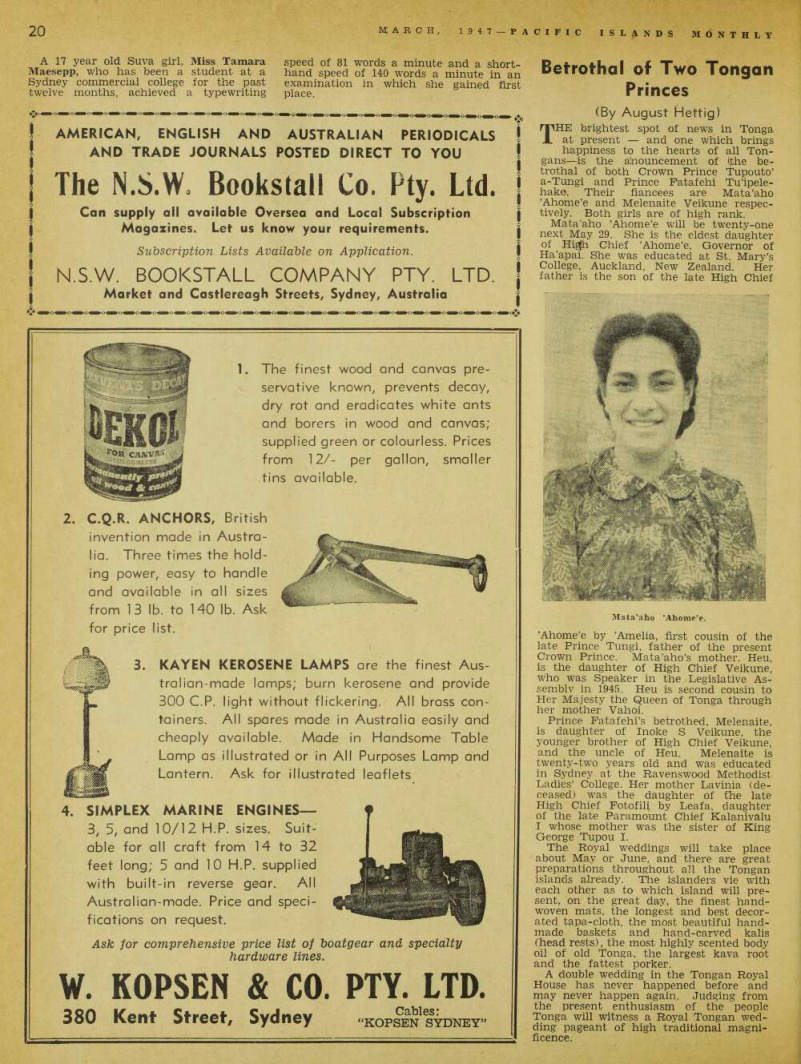
Maintained In Fiji
FGURES published in the “Fiji Times” in February show that passenger ac commodation available, air and sea inclusive, between Fiji and New Zealand and Australia in 1946 was approximately the same as before the war.
In 1938 3,335 people left Fiji for Aus tralia and New Zealand. In 1946. the number was 3,543. Arrivals were 3,798 in 1938 and 3,351 in 1946.
If figures alone can be reckoned an accurate guide, then Fiji is fortunate in its travel facilities. It should be remem bered, however, that travellers have gone by air in increasing numbers —there is still no direct shipping link between Aus tralia and Fiji—and travel costs have in creased enormously.
A 17 year old Suva girl, Miss Tamara Maesepp, who has been a student at a Sydney commercial college for the past twelve months, achieved a typewriting
speed of 81 words a minute and a short hand speed of 140 words a minute in an examination in which she gained first place.
Advertisements & other items, pp. 23-24 (1 item)
v^ ECr SE $Py
LONDON
TO
SUVA
v^ ECr SE $Py
«\Y vi*
V PANAMA V
For Sailings and Further Particulars Apply To: — BETHELL, GWYN & CO., BURNS, PHILP (SOUTH SEA)
138 LEADENHALL ST., CO., LTD.,
LONDON, E.C.3. SUVA.
r i I i ; f i E Sole Distributing Agents for the Pacific Islands:
BRIAL & BALL
31 QUEEN STREET,
MELBOURNE.
’Phone: MU4837.
1 BOND STREET,
SYDNEY.
Thone: 87371.
AMERICAN, ENGLISH AND AUSTRALIAN PERIODICALS
AND TRADE JOURNALS POSTED DIRECT TO YOU
The N.S.Wo Bookstall Co. Pty. Ltd.
Can supply all available Oversea and Local Subscription Magazines. Let us know your requirements.
Subscription Lists Available on Application.
N.S.W, BOOKSTALL COMPANY PTY. LTD.
Market and Castlereagh Streets, Sydney, Australia
FOR
CA NVft 1. The finest wood and canvas preservative known, prevents decay, dry rot and eradicates white ants and borers in wood and canvas; supplied green or colourless. Prices from 12/- per gallon, smaller tins available. 2.
C.Q.R. ANCHORS, British invention made in Australia. Three times the holding power, easy to handle and available in all sizes from 13 lb. to 140 lb. Ask for price list. 3. KAYEN KEROSENE LAMPS are the finest Australian-made lamps; burn kerosene and provide 300 C.P. light without flickering. AH brass containers. All spares made in Australia easily and cheaply available. Made in Handsome Table Lamp as illustrated or in All Purposes Lamp and Lantern. Ask for illustrated leaflets
4. SIMPLEX MARINE ENGINES—
3, 5, and 10/12 H.P. sizes. Suitable for all craft from 14 to 32 feet long; 5 and 10 H.P. supplied with built-in reverse gear. AH Australian-made. Price and specifications on request.
Ask for comprehensive price list of boatgear and specialty hardware lines.
W. KOPSEN & CO. PTY. LTD.
380 Kent Street, Sydney “kopsen^ydney”
Betrothal of Two Tongan
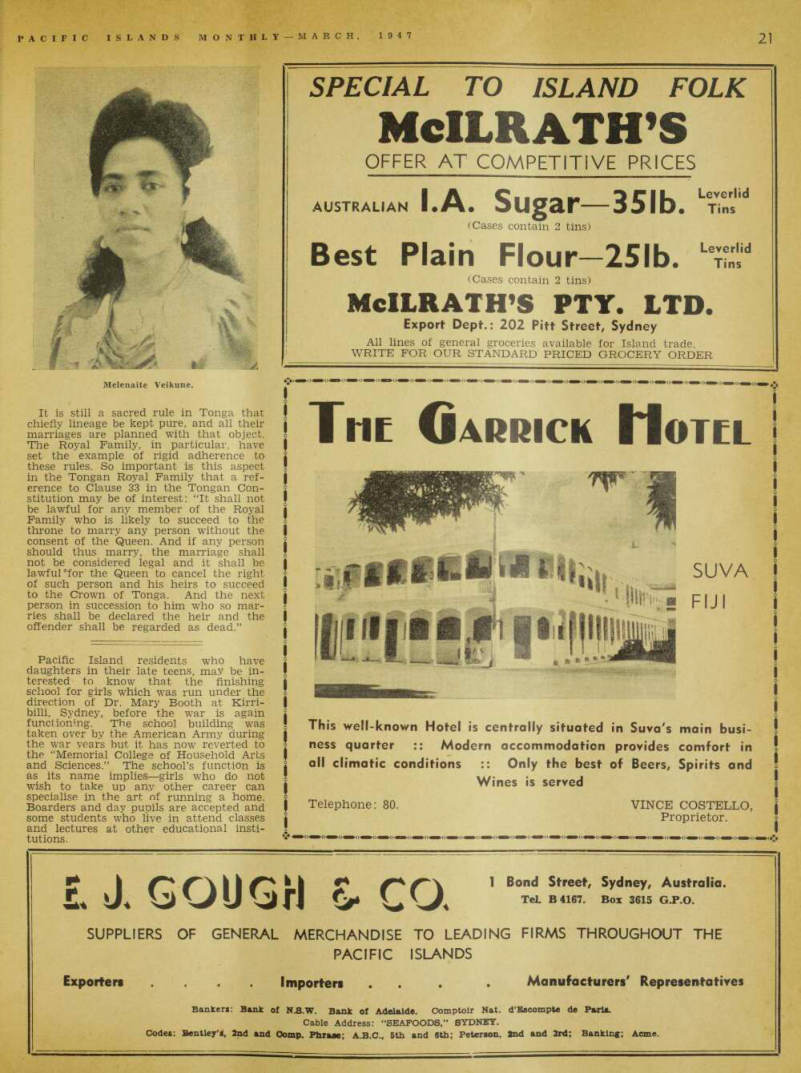
Princes
(By August Hettig)
THE brightest spot of news in Tonga at present and one which brings happiness to the hearts of all Ton gans—is the alnouncement of \the be trothal of both Crown Prince Tupouto’ a-Tungi and Prince Fatafehi Tu’ipele hake. Their fiancees are Mata’aho ’Ahome’e and Melenaite Veikune respec tively. Both girls are of high rank.
Mata’aho ’Ahome’e will be twenty-one next May 29. She is the eldest daughter of Chief ’Ahome’e, Governor of Ha’apai. She was educated at St. Mary’s College, Auckland. New Zealand. Her father is the son of the late High Chief
’Ahome’e by ’Amelia, first cousin of the late Prince Tungi, father of the present Crown Prince. Mata’aho’s mother, Heu, is the daughter of High Chief Veikune, who was Speaker in the Legislative As sembly in 1945. Heu is second cousin to Her Majesty the Queen of Tonga through her mother Vahoi.
Prince Fatafehi’s betrothed, Melenaite, is daughter of Inoke S Veikune, the younger brother of High Chief Veikune, and the uncle of Heu. Melenaite is twenty-two years old and was educated in Sydney at the Ravenswood Methodist Ladies’ College. Her mother Lavinia (de ceased) was the daughter of the late High Chief Fotofili, by Leafa, daughter of the late Paramount Chief Kalanivalu I whose mother was the sister of King George Tupou I.
The Royal weddings will take place about May or June, and there are great preparations throughout all the Tongan islands already. The islanders vie with each other as to which island will pre sent, on the great day, the finest hand woven mats, the longest and best decor ated tapa-cloth, the most beautiful hand made baskets and hand-carved kalis (head rests), the most highly scented body oil of old Tonga, the largest kava root and the fattest porker.
A double wedding in the Tongan Royal House has never happened before and may never happen again. Judging from the present enthusiasm of the people Tonga will witness a Royal Tongan wed ding pageant of high traditional magni ficence.
Mata’aho ’Ahome’e.
It is still a sacred rule in Tonga that chiefly lineage be kept pure, and all their marriages are planned with that object.
The Royal Family, in particular, have set the example of rigid adherence to these rules. So important is this aspect in the Tongan Royal Family that a ref erence to Clause 33 in the Tongan Con stitution may be of interest: “It shall not be lawful for any member of the Royal Family who is likely to succeed to the throne to marry any person without the consent of the Queen. And if any person should thus marry, the marriage shall not be considered legal and it shall be lawful *tor the Queen to cancel the right of such person and his heirs to succeed to the Crown of Tonga. And the next person in succession to him who so mar ries shall be declared the heir and the offender shall be regarded as dead.”
Pacific Island residents who have daughters in their late teens, may be in terested to know that the finishing school for girls which was run under the direction of Dr. Mary Booth at Kirri billi, Sydney, before the war is again functioning. The school building was taken over by the American Army during the war years but it has now reverted to the “Memorial College of Household Arts and Sciences.” The school’s function is as its name implies—girls who do not wish to take up any other career can specialise in the art of running a home.
Boarders and day pupils are accepted and some students who live in attend classes and lectures at other educational insti tutions.
Melenaite Veikune.
Advertisements & other items, pp. 25-26 (1 item)
The Garrick Motel
SPECIAL TO ISLAND FOLK
McILRATH’S
OFFER AT COMPETITIVE PRICES
AUSTRALIAN LA# Sugar— 351 b. L S" d (Cases contain 2 tins)
Best Plain Flour-251b. U S“
(Cases contain 2 tins)
McILRATH’S PTY. LTD.
Export Dept.: 202 Pitt Street, Sydney All lines of general groceries available for Island trade.
WRITE FOR OUR STANDARD PRICED GROCERY ORDER
The Garrick Motel
i ■ i 1 \m
ii Bi^iiiiiijy
i&& * *
SUVA
FIJI
This well-known Hotel is centrally situated in Suva's main business quarter :: Modern accommodation provides comfort in all climatic conditions :: Only the best of Beers, Spirits and Wines is served Telephone: 80. VINCE COSTELLO, Proprietor.
■f I 1 Bond Street Sydney, Australia. £* Vi) -Vy * j v t TeL B 4167. Box 3615 G.P.O.
SUPPLIERS OF GENERAL MERCHANDISE TO LEADING FIRMS THROUGHOUT THE
PACIFIC ISLANDS
Exporters ... Importers ... Manufacturers' Representatives Bankers: Bank of N.S.W. Bank of Adelaide. Comptolr Nat. d’Escompte de Paris, Cable Address; “SEAFOODS,” SYDNEY.
Codes: Bentley’s, 2nd and Oomp. Phrase; A.8.C., sth and 6th; Peterson, 2nd and 3rd; Banking; Acme.
TILLEY LAMPS
BURN ORDINARY KEROSENE
The Modern Form of PORTABLE LIGHTING
Urn
u m * mWm&i' -mm m i § WM.* H/ ■4* ' V.V HI HE TlttEV of
: 33, SACK.'
THE OWL IS PROVERBIALLY A WISE BIRD, SO BE SURE YOU FOLLOW HIS EXAMPLE! TILLEY LAMPS ARE SO SUCCESSFUL THAT COPIES OF THEM ARE BEING MARKETED. TILLEY LAMPS ARE MADE ONLY IN ENGLAND Shipments available four weeks from receipt of order THE TILLEY LAMP CO., HENDON, N*W*4, ENG*
REPRESENTATION :
MELBOURNE : T. H. Bentley, Pty. Ltd., 123-125 William Street, Melbourne, CL TASMANIA ; Mr. C. Sellars, 108 a Charles Street, Launceston.
FIJI : Mr. K. Witherington, 2 Burns Philp Buildings, Suva.
Solomons
Recovery In The
High Commissioner Reviews The Difficult Situation For Advisory Council
THE Advisory Council of the British Solomon Islands met in the new ad ministration headquarters (Honiara) on February 24.
The following message from the High Commissioner of the Western Pacific, which was presented to the Council, gives a summary of administrative conditions in the Protectorate.
His Excellency commented upon the slow and painful recovery that all coun tries were making from the devastating effect of six years of world-wide war.
There was a long road to travel and many difficulties to be overcome before there could be complete recovery. He proceeded: “In the Solomon Islands progress has been retarded by a number of factors arising directly from the war generally; and, particularly, from the fact of a large part of the Protectorate having been under enemy occupation and an active theatre of war. Important among these factors are: The shortage of shipping and the consequent impossibility as yet of restoring adequate oversea shipping communication; the extensive damage to property; the unsettling effect on the population of the war and the presence in the islands of very large numbers of personnel of the Allied Forces.
“The most important immediate issue facing the Protectorate is that of re habilitation of the native population,
and non-native planting interests, in the war-devastated areas, and of the econ omic life of the Territory generally.
“As you are no doubt aware, the ques tion of compensation for war damage in British Territories, which were overrun by the Japanese, is under active consid eration by His Majesty’s Government in the United Kingdom, and a Commission will presently commence the work of in vestigation of war damage claims in the Western Pacific. In the meantime a scheme has been approved for advances to planters in need of immediate finan cial assistance for the rehabilitation of their plantations.
“The fact should not, however, be lost sight of that although it is intended to
exact reparations from Japan in respect of such war damage, the extent of the damage throughout the Far East and Pacific is so great that it is unlikely that the maximum amount which can be re covered as reparations will meet more than a portion of the damage. Only when the whole extent of the damage has been finally assessed will His Majesty’s Gov ernment be in a position to decide how much if any of the excess over repara tions can be shouldered by the already overburdened United Kingdom taxpayer.
“In this connection you will observe from the estimates now before you how heavy a contribution, in addition to any grants under the Colonial Development and Welfare Act, has already to be sought from His Majesty’s Government
towards the restoration and maintenance of the Civil Administration.
“I must therefore impress upon all re sidents of the Protectorate, native and non-native alike, the importance of all pulling their weight and each making the most effective contribution within his power towards rehabilitation and econ omic recovery. I hope that the chiefs and leaders of the native peoples throughout the Protectorate will do their utmost to ensure that their people em ploy themselves usefully in work for their own and the common good, such as the rehabilitation of their villages and gar dens, and that they will give, every en couragement to all young men amongst their people who can be spared from their village communities to seek em ployment jelsewherei within the Group and thus contribute their share to the common good of their homeland.
“mHE economic recovery of the Protec- X torate is dependent' upon the re sumption of copra production and the speed of recovery will be in propor tion to the volume of production while the present high market price continues.
It is also important, in view of the world food crisis and the extreme shortage of edible fats, that every effort should be made to increase copra production to the utmost and thus assist, in however small a degree, towards world, as well as local, recovery.
“Unfortunately, however, little progress can be looked for in the Protectorate until an adequate oversea shipping ser vice can be provided for the freighting of necessary supplies and the return of plantation and trade personnel; and while the present difficulty in obtaining labour continues. This labour difficulty is an important factor which must be borne constantly in mind in all plans for rehabilitation and development.
“Legislation has recently been enacted to provide for the development of Native Administration in the Protectorate. The Regulation gives legal sanction to the establishment of Native Councils and provides the necessary authority for their operation.
“The establishment and successful operation of these local Authorities should go far towards meeting native aspirations and in consequence should contribute in no small degree to the wel fare and contentment of the native peoples.
“Other matters which I wish briefly to mention are: • The appointment of a Director of Education, who is now on his way to the Protectorate to organise a comprehen sive scheme of education; • The revision of the Labour legisla tion of the Protectorate, to bring it into line with modern standards and give effect to various International Conven tions to which the Protectorate is a party, the revised draft of which will be placed before you; • The recent completion of a survey of the forest resources of the Solomon Islands by Mr. F. S. Walker, whose re port on his work should be available shortly; • The modification of the scheme for the construction of the new capital by the greater utilisation of local resources.
“In view of the impending departure from the Pacific of His Lordship Bishop Baddeley I take this opportunity to ex press my warm appreciation of his ad vice and assistance in the Advisory Council during his long membership, as well as outside that Council, and also of his long and devoted service to the wel fare of the native peoples of the Pro tectorate. I wish him every success in his new sphere.”
Advertisements & other items, pp. 27-28 (1 item)
Crosse &
J. C. Merrillees Pty. Ltd.
GENERAL ISLANDS MERCHANTS
Telegrams & Cables: Merrillees. Sydney.
AGENTS FOR: COWRIE SHARPS and FLOUR
and Suppliers of General Merchandise ■/V
TRADE GOODS, CLOTHING,
FOODSTUFFS. LIQUEURS
SPIRITS, WINES.
New Address
63 PITT STREET, SYDNEY
(Phoenix Building) Telephone: Codes: BW 6064 Bentleys
%>m xotlmJ
hijout
hide..
Crosse &
BLACKWELL
FRESH SCOTCH HERRING,
SCOTCH HERRING in TOMATO,
SCOTCH KIPPERED HERRING.
unexcelled since 1706. c Vo-.
had me worried!
77 Yqu see Mrs Peters. in addition to all their running around inthe day-time, children use up energy during sleep in breathing and other automatic actions.,.and children also grow during sleep. Naturally if this call on them energy reserve isn't built up they soon become tired out and lose weight..
Put your boy onto
■HORLICKS
Si a Protein—essential to the growth and development of every part of the body.
Without protein to form body and tissue cells, growth cannot take place and then wear and tear resulting from our daily activities cannot be made good.
Fat almost entirely derived from milk; an efficient source of energy and also of vitamins A and D.
Carbohydrate chiefly maltose and dextrin (perhaps the best source of * Made Whaf s wrong with Ted lately ? tie seemstohave no life in him. ■How would like to
help
you me bu
SWI
n.g Ted He's definitely off
colour.. so pale and thin.
th Id bette see Qr Oh k can bothered be // 50.. .
every niqh+
before bed Dad Watch me oti
taking
u A
Each glass of Horlicks*
before bed gives you
quick energy) and lactose, which is of particular value to young children.
Mineral Salts —to help in building tissue and in regulating body activities.
These mineral salts include: Calcium —of which there is a deficiency in many Australian diets and yet is so necessary for building sound bone and good teeth.
Vitamins A Bi B 2 and D—each fulfilling its own special job in the maintenance of sound nutrition. with milk.
HORLICKS
The complete,
BALANCED food drink
CH7-I
Progress of APC
Oil Exploration In Papua
SINCE the last report issued by the Australian Petroleum Company Pty.
Ltd., nine-inch casing has been run into the Kariava bore in Papua and cem ented at 5,750 feet. Drilling has been re sumed, and on February 1 had reached a depth of 6,378 feet.
It is reported that a new “cargo-move ment” has arisen in New Guinea; It ex tends along the Madang coast and as far as the Ramu. A new twist to it appears to be the native belief that the return of their ancestors, with the promised car go, depends upon the natives learning English. Therefore, there is great de mand upon the missionaries in the area
to teach them English as soon as pos sible.
Advertisements & other items, p. 29 (1 item)
Coleman
F. J. MORGAN
PTY., LTD.
12 Allen St., Granville,
N.S.W.
MANUFACTURERS AND
EXPORTERS OF:
Beekeepers Foundation and Apiary Appliances. Dental Supplies, Artificial Teeth, Wax Floor and Furniture Polishes, Disinfectant Preservative in non-Stain and Wood-stain Colours.
BUYERS OF WAXES AND RESINS.
LABORATORY SERVICE: Soli Testing and Investigation of All Natural* Growth for Commercial Uses.
BANKERS: Commonwealth Bank of Australia Komebush, N.S.W.
NOW AS ALWAYS
DEPENDABLE
Coleman
For over forty years COLEMAN has built a reputation for dependability in lighting, cooking and heating appliances. Built from the same first quality materials as always, with the exclusive Coleman features, you are always assured of the best when you buy dependable Coleman. Wherever you are there is a Coleman dealer to serve you with dependable COLEMAN appliances and service.
AGENTS
Robert Gillespie Pty. Ltd. 54A Pitt St., Sydney, N.S.W.
Pearce & Co. Ltd., SUVA.
THE COLEMAN LAMP
AND STOVE COMPANY LIMITED
TORONTO, CANADA
CHICAGO, USA.
The M.V. "Veilomani"
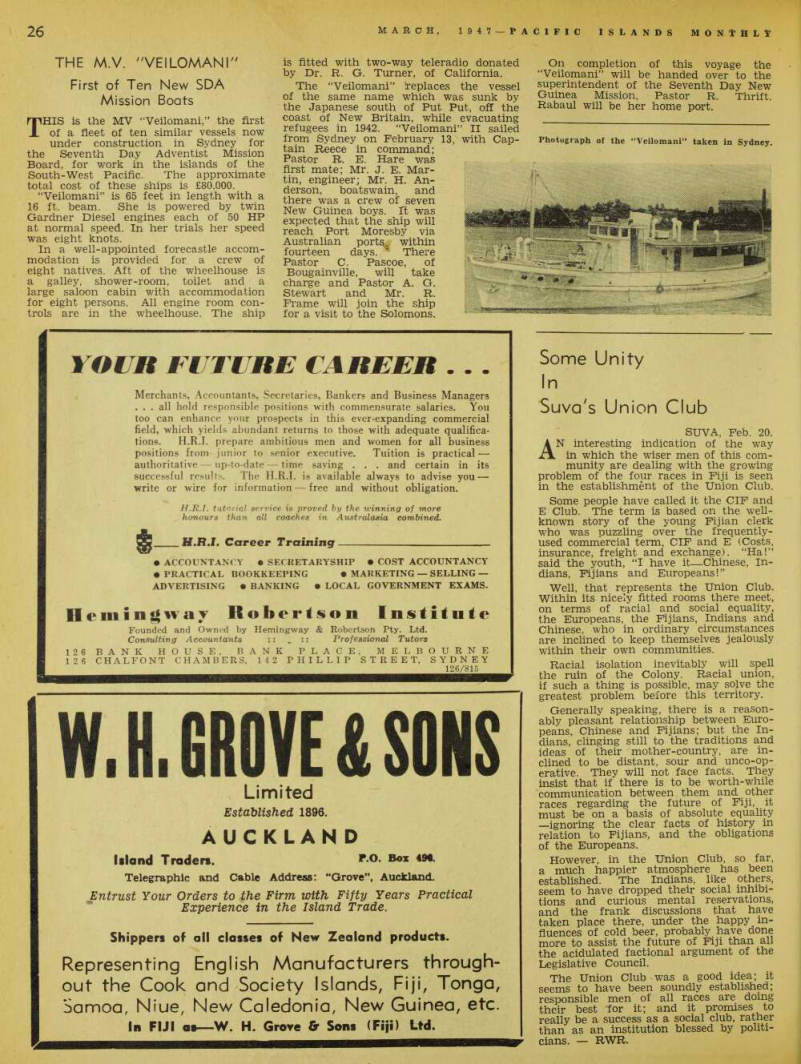
First of Ten New SDA Mission Boats
THIS is the MV “Veilomani,” the first of a fleet of ten similar vessels now under construction in Sydney for the Seventh Day Adventist Mission Board, for work in the islands of the South-West Pacific. The approximate total cost of these ships is £BO,OOO.
“Veilomani” is 65 feet in length with a 16 ft. beam. She .is powered by twin Gardner Diesel engines each of 50 HP at normal speed. In her trials her speed was eight knots.
In a well-appointed forecastle accommodation is provided for a crew of eight natives. Aft of the wheelhouse is a galley, shower-room, toilet and a large saloon cabin with accommodation for eight persons. All engine room controls are in the wheelhouse. The ship
is fitted with two-way teleradio donated by Dr. R. G. Turner, of California.
The “Veilomani” Replaces the vessel of the same name which was sunk by the Japanese south of Put Put, off the coast of New Britain, while evacuating refugees in 1942. “Veilomani” II sailed from Sydney on February 13, with Cap tain Reece in command;
Pastor R. E. Hare was first mate; Mr. J. E. Mar tin, engineer; Mr. H. An derson, boatswain, and there was a crew of seven New Guinea boys. It was expected that the ship will reach Port Moresby via Australian ports within fourteen days. There Pastor C. Pascoe, of Bougainville, will take charge and Pastor A. G, Stewart and Mr. R.
Frame will join the ship for a visit to the Solomons.
On completion of this voyage the “Veilomani” will be handed over to the superintendent of the Seventh Day New Guinea Mission, Pastor R. Thrift, Rabaul will be her home port.
Photograph of the “Veilomani” taken in Sydney.
Some Unity
In Suva's Union Club
Suva, Feb. 20.
AN interesting indication of the way in which the wiser men of this com munity are dealing with the growing problem of the four races in Fiji is seen in the establishment of the Union Club.
Some people have called it the CIF and E Club. The term is based on the well known story of the young Fijian clerk who was nuzzling over the frequently used commercial term, CIF and E (Costs, insurance, freight and exchange). “Ha!” said the youth, “I have it—Chinese, In dians, Fijians and Europeans!”
Well, that represents the Union Club.
Within its nicely fitted rooms there meet, on terms of racial and social equality, the Europeans, the Fijians, Indians and Chinese, who in ordinary circumstances are inclined to keep themselves jealously within their own communities.
Racial isolation inevitably will spell the ruin of the Colony. Racial union, if such a thing is possible, may solve the greatest problem before this territory.
Generally speaking, there is a reason ably pleasant relationship between Euro peans, Chinese and Fijians; but the In dians, clinging still to the traditions and ideas of their mother-country, are in clined to be distant, sour and unco-op erative. They will not face facts. They insist that if there is to be worth-while communication between them and other races regarding the future of Fiji, it must be on a basis of absolute equality —ignoring the clear facts of history in relation to Fijians, and the obligations of the Europeans.
However, in the Union Club, so far, a mlich happier atmosphere has been established. The Indians, like others, seem to have dropped their social inhibi tions and curious mental reservations, and the frank discussions that have taken place there, under the happy in fluences of cold beer, probably have done more to assist the future of Fiji than all the acidulated factional argument of the Legislative Council.
The Union Club was a good idea; it seems to have been soundly established; responsible men of all races are doing their best for it; and it promises to really be a success as a social club, rather than as an institution blessed by politi
cians.
Rwr.
Advertisements & other items, p. 30 (2 items)
26
MARCH, 1947 PACIFIC ISLANDS MONtfiL*
W. H.Grove £ Sons
YOUR FUTURE CAREER
Merchants, Accountants, Secretaries, Bankers and Business Managers ... all hold responsible positions with commensurate salaries. You too can enhance your prospects in this ever-expanding commercial field, which yields abundant returns to those with adequate qualifications. H.R.I. prepare ambitious men and women for all business positions from junior to senior executive. Tuition is practical authoritative up-to-date time saying . . . and certain in its successful results. The H.R.I. is available always to advise you write or wire for information free and without obligation.
H.R.I. tutorial service is proved by the winning of more honours than all coaches in Australasia combined.
H.R.I. Career Training • ACCOUNTANCY • SECRETARYSHIP • COST ACCOUNTANCY
• PRACTICAL BOOKKEEPING • MARKETING SELLING
ADVERTISING • BANKING • LOCAL GOVERNMENT EXAMS.
Hemingway Robertson Institute
Founded and Owned by Hemingway & Robertson Pty. Ltd.
Consulting Accountants :; :: Professional Tutors
126 BANK HOUSE. BANK PLACE. MELBOURNE
126 CHALFONT CHAMBERS, 142 PHILLIP STREET, SYDNEY 126/815
W. H.GROVE £ SONS
Limited
Established 1896.
AUCKLAND
Island Traders. FO - Box 49 * Telegraphic and Cable Address; “Grove”, Auckland.
Entrust Your Orders to the Firm with Fifty Years Practical Experience in the Island Trade.
Shippers of all classes of New Zealand products.
Representing English Manufacturers through-
out the Cook and Society Islands, Fiji, Tonga, Samoa, Niue, New Caledonia, New Guinea, etc.
In FIJI at —W. H. Grove fir Sent (Fill) Ltd.
Last Of War's White Elephants
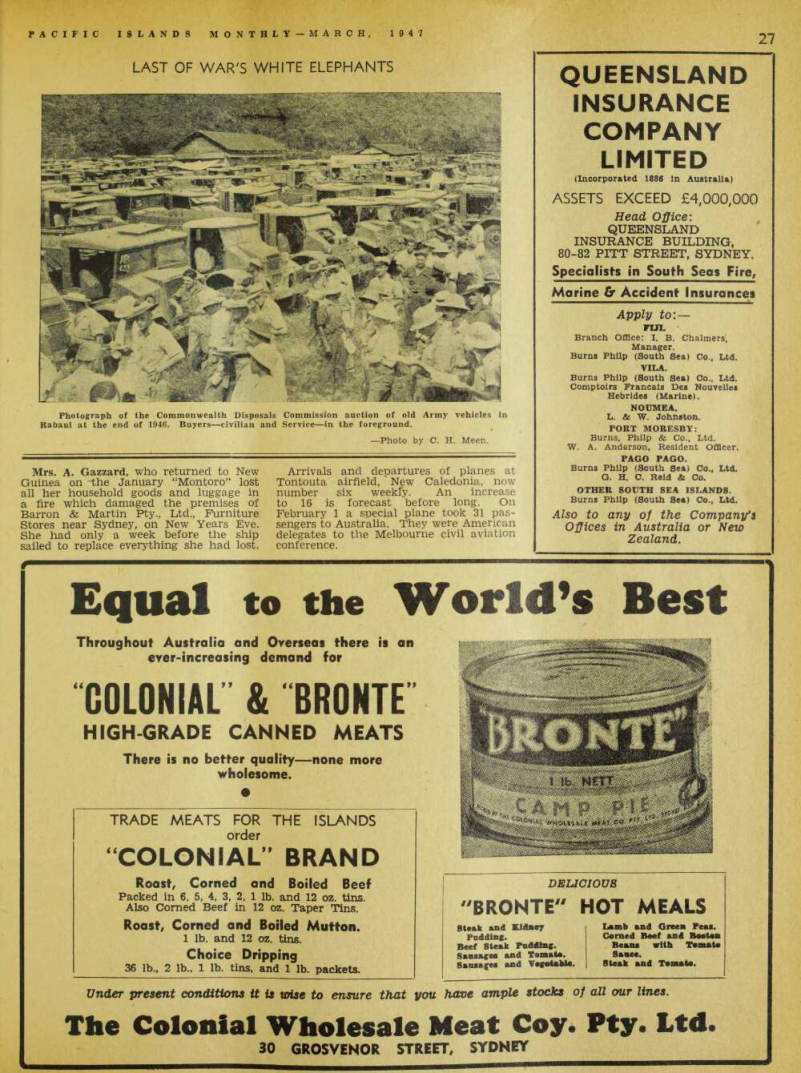
Mrs. A. Gazzard, who returned to New Guinea on 'the January “Montoro” lost all her household goods and luggage in a fire which damaged the premises of Barron & Martin Pty., Ltd., Furniture Stores near Sydney, on New Years Eve.
She had only a week before the ship sailed to replace everything she had lost,
Arrivals and departures of planes at Tontouta airfield, New Caledonia, now number six weekly. An increase to 16 is forecast before long. On February 1 a special plane took 31 pas sengers to Australia, They were American delegates to the Melbourne civil aviation conference.
Photograph of the Commonwealth Disposals Commission auction of old Army vehicles in Rabaul at the end of 1946. Buyers—civilian and Service—in the foreground. —Photo by C. H. Meen.
Mr. R. A. Derrick, principal of the Fijian Government Technical School, Suva, and author of several histories and text-books, was on leave in Melbourne, Vic. in January. While in Australia, he is undertaking historical research work for the Fijian government.
The Rev. H. E. Palmer of the Anglican Mission, sailed in December in the “Montoro” for New Guinea. Mr. Palmer has been appointed rector of Port Moresby, but before taking up duty there he ex pects to make a tour of the Diocese of New Guinea.
Advertisements & other items, pp. 31-32 (1 item)
Equal to the World’s Best
QUEENSLAND
INSURANCE
COMPANY
LIMITED
(Incorporated 1886 In Australia)
ASSETS EXCEED £4,000,000
Head Office:
QUEENSLAND
INSURANCE BUILDING,
80-82 PITT STREET, SYDNEY.
Specialists in South Seos Fire/
Marine & Accident Insurances
Apply to:—
rut Branch Office: I. B. Chalmers, Manager.
Burns Phllp (South Sea) Co., Ltd,
VILA.
Burns Phllp (South Sea) Co„ Ltd.
Comptolrs Francals Des Nouvelles Hebrides (Marine).
NOUMEA.
L. Sc W. Johnston.
PORT MORESBY:
Burns, Phllp & Co., Ltd.
W. A. Anderson, Resident Officer.
PAGO PAGO.
Burns Phllp (South Sea) Co., Ltd.
G. H. C. Reid Si Co.
OTHER SOUTH SEA ISLANDS.
Burns Phllp (South Sea) Co., Ltd.
Also to any of the Company's Offices in Australia or Hew Zealand.
Equal to the World’s Best
Throughout Australia and Overseas there is on ever-increasing demand for
COLONIAL & BRONTE
HIGH-GRADE CANNED MEATS
There is no better quality—none more wholesome.
TRADE MEATS FOR THE ISLANDS
order
‘COLONIAL’ BRAND
Roast, Corned and Boiled Beef Packed in 6,5, 4,3, 2, 1 lb. and 12 oz. tins.
Also Corned Beef in 12 oz. Taper Tins.
Roast, Corned and Boiled Mutton. 1 lb. and 12 oz. tins.
Choice Dripping
36 lb., 2 lb., 1 lb, tins, and 1 lb. packets.
JW * .1 Cd
DELICIOUS
"BRONTE" HOT MEALS
Steak and Kidney Padding.
Beef Steak Pudding.
Sausages and Tomato.
Sausages and Vegetable.
Lamb and Green Peat.
Corned Beef and Beaten Beans with Tomato Sanee.
Steak and Tomato.
Under present conditions it is wise to ensure that you have ample stocks of all our lines.
The Colonial Wholesale Meat Coy. Pty. Ltd.
30 GROSVENOR STREET, SYDNEY
SOUTH SEA ISLANDS CLUB
Social Evening
Every Thursday, at 399 George Street.
Sydney (Fourth Floor) Ballroom Dancing . . . Special Islands Dances tmd Songs Islands Visitors Welcome.
SPECIALISING
IN
PACIFIC ISLAND INSURANCES
FIRE MOTOR VEHICLE
MARINE HULLS AND CARGO
EMPLOYER’S LIABILITY
GUARANTEES including those for—
DYNAMITE PERMITS.
RECRUITERS’ LICENCES.
DEFERRED WAGES
AND ALL OTHER CLASSES ARRANGED
AT LOWEST CURRENT RATES.
Established Agencies:
W. R. CARPENTER & CO., LTD.
Throughout the Territory of New Guinea,
SOUTHERN PACIFIC INSURANCE
CO., LTD.
HEAD OFFICE: 60 HUNTER STREET,
SYDNEY.
RH|HURCH&Son
ISLAND TPA^hO
AUCKLAND, NB^|5 A
Cable Address. ’’CHURSHIP," Auckland Codes: BENTLEY’S 2nd Phase BENTLEY'S Complete Phase Postal;
C.P.O. BOX 1548
y rw PEACE BRINGS A NEW ERA TO THE PACIFIC We are catering thoroughly for Island trade and can fulfil your order with competitive merchandise
R. H. CHURCH & SON
Merchants & Island Traders 27 Queen St., Auckland, N.Z.
Refer your order to us for New Zealand’s Island famous products F
Fiji's Candle-Nut Oil
H. A. Mitchell Has Launched a New Industry
Suva, Feb. 20.
QUIETLY, unostentatiously, painfully,
a new industry has been born in Fiji; and, already some shrewd busi ness minds in Fiji, Australia and New Zealand, have recognised its probable im portance. This is the candle-nut oil in dustry.
To-day, in Pearce’s old store near the wharf, an extraordinary Heath Robinson like contraption is expressing 300 gallons of oil per month from the wild candle nuts of Fiji, which are being gathered by Indians and Fijians around the coasts and shipped to Suva. The market for this oil is keen, greedy and clamorous.
It takes the place of the scarce linseed oil and tung oil, in the making of fine paints and varnishes and some people claim that it is better than either. I do not know the price at which it is sold, but I am informed that it is highly pro fitable.
The present plant was assembled with difficulty, and merely for experimental purposes. The first oil it produced ful filled every hope, and it was decided to erect a large, suitable, permanent plant.
But the necessary machinery could not be obtained, and it still has not made its appearance. So it was decided to do the best nossible with the experimental plant.
To the astonishment of the promoters themselves, that queer collection of old iron produced 300 gallons per month— every bit of which was sold easily.
When the new machinery is available— which should not be long now—the pro duction will be 1,000 gallons per month— and there will be buyers for every ounce of it.
The by-products of this industry are important. Once the kernel is extracted from the exceedingly hard nut that seems to be the secret of this process— it yields 60 per cent, oil and 40 per cent, cake. The cake has been sent to New Zealand as a cattle food, and is favour ably reported upon. The shells apparent ly, have value. They have been experi mented with as the basis of a black pig ment for paint, and the promise is good.
It is estimated that the company, In dustrial Oils (Fiji) Limited, ultimately
could get 1,500 tons of the nuts per an num from Fiji, and each ton is expected to yield 40 gallons of oil. This is on the assumption that only wild nuts are used.
Candle-nut oil plantations are visualised, however —the trees can be brought to profit in three years.
SOME day, when Fiji is distributing knighthoods, it should give one to the founder of this industry—mod est, hard-working, H. A. Mitchell. Mr.
Mitchell is an Australian, and a few years ago he developed some ideas about the value of candle-nut oil. The quality of the oil had long been recognised, but the extraordinary hardness of the nut had defeated every man who thought he could use it. Mr. Mitchell invented a method of cracking the nuts and extract ing the kernels—and then set to work to organise an industry. He received little encouragement.
This writer, in July, 1945, met Mr.
Mitchell when travelling around Viti Levu. Mr. Mitchell was inspecting wild plantations of candle-nuts and insisting that therein lay the foundation of a good industry for Fiji. Most Europeans seemed to be laughing at Mr. Mitchell. Fortu nately, back in Australia, some people had faith in the man and his enthusiasm: and, despite innumerable difficulties and discouragement, he obtained funds and got his experimental plant into operation.
The rest of the story is history, recorded above. He has earned Fiji’s thanks and best wishes.
Yesterday, I found Mr. Mitchell strug gling away in the February heat, over his Heath Robinson plant. He assured me that he is confident that he will get sufficient supplies of candle-nuts now to keep the plant going. His company is buying all candle-nuts offered at £7/10/-, per ton.
Paint Shortage Feared
BECAUSE India has cut the Australian allocation of 'linseed by 50 per cent, from March 1. it is expected that paint manufacture in Australia will fall much below demand. It is estimated that about 85 per cent, of the paints produced for exterior work will be affected.
In the year ending March 1, 1947, Aus tralia should have imported 60,000 tons of linseed; actual imports were 16,000 tons.
Present production of paint is about 40 per cent, below normal and because manufacturers have now exhausted their reserve stocks of linseed *oil the position is expected to deteriorate still further.
Pacific Territories which depend upon Australia as a source of supply for paint will also be in short supply.
Mr. J. R. Thomas, who was in the New Guinea Public Service prior to the war, and who has been lately stationed in the Morobe District under the New Guinea Papua Administration, arrived in Aus tralia in January on sick leave. He is now residing in South Australia.
In Brisbane recently Dr. Raphael C. F.
Cilento, the eldest son of Sir Raphael and Lady Cilento, who made many friends in New Guinea twenty-odd years ago, was married to Miss Billie Solomon, of New Farm. Raphael, Jr., takes over his mother’s practice when she leaves for Paris in the near future to join Sir Raphael, who has been appointed World Director of Displaced Persons, with headquarters in the French capital.
Colonies
New Air Services Planned For French Pacific Colonies
THE French Government has authorised the Noumea air company, Societe Francaise de Transporte Aeriens du Pacifique, Sud, to establish a regular air service between New Caledonia and the New Hebrides, and to charter planes as required for other Pacific trips. The company is authorised to run a flying school and to take aerial photographs.
It is proposed ultimately to link Caledonia with Tahiti via the Hebrides, and Wallis island.
The company is taking on a number of officers and NCOs who have served with the French Flying Corps. The present staff numbers 14, under ex naval Lieutenant Paumier, a former instructor of Free French fliers at Corpus Christi, USA. The company has bought two Catalinas, which are being converted to commercial purposes; and a small num ber of Seabee planes, whose delivery has been delayed by industrial strikes in the US.
Of importance to Pacific flying gener ally is the apparent adoption of the Bernier plan for turning the Magenta airfield, only a mile or two from Noumea, into the colony’s trans-Pacific base. This would replace Tontouta, which is over 40 miles from the capital. Bernier is the head of the Caledonian Surveys De partment, and is now visiting New Zea land.
The Magenta airfield was first con structed by the US Marines on the old Noumea racecourse, in May, 1942. It is backed by a swamp which was partly filled in, and the runway was extended forward on to the beach, which was nor mally swamped at high tide.
It is now proposed to extend the run way still further, both seaward and swampwards, until it is 2,150 metres long and 60 metres wide—this plan being linked to an ambitious drainage scheme.
In 1945, Pan-American Airways’ repre sentative, Mr. Harold Gatty, favoured Tontouta airfi.-ld, but the advantages of having a drome so close to Noumea are so great that at M. Bernier’s suggestion the matter was reconsidered, and Pan- American’s inspector of Alaskan and Pac ific bases, arrived to study the proposal, which the company is now said to have accepted “in principle”. Since then, both Australian and New Zealand ex perts have visited the drome and reported on the scheme which would bring the largest land-based planes right to Nou mea peninsula. A Magenta base would certainly stimulate the tourist industry, and give passengers every chance to visit the town and the Anse Vata Casino— when it is built.
War Damage
Basis Of Assessment For
11TE have received, the following advice
TT from the War Damage Commission,
Sydney:—
In the January issue of the “Pacific Islands Monthly,” page 32, it is stated that the new National Security (War Damage to Property) Regulations provide for the assessment of war damage claims on the basis of “cost of restora tion at the present day.” This is misleading.
The general basis of assessment is still the value at the time of occurrence of war damage, but in assessing partial damage (as distinct from total loss) to fixed property, the basis adopted is the present-day cost of restoration to the condition in which it was immediately prior to war damage, but even then compensation is limited to the value of the fixed property at the time of war damage.
Former Island Resident
With Unrra
Tl/E reported in the August issue of TT “PIM” that Group-Captain W. J.
Duncan, formerly 0 f the Mandated Territory of New Guinea, was giving dis tinguished service with UNRRA in the Far East. Recently we have been in formed that another ex-resident of New Guinea and the Solomons is seeing service with the same organisation in the same area.
He is Mr. R. E. Shea, who since April, 1946, has been attached to the Shipping Division of the UNRRA China Office at Shanghai as Shipping Liaison Officer in connection with the huge tonnage of relief stores, the gift of the United Nations to the Chinese Government, which are being discharged at Chinese ports, Mr. Shea was associated with Burns, Philp & Co. Ltd., from 1935 to 1942 as a member of their shipping staff both in BSI and New Guinea ports, and, fol lowing evacuation from New Guinea, was in the Brisbane Branch, until he trans ferred to the Department of the Navy to perform the duties of Shipping and Trans port Officer at the RA Naval Store Depot, Brisbane. He held this position until he accepted the UNRRA China appointment in April, 1946.
Mr. C. E. Lane-Poole, a consulting for estry expert from Sydney, arrived in Brisbane from Noumea by flying-boat, on February 21. Commenting on the tremendously high prices of commodities in Noumea, he said that Australia was fortunate in having price control. Eggs, were being sold for 7/6 a dozen in Nou mea; bread at 1/3 a loaf and a half bottle of American beer cost 2/6. The ordinary price for a man’s shirt was £3/5/-.
Advertisements & other items, pp. 33-34 (2 items)
Akplioh
Ample POWER ...
Ample LIGHT
AMPLION
UNITS
With These Throughout Australasia and the Islands hundreds of these grand units are proving themselves to proud owners by their performances and reliability.
You will find much to interest you in the free literature we now offer you, by return mail.
aKPLIOh
AUSTRALASIA PTY., LTD.
36-40 Parramatta Road, Camperdown, N.S.W.
NfliOn
i
AMPLION 1 H.P.
ENGINE
PETROL
8 genuine car engine features . . . so light a man can carry (only 40 lbs.). £32—packed F. 0.8. Sydney.
AMPLION FARM LIGHTING
UNIT
In 12 or 32 volt models . . . vibrationless . . . extremely inexpensive to operate . . , send for leaflet NOW. Special export price, £4B/15/-.
Packed F. 0.8. Sydney.
SEND FOR FREE
LITERATURE BY
RETURN MAIL.
I Messrs. AMPLION (A’ASIA) PTY., LTD.,
36-40 Parramatta Road, Camperdown, N.S.W.
Please send me free literature on Farm lighting unit. Q Amplion 1 h.p. petrol engine Q BOTH. Q Name Address ENFLUI
Modern Refrigeration for the South Sea Islands
The ELECTROLUX KEROSENE OPERATED
REFRIGERATOR
MARVEL
OF
MODERN
SCIENCE
y v
KS£CI
m ■■s
THE
MIRACLE
OF
ICE
FROM
HEAT
ELECTROLUX offers economical, modern and completely efficient
REFRIGERATION FOR ISLANDS' HOMES.
FREEZES CONTINUOUSLY WHILE SMALL LAMP BURNS.
Freezing controlled by simply regulating height of flame. Uses only gallon of kerosene per week.
MOTORLESS ... NO PARTS TO GET OUT OF ORDER.
MODEL LKSSO
Capacity: 8.5 cubic feet.
GUARANTEED FOR TWO YEARS
• Write to your Local Distributor for prices and full details.
OBTAINABLE FROM ALL W. R. CARPENTER & CO. LTD.
BRANCHES THROUGHOUT THE ISLANDS
Representation in Papua and New Hebrides.
30
MARCH, 194? PACIFIC ISLANBg MONtHL?
on Signing of Pact
Indonesians Walk Out on Signing of Pact
NOTHING short of a ball-to-ball des cription by an observer of great wis dom on the spot could hope to ex plain the manoeuvres in Indonesia these days. Truces are made; and truces are broken. Pacts are drawn up, and never signed.
But, if the situation is nuzzling to out siders, it must be maddening to the Dutch who are trving to cope with the exasperating situation and at the same time get the war-battered Indies indust ries functioning again.
A pact for the creation of a United States of Indonesia was drawn up after much talk and initialled by both narties last November. It was accented bv the Dutch Government in Holland shortly afterwards, and since that time there has been a lot of fiddling about on the part of the Indonesians.
At last, however everything was set fair for February 5. when representatives of the narties met in Batavia and were to finally sign the pact. At the last moment the Indonesian delegates walked out without signing. Their sudden departure followed a disagreement over the inter pretation of certain narts of the agree ment. Presumably the next step is to engage in further “talks.”
Meanwhile, clashes between Indonesian and Dutch troops continue in Java and Sumatra although a truce was agreed unon between the parties months ago.
The Dutch Commander-in-Chief, Lieut- General Spoor, said on February 1, that the truce had been a complete failure.
Dutch losses had been greater after the truce than before it, although on their side they had done everything they could to carry out the agreement honestly.
He blamed lack of central leadership on the Indonesian side as one of the principal causes of incidents. He said; “The Indonesian Commander-in-Chief is not responsible to the Minister for De fence, with the result that contradic tory statements are made, which do not contribute to the success of the negotia tions to implement the truce. Another case is the failure of the Republicans to issue the cease-fire order which, it had been agreed upon, should take effect on the 4th November. If one side does not keep to whatever is mutually agreed upon, the other side is forced to exert some pressure. I am the commander of an army, not the director of a shooting tent.
“The pressure we reluctantly exert is also in the interest of the Republic, be cause the same difficulties we now have with the unregular forces, will be exper ienced later on by the Republic. Perhaps co-operation with the Republican army to restore peace and order is possible, but their army must first be re-organised.
“Mistakes were not made on one side only, but the 350 breaches of the truce agreement by the Republicans in the last four months of last year are out of all proportion to the number of mistakes we made. When the Netherlands side commits errors, they are speedily recog nised and remedied and those respon sible severly punished.”
A GOVERNMENT including a Dutch and a Chinese Minister has now been elected for the new State of East Indonesia (that part of the Nether lands Indies other than Java and Sum atra) and affairs appear to be going smoothly. A commission has been ap pointed to study the problem of Dutch New Guinea and it is not certain yet whether it will be incorporated in the new State of East Indonesia or will stay a Crown Colony of the Netherlands.
The President of the New State is Tjokorke Soekawati, a cultured and well educated Balinese from a well-known family of local rulers. Nadjamoeddin daeng Malewa has been elected Premier of the new State. He is a native of Celebes.
The capital of the new State will be Macassar, on the s-w of Celebes. It has a population of about 60,000 and is the largest town in East Indonesia.
Shortly after his election and swearing in, Soekawati left Bali on a visit to Hol land.
Miss Lucy Hawkes, formerly on the staff of the Rarotonga hospital, has joined the Queensland Bush Nursing As sociation. After leave in New Zealand, she expected to take up her new work about the end of February,
A passenger on the flying-boat “Cor iolanus,” which passed through Brisbane from Fiji ‘ recently, was Uraia Kovio, first of three Fijians to be sent to Queens land to study tropical agriculture at Gatton College, Qld. Uraia, who is 28, said he had won a scholarship for a two-year course at the Gatton Agricul tural College. He was keen to study the latest developments in tropical agricul ture. particularly in regard to rice, pine apples, bananas, copra and sugar cane and European vegetables. On his return to Fiji, he will assist in training Fijian youth in better farming methods.
Among the 22 Indian passengers on the Qantas flying-boat Coriolanus which passed through Brisbane recently, were two small daughters of Mr. Harilal Val labji. Fiji. The destination of the Indian party was Bombay, India, where they are to spend a holiday.
Two of the young Fijian men who have been awarded Government scholarships at Gatton Agricultural College, Queensland, William Toganivalu and Eminoni Raivoka, are both old boys of the Marist Brothers’ secondary school, Suva, Three members of the Anglican Mis sion left Sydney for Papua by the Dec ember “Montoro”. They were Miss Mar garet de Bilbra, Miss Madeline Swan and the Rev. H. E. Palmer.
Mr. Frank Shun an expert on coffee cultivation, arrived in Sangara, Papua in February. He will spend some time there investigating the state of the native owned coffee plantations in the area and will submit a report to the Administra tion.
Mr. Culver Archibald Matley, of Mororo Estate, Papua, was married in Horsham, Victoria in February. His bride was Miss Margaret Anderson, of Horsham. The Matley family has been associated with Papua for over 40 years. Mr, Matley’s parents now, however, live in Canada.
Advertisements & other items, pp. 35-36 (1 item)
f
BREWED BY
CARLTON & UNITED BREWERIES LTD.
u
The Twinkle in
Your Eye
COMES FROM ACTIVE
DIGESTION
Good normal digestive and liver activlf means good, normal health and fitness. If yoare becoming gloomy and feel tired out, the cause may be a congested state of your intestinal tract. So many people are troubled with constipation, which, through the retention of waste in the digestive system, causes sick headache, biliousness, pimply skin, unpleasant breath, irritability, slackness and dull eyes.
Regain your bright and attractive appearance by banishing constipation with Pinkettes. Tiny, perfectly harmless, gentle yet effective, these famous laxative and liver pills painlessly exercise and strengthen the bowels, keep the food tract clean and active, stir the liver, and thus banish sick headache, bilious attacks, pimples, unpleasant breath and gloom. All chemists and stores sell Pinkettes, the perfect laxative and liver pills.
Perfect
results
The Illustration •how« the “Victory", a popular light all • steel plough, combining maximum strength with minimum weight and draught. in any class of soil can be obtained with one implement or other in the wide selection which we offer Our range covers share and disc ploughs for animal and tractor draught, cultivators, disc harrows, planters, etc.
ansomes
PLOUGHS and
IMPLEMENTS
Ransomes other manufactures include hand, horse and motor lawn mowers, aerodrome equipment, etc. Write for illustrated literature and all Information.
MORRIS, HEDSTROM LTD.,
Suva Lautoka Ba.
Made by: RANSOMES, SIMS & JEFFERIES, LTD,, IPSWICH, ENG.
Out On The End Of A Limb!

Coast-Watcher McColl Tells How he Got Away From Maty Is. in 1942
Mr. K. H. McColl, was in the North-western islands when war came, and, later, was one of Eric Feldt’s famous coast-watchers on the Northern coast of New Guinea (and who is now a stock and station agent in Adam maby, NSW) * describes some of his adventures in the dark days of 1942.
Mr. McColl experiences were referred to in detail in an article by Rev.
Mr. Freund in February “PIM”.
Part One
TWO days before Pearl Harbour—that tragic December 7, 1941—we of the Coast Watchers had been warned to be on the lookbut for “enemy fleets.”
That could mean only one country— Japan!
I had been enduring an uneasy calm on Wuvulu, or Maty, Island, a small speck in the Pacific approximately 120 miles north of Aitape (mainland of New Guinea) and about 160 miles west of Manus (Admiralty Islands). With a few others I had been selected by the Naval Intelligence to act as a Coast Watcher, and supplied with a teleradio, codes, etc.
My position covered the most westerly approach to New Guinea.
Several strange ships had already made my island their rendezvous, and I had been able to report these sightings.
Then came December, 1941, and the hordes of Nippon came surging south.
Malaya—Singapore—Java—the Philip pines—and one day I couldn’t raise Rabaul any more! Madang and Wewak went off the air. I recognised that I was alone in a vast and now hostile ocean. My duty was still to report any hostile shipping moving towards New Guinea: but by this time VIG (Port Moresby) was so inundated with radio traffic, diverted from the now silenced control stations of Rabaul, Lae and Madang. that my attempts at contact were lost in the clamour of 78 other sta tions. I was too far away for anything but a feeble signal to penetrate south for nearly a thousand miles.
Shipping had been very scarce out my way during 1941. By January, 1942, I was entirely dependent on the produce of the island—fish and bananas for the most part, with an occasional fowl. No tobacco—apart from odd leaves of native
grown. My meagre supply of benzine used in the battery charger was running low. This meant cutting out the trans mitter and conserving the batteries so that I could at least keep abreast of the news. A quarter-hour each evening was all I could afford on the radio. I learned later that at this stage the Navy had written me off as another victim of the invasion.
Unknown to me I still had neighbours at Pelleluhn, in the Ninigo Islands, about half-way between Maty and Manus. Bill Tupling (another Coast Watcher) and Mo Johnsson were working out our salvation. We were to meet later in, to me, dramatic circumstances.
FOR the next few months I lost myself in a host of inventions, some success ful, some disappointing. (If anyone wants to know how to run an Electrolux refrigerator on coconut oil; or how to make sponge cakes out of bananas, they can contact me.) Many Heath Robinson contraptions were tried also, in an endeavour to have something ready to replace the motor spirit when my supply was finished.
Actually, the last few charges were made on (1) methylated spirit; (2) spirits of turpentine: (3) “Grille” (or ringworm) lotion. It speaks well for the motor (an original Briggs and Stratton) that it con tinued to work well for many months after this abuse, even though it took it some time to get out of the habit of belching out clouds of salicylic acid (from the “Grille” lotion).
Then, rieht on the death knock, two 44-gallon drums of aviation spirit were washed ashore! There always seems to be an element of luck, even in misfor tune. At last I was able to get back on the air and contact the outside world.
This was May 20, 1942 —my birthday.
Port Moresby, by this time, had sorted itself out, and I was able to make con tact and send a message out to my wife, who, up to this time, thought she was a widow.
Then, from Port Mtoresby, came omin ous news: “Jap administration ship at Lorengau (Manus). Get to the mainland as quickly as possible.”
That meant that the Japs were prob ably making an island-to-island sweep to pick up any remaining Europeans.
But how to get to the mainland? The only craft at hand were very small canoes, from which even the local natives got drowned at times, and I couldn’t see how I was to make a trip of 120 miles over the ocean, by myself, and loaded with the teleradio, batteries and charger, food and water. The thing would have swamned with the first wave.
So it meant that I just had to stay put and take it. Having heard over the radio of the treatment' being meted out to Europeans by the Sons of —er — Heaven. I was not looking forward to a visit from them.
AT 4 p.m. on June 28, 1942, one of my native lookouts came dashing in with the news that a “schooner” was com insr. So—this was it!
*Mr. McColl has recently sold this business and is returning to NG.
I tuned up the transmitter and tried to contact someone just to say good-bye.
But, of course, no one would answer me.
The teleradio was dismantled and made ready, with the codes, to be dumped off the reef. (At Maty, the depth was about 1,000 fathoms.) Then I prepared to meet fate. How would I act when the time came? Would I be able to take it? Or would I turn craven? Not nice thoughts, but inevitable.
I spent an hour dying all kinds of hor rible deaths and, at the same time, try ing to calm the fears of all the natives, who had rallied to me at the house. Some were armed with bows and arrows; some with spears and axes, ready to help me fight it out. I have a soft spot for that crowd; they were ready to see me through.
Then—anti-climax. Bill Tupling and Mo Johnson came strolling into view. I nearly had a nervous breakdown.
Good old Mo had done a brilliant job fixing the motor of a small pinnace from Mai Plantation. He had inserted a CAST IRON gearwheel in the reduction gear, and cut up whatever suitable metal was handy to make clutch plates. He had few tools to work with, and it had taken him many months of weary work to complete the job. Those same makeshift repairs carried us to within 30 miles of Madang.
AND so we prepared for the dash to the mainland. Surrounded by the enemy, we had a slim chance of get ting to a place of comparative safety.
We considered that, once on the main land, we could, if necessary, take to the bush. We ‘all realised our position. The enemy was in undisputed possession of New Guinea as far south as Buna. Lae, Salamaua, New Britain; at Guadalcanal in the Solomons, and, as far as we knew, the whole north coast of New Guinea.
We considered that we had an even chance —much better than waiting for them to come to us —so we left it in the lap of the gods.
I said goodbye to my staff and put a match into 450 tons of copra which I had hidden in the bush. And so began what was to prove the last journey for one of us. War takes its toll, and Bill Tupling was to be the first of our little band to pay the price of victory. It was the road to my own near-destruction some months later.
THE thick night closed round us as we chugged away from Wuvulu, our only beacon being the glare in the sky from the burning copra. We little guessed that a Jap destroyer was not far behind us. The glare must have attracted him— but our very minuteness saved us from detection.
Our company consisted of P/O W.
Tupling, Mo Johnsson, Tex Beighton, Murray Crooke, Carolina Moeder and myself, and a native crew of three. • Came the dawn and no land visible.
Had we drifted too far west? We did not like the idea of landing in Dutch New Guinea, as we did not entirely trust the natives under Dutch control. All eyes were strained forward most of the morn ing—and then we saw the mountains of the mainland breaking the line of the horizon. At about 11 a.m. we pulled cautiously into the coast and contacted a native. We were 30 miles off the Dutch border!
We headed eastwards for Aitape with trepidation, as the native told us that some Jap warships had been there. About 3.30 p.m. we dropped anchor off Tumleo Island. Natives here reassured us about the enemy, so we paid a visit to Aitape and contacted poor old Wally Hook, a trader and recruiter. Wally was later, at
Jap instigation, killed by the natives, among whom he had spent many years of his life.
AT about this time Bill Tupling and I were ordered to land the others of the party at Bogajim (for evacua tion) and proceed to Sio, on the end of the Huon Peninsula, where we would find Lincoln Bell. So we proceeded on our weary way along the coast.
We raised Wewak early next morning and met up with Johnny Young, a trader, who was still pottering about that coast.
At Sauri, about 2h hours’ walk, in the hills behind Wewak, was an OP being maintained by John Milligan, Charlie Bates and Kevin Minogue. These had moved almost everything movable out of Wewak and were ready for any moves in the area. They warned us of a pos sible Jap party on Blup Blup Island, off the mouth of the Sepik.
So, after leaving Wewak, we entered the Karau Lakes and. picking up a native pilot, we traversed the maze of water ways and mangrove islands of which these lakes are composed, until at last we entered a narrow channel which brought us into the Sepik River, about 22 miles from the mouth.
Not only did we dodge the Jap this way, but we also dodged the south-easter which was blowing strong along the coast. We still had to nurse the engine along.
Just on dark we dropped anchor off Cape Girgir, whore we expected to find Joe Searson, who was keeping tabs on any enemy movement in the Sepik area.
I went ashore to find him, but all I could see in the dark was a blank wall of casu arina trees.
Just prior to our arrival on the main land, the police boys at Angoram had
got out of hand and, after murdering some miners and the District Officer, had set themselves up as “masters” and had had the time of their lives. Most of them had been rounded up and liquid ated, but a few were still at large.
The first thing I noticed ashore in the dark was the clicking of rifle bolts in the scrub nearby. I wasn’t a scrap happy, having visions of the renegade PB’s pour ing out on me. However, I spotted one and dived on him, and he led me to Joe Searson’s camp. Apparently we had not been noticed until I was coming ashore in the dinghy, and their first thought was that a party of Japs were on their tail.
AFTER waiting a couple of days for the wind to drop a bit, we pushed on to Bogia, taking a couple of days* to get there.
We found John Black and Dan Power in residence, and a bit uneasy at our approach. In those days, the whole civil population had evacuated from the entire coast, leaving only a few hardheads be hind, so that any craft approaching was an enemy until proved otherwise.
So we found it all the way along the line. You can understand this when you realise that we were then in the middle of 1942, six months after the civil evacu ation took place. Up to our escape, we did not exist any more, so it was natural that a strange party should arouse sus picion.
Onwards from Bogia we paused at Cape Gourdon, and passed the time of day with Jimmy Reid, who was still on his plantation. From him we got some much-needed tobacco (which he was
growing) and then on again towards Madang.
But now our good luck was running out. We got as far as Megiar when the cast iron gear went with a terrific, crash.
I left the others at Megiar and, with Tex Beighton, set off to walk to Alexis hafen to get help. We left at 7 a.m. and arrived at Sek at 6.15 p.m., a distance of 33 miles. I would have sworn that it was 300 miles.
After towing the brave little pinnace in, Bill and I were split up. We had been so long getting to Madang that plans were altered.
Bill was detailed with Bert Olander and Bill Butteris to watch over Sio, and I was sent further down the Vitiaz Straits to join Lloyd Pursehouse and Harry Freund at their. OP at Wareo.
Freund has written of their fun and games and of my arrival, so I will only detail my own part in the subsequent events.
As we took up our positions, we were dispersed thus: At Madang: Ben Hall, Andy Smith, Mo Johnsson (who had been mobilised into ANGAU), Vic Neumann, J. McNicol.
At Yaula; “Blue” Harris (later killed in Hollandia), Ken Douglas, Dolf Obst (later killed at Cape Gloucester).
At Sio: Bert Olander (later killed at Arawe, Bill Tupling (later killed at Arawe, Bill Butteris (later killed at Cape Glousester), At Umboi: Lincoln Bell (later killed in the Finisterre Mountains).
At Finschhafen: Lloyd Pursehouse (later killed at Sio), A. P. H. Freund, myself.
There were to be more dispersals later during the tragic chapter of New Britain, December, 1942. Pursehouse and I were approaching Lae from Sattelburg at the time of the later moves, and our hurried recall has been described by Freund in his story. I still remember the horrible feeling as I decoded the same fateful signal: “Obst killed—Butteris captured—”
No word from Olander and Tupling.
Blue Harris and party were silent. The new style Jap had arrived. (A second article will be published in April)
Advertisements & other items, pp. 37-38 (2 items)
33
pacific Islands MoNtflit-MAftcfl, 1947
UuaixaCicm ‘Jii futiq JjtdiMisaeA £td.
ISLAND CRAFT
TO
MODERN DESIGN
WOODEN FREIGHTERS,
TRAWLERS AND ISLAND
CRAFT.
VESSELS REPAIRED AND
REMODELLED.
AUSTRALIAN AGENTS FOR
GRAY MARINE PETROL AND
DIESEL ENGINES.
COPPERSMITHS, WELDERS
AND PLUMBERS.
MODERN SLIPWAY FACILITIES AVAILABLE
WRITE US FOR DESIGNS AND COMPLETE SHIPBUILDING INFORMATION.
A
A F I
UuaixaCicm ‘Jii futiq JjtdiMisaeA £td.
INCORPORATING REG. ADAMS CLAYTON CO.,
Tel.: XB 4475, XA1731. JOHN STREET, BERRY'S BAY, NORTH SYDNEY. ALSO AT EDEN, N.S.W.
Prepared from choicest tender meats, and cooked to perfection by expert chefs, Imperial canned meats are “flavoursealed” for lasting taste appeal.
Keep good stocks of the many delicious Imperial canned meats and serve them often—they’re always ready, and always welcome-.
KSFSTEAK PUDDIf^
CANNED MEATS
M E A
HOT
TREAT
MEALS
CAMP PIE
HAM P E
Polynesians From Peru?
Papeete, Dec. 20
rIS writer holds the opinion, that should the archaeologist concen trate on the pre-Inca civilisation of Peru, they would learn some surprising things about the islands of South-eastern Polynesia.
The average student of Pacific origins ends by becoming a fanatical advocate of either east or west.
Has it occurred to anyone, that there may have been migrations into Poly nesia, both from the east and west?
The more one studies the subject, the more one is persuaded that the islands of South-eastern Polynesia were inhab ited by a colony of pre-Inca South Amer icans, long before the first Polynesians entered the Pacific from the west.
Not the least of the evidence is the large vocabulary, within the body of the language in this area, of which no trace nor relationship exists in the speech of Samoa, Tonga, Hawaii or Cook Islands.
Then, too, the long isolated far-eastern island, Reao —whose strange people have retained the physical characteristics of a non-Polynesian ancestry; whose mas sive stone platforms and arrangement of stone pillars correspond with those of Easter Island—presents convincing evi dence of migration from the east.
(See also TTopicalities, Magazine
Section)
Advertisements & other items, p. 38 (1 item)
34
MARCH, 1947 PACIFIC ISLANDS M6KI 8 L t
Magazine Section
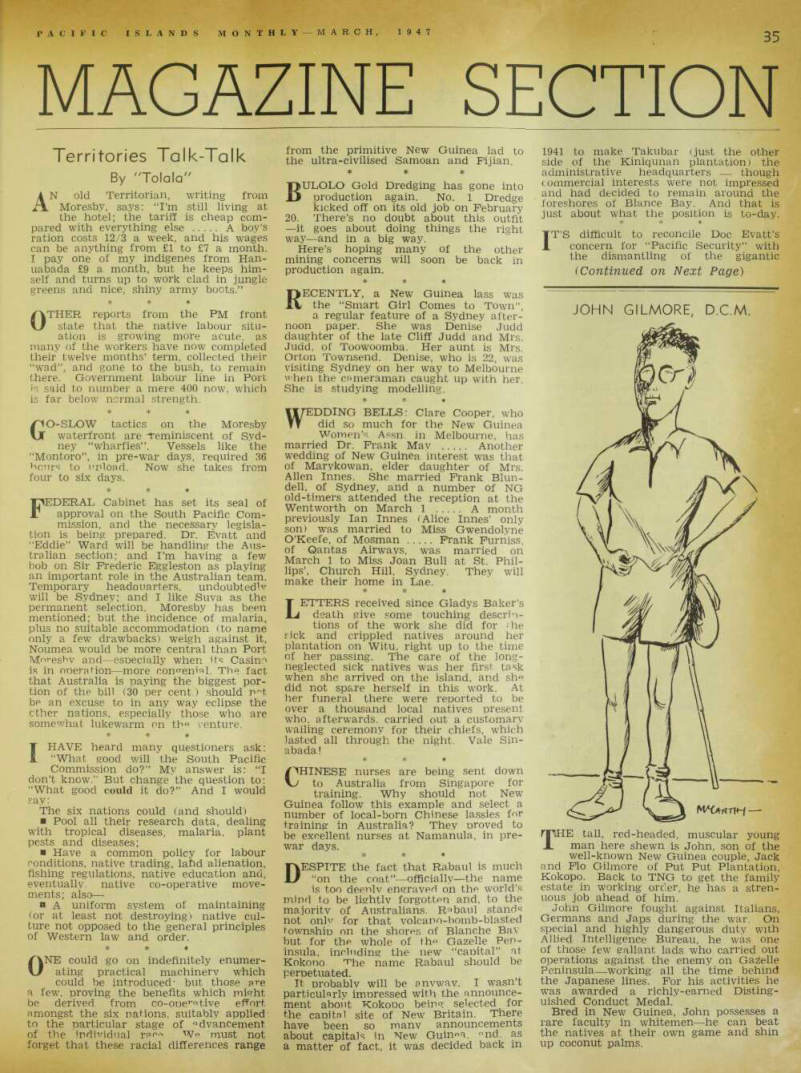
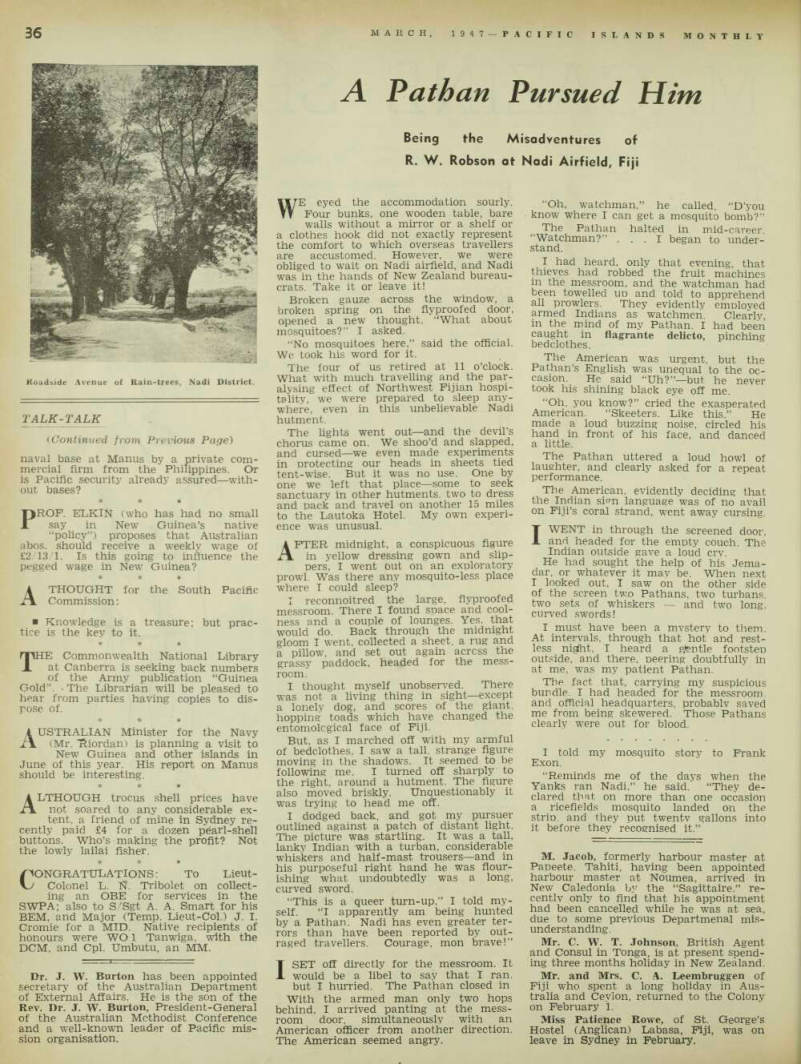
Territories Talk-Talk
By "Tolala"
A N old Territorial!, writing from Moresby, says: “I’m still living at the hotel; the tariff is cheap com pared with everything else A boy’s ration costs 12/3 a week, and his wages can be anything from £1 to £7 a month.
I pay one of my indigenes from Han uabada £9 a month, but he keeps him self and turns up to work clad in jungle greens and nice, shiny army boots.” * * * OTHER reports from the PM front state that the native labour situ ation is growing more acute, as many of the workers have now completed their twelve months’ term, collected their “wad”, and gone to the bush, to remain there. Government labour line in Port is said to number a mere 400 now, which is far below normal strength. * * * GO-SLOW tactics on the Moresby waterfront are reminiscent of Syd ney “■wharf ies”. Vessels like the “Montoro”, in pre-war days, required 36 hours to unload. Now she takes from four to six days. * * ♦ FEDERAL Cabinet has set its seal of approval on the South Pacific Com mission, and the necessary legisla tion is being prepared. Dr. Evatt and “Eddie” Ward will be handling the Aus tralian section; and I’m having a few bob on Sir Frederic Eggleston as playing an important role in the Australian team.
Temporary headauarters, undoubtedlv will be Sydney: and I like Suva as the permanent selection. Moresby has been mentioned: but the incidence of malaria, plus no suitable accommodation (to name only a few drawbacks) weigh against it, Noumea would be more central than Port Muveshv and —especially when its Casino is in operation—more congenial. The fact that Australia is paying the biggest por tion of the bill (30 per cent.) should n rt t be an excuse to in any way eclipse the ether nations, especially those who are somewhat lukewarm on th° venture. * * * I HAVE heard many questioners ask: “What good v/ill the South Pacific Commission do?” My answer is: “I don’t know.” But change the question to: “What good could it do?” And I would say: The six nations could (and should) ■ Pool all their research data, dealing with tropical diseases, malaria, plant pests and diseases; ■ Have a common policy for labour conditions, native trading, lahd alienation, fishing regulations, native education and, eventually native co-operative move
ments; also—
b a uniform system of maintaining (or at least not destroying) native cul ture not opposed to the general principles of Western law and order. * * * ONE could go on indefinitely enumer ating practical machinerv which could be introduced- but those pre a few. proving the benefits which might be derived from effort amongst the six nations, suitably applied to the particular stage of °dvancement of the individual We must not forget that these racial differences range
from the primitive New Guinea lad to the ultra-civilised Samoan and Fijian. * * * BULOLO Gold Dredging has gone into production again. No. 1 Dredge kicked off on its old job on February 20. There’s no doubt about this outfit —it goes about doing things the right way—and in a big way.
Here’s hoping many of the other mining concerns will soon be back in production again. ♦ * ♦ RECENTLY, a New Guinea lass was the “Smart Girl Comes to Town”, a regular feature of a Sydney after noon paper. She was Denise Judd daughter of the late Cliff Judd and Mrs.
Judd, of Toowoomba. Her aunt is Mrs.
Orton Townsend. Denise, who is 22, was visiting Sydney on her way to Melbourne when the cameraman caught up with her.
She is studying modelling. * * * 117EDDING BELLS: Clare Cooper, who Tt did so much for the New Guinea Women’*? Assn, in Melbourne, has married Dr. Frank Mav Another wedding of New Guinea interest was that of Marykowan, elder daughter of Mrs.
Allen Innes. She married Frank Blun dell, of Sydney, and a number of NG old-timers attended the reception at the Wentworth on March 1 A month previously lan Innes (Alice Innes’ only son) was married to Miss Gwendolyne O’Keefe, of Mosman Frank Furriiss, of Qantas Airways, was married on March 1 to Miss Joan Bull at St. Phil lips’, Church Hill. Sydney. They will make their home in Lae. * * ♦ LETTERS received since Gladys Baker’s death give some touching descrip tions of the work she did for •he rick and crippled natives around her plantation on Witu. right up to the time of her passing. The care of the long neglected sick natives was her first task when she arrived on the island, and she did not spare herself in this work. At her funeral there were reported to be over a thousand local natives present who. afterwards, carried out a customary wailing ceremony for their chiefs, which lasted all through the night. Vale Sin abada! * * ♦ CHINESE nurses are being sent down to Australia from Singapore for training. Why should not New Guinea follow this example and select a number of local-born Chinese lassies for training in Australia? They Droved to be excellent nurses at Namanula, in pre war days. * ♦ * DESPITE the fact that Rabaul is much “on the coat” —officially—the name is too deenlv engraved on the world’s mind to be lightly forgotten and, to the majority of Australians. Rabaul stand*? not onlv for that volcano-bomb-blasted township on the shores of Blanche Bav but for the whole of the Gazelle Pen insula, including the new “capital” at Kokono "r'he name Rabaul should be perpetuated.
It probably will be anvwav. I wasn’t particularly impressed with the announce ment about Kokono being selected for the capital, site of New Britain. There have been so many announcements about capitals in New Guinea, °nd, as a matter of fact, it was decided back in
1941 to make Takubar (just the other side of the Kiniqunan plantation) the administrative headquarters though commercial interests were not impressed and had decided to remain around the foreshores of Blance Bay. And that is just about what the position is to-day. * * ♦ IT’S difficult to reconcile Doc Evatt’s concern for “Pacific Security” with the dismantling of the gigantic (Continued on Next Page )
naval base at Manus by a private com mercial firm from the Philippines. Or is Pacific security already assured—with out bases? ♦ ♦ ♦ PROF. ELKIN (who has had no small say in New Guinea’s native “policy”) proposes that Australian abos. should receive a weekly wage of £2 13/1. Is this going to influence the pegged wage in New Guinea? * * * A THOUGHT for the South Pacific
A Commission:
■ Knowledge is a treasure; but prac tice is the key to it. * * * fTTHE Commonwealth National Library X at Canberra is seeking back numbers of the Army publication “Guinea Gold”. • The Librarian will be pleased to hear from parties having copies to dis pose of. * * * 4 USTRALIAN Minister for the Navy (Mr. Giordan) is planning a visit to New Guinea and other islands in June of this year. His report on Manus should be interesting. * if * ALTHOUGH trocus shell prices have not soared to any considerable ex tent, a friend of mine in Sydney re cently paid £4 for a dozen pearl-shell buttons. Who’s making the profit? Not the lowly lailai fisher. * * *
Congratulations : to Lieut-
Colonel L. N. Tribolet on collect ing an OBE for services in the SWPA; also to S/Sgt A. A. Smart for his BEM, and Major (Temp. Lieut-Col.) J. I.
Cromie for a MID. Native recipients of honours were WO 1 Tanwiga, with the DCM, and Cpl. Umbutu, an MM.
Dr. J. W. Burton has been appointed secretary of the Australian Department of External Affairs. He is the son of the Rev. Dr. J. W. Burton, President-General of the Australian Methodist Conference and a well-known leader of Pacific mis sion organisation.
John Gilmore, D.C.M.
THE tall, red-headed, muscular young man here shewn is John, son of the well-known New Guinea couple, Jack and Flo Gilmore of Put Put Plantation, Kokopo. Back to TNG to get the family estate in working order, he has a stren uous job ahead of him.
John Gilmore fought against Italians, Germans and Japs during the war. On special and highly dangerous duty with Allied Intelligence Bureau, he was one of those few gallant lads who carried out operations against the enemy on Gazelle Peninsula—working all the time behind the Japanese lines. For his activities he was awarded a richly-earned Disting uished Conduct Medal.
Bred in New Guinea, John possesses a rare faculty in whitemen—he can beat the natives at their own game and shin up coconut palms.
A Nathan Pursued Him
Being the Misadventures of R. W. Robson at Nadi Airfield, Fiji
WE eyed the accommodation sourly.
Four bunks, one wooden table, bare walls without a mirror or a shelf or a clothes hook did not exactly represent the comfort to which overseas travellers are accustomed. However, we were obliged to wait on Nadi airfield, and Nadi was in the hands of New Zealand bureau crats. Take it or leave it!
Broken gauze across the window, a broken spring on the flyproofed door, opened anew thought. “What about mosquitoes?” I asked.
“No mosquitoes here.” said the official.
We took his word for it.
The four of us retired at 11 o’clock.
What with much travelling and the par alysing effect of Northwest Fijian hospi tality, we were prepared to sleep any where, even in this unbelievable Nadi hutment.
The lights went out—and the devil’s chorus came on. We shoo’d and slapped, and cursed —we even made experiments in protecting our heads in sheets tied tent-wise. But it was no use. One by one we left that place—some to seek sanctuary in other hutments, two to dress and pack and travel on another 15 miles to the Lautoka Hotel. My own experi ence was unusual.
AFTER midnight, a conspicuous figure in yellow dressing gown and slip pers, I went out on an exploratory prowl. Was there any mosquito-less place where I could sleep?
I reconnoitred the large, flyproofed messroom. There I found space and cool ness and a couple of lounges. Yes. that would do. Back through the midnight gloom I went, collected a sheet, a rug and a pillow, and set out again across the grassy paddock, headed for the mess room.
I thought myself unobserved. There was not a living thing in sight—except a lonely dog, and scores of the giant, hopping toads which have changed the entomological face of Fiji.
But, as I marched off with my armful of bedclothes, I saw a tall, strange figure moving in the shadows. It seemed to be following me. I turned off sharply to the right, around a hutment. The figure also moved briskly. Unquestionably it was trying to head me off.
I dodged back, and got my pursuer outlined against a patch of distant light.
The picture was startling. It was a tall, lanky Indian with a turban, considerable whiskers and half-mast trousers—and in his purposeful right hand he was flour ishing what undoubtedly was a long, curved sword.
“This is a queer turn-up,” I told my self. “I apparently am being hunted by a Pa than. Nadi has even greater ter rors than have been reported by out raged travellers. Courage, mon brave!”
ISET off directly for the messroom. It would be a libel to say that I ran. but I hurried. The Pathan closed in With the armed man only two hops behind, I arrived panting at the mess room door, simultaneously with an American officer from another direction.
The American seemed angry.
“Oh, watchman,” he called, “D’you know where I can get a mosquito bomb?"
The Pathan halted in mid-career.
“Watchman?” ... I began to under stand.
I had heard, only that evening, that thieves had robbed the fruit machines in the messroom, and the watchman had been towelled up and told to apprehend all prowlers. They evidently employed armed Indians as watchmen. Clearly, in the mind of my Pathan. I had been caught in flagrante delicto, pinching bedclothes.
The American was urgent, but the Pa than’s English was unequal to the oc casion. He said “Uh?”—but he never took his shining black eye off me.
“Oh. you know?” cried the exasperated American. “Skeeters. Like this.” He made a loud buzzing noise, circled his hand in front of his face, and danced a little.
The Pathan uttered a loud howl of laughter, and clearly asked for a repeat performance.
The American, evidently deciding that the Indian language was of no avail on Fiji’s coral strand, went away cursing.
I WENT in through the screened door, and headed for the empty couch. The Indian outside gave a loud cry.
He had sought the help of his Jema dar, or whatever it may be. When next I looked out, I saw on the other side of the screen two Pathans, two turbans, two sets of whiskers and two long, curved swords!
I must have been a mystery to them.
At intervals, through that hot and rest less I heard a p/entle footstep outside, and there, peering doubtfully in at me, was my patient Pathan.
The fact that, carrying my suspicious bundle. I had headed for the messroom. and official headquarters, probably saved me from being skewered. Those Pathans clearly were out for blood.
I told my mosquito story to Frank Exon.
“Reminds me of the days when the Yanks ran Nadi,” he said. “They de clared that on more than one occasion a ricefields mosquito landed on the strip, and they put twenty gallons into it before they recognised it.”
M. Jacob, formerly harbour master at Papeete, Tahiti, having been appointed harbour master at Noumea, arrived in New Caledonia by the “Sagittaire.” re cently only to find that his appointment had been cancelled while he was at sea, due to some previous Departmenal mis understanding.
Mr. C. W. T. Johnson, British Agent and Consul in Tonga, is at present spend ing three months holiday in New Zealand.
Mr. and Mrs. C. A. Leembruggen of Fiji who spent a long holiday in Aus tralia and Ceylon, returned to the Colony on February i.
Miss Patience Rowe, of St. George’s Hostel (Anglican) Labasa, Fiji, was on leave in Sydney in February.
Roadside Avenue of Rain-trees, Nadi District.
Advertisements & other items, p. 40 (1 item)
36
MARCH, 1947 PACIFIC ISLANDS MONTHLY
TALK-TALK
(Continued from Previous Page )
Tropicalities
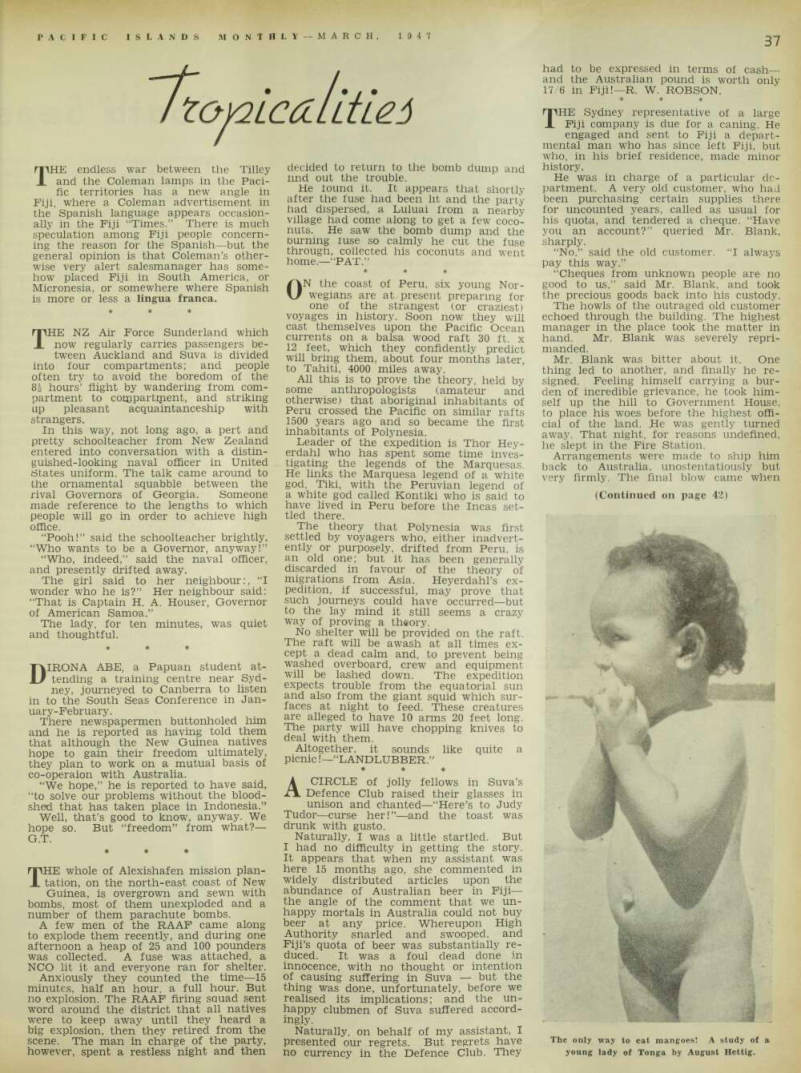
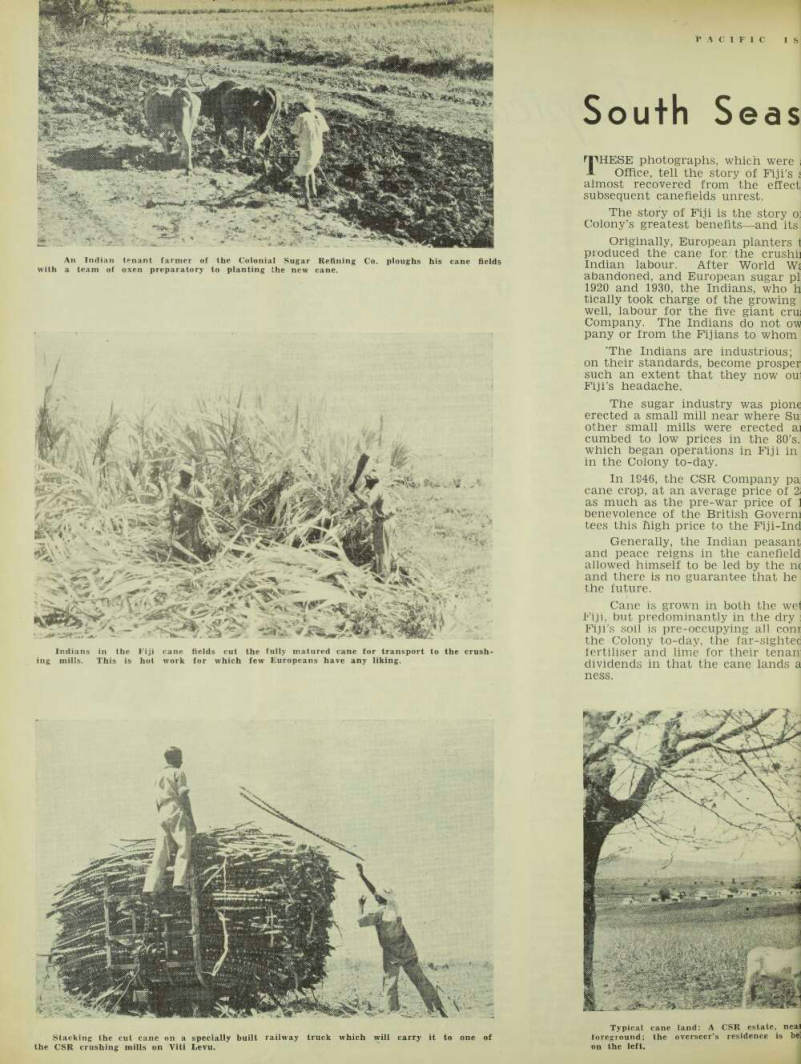
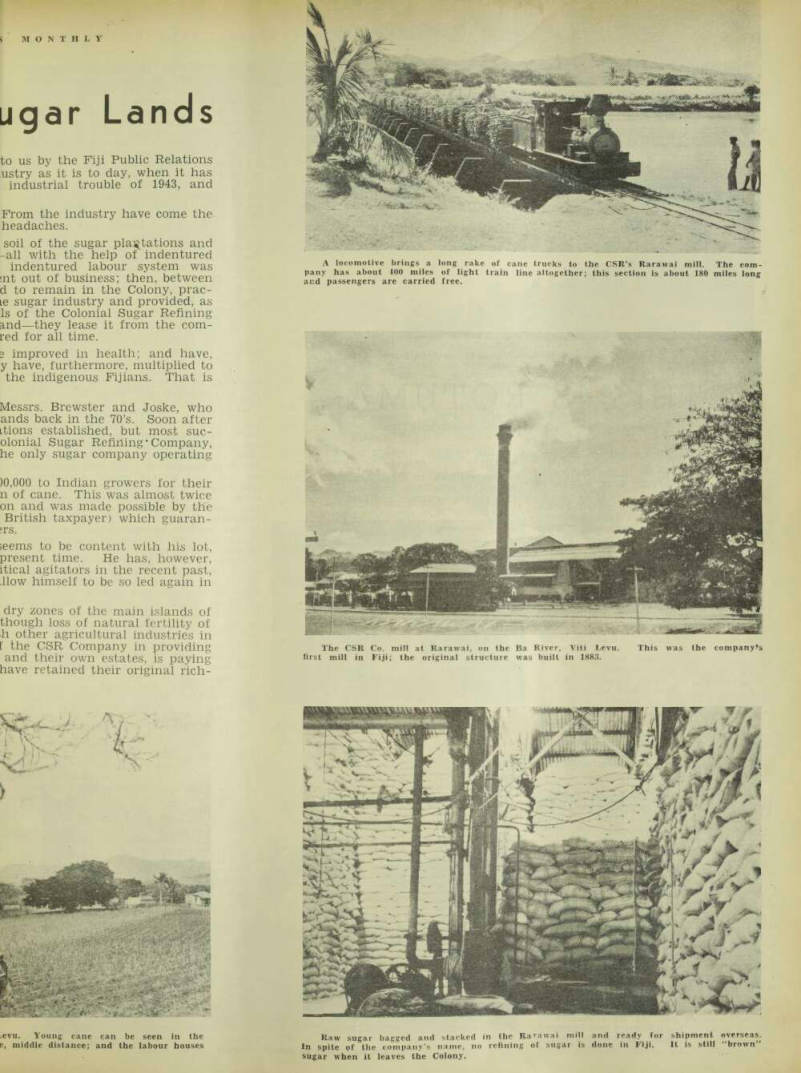
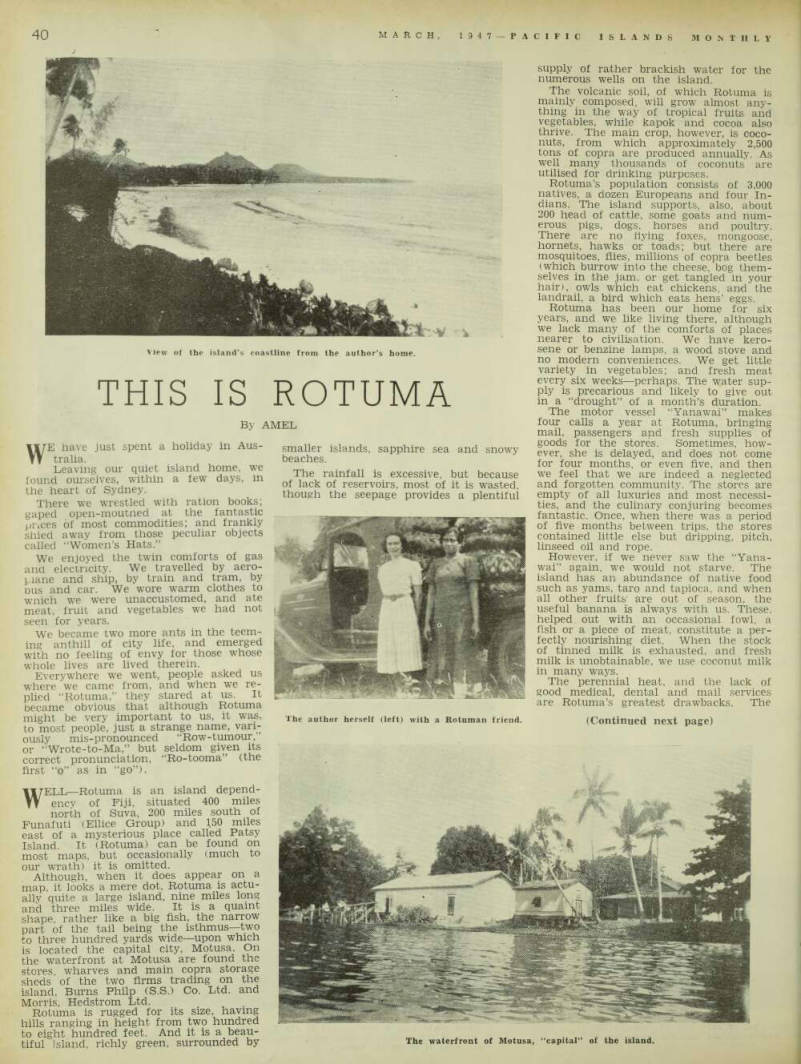
11HE endless war between the Tilley . and the Coleman lamps in the Paci fic territories has a new angle in Fiji, where a Coleman advertisement in the Spanish language appears occasion ally in the Fiji “Times.” There is much speculation among Fiji people concern ing the reason for the Spanish—but the general opinion is that Coleman’s other wise very alert salesmanager has some how placed Fiji in South America, or Micronesia, or somewhere where Spanish is more or less a lingua franca. * * * THE NZ Air Force Sunderland which now regularly carries passengers be tween Auckland and Suva is divided into four compartments: and people often try to avoid the boredom of the 8i hours’ flight by wandering from com partment to couipartrjient, and striking up pleasant acquaintanceship with strangers.
In this way, not long ago, a pert and pretty schoolteacher from New Zealand entered into conversation with a distin guished-looking naval officer in United States uniform. The talk came around to the ornamental squabble between the rival Governors of Georgia. Someone made reference to the lengths to which people will go in order to achieve high office.
“Pooh!” said the schoolteacher brightly.
“Who wants to be a Governor, anyway!”
“Who, indeed,” said the naval officer, and presently drifted away.
The girl said to her neighbour:, “I wonder who he is?” Her neighbour said: “That is Captain H. A. Houser, Governor of American Samoa.”
The lady, for ten minutes, was quiet and thoughtful. * * * DIRONA ABE, a Papuan student at tending a training centre near Syd ney, journeyed to Canberra to listen in to the South Seas Conference in Jan uary-February.
There newspapermen buttonholed him and he is reported as having told them that although the New Guinea natives hope to gain their freedom ultimately, they plan to work on a mutual basis of co-operaion with Australia.
“We hope,” he is reported to have said, “to solve our problems without the blood shed that has taken place in Indonesia.”
Well, that’s good to know, anyway. We hope so. But “freedom” from what?— G.T. ♦ * * THE whole of Alexishafen mission plan tation, on the north-east coast of New Guinea, is overgrown and sewn with bombs, most of them unexploded and a number of them parachute bombs.
A few men of the RAAF came along to explode them recently, and during one afternoon a heap of 25 and 100 pounders was collected. A fuse was attached, a NCO lit it and everyone ran for shelter.
Anxiously they counted the time—ls minutes, half an hour, a full hour. But no explosion. The RAAF firing squad sent word around the district that all natives were to keep away until they heard a big explosion, then they retired from the scene. The man in charge of the party, however, spent a restless night and then
decided to return to the bomb dump and find out the trouble.
He found it. It appears that shortly after the fuse had been lit and the party had dispersed, a Luluai from a nearby village had come along to get a few coco nuts. He saw the bomb dump and the ourning fuse so calmly he cut the fuse through, collected his coconuts and went home.—“PAT.” * * ♦ ON the coast of Peru, six young Nor wegians are at present preparing for one of the strangest (or craziest) voyages in history. Soon now they will cast themselves upon the Pacific Ocean currents on a balsa wood raft 30 ft. x 12 feet, which they confidently predict will bring them, about four months later, to Tahiti, 4000 miles away.
All this is to prove the theory, held by some anthropologists (amateur and otherwise) that aboriginal inhabitants of Peru crossed the Pacific on similar rafts 1500 years ago and so became the first inhabitants of Polynesia.
Leader of the expedition is Thor Hey erdahl who has spent some time inves tigating the legends of the Marquesas.
He links the Marquesa legend of a white god, Tiki, with the Peruvian legend of a white god called Kontiki who is said to have lived in Peru before the Incas set tled there.
The theory that Polynesia was first settled by voyagers who, either inadvert ently or purposely, drifted from Peru, is an old one; but it has been generally discarded in favour of the theory of migrations from Asia. Heyerdahl’s ex pedition, if successful, may prove that such journeys could have occurred —but to the lay mind it still seems a crazy way of proving a theory.
No shelter will be provided on the raft.
The raft will be awash at all times ex cept a dead calm and, to prevent being washed overboard, crew and equipment will be lashed down. The expedition expects trouble from the equatorial sun and also from the giant squid which sur faces at night to feed. These creatures are alleged to have 10 arms 20 feet long.
The party will have chopping knives to deal with them.
Altogether, it sounds like quite a picnic !—-“LANDLUBBER.” * * ♦ A CIRCLE of jolly fellows in Suva’s Defence Club raised their glasses in unison and chanted —“Here’s to Judy Tudor—curse her!” —and the toast was drunk with gusto.
Naturally, I was a little startled. But I had no difficulty in getting the story.
It appears that when my assistant was here 15 months ago, she commented in widely distributed articles upon the abundance of Australian beer in Fiji— the angle of the comment that we un happy mortals in Australia could not buy beer at any price. Whereupon High Authority snarled and swooped, and Fiji’s quota of beer was substantially re duced. It was a foul dead done in innocence, with no thought or intention of causing suffering in Suva but the thing was done, unfortunately, before we realised its implications; and the un happy clubmen of Suva suffered accord
ingly.
Naturally, on behalf of my assistant, I presented our regrets. But regrets have no currency in the Defence Club. They
had to be expressed in terms of cash— and the Australian pound is worth only 17/6 in Fiji!—R. W. ROBSON. * * * THE Sydney representative of a large Fiji company is due for a caning. He engaged and sent to Fiji a depart mental man who has since left Fiji, but who, in his brief residence, made minor history.
He was in charge of a particular de partment. A very old customer, who had been purchasing certain supplies there for uncounted years, called as usual for his quota, and tendered a cheque. “Have you an account?” queried Mr. Blank, sharply.
“No.” said the old customer. “I always pay this way.”
“Cheques from unknown people are no good to us,” said Mr. Blank, and took the precious goods back into his custody.
The howls of the outraged old customer echoed through the building. The highest manager in the place took the matter in hand. Mr. Blank was severely repri manded.
Mr. Blank was bitter about it. One thing led to another, and finally he re signed. Feeling himself carrying a bur den of incredible grievance, he took him self up the hill to Government House, to place his woes before the highest offi cial of the land. He was gently turned away. That night, for reasons undefined, he slept in the Fire Station.
Arrangements were made to ship him back to Australia, unostentatiously but very firmly. The final blow came when
(Continued on page 42)
The only way to eat mangoes! A study of a young lady of Tonga by August Hettig.
An Indian tenant farmer of the Colonial Sugar Refining Co. ploughs his cane fields with a team of oxen preparatory to planting the new cane.
Indians in the Fiji cane fields cut the fully matured cane for transport to the crush ing mills. This is hot work for which few Europeans have any liking.
Stacking the cut cane on a specially built railway truck which will carry it to one of the CSR crushing mills on Viti Levu.
he told the highest manager: “I have Incurred various bills in this town. I am not leaving here until those bills are paid.”
He was shipped away. I do not know who paid the bills. I did not have the heart to ask the highest manager about it.—R.W.R. * * » FOR many years now Mangaia has seen no real crop of mangoes a fruit that is consequently very highly appreciated.
A curious law of nature governs the “vi” trees. They are subject to attack by fly in normally dry years; as a result, they do not bear fruit save in a year marked by abnormal rains. Such a year was 1928; mangoes were then abundant, for the fly had all been annihilated by the downpours. Since that time there has been no real mango harvest.
As all local fruit grows wild, and native planters have no surplus cash for the purchase of sprayers and insect poisons, a delicious fruit-is lost to Mangaians (till the next excessviely wet winter in 19 —?)
—“Eti.”
* * * THIS comes from the “ABM Review”: “Seventy-three threepenny bits were sent to the ABM in January from the children of the Tufnell Home for Orphans, Brisbane, which is conducted by the Sisters of the Sacred Advent. The threepenny bits had been taken out of their Christmas nuddings, and came with a message that ‘These were for the little boys in New Guinea wot had no Christ mas puddings, but wot had only worms to eat!’”
Dr. R. Carrick and Mrs. Carrick have left Suva. Fiii for Perth. Western Aus tralia where thev will make their home.
Dr. Carrick. who has been well known Fiii for many years, has now retired from medical practice.
The Most Rev. V. Folev Vicar Apos tolic of Fiji, left the Colony in early February on a visit to Australia and New Zealand.
South Seasugar Lands
THESE photographs, which were , Office, tell the story of Fiji’s i almost recovered from the effect subsequent canefieids unrest.
The story of Fiji is the story o; Colony’s greatest benefits—and its Originally, European planters 1 produced the cane for/ the crushi] Indian labour. After World Ws abandoned, and European sugar pi 1920 and 1930, the Indians, who h tically took charge of the growing well, labour for the five giant cru Company. The Indians do not ow pany or from the Fijians to whom 'The Indians are industrious; on their standards, become prosper such an extent that they now ou Fiji’s headache.
The sugar industry was pione erected a small mill near where Su other small mills were erected ai cumbed to low prices in the 80’s, which began operations in Fiji in in the Colony to-day.
In 1846, the CSR Company pa cane crop, at an average price of 2 as much as the pre-war price of ] benevolence of the British Govern] tees this high price to the Fiji-Ind Generally, the Indian peasant and peace reigns in the canefield allowed himself to be led by the m and there is no guarantee that he the future.
Cane is grown in both the wel Fiji, but predominantly in the dry Fiji’s soil is pre-occupying all com the Colony to-day, the far-sightec fertiliser and lime for their tenan dividends in that the cane lands a ness.
Typical cane land: A CSR estate, neal[?] foreground; the overseer's residence is bel[?] on the left.
to us by the Fiji Public Relations ustry as it is to day, when it has industrial trouble of 1943, and From the industry have come the headaches. soil of the sugar plantations and -all with the help of indentured indentured labour system was mt out of business; then, between d to remain in the Colony, prac ie sugar industry and provided, as Is of the Colonial Sugar Refining and —they lease it from the corn red for all time. 2 improved in health; and have, y have, furthermore, multiplied to the indigenous Fijians. That is Messrs. Brewster and Joske, who ands back in the 70’s. Soon after Ltions established, but most suc olonial Sugar Refining*Company, he only sugar company operating )0,000 to Indian growers for their nof cane. This was almost twice on and was made possible by the British taxpayer) which guaran is. ;eems to be content with his lot, present time. He has, however, itical agitators in the recent past, ,llow himself to be so led again in dry zones of the main islands of though loss of natural fertility of h other agricultural industries in f the CSR Company in providing and their own estates, is paying have retained their original rich-
A locomotive brings a long rake of cane trucks to the CSR’s Rarawai mill. The com pany has about 400 miles of light train line altogether; this section is about 180 miles long and passengers are carried free.
The CSR Co. mill at Rarawai, on the Ba River, Viti Levu. This was the company’s first mill in Fiji; the original structure was built in 1883.
[?]ievu. Young cane can be seen in the [?]e, middle distance; and the labour houses
Raw sugar bagged and stacked in the Rarawai mill and ready for shipment overseas.
In spite of the company’s name, no refining of sugar is done in Fiji. It is still “brown” sugar when it leaves the Colony.
Advertisements & other items, pp. 42-43 (2 items)
Pacific Is
jgar Lands
MONTHLY
This Is Rotuma
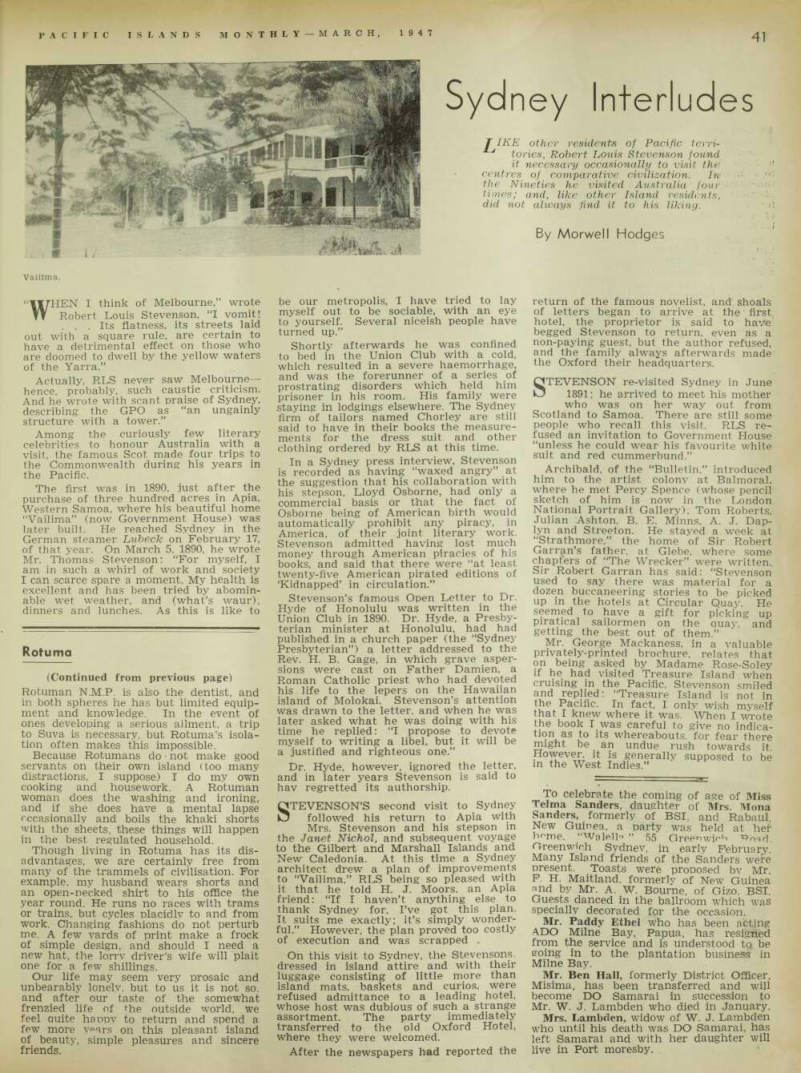
By Amel
WE have just spent a holiday in Aus tralia.
Leaving our quiet island home, we found ourselves, within a few days, in the heart of Sydney.
There we wrestled with ration books; gaped open-moutned at the fantastic pnces of most commodities; and frankly shied away from those peculiar objects called “Women’s Hats.”
We enjoyed the twin comforts of gas and electricity. We travelled by aero plane and ship, by train and tram, by ous and car. We wore warm clothes to wnich we were unaccustomed, and ate meat, fruit and vegetables we had not seen for years.
We became two more ants in the teem ing anthill of city life, and emerged with no feeling of envy for those whose whole lives are lived therein.
Everywhere we went, people asked us where we came from, and when we re plied “Rotuma," they stared at us. It became obvious that although Rotuma might be very important to us, it was, to most people, just a strange name, vari ously mis-pronounced “Row-tumour,’’ or “Wrote-to-Ma,” but seldom given its correct pronunciation, “Ro-tooma” (the first “o” as in “go”).
WELL —Rotuma is an island depend ency of Fiji, situated 400 miles north of Suva, 200 miles south of Funafuti (Ellice Group) and 150 miles east of a mysterious place called Patsy Island. It (Rotuma) can be found on most maps, but occasionally (much to our wrath) it is omitted.
Although, when it does appear on a map, it looks a mere dot, Rotuma is actu ally quite a large island, nine miles long and three miles wide. It is a quaint shape, rather like a big fish, the narrow part of the tail being the isthmus—two to three hundred yards wide—upon which is located the capital city, Motusa. On the waterfront at Motusa are found the stores, wharves and main copra storage sheds of the two firms trading on the island, Burns Philp (S.S.) Co. Ltd. and Morris, Hedstrom Ltd.
Rotuma is rugged for its size, having hills ranging in height from two hundred to eight hundred feet. And it is a beau tiful island, richly green, surrounded by
smaller islands, sapphire sea and snowy beaches.
The rainfall is excessive, but because of lack of reservoirs, most of it is wasted, though the seepage provides a plentiful
(Continued next page)
supply of rather brackish water for the numerous wells on the island.
The volcanic soil, of which Rotuma is mainly composed, will grow almost any thing in the way of tropical fruits and vegetables, while kapok and cocoa also thrive. The main crop, however, is coco nuts, from which approximately 2,500 tons of copra are produced annually. As well many thousands of coconuts are utilised for drinking purposes.
Rotuma’s population consists of 3,000 natives, a dozen Europeans and four In dians. The island supports, also, about 200 head of cattle, some goats and num erous pigs, dogs, horses and poultry.
There are no flying foxes, mongoose, hornets, hawks or toads; but there are mosquitoes, flies, millions of copra beetles (which burrow into the cheese, bog them selves in the jam, or get tangled in your hair), owls which eat chickens, and the landrail, a bird which eats hens’ eggs.
Rotuma has been our home for six years, and we like living there, although we lack many of the comforts of places nearer to civilisation. We have kero sene or benzine lamps, a wood stove and no modern conveniences. We get little variety in vegetables; and fresh meat every six weeks—perhaps. The water sup ply is precarious and likely to give out in a “drought” of a month’s duration.
The motor vessel “Yanawai” makes four calls a year at Rotuma, bringing mail, passengers and fresh supplies of goods for the stores. Sometimes, how ever, she is delayed, and does not come for four months, or even five, and then we feel that we are indeed a neglected and forgotten community. The stores are empty of all luxuries and most necessi ties, and the culinary conjuring becomes fantastic. Once, when there was a period of five months between trips, the stores contained little else but dripping, pitch, linseed oil and rope.
However, if we never saw the “Yana wai” again, we would not starve. The island has an abundance of native food such as yams, taro and tapioca, and when all other fruits' are out of season, the useful banana is always with us. These, helped out with an occasional fowl, a fish or a piece of meat, constitute a per fectly nourishing diet. When the stock of tinned milk is exhausted, and fresh milk is unobtainable, we use coconut milk in many ways.
The perennial heat, and the lack of good medical, dental and mail services are Rotuma’s greatest drawbacks. The
View of the island’s coastline from the author’s home.
The author herself (left) with a Rotuman friend.
The waterfront of Motusa, “capital” of the island.
Rotuman N.M.P. is also the dentist, and in both spheres he has but limited equip ment and knowledge. In the event of ones developing a serious ailment, a trip to Suva is necessary, but Rotuma’s isola tion often makes this impossible.
Because Rotumans do • not make good servants on their own island (too many distractions, I suppose) I do my own cooking and housework. A Rotuman woman does the washing and ironing, and if she does have a mental lapse rccasionally and boils the khaki shorts with the sheets, these things will happen in the best regulated household.
Though living in Rotuma has its dis advantages, we are certainly free from many of the trammels of civilisation. For example, my husband wears shorts and an open-necked shirt to his office the year round. He runs no races with trams or trains, but cycles placidly to and from work. Changing fashions do not perturb me. A few yards of print make a frock of simple design, and should I need a new hat, the lorrv driver’s wife will plait one for a few shillings.
Our life may seem very prosaic and unbearably lonely, but to us it is not so. and after our taste of the somewhat frenzied life of the outside world, we feel Quite happy to return and spend a few more v°ars on this pleasant island of beauty, simple pleasures and sincere friends.
Sydney Interludes
J IKE other residents of Pacific terri tories, Robert Louis Stevenson found it necessary occasionally to visit the centres of comparative civilization. In the Nineties he visited Australia four times; and, like other Island residents, did not always find it to his liking.
By Morwell Hodges
“IjrrHEN I think of Melbourne,” wrote W Robert Louis Stevenson, “I vomit! ... Its flatness, its streets laid out with a square rule, are certain to have a detrimental effect on those who are doomed to dwell by the yellow waters of the Yarra.”
Actually, RLS never saw Melbourne— hence, probably, such caustic criticism.
And he wrote with scant praise of Sydney, describing the GPO as “an ungainly structure with a tower.”
Among the curiously few literary celebrities to honour Australia with a visit, the famous Scot made four trips to the Commonwealth during his years in the Pacific.
The first was in 1890. just after the purchase of three hundred acres in Apia, Western Samoa, where his beautiful home “Vailima” (now Government House) was later built. He reached Sydney in the German steamer Luheck on February 17, of that year. On March 5. 1890, he wrote Mr. Thomas Stevenson: “For myself, I am in such a whirl of work and society I can scarce spare a moment. My health is excellent and has been tried by abomin able wet weather, and (what’s waur), dinners and lunches. As this is like to
be our metropolis, I have tried to lay myself out to be sociable, with an eye to yourself. Several niceish people have turned up.”
Shortly afterwards he was confined to bed in the Union Club with a cold, which resulted in a severe haemorrhage, and was the forerunner of a series of prostrating disorders which held him prisoner in his room. His family were staying in lodgings elsewhere. The Sydney firm of tailors named Chorley are still said to have in their books the measure ments for the dress suit and other clothing ordered by RLS at this time.
In a Sydney press interview, Stevenson is recorded as having “waxed angry” at the suggestion that his collaboration with his stepson, Lloyd Osborne, had only a commercial basis or that the fact of Osborne being of American birth would automatically prohibit any piracy, in America, of their joint literary work.
Stevenson admitted having lost much money through American piracies of his books, and said that there were “at least twenty-five American pirated editions of ‘Kidnapped’ in circulation.”
Stevenson’s famous Open Letter to Dr.
Hyde of Honolulu was written in the Union Club in 1890. Dr. Hyde, a Presby terian minister at Honolulu, had had published in a church paper (the “Sydney Presbyterian”) a letter addressed to the Rev. H. B. Gage, in which grave asper sions were cast on Father Damien, a Roman Catholic priest who had devoted his life to the lepers on the Hawaiian island of Molokai, Stevenson’s attention was drawn to the letter, and when he was later asked what he was doing with his time he replied: “I propose to devote myself to writing a libel, but it will be a justified and righteous one.”
Dr. Hyde, however, ignored the letter, and in later years Stevenson is said to hav regretted its authorship.
STEVENSON’S second visit to Sydney followed his return to Apia with Mrs. Stevenson and his stepson in the Janet Nichol, and subsequent voyage to the Gilbert and Marshall Islands and New Caledonia. At this time a Sydney architect drew a plan of improvements to “Vailima,” RLS being so pleased with it that he told H. J. Moors, an Apia friend: “If I haven’t anything else to thank Sydney for, I’ve got this plan.
It suits me exactly; it’s simply wonder ful.” However, the plan proved too costly of execution and was scrapped .
On this visit to Sydnev, the Stevensons. dressed in island attire and with their luggage consisting of little more than island mats, baskets and curios, were refused admittance to a leading hotel, whose host was dubious of such a strange assortment. The party immediately transferred to the old Oxford Hotel, where they were welcomed.
After the newspapers had reported the
return of the famous novelist, and shoals of letters began to arrive at the first hotel, the proprietor is said to havte begged Stevenson to return, even as a non-paying guest, but the author refused, and the family always afterwards made the Oxford their headquarters.
STEVENSON re-visited Sydney in June 1891; he arrived to meet his mother who was on her way out from Scotland to Samoa. There are still some people who recall this visit. RLS re fused an invitation to Government House “unless he could wear his favourite white suit and red cummerbund.”
Archibald, of the “Bulletin,” introduced him to the artist colony at Balmoral, where he met Percy Spence (whose pencil sketch of him is now in the London National Portrait Gallery). Tom Roberts, Julian Ashton, B. E. Minns, A. J, Dap lyn and Streeton. He stayed a week at “Strathmore,” the home of Sir Robert Garran’s father, at Glebe, where some chapters of “The Wrecker” were written.
Sir Robert Garran has said: “Stevenson used to say there was material for a dozen buccaneering stories to be picked up in the hotels at Circular Quay. He seemed to have a gift for picking up piratical sailormen on the quay, and getting the best out of them.”
Mr. George Mackaness. in a valuable privately-printed brochure, relates that on being asked by Madame Ro.se-Soley if he had visited Treasure Island when cruising in the Pacific, Stevenson smiled and replied: “Treasure Island is not in the Pacific. In fact, I only wish myself that I knew where it was. When I wrote the book I was careful to give no indica tion as to its whereabouts, for fear there might be an undue rush towards it.
However, it is generally supposed to be in the West Indies.”
To celebrate the coming of age of Miss Telma Sanders, daughter of Mrs. Mona Sanders, formerly of BSI, and Rabaul, New Guinea, a party was held at her b'-'me, “WalelF ” 55 Green ‘Poad.
Greenwich Sydnev, in early February.
Many Island friends of the Sanders were present. Toasts were proposed bv Mr.
F. H. Maitland, formerlv of New Guinea and by Mr. A. W. Bourne, of Gizo. BSI.
Guests danced in the ballroom which was specially decorated for the occasion.
Mr. Paddy Ethel who has been acting ADO Milne Bay, Papua, has resigned from the service and is understood to be eoing in to the plantation business in Milne Bay.
Mr. Ben Hall, formerly District Officer, Misima, has been transferred and will become DO Samarai in succession to Mr. W. J. Lambden who died in January.
Mrs. Lambden, widow of W. J. Lambden who until his death was DO Samarai, has left Samarai and with her daughter will live in Port moresby.
Vailima.
Advertisements & other items, p. 45 (1 item)
41
PACIFIC ISLANDS MONTHLY MARCH, 1947
Rotuma (Continued from previous page)
Vale Rabaul!
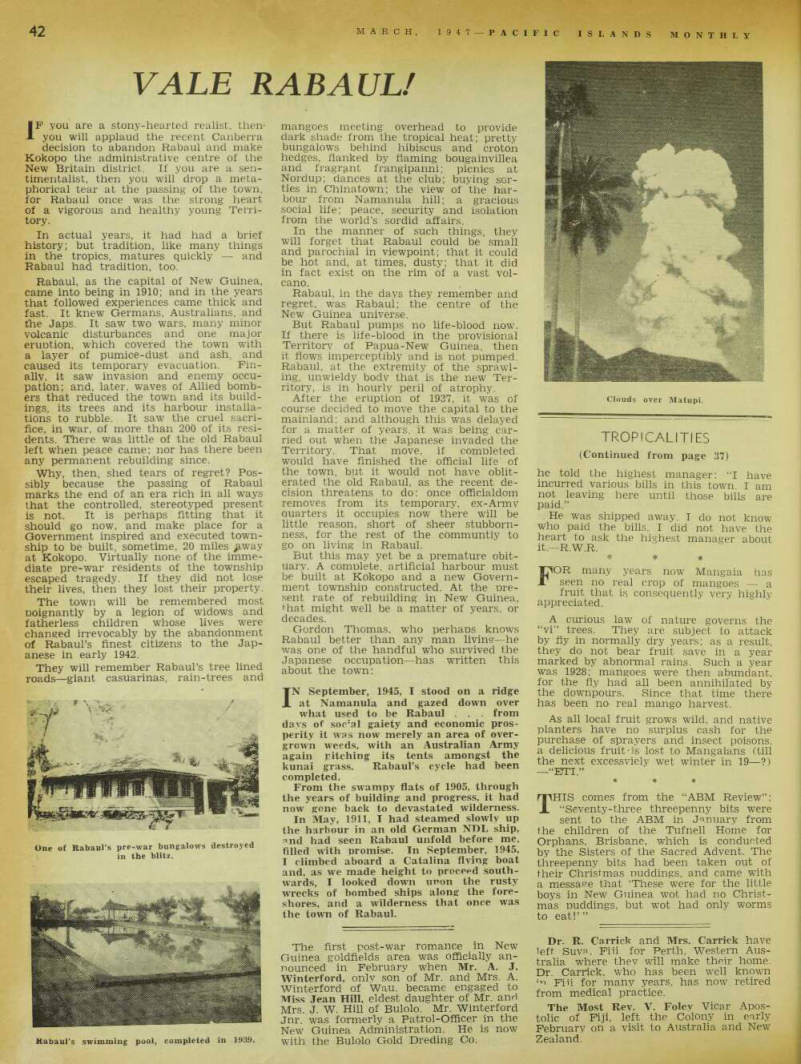
IF you are a stony-hearted realist, them you will applaud the recent Canberra decision to abandon Rabaul and make Kokopo the administrative centre of the New Britain district. If you are a sen timentalist, then you will drop a meta phorical tear at the passing of the town, for Rabaul once was the strong heart of a vigorous and healthy young Terri tory.
In actual years, it had had a brief history: but tradition, like many things in the tropics, matures quickly and Rabaul had tradition, too.
Rabaul, as the capital of New Guinea, came into being in 1910; and in the years that followed experiences came thick and fast. It knew Germans, Australians, and the Japs. It saw two wars, many minor volcanic disturbances and one major emotion, which covered the town with a layer of pumice-dust and ash, and caused its temporary evacuation. Fin ally. it saw invasion and enemy occu pation; and, later, waves of Allied bomb ers that reduced the town and its build ings, its trees and its harbour installa tions to rubble. It saw the cruel sacri fice, in war. of more than 200 of its resi dents. There was little of the old Rabaul left when peace came; nor has there been any permanent rebuilding since.
Why, then, shed tears of regret? Pos sibly because the passing of Rabaul marks the end of an era rich in all ways that the controlled, stereotyped present is not. It is perhaps fitting that it should go now, and make place for a Government inspired and executed town ship to be built, sometime, 20 miles p,way at Kokopo. Virtually none of the imme diate pre-war residents of the township escaped tragedy. If they did not lose their lives, then they lost their property.
The town will be remembered most poignantly by a legion of widows and fatherless children whose lives were changed irrevocably by the abandonment of Rabaul’s finest citizens to the Jap anese in early 1942.
They will remember Rabaul’s tree lined roads —giant casuarinas, rain-trees and
mangoes meeting overhead to provide dark shade from the tropical heat; pretty bungalows behind hibiscus and croton hedges, flanked by flaming bougainvillea and fragrant frangipanni; picnics at Nordup; dances at the club; buying sor ties in Chinatown; the view of the har bour from Namanula hill; a gracious social life; peace, security and isolation from the world’s sordid affairs.
In the manner of such things, they will forget that Rabaul could be small and parochial in viewpoint; that it could be hot and, at times, dusty: that it did in fact exist on the rim of a vast vol cano.
Rabaul, in the days they remember and regret, was Rabaul; the centre of the New Guinea universe.
But Rabaul pumps no life-blood now.
If there is life-blood in the provisional Territorv of Papua-New Guinea, then it flows imperceptibly and is not pumped.
Rabaul, at the extremity of the sprawl ing, unwieldy body that is the new Ter ritory, is in hourly peril of atrophy.
After the eruption of 1937, it was of course decided to move the capital to the mainland: and although this was delayed for a matter of years, it was being car ried out when the Japanese invaded the Territory. That move, if comnleted. would have finished the official life of the town, but it would not have oblit erated the old Rabaul, as the recent de cision threatens to do: once officialdom removes from its temporary, ex-Armv Quarters it occupies now there will be little reason, short of sheer stubborn ness, for the rest of the communtiy to go_on living in Rabaul.
But this may yet be a premature obit uary. A comnlete. artificial harbour must be built at Kokopo and a new Govern ment township constructed. At the nre sent rate of rebuilding in New Guinea, fhat might well be a matter of years, or decades.
Gordon Thomas, who perhaps knows Rabaul better than any man living—he was one of the handful who survived the Japanese occupation—has written this about the town: IN September, 1945, I stood on a ridge at Namanula and gazed down over what used to be Rabaul . . . from days of soc ; al gaiety and economic pros perity it was now merely an area of over grown weeds, with an Australian Army again pitching its tents amongst the kunai grass. Rabaul’s cycle had been completed.
From the swampy flats of 1905, through the years of building and progress, it had now gone back to devastated wilderness.
In May, 1911, I had steamed slowly up the harbour in an old German NDL ship, nnd had seen Rabaul unfold before me, filled with promise. In September, 1945, I climbed aboard a Catalina flying boat and, as we made height to proceed south wards, I looked down imon the rusty wrecks of bombed ships along the fore shores, and a wilderness that once was the town of Rabaul.
The first post-war romance in New Guinea goldfields area was officially an nounced in February when Mr. A. J.
Winterford, onlv son of Mr. and Mrs. A.
Winterford of Wau. became engaged to Miss Jean Hill, eldest daughter of Mr. and Mrs. J. W. Hill of Bulolo. Mr. Winterford Jnr. was formerly a Patrol-Officer in the New Guinea Administration. He is now with the Bulolo Gold Dreding Co.
One of Rabaul’s pre-war bungalows destroyed in the blitz.
Rabaul's swimming pool, completed in 1939.
Clouds over Matupi.
Advertisements & other items, p. 46 (1 item)
42
TROPICALITIES
(Continued from page 37)
MARCH, 1947 PACIFIC ISLANDS MONTHLY
Further New Year
Honours
TWO people, well known to South Pacific residents, although not them selves Islands residents, received honours in the New Year.
One was Mr. P. J. Twomey, Secretary of the Leper Trust Board, New Zealand, who was made a member of the Order of the British Empire.
Mr. Twomey is well known for the enthusiasm with which he has raised money for the care of the lepers in the South Pacific. Many gifts have been made by the New Zealand Leper Trust Board to the Central Leper Hospital at Makogai, Fiji. Another again a New Zealander was Captain A. H. Prosser, who received the OBE.
Captain Prosser commanded a number of Union Steamship Company vessels during the war, among them the Matua.
Marriage And Divorce In
The Cook Islands
From Our Mangaia Correspondent IT does not seem to be generally known that in NZ’s dependency of Cook Islands, one may contract matrimony at a total expense of 7/-, and, in the regrettaable event of the union proving a failure, dissolve the contract for a further fee of 26/-. The lowest divorce charge, this writer believes, in the world.
There are, however, snares in this Cupid’s Garden.
To begin with, only actual residents of the islands may marry; and in the event of one partner being a European (the man, usually) he must satisfy the authorities that the marriage is not merely a scheme to get the Polynesian bride’s land. If there is any suspicion, the arrangement can be vetoed by the Administration.
Where permission is granted, Europeans and Polynesians are alike subject to the Cl laws that govern marriage, and the annulment of unsuccessful ventures (the proportion of failures is, however, not great; most Cl marriages end in domestic solidity and a large family.) The wedding ceremony may be per formed by a pastor (or priest) or by the Resident Agent in his capacity of registrar. The usual 3 days’ notice is required, and the certificate is signed in triplicate one copy for the bride, N 0.2 for the Mission and the third for the authorities.
The 26/- divorce is granted upon two grounds only prolonged absence, con structable as desertion; and misconduct proved by a “cohabiting” fine. (One of the most inconvenient conse quences of local divorces is seen when a Cl divorcee makes application to re marry. Even where the person, native or white, was the innocent party in the late action for annulment (a Supreme Court job, by the way, necessitating a visit from the judge from Rarotonga) his (or her) bid for renewed respectability meets a rude shock: no divorced person, innocent or guilty, may be re-married in a church.
The LMS usually arranges for the new marriage to be solemnised in the Mission reading-room; and the ceremony is, of course, fully legal. Oddly, if the divorcee’s second partner wed under the foregoing restrictions, should die, wedding number three may take place in church, the person being then regarded as a takaua, or bachelor!
The very low fees demanded are, of course, the Administration’s concession to native poverty. In the case of a resident European applying for annulment of his
marriage, he is, if decree be granted, very much on the right side of the ledger, seeing that the untying of matrimonial knots is a very expensive business indeed, in most parts of the world.
Were Cl divorces available to- mere visitors, renowned Reno would have to look to its laurels!
Mr. E. H. Craig, accompanied by his wife, and six weeks’ old son returned to his plantation at Samarai, Papua, by the “Montoro,” which left Brisbane on Jan
uary 16. Mr. Craig said life at Samarai would suit him even if there were no films or the postman did not call every day. His plantation, according to Mr.
Craig, was just the same as when he had left it. He had refrigeration and most of the modern conveniences in his home.
Mr. Craig’s mother and aunt also left by the “Montoro.”
Mr. V. C. Gabriel, manager of Burns Philp’s Samarai (Papua) branch, travel led on the “Muliama’s” January trip to Samarai direct from Sydney.
Advertisements & other items, p. 47 (1 item)
Berger’s Paint
*- * ■ ■ II !!
Tested for the tropics
To-day, the House of Berger with Empire-wide ramifications and resources makes a broad pattern of service to paint users. Every Berger finish must withstand test after test to prove worthy of the Berger label . . . every product must satisfy the Berger technicians and chemists that it will meet the challenge of all climates, from tropic heat to arctic cold. When you use any of Berger’s famous paints, ‘B.P.’
Berger’s Paint (Prepared), Synthelac, Matone, Quick Enamel, Pave-ol you get all the good qualities for decoration and lasting protection.
Berger’s Paint
► keeps on keeping on
Wanted—A Full-Sized
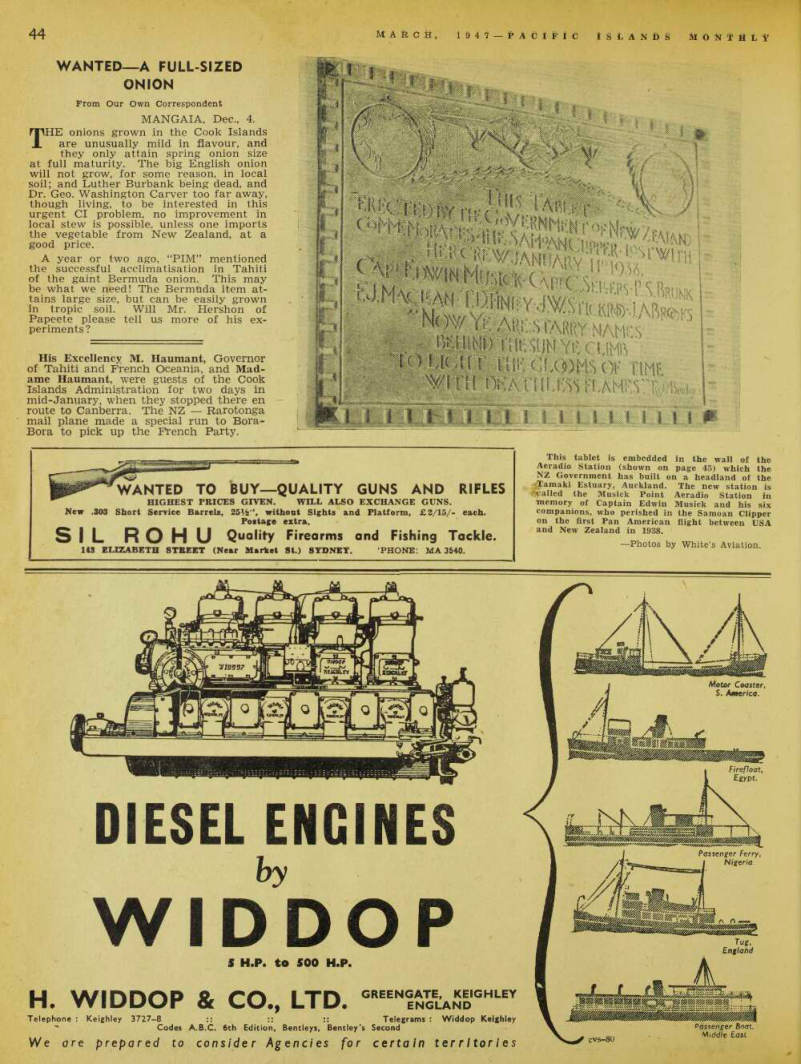
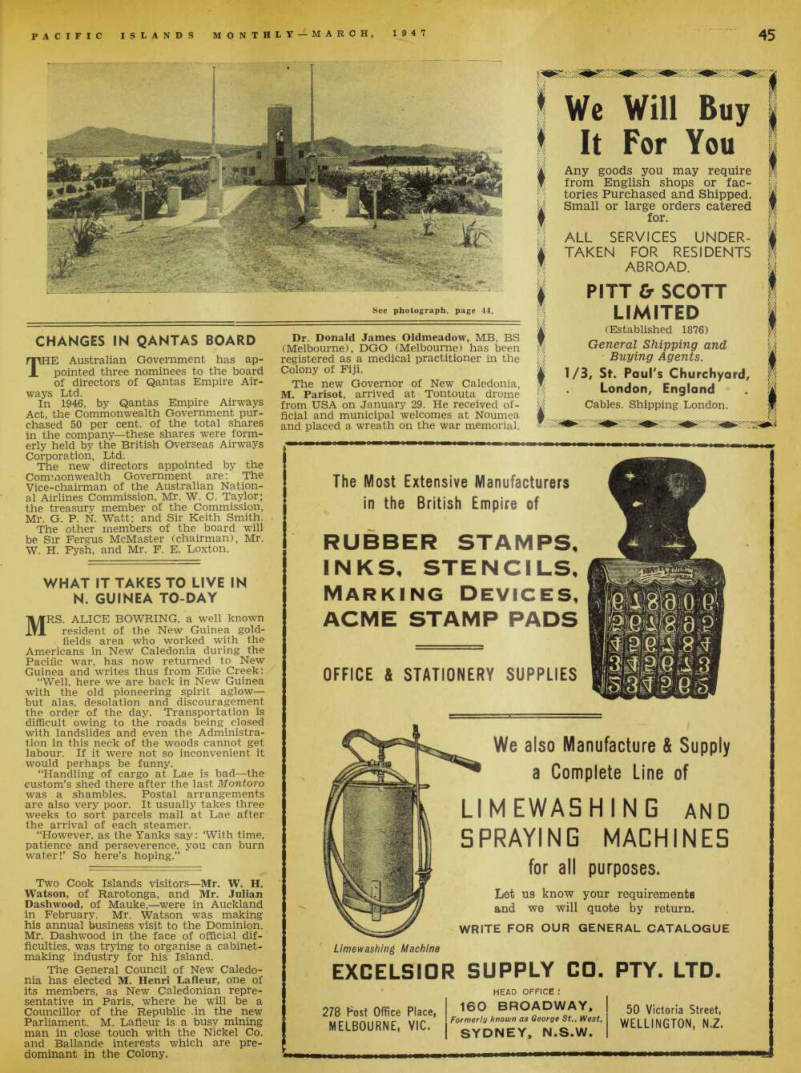
Onion
From Our Own Correspondent
Mangaia, Dec., 4.
THE onions grown in the Cook Islands are unusually mild in flavour, and they only attain spring onion size at full maturity. The big English onion will not grow, for some reason, in local soil; and Luther Burbank being dead, and Dr. Geo. Washington Carver too far away, though living, to be interested in this urgent Cl problem, no improvement in local stew is possible, unless one imports the vegetable from New Zealand, at a good price.
A year or two ago, “PIM” mentioned the successful acclimatisation in Tahiti of the gaint Bermuda onion. This may be what we need! The Bermuda item at tains large size, but can be easily grown in tropic soil. Will Mr. Hershon of Papeete please tell us more of his ex periments?
His Excellency M. Haumant, Governor of Tahiti and French Oceania, and Mad ame Haumant, were guests of the Cook Islands Administration for two days in mid-January, when they stopped there en route to Canberra. The NZ Rarotonga mail plane made a special run to Bora- Bora to pick up the French Party.
This tablet is embedded in the wall of the Aeradio Station (shown on page 45) which the NZ Government has built on a headland of the Tamaki Estuary, Auckland. The new station is called the Musick Point Aeradio Station in memory of Captain Edwin Musick and his six companions, who perished in the Samoan Clipper on the first Pan American flight between USA and New Zealand in 1938. —Photos by White’s Aviation.
See photograph, page 44.
Advertisements & other items, p. 48 (2 items)
44
MA&CM, 1947 PACIFIC ISLAN&S MONTHLY
Widdop
New
WANTED TO BUY—QUALITY GUNS AND RIFLES
HIGHEST PRICES GIVEN. WILL ALSO EXCHANGE GUNS.
Short Service Barrels, 25W, without Sights and Platform, £2/15/- each.
Postage extra.
SI L RO H U Quality Firearms and Fishing Tackle. 14S ELIZABETH STREET (Near Market St.) SYDNEY.
’PHONE: MA 3540.
bSH! mS * mastt? ticsir JL
DIESEL ENGINES
WIDDOP
S H.P. to SOO H.P.
H. WIDDOP & CO., LTD. green l^s e d ,ghley Telephone : Keighley 3727-8 :: :: :: Telegrams : Widdop Keighley " Codes A.B.C. 6th Edition, Bentleys, Bentley’s Second We are prepared to consider Agencies for certain territories /ft Motor Coaster S. America.
Firefioat Egypt.
Passenger Ferry I Nigeria A Tug, England Passenger Boat.
Middle East
Changes In Qantas Board
rE Australian Government has ap pointed three nominees to the board of directors of Qantas Empire Air ways Ltd.
In 1946, by Qantas Empire Airways Act, the Commonwealth Government pur chased 50 per cent, of the total shares in the company—these shares were form erly held by the British Overseas Airways Corporation, Ltd.
The new directors appointed by the Commonwealth Government are: The Vice-chairman of the Australian Nation al Airlines Commission, Mr. W. C. Taylor; the treasury member of the Commission, Mr. G. P. N. Watt; and Sir Keith Smith.
The other members of the board will be Sir Fergus McMaster (chairman), Mr.
W. H. Fysh, and Mr. F. E. Loxton.
What It Takes To Live In
N. Guinea To-Day
MRS. ALICE BOWRING, a well known resident of the New Guinea gold fields area who worked with the Americans in New Caledonia during the Pacific war, has now returned to New Guinea and writes thus from Edie Creek: “Well, here we are back in New Guinea with the old pioneering spirit aglow— but alas, desolation and discouragement the order of the day. Transportation is difficult owing to the roads being closed with landslides and even the Administra tion in this neck of the woods cannot get labour. If it were not so inconvenient it would perhaps be funny.
“Handling of cargo at Lae is bad —the custom’s shed there after the last Montoro was a shambles. Postal arrangements are also very poor. It usually takes three weeks to sort parcels mail at Lae after the arrival of each steamer.
“However, as the Yanks say: ‘With time, patience and perseverence, you can burn water!’ So here’s hoping,”
Two Cook Islands visitors —Mr. W. H.
Watson, of Rarotonga, and Mr. Julian Dashwood, of Mauke, —were in Auckland in February. Mr. Watson was making his annual business visit to the Dominion.
Mr. Dashwood in the face of official dif ficulties, was trying to organise a cabinet making industry for his Island.
The General Council of New Caledo nia has elected M. Henri Lafleur, one of its members, as New Caledonian repre sentative in Paris, where he will be a Councillor of the Republic An the new Parliament. M. Lafleur is a busy mining man in close touch with the Nickel Co. and Ballande interests which are pre dominant in the Colony.
Dr. Donald James Oldmeadow, MB, BS (Melbourne), DGO (Melbourne) has been registered as a medical practitioner in the Colony of Fiji.
The new Governor of New Caledonia, M. Parisot, arrived at Tontouta drome from USA on January 29. He received official and municipal welcomes at Noumea and placed a wreath on the war memorial.
Advertisements & other items, p. 49 (1 item)
We Will Buy
It For You
Any goods you may require from English shops or factories Purchased and Shipped.
Small or large orders catered for.
ALL SERVICES UNDER-
TAKEN FOR RESIDENTS
ABROAD.
PITT & SCOTT
LIMITED
(Established 1876) General Shipping and Buying Agents. 1/3, Sf. Paul's Churchyard, London, England Cables, Shipping London.
The Most Extensive Manufacturers in the British Empire of
RUBBER STAMPS,
INKS, STENCILS,
Marking Devices,
ACME STAMP PADS
OFFICE & STATIONERY SUPPLIES
m We also Manufacture & Supply a Complete Line of
LIMEWASHING AND
SPRAYING MACHINES
for all purposes.
Let us know your requirements and we will quote by return.
WRITE FOR OUR GENERAL CATALOGUE
Limewashing Machine
EXCELSIOR SUPPLY CO. PTY. LTD.
278 Post Office Place,
MELBOURNE, VIC.
HEAD OFFICE :
160 BROADWAY,
Formerly known as George St., West,
SYDNEY, N.S.W.
50 Victoria Street,
WELLINGTON, N.Z.
Micronesia
Japs Moved Out
End of Their Reign in Micronesia
AS part of their deliberate policy, the Americans are repatriating from Micronesia (the Marianas. Caro lines and Marshalls) the Japanese who were settled there after Japan took the archipelagoes from Germany in 1914, and received the Mandate. All the Japs have been sent away from the Marianas (they were thickly settled in Tinian, mostly on sugar production), and they are going from the Carolines. There were not many in the Marshalls.
There were very few Japs in Micro nesia when the Japanese took over that former German Colony in 1914. As soon as they received the mandate from the League of Nations, however, they began to establish Japanese settlers in the Marianas and Carolines.
Simultaneously, they inaugurated a a policy of driving out all Europeans and part-Europeans. They denied the latter allegation, of course, but it is a fact that, by 1933, when Japan repudiated the League of Nations and the Mandate, and declared Micronesia to be for all time Japanese, the archipelagoes were in habited only by Japs, and a dwindling number of Chamorros and Kanakas. For 20 years, the “Jap islands” were a closed book to Europeans.
By 1941, there were between 60,000 and 100,000 Japs settled in the archipelagoes.
Their production was mostly sugar and copra, for Japan.
It is presumed to be the official view of the United States that, if there is any need for a sugar industry in Micronesia, it can be operated by the indigenous people, after a little training. *lt cer
tainly is American policy that, if the indigenous people are sufficiently ad vanced, they should run their own country and their country’s industries.
The Marianas, Carolines and Mar shalls have known four masters in 50 years. Spain colonised them first and held them for 250 years until the 80’s.
Then they passed into the hands of Germany. Germany held them until 1914, when Japan moved in. Now they have been completely occupied by the United States (who, by rights, should have taken them over after the Spanish- American War), and the Americans prob ably will retain possession until the native peoples are sufficiently numerous, and advanced, to take care of themselves.
"Pineapple Money" Delayed
From Our Own Correspondent
Mangaia. Dec., 4.
THE pineapple crop for November was cut and consigned to NZ but im mediate payment has not been forth coming from the IMD. No payment, it appears, can be made until the fruit is sold in NZ.
Much disstisfaction is felt by planters that the IMD has not seen fit to dis burse at least a deposit that would en able local natives to purchase necessary goods, now in fair supply at the beach stores.
Since IMD took over the Cook Islands fruit markets, payments have all been made soon after departure of the steamer regardless of conditions in NZ. In the case of the pineapples, however, the old vexatious delay, inseparable from pre- IMD trading, has annoyed local shippers, who expected prompt payment.
Memories Of The "Galilee"—
And 40 Years Ago
(A Letter to the Editor) ON February 12, 1907 just 40 years ago to-day the American brigan tine Galilee sailed out of Papeete harbour on her last voyage from Tahiti.
She was then chartered by the Carnegie Institute of Washington, DC to sail the seven seas in the interests of science.
For many years previously she had maintained connection between the American coast and the South Seas, carrying mail, passengers and freight.
Her job was almost completed, however, when the Oceanic Steamship Co. entered the trade with the old Mariposa and the Alameda.
The Galilee was the fastest vessel of her rig in the Pacific in her day.
I am, etc.,
Oscar G. Nordman
Papeete, Tahiti, February 12, 1947. - ::=: ■ -T-.
Subscriptions to the Fiji Gifts to Britain Fund amounted to £12,422 on Jan uary 21. The Honourable Mrs. K. Vane, who during the war gave substantial sums to the Red Cross through the sale of her paintings of Fijian and other subjects has sent a second cheque to Lady Grant ham for the Fiji Gifts to Britain Fund In a letter to Lady Grantham, Mrs. Vane said that this donation, which was of eighteen guineas, came from the sale of a picture of Mt. Cook which had been used for a commercial calendar.
A number of schoolchildren who spent the Christmas with their parents in New Britain, returned to Australia on the first Qantas air service from Rabaul on January 17. Among them were Miss Pat Bates, the Normoyle boys and Morrison Jnr.
Advertisements & other items, p. 50 (1 item)
Nelson & Robertson I'l
NELSON and ROBERTSON Pty. Ltd.
Established 1895
Shipowners - Brokers and
Islands Merchants
All classes merchandise purchased at Best Wholesale Prices. Original Invoices supplied to Island Clients. Cocoa Beans, Copra, Rubber, Trochus Shell and All Islands' Produce Sold on Commission.
Entrust your requirements to the firm with fifty years' practical experience in the Pacific Islands. ■ iwiiipt uiiciiiivii yiTcn iu uu 6iu|umc».
NELSON & ROBERTSON i'l
12 SPRING STREET, SYDNEY, AUSTRALIA
Telegraphic Address: IVAN, SYDNEY.
N. Caledonian Council
Considers Native Welfare and Industry
RECENT Caledonian elections have re sulted in a very different Conseil General from that of two of three years ago. The left wingers generally have been ousted in favour of represent atives of Noumea trade and commerce and of the big mining concerns. The re tired Governor. M. Tallec. had to listen to some outspoken talk from the Council prior to his departure, largely on the Colony’s insistance that the body elected by the country should have real legisla tive control, including control over the spending of locally raised taxation, and hot remain a mere advisory council whose opinion any governor could flout at will.
Protests were renewed against the ten dency of the mother country to over burden the colony with officials who were paid at a much higher rate than they would receive at home.
In a farewell message, M. Tallec as sured Caledonians that “your legitimate aspirations will be satisfied in the near future, and extensive liberties will be guaranteed. But don’t forget,” he added, “that the working of these free institu tions bring special difficulties in commun ities that are only sparsely inhabited.” limiLE, the Pacific Conference was ff meeting at Canberra, the New Cal edonian Conseil General was de bating the native problem, which has grown acute as a result of the war. and the “spoiling” of the natives by 650,000 Americans who spent and gave so freely while in the Colony. In the past year or two, it was stated, over one-third of the natives have left their tribes, and many had come to Noumea, where they are
living and sleeping, 8 to 16, in the tiny rooms of the old wooden hovels—which are a disgrace to the port.
Together with alcoholism, the result has been a serious spread of tuberculosis, syphilis and leprosy, which (it was fur ther stated) are beginning to contaminate the white population. In other words, the health of the colony is gravely men aced; and it is complained that politi cians at Paris of the theoretical and idealistic type understand little of native needs or what makes for native welfare, although thev interfere with colonial legislation.
The Council decided therefore to protest to the authorities in Paris, in the name of the population, against moves that are considered locally as being against the Colony’s interest. The Council decided further to make medical examination of natives compulsory; and to oblige them to carry medical and identity cards. The police are being organised to exercise better control of lodging places; and em ployers are asked to provide lists of those working for them.
The native population (which includes about 12,000 Loyalty Islanders), is prac tically stationary (30,201 in 1942, and 30,753 in 1947). Since 1943, the number of native lepers registered has grown from 975 to 1,229 —it is thought because of the lack of doctors during the war.
Some of the members of the council consider that the natives could be of much greater help agriculturally than they are; but others contested this notion.
For mine labour, the following are being considered: (1) coolie labour from China; and (2) Indonesian labour from the Dutch-controlled part of the NEI, instead of from Java, as hitherto.
This labour would be indentured, and would not be allowed to remain in the colony when the employment period had expired.
Death Of Fiji Public
Servant
One of Fiji’s best-known public servants, Mr. Harold Ivor Horton, died in Suva on January 29. He was an Englishman and had travelled widely be fore going to Fiji where he joined the Customs Department and was later transferred to the Audit Department.
He retired in 1935. but when shortage of staff became acute during the war, he returned to the Audit Department and worked until a few weeks before his death.
He is survived by his wife and son, Mr. E. Horton, who is on the staff of the Western Pacific High Commission.
Sister Elsie Edgar, of the Presbyterian Overseas Mission, will shortly relieve Sister Muriel Campbell at the Paton Memorial Hospital, Vila, New Hebrides.
Sister Edgar is not a stranger to the New Hebrides—this is her second term there. She has also served in Korea.
Mr. and Mrs. E. V. O’Brien, of Mililat Plantation. Madang, New Guinea arrived in Sydney by air on February 2. Mr.
O'Brien was in ill health and entered hospital for treatment soon after his ar rival.
On February 1, French officials and resi dents of Noumea and the American dele gation to the civil aviation conference in Melbourne, who were passing through New Caledonia, attended a reception given by Mr. Long, Noumea manager of Pan-American Airways.
Mrs. Iris Henry, who is known to many Territorians, has been seriously ill in the Newmarket Private Hospital, Brisbane.
She has been ordered by her medical ad viser to go back to the high altitude of Toowoomba (Q’ld.). She met many New Guinea evacuees there on canteen duties during the early portion of the war.
Advertisements & other items, pp. 51-52 (2 items)
47
pacific inlands monthly march, 1947
William H. Watson
EYE LOTION
For Inflamed Eyes and Eyelids ... Sold Everywhere H.Rose&Co..Pty„Ltd.. Kinq Street, Sydney.
ESTABLISHED 1930
WILLIAM H. WATSON
RAROTONGA, COOK ISLANDS
Wholesale and Retail Trader
LICENSED STAMP DEALER
Agent For:-
BRITISH TRADERS' INSURANCE CO.
CORONA & L. C. SMITH TYPEWRITERS
KAISER & FRAZER MOTOR CARS
B.S.A. CYCLES AND MOTOR CYCLES
AMERICAN LEAD PENCIL CO.
WHITES AVIATION LTD.
Manufacturers of: FOOTWEAR, ALL CLASSES SUITABLE FOR NATIVE TRADING . . . M.O.P. PRODUCTS, INCLUDING ROUND EAR-RING BLANKS AND BUTTON BLANKS Exporter of: “Rarotonga” Hula-Skirts.
Sea-Shell Necklaces.
M.O.P. Jewellery.
Island Produce.
Cable Address: “Watson” Rarotonga Wholesale and Retail Inquiries Invited.
Prepared to Consider Agencies for all Class of Goods.
Importer of: Textiles.
General Hardware.
Fancy Goods.
General Merchandise.
Bankers: Bank of New Zealand, Auckland.
G. H. Robinson
ISLAND SUPPLIES
of all kinds—Selected and Shipped to order at lowest possible prices—Piecegoods in Wool, Cotton and Silk, Under and Outerwear, Manchester, Drapery, Grocery, Hardware, Engineers and Leathergoods trade supplies a specialty.
Indents and Transhipments arranged. Large or small orders treated with equal care.
Use our 25 years’ extensive experience.
Enquiries solicited to —
G. H. ROBINSON
51 Macquarie Street, Sydney, N.S.W.
Telegrams: Sunrise, Sydney.
Letters: Box 3317, G.P.0., Sydney.
Asthma, Bronchitis Coughing, Curbed in 3 Minutes
Do you have attacks of Asthma or Bronchitis so bad that you can’t sleep? Do you feel weak, unable to work, and have to be careful not to take cold and can’t eat certain foods?
No matter how long you have suffered or what you have tried, there Is new hope for you In a doctor’s prescription called Mendaco.
No dopes, no smokes, no injections, no atomizer.
All you do Is take two tasteless tablets at meals and In 3 minutes Mendaco starts working through your blood, aiding nature to remove phlegm, promote free easy breathing and bring sound sleep the first night, so that you soon feel years younger and stronger.
No Asthma in 2 Years
Mendaco not only brings almost Immediate comfort and free breathing but builds up the system to ward off future attacks. For instance, J. Richards, Hamilton, Ont., Canada, had lost 40 lbs., suffered coughing every night, couldn't sleep. Mendaco stopped Asthma
spasms first night and he has had none since In over two years.
Money Back Guarantee
The very first dose of Mendaco goes right to work circulating through your blood and helping nature relieve you of the effects of Asthma. Try Mendaco under an iron-clad money back gaurantee. You be the judge. If you don’t feel fully satisfied after taking Mendaco just return the empty package and the full purchase price will be refunded. Get Mendaco from your chemist to-day and see how well you sleep to-night and how much better you feel to-morrow. The guarantee protect/’
RELIEVES ASTHMA
Mendaco
Now in 2 sizes . . . 6/- and 12/-
Survey by United Kingdom Expert
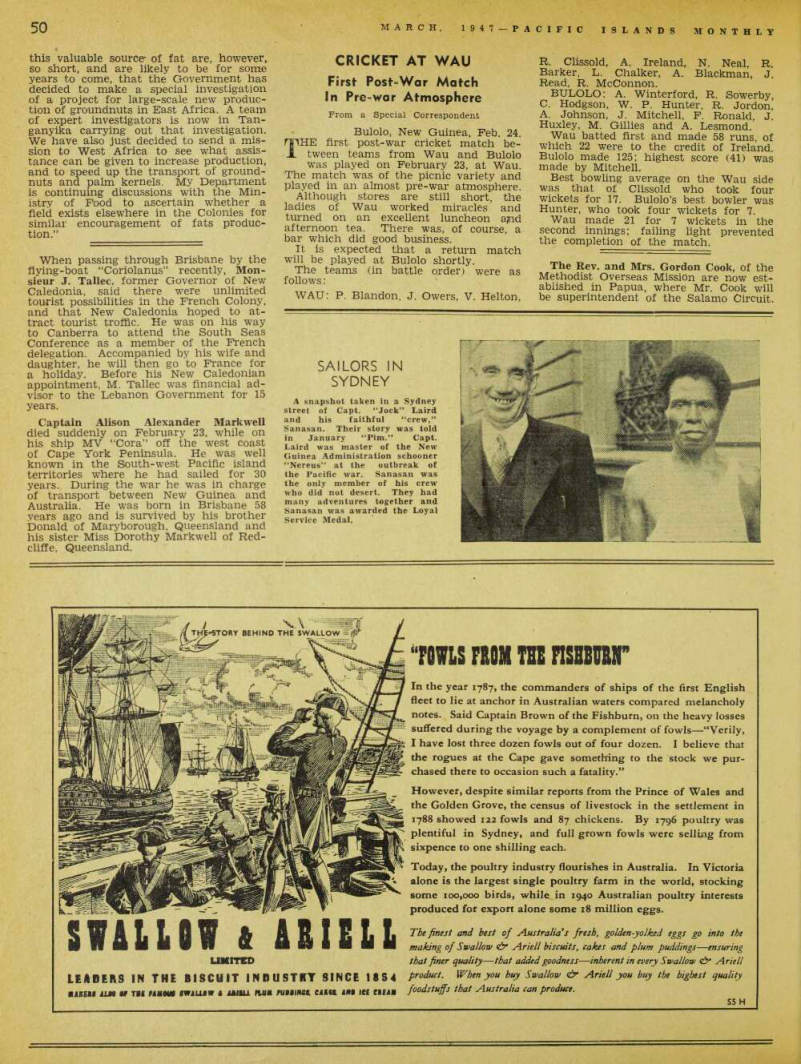
World's Oil Market Still Short-Supplied
TN this article, which is republished from the “Bulletin of the Imperial A Uto September issue, 1946, Frank E. Fehr, CBE, probably the flit.™ *IV/ rea J 6St -i auth <? nt y on edible oils, discusses the present and Kingdom S * ° n ° f ° llS and 011 seeds ’ with s P ecial reference to the United
DURING the war period, supplies of oils and fats including butter, lard and margarine, imported by the United Kingdom, must be considered as satifactory.
Pre-war imported supplies of oilseeds (expressed in oil content), oils and fats —including butter, lard and margarine— (after deducting exports which were in 1937 138,559 tons and in 1938 127,328 tons) were: In 1937—1,332,085 tons; 1938 1,462,454 tons.
During the war, similar imported sup plies were: In 1940—1,397,280 tons; 1942 —1,269,186 tons; 1944—1,314,626 tons; and in 1945—927,891 tons.
From these figures it will be seen that the percentage reduction in imports dur ing the war was comparatively small, showing an approximate reduction of 8 to 10 per cent., but from an average during the war of about 1,300,000 tons and a pre-war average of about 1,400,000 tons we dropped, in 1945, to about 927,000 tons. That explains the present shortage of oils and fats in the United Kingdom.
Throughout the war period, there was a considerable diminution in the import of butter; whereas, say, in 1938 we had an import of butter of 475,895 tons, the war imports of butter were: In 1940 264,350 tons; 1942—134,314 tons and in 1945—190,134 tons.
These figures show that the war im ports varied from 134,000 tons to 164,000 tons, that is, less than half the pre-war import. This diminution was mainly due to lack of imports from the continent.
On the other hand, lard—of which in 1938 we had an import of 72,046 tons showed a considerable increase in im ports, the year 1940 being an exception when the imports were only 34,731 tons.
By 1944 they had risen to 189,209 tons but slumped again in 1945 to 90,000 tons.
The big imports of lard during the war were the effect of Lease-Lend. When in 1945 they dropped off because Lease-Lend came to an end, we had to look else where for additional supplies of fats.
In 1945, the total supply of edible oils shows a very considerable reduction,
viz. as above indicated, 927,891 tons.
Butter in that year kept up to the war level; on the other hand lard showed a considerable decrease in net imports, and oils and fats dropped right down to 674,774 tons. This was, no doubt, largely due to .the fact that it became necessary to divert a considerable quantity of oils and fats and lard to supply those countries which had been deprived of supplies during the war.
IfTE have to consider what are the pros f ▼ pects of future supplies. No doubt in due course we shall get better supplies of whale oil. For the 1945-46 sea son the quantity expected is 130,000 tons.
The next catch, viz. 1946-47, I should think might easily amount to 250,000 tons. We shall gradually get back to the 400-500 thousand tons we had pre-war.
No doubt we shall now get increased supplies of copra and coconut oil. The annual import of copra pre-war averaged 105,000 to 110,000 tons. During the war the import fell off considerably. In 1944 it dropped to 32,398 tons; in 1945 it was rather better at 55,392 tons.
It is stated that the Philippines are shipping at present 25,000 tons a month, and during the last six months of 1946 it is expected they will ship 200 000 tons.
There will not be much oil from the Philippines for some time because their factories were badly damaged. No doubt the Netherlands East Indies will also start shipping and there will be larger supplies from the South Sea Islands.
Undoubtedly a portion of this copra will come to the United Kingdom. The ten dency is for most of the copra to go to the USA, but there will probably be a surplus which will come here.
Whereas as against this it is to be noted that our imports of palm kernels pre-war averaged, say, 150,000 tons a year. During the war we received a very much larger quantity. In 1942, for in stance, we received 414,415 tons and in 1944 493,635 tons.
A great effort throughout the war was made to get supplies of oils and fats and oilseeds from the West Coast of Africa as the short journey presented a consid erable economy in shipping.
When we come to 1945 a good portion of the palm kernels were sent to other destinations and the supplies to the United Kingdom dropped down to 293,083 tons. We must expect a further dimi nution in the suplies of palm kernels to be shipped to a considerable extent as pre-war to other destinations. Pre-war, Germany was the main recipient. Now they are going to Belgium, Holland and Scandinavia and that cuts down supplies to this country.
In decorticated groundnuts pre-war, we had an average supply of, say, 280,000 tons. Again, here during the war, the supplies received in this country in creased considerably, the peak year being 1941, when we had 606,909 tons. In 1945, the quantity had again dropped to 406,479 tons. Here, again, we must expect some diminution in supplies as groundnuts will be diverted to other centres.
Soya Beans were never a very impor tant article for this country. Pre-war, our supplies were about 95,000 tons.
During the war supplies dropped to a few thousand tons a year, except for 1943 when we received a fair quantity
from .USA, namely 28,189 tons. Man churia produced 45 million tons pre-war.
All that supply was cut off during the war, but it was presumed that in due course Manchuria will again become an exporter of soya beans.
As far as linseed is concerned, pre-war, our average imports were about 290,000 tons. During the war supplies increased considerably and varied from 232,100 tons to the peak year of 1943 when they were 506.998 tons. In 1945 the imports dropped right down to 142,307 tons. It is to be hoped that with normal crops in India again we shall get better supplies of lin seed from there, and that also there will be a tendency for the Argentine to have larger quantities available for export.
Pre-war, our imports of cottonseed were about 600,000 tons. During the war imports dropped very considerably, and in 1943 we had come down to 14,411 tons, and in 1944 to 10,027 tons. In 1945 we had again some increase, and the imports amounted to 41,848 tons.
It is to be presumed that cottonseed imports will again be greatly increased.
Ebypt will no doubt get back to a more normal production although, undoubtedly, she will require a larger quantity for her own consumption than formerly. During the war, little cottonseed was imported as it is only 18 per cent, oil content.
In South America, where there has been a very largely increased production of groundnuts and sunflour seed, there has also been a very large increase in crushing capacity. The Argentine is now able to crush 1,350,000 tons of sunflower seed, which is a very marked advance on* what she was able to crush pre-war.
No doubt we shall see an extension of crushing at points of production such as South America, India, Malaya, Australia and China, although crushing at the consuming centre has the advantage of giving the crusher a much wider market from which to draw his raw material.
Wc must expect an increased consump tion of oils and fats the world over as the demand for soap will increase, also the demand for margarine, as vitamin ised margarine tends more and more to replace butter, but it should be possible to extend the production of oilseeds to meet this demand. We have seen the enormous advance made in the produc tion of palm oil in Sumatra —a compara tively new production; in 1930 the quan tity produced totalled 56,000 tons; by 1938 it had reached over 200,000 tons.
The USA in 1936 produced 793,286 tons of soya beans: in 1944 the production totalled 5,165,973 tons. Undoubtedly in South America, Africa, Australia and also in Asia, there is room for an enormous increase in supplies.
During the war, fresh sources of sup ply were created; these will tend to con tinue to produce, and we shall have pre war production steadily restored.
We can expect the whale oil production in due course again to reach 4-500,000 tons, and we shall again get normal but ter imports. Butter producing at home, which pre-war totalled about 40-50,000 tons, was considerably reduced during the war, but will now slowly tend to in crease.
As traders, our one fear is that res trictions and pool purchasing will tend to restrain that free movement of com modities which is essential to obtain maximum supplies.
Too much emphasis cannot be placed on the necessity of inducing a free flow of merchandise (manufactured consumer goods) to producing countries in order to encourage the maximum collection and production of supplies of oilseeds and oils.
If the producer can get actual goods in exchange for his produce, the effect on supplies is most marked.
In Borneo and New Guinea the whole labour basis has been upset. The Austra
lian Government has introduced certain restrictions as regards labour. The Prime Minister of Australia has had the whole matter placed before him recently, and it is hoped that something may be done.
It will need a very great effort in all these Dominions to set the wheels of production in motion again. In twelve months we should have enough oils and fats in this country to get through; at the moment the position is most acute.
IN connection with the foregoing, the following statement is relevant. It was made by Mr. George Hall, the Secretary of State for the Colonies, in his speech on Colonial Affairs in the House of Commons on July 9, 1946: “Many new industries have also been
started in the Colonies during the war, and industries which existed on a very small scale have been substantially ex panded. Some of these industries will be the foundations on which we shall build for the permanent enrichment of the Colonies, “Some are suffering from the world food shortage, particularly the Far East Colonies and Ceylon. His Majesty’s Gov ernment are doing their utmost to mini mise suffering due to l these shortages. In spite of them, there is everywhere in the Colonies a determination to send more food to Britain, and with the co-opera tion of my colleague, the Minister for Food, I am doing everything possible to help them fulfil this task.
“A bumper crop of groundnuts has just been harvested in Nigeria. Supplies of
this valuable source* of fat are, however, so short, and are likely to be for some years to come, that the Government has decided to make a special investigation of a project for large-scale new produc tion of groundnuts in East Africa. A team of expert investigators is now in Tan ganyika carrying out that investigation.
We have also just decided to send a mis sion to West Africa to see what assis tance can be given to increase production, and to speed up the transport of ground nuts and palm kernels. My Department is continuing discussions with the Min istry of Food to ascertain whether a field exists elsewhere in the Colonies for similar encouragement of fats produc tion.”
When passing through Brisbane by the flying-boat “Coriolanus” recently, Mon sieur J. Tallec. former Governor of New Caledonia, said there were unlimited tourist possibilities in the French Colony, and that New Caledonia hoped to at tract tourist troffic. He was on his way to Canberra to attend the South Seas Conference as a member of the French delegation. Accompanied by his wife and daughter, he will then go to France for a holiday. Before his New Caledonian appointment, M. Tallec was financial ad visor to the Lebanon Government for 15 years.
Captain Alison Alexander Markwell died suddenly on February 23, while on his ship MV “Cora” off the west coast of Cape York Peninsula. He was well known in the South-west Pacific island territories where he had sailed for 30 years. During the war he was in charge of transport between New Guinea and Australia. He was born in Brisbane 58 years ago and is survived by his brother Donald of Maryborough, Queensland and his sister Miss Dorothy Markwell of Red cliffe, Queensland.
Advertisements & other items, pp. 53-54 (1 item)
Sails, Covers, Awnings
AND ALL CLASSES CANVAS GOODS FOR
INDUSTRIAL AND HOME USE
ALSO: FLAGS, ALL NATIONS
Send your inquiries to
HARRY WEST
"SYDNEY'S SAILMAKER"
DUKE ST. (WATERFRONT) EAST BALMAIN, SYDNEY, N.S.W.
Phone: WBIIOS, W 82284.
Steamships Trading
Company Limited
PORT MORESBY
SAMARAI
PAPUA.
WHOLESALE & RET AIL MERCHANTS, SHIPOWNERS,
PLANTERS, ENGINEERS & SLIP PROPRIETORS.
Customs, Shipping, Insurance, and Forwarding Agents.
MANAGING AGENTS AND VISITING REPRESENTA-
TIVES FOR COCONUT AND RUBBER ESTATES.
SYDNEY REPRESENTATIVES: Nelson & Robertson Pty. Ltd., 12 Spring Street
I V\ i
BEHIND THE SWALLOW = &
SWALLOW & ARIELL
LIMITED
LEADERS IN THE BISCUIT INDUSTRY SINCE 1854 ■ iff Elf UN $f TBI Pi MOM IWiUJW ft ABliU HUM PUBBIHCt Ciffit iff* ICE C«Ei«
‘FOWLS FROM TBS FISEBVB2T
In the year 1787, the commanders of ships of the first English fleet to lie at anchor in Australian waters compared melancholy notes. Said Captain Brown of the Fishburn, on the heavy losses suffered during the voyage by a complement of fowls—“ Verily, I have lost three dozen fowls out of four dozen. I believe that the rogues at the Cape gave something to the stock we purchased there to occasion such a fatality.”
However, despite similar reports from the Prince of Wales and the Golden Grove, the census of livestock in the settlement in 1788 showed 122 fowls and 87 chickens. By 1796 poultry was plentiful in Sydney, and full grown fowls were selling from sixpence to one shilling each.
Today, the poultry industry flourishes in Australia. In Victoria alone is the largest single poultry farm in the world, stocking some 100,000 birds, while in 1940 Australian poultry interests produced for export alone some 18 million eggs.
The finest and best of Australia's fresh, golden-yolked eggs go into the making of Swallow Ariell biscuits, cakes and plum puddings—ensuring that finer quality—that added goodness—inherent in every Swallow e>* Ariell product . When you buy Swallow <& Ariell you buy the highest quality foodstuffs that Australia can produce.
SSH
Cricket At Wau
First Post-War Match In Pre-war Atmosphere
From a Special Correspondent Bulolo, New Guinea, Feb. 24.
THE first post-war cricket match be tween teams from Wau and Bulolo was played on February 23, at Wau.
The match was of the picnic variety and played in an almost pre-war atmosphere.
Although stores are still short, the ladies of Wau worked miracles and turned on an excellent luncheon apd afternoon tea. There was, of course, a bar which did good business.
It is expected that a return match will be played at Bulolo shortly.
The teams (in battle order) were as follows: WAU: P. Blandon, J. Owers, V. Helton,
R. Clissold, A. Ireland, N. Neal, R.
Barker, L. Chalker, A. Blackman, J.
Read, R. McConnon.
BULOLO: A. Winterford, R. Sowerby, C. Hodgson, W. P. Hunter, R. Jordon, A. Johnson, J. Mitchell, F. Ronald, J.
Huxley, M. Gillies and A. Lesmond.
Wau batted first and made 58 runs, of which 22 were to the credit of Ireland.
Bulolo made 125; highest score (41) was made by Mitchell.
Best bowling average on the Wau side was that of Clissold who took four wickets for 17. Bulolo’s best bowler was Hunter, who took four wickets for 7.
Wau made 21 for 7 wickets in the second innings; failing light prevented the completion of the match.
The Rev. and Mrs. Gordon Cook, of the Methodist Overseas Mission are now est ablished in Panua, where Mr. Cook will be superintendent of the Salamo Circuit.
Sailors In
Sydney
A snapshot taken in a Sydney street of Capt. “Jock” Laird and his faithful “crew,”
Sanasan. Their story was told in January “Pim.” Capt.
Laird was master of the New Guinea Administration schooner “Nereus” at the outbreak of the Pacific war. Sanasan was the only member of his crew who did not desert. They had many adventures together and Sanasan was awarded the Loyal Service Medal.
CDC of Little Benefit
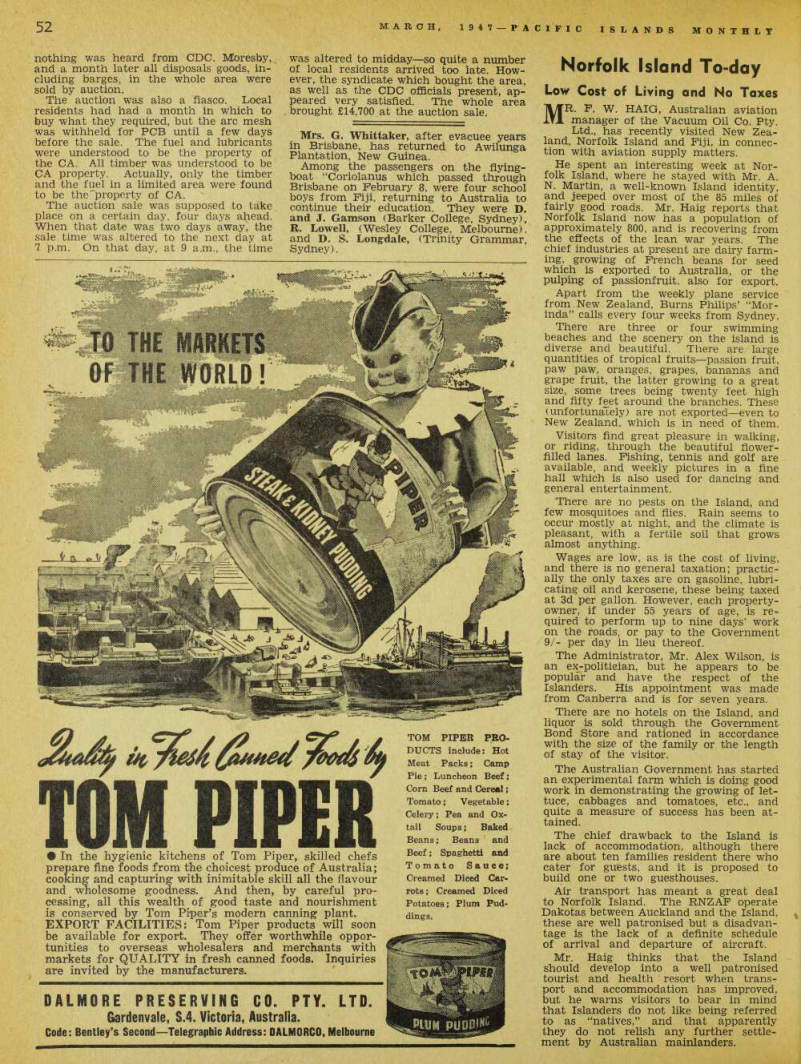
To Samarai Folk
From a Special Correspondent MANY old residents of the Territory can become quite voluble about the actions of the CDC in and about the Samarai district. And rightly so.
After months of waiting, finally some CDC representatives arrived in Milne Bay to list and to sell “as is, where is” anything and everything. Samarai resi dents—at two hours’ notice—managed to arrange transport and start out for the Bay full of expectancy. Furniture was a very sore point, so the CDC decided to sell that first. A whole shed full—nicely stacked—looked as if it could supply most of Samarai requirements.
But, alas! After the buyers had sorted, argued and stacked, the Civil Adminis tration official, who had been in the area some time in the role of caretaker, came on the scene with a rush and said “That is all Administration stuff.” So ended the first scene.
Samarai residents retired to shady spots, wiped perspiration off their brows and thought up original tortures for the CDC and CA men responsible for the fiasco. Of interest —up to date practically none of the furniture had been put into use by the Civil Administration.
Then we passed on to the sale of build ings. Many of these had been tendered for previously and one case is sufficiently amusing to warrant recording: The buyer took the CDC valuer down to look his two buildings over while we were having some lunch. They—the buildings— were within two hundred yards of where the CA official had been living for months. The buyer had inspected them two months previously in company with the CA official. After inspecting one building they moved towards where the next had been, but now there was no sign of it—no holes to show where the posts had been—nothing to show that a building had ever been there. The buyer cruised round like a well-trained hunting dog and explored the country for hun dreds of yards but could find no sign.
Finally both men came back and the buyer spoke to the CA official: “Do you remember those two buildings we visited the last time I came down? They were the two (pointing) just there.”
“Oh, yes, I remember that well. That is where they are,” replied the CA offi cial.
“Well,” said the buyer,” there is only one there now.”
“Oh,” said the official, “someone must have taken one away.”
And so the matter ended. How anyone could have removed a building, not a small one, within sight of the official’s house without his knowledge, has caused deep thought among both buyers and CDC men.
THE sale of motor vehicles did not draw many as most vehicles were in such bad condition.
So the scene moved to Gamadoda, the big US Naval base. The furniture found there was not very good, although quite a lot of excellent stuff had been left by the US Navy. Samarai residents managed to obtain enough with which to carry on.
The main trouble here occurred over barges. Quite a number lay on the water front and buyers chose what they wanted and arranged a price with the CDC offi cials.
The next day the CDC official declared “all sales off” and instructed would-be buyers that tenders for the boats would have to be submitted to Moresby office.
Although tenders were submitted at once,
nothing was heard from CDC. Moresby, and a month later all disposals goods, in cluding barges, in the whole area were sold by auction.
The auction was also a fiasco. Local residents had had a month in which to buy what they required, but the arc mesh was withheld for PCB until a few days before the sale. The fuel and lubricants were understood to be the property of the CA. All timber was understood to be CA property. Actually, only the timber and the fuel in a limited area were found to be the'property of CA.
The auction sale was supposed to take place on a certain day, four days ahead.
When that date was two days away, the sale time was altered to the next day at 7 p.m. On that day, at 9 a.m., the time
was altered to midday—so quite a number of local residents arrived too late. How ever, the syndicate which bought the area, as well as the CDC officials present, ap peared very satisfied. The whole area . brought £14,700 at the auction sale.
Mrs. G. Whittaker, after evacuee years in Brisbane, has returned to Awilunga Plantation, New Guinea.
Among the passengers on the flying boat “Coriolanus which passed through Brisbane on February 8, were four school boys from Fiji, returning to Australia to continue their education. They were D. and J. Gamson (Barker College, Sydney), R. Lowell, (Wesley College, Melbourne), and D. S. Longdale, (Trinity Grammar, Sydney).
Advertisements & other items, pp. 55-56 (2 items)
51
PACIFIC ISLANDS MONtflLl-MABCH, 1947
a major anxiety
'THAT
<9 ■» 'V
4 IHE
Relief from
a major anxiety
Even the most expert and conscientious individual executor is subject to
accident, illness and incapacitation.
Continuity of administration and uninterrupted attention to your estate and your beneficiaries are of paramount importance. Both can be positively
assured by appointing this Company
■* your sole Executor or as co-Executor with your present appointee. An interesting explanatory booklet will be forwarded on request.
DIRECTORS:
lames Burns.
Joseph Mitchell.
P. T. W. Black.
Lewis Armstrong.
R. J. Nosworthy.
MANAGER: L. S. Parker.
SECRETARY: E. R. Overton, A.F.I.A.
BURNS PHIIP TRUST
COMPANY
LIMITED
7 BRIDGE
TELEPHONE: BU 5901.
STREET
SYDNEY
Box 543, G.P.0., Sydney
BPI .45
a v^S- H OF
WORLD
in:
II L
b it* m
JS>J
Jb it jA J
Jiharffy
TOM PIPER
In the hygienic kitchens of Tom Piper, skilled chefs prepare fine foods from the choicest produce of Australia; cooking and capturing with inimitable skill all the flavour and wholesome goodness. And then, by careful processing, all this wealth of good taste and nourishment is conserved by Tom Piper’s modern canning plant.
EXPORT FACILITIES: Tom Piper products will soon be available for export. They offer worthwhile opportunities to overseas wholesalers and merchants with markets for QUALITY in fresh canned foods. Inquiries are invited by the manufacturers.
TOM PIPER PRO-
DUCTS include: Hot Meat Packs; Camp Pie ; Luncheon Beef; Corn Beef and Cereal; Tomato; Vegetable; Celery; Pea and Oxtail Soups; Baked Beans; Beans and Beef; Spaghetti and Tomato Sauce; Creamed Diced Carrots ; Creamed Diced Potatoes; Plum Puddings.
DALMORE PRESERVING CO. PTY. LTD.
Gardenvale, 5.4. Victoria, Australia.
Code: Bentley’s Second—Telegraphic Address: DALMORCO, Melbourne to
Norfolk Island To-day
Low Cost of Living and No Taxes
MR. F. W. HAIG, Australian aviation manager of the Vacuum Oil Co. Pty.
Ltd., has recently visited New Zea land, Norfolk Island and Fiji, in connec tion with aviation supply matters.
He spent an interesting week at Nor folk Island, where he stayed with Mr. A.
N. Martin, a well-known Island identity, and jeeped over most of the 85 miles of fairly good roads. Mr. Haig reports that Norfolk Island now has a population of approximately 800, and is recovering from the effects of the lean war years. The chief industries at present are dairy farm ing, growing of French beans for seed which is exported to Australia, or the pulping of passionfruit. also for export.
Apart from the weekly plane service from New Zealand, Burns Philips’ “Mor inda” calls every four weeks from Sydney.
There are three or four swimming beaches and the scenery on the island is diverse and beautiful. There are large quantities of tropical fruits —passion fruit, paw paw, oranges, grapes, bananas and grape fruit, the latter growing to a great size, some trees being twenty feet high and fifty feet around the branches. These (unfortunately) are not exported—even to New Zealand, which is in need of them.
Visitors find great pleasure in walking, or riding, through the beautiful flower filled lanes. Fishing, tennis and golf are available, and weekly pictures in a fine hall which is also used for dancing and general entertainment.
There are no pests on the Island, and few mosquitoes and flies. Rain seems to occur mostly at night, and the climate is pleasant, with a fertile soil that grows almost anything.
Wages are low, as is the cost of living, and there is no general taxation; practic ally the only taxes are on gasoline, lubri cating oil and kerosene, these being taxed at 3d per gallon. However, each property owner, if under 55 years of age, is re quired to perform up to nine days’ work on the roads, or pay to the Government 9/- per day in lieu thereof.
The Administrator, Mr. Alex Wilson, is an ex-politician, but he appears to be popular and have the respect of the Islanders. His appointment was made from Canberra and is for seven years.
There are no hotels on the Island, and liquor is sold through the Government Bond Store and rationed in accordance with the size of the family or the length of stay of the visitor.
The Australian Government has started an experimental farm which is doing good work in demonstrating the growing of let tuce, cabbages and tomatoes, etc., and quite a measure of success has been at tained.
The chief drawback to the Island is lack of accommodation, although there are about ten families resident there who cater for gufests, and it is proposed to build one or two guesthouses.
Air transport has meant a great deal to Norfolk Island. The RNZAF operate Dakotas between Auckland and the Island, these are well patronised but a disadvan tage is the lack of a definite schedule of arrival and departure of aircraft.
Mr. Haig thinks that the Island should develop into a well patronised tourist and health resort when trans port and accommodation has improved, but he warns visitors to bear in mind that Islanders do not like being referred to as “natives,” and that apparently they do not relish any further settle ment by Australian mainlanders.
Muddling

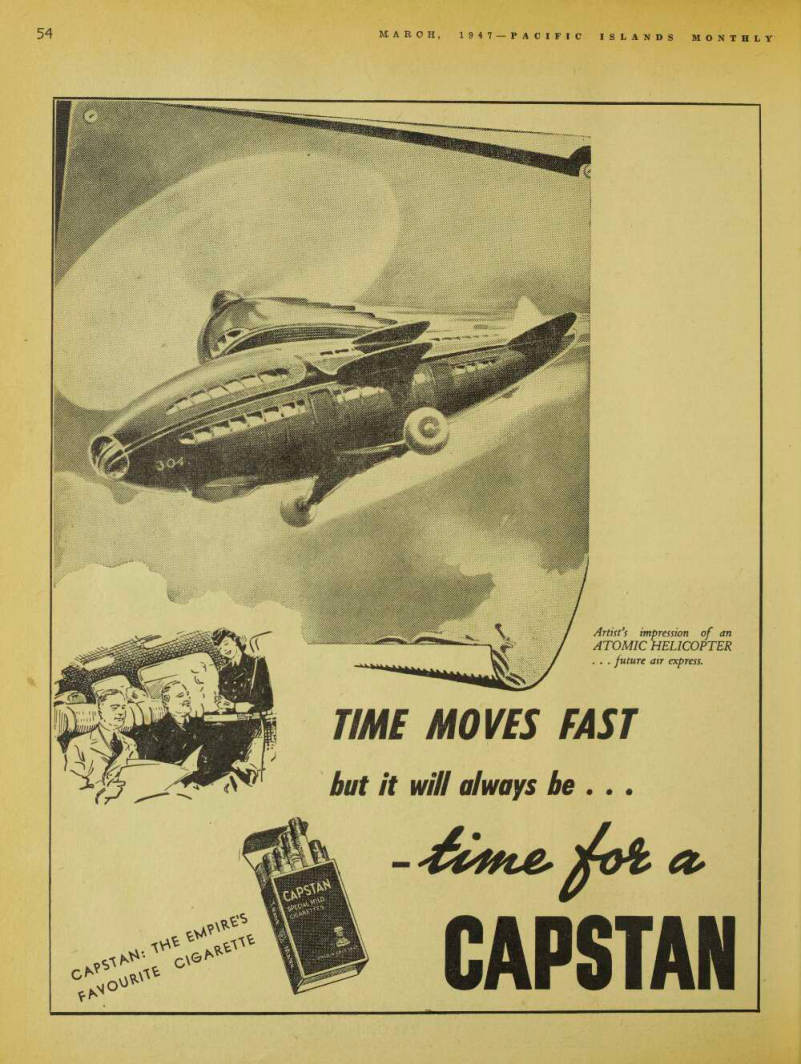
New Guinea Picture Of Industrial
Survey of Present Position by Planters' Association
A FAIRLY complete picture of the con fusion and difficulties which beset the planters who are trying to re-estab lish themselves in the Australian Man dated Territory of New Guinea is pre sented by the following report (issued formally by the Hon. Secretary, Mr. W.
R. B. Thomas) of the annual general meeting of the New Guinea Planters’
Association, which was held in Kokopo on February 15.
Little comment is needed—except to add that 90 per cent, of the difficulties being encountered by the unfortunate planters may be traced directly to the muddling inefficiency of the Socialist policies introduced to the Territories by the Australian Minister in control, Mr.
E. J. Ward.
There is a shortage of supplies and shipping. This is because Mr. Ward de cided to drive privately-owned shipping out of the Territories, and make all sea transport there a Government monopoly.
The planters have not been getting world parity for the limited amount of copra they are able to produce. This is because the buying, storing and shipping of copra has been made a Government monopoly. Where, pre-war, these services were efficiently provided under competi tive conditions by large private firms, they now are carried out less efficiently by a Government instrumentality, which pays the planter what it likes and is re sponsible to no one.
There is a crippling shortage of labour.
That is due to the ill-informed, preci
pitate action of Mr. Ward who, in 1945, wiped out the old-established indentured labour system, and put nothing in its place.
The numerous public servants in New Guinea are doing their very utmost to assist the Europeans in the heartbreak ing task of rehabilitation; but they are handicapped in all directions by the policy and the administrative structure created for them by the blindly-thrust ing Mr. “Eddie” Ward.
The following is the report of the Planters’ Asosciation secretary: THE twenty-first Annual General Meeting of the Association was held at Kokopo on February 15, 1947.
Eighteen members attended the meeting which, considering transport difficulties and the general disabilities under which planters labour, was a very good attend ance.
The inward and outward correspond ence occupied much of the time of the meeting. Satisfaction was expressed by members at the keen interest manifested by so many of our members scattered throughout the Territory.
Election of Executive and Committee- The following members were elected for the ensuing year: President: Mr. Dyson Hore-Lacy.
Vice-Presidents: Captain J. Duncan and Mr. V. B. Pennefather.
Committee: Messrs. J. T. Allan, W.
Washington, E. F. Bishton, W. T.
Thomas and F R. Wilson.
Hon. secretary: W. R. B Thomas.
The following is a resume of matters dealt with at the meeting.
(Continued on page 55)
Subscriptions—lt was decided that for the present the subscriptions be £l/1/per annum, pending the recommendation of the Committee as to an annual sub scription.
Correspondence
The following resolutions, carried at a previous meeting had been conveyed to: 1. The Prime Minister of Australia: “That the Prime Minister be requested to instruct the Custodian of Expropriated property to forego his claim against war damage compensation in those cases where purchasers have undertaken or will undertake the rehabilitation of their properties; and that he revert to the system of repayments of purchase price which existed at January, 1942, as from the Ist January, 1948; or, alternatively that he regains his equity by direct re parations against the Japanese Govern ment.”
“That this general meeting of the Planters’ Association of New Guinea re quest the Commonwealth Government to amend appropriate acts and regulations to enable (a) the recasting of war damage insur ance on plantation assets in the Terri tory of New Guinea, on a replacement value, as at 30th November, 1946, instead of 1942 value, particularly in relation to buildings, plant, equipment and growing trees. (b) Recasting of values to provide that: (i) value of destroyed coconut palms to be leased on the average price of copra for the 22 year period prior to 1941, in stead of (as at present) on the value of copra as at January, 1942; (ii) compen sation for coconut palms, cocoa and cof fee trees to take into consideration loss of income from crops destroyed during the replacement period, which in the case of coconut palms is 10 years.”
2. The Minister of External Territories: “That this meeting of planters view with alarm the report that the Produc tion Control Board is ceasing the supply of plantation requirements, and that this meeting request that the Production Control Board continue these supplies until the 31st December, 1948, at least.”
The foregoing correspondence had been acknowledged and promises made that enquiries into the matters raised would be made and that the Association would again be communicated with. To date, no further communication on the above subjects had been received.
The following letter had been ad dressed to the Controller, War Damage Commission, Sydney: “The Planters’ As sociation of New Guinea desire to ask if the Commission would consider allowing the cost of erecting temporary buildings to be included as part of the cost of clearing plantation properties. The build ings are a very necessary factor in the initial steps towards rehabilitation and, if this request can be granted, would be of considerable assistance to planters.”
The Controller of the War Damage Commission has not acknowledged this letter.
Three radiograms had been despatched to the Minister for External Territories requesting urgent advice and assistance regarding shipping facilities between Rabaul and Australia. It was pointed out that there appears no prospect of a ship to Rabaul for a considerable period whilst Moresby, Lae and Madang have a regular service. It was also pointed out that essential supplies of meat, flour, vegetables, benzine, etc., were un available at Rabaul, The Minister had replied stating that enquiries would be instituted and action taken. (The Merkur is to sail from Sydney for Rabaul at an
early date with supplies for the Army at Rabaul, and it is appreciated that space has been provided for a considerable quantity of essential supplies for civi lians.)
Advice From Production Board
Two letters were received from the Rabaul Branch Manager of the Austra lian New Guinea Production Board. The meeting was very appreciative of the in formation contained in the letters. For
the information of members of this Association the text of each letter is as follows: “The following notes may be of interest to vour members- *.' . „ Copra storage—Kavieng. The Board has a Cyclone building, 150 x 100, at Kavieng, awaiting erection. A representative will leave for that centre by first vessel and construction will commence immediately after his arrival.
A “Copra storage—Kokopo. The Board has secured permissive occupancy of an area of land on the waterfront, east of Vunapope. It is proposed to erect two Sydney Williams huts on this site as soon as negotiations can be completed with contractors. Copra will be received into this depot at Rabaul price.
“Monthly returns—copra. It would be of great material benefit to the planters and the Board if planters would ensure regular monthly returns are sub mitted showing produce on hand and estimated production for the ensuing month. The Food Control people in Aus tralia continually seek production figures to facilitate their Australian and world distribution. Locally, it is of great bene fit in arranging routing of vessels, ~X T , , „ , , “Native labour figures. The Board is constantly stressing to Canberra the in adequacy of labour supply. Your returns give the necessary data to enable us to present a concrete picture. , , fU 11 " plan f ters . that ™ ust u Wal l * for c £ e^ ll: no u, es / rom P ° rt Moresby before being able to operate against copra delivered to Board ware houses. This is not so. Copra is passed to credit of individual accounts immedi ately it is scaled into Board warehouses.
“Labour. It is thought that your mem k6ls would be interested to learn of the progress of the Board’s recruiting scheme. As you are aware, the Board’s Recruiting Officer left Rabaul early in December. Mr. Robinson has indicated that he has over 100 boys waiting move ment. A vessel, the Kelanoa, was des patched from Rabaul on Monday, Feb ruary 10, 1947, and is expected back here about February 20 with the first recruits.
A second 300-tonner is scheduled to leave for the Sepik to pick up a further batch early in March. Mr. Robinson’s reports are so far optimistic, but the Board will be in a position to give more definite information on return on the Kelanoa.
Report To Prime Minister
A file of correspondence was received from Mr. C. I. H. Campbell, of Rau plantation, Bougainville. Mr. Campbell’s splendid efforts on behalf of the Terri tory generally and the planters in par ticular are greatly appreciated by the As sociation. It was resolved that the hon. secretary convey to Mr. Campbell this Association’s sincere appreciation for his good work on our behalf.
For the information of members gen erally, the following is a copy of a let ter written by Mr. Campbell on behalf of planters to the Prime Minister. Later, Mr. Campbell interviewed the Adminis trator and gave him a copy of this letter: Rau Plantation, Bougainville.
December 22, 1946.
His Honor the Administrator,
Port Moresby.
Your Honor, — At our recent interview you were good enough to say that you would write to me regarding points raised. As the interview was sought on behalf of planters generally, I shall be grateful if you will send copies of your letter and of any further correspondence thereon to the Acting-Secretary, Planters’ Association of the Territory of New Guinea, c/o Production Control Board, Rabaul, as mail communications between this plantation and Rabaul may be uncertain for a time.
For your information I enclose a copy of the letter to the Rt. Hon, the Prime Minister, which was shown to you at the interview.
The main causes of anxiety amongst our members are:— (1) Inadequate immediate labour supply for rehabilitation, maintenance and production; and the increase of unit costs to over three times pre-war figures; without any definite indication that increased prices of products will be main tained to enable us to meet the extra costs.
Suspended fishing by dynamite, etc. (2) Uncertainty as to the policy of the Gov ernment regarding the supply of adequate labour for Government activities, private enterprise (pre-war commitments) and domestic require ments. (3) Inefficiency of present inter-island shipping arrangements to meet the requirements of the Territory for communication, conveyance of re habilitation and maintenance stores, and trans port of owners, employees and labour. (4) Disorganisation of storage and delivery facilities for inward cargo from Australia, caus ing delay in trans-shipment to outports, and necessitating long and expensive waiting in Rabaul (£1 per day at hostel, plus sundry ex penses). This adds considerably to the already high cost of rehabilitation, and further de creases rehabilitation value of war damage compensation. (5) Insufficient berthage accommodation for overseas vessels, causing long delays and in creased costs. (6) High cost of rehabilitation, generally, due to: — (a) Shipping and handling costs. (b) Fares, freights and costs of essential stores and equipment. Surcharges in Australia, etc. (c) Long delay at Rabaul, etc., of out-station people (e.g., ‘Reynella’’ and “Duntroon”) at considerable expense. (d) Exclusion of out-station people from the opportunity to acquire desirable heavy equipment, owing to the inadequate lifting power of the winches of inter-island vessels. (e) Depletion of war damage funds for per manent rehabilitation by the necessity to erect temporary buildings, thus leaving reduced funds available for erection of permanent buildings when suitable mate rials and transport become available and labour for their erection, and the fact that these permanent buildings will probably be a higher basic cost than those on which compensation was assessed.
These are all causes of the feeling of in security, uncertainty and depression mentioned in the letter to the Prime Minister. (7) Anticipated reduced general efficiency and reliability of labour due to limitation of con tracts to one year, and the lack of information as to the policy of the Government re free labour, or “imported labour” who may desire to remain with employers after the termination of the contracts: and uncertainty as to whether local District Officers may not discourage “im ported labour” (other than locals within 25 miles) from remaining as free labour; and for what period and under what conditions. (8) Absence of any provision for returning to their employers contract labourers who absent themselves from duty. Formerly, “deserters” were recovered by the Administration and re turned to employers, and their contract periods were extended accordingly. Imprisonment or fines or other penal treatment were not asked for—only performance of the contract. Without
some such provision the contract becomes in effective, except as against the employer. (9) The charging of import duties upon re habilitation equipment (not clothing and food — always dutiable) and especially tools and neces sary plantation equipment. This further reduces the rehabilitation value of already insufficient compensation on post-war costs; which is the basis that actually operates in purchasing and transport to the properties.
Yours faithfully,
C. I. H. Campbell.
Referring to the opening paragraph of Mr. Campbell’s letter, it must be ex plained for your information that to date (Feb. 15, 1947) no communication has been received by the Acting-Secretary, Planters’ Association of the Territory of New Guinea.
General
Matters discussed and resolutions passed are briefly outlined as follows: A newspaper report of a meeting of the South Seas Regional Conference was read to the meeting. The meeting de plored the apparent lack of a thorough knowledge of the situation in New Guinea by the Conference, also that the Conference so far had neglected to avail itself of the advice of experienced resi dents of the Territory. It was decided to make out a case for the European re sidents and planters in New Guinea and forward same to the appropriate auth orities.
It will be of interest to members to know that several Papuan natives were present at the Conference and that they “preferred to co-operate in matters re lative to New Guinea until such time as they could take over the government of the country, rather than that blood should be shed.” That, at least, appeared to be the meaning as read from the newspaper report.
It was decided to make representation
to the Minister of External Territories for adequate shipping facilities to handle the production and supply requirements of the Territory.
It was decided to request the Minister for External Territories to ensure that adequate hospital facilities be made available for the European population at Rabaul, Kavieng, Madang and Bougain ville areas. The Minister’s attention should be drawn to the fact that there are little or no hospital facilities in the Territory.
It was resolved that an endeavour be made to have the excessive handling charges on cargoes at ports within the Territory reduced to a reasonable figure.
W. R. B. Thomas
Hon. Secretary.
Rabaul, Feb. 15, 1947.
Eminoni Raivoka and William B. Tog anivalu, arrived in Brisbane recently by the flying-boat “Coriolanus” from Fiji.
Their destination was Gatton Agricult ural College (Q’ld.), where they will take a course in agriculture, after which, they may go on to the Brisbane University.
They are both scholarship winners, sel ected from 80 Fijian candidates. Last year, Raivoka studied agriculture at St.
Bede’s College, Canterbury. New Zealand.
He did not, however, complete the course.
He studied law instead. But on his re turn to Fiji, he decided to apply for the scholarship. The object of the scholar ship is to introduce modern agricultural methods into Fijian agriculture. His family are dairy farmers in Fiji. The selection of young Fijians for a special course in agriculture is part of an im portant new plan now being developed by the Fiji Denartment of Agriculture.
Advertisements & other items, pp. 57-60 (1 item)
Wise Precaution,
Woven Wire for all Industry
COPRA DRYING TRAYS, FLOORS, Etc.
FRU'T DRYING TRAYS, MINING SCREENS.
Heavy Mosquito Gauze in Phosphor Bronze and other Metals Impervious to Salt Sea Air.
WIRE DOOR MATS AND GENERAL WIRE WORKS
E. WRIGHT & CO. LTD.
Office and Works: 148-1&2 Cleveland Street, Sydney, N.S.W.
Telegraphic Address: “Wrlghtmake,” Chippendale.
Dt’ S <£
WISE PRECAUTION,
MOTHER!
In these days of uncertainty, your little ones will be safer when they are wearing an ECCO Indentity inscribed with their name and address. Give your children this added protection, today!
CROSSES
and CHAINS
t.-n -ex ft Beautifully designed, ECCO Crosses and Chains make ideal gifts for mother, sister, wife or girl-friend. Come in today, and make your selection from our wide assortment An important accessory to every well-dressed man’s appearance, ECCO Cuff Links have a rich dignity of style and design which wins instant approval. Come in and see them today.
OBTAINABLE FROM YOUR JEWELLER
or from:
PACIFIC ISLANDS TRADING COMPANY
244 California St. San Francisco 11, U.S.A.
TIME MOVES FAST
but it will always .. . a>
CAPSTAN
When Worried
Tired,Sleepless
AND YOU FEEL RUN-DOWN
Worry is Inescapable. Everyone has a share of it more or less. The great trouble about worry is that it plays havoc with your health and fitness If you let it. You become mentally and bodily weary, depressed; cannot sleep at night, lose appetite and begin to feel a nervous breakdown is impending. That starts the vicious circle. You worry, become run-down and nervy, and that makes you worry more than ever.
Meet your troubles all the way by reinvigorating your system and keeping it fit and well by taking Dr. Williams’ Pink Pills. These pills help to restore the red corpuscles and iron content of the blood to their normal quantity.
This enables life-giving oxygen and nourishment to be carried to the nerves, organs and tissues of the body. In that way you become invigorated, strengthened by Dr. Williams’ Pink Pills, the vague aches and pains disappear and you are fit again to deal confidently with all your worries. At chemists and stores.
m
COMPLEXION PERFECTION
WITH
BEAUTY PREPARATIONS
FOR
DISCRIMINATING WOMEN
WHO DESIRE
ALLURING LOVELINESS
Obtainable At All Stores.
Distributor :
GORDON K. SMITH
Beverley Hills, Sydney Bankers: Bank of N.S.W.
ALL STOREKEEPERS HAVE—
AUNT
MARYS
BAKING POWDER
0 Aunt Mary's Baking Powder is now obtainable from your storekeeper. That's good news for you, especially as Aunt Mary's Baking Powder maintains the high quality which has stood the test of housewives for over 70 years.
There is no substitute for Aunt Mary's—There never will be.
£40 A Head
War Damage for Milne Bay Natives
From a Special Correspondent January 30, 1947 IN Milne Bay the shovelling out of cash to the natives as war damage compen sation goes on apace. The final figure for Milne Bay will be very close to £200,000. No census has been taken for some time but it is extremely doubtful if there are over 5000 natives altogether who will receive compensation. This in cludes children.
Europeans in the area are still await ing some action from War Damage re garding their plantations their life’s work in many cases.
As things look at present, it would not be at all surprising to see the chief native clerk at Moresby in the running as the next Governor-General of Australia. The natives are fast being educated down to our level. Or are we being dragged up to theirs?
Mis Peggy Byron, a former secretary of the Brisbane New Guinea Association, returned to New Guinea by plane in Jan uary. She is now attached to the Edu cation Department in the territory.
Advertisements & other items, pp. 61-62 (1 item)
William Atkins Pty. Ltd.
PACIFIC ISLANDS SOCIETY
Visitors from the Islands to Sydney (or the«e interested in Islands affairs), are advised to communicate with the honorary secretary of the above Society, which has been formed to study the history, traditions, economies, and political developments of the Pacific Islands.
Regular monthly meetings are held at History House, 8 Young Street, Sydney.
Address for Correspondence:
THE PACIFIC ISLANDS SOCIETY,
Box 2434 MM„ G.P.0., Sydney.
William Atkins Pty. Ltd.
Head Office *49-451 KENT ST., SYDNEY.
Iron & Steel Merchanfs-Engineers' Supplies
ESTABLISHED OVER 50 YEARS
Coach fir Motor Hardware Cable Address: WILATKIN, Sydney.
STEEL DEPARTMENT
MILD STEEL:
Rounds, Squares, Flats, Half-rounds, Hexagons, Bevel, Shoeing, Tyre, Angles, Tees, Sheets, Plates, Girder Plates, Chequer Plates, Channels, Hoops, Etc.
BRIGHT STEEL:
Rounds, Squares, Hexagons.
Extra Special High Speed Tool Steel, Mining Steel, Blister Steel and Spring Steel, Rounds, Flats Gr Squares.
Bar Iron—All sections and sizes.
Engineers' Supplies: Set Screws, Studs, Metal Thread Screws, Coach Screws. Piles, Cotter Pins, Bright and Black Bolts, Rivets, Etc., Hack Saw Blades.
Power Transmission Gear: Including Plummer Blocks, Couplings, Collars Etc.
Coach and Motor Hardware: Axles, Springs, Wheelstufl, Duck, Paints.
Farriers' Supplies: Horse Nails, Anvils, Vices, Etc.
Motor-Trimmers and Motor Builders' tr Motor Painters' Requirements Pacific Island Agents : Come & Co., Sura, Fiji DUCO Lacquers and DULUX Enamels—FAßßEX Motor Toppings and Leather Cloths, House & Decorators' Paints, Varnishes & Brushware.
Sole Distributors of CHAMPION'S Decorators Point Product*.
Distributing Agent* for BROLITE Lacquers, SYNFLEX Enamel* and "POLYGLOSS" Finish.
WANTED: Back numbers of the “Pacific Islands Monthly.” Have many duplicates for exchange. Will also exchange American magazines for newspapers and magazines of the Pacific Islands and British Colonial Empire. Orders taken for subscriptions to American magazines— no foreign exchange difficulties —write for details to PAUL A. DORN, Agent, Los Angeles 36, California.
S Juw&H't a&t f"
HEALTHY
NEAT-LOOKING
HAIR
A / \ c <c\
WtT^
u 7\ ’<l \W m \ w y.
Su^ fS He’s found the key that unlocks the door to social success and popularity.
Attractive girls take pride in being seen with him . . . a well-groomed escort. He studies his appearance . . . knows the value of first impressions . , . realises the advantage of handsome, well-kept hair. So he uses VITALIS, and the “60-second drill”. 1 50 Seconds to Rub—Cir- O 10 Seconds to Comb and culation quickens thus Brush —Hair has a lustre scalp stimulation gives hair —no objectionable "patenta chance. leather" look. 3304 hair the CO,presses the * Stimulate*
Broadcasts For
Natives
Plans in Samoa and New Guinea
IT would appear that the Administra tions in the South Pacific are going to make increasing use of radio in communicating with the natives in their charge.
Colonel F. W. Voelcker, Administrator of Western Samoa, has completed arrangements for an installation in Apia, by which he may make a daily broad cast to his Samoan people. He has ord
ered, for early delivery in Samoa, about 150 receiving sets. These are to be distri buted throughout the villages of Samoa, one in charge of each head man. There will not be enough to go around—there are about 180 villages in Western Samoa.
However, 150 receiving sets will give the plan a good start. The receiving sets are built on one fixed wavelength—the villages will not be able to switch on to' any station other than that transmitting the Government’s messages from Apia.
A similar plan is being put into oper ation by the combined Administration of Papua-New Guinea. It is reported that about £40,000 of funds provided by Aus tralia has been earmarked for a broad casting station at Port Moresby through which the Administration will communi cate with receiving sets in selected vil lages in Papua and New Guinea. Natives are to be trained, as technicians, to take care of the installation. It is not known whether the Samoan plan of a fixed wavelength is being followed. It should be—otherwise the natives may be found listening to Australian racecourse broad casts at a time when they should be list ening to words of wisdom from Port Moresby.
Cheaper Movies For The
Islands
rE Australian headquarters of movie making Metro - Goldwyn - Mayer have recently announced that they will shortly have for distribution, 16millimetre sound film of current attrac tions and such old favourites as “Mrs.
Minerva”, “Valley of Decision”, “Mutiny on the Bounty”, etc.
The successful development of the sound track on 16-mm. film is a new thing—or it is at least as recent as the last of the war years. Previously, sound on this small film was not a success. The manufacturers claim that their new tech nique makes 16-mm. sound film indis tinguishable from regular 35-mm. film.
Advantages of the smaller film are that it is non-inflammable and can therefore be shown under circumstances where a fireproof projection booth is not available.
It is cheap to freight as it weighs only one-fifth of normal film. Projection equipment is small and compact and can be carried in a small case; it is easy to handle and simple to operate—MGM will actually train projectionists free of charge. In comparison with regular projection equipment it is inexpensive— Australian manufacturers are now turn ing reliable machines off their assembly lines for about £220.
This is, of course, not “home-movies”, but it has great possibilities for small isolated communities where a regular movie show would be out of the question.
MGM have made a large number of sales to young servicemen who are setting themselves up in the movie business in small outback towns In Australia on their deferred pay. The same thing has possi bilities for small Islands communities— the projection range permits of audiences of up to 600.
When they commence to distribute these films, MGM will supply one pro gramme per week, comprising one or two feature films, with supporting shorts, with a total screen time of about hours. The 16-mm. films are made direct from the original 35-mm. film—it is the same picture which will be seen in the world’s best movie palaces, only reduced in size.
If there is any merit in the new de velopment it should at least save Islands movie-patrons from their former fate— that of witnessing films that have left Hollywood at least five years previously.
Fiji Census Staff
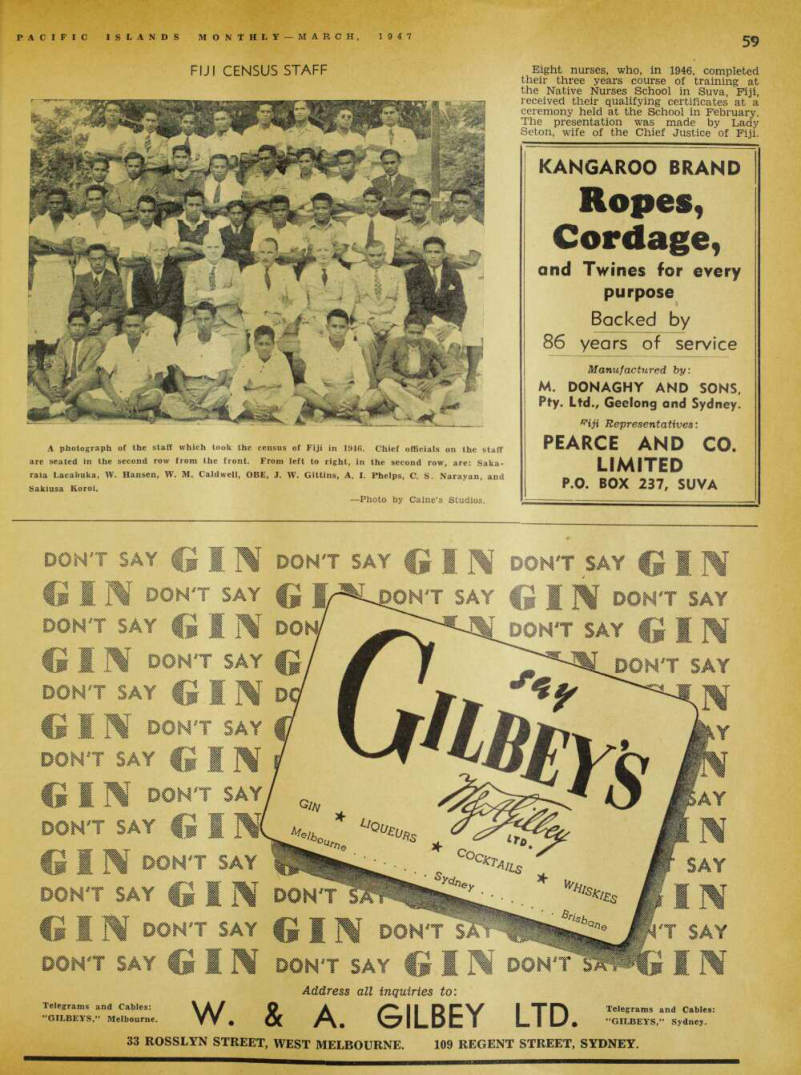
Eight nurses, who, in 1946, completed their three years course of training at the Native Nurses School in Suva, Fiji, received their qualifying certificates at a ceremony held at the School in February.
The presentation was made by Lady Seton, wife of the Chief Justice of Fiji.
A photograph of the staff which took the census of Fiji in 1946. Chief officials on the staff are seated in the second row from the front. From left to right, in the second row, are: Saka raia Lacabuka, W. Hansen, W. M. Caldwell, OBE, J. W. Gittins, A. I. Phelps, C. S. Narayan, and Sakiusa Koroi. —Photo by Caine’s Studios.
Mr. J. K. McCarthy, one of the best known of the pre-war officers in District Services, TNG, will leave by the next “Montoro” for the Territories, where he will rejoin the Administration Services.
He understands that he will be sent to the Rabaul district. Mr. and Mrs. Mc- Carthy have been staying at the Good Intent Hotel, Campbelltown NSW—now quite a rendezvous for New Guinea people.
Advertisements & other items, pp. 63-64 (1 item)
Ropes,
KANGAROO BRAND
Cordage,
and Twines for every purpose Backed by 86 years of service Manufactured by:
M. DONAGHY AND SONS,
Pty. Ltd., Geelong and Sydney. *iji Representatives:
PEARCE AND CO.
LIMITED
P.O. BOX 237, SUVA
DON'T SAY CIM DON'T SAY GIN DON'T SAY G I GIM DON'T SAY G SAY DON'T SAY DON'T SAT G I N DOIV SAY G I M GIM DON'T SAY G m / SAY DON'T SAY G I M DC/ §
GIM DON'T SAY
DON'T SAY GIM
G I M DON'T SAY
DON'T SAY G I N
GIM DON'T SAY
DON'T SAY 61 M DON'T
G I M DON'T SAY GIM DON'T DON'T SAY GIM DON'T SAY GIM DON'T 8 AY M Ll ou *l6 I To °Ur *
C °C K
SAY
T^is yctn W Hr IM ey
S*C/P
r tsb
T SAY
i m Telegrams and Cables: "GILBEYS,” Melbourne.
Address all inquiries to:
W. & A. GILBEY LTD.
33 ROSSLYN STREET, WEST MELBOURNE.
Telegrams and Cables: “GILBEYS,” Sydney.
109 REGENT STREET, SYDNEY.
LOOK !
mm * 4
KOCH'S BARBER CHAIRS
Obtainable Soon
PACIFIC ISLANDS TRADING
COMPANY
244 California St., San Francisco, Cal
GEORGE J. LOGKYER & COMPANY
MARINE BRANCH
ENGINEERING SUPPLIES, GENERAL HARDWARE EXPORTERS AND MERCHANTS Agents for the Finest Australian Liquors Aerated Water and Cordial Manufacturing Machinery, Bottling and Capping Machinery, etc.
CONSULTING ENGINEERS DOCKYARD MACHINERY
PURCHASING AGENTS:
Electric Light Generating Plants.
Air Conditioning Plants.
Builders’ Hardware.
Marine Engineering Supplies.
Refrigeration Supplies.
Radios and Accessories.
Sanitation Equipment.
Automobile Spare Parts and Garage Accessories.
Abrasive Wheels.
Excavating Machinery.
Electrcal Supples.
Grinding and Pulverising Machinery.
Hydraulic Equipment.
Mechanical Engineering Requirements.
Mining and Quarrying Machinery.
Road and Building Machinery.
PETROL, DIESEL, KEROSENE AND CRUDE
OIL ENGINES:
All Types Out Board Motors and Out Riggers.
Ronaldson Tippett 16 H.P. Diesel Engines.
Thornycroft 500 H.P. Marine Engines.
Belinda 70 H.P. Crude Oil Engines.
Lister-Blaxland 8-Cylinder Diesel DC. 3KW Electric Light Plant Complete.
Coventry Climax Water Cooled 2.75 KVA 130- Volt Electric Light Plant.
Sulzer Marine Diesel Engine 700 H.P. 6- Cylinder Coupled to 325/275 KVA Alternator.
Beardmore Semi-Diesel 65 H.P. Engines.
Universal 22 H.P. 4-Cycle Petrol Engines.
Rosebery Kerosene 3.7 H.P. Hopper Cooled Engines.
VESSELS, ETC.
Steel Cargo Vessels, 35 ft, x 13 ft. 4 ft., New, with Winch, Hoist, etc.
Auxiliary Transport Vessels, 32 ft. x 9 ft. x 4 ft., New, without Engines.
Tugs, Trawlers, Cargo Vessels, Tankers, Motor Cruisers, Launches, Yachts, Hoists, Winches, etc.
Photographs, Drawings, Schedules, will he Supplied by Return Mail to Genuine Clients.
FAIRLIGHT STREET, FIVE DOCK, SYDNEY, N.S.W. 'Phone: UA7196 All communications to be addressed Bankers: Telegraphic and Cable Address: to The General Manager, Commonwealth Bank of Australia, “LOCKMACH,” Sydney.
G.P.0., Box 4553, Sydney. Sydney.
by Australian Anthropologist
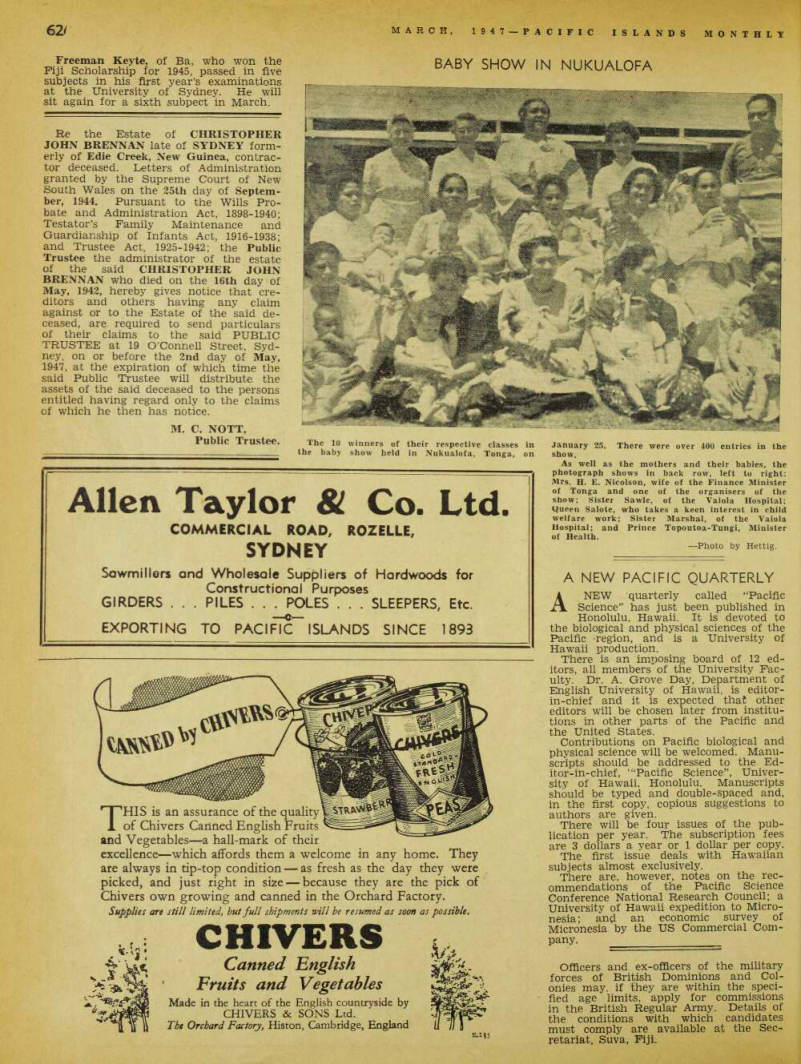
Before It Is Too Late!
Plea for Museum Collections From Pacific by Australian Anthropologist
following is a condensation of an article published in the September, 1946, issue of “Oceania.”' It was written by F. D. McCarthy, anthropologist of the Australian Museum, Sydney, and in it he urges the establishment of a National Museum of Anthropology, in Can berra, where ethnological material from Melanesia and other parts of the Pacific may be preserved.
As Mr. McCarthy points out, if collections are not made soon, before these countries of the South Seas be come fully Europeanised their material cultures will be lost for ever.
ALTHOUGH the literature of Melan esia includes numerous studies of material cultures, the area is a field of research in ethnography and pre history yet to be exploited, The pre history of man in Melanesia, with its prehistoric stone artefacts, pottery and stone structures await the spade of the archaeologist.
There are six State museums in Aus tralia, and the Australian Museum in Sydney can be said to possess the most comprehensive Melanesian collection (in cluding the Sir William Macgregor col lection from Papua) although this, too, falls far short of what it should be.
Polynesia, however, and other lands bordering the Pacific, are so poorly repre sented by collections in Australia, that no Australian institution could set out a
display adequate enough to illustrate the ethnology of any of them.
One reason for the restricted scope of collections is, of course, that the institu tions in question have always had inad equate staffs, buildings and funds and naturally their chief work has been con fined to the Australian mainland.
Now, apart from the State museums in Australia, it appears to me that great possibilities lie in the establishment, in Canberra, of a Commonwealth or nation al museum of anthropology. It was hoped at one time that the building con structed to house the collection of the late Sir Colin Mackenzie, would become a national museum of this kind—it was indeed the hope of Sir Colin himself; but the name was changed to the Insti tute of Anatomy, and it is now being developed as a research centre for the Department of Health.
One of the functions of a national museum of anthropology in Canberra would be to obtain through official chan nels a fully representative collection of ethnographical specimens from the Pac ific islands—New Guinea, Bismarck Archipelago, Northern Solomons, and many other smaller groups—administered by Australia. The policy of collecting by Administration officers ‘was followed to a certain degree by the Government of Papua, in which area Sir William Mac- Gregor set a splendid example that was followed by some of the subsequent ad ministrators. Unfortunately, however, the establishment of small museums in Port Moresby and in Rabaul, and the
lack of a national museum in Canberra with a policy for systematic collecting, produced the present unsatisfactory sit uation in which the Commonwealth Government possesses only the Papuan Official Collection from the whole of New Guinea. Furthermore, none of the State museums in Australia has been able to finance an organised plan for systematic collecting in these territories.
There might be quoted as a contrast the magnificent progress made in the an thropological survey of Polynesia, now almost completed, by the Bernice Pauahi Bishop Museum in Hawaii (Buck, 1945), with a positive policy and equipped with adequate funds.
Systematic collecting embraces the most trivial and unimportant things as well as those of outstanding cultural, technical or artistic value and apart from the actual collecting of specimens there are many people residing or working in the Pacific territories in a position to record and have published data about the manufac ture, use, trade of material culture of their district. Missionaries, Government officials and others able to win the confi dence ‘of the native inhabitants come within this category and some of them have done admirable work in the past.
Systematic collecting in the Territories could also be carried out by the Austra lian National Research Council, rE principal requirements of museums in Australia from the Pacific Ter ritories of New Guinea, Bismarck Archipelago and BSI are, firstly, reresen tative collections from specific areas from which there are few or no specimens at present. This group includes the peoples of the mountains in Papua, and those of a greater part of the Mandated Terri tory of New Guinea, the cultures of the greater nart of the Bismarck Archipelago
(Melangan carvings being an exception), and of island groups such as Viti, New Hanover, and many others, and the in land areas of the Solomon Islands. It .is realized, of course, that not much old material can be obtained in some of these areas, and that other areas are being rapidly spoilt by contact with white civilisation.
Secondly, there are the large carvings, comprising the painted and carved posts and boards in and on club-houses and Dubu-platforms, and on canoes, chief's and burial houses; coffins; canoe-prows and boards; headdresses and masks.
These things represent the finest and most sacred art of the Melanesian natives, and their addition to the col lections of the museums in Australia is essential for a proper understanding of the art and religion of Melanesia. There are, in addition, numerous sacred ob jects of smaller kinds that might be added to this list of requirements.
Thirdly, the State museums .possess no pottery from many of the large manu facturing centres in New Guinea and the Melanesian islands, while models of houses, canoes and large hunting and fishing traps although of great im portance are poorly represented in Aus tralian museums.
It is obvious that there is no time to lose in organising such a programme of collecting. Now that all fighting has ceased in the Melanisian islands, not many years will elapse before it will be impossible to obtain specimens worthy of museum exhibition, even in compara tively remote areas. Prior to the war, the activities of missionaries, mining in dustries and other commercial enterprises destroyed native culture in many locali ties, and of this process the Bulolo Valley is a good example; there is no fully representative collection from this valley
in any Australian museum and the oppor tunity has now gone for ever!
The war, too, has had a shattering ef fect upon native life, especially the arts and crafts, and a great many villages containing old and valuable carvings have been completely obliterated. Ameri can servicemen paid enormous prices for native curios and many fine pieces were sent to the United States as a result.
These aquisitions, and the war, have stimulated immense interest in the Paci fic islands both among American people and their museums. In fact, several wealthy American museums are eagerly awaiting the opportunity to send out fully equipped expeditions to comb these islands for specimens to display in pro posed South Sea galleries, and recent an nouncements in the press have intimated that already a number of these scien tific expeditions are being planned.
It is probably true, too, that no institu tion can now hope to obtain much Poly nesian material even by visiting the islands, though on some of the more re mote islets a certain amount can still be gathered.
It is indeed unfortunate that Polyne sia is so badly represented in Australian museums but this deficiency gives point to the great need existing here and now that we must not waste time, but collect in Melanesia before it is too late.
Freeman Keyte, of Ba, who won the Fiji Scholarship for 1945, passed in five subjects in his first year’s examinations at the University of Sydney. He will sit again for a sixth subpect in March.
Re the Estate of CHRISTOPHER JOHN BRENNAN late of SYDNEY form erly of Edie Creek, New Guinea, contrac tor deceased. Letters of Administration granted by the Supreme Court of New South Wales on the 25th day of Septem ber, 1944. Pursuant to the Wills Pro bate and Administration Act, 1898-1940; Testator’s Family Maintenance and Guardianship of Infants Act, 1916-1938; and Trustee Act, 1925-1942; the Public Trustee the administrator of the estate of the said CHRISTOPHER JOHN BRENNAN who died on the 16th day of May, 1942, hereby gives notice that cre ditors and others having any claim against or to the Estate of the said de ceased, are required to send particulars of their claims to the said PUBLIC TRUSTEE at 19 O’Connell Street, Syd ney, on or before the 2nd day of May, 1947, at the expiration of which time the said Public Trustee will distribute the assets of the said deceased to the persons entitled having regard only to the claims of which he then has notice.
M. C. Nott
Public Trustee.
Advertisements & other items, pp. 65-66 (1 item)
To Shipmasters
When calling at Tahiti, see Oscar G, Nordman for ships’ supplies and fresh provisions. Wire before your arrival to OCEANIC, PAPEETE (my registered cable address)
OSCAR G. NORDMAN,
Ship Chandler, Papeete, Tahiti
WHOLESALE
MERCHANTS
GENERAL AGENTS
A / (#
flu
LAE
SOLE NEW GUINEA.
AGENTS FOR
TERRITORY OF NEW GUINEA
REMINGTON
TYPEWRITERS
PHILIPS RADIO
w 3. A.L.M. PA
D U LU X
COMMONWEALTH
INSURANCE CO.
FORWARDING, SHIPPING AND CUSTOMS AGENTS J
Allen Taylor & Co. Ltd.
COMMERCIAL ROAD, ROZELLE,
SYDNEY
Sowmillers and Wholesale Suppliers of Hardwoods for Constructional Purposes GIRDERS . . . PILES . . . POLES . . . SLEEPERS, Etc,
EXPORTING TO PACIFIC ISLANDS SINCE 1893
cXV \NVW^
mm om IN THIS is an assurance of the quality of Chivers Canned English Fruits and Vegetables—a hall-mark of their excellence—which affords them a welcome in any home. They are always in tip-top condition —as fresh as the day they were picked, and just right in size because they are the pick of Chivers own growing and canned in the Orchard Factory.
Supplies are still limited, but full shipments will be resumed as soon as possible.
CHIVERS
Canned English
Fruits and Vegetables
Made in the heart of the English countryside by
CHIVERS & SONS Ltd.
The Orchard Factory, Histon, Cambridge, England r- i A* s Jr - -
Baby Show In Nukualofa
The 10 winners of their respective classes in the baby show held in Nukualofa, Tonga, on
January 25. There were over 400 entries in the show.
As well as the mothers and their babies, the photograph shows in back row, left to right: Mrs. H. E. Nicolson, wife of the Finance Minister of Tonga and one of the organisers of the show; Sister Sawle, of the Vaiola Hospital; Queen Salote, who takes a keen interest in child welfare work; Sister Marshal, of the Vaiola Hospital; and Prince Topoutoa-Tungi, Minister of Health. —Photo by Hettig.
A New Pacific Quarterly
ANEW quarterly called “Pacific Science” has just been published in Honolulu, Hawaii. It is devoted to the biological and physical sciences of the Pacific 'region, and is a University of Hawaii production.
There is an imposing board of 12 ed itors, all members of the University Fac ulty. Dr. A. Grove Day, Department of English University of Hawaii, is editor in-chief and it is expected that other editors will be chosen later from institu tions in other parts of the Pacific and the United States.
Contributions on Pacific biological and physical science will be welcomed. Manu scripts should be addressed to the Ed itor-in-chief, '“Pacific Science”, Univer sity of Hawaii, Honolulu. Manuscripts should be typed and double-spaced and, in the first copy, copious suggestions to authors are given.
There will be four issues of the pub lication per year. The subscription fees are 3 dollars a year or 1 dollar per copy.
The first issue deals with Hawaiian subjects almost exclusively.
There are, however, notes on the rec ommendations of the Pacific Science Conference National Research Council; a University of Hawaii expedition to Micro nesia ; and an economic survey of Micronesia by the US Commercial Com pany.
Officers and ex-officers of the military forces of British Dominions and Col onies may. if they are within the speci fied age limits, apply for commissions in the British Regular Army. Details of the conditions with which candidates must comply are available at the Sec retariat, Suva, Fiji.
Residents
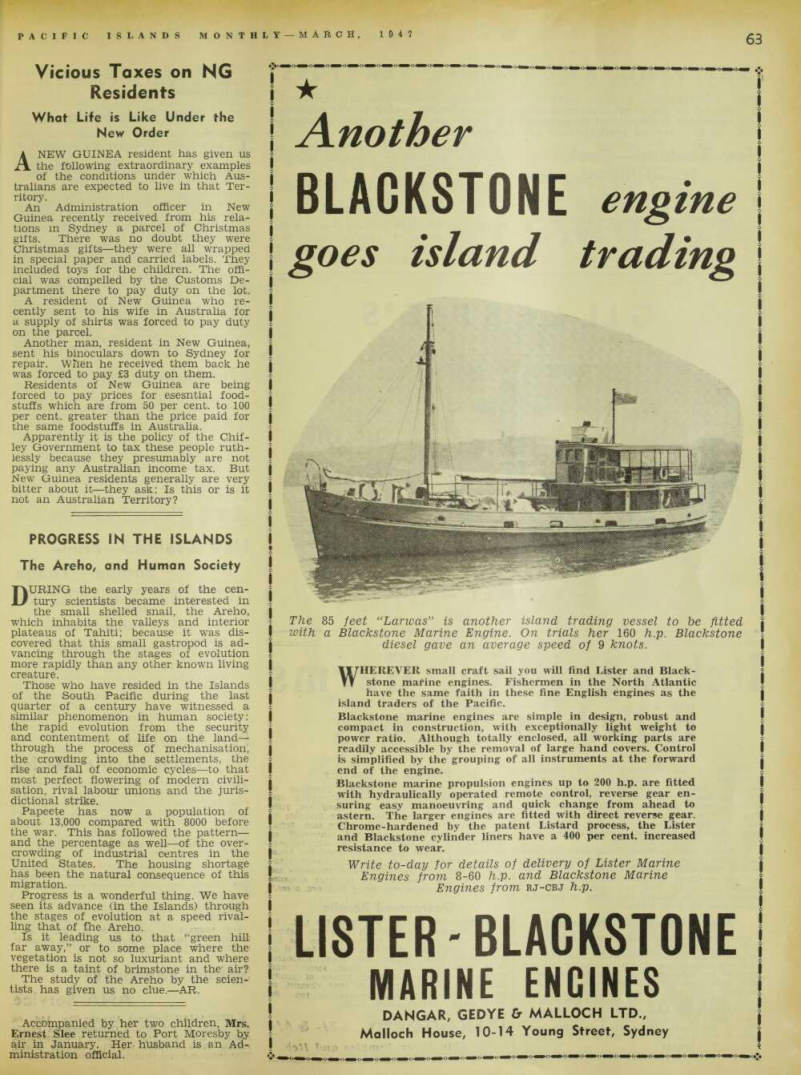
Vicious Taxes on NG Residents What Life is Like Under the New Order
ANEW GUINEA resident has given us the following extraordinary examples of the conditions under which Aus tralians are expected to live in that Ter ritory.
An Administration officer in New Guinea recently received from his rela tions m Sydney a parcel of Christmas gifts. There was no doubt they were Christmas gifts—they were all wrapped in special paper and carried labels. They included toys for the children. The offi cial was compelled by the Customs De partment there to pay duty on the lot.
A resident of New Guinea who re cently sent to his wife in Australia for a supply of shirts was forced to pay duty on the parcel.
Another man, resident in New Guinea, sent his binoculars down to Sydney for repair. When he received them back he was forced to pay £3 duty on them.
Residents of New Guinea are being forced to pay prices for esesntial food stuffs which are from 50 per cent, to 100 per cent, greater than the price paid for the same foodstuffs in Australia.
Apparently it is the policy of the Chif ley Government to tax these people ruth lessly because they presumably are not paying any Australian income tax. But New Guinea residents generally are very bitter about it—they ask: Is this or is it not an Australian Territory?
Progress In The Islands
The Areho, and Human Society
DURING the early years of the cen tury scientists became interested in the small shelled snail, the Areho, which inhabits the valleys and interior plateaus of Tahiti; because it was dis covered that this small gastropod is ad vancing through the stages of evolution more rapidly than any other known living creature.
Those who have resided in the Islands of the South Pacific during the last quarter of a century have witnessed a similar phenomenon in human society: the rapid evolution from the security and contentment of life on the land through the process of mechanisation, the crowding into the settlements, the rise and fall of economic cycles—to that most perfect flowering of modern civili sation, rival labour unions and the juris dictional strike.
Papeete has now a population of about 13,000 compared with 8000 before the war. This has followed the pattern— and the percentage as well —of the over crowding of industrial centres in the United States. The housing shortage has been the natural consequence of this migration.
Progress is a wonderful thing. We have seen its advance (in the Islands) through the stages of evolution at a speed rival ling that of the Areho.
Is it leading us to that “green hill far away,” or to some place where the vegetation is not so luxuriant and where there is a taint of brimstone in the air?
The study of the Areho by the scien tists has given us no clue.—Aß.
Accompanied by her two children, Mrs.
Ernest Slee returned to Port Moresby by air in January. Her husband is an Ad ministration official.
Advertisements & other items, p. 67 (1 item)
BLACKSTONE engine
Another
goes island trading
r f s* m The 85 feet “Larwas” is another island trading vessel to he fitted with a Blackstone Marine Engine. On trials her 160 h.p. Blackstone diesel gave an average speed of 9 knots.
WHEREVER small craft sail you will find Lister and Blackstone marine engines. Fishermen in the North Atlantic have the same faith in these fine English engines as the island traders of the Pacific.
Blackstone marine engines are simple in design, robust and compact in construction, with exceptionally light weight to power ratio. Although totally enclosed, all working parts are readily accessible by the removal of large hand covers. Control is simplified by the grouping of all instruments at the forward end of the engine.
Blackstone marine propulsion engines up to 200 h.p. are fitted with hydraulically operated remote control, reverse gear ensuring easy manoeuvring and quick change from ahead to astern. The larger engines are fitted with direct reverse gear.
Chrome-hardened by the patent Listard process, the Lister and Blackstone cylinder liners have a 400 per cent, increased resistance to wear.
Write to-day for details of delivery of Lister Marine Engines from 8-60 h.p. and Blackstone Marine Engines from rj-cbj h.p.
LISTER-BLACKSTONE
MARINE ENGINES
DANGAR, GEDYE & MALLOCH LTD.,
Malloch House, 10-14 Young Street, Sydney
KVA : •: n-r •
Samoa—Tonga
Shipping And Plane Services
rE following sea and air services are running to schedules in the Pacific.
Not all of the regular services which were suspended, owing to war conditions, have been restored; but preparations are under way for their early reintroduc tion. As they become available they will be announced here.
Maw 7h/ilnn/l f AA L MCW AcQluna wOOK ■ k. I • f*
Is.—Niue—Samoo
T„ r , , „ HE motor vessel Maui Pomare, owned and operated by the NZ Government. maintains a direct service between Auckland and Rarotonga (Cook Island), with alternative calls at Niue and Apia (Samoa).
After her return to Auckland on January 22,
“Maui Pomare” was withdrawn for survey. She will leave Auckland for Rarotonga and other Cook Islands about mid-March. c ..., „ , , ,
Sydney-Norfolk Island
-7 7
New Hebrides
THE SS “Morinda,” Burns Philp & Co., 1- Ltd., runs at approximately six seven weeks’ intervals from Sydney to Lord Howe Island, Norfolk Island, and
mam ports of the New Hebrides, and return. A regular fixed timetable is not yet practicable.
New Caledonia
THE New Caledonian Government has sub sidised and maintained the coastal ship ping services. The East Coast, the West Coast, and the Loyalty Islands, under present conditions, receive 10 round trips per annum.
The ships call at the following ports: EAST COAST.—Yate, Thio, Nakety, Canala, Kouaoua Kua, Mom So. Ponerihouen.’
Tibarama, Poindimie, Wagap, Touho, Tipindje!
Hienghene, Tao, Oubatch. Pouebo, Balade, Pam!
Arama, and return.
WEST COAST.—Poaembout, Kone. Temala, Voh, Ouaco Gomen, Kouraac, Tangaiou, Tiebaghi Nehoue Poume, Baaba, Belep and return.
LOYALTY ISLANDS.—Mare (Tadine), Lifou tChepenehe) Ouvea (Fajaoue, St. Joseph) and return.
The steamer “Neo Hebrldais” runs regularly between Noumea and Sydney, with occasional trips to the New Hebrides (mostly Aneityum) The owners are Societe Maritime et Manlere Hagen, Noumea. Sydney agents: H. C. Sleigh 254 George Street, Sydney.
Sydney—Auckland
Airways
'T'ASMAN Empire Airways. Ltd., operate a flying-boat service between Rose Eay Sydney, and Mechanics Bay, Auckland. Large flying-boats, capable of carrying 20 passengers, are employed. The trip is comfortable, and takes from 8 to 10 hours, according to weather.
The flying-boats leave both Sydney (6 a.m.) and Auckland (8 a.m.) every morning except Sundays—it is now practically a daily service.
Bookings may be made at the Auckland and Sydney offices of Tasman Empire Airways.
New Zealand—Fiji—
Samoa—Tonga
Service Conducted By Union Ss Co.,
Lt D Subject To Alteration Without
Notice
Pan-American—
Trans-Pacific Service
T 3 AN-AMERICAN World Airways now run a weekly service between Sydney and San Francisco, and a fortnightly service between Auckland and San Francisco. Both services go via New Caledonia, Nadi (Fiji), Canton Island and Hawai’i. Skymaster planes are used.
Planes leave Sydney every Wednesday, and San Francisco every Friday.
On the San Francisco-New Zealand service they leave San Francisco every alternate Thurs day (March 13) and Auckland every alternate Tuesday (March 18).
Fares are approximately the same as ANA. (See below.) Free baggage allowance is 55 lb. Excess at 1 per cent, of the one-way fare for each kilogram of excess (1 kilo = 2.2 lb.).
Sydney-Vancouver
ANA Service
AUSTRALIAN National Airways Pty., Ltd., on behalf of the British Commonwealth Pacific Airlines, Ltd., are no.w operating a trans-pacific service from Sydney, via Fiji, Canton Island, Honolulu, and San Francisco to Vancouver. They
“Matua”
“Matua”
Auckland .
Mar. 13 Apr. 15 Suva . ..
Mar. 17-18 Apr. 19-20 Nukualofa Mar. 20-21 Apr. 22-23 Vavau ..
Mar. 22 Apr. 24 Niue (WT) — Apr. 24 Apia (WT) Mar. 22-25 Apr. 25-28 Suva . ..
Mar. 28-29 May 1-2 Auckland Apr. 2 •Western Time.
May 6
are now permitted to pick up and set down passengers in American territory.
Planes leave Sydney every Sunday evening and Vancouver, on the southbound trip, every Friday.
Fares are (in Australian currency) Sydney- Vancouver, £214 single, £385 return; Sydney- San Francisco, £2OO single and £365 return.
Skymaster aircraft carrying 36 passengers and ■ a crew of 10 are used on the service.
Sydney-Noumea-Suva
QANTAS EMPIRE AIRWAYS are running un scheduled flights with Empire flying-boats between Sydney and Suva, Fiji, with an over night stop at Noumea. New Caledonia. It is expected that this service will be put on a regular scheduled basis when air agreements be tween British, American and French territories are finalised. At present Qantas must obtain permission for each of the trips between Aus tralia and Fiji, and return.
Qantas have averaged about one of these trips a fortnight during the past few months. In tending passengers should book through Qantas offices in Australia and Burns, Philp (South Seas) Company, Suva, Fiji.
Sydney—Queensland—
New Guinea Airways
QANTAS Empire Airways, Ltd., employing DCS planes, operate a regular service between Sydney, Port Moresby, Lae and Rabaul, and return, via Brisbane, Rockhampton, Towns ville and Cairns.
Planes leave Sydney on Mondays, Wednesdays, and Saturdays at 10 a.m., and arrive at Lae at noon on Tuesdays, Thursdays and Sundays. The plane which leaves Sydney on Wednesday and arrives at Lae on Thursday then goes on to Rabaul. It returns on Friday.
Planes leave Lae at 5.45 a.m. on Wednesdays, Fridays and Mondays, and arrive in Sydney at 10 p.m., accomplishing the Lae-Sydney run in a day.
This is expected soon to become a daily service.
Bookings may be made at Qantas offices at any of the towns named. At present, berths are available only to passengers holding official per mits to visit Papua or New Guinea.
RNZAF Services In
Central Pacific
Nausori (Suva)-Nadi (Western Fiji):
Plane leaves Nausori each Tuesday and Friday, returning same day. Single adult fare £3 (Fijian). Baggage, 351 b.
Laucala Bay (Suva)-Auckland: Flying
boat leaves Auckland for Fiji each Friday and returns on Monday. Single fare, £25/5/2 (F.).
Baggage, 601 b.
FIJI - TONGA - SAMOA - COOK ISLANDS: A Dakota transport aircraft leaves Nausori each Saturday for Western Samoa. On alternate Saturdays the schedule includes Tonga and Cook Islands (Aitutaki and Rarotonga), an overnight stop being made at Apia, Western Samoa. Single adult fares: Fiji-Tonga, £6/12/11; Fiji-Samoa. £B/17/3; Fiji-Aitutaki or Rarotonga £lB/3/4.
Baggage, 601 b.
FIJI - NORFOLK ISLAND - NOUMEA - NEW ZEALAND: A Dakota transport aircraft leaves Nausori once every four weeks for Whenuapai, N.Z., via Norfolk Island and Tontouta, New Caledonia. Because accommodation at Norfolk Island is limited special arrangements are necessary before through bookings can be ac cepted. Single adult fares; Fiji-Norfolk, £l6/7/11; Fiji-Noumea, £l6/7/11; Fiji-New Zealand, £25/5/2. Baggage, 601 b.
Pacific Travellers
PASSENGERS who left Auckland. NZ„
on MV “Matua” on February 13 for: FOR SUVA: Mr. and Mrs. C. A. Adams, Mr.
L. E. Ambler, Mrs. M. A. Allan (and son), Mr. D. C. Braune, Mr. W. W. Baxter, Mrs. G.
P. Bush, Mr. O. P. Broerderlow, Mr. and Mrs.
S. W. Carr, Mrs. I. J. Crockett, Mr. C. N.
Dickson, Miss B. O. Eyre, Mrs. O. Edwards, Mr. M. J. Ellis, Mr. E. S. Polkard, Miss R. J.
Field, Mr. H. S. Faddy, Mr. H. C. Green, Mrs.
J. O. Green (and child), Mr. C. F. Hart, Mrs.
S. M. Hargreaves (and son), Mrs. M. J. Har ness, Mr. A. E. Hargreaves, Miss M. Kydd, Mr. and Mrs. E. J. Lourie, Mr. E. Lourie, Miss M. R. P. Moran, Mr. A. L. Martensen, Mrs.
B. Mowbray, Miss M. McCormick, Mr. A. H.
Marlow, Mr. P. R. Maharaj, Miss L. W.
McKinley, Mr. Naurang Singh, Miss M. Ogden, Mrs. V. M. Pearce, Miss A. Pearce, Mr. H. O.' E. Palmer, Mr. and Mrs. H. Raecke, Rev. J.
S. Robinson, Mrs. I. Rutland, Mr. and Mrs.
J. A. R. Scott, Mr. and Mrs. P. A. Snow, Mr.
J. W. St. Julian, Mr. A. W. Shaw, Miss A. M.
Smaill, Miss K. C. Tennett, Mr. and Mrs. A.
P. C. Warren (and son), Mr. and Mrs. L. H.
Whiteside (and three children), Mrs. I. P.
Wiseman, Mrs. E. Worger.
FOR APIA: Miss I. M. Bowman, Rev. Fr. S.
J. Bourke, Mr. W. J. B. Clapham, Bro. F. H.
Devlin, Mrs. D. R. Hellescoe (and two children), Mr. T. T. Laban, Mr. W. M. Laban, Miss L.
Leota, Mr. and Mrs. A. McKenzie, Mr. and Mrs.
K. Meyer, Mr. and Mrs. A. H. Mason (and son), Mr. J. A. McDonald, Rev. Fr. A. J. McKay, Mr. Papalu, Mr. and Mrs. R. E. Scott, Mr. H.
G. Schuster, Mrs. K. B. Silcock, Mr. S. Tinoti Mr. F. Talas, Mrs. E. R. Walker.
FOR NIUE: Mr. H. Duane, Mr. and Mrs. R.
S. Ridgley (and son), Mr. W. A. Scarborough Mr. L. Ulo Kita. (Continued Next Page)
FOR NUKUALOFA; Mr. and Mrs. N. Green Miss J. A. Green, Mrs. M. Greenslade,.
FOR VAVAU; Mr. and Mrs. S. T. Moa.
ROUND TRIP: Mr. G. B. Hewson.
QANTAS Airways passengers who left Australia for airports in Papua— New Guinea on: FEB. 5: Mr. B. McLean, Capt. W. Johnston, Mrs, D. English (and infant), Mr. N. G. Collins, Mrs. L. Petterson (and infant), Mr. J. W.
Weetman, Mr. J. J. Gilmore, Mr. M. C. Pappes, Mr. L. M. Shields, Mr. J. Munro.
FEB. 7: Sister J. Jones, Mr. H. J. Carter, Mr. N. Kelby, Mr. G. B. Burn, Mr. J. Cassel, Capt. A. Stumbles, Mr. E. R. Edwards, Mr. C.
L. Hosking, Mr. T. H. Boughton.
FEB. 8: Mr. O. Puddy, Mr. G. Mcßlanc, Mr.
J. Riece, Mr. M. McLaughlan, Mr. A. L. Fin chett, Mrs. F. Stewart, Miss S. Stewart, Mr.
F. C. James, Mr. A. J. McKay, Mr. F. Gullian, Mr. W. L. Nisbert, Mr. J. W. Thomas, Mr. T.
O. Sexton.
FEB. 10: Mr. Maxwell, Mr. J. A. Baker, Mr.
H. T. Coy, Mr. D. Sparks, Mr. R. E. Young, Mr. G. Heape, Mr. J. Core.
FEB. 12: Mr. W. W. Smith. Col. E. A. Griffer, Mr. L. J. Stokie, Mr. D. Baeston, Mrs. J.
Dowling, Mr. H. L. Quince, Mr. O. K. Ness Mrs. B. A. T. Smith.
FEB. 14: Mr. C. J. Joffcote,' Mr. A. Remain, Mr. L. Muir, Miss H. G. Wells, Mr. T. S.
Davies, Mr. C. F. O Brein.
FEB. 15: Mr. J. W. Hicks, Mrs. S. Aitchison (and two children), Mr. R. J. Tribe, Mr. J. L.
Mason, Mr. K. Either, Mr. F, S. Edwards, Mr.
W. J. Jackson.
FEB. 17: Mr. R. H. Cross, Mrs. S. A. Mar shall (and two children), Mr. A. H. Bushell, Mrs. J. Thomas, Mr. R. Elliot, Mr. J. P. Hardy, Mr. J. Young-Whitfore, Mr. R. E. Harmen, Mr.
K. W. Dyer.
FEB. IS: Miss V. McKay, Bishop L. Shar mach, Capt. W. Forman, Mr. Orr Harper, Mr.
B. Mullaly, Mrs. A. Jefferies, Mr. K. M. Brodie, Mr. J. L. Woodburn.
FEB. 21: Mr. J. Sheergold, Lieut.-Com. A.
Jones, Mr. S. H. Bastow, Miss Colins, Dr. J.
T. Gunther.
FEB. 22: Mr. J. Steadman, Mr. S. Young, Mr. K. D. Gross, Mr. W. J. Farram, Mrs. L.
H. Goreham, Mrs. L. Rice (and child), Mr. A.
E. Penny, Mr. E. C. Brown, Mr. L. S. Clift, Mrs. J. Munro (and infant).
FEB. 24: Mr. Hubble, Mr. J.Gray, Mr. C. R.
Browne, Mrs. I. Ronald (and infant), Mr. K.
Lane, Mr. B. Holroyd,. Major P. E. Spier, Mr.
J. B. Finney, Mr. R. Murray, Mr. H. M.
Edwards.
FEB. 25: Miss O. Johnson, Mr. R. S. Came, Mr. R. Frame, Mr. A. G. Stewart, Mrs. J. I.
Steege, Miss D. Steege, Mr. A. J. Werthington, Mr. J. Alder, Mr. E. Tonkin, Mr. D. Boyle, Mr. Stevens, Miss V. Morton.
FEB. 26: Lieut. J. E. Lemaire, Capt. A. Hay, Mr. M. Halliday, Mr. B. Breheney, Mr. C.
Shirley, Mrs. M. C. Sandford, Mrs. M. E.
Palmer, Mr. J. H. Palmer, Mr. R. Cawley, Mr.
D. Barrett, Mr. R. F. Kelley, Mrs. M. L.
England.
FEB. 28: Mr. W. A. Forbs, Mr. A. J. Bretag, Mr. F. Purvis, Sister Fabian, Sister D. Le Guen, Mr. E. Thomas, Mrs. G. Robertson, Master R.
Robertson.
MAR. 1: Mr. Cowhan, Master Cowhan, Mr. G.
Tilley, Mr. R. S. Simtin, Mr. E. Johnston, Mrs.
B. C. Cook, Mr. Chamber, Mr. Jouning, Mr. R.
R. Savage, Mr. T. Frank, Mr. B. Large, Mr. P.
Bassey, Mrs. G. H. Porch, Mr. H. W. Johnson, Mr. H. L. Johnson, Mr. G. Johson.
MAR. 3: Mr. S. D. A. Count, Mr. F. Harris, Mrs. Hilderbrand, Mr. S. E. Barnes, Mr. V.
Holroyd, Mr. H. P. Seale, Mr. J. Bennett, Mr.
V. T. Nonwood, Mrs. S. Martin, Mr. R. J.
Sherdin, Mr. V. Penzig, Mr. McLucas.
MAR. 5: Mr. S. J. Menser, Mr. G. V. Pike, Mr. J. Findlayson, Mr. W. B. Brown, Mr. S.
Hummerston, Mrs. L. A. Maynard, Mrs. E. R.
O’Brien, Master M. P. O’Brien, Miss M. J.
OBrien, Mr. Jamison, Mr. D. McErlane, Mr. P.
A. Haughon.
MAR. 7: Mr. J. I. Mason, Mr. A. R, Pittoring, Mr. H. H. Smith, Mrs. L. Thompson, Mr.
Young Kim, Mr, J. A. Scott, Mr. J. Harper, Brig. Irving, Mr. A. McLellan, Mr. W. J. Pat terson, Mrs. Sneddan (and infant) (4).
QANTAS Airways passengers who ar rived in Australia from Papua—New Guinea on: FEB. 7: Mrs. M. O’Conner (and infant), Mr.
J. H. Dale, Mr. W. J. Grose, Mrs. I. M.
Schmidt, Miss C. Schmidt, Mr. W. Roseby.
FEB. 8: Mr. Gelbart, Mr. J. Mason, Mr. L. J.
Drenner, Master C. E. Ashley, Mr. J. Caldwell, Mr. H. Bedford.
FEB. 9; Miss J. Simpson, Miss L. Niall, Rev.
Anderson, Mr. Andrew Smith, Master Banning, Mr. Cruthers, Miss N. Kingsland, Miss P. May, Mr. H. Hollins, Mr. G. Hearvey, Mr. G. M.
Blythe, Mr. J. Thurston.
FEB. 10: Mr. S. A. Voysey, Mr. W. J. More, Capt. A. W. Power, Cpl. S. C. Turner.
FEB. 11: Mr. H. J. Erixon, Dr. W. Stanner.
FEB. 12: Mr. S. K. Robertson, Mr. G. G.
Kirwin, Master G. Shatton.
FEB. 14; Mr. D. Irving, Miss S. Irving, Miss V. Irving, Miss M. MacArthur, Miss S. Mac- Arthur, Miss S. Kilminster, Mr. W. Morrison, Mr. R. Selby, W/O F. S. Spratt, Mr. K.
Manning.
FEB. 15: Mr. and Mrs. Tompkins, Mr. W. L.
Preston, Mr. J. Murte.
FEB. 19: Miss M. E. Betts, Mr. S. Londish, Mr. P. Leahey, Mr. S. F. Stewart, Mr. F.
Herrick, Miss N. Rich (15), Master R. Rich (11), Mr. Wellenga.
FEB. 23: Mr. I. MacDonald, Mrs. J. Eglinton, Mr. G. Noe, Mr. J. McGlauchlan, Mrs. M. P.
Wilson, Miss V. Tyghe, Mr. D. R. McDonald, Mr. V. Morgan, Mr. R. Baley, Mr. R. Johnston, Mr. L. Armstead, Mr. R. Blakeway, Mr. J. Rose.
FEB. 24: Col. E. A. Griffin, Mr. F. Stoddart, Mrs. M. Maxwell, Mr, O. Horden, Mr. J. Welch.
FEB. 26: Mr. L. H. Firris, Mr. J. W. Palmer,
Mr. B. H. Mills, Mr. K. Booth, Mr H. G Ownsworth, Mr. R. Cross, Mr. H. j‘. Carter Mr. E. J. Smith, Mr. N. Bonnie.
FEB. 28: Brig. R. Irving, Mr. F. Everrill, Mr.
R. Robinson, Mrs. R. Maxwell, Miss W. Massey Mrs. C. Clancy.
MAR. 1: Mr. Farran, Mr. G. Munro, Mr. R.
L. Thomas.
MAR. 2: Lieut. Littlewood, Mr. J. Richardson, Mrs. J. Richardson, Mr. J. C. Archer.
MAR. 7: Mr. I. Gartside, Mr. J. Allen, Mr.
J. West, Mr. A. Thomas, Miss P. Brakewell, Mr. R. Evens, Bishop Baddeley, Mr. W. Howard, MAR. 9: Mr. C. C. Mabbott, Mrs. E. Mabbott.’
Advertisements & other items, pp. 68-70 (1 item)
Itching Skin Germs
GILLESPIE
The Flour
TRADE
MARK
- SY DN EY -
’S of the Islands
Itching Skin Germs Killed in 3 Days
Thanks to the discovery of an American physician, It Is now possible to kill and remove the true cause of most skin troubles. Your skin has nearly 50 million tiny seams and pores where invisible germs and parasites can hide, and which are the true cause of terrible Itching, Cracking, Peeling, Burning, Ringworm, Acne, Psoriasis, Blackheads, Pimples, Foot Itch and other disfiguring blemishes.
Blemishes such as these make you look and feel embarrassed, unattractive and handicapped in life, both socially and in business. You can’t get rid of these disfigurements with ordinary treatments, which give only temporary relief, because they do not kill the germs or parasites responsible for your trouble. .
New Discovery Kills Cause
Former skin sufferers throughout the world are now praising Nixoderm, the discovery of a leading American skin specialist. This remarkable new preparation quickly penetrates into the pores of the skin and kills the germs and parasites responsible for your trouble in 7 minutes, stopping the itch almost instantly. At the same time, this wonderful preparation acts as a tonic and skin food, so that as the cause of your trouble is removed, your skin becomes soft, smooth and clear. This clear, healthy complexion will give you new charm and make it °asy il wir friend*.
Praised by Doctors
Dr. T. A. Ellis, well-known physician of Toronto, Canada, recently stated: “Skin disorders caused by parasites, as many are, yield to Nixoderm. These parasites are invisible to the naked eye. They eat away the skin, forming ugly eruptions. Ordinary ointments or remedies fall completely, or give only temporary results because they do not reach the cause of the condition. It is this value about Nixoderm in attacking parasites which impresses me most favorably, and explains in large measure the success it enjoys over many stubborn cases."
Guaranteed Results
Get Nixoderm to-day. Put it to the test. In a few minutes you will find that the itching has stopped, and in 24 hours you can see for yourself that your skin is clearer. And it is guaranteed that, within one week, Nixoderm must make your skin soft, clear, smooth and attractive or money back on return of empty package. Get Nixoderm from your chemist or store to-day. The guarantee protects you. So don’t delay Get Nixoderm to-day.
Nixoderm 2/. &4/-
For Skin Sores, Pimples and Itch.
HI For Inflamed Eyes and Eyelids ... Sold Everywhere H. Rose&Co..Pty.. Lid.. Kinq Street. Sydney
4"
mmm
\\S\wWNG
\\ * UITU GOtS
• RISTOL
Gwi
as an Ocean Breeze
T“HAT face of yours deserves * better than to be left in the doldrums —hot, irritated, sore from the drag of your razor over stubborn bristles.
Ingram’s comes like a spanking breeze after sluggish calm. Under its cooling touch, each hair lifts up its head gallantly to meet its fate.
Ingram’s stands ’em up while you mow ’em down. Your razor gains
new agility, new safety, new precision.
And your skin —my, my ! How cool and smooth and clear it feels after an invigorating shave with
Ingram’s.
INGRAMS
SHAVING CREAM
— 3789
Learn to Play
THE
GUITAR
• EASY
• FASCINATING
• INEXPENSIVE
No experience or musical knowledge necessary Play your first tune
IN TEN MINUTES
Full Range of Tex Morton Guitars, with Complete Postal Instructions, sent anywhere in the Islands
WRITE TO:
Buddy Wikara
476 St. Kilda Rd., Melbourne
of Rarotonga
The Haunted Tree of Rarotonga
From Our Own Correspondent
Rarotonga, Feb. 21
rE main topic of conversation in Rarotonga for the last week has been the “Whistling Tree” of Arorangi.
From among the roots of an innocent looking, flamboyant tree standing by the roadside in Arorangi village, are de clared to have issued wierd sounds of whistling, chirping and hissing. The sounds were said to be most pronounced at night when large crowds of natives, curious but a little nervous, gathered to listen in.
Many theories and stories were soon in circulation. Some declared it to be a vicious snake (although there are no snakes in the Cook Islands); some said it was a signal from the spirits to draw at tention to the fact that ancient treasures were buried beneath the tree; others that it portended the death of an Ariki. The Or sen Welles type announced that it was the first stirrings of an awakening car nivorous giant about to burst forth and devour us one by one (I bet he would get
indigesti9n).
Native elders held conferences. There were proposals to bless the tree, blast the tree, burn it up, chop it down.
By the time European investigators had heard the story and arrived on the scene the sounds appeared to have ceased. The only result of their midnight vigils was the deceptive whistles and croaks of small boys on the outskirts of the breath less crowd out to make the most of the opportunity. The strange noises ■are said to have ceased following a certain amount of chopping at the roots and pro bing with crowbars.
One European theory is that the sounds described could have been caused by escaping air compressed in some sub terranean passage by the action of the distant sea. The “whistling tree” inci dent coincided with a period of heavy weather caused by a passing cyclonic storm.
Some remarkable freaks of this nature are sometimes encountered on coral girt-islands, in some cases operating at surprising distances from the ocean.
Vernon Memorial
INCLUDING the following subscriptions,
not previously acknowledged, the
Vernon Memorial fund, now in the hands of a small committee in Samarai, stands at over £6O: Miss D. Stewart £1 0 0 Mr. and Mrs. Russel 5 0 0 D. H. Osborne 100 Steamships Trading 2 2 0 Dr. F. J. Williams 1 1 0 NG Association, Mel bourne 2 13 0 Rev, E. A. Clarke 10 0 Ben Hall 100 Mr. Wilson 1 0 0
Advertisements & other items, pp. 71-72 (1 item)
Extra Power
FOR
MORE MILES
AND
EXTRA POWER
Easier starting added power—greater mileage per gallon That's why Plume is the best motor spirit you can buy.
VACUUM OIL
COMPANY PTY. LTD.
Refreshing
as a plunge
into a lagoon!
O-JSS?
Germicidal
and fragrant
TENAX TOILET SOAP is
a rapid safeguard against external skin infections, yet it is soothing and kind to the most sensitive skin —even a baby’s!
ORDER TENAX FROM
YOUR ISLAND SUP-
PLIERS. STOCKS ARE
PLENTIFULLY AVAIL-
ABLE.
Scott’s “Renown” Brand Rope,
Cordage and
Binder
Twine
of Every
Description
Cable Address: Ropeyard Sydney.
IMS
MANUFACTURED AT
MASCOT. N.S.W.
J. SCOTT
PTY. LTD.
Head Office and Store
163 CLARENCE STREET,
SYDNEY,
N.S.W.
Recruiting In New Guinea
Official Muddle Over
THE native labour situation in Papua, New Guinea, becomes steadily worse.
Latest developments indicate that a crisis is developing between the three interests concerned—namely, the Can berra Administration, the Port Moresby or Provisional Administration (usually referred to as PA) and the Australian New Guinea Production Control Board (usually called PCB). Each is believed to be blaming the other for a breakdown of the Government-sponsored plan for getting native labour recruits.
The section of the Shipping Board re sponsible for the New Guinea is also in volved.
Generally speaking, the plantation in dustry, especially the region around Western New Britain, New Ireland and Bougainville, is crippled through lack of labour and transport. The planters can not get sufficient labour to work their plantations at anywhere near maximum, and they cannot get transport for the limited amount of copra they have been producing.
THIS situation naturally has given concern to the PCB. The PCB is directly responsible for supplying the necessary goods and labour to the plan tations, and for collecting and shipping the copra from the plantations.
It was finally decided that PCB should put this matter of recruiting on an or ganised basis, and should treat it as of supreme urgency. With the approval of Canberra and presumably the know ledge of PA —the PCB engaged Mr. E. D.
Robinson, in Sydney, as its chief re cruiter, supplied him lavishly with the money and goods, and sent him away to the Sepik district, where he is well and favourably known.
It was reported that the Sepik natives were anxious to “make paper” even although the paper covers a period of only one year. This is in contrast with native behaviour elsewhere in other words, there is throughout most of the Territory a reluctance on the part of the natives to enter into the new kind
of indentured contracts as planned by Minister Ward and his advisers.
Mr. rtobmson sent an encouraging re port from the Sepik district, he indi cated tnat he had about 100 labourers available for immediate shipment, and the prospects of more were very good.
As the labour situation in the region around Rabaul is desperate, the decided on extreme measures. The Board took the vesesl “Kelanoa” (Captain Browning) and sent her forthwith to the Sepik; and also proposed to charter a ouu-tons vessel to follow the “Kelanoa” and pick up the remainder of the urgently-needed recruits.
In taking this step, the PCB delib erately postponed the urgent work of picking up copra at plantations in New Britain, New Ireland and Bougainville.
The planters there were left without any means of getting supplies or shipping copra—and because they cannot ship their copra, they cannot get any advance against their produce in order to buy necessary supplies.
However, tne Board no doubt acted in what it decided was in the best interests of everyone—it was vitally urgent that recruits should be forthcoming.
The “Kelanoa” left Rabaul on Febru ary 10 and was expected to return wicn luu recruits late in February, The 30u tonner was to leave Rabaul in the last week of February to return to Rabaul with another lot of recruits early m March. umortunately for all concerned, it did not work out tnat way.
IT was learned in Rabaul late in Feb ruary that Captain Browning had re ported that, so far from getting luo recruits, as indicated by Mr. Robinson, he had shipped only 40 and prospects were not good.
Latest report in Rabaul is that the “Kelanoa” nas arrived at Lae (with or without recruits is not stated) and that Captain Browning has been called to Port Moresby to report at the Head Office of the PCB.
One report in Sydney is that there has been a severe clash between the officials of the Provisional Administration in the Sepik district, and the men who are try ing to organise and run this recruiting department of the PCB.
That is not an unlikely development.
It is known that some of the officials of the Provisional Administration are very deeply bitten by the “brown brother ’ bug, so actively propagated by Minister Ward, and are capable, in their youthful enthusiasm, of wrecking the PCB plans for a new labour supply.
Just what has happened or who is to blame is not known owing to the usual official reticence; but the facts remain that (1) the native labour situation has further deteriorated; and (2) all the planters in the area of which Rabaul is the centre are now desperately short of supplies and cannot get their produce to market.
Wedding In Samoa
Apia, March 3 ON February 25, the wedding took place at the Anglican Chaplaincy, Apia, of Millicent, only daughter of Mr. and Mrs. A. R. Cobcroft, of Vaipoto Plantation, to Michael James O’Reilly, of Palmerston North, New Zealand. A reception was given in the evening at the Tivoli Theatre, when the Adminis trator and a representative gathering of some 200 guests spent a most enjoyable time.
Mr. Edgar Wright, who in 1945 won one of the Nuffield Scholarships which are being awarded to junior officers in the service of Colonial Governments to enable them to qualify for appointment to higher posts, passed in three of the four subjects for which he sat in the Sydney University examinations for the
Bachelor of Science degree last Decem ber. * ] Colonel F. A. Williams of Suva Fiji, celebrated his 81st birthday there on February 14. He is living in retirement now, but was formerly a member of the firm of Williams and Gosling. He is a World War I veteran.
Salialevu's Christmas Whale
During the Christmas holidays, a 54-ft, sperm whale (dead) was washed up on the beach at Salialevu, east coast of Taveuni, Fiji. The Fijians in the neighbourhood set to work and obtained 10 gallons of oil from the carcase before burning it in a spectacular blaze.
The whale was 6 ft. 6 in. at its thickest part. Photograph (by Caine’s Studios) shows some of the local children standing on it.
Mr. Quentin Pope In The
South Pacific
AN unwelcome type of journalist, Mr, Quentin Pope, of the “Chicage Tri bune,” has been visiting most of the Territories of the South Pacific re cently, and has dispatched from most of them the kind of article beloved by the notorious proprietor of the “Tribune”, Colonel McCormick—highly coloured, sensational, irresponsible and viciously anti-British, Mr. Pope was in the British Solomon Islands in February and, despite official coldness, he managed to find accom modation of some kind in that war-torn place and to file a few hundred words fairly frequently for the Chicago muck sheet.
Mr. Pope turned up in Rabaul late in February, spent a few days there; and on March 7 he flew across to Port Moresby.
The industrial chaos and depressing conditions created in Papua-New Guinea by the Socialist-planning Australian Min ister Ward provide any alert journalist with plenty of copy. Had Mr. Pope been a responsible journalist, one could have regarded his appearance in these Terri tories with equanimity—for the sake of their future, the Territories cannot get too much publicity. But it is a deplor able thing that they should be presented to Mr. Pope, as a gift ready made for his peculiar talents. He can be expected to make full use of his special technique— all the high colours and exaggerated nastiness of the professional Anglophobe —and to paint a dismal picture of these British Territories, without telling one solitary lie.
Advertisements & other items, p. 73 (1 item)
Budge
H I
REFRIGERATION and
ICE MAKING
EQUIPMENT
NDUSTRIAL
COMMERCIAL AND
UNITS
(not domestic) Ammonia and Methyl Chloride machines of large or small capacity.
The illustration is of a small (nine 28 lb. blocks) electric, Methyl Chloride Icemaking plant.
Enquirers should mention dimensions of cold room (or cabinet) and of amount of ice (if any) required per day; also if electric motor or internal combustion engine is to be included.
JAMES BUDGE PTY. LTD.
refrigeration engineers
McEvoy Street, Alexandria, Sydney
Telephones: LA 5034-5-6 Established 1890
Amendments To Fiji Letters Patent
Amendments to the Fiji Letters Patent of 1937 were published in the Fiji Royal Gazette of February 14.
One amendment gives male European and Indian Civil Servants the right to be registered as voters in Legislative Council elections, provided they are otherwise qualified. Other amendments deal with the electoral qualifications of European and Indians of mixed descent and of illegitimate children and their descendants.
A further amendment removes the existing right of the Governor to dis allow any vote or resolution of the Leg islative Council.
A minor change is the substitution, in the Letters Patent and in the Royal In structions, of “Financial Secretary’’ for the formerly used term “Treasurer” of the Colony.
THE amendment concerning civil ser vants removes the proviso that no person “holding any office of emolu ment under the Crown in the Colony” shall be qualified to be registered as a voter.
Male Europeans and Indians of mixed descent may now be registered as voters (if otherwise qualified) so long as they can trace descent in a direct line on the male side to a male European or Indian ancestor respectively. Formerly, Indians of mixed descent could not be registered and the previous wording left room for doubt in the case of part-Europeans. Ap plicants for registration as European electors must be able to read, write and speak English.
Illegitimate children and their descen dants may now be registered as voters (if otherwise qualified) provided that the identity of the father can be proved either by an order of a competent Court (for instance in affiliation proceedings) or by the father’s signature to the birth registration form. This provision is new.
It should be noted that although Civil Servants may now vote in Legislative Council elections they are still not able to become elected members of the Coun cil. -From a Fiji Public Relations Bulletin.
Four Deaths In Tahiti
Papeete, Jan. 31 DR. P. E. SWIFT, who served the United States in World War 1., and who had been living quietly in Papes, district, Tahiti, for many years, died on January 26.
Mr. W. B. Jones, an American who had lived in Tahiti for 20 years, died on Jan uary 31. He was well-known as the man who had succeeded in extracting and bottling the perfume of the famous Tahiti Tiki flower.
Mr. Harrison Smith, a very well-known and highly esteemed American resident of Tahiti, died in January.
Another American who had lived sev eral years in Tahiti, Miss E. H. Bunkley, also died in January. She was a sister of Mr. T. E. Bunkley, formerly manager of the Union SS Co. here.
With An "L" Or An "R"?
AFTER the question of the correct spelling of Guadalcanal (R) was raised by Mr. P. W. O. Norton in the January “PIM,” we received the following extract (from a news bulletin of the Queensland Historical Society) from Mr. Fred Z. Eager: “The question attracted the attention of Miss Leeson, Librarian of the Mit chell Library in Sydney, who in a let ter addressed to the secretary, was able to settle the question beyond all pos sible argument. It seems strange that, although the name spelt with a final ‘R’ has been used for half a century or more in books by reputable authors, and in semi-official maps, this form should prove to be a corruption of the original; but Miss Leeson. by quota tions from the Spanish manuscripts of Mendana and Hernando Gallego, shows that the name ‘Gaudalcanal’ was given to the island by someone described as ‘the master of the camp,’ because it happened to' be the name of his native town in Spain.
“A letter from Mr. F. Z. Eager, a member of the Society also pointed out that Guppy in his book ‘The Solomon Islands,’ spelt the name with a final ‘R,’ but in the same volume gave extracts from Gallego’s Journal in which it was stated, ‘we named it Guadalcanal.’ ”
Miss Helen H. Barrett, daughter of the Dean of Brisbane, is a recent recruit to the Melanesian Mission. She flew to Rabaul in January; there she joined the “Southern Cross’’ and is now at the Fauaba Hospital, Malaita, BSI.
Advertisements & other items, p. 74 (1 item)
CL Wiyl ImL
ISLAND MERCHANTS
and AGENTS.
GENERAL MERCHANTS.
CL Wiyl ImL
( 4V ) • Shippers of all types of IV " Merchandise to the Pacific Islands • Representing Australian, British and American Manufacturers r r r rf (| j £ -,v\ e Buyers for Leading Pacific Islands Traders • Sellers of Island Produce on Consignment
379 KENT ST., SYDNEY.
Cable & Telegraphic © Address : ti Chasull, ,> Sydney. • Importers, Distributors and Manufacturers of Foodstuffs, Softgoods, Textiles, Hardware, Tobaccos, Wines and Spirts, etc. & m • "Ultima" Kerosene Stoves and Heating Appliances • Distributors of High-grade Shirts, Pyjamas and Clothing n A) i \rs i l V w • "Southern Queen"
Canned Fruits m • Forwarding and Transhipment Agents
,4s ft
Hill's English Cigarettes When in Sydney, call and see us!
Startling Increase In
Cocoa Thefts
Apia, Mar. 3
rE other day, one steamer loaded 1,700 tons of copra for Europe, and another took 300 tons of cocoa beans for New York. The two cargoes were worth about £lOO,OOO to Western Samoa.
Little wonder there is money about!
But this has its bad side. There has been a startling increase in thefts from cocoa plantations and traders. In one case, two blocks of cocoa trees were picked clean by thieves, who sneaked in and operated while the owner was en gaged elsewhere. In several instances, thieves have stolen substantial parcels,
out of driers and storage sheds. It is easy to get away with a sack of beans worth £l2. Thefts from cocoanut plant ations are on the increase.
Advertisements & other items, pp. 75-76 (2 items)
71
PACIFIC ISLANDS MONTHLY MARCH, 1947
SAMOANS AND
SELF-GOVERNMENT
(Continued from page 6)
Pon't be -that kind
AERIAL PHOTOGRAPHS
SOUTH PACIFIC ISLANDS
Norfolk Island, Noumea, Suva, Nukualofa, Apia, Aitutaki, Rarotonga Prints 10 inches x 8 inches 6/6 each, or set of seven (1 of each place) £2/2/-, postage included.
WHITE S AVIATION LTD.,
605 Dilworth Bid., Auckland, Cl, N.Z.
rs*
Pon't be -that kind
of a Cover Girl!
YOU SIMPLY can’t resist perfume. That added dasli of fragrance makes you feel so feminine. But even the loveliest of perfumes won’t cover up underarm odour.
Your bath washes away past perspiration, but you still need protection against risk of future underarm odour. And Mum’s the word for that.
So take 50 seconds to smooth on Mum after every bath.
Snowy-white Mum keeps you sweet, all day or evening.
Mum won’t irritate your skin or injure fabrics. Quick, sure, and so safe you can use Mum even after dressing.
Ask for Mum today.
MUM
TAKES THE ODOUR OUT OF PERSPIRATION
PACIFIC
Bankers: Bank of America (Main Office) San Francisco.
ISLANDS TRADING
COMPANY
Cables:
PITCO
SAN FRANCISCO
244 CALIFORNIA STREET, SAN FRANCISCO, CAL, U.S.A.
EXPORTERS OF :
BARBER CHAIRS.
TEXTILES.
CLOTHING.
LIQUOR.
ELECTRICAL GOODS.
FOODSTUFFS.
PRODUCE.
STATIONERY.
CARTRIDGES.
DRUGS.
PAPER PRODUCTS.
AUTOMOTIVE PARTS.
WIRE & NAILS.
BUILDING SUPPLIES.
RADIOS.
REFRIGERATORS.
AUTOMOBILES.
FARM MACHINERY.
TYPEWRITERS.
FIREARMS.
CHEMICALS.
MARINE HARDWARE.
CIGARETTES, TOBACCO.
HARDWARE.
FURNITURE.
IRON & STEEL PRODUCTS.
CANNED GOODS.
PAINTS.
NOVELTIES, NOTIONS.
LEAD PENCILS, ERASERS.
HEAVY EQUIPMENT.
FERTILIZERS.
TYRES, TUBES.
PREFABRICATED HOUSES.
QUOTATIONS ON REQUEST
i / v. 1
Leaders in their fields—SMlTH-CORONA
GRACELINE LADIES’ SHOES (Canadian)
SERVICEABLE AND STYLISH
PRICED RIGHT
PREFABRICATED HOUSES: The Answer to the
Housing Shortage.
O'keefe-Innes Wedding
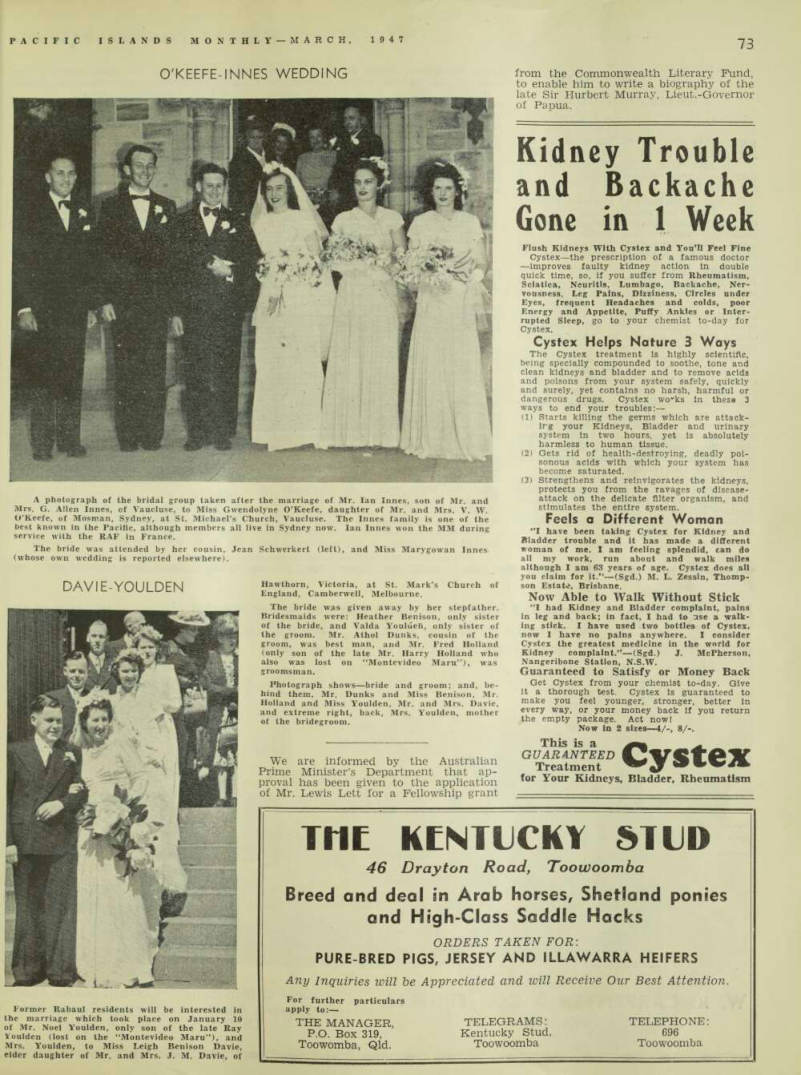
A photograph of the bridal group taken after the marriage of Mr. lan Innes, son of Mr. and Mrs. G. Allen Innes, of Vaucluse, to Miss Gwendolyne O’Keefe, daughter of Mr. and Mrs. V. W.
O’Keefe, of Mosman, Sydney, at St. Michael’s Church, Vaucluse. The Innes family is one of the best known in the Pacific, although members all live in Sydney now. lan Innes won the MM during service with the RAF in France, The bride was attended by her cousin, Jean Schwerkert (left), and Miss Marygowan Innes. (whose own wedding is reported elsewhere).
Hawthorn, Victoria, at St. Mark’s Church of England, Camberwell, Melbourne.
The bride was given away by her stepfather.
Bridesmaids were: Heather Benison, only sister of the bride, and Valda Youlden, only sister of the groom. Mr. Athol Dunks, cousin of the groom, was best man, and Mr. Fred Holland (only son of the late Mr. Harry Holland who also was lost on “Montevideo Maru”), was groomsman.
Photograph shows—bride and groom; and, be hind them, Mr. Dunks and Miss Benison, Mr.
Holland and Miss Youlden, Mr. and Mrs. Davie, and extreme right, back, Mrs. Youlden, mother of the bridegroom.
Davie-Youlden
We are informed by the Australian Prime Minister’s Department that ap proval has been given to the application of Mr. Lewis Lett for a Fellowship grant
from the Commonwealth Literary Fund, to enable him to write a biography of the late Sir Hurbert Murray, Lieut.-Governor of Papua.
Former Rabaul residents will be interested in the marriage which took place on January 10 of Mr. Noel Youlden, only son of the late Ray Youlden (lost on the “Montevideo Maru”), and Mrs. Youlden, to Miss Leigh Benison Davie, elder daughter of Mr. and Mrs. J. M. Davie, of
Advertisements & other items, p. 77 (1 item)
Kidney Trouble
and Backache
Gone in 1 Week
Flush Kidneys With Cystex and You’ll Feel Fine Cystex—the prescription of a famous doctor —improves faulty kidney action In double quick time, so, if you suffer from Rheumatism, Sciatica, Neuritis, Lumbago, Backache, Nervousness, Leg Pains, Dizziness, Circles under Eyes, frequent Headaches and colds, poor Energy and Appetite, Puffy Ankles or Interrupted Sleep, go to your chemist to-day for Cystex.
Cystex Helps Nature B Ways
The Cystex treatment Is highly scientific, being specially compounded to soothe, tone and clean kidneys and bladder and to remove acids and poisons from your system safely, quickly and surely, yet contains no harsh, harmful or dangerous drugs. Cystex wo-ks in these 3 ways to end your troubles:— (1) Starts killing the germs which are attacking your Kidneys, Bladder and urinary system In two hours, yet Is absolutely harmless to human tissue. (2) Gets rid of health-destroying, deadly poisonous acids with which your system has become saturated. (3) Strengthens and reinvigorates the kidneys, protects you from the ravages of diseaseattack on the delicate filter organism, and stimulates the entire system.
Feels a Different Woman
“I have been taking Cystex for Kidney and Bladder trouble and it has made a different woman of me. I am feeling splendid, can do all my work, run about and walk miles although I am 63 years of age. Cystex does ail you claim for it.”—(Sgd.) M. L. Zessin, Thompson Estate, Brisbane.
Now Able to Walk Without Stick
“I had Kidney and Bladder complaint, pains in leg and back; in fact, I had to use a walking stick. I have used two bottles of Cystex, now I have no pains anywhere. I consider Cystex the greatest medicine in the world for Kidney complaint.”—(Sgd.) J. McPherson, Nangeribone Station, N.S.W, Guaranteed to Satisfy or Money Back Get Cystex from your chemist to-day. Give it a thorough test. Cystex Is guaranteed to make you feel younger, stronger, better In every way, or your money back If you return the empty package. Act now!
Now in 2 sizes—1/-, 8/-.
This is a
GUARANTEED I VCTPV
Treatment
for Your Kidneys, Bladder, Rheumatism
HIE KENTUCKY MUD
46 Drayton Road , Toowoomba
Breed and deal in Arab horses, Shetland ponies
and High-Class Saddle Hacks
ORDERS TAKEN FOR :
PURE-BRED PIGS, JERSEY AND ILLAWARRA HEIFERS
Any Inquiries will be Appreciated and will Receive Our Best Attention.
For further particulars apply to:—
THE MANAGER,
P.O. Box 319, Toowomba, Qld.
TELEGRAMS:
Kentucky Stud, Toowoomba
TELEPHONE:
696 Toowoomba
Harrison Smith
Tribute to the Late Harrison Smith
From Our Own Correspondent MR. HARRISON SMITH died at his home at Vaiari, Tahiti, on January 2, 1947, after a long illness. He was born at Boston, Massachusetts, USA, in the year 1872.
He was a graduate of Harvard Univer sity. Later he became a professor at the great engineering college, the Massa chusetts Institute of Technology. He served with distinction with the United States Forces during World War I.
Retiring from his professorship about 1920, he led a scientific expedition into the interior of Borneo from Sarawak as a base. His careful studies of plant life and tropical agriculture during his sojourn in Indonesia laid the foundation of his valuable services to Tahiti and the colony of French Oceania.
Twenty-five years ago he settled in Tahiti, where he acquired an extensive estate in the Vaiari district. At his own expense he has, through the years, im ported from Indonesia, Burma, Mada gascar and other countries, a great variety of ornamental and fruit-bearing trees, food plants and so forth. After establishing and propagating them on his estate, he has presented them to planters throughout the colony.
The stately and beautiful flowering trees which adorn and shade the long avenue of New Papeete, are Harrison Smith’s gift to the colony.
One can but indicate his many services to Tahiti and its people.
Twice the French Government has offi
cially recognised these services by be stowing the highest of its decorations.
Harrison Smith loved the Tahitian people. One would wish to record his innumerable acts of kindness and bene factions. But, as I knew Harrison Smith, he would beseech me to make no men tion of them.
His last resting place is on a high hill overlooking his estate, and the dis tant mountains of Tai’arapu—the view he loved most of all during his lifetime.
Brisbane Ng Assn. Still
Carries On
From Our Own Correspondent Brisbane, Feb. 27.
THE Brisbane-New Guinea Association is still a live body despite dwindling numbers. But the smallness of mem bership does not detract from the en thusiasm and interest at the monthly meetings.
Predominantly a women’s organisation, motions are moved and discussion follows with marked observance of correct pro cedure; and under the capable presidency of Mrs. Gladys Forsyth, business is con ducted with decorum and orderliness. By Madame President’s skilful handling, the meetings do not get out of control —which is not always the case at many functions where the male predominates.
After general business, the ladies en gage in reminiscences of pre-war days.
Many still lament their protracted “exile” from the Territory, and eagerly await the time for their return to husbands or friends. But to some the sinking of the “Montevidea Maru” has prevented any return and changed the course of lives.
The hand of friendship is always ex tended to strangers at the meetings; nor
does time drag, for each evacuee has some interesting experiences to recall; some little anecdote to repeat.
New Building Land
For Suva
Suva, Feb. 6
A LARGE piece of land in the area be tween Suva Point and the town was recently sold to Morris Hedstrom Ltd.
The land formerly was part of the es tate of the late D. H. Smart—other parts of the estate were resumed by the Gov ernment for defence purposes during the war.
Morris Hedstrom’s new property con tains many excellent building sites, some with frontages to Military and Circular Roads and others with a wide view over Laucala Bay and open to the south easterlies.
It is reported that Morris Hedstrom intend subdividing the property for build ing purposes. This has caused a flutter in local breasts as building land in Suva township is now practically non-existent and many who would build, and thus solve their own housing problem, cannot do so for lack of land.
However, even if the purchasers intend to subdivide, it will probably be some time before the necessary surveying, road con struction etc., is complete. Even with this new development there seems no short-cut to the congestion that has Suva entangled at the present time.
Miss Betty Holland, only daughter of the late Mr. H. D. Holland and Mrs.
Holland of Melbourne (formerly of Rab aul) has announced her engagement to Mr A. H. Wood, of Ivanhoe, Victoria.
Advertisements & other items, p. 78 (1 item)
W. R. Carpenter & Co. (Fiji) Ltd
Ikl Cl |\/ A we have full facilities for discharging and loading overseas cargoes of any type or size w T Qnc we so |j c if- stevedoring work :: Instructions to handle oversea transhipment cargo at Suva for consignees in other Pacific Islands will be given every care
CARPENTERS’
STEVEDORING
EQUIPMENT
AT
WORK.
At U. <r m mm 5 - ■w 1 W. R. CARPENTER & CO. (Fiji) Ltd
SUVA, FIJI
General Merchants Customs House Agents Shipping Agents Cartage Contractors Dpnlprs in nil Island Produce
Gazelle Peninsula
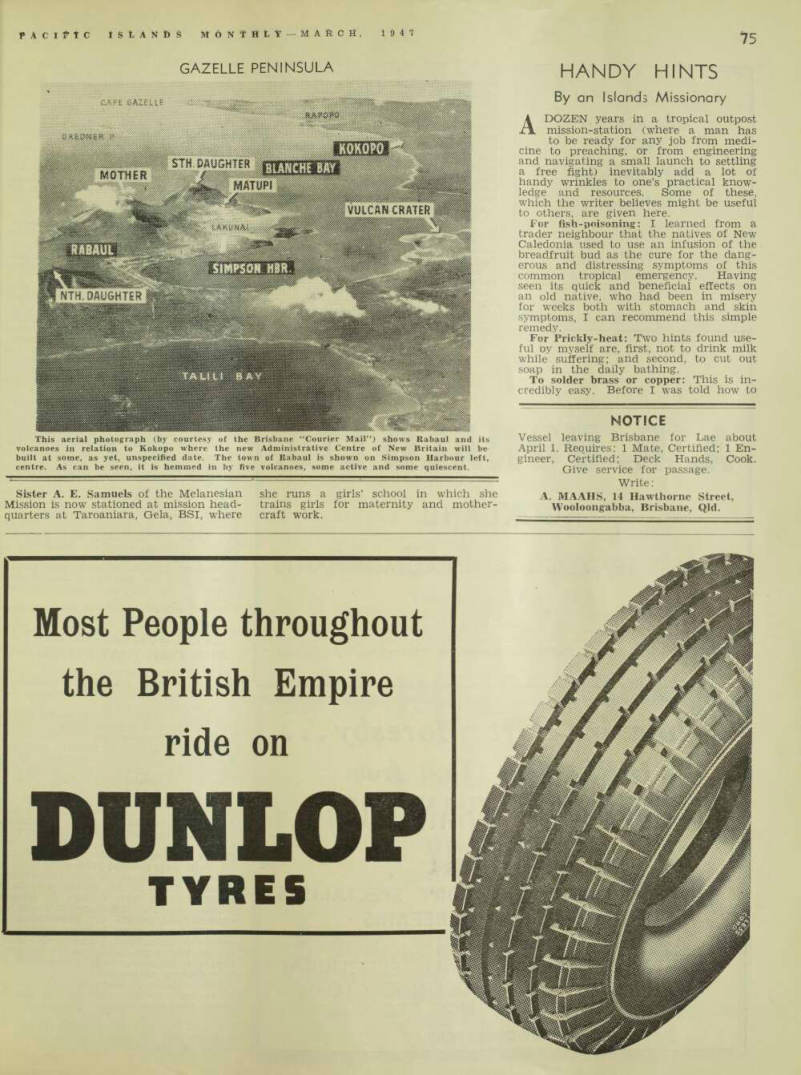
Sister A. E. Samuels of the Melanesian Mission is now stationed at mission headquarters at Taroaniara, Gela, BSI, where
she runs a girls’ school in which she trains girls for maternity and mother craft work.
This aerial photograph (by courtesy of the Brisbane “Courier Mail") shows Rabaul and its volcanoes in relation to Kokopo where the new Administrative Centre of New Britain will be built at some, as yet, unspecified date. The town of Rabaul is shown on Simpson Harbour left, centre. As can be seen, it is hemmed in by five volcanoes, some active and some quiescent.
Handy Hints
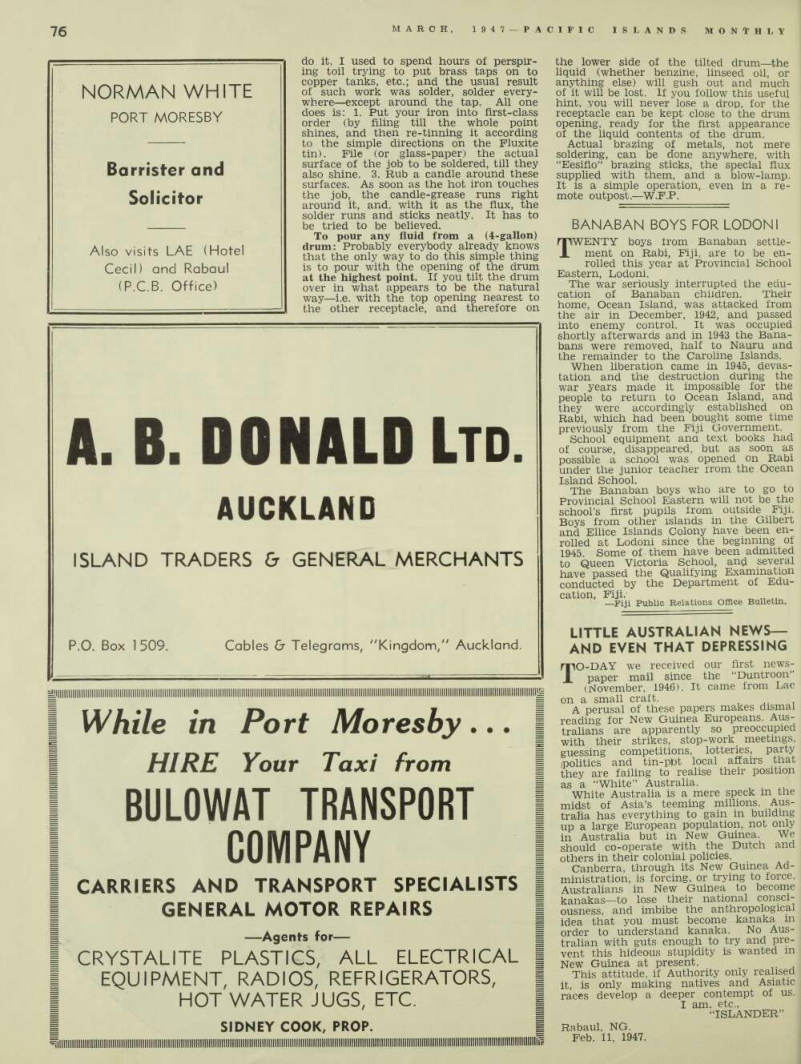
By an Islands Missionary
A DOZEN years in a tropical outpost mission-station (where a man has to be ready for any job from medi cine to preaching, or from engineering and navigating a small launch to settling a free fight) inevitably add a lot of handy wrinkles to one’s practical know ledge and resources. Some of these, which the writer believes might be useful to others, are given here.
For fish-poisoning: I learned from a trader neighbour that the natives of New Caledonia used to use an infusion of the breadfruit bud as the cure for the dang erous and distressing symptoms of this common tropical emergency. Having seen its quick and beneficial effects on an old native, who had been in misery for weeks both with stomach and skin symptoms, I can recommend this simple remedy.
For Prickly-heat: Two hints found use ful oy myself are, first, not to drink milk while suffering; and second, to cut out soap in the daily bathing.
To solder brass or copper: This is in credibly easy. Before I was told how to
do it, I used to spend hours of perspir ing toil trying to put brass taps on to copper tanks, etc.; and the usual result of such work was solder, solder every where —except around the tap. All one does is: 1. Put your iron into first-class order (by filing till the whole point shines, and then re-tinning it according to the simple directions on the Fluxite tin). Pile (or glass-paper) the actual surface of the job to be soldered, till they also shine. 3. Rub a candle around these surfaces. As soon as the hot iron touches the job, the candle-grease runs right around it, and, with it as the flux, the solder runs and sticks neatly. It has to be tried to be believed.
To pour any fluid from a (4-gallon) drum: Probably everybody already knows that the only way to do this simple thing is to pom* with the opening of the drum at the highest point. If you tilt the drum over in what appears to be the natural way—i.e. with the top opening nearest to the other receptacle, and therefore on
the lower side of the tilted drum—the liquid (whether benzine, linseed oil, or anything else) will gush out and much of it will be lost. If you follow this useful hint, you will never lose a drop, for the receptacle can be kept close to the drum opening, ready for the first appearance of the liquid contents of the drum.
Actual brazing of metals, not mere soldering, can be done anywhere, v/ith “E'esiflo” brazing sticks, the special flux supplied with them, and a blow-lamp.
It is a simple operation, even in a re
mote outpost.-
W.F.P.
Advertisements & other items, pp. 79-80 (1 item)
Dunlop
NOTICE
Vessel leaving Brisbane for Lae about April 1. Requires: 1 Mate, Certified; 1 Engineer, Certified; Deck Hands, Cook.
Give service for passage.
Write: A. MAAHS, 14 Hawthorne Street, Wooloongabba, Brisbane, Qld.
Most People throughout the British Empire ride on
DUNLOP
TYRES
NORMAN WHITE
PORT MORESBY
Barrister and
Solicitor
Also visits LAE (Hotel Cecil) and Rabaul (P.C.B. Office)
A. B. DONALD Ltd.
AUCKLAND
ISLAND TRADERS & GENERAL MERCHANTS
P.O. Box 1509. Cables b Telegrams, "Kingdom," Auckland.
While in Port Moresby ...
HIRE Your Taxi from
BULOWAT TRANSPORT
COMPANY
CARRIERS AND TRANSPORT SPECIALISTS
GENERAL MOTOR REPAIRS
—Agents for—
CRYSTALITE PLASTICS, ALL ELECTRICAL
EQUIPMENT, RADIOS, REFRIGERATORS,
HOT WATER JUGS, ETC.
SIDNEY COOK, PROP.
Banaban Boys For Lodoni
rENTY boys from Banaban settle ment on Rabi, Fiji, are to be en rolled this year at Provincial School Eastern, Lodoni.
The war seriously interrupted the edu cation of Banaban children. Their home, Ocean Island, was attacked from the air in December, 1942, and passed into enemy control. It was occupied shortly afterwards and in 1943 the Bana bans were removed, half to Nauru and the remainder to the Caroline Islands.
When liberation came in 1945, devas tation and the destruction during the war years made it impossible for the people to return to Ocean Island, and they were accordingly established on Rabi, which had been bought some time previously from the Fiji Government.
School equipment ana text books had of course, disappeared, but as soon as possible a school was opened on Rabi under the junior teacher from the Ocean Island School.
The Banaban boys who are to go to Provincial School Eastern will not be the school’s first pupils from outside Fiji.
Boys from other Islands in the Gilbert and Ellice Islands Colony have been en rolled at Lodoni since the beginning of 1945. Some of them have been admitted to Queen Victoria School, and several have passed the Qualifying Examination conducted by the Department of Edu cation, Fiji. „ „ .. —Fiji Public Relations Office Bulletin.
Little Australian News—
And Even That Depressing
TO-DAY we received our first news paper mail since the “Duntroon” (November, 1946). It came from Lae on a small craft.
A perusal of these papers makes dismal reading for New Guinea Europeans. Aus tralians are apparently so preoccupied with their strikes, stop-work meetings, guessing competitions, lotteries, party ipolitics and tin-pbt local affairs that they are failing to realise their position as a “White” Australia. .
White Australia is a mere speck in the midst of Asia’s teeming millions. Aus tralia has everything to gain in building up a large European population, not only in Australia but in New Guinea. We should co-operate with the Dutch and others in their colonial policies.
Canberra, through its New Guinea Ad ministration, is forcing, or trying to force, Australians in New Guinea to become kanakas—to lose their national consci ousness, and imbibe the anthropological idea that you must become kanaka in order to understand kanaka. No Aus tralian with guts enough to try and pre vent this hideous stupidity is wanted in New Guinea at present. .
This attitude, if Authority only realised it, is only making natives and Asiatic races develop a deeper contempt of us.
I am, etc.,
“Islander”
Rabaul, NG.
Feb. 11, 1947.
Commission's Home?
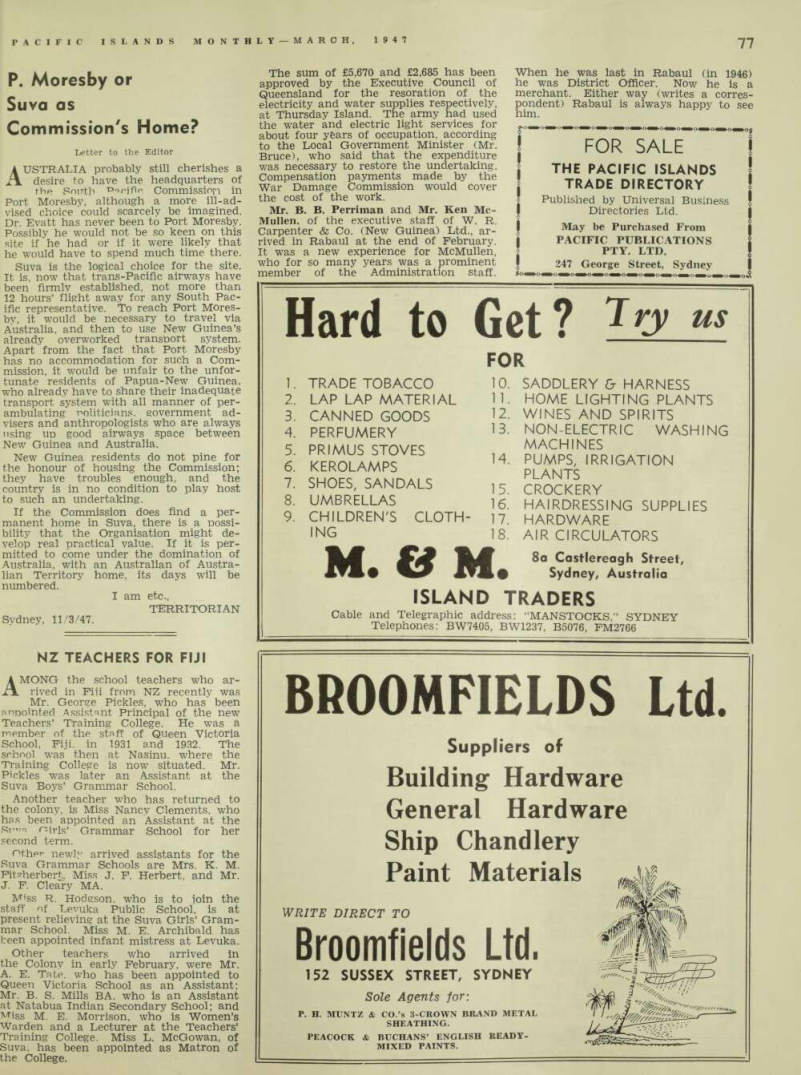
P. Moresby or Suva as Commission's Home?
Letter to the Editor AUSTRALIA probably still cherishes a desire to have the headquarters of the South 'Porifv Commission in Port Moresby, although a more ill-ad vised choice could scarcely be imagined.
Dr. Evatt has never been to Port Moresby.
Possibly he would not be so keen on this site if he had or if it were likely that he would have to spend much time there.
Suva is the logical choice for the site.
It is, now that trans-Pacific airways have been firmlv established, not more than 12 hours’ flight away for any South Pac ific representative. To reach Port Mores bv, it would be necessary to travel via Australia, and then to use New Guinea’s already overworked transport system.
Apart from the fact that Port Moresby has no accommodation for such a Com mission, it would be unfair to the unfor tunate residents of Papua-New Guinea, who already have to share their inadequate transport system with all manner of per ambulating politicians, government ad visers and anthropologists who are always using up good airways space between New Guinea and Australia.
New Guinea residents do not pine for the honour of housing the Commission; they have troubles enough, and the country is in no condition to play host to such an undertaking.
If the Commission does find a per manent home in Suva, there is a possi bility that the Organisation might de velop real practical value. If it is per mitted to come under the domination of Australia, with an Australian of Austra lian Territory home, its days will be numbered.
I am etc..
Territorian
Sydney, 11/3/47.
Nz Teachers For Fiji
AMONG the school teachers who ar rived in Fiji from NZ recently was Mr. George Pickles, who has' been appointed Assistant Principal of the new Teachers’ Training College. He was a member of the staff of Queen Victoria School, Fiji, in 1931 and 1932. The school was then at Nasinu. where the Training College is now situated. Mr.
Pickles was later an Assistant at the Suva Boys’ Grammar School.
Another teacher who has returned to the colony, is Miss Nancy Clements, who has been appointed an Assistant at the RrTrn rMrls’ Grammar School for her second term. ether newly arrived assistants for the Suva Grammar Schools are Mrs. K. M.
Miss J. F. Herbert, and Mr.
J. F. Cleary MA.
M’ss R. Hodgson, who is to join the staff of Levuka Public School, is at present relieving at the Suva Girls’ Gram mar School. Miss M. E. Archibald has teen appointed infant mistress at Levuka.
Other teachers who arrived in the Colony in early February, were Mr.
A. E. Tate, who has been appointed to Queen Victoria School as an Assistant: Mr. B. S. Mills BA. who is an Assistant at Natabua Indian Secondary School; and Miss M. E. Morrison, who is Women’s Warden and a Lecturer at the Teachers’
Training College. Miss L. McGowan, of Suva, has been appointed as Matron of the College.
The sum of £5,670 and £2,685 has been approved by the Executive Council of Queensland for the resoration of the electricity and water supplies respectively, at Thursday Island. The army had used the water and electric light services for about four years of occupation, according to the Local Government Minister (Mr.
Bruce), who said that the expenditure was necessary to restore the undertaking.
Compensation payments made by the War Damage Commission would cover the cost of the work.
Mr. B. B. Perriman and Mr. Ken Mc- Mullen. of the executive staff of W. R.
Carpenter & Co, (New Guinea) Ltd., ar rived in Rabaul at the end of February.
It was a new experience for McMullen, who for so many years was a prominent member of the Administration staff.
When he was last in Rabaul (in 1946) he was District Officer. Now he is a merchant. Either way (writes a corres pondent) Rabaul is always happy to see him.
Advertisements & other items, p. 81 (1 item)
Broomfields Ltd.
FOR SALE
THE PACIFIC ISLANDS
TRADE DIRECTORY
Published by Universal Business Directories Ltd.
May be Purchased From
PACIFIC PUBLICATIONS
PTY. LTD.
247 George Street, Sydney
Hard to Get? 7 o> us
FOR
1. TRADE TOBACCO 10.
2. LAP LAP MATERIAL 11.
3. CANNED GOODS 12 -
4. PERFUMERY 13 -
5. PRIMUS STOVES 14
6. KEROLAMPS
7. SHOES, SANDALS 15
8. UMBRELLAS 16
9. CHILDREN'S CLOTH- 17’
ING 18.’
M. & M.
SADDLERY & HARNESS
HOME LIGHTING PLANTS
WINES AND SPIRITS
NON-ELECTRIC WASHING
MACHINES
PUMPS, IRRIGATION
PLANTS
CROCKERY
HAIRDRESSING SUPPLIES
HARDWARE
AIR CIRCULATORS
8a Castlereagh Street, Sydney, Australia
ISLAND TRADERS
Cable and Telegraphic address: “MANSTOCKS,” SYDNEY Telephones: 8W7405, 8W1237, 85076, FM2766
BROOMFIELDS Ltd.
Suppliers of
Building Hardware
General Hardware
Ship Chandlery
Paint Materials
WRITE DIRECT TO
Broomfieids Ltd.
152 SUSSEX STREET, SYDNEY
Sole Agents for : P. H. MUNTZ & CO.’s 3-CROWN BRAND METAL
SHEATHING.
PEACOCK & BUCHANS’ ENGLISH READY-
MIXED PAINTS.
r—-- •
Islands Produce
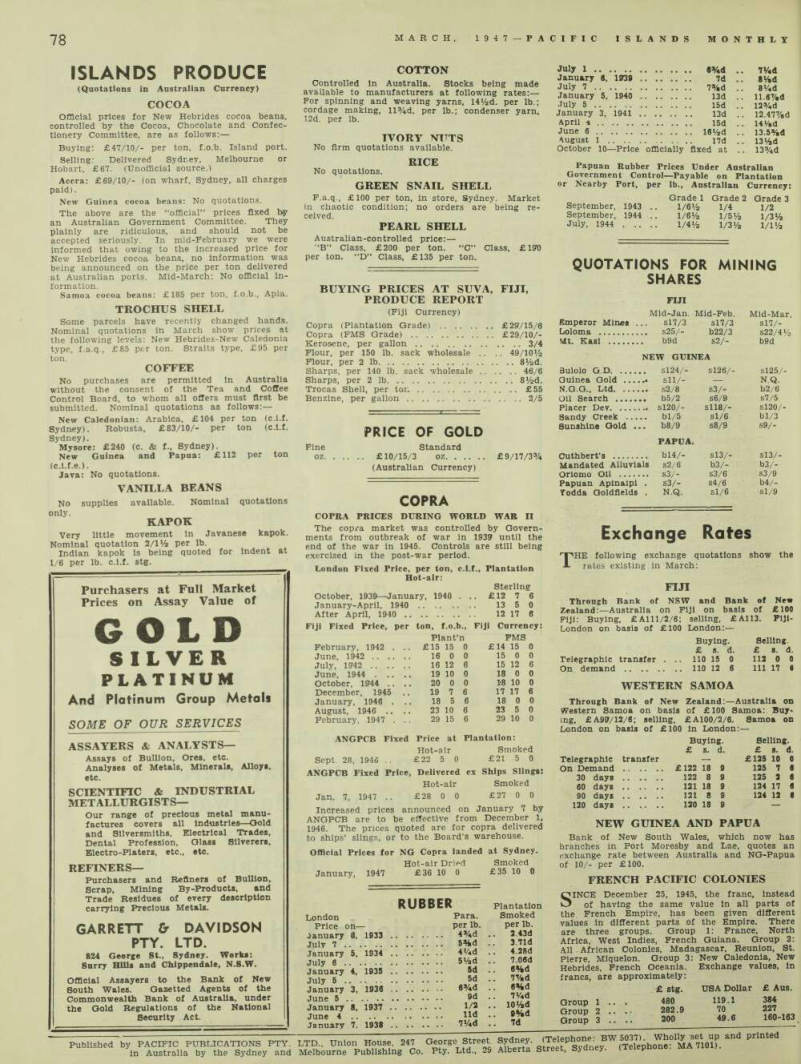
(Quotations in Australian Currency)
Cocoa
Official prices for New Hebrides cocoa beans, controlled by the Cocoa, Chocolate and Confec tionery Committee, are as follows; — Buying; £47/10/- per ton, f.o.b. Island port.
Selling: Delivered Sydney. Melbourne or Hobart, £67. (Unofficial source.) Accra: £69/10/- (on wharf, Sydney, all charges paid).
New Guinea cocoa beans: No quotations.
The above are the “official” prices fixed by an Australian Government Committee. They plainly are ridiculous, and should not be accepted seriously. In mid-February we were informed that owing to the increased price for New Hebrides cocoa beans, no information was being announced on the price per ton delivered at Australian ports. Mid-March; No official in formation.
Samoa cocoa beans: £lB5 per ton, f.0.b., Apia.
Trochus Shell
Some parcels have recently changed hands.
Nominal quotations in March show prices at the following levels: New Hebrides-New Caledonia type, f.a.q., £B5 per ton. Straits type, £95 per ton.
Coffee
No purchases are permitted in Australia without the consent of the Tea and Coffee Control Board, to whom all offers must first be submitted. Nominal quotations as follows; — New Caledonian; Arablca, £lO4 per ton (c.i.f.
Sydney). Robusta, £B3/10/- per ton (c.i.f.
Sydney).
Mysore: £240 (c. & f., Sydney).
New Guinea and Papua; £ll2 per ton (c.1.f.e.).
Java: No quotations.
Vanilla Beans
No supplies available. Nominal quotations only.
Kapok
Very little movement in Javanese kapok.
Nominal quotation 2/1% per lb.
Indian kapok is being quoted for Indent at 1/6 per lb. c.i.f. stg.
Cotton
Controlled in Australia. Stocks being made available to manufacturers at following rates:— For spinning and weaving yarns, HVad. per lb.; cordage making, ll%d. per lb.; condenser yarn, 12d. per lb.
Ivory Nuts
No firm quotations available.
Rice
No quotations.
Green Snail Shell
P.a.q., £lOO per ton, in store, Sydney. Market in chaotic condition; no orders are being re ceived.
Pearl Shell
Australian-controlled price;— ”B” Class, £2OO per ton. “C” Class, £l9O per ton. “D” Class, £135 per ton.
Buying Prices At Suva, Fiji,
Produce Report
(Fiji Currency) Copra (Plantation Grade) £29/15/0 Copra (FMS Grade) £29/10/- Kerosene, per gallon 3/4 Flour, per 150 lb. sack wholesale .. .. 49/lOVa Flour, per 2 lb SVad.
Sharps, per 140 lb. sack wholesale 46/6 Sharps, per 2 lb SVad.
Trocas Shell, per tor. £55 Benzine, per gallon 2/5
Advertisements & other items, p. 82 (1 item)
Price Of Gold
Pine Standard oz £lO/15/3 oz £9/17/3% (Australian Currency)
Copra
Prices During World War Ii
The copra market was controlled by Govern ments from outbreak of war in 1939 until the end of the war in 1945. Controls are still being exercised in the post-war period.
London Fixed Price, per ton, c.l.f,, Plantation Hot-air; Sterling October, 1939—January, 1940 . . £12 7 6 January-April, 1940 13 5 0 After April, 1940 .. 12 17 6 Fiji Fixed Price, per ton, f.o.b., Fiji Currency: Plant’n
Fms
February. 1942 . .. £15 15 0 £14 15 0 June, 1942 16 0 0 15 0 0 July, 1942 16 12 6 15 12 6 June, 1944 19 10 0 18 0 0 October, 1944 .. .. 20 0 0 1-8 10 0 December, 1945 .. 19 7 6 17 17 6 January, 1946 . .. 18 5 6 18 0 0 August, 1946 .. .. 23 10 6 23 5 0 February, 1947 . .. 29 15 6 29 10 0 ANGPCB Fixed Price at Plantation; Hot-air Smoked Sept. 28, 1946 .. £22 5 0 £21 5 0 ANGPCB Fixed Price, Delivered ex Ships Slings; Hot-air Smoked Jan. 7, 1947 .. £28 0 0 £27 0 0 Increased prices announced on January 7 by ANGPCB are to be effective from December 1, 1946. The prices quoted are for copra delivered to ships’ slings, or to the Board’s warehouse.
Official Prices for NG Copra landed at Sydney.
Hot-air Dried Smoked January, 1947 £36 10 0 £35 10 0
Rubber
Papuan Rubber Prices Under Australian Government Control—Payable on Plantation or Nearby Port, per lb., Australian Currency:
Plantation
London Price on- January 0, July 7 ..
January 5, July 6 ..
January 4, July 5 ..
January 3, 1933 .. ..
Para, per lb. ... 4 3 /id Smoked per lb. 2.43d 1934 .. .. 1935 .. .. .. .. B%d ... 4V 4 d ... 5 Vad ... 5d 3.71d 4.28d 7.08d «Hd 1936 ... 5d ... 6%d 7%d 6Hd June 5 ..
January 8, June 4 January 7. 1937 .. .. 1938 .. .. .. .. 9d ... 1/2 ... Hd ... 7V4d 7V4d .. lOVid 9Hd 7d
July i e%d .. 7V4«i January 8, 1539 7d .. 8V«d July 7 7»/.d .. 8V«d January 5, 1940 13d 11.6 7 / a d July 5 isd .. iay 4 d January 3, 1941 13d .. 12.47 7 / 8 d April 4 15d .. 14V«d June 6 IBVid .. 13.5%d August 1 17d ,. 13Vid October 10—Price officially fixed at .. 13 3 / 4 d
Grade 1 Grade 2 Grade 3 September, 1943 . 1/6 »/ 2 1/4 1/2 September, 1944 .
I/6V2 1/5 y 2 l/3«/2 July, 1944 . .. . l/4y a 1/3 V 2 I/I1/2
Quotations For Mining
Shares
Fiji
Mid-Jan.
Mid-Feb.
Mid-Mar.
Emperor Mines .
S17/3 sl7/3 sl7/- Loloma .. s25/b22/3 s22/4 Va Mt. Kasl b9d s2/b9d Bulolo G.D
New Guinea
sl24/- sl26/sl25/- Guinea Gold ... .. sll/- — N Q.
N.G.G., Ltd s3/b2/6 Oil Search s6/9 s7/5 Placer Dev sll8/sl20/- Sandy Creek .., bl/5 sl/6 bl/3 Sunshine Gold .. b8/9 s8/9 s9/- Cuthbert’s
Papua.
.. bl4/sl3/- 813/- Mandated Alluvlals s2/6 b3/b3/- Orlomo Oil s3/6 s3/9 Papuan Aplnalpl s3/s4/6 b4/- 7odda Goldfields N.Q. sl/6 sl/9
Exchange Rates
THE following exchange quotations show the rates existing in March:
Fiji
Through Bank of NSW and Bank of New Zealand:—Australia on Fiji on basis of £lOO Fiji: Buying, £Alll/2/6; selling, £AII3. PIJI - on basis of £lOO London: —
Western Samoa
Through Bank of New Zealand:—Australia on Western Samoa on basis of £lOO Samoa: Buy ing, £A99/12/6; selling, £AIOO/2/6. Samoa on London on basis of £lOO in London;—
New Guinea And Papua
Bank of New South Wales, which now has branches in Port Moresby and Lae, quotes an exchange rate between Australia and NG-Papua of 10/- per £lOO.
French Pacific Colonies
SINCE December 25, 1945, the franc, Instead of having the same value in all parts of the French Empire, has been given different values in different parts of the Empire. There are three groups. Group 1: France, North Africa, West Indies, French Guiana. Group 2: All African Colonies, Madagascar, Reunion, St.
Pierre, Miquelon. Group 3: New Caledonia, New Hebrides, French Oceania. Exchange values, In francs, are approximately:
Buying. Selling. £ s. d. £ s. d.
Telegraphic transfer ... 110 15 0 113 0 0 On demand 110 12 6 111 17 8
Buying.
Selling. £ s. d. £ s. d.
Telegraphic transfer — £125 10 0 On Demand .. .. .. £122 18 9 125 7 e 30 days 122 8 9 125 2 6 60 days 121 18 9 124 17 6 90 days 121 8 9 124 12 6 120 days 120 18 9 —
£ stg. USA Dollar £ Aus.
Group 1 .. . 480 119.1 384 Group 2 .. .• 282.9 70 227 Group 3 .. .. 200 49.6 160-163
Advertisements & other items, pp. 82-84 (3 items)
78
MARCH, 1947 PACIFIC ISLANDS MONTHLY
Published by PACIFIC PUBLICATIONS PTY. LTD., Union House, 247 George* Street Sydney. (Tele]p! &nd in Australia by the Sydney and Melbourne Publishing Co. Pty. Ltd., 29 Alberta street, oya y i v
Gold
Purchasers at Full Market Prices on Assay Value of
SILVER
PLATINUM
And Platinum Group Metals
SOME OF OUR SERVICES
ASSAYERS & ANALYSTS—
Assays of Bullion, Ores, etc.
Analyses of Metals, Minerals, Alloys, etc.
SCIENTIFIC & INDUSTRIAL
METALLURGISTS—
Our range of precious metal manufactures covers all Industries—Gold and Silversmiths, Electrical Trades.
Dental Profession, Glass Sllverers, Electro-Platers, etc., etc.
REFINERS—
Purchasers and Refiners of Bullion, Scrap, Mining By-Products, and Trade Residues of every description carrying Precious Metals.
GARRETT & DAVIDSON
PTY. LTD.
834 George St., Sydney. Works: Sorry Hills and Chippendale, N.S.W.
Official Assayers to the Bank of New South Wales. Gazetted Agents of the Commonwealth Bank of Australia, under the Gold Regulations of the National Security Act.
tropical thirst...
To quench a
fretitcd* J"* ks
% I Mm 7. nt t nnsr UU -A* ml
LAGER
When you’re hot and tired, there is nothing quite so satisfying and thirst quenching as a long, cold glass of “K. 8." Your friends and guests, too, will appreciate this really fine Lager, for “Everybody drinks K.B.’’
TOOTHS
Capital £1,000,000
ESTABLISHED 1914
COPRA MERCHANTS & MILLERS
BRANCHES THROUGHOUT THE PACIFIC ISLANDS
PACIFIC ISLAND PORTS WAS ESTABLISHED BY
W. R. CARPENTER & CO. LTD.
Head Office: 16 O'CONNELL STREET, SYDNEY.
Cable Address:
CAMOHE.
Telephone: BW 4421.
Postal Address: P.O. Box No. 168, Sydney.