Pacific Islands

Monthly
Inside: Marshalls Tackles Reform
May 1999
Free Trade Area
American Samoa US$2.5O: Australia A 53.50; Cook Islands NZ$3; Fiji F 52.50 Vat incl; FS Micronesia US$3; Kiribati A 52.50; Nauru A 52.50; Niue NZ$3; Norfolk As 3; New Caledonia cpf2so; New Zealand NZ53,45 incl GST; Northern Marianas US$3; Papua New Guinea K 3; Palau US$3; Marshall Islands US$3; Solomon Islands As 3; French Polynesia cpf3oo; Tonga P 3; USA US$3; Vanuatu VT22O; Western Samoa T 5.50. These are recommended prices only.
Advertisements & other items, pp. 2-4 (1 item)
Performance
and
i 1 ■ saKaWBkK . >-■ .. «'-;c
fOYOTA
* I MMi •l&x fe.
S 71 itti ■ ■;.»■:• t- 'V J m :■■■ h ;
wmi.jM
- ■• i >v ‘V ‘■ v TPr^J 6 -' ••■ W \ mj * - - . •v* : .Y , t pv*33^ •? rsga<£®^ '4 s-ss •: ■ is !«■' '■ ■ mm
mmL
■■ - ' : ;-T. ' »".;>■ .4 * ■■ V -‘ fcsd#/i. c -.«. ! Hv-.i 'A ’te.: M ■P‘O
Mv ■.# ■ ; fe^
■ team v.TWPU'-a ..-i aci&as . .-MS* sms sr v-«
PRADO
' . ■■•■•;/ dr «!S®l i s mss ■•* '” R ■ V The all-new Toyota Land Cruiser Prado features exciting new styling and genuine 4 Wheel Drive performance. A high rigidity frame and refined suspension system ensures optimum road handling capabilities, but above all, Toyota quality comes first. Fully supported throughout the Fiji Islands by the very best Toyota Genuine Parts and Quality Service network through Asco Motors Nationwide, you are assured that the new Toyota Land Cruiser Prado will serve you well.
®> TOYOTA
Asco Motors
AMII7I
NATIONWIDE
PACIFIC ISLANDS
—-MIWIIIIM
TRADING POST
TRADING POST CAN WORK
WONDERS FOR YOU...
Promote your business, or service, sell your household items, cars or heavy machinery etc.
ONLY AUSS2 (OR EQUIVALENT) PER WORD.
NO COMPANY LOGO. NO DISPLAY.
NO BOLD TYPE.
Just forward your Advertisement together with payment to:
PACIFIC ISLANDS MONTHLY "Trading Post",
PO Box 1167, Suva, Fiji.
Conditions: 1. All Advertisements are subject to acceptance and approval of publisher. 2. Advertisements are published as space permits; we cannot guarantee date of insertion. 3. All advertisements must be prepaid and should be typed or printed clearly 4. Deadline for receipt of advertisements is the 15th of the month prior to issue. 5. PACIFIC ISLANDS MONTHLY assumes no responsibility for any service other than publishing paid advertisements in this section.
METALS REFINING OPERRTIONS LIMITED
PRECIOUS METAL PROCESSORS HMD REFINERS
SELLERS OF GOLD HND SILUER IN PNG, AUSTRALASIA, AND THE
NEIGHBOURING PACIFIC ISLANDS
m t A 'T A ...
SERVICES OFFERED
• Total refining for major mines • Total refining and assay services for small scale mining • Sell authentic PNG gold bullion for jewellry manufacturing, investors or enthusiasts • Maintain metal accounts • Buy & sell gold nuggets
REGISTERED OFFICE & POSTAL ADDRESS
Section 451, Lot 6 Kwilla Estate, Waigani. PO Box 3980, Boroko, NCD, Papua New Guinea Telephone: (675) 3252647 Fax: (675) 3252959
Pacific Islands
Monthly
Vol 69 No. S
The News Magazine
May 1999
PUBLISHER: Alan Robinson EDITOR: Sophie Foster Hildebrand
Correspondents:
Michael Field, Giff Johnson, Sally Andrew, Monica Miller, Ed Rampell, Alan Ah Mu, Sam Vulum, Florence Syme-Buchanan, Brian Tobia.
Columnists:
David Barber (Wellington), Jemima Garrett (Sydney),
Graphic Artists:
Josefa Bola, Joseph Dass, Faizal Khan
Advertising Sales
Senior Regional Sales (South Pacific) Shayne Farah Hussein Tel (679) 304111, 303244, Fax (679) 303809.
Sydney, Canberra: Bob Hill Media Representation, Tel (61-2) 4164245, Fax (61-2)4165064.
Brisbane: Jane Fewings Media and Advertising Associates Tel (61-7) 3378 4522, Fax (61-7) 3878 1071.
Adelaide: Hastwell Williamsons Representatives, Tel (61-8) 3799522, Fax (61-8) 3799735.
Melbourne: Brown Orr Fletcher Burrows (Aust) Pty Ltd.
Tel (61-3) 98265188, Fax (61-3) 98265644.
Auckland: McKay & Bowman, International Media Representatives Limited, Tel (64-9)4190561, Fax (64-9) 4192243.
Japan: Universal Media Corporation, Tokyo, Tel (3) 3266626741, Cable: UNI-MEDIA Tokyo, Fax (3) 32626742.
Pacific Islands Monthly was founded in 1930
(Usps 9522480).
A Fiji Times Limited production.
Cover prices are recommended retail only. Registered by Australia Post, Publication No. NBP1210. © Copyright Fiji Times Limited, 177 Victoria Parade, Suva, Fiji.
Tel (679) 304111, fax (679) 303809.
Email: [email protected] PIM Website; http://www.pim.com.fj Pacific Islands Monthly is published monthly by Fiji Times Limited, a division of Nationwide News, 2 Holt Street, Surry Hills, Sydney, NSW 2010.
Send Address Changes To:
Pacific Islands Monthly PO Box 1167, Suva, Fiji.
Printed by Quality Print Limited, 16 Amra Street, Walu Bay, Suva, Fiji.
Layout by Josefa Bola and Sophie Foster Hildebrand
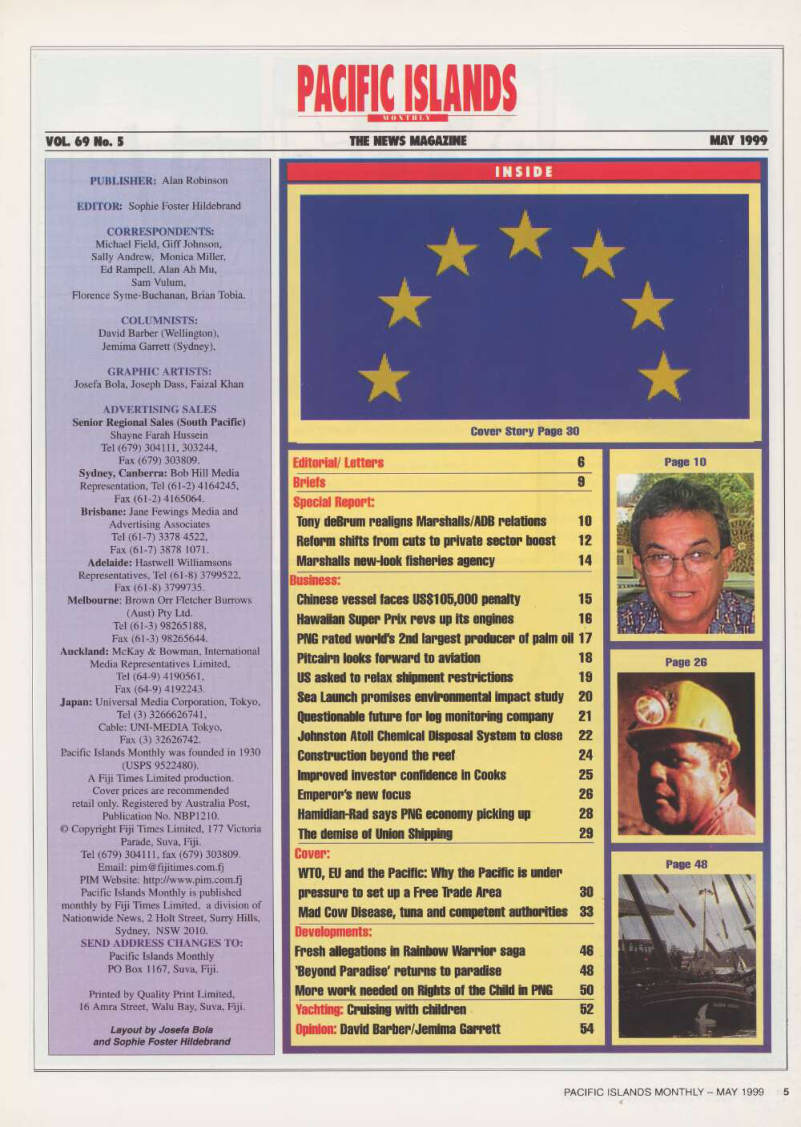
Inside
Cover Story Page 30
Editorial/ Letters G_ Briefs 9 Special Report: Tony deßrum realigns Marshalls/ADB relations 10 Reform shifts from cuts to private sector boost 12 Marshalls new-look fisheries agency 14 Business: Chinese vessel faces US$lO5,OOO penalty 15 Hawaiian Super Prix revs up its engines 16 PNG rated world's 2nd largest producer of palm oil 17 Pitcairn looks forward to aviation 18 US asked to relax shipment restrictions 19 Sea Launch promises environmental impact study 20 Questionable future for log monitoring company 21 Johnston Atoll Chemical Disposal System to close 22 Construction beyond the reef 24 Improved investor confidence in Cooks 25 Emperor's new focus 26 Hamidian-Rad says PNG economy picking up 28 The demise of Onion Shipping 29 Cover: WTO, EU and the Pacific: Why the Pacific is under pressure to set up a Free Trade Area 30 Mad Cow Disease, tuna and competent authorities 33 Developments: Fresh allegations in Rainbow Warrior saga 46 'Beyond Paradise' returns to paradise 48 More work needed on Rights of the Child in PNG 50 Yachting; Cruising with children 52 Opinion: David Barber/Jemima Garrett 54
Page 10
Page 26
Page 48
things in

Editorial
Are the best things in life free?
IT is no secret that, despite covering one-third of the globe, the Pacific and its island nations do not wield much influence in the big bad world of international trade.
Indeed, some businesses in Pacific island countries have had to rely on preferential access to key markets to par ticipate as exporters.
Without it, their products find it hard to compete in an equal playing field.
By far, the most important agreement for countries such as Papua New Guinea and Fiji (the two most vibrant of Pacific economies) is the Lome IV convention.
Under this agreement ACP countries get zero tariff on goods that they export to the European Union and for some goods such as sugar under the Sugar Protocol, these countries get paid much
more than the World Market Price.
But globalisation and increasingly pressure from the World Trade Organisation for compliance, means that the Pacific must not rely on getting pref erential treatment forever.
Indeed, there are moves underway even now towards a new trade regime that could see the setting up of a Free Trade Area in the Pacific.
While negotiations will be ongoing
over the future of Lome, a new “millennium round” of trade liberalisation negotia tions is expected to start at the end of the year in the WTO.
It is seen as possibly the most ambitious push since the first round in 1947.
APEC, which includes the United States and Japan, has adopted a two-track trade lib
eralisation plan among Pacific Rim economies, with the more advanced opening up by 2010 and developing economies 10 years later.
For island countries it is a sign of the times, and if anything, there is a need to tighten up and become more global in our
thinking.
We cannot hide from it. We cannot run from it. The only thing we can do is decide how best to respond to it. ■
Letters
Potential of tuna fisheries
Your recent story on the tuna fisheries of the South Pacific was very timely. As an observer with experience of the maritime industry on three continents, perhaps you will allow me to add a few remarks?
There is no question, as you point out, that the Pacific Island States are on the one hand poised to benefit considerably from the huge Exclusive Economic Zones which became rightfully theirs after the UN Law of the Sea Convention. On the other hand, as you also point out, they are threatened by the almost piratical activities of some foreign vessels, who illegally fish within the EEZ or who use irre sponsible methods to take fish in dangerous quantities on the High Seas. These issues will I believe find proper political solutions before long because there is now the will among the Pacific Island States to manage these questions, and fast.
What your story did not address was the additional ways that these States can benefit from the fishing industry. In the end, benefits are of three kinds. First, Licence Fees derived from foreign vessels can give an interim cash flow while the local industry is developed. Second, and better, is the development of that local industry. But there is a third benefit, which you may have forgotten.
Fishing vessels need to be built and equipped. They need to be serviced and re-pro vided with the high value consumable tackle that is routinely lost. The equipment is sophisti cated and very large sums of money are involved. This industrial aspect of the industry has traditionally been the sole purview of the developed nations. No longer. Unnoticed by the press and largely without government help, Fiji has been successfully exporting sizeable vessels overseas to assist in the development of the industry elsewhere. For example, the recent arrival of a new 25-metrc Fiji-built fishing ves sel in Tahiti merited several pages in their press and extensive TV and radio coverage. Back in Fiji, the only mention was weeks later and just a few lines.
Besides the vessels themselves, the design, manufacture and maintenance of the fishing equipment on them has reached what is proba bly the world’s highest standard in Fiji. Did you
know, for example, that Fiji-made equipment is in use in the Mediterranean? In view of this suc cess, it was amusing to find within your pages an advertisement from an American manufac turer, touting information to their equipment which have been standard practice in Fiji for years! More amusing yet, I have learned that a Fiji company, Seamech, has snatched a contract from under the noses of that same American company and will be equipping a dozen or more vessels in French Polynesia.
The lesson is that for the Pacific Islands as a whole, the cooperation between nations must be more than just at the political level. If their indus tries can cooperate and support each other across the seas, they can rise to a level of industrial suc cess hitherto only available in the developed world. When they control this lucrative third level of fishing income, that is when we will be able to say that the Pacific fisheries have reached maturity.
Michael Donnan
Canadian Yacht “Kanatala”
Royal Suva Yacht Club P O Box 335, Suva, Fiji
conserve?
Ultra-conservatives: What do they conserve?
I wish to comment on the “new alternative” for Fiji voters.
Fiji’s greatness is in its traditions of honour and respect. In some parts of Fiji it is still under stood very well that if you lose the traditions you lose your foundation.
The world is in the mist of terrible times, when mistakes are being made by many nations.
In Fiji, at least, the example must be maintained of a country based on cooperation and tolerance.
Fiji is a place of peace, and not of mob-mentali ty- I do not want to see this country that I love lose its sanity in a world that has foigotten wis dom. The Tuis of Fiji are the great asset of this country. The culture of respect is the ground under our feet.
Fiji has great traditions in its white and black and Hindu populations, and it is one place where cooperation and understanding can be lived in a right and honorable way. I hope the people of Fiji will not be fooled by hysterical policies of
the new parties that are appearing in the political arena.
You only have to look in your heart to know that tolerance is the way to peace.
“Bonobo”
Pilau/Belau
Re; letter in March PIM Pilau? Can’t find it on good indexed maps of the Pacific.
There is however the Palau Islands in the Western Carolines. Since their recent indepen dence they are called the “Republic of Belau.”
They have a tourist industry, maybe 50,000 per year, built around scuba diving.
The term Pilau appears in some documents as another recent spelling of Belau/Palau.
Search using “Republic of Belau” or “Republic of Palau” and you will find Hotel/Tourist stuff. Also a Travel book “Micronesia Handbook” by Stanley (1996) has a 20 pages of stuff. Try Amazon to buy.
Ron Mayo, Washington State, USA
Advertisements & other items, p. 7 (1 item)
Blairs
BMW
Bedford Cummins Daihatsu Detroit Deutz Ford Gardner Hino Isuzu Iveco Komatsu Kubota
WAREHOUSE
PHONE
643-6938122
FAX
643-6938120
BLAIRS
New Zealand
email: [email protected]
STATIONARY ENGINES
Diesels from Bhp to 450 hp
Kabota, Mitsubishi, Yanmar,
Isuzu, Lister, Iseiki, Komatsu
Subaru Leyland Mazda Mercedes Mitsubishi
MAN.
Nissan Perkins Suzuki Toyota Volvo Yanmar
All complete
NZ Distributors for All purpose vehicle Amphibious Go anywhere For information or brochure ARGO Division Phone; 643-6938122 Fax; 643-6938120 PO Box 14 Geraldine
"Trusteeship”
Archives-May 1945
Australia gets off on the wrong foot at UNCIO
THERE has been much very confusing talk at UNCIO (United Nations conference on International Organisation) about a “trustee ship” system which may follow the liquidation of the Mandates system (under which certain nations, under League of Nations supervision, administer some ten Territories).
The territories originally were: A Class Mandates - Mesopotamia, Palestine, Syria. B Class - Togoland, Cameroons, German East Africa C Class - New Guinea and Bismarck Archipelago (Australia); Western Samoa (New Zealand); Caroline, Marshall and Mariana Islands (Japan); and Nauru (Britain, Australia and NZ). Here in the Pacific, we are interested only in the C Class mandates.
There is little doubt that, in the final wash-
up, those C Class Territories will remain with their present “protectors”, except that the Japanese-held islands will pass into the hands of the United States.
However, Australian delegate Dr Evatt has caused disturbance by demanding a system of trusteeship, not only for territories left unpro tected by the post-war readjustments, but also for all colonies generally, wherein sovereign nations rule over subject peoples. His argu ment is that such colonies and territories are being held in trust for their native peoples; and that the nations which hold them should be obliged to report regularly, to some interna tional authority, concerning the dischaige of their obligations to the natives.
The Australian apparently has been encouraged in this revolutionary plan by Russia; but America is not well disposed towards it and naturally Britain and France, who hold scores of colonies of all kinds, would not agree to any such perfectionist idea.
Dr Evatt says his proposal follows natural ly from the Anzac Agreement, signed by Australia and New Zealand in 1944. But there is little there to support such a claim. The Agreement rightly lays stress upon the need for some authority to co-ordinate machinery and principles of administration, over a num ber of Territories held by a number of nations such as the South Pacific Region or the West Indies Region - but there is nothing to justify Australia (whose record of native administra tion in Papua and New Guinea is not by any means credible) in interfering with Great Britain’s system of ruling her colonies. Such a system, applied to Britain would cause confu sion and administrative inefficiency. ■
Advertisements & other items, p. 8 (1 item)
proposisyon ANJURAN #
2nd
cahah
proposisyon ANJURAN
£2 I *
CALL FOR ENTRIES!!
URL http://www.daiichi-ue.ac.jp/APEP E-mail [email protected]
Call For Entries ■Requirements for Entry: First section to be senior high school students resident in Japan. Second section to be students of universities, colleges and graduate students for whom English is not their mother tongue, with the exception of those who have previously received awards. ■Participant Area: All the Asia Pacific regions where English is not spoken as a first language. ■Theme: Within the broad theme of "A proposal for Asia towards the twenty-first century", contestants may choose freely the content of their presentations.
Scientific Technical College, Fukuoka Daiichi High School, Daiichi Univ. High School, Daiichi Automobile Maintenance College, Daiichi Electronics Technical College, Kagoshima Daiichi High School, Kagoshima Daiichi Jr. High School, Sapporo Digital College, Sapporo Digital Art College, Fukuoka Technical College, Fukuoka Multimedia College, Sendai Scientific Technical College, Sendai International Information Business College, Tokyo Information Business College, Tokyo Drafting College, Tokyo Scientific Electronics Technical College, Tokyo International Business College, Nagoya Technical College, Nagoya Information Business College, Digital Tokyo College, Tokyo Scientific Information Business College, Ochanomizu Institute of Foreign Languages, Tokyo Care Welfare College ■Entry Period: Entries must be submitted between April 15th 1999 and June 15th 1999. Entries after this date cannot be accepted. ■Rules for Entry: Please access to our homepage for application or make requests by facsimile or postcard for application forms from the application addresses given below. ■Opening Date: Finals: August Ist 1999 Discussion: August 2nd 1999 ■Venue: Daiichi University of Economics (3-11-25 Gojo, Dazaifu City, Fukuoka Prefecture).
Entry is open to all. Admission is free. ■Judges: Dr. Leo Esaki (Nobel Prize Winner), Prof. Noboru Oji (Director of Asia Pacific Economic Research Institute, DUE), Sarah Cottenham (The Countess of Cottenham, UK) Christopher Pratt MA (Fellow and Bursar, Fitzwilliam College, Cambridge), Dr. Vincent Gillespie (Senior Fellow, St. Ann's College, Oxford), Mervyn Martin (Managing Director, Select English, Cambridge), Jon D. Mills (East Asia Representative, Central Administration, Harvard University), Sonia Hernandez (Deputy Superintendent, California Department of Education), A.N. Other ■Awards: ® Asia Pacific Cup (Winner in each section)
(D Special Judges' Awards (Discretionary)
There are additional prizes for all finalists, and participants will receive a Crystal World Map. ■Subsidiary Prizes: Scholarships (One for a participant from each section), Digital cameras (All five finalists from the first section), Digital video cameras (All ten finalists from the second section). ■Sponsors: Tsuzuki Integrated Educational Institute, Asia Pacific Economic Research Institute Daiichi Univ. of Economics, Tsuzuki-lkuei Educational Foundation, Tsuzuki Educational Foundation, Tsuzuki-Kyoiku Educational Foundation, Shunei Educational Foundation, Tsuzuki-Kanto Educational Foundation, Tokyo-Kagaku Educational Foundation, Tokyo International Educational Foundation, Daiichi Univ. of Economics, Daiichi Univ. of Pharmacy, Daiichi Univ. of Technology, Daiichi Jr. College for Kindergarten Teachers, Daiichi Jr. College of Infant Nursery, Daiichi Univ. of Welfare College, Tokyo Technical College, Tokyo Technical College at Hiroshima, Kobe Scientific Technical College, Tokyo Multimedia College, Osaka ■Supported By: Asian Month Committee (Ministry of Foreign Affairs, Agency for Cultural Affairs), Embassy of India, Embassy of the Republic of Indonesia, Embassy of the Republic of Singapore, Consulate General of the Republic of Korea Fukuoka, Honorary Consulate General of Malaysia, Honorary Consulate of Solomon Islands, The British Council in Tokyo, Fukuoka American Center, Tourism Authority of Thailand Fukuoka Office, Fukuoka Prefecture, Fukuoka City, Board of Education Fukuoka Prefecture, Board of Education Fukuoka City, Fukuoka International Exchange Foundation, Fukuoka International Association, Fukuoka Chamber of Commerce, Dazaifu- Tenmangu Shrine, Asahi Shimbun, The Mainichi Newspapers, The Yomiuri Shimbun, Nihon Keizai Shimbun, Inc., Nishinippon Shimbun ■Supporting Corporations: Matsushita Electric Industrial Co.,Ltd., Takenaka Co.,Ltd., Japan Travel Bureau, Japan Airlines Co.,Ltd.
Application and Enquiries
■First Section (High Schools) Ochanomizu Institute of Foreign Languages 1 -3-6 Yushima, Bunkyo-ku, Tokyo xll3-0034 Tel: 03-3814-3500 Fax:o3-5689-3387 Freephone: 0120-858-874 ■Second Section (Universities and Colleges) Asia Pacific Economic Research Institute Daiichi Univ. of Economics 3-11 -25 Gojo, Dazaifu City Fukuoka Prefecture x 818-0197 Tel: 092-920-1691 Fax:o92-921-9825 Freephone: 0120-191 -691 For more details, please see our homepage at URL http://www.daiichi-ue.ac.jp/APEP, or E-mail [email protected], or consult the application form.
Tsuzuki
Briefs
Fruit fly project successful in Nauru A campaign to rid Nauru of destruc tive fruit flies is showing good results.
For the past 12-month period, The Pacific Community’s eradication pro gram in the , Micronesian nation has resulted in fewer oriental fruits found with insect infestation.
Senior project officer Andrew Pitcher said there has been no evidence of the flies infesting mangoes for 16 weeks
now, calling it “a big breakthrough.”
He said, “The number of mango fruit flies recorded in 13 traps set up around the island has decreased from a high of 5,000 at the beginning of the campaign to only five recorded last week.”
Pitcher has urged local farmers to support the project, nothing they will reap good earnings from the export of non-diseased, locally grown fresh fruit.
Meantime, quarantine officials from the Federated States of Micronesia, Samoa, the Solomon Islands and Wallis and Futuna were in Nauru, gaining first hand experience on what can be done to other Pacific Island region areas of fruit flies.
Churches back Barnes call (or Govt
change
The PNG Council of Churches yester day supported a call for a change of the Government made earlier by Archbishop Brian Barnes of the Port Moresby Catholic Archdiocese. Only the Salvation Army dissociated itself from this view.
In a show of solidarity, the heads of the PNGCC member churches said it is the “prophetic” role of the church to speak
out against injustices and corruption as this was the cause of “pain and suffering to our people”. The statement by the heads of PNGCC member churches pointed out that: * Aid posts, clinics, health centres and schools were closing down because the Government had not honoured its financial commitments. Some clinics and health cen tres had not received subsidies for more than seven months.
Former NZ Governor General honoured in
FUi
Sir Paul Reeves, a former Governor General of New Zealand, has been awarded the Honorary Companion of the Order of Fiji award for his role in reviewing Fiji’s old Constitution. Sir Paul chaired the Constitutional Review Commission. Their recommendations on the 1990 Fiji Constitution formed the basis of the new racially balanced Constitution.
Fiji will go the polls for the first time
under the new Constitution this month. Sir Paul said the Constitution had a far-reach ing impact around the world. ”We have done the best we could, and I don’t have any misgivings on the Constitution,” he said. On the elections, he said “20 political parties contesting for 71 seats is not a bad thing”
Registration ol voters late former Samoan Prime Minister's seat begins Registration of voters have begun in Samoa for the by-election to decide a replacement for the seat which was occu pied by former Prime Minister Tofilau Eti Alesana. Stated-owned radio 2AP said the registration began mid-April for elections in the Faasaleleaga No. 1 Constituency.
This Constituency has two Parliamentarians in the 49 seat Parliament of Samoa because of its size.
“A date for this by election is not yet finalised, “ 2AP announced. Registration closed the 28th of April. ■
Advertisements & other items, p. 9 (1 item)
We have a wiener!
Job Vacancy
Director
Pacific Concerns Resource Centre (PCRC)
Applications are sought for the position of Director of the Pacific Concerns Resource Centre (PCRC) the secretariat of the Nuclear Free and Independent Pacific (NFIP) movement. PCRC has programs on sustainable human development, environment, demilitarisation, human rights and good governance, decolonisation and land rights and sovereignty for indigenous peoples.
The Director reports to the PCRC/NFIP Executive Board, but is responsible for the day to day operations of the PCRC secretariat in Suva Fiji, and campaign activities in support of the NFIP movement. PCRC currently has ten full-time and three part-time staff, which will increase in the future.
The successful candidate should have a university degree or equivalent qualification, knowledge of Pacific issues and a high level of commitment to the NFIP agenda. Experience in working in the NGO community would be advantageous. The successful candidate must have skills and
experience in;
• lobbying and advocacy at national and international level; • staff management and training;
• fundraising and budgeting;
• academic research and report writing; • planning and office administration; • media relations and publicity; • fluency in spoken and written English (Pacific languages and French an advantage).
The position will be based in Suva, Fiji with a salary scale of F 540,000 50,000, to commence in July 1999. The job involves extensive travel.
Applications for the position should include a c.v., three letters of reference, and a recent example of writing on relevant Pacific issues. Applications must be submitted by 18 June 1999, addressed to: The Secretary, PCRC/NFIP Executive Board, CJ- Pacific Concerns Resource Centre (PCRC), 83 Amy Street, Toorak Private Mail Bag, Suva, FIJI Further information is available from Luisa on: Phone: (679) 304649 Fax: (679) 304755 Email: [email protected] 103553v2
We have a wiener!
THE librarian at the International School of Lae in Papua New Guinea is PlN’s 1999 IBM Pentium Notebook Computer winner. The laptop computer will be delivered as soon as possible.
Tony deBrum realigns

Special Report
Tony deBrum realigns ADB-Marshall Islands relations
By Giff Johnson
MOST Pacific countries ini tially jumped at the oppor tunity to get low interest, long term loans from the Asian Development Bank. But for some, such as the Marshall Islands, the burdens of increas ingly difficult-to-meet conditions put on each succeeding loan engendered ill-will and anger.
Early last year, leading MPs in the Marshall Islands Nitijela (parliament), includ ing President Imata Kabua, denounced ADB loan conditions and said they weren’t going to let the ADB encroach on their sovereignty. By mid-1998, relations with the ADB reached their lowest point, as the Marshalls missed deadlines for meeting conditions agreed to in a $l2 million ADB-supported government reform loan - and the ADB steadfastly refused to release the second phase of the loan.
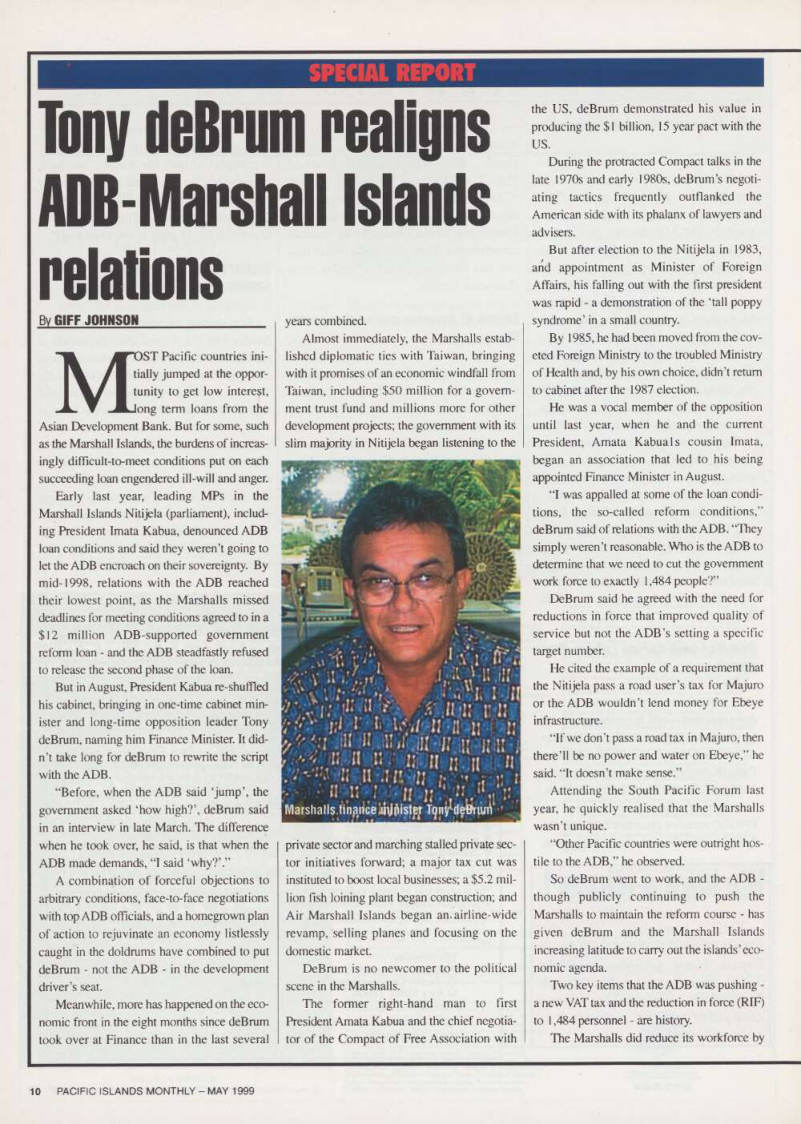
But in August, President Kabua re-shuffled his cabinet, bringing in one-time cabinet min ister and long-time opposition leader Tony deßrum, naming him Finance Minister. It did n’t take long for deßrum to rewrite the script with the ADB.
“Before, when the ADB said ‘jump’, the government asked ‘how high?’, deßrum said in an interview in late March. The difference when he took over, he said, is that when the ADB made demands, “I said ‘why?’.”
A combination of forceful objections to arbitrary conditions, face-to-face negotiations with top ADB officials, and a homegrown plan of action to rejuvinate an economy listlessly caught in the doldrums have combined to put deßrum - not the ADB - in the development driver’s seat.
Meanwhile, more has happened on the eco nomic front in the eight months since deßrum took over at Finance than in the last several
years combined.
Almost immediately, the Marshalls estab lished diplomatic ties with Taiwan, bringing with it promises of an economic windfall from Taiwan, including $5O million for a govern ment trust fund and millions more for other development projects; the government with its slim majority in Nitijela began listening to the
private sector and marching stalled private sec tor initiatives forward; a major tax cut was instituted to boost local businesses; a $5.2 mil lion fish loining plant began construction; and Air Marshall Islands began an. airline-wide revamp, selling planes and focusing on the domestic market.
Deßrum is no newcomer to the political scene in the Marshalls.
The former right-hand man to first President Amata Kabua and the chief negotia tor of the Compact of Free Association with
the US, deßrum demonstrated his value in producing the $1 billion, 15 year pact with the US.
During the protracted Compact talks in the late 1970 s and early 1980 s, deßrum’s negoti ating tactics frequently outflanked the American side with its phalanx of lawyers and advisers.
But after election to the Nitijela in 1983, and appointment as Minister of Foreign Affairs, his falling out with the first president was rapid - a demonstration of the ‘tall poppy syndrome’ in a small country.
By 1985, he had been moved from the cov eted Foreign Ministry to the troubled Ministry of Health and, by his own choice, didn’t return to cabinet after the 1987 election.
He was a vocal member of the opposition until last year, when he and the current President, Amata Kabuals cousin Imata, began an association that led to his being appointed Finance Minister in August.
“I was appalled at some of the loan condi tions, the so-called reform conditions,” deßrum said of relations with the ADB. “They simply weren’t reasonable. Who is the ADB to determine that we need to cut the government work force to exactly 1,484 people?”
Deßrum said he agreed with the need for reductions in force that improved quality of service but not the ADB’s setting a specific target number.
He cited the example of a requirement that the Nitijela pass a road user’s tax for Majuro or the ADB wouldn’t lend money for Ebeye infrastructure.
“If we don’t pass a road tax in Majuro, then there’ll be no power and water on Ebeye,” he said. “It doesn’t make sense.”
Attending the South Pacific Forum last year, he quickly realised that the Marshalls
wasn’t unique.
“Other Pacific countries were outright hos tile to the ADB,” he observed.
So deßrum went to work, and the ADB though publicly continuing to push the Marshalls to maintain the reform course - has given deßrum and the Marshall Islands increasing latitude to carry out the islands’ eco nomic agenda.
Two key items that the ADB was pushing a new VAT tax and the reduction in force (RIF) to 1,484 personnel - are history.
The Marshalls did reduce its workforce by
about 25 percent through last year, but deßrum announced that the RIF program has ended.
Meanwhile, the VAT - which was strongly opposed by the business sector - has been replaced by the beginnings of a new tax regime instigated by the private sector.
Meanwhile, after a year of holding up release of loan money because reform progress had come to a virtual standstill, the ADB issued the second $3.5 million installment of the reform loan after deßrum came on the scene - without the Marshalls meeting all of the “required” conditions.
Nothing exemplifies deßrum’s short tenure as Finance Minister more than the new rela tions with the private sector. The Chamber of Commerce was asked at the beginning of 1999 to provide recommendations and research for changes to existing tax legislation.
When the government introduced and then passed legislation actually improving upon the Chamber proposal - which slashed import duties by more than 50 percent on many items and most importantly streamlined the importa tion process, a source of friction for years for many business - the private sector was delight fully shocked.
That, of course, was deßrum’s point.
The tax cut was intended to “shock” the economy back to life, he said.
“We will continue to discuss our tax reform package with the private sector,” he said, adding that a reduction in income taxes is also anticipated later this year. “We want to elimi nate the problems in the current tax legisla tion.”
In addition to government-business coop eration in the tax cut legislation, “we’ve gotten the private sector involved in determining loans from the ADB, and we’re getting direct ADB support for the private sector. It’s some thing that was never pushed before.”
The primary complaint from the opposition is that deßrum isn’t forthcoming with infor mation, that his exhortations about ‘trans parency’ in government are more hot air than action - that he’s doing many of the same things in government that he complained about when he was in the opposition.
But deßrum responds that he’s straighten ing out the Ministry of Finance to insure more open operations and strengthening relations between the government and the private sec tor. As reason for delay in offering up some
financial data, deßrum notes that “we’re still trying to figure out opening and closing bal ances for fiscal years as far back as three to four years ago.” And that, he adds, is part of the problem: The ADB has based many of its assumptions about government reform on faulty or incomplete information.
A serious problem with accepting ADB advice as gospel is that the ADB had set requirements for reducing the public service based on the Marshalls’ lack of resources to support the government, he indicated.
But, deßrum said, “we’re not broke”.
One of the first ADB reports on the Marshalls said that the Compact of Free Association with the United States ends in 2001 so there won’t be any money and cut backs are necessary. The overall Compact rela tionship continues indefinitely; economic pro visions expire in 2001, with a two year grace period of guaranteed funding for the Marshalls as a hedge against lengthy renegotiations.
“The relationship continues past 2001,” he said. “What we’re making in the upcoming negotiations is fine adjustments on areas of concern.”
Continued overleaf
From previous page For its part, the ADB has become a major player in the Marshalls, providing the country with more than $5O million in loans, another $l3 million in grants and technical assistance, and now has several new loans in the pipeline.
The tax cuts, relations with Taiwan, and the government privatization program are all part of an agenda aimed “taking more responsibil ity for our own financial situation,” deßrum said. The Marshalls is now taking a close look at development aid.
“In the past, a donor offered money and we’d say yes without reviewing the project,” deßrum said. “We’d see easy money and we’d go for it without any planning.”
An example of this is a $7 million ADB loan to improve fresh water services in Majuro, he said. Completed earlier this year, it doesn’t work and various ADB consultants are trying to figure out what went wrong.
“The water project is a $7 million failure,”
he said. “Who’s going to be responsible to pay it back? We’re not.”
But after ADB vice president Peter Sullivan visited Majuro late last year, and deßrum travelled to Manila recently to meet ADB officials, including the president of the organisation, the relationship has warmed con
siderably.
“We’ve come a long to making (the loan
conditions) more reasonable,” deßrum said.
“We’re back on track. There are good staff people working with us at the ADB.”
A test of deßrum’s clout may come soon.
Among conditions laid down by the ADB for release of the final $3 million of the reform loan was the passage of five pieces of national legislation. During the Nitijela session that fin ished at the end of March, only three of the
five bills made it - including legislation for the new government trust fund, a Majuro road user’s tax, and an airport authority.
Bills to streamline and make more trans parent procedures for foreign investment did n't pass.
Deßrum said that although the ADB had indicated that the two pieces of legislation that didn’t pass were ‘required’ to get release of the final $3 million, “we can work around the last two by administrative procedures and Cabinet action”.
The Attorney General and the Private Sector Unit have already been directed to look at ways of streamlining these procedures affecting the private sector.
Whether that will satisfy the ADB isn’t yet clear. But deßrum’s proactive style has already brought a realignment of the relation ship with ADB, a fact that has changed the playing field in favor of this north Pacific island group. ■
Advertisements & other items, p. 11 (1 item)
ToFinish...
CHI' RCHHS
SCHOOLS
From Start.
•• i* f Copymasters Hawaii can help you with all of your duplicating needs from start to finish. Featuring Duplo® Digital Duplicators, Copiers, Shredders, Laminators, Poster Printers, Collators, & Folding Equipment. We also sell Stencil & Duplicator Supphes, Paper Supply, and all brands of Copier Supphes, & Computers.
Copymasters Hawaii
96-1173 Waihona Street, Suite B-2 • Pearl City, HI 96782 Phone (808) 678-2263 • Fax (808) 456-5678
E-Mail: [email protected]
GOVERNMENT
• COMMERCIAL
Serving.
STATE OF HAWAII
ENTIRE
SOUTH PACIFIC,
INCLUDING:
FIJI
SAMOA .
TAHITI
TONGA
COOK ISLANDS
MICRONESIA;
FEDERATED STV
OF MICRONESIA
GCAM
MARIANAS
MARSHALL
ISLANDS
PALAU
ToFinish...
copymasters
hawaii
Marshalls shifts reform from cuts
cuts to private sector boost
By Giff Johnson
THE Marshall Islands government reform program supported by the Asian Development Bank has shifted away from slashing the ranks of government workers to boosting the pri vate sector, with a push to get private businesses to take over operation of government-run utilities and other services that have ‘traditionally’ been government-operated.
In March, the Nitijela (parliament) approved Chamber of Commerce-backed legislation that slashed import duties as one step in the govern ment 1 s effort to revitalize an economy that has been in a three year tailspin. The next step is pri vatization of many government services.
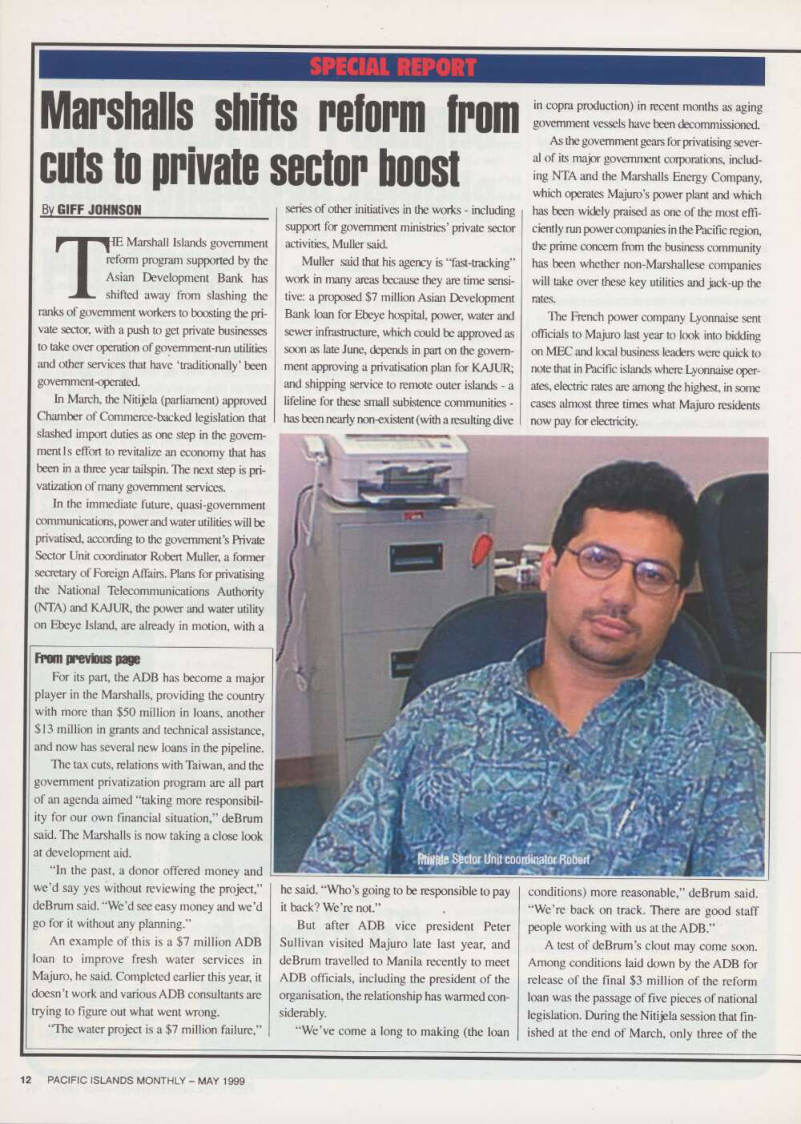
In the immediate future, quasi-government communications, power and water utilities will be privatised, according to the government’s Private Sector Unit coordinator Robert Muller, a former secretary of Foreign Affairs. Plans for privatising the National Telecommunications Authority (NTA) and KAJUR, the power and water utility on Ebeye Island, are already in motion, with a
series of other initiatives in the works - including support for government ministries’ private sector activities, Muller said.
Muller said that his agency is “last-tracking” work in many areas because they are time sensi tive: a proposed $7 million Asian Development Bank loan for Ebeye hospital, power, water and sewer infrastructure, which could be approved as soon as late June, depends in part on the govern ment approving a privatisation plan for KAJUR; and shipping service to remote outer islands - a lifeline for these small subistence communities has been nearly non-existent (with a resulting dive
in copra production) in recent months as aging government vessels have been decommissioned.
As the government gears for privatising sever al of its major government corporations, includ ing NTA and the Marshalls Energy Company, which operates Majuro’s power plant and which has been widely praised as one of the most effi ciently run power companies in the Pacific region, the prime concern from the business community has been whether non-Marshallese companies will take over these key utilities and jack-up the rates.
The French power company Lyonnaise sent officials to Majuro last year to look into bidding on MFC and local business leaders were quick to note that in Pacific islands where Fyonnaise oper ates, electric rates are among the highest, in some cases almost three times what Majuro residents now pay for electricity.
Muller comments that the PSU is coasidering a range of options and that each agency will be considered in turn. Only the recommendation for KAJUR’s privatization is fairly certain: PSU is recommending to the government that it use a ‘concession model’ for the Ebeye utility compa ny, through which the government will retain the power plant and desalination facility but the oper ation of the utility will be bid competitively to the
private sector.
For NTA, the PSU - with ADB funding - is hiring a high-powered group of consultants expert in legal, financial, technical and other aspects of telecommunications. They will be ‘on-the ground’ in Majuro in June to assist the PSU and NTA draw up recommendations that will be made to the government for privatising NTA operations, Muller said.
NTA has been given top priority because it has all the ingredients for turning it into a private ly-run company, Muller said. "The political will is there to privatise NTA,” said Muller of the gov ernment’s backing.
In addition, a Supreme Court ruling has con firmed that phone company is a private company and it already has private shareholders, although the government remains by far the laigest, he said.
Preliminary discussions with the NTA board and management have begun on privatization.
“We’re looking at options to reduce or eliminate altogether government’s share holdings in NTA,”
he said. Any major changes agreed to by govern ment and NTA shareholders - such as allowing foreign ownership of NTA stocks - will require passage of legislation by the parliament, so PSU is working to present options to the government so a plan can be approved in advance of the August Nitijela session, Muller said.
“NTA is a complex privatisation undertaking.
But if it's done properly, it will have a positive nationwide impact on the economy as well as telecommunications services.”
This PSU project is paid for by a technical
assistance grant from the ADB. “The main advan tage to the government is that (all the advice and assistance) is free of charge,” Muller said.
But it’s not alone NTA anbd KAJUR that are on the list. Tobolar, the government-subsidised copra processing plant, the Marshalls Energy Company, Air Marshall Islands and the Majuro Water and Sewer Company are all in the privati zation plan. Getting businesses involved in pro viding such other services as road maintenance, garbage collection and certain health services are also in the works. ■
Advertisements & other items, p. 13 (1 item)
The West’s Motor Inn
FIJI ISLANDS
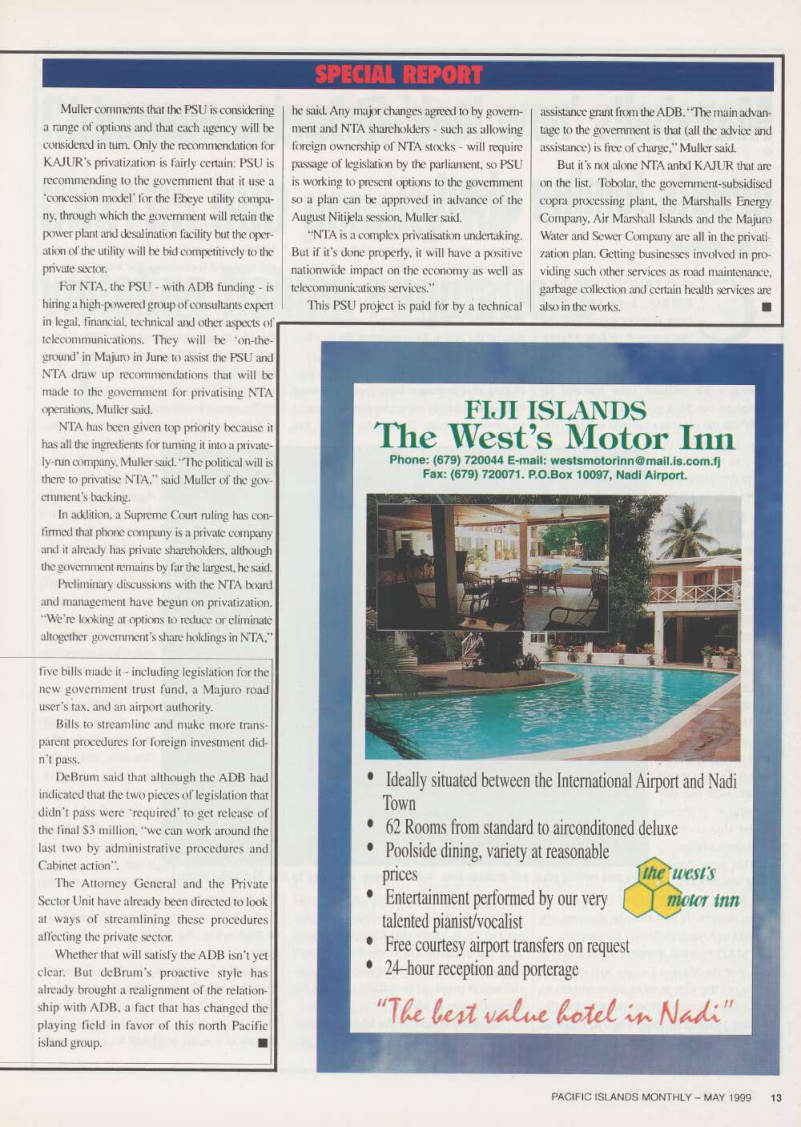
Phone: (679) 720044 E-mail: [email protected] Fax: (679) 720071. P.0.80x 10097, Nadi Airport. m mmm'i 1 JSk 4 • Ideally situated between the International Airport and Nadi Town • 62 Rooms from standard to airconditoned deluxe • Poolside dining, variety at reasonable .. prices Vhe* wests • Entertainment performed by our very f J nwter Inn
talented pianist/vocalist
• Free courtesy airport transfers on request • 24-hour reception and porterage
“1(U t&it \jalaaC "
greets loining plant
Marshalls 'new look' fisheries agency greets loining plant
By Giff Johnson
Construction of a PM&O Line/Star Kist tuna loining plant got off the ground in late March after the Marshall Islands Marine Resources Authority (MIMRA) guar anteed a $2 million loan needed to complete the $5.2 million deal.
While the plant is expected to open 300
new jobs later this year, as well as draw in the American purse seiner fleet to Majuro, its symbolic value may greatly outweigh these tangible eco nomic benefits to the Marshall Islands.
The government support of the foreign j investment - one of j only a handful in the I Marshalls - is demon- j stration of how the Marshalls can remove its ‘high risk’ label and improve the busi ness environment to attract future invest ments, said the gov ernment’s Private Sector Unit coordina tor Robert Muller.
The new loining I
plant will process, cook
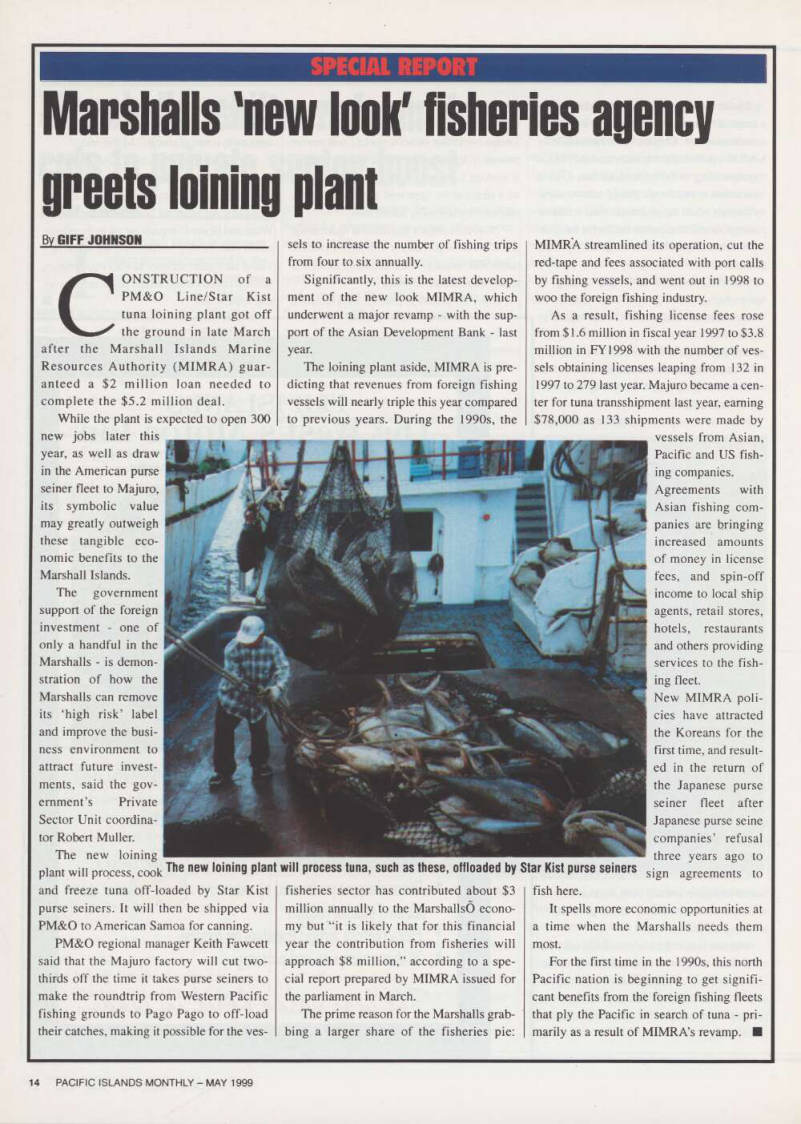
and freeze tuna off-loaded by Star Kist purse seiners. It will then be shipped via PM&O to American Samoa for canning.
PM&O regional manager Keith Fawcett said that the Majuro factory will cut two thirds off the time it takes purse seiners to make the roundtrip from Western Pacific fishing grounds to Pago Pago to off-load their catches, making it possible for the ves
sels to increase the number of fishing trips from four to six annually.
Significantly, this is the latest develop ment of the new look MIMRA, which underwent a major revamp - with the sup port of the Asian Development Bank - last year.
The Joining plant aside, MIMRA is pre dicting that revenues from foreign fishing vessels will nearly triple this year compared to previous years. During the 19905, the
fisheries sector has contributed about $3 million annually to the MarshallsO econo my but “it is likely that for this financial year the contribution from fisheries will approach $8 million,” according to a spe cial report prepared by MIMRA issued for the parliament in March.
The prime reason for the Marshalls grab bing a larger share of the fisheries pie:
MIMRA streamlined its operation, cut the red-tape and fees associated with port calls by fishing vessels, and went out in 1998 to woo the foreign fishing industry.
As a result, fishing license fees rose from $ 1.6 million in fiscal year 1997 to $3.8 million in FY1998 with the number of ves sels obtaining licenses leaping from 132 in 1997 to 279 last year. Majuro became a cen ter for tuna transshipment last year, earning $78,000 as 133 shipments were made by
vessels from Asian, I Pacific and US fish- I ing companies.
I Agreements with i Asian fishing com- I panics are bringing increased amounts of money in license fees, and spin-off income to local ship s agents, retail stores, hotels, restaurants and others providing l services to the fish- I ing fleet.
I New MIMRA poli- I cies have attracted I the Koreans for the I first time, and result- I ed in the return of I the Japanese purse I seiner fleet after I Japanese purse seine companies’ refusal 1 three years ago to sign agreements to
fish here.
It spells more economic opportunities at a time when the Marshalls needs them most.
For the first time in the 19905, this north Pacific nation is beginning to get signifi cant benefits from the foreign fishing fleets that ply the Pacific in search of tuna - pri marily as a result of MIMRA’s revamp. ■
The new joining plant will process tuna, such as these, offloaded by Star Kist purse seiners
US$105,000 penalty fop
Business
Chinese vessel faces US$105,000 penalty fop violating fishing regulations
THE National Oceanic and Atmospheric Admin istrat ion has charged the captain and owner of the foreign longliner fish ing vessel DONG YU 3015 with three counts of violating the Magnuson- Stevens Fishery Conservation and Management Act, announced Senior Enforcement Attorney Paul Ortiz of NOAA’s Office of General Counsel, who is prosecuting the case.
Ortiz assessed a civil penalty of $105,000 against Guo Hua Yu, the captain, and Zhoushan Industrial Cos., Ltd., the owner of the longliner, in a Notice of Violation and Assessment for the violations which occurred between February 23, 1999, and March 4, 1999, within the US Exclusive Economic Zone (EEZ federal waters extending out to 200 miles from shore) around American Samoa.
In addition, approximately $205,000 from the sale of the vessel’s catch was seized pending the out come of the case.
The charges include the illegal transhipment of tuna from another foreign vessel within the US EEZ, the failure to properly stow gear while transiting the US EEZ, and allowing the crew to fish for personal con sumption within the US EEZ.
The activities of foreign fishing vessels operating in federal waters are strictly regulated, including where they may tranship and how their gear is to be stowed.
Uaea Ualesi, a fisherman from American Samoa, originally sighted the crew fishing at South Bank, approximately 25 miles from American Samoa on March 3, 1999.
Ualesi returned to Pago Pago and informed Special Agent Martina Sagapolu-Failauga of the National Marine Fisheries Service and Officer Edwin Seui of the Department of
The charges include
the illegal tranship
ment of tuna from another foreign ves sel within the US EEZ, the failure to properly stow gear while transiting the US EEZ, and allow ing the crew to fish for personal con sumption within the
Us Eez
Marine and Wildlife Resources.
An investigation showed that the vessel’s longline gear had not been properly stowed while the vessel was in the US EEZ, and a study of the vessel logs documented the illegal transhipment activities.
Ortiz made the assessment after an investigation report was completed by Special Agent Sagapolu-Failauga.
“We are especially grateful for the assistance of Mr.
Dalesi, who provided us with the necessary infor mation we needed to start the investigation,” said Mike Gonzales, Special Agent-in-Charge of the Fisheries Service’s Southwest Enforcement Division.
“Enforcement of these reg ulations is critical to our goal of mission of control
ling the activities of foreign fishing vessels operating in US federal waters throughout the Pacific Ocean.
This case will certainly have an important impact on foreign fishing concerns that use Pago Pago or oper ate in any US waters.
“Perhaps the most important part of this case is that it is the first case where the penalty money will go to the government of American Samoa for use in fisheries enforcement and for implementation of their marine conservation plan,” said Ortiz. “It’s an exciting advancement in the coop erative efforts between the federal government and the government of American Samoa.”
The owner and operator have 30 days from the day that they are served with the Notice of Violation and Assessment to either pay the penalty, seek to have them modified, or request a hearing before an admin istrative law judge to deny or contest all or any part of the violation charged and the civil penalty assessed.
The National Marine Fisheries Service is an agency of the Commerce Department’s National Oceanic and Atmospheric Administration. The Fisheries Service conducts scientific research and provides services and products to support fisheries management, fish eries development, trade and industry assistance, enforcement, and protect ed species and habitat conservation programs. ■
Hawaiian Super Prix
revs up its engines
By Ed Rampell
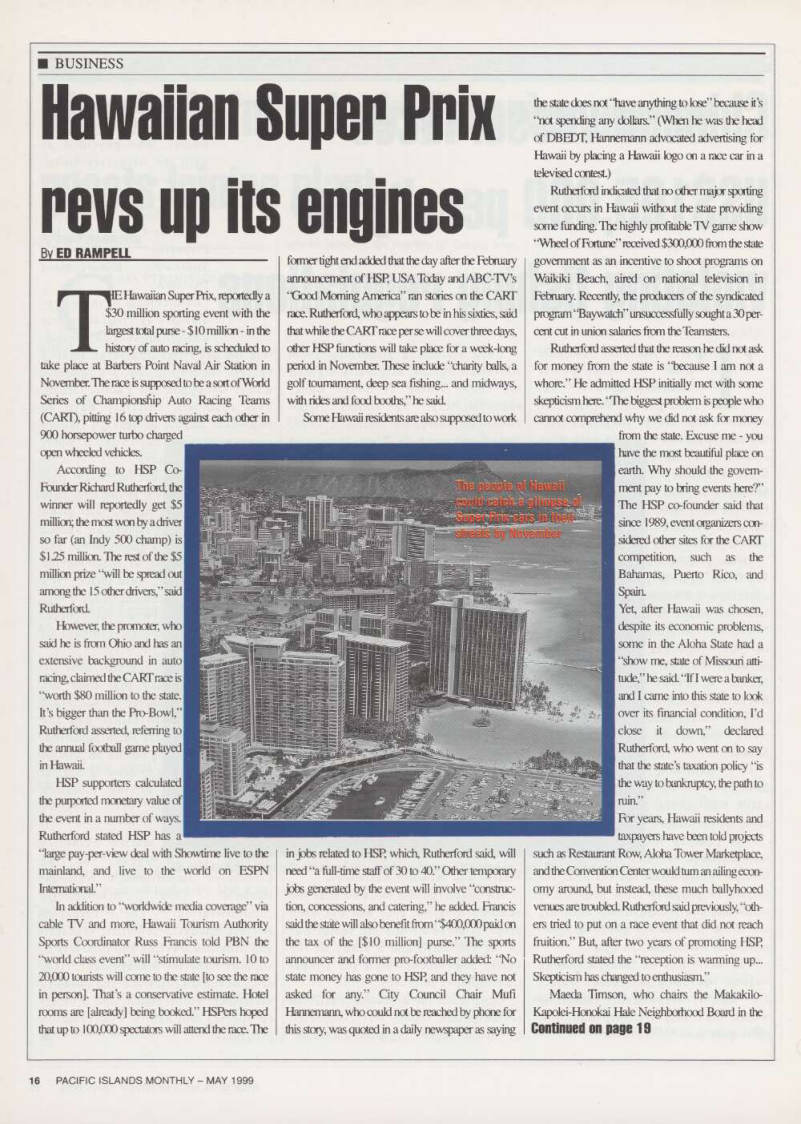
THE Hawaiian Super Prix, reportedly a $3O million sporting event with the largest total purse-$ 10 million -in the history of auto racing, is scheduled to take place at Barbers Point Naval Air Station in November. The race is supposed to be a sot ofWorid Series of Championship Auto Racing Teams (CART), pitting 16 top drivers against each other in
900 horsepower turbo charged open wheeled vehicles.
According to HSP Co- Founder Richard Rutherford the winner will reportedly get $5 million; the most won by a driver so far (an Indy 500 champ) is $1225 millicn. The rest of the $5l million prize “will be spread out amongthe 15 other drivers,” said Rutherford However, the promoter, who I said he is fton Ohio and has an! extensive background in auto I racing, claimed the CART race is I “worth $BO million to the state. I It’s bigger than the Pro-Bowl,”I Rutherford asserted referring to I the annual football game played I in Hawaii.
HSP supporters calculated! the purported monetary value of I the event in a number of ways. I Rutherford stated HSP has a!
“large pay-per-view deal with Showtime live to the mainland and live to the world on ESPN International.”
In addition to “worldwide media coverage” via cable TV and more, Hawaii Tourism Authority Sports Coordinator Russ Francis told PBN the “world class event” will “stimulate tourism. 10 to 20,000 tourists will cane to the state [to see the race in person]. That’s a conservative estimate. Hotel rooms are [already] being booked” HSPers hoped that up to 100,000 spectators will attend the race. The
former tight end added that the day after the February announcement of HSR USA Today and ABC-TV’s “Good Morning America” ran stories on the CART race. Rutherford, who appears to be in his sixties, said that while the CART race per se will cover three days, other HSP functions will take place fa a week-long period in November. These include “charity balls, a golf tournament, deep sea fishing... and midways, with rides and food booths,” he said.
Sane Hawaii residents are also supposed to work
in jobs related to HSP, which, Rutherford said will need “a full-time staff of 30 to 40.” Other temporary jobs generated by the event will involve “construc tion, concessions, and catering,” he added Francis said the state will also benefit from ‘ ‘s4oo,ooopaid on the tax of the [slo million] purse.” The sports announcer and former pro-footballer added “No state money has gone to HSP, and they have not asked for any.” City Council Chair Mufi Hannemann, who could not be reached by phone for this stay, was quoted in adaily newspaper as saying
the stale does not “have anything to lose” because it’s “na spending any dollars.” (When he was the head of DBEDT, Hannemann advocated advertising for Hawaii by placing a Hawaii logo on a race car in a televised contest) Rutherford indicated that no other maja sporting event occurs in Hawaii without the state providing sane funding. The highly profitable TV game show ‘ ‘Wheel of Fortune’ ’ received $300,000 from the stale government as an incentive to shoot programs on Waikiki Beach, aired on national television in February. Recently, the producers of the syndicated program ‘ ‘Baywatch’ ’ unsuccessfully sought a 30 per cent cut in union salaries from the Teamsters.
Rutherford asserted that the reason he did na ask for money from the state is “because I am na a whore.” He admitted HSP initially met with sane skepticism here. ‘The biggest problem is people who canna comprehend why we did na ask fa money
from the state. Excuse me - you have the most beautiful place on earth. Why should the govern ment pay to bring events here?”
The HSP co-founder said that since 1989, event organizers con sidered other sites fa the CART competition, such as the Bahamas, Puerto Rico, and Spain.
Yet, after Hawaii was chosen, despite its economic problems, some in the Aloha State had a “show me, state of Missouri atti tude,” he said “If I were a banker, and I came into this state to look over its financial condition, I’d close it down,” declared Rutherford who went on to say that the stale’s taxation policy “is the way to bankruptcy, the path to ruin”
For years, Hawaii residents and taxpayers have been told projects
such as Restaurant Row, Aloha Tower Marketplace, and the Convention Center would turn an ailing econ omy around, but instead, these much ballyhooed venues are troubled Rutherford said previously, “oth ers tried to put on a race event that did not reach fruition.” But, after two years of promoting HSP, Rutherford stated the “reception is warming up...
Skepticism has changed to enthusiasm.”
Maeda Trmson, who chairs the Makakilo- Kapolei-Honokai Hale Neighborhood Board in the Continued on page 19
From page 16 area where CART is scheduled to take place, con firmed this switch. At a March 21 community meet ing, questions were raised about possible adverse effects HSP could have on this area in the west of Oahu. At that meeting, Rutherford did not provide answers for community concerns. But after a follow up meeting on March 30, Timson seemed converted into a believer.
“At first, I was a little bit leery, afraid of traffic...
When Rutherford didn’t say much, we were stunned... But since then... wc’rc relieved and see things that we worried about will be handled,”
Timson told PBN after the second meeting. The Neighborhood Board Chair said “a Hawaiian Super Prix Committee has been created. It involves stake holders - the community, state, city, and promoters.
The head of the HSPteam is John DeSoto,” the City Council member for the Leeward district where the CART event is to take place, whom Timson called “a racing car enthusiast.” (DeSoto could not be reached tor this piece.) Timson, who called herself “enthusias tic now” alter initial hesitance, said 200 buses and the possible use of ferries, to alleviate transportation prob lems, were discussed at the March 30 meeting, as were jobs for people in the region.
Although Honolulu Mayor Jeremy Harris did not attend the March 30 meeting, Timson said it was stat ed there that the mayor is committed to making sure that “the city will do everything it could to help with traffic”. Another factor that appears to have boosted confidence in the event is that, according to Rutherford, “the $ 10 million purse is in place, secured by a performance completion bond,” reportedly from Frontier Insurance Group of Tennessee. “It’s bonded, a paid for guarantee for us and partners. Everybody gets paid... We are entrepreneurs, if we benefit $ 100 million or $1 million, it helps the state,” said Rutherford. ■
largest producer of palm oil
PNG rated worlds second largest producer of palm oil
By Sam Vulum
PAPUA New Guinea has recently been rated as the world’s second largest pro ducer of palm oil, after Malaysia by World Report Limited Inc. of London.
In a 16-page supplement on PNG being carried in The Independent newspaper on March 13, 1999, World Report said that being the world’s second largest means operating in an Increasingly competitive global market.
It said one solution is to establish a rep utation as a reliable supplier in the hope that this will be reciprocated.
“We have been fortunate that our cus tomers have stayed faithful to use during the past 10 years,” Allan Maino, the Oil Palm Producers Association executive secretary told the World Report.
Export market for Papua New Guinean palm oil are led by the UK, but include other European outlets including Germany and, more recently, Italy. World Report said the palm oil producers see themselves as the fastest-growing success story in Papua New Guinean agriculture, and have begun to mount an increasingly serious challenge to coffee as the country’s leading agricultural export in recent years.
Although it is a foreign point of view, it carries a lot of truth, as far as the progress of the industry is concerned. The oil palm industry is a relatively recent introduction to the country, with oil palm production commencing in Oro and West New Britain provinces in the early 1970’5.
However, it has expanded very quickly to include seven large estates, covering more than 79,800 hectares of land in the Oro, Milne Bay, New Ireland and West New Britain provinces. An eighth oil palm devel opment is in the early stages of establish ment at Altape in the Sandaun Province.
Damansara Forest Products (PNG), a Malaysian based company seeking to estab
lish the development, which at its full extent, would occupy several blocks of land
amounting to approximately 29,500
hectares.
Although the seven operations are all small by world standards, the yields are up to 30 per cent higher than the World aver age, with several operations consistently achieving in excess of 25 tonnes of fresh fruit bunches (FFB) per hectare per year, and recently 28 tonnes FFB per hectare per year.
This equates to a national annual pro duction of approximately 300,000 tonnes palm oil products (crude and palm kernel oil). The products themselves are of consis tently high quality and earn premium prices on the International market.
For these reasons, the oil palm industry in Papua New Guinea has gained an inter national reputation for high productivity, excellent quality, and innovative manage ment.
These are a prove of the effective and innovative agricultural research being pur sued by the industry through the Papua New Guinea Oil Palm Research Association.
The association’s Dami Oil Palm Research Station, which is located some 30 kilometres east of Kimbe, West New Britain’s provincial headquarters, is recog nised as a world leader for the highest qual ity oil palm seed production.
Not only does it provide all the seed stock for the industry in PNG, but it is also a leading exporter of high quality, high yielding oil palm seeds worldwide.
In 1995, approximately nine million Dami seeds were sold to both PNG and exported to Indonesia, India, Philippines and Thailand.
Approximately 80 per cent total sales were exported to Indonesia. Although exact figures are not yet available for 1996, 1997 and 1998, all seed production was taken up with sales orders.
This extends to the industry’s approach on environmental management, where they
have been working in close collaboration with the Department of Environment and Conversation to produce the environmental code of practice for the oil palm processing industry in PNG.
Under this arrangement, a Commonwealth expert has been by the PNG Government to draw up innovative guidelines for boosting palm oil production without causing damaging environmental side-effects. Oil mill affluent is the biggest hazard. In the past, pollution has caused considerable damage to water sources, putting villagers’ health at risk. Pesticides and herbicides also pose health hazards.
Stephen Nicholls, a New Zealand expert in environment and resource management was brought in. Financed by the Commonwealth Fund for Technical Co operation, Nicholls was part of a five mem ber committee appointed by the government and charged with preparing a set of guide lines to tackle environmental problems associated with the industry.
Nicholls said the committee’s main rec ommendations emphasize the importance of regular inspections of mill effluent.
Nicholls said a draft of the report has been presented to the government for its approval. The future of the industry is bright. Good climatic and soil conditions for the crop make large areas of coastal low land of PNG potentially suitable for more palm oil development.
The potential for expansion of the indus try around PNG is considerable and is being actively promoted by national and provin cial governments, who see it as a useful vehicle for bringing rural development and infrastructure to many areas of lowland and coastal Papua New Guinea.
At least the industry has the commitment of a leading international player, the Commonwealth Development Corporation (CDC), who operate under the trading name of Pacific Rilm Plantations. CDC operates three entirely separate oil palm estates at three locations in PNG.
CDC managing director Ashley Emberson-Bain believes the corporation will increase its role in PNG over the next five years. “We have 65 million pounds invested right, now and that could double,”
Emberson-Bain said. ■
Pitcairn looks forward to aviation
By Michael Field
1F Martin Wiliams gets his way some time in the next three years it will be pos sible to take a plane to Pitcairn Island, Britain’s last and easily loneliest colony on Earth.
Mr Wiliams is the kind of chap who can deliver for, despite the lack of plumed hat, he is Pitcairn’s new governor and recently, with the help of the French Navy ship Revi he was able to visit his tiny chaige.
Pitcairn governorship is not a full-time Job these days and in the last decade it has become the ex-officio role of the British High Commissioner to New Zealand. Each of them make the effort to get there at least once and some of them find
themselves on epic trips.
The standard method is to hitch a ride on one of the giant containerships leav ing for Europe, via Panama, and paying them extra to drop of the gover nor and his aide. They would not wait and negoti ations were always opened up on getting a ride back.
Some governor’s ended up in Panama; others found passing New Zealand war ships.
Mr Wiliams did what
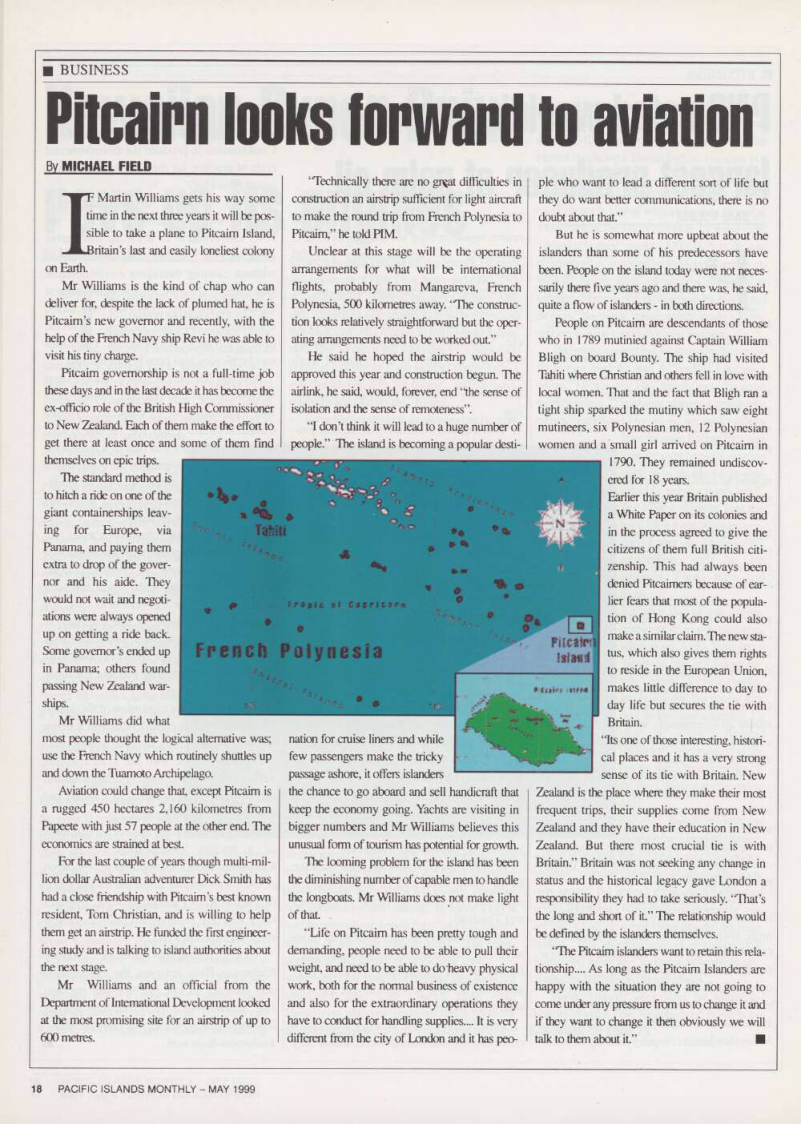
most people thought the logical alternative was; use the French Navy which routinely shuttles up and down the Tuamoto Archipelago.
Aviation could change that, except Pitcairn is a rugged 450 hectares 2,160 kilometres from Papeete with just 57 people at the other end. The economics are strained at best.
For the last couple of years though multi-mil lion dollar Australian adventurer Dick Smith has had a close friendship with Pitcairn’s best known resident, Tom Christian, and is willing to help them get an airstrip. He funded the first engineer ing study and is talking to island authorities about the next stage.
Mr Williams and an official from the Department of International Development looked at the most promising site for an airstrip of up to 600 metres.
‘Technically there are no gr\at difficulties in construction an airstrip sufficient for light aircraft to make the round trip from French Polynesia to Pitcairn,” he told PIM.
Unclear at this stage will be the operating arrangements for what will be international flights, probably from Mangareva, French Polynesia, 500 kilometres away. “The construc tion looks relatively straightforward but the oper ating arrangements need to be worked out.”
He said he hoped the airstrip would be approved this year and construction begun. The airlink, he said, would, forever, end “the sense of isolation and the sense of remoteness”.
“I don’t think it will lead to a huge number of people.” The island is becoming a popular desti-
nation for cruise liners and while few passengers make the tricky passage ashore, it offers islanders
the chance to go aboard and sell handicraft that keep the economy going. Yachts are visiting in bigger numbers and Mr Williams believes this unusual form of tourism has potential for growth.
The looming problem for the island has been the diminishing number of capable men to handle the longboats. Mr Wiliams does not make light of that “Life on Pitcairn has been pretty tough and demanding, people need to be able to pull their weight, and need to be able to do heavy physical work, both for the normal business of existence and also for the extraordinary operations they have to conduct for handling supplies... It is very different from the city of London and it has peo
pie who want to lead a different sort of life but they do want better communications, there is no doubt about that.”
But he is somewhat more upbeat about the islanders than some of his predecessors have been. People on the island today were not neces sarily there five years ago and there was, he said, quite a flow of islanders - in both directions.
People on Pitcairn are descendants of those who in 1789 mutinied against Captain William Bligh on board Bounty. The ship had visited Tahiti where Christian and others fell in love with local women. That and the fact that Bligh ran a tight ship sparked the mutiny which saw eight mutineers, six Polynesian men, 12 Polynesian women and a small girl arrived on Pitcairn in
1790. They remained undiscov ered for 18 years.
I Earlier this year Britain published a White Paper on its colonies and I in the process agreed to give the i citizens of them full British citi- I zenship. This had always been denied Pitcairners because of ear lier fears that most of the popula tion of Hong Kong could also make a similar claim. The new sta tus, which also gives them rights to reside in the European Union, makes little difference to day to day life but secures the tie with Britain.
“Its one of those interesting, histori cal places and it has a very strong sense of its tie with Britain. New
Zealand is the place where they make their most frequent trips, their supplies come from New Zealand and they have their education in New Zealand. But there most crucial tie is with Britain.” Britain was not seeking any change in status and the historical legacy gave London a responsibility they had to take seriously. “That’s the long and short of it.” The relationship would be defined by the islanders themselves.
“The Pitcairn islanders want to retain this rela tionship... As long as the Pitcairn Islanders are happy with the situation they are not going to come under any pressure from us to change it and if they want to change it then obviously we will talk to them about it.” ■
US asked to relax shipment restrictions
By Ed Rampell
THE United States has been asked to relax restrictions that prevent shipment to,
and transshipment
through America of Pacific Island grown vegetables like eggplants and fruits such as papaya and mango.
Honolulu-based Pacific Islands Development Programme director Sitiveni Halapua said the issue was brought up dur ing a recent meeting of the US-Pacific Joint Commercial Commission in Hawaii.
Fear of fruit fly contamination currently hinders transport of Pacific produce to the North American market.
Graeme Thorpe, Managing Director of Balthan International (Fiji) Limited, a Suva import-export firm, said that the stringent requirements not only prevent shipping of Fiji products to the US, but also stop him from transshipping produce via Hawaii or the West Coast to Canada, which does not ban these imports.
Thorpe told JCC that Fiji’s developing economy faces a loss of $ 1 million per year and 500 jobs, due to the restrictive regula tions. (The Asian economic crisis caused cancellation of Fiji-South Korea-Candada Bights).
Thorpe requested that the US approve use of a high temperature forced air treat ment system designed to get rid of fruit flies that was developed in Hawaii. Glen
Hinsdale, who attended the JCC meeting on behalf of the US Department of Agriculture, said the US would look into the matter before JCC’s next meeting in a year.
Halapua said “JCC decided to hold a workshop... to identify potential business partners and trade opportunities between the Pacific Islands and US”.
Participants would include Terry Buckley, Director of South Pacific Operations of Cost-U-Less (a US dis counter similar to Costco, which has two stores in Fiji and plans to open one in Tahiti), Robert Colson, president of a ship ping company, and Hinsdale from the US government side.
The PIDP director was bullish about 1998’s Hawaii Business Conference, co hosted by PIDP, Outrigger Hotels & Resorts, Bank of Hawaii, and the State of Hawaii’s Department of Business, Economic Development, and Tourism.
Attended by more than 150 participants.
Dr. Halapua indicated that business connec tions were made regarding orchids, kava, tourist submarine viewing, alternative ener gy, hotel development, handicrafts, and more.
PIDP is the secretariat for the Pacific Island Conference of Leaders whose theme for a tri-annual PICL meeting this year will be Managing Globalization for Sustainable Development the Pacific Way.
Halapua also said the PICL standing committee directed PIDP to develop a new
“strategic plan” for PIDP. And, for the first time in PIDP’s 20 year history, the standing committee told PIDP to create “a memoran dum of understanding between the East- West Center and the Pacific leaders, defin ing exactly what their relationship and mutual obligations are.” Other important points also came out of the confabs.
According to A 1 Hulsen, Managing
Editor of the Pacific Island Report
(http://pidp.ewc.hawaii.edu./PlReport/), the
cutback of regional aid, decline in funding of the Marshalls and FSM’s Compacts of Free Association, and Asian economic woes, led the Island heads to look into “how they can benefit from their own natural resources - 95 percent of the fisheries goes out of the region. How can Pacific Island fisheries benefit the islands?”
Hulsen also said the leaders discussed “control of Pacific corridors, charging fly over fees for the rights [of carriers] to go through their air space.”
The potential wealth of the sea bed, such as manganese nodules, was also discussed, he said. Although many isles have small land bases, with their Exclusive Economic Zones, some cover vast stretches of the Pacific. And in the Standing Committee’s Communique, it was proposed that a Pacific Islands trade office be established in the US. Members also paid their final respects to the Father Walter Lini, former PM of Vanuatu, and to Bailey Olter, former FSM president. ■
environmental impact study
Sea Launch promises to conduct environmental impact study
THE Kiribati Government has announced that Sea Launch, the company behind the launching of commercial satellites into orbit from a floating oil platform off Kiribati waters, has reportedly agreed to con duct a project environmental impact study.
This was confirmed by Kiribati’s Secretary for Information, Communication and Transport, Taakei Taoaba.
Taoaba said Sea Launch, a con sortium involving Boeing and Russian, Ukranian and Norwegian companies, agreed to the study request made by the Kiribati Government at a recent meeting in Hawaii.
Kiribati’s main concern, he said, is the environmental impact of the project, on both the ocean and the atmosphere.
The Government, Taoaba emphasised, wants to ensure that the people and environment of Kiribati are safe from any possible accidents that might result from the launches near the equator.
According to Taoaba, Kiritimati (Christmas) Islanders, in the Northern Line Islands group, are particularly concerned because of their very close proximity to the actual launch site.
Sea Launch carried out a demonstration firing of a dummy satellite from the float ing oil rig, 800 kilometers (480 miles) southeast of the island and just outside Kiribati waters, in March.
The joint venture company has invested about US$5O4 million in the first ever com mercial marine-based launch system.
Environmental group Greenpeace had called for a stop to further launches of com mercial rockets from the floating facility until the company completes and evaluates a project environmental impact study.
Greenpeace Pacific spokesperson Samantha Magick said leaders of the South Pacific Forum had called for a comprehen sive environmental assessment report on the Sea Launch proposal.
“We believe consultation with the Pacific region (about the project) has been inadequate. Details of the extent of environ mental assessment programs have been sketchy. We simply don’t know the impact of the program on the Pacific,” she said.
The Sea Launch rocket successfully com-
pleted its maiden flight on March 27, according to company officials. The event, which placed a demonstration payload into geostationary transfer orbit, marked the first commercial launch from a floating platform at sea.
“Today’s successful launch demon strates the viability of the Sea Launch sys tem to the entire world,” announced Sea Launch President Allen B. Ashby on the day. “We are now ready to begin full-scale service, as a proven and cost-effective com mercial satellite launch service.”
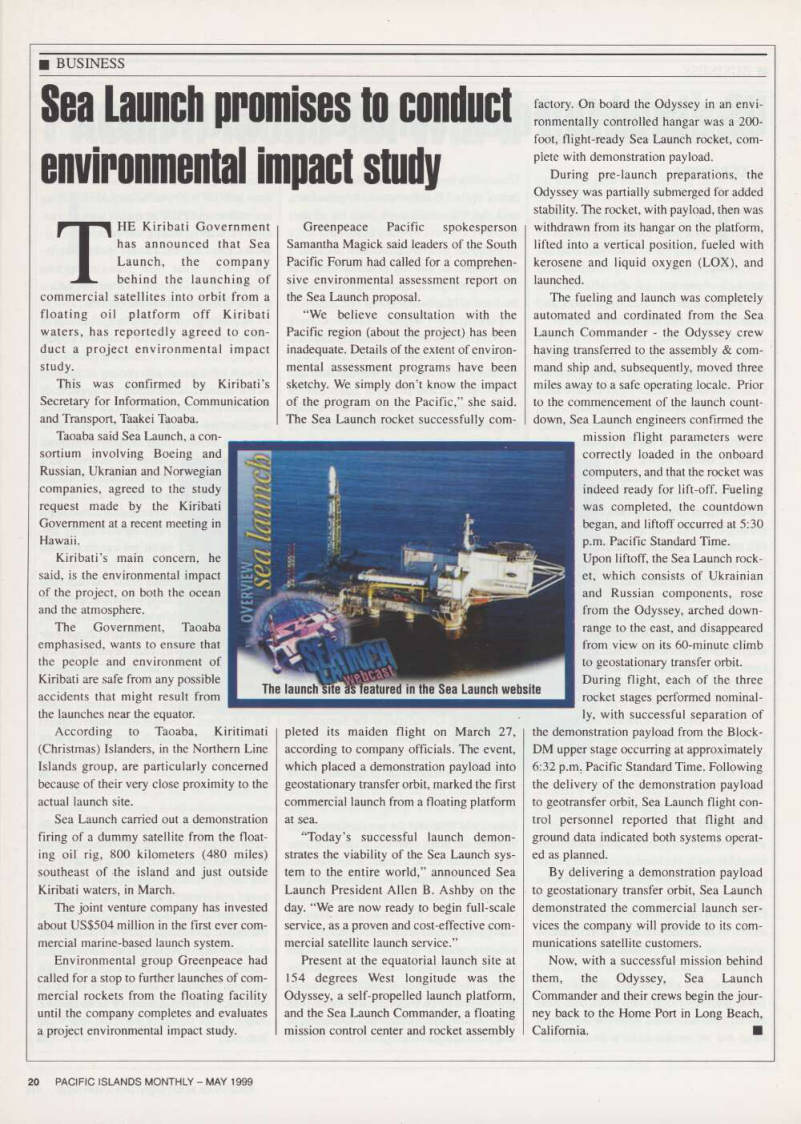
Present at the equatorial launch site at 154 degrees West longitude was the Odyssey, a self-propelled launch platform, and the Sea Launch Commander, a floating mission control center and rocket assembly
factory. On board the Odyssey in an envi ronmentally controlled hangar was a 200foot, flight-ready Sea Launch rocket, com plete with demonstration payload.
During pre-launch preparations, the Odyssey was partially submerged for added stability. The rocket, with payload, then was withdrawn from its hangar on the platform, lifted into a vertical position, fueled with kerosene and liquid oxygen (LOX), and launched.
The fueling and launch was completely automated and cordinated from the Sea Launch Commander - the Odyssey crew having transferred to the assembly & com mand ship and, subsequently, moved three miles away to a safe operating locale. Prior to the commencement of the launch count down, Sea Launch engineers confirmed the
mission flight parameters were correctly loaded in the onboard computers, and that the rocket was indeed ready for lift-off. Fueling was completed, the countdown began, and liftoff occurred at 5:30 p.m. Pacific Standard Time.
Upon liftoff, the Sea Launch rock et, which consists of Ukrainian and Russian components, rose from the Odyssey, arched down range to the east, and disappeared from view on its 60-minute climb to geostationary transfer orbit.
During flight, each of the three rocket stages performed nominal ly, with successful separation of
the demonstration payload from the Block- DM upper stage occurring at approximately 6:32 p.m. Pacific Standard Time. Following the delivery of the demonstration payload to geotransfer orbit, Sea Launch flight con trol personnel reported that flight and ground data indicated both systems operat ed as planned.
By delivering a demonstration payload to geostationary transfer orbit, Sea Launch demonstrated the commercial launch ser vices the company will provide to its com munications satellite customers.
Now, with a successful mission behind them, the Odyssey, Sea Launch Commander and their crews begin the jour ney back to the Home Port in Long Beach, California. ■
The launch site as featured in the Sea Launch website
log monitoring company
Questionable future for log monitoring company
By Sam Vulum
THE Papua New Guinea National Forest Board is in a bind over the future of SGS, a Swiss company engaged by the former Government to monitor the country’s log exports.
Should it allow the cash-strapped gov ernment give away K 3.3 million to SGS this year to continue its services or cancel the contract and lose savings of about K 79 million.
The former government of Paias Wingti signed a K 5 million contract with SGS in May 1994 to put a stop to a dubi ous practice of transfer pricing as estab lished by the Barnett Inquiry, carried out into the operations of the industry almost 10 years ago.
Barnett’s final report highlighted that transfer pricing was costing the country millions of kina each year in lost revenues from export taxes.
Then Forests Minister Tim Neville for mally launched the SGS work program in July that year, but work did not begin until February 1995 because the government could not find the money to pay the con tractors.
The European Union eventually had to divert K 3 million from the country’s Stabex allocation to pay for the first two years of the program. But this seems to have been a reasonably sound investment.
An extra K 2 million in log export taxes was reportedly collected in the first six months of the company’s monitoring oper ations.
By the end of 1997, SGS had 90 nation al and five expatriate staff checking log shipments from every timber concession in the country, and its contract had been extended to the end of 1999.
Even so, the World Bank was not con vinced of the National Government’s com mitment to maintain this arrangement.
So one of the conditions attached to the Economic Recovery Program loan in 1995 was for the Government to; Provide the Forest Authority with an operating budget equal in real terms to that allocated in 1995, in timely disburse ments; and Provide separate and adequate funding for the existing surveillance contract, or any additional activities required for sur veillance or management of forest resources and approved by the NEC or the Department of Finance and Planning.
The World Bank’s task manager who insisted on the attachment of this and other forestry-related conditions was none other than Pirouz Hamidian-Rad.
When the same gentleman came to attach conditions to the (now-stalled) Social and Economic Development Program loan in 1997, he wanted the Government to agree to secure full fund ing for independent external surveillance of log exports for 1998 and 1999 before the first tranche of the loan would be released.
Despite this, the forest board decided to terminate the contract of SGS by April 1, 1999.
The decision was made against the advise of the National Forest Authority that highlighted that the greatest benefit of the log export monitoring project carried out by SGS since early 1995, was almost undoubtedly its deterrent effort on log export companies from attempting to evade taxes.
The board’s decision, was however overturned by a special Cabinet meeting on March 26 without the presence of the
Forest Minister Peter Arul. The NEC directed the Forest Minister to inform the NFA, that on the basis of retaining SGS for the remainder of 1999 and of imposing a log export levy, the PNGFA should pre cede to seek European Union Stabex fund ing assistance of K 1.5 million for the 1999 as a transitional measure.
The question, however, is what is going to happen after SGS contract expired in 1999.
In a combined commentary published in the Post-Courier newspaper recently, two experts Colin Filer and Colin Hunt attempted to highlight the importance of log monitoring and the services of SGS.
They also offered long-term solutions to the problem.
They said there is a financial incentive for logging companies to under-estimate the volume of logs and there is also a financial incentive to under-report the export price of logs or to sell logs at prices below market value.
“The full worth of these undervalued logs is, however, received by the logging companies when they are sold on to the wholesalers in Japan and South Korea,” they said.
The experts explained that incentives for transfer pricing exist because the log export tax is raised against the FOB export price of logs; the lower the price of logs recorded - and the lower the volumes recorded - the less the tax paid by the log
ging companies.
“Under the latest changes to the forest revenue system introduced at the end of 1998, there is no tax on tax on logs priced lower than Kl3O per cubic metre (except for logs of certain species). The rate of tax
Continued on page 23
From page 21
increases with price above the Kl3O mark.
This system was meant to be an inter im measure only, to allow logging com
panies to survive low log prices.
“Nevertheless, it means that there is now a financial incentive for loggers to sell (or at least record the sale price of) export logs at levels below Kl3O per cubic metre, to escape paying tax.
“There is also an incentive to misrep resent logs of valuable species so that they attract less tax.
“Under the present export tax system, the Government collects, through the export tax, a much smaller proportion of the price of logs than it did in 1996, 1997 and 1998.
“So it is difficult to estimate how much the PNG Government will lose in taxes by abolishing SGS,” they said.
The experts said landowners’ income will also be affected by the abolition of
Sgs.
They said landowners are paid a royal ty per cubic metre of log harvested.
“If the volume of logs is under-report ed by companies, then landowners royal ties will be reduced. Landowners are also paid a Project Development Levy (PDL).
This PDL is based on the export price of logs.
“Any underpricing by loggers will also cause a fall in the value of PDL to landowners,” they said.
They said one solution is for the indus try itself to fund the cost of the SGS oper ation.
“In the short term, introduce a special levy on export logs to pay for the contin uation of surveillance. Treasury should be approached to allow the “earmarked” levy to go straight to SGS funding, rather than into consolidated revenue.
“Over the next few months, consider revamping the revenue system for logs, so that the system divides the revenue fully between all parties. This should include not only a review of all taxes paid by the timber industry, but also of along term mechanisms for funding the log sur veillance operation,” they said. ■
System to be closed by 2000
Johnston Atoll Chemical Disposal System to be closed by 2000
By Michael Field
ONE of the Pacific’s worst
neighbours is getting
ready to move out - hope
fully with its plutonium,
dioxin and assorted other deadly chemi cals in tow.
The US Army’s Johnston Atoll Chemical Disposal System (JACADS), on a tiny atoll between Hawaii and the Marshall Islands has since 1990 been destroying tens of thousands of mortar shells, artillery shells, rockets and bombs containing mustard gas and sarin nerve agents.
Johnston would have to be one of the strangest places on Earth. The island itself is only a little larger than the long runway down its middle. On one side a large factory-like building emits steam from among the dozens of bunkers. On the other side, in seedy tenement-style buildings, the 1200 personnel live.
It would be a terrorist dream so when the Continental Air Micronesia 727 wings in from Honolulu, 1330 kilometres (825 miles), to the north east, the base goes into a security mode. Armed sol diers surround the plane; only those authorised to get off are allowed to. Out on the gangway the nature of the place is revealed in the hot, incessant wind and the debris of the Cold War.
Nature is taking it back and as part of the US National Wildlife Refuges sys tem, Johnston is home to terns and nod dies, shearwaters and petrels, frigate birds and boobies while the lagoon is a breeding ground for green turtles.
Among the clean up issues scattered plutonium. A nuclear missile failed to lift-off from the Johnston pad and exploded. The plutonium core did not go critical but was scattered along a thou sand metre (yard) length of shoreline.
Over 25,000 50-gallon steel drums of defoliant Agent Orange, not needed in
the Vietnam War, was also stored and destroyed on Johnston, leaving a danger ous residual of dioxin. A large tank of diesel has also been leaking into the atoll.
Since 1971 Johnston has been used to store chemical weapons. In 1985 the US Congress directed the destruction of its chemical weapons and when the US first proposed JACADS the Pacific Forum summit meeting in Vanuatu in 1990 ended in uproar. Then Australian Prime Minister Bob Hawke defended the facili ty but leaders strongly condemned it and the US compromised by allowing Pacific countries the right to monitor its pro gramme.
JACADS has worried Hawaii and the Honolulu City Council protested in 1997 to any extension of its operation, saying its record had been “marred by numerous accidents, including fires, explosions and releases of dangerous nerve agents”.
Washington promised to close the facility by 2000 and destroy remaining chemical weapons in the US mainland in Oregon, Utah, Colorado, Arkansas, Alabama, Indiana, Kentucky and Maryland into the year 2004.
The weapons were shipped there from Okinawa and Germany, as well as mus tard gas weapons from the Solomon Islands where the US had left them after World War 11.
JACADS says just over 80 percent of the weapons, including all the sarin gas, have been destroyed and the base will begin closing down next year.
At Johnston there were nerve agents including sarin and lewisite as well as mustard agents that blister Human tissue.
Most of it was stored in bulk containers with the balance in thousands of bombs, mines, mortar rounds, rockets, spray tanks and artillery projectiles.
Chemical demilitarisation spokes woman Catherine Herlinger told PIM that JACADS will close next year but the
Johnston Atoll from the air
US Army will remain to restore the island to “a condition that will not harm future inhabitants”. That will take another year.
“The new (Environmental Protection Agency) permit requires that once all of the hazardous waste is destroyed or dis posed of, the facility will be shut down, the incinerators and all associated equip ment will be dismantled and shipped off island, and that the Army will clean up any leftover contamination from the haz ardous waste,” she said.
The chemical and explosive residues and stored contaminated waste will be shipped to US landfills.
An unnamed Johnston Island worker has maintained a Web site which appears to give away some of the atoll’s secrets, saying it was an occupational health “hell” with a list of dangers longer than the LA phone directory; hurricanes, tsunamis, the large sharks infesting the local waters, and the sharp coral under foot and birds.
“The Birds are of various varieties and sizes, ranging from the “red-footed booby” to the “great frigate bird.” They nest on the atoll, which is (oddly enough) designated an official wildlife refuge.
The military command takes this regula tion seriously, as they are wont to do, and persecution of any bird has unpleasant consequences, including thousands of dollars in fines.
“The birds repay the favour by harass ing innocent bystanders and pooping on their heads.”
The natural hazards are trivial com pared to the manmade ones, the Web site says, and “JA” as Johnston is referred to, offers “gradually escalating mortality risk. There is a lot of diesel that has leaked into the sea and there is the Agent Orange containing dioxin. Of course, the dioxin seems pretty tame compared to the plutonium.” This came from the crashed rocket. “So now there’s a BIG fence along a thousand-meter length of shore line, with bulldozers and dump trucks at work every day, sorting the “good” dirt from the contaminated stuff in a two-year project. One “little” accident has resulted in a $2l million clean-up effort,” the Website says. ■
Construction beyond the reef
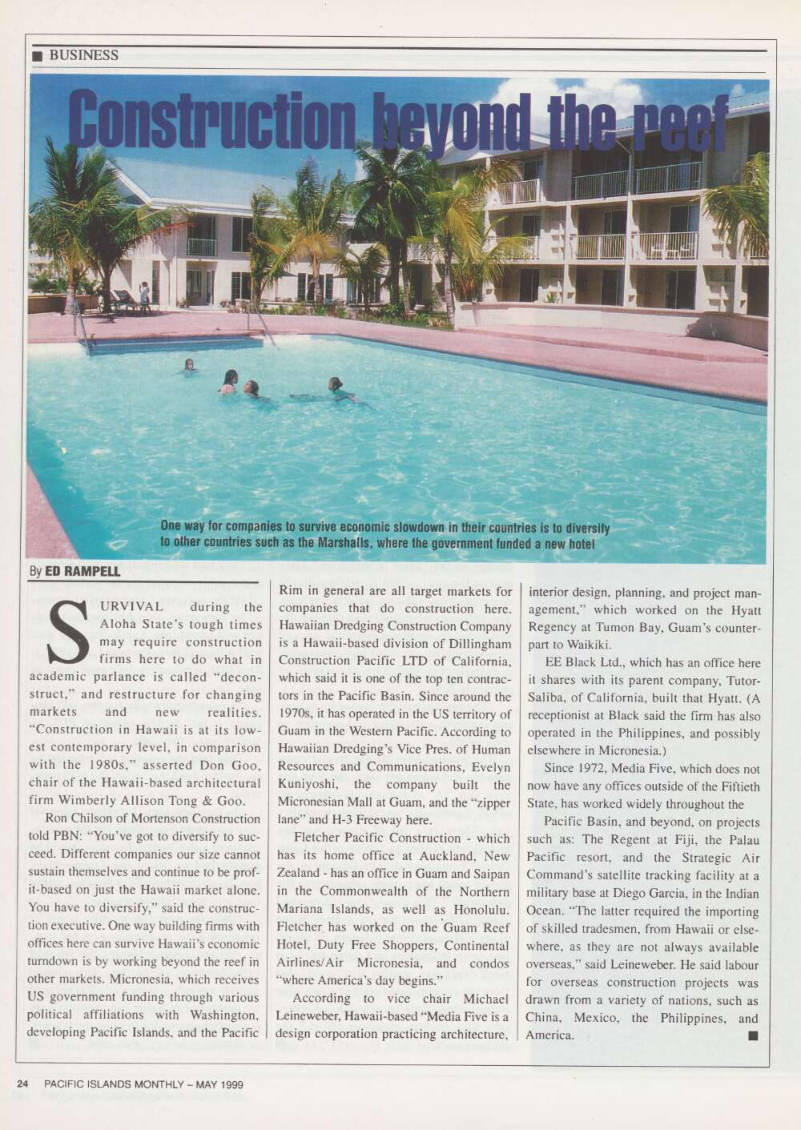
By Ed Rampell
SURVIVAL during the Aloha State’s tough times may require construction firms here to do what in academic parlance is called “decon struct,” and restructure for changing markets and new realities.
“Construction in Hawaii is at its low est contemporary level, in comparison with the 1980 s,” asserted Don Goo, chair of the Hawaii-based architectural firm Wimberly Allison Tong & Goo.
Ron Chilson of Mortenson Construction told PBN: “You’ve got to diversify to suc ceed. Different companies our size cannot sustain themselves and continue to be prof it-based on just the Hawaii market alone.
You have to diversify,” said the construc tion executive. One way building firms with offices here can survive Hawaii’s economic turndown is by working beyond the reef in other markets. Micronesia, which receives US government funding through various political affiliations with Washington, developing Pacific Islands, and the Pacific
Rim in general are all target markets for companies that do construction here.
Hawaiian Dredging Construction Company
is a Hawaii-based division of Dillingham Construction Pacific LTD of California, which said it is one of the top ten contrac tors in the Pacific Basin. Since around the 19705, it has operated in the US territory of Guam in the Western Pacific. According to Hawaiian Dredging’s Vice Pres, of Human Resources and Communications, Evelyn Kuniyoshi, the company built the Micronesian Mall at Guam, and the “zipper lane” and H-3 Freeway here.
Fletcher Pacific Construction - which has its home office at Auckland, New Zealand - has an office in Guam and Saipan in the Commonwealth of the Northern Mariana Islands, as well as Honolulu.
Fletcher has worked on the Guam Reef Hotel, Duty Free Shoppers, Continental Airlines/Air Micronesia, and condos “where America’s day begins.”
According to vice chair Michael Leineweber, Hawaii-based “Media Five is a design corporation practicing architecture,
interior design, planning, and project man agement,” which worked on the Hyatt Regency at Turnon Bay, Guam’s counter part to Waikiki.
EE Black Ltd., which has an office here it shares with its parent company, Tutor- Saliba, of California, built that Hyatt. (A receptionist at Black said the firm has also operated in the Philippines, and possibly elsewhere in Micronesia.) Since 1972, Media Five, which does not now have any offices outside of the Fiftieth State, has worked widely throughout the Pacific Basin, and beyond, on projects such as; The Regent at Fiji, the Palau Pacific resort, and the Strategic Air Command’s satellite tracking facility at a military base at Diego Garcia, in the Indian Ocean. “The latter required the importing of skilled tradesmen, from Hawaii or else where, as they are not always available overseas,” said Leineweber. He said labour for overseas construction projects was drawn from a variety of nations, such as China, Mexico, the Philippines, and America. ■
One way for companies to survive economic slowdown in their countries is to diversify to other countries such as the Marshalls, where the government funded a new hotel
Improved investor
confidence in Cooks
TOURISM, finance and marine resources lead in attracting foreign invest ments to the Cooks - and more outside money is coming in, thanks to improved investor confidence in the country.
January to March this year saw new cap ital 51,047 million come in, compared to $864,000 during the same peri od last year. Peanuts to some countries, big bucks to the Cooks, which has limited nat ural resources and a tiny population of 16,500. The United States invests more money in the Cook Islands than any other country and this is further bolstered by a strong US dollar.
Development Investment Board boss Rohan Ellis says “a huge input” of money comes from the financial sector which broadly represents offshore banks, interna tional companies, and internet casino’s reg istering in the Cook Islands.” This saw $3,683 million enter the Cooks here between July and September last year when San Dunes Race and Sports Book internet
casino registered there.
Casino of the South Pacific reg iste r e d about two
years ago. Two other applications are being processed by DIB.
Five percent of the internet casinos net winnings go to government. Ellis says pre cautionary measures are in place, which include allowing government auditors to “get in there and check their books to ensure that the 5 per cent of net winnings match royalties paid to government.”
A regionally competitive tax regime and legislative reforms which makes the Cooks “ an easier place to do business “ puts us ahead of other Pacific islands in attracting overseas investment - given our small total population and limited natural resource base says Ellis.
He added those legislative changes have “improved the country’s reputation as a good investment location.”
Ellis says the exodus of 3,000 people has “drastically reduced purchasing power here, the development of new businesses and expansion of existing businesses is meagre at the moment.”
“So foreign investment is even more important to us with the development of new projects, which lead to increased job opportunities.”
Ellis’ emmigration estimate is conserva tive. The number of people who fled the economic recession years of 1995 - 1998 is closer to 5,000.
With the general election set for June 16, Ellis doesn’t believe a possible change of government will greatly affect investor con fidence. “The Cook Islands is traditionally regarded as a politically stable country”.
He says all political parties have a sound understanding of the benefits of foreign investment to the Cooks.
Total capital investment which entered the country during the June 1997 - July 98 financial year amounted to $3,199 million.
That was outdone between July to September 1998 with investments totalling $4,902 million. Major contributor to the second quarter increase was from the regis tration of the San Dunes Race and Sports Book internet casino. The last quarter saw a boom - just over $35 million in direct for eign investment which included the sale and projected completion expenditure of the Vaimaanga Hotel. Excluding the hotel sale, $980,107 entered the country.
Ellis says they look forward to “contin ued growth during the next financial year ■
News Corp bids adieu
to Ansett Australia
RUPERT Murdoch’s News Corp Ltd’s decision to sell its 50 per cent stake in Ansett Australia has not come a moment too soon or the recovering airline.
Ansett has struggled to compete against the might of Australia’s dominant airline Qantas Airways Ltd and now looks set to thrive under the wing of its new cashed up shareholder Singapore Airlines, according to analysts.
Under the ownership of a media company and Air New Zealand, with 50 per cent each, Ansett struggled to make profits, only recent ly reporting a turnaround in its fortunes to post first half net earn
ings of $61.6 million.
Still a lar cry trom Qantas' stunning $222.9 million half year net profit, it was an improvement on Ansctt's $18.6 million operating loss in 1995/96 and an indication of just how far the airline has come.
News Corp and TNT took equal stakes in the airline in 1979, with Murdoch and Sir Peter Abelcs becoming joint managing direc
tors. Founder Sir Reginald Ansett remained as chair until his death two years later.
However, over the next decade Australia’s first airline lost its way and became seriously threatened as it failed to secure the back ing of other airlines.
In 1996, the Australian government gave Air New Zealand approval to buy TNT’s 50 per cent holding of Ansett Holdings, pro viding that 51 per cent of Ansett International remain Australian owned.
Then in 1997 former Cathay Pacific boss Rod Eddington was given the brief by Murdoch to turn around the loss-making airline within a few years, ensuring a healthy exit for News Corp.
Murdoch had never hidden his plan to dispose of the non-core asset but remained unwilling to invest the dollars needed to boost its fortunes.
Executive chair Eddington took to the task, launching a business recovery programme with the aim of delivering annual profits equivalent to ten per cent of the airline’s annual turnover.
Now with the airline gaining momentum and with another airline as a half shareholder to provide some backbone, Ansett may stamp itself as a more dominant player in aviation. ■
Emperor's new focus
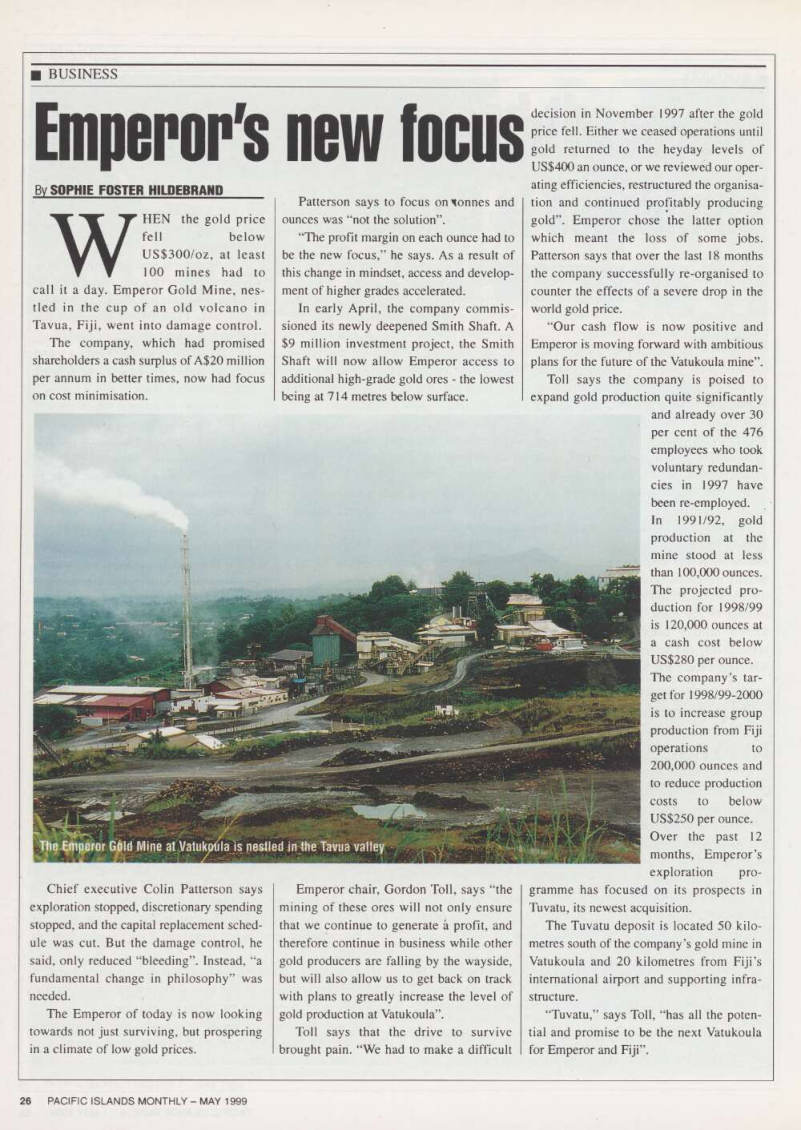
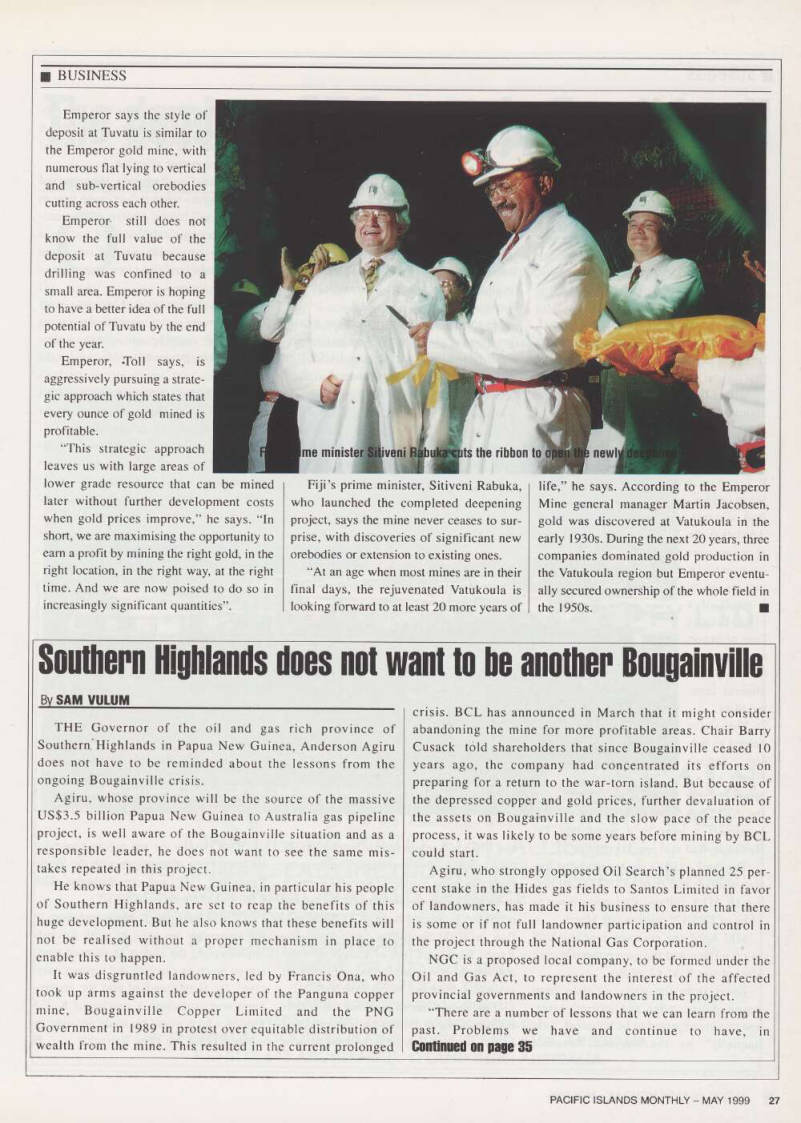
By Sophie Foster Hildebrand
WHEN the gold price
fell below US$3OO/oz, at least 100 mines had to call it a day. Emperor Gold Mine, nes tled in the cup of an old volcano in Tavua, Fiji, went into damage control.
The company, which had promised shareholders a cash surplus of As2o million per annum in better times, now had focus on cost minimisation.
Chief executive Colin Patterson says
exploration stopped, discretionary spending
stopped, and the capital replacement sched ule was cut. But the damage control, he said, only reduced “bleeding”. Instead, “a fundamental change in philosophy” was needed.
The Emperor of today is now looking towards not just surviving, but prospering in a climate of low gold prices.
Patterson says to focus on bonnes and ounces was “not the solution”.
“The profit margin on each ounce had to be the new focus,” he says. As a result of this change in mindset, access and develop ment of higher grades accelerated.
In early April, the company commis sioned its newly deepened Smith Shaft. A $9 million investment project, the Smith Shaft will now allow Emperor access to additional high-grade gold ores - the lowest being at 714 metres below surface.
Emperor chair, Gordon Toll, says “the mining of these ores will not only ensure that we continue to generate a profit, and therefore continue in business while other gold producers are falling by the wayside, but will also allow us to get back on track with plans to greatly increase the level of gold production at Vatukoula”.
Toll says that the drive to survive brought pain. “We had to make a difficult
decision in November 1997 after the gold price fell. Either we ceased operations until gold returned to the heyday levels of US$4OO an ounce, or we reviewed our oper ating efficiencies, restructured the organisa tion and continued profitably producing gold”. Emperor chose the latter option which meant the loss of some jobs.
Patterson says that over the last 18 months the company successfully re-organised to counter the effects of a severe drop in the world gold price.
“Our cash flow is now positive and Emperor is moving forward with ambitious plans for the future of the Vatukoula mine”.
Toll says the company is poised to expand gold production quite significantly
and already over 30 per cent of the 476 employees who took voluntary redundan cies in 1997 have
been re-employed.
In 1991/92, gold production at the mine stood at less than 100,000 ounces.
The projected pro duction for 1998/99 is 120,000 ounces at a cash cost below US$2BO per ounce.
The company’s tar get for 1998/99-2000 is to increase group production from Fiji operations to 200,000 ounces and to reduce production costs to below US$25O per ounce.
Over the past 12 months. Emperor’s exploration pro
gramme has focused on its prospects in Tuvatu, its newest acquisition.
The Tuvatu deposit is located 50 kilo metres south of the company’s gold mine in Vatukoula and 20 kilometres from Fiji’s international airport and supporting infra structure.
“Tuvatu,” says Toll, “has all the poten tial and promise to be the next Vatukoula for Emperor and Fiji”.
"The Emperor Gold Mine at Vatukoula is nestled nestled in the Tavua valley
Emperor says the style of deposit at Tuvatu is similar to the Emperor gold mine, with numerous flat lying to vertical and sub-vertical orebodies cutting across each other.
Emperor still does not know the full value of the deposit at Tuvatu because drilling was confined to a small area. Emperor is hoping to have a better idea of the full potential of Tuvatu by the end of the year.
Emperor, -Toll says, is aggressively pursuing a strate gic approach which states that every ounce of gold mined is profitable.
“This strategic approach leaves us with large areas of
lower grade resource that can be mined later without further development costs when gold prices improve,” he says. “In short, we are maximising the opportunity to earn a profit by mining the right gold, in the right location, in the right way, at the right time. And we are now poised to do so in increasingly significant quantities”.
Fiji’s prime minister, Sitiveni Rabuka, who launched the completed deepening project, says the mine never ceases to sur prise, with discoveries of significant new orebodies or extension to existing ones.
“At an age when most mines are in their final days, the rejuvenated Vatukoula is looking forward to at least 20 more years of
life,” he says. According to the Emperor Mine general manager Martin Jacobsen, gold was discovered at Vatukoula in the early 19305. During the next 20 years, three companies dominated gold production in the Vatukoula region but Emperor eventu ally secured ownership of the whole field in the 19505. ■
F[?]me minister Sitiveni Rabuka cuts the ribbon to open the newly de[?]
Southern Highlands does not want to be another Bougainville
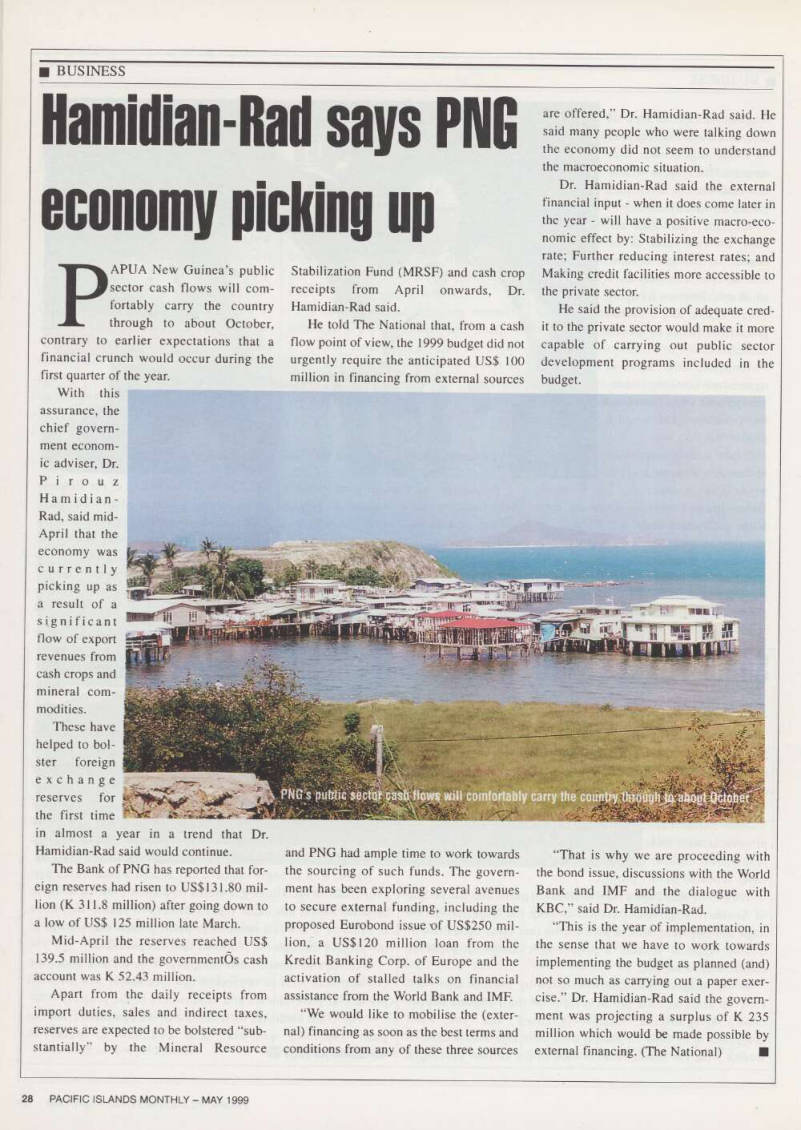
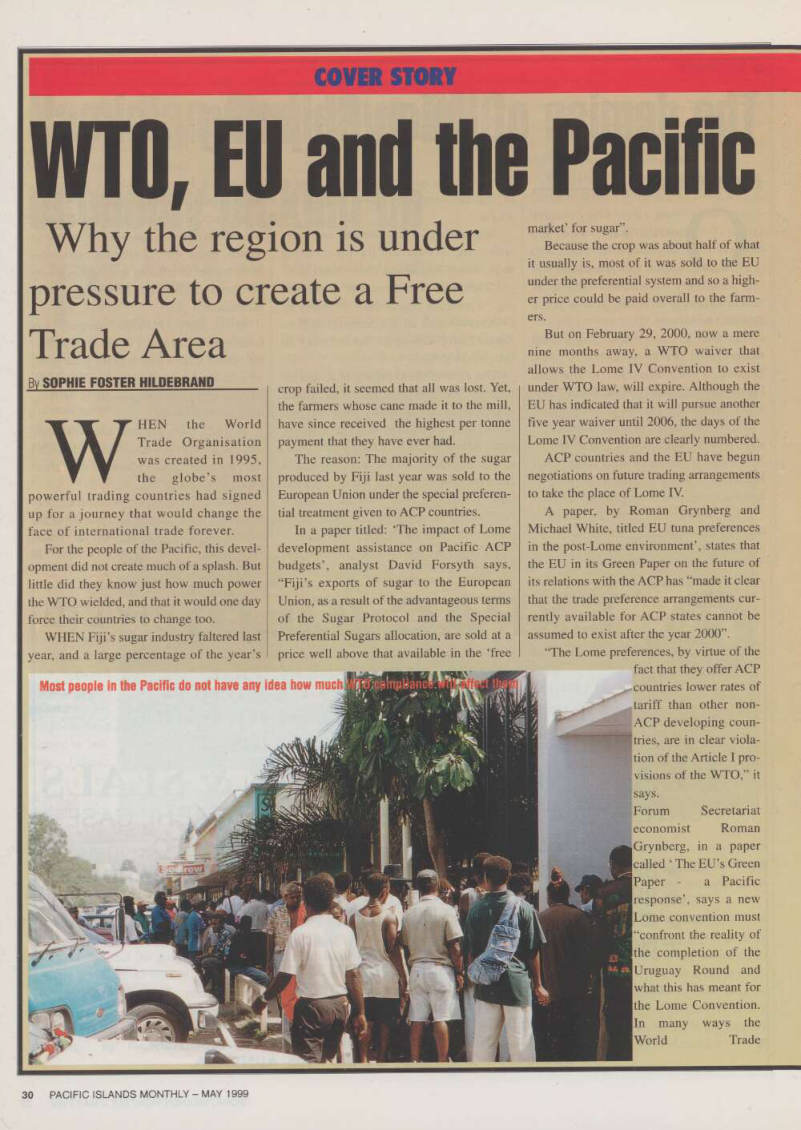
By Sam Vulum
THE Governor of the oil and gas rich province of Southern Highlands in Papua New Guinea, Anderson Agiru does not have to be reminded about the lessons from the ongoing Bougainville crisis.
Agiru, whose province will be the source of the massive US$3.5 billion Papua New Guinea to Australia gas pipeline project, is well aware of the Bougainville situation and as a responsible leader, he does not want to see the same mis takes repeated in this project.
He knows that Papua New Guinea, in particular his people of Southern Highlands, are set to reap the benefits of this huge development. But he also knows that these benefits will not be realised without a proper mechanism in place to enable this to happen.
It was disgruntled landowners, led by Francis Ona, who took up arms against the developer of the Panguna copper mine, Bougainville Copper Limited and the PNG Government in 1989 in protest over equitable distribution of wealth from the mine. This resulted in the current prolonged
crisis. BCL has announced in March that it might consider abandoning the mine for more profitable areas. Chair Barry Cusack told shareholders that since Bougainville ceased 10 years ago, the company had concentrated its efforts on preparing for a return to the war-torn island. But because of the depressed copper and gold prices, further devaluation of the assets on Bougainville and the slow pace of the peace process, it was likely to be some years before mining by BCL could start.
Agiru, who strongly opposed Oil Search’s planned 25 per cent stake in the Hides gas fields to Santos Limited in favor of landowners, has made it his business to ensure that there is some or if not full landowner participation and control in the project through the National Gas Corporation.
NGC is a proposed local company, to be formed under the Oil and Gas Act, to represent the interest of the affected provincial governments and landowners in the project.
“There are a number of lessons that we can learn from the past. Problems we have and continue to have, in
Continued on page 35
From page 27
Bougainville can be directly attributed to the issue of landowner participation and involvement in key resource
development projects,” Agiru said dur
ing an NGC road show on March 26 that he organised to prepare the groundwork for the establishment of the corporation.
It was a first of such meetings aimed at promoting the NGC as a vehi cle for encouraging common owner ship of gas projects in PNG.
Agiru was critical against sugges tions by his colleague governors that the equity participation in the NGC should be limited to the 20 provincial governments only.
He told the meeting that the Organic Law on Provincial and Local- Level Governments explicitly explains under Section 15 (2) that landowners shall be consulted on all natural resource developments in their provinces.
“Any decision not to consult the landowners will be a direct contraven tion of this section,” he said.
“The project is the biggest ever pro posed to be undertaken in PNG and it is indeed bigger than other mining related resource development projects.
“Given its importance to PNG, the role and participation of landowners cannot be overlooked.”
He said critics have to realise that 100 per cent of the gas to be sold in the pipeline project come from land owned by landowners in the Southern Highlands province.
One of the specific rights of the NGC is to buy and own 10 per cent of the pipeline project.
Agiru said the project will require
investments of at least US$3.6 billion and total funds required for the PNG sector alone is estimated at US$l.B billion.
He said through specific require ments, NGC is entitled to 12 per cent of this amount or US$2l4 million.
Agiru warned that stakeholders in
Continued on page 51
From page 35
NGC need to be aware that under a standard project financing, stakehold ers are required to contribute an amount about 30 percent or K 135 mil lion of the total funding requirement to demonstrate their commitment and their share of the risk in the project with the financiers. He said to raise the 30 percent funding, stakeholders will not only need to contribute cash but also supplement this by securing loans from PNG debt providers to finance their 30 percent equity contri bution.
The governor said it’s a big call for the provincial governments and landowners, however, the time has come for Papua New Guineans to take up the challenge in achieving eco nomic independence and local man
power development.
“We need to re-direct the develop ment goals that are reflected in the eighth point plan established at inde pendence.
“To do this, we have to start con trolling direct ownership of the vast natural resources if we are to be a truly economically independent PNG,” he said.
It is truly the biggest development in PNG and indeed the second largest ever in Australia.
Estimated gas reserves total six million cu ft, and the first gas is expected to flow in the second half of 2001 or first half of 2002.
It is unique in that it is perhaps the first resource project where the envi ronmental approval process starts in one country and ends in another.
From the forested Highlands of PNG to the sensitive marine culture of the Torres Strait and the arid extremes of northern Queensland, the pipeline encounters a variety of ter rain rarely seen elsewhere.
The project will require about 700,000 tonnes of steel pipe, nearly 500 kilometre of which will be laid in the Torres Strait. ■
Hamidian-Rad says PNG
economy picking up
PAPUA New Guinea s public sector cash flows will comfortably carry the country through to about October, contrary to earlier expectations that a financial crunch would occur during the first quarter of the year.
With this assurance, the chief govern ment econom ic adviser, Dr.
Pir o u z Hamid i a n - Rad, said mid- April that the economy was currently picking up as a result of a significant flow of export revenues from cash crops and mineral com modities.
These have helped to bol ster foreign exchange reserves for the first time
in almost a year in a trend that Dr.
Hamidian-Rad said would continue.
The Bank of PNG has reported that for eign reserves had risen to US$l3l.BO mil lion (K 311.8 million) after going down to a low of US$ 125 million late March.
Mid-April the reserves reached US$ 139.5 million and the govemmentOs cash account was K 52.43 million.
Apart from the daily receipts from import duties, sales and indirect taxes, reserves are expected to be bolstered “sub stantially” by the Mineral Resource
Stabilization Fund (MRSF) and cash crop receipts from April onwards. Dr.
Hamidian-Rad said.
He told The National that, from a cash flow point of view, the 1999 budget did not urgently require the anticipated US$ 100 million in financing from external sources
and PNG had ample time to work towards the sourcing of such funds. The govern ment has been exploring several avenues to secure external funding, including the proposed Eurobond issue of US$25O mil lion, a US$l2O million loan from the Kredit Banking Corp. of Europe and the activation of stalled talks on financial assistance from the World Bank and IMF.
“We would like to mobilise the (exter nal) financing as soon as the best terms and conditions from any of these three sources
are offered,” Dr. Hamidian-Rad said. He said many people who were talking down the economy did not seem to understand the macroeconomic situation.
Dr. Hamidian-Rad said the external financial input - when it does come later in the year - will have a positive macro-eco nomic effect by; Stabilizing the exchange rate; Further reducing interest rates; and Making credit facilities more accessible to the private sector.
He said the provision of adequate cred it to the private sector would make it more capable of carrying out public sector development programs included in the budget.
“That is why we are proceeding with the bond issue, discussions with the World Bank and IMF and the dialogue with KBC,” said Dr. Hamidian-Rad.
“This is the year of implementation, in the sense that we have to work towards implementing the budget as planned (and) not so much as carrying out a paper exer cise.” Dr. Hamidian-Rad said the govern ment was projecting a surplus of K 235 million which would be made possible by external financing. (The National) ■
PNGs public sector cash flows will comfortably carry the country through to about October
The demise of Union Shipping
By Michael Field
Once its every move would have won big headlines in Suva and Apia and Auckland but the seemingly inevitable demise of Union Shipping later this year is just a footnote to history.
Founded as the Union Steam Ship Company in -1875 in Dunedin, New Zealand, it came after 1881 to dominate Pacific shipping with its rival, Bums Philp, which has also disappeared from the region.
Union Shipping, which now runs two ships across the Tasman Sea, is owned by New Zealand’s ailing Brierley Investments Ltd which is trying to cash up its non-per forming companies in a struggle to survive.
The Sunday Star-Times in Auckland reported Union Shipping was on the verge of being scuttled with the loss of 200 jobs.
The newspaper quoted company sources as saying the company would be gone by
August.
Negotiations were already underway with potential buyers of its two surviving ships, Union Rotoiti and Union Rotoma.
“There’s sadness about what is happen ing,” a company source said. “Probably up to 90 percent of all the sea staff in New Zealand have worked for the company all their working life.”
The view of the company is somewhat different in the Pacific. “The Union Company was unfavourably identified with the colonial administration in the minds of many Island leaders and there was a wide spread desire for a new start, especially since the Union Company was at times less than sympathetic toward Pacific sensibili ties,” author Tony Nightingale wrote in his recent history on the Pacific Forum Line.
He noted the way that the company put
up its freight rates after the 1971 Fiji dock strike while other companies did not. The company was known
throughout Polynesia for its passenger cargo ships Matua and Tofua.
Its most infamous ship was Talune which introduced Spanish influenza to Samoa, Tonga and Fiji after the callousness of its master in refusing to co-operate with port health authorities. Thousands died in each country.
In the early 1960 s the company was taken over by Britain’s P and O. However the banana trade which kept the trade going was in trouble with disease hitting the Pacific crop and cheap exports arriving from South America.
In 1972 New Zealand and Australian interests took over the company and ended the passenger services in 1973 and intro duced containerisation.
However the company was forced, both by politics and economics, to pull out of the Pacific and surviving only on the Trans- Tasman run. ■
Advertisements & other items, p. 29 (1 item)
Bearing, Bushings & Seals
EXPAC (QLD) PTY lt d
IMPORTERS / EXPORTERS GENERAL
MACHINERY, EQUIPMENT & PARTS SUPPLIERS.
WE SUPPLY PARTS FOR ALL EARTH MOVING,
CRANE & LOGGING EQUIPMENT
BEARING, BUSHINGS & SEALS
CATERPILLA, KOMATSU, KOBELCO, HITACHI, CASE,
JOHN DEERE, KATO, FIAT, ALLIS, ETC..
—>► BEARINGS SEALS INCLUDING TURNABLE BEARINGS
—► PROMPT PERSONALISED SERVICE
—>■ COMPETITIVE PRICES
—►NO REQUEST TOO HARD
PHONE: (05.61.7) 3274 3500
FAX: (05.61.7) 3274 3997
EMAIL: [email protected] WEBSITE: http://www.expac.com.au 1/32 ANNIE ST. COOPERS PLAINS, QUEENSLAND 4108, AUSTRALIA.
P.O BOX 643 ARCHERFIELD, Q'LAND 4108, AUSTRALIA.
WTO, EU and the Pacific
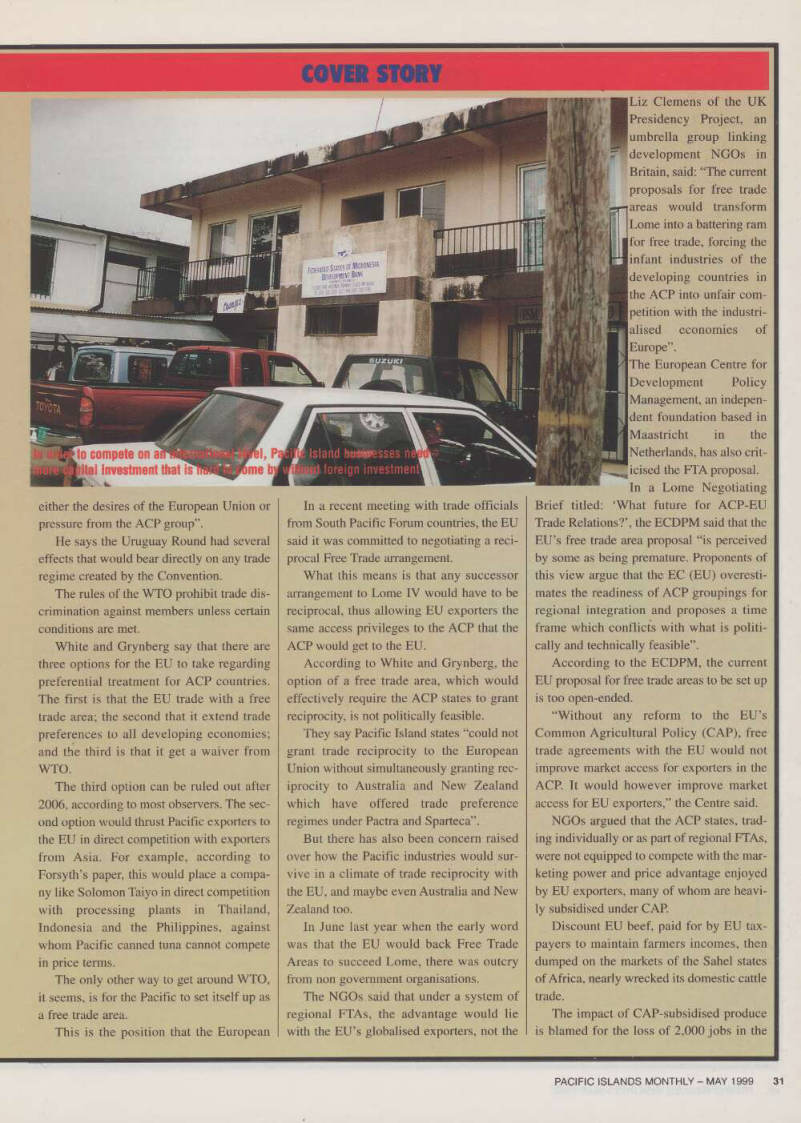
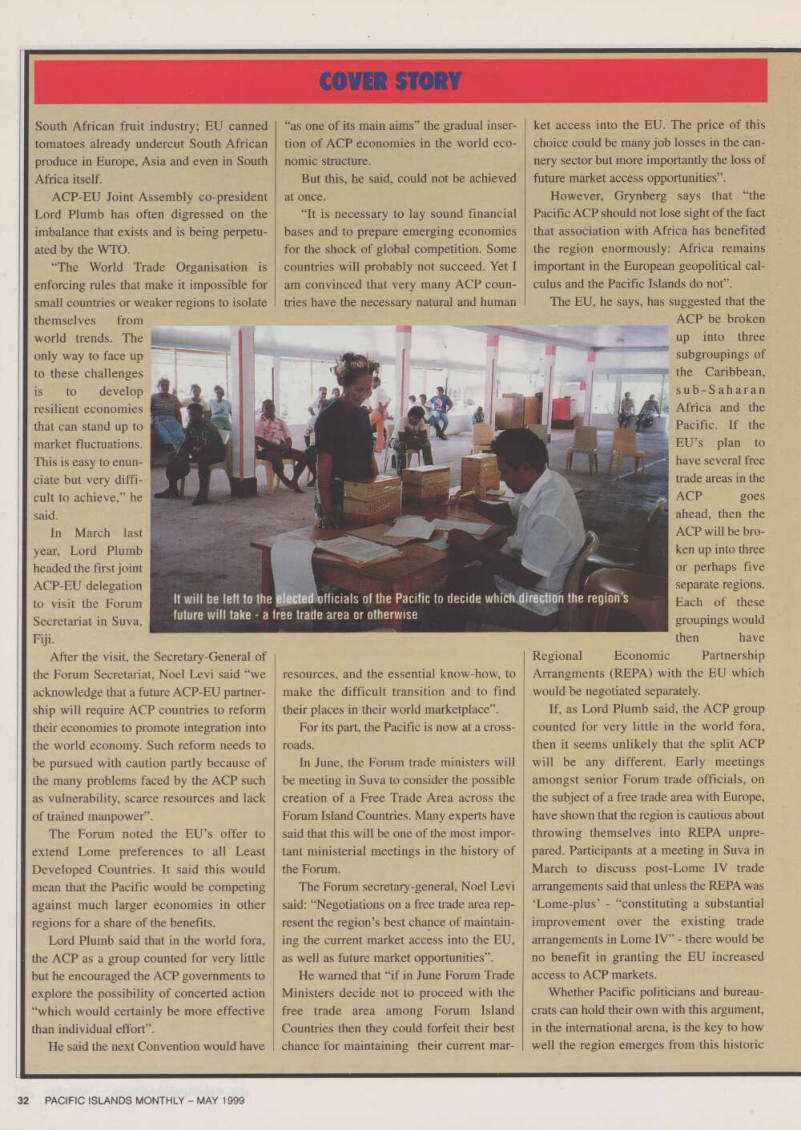
Cover Story
Why the region is under pressure to create a Free Trade Area
Bv Sophie Foster Hildebrand
WHEN the World
Trade Organisation
was created in 1995, the globe’s most powerful trading countries had signed up for a journey that would change the face of international trade forever.
For the people of the Pacific, this devel opment did not create much of a splash. But little did they know just how much power the WTO wielded, and that it would one day force their countries to change too.
WHEN Fiji’s sugar industry faltered last year, and a large percentage of the year’s
crop failed, it seemed that all was lost. Yet, the farmers whose cane made it to the mill, have since received the highest per tonne payment that they have ever had.
The reason: The majority of the sugar produced by Fiji last year was sold to the European Union under the special preferen tial treatment given to ACP countries.
In a paper titled; ‘The impact of Lome development assistance on Pacific ACP budgets’, analyst David Lorsyth says, “Fiji’s exports of sugar to the European Union, as a result of the advantageous terms of the Sugar Protocol and the Special Preferential Sugars allocation, are sold at a price well above that available in the ‘free
market’ for sugar”.
Because the crop was about half of what it usually is, most of it was sold to the EU under the preferential system and so a high er price could be paid overall to the farm ers.
But on Lebruary 29, 2000, now a mere nine months away, a WTO waiver that allows the Lome IV Convention to exist under WTO law, will expire. Although the EU has indicated that it will pursue another five year waiver until 2006, the days of the Lome IV Convention are clearly numbered.
ACP countries and the EU have begun negotiations on future trading arrangements to take the place of Lome IV.
A paper, by Roman Grynberg and Michael White, titled EU tuna preferences in the post-Lome environment’, states that the EU in its Green Paper on the future of its relations with the ACP has “made it clear that the trade preference arrangements cur rently available for ACP states cannot be assumed to exist after the year 2000”.
“The Lome preferences, by virtue of the
fact that they offer ACP countries lower rates of tariff than other non- ACP developing coun tries, are in clear viola tion of the Article I pro visions of the WTO,” it says.
Forum Secretariat economist Roman ,Grynberg, in a paper [called ‘ The EU’s Green Paper - a Pacific [response’, says a new Lome convention must “confront the reality of [the completion of the Uruguay Round and what this has meant for the Lome Convention.
In many ways the World Trade
Most people in the Pacific do not have any idea how much WTO compliance will affact them
either the desires of the European Union or pressure from the ACP group”.
He says the Uruguay Round had several effects that would bear directly on any trade regime created by the Convention.
The rules of the WTO prohibit trade dis crimination against members unless certain conditions are met.
White and Grynberg say that there are three options for the EU to take regarding preferential treatment for ACP countries.
The first is that the EU trade with a free trade area; the second that it extend trade preferences to all developing economies; and the third is that it get a waiver from
Wto.
The third option can be ruled out after 2006, according to most observers. The sec ond option would thrust Pacific exporters to the EU in direct competition with exporters from Asia. For example, according to Forsyth’s paper, this would place a compa ny like Solomon Taiyo in direct competition with processing plants in Thailand, Indonesia and the Philippines, against whom Pacific canned tuna cannot compete in price terms.
The only other way to get around WTO, it seems, is for the Pacific to set itself up as a free trade area.
This is the position that the European
In a recent meeting with trade officials from South Pacific Forum countries, the EU said it was committed to negotiating a reci procal Free Trade arrangement.
What this means is that any successor arrangement to Lome IV would have to be reciprocal, thus allowing EU exporters the same access privileges to the ACP that the ACP would get to the EU.
According to White and Grynberg, the option of a free trade area, which would effectively require the ACP states to grant reciprocity, is not politically feasible.
They say Pacific Island states “could not grant trade reciprocity to the European Union without simultaneously granting rec iprocity to Australia and New Zealand which have offered trade preference regimes under Pactra and Sparteca”.
But there has also been concern raised over how the Pacific industries would sur vive in a climate of trade reciprocity with the EU, and maybe even Australia and New Zealand too.
In June last year when the early word was that the EU would back Free Trade Areas to succeed Lome, there was outcry from non government organisations.
The NGOs said that under a system of regional FTAs, the advantage would lie with the EU’s globalised exporters, not the
(Liz Clemens of the UK
Presidency Project, an
umbrella group linking development NGOs in Britain, said: “The current proposals for free trade areas would transform Lome into a battering ram I for free trade, forcing the jinfant industries of the developing countries in I the ACP into unfair com jpetition with the industri alised economies of Europe”.
The European Centre for
Development Policy
Management, an indepen dent foundation based in Maastricht in the Netherlands, has also crit icised the ETA proposal.
In a Lome Negotiating
Brief titled: ‘What future for ACP-EU Trade Relations?’, the ECDPM said that the EU’s free trade area proposal “is perceived by some as being premature. Proponents of this view argue that the EC (EU) overesti mates the readiness of ACP groupings for regional integration and proposes a time frame which conflicts with what is politi cally and technically feasible”.
According to the ECDPM, the current EU proposal for free trade areas to be set up is too open-ended.
“Without any reform to the EU’s Common Agricultural Policy (CAP), free trade agreements with the EU would not improve market access for exporters in the ACP. It would however improve market access for EU exporters,” the Centre said.
NGOs argued that the ACP states, trad ing individually or as part of regional FTAs, were not equipped to compete with the mar
keting power and price advantage enjoyed
by EU exporters, many of whom are heavi ly subsidised under CAP.
Discount EU beef, paid for by EU tax payers to maintain farmers incomes, then dumped on the markets of the Sahel states of Africa, nearly wrecked its domestic cattle trade.
The impact of CAP-subsidised produce is blamed for the loss of 2,000 jobs in the
In order to compete on an international level, Pacific Islands businesses need more capital investment that is hard to come by without foreign investment
South African fruit industry; EU canned tomatoes already undercut South African produce in Europe, Asia and even in South Africa itself.
ACP-EU Joint Assembly co-president Lord Plumb has often digressed on the imbalance that exists and is being perpetu ated by the WTO.
“The World Trade Organisation is enforcing rules that make it impossible for small countries or weaker regions to isolate themselves from
world trends. The only way to face up to these challenges is to develop resilient economies that can stand up to market fluctuations.
This is easy to enun ciate but very diffi cult to achieve,” he said.
In March last year, Lord Plumb headed the first joint
ACP-EU delegation
to visit the Forum Secretariat in Suva,
Fiji.
After the visit, the Secretary-General of the Forum Secretariat, Noel Levi said “we acknowledge that a future ACP-EU partner ship will require ACP countries to reform their economies to promote integration into the world economy. Such reform needs to be pursued with caution partly because of the many problems faced by the ACP such as vulnerability, scarce resources and lack of trained manpower”.
The Forum noted the EU’s offer to extend Lome preferences to all Least Developed Countries. It said this would mean that the Pacific would be competing against much larger economies in other regions for a share of the benefits.
Lord Plumb said that in the world fora, the ACP as a group counted for very little but he encouraged the ACP governments to explore the possibility of concerted action “which would certainly be more effective than individual effort”.
He said the next Convention would have
“as one of its main aims” the gradual inser tion of ACP economies in the world eco nomic structure.
But this, he said, could not be achieved at once.
“It is necessary to lay sound financial bases and to prepare emerging economies for the shock of global competition. Some countries will probably not succeed. Yet I am convinced that very many ACP coun tries have the necessary natural and human
resources, and the essential know-how, to make the difficult transition and to find their places in their world marketplace”.
For its part, the Pacific is now at a cross roads.
In June, the Forum trade ministers will be meeting in Suva to consider the possible creation of a Free Trade Area across the Forum Island Countries. Many experts have said that this will be one of the most impor tant ministerial meetings in the history of the Forum.
The Forum secretary-general, Noel Levi said: “Negotiations on a free trade area rep resent the region’s best chance of maintain ing the current market access into the EU, as well as future market opportunities”.
He warned that “if in June Forum Trade Ministers decide not to proceed with the free trade area among Forum Island Countries then they could forfeit their best chance for maintaining their current mar
ket access into the EU. The price of this choice could be many job losses in the can nery sector but more importantly the loss of future market access opportunities”.
However, Grynberg says that “the Pacific ACP should not lose sight of the fact that association with Africa has benefited the region enormously: Africa remains important in the European geopolitical cal culus and the Pacific Islands do not”.
The EU, he says, has suggested that the
ACP be broken up into three subgroupings of the Caribbean, sub-Saharan Africa and the Pacific. If the EU’s plan to have several free trade areas in the ACP goes ahead, then the ACP will be bro ken up into three or perhaps five
separate regions.
Each of these
groupings would
then have
Regional Economic Partnership Arrangments (REPA) with the EU which would be negotiated separately.
If, as Lord Plumb said, the ACP group counted for very little in the world fora, then it seems unlikely that the split ACP will be any different. Early meetings amongst senior Forum trade officials, on the subject of a free trade area with Europe, have shown that the region is cautious about throwing themselves into REPA unpre pared. Participants at a meeting in Suva in March to discuss post-Lome IV trade arrangements said that unless the REPA was ‘Lome-plus’ - “constituting a substantial improvement over the existing trade arrangements in Lome IV” - there would be no benefit in granting the EU increased access to ACP markets.
Whether Pacific politicians and bureau crats can hold their own with this argument, in the international arena, is the key to how well the region emerges from this historic
It will be left to the elected officials of the Pacific to decide which direction the region’s future will take - a free trade area or otherwise
competent authorities
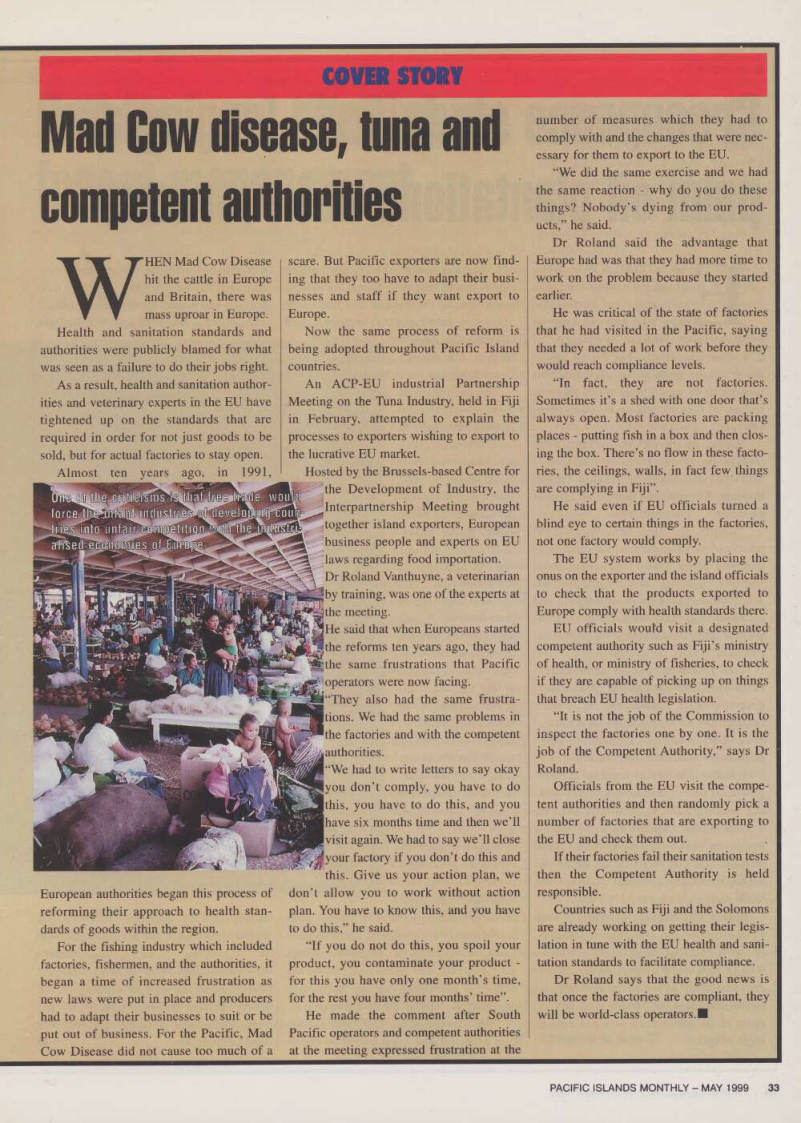
Mad Cow disease, tuna and competent authorities
WHEN Mad Cow Disease hit the cattle in Europe and Britain, there was mass uproar in Europe.
Health and sanitation standards and authorities were publicly blamed for what was seen as a failure to do their jobs right.
As a result, health and sanitation author ities and veterinary experts in the EU have tightened up on the standards that are required in order for not just goods to be sold, but for actual factories to stay open.
Almost ten years ago, in 1991,
European authorities began this process of reforming their approach to health stan dards of goods within the region.
For the fishing industry which included factories, fishermen, and the authorities, it began a time of increased frustration as new laws were put in place and producers had to adapt their businesses to suit or be put out of business. For the Pacific, Mad Cow Disease did not cause too much of a
scare. But Pacific exporters are now find ing that they too have to adapt their busi nesses and staff if they want export to Europe.
Now the same process of reform is being adopted throughout Pacific Island countries.
An ACP-EU industrial Partnership Meeting on the Tuna Industry, held in Fiji in February, attempted to explain the processes to exporters wishing to export to the lucrative EU market.
Hosted by the Brussels-based Centre for
the Development of Industry, the
Interpartnership Meeting brought
together island exporters, European business people and experts on EU laws regarding food importation.
Dr Roland Vanthuyne, a veterinarian |by training, was one of the experts at the meeting. |He said that when Europeans started I the reforms ten years ago, they had ithe same frustrations that Pacific operators were now facing.
I “They also had the same frustra itions. We had the same problems in nhe factories and with the competent
I authorities.
(“We had to write letters to say okay jyou don’t comply, you have to do (this, you have to do this, and you (have six months time and then we’ll (visit again. We had to say we’ll close lyour factory if you don’t do this and this. Give us your action plan, we
don’t allow you to work without action plan. You have to know this, and you have to do this,” he said.
“If you do not do this, you spoil your product, you contaminate your product for this you have only one month’s time, for the rest you have four months’ time”.
He made the comment after South Pacific operators and competent authorities at the meeting expressed frustration at the
number of measures which they had to comply with and the changes that were nec essary for them to export to the EU.
“We did the same exercise and we had the same reaction - why do you do these things? Nobody’s dying from our prod ucts,” he said.
Dr Roland said the advantage that Europe had was that they had more time to work on the problem because they started earlier.
He was critical of the state of factories that he had visited in the Pacific, saying that they needed a lot of work before they would reach compliance levels.
“In fact, they are not factories.
Sometimes it’s a shed with one door that’s always open. Most factories are packing places - putting fish in a box and then clos ing the box. There’s no flow in these facto ries, the ceilings, walls, in fact few things
are complying in Fiji”.
He said even if EU officials turned a blind eye to certain things in the factories, not one factory would comply.
The EU system works by placing the onus on the exporter and the island officials to check that the products exported to Europe comply with health standards there.
EU officials would visit a designated competent authority such as Fiji’s ministry of health, or ministry of fisheries, to check if they are capable of picking up on things that breach EU health legislation.
“It is not the job of the Commission to inspect the factories one by one. It is the job of the Competent Authority,” says Dr Roland.
Officials from the EU visit the compe tent authorities and then randomly pick a number of factories that are exporting to the EU and check them out.
If their factories fail their sanitation tests then the Competent Authority is held
responsible.
Countries such as Fiji and the Solomons are already working on getting their legis lation in tune with the EU health and sani tation standards to facilitate compliance.
Dr Roland says that the good news is that once the factories are compliant, they will be world-class operators. ■
One of the criticisms in that free trade would force the infant industries of developing coun tries into unfair competition with the industri alised economies of Europe
Environmental lobby
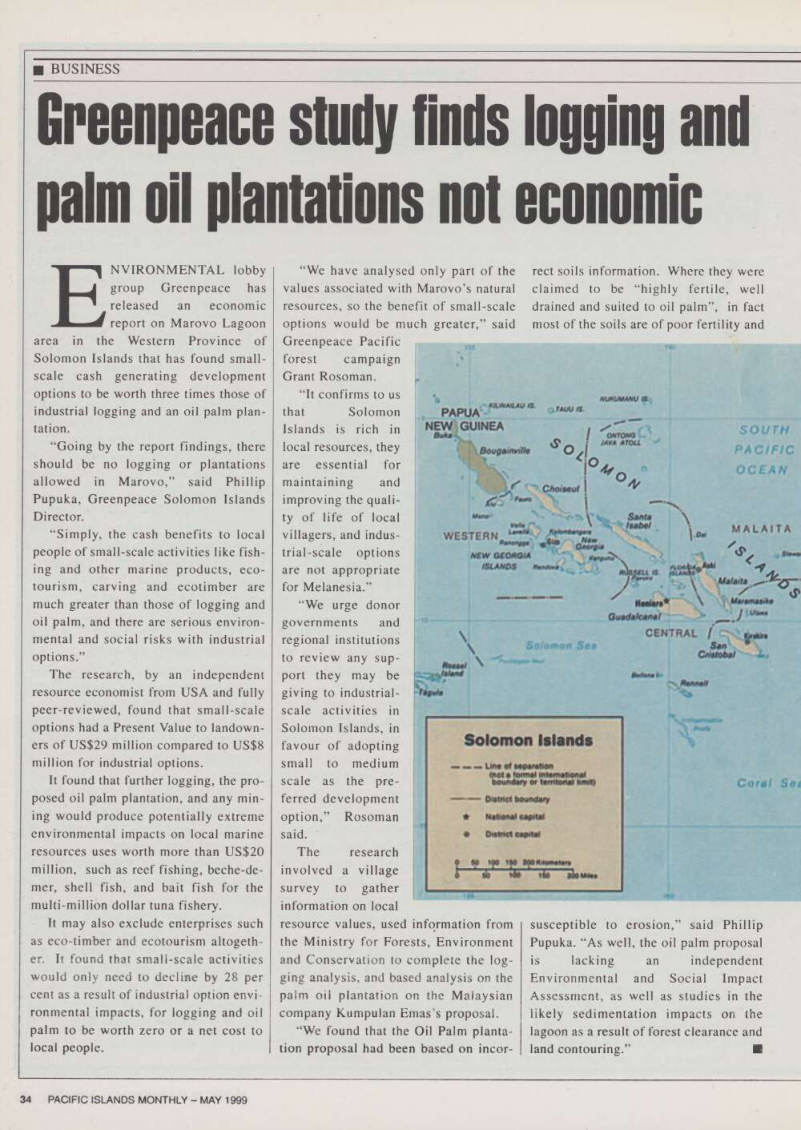
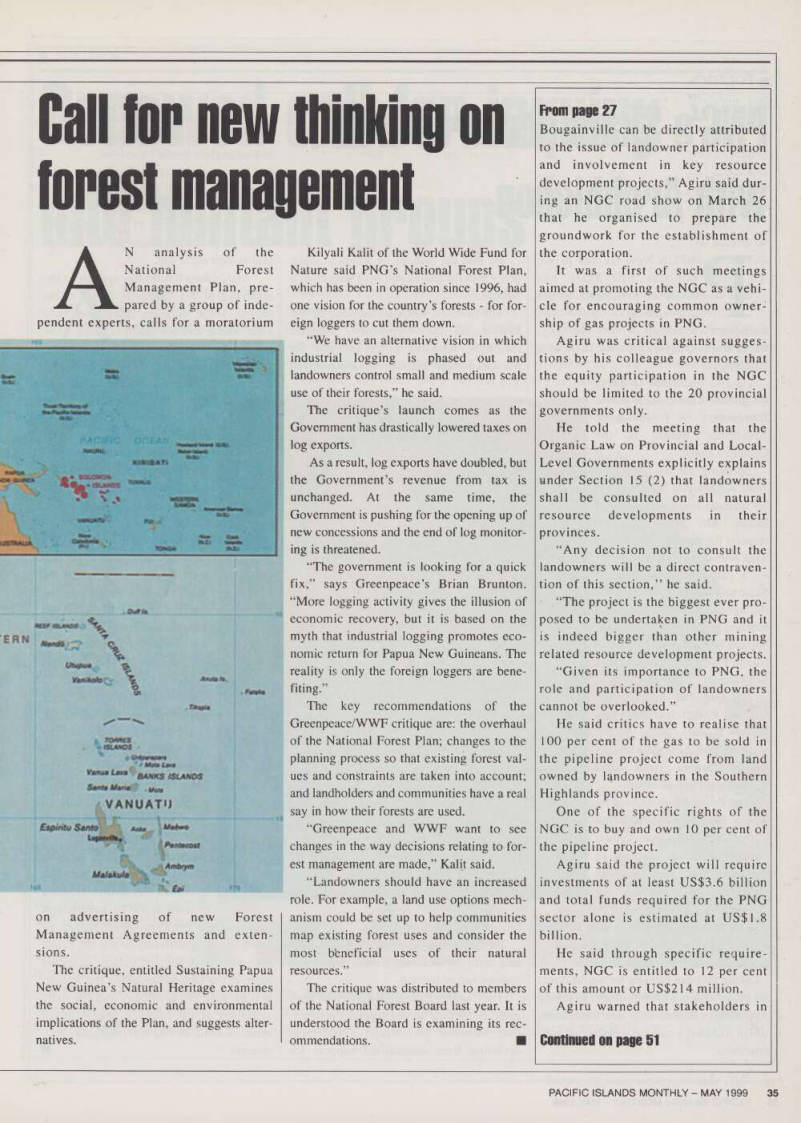
Business
Greenpeace study finds longing and palm oil plantations not economic
group Greenpeace has released an economic report on Marovo Lagoon area in the Western Province of Solomon Islands that has found small scale cash generating development options to be worth three times those of industrial logging and an oil palm plan tation.
“Going by the report findings, there should be no logging or plantations allowed in Marovo,” said Phillip Pupuka, Greenpeace Solomon Islands Director.
“Simply, the cash benefits to local people of small-scale activities like fish ing and other marine products, eco tourism, carving and ecotimber are much greater than those of logging and oil palm, and there are serious environ mental and social risks with industrial options.”
The research, by an independent resource economist from USA and fully peer-reviewed, found that small-scale options had a Present Value to landown ers of US$29 million compared to US$B million for industrial options.
It found that further logging, the pro posed oil palm plantation, and any min ing would produce potentially extreme environmental impacts on local marine resources uses worth more than US$2O million, such as reef fishing, beche-de mer, shell fish, and bait fish for the multi-million dollar tuna fishery.
It may also exclude enterprises such as eco-timber and ecotourism altogeth er. It found that small-scale activities would only need to decline by 28 per cent as a result of industrial option envi ronmental impacts, for logging and oil palm to be worth zero or a net cost to local people.
“We have analysed only part of the values associated with Marovo’s natural resources, so the benefit of small-scale options would be much greater,” said
Greenpeace Pacific forest campaign Grant Rosoman.
“It confirms to us that Solomon Islands is rich in local resources, they are essential for maintaining and improving the quali ty of life of local villagers, and indus trial-scale options are not appropriate for Melanesia.”
“We urge donor governments and
regional institutions
to review any sup port they may be giving to industrial scale activities in Solomon Islands, in favour of adopting small to medium scale as the pre
ferred development
option,” Rosoman said.
The research involved a village survey to gather information on local
resource values, used information from the Ministry for Forests, Environment and Conservation to complete the log ging analysis, and based analysis on the palm oil plantation on the Malaysian company Kumpulan Emas’s proposal.
“We found that the Oil Palm planta tion proposal had been based on incor
rect soils information. Where they were claimed to be “highly fertile, well drained and suited to oil palm”, in fact most of the soils are of poor fertility and
susceptible to erosion,” said Phillip Pupuka. “As well, the oil palm proposal is lacking an independent Environmental and Social Impact Assessment, as well as studies in the likely sedimentation impacts on the lagoon as a result of forest clearance and land contouring.” ■
Call for new thinking on
forest management
AN analysis of the National Forest Management Plan, pre pared by a group of inde pendent experts, calls for a moratorium
on advertising of new Forest Management Agreements and exten sions.
The critique, entitled Sustaining Papua New Guinea’s Natural Heritage examines the social, economic and environmental implications of the Plan, and suggests alter natives.
Kilyali Kalit of the World Wide Fund for Nature said PNG’s National Forest Plan, which has been in operation since 1996, had one vision for the country’s forests - for for eign loggers to cut them down.
“We have an alternative vision in which industrial logging is phased out and landowners control small and medium scale use of their forests,” he said.
The critique’s launch comes as the Government has drastically lowered taxes on log exports.
As a result, log exports have doubled, but the Government’s revenue from tax is unchanged. At the same time, the Government is pushing for the opening up of new concessions and the end of log monitor ing is threatened.
“The government is looking for a quick fix,” says Greenpeace’s Brian Brunton.
“More logging activity gives the illusion of economic recovery, but it is based on the myth that industrial logging promotes eco nomic return for Papua New Guineans. The reality is only the foreign loggers are bene
fiting.”
The key recommendations of the Greenpeace/WWF critique are; the overhaul of the National Forest Plan; changes to the planning process so that existing forest val ues and constraints are taken into account; and landholders and communities have a real say in how their forests are used.
“Greenpeace and WWF want to see changes in the way decisions relating to for est management are made,” Kalit said.
“Landowners should have an increased role. For example, a land use options mech anism could be set up to help communities map existing forest uses and consider the most bfeneficial uses of their natural resources.”
The critique was distributed to members of the National Forest Board last year. It is understood the Board is examining its rec ommendations. ■
with Archbishop
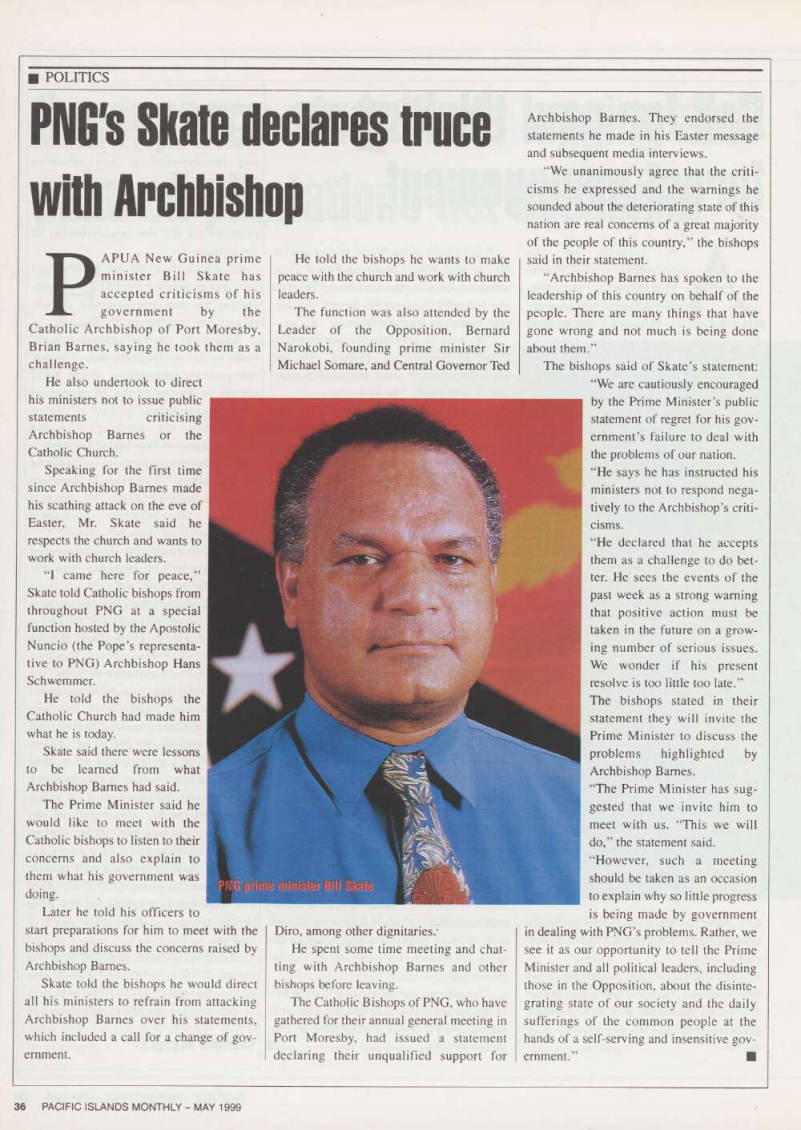
Politics
PNG's Skate declares truce with Archbishop
PAPUA New Guinea prime minister Bill Skate has accepted criticisms of his government by the Catholic Archbishop of Port Moresby, Brian Barnes, saying he took them as a
challenge.
He also undertook to direct his ministers not to issue public
statements criticising
Archbishop Barnes or the Catholic Church.
Speaking for the first time since Archbishop Barnes made his scathing attack on the eve of Easter, Mr. Skate said he respects the church and wants to work with church leaders.
“I came here for peace,”
Skate told Catholic bishops from throughout PNG at a special function hosted by the Apostolic Nuncio (the Pope’s representa tive to PNG) Archbishop Hans Schwemmer.
He told the bishops the Catholic Church had made him what he is today.
Skate said there were lessons to be learned from what Archbishop Bames had said.
The Prime Minister said he would like to meet with the Catholic bishops to listen to their concerns and also explain to them what his government was
doing.
Later he told his officers to
start preparations for him to meet with the bishops and discuss the concerns raised by
Archbishop Bames.
Skate told the bishops he would direct all his ministers to refrain from attacking Archbishop Barnes over his statements, which included a call for a change of gov ernment.
He told the bishops he wants to make peace with the church and work with church leaders.
The function was also attended by the Leader of the Opposition, Bernard Narokobi, founding prime minister Sir Michael Somare, and Central Governor Ted
Diro, among other dignitaries/ He spent some time meeting and chat ting with Archbishop Barnes and other bishops before leaving.
The Catholic Bishops of PNG, who have gathered for their annual general meeting in Port Moresby, had issued a statement declaring their unqualified support for
Archbishop Barnes. They endorsed the statements he made in his Easter message and subsequent media interviews.
“We unanimously agree that the criti cisms he expressed and the warnings he sounded about the deteriorating state of this nation are real concerns of a great majority of the people of this country,” the bishops said in their statement.
“Archbishop Barnes has spoken to the leadership of this country on behalf of the people. There are many things that have gone wrong and not much is being done about them.”
The bishops said of Skate’s statement:
“We are cautiously encouraged
by the Prime Minister’s public statement of regret for his gov ernment’s failure to deal with the problems of our nation.
“He says he has instructed his ministers not to respond nega tively to the Archbishop’s criti cisms.
“He declared that he accepts them as a challenge to do bet ter. He sees the events of the past week as a strong warning that positive action must be taken in the future on a grow ing number of serious issues.
We wonder if his present resolve is too little too late.”
The bishops stated in their statement they will invite the Prime Minister to discuss the problems highlighted by
Archbishop Barnes.
“The Prime Minister has sug gested that we invite him to meet with us. “This we will do,” the statement said.
“However, such a meeting should be taken as an occasion to explain why so little progress is being made by government
in dealing with PNG’s problems. Rather, we see it as our opportunity to tell the Prime Minister and all political leaders, including those in the Opposition, about the disinte grating state of our society and the daily sufferings of the common people at the hands of a self-serving and insensitive gov ernment.” ■
PNG prime minister Bill Skate
Renewed call for inquiry
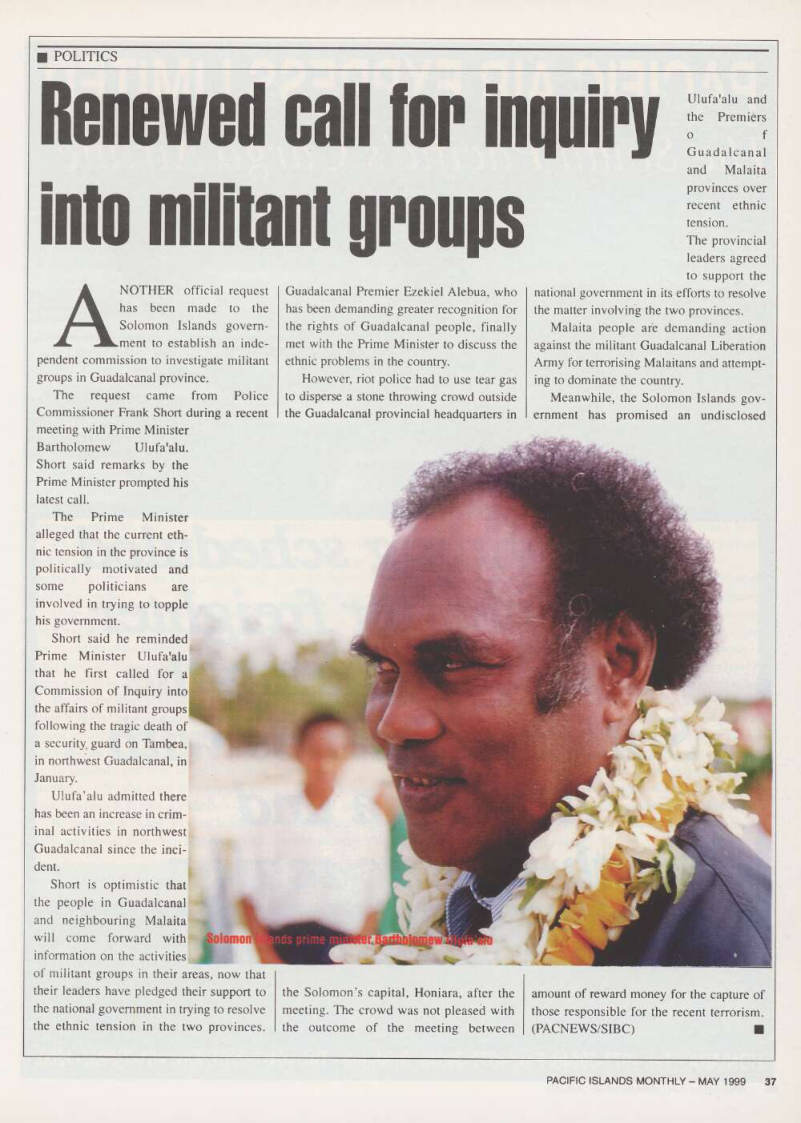
into militant groups
ANOTHER official request has been made to the Solomon Islands govern ment to establish an inde pendent commission to investigate militant groups in Guadalcanal province.
The request came from Police Commissioner Frank Short during a recent meeting with Prime Minister
Bartholomew Ulufa'alu.
Short said remarks by the Prime Minister prompted his latest call.
The Prime Minister alleged that the current eth nic tension in the province is politically motivated and some politicians are involved in trying to topple his government.
Short said he reminded Prime Minister Ulufa'alu that he first called for a Commission of Inquiry into the affairs of militant groups* following the tragic death of a security, guard on Tambea, in northwest Guadalcanal, in January.
Ulufa’alu admitted there has been an increase in crim inal activities in northwest Guadalcanal since the inci dent.
Short is optimistic that the people in Guadalcanal and neighbouring Malaita will come forward with information on the activities
of militant groups in their areas, now that their leaders have pledged their support to the national government in trying to resolve the ethnic tension in the two provinces.
Guadalcanal Premier Ezekiel Alebua, who has been demanding greater recognition for the rights of Guadalcanal people, finally met with the Prime Minister to discuss the ethnic problems in the country.
However, riot police had to use tear gas to disperse a stone throwing crowd outside the Guadalcanal provincial headquarters in
the Solomon’s capital, Honiara, after the meeting. The crowd was not pleased with the outcome of the meeting between
Ulufa'alu and the Premiers o f Guadalcanal and Malaita provinces over recent ethnic tension.
The provincial leaders agreed to support the
national government in its efforts to resolve the matter involving the two provinces.
Malaita people are demanding action against the militant Guadalcanal Liberation Army for terrorising Malaitans and attempt ing to dominate the country.
Meanwhile, the Solomon Islands gov ernment has promised an undisclosed
amount of reward money for the capture of those responsible for the recent terrorism,
(Pacnews/Sibc) ■
Solomon Islands prime minister Bartholomew Uluta'alu
Advertisements & other items, p. 38 (1 item)
Pacific Air Express Limited
The South Pacific's Cargo Airline tWSzBCTr?.
Providing scheduled and charter freighter services Jinking the Solomon Islands with Australia and South Pacific region.
PACIFIC AIR EXPR
The National Cargo Airline of the Solomon Islands HONIARA - Tel: +677-39248. Fax: +677-39343. Brisbane - Tel: +6l-7-3267. Fax: +6l-7-3267-1200.
Tonga recedes into 100 days of mourning
By Michael Field
TjHE death of a member of the Tongan royal family has proven to be a heavy economic blow for the kingdom already suffering from a deep recession.
Seventy seven year old Prince Fatefehi Tu’ipelehake, younger brother of King Taufa’ahau Tupou IV, died in Auckland on April 10, following a long illness.
In a strange breach of usually strict Tongan protocol his body was left in Auckland for six days and only returned for burial on April 17.
His death was not formally announced for a day.
The king declared the kingdom would go into 100 days of mourning from the day of bur ial and while its rules are particularly strict he was not following them. A couple of days later he flew to Auckland for a university graduation ceremony and a rest.
For his kingdom the long mourning period will be economically difficult for retailers and anybody involved in the entertainment and tourism industries.
Under the rules of the mourning process there can be no night clubs, no festivities or sports and the radio station must play hymns and Gospel music. In public every person must wear a formal funeral ta’ovala of waist mat.
The process affected Tonga’s bid to get into rugby’s World Cup with a game against South Korea moved forward a day so that it did not fall within the mourning period.
Tu’ipelehake had been severely ill since retiring in 1991 and lived at ‘Atalanga, the royal residency in Epsom, Auckland.
He was bom to Queen Salote on January 7, 1922, and named Sione Ngu Manumataongo.
He was educated at Gallon Agricultural College, Queensland, and at Newington College in Sydney.
On the death of Salote in 1965 his older brother, who had been prime minister, became king and appointed Tu’ipelehake to the life time tenure of prime minister.
After he had a stroke in 1991 he retired and Baron Vaea took over the position.
Tu’ipelehake was a strong advocate of the royal dominated political system.
“There are not many of us who have a clear understanding of what is going on beyond Tonga,” he said in a rare interview.
“Our local politicians are only good enough within Tonga, when we move out to the inter national arena I think this is the best approach for government to call in only our capable peo ple. We realise that most of our people have left for overseas. There may be somebody who is very very clever but he does not want to come back.”
Like a number of Pacific leaders Tu’ipelehake was a dedicated Christian and in later life become a fundamentalist, speaking in tongues and practising faith healing.
His wife, Melenaite, died in 1993. They had six children.
His relative obscurity was shown up by New Zealand’s response to it. When Samoan Prime Minister Tofilau Eti Alesana died in March Prime Minister Jenny Shipley, Foreign Minister Don McKinnon, Opposition Leader Helen Clark and a host of other minor party leaders loaded aboard an air force special flight for Apia.
For the Tongan funeral there was no special flight and the country was represented by Maori Affairs Minister Tau Henare who is not even a member of the ruling party.
The death coincided with a Pacific publish ing milestone, the release of the authoritative “Queen Salote of Tonga” by Elizabeth Wood- Ellem (Auckland University Press).
An member of the Press editorial board said the expensive book was selling extremely well and had already gone into a reprint, despite its at times controversial view of the reign of Salote from 1918 to 1965.
“The mythology of a beloved monarch that surrounds Queen Salote’s name has concealed her human qualities and obscured her very real political achievements,” Wood-Ellem writes.
She delivers some punches too.
“Since the death of Queen Salote in 1965, Tonga has been struggling with the forces of modem economics; so much so that change seems to be spinning out of control, and. Tonga survives only because about 40 per cent of its people live overseas,” she writes in the final paragraph.
Just about every aspect of Salote’s life is covered (right down to the physical suffering behind the birth of the current king).
The book does recount that media highlight of her life when, at the coronation of Elizabeth 11, she rode in a carriage in pouring rain with the roof down so people could see her - win ning the hearts of Londoners in the process.
“I told the policeman to leave the hood of our carriage down,” the Queen is quoted as say ing. “I did not think to ask the chief (the Sultan of Kelantan), and he maintained silence with good grace.” She does not repeat the famous line attributed to Noel Coward who, when asked who it was that was riding with the Tongan Queen, replied “her lunch”.
But something unprecedented can be found in the index of the book: “Coward, Noel, not mentioned”. ■
Paeniu voted out of PM post
TUVALU’S prime minister Bikenibeu Paeniu has been oust
ed by a surprise no-confidence vote of the 12-member parliament.
Tuvalu’s ambassador to Fiji, Enclc Sapoaga, confirmed that the vote taken April 14 was 7-4 against Paeniu, with speaker Tomu Sione abstaining. Sapoaga said there had been growing dissatisfaction with Pacniu’s leadership. When PIM went to press, Paeniu, an economist most recently re-elected in March 1998, was continuing as caretaker prime minister while parliamentarians prepared to elect his successor.
Paeniu became prime minister in 1994 after ousting his predecessor,
Kamuela Latasi, with a no confidence vote. Tuvalu is a
country of 9,000 people inhabiting nine small coral atolls 1,000 kilo metres north of Fiji, with a total land area of 27 square kilometres. It subsists on fishing licence fees, fishing, income from a national trust fund, earnings by seamen who work on foreign ships and foreign aid.
It also gets income believed to total more than US$l million (AUDS 1.58 million) annually from “sex chat” telephone calls operated by a foreign company authorised to use Tuvalu’s international country code number. (AP) ■
PRO-independence West
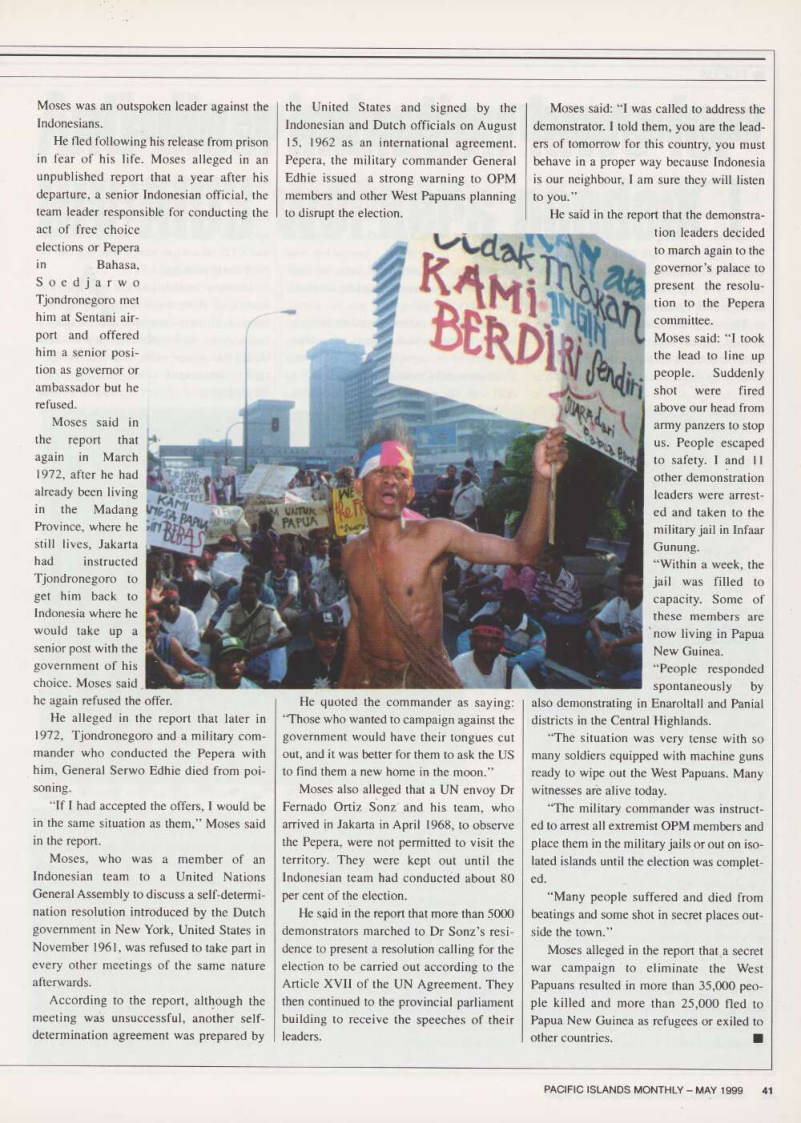
OPMRC steps up Irian Jayan campaign in PNG
By Sam Vulum
Papuan leaders in exile abroad have stepped up their activities to attract international exposure in support of recent political developments back home over the future of Indonesia’s western most province of Irian Jaya.
At least those living across the boarder in Papua New Guinea have been working quietly preparing their campaign strategies.
First up on their agenda is their partici pation in the Hague Appeal for Peace con ference in Netherlands, to be held from May 11 to 15.
In the forefront of the PNG campaign is the PNG-based Organisasi Papua Merdeka Revolutionary Council (OPMRC) chair Moses Werror.
Despite opposition from splinter pro independence groups in PNG being led by local human rights groups, Werror has had his mind set for the meeting and nothing will stop him.
Moses has been requested by those in Irian Jaya to discuss, at the Hague confer ence, a meeting between a coalition of West Papuan leaders and Indonesian President Dr B J Habibi and his cabinet at Istana Merdeka in Jakarta on February 26.
At the meeting, the West Papuan leaders signed a petition that, among other things, demanded an immediate creation of a sepa rate Papuan state in its long troublesome Irian Jayan province.
About 100 of them are signatories to the petition. They included five members of the Indonesian Parliament.
The leaders said in the petition that if their independence demand was not ful filled by March, they will call for an inter national conference to be held between Indonesia, West Papuan leaders and the
United Nations in April. Copies of the dia logue were sent to PNG, the UN, United States, the Netherlands, Australia, Germany, Canada, Japan, Switzerland, New Zealand, Belgium, Solomon Islands, Fiji, Norway, Ireland, the Philippines, Ghana, South Africa, Israel, Kenya and the European Union Parliament.
In response to the dialogue, President Habibi appealed for calm and urged the Irian leaders to return home and urge their people to consider alternatives other than
independence.
This latest development is unprecedent ed in the 38-year history of the indepen dence struggle of the Melanesians in Irian Jaya, for never before have they or their leaders been asked to place their wishes and aspirations freely and officially before the government without fearing any reprisals.
The delegation’s stand has come as a major shock, especially to the State offi cials, who, having excluded the more out spoken independence advocates such as the Chairman of the Irian Jaya Council of Traditional Chiefs, Theys Eluay, Chairman of the Combined Christian churches in Irian Jaya, Reverent Karel Philip Erari, and the province’s two former governors, Barnabas Suebu and Isaac Hindom, from the official delegation, were hoping for a vote for Irian to remain within the republic.
Meanwhile, the PNG-based Werror, has warned his people not to be captivated by the positive developments. Werror urged them to note that the developments are in line with the constitutional working guide of the OMPRC.
“I am not excited like the others because when we are excited, we cannot do any thing,” Werror said.
Talking from experience, Werror said he will not give until something concrete is done.
He said everything happened according
to the seven-stage strategy of the OPMRC, which it adopted during its inception on April 23, 1983.
The first stage was an act of free choice, which was observed between 1964 to 1969.
The OPMRC chief said the current developments are in line with the sixth stage of the plan the international recog nition of West Papua. They planned this to occur between 1994 and 1999.
The final stage, which is the establish ment of a West Papuan state, is expected to be achieved between 2000 and 2005.
Werror said instead of being excited about the events. West Papuans, including the OPMRC, should support the elected leaders in Irian Jaya to push their agenda through.
The OPMRC chief, who was in Port Moresby to meet with other West Papuan leaders to discuss the Jakarta meeting, was also preparing to attend the Hague meeting.
He has so far sent out appeal letters to various international organisations and individuals for donations to fund his trip to the meeting.
The conference, which is sponsored by the UN, will also be opened by UN secre tary-general Kofi Annan. Other notable speakers are Nobel Laureates Archbishop Desmond Tutu, Grace Machel and UNICEF’s executive director Carol Beltamy.
Werror said the conference will be an important part of their international cam paign and lobbying to establish diplomatic dialogue between the Netherlands, Indonesia, the US and West Papuan leaders to discuss the political independence of West Papua/Irian Jaya before 2000.
The OPMRC has adopted a “moderate policy” since its inception and its aims are to re-organise and revolutionise inside the organisation for unification of all factional groups in the OPM/West Papua struggle.
Moses, who was expected to lead the PNG delegation to the Hague meeting, has been around a lot longer than many of those in the struggle.
Moses, who was expected to lead the PNG delegation to the Hague meeting, has been around a lot longer than many of those in the struggle.
Before crossing over the PNG in 1971,
Moses was an outspoken leader against the Indonesians.
He fled following his release from prison in fear of his life. Moses alleged in an unpublished report that a year after his departure, a senior Indonesian official, the team leader responsible for conducting the
act of free choice elections or Pepera in Bahasa,
Soedjarwo
Tjondronegoro met
him at Sentani air port and offered him a senior posi tion as governor or ambassador but he refused.
Moses said in the report that again in March 1972, after he had already been living in the Madang Province, where he still lives, Jakarta had instructed
Tjondronegoro to
get him back to Indonesia where he would take up a senior post with the government of his choice. Moses said
he again refused the offer.
He alleged in the report that later in 1972, Tjondronegoro and a military com mander who conducted the Pepera with him, General Serwo Edhie died from poi
soning.
“If I had accepted the offers, I would be in the same situation as them,” Moses said in the report.
Moses, who was a member of an Indonesian team to a United Nations General Assembly to discuss a self-determi nation resolution introduced by the Dutch government in New York, United States in November 1961, was refused to take part in every other meetings of the same nature afterwards.
According to the report, although the meeting was unsuccessful, another self determination agreement was prepared by
the United States and signed by the Indonesian and Dutch officials on August 15, 1962 as an international agreement.
Pepera, the military commander General Edhie issued a strong warning to OPM members and other West Papuans planning to disrupt the election.
He quoted the commander as saying: “Those who wanted to campaign against the government would have their tongues cut out, and it was better for them to ask the US to find them a new home in the moon.”
Moses also alleged that a UN envoy Dr Fernado Ortiz Sonz and his team, who arrived in Jakarta in April 1968, to observe the Pepera, were not permitted to visit the territory. They were kept out until the Indonesian team had conducted about 80 per cent of the election.
He said in the report that more than 5000 demonstrators marched to Dr Sonz’s resi dence to present a resolution calling for the election to be carried out according to the Article XVII of the UN Agreement. They then continued to the provincial parliament building to receive the speeches of their leaders.
Moses said: “I was called to address the demonstrator. I told them, you are the lead ers of tomorrow for this country, you must behave in a proper way because Indonesia is our neighbour, I am sure they will listen to you.”
He said in the report that the demonstra
tion leaders decided to march again to the governor’s palace to present the resolu tion to the Pepera committee.
Moses said: “I took the lead to line up
people. Suddenly
shot were fired above our head from army panzers to stop us. People escaped to safety. I and 11 other demonstration leaders were arrest ed and taken to the military jail in Infaar Gunung.
“Within a week, the jail was filled to capacity. Some of these members are now living in Papua New Guinea.
“People responded spontaneously by
also demonstrating in Enaroltall and Panial districts in the Central Highlands.
“The situation was very tense with so many soldiers equipped with machine guns ready to wipe out the West Papuans. Many witnesses are alive today.
“The military commander was instruct ed to arrest all extremist OPM members and place them in the military jails or out on iso lated islands until the election was complet ed.
“Many people suffered and died from beatings and some shot in secret places out side the town.”
Moses alleged in the report that a secret war campaign to eliminate the West Papuans resulted in more than 35,000 peo ple killed and more than 25,000 fled to Papua New Guinea as refugees or exiled to other countries. ■
Regional AIDS/STD strategy gets the thumbs up
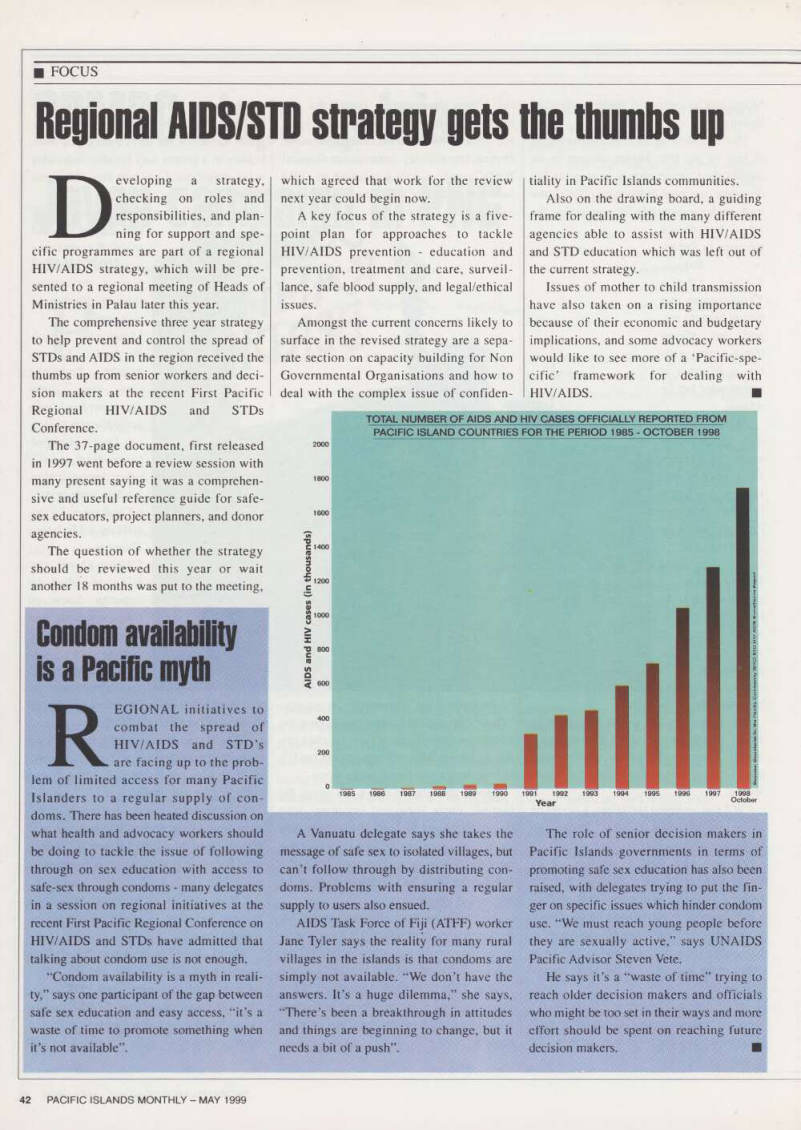
Focus
Developing a strategy, checking on roles and responsibilities, and plan ning for support and spe cific programmes are part of a regional HIV/AIDS strategy, which will be pre sented to a regional meeting of Heads of Ministries in Palau later this year.
The comprehensive three year strategy to help prevent and control the spread of STDs and AIDS in the region received the thumbs up from senior workers and deci sion makers at the recent First Pacific Regional HIV/AIDS and STDs Conference.
The 37-page document, first released in 1997 went before a review session with many present saying it was a comprehen sive and useful reference guide for safe sex educators, project planners, and donor agencies.
The question of whether the strategy should be reviewed this year or wait another 18 months was put to the meeting,
which agreed that work for the review next year could begin now.
A key focus of the strategy is a five point plan for approaches to tackle HIV/AIDS prevention - education and prevention, treatment and care, surveil lance, safe blood supply, and legal/ethical issues.
Amongst the current concerns likely to surface in the revised strategy are a sepa rate section on capacity building for Non Governmental Organisations and how to deal with the complex issue of confiden
tiality in Pacific Islands communities.
Also on the drawing board, a guiding frame for dealing with the many different agencies able to assist with HIV/AIDS and STD education which was left out of the current strategy.
Issues of mother to child transmission have also taken on a rising importance because of their economic and budgetary implications, and some advocacy workers would like to see more of a ‘Pacific-spe cific’ framework for dealing with
Hiv/Aids. ■
Condom availability
is a Pacific myth
Regional initiatives to combat the spread of
Hi V/Aids And Std’S
are facing up to the prob lem of limited access for many Pacific Islanders to a regular supply of con doms, There has been heated discussion on what health and advocacy workers should be doing to tackle the issue of following through on sex education with access to safe-sex through condoms - many delegates in a session on regional initiatives at the recent First Pacific Regional Conference on HIV/AIDS and STDs have admitted that talking about condom use is not enough.
“Condom availability is a myth in reali ty,” says one participant of the gap between safe sex education and easy access, “it’s a waste of time to promote something when it’s not available”.
A Vanuatu delegate says she takes the message of safe sex to isolated villages, but can’t follow through by distributing con doms. Problems with ensuring a regular supply to users also ensued.
AIDS Task Force of Fiji (ATFF) worker Jane Tyler says the reality for many rural villages in the islands is that condoms are simply not available. “We don’t have the answers. It’s a huge dilemma,” she says, “There’s been a breakthrough in attitudes and things are beginning to change, but it needs a bit of a push”.
The role of senior decision makers in Pacific Islands governments in terms of promoting safe sex education has also been raised, with delegates trying to put the fin ger on specific issues which hinder condom use. “We must reach young people before they are sexually active,” says UNAIDS Pacific Advisor Steven Vete.
He says it’s a “waste of time” trying to reach older decision makers and officials who might be too set in their ways and more effort should be spent on reaching future decision makers. ■
Anti-discrimination laws for HIV/AIDS workers needed

HIV/AIDS workers needed
Anti-discrimination
laws still don’t exist in the Pacific Islands to protect workers who find them selves living with HIV/AIDS.
The Suva office of the ILO (International Labour Organisation) says there’s a need for Pacific Islands govern ments to make workplaces more open to workers living with HIV/AIDS so that they can work as long as possible.
“HIV is most common to workers whether they be 15 or 40 years, they are productive, educated people and your economy depends on this generation of workers,” says ILO Fiji Programme Officer Margaret Reade Rounds.
She says without adequate planning in the workplace on the rights of workers and employers facing the reality of HIV/AIDS, economies face collapse. Rounds made the comments after a Pacific Islands woman living with HIV/AIDS told a regional HIV/AIDS meeting of being sacked once her employer found out she was HIV posi tive.
At least two other officials at the recent First Pacific Regional Conference on HIV/AIDS and STDs said it’s time for governments to bring in the changes.
The woman was infected by her hus band and lost a child to the virus before knowing about her condition. Her husband has since died, his family has rejected her and her older children, and she has virtual ly no means of financial support.
“HIV policies have not been highlight ed, and they should be,” says Rounds of current labour laws. She says the ILO office in Suva has not received a single formal complaint from any former worker sacked because they are HIV-positive, and blames that on lack of awareness.
“In the Pacific we don’t know what half our rights are, and we don’t know where to
look when those rights are challenged,” she says. She says employers and govern ments are not taking the discrimination issue seriously because the HIV/AIDS problem has not reached epidemic propor tions.
“People don’t realise what happens to
them if they become HIV-positive,” says Rounds. She says the fear that surrounds the virus often results to workplace dis crimination and there is no specific legis lation in the region to protect HIV-positive workers.
Fiji, Papua New Guinea and the Solomon Islands are signatories to the ILO convention and many Pacific Islands use the ILO to draft up their own Labour ordi nances.
However, the ILO international anti discrimination laws don’t specifically mention HIV/AIDS because it had not been identified when they were intro duced.
The ILO termination of employment convention does not specifically refer to ‘medical conditions’ as prohibited grounds for discrimination, prompting a call from
some observers for the terms to be extend ed to cover HIV/AIDS.
More legal comment on the rights of workers living with HIV/AIDS came from Miles Young of the Fiji Young Lawyers Association. In a paper presented to the conference Young says legislative mea
sures are part of the multi-sectoral approach needed to effectively fight the spread of HIV/AIDS.
“Until recently we in Fiji and the Pacific generally perceived HIV as a med ical or health issue,” Young says, poli cies were developed from a medical/health perspective with little regard for develop ing legal and human rights-based strate gies”.
He noted discrimination and human rights abuses, “are the experiences of peo ple with HIV the world over, more so in countries where there are no institution alised safeguards”.
A recent UNDP-funded review of human rights in Fiji found those with HIV are not protected from discrimination when refused private medical treatment or employment because of their condition. ■
Shakespeare with Polynesia
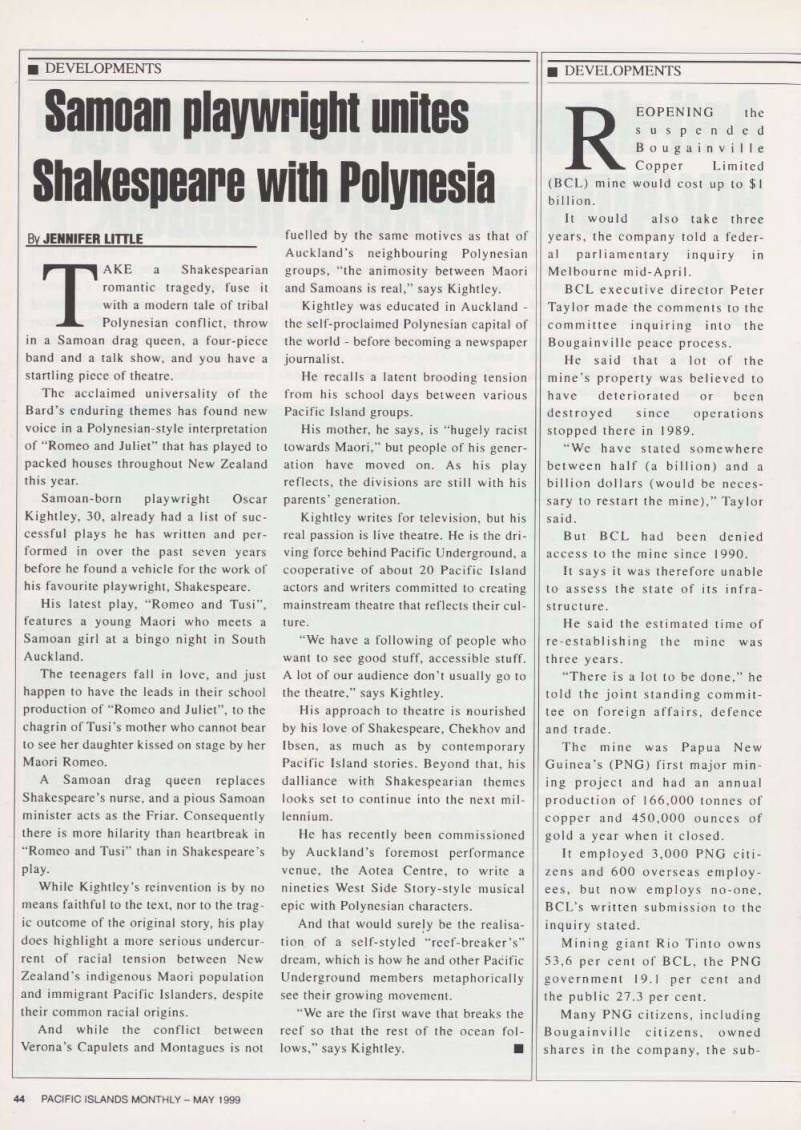
Samoan playwright unites Shakespeare with Polynesia
By Jennifer Little
TAKE a Shakespearian
romantic tragedy, fuse it with a modern tale of tribal Polynesian conflict, throw in a Samoan drag queen, a four-piece band and a talk show, and you have a
startling piece of theatre.
The acclaimed universality of the Bard’s enduring themes has found new voice in a Polynesian-style interpretation of “Romeo and Juliet” that has played to packed houses throughout New Zealand this year.
Samoan-born playwright Oscar Kightley, 30, already had a list of suc cessful plays he has written and per formed in over the past seven years before he found a vehicle for the work of his favourite playwright, Shakespeare.
His latest play, “Romeo and Tusi”, features a young Maori who meets a Samoan girl at a bingo night in South Auckland.
The teenagers fall in love, and just happen to have the leads in their school production of “Romeo and Juliet”, to the chagrin of Tusi’s mother who cannot bear to see her daughter kissed on stage by her Maori Romeo.
A Samoan drag queen replaces Shakespeare’s nurse, and a pious Samoan minister acts as the Friar. Consequently there is more hilarity than heartbreak in “Romeo and Tusi” than in Shakespeare’s play.
While Kightley’s reinvention is by no means faithful to the text, nor to the trag ic outcome of the original story, his play does highlight a more serious undercur rent of racial tension between New Zealand’s indigenous Maori population and immigrant Pacific Islanders, despite their common racial origins.
And while the conflict between Verona’s Capulets and Montagues is not
fuelled by the same motives as that of Auckland’s neighbouring Polynesian groups, “the animosity between Maori and Samoans is real,” says Kightley.
Kightley was educated in Auckland the self-proclaimed Polynesian capital of the world - before becoming a newspaper journalist.
He recalls a latent brooding tension from his school days between various Pacific Island groups.
His mother, he says, is “hugely racist towards Maori,” but people of his gener ation have moved on. As his play reflects, the divisions are still with his parents’ generation.
Kightley writes for television, but his real passion is live theatre. He is the dri ving force behind Pacific Underground, a cooperative of about 20 Pacific Island actors and writers committed to creating mainstream theatre that reflects their cul ture.
“We have a following of people who want to see good stuff, accessible stuff.
A lot of our audience don’t usually go to the theatre,” says Kightley.
His approach to theatre is nourished by his love of Shakespeare, Chekhov and Ibsen, as much as by contemporary Pacific Island stories. Beyond that, his dalliance with Shakespearian themes looks set to continue into the next mil lennium.
He has recently been commissioned by Auckland’s foremost performance venue, the Aotea Centre, to write a nineties West Side Story-style musical epic with Polynesian characters.
And that would surely be the realisa tion of a self-styled “reef-breaker’s” dream, which is how he and other Pacific Underground members metaphorically see their growing movement.
“We are the first wave that breaks the reef so that the rest of the ocean fol lows,” says Kightley. ■
Reopening the
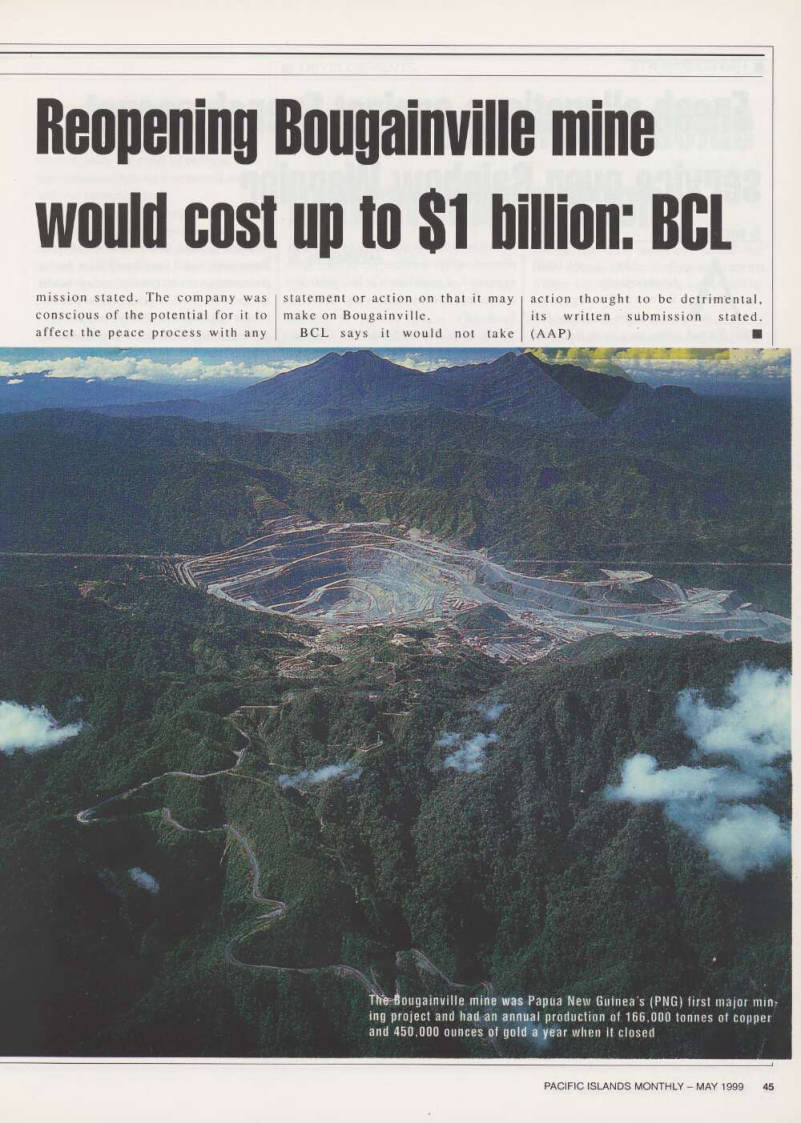
suspended
Bougainville
Copper Limited (BCE) mine would cost up to $1 billion.
It would also take three years, the company told a feder al parliamentary inquiry in Melbourne mid-April.
BCE executive director Peter Taylor made the comments to the committee inquiring into the Bougainville peace process.
He said that a lot of the mine’s property was believed to have deteriorated or been destroyed since operations stopped there in 1989.
“We have stated somewhere between half (a billion) and a billion dollars (would be neces sary to restart the mine),” Taylor said.
But BCE had been denied access to the mine since 1990.
It says it was therefore unable to assess the state of its infra structure.
He said the estimated time of re-establishing the mine was three years.
“There is a lot to be done,” he told the joint standing commit tee on foreign affairs, defence and trade.
The mine was Papua New Guinea’s (PNG) first major min ing project and had an annual production of 166,000 tonnes of copper and 450,000 ounces of gold a year when it closed.
It employed 3,000 PNG citi zens and 600 overseas employ ees, but now employs no-one, BCE’s written submission to the
inquiry stated.
Mining giant Rio Tinto owns 53,6 per cent of BCE, the PNG government 19.1 per cent and the public 27.3 per cent.
Many PNG citizens, including Bougainville citizens, owned shares in the company, the sub
Reopening Bougainville mine would cost up to $1 billion: BCL
mission stated. The company was conscious of the potential for it to affect the peace process with any
statement or action on that it may make on Bougainville.
BGL says it would not take
action thought to be detrimental, its written submission stated.
(Aap) ■
The-Bougainville mine was Papua New Guinea's (PNG) first major min ing project and had an annual production of 166,000 tonnes of copper and 450,000 ounces of gold a year when it closed
Advertisements & other items, p. 44 (1 item)
44
■ DEVELOPMENTS
PACIFIC ISLANDS MONTHLY - MAY 1999
■ DEVELOPMENTS
Fresh allegations against French secret
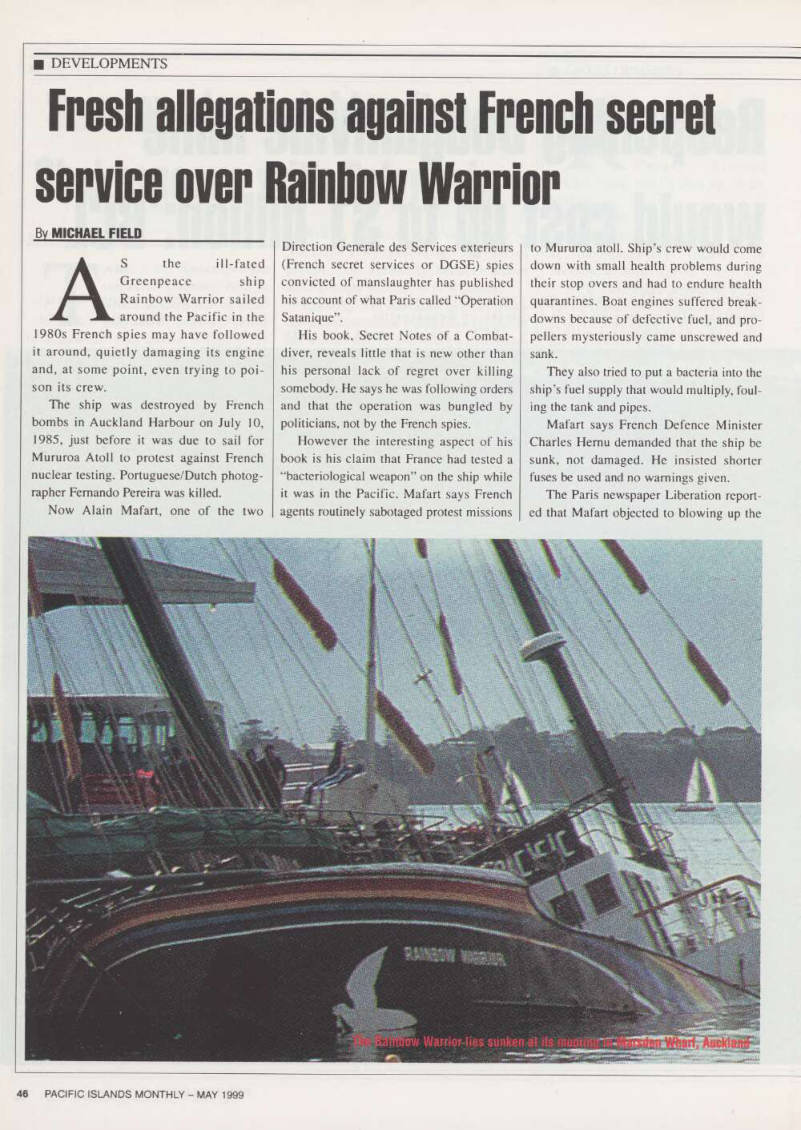
service over Rainbow Warrior
By Michael Field
AS the ill-fated
Greenpeace ship
Rainbow Warrior sailed around the Pacific in the 1980 s French spies may have followed it around, quietly damaging its engine and, at some point, even trying to poi son its crew.
The ship was destroyed by French bombs in Auckland Harbour on July 10, 1985, just before it was due to sail for Mururoa Atoll to protest against French nuclear testing. Portuguese/Dutch photog rapher Fernando Pereira was killed.
Now Alain Mafart, one of the two
Direction Generale des Services exterieurs (French secret services or DGSE) spies convicted of manslaughter has published his account of what Paris called “Operation
Satanique”.
His book, Secret Notes of a Combat diver, reveals little that is new other than his personal lack of regret over killing somebody. He says he was following orders and that the operation was bungled by politicians, not by the French spies.
However the interesting aspect of his book is his claim that France had tested a “bacteriological weapon” on the ship while it was in the Pacific. Mafart says French agents routinely sabotaged protest missions
to Mururoa atoll. Ship’s crew would come down with small health problems during their stop overs and had to endure health quarantines. Boat engines suffered break downs because of defective fuel, and pro pellers mysteriously came unscrewed and sank.
They also tried to put a bacteria into the ship’s fuel supply that would multiply, foul ing the tank and pipes.
Mafart says French Defence Minister Charles Hemu demanded that the ship be sunk, not damaged. He insisted shorter fuses be used and no warnings given.
The Paris newspaper Liberation report ed that Mafart objected to blowing up the
The Rainbow Warrior lies sunken at its mooring in Marsdon Whart, Auckland
Rainbow Warrior, saying it was “killing a fly with a hammer”.
“He has accepted that the orders he received were the result of political pres sure coming to bear on a weakened organ isation,” Liberation said.
Mafart says the agents made great attempts to place the bombs in an area away from cabins. He and his make believe wife, Dominique Prieur, heard on the radio next morning that the photogra pher had been killed.
“Catastrophe... Dominique and I are speechless. Both of our faces are etched in shock. Silence takes root,” Mafart wrote.
“But personal problems that this accident causes for each of us are not allowed, for the time being, to dominate. We have to carry on. We must pursue our mission.”
His book shows no remorse.
He now calls himself an Oecological soldierO and suggests he supports the environmental movement.
“Greenpeace was not the enemy. To us it was the nominated adversary. Not even so, it was just perceived as being in the way. So it became the designated target.
An agent does not discuss orders, as long as they are given by a democratically elected government, which was our situa tion.”
The Rainbow Warrior’s second engi neer, Hanne Sorensen, says she felt insult ed by claims the French never intended
killing anyone.
“When you plant two bombs on a manned ship in the middle of the night and don’t give any warning, you expect to kill people,” she said.
“Mafart’s expressions of regret are an insult. They were terrorists and murderers - nothing more”.
Greenpeace spokeswoman Stephanie
Mills said Mafart missed the point in his book.
“The point is, they killed someone,” she said.
“There’s no sense of any apology or any sense of personal regret. He seems to be saying something went wrong, but not with him or the secret service, but putting it all back on the politicians... but you can’t put two bombs on a ship and not expect to hurt someone”. ■
Singer commits suicide
in Hawaiian prison
By Ed Rampell
FAMED Hawaiian musician Mackey Feary was found hanged in his cell with a bedsheet at Halawa prison, Oahu, on February 20. The beloved lead singer of Kalapana had been sentenced in January to 10 years behind bars. Samoan judge Faaonga To’oto’o gave Feary the maximum sentence allowable by law for violating the terms of his probation following six months behind bars for drugs. Feary violated probation by terrorizing his former wife, Dana Lee Feary, smashing the windshield of her auto and demanding money for drugs. Feary also test ed positive last October for the drug crystal methamphetamine, or “ice”, and was permit ted to enter a residential drug treatment pro gram. But by January, he flunked another drug test, and was expelled from the pro gram.
Feary had pleaded to the court for treat ment, but received the maximum sentence instead. Questions about Feary’s suicide, just days after the popular, handsome 42 year old musician returned to jail, are being raised.
Feary left a scathing suicide note addressed to his attorney, asking: “please don’t let my death be in vain. Publish this letter with as much media exposure as possible. Let the world know how unfair the State of Hawaii is to those of us with our special type of med ical problem”.
To Deputy Prosecutor Maurice Arrisgado, he left these chilling words: “May you bum in hell and be judged also.” And to Circuit Court Judge To’oto’o: “may God judge you just as partially as you have judged others”.
Critics say that Feary had a history of sui cidal tendencies, and was taking a prescribed, legal anti-depressant drug. In 1996, he tried to hang himself with a T-shirt at the Pearl City police facility. The Feary family is suing the State, claiming authorities were negli gent. Hawaii’s Public Safety Director Ted Sakai said that Feary was not considered a
suicide risk. Law enforcers claimed that Feary refused to take responsibility for his actions, and blamed everyone but himself for his woes.
Kalapana emerged in the 1970 s as part of the Hawaiian Renaissance, along with other musical groups such as Cecilio & Kapono and Olomana (one of its members also died a drug-related death). Mackey was Kalapana’s lead singer and songwriter. Kalapana’s hits included Nightbird, The Hurt, For You Fd Chase a Rainbow, Juliette, and Moon and Stars. Kalapana toured the Pacific Islands; this writer saw Kalapana in Guam in the 1980 s. There, Kalapana was inspired by a lovely Chamorro village to pen the poignant ballad ‘lnarajan’, which pays homage to this traditional Guamanian hamlet.
The singer/writer was laid to rest March 6 at a funeral at Kaneohe’s Hawaiian Memorial Park attended by many, including numerous Hawaii musicians. Comrades such as Brother Noland performed at the services. Kalapana bandmate Malani Bilyeu appropriately played an acoustic version of ‘Nightbird’.
Popular Hawaiian deejay Brickwood Galuteria eulogized Mackey as “Hawaii’s Paul McCartney”.
After the burial, balloons inscribed with the lyrics, ‘Nightbird, fly on’, were released, as the crowd held hands, sang Hawaii Aloha, and watched the balloons soar above the Koolau Mountain range.
Just days after Mackey’s suicide, another inmate was found hanged at the same Oahu prison. On the morning of February 23, a man from the island of Molokai, who is believed to be Native Hawaiian, apparently hanged himself with a bedsheet in his cell.
This is the fourth prisoner who died by apparently hanging himself with a bedsheet in a Hawaii prison in just five weeks.
Three of them, including Feary, died at Halawa, an overcrowded, underfunded prison outside of Honolulu, disproportionate ly filled with Polynesian prisoners. ■
Advertisements & other items, p. 47 (1 item)
■ Developments
"Beyond Paradise" returns to paradise
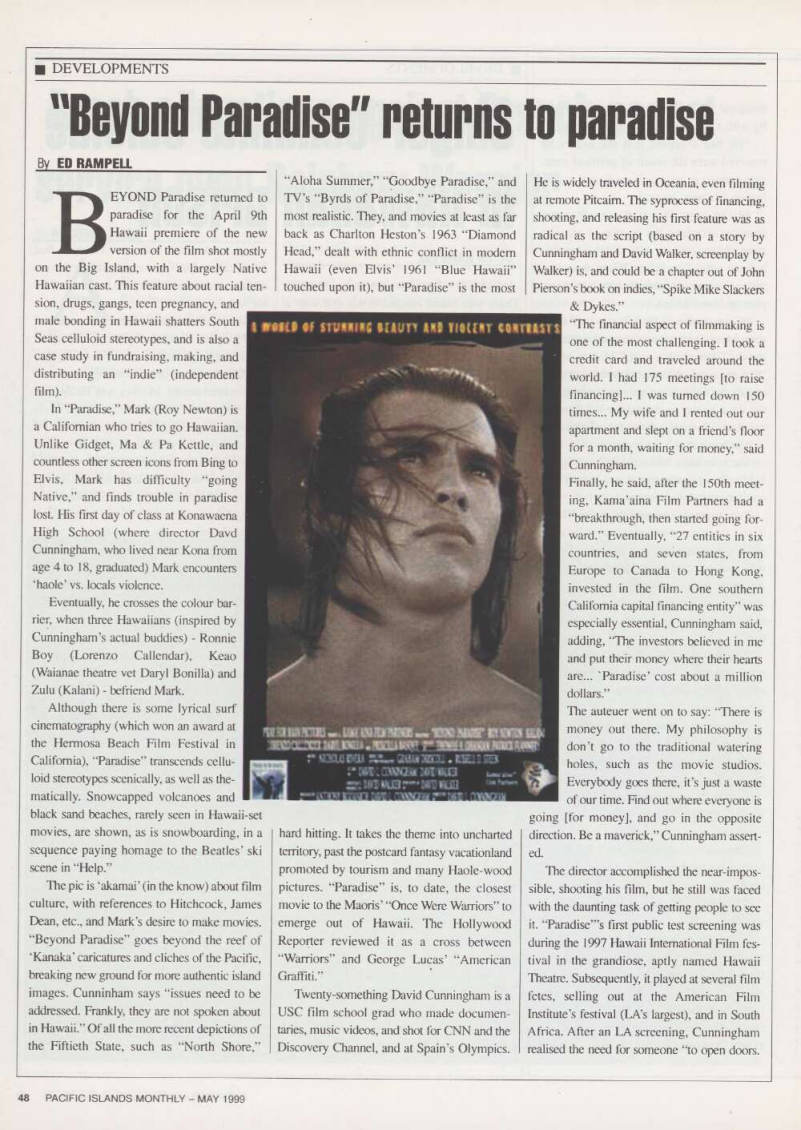
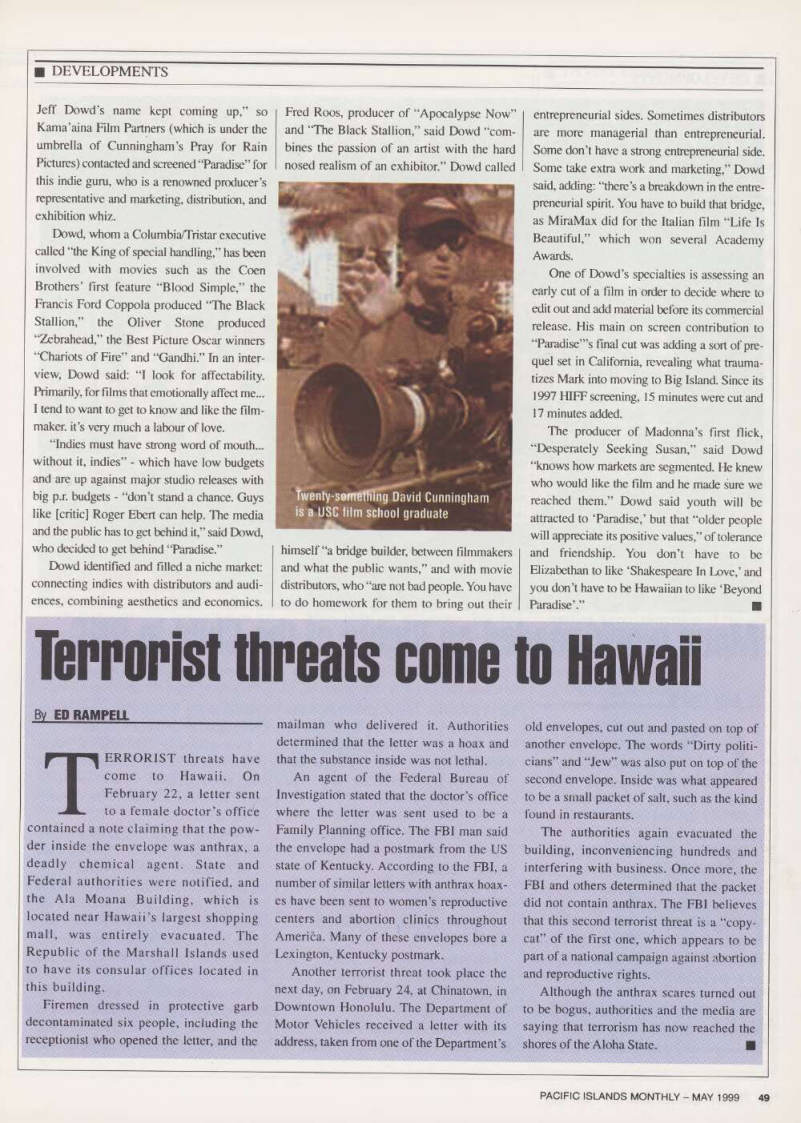
By Ed Rampell
BEYOND Paradise returned to paradise for the April 9th Hawaii premiere of the new version of the film shot mostly on the Big Island, with a largely Native Hawaiian cast. This feature about racial ten
sion, drugs, gangs, teen pregnancy, and male bonding in Hawaii shatters South Seas celluloid stereotypes, and is also a case study in fundraising, making, and
distributing an “indie” (independent
film).
In “Paradise,” Mark (Roy Newton) is a Californian who tries to go Hawaiian.
Unlike Gidget, Ma & Pa Kettle, and countless other screen icons from Bing to Elvis, Mark has difficulty “going Native,” and finds trouble in paradise lost. His first day of class at Konawaena High School (where director Davd Cunningham, who lived near Kona from age 4 to 18, graduated) Mark encounters ‘haole’ vs. locals violence.
Eventually, he crosses the colour bar rier, when three Hawaiians (inspired by Cunningham’s actual buddies) - Ronnie Boy (Lorenzo Callendar), Keao (Waianae theatre vet Daryl Bonilla) and Zulu (Kalani) - befriend Mark.
Although there is some lyrical surf cinematography (which won an award at the Hermosa Beach Film Festival in California), “Paradise” transcends cellu loid stereotypes scenically, as well as the
matically. Snowcapped volcanoes and
black sand beaches, rarely seen in Hawaii-set movies, are shown, as is snowboarding, in a sequence paying homage to the Beatles’ ski scene in “Help.”
The pic is ‘akamai’ (in the know) about film culture, with references to Hitchcock, James Dean, etc., and Mark’s desire to make movies.
“Beyond Paradise” goes beyond the reef of ‘Kanaka’ caricatures and cliches of the Pacific, breaking new ground for more authentic island images. Cunninham says “issues need to be addressed. Frankly, they are not spoken about in Hawaii.” Of all the more recent depictions of the Fiftieth State, such as “North Shore,”
“Aloha Summer,” “Goodbye Paradise,” and TV’s “Byrds of Paradise,” “Paradise” is the most realistic. They, and movies at least as far back as Charlton Heston’s 1963 “Diamond Head,” dealt with ethnic conflict in modem Hawaii (even Elvis’ 1961 “Blue Hawaii” touched upon it), but “Paradise” is the most
hard hitting. It takes the theme into uncharted territory, past the postcard fantasy vacationland promoted by tourism and many Haole-wood pictures. “Paradise” is, to date, the closest movie to the Maoris’ “Once Were Warriors” to emerge out of Hawaii. The Hollywood Reporter reviewed it as a cross between “Warriors” and George Lucas’ “American Graffiti.”
Twenty-something David Cunningham is a USC film school grad who made documen taries, music videos, and shot for CNN and the Discovery Channel, and at Spain’s Olympics.
He is widely traveled in Oceania, even filming at remote Pitcairn. The syprocess of financing, shooting, and releasing his first feature was as radical as the script (based on a story by Cunningham and David Walker, screenplay by Walker) is, and could be a chapter out of John Pierson’s book on indies, “Spike Mike Slackers
& Dykes.”
“The financial aspect of filmmaking is one of the most challenging. I took a credit card and traveled around the world. I had 175 meetings [to raise financing]... I was turned down 150 times... My wife and I rented out our apartment and slept on a friend’s floor for a month, waiting for money,” said Cunningham.
Finally, he said, after the 150th meet ing, Kama’aina Film Partners had a “breakthrough, then started going for ward.” Eventually, “27 entities in six countries, and seven states, from Europe to Canada to Hong Kong, invested in the film. One southern California capital financing entity” was especially essential, Cunningham said, adding, “The investors believed in me and put their money where their hearts are... 'Paradise’ cost about a million dollars.”
The auteuer went on to say: “There is money out there. My philosophy is don’t go to the traditional watering holes, such as the movie studios.
Everybody goes there, it’s just a waste of our time. Find out where everyone is
going [for money], and go in the opposite direction. Be a maverick,” Cunningham assert ed.
The director accomplished the near-impos sible, shooting his film, but he still was faced with the daunting task of getting people to see it. “Paradise’”s first public test screening was during the 1997 Hawaii International Film fes tival in the grandiose, aptly named Hawaii Theatre. Subsequently, it played at several film fetes, selling out at the American Film Institute’s festival (LA’s largest), and in South Africa. After an LA screening, Cunningham realised the need for someone “to open doors.
Jeff Dowd’s name kept coming up,” so Kama’aina Film Partners (which is under the umbrella of Cunningham’s Pray for Rain Pictures) contacted and screened “Paradise” for this indie guru, who is a renowned producer’s representative and marketing, distribution, and exhibition whiz.
Dowd, whom a Columbia/Tristar executive called “the King of special handling,” has been involved with movies such as the Coen Brothers’ first feature “Blood Simple,” the Francis Ford Coppola produced “The Black Stallion,” the Oliver Stone produced “Zebrahead,” the Best Picture Oscar winners “Chariots of Fire” and “Gandhi.” In an inter view, Dowd said: “I look for affectability.
Primarily, for films that emotionally affect me...
I tend to want to get to know and like the film maker. it’s very much a labour of love.
“Indies must have strong word of mouth... without it, indies” - which have low budgets and are up against major studio releases with big p.r. budgets - “don’t stand a chance. Guys like [critic] Roger Ebert can help. The media and the public has to get behind it,” said Dowd, who decided to get behind “Paradise.”
Dowd identified and filled a niche market; connecting indies with distributors and audi ences, combining aesthetics and economics.
Fred Roos, producer of “Apocalypse Now” and “The Black Stallion,” said Dowd “com bines the passion of an artist with the hard nosed realism of an exhibitor.” Dowd called
himself “a bridge builder, between filmmakers and what the public wants,” and with movie distributors, who “are not bad people. You have to do homework for them to bring out their
entrepreneurial sides. Sometimes distributors are more managerial than entrepreneurial.
Some don’t have a strong entrepreneurial side.
Some take extra work and marketing,” Dowd said, adding: “there’s a breakdown in the entre preneurial spirit. You have to build that bridge, as Mira Max did for the Italian film “Life Is Beautiful,” which won several Academy Awards.
One of Dowd’s specialties is assessing an early cut of a film in order to decide where to edit out and add material before its commercial release. His main on screen contribution to “Paradise’”s final cut was adding a sort of pre quel set in California, revealing what trauma tizes Mark into moving to Big Island. Since its 1997 HIFF screening, 15 minutes were cut and 17 minutes added.
The producer of Madonna’s first flick, “Desperately Seeking Susan,” said Dowd “knows how markets are segmented. He knew who would like the film and he made sure we reached them.” Dowd said youth will be attracted to ‘Paradise,’ but that “older people will appreciate its positive values,” of tolerance and friendship. You don’t have to be Elizabethan to like ‘Shakespeare In Love,’ and you don’t have to be Hawaiian to like ‘Beyond Paradise’.” ■
Twenly-semething David Cunningham is a USC film school graduate
Terrorist threats come to Hawaii
By Ed Rampell
Terrorist threats have come to Hawaii. On February 22, a letter sent to a female doctor’s office contained a note claiming that the pow der inside the envelope was anthrax, a deadly chemical agent. State and Federal authorities were notified, and the Ala Moana Building, which is located near Hawaii’s largest shopping mall, was entirely evacuated. The Republic of the Marshall Islands used to have its consular offices located in
this building.
Firemen dressed in protective garb decontaminated six people, including the receptionist who opened the letter, and the
mailman who delivered it. Authorities determined that the letter was a hoax and that the substance inside was not lethal.
An agent of the Federal Bureau of Investigation stated that the doctor’s office where the letter was sent used to be a Family Planning office. The FBI man said the envelope had a postmark from the US state of Kentucky. According to the FBI, a number of similar letters with anthrax hoax es have been sent to women’s reproductive centers and abortion clinics throughout America. Many of these envelopes bore a
Lexington, Kentucky postmark.
Another terrorist threat took place the next day, on February 24, at Chinatown, in Downtown Honolulu. The Department of Motor Vehicles received a letter with its address, taken from one of the Department’s
old envelopes, cut out and pasted on top of another envelope. The words “Dirty politi cians” and “Jew” was also put on top of the second envelope. Inside was what appeared to be a small packet of salt, such as the kind found in restaurants.
The authorities again evacuated the
building, inconveniencing hundreds and
interfering with business. Once more, the FBI and others determined that the packet did not contain anthrax. The FBI believes that this second terrorist threat is a “copy cat” of the first one, which appears to be part of a national campaign against abortion and reproductive rights.
Although the anthrax scares turned out to be bogus, authorities and the media are saying that terrorism has now reached the shores of the Aloha State. ■
More work needed on Rights of the Child in PNG
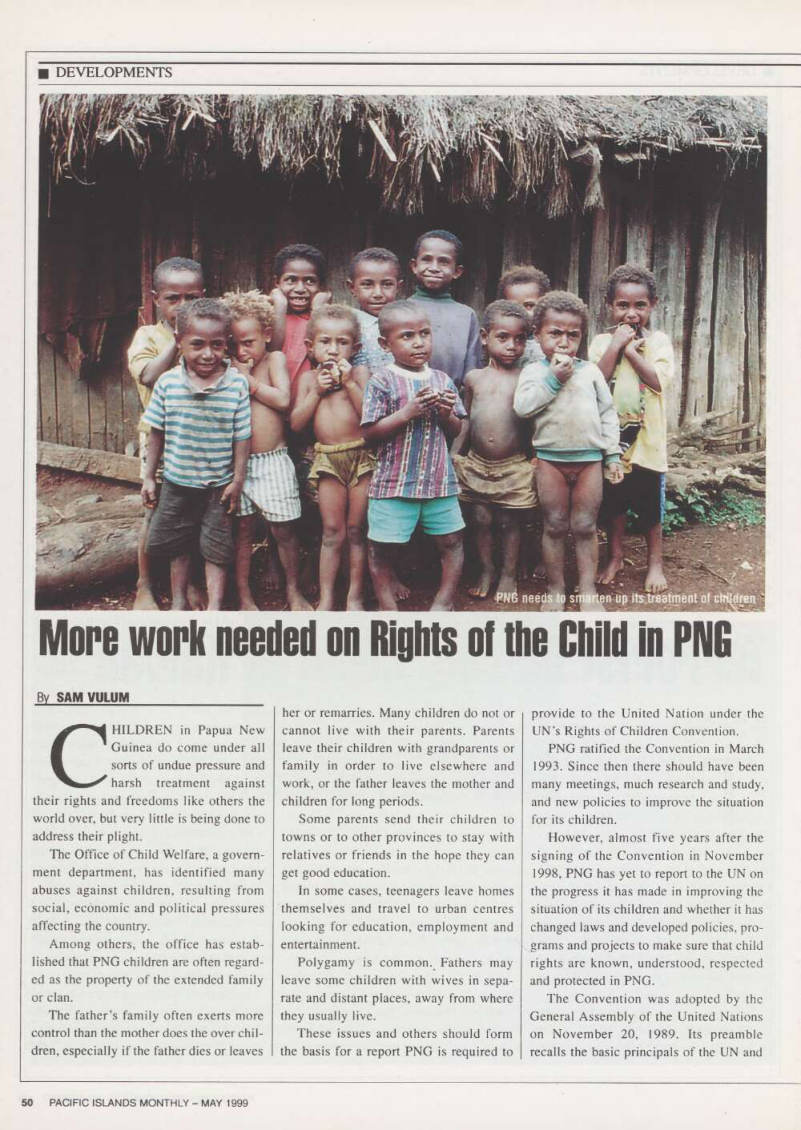
By Sam Vulum
CHILDREN in Papua New Guinea do come under all sorts of undue pressure and harsh treatment against their rights and freedoms like others the world over, but very little is being done to address their plight.
The Office of Child Welfare, a govern ment department, has identified many abuses against children, resulting from social, economic and political pressures affecting the country.
Among others, the office has estab lished that PNG children are often regard ed as the property of the extended family or clan.
The father’s family often exerts more control than the mother does the over chil dren, especially if the father dies or leaves
her or remarries. Many children do not or cannot live with their parents. Parents leave their children with grandparents or family in order to live elsewhere and work, or the father leaves the mother and children for long periods.
Some parents send their children to towns or to other provinces to stay with relatives or friends in the hope they can get good education.
In some cases, teenagers leave homes themselves and travel to urban centres looking for education, employment and entertainment.
Polygamy is common. Fathers may leave some children with wives in sepa rate and distant places, away from where they usually live.
These issues and others should form the basis for a report PNG is required to
provide to the United Nation under the UN’s Rights of Children Convention.
PNG ratified the Convention in March 1993. Since then there should have been many meetings, much research and study, and new policies to improve the situation for its children.
However, almost five years after the signing of the Convention in November 1998, PNG has yet to report to the UN on the progress it has made in improving the situation of its children and whether it has
changed laws and developed policies, pro
grams and projects to make sure that child rights are known, understood, respected and protected in PNG.
The Convention was adopted by the General Assembly of the United Nations on November 20, 1989. Its preamble recalls the basic principals of the UN and
PNG needs to smarten up its treatment of children
specific provisions of certain relevant human rights treaties and proclamations.
It reaffirms that children, because of their vulnerability, need special care and protection, and it places special emphasis on the primary caring and protective responsibility of the family.
It also reaffirms the need for legal and other protection of the child before and after birth, the importance of respect for the cultural values of the child’s communi ty, and the vital role of international coop eration in securing children’s rights.
A working committee, comprising the Child Welfare Office, the Office of
Implementation and National Planning,
other government departments and non government agencies has just been formed, and is working together to prepare the first Country Report.
The committee is being supported by the UNICEF.
The Convention Rights of Child (CRC) committee has invited government depart ments, churches and non government organisations to present facts and figures to help it understand and write honestly and accurately about the rights of the chil dren in PNG.
The committee has also called on the general public all over PNG in villages, districts and provinces to provide facts, figures, stories and their honest view on the situation regarding the rights of children.
The CRC coordinator Betty Billy has expressed that PNG has fallen far behind in its reporting obligations.
“The first report is now three years overdue. Out of all countries, we are one of the three that have failed to produce a report,” she said.
Billy said periodic reports are due very five years after the initial report, or if the initial report is overdue, five years after the date the initial report was made.
“PNG needs to produce a report now. If we can submit that report by January 1999, to try to catch up on all other reviews, reforms, institution building that genuine commitment to and implementation of the convention entail,” Billy said.
She said political endorsement and sup port at the highest level is urgently needed to give full impact to these strategies and
mandate to the working committee to pro ceed with the production of the draft initial report on the behalf of the government of
Png.
In PNG, it used to be said that there are no unwanted children, and that the extend ed family would always love and provide, yet many children are mistreated in their adoptive homes, are out on their own in the streets, are working as cheap or unpaid domestic labourers.
There are also reports of newborn babies being dumped or sold and many teenage mothers birth who end up in hospi tal nurseries and adoption homes.
Many children do not get a chance to go to school. Some have to leave because they cannot pay fees, have to work at home or are being punished by parents or teachers.
Girls are often kept out of school.
Children are expected to work from an early age. Girls are usually expected to work more and harder than boys in the house, gardens, fishing, gathering, market ing, baby-sitting.
Some people seriously and cruelly over work young children in house and in gar dens. Others employ young people so that they can pay them less.
Many births are also unsafe. Too many mothers and newborn babies are dying.
Many children do not get immunised and die from preventable diseases.
Mothers with sick children and youth are often denied proper treatment at health facilities, and they die unnecessarily.
Many husbands prevent their wives from attending meetings, joining groups to learn more about child health and child care, or changing their behaviour to protect their health and the health of their families.
Children with disabilities often die at an early age. But those that survive, are ridiculed, neglected or kept in the house, out of school and out of sight. There are some special services for children with dis abilities but not enough. All over the world, sexual abuse and other forms of child abuse are common.
PNG is no different. Urban crowding and poverty also lead to child prostitution and national, cultural and religious pride make many people conceal or deny these
problems. ■
Cruising with children
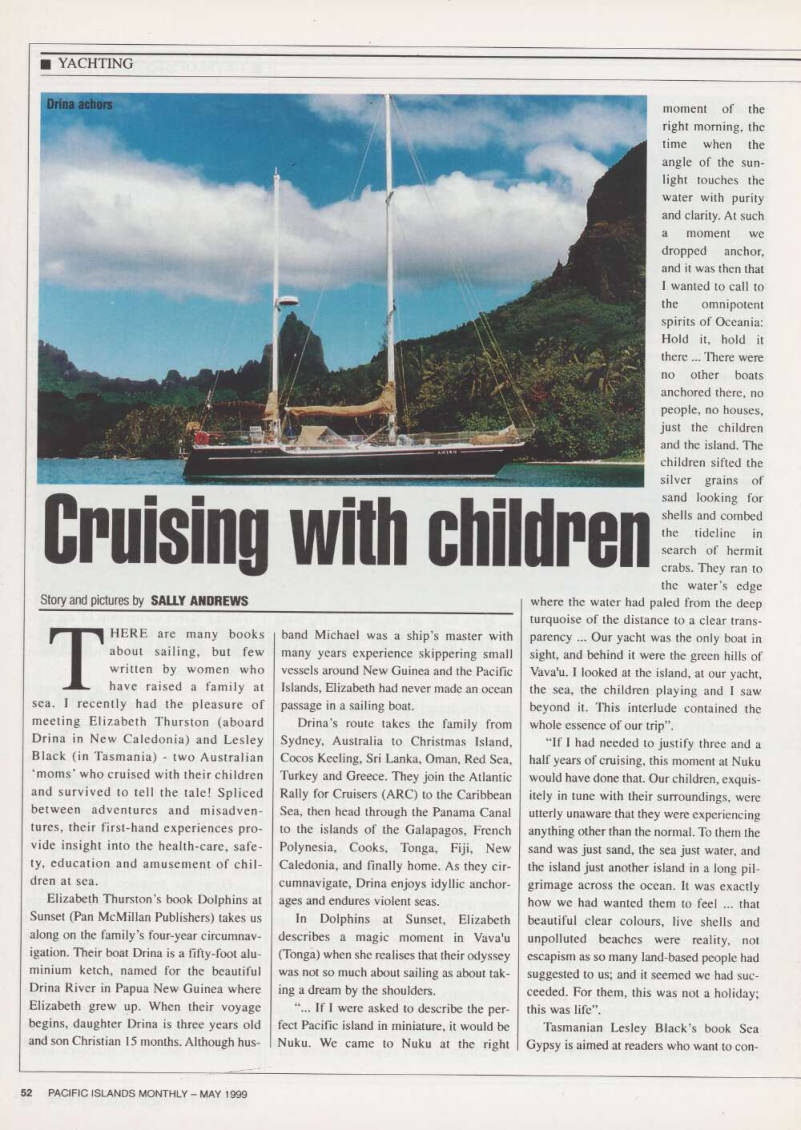
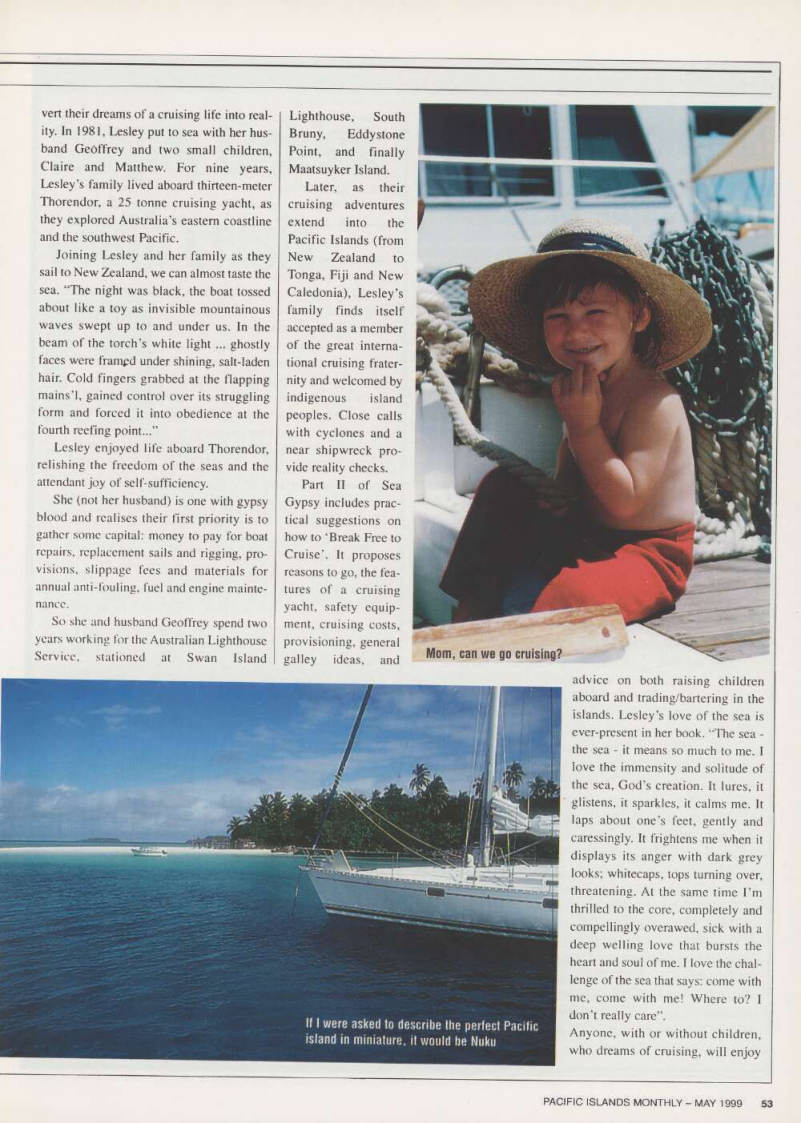
Story and pictures by SALLY ANDREWS
THERE are many books about sailing, but few written by women who have raised a family at sea. I recently had the pleasure of meeting Elizabeth Thurston (aboard Drina in New Caledonia) and Lesley Black (in Tasmania) - two Australian ‘moms’ who cruised with their children and survived to tell the tale! Spliced between adventures and misadven tures, their first-hand experiences pro vide insight into the health-care, safe ty, education and amusement of chil dren at sea.
Elizabeth Thurston’s book Dolphins at Sunset (Pan McMillan Publishers) takes us
along on the family’s four-year circumnav
igation. Their boat Drina is a fifty-foot alu minium ketch, named for the beautiful Drina River in Papua New Guinea where Elizabeth grew up. When their voyage begins, daughter Drina is three years old and son Christian 15 months. Although hus
band Michael was a ship’s master with many years experience skippering small vessels around New Guinea and the Pacific Islands, Elizabeth had never made an ocean passage in a sailing boat.
Drina’s route takes the family from Sydney, Australia to Christmas Island, Cocos Keeling, Sri Lanka, Oman, Red Sea, Turkey and Greece. They join the Atlantic Rally for Cruisers (ARC) to the Caribbean Sea, then head through the Panama Canal to the islands of the Galapagos, French
Polynesia, Cooks, Tonga, Fiji, New
Caledonia, and finally home. As they cir cumnavigate, Drina enjoys idyllic anchor ages and endures violent seas.
In Dolphins at Sunset, Elizabeth describes a magic moment in Vava'u (Tonga) when she realises that their odyssey was not so much about sailing as about tak ing a dream by the shoulders.
“... If I were asked to describe the per fect Pacific island in miniature, it would be Nuku. We came to Nuku at the right
moment of the
right morning, the
time when the angle of the sun light touches the water with purity and clarity. At such a moment we dropped anchor, and it was then that I wanted to call to
the omnipotent
spirits of Oceania: Hold it, hold it there ... There were no other boats anchored there, no people, no houses, just the children and the island. The children sifted the silver grains of sand looking for shells and combed the tideline in search of hermit crabs. They ran to the water’s edge
where the water had paled from the deep turquoise of the distance to a clear trans parency ... Our yacht was the only boat in sight, and behind it were the green hills of Vava'u. I looked at the island, at our yacht, the sea, the children playing and I saw beyond it. This interlude contained the whole essence of our trip”.
“If I had needed to justify three and a half years of cruising, this moment at Nuku would have done that. Our children, exquis itely in tune with their surroundings, were utterly unaware that they were experiencing anything other than the normal. To them the sand was just sand, the sea just water, and the island just another island in a long pil grimage across the ocean. It was exactly how we had wanted them to feel ... that beautiful clear colours, live shells and unpolluted beaches were reality, not escapism as so many land-based people had suggested to us; and it seemed we had suc ceeded. For them, this was not a holiday; this was life”.
Tasmanian Lesley Black’s book Sea Gypsy is aimed at readers who want to con
Drina achors
vert their dreams of a cruising life into real ity. In 1981, Lesley put to sea with her hus band Geoffrey and two small children, Claire and Matthew. For nine years, Lesley’s family lived aboard thirteen-meter Thorendor, a 25 tonne cruising yacht, as they explored Australia’s eastern coastline and the southwest Pacific.
Joining Lesley and her family as they sail to New Zealand, we can almost taste the sea. “The night was black, the boat tossed about like a toy as invisible mountainous waves swept up to and under us. In the beam of the torch’s white light ... ghostly faces were framed under shining, salt-laden hair. Cold fingers grabbed at the Happing mains’l, gained control over its struggling form and forced it into obedience at the fourth reefing point...”
Lesley enjoyed life aboard Thorendor, relishing the freedom of the seas and the attendant joy of self-sufficiency.
She (not her husband) is one with gypsy blood and realises their first priority is to gather some capital: money to pay for boat repairs, replacement sails and rigging, pro visions, slippage fees and materials for annual anti-louling, fuel and engine mainte nance.
So she and husband Geoffrey spend two years working for the Australian Lighthouse Service, stationed at Swan Island
Lighthouse, South
Bruny, Eddystone
Point, and finally Maatsuyker Island.
Later, as their cruising adventures extend into the Pacific Islands (from New Zealand to Tonga, Fiji and New Caledonia), Lesley’s family finds itself accepted as a member of the great interna tional cruising frater nity and welcomed by indigenous island peoples. Close calls with cyclones and a near shipwreck pro vide reality checks.
Part II of Sea Gypsy includes prac tical suggestions on how to ‘Break Free to Cruise’. It proposes reasons to go, the fea tures of a cruising yacht, safety equip ment, cruising costs, provisioning, general galley ideas, and
advice on both raising children aboard and trading/bartering in the islands. Lesley’s love of the sea is ever-present in her book. “The sea the sea - it means so much to me. I love the immensity and solitude of the sea, God’s creation. It lures, it glistens, it sparkles, it calms me. It laps about one’s feet, gently and caressingly. It frightens me when it displays its anger with dark grey looks; whitecaps, tops turning over, threatening. At the same time I’m thrilled to the core, completely and compellingly overawed, sick with a deep welling love that bursts the heart and soul of me. I love the chal lenge of the sea that says: come with me, come with me! Where to? I don’t really care”.
Anyone, with or without children, who dreams of cruising, will enjoy
Mom, can we go cruising?
If I were asked to describe the perfect Pacific island in miniature, it would be Nuku
Genetic modification
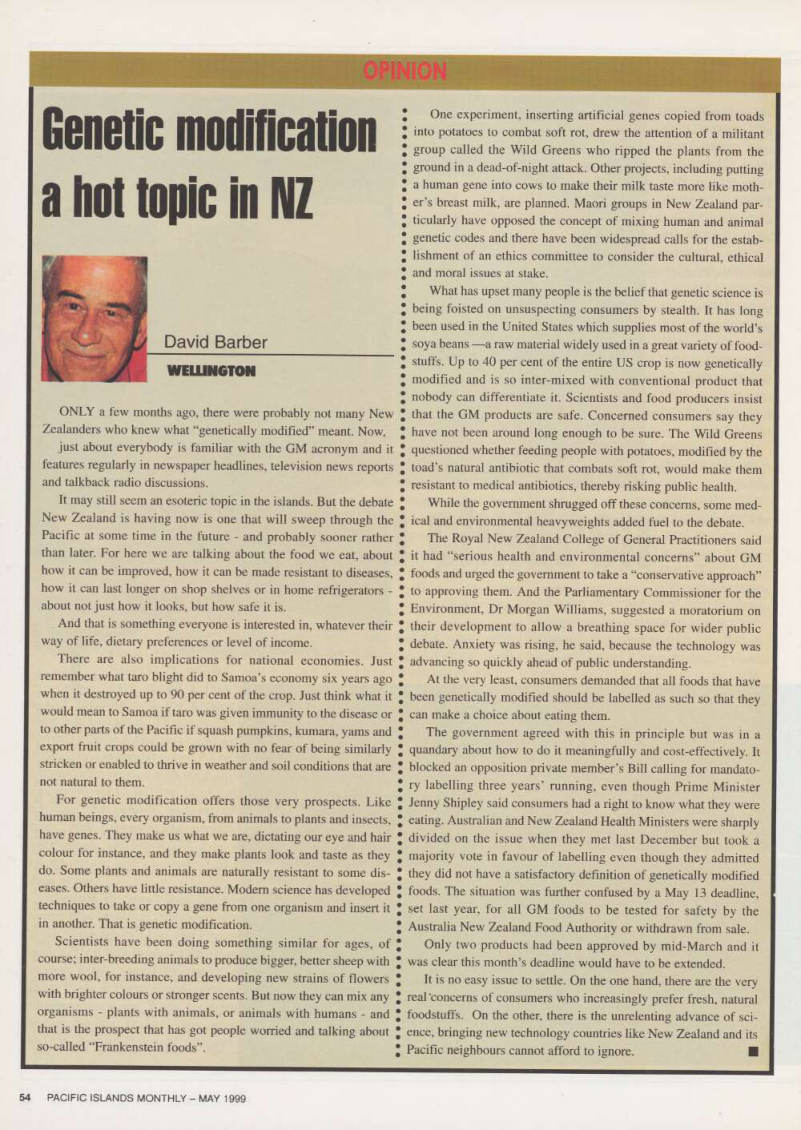
a hot topic in NZ
Opinion
ONLY a few months ago, there were probably not many New Zealanders who knew what “genetically modified” meant. Now, just about everybody is familiar with the GM acronym and it features regularly in newspaper headlines, television news reports and talkback radio discussions.
It may still seem an esoteric topic in the islands. But the debate New Zealand is having now is one that will sweep through the Pacific at some time in the future - and probably sooner rather than later. For here we are talking about the food we eat, about how it can be improved, how it can be made resistant to diseases, how it can last longer on shop shelves or in home refrigerators about not just how it looks, but how safe it is.
And that is something everyone is interested in, whatever their way of life, dietary preferences or level of income.
There are also implications for national economies. Just remember what taro blight did to Samoa’s economy six years ago when it destroyed up to 90 per cent of the crop. Just think what it would mean to Samoa if taro was given immunity to the disease or to other parts of the Pacific if squash pumpkins, kumara, yams and export fruit crops could be grown with no fear of being similarly stricken or enabled to thrive in weather and soil conditions that are not natural to them.
For genetic modification offers those very prospects. Like human beings, every organism, from animals to plants and insects, have genes. They make us what we are, dictating our eye and hair colour for instance, and they make plants look and taste as they do. Some plants and animals are naturally resistant to some dis eases. Others have little resistance. Modem science has developed techniques to take or copy a gene from one organism and insert it in another. That is genetic modification.
Scientists have been doing something similar for ages, of course; inter-breeding animals to produce bigger, better sheep with more wool, for instance, and developing new strains of flowers with brighter colours or stronger scents. But now they can mix any organisms - plants with animals, or animals with humans - and that is the prospect that has got people worried and talking about so-called “Frankenstein foods”.
One experiment, inserting artificial genes copied from toads into potatoes to combat soft rot, drew the attention of a militant group called the Wild Greens who ripped the plants from the ground in a dead-of-night attack. Other projects, including putting a human gene into cows to make their milk taste more like moth er’s breast milk, are planned. Maori groups in New Zealand par ticularly have opposed the concept of mixing human and animal genetic codes and there have been widespread calls for the estab lishment of an ethics committee to consider the cultural, ethical and moral issues at stake.
What has upset many people is the belief that genetic science is being foisted on unsuspecting consumers by stealth. It has long been used in the United States which supplies most of the world’s soya beans —a raw material widely used in a great variety of food stuffs. Up to 40 per cent of the entire US crop is now genetically modified and is so inter-mixed with conventional product that nobody can differentiate it. Scientists and food producers insist that the GM products are safe. Concerned consumers say they have not been around long enough to be sure. The Wild Greens questioned whether feeding people with potatoes, modified by the toad’s natural antibiotic that combats soft rot, would make them resistant to medical antibiotics, thereby risking public health.
While the government shrugged off these concerns, some med ical and environmental heavyweights added fuel to the debate.
The Royal New Zealand College of General Practitioners said it had “serious health and environmental concerns” about GM foods and urged the government to take a “conservative approach” to approving them. And the Parliamentary Commissioner for the Environment, Dr Morgan Williams, suggested a moratorium on their development to allow a breathing space for wider public debate. Anxiety was rising, he said, because the technology was advancing so quickly ahead of public understanding.
At the very least, consumers demanded that all foods that have been genetically modified should be labelled as such so that they can make a choice about eating them.
The government agreed with this in principle but was in a quandary about how to do it meaningfully and cost-effectively. It blocked an opposition private member’s Bill calling for mandato ry labelling three years’ running, even though Prime Minister Jenny Shipley said consumers had a right to know what they were eating. Australian and New Zealand Health Ministers were sharply divided on the issue when they met last December but took a majority vote in favour of labelling even though they admitted they did not have a satisfactory definition of genetically modified foods. The situation was further confused by a May 13 deadline, set last year, for all GM foods to be tested for safety by the Australia New Zealand Food Authority or withdrawn from sale.
Only two products had been approved by mid-March and it was clear this month’s deadline would have to be extended.
It is no easy issue to settle. On the one hand, there are the very real ‘concerns of consumers who increasingly prefer fresh, natural foodstuffs. On the other, there is the unrelenting advance of sci ence, bringing new technology countries like New Zealand and its Pacific neighbours cannot afford to ignore. ■
David Barber
Wellington
Tongan tackles
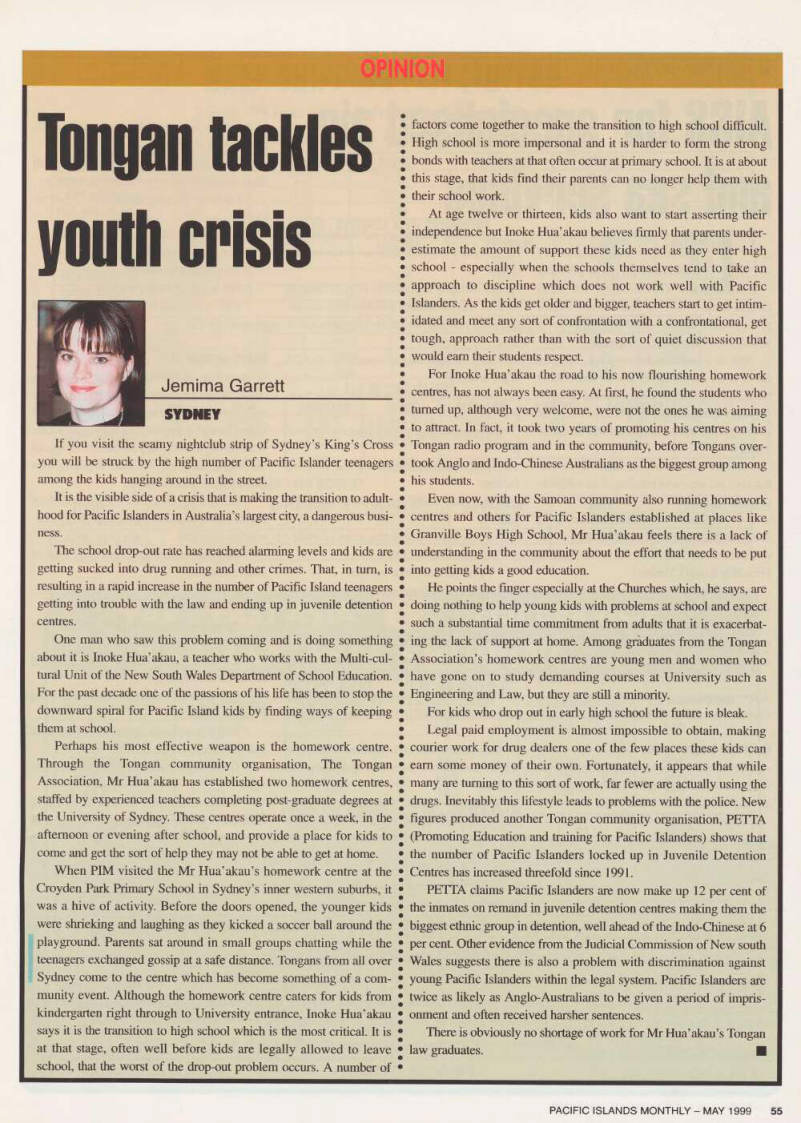
youth crisis
If you visit the seamy nightclub strip of Sydney’s King’s Cross you will be struck by the high number of Pacific Islander teenagers among the kids hanging around in the street.
It is the visible side of a crisis that is making the transition to adult hood for Pacific Islanders in Australia’s largest city, a dangerous busi ness.
The school drop-out rate has reached alarming levels and kids are getting sucked into drug running and other crimes. That, in turn, is resulting in a rapid increase in the number of Pacific Island teenagers getting into trouble with the law and ending up in juvenile detention centres.
One man who saw this problem coming and is doing something about it is Inoke Hua’akau, a teacher who works with the Multi-cul tural Unit of the New South Wales Department of School Education.
For the past decade one of the passions of his life has been to stop the downward spiral for Pacific Island kids by finding ways of keeping them at school.
Perhaps his most effective weapon is the homework centre.
Through the Tongan community organisation. The Tongan Association, Mr Hua’akau has established two homework centres, staffed by experienced teachers completing post-graduate degrees at the University of Sydney. These centres operate once a week, in the afternoon or evening after school, and provide a place for kids to come and get the sort of help they may not be able to get at home.
When PIM visited the Mr Hua’akau’s homework centre at the Croyden Park Primary School in Sydney’s inner western suburbs, it was a hive of activity. Before the doors opened, the younger kids were shrieking and laughing as they kicked a soccer ball around the playground. Parents sat around in small groups chatting while the teenagers exchanged gossip at a safe distance. Tongans from all over Sydney come to the centre which has become something of a com munity event. Although the homework centre caters for kids from kindergarten right through to University entrance, Inoke Hua’akau says it is the transition to high school which is the most critical. It is at that stage, often well before kids are legally allowed to leave school, that the worst of the drop-out problem occurs. A number of
factors come together to make the transition to high school difficult.
High school is more impersonal and it is harder to form the strong bonds with teachers at that often occur at primary school. It is at about this stage, that kids find their parents can no longer help them with their school work.
At age twelve or thirteen, kids also want to start asserting their independence but Inoke Hua’akau believes firmly that parents under estimate the amount of support these kids need as they enter high school - especially when the schools themselves tend to take an approach to discipline which does not work well with Pacific Islanders. As the kids get older and bigger, teachers start to get intim idated and meet any sort of confrontation with a confrontational, get tough, approach rather than with the sort of quiet discussion that would earn their students respect.
For Inoke Hua’akau the road to his now flourishing homework centres, has not always been easy. At first, he found the students who turned up, although very welcome, were not the ones he was aiming to attract. In fact, it took two years of promoting his centres on his Tongan radio program and in the community, before Tongans over took Anglo and Indo-Chinese Australians as the biggest group among his students.
Even now, with the Samoan community also running homework centres and others for Pacific Islanders established at places like Granville Boys High School, Mr Hua’akau feels there is a lack of understanding in the community about the effort that needs to be put into getting kids a good education.
He points the finger especially at the Churches which, he says, are doing nothing to help young kids with problems at school and expect such a substantial time commitment from adults that it is exacerbat ing the lack of support at home. Among graduates from the Tongan Association’s homework centres are young men and women who have gone on to study demanding courses at University such as Engineering and Law, but they are still a minority.
For kids who drop out in early high school the future is bleak.
Legal paid employment is almost impossible to obtain, making courier work for drug dealers one of the few places these kids can earn some money of their own. Fortunately, it appears that while many are turning to this sort of work, far fewer are actually using the drugs. Inevitably this lifestyle leads to problems with the police. New figures produced another Tongan community organisation, PETTA (Promoting Education and training for Pacific Islanders) shows that the number of Pacific Islanders locked up in Juvenile Detention Centres has increased threefold since 1991.
PETTA claims Pacific Islanders are now make up 12 per cent of the inmates on remand in juvenile detention centres making them the biggest ethnic group in detention, well ahead of the Indo-Chinese at 6 per cent. Other evidence from the Judicial Commission of New south Wales suggests there is also a problem with discrimination against young Pacific Islanders within the legal system. Pacific Islanders are twice as likely as Anglo-Australians to be given a period of impris onment and often received harsher sentences.
There is obviously no shortage of work for Mr Hua’akau’s Tongan law graduates. ■
Jemima Garrett
Sydney
AISS for specialised air

and sea services
THE transportation of complete
factories and machinery necessitate precision planning and execution to the most minute detail - both the smallest and largest pieces must be delivered on-site exactly stipulated by the project engineers.
And as Australian International Shipping Services (A-I-S-S.com) is able to successfully handle the high profile and specialised transport of project operations they have become one of the most respected and commended forwarders in the
industry.
AISS has received commendation for the pro fessional and successful handling of the following project contracts: * Co-ordination, consolidation and shipping of all Australian steel supplies and related building materials for the Mekong River Bridge (the Friendship Bridge), Thailand * Building materials to Apia, Western Samoa for the construction of their new university * Individual government projects contracts for the supply of materials for construction of new schools in Vanuatu and Nauru * Packing and air freight of several 12 tonne water pumps on behalf of John Holland Constructions to Kota Kinabula, Malaysia
Bqnrtarto&t service
Australian International Shipping Services has earned its professional reputation for high quality air freight capabilities for every type of shipment - no matter how small or laige.
Both routing and rates are individually tailored for each client to ensure optimum transit for their dollar.
The company’s operational motto is based on superior service and 100 per cent client satisfac tion made possible through the following capabil ities: * Pick up from shipper’s warehouse to AISS depot or airport * Routing recommendations and airline book ings * Consolidation services to major world mar kets * Cargo packing, measuring and weighing facilities * Certified agent for handling dangerous goods * Documentation, including letters of credit * Freight collect facilities * Full export insurance services * Customs clearance and delivery services at destination airport
Bqnrt sea freitfit services
Australian International Shipping Services also provides professional forwarding services to all major international destinations through regu lar consolidations with reliable ocean-going carri ers.
Our comprehensive services are individually aligned for each client to make up a total export
package.
These services have been the foundation for our highly commended and professional opera
tion. * Cartage from shipper’s warehouse to AISS depot or export wharf * Bookings for outgoing vessels for both direct shipments and consolidation movements * Container packing services for FCL ship ments * Warehouse and storage accommodation * Documentation, including letters of credit * Freight rate negotiations * Full marine insurance services * Port of destination customs clearance and transport services
biport services
Australian International Shipping Services enjoys the unique ability of being able to arrange and monitor forwarding of customers import orders through a network of overseas associates while having the flexibility to cater for the special handling requirements of unusual shipments often handled by project specialists.
The following services are integral modules of our functional and professional import cargo for warding concept. * Banking and finance consultancy letter of credit attendance * Customers overseas purchase order place ment and follow-up services * Air and sea freight consolidations from key gateway in all major markets * Customer pre-advice of pending arrival details for all shipments * Full insurance facilities for both air and sea freight movements * Import warehouse facilities for both bond and free storage * Customs clearance and tariff advisory ser vices * Complete transport services for air caigo, LCL and FCL sea freight deliveries ■
Advertisements & other items, pp. 56-60 (1 item)
c/f-UEE
AUSTRALIAN INTERNATIONAL SHIPPING SERVICES PTY LTD
Providing Container Consolidated Services, Full Container Loads, Airfrieght Forwarding and Purchase Order Tracking Services to:- American Samoa, Cook Islands, Fiji, Guam, Kiribati, New Zealand, Niue, Norfolk Island, New Caledonia, Nauru, Papua New Guinea, Solomon Islands, Tahiti, The Federated States of Micronesia, Tonga, Vanuatu, and Western Samoa.
Offices in Melbourne and Sydney
TEL:-61-3-93351477 FAX:-61-3-93380115 EMAIL:-A-I-S-S.COM
I J
REEF SHIPPING FIJI LIMITED
Your "One Stop" for the South Pacific
AUSTRALIA • FIJI APCL- NORTHBOUND
FIJI TO COOK ISLANDS
TRANSHIPPED AT AUCKLAND
NEW ZEALAND • FIJI NZPCL/FS NZPCL
Carpenters Shipping
ISO 9002 CERTIFIED
MBf
AGENCY VESSELS MOVEMENTS
D
NATIC.'fA!
NEW GUINEA PACIFIC LINE ■ HONG KDIRECT SERVICE
•BRARV
I LMAYJM
KOREA/JAPAN/FIJI DIRECT SERVICE
KYOWA PACIFIC KYOWA CORAL
HIBISCUS V 36 ISLANDER VlOB CATTLEYA V 24 ISLANDER V5B 03- 04- 14- 15- 16- 23-24/06 25-26/07
19th APRIL 1999
MEW ZEALAND - SOUTH PACIFIC TRADE
07-08/07 09-10/07 26-27/06 11-12/07 30-30/05 28-28/07 28-28/06 13-13/07 31-31/05 29-29/07 29-30/06 14-15/07 01-02/06 31-31/07 09-10/08 10-10/06 08-10/07 25-25/06 25-26/07 01-01/07 13-13/07 31-31/07 15-16/08 15-15/06 01-02/08 16-16 06 02-02/07 05-05/07 04-04/07 09-09/07 14-14/07 17-17/08 18-18/06 16-16/07 04-0408 19-19/08 17-17 07 05-05/08 20-20 08 19-19/06 21-21/07 10-10/08 24-24/08 23-23/06 26-26/07 30-30/08 29-29/06 29-30 07 20-21/08 01-02/09 01-02/07 19-20/07 27-28/06 01-01 08 28-28/07 04-05/07 06-06 07 02-02/08 09-09/07 05-05/08 .-a O OJ U' NOTE: ICL- AUCKLAND continuous receival at PFL Cargo, 108 Carbine Bd, Ml. Wellington up to 2 working days before load day. OTHER PORTS up to 2 working days before vessel loads Auckland
AUSTRALIA - SOUTH PACIFIC TRADE
FIJI/RAROTONGA AND VAVA'U TRANSHIPMENT SERVICE
FIJI/PAPUA NEW GUINEA TRANSHIPMENT SERVICE
FIJI/NEW ZEALAND DIRECT SERVICE
Forum Shipping
Agencies International
187 Rodwellßd, Suva -Ph0ne:315444
117 Queens Wharf, Lautoka - Ph ;660577
K % % *
Qosamoocin
>4
emistitc
SQBmmamas
mmwm^ enH atu Leaving SfflSk \\ 7 BS A Up roeft jlae?
I®
SJardy
FI C
At > <
:NCE
. m 7 «k At the Postshop, we don’t just sell postal products. We stock a huge range of products for your office or school, such as office and school stationery, text books, novels, magazines, souvenirs and lots more... at the best prices in Fiji. Why don’t you stop by and have a look? With the money you save, you’ll be able to buy some of the other things we stock - like sunglasses.
nstst
Fiji*!
Telephone : 218 312/218 384. Fax : 307 024 (Suva) and Post Offices Fiji - wide.
THE NETWORK
2)s HtuißS
d 9l q
pa ic.
M ;> ■*xc, 3ft £rSr, ■*-' - :/ *«Ss>6as&^3s : M -.rv .« ... m Only one airline won the coveted International Mercury Award for Excellence in Inflight Service. Best Long Haul Business Class two years in a row. Best Airline in Australasia Pacific in the World Economy Class Survey. And was voted Australia’s Airline of the Year five years in a row.
It is the same airline that now flies you to Sydney from Fiji every Wednesday and Sunday and then on to more than 60 destinations across Australia. Be our guest. For boakings and further information call Ansett Australia on 313 100 (Suva) or 722 955 (Nadi), or your travel agent.
AnsettAustralia
YOUR AIRLINE TO AUSTRALIA