Advertisements & other items, pp. 1-4 (2 items)
[mjW3y
PACIFIC ISLAND
MONTHLY
INSIDE: CARRIER WARFARE - A MARKET SHARE FIGHT IN THE SKIES
JANUARY 1999
wmmm ITp “■ ""■/ «™ N ij § \ i ! ij H P r I I 111
[mjW3y
frjwSi/f (a 5r Ira Jl
American Samoa US$2.50; Australia A$3.50: Cook islands NZ$3; Fiji F$2.50 Vat incl; FS Micronesia US$3; Kiribati A$2.50; Nauru A$2.50; Niue NZ$3; Norfolk A$3; New Caledonia cpf250; New Zealand NZ$3.45 incl GST; Northern Marianas US$3; Papua New Guinea K3; Palau US$3; Marshall Islands US$3: Solomon Islands A$3; French Polynesia cpf300; Tonga P3; USA US$3; Vanuatu VT220; Western Samoa T5.50. These are recommended prices only.
The Best Gets Better
EMXTHUUU
Fiji's most popular Outboard Motor gets even better! Now with even greater power and much improved performance the new, upgraded E4OX will give you more reliability, lower noise, and much easier operation than ever before. Full technical specifications are now available from Asco Motors. jr * Improved performance for carrying heavy loads New simple fuel system for easier maintenance Improved anti-corrosion system uses 5 stage multiple coating Large capacity chrome plated waterpump for longer life Heavy duty gearbox is easier to operate and maintain Front mounted controls improve operation ■V *£3 ; ■ & j
Asco Motors
* POWERFUL
AND RELIABLE
NEW MODEL
YAMAHA E4OX
ENDURO
OUTBOARD
i MOTOR .
y TECHNICAL INFORMATION: BARRY LEE • MANASA BALU • PH 384888 • FAX 370309 • GPO BOX 355 SUVA FIJI ISLANDS BRANCHES: NABUA PH 384888 • WALU BAY PH 307808 • SIGATOKA PH 500577 • NADI PH.721777 • LAUTOKA PH 662855 BA PH 674406 • TAVUA PH 680152 • VATUKOULA PH 681377 • LABASA PH 811688
fm/ ■ m. pi
vmar*
■j vm E? * ? ' f 7f. p r St * ■ * %is| ' * m um wmu v ■ 1. m ..
V - ■■- H mbs n is I I? % •# * 4 , ■ ■• > I*’ 111 ■ S&r »!iiS^B » : k. ; i\ .
We accept For further information please contact:
VISA
Telikom Phone Card Sates Pay Phone Business Unit PO Box 3SI Waigani, NCO Papua New Guinea Just quote your card number and expiry date and we wM forward your requirements. Telephone: (075) 300 5093 Facsimile: (67S> 3005060
{ijlj TELIKOM PNG
i: ’"* / MO4O cu&yA- rtuxUcj /
KIAORA! BULAVINAKA!
MAEVA! ALOHA!
HOWEVER WE SAY IT,
IT MEANS WELCOME!
Budget
Fiji 122 636 Papuo New Guinea 325 4111 Vanuatu 23170 New Caledonia 262 009 Hawaii 838 1111 Western Samoa 20561 Australia 1300 362 848 New lealand 0800 652 221
Pacific Islands
Monthly
Vol 68 No. Ii
The News Magazine
January 1999
PUBLISHER: Alan Robinson EDITOR: Sophie Foster Hildebrand
Correspondents:
Sally Andrew, Monica Miller, Giff Johnson, Chris Peteru, Atama Raganivatu Michael Field, Marc Neil-Jones Sam Vulum, Lisa Williams, Ofani Eremae Florence Syme-Buchanan.
Columnists:
David Barber (Wellington), Jemima Garrett (Sydney),
Graphic Artists:
James Ranuku, Josefa Bola
Advertising Sales
Senior Regional Sales (South Pacific) Shabana Naaz Tel (679) 304111, 303244, Fax (679) 303809.
Sydney, Canberra: Bob Hill Media Representation, Tel (61-2) 4164245, Fax (61-2) 4165064.
Brisbane: Jane Fewings Media and Advertising Associates Tel (61-7) 3378 4522, Fax (61-7) 3878 1071.
Adelaide: Hastwell Williamsons Representatives, Tel (61-8) 3799522, Fax (61-8) 3799735.
Melbourne: Brown Orr Fletcher Burrows (Aust) Pty Ltd.
Tel (61-3) 98265188, Fax (61-3) 98265644.
Auckland: McKay & Bowman, International Media Representatives Limited, Tel (64-9)4190561, Fax (64-9)4192243.
Japan: Universal Media Corporation, Tokyo, Tel (3) 3266626741, Cable: UNI-MEDIA Tokyo, Fax (3) 32626742.
Pacific Islands Monthly was founded in 1930
(Usps 9522480).
A Fiji Times Limited production.
Cover prices are recommended retail only. Registered by Australia Post, Publication No. NBPI2IO. © Copyright Fiji Times Limited, 177 Victoria Parade, Suva, Fiji.
Tel (679) 304111, fax (679) 303809.
Email: [email protected]
PIM Website; http://www.pim.com.lj Pacific Islands Monthly is published monthly by Fiji Times Limited, a division of Nationwide News, 2 Holt Street, Surry Hills, Sydney, NSW 2010.
Send Address Changes To:
Pacific Islands Monthly PO Box 1167 Suva, Fiji.
Printed by Quality Print Limited, 16 Amra Street, Walu Bay, Suva, Fiji.
Layout and cover design by James Ranuku Cover picture by Sam Vulum
Cover Story: People
Inside
Editorial 6 Letters 7 *e A i 10 Wen t 2 Domestic airlines search for new horizons 13 Business: Kwajalein: the key to a Marshalls/US deal 14 PNG could start s3som refinery by 2000 16 Pipeline project reaches critical point 17 Vast empty hotel might save Cooks' economy 18 Thai scientisits move forward in dengue battle 18 New investments still incoming at Denarau 20 OS interest in kava fuels multi-million dollar sales 22 Pit ing 24 The doctor in on-line 26 Bunny quits Greenpeace Pacific 27 Carbon trading heats up in PNG 28 Cover: The rise of 'people power' threatens Skate 30 Unions seize control in PNG 32 Developments: Bape surging in PNG 35 A lesson for Cooks in Japanese peari disaster 36 Sports: Adventure sports thrive on Vanuatu's active volcano 50 j Yachting: Bringing light to Pentecost 52 Opinion: David Barber/Jemima Garrett 54
Page 10
Page 24
Page 50
Cover Story: People power -PNG style
Yesterday’s

Editorial
Yesterday’s heroes ...
HISTORY has shown that although leaders are charismatic individuals, their power can easily be overthrown by the power of the masses.
No-one can be more aware of this then the current Papua New
Guinea prime minister Bill Skate, for the same masses that he used to get into power are now turning against him.
Surely, he must now know how for mer prime minister Sir Julius Chan felt when protesters, that were mostly mem bers of the armed forces, fronted up to parliament house demanding his resigna tion.
And while Skate has always projected himself as a man of the people, a grass roots hero, he is now finding himself slightly uprooted into the new year.
He has an unstable economy to deal with, rising dissent amongst his numbers in parliament, and increased dissatisfac tion by the people of Papua New Guinea
against decisions that he has made while in government.
The people’s power should never be under-estimated.
It can make up for any lack of educa tion, finances, or political power by sheer numbers alone.
If anything, politics in Papua New Guinea has never been a walk in the park.
In fact, in Port Moresby most people do not dare walk in parks because of escalat ing crime.
It is issues such as this that have forced the hand of the people.
But it must be sheer desperation, on Skate’s part, to have to move the next sit ting of parliament to mid-year, especially
when in the eyes of many peo ple, it is to avoid a vote of no confidence.
The level of dissatisfaction with the government, in particu lar with Skate, seems to be quite extensive. Certainly it is very
vocal. Ironically, the same Skate that managed to calm the crowd outside par liament house a year and a half ago, was booed down when he tried it again in November.
In PNG, it seems, the people are fed up of being treated as an after-thought.
Blatant corruption, ignoring rules, and abusing power make a sure recipe for dis aster when it comes to crowds.
The break-down of law and order is one case where the top-down economic theory works, and to great effect. 1999 is sure to be another interesting year in PNG politics, and if the people’s power keeps up, it may end without Skate. ■
Letters
Passports please
I am David Anderson, a subscriber to your wonderful magazine in New York. I am a political artist and am working on a show which involves expired passports of various countries. I plan to exhibit the passports in a prestigious art gallery in my home of New York. Are your readers able to donate expired passports from their respective countries for this? The passports will not be altered in any way. Many coun tries and individuals have sent passports for this project.
Thank you In art
David Anderson
Pacific arts festival
Please reply with any dates you may have for the Pacific Arts Festival. We are travelling in Oceania the entire year 2000.
We will be travelling with 3 kids and a teacher all connected with our electronic school house.
Papajack Driscoll
Ban stereotypes
I would like to voice my concern about the photograph of two drag queens accom panying your article, Gay Pacific Island Men too shy for their own good. . The article is about AIDS/HIV and the problem with getting Pacific Island Men to acknowledge their sexuality and to be test ed. The article is not about the Mardi Gras or the Hero Parade; two events that are splendid showcases for drag queens.
A very valid point made by the NZ Aids foundation Pacific Islands Education Officer in the article is that "everyone needs to be educated - it's not just a gay man's disease anymore”. As a regional magazine you should take some responsi bility in this education process, not set it back by publishing an insensitive and mis leading photograph. I am disappointed that PIM is encouraging the stereotypical
notion that AIDS/HIV is an issue related to a specific ’group’ in society. If I was a gay Pacific Island man, I too would feel shy about acknowledging my sexuality or being tested if I thought this is how society has type cast me.
May I remind PIM that AIDS does not respect tradition, culture or religion.
Tamsin Vuetilovoni,
Suva, Fiji
Real pictures needed
I received the Nov. 1998 copy of PIM a few days ago. One of the articles, "Gay Pacific Island men too shy for their own good,” haunts me. It is not the valuable content of the article, but the illustration that is the problem.
What does a conspicuous file photo of two flamboyant gay drag queens have to do with PI men at risk for disease?
Nothing. The image only further stereo types people already very much misunder stood and many times abused.
In cultures where homosexuality is feared, in large part because of stereotyp ing, gays are forced into the isolation of "the closet” along with their families. No wonder gay men, in particular those who are at risk for AIDS, will not come for ward. Reasons for the unfounded cultural fears of homosexuality are many, but that is another subject.
Editors, don’t compound the problem.
Throw out those hackneyed file photos and look for images that portray reality.
Shirley Barnes
1 7 Mariposa Rd.
Santa Fe NM 87505
U.S.A.
email: [email protected]
Requirement about environment
I work in New Caledonia as an environ mental consultant. In this framework, I would like to know the different events rel ative to environment in Pacific islands.
I’ve already write to Sprep but they only
provide information about their events. I wish to know meetings, conferences at the Pacific countries’ scale. Could anyone help me?
Isabelle Faisant
Legal Changes regarding Sexual
Orientation
Bula from Hawaii! I am researching the constitutional/legal/social status of sexual orientation in Polynesia, Melanesia, and Micronesia for a US national conference (American Psychological Association Annual Convention) symposium in 1999.1 am writing to ask if anyone might be able to help me find some information regard ing these issues in Fiji.
Fiji received some overseas publicity regarding its recent adoption of a South Africa-like constitutional clause enshrin ing sexual orientation as a protected civil rights class. In this regard, does anyone know where could I obtain a copy of the Fiji constitutional clause relating to sexual orientation?
A second piece of information that I am looking for relates to a recent news report that, at the urging of the Methodist Church of Fiji and the Fiji Council of Churches, Parliament plans to amend the new Bill of Rights to state that same-sex marriage and “unnatural offences” (an old British refer ence that has never been defined, to my knowledge) remain illegal. This appears to have the potential to completely invalidate sexual orientation as a protected civil rights class. Is this report accurate (that Parliament has this intention)? If so, does anyone know what the planned time frame is for the introduction of this proposed leg islation? Many thanks for any and all leads.
Philip V. Hull . Ph.D.
[email protected] [email protected]
Letters to the Editor should be addressed to: The Editor Pacific Islands Monthly PO Box 1167 Suva Fiji
Briefs

PNG Central Bank rescinds financial institutions licences amid worries about scam financiers THE Bank of Papua New Guinea is in the process of rescinding the licences of two financial institutions, including a bank, following their failure to meet financial regulations.
The two institutions were not named when PIM went to press. They were issued licences in 1996 but have not opened up for business yet. It is understood the Bank of PNG has withheld the licence for one of the parties pending full details of share holders operating through holding compa nies with interests in two tax havens.
National Broadcasting Corporation News says when the Bank insisted on more details about individual directors, the pro moters were believed to have dropped their partners from tax havens. Meanwhile, the PNG Central Bank has revealed it has no powers to prosecute scam operators estab lishing finance businesses in the country.
The Central Bank’s deputy governor, Wilson Kamit, says promoters of such schemes usually ask for “up front” fees in return for non-existent financial services.
He says a “two-kina” company had approached the government and offered US$5OO million at very competitive rates for a front-end fee of 10 per cent of the pro
posed loan. Kamit says the Bank was unable to prosecute the operator but was able to check with authorities in other countries on the operator’s credibility.
Downer signs Australian youth ambas sadors programme THE Australian government is embark ing on a programme for its young people to experience and better understand the
region. Australian foreign minister,
Alexander Downer, signed a memorandum of understanding with Solomon Islands development minister, Fred Fono, in December on the Australian Youth Ambassadors Development Programme.
The programme aims to help young Australians broaden their experience and understanding of the region’s cultural, eco nomic, social and political environment.
Downer told a news conference that the programme will enable 500 young Australians to take part in volunteer assignments in the Asia Pacific region. He says it will enable them to apply their skills with governments, local business, and edu cation and community services.
The selected youths will be posted to their respective assignments for five months. The Australian Federal govern ment has allocated Aslo million for the first two years of the programme.
Downer was on a five-nation tour of the South Pacific, covering the Solomons, PNG, Kiribati, Tuvalu and Fiji.
Assassination threat hangs over PNG
opposition leader
PAPUA New Guinea police are keeping a close watch on opposition leader Bernard Narakobi, after receiving reports of a plot to assassinate him.
Last month, criminals targeted Narakobi’s family car in broad daylight at the Jackson’s International Airport. The car was later found completely destroyed near Mount Diamond High School outside Port Moresby. Narakobi has been told about the assassination plot, which is reportedly linked to his constant bashing of the Skate government and plans by the opposition to move a vote of no-confidence against the
prime minister.
Police say they are treating the matter very seriously. Opposition members have restricted their movements in Port Moresby.
Pollution danger from Gold Ridge copper mine in Guadalcanal AN Australian law firm has further raised fears of environmental pollution at
Continued on next page
BRIEFS continued
gold Ridge copper mine in the Central Guadalcanal region of the Solomon Islands. Nicholas Styant-Browne, of the Melbourne law firm Slater and Gordon, says waste from the Gold Ridge opera tion will ultimately pollute the river sys tem in the mine’s vicinity.
He says the river system will be seri ously affected because the waste will inevitably find its way into the system.
Styant-Browne says any mining engi
neer will agree that a Gold Ridge-type mine in the tropics, which does not con tain its waste, would pollute the river.
He says this puts the environment and the people living in downstream areas at risk.
The Solomon Islands government has already warned that it would not tolerate any environmentally unsafe practices at
the mining operation, after nearby resi
dents found dead fish in the river.
FSM Compact committee meets THE Federated States of Micronesia’s Joint Committee on Compact Economic Negotiations has concluded its fifth ses sion.
The Committee is preparing for nego tiations with the United States over renewal of the current 15-year Compact of Free Association.
The current US assistance compact expires in the year 2001.
During the meeting, the committee’s secretariat reported on progress in devel oping a framework for economic propos als to be presented to the United States and provided a briefing on current FSM economic conditions.
The secretariat also announced the appointment of Doctor Glen Skaggs as a defence and security analyst.
The FSM’s Joint Committee on Compact Economic Negotiations has scheduled its next meeting to take place during March 1999. ■
Advertisements & other items, p. 8 (1 item)
Japanese Vehicles
DIRECT
Trucks/Buses/Cars. Order now for quick shipment. • Trucks, I ton Pickups up to 5 ton Trucks - Dynas, Titans, etc. • Buses, 8 seaters up to 29 seaters - Hiaces, Coasters, etc, • Cars, 4WD, Sports and Vans - All Types - Corollas, Sunnys, Hilux, etc.
Phone or fax now for your free Stock Lists I Order Form. Experienced, helpful service.
Quick shipment. Buy your own vehicle direct from Trust Company and SAVE sss. Ask for James at: Trust Company Ltd, Kobac Building, 3f, 3-2-26 Nishiki, Naka-ku, Nagoya, japan.
Phone; 81-52-953-5502, Fax: 81-52-953-5534/31, E-mail: [email protected]
Minister in
Archives-December 1945
NZ Prime Minister in Western Samoa
Samoan and European Grievances Discussed
THE increasingly important part the islands of the South Pacific are playing in world affairs is reflected in the fact that, within the past year, Western Samoa - with an airport of some importance on the cross-roads of the Pacific - has been visited twice by the Governor-General of New Zealand, and has now been paid an official visit by the Prime Minister of New Zealand, Mr Peter Fraser.
The Prime Minister and his party remained a week, in order to obtain a personal knowledge of the problems of the territory and find a solution for them, if possible. His visit extended also to the Tokelau Islands, the Cook Islands and Niue, the other New Zealand dependen cies. The party consisted of the Prime
Minister, Mr A G Osborne, MP (Parliamentary Under-Secretary to the Prime Minister), Mr Ross Frazer, (Acting Director of the Internal Marketing Division), Mr G R Faking (Department of External Affairs), Miss K G Jordan (private secretary), and Mr S J Wemyss (cameraman). They completed a strenuous round of inspections, confer ences, and interviews, with only a few social functions interrupting the “strictly business” character of the visit.
Most important from the Samoan point of view, were the talks with native, European and Euronesian leaders, who submitted their grievances. The Samoan Fono of Faipule asked for a greater share of self-government and responsibility for Samoans - similar to the Tongan and Fijian native systems; better prices for
their products, particularly bananas,
copra and cocoa-beans; better roads and communications; better wages for local officials; increased employment of Samoans by the Administration, and bet ter facilities for education.
European representatives discussed with the Prime Minister the disposal of Crown lands for plantations to Europeans; the lifting of prohibition; bet ter wages for local-born officials; and the improvement of roads and services gen erally. Mr Fraser openly expressed sym pathy with the demands submitted to him.
He said, however, that on some of the more important and far-reaching ques tions he was unable to give a decision before consulting the New Zealand Cabinet.
In a speech before the Samoan repre sentatives and leaders, at a meeting held at Mulinu’u on Boxing Day, Mr Fraser expressed his sincere thanks for the cor dial reception given him and his party.
He said that he would do his best to sat isfy the legitimate grievances of the peo ple of Samoa on his return to NZ. ■
Advertisements & other items, p. 9 (1 item)
Blairs
BMW
Bedford Cummins Daihatsu Detroit Deutz Ford Gardner Hmo Isuzu Iveco Komatsu Kubota
WAREHOUSE
FREE FAX o
(0800)J74 064 Call Free
85-8 BLAIRS
BLAIRS
New Zealand
email: [email protected] Subaru
Leyland
Mazda Mercedes Mitsubishi
MAN.
Nissan Perkins Suzuki Toyota Volvo Yanmar Diesel & Petrol Transmissions New & Second Hand Parts
ENGINES SPECIALS
Horizontal Ups ■lino KR2OO 225 hp 6cyl with gearbox $4200 llino EB4OO 190 hp 6cyl with gearbox $3900 Nissan FE6H 230 hp 6cyl with gearbox $6500 Leyland 51011 or Aerial bus $4BOO All prices plus GST NZ Distributors for All Wheel l*lve Axh/tlxß Do you have an access problem?
Challenge it with ARGO!
Designed to carry up fr 6 people or 454kgs In class of its own For information or brochure ARGO Division Phone; (03) 693 8122 Free Fax; (0800) 274-061 PO Box 14 Geraldine
Warfare
Special Report
Carrier
A market share fight in the skies
By Sophie Foster Hildebrand
EVERY day, thousands of
feet above sea-level, planes criss-cross the vast Pacific Ocean.
Majestic in flight, and still seen with awe in many island countries, these planes are part of a complex network of strategies to increase market share and boost revenue.
This is a fight for control of the skies and it is not little league either with big island corporations such as Qantas, Air New Zealand, Air Pacific, and now Ansett Australia competing to stay in the air.
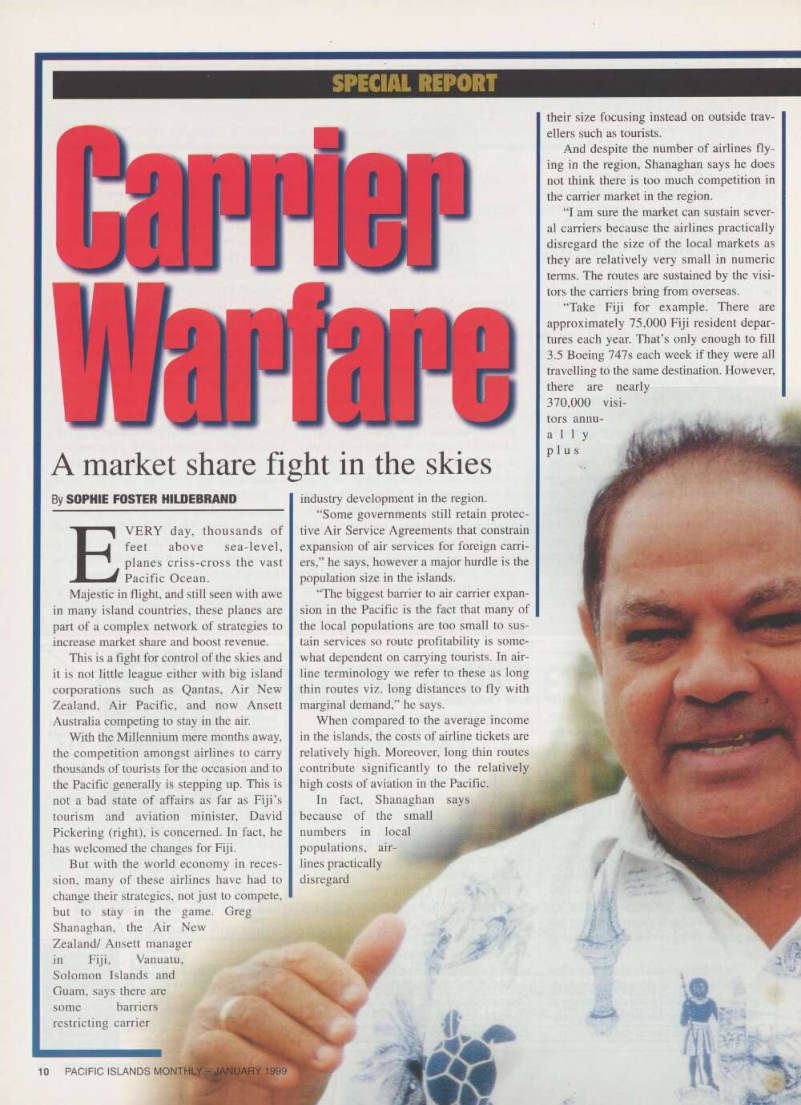
With the Millennium mere months away, the competition amongst airlines to carry thousands of tourists for the occasion and to the Pacific generally is stepping up. This is not a bad state of affairs as far as Fiji’s tourism and aviation minister, David Pickering (right), is concerned. In fact, he has welcomed the changes for Fiji.
But with the world economy in reces sion, many of these airlines have had to change their strategies, not just to compete, but to stay in the game. Greg Shanaghan, the Air New Zealand/ Ansett manager in Fiji, Vanuatu, Solomon Islands and Guam, says there are some barriers
restricting carrier
industry development in the region.
“Some governments still retain protec tive Air Service Agreements that constrain expansion of air services for foreign carri ers,” he says, however a major hurdle is the population size in the islands.
“The biggest barrier to air carrier expan sion in the Pacific is the fact that many of the local populations are too small to sus tain services so route profitability is some what dependent on carrying tourists. In air line terminology we refer to these as long thin routes viz. long distances to fly with marginal demand,” he says.
When compared to the average income in the islands, the costs of airline tickets are relatively high. Moreover, long thin routes contribute significantly to the relatively high costs of aviation in the Pacific.
In fact, Shanaghan says because of the small numbers in local
populations, air
lines practically
disregard
their size focusing instead on outside trav ellers such as tourists.
And despite the number of airlines fly ing in the region, Shanaghan says he does not think there is too much competition in the carrier market in the region.
“I am sure the market can sustain sever al carriers because the airlines practically disregard the size of the local markets as they are relatively very small in numeric terms. The routes are sustained by the visi tors the carriers bring from overseas.
“Take Fiji for example. There are approximately 75,000 Fiji resident depar tures each year. That’s only enough to fill 3.5 Boeing 747s each week if they were all travelling to the same destination. However, there are nearly 370,000 visi tors annu a 11 y juJALo plus
another 150,000 people who transit Fiji to somewhere else - so when you put these numbers to route profitability models, things hopefully begin to add up. That’s why Fiji has significantly more flights serv ing it than other Pacific Islands,” he says.
He said, looking at the market dimen sions from an airline perspective, “the cur rent level of competition is reflective of the existing customer demand”.
“If there was excessive demand then the existing carriers would look to increase their flights or new entrants would enter the market,” he says. In December, a new entrant did begin operations in Fiji. Ansett’s arrival in Fiji has pushed down the price of an air ticket to Sydney already. Ansett’s Nadi-Sydney airfare sits at $599 - a price which Air Pacific has matched by dropping its Sydney-Suva ticket by $3OO to $599.
“Ansett has just started operations to Fiji and already they have started big noisy promotions in Australia beating out the Fiji message. Air Pacific has known Ansett were coming for some I time now so their marketing efforts in Australia have intensified this ilfc. year and Fiji is reaping the H reward from their sharpened (hocus and the increased effort they are putting in. There's nothing like some real competi tion to sharpen the players up,”
Shanaghan says. f ; : While choosing not to com ment on Ansett’s arrival, nor any j;'|l other constraints faced by the industry, Michael McQuay. the I managing director of Air Pacific says the
:A '%|jl biggest hurdle 1
V for the airline i
try is room capacity in the islands. “The challenge for the industry over the next 18 to 24 months in Fiji is to juggle excess air
craft capacity against the declining avail
ability of quality tourism hotel rooms.
“Government must work aggressively to attract investors to construct additional two star and five-star hotels so that market momentums are maintained and enhanced,” he says. In fact, there are many plans for new hotels in Fiji that should be in the building stage over 1999/2000. In Suva, the Fslo-12 million (AsB-10m) Tanoa Suva is in the planning stage, while plans for the Grand Pacific on Suva’s waterfront have stalled because the financier has pulled out.
The American investor, Thor Larsson, ceased funding and the project plans have for now been suspended.
Work on the Trend West resort won’t start until a new builder is found. The builder the company was negotiating with, Mainzeal of New Zealand pulled out and tenders for a new builder were to close in December. The Sheraton Royal Denarau Hotel in Nadi is due to start its Fsl4 million (Asll million) upgrade in this first quarter with a major upgrade of rooms, lobby, entertainment lounge, ballroom and new furniture and fittings for some rooms.
Even Air Pacific itself has plans to build a resort that will be run by the Grand Hyatt on Denarau Island. Work on the resort is yet to begin. It is this sort of diversification that now typifies airline strategies in the region.
With major investments required to stay in the air, many Pacific airlines are finding that they have to re-think their approach. Many have had to merge or negotiate with bigger
airlines to extend their reach. Qantas shares in Air TPacific were increased last year, and seats on either airline’s planes to Fiji are still shared between them. Air New Zealand, a company that has been involved in flying to the South Pacific longer than any other airline, has negotiated several agreements with other airlines outside the region to increase its customers.
“With our global alliance partners like United Airlines, Lufthansa German Airlines, Scandinavian Airlines, Varig and other partners like Ansett Australia and Singapore Airlines now beginning to mar ket products to these parts of the world, we will fly their customers to and through the South Pacific on their behalf,” Shanaghan says. Earlier in 1998, the Australian Competition and Consumer Association (ACCC) approved a five year trilateral rela tionship between Ansett, Air New Zealand and Singapore Airlines. In September Ansett Chief executive Rod Eddington said he thought Singapore becoming a partner would be a “terrific idea”.
In mid-December, Singapore Airlines chief executive Cheong Choong Kong said that expansion remained part of Singapore’s strategy. “In the longer term, we aim to grow globally into an international group of airline and airline-related companies,” he said. “As part of our globalisation strategy, we are extending our route network, not only through flying to more destinations ourselves, but also with suitable alliance partners”. Dr Cheong said that Singapore Airlines was finding the going hard in the
Continued on page 13
Continued from page 11
midst of the Asian downturn but, unlike other regional airlines, had remained in the black. The company reported a 24 per cent fall in after tax profit for the six months to September 30, 1998, to Ss46B million from Ss6l6 million previously. Singapore Airlines has deferred delivery of 11 aircraft because it did not need the additional capacity. Meanwhile, Dr Cheong has remained coy about speculation that the airline was taking an equity interest in Ansett Australia. Speaking at an Asialink
seminar in Melbourne, he said he was enthusiastic about Ansett’s future but would not comment directly on any poten tial equity interest for Singapore.
“There is no doubt that Ansett is a qual ity airline with a strong brand, excellent management and considerable potential.
We believe Ansett has a great future,” he said.
“You must forgive me if I opt to adhere to our company policy of not comment ing... of course - and here it can be duly reported that I’m speaking with a smile you can consider the enthusiasm I’ve been
displaying over Ansett and draw your own conclusions”. With numerous mergers and alliances necessary in the current climate, it would not be surprising if Singapore Airlines does take an equity interest in Ansett, giving it a foot in the Australian market.
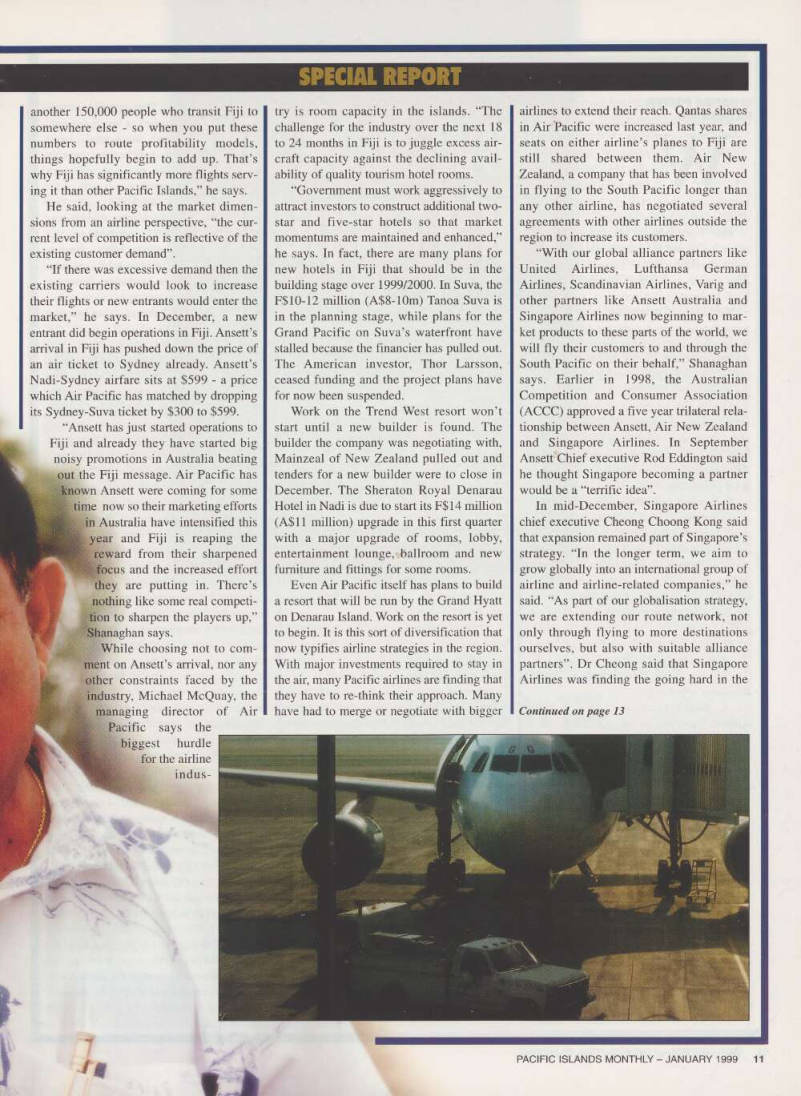
Meanwhile, Ansett has already begun its flights to Fiji, providing direct competi tion for the Qantas-Air Pacific duo.
It remains to be seen what, if any, change new alliances bring. ■ (*Some material has been sourced through AAP)
Fiji's airports
New look for Fiji's airports
By Sophie Foster
Hildebrand
WITH inc
reased air travel, the: first and last impression that visitors have of a country is the airport.
For Fiji, which has been reporting record numbers of visi tors to its shores of late, these vis itors arrive and depart through Nadi International Airport.
But while this may be good news for the tourism industry, for those who have to travel through the international airport, in most cases, the experience is not a good one.
This is one of the many rea sons why the country’s new air port operator, Airports Fiji Limited has decided to overhaul
the country’s major airports in ;
Nadi (right) and Nausori.
In July last year, the company commissioned local architects.
Architects Pacific for the “con cept replanning” of Nadi and Nausori airports. Rather than the
technical aspects of airports such as the runway, this replanning will see a change for the better to the terminal area of the air ports.
The head of Architects Pacific, Stuart Huggett, says Nadi Airport clearly isn’t coping with the flow through it and Nausori is even worse.
“A useful exercise to watch Nadi Airport function is to go there on a Saturday - the crowds are unbelievable. We are hoping to attract tourists into this coun try’s airport particularly through this sort of weather, it’s a nightmare,” he says.
The overhaul is a matter of urgency.
AFL decided to get a new check-in system at the terminals to control the huge crowds that go through.
Before they could implement that, they needed a concept of the whole terminal and a review.
Huggett says the new concept includes mostly extensions and modifications to the existing terminal rather than building a new terminal in both cases - Nadi and Nausori.
“But it amounts to major surgery, I think that’s the way to put it. People talk
about costs here but it's something that has to take place over quite an extended period of time.
It isn’t as though you can suddenly build a new air terminal, because it’s got to be carefully phased so that it stays opera tional the whole time,” he says.
Interestingly enough, the architects do not think Nadi Airport is too bad. Huggett says the total area of the building is almost adequate but just badly utilised and
planned.
Huggett, who became qualified in 1965 and has been in Fiji since 1969, there were a wide variety of issues that Architects Pacific had to consider.
“Firstly, of course, there’s the crowds at check-in, and getting the check-in working right. Then of course, the departure lounge is also awful at the moment. It’s just not big enough.
We need to have departure gates, we need to have that flight goes over there and that flight goes over there and so on,” he says.
The new departure gates will not be in separate rooms but will resemble “most
modem airports”.
The review also jooked at levels separat ing departures and arrivals but decided that that was not really an option.
I Architects Pacific, which was founded in 1971, worked on the project with Becker Carter in Auckland who are specialists in airport planning. Apart from getting the planning right, the new look Nadi and Nausori airports will be designed to make sure that arriving and depart ing impressions of Fiji are distinctive, unique and representative of Can exotic, tropical spe cial destination”, fc The plans will also overhaul the current
‘■ho-hum" shopping
experience at the inter national airport, r “What we’ve pro
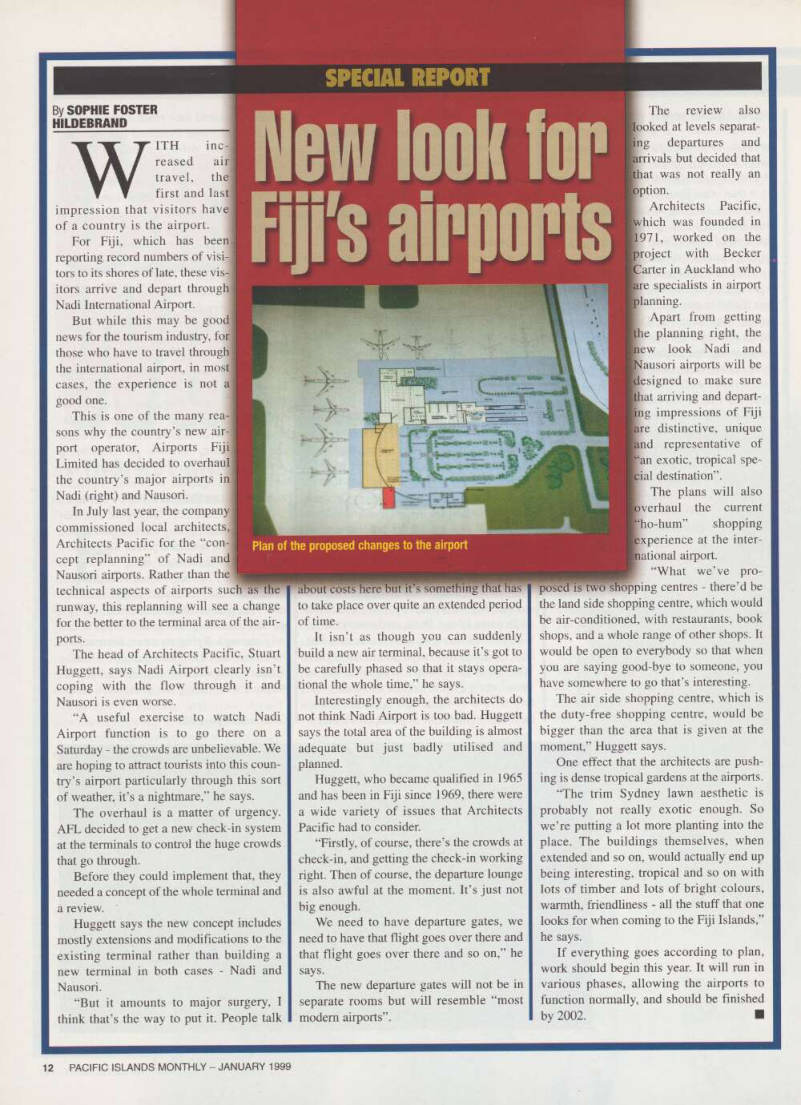
posed is two shopping centres - there’d be the land side shopping centre, which would be air-conditioned, with restaurants, book shops, and a whole range of other shops. It would be open to everybody so that when you are saying good-bye to someone, you have somewhere to go that’s interesting.
The air side shopping centre, which is the duty-free shopping centre, would be bigger than the area that is given at the moment,” Huggett says.
One effect that the architects are push ing is dense tropical gardens at the airports.
“The trim Sydney lawn aesthetic is probably not really exotic enough. So we’re putting a lot more planting into the place. The buildings themselves, when extended and so on, would actually end up being interesting, tropical and so on with lots of timber and lots of bright colours, warmth, friendliness - all the stuff that one looks for when coming to the Fiji Islands,” he says.
If everything goes according to plan, work should begin this year. It will run in various phases, allowing the airports to function normally, and should be finished by 2002. ■
Plan of the proposed changes to the airport
Domestic airlines search
for new horizons
By Sophie Foster Hildebrand
BECAUSE of sufficient supply in the domes tic carrier market, new markets must be sought by local airlines to stay afloat.
According to lan Collingwood of Sunflower Airlines, in 1999, the company will buy an additional Shorts SD33O for ser vices within Fiji and for possible regional opportunities.
“We see excellent opportunities for more frequency between Nadi, Suva and Labasa and expect the market will welcome the use of bigger aircraft on these routes.
At the same time we are looking at diversification and have interest in a number of entities operating in Fiji’s travel and avi ation sectors.
“In the longer term there are opportunities to expand services to a regional geography.
In this respect we are well placed to develop services from Fiji to our more immediate neighbours, particularly where eco nomics deter wide body jets from operating,” he says.
Fiji’s domestic market, though small, is highly competitive. It is shared between Sunflower Airlines and Air Fiji.
“Sunflower has a stronger hold on tourism related traffic while it would appear Air Fiji is more focused on locally gener ated traffic. Either way there is a large duplication of service including aircraft type, routes, fares, timetables and so on,” he says. While no comment could be obtained from Air Fiji, Collingwood says for any new competitor to enter the market, the most obvious barrier to entry is set up costs.
“Given the low returns and high risk involved, it is unlikely that any investor would see opportunity in setting up another air line in Fiji. As it is the industry is reporting marginal load factors which suggests there is a problem of over capacity (or too much supply) in the market.
There are very specific terms laid out in relation to the pro vision of an airline operators licence. Realising these require ments is also time consuming and difficult,” Collingwood says.
What is worrying for the industry is that the ‘break even’ point for domestic carriers - the amount of passengers/cargo needed on an aircraft to meet the actual costs of operating that aircraft is not being met on some routes.
“Any new/potential entrant would have to look at this and other factors when considering setting up in Fiji.
At this stage none of the routes in Fiji are performing much over break even with many of them realising a loss. Given this it would seem that there is more than enough supply in the market which doesn’t leave much room for new competition”.
While Air Service Agreements have placed a possible ceiling on private sector airline growth, Collingwood believes that the general public has benefited from increased competition with improved service, more frequency and better value (direct and indirect).
But while the competition may have stimulated new traffic in domestic market, Collingwood says the challenge is to find a balance between market share objectives and reinvestment. ■
World's planes could be
grounded by Y2K
PACIFIC airlines are still considering what strategy to take come 2000 after warnings that the millennium bug could threaten aviation
safety.
France’s finance and economy minister, Dominique Strauss- Kahn, has said that fear of air chaos caused by the Year 2000 computer bug could ground all of the world’s aircraft on January 1, 2000.
If such a decision is made, “it will be a world-wide decision after co-ordination with all the civil aviation authorities,” French secretary of State for industry, Christian Pierret, added.
While updating air control computer systems to overcome the bug - which may result in older machines mistaking the year 2000 for 1900 - is being followed “very closely”, malfunctions could still happen, Pierret warned.
The two men were speaking at a press conference on November 26 on France’s entry into the Third Millennium. ■
Kwajalein: the key to a

Business
Kwajalein: the key to a Marshalls-US economic deal
By Giff Johnson
WITH renegotiation of
the economic terms of the Marshall Islands-United States Compact of Free Association looming in 1999, the big question is how will the islands fare with a cost-cutting Republican-controlled Congress who are expected to question why, after $7OO million was provided over the first 12 years of the pact, there is little economic development to show. The
Marshalls, while acknowl edging that some of the gov ernment investments were “overambitious” and “some were questionable”, says that it has made a bona fide attempt to develop the econ omy - but that in 13 years it has been impossible to achieve the development which US strategic interests intentionally thwarted for decades during the islands’ status as a United Nations Trust Territory.
Critics, however, including
the State Department, contend that the Marshal! Islands has yet to demonstrate its willingness to make the necessary reforms that will spur development of the economy and break the decades-old dependence on funding from Washington, D.C.
While there is debate over Marshall Islands’ use of its Compact funds, there is no argument that the country remains largely dependent on the US. In the cur rent fiscal year budget, more than 55 per cent of the funding is directly from the US, while indirect American aid provides addi tional support.
The Compact’s economic provisions expire in 2001 (with a two year grace peri od that extends funding through 2003 in case negotiators are not able to arrive at an early agreement on a new pact).
And there is clearly no unanimity on the US side as to what will be offered, though increasingly US State and Interior Department officials have let it be known that the Marshalls shouldn’t expect as big an economic package as it received in the original Compact that was negotiated at the peak of the Cold War between the US and the USSR.
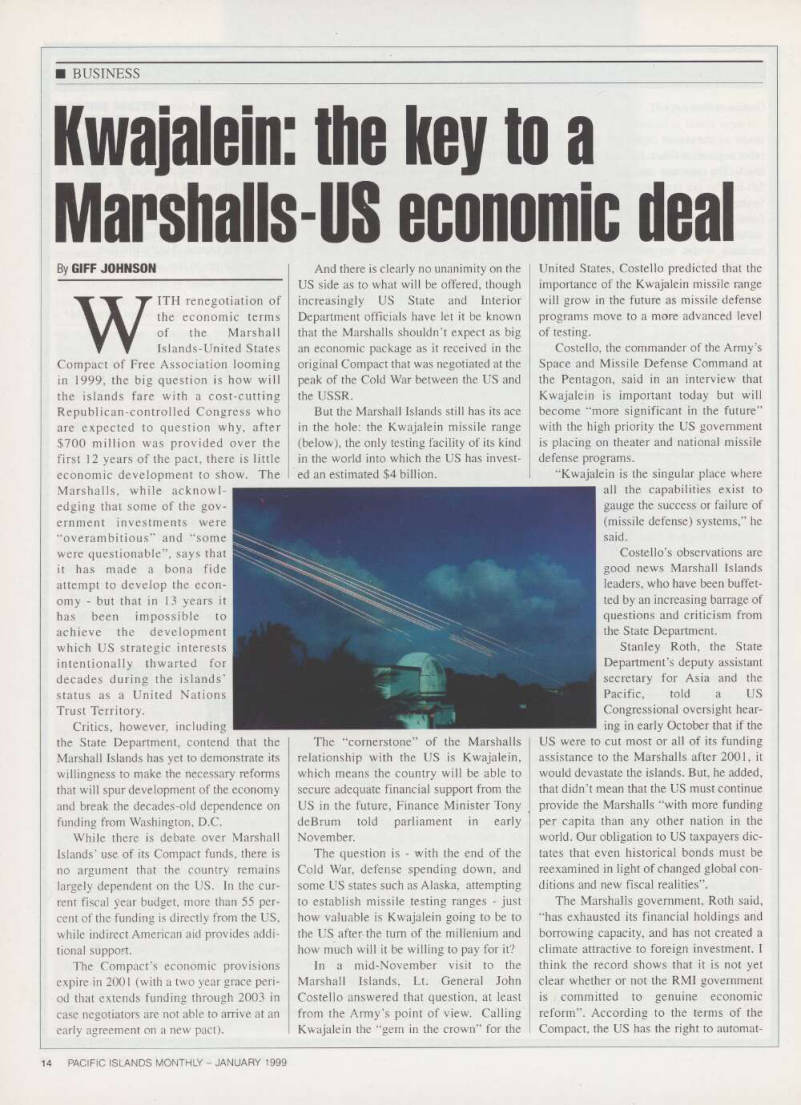
But the Marshall Islands still has its ace in the hole: the Kv/ajalein missile range (below), the only testing facility of its kind in the world into which the US has invest ed an estimated $4 billion.
The “cornerstone” of the Marshalls relationship with the US is Kwajalein, which means the country will be able to secure adequate financial support from the US in the future, Finance Minister Tony deßrum told parliament in early November.
The question is - with the end of the Cold War, defense spending down, and some US states such as Alaska, attempting to establish missile testing ranges - just how valuable is Kwajalein going to be to the US after the turn of the millenium and how much will it be willing to pay for it?
In a mid-November visit to the Marshall Islands, Lt. General John Costello answered that question, at least from the Army’s point of view. Calling Kwajalein the “gem in the crown” for the
United States, Costello predicted that the importance of the Kwajalein missile range will grow in the future as missile defense programs move to a more advanced level of testing.
Costello, the commander of the Army’s Space and Missile Defense Command at the Pentagon, said in an interview that Kwajalein is important today but will become “more significant in the future” with the high priority the US government is placing on theater and national missile defense programs.
“Kwajalein is the singular place where
all the capabilities exist to gauge the success or failure of (missile defense) systems,” he said.
Costello’s observations are good news Marshall Islands leaders, who have been buffet ted by an increasing barrage of questions and criticism from the State Department.
Stanley Roth, the State Department’s deputy assistant secretary for Asia and the Pacific, told a US Congressional oversight hear ing in early October that if the
US were to cut most or all of its funding assistance to the Marshalls after 2001, it would devastate the islands. But, he added, that didn’t mean that the US must continue provide the Marshalls “with more funding per capita than any other nation in the world. Our obligation to US taxpayers dic tates that even historical bonds must be reexamined in light of changed global con ditions and new fiscal realities”.
The Marshalls government, Roth said, “has exhausted its financial holdings and boiTowing capacity, and has not created a climate attractive to foreign investment. I think the record shows that it is not yet clear whether or not the RMI government is committed to genuine economic reform”. According to the terms of the Compact, the US has the right to automat
ically extend use of Kwajalein for another 15 years, without the requirement of hav ing to provide the additional funding for economic development and government operations that was the quid pro quo for use of Kwajalein in the initial term of the Compact.
But the Defense Department is clearly in support of renegotiating funding for the Marshalls beyond base rental payments because, in the words of a Pentagon offi cial, the Comapct as a whole creates a “positive local environment” for the Army.
“A renegotiated Compact, in some form, is in the best interests of the United States and the Freely Associated States,” said Kurt M. Campbell, the Deputy Assistant Secretary of Defense for Asian and Pacific Affairs, told the Congress in October. “One of the most important aspects of the Compact is the foundation it provides for our day-to-day working rela tionship with the people of the (Marshall Islands),” Campbell said.
A renegotiated Compact “will help the (Marshall Islands) continue to work toward their national goals, while serving our national defense interests”. That’s good
news for the Marshalls' negotiators, but why so much fuss about Kwajalein, which has been in use as a missile testing facility since the early 19605?
A boomerang shaped necklace of coral islands in the central Pacific, Kwajalein houses some of the world’s most sophisti cated computers, missile tracking equip ment and launch facilities that are used to fire missiles to intercept incoming “reentry vehicles” carried on missiles launched from California, as well as tracking every phase of flight of the incoming missiles.
It is, in a word, unique.
Costello said that individual missiles and component parts of defense systems are being tested now at a missile range in the US, at White Sands, New Mexico. But Kwajalein is the only place where all of the components can be combined in what he called tests of “family of (missile defense) systems”.
“These tests have to shift to Kwajalein because there is no other place to do it,” he said. “We can’t test the full capability (of systems) at White Sands. If we tell Americans that a national defense system will work, it better work. The only place in
the world to do precision testing (needed to confirm whether the missile defense sys tems work) is at Kwajalein. The resources and investment we’ve made over the years - we can’t pack it up and move it anywhere else”.
That sentiment was echoed by Pentagon spokesman Campbell. “The overriding defense interest in the negotiations (with the Marshall Islands) will be continued use of the Kwajalein Missile Range and the facilities on Kwajalein Atoll,” he said.
“The requirements of our missile defense and space surveillance programs combined with the uniqueness of Kwajalein’s loca tion, infrastructure, investment and real world treaty restrictions, make this an issue of the highest priority”.
Kwajalein is the target for a variety of missiles launched from California, 4,200 miles away.
Radar, high speed infrared cameras and other tracking equipment monitors every phase of the missile’s flight, and comput ers analyse the performance of the “reentry vehicles” that make their descent into
Continued on next page
Continued from previous page
Kwajalein, splashing down in and around the lagoon. Anti-missile defense is a key mission at Kwajalein. Often interceptor missiles are launched from islands in Kwajalein against incoming reentry vehicles. And, in the past couple of years, missiles have been launched from neighboring Aur Atoll to be inter cepted by Kwajalein-launched missiles to test the capability of short range, the ater missile defense capabilities.
Beyond that, Kwajalein provides support to NASA launches and the Space Shuttle, and supports a variety of other Defense agency weapons programs.
Despite Kwajalein’s apparent impor tance to the US, the Army is conducting a rigorous modernisation program at the missile range in line with continuing US Congressional funding reductions, Costello said. Kwajalein’s budget was sliced by $ll million this year. But, Costello said, that was a minor decrease when compared to cuts that the Army sustained in other areas of its budget.
The State Department’s Roth said, “it goes without saying that any future pro vision of assistance must serve to help the Federated States of Micronesia com plete its reforms and compel the Marshall Islands to adopt and implement more wide-ranging reforms. Past policy failures must therefore be addressed if future aid is to improve economic per formance.”
For its part, the Marshalls is gearing for the 1999 talks. “It’s our plan to go to the US with a proposal in hand,” Foreign Minister Phillip Muller said. This plan will propose a variety of trade and investment incentives that can be includ ed in the new agreement, as well as a new trust fund “to provide for the basic future needs of the Marshall Islands,” he said. “We’ve learned from our mistakes and we’re setting priorities for enhanc ing the private sector.”
In addition, the Marshalls will be seeking a longer term for the Compact’s extension - possibly 35 years, he added.
During the negotiations in the late 1970 s and early 1980 s that led to the pre sent Compact, the Defense Department played the dominant role on the US side.
Whether State and other agencies con tinue to defer to Defense in the upcom ing talks may well define the level of funding which the Marshalls can hope to gain from the U.S. for a new Compact period. ■
Advertisements & other items, p. 15 (1 item)
From Start..
fmm m Copymasters Hawaii can help you with all of your duplicating needs from start to finish. Featuring Duplo® Digital Duplicators, Copiers, Shredders, Laminators, Poster Printers, Collators, & Folding Equipment. We also sell Stencil & Duplicator Supplies, Paper Supply, and all brands of Copier Supplies, & Computers.
STATE OF HAWAII
ENTIRE
SOUTH PACIFIC
INCLUDING:
FIJI
SAMOA
TAHITI
TONGA
COOK ISLANDS
vhJ
MICRONESIA
FEDERATED STATE:
OF MICRONESIA
CLAM
MARIANAS
MARSHALL
ISLANDS
ToFinish
copymasters
hawaii
$350m refinery
PNG could start $350m refinery by 2000
By Andrew Hobbs
PAPUA New Guinea could have its own oil refinery operating by 2000 if the projects Canadian-based backers, Inter Oil Corp, manage to secure financing by the end of March this year.
Inter Oil chief financial officer Andy Martin said the group was talking to a short list of three banks. ‘The focus was initially on about six banks, and we are in serious discussions with three,” Mr Martin said.
Inter Oil has been looking for financing for the US$2l9 million (As3som) project primarily in Australia but it has also looked in Europe and the Americas after US oil giant Enron reduced its manage ment interest in and financial support for the project in early 1998.
Inter Oil already owns the 36,000 bar
rels-a-day capacity refinery, which it plans
to install at Port Moresby in Papua New Guinea but needs to raise around US$l65 million in total debt to proceed with the
project.
Mr Martin said it was targeting a US$l3O million term debt facility and a US$35 million working capital facility.
The rest of the development funding would be made up of US$5l million of equity value in equipment and a further US$39 million in cash.
Inter Oil has been working on installing the refinery in PNG since it acquired it in 1991 from Chevron.
While the refinery itself is second hand, it was previously installed in Alaska, Inter Oil will completely rebuild and upgrade the machinery at its base in Houston, Texas, before it is moved to PNG. Once financing is secured, Mr Martin said it would take some 20-22 months to ship and erect it in PNG.
The refinery plans to process PNG crude oil shipped in from Kutubu and Gobe oil fields, but Mr Martin said it would also consider importing some oil if that was necessary.
Mr Martin said those two PNG fields would be able to supply the refinery for 10 years at least.
The refinery would use some 36,000 barrels of oil a day to produce 34,500 bar rels of finished product, 55 per cent of which would be used to supply the domes tic PNG market.
Mr Martin said Inter Oil thought domestic demand would be some 17,000 barrels of oil a day in 2000, up from
15,500 today.
The remainder of the oil produced at the refinery would be exported to Pacific basin markets, including Townsville and Caims.
Inter Oil has already obtained letters of intent to buy oil for over 70 per cent of its
planned output.
Inter Oil also has an interest in some upstream oil projects in PNG, including a 20 per cent stake in the Stanley wildcat well that was due to be spudded late December. The Stanley well is operated by Santos Ltd. (AAP) ■
Pipeline project
reaches critical point in PNG
By Jane Wardell
THE proposed Papua New
Guinea gas pipeline pro ject is nearing make or break time with sponsors warning potential customers that now is the time to sign more definitively on the dotted line.
Project organiser John Powell, of Chevron Niugini, said while aluminium concern Comalco no longer held a stran glehold over the project, commercial sales agreements with foundation customers needed to be signed before the end of the month to keep it on track.
A yearly demand of 100 to 120 peta joules of gas has been determined as nec essary for the $3.5 billion gas pipeline to go ahead and Comalco’s possible Queensland-based refinery, which would take up about 27 petajoules of gas, had been considered a vital part of the plan.
Sponsors have told the fourth PNG mining and petroleum investment confer ence that was no longer the case with com mitments from five customers taking the total to between 130 to 140 petajoules of gas per year.
The problem is those customers have signed memorandums of understanding only to use the resources carried by the pipeline from PNG’s southern highlands to Gladstone in Queensland and hard con tracts still needed to be tabled.
All those involved in the project have sent the same clear message to potential
customers over the two-day conference: Now is the time to act.
PNG’s minister for petroleum and ener gy, Rabbie Namaliu, referred to a “window of opportunity” that should not be squan dered as it might not reappear for some time.
The Australian Gas Light Company, which is in a 50/50 joint venture with Petronas to construct and operate the $ 1.5 billion, 2,100 km Australian stretch of the pipeline, said: “Prospective players, the game is now in your hands”.
Dr Powell expressed confidence that those companies that had already signed memorandums of agreement regarding the pipeline, including Comalco, would com mit further.
“I am quietly confident that those charged with the big decisions will say yes to the PNG gas project,” he said.
Dr Powell added that Comalco’s role in the project was no longer as crucial as it once was.
An increase in the number of potential buyers over the past year had drastically changed the mentality of “No Comalco, no project”, he said.
"The marketplace that has emerged over the past year is no longer the diverse group of unrelated buyers that put their hands up, various players are now becom ing part of a coherent network of electrici ty suppliers and metal processes,” he said.
Comalco is currently in the process of determining whether to go ahead with its $1.4 billion alumina refinery at Gladstone
in north Queensland or to situate it in Malaysia.
“I understand that the (federal) govern ment is on the brink of releasing a package of incentives for Comalco which should crystallise the decision making for this major potential customer,” Dr Powell said.
MOUs have also been signed with Stanley/Dynegy for a base load power sta tion in Townsville and with power produc er NRG Asia Pacific for a new power sta tion in Gladstone.
Dr Powell said those combined should take around 65 petajoules a year.
AGL-TransAlta had announced a 20 petajoule gas requirement plant next to Queensland nickel and Dr Powell said Chevron was also talking to Queensland Aluminium and Ergon about similar vol umes.
“We would like to see all of those con verted into bankable heads of agreement then sales contracts as soon as possible,” he said.
While the timetable to resolve fiscal aspects by mid-December and have bank able contracts in place by the end of December was “very challenging”, it need ed to be met to enable final approvals in the next six to eight months, he said.
Oil Search Ltd managing director Peter Botten has told the conference the project might be extended as far as Brisbane and discussions with potential customers in that area were underway.
“We are at an advanced state in this process and the delivery of materiel vol umes of gas into other markets, including Brisbane, is now a reality,” Mr Botten said.
For PNG, the project comes amid a decline in oil drilling and exploration, pro viding much needed diversification.
“The gas project itself will come at the right time when oil production is on the decline and exploration does not result in any discoveries,” Mr Namaliu said.
The.pipeline would guarantee a regular income for PNG in light of declining Australian aid that had been provided to the country since it achieved independence in 1975.
Some $3OO million a year in taxation revenue is expected to be provided along with 2,500 jobs during the construction phase and some hundreds when the project was up and running.
“Above all else, it will give a real boost to investment confidence in Papua New Guinea,” Mr Namaliu said. (AAP) ■
Islands economy
Vast empty hotel might save Cook Islands economy
AVAST incomplete hotel,
an unsightly grey con crete mass against a backdrop of lush, green hills in Rarotonga, represents both the bulk of the Cook Islands debt and its biggest hope of economic recovery.
Built with Italian money in this Pacific territory, it ground to a halt months from completion, when Rome began cracking down on Mafia corruption four years ago.
Now known as the Vaimaanga Hotel, it looks set to be sold.
Finance minister Papamama Pokino in December announced the government had reached a deal with Italy, Nauru and New Zealand to write off over half of the coun try’s US$lO6 million (Asl7l million) debt. The Cook Islands are home to just over 20,000 people. The state was liable for U 55121.6 million (A 5196.9 million)
under the original agreement for what to have been a 200-room luxury Sheraton group hotel.
Other than to say a “significant propor tion” of the amount has been written off, the government has not disclosed how much is still owing or the repayment terms.
The government borrowed millions from Italy’s Institute Nazionale di Credito per il Lavoro Italiano all’Estro ICLS SpA (ICLE) bank, underwritten by an Italian government loan insurer, SASI.
The project came to a standstill when Italian contractors Sicel SpA Corporation went into “controlled administration” after it hit difficulties in a project in China.
Construction was then taken over by Italian firm Stephany. When nearing com pletion, the entire project came to a stand still because of what prime minister Sir Geoffrey Henry said were Mafia related
arrests in Italy of person nel involved with the development.
The property was renamed the Vaimaanga Hotel Project by the gov ernment when the Sheraton hotel chain pulled out because of continuous delays in completion. The Cook Islands is still in the throes of the worst eco nomic recession in its 33-year history of self governance. This has meant the country has been able to only service interest on most of its overseas loans rather than retiring the debts.
The empty hotel is now
set to be sold and all that’s needed are the signatures of the buyers on a new 60-year lease which landowner and traditional paramount chief Pa Ariki has signed. It is understood the new owner of the hotel will be consortium of Japanese investors and the Honolulu-based Castle resort and Hotel Group. A condition of the lease of the 10 hectare site calls for construction, comple tion and opening of the hotel by June 2000.
Work is expected to begin as soon as legal formalities are completed, says Pa Ariki.
She added her execution of the lease is a “clear green light to all concerned”.
“I’ve been pushing the negotiations for some time”. Pa Ariki said the hotel project “has got real potential to kick-start the economy in 1999 and into the new millen nium, but it’s now up to the investors and government to make sure it all happens that way”. (AFP) ■
Advertisements & other items, p. 18 (1 item)
Pacific Islands Training and Development
PO Box 6079, Fairfield Gardens, Queensland Australia, 4103 BN 5838940 • Training and recruitment for all areas of business and industry • Competency based skill development and practical workplce training • Automotive, manufacturing, mining, forestry, food processing, retail, hospitality, travel, education and many more sectors.
To discuss your requirements and receive free brochures , Phone or Fax: International +6 I 7 3848 4225 Australia 07 3848 4225
against dengue
Thai scientists moving forward in battle against dengue
By Andrew Hobbs
THAI researchers, using
sophisticated techniques once the exclusive domain of Western scien tists, have developed a vaccine against dengue, a mosquito-borne disease that affects tens of millions of people annually.
The vaccine, developed at Mahidol University, west of Bangkok, is still two to five years from commercial use.
But so-called “Phase 2” trials of the vaccine began last month to find the opti mum dosages, and it appears to be the best bet to tackle a disease that has emerged in the past two decades to threaten two-fifths of the world’s population.
Little known outside the tropics, dengue is a viral infection that can cause anything from mild headaches to fever to death from shock and haemorrhage.
Diagnosis is difficult and so far there is no preventative treatment or cure.
About half a million people, 90 per cent of them children, are hospitalised each year by its most severe strain, and 24,000 die.
Epidemics of the disease in Asia, Africa, and North America date back at least 200 years, but it was only after World War II - during which British soldiers in the Malay peninsula suffered from its debilitating effects - that it received much attention.
Dengue might have remained primarily a concern of the military had not its more virulent form, dengue haemorrhagic fever - DHF - been recognised as a new disease in the Philippines in 1953.
By 1975, it had become a leading cause of hospitalisation and death among chil dren in many countries, especially in Southeast Asia.
Particularly dramatic has been its return in strength to areas where it had been erad icated decades ago: - In the South Pacific, dengue reap peared in the early 1970 s after a 25-year absence. - By the 1980 s dengue epidemics had occurred in Taiwan, China, and the coun tries of South Asia had experienced DHF epidemics.
Dengue cases also increased dramati cally in Africa, though that continent has been spared DHF epidemics.
Its biggest comeback has been in the Americas, where the disease, including DHF, can be found in at least 16 countries.
Epidemiologists believe the rapid
spread of the disease can be attributed to several factors: rapid population growth and urbanisation, leading to inadequate water supply and waste disposal systems that give mosquitoes more opportunity to breed; increased air travel, resulting in the rapid exchange and introduction of dengue strains to far-flung population centres, and inadequate mosquito control methods.
“Classic” non-fatal dengue remains a concern, especially to travellers and the military. It struck significant numbers of troops in Haiti in 1994-95, as well as in Somalia in 1992-93 and on exercises in such places as Thailand.
“Dengue can have a serious impact on a mission within the first week of the arrival of troops in an endemic area,” said a 1995 Pentagon memo. “Other than food and waterborne illnesses, few other diseases can attack so quickly and have as wide an impact on our forces”.
Not surprisingly, the US military has long been active in seeking a dengue vac cine. The Department of defence is involved in projects taking four different approaches to the development of a dengue vaccine.
Major projects to fight dengue are also being undertaken by private and academic researchers in the United States, France and Australia.
The Thai project, initiated in 1976 by the regional office of the World health Organisation, chose to make a live attenu ated virus vaccine, an approach used suc
cessfully against polio-myelitis, measles
and mumps.
Using this method, in which the virus loses its disease-causing properties while retaining the ability to stimulate the pro duction of anti-bodies, was at the time beyond the capabilities of laboratories in most of the developing world. ‘‘Maybe it could have been accelerated a little but we were careful because devel oping a live attenuated vaccine in a coun try like Thailand, people tend to think that maybe it’s a joke,” says Dr Natth Bhamarapravati, director of Mahidol’s Dengue Vaccine Development Programme.
Three of four years of laboratory work were followed by “Phase 1” clinical trials on humans to test for safety and immuno genicity - whether it produces anti-bodies or not.
After several sets of tests were judged a success, the Mahidol researchers decided they needed a strategic partner.
Natth says they sought a vaccine manu facturer with the scientific and technical capacity for mass production as well as financial and managerial strength “because we know that to develop vaccine to public health... is a long haul”.
The university signed a contract with the French company Pasteur Merieux Connaught, giving it a 20-year exclusive production and marketing licence world wide. However, the contract also includes a clause that says the vaccine would be affordable to children in developing coun tries.
The deal, says Natth, provides “pretty generous” payments from the French com pany, noting also that Mahidol’s develop ment costs were “probably one-tenth or one-twentieth of what it takes to do it in an industrial country”.
In an effort to stay at the cutting edge of medical technology, says Natth, the Mahidol researchers are now also working in collaboration with the US Public Health Service on a “second-generation” dengue vaccine based on molecular biology tech niques. (AAP) ■
incoming at Denarau
New investments still incoming at Denarau
BIG things are happening
at Denarau Island, Fiji.
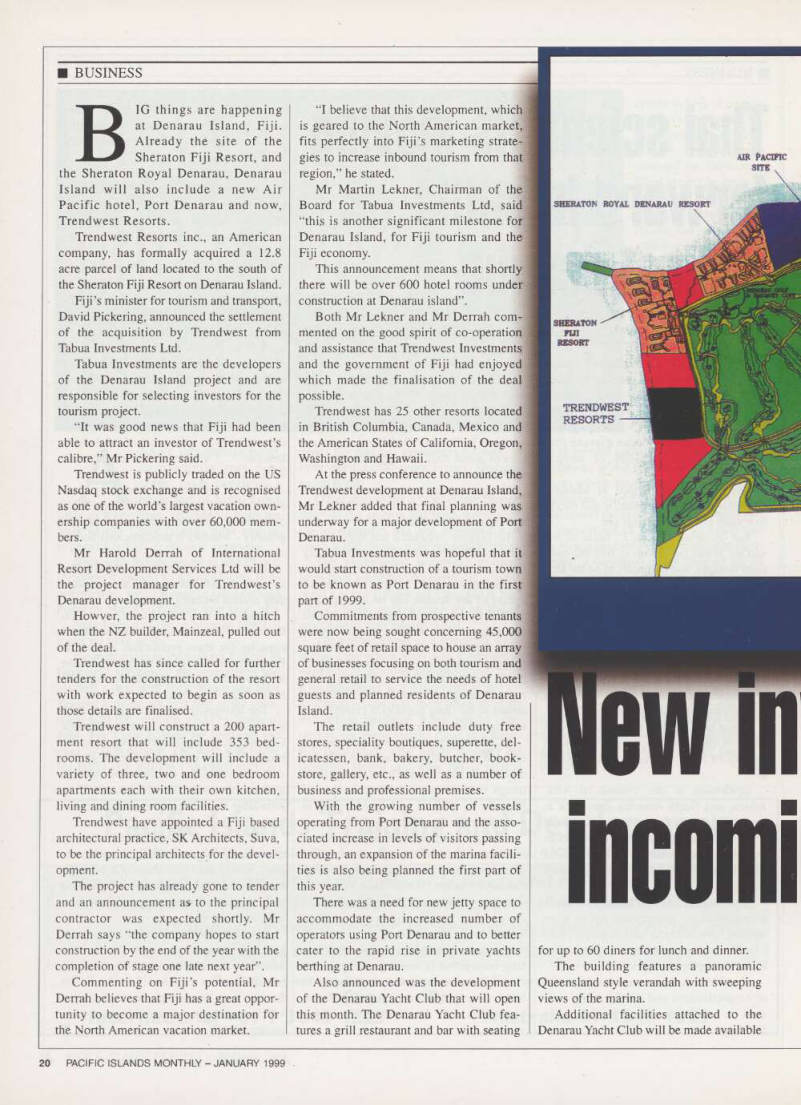
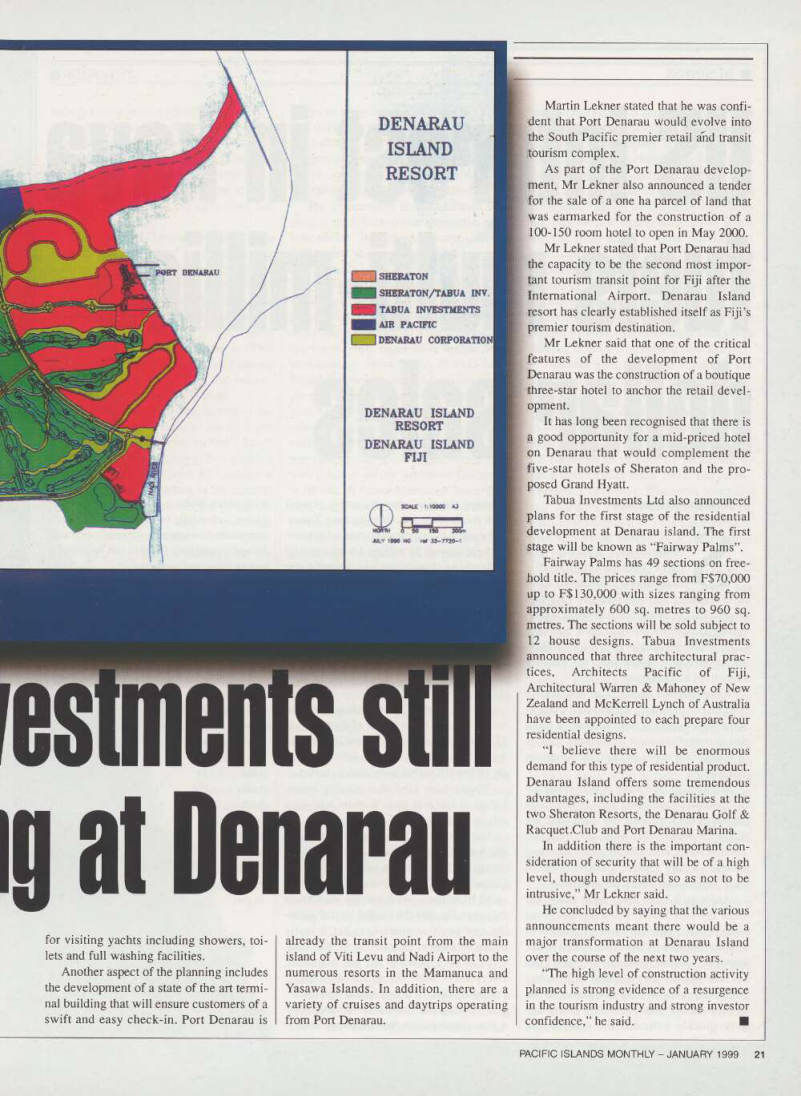
Already the site of the Sheraton Fiji Resort, and the Sheraton Royal Denarau, Denarau Island will also include a new Air Pacific hotel, Port Denarau and now, Trendwest Resorts.
Trendwest Resorts inc., an American company, has formally acquired a 12.8 acre parcel of land located to the south of the Sheraton Fiji Resort on Denarau Island.
Fiji’s minister for tourism and transport, David Pickering, announced the settlement of the acquisition by Trendwest from Tabua Investments Ltd.
Tabua Investments are the developers of the Denarau Island project and are responsible for selecting investors for the tourism project.
“It was good news that Fiji had been able to attract an investor of Trendwest’s calibre,” Mr Pickering said.
Trendwest is publicly traded on the US Nasdaq stock exchange and is recognised as one of the world’s largest vacation own ership companies with over 60,000 mem bers.
Mr Harold Derrah of International Resort Development Services Ltd will be the project manager for Trendwest’s Denarau development.
Howver, the project ran into a hitch when the NZ builder, Mainzeal, pulled out of the deal.
Trendwest has since called for further tenders for the construction of the resort with work expected to begin as soon as those details are finalised.
Trendwest will construct a 200 apart ment resort that will include 353 bed rooms. The development will include a variety of three, two and one bedroom apartments each with their own kitchen, living and dining room facilities.
Trendwest have appointed a Fiji based architectural practice, SK Architects, Suva, to be the principal architects for the devel opment.
The project has already gone to tender and an announcement as to the principal contractor was expected shortly. Mr Derrah says “the company hopes to start construction by the end of the year with the completion of stage one late next year”.
Commenting on Fiji’s potential, Mr Derrah believes that Fiji has a great oppor tunity to become a major destination for the North American vacation market.
“I believe that this development, which: is geared to the North American market, fits perfectly into Fiji’s marketing strate gies to increase inbound tourism from that region,” he stated.
Mr Martin Lekner, Chairman of the Board for Tabua Investments Ltd, said “this is another significant milestone for Denarau Island, for Fiji tourism and the Fiji economy.
This announcement means that shortly there will be over 600 hotel rooms under construction at Denarau island”.
Both Mr Lekner and Mr Derrah com mented on the good spirit of co-operation and assistance that Trendwest Investments and the government of Fiji had enjoyed which made the finalisation of the deal possible.
Trendwest has 25 other resorts located in British Columbia, Canada, Mexico and the American States of California, Oregon, Washington and Hawaii.
At the press conference to announce the Trendwest development at Denarau Island, Mr Lekner added that final planning was underway for a major development of Port Denarau.
Tabua Investments was hopeful that it would start construction of a tourism town to be known as Port Denarau in the first part of 1999.
Commitments from prospective tenants were now being sought concerning 45,000 square feet of retail space to house an array of businesses focusing on both tourism and general retail to service the needs of hotel guests and planned residents of Denarau Island.
The retail outlets include duty free stores, speciality boutiques, superette, del icatessen, bank, bakery, butcher, book store, gallery, etc., as well as a number of business and professional premises.
With the growing number of vessels operating from Port Denarau and the asso ciated increase in levels of visitors passing through, an expansion of the marina facili ties is also being planned the first part of this year.
There was a need for new jetty space to accommodate the increased number of operators using Port Denarau and to better cater to the rapid rise in private yachts berthing at Denarau.
Also announced was the development of the Denarau Yacht Club that will open this month. The Denarau Yacht Club fea tures a grill restaurant and bar with seating
for up to 60 diners for lunch and dinner.
The building features a panoramic Queensland style verandah with sweeping views of the marina.
Additional facilities attached to the Denarau Yacht Club will be made available
for visiting yachts including showers, toi lets and full washing facilities.
Another aspect of the planning includes the development of a state of the art termi nal building that will ensure customers of a swift and easy check-in. Port Denarau is
already the transit point from the main island of Viti Levu and Nadi Airport to the numerous resorts in the Mamanuca and Yasawa Islands. In addition, there are a variety of cruises and daytrips operating from Port Denarau.
Martin Lekner stated that he was confi dent that Port Denarau would evolve into the South Pacific premier retail and transit tourism complex.
As part of the Port Denarau develop ment, Mr Lekner also announced a tender for the sale of a one ha parcel of land that was earmarked for the construction of a 100-150 room hotel to open in May 2000.
Mr Lekner stated that Port Denarau had the capacity to be the second most impor tant tourism transit point for Fiji after the International Airport. Denarau Island resort has clearly established itself as Fiji’s premier tourism destination.
Mr Lekner said that one of the critical features of the development of Port Denarau was the construction of a boutique three-star hotel to anchor the retail devel opment.
It has long been recognised that there is a good opportunity for a mid-priced hotel on Denarau that would complement the five-star hotels of Sheraton and the pro posed Grand Hyatt.
Tabua Investments Ltd also announced plans for the first stage of the residential development at Denarau island. The first stage will be known as “Fairway Palms”.
Fairway Palms has 49 sections on free hold title. The prices range from F 570,000 up to F$ 130,000 with sizes ranging from approximately 600 sq. metres to 960 sq. metres. The sections will be sold subject to 12 house designs. Tabua Investments announced that three architectural prac tices, Architects Pacific of Fiji, Architectural Warren & Mahoney of New Zealand and McKerrell Lynch of Australia have been appointed to each prepare four residential designs.
“I believe there will be enormous demand for this type of residential product.
Denarau Island offers some tremendous advantages, including the facilities at the two Sheraton Resorts, the Denarau Golf & Racquet.Club and Port Denarau Marina.
In addition there is the important con sideration of security that will be of a high level, though understated so as not to be intrusive,” Mr Lekner said.
He concluded by saying that the various announcements meant there would be a major transformation at Denarau Island over the course of the next two years.
“The high level of construction activity planned is strong evidence of a resurgence in the tourism industry and strong investor confidence,” he said. ■
Advertisements & other items, p. 21 (1 item)
restments still
ig at Denarau
US interest in kava
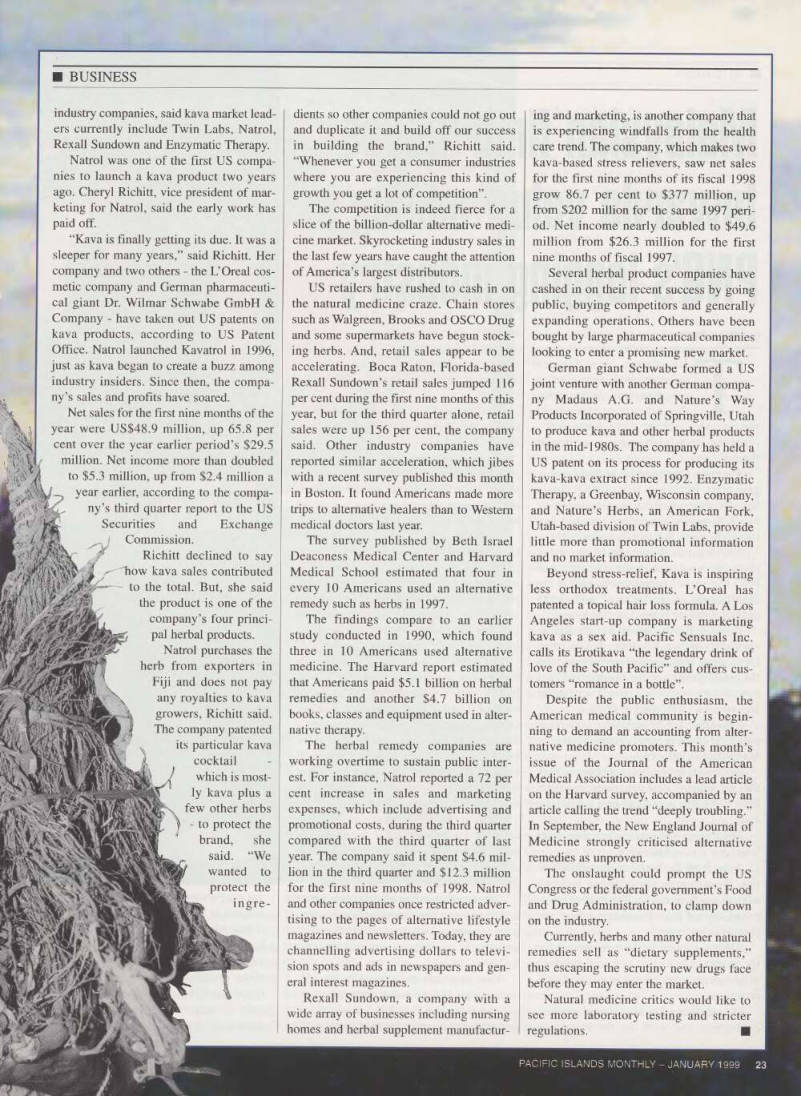
fuels multi-million dollar sales
By Christine MacDonald
S Tressed-Out
Americans, looking for some Pacific Islands atti tude, have discovered kava in increasing numbers in the last two years. This growing US following is con verting kava into a standout herb, and kava sales from minuscule to a multi-million dollar business, according to industry executives and analysts.
Kava pills and tinctures are now widely sold in US pharmacy chains and even in some supermarkets nation-wide, a trend that is propelling kava beyond the shelves of health food stores and into the American mainstream.
Riding high on a wave of public interest in “natural” medicine, kava’s US sales exceeded $35 million last year and are likely to double this year, according to Thomas Aarts, editor of Nutrition Business Journal, a San Diego, California-based trade journal that tracks the industry.
Aarts said kava sales have taken off since the mid 19905, when the root went from relative obscurity to be heralded as another St. John’s Wort. St. John’s Wort, another age-old medicinal plant, has become enormously popular with many Americans as a natural alternative to the antidepressant Prozac. Kava promoters have quickly extended the comparison,
likening the root’s psycho active powers with those of the anti-anxiety drug Xanax.
The herb has grown attractive with some of the estimated 23 million Americans who suffer from chronic anxiety, according to medical researchers. Kava is also the sub ject of half a dozen recent books on holis tic stress reduction. Dozens of US news reports, including a prime time television news show, have profiled the drug. Amid the media attention, new importers, phar maceutical manufactures and retailers have come out of the woodwork.
“In two years, it has gone from not even on our radar to become one of the top 10 or 12 products” sold in the United States, said Aarts, who expects Kava to become a sta ple of the US herbal supplement market.
“Barring any kind of regulatory issues, I think it has real legs. It could take on a role in people’s lives,” Aarts said.
Gary Friedman, who has been import ing kava from Vanuatu since the 1970 s through his Seattle-based company Cosmopolitan Trading, said he will easily sell $lO million worth of raw kava roots this year. He said the market started grow ing two or three years ago, but it really began to boom in the early spring this year.
“All of a sudden we got slammed.
Everybody was of aware of kava,”
Friedman said. At least a half dozen prod ucts - mostly pure kava root extracts and a few supplements that combine kava
with other herbs - havcM'ound a market niche, according to Aarts. Many herbal supplement companies are small, privately owned operations that are not required to report sales and earnings
to US regulators.
Even the public firms are reluctant 1 to break out figures for S
individual 1
products, Jj
which
makes the 1 1
cut-throat
industry dif
ficult to track. Yet, Aarts, who collects data direct i y from
industry companies, said kava market lead ers currently include Twin Labs, Natrol, Rexall Sundown and Enzymatic Therapy.
Natrol was one of the first US compa nies to launch a kava product two years ago. Cheryl Richitt, vice president of mar keting for Natrol, said the early work has paid off.
“Kava is finally getting its due. It was a sleeper for many years,” said Richitt. Her company and two others - the L’Oreal cos metic company and German pharmaceuti cal giant Dr. Wilmar Schwabe GmbH & Company - have taken out US patents on kava products, according to US Patent Office. Natrol launched Kavatrol in 1996, just as kava began to create a buzz among industry insiders. Since then, the compa ny’s sales and profits have soared.
Net sales for the first nine months of the year were US$4B.9 million, up 65.8 per cent over the year earlier period’s $29.5 million. Net income more than doubled to $5.3 million, up from $2.4 million a year earlier, according to the compa re,. n y’ s third quarter report to the US Securities and Exchange Commission.
Richitt declined to say Low kava sales contributed to the total. But, she said the product is one of the company’s four princi s} pal herbal products.
Natrol purchases the herb from exporters in Fiji and does not pay x any royalties to kava 4 growers, Richitt said.
I I The company patented its particular kava U A cocktail j which is most ifaippiS' ’ ly kava plus a few other herbs r ■ to protect the brand, she said. “We wanted to HNfc 1 protect the
Ski'll * nyre
dients so other companies could not go out and duplicate it and build off our success in building the brand,” Richitt said.
“Whenever you get a consumer industries where you are experiencing this kind of growth you get a lot of competition”.
The competition is indeed fierce for a slice of the billion-dollar alternative medi cine market. Skyrocketing industry sales in the last few years have caught the attention of America’s largest distributors.
US retailers have rushed to cash in on the natural medicine craze. Chain stores such as Walgreen, Brooks and OSCO Drug and some supermarkets have begun stock ing herbs. And, retail sales appear to be accelerating. Boca Raton, Florida-based Rexall Sundown’s retail sales jumped 116 per cent during the first nine months of this year, but for the third quarter alone, retail sales were up 156 per cent, the company said. Other industry companies have reported similar acceleration, which jibes with a recent survey published this month in Boston. It found Americans made more trips to alternative healers than to Western medical doctors last year.
The survey published by Beth Israel Deaconess Medical Center and Harvard Medical School estimated that four in every 10 Americans used an alternative remedy such as herbs in 1997.
The findings compare to an earlier study conducted in 1990, which found three in 10 Americans used alternative medicine. The Harvard report estimated that Americans paid $5.1 billion on herbal remedies and another $4.7 billion on books, classes and equipment used in alter native therapy.
The herbal remedy companies are working overtime to sustain public inter est. For instance, Natrol reported a 72 per cent increase in sales and marketing expenses, which include advertising and promotional costs, during the third quarter compared with the third quarter of last year. The company said it spent $4.6 mil lion in the third quarter and $12.3 million for the first nine months of 1998. Natrol and other companies once restricted adver tising to the pages of alternative lifestyle magazines and newsletters. Today, they are channelling advertising dollars to televi sion spots and ads in newspapers and gen eral interest magazines.
Rexall Sundown, a company with a wide array of businesses including nursing homes and herbal supplement manufactur
ing and marketing, is another company that is experiencing windfalls from the health care trend. The company, which makes two kava-based stress relievers, saw net sales for the first nine months of its fiscal 1998 grow 86.7 per cent to $377 million, up from $202 million for the same 1997 peri od. Net income nearly doubled to $49.6 million from $26.3 million for the first nine months of fiscal 1997.
Several herbal product companies have cashed in on their recent success by going public, buying competitors and generally expanding operations.. Others have been bought by large pharmaceutical companies looking to enter a promising new market.
German giant Schwabe formed a US joint venture with another German compa ny Madaus A.G. and Nature’s Way Products Incorporated of Springville, Utah to produce kava and other herbal products in the mid-1980s. The company has held a US patent on its process for producing its kava-kava extract since 1992. Enzymatic Therapy, a Greenbay, Wisconsin company, and Nature’s Herbs, an American Fork, Utah-based division of Twin Labs, provide little more than promotional information and no market information.
Beyond stress-relief, Kava is inspiring less orthodox treatments. L’Oreal has patented a topical hair loss formula. A Los Angeles start-up company is marketing kava as a sex aid. Pacific Sensuals Inc. calls its Erotikava “the legendary drink of love of the South Pacific” and offers cus tomers “romance in a bottle”.
Despite the public enthusiasm, the American medical community is begin ning to demand an accounting from alter native medicine promoters. This month’s issue of the Journal of the American Medical Association includes a lead article on the Harvard survey, accompanied by an article calling the trend “deeply troubling.”
In September, the New England Journal of Medicine strongly criticised alternative remedies as unproven.
The onslaught could prompt the US Congress or the federal government’s Food and Drug Administration, to clamp down on the industry.
Currently, herbs and many other natural remedies sell as “dietary supplements,” thus escaping the scrutiny new drugs face before they may enter the market.
Natural medicine critics would like to see more laboratory testing and stricter regulations. ■
PNG's logging industry
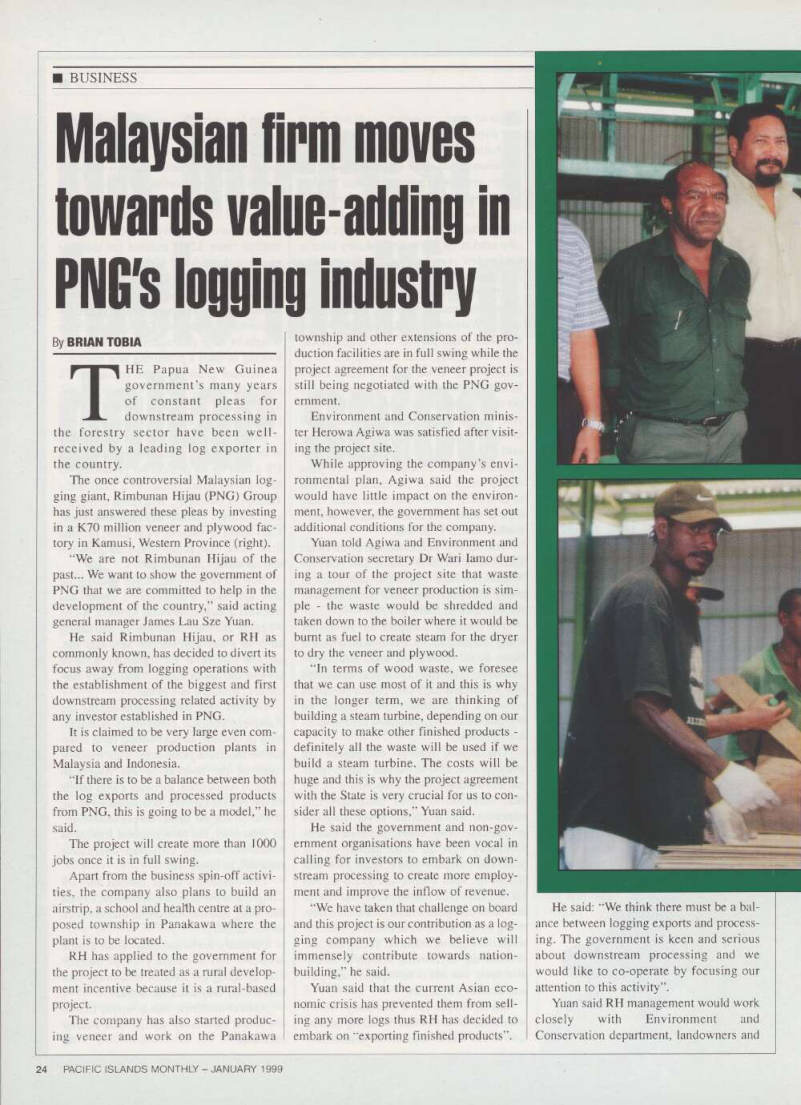
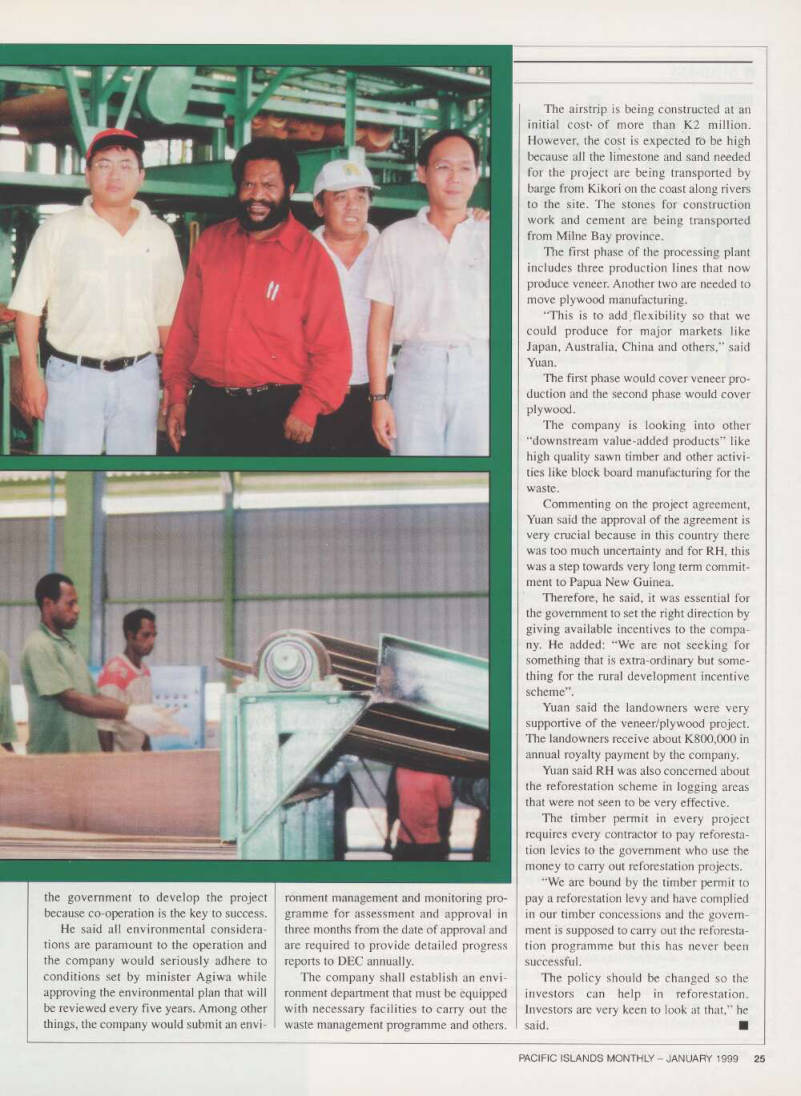
Malaysian firm moves towards value-adding in PNG's logging industry
By Brian Tobia
THE Papua New Guinea government’s many years of constant pleas for downstream processing in the forestry sector have been well received by a leading log exporter in the country.
The once controversial Malaysian log ging giant, Rimbunan Hijau (PNG) Group has just answered these pleas by investing in a K7O million veneer and plywood fac tory in Kamusi, Western Province (right).
“We are not Rimbunan Hijau of the past... We want to show the government of PNG that we are committed to help in the development of the country,” said acting general manager James Lau Sze Yuan.
He said Rimbunan Hijau, or RH as commonly known, has decided to divert its focus away from logging operations with the establishment of the biggest and first downstream processing related activity by any investor established in PNG.
It is claimed to be very large even com pared to veneer production plants in Malaysia and Indonesia.
“If there is to be a balance between both the log exports and processed products from PNG, this is going to be a model,” he said.
The project will create more than 1000 jobs once it is in full swing.
Apart from the business spin-off activi ties, the company also plans to build an airstrip, a school and health centre at a pro posed township in Panakawa where the plant is to be located.
RH has applied to the government for the project to be treated as a rural develop ment incentive because it is a rural-based project.
The company has also started produc ing veneer and work on the Panakawa
township and other extensions of the pro duction facilities are in full swing while the project agreement for the veneer project is still being negotiated with the PNG gov ernment.
Environment and Conservation minis ter Herowa Agiwa was satisfied after visit
ing the project site.
While approving the company’s envi
ronmental plan, Agiwa said the project
would have little impact on the environ ment, however, the government has set out additional conditions for the company.
Yuan told Agiwa and Environment and Conservation secretary Dr Wari lamo dur ing a tour of the project site that waste management for veneer production is sim ple - the waste would be shredded and taken down to the boiler where it would be burnt as fuel to create steam for the dryer to dry the veneer and plywood.
“In terms of wood waste, we foresee that we can use most of it and this is why in the longer term, we are thinking of building a steam turbine, depending on our capacity to make other finished products definitely all the waste will be used if we build a steam turbine. The costs will be huge and this is why the project agreement with the State is very crucial for us to con sider all these options,” Yuan said.
He said the government and non-gov emment organisations have been vocal in calling for investors to embark on down stream processing to create more employ ment and improve the inflow of revenue.
“We have taken that challenge on board and this project is our contribution as a log ging company which we believe will immensely contribute towards nation building,” he said.
Yuan said that the current Asian eco nomic crisis has prevented them from sell ing any more logs thus RH has decided to embark on “exporting finished products”.
He said: "We think there must be a bal ance between logging exports and process ing. The government is keen and serious about downstream processing and we would like to co-operate by focusing our attention to this activity”.
Yuan said RH management would work closely with Environment and Conservation department, landowners and
the government to develop the project because co-operation is the key to success.
He said all environmental considera tions are paramount to the operation and the company would seriously adhere to conditions set by minister Agiwa while approving the environmental plan that will be reviewed every five years. Among other things, the company would submit an envi
ronment management and monitoring pro gramme for assessment and approval in three months from the date of approval and are required to provide detailed progress reports to DEC annually.
The company shall establish an envi ronment department that must be equipped with necessary facilities to carry out the waste management programme and others.
The airstrip is being constructed at an initial cost- of more than K 2 million.
However, the cost is expected to be high because all the limestone and sand needed for the project are being transported by barge from Kikori on the coast along rivers to the site. The stones for construction work and cement are being transported from Milne Bay province.
The first phase of the processing plant includes three production lines that now produce veneer. Another two are needed to move plywood manufacturing. ‘This is to add flexibility so that we could produce for major markets like Japan, Australia, China and others,” said Yuan.
The first phase would cover veneer pro duction and the second phase would cover plywood.
The company is looking into other “downstream value-added products” like high quality sawn timber and other activi ties like block board manufacturing for the waste.
Commenting on the project agreement, Yuan said the approval of the agreement is very crucial because in this country there was too much uncertainty and for RH, this was a step towards very long term commit ment to Papua New Guinea.
Therefore, he said, it was essential for the government to set the right direction by giving available incentives to the compa ny. He added: “We are not seeking for something that is extra-ordinary but some thing for the rural development incentive scheme”.
Yuan said the landowners were very supportive of the veneer/plywood project.
The landowners receive about KBOO,OOO in annual royalty payment by the company.
Yuan said RH was also concerned about the reforestation scheme in logging areas that were not seen to be very effective.
The timber permit in every project requires every contractor to pay reforesta tion levies to the government who use the money to carry out reforestation projects.
“We are bound by the timber permit to pay a reforestation levy and have complied in our timber concessions and the govern ment is supposed to carry out the reforesta tion programme but this has never been successful.
The policy should be changed so the investors can help in reforestation.
Investors are very keen to look at that,” he said. ■
The doctor
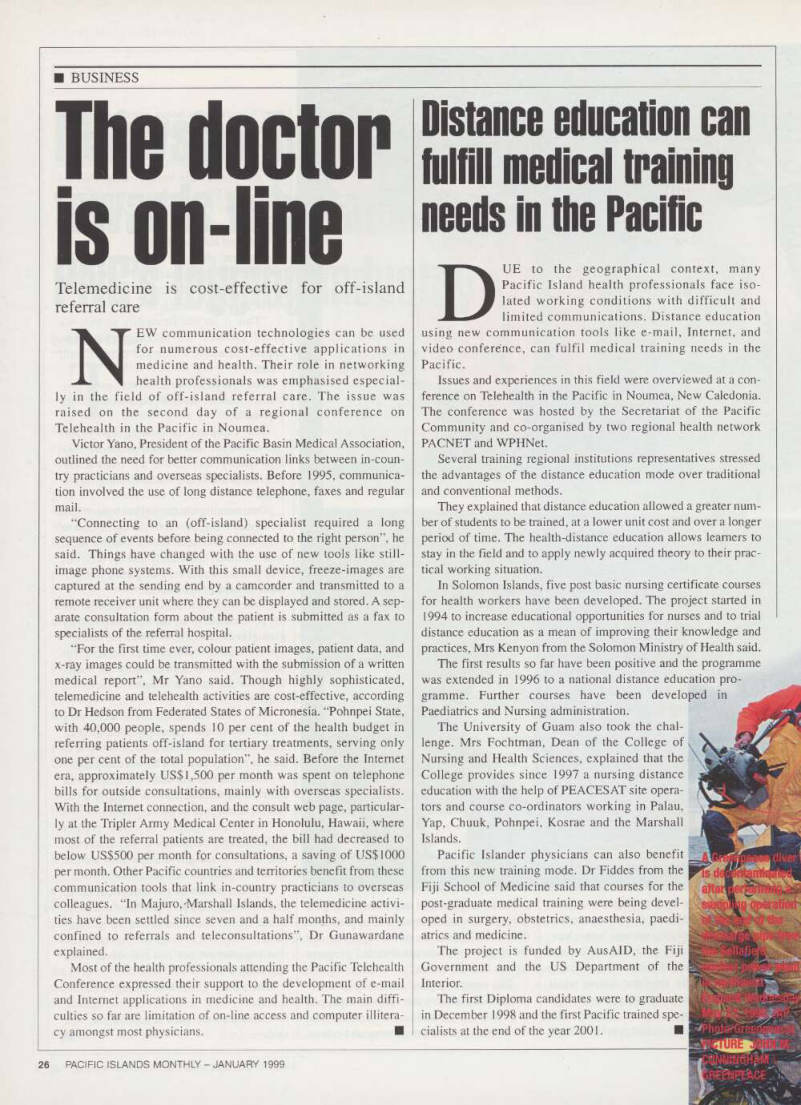
is on-line Telemedicine is cost-effective for off-island referral care
NEW communication technologies can be used for numerous cost-effective applications in medicine and health. Their role in networking health professionals was emphasised especial ly in the field of off-island referral care. The issue was raised on the second day of a regional conference on Telehealth in the Pacific in Noumea.
Victor Yano, President of the Pacific Basin Medical Association, outlined the need for better communication links between in-coun try practicians and overseas specialists. Before 1995, communica tion involved the use of long distance telephone, faxes and regular mail.
“Connecting to an (off-island) specialist required a long sequence of events before being connected to the right person”, he said. Things have changed with the use of new tools like still image phone systems. With this small device, freeze-images are captured at the sending end by a camcorder and transmitted to a remote receiver unit where they can be displayed and stored. A sep arate consultation form about the patient is submitted as a fax to specialists of the referral hospital.
“For the first time ever, colour patient images, patient data, and x-ray images could be transmitted with the submission of a written medical report”, Mr Yano said. Though highly sophisticated, telemedicine and telehealth activities are cost-effective, according to Dr Hedson from Federated States of Micronesia. “Pohnpei State, with 40,000 people, spends 10 per cent of the health budget in referring patients off-island for tertiary treatments, serving only one per cent of the total population”, he said. Before the Internet era, approximately US$l,5OO per month was spent on telephone bills for outside consultations, mainly with overseas specialists.
With the Internet connection, and the consult web page, particular ly at the Triplet Army Medical Center in Honolulu, Hawaii, where most of the referral patients are treated, the bill had decreased to below US$5OO per month for consultations, a saving of US$lOOO per month. Other Pacific countries and territories benefit from these communication tools that link in-country practicians to overseas colleagues. “In Majuro,-Marshall Islands, the telemedicine activi ties have been settled since seven and a half months, and mainly confined to referrals and teleconsultations”, Dr Gunawardane
explained.
Most of the health professionals attending the Pacific Telehealth Conference expressed their support to the development of e-mail and Internet applications in medicine and health. The main diffi culties so far are limitation of on-line access and computer illitera cy amongst most physicians. ■
fulfill medical training
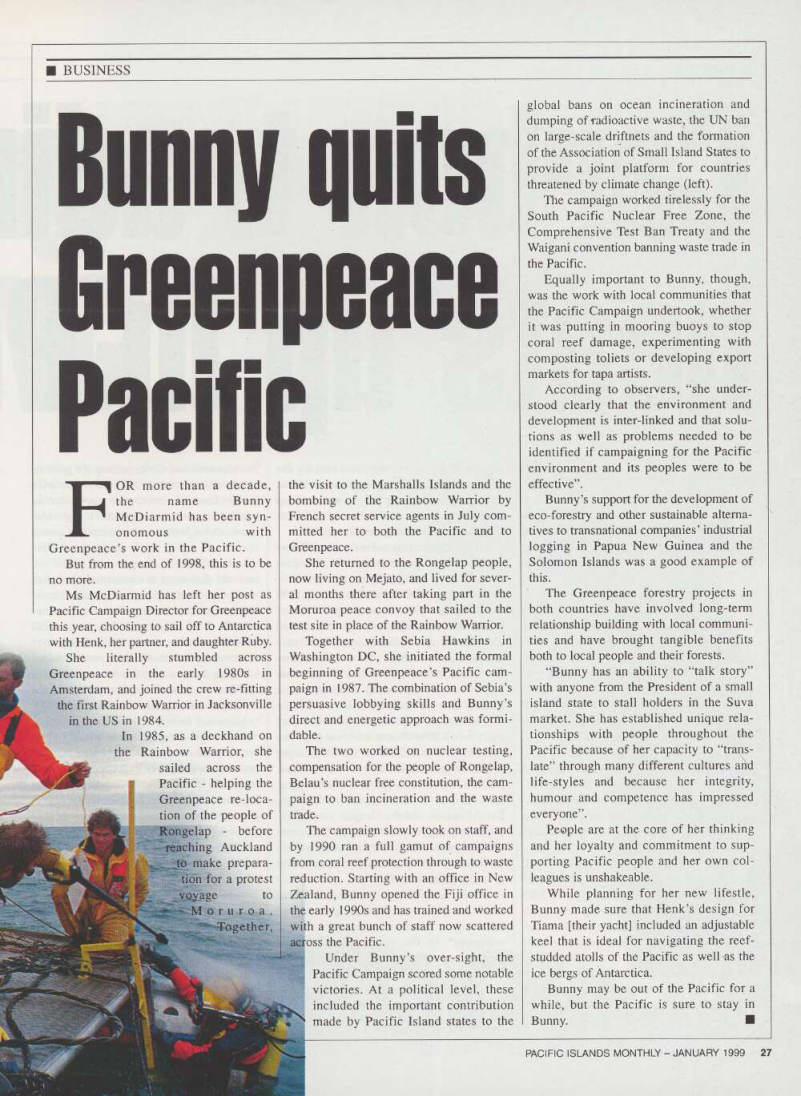
Distance education can fulfill medical training needs in the Pacific
DUE to the geographical context, many Pacific Island health professionals face iso lated working conditions with difficult and limited communications. Distance education using new communication tools like e-mail, Internet, and video conference, can fulfil medical training needs in the Pacific.
Issues and experiences in this field were overviewed at a con ference on Telehealth in the Pacific in Noumea, New Caledonia.
The conference was hosted by the Secretariat of the Pacific Community and co-organised by two regional health network PACNET and WPHNet.
Several training regional institutions representatives stressed the advantages of the distance education mode over traditional and conventional methods.
They explained that distance education allowed a greater num ber of students to be trained, at a lower unit cost and over a longer period of time. The health-distance education allows learners to stay in the field and to apply newly acquired theory to their prac tical working situation.
In Solomon Islands, five post basic nursing certificate courses for health workers have been developed. The project started in 1994 to increase educational opportunities for nurses and to trial distance education as a mean of improving their knowledge and practices, Mrs Kenyon from the Solomon Ministry of Health said.
The first results so far have been positive and the programme was extended in 1996 to a national distance education pro gramme. Further courses have been developed in
Paediatrics and Nursing administration.
The University of Guam also took the chal lenge. Mrs Fochtman, Dean of the College of Nursing and Health Sciences, explained that the College provides since 1997 a nursing distance education with the help of PEACES AT site opera tors and course co-ordinators working in Palau, Yap, Chuuk, Pohnpei, Kosrae and the Marshall Islands.
Pacific Islander physicians can also benefit from this new training mode. Dr Fiddes from the Fiji School of Medicine said that courses for the post-graduate medical training were being devel oped in surgery, obstetrics, anaesthesia, paedi atrics and medicine.
The project is funded by AusAID, the Fiji Government and the US Department of the Interior.
The first Diploma candidates were to graduate in December 1998 and the first Pacific trained spe cialists at the end of the year 2001. ■
A Greenpeace diver
is decentaminated
after performing a
sampling operation
at the end of the
discharge pope from
the Sellafield
nuclear power plant
in northwest England Wednesday May 27, 1998. (AP Photo/Greenpeace)
Picture John M.
Cunningham
Greenpeace
Greenpeace
Bunny quits Greenpeace Pacific
FOR more than a decade, the name Bunny McDiarmid has been syn onomous with Greenpeace’s work in the Pacific.
But from the end of 1998, this is to be no more.
Ms McDiarmid has left her post as Pacific Campaign Director for Greenpeace this year, choosing to sail off to Antarctica with Henk, her partner, and daughter Ruby.
She literally stumbled across Greenpeace in the early 1980 s in Amsterdam, and joined the crew re-fitting the first Rainbow Warrior in Jacksonville in the US in 1984.
In 1985, as a deckhand on the Rainbow Warrior, she sailed across the 1 Pacific - helping the Greenpeace re-loca t I tion of the people of i Rongelap - before reaching Auckland to make prepara- Blp tion for a protest K ' v °y a c e t 0 Moru r o a .
Together,
the visit to the Marshalls Islands and the bombing of the Rainbow Warrior by French secret service agents in July com mitted her to both the Pacific and to Greenpeace.
She returned to the Rongelap people, now living on Mejato, and lived for sever al months there after taking part in the Moruroa peace convoy that sailed to the test site in place of the Rainbow Warrior.
Together with Sebia Hawkins in Washington DC, she initiated the formal beginning of Greenpeace’s Pacific cam paign in 1987. The combination of Sebia’s persuasive lobbying skills and Bunny’s direct and energetic approach was formi dable.
The two worked on nuclear testing,
compensation for the people of Rongelap,
Belau’s nuclear free constitution, the cam paign to ban incineration and the waste trade.
The campaign slowly took on staff, and by 1990 ran a full gamut of campaigns from coral reef protection through to waste reduction. Starting with an office in New Zealand, Bunny opened the Fiji office in the early 1990 s and has trained and worked with a great bunch of staff now scattered across the Pacific. 55S*-; Under Bunny’s over-sight, the Pacific Campaign scored some notable • ; victories. At a political level, these w included the important contribution made by Pacific Island states to the
global bans on ocean incineration and dumping of radioactive waste, the UN ban on large-scale driftnets and the formation of the Association of Small Island States to
provide a joint platform for countries
threatened by climate change (left).
The campaign worked tirelessly for the South Pacific Nuclear Free Zone, the Comprehensive Test Ban Treaty and the Waigani convention banning waste trade in the Pacific.
Equally important to Bunny, though, was the work with local communities that the Pacific Campaign undertook, whether it was putting in mooring buoys to stop coral reef damage, experimenting with composting toliets or developing export markets for tapa artists.
According to observers, “she under stood clearly that the environment and development is inter-linked and that solu tions as well as problems needed to be identified if campaigning for the Pacific environment and its peoples were to be effective”.
Bunny’s support for the development of eco-forestry and other sustainable alterna tives to transnational companies’ industrial logging in Papua New Guinea and the Solomon Islands was a good example of this.
The Greenpeace forestry projects in both countries have involved long-term relationship building with local communi ties and have brought tangible benefits both to local people and their forests.
“Bunny has an ability to “talk story” with anyone from the President of a small island state to stall holders in the Suva market. She has established unique rela tionships with people throughout the Pacific because of her capacity to “trans late” through many different cultures arid life-styles and because her integrity, humour and competence has impressed everyone”.
People are at the core of her thinking and her loyalty and commitment to sup porting Pacific people and her own col leagues is unshakeable.
While planning for her new lifestle, Bunny made sure that Henk’s design for Tiama [their yacht] included an adjustable keel that is ideal for navigating the reef studded atolls of the Pacific as well as the ice bergs of Antarctica.
Bunny may be out of the Pacific for a while, but the Pacific is sure to stay in Bunny. ■
heats up in PNG


Carbon trading heats up in PNG
By Brian Tobia
PAPUA New Guinea will become the first country in the South Pacific to receive the World Bank’s direct involvement in the improvement of its environmental sustainability pro grammes.
The World Bank awarded a grant of US$l5 million (K 32.6 million) to Papua New Guinea through Conservation trust Fund of PNG to fund conservation-oriented projects in the country. The Trust Fund, cur rently being formalised, will provide an ongoing reliable source of in-country fund ing for bio-diversity conservation and ecol ogy of sustainable development projects.
It will be a non-govemment entity gov erned by a multi-stake holder management board, which will supervise the appoint ment and activities of a professional man agement unit. The idea was mooted in June 1987 and was aimed to solicit funds to sup port conservation projects in the country.
PNG, under such arrangement, will become the first country in the South Pacific to benefit from this type of help from the World Bank, following three years of negotiations and feasibility studies after the Earth Summit held in Rio and Brussels in 1995. The global environmental objec tive is to improve the management and con servation of important forest eco-systems in the world. Twenty countries, including on of the world’s most bio-diversity-rich
regions, Brazil, are being assisted by the World Bank in forestry and conservation projects. For PNG, the project will develop procedures for landowners to make their own decisions in using their forest.
GEF’s Conservation Finance and Policy director, Sheldon Cohen, said the first instalment of US$5 million (K 10.87 mil lion) would be made available by June 1999 for draw-down to support a portfolio of demonstration projects in the country and the balance of US$lO million (K 21.7 mil lion) at the end of three years for the endow ment fund. He said CTF should seek other donors to meet the second instalment on a kina for kina basis. This is to ensure that the ultimate goal to build an endowment of more than K3O million is achieved to gener ate about K 1.5 million to K 3 million per year in investment income for conservation projects. Cohen said this is the first biggest trust fund TNC has catalysed in the Asia- Pacific region and the “largest single bio diversity grants ever awarded by GEE - one of the largest awarded by any donor for a CTF and possibly the largest single bio diversity grant for PNG”.
The trust fund was initiated so that it would be used to facilitate programmes to encourage “sustainable use of natural resources” in the country and prevent greater destruction of the environment.
However, the government strongly believe that encouraging conservation will slow down logging operations in the coun try. Through the Department of
Environment and Conservation, the govern ment wants to ensure that an equal amount (of the funds) is directed to implementing existing conservation projects. The govern ment, through the establishment of a new institution called PNG Institute of Bio diversity (PINBio), aims to study plants and animals that have the potential to derive medicines from and explore possibilities of carbon emission trading. Department secre tary Dr Vari lamo said the government “does not want to see the NGOs taking over all our functions in terms of conservation” although it was a very important project.
“And we want to see a proportion of the fund spent on existing national-level priori ty projects,” he said. lamo said the department would like to see the trust fund cover the entire nation so that no province would miss out. He said they have created an NGO desk within the department to be the link between the pro ject and them. Dr lamo said the fund has the support of his department.
“Too often commercial development is driven only by the short term considerations of immediate benefits and too often this involves serious damage to environment and conservation values. Support is needed to conserve PNG’s bio-diversity and to help landowners with a development that is eco logically sustainable in the long term”.
He said it was a great test for PNG to embark on the conservation of its forest resources. Environment and Conservation minister Herowa Agiwa, while announcing
Cabinet’s approval of the establishment of PINBio, said PNG’s natural resources including vast forests have been exploited and exported for revenue but the new bio diversity project may set some light on con servation.
“We can conserve our forest and earn money from it instead of logging it. We con serve our forest and charge developed coun tries to pay us because our trees absorb the CO2 emissions,” he said.
According to Agiwa, carbon emissions trading is one of the areas the new institute (PINBio) would be looking at as a potential revenue source. There would be a total halt to logging practices if the sustainable use of forests in the country becomes successful. , The institute’s role is to conduct research into the two types of conservation indus tries. These are bio-prospecting and carbon emission trade, said University of PNG aca demic, Dr Simon Saulei, who is seconded to DEC on the carbon emission trade pro ject. Dr Saulei said by conserving the forest or planting new trees in grasslands “we can generate more revenue for the resource owners and government over a long period of time”. “These two industries would gen
crate billions of kina over a long period of time unlike non renewable resources like oil, gas and minerals, so we ” would be doing our part in try ing to get this industry established in PNG,” he said.
PINBio is an institution that would be directed to conduct research and devel opment into the two major areas.
Bio-prospecting looks at types of plant and animals, both on land and in the sea, to research and screen them. This is to find out what sort of chemicals they have and whether those chemicals can be used for treating all kinds of diseases. Research and development would be done in the area of climate change.
“The submission that was made is not only addressing the issue of generating rev enue for the resource owners and for the government but also to enhance approaches to different strategies for conserving our very diverse biological resource like plants and animals,” he said.
Carbon emission trade research is a three-year project and a national commu nication network would be developed and presented to the United Nations Convention on Climate Change Secretariat. ■
Advertisements & other items, p. 29 (1 item)
29
PACIFY momti-ii V JANUARY 1999
ig VG
people

Cover Story
Rise of
power threatens Skate government
THE unstable Papua New Guinea government of prime minister Bill skate is facing a new threat - the rise of ‘people power’ through the trade union movement.
Other existing threats - such as a looming vote of no confidence being sponsored by the Opposition and possible military inter vention - appear less pressing or very unlike ly, although not completely ruled out.
Unless there is a massive defection of government members of parliament before July 13 this year when the Opposition can test the government’s strength. Skate appeared safe as of early December.
An 18 month grace period expires this month, however, the government prevented the opposition from moving any vote by extending the parliament session from December 3 to July 13.
The government also appears safe from any military threat after it re-instated former Defence Force commander Brigadier General Jerry Singirok.
Singirok is closely associated with PM Skate. The government removed former commander Brigadier General Leo Nuia whom Skate blamed for lack of co-operation with the government.
But while these things may have been rel atively within his control, Skate now faces his biggest threat - the people themselves. As
By Sam Vulum
far as the government is concerned, the threat to their survival comes from the trade unionists who joined forces with the oppo sition to oppose the budget.
The unions appear to have widespread
support, receiving heavy backing in the
media. Women’s groups, youths and other members of the general public marched with trade unionists to parliament in November.
The level of dissatisfaction with the gov ernment, in particular PM Skate, seems quite extensive. Certainly those who marched were not at all happy with his per formance.
When Skate addressed the protesters
outside parliament house, they interjectedly
booed him down several times while he tried to calm them, and they booed even louder when he left.
Several politicians, including Skate also felt the pinch of the public’s anti-govern ment behaviour when they were prevented from using the services of the national air line, Air Niugini, during the height of the union strike.
The first two victims were two cabinet ministers, Vincent Auali and Jimson Sauk, who were asked to leave a plane. It is under stood that the striking airline workers also prevented several politicians, bound for a Sydney mining conference in November,
from leaving.
Among them were PM Skate, his deputy lairo Lasaro, lan Ling-Stuckey (Commerce), Sir John Kaputin, Peter Waieng (Defence) and Roy Yaki (Foreign Affairs and Trade).
However, Air Niugini’s general manager Chris Mek denied that Skate was off loaded.
Mek said that only other government offi cials were asked to disembark before the flights left.
Skate has expressed disappointment that Air Niugini could treat the government of the day in that manner.
He said it was his government that had injected K5O million to bail out the airline and he would conduct an investigation into the blacklisting of MPs.
About the same time, it was reported that Defence Minster Peter Waieng was alleged to have flown to Goroka in a Defence
Iroquois helicopter after trying unsuccess
fully to get on the usual commercial flights.
Though this could not be confirmed independently, sources said minister Waieng was forced to take that option
because striking Air Niugini employees had black-banned all politicians on the airline services.
Sources estimated the overhead costs, to fly the chopper to Goroka and back to Port Moresby, to be about K 16,000.
The people’s power in Papua New Guinea was tested for the first time during the Sandline Crisis. Although it was only a minority group, backed by soldiers from the PNG Defence Force, they were effective in forcing the former prime minister sir Julius Chan to step down.
The situation was quite similar in November/December 1998, except that there were no soldiers, just a large number of people including nation-wide union members.
The union’s uprising laid bare the peo ple’s growing frustrations and anger over the government’s conduct since taking office in the 1997 elections.
The government has been plagued with controversy, and now, it seems, Papua New Guineans are getting quite fed up. What’s more, the people seem to be backing the opposition over some of the government’s alleged sinister and questionable activities.
The feeling amongst the people was vividly described by shadow Treasury and corporate Affairs minister Bart Philemon when replying to the budget.
“Over the last 16 months, the opposition together with a great majority of Papua New Guineans had to put up with this govern ment, sometimes under the most agonising circumstances.
“There are questions and allegations of corruption over the Skate/Sefa tapes, which are still outstanding. There are also out standing questions over senior members of Skate’s party being involved in producing pornographic video tapes.
“There has also been frequent sacking of departmental heads thereby eroding the independence of the bureaucracy.
There are constant changes in the heads of statutory bodies and questionable appointments of political cronies. There are questions over constant changes of minis ters and deputy prime ministers.
“Out patience is fast running out.
Enough is enough. The 1999 budget is the last straw left for this government. This budget is bringing the matter to a head.
“How much longer are we prepared to put up with this government which lacks economic management experience and
hence depends completely on an expensive and controversial K 7 million foreign eco nomic advisor and technical advise,” he said.
It is this expansive K 7 million contract for the economic advisor Dr Hamidian-Rad and other lavish spending exercises, includ ing a recent holiday trip by several MPs to Cairns, Australia, that troubles the people most.
What many could not understand was that while the government is introducing cost-cutting measures, it also continues to spend extravagantly.
The 7000 public servants who are direct ly affected, most of whom are union mem bers, do not accept that while depriving them of paid jobs, the government can also afford to allocate K 54 million to MPs under a district support grant.
The funds will be left to the discretion of MPs to decide how they are used in a sys tem that was abolished in the past because of gross misuse by MPs.
Those set to be retrenched will join a pool of a rising number of unemployed in the country. Employment creation in PNG since 1996 has been dismal. The country has created less than 80,000 jobs over the last 30 years. On average, it has created roughly around 2,600 jobs per annum.
This is quite alarming as current esti mates from the education department show that 50,000 people are pouring out of the school system every year.
The mounting pressure on the govern ment in December subsided after the unions agreed to return to work and parliament pre maturely adjourned to July.
As expected, the government has again used the numbers tactic to skip two 1999
parliamentary sittings, beginning the 1999
session in July.
The January and March sittings have been skipped, in a move seen as a desperate tactic to give the government enough time to prepare for the looming no-confidence vote.
The government has argued that it will use the holiday period to sell the budget to
the people.
However, the time lapse also provides the opportunity for the opposition to lobby support. The unions would also be expect ing some direct answers to their demands in July.
There are expected to be some interest ing developments in the session in July. ■
control in PNG
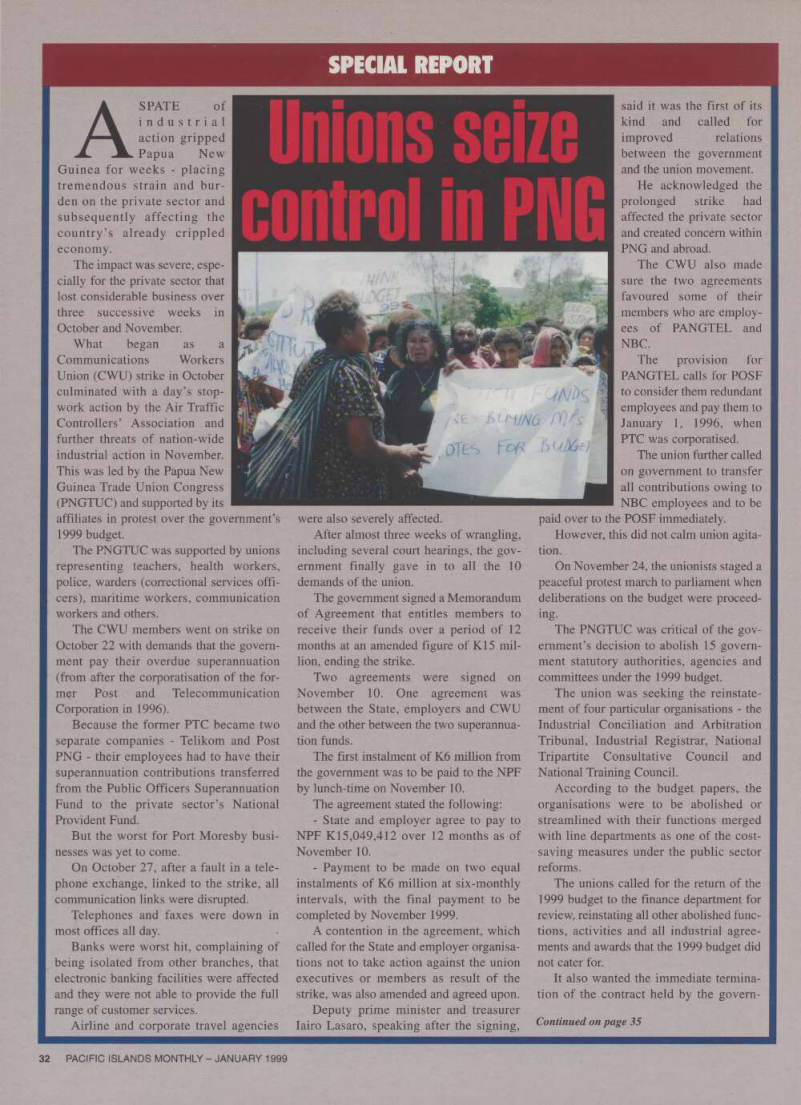


Special Report
Unions seize control in PNG
A Spate Of
industrial
action gripped
Papua New Guinea for weeks - placing tremendous strain and bur den on the private sector and subsequently affecting the
country’s already crippled
economy.
The impact was severe, espe cially for the private sector that lost considerable business over three successive weeks in October and November.
What began as a Communications Workers Union (CWU) strike in October culminated with a day’s stop work action by the Air Traffic Controllers’ Association and further threats of nation-wide industrial action in November.
This was led by the Papua New Guinea Trade Union Congress (PNGTUC) and supported by its
affiliates in protest over the government’s 1999 budget.
The PNGTUC was supported by unions representing teachers, health workers, police, warders (correctional services offi cers), maritime workers, communication workers and others.
The CWU members went on strike on October 22 with demands that the govern ment pay their overdue superannuation (from after the corporatisation of the for mer Post and Telecommunication Corporation in 1996).
Because the former PTC became two separate companies - Telikom and Post PNG - their employees had to have their superannuation contributions transferred from the Public Officers Superannuation Fund to the private sector’s National Provident Fund.
But the worst for Port Moresby busi nesses was yet to come.
On October 27, after a fault in a tele phone exchange, linked to the strike, all communication links were disrupted.
Telephones and faxes were down in most offices all day.
Banks were worst hit, complaining of being isolated from other branches, that electronic banking facilities were affected and they were not able to provide the full range of customer services.
Airline and corporate travel agencies
were also severely affected.
After almost three weeks of wrangling, including several court hearings, the gov ernment finally gave in to all the 10 demands of the union.
The government signed a Memorandum of Agreement that entitles members to receive their funds over a period of 12 months at an amended figure of Kl 5 mil lion, ending the strike.
Two agreements were signed on November 10. One agreement was between the State, employers and CWU and the other between the two superannua tion funds.
The first instalment of K 6 million from the government was to be paid to the NPF by lunch-time on November 10.
The agreement stated the following: - State and employer agree to pay to NPF K 15,049,412 over 12 months as of November 10. - Payment to be made on two equal instalments of K 6 million at six-monthly intervals, with the final payment to be
completed by November 1999.
A contention in the agreement, which called for the State and employer organisa tions not to take action against the union executives or members as result of the strike, was also amended and agreed upon.
Deputy prime minister and treasurer lairo Lasaro, speaking after the signing,
said it was the first of its kind and called for
improved relations
between the government and the union movement.
He acknowledged the prolonged strike had affected the private sector and created concern within PNG and abroad.
The CWU also made sure the two agreements favoured some of their members who are employ ees of PANGTEL and
Nbc.
The provision for PANGTEL calls for POSE to consider them redundant employees and pay them to January 1, 1996, when PTC was corporatised.
The union further called on government to transfer all contributions owing to NBC employees and to be
paid over to the POSE immediately.
However, this did not calm union agita tion.
On November 24, the unionists staged a peaceful protest march to parliament when deliberations on the budget were proceed ing.
The PNGTUC was critical of the gov ernment’s decision to abolish 15 govern ment statutory authorities, agencies and committees under the 1999 budget.
The union was seeking the reinstate ment of four particular organisations - the Industrial Conciliation and Arbitration Tribunal, Industrial Registrar, National Tripartite Consultative Council and National Training Council.
According to the budget papers, the organisations were to be abolished or streamlined with their functions merged with line departments as one of the cost saving measures under the public sector reforms.
The unions called for the return of the 1999 budget to the finance department for review, reinstating all other abolished func tions, activities and all industrial agree ments and awards that the 1999 budget did not cater for.
It also wanted the immediate termina tion of the contract held by the govern-
Continued on page 35
Continued from page 32
ment’s chief economic advisor Dr Pirouz Hamidian-Rad and his deportation; and the abolishment of Value Added Tax (VAT).
However, after receiving the petition from the union leaders outside parliament, the government used its numerical strength to bulldoze the budget through parliament.
This happened despite the union’s protest march and 59 recommended amendments to the expenditure budget by the Opposition. It was on the same day that, amid the uncertainties over the CWU strike, the Air Traffic Controllers Association created more chaos by sudden ly stopping work.
Theirs was a protest over management’s failure to buy vehicles for the controllers.
Both domestic and international flights were disrupted, leaving travellers stranded everywhere on November 24. The slop work by controllers forced a Qantas plane with 169 passengers aboard to turn back to Brisbane. An Air Niugini Airbus that was supposed to have landed at Port Moresby was diverted to Caims.
A flight to Manila in the Philippines could not leave because traffic controllers in Brisbane reportedly refused to clear the plane in sympathy with their PNG col leagues.
Although the stop-work had been called off. Air Niugini reported a loss of K 60,000 in potential revenue as a result of the strike.
Air Niugini managing director Andrew Ogil said 29 “PX” flights were grounded, causing disruptions to at least 2000 travel ling passengers.
However, on November 27, after a lunch-time meeting with prime minister Bill Skate, the PNGTUC and its affiliates called off the strike. Skate and union lead ers reached a deal to avert the strike during talks lasting more than three hours at par liament house.
A concerned Port Moresby Chamber of Commerce and Industry president, Michael Mayberry, said businesses were unneces sarily losing revenue every time a strike occurred. He said this should not be the case if there was consultation and dialogue
with employers.
Mayberry said unions should show some responsibility and try to solve prob lems by engaging in meaningful dialogue with employers.
The Lae Chamber of Commerce and Industry president Alan McLay said the strike had a detrimental impact on busi
nesses in Lae. McLay said the difficulty in telecommunications alone, with overseas and domestic buyers and suppliers, had caused loss of income to many companies.
“Some of these companies have already stated through the Chamber that their loss of revenue was very high,” he said.
The main victim, Telikom - whose employees comprise the highest number in the CWU membership - lost Kl, 107,923 in business. The company had to use the national court to order the PTC employees to return to work. In November, the other company affected, Post PNG, reported its highest loss due to the strike by its work
ers. Post PNG managing director, Passingan Taru, said the company lost K 500,000 because of the two-week rolling strike and therefore failed to achieve its 1998 target revenue of KlB million.
The damaging impact of the strike forced the Papua New Guinea Banking Corporation (PNGBC) National Staff Association to step in and publicly plead with the CWU to restore all data links and telephones, especially to the banks.
Association president, Felix Unage, claimed that PNGBC’s nation-wide net work was adversely affected, losing mil lions of kina in business. ■
Advertisements & other items, pp. 33-34 (1 item)
Notebook,
To Win an
IBM Pentium
m i* f \ * Get the latest on political, business and social issues happening throughout the region every month, as well as the chance to win an IBM Pentium Notebook! Every 12issue subscription received before March 31st, 1999 will go into the draw. Subscribe to Pacific Islands Monthly today by calling (679) 304 111 or fax (679) 303 809/(679) 307 460.
Subscribe to The Source.
Pacific Islands Monthly
Conditions of Entry I.To enter, subscription must be made before March 31st, 1999 which automatically enters the subscriber into the draw for the Pentium Notebixtk Computer. 2,Entry is open to all subscribers except employees of The Fiji Times Ltd, Pacific Islands Monthly and Wilson Addison Ltd. 3.Subscribers need to subscribe for at least 12 months to qualify. 4 .The winner of the Pentium Notebook will be published in the Pacific Islands Monthly Magazine, May Issue, 1999 and will be notified by registered mail. IThe winner will receive their prize within one month of the draw. 6.Thc prize must be taken as offered and is not redeemable. 7.1 n the event of any dispute the decision of the promoter is final and no correspondence will be entered into.
For almost 70 years, Pacific Islands Monthly has been and still is the authority on political, business and social issues within the Pacific. And now, every 12 month subscription received before the 31st of March, 1999, goes into a draw to win an IBM Pentium Notebook*. You could even give a gift subscription to enter but it must be before the closing date. As well as the entry into the draw, you will also receive the latest news from the region. Fill in the subscription form below and send it along with payment to Pacific Islands Monthly, Subscription Department, PO Box 1167, Suva, Fiji. Or call PIM on (679) 304 111 or fax us on (679) 303 809/(679) 307 460.
Subscribe to The Source.
Pacific Islands Monthly
*Rates include Airspeeding to all destinations Conditions of Entry 1. To enter, subscriptions must be made before March 31st,!999]which automatically enters the subscriber into the draw for the Pentium Notebook Computer. 2. Entry is open to all subscribers except employees of The Fiji Times Ltd, Pacific Islands Monthly and Wilson Addison Ltd. 3- Subscribers need to subscribe for 12 months to qualify. 4. The winner of the Pentium Notebook will be published in Pacific Islands Monthly Magazine, May Issue, Us99»and will be notified by registered mail. 5. The winner will receive their prize within one month of the draw. 6. The prize must be taken as offered and is not redeemable. 7. In the event of any dispute the decision of the promoter is final and no correspondence will be entered into.
YES! I wish to subscribe to The Source and receive a chance to win an IBM Pentium Notebook Computer! □ Cheque/Bank Draft/Money Order made payable to Pacific Islands Monthly Please charge my credit card: (VISA / AMEX / MASTERCARD)
12 ISSUE
SUBSCRIPTION
Rate A Rate B I Rate C Rate D Rate E Signature: Expiry date: Mr/Mrs/Ms; Delivery Address: Postal Address: This is a
□ Renewal
□ New Subscription Country: Fax:
Papua New Gianea
Rape surges in Papua New Gianea
THE incidence of rape in Papua New Guinea had risen dramatically and children as young as 10 years were involved in pack rape, according to a report released in Port Moresby in December.
“Rape has increased in PNG and has become extremely violent and random,” said the PNG Law and Justice Baseline Survey of Community Initiatives.
The report was released by Australian aid agency AusAID.
Pack rape was particularly violent and sometimes fatal.
“An emerging trend in pack rape is the diverse ages of offenders. Children as young as 10 are now involved,” the report said.
The report said accurate statistics were unavailable because many cases of rape went unreported.
“However the number of rapes reported has increased dramatically from 285 in 1980 to 1,896 in 1990 (rpt 1990),” the report said.
The perceived inferior status of women promoted sexual violence, and many women and girls had developed a fatalistic outlook and believed that forced sexual intercourse must be accepted as part of
womanhood. Rape, especially pack rape, was a way of asserting male superiority and solidarity, the report said.
Young, unemployed men involved in rape tried to justify their actions by claim ing lack of access to desirable women; an urge to teach educated, liberated young women or girls a lesson; the acceptability of a man sharing his girlfriend with other friends; a payback for turning down a request for sexual intercourse; or the influ ence of alcohol or drugs.
The report said the incidence of rape
was especially high in PNG’s Highlands,
where it had become a common element in tribal fighting. Rape also occurred around the bush discos where young girls and women were abducted and raped. Armed hold-ups and burglaries were also accom panied by incidences of rape.
The report said violence against women - including rape and assault - was a conse quence of a breakdown of traditional con straints on men and the influence of the
urban lifestyle.
“The climate of tolerance of violence against women is enhanced by apparent institutional support in the laws relating to polygamy and rape - it is still legal for a man to rape his wife or wives in PNG,” the report said. (AAP) ■
A lesson for Cooks in Japanese peart disaster
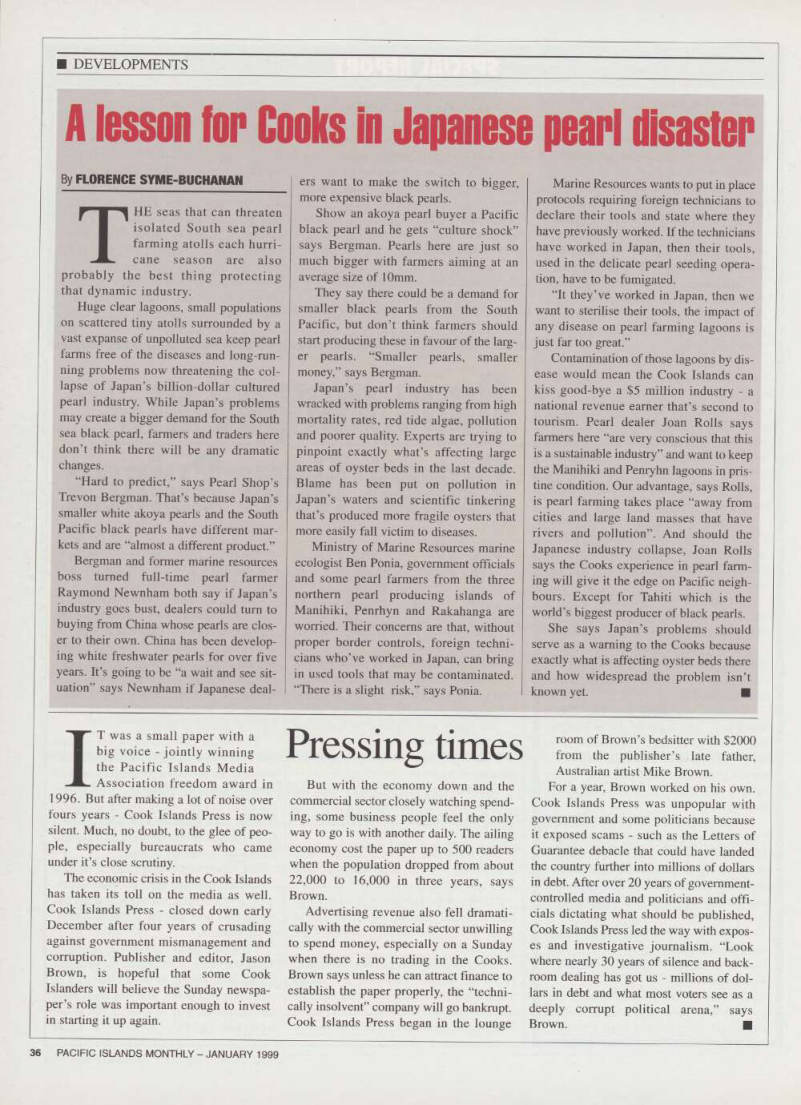
Developments
By Florence Syme-Buchanan
THE seas that can threaten isolated South sea pearl farming atolls each hurri cane season are also probably the best thing protecting that dynamic industry.
Huge clear lagoons, small populations on scattered tiny atolls surrounded by a vast expanse of unpolluted sea keep pearl farms free of the diseases and long-run ning problems now threatening the col lapse of Japan’s billion-dollar cultured pearl industry. While Japan’s problems may create a bigger demand for the South sea black pearl, farmers and traders here don’t think there will be any dramatic
changes.
“Hard to predict,” says Pearl Shop’s Trevon Bergman. That’s because Japan’s smaller white akoya pearls and the South Pacific black pearls have different mar kets and are “almost a different product.”
Bergman and former marine resources boss turned full-time pearl farmer Raymond Newnham both say if Japan’s industry goes bust, dealers could turn to buying from China whose pearls are clos er to their own. China has been develop ing white freshwater pearls for over five years. It’s going to be “a wait and see sit uation” says Newnham if Japanese deal
ers want to make the switch to bigger, more expensive black pearls.
Show an akoya pearl buyer a Pacific black pearl and he gets “culture shock” says Bergman. Pearls here are just so much bigger with farmers aiming at an average size of 10mm.
They say there could be a demand for smaller black pearls from the South Pacific, but don’t think farmers should start producing these in favour of the larg er pearls. “Smaller pearls, smaller money,” says Bergman.
Japan’s pearl industry has been wracked with problems ranging from high mortality rates, red tide algae, pollution and poorer quality. Experts are trying to
pinpoint exactly what’s affecting large
areas of oyster beds in the last decade.
Blame has been put on pollution in Japan’s waters and scientific tinkering that’s produced more fragile oysters that more easily fall victim to diseases.
Ministry of Marine Resources marine ecologist Ben Ponia, government officials and some pearl farmers from the three northern pearl producing islands of Manihiki, Penrhyn and Rakahanga are worried. Their concerns are that, without proper border controls, foreign techni cians who’ve worked in Japan, can bring in used tools that may be contaminated.
“There is a slight risk,” says Ponia.
Marine Resources wants to put in place protocols requiring foreign technicians to declare their tools and state where they have previously worked. If the technicians have worked in Japan, then their tools, used in the delicate pearl seeding opera tion, have to be fumigated.
“It they’ve worked in Japan, then we want to sterilise their tools, the impact of any disease on pearl farming lagoons is just far too great.”
Contamination of those lagoons by dis ease would mean the Cook Islands can kiss good-bye a $5 million industry - a national revenue earner that’s second to tourism. Pearl dealer Joan Rolls says farmers here “are very conscious that this is a sustainable industry” and want to keep the Manihiki and Penryhn lagoons in pris tine condition. Our advantage, says Rolls, is pearl farming takes place “away from cities and large land masses that have rivers and pollution”. And should the
Japanese industry collapse, Joan Rolls
says the Cooks experience in pearl farm ing will give it the edge on Pacific neigh bours. Except for Tahiti which is the world’s biggest producer of black pearls.
She says Japan’s problems should serve as a warning to the Cooks because exactly what is affecting oyster beds there and how widespread the problem isn’t known yet. ■
Pressing times
IT was a small paper with a
big voice - jointly winning
the Pacific Islands Media Association freedom award in 1996. But after making a lot of noise over fours years - Cook Islands Press is now silent. Much, no doubt, to the glee of peopie, especially bureaucrats who came under it’s close scrutiny.
The economic crisis in the Cook Islands has taken its toll on the media as well.
Cook Islands Press - closed down early December after four years of crusading against government mismanagement and corruption. Publisher and editor, Jason Brown, is hopeful that some Cook Islanders will believe the Sunday newspaper’s role was important enough to invest in starting it up again.
But with the economy down and the commercial sector closely watching spend ing, some business people feel the only way to go is with another daily. The ailing economy cost the paper up to 500 readers when the population dropped from about 22,000 to 16,000 in three years, says Brown.
Advertising revenue also fell dramati cally with the commercial sector unwilling to spend money, especially on a Sunday when there is no trading in the Cooks.
Brown says unless he can attract finance to establish the paper properly, the “techni cally insolvent” company will go bankrupt.
Cook Islands Press began in the lounge
room of Brown’s bedsitter with $2OOO from the publisher’s late father, Australian artist Mike Brown.
For a year, Brown worked on his own.
Cook Islands Press was unpopular with government and some politicians because it exposed scams - such as the Letters of Guarantee debacle that could have landed the country further into millions of dollars in debt. After over 20 years of government controlled media and politicians and offi cials dictating what should be published, Cook Islands Press led the way with expos es and investigative journalism. “Look where nearly 30 years of silence and back room dealing has got us - millions of dol lars in debt and what most voters see as a deeply corrupt political arena,” says Brown. ■
Advertisements & other items, pp. 37-38 (1 item)
South Pacific Forum Secretariat Suva, Fiji
VACANCY
The Forum Secretariat was established in 1972 by the South Pacific Forum to encourage economic and political co-operation between its member countries*, and between these states and other countries.
DIRECTOR, DEVELOPMENT AND ECONOMIC POLICY DIVISION
The Secretariat is seeking a suitably qualified and experienced person to work as Director in the Development and Economic Policy Division.
The Director, Development and Economic Policy Division is accountable to the Deputy Secretary General for : . ensuring successful management of all the Division’s programmes, staffing resources and budget; . actively participating in the broader policy and management of the secretariat; . accurately assessing the status of the contribution ma.de by the division towards enhanced development and economic policy analysis, development dialogue and co-ordination and development planning capacities in the region; . providing reliable policy advice on measures for improving co-ordination of development issues across all sectors in the region.
Applicants must be citizens of Forum member countries* and should have an advanced university degree in development economics, development studies or a related field with at least 8-10 years relevant work experience. Extensive travel in the region will be required. The appointment will carry a competitive remuneration package. For non-Fiji citizens remuneration should be tax free in Forum member countries*.
There are generous benefits and allowances together with medical and life insurance provisions. Appointments are normally for three years, with the option to renew for a further three years.
All applications should be addressed to: The Secretary General,
Forum Secretariat,
Private Mail Bag, Suva, Fiji.
An Information Package on the position is available from the Secretariat and applicants are urged obtain one from Ms Angela Ricketts, on (679)312600 or (679)220207 or facsimile (679)301366 or via e-mail, [email protected]. General information on the South Pacific Forum Secretariat is available at our Web site: http://www.forumsec.org.fj.
Applications close on 22nd January 1 999 and should contain full information on education and career background. Applicants must also provide names, addresses (postal & e-mail), fax and telephone numbers of three employment referees. * Member States of the South Pacific Forum: Australia. Cook Is, Federated States Of Micronesia, Fiji .Kiribati. Nauru. New Zealand.
Niue. Palau, Papua New Guinea. Republic Of the Marshall Islands, Samoa. Solomon Islands. Tonga, Tuvalu, Vanaulu.
•’ sT m"
D O CtVy',* —I Photos : Marit - Pantz - Trompas ■ ■ ca New Caledonia is a developped, sophisticated island business base that offers outstanding opportunities for investors : stunning sites for new hotel developments, suitable climate for counterseason fruits, vegetables and tropical flowers, superb locations for fish and prawn aquaculture, and more. Authorities in New Caledonia are very supportive to business.
ADECAL, the Economic Development Agency of New Caledonia, is the one-stop shop where investors can get specific advice on doing business in New Caledonia.
As your free-of-charge partner, we shall assist you in identifying opportunities and putting together your project successfully.
Should you like to receive further information, please do not hesitate to contact either Vann PITOLLET or Benoit RENGADE.
E-mail: [email protected] ar a i
1 V / VL
New Caledonia Economic Development Bureau 15, rue Guynemer - PO Box 2384 - 98846 Noumea Cedex - New Caledonia - Phone: (687) 249 077 ■ Fax: (687) 249 087 - E-mail: [email protected]
Fiji's garment industry
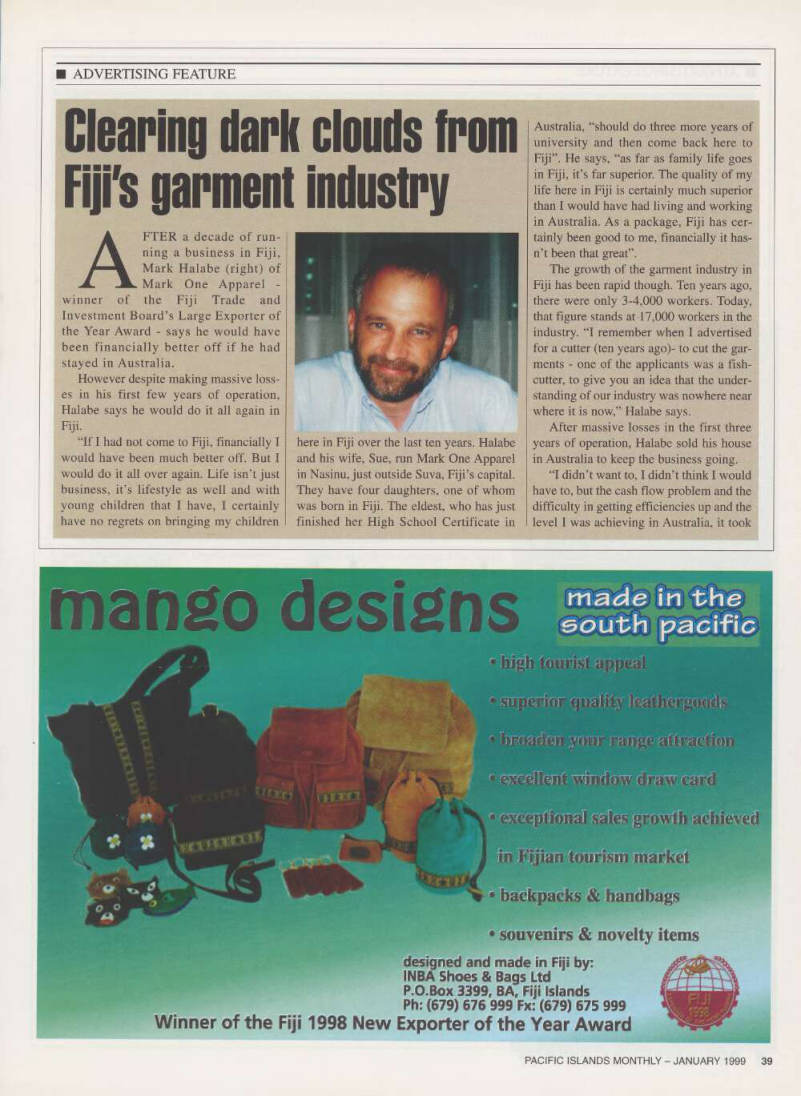

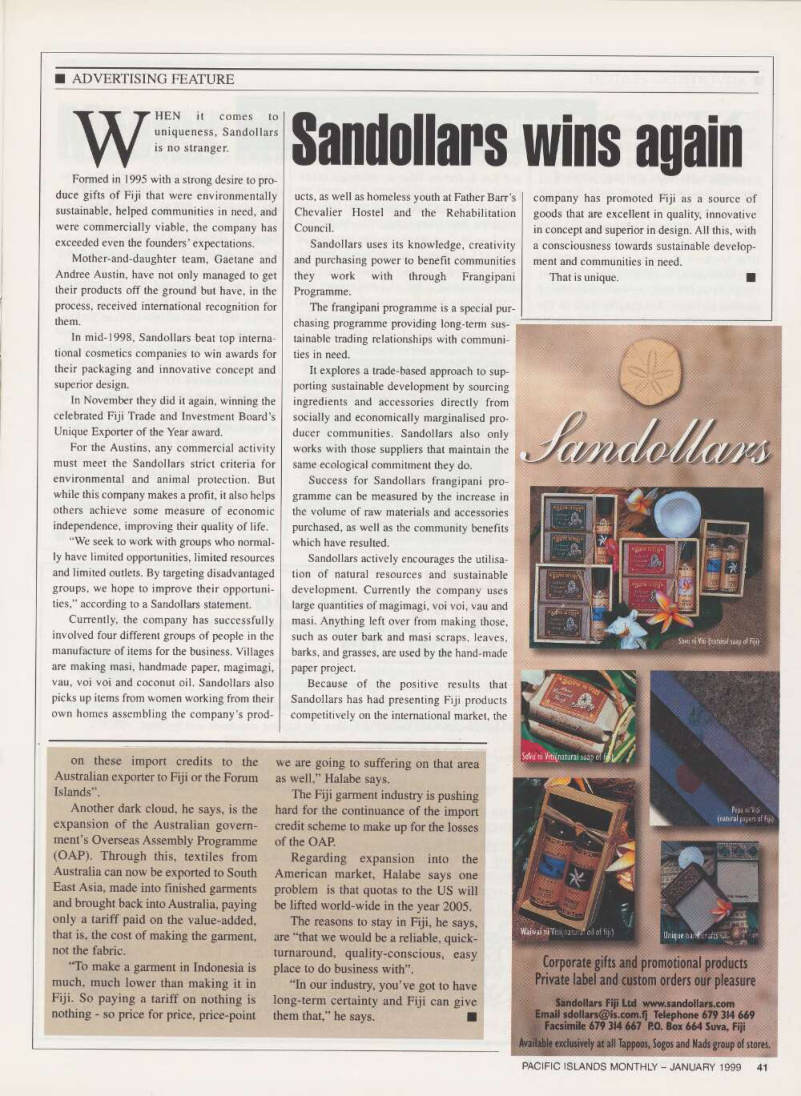
Advertising Feature
Clearing dark clouds from Fiji's garment industry
AFTER a decade of run ning a business in Fiji, Mark Halabe (right) of Mark One Apparel winner of the Fiji Trade and Investment Board’s Large Exporter of the Year Award - says he would have been financially better off if he had stayed in Australia.
However despite making massive loss es in his first few years of operation, Halabe says he would do it all again in
Fiji.
“If I had not come to Fiji, financially I would have been much better off. But I would do it all over again. Life isn’t just business, it’s lifestyle as well and with young children that I have, I certainly have no regrets on bringing my children
here in Fiji over the last ten years. Halabe and his wife, Sue, run Mark One Apparel in Nasinu, just outside Suva, Fiji’s capital.
They have four daughters, one of whom was born in Fiji. The eldest, who has just finished her High School Certificate in
Australia, “should do three more years of university and then come back here to Fiji”. He says, “as far as family life goes in Fiji, it’s far superior. The quality of my life here in Fiji is certainly much superior than I would have had living and working in Australia. As a package, Fiji has cer tainly been good to me, financially it has n’t been that great”.
The growth of the garment industry in Fiji has been rapid though. Ten years ago, there were only 3-4,000 workers. Today, that figure stands at 17,000 workers in the industry. “I remember when I advertised for a cutter (ten years ago)- to cut the gar ments - one of the applicants was a fish cutter, to give you an idea that the under standing of our industry was nowhere near where it is now,” Halabe says.
After massive losses in the first three years of operation, Halabe sold his house in Australia to keep the business going.
“I didn’t want to, I didn’t think I would have to, but the cash flow problem and the difficulty in getting efficiencies up and the level I was achieving in Australia, it took
much longer,” he says. He says however that the decision to come to Fiji was long term. “We understood that the manufac turing process in Australia was going to suffer with loss of tariffs, the same thing as Fiji is doing now where you are taking away its protection, internationally com petitive and going off-shore. It happened to us ten years ago and we realised that we weren’t going to survive in Australia, so Fiji was the option we came up with”.
Halabe still has a company in Australia which over the past ten years has done very well. That’s not to say that the Fiji company has been resting. Their order books are full and of the four times, that Mark One has applied for the Exporter of the Year awards, they won three prizes.
“I believe in applying for these because we’re supposed to show overseas an image of quality and of excellent work place employment. We have customers who insist on this. One American compa ny dealing in the States is Levi Strauss and when they approached us, they gave us 14 pages of a questionnaire. An example would be; Do you hire child labour?
What’s the youngest that you hire? What hours do they work? All these factors make up their minds whether to deal with a company or not and having awards assist us in our presentation to our overseas cus tomers. It’s a positive thing,” he says.
Halabe says he wished that more exporters would apply for the awards.
There were only 35 entries for the catego ry that he won although there are 105 tax free factories in the garment industry alone. Mark One predominantly exports to Australia, with 10 per cent going to New Zealand. “Our order books are full, so full that we have to expand even fur ther. The growth that we’ve had in the last 12 months has been from 200 to 350. I expect this time next year it will be in excess of 500 workers that we have here”.
The short-term potential of the garment industry is very good, he says. “I expect between now and the year 2004 to have increased employment and exports in our industry and we will beat sugar. We will export more than sugar. So we will over the next 12 months expand even further still, and in other areas, not just shirts.
“Fiji as an industry deals mostly in men’s-wear - suits, shirts, trousers - and that’s the strength of the industry but now we’re moving towards women’s clothing which has been untapped and that’s a fac tor of five of what men’s-wear is in Australia - so Fiji has a very short term positive growth factor,” he says However, Halabe says in the long term Fiji has to solve a few problems before it can progress. “We have some very dark clouds that we have to sort out. SPARTE CA is going to be maintained at 25 per cent preference up to the year 2005 and there’s going to be a review after that.
Before that there is another thing that’s causing some pain and that’s called the import credits - that allows Fiji to buy fab ric from Australia at a discount.
“If the Australians export their cloth then they get a 20 per cent discount. So we’re losing that on July 3. It’s gone. It did have a life plan. It did say it was going to end in July. But we are hoping we can convince the Australian government that through another programme - the regional development scheme - they can continue
on these import credits to the Australian exporter to Fiji or the Forum Islands”.
Another dark cloud, he says, is the expansion of the Australian government’s Overseas Assembly Programme (OAP). Through this, textiles from Australia can now be exported to South East Asia, made into finished garments and brought back into Australia, paying only a tariff paid on the value-added, that is, the cost of making the garment, not the fabric.
“To make a garment in Indonesia is much, much lower than making it in Fiji. So paying a tariff on nothing is nothing - so price for price, price-point
we are going to suffering on that area as well,” Halabe says.
The Fiji garment industry is pushing hard for the continuance of the import credit scheme to make up for the losses of the OAP.
Regarding expansion into the American market, Halabe says one problem is that quotas to the US will be lifted world-wide in the year 2005.
The reasons to stay in Fiji, he says, are “that we would be a reliable, quick turnaround, quality-conscious, easy place to do business with”, “In our industry, you’ve got to have long-term certainty and Fiji can give them that,” he says. ■
Advertisements & other items, p. 39 (1 item)
south pacific
r. ■ r |gj: |||/ * » , - , JfeaL- * x >- '.7 ■ *# %» F n Q - '. ■ jc \ , ■> rf
made in the
'tmm
r> mfioffnr Q|io)ffp- Iltsgf Jr&7?®<sr
r 1 J FCTfirf VtJT J r Q 0T : FB-J Fg(£ I \ ( ■ (irrßlfelTf: fcf) 0 (J fi (W d * M r ' (^r/qi^nrjf! F 7fJcs firowfh m'hfmM J r ' 'OjPIT frjrrnern rcX : v m m r mnnwmT K designed and made in Fiji by i 1
JUST as
Leather bags and shoes are top new exports for 1998
companies must release new prod ucts into the market place to stay ahead of the competition, so too must countries
expand their product base to stay ahead of demand fluctuations and market down-turns.
Fiji’s expansion into non traditional exports was led by the garment industry almost a decade ago. That expansion continues today with the export of products as diverse as handbags, nails, spices, and water. This diversification combined with the quantum leaps in footwear production
has sustained the export sector of the Fijian economy.
INBA Shoes & Bags Ftd was formed in July 1997 with 35 staff in premises above a supermarket in Ba, a rural town of Fiji.
Since then they have expanded to 260 staff in two factories with a third factory under
construction. Manufacturing exclusively in
leather, they export shoes and handbags to Australia and New Zealand. Sales in the Fijian marketplace are mainly through the hotel and tourism industries. Hotel prod ucts include menu covers, bill folders, in room compendiums and stationery folders.
The tourism market is serviced by the “Mango Designs” brand of handbags,
backpacks, purses and souvenirs. Conference folders and satchel briefcases are also an often requested prod uct line.
Using only premi um-grade, genuine
leather gives INBA’s prod ucts a high level appeal which sets them apart from the imported (usually plas tic) competition. Director Angeline Shoveller com ments on the pleasant sur prise of buyers when they first see the very high quali ty of leathergoods coming from Ba.
INBA Shoes & Bags Ltd received the ANZ Bank New Exporter of the Year Award
at the Prime Minister’s Exporter of the Year Awards in November 1998.
They are currently reviewing options
for expanding “Mango Designs” and the hotel product lines to other Pacific Island countries. They may be contacted via: The Director, INBA Shoes and Bags, P O Box 3399, Ba, Fiji; or fax: (679) 675 999. ■
Sandollars wins again
WHEN it comes to uniqueness, Sandollars is no stranger.
Formed in 1995 with a strong desire to pro duce gifts of Fiji that were environmentally sustainable, helped communities in need, and were commercially viable, the company has exceeded even the founders’ expectations.
Mother-and-daughter team, Gaetane and Andree Austin, have not only managed to get their products off the ground but have, in the process, received international recognition for them.
In mid-1998, Sandollars beat top interna tional cosmetics companies to win awards for their packaging and innovative concept and superior design.
In November they did it again, winning the celebrated Fiji Trade and Investment Board’s Unique Exporter of the Year award.
For the Austins, any commercial activity must meet the Sandollars strict criteria for environmental and animal protection. But while this company makes a profit, it also helps others achieve some measure of economic independence, improving their quality of life.
“We seek to work with groups who normal ly have limited opportunities, limited resources and limited outlets. By targeting disadvantaged groups, we hope to improve their opportuni ties,” according to a Sandollars statement.
Currently, the company has successfully involved four different groups of people in the manufacture of items for the business. Villages are making masi, handmade paper, magimagi, vau, voi voi and coconut oil. Sandollars also picks up items from women working from their own homes assembling the company’s prod
ucts, as well as homeless youth at Father Barr’s Chevalier Hostel and the Rehabilitation Council.
Sandollars uses its knowledge, creativity and purchasing power to benefit communities
they work with through Frangipani
Programme.
The frangipani programme is a special pur
chasing programme providing long-term sus
tainable trading relationships with communi ties in need.
It explores a trade-based approach to sup
porting sustainable development by sourcing
ingredients and accessories directly from
socially and economically marginalised pro
ducer communities. Sandollars also only works with those suppliers that maintain the same ecological commitment they do.
Success for Sandollars frangipani pro gramme can be measured by the increase in the volume of raw materials and accessories purchased, as well as the community benefits which have resulted.
Sandollars actively encourages the utilisa tion of natural resources and sustainable development. Currently the company uses large quantities of magimagi, voi voi, vau and masi. Anything left over from making those, such as outer bark and masi scraps, leaves, barks, and grasses, are used by the hand-made
paper project.
Because of the positive results that
Sandollars has had presenting Fiji products
competitively on the international market, the
company has promoted Fiji as a source of goods that are excellent in quality, innovative in concept and superior in design. All this, with a consciousness towards sustainable develop ment and communities in need.
That is unique. ■
Advertisements & other items, p. 41 (1 item)
Corporate gifts and promotional products
Private label and custom orders our pleasure Sandoilars Fiji Ltd www.sandotlars.com 669 Facsimile 679 314 667 RO. Box 664 Suva, Fiji Available exclusively at all Tappoos, Sogos and Nads group of stores.
Ba Industries nails export award
NAILS are an
important Hijjß
ingredient
that goes into the con struction activity. Ba Industries Ltd (BIL), located in the riverside town of Ba has been proudly making nails since 1974. BIL again made history when it became the proud winner of the FTIB’s 1998 Network Exporter of the Year award for excellence in exports. General manager Utkarsh Pundlik believes the foundation of success includes investing in state of the art technological machinery, mastering its use, maintaining exceptionally high stan dards and equipment and providing in house staff training on an ongoing basis.
BIL not only manufactures nails but galvanises them in Fiji’s only Hot Dip Galvanising plant set up in 1997. Apart from bright and galvanised nails, BIL also manufactures chainlink fencing and barbed wires. Since its inception, BIL has grown with technology, quality and production capacity to cater for the growing demands of both local and export markets. BIL has a lion’s share of the local market for all its products, and exports to American Samoa,
Western Samoa, Vanuatu, Tonga, Tahiti, and the Solomon Islands, amongst other Pacific Island countries.
BIL also exports in a big way to Australia and New Zealand. Low manufac turing costs and proximity to the export markets have helped BIL to establish mar kets abroad. BIL is also exploring the pos sibility of developing newer markets.
BIL successfully installed/commis sioned a nail factory in Kiribati in 1993 and a rotary galvanising plant in 1997, as well as training their staff to operate them. BIL is the only wire and fencing products man ufacturing company in the South Pacific to be accredited with ISO 9002 certification and a thoroughly documented quality man agement system.
BIL is the only one in Fiji to have its own Hot Dip Galvanising plant. This was commissioned in April 1997. The invest ment made in this project is well over F 5250,000. This was made to ensure that all the galvanised products including nails met the stringent requirements of the
Australian (AS 1650-1989) and New Zealand Standards. The company has been awarded the
Overseas Membership of the Galvanisers Association of Australia and thus has access to the latest developments in Hot Dip galvanising. BIL also galvanise brack ets, anchors, chains, and other similar products, and undertakes galvinising jobs for various industries such as construction, marine, mining, and hotels. The effective size of the BIL bath available for galvanis ing is 1.4 m (long) by o.Bm (wide) by 0.5 m (deep). BIL plans to invest moreen new technology and equipment to increase pro ductivity and efficiency, diversifying its product base. They already have installed and commissioned Fiji’s first thread rolling machine to manufacture different types of helical and threaded nails. BIL has invest ed approximately F 5250,000 (in 1998) in installing the latest technology weighing and packing machine to cater for specific blister pack requirements of the Australian and New Zealand markets. This has been done to fully satisfy customer’s packing needs in BlL’s effort to achieve customer delight. ■
Advertisements & other items, p. 42 (1 item)
Wr Excels Again...
Ba Industries is the proud winner of The Network Exporter of the Year Award in 1998 At Ba Industries our high quality and reliable products are winning year after year.
Which is just one illustration of BlL’s remarkably high standard systems. Quality and innovation have helped us create the highest standards and facilities.
BIL has been proud to achieve Exporter of the Year Award (Building & Industrial category) in 1993, 1994, 1995 (Prime Minister’s Exporter of the Year) & in 1996.
Only locally owned company to install Hot Dip Galvanizing plant and be awarded Overseas Membership of Galvanizers Association of Australia.
BA INDUSTRIES LTD
P.O. Box 707, BA, FIJI ISLANDS
PHONE: (679) 674966, 674656, 676023
FAX: (679) 676700 EMAIL: [email protected] 1993, 1994,1995, 1996 & 1998
Meetex hits success
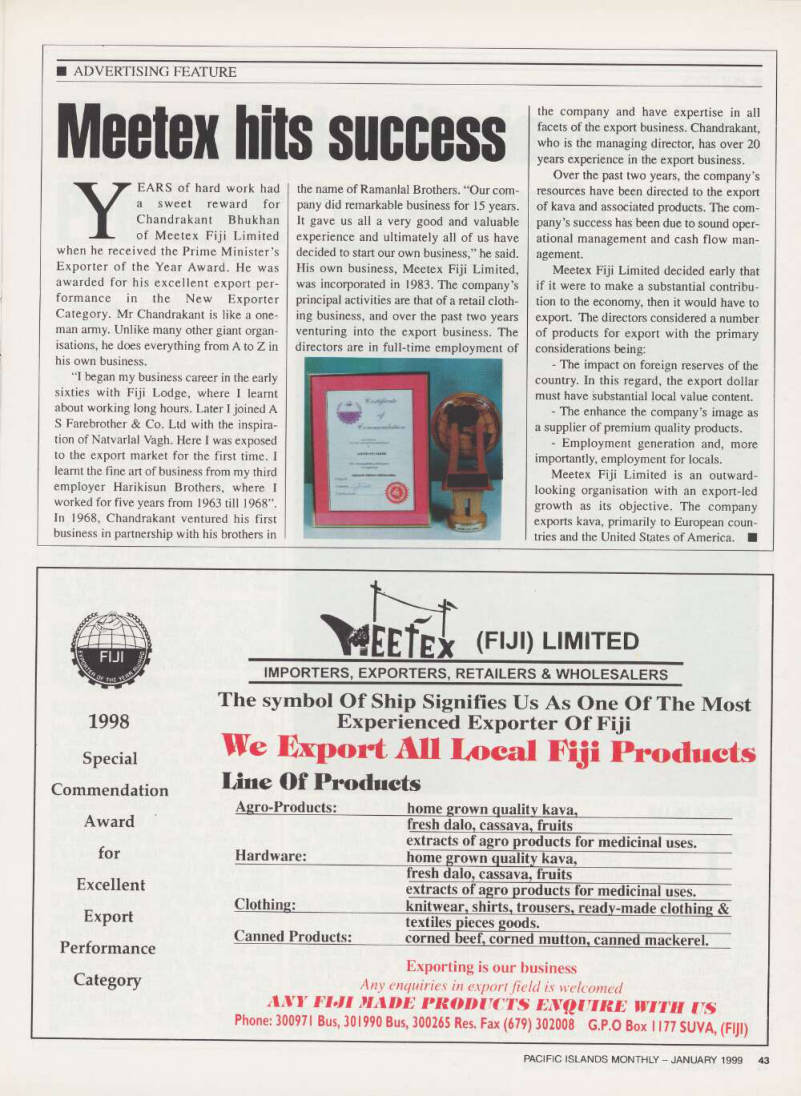
YEARS of hard work had a sweet reward for Chandrakant Bhukhan of Meetex Fiji Limited when he received the Prime Minister’s Exporter of the Year Award. He was awarded for his excellent export per formance in the New Exporter Category. Mr Chandrakant is like a one man army. Unlike many other giant organ isations, he does everything from A to Z in his own business.
“I began my business career in the early sixties with Fiji Lodge, where I learnt about working long hours. Later I joined A S Farebrother & Co. Ltd with the inspira tion of Natvarlal Vagh. Here I was exposed to the export market for the first time. I leamt the fine art of business from my third employer Harikisun Brothers, where I worked for five years from 1963 till 1968”.
In 1968, Chandrakant ventured his first business in partnership with his brothers in
the name of Ramanlal Brothers. “Our com pany did remarkable business for 15 years.
It gave us all a very good and valuable experience and ultimately all of us have decided to start our own business,” he said.
His own business, Meetex Fiji Limited, was incorporated in 1983. The company’s principal activities are that of a retail cloth ing business, and over the past two years venturing into the export business. The directors are in full-time employment of
the company and have expertise in all facets of the export business. Chandrakant, who is the managing director, has over 20 years experience in the export business.
Over the past two years, the company’s resources have been directed to the export of kava and associated products. The com pany’s success has been due to sound oper ational management and cash flow man agement.
Meetex Fiji Limited decided early that if it were to make a substantial contribu tion to the economy, then it would have to export. The directors considered a number of products for export with the primary considerations being: - The impact on foreign reserves of the country. In this regard, the export dollar must have substantial local value content. - The enhance the company’s image as a supplier of premium quality products. - Employment generation and, more importantly, employment for locals.
Meetex Fiji Limited is an outward looking organisation with an export-led growth as its objective. The company exports kava, primarily to European coun tries and the United States of America. ■
Advertisements & other items, p. 43 (1 item)
Wc Export All lyOcul Fiji Products
(FIJI) LIMITED
1998
Special
Commendation Award for Excellent
Export
Performance
Category
IMPORTERS, EXPORTERS, RETAILERS & WHOLESALERS
The symbol Of Ship Signifies Us As One Of The Most
Experienced Exporter Of Fiji
Wc Export All lyOcul Fiji Products
Line Of Products
Agro-Products: Hardware: Clothing; Canned Products: home grown quality kava. fresh dalo, cassava, fruits extracts of agro products for medicinal uses. home grown quality kava, fresh dalo, cassava, fruits extracts of agro products for medicinal uses, knitwear, shirts, trousers, ready-made clothing & textiles pieces goods. corned beef, corned mutton, canned mackerel.
Exporting is our business Any enquiries in export field is welcomed IVI FIJI HADE PRODUCTS ENQUIRE WITH US Phone: 300971 Bus, 301 990 Bus, 300265 Res. Fax (679) 302008 G.P.O Box 1177 SUVA, (FIJI)
THE reconciliation
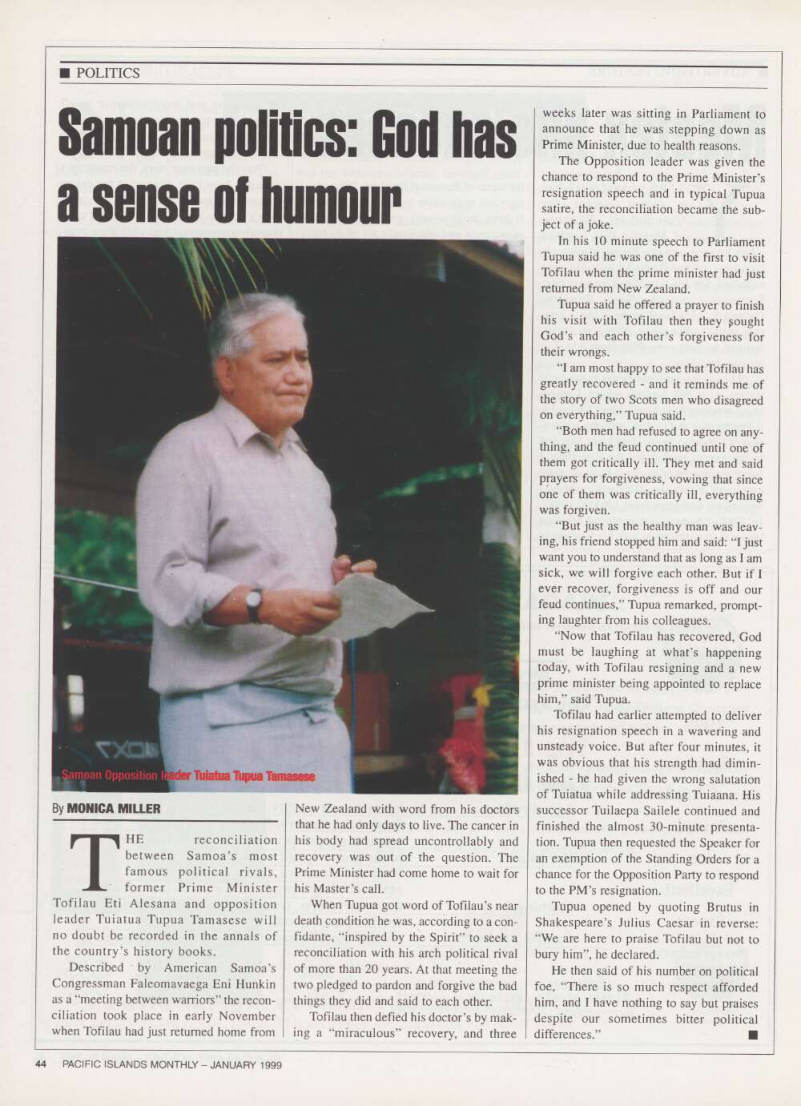
Politics
Samoan politics: God has a sense of humour
By Monica Miller
THE reconciliation
between Samoa’s most famous political rivals, former Prime Minister Tofilau Eti Alesana and opposition leader Tuiatua Tupua Tamasese will no doubt be recorded in the annals of the country’s history books.
Described by American Samoa’s
Congressman Faleomavaega Eni Hunkin
as a “meeting between warriors” the recon ciliation took place in early November when Tofilau had just returned home from
New Zealand with word from his doctors that he had only days to live. The cancer in his body had spread uncontrollably and recovery was out of the question. The Prime Minister had come home to wait for his Master’s call.
When Tupua got word of Tofilau’s near death condition he was, according to a con fidante, “inspired by the Spirit” to seek a reconciliation with his arch political rival of more than 20 years. At that meeting the two pledged to pardon and forgive the bad things they did and said to each other.
Tofilau then defied his doctor’s by mak ing a “miraculous” recovery, and three
weeks later was sitting in Parliament to announce that he was stepping down as Prime Minister, due to health reasons.
The Opposition leader was given the chance to respond to the Prime Minister’s resignation speech and in typical Tupua satire, the reconciliation became the sub ject of a joke.
In his 10 minute speech to Parliament Tupua said he was one of the first to visit Tofilau when the prime minister had just returned from New Zealand.
Tupua said he offered a prayer to finish his visit with Tofilau then they fought God’s and each other’s forgiveness for their wrongs.
“I am most happy to see that Tofilau has greatly recovered - and it reminds me of the story of two Scots men who disagreed on everything,” Tupua said.
“Both men had refused to agree on any thing, and the feud continued until one of them got critically ill. They met and said prayers for forgiveness, vowing that since one of them was critically ill, everything
was forgiven.
“But just as the healthy man was leav ing, his friend stopped him and said: “I just want you to understand that as long as I am sick, we will forgive each other. But if I ever recover, forgiveness is off and our feud continues,” Tupua remarked, prompt ing laughter from his colleagues.
“Now that Tofilau has recovered, God must be laughing at what’s happening today, with Tofilau resigning and a new prime minister being appointed to replace him,” said Tupua.
Tofilau had earlier attempted to deliver his resignation speech in a wavering and unsteady voice. But after four minutes, it was obvious that his strength had dimin ished - he had given the wrong salutation of Tuiatua while addressing Tuiaana. His successor Tuilaepa Sailele continued and finished the almost 30-minute presenta tion. Tupua then requested the Speaker for an exemption of the Standing Orders for a chance for the Opposition Party to respond to the PM’s resignation.
Tupua opened by quoting Brutus in Shakespeare’s Julius Caesar in reverse: “We are here to praise Tofilau but not to bury him”, he declared.
He then said of his number on political foe, “There is so much respect afforded him, and I have nothing to say but praises despite our sometimes bitter political differences.” ■
Samoan Opposition leader Tuiatua Tupua Tamasese
President Clinton's ear
US Pacific territories gelling President Clinton's ear
By Monica Miller
THANKS to American Samoa Governor Tauese Sunia’s communications skills, US territories are getting the ear of President Bill Clinton, even if some of his top aides don’t appear to be interested in hear ing what the islanders have to say.
Proof of this came during President Bill Clinton’s visit with the governors of Hawaii, Guam, the Northern Marianas and American Samoa last month in the Guamanian capital, Agana.
Clinton announced that he was revising an executive order issued last year on coral reefs to ensure that all the Pacific gover nors are put on the US Task Force that was set up to plan and set policy for the protec tion of America’s coral reefs.
It seems that Governor Tauese did some, actually it turns out much, com plaining to US Interior Secretary Bruce Babbitt and Commerce Secretary during the Florida meeting.
He questioned why there was no repre sentation from the Pacific on the force.
“I made it a point to complain that the President excluded the territories and yet 95 per cent of the coral reefs of America are out here in the Pacific,” said Tauese.
Tauese must have been grinning with pride when Clinton announced before his colleagues, not to mention the thousands who had gathered on the lawn of the Executive Office Building to wave at the president and the national press corps cov ering his historic visit, that he had granted what Governor Tauese had asked for.
Pacific representation on the task force will come in handy when the group decides how to divvy up $lO million in federal aid for the protection of coral reefs.
It is also understood that President Clinton will be requesting Congress for millions of dollars more to preserve, restore and enhance America’s reefs.
Tauese said he was pleased to know that the concerns of the Pacific had been relat ed to the President. “I thought that the ‘guys’ I had met with in Florida would just say yes than not bother to relate our con cerns to the President,” he remarked.
Another point that Tauese had com plained about was why the Task Force meeting was held in Florida and not in the Pacific, home to the biggest chunk of coral reefs under the US flag.
Thanks to him, the next meeting of the Coral Reefs Task Force will be held in Hawaii in January. If nothing else, the venue will save the Pacific governors much travelling as Hawaii is just a one stop flight for all of them except host Governor Ben Cayetano who’ll only need a limou sine ride to the conference hall. And the
"life President excluded the territories and yet 95 per cent of the coral reefs of America are out here in the Pacific"
conference organisers may just invite Hawaiian entertainers to sing and dance that famous hula number “Beyond the Reef’ as a curtain raiser!
More proof of the effectiveness of Tauese’s negotiating skills came when President Clinton announced that he was looking into the territories’ request that they be given autonomy to deal with for eign countries instead of the State
Department handling all foreign relations
matters.
This matter had also been raised by Tauese in Florida. “I had asked the United States to let the US territories handle mat ters with their neighbours, instead of rely ing on the State Department all the time.
Sometimes those people are very tough, “ he remarked.
Tauese’s pitch to the Clinton Administration: the US Virgin Islands and Puerto Rico could deal with issues in the Caribbean, Guam and the Northern Marianas could handle matters in the Northern Pacific and American Samoa
could deal with countries in the South Pacific.
“I was so happy when Clinton men tioned in his speech in Guam that he was looking into our request,” said Tauese. He also quoted the US President as saying that his administration will try to elevate the status of US territories in dealing with for eign countries.
US territories are self governing and have their own laws that are sometimes contrary to American rules and regulations.
For example in American Samoa, the con stitution prohibits the sale of land to non- Samoans, a concept quite alien to the American emphasis on individual rights.
But when it comes to foreign relations matters, the territories cannot act on their own without referring to Washington, specifically the State Department.
Tauese wants that changed because he feels some of the US bureaucrats have a condescending and tough attitude when dealing with other countries. And he’s been in public service long enough to know spe cific examples of this happening especially in the South Pacific.
The example he did cite to prove his point had nothing to do with a foreign country but had everything to do with one of its own possessions: American Samoa.
During the era of Washington appointed governors, visas to enter the United States could be issued by the American Samoa Attorney General’s Office. However a few years into the first locally elected adminis tration that authority was removed by the State Department.
Governor Tauese didn’t go into the rea son behind the State Department’s action but just said that what happened was an example of Washington’s sometimes get tough attitude. If he had explained the rea son, he would have had to say that American Samoa’s visa issuing authority was stripped when evidence surfaced that immigration agents were selling US visas to Orientals for as much as $5,000. ■
Advertisements & other items, p. 45 (1 item)
■ Politics
PNG backtracks
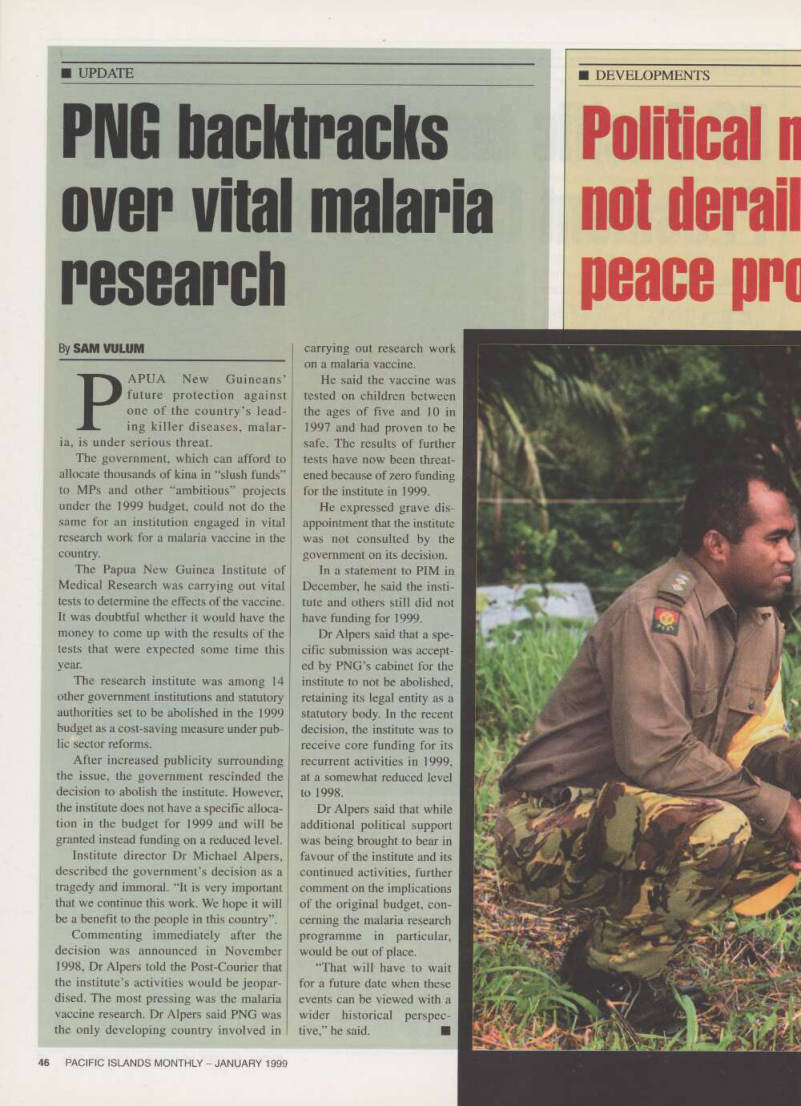
Update
PNG backtracks over vital malaria research
By Sam Vulum
PAPUA New Guineans’ future protection against one of the country’s lead ing killer diseases, malar ia, is under serious threat.
The government, which can afford to allocate thousands of kina in “slush funds” to MPs and other “ambitious” projects under the 1999 budget, could not do the same for an institution engaged in vital research work for a malaria vaccine in the country.
The Papua New Guinea Institute of Medical Research was carrying out vital tests to determine the effects of the vaccine.
It was doubtful whether it would have the money to come up with the results of the tests that were expected some time this year.
The research institute was among 14 other government institutions and statutory authorities set to be abolished in the 1999 budget as a cost-saving measure under pub lic sector reforms.
After increased publicity surrounding
the issue, the government rescinded the decision to abolish the institute. However, the institute does not have a specific alloca tion in the budget for 1999 and will be granted instead funding on a reduced level.
Institute director Dr Michael Alpers, described the government’s decision as a tragedy and immoral. “It is very important that we continue this work. We hope it will be a benefit to the people in this country”.
Commenting immediately after the decision was announced in November 1998, Dr Alpers told the Post-Courier that the institute’s activities would be jeopar dised. The most pressing was the malaria vaccine research. Dr Alpers said PNG was the only developing country involved in
carrying out research work on a malaria vaccine.
He said the vaccine was tested on children between the ages of five and 10 in 1997 and had proven to be safe. The results of further tests have now been threat ened because of zero funding for the institute in 1999.
He expressed grave dis appointment that the institute was not consulted by the government on its decision.
In a statement to PIM in December, he said the insti tute and others still did not have funding for 1999.
Dr Alpers said that a spe cific submission was accept ed by PNG’s cabinet for the institute to not be abolished, retaining its legal entity as a statutory body. In the recent decision, the institute was to receive core funding for its recurrent activities in 1999, at a somewhat reduced level to 1998.
Dr Alpers said that while additional political support was being brought to bear in favour of the institute and its continued activities, further comment on the implications of the original budget, con cerning the malaria research programme in particular, would be out of place.
“That will have to wait for a future date when these events can be viewed with a wider historical perspec tive,” he said. ■
Political mistake will
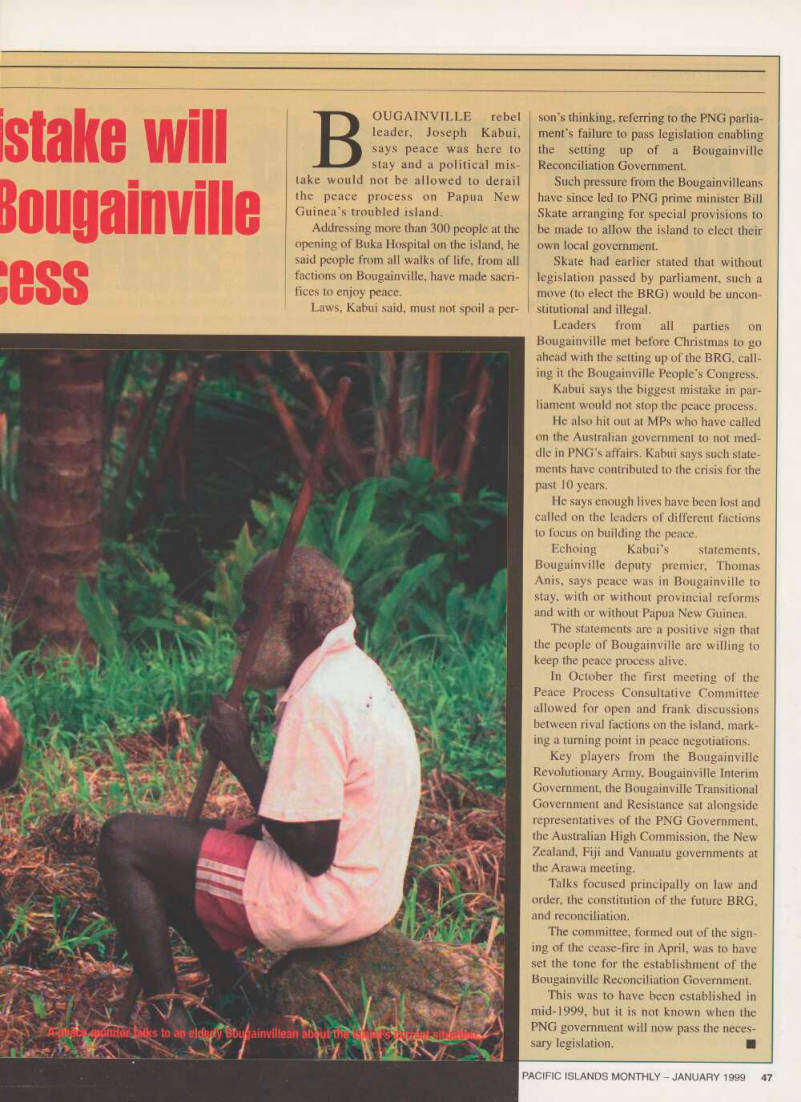
not derail Bougainville peace process
Bougainville rebel
leader, Joseph Kabui, says peace was here to stay and a political mis take would not be allowed to derail the peace process on Papua New Guinea’s troubled island.
Addressing more than 300 people at the opening of Buka Hospital on the island, he said people from all walks of life, from all factions on Bougainville, have made sacri fices to enjoy peace.
Laws, Kabui said, must not spoil a per
son’s thinking, referring to the PNG parlia ment’s failure to pass legislation enabling the setting up of a Bougainville Reconciliation Government.
Such pressure from the Bougainvilleans have since led to PNG prime minister Bill Skate arranging for special provisions to be made to allow the island to elect their own local government.
Skate had earlier stated that without
legislation passed by parliament, such a
move (to elect the BRG) would be uncon stitutional and illegal.
Leaders from all parties on Bougainville met before Christmas to go ahead with the setting up of the BRG, call
ing it the Bougainville People’s Congress.
Kabul says the biggest mistake in par liament would not stop the peace process.
He also hit out at MPs who have called on the Australian government to not med dle in PNG’s affairs. Kabui says such state ments have contributed to the crisis for the past 10 years.
He says enough lives have been lost and called on the leaders of different factions to focus on building the peace.
Echoing Kabui’s statements, Bougainville deputy premier, Thomas Anis, says peace was in Bougainville to stay, with or without provincial reforms and with or without Papua New Guinea.
The statements are a positive sign that the people of Bougainville are willing to keep the peace process alive.
In October the first meeting of the Peace Process Consultative Committee allowed for open and frank discussions between rival factions on the island, mark ing a turning point in peace negotiations.
Key players from the Bougainville
Revolutionary Army, Bougainville Interim
Government, the Bougainville Transitional Government and Resistance sat alongside representatives of the PNG Government, the Australian High Commission, the New Zealand, Fiji and Vanuatu governments at the Arawa meeting.
Talks focused principally on law and order, the constitution of the future BRG, and reconciliation.
The committee, formed out of the sign ing of the cease-fire in April, was to have set the tone for the establishment of the Bougainville Reconciliation Government.
This was to have been established in mid-1999, but it is not known when the PNG government will now pass the neces sary legislation. ■
A peace monitor talks to an elderty Bougainvillen about the islands's current situation.
Advertisements & other items, p. 47 (1 item)
istake will
Bougainville ;ess
HIV-TB epidemic

PNG at mercy of HIV-TB epidemic
PAPUA New Guinea is on the verge of a combined HIV-tuberculosis epidemic “of African proportions” and Australia is its only hope of miti gating the disaster, regional tubercu losis expert says. However, Michael Levy, director of the Community Health and Anti-Tuberculosis Association, said yesterday Australia was reluctant to fund anti-tuberculosis programs because of the PNG Government’s corruption and instabil ity. The World Health Organisation yester day identified PNG as one of seven Asia- Pacific hot spots where co-epidemics of HIV/AIDS and tuberculosis had reached crisis levels. But the Sydney-based Dr Levy said that even in a region the WHO now described as the epicentre of a global tuberculosis emergency, “PNG stands alone” in the severity of its health crisis.
“PNG is facing a combined HIV-tuber culosis epidemic that I would estimate is of African proportions,” said Dr Levy, who led a WHO tuberculosis study team to PNG in late 1997 and has been associated with two other recent investigations. “That means it is at the level where population and economic estimates will have to be phased down in the medium to long term because of the impact of these diseases”.
The wildfire spread of HIV/AIDS through Africa and Asia has been the sin gle greatest factor in the resurgence of tuberculosis. Although the tuberculosis bacillus is estimated to infect one in every three people, healthy immune systems pre vent the disease developing in most peo
ple.
Weakened immune systems allow tuberculosis to flare among late-stage AIDS sufferers, who then infect healthy people. New estimates presented yesterday show HIV incidence in PNG last year as two per 1000 adults and seven per 1000 for tuberculosis. These proportions are still
well below those in Cambodia, which is now recording worse incidence rates than in East Africa.
However, Dr Levy said Port Moresby authorities had been the slowest and least effective in the region to deal with the co epidemic and the available statistics “are
so shaky they are almost not worth quoting in terms of any precision”. "But, even so, they are already at the high end of the range for both diseases.” The inadequacy of the PNG response - only a single anti tuberculosis pilot project exists in the country - meant Australian aid and exper tise were the country’s only hope.
However, Dr Levy believes the Australian Government aid agency, AusAID, is reluc tant to commit to any new medical projects because of the Skate Government’s corrup tion and unreliability, and the overall polit ical and social instability”.
Nobody cares about PNG except Australia, that’s a fact,” he said. “PNG looks to us for support and it isn’t going to come from any other direction”. * The Australian ■
Profit target ahead for Fiji TV
FIJI Television Limited has announced its first operat ing profit, three years ahead of forecast.
The company’s chairman, Laisenia
Qarase, described 1998 as a landmark, reflecting well on Fiji TV, its man agement and employees.
Although the quality of service has often been criticised by Fiji’s view ing public, Qarase said it was the highest in the developing Pacific. He told shareholders at Fiji TV’s annual meeting in December that the profit of F$ 105,916 was “small but significant”. Initial
projections showed prof
itability would not be attained till 2001.
“But the rapid and
sure growth of our business has enabled the company to deliver results over Fsl million better than budget for three consecutive years,” he said.
The profit for the company, which effec tively is a monopoly in Fiji, came through operating revenue of F 55,576,560. Qarase said this indicated a positive response by the marketplace to Fiji TV and its pro
grammes. Another factor is that the compa ny is in a strong position to weather the cur rent difficult economic climate because of an absence of any significant long-term debt. Qarase said the directors had decided
not to issue a dividend. The profit would be recognised as retained earnings that would reduce accumulated losses.
Strong growth in advertising revenue to Fs4.l million was a key factor in profit per formance, combined with stringent cost control. Qarase said that in 1999 the com pany planned to complete its coverage of the Coral Coast and extend to Taveuni and
$(000) 1997/8 1996/7 1995/6 1994/5 Net income 5,577 3,808 3,151 2,447 Expenses 5,471 5,201 4,269 4,487 Profit/(loss) 106 (1,393) (1,118) (2,040)
Northern Lau. This would take the TV 1 sig nal to about 85 per cent of the population.
The company is also planning to move ahead with plans for the introduction of a
third Sky subscription channel.
Qarase was critical of decisions by the Ministry of Communications on the compa ny’s exclusive licence and its licence fee.
He said actions of the Ministry in reneging on the exclusive licence and increasing the fee by 24,900 per cent without consultation, were the greatest threat faced by the com pany and its shareholders.
Qarase said the exclusive licence was a key element in shareholders’ decisions to invest in Fiji TV. He stressed the impor tance of a stable policy environment for investment. It was ironic, he said, that while government was continually seeking for eign investment, the actions of the ministry threatened equally important investment by
Fiji citizens.
Fiji TV, he said, remained open to any negotiated settlement that protected the right of shareholders.
He likened the proposal from Pacific Group to a hostile take-over attempt. It was particularly important, Qarase said, for minority shareholders to be vigilant in pro tecting their rights.
He told the annual meeting that after four years as chairman and in view of other pressing professional obligations, he had decided not to offer himself for re-election.
Qarase is succeeded by Isoa Kaloumaira, managing director of the Fiji Development Bank, which holds 59 per cent of the shares in Fiji TV. ■
Sugar chairman admits
crisis in industry
FIJI’S sugar industry is cur rently facing one of the great crises of its exis tence, “with cyclone weakened, drought-affected stake
holders having to make sweeping reforms to survive”, says Fiji Sugar Commission chairman Gerald Barrack. However, he says, with the right approach, the industry’s outlook is bright.
“With the help of new partnership arrangements in the industry, and with the long-term strategic plan now in place, sugar in Fiji can not only survive, but pros per in the new millennium”.
At the core of reforms is an aim at a 25 per cent increase in cane production cou pled with a 20 per cent rise in sugar con tent. To do this, the industry will have to change its age-old practice of a payment system based on weight to one based on quality of cane.
Sugar provides a livelihood direct for some 23,000 growers and 3,000 mill work ers - and indirectly for as many as 30,000 more people. It contributes significantly to the nation’s exports and earns more than $3OO million in foreign exchange in a good year. But Fiji is one of the few sugar-pro ducing countries where growers are paid by cane volume, rather than sugar content.
Because of this, although cane produc tion has doubled over the past 25 years as a result of preferential pricing under the Lome Convention, quality has been sacri ficed for quantity. Mr Barrack says such a system is subsidising lazy farmers.
“The professional farmer of today, the farmer who has already adopted best prac tice techniques, is effectively subsidising the neglectful or lazy farmer”.
In 1997, cane burning cost the industry some 24,000 tonnes of sugar - worth more than $l3 million. Added to that were loss es caused by the extra cost of milling the burnt cane, brining the total loss to the industry from burnt cane to $2O million.
“We simply cannot afford to see $2O million go up in smoke,” Mr Barrack says, “the losses are felt by everyone - grower,
miller and the country, and the burning of cane must be stopped”.
Many growers in Fiji harvest only 50 to 70 tonnes of cane per hectare, with 11.5 per cent sugar content due to early cutting, burning and delivery delays. However, ‘best practice’ farmers in Fiji and overseas The benefits of reforms for farmers will be enormous, says Barrack, with an annual increase of 50,000 tonnes of sugar - or $l5 million a year at today’s prices - in the first five years of the strategic plan. A similar increase is also expected in the second five years. What keeps Fiji from being interna tionally competitive, Barrack says, are atti tudes and regulations that are now out of date and a lack of understanding about the benefits of investment in mills and farms.
“Sugar is a way of life for many people, but it is also a business, and we have to compete with other countries. To do this well, we must be open-minded when we consider new methods and ideas - and accept some things will need to change.
“Our industry has been around for along time and we have become comfort able with the way we operate,” he says, “But we all have to take a hard look at how we do things, and ask ourselves if there are better ways”.
The rewards for successful reform of the sugar industry are huge. Overcoming the industry’s problems could see as much as 100,000 more tonnes of sugar produced annually, from the same amount of cane, by 2010.
The reforms, which include greater mill efficiencies, combined with improved farming practices and more efficient cane harvesting and delivery, will have to be combined with the resolution of land leas es. For the 1999 season, the industry is tar geting the re-establishment of cane produc tion to four million tonnes and sugar to 460,000 tonnes. ■
Adventure sports thrive on Vanuatu's active volcano
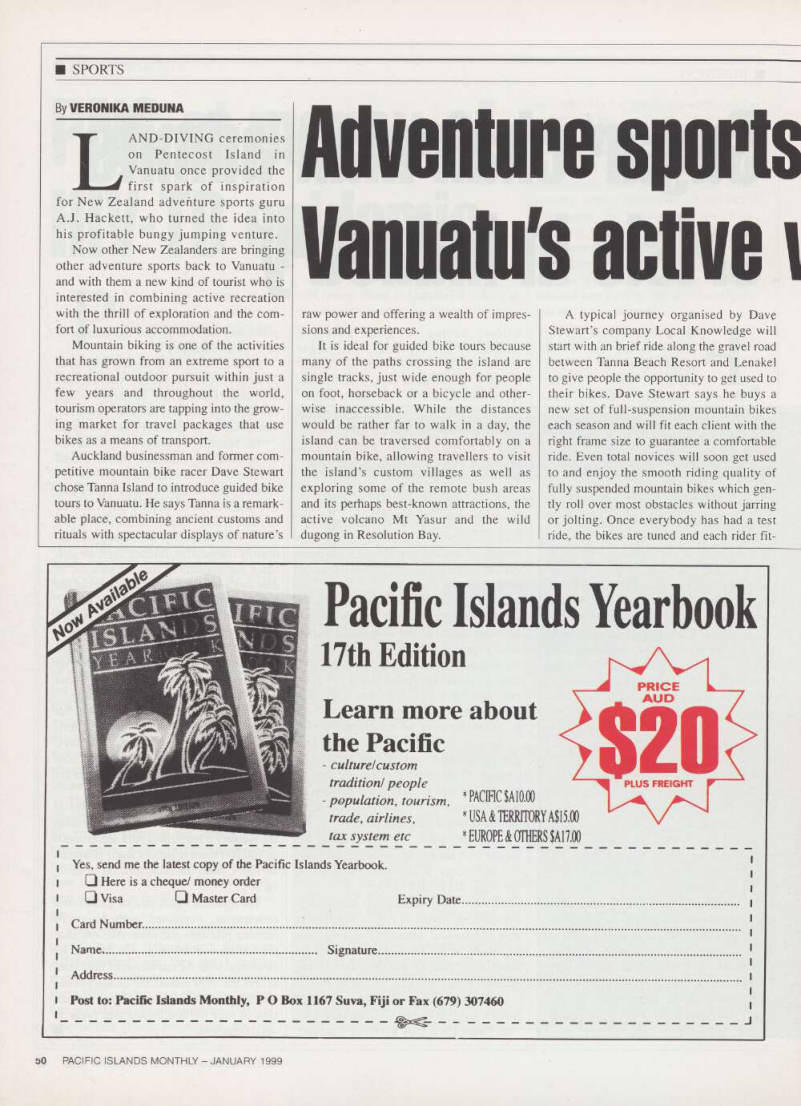
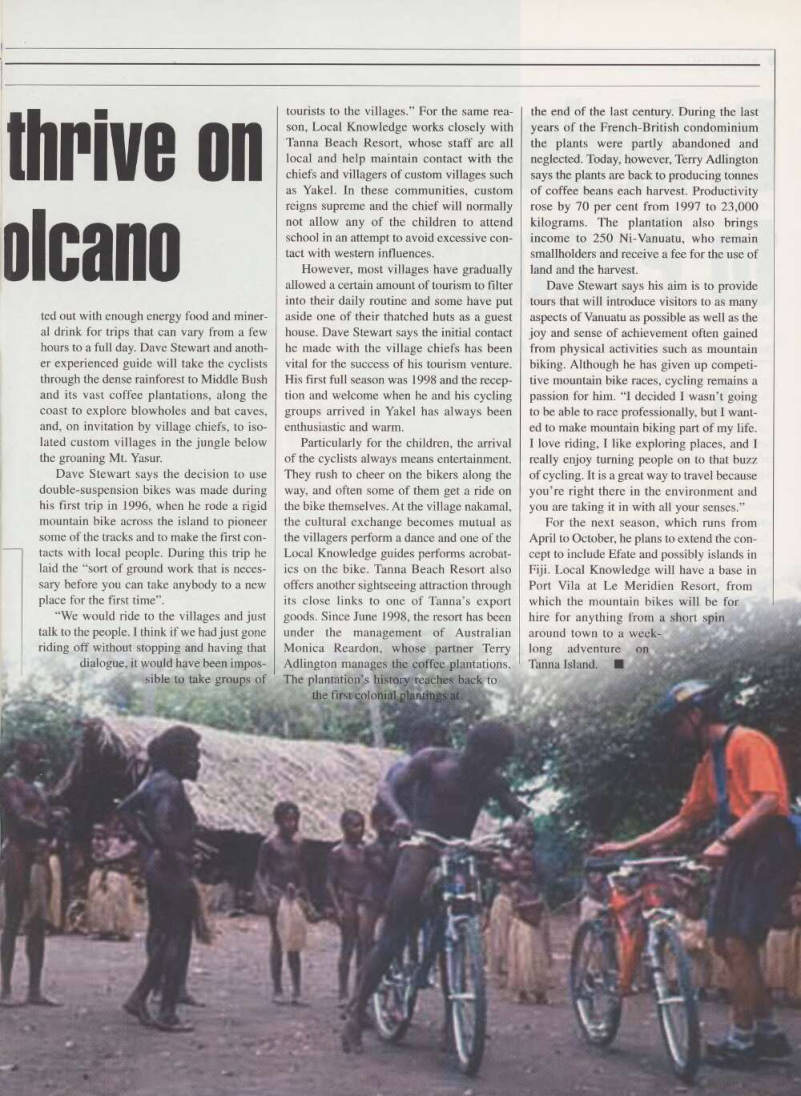
Vanuatu's active volcano
By Veronika Meduna
LAND-DIVING ceremonies
on Pentecost Island in Vanuatu once provided the first spark of inspiration for New Zealand adventure sports guru A.J. Hackett, who turned the idea into his profitable bungy jumping venture.
Now other New Zealanders are bringing other adventure sports back to Vanuatu and with them a new kind of tourist who is interested in combining active recreation with the thrill of exploration and the com fort of luxurious accommodation.
Mountain biking is one of the activities that has grown from an extreme sport to a recreational outdoor pursuit within just a few years and throughout the world, tourism operators are tapping into the grow ing market for travel packages that use bikes as a means of transport.
Auckland businessman and former com petitive mountain bike racer Dave Stewart chose Tanna Island to introduce guided bike tours to Vanuatu. He says Tanna is a remark able place, combining ancient customs and rituals with spectacular displays of nature’s
raw power and offering a wealth of impres sions and experiences.
It is ideal for guided bike tours because many of the paths crossing the island are single tracks, just wide enough for people on foot, horseback or a bicycle and other wise inaccessible. While the distances would be rather far to walk in a day, the island can be traversed comfortably on a mountain bike, allowing travellers to visit the island’s custom villages as well as exploring some of the remote bush areas and its perhaps best-known attractions, the active volcano Mt Yasur and the wild dugong in Resolution Bay.
A typical journey organised by Dave Stewart’s company Local Knowledge will start with an brief ride along the gravel road between Tanna Beach Resort and Lenakel to give people the opportunity to get used to their bikes. Dave Stewart says he buys a new set of full-suspension mountain bikes each season and will fit each client with the right frame size to guarantee a comfortable ride. Even total novices will soon get used to and enjoy the smooth riding quality of fully suspended mountain bikes which gen tly roll over most obstacles without jarring or jolting. Once everybody has had a test ride, the bikes are tuned and each rider fit
ted out with enough energy food and miner al drink for trips that can vary from a few hours to a full day. Dave Stewart and anoth er experienced guide will take the cyclists through the dense rainforest to Middle Bush and its vast coffee plantations, along the coast to explore blowholes and bat caves, and, on invitation by village chiefs, to iso lated custom villages in the jungle below the groaning Mt. Yasur.
Dave Stewart says the decision to use double-suspension bikes was made during his first trip in 1996, when he rode a rigid mountain bike across the island to pioneer some of the tracks and to make the first con tacts with local people. During this trip he laid the “sort of ground work that is neces sary before you can take anybody to a new place for the first time”.
“We would ride to the villages and just talk to the people. I think if we had just gone riding off without stopping and having that dialogue, it would have been impos sible to take groups of
tourists to the villages.” For the same rea son, Local Knowledge works closely with Tanna Beach Resort, whose staff are all local and help maintain contact with the chiefs and villagers of custom villages such as Yakel. In these communities, custom reigns supreme and the chief will normally not allow any of the children to attend school in an attempt to avoid excessive con tact with western influences.
However, most villages have gradually allowed a certain amount of tourism to filter into their daily routine and some have put aside one of their thatched huts as a guest house. Dave Stewart says the initial contact he made with the village chiefs has been vital for the success of his tourism venture.
His first full season was 1998 and the recep tion and welcome when he and his cycling groups arrived in Yakel has always been enthusiastic and warm.
Particularly for the children, the arrival of the cyclists always means entertainment.
They rush to cheer on the bikers along the way, and often some of them get a ride on the bike themselves. At the village nakamal, the cultural exchange becomes mutual as the villagers perform a dance and one of the Local Knowledge guides performs acrobat ics on the bike. Tanna Beach Resort also offers another sightseeing attraction through its close links to one of Tanna’s export goods. Since June 1998, the resort has been under the management of Australian Monica Reardon, whose partner Terry Adlington manages the coffee plantations.
The plantation’s history reaches back to the first colonial plantings at
the end of the last century. During the last years of the French-British condominium the plants were partly abandoned and neglected. Today, however, Terry Adlington says the plants are back to producing tonnes of coffee beans each harvest. Productivity rose by 70 per cent from 1997 to 23,000 kilograms. The plantation also brings income to 250 Ni-Vanuatu, who remain smallholders and receive a fee for the use of land and the harvest.
Dave Stewart says his aim is to provide tours that will introduce visitors to as many aspects of Vanuatu as possible as well as the joy and sense of achievement often gained from physical activities such as mountain biking. Although he has given up competi tive mountain bike races, cycling remains a passion for him. “I decided I wasn’t going to be able to race professionally, but I want ed to make mountain biking part of my life.
I love riding, I like exploring places, and I really enjoy turning people on to that buzz of cycling. It is a great way to travel because you’re right there in the environment and you are taking it in with all your senses.”
For the next season, which runs from April to October, he plans to extend the con cept to include Efate and possibly islands in Fiji. Local Knowledge will have a base in Port Vila at Le Meridien Resort, from which the mountain bikes will be for hire for anything from a short spin around town to a week- I long adventure on Tanna Island. ■
Advertisements & other items, pp. 50-51 (2 items)
Pacific Islands Yearbook
JO ■ >w* ■ £<J /t\
17th Edition
Learn more about
the Pacific
- culture!custom tradition! people - population, tourism, trade, airlines, tax system etc
'• PACIFIC U 10.00
‘ USA & TERRITORY A 515.00
: EUROPE & OTHERS $A17.00
PRICE
AUD
PLUS FREIGHT
Yes, send me the latest copy of the Pacific Islands Yearbook. □ Here is a cheque/ money order □ Visa □MasterCard Expiry Date Card Number Name Signature...
Address I Post to: Pacific Islands Monthly, P O Box 1167 Suva, Fiji or Fax (679) 307460 ' J
thrive on olcano
olcano
Bringing light
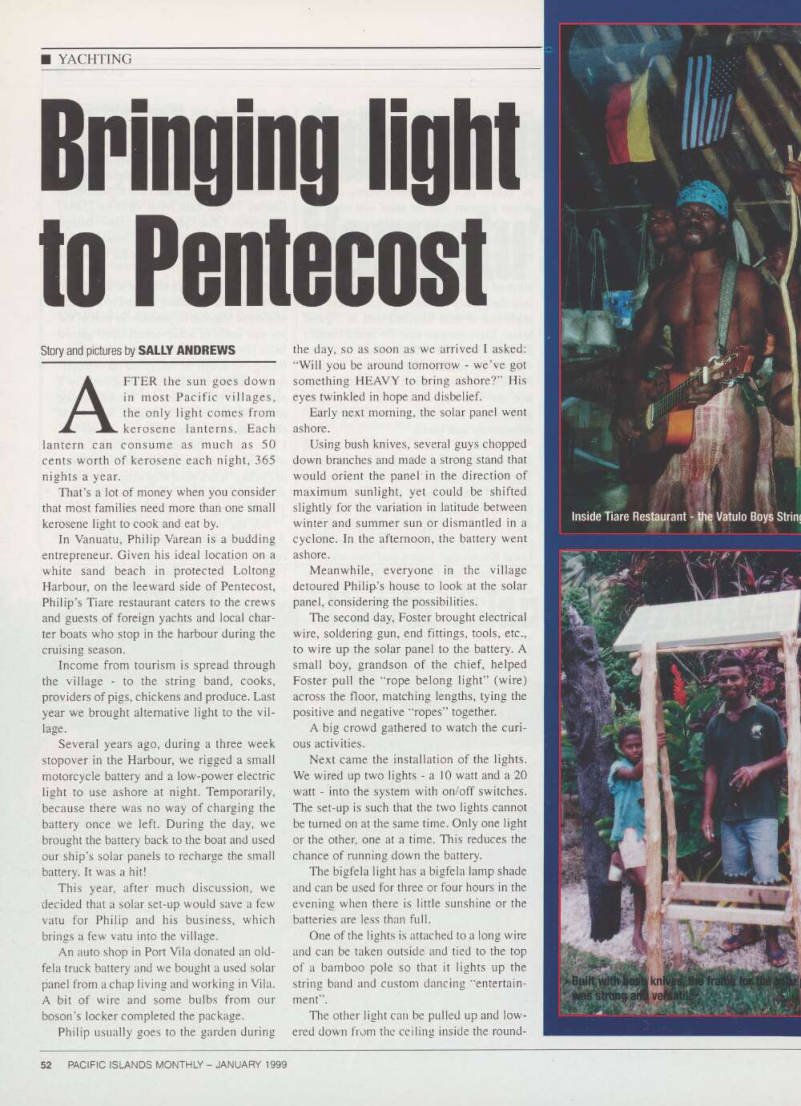
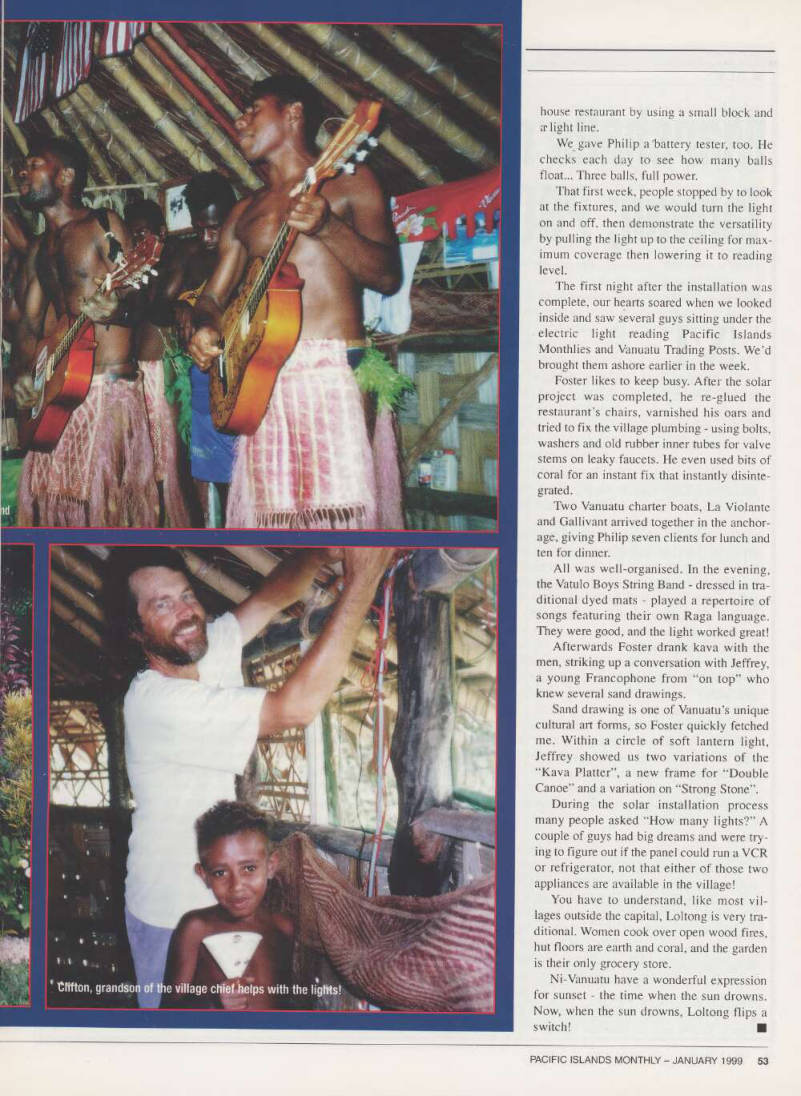
Yachting
Bringing light to Pentecost
Story and pictures by SALLY ANDREWS
AFTER the sun goes down in most Pacific villages, the only light comes from kerosene lanterns. Each lantern can consume as much as 50 cents worth of kerosene each night, 365 nights a year.
That’s a lot of money when you consider that most families need more than one small kerosene light to cook and eat by.
In Vanuatu, Philip Varean is a budding entrepreneur. Given his ideal location on a white sand beach in protected Loltong Harbour, on the leeward side of Pentecost, Philip’s Tiare restaurant caters to the crews and guests of foreign yachts and local char ter boats who stop in the harbour during the cruising season.
Income from tourism is spread through the village - to the string band, cooks, providers of pigs, chickens and produce. Last year we brought alternative light to the vil lage.
Several years ago, during a three week stopover in the Harbour, we rigged a small motorcycle battery and a low-power electric light to use ashore at night. Temporarily, because there was no way of charging the battery once we left. During the day, we brought the battery back to the boat and used our ship's solar panels to recharge the small battery. It was a hit!
This year, after much discussion, we decided that a solar set-up would save a few vatu for Philip and his business, which brings a few vatu into the village.
An auto shop in Port Vila donated an old fela truck battery and we bought a used solar panel from a chap living and working in Vila.
A bit of wire and some bulbs from our boson’s locker completed the package.
Philip usually goes to the garden during
the day, so as soon as we arrived I asked; ■'Will you be around tomorrow - we’ve got something HEAVY to bring ashore?” His eyes twinkled in hope and disbelief.
Early next morning, the solar panel went ashore.
Using bush knives, several guys chopped down branches and made a strong stand that would orient the panel'in the direction of maximum sunlight, yet could be shifted slightly for the variation in latitude between winter and summer sun or dismantled in a cyclone. In the afternoon, the battery went ashore.
Meanwhile, everyone in the village detoured Philip’s house to look at the solar panel, considering the possibilities.
The second day, Foster brought electrical wire, soldering gun, end fittings, tools, etc., to wire up the solar panel to the battery. A small boy, grandson of the chief, helped Foster pull the “rope belong light” (wire) across the floor, matching lengths, tying the positive and negative “ropes” together.
A big crowd gathered to watch the curi ous activities.
Next came the installation of the lights.
We wired up two lights - a 10 watt and a 20 watt - into the system with on/off switches.
The set-up is such that the two lights cannot be turned on at the same time. Only one light or the other, one at a time. This reduces the chance of running down the battery.
The bigfela light has a bigfela lamp shade and can be used for three or four hours in the evening when there is little sunshine or the batteries are less than full.
One of the lights is attached to a long wire and can be taken outside and tied to the top of a bamboo pole so that it lights up the string band and custom dancing "entertain ment”.
The other light can be pulled up and low ered down from the ceiling inside the round-
Inside Tiare Restaurant - the Vatulo Boys String[?]
Built with bush knives, the frame for the sofar [?] was strong am versatile
house restaurant by using a small block and a' light line.
We gave Philip a battery tester, too. He checks each day to see how many balls float... Three balls, full power.
That first week, people stopped by to look at the fixtures, and we would turn the light on and off, then demonstrate the versatility by pulling the light up to the ceiling for max imum coverage then lowering it to reading level.
The first night after the installation was complete, our hearts soared when we looked inside and saw several guys sitting under the electric light reading Pacific Islands Monthlies and Vanuatu Trading Posts. We’d brought them ashore earlier in the week.
Foster likes to keep busy. After the solar project was completed, he re-glued the restaurant’s chairs, varnished his oars and tried to fix the village plumbing - using bolts, washers and old rubber inner tubes for valve stems on leaky faucets. He even used bits of coral for an instant fix that instantly disinte grated.
Two Vanuatu charter boats, La Violante and Gallivant arrived together in the anchor age, giving Philip seven clients for lunch and ten for dinner.
All was well-organised. In the evening, the Vatulo Boys String Band - dressed in tra ditional dyed mats - played a repertoire of songs featuring their own Raga language.
They were good, and the light worked great!
Afterwards Foster drank kava with the men, striking up a conversation with Jeffrey, a young Francophone from “on top” who knew several sand drawings.
Sand drawing is one of Vanuatu’s unique cultural art forms, so Foster quickly fetched me. Within a circle of soft lantern light, Jeffrey showed us two variations of the “Kava Platter”, a new frame for “Double Canoe” and a variation on “Strong Stone”.
During the solar installation process many people asked “How many lights?” A couple of guys had big dreams and were try ing to figure out if the panel could run a VCR or refrigerator, not that either of those two appliances are available in the village!
You have to understand, like most vil lages outside the capital, Loltong is very tra ditional. Women cook over open wood fires, hut floors are earth and coral, and the garden is their only grocery store.
Ni-Vanuatu have a wonderful expression for sunset - the time when the sun drowns.
Now, when the sun drowns, Loltong flips a switch! ■
Clifton, grandson of the village chief helps with the lights!
nd
Marshals recognises
News
Marshals recognises Taiwan; PRC hails ant
By Giff Johnson
Majuro - The
Marshall Islands effort to launch and maintain a “two- China” policy turned out to be short lived, though flags of both the People’s Republic of China and Taiwan were, for a week, flying near ly across the street from each other in Majuro in early December.
But by December 11, three weeks after Marshalls Foreign Minister Phillip Muller and his Taiwan counterpart Jason Hu had formally agreed to diplomatic relations in Taipei, the PRC announced it had broken off diplomatic links with the Marshalls and was closing its Embassy.
Despite the diplomatic controversy between China and Taiwan, the just opened link with Taiwan is producing a flurry of business and government activity for the Marshall Islands.
Just two and a half weeks after ties were formalized, Taiwan opened a new embassy in Majuro.
A trade delegation of Taiwan govern ment and business officials arrived in mid- December to explore investment possibili ties, while preparations are being made for President Imata Kabua to make a state visit to the Republic of China in early 1999.
These are among the initial develop ments. “We’re moving really fast,”
Muller said. “We want to show tangible results.”
Diplomatic relations with Taiwan were established because “the social and eco nomic well being of the Marshall Islands takes priority over everything else,” he said.
“Our government is looking at ways to bring up the country economically.
Relations with the Republic of China offer a good opportunity for growth.”
Only three other Pacific nations - Nauru, Tuvalu and the Solomon Islands -
have diplomatic ties with Taiwan, Leo Fu tien Liu, the director general of the Taipei Economic and Cultural Office in Guam who opened Taiwan’s Embassy in Majuro this week.
The new relations provide the founda tion for development of many opportuni ties between the two countries, he said adding that ROC government agencies and private sector companies will “pay a lot of attention to the Marshall Islands,” which is now among only 27 countries that have diplomatic relations with Taiwan, he said.
Muller said that establishment of diplo matic ties with Taiwan will lead to a wide range of cooperation between the two nations.
An “investment plan” will be set in motion shortly that will explore buying and management of hotels, development of eco-tourism facilities in the remote outer islands, and investments and other assis tance in marine resources and agriculture.
The Marshalls has, for some time, been trying to attract buyers for the government financed, Outrigger Resorts-run 150 room hotel that was opened two and a half years ago.
The Taiwanese government has also agreed to open its lending institutions to both government and private businesses, and will consider opening a commercial bank in the Marshall Islands.
“Taiwan is interested to make money available and be a partner in develop ment,” Muller said.
The two governments also reached “an understanding” under which Taiwan has agreed to participate in developing the government’s new trust fund, although Muller declined to be specific about amounts of funding that Taiwan will assist with. Muller said that people should expect “a lot of economic activity” during the next six-to-eight months, as the rela tionship with Taiwan moves into high gear.
The People’s Republic of China, how ever, is enraged by the Marshalls’ diplo
matic link with Taiwan.
The Marshalls downplayed the prob lem, saying the move was not intended to slight the People’s Republic of China.
“We want to be friends (with the PRC), and strengthen relations,” Muller said. But that didn’t placate the PRC.
When PRC Ambassador Zhou Lianyi met with Muller in early December, he repeated his statements to the media that the Marshalls “must correct its mistake” and withdraw recognition of Taiwan.
Diplomatic relations with Taiwan “openly sabotaged” the one-China princi pal which the Marshalls agreed to when it approved diplomatic relations with the PRC in 1990, Lianyi said.
When it became clear, however, that the Marshalls was not going to go back on its new relations with Taiwan, the PRC made its exit. PRC officials said that a “caretak er” staff will be brought in to look after the closed embassy.
The break-off of relations “immediate ly stopped the implementation of all agree ments between the two governments,”
Lianyi said, adding that the “the Marshallese side must bear full responsi bility for all the consequences arising” from the “reversal of relations.”
The country’s opposition senators are divided on the subject, with some lauding the economic and business benefit that relations will bring to the country.
Other opposition members are highly critical that the Nitijela (parliament) was n’t informed in advance of the move.
“Where’s our consistency in foreign policy?” asked former Cabinment Minister Christopher Loeak.
The government had agreed to recog nize only the PRC when it approved diplo matic relations with China in 1990.
Now it’s gone back on that agreement despite the fact that the PRC “is one of the great supporters of the Marshall Islands.”
But Muller counters that the Marshall Islands needed to look after its economic interests, which relations with Taiwan will benefit.
Moreover, the dispute between China and Taiwan is an internal matter that the Marshalls doesn’t want to get involved in, preferring to be friendly with both coun tries. ■ “We’re being proactive and grabbing an opportunity for our country,” he said. “Our priority is economic development and revi talizing our economy.” ■
Developed
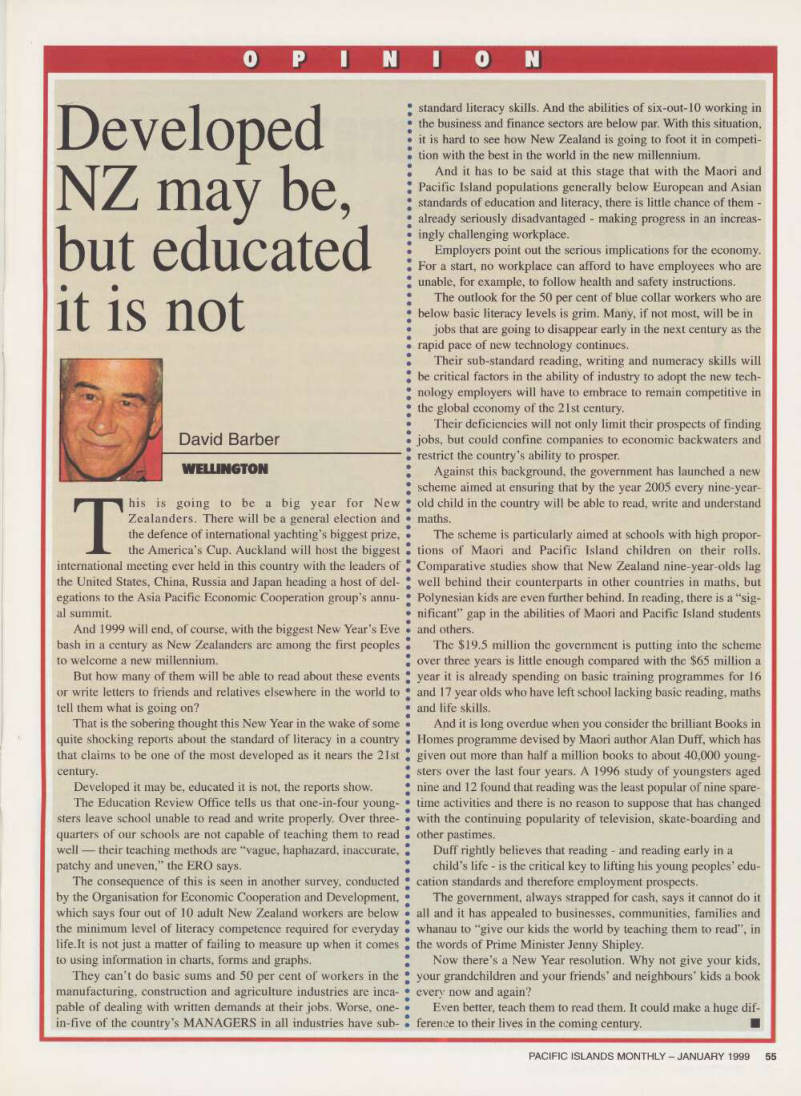
Opinion
Developed NZ may be, but educated it is not
This is going to be a big year for New Zealanders. There will be a general election and the defence of international yachting’s biggest prize, the America’s Cup. Auckland will host the biggest international meeting ever held in this country with the leaders of the United States, China, Russia and Japan heading a host of del egations to the Asia Pacific Economic Cooperation group’s annu al summit.
And 1999 will end, of course, with the biggest New Year’s Eve bash in a century as New Zealanders are among the first peoples to welcome a new millennium.
But how many of them will be able to read about these events or write letters to friends and relatives elsewhere in the world to tell them what is going on?
That is the sobering thought this New Year in the wake of some quite shocking reports about the standard of literacy in a country that claims to be one of the most developed as it nears the 21st century.
Developed it may be, educated it is not, the reports show.
The Education Review Office tells us that one-in-four young sters leave school unable to read and write properly. Over three quarters of our schools are not capable of teaching them to read well their teaching methods are “vague, haphazard, inaccurate, patchy and uneven,” the ERO says.
The consequence of this is seen in another survey, conducted by the Organisation for Economic Cooperation and Development, which says four out of 10 adult New Zealand workers are below the minimum level of literacy competence required for everyday life.lt is not just a matter of failing to measure up when it comes to using information in charts, forms and graphs.
They can’t do basic sums and 50 per cent of workers in the manufacturing, construction and agriculture industries are inca pable of dealing with written demands at their jobs. Worse, one in-five of the country’s MANAGERS in all industries have sub
standard literacy skills. And the abilities of six-out-10 working in the business and finance sectors are below par. With this situation, it is hard to see how New Zealand is going to foot it in competi tion with the best in the world in the new millennium.
And it has to be said at this stage that with the Maori and Pacific Island populations generally below European and Asian standards of education and literacy, there is little chance of them already seriously disadvantaged - making progress in an increas
ingly challenging workplace.
Employers point out the serious implications for the economy.
For a start, no workplace can afford to have employees who are unable, for example, to follow health and safety instructions.
The outlook for the 50 per cent of blue collar workers who are below basic literacy levels is grim. Many, if not most, will be in jobs that are going to disappear early in the next century as the rapid pace of new technology continues.
Their sub-standard reading, writing and numeracy skills will be critical factors in the ability of industry to adopt the new tech nology employers will have to embrace to remain competitive in the global economy of the 21st century.
Their deficiencies will not only limit their prospects of finding jobs, but could confine companies to economic backwaters and restrict the country’s ability to prosper.
Against this background, the government has launched a new scheme aimed at ensuring that by the year 2005 every nine-year old child in the country will be able to read, write and understand maths.
The scheme is particularly aimed at schools with high propor tions of Maori and Pacific Island children on their rolls.
Comparative studies show that New Zealand nine-year-olds lag well behind their counterparts in other countries in maths, but Polynesian kids are even further behind. In reading, there is a “sig nificant” gap in the abilities of Maori and Pacific Island students and others.
The $19.5 million the government is putting into the scheme over three years is little enough compared with the $65 million a year it is already spending on basic training programmes for 16 and 17 year olds who have left school lacking basic reading, maths and life skills.
And it is long overdue when you consider the brilliant Books in Homes programme devised by Maori author Alan Duff, which has given out more than half a million books to about 40,000 young sters over the last four years. A 1996 study of youngsters aged nine and 12 found that reading was the least popular of nine spare time activities and there is no reason to suppose that has changed with the continuing popularity of television, skate-boarding and other pastimes.
Duff rightly believes that reading - and reading early in a child’s life - is the critical key to lifting his young peoples’ edu cation standards and therefore employment prospects.
The government, always strapped for cash, says it cannot do it all and it has appealed to businesses, communities, families and whanau to “give our kids the world by teaching them to read”, in the words of Prime Minister Jenny Shipley.
Now there’s a New Year resolution. Why not give your kids, your grandchildren and your friends’ and neighbours’ kids a book every now and again?
Even better, teach them to read them. It could make a huge dif ference to their lives in the coming century. ■
David Barber
Wellington
Preserving culture:

history as dance
Story and picture by PAULINE WALKER
THE dancers may never have seen the place they sing about - but in their songs and dance, the are claiming an identity and preserving their history.
They are Tikopians. But most of them
have never been to Tikopia.
Living in Makira province of the Solomon Islands, they “remem ber” their home - a tiny island far from everywhere in the nation's south-eastern ocean vastness.
Tikopia for years has been too small for a growing population, and many of its people have had to move elsewhere.
Among the first to move, right after World War 11, was Willy
Vaka - now an octogenarian and still active in the village of Nukukaisi that he founded in 1957 on Makira Island (then called San Cristobal). Willy is the "father” of the dancers, a troupe of about sixty who all are members of one extended Polynesian fam ily. In his younger days, Willy was known as a great dancer. Songs and custom dances are a vital element of Tikopian culture, and Willy learnt the ancient lore from his father. He also composed songs of his own
and, from them, made dances. Tikopian songs tell stories - of chiefs and battles, of whales and frigate birds. Old legends and great deeds are preserved in songs and dance, and new events are similarly recorded. There are songs to accompany every ritual of the life cycle - including cir cumcision, marriage, and mourning for the dead. Dances always follow the words of
the song. "Dancing is our culture, passed down from our forefathers,” said Willy through an interpreter in Honiara. "We must keep it, not lose it”.
So Willy Vaka taught his sons, and they taught others. In songs and dances, Tikopia came alive to a new generation. Preserving their customs and culture through practice, they affirmed their identity with pride and joy. The idea of performing for others was born only five years ago, in 1994, when
there was much dancing for a great cere mony in which the Tikopians of Nukukaisi “bought” the land where they had settled from their Melanesian neighbours.
Instrumental in organising the dancers was the local area council member, Willy Vaka’s son, Graig Matakitofi.
The Mapungamanu Cultural Group, as it is named, now comprises about sixty males and females of all ages, the older ones teaching the young people. They have learnt over two hundred dances, and at home in Nukukaisi, they practice very evening for three hours in a custom house they have built for themselves.
Variety and precision mark their perfor manc. Authentic Tikopian garments enhance their appearance. Women wear tapa cloth wrap-around skirts and mini bodices, often dyed with turmeric. The
men dance in traditional waist mats, woven of pandanus and dec orated with motifs in bright red.
For pure entertainment, as in a Honiara hotel, they dance non stop in a richly varied show that never fails to bring enthusiastic applause. They have also learnt some of the ways of their neigh bours, most notably - and delight fully - the melodious and percus sive use of bamboo panpipes, on
which they play their own tunes and rhythms.
Mapungamanu made their first trip out of Makira in 1996, astonishing Honiara audiences with their versatility, vigour and virtuosity. They have represented the Solomon Islands at festivals in Samoa in 1996 and Papua New Guinea in 1998. The group can be contacted through J.
Threadway, USP Centre, Honiara, Solomon Islands. ■
Advertisements & other items, p. 56 (1 item)
C^Wss
AUSTRALIAN INTERNATIONAL SHIPPING SERVICES PTY LTD
Providing Container Consolidated Services, Full Container Loads , Airfrieght Forwarding and Purchase Order Tracking Services to American Samoa, Cook Islands, Fiji, Guam, Kiribati, New Zealand, Niue, Norfolk Island, New Caledonia, Nauru, Papua New Guinea, Solomon Islands, Tahiti, The Federated States of Micronesia, Tonga, Vanuatu, and Western Samoa.
Offices in Melbourne and Sydney
TEL:-61-3-93351477 FAX:-61-3-93380115 EMAIL:-A-I-S-S.COM
Australian International Shipping Services
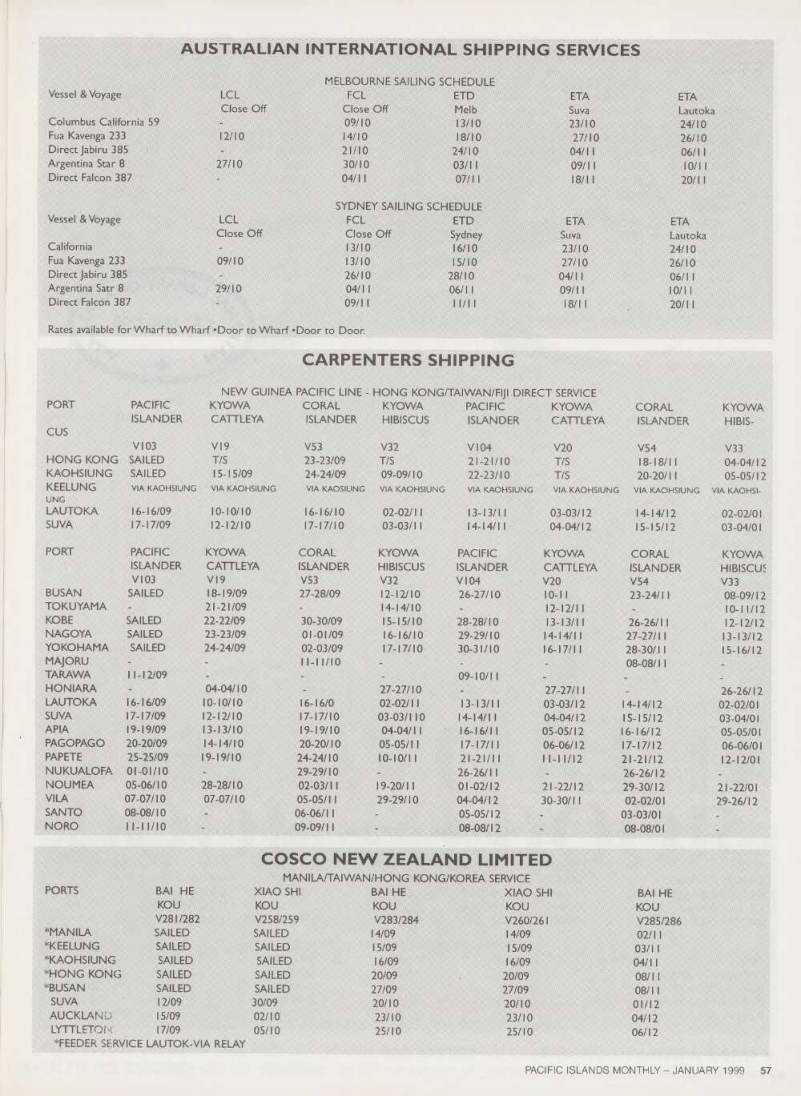
Melbourne Sailing Schedule
Vessel & Voyage
Lcl
Fcl
Etd
Eta
Eta
Close Off Close Off Melb Suva Lautoka Columbus California 59 - 09/10 13/10 23/10 24/10 Fua Kavenga 233 12/10 14/10 18/10 27/10 26/10 Direct Jabiru 385 - 21/10 24/10 04/1 1 06/1 1 Argentina Star 8 27/10 30/10 03/1 1 09/1 1 10/1 1 Direct Falcon 387 - 04/1 1 07/11 18/1 1 20/1 1
Sydney Sailing Schedule
Vessel & Voyage
Lcl
Fcl
Etd
Eta
Eta
Close Off Close Off
Sydney
Suva Lautoka California - 13/10 16/10 23/10 24/10 Fua Kavenga 233 09/10 13/10 15/10 27/10 26/10 Direct Jabiru 385 - 26/10 28/10 04/1 1 06/1 1 Argentina Satr 8 29/10 04/11 06/1 1 09/1 1 10/1 1 Direct Falcon 387 - 09/1 1 1 l/l I 18/1 1 20/11 Rates available for Wharf to Wharf •Door to Wharf •Door to Door.
Carpenters Shipping
Port
Pacific
New Guinea Pacific Line -
Kyowa Coral
Hong Kong/Taiwan/Fiji Direct Service
Kyowa Pacific Kyowa
Coral
Kyowa
Islander
Cattleya
Islander
Hibiscus
Islander
Cattleya
Islander
Hibis-
Cus
VI03 VI9 V53 V32 VI04 V20 V54 V33
Hong Kong
Sailed
T/S 23-23/09 T/S 21-21/10 T/S 18-18/1 1 04-04/12
Kaohsiung
Sailed
15-15/09 24-24/09 09-09/10 22-23/10 T/S 20-20/1 1 05-05/12
Keelung
Via Kaohsiung
Via Kaohsiung
Via Kaosiung
Via Kaohsiung
Via Kaohsiung
Via Kaohsiung
Via Kaohsiung
Via Kaohsi-
Ung
Lautoka
16-16/09 10-10/10 16-16/10 02-02/11 13-13/1 1 03-03/12 14-14/12 02-02/01
Suva
17-17/09 12-12/10 17-17/10 03-03/11 14-14/11 04-04/12 15-15/12 03-04/01
Port
Pacific
Kyowa
Coral
Kyowa
Pacific
Kyowa
Coral
Kyowa
Islander
Cattleya
Islander
Hibiscus
Islander
Cattleya
Islander
Hibiscus
VI03 VI9 V53 V32 VI04 V20 V54 V33
Busan
Sailed
18-19/09 27-28/09 12-12/10 26-27/10 10-1 1 23-24/11 08-09/12
Tokuyama
- 21-21/09 - 14-14/10 - 12-12/11 . 10-1 1/12
Kobe
Sailed
22-22/09 30-30/09 15-15/10 28-28/10 13-13/11 26-26/11 12-12/12
Nagoya
Sailed
23-23/09 01-01/09 16-16/10 29-29/10 14-14/11 27-27/1 1 13-13/12
Yokohama
Sailed
24-24/09 02-03/09 17-17/10 30-31/10 16-17/11 28-30/11 15-16/12
Majoru
- - 1 l-l 1/10 - - . 08-08/11
Tarawa
11-12/09 - - - 09-10/1 1 .
Honiara
- 04-04/10 - 27-27/10 - 27-27/1 1 . 26-26/12
Lautoka
16-16/09 10-10/10 16-16/0 02-02/11 13-13/11 03-03/12 14-14/12 02-02/01
Suva
17-17/09 12-12/10 17-17/10 03-03/1 10 14-14/1 1 04-04/12 15-15/12 03-04/01
Apia
19-19/09 13-13/10 19-19/10 04-04/11 16-16/1 1 05-05/12 16-16/12 05-05/01
Pagopago
20-20/09 14-14/10 20-20/10 05-05/1 1 17-17/1 1 06-06/12 17-17/12 06-06/01
Papete
25-25/09 19-19/10 24-24/10 10-10/1 1 21-21/1 1 1 1-11/12 21-21/12 12-12/01
Nukualofa
01-01/10 - 29-29/10 - 26-26/1 1 . 26-26/12
Noumea
05-06/10 28-28/10 02-03/11 19-20/1 1 01-02/12 21-22/12 29-30/12 21-22/01
Vila
07-07/10 07-07/10 05-05/11 29-29/10 04-04/12 30-30/1 1 02-02/01 29-26/12
Santo
08-08/10 - 06-06/1 1 - 05-05/12 . 03-03/01
Noro
li-M/IO - 09-09/11 - 08-08/12 . 08-08/01
Cosco New Zealand Limited
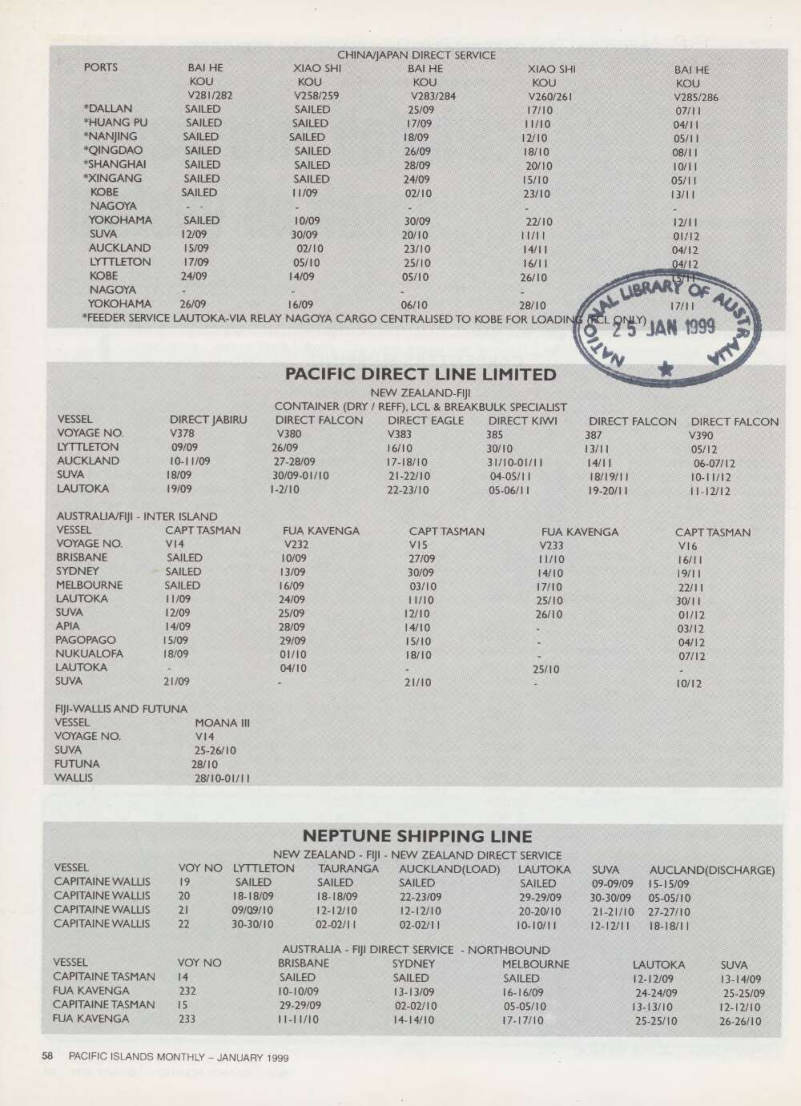
Manila/Taiwan/Hong Kong/Korea Service
Ports
Ba1 He
Xiao Shi
Bai He
Xiao Shi
Bai He
Kou
Kou
Kou
Kou
Kou
V281/282 V258/259 V283/284 V260/261 V285/286
*Manila
Sailed
Sailed
14/09 14/09 02/11
*Keelung
Sailed
Sailed
15/09 15/09 03/1 1
*Kaohsiung
Sailed
Sailed
16/09 16/09 04/1 1
*Hong Kong
Sailed
Sailed
20/09 20/09 08/II
*Busan
Sailed
Sailed
27/09 27/09 08/11
Suva
12/09 30/09 20/10 20/10 01/12
Auckland
15/09 02/10 23/10 23/10 04/12
Lyttletom
17/09 05/10 25/10 25/10 06/12
Service Lautok-Via Relay
China/Japan Direct Service
Ports
Bai He
Xiao Shi
Bai He
Xiao Shi
Bai He
Kou
Kou
Kou
Kou
Kou
V281/282 V258/259 V283/284 V260/261 V285/286
*Dallan
Sailed
Sailed
25/09 17/10 07/11
♦Huang Pu
Sailed
Sailed
17/09 1 1/10 04/11
♦Nanjing
Sailed
Sailed
18/09 12/10 05/1 1
♦Qingdao
Sailed
Sailed
26/09 18/10 08/1 1
♦Shanghai
Sailed
Sailed
28/09 20/10 10/11
♦Xingang
Sailed
Sailed
24/09 15/10 05/11
Kobe
Sailed
11/09 02/10 23/10 13/1 1
Nagoya
Yokohama
Sailed
10/09 30/09 22/10 12/11
Suva
12/09 30/09 20/10 I l/l 1 01/12
Auckland
15/09 02/10 23/10 14/1 1 04/12
Lyttleton
17/09 05/10 25/10 16/1 1 04/12
Kobe
24/09 14/09 05/10 26/10
Nagoya
Yokohama
26/09 16/09 06/10 28/10 // 17/11
♦Feeder Service Lautoka-Via Relay Nagoya Cargo
Centralised To Kobe For Load1No/
Pacific Direct Line Limited
New Zealand-Fiji
CONTAINER (DRY / REFF). LCL & BREAKBULK SPECIALIST
Vessel
Direct Jabiru
Direct Falcon
Direct Eagle
Direct Kiwi
Direct Falcon Direct Falcon
Voyage No.
V378 V380 V383 385 387 V390
Lyttleton
09/09 26/09 16/10 30/10 13/11 05/12
Auckland
10-11/09 27-28/09 17-18/10 31/10-01 /1 1 14/1 1 06-07/12
Suva
18/09 30/09-01/10 21-22/10 04-05/1 1 18/19/11 10-11/12
Lautoka
19/09 1-2/10 22-23/10 05-06/1 1 19-20/1 1 1 1-12/12
Austral! A/Fiji -
Inter Island
Vessel
C Apt Tasman
Fua Kavenga
C Apt Tasman
Fua Kavenga
C Apt Tasman
Voyage No.
Vi4 V232
Vis
V233 Vi6
Brisbane
Sailed
10/09 27/09 11/10 16/11
Sydney
Sailed
13/09 30/09 14/10 19/11
Melbourne
Sailed
16/09 03/10 17/10 22/1 1
Lautoka
11/09 24/09 1 1/10 25/10 30/11
Suva
12/09 25/09 12/10 26/10 01/12
Apia
14/09 28/09 14/10 - 03/12
Pagopago
15/09 29/09 15/10 - 04/12
Nukualofa
18/09 01/10 18/10 - 07/12
Lautoka
- 04/10 - 25/10
Suva
21/09 - 21/10 - 10/12
Fiji-Wallis And Futuna
Vessel
Moana Iii
Voyage No.
VI4
Suva
25-26/10
Futuna
28/10
Wallis
28/10-01/11
Neptune Shipping Line
New Zealand - Fiji -
New Zealand Direct Service
Vessel
Voy No
Lyttleton Tauranga
Auckland(Load) Lautoka
Suva Aucland(Discharge)
Capitaine Wallis
19
Sailed Sailed
Sailed
Sailed
09-09/09 15-15/09
Cap1Taine Wallis
20 18-18/09 18-18/09 22-23/09 29-29/09 30-30/09 05-05/10
Capitaine Wallis
21 09/09/10 12-12/10 12-12/10 20-20/10 21-21/10 27-27/10
Capitaine Wallis
22 30-30/10 02-02/11 02-02/11 10-10/1 1 12-12/11 18-18/11
Australia - Fiji Direct Service
- Northbound
Vessel
Voy No
Brisbane
Sydney
Melbourne
Lautoka
Suva
Capitaine Tasman
14
Sailed
Sailed
Sailed
12-12/09 13-14/09
Fua Kavenga
232 10-10/09 13-13/09 16-16/09 24-24/09 25-25/09
Capitaine Tasman
15 29-29/09 02-02/10 05-05/10 13-13/10 12-12/10
Fua Kavenga
233 1 l-l 1/10 14-14/10 17-17/10 25-25/10 26-26/10
Advertisements & other items, pp. 59-60 (1 item)
Door To Door
International & Local Courier
Fiji’s own courier company goes further than Fiji 3 1508 00913120 6*
.. JRLD
DOOR TO DOOR
For all your: ■ Courier needs ■ Heavyweights Your choice of domestic messenger courier needs - / IHour / 3 Hour / Same day International & Local Courier SUVA: 218 388,218 304 or TOLL FREE 0800 307 304 NADI AIRPORT; 724 434 NADI: 700 001 LAUTOKA: 665 161 LABASA: 816 022 SAVUSAVU: 850 001 SIGATOKA: 500 321 or simply call your nearest post office and ask for fMSService.
N q\q 3.sh^l\jbs
PFhC^
11-i mm m re •in m |1 ..V
' ...JEM
H i
mm ; Am
- Moun/ bambtejr+tr N % Mg iH Ii ■r«wis IT r- *K» £ Only one airline can fly you to Sydney and on to more than 60 locations across Australia. Giving you direct access to all the WiajOT destinations and those small out of the way places. The majestic and vast OUtback. And all the excitement of Australia’s vibrant, friendly cities. It is the same airline that was voted Australia’s Airline of the Year five years in a row. The same airline that now flies you non-stop to Sydney from Fiji every Wednesday and Sunday. Be our guest. For bookings and further information call Ansett Australia on 679 313 100 (Suva) or 679 722 955 (Nadi), or your travel agent.
AnsettAustralia