Monthly

Pacific Islands
INSIDE: Sex, lies and videotape - a PNG dilemma
October 1998
Aifpt m The challenges facing regional trade "
American Samoa US$2.5O; Australia A 53.50; Cook Islands NZ$3: Fiji F 52.50 Vat incl; FS Micronesia US$3: Kiribati A 52.50: Nauru A 52.50; Niue NZS3: Norfolk As 3: New Caledonia cpf2so; New Zealand NZ53.45 incl GST: Northern Marianas US$3: Papua New Guinea K 3: Palau US$3; Marshall Islands US$3; Solomon Islands As 3: French Polynesia cpf3oo: Tonga P 3; USA US$3: Vanuatu VT22O: Western Samoa T 5.50. These are recommended prices only.
Advertisements & other items, pp. 2-4 (1 item)
Asco Motors
TOYOTA
With a choice of Window Van or Panel Van, this exciting new vehicle is a great people and cargo mover. Functional and versatile, it combines all the benefits of passenger car comfort with the space and accessibility of a well-designed van. y Features include: o Diesel or Petrol engine o Easy access sliding door O Full width rear door O Tight turning circle O Large, open cargo space O High mounted rear lights © Rear door pull straps © 3 Seater Panel Van o 6 Seater People Mover SUVA PH 384888 • SIGATOKA PH 500577 NADI PH 721777 • LAUTOKA PH 662855 BA PH 674406 • TAVUA PH 680152
LABASA PH 811688
urn
cvet
ir The new Liteace makes driving so much easier. It has a relatively tight turninc radius of just over five metres, which makes it easy to manoeuvre and ver\ easy to park. Convenient walk-through access from the driver's seat and s low side step all helps to make cargc handling and passenger movement sc easier for you. Ask about our specia Toyota Extended Warranty which is now available with the new Liteace F much
Asco Motors
BPT ( SOUTH SEA ) COMPANY LIMITED
Now, there’s just one number to call for every Vodafone service. 123. It couldn’t be easier.
Vodafone Customer Care operates 24 hours a day and Seven days a week.
Call 123 from your Vodafone or 902 123 from any Telecom Fiji phone.
O vodafone
Calls to 123 (Customer Care) are charged at the standard Vodafone rate.
f mx m A 0 ¥/a £ m r 0 n
iij
» <* L pr 9B « *? >N fc - > We accept For further information please contact:
VISA
Tetikom Phone Card Sales Pay Phone Business Unit PO Box 351 Waigani, NCD Papua New Guinea Just quote your card number and expiry date and we wi forward your requirements. Telephone: (675) 300 5093 Facsimile: (675) 3005060
{{{[} TELIKOM PNG
ifl y fcteS-Jne- rts&Utf /
Pacific Islands
Monthly
Vol 68 No. 10
The News Magazine
October 1998
PUBLISHER: Alan Robinson EDITOR: Sophie Foster Hildebrand
Correspondents:
Sally Andrew, Patrick Decloitre, Giff Johnson, Chris Peteru, Neville Choi, Atama Raganivatu, Michael Field, Liz Thompson, Sam Vulum, Lisa Williams, Florence Syme-Buchanan.
COLUMNISTS: David Barber (Wellington), Jemima Garrett (Sydney), GRAPHIC ARTISTS: James Ranuku, Josefa Bola, Andrew Williams
Advertising Sales
Senior Regional Sales (South Pacific) Shabana Naaz Kailesh Kumar Tel (679) 304111, 303244, Fax (679) 303809.
Sydney, Canberra: Bob Hill Media Representation, Tel (61-2) 4164245, Fax (61-2) 4165064.
Brisbane: Jane Fewings Media and Advertising Associates Tel (61-7) 3378 4522, Fax (61-7) 3878 1071.
Adelaide: Hastwell Williamsons Representatives, Tel (61-8) 3799522, Fax (61-8) 3799735.
Melbourne: Brown Orr Fletcher Burrows (Aust) Pty Ltd.
Tel (61-3) 98265188, Fax (61-3) 98265644.
Auckland: McKay & Bowman, International Media Representatives Limited, Tel (64-9) 4190561, Fax (64-9) 4192243.
Japan: Universal Media Corporation, Tokyo, Tel (3) 3266626741, Cable: UNI-MEDIA Tokyo, Fax (3) 32626742.
Pacific Islands Monthly was founded in 1930
(Usps 9522480).
A Fiji Times Limited production.
Cover prices are recommended retail only. Registered by Australia Post, Publication No. NBPI2IO. © Copyright Fiji Times Limited, 177 Victoria Parade, Suva, Fiji.
Tel (679) 304111, fax (679) 303809.
Email: [email protected] PIM Website: http://www.pim.com.fj Pacific Islands Monthly is published monthly by Fiji Times Limited, a division of Nationwide News, 2 Holt Street, Surry Hills, Sydney, NSW 2010.
Send Address Changes To:
Pacific Islands Monthly POBox 1167 Suva, Fiji.
Typeset and printed by Quality Print Limited, 16 Amra Street, Walu Bay, Suva, Fiji.
Layout and cover design by Andrew Williams
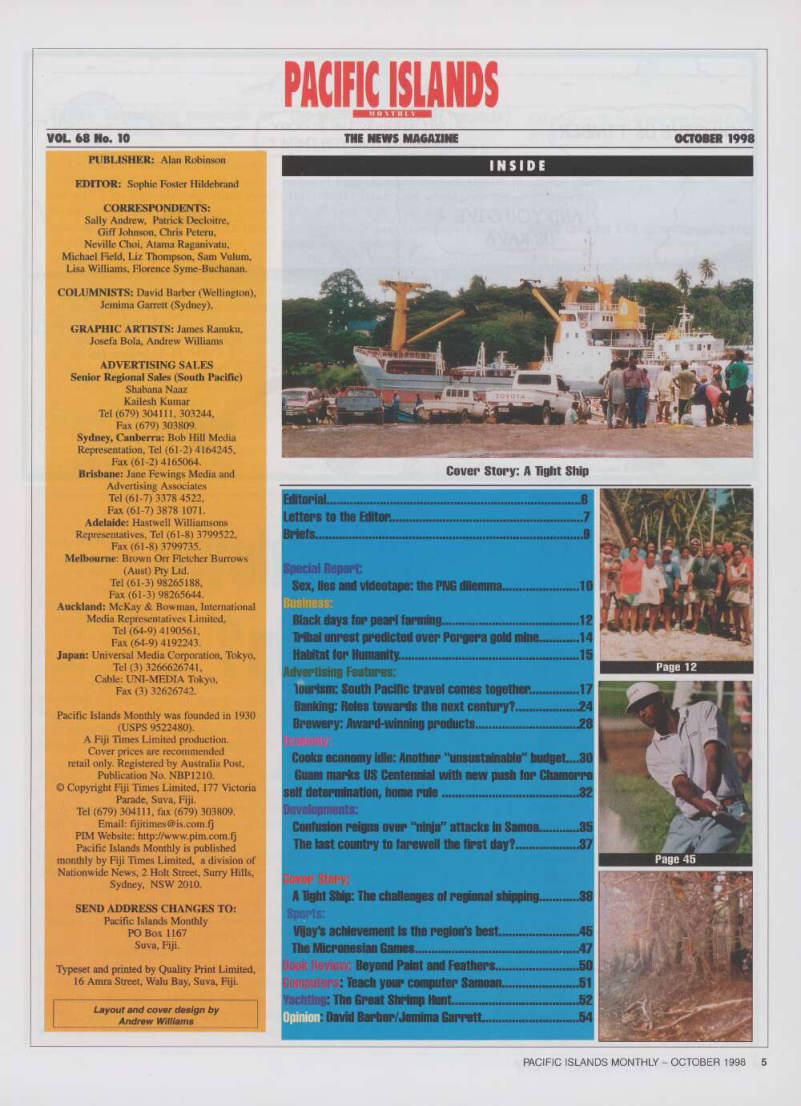
Inside
Editorial 6 Letters to the Editor. 7 Briefs 9 Special Report: Sex, lies and videotape: the PNG dilemma to Black days for pearl farming 12 Tribal unrest predicted over Porgera gold mine 14 Habitat for Humanity. 15 Advertising Features: tourism: South Pacific travel comes together. 17 Banking: Roles towards the next century? 24 Brewery: Award-winning products 28 Cooks economy idle: Another "unsustainable" budget...3o Guam marks US Centennial with new push for Chamorro self determination, home rule 32 Developments: Confusion reigns over "ninja" attacks in Samoa 35 The last country to farewell the first day? 37 (lav® Story: A Tight Ship: The challenges of regional shipping 38 Sports: Vijay's achievement is the region's best 45 The Micronesian Games 47 Uook Review: Beyond Paint and Feathers 50 ■ : Teach your computer Samoan 51 \: The Great Shrimp Hunt 52 David Barber/Jemima Garrett 54
Page 12
Page 45
Cover Story: A light Ship
with the ship?
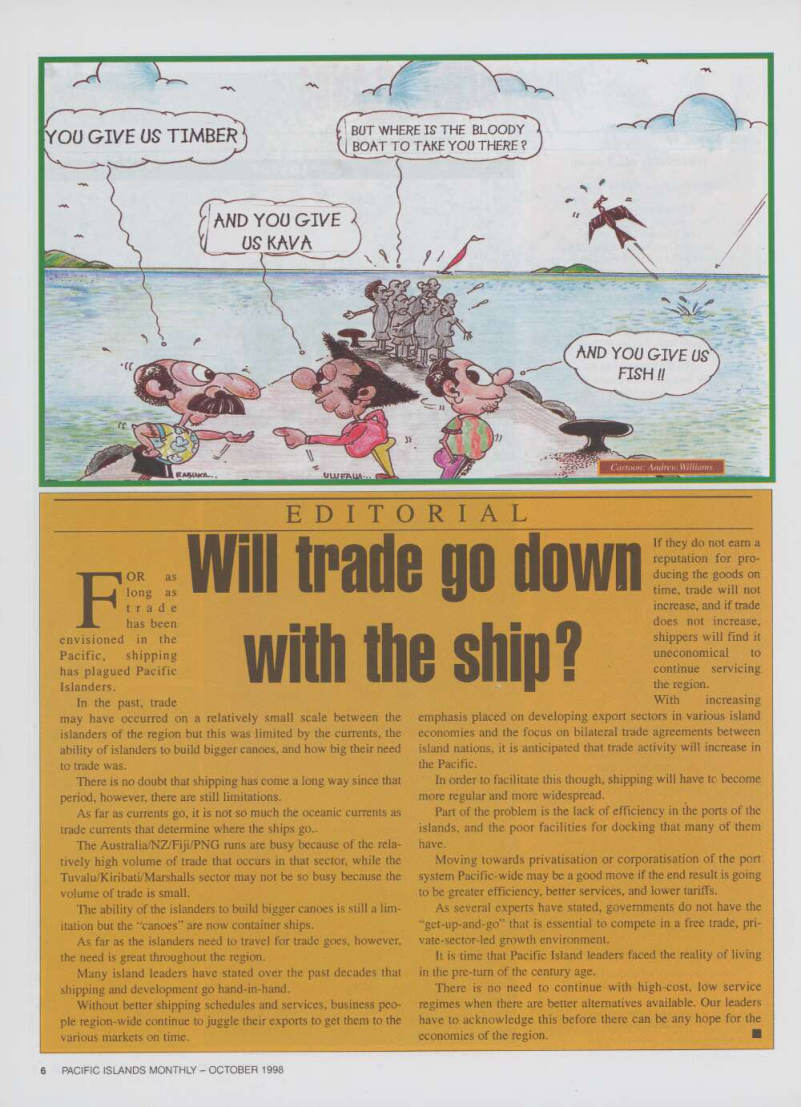
Editorial
Will trade go down with the ship?
FOR as
long as trade has been envisioned in the
Pacific, shipping
has plagued Pacific Islanders.
In the past, trade
may have occurred on a relatively small scale between the islanders of the region but this was limited by the currents, the ability of islanders to build bigger canoes, and how big their need to trade was.
There is no doubt that shipping has come a long way since that period, however, there are still limitations.
As far as currents go, it is not so much the oceanic currents as trade currents that determine where the ships go..
The Australia/NZ/Fiji/PNG runs are busy because of the rela tively high volume of trade that occurs in that sector, while the Tuvalu/Kiribati/Marshalls sector may not be so busy because the volume of trade is small.
The ability of the islanders to build bigger canoes is still a lim itation but the “canoes” are now container ships.
As far as the islanders need to travel for trade goes, however, the need is great throughout the region.
Many island leaders have stated over the past decades that shipping and development go hand-in-hand.
Without better shipping schedules and services, business peo ple region-wide continue to juggle their exports to get them to the various markets on time.
If they do not earn a reputation for pro ducing the goods on time, trade will not increase, and if trade does not increase, shippers will find it uneconomical to continue servicing the region.
With increasing
emphasis placed on developing export sectors in various island economies and the focus on bilateral trade agreements between island nations, it is anticipated that trade activity will increase in the Pacific.
In order to facilitate this though, shipping will have tc become more regular and more widespread.
Part of the problem is the lack of efficiency in the ports of the islands, and the poor facilities for docking that many of them have.
Moving towards privatisation or corporatisation of the port system Pacific-wide may be a good move if the end result is going to be greater efficiency, better services, and lower tariffs.
As several experts have stated, governments do not have the “get-up-and-go” that is essential to compete in a free trade, pri vate-sector-led growth environment.
It is time that Pacific Island leaders faced the reality of living in the pre-turn of the century age.
There is no need to continue with high-cost, low service regimes when there are better alternatives available. Our leaders have to acknowledge this before there can be any hope for the economies of the region. ■
Letters
Forum Secretariat responds to claims of agenda “hijacking”
I write to comment on the negative remarks made in your September issue in the article by Sophie Foster Hildebrand relating to the recent South Pacific Forum Meeting held in Pohnpei, Federated States of Micronesia and in particular how the agenda is shaped. The agenda for botn the Pre-forum Officials Committee and the South Pacific Forum Meeting itself is not set by the Forum Secretariat; it is set by the members themselves through a process of consultation with all members as well as other regional organisations.
While the Secretariat provides the ini tial first draft of the agenda to facilitate the process, and circulates this to all members and to all South Pacific Organisations Coordinating Committee (SPOCC) agen cies for their comments and amendments well in advance of the meetings, the end product is the result of the collective input from all member countries and regional organisations, reflecting the issues that those who respond deem to be important issues that require a regional position.
These draft agendas remain until the day of the meeting when members can then make any last minute adjustments before adopting the agenda at the first ses sion of these meetings.
It is also customary each year to pro vide every opportunity for members to table any other items of concern during the meetings both at the Pre-Forum Officials meeting as well as at the Summit. For instance, there is a traditional item “Country Initiatives” under which mem bers are at liberty to raise for regional con sideration additional items of major con cern to them.
The agendas for these meetings are therefore what members make them to be and it is for members to highlight what issues are of major concern tothem, both in the process of consultation leading up to the meetings and at the meetings.
Comments made on the agenda after the meetings, will have relevance to the shaping of the agenda of the next South Pacific Forum and related meetings to be hosted by the Republic of Palau around October in 1999.
W. Noel Levi CBE
Secretary General Forum Secretariat
The worrying impact of “experts”
I have to commend the editorial in the July issue of PIM. One can only hope that some of these organisations such as ADB, IMF, World Bank, and world-wide aid groups read and take notice of this, although from past experience I would think it very unlikely.
The highly paid “experts’Vconsultants would in no way like to see a block of their lucrative occupations, irrespective of the harm they can do, especially to small Pacific nations.
Many of these “experts”, especially those who come in for only a week or two, have negligible understanding of the eco nomic, social and cultural structure of the country. They just dream up some new (and usually harmful and workable) tax or fiscal package, jump on a plane and fly out. This is aid! Why is not much more use made of the local knowledge and exper tise?
The latest fiasco os in Vanuatu where New Zealand “experts” have been work ing to introduce a VAT system, and associ ated schemes, as part of an ADB financed
Comprehensive Reform Programme,
which came into force August 1.
These “experts” would say that they consulted with the business sector, but in reality they just had their preconceived ideas of what was needed and went ahead with this.
A small section of the Finance Sector and a few retailers managed to manipulate these consultants and push their own agen das, at the expense of the rest of the busi ness community, and the country as a whole, compounding the damage that will be done to the economy.
One cannot but feel sympathy for the govemmnets, who are under pressure to implement these unworkable schemes, and the only hope for the future is to abandon some, and change others.
The ADB sponsored Reform Package in the Cook Islands was implemented with far more consultation with the private sec tor, and is in no way as radical (or com pletelt unworkable) as in Vanuatu, but since its inception, there has been an exo dus of approximately 20 per cent of the
population.
At least the Cook Islanders (under NZ passports) can leave the country and find work elsewhere.
What is going to happen in Vanuatu,
and what are the economic and social costs going to be?
Brian Coker,
Port Vila, Vanuatu
More info on Y2K non-compliance
The article “Will your business survive the 21st century?” is timely (or perhaps a bit late). I suspect that most of your read ers are little involved in computers other than PCs.
Most PCs, and most PC software is headed for Y2K compatibility. If you can do a follow-on report identifying some of the PC applications which are known to be not Y2K compliant, it would be welcome news to the most of us who read PIM.
I found your choice of photograph to accompany the article interesting. It is a picture of the monitor of the only PC hard ware designed from the beginning (1984) to not have a problem with the Y2K bug the Apple Macintosh.
Charles Kick,
Port Vila, Vanuatu
Honour among thieves?
As official scribe to the Felons and on behalf of The Burgulars, thieves. Thugs and Fiends Association (as well as The Rogues and Scoundrels Society), I have been asked to thank you for publishing our August letter in your illustrious magazine.
Our members were delighted but wish to point out that three very important words were missing from the paragraph headed Treason.
It should have read as follows: Treason: Not representing the interests of those who elect them. * Actually we are morally superior in this respect - we do represent our members interests!
Is there honour among thieves?
Let us say that our members are in agreement with that famous adage “An Ounce of Loyalty is worth a Pound of Cleverness”.
Martin Leo,
Otahuhu, New Zealand
Continued On Page 8
Archives
October 1944 W R Carpenter - How big firm is weather ing storms of war SIR Walter Carpenter, head of the big Pacific trading and shipping firm, is at pre sent paying a visit to Sydney, after three years’ residence in Canada. He is accom panied by Lady Carpenter.
Sir Walter, with the shrewdness and foresight which built the great group of companies he directs, saw what was likely to happen in the Pacific soon after the out break of war in Europe; and so he person ally extended his group’s operations to Canada, where copra-milling was entered upon in a big way.
As a result, when WRC & Co. lost heavily on the swings, through the Jap invasion of the Pacific, they began to gain
Paciflcilslamte
substantially on the roundabouts, established in Canada. Despite the invasion, W. R.
Carpenter & Co.
Ltd made the sub stantial net profit of 65,873 Pounds
in the year ended June 30 last; and this has been disposed of in a five per cent divi dend, and the transfer of 25,000 Pounds to a Contingency Fund.
The Co. has not yet resumed trading in New Guinea, the Solomons or the Gilberts, but its subsidiaries are doing well. The Fiji Co., paid 12 and a half per cent and South Pacific insurance seven per cent.
Directors are Sir Walter Carpenter (chairman), R. B. Carpenter (deputy chair
man), C. H. Carpenter, Sir Henry Braddon, D. J. Brownhill, and W. S. Bennett. Issued capital is 775,000 Pounds, and to this are added 200,000 of general reserve and well over 100,000 remaining in P & L. Account.
Shares are at a large premium on the con trolled share markets. ■
Established 1930
Letters
Switching countries
Unless no-one has mentioned to the edi tor, on both the July and August issues in the “opinion”, Jemima Garrett is put down as the Wellington correspondent and vice
versa for David Barber. I am also quite sad that there is no longer a correspondent for the SPC and when shall we have one for the Forum. Both organisations do play an important role in the region.
I am quite happy with the last issue as you have been dealing with a greater num ber of islands. Indeed, the Pacific region is not limited to Fiji, Papua New Guinea, Samoa, Australia and New Zealand.
I do hope to read more in the Culture section on other islands - not everybody has the opportunity that I do to access tourism information on the net.
Jacqueline Mattel,
Rue de I’ eg Use, 86300 Morthemer
Independent reviews
I note that the “review” of ‘Law for Pacific Women: A Legal Rights Handbook’ by P.I. Jalal which appears in the September 1998 issue of your magazine appears to have been written by the author herself.
Readers who wish to read an independent review of this volume are referred to the
Journal Of South Pacific Law
which can be viewed via the USP School of Law homepage at
http://www.vanuatu.usp.ac.fj
Tess Newton
Book Reviews Editor
Journal Of South Pacific Law
PO Box 12, Port Vila, Vanuatu
A splendid Micronesian Games
I am writing to you as I would like to congratulate Palau on a magnificent achievement - namely winning the most number of medals at the recently held Micronesian Games. As Palau was also this year’s Micronesian Games host nation, I would also like to congratulate Palau for the splendid job it did in hosting such an
auspicious event.
Ted Davis
Queanbeyan NSW, Australia
Advertisements & other items, p. 8 (2 items)
\ Engine
\WAREHOUSE
BMW\
Bedford Cummins Daihatsu Detroit Deutz Ford Gardner Hino Isuzu Iveco Komatsu Kubota
/ ‘DIESELS ‘PETROL \
' TRANSMISSIONS N
•New Parts ‘Second Hand Parts
SPECIALS
•Crankshafts, Mercedes 0M346 Std $4OO •Scania DSB Std $4OO •Scania DS4 Std $4OO •New Rebuilt Waterpumps Most Models, •New Engines Toyota 2C RWD •Isuzu C 240 4BGI 3LBI 3LDI 3YCI •Mazda RFTurbo RWD
FREE FAX
0800-274-061 0800-252-477
NEW ZEALAND
Phone 03-693-8122 03-348-0729 email: [email protected] Subaru Leyland Mazda Mercedes Mitsubishi
MAN.
Nissan Perkins Suzuki Toyota Volvo Yanmar
Send your letters to:
The Editor, Pacific Islands Monthly, PO Box 1167, Suva, Fiji Or Email: [email protected]
Briefs

Forum involved in Asia Pacific economic
cooperation
IN preparation for next month’s APEC Leaders meeting, to be held in Kuala Lumpur, senior APEC officials met in August in Malaysia. The South Pacific Forum is also represented. APEC has most Pacific'rim countries in its membership, including many key trade and economic partners of Forum member countries. Three Forum members, Australia, New Zealand and Papua New Guinea, are APEC mem bers in their own right. Other Forum mem ber countries can access APEC proceedings by means of the Forum’s observership in
Apec.
Samoa delivers new offshore facilities SAMOA’S offshore finance centre has launched itself as a competitor to the Isle of Man, Alderney and several Caribbean juris dictions by introducing hybrid companies and companies limited by guarantee. The secrecy provisions have also been eased slightly to allow identification of some company details, while control of offshore banking and insurance is to be policed more tightly. The Samoan parliament passed the International Companies Act 1998 in a move aimed at making the country more competitive in the industry. Registrar of International and Foreign Companies, Ema Va’ai, said that since Samoa’s offshore laws were remodelled in 1991 along the lines of legislation in the British Virgin Islands, international companies had become the most popular form of vehicle in the juris diction, as opposed to trusts. A large major ity of the 4880 offshore entities registered in Samoa were international companies, she said.
PNG coffee harvest looks brighter PAPUA New Guinea will probably har vest more coffee than first expected this year after rain last November and December eased earlier drought damage to trees, Bloomberg News reported. Production could reach 950,000 bags in 1998, up from earlier estimates of as low as 600,000 bags,
the Coffee Industry Corporation of Papua
New Guinea (CIC) said. Last year the coun try produced one million bags. Most coffee gardens and plantations recovered well from the drought and were assisted by time ly rains in November and December, CIC said in a statement. While coffee output is likely to be higher than expected, damage
from dry weather is expected to cause loss es worth Kl 5 million (about US$6 million), CIC said. Large coffee plantations bigger than 20 hectares were the worst affected.
Papua New Guinea will probably account for about one per cent of global cof fee production in 1998-1999. The country grows mostly the mild-flavoured arabica coffee beans. Germany normally takes between 50 to 60 per cent of its annual exports.
Marianas faces Mexico in garment industry INCREASINGLY attractive investment incentives in Mexico are threatening the Northern Mariana Islands’ appeal to foreign business people worried over apparent lack of support by the government on garment manufacturing, according to the Saipan Tribune. The NMI, whose nearly US$l bil lion garment industry has propelled the local economy in the wake of the financial turmoil of its neighbours in Asia, has yet to offer better incentives to keep factories grinding there. Representative Melvin Faisao said the booming apparel trade in Mexico should serve as a warning sign for the NMI government to reconsider its restrictive policies towards the local gar ment manufacturers.
“Our garment industry here in the CNMI is not only facing competition in the US market from Mexican factories under NAFTA (the North American Free Trade Agreement), but also is being faced with many uncertainties and lack of support from our government leaders,” the legislator said in an interview with the newspaper.
The Marianas government has been under pressure from Washington because of the influx of Asian migrant workers and allegations of labour abuse. The legislature has voted to increase user fees, which are imposed on locally-sewn garment products, from 3.5 per cent to 3.7 per cent. On top of this, it has also restricted hiring of foreign manpower under a labour moratorium.
Increase in young workers and old people The 1998 State of the World Population Report, launched last month, looked in detail at the challenge facing two new gen erations.
It said more young people (15-24 years) than ever are now entering their childbear ing and working years and at the same time, greater numbers of people are living to older ages (over 65). ■
Advertisements & other items, p. 9 (1 item)
Professional & Comfortable
CHAIRS AVAILABLE FROM FIJI
UT 230 C UT 280 C
Executive Lowback Managerial Mediumback X mm
UT 500 C
Presidential Highback ■ Assembled, Exported and Processed by: ft
INTERLINK
TRADING (FIJI ) LTD
G.RO Box 16189, Suva , Fiji Islands.
Phone : (679) 311429 Fax : (679) 31 1499 Mobile : (679) 938799 •Office Chairs •Office Equipments •Office Stationery •Filing Cabinets
PNG's latest videotape saga
Special Report
PNG's latest videotape saga MP alleges blackmail in K9 million write-off
By Sam Vulum
THE embattled Papua New
Guinea Government of prime minister Bill Skate is bracing itself for yet another battering with the expected public naming and charge of a senior member - alleged to have been involved in the production of a porno
graphic video.
The government has survived some rough times, mainly resulting from the Sandline crisis, the Mujo Sefa tapes saga, the NCDC corruption allegations - and now, the pornographic videotape saga.
This comes when the government is also under close scrutiny and extreme pres sure over its handling of the deteriorating economy resulting in the slide in the Kina.
Police have formally charged the woman allegedly involved in the tape. She is Regina Pera Gibolo from the Western Highlands province. At the time of writing, she had appeared in court twice for men tion and has been kept in custody under heavy police guard in a Boroko cell in Port
Moresby.
Police have also threatened to charge people in possession of the 100 estimated copies of the tape unless they surrender them.
The issue was revealed on June 24 when veteran politician Sir Peter Lus tabled a copy of the tape in parliament.
In a series of questions accompanying the tape, Sir Peter also alleged that the tape was used to blackmail the government into writing off a K 9 million debt to a bank in the country.
Parliament Speaker John Pundari, after viewing the tape, ruled that to maintain the decorum of parliament and to protect MPs, he would not accept any documents that touched upon the integrity of members.
The member allegedly concerned was heavily involved in the formation of gov ernment.
Another key government figure, Eastern Highlands Province Governor Peti Lafanama, has been dismissed from parlia ment by a Court of Disputed Return.
The facts surrounding the videotape allegations have yet to be made public,
however, according to claims made by informants to PIM, the events leading up to the parliamentary revelations began in March 1998.
Sources say at this time, Bakri Nema of the Nokoba tribe of Wurup village in the Agnlimp South Waghi electorate of Western Highlands - allegedly took a tape marked “sports” from the house of the MP on the tape.
Nema, a blood brother of the MP, allegedly sold the tape for K 6 to a Haverly Kewa of the Roni Milemb tribe, also of the Wurup area.
Kewa apparently decided to get rid of the tape as he could not get it working dur ing a film show. He was not aware at the time that the tape contained pornographic material involving the MP.
It is claimed that the tape was then picked up by two men who apparently viewed the tape at the home of a public ser vant who works at the Western Highlands provincial administration.
After viewing the contents, the young men allegedly tried to sell the tape back to its owner, the MP, for an amount of K 200,000,000.
The MP did not have the money. As a senior member of a major coalition partner in government, he allegedly had to seek help from the party leader and another senior member of the party who was also
the chairman of a bank in the country.
The MR flew immediately to Port Moresby to seek help. He apparently informed the party that he needed help but didn’t tell them the reason. Sources claim that the two men plus a senior government minister told the MP to wait around for a few days while they organised the money.
In the meantime, the two young men with the tape apparently got impatient.
Allegedly, with the help of a former local level government councillor, they took the tape to a former MP and strong political rival of the MP implicated. The founder of a major local business group, he allegedly gave them K3OOO cash of which Michael Kewa took Kl2OO. It is claimed that after viewing the tape with many other people, the rival left immediately for Port
Moresby.
He was picked up at the airport by a lawyer friend, who apparently viewed the tape along with the senior party member and bank chairman.
By this time, the MP knew that the tape had fallen into the hands of his greatest political enemy. After the senior party man and bank chairman viewed the tape, the
MR apparently confirmed to the party lead er, the minister and the senior party man that he was involved. They all cried and allegedly made a firm commitment that they would do everything possible to cover this and protect the MR According to sources, the party leader wanted to view the tape, which he did.
In the meantime, the boys that the MP’s rival had sent to Goroka were involved in a car accident there. The rival’s brother was killed, and he had to rush back home. He apparently told the party leader what his demands were in front of the senior party man and bank chairman, the minister and his lawyer. The demands allegedly includ ed: - withdrawal of receivership of a certain business group. The group owed the bank, that the senior party member was chairman
of, more than K 9 million;
- writing off K 9 million from the bank; - the rival himself was to be given a job with the government with good terms and conditions; - all legal work of government statutory bodies were to go to his lawyer friend.
These were allegedly some of his
demands in return for not exposing the MR Because the MR and his rival had not seen each other face to face for a long time, sources claim that the party leader suggest ed that he travel to their village for them to sit down and make peace in front of him.
The party leader apparently asked the rival not to expose the MR and assured him that his demands would be met by April 1998. It is claimed that the senior party man and bank chairman travelled by night from Goroka so that no-one would know he was at the meeting in the MP’s house.
The meeting allegedly took place in the village with the party leader, the rival, the senior party man and bank chairman and the MR concerned present.
The MR apparently cried and hugged his rival, saying “you saved my life, I’ll do
anything for you”.
Sources say they spent the night at the MP’s house and the next morning, the rival called for a few of his key men to tell them what had taken place.
The government, however, has denied that it ordered the bank to write off the K 9 million. It argued that it was a normal busi ness transaction. ■
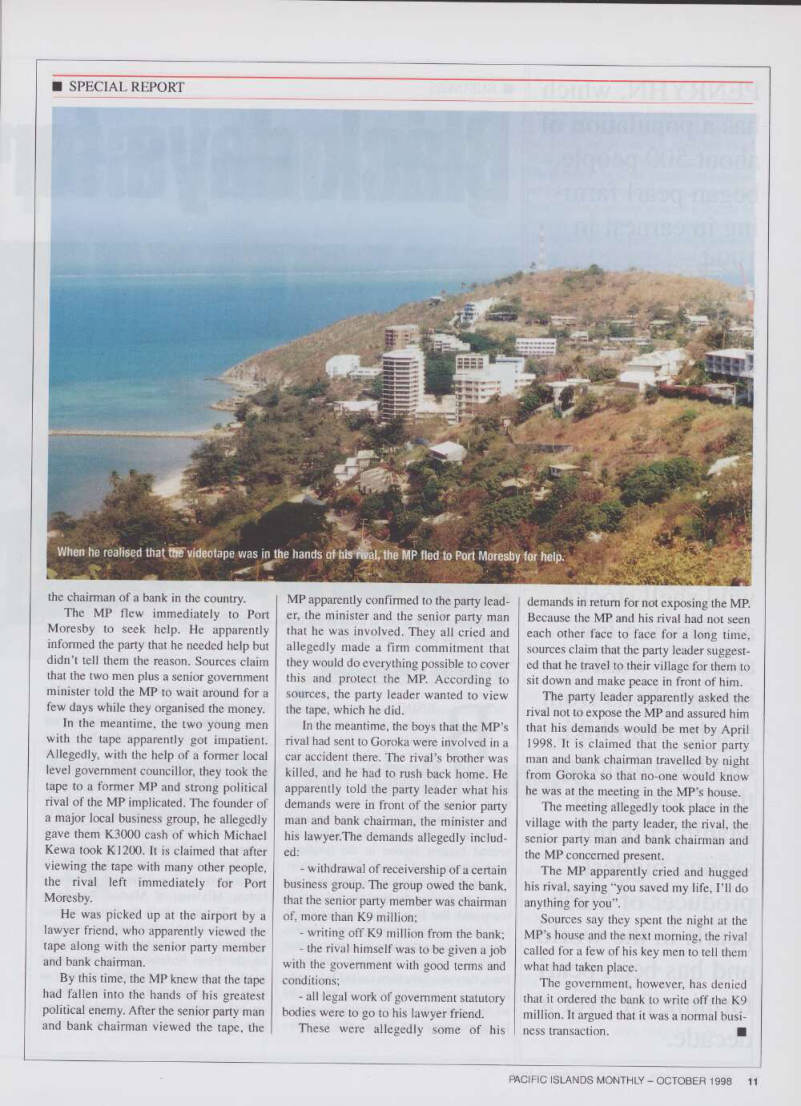
When he realised that the videotape was in the hands of his rival, the MP fled to Port Moresby for help.
Advertisements & other items, pp. 10-12 (1 item)
Japanese Vehicles
DIRECT”
Cut out the middlemen
Where to buy, how to import, photos, specifications, prices, get the book that reveals all. For free information contact - Trust Company Ltd, Tel: 81-52-953- 5602, Fax: 81-52-953-5634/31, E-Mail; [email protected].
Homepage; http://trust-ltd.co.jp/ Address: Kobac Bid 3-2-26 Nishiki Nakaku Nagoya 460-0003 Japan r ( Compiled by the Trust Company Limited, Japan, in association with japan Vehicle Export Limited , y (UK). Trade Aid Ltd. (UK) and i Mobile Outreach Ministry (USA).
PENRYHN, which has a population of about 500 people, began pearl farming in earnest in 1994.
Locals use stocks of wild pearl shells in the lagoon that they collect by mostly free-diving in depths ranging from 20 to 100 feet.
Big farmers say wild shell stocks are running low and now want to import shells from nearby Manihiki, another island in the Cook group.
Manihiki is the second biggest producer of black pearls in the world and has been pearl farming for over a decade.
Black days fo[?] pearl farming
Business
By Florence Syme-Buchanan
BEHIND the mystique of pearls are island families who work
incredibly hard and long
on their tiny atolls to produce these gems - but one third of their effort pays foreign pearl technicians, and now some farmers are crying “unfair.”
The tiny atolls of Penryhn nestle in the second biggest lagoon in the Southern Hemisphere, and pearl farmers there believe this massive natural feature is the key to producing the best black pearls in the world. But four years after the island launched into pearl farming, some farmers are experiencing the same problems as their relatives in nearby Manihiki. The prob lems, they say, have been caused by greedy farmers, whose crafty behaviour has result ed in a payment system that’s disadvan taged everyone and broken the very by
laws set up to stop foreigners farming in their vast lagoon. Through a lucrative pay ment system, foreign pearl technicians are ending up owning more pearl shells than indigenous Penryhn islanders, and many aren’t happy about this. Penryhn islanders are limited to 5,000 pearl shells each.
Another island by-law restricts pearl farm ing in the 130 square kilometre lagoon to people of Penryhn descent. Despite the bylaws, about four technicians originally from Japan, have accumulated pearl shells well over the limit and have set up thriving farms. Minister of Marine Resources Tepure Tapaitau admits the foreign techni cians are technically farming without licenses and a problem situation exists. But he, the Pearl Federation and concerned pearl farmers are stumped how best to resolve the problem. That’s because farm ers and authorities are in a catch-22 situa tion. The foreign technicians are needed to
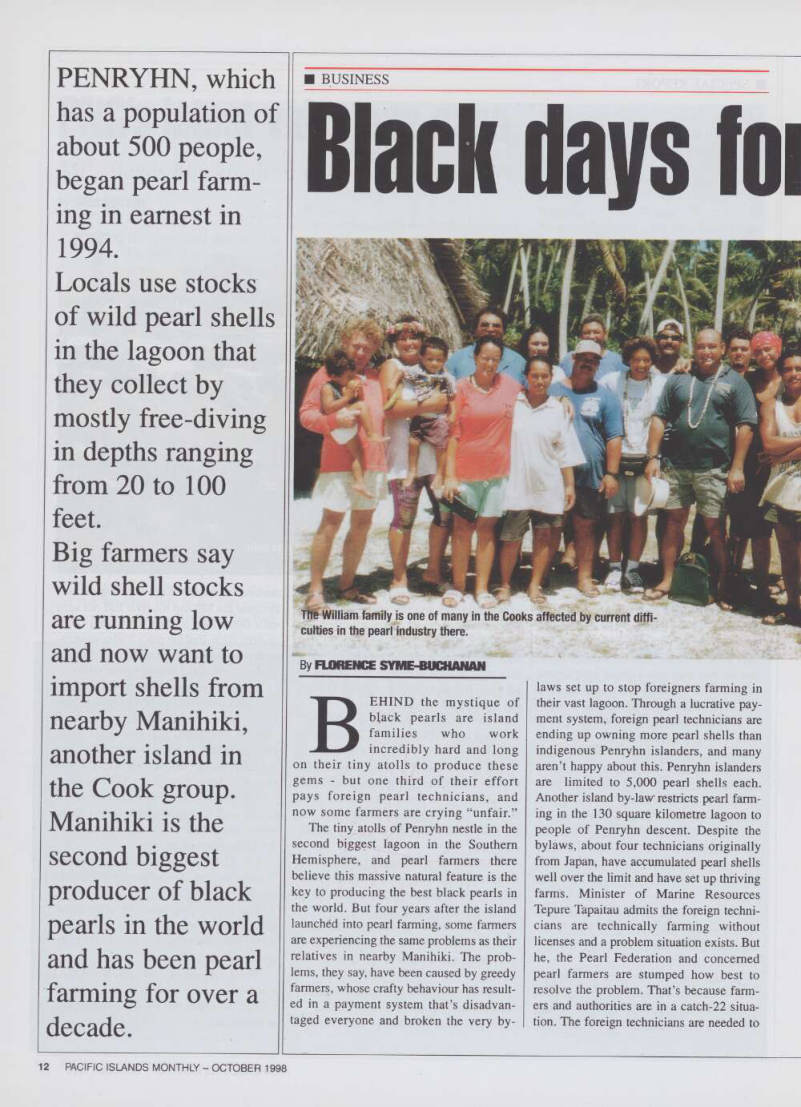
The William family is one of many in the Cooks affected by current diffi culties in the pearl industry there.
seed the pearl shells as just one local, John Lyons, is fully qualified. About six other locals are trainee technicians and farmers are reluctant to use them because mistakes are costly. No one sees a way around the problem, caused mostly by some dishonest farmers who made the original percentage of harvest payment too risky for techni cians to accept anymore.
Technicians are now demanding one shell out of every three they seed for a farmer. It used to be a percentage of pro ceeds, or harvested pearls, which some times runs up to 60 per cent of a harvest. A technician used to be paid one pearl out of every three that were harvested. That sys tem went out over the reef when Penryhn farmers began stealing their own pearls so they wouldn’t have to share them with the technicians.
Big time pearl farmer Peter William says technicians are seeding up to 30,000 shells at a time and, from this, earn them selves 10,000 shells after the delicate oper ations. “A lot of farmers disagree with the payment system, but have no alternative, otherwise they wouldn’t get any shells seeded,” says William. But the other side of the coin, says William, is that a few technicians have been burnt by dishonest farmers, “So their trust has gone - they pre
fer to have payment in (seeded) shells.”
“What’s happened, says William, is that we’ve condoned farming by a non- Manihikian Islander, a non-Penryhn islander, and that leaves a bad taste in my mouth.” Marine Resources minister Tepure
Tapaitau is talking about standardising
rates, but says this would need pressure from the Pearl Federation and farmers themselves to enforce. Tapaitau says he’s told technicians that “the farmers are miss ing out.
It’s the farmers’ shells, it’s the farmer’s lagoon, it’s the farmer’s accommodation they are living in. Let’s be fair.” The min ister says Penryhn farmers are in a “des perate position.” Tapaitau says “technical ly” the foreign technicians are bigger farm ers than the Penryhn islanders and this isn’t conducive to growing the industry for the islanders. Pearl Federation member and farmer Glenice Lyons says technicians get an allotted area for their shells, then pay a local to look after the farm.
“The point really is other Cook Islanders can’t do it, unless they have Manihiki or Penryhn blood,” says Lyons.
She says Cook Islanders must be asking “if a Japanese can do it, why can’t I?”
Lyons says eventually the technicians will get companies behind them and “move in,
what’s stopping them from doing that?”
She says another payment method must be used, but is unsure what the Pearl Federation is doing, if anything, to address the problem. Minister Tapaitau has disput ed Lyons’ claim that a Japanese/Australian pearl technician was granted a license to farm pearls by the Penryhn island council.
He says it is “not true.” Another problem being faced by big time farmers such as Peter William is the ban on importing shells from nearby Manihiki or anywhere else.
The island council has fears that imported shells will bring disease. William says Penryhn lagoon’s wild shell stocks are fast being depleted and they want to bring in smaller, younger shells from Manihiki that produce better quality black pearls.
The Marine Resources hatchery can’t keep up with the demand the William fam ily has for new stock.
As for talk about diseased Manihiki pearl shells, William says he “wouldn’t have a clue” what the island council is bas ing that theory on. The William family have been pearl farming in Manihiki for almost 20 years and regularly have the biggest harvests. Minister Tapaitau says it’s probably time the Penryhn limit of 5,000 pearl shells per farmer was done away with.
But he wants to discuss shell importa tion with pearl farmers in French Polynesia first before lifting the ban. While the min ister talks, the pearl farms of foreign tech nicians get bigger in Penryhn - with farm ers virtually held to ransom by the critical need for the expertise and skill of pearl seeders from outside the huge lagoon. ■
NGAPARE Samatua
The bottom line for shell farmers
By Florence Syme-Buchanan
wakes up at 3 am every morning to make dough nuts, if there’s time she will sew clothes to sell in her small shop. She works hard to support her pearl farming husband and sons in Penryhn. But it wasn’t supposed to be like this. If things had gone according to plan, the Samatua family would have been harvesting their first pearls this year. But, they, like other families, have been the victims of thieves,
who stole not only the families entire cache of wild pearl shells, but the hope of a bet ter life.
Week after week, Ngapare Samatua watched her sons dive into Penryhn lagoon, stopping only when too exhausted to haul themselves into their tiny boat. She says a lazy thief stripped her family of all that hard effort and they now have to start over. First time pearl farmers, Samatua family laboriously collected 3,000 wild pearl shells from the depths of the lagoon. ’’All the work of my sons, my husband, my grandchildren...l cried,” says Ngapare
Samatua. Theft of pearl shells is not uncommon.
Especially for first time
farmers who leave the island and their shells on banks to get farming supplies in Rarotonga. The unwatched sitting shells have tempted a few and broken the hearts of hardworking families. Pearl farmer Peter William says it “happens all the time in Manihiki and Penryhn with people who are part time farmers.’’“They go and things disappear.” William says serious farmers never leave their crop unwatched, “That’s like leaving your shop unlocked.”
Ngapare Samatua says she reported the theft to Penryhn police who haven’t come up with anything since early this year. ■
Advertisements & other items, p. 13 (1 item)
pearl farming
13
PACIFIC ISLANDS MONTHLY - OCTOBER 1998
■ BUSINESS
pearl farming
predicted

Tribal unrest predicted over Porgera gold mine
By Sam Vulum
THE Porgera gold mine, one of Papua New Guinea’s largest gold deposits, has again come under threat over its handling of envi ronmental concerns of the landowners.
Serious allegations have again been lev elled against Porgera Joint Venture, the developer of the mine, regarding the dump ing of waste into the Strickland river.
On September 3, the local MP, Opis Papo claimed in parliament that Porgera Joint Venture was disposing an increased volume of mine tailings, without proper government approval, into the Porgera river.
He said the problem was serious and could lead to tribal unrest if nothing was done to address the problem.
Papo also said PJV has failed to fully comply with government direction that it pay K 15.2 million as compensation to the landowners of Porgera river area who were affected by the deposition of the tailings.
All this was in a set of questions that he directed to Environment and Conservation Minister Herowa Agiwa. Agiwa said he was aware of the increasing volume of mine waste being dumped into the river system, adding that the water permit was already issued by the government and there was also a dispute on the matter that is before the court.
He said he was waiting for the outcome of the court and whatever the court direct-
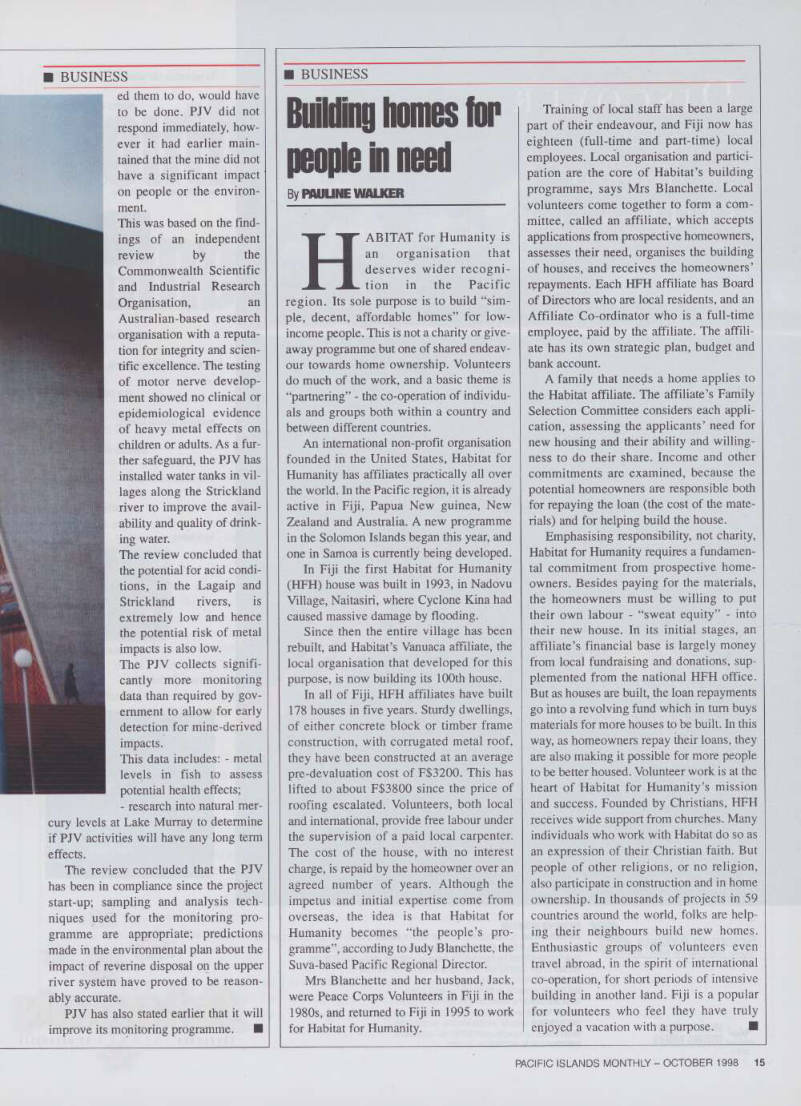
A local MP claimed in parliament that PJV was disposing an increased volume of mine tailings into the Porgera River.
ed them to do, would have to be done. PJV did not respond immediately, how ever it had earlier main tained that the mine did not have a significant impact on people or the environ ment.
This was based on the find
ings of an independent
review by the Commonwealth Scientific and Industrial Research
Organisation, an
Australian-based research organisation with a reputa tion for integrity and scien tific excellence. The testing of motor nerve develop ment showed no clinical or
epidemiological evidence
of heavy metal effects on children or adults. As a fur ther safeguard, the PJV has installed water tanks in vil lages along the Strickland river to improve the avail ability and quality of drink
ing water.
The review concluded that the potential for acid condi tions, in the Lagaip and Strickland rivers, is extremely low and hence the potential risk of metal impacts is also low.
The PJV collects signifi cantly more monitoring data than required by gov ernment to allow for early detection for mine-derived
impacts.
This data includes: - metal levels in fish to assess potential health effects; - research into natural mer
cury levels at Lake Murray to determine if PJV activities will have any long term effects.
The review concluded that the PJV has been in compliance since the project start-up; sampling and analysis tech niques used for the monitoring pro gramme are appropriate; predictions made in the environmental plan about the impact of reverine disposal on the upper river system have proved to be reason
ably accurate.
PJV has also stated earlier that it will improve its monitoring programme. ■
Advertisements & other items, p. 14 (1 item)
For Sale
ENGINE RECONDITIONING/DIESEL FUEL INJECTION WORKSHOP
Equipped with modern machinery the workshop currently services a large regional area. Engine reconditioning machinery includes an 84" crank grinder, Serdi head centre, power hone, cylinder boring machine, surface grinder, flywheel grinder, cylinder head pressure tester, large centre lathe, universal mill, 80T powered press and much more FUEL INJECTION: 12cyl test bench, nozzle grinder tooling for Bosch cav denso cat and much more COMPUTER; "Automate" system with full accounting capability. The vendor (with over 30 years industry experience) is prepared to relocate the workshop and offer ongoing training.
COST SAUD3IO,OO
Ph: (617) 4061 4489 Fax: (617) 4061 3190
Brilding homes for people
people in need
By Pauline Walker
HABITAT for Humanity is an organisation that deserves wider recogni tion in the Pacific region. Its sole purpose is to build “sim ple, decent, affordable homes” for low income people. This is not a charity or give away programme but one of shared endeav our towards home ownership. Volunteers do much of the work, and a basic theme is “partnering” - the co-operation of individu als and groups both within a country and between different countries.
An international non-profit organisation
founded in the United States, Habitat for Humanity has affiliates practically all over the world. In the Pacific region, it is already active in Fiji, Papua New guinea, New Zealand and Australia. A new programme in the Solomon Islands began this year, and one in Samoa is currently being developed.
In Fiji the first Habitat for Humanity (HFH) house was built in 1993, in Nadovu Village, Naitasiri, where Cyclone Kina had caused massive damage by flooding.
Since then the entire village has been rebuilt, and Habitat’s Vanuaca affiliate, the local organisation that developed for this purpose, is now building its 100th house.
In all of Fiji, HFH affiliates have built 178 houses in five years. Sturdy dwellings, of either concrete block or timber frame construction, with corrugated metal roof, they have been constructed at an average pre-devaluation cost of F 53200. This has lifted to about Fs3Boo since the price of roofing escalated. Volunteers, both local and international, provide free labour under the supervision of a paid local carpenter.
The cost of the house, with no interest charge, is repaid by the homeowner over an agreed number of years. Although the impetus and initial expertise come from overseas, the idea is that Habitat for Humanity becomes “the people’s pro gramme”, according to Judy Blanchette, the Suva-based Pacific Regional Director.
Mrs Blanchette and her husband, Jack, were Peace Corps Volunteers in Fiji in the 1980 s, and returned to Fiji in 1995 to work for Habitat for Humanity.
Training of local staff has been a large part of their endeavour, and Fiji now has eighteen (full-time and part-time) local
employees. Local organisation and partici
pation are the core of Habitat’s building programme, says Mrs Blanchette. Local volunteers come together to form a com mittee, called an affiliate, which accepts
applications from prospective homeowners,
assesses their need, organises the building of houses, and receives the homeowners’ repayments. Each HFH affiliate has Board of Directors who are local residents, and an Affiliate Co-ordinator who is a full-time employee, paid by the affiliate. The affili ate has its own strategic plan, budget and bank account.
A family that needs a home applies to the Habitat affiliate. The affiliate’s Family Selection Committee considers each appli cation, assessing the applicants’ need for new housing and their ability and willing ness to do their share. Income and other commitments are examined, because the potential homeowners are responsible both for repaying the loan (the cost of the mate rials) and for helping build the house.
Emphasising responsibility, not charity,
Habitat for Humanity requires a fundamen tal commitment from prospective home owners. Besides paying for the materials, the homeowners must be willing to put their own labour - “sweat equity” - into their new house. In its initial stages, an affiliate’s financial base is largely money from local fundraising and donations, sup plemented from the national HFH office.
But as houses are built, the loan repayments go into a revolving fund which in turn buys materials for more houses to be built. In this way, as homeowners repay their loans, they are also making it possible for more people to be better housed. Volunteer work is at the heart of Habitat for Humanity’s mission and success. Founded by Christians, HFH receives wide support from churches. Many individuals who work with Habitat do so as an expression of their Christian faith. But people of other religions, or no religion, also participate in construction and in home ownership. In thousands of projects in 59 countries around the world, folks are help ing their neighbours build new homes.
Enthusiastic groups of volunteers even travel abroad, in the spirit of international co-operation, for short periods of intensive building in another land. Fiji is a popular for volunteers who feel they have truly enjoyed a vacation with a purpose. ■
Advertisements & other items, pp. 15-16 (2 items)
15
PACIFIC ISLANDS MONTHLY - OCTOBER 1998
■ BUSINESS
■ BUSINESS
Solomon Airlines
9. » ‘ m
Solomon Islands National Airline w
SOLOMON ISLANDS
VISITORS BUREAU
FOR FURTHER INFORMATION
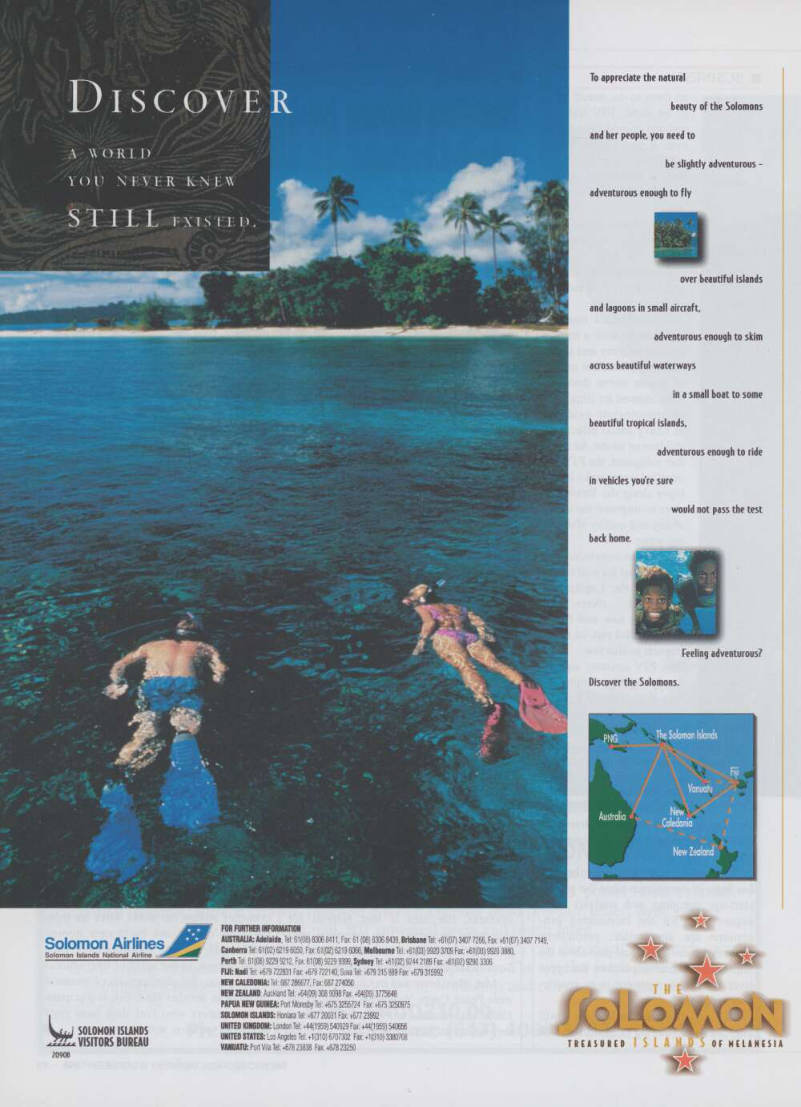
AUSTRALIA; Adelaide, Tel: 61(08) 8306 8411, Fax: 61 (08) 8306 8439, Brisbane Tel: +61(07) 3407 7266, Fax: +61(07) 3407 7149, Canberra Tel: 61(02) 6219 6050, Fax: 61(02) 6219 6066, Melbourne Tel: +61(03) 99203709 Fax: +61(03) 9920 3880, Perth Tel: 61(08) 9229 9212, Fax: 61(08) 9229 9399, Sydney Tel: +61(02) 9244 2189 Fax: +61(02) 9290 3306 FIJI: Nadi Tel: +679 722831 Fax: +679 722140, Suva Tel: +679 315 889 Fax: +679 315992 NEW CALEDONIA: Tel: 687 286677, Fax: 687 274050 NEW ZEALAND: Auckland Tel: +64(09) 308 9098 Fax: +64(09) 3775648 PAPUA NEW GUINEA: Port Moresby Tel: +675 3255724 Fax: +675 3250975 SOLOMON ISLANDS; Honiara Tel: +677 20031 Fax: +677 23992 UNITED KINGDOM; London Tel: +44(1959) 540929 Fax: +44(1959) 540656 UNITED STATES: Los Angeles Tel: +1(310) 6707302 Fax: +1(310) 3380708 VANUATU; Port Vila Tel: +678 23838 Fax: +678 23250 To appreciate the natural beauty of the Solomons and her people, you need to be slightly adventurous adventurous enough to fly over beautiful islands and lagoons in small aircraft. adventurous enough to skim across beautiful waterways in a small boat to some beautiful tropical islands, adventurous enough to ride in vehicles you’re sure would not pass the test back home.
Feeling adventurous?
Discover the Solomons. m
T H I
K
iS L A
D Of M
TREASURED
BL,.
ELAHESI A
conies together


Advertising Feature-Tourism
South Pacific travel conies together
IN the lead-up to the turn of the century, tourism looks set to be one of the biggest growth areas for the countries of the South Pacific.
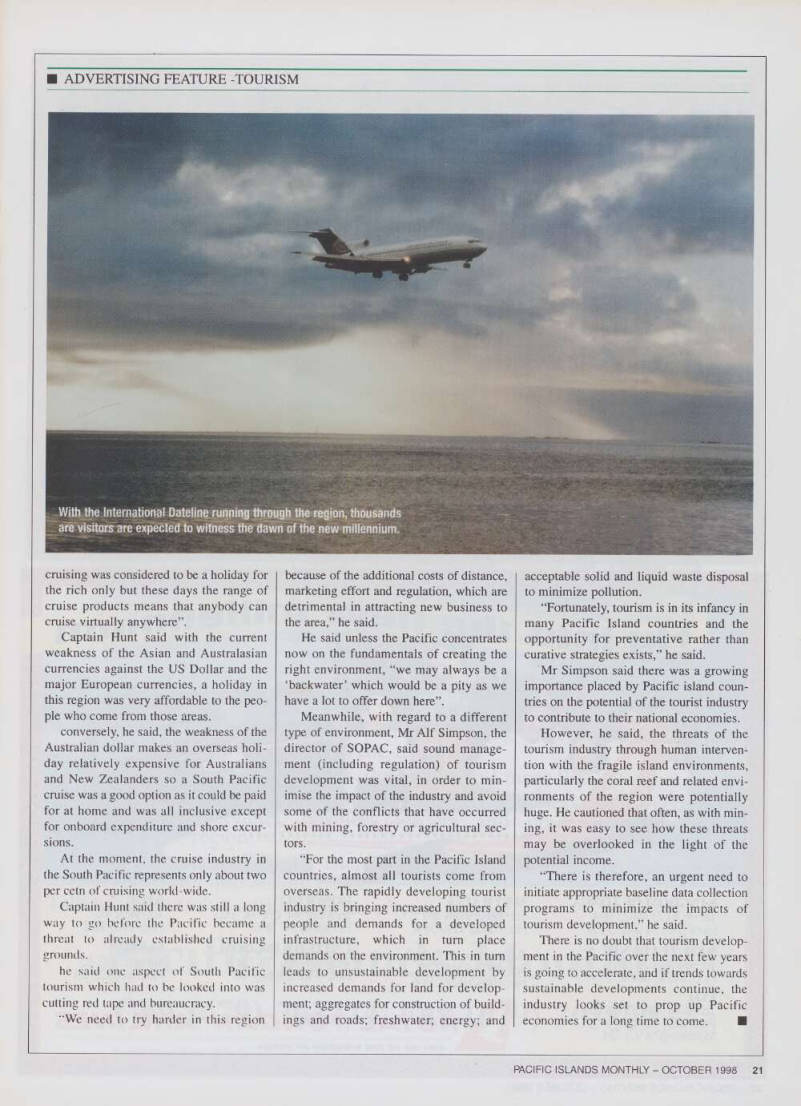
Because the International Dateline cuts through the middle of the Pacific Ocean, the first day of the new millennium will dawn and close in the areas around it.
In anticipation of this there is an increased interest by airline and tour oper ators in the region and this looks set to pro vide a huge boost for the ailing economies of the Pacific.
To help keep the interest up, 13 South Pacific travel destinations represented by the Tourism Council of the South Pacific (TCSP) are about to increase their Internet presence by signing of an agreement with
Australasia’s leading travel publishing
company, Jason Publishing Co Ltd (Jasons).
TCSP has agreed to amalgamate its existing web site SPICE with Jasons’
South Pacific Islands Travel Channel, launched late September.
South Pacific Islands Travel Channel is part of Jasons award-winning and highly acclaimed Travel Channels project on the internet’s world wide web. (Australia Travel Channel (www.au travel.com.au) and New Zealand Travel Channel (www.nz-travel.co.nz)are the other two parts of Jasons’ Travel Channels
project.)
New Zealand Travel Channel was launched in June 1996. Traffic for July 1998 for that site was 1,788,653 hits with 803,792 pageviews and 35768 user ses sions in excess of 2 minutes.
“This is a significant website traffic and is just an example of the great potential for enhancing our tourism marketing profile
through the relationship we now have with Jasons” said Mr. Levani Tuinabua, Chief Executive of TCSP.
The new channel will feature the offi cial web sites of all TCSP member coun tries, as well as industry web pages, Jasons managing director John Sandford said.
Future developments will also include
other travel-related publications.
The tourism destinations that currently make up TCSP country members are American Samoa, Cook Islands, Fiji, Kiribati, New Caledonia, Niue, Papua New Guinea, Samoa, Solomon Islands, Tahiti, Tonga, Tuvalu and Vanuatu.
“This is an exciting development for
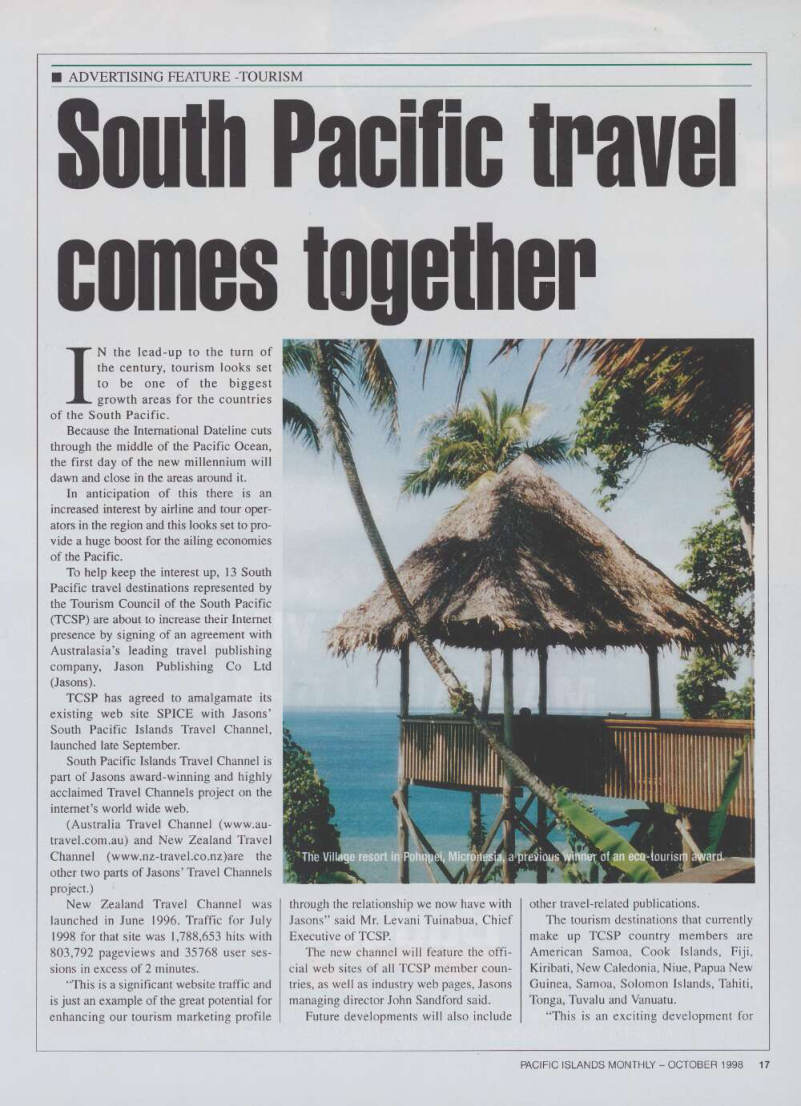
The Village resort in Pohnpei, Micronesia, a previous dinner of an eco-tourism ward.
TCSP,” said Mr. Tuinabua.
“The ability to be linked with Jasons will dramatically increase our presence on the Internet, as well as lift our overall stan dards of presentation”.
Jasons has been a specialist tourism and travel publisher for over 30 years and cur rently operates in New Zealand, Australia, New Caledonia, Niue and the Cook Islands.
Founded in the early 1980 s as an infor mal association of national tourism organisations in the region, the Tourism Council of the South Pacific (TCSP) is now a regional intergov ernmental organisation with a permanent Secretariat based in Suva, Fiji. Its funda mental objective is to foster regional co operation in the development of tourism in the island nations of the Pacific.
There were concerns about the future of TCSP projects but these were alleviated after the recent Post-Forum Dialogue Partners Session, when a significant amount of money was promised to the council.
In a significant move announced mid- September, an Australian airline wants to start a new service between Sydney and Nadi next month.
Ansett Australia expects to increase Australian visitors to Fiji by four per cent once it commences services in November -
subject to regulatory approval.
Ansett has formally applied to the International Air Services Commission in Australia for an allocation of capacity to operate two weekly services between the two cities - one a Boeing 767-200 on Saturdays and the other an Airbus 320 on Tuesdays.
The airline’s business development director Kit Naidu said Ansett firmly believed that the Pacific would be one of the most exciting growth areas of air travel in the new millennium.
Fiji’s minister for tourism Mr David Pickering says the announcement was the biggest boost to the tourism industry in 25 years.
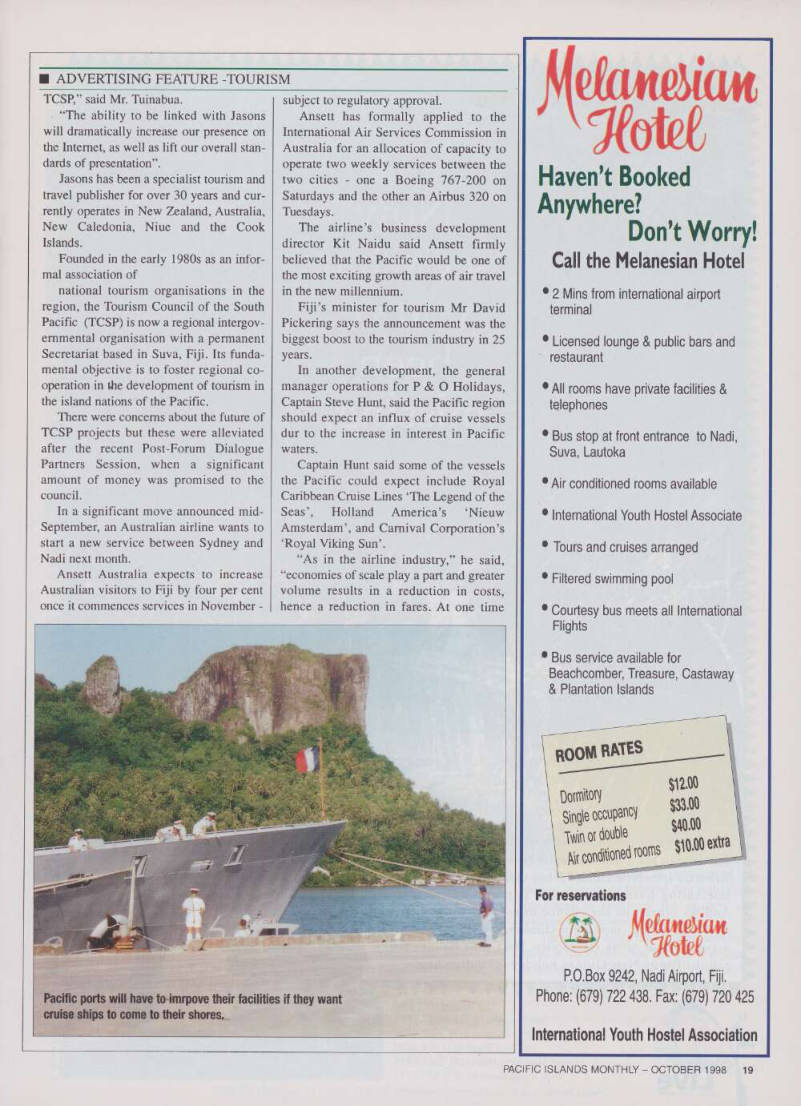
In another development, the general manager operations for P & O Holidays, Captain Steve Hunt, said the Pacific region should expect an influx of cruise vessels dur to the increase in interest in Pacific waters.
Captain Hunt said some of the vessels the Pacific could expect include Royal Caribbean Cruise Lines ‘The Legend of the Seas’, Holland America’s ‘Nieuw Amsterdam’, and Carnival Corporation’s ‘Royal Viking Sun’.
“As in the airline industry,” he said, “economies of scale play a part and greater volume results in a reduction in costs, hence a reduction in fares. At one time
Pacific ports will have to imrpove their facilities if they want cruise ships to come to their shores.
cruising was considered to be a holiday for the rich only but these days the range of cruise products means that anybody can cruise virtually anywhere”.
Captain Hunt said with the current weakness of the Asian and Australasian currencies against the US Dollar and the major European currencies, a holiday in this region was very affordable to the peo ple who come from those areas. conversely, he said, the weakness of the Australian dollar makes an overseas holi day relatively expensive for Australians and New Zealanders so a South Pacific cruise was a good option as it could be paid for at home and was all inclusive except for onboard expenditure and shore excur sions.
At the moment, the cruise industry in the South Pacific represents only about two per cetn of cruising world-wide.
Captain Hunt said there was still a long way to go before the Pacific became a threat to already established cruising grounds. he said one aspect of South Pacific tourism which had to be looked into was cutting red (ape and bureaucracy.
"We need to try harder in this region
because of the additional costs of distance, marketing effort and regulation, which are detrimental in attracting new business to the area,” he said.
He said unless the Pacific concentrates now on the fundamentals of creating the right environment, “we may always be a ‘backwater’ which would be a pity as we have a lot to offer down here”.
Meanwhile, with regard to a different type of environment, Mr Alf Simpson, the director of SOPAC, said sound manage ment (including regulation) of tourism development was vital, in order to min imise the impact of the industry and avoid some of the conflicts that have occurred with mining, forestry or agricultural sec tors.
“For the most part in the Pacific Island countries, almost all tourists come from overseas. The rapidly developing tourist industry is bringing increased numbers of people and demands for a developed infrastructure, which in turn place demands on the environment. This in turn leads to unsustainable development by increased demands for land for develop ment; aggregates for construction of build ings and roads; freshwater; energy; and
acceptable solid and liquid waste disposal to minimize pollution.
“Fortunately, tourism is in its infancy in many Pacific Island countries and the opportunity for preventative rather than curative strategies exists,” he said.
Mr Simpson said there was a growing importance placed by Pacific island coun tries on the potential of the tourist industry to contribute to their national economies.
However, he said, the threats of the tourism industry through human interven tion with the fragile island environments, particularly the coral reef and related envi ronments of the region were potentially huge. He cautioned that often, as with min ing, it was easy to see how these threats may be overlooked in the light of the
potential income.
“There is therefore, an urgent need to initiate appropriate baseline data collection programs to minimize the impacts of tourism development,” he said.
There is no doubt that tourism develop ment in the Pacific over the next few years is going to accelerate, and if trends towards sustainable developments continue, the industry looks set to prop up Pacific economies for a long time to come. ■
With the International Dateline running through the region, thousands are visitors are expected to witness the dawn of the new millennium.
Advertisements & other items, pp. 18-21 (3 items)
Budaet
bfPI 51 8c •v- -- •: ifc * / m m i& ... «» ...
K: It; %
KIAORA! BULAVINAKA!
MAEVA! ALOHA!
HOWEVER WE SAY IT,
IT MEANS WELCOME!
Budaet
Fiji 722 636 Papuo New Guinea 325 4111 Vanuatu 23170 New Caledonia 262 009 Hawaii 838 1111 Western Samoa 20561 Australia 1300 362 848 New Zealand 0800 652 227
Haven’t Booked
Anywhere?
Call the Melanesian Hotel
• 2 Mins from international airport terminal • Licensed lounge & public bars and restaurant • All rooms have private facilities & telephones • Bus stop at front entrance to Nadi, Suva, Lautoka • Air conditioned rooms available • International Youth Hostel Associate • Tours and cruises arranged • Filtered swimming pool • Courtesy bus meets all International Flights • Bus service available for Beachcomber, Treasure, Castaway & Plantation Islands P.0.80x 9242, Nadi Airport, Fiji.
Phone: (679) 722 438. Fax: (679) 720 425 Internationa! Youth Hostel Association
Don’t Worry!
ROOM BATES
For reservations
you ve
been
\ N>
ANA :
Lr ft. m 3 Kl If you’re bored taking the same old holidays, year in—year out, you need to live a little in Papua New Guinea. For most of our visitors, Papua New Guinea is one of the world’s last frontiers; a fascinating living culture that is thousands of years old.
And for others, its the chance to enjoy nature's gifts while trekking, diving, mountain climbing or simply absorb the majesty of our misty rainforests. Start your holiday today, call the Papua New Guinea holiday specialists now. r 'W'
ryjr
e w
see what
► ...',-V ■- < -4 V .
yV-vA ■ ■■! f
Nl-VA , A. ; ,c•>, >/_• & m ► ▼ ▼▼ Air Niugini 13 13 80 Sea New Guinea (02) 267 5563 Dive Adventure (02) 299 4633 or (03) 9866 5738 Pro Dive Travel (02) 264 9499 Allways Dive Expedition (03) 9885 8818 Dive Travel Australia (02) 970 6311 Papua New Guinea Tourism Promotion Authority. Tel: (675) 320 021 1 Fax: (675) 320 0223
19
PACIFIC ISLANDS MONTHLY - OCTOBER 1998
■ ADVERTISING FEATURE -TOURISM
21
PACIFIC ISLANDS MONTHLY - OCTOBER 1998
■ ADVERTISING FEATURE -TOURISM
What's happening this month?
American Samoa - Columbus day 12th - Moso’oi Tourism Festival 12-16th - Arts Fia Fia - Halloween (31 st) Cook Islands - Air New Zealand and Westpac Bank Round Rarotonga Road Race (4th) - Yachting: Sir Thomas David Shield (18th & 25th) - Yachting: Open Day Regatta (25 th) - Gospel Day and Nuku Celebrations (26th) FBi - Football: Rothmans Inter-District Cup (10th- 11th) - Fiji Day 12th - Suva-Levuka-Suva Yacht Race - Sigatoka Bilibili Race - Inter-District Hockey Tournament - Nadi Charity Horse Races
- National Tourism Forum - Deepawali (20th) New Caledonia - Cultural Day on Loyalty Islands - Tougues Regatta at Anse Vata Beach (11th) Niue - Avatele Village Show Day (11th) - World Food Day (MOUI OLA OLA) (16th) - Motalau Show Day (18th) - Constitution Day (19th) - Constitution Week Celebrations (20th 26th) - Niue Youth Council Tabloid Sports Gospel Singing Competition (20th-2'6th) -Peniamina Gospel Day (26th) Papua New Guinea - Morobe Cultural Show Sea Kayaking World Cup Championship (sth-14th)
Samoa - Water Week (sth-9th) - Lotu Atamaiti (11th- 12th) - Savaii Balolo Rise (22nd - 23rd) - Environment Week (26th-30th) - Flower Gala (29th) Tahiti - 2nd Paris-Papeete Festival - Ist Tahitian Opera - 2nd Small Hotels Fair - Annual Day of the Tree (sth) - 2nd Tahiti Carnival
Tonga
- Methodist Women’s Federation Annual Day (3rd-4th wk) Tuvalu - Tuvalu Day (lst-2nd) Vanuatu - Constitution Day (sth) Source: The South Pacific Calender of Events 1998, TCSP ■
Advertisements & other items, pp. 22-24 (2 items)
■ Advertising Feature -Tourism
nciAi millennium
If J ! ML2
the
Ely
into
ri^ m -r a
ROYAL TO/VGAN
*•••>«•• •iiaiiiini ■s»S ry F— dy
KINGDOM OF TONGA
Tel:+(676) 23 414/23 004 Fax:+(676) 24 056/23 559
NEW ZEALAND
Te1:+64(09) 624 1539 Fax:+64(o9) 624 1873
FIJI
Tel;+(679) 729 555/724 355 Fax:+(679) 724 810 Mobile:+(679) 921 724
AUSTRALIA
Tel:+61(02) 9244 2111 Fax:+6l(o2) 9290 3641 Reservation & Ticketing Tel:+61(02) 9244 2212 Fax:+6l(o2) 9290 3306
HONOLULU
a 941 1701/941 1323 D 947 3106
UNITED KINGDOM
Tel:+44(l 933) 778 730 Fax;+44(l 753) 663 559
ROYAL TON CAN AIRLINES
m. AIRLINE OF THE KINGDOM OF TONGA I I SS|>' SS||* I S3l»- Iv I 1 I I I I >3!' I ' *>in *>lll km i?Qiii wa mji xm s W>A
NIUE
Tel:+(6B3) 4317 Fax:+(6B3) 4322
SAMOA
Tel:+(6Bs) 22 321 Fax:+(6Bs) 23 851 -m.
Talk to the Pacific
with the voice of the Pacific
There is one magazine that decision-mailers in the Pacific
must read each month.
That magazine is the voice of the Pacific... v m I i H ■H m w m z &.:*m mm iii . t a Mi |■|m . ■ -V.-. i mKm Pacific Islands Monthly has been a cornerstone of communications in the region for 68 years.
It has built an unequalled reputation for providing the best available news analyses and insight on events in the region.
That reputation spans the islands, the region and more than 71 countries.
That reputation puts Pacific Islands Monthly on the desks of Government figures, public servants, business leaders and other decision-makers throughout the region.
That reputation gives Pacific Islands Monthly the things advertisers need most... credibility and selling power.
Talk to your market with the voice of your market.
Pacific Islands Monthly
Call (679) 303244 Fax (679) 303809
Pacific Islands Monthly is the only regional news magazine with an independently audited circulation. 125613V1
... m.
V
ANZ in the
Pacific Region.
To over 500,000 tourists each year, Fiji,Vanuatu,Tonga, Papua New Guinea, Samoa, the Solomon Islands and the Cook Islands represent idyllic, sun drenched holiday destinations. But for ANZ, the Pacific Islands represent much more. They are an important part of ANZ’s international network of branches and representative offices, serving the people of the Pacific Islands and providing a vital link to the rest of the world.
One of the world’s leading international banks, ANZ is proud to be the pre-eminent bank in the Pacific Islands, with over 50 points of representation and more than 1,600 staff located throughout the region.
Let ANZ show you a world
of possibilities.
orld of possibility.
Argentina, Australia, Bahrain, Bangladesh, Brazil, Chile, China, Cook Islands, Fiji, France, Germany, Greece, Guernsey, Hong Kong, India, Indonesia, Iran, Israel, Japan, Jersey, Jordan, Malaysia, Mexico, Nepal, New Zealand, Pakistan, Papua New Guinea, Philippines, Qatar, Samoa, Singapore, Solomon Islands, South Korea, Sri Lanka, Switzerland,Taiwan,Thailand,Tonga, United Arab Emirates, United Kingdom, United States of America, Vanuatu, Vietnam
presence in the Pacific
ANZ - a comprehensive presence in the Pacific
ANZ is one of a handful of Australian banks with a clearly defined strate gy involving a compre hensive presence in the Pacific Islands. This is underpinned by our branch network in the Pacific region and the other countries in which we operate.
ANZ’s presence at both ends of a trans
action means ANZ can deliver banking ser vices throughout the Pacific and the world that reflect our high service standards many other banks are forced to rely on the customer service standards of a bank owned and managed by others.
We have a mature retail commercial business in the Pacific where we have been represented for nearly 120 years. At an
operational level, our objective in the Pacific is to consolidate our day to day operations in order to provide a comprehensive range of personal and commercial banking services, including personal and business loan and deposit facilities, ANZ Insurance, including loan insurance, house and contents insurance, travel and motor vehicle insurance, international trade finance, treasury services and international payment transfers.
The provision of commercial bank ing services, particularly to cus tomers doing business with Australian and new Zealand com panies, mirrors ANZ’s strategy in Asia and throughout our global network. From a retail bank per spective, ANZ’s position in the Pacific Island Countries in which we have established a presence, is similar to our position in Australia and New Zealand. Our competitive advantage derives from our long association with the region and our ability to offer superior products and service levels by utilising the latest banking technology and ANZ’s advanced product delivery
capabilities.
With an expanding Automatic Teller Machine (ATM) network and PC banking facilities, ANZ is fast becoming a modem bank in the
Pacific. We are leveraging off our exper tise in Australia and New Zealand to create a bank that is efficient and competitive with the best in the world. With our exten sive knowledge of local conditions and wealth of banking and financial expertise, ANZ is well placed to assist those compa nies and individuals wanting to do business in the Pacific region. ■
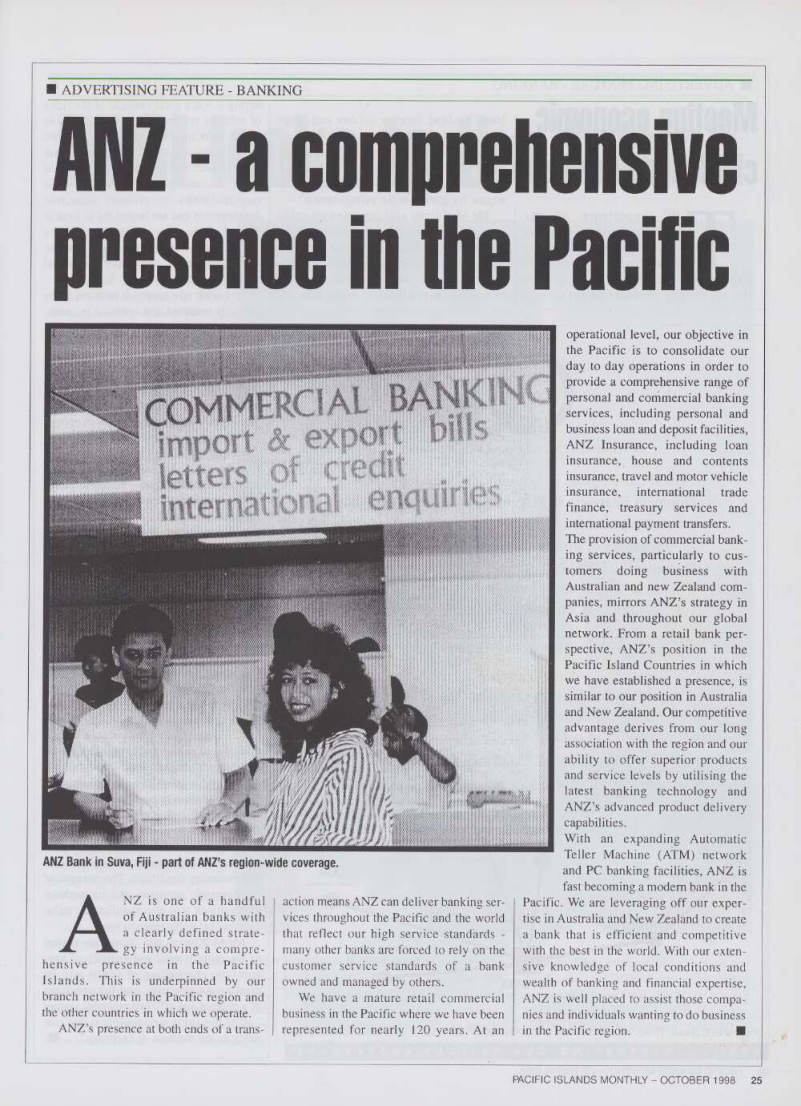
ANZ Bank in Suva, Fiji - part of ANZ’s region-wide coverage.
Advertisements & other items, p. 25 (1 item)
Pacific Islands Monthly - October 1998
■ ADVERTISING FEATURE - BANKING
Meeting economic
challenges head-on
THE importance of the banking sector overall to enhance private sector development was critical if Pacific Island countries were to meet the challenges confronting them, said
New Zealand foreign affairs and trade minister Mr Don McKinnon.
He made the comments, at the recent Forum Leaders’ Meeting in Pohnpei, Micronesia, in a paper titled “Banks as the engine for growth in the private sector”.
Mr McKinnon said governments could promote efficiencies within their banking sectors through deregulation and increased liberalisation. He praised an announcement by the Samoan Government earlier this year to remove interest rate and credit controls,
saying it was a good example of the types of reforms required if the region was to make banking more efficient. “While banks in the region will continue to look at their bottom line, they are, it would seem, becoming more aware of their responsibilities to promote economic development and are beginning to look at ways they can achieve this,” he said. The private sector, the minister said, was the key to prosperity, and banks a potential engine for growth.
“As with any engine it requires to be correctly tendered and operated in condi tions aimed at maximum efficiency. The people whose responsibility it is to keep the engine running smoothly - that is peo ple in government - need to have the right skills and knowledge to make those con ditions as attractive as possible. In other words if we are going to make our banks work for us we need to get the fundamen tals right,” Mr McKinnon told Pacific Island leaders. He said the Asian crisis demonstrated that badly managed banks could contribute more to recession than to growth. But, he said, the economies that would ride out the storm best were those that already had strong, transparent finan cial systems in place. Mr McKinnon said there needed to be “an open and trusting dialogue between the financial sector and government. This is clearly important for our domestic business sector as well as potential foreign investors which we all depend on”. He said the complexity of managing 21st Century banking practices with “traditional” subsistence based com munities, often remotely located, could not be ignored.
Governments and the public alike, he said, placed unreasonable expectations on development banks, which have “all too often been used to lend to government determined priority areas”. He said reduc ing the high risk nature of banking in Pacific Island countries was, “to a certain extent, dependent on the ability of gov ernments to foster sound fiscal policies and monetary conditions. The strength of the domestic economy and its medium term outlook will also significantly influ ence banks’ willingness to lend”.
Mr McKinnon said “banks are critical to the mobilisation and custody of sav ings, the channelling of credit into its most productive uses, and the operation of a prompt and efficient payment system - all of this using a reasonably stable cur rency as the medium of exchange”. ■
Advertisements & other items, p. 26 (2 items)
26
PACIFIC ISLANDS MONTHLY - OCTOBER 1998
■ ADVERTISING FEATURE - BANKING
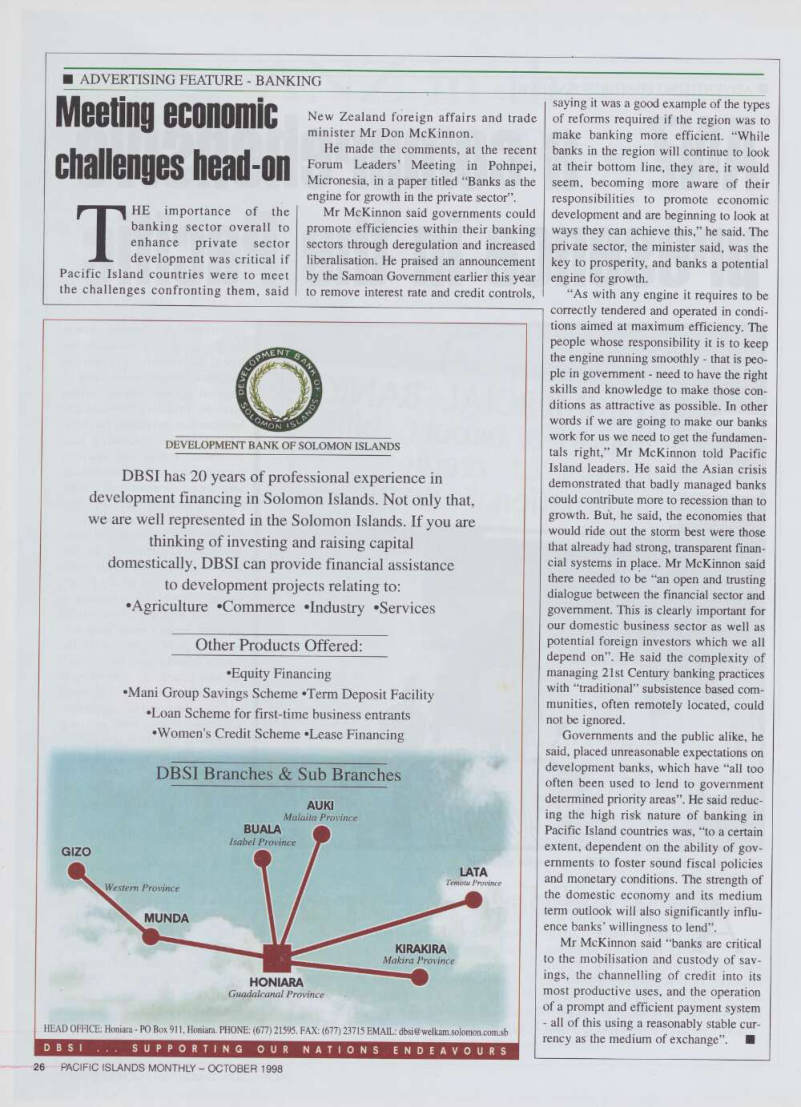
thinking of investing and raising capital
DEVELOPMENT BANK OF SOLOMON ISLANDS
DBSI has 20 years of professional experience in development financing in Solomon Islands. Not only that, we are well represented in the Solomon Islands. If you are
domestically, DBSI can provide financial assistance
to development projects relating to:
•Agriculture •Commerce -Industry 'Services
GIZO
Other Products Offered:
•Equity Financing
•Mani Group Savings Scheme •Term Deposit Facility •Loan Scheme for first-time business entrants •Women's Credit Scheme ‘Lease Financing
DBSI Branches & Sub Branches
AUKI
Malaita Province
BUALA
Isabel Province
LATA
Temotu Province Western Province
MUNDA
KIRAKIRA
Makira Province
HONIARA
Guadalcanal Province HEAD OFFICE: Honiara - PO Box 911, Honiara. PHONE: (677) 21595. FAX: (677) 23715 EMAIL: [email protected]
SUPPORTING
NATIONS ENDEAVOURS
DBSI looks to the future
EVEN though the
Development
Bank of the Solomon Islands (DBSI) will celebrate 21 years of banking in January 1999, it has already come of age.
DBSI has gone through an amazing evolution from its incep tion in 1977 as an agricultural loans board to a leading partner in development banking. It is a repu tation the Bank is rapidly coming to enjoy. The bank’s mission is to improve the quality of life for Solomon Islanders and to assist in the economic development of Solomon Islands.
“As we approach the end of this millennium and the dawn of another, we will be mindful of the bad times we came through, how ever working with the Solomon Islands Government to realise the aspirations and the many different needs of our clients,” said Bank chairman John Michael Asipara.
“Our hope, to be able to help every Solomon Islander to achieve his or her “dream project”, will remain in sight thus steering the Bank towards a genuine, reliable and co-operative banking effort”.
The Bank was established under the provisions of Development Bank of Solomon Islands Act 1977, and became offi cially operational in January 1978.
By the end of 1996, the Bank had gone through 19 years of
development financing, providing
during that time financial support to 9,236 Solomon Islanders valued at $82.65 million.
Although it is not possible to determine the multiplier effect of
this intervention on the local economy, just considering the amount of money dis bursed so far, there is no doubt that by local standards the Bank’s intervention in the economy has been considerable. The urge to become easily accessible encouraged the
establishment of branches and sub-branch es in the provinces and at the end of 1996 there were four branches and four sub branches. Further development of this net work will be encouraged with the opening of one or two more offices and promotion
of at least two sub-branches to branch sta tus by the year 2000. From a simple but purposeful beginning, DBSI is making headway to realising its vision of becom ing the leading development financier in the Solomon Islands. ■
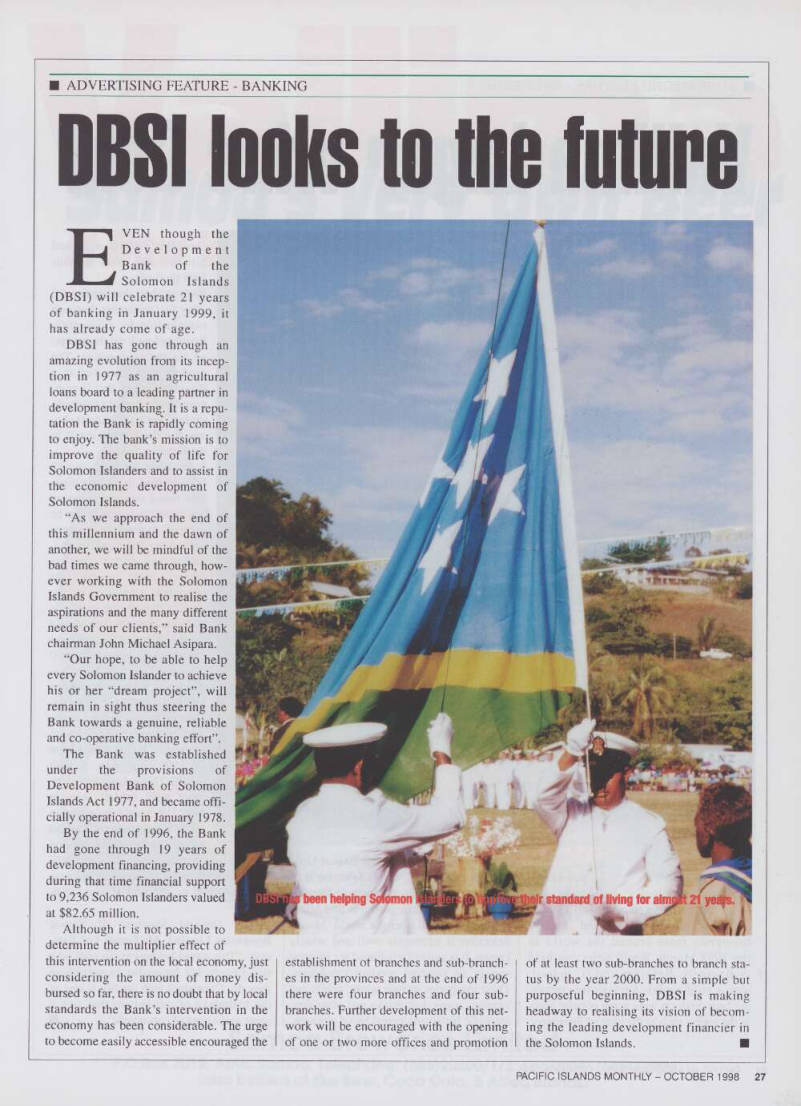
DBSI has been heiping Solomon Islanders to improve their standard of almost 21 years.
Advertisements & other items, p. 27 (1 item)
■ Advertising Feature - Banking
Vailima Lager wins Gold
SAMOA Breweries
Limited’s Vailima Lager competed against 133 beer products entered by 57 breweries from around the world in the 1998 Monde World Selection held in Brussels, Belgium and it, indeed, won a gold medal. Amongst the compet ing beer products were some popular beers in the region such as the likes of Steinlager,
San Miquel, Lion Red, DB Export Gold and DB Export Dry. Monde Selection is an independent international institute founded in 1961. Its concern is to test and select products from all over the world. Monde Selection is extremely well and widely known. It is particularly famed for its great variety of selected product categories.
These categories include wines, spirits and liqueurs, water, soft drinks and other non alcoholic beverages, cereal based products,
chocolate, confectionery and biscuits and other various food products.
Each product that applies for
entry first undergoes thorough
examination by a Scientific Board before it can be accept ed for the competition. The product then goes before a Board of judges that is com posed of university teachers, professionals and experts cho sen for their proficiency in their chosen fields.
In any case, the products will be subjected to an investiga tion based on very stringent requirements before it can be accepted to enter the competi
tion. After thorough testing,
tasting and analysis by the jurors, each product is rewarded according to the world’s demanding standards and requirements. The Monde World Selection is an annual event that 50 to more than 60 different countries look for ward to. Samoa Breweries Limited, however, partici pates every two to three years.
Vailima Lager is no stranger to awards. It first participated in 1990 and won a gold medal. This was followed by more gold medals won in 1992, 1995 and now, again, in 1998. The awards put Vailima Lager in a distinctive position
where it has overtaken most of its competi tors thus reaffirming to local and overseas consumers that its quality is of world stan dards!
The General Manager of Samoa Breweries Limited, Mr Fomai Lei Sam, says, “This award belongs to our staff who strive every day for quality in everything they do. Consistent high quality is one of the hallmarks of our system that sets it apart in the eyes of consumers”. ■
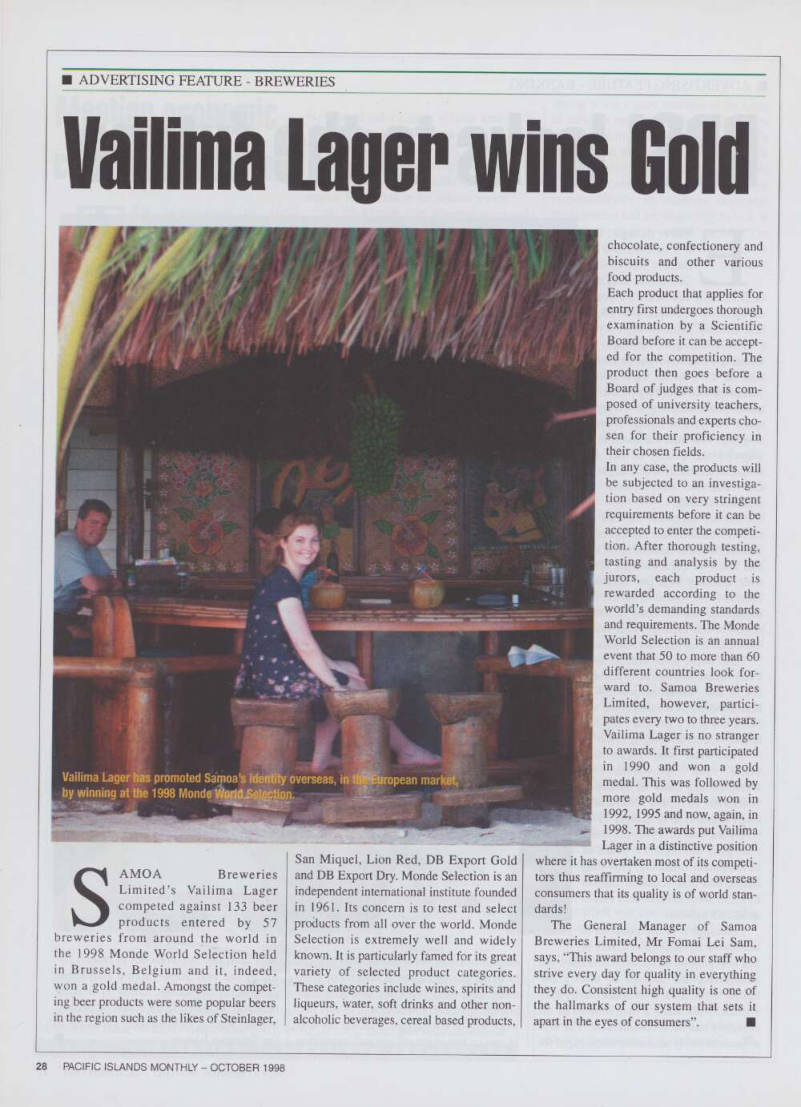
Vailima Lager has promoted Samoa’s Identity overseas, in European market, by winning at the 1998 Monde World Selection.
Advertisements & other items, pp. 28-30 (2 items)
28
PACIFIC ISLANDS MONTHLY - OCTOBER 1998
■ ADVERTISING FEATURE - BREWERIES
is Now Very intern
rrj
r i •• m
Samoa Breweries Limited
P.0.80x 3015, Apia, Samoa. Telephone: (685)20200/1/2. Facsmile: (685)22929 (also bottlers of Eku Beer, Coca Cola, & Allied Brands)
The First Beer in the World G
OKVL
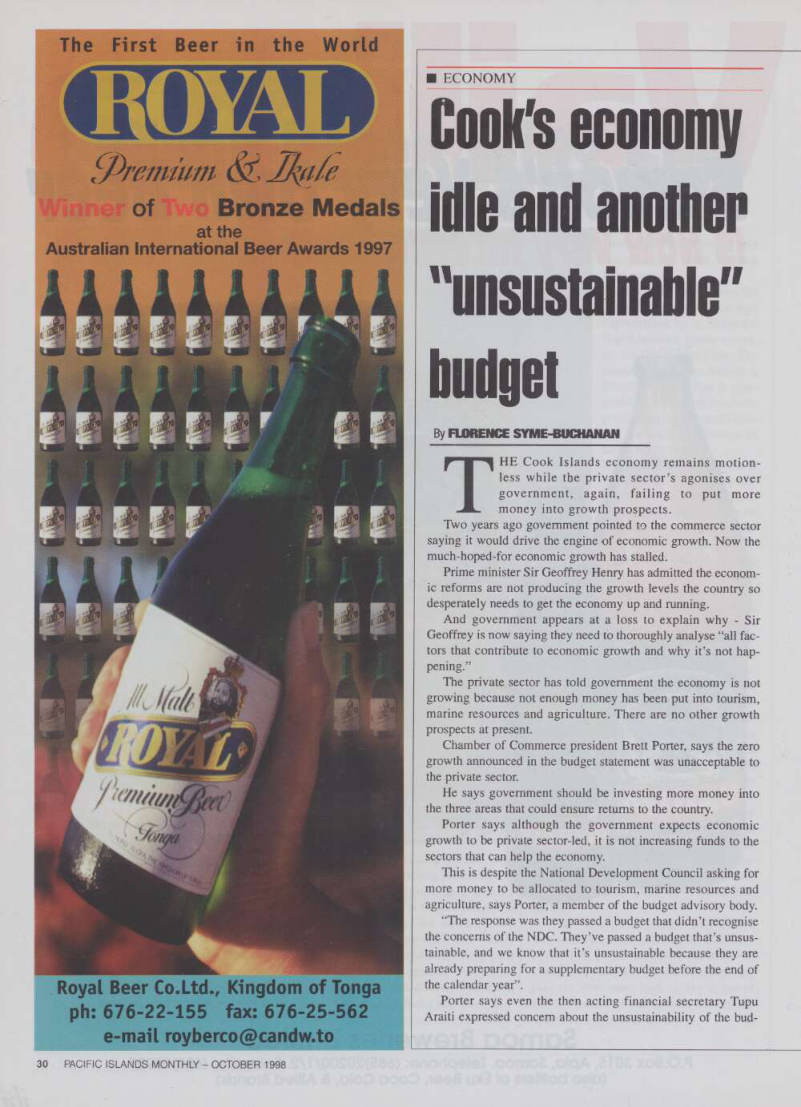
Of Bronze Medals at the Australian International Beer Awards 1997 ' Hl I
y#w/M s
Royal Beer Co. Ltd., Kingdom of Tonga ph: 676-22-155 fax: 676-25-562 e-mail [email protected]
Cook's economy
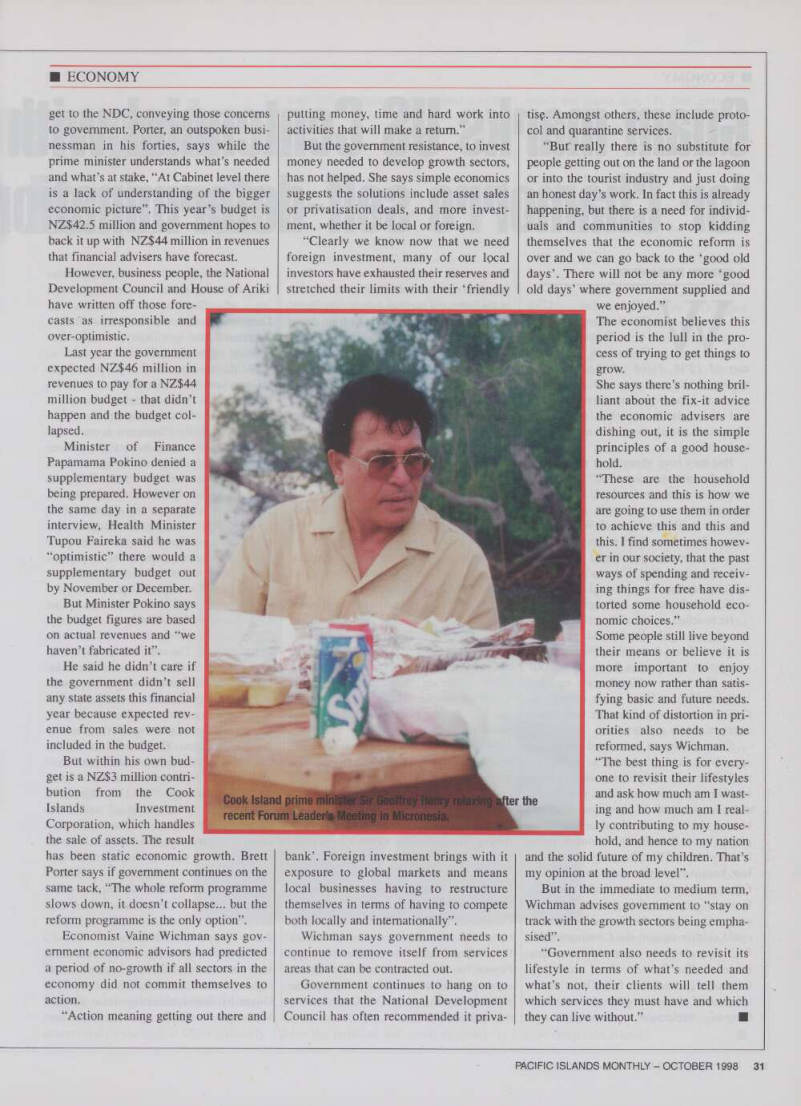
Economy
Cook's economy idle and another "unsustainable" budget
By Florence Syme-Buchanan
THE Cook Islands economy remains motion less while the private sector’s agonises over government, again, failing to put more money into growth prospects.
Two years ago government pointed to the commerce sector saying it would drive the engine of economic growth. Now the much-hoped-for economic growth has stalled.
Prime minister Sir Geoffrey Henry has admitted the econom ic reforms are not producing the growth levels the country so desperately needs to get the economy up and running.
And government appears at a loss to explain why - Sir Geoffrey is now saying they need to thoroughly analyse “all fac tors that contribute to economic growth and why it’s not hap pening.”
The private sector has told government the economy is not growing because not enough money has been put into tourism, marine resources and agriculture. There are no other growth prospects at present.
Chamber of Commerce president Brett Porter, says the zero growth announced in the budget statement was unacceptable to the private sector.
He says government should be investing more money into the three areas that could ensure returns to the country.
Porter says although the government expects economic growth to be private sector-led, it is not increasing funds to the sectors that can help the economy.
This is despite the National Development Council asking for more money to be allocated to tourism, marine resources and agriculture, says Porter, a member of the budget advisory body.
“The response was they passed a budget that didn’t recognise the concerns of the NDC. They’ve passed a budget that’s unsus tainable, and we know that it’s unsustainable because they are already preparing for a supplementary budget before the end of the calendar year”.
Porter says even the then acting financial secretary Tupu Araiti expressed concern about the unsustainability of the bud
get to the NDC, conveying those concerns to government. Porter, an outspoken busi nessman in his forties, says while the prime minister understands what’s needed and what’s at stake, “At Cabinet level there is a lack of understanding of the bigger
economic picture”. This year’s budget is
NZ542.5 million and government hopes to back it up with NZ$44 million in revenues that financial advisers have forecast.
However, business people, the National Development Council and House of Ariki
have written off those fore casts as irresponsible and
over-optimistic.
Last year the government expected NZ$46 million in revenues to pay for a NZ$44 million budget - that didn’t happen and the budget col lapsed.
Minister of Finance Papamama Pokino denied a supplementary budget was being prepared. However on the same day in a separate interview, Health Minister Tupou Faireka said he was “optimistic” there would a supplementary budget out by November or December.
But Minister Pokino says the budget figures are based on actual revenues and “we haven’t fabricated it”.
He said he didn’t care if the government didn’t sell any state assets this financial year because expected rev enue from sales were not included in the budget.
But within his own bud get is a NZ$3 million contri bution from the Cook Islands Investment Corporation, which handles the sale of assets. The result
has been static economic growth. Brett Porter says if government continues on the same tack, “The whole reform programme slows down, it doesn’t collapse... but the reform programme is the only option”.
Economist Vaine Wichman says gov ernment economic advisors had predicted a period of no-growth if all sectors in the economy did not commit themselves to action.
“Action meaning getting out there and
putting money, time and hard work into activities that will make a return.”
But the government resistance, to invest money needed to develop growth sectors, has not helped. She says simple economics suggests the solutions include asset sales or privatisation deals, and more invest ment, whether it be local or foreign.
“Clearly we know now that we need foreign investment, many of our local investors have exhausted their reserves and stretched their limits with their ‘friendly
bank’. Foreign investment brings with it exposure to global markets and means local businesses having to restructure themselves in terms of having to compete
both locally and internationally”.
Wichman says government needs to continue to remove itself from services areas that can be contracted out.
Government continues to hang on to services that the National Development Council has often recommended it priva
tisp. Amongst others, these include proto col and quarantine services.
“But really there is no substitute for people getting out on the land or the lagoon or into the tourist industry and just doing an honest day’s work. In fact this is already happening, but there is a need for individ uals and communities to stop kidding themselves that the economic reform is over and we can go back to the ‘good old days’. There will not be any more ‘good old days’ where government supplied and
we enjoyed.”
The economist believes this period is the lull in the pro cess of trying to get things to grow.
She says there’s nothing bril liant about the fix-it advice the economic advisers are dishing out, it is the simple principles of a good house hold.
“These are the household resources and this is how we are going to use them in order to achieve this and this and this. I find sometimes howev er in our society, that the past ways of spending and receiv ing things for free have dis torted some household eco nomic choices.”
Some people still live beyond their means or believe it is more important to enjoy money now rather than satis fying basic and future needs.
That kind of distortion in pri orities also needs to be reformed, says Wichman.
“The best thing is for every one to revisit their lifestyles and ask how much am I wast ing and how much am I real ly contributing to my house hold, and hence to my nation
and the solid future of my children. That’s my opinion at the broad level”.
But in the immediate to medium term, Wichman advises government to “stay on track with the growth sectors being empha sised”.
“Government also needs to revisit its lifestyle in terms of what’s needed and what’s not, their clients will tell them which services they must have and which they can live without.” ■
Cook Island prime minister Sir Geoffrey Henry relaxing after the recent Forum Leader's Meeting in Micronesia.
for Chamorro self-determination, home rule
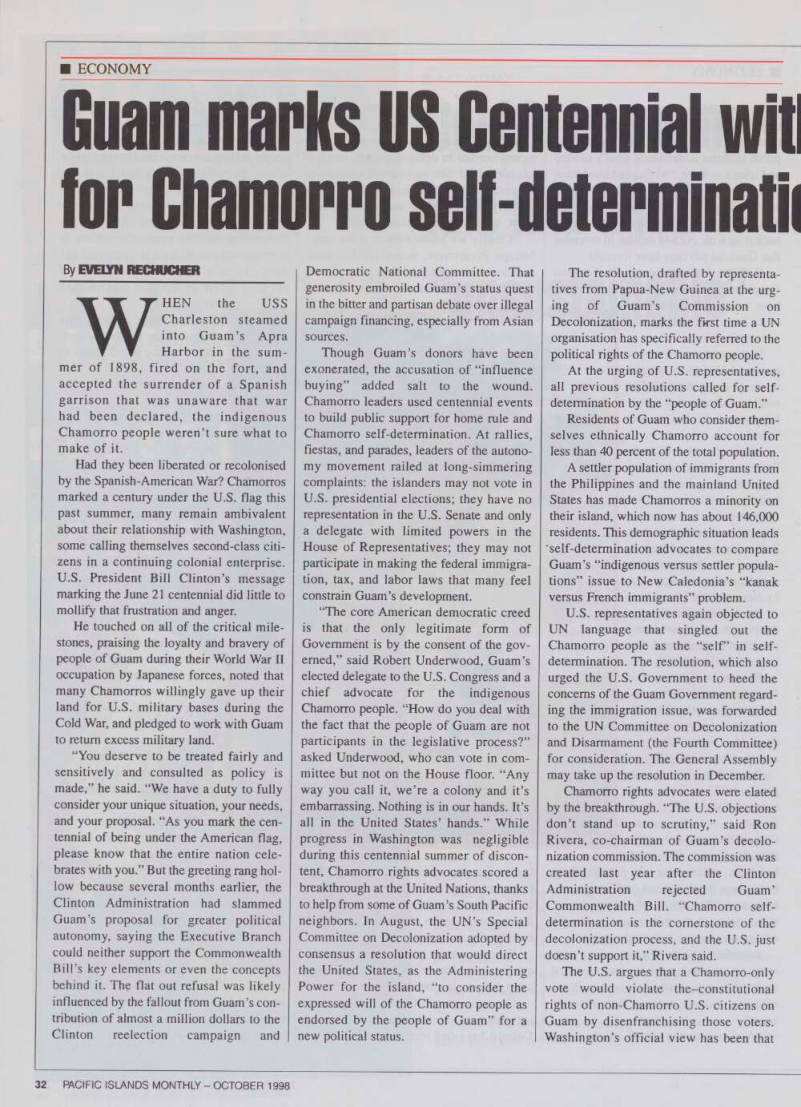
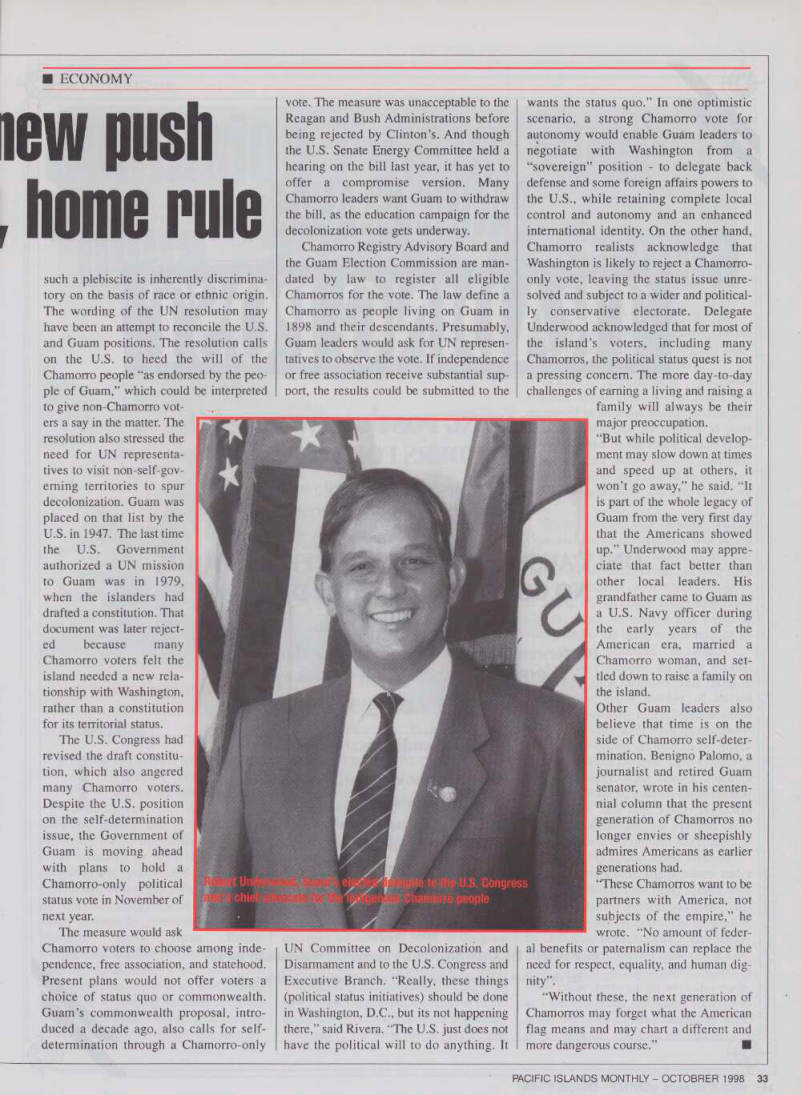
Guam marks US Centennial with new push for Chamorro self-determination, home rule
By Evelyn Rechucher
When The Uss
Charleston steamed into Guam’s Apra Harbor in the sum mer of 1898, fired on the fort, and accepted the surrender of a Spanish garrison that was unaware that war had been declared, the indigenous Chamorro people weren’t sure what to make of it.
Had they been liberated or recolonised by the Spanish-American War? Chamorros marked a century under the U.S. flag this past summer, many remain ambivalent about their relationship with Washington, some calling themselves second-class citi zens in a continuing colonial enterprise.
U.S. President Bill Clinton’s message marking the June 21 centennial did little to mollify that frustration and anger.
He touched on all of the critical mile stones, praising the loyalty and bravery of people of Guam during their World War II occupation by Japanese forces, noted that many Chamorros willingly gave up their land for U.S. military bases during the Cold War, and pledged to work with Guam to return excess military land.
“You deserve to be treated fairly and sensitively and consulted as policy is made,” he said. “We have a duty to fully consider your unique situation, your needs, and your proposal. “As you mark the cen tennial of being under the American flag, please know that the entire nation cele brates with you.” But the greeting rang hol low because several months earlier, the Clinton Administration had slammed Guam’s proposal for greater political autonomy, saying the Executive Branch could neither support the Commonwealth Bill’s key elements or even the concepts behind it. The flat out refusal was likely influenced by the fallout from Guam’s con tribution of almost a million dollars to the Clinton reelection campaign and
Democratic National Committee. That generosity embroiled Guam’s status quest in the bitter and partisan debate over illegal campaign financing, especially from Asian sources.
Though Guam’s donors have been exonerated, the accusation of “influence buying” added salt to the wound.
Chamorro leaders used centennial events to build public support for home rule and Chamorro self-determination. At rallies, fiestas, and parades, leaders of the autono my movement railed at long-simmering complaints: the islanders may not vote in U.S. presidential elections; they have no representation in the U.S. Senate and only a delegate with limited powers in the House of Representatives; they may not participate in making the federal immigra tion, tax, and labor laws that many feel constrain Guam’s development.
“The core American democratic creed is that the only legitimate form of Government is by the consent of the gov erned,” said Robert Underwood, Guam’s elected delegate to the U.S. Congress and a chief advocate for the indigenous Chamorro people. “How do you deal with the fact that the people of Guam are not participants in the legislative process?” asked Underwood, who can vote in com mittee but not on the House floor. “Any way you call it, we’re a colony and it’s embarrassing. Nothing is in our hands. It’s all in the United States’ hands.” While progress in Washington was negligible during this centennial summer of discon tent, Chamorro rights advocates scored a breakthrough at the United Nations, thanks to help from some of Guam’s South Pacific neighbors. In August, the UN’s Special Committee on Decolonization adopted by consensus a resolution that would direct the United States, as the Administering Power for the island, “to consider the expressed will of the Chamorro people as endorsed by the people of Guam” for a new political status.
The resolution, drafted by representa tives from Papua-New Guinea at the urg ing of Guam’s Commission on Decolonization, marks the first time a UN organisation has specifically referred to the political rights of the Chamorro people.
At the urging of U.S. representatives, all previous resolutions called for self determination by the “people of Guam.”
Residents of Guam who consider them selves ethnically Chamorro account for less than 40 percent of the total population.
A settler population of immigrants from the Philippines and the mainland United States has made Chamorros a minority on their island, which now has about 146,000 residents. This demographic situation leads 'self-determination advocates to compare Guam’s “indigenous versus settler popula tions” issue to New Caledonia’s “kanak versus French immigrants” problem.
U.S. representatives again objected to UN language that singled out the Chamorro people as the “self’ in self determination. The resolution, which also urged the U.S. Government to heed the concerns of the Guam Government regard ing the immigration issue, was forwarded to the UN Committee on Decolonization and Disarmament (the Fourth Committee) for consideration. The General Assembly may take up the resolution in December.
Chamorro rights advocates were elated by the breakthrough. “The U.S. objections don’t stand up to scrutiny,” said Ron Rivera, co-chairman of Guam’s decolo nization commission. The commission was created last year after the Clinton Administration rejected Guam’
Commonwealth Bill. “Chamorro self determination is the cornerstone of the decolonization process, and the U.S. just doesn’t support it,” Rivera said.
The U.S. argues that a Chamorro-only vote would violate the-constitutional rights of non-Chamorro U.S. citizens on Guam by disenfranchising those voters.
Washington’s official view has been that
such a plebiscite is inherently discrimina tory on the basis of race or ethnic origin.
The wording of the UN resolution may have been an attempt to reconcile the U.S. and Guam positions. The resolution calls on the U.S. to heed the will of the Chamorro people “as endorsed by the peo ple of Guam,” which could be interpreted
to give non-Chamorro vot ers a say in the matter. The resolution also stressed the need for UN representa tives to visit non-self-gov erning territories to spur decolonization. Guam was placed on that list by the U.S. in 1947. The last time the U.S. Government authorized a UN mission to Guam was in 1979, when the islanders had drafted a constitution. That document was later reject ed because many Chamorro voters felt the island needed a new rela tionship with Washington, rather than a constitution for its territorial status.
The U.S. Congress had revised the draft constitu tion, which also angered many Chamorro voters.
Despite the U.S. position
on the self-determination issue, the Government of Guam is moving ahead with plans to hold a
Chamorro-only political
status vote in November of next year.
The measure would ask
Chamorro voters to choose among inde pendence, free association, and statehood.
Present plans would not offer voters a choice of status quo or commonwealth.
Guam’s commonwealth proposal, intro duced a decade ago, also calls for self determination through a Chamorro-only
vote. The measure was unacceptable to the Reagan and Bush Administrations before being rejected by Clinton’s. And though the U.S. Senate Energy Committee held a hearing on the bill last year, it has yet to offer a compromise version. Many Chamorro leaders want Guam to withdraw the bill, as the education campaign for the decolonization vote gets underway.
Chamorro Registry Advisory Board and the Guam Election Commission are man dated by law to register all eligible Chamorros for the vote. The law define a Chamorro as people living on Guam in 1898 and their descendants. Presumably, Guam leaders would ask for UN represen tatives to observe the vote. If independence or free association receive substantial sup port, the results could be submitted to the
UN Committee on Decolonization and Disarmament and to the U.S. Congress and Executive Branch. “Really, these things (political status initiatives) should be done in Washington, D.C., but its not happening there,” said Rivera. “The U.S. just does not have the political will to do anything. It
wants the status quo.” In one optimistic scenario, a strong Chamorro vote for autonomy would enable Guam leaders to negotiate with Washington from a
“sovereign” position - to delegate back
defense and some foreign affairs powers to the U.S., while retaining complete local control and autonomy and an enhanced international identity. On the other hand, Chamorro realists acknowledge that Washington is likely to reject a Chamorro only vote, leaving the status issue unre solved and subject to a wider and political
ly conservative electorate. Delegate
Underwood acknowledged that for most of the island’s voters, including many Chamorros, the political status quest is not a pressing concern. The more day-to-day challenges of earning a living and raising a
family will always be their
major preoccupation.
“But while political develop ment may slow down at times and speed up at others, it won’t go away,” he said. “It is part of the whole legacy of Guam from the very first day that the Americans showed up.” Underwood may appre ciate that fact better than other local leaders. His grandfather came to Guam as a U.S. Navy officer during the early years of the American era, married a Chamorro woman, and set tled down to raise a family on the island.
Other Guam leaders also believe that time is on the side of Chamorro self-deter mination. Benigno Palomo, a journalist and retired Guam senator, wrote in his centen nial column that the present generation of Chamorros no longer envies or sheepishly admires Americans as earlier
generations had.
“These Chamorros want to be partners with America, not subjects of the empire,” he wrote. “No amount of feder
al benefits or paternalism can replace the need for respect, equality, and human dig
nity”.
“Without these, the next generation of Chamorros may forget what the American flag means and may chart a different and more dangerous course.” ■
Robert Underwood, Guam's elecled delegate to the U.S. Congress and a chief advocate for the indigenous Chamono people
Advertisements & other items, pp. 33-34 (2 items)
KW push
PACIFIC ISLANDS MONTHLY - OCTOBRER 1998
■ ECONOMY
KW push , hone rah
Trading Post
pkik bunds
1 |||M
TRADING POST CAN WORK
WONDERS FOR YOU...
Promote your business, or service, sell your household items, cars or heavy machinery etc.
ONLY AUSS2 (OR EQUIVALENT) PER WORD.
NO COMPANY LOGO. NO DISPLAY.
NO BOLD TYPE.
Just forward your Advertisement together with payment to:
PACIFIC ISLANDS MONTHLY "Trading Post",
PO Box 1167, Suva, Fiji.
Conditions: 1. All Advertisements are subject to acceptance and approval of publisher. 2. Advertisements are published as space permits; we cannot guarantee date of insertion. 3. All advertisements must be prepaid and should be typed or printed clearly 4. Deadline for receipt of advertisements is the 15th of the month prior to issue. 5. PACIFIC ISLANDS MONTHLY assumes no responsibility for any service other than publishing paid advertisements in this section.
"ninja" attacks in Samoa
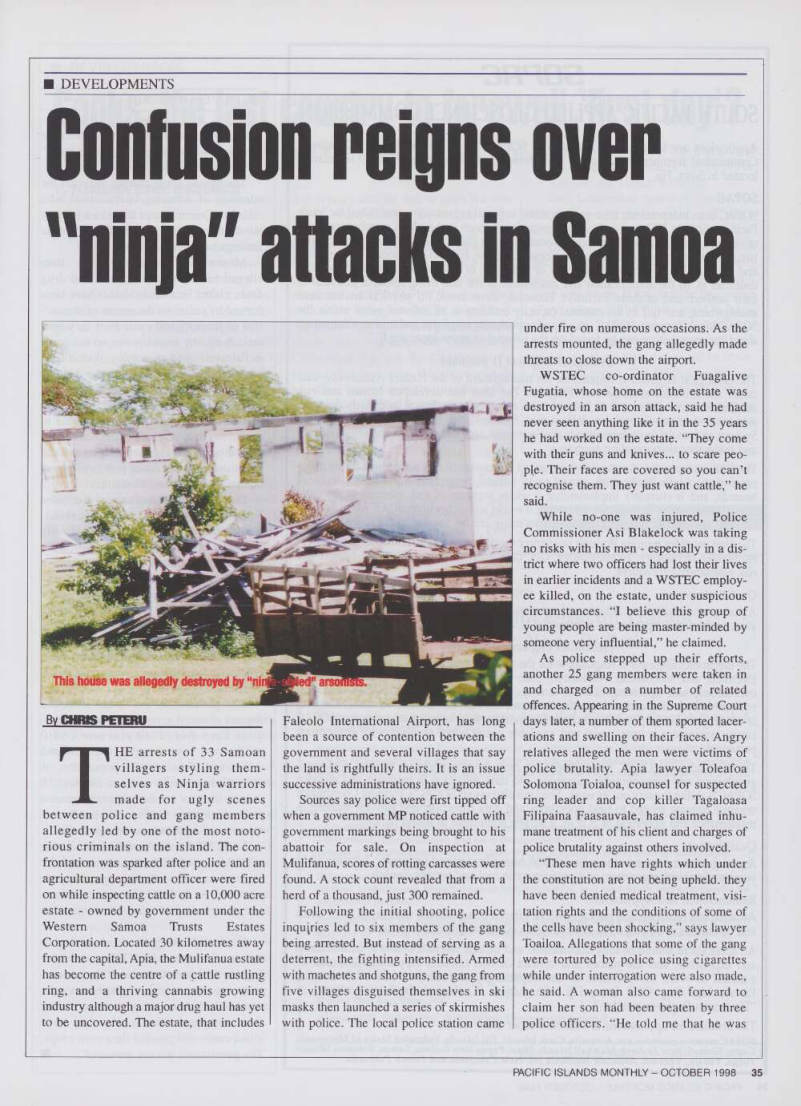
Developments
Confusion reigns over "ninja" attacks in Samoa
By Chris Peteru
THE arrests of 33 Samoan villagers styling them selves as Ninja warriors made for ugly scenes between police and gang members allegedly led by one of the most noto rious criminals on the island. The con frontation was sparked after police and an agricultural department officer were fired on while inspecting cattle on a 10,000 acre estate - owned by government under the Western Samoa Trusts Estates Corporation. Located 30 kilometres away from the capital, Apia, the Mulifanua estate has become the centre of a cattle rustling ring, and a thriving cannabis growing industry although a major drug haul has yet to be uncovered. The estate, that includes
Faleolo International Airport, has long been a source of contention between the government and several villages that say the land is rightfully theirs. It is an issue successive administrations have ignored.
Sources say police were first tipped off when a government MP noticed cattle with
government markings being brought to his
abattoir for sale. On inspection at Mulifanua, scores of rotting carcasses were found. A stock count revealed that from a herd of a thousand, just 300 remained.
Following the initial shooting, police
inquiries led to six members of the gang being arrested. But instead of serving as a deterrent, the fighting intensified. Armed with machetes and shotguns, the gang from five villages disguised themselves in ski masks then launched a series of skirmishes with police. The local police station came
under fire on numerous occasions. As the arrests mounted, the gang allegedly made threats to close down the airport.
WSTEC co-ordinator Fuagalive Fugatia, whose home on the estate was destroyed in an arson attack, said he had never seen anything like it in the 35 years he had worked on the estate. “They come with their guns and knives... to scare peo ple. Their faces are covered so you can’t recognise them. They just want cattle,” he said.
While no-one was injured, Police Commissioner Asi Blakelock was taking no risks with his men - especially in a dis trict where two officers had lost their lives in earlier incidents and a WSTEC employ ee killed, on the estate, under suspicious circumstances. “I believe this group of young people are being master-minded by someone very influential,” he claimed.
As police stepped up their efforts, another 25 gang members were taken in and charged on a number of related offences. Appearing in the Supreme Court days later, a number of them sported lacer ations and swelling on their faces. Angry relatives alleged the men were victims of
police brutality. Apia lawyer Toleafoa
Solomona Toialoa, counsel for suspected ring leader and cop killer Tagaloasa Filipaina Faasauvale, has claimed inhu mane treatment of his client and charges of police brutality against others involved.
“These men have rights which under the constitution are not being upheld, they have been denied medical treatment, visi tation rights and the conditions of some of the cells have been shocking,” says lawyer Toailoa. Allegations that some of the gang
were tortured by police using cigarettes
while under interrogation were also made, he said. A woman also came forward to claim her son had been beaten by three police officers. “He told me that he was
This house was allegedly destroyed by "ninja-styled" arsonists.
held down by two officers while another administered the rock beating to his knee,”
Mrs Faaiiliuli Enoka claimed.
The human abuse charges attracted the attention of Amnesty International who called on Commissioner Blakelock to carry out an investigation. This was done but the findings have yet to be made public.
Meanwhile, Faasauvale, the man alleged to be behind the cattle and drug deals, claims he and his brother have been framed by police on the counts of destruc tion of property and cattle theft they now face. A raid by armed police on his home in Faleatiu turned up nothing. With a fear some reputation, the recently paroled 37year-old father of six said he had put his lengthy criminal past to rest and turned the corner. His change of heart has failed to spread to other members of the Faasaulave clan, in particular his sister Magamoa Satui who threatened any future police raids may be met with force and bloodshed.
Deputy Police Commissioner Kerisome Fetalaiga says police officers in life-threat ening situations are a growing fact of life in Samoa. “Why do people complain when we try and maintain law and order. We were shot at, we did not open fire on any one. The raids were carried out to look for stolen property and weapons in an area with a certain reputation. End of story,” he said. The Criminal Investigation Division remains adamant that substantial cannabis crop exists on the huge estate and is deter mined to uncover it.
The government’s concern over the amount of social unrest is now quietly tan gible. Since July of last year over US$lO million has been pumped into law and order, and although the population of 167,000 has barely risen, in the last 18 months the total number of police firearms and vehicles has trebled. The number of recruits and salaries have also gone up.
Local MP for the Aana Alofi No. 3 dis trict, Afamasaga Toleafoa, dismissed the incident as a one-off. “It’s not a dispute over land. As far as we can make out these are young men just acting like ninjas,” he said.
But, overlooking the remains of what was once his home, WSTEC co-ordinator Fugatia believes otherwise. “The govern ment has been slow to respond to the demands of these villagers in providing them with land. This is why they have killed cattle and planted their own crops.
The government has not answered”. ■
Advertisements & other items, p. 36 (1 item)
Soprc
SOUTH PACIFIC APPLIED GEOSCIENCE COMMISSION
Applications are invited from nationals of SOPAC (South Pacific Applied Geoscience Commission) member countries for the following positions in the SOPAC Secretariat, located in Suva, Fiji.
SOPAC
SOPAC is an independent, inter-governmental regional organisation established by South Pacific nations in 1972 and dedicated to providing service to the island member countries of its Governing Council*. Currently, seventeen South Pacific countries are members with two associate members. Its Secretariat is located in Suva, Fiji, and has about 40 professional and support staff. The primary objective of SOPAC is to assist each of its island member countries in: (i) the identification and assessment of the non-living resource potential of their onshore and offshore Exclusive Economic Zone areas; (ii) physical environment management, and (iii) in the national capacity building in all relevant areas within the SOPAC Work Program. SOPAC is an equal opportunity employer and further information about the organisation can be found on the internet at www.sopac.org.fj.
Geological Engineer (1 position)
The Geological Engineer is responsible for management of the Hazard Assessment Unit under the Environmental Science Program. The Unit has developed hazard and risk assessment procedures and techniques and employs geotechnical and hydrodynamic numerical models, Geographic Information Systems and satellite Global Positioning Systems tools to deliver information to the Secretariat, member countries and other regional
and international cooperating agencies.
The Unit is responsible for the development of a program of risk assessment of the major cities of the South Pacific with respect to all natural, geotechnical and human-induced hazards, and is currently implementing a wider program of risk assessment for rural coastal communities throughout the region. It works with other units of SOPAC to develop GIS and spatial data infrastructure solutions using remote sensing applications.
The Unit provides training through in-country workshops annd attachments in aspects of earthquake technology, geotechnology, GIS, GPS, numerical modelling and hazard and risk assessment procedures.
Qualifications A post-graduate degree in Science or Engineering from a recognised university, at least 15 years professional experience in relevant fields, and proficiency in oral and written English.
Electronics Engineer (1 position)
The Electronics Engineer is responsible for the management and efficient operation of the Electronic and Mechanical Workshops Unit. The Workshops Unit is responsible for maintaining and operating SOPAC survey equipment and other SOPAC technical equipment including computing equipment and the Peacesat satellite terminal. The Unit is also responsible for providing technical support for field activities ensuring that SOPAC survey equipment is operational and available onsite when required with appropriate
personnel.
The Unit advises SOPAC management on new developments in marine, geological, geophysical and oceanographic surveying and data collection to maintain and enhance SOPAC'S ability to carry out its work. The Unit also assists SOPAC's Training Coordinator organise training related to field operations and data collection, and provide training in maintenance and operation of SOPAC's survey equipment to island nationals.
Qualifications A post-graduate degree in the relevant field from a recognised university, between 10-15 years professional experience, and proficiency in oral and written English.
Remuneration and Applications An attractive remuneration package will be offered in accordance with the SOPAC terms and conditions of employment depending on qualifications and experience.
All applications should be fully documented and include relevant details of qualifications and experience, and the names and contact of two referees. Applications should be e-mailed in Word 95/97 format to [email protected], or mailed to SOPAC Secretariat, Private Mail Bag, GPO Suva, Fiji with subject Engineer position" or
"Electronics Engineer position".
The deadline for applications is 16th November 1998.
SOPAC member countries are: Australia, Cook Islands, Fiji Islands, Federated States of Micronesia, Guam, Kiribati, New Zealand, Marshall Islands, Niue, Papua New Guinea, Samoa, Solomonjtelands, Tonga, Tuvalu, Vanuatu. Associate members are: New Caledonia and French Polynesia.
Cooks: the last country to farewell 'first day'?
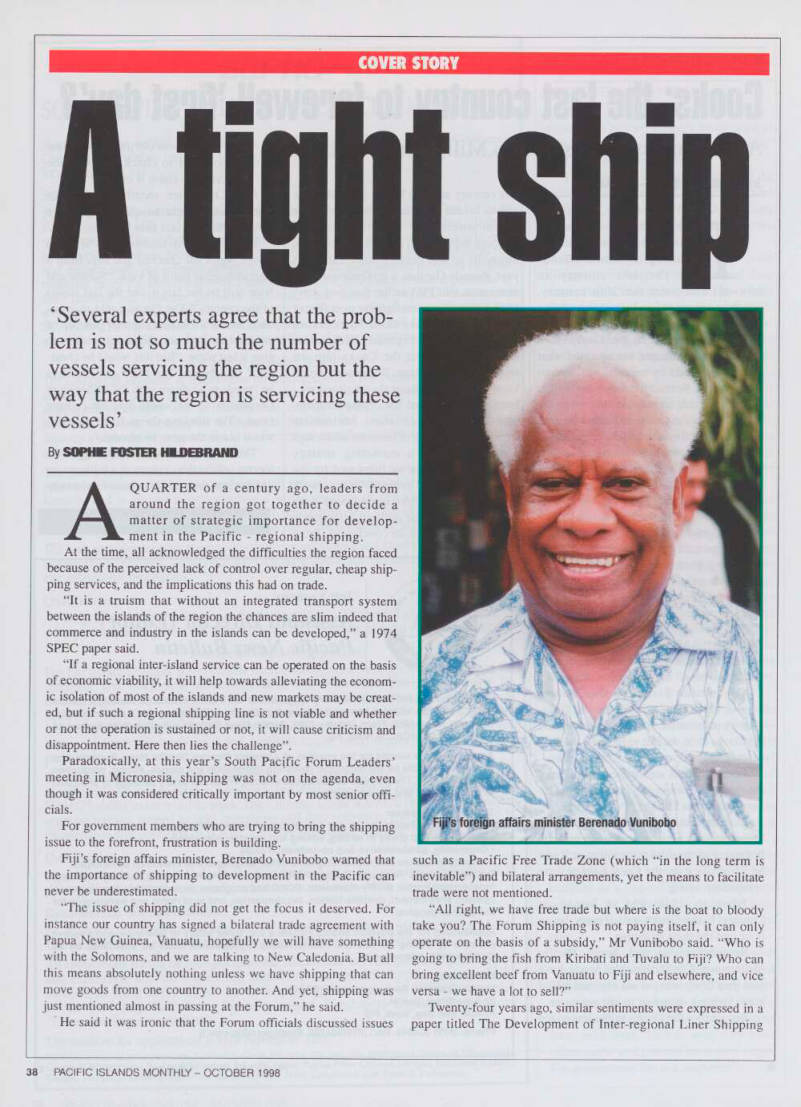
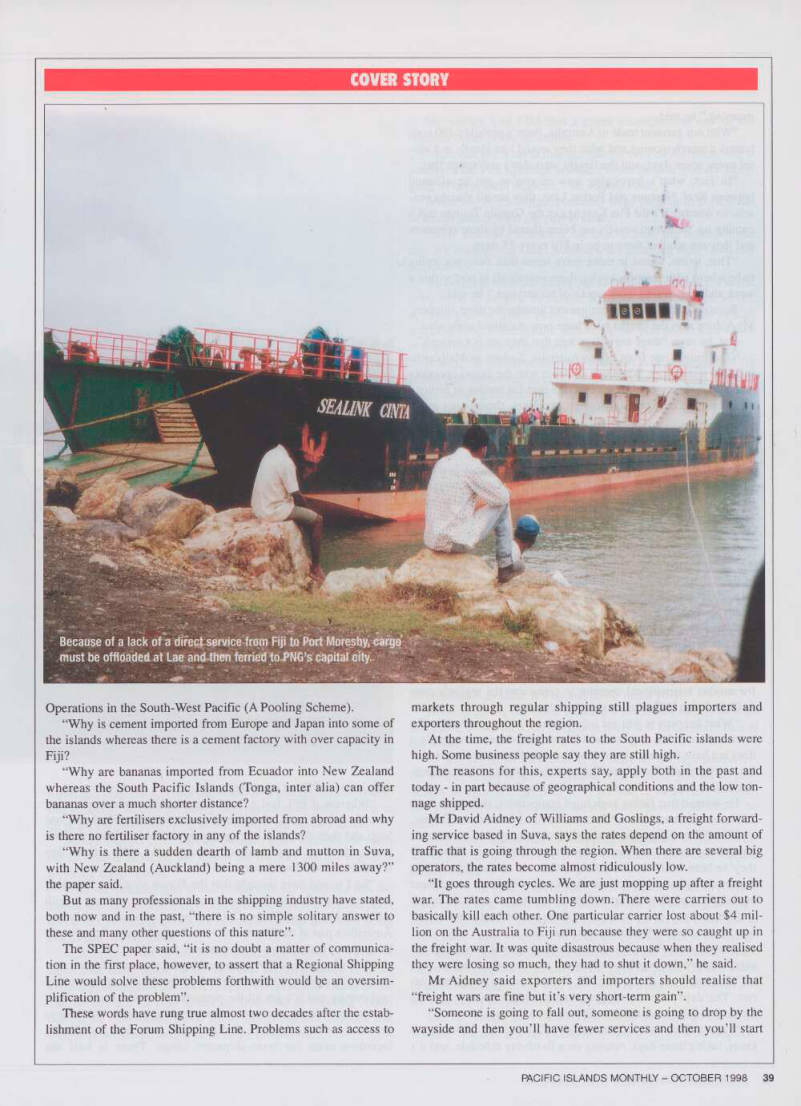
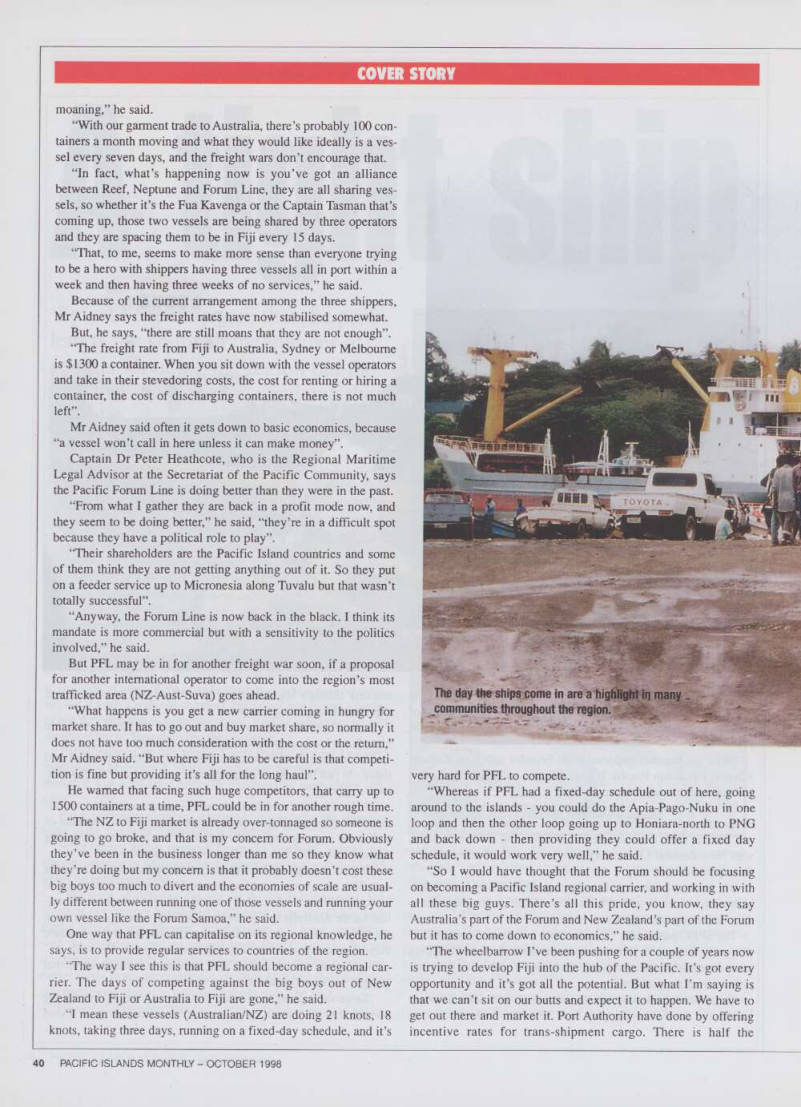
An embarrassing mistake by Millennium Committee
By Florence Syme-Buchanan
The South Pacific Millennium Consortium is touting the Cook Islands as the last country to farewell and greet the 20th century, but they are most likely making a huge and very embarrassing mistake.
Another problem is, the Cooks’ own Millennium Committee has accepted what they’ve been told by regional Millennium co-ordinator, Bernadette Rounds-Ganilau and hasn’t made any checks. Yet.
While Pacific countries battled for first place to greet the new Millennium, Samoa went the other way - opting for last place.
And that last place has become a major draw card that Rounds-Ganilau is saying belongs to the Cooks and should be cashed in on with vigorous marketing.
The Cooks hasn’t done any marketing yet, and probably just as well. If last place marketing goes ahead, it could be a big embarrassment for tiny Cooks which is relying on tourism to put the ailing econo my right.
The challenge to Samoa’s niche by the South Pacific Millennium Consortium was decided without using “technical or cos mic know-how,” says Rounds-Ganilau.
Co-ordinator Bernadette Ganilau says they’ve based their decision on the differ ence in time zones, to formally recognise the Cooks to be the last to farewell the 20th century.
Both countries are on the same side of the dateline, Samoa is closer to it, but an hour behind the Cooks.
Rounds-Ganilau’s calculations that “when it’s 12 o’clock in Samoa and the beginning of the third millennium, it’ll still be 11 o’ clock in the Cook Islands,” are completely wrong.
When its 12.00 PM in Samoa on January 1, the Cooks will already be an hour into the third millennia.
Rounds-Ganilau and South Pacific Millennium Consortium she heads have said they don’t want to see regional island states fighting over first or last positions.
But touting the Cooks as the last to see
this century and the last to greet the new one is bound to raise the hackles of the Samoa government. The island state that has been selling itself as the last to bid final farewells to this century since early this year. Rounds-Ganilau, a professional com municator, told PIM earlier that they don’t want to see the region fighting over first or last place. Not many Cook Islanders are aware that the regional Millennium Consortium has put the Cooks into the sought after last place. But those who do know are excited about the implications but they are headed for disappointment.
The Cook Islands own Millennium Committee made up of business sector reps doesn’t yet have a marketing strategy based on what they’ve been told by the regional body, and probably just as well.
None of the members interviewed were quite certain how the regional Millennium Consortium reached its conclusion. From
interviews, it was obvious that no one had bothered to check to see if the Consortium’s claim is correct.
One Committee member insists the
Cooks has a right to claim last place because “the sun sets here last.”
Director of Meteorological Services Arona Ngari has checked and says from a meteorological point of view, “Samoa and Niue will be the last to see the last sunset of the century.” The Cooks could re-intro duce the New Zealand summer practice of daylight savings and fiddle with times to give it last place. “But this would be cheat ing,” says Ngari. The MET director says he “needs to sit down with the Millennium Committee to see where they are coming from. “The thinking seems to be they can sort it out in the next 16 months.”
The Cooks tourism office dragged its feet on selling this country as a millennium destination, probably because of uncertain
■ Continued On Page 56
ty over what special feature the country had to offer. The marketing job was finally passed to the private sector earlier this year, which formed a Rarotonga based Millennium Committee.
Chairman and manager of a big alcohol outlet, Nick Henry says they have yet to come up with a millennium slogan. Henry is still working on a millennium calendar that Rounds-Ganilau says they were
expecting to be completed in June.
Henry isn’t prepared for the Committee to make a decision “on it’s own” and wants wider public discussion on their plans. With just over 16 months to go, the Committee doesn’t have much time.
Henry says they’re toying with the idea of having a marae, or sacred grounds, built over the next 12 months to mark the new millennia, with visitors to the island each bringing a stone to help build it. Cook Islands Television has been asked to come
up seven-minute live segment for a 24 hour documentary Millennium Day Broadcast co-produced by CNN and BBC. CITY manager George Pitt says they’ll do the live broadcast even if means the struggling station has to buy new equipment. Like Henry, the TV manager is thinking along traditional lines. He wants to capture the
country’s ocean going canoes sailing
through Avana channel, where 700 years ago seven canoes left here for New Zealand. Some New Zealand Maori descendants of those Polynesian explorers and ocean voyagers have traced their links back to the Cooks,, journeying here in recent years to link up with family.
Many New Zealanders will also see the dawn of a new millennium twice. By fly ing to Rarotonga on January 1, they travel a day back in time and can see the dawn of a new millennium again. That concept is being marketed as the “double-dawn.”
That the Cooks’ marketing isn’t up and running doesn’t concern Rounds-Ganilau, who admits things have been moving “very slowly”. “But we’re doing it Pacific style, and in the Pacific fashion. I’m telling everybody we’ll have everything ready for you on December 31st 1999.” Rounds- Ganilau says she’s told billionaire Hussain Khashoggi that the Cooks’ has the special millennium feature of being last to see this century end. She says Khashoggi is very interested and plans to fill a number of lux ury vessels with “people prepared to pay millions for these tours” to see the dawn of the new century in Tonga. Ganilau says those vessels will then steam full speed ahead for the Cooks, which is less than 2000 kilometres away, for another farewell celebration. But Khashoggi would be bet ter to head for the white beach of Falealupo village at the western end of Samoa where their day ends. ■
Advertisements & other items, p. 37 (1 item)
Assistant Director (Editor)
Job Vacancy
Pacific News Bulletin
Pacific News Bulletin is the monthly magazine of the Pacific Concerns Resource Centre (PCRC) and the Nuclear Free and Independent Pacific (NFIP) movement - published continuously since 1986. From January 1999, Pacific News Bulletin will move from Sydney, to be produced at PCRC in Suva, Fiji.
Applications are sought for the position of Assistant Director (Pacific News Bulletin) who will be responsible for the magazine: gathering information and stories, editing, production and distribution. The position will be based in Suva, Fiji with a salary package of $F30,000, to commence in Mid November 1998.
The position requires: • Knowledge of Pacific Issues and a commitment to the NFIP agenda • Experience and ability in writing, editing and desktop publishing • Organising, administrative and co-ordination skills • Fluency in spoken and written English (Pacific languages and French an advantage).
Pacific Concerns Resource Centre (PCRC) is the secretariat for the Nuclear Free and Independent Pacific (NFIP) movement. PCRC has programs on sustainable human development, environment, demilitarisation, decolonisation, and land rights and sovereignty for indigenous peoples.
Applications for the position should include a c.v., three letters of reference, and a recent example of writing on relevant Pacific issues. Applications must be submitted by 30 October 1998, addressed to The Director, Pacific Concerns Resource Centre (PCRC), 83 Amy Street, Toorak, Private Mail Bag, Suva, Fiji Phone: (679) 304649. Fax: (679)304755. Email:[email protected]
A tight ship
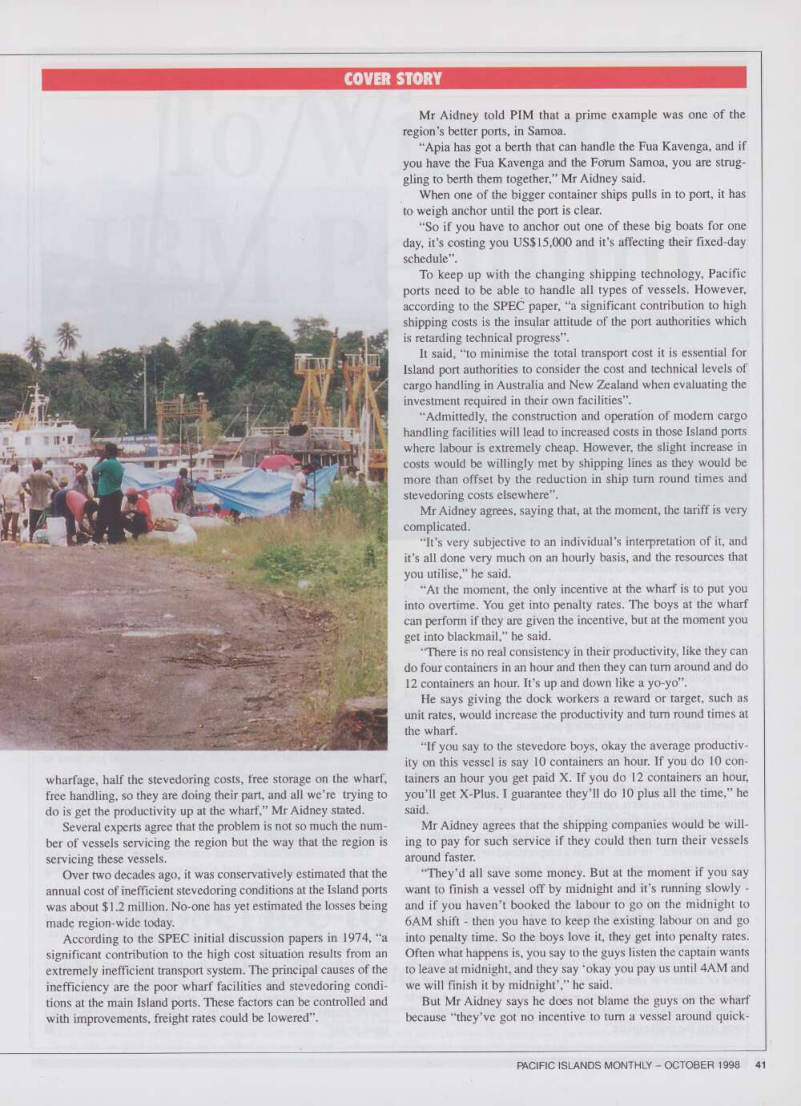
Cover Story
‘Several experts agree that the prob lem is not so much the number of vessels servicing the region but the way that the region is servicing these vessels’
By Sophie Foster Hildebrand
A QUARTER of a century ago, leaders from around the region got together to decide a matter of strategic importance for develop ment in the Pacific - regional shipping.
At the time, all acknowledged the difficulties the region faced because of the perceived lack of control over regular, cheap ship ping services, and the implications this had on trade.
“It is a truism that without an integrated transport system between the islands of the region the chances are slim indeed that commerce and industry in the islands can be developed,” a 1974 SPEC paper said.
“If a regional inter-island service can be operated on the basis of economic viability, it will help towards alleviating the econom ic isolation of most of the islands and new markets may be creat ed, but if such a regional shipping line is not viable and whether or not the operation is sustained or not, it will cause criticism and disappointment. Here then lies the challenge”.
Paradoxically, at this year’s South Pacific Forum Leaders’ meeting in Micronesia, shipping was not on the agenda, even though it was considered critically important by most senior offi cials.
For government members who are trying to bring the shipping issue to the forefront, frustration is building.
Fiji’s foreign affairs minister, Berenado Vunibobo warned that the importance of shipping to development in the Pacific can never be underestimated.
“The issue of shipping did not get the focus it deserved. For instance our country has signed a bilateral trade agreement with Papua New Guinea, Vanuatu, hopefully we will have something with the Solomons, and we are talking to New Caledonia. But all this means absolutely nothing unless we have shipping that can move goods from one country to another. And yet, shipping was just mentioned almost in passing at the Forum,” he said.
He said it was ironic that the Forum officials discussed issues
such as a Pacific Free Trade Zone (which “in the long term is inevitable”) and bilateral arrangements, yet the means to facilitate trade were not mentioned.
“All right, we have free trade but where is the boat to bloody take you? The Forum Shipping is not paying itself, it can only operate on the basis of a subsidy,” Mr Vunibobo said. “Who is going to bring the fish from Kiribati and Tuvalu to Fiji? Who can bring excellent beef from Vanuatu to Fiji and elsewhere, and vice versa - we have a lot to sell?”
Twenty-four years ago, similar sentiments were expressed in a paper titled The Development of Inter-regional Liner Shipping
Fiji’s foreign affairs minister Berenado Vunibobo
Operations in the South-West Pacific (A Pooling Scheme).
“Why is cement imported from Europe and Japan into some of the islands whereas there is a cement factory with over capacity in Fiji?
“Why are bananas imported from Ecuador into New Zealand whereas the South Pacific Islands (Tonga, inter alia) can offer bananas over a much shorter distance?
“Why are fertilisers exclusively imported from abroad and why is there no fertiliser factory in any of the islands?
“Why is there a sudden dearth of lamb and mutton in Suva, with New Zealand (Auckland) being a mere 1300 miles away?” the paper said.
But as many professionals in the shipping industry have stated, both now and in the past, “there is no simple solitary answer to these and many other questions of this nature”.
The SPEC paper said, “it is no doubt a matter of communica tion in the first place, however, to assert that a Regional Shipping Line would solve these problems forthwith would be an oversim plification of the problem”.
These words have rung true almost two decades after the estab lishment of the Forum Shipping Line. Problems such as access to
markets through regular shipping still plagues importers and
exporters throughout the region.
At the time, the freight rates to the South Pacific islands were high. Some business people say they are still high.
The reasons for this, experts say, apply both in the past and today - in part because of geographical conditions and the low ton nage shipped.
Mr David Aidney of Williams and Goslings, a freight forward ing service based in Suva, says the rates depend on the amount of traffic that is going through the region. When there are several big operators, the rates become almost ridiculously low.
“It goes through cycles. We are just mopping up after a freight war. The rates came tumbling down. There were carriers out to basically kill each other. One particular carrier lost about $4 mil lion on the Australia to Fiji run because they were so caught up in the freight war. It was quite disastrous because when they realised they were losing so much, they had to shut it down,” he said.
Mr Aidney said exporters and importers should realise that “freight wars are fine but it’s very short-term gain”.
“Someone is going to fall out, someone is going to drop by the wayside and then you’ll have fewer services and then you’ll start
Because of a lack of a direct service-from Fiji to Port Moresby, cargo must be offloaded at Lae and then ferried to PNG’s capital city.
moaning,” he said.
“With our garment trade to Australia, there’s probably 100 con tainers a month moving and what they would like ideally is a ves sel every seven days, and the freight wars don’t encourage that.
“In fact, what’s happening now is you’ve got an alliance between Reef, Neptune and Forum Line, they are all sharing ves sels, so whether it’s the Fua Kavenga or the Captain Tasman that’s coming up, those two vessels are being shared by three operators and they are spacing them to be in Fiji every 15 days.
“That, to me, seems to make more sense than everyone trying to be a hero with shippers having three vessels all in port within a week and then having three weeks of no services,” he said.
Because of the current arrangement among the three shippers, Mr Aidney says the freight rates have now stabilised somewhat.
But, he says, “there are still moans that they are not enough”.
“The freight rate from Fiji to Australia, Sydney or Melbourne is $l3OO a container. When you sit down with the vessel operators and take in their stevedoring costs, the cost for renting or hiring a container, the cost of discharging containers, there is not much left”.
Mr Aidney said often it gets down to basic economics, because “a vessel won’t call in here unless it can make money”.
Captain Dr Peter Heathcote, who is the Regional Maritime Legal Advisor at the Secretariat of the Pacific Community, says the Pacific Forum Line is doing better than they were in the past.
“From what I gather they are back in a profit mode now, and they seem to be doing better,” he said, “they’re in a difficult spot because they have a political role to play”.
“Their shareholders are the Pacific Island countries and some of them think they are not getting anything out of it. So they put on a feeder service up to Micronesia along Tuvalu but that wasn’t totally successful”.
“Anyway, the Forum Line is now back in the black. I think its mandate is more commercial but with a sensitivity to the politics involved,” he said.
But PFL may be in for another freight war soon, if a proposal for another international operator to come into the region’s most trafficked area (NZ-Aust-Suva) goes ahead.
“What happens is you get a new carrier coming in hungry for market share. It has to go out and buy market share, so normally it does not have too much consideration with the cost or the return,”
Mr Aidney said. “But where Fiji has to be careful is that competi tion is fine but providing it’s all for the long haul”.
He warned that facing such huge competitors, that carry up to 1500 containers at a time, PFL could be in for another rough time.
“The NZ to Fiji market is already over-tonnaged so someone is going to go broke, and that is my concern for Forum. Obviously they’ve been in the business longer than me so they know what they’re doing but my concern is that it probably doesn’t cost these big boys too much to divert and the economies of scale are usual ly different between running one of those vessels and running your own vessel like the Forum Samoa,” he said.
One way that PFL can capitalise on its regional knowledge, he says, is to provide regular services to countries of the region.
“The way I see this is that PFL should become a regional car rier. The days of competing against the big boys out of New Zealand to Fiji or Australia to Fiji are gone,” he said.
“I mean these vessels (Australian/NZ) are doing 21 knots, 18 knots, taking three days, running on a fixed-day schedule, and it’s
very hard for PFL to compete.
“Whereas if PFL had a fixed-day schedule out of here, going around to the islands - you could do the Apia-Pago-Nuku in one loop and then the other loop going up to Honiara-north to PNG and back down - then providing they could offer a fixed day schedule, it would work very well,” he said.
“So I would have thought that the Forum should be focusing on becoming a Pacific Island regional carrier, and working in with all these big guys. There’s all this pride, you know, they say Australia’s part of the Forum and New Zealand’s part of the Forum but it has to come down to economics,” he said.
“The wheelbarrow I’ve been pushing for a couple of years now is trying to develop Fiji into the hub of the Pacific. It’s got every opportunity and it’s got all the potential. But what I’m saying is that we can’t sit on our butts and expect it to happen. We have to get out there and market it. Port Authority have done by offering incentive rates for trans-shipment cargo. There is half the
The day the ships come in are a highlight in many communities throughout the region.
wharfage, half the stevedoring costs, free storage on the wharf, free handling, so they are doing their part, and all we’re trying to do is get the productivity up at the wharf,” Mr Aidney stated.
Several experts agree that the problem is not so much the num ber of vessels servicing the region but the way that the region is servicing these vessels.
Over two decades ago, it was conservatively estimated that the annual cost of inefficient stevedoring conditions at the Island ports was about $1.2 million. No-one has yet estimated the losses being made region-wide today.
According to the SPEC initial discussion papers in 1974, “a significant contribution to the high cost situation results from an extremely inefficient transport system. The principal causes of the inefficiency are the poor wharf facilities and stevedoring condi tions at the main Island ports. These factors can be controlled and with improvements, freight rates could be lowered”.
Mr Aidney told PIM that a prime example was one of the region’s better ports, in Samoa.
“Apia has got a berth that can handle the Fua Kavenga, and if you have the Fua Kavenga and the Forum Samoa, you are strug gling to berth them together,” Mr Aidney said.
When one of the bigger container ships pulls in to port, it has to weigh anchor until the port is clear.
“So if you have to anchor out one of these big boats for one day, it’s costing you USSIS,OOO and it’s affecting their fixed-day schedule”.
To keep up with the changing shipping technology, Pacific ports need to be able to handle all types of vessels. However, according to the SPEC paper, “a significant contribution to high shipping costs is the insular attitude of the port authorities which is retarding technical progress”.
It said, “to minimise the total transport cost it is essential for Island port authorities to consider the cost and technical levels of cargo handling in Australia and New Zealand when evaluating the investment required in their own facilities”.
“Admittedly, the construction and operation of modem cargo handling facilities will lead to increased costs in those Island ports where labour is extremely cheap. However, the slight increase in costs would be willingly met by shipping lines as they would be more than offset by the reduction in ship turn round times and stevedoring costs elsewhere”.
Mr Aidney agrees, saying that, at the moment, the tariff is very
complicated.
“It’s very subjective to an individual’s interpretation of it, and it’s all done very much on an hourly basis, and the resources that you utilise,” he said.
“At the moment, the only incentive at the wharf is to put you into overtime. You get into penalty rates. The boys at the wharf can perform if they are given the incentive, but at the moment you get into blackmail,” he said.
“There is no real consistency in their productivity, like they can do four containers in an hour and then they can turn around and do 12 containers an hour. It’s up and down like a yo-yo”.
He says giving the dock workers a reward or target, such as unit rates, would increase the productivity and turn round times at the wharf.
“If you say to the stevedore boys, okay the average productiv ity on this vessel is say 10 containers an hour. If you do 10 con tainers an hour you get paid X. If you do 12 containers an hour, you’ll get X-Plus. I guarantee they’ll do 10 plus all the time,” he said.
Mr Aidney agrees that the shipping companies would be will ing to pay for such service if they could then turn their vessels around faster.
“They’d all save some money. But at the moment if you say want to finish a vessel off by midnight and it’s running slowly and if you haven’t booked the labour to go on the midnight to 6AM shift - then you have to keep the existing labour on and go into penalty time. So the boys love it, they get into penalty rates.
Often what happens is, you say to the guys listen the captain wants to leave at midnight, and they say ’okay you pay us until 4AM and we will finish it by midnight’,” he said.
But Mr Aidney says he does not blame the guys on the wharf because “they’ve got no incentive to turn a vessel around quick-
ly”. He said PAF have to restructure their tariff to provide such an incentive. In a meeting of the South Pacific Ports Association in Suva last month, Mr Geoff Vazey, Chief Executive of the Ports of Auckland, criticised political interference in the management of ports.
“Many ports throughout the world are failing on international measures of productivity, and effective service to their regions, due to political interference,” he said.
“Under politically managed regimes, harbour boards tolerated poor labour relations, inefficiencies, poor use of assets (particular ly land), and poor decision making practices,” he said.
Just about every port in the South Pacific is controlled by a politician in a ministerial position. Mr Vazey warned, however, that “a port manager cannot be effective if a politician can ring him and overrule his decisions”. He said in the New Zealand restructuring of its ports system, this cannot happen.
Mr Vazey was pushing a line of complete corporatisation as the way forward for Pacific ports, using Auckland as an example.
“The essence,” he said, “is that a corporatised or privatised port is motivated to create wealth. It is in their interests to foster a growing economy, indeed it is reliant on that”.
“The track record of many government-managed ports is that they destroy wealth and rely on forms of subsidy to survive. I am a firm believer that corporatisation and privatisation of ports is a positive move to a region’s economy,” he said. Mr Aidney said “the shipping industry is up and down like a yo-yo. You’ll have a flood of carriers at one stage then the economics of it will prove that they are not making money and some will fall by the wayside and then you’ll have a shortage of carriers and someone else will come into the marketplace”.
The one static element that Pacific ports could work on - to keep carriers running throughout the region - is to upgrade and update both people and equipment. This would increase efficien cy, reduce tariffs and decrease turn round times.
To do this, Mr Aidney says, Pacific ports have to consider a seven-day-week, a 24-hour port concept and review their tariffs.
The thinking a quarter of a century ago was that a Regional Line would “increase trade by providing a service where an inde pendent commercial operator would be unwilling to take the risk where the trade may not develop sufficiently for the service to become economic”.
Since then, though, “the whole economics of shipping has changed,” Mr Aidney says, “it’s very aggressive and you have to
run a tight ship”.
“The days of coming in port and the crew having a day off are gone. They come in and say how many containers off, how many on, when are we sailing, boom, boom, boom, and it’s as quickly as they can turn around the better”.
The areas that Pacific Island countries have to focus on are developing two-way traffic and giving some integrity to shipping schedules, Mr Aidney concludes.
According to SPEC, the region’s shipping needs include regu larity of service, stability of freight rates, liaison with the users of the services (shipper organisations and the like), and rationalisa tion (where ports off load imports and load exports).
A quarter of a century ago, President Hammer Deßoburt summed up the shipping saga in one sentence: “A major reason for the priority adopted to regional shipping was that whilst the Pacific Island States needed aid, by and large, they much preferred trade to aid” ■
A view of the harbour in Pohnpei, Micronesia.
Advertisements & other items, pp. 39-44 (2 items)
Cover Story
Notebook,
To Win an
IBM Pentium
Get the latest on political, business and social issues
happening throughout the
region every month, as well as the chance to win an IBM Pentium Notebook! Every 12issue subscription received before March 31st, 1999 will go into the draw. Subscribe to Pacific Islands Monthly today by calling (679) 304 111 or fax (679) 303 809/(679) 307 460.
Subscribe to The Source.
Pacific Islands Monthly
Conditions of Entry I.To enter, subscription must be made before March 31st, 1999 which automatically enters the subscriber into the draw for the Pentium Notebook Computer. 2.Entry is open to all subscribers except employees of The Fiji Times Ltd, Pacific Islands Monthly and Wilson Addison Ltd. 3.Subscribers need to subscribe for at least 12 months to qualify. 4.The winner of the Pentium Notebook will be published in the Pacific Islands Monthly Magazine, May Issue, 1999 and will be notified by registered mail. i.Thc winner will receive their prize within one month of the draw. 6.The prize must be taken as offered and is not redeemable. 7.1 n the event of any dispute the decision of the promoter is final and no correspondence will be entered into.
For almost 70 years, Pacific Islands Monthly has been and still is the authority on political, business and social issues within the Pacific. And now, every 12 month subscription received before the 31st of March, 1999, goes into a draw to win an IBM Pentium Notebook*. You could even give a gift subscription to enter but it must be before the closing date. As well as the entry into the draw, you will also receive the latest news from the region. Fill in the subscription form below and send it along with payment to Pacific Islands Monthly, Subscription Department, PO Box 1167, Suva, Fiji. Or call PIM on (679) 304 111 or fax us on (679) 303 809/(679) 307 460.
Subscribe to The Source.
Pacific Islands Monthly
*Rates include Airspeeding to all destinations Conditions of Entry 1. To enter, subscriptions must be made before March 31st. 1999 which automatically enters the subscriber into the draw for the Pentium Notebook Computer. 2. Entry is open to all subscribers except employees of The Fiji Times Ltd, Pacific Islands Monthly, and Wilson Addison Ltd. 3. Subscribers need to subscribe for 12 months to qualify. 4, The winner of the Pentium Notebook will be published in Pacific Islands Monthly Magazine, May Issue, 1999 -and will be notified by registered mail. 5. The winner will receive their prize within one month of the draw. 6. The prize must be taken as offered and is not redeemable. 7. In the event of any dispute the decision of the promoter is final and no correspondence will be entered into.
YES! I wish to subscribe to The Source and receive a chance to win an IBM Pentium Notebook Computer!
12 ISSUE
SUBSCRIPTION
Rate A I Rate B I Rate C Rate D Rate E □ Cheque/Bank Draft/Money Order made payable to Pacific Islands Monthly ] Please charge my credit card: (VISA / AMEX / MASTERCARD) Postal Address: This is a
□ Renewal
□ New Subscription Country: Fax:
Vijay's victory is region's
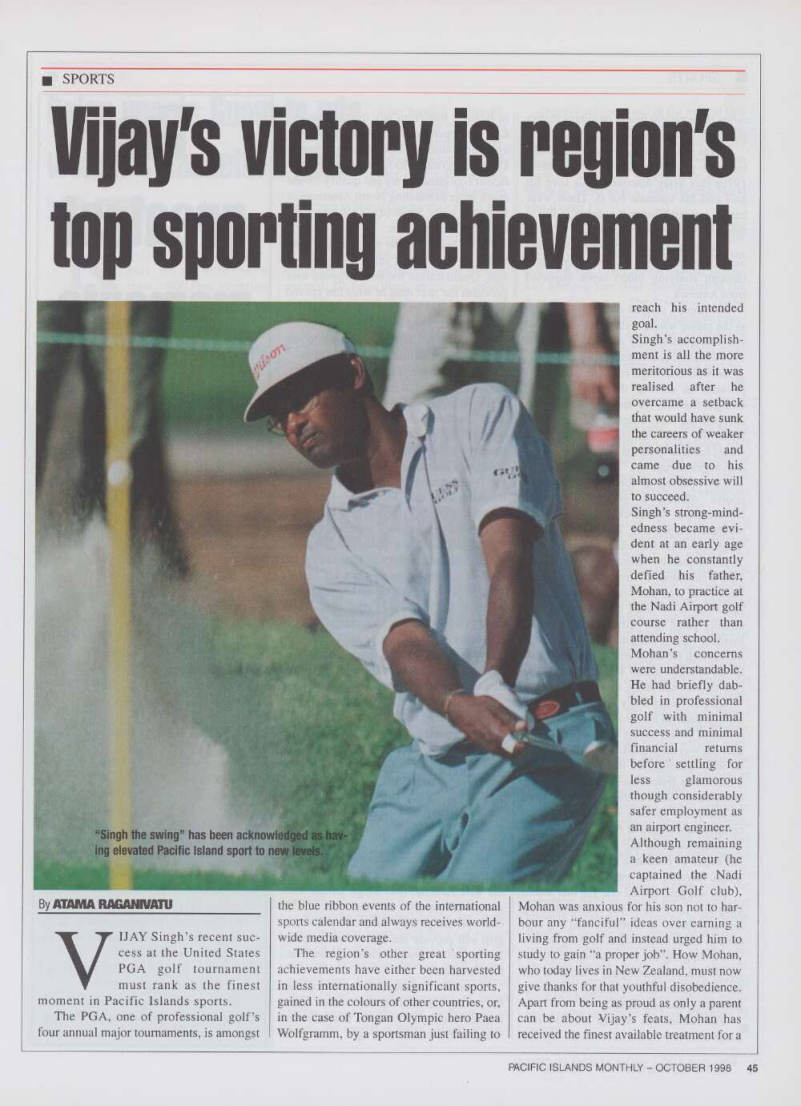
Sports
Vijay's victory is region's top sporting achievement
By Atama Raganivatu
VIJAY Singh’s recent suc
cess at the United States PGA golf tournament must rank as the finest moment in Pacific Islands sports.
The PGA, one of professional golf’s four annual major tournaments, is amongst
the blue ribbon events of the international sports calendar and always receives world wide media coverage.
The region’s other great sporting achievements have either been harvested in less internationally significant sports, gained in the colours of other countries, or, in the case of Tongan Olympic hero Paea Wolfgramm, by a sportsman just failing to
reach his intended goal.
Singh’s accomplish ment is all the more meritorious as it was realised after he overcame a setback that would have sunk the careers of weaker personalities and came due to his almost obsessive will to succeed.
Singh’s strong-mind edness became evi dent at an early age when he constantly defied his father, Mohan, to practice at the Nadi Airport golf course rather than attending school.
Mohan’s concerns were understandable.
He had briefly dab bled in professional golf with minimal success and minimal financial returns before settling for less glamorous though considerably safer employment as an airport engineer.
Although remaining a keen amateur (he captained the Nadi Airport Golf club),
Mohan was anxious for his son not to har bour any "fanciful” ideas over earning a living from golf and instead urged him to study to gain “a proper job”. How Mohan, who today lives in New Zealand, must now give thanks for that youthful disobedience.
Apart from being as proud as only a parent can be about Vijay’s feats, Mohan has received the finest available treatment for a
“Singh the swing” has been acknowledged as hav ing elevated Pacific Island sport to new levels.
series of persistent health problems thanks purely to Vijay’s financial aid.
It was at the Nadi Airport club’s rudi mentary nine-hole course in the early 1970 s that Vijay discovered his love for golf and his aptitude for it. There were hardly any qualified golf coaches in Fiji in those days and no television.
The one practical way open for young Singh to improve his technique was through studying video tapes imported from America.
He quickly singled out Tom Weiskopf as the player whose style he admired most and attempted to copy every aspect of the 1973 British Open champion’s game.
So well did Singh emulate Weiskopf’s prowess in driving the ball long and straight that his tee shots regularly out stripped the Nadi course’s fairways and, when the area was clear of planes, he would hammer balls the length of the adja cent airport’s runway!
The opening of the Pacific Harbour course offered a greater challenge.
Nevertheless, he quickly outgrew local amateur competition. In 1982, aged 19, Singh turned professional.
Unfortunately, he struggled in the Asian Tour’s cut-throat environment. His scores were often high and his pay cheques piti ful. Then, in his third season on the paid circuit, came the infamous “Cheating Incident”. Upon completing a round in the Indonesian Open, it was ascertained that Singh claimed a shot fewer on his score card than he had really scored.
Despite vehemently protesting he had merely made an innocent mistake (and one common in all levels of golf), the Fiji Islander was suspended. Singh remains bit ter when recalling the incident and blames a malicious Indonesian dignitary for his humiliation. Such is the sense of rancour he maintains that he steadfastly avoids competitions staged in Asia.
Banished from the tournament scene yet eager to remain a golf professional, Singh, literally, went into the wilderness.
He was just offered one job that would keep him involved in the sport following his suspension - as a professional at a club deep in the Borneo jungle. And so, for two years, Singh spent his mornings instruct ing oil and timber company executives and his afternoons and evenings practising, practising, and practising.
The Indonesian mishap instilled into Singh a fervent desire to reach the top and
in Borneo, free from any distractions, he took the opportunity to hone his proficien cy over countless, uninterrupted, hours.
Unwilling to return to Asia and having suf ficient confidence to try and qualify for the much more demanding North American or
European tours, Singh began his comeback
on Africa’s Safari Tour.
After becoming the top money winner there, he felt himself ready to fry bigger fish. Qualification for the European tour provided the next rung of what has proved to be a lofty ladder.
Having notched up several prestigious wins in Europe, Singh moved on to the biggest and most lucrative arena in golf, the North American tour, in 1993.
Following his initial season in that rarefied atmosphere, he was named “Rookie of the Year”. In the subsequent four years, Singh was a regular winner. In 1997, he topped the leaders’ board at the end of both the Memorial Tournament and Buick Open on the North American tour, as well as tri umphing in the World Match Play Championship in England.
However, doubts remained upon Singh’s ability to capture any of the four
major championships. Ultimately, a
golfer’s standing is based upon his perfor mances at the British Open, US Open, US Masters and US PGA, and many golf experts dismissed Singh’s claims to be a contender for these due to the single cru cial flaw in his game. Singh’s technique from tee to green is near perfect, gaining him the nickname “Singh the Swing”.
His dedication to preparation has already become the subject of legend and his temperament can not be faulted. What prevented Singh from joining the very elite of golf, those authorities insisted, was a weakness in his putting.
Singh himself acknowledged this possi
ble Achilles Heel with long hours on the
practice greens and by constantly changing
his putting technique.
It was with a cross handed grip, adopt ed seven weeks earlier at the suggestion of his wife Ardena, that Singh putted with great efficiency at the US PGA Championship. Only time will tell if this grip will provide the key to further glory for the golfer whose first name means “vic tory” in Hindi.
Even if it does not, he can be content for having elevated Pacific Islands sport ing achievement to a level few believed was possible a scant time ago. ■
Advertisements & other items, p. 46 (1 item)
greatest
The
moments
in Pacific
Islands
sport
1. Fiji’s Vijay Singh winning the US PGA golf championship (1998). 2. New Caledonian Christian Karembeu appearing in France’s World Cup winning soccer team (1998). 3. Tonga’s Paea Wolfgramm’s Olympics silver medal for boxing (1996). 4. Samoan Beatrice Faumuina winning the discus title at the World Athletics Championship (1997). 5. Fiji capturing the World Sevens Rugby title (1997). 6. Samoans Joe Stanley and Michael Jones featuring in New Zealand’s rugby union World Cup winning team (1987). 7. Tongan Viliame Ofahengaue featuring in Australia’s rugby union World Cup winning side (1991). 8. Christian Karembeu featuring in Real Madrid’s European Champion’s Cup winning soccer team (1998). 9. Vijay Singh winning the World Match Play Tournament (1997). 10. Tongan Jimmy Dymock featuring in Australia’s rugby league World Cup winning side (1995). ■
Palau upsets Guam to win
women's basketball gold
By Giff Johnson
Koror, Palau - An inspired Palau women’s basket ball team, with more than 1,000 fans cheering them on, used a devastating fast break and good shot selection to take the gold medal from a taller Guam team at the Micronesian Games on the last day of play in the nine day tour nament in Koror.
After holding a slim 39- 33 half time lead, Palau routed Guam 88-69.
Palau’s victory was the first time a Palau team has defeated Guam in
basketball in Micro Games play. But it was the play of 17 year old Stephanie Ngirchoimei - who passed behind her back to set up open shots for her teammates, drove the length of the court for layups, popped 20 foot jump shots and made clutch free throws in the final minutes to seal the win - who led Palau to victory.
Ngirchoimei (pronounced Near-oy-may) scored 25 points, and most importantly controlled the ball to help her team fend off a second half comeback by Guam.
Despite playing most of the second half with four fouls, Ngirchoimei didnrtt let up and neither did her teammates Saime Ngirausui and Jubilee Kuartei who each scored 17 points. Guam was led by Michelle Sison with 17 and Theresa Sison who scored 12.
Ngirchoimei, who just two months ago graduated from Palau High School and also played on the Palau volleyball team that took the silver medal behind Guam, was nothing less than spectacular in the gold medal game. The hometown crowd cheered and stomped the bleachers caus ing a deafening din each time Ngirchoimei set up her teammates for easy open shots with her patented behind-the-back and no look passing. sM
weightlifting record
Nauruan sets Commonwealth weightlifting record
Koror, Palau - The Pacific’s leading weightlifter broke three Commonwealth and Oceania records on his way to three gold medals at the Micronesian Games in Palau in early August. Nauru’s Marcus Stephen didn’t dis
appoint a crowd anticipating a record-setting
showing. He set new records in the snath, and in the clean and jerk weightlifting cate gories, as well as in total pounds hefted.
Stephen is ranked number five worldwide in his weight class. He won three gold medals at the last Commonwealth Games in Canada. The diminutive Stephen, who lifts in the 69 kg weight division, showed there’s nothing small about his muscles as he easily outlifted his nearest competitor from Kiribati. In the clean and jerk category, he warmed up with a 155 kg lift, which guaran teed him a gold medal over Kiribati’s Kamaraia Eken, whose best lift was 127.5 kg (for which he won a silver medal). Then, to the applause of an appreciative Micro Games audience, Stephen upped his total to a record-breaking 165.5 kg a breaking the Commonwealth record by .5 kg. He also snatched 125 kg to win gold, setting new Micro Games and Oceania records in the process. His combined total of 290 total kg lifted also smashed the previous record of 285 kg. ■
SPN puts
Micronesians on the map
By Giff Johnson
Koror, Palau - The live broadcasts from the Micronesian Games by SPN, Nauru’s newly launched sports television station,
provided unprecedented exposure to
island athletes used to competing before audiences limited to a couple of hundred people in the bleachers.
At the fourth Micro Games in Palau, they were playing before a television audience estimated in excess of eight million people in the Asia-Pacific
region.
From the first games of the day in the early morning hours until the final runner crossed the finish line at 10 p.m. in the evening, SPN crews were on hand, broad casting live. For the nine day Micro Game event, SPN virtually uprooted its entire Nauru-based studio and shipped it to Koror, the capital of Palau. It left only its
homebase broadcasting dish and a skeleton staff and minimal equipment back in Nauru, flying in tons of filming, broadcast equipment and staff.
Using the just-opened Outrigger Palasia Hotel in Koror as its editing and broadcasting base, SPN crews gave an unparal leled view of the games to people in the region. SPN broadcast 10-12 hours of sports daily from Palau, according to SPN officials.
It wasn’t only off-island viewers who benefited from SPN’s live coverage.
“Older people in the villages (in Palau) were very happy to have SPN here because they could watch the games without com ing into Koror,” said Baklai Temengil, the executive director of the Micronesian Games Organizing Committee.
Micronesian Games Council chairman Bill Sakovitch, who is based in Saipan, said that SPN’s involvement gave this fourth Micronesian Games a tremendous boost.
He was particularly happy with the exposure SPN provided for Micronesian athletes to viewing audiences in the South Pacific a people who otherwise wouldn’t normally have an opportunity to see com petitions helds north of the equator.
Sakovitch sees SPN filling a much needed void in connecting athletes and spectators in a region separated by vast stretches of ocean. ■
Hundreds in despair as fire ravages Savaii
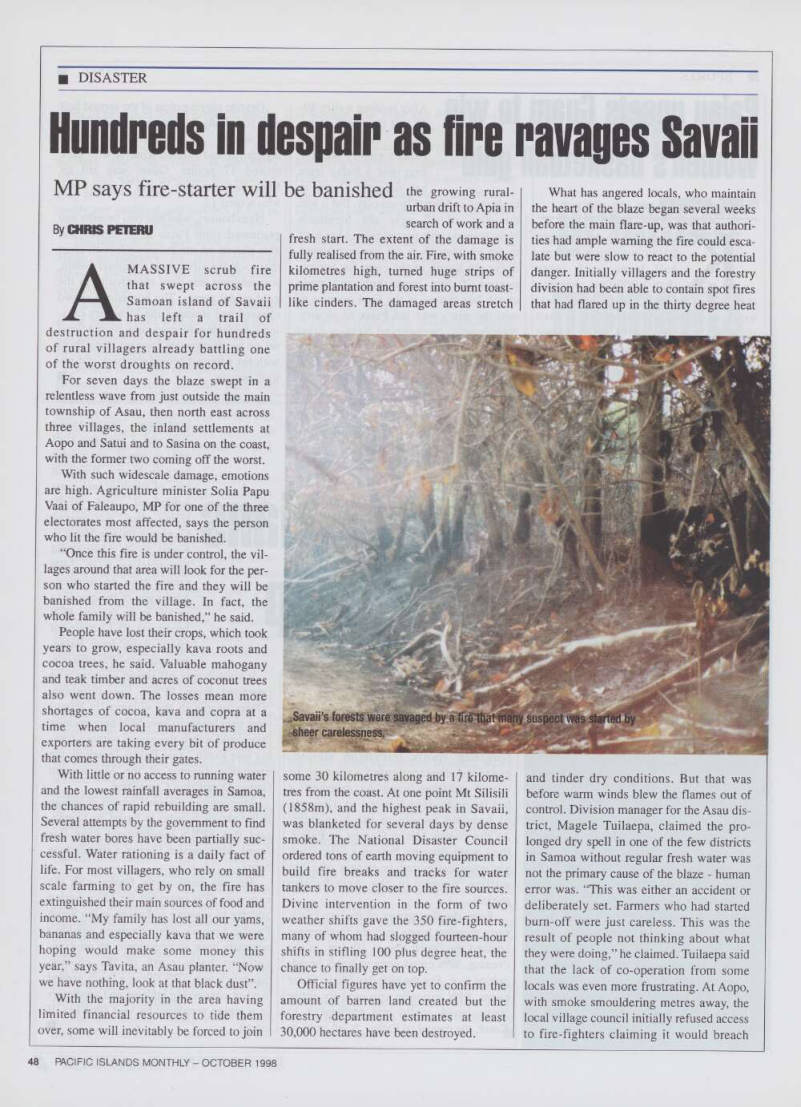
Disaster
MP says fire-starter will be banished
By Chris Peteru
A MASSIVE scrub fire that swept across the Samoan island of Savaii has left a trail of destruction and despair for hundreds of rural villagers already battling one of the worst droughts on record.
For seven days the blaze swept in a relentless wave from just outside the main township of Asau, then north east across three villages, the inland settlements at Aopo and Satui and to Sasina on the coast, with the former two coming off the worst.
With such widescale damage, emotions are high. Agriculture minister Solia Papu Vaai of Faleaupo, MP for one of the three electorates most affected, says the person who lit the fire would be banished.
“Once this fire is under control, the vil lages around that area will look for the per son who started the fire and they will be banished from the village. In fact, the whole family will be banished,” he said.
People have lost their crops, which took years to grow, especially kava roots and cocoa trees, he said. Valuable mahogany and teak timber and acres of coconut trees also went down. The losses mean more shortages of cocoa, kava and copra at a time when local manufacturers and exporters are taking every bit of produce that comes through their gates.
With little or no access to running water and the lowest rainfall averages in Samoa, the chances of rapid rebuilding are small.
Several attempts by the government to find fresh water bores have been partially suc cessful. Water rationing is a daily fact of life. For most villagers, who rely on small scale farming to get by on, the fire has extinguished their main sources of food and income. “My family has lost all our yams, bananas and especially kava that we were hoping would make some money this year,” says Tavita, an Asau planter. “Now we have nothing, look at that black dust”.
With the majority in the area having limited financial resources to tide them over, some will inevitably be forced to join
the growing rural urban drift to Apia in search of work and a
fresh start. The extent of the damage is fully realised from the air. Fire, with smoke
kilometres high, turned huge strips of
prime plantation and forest into burnt toast like cinders. The damaged areas stretch
some 30 kilometres along and 17 kilome tres from the coast. At one point Mt Silisili (1858 m), and the highest peak in Savaii, was blanketed for several days by dense smoke. The National Disaster Council ordered tons of earth moving equipment to build fire breaks and tracks for water tankers to move closer to the fire sources.
Divine intervention in the form of two weather shifts gave the 350 fire-fighters, many of whom had slogged fourteen-hour shifts in stifling 100 plus degree heat, the chance to finally get on top.
Official figures have yet to confirm the amount of barren land created but the forestry department estimates at least 30,000 hectares have been destroyed.
What has angered locals, who maintain the heart of the blaze began several weeks before the main flare-up, was that authori ties had ample warning the fire could esca late but were slow to react to the potential
danger. Initially villagers and the forestry
division had been able to contain spot fires that had flared up in the thirty degree heat
and tinder dry conditions. But that was before warm winds blew the flames out of control. Division manager for the Asau dis trict, Magele Tuilaepa, claimed the pro longed dry spell in one of the few districts in Samoa without regular fresh water was not the primary cause of the blaze - human error was. “This was either an accident or deliberately set. Farmers who had started burn-off were just careless. This was the result of people not thinking about what they were doing,” he claimed. Tuilaepa said that the lack of co-operation from some locals was even more frustrating. At Aopo, with smoke smouldering metres away, the local village council initially refused access to fire-fighters claiming it would breach
Savaii’s forests were savaged by a fire that many suspect was started by sheer carelessness.
customary land rights. The blaze also
highlighted some shortcomings with
emergency services. Besides fire fight ing equipment held at the forestry divi sion stores in Asau, Savaii has no full time fire brigade. This meant fire fight ers, volunteers, and vehicles from the capital had to make a high-speed 60 kilometre dash on the inter-island ferry, leaving the main urban centre unprotect ed.“We were up against that idea from the start. Fighting long range fires is a lot different to trying to put out a grocery store, and we (are) really short on expe rience in this type of situation,” said an exhausted volunteer. Logistics made the
job tougher. To safeguard the sparse
water supply, tanker trucks had to travel more than 10 kilometres to the sea for water, then head back along rough inland tracks - a round trip of two hours.
Before they arrived, a fleet of pick-up trucks with forty-four gallon containers shuttled back and forth. A huge shortage of hose reel meant almost anything able to carry water, from teapots to knapsack sprayers were pressed into service.
Environmentalist Peter Brown says the spread of the fire was encouraged by the slash-and-bum method of forest clearance for crops or logging by remov ing the canopy that allows for moisture on the forest floor. Deputy Prime minis ter Tuilaepa Malielegaoi says village councils should impose heavy fines on those who light uncontrolled fires during the dry season to clear ground for plant ing. Commander Falaula Manu, the head of the Apia fire service, has called for permanent full-time staff and facilities to be set up in Savaii. He pointed out that the forestry services had equipment to fight fires, but lacked the necessary expertise and personnel to get the job done, meaning thousands of dollars in overseas equipment left gathering cob webs.
“This is a problem, big fires are hap pening more and more often, but they don’t know how to use that equipment they have. It’s not their fault. I mean you don’t send a plumber to fix your car, do you?” The Savaii inferno recalled a huge fire in the same area in 1983 that took years to recover from. Whether there will be a comeback now is a question being considered by scores of families living in one of Samoa’s harshest environ ments. ■
to four churches in the Cooks

Rights
Freedom of religion restricted to four churches in the Cooks
By Florence Syme-Buchanan
y"OOK Islanders are sup m posed to have religious M freedoms, but a law restricting the number of religions in the country to just four Christian sects, contradicts that.
This law is just one of many in the island state that are archaic and quirky, and sometimes, plainly unconstitutional. The law is so strange in a democratic society the New Zealand law lecturers often use it an example of legislation that’s at odds with fundamental freedoms.
Only the Cook Islands Christian Church, a remnant of the London
Missionary Society, Roman Catholic
Church, Seventh Day Adventist Church and Church of Jesus Christ of Latter Day Saints are officially recognised here. Other religious organisations can’t be established here without the approval of the minister of justice, who can impose any conditions he wants.
Only these four religions can have pub lic meetings or worship, all others are sup posed to first have ministerial approval. If any church, hall, tent or building is built or used without ministerial approval, it can be closed down or demolished by the high court, states the 1975 law. A person can be fined up to $2OO for breaking the law.
The Religious Organisations
Restrictions Act was the work of the late premier, Albert Henry, who had the law enacted after the Jehovah’s Witnesses, Baha’i Faith and Assembly of God were introduced to the Cook Islands. A govern ment legal source says Henry wanted to “protect the Cook Islands people from too many religious sects.”
Despite Albert Henry’s intentions, these religious sects, are now well established in the Cooks. The Apostolic Church and Assembly of God are flourishing, attract ing members from the biggest Cook Islands Christian Church. The membership shift is becoming increasingly evident.
It’s probably because of the new style of worship with live bands, hand clapping and “contextualising the Christian mes
sage and making it contemporary so it’s relevant to people,” says AOG Pastor George Pitt.
“Church can be very boring,” says Pastor Pitt, a new breed of church leader who, on weekdays doubles up as general manager of Cook Islands Television.
The AOG and other newer sects were given the official okay to worship in the Cooks by former justice minister, Tupui Henry, son of Albert Henry.
Pitt says “at different times we’ve asked for the Act to include the Assembly of God,” but to date have not received a response from successive governments.
The AOG and other churches also want to be represented on the powerful Religious Advisory Council, whose mem bership is confined to the four recognised religions. But Pitt says no one seems cer tain who decides who can belong to the Council.
RAC Chairman Pastor Kevin Geelan says they have a membership application before them. The application is from the
Aog.
Pastor Geelan says the Act is a “sensi tive issue that needs to be taken slowly.”
The Religious Advisory Council is rep resented on just about every national organisation, including the National Development Council, a government appointed religious advisory body.
It also appears that a justice minister can revoke the registration of any practis ing religions, other than the big four, if he wants to. This has not happened. Yet.
Earlier this year. Justice Minister Tiki Matapo instructed Crown Law to come up with a policy that establishes criteria for RAC membership.
In 1994 Matapo introduced an amend ment to the Act that states all religions must take into consideration local prac tices and customs.
Justice Minister Tiki Matapo says that came about after an outer island aronga mana (minor chief), who belonged to the Baha’i Faith died in Rarotonga.
When the body was returned to neigh-
Continued On Page 51
bouring Mauke island, the aronga mana wished to conduct a Cook Islands Christian Church service, to recognise his status. But the family wanted a Baha’i service, which didn’t please the aronga mana.
If the man had died after 1994, by law, the aronga mana would have the right to insist on what service should be per formed, according to their local practice.
The family’s wishes, as Baha’is and a minority, could have been over-ruled.
Of the arrival of new religious sects in the country, Matapo says "you can’t stop it”.
He says there was an idea to restrict all forms of religions here to just Christianity.
"It’s too late for that sort of thinking, we are already invaded by all sorts over
here.” says Matapo.
“If a guy wants to worship a cow, that’s his right.” That freedom is clear in the Cook Islands constitution. But the 1975 Act is also clear in its restrictions and suc cessive governments have not bothered to correct the anomaly.
Recently the national spiritual assembly
of the Baha’i Faith formally appealed to Government to “add the country’s protest to that of the international community” over the execution and persecution of Baha’is in Iran. It’s unsure whether the small Baha’i community here, numbering 70 adults will get government to protest the persecution of a faith order is doesn’t offi cially recognise. Meanwhile, the restriction on religions contradicts the fundamental
human rights and freedoms of the Cooks enacted by Parliament less than a decade later in 1981. A local lawyer says “it’s sur prising the Act has not been repealed,” because religious restrictions are "uncon stitutional and interferes with a person’s freedoms”
Some years ago when a former minister got up at a United Nations meeting to prat tle on about human rights, he was rapped over the knuckles by the international organisation.
The UN felt it was inappropriate for the Cook Islands to be spouting off about human rights when it has a law that forbid ding more than four religions in the coun try and the right of people of other faiths to worship as they please. ■
Beyond Paint
and Feathers
Author: Eric Carmen Publisher: Ryan Publishing 1997
By Martha Waradin
BEYOND Paint and Feathers is not, as stated by the author in his pref ace, an academic work nor is it for the academic scholar searching for answers to satisfy their intellectual minds.
It is a book however, that is written in a simplistic or text book manner that anyone who has an appetite for curiosity about other people’s cultures, beliefs and tradi tions can easily digest.
Beyond Paint and Feathers is a collec tion of data gathered over a number of years in the 1980 s (1981-1986, 1989).
It is based on the beliefs and accounts of incidents that are an integral part of the lives of the people of the West Sepik Province of Papua New Guinea.
Professor Eric Carmen does not only attempt to narrate through this book the beliefs and practices of a particular group of people but has made clear distinctions between certain words and terms used to describe an incident or situation.
This has created an interesting, colour ful and sometimes bizarre picture of peo ple who though living the lifestyle of the 20th century, still very much practice what their forefathers did before them.
For instance, though words like sangu ma and posin (pidgin for poison) both refer generally to sorcery, one form differs from the other.
An act of sanguma is said to have taken place when the victim shows signs of phys ical assault set on him by the sanguma man.
The victim either dies immediately or after a few days. There are various versions I
of what actually takes place with sanguma.
In the West Sepik, they believe that either a poison arrow or sago palm needles are inserted into various parts
of the victim’s body causing agonising death.
Posin, the other form of sorcery, is claimed to have occurred when someone takes a piece of the victim’s personal item, like hair, cigarette butt, finger nails or left over of whatever the victim has eaten, and casts a spell on it. The victim dies through some type of magical process.
The belief in sorcery is such that the vil lagers often deny themselves the necessary western medication or proper hospital treatment to cure them of treatable illness es.
Often curable illnesses, such as diar rhoea or malaria, are ignored by people believing it is the work of some form of sorcery, witchcraft or the spirit world. This results in the villagers turning to village healers or contact with the spirit world to
help them.
Contact with the spirit world is sought when the healers believe that it is “sik bilong pies” (sick of the village).
This is believed to be caused by the spirit world and not by a human being through sorcery, posin or witchcraft. The illness is thought to come about because the victim must have done something wrong to upset the spirit world.
The spirits could be of a dead ancestor or a masalai. Masalais are spirits believed to inhabit forests, rivers or any forbidden place, but not worshipped.
When the reason for the illness is estab lished, peace offerings are made and par dons sought. ■
Advertisements & other items, p. 50 (2 items)
■ Book Review
SetfMtd Wafat md 'peatAena,
This recently published book by Professor Eric Carman is the result of his many years living and working in the West Sepik Province of Papua New Guinea.
He reveals the merciless realities of primitive life and uncovers the dark world where people live in terror of witchcraft and payback killings.
YOU WILL NOT BE ABLE TO PUT THIS BOOK DOWN SEND this COUPON or ORDER by PHONE/FAX/EMAIL to RYAN
PUBLISHING
24/20 Commercial Road (P O Box 7680) Melbourne, Victoria, 3004, Australia Tel: 61 3 9820 0988 Fax: 61 3 9866 5387 Email: [email protected] Or visit our website: www.ryanpub.com.au Rush me: “PacttZ eutd o pe&t4ien& by Eric Carman My cheque for U 5529.95 (inc. p&p) is enclosed or debit my credit card.
Payment: □ cheque, □ B'card, □ M'card, □ Visa, DAmex, □ Diners Name: Address: Country:
type Samoan
Computers
Teach your computer to type Samoan Or Hawaiian, Tongan, Fijian...
By Catherine Adler
THE military explorers
were the first Europeans to arrive in the Pacific, in their wake came mission aries and merchants. They also brought bits and pieces of the indus trial revolution: guns, of course, and access to the printing press. Later tinned foods, (developed as field rations for Napoleon’s army) and the typewriter (commercially available circa 1874) arrived as well.
The missionaries (especially the Protestants) were anxious to make the Bible available to local people. Thye learned local languages, with an emphasis on religious and ceremonial vocabulary, and depending on how acutely they could hear and the variety of English or German they spoke, recorded d’s or t’s and r’s or I’s. thus taro/talo/ dalo reflecting both the real differences among the Polynesian lan guages themselves and the fact that some Polynesian consonants are different from English ones. Island vowels are the lovely
liquid ones also found in the latin-derived romance languages of Europe: a, e, i, o, u; not the guttural grunts
heard in hat, het, hit, hot, hut. And Polynesian languages use so many vowels, to distinguish the long sound such as A a from a, aa, or a’a, the missionaries chose the macron, familiar to all English lan guage dictionary users as a pronunciation mark. As long as type was hand set using individual characters, adding A A A a A E A e and so on to the standard etaoin shrdlu typecase was no problem, (etaoin shrdlu is the frequency of letter use in English with e the most common letter). But the late 1800 s saw two inventions that worked against the sensible choice of the macron to characterise some of the Pacific vowels: the typewriter and the linotype.
The typewriter was the result of stick ing type to the ends of hammers (based on the scheme used for the piano) arranged in a semicircle so tha( each piece of type would impact in the same target spot shift ed one space at a time on a movable car riage. The familiar qwertyuiop typewriter keyboard is the result of spreading out the most frequently used letters - etaoin shrud lu - so the typewriter keys don’t jam
together in the middle so easily.
The fa’amamafa, easy to write by hand, became a bit more cumbersome to use. As long as island typewriting moved at island time, it was no problem to type a vowel and then backspace, shift lock for upper case, roll the paper down, and type an underline (a capital hypen) over the vowel, but 60wpm typists found it inconvenient to stop/start typing and went back to adding fa’amamafa in ink by hand while proof reading. then came the Linotype, a mini factory that cast molten metal as a com plete line to type based on entries from a “typewriter” keyboard. Island printers ordering direct from the manufacturer could easily include fa’amamafa vowels on their special machine, but many devices that end up on Pacific islands are second hand from some mainland. Fa’amamafa not included.
Next came the computer. The 256 chan racter ASCII character set was the original standard. This may sound like much more than enough but nearly 90 chracters are needed to represent the standard english typewriter keyboard including numbers and punctuation, also, computers were developed for military and scientific use so many more characters were assigned for mathematic and scientific symbols. With the standard characters for some other European languages added as well, there was no room in the basic ASCII character set for fa’amamafa vowels, even if anyone has thought of including them.
So the fa’amamafa, so sensible, so easy when first devised, became a victim of
improvements in technology. ■
The Great Shrimp Hunt
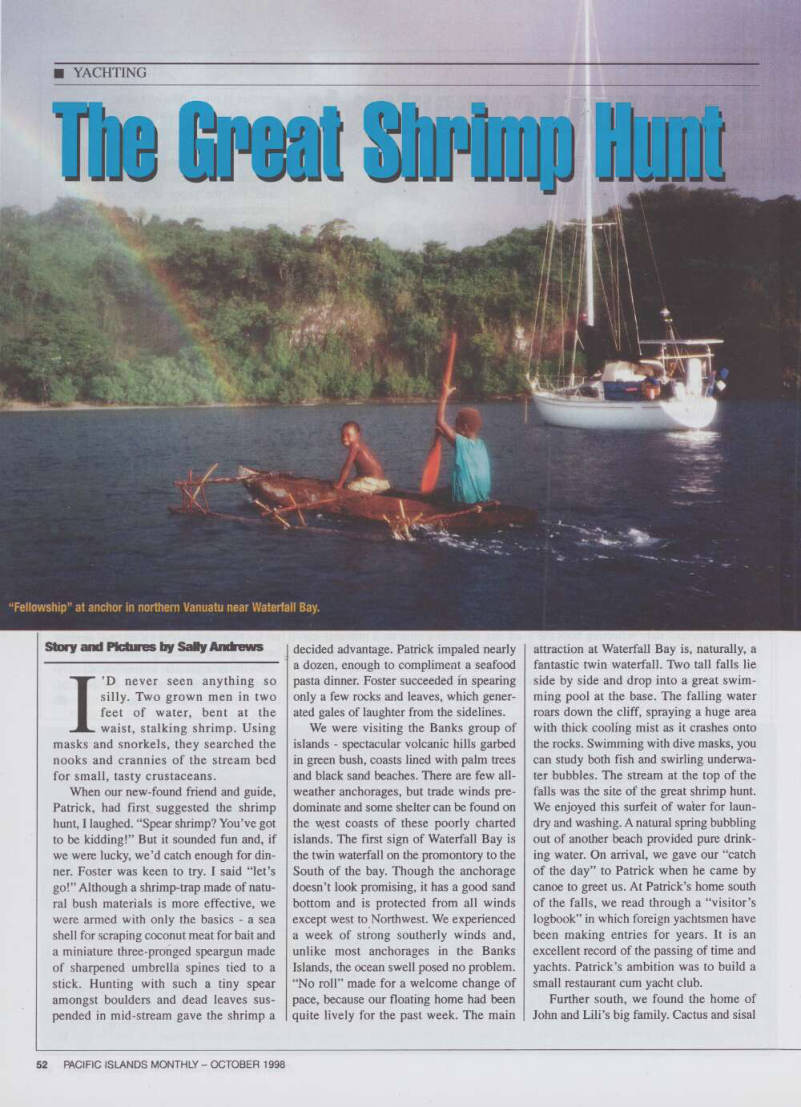
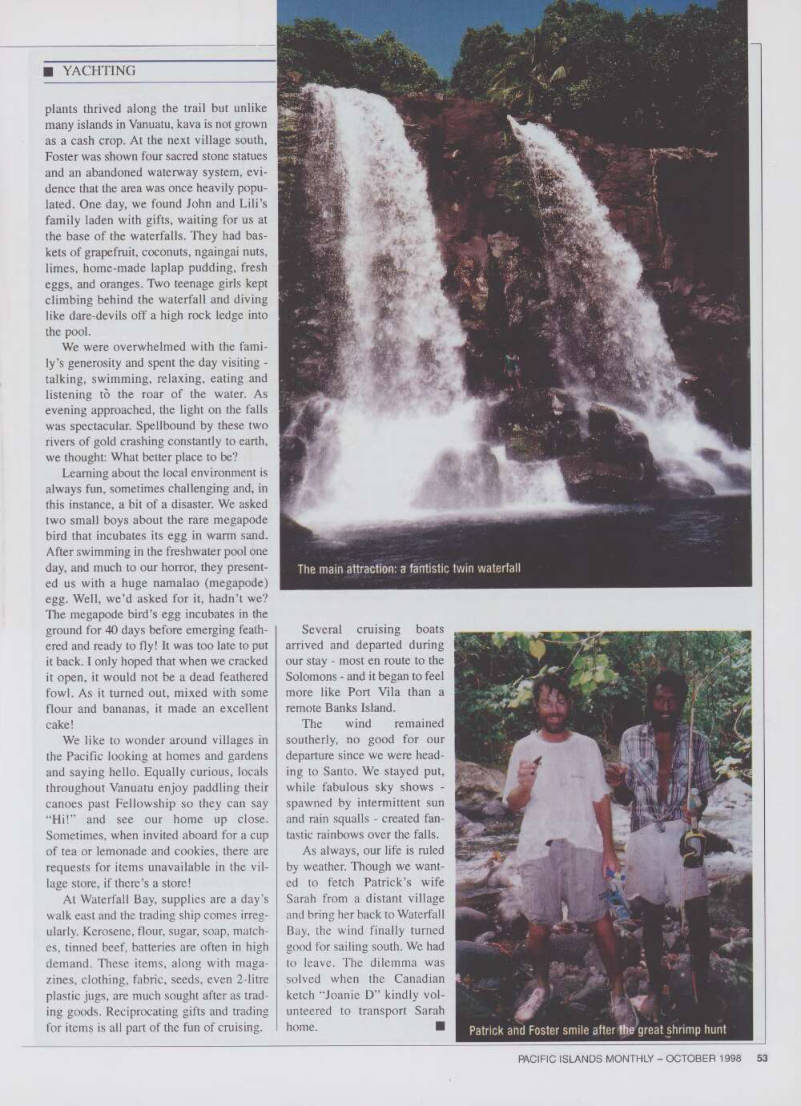
Yachting
Story and Pictures by Sally Andrews
I’D never seen anything so silly. Two grown men in two feet of water, bent at the
waist, stalking shrimp. Using
masks and snorkels, they searched the nooks and crannies of the stream bed for small, tasty crustaceans.
When our new-found friend and guide, Patrick, had first suggested the shrimp hunt, I laughed. “Spear shrimp? You’ve got to be kidding!” But it sounded fun and, if we were lucky, we’d catch enough for din ner. Foster was keen to try. I said “let’s go!” Although a shrimp-trap made of natu ral bush materials is more effective, we were armed with only the basics - a sea shell for scraping coconut meat for bait and a miniature three-pronged speargun made of sharpened umbrella spines tied to a stick. Hunting with such a tiny spear amongst boulders and dead leaves sus pended in mid-stream gave the shrimp a
decided advantage. Patrick impaled nearly a dozen, enough to compliment a seafood pasta dinner. Foster succeeded in spearing only a few rocks and leaves, which gener ated gales of laughter from the sidelines.
We were visiting the Banks group of islands - spectacular volcanic hills garbed in green bush, coasts lined with palm trees and black sand beaches. There are few all weather anchorages, but trade winds pre dominate and some shelter can be found on the \yest coasts of these poorly charted islands. The first sign of Waterfall Bay is the twin waterfall on the promontory to the South of the bay. Though the anchorage doesn’t look promising, it has a good sand bottom and is protected from all winds except west to Northwest. We experienced a week of strong southerly winds and, unlike most anchorages in the Banks Islands, the ocean swell posed no problem.
“No roll” made for a welcome change of pace, because our floating home had been quite lively for the past week. The main
attraction at Waterfall Bay is, naturally, a fantastic twin waterfall. Two tall falls lie side by side and drop into a great swim ming pool at the base. The falling water roars down the cliff, spraying a huge area with thick cooling mist as it crashes onto the rocks. Swimming with dive masks, you can study both fish and swirling underwa ter bubbles. The stream at the top of the falls was the site of the great shrimp hunt.
We enjoyed this surfeit of water for laun dry and washing. A natural spring bubbling out of another beach provided pure drink ing water. On arrival, we gave our “catch of the day” to Patrick when he came by canoe to greet us. At Patrick’s home south of the falls, we read through a “visitor’s logbook” in which foreign yachtsmen have been making entries for years. It is an excellent record of the passing of time and yachts. Patrick’s ambition was to build a small restaurant cum yacht club.
Further south, we found the home of John and Lili’s big family. Cactus and sisal
plants thrived along the trail but unlike many islands in Vanuatu, kava is not grown as a cash crop. At the next village south, Foster was shown four sacred stone statues and an abandoned waterway system, evi dence that the area was once heavily popu lated. One day, we found John and Lili’s family laden with gifts, waiting for us at the base of the waterfalls. They had bas kets of grapefruit, coconuts, ngaingai nuts, limes, home-made laplap pudding, fresh eggs, and oranges. Two teenage girls kept climbing behind the waterfall and diving like dare-devils off a high rock ledge into the pool.
We were overwhelmed with the fami ly’s generosity and spent the day visiting talking, swimming, relaxing, eating and listening to the roar of the water. As evening approached, the light on the falls was spectacular. Spellbound by these two rivers of gold crashing constantly to earth, we thought: What better place to be?
Learning about the local environment is always fun, sometimes challenging and, in this instance, a bit of a disaster. We asked two small boys about the rare megapode bird that incubates its egg in warm sand.
After swimming in the freshwater pool one day, and much to our horror, they present ed us with a huge namalao (megapode) egg. Well, we’d asked for it, hadn’t we?
The megapode bird’s egg incubates in the ground for 40 days before emerging feath ered and ready to fly! It was too late to put it back. I only hoped that when we cracked it open, it would not be a dead feathered fowl. As it turned out, mixed with some flour and bananas, it made an excellent cake!
We like to wonder around villages in the Pacific looking at homes and gardens and saying hello. Equally curious, locals throughout Vanuatu enjoy paddling their canoes past Fellowship so they can say “Hi!” and see our home up close.
Sometimes, when invited aboard for a cup of tea or lemonade and cookies, there are requests for items unavailable in the vil lage store, if there’s a store!
At Waterfall Bay, supplies are a day’s walk east and the trading ship comes irreg ularly. Kerosene, flour, sugar, soap, match es, tinned beef, batteries are often in high demand. These items, along with maga zines, clothing, fabric, seeds, even 2-litre plastic jugs, are much sought after as trad ing goods. Reciprocating gifts and trading for items is all part of the fun of cruising.
Several cruising boats arrived and departed during our stay - most en route to the Solomons - and it began to feel more like Port Vila than a remote Banks Island.
The wind remained southerly, no good for our departure since we were head ing to Santo. We stayed put, while fabulous sky shows spawned by intermittent sun and rain squalls - created fan tastic rainbows over the falls.
As always, our life is ruled by weather. Though we want ed to fetch Patrick’s wife Sarah from a distant village and bring her back to Waterfall Bay, the wind finally turned good for sailing south. We had to leave. The dilemma was solved when the Canadian ketch “Joanie D” kindly vol unteered to transport Sarah home. ■
The main attraction: a fantistic twin waterfall
Patrick and Foster smile after the great shrimp hunt
interest is ongoing
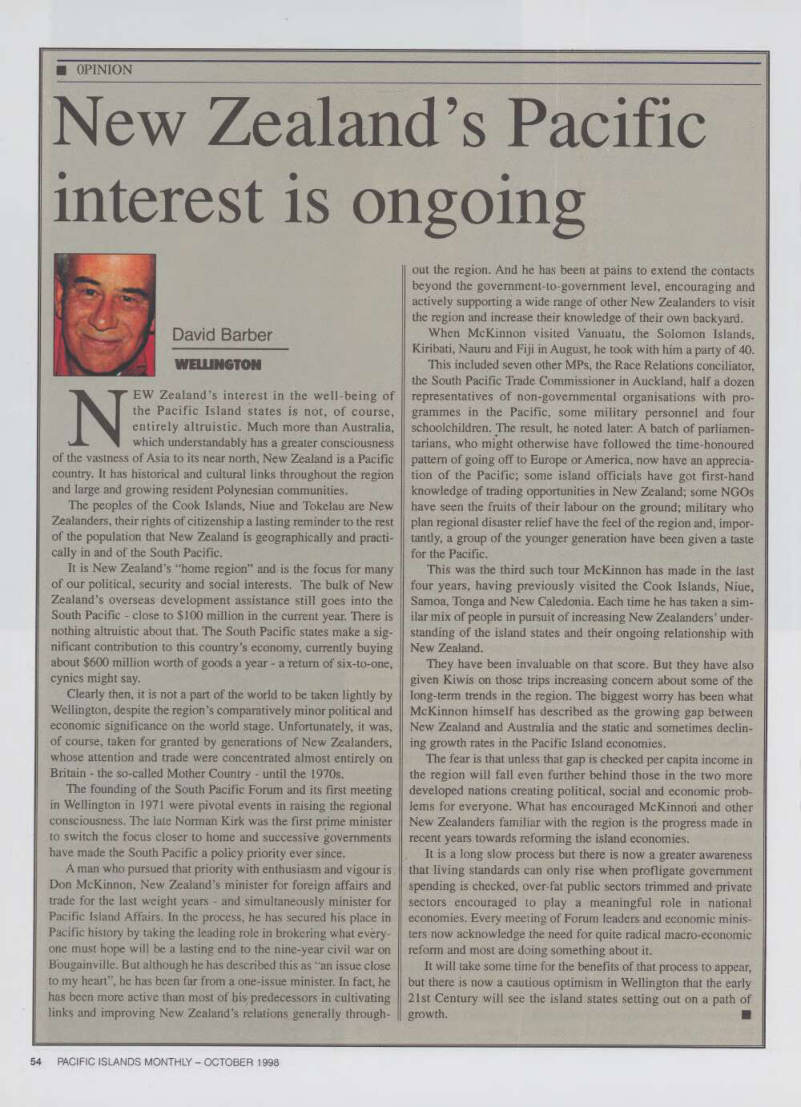
Opinion
New Zealand’s Pacific interest is ongoing
David Barber
Wellington
NEW Zealand’s interest in the well-being of the Pacific Island states is not, of course, entirely altruistic. Much more than Australia, which understandably has a greater consciousness of the vastness of Asia to its near north, New Zealand is a Pacific country. It has historical and cultural links throughout the region and large and growing resident Polynesian communities.
The peoples of the Cook Islands, Niue and Tokelau are New Zealanders, their rights of citizenship a lasting reminder to the rest of the population that New Zealand is geographically and practi cally in and of the South Pacific.
It is New Zealand’s “home region” and is the focus for many of our political, security and social interests. The bulk of New Zealand’s overseas development assistance still goes into the South Pacific - close to $lOO million in the current year. There is nothing altruistic about that. The South Pacific states make a sig nificant contribution to this country’s economy, currently buying about $6OO million worth of goods a year - a return of six-to-one, cynics might say.
Clearly then, it is not a part of the world to be taken lightly by Wellington, despite the region’s comparatively minor political and economic significance on the world stage. Unfortunately, it was, of course, taken for granted by generations of New Zealanders, whose attention and trade were concentrated almost entirely on Britain - the so-called Mother Country - until the 19705.
The founding of the South Pacific Forum and its first meeting in Wellington in 1971 were pivotal events in raising the regional consciousness. The late Norman Kirk was the first prime minister to switch the focus closer to home and successive governments have made the South Pacific a policy priority ever since.
A man who pursued that priority with enthusiasm and vigour is Don McKinnon, New Zealand’s minister for foreign affairs and trade for the last weight years - and simultaneously minister for Pacific Island Affairs. In the process, he has secured his place in Pacific history by taking the leading role in brokering what every one must hope will be a lasting end to the nine-year civil war on Bougainville. But although he has described this as "an issue close to my heart”, he has been far from a one-issue minister. In fact, he has been more active than most of his predecessors in cultivating links and improving New Zealand’s relations generally through
out the region. And he has been at pains to extend the contacts beyond the govemment-to-govemment level, encouraging and actively supporting a wide range of other New Zealanders to visit the region and increase their knowledge of their own backyard.
When McKinnon visited Vanuatu, the Solomon Islands, Kiribati, Nauru and Fiji in August, he took with him a party of 40.
This included seven other MPs, the Race Relations conciliator, the South Pacific Trade Commissioner in Auckland, half a dozen representatives of non-govemmental organisations with pro grammes in the Pacific, some military personnel and four schoolchildren. The result, he noted later: A batch of parliamen tarians, who might otherwise have followed the time-honoured pattern of going off to Europe or America, now have an apprecia tion of the Pacific; some island officials have got first-hand knowledge of trading opportunities in New Zealand; some NGOs have seen the fruits of their labour on the ground; military who plan regional disaster relief have the feel of the region and, impor tantly, a group of the younger generation have been given a taste for the Pacific.
This was the third such tour McKinnon has made in the last four years, having previously visited the Cook Islands, Niue, Samoa, Tonga and New Caledonia. Each time he has taken a sim ilar mix of people in pursuit of increasing New Zealanders’ under standing of the island states and their ongoing relationship with New Zealand.
They have been invaluable on that score. But they have also given Kiwis on those trips increasing concern about some of the long-term trends in the region. The biggest worry has been what McKinnon himself has described as the growing gap between New Zealand and Australia and the static and sometimes declin ing growth rates in the Pacific Island economies.
The fear is that unless that gap is checked per capita income in the region will fall even further behind those in the two more developed nations creating political, social and economic prob lems for everyone. What has encouraged McKinnon and other New Zealanders familiar with the region is the progress made in recent years towards reforming the island economies.
It is a long slow process but there is now a greater awareness that living standards can only rise when profligate government spending is checked, over-fat public sectors trimmed and private sectors encouraged to play a meaningful role in national economies. Every meeting of Forum leaders and economic minis ters now acknowledge the need for quite radical macro-economic reform and most are doing something about it.
It will take some time for the benefits of that process to appear, but there is now a cautious optimism in Wellington that the early 21st Century will see the island states setting out on a path of growth. ■
Log price crash a blessing
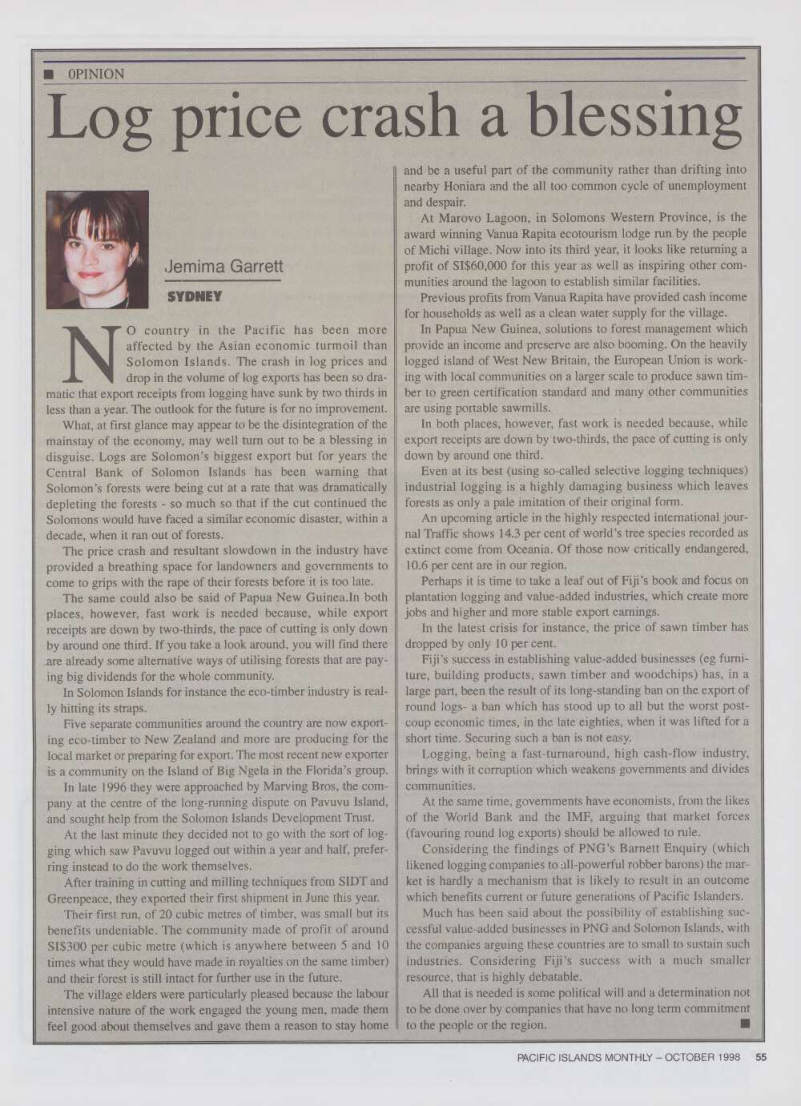
NO country in the Pacific has been more affected by the Asian economic turmoil than Solomon Islands. The crash in log prices and drop in the volume of log exports has been so dra matic that export receipts from logging have sunk by two thirds in less than a year. The outlook for the future is for no improvement.
What, at first glance may appear to be the disintegration of the mainstay of the economy, may well turn out to be a blessing in disguise. Logs are Solomon’s biggest export but for years the Central Bank of Solomon Islands has been warning that Solomon’s forests were being cut at a rate that was dramatically depleting the forests - so much so that if the cut continued the Solomons would have faced a similar economic disaster, within a decade, when it ran out of forests.
The price crash and resultant slowdown in the industry have provided a breathing space for landowners and governments to come to grips with the rape of their forests before it is too late.
The same could also be said of Papua New Guinea.ln both places, however, fast work is needed because, while export receipts are down by two-thirds, the pace of cutting is only down by around one third. If you take a look around, you will find there .are already some alternative ways of utilising forests that are pay ing big dividends for the whole community.
In Solomon Islands for instance the eco-timber industry is real ly hitting its straps.
Five separate communities around the country are now export ing eco-timber to New Zealand and more are producing for the local market or preparing for export. The most recent new exporter is a community on the Island of Big Ngela in the Florida’s group.
In late 1996 they were approached by Marving Bros, the com pany at the centre of the long-running dispute on Pavuvu Island, and sought help from the Solomon Islands Development Trust.
At the last minute they decided not to go with the sort of log ging which saw Pavuvu logged out within a year and half, prefer ring instead to do the work themselves.
After training in cutting and milling techniques from SIDT and Greenpeace, they exported their first shipment in June this year.
Their first run, of 20 cubic metres of timber, was small but its benefits undeniable. The community made of profit of around Sls3oo per cubic metre (which is anywhere between 5 and 10 times what they would have made in royalties on the same timber) and their forest is still intact for further use in the future.
The village elders were particularly pleased because the labour intensive nature of the work engaged the young men, made them feel good about themselves and gave them a reason to stay home
1 ■ ■■ In) J 1 ■■ »} ■ ■■ ' s' ■ . nr and despair.
M I dir- S.
I ■ ■ '■' ■ ' ! ing with local communities on a larger scale to produce sawn tim ■ id nany - ■ ti ies
are using portable sawmills.
In both places, however, fast work is needed because, while down by around one third. industrial logging is a highly damaging business which leaves forests as only a pale imitation of their original form.
An upcoming article in the highly respected international jour extinct come from Oceania. Of those now critically endangered, 10.6 per cent are in our region.
Perhaps it is time to take a leaf out of Fiji’s book and focus on plantation logging and value-added industries, which create more jobs and higher and more stable export earnings.
In the latest crisis for instance, the price of sawn timber has dropped by only 10 per cent.
Fiji’s success in establishing value-added businesses (eg furni ture, building products, sawn timber and woodchips) has, in a large part, been the result of its long-standing ban on the export of round logs- a ban which has stood up to all but the worst post coup economic times, in the late eighties, when it was lifted for a short time. Securing such a ban is not easy.
Logging, being a fast-turnaround, high cash-flow industry, brings with it corruption which weakens governments and divides communities.
At the same time, governments have economists, from the likes of the World Bank and the IMF, arguing that market forces (favouring round log exports) should be allowed to rule.
Considering the findings of PNG’s Barnett Enquiry (which likened logging companies to all-powerful robber barons) the mar ket is hardly a mechanism that is likely to result in an outcome which benefits current or future generations of Pacific Islanders.
Much has been said about the possibility of establishing suc cessful value-added businesses in PNG and Solomon Islands, with the companies arguing these countries are to small to sustain such industries. Considering Fiji’s success with a much smaller resource, that is highly debatable.
Ml that is iceded is some olilics 1 will an - a detem inal >r c to be done over by companies that have no long term commitment to the people or the region. ■
Jemima Garrett
Sydney
Advertisements & other items, p. 56 (2 items)
dfdfdfdfdfdfdfd
■ DEVELOPMENTS
c/ffjSS
PACIFIC ISLANDS
TRADING CAN WORK WONDERS FOR YOU
Promote your business, or service, sell your household iterms, cars or heavy machinery ect. mm Law Staff (NZ) Limited . Superb Opportunity awaits you in the Kingdom Of Tonga Law Staff (NZ) Limited is proud to recruit for Attorneys & Accountants Legal, part of a professional accounting and legal services company in Tonga.
Our client requires an experienced lawyer for equity participation in its Nuku'a lofa based office. To be successful you must have: . Ten years advocacy plus commercial experience . The ability to mentor newly qualified solicitors Management Skills and a willingness to develop the accounting and business advisory side of the company . A desire and an ability to live and work in Tonga For further information in the strictest of confidence please phone Bridgette Mckean LLB or Kate Billing at Law Staff (NZ)Limited on (09)3.771236 or facsimile (09)3771040, email [email protected]. or send a curriculum vitae to level 16, Brookfields House,l9 Victoria Street, Auckland, New Zealand.
c/ffjSS
AUSTRALIAN INTERNATIONAL SHIPPING SERVICES PTY LTD
Providing Container Consolidated Services, Full Container Loads, Airfrieght Forwarding and Purchase Order Tracking Services to:- American Samoa, Cook Islands, Fiji, Guam, Kiribati, New Zealand, Niue, Norfolk Island, New Caledonia, Nauru, Papua New Guinea, Solomon Islands, Tahiti, The Federated States of Micronesia, Tonga, Vanuatu, and Western Samoa.
Offices in Melbourne and Sydney
TEL:- 61-3-93351477 FAX:-61-3-93380115 EMAIL:-A-I-S-S.COM
Carpenters Shipping
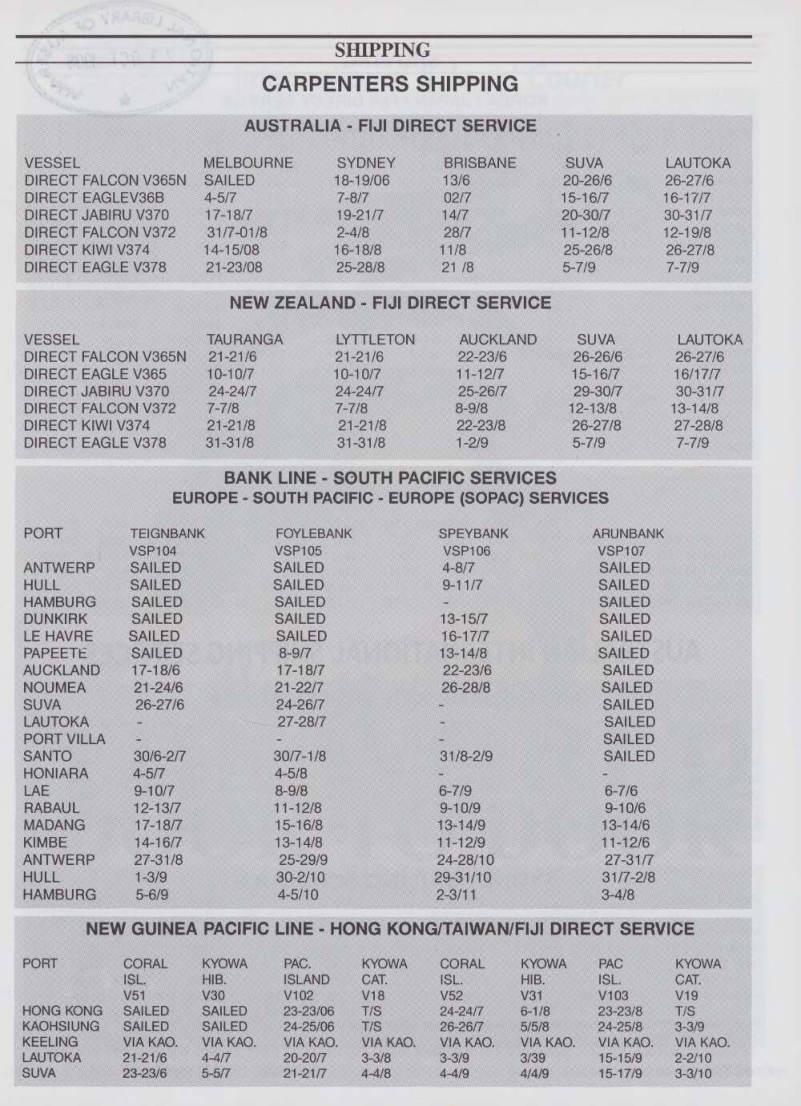
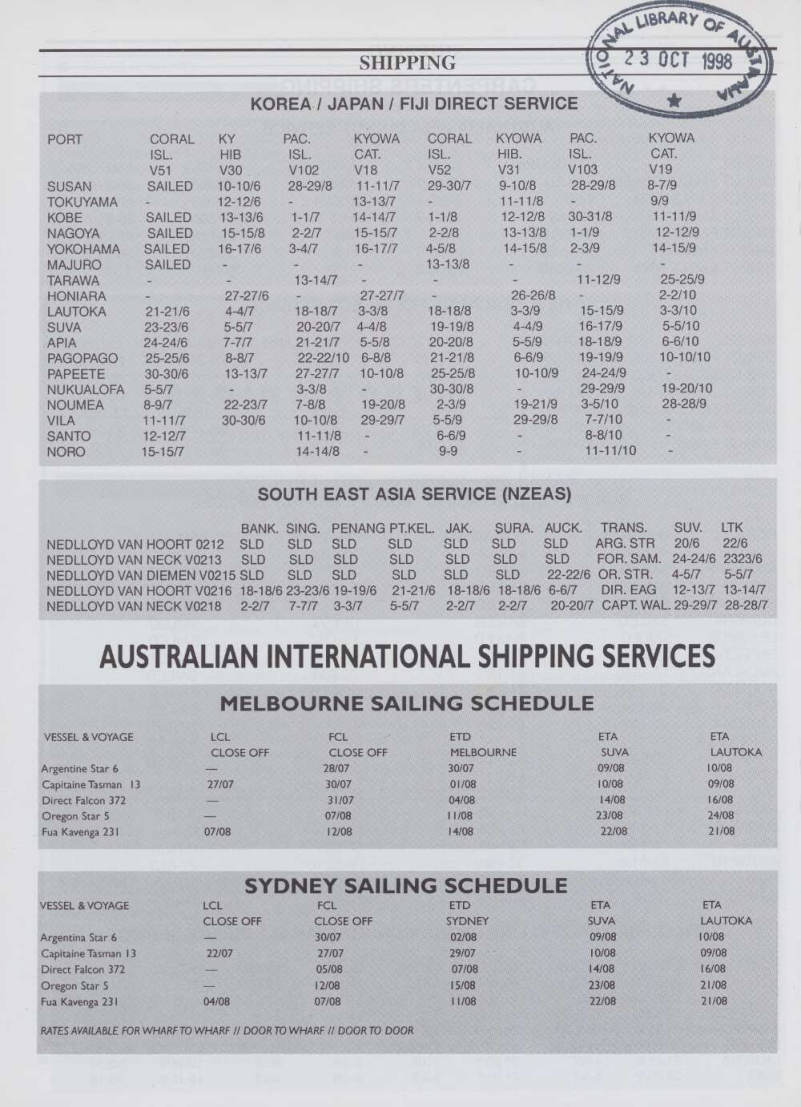
Shipping
Australia - Fiji Direct Service
New Zealand - Fiji Direct Service
Bank Line - South Pacific Services
EUROPE - SOUTH PACIFIC - EUROPE (SOPAC) SERVICES
NEW GUINEA PACIFIC LINE - HONG KONG/TAIWAN/FIJI DIRECT SERVICE
Vessel
Melbourne
Sydney
Brisbane
Suva
Lautoka
Direct Falcon V365N
Sailed
18-19/06 13/6 20-26/6 26-27/6
Direct Eaglev36B
4-5/7 7-8/7 02/7 15-16/7 16-17/7
Direct Jabiru V370
17-18/7 19-21/7 14/7 20-30/7 30-31/7
Direct Falcon V372
31/7-01/8 2-4/8 28/7 11-12/8 12-19/8
Direct Kiwi V374
14-15/08 16-18/8 11/8 25-26/8 26-27/8
Direct Eagle V378
21-23/08 25-28/8 21 /8 5-7/9 7-7/9
Vessel
Tauranga
Lyttleton
Auckland
Suva
Lautoka
Direct Falcon V365N
21-21/6 21-21/6 22-23/6 26-26/6 26-27/6
Direct Eagle V365
10-10/7 10-10/7 11-12/7 15-16/7 16/17/7
Direct Jabiru V370
24-24/7 24-24/7 25-26/7 29-30/7 30-31/7
Direct Falcon V372
7-7/8 7-7/8 8-9/8 12-13/8 13-14/8
Direct Kiwi V374
21-21/8 21-21/8 22-23/8 26-27/8 27-28/8
Direct Eagle V378
31-31/8 31-31/8 1-2/9 5-7/9 7-7/9
Port
Teignbank
Foylebank
Speybank
Arunbank
Vsp104
Vsp105
Vsp106
Vsp107
Antwerp
Sailed
Sailed
4-8/7
Sailed
Hull
Sailed
Sailed
9-11/7
Sailed
Hamburg
Sailed
Sailed
Sailed
Dunkirk
Sailed
Sailed
13-15/7
Sailed
Le Havre
Sailed
Sailed
16-17/7
Sailed
Papeete
Sailed
8-9/7 13-14/8
Sailed
Auckland
17-18/6 17-18/7 22-23/6
Sailed
Noumea
21-24/6 21-22/7 26-28/8
Sailed
Suva
26-27/6 24-26/7 -
Sailed
Lautoka
- 27-28/7 -
Sailed
Port Villa
Sailed
Santo
30/6-2/7 30/7-1/8 31/8-2/9
Sailed
Honiara
4-5/7 4-5/8 - -
Lae
9-10/7 8-9/8 6-7/9 6-7/6
Rabaul
12-13/7 11-12/8 9-10/9 9-10/6
Madang
17-18/7 15-16/8 13-14/9 13-14/6
Kimbe
14-16/7 13-14/8 11-12/9 11-12/6
Antwerp
27-31/8 25-29/9 24-28/10 27-31/7
Hull
1-3/9 30-2/10 29-31/10 31/7-2/8
Hamburg
5-6/9 4-5/10 2-3/11 3-4/8
Port
Coral
Kyowa
Pac.
Kyowa
Coral
Kyowa
Pac
Kyowa
Isl
Hib.
Island
Cat.
Isl.
Hib.
Isl
Cat.
V51 V30 VI02 V18 V52 V31 V103 V19
Hong Kong
Sailed
Sailed
23-23/06 T/S 24-24/7 6-1/8 23-23/8 T/S
Kaohsiung
Sailed
Sailed
24-25/06 T/S 26-26/7 5/5/8 24-25/8 3-3/9
Keeling
Via Kao.
Via Kao.
Via Kao.
Via Kao.
Via Kao.
Via Kao.
Via Kao.
Via Kao.
Lautoka
21-21/6 4-4/7 20-20/7 3-3/8 3-3/9 3/39 15-15/9 2-2/10
Suva
23-23/6 5-5/7 21-21/7 4-4/8 4-4/9 4/4/9 15-17/9 3-3/10
KOREA / JAPAN I FIJI DIRECT SERVICE
South East Asia Service (Nzeas)
Australian International Shipping Services
Melbourne Sailing Schedule
Sydney Sailing Schedule
Port
Coral
KY
Pac.
Kyowa
Coral
Kyowa
Pac.
Kyowa
Isl
Hib
Isl
Cat.
Isl
Hib.
Isl.
Cat.
V51 V30 V102 V18 V52 V31 VI03 V19
Susan
Sailed
10-10/6 28-29/8 11-11/7 29-30/7 9-10/8 28-29/8 8-7/9
Tokuyama
- 12-12/6 - 13-13/7 - 11-11/8 - 9/9
Kobe
Sailed
13-13/6 1-1/7 14-14/7 1-1/8 12-12/8 30-31/8 11-11/9
Nagoya
Sailed
15-15/8 2-2/7 15-15/7 2-2/8 13-13/8 1-1/9 12-12/9
Yokohama
Sailed
16-17/6 3-4/7 16-17/7 4-5/8 14-15/8 2-3/9 14-15/9
Majuro
Sailed
- - - 13-13/8 - - -
Tarawa
- - 13-14/7 - - - 11-12/9 25-25/9
Honiara
- 27-27/6 - 27-27/7 - 26-26/8 - 2-2/10
Lautoka
21-21/6 4-4/7 18-18/7 3-3/8 18-18/8 3-3/9 15-15/9 3-3/10
Suva
23-23/6 5-5/7 20-20/7 4-4/8 19-19/8 4-4/9 16-17/9 5-5/10
Apia
24-24/6 7-7/7 21-21/7 5-5/8 20-20/8 5-5/9 18-18/9 6-6/10
Pago Pago
25-25/6 8-8/7 22-22/10 6-8/8 21-21/8 6-6/9 19-19/9 10-10/10
Papeete
30-30/6 13-13/7 27-27/7 10-10/8 25-25/8 10-10/9 24-24/9 -
Nukualofa
5-5/7 - 3-3/8 - 30-30/8 - 29-29/9 19-20/10
Noumea
8-9/7 22-23/7 7-8/8 19-20/8 2-3/9 19-21/9 3-5/10 28-28/9
Vila
11-11/7 30-30/6 10-10/8 29-29/7 5-5/9 29-29/8 7-7/10 -
Santo
12-12/7 11-11/8 - 6-6/9 - 8-8/10 -
Noro
15-15/7 14-14/8 - 9-9 - 11-11/10 -
Bank.
Sing.
Penang Pt.Kel.
Jak.
Sura.
Auck.
Trans.
Suv.
Ltk
Nedlloyd Van Hoort 0212
Sld
Sld
Sld
Sld
Sld
Sld
Sld
Arg. Str
20/6 22/6
Nedlloyd Van Neck V0213
Sld
Sld
Sld
Sld
Sld
Sld
Sld
For. Sam.
24-24/6 2323/6
Nedlloyd Van Diemen V0215 Sld
Sld
Sld
Sld
Sld
Sld
22-22/6
Or. Str.
4-5/7 5-5/7
Nedlloyd Van Hoort V0216
18-18/6 23-23/6 19-19/6 21-21/6 18-18/6 18-18/6 6-6/7
Dir. Eag
12-13/7 13-14/7
Nedlloyd Van Neck V0218
2-2/7 7-7/7 3-3/7 5-5/7 2-2/7 2-2/7 20-20/7
Capt. Wal. 29-29/7
28-28/7
Vessel & Voyage
Lcl
Fcl
Etd
Eta
Eta
Close Off
Close Off
Melbourne
Suva
Lautoka
Argentine Star 6 — 28/07 30/07 09/08 10/08
Capitaine Tasman 13
27/07 30/07 01/08 10/08 09/08 Direct Falcon 372 — 31/07 04/08 14/08 16/08 Oregon Star 5 — 07/08 11/08 23/08 24/08
Fua Kavenga 231
07/08 12/08 14/08 22/08 21/08
Vessel & Voyage
Lcl
Fcl
Etd
Eta
Eta
Close Off
Close Off
Sydney
Suva
Lautoka
Argentina Star 6 — 30/07 02/08 09/08 10/08 Capitaine Tasman 13 22/07 27/07 29/07 10/08 09/08 Direct Falcon 372 05/08 07/08 14/08 16/08 Oregon Star 5 12/08 15/08 23/08 21/08
Fua Kavenga 23 i
04/08 07/08 11/08 22/08 21/08 RATES AVAILABLE FOR WHARF TO WHARF // DOOR TO WHARF II DOOR TO DOOR
Advertisements & other items, pp. 58-60 (2 items)
Shipping
Or To Door
International & Local Courier
Fiji’s own courier company goes further than Fiji n? 3 1508 00649398 0 I* v \^r \ 0^ trhf
For all your: Courier needs ' Heavyweights Your choice of domestic messenger courier needs - / IHour / 3 Hour / Same day International & Local Courier SUVA: 218 388, 218 304 or TOLL FREE 0800 307 304 NADI AIRPORT: 724 434 NADI: 700 001 LAUTOKA: 665 161 LABASA: 816 022 SAVUSAVU: 850 001 SIGATOKA: 500 321 or simply call your nearest post office and ask for £Af£Service
Some of the specs may vary according to market specifications.
Looks tough, feels comfortable - Toyota Hilux People all over the world prefer Toyota. Because it makes bestsellers like Hilux. It maintains that rugged reputation, and now it sports tough, durable body styles as well. It's ready for any terrain.
Hilux offers more. More power - with a choice of engines and precision transmissions and transfers. More effective power distribution to match the terrain, thanks to Toyota's advanced
technology.
And more passenger car-like comfort. With an ergonomic interior, all the conveniences you want, the fit and finish you'd expect from Toyota, and a ride that's smoothed out by precision-
engineered suspension.
Hilux is built to take it. And to take you anywhere you want to go.
It's remarkably tough. And incredibly comfortable. With worldleading uncompromising quality. From the champion. Toyota.
®TOYOTA
DISTRIBUTORS/DEALERS
NORFOLK ISLAND BORRY’SPTYLTD. PH 22114
SOLOMON ISLANDS ELA MOTORS PH 30314
VANUATU ASCO MOTORS PH 22341
COOK ISLANDS PACIFIC MOTORS LTD, PH 20796
KIRIBATI TARAWA MOTORS PH 21090
PAPUA NEW GUINEA ELA MOTORS PH 3229400
TAHITI NIPPON AUTOMOTO PH 429819
WESTERN SAMOA ASCO MOTORS PH 20800
FIJI ASCO MOTORS PH 384888
NEW CALEDONIA S.I.A.P. PH 275562
TONGA i „„„ASCO MOTORS , PH 23500
AMERICAN SAMOA ASCO MOTORS* PH 633-4281
(*HILUX is not being handled.)