CT[>ij tii
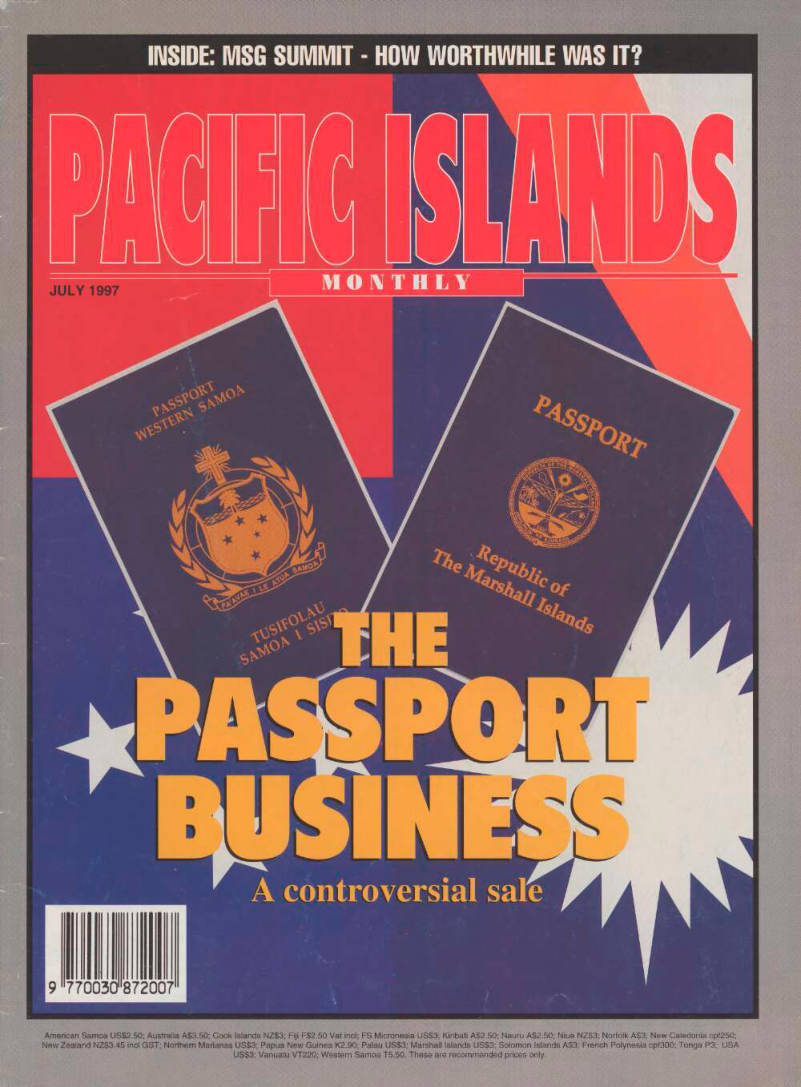
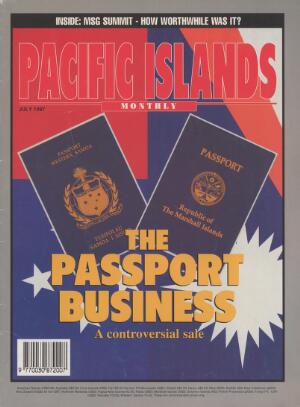
Pacific Islands
Monthly
INSIDE: MSG SUMMIT - HOW WORTHWHILE WAS IT?
July 1997
HHyj3HV •J i |T 8 1 */I ■ rf!r rJ AN i I CT[>ij tii
KwjmnHnTvremtlSnfti
American Samoa US$2.5O; Australia A 53.50; Cook Islands NZ$3; Fiji F 52.50 Vat incl; FS Micronesia US$3; Kiribati A 52.50; Nauru A 52.50; Niue NZ$3; Norfolk As 3; New Caledonia cpf2so; New Zealand NZ53.45 incl GST; Northern Marianas US$3; Papua New Guinea K 2.90; Palau US$3; Marshall Islands US$3; Solomon Islands As 3; French Polynesia cpf3oo; Tonga P 3; USA US$3; Vanuatu VT22O; Western Samoa T 5.50. These are recommended prices only.
Advertisements & other items, pp. 2-3 (1 item)
{L|}| Telikom
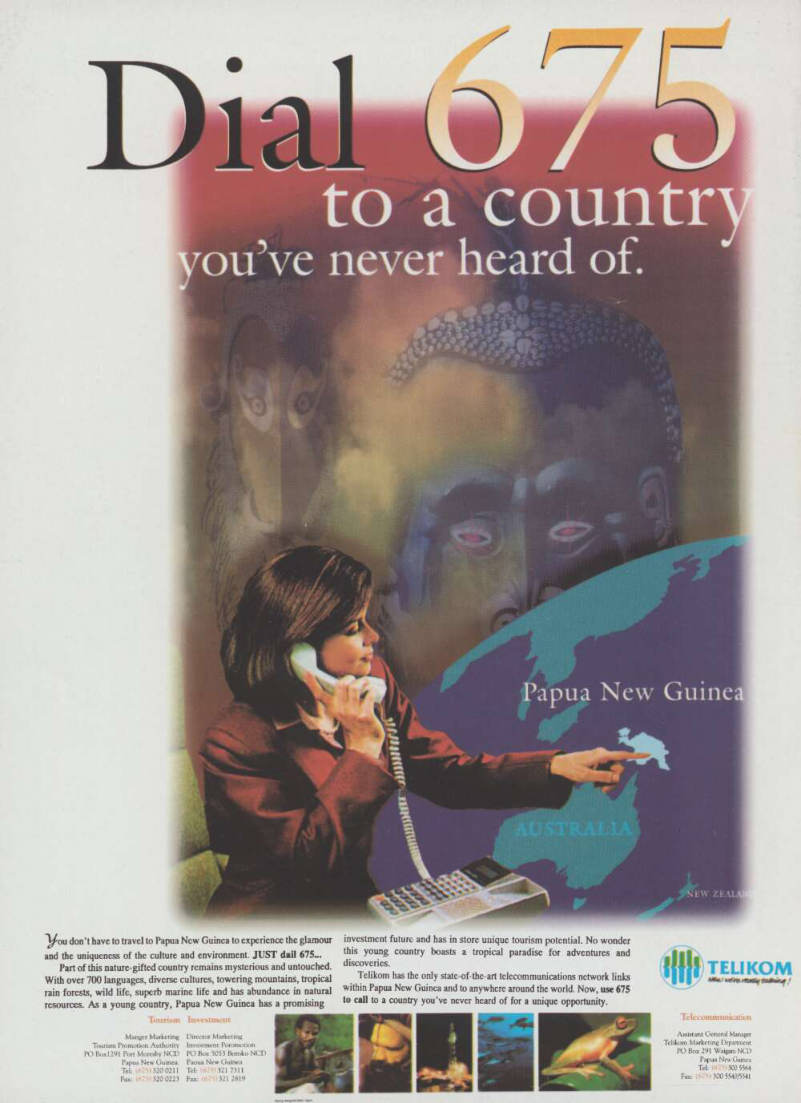
don’t have to travel to Papua New Guinea to experience the glamour and the uniqueness of the culture and environment. JUST dail 675- Part of this nature-gifted country remains mysterious and untouched.
With over 700 languages, diverse cultures, towering mountains, tropical rain forests, wild life, superb marine life and has abundance in natural resources. As a young country, Papua New Guinea has a promising Tourism Investment Manger Marketing Director Marketing Tourism Promotion Authority Investment Poromotion PO Box 1291 Port Moresby NCD PO Box 5053 Boroko NCD Papua New Guinea. Paoua New Guinea Tel: 0 Fax: investment future and has in store unique tourism potential. No wonder this young country boasts a tropical paradise for adventures and discoveries.
Telikom has the only state-of-the-art telecommunications network links within Papua New Guinea and to anywhere around the world. Now, use 675 to call to a country you’ve never heard of for a unique opportunity. 3200211 Tel: (675)321 7311 '3200223 Fax; (67-1321 2819
{l|}| TELIKOM
|l| *** **ne.*m*m**nii f Telecommunication Assistant General Manager Telikom Marketing Department PO Box 291 Waigani NCD Papua New Guinea Tel: (675)300 5564 Fax: (675) 300 5540/5541
Island Distributors
Wanted For
Island Soda
-oot'
urn V? ! i M" *'» ...
Si?
Island Pineapple Island Orange Island Dew Island Cola Tropical Soda Grape Lemon-Lime Strawberry Lei or full container shipments available.
For information on our competitively priced line of quality beverages, fax, phone or write us at: US Mainland: Aspen International, Inc, 1402-3rd Avenue, Suite 1024 Seattle, Washington 98101 Phone (206) 628-6151 Fax (206) 628-6421 Tahiti Distributor: Eico P.O. Box 184 Papeete - Tahiti Phone 421 660 Fax 429 838
ISLAND
SODA
Product of U.S.A. Island Soda is a registered trademark
Pacific Islands
Monthly
Vol 67 No. 07
The News Magazine
July 1991
PUBLISHER: Alan Robinson EDITOR: Manivannan Naidu SENIOR WRITER: Bernadette Hussein
Correspondents:
Sally Andrew, Patrick Decloitre, Giff Johnson, Chris Peteru, Susan Prokop, Atama Raganivatu, Kalinga Seneviratne, Liz Thompson, Lili Tuwai, Sam Vulum, lan Williams COLUMNISTS: David Barber (Wellington), Jemima Garrett (Sydney), Debbie Singh (South Pacific Commission).
GRAPHIC ARTISTS: James Ranuku, Josefa Bola, Andrew Williams
Advertising Sales
Senior Regional Sales (South Pacific) Shabana Naaz Satish Kumar Tel (679)304111,303244, Fax (679) 303809.
Sydney, Canberra: Bob Hill Media Representation, Tel (61-2) 4164245, Fax (61-2)4165064.
Brisbane: Jane Fewings Media and Advertising Associates Tel (61-7) 3378 4522, Fax (61-7) 3878 1071.
Adelaide: Hastwell Williamsons Representatives, Tel (61-8) 3799522, Fax (61-8) 3799735.
Melbourne: Brown Orr Fletcher Burrows (Aust) Pty Ltd.
Tel (61-3) 98265188, Fax (61-3) 98265644.
Auckland: McKay & Bowman, International Media Representatives Limited, Tel (64-9)4190561, Fax (64-9)4192243.
Japan: Universal Media Corporation, Tokyo, Tel (3) 3266626741, Cable: UNI-MEDIA Tokyo, Fax (3) 32626742.
Pacific Islands Monthly was founded in 1930
(Usps 9522480).
A Fiji Times Limited production.
Cover prices are recommended retail only. Registered by Australia Post, Publication No. NBPI2IO. © Copyright Fiji Times Limited, 177 Victoria Parade, Suva, Fiji.
Tel (679) 304111, fax (679) 303809.
Pacific Islands Monthly is published monthly by Fiji Times Limited, a division of Nationwide News, 2 Holt Street, Surry Hills, Sydney, NSW 2010.
Send Address Changes To:
Pacific Islands Monthly POBox 1167 Suva, Fiji.
Typeset and printed by The Fiji Times Limited, 177 Victoria Parade, Suva. Fiji.
Layout and cover design by James Ranuku
Inside
Cover Story: The passport business
Editorial 5 Briefs 6 Letters to the Editor 8 Special Report: United we stand 12 MSG Summit - How worthwhile was it?
Cover stories: The passport business 15 A controversial sale Ministers tackle economy 19 Fair wages and human rights for Marianas workers .. 20 Interview: War and peace 23 We are not anti-US, says Marshalls 24 Racism at play 27 Solomon Islands Feature 28 Vanuatu Feature 50 Post Fiji Feature 41 Heartening times for Pacific soccer 46 Initiation tradition 48 Miriam scales the heights 50 The power of words 51 From poverty to plenty 54 Howard's end 56 From colony to republic 57 An important 50 years 58
Page 12
Interview with John Momis
Page 23
Page 48
Action, not
Editorial
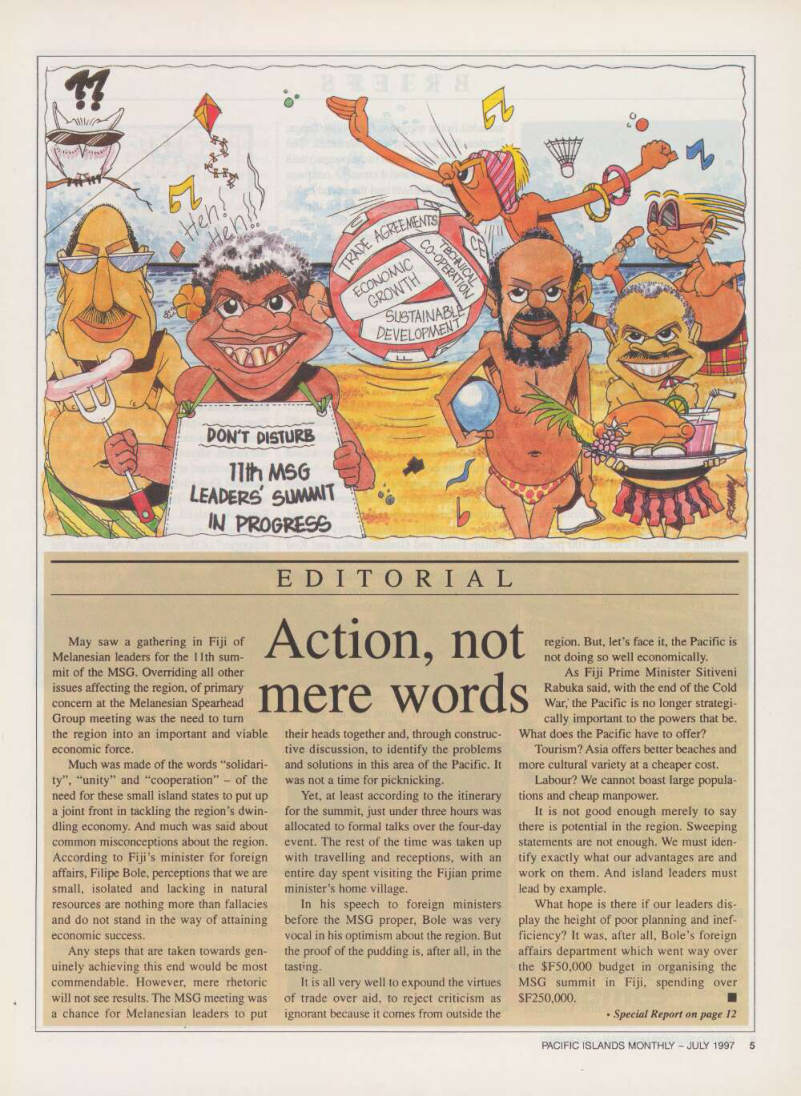
Action, not mere words
May saw a gathering in Fiji of Melanesian leaders for the 11th sum mit of the MSG. Overriding all other
issues affecting the region, of primary
concern at the Melanesian Spearhead Group meeting was the need to turn
the region into an important and viable economic force.
Much was made of the words “solidari ty”, “unity” and “cooperation” - of the need for these small island states to put up a joint front in tackling the region’s dwin dling economy. And much was said about common misconceptions about the region.
According to Fiji’s minister for foreign
affairs, Filipe Bole, perceptions that we are small, isolated and lacking in natural resources are nothing more than fallacies and do not stand in the way of attaining economic success.
Any steps that are taken towards gen uinely achieving this end would be most commendable. However, mere rhetoric will not see results. The MSG meeting was a chance for Melanesian leaders to put
their heads together and, through construc tive discussion, to identify the problems and solutions in this area of the Pacific. It was not a time for picknicking.
Yet, at least according to the itinerary for the summit, just under three hours was allocated to formal talks over the four-day event. The rest of the time was taken up with travelling and receptions, with an entire day spent visiting the Fijian prime minister’s home village.
In his speech to foreign ministers before the MSG proper, Bole was very vocal in his optimism about the region. But the proof of the pudding is, after all, in the tastmg.
It is all very well to expound the virtues of trade over aid, to reject criticism as ignorant because it comes from outside the
region. But, let’s face it, the Pacific is not doing so well economically.
As Fiji Prime Minister Sitiveni Rabuka said, with the end of the Cold War,' the Pacific is no longer strategi cally important to the powers that be.
What does the Pacific have to offer?
Tourism? Asia offers better beaches and more cultural variety at a cheaper cost.
Labour? We cannot boast large popula tions and cheap manpower.
It is not good enough merely to say there is potential in the region. Sweeping statements are not enough. We must iden tify exactly what our advantages are and work on them. And island leaders must
lead by example.
What hope is there if our leaders dis play the height of poor planning and inef ficiency? It was, after all, Bole’s foreign affairs department which went way over the $F50,000 budget in organising the MSG summit in Fiji, spending over $F250,000. ■
• Special Report on page 12
Briefs
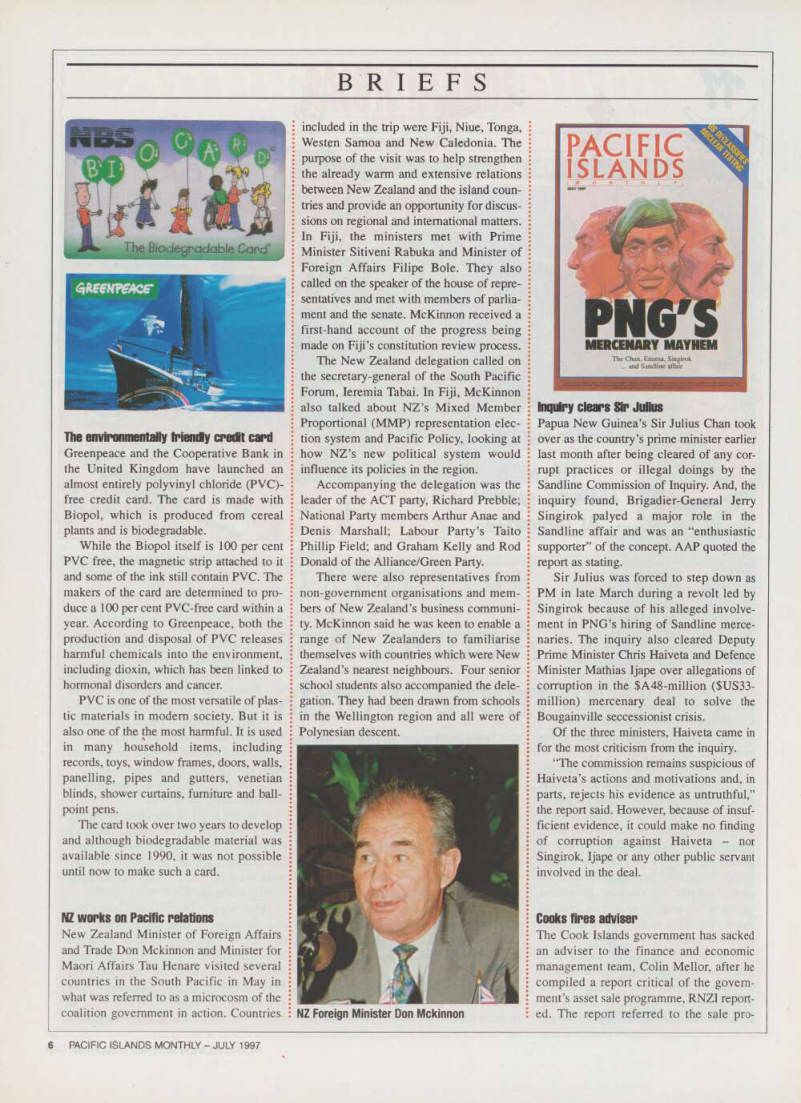
Die environmentally friendly credft card Greenpeace and the Cooperative Bank in the United Kingdom have launched an almost entirely polyvinyl chloride (PVC)free credit card. The card is made with Biopol, which is produced from cereal plants and is biodegradable.
While the Biopol itself is 100 per cent PVC free, the magnetic strip attached to it and some of the ink still contain PVC. The makers of the card are determined to pro duce a 100 per cent PVC-free card within a year. According to Greenpeace, both the production and disposal of PVC releases harmful chemicals into the environment, including dioxin, which has been linked to hormonal disorders and cancer.
PVC is one of the most versatile of plas tic materials in modem society. But it is also one of the the most harmful. It is used \ in many household items, including records, toys, window frames, doors, walls, panelling, pipes and gutters, Venetian blinds, shower curtains, furniture and ball
point pens.
The card took over two years to develop and although biodegradable material was available since 1990, it was not possible until now to make such a card.
NZ works on Pacific relations New Zealand Minister of Foreign Affairs and Trade Don Mckinnon and Minister for Maori Affairs Tau Henare visited several countries in the South Pacific in May in what was referred to as a microcosm of the coalition government in action. Countries
included in the trip were Fiji, Niue, Tonga, Westen Samoa and New Caledonia. The purpose of the visit was to help strengthen the already warm and extensive relations between New Zealand and the island coun tries and provide an opportunity for discus sions on regional and international matters.
In Fiji, the ministers met with Prime Minister Sitiveni Rabuka and Minister of
Foreign Affairs Filipe Bole. They also
called on the speaker of the house of repre sentatives and met with members of parlia ment and the senate. McKinnon received a first-hand account of the progress being made on Fiji’s constitution review process.
The New Zealand delegation called on the secretary-general of the South Pacific Forum, leremia Tabai. In Fiji, McKinnon also talked about NZ’s Mixed Member Proportional (MMP) representation elec tion system and Pacific Policy, looking at how NZ’s new political system would influence its policies in the region.
Accompanying the delegation was the leader of the ACT party, Richard Prebble; National Party members Arthur Anae and Denis Marshall; Labour Party’s Taito Phillip Field; and Graham Kelly and Rod Donald of the Alliance/Green Party.
There were also representatives from non-govemment organisations and mem bers of New Zealand’s business communi ty. McKinnon said he was keen to enable a range of New Zealanders to familiarise themselves with countries which were New Zealand’s nearest neighbours. Four senior school students also accompanied the dele gation. They had been drawn from schools in the Wellington region and all were of Polynesian descent.
Inquiry clears Sir Julius Papua New Guinea’s Sir Julius Chan took over as the country’s prime minister earlier last month after being cleared of any cor rupt practices or illegal doings by the Sandline Commission of Inquiry. And, the
inquiry found, Brigadier-General Jerry
Singirok palyed a major role in the Sandline affair and was an “enthusiastic supporter” of the concept. AAP quoted the report as stating.
Sir Julius was forced to step down as PM in late March during a revolt led by Singirok because of his alleged involve ment in PNG’s hiring of Sandline merce naries. The inquiry also cleared Deputy Prime Minister Chris Haiveta and Defence Minister Mathias Ijape over allegations of corruption in the SA4B-million (SUS 33million) mercenary deal to solve the Bougainville seccessionist crisis.
Of the three ministers, Haiveta came in for the most criticism from the inquiry.
“The commission remains suspicious of Haiveta’s actions and motivations and, in parts, rejects his evidence as untruthful,” the report said. However, because of insuf ficient evidence, it could make no finding of corruption against Haiveta - nor Singirok, Ijape or any other public servant involved in the deal.
Cooks fires adviser The Cook Islands government has sacked an adviser to the finance and economic management team, Colin Mellor, after he compiled a report critical of the govern ment’s asset sale programme, RNZI report ed. The report referred to the sale pro
NZ Foreign Minister Don Mckinnon
gramme as the biggest disappointment to date and states that while the budgeted asset sales are likely to generate about SUSI.S million this financial year, there is no expectation of attaining the largest of SUSI 2 million in unbudgeted asset sales.
The future of the Cook Islands Development Bank has been under a cloud, which has led the Asian Development Bank to abandon a technical assistance grant, according to the report. The money was to be used promote private sector growth after the government was forced to lay off most of its employees.
Australian lawyer acquitted
On May 6, Vanuatu’s court of appeal acquitted Australian lawyer Roger de Robillard, who was serving a two-month jail sentence in Port Vila’s tiny jail for con tempt of court. The sentence was pro nounced on March 27 by supreme court judge and acting Chief Justice Vincent Lunabek, who found de Robillard in con
tempt of court for failing to return case files to the attorney-general’s chambers.
The files related to a supreme court case against former British Chief Justice Charles Vaudin and the Vanuatu govern ment at which de Robillard had applied for
Lunabek’s disqualification, claiming bias.
Australian barrister Michael Adams told the court told the court of a heated exchange in which Lunabek said to de Robillard: “I hold you in contempt of my court and I will deal with you... You sit down because of your character, you just sit down ... Don’t direct my court any more.” De robillard had replied: “You have to stop that kind of behaviour. This is ridiculous.”
Fiji constitution review progress Fiji’s Great Council of Chiefs has accepted the Joint Parliamentary Select Committee Report on the constitution review. This was done at the council’s annual meeting last month where in an historic event, Jai Ram
Reddy, the leader of the opposition, made up largely of Indo-Fijians, was invited to address the chiefs. This was the first time an Indo-Fijian leader was invited to speak at the meeting.
A resolution passed by the chief of the Cakaudrove Province, Senator Ratu Talemo Raiakele, to accept the report was passed with two requests by the council: that when the council’s appointees in the senate voted on issues concerning entrenched legislation, it must reflect the wishes of the council; and that government continue negotiations with other political parties to declare Fiji a Christian state.
The JPSC has proposed the 71-member parliament comprise 46 communal seats and 25 national or open seats. The 46 com munal seats will compromise 23 Fijians, 19 Indians, three General Voters and one Rotuman. The governing political party, the Soqosoqo ni Vakavulewa ni Taukei (SVT), is proposing that the 25 open seats be contested according to provincial boundaries.
Advertisements & other items, p. 7 (1 item)
Distinctive kitset
HOMES FOR EXPORT
Maddren Homes, New Zealand's most experienced exporters of kitset homes, has just announced a new range of superior dwellings.
Available in a variety of architectural styles and appointments, these homes can be reconfigured easily to suit your individual needs.
Apart from their aesthetic appeal, these homes feature proven cyclone resistant construction methods as well as durable termite resistant timbers.
CONTACT MADDREN HOMES: PO Box 244. Kumeu. Auckland, New Zealand.
Phone: 64-9-412 9070. fax: 64-9-412 7251
Maddren
Homes
Letters To The Editor
Setting the record straight
Dear Sir, The Death of His Excellency President Amata Kabua in December was a tragedy from which this young nation continues to recover.
In the aftermath of the state funeral, though, it was gratifying to see the exten sive coverage of both the funeral and President Amata Kabua’s distinguished and illustrious life, as contained in the February issue of Pacific Islands Monthly.
However, on behalf of the government of the Republic of the Marshall Islands, I am obligated to request that your publica tion correct the following misstatements in the two articles: • In the article Entitled “A region in mourning”, it is stated that the Compact of Free Association “provides the Marshall Islands with SUSI billion as compensation for nuclear testing”.
While the total economic benefits pack age provided to the Marshall Islands under the Compact is estimated to be approxi mately $1 billion, the fact is that only $l5O million of that total is provided as compen sation for the damages caused by the US nuclear tesing programme. • In the article entitled “Kabua dies, Olter replaced”, it is stated that before President Kabua’s death, “the Nitijela had selected Transportation Minister Kunio Lemari to serve as acting president”.
The fact is that President Kabua himself had appointed Minister Lemari as acting president prior to his departure from Majuro for medical treatment.
That appointment remained in effect until the president’s death, at which time, in accordance with the Constitution of the Marshall Islands (Article V, Section 9),
Nitijela Speaker Kessai Note appointed
Minister Lemari to continue as acting
president.
• Also in “Kabua dies, Olter replaced”, it is stated that, after President Kabua’s
death, “parliament appeared to ignore a
contitutional provision that would have seemed to make the speaker of the senate, Kessai Note, the acting president”.
In fact, there is no such constitutional
provision.
As explained above, the constitutional authority of the speaker in such situations is limited to appointing an acting president to serve until election by a majority of the
total membership of the Nitijela.
Robert Muller,
Secretary of Foreign Affairs, Republic of the Marshall Islands
The constitution and awareness Dear Sir, It was most encouraging to read the article written by Fiji’s prime minister (Fiji Times, May 14, 1997) on the 10th anniversary of the military coup d’etat which removed the democratically elected Fiji Labour Party and National Federation Party coalition led by then Prime Minister Timoci Uluivuda Bavadra.
Sitiveni Rabuka hit the nail squarely on the head when he stated that there was a lack of understanding about the entrench ment of Fijian land ownership and custom ary rights over natural resources, Fijian administration, and Great Council of Chiefs’ representation in senate in 1987.
Short of abrogating the 1970 constitu tion, there was no possibility of changing these entrenched clauses unless, of course,
the representatives of indigenous Fijians,
whose numbers remained fixed in both
houses, supported fundamental changes.
There was no likelihood of this.
Perhaps the single most damaging indictment of the Alliance Party, which effectively ruled Fiji from 1970 to 1987, was its complete failure to educate the peo ple of Fiji, especially our indigenous com munities, about the 1970 constitution. By the end of the first decade after indepen
dence, the ownership of land and the entrenched indigenous institutions should have become non-issues in the political arena.
Indeed, the ownership of land should have been a non-issue since the 1940 s with the establishment of the Native Land Trust Board.
We are all obligated to ensure that we understand our rights and duties in the amended 1990 constitution.
Ignorance of a community’s rights
enshrined in the constitution and the activ ities of demagogues should never be the basis for the toppling of democratically elected governments.
Power must come via the ballot and not the barrel of a gun.
With respect to the place of indigenous Fijians in the economy, it has to be said that the government of the day has the pri mary responsibility to pursue appropriate redistribution and affirmative action
policies.
These policies should have clearly stip
ulated objectives and a time frame for their achievement as well as evaluation at vari ous points to determine their efficacy.
No non-ethnic Fijian person has ever opposed such policies; many of us, includ
ing indigenous Fijians, have wondered
about the effectiveness of some of these
policies.
I agree entirely with Prime Minister Rabuka that we need to move forward, build bridges and meet the difficulties and challenges that face Fiji.
The preoccupation with the politics of ethnicity has done untold harm to the coun try, particularly to the aspirations of our young people, whose opportunities have been stifled.
Finally, I applaud the emerging vision of Fiji as exemplified in the recent state ments of the president [Ratu Sir Kamisese Mara], the prime minister, and the leader of the opposition [Jai Ram Reddy], as well as Mahendra Chaudary and Josevata Kamikamica.
They deserve all our support as we face the challenges of the last three years of this century and move into the new millennium.
Dr Vijay Naidu
Suva, Fiji
French testing
Dear Sir, France’s ambassador to Fiji seems to know so much about French Polynesia (PIM March, 1997). I decided to write a few lines so that we could clear the mis understanding about human rights issues in the Pacific at the dawn of the second millennium.
The ambassador seems full of ques tions, so am I. People have been strug gling for a nuclear-free Pacific for many years now. In Tahiti, as the ambassador wrote, some “anti-nuclear movements have been very active and have been free to do so”.
France has remained passive in the face of these protests and tried to play down the concern of the people. But the Independent party won seven new seats in the Territorial elections held some six months after the° incidents of September, 1995. People brave enough to peacefully protest against the French decision to resume testing at Mururoa - including women and young people - were shot at.
They had been marching around the island of Tahiti for some days already; they were requesting dialogue with French authorities. They never got it.
The ambassador said: “Tetiarahi’s [NGO) movement was not in a position to contest even one seat. Why?” Yet, as we both know, NGOs work for the people outside the government only. If this had been possible for them, maybe the voice
of their long-standing anti-nuclear posi tion could have been heard.
At school, in Tahiti, we were taught about the Hiroshima and Nagasaki nucle ar bombings that ended the second world war in 1945. We were told about the power of the weapon but we were not taught about the horror which many Japanese experienced and will live with for years to come.
The ambassador said that the use of Mururoa as a test site had been known in French Polynesia in 1945. Why then, in January 1963, when President De Gaulle announced the intention to establish a nuclear base, did Tahitian leaders ask, in vain, for more information on the purpose of the site? Weren’t they already showing
opposition to the project?
In May, the same year, weren’t they threatened with a dissolution of the assembly if they kept up their opposition?
Why did authorities not answer to the invitation made by Abilition 2000 to attend their conference in Moorea? Would they act the same for a meeting on the benefits and safety of French nuclear power? The local TV did not report any relevant information on this International Conference on Nuclear Disarmament held in Moorea-Tahiti between January 21 and 28, 1997. Instead, we were shown a docu mentary about American testing in the Marshall Islands (O’Rourke’s Half-Life).
I feel really sorry for these Marshallese, people of Bikini, whose ignorance had been abused. Their suffer ing has saved the Tahitians from many ‘scientific errors’ which may make French tests ‘safer’.
I wish we were able to watch such good films on our own case. I wish the ones I watched at the University of Hawaii in Manoa could be seen by my people on our far-reaching local TV in French Polynesia. For a long time now, I have been wondering: If nuclear testing is so safe, then why is it practised so far from France? So costly and far-away an adventure! Why do you praise the beauty of our islands for your government to taint with its nuclear activity? In June 1963, the United Kingdom, United States and for mer United Soviet States of Russia signed a partial ban treaty on nuclear tests.
In April 1964, Dr Albert Schweitzer
wrote, “Who ever pretends that nuclear testing is safe, is a liar.” Gratefully, we will never be able to afford to become a nucle ar power - another reason why we will never need it. We are already tattooed with its sad existence in the depth of our very selves, our fenua.
I wish my people could enjoy their beautiful islands for many more years to come. I wish you will not be abused as Pacific Islanders have been. I wish, I wish.
There are only wishes left now. The dam age has been done. However, I know we will again say to you, “ Haere mai, tipae mai I te fare nei [Come, stop by at home]” because our welcome is one thing in our tradition you have not yet taken away.
Mr Ambassador, we are not that differ ent, you and I. We are both prisoners of your hierarchy. Peacefully yours.
Bopp Maire,
Suva, Fiji
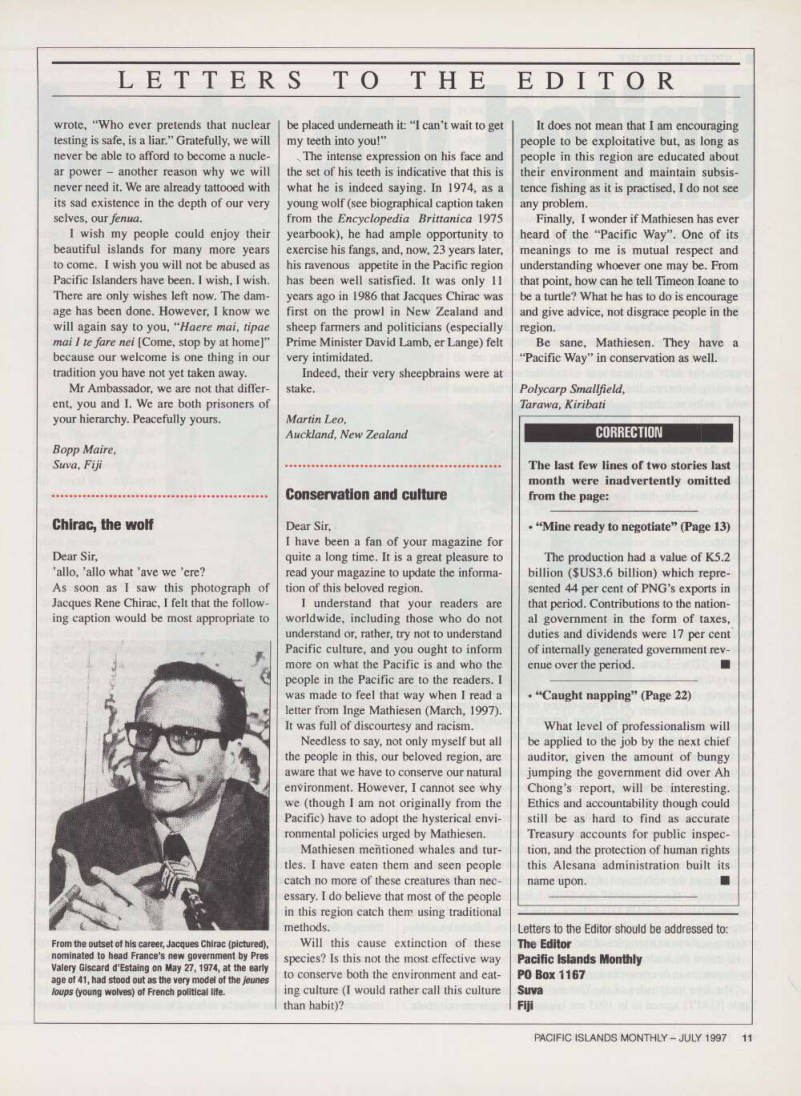
Chirac, the wolf Dear Sir, ’alio, ’alio what ’ave we ’ere?
As soon as I saw this photograph of Jacques Rene Chirac, I felt that the follow ing caption would be most appropriate to
be placed underneath it: “I can’t wait to get my teeth into you!” . The intense expression on his face and the set of his teeth is indicative that this is what he is indeed saying. In 1974, as a young wolf (see biographical caption taken from the Encyclopedia Brittanica 1975 yearbook), he had ample opportunity to exercise his fangs, and, now, 23 years later, his ravenous appetite in the Pacific region has been well satisfied. It was only 11 years ago in 1986 that Jacques Chirac was first on the prowl in New Zealand and sheep farmers and politicians (especially Prime Minister David Lamb, er Lange) felt very intimidated.
Indeed, their very sheepbrains were at stake.
Martin Leo,
Auckland, New Zealand
Conservation and culture
Dear Sir, I have been a fan of your magazine for quite a long time. It is a great pleasure to read your magazine to update the informa tion of this beloved region.
I understand that your readers are worldwide, including those who do not understand or, rather, try not to understand Pacific culture, and you ought to inform more on what the Pacific is and who the people in the Pacific are to the readers. I was made to feel that way when I read a letter from Inge Mathiesen (March, 1997).
It was full of discourtesy and racism.
Needless to say, not only myself but all the people in this, our beloved region, are aware that we have to conserve our natural environment. However, I cannot see why we (though I am not originally from the Pacific) have to adopt the hysterical envi
ronmental policies urged by Mathiesen.
Mathiesen mentioned whales and tur tles. I have eaten them and seen people catch no more of these creatures than nec essary. I do believe that most of the people in this region catch them using traditional methods.
Will this cause extinction of these species? Is this not the most effective way to conserve both the environment and eat ing culture (I would rather call this culture than habit)?
It does not mean that I am encouraging people to be exploitative but, as long as people in this region are educated about their environment and maintain subsis tence fishing as it is practised, I do not see
any problem.
Finally, I wonder if Mathiesen has ever heard of the “Pacific Way”. One of its meanings to me is mutual respect and understanding whoever one may be. From that point, how can he tell Timeon loane to be a turtle? What he has to do is encourage and give advice, not disgrace people in the
region.
Be sane, Mathiesen. They have a “Pacific Way” in conservation as well.
Polycarp Smallfield,
Tarawa, Kiribati
Letters to the Editor should be addressed to: The Editor Pacific Islands Monthly PO Box 1167 Suva Fiji
From the outset of his career, Jacques Chirac (pictured), nominated to head France’s new government by Pres Valery Giscard d'Estaing on May 27,1974, at the early age of 41, had stood out as the very model of the jeunes loups (young wolves) of French political life.
Advertisements & other items, pp. 9-10 (2 items)
mmsgt
K
11 m yi m si Mm mt, 5 OF .. , 7V~ IS?- "! >; . •;V- -gfe -*■' V- ■ «• v "- 9 9 ▲ ▲
MARKET M A K ER
Ocean Shrinker The new generation 50-seat Saab 2000 Jet Prop, flying nearly 180 mph faster than the competition, is shrinking the long distances of the Pacific, slashing hours from other turboprop schedules. With flexibility to meet the needs of passengers and airlines, the Saab 2000 is the Pacific's best choice. Fly the Saab 2000 and enjoy a new era of passenger comfort and service. Saab 2000 - the Market Maker and Money Maker now uniting nations of the Pacific! ..
Uniting the Pacific
Saab Aircraft AB http ://www/saab. com. se SWEDEN * +46 13 182000 • FAX +46 13 1 8210 AUSTRALIA • +6l 2 9369 1666 * FAX +6l 2 9369 2500 HONG KONG * +852 2810 4220 * FAX +852 2810 4135 UK • +44 1753 859991 * FAX+44 1753 858884
Loll
000 There are times in your life when you feel your friends have been missing out on something good.
Now's your chance to do something about it and share with them one of the good things you have.
Buy your friend a subscription to Pacific Islands Monthly and let him or her join you and thousands of other people world wide who are kept informed of the latest political, social and cultural changes taking place in the Pacific.
Tonga AUSS4S Tuvalu AUSS4S United Kingdom Stg Pound2B US Mainland US$45 Vanuatu AUSS4S Western Samoa WS$5O Else where AUSS63 Payment to Pacific Islands Monthly: Sufaicriptioei Dept.
CPOBo* M€ 7, Suva, Fiji.
Direct airmail rates on application.
Telephone; 304111 Fax: 303809.
Direct airmail rates indude the cost of airspeeding to alt destinations set out as above.
PACIFIC ISLANDS
Please send my friend Pacific Islands Monthly for one year (12 issues).
I enclose my cheque for $ (made payable to Pacific Islands Monthly) I or debit $ to my: Q Visacard Q Mastercard
sri 111 m n 111111
Expiry Date.
NAME.
SIGNATURE.
t
Editor
10
LETTERS TO THE
PACIFIC ISLANDS MONTHLY - JULY 1997
Correction
The last few lines of two stories last month were inadvertently omitted from the page: • “Mine ready to negotiate” (Page 13) The production had a value of K 5.2 billion (SUS 3.6 billion) which repre sented 44 per cent of PNG’s exports in that period. Contributions to the nation al government in the form of taxes, duties and dividends were 17 per cent of internally generated government rev enue over the period. ■
• “Caught napping” (Page 22)
What level of professionalism will be applied to the job by the next chief auditor, given the amount of bungy jumping the government did over Ah Chong’s report, will be interesting.
Ethics and accountability though could still be as hard to find as accurate
Treasury accounts for public inspec
tion, and the protection of human rights this Alesana administration built its name upon. ■
United we stand
Special Report
MSG leaders seek solidarity for success
Reports by BERNADETTE HUSSEIN
The focus of the 11th summit of the Melanesian Spearhead Group, hosted by Fiji in May, lay largely on trade and economy in the region issues pertinent to the Pacific as it heads towards the new millennium - and the need for solidarity and unity between the island countries. Small island nations
could achieve their goals through this unity and use it to secure their needs and aspirations, Fiji Prime Minister Sitiveni Rabuka said in his welcome address as chairman of this year’s
meeting.
Rabuka reminded the delegates that, as small island nations, they had to keep pace with the rest of the world and look ahead with a clear sense of vision. “The Lome Convention with the European Union, to which all of us are parties as members of the ACP [African,
Caribbean and Pacific] group of states, will expire in February, 2000. So, we must look beyond this to the 21 st century and prepare ourselves to grapple with the realities of the new era.”
He reminded the leaders that since the end of the Cold War, the West had lost interest in the Pacific because it was no longer regard ed as strategically important. Because of this, the South Pacific was being treated and regarded as among the least important parts of the world market economy, the PM said. “In the last seven years or so, we have seen the withdrawal of Great Britain from the South Pacific Commission, the closure of the United States embassy in the Solomon Islands, the USAID offices, Asia Foundation and Peace Corps offices in Fiji and other Pacific countries,” Rabuka said, pointing to these as examples of the decline in interest in the region.
He asked the leaders to keep in constant touch with policies and developments in overseas markets.
“The free trade rules of the General Agreement on Tariff and Trade [GATT] agreed to in 1993 are beginning to govern our trade
policies and relations through our membership with the World Trade Organisation [WTO]. We are told GATT has the promise of opening up new market opportunities for small developing countries and the new GATT rules impress on us that we have to trade to be competi tive and to effectively take advantage of the opportunities.
“This requires us to have domestic policies that free up and deregulate our economies, policies on human resources develop ment, wages and salaries, exchange rates and general costs of pro duction that will all help to raise the level of our international com petitiveness. Competitiveness means price competitiveness as well as quality and supply reliability of our exports.
“We have to secure our markets as well as identify new markets for what we can produce. This requires a level of sophistication in inter national market research in our private sectors as well as trade departments and our embassies overseas.”
He said there was no morality or good will when countries had to compete for international export markets. Rabuka said the region should keep in mind that the world economy was shaped and controlled by the interests of powerful
trading nations and, at every international gathering, the endless clamour was to liberalise trade and open the market to reduce and ultimately remove tariffs. “Yet, the same big countries are busy forming themselves into trading blocs, such as the European Economic Community, the North American Free Trade Area (NAFTA) and other looser groups of nations.”
Rabuka said these countries were organised to promote and pro tect their interests collectively under the new trading regime which is why the region had to seek cooperation with those nations which had similar interests. These, he said, were the African and Caribbean nations in the ACP partnership and the European Union through the Lome Convention. And, as Asian nations forge ahead on the path to economic success, Rabuka suggested the need to ensure the region’s voice was heard in forums such as APEC and ASEAN. Fiji Foreign Affairs Minister Filipe Bole had earlier, at the MSG foreign ministers’ meeting, had talked of the importance of trade over aid and about what he referred to as misconceptions about
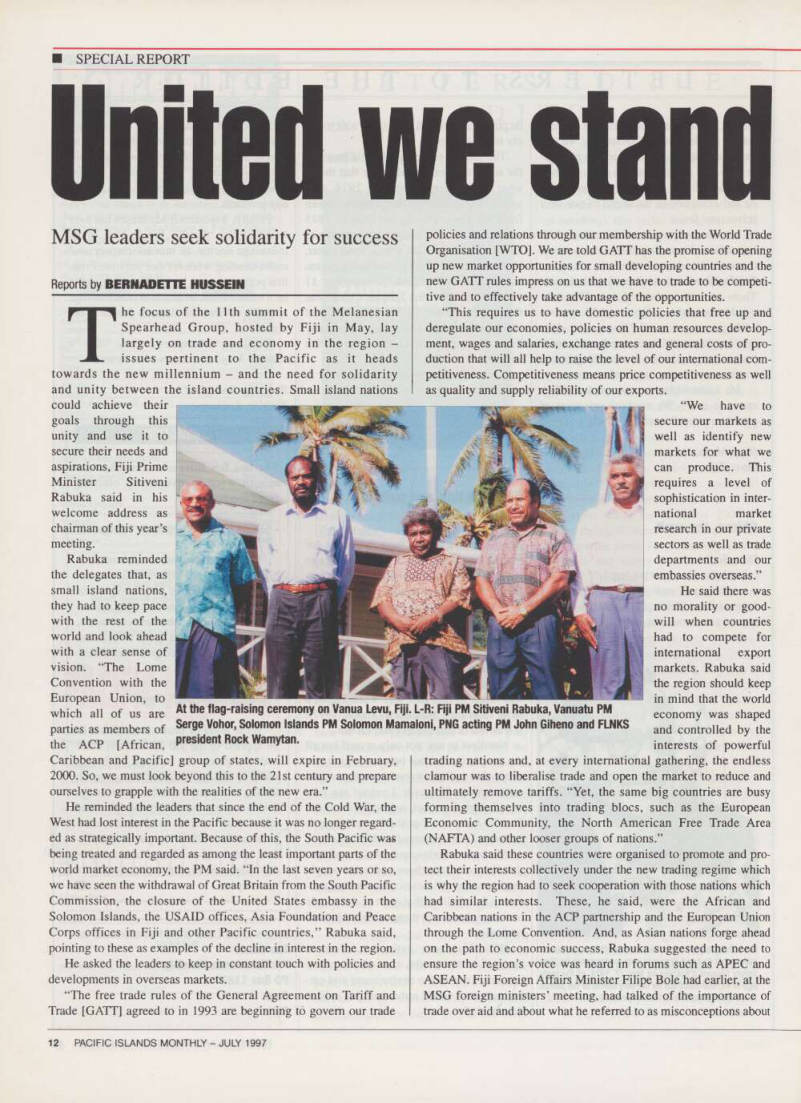
At the flag-raising ceremony on Vanua Levu, Fiji. L-R: Fiji PM Sitiveni Rabuka, Vanuatu PM Serge Vohor, Solomon Islands PM Solomon Mamaloni, PNG acting PM John Giheno and FLNKS president Rock Wamytan.
the region and its resources. The islands in the region had to contin ually improve relations with each other, Bole remarked, adding that this could be done by encouraging trade and other economic rela tions and mutual assistance with each other in programmes which were practical, transparent and sustainable.
He did not give examples. He added that trade was the most important ingredient of international relations and aid, if available, should only supplement it. “Take away trade and we return to colo nial dependence, economically and politically, on more advanced economies,” he said.
Bole added that there were a number of misconceptions about Melanesia that were not true - that it was underdeveloped, small and isolated. Another theory, he said, which should be discarded was the contention of economists and academics, who declared them
selves neutral and unbiased, that these countries had scarce resources. “All Melanesian countries are rich in minerals, timber and larger land areas for agriculture and other development.” Melanesia was neither small nor iso lated, he said. There were other nations which were small er and more isolated. He said island nations of Melanesia comprised the major landmass of the Pacific and had the highest concentration of people, claiming an abundance of land and marine resources.
Rabuka, however, while not disputing that the Pacific had many resources at its disposal, highlighted the importance of being wary of exploitative measures. “We are in the middle of the Pacific Ocean and our natural resources, such as our fisheries, and unexplored potential resources, such as minerals, have been and will continue to be of interest to our more advanced neighbours.”
But, the Fiji PM cautioned, while the region was moving in the path of economic growth it was important that sus tainable development be kept in mind. “This is because it may lead only to depletion of our natural resources such as our forests, fisheries, and the degradation of our envi ronment.
“There are benefits in increased trade for our people but the consequences can also be costly.” He added that as they advanced into the next millennium, they had to keep their eyes wide open to take advantages of the benefits of modernisation that will strengthen our commu nities. Rabuka told the delegates that, as members of the MSG, they had to commit themselves anew to the princi ple of promoting increased economic and technical coop eration. “We must make full use of our partnership in the MSG to explore all avenues of collective cooperation to further the economic interests of our countries, both with in our region and beyond.
As outgoing chairman, the acting prime minis ter of PNG at the time, Giheno, referred to Fiji’s inclusion in the MSG as crucial to the enhancement of regional cooperation in politics, economy and cultural exchanges.
Solomon Islands PM Solomon Mamaloni said Fiji was one of the more advanced countries in the region and expressed the hope that his country could leam a lot from it. Fiji played a leading role in international affairs and had a strong and steady economy like PNG, Mamaloni said. So, together, they would make a difference and be able to take an important role, especially on the interna tional scene. Mamaloni said his country could take its cue
from Fiji’s tourism industry. He said tourism in Fiji was one of the most thriving industries in the region and to understand how this was achieved would be of tremendous help. In return, he said, Fiji could cash in on the Solomon Islands’ lucrative tuna industry, which has managed to earn millions of dollars in revenue.
The MSG was formed in 1986 after heads of the Melanesian states of Vanuatu, Solomon Islands and PNG met in Goroka, PNG.
At this meeting, the leaders considered Melanesian solidarity as necessary at state-to-state level to effectively work on developmen tal issues in the region which had a direct, special and related rele vance to Melanesia. This includes the Kanaky cause for indepen dence in New Caledonia as represented by the Front Liberation National Kanaks Socialist. Rock Wamyton of the FLNKS from New Caledonia attended as observer. ■
An expensive affair
While there was much said at the Melanesian Spearhead Group meeting, there was also a lot said about the meeting. For example, what many expected would be a time of intense and constructive discussion and delib eration, was perceived by many as an excuse for a very expensive holiday, if the programme was anything to go by. Of the three full and two half days the 11th MSG summit was scheduled over, only two hours and 55 minutes was allocated to for mal talks, according to the programme. The meeting, according to official figures, is costing the Fiji government a whooping $F252,054 ($U5175,000) although only $F50,000 ($U534,500) was initially budgeted for. This was estimated in the 1997 bud get estimates.
The organising committee approached government seeking an additional $F70,151 ($U548,500) from parliament, which was approved. Flowever, this was still short of the $F252,054. It is expected the remaining costs will be absorbed by other ministries and departments. Last-minute events saw a reduction in numbers of the parliament secre tarial team assigend to cover the meeting because of escalating costs.
According to newspaper reports, this became necessary after their budget was reduced from $F20,000 (SUS 13,800) to SFBOOO (SUSSSOO). The Ministry of Foreign Affairs in Suva, Fiji, however, said it was glad with the outcome of the meeting, rejecting claims that the event was little more than a picnic for leaders. It was a chance, a ministry spokesperson said, for Fiji to display its hospitality. ■
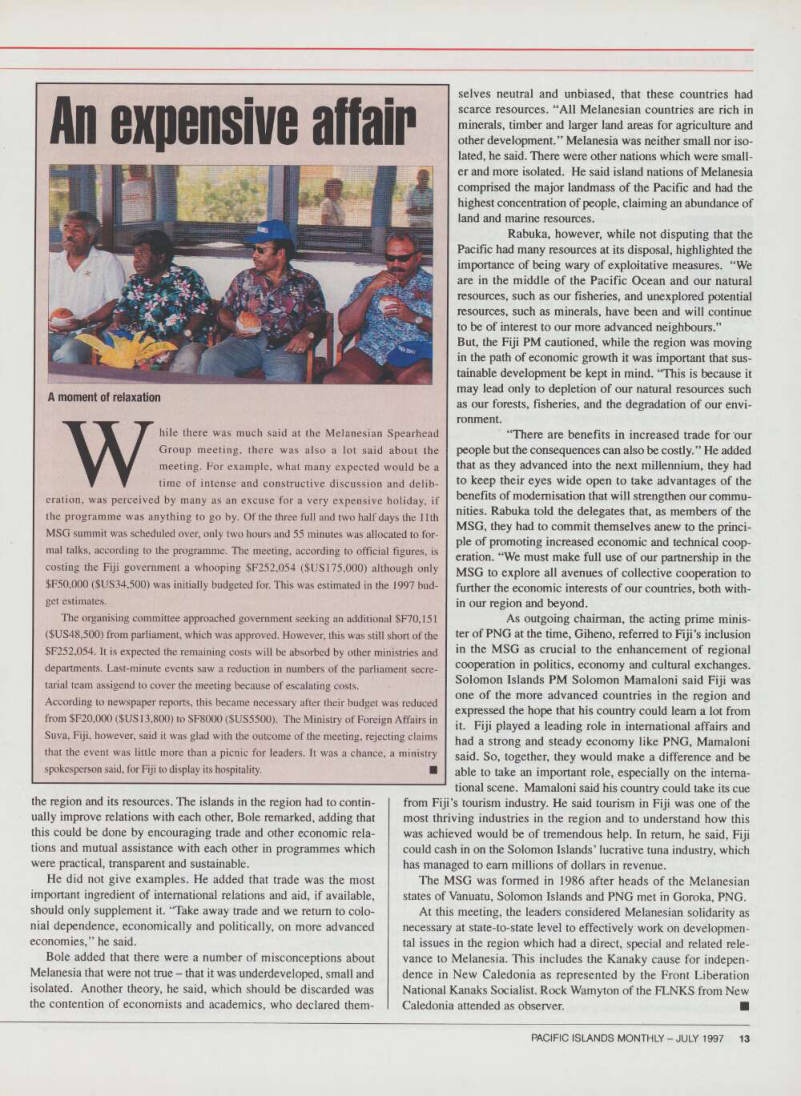
A moment of relaxation
communique
The communique
Hhe 11th summit of the Melanesian Spearhead Group was held in Fiji from May 7to 11. It was chaired by Fiji’s Prime Minister Sitiveni Rabuka and delegates included Solomon Mamaloni, prime minister of the Solomon Islands; Serge Vohor, prime minister of Vanuatu; John Giheno, acting prime minister of Papua New Guinea; and Rock Wamytan, president of the FLNKS of New Caledonia was present as observer.
In convening the meeting Giheno, representing PNG as the chair of the 10th summit last year, gave a comprehensive report on action taken on the various decisions and initiatives taken by the leaders at the 10th summit.
As host leader, Rabuka stressed the critical importance to the members of the MSG group of maintaining their unity and soli darity in collectively promoting and safeguarding their interests.
After the meeting, the leaders put out a joint communique high lighting the various issues discussed and steps taken towards the betterment of the member countries: • Solomon Islands, PNG and Vanuatu signed an agreement for mally approving the admission of Fiji to the MSG Trade Agreement. This was seen as commitment to increase trade and economic cooperation among members. • Solomon Islands and PNG signed a bilateral agreement on technical co-operation between their countries. • PNG was commended for its initiative in the establishment of a Pacific Islands Regional APEC centre, to be based at Port Moresby, to undertake research and disseminate information on activities and developments in APEC of interest and relevance to MSG and South Pacific Forum Island countries. MSG member countries expressed their governments’ support for the centre. • Fiji, Solomon Islands, Vanuatu and FLNKS welcomed PNG’s proposal to actively pursue with APEC a LOME Convention-type agreement with MSG and Forum Island countries.
They agreed to give PNG their full backing on this, including pursuing their initiative at the 28th South Pacific Forum in Raratonga, Cook Islands in September. • PNG was commended for the South Pacific Regional Support Arrangements and Regional Extradition Treaty. It was agreed that MSG members would cooperate in pursuing these initiatives in the Forum, and that governments’ should cooperate in dealing with natural disaster prevention, mitigation and rehabilitation. • Leaders discussed trade and economic issues. They adopted the comprehensive report of the Trade and Economic officials meeting in Honiara, Solomon Islands, in April this year and endorsed its recommendations for implementation. • The Forum Finance and Economic Ministers meeting to be held in Caims, Australia, this month was discussed.
Leaders agreed that finance ministers should hold consultations immediately before the meeting with a view to discussing issues
of common interest and coordinating common positions on the same. • Possibility of establishing a regional MSG Business Council or Chamber of Commerce representatives of the private sector and their organisations to meet regularly was considered. • On civil aviation, leaders agreed that this was a priority and needed close consultation and cooperation by MSG governments, civil aviation authorities and commercial carriers. • It was decided that shipping was another high priority area for collective action by MSG member countries. • Leaders agreed that telecommunications authorities and com mercial operators in MSG countries should coordinate efforts on the modernisation of their systems, the standardisation and pool ing of equipment and spare parts purchases, the appropriate regu lation of the sector to encourage higher productivity and greater competition and dealings with foreign strategic partners in the
industry.
• On forestry matters, the leaders noted that all MSG member countries had initiated national codes of conduct on logging. They agreed that MSG members should coordinate their efforts in deal ing with the Asian market as well as with foreign commercial deal ers in MSG countries. • The leaders noted that while some MSG member countries had benefited from mineral development and others were aspiring to benefit from it in a number of areas, there were constraints to the development of mineral resources. • In recognising the scope for regional cooperation, leaders agreed that a regional framework for resource development for MSG members be established to cater for data and personnel exchange; and the development of a suitable legal framework.
Leaders agreed that external support be sought for the estab lishment of this framework. • On development resources, leaders agreed the feasibility of establishing an MSG Investment Bank be given further considera tion. • Leaders discussed technical cooperation and the Melanesian Arts and Cultural Festival to be held in the Solomon Islands in July next year. • Leaders agreed to collectively assist Solomon Islands in seek ing assistance from the governments of France, Japan, China, UNESCO, and other governments and organisations in hosting the festival. • Leaders noted a paper on women’s development circulated by Fiji and agreed this was an important area of national development needing increased attention.
They agreed that close collaboration by MSG members in regional women’s programmes, such as those operated by the South Pacific Commission, be encouraged. • Leaders agreed that observers not be allowed at MSG meet ings, the only exception being the MSG Trade and Economic Officials meeting, which permitted the Forum Secretariat to sit in as an observer. • Leaders reaffirmed their Kiriwana summit decision that each government set up its own MSG unit in one of its ministries/dep artments and assistance be provided to each current chair by the members if and when there is a need and request to do so. ■
passport scandal
Cover Stories
Western Samoan passport scandal
Jailed Chinese businessman Jin Jipei will want to forget April 7, the day he flew into Western Samoa’s internation al airport carrying a local passport as identification. Police arrested him for holding fraudulent documents - and
unlocked the scandal of the year.
Since the 45-year-old’s arrest and pend ing court case, five immigration depart ment officers have been suspended in con nection with a racket involving the sale of Samoan passports for up to $26,000 each in Hong Kong and possibly the Apia head office. Politically, the controversy has land ed squarely at the door of 72-year-old
Prime Minister Tofilau Eti Alesana, who since 1991 has held the immigration port folio. His response, so far, has been any
thing but prime ministerial.
Within days of the Jipei incident, the national daily, the Samoa Observer, claimed Samoan passports had been adver tised in several Chinese newspapers, including the Macao Daily and the Hong Kong East, and sold for thousands to any one needing one. Permanent residency sta tus and work permits were offered.
Those claims were backed by another Hong Kong businessman. Michael Zhou arrived in the country with a local passport shortly after Jipei. He confirmed the Samoa Observer's version of events. Zhou, who came looking for business opportunities, said that after phoning the Samoa consul general’s office in Hong Kong, he was told by an unidentified person to contact a com pany called Pacific Life International for further details. Upon doing so, he was sup plied by the company with prices in US dollars for passports, permanent residency and work permits. Zhou and at least seven other Chinese nationals with Samoan doc uments have been forced to return to Hong Kong in the wake of the scandal going pub lic.
The newspaper also published corre spondence from the New Zealand High Commission in Apia to the immigration department in March querying whether government authorisation to issue visas by another Hong Kong-based company, Chi Hang International Investments, late last year were in order. It is not known how the immigration department responded.
The government, however, quickly dis tanced itself from the Samoa Observer ver sion of events, saying they had never authorised the sale of passports or visas to any Chinese nationals or delegated compa nies to act as distribution agents.
Deputy PM Malielegaoi suspects the Hong Kong advertisements to be the work of professional criminals. Even so, the con sul-general for Hong Kong, Tuigamala Anetipa, was on a flight home within 48 hours of the story hitting news stands. He then held several private meetings with the PM.
Also puzzling is the total silence by Alesana as immigration minister. Normally outspoken, the PM has quietly removed himself from the spotlight since the first
Chinese began arriving, fueling specula
tion as to why. In his place, Malielegaoi and newly appointed government secretary
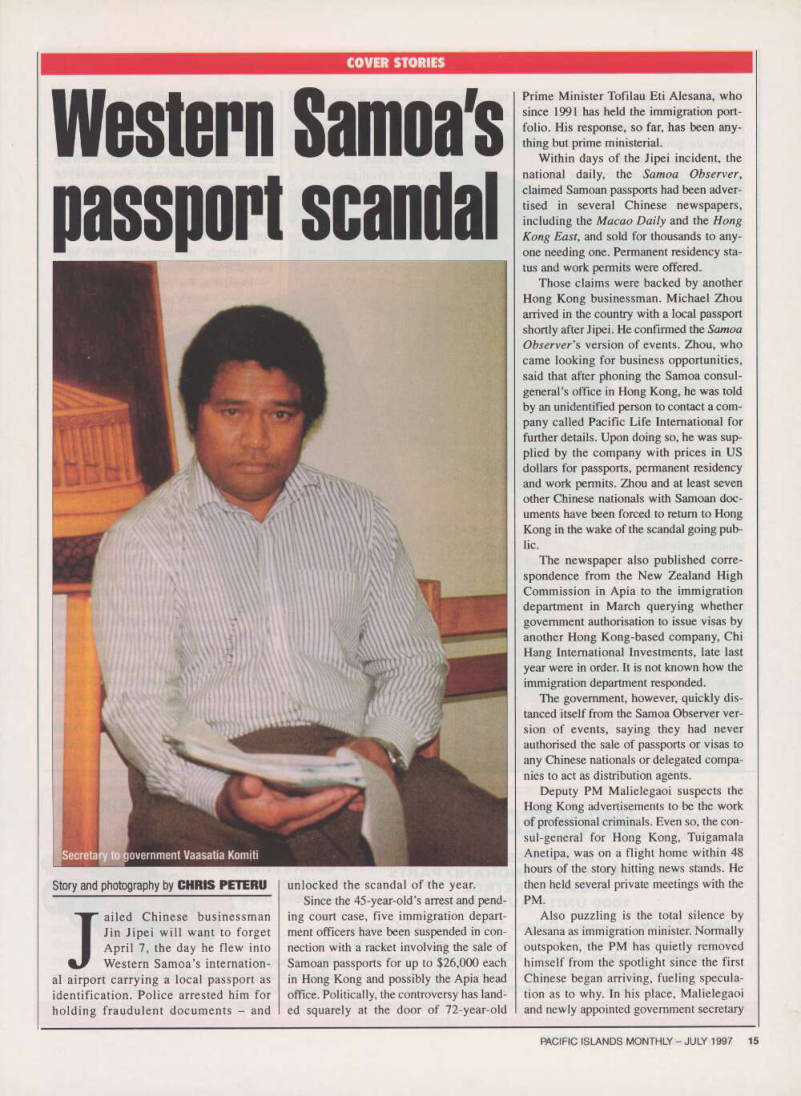
Story and photography by CHRIS PETERU
Vaasatia Komiti have been left to do the explaining. Both men have defended the leader’s failure to comment publicly, and believe the government’s credibility inter nationally remains intact.
“If there are disputes involving the government, then we wait for investi gations, find out who or what is \ involved n before making \ any announce ments - not just jump stupidly into it,” said \ Malielegaoi.
On state-run televi sion, Komiti took pains to disclaim any top-level n involvement while calling
media reports irresponsible \
and sensational. \ “Maybe people think that if the PM goes on air then the thing will die away, but it could also work the other way - it could be interpreted by the papers as an admission,” he said.
Malielegaoi dismissed notions that Anetipa was in any way involved in the passport sales, contradicting Zhou’s claims to the Samoa Observer. “My understand ing is he is not implicated. There is no involvement by the government at top level.”
Komiti is adamant the HRPP has noth ing to hide. “I can only say, as far as the government is concerned, we are not sell ing passports to people who are not citi zens of this country. It is unfortunate there are impressions of a country condoning the
sale of passports because that is not the case, that is absolute rubbish.”
Current laws allow travellers with ongoing tickets to stay in Western Samoa
on a 30-day permit.
Completed investigations by a
three-man government com » mission of inquiry has indicat- Hk ed that dozens of passports have gone missing from as early as 1994, although the newspaper now claims 1700
passports have disap peared.
The five
suspended immigration
staff include chief immigration officer Tuipoloa Suisala, who headed the office since 1979. A press release from the PM’s department indicated that charges could be laid soon.
Suspicions that something was amiss should have been raised earlier. Despite meagre salaries - the 1995 budget had the chief officer earnings about $19,000 a year - flash lifestyles that included late model
cars, trips abroad, rental houses and invest ments that went way beyond the officers’ earnings were never investigated. Police have frozen several officers’ bank accounts said to contain substantial amounts. On top of that, a small but conspicuous number of Chinese have been able to somehow nego tiate residency laws and find work or set up businesses, often restaurants or catering outlets.
Hundreds of passports have been moved from the immigration department located in the basement of the nine- I storey government complex to a safe in Komiti’s fifth-floor office for security H reasons. But V with the politi- Wf cal transferral of V Hong Kong, the opportunity to sell Samoan passports could not have been better timed. Last month’s scheduled handing over of the for mer British colony, after 156 years of colonial rule, to China had for months m been preceded by scores of
Hong Kongers snapping up
foreign passports and securing
safe havens overseas as insur ance against the likelihood of fallout with the incoming PRC administra tion.
At home, the immigration department, like most government-run services, is vul nerable to bribes for preferential treatment while providing indifferent service.
In 1994, a passport shortage in Apia meant some Samoans travelled overseas
using flimsy sheets of paper while awaiting a fresh batch to be printed and flown in from Britain months later. It has been alleged by a government source that, in 1995, diplomatic passports were issued to a visiting group of Chinese businessmen.
One of the group was made honorary con sul to Kyrgyzstan, on the northern border of China and Russia. Promises by the group to set up a bank and airline in Samoa never eventuated.
Komiti, who was on the inquiry team, says the findings would completely exon erate the government. “We are confident we will get to the bottom of this and the person responsible, whether here or over seas, will be brought to face the music.
Notices have been sent to people we sus pect are involved to cease from such prac tices.”
The public feeling, though, is that the inquiry is little more than an exercise to clear the PM of any wrongdoing, while finding suitable scapegoats. Few are hold ing their breath in anticipation of the probe revealing anything more than that it was somebody else’s fault. The HRPP govern ment has gained a reputation for having a soft spot for loyal bureaucrats with shady backgrounds. For instance, former Minister of Post and Telecommunications Tolofuavalelei Leiataua who was found guilty of corruption during last year’s elec tions has been given a senior post with state-run Polynesian Airlines. Airline sec retary Muliaumasealii Leaupepe was the country’s attorney-general until charged by New Zealand police with stealing over $lOO,OOO of clients’ money while practis ing as a lawyer there. The list goes on.
Legal action against the Samoan Observer could be taken by the govern ment if sufficient grounds for a libel action are established.
“When the police investigations have been completed then the hammer will strike the nail on the head,” says Malielegaoi. “Those newspaper stories are so inflated they have almost touched the sky.” But publisher Savea Sano Malifa says the papier is standing by what it believes is a “watertight” story.
In an editorial, he said his newspaper “would not be a party to this blatant attempt to cover this monstrosity with eva siveness, fabrications and half truths”. It called on the government to resign and
urged suspended immigration officials to
disclose details of the scan to the public.
Relations between China and Western
Samoa have, in the 90s, come increasingly close, in part due to the amount of aid China has provided. During the past four years, the $25-million-dollar government complex, a $2.5-million-dollar Women’s Convention Centre plus the renovation of Apia Park, the home ground of the nation al rugby team, were provided for by the Chinese government. Western Samoa regu larly sends delegations on trade and good will visits.
Given the current controversy, an index on corruption in last October’s Asian Wall Street Journal is interesting. Comparing
corruption in 53 countries on a scale rang ing from 0 (totally corrupt) to 10 (totally clean), New Zealand came out as the clean est country in the world (9.43); Hong Kong came a credible 18 (7.01); and China (2.43) rolled up in 49th spot, five from the bot tom.
“The chaos, corruption and lawlessness of China are Hong Kong’s real worries after 1997,” concluded the journal.
How that analysis of China will affect Western Samoa in the future is something the Tofilau government may now want to consider more carefully. ■
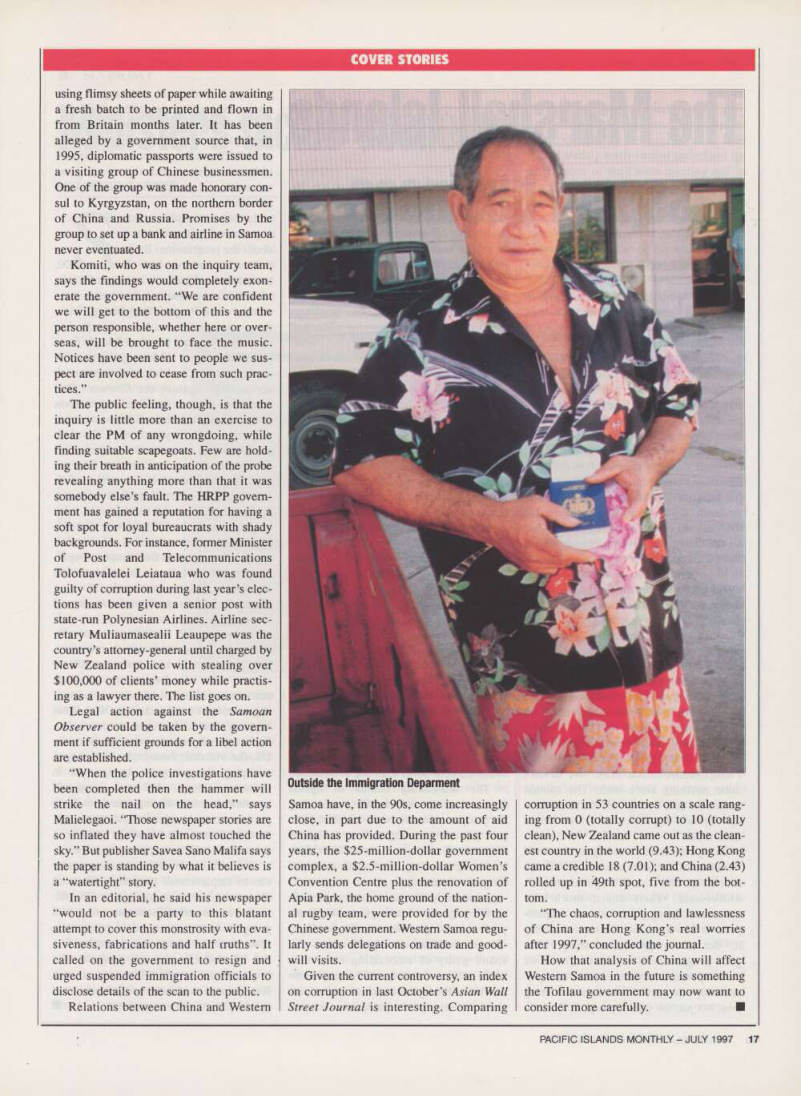
Outside the Immigration Deparment
Advertisements & other items, p. 16 (2 items)
Cover Stories
Imported Engines
BLAIRS
TRANSMISSIONS
NEW PARTS - SECONDHAND PARTS
DIESELS - PETROL
1000 UNITS AVAILABLE
Bedford * BMW * Cummins * Daihatsu * Detroit * Ford * Gardner Duefz * Hino * Isuzu * Ivaco * Komatsu * Kubota * Leyland * Mazda * Mercedes * Mitsubishi * Nissan * Perkins * Peugeot * Special stationary engines Perkins, Kubota, Yanmar 9hp to 200 hp, * Scania * Main * Suzuki * Toyota * Volvo * Yanmar
Arga all terrain vehicles
6X6 - BXB
AMPHIBIOUS
Carries 6 persons or 454kgs All Wheel Drive IF you require offroad transport Argo will do it. Swamps, Lakes, Beaches, Loose Rocks, Dense Forest.
P.O Box 14 Geraldine, New Zealand. Phone: 643-6938122. Fax: 643-6938120
passport business
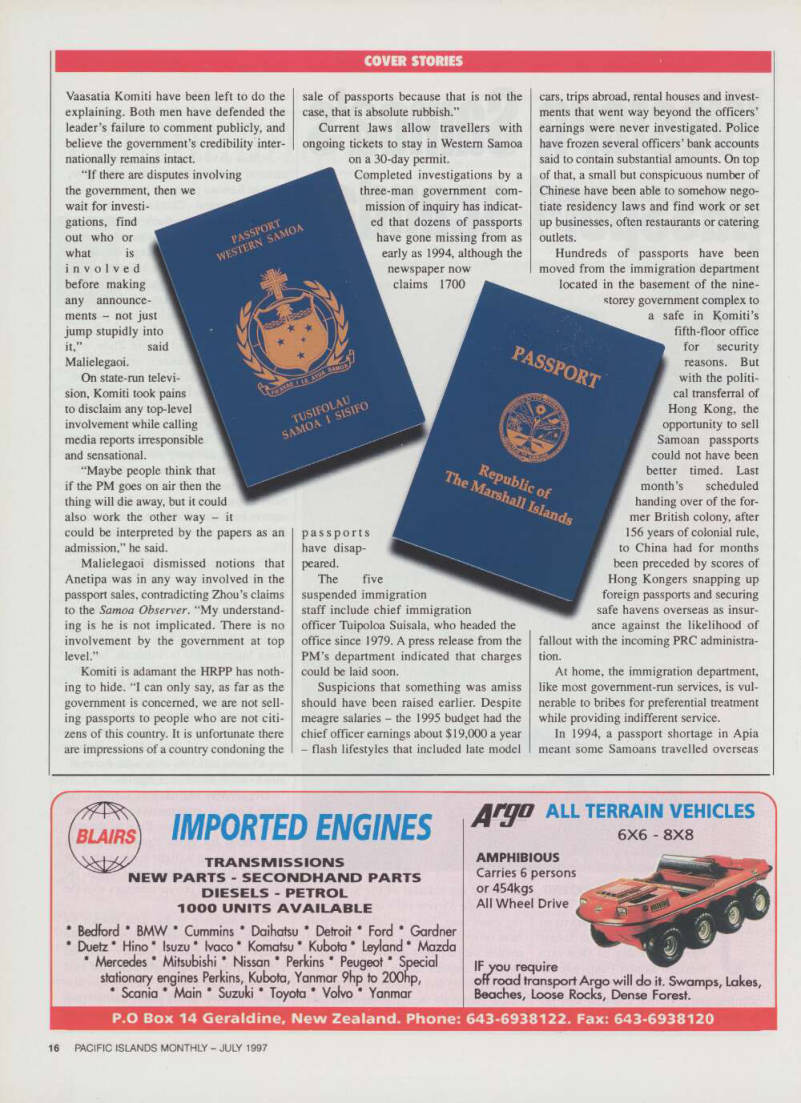
The Marshall Islands passport business
By Giff Johnson
The sale of citizenship in the Marshall Islands has gone through a series of metamorphoses since the government first began offering pass ports to Asians in the mid-1980s.
And, in doing so, it has engendered complaints from the United States govern ment, financial audits critical of the han dling of passport revenues by government officials and unwanted international media coverage centring primarily on the false advertising claims made by sales agents of the benefits of passport ownership - and upwards of SUSIS million in revenue to the Marshall Islands government.
Officially, the government suspended sales of passports to foreigners last August, in large part because of objections raised by the US State Department and the impact these passport sales were having on Marshall Islanders entering the US. Non- Marshall Islanders continue to obtain pass ports in Majuro, however, leading to spec ulation that the programme was suspended to allow the government to get it under control. They add that it could be restarted at a later time once new regulations are produced and enforced.
“Passport sales were suspended in August 1996,” said Foreign Minister Phillip Muller in late May. “We haven’t done anything since then. The cabinet authorised [the Foreign Ministry] to come up with new regulations, but we haven’t done it yet.”
Passport sales were put on hold “because of concerns shared by both the Marshalls and the US governments”, Muller said. “There was so much false information being given out about the pass ports. It was too loose. We needed to stop it.” But, the foreign minister added, “It’s a good programme if we do it right; if we come up with a way that is more transpar ent and will attract investors and bring jobs, not just the sale of passports.”
Since day one, the Marshall Islands has had trouble with the agents it has hired to sell passports. In the mid-80s, Taiwan based promoters issued colour brochures extolling the benefits of owning a Marshall Islands passport, including, they said, unre stricted entry into the US, a claim that had people lining up to buy the passports.
Unfortunately, the claim was far from the truth - but it has continued to be made by subsequent agents as a way to attract buy ers. Under the terms of the Compact of Free Association with the US, Marshall Islanders - like citizens from Palau and the Federated States of Micronesia - have privileges to travel, live, work and study in the US without needing a visa. But these same privileges do not extended to pass port buyers. Indeed, the compact specifi cally states that anyone buying a passport for the purpose of emigrating to the US is prohibited from doing so. And for legiti mately naturalised citizens, there is a five year residency requirement before requests to emigrate will be considered.
While Marshall Islands passports are a ticket to America for Marshall Islanders, they most certainly aren’t for naturalised citizens. But that ‘technicality’ hasn’t lim ited the hype used to sell passports. Since the Marshalls has engaged numerous agents, it’s a battle for customers. And a passport that claims to get you direct entry to the US sells better than one that doesn’t.
The misleading claims of agents haven’t been the only trouble surrounding the passport sales. Since the mid-80s, pass port prices have ranged from a high of $U5250,000 to a low of about SUS3O,OOO, involving a variety of schemes to attract
long-term investors.
In the early 90s, an Australian promot
er, Gregory Symons, began selling pass
ports for the government. He was later charged in Marshall Islands courts and found guilty of embezzling more than SUSI million. In early 1995, the govern ment’s auditor-general criticised the pro gramme, saying ‘"the passport sales pro
gramme is inadequate with respect to its results and performance because manage ment failed to establish a system to record transactions and safeguard government assets”. The auditor-general indicated pos sible embezzlement and otherwise undocu mented use of passport revenues in 1993 and 1994.
In the past couple of years, the US gov ernment has expressed increasing concern about the programme. By last year, pass port sales had reached close to 1000, according to Marshall Islands officials, who said the vast majority had been sold to citizens of the People’s Republic of China.
Some passport buyers have attempted to enter the US using Marshall Islands pass ports, resulting in US immigration confis
cating passports and initiating deportation
proceedings against the Chinese. This resulted in a consequent backlash that has at times caused Marshall Islanders more difficulty when they enter the US - their passports are sometimes subjected to greater scrutiny to ensure that they are ‘real’ Marshall Islanders - as well as addi tional checks when Marshall Islanders apply for US social security or seek employment in the US, activities that did n’t raise an eyebrow from US officials dur ing the first years of the compact, begin ning in 1986. Muller acknowledges that attempts by Chinese to enter the US using Marshall Islands passports has caused “more hassle to our people”.
To be sure, US State Department offi cials in Majuro said recently that the pass port sales would not cause the US to remove the visa-free entry privilege accorded to Marshall Islanders because it is guaranteed by treaty through 2001. What happens after 2001 is open to speculation.
In fact, in response to concerns from the US, the Marshall Islands, in 1996, began stamping the passports being sold to Chinese with a “US visa required” announcement to distinguish them from passports used by Marshall Islanders. And then, in August, the Marshalls announced it was definitely halting passport sales.
Still, Muller believes, the programme can be implemented properly. “We need the money,” he said, adding that US offi cials had shared information on model passport sales programmes in progress in other nations. “Many other countries, like the US and Canada, sell passports for investments,” he said. “We can do it, too.
But we need to sit with professionals and get the programme reorganised. ■
Ministers tackle economy
Economy
By Alfred Sasako
Senior ministers from the South Pacific Forum will meet in Cairns in July to discuss, among other things, trade - the single major issue that served as a catalyst to launching the regional bloc a quarter of a centu
ry ago.
The July 10-11
meeting is expected to
be attended by eco nomic ministers from Australia, Cook Islands, Federated States of Micronesia, Fiji, Kiribati, Nauru, New Zealand, Niue, Palau, Papua New Guinea, the Republic of the Marshall Islands, Solomon Islands, Tonga, Tuvalu, Vanuatu and Western Samoa.
Under close scruti ny will be what makes for sustainable eco nomic development activities which are based on prudent, eco nomic management.
good governance, and which strengthen
links with existing and potential joint-ven
ture partner investors from Australia.
Australia is hosting the two-day meeting in response to a decision by the South Pacific Forum last year that senior ministers from the region should meet regularly, particu larly ministers with finance and economic
development portfolios.
South Pacific Forum finance ministers have already met twice and are expected to meet on a regular basis. The Cairns Economic Ministers’ Meeting signifies the importance the region’s political masters attach to economic reforms and subsequent activities which serve to provide an envi ronment conducive to sustainable develop ment in the longer term. It will be the first time economic ministers from the region meet. No doubt, their discussions will cen tre on economic activities or lack of it in
the region and why comparable regions of the world have recorded enviable econom ic successes. Indeed, sluggish economic growth in the Pacific over the past decade has caused some unease within the Forum family, with political leaders demanding answers - answers that do not seem to be forthcoming. The situation has triggered an avalanche of criticism, particlarly by
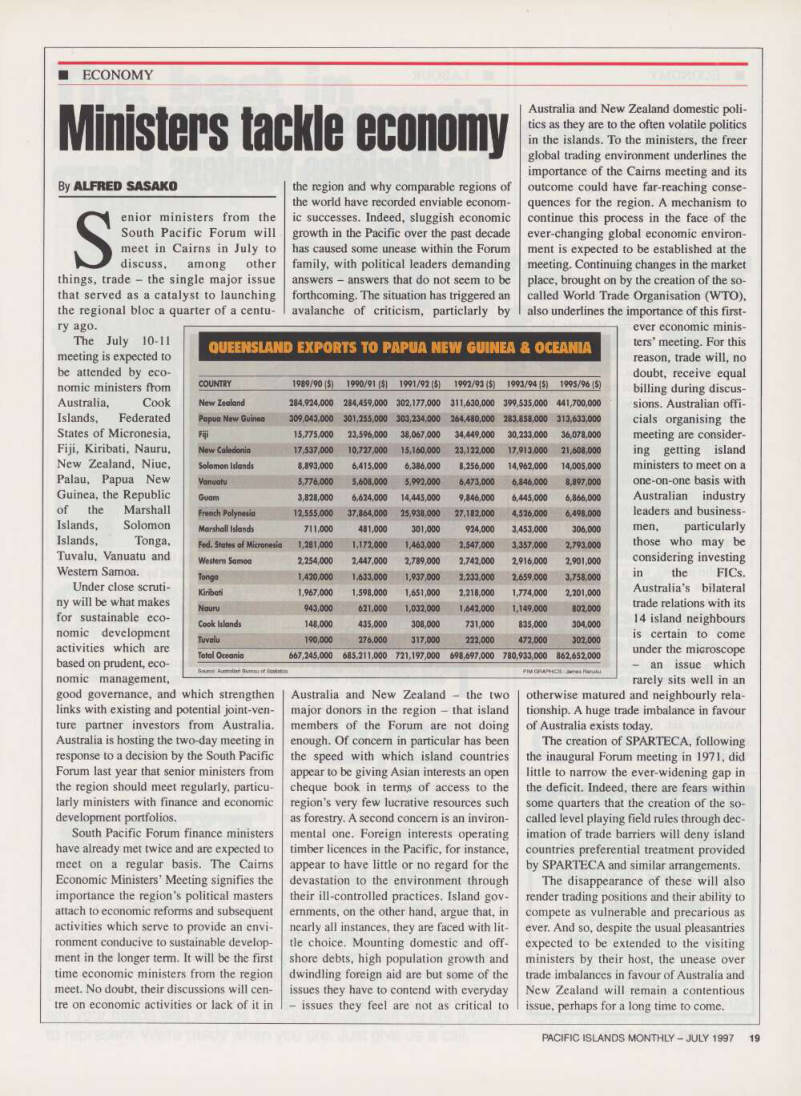
QUEENSLAND EXPOUTS TO PAPUA NEW GUINEA & OCEANIA
Australia and New Zealand - the two major donors in the region - that island members of the Forum are not doing enough. Of concern in particular has been the speed with which island countries appear to be giving Asian interests an open cheque book in terms of access to the region’s very few lucrative resources such as forestry. A second concern is an inviron mental one. Foreign interests operating timber licences in the Pacific, for instance, appear to have little or no regard for the devastation to the environment through their ill-controlled practices. Island gov ernments, on the other hand, argue that, in nearly all instances, they are faced with lit tle choice. Mounting domestic and off
shore debts, high population growth and
dwindling foreign aid are but some of the issues they have to contend with everyday - issues they feel are not as critical to
Australia and New Zealand domestic poli tics as they are to the often volatile politics in the islands. To the ministers, the freer global trading environment underlines the importance of the Cairns meeting and its outcome could have far-reaching conse quences for the region. A mechanism to continue this process in the face of the
ever-changing global economic environ
ment is expected to be established at the
meeting. Continuing changes in the market
place, brought on by the creation of the so called World Trade Organisation (WTO), also underlines the importance of this first
ever economic minis ters’ meeting. For this reason, trade will, no doubt, receive equal
billing during discus
sions. Australian offi cials organising the meeting are consider ing getting island ministers to meet on a one-on-one basis with
Australian industry
leaders and business
men, particularly
those who may be
considering investing
in the FICs.
Australia’s bilateral trade relations with its 14 island neighbours is certain to come under the microscope - an issue which rarely sits well in an
otherwise matured and neighbourly rela tionship. A huge trade imbalance in favour of Australia exists today.
The creation of SPARTECA, following the inaugural Forum meeting in 1971, did little to narrow the ever-widening gap in the deficit. Indeed, there are fears within some quarters that the creation of the so called level playing field rules through dec imation of trade barriers will deny island countries preferential treatment provided by SPARTECA and similar arrangements.
The disappearance of these will also render trading positions and their ability to compete as vulnerable and precarious as ever. And so, despite the usual pleasantries expected to be extended to the visiting ministers by their host, the unease over trade imbalances in favour of Australia and New Zealand will remain a contentious issue, perhaps for a long time to come.
Country
1989/90 ($) 1990/91 ($) 1991/92 ($) 1992/93 ($) 1993/94($) 1995/96($) New Zealand 284,924,000 284,459,000 302,177,000 311,630,000 399,535,000 441,700,000 Papua New Guinea 309,043,000 301,255,000 303,234,000 264,480,000 283,858,000 313,633,000 Fiji 15,775,000 23,596,000 38,067,000 34/449,000 30,233,000 36,078,000 New Caledonia 17,537,000 10,727,000 15,160,000 23,122,000 17,913,000 21,608,000 Solomon islands 8,893,000 6,415,000 6,386,000 8,256,000 14,962,000 14,005,000 Vanuatu 5,776,000 5,608,000 5,992,000 6,473,000 6,846,000 8,897,000 Guam 3,828,000 6,624,000 14,445,000 9,846,000 6,445,000 6,866,000 French Polynesia 12,555,000 37,864,000 25,938,000 27,182,000 4,526,000 6,498,000 Marshall Islands 711,000 481,000 301,000 924,000 3,453,000 306,000 Fed. States of Micronesia 1,281,000 1,172,000 1,463,000 2,547,000 3,357,000 2,793,000 Western Samoa 2,254,000 2,447,000 2,789,000 2,742,000 2,916,000 2,901,000 Tonga 1,420,000 1,633,000 1,937,000 2,233,000 2,659,000 3,758,000 Kiribati 1,967,000 1,598,000 1,651,000 2,218,000 1,774,000 2,201,000 Nauru 943,000 621,000 1,032,000 1,642,000 1,149,000 802,000 Cook Islands 148,000 435,000 308,000 731,000 835,000 304,000 Tuvalu 190,000 276,000 317,000 222,000 472,000 302,000 Total Oceania 667,245,000 685,211,000 721,197,000 698,697,000 780,933,000 862,652,000 Source: Australian Bureau of Statistics PIM GRAPHICS : James Ranuku
Trade between Australia and island countries has been going on since the 1800 s. Many island countries are, howev er, beginning to wake up to the fact that Australia’s trade relations are deeply entrenched in its revolving aid pro gramme. Considered in that context, Australia’s aid is in essence geared to helping island countries pay for the goods and services from their big brother.
Australia’s aid programme to the Pacific, excluding PNG, is relatively small. In its first budget handed down last year, Canberra’s Liberal/National Party coalition led by Prime Minister John Howard, in fact, lost no time in slashing the region’s multi-million-dollar aid pro gramme by 10 per cent.
Canberra argued that the Pacific region came out relatively well ahead of other regions in escaping the razor gang of the new kid on the block. This is perhaps the heart of the argument: Australia’s falling aid programme will only serve to widen the gap in the trade deficit.
Take, for example, Australia’s much talked about SA32O-million (SUS24S - annual budgetary aid to PNG.
Together with Australia’s SA4-to-5-bil lion (SUS3-to-3.8-billion) investment portfolio in PNG, it is a lot of money.
But it is a totally different picture when Australia’s export to PNG is taken into account. According to figures provid ed by the Australian Bureau of Statistics (see Page 19), PNG imported $A 1.035 billion (SUS.79-billion) worth of Australian goods in the 1995/96 trading year. And the picture is the same for all other island countries receiving Australian aid, if export figures for the state of Queensland are to be taken as a
guide. ■
Fair wages and human rights

Labour
Fair wages and human rights far Marianas workers
By Susan Prokop
In the strongest statement ever issued by a US presi dent about labour and immi gration conditions in the Northern Mariana Islands [CNMI], President Bill Clinton sent a letter on May 30, 1997 to Governor Froilan Tenorio stating his intent to apply US immigration and minimum wage laws to the commonwealth.
As reasons for asking Congress to change CNMI’s laws, Clinton’s letter cites labour practices in the islands “inconsistent with our country’s values”, the “plainly inadequate” minimum wage, “persistent incidents of improper treat ment of alien workers” and continued failure of CNMI officials to rectify the
problems.
Clinton’s letter follows the April introduction into the US House of Representatives by congressman George Miller of the Insular Fair Wage and Human Rights Act. The act would bring
CNMI’s minimum wage up to the US minimum wage level ($5.15 beginning September 1, 1997) by 1999. It would also prohibit textile products manufac tured in CNMI from bearing a “made in the USA” label unless workers are paid at least the new minimum wage and the company abides by US fair labour, health add safety standards. The act would also
apply tougher US immigration laws on
Cnmi.
Miller, a Democrat, is the senior member of the minority party on the Resources Committee, which has juris diction over CNMI and has been an out spoken opponent of sweatshops on US soil. The measure has been endorsed by several church, labour and human rights groups, including the Asian Pacific Labour Alliance, the National Asian Pacific American Legal Consortium, Asia Pacific Center for Justice and Peace, the US Catholic Conference, and Human Rights Watch.
At a press conference announcing his bill, Miller released a report detailing cir
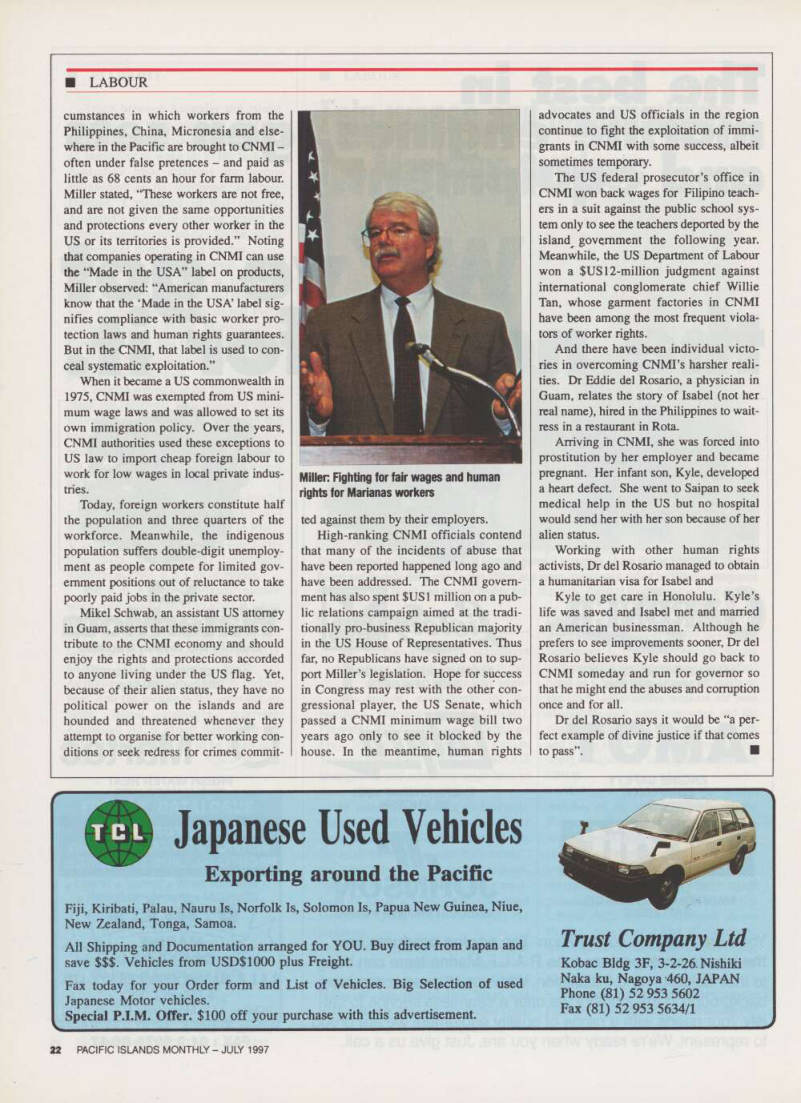
The Reverend Dr Thom White Wolf Fassett, general secretary of the United Methodist General Board and Society (left) and George Miller at a press conference called by Miller to announce the Insular Fair Wage and Human Rights Act - Pictures by Shanta M Bryant, Christian Social Action
cumstances in which workers from the Philippines, China, Micronesia and else where in the Pacific are brought to CNMI often under false pretences - and paid as little as 68 cents an hour for farm labour.
Miller stated, “These workers are not free, and are not given the same opportunities and protections every other worker in the US or its territories is provided.” Noting that companies operating in CNMI can use the “Made in the USA” label on products, Miller observed: “American manufacturers know that the ‘Made in the USA’ label sig nifies compliance with basic worker pro tection laws and human rights guarantees.
But in the CNMI, that label is used to con
ceal systematic exploitation.”
When it became a US commonwealth in 1975, CNMI was exempted from US mini mum wage laws and was allowed to set its own immigration policy. Over the years, CNMI authorities used these exceptions to US law to import cheap foreign labour to work for low wages in local private indus tries.
Today, foreign workers constitute half the population and three quarters of the workforce. Meanwhile, the indigenous population suffers double-digit unemploy ment as people compete for limited gov ernment positions out of reluctance to take poorly paid jobs in the private sector.
Mikel Schwab, an assistant US attorney in Guam, asserts that these immigrants con tribute to the CNMI economy and should enjoy the rights and protections accorded to anyone living under the US flag. Yet, because of their alien status, they have no political power on the islands and are hounded and threatened whenever they attempt to organise for better working con ditions or seek redress for crimes commit-
ted against them by their employers.
High-ranking CNMI officials contend that many of the incidents of abuse that have been reported happened long ago and have been addressed. The CNMI govern ment has also spent SUSI million on a pub lic relations campaign aimed at the tradi tionally pro-business Republican majority in the US House of Representatives. Thus far, no Republicans have signed on to sup port Miller’s legislation. Hope for success in Congress may rest with the other con gressional player, the US Senate, which passed a CNMI minimum wage bill two years ago only to see it blocked by the house. In the meantime, human rights
advocates and US officials in the region continue to fight the exploitation of immi grants in CNMI with some success, albeit sometimes temporary.
The US federal prosecutor’s office in CNMI won back wages for Filipino teach ers in a suit against the public school sys tem only to see the teachers deported by the government the following year.
Meanwhile, the US Department of Labour won a SUS 12-million judgment against international conglomerate chief Willie Tan, whose garment factories in CNMI have been among the most frequent viola tors of worker rights.
And there have been individual victo ries in overcoming CNMI’s harsher reali ties. Dr Eddie del Rosario, a physician in Guam, relates the story of Isabel (not her real name), hired in the Philippines to wait ress in a restaurant in Rota.
Arriving in CNMI, she was forced into prostitution by her employer and became pregnant. Her infant son, Kyle, developed a heart defect. She went to Saipan to seek medical help in the US but no hospital would send her with her son because of her alien status.
Working with other human rights activists, Dr del Rosario managed to obtain a humanitarian visa for Isabel and Kyle to get care in Honolulu. Kyle’s life was saved and Isabel met and married an American businessman. Although he prefers to see improvements sooner, Dr del Rosario believes Kyle should go back to CNMI someday and run for governor so that he might end the abuses and corruption once and for all.
Dr del Rosario says it would be “a per fect example of divine justice if that comes to pass”. ■
Miller: Fighting for fair wages and human rights for Marianas workers
Advertisements & other items, pp. 20-22 (2 items)
Free I.T. Catalogue
Independent Technical Reports on key information Technology issues, developments and trends covering: • Intranet • Internet • World Wide Web • Networking •Security • Multimedia • Systems Management • and much more ...
Write or fax to: TANORAMA Information Technology Solutions PO Box 313, Waigani NCD, Papua New Guinea Fax: (675) 323 0204 115420/3
We've got
Hie best in c
marine engines, gen sets
and equipment.
We've got
the name for it.
LISTER
PETTER
MARINE DIESEL ENGINES
28 bhp to 420 bhp
MARINE DIESEL ENGINES
AND GEN SETS
AMOT
ENGINE SAFETY
EQUIPMENT
OHfL
TB
THERMOWRAP AND
SILENCERS
dryftt
LONG LIFE
MAINTENANCE FREE GEL
BATTERIES
JOHNSON
SWEDISH MARINE PUMPS
You won’t beat this combination. Top engine products and the hands-on experience the R.A.L.F. Marine team can bring to their selection and installation. With our 45 years’ combined background in the industry we offer a seamless service to satisfy your needs with a range of quality equipment we are proud to represent. We’re ready when you are. Just give us a call. a C 11 m AA.
WaterMota
Built in the British tradition
MARINE DIESEL ENGINES
20 bhp to 260 bhp
O Martec
FRESH WATER HEAT
EXCHANGER KITS
FAX NOW FOR HOTLINE
SERVICE FOR ALL PNG AND
PACIFIC ISLANDS ENQUIRIES.
LservicesJ
R.A.L.F. MARINE SERVICES PTY. LTD.
4Tengah Cres., (PO Box 419) Mona Vale N.S.W. 2103 Sydney, Australia Tel; 61 2 9979 6644
FAX : 61 2 9979 6647
Japanese Used Vehicles
Exporting around the Pacific
Fiji, Kiribati, Palau, Nauru Is, Norfolk Is, Solomon Is, Papua New Guinea, Niue, New Zealand, Tonga, Samoa.
All Shipping and Documentation arranged for YOU. Buy direct from Japan and save sss. Vehicles from USDSIOOO plus Freight.
Fax today for your Order form and List of Vehicles. Big Selection of used Japanese Motor vehicles.
Special P.I.M. Offer. $lOO off your purchase with this advertisement. r A
Trust Company Ltd
Kobac Bldg 3F, 3-2-26. Nishiki Naka ku, Nagoya 460, JAPAN Phone (81) 52 953 5602 Fax (81) 52 953 5634/1
War and peace
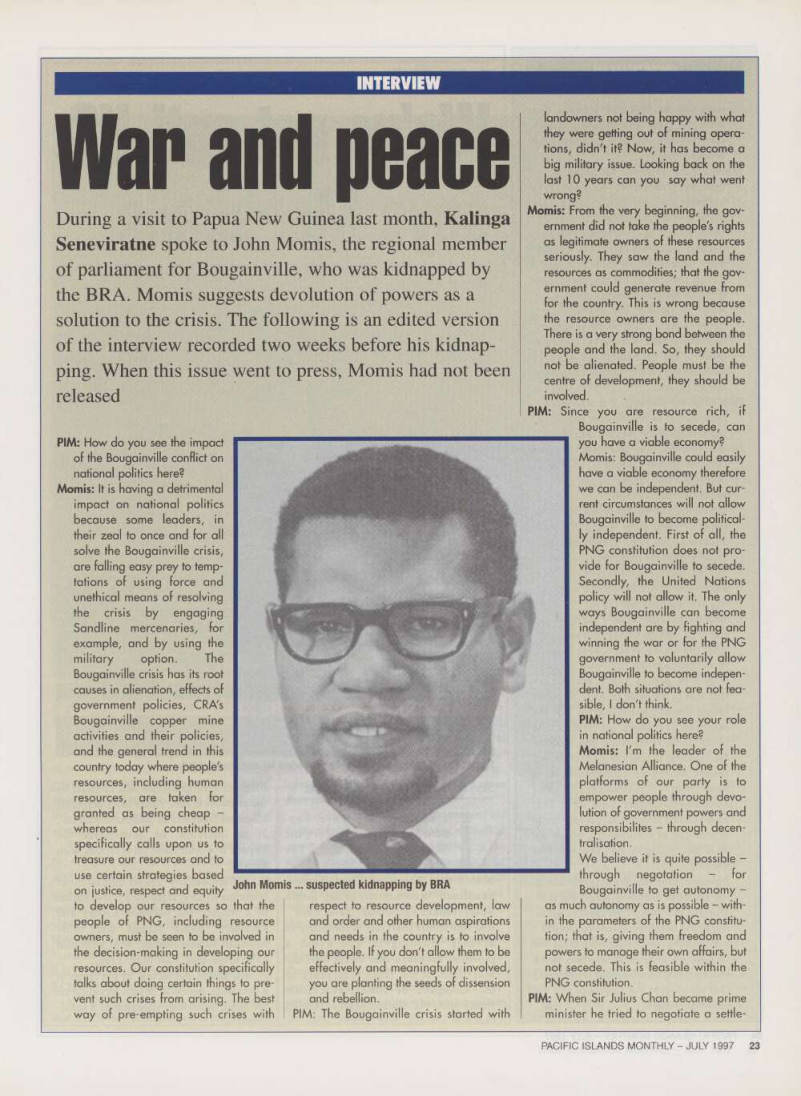
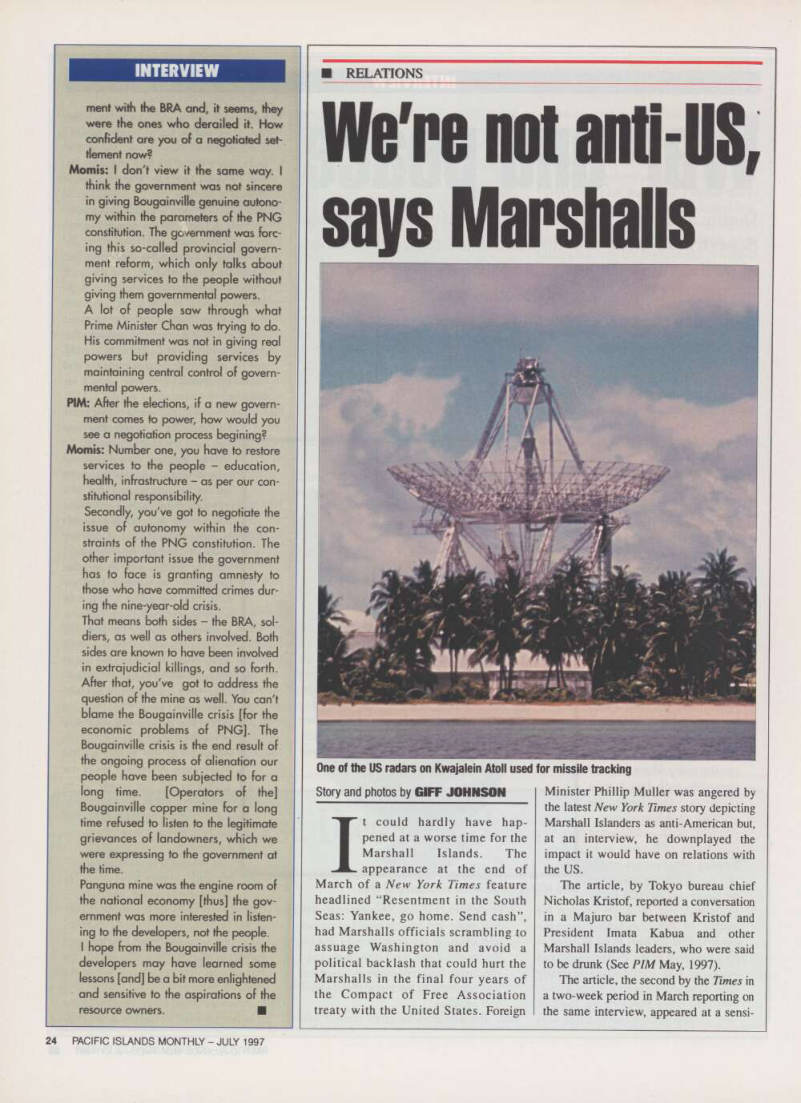
Interview
During a visit to Papua New Guinea last month, Kalinga Seneviratne spoke to John Momis, the regional member of parliament for Bougainville, who was kidnapped by the BRA. Momis suggests devolution of powers as a solution to the crisis. The following is an edited version of the interview recorded two weeks before his kidnap ping. When this issue went to press, Momis had not been released
PIM: How do you see the impact of the Bougainville conflict on national politics here?
Momis: It is having a detrimental impact on national politics because some leaders, in their zeal to once and for all solve the Bougainville crisis, are falling easy prey to temp tations of using force and unethical means of resolving the crisis by engaging Sandline mercenaries, for example, and by using the military option. The Bougainville crisis has its root causes in alienation, effects of government policies, CRA's Bougainville copper mine activities and their policies, and the general trend in this country today where people's resources, including human resources, are taken for granted as being cheap whereas our constitution specifically calls upon us to treasure our resources and to use certain strategies based on justice, respect and equity
to develop our resources so that the people of PNG, including resource owners, must be seen to be involved in the decision-making in developing our resources. Our constitution specifically talks about doing certain things to pre vent such crises from arising. The best way of pre-empting such crises with
respect to resource development, law and order and other human aspirations and needs in the country is to involve the people. If you don't allow them to be effectively and meaningfully involved, you are planting the seeds of dissension and rebellion.
PIM: The Bougainville crisis started with
landowners not being happy with what they were getting out of mining opera tions, didn't it? Now, it has become a big military issue. Looking back on the last 10 years can you say what went wrong?
Momis: From the very beginning, the gov ernment did not take the people's rights as legitimate owners of these resources seriously. They saw the land and the resources as commodities; that the gov ernment could generate revenue from for the country. This is wrong because the resource owners are the people.
There is a very strong bond between the people and the land. So, they should not be alienated. People must be the centre of development, they should be involved.
PIM: S ince you are resource rich, if
Bougainville is to secede, can you have a viable economy?
Momis: Bougainville could easily have a viable economy therefore we can be independent. But cur rent circumstances will not allow Bougainville to become political ly independent. First of all, the PNG constitution does not pro vide for Bougainville to secede.
Secondly, the United Nations policy will not allow it. The only ways Bougainville can become independent are by fighting and winning the war or for the PNG government to voluntarily allow
Bougainville to become indepen
dent. Both situations are not fea sible, 1 don't think.
PIM: How do you see your role in national politics here?
Momis: I'm the leader of the Melanesian Alliance. One of the platforms of our party is to empower people through devo lution of government powers and responsibilites - through decen tralisation.
We believe it is quite possible through negotation - for
Bougainville to get autonomy as much autonomy as is possible - with in the parameters of the PNG constitu tion; that is, giving them freedom and powers to manage their own affairs, but not secede. This is feasible within the PNG constitution.
PIM: When Sir Julius Chan became prime minister he tried to negotiate a settle
John Momis... suspected kidnapping by BRA
ment with the BRA and, it seems, they were the ones who derailed it. How confident are you of a negotiated set tlement now?
Momis: I don't view it the same way. I think the government was not sincere in giving Bougainville genuine autono my within the parameters of the PNG constitution. The government was forc ing this so-called provincial govern ment reform, which only talks about giving services to the people without giving them governmental powers.
A lot of people saw through what Prime Minister Chan was trying to do.
His commitment was not in giving real powers but providing services by maintaining central control of govern mental powers.
PIM: After the elections, if a new govern ment comes to power, how would you see a negotiation process begining?
Momis: Number one, you have to restore services to the people - education, health, infrastructure - as per our con stitutional responsibility.
Secondly, you've got to negotiate the issue of autonomy within the con straints of the PNG constitution. The other important issue the government has to face is granting amnesty to those who have committed crimes dur ing the nine-year-old crisis.
That means both sides - the BRA, sol diers, as well as others involved. Both sides are known to have been involved in extrajudicial killings, and so forth.
After that, you've got to address the question of the mine as well. You can't blame the Bougainville crisis [for the economic problems of PNG], The Bougainville crisis is the end result of the ongoing process of alienation our people have been subjected to for a long time. [Operators of the] Bougainville copper mine for a long time refused to listen to the legitimate grievances of landowners, which we were expressing to the government at the time.
Panguna mine was the engine room of the national economy [thus] the gov ernment was more interested in listen ing to the developers, not the people.
I hope from the Bougainville crisis the developers may have learned some lessons [and] be a bit more enlightened and sensitive to the aspirations of the resource owners. ■
We're not anti-US,
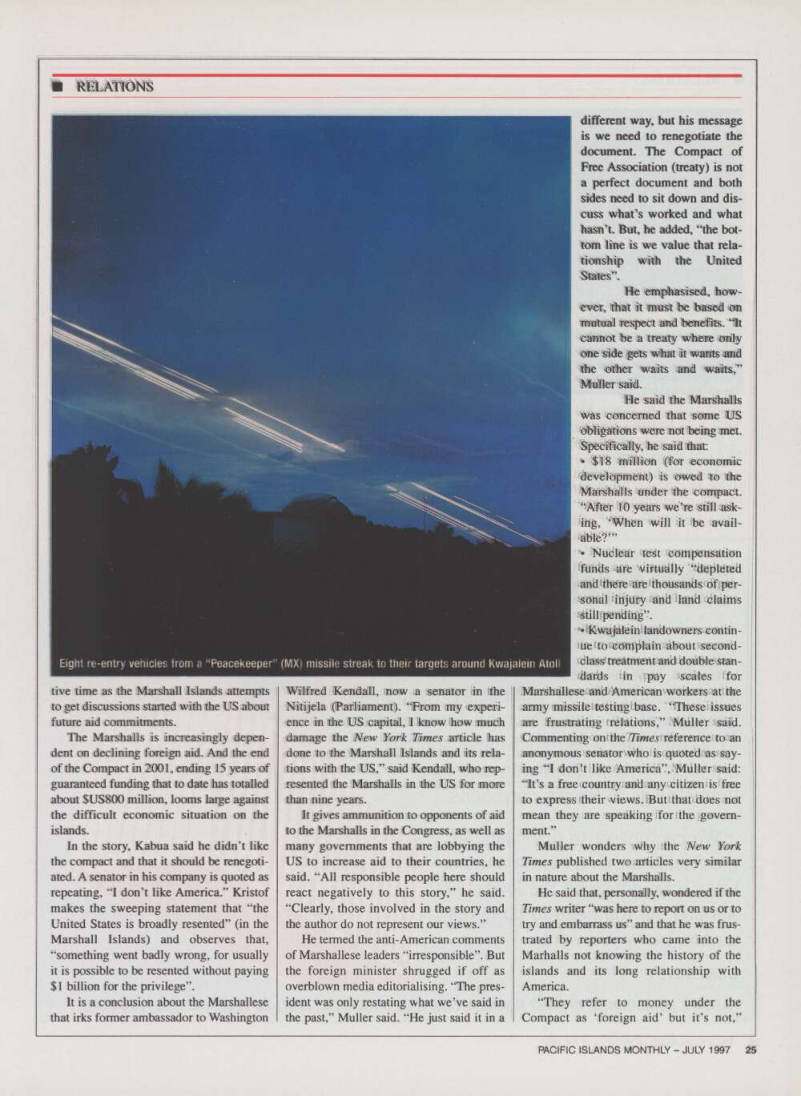
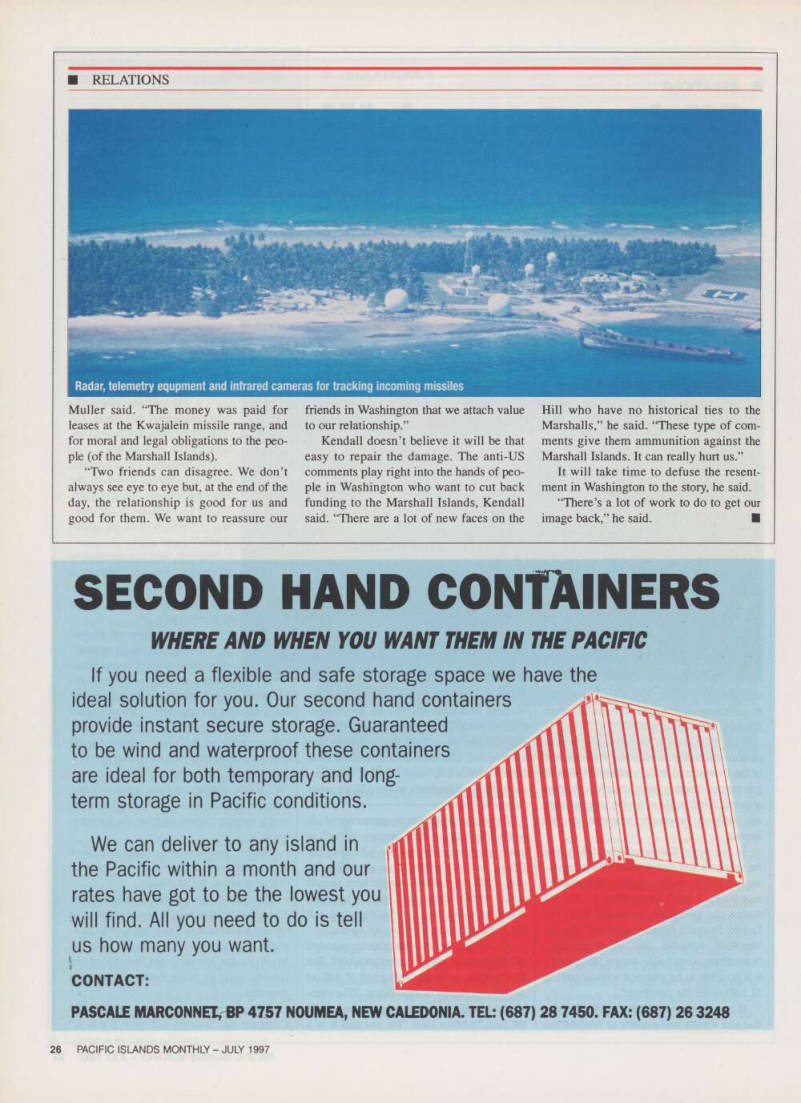
Relations
We're not anti-US, says Marshalls
Story and photos by GIFF JOHNSON
It could hardly have hap pened at a worse time for the Marshall Islands. The appearance at the end of March of a New York Times feature headlined “Resentment in the South Seas; Yankee, go home. Send cash”, had Marshalls officials scrambling to assuage Washington and avoid a political backlash that could hurt the Marshalls in the final four years of the Compact of Free Association treaty with the United States. Foreign
Minister Phillip Muller was angered by
the latest New York Times story depicting Marshall Islanders as anti-American but, at an interview, he downplayed the impact it would have on relations with the US.
The article, by Tokyo bureau chief Nicholas Kristof, reported a conversation in a Majuro bar between Kristof and President Imata Kabua and other Marshall Islands leaders, who were said to be drunk (See PIM May, 1997).
The article, the second by the Times in a two-week period in March reporting on the same interview, appeared at a sensi-
One of the US radars on Kwajalein Atoll used for missile tracking
tive time as the Marshall Islands attempts to get discussions started with the US about future aid commitments.
The Marshalls is increasingly depen dent on declining foreign aid. And the end of the Compact in 2001, ending 15 years of guaranteed funding that to date has totalled about SUSBOO million, looms large against the difficult economic situation on the islands.
In the story, Kabua said he didn’t like the compact and that it should be renegoti ated. A senator in his company is quoted as repeating, “I don’t like America.” Kristof makes the sweeping statement that “the United States is broadly resented” (in the Marshall Islands) and observes that,
“something went badly wrong, for usually
it is possible to be resented without paying $ 1 billion for the privilege”.
It is a conclusion about the Marshallese that irks former ambassador to Washington
Wilfred Kendall, now a senator in the Nitijela (Parliament). “Prom my experi ence in the US capital, I know how much damage the New York Times article has done to the Marshall Islands and its rela tions with the US,” said Kendall, who rep resented the Marshalls in the US for more than nine years.
It gives ammunition to opponents of aid to the Marshalls in the Congress, as well as many governments that are lobbying the US to increase aid to their countries, he said. “All responsible people here should react negatively to this story,” he said.
“Clearly, those involved in the story and the author do not represent our views.”
He termed the anti-American comments of Marshallese leaders “irresponsible”. But the foreign minister shrugged if off as overblown media editorialising. “The pres ident was only restating what we’ve said in the past,” Muller said. “He just said it in a
different way, but his message is we need to renegotiate the document. The Compact of Free Association (treaty) is not a perfect document and both sides need to sit down and dis cuss what’s worked and what hasn’t. But, he added, “the bot tom line is we value that rela tionship with the United States”.
He emphasised, how ever, that it must be based on mutual respect and benefits. “It cannot be a treaty where only one side gets what it wants and the other waits and waits,”
Muller said.
He said the Marshalls was concerned that some US obligations were not being met.
Specifically, he said that: • $lB million (for economic development) is owed to the Marshalls under the compact.
“After 10 years we’re still ask ing, ‘When will it be avail able?’” • Nuclear test compensation funds are virtually “depleted and there are thousands of per sonal injury and land claims Still pending”. •• Kwajaiein landowners contin ue to complain about second class' treatment and double stan dards iin pay scales for
Marshallese and American workers at the army missile testing base. “These issues are frustrating relations,” Muller said.
Commenting on the Times reference to an anonymous senator who is quoted as say ing “I don’t like America”, Muller said: “It’s a free country and any citizen is free to express itheir views. But that does not mean they are speaking for the govern ment.”
Muller wonders why the New York Times published two articles very similar in nature about the Marshalls.
He said that, personally, wondered if the Times writer “was here to report on us or to try and embarrass us” and that he was frus trated by reporters who came into the Marhalls not knowing the history of the islands and its long relationship with America.
“They refer to money under the Compact as ‘foreign aid’ but it’s not,”
Eight re-entry vehicles from a “Peacekeeper” (MX) missile streak to their targets around Kwajalein Atoll
Muller said. “The money was paid for leases at the Kwajalein missile range, and for moral and legal obligations to the peo ple (of the Marshall Islands).
“Two friends can disagree. We don’t always see eye to eye but, at the end of the day, the relationship is good for us and good for them. We want to reassure our
friends in Washington that we attach value to our relationship.”
Kendall doesn’t believe it will be that easy to repair the damage. The anti-US comments play right into the hands of peo ple in Washington who want to cut back funding to the Marshall Islands, Kendall said. “There are a lot of new faces on the
Hill who have no historical ties to the Marshalls,” he said. “These type of com ments give them ammunition against the Marshall Islands. It can really hurt us.”
It will take time to defuse the resent ment in Washington to the story, he said.
“There’s a lot of work to do to get our image back,” he said. ■
Radar, telemetry equpment and infrared cameras for tracking incoming missiles
Advertisements & other items, p. 26 (1 item)
Second Hand Containers
WHERE AND WHEN YOU WANT THEM IN THE PACIFIC If you need a flexible and safe storage space we have the ideal solution for you. Our second hand containers provide instant secure storage. Guaranteed to be wind and waterproof these containers are ideal for both temporary and longterm storage in Pacific conditions.
We can deliver to any island in the Pacific within a month and our rates have got to be the lowest you will find. All you need to do is tell us how many you want.
CONTACT:
PASCALS MARCONNEX, BP 4757 NOUMEA, NEW CALEDONIA. TEL; (687) 28 7450. FAX; (687) 26 3248
Racism at play
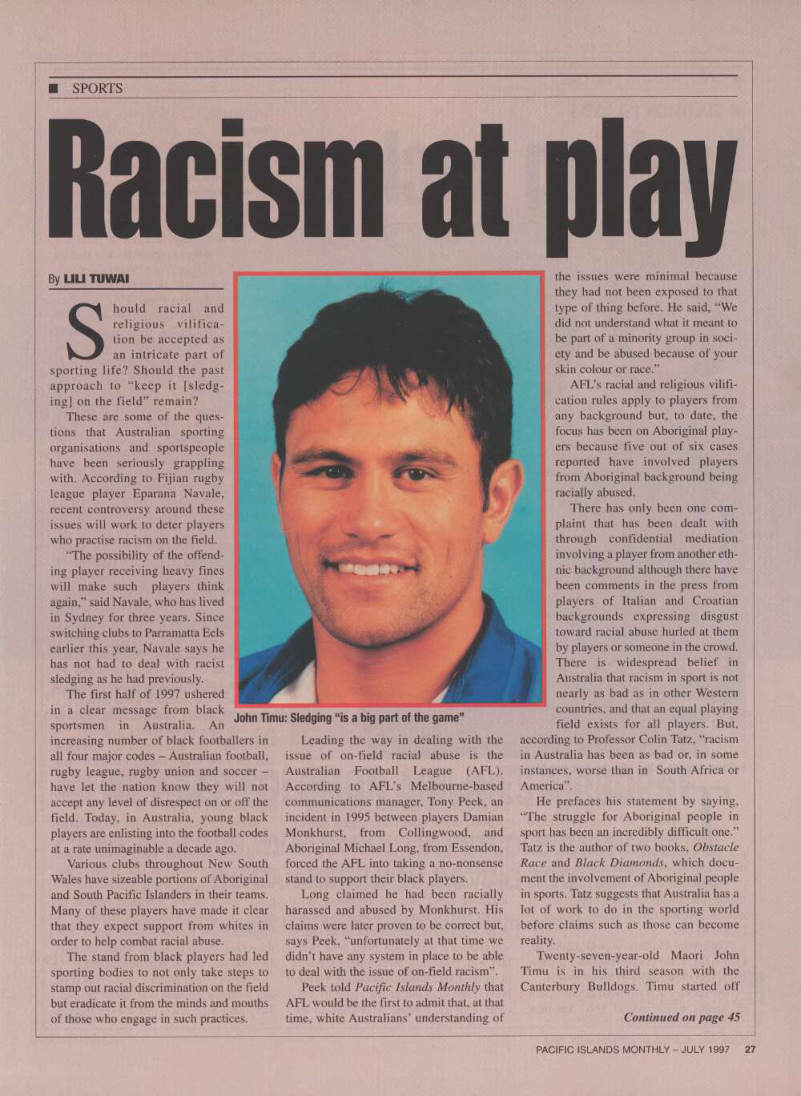
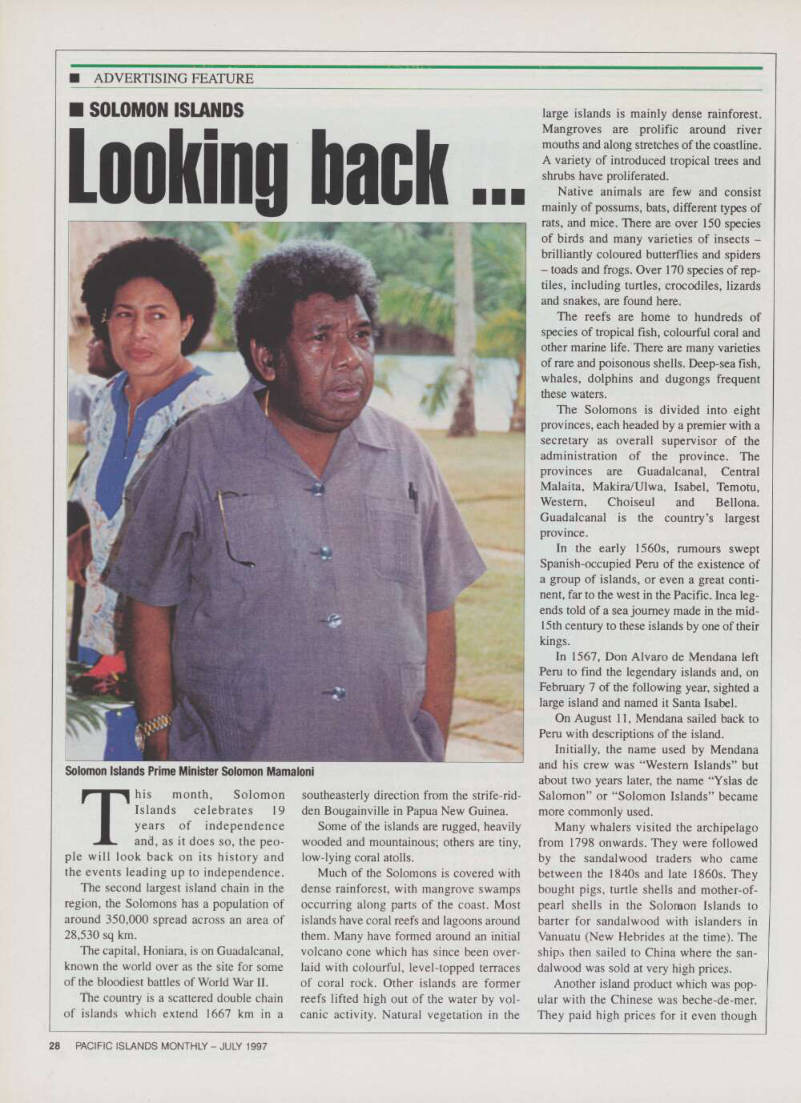

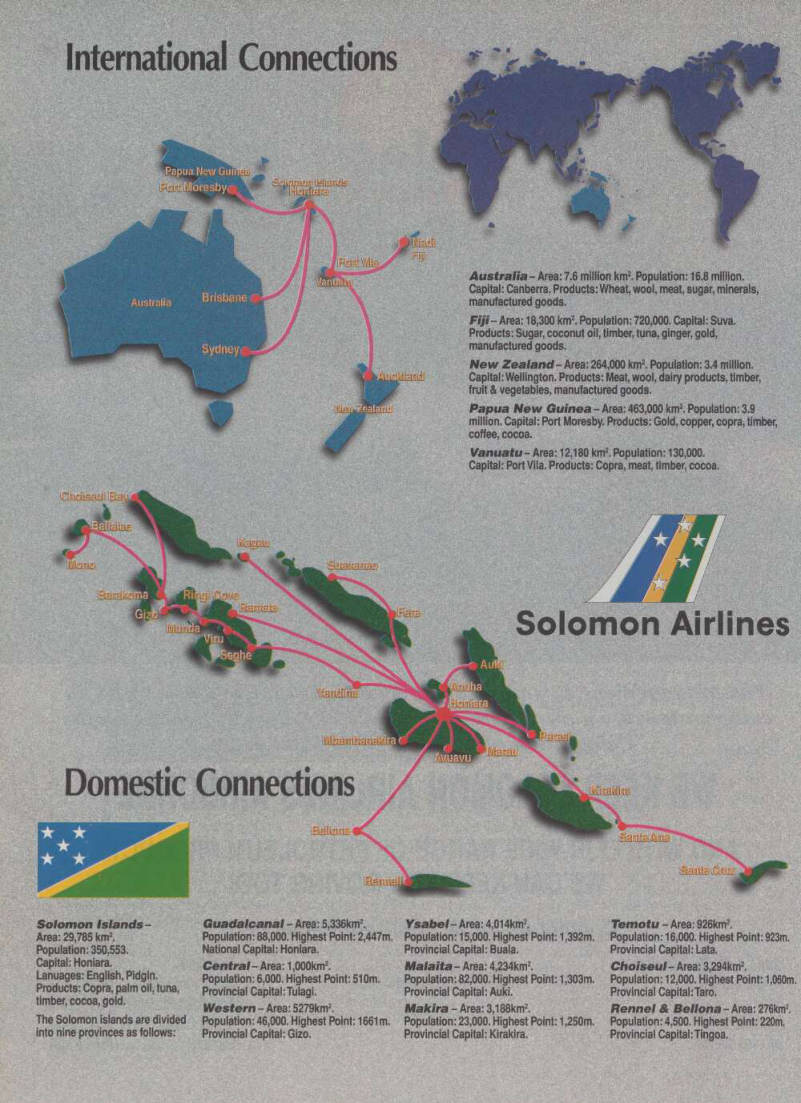
Sports
By Liu Tuwai
Should racial and religious vilifica tion be accepted as an intricate part of sporting life? Should the past approach to “keep it [sledg ing] on the field” remain?
These are some of the ques tions that Australian sporting organisations and sportspeople have been seriously grappling with. According to Fijian rugby league player Eparana Navale, recent controversy around these issues will work to deter players who practise racism on the field.
“The possibility of the offend ing player receiving heavy fines will make such players think again,” said Navale, who has lived in Sydney for three years. Since switching clubs to Parramatta Eels earlier this year, Navale says he has not had to deal with racist sledging as he had previously.
The first half of 1997 ushered in a clear message from black sportsmen in Australia. An
increasing number of black footballers in all four major codes - Australian football, rugby league, rugby union and soccer have let the nation know they will not accept any level of disrespect on or off the field. Today, in Australia, young black players are enlisting into the football codes at a rate unimaginable a decade ago.
Various clubs throughout New South Wales have sizeable portions of Aboriginal and South Pacific Islanders in their teams.
Many of these players have made it clear that they expect support from whites in order to help combat racial abuse.
The stand from black players had led sporting bodies to not only take steps to stamp out racial discrimination on the field but eradicate it from the minds and mouths of those who engage in such practices.
Leading the way in dealing with the issue of on-field racial abuse is the Australian Football League (AFL).
According to AFL’s Melbourne-based communications manager, Tony Peek, an incident in 1995 between players Damian Monkhurst, from Collingwood, and Aboriginal Michael Long, from Essendon, forced the AFL into taking a no-nonsense stand to support their black players.
Long claimed he had been racially harassed and abused by Monkhurst. His claims were later proven to be correct but, says Peek, “unfortunately at that time we didn’t have any system in place to be able to deal with the issue of on-field racism”.
Peek told Pacific Islands Monthly that AFL would be the first to admit that, at that time, white Australians’ understanding of
the issues were minimal because they had not been exposed to that type of thing before. He said, “We did not understand what it meant to be part of a minority group in soci ety and be abused because of your skin colour or race.”
AFL’s racial and religious vilifi cation rules apply to players from any background but, to date, the focus has been on Aboriginal play ers because five out of six cases reported have involved players from Aboriginal background being
racially abused.
There has only been one com plaint that has been dealt with through confidential mediation involving a player from another eth nic background although there have been comments in the press from players of Italian and Croatian backgrounds expressing disgust toward racial abuse hurled at them by players or someone in the crowd.
There is widespread belief in Australia that racism in sport is not nearly as bad as in other Western countries, and that an equal playing field exists for all players. But,
according to Professor Colin Tatz, “racism in Australia has been as bad or, in some instances, worse than in South Africa or America”.
He prefaces his statement by saying,
“The struggle for Aboriginal people in
sport has been an incredibly difficult one.”
Tatz is the author of two books, Obstacle Race and Black Diamonds, which docu ment the involvement of Aboriginal people in sports. Tatz suggests that Australia has a lot of work to do in the sporting world before claims such as those can become
reality.
Twenty-seven-year-old Maori John Timu is in his third season with the Canterbury Bulldogs. Timu started off
Continued on page 45
John Timu: Sledging “is a big part of the game”
Continued from page 27
playing rugby union for Provincial in Otago and then spent five years with the All Blacks before he made the switch to rugby league.
“A lot can happen in the heat of the moment on a footy field.
For example, in heated situa tions, players can lash out and punch someone - whereas if they were in the street they would be had up for assault. So, there are a lot of things that we really have to put in perspective when we are looking at sports, especially physi cal sports like league and rugby.
“I have been fortunate enough not to be a part of sledging or have been sledged against, but I have seen and heard of circumstances when players have definitely been sledged and it is a big part of the game.”
Another very popular Canterbury Bulldogs player is Tongan Solomon Haumono. He states that, while working on a pro fessional level, he has not experi enced racial abuse but admits that
he was subject to it on occasion during games when he was younger. Haumono said that, although he hadn’t personally come across racial sledging at the profes sional level, he knew players who had.
“Some guys use it just to distract the game, but I have always been taught the best strategy is the player’s skill.”
Super League’s Auckland Warrior team mates, Western Samoans Joe Vagana and Tony Toimavav, have strong opinions regarding the use of sledging in a game.
“Sledging has long been part of the game,” says Vagana. “For 80 minutes everybody is really competitive and, at times, it brings the verbal abuse stuff out - but under no circumstances should racial sledging come into it.” Toimavav expressed that he had had limited experience with racial sledg ing. “You get the odd bloke that does make racial comments but usually after having a beer, then everybody gets along with everybody else.”
One Australian Rugby League (ARL) player declares; “I couldn’t really give two hoots about the whole thing.
“It’s just part of the game,” says Sydney
City’s part-Chinese, part-Papua New
Guinean halfback, Adrian Lam. Lam said
that he often experienced racial abuse on the field but was prepared to ignore it.
Gold Coast Chargers Aboriginal halfback Wesley Patten made international head lines earlier this year when he successfully sued the NSW Police Department for $A25,000 (SUS 17,600) after being called a “coon” by police on a national television programme. Patten says he would accept some forms of sledging during a game but would definitely not accept racial abuse.
In a letter circulated throughout AFL clubs in April, Wayne Jackson, the chief executive officer, stated: “While the terms of our racial and religious vilification rule - as recommended to us by such organisa tions as the Human Rights Commission and Equal Opportunity Commission of Victoria - require confidential mediation to be part of the process, it would appear that a small minority of players has not heeded the message. Put simply, on-field racial abuse is not acceptable and we urge all players, coaches and clubs to under stand our position on this matter.
“In the broader community and work place, abusing someone on the basis of his race or religion is against the law. More importantly, it is against the Australian
ideal of a ‘fair go’ for everyone. We believe football can play a major role in educating all sections of the
community, with particular empha
sis on the children of Australia, and that racial abuse has no place in our
society.”
Tatz believes that if the Australian population had a better understanding of Australia’s com
plex history, it might help shape
some of the ignorant attitudes that exist. “You listen to some of these people and you would think that
Aboriginal people have always
being playing Aussie rules and
rugby league. Basically, Aboriginal
people began to play rugby league in the late 50s and early 60s.
Really, the avalanche of players only begins in the 80s and 905.”
Toimavav said he was not too clear about the colonial history of Aboriginal Australia but stressed that if Aboriginals were being harassed, then that was serious. He added that as a Pacific Islander in this country “I am a bit removed from what has actually been going on”. “Sports is good for those who
make it,” expresses Tatz. Drawing a paral lel with the Michael Jordan phenomenon, he said: “There has been a study done - for every 100,000 black kids that think that sports is the avenue to social mobility, one makes it.
“There is one Tiger Woods and maybe a dozen Michael Jordans and footballers, basketballers and so on. If you really look at the incredible numbers who try to go that route, you see what kind of a trap sport is for African-Americans or indigenous Australians who believe that the sports world is the way to succeed.
“For everyone that makes it, there are several thousands that don’t. Sport is a way for social mobility, for success - a couple of dozen at the very top, but that is about it.”
Racism within sports is something that can be beaten down by the individuals who are the victims, says West Indian Keith Connor, the head coach for the NSW Institute of Sports.
“If you continue to let people get to you with racist taunts, they will continue to use it. But if you get up and do what you are supposed to do out on the field, you will not be disadvantaged.” ■
Solomon Haumono ... “The best strategy is the player’s skill”
Looking back...
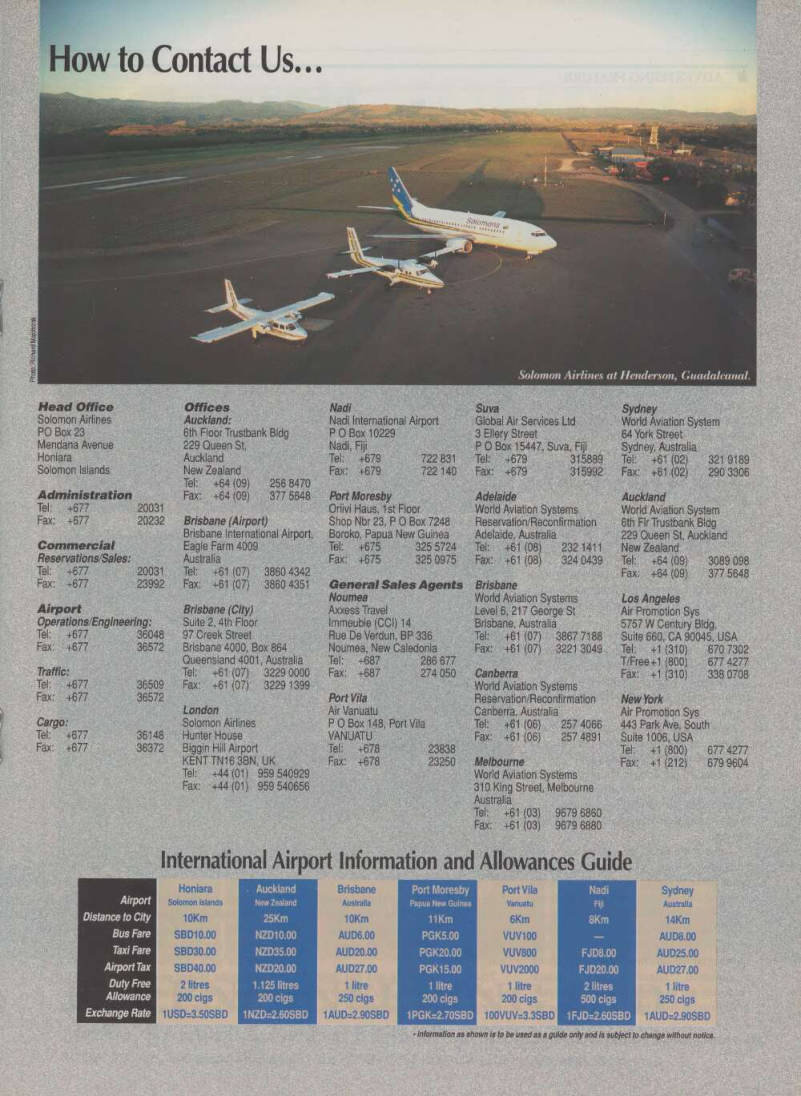
Advertising Feature
Solomon Islands
This month, Solomon Islands celebrates 19 years of independence and, as it does so, the peo ple will look back on its history and the events leading up to independence.
The second largest island chain in the region, the Solomons has a population of around 350,000 spread across an area of 28,530 sq km.
The capital, Honiara, is on Guadalcanal, known the world over as the site for some of the bloodiest battles of World War 11.
The country is a scattered double chain of islands which extend 1667 km in a
southeasterly direction from the strife-rid den Bougainville in Papua New Guinea.
Some of the islands are rugged, heavily wooded and mountainous; others are tiny, low-lying coral atolls.
Much of the Solomons is covered with dense rainforest, with mangrove swamps occurring along parts of the coast. Most islands have coral reefs and lagoons around them. Many have formed around an initial volcano cone which has since been over laid with colourful, level-topped terraces of coral rock. Other islands are former reefs lifted high out of the water by vol canic activity. Natural vegetation in the
large islands is mainly dense rainforest.
Mangroves are prolific around river mouths and along stretches of the coastline.
A variety of introduced tropical trees and shrubs have proliferated.
Native animals are few and consist mainly of possums, bats, different types of rats, and mice. There are over 150 species of birds and many varieties of insects brilliantly coloured butterflies and spiders - toads and frogs. Over 170 species of rep tiles, including turtles, crocodiles, lizards and snakes, are found here.
The reefs are home to hundreds of species of tropical fish, colourful coral and other marine life. There are many varieties of rare and poisonous shells. Deep-sea fish,
whales, dolphins and dugongs frequent
these waters.
The Solomons is divided into eight provinces, each headed by a premier with a secretary as overall supervisor of the administration of the province. The provinces are Guadalcanal, Central Malaita, Makira/Ulwa, Isabel, Temotu, Western, Choiseul and Bellona.
Guadalcanal is the country’s largest province.
In the early 15605, rumours swept Spanish-occupied Peru of the existence of a group of islands, or even a great conti nent, far to the west in the Pacific. Inca leg ends told of a sea journey made in the mid 15th century to these islands by one of their
kings.
In 1567, Don Alvaro de Mendana left Peru to find the legendary islands and, on February 7 of the following year, sighted a large island and named it Santa Isabel.
On August 11, Mendana sailed back to Peru with descriptions of the island.
Initially, the name used by Mendana and his crew was “Western Islands” but about two years later, the name “Yslas de Salomon” or “Solomon Islands” became more commonly used.
Many whalers visited the archipelago from 1798 onwards. They were followed by the sandalwood traders who came between the 1840 s and late 1860 s. They bought pigs, turtle shells and mother-of pearl shells in the Solomon Islands to barter for sandalwood with islanders in Vanuatu (New Hebrides at the time). The ships then sailed to China where the san dalwood was sold at very high prices.
Another island product which was pop ular with the Chinese was beche-de-mer.
They paid high prices for it even though
Solomon Islands Prime Minister Solomon Mamaloni
they were in abundance. On October 6, 1893, Britain claimed a protectorate over the southern part of the island group. This claim was extended in 1897 and again in 1898. Education and health issues were left to the missions, as money was scarce.
During the second world war, the coun try was used as a base by the Japanese.
After the war ended, recovery was slow. As Tulagi was gutted, the Quonset-hut town ship of Honiara was replaced as the capital.
Honiara is the main port of entry. It is built on both sides of Point Cruz where Mendana anchored in 1568.
It is also a post-World War II town, which stands on the site of a former coconut plantation. The Japanese had a small base on the site in 1942 and later the Americans built a much larger one after defeating the Japanese in a bitter struggle.
The post-war civil administration used many of the wartime army buildings as offices and quarters until the early 1960 s when both the government and private sec tor carried out a vigorous building pro gramme.
The early 1960 s were years of political awakening in the Solomons, leading to the creation of an elected governing council in 1970.
The British Solomon Islands protec torate was renamed the Solomon Islands five years later and gained independence on July 7, 1978.
Solomon Islands is a constitutional monarchy with the British monarch as the head of state, represented in the country by the governor-general appointed on the rec ommendation of parliament every five years.
With an agro-based economy, income is largely derived from goods and services performed with cash transactions .
About 84 per cent of the people live in rural areas and are self-sufficient in tradi tional foods - root crops, vegetables and fruits - as well as fishing and livestock hus
bandry.
Most settlements are coastal and close to freshwater springs. Each family has a small coconut plantation for copra produc tion and cash income, and a few scattered vegetable plots. There are often bushes and rainforests nearby which provide tradition al crops, wild nuts, ferns and fruits, as well as material for thatched houses and canoes.
Solomon Islands’ main natural resources are its large number of commer cially useful fruit trees, forests, fisheries
and minerals. Over the years, there has been a considerable diversification from a copra-based, one-product rural economy of the colonial era. The seas have become one
Islands has many of the natural resources required for successful eco-tourism.
Approximately two-thirds of children attend school with church-run schools a
of the country’s principal resources. Fish, especially tuna, has become the largest export earner; timber the second; while copra, cocoa and palm oil come jointly third.
Tourism is growing and has potential but currently provides only a minor contri bution to gross domestic product. Solomon
vital part of the education system. The overall objective of the education system is to provide a coordinated programme which can meet the country’s needs for skilled labour as well as provide basic education suited to the village environment where the majority of the population resides. Primary education is not yet compulsory and chil-
Reminder from second world war
Japanese war memorial
dren between the ages of six and nine are admitted into Grade One. There is a preparatory grade for children between the ages of five and eight.
The secondary school system is com posed of national and provincial schools.
Eight national schools provide an academ ic-oriented education over a five-year peri od which leads to the Solomon Islands School Certificate at the end of Form Five.
The provincial schools have a more vocation-oriented syllabus catering for those students who choose to live in their village rather than pursue tertiary educa tion or employment in urban centres.
Approximately 30 per cent of students who complete primary school, attend one
or the other of secondary schools.
Archaeological research has revealed that Solomon Islands has been inhabited for 3000 years. Material excavated on Santa Ana, Guadalcanal and on Gawa in the Reef Islands has been radio-carbon dated to about 1000 BC.
Red pottery thought to have been relat ed to Capita ware was also found on Santa Ana, where it was estimated to be from between 140 and 670 AD. Similar pottery has been found on the Reef Islands.
The immense variety of the Solomon Island culture and customs reflects the existence of 107 indigenous languages and dialects among a population of only 346,000. Officially, there are 63 indigenous
languages and a further 44 dialects. In addition there are three new languages.
They are Solomon Islands Pidgin, English and Gilbertese. It’s quite Common for Melanesians from a few kilometres apart to speak different languages. Dances, cere monies, funerals, weddings, initiation cere monies, status and authority often differ from island to island.
The Solomon Islands, like most other Pacific Island countries prides itself in hav ing a rich and diverse culture. Cultural dis plays are colourful and varied, with islands having their own unique dances and cos tumes.
Weaving is part of Solomons tradition and most weaving is done without looms, using split bamboo, vines, cane and dried coconut and pandanus leaves. Bukaware baskets, trays, tablemats and coasters are made in several parts of the Solomons,
especially Guadalcanal.
The word kastom, meaning custom, is used when villagers refer to traditional beliefs and land ownership. Songs, dances and stories about the past are still common.
They are usually to do with war, harvesting and hunting or the natural world.
Another word which is used frequently is tabu (taboo). Tabu is a very important part of village and island life although rules will vary from place to place. Places which are traditionall tabu, can only be visited with permission from the owners.
Religion plays an important role in most communities, with the church being the central focus in most villages. Christians make up 95 per cent of the population.
Solomon Islanders love sports and take their soccer, basketball, rugby, tennis and athletics quite seriously. Activities such as
fishing and swimming are more necessity
than choice; the first for food the second for cleanliness.
Traditional canoes can still be seen, par ticularly in the outer islands, where people are proud of their production and sailing.
Craft work is also of high quality with much work done with wood inlaid with
mother-of-pearl.
As Solomon Islands, like other coun tries of the world heads into the next mil lennium, it faces the similar challenge of other island countries - how does it enter the new century as a nation that is progres sive and able to make an impact on the world scene while at the same time manag ing to conserve the necessary and impor tant facets of its cultural heritage. ■
Solomon islands... living tradition
Advertisements & other items, pp. 29-36 (1 item)
We Keep Solomon Airlines Airborne
The Management & staff at Shell (Pacific Islands) Limited wish to congratulate the government and people of Solomon Islands on the Celebration of 19 years of Independence.
AND WITH OUR WIDE RANGE OF PETROLEUM PRODUCTS
WE CAN KEEP YOU MOVING TOO!
Contact us for all your requirements of: Shell Co. (Pacific Islands) Ltd Telephone PO Box 879 • Fuels & Lubrication Honiara Installation (677)21838 Honiara Area Sales Manager (677) 22974 Guadalcanal Airport Aviation Depot (677) 36142 Solomon Islands Facsimile 677 23481
International Connections
*• • * SdijuuM'lidhUßk mM Ptsiotei Australia Bnsbane Sydney Australia- Area: 7.6 million km 2 . Population: 16.8 million.
Capital: Canberra. Products: Wheat, wool, meat, sugar, minerals, manufactured goods.
Fiji- Area: 18,300 km 2 . Population: 720,000. Capital: Suva.
Products: Sugar, coconut oil, timber, tuna, ginger, gold, manufactured goods.
New Zealand- Area: 264,000 km 2 . Population: 3.4 million.
Capital: Wellington. Products: Meat, wool, dairy products, timber, fruit & vegetables, manufactured goods.
Papua New Guinea - Area: 463,000 km 2 . Population; 3.9 million. Capital; Port Moresby. Products: Gold, copper, copra, timber, coffee, cocoa.
Vanuatu- Area: 12,180 km 2 . Population: 130,000.
Capital: Port Vila. Products: Copra, meat, timber, cocoa.
iSteic
Wkim rci mms uniSISIiIEEIISi Vi'cvM mm MlaaniaajtK Msim:
Domestic Connections
\Bim
Solomon Airlines
V WmmmSSt cianr; .Vul: Solomon Islands- Area: 29,785 km 2 .
Population; 350,553.
Capital: Honiara.
Lanuages; English, Pidgin.
Products: Copra, palm oil, tuna, timber, cocoa, gold.
The Solomon islands are divided into nine provinces as follows; Guadalcanal - Area: 5,336 km 2 .
Population: 88,000. Highest Point: 2,447 m.
National Capital: Honiara.
Central - Area: I,oookm 2 .
Population; 6,000. Highest Point; 510 m.
Provincial Capital :Tulagi.
Western - Area; 5279 km 2 .
Population: 46,000. Highest Point: 1661 m.
Provincial Capital: Gizo.
Ysabel- Area: 4,014 km 2 .
Population: 15,000. Highest Point: 1,392 m.
Provincial Capital; Buala.
Malaita - Area; 4,234 km 2 .
Population: 82,000. Highest Point: 1,303 m.
Provincial Capital; Auki.
Makira - Area: 3,188 km 2 .
Population: 23,000. Highest Point: 1,250 m.
Provincial Capital; Kirakira.
Temotu - Area: 926 km 2 .
Population: 16,000. Highest Point: 923 m.
Provincial Capital; Lata.
Choiseul- Area: 3,294 km 2 .
Population: 12,000. Highest Point: 1,060 m.
Provincial Capital:Taro.
Rennet & Bellona- Area: 276 k Population: 4,500. Highest Point: 220 m.
Provincial Capital;Tingoa.
How to Contact Us...
So/n ~ons I?
Head Office Solomon Airlines PO Box 23 Mendana Avenue Honiara Solomon Islands Administration Tel: +677 20031 Fax; +677 20232 Commercial Reservations/Sales: Tel; +677 20031 Fax: +677 23992 Airport
Operations/Engineering:
Tel: +677 36048 Fax: +677 36572 Traffic: Tel: +677 Fax: +677 Cargo: Tel; +677 Fax; +677 36509 36572 36148 36372 Offices Auckland: 6th Floor Trustbank Bldg 229 Queen St, Auckland New Zealand Tel: +64 (09) 256 8470 Fax: +64(09) 377 5648 Brisbane (Airport) Brisbane International Airport, Eagle Farm 4009 Australia Tel; +6l (07) 3860 4342 Fax: +6l (07) 3860 4351 Brisbane (City) Suite 2,4 th Floor 97 Creek Street Brisbane 4000, Box 864 Queensland 4001, Australia Tel: +6l (07) 3229 0000 Fax: +6l (07) 3229 1399 London Solomon Airlines Hunter House Biggin Hill Airport
KENT TNI6 3BN, UK
Tel: +44(01) 959 540929 Fax: +44(01) 959 540656 Nadi Nadi International Airport PO Box 10229 Nadi, Fiji Tel: +679 722 831 Fax: +679 722 140 Port Moresby Oriivi Haus, Ist Floor Shop Nbr 23, P O Box 7248 Boroko, Papua New Guinea Tel: +675 325 5724 Fax: +675 325 0975 General Sales Agents Noumea Axxess Travel Immeuble (CCI) 14 Rue De Verdun, BP 336 Noumea, New Caledonia Tel: +687 286 677 Fax: +687 274 050 Port Vila Air Vanuatu P O Box 148, Port Vila
VANUATU
Tel: +678 23838 Fax: +678 23250 Suva Global Air Services Ltd 3 Ellery Street P O Box 15447, Suva, Fiji Tel: +679 315889 Fax: +679 315992 Adelaide World Aviation Systems Reservation/Reconfirmation Adelaide, Australia Tel: +61(08) 232 1411 Fax: +6l (08) 324 0439 Brisbane World Aviation Systems Level 6,217 George St Brisbane, Australia Tel: +6l (07) 3867 7188 Fax: +6l (07) 3221 3049 Canberra World Aviation Systems Reservation/Reconfirmation Canberra, Australia Tel: +6l (06) 257 4066 Fax: +6l (06) 257 4891 Melbourne World Aviation Systems 310 King Street, Melbourne Australia Tel: +6l (03) 9679 6860 Fax: +6l (03) 9679 6880
Sydney
World Aviation System 64 York Street Sydney, Australia Tel: +6l (02) 321 9189 Fax: +6l (02) 290 3306 Auckland World Aviation System 6th Fir Trustbank Bldg 229 Queen St, Auckland New Zealand Tel: +64 (09) 3089 098 Fax: +64 (09) 377 5648 Los Angeles Air Promotion Sys 5757 W Century Bldg, Suite 660, CA 90045, USA Tel: +1 (310) 670 7302 T/Free+l (800) 677 4277 Fax: +1 (310) 338 0708 New York Air Promotion Sys 443 Park Ave, South Suite 1006, USA Tel: +1 (800) 677 4277 Fax: +1 (212) 679 9604
International Airport Information and Allowances Guide
PGK2O.OO
• information as shown is to be used as a guide only and is subject to change without notice.
Benefit from over 20 years
Pacific Islands experience
• Ship refitting to 100 - Metre Length • Dumb barge design & construction to 600 - tonne capacity • Civil & Structural engineering works within the Solomon Islands • Tug design & construction to 20 Metres • Landing Craft design & Construction to 30 Metres in steel and aluminium • Specialists in Aluminium canoes, runabouts and dinghies Competitive Prices and an understanding of the Pacific make contacting us worthwhile. 5 ».? %
SISIiMII
if
R R ENGINEERING LTD
Marine, Structural & General Engineering, Metals Fabricators.
P.0.80x 710, Honiara, Guadalcanal, Solomon Islands. Phone: (677) 30441 Fax: (677) 30279 E Mail: [email protected]
THE
SOLOMON BUNDS
Welcomes Your Investment
K mSI ft *7
*n .n SSSte*. i
sc .—- ’lf rgg ■
JSP
SB ..
The Solomon Islands - over 100 islands and 27,000 square kilometres of rainforests,
mountains, lagoons and picture-perfect
coral beaches set in the heart of Melanesia.
Independent since 1978, the Solomon Islands have a democratic constitution of national and provincial government.
Solomon Islanders are a lively and healthy collection of 370,000 law-abiding and cheerful Pacific islanders whose diverse culture (over 87 languages) has blended with the modern technological world. J| The islands enjoy a free and active press and radio (with television coming soon); and high-technology satellite communications links (including ISD telephone, telex and facsimile facilities) which link the islands both domestically
SOLOMON
ISLANDS
NX
VANUATU
AUSTRALIA
HEW V
CALEDONIA
NEW
ZEALAND
and internationally.
In addition regular, scheduled sea and air transport links can connect you with any place in the world from our central location in the South-West Pacific.
The Solomon Islands seeks and welcomes investment from genuine private commercial investors interested in
manufacturing, commercial agriculture,
timber processing, fisheries, electronics, electrical engineering, tourism and hotels, mining, food processing, textile and garment manufacturing or one of the many other opportunities available.
For more information please contact: The Secretary, Foreign Investment Board, Ministry of Commerce, Industries & Employment PO Box G 26, Honiara, Solomon Islands. Telephone: (677) 23015 or (677) 21928. Facsimile: (677) 21 651.
“You won't see
the whole picture from
your hotel balcony”
A ■4* sr< f < *3* m «: &jS I The best of Vanuatu lies
in its unspoilt
outer islands.
* • 29 Destinations# Charters • Scenic Flights • Scheduled
Passenger & Freight Services
10 scheduled departures daily to the islands
3 TIMES DAILY
4 TIMES DAILY
TANNA
SANTO
Fly Vanalr to see
the real Vanuatu.
if fO tUlfftii fJtuH rfffjf) Vanuatu Internal Air Services: PMB 069 Port Vila, Vanuatu Administration Offices: Bauerfield Airport, Port Vila Tel: (678) 22643 Fax: (678) 23910
17 years after birth
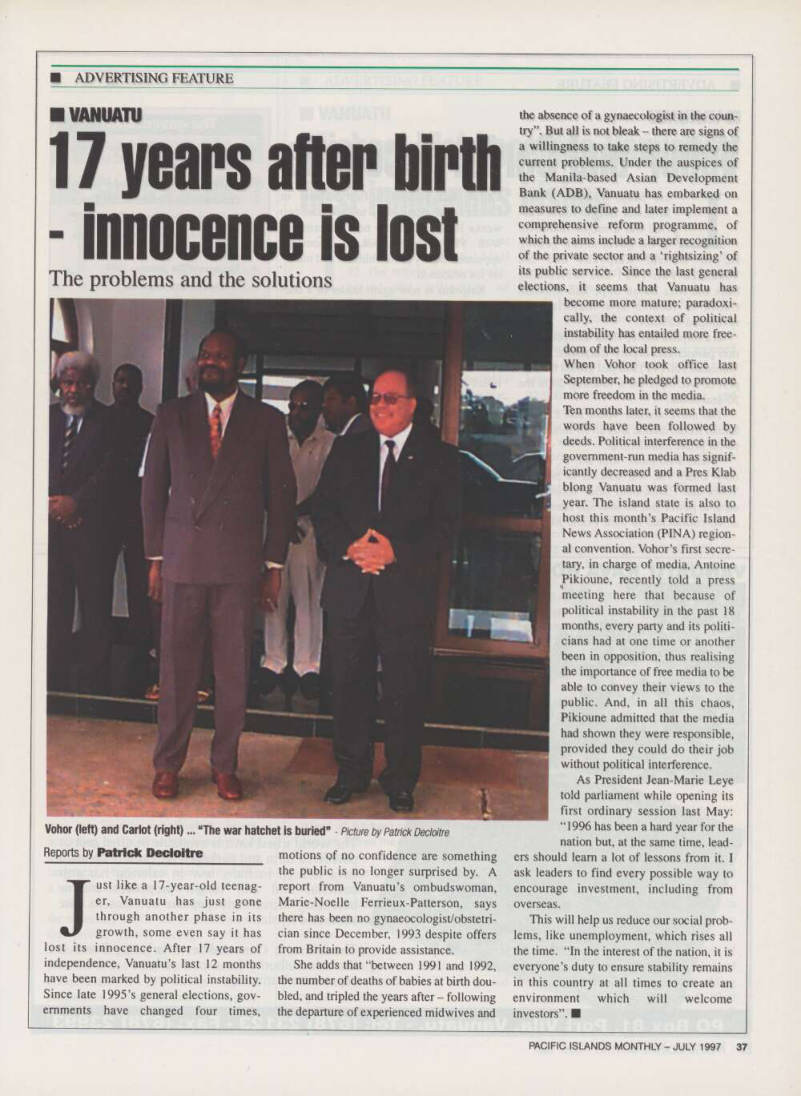
Vanuatu
17 years after birth - inocence is lost The problems and the solutions
Reports by Patrick Decloitre
Just like a 17-year-old teenag er, Vanuatu has just gone through another phase in its growth, some even say it has lost its innocence. After 17 years of independence, Vanuatu’s last 12 months have been marked by political instability.
Since late 1995’s general elections, gov ernments have changed four times,
motions of no confidence are something the public is no longer surprised by. A report from Vanuatu’s ombudswoman, Marie-Noelle Ferrieux-Patterson, says there has been no gynaeocologist/obstetri cian since December, 1993 despite offers from Britain to provide assistance.
She adds that “between 1991 and 1-992, the number of deaths of babies at birth dou bled, and tripled the years after - following the departure of experienced midwives and
the absence of a gynaecologist in the coun try”. But all is not bleak - there are signs of a willingness to take steps to remedy the current problems. Under the auspices of the Manila-based Asian Development Bank (ADB), Vanuatu has embarked on measures to define and later implement a comprehensive reform programme, of which the aims include a larger recognition of the private sector and a ‘rightsizing’ of its public service. Since the last general elections, it seems that Vanuatu has
become more mature; paradoxi cally, the context of political instability has entailed more free dom of the local press.
When Vohor took office last September, he pledged to promote more freedom in the media.
Ten months later, it seems that the words have been followed by deeds. Political interference in the government-run media has signif icantly decreased and a Pres Klab blong Vanuatu was formed last year. The island state is also to host this month’s Pacific Island News Association (PINA) region al convention. Vohor’s first secre tary, in charge of media, Antoine Pikioune, recently told a press meeting here that because of political instability in the past 18 months, every party and its politi cians had at one time or another been in opposition, thus realising the importance of free media to be able to convey their views to the public. And, in all this chaos, Pikioune admitted that the media had shown they were responsible, provided they could do their job without political interference.
As President Jean-Marie Leye told parliament while opening its first ordinary session last May: “1996 has been a hard year for the nation but, at the same time, lead
ers should leam a lot of lessons from it. I ask leaders to find every possible way to encourage investment, including from overseas.
This will help us reduce our social prob lems, like unemployment, which rises all the time. “In the interest of the nation, it is everyone’s duty to ensure stability remains in this country at all times to create an environment which will welcome investors”. ■
Vohor (left) and Carlot (right)... “The war hatchet is buried” Picture by Patrick Decloitre
Vohor and Carlot reconcile
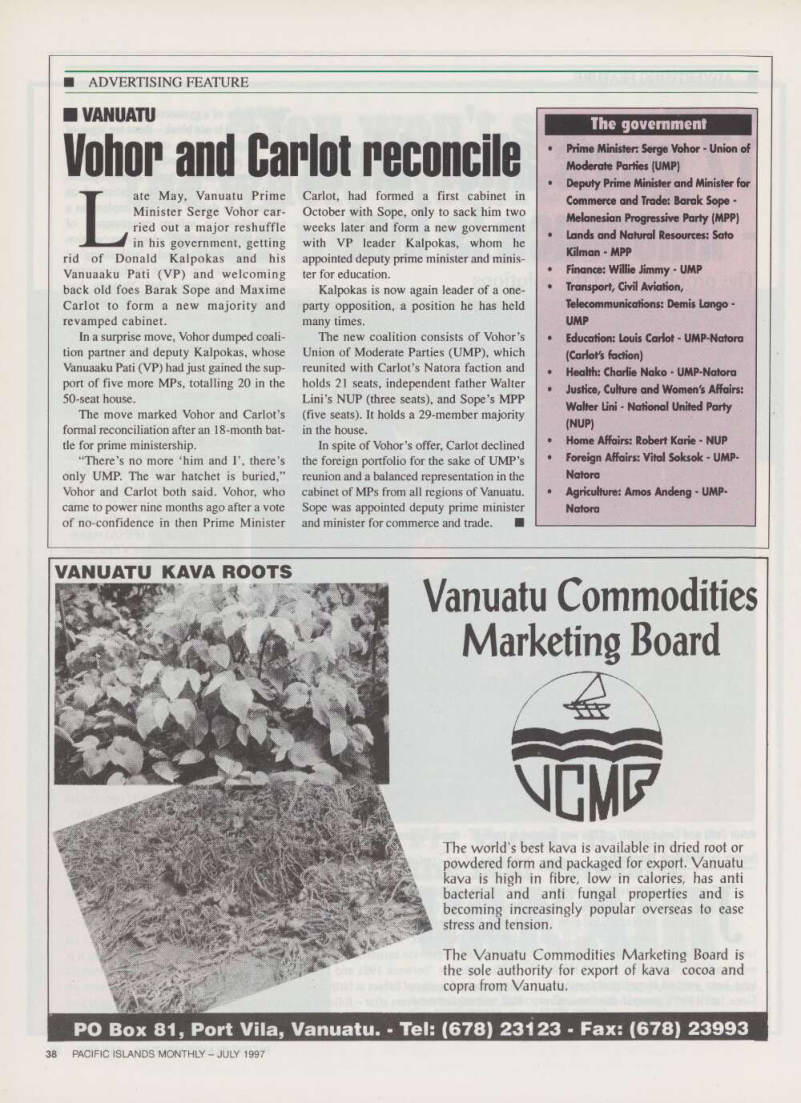
Late May, Vanuatu Prime Minister Serge Vohor car ried out a major reshuffle in his government, getting rid of Donald Kalpokas and his Vanuaaku Pati (VP) and welcoming back old foes Barak Sope and Maxime Carlot to form a new majority and revamped cabinet.
In a surprise move, Vohor dumped coali tion partner and deputy Kalpokas, whose Vanuaaku Pati (VP) had just gained the sup port of five more MPs, totalling 20 in the 50-seat house.
The move marked Vohor and Carlot’s formal reconciliation after an 18-month bat tle for prime ministership.
“There’s no more ‘him and T, there’s only UMP. The war hatchet is buried,”
Vohor and Carlot both said. Vohor, who came to power nine months ago after a vote of no-confidence in then Prime Minister
Carlot, had formed a first cabinet in October with Sope, only to sack him two weeks later and form a new government with VP leader Kalpokas, whom he
appointed deputy prime minister and minis
ter for education.
Kalpokas is now again leader of a one party opposition, a position he has held many times.
The new coalition consists of Vohor’s Union of Moderate Parties (UMP), which reunited with Carlot’s Natora faction and holds 21 seats, independent father Walter Lini’s NUP (three seats), and Sope’s MPP (five seats). It holds a 29-member majority in the house.
In spite of Vohor’s offer, Carlot declined the foreign portfolio for the sake of UMP’s reunion and a balanced representation in the cabinet of MPs from all regions of Vanuatu.
Sope was appointed deputy prime minister
and minister for commerce and trade. ■
The government
• Prime Minister Serge Vohor - Union of Moderate Parties (UMP) • Deputy Prime Minister and Minister for Commerce and Trade: Barak Sope - Melanesian Progressive Party (MPP) • Lands and Natural Resources: Sato Kiiman - MPP • Finance: Willie Jimmy - UMP • Transport, Civil Aviation, Telecommunications: Demis Lango ■
Ump
• Education: Louis Carlot - UMP-Natora (Cadet's faction) • Health: Charlie Nako - UMP-Natora • Justice, Culture and Women's Affairs: Walter Uni - National United Party
(Nup)
• Home Affairs: Robert Katie - NUP • Foreign Affairs: Vital Soksok - UMP- Natora • Agriculture: Amos Andeng - UMP- Natora
Advertisements & other items, p. 38 (2 items)
■ Vanuatu
38
PACIFIC ISLANDS MONTHLY - JULY 1997
■ ADVERTISING FEATURE
Marketing Board
VANUATU KAVA ROOTS
i 11 ... m m ■ & '*ar
Vanuatu Commodities
Marketing Board
The world’s best kava is available in dried root or powdered form and packaged for export. Vanuatu kava is high in fibre, low in calories, has anti bacterial and anti fungal properties and is becoming increasingly popular overseas to ease stress and tension.
The Vanuatu Commodities Marketing Board is the sole authority for export of kava cocoa and copra from Vanuatu.
PO Box 81, Port Vila, Vanuatu. - Tel: (678) 23123 - Fax: (678) 23993
the South Pacific ?
A baccalaureate of the South Pacific ?
Jean Geoffrey, from the
French ministry of educa tion, spent two weeks in Vanuatu in April to assess the education system and explore possibilities of creating a South Pacific version of the French bac calaureate.
In practice, if the concept eventuates, it would set the rules for a new examination at the end of secundary education.
“Vanuatu’s linguistic history is compli
cated and students must be open to all sys tems,” Geoffrey says, adding that if this new examination is to come into exis tence, it must be recognised by by all fur ther education institutions of the region -
English-speaking and French-speaking.”
After his stay in Vanuatu, where he met education officials, Geoffrey met officials from the Universite Francaise du Pacifique (UFP) and asked them to liaise with other institutions of the region, the main one being the University of the South Pacific (USP) based in Suva. It, however, remains unclear as yet what this new diploma will consist of: “There could be something like the French baccalaure ate, but there could also be a professional, more technical, ‘bac’ because, here, tech nical skills are very important. One thing for sure, it has to take into account the two
teaching channels currently existing in
Vanuatu, that is, French and English.”
In Vanuatu, a former French-British condominium of the New Hebrides and
independent in 1980, the linguistic legacy
still remains: the two languages officially recognised by the constitution in educa tion are French and English, hence, according to Geoffroy, the possibility of coming up with an examination in two languages - but one not necessarily being a verbatim translation of the other.
“It’s also important to be in touch with the economic sector, the administrations, the private sector, through technical schools.” “It’s going to have to be a com promise. In any case, this is a country of
compromises. It’s only through regional
cooperation that we can manage a region al education system.” ■
first indigenous bishop
Michael Visi becomes Vanuatu's first indigenous bishop
It was a national event throughout Vanuatu: April 13, the whole country cele brated the ordination of Michel Visi, the first indigenous bishop of the Roman Catholic was appointed last December by Pope John Paul 11.
From northern Ambae Island (250 kilometres north of Port Vila), he takes over from American Francis Lambert, who has reached 75, the age limit set by canonic law.
The new Vanuatu bishop, who studied in seminaries in neighbouring New Caledonia and Fiji’s Pacific Regional Seminary (of which he was rector until last year), obtained a degree in canonic law in Canada and will be in charge of a diocese covering the 80 scattered islands of this Y-shaped archipelago.
Vanuatu’s Catholic mission has 14 local priests and now, over 110 years after its arrival in Vanuatu, an indigenous bishop.
On the eve of this historic event, Visi said he was ready.
“I prepared myself especially. I spent a 30-day retreat in Australia with the Jesuits. I think the mission of a bishop requires a lot of tranquility in heart and mind.”
On the said day, over 1000 people from every outer island of Vanuatu and over 200 overseas visitors converged on
the capital.
Tribal dancers from all over the
archipelago (including Visi’s home
island of Ambae) came in hundreds to perform before the new local bishop.
Vanuatu’s linguistic and religious
legacy is strongly related to the presence of missionaries who were often, in the early last century, the first permanent white settlers in these South Pacific islands.
The celebrations were a harmonious mix of liturgy and traditional tribal dances, once labelled “evil” and banned by the missionaries.
The celebrations, which lasted two
days, started with the official ordination on Port Vila’s largest open ground, the Independence Park. On Sunday, Visi said his first mass.
In Vanuatu (170,000 inhabitants for some 80 inhabited islands), which defines itself in its constitution as a Christian country, churches are grouped into a council with the prominent ones being the Roman Catholic (around 22,000 believers), Presbyterian and Anglican churches.
The Catholic church, in Vanuatu since 1887, makes its presence known through its primary and secondary mission schools. Over the years, it has developed a reputation of tolerance: the first priests were much more tolerant than Presbyterians or Anglicans, who often banned tribal and traditional practices, saying they “belonged to the Devil”.
Former Deputy Prime Minister and a pastor with the Presbyterian Church, Sethy Regenvanu, after watching this weekend’s celebrations and profuse trib al dances, admires this tolerance.
“One thing the Catholic church has been able to do which we [the Presbyterians], for example, haven’t been able to do as effectively is to go to the grassroots and live and share and be involved with the local people, without telling [them] to do away with their cus toms, culture and tradition,” Regenvanu said.
“What they [Presbyterians] did was to tell the people that their way of life their culture - was not compatible with Christianity, therefore they had to make a complete break with those before they could be accepted into the church.”
The nuncio, Irish Wellington-based
Archbishop Patrick Connevey, officially
represented Pope John Paul 11. He saw in the event a sign of maturity in the Roman Catholic Church.
“The episcopal ordination of a son of this country shows an acknowledged maturity [of the church],” he said, adding “papa god i blessem Vanuatu ” (God blesses Vanuatu) in the local pidgin. ■
Advertisements & other items, pp. 39-40 (2 items)
■ Vanuatu
PACIFIC ISLANDS MONTHLY-JULY 1997
■ ADVERTISING FEATURE
■ VANUATU
■ ADVERTISING FEATURE
TOtoP toot
L ‘ 1 . ill ft' 111 THE AVAILABLE STOMP PACKS VUITN 10 STAMPS
IN ONE STAMP PACK
ONE OF THE
THREE STAMP
I*.. PACKS a
ONE OF THE THREE
STAMP PACKS
t: , FOR EACH POSTAGE UP TO )5g TO:
AUSTRALIA A THE REST OF
THE SOUTH PACIFIC
(EXCEPT HAWAII)
USE ONLY
FOR LOCAL (10 x $0.13)
yf.Samoa A.Samoa Tonga
POSTAGE UP
(lOxSO.
I $3.10 (lOXSOJI)
For further enquiries call toll free 0800101966
A Stamp
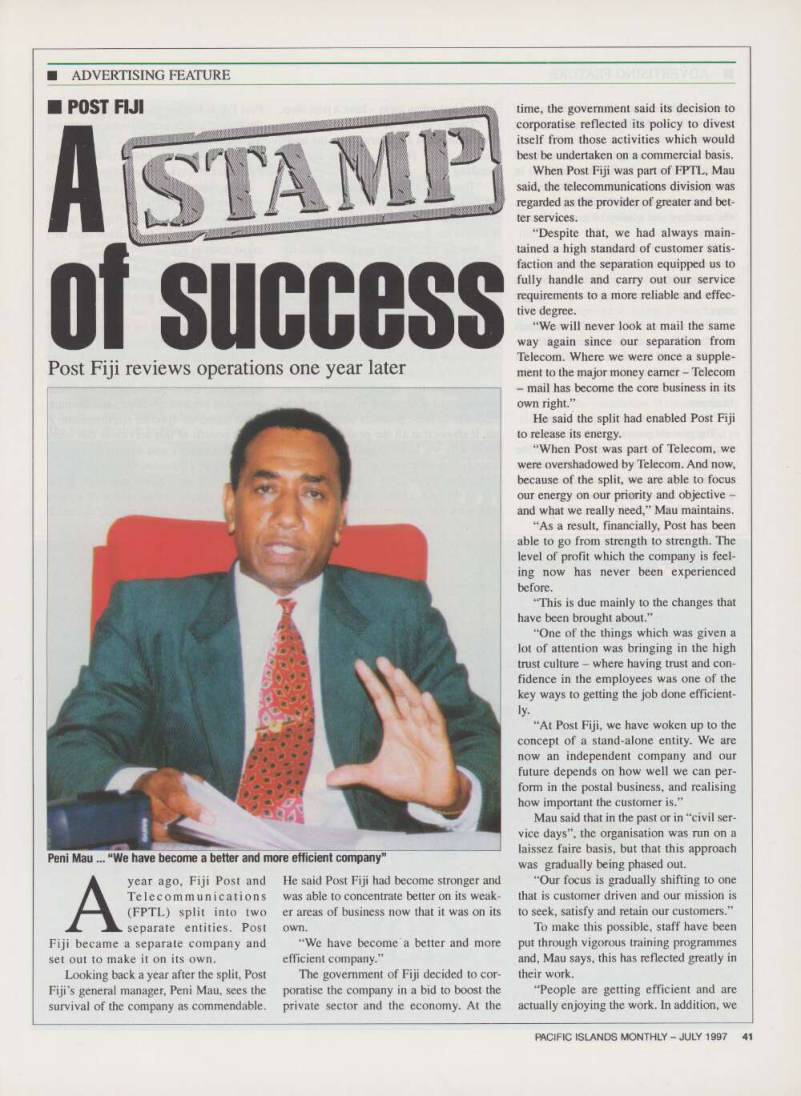
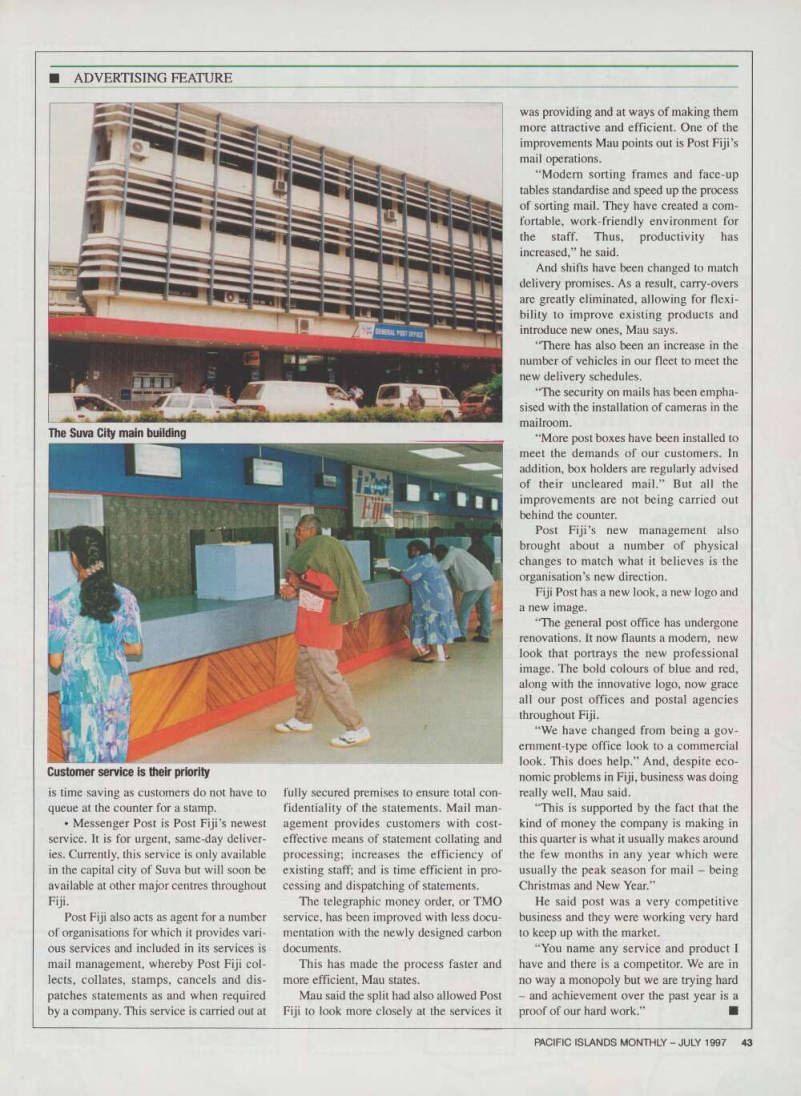
Post Fiji
of success Post Fiji reviews operations one year later
A year ago, Fiji Post and Telecommunications (FPTL) split into two separate entities. Post Fiji became a separate company and set out to make it on its own.
Looking back a year after the split, Post Fiji’s general manager, Peni Mau, sees the survival of the company as commendable.
He said Post Fiji had become stronger and was able to concentrate better on its weak er areas of business now that it was on its own.
“We have become a better and more
efficient company.”
The government of Fiji decided to cor poratise the company in a bid to boost the private sector and the economy. At the
time, the government said its decision to corporatise reflected its policy to divest itself from those activities which would best be undertaken on a commercial basis.
When Post Fiji was part of FPTL, Mau said, the telecommunications division was regarded as the provider of greater and bet ter services.
“Despite that, we had always main tained a high standard of customer satis faction and the separation equipped us to fully handle and carry out our service requirements to a more reliable and effec
tive degree.
“We will never look at mail the same way again since our separation from Telecom. Where we were once a supple ment to the major money earner - Telecom - mail has become the core business in its own right.”
He said the split had enabled Post Fiji to release its energy.
“When Post was part of Telecom, we were overshadowed by Telecom. And now, because of the split, we are able to focus our energy on our priority and objective and what we really need,” Mau maintains.
“As a result, financially. Post has been able to go from strength to strength. The level of profit which the company is feel ing now has never been experienced before.
“This is due mainly to the changes that have been brought about.”
“One of the things which was given a lot of attention was bringing in the high trust culture - where having trust and con fidence in the employees was one of the key ways to getting the job done efficient ly- “At Post Fiji, we have woken up to the concept of a stand-alone entity. We are now an independent company and our future depends on how well we can per form in the postal business, and realising how important the customer is.”
Mau said that in the past or in “civil ser vice days”, the organisation was run on a laissez faire basis, but that this approach
was gradually being phased out.
“Our focus is gradually shifting to one that is customer driven and our mission is to seek, satisfy and retain our customers.”
To make this possible, staff have been put through vigorous training programmes and, Mau says, this has reflected greatly in their work.
“People are getting efficient and are actually enjoying the work. In addition, we
Peni Mau... “We have become a better and more efficient company”
have brought in new blood who will act as catalysts in establishing the customer-first culture.”
Besides facilitating a customer-oriented culture within the staff, plans are also in the pipeline to take on board and utilise the
relevant technology that will help improve
the standard and quality of service to cus tomers.
There are several other plans to make the postal business a success and one is the one-stop-shop concept for post offices around the country, the general manager says.
“This concept will mean that customers will be able to get all services under one roof. They will be able to pay all their bills at a post office as well make payments for department stores and [carry out] other business.
“There will also be the post shops .”
The post shop concept has already been implemented in all post offices around the country and this was one of the things which helped make the company more profitable, according to Mau.
All of Post Fiji’s 51 post offices - both
in rural and urban areas - have a post shop.
“Twenty-seven of these post offices were running at a loss and, with the intro duction of the post shops, they are now
breaking even.
“This year, I am even looking at some of these post offices making profits something which will be another achieve ment for the company.”
Among the changes apparent since the split. Post Fiji has been able to offer a range of products new to Fiji.
“A lot of companies are competing for a market when there is no market, but I believe my company is competing for opportunities. We look at what opportunity is available and then create products which will suit the market.
“As a result, you see, in the last year, we launched quite a few products and the response to these products surprised even us. It shows that all the products and ser vices that we have lodged have experi enced very high rates of growth. It also shows that the demand is there.
“In the past, marketing of postal prod ucts were non-existent. However, now that
Post Fiji is forging its own way and, with the public’s high expectations, marketing has become an essential tool.”
Some of the new products which Post Fiji launched over the past year are: • International Fastpost. Launched last year, this service allows mail to get on the first available international flight as quick ly as possible to its destination from any major town in Fiji. • Adpost is Post Fiji’s addressed circu lar advertising. It is a mass advertising medium designed to help businesses, non profit organisations and church groups reach their customers by mailing all their flyers, brochures, catalogues and circulars. • Business Reply Post makes it easier for businesses to get responses from their customers. Each business supplies self addressed postage envelopes and business cards based on specific requirements. A major benefit of this service is that users get faster replies and orders. Postage is only paid for customers who respond. • Prepaid Post Envelopes were intro duced to provide customers with a more convenient and efficient mailing system. It
is time saving as customers do not have to queue at the counter for a stamp. • Messenger Post is Post Fiji’s newest service. It is for urgent, same-day deliver ies. Currently, this service is only available in the capital city of Suva but will soon be available at other major centres throughout
Fiji.
Post Fiji also acts as agent for a number of organisations for which it provides vari ous services and included in its services is mail management, whereby Post Fiji col lects, collates, stamps, cancels and dis patches statements as and when required by a company. This service is carried out at
fully secured premises to ensure total con fidentiality of the statements. Mail man agement provides customers with cost effective means of statement collating and processing; increases the efficiency of existing staff; and is time efficient in pro cessing and dispatching of statements.
The telegraphic money order, or TMO service, has been improved with less docu mentation with the newly designed carbon documents.
This has made the process faster and more efficient, Mau states.
Mau said the split had also allowed Post Fiji to look more closely at the services it
was providing and at ways of making them more attractive and efficient. One of the improvements Man points out is Post Fiji’s
mail operations.
“Modem sorting frames and face-up tables standardise and speed up the process of sorting mail. They have created a com fortable, work-friendly environment for the staff. Thus, productivity has increased,” he said.
And shifts have been changed to match delivery promises. As a result, carry-overs are greatly eliminated, allowing for flexi
bility to improve existing products and
introduce new ones, Mau says.
“There has also been an increase in the number of vehicles in our fleet to meet the new delivery schedules.
“The security on mails has been empha sised with the installation of cameras in the mailroom.
“More post boxes have been installed to meet the demands of our customers. In addition, box holders are regularly advised of their uncleared mail.” But all the improvements are not being carried out behind the counter.
Post Fiji’s new management also brought about a number of physical changes to match what it believes is the organisation’s new direction.
Fiji Post has a new look, a new logo and a new image.
“The general post office has undergone renovations. It now flaunts a modem, new look that portrays the new professional image. The bold colours of blue and red, along with the innovative logo, now grace all our post offices and postal agencies throughout Fiji.
“We have changed from being a gov ernment-type office look to a commercial look. This does help.” And, despite eco nomic problems in Fiji, business was doing really well, Mau said.
“This is supported by the fact that the kind of money the company is making in this quarter is what it usually makes around the few months in any year which were usually the peak season for mail - being Christmas and New Year.”
He said post was a very competitive business and they were working very hard to keep up with the market.
“You name any service and product I have and there is a competitor. We are in no way a monopoly but we are trying hard - and achievement over the past year is a proof of our hard work.” ■
The Suva City main building
Customer service is their priority
Advertisements & other items, pp. 42-44 (2 items)
■ Advertising Feature
datec
IBM thinkpads, PC's. RISC SYSTEM/6000. AS/400 Service Centre
IB Microsoft
Products and Support Services
AT&T
AT&T SYSTIMAX Structured Cabling System, PBX Communication System
■■V LOCAL AREA NETWORKS
Novell, Lantastic, Windows for Workgroups, WindowsNT
Iffr HEWLETT
PACKARD Printers and Service Centre
RETAIL INDUSTRY
Point of Sale and Back Office Systems
SOFTWARE DEVELOPMENT
Unix, Windows, DOS, Informix Database
HOTEL INDUSTRY
Front Office, Back Office, Point of Sale, Property Management Systems
rds
to ensure
e *c e /|
ACCOUNTING PACKAGES
ACCPAC Plus for PC’s and Networks, Maximise for Unix, IMAS for AS/400 ff & c * * & o 'h
datec
SUVA 68 GORDON STREET
NADI QUEENS ROAD. MARTINTAR
TEL: [679] 314411
TEL: [679] 721228
FAX: [679] 300162
FAX: [679] 720194
STAMPS OF FIJI
: fiji Y / 3C
FIJI
■m 23C FJ »■
FIJI
FIJI
I* • 1C J 44c Discover Fiji through its stamps. Fiji boasts to produce some of the most beautiful and exotic stamps in the world. Our rich
traditional heritage, culture and abundance
of flora and fauna together with important local and international events are all featured in our stamps. Do not miss your
/ chance.
Take home the perfect gift
STANDING ORDER APPLICATION FORM FOR FIJI
Please find enclosed: British Postal Order Bank Draft I I Bank Cheque I I Payable to the Philatelic Bureau Amount of F$ OR Please debit my standing Account No. for the Amount of F$ To
MANAGER
PHILATELIC BUREAU
PO BOX 100, SUVA
FIJI
FROM
NAME'...,
ADDRESS
OR Please debit my credit card for the Amount of F$ Visa Card I I Master Card American Express I I Dinners Club Minimum credit card charge is F$S. 00 Credit Card Expiry Date Credit Card No Card Holders Name Signature Ph:(679) 312928 Fax:(679) 308156 □ □ r^rm *
I FUJI
*1 L
ijA
FUI
- » . » /* > i t
• FUI
Heartening times
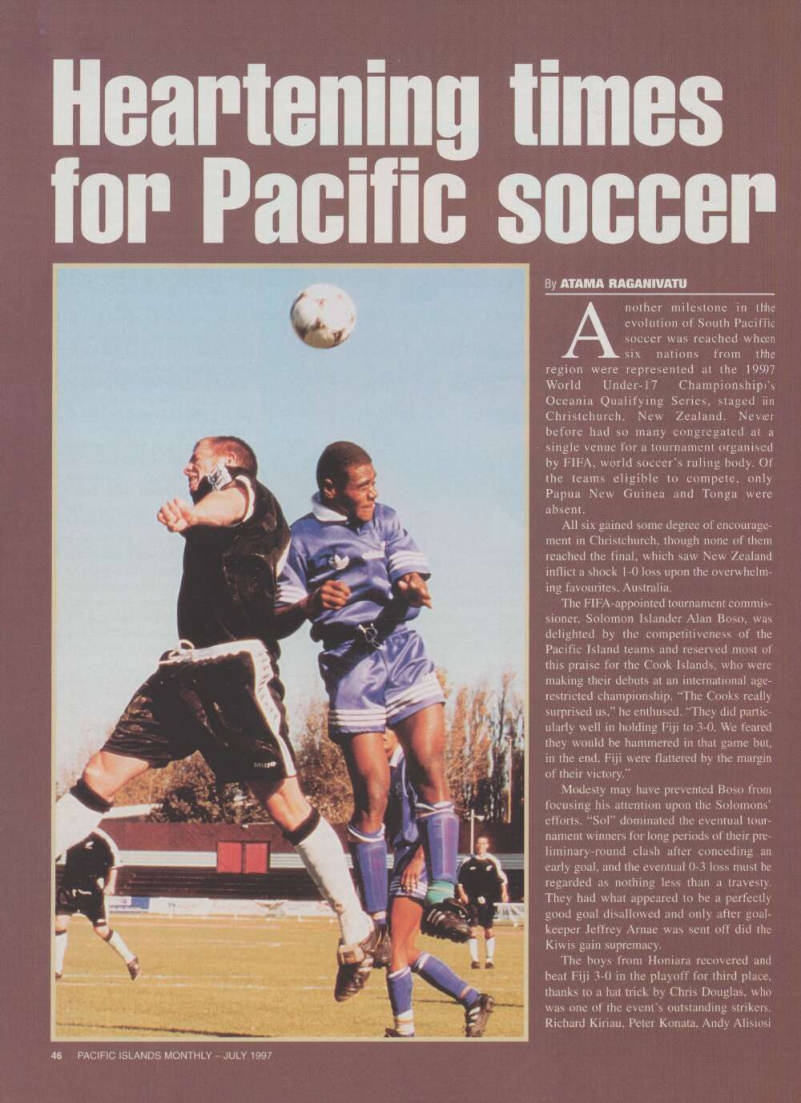
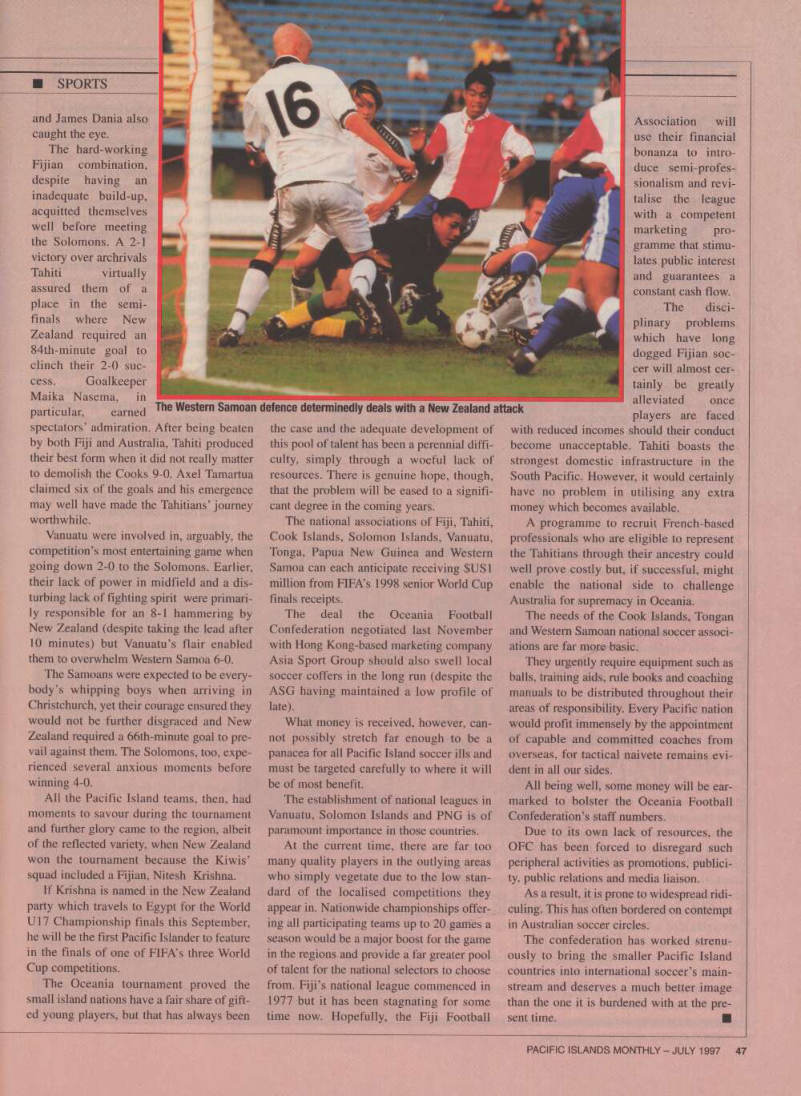
for Pacific soccer
By Atama Raganivatu
Another milestone in thhe evolution of South Pacifi'ic soccer was reached wheen six nations from thhe region were represented at the 19997 World Under-17 Championshipi’s Oceania Qualifying Series, staged iin Christchurch, New Zealand. Never before had so many congregated at a single venue for a tournament organised by FIFA, world soccer's ruling body. Of the teams eligible to compete, only Papua New Guinea and Tonga were absent.
All six gained some degree of encourage ment in Christchurch, though none of them reached the final, which saw New Zealand inflict a shock 1-0 loss upon the overwhelm ing favourites. Australia.
The FIFA-appointed tournament commis sioner. Solomon Islander Alan Boso, was delighted by the competitiveness of the Pacific Island teams and reserved most of this praise for the Cook Islands, who were making their debuts at an international age restricted championship. "The Cooks really surprised us.” he enthused. “They did partic ularly well in holding Fiji to 3-0. We feared they would be hammered in that game but, in the end, Fiji were flattered by the margin of their victory."
Modesty may have prevented Boso from focusing his attention upon the Solomons' efforts. “Sol” dominated the eventual tour nament winners for long periods of their pre liminary-round clash after conceding an early goal, and the eventual 0-3 loss must be regarded as nothing less than a travesty.
They had what appeared to be a perfectly good goal disallowed and only after goal keeper Jeffrey Arnae was sent off did the Kiwis gain supremacy.
The boys from Honiara recovered and beat Fiji 3-0 in the playoff for third place, thanks to a hat trick by Chris Douglas, who was one of the event’s outstanding strikers, Richard Kiriau. Peter Konata. Andy Alisiosi
and James Dania also caught the eye.
The hard-working Fijian combination,
despite having an
inadequate build-up, acquitted themselves well before meeting the Solomons. A 2-1 victory over archrivals
Tahiti virtually
assured them of a place in the semi finals where New Zealand required an 84th-minute goal to clinch their 2-0 suc cess. Goalkeeper Maika Nasema, in particular, earned
spectators’ admiration. After being beaten by both Fiji and Australia, Tahiti produced their best form when it did not really matter to demolish the Cooks 9-0. Axel Tamartua claimed six of the goals and his emergence may well have made the Tahitians’ journey worthwhile.
Vanuatu were involved in, arguably, the competition’s most entertaining game when going down 2-0 to the Solomons. Earlier, their lack of power in midfield and a dis turbing lack of fighting spirit were primari ly responsible for an 8-1 hammering by New Zealand (despite taking the lead after 10 minutes) but Vanuatu’s flair enabled them to overwhelm Western Samoa 6-0.
The Samoans were expected to be every body’s whipping boys when arriving in Christchurch, yet their courage ensured they would not be further disgraced and New Zealand required a 66th-minute goal to pre vail against them. The Solomons, too, expe rienced several anxious moments before
winning 4-0.
All the Pacific Island teams, then, had moments to savour during the tournament and further glory came to the region, albeit of the reflected variety, when New Zealand won the tournament because the Kiwis’ squad included a Fijian, Nitesh Krishna.
If Krishna is named in the New Zealand party which travels to Egypt for the World Ul7 Championship finals this September, he will be the first Pacific Islander to feature in the finals of one of FIFA’s three World
Cup competitions.
The Oceania tournament proved the small island nations have a fair share of gift ed young players, but that has always been
the case and the adequate development of this pool of talent has been a perennial diffi culty, simply through a woeful lack of resources. There is genuine hope, though, that the problem will be eased to a signifi cant degree in the coming years.
The national associations of Fiji, Tahiti, Cook Islands, Solomon Islands, Vanuatu, Tonga, Papua New Guinea and Western Samoa can each anticipate receiving SUS 1 million from FIFA’s 1998 senior World Cup finals receipts.
The deal the Oceania Football Confederation negotiated last November with Hong Kong-based marketing company Asia Sport Group should also swell local soccer coffers in the long run (despite the ASG having maintained a low profile of late).
What money is received, however, can not possibly stretch far enough to be a panacea for all Pacific Island soccer ills and must be targeted carefully to where it will be of most benefit.
The establishment of national leagues in Vanuatu, Solomon Islands and PNG is of paramount importance in those countries.
At the current time, there are far too many quality players in the outlying areas who simply vegetate due to the low stan dard of the localised competitions they appear in. Nationwide championships offer ing all participating teams up to 20 games a season would be a major boost for the game in the regions and provide a far greater pool of talent for the national selectors to choose from. Fiji’s national league commenced in 1977 but it has been stagnating for some time now. Hopefully, the Fiji Football
Association will use their financial bonanza to intro duce semi-profes sionalism and revi talise the league with a competent marketing pro gramme that stimu lates public interest and guarantees a constant cash flow.
The disci plinary problems which have long dogged Fijian soc cer will almost cer tainly be greatly alleviated once players are faced
with reduced incomes should their conduct become unacceptable. Tahiti boasts the strongest domestic infrastructure in the South Pacific. However, it would certainly have no problem in utilising any extra money which becomes available.
A programme to recruit French-based professionals who are eligible to represent the Tahitians through their ancestry could well prove costly but, if successful, might enable the national side to challenge Australia for supremacy in Oceania.
The needs of the Cook Islands, Tongan and Western Samoan national soccer associ ations are far more basic.
They urgently require equipment such as balls, training aids, rule books and coaching manuals to be distributed throughout their areas of responsibility. Every Pacific nation
would profit immensely by the appointment
of capable and committed coaches from overseas, for tactical naivete remains evi dent in all our sides.
All being well, some money will be ear marked to bolster the Oceania Football Confederation’s staff numbers.
Due to its own lack of resources, the OFC has been forced to disregard such peripheral activities as promotions, publici ty, public relations and media liaison.
As a result, it is prone to widespread ridi culing. This has often bordered on contempt in Australian soccer circles.
The confederation has worked strenu ously to bring the smaller Pacific Island countries into international soccer’s main stream and deserves a much better image than the one it is burdened with at the pre sent time. ■
The Western Samoan defence determinedly deals with a New Zealand attack
Initiation tradition
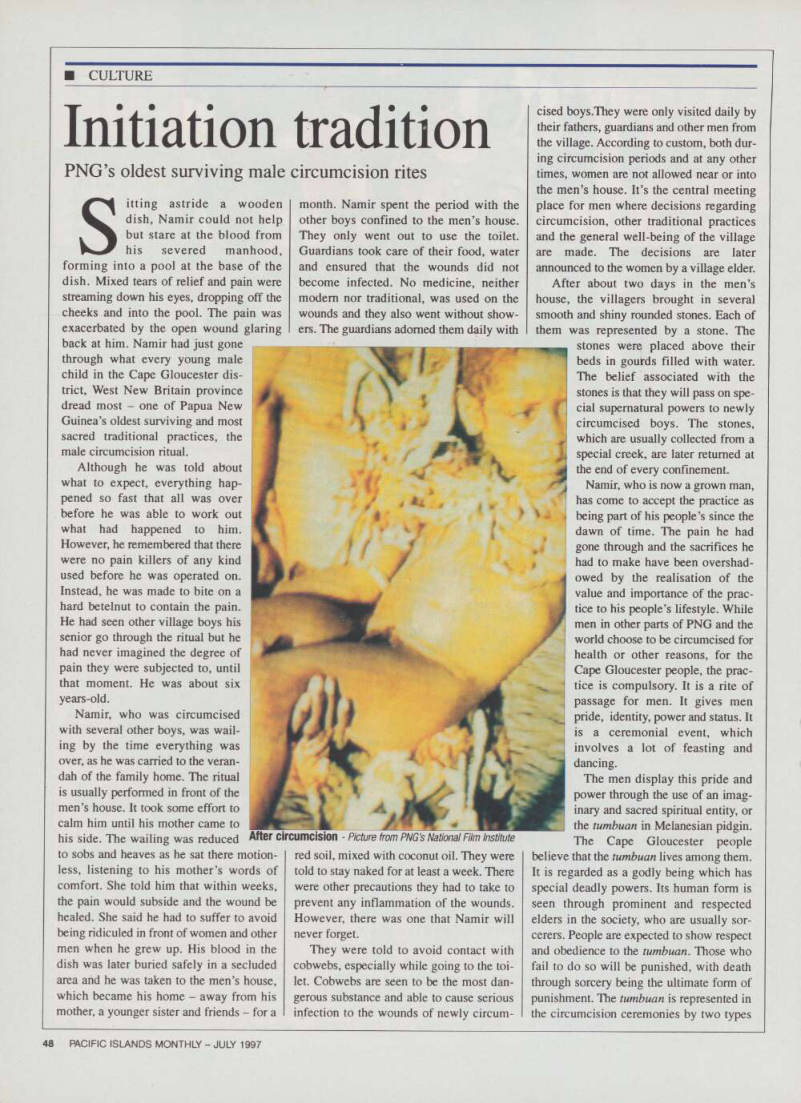
Culture
Initiation tradition PNG’s oldest surviving male circumcision rites
Sitting astride a wooden dish, Namir could not help but stare at the blood from his severed manhood, forming into a pool at the base of the dish. Mixed tears of relief and pain were streaming down his eyes, dropping off the cheeks and into the pool. The pain was exacerbated by the open wound glaring
back at him. Namir had just gone through what every young male child in the Cape Gloucester dis trict, West New Britain province dread most - one of Papua New Guinea’s oldest surviving and most sacred traditional practices, the male circumcision ritual.
Although he was told about what to expect, everything hap pened so fast that all was over before he was able to work out what had happened to him.
However, he remembered that there were no pain killers of any kind used before he was operated on.
Instead, he was made to bite on a hard betelnut to contain the pain.
He had seen other village boys his senior go through the ritual but he had never imagined the degree of pain they were subjected to, until that moment. He was about six years-old.
Namir, who was circumcised with several other boys, was wail ing by the time everything was over, as he was carried to the veran dah of the family home. The ritual is usually performed in front of the men’s house. It took some effort to calm him until his mother came to his side. The wailing was reduced
to sobs and heaves as he sat there motion less, listening to his mother’s words of comfort. She told him that within weeks, the pain would subside and the wound be healed. She said he had to suffer to avoid being ridiculed in front of women and other men when he grew up. His blood in the dish was later buried safely in a secluded area and he was taken to the men’s house, which became his home - away from his mother, a younger sister and friends - for a
month. Namir spent the period with the other boys confined to the men’s house.
They only went out to use the toilet.
Guardians took care of their food, water and ensured that the wounds did not become infected. No medicine, neither modem nor traditional, was used on the wounds and they also went without show ers. The guardians adorned them daily with
red soil, mixed with coconut oil. They were told to stay naked for at least a week. There were other precautions they had to take to prevent any inflammation of the wounds.
However, there was one that Namir will
never forget.
They were told to avoid contact with cobwebs, especially while going to the toi let. Cobwebs are seen to be the most dan gerous substance and able to cause serious infection to the wounds of newly circum
cised boys. They were only visited daily by their fathers, guardians and other men from the village. According to custom, both dur ing circumcision periods and at any other times, women are not allowed near or into the men’s house. It’s the central meeting place for men where decisions regarding circumcision, other traditional practices and the general well-being of the village are made. The decisions are later announced to the women by a village elder.
After about two days in the men’s house, the villagers brought in several smooth and shiny rounded stones. Each of them was represented by a stone. The
stones were placed above their beds in goufds filled with water.
The belief associated with the stones is that they will pass on spe cial supernatural powers to newly circumcised boys. The stones, which are usually collected from a special creek, are later returned at the end of every confinement.
Namir, who is now a grown man, has come to accept the practice as being part of his people’s since the dawn of time. The pain he had gone through and the sacrifices he had to make have been overshad owed by the realisation of the value and importance of the prac tice to his people’s lifestyle. While men in other parts of PNG and the world choose to be circumcised for health or other reasons, for the Cape Gloucester people, the prac tice is compulsory. It is a rite of passage for men. It gives men pride, identity, power and status. It is a ceremonial event, which involves a lot of feasting and
dancing.
The men display this pride and power through the use of an imag inary and sacred spiritual entity, or the tumbuan in Melanesian pidgin.
The Cape Gloucester people
believe that the tumbuan lives among them.
It is regarded as a godly being which has special deadly powers. Its human form is
seen through prominent and respected
elders in the society, who are usually sor cerers. People are expected to show respect and obedience to the tumbuan. Those who fail to do so will be punished, with death through sorcery being the ultimate form of punishment. The tumbuan is represented in the circumcision ceremonies by two types
After circumcision - Picture from PNG’s National Film Institute
of dancing masks which are worn by men
during the feasting and dancing.
The tumbuan is the core of the event.
The first type consists of a colourfully painted head guise and a huge umbrella type lower body embellishment, woven out of cane leaves and worn from the neck down. The second consists of a cone-type decorated head mask and a lower body out fit made of dried banana leaves. Only men are allowed to take part in all activities relating to the tumbuan. Everything they do must be kept secret from the women.
There are certain rules which men and women are expected to observe. They are not allowed to complain about their prop erties being confiscated and used upon the request of the tumbuan. They must not also refuse a request from the tumbuan to per form a special chore for the circumcision ceremonies. It also has the power to marry the young. Most often partners are forced to live together, even without love.
Young men are not allowed to be intro duced to the tumbuan unless they pay their way in, using traditional currency such as shell money, wooden dishes, clay pots and
pigs. This is the second part of the initia tion process after going through the cir cumcision ritual. Once a young man enters the men’s house and the sacred camp where all decorations for the dancing masks are made, he will not be allowed back home during the entire duration of the
ceremony period.
He’ll be exposed to the sacred practices of the tumbuan and he will also be taught how special ornaments are made. This is followed by a public flogging to be carried out by several tumbuan, in front of the men’s house which completes the initiation process. During the actual circumcision of the children, several tumbuan form a shield around them to bar off women. A specialist performs the ritual and he is paid hand somely by the children’s parents.
During the dancing, the men beat the drums and sing while the tumbuan, usually numbering to about 10 to 20 in huge cere monies, and the women dance around them in a circle. The women also sing along with the men. Villages from near and far are invited to attend and take part in such cer emonies. Heavy supply of roasted and live
pigs and food, together with shell money and other traditional monetary items are given to the representatives of each village in appreciation of their part in the celebra tions.
The fact that the practice survives is arguably because it is free of health risk, unlike nose and ear piercing, tattooing and other related PNG traditional practices.
With the advent of HIV/AIDS, these prac tices have become increasingly dangerous.
However, while PNG health authorities have regularly warned of the other prac tices, the circumcision practice remains free from concern.
As far as history of the practice is con cerned, no one has ever suffered or even died from an infected wound. The practice is very much entrenched and alive today in Namir’s society as it was many years ago.
Its importance can be seen from the fact it is performed on deceased male children before burial.
Those who live and work in towns and cities are required to arrange with relatives for their male children to be circumcised while on holiday in their villages. ■
Advertisements & other items, p. 49 (1 item)
Steel Bros
Iftll ... ■ 3} - &
THE WORLD’S LEADING KNUCKLE BOOM CRANE
have boon
Sailing & Servicing
HIAB since IQ 80...
• EXPERIENCE
• SERVICE
• RELIABILITY
m
STEELBRO
• Swedish Quality Engineering
STEEL BROS (NZ) LTD
HEAD OFFICE
CHRISTCHURCH:
1 -31 Treffers Road Sockbum-Christchurch New Zealand Telephone (64-3) 348-8499 Fax (64-3) 348-5786
Miriam scales the heights
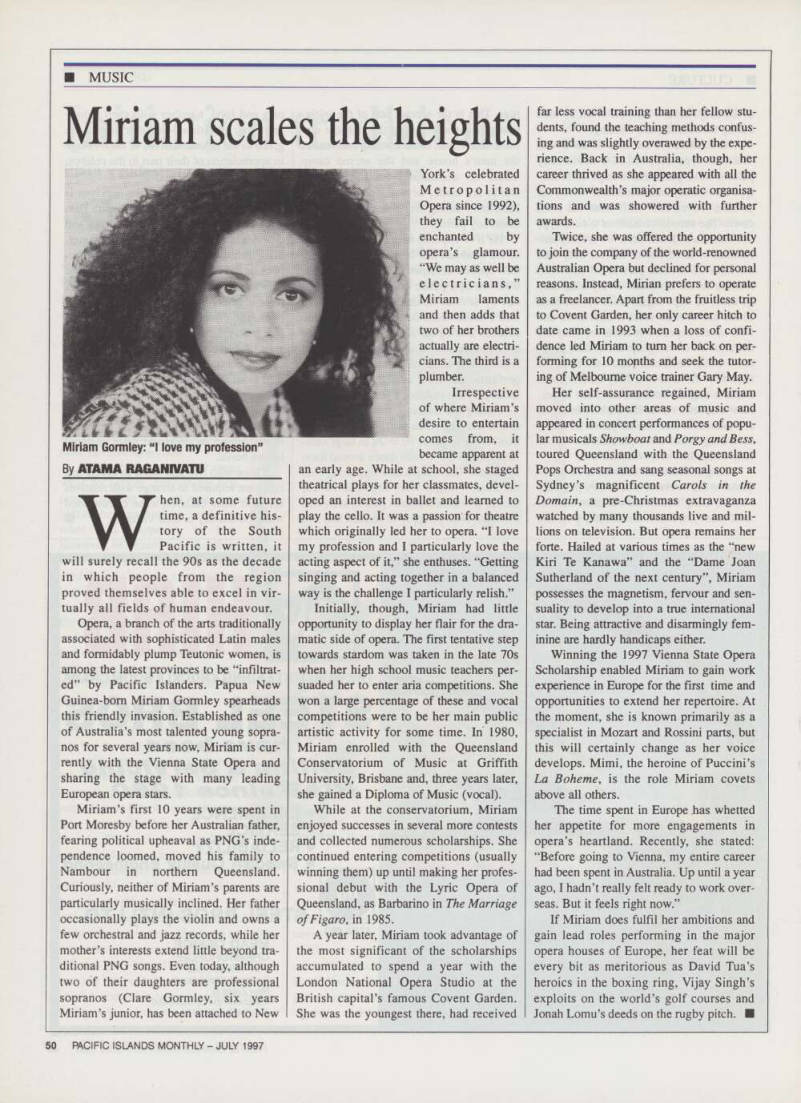
Music
By Atama Raganivatu
When, at some future time, a definitive his tory of the South Pacific is written, it will surely recall the 90s as the decade in which people from the region proved themselves able to excel in vir tually all fields of human endeavour.
Opera, a branch of the arts traditionally associated with sophisticated Latin males and formidably plump Teutonic women, is among the latest provinces to be “infiltrat ed” by Pacific Islanders. Papua New Guinea-bom Miriam Gormley spearheads this friendly invasion. Established as one of Australia’s most talented young sopra nos for several years now, Miriam is cur rently with the Vienna State Opera and sharing the stage with many leading European opera stars.
Miriam’s first 10 years were spent in Port Moresby before her Australian father, fearing political upheaval as PNG’s inde pendence loomed, moved his family to Nambour in northern Queensland.
Curiously, neither of Miriam’s parents are particularly musically inclined. Her father occasionally plays the violin and owns a few orchestral and jazz records, while her mother’s interests extend little beyond tra ditional PNG songs. Even today, although two of their daughters are professional sopranos (Clare Gormley, six years Miriam’s junior, has been attached to New
York’s celebrated
Metropolitan
Opera since 1992), they fail to be enchanted by
opera’s glamour.
“We may as well be electricians,”
Miriam laments and then adds that two of her brothers actually are electri cians. The third is a
plumber.
Irrespective
of where Miriam’s desire to entertain comes from, it became apparent at
an early age. While at school, she staged theatrical plays for her classmates, devel oped an interest in ballet and learned to play the cello. It was a passion for theatre which originally led her to opera. “I love my profession and I particularly love the acting aspect of it,” she enthuses. “Getting singing and acting together in a balanced way is the challenge I particularly relish.”
Initially, though, Miriam had little opportunity to display her flair for the dra matic side of opera. The first tentative step towards stardom was taken in the late 70s when her high school music teachers per suaded her to enter aria competitions. She won a large percentage of these and vocal competitions were to be her main public artistic activity for some time. In 1980, Miriam enrolled with the Queensland Conservatorium of Music at Griffith University, Brisbane and, three years later, she gained a Diploma of Music (vocal).
While at the conservatorium, Miriam enjoyed successes in several more contests and collected numerous scholarships. She
continued entering competitions (usually
winning them) up until making her profes sional debut with the Lyric Opera of Queensland, as Barbarino in The Marriage of Figaro, in 1985.
A year later, Miriam took advantage of the most significant of the scholarships accumulated to spend a year with the London National Opera Studio at the British capital’s famous Covent Garden.
She was the youngest there, had received
far less vocal training than her fellow stu dents, found the teaching methods confus ing and was slightly overawed by the expe rience. Back in Australia, though, her career thrived as she appeared with all the
Commonwealth’s major operatic organisa
tions and was showered with further awards.
Twice, she was offered the opportunity to join the company of the world-renowned Australian Opera but declined for personal reasons. Instead, Mirian prefers to operate as a freelancer. Apart from the fruitless trip to Covent Garden, her only career hitch to date came in 1993 when a loss of confi dence led Miriam to turn her back on per forming for 10 mopths and seek the tutor ing of Melbourne voice trainer Gary May.
Her self-assurance regained, Miriam moved into other areas of music and appeared in concert performances of popu lar musicals Showboat and Porgy and Bess, toured Queensland with the Queensland Pops Orchestra and sang seasonal songs at Sydney’s magnificent Carols in the Domain, a pre-Christmas extravaganza watched by many thousands live and mil lions on television. But opera remains her forte. Hailed at various times as the “new Kiri Te Kanawa” and the “Dame Joan Sutherland of the next century”, Miriam possesses the magnetism, fervour and sen suality to develop into a true international star. Being attractive and disarmingly fem inine are hardly handicaps either.
Winning the 1997 Vienna State Opera Scholarship enabled Miriam to gain work experience in Europe for the first time and opportunities to extend her repertoire. At the moment, she is known primarily as a specialist in Mozart and Rossini parts, but this will certainly change as her voice develops. Mimi, the heroine of Puccini’s La Boheme, is the role Miriam covets above all others.
The time spent in Europe has whetted her appetite for more engagements in opera’s heartland. Recently, she stated: “Before going to Vienna, my entire career had been spent in Australia. Up until a year ago, I hadn’t really felt ready to work over seas. But it feels right now.”
If Miriam does fulfil her ambitions and gain lead roles performing in the major opera houses of Europe, her feat will be every bit as meritorious as David Tua’s heroics in the boxing ring, Vijay Singh’s exploits on the world’s golf courses and Jonah Lomu’s deeds on the rugby pitch. ■
Miriam Gormley: “I love my profession”
The power of words
Literature
The power of words Recording the Gilbertese oral tradition in writing
By Nicolas
Rothwell
The pioneering I-Kiribati ethnologist, Kambati Uriam, has an unusually direct personal connec tion with the tales and historical nar ratives that form the subject of In Their Own Words, the most important study yet published of Gilbertese oral tradition. Uriam recounts, at one point in this detailed and enthralling account, his own memory of listening to a particular tale-teller, who was keen to make his audiences laugh.
“As far as I can recall from my child hood,” writes Uriam, “he used to be an occasional visitor to our home to tell jokes and share his stories.
I loved his stories, but I hated his smok ing pipe which he would not hesitate to bum me with every time I dozed off to sleep. ” The anecdote gives something of the flavour of this unusual, indeed path-break ing, book: engaged and informed, embrac ing both the objectivity of anthropological study and the commitment of a patriotic history.
The doyen of studies of Kiribati soci ety, H E Maude, notes in his forward that Uriam’s work will be definitive, “as writ ing has made the composition of new oral traditions unnecessary - but it is hoped it will prove to be the prototype for similar studies covering the traditions of other Pacific Island groups”.
Uriam has an intriguing aim, which is more than fulfilled by this detailed, schol arly and suggestive work.
He hopes to trace Gilbertese history through the oral tradition that flourished for centuries on these low islands strewn through the heart of the great ocean.
His argument is that the Gilbertese tales preserve a detailed version of the historic
past - as understood by the people of the islands. For generations, they have been handed down by word of mouth, providing a factual record that tallies strikingly with the findings now emerging from other avenues of investigation. Uriam found, during his field-work, that his own sense of history deepened: “If there is a hope I wish to convey,” he writes, “it is that the Gilbertese people will take pride in being I- Kiribati and treasure with all jealousy the wisdom and knowledge of their ances tors as found in the traditions.”
Through a swirling, complex recreation of the tales and their telling, their style and their content, but above all their place in the community, Uriam succeeds in captur ing the subtle, shimmering quality of the oral narrative as one of the key elements in Gilbertese self-definition: art-form, magi cal incantation, historical record, political weapon - the tale was all of these and served as a means of making claims and aligning relations between families, groups and islands.
For, as In Their Own Words quickly makes plain, there are great variations between the different islands, both in pre sent character and in history.
Indeed, Uriam spends much time pick ing apart the traditional stories to show how well they reflect the patterns of settle ment, the various ancestor groups, the points of origin and way-stages in the jour neys of the first islanders to the atolls.
This, then, is the tracing of history and geographic spread through mythology and, as such, it has a certain political com ponent, for, as Uriam underlines, the com ing of European culture to. Kiribati has coincided with the effective ending of the oral tradition and the descent of a feeling of impotence, of lack of ability to control and dispose of one’s own fate.
In these conditions, the disappearance of the tales and tale-tellers from Kiribati society has an even more devastating effect because of what the tales could do for their society: “Apart from giving information concerning the activities of the ancestors,
or providing identity, they offer explana
tions for social processes and cultural activities as they are or should be.
But, more importantly, oral traditions provide a charter for communal reflection and innovation, and courage to the com munities to change for a better society.
They are inseparable from communities: without traditions there are no communi ties, and vice versa.”
Hence, the urgency of Uriam’s quest to trace and capture the traditions, to keep their memory alive, to provide examples of the connection between the narratives, the functioning of that particularly Gilbertese social and political organism, the Maneaba, and the continuing evolution of the society of the independent nation of Kiribati.
Preservation of oral tradition is viewed by Uriam as vital, for, as he puts it mov ingly, the past has a crucial role to play; in fact, it is, or has been, almost everything: “It provided a Gilbertese with knowledge and skills, joy and laughter, friends and enemies, and land and wealth to live and enjoy a long and contented life.”
There are, unfortunately, signs of a revival of tradition - a revival Uriam is keen to encourage, and one which he believes is amply justified, given the tremendous achievements of customary Gilbertese society as the most efficient specialised atoll culture in the world.
Yet there is a profound threat to the endurance of this society; the same threat that has already taken its toll across the islands of the Pacific: “Today,” cautions Uriam, “the community ethos, its ethics and values, has been disrupted by a rash of foreign influences, for the most part European.
Gilbertese life is in a state of flux: hous ing, clothes, food, material culture, all are changing, and with them many of the cer tainties, the motivations, aspirations and pleasures that made life meaningful in the past.
Change must come; the danger lies that with it Gilbertese society will, unless we are alert and careful, become an amor phous and rootless mass of individuals, without pride in the past or hope for the future.”
It is a warning that applies, of course, to all the Pacific’s surviving traditional cultures. ■
• In Their Own Words - History and Society in Gilbertese Oral Tradition by Kambati K Uriam, published by the Journal of Pacific History, Australia,
1996. Sa3O.
Advertisements & other items, pp. 52-53 (1 item)
Cautionary
TRADE MARK
NOTICE
IN MICRONESIA
Notice is hereby given that Mondex International Limited, a British company of 47-53 Canon Street, London EC4M SSQ, England, is the sole proprietor in Micronesia and elsewhere of the following trade mark.
MULTOS
used in respect of: — Data processing, transmitting, receiving and storage apparatus and instruments; computer hardware and software; computer programs; modems; electrical and electronic installations and apparatus; magnetic and/or encoded cards, discs or tapes; parts and fittings for all the aforesaid goods Class 9.
Advisory and consultancy services relating to electronic data capture and transmission systems, computers, computer software and computer programs Class 42.
The said proprietor claims all rights in respect of the above trade mark and will take all necessary legal steps against any person or company infringing their said rights.
DAVIES COLLISON CAVE
Patent Attorneys One Little Collins Street Melbourne, Victoria, 3000
AUSTRALIA
102313v2
TRADE MARK
CAUTIONARY
NOTICE
IN PALAU
Notice is hereby given that Mondex International Limited, a British company of 47-53 Canon Street, London EC4M SSQ, England, is the sole proprietor in Palau and elsewhere of the following trade mark.
MULTOS
used in respect of: — Data processing, transmitting, receiving and storage apparatus and instruments; computer hardware and software; computer programs; modems; electrical and electronic installations and apparatus; magnetic and/or encoded cards, discs or tapes; parts and fittings for all the aforesaid goods Class 9.
Advisory and consultancy services relating to electronic data capture and transmission systems, computers, computer software and computer programs Class 42.
The said proprietor claims all rights in respect of the above trade mark and will take all necessary legal steps against any person or company infringing their said rights.
DAVIES COLLISON CAVE
Patent Attorneys One Little Collins Street Melbourne, Victoria, 3000
AUSTRALIA
101745V1
From poverty to plenty
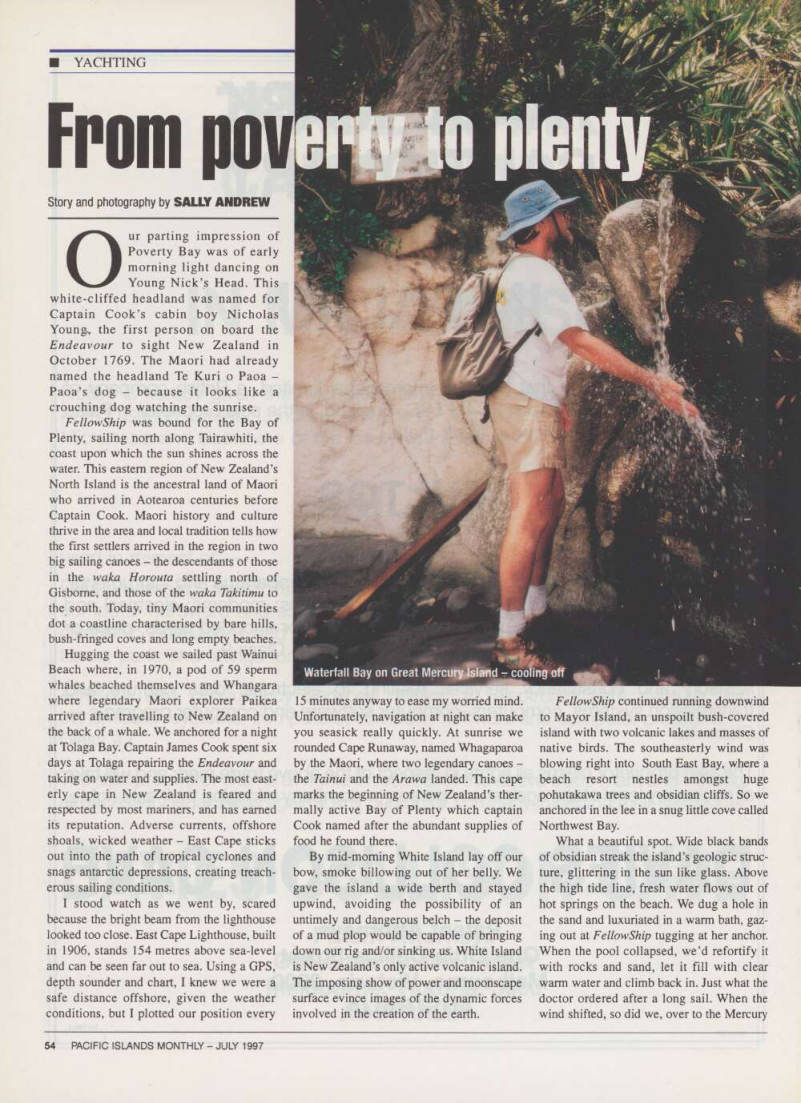
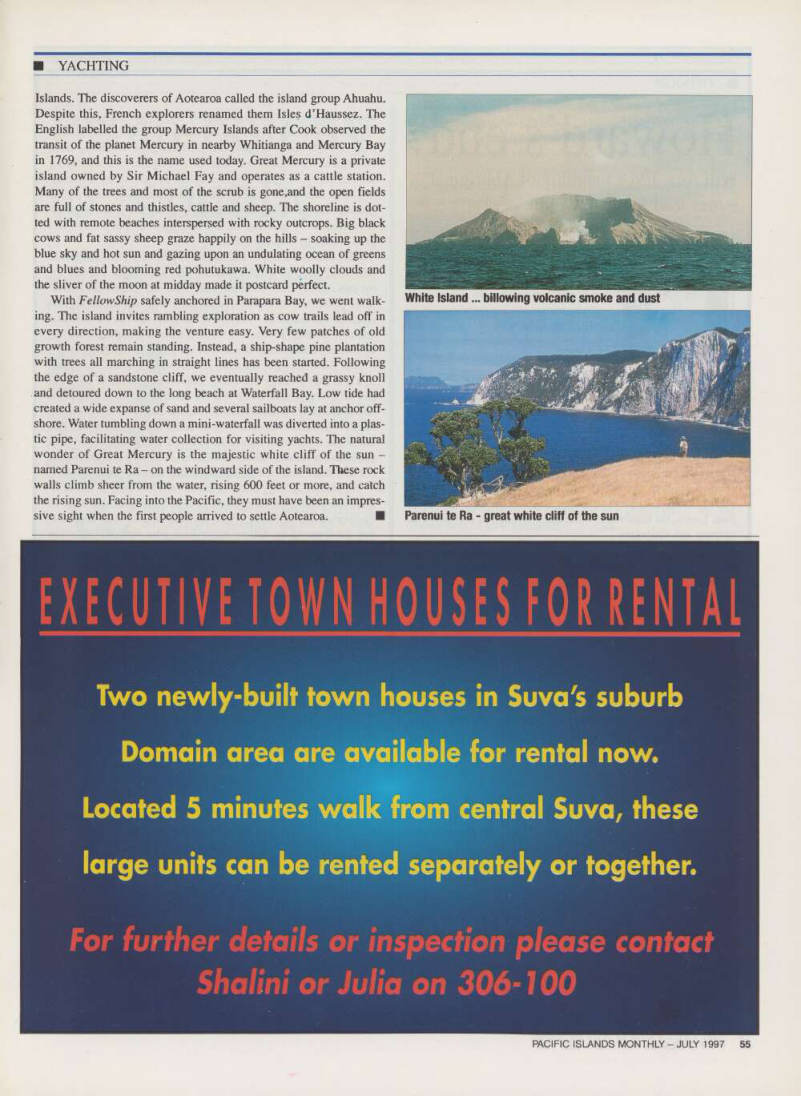
Yachting
Story and photography by SALLY ANDREW
Our parting impression of
Poverty Bay was of early
morning light dancing on Young Nick’s Head. This white-cliffed headland was named for Captain Cook’s cabin boy Nicholas Young, the first person on board the Endeavour to sight New Zealand in October 1769. The Maori had already named the headland Te Kuri o Paoa - Paoa’s dog - because it looks like a
crouching dog watching the sunrise.
Fellowship was bound for the Bay of Plenty, sailing north along Tairawhiti, the coast upon which the sun shines across the water. This eastern region of New Zealand’s North Island is the ancestral land of Maori who arrived in Aotearoa centuries before Captain Cook. Maori history and culture thrive in the area and local tradition tells how the first settlers arrived in the region in two big sailing canoes - the descendants of those in the waka Horouta settling north of Gisborne, and those of the waka Takitimu to the south. Today, tiny Maori communities dot a coastline characterised by bare hills, bush-fringed coves and long empty beaches.
Hugging the coast we sailed past Wainui Beach where, in 1970, a pod of 59 sperm whales beached themselves and Whangara where legendary Maori explorer Paikea arrived after travelling to New Zealand on the back of a whale. We anchored for a night at Tolaga Bay. Captain James Cook spent six days at Tolaga repairing the Endeavour and taking on water and supplies. The most east erly cape in New Zealand is feared and respected by most mariners, and has earned its reputation. Adverse currents, offshore shoals, wicked weather - East Cape sticks out into the path of tropical cyclones and snags antarctic depressions, creating treach erous sailing conditions.
I stood watch as we went by, scared because the bright beam from the lighthouse looked too close. East Cape Lighthouse, built in 1906, stands 154 metres above sea-level and can be seen far out to sea. Using a GPS, depth sounder and chart, I knew we were a safe distance offshore, given the weather conditions, but I plotted our position every
15 minutes anyway to ease my worried mind.
Unfortunately, navigation at night can make you seasick really quickly. At sunrise we rounded Cape Runaway, named Whagaparoa by the Maori, where two legendary canoes the Tainui and the Arawa landed. This cape marks the beginning of New Zealand’s ther mally active Bay of Plenty which captain Cook named after the abundant supplies of food he found there.
By mid-moming White Island lay off our bow, smoke billowing out of her belly. We gave the island a wide berth and stayed
upwind, avoiding the possibility of an
untimely and dangerous belch - the deposit of a mud plop would be capable of bringing down our rig and/or sinking us. White Island is New Zealand’s only active volcanic island.
The imposing show of power and moonscape surface evince images of the dynamic forces involved in the creation of the earth.
Fellowship continued running downwind
to Mayor Island, an unspoilt bush-covered island with two volcanic lakes and masses of native birds. The southeasterly wind was blowing right into South East Bay, where a beach resort nestles amongst huge pohutakawa trees and obsidian cliffs. So we anchored in the lee in a snug little cove called Northwest Bay.
What a beautiful spot. Wide black bands of obsidian streak the island’s geologic struc ture, glittering in the sun like glass. Above the high tide line, fresh water flows out of hot springs on the beach. We dug a hole in the sand and luxuriated in a warm bath, gaz ing out at Fellowship tugging at her anchor.
When the pool collapsed, we’d refortify it with rocks and sand, let it fill with clear warm water and climb back in. Just what the doctor ordered after a long sail. When the wind shifted, so did we, over to the Mercury
Waterfall Bay on Great Mercury Island - cooling off
Islands. The discoverers of Aotearoa called the island group Ahuahu.
Despite this, French explorers renamed them Isles d’Haussez. The English labelled the group Mercury Islands after Cook observed the transit of the planet Mercury in nearby Whitianga and Mercury Bay in 1769, and this is the name used today. Great Mercury is a private island owned by Sir Michael Fay and operates as a cattle station.
Many of the trees and most of the scrub is gone,and the open fields are full of stones and thistles, cattle and sheep. The shoreline is dot ted with remote beaches interspersed with rocky outcrops. Big black cows and fat sassy sheep graze happily on the hills - soaking up the blue sky and hot sun and gazing upon an undulating ocean of greens and blues and blooming red pohutukawa. White woolly clouds and the sliver of the moon at midday made it postcard perfect.
With Fellowship safely anchored in Parapara Bay, we went walk ing. The island invites rambling exploration as cow trails lead off in every direction, making the venture easy. Very few patches of old growth forest remain standing. Instead, a ship-shape pine plantation with trees all marching in straight lines has been started. Following the edge of a sandstone cliff, we eventually reached a grassy knoll and detoured down to the long beach at Waterfall Bay. Low tide had created a wide expanse of sand and several sailboats lay at anchor off shore. Water tumbling down a mini-waterfall was diverted into a plas tic pipe, facilitating water collection for visiting yachts. The natural wonder of Great Mercury is the majestic white cliff of the sun named Parenui te Ra - on the windward side of the island. These rock walls climb sheer from the water, rising 600 feet or more, and catch the rising sun. Facing into the Pacific, they must have been an impres sive sight when the first people arrived to settle Aotearoa. ■
White Island... billowing volcanic smoke and dust
Parenui te Ra - great white cliff of the sun
Advertisements & other items, p. 55 (1 item)
Executive Town Houses For Rental
Two newly-built town houses in Suva's suburb Domain area are available for rental now.
Located 5 minutes walk from central Suva, these large units can be rented separately or together.
For further details or inspection please contact Shalini or Julia on 306-100
Howard’s end?
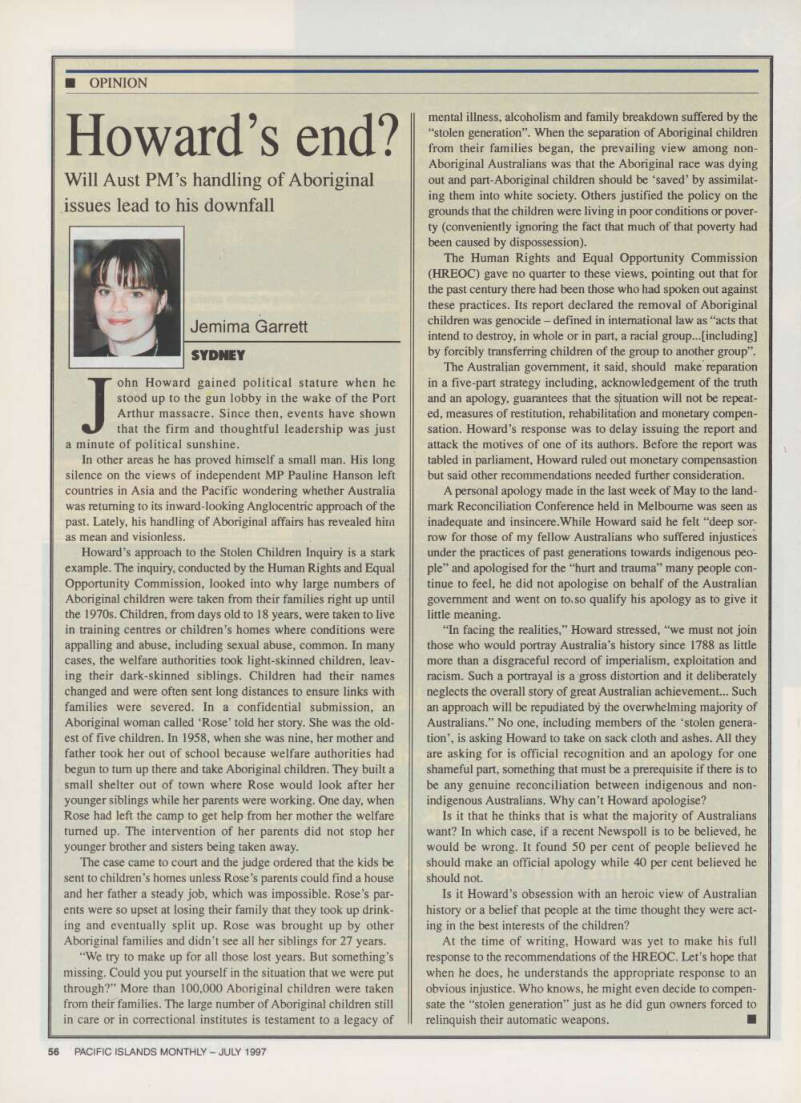
Opinion
Will Aust PM’s handling of Aboriginal issues lead to his downfall
John Howard gained political stature when he stood up to the gun lobby in the wake of the Port Arthur massacre. Since then, events have shown that the firm and thoughtful leadership was just a minute of political sunshine.
In other areas he has proved himself a small man. His long silence on the views of independent MP Pauline Hanson left countries in Asia and the Pacific wondering whether Australia was returning to its inward-looking Anglocentric approach of the past. Lately, his handling of Aboriginal affairs has revealed him as mean and visionless.
Howard’s approach to the Stolen Children Inquiry is a stark example. The inquiry, conducted by the Human Rights and Equal Opportunity Commission, looked into why large numbers of Aboriginal children were taken from their families right up until the 19705. Children, from days old to 18 years, were taken to live in training centres or children’s homes where conditions were appalling and abuse, including sexual abuse, common. In many cases, the welfare authorities took light-skinned children, leav ing their dark-skinned siblings. Children had their names changed and were often sent long distances to ensure links with families were severed. In a confidential submission, an Aboriginal woman called ‘Rose’ told her story. She was the old est of five children. In 1958, when she was nine, her mother and father took her out of school because welfare authorities had begun to turn up there and take Aboriginal children. They built a small shelter out of town where Rose would look after her younger siblings while her parents were working. One day, when Rose had left the camp to get help from her mother the welfare turned up. The intervention of her parents did not stop her younger brother and sisters being taken away.
The case came to court and the judge ordered that the kids be sent to children’s homes unless Rose’s parents could find a house and her father a steady job, which was impossible. Rose’s par ents were so upset at losing their family that they took up drink ing and eventually split up. Rose was brought up by other Aboriginal families and didn’t see all her siblings for 27 years.
“We try to make up for all those lost years. But something’s missing. Could you put yourself in the situation that we were put through?” More than 100,000 Aboriginal children were taken from their families. The large number of Aboriginal children still in care or in correctional institutes is testament to a legacy of
mental illness, alcoholism and family breakdown suffered by the “stolen generation”. When the separation of Aboriginal children from their families began, the prevailing view among non- Aboriginal Australians was that the Aboriginal race was dying out and part-Aboriginal children should be ‘saved’ by assimilat ing them into white society. Others justified the policy on the grounds that the children were living in poor conditions or pover ty (conveniently ignoring the fact that much of that poverty had
been caused by dispossession).
The Human Rights and Equal Opportunity Commission (HREOC) gave no quarter to these views, pointing out that for the past century there had been those who had spoken out against these practices. Its report declared the removal of Aboriginal children was genocide - defined in international law as “acts that intend to destroy, in whole or in part, a racial group...[including] by forcibly transferring children of the group to another group”.
The Australian government, it said, should make reparation in a five-part strategy including, acknowledgement of the truth and an apology, guarantees that the situation will not be repeat ed, measures of restitution, rehabilitation and monetary compen sation. Howard’s response was to delay issuing the report and attack the motives of one of its authors. Before the report was tabled in parliament, Howard ruled out monetary compensastion but said other recommendations needed further consideration.
A personal apology made in the last week of May to the land mark Reconciliation Conference held in Melbourne was seen as inadequate and insincere. While Howard said he felt “deep sor row for those of my fellow Australians who suffered injustices under the practices of past generations towards indigenous peo ple” and apologised for the “hurt and trauma” many people con tinue to feel, he did not apologise on behalf of the Australian government and went on to, so qualify his apology as to give it
little meaning.
“In facing the realities,” Howard stressed, “we must not join those who would portray Australia’s history since 1788 as little more than a disgraceful record of imperialism, exploitation and racism. Such a portrayal is a gross distortion and it deliberately neglects the overall story of great Australian achievement... Such an approach will be repudiated by the overwhelming majority of Australians.” No one, including members of the ‘stolen genera tion’, is asking Howard to take on sack cloth and ashes. All they are asking for is official recognition and an apology for one shameful part, something that must be a prerequisite if there is to be any genuine reconciliation between indigenous and non indigenous Australians. Why can’t Howard apologise?
Is it that he thinks that is what the majority of Australians want? In which case, if a recent Newspoll is to be believed, he would be wrong. It found 50 per cent of people believed he should make an official apology while 40 per cent believed he should not.
Is it Howard’s obsession with an heroic view of Australian history or a belief that people at the time thought they were act ing in the best interests of the children?
At the time of writing, Howard was yet to make his full response to the recommendations of the HREOC. Let’s hope that when he does, he understands the appropriate response to an obvious injustice. Who knows, he might even decide to compen sate the “stolen generation” just as he did gun owners forced to relinquish their automatic weapons. ■
Jemima Garrett
Sydney
From colony
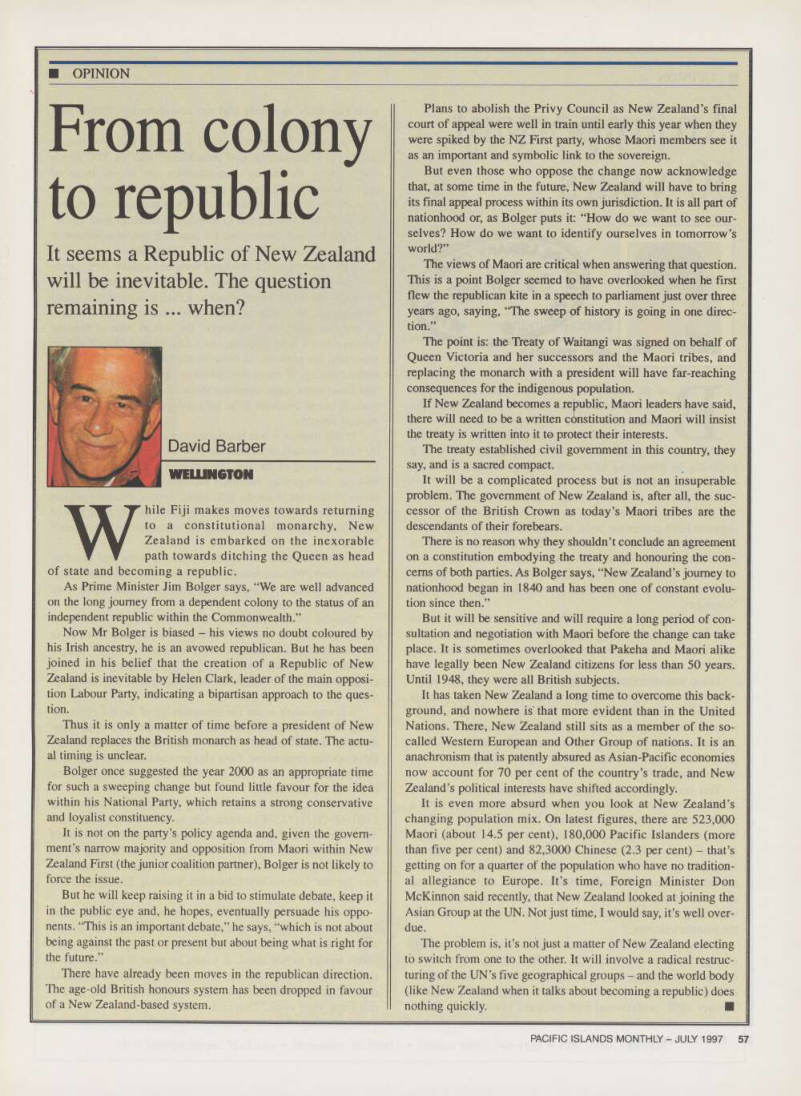
to republic
It seems a Republic of New Zealand will be inevitable. The question remaining is ... when?
While Fiji makes moves towards returning to a constitutional monarchy. New Zealand is embarked on the inexorable path towards ditching the Queen as head of state and becoming a republic.
As Prime Minister Jim Bolger says, “We are well advanced on the long journey from a dependent colony to the status of an independent republic within the Commonwealth.”
Now Mr Bolger is biased - his views no doubt coloured by his Irish ancestry, he is an avowed republican. But he has been joined in his belief that the creation of a Republic of New Zealand is inevitable by Helen Clark, leader of the main opposi tion Labour Party, indicating a bipartisan approach to the ques tion.
Thus it is only a matter of time before a president of New Zealand replaces the British monarch as head of state. The actu al timing is unclear.
Bolger once suggested the year 2000 as an appropriate time for such a sweeping change but found little favour for the idea within his National Party, which retains a strong conservative and loyalist constituency.
It is not on the party’s policy agenda and, given the govern ment’s narrow majority and opposition from Maori within New Zealand First (the junior coalition partner), Bolger is not likely to force the issue.
But he will keep raising it in a bid to stimulate debate, keep it in the public eye and, he hopes, eventually persuade his oppo nents. “This is an important debate,” he says, “which is not about being against the past or present but about being what is right for the future.”
There have already been moves in the republican direction.
The age-old British honours system has been dropped in favour of a New Zealand-based system.
Plans to abolish the Privy Council as New Zealand’s final court of appeal were well in train until early this year when they were spiked by the NZ First party, whose Maori members see it as an important and symbolic link to the sovereign.
But even those who oppose the change now acknowledge that, at some time in the future. New Zealand will have to bring its final appeal process within its own jurisdiction. It is all part of nationhood or, as Bolger puts it: “How do we want to see our selves? How do we want to identify ourselves in tomorrow’s world?”
The views of Maori are critical when answering that question.
This is a point Bolger seemed to have overlooked when he first flew the republican kite in a speech to parliament just over three years ago, saying, “The sweep of history is going in one direc tion.”
The point is: the Treaty of Waitangi was signed on behalf of Queen Victoria and her successors and the Maori tribes, and replacing the monarch with a president will have far-reaching consequences for the indigenous population.
If New Zealand becomes a republic, Maori leaders have said, there will need to be a written constitution and Maori will insist the treaty is written into it to protect their interests.
The treaty established civil government in this country, they say, and is a sacred compact.
It will be a complicated process but is not an insuperable problem. The government of New Zealand is, after all, the suc cessor of the British Crown as today’s Maori tribes are the descendants of their forebears.
There is no reason why they shouldn’t conclude an agreement on a constitution embodying the treaty and honouring the con cerns of both parties. As Bolger says, “New Zealand’s journey to nationhood began in 1840 and has been one of constant evolu tion since then.”
But it will be sensitive and will require a long period of con sultation and negotiation with Maori before the change can take place. It is sometimes overlooked that Pakeha and Maori alike have legally been New Zealand citizens for less than 50 years.
Until 1948, they were all British subjects.
It has taken New Zealand a long time to overcome this back ground, and nowhere is that more evident than in the United Nations. There, New Zealand still sits as a member of the so called Western European and Other Group of nations. It is an anachronism that is patently absured as Asian-Pacific economies now account for 70 per cent of the country’s trade, and New Zealand’s political interests have shifted accordingly.
It is even more absurd when you look at New Zealand’s changing population mix. On latest figures, there are 523,000 Maori (about 14.5 per cent), 180,000 Pacific Islanders (more than five per cent) and 82,3000 Chinese (2.3 per cent) - that’s getting on for a quarter of the population who have no tradition al allegiance to Europe. It’s time, Foreign Minister Don McKinnon said recently, that New Zealand looked at joining the Asian Group at the UN. Not just time, I would say, it’s well over due.
The problem is, it’s not just a matter of New Zealand electing to switch from one to the other. It will involve a radical restruc turing of the UN’s five geographical groups - and the world body (like New Zealand when it talks about becoming a republic) does nothing quickly. ■
David Barber
Weiuhgton
An important
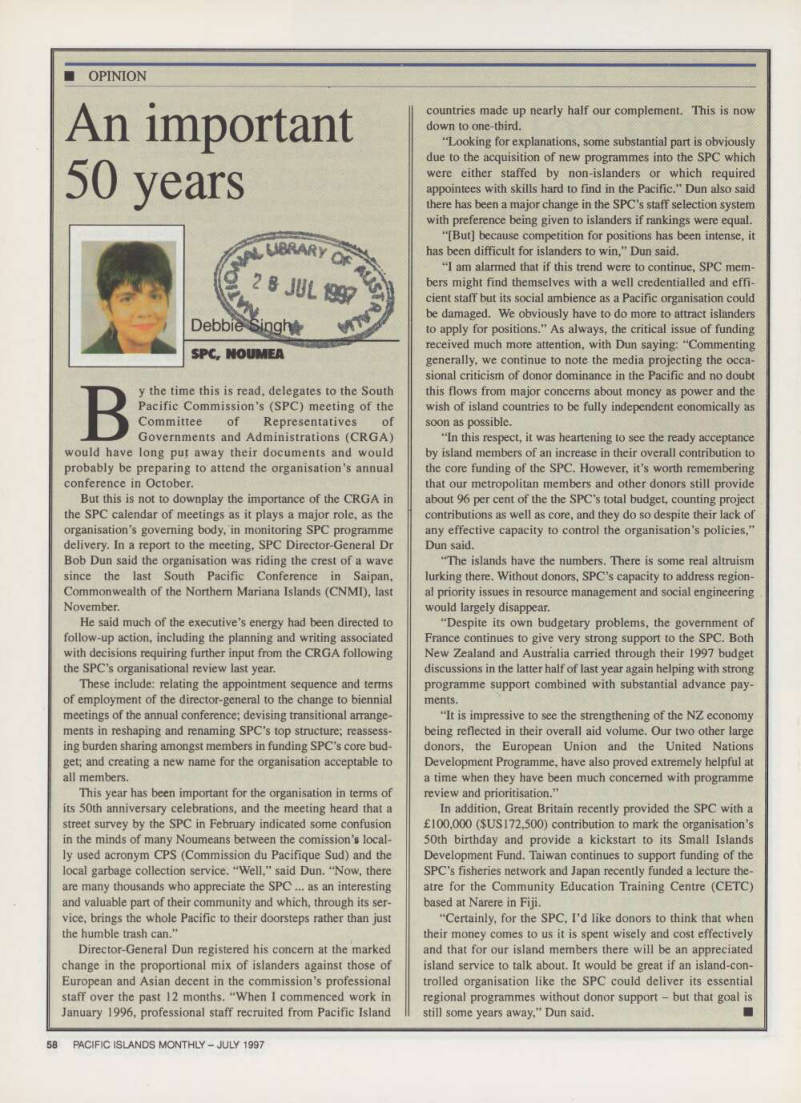
50 years
By the time this is read, delegates to the South Pacific Commission’s (SPC) meeting of the Committee of Representatives of Governments and Administrations (CRGA) would have long put away their documents and would probably be preparing to attend the organisation’s annual conference in October.
But this is not to downplay the importance of the CRGA in the SPC calendar of meetings as it plays a major role, as the organisation’s governing body, in monitoring SPC programme delivery. In a report to the meeting, SPC Director-General Dr Bob Dun said the organisation was riding the crest of a wave since the last South Pacific Conference in Saipan, Commonwealth of the Northern Mariana Islands (CNMI), last November.
He said much of the executive’s energy had been directed to follow-up action, including the planning and writing associated with decisions requiring further input from the CRGA following the SPC’s organisational review last year.
These include: relating the appointment sequence and terms of employment of the director-general to the change to biennial meetings of the annual conference; devising transitional arrange ments in reshaping and renaming SPC’s top structure; reassess ing burden sharing amongst members in funding SPC’s core bud get; and creating a new name for the organisation acceptable to all members.
This year has been important for the organisation in terms of its 50th anniversary celebrations, and the meeting heard that a street survey by the SPC in February indicated some confusion in the minds of many Noumeans between the comission’s local ly used acronym CPS (Commission du Pacifique Sud) and the local garbage collection service. “Well,” said Dun. “Now, there are many thousands who appreciate the SPC... as an interesting and valuable part of their community and which, through its ser vice, brings the whole Pacific to their doorsteps rather than just the humble trash can.”
Director-General Dun registered his concern at the marked change in the proportional mix of islanders against those of European and Asian decent in the commission’s professional staff over the past 12 months. “When I commenced work in January 1996, professional staff recruited from Pacific Island
countries made up nearly half our complement. This is now down to one-third.
“Looking for explanations, some substantial part is obviously due to the acquisition of new programmes into the SPC which were either staffed by non-islanders or which required appointees with skills hard to find in the Pacific.” Dun also said there has been a major change in the SPC’s staff selection system with preference being given to islanders if rankings were equal.
“[But] because competition for positions has been intense, it has been difficult for islanders to win,” Dun said.
“I am alarmed that if this trend were to continue, SPC mem bers might find themselves with a well credentialled and effi cient staff but its social ambience as a Pacific organisation could be damaged. We obviously have to do more to attract islanders to apply for positions.” As always, the critical issue of funding received much more attention, with Dun saying: “Commenting generally, we continue to note the media projecting the occa sional criticism of donor dominance in the Pacific and no doubt this flows from major concerns about money as power and the wish of island countries to be fully independent eonomically as soon as possible.
“In this respect, it was heartening to see the ready acceptance by island members of an increase in their overall contribution to the core funding of the SPC. However, it’s worth remembering that our metropolitan members and other donors still provide about 96 per cent of the the SPC’s total budget, counting project contributions as well as core, and they do so despite their lack of any effective capacity to control the organisation’s policies,”
Dun said.
“The islands have the numbers. There is some real altruism lurking there. Without donors, SPC’s capacity to address region al priority issues in resource management and social engineering
would largely disappear.
“Despite its own budgetary problems, the government of France continues to give very strong support to the SPC. Both New Zealand and Australia carried through their 1997 budget discussions in the latter half of last year again helping with strong programme support combined with substantial advance pay ments.
“It is impressive to see the strengthening of the NZ economy being reflected in their overall aid volume. Our two other large donors, the European Union and the United Nations Development Programme, have also proved extremely helpful at a time when they have been much concerned with programme review and prioritisation.”
In addition, Great Britain recently provided the SPC with a £lOO,OOO (SUS 172,500) contribution to mark the organisation’s 50th birthday and provide a kickstart to its Small Islands Development Fund. Taiwan continues to support funding of the SPC’s fisheries network and Japan recently funded a lecture the atre for the Community Education Training Centre (CETC) based at Narere in Fiji.
“Certainly, for the SPC, I’d like donors to think that when their money comes to us it is spent wisely and cost effectively and that for our island members there will be an appreciated island service to talk about. It would be great if an island-con trolled organisation like the SPC could deliver its essential regional programmes without donor support - but that goal is still some years away,” Dun said. ■
Debbi^Siggli
Spc, Noumea
Advertisements & other items, pp. 59-60 (1 item)
life Insurance is a Shell
3 1508 00682588 4 A grows
protects
customized
rare
portable
natural
**.*'ZSSS3fst* Bl * jp| f*// What nature does to protect the inhabitants of the ocean, Grand Pacific Life Insurance does for the people of the Islands.
Just as the shell grows with its occupant, our insurance grows in value as an investment in your life.
Every shell is tailored to its environment. Each one of our policies is customized; yours will be perfectly suited to you.
Within a shell’s protection, there’s future safety and security.
In somewhat the same way, Grand Pacific Life Insurance helps protect your family’s financial security.
Many shells are a rarity.
You’re respected as a rare individual because there is only one of you.
And shells are “portable” to their owners. With the help of your Grand Pacific agent, your policy easily keeps up with you.
For more information on security much as nature intended, call your Grand Pacific Life representative.
Let us provide a protective shell for you. ©
Grand Pacific Life Insurance, Ltd.
A member of the Finance Factors Family 1164 Bishop Street, sth Floor • Honolulu, HI 96813 • Phone: (808) 548-3333 • Fax: (808) 548-5122
! i 919 a. •**- - ' O' i r nc.- 3 • SHELvJes
PRc.
aao° ■ j "*T s£m m m
Mgmmmmi
mm
CRUISER
i M 'M- ' ;■ - . ■ •.
'' • IBM a
el
CRUIS
; Xav- L .- - « A S) - . ■ i* ■ ~-r / •- * ~; .*j sfip Some of the specs may vary according to market specifications.
Heavy duty beauties - Toyota Land Cruiser and Land Cruiser PRADO Land Cruiser’s got a reputation for go anywhere toughness, with style and ability to take you there in total comfort, on road or off.
Its luxury matches most expensive sedans. And it has more space than many large passenger cars. With impeccable fit and finish.
And graceful, elegant form.
Land Cruiser PRADO inherits these traditions, and all Toyota’s 4x4 know-how for great performance off road and passenger car comfort on the highway, and stylish beauty everywhere it goes.
What you can’t see is also important. Tough frames. Suspensions built to take you as far off road as you want to go, in comfort. Your choice of powerful petrol or diesel engines. And bodies thoroughly
protected from rust.
Land Cruiser and Land Cruiser PRADO - two champions, on and
off the road.
DISTRIBUTORS/DEALERS
NORFOLK ISLAND BORRY’S PTY LTD. PH 22114
SOLOMON ISLANDS ELA MOTORS PH 30314
VANUATU ASCO MOTORS PH 22341
COOK ISLANDS PACIFIC MOTORS LTD, PH 20796
TOYOTA
KIRIBATI TARAWA MOTORS PH 21090
PAPUA NEW GUINEA ELA MOTORS PH 3229400
TAHITI NIPPON AUTOMOTO PH 429819
WESTERN SAMOA '...ASCO MOTORS PH 20800
FIJI ASCO MOTORS PH 384888
NEW CALEDONIA S.I.A.P. PH 275562
TONGA ASCO MOTORS PH 23500
AMERICAN SAMOA* ASCO MOTORS PH 633-4281
(*PRADO is not being handled.)