Pacific



Islands
Monthly
October 1995
Mllit/Afiy [
New defence links sought
Adi Kuini on what went wrong Leaders hit out at nuclear tests
U ■ ■
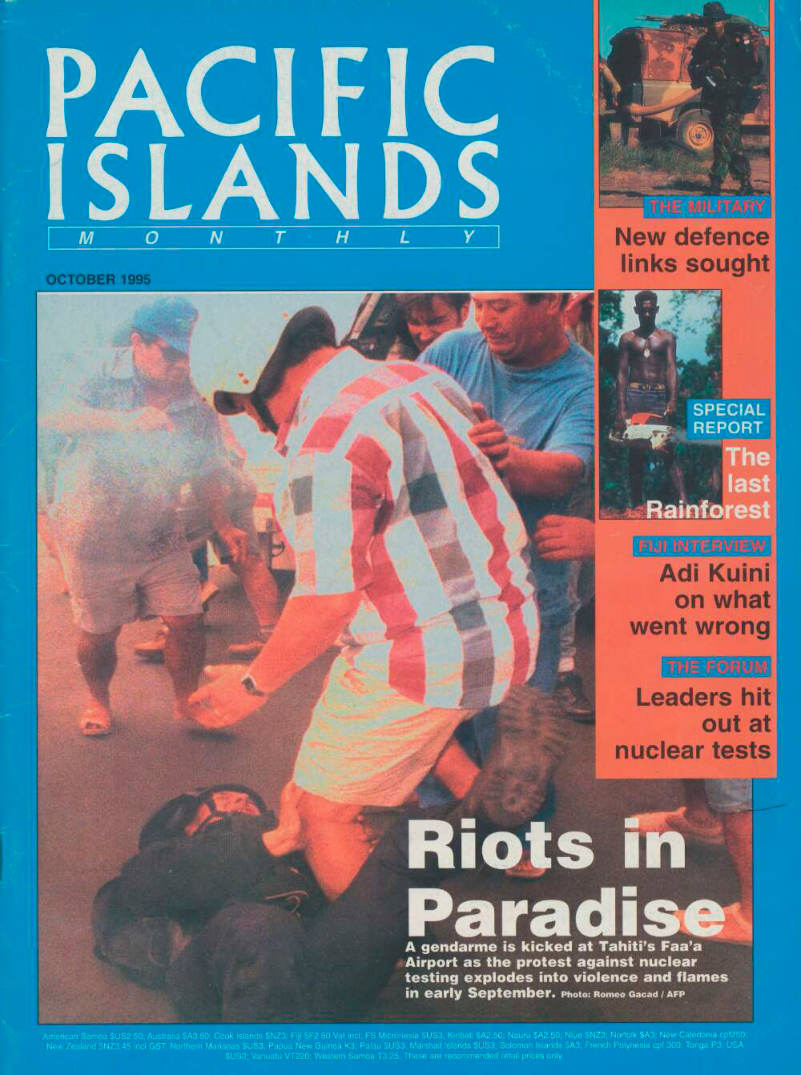
Riots in
Paradise
A gendarme is kicked at Tahiti’s Faa’a Airport as the protest against nuclear testing explodes into violence and flames in early September. Photo: Romeo Gacad / AFP
American Samoa SUS2.SO; Australia 5A3.50: Cook Islands SNZ3; Fiji 5F2.50 Vat incl; FS Micronesia SUSS; Kiribati 5A2.50; Nauru 5A2.50: Niue SNZ3; Norfolk SA3: New Caledonia cpf2so; New Zealand 5NZ3.45 incl GST: Northern Marianas SUS 3; Papua New Guinea K 3; Palau SUS 3; Marshall Islands SUS 3; Solomon Islands SA3; French Polynesia cpf 300; Tonga P 3; USA SUS 3; Vanuatu VT22O; Western Samoa T 3.25. These are recommended retail prices only.
1 Cover: Nothing has touched of so much anger and frustration in recent weeks than France’s detonation of a nuclear warhead in French V Polynesia. The protest turned violent inTahiti.
Advertisements & other items, pp. 2-6 (1 item)
Telikom
Papua New Guinea • . ’ i —— -w^aii
MHm
- . mm r m ill *■ . <" il ■/!-l *' s "I S 5« S 8 i M m B*
j VnillilLiliilltiumu
:ii i: v ’,
' ■ I* • :] -i: / ®
f jjlfiim miMUM
>- D It .
OH Telikom has set the pace in providing state-of-the-art telecommunications links within PNG and to anywhere around the world as we enter the 21st Century. For all your telecommunications needs, write to us at this address: Assistant General Manager Telikom Marketing Department P.O. Box 291 Waigani, Papua New Guinea Tel: 675 300 5564 Fax: 675 300 5540
TELIKOM
How we'te n&aily, talking!
It has taken thousands of chainlink rolls to put together this simple line. / m ~.siS J BIL chainlinks are manufactured from high quality Australian Galvanised or PVC wire and produced under stringent quality control on completely automatic Japanese machines.
Our commitment to excellence does not end here. We are the only manufacturer in Fiji to be accredited with NZS 9002 A59002/1509002 certification for the manufacture of chainlink fence, barbed wire, welded mesh, bright and galvanised nails.
We are the proud winners of the coveted F.T.1.8. Exporter of the Year Award (B&l)
ISO
9002
NZS
9002 twice in succession in 1993 and 1994... a recognition for our quality exports to Pacific Islands.
Experience the big difference in quality when you buy the recognised BIL brand chainlink fence.
So confident are we about our quality, that we identify every chainlink roll with a BIL label.
And what is more ... BIL brand chainlink fences are available at most of the leading hardware stores Fiji wide. Excellent technology and quality is now within everyone's reach.
WK
BA INDUSTRIES LTD
P.O. Box 707, Ba, Fiji. Phone; 674966 Fax: 676700.
Tjflj j
WANT T© MLY ©H THi
ADdesign
TRADE MARK CAUTIONARY NOTICE
Notice is hereby given that Telstra Corporation Limited, a corporation duly organised and existing under the laws of Australia, and having ACN 051 775 556, the Corporate Secretary being located at 242 Exhibition Street, Melbourne, Australia is the sole proprietor of the following trade marks:-
TELSTRA
c c
xjslstra ~elstra
used in respect of:- Telecommunications and communications equipment, apparatus and systems, including but not limited to electronic and optical telecommunications and communications equipment, apparatus and systems; satellite and earth station telecommunications and communications equipment, apparatus and systems; Telephone equipment, apparatus and systems, including but not limited to telephone; telephone receivers; telephone handsets; telephone network, telephone exchanges, telephone switching, telephone answering, telephone card vending and telephone dialling equipment, apparatus and systems; Transmission, receiving and storage equipment, apparatus and systems, including but not limited to facsimile, telegraph, telex, teleprinting, cable and paging equipment, apparatus and systems; data and video networking and conferencing equipment, apparatus and systems; data processing, message handling and switching equipment, apparatus and systems; digital equipment, apparatus and systems; electronic, voice, text and facsimile mail equipment, apparatus and systems; electronic directory equipment, apparatus and systems; Computer equipment, apparatus and systems, including but not limited to computer programs; computer software; computer hardware; computer terminals; computer memories; computer networking equipment, apparatus and systems; computer manuals in this class; modems; Video and audio equipment, apparatus and systems, including but not limited to sound and image recording, transmission and reproduction equipment, apparatus and systems; video cassettes and tapes; compact discs; records; digital, electric and electronic radio equipment, apparatus and systems; magnetic tapes; cinematographic, television and amusement equipment, apparatus and systems; amusement machines; All associated parts and accessories being goods in class 9, and Telecommunications services being services in class 38.
The said proprietor claims all rights in respect of the above trade marks and will take all necessary legal steps against any person or company infringing their said rights.
DAVIES COLLISON CAVE
PATENT ATTORNEYS
One Little Collins Street Level 10 AMP Building Melbourne, Victoria, 3000 10 Barrack Street Hobart Place Australia Sydney, New South Wales, 2000 Canberra City 2601
Get connected with VodaGroup and you could be saving upto 70% on telephone calls.
VodaGroup is a 3 digit short numbering “wireless extension” when calling vodafone to vodafone within your company.
At only 11 cents per minute you could be saving a big chunk at the end of the month.
And with Vodaßill, Vodafones' itemised billing will keep track of your calls and flag any abuse.
Call Vodafone today and find a new way of reducing operational costs.
For enquries please call toll free phone 0800 214 214 or the nearest Vodafone office.
rwunruiiE
“"digital
SUVA : Phone : 312 000, Fax : 312 007.
LAUTOKA: Phone : 668 000, Fax : 668 007.
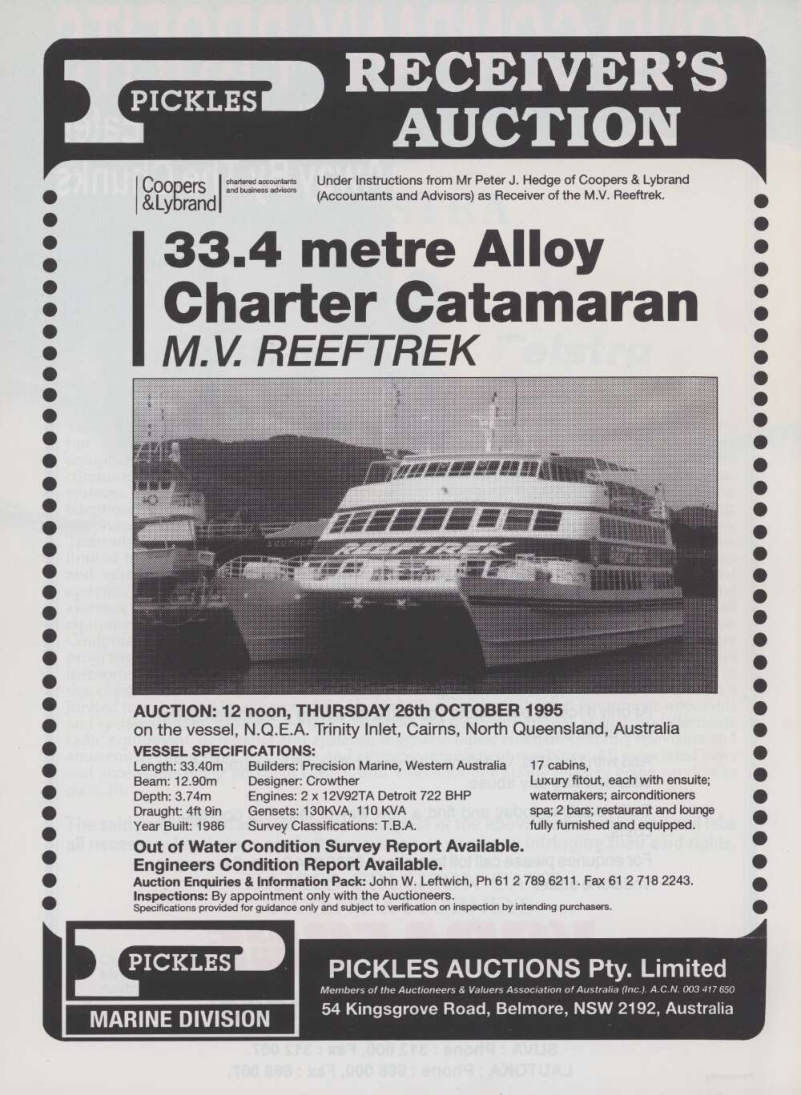
PICKLES
Coopers I
&Lybrand|
chartered accountants and business advisors
RECEIVER’S
AUCTION
Under Instructions from Mr Peter J. Hedge of Coopers & Lybrand (Accountants and Advisors) as Receiver of the M.V. Reeftrek.
33.4 metre Alloy
Charter Catamaran
M. V. REEFTREK
m MHf aMr .MhpMwp vSkKHSk "V & m mmmr M&MM f... - f «BT *** * AUCTION: 12 noon, THURSDAY 26th OCTOBER 1995 on the vessel, N.Q.E.A. Trinity Inlet, Cairns, North Queensland, Australia
VESSEL SPECIFICATIONS:
Length: 33.40 m Builders: Precision Marine, Western Australia Designer: Crowther Engines: 2 x 12V92TA Detroit 722 BHP Gensets: 130KVA, 110 KVA Survey Classifications: T.B.A.
Out of Water Condition Survey Report Available.
Engineers Condition Report Available.
Auction Enquiries & Information Pack: John W. Leftwich, Ph 61 2 789 6211. Fax 61 2 718 2243.
Inspections: By appointment only with the Auctioneers.
Specifications provided for guidance only and subject to verification on inspection by intending purchasers.
Beam: 12.90 m Depth: 3.74 m Draught: 4ft 9in Year Built: 1986 17 cabins, Luxury fitout, each with ensuite; watermakers; airconditioners spa; 2 bars; restaurant and lounge fully furnished and equipped.
PICKLES AUCTIONS Pty. Limited
Members of the Auctioneers & Valuers Association of Australia (Inc.). A.C.N. 003 417 650 54 Kingsgrove Road, Belmore, NSW 2192, Australia
Pacific
Islands
Monthly
Vol. 65 No. 10
The News Magazine
October 1995
PUBLISHER: Brian O’ Flaherty EDITOR: Jale Moala SENIOR WRITER: Yunus Rashid
Correspondents:
David North, Ed Rampell, lan Williams, Liz Thompson, Roman Grynberg, Wally Hiambohn, Lisa Williams, Patrick Decloitre, Barry Markowitz.
COLUMNISTS: David Barber (Wellington), Futa Helu (Tonga), Jemima Garrett (Sydney), Alfred Sasako (The Forum).
Advertising Sales
Regional Sales - South Pacific Ashok Lai, Tel (679) 304111, 303429, Fax (679) 303809.
Sydney, Canberra: Bob Hill Media Representation, Tel (61-2) 4164245, Fax (61-2) 4165064.
Brisbane: Jane Fewings Media and Advertising Associates Tel (61-7) 378 4522, Fax (61-7) 878 1071.
Adelaide: Hastwell Williamsons Representatives, Tel (61-8) 3799522, Fax (61-8) 3799735.
Melbourne; Brown Orr Fletcher Burrows (Aust) Pty Ltd.
Tel (61-3) 8265188, Fax (61-3) 8265644.
Auckland: McKay & Bowman, International Media Representatives Limited, Tel (64-9) 4190561, Fax (64-9) 4192243.
Japan: Universal Media Corporation, Tokyo, Tel (3) 3266626741, Cable: UNI-MEDIA Tokyo, Fax (3) 32626742.
Pacific Islands Monthly was founded 1930
(Usps 9522480).
A Fiji Times Limited production.
Cover prices are recommended retail only. Registered by Australia Post, Publication No. NBPI2IO. © Copyright Fiji Times Limited, 177 Victoria Parade, Suva, Fiji.
Tel (679) 304111, fax (670) 303809.
Pacific Islands Monthly is published monthly by Fiji Times Limited, a division of Nationwide News, 2 Holt Street, Surry Hills, Sydney, NSW 2010.
Send Address Changes To:
Pacific Islands Monthly, PO Box 1167, Suva, Fiji.
Typeset and printed by The Fiji Times Limited, 177 Victoria Parade, Suva, Fiji.
Inside
8: Letters 10: Fleadlines 13: Women in Parliament 45: Adi Kuini on Fiji 47: Forum attacks France 61: Books 61: Neighbours
Views
34: David Barber on problems in education 37: Futa Helu on French nuclear testing 47: Alfred Sasako on the Forum meeting
i A new link is made V as Indonesian forces join Australia in a major military exercise
Special Report * m Can we save our rainforests? Yes, but time is quickly running out
Letters
Vanuatu health I WAS glad to see that you were able to highlight some of the problems about health care in Vanuatu and in the Pacific region in your April edition. The article by Patrick Decloitre was based on a report that I had written just prior to leaving Vanuatu in January 1995. I had given him a copy with permission to use it as he wished.
Unfortunately I was not contactable for the next six months and so was unable to read M. Decloitre’s article before it was published. Whilst I am in agreement with the overall sense of the article I do feel that my report has been taken out of context in a few areas.
The main problem that I see with this article is that it implies that far more doctors are needed to run the health sys tem in Vanuatu. This in turn seems to diminish the importance of nurses. This is not what I said in the report.
Even though there have been prob lems with both quantity and quality of medical staff during the time that I was serving in Vanuatu I feel that around about 20 suitably trained doctors for the whole country would be a reasonable and sustainable figure overall.
I have no doubt that in a country as spread out as Vanuatu (in common with many of its Pacific neighbours) the cura tive health system should be nurse-run and largely nurse-led.
There has been a problem with poor training and unequal distribution of nurses in Vanuatu but suitably trained nurses are more important to the health
system there than are large number of doctors.
Chris Williams
Derby, UK
Gallic pride
HAS your typesetter/proofreader been affected by the thought of impending French nuclear radiation or has a naughty fairy hopped off your shoulder to create mettlesome mischief?
In my August French letter to Monsieur Chirac part of it should have read: “Must the juggernaut of Gallic pride override the well being of the peo ple of the South Pacific?”
Your version had Gaelic instead of Gallic! To relay this error I shall have to rely on your typesetter/proofreader and trust that he/she has come to their col lective senses!
I am delighted to perceive also that my epistle has been caught up in a South Pacific time warp! Your contents page boldly states: Pacific Islands Monthly June edition. This August June edition will no doubt become a prized collectors’ item!
Overriding the Gallic influence with the Garlic, er Gaelic is indeed an achie vement but to overcome time itself is incredible indeed!
As an inspired scribe let me state: Mischief and Miracles Magic and Mystery French Colonisation is now only History!
Poetic mists and Leprechauns Nuclear weapons have no heart The decisions irrevocable: “Monsieur Chirac, depart!”
Mururoa has revolted You now only offend No disrespect meant But it’s “the end!”
Your South Pacific hosts are calling it a day, we bid you adieu without further delay!
Martin Leo
Mt Wellington, Auckland, NZ Shocking news THE news that France has resumed
nuclear testing in French Polynesia is shocking, and there’s no guarantee that the present series will end after eight tests as the French claim.
Russia and the United States may decide to end their own voluntary mora toriums of testing, thereby providing France with the pretext to extend their tests idefinitely.
This new situation demonstrates that in future France intends to flex its mili tary muscles without consideration for political repercussions in the South Pacific. President Jacques Chirac’s term in office will extend until the year 2002, and one can be sure that he will not allow the free and fair vote on indepen dence for New Caledonia promised in the Matignon Accords.
At the very least, he will bully a majority in New Caledonia to vote against independence by threatening to cut off aid (as happened in Vanuatu).
One way for the South Pacific gov ernments to up the stake in this game is to move collectively to have French Polynesia inscribed on the decolonisa tion list of the United Nations Committee of 24, as New Caledonia was in 1986. This may not stop the French testing, but it will force France to go through the motions of defending their actions before the world.
A vote on independence for New Caledonia is to take place in 1998. If France threatens to cut off aid to an inde pendent Kanaky, then New Zealand, Australia, Japan and others should be prepared to step in and offer to make up the difference.
A public announcement now by those countries that they are studying this possibility will up the stakes anoth er notch, and may convince President Chirac that his current testing pro gramme is too expensive after all.
The South Pacific leaders must be prepared to offer more than just words.
David Stanley
Amsterdam, The Netherlands PNG on the rocks?
SINCE my university years of the 19705, I have been a habitual reader of
PIM but I have never read such dooms day coverage of Papua New Guinea’s social and economic quagmire.
It is true on all respects of what has been written by your writers such as “changing course”, “has the world bank gone soft and green” and “Papua New Guinea prepares forum.” (PIM July 1995) In these write-ups, one theme has been made succinctly clear and that is PNG is heading for the rocks.
The International Monetary Fund has to prescribe the bitter pill that Prime Minister Julius Chan has to swallow.
Obviously, this government has got this resource-rich country in a big mess that
only Chan can get it out of. The 20 years of social and economic plunder by this government in one way or another is coming to roost now. Chan cannot say he has not been part of this because he was there right from the outset of inde pendence.
The obvious question begging answers is, what can one do to take this into social, and economic, prosperity?
Before doing anything else, a macro plan should be adopted which can become a social/economic master plan within which targets should be set on all sectors of human activity such as educa tion, health etc.
These targets have to be met by the
government of the day. If Prime Minister Sir Julius Chan and his execu tive government cannot meet the devel opment targets set by the national parlia ment by adopting such a social/econom ic blueprint, then the Prime Minister and his government should be sacked and a new government should be appointed by that Parliament.
The eternal and perpetual running of this country in an ad hoc and hotch potch manner should stop and conscious planning has to be done. The ball is in Chan’s court.
Peter Ipu Peipul (Obe)
Boroko, Papua New Guinea.
Copra boosts
Vanuatu export AN increase in copra production has helped to boost Vanuatu’s export earn ings from SUSS million in the first quar ter of this year to $U55.34 million in the second quarter. Copra earned $U52.66 million. Beef was the second biggest earner with SUSI million. The export of shells, timber and kava also went up.
The increase in export has been attrib uted to some extent to better shipping services in the second quarter.
China protests Taiwan move CHINA has strongly condemned moves by 13 developing countries, including the Solomon Islands, to make Taiwan a member of the United Nations.
In a letter to United Nations Secre tary-General Boutros Boutros-Ghali,
China’s representative at the UN, Qin Huasun, said the move was an infringe ment on China’s sovereignty and an interference on its internal affairs. China regards Taiwan as its province and fiercely contests moves to recognise its independence. The bid to get Taiwan into the United Nations will be dis cussed at the UN session this month.
Fiji, PNG in trade deal FIJI and Papua New Guinea have com pleted negotiations on a bilateral trade agreement. The agreement aims to pro mote the free flow of products like cof fee beans, beef, copra, cake and pellets, tea and artefacts.
The agreement allows for the estab lishment of a joint trade committee which will meet every year to review and plan strategies and developments.
Telecom offers new service THE Fiji International Telecommuni cations Limited (FINTEL) has launched an international video conference ser vice.
FINTEL has described the facility as
“an exciting new technology involving a
high-speed, two-way audio-visual com munications link that lets you confer face-to-face with people who could be virtually anywhere in the world”.
The equipment cost FINTEL $70,000 (about ($U549,000) and transmission is by ANZCAN submarine cable “which provides a high speed digital link to Telecom New Zealand’s ISDN platform where calls are switched to and from the rest of the world”.
Lutali bans
smoking
NO smoking is allowed in government buildings in American Samoa. Governor A.P. Lutali, citing the high cost to the territory of smoke-related illnesses, has issued an executive order to this effect.
The territorial government, through the LBJ Hospital, is the sole local provider of health care services. The Governor also advocates a rise in the import duty on tobacco products from 150 per cent to 200 per cent.
Fiji plans
media review FIJI’S Information Minister, Ratu Etuate Tavai, has warned against cross-media ownership.
He said the Government was review ing the country’s media laws to promote fair trading and encourage Fijian partic ipation in the television service. He said Fiji Television Limited, Fiji’s only net work, needed to improve the composi tion of its staff, especially the absence of indigenous Fijians from the screen.
Niue polls
announced NIUE will hold its general election in the second week of January, said Premier Frank Lui. Earlier he had said that it was likely the general election would be held before the year ends.
Police 2 get jailed for life TWO police officers have been jailed for life in Fiji after they were convicted of murder by the High Court in Suva on September 5.
The officers, Constable loane Tauraga and Constable Tevita Rosadriwa, were charged with beating to death a man near Suva in January of the past year. The conviction, and other charges by members of the public, have prompted the Fiji Police Force to warn it will not tolerate police brutality.
Tonga gets
French gift
THE Territorial Government of French
Polynesia has donated a tanker to Tonga no strings attached.
The gift, a 2200-tonne former French naval vessel, was announced by French Polynesia Territorial President Gaston Flosse in August when he visited Tonga for three days.
Tonga’s King Taufa’ahau Tupou said the ship would provide cheaper transport for fuel products from Fiji, New Caledonia and American Samoa.
Better prices
boost copra COPRA production in Fiji has increased by 22 per cent in the past seven months compared to the same period of the past year. Production to the end of July was
6201 tonnes compared with 5009 in the same period of the past year. The increase in production has been attrib uted to the increase in price which has been averaging over SUS2SO a tonne.
Hepatitis kills
3 in Kiribati AT least three children have died in Kiribati from an unknown strain of hepatitis. The Government is sending out officials to inspect health conditions in schools in the outer islands. Hepatitis is prevalent in Kiribati. A health official said reports have reached Tarawa of
pupils suffering from diseases like night
blindness and a mysterious strain of hepatitis.
Advertisements & other items, p. 8 (1 item)
Iiimtimiriim&Tiedf
(fjws, SECRET OF THE BOOK OF^
REVELATION
EXPLAINED
APSIE Y@UJJ
IIIMTIMiRIIM&TIEDf
Then write for this free booklet which outlines world events as revealed by Jesus Christ
THE CHRISTADELPHIANS
GPOBoxBBI
ADELAIDE
SOUTH AUSTRALIA 5001
IOIBQ2VI
Other letters: Cigarettes and alcohol
From The Fiji Times in Suva AS a non-smoker, I fully support efforts made by the National Anti-Smoking Society of Fiji, and health workers in general, to educate the public about the dangers of smoking.
Although as a non-drinker I am baf fled at why alcohol has not been target ed with advertisements discouraging people from drinking.
Alcoholism is as dangerous as smok ing.
I want to know why the alcohol industry is being been ignored.
Is it because sportsmen are said to consume alcohol that it is exempt from being targeted?
Does alcohol not cause deaths, bro ken homes, violent crimes, diseases, addiction and other social problems?
I urge health workers and the gener al public to set up a sister organisation to the National Anti-Smoking Society of Fiji to combat the two evils which have created a lot of problems for our people today.
Faiyaz Khan, Suva
From The Norfolk Islander, Norfolk RE: a proposed law to prevent the sale of tobacco to children.
Is the best too good for Norfolk’s children?
I was surprised to learn that there is no law to protect children from ciga rette smoking.
Is there profit in pessimism on this issue?
This law teaches children their child hood is important.
Vulnerability and childhood go together. Even young animals are watched over. We need able watchmen.
The choice to start smoking is not of minor importance! Some possible con sequences: • cancer of the lips, lungs, etc; • cancer of the bladder is as common as cancer of the lungs; • heart disease, the biggest killer.
There are four deaths from this to each one from lung cancer; • lung disease, weakened lungs, emphysema from about 50 years on, with difficult breathing. X-rays do not reveal it until the condition is far advanced. • optic atrophy can occur, probably from the cyanide in tobacco; • deafness is worse with smokers; • osteoporosis is accelerated by smoking;
• carbon monoxide in cigarette smoke reduces by 20 per cent the capac ity of the blood to carry oxygen to the brain and elsewhere; • pregnant woman who smoke are twice likely to have a premature baby (premature infants have greater risks than full-term infants). • passive smoking effects other peo ple; and • one in three smokers will die from tobacco.
“We often think of smoking as some thing that will kill in old age. This is simply not so. Half will die in middle age, losing 23 or 24 years,” said Professor Peto, of Oxford University.
“It is better to have a fence at the top of a cliff, than an ambulance at the bot tom.”
A law requiring crash helmets to be worn on bikes to help prevent costly accidents and expense to our Healthcare Fund seems to be acceptable. A law to prevent the sale of cigarettes to people at a vulnerable age is comparable.
Is there one parent, if they had the choice, who would say, “Yes, I would like my child to smoke”?
Florence Anderson
Norfolk Island
Declaring war on pests
Headlines
FOR 10 years a quiet battle has been ranging in the Pacific Islands. It is a battle of blind instincts and numbers against the inventive genius of man. It is called biological control (or bio-con trol).
The fight is against insects, weeds, rodents and other garden and farm pests and diseases that threaten food produc tion in island countries.
This month, at least 60 experts will meet in Nadi, Fiji, to review bio-control activities in the Pacific in the past 10 years and map out a strategy for the next 10 years. Organised by the South Pacific Commission, the workshops will bring together government bio control heads and scientists from col
laborating organisations.
For many years the control of pests involved the use of chemicals which are now known to be harmful to people and the environment.
More than 10 years ago, scientists in the Pacific began using natural para sites and predators as alternatives to pesticides in the battle against the innu
merable organisms and phenomena of nature that threaten agricultural produc tion.
Some examples of bio-control activ ities in the region include: • taro beetle control in the Solomon Islands; • mimosa weed control in Fiji, Papua New Guinea and Western Samoa; and • the control of rhinoceros beetle on coconuts in many countries in the
region.
Among the recent successes in bio control has been the use of an insect to control lantana weed in the Solomon Islands and the use of weevil to control salvinia weed in Fiji, New Caledonia and Papua New Guinea.
“It was in Tonga in 1985 that the first regional bio-control meeting was held which directed the course of events that have brought about the work carried out so far,” said a state ment from SPC. “This second meeting aims to review achievements and short comings and analyse what needs to be done in the next decade.”
New stamps for Micronesia
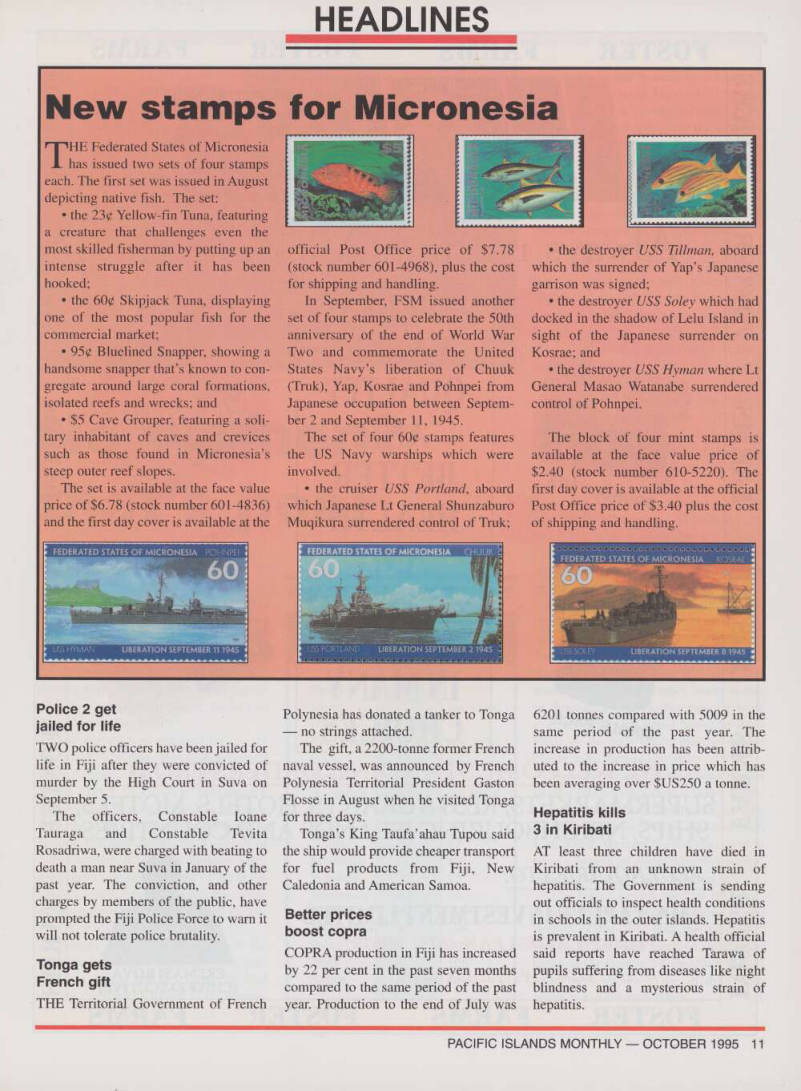
THE Federated States of Micronesia has issued two sets of four stamps each. The first set was issued in August depicting native fish. The set; • the 230 Yellow-fin Tuna, featuring a creature that challenges even the most skilled fisherman by putting up an intense struggle after it has been hooked; • the 600 Skipjack Tuna, displaying one of the most popular fish for the commercial market; • 950 Bluelined Snapper, showing a handsome snapper that’s known to con gregate around large coral formations, isolated reefs and wrecks; and • $5 Cave Grouper, featuring a soli tary inhabitant of caves and crevices such as those found in Micronesia’s steep outer reef slopes.
The set is available at the face value price of $6.78 (stock number 601-4836) and the first day cover is available at the
official Post Office price of $7.78 (stock number 601-4968), plus the cost for shipping and handling.
In September, FSM issued another set of four stamps to celebrate the 50th anniversary of the end of World War Two and commemorate the United States Navy’s liberation of Chuuk (Truk), Yap, Kosrae and Pohnpei from Japanese occupation between Septem ber 2 and September 11, 1945.
The set of four 600 stamps features the US Navy warships which were involved. • the cruiser USS Portland , aboard which Japanese Lt General Shunzaburo Muqikura surrendered control of Truk;
• the destroyer USS Tillman, aboard which the surrender of Yap’s Japanese garrison was signed; • the destroyer USS Soley which had docked in the shadow of Lelu Island in sight of the Japanese surrender on Kosrae; and • the destroyer USS Hyman where Lt General Masao Watanabe surrendered control of Pohnpei.
The block of four mint stamps is available at the face value price of $2.40 (stock number 610-5220). The first day cover is available at the official Post Office price of $3.40 plus the cost of shipping and handling.
Advertisements & other items, p. 12 (1 item)
Foster
FARMS
FOSTER
FARMS
co OS < fa os fa H co O fa CO
Foster
j
FARMS
Always natural. Always fresh.
mm Til
•CBBB
PS
V)BV.^
oo W H a) o fa
S\MGV£
pack
FOR BEST
VALUE,
QUALITY
AND
BETTER
HEALTH
AND
SELECTED
SERVINGS
IN MANY
CHOICES
a p. a & Or m fa <J3 fa
WE WELCOME STANDING ORDERS FROM
fa fa H co O fa
ALL ENQUIRIES TO:
MA-TAPULE INVESTMENT LIMITED
PH: (679) 312831 FAX: (679) 303757
SUVA, FIJI ISLANDS
EREMASIROVA
(CHIEF EXECUTIVE)
fa o co H fa fa fa > fa CO fa o CO H fa fa fa > fa CO
SUPERMARKETS, RESTAURANTS, HOTELS, MOTELS,
SHIPS, NEIGHBOURING ISLANDS AND COUNTRIES
fa O co H fa fa fa fa CO
FOSTER FARMS
FOSTER
FARMS
No women?
The Region
No women? that’s poor
By David North
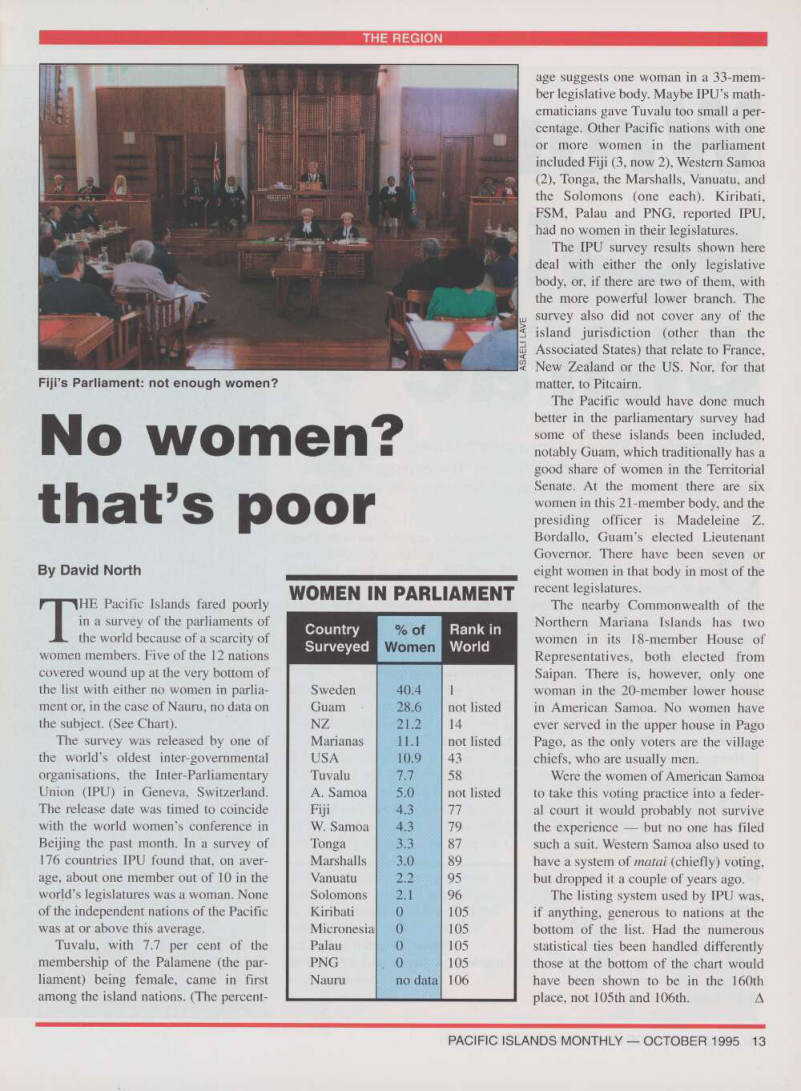
THE Pacific Islands fared poorly in a survey of the parliaments of the world because of a scarcity of women members. Five of the 12 nations covered wound up at the very bottom of the list with either no women in parlia ment or, in the case of Nauru, no data on the subject. (See Chart).
The survey was released by one of the world’s oldest inter-governmental
organisations, the Inter-Parliamentary
Union (IPU) in Geneva, Switzerland.
The release date was timed to coincide with the world women’s conference in Beijing the past month. In a survey of 176 countries IPU found that, on aver age, about one member out of 10 in the world’s legislatures was a woman. None of the independent nations of the Pacific was at or above this average.
Tuvalu, with 7.7 per cent of the membership of the Palamene (the par liament) being female, came in first among the island nations. (The percent-
Women In Parliament
age suggests one woman in a 3 3-mem
ber legislative body. Maybe IPU’s math
ematicians gave Tuvalu too small a per centage. Other Pacific nations with one or more women in the parliament included Fiji (3, now 2), Western Samoa (2), Tonga, the Marshalls, Vanuatu, and the Solomons (one each). Kiribati, FSM, Palau and PNG, reported IPU, had no women in their legislatures.
The IPU survey results shown here deal with either the only legislative body, or, if there are two of them, with the more powerful lower branch. The survey also did not cover any of the island jurisdiction (other than the Associated States) that relate to France, New Zealand or the US. Nor, for that matter, to Pitcairn.
The Pacific would have done much better in the parliamentary survey had some of these islands been included, notably Guam, which traditionally has a good share of women in the Territorial Senate. At the moment there are six women in this 21-member body, and the presiding officer is Madeleine Z.
Bordallo, Guam’s elected Lieutenant Governor. There have been seven or eight women in that body in most of the recent legislatures.
The nearby Commonwealth of the Northern Mariana Islands has two women in its 18-member House of Representatives, both elected from Saipan. There is, however, only one woman in the 20-member lower house in American Samoa. No women have ever served in the upper house in Pago Pago, as the only voters are the village chiefs, who are usually men.
Were the women of American Samoa to take this voting practice into a feder al court it would probably not survive the experience but no one has filed such a suit. Western Samoa also used to have a system of matai (chiefly) voting, but dropped it a couple of years ago.
The listing system used by IPU was, if anything, generous to nations at the bottom of the list. Had the numerous statistical ties been handled differently those at the bottom of the chart would have been shown to be in the 160th place, not 105th and 106th. A
Fiji’s Parliament: not enough women?
Asaeli Lave
Chountry
Surveyed
% of Women Rank in World Sweden 40.4 I Guam 28.6 not listed NZ 21.2 14 Marianas 11.1 not listed
Usa
10.9 43 Tuvalu 7.7 58 A. Samoa 5.0 not listed
Fiji
4.3 77 W. Samoa 4.3 79 Tonga 3.3 87 Marshalls 3.0 89 Vanuatu 2.2 95 Solomons 2.1 96 Kiribati 0 105 Micronesia 0 105 Palau 0 105
Png
0 105 Nauru no data 106
again,
Cover Stories
Wrong again, Chirac
On September 5 France detonated a 20-kiloton nuclear device deep in the earth in French Polynesia. The explosion ignited violent protests in Tahiti and gained France much unpopularity
By lan Williams
ON August 21 New Zealand added to its grassroots protests by seek ing to reopen its old 1973 case against the tests in the World Court, adding new ground; the lack of an environment Impact Assessment for the impact of nuclear testing on the atolls. Paris main tained a disdainful silence, although it would almost have been in character with its recent behaviour to have sent a posse of gendarmes to flood the World Court build ing in the Hague with tear gas.
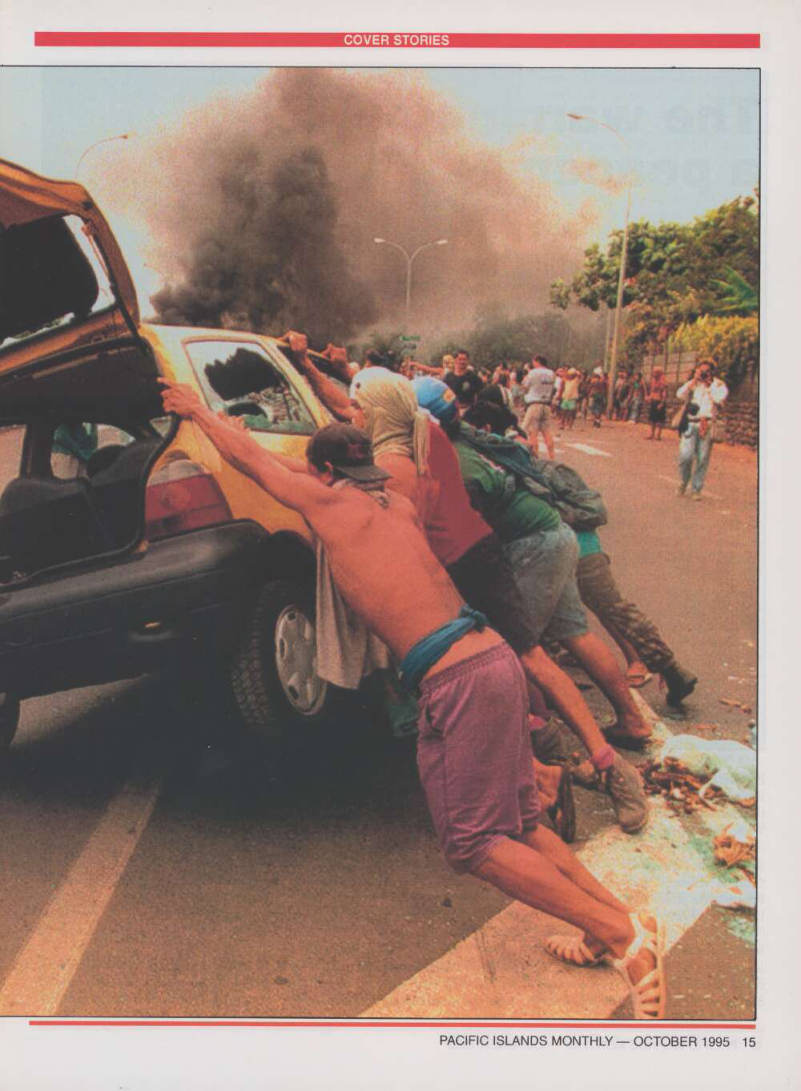
However, if Chirac thought that firm action against the protesters would damp en the protests, he was proven dramatical ly wrong when the first test on September 5 ignited a storm of protest across the world, if anything exacerbated by previous French highhanded ways in dealing with the Greenpeace boats. In French Polynesia’s main island of Tahiti, the indigenous Maohi people went on the ram page, burning the airport at Faa’a and shops in Papeete.
Why would a medium-sized country like France, not under any particular threat by any neighbour, want to alienate people
across the world by exploding nuclear weapons at the opposite side of the globe?
Inadvertently perhaps, President Carlos
Menem put his finger on the problem with the French government. While condemn ing the test as detestable and repugnant, “France is our friend, but it is not master of the world,” he said, as the 20 kiloton underground blast at Mururoa echoed around an indignant world.
The French may wonder why it is that China could set off a test like a celebrato ry fireworks within days of the signing of the extension of the nuclear non-prolifera tion treaty with hardly a whisper from the rest of the world. Partly that is because the Chinese were foolish, or polite, enough to make their mess in their own backyard.
And whatever Paris says, no one in the rest of the world seriously believes that French
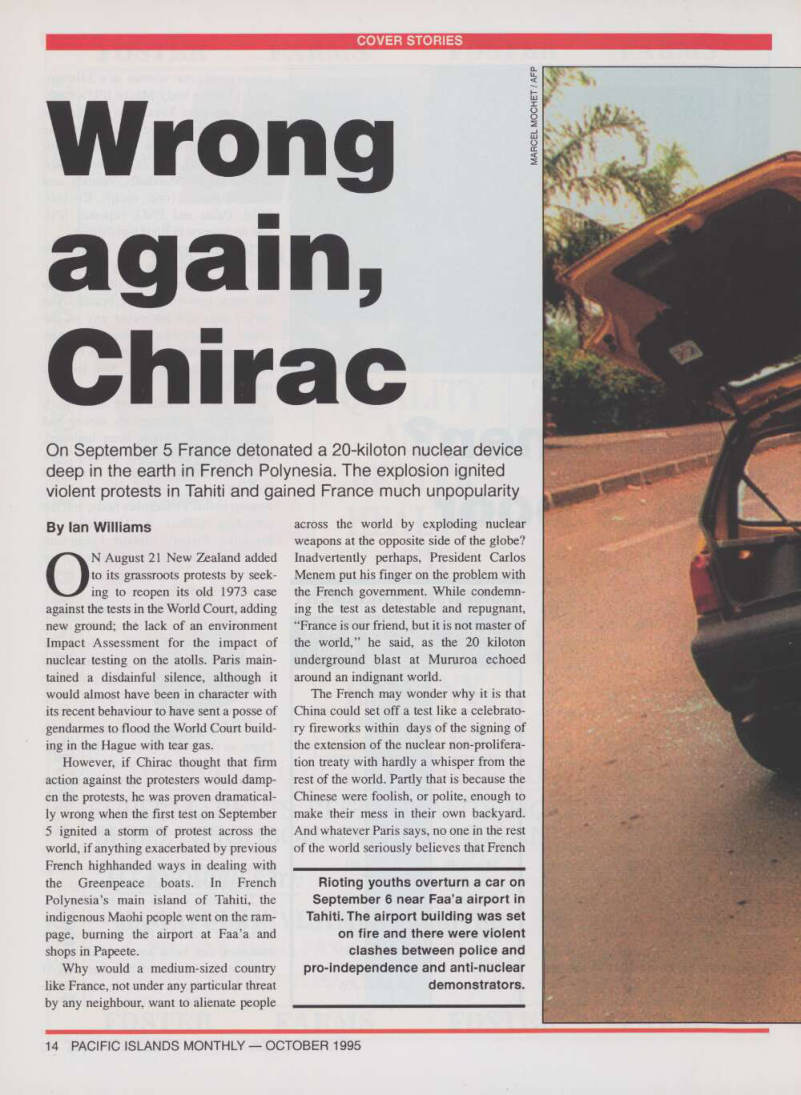
Rioting youths overturn a car on September 6 near Faa’a airport in Tahiti. The airport building was set on fire and there were violent clashes between police and pro-independence and anti-nuclear demonstrators.
Marcel Mochet/Afp
Polynesia is really part of the French hin terland. In addition, it is something of a backhanded compliment to the French.
While most people have few expectations of the Chinese government, most people see France as a democracy which is dif ficult to reconcile with storm troopers behaving like pirates boarding and damag ing protest vessels.
Part of the problem is precisely that some French politicians have never accepted the declining position of the tri colour around the world. Their centuries old rivals, the British, were much more
pragmatic. Once the economic rationale for the empire disappeared, so did they, taking their Union Jack with them. Indeed, they left with almost indecent haste, pulling out of some places that would just have soon kept them.
But like aged parents in their decline, the British could take vicarious comfort from their children. Canada, Australia, New Zealand to some extent, but above all, the United States, the rising star to which the fading kingdom hitched its char iot. Between them the English speaking countries, without trying very hard, have a
massive, indeed one could say critical, cul tural mass that races away, engulfing the world.
English is spoken almost everywhere, despite a conspicuous lack of official encouragement by the Anglophone gov ernments. French is spoken less and less despite fanatic encouragement from Paris, which bombards agencies like the United Nations to ensure that the language has its due respect.
We all have sympathy with indigenous languages and cultures being swamped by Anglophone culture, but France has tradi-
tionally had little sympathy for other cul tures as any Kanak or Breton can testify.
The French chauvinist’s big complaint is not the disappearance of other cultures, but that it is another language, English, that is making them disappear. Without getting
too psychoanalytical, you could almost say that the test was Paris’s way of saying “non” to the English-speaking world.
Former French President, the late, Charles de Gaulle who epitomised these principles put it succinctly: “No country
without an atom bomb could properly con sider itself independent.” In his day, right across the political spectrum French vot ers, sandwiched between the Soviets on side and the British and Americans on the other, were unquestioning about their country’s need for nuclear weaponry.
Now even that has changed. Only 16 per cent of French voters totally support the tests, while almost 60 per cent of French people object to the new tests, and President Jacques Chirac’s standing has suffered as a result of a policy he made uniquely his own. Almost all the opposi tion parties have registered their objec tions. The ordinary French increasingly see no threat of war, and regard themselves increasingly as part of the European Union.
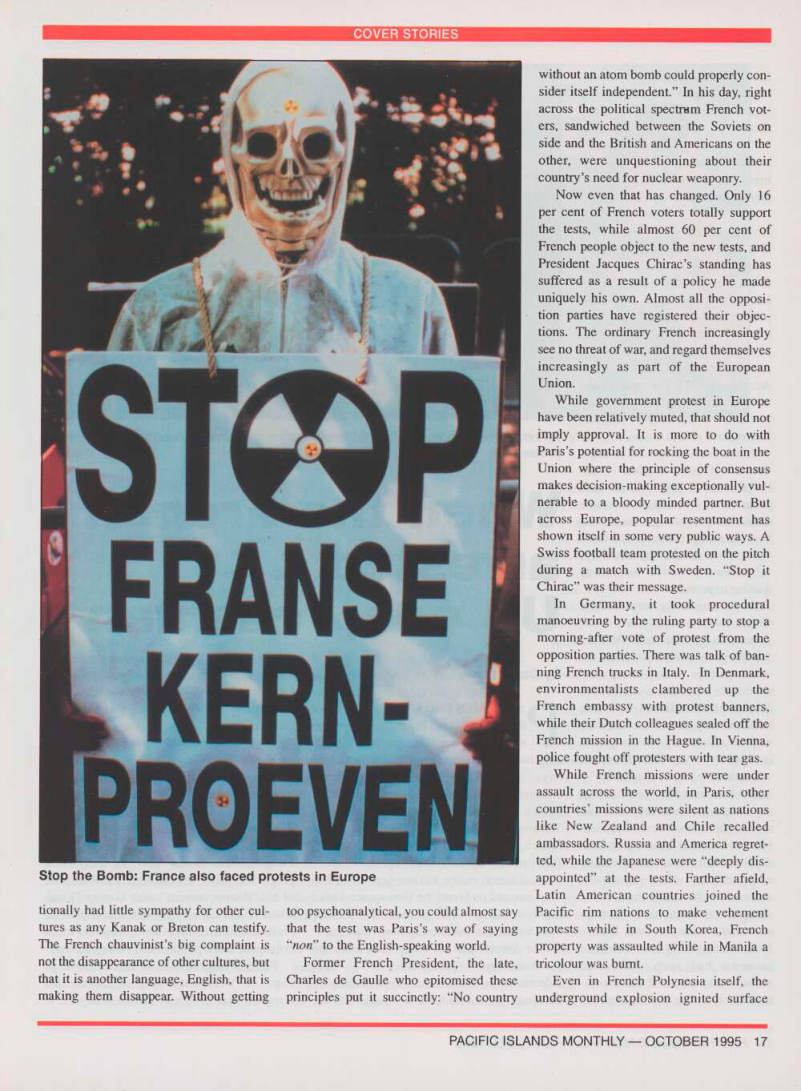
While government protest in Europe have been relatively muted, that should not imply approval. It is more to do with Paris’s potential for rocking the boat in the Union where the principle of consensus makes decision-making exceptionally vul nerable to a bloody minded partner. But across Europe, popular resentment has shown itself in some very public ways. A Swiss football team protested on the pitch during a match with Sweden. “Stop it Chirac” was their message.
In Germany, it took procedural manoeuvring by the ruling party to stop a moming-after vote of protest from the opposition parties. There was talk of ban ning French trucks in Italy. In Denmark, environmentalists clambered up the French embassy with protest banners, while their Dutch colleagues sealed off the French mission in the Hague. In Vienna, police fought off protesters with tear gas.
While French missions were under assault across the world, in Paris, other countries’ missions were silent as nations like New Zealand and Chile recalled ambassadors. Russia and America regret ted, while the Japanese were “deeply dis appointed” at the tests. Farther afield, Latin American countries joined the Pacific rim nations to make vehement protests while in South Korea, French property was assaulted while in Manila a tricolour was burnt.
Even in French Polynesia itself, the
underground explosion ignited surface
Stop the Bomb: France also faced protests in Europe
fires as anti-colonial Polynesians burnt the airport and shops in the capital Papeete before threatening a strike.
No wonder the French voters are wondering at a policy that has made France a byword for environ mental insensitivity across the world. Many French opponents have also seized upon what is prob ably an even stronger factor than concern for the environment of the South Pacific: the timing of the tests. Chirac, perhaps like many people, underestimated just how relieved much of the world was to be out of the chilling shadow of a nuclear holocaust after four decades of Cold War that always seem to be about to explode into M.A.D., Mutually Assured Destruction.
In the year that saw the re-nego tiation of the Nuclear Non- Proliferation Treaty and the firm promise of a nuclear test ban, Chirac’s series of eight tests bring back haunting memories of those times when nuclear bombers and
submarines patrolled incessantly
waiting to pounce.
It remains to be seen whether Chirac reacts brusquely to the new protests. Suggestions from Paris are that the government will reduce the series, perhaps to six. It is a mea sure of the seriousness that French Foreign Minister Herve de Chartte broke all the rules of the language wars to address a press conference in English to say that “France is very attentive to world opinion.”
If it is, and they can listen in any language, then they will not risk another global wave of protests like this one, that is damaging them
diplomatically and economically
while, if many of its own experts are to be believed, doing little to strengthen them militarily. Perhaps one consolation for the Pacific Islands is that rarely have their gov ernments had such world-wide attention and support for their posi tion. But it’s a heavy price to pay. A
Advertisements & other items, p. 15 (1 item)
Cover Stories
a peacemaker
The warning of a peacemaker
By Jale Moala
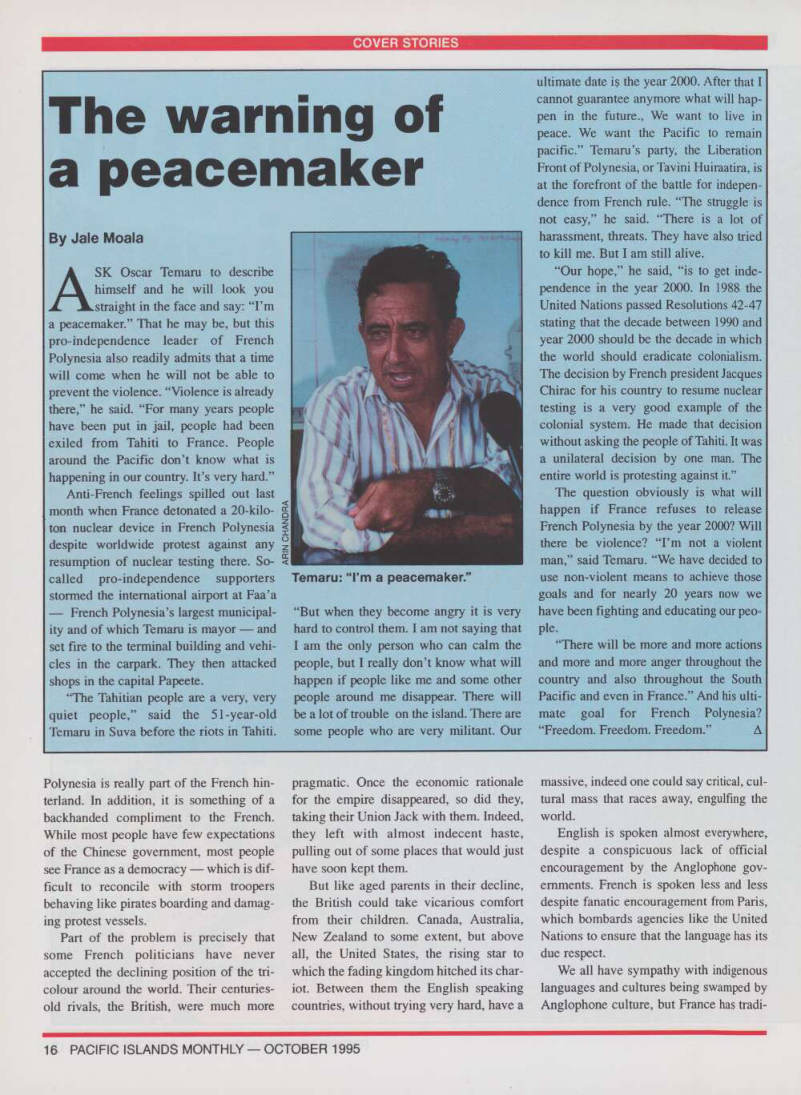
ASK Oscar Temaru to describe himself and he will look you straight in the face and say: “I’m a peacemaker.” That he may be, but this pro-independence leader of French Polynesia also readily admits that a time will come when he will not be able to prevent the violence. “Violence is already there,” he said. “For many years people have been put in jail, people had been exiled from Tahiti to France. People around the Pacific don’t know what is happening in our country. It’s very hard.”
Anti-French feelings spilled out last month when France detonated a 20-kilo ton nuclear device in French Polynesia despite worldwide protest against any resumption of nuclear testing there. So called pro-independence supporters stormed the international airport at Faa’a
French Polynesia’s largest municipal
ity and of which Temaru is mayor and set fire to the terminal building and vehi cles in the carpark. They then attacked shops in the capital Papeete.
“The Tahitian people are a very, very
quiet people,” said the 51-year-old
Temaru in Suva before the riots in Tahiti.
“But when they become angry it is very hard to control them. I am not saying that I am the only person who can calm the people, but I really don’t know what will happen if people like me and some other people around me disappear. There will be a lot of trouble on the island. There are some people who are very militant. Our
ultimate date is the year 2000. After that I cannot guarantee anymore what will hap pen in the future.. We want to live in peace. We want the Pacific to remain pacific.” Temaru’s party, the Liberation Front of Polynesia, or Tavini Huiraatira, is at the forefront of the battle for indepen dence from French rule. “The struggle is not easy,” he said. “There is a lot of harassment, threats. They have also tried to kill me. But I am still alive.
“Our hope,” he said, “is to get inde pendence in the year 2000. In 1988 the United Nations passed Resolutions 42-47 stating that the decade between 1990 and year 2000 should be the decade in which the world should eradicate colonialism.
The decision by French president Jacques Chirac for his country to resume nuclear testing is a very good example of the colonial system. He made that decision without asking the people of Tahiti. It was a unilateral decision by one man. The entire world is protesting against it.”
The question obviously is what will happen if France refuses to release French Polynesia by the year 2000? Will there be violence? “I’m not a violent man,” said Temaru. “We have decided to use non-violent means to achieve those goals and for nearly 20 years now we have been fighting and educating our peo ple.
“There will be more and more actions and more and more anger throughout the country and also throughout the South Pacific and even in France.” And his ulti mate goal for French Polynesia?
“Freedom. Freedom. Freedom.” A
Arin Chandra
Temaru: “I’m a peacemaker.”
US congressman
When the French arrested a US congressman
By David North
PARLIAMENTARIANS from all over the world went to Tahiti the past month to protest French nuclear testing, but only two of them were arrested by the French navy. They were American Samoa’s Congressman, Eni Faleomavaega, and the French Polynesian opposition leader, Oscar Temaru. “We were held in house arrest by the French for 16 hours,” the Congressman told PIM upon his return to Washington.
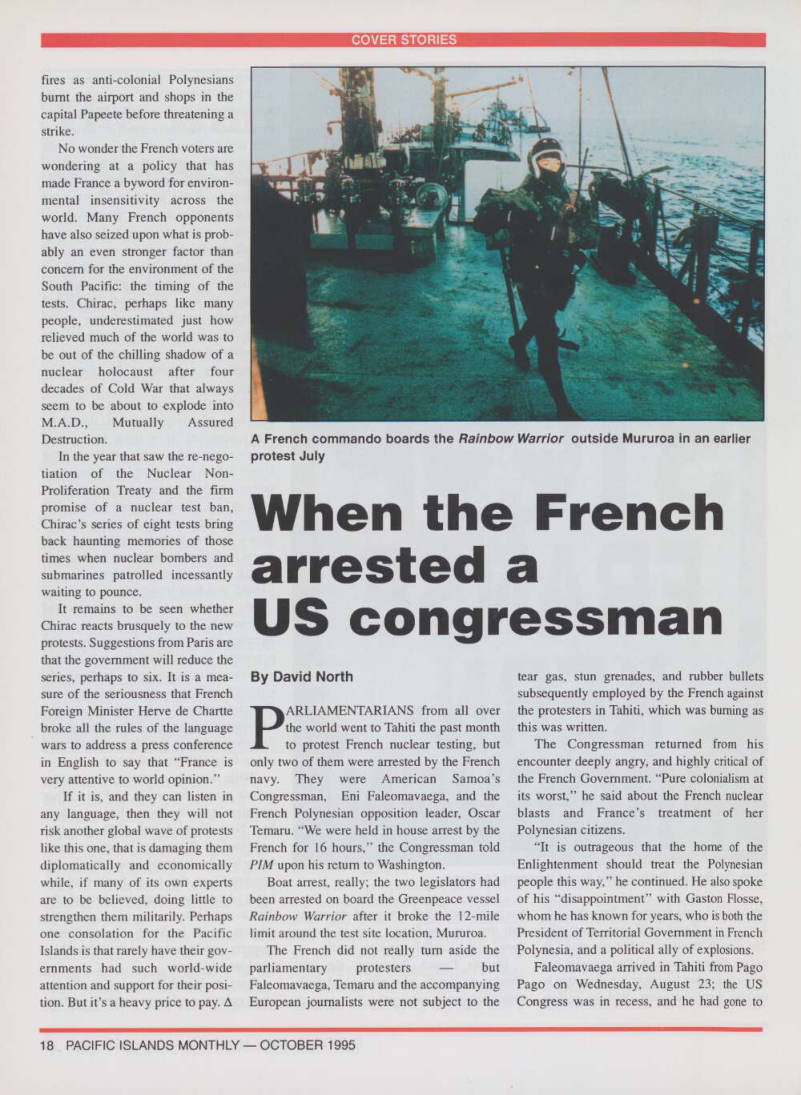
Boat arrest, really; the two legislators had been arrested on board the Greenpeace vessel Rainbow Warrior after it broke the 12-mile limit around the test site location, Mururoa.
The French did not really turn aside the parliamentary protesters but Faleomavaega, Temaru and the accompanying European journalists were not subject to the
tear gas, stun grenades, and rubber bullets
subsequently employed by the French against
the protesters in Tahiti, which was burning as this was written.
The Congressman returned from his encounter deeply angry, and highly critical of the French Government. “Pure colonialism at its worst,” he said about the French nuclear blasts and France’s treatment of her
Polynesian citizens.
“It is outrageous that the home of the Enlightenment should treat the Polynesian people this way,” he continued. He also spoke of his “disappointment” with Gaston Flosse, whom he has known for years, who is both the President of Territorial Government in French Polynesia, and a political ally of explosions.
Faleomavaega arrived in Tahiti from Pago Pago on Wednesday, August 23; the US Congress was in recess, and he had gone to
A French commando boards the Rainbow Warrior outside Mururoa in an earlier protest July
Tahiti to protest the planned nuclear exper iments. He paid a courtesy call on Flosse, which led nowhere, and then joined 5000 local protesters in front of the area’s largest LMS church.
Shortly thereafter he was invited to board a ketch along with some German journalists for a protest sail to Mururoa; tens of thousands of residents of Hamburg, Germany, had funded the ship and the Congressman was tempted to board it, but he could not be assured that it would return to port in time for him to catch his plane back to the first session of Congress fol lowing its summer break.
Then Greenpeace issued an invitation to Faleomavaega and to Temaru. Would they fly to Tureia, some 60 miles from Mururoa, and board the Rainbow Warrior there for a protest at the testing site?
The two Polynesian legislators accept ed and on August 30 they arrived on Tureia where they met with the local residents who have used Mururoa for fishing and for the harvest of coconuts for generations, and who regard themselves as owners of what previous to the nuclear testing had been an uninhabited island. “The people of Tureia invited us to visit their island,”
Faleomavaega told me.
The Rainbow Warrior left for Mururoa
that evening and by three in the morning of what would turn out to be a very long day it was being trailed by a French
warship.
“Then twelve remarkable young people Australians, New Zealanders and Americans pushed off from the mother boat in six zodiacs and headed for the atoll. The French ship never noticed this,”
the Congressman said happily.
A couple of hours later, however, the French Navy warned the Greenpeace ship that it was about to break the 12-mile limit; the Rainbow Warrior ignored the warnings and kept moving toward the test site.
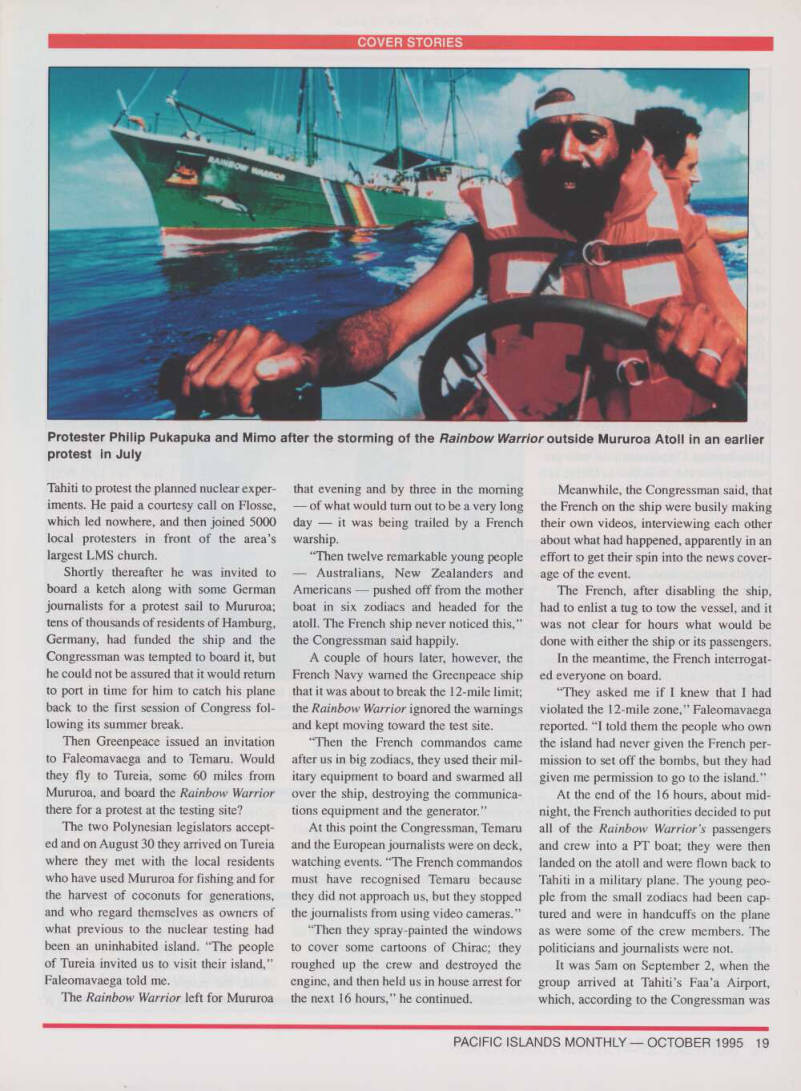
“Then the French commandos came after us in big zodiacs, they used their mil itary equipment to board and swarmed all over the ship, destroying the communica tions equipment and the generator.”
At this point the Congressman, Temaru and the European journalists were on deck, watching events. “The French commandos must have recognised Temaru because they did not approach us, but they stopped the journalists from using video cameras.”
“Then they spray-painted the windows to cover some cartoons of Chirac; they roughed up the crew and destroyed the engine, and then held us in house arrest for the next 16 hours,” he continued.
Meanwhile, the Congressman said, that the French on the ship were busily making their own videos, interviewing each other about what had happened, apparently in an effort to get their spin into the news cover age of the event.
The French, after disabling the ship, had to enlist a tug to tow the vessel, and it was not clear for hours what would be done with either the ship or its passengers.
In the meantime, the French interrogat ed everyone on board.
“They asked me if I knew that I had violated the 12-mile zone,” Faleomavaega reported. “I told them the people who own the island had never given the French per mission to set off the bombs, but they had given me permission to go to the island.”
At the end of the 16 hours, about mid night, the French authorities decided to put all of the Rainbow Warrior’s passengers and crew into a PT boat; they were then landed on the atoll and were flown back to Tahiti in a military plane. The young peo ple from the small zodiacs had been cap tured and were in handcuffs on the plane as were some of the crew members. The politicians and journalists were not.
It was sam on September 2, when the group arrived at Tahiti’s Faa’a Airport, which, according to the Congressman was
Protester Philip Pukapuka and Mimo after the storming of the Rainbow Warrior outside Mururoa Atoll in an earlier protest in July
blockaded by Temaru’s supporters, who were worried about his safety and that of
his companions.
“I have never seen such mean, deter mined people as those protesters,”
Faleomavaega said.
When Temaru learned that his people had surrounded the airport he told the French authorities that they had better take the handcuffs off the Greenpeace people or he and Faleomavaega would not leave the tarmac; the implied threat worked, and the young environmentalists were finally unchained.
The Greenpeace protesters were
relieved of their handcuffs at least partial ly because of a series of geographical and political coincidences. Temaru is not only a member of the territorial parliament,'he is also (in the French Mainland political parliament tradition) mayor of his home town, Faa’a. Faa’a, the largest municipali ty in French Polynesia, is the home of many displaced residents from the outer islands who tend to be among the poorest residents of the island of Tahiti. And Tahiti’s airport is in the middle of Faa’a.
Before the Congressman left Tahiti for the US mainland, he and Temaru, presumably the stars of the show, joined parliamentar
ians from all over the world in yet another demonstration against the nuclear blasts.
They were joined in this by the ranking politician present, the Japanese Minister of Finance, Masayoshi Takemura, who pre sumably was happy to be talking about something other than Japan’s financial problems. Upon his return the US Faleomavaega expressed his disappoint ment in one aspect of the press coverage of the controversy. “The press seems to have sought only the opinions of Europeans, and to have disregarded those of the island, the people most effected by the explosions,” he said. A
Patrick Decloitre
The innocent French
By Patrick Decloltre
ANTI-FRENCH feeling is strong
in Australia, since France’s announcement to resume its nuclear tests in French Polynesia. A media campaign launched last June has hit hard at French companies and individuals who have been residing in Australia for years.
But some now realise this may be more detrimental to Australians than the French.
Protests against the French decision have indeed gone through many different channels: it is even possible to send an electronic mail message through Internet to President Chirac. The Australian Broadcasting Corporation also sells pre written postcards to be sent to Chirac as a sign of protest. In the streets, Greenpeace posters remind the public of the strong protest feeling in Australia.
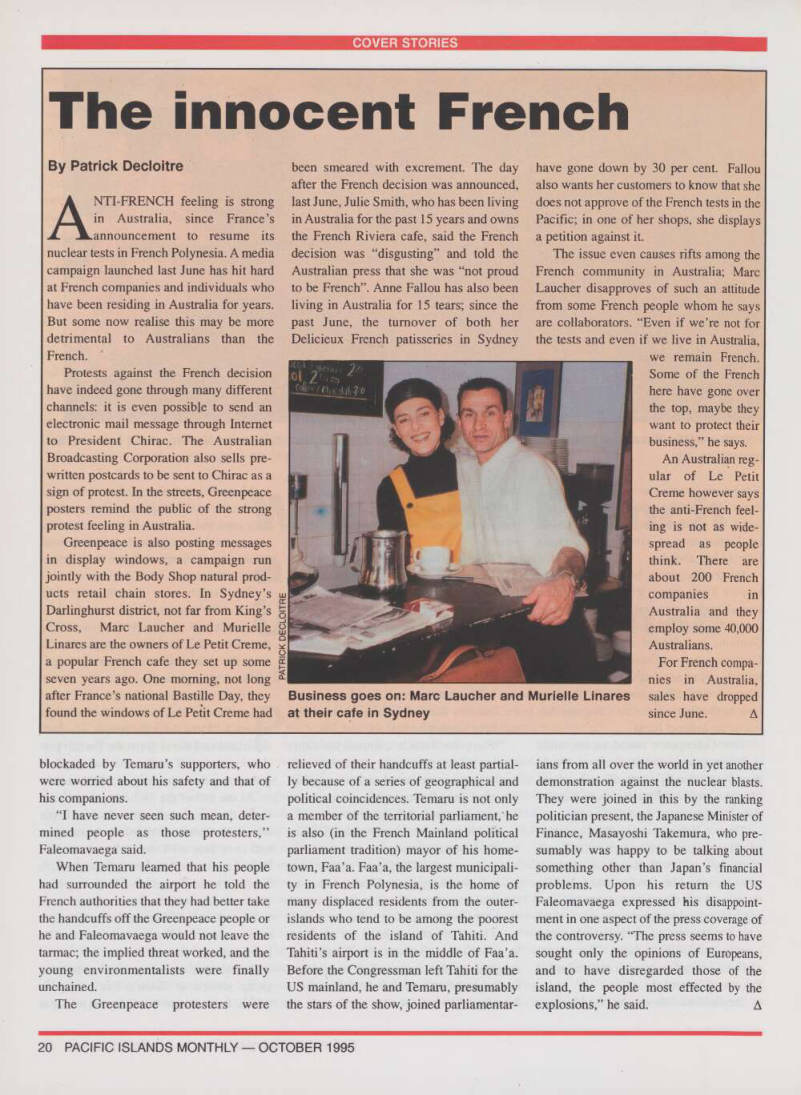
Greenpeace is also posting messages in display windows, a campaign run jointly with the Body Shop natural prod ucts retail chain stores. In Sydney’s Darlinghurst district, not far from King’s Cross, Marc Laucher and Murielie Linares are the owners of Le Petit Creme, a popular French cafe they set up some seven years ago. One morning, not long after France’s national Bastille Day, they found the windows of Le Petit Creme had
been smeared with excrement. The day after the French decision was announced, last June, Julie Smith, who has been living in Australia for the past 15 years and owns the French Riviera cafe, said the French decision was “disgusting” and told the Australian press that she was “not proud to be French”. Anne Fallou has also been living in Australia for 15 tears; since the past June, the turnover of both her Delicieux French patisseries in Sydney
have gone down by 30 per cent. Fallou also wants her customers to know that she does not approve of the French tests in the Pacific; in one of her shops, she displays
a petition against it.
The issue even causes rifts among the French community in Australia; Marc Laucher disapproves of such an attitude from some French people whom he says are collaborators. “Even if we’re not for the tests and even if we live in Australia,
we remain French.
Some of the French here have gone over the top, maybe they want to protect their business,” he says.
An Australian reg ular of Le Petit Creme however says the anti-French feel ing is not as wide
spread as people
think. There are about 200 French
companies in
Australia and they employ some 40,000 Australians.
For French compa nies in Australia, sales have dropped since June. A
Patrick Decloitre
Business goes on: Marc Laucher and Murielle Linares at their cafe in Sydney
The code for survival

Advertising Feature
Construction in the Pacific
By Yunus Rashid
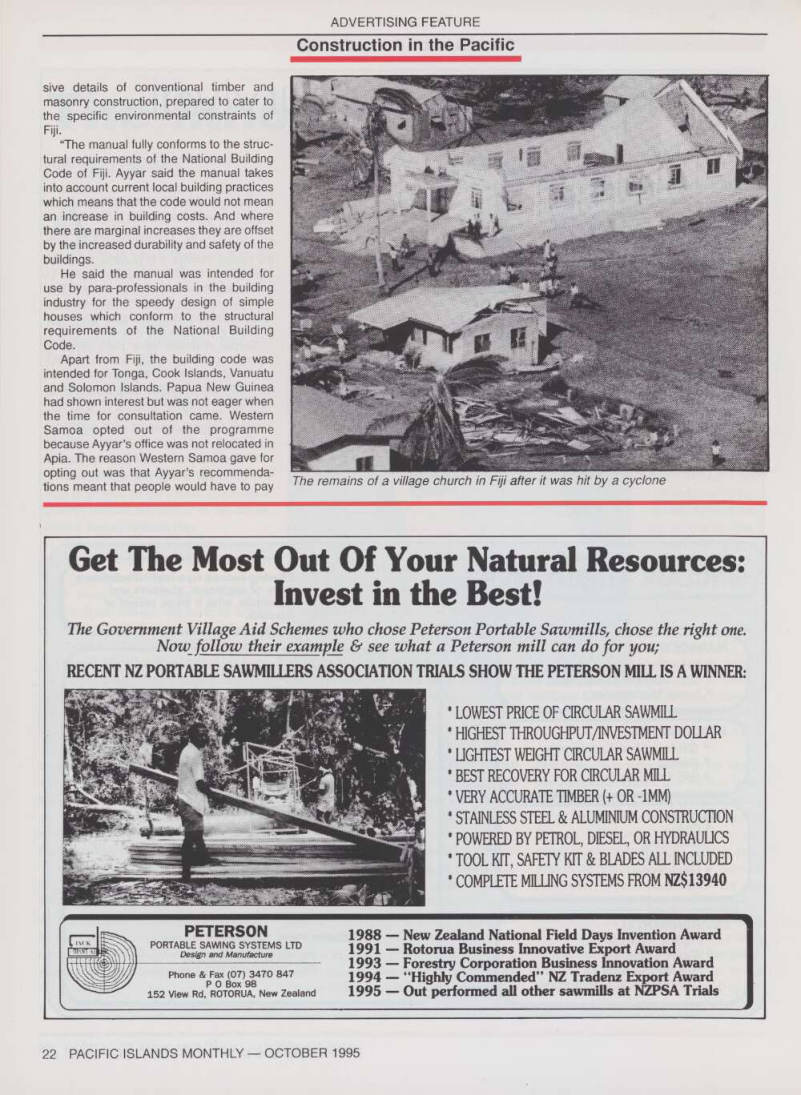
CYCLONES have a liking for the Pacific Islands. They dance through the ocean and land on our shores as uninvited guests and leave in their wake losses accumulating to millions of dollars. It also kills a lot of peo pie. Time and again structural damages have been blamed on architectural flaws. It is with this in mind that the Australia International Development Assistance Bureau, now AusAID, funded a pro gramme whereby Kris Ayyar of Kerela, India, was hired to head the Pacific Building Standards Project. The project upon com pletion was expected to come up with codes for building in the South Pacific so that cyclone damage to infrastructure would be minimal. However, not all coun tries opted for Ayyar’s recommendations, Some thought the implementation of Ayyar s report would mean extra building costs. But Fiji, which is an attraction for the
wandering cyclones (in 1986 Fiji was hit by seven cyclones within two weeks), decided to accept Ayyar’s report.
In his report, Ayyar said; “Houses have been built around the world for hundreds of years without the benefit of any formal structural analysis and design. It was only in the recent past, from about 20 years ago that many began to question the wisdom of this practice. Recurring cases of death and large-scale destruction of houses through natural disasters in many parts of the world began to demand urgent remedial action, There were two main reasons for the absence of any engineering design input for houses. Firstly, a house is an extremely complex structural system, far more complex than many other engineering structures. Secondly, the cost of performing the detailed structural design of an individual house is very substantial when compared to the rest of the cost.”
He added that “the structural complexity
of houses has been partially overcome by experimental research. Such research has progressively established a number of increasingly reliable mathematical relation ships between the forces (such as from cyclonic winds) acting on a house and the resulting effect on various components of the house. Further, it is possible to spread the cost of detailed structural design by performing the design for a variety of sys terns in terms of a limited number of modu lar sub-systems. We have taken advantage of these to produce this manual.”
Similar manuals have been prepared before in the Pacific and were commonly used in Australia and New Zealand. Fiji’s first such code manual was produced by Fiji Pine and was known as the Fiji Pine Code.
Ayyar said ideas had been borrowed from those manuals.
“However, this manual has for the first time in a single publication included exten
sive details of conventional timber and masonry construction, prepared to cater to the specific environmental constraints of Fiji.
“The manual fully conforms to the struc tural requirements of the National Building Code of Fiji. Ayyar said the manual takes into account current local building practices which means that the code would not mean an increase in building costs. And where there are marginal increases they are offset by the increased durability and safety of the
buildings.
He said the manual was intended for use by para-professionals in the building industry for the speedy design of simple houses which conform to the structural requirements of the National Building Code.
Apart from Fiji, the building code was intended for Tonga, Cook Islands, Vanuatu and Solomon Islands. Papua New Guinea had shown interest but was not eager when the time for consultation came. Western Samoa opted out of the programme because Ayyar’s office was not relocated in Apia. The reason Western Samoa gave for opting out was that Ayyar’s recommenda tions meant that people would have to pay
The remains of a village church in Fiji after it was hit by a cyclone
higher costs for building. Tonga pulled out of the programme when New Zealand fund ed an alternative project using a private consultant. Countries which now enjoy the use of the manual include Niue, Tuvalu, the Cook Islands and Solomon Islands. Fiji and Vanuatu have manuals which will help them cope with greater wind forces.
Ayyar’s view is that the island nations should wake up to the fact that many lives are lost and damage to homes is colossal during cyclones. He said countries would spend more money trying to repair dam aged homes than pay for initial safety mea sures in new homes.
Advertisements & other items, pp. 21-22 (2 items)
S’ Management:
SINCLAIR KNIGHT MERZ
* Total Project Management * Construction Supervision * Asset Management
INVESTIGATION:
* Geotechnical Engineering * Survey * GIS Development
ENGINEERING DESIGN:
* Civil * Structural * Electrical * Mechanical * Hydraulic r
ENVIRONMENTAL:
\ * Impact Assessment * Waste Disposal * Pollution Control * Environmental Engineering ✓ r Offering access to a multi-disciplinary team of engineers, planners and scientists, with a track record of success.
J itact: Lautoka, Fiji: John Campbell Tel: (679) 662411 Fax (679) 664107 Suva, Fiji: Terence Erasito Tel: (679) 315209 Fax (679) 315270 Papua New Guinea: Mich Hewitt Tel: (675) 212155 Fax (675) 214660 Brisbane: Peter Cooper Tel: (61) 7-38350222 Fax (61) 7-38326335
Get The Most Out Of Your Natural Resources:
Invest in the Best!
The Government Village Aid Schemes who chose Peterson Portable Sawmills, chose the right one.
Now follow their example & see what a Peterson mill can do for you; RECENT NZ PORTABLE SAWMILLERS ASSOCIATION TRIALS SHOW THE PETERSON MILL IS A WINNER: Ba£ wrm
* LOWEST PRICE OF CIRCULAR SAWMILL
* HIGHEST THROUGHPUT/INVESTMENT DOLLAR
* LIGHTEST WEIGHT CIRCULAR SAWMILL
* BEST RECOVERY FOR CIRCULAR MILL
* VERY ACCURATE TIMBER (+ OR -IMM)
* STAINLESS STEE & ALUMINIUM CONSTRUCTION
* POWERED BY PETROL, DIESEL, OR HYDRAULICS * TOOL KIT, SAFETY KIT & BLADES ALL INCLUDED
* COMPLETE MILLING SYSTEMS FROM NZ513940
PETERSON
PORTABLE SAWING SYSTEMS LTD
Design and Manufacture Phone & Fax (07) 3470 847 P 0 Box 98 152 View Rd, ROTORUA, New Zealand 1988 New Zealand National Field Days Invention Award 1991 Rotorua Business Innovative Export Award 1993 Forestry Corporation Business Innovation Award 1994 “Highly Commended’’ NZ Tradenz Export Award 1995 Out performed all other sawmills at NZPSA Trials
22
ADVERTISING FEATURE
Construction in the Pacific
PACIFIC ISLANDS MONTHLY OCTOBER 1995
Fiji's trend setter
BA Industries Ltd (BIL) commenced its operation in 1974. BIL is solely owned by Fiji nationals. Vinod Patel is the chairman and Arvin Patel and Umakant Patel are the other directors.
BlL’s products are marketed under the brand-name of “Reliable”. BIL is actively involved in the manufacture and supply of: galvanised and PVC chain link fence, weld ed mesh, standard and high tensile barbed wires, plain reinforcing rods, dampcourse, bright nails and galvanised nails. BIL is the only manufacturer in Fiji which is having its own production facilities for drawing thinner wires. BlL’s chain link fences are manufac tured on completely automatic Japanese machines.
BIL is enjoying the largest market share in Fiji and has emerged as a major exporter of the wire/fence products and hardware items to the Pacific Islands. It is BlL’s poli cy to provide the customers with reliable quality products and services for all the time to come. In the past two decades BIL has grown and prospered steadily by satis fying the customers with its reliable prod ucts and services. In 1993, BIL set the trend by winning the consultancy contract
for Nail Making Project in Kiribati through the Forum Secretariat. BIL successfully installed and commissioned the project in Tarawa in record time. Today, more than 45 per cent of BlL’s products are being export ed to the Pacific Islands against stiff global competition. This performance has led BIL to win the FTIB Exporter of the Year Award in 1993 and 1994.
BIL is Fiji’s first locally-owned engineer ing company to be accredited with ISO 9002 certification for the manufacture of barbed wire, chain link fence, welded mesh, and bright and galvanised nails.
Quality has been made the way of life at BIL. The management continuously aims at improvement and innovation. For building in quality at every stage, all employees are imparted continuing training inhouse as well as by reputed organisation like SGS and FNTC.
With its quality system accreditation, BIL plans to penetrate the niche market in the developed countries and thus bring repute to Fiji. BIL believes that by delivering for customers (domestic and overseas) with reliable products and services, we will prosper and keep Fiji working.
Peterson's winner


AN amazing portable sawmill making waves in the South Pacific is fast becoming recognised on a global scale. Peterson Portable Sawmills, the original manufactur ers of the unique single swinging circular blade is becoming the byword for the portable milling industry across the world.
Peterson’s have exported for five years now and have achieved astounding suc cess in countries as diverse as Russia, Chile, New Zealand, Tanzania, Papua New Guinea, the Solomons, Australia, Fiji, the United States, England and Switzerland.
More recently through, even Peterson’s have been pleasantly surprised at the suc cess they are having with the newly
entered markets of South Africa and Canada. On the home front, Peterson’s have achieved some very prestigious awards over the years, including the 1988 New Zealand National Fielday Invention Award, the 1991 Rotorua Business Innovative Export Award, the 1993 Forestry Corporation Business Innovation Award, and the 1994 New Zealand TRADENZ Highly Commended Export Award. All these awards prove Peterson’s commit ment to excellence and continued research and development into their products.
Just recently this year, Peterson’s per formance streaked ahead of the competi tion at the New Zealand Portable
Sawmillers Association trials! In compari son, the Peterson mill proved to be the low est-priced circular-bladed mill as well as the lightest, showing their obvious portabil ity and price advantages. Peterson also produced the highest throughout for invest ment dollar, and had the highest recovery rate (by far) among the circular bladed mills trialed. Peterson sawmills are not only effi cient, but small enough to mill selectively felled trees, preserving natural forests.
Even in a country were forestry is very technologically advanced, the Peterson mill is on top of the field.
Mill designer and previous Fiji resident, Carl Peterson, attributes several factors to the mills’ success: Production capability, portability, quality, efficiency and price.
Peterson mills achieve recovery rates of up to 80 per cent and throughputs of up to 2 cubic metres of sawn timber per hour in good conditions.
They have also earned an enviable rep utation over the years, for accurate, well sawn timber (to one millimetre!). Having lived in Fiji for 12 years (where he made the first design), Carl has obviously learned what the Pacific Islands, as well as the rest of the world, needed in the area of portable sawmilling.
Another key factor of Peterson’s suc cess lies in the quality of materials used in construction. The mills are constructed largely of aluminium and stainless steel making them lightweight (around 300 kg) non-corrosive and extremely durable. This
critical factor, sometimes initially over looked, is what makes a Peterson mill the only portable sawmill suitable for use in remote locations where working conditions are at their roughest.
Peterson’s claim that their designs many be copied, but their long-lasting tech nology can never be duplicated. No other portable sawmill can boast long-term per formance and reliability under such harsh working conditions.
Versatility is also a necessary attribute for any portable sawmill conditions always vary in timber species, operator experience and terrain. The ability to adjust to these differing situations and require ments is of utmost importance. With a Peterson mill, the log is rolled or placed into the mill, or the mill is erected over the log (in around 10 minutes). All models can be hand-carried onto the milling site and set up on moderately uneven terrain.
Perhaps most surprising of all, for such high quality, prices start from around $13,940 plus shipping and relevant taxes.
And as with any product sold by Peter son’s, every sale comes with a full service back-up guarantee, wherever you are.
If Peterson’s do not have an agent in your area, they are interested in hearing from individuals or companies who may wish to act as agents for Peterson sawmills. For more information, write: Peterson Portable Sawmills, PO Box 98, Rotorua, New Zealand or Phone/Fax NZ (07) 347 0847.
Advertisements & other items, pp. 23-24 (2 items)
23
PACIFIC ISLANDS MONTHLY OCTOBER 1995
ADVERTISING FEATURE
Construction in the Pacific
Know
WHO
Wire Industries (Fiji) Limited. The only manufacturers in Fiji using wire and steel products imported exclusively from BHFf Australia and Pacific Steel, New Zealand.
Since manufacturing commenced in 1962 we have never been tempted by cheaper prices for our raw materials, believing Quality and Consistency should always remain Paramount.
Wire Industries (Fiji) Limited take pride in being a wholly owned indigenous Fijian company, dedicated to supplying through our many Hardware Retailers, Only Top Quality products to the people of Fiji and the Pacific.
WIRE INDUSTRIES
(FIJI) LIMITED
Suva Phone: (679) 361415 fax: (679) 361506 Nadi Phone: (679) 702280 Fax: (679) 702260 P 0 Box 628, Nadi, Fiji Islands.
PACIFIC STEEL LIMITED
BHP Wire Products
EZI BUILD EZI BUILD EZI BUILD
P P N P - H N W P P H P P H N W ft P N £ p H N W H N M B L C ■M H r 1 ***«*■ ia*Mßtafcw»waii 0
LOW COST
TRANSPORTABLE KIT HOMES
CYCLONE CERTIFIED
a p p a H N a TropflU Tropic'- TropSk' Troprk« I
iUlljlDi
KIT HOMES * TRUSSES • WAU FRAMES
NORTHERN PROJECTS FALWOOD LTD
FOR FURTHER INFORMATION
CONTACT:—
CHARLES KAMEA
P.O. BOX 36
SUVA
PH: 394 029
FAX: 394 160
H S H w n N 0 H S H H P 0 w N H w a H P 0
EZI BUILD EZI BUILD EZI BUILD
Winning top jobs


CONSULTANT Sinclair Knight Merz are expanding their Pacific practice in order to meet the growing demand for quality engi neering services in a wide range of disci plines. With offices in Fiji and Papua New Guinea they are winning a growing share of the consulting market in surveying, geot echnical and environmental services through to engineering design, project management and construction supervision.
Their involvement in individual projects varies from providing advice in one disci pline only to acting as total project or con struction managers.
They attribute their success to utilising a mixture of local expertise to carrying out the majority of their project work and calling in specialists to assist and train local staff when required.
Sinclair Knight Merz are the largest Australian-based consulting practice and as such are able to supply technical back up to their Pacific offices in almost any field
and at short notice. Another factor con tributing to their increasing work load is their ability to keep pace with technology, the Fiji offices are fully equipped with hard ware and software to produce high quality output for survey plans and design draw ings providing both quality and cost-effec tive solutions for their clients within project time frames.
The Fiji practice is experiencing steady growth with recent major expansions in engineering and survey staff and the open ing of a second office in Suva to cater for an expected increase in business in the capital, especially structural engineering and environmental services. Some of the recent major projects undertaken by the firm in the Pacific include: • The Pacific Patrol Boat Project work shop and Naval headquarters buildings in Walu Bay, Suva, for the Australian Army on behalf of the Fiji Military Forces Naval Squadron. Sinclair Knight Merz carried out
investigations, design and construction work on this project, with the Patrol Boat workshop opening in July 1995. • The Kings Road Upgrading Project, a 34km stretch of road works in Fiji’s Northern Viti Levu which ran into problems resulting in the Papua New Guinea Banking Corporation taking over the con tract. Sinclair Knight Merz have been appointed by the Bank as the contractors’ agent to ensure the satisfactory completion of the works. • Sarakata Bridge on the island of Santo, in Vanuatu. Sinclair Knight Merz and Vanuatu consultant, VEMC, are undertak ing the documentation and construction supervision of an 86-metre long bridge to replace a 40-year-old deteriorated steel structure at Luganville. • Third Urban Water Supply Project, involving a K 25 million upgrading and expansion of the water supply systems at Madang, Rabaul and Kokopo, in Papua New Guinea. Sinclair Knight Merz and Frame Flarvey West & Maso provide the engineering services for this project which is funded by the Asian Development Bank, Bank of Taiwan and PNG Government. • Nena Mine, PNG, a major gold/copper
Sinclair Knight Merz is involved in the installation of this sea floor effluent disposal pipeline for Pacific Fishing Company Limited at Levuka in Ovalau, Fiji.
Sawmillers Association trials! In compari son, the Peterson mill proved to be the low est-priced circular-bladed mill as well as the lightest, showing their obvious portabil ity and price advantages. Peterson also produced the highest throughout for invest ment dollar, and had the highest recovery rate (by far) among the circular bladed mills trialed. Peterson sawmills are not only effi cient, but small enough to mill selectively felled trees, preserving natural forests.
Even in a country were forestry is very technologically advanced, the Peterson mill is on top of the field.
Mill designer and previous Fiji resident, Carl Peterson, attributes several factors to the mills’ success: Production capability, portability, quality, efficiency and price.
Peterson mills achieve recovery rates of up to 80 per cent and throughputs of up to 2 cubic metres of sawn timber per hour in good conditions.
They have also earned an enviable rep utation over the years, for accurate, well sawn timber (to one millimetre!). Having lived in Fiji for 12 years (where he made the first design), Carl has obviously learned what the Pacific Islands, as well as the rest of the world, needed in the area of portable sawmilling.
Another key factor of Peterson’s suc cess lies in the quality of materials used in construction. The mills are constructed largely of aluminium and stainless steel making them lightweight (around 300 kg) non-corrosive and extremely durable. This
critical factor, sometimes initially over looked, is what makes a Peterson mill the only portable sawmill suitable for use in remote locations where working conditions are at their roughest.
Peterson’s claim that their designs many be copied, but their long-lasting tech nology can never be duplicated. No other portable sawmill can boast long-term per formance and reliability under such harsh working conditions.
Versatility is also a necessary attribute for any portable sawmill conditions always vary in timber species, operator experience and terrain. The ability to adjust to these differing situations and require ments is of utmost importance. With a Peterson mill, the log is rolled or placed into the mill, or the mill is erected over the log (in around 10 minutes). All models can be hand-carried onto the milling site and set up on moderately uneven terrain.
Perhaps most surprising of all, for such high quality, prices start from around $13,940 plus shipping and relevant taxes.
And as with any product sold by Peter son’s, every sale comes with a full service back-up guarantee, wherever you are.
If Peterson’s do not have an agent in your area, they are interested in hearing from individuals or companies who may wish to act as agents for Peterson sawmills. For more information, write: Peterson Portable Sawmills, PO Box 98, Rotorua, New Zealand or Phone/Fax NZ (07) 347 0847.
Advertisements & other items, pp. 25-26 (3 items)
Construction in the Pacific
25
PACIFIC ISLANDS MONTHLY OCTOBER 1995
ADVERTISING FEATURE
Construction in the Pacific
High
■~- i s ■mm
WIRE
WIRE INDUSTRIES
(FIJI) LIMITED
BHP Wire Products
PACIFIC STEEL. LIMITED
STEEL BROS (NZ) LTD
PO BOX 11-077 CHRISTCHURCH, NEW ZEALAND
PHONE 64-3 348-8499 FAX 64-3 348-5786
STEELBRO SIDELIFTER: Rated Capacity of SWL up to 30 Tonne. All models can load and unload themselves from ground level, rail wagon or another trailer as well as stack and unstack tall containers two high. Moveable lifting models for handling 10’, 20’, 40’, & 45’, ISO Containers
ECUADORIAN LINE
STEELBRO SIDELIFTERS
FORESTRY LOADERS
LOGGING TRAILERS
OHIRB CRANES
JOHNSTON ROAD SWEEPERS
CUSTOM DESIGN SERVICE
26
ADVERTISING FEATURE
Construction in the Pacific
PACIFIC ISLANDS MONTHLY OCTOBER 1995
Winning top jobs
CONSULTANT Sinclair Knight Merz are expanding thpir Pacific practice in order to meet the growing demand for quality engi neering services in a wide range of disci plines. With offices in Fiji and Papua New Guinea they are winning a growing share of the consulting market in surveying, geot echnical and environmental services through to engineering design, project management and construction supervision.
Their involvement in individual projects varies from providing advice in one disci pline only to acting as total project or con struction managers.
They attribute their success to utilising a mixture of local expertise to carrying out the majority of their project work and calling in specialists to assist and train local staff when required.
Sinclair Knight Merz are the largest Australian-based consulting practice and as such are able to supply technical back up to their Pacific offices in almost any field
and at short notice. Another factor con tributing to their increasing work load is their ability to keep pace with technology, the Fiji offices are fully equipped with hard ware and software to produce high quality output for survey plans and design draw ings providing both quality and cost-effec tive solutions for their clients within project time frames.
The Fiji practice is experiencing steady growth with recent major expansions in engineering and survey staff and the open ing of a second office in Suva to cater for an expected increase in business in the capital, especially structural engineering and environmental services. Some of the recent major projects undertaken by the firm in the Pacific include: • The Pacific Patrol Boat Project work shop and Naval headquarters buildings in Walu Bay, Suva, for the Australian Army on behalf of the Fiji Military Forces Naval Squadron. Sinclair Knight Merz carried out
Advertisements & other items, p. 27 (2 items)
27
PACIFIC ISLANDS MONTHLY OCTOBER 1995
ADVERTISING FEATURE
Construction in the Pacific
Tough
AS
NAILS
fc/j WIRE INDUSTRIES
rA (FUI) LIMITED
PACIFIC STEEL LIMITED
BHP Wire Products
Meeting global demands

IN 1991, AMP Incorporated celebrated 50 years of service to the ever increasing diverse needs of electrical customers all over the world in a wide range of industries including communications, aerospace and military, consumer goods, transportation, industrial and commercial electronics, com puter and office equipment, and electrical equipment.
AMP boasts more than 100,000 different types and sizes of connections and employs more than 28,200 people in 180 facilities in 36 countries.
It has been more than 30 years since AMP Inc. pioneered Wedge Pressure Technology. Today it is an integral part of almost all of our utility products. Field proven for more than 30 years, AMP Wedge Pressure Technology has resulted in the lowest cost for our customers, and outperforms other connector types. Its development overcame the physical and electrical limitations of traditional compres sions or bolted connectors. AMP’s design addresses four key areas: • Maximising contact between connec
tor and conductor surfaces; • Overcoming the problems associated within the connection for the life of the con nector, while compensating for thermal expansion or “creep”; and • Providing a simple, foolproof method of connector installation.
AMP’s recent acquisition of SIMEL aug ments our product range by the introduc tion of LV ABC connectors and acces sories. The SIMEL range also offers equip ment for HV substation, and medium and LV distribution networks.
Council shows trend
THE number and types of buildings being built and the rate at which they are built in Fiji are all indications of social and economic and in some instances cultural trends. A study of statistics with Suva City Council shows trends of the past 10 years. The city’s Chief Engineer,
Dipak Solanki, said in 1994, 878 building applications with an aggregate value of $54,115,472 of building works were submitted to the Council and 729 applications represent ing an aggregate value of $61,273,646 were approved. He said the statistics showed that
after a steep rise from about $l6 million in 1970 to about $32 million in 1983, the aggre gate value of buildings work decreased to about $24 million in 1984 and further decreased to about $ll million in 1987 and to an all time low of 54.7 million in 1988
Advertisements & other items, p. 28 (2 items)
28
ADVERTISING FEATURE
Construction in the Pacific
PACIFIC ISLANDS MONTHLY OCTOBER 1995
▲
* #w *
300 METRES FROM THE
TRUCK A HAMMER
CAN BE YOUR BEST
FRIEND.
One blow from a hammer on the AMP ACT* tool is all it takes, now you can complete a 19/4.75 tap as easily as a 7/1.75'! Linemen need never again haul bulky equipment back and forth to a remote line the lightweight AMPACT tool carries its own power. The AMP ACT method is simple and foolproof giving every Lineman the same connection every time no matter how big or small they may be. AMPACT tap also has the advantage of simple removal using the same tool without damage to the conductor.
AMPACT is Hot Stick adaptable for use on Live Lines.
Please call for more information or to arrange an on site demonstration by Australian AMP's Qualified Linemen.
AUSTRALIAN AMP PTY LIMITED
PO BOX 557, CASTLEHILL, NSW 2154
PH (61) 02 680 3377/FAX (61) 02 634 6188
New horizons
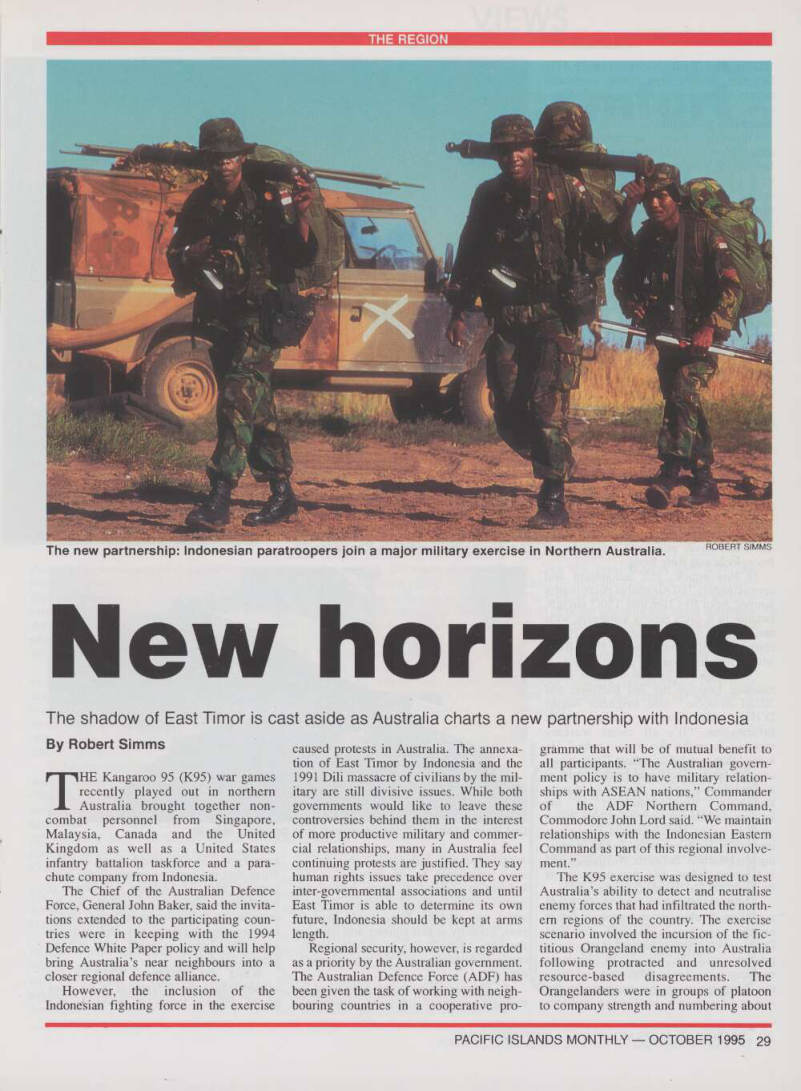
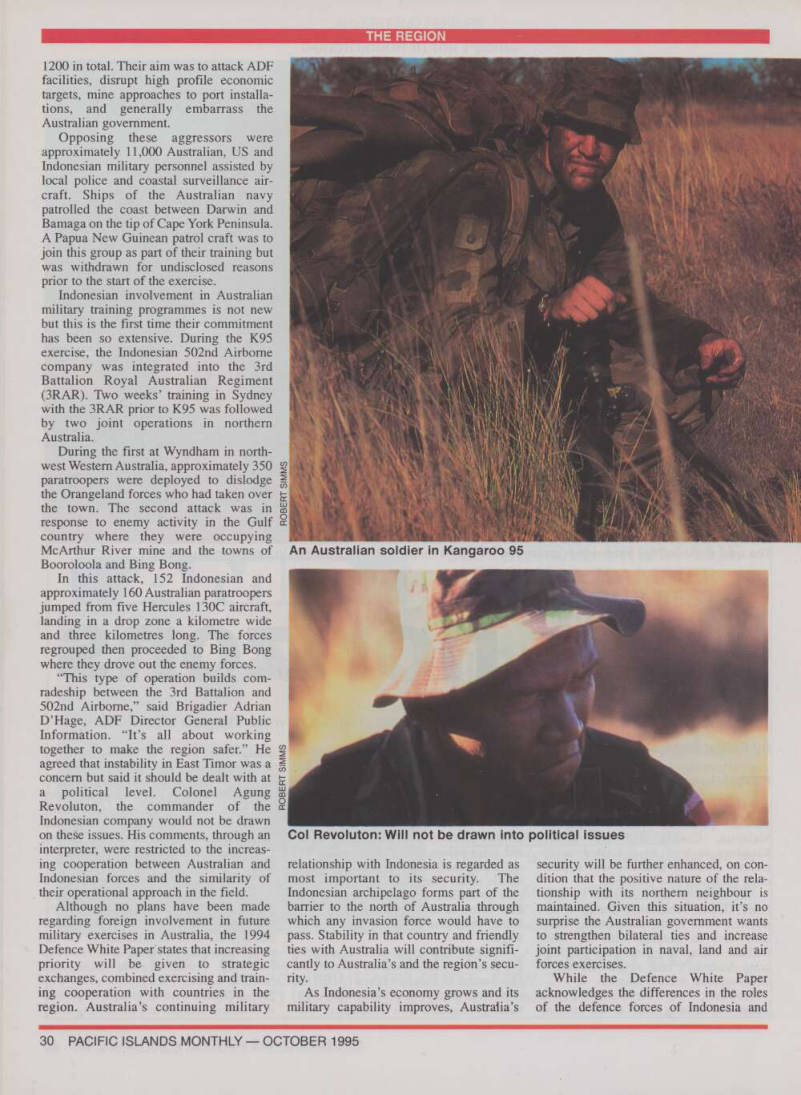
The Region
The shadow of East Timor is cast aside as Australia charts a new partnership with Indonesia
By Robert Simms
THE Kangaroo 95 (K 95) war games recently played out in northern Australia brought together non combat personnel from Singapore, Malaysia, Canada and the United Kingdom as well as a United States infantry battalion taskforce and a para chute company from Indonesia.
The Chief of the Australian Defence Force, General John Baker, said the invita tions extended to the participating coun tries were in keeping with the 1994 Defence White Paper policy and will help bring Australia’s near neighbours into a closer regional defence alliance.
However, the inclusion of the Indonesian fighting force in the exercise
caused protests in Australia. The annexa tion of East Timor by Indonesia and the 1991 Dili massacre of civilians by the mil itary are still divisive issues. While both governments would like to leave these controversies behind them in the interest of more productive military and commer cial relationships, many in Australia feel continuing protests are justified. They say human rights issues take precedence over inter-governmental associations and until East Timor is able to determine its own future, Indonesia should be kept at arms length.
Regional security, however, is regarded as a priority by the Australian government.
The Australian Defence Force (ADF) has been given the task of working with neigh bouring countries in a cooperative pro
gramme that will be of mutual benefit to all participants. “The Australian govern ment policy is to have military relation ships with ASEAN nations,” Commander of the ADF Northern Command, Commodore John Lord said. “We maintain relationships with the Indonesian Eastern Command as part of this regional involve ment.”
The K 95 exercise was designed to test Australia’s ability to detect and neutralise enemy forces that had infiltrated the north ern regions of the country. The exercise scenario involved the incursion of the fic titious Orangeland enemy into Australia
following protracted and unresolved
resource-based disagreements. The Orangelanders were in groups of platoon to company strength and numbering about
Robert Simms
The new partnership: Indonesian paratroopers join a major military exercise in Northern Australia.
1200 in total. Their aim was to attack ADF
facilities, disrupt high profile economic
targets, mine approaches to port installa tions, and generally embarrass the Australian government.
Opposing these aggressors were approximately 11,000 Australian, US and
Indonesian military personnel assisted by
local police and coastal surveillance air craft. Ships of the Australian navy patrolled the coast between Darwin and Bamaga on the tip of Cape York Peninsula.
A Papua New Guinean patrol craft was to join this group as part of their training but was withdrawn for undisclosed reasons prior to the start of the exercise.
Indonesian involvement in Australian military training programmes is not new but this is the first time their commitment has been so extensive. During the K 95 exercise, the Indonesian 502nd Airborne company was integrated into the 3rd
Battalion Royal Australian Regiment
(3RAR). Two weeks’ training in Sydney with the 3RAR prior to K 95 was followed by two joint operations in northern Australia.
During the first at Wyndham in north west Western Australia, approximately 350 paratroopers were deployed to dislodge the Orangeland forces who had taken over the town. The second attack was in response to enemy activity in the Gulf country where they were occupying McArthur River mine and the towns of
Booroloola and Bing Bong.
In this attack, 152 Indonesian and approximately 160 Australian paratroopers jumped from five Hercules 130 C aircraft, landing in a drop zone a kilometre wide and three kilometres long. The forces
regrouped then proceeded to Bing Bong
where they drove out the enemy forces.
“This type of operation builds com radeship between the 3rd Battalion and 502nd Airborne,” said Brigadier Adrian D’Hage, ADF Director General Public Information. “It’s all about working together to make the region safer.” He agreed that instability in East Timor was a concern but said it should be dealt with at a political level. Colonel Agung Revoluton, the commander of the Indonesian company would not be drawn on these issues. His comments, through an interpreter, were restricted to the increas ing cooperation between Australian and Indonesian forces and the similarity of their operational approach in the field.
Although no plans have been made regarding foreign involvement in future military exercises in Australia, the 1994 Defence White Paper states that increasing priority will be given to strategic exchanges, combined exercising and train ing cooperation with countries in the
region. Australia’s continuing military
relationship with Indonesia is regarded as most important to its security. The Indonesian archipelago forms part of the barrier to the north of Australia through which any invasion force would have to pass. Stability in that country and friendly ties with Australia will contribute signifi cantly to Australia’s and the region’s secu rity.
As Indonesia’s economy grows and its military capability improves, Australia’s
security will be further enhanced, on con dition that the positive nature of the rela tionship with its northern neighbour is maintained. Given this situation, it’s no surprise the Australian government wants to strengthen bilateral ties and increase joint participation in naval, land and air forces exercises.
While the Defence White Paper acknowledges the differences in the roles of the defence forces of Indonesia and
Robert Simms
Robert Simms
An Australian soldier in Kangaroo 95
Col Revoluton: Will not be drawn into political issues
Australia in their respective political sys tems, it stresses the mutual advantage of stronger cooperation and shared strategic interests. It also includes other South East Asian nations in the military relationship it proposes, and it hopes the move will lead
to long-term stability in the region.
Malaysia and Singapore are already considered important defence partners, and the move to develop military associa tions with Thailand, the Philippines and Brunei will add “depth and resilience to our defence links with the region as a whole”, it stated.
In future, emphasis will be placed on
understanding the strategic policies of the
countries of north-east and south Asia, and making them aware of Australia’s security aspirations. As these countries develop economically, they will be encouraged to maintain activities consistent with region al security.
Involving Asian nations along with the US in its military exercises is one way Australia believes it can influence region al defence policy.
By building a security web of defensive military forces that have strong mutual support agendas, a significant deterrent will be created to dissuade potential aggressors from attempting incursions into the region. A
Nuclear comfort
Views
T O N G A
THERE are a number of reasons for France’s insistence on bombing the Pacific Islands. The Military justi fies it by pointing out that actual tests are absolutely required even for developing test simulations.
Strategic considerations, it is said, would remind us that although Russia and an East Bloc are no more, the Middle East is so volatile and unreliable and there may be ill-advised little countries beside that it must be provided for or somehow deterred. And politically France requires to demonstrate her autonomy (a de Gaulle legacy) and proclaim, in no uncertain terms, her vital interests.
The man who can put all this into prac tice just happens to be at the helm at this very moment. And he’s no novice in this game. Chirac, after proclaiming the resumption of the tests, made sure that any negative reaction inside France is neu tralised by initiating talks about the Vichi government which has been a taboo sub ject for a number of years. For showing he has the nerve to do this, Chirac is now regarded as a hero.
But make no mistake about it; the French people themselves are generally against the tests. A 1994 poll showed 72 per cent of the French public are against them and want them to be banned for good if other nations stop theirs. The Tahitians, however, are all for the Bomb because they would all starve to death, etc, if the Bomb Programme is discontinued. And they have always favoured the Conservatives because of their proclaimed anti-Communist policy. But this is normal in an intensely Catholic community.
The French nuclear tests used to be conducted in the Sahara but since Algeria got her independence in 1962 that country has banned the French from that area. And because France can’t do it in her own backyard that leaves her with no other choice but the idyllic islands of her Polynesian territory as the logical sites for
this enterprise.
That, however, is small comfort to the Pacific Islands. For their peoples, it is a matter of life and death, of ghastly defor mities for their children, of strange dis eases for their future generations.
That is why the islanders are protesting.
New Zealand, the Cooks, Samoa the whole lot are blending their voices togeth er. And Australia has come out very strongly against France and the latter
answering by recalling her Ambassador
etc. The issue precipitated a/crisis in the
Fiji parliament over whether a strong protest (urged by the Opposition) or a soft-toned amendment (proposed by the Prime Minister) is to be sent to Paris.
When the amendment was defeated by
two Ministers voting with the Opposition and one abstaining the PM caused one to resign and two to be expelled from Government. Tonga is sending a protest, but no one to be on the ground in Mururoa.
All this may not be enough to cause the French to budge. The people of the Pacific are sacrificeable, are of a different race from the French, and their cultures have no universal appeal like those of Europe.
Japan’s voice would be heard. The US and UK can do a lot if they wanted to. But they are keeping their peace remember their silence before and after the Rainbow Warrior affair?
Yes, the great powers give with one hand (in aid) and take back with the other (in nuclear proliferation). Watch that US ship of death peddling her lethal merchan dise in the Marshalls. And Japanese aid has a strange knack to run back home, except a pittance in low wages for the islanders and a scattering of structures they cannot maintain. But the price of French aid is certainly the acme, the ultimate in duplicity. A
Futa
Helu
Advertisements & other items, pp. 31-33 (1 item)
International
PACIFIC LEGAL SERVICES
MICHAEL BULA SOLICITORS
International Lawyers
are pleased to receive instructions relating to Australian and South Pacific property, succession and commercial matters. • Full corporate, representative and registered office facilities available for South Pacific clients • French spoken certified legal translations • Legal agents throughout the South Pacific and Europe "PRINCES Hill Gallery", 213 Canning Street
CARLTON MELBOURNE
VICTORIA 3053 AUSTRALIA
Telephone +613 9 3478333 FAX: + 613 9 3471741
MBS
® TOYOTA
Drive dignity right to the top.
Everyone who knows cars has no doubts about Land Cruiser’s ruggedness.
Yet how many know that its luxury rivals the finest high-priced cars?
Or that it’s got more room inside than many luxury sedans?
And because it’s a Toyota, Land Cruiser’s fit and finish, attention to detail, and graceful form speak of elegance as well as spacious comfort.
Yet you still get tough ladder frames and suspension built to take you as far off road as you want to go.
With power from 4.5-litre petrol or 4.2-litre diesel engines.
And it’s carefully protected from rust to last longer.
So if you’re going right to the top, this dignified car is ready to take you.
LAND CRUISER
DISTRIBUTORS /DEALERS
AMERICAN SAMOA BURNS PHILP MOTORS PH 633-4281 GUAM & MICRONESIA ...ATKINS KROLL, INC. PH 646-1876/9 NORFOLK ISLAND BORRY’S PTY LTD. PH 22114
SOLOMON ISLAND ELA MOTORS PH 30314
VANUATU ASCO MOTORS PH 22341
COOK ISLANDS PACIFIC MOTORS LTD. PH 20796
KIRIBATI TARAWA MOTORS PH 21090
PAPUA NEW GUINEA ELA MOTORS PH 3229400
TAHITI NIPPON AUTOMOTO PH 429819
WESTERN SAMOA ASCO MOTORS PH 20800
FIJI ASCO MOTORS PH 384888
NEW CALEDONIA S.I.A.P. PH 275562
SAIPAN MICROL CORPORATION PH 234-5911
TONGA ASCO MOTORS PH 23500
m •; m > m « i 1 i fli
LAND
CRUISER
sm *
p*ii
► ■ a
A Pacific sad story
w E L L I N G T O N
THE figures tell the sad story of
Pacific Islands youngsters’ partici
pation and achievement levels in the New Zealand education system. Nearly half the island population over 15 leaves school with no qualifications and only one-in-five go on to tertiary education.
Although more are going to school and
staying on longer, rising participation has
not translated into rising achievement lev els.
In the 1993 School Certificate exami nations, for instance, only 8 per cent of Pacific Islands students won an A or B grade (against 29 per cent of the total) and 70 per cent received a D or E grade (com pared with 41 per cent of all candidates), The Ministry of Education sums up the situation: “It is a population at risk of con tinuing under-achievement in education, of alienation in classrooms and classroom practices, of unequal educational opportu nities and of being unable to access resources and information.”
Given that a better education is the key to improving the employment prospects of island youngsters, thereby helping the community breaking out of its poverty cycle, changing this situation is critical.
The Education Ministry has, for the first time, and some say, belatedly, pro duced a formal plan for developing Pacific Islands education in New Zealand.
It is only a draft at this stage and wise ly is being refined in consultation with the island community. It will be given a high priority, said ministry head Dr Maris O’Rourke, noting that island social indica tors on health, employment and income levels illustrate the need for urgent action.
“We have to break this cycle,” she said, “and we believe early intervention is the way to go.” The strategic plan starts at the
earliest stage of education. It notes that while 9.3 per cent of children under five are from island families, only one-in three are enrolled in early childhood ser vices. About 44 per cent of these go to language
groups, which the ministry hails as a suc cessful model for parents and children, with long-term benefits for continued edu cation in later years. It suggests they need to be developed in primary and secondary schools, where nearly 45,000 island stu dents are enrolled, if Pacific languages and culture are to be maintained and enriched.
Lesieli Tongati’o, a former Tongan teacher employed two years ago as the ministry’s first Pacific Islands Adviser, is in charge of the programme. She told me that while education was a high priority for Pacific Islands people, surveys had revealed they were falling for a variety of reasons. “The statistics don’t really bear out the importance Pacific Islands people put on education,” she said. “They want their children to do well, but they have problems with the systems.” A key one was the difficulty many parents had in attending school conferences “they are very busy trying to make ends meet” and understanding what resources are available for their children. Few join school boards of trustees.
“Sometimes the cultural environment is not very welcoming,” Lesieli said. “There is often a language barrier so they can’t
ask the right questions.” Students them selves tend to blame their parents for not
giving them enough support. Living condi
tions in many families are often such that they do not have any suitable space for study, and because they tend to work alone unlike Asian students, for instance they don’t have the advantage of peer assistance.
A shortage of Pacific Islands teachers compounds the problem for students who lack successful role models. An accent has been put on English, maths and science subjects because they tend not to partici pate in these as much as other students, and a Pacific Islands university student taken on as facilitator between teacher and pupils. A parent education programme has also been launched, with parents going to evening courses to leam how to support their children’s education.
Good intentions, but will it work? No, says John Russell, head of Mana College, near Wellington, where 22 per cent of the pupils are Pacific Islanders. The reason, he says, is the plan calls for more resources to be put into the 3.2 per cent of schools, mainly in Porirua and the Auckland area, where Pacific Islands students are in the majority. But the parents are increasingly opting to move their children out of those schools and into others with wealthier pop ulations and better grades.
Those schools are isolated from the island communities and will not be inter ested in adopting special measures to help them, Russell says.
So ironically, the island youngsters risk being further handicapped by their par ents’ desire to help them do better.
Once again, the Pacific Islands popula tion in New Zealand is in a Catch 22 situ ation. A
David
Barber
Advertisements & other items, p. 34 (1 item)
Blairs
LARGEST RANGE IN THE SOUTH PACIFIC SOURCED FROM JAPAN, ENGLAND, EUROPE * OVER 1000 ENGINES AVAILABLE * DIESEL-GASOLINE 10HP TO 400 HP TRANSMISSION TO MATCH IF REQUIRED * JAPANESE * ENGLISH * EUROPEAN MODELS ♦ Bedford Cummins * Daihatsu Deutz * Ford Gardner * Hino Detroit Isuzu * Komatsu * Leyland * Mazda * Mercedes * Mitsubishi * Nissan Perkins Scania * Toyota * Volvo Yanmar * Kubota Rat Iveco
SPECIAL
Yanmar Stationery Engines 9.5, 11, 13, 14, 15, 22, 24, 28, 44 Horsepower including Fuel Tank/Radiator
* CYLINDER HEADS STARTERS *
Large range for Diesel Engines
* Some new, rebuilt Tested *
SPECIAL
Used Car Tyres 70% and Better Most sizes available container loads
BLAIRS
P.O. Box 14 Geraldine, New Zealand. Telephone (643) 693-8122. Fax (643) 693-8120.
We ship anywhere in the Pacific
A different kind
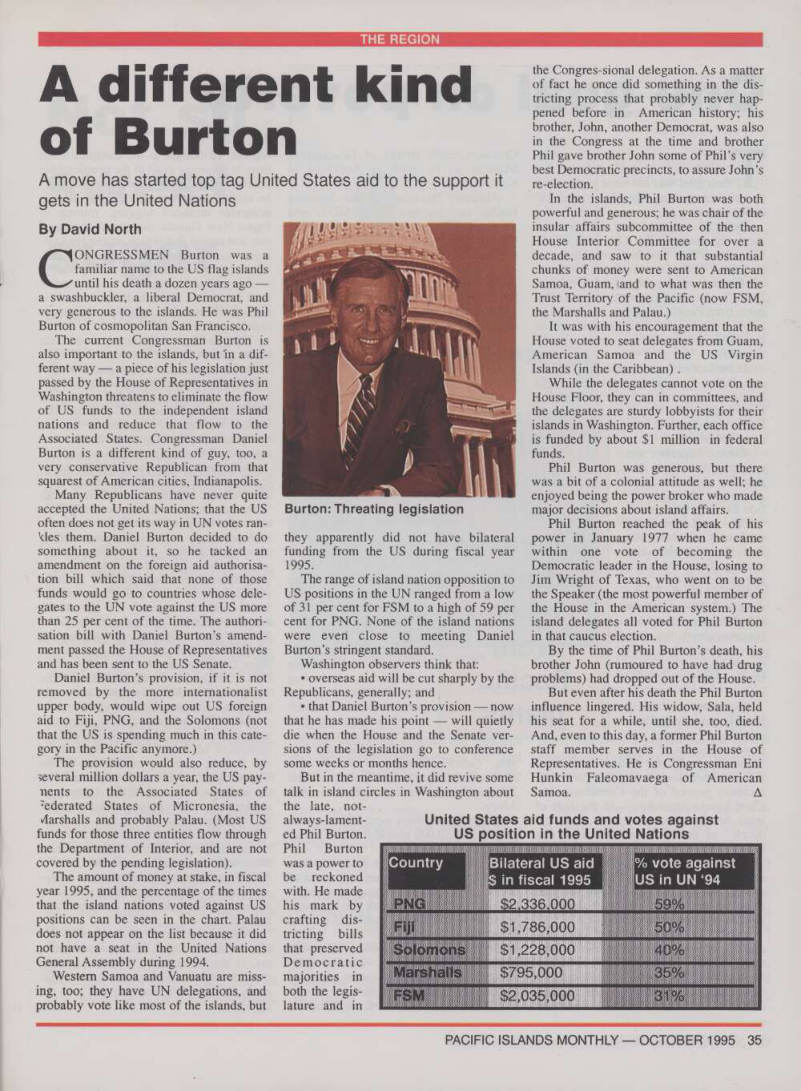
of Burton
A move has started top tag United States aid to the support it gets in the United Nations
By David North
CONGRESSMEN Burton was a familiar name to the US flag islands until his death a dozen years ago a swashbuckler, a liberal Democrat, and very generous to the islands. He was Phil Burton of cosmopolitan San Francisco.
The current Congressman Burton is also important to the islands, but 'in a dif ferent way a piece of his legislation just passed by the House of Representatives in Washington threatens to eliminate the flow of US funds to the independent island nations and reduce that flow to the Associated States. Congressman Daniel Burton is a different kind of guy, too, a very conservative Republican from that squares! of American cities, Indianapolis.
Many Republicans have never quite accepted the United Nations; that the US often does not get its way in UN votes ran kles them. Daniel Burton decided to do something about it, so he tacked an amendment on the foreign aid authorisa tion bill which said that none of those funds would go to countries whose dele gates to the UN vote against the US more than 25 per cent of the time. The authori sation bill with Daniel Burton’s amend ment passed the House of Representatives and has been sent to the US Senate.
Daniel Burton’s provision, if it is not removed by the more internationalist upper body, would wipe out US foreign aid to Fiji, PNG, and the Solomons (not that the US is spending much in this cate gory in the Pacific anymore.) The provision would also reduce, by several million dollars a year, the US pay nents to the Associated States of federated States of Micronesia, the darshalls and probably Palau. (Most US funds for those three entities flow through the Department of Interior, and are not
covered by the pending legislation).
The amount of money at stake, in fiscal year 1995, and the percentage of the times that the island nations voted against US positions can be seen in the chart. Palau does not appear on the list because it did not have a seat in the United Nations General Assembly during 1994.
Western Samoa and Vanuatu are miss ing, too; they have UN delegations, and probably vote like most of the islands, but
they apparently did not have bilateral funding from the US during fiscal year 1995.
The range of island nation opposition to US positions in the UN ranged from a low of 31 per cent for FSM to a high of 59 per cent for PNG. None of the island nations were even close to meeting Daniel Burton’s stringent standard.
Washington observers think that: • overseas aid will be cut sharply by the
Republicans, generally; and
• that Daniel Burton’s provision now that he has made his point will quietly die when the House and the Senate ver sions of the legislation go to conference some weeks or months hence.
But in the meantime, it did revive some talk in island circles in Washington about the late, not
always-lamented Phil Burton.
Phil Burton was a power to be reckoned with. He made his mark by crafting dis tricting bills that preserved Democratic majorities in both the legis lature and in
the Congres-sional delegation. As a matter of fact he once did something in the dis
tricting process that probably never hap
pened before in American history; his brother, John, another Democrat, was also in the Congress at the time and brother Phil gave brother John some of Phil’s very best Democratic precincts, to assure John’s re-election.
In the islands, Phil Burton was both powerful and generous; he was chair of the insular affairs subcommittee of the then House Interior Committee for over a decade, and saw to it that substantial chunks of money were sent to American Samoa, Guam, land to what was then the Trust Territory of the Pacific (now FSM, the Marshalls and Palau.) It was with his encouragement that the House voted to seat delegates from Guam, American Samoa and the US Virgin Islands (in the Caribbean).
While the delegates cannot vote on the House Floor, they can in committees, and the delegates are sturdy lobbyists for their islands in Washington. Further, each office is funded by about $1 million in federal funds.
Phil Burton was generous, but there was a bit of a colonial attitude as well; he enjoyed being the power broker who made major decisions about island affairs.
Phil Burton reached the peak of his power in January 1977 when he came within one vote of becoming the Democratic leader in the House, losing to Jim Wright of Texas, who went on to be the Speaker (the most powerful member of the House in the American system.) The island delegates all voted for Phil Burton in that caucus election.
By the time of Phil Burton’s death, his brother John (rumoured to have had drug problems) had dropped out of the House.
But even after his death the Phil Burton influence lingered. His widow, Sala, held his seat for a while, until she, too, died.
And, even to this day, a former Phil Burton staff member serves in the House of Representatives. He is Congressman Eni Hunkin Faleomavaega of American Samoa. A
United States aid funds and votes against US position in the United Nations
Burton: Threating legislation
——— —I iCountry
Png
$2,336,000 59% Fiji $1,786,000 50% Solomons $1,228,000 40% Marshalls $795,000 35%
Fsm
$2,035,000 31%
One goal on poverty

THEIR experience may in some cases have been vastly different, but their goal was the same to come to a consensus about the means of eradi cating poverty.
Delegates representing non-govem
ment organisations (NGOs) from all 51 Commonwealth countries recently con verged on Wellington to discuss the theme “Paths out of Poverty - the role of NGOs”. Among them were a dozen dele gates from Pacific countries, who attempt ed to come to grips with the question of just what poverty means for a Pacific Islander.
In the face of horror stories from Africa and India, the initial temptation might have been to conclude that relatively well
fed, clothed and housed Pacific islanders had little to complain about.
Take Nigeria for example: its military dic tatorship denies a large
proportion of its popula
tion the most basic needs while itself amassing enormous wealth. The fact that Nigerian dis senters fear for their
physical safety was
underlined by the tearful speech of delegate Glory Kilanko, who voiced her concern about the four government “observers” despatched to the Forum by the Nigerian govern ment.
Delegates were
forcibly reminded of how privileged citizens in democracies can be when
Maori lawyer Moana Jackson welcomed them including among the guests the secretary-general of the Commonwealth, Chief Emela Anyaoku to the land of what he described as “myths, lies and deceit,’ as he catalogued the injustices
heaped upon his people.
Former Labour Government minister and Mayor of Wellington Fran Wilde later pointed out that the fact Jackson was free to air his grievances was proof that New Zealand was not as he portrayed it.
Pacific delegates had their own perspective on poverty to take to this, the second NGO Commonwealth Forum, Sponsored by the London-based Commonwealth Foundation, the Forum’s deliberations should be incorporated in the
Big
firms are patenting
drugs
taken from Pacific plants
Commonwealth Heads of Government Meeting to be held in Auckland in November.
Abraham Baeanisia of the Solomon Islands Development Trust (SIDT) said what struck him in discussions with other Commonwealth peoples was the extent to which many of them were “landless”.
“That’s not been our experience in the Pacific. We have never been landless. But poverty shows itself in other ways; in edu cation, health, the environment. For exam ple, large scale logging is a path into poverty,’” he said.
Baeanisia singled out education sys tems in the Pacific as being in need of reform.
“We need education which is relevant
to our needs. Only 15 per cent of Solomon Islanders are employed in the paid sector, and although our economic growth rate is increas ing, the rate of those in the paid sector is not,” he said. “The formal system of education needs to be supplement ed by a non-formal option so that young people leam the skills that are required at the village level garden
ing, woodwork,
mechanical skills. SIDT works on strengthening village life, conducting education and disaster workshops and includes a village theatre group to put across messages about nutrition and log
ging. Gabriel Tetiarahi of the Tahitian NGO umbrella group Hiti Tau, agreed that Tahitian poverty was not as dramatic as in Africa.
Nevertheless, there were 25,000 unem ployed, and 30,000 people living in shanty towns around the capital.
“Although we have a relatively low illiteracy rate, we do have a problem of access to the Tahitian language. Around 80 per cent of Tahitians speak the language, but there is little formal training in it,” said Tetiarahi.
Samoan delegate Korofeta To’o com
plained of “bio-piracy”, whereby multi
national drug companies were patenting
drugs taken from Pacific plants, “These drugs are worth millions and
millions of dollars to the companies but there is no return at all to the people of the Pacific who actually own the resources,” he said. Other concerns raised by Pacific delegates included logging, mining in Papua New Guinea, and the dumping of rice and tinned fish which encouraged vil lagers to abandon their traditional, self
reliant lifestyles.
A significant proportion of the confer ence was taken up with discussion of the role of NGOs, often regarded with suspi cion by governments.
The past 20 years has seen an explosion in the growth of NGOs around the world.
In the United Kingdom there are more than 500,000, thousands of those charities with turnover estimated at £l7 billion (SUS 26 billion) a year. Around half of Australia’s welfare services are supplied by not-for profit charitable organisations, with a turnover of $A4.4 billion a year.
With roots that go back to philanthrop ic efforts such as the abolition of slavery or child labour, NGOs are involved in both “care and welfare” work as well as activi ties at the sharp end of political change.
Increasingly donor aid money is being channelled through NGOs. The 1994/95 year saw New Zealand’s aid development programme spending SNZS.9 million (SUS3.9m) on small-scale, community based schemes, mostly in the South Pacific. Around 85 per cent of New Zea land’s Volunteer Service Abroad funding of (SNZI.B million (SUSl.lm) comes from the government’s aid budget, and NGOs received over 60 per cent of the SNZ3 million (SUS2.I) spent on emer gency and disaster relief last year.
As NGOs’ professionalism increases, so has their status. The credibility of UN sponsored talkfests like the Rio summit, the Cairo population conference or the Copenhagen social summit is measured by the inclusion or not of NGOs. Often such conferences will be accompanied by paral lel NGO meetings.
Some Pacific delegates (preferring to remain unnamed) said their governments did not always understand the role of NGOs and sometimes demanded exces sive accountability for funds that were channelled through them from overseas
aid agencies.
Whether the Forum’s communique will now be debated by Commonwealth lead ers at the Auckland CHOGM meeting depends on how much pressure the NGOs apply to their governments to put it on the
agenda. A
Not so
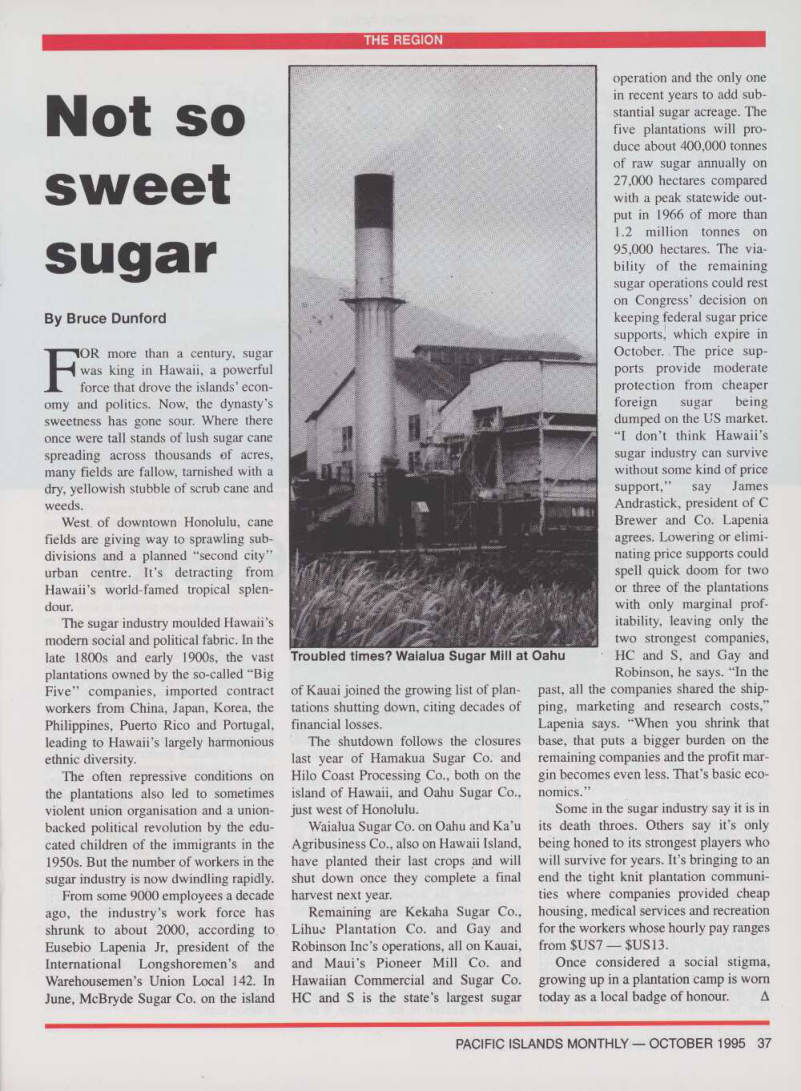
sweet sugar
By Bruce Dunford
FOR more than a century, sugar was king in Hawaii, a powerful force that drove the islands’ econ omy and politics. Now, the dynasty’s sweetness has gone sour. Where there once were tall stands of lush sugar cane spreading across thousands of acres, many fields are fallow, tarnished with a dry, yellowish stubble of scrub cane and weeds.
West of downtown Honolulu, cane fields are giving way to sprawling sub divisions and a planned “second city” urban centre. It’s detracting from Hawaii’s world-famed tropical splen dour.
The sugar industry moulded Hawaii’s modem social and political fabric. In the late 1800 s and early 1900 s, the vast plantations owned by the so-called “Big Five” companies, imported contract workers from China, Japan, Korea, the Philippines, Puerto Rico and Portugal, leading to Hawaii’s largely harmonious ethnic diversity.
The often repressive conditions on the plantations also led to sometimes violent union organisation and a union backed political revolution by the edu cated children of the immigrants in the 19505. But the number of workers in the siigar industry is now dwindling rapidly.
From some 9000 employees a decade ago, the industry’s work force has shrunk to about 2000, according to Eusebio Lapenia Jr, president of the International Longshoremen’s and Warehousemen’s Union Local 142. In June, Mcßryde Sugar Co. on the island
of Kauai joined the growing list of plan tations shutting down, citing decades of financial losses.
The shutdown follows the closures last year of Hamakua Sugar Co. and Hilo Coast Processing Co., both on the island of Hawaii, and Oahu Sugar Co., just west of Honolulu.
Waialua Sugar Co. on Oahu and Ka’u Agribusiness Co., also on Hawaii Island, have planted their last crops and will shut down once they complete a final harvest next year.
Remaining are Kekaha Sugar Co., Lihue Plantation Co. and Gay and Robinson Inc’s operations, all on Kauai, and Maui’s Pioneer Mill Co. and Hawaiian Commercial and Sugar Co.
HC and S is the state’s largest sugar
operation and the only one in recent years to add sub stantial sugar acreage. The five plantations will pro duce about 400,000 tonnes of raw sugar annually on 27.000 hectares compared with a peak statewide out put in 1966 of more than 1.2 million tonnes on 95.000 hectares. The via bility of the remaining sugar operations could rest on Congress’ decision on
keeping federal sugar price
supports] which expire in
October. The price sup ports provide moderate protection from cheaper foreign sugar being dumped on the US market.
“I don’t think Hawaii’s sugar industry can survive without some kind of price support,” say James Andrastick, president of C Brewer and Co. Lapenia agrees. Lowering or elimi nating price supports could spell quick doom for two or three of the plantations with only marginal prof itability, leaving only the two strongest companies, HC and S, and Gay and Robinson, he says. “In the
past, all the companies shared the ship ping, marketing and research costs,”
Lapenia says. “When you shrink that base, that puts a bigger burden on the remaining companies and the profit mar gin becomes even less. That’s basic eco nomics.”
Some in the sugar industry say it is in its death throes. Others say it’s only being honed to its strongest players who will survive for years. It’s bringing to an end the tight knit plantation communi ties where companies provided cheap housing, medical services and recreation for the workers whose hourly pay ranges from SUS 7 SUSI 3.
Once considered a social stigma, growing up in a plantation camp is worn today as a local badge of honour. A
Troubled times? Waialua Sugar Mill at Oahu
Land of Diversity
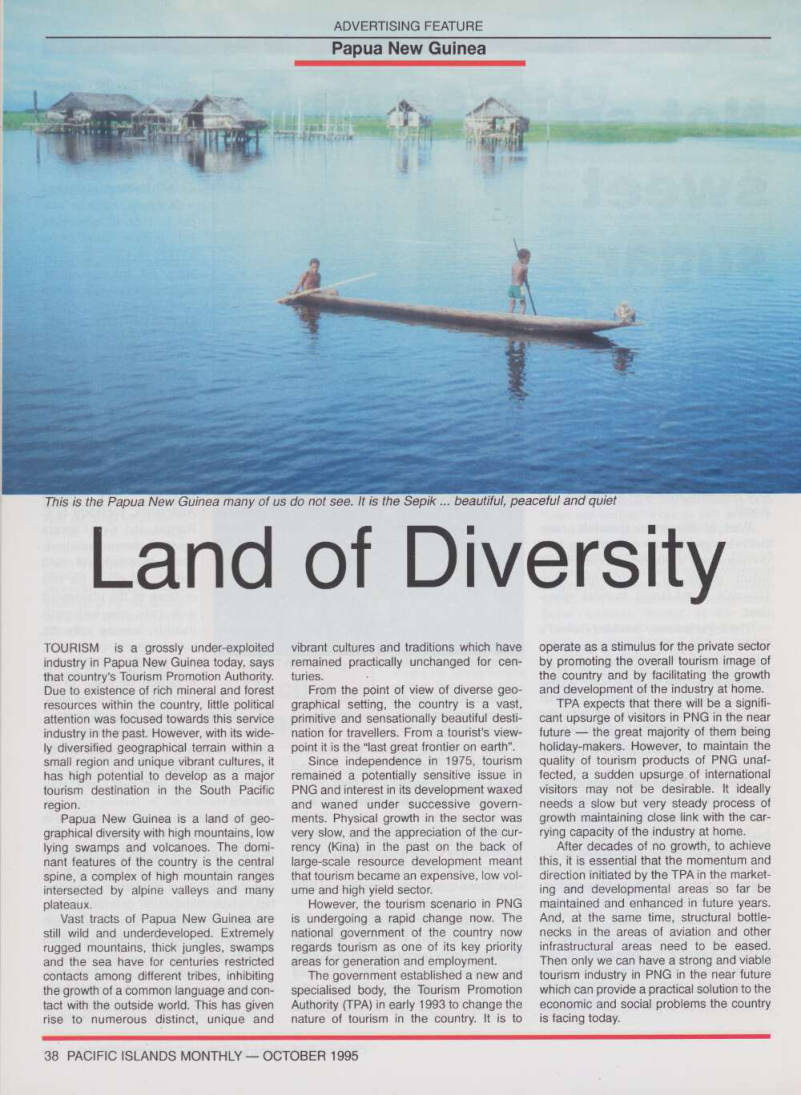
Papua New Guinea
TOURISM is a grossly under-exploited industry in Papua New Guinea today, says that country’s Tourism Promotion Authority.
Due to existence of rich mineral and forest resources within the country, little political attention was focused towards this service industry in the past. However, with its wide ly diversified geographical terrain within a small region and unique vibrant cultures, it has high potential to develop as a major tourism destination in the South Pacific region.
Papua New Guinea is a land of geo graphical diversity with high mountains, low lying swamps and volcanoes. The domi nant features of the country is the central spine, a complex of high mountain ranges intersected by alpine valleys and many plateaux.
Vast tracts of Papua New Guinea are still wild and underdeveloped. Extremely rugged mountains, thick jungles, swamps and the sea have for centuries restricted contacts among different tribes, inhibiting the growth of a common language and con tact with the outside world. This has given rise to numerous distinct, unique and
vibrant cultures and traditions which have remained practically unchanged for cen turies.
From the point of view of diverse geo graphical setting, the country is a vast, primitive and sensationally beautiful desti nation for travellers. From a tourist’s view point it is the “last great frontier on earth”.
Since independence in 1975, tourism remained a potentially sensitive issue in PNG and interest in its development waxed and waned under successive govern ments. Physical growth in the sector was very slow, and the appreciation of the cur rency (Kina) in the past on the back of large-scale resource development meant that tourism became an expensive, low vol ume and high yield sector.
However, the tourism scenario in PNG is undergoing a rapid change now. The national government of the country now regards tourism as one of its key priority areas for generation and employment.
The government established a new and specialised body, the Tourism Promotion Authority (TPA) in early 1993 to change the nature of tourism in the country. It is to
operate as a stimulus for the private sector by promoting the overall tourism image of the country and by facilitating the growth and development of the industry at home.
TPA expects that there will be a signifi cant upsurge of visitors in PNG in the near future the great majority of them being holiday-makers. However, to maintain the quality of tourism products of PNG unaf fected, a sudden upsurge of international visitors may not be desirable. It ideally needs a slow but very steady process of growth maintaining close link with the car rying capacity of the industry at home.
After decades of no growth, to achieve this, it is essential that the momentum and direction initiated by the TPA in the market ing and developmental areas so far be maintained and enhanced in future years.
And, at the same time, structural bottle necks in the areas of aviation and other infrastructural areas need to be eased.
Then only we can have a strong and viable tourism industry in PNG in the near future which can provide a practical solution to the economic and social problems the country is facing today.
This is the Papua New Guinea many of us do not see. It is the Sepik ... beautiful, peaceful and quiet
The bird of paradise
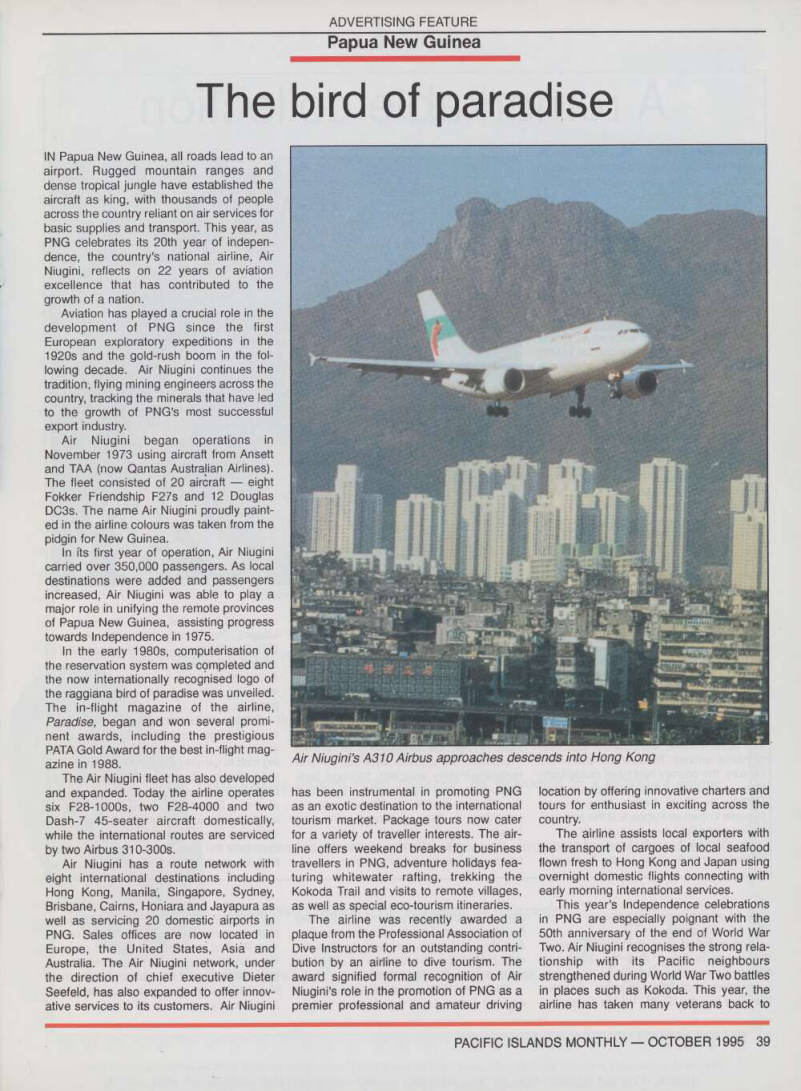
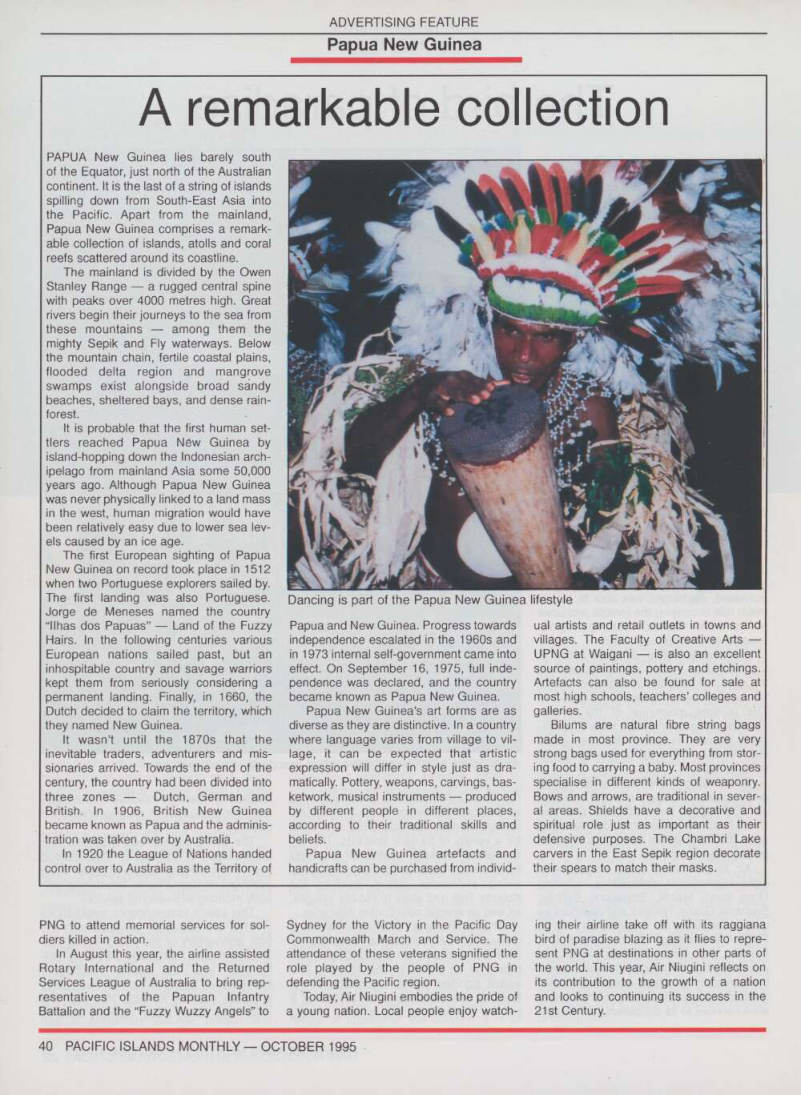
IN Papua New Guinea, all roads lead to an airport. Rugged mountain ranges and dense tropical jungle have established the aircraft as king, with thousands of people across the country reliant on air services for basic supplies and transport. This year, as PNG celebrates its 20th year of indepen dence, the country’s national airline, Air Niugini, reflects on 22 years of aviation excellence that has contributed to the growth of a nation.
Aviation has played a crucial role in the development of PNG since the first European exploratory expeditions in the 1920 s and the gold-rush boom in the fol lowing decade. Air Niugini continues the tradition, flying mining engineers across the country, tracking the minerals that have led to the growth of PNG’s most successful export industry.
Air Niugini began operations in November 1973 using aircraft from Ansett and TAA (now Qantas Australian Airlines).
The fleet consisted of 20 aircraft eight Fokker Friendship F27s and 12 Douglas DC3s. The name Air Niugini proudly paint ed in the airline colours was taken from the pidgin for New Guinea.
In its first year of operation, Air Niugini carried over 350,000 passengers. As local destinations were added and passengers increased, Air Niugini was able to play a major role in unifying the remote provinces of Papua New Guinea, assisting progress towards Independence in 1975.
In the early 1980 s, computerisation of the reservation system was completed and the now internationally recognised logo of the raggiana bird of paradise was unveiled.
The in-flight magazine of the airline, Paradise, began and won several promi nent awards, including the prestigious PATA Gold Award for the best in-flight mag azine in 1988.
The Air Niugini fleet has also developed and expanded. Today the airline operates six F2B-1000S, two F2B-4000 and two Dash-7 45-seater aircraft domestically, while the international routes are serviced by two Airbus 310-300 s.
Air Niugini has a route network with eight international destinations including Hong Kong, Manila, Singapore, Sydney, Brisbane, Cairns, Honiara and Jayapura as well as servicing 20 domestic airports in PNG. Sales offices are now located in Europe, the United States, Asia and Australia. The Air Niugini network, under the direction of chief executive Dieter Seefeld, has also expanded to offer innov ative services to its customers. Air Niugini
has been instrumental in promoting PNG as an exotic destination to the international tourism market. Package tours now cater for a variety of traveller interests. The air line offers weekend breaks for business travellers in PNG, adventure holidays fea turing whitewater rafting, trekking the Kokoda Trail and visits to remote villages, as well as special eco-tourism itineraries.
The airline was recently awarded a plaque from the Professional Association of Dive Instructors for an outstanding contri bution by an airline to dive tourism. The award signified formal recognition of Air Niugini’s role in the promotion of PNG as a premier professional and amateur driving
location by offering innovative charters and tours for enthusiast in exciting across the country.
The airline assists local exporters with the transport of cargoes of local seafood flown fresh to Hong Kong and Japan using overnight domestic flights connecting with early morning international services.
This year’s Independence celebrations in PNG are especially poignant with the 50th anniversary of the end of World War Two. Air Niugini recognises the strong rela tionship with its Pacific neighbours strengthened during World War Two battles in places such as Kokoda. This year, the airline has taken many veterans back to
Air Niugini’s A310 Airbus approaches descends into Hong Kong
PNG to attend memorial services for sol diers killed in action.
In August this year, the airline assisted Rotary International and the Returned Services League of Australia to bring rep resentatives of the Papuan Infantry Battalion and the “Fuzzy Wuzzy Angels” to
Sydney for the Victory in the Pacific Day Commonwealth March and Service. The attendance of these veterans signified the role played by the people of PNG in
defending the Pacific region.
Today, Air Niugini embodies the pride of a young nation. Local people enjoy watch
ing their airline take off with its raggiana bird of paradise blazing as it flies to repre sent PNG at destinations in other parts of the world. This year, Air Niugini reflects on its contribution to the growth of a nation and looks to continuing its success in the 21st Century.
Advertisements & other items, p. 39 (1 item)
39
PACIFIC ISLANDS MONTHLY OCTOBER 1995
Papua New Guinea
ADVERTISING FEATURE
A remarkable collection
PAPUA New Guinea lies barely south of the Equator, just north of the Australian continent. It is the last of a string of islands spilling down from South-East Asia into the Pacific. Apart from the mainland, Papua New Guinea comprises a remark able collection of islands, atolls and coral reefs scattered around its coastline.
The mainland is divided by the Owen Stanley Range a rugged central spine with peaks over 4000 metres high. Great rivers begin their journeys to the sea from these mountains among them the mighty Sepik and Fly waterways. Below the mountain chain, fertile coastal plains, flooded delta region and mangrove swamps exist alongside broad sandy beaches, sheltered bays, and dense rain forest.
It is probable that the first human set tlers reached Papua New Guinea by island-hopping down the Indonesian arch ipelago from mainland Asia some 50,000 years ago. Although Papua New Guinea was never physically linked to a land mass in the west, human migration would have been relatively easy due to lower sea lev els caused by an ice age.
The first European sighting of Papua New Guinea on record took place in 1512 when two Portuguese explorers sailed by.
The first landing was also Portuguese.
Jorge de Meneses named the country “llhas dos Papuas” Land of the Fuzzy Hairs. In the following centuries various European nations sailed past, but an inhospitable country and savage warriors kept them from seriously considering a permanent landing. Finally, in 1660, the Dutch decided to claim the territory, which they named New Guinea.
It wasn’t until the 1870 s that the inevitable traders, adventurers and mis sionaries arrived. Towards the end of the century, the country had been divided into three zones Dutch, German and British. In 1906, British New Guinea became known as Papua and the adminis tration was taken over by Australia.
In 1920 the League of Nations handed control over to Australia as the Territory of
Papua and New Guinea. Progress towards independence escalated in the 1960 s and in 1973 internal self-government came into effect. On September 16, 1975, full inde pendence was declared, and the country became known as Papua New Guinea.
Papua New Guinea’s art forms are as diverse as they are distinctive. In a country where language varies from village to vil lage, it can be expected that artistic expression will differ in style just as dra matically. Pottery, weapons, carvings, bas ketwork, musical instruments produced by different people in different places, according to their traditional skills and beliefs.
Papua New Guinea artefacts and handicrafts can be purchased from individ
ual artists and retail outlets in towns and villages. The Faculty of Creative Arts UPNG at Waigani is also an excellent source of paintings, pottery and etchings.
Artefacts can also be found for sale at most high schools, teachers’ colleges and galleries.
Bilums are natural fibre string bags made in most province. They are very strong bags used for everything from stor ing food to carrying a baby. Most provinces specialise in different kinds of weaponry.
Bows and arrows, are traditional in sever al areas. Shields have a decorative and spiritual role just as important as their defensive purposes. The Chambri Lake carvers in the East Sepik region decorate their spears to match their masks.
Dancing is part of the Papua New Guinea lifestyle
Advertisements & other items, pp. 40-42 (2 items)
40
Papua New Guinea
ADVERTISING FEATURE
PACIFIC ISLANDS MONTHLY OCTOBER 1995
m.
' MS mi* tm* IP v. a d th m n n o n e n o n e a u a o You could travel to every other place in the Pacific and still not encounter the incredible diversity that is Papua New Guinea. Explore mist-shrouded mountains lost in time. Dive in crystahclear waters teeming with marine life. Relax at a friendly resort nestled between palm-fringed beaches and a slumbering volcano. Navigate vast m s ■mu m. ♦ w rivers snaking through virgin rainforest. Be welcomed by a myriad of unique and colourful peoples, each with their own distinct cultures and traditions.
Papua New Guinea. If you’re looking for your perfect
Aft/
destination in the Pacific, there’s really no reason to go anywhere else. p For further information on PNG Holidays contact your Travel Agent or the Papua New Guinea Tourism Promotion Authority PO Box 1291 Port Moresby NCD Papua New Guinea Call (675) 20 0202, (675) 200210 Fax (675) 200223.
EVER UNDERESTIMATE THE VALUE OF
LOCAL KNOWLEDGE.
A NEW GUINEA BANKING CORPORATION
THE NATION'S LEADING COMMERCIAL BANK
Head Office: Corner Douglas & Musgrave Streets, Port Moresby. PO Box 78 Port Moresby, NCD, Papua New Guinea. Telephone (675) 21 1999 Facsimile (675) 21 1954
SAVI PBCOO9I
Moresby’s bustling lifestyle

THE birthplace of European influence, Port Moresby was named after Admiral Sir Fairfax Moresby by his son, Captain John Moresby, who mapped the southern coast line in 1873. It later became the capital of British New Guinea, and then Papua New Guinea after independence in 1975.
Port Moresby or “Moresby” as it is popularly known is a bustling cosmopoli tan city of 196,000 people. Rich in cultural diversity, the city has the country’s largest foreign community, and counts among its citizens people from almost every tribal group in the land. The centre of the city is on a peninsula at the entrance to Fairfax Harbour, where the docks and business district are located. Nearby Paga Hill is a favourite city lookout spot among visitors.
Port Moresby is a “spread out” city, extending along the coastal bays and back into the hills. Hanuabada is the original Motuan settlement a stilt village located close to the city centre. Although once destroyed by fire, the houses have been rebuilt to retain some of the character of Motuan tradition.
The infamous Kokoda Trail is within striking distance of Port Moresby, and is a main attraction of the area. From popular Ela Beach in the city, the shoreline runs up to Koki Bay, a traditional meeting place for Papuans. Koki Market attracts traders and bargain hunters every day, but on the weekends it is crowded with’stalls offering fresh fruit, vegetables, seafood.
Port Moresby is a fascinating blend of the old and the new. The National Parliament building exemplifies the striking harmony of modern architecture and tradi tional design. The National Museum and Art Gallery exhibits cultural features of Papua New Guinea’s complex and varied
tribal lifestyles. Port Moresby is the hub for most Papua New Guinea air travel. With a staggering 466 airfields scattered through out the country, Papua New Guinea is dependent on the efficiency of its domestic flight network. Jacksons International Airport has established Port Moresby as the gateway to Papua New Guinea.
Sogeri Plateau is a 46 kilometre journey from Port Moresby. At 800 metres the air is cool and comfortable. From Sogeri, short drives (and walks) lead to peaceful picnic areas, jungle walks, and swimming holes.
Sogeri is also the starting point for the
Kokoda Trail. Variarata National Park is a spectacular natural mountain region provid ing excellent views of Port Moresby and the coastline. Wildlife and native flora are plen tiful and provide photographers with an opportunity to test their skills.
West of Port Moresby the Hiritano Highway connects to Bereina, home of the colourful Mekeo people who are renowned for their impressive dancing displays and striking costumes. In tbfe high country, the village of Tapini can be reached by walking tracks, or by aircraft to its heart-stopping cliff-face airstrip.
Yunus Rashid
Village life in Papua New Guinea
So many living things
A GREAT percentage of Papua New Guinea’s land mass is covered with a dense blanket of rainforest and exotic tangle of vines, creepers, flowers, plants and trees. Wild orchids blaze from the green background of rainforest canopy.
PNG has more orchids than any country in the world. Bird life proliferates in the forests of Papua New Guinea, including the many species of the famous bird of paradise. Of
the 43 known species of birds of paradise, 38 are found in Papua New Guinea. These brilliantly coloured birds perform bizarre rit ualistic and mating dances, and were hunt ed by early traders for their feathers. Most animals in Papua New Guinea are marsu pials, descendants from those found in Australia. Although not indigenous to Papua New Guinea, pigs are a valuable source of food and an important status
symbol among Highlands tribal people.
Rusa deer are a more recent arrival, brought into the Indonesian province of Irian Jaya by Dutch colonists, they then crossed into the Southwest part of the country. There are 200 species of reptiles, including 13 different turtle species and 100 snakes. PNG is a paradise for insects, and is home for the world’s largest butterfly, Queen Alexander’s Birdwing.
Advertisements & other items, pp. 43-44 (2 items)
43
PACIFIC ISLANDS MONTHLY OCTOBER 1995
Papua New Guinea
ADVERTISING FEATURE
This is Papua New Guinea.
V If you think our scenery is impressive wait until you meet our people.
PRIMITIVE cultures? Think again. Some of our ancestors were tending irrigated market gardens thirty thousand years ago. ♦ Others devised giant multi-hulled sailing vessels to increase cargo volume on trading voyages. These Lakatois are still built each year in celebration of those epic voyages. ♦ You may also marvel at the skills needed to construct massive Haus Tambarans —buildings soaring to heights that would shame many a modern architect. ♦ Yet the most impressive fact for the jaded traveller is that so many fascinating cultures and traditions are still a part of everyday life; not something turned on for the benefit of tourists. ♦ And with over 800 languages in PNG, we probably have more ways of saying "welcome" than any other people on earth. ♦ So come to PNG for the natural, breathtaking scenery and you will quickly discover that it's our people that make PNG a truly unique destination.
vmS/
For many more fascinating facts about Papua New Guinea holidays, contact your travel agent or the Papua New Guinea Tourism Promotion Authority.
PO Box 1291 Port Moresby NCD Papua New Guinea Call (675)20 0211 Fax (675) 20 0223
PAPUA NEW GUINEA
TOURISM
PROMOTION AUTHOR!! Y
ACME TPA
25 at last
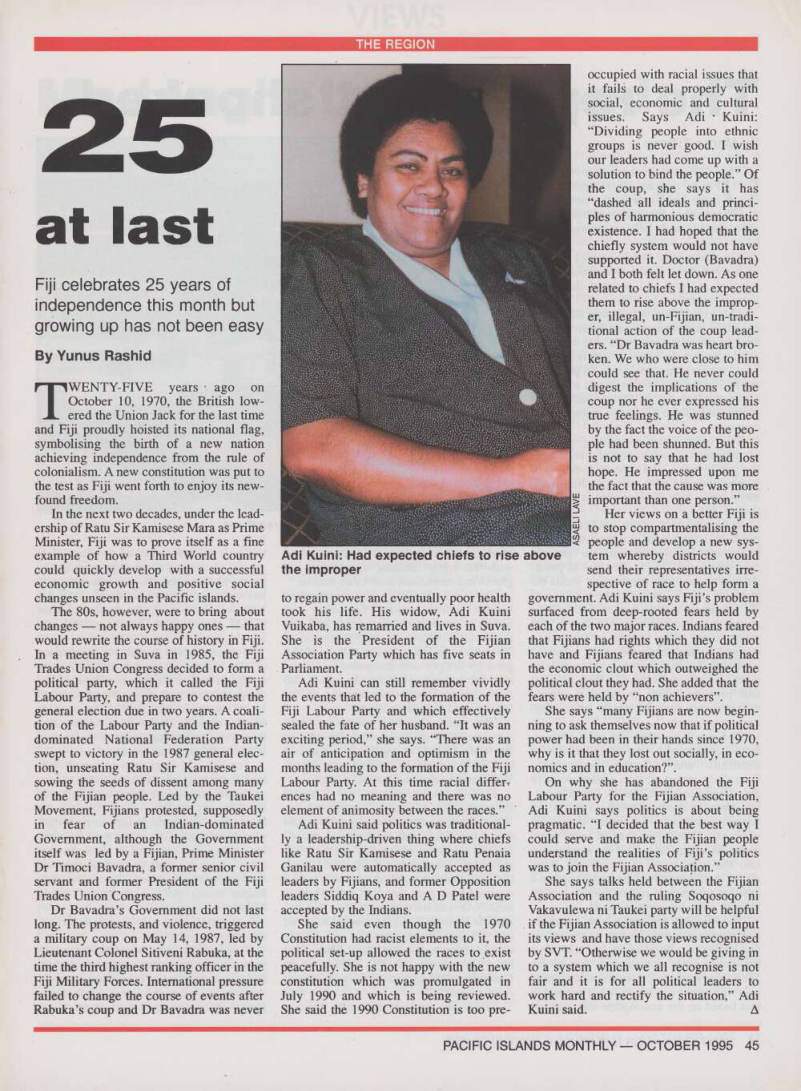
The Region
Fiji celebrates 25 years of independence this month but growing up has not been easy
By Yunus Rashid
TWENTY-FIVE years ago on October 10, 1970, the British low ered the Union Jack for the last time and Fiji proudly hoisted its national flag, symbolising the birth of a new nation achieving independence from the rule of colonialism. A new constitution was put to the test as Fiji went forth to enjoy its new found freedom.
In the next two decades, under the lead ership of Ratu Sir Kamisese Mara as Prime Minister, Fiji was to prove itself as a fine example of how a Third World country could quickly develop with a successful economic growth and positive social changes unseen in the Pacific islands.
The 80s, however, were to bring about
changes not always happy ones that
would rewrite the course of history in Fiji.
In a meeting in Suva in 1985, the Fiji Trades Union Congress decided to form a political party, which it called the Fiji Labour Party, and prepare to contest the general election due in two years. A coali tion of the Labour Party and the Indian dominated National Federation Party swept to victory in the 1987 general elec tion, unseating Ratu Sir Kamisese and sowing the seeds of dissent among many of the Fijian people. Led by the Taukei
Movement, Fijians protested, supposedly
in fear of an Indian-dominated Government, although the Government itself was led by a Fijian, Prime Minister Dr Timoci Bavadra, a former senior civil servant and former President of the Fiji Trades Union Congress.
Dr Bavadra’s Government did not last long. The protests, and violence, triggered a military coup on May 14, 1987, led by Lieutenant Colonel Sitiveni Rabuka, at the time the third highest ranking officer in the Fiji Military Forces. International pressure failed to change the course of events after Rabuka’s coup and Dr Bavadra was never
to regain power and eventually poor health took his life. His widow, Adi Kuini Vuikaba, has remarried and lives in Suva.
She is the President of the Fijian Association Party which has five seats in Parliament.
Adi Kuini can still remember vividly the events that led to the formation of the Fiji Labour Party and which effectively sealed the fate of her husband. “It was an exciting period,” she says. “There was an air of anticipation and optimism in the months leading to the formation of the Fiji Labour Party. At this time racial differr ences had no meaning and there was no element of animosity between the races.”
Adi Kuini said politics was traditional ly a leadership-driven thing where chiefs like Ratu Sir Kamisese and Ratu Penaia Ganilau were automatically accepted as leaders by Fijians, and former Opposition leaders Siddiq Koya and A D Patel were accepted by the Indians.
She said even though the 1970 Constitution had racist elements to it, the political set-up allowed the races to exist peacefully. She is not happy with the new constitution which was promulgated in July 1990 and which is being reviewed.
She said the 1990 Constitution is too pre
occupied with racial issues that it fails to deal properly with social, economic and cultural issues. Says Adi * Kuini:
“Dividing people into ethnic
groups is never good. I wish our leaders had come up with a solution to bind the people.” Of the coup, she says it has “dashed all ideals and princi ples of harmonious democratic existence. I had hoped that the chiefly system would not have supported it. Doctor (Bavadra) and I both felt let down. As one related to chiefs I had expected them to rise above the improp
er, illegal, un-Fijian, un-tradi
tional action of the coup lead ers. “Dr Bavadra was heart bro ken. We who were close to him could see that. He never could digest the implications of the coup nor he ever expressed his true feelings. He was stunned by the fact the voice of the peo ple had been shunned. But this is not to say that he had lost hope. He impressed upon me the fact that the cause was more important than one person.”
Her views on a better Fiji is to stop compartmentalising the people and develop a new sys tem whereby districts would send their representatives irre spective of race to help form a
government. Adi Kuini says Fiji’s problem surfaced from deep-rooted fears held by each of the two major races. Indians feared that Fijians had rights which they did not have and Fijians feared that Indians had the economic clout which outweighed the political clout they had. She added that the fears were held by “non achievers”.
She says “many Fijians are now begin ning to ask themselves now that if political power had been in their hands since 1970, why is it that they lost out socially, in eco nomics and in education?”.
On why she has abandoned the Fiji Labour Party for the Fijian Association, Adi Kuini says politics is about being pragmatic. “I decided that the best way I could serve and make the Fijian people understand the realities of Fiji’s politics was to join the Fijian Association.”
She says talks held between the Fijian Association and the ruling Soqosoqo ni Vakavulewa ni Taukei party will be helpful if the Fijian Association is allowed to input its views and have those views recognised by SVT. “Otherwise we would be giving in to a system which we all recognise is not fair and it is for all political leaders to work hard and rectify the situation,” Adi Kuini said. A
Adi Kuini: Had expected chiefs to rise above the improper
Asaeli Lave
The report that shocked
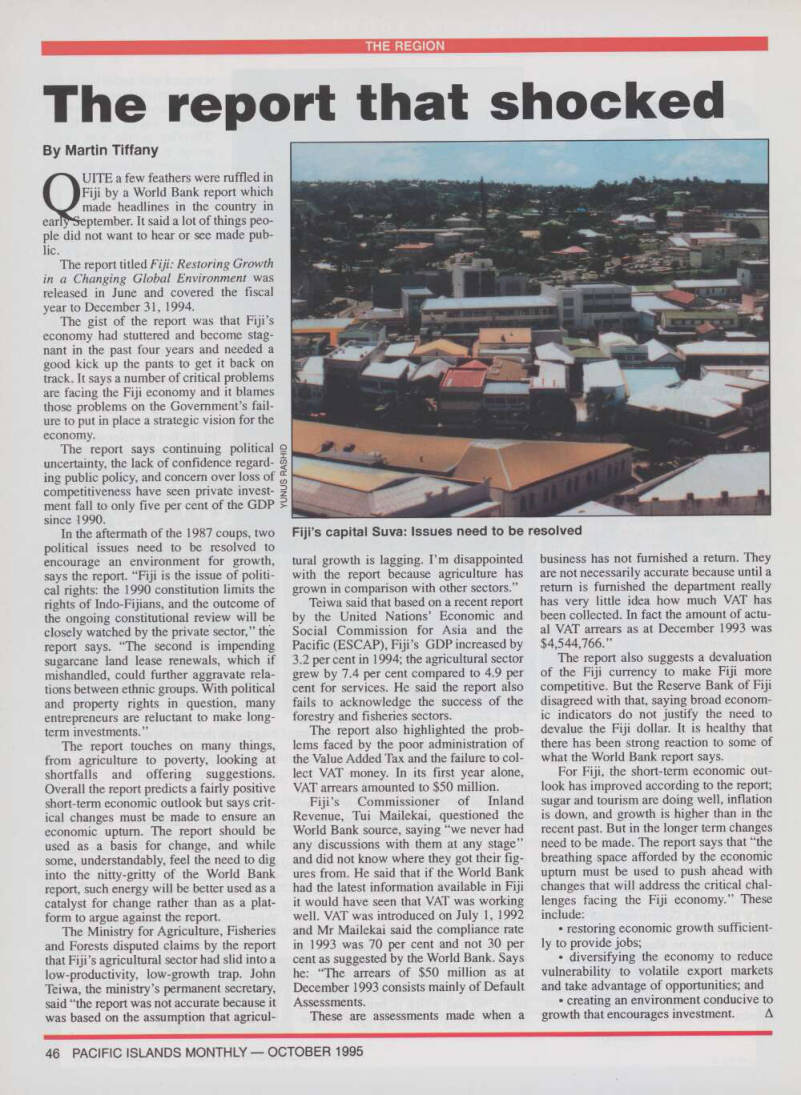
By Martin Tiffany
LUTE a few feathers were ruffled in I IFiji by a World Bank report which made headlines in the country in lt said a lot of things peo ple did not want to hear or see made pub lic.
The report titled Fiji: Restoring Growth in a Changing Global Environment was released in June and covered the fiscal year to December 31,1994.
The gist of the report was that Fiji’s economy had stuttered and become stag nant in the past four years and needed a good kick up the pants to get it back on track. It says a number of critical problems are facing the Fiji economy and it blames those problems on the Government’s fail ure to put in place a strategic vision for the economy.
The report says continuing political uncertainty, the lack of confidence regard ing public policy, and concern over loss of competitiveness have seen private invest ment fall to only five per cent of the GDP since 1990.
In the aftermath of the 1987 coups, two political issues need to be resolved to encourage an environment for growth, says the report. “Fiji is the issue of politi cal rights: the 1990 constitution limits the rights of Indo-Fijians, and the outcome of the ongoing constitutional review will be closely watched by the private sector,” the report says. “The second is impending sugarcane land lease renewals, which if mishandled, could further aggravate rela tions between ethnic groups. With political and property rights in question, many entrepreneurs are reluctant to make long term investments.”
The report touches on many things, from agriculture to poverty, looking at
shortfalls and offering suggestions.
Overall the report predicts a fairly positive short-term economic outlook but says crit ical changes must be made to ensure an economic upturn. The report should be used as a basis for change, and while some, understandably, feel the need to dig into the nitty-gritty of the World Bank report, such energy will be better used as a catalyst for change rather than as a plat form to argue against the report.
The Ministry for Agriculture, Fisheries and Forests disputed claims by the report that Fiji’s agricultural sector had slid into a
low-productivity, low-growth trap. John
Teiwa, the ministry’s permanent secretary, said “the report was not accurate because it was based on the assumption that agricul-
tural growth is lagging. I’m disappointed with the report because agriculture has grown in comparison with other sectors.”
Teiwa said that based on a recent report by the United Nations’ Economic and Social Commission for Asia and the Pacific (ESCAP), Fiji’s GDP increased by 3.2 per cent in 1994; the agricultural sector grew by 7.4 per cent compared to 4.9 per cent for services. He said the report also fails to acknowledge the success of the forestry and fisheries sectors.
The report also highlighted the prob lems faced by the poor administration of the Value Added Tax and the failure to col lect VAT money. In its first year alone, VAT arrears amounted to $5O million.
Fiji’s Commissioner of Inland Revenue, Tui Mailekai, questioned the World Bank source, saying “we never had any discussions with them at any stage” and did not know where they got their fig ures from. He said that if the World Bank had the latest information available in Fiji it would have seen that VAT was working well. VAT was introduced on July 1, 1992 and Mr Mailekai said the compliance rate in 1993 was 70 per cent and not 30 per cent as suggested by the World Bank. Says he: “The arrears of $5O million as at December 1993 consists mainly of Default Assessments.
These are assessments made when a
business has not furnished a return. They are not necessarily accurate because until a return is furnished the department really has very little idea how much VAT has been collected. In fact the amount of actu al VAT arrears as at December 1993 was $4,544,766.”
The report also suggests a devaluation of the Fiji currency to make Fiji more competitive. But the Reserve Bank of Fiji disagreed with that, saying broad econom ic indicators do not justify the need to devalue the Fiji dollar. It is healthy that there has been strong reaction to some of what the World Bank report says.
For Fiji, the short-term economic out look has improved according to the report; sugar and tourism are doing well, inflation is down, and growth is higher than in the recent past. But in the longer term changes need to be made. The report says that “the breathing space afforded by the economic upturn must be used to push ahead with changes that will address the critical chal
lenges facing the Fiji economy.” These
include: • restoring economic growth sufficient
ly to provide jobs;
• diversifying the economy to reduce vulnerability to volatile export markets and take advantage of opportunities; and • creating an environment conducive to growth that encourages investment. A
Yunus Rashid
Fiji’s capital Suva: Issues need to be resolved
Madang’s tough stand
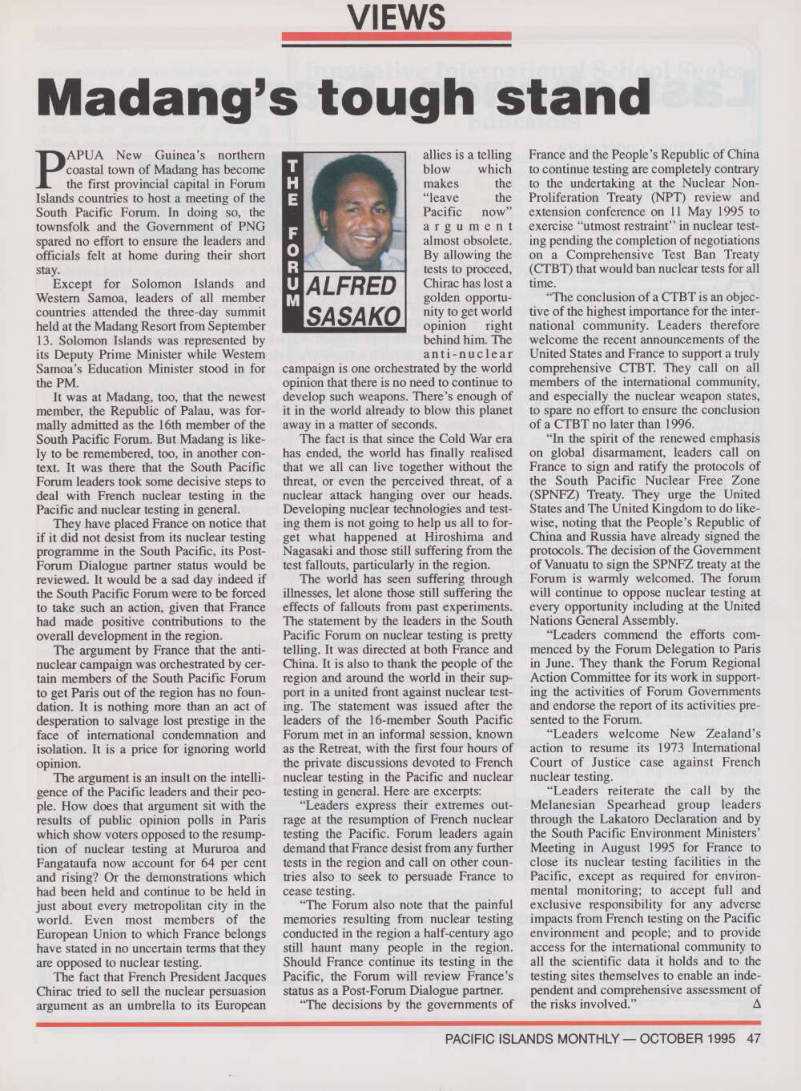
PAPUA New Guinea’s northern coastal town of Madang has become the first provincial capital in Forum Islands countries to host a meeting of the South Pacific Forum. In doing so, the townsfolk and the Government of PNG spared no effort to ensure the leaders and officials felt at home during their short stay.
Except for Solomon Islands and Western Samoa, leaders of all member countries attended the three-day summit held at the Madang Resort from September 13. Solomon Islands was represented by its Deputy Prime Minister while Western Samoa’s Education Minister stood in for the PM.
It was at Madang, too, that the newest member, the Republic of Palau, was for mally admitted as the 16th member of the South Pacific Forum. But Madang is like ly to be remembered, too, in another con text. It was there that the South Pacific Forum leaders took some decisive steps to deal with French nuclear testing in the Pacific and nuclear testing in general.
They have placed France on notice that if it did not desist from its nuclear testing programme in the South Pacific, its Post- Forum Dialogue partner status would be reviewed. It would be a sad day indeed if the South Pacific Forum were to be forced to take such an action, given that France had made positive contributions to the overall development in the region.
The argument by France that the anti nuclear campaign was orchestrated by cer tain members of the South Pacific Forum to get Paris out of the region has no foun dation. It is nothing more than an act of desperation to salvage lost prestige in the face of international condemnation and isolation. It is a price for ignoring world
opinion.
The argument is an insult on the intelli gence of the Pacific leaders and their peo ple. How does that argument sit with the results of public opinion polls in Paris which show voters opposed to the resump tion of nuclear testing at Mururoa and Fangataufa now account for 64 per cent and rising? Or the demonstrations which had been held and continue to be held in just about every metropolitan city in the world. Even most members of the European Union to which France belongs have stated in no uncertain terms that they are opposed to nuclear testing.
The fact that French President Jacques Chirac tried to sell the nuclear persuasion argument as an umbrella to its European
T H E F O R U M
allies is a telling blow which makes the “leave the Pacific now” argument almost obsolete.
By allowing the tests to proceed, Chirac has lost a golden opportu nity to get world opinion right behind him. The anti-nuclear
campaign is one orchestrated by the world opinion that there is no need to continue to develop such weapons. There’s enough of it in the world already to blow this planet away in a matter of seconds.
The fact is that since the Cold War era has ended, the world has finally realised that we all can live together without the threat, or even the perceived threat, of a nuclear attack hanging over our heads.
Developing nuclear technologies and test ing them is not going to help us all to for get what happened at Hiroshima and Nagasaki and those still suffering from the test fallouts, particularly in the region.
The world has seen suffering through illnesses, let alone those still suffering the effects of fallouts from past experiments.
The statement by the leaders in the South Pacific Forum on nuclear testing is pretty telling. It was directed at both France and China. It is also to thank the people of the region and around the world in their sup port in a united front against nuclear test ing. The statement was issued after the leaders of the 16-member South Pacific Forum met in an informal session, known as the Retreat, with the first four hours of the private discussions devoted to French nuclear testing in the Pacific and nuclear testing in general. Here are excerpts: “Leaders express their extremes out rage at the resumption of French nuclear testing the Pacific. Forum leaders again demand that France desist from any further tests in the region and call on other coun tries also to seek to persuade France to
cease testing.
“The Forum also note that the painful memories resulting from nuclear testing conducted in the region a half-century ago still haunt many people in the region.
Should France continue its testing in the Pacific, the Forum will review France’s status as a Post-Forum Dialogue partner.
“The decisions by the governments of
France and the People’s Republic of China to continue testing are completely contrary to the undertaking at the Nuclear Non- Proliferation Treaty (NPT) review and extension conference on 11 May 1995 to exercise “utmost restraint” in nuclear test
ing pending the completion of negotiations
on a Comprehensive Test Ban Treaty (CTBT) that would ban nuclear tests for all time.
“The conclusion of a CTBT is an objec tive of the highest importance for the inter national community. Leaders therefore welcome the recent announcements of the United States and France to support a truly comprehensive CTBT. They call on all members of the international community, and especially the nuclear weapon states, to spare no effort to ensure the conclusion of a CTBT no later than 1996.
“In the spirit of the renewed emphasis on global disarmament, leaders call on France to sign and ratify the protocols of the South Pacific Nuclear Free Zone (SPNFZ) Treaty. They urge the United States and The United Kingdom to do like wise, noting that the People’s Republic of China and Russia have already signed the protocols. The decision of the Government of Vanuatu to sign the SPNFZ treaty at the Forum is warmly welcomed. The forum will continue to oppose nuclear testing at every opportunity including at the United Nations General Assembly.
“Leaders commend the efforts com menced by the Forum Delegation to Paris in June. They thank the Forum Regional Action Committee for its work in support ing the activities of Forum Governments and endorse the report of its activities pre sented to the Forum.
“Leaders welcome New Zealand’s action to resume its 1973 International Court of Justice case against French
nuclear testing.
“Leaders reiterate the call by the Melanesian Spearhead group leaders through the Lakatoro Declaration and by the South Pacific Environment Ministers’
Meeting in August 1995 for France to close its nuclear testing facilities in the Pacific, except as required for environ mental monitoring; to accept full and exclusive responsibility for any adverse impacts from French testing on the Pacific environment and people; and to provide access for the international community to all the scientific data it holds and to the testing sites themselves to enable an inde pendent and comprehensive assessment of the risks involved.” A
Alfred
Sasako
Last chance, France
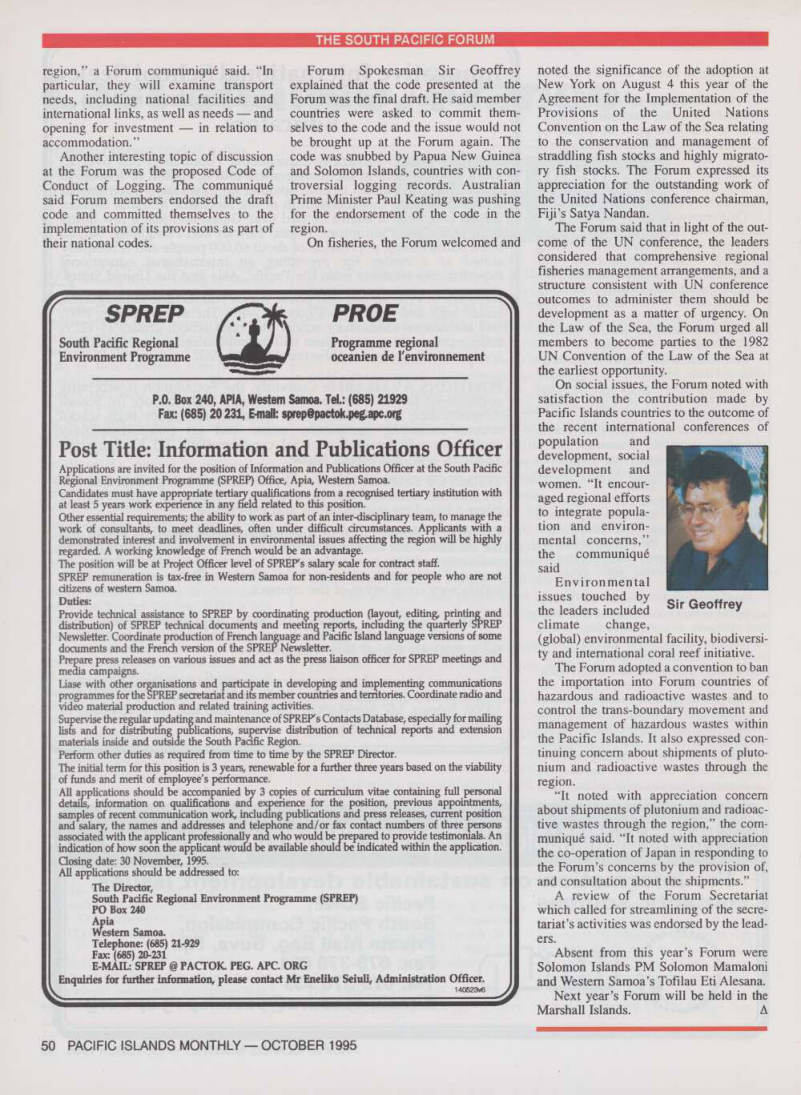
The South Pacific Forum
France comes under more attack as the Forum leaders lash out at nuclear testing
By Sudesh Kissun
AS expected, the resumption of
French nuclear testing at Mururoa Atoll dominated the agenda of the 26th South Pacific Forum meeting in
Madang, Papua New Guinea which began
on September 13. The Forum leaders came out with an ultimatum to France: drop the tests or face expulsion from the Post- Forum Dialogue meetings. The Forum leaders said they were “extremely out raged” at France’s decision to resume test ing in the face of strong opposition from within the Pacific and abroad.
The Forum attracted a record 140 jour nalists to the meeting at the northern coastal town of Madang. Security for the three-day meeting was stepped up with nearly 400 policemen guarding the meet ing venue. Fiji Prime Minister Sitiveni Rabuka said the nuclear issues clouded the other important regional issues at the meeting.
Other important issues discussed by the leaders included securing development in the region beyond the year 2000, a new Code of Conduct on logging, tourism and
transportation.
France detonated a 20-kiloton nuclear device on September 5. The leaders decid ed that Forum chairman, Papua New Guinea Prime Minister Sir Julius Chan, would call an emergency meeting if France conducted a second test.
The emergency meeting will review France’s status as a Post-Forum Dialogue partner. Mr Rabuka said the Pacific leaders
spoke very strongly against France. A
Forum statement said the decisions by France and China to continue nuclear test ing was cojnpletely contrary to the under taking at the Nuclear Non-Proliferation Treaty review and extension conference in May this year.
The two nuclear powers had agreed to exercise “utmost restraint” in nuclear test ing pending the completion of negotiations on a Comprehensive Test Ban Treaty (CTBT) that would ban nuclear tests for all time.
The conclusion of the CTBT is an objective of the higher importance for the international community, the Forum lead ers said.
The leaders welcomed New Zealand’s action to resume its 1973 International Court of Justice case against French for its nuclear testing and the effects those tests will have on the environment of the Pacific.
The leaders reiterated the call by Melanesian Spearhead Group leaders
through the Lakatoro Declaration, signed in August, and by the South Pacific Environment Ministers meeting in August this year for France to close its nuclear testing facilities in the Pacific, except as required for environmental monitoring.
Greenpeace Pacific Limited charged that the statement by the Forum leaders
was “strong on rhetoric and very weak on action”.
“The international community expects the Pacific to set the benchmark for oppo sition to the resumption of testing by France, and this statement falls far short of
that,” said spokesperson Bunny
McDiarmid.
The Forum decided that individual countries were free to penalise France.
The Forum opened with colourful tradi tional dances. The Forum’s newest mem ber, Palau was welcomed at the opening ceremony. A canoe carrying Palau’s flag travelled to PNG and berthed at a man made lake where the ceremony was held.
Based on the Forum theme. Securing Development beyond year 2000, three leaders were asked to present regional overviews on important issues.
Mr Rabuka spoke on regional co-oper ation and trade, Marshall Islands President Amata Kabua spoke on transportation and Sir Geoffrey Henry, of Cook Islands, spoke on tourism.
On economic policy issues, the Forum supported a number of national policy measures and regionally based activities which would secure development in the region beyond year 2000.
The Forum decided that by enhancing
competitiveness, implementing trade
reforms, promoting harmonious trade within and outside the region, improving
public sector efficiency and improving aid
management, economic goals could be achieved.
On regional air service, the Forum agreed to convene a meeting of civil avia tion ministers, aviation authorities, airline representatives and other experts to dis cuss the further development of civil avia tion services throughout the Forum region.
On Tourism, the Forum noted that Pacific Islands lay at the centre of one of the most rapidly growing networks in the world. “Leaders agreed, therefore, to direct their respective tourism authorities to explore options for increasing joint pro motions, both within and beyond the
region,” a Forum communique said. “In particular, they will examine transport needs, including national facilities and international links, as well as needs and opening for investment in relation to accommodation. ”
Another interesting topic of discussion at the Forum was the proposed Code of Conduct of Logging. The communique said Forum members endorsed the draft code and committed themselves to the implementation of its provisions as part of their national codes.
Forum Spokesman Sir Geoffrey explained that the code presented at the Forum was the final draft. He said member countries were asked to commit them selves to the code and the issue would not be brought up at the Forum again. The code was snubbed by Papua New Guinea and Solomon Islands, countries with con troversial logging records. Australian Prime Minister Paul Keating was pushing for the endorsement of the code in the region.
On fisheries, the Forum welcomed and
noted the significance of the adoption at New York on August 4 this year of the Agreement for the Implementation of the Provisions of the United Nations Convention on the Law of the Sea relating to the conservation and management of
straddling fish stocks and highly migrato
ry fish stocks. The Forum expressed its appreciation for the outstanding work of the United Nations conference chairman,
Fiji’s Satya Nandan.
The Forum said that in light of the out come of the UN conference, the leaders
considered that comprehensive regional
fisheries management arrangements, and a structure consistent with UN conference outcomes to administer them should be development as a matter of urgency. On the Law of the Sea, the Forum urged all members to become parties to the 1982 UN Convention of the Law of the Sea at the earliest opportunity.
On social issues, the Forum noted with satisfaction the contribution made by Pacific Islands countries to the outcome of the recent international conferences of
population and development, social development and women. “It encour aged regional efforts to integrate popula tion and environ mental concerns,” the communique said Environmental issues touched by the leaders included climate change.
(global) environmental facility, biodiversi
ty and international coral reef initiative.
The Forum adopted a convention to ban the importation into Forum countries of hazardous and radioactive wastes and to control the trans-boundary movement and management of hazardous wastes within the Pacific Islands. It also expressed con tinuing concern about shipments of pluto nium and radioactive wastes through the
region.
“It noted with appreciation concern about shipments of plutonium and radioac tive wastes through the region,” the com munique said. “It noted with appreciation the co-operation of Japan in responding to the Forum’s concerns by the provision of, and consultation about the shipments.”
A review of the Forum Secretariat which called for streamlining of the secre tariat’s activities was endorsed by the lead ers.
Absent from this year’s Forum were Solomon Islands PM Solomon Mamaloni and Western Samoa’s Tofilau Eti Alesana.
Next year’s Forum will be held in the Marshall Islands. A
Sir Geoffrey
for the region
A new vision for the region
THE Pacific leaders who met at the Forum meeting in Madang the past month have promoted a vision for enhancing regional co operation for the next 25 years. That vision is: • Co-operation on the basis of equality, friendship and mutual respect with due regard for what each can afford in efforts to maintain security, improve living standards and ensure sustain able development throughout the region; • Creating opportunities for co-operation with other govern
ments, non-governmental organisations and international organi
sations, including other bodies in the Asia-Pacific; • Developing resources including fisheries, forestry, miner als, water and land with proper regard for conservation; • Unity in securing shared interests which contributes to the national, regional and global good; • Material progress matched by improvement in the quality of people’s lives, including human development, equality between women and men, and the protection of children; • Overcoming the vulnerability to the effects of natural disas ters, environmental damage and the other threats; • The respect and promotion of indigenous and other values, traditions and customs of the region through cultural, sporting and other exchanges; • Have self-determination in the remaining dependent territo ries, and the end of unwelcome activities by external powers, including nuclear testing; • Promotion of international economic co-operation through trade, investment and other exchanges to strengthen subsistence and commercial agriculture, industrial development competition, leading to growth with equity, broad-based participation and capacity-building for self-reliance; • Openness, accountability and other principles of good govern ment are embodied in the practices, policies and plans of regional institutions; and • National sub-regional and regional efforts to achieve the Forum’s vision.
Innovative International School Seeks
Bright, Talented and Enthusiastic Educators
The International Miyazawa Educational Foundation has over 25 J rears of experience in the management and operation of schools in apan. The Foundation is now opening an innovative international scnool in Saipan. Commonwealth of the Northern Mariana Islands.
Saipan is a tropical island located near Guam and just a few hours from Japan, the Philippines, Korea, Taiwan and Hongkong. Saipan has a multicultural population of about 60,000 people and is uniquely suited as a center for providing an international educational experience to students from the Pacific, Asia and the United States.
JOIN US in 1996 for our first phase which will include kindergarten, junior high and high school (grades 7-10). The second phase, 1997, will include an elementary scnool and high school grades 11-12. A college preparatory curriculum will be emphasised at the high school levels and all courses will be taught in English.
POSITIONS AVAILABLE: Currently, the Foundation is accepting applications for: (a) Principal (junior high/high school); (b) School Aoministrator; (c) Counselor; (d) Teachers for junior high school courses including computers, music and art (multidisciplinary credentials will be given special consideration); (e) Kindergarten Teachers, and (f) a School Nurse.
TERMS OF EMPLOYMENT; All positions are being offered as two (2) year contracts with options to renew. Competitive salaries will be offered based on qualifications and experience.
BENEFITS: Benefits include a generous annual vacation, health and life insurance. For off-island recruits, benefits will also include air fare to Saipan and shipment of household effects up to a limit. Return air fare and shipment of household effects will be provided upon satisfactory completion of the contract.
Creative, motivated individuals with top qualifications and experience are invited to participate in establishing the foundation for a dynamic school that will grow.
Please send letters of inquiry or resume to: International Miyazawa Educational Foundation, Attn: EDR and Associates, PPP 460, Box 10000, Saipan, MP 96950-9504. You may also fax: (670) 234-8381 or telephone (670) 233-8666.
Advertisements & other items, pp. 49-50 (1 item)
Pacific Sustainable Development Networking Programme
For Information on sustainable development issues. contacts, sources . . . • \ Pacific SDNP, South Pacific Commission, Private Mail Bag, Suva, Fiji.
Fax: 679-370 021 Tel: 679-370 733 E-mail: [email protected]
SPREP
South Pacific Regional
Environment Programme
PROE
Programme regional
oceanien de I'environnement P.O. Box 240, APIA, Western Samoa. Tel.: (685) 21929
Fax; (685) 20 231, E-mail: [email protected]
Post Title: Information and Publications Officer
Applications are invited for the position of Information and Publications Officer at the South Pacific Regional Environment Programme (SPREP) Office, Apia, Western Samoa.
Candidates must have appropriate tertiary qualifications from a recognised tertiary institution with at least 5 years work experience in any field related to this position.
Other essential requirements; the ability to work as part of an inter-disciplinary team, to manage the work of consultants, to meet deadlines, often under difficult circumstances. Applicants with a demonstrated interest and involvement in environmental issues affecting the region will be highly regarded. A working knowledge of French would be an advantage.
The position will be at Project Officer level of SPREP s salary scale for contract staff.
SPREP remuneration is tax-free in Western Samoa for non-residents and for people who are not citizens of western Samoa.
Duties: Provide technical assistance to SPREP by coordinating production (layout, editing, printing and distribution) of SPREP technical documents and meeting reports, including the quarterly SPREP Newsletter. Coordinate production of French language and Pacific Island language versions of some documents and the French version of the SPREP Newsletter.
Prepare press releases on various issues and act as the press liaison officer for SPREP meetings and media campaigns.
Liase with other organisations and participate in developing and implementing communications programmes for the SPREP secretariat and its member countries and territories. Coordinate radio and video material production and related training activities.
Supervise the regular updating and maintenance of SPREP's Contacts Database, especially for mailing lists and for distributing publications, supervise distribution of technical reports and extension materials inside and outside the South Pacific Region.
Perform other duties as required from time to time by the SPREP Director.
The initial term for this position is 3 years, renewable for a further three years based on the viability of funds and merit of employee's performance.
All applications should be accompanied by 3 copies of curriculum vitae containing full personal details, information on qualifications and experience for the position, previous appointments, samples of recent communication work, inducting publications and press releases, current position and salary, the names and addresses and tdephone and/or fax contact numbers of three persons assodatea with the applicant professionally and who would be prepared to provide testimonials. An indication of how soon the applicant would be available should be indicated within the application.
Closing date: 30 November, 1995.
All applications should be addressed to: The Director, South Pacific Regional Environment Programme (SPREP) PO Box 240 Apia Western Samoa.
Telephone: (685) 21-929 Fax: (685) 20-231 E-MAIL SPREP @ FACTOR. PEG. APC ORG Enquiries for further information, please contact Mr Eneliko Seiuli, Administration Officer.
heights on a rig
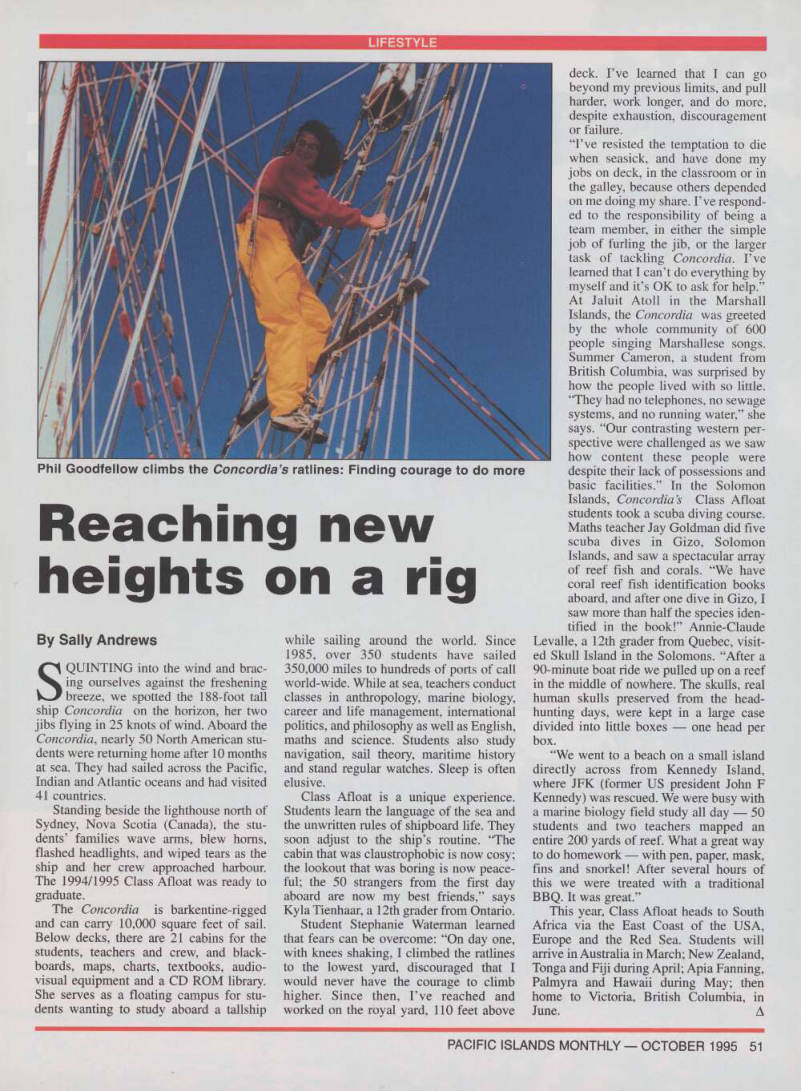
Lifestyle
Reaching new heights on a rig
By Sally Andrews
SQUINTING into the wind and brac ing ourselves against the freshening breeze, we spotted the 188-foot tall ship Concordia on the horizon, her two jibs flying in 25 knots of wind. Aboard the Concordia , nearly 50 North American stu dents were returning home after 10 months at sea. They had sailed across the Pacific, Indian and Atlantic oceans and had visited 41 countries.
Standing beside the lighthouse north of Sydney, Nova Scotia (Canada), the stu dents’ families wave arms, blew horns, flashed headlights, and wiped tears as the ship and her crew approached harbour.
The 1994/1995 Class Afloat was ready to
graduate.
The Concordia is barkentine-rigged and can carry 10,000 square feet of sail.
Below decks, there are 21 cabins for the students, teachers and crew, and black boards, maps, charts, textbooks, audio visual equipment and a CD ROM library.
She serves as a floating campus for stu dents wanting to study aboard a tallship
while sailing around the world. Since 1985, over 350 students have sailed 350,000 miles to hundreds of ports of call world-wide. While at sea, teachers conduct classes in anthropology, marine biology, career and life management, international politics, and philosophy as well as English, maths and science. Students also study navigation, sail theory, maritime history and stand regular watches. Sleep is often elusive.
Class Afloat is a unique experience.
Students learn the language of the sea and the unwritten rules of shipboard life. They soon adjust to the ship’s routine. “The cabin that was claustrophobic is now cosy; the lookout that was boring is now peace ful; the 50 strangers from the first day aboard are now my best friends,” says Kyla Tienhaar, a 12th grader from Ontario.
Student Stephanie Waterman learned that fears can be overcome: “On day one, with knees shaking, I climbed the ratlines to the lowest yard, discouraged that I would never have the courage to climb higher. Since then, I’ve reached and worked on the royal yard, 110 feet above
deck. I’ve learned that I can go
beyond my previous limits, and pull
harder, work longer, and do more,
despite exhaustion, discouragement
or failure.
“I’ve resisted the temptation to die when seasick, and have done my jobs on deck, in the classroom or in the galley, because others depended on me doing my share. I’ve respond ed to the responsibility of being a team member, in either the simple job of furling the jib, or the larger task of tackling Concordia. I’ve learned that I can’t do everything by myself and it’s OK to ask for help.”
At Jaluit Atoll in the Marshall Islands, the Concordia was greeted by the whole community of 600 people singing Marshallese songs.
Summer Cameron, a student from British Columbia, was surprised by how the people lived with so little.
“They had no telephones, no sewage systems, and no running water,” she says. “Our contrasting western per spective were challenged as we saw how content these people were despite their lack of possessions and basic facilities.” In the Solomon Islands, Concordia’s Class Afloat students took a scuba diving course.
Maths teacher Jay Goldman did five scuba dives in Gizo, Solomon Islands, and saw a spectacular array of reef fish and corals. “We have coral reef fish identification books aboard, and after one dive in Gizo, I saw more than half the species iden tified in the book!” Annie-Claude
Levalle, a 12th grader from Quebec, visit ed Skull Island in the Solomons. “After a 90-minute boat ride we pulled up on a reef in the middle of nowhere. The skulls, real human skulls preserved from the head hunting days, were kept in a large case divided into little boxes one head per box.
“We went to a beach on a small island directly across from Kennedy Island, where JFK (former US president John F Kennedy) was rescued. We were busy with a marine biology field study all day 50 students and two teachers mapped an entire 200 yards of reef. What a great way to do homework with pen, paper, mask, fins and snorkel! After several hours of this we were treated with a traditional BBQ. It was great.”
This year. Class Afloat heads to South Africa via the East Coast of the USA, Europe and the Red Sea. Students will arrive in Australia in March; New Zealand, Tonga and Fiji during April; Apia Fanning, Palmyra and Hawaii during May; then home to Victoria, British Columbia, in June. A
Phil Goodfellow climbs the Concordia’s ratlines: Finding courage to do more
The last Rainforest

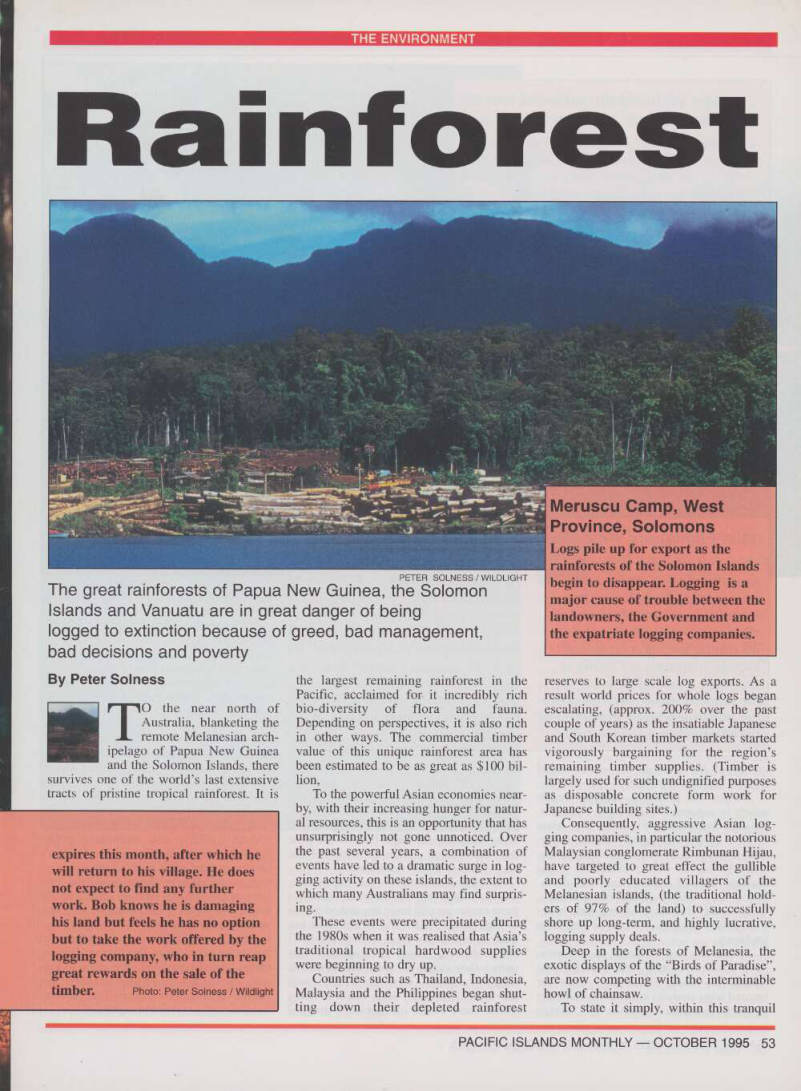
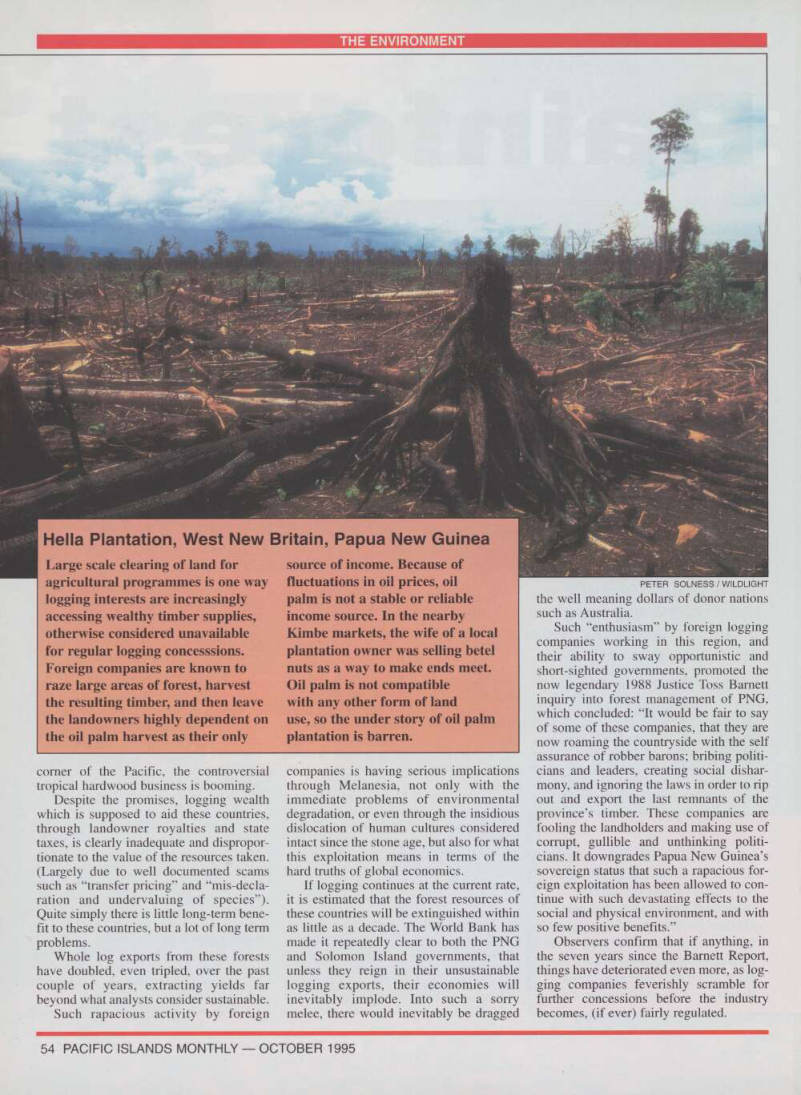
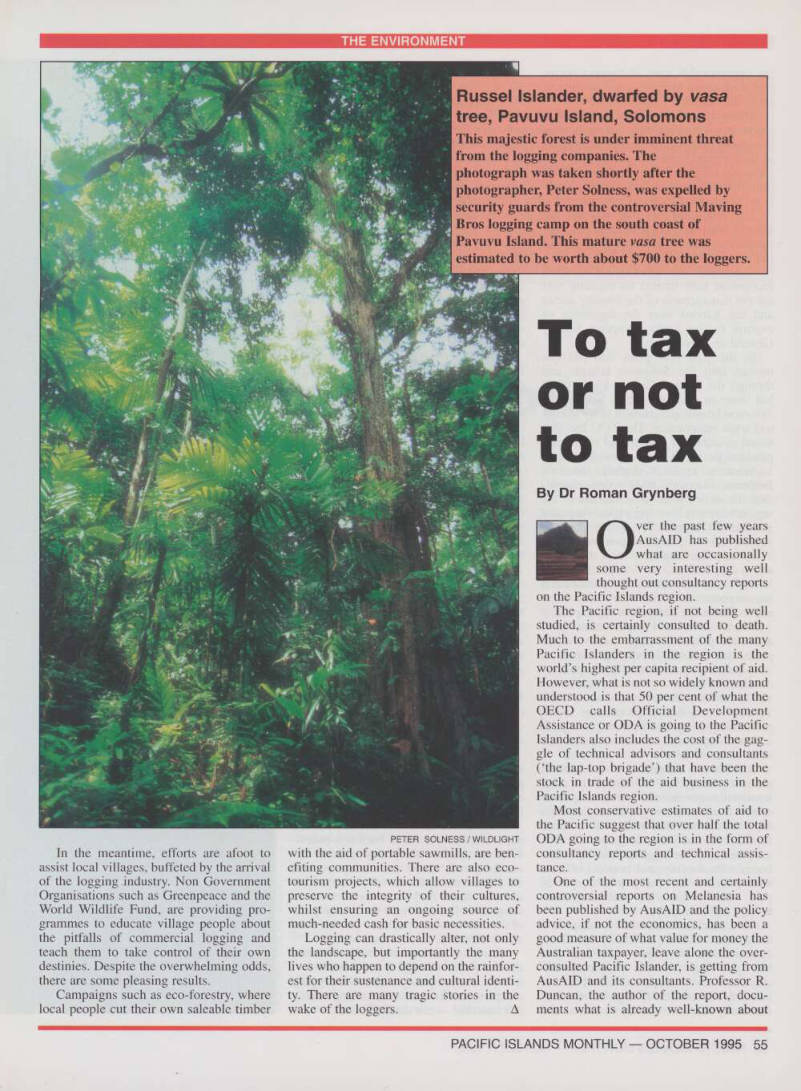
The Environment
Bob, contract logger,
Guadalcanal, Solomons.
Bob is a contract logger for Pacific Timbers and earns 45¢ an hour, $3.60 a day. He describes his work as being hard and dangerous. He says he doesn’t like his work much, but needs the money. His contract
The great rainforests of Papua New Guinea, the Solomon Islands and Vanuatu are in great danger of being logged to extinction because of greed, bad management, bad decisions and poverty
By Peter Soiness
TO the near north of Australia, blanketing the remote Melanesian arch ipelago of Papua New Guinea and the Solomon Islands, there
survives one of the world’s last extensive tracts of pristine tropical rainforest. It is
the largest remaining rainforest in the Pacific, acclaimed for it incredibly rich bio-diversity of flora and fauna.
Depending on perspectives, it is also rich in other ways. The commercial timber value of this unique rainforest area has been estimated to be as great as $lOO bil lion.
To the powerful Asian economies near by, with their increasing hunger for natur al resources, this is an opportunity that has unsurprisingly not gone unnoticed. Over the past several years, a combination of events have led to a dramatic surge in log ging activity on these islands, the extent to which many Australians may find surpris
ing.
These events were precipitated during the 1980 s when it was realised that Asia’s
traditional tropical hardwood supplies
were beginning to dry up.
Countries such as Thailand, Indonesia, Malaysia and the Philippines began shut ting down their depleted rainforest
reserves to large scale log exports. As a result world prices for whole logs began escalating, (approx. 200% over the past couple of years) as the insatiable Japanese and South Korean timber markets started
vigorously bargaining for the region’s
remaining timber supplies. (Timber is largely used for such undignified purposes as disposable concrete form work for
Japanese building sites.)
Consequently, aggressive Asian log
ging companies, in particular the notorious
Malaysian conglomerate Rimbunan Hijau,
have targeted to great effect the gullible and poorly educated villagers of the Melanesian islands, (the traditional hold ers of 97% of the land) to successfully shore up long-term, and highly lucrative,
logging supply deals.
Deep in the forests of Melanesia, the exotic displays of the “Birds of Paradise”, are now competing with the interminable howl of chainsaw.
To state it simply, within this tranquil
expires this month, after which he will return to his village. He does not expect to find any further work. Bob knows he is damaging his land but feels he has no option but to take the work offered by the logging company, who in turn reap great rewards on the sale of the timber. Photo: Peter Solness/Wildlight
Peter Solness/Wildlight
Meruscu Camp, West Province, Solomons Logs pile up for export as the rainforests of the Solomon Islands begin to disappear. Logging is a major cause of trouble between the landowners, the Government and the expatriate logging companies.
corner of the Pacific, the controversial tropical hardwood business is booming.
Despite the promises, logging wealth
which is supposed to aid these countries, through landowner royalties and state
taxes, is clearly inadequate and dispropor
tionate to the value of the resources taken. (Largely due to well documented scams such as “transfer pricing” and “mis-decla ration and undervaluing of species”).
Quite simply there is little long-term bene fit to these countries, but a lot of long term
problems.
Whole log exports from these forests have doubled, even tripled, over the past couple of years, extracting yields far beyond what analysts consider sustainable.
Such rapacious activity by foreign
companies is having serious implications
through Melanesia, not only with the immediate problems of environmental degradation, or even through the insidious dislocation of human cultures considered intact since the stone age, but also for what this exploitation means in terms of the hard truths of global economics.
If logging continues at the current rate, it is estimated that the forest resources of these countries will be extinguished within as little as a decade. The World Bank has made it repeatedly clear to both the PNG and Solomon Island governments, that unless they reign in their unsustainable logging exports, their economies will inevitably implode. Into such a sorry melee, there would inevitably be dragged
the well meaning dollars of donor nations such as Australia.
Such “enthusiasm” by foreign logging
companies working in this region, and
their ability to sway opportunistic and short-sighted governments, promoted the now legendary 1988 Justice Toss Barnett inquiry into forest management of PNG, which concluded: “It would be fair to say of some of these companies, that they are now roaming the countryside with the self assurance of robber barons; bribing politi cians and leaders, creating social dishar mony, and ignoring the laws in order to rip out and export the last remnants of the province’s timber. These companies are fooling the landholders and making use of corrupt, gullible and unthinking politi cians. It downgrades Papua New Guinea’s sovereign status that such a rapacious for eign exploitation has been allowed to con tinue with such devastating effects to the social and physical environment, and with so few positive benefits.”
Observers confirm that if anything, in the seven years since the Barnett Report, things have deteriorated even more, as log
ging companies feverishly scramble for
further concessions before the industry becomes, (if ever) fairly regulated.
Hella Plantation, West New Britain, Papua New Guinea
Large scale clearing of land for agricultural programmes is one way logging interests are increasingly accessing wealthy timber supplies, otherwise considered unavailable for regular logging concesssions.
Foreign companies are known to raze large areas of forest, harvest the resulting timber, and then leave the landowners highly dependent on the oil palm harvest as their only
source of income. Because of fluctuations in oil prices, oil palm is not a stable or reliable income source. In the nearby Kimbe markets, the wife of a local plantation owner was selling betel nuts as a way to make ends meet.
Oil palm is not compatible with any other form of land use, so the under story of oil palm plantation is barren.
Peter Solness/Wildlight
In the meantime, efforts are afoot to assist local villages, buffeted by the arrival of the logging industry. Non Government Organisations such as Greenpeace and the World Wildlife Fund, are providing pro grammes to educate village people about the pitfalls of commercial logging and teach them to take control of their own destinies. Despite the overwhelming odds, there are some pleasing results.
Campaigns such as eco-forestry, where local people cut their own saleable timber
with the aid of portable sawmills, are ben efiting communities. There are also eco tourism projects, which allow villages to preserve the integrity of their cultures, whilst ensuring an ongoing source of much-needed cash for basic necessities.
Logging can drastically alter, not only
the landscape, but importantly the many lives who happen to depend on the rainfor est for their sustenance and cultural identi ty. There are many tragic stories in the wake of the loggers. A
Peter Solness/Wildlight
Russel Islander, dwarfed by vasa
tree, Pavuvu island, Solomons
This majestic forest is under imminent threat from the logging companies. The photograph was taken shortly after the photographer, Peter Solness, was expelled by security guards from the controversial Maving Bros logging camp on the south coast of Pavuvu Island. This mature vasa tree was estimated to be worth about $700 to the loggers.
To tax
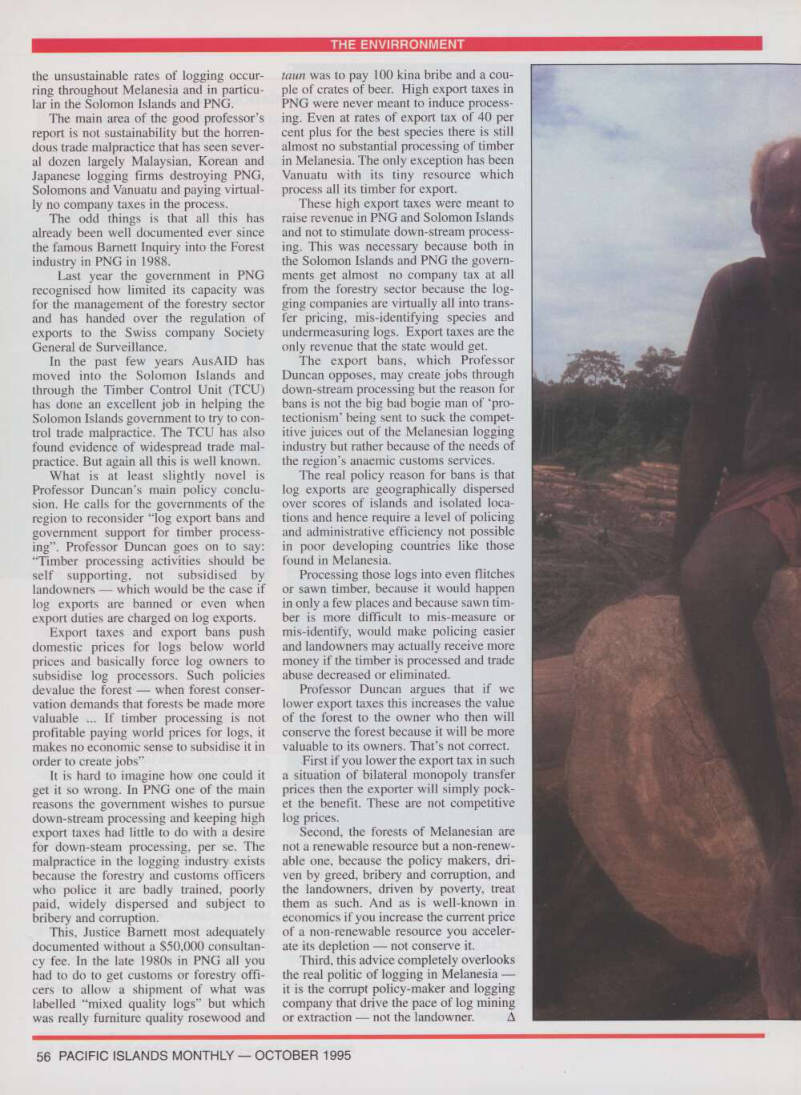
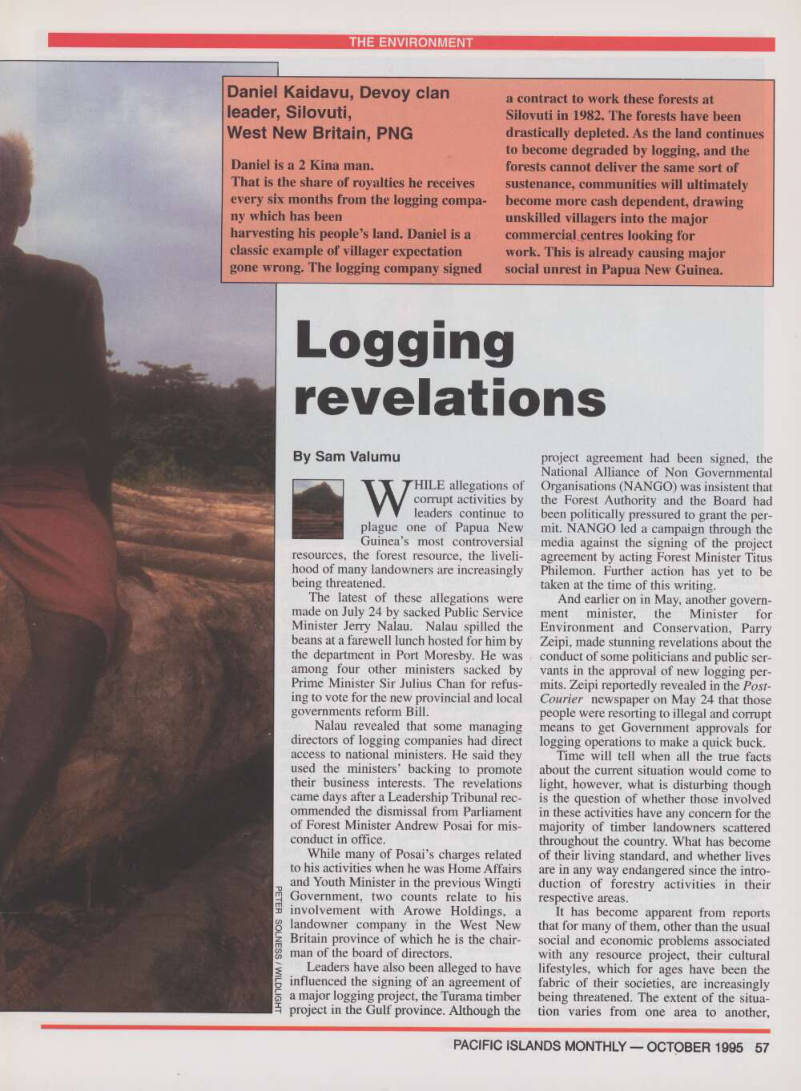
or not to tax
By Dr Roman Grynberg
Over the past few years AusAID has published what are occasionally some very interesting well
thought out consultancy reports
on the Pacific Islands region.
The Pacific region, if not being well studied, is certainly consulted to death.
Much to the embarrassment of the many Pacific Islanders in the region is the world’s highest per capita recipient of aid.
However, what is not so widely known and understood is that 50 per cent of what the OECD calls Official Development Assistance or ODA is going to the Pacific Islanders also includes the cost of the gag gle of technical advisors and consultants (‘the lap-top brigade’) that have been the stock in trade of the aid business in the Pacific Islands region.
Most conservative estimates of aid to the Pacific suggest that over half the total ODA going to the region is in the form of consultancy reports and technical assis tance.
One of the most recent and certainly controversial reports on Melanesia has been published by AusAID and the policy advice, if not the economics, has been a good measure of what value for money the Australian taxpayer, leave alone the over consulted Pacific Islander, is getting from AusAID and its consultants. Professor R.
Duncan, the author of the report, docu ments what is already well-known about
the unsustainable rates of logging occur ring throughout Melanesia and in particu lar in the Solomon Islands and PNG.
The main area of the good professor’s report is not sustainability but the horren dous trade malpractice that has seen sever al dozen largely Malaysian, Korean and Japanese logging firms destroying PNG, Solomons and Vanuatu and paying virtual ly no company taxes in the process.
The odd things is that all this has already been well documented ever since the famous Barnett Inquiry into the Forest industry in PNG in 1988.
Last year the government in PNG recognised how limited its capacity was for the management of the forestry sector and has handed over the regulation of exports to the Swiss company Society General de Surveillance.
In the past few years AusAID has moved into the Solomon Islands and through the Timber Control Unit (TCU) has done an excellent job in helping the Solomon Islands government to try to con trol trade malpractice. The TCU has also found evidence of widespread trade mal practice. But again all this is well known.
What is at least slightly novel is Professor Duncan’s main policy conclu sion. He calls for the governments of the region to reconsider “log export bans and government support for timber process ing”. Professor Duncan goes on to say: “Timber processing activities should be self supporting, not subsidised by landowners which would be the case if log exports are banned or even when export duties are charged on log exports.
Export taxes and export bans push domestic prices for logs below world prices and basically force log owners to subsidise log processors. Such policies devalue the forest when forest conser vation demands that forests be made more valuable ... If timber processing is not profitable paying world prices for logs, it makes no economic sense to subsidise it in order to create jobs”
It is hard to imagine how one could it get it so wrong. In PNG one of the main reasons the government wishes to pursue
down-stream processing and keeping high
export taxes had little to do with a desire for down-steam processing, per se. The
malpractice in the logging industry exists
because the forestry and customs officers who police it are badly trained, poorly
paid, widely dispersed and subject to
bribery and corruption.
This, Justice Barnett most adequately documented without a $50,000 consultan cy fee. In the late 1980 s in PNG all you had to do to get customs or forestry offi cers to allow a shipment of what was labelled “mixed quality logs” but which was really furniture quality rosewood and
taun was to pay 100 kina bribe and a cou ple of crates of beer. High export taxes in PNG were never meant to induce process ing. Even at rates of export tax of 40 per cent plus for the best species there is still almost no substantial processing of timber in Melanesia. The only exception has been Vanuatu with its tiny resource which process all its timber for export.
These high export taxes were meant to raise revenue in PNG and Solomon Islands and not to stimulate down-stream process ing. This was necessary because both in the Solomon Islands and PNG the govern ments get almost no company tax at all from the forestry sector because the log ging companies are virtually all into trans fer pricing, mis-identifying species and
undermeasuring logs. Export taxes are the
only revenue that the state would get.
The export bans, which Professor Duncan opposes, may create jobs through down-stream processing but the reason for bans is not the big bad bogie man of ‘pro tectionism’ being sent to suck the compet itive juices out of the Melanesian logging industry but rather because of the needs of the region’s anaemic customs services.
The real policy reason for bans is that log exports are geographically dispersed over scores of islands and isolated loca tions and hence require a level of policing and administrative efficiency not possible in poor developing countries like those found in Melanesia.
Processing those logs into even flitches or sawn timber, because it would happen in only a few places and because sawn tim ber is more difficult to mis-measure or mis-identify, would make policing easier and landowners may actually receive more money if the timber is processed and trade abuse decreased or eliminated.
Professor Duncan argues that if we lower export taxes this increases the value of the forest to the owner who then will conserve the forest because it will be more valuable to its owners. That’s not correct.
First if you lower the export tax in such a situation of bilateral monopoly transfer prices then the exporter will simply pock et the benefit. These are not competitive
log prices.
Second, the forests of Melanesian are not a renewable resource but a non-renew able one, because the policy makers, dri ven by greed, bribery and corruption, and the landowners, driven by poverty, treat them as such. And as is well-known in economics if you increase the current price of a non-renewable resource you acceler ate its depletion not conserve it.
Third, this advice completely overlooks the real politic of logging in Melanesia it is the corrupt policy-maker and logging company that drive the pace of log mining or extraction not the landowner. A
Daniel Kaidavu, Devoy clan
leader, Silovuti,
West New Britain, PNG Daniel is a 2 Kina man.
That is the share of royalties he receives every six months from the logging compa ny which has been harvesting his people’s land. Daniel is a classic example of villager expectation gone wrong. The logging company signed
Peter Solness/Wildlight
a contract to work these forests at Silovuti in 1982. The forests have been drastically depleted. As the land continues to become degraded by logging, and the forests cannot deliver the same sort of sustenance, communities will ultimately become more cash dependent, drawing unskilled villagers into the major commercial centres looking for work. This is already causing major social unrest in Papua New Guinea.
Logging
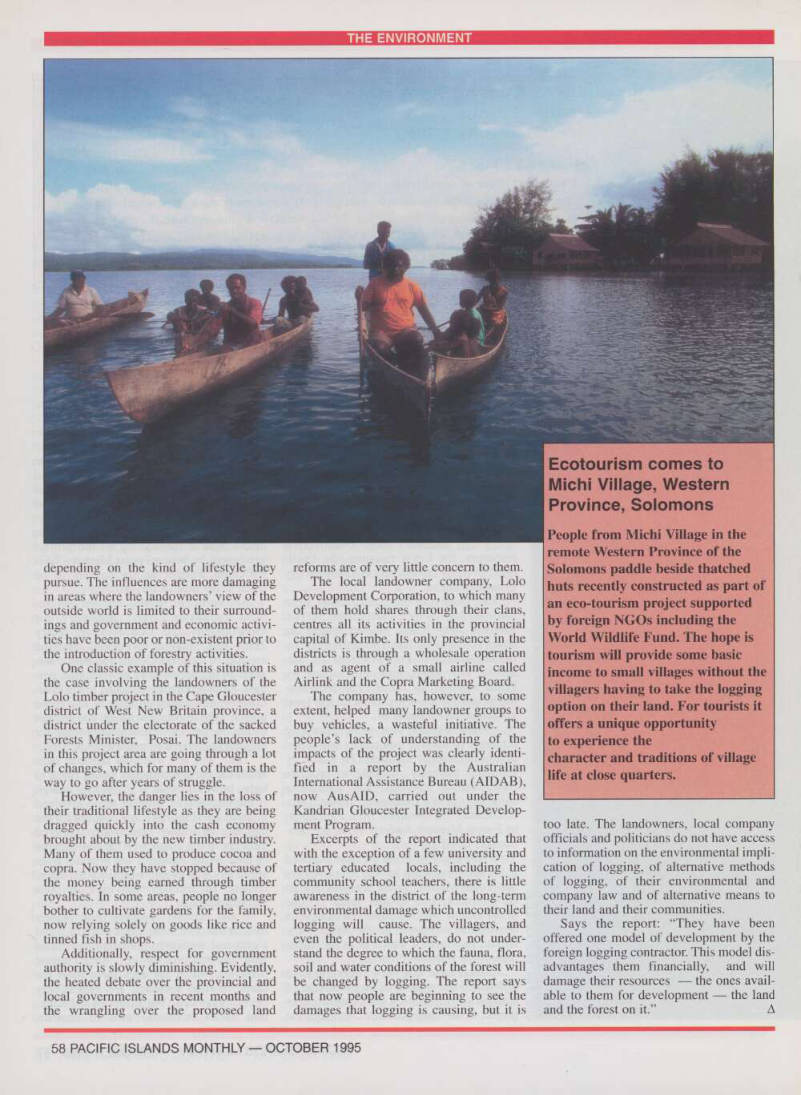
revelations
By Sam Valumu
WHILE allegations of corrupt activities by leaders continue to plague one of Papua New Guinea’s most controversial
resources, the forest resource, the liveli hood of many landowners are increasingly being threatened.
The latest of these allegations were made on July 24 by sacked Public Service Minister Jerry Nalau. Nalau spilled the beans at a farewell lunch hosted for him by the department in Port Moresby. He was among four other ministers sacked by Prime Minister Sir Julius Chan for refus ing to vote for the new provincial and local governments reform Bill.
Nalau revealed that some managing directors of logging companies had direct access to national ministers. He said they used the ministers’ backing to promote their business interests. The revelations came days after a Leadership Tribunal rec ommended the dismissal from Parliament of Forest Minister Andrew Posai for mis conduct in office.
While many of Posai’s charges related to his activities when he was Home Affairs and Youth Minister in the previous Wingti Government, two counts relate to his involvement with Arowe Holdings, a landowner company in the West New Britain province of which he is the chair man of the board of directors.
Leaders have also been alleged to have influenced the signing of an agreement of a major logging project, the Turama timber project in the Gulf province. Although the
project agreement had been signed, the National Alliance of Non Governmental Organisations (NANGO) was insistent that the Forest Authority and the Board had been politically pressured to grant the per mit. NANGO led a campaign through the media against the signing of the project agreement by acting Forest Minister Titus Philemon. Further action has yet to be taken at the time of this writing.
And earlier on in May, another govern ment minister, the Minister for Environment and Conservation, Parry Zeipi, made stunning revelations about the conduct of some politicians and public ser vants in the approval of new logging per mits. Zeipi reportedly revealed in the Post- Courier newspaper on May 24 that those people were resorting to illegal and corrupt means to get Government approvals for logging operations to make a quick buck.
Time will tell when all the true facts about the current situation would come to light, however, what is disturbing though is the question of whether those involved in these activities have any concern for the majority of timber landowners scattered throughout the country. What has become of their living standard, and whether lives are in any way endangered since the intro duction of forestry activities in their respective areas.
It has become apparent from reports that for many of them, other than the usual social and economic problems associated with any resource project, their cultural lifestyles, which for ages have been the fabric of their societies, are increasingly being threatened. The extent of the situa tion varies from one area to another,
depending on the kind of lifestyle they pursue. The influences are more damaging in areas where the landowners’ view of the outside world is limited to their surround ings and government and economic activi ties have been poor or non-existent prior to the introduction of forestry activities.
One classic example of this situation is the case involving the landowners of the Lolo timber project in the Cape Gloucester district of West New Britain province, a district under the electorate of the sacked Forests Minister, Posai. The landowners in this project area are going through a lot of changes, which for many of them is the way to go after years of struggle.
However, the danger lies in the loss of their traditional lifestyle as they are being dragged quickly into the cash economy brought about by the new timber industry.
Many of them used to produce cocoa and copra. Now they have stopped because of the money being earned through timber royalties. In some areas, people no longer bother to cultivate gardens for the family, now relying solely on goods like rice and tinned fish in shops.
Additionally, respect for government authority is slowly diminishing. Evidently, the heated debate over the provincial and local governments in recent months and the wrangling over the proposed land
reforms are of very little concern to them.
The local landowner company, Lolo Development Corporation, to which many of them hold shares through their clans, centres all its activities in the provincial capital of Kimbe. Its only presence in the districts is through a wholesale operation and as agent of a small airline called Airlink and the Copra Marketing Board.
The company has, however, to some extent, helped many landowner groups to buy vehicles, a wasteful initiative. The people’s lack of understanding of the impacts of the project was clearly identi fied in a report by the Australian International Assistance Bureau (AIDAB), now AusAID, carried out under the Kandrian Gloucester Integrated Develop ment Program.
Excerpts of the report indicated that with the exception of a few university and tertiary educated locals, including the community school teachers, there is little awareness in the district of the long-term environmental damage which uncontrolled logging will cause. The villagers, and even the political leaders, do not under stand the degree to which the fauna, flora, soil and water conditions of the forest will be changed by logging. The report says that now people are beginning to see the damages that logging is causing, but it is
too late. The landowners, local company officials and politicians do not have access to information on the environmental impli cation of logging, of alternative methods of logging, of their environmental and company law and of alternative means to their land and their communities.
Says the report: “They have been offered one model of development by the foreign logging contractor. This model dis advantages them financially, and will damage their resources the ones avail able to them for development the land and the forest on it.” A
Ecotourism comes to Michi Village, Western
Province, Solomons
People from Michi Village in the remote Western Province of the Solomons paddle beside thatched huts recently constructed as part of an eco-tourism project supported by foreign NGOs including the World Wildlife Fund. The hope is tourism will provide some basic income to small villages without the villagers having to take the logging option on their land. For tourists it offers a unique opportunity to experience the character and traditions of village life at close quarters.
Being wise on land

SUBSISTENCE agriculture is, or has been, an integral part of the lives of the majority of people in the Pacific region. However for many communities this is no longer the case.
Given that shifting cultivation (some
times called bush fallow or slash and bum) is the typical method of sus tainable agriculture and large amounts of land are required for its practice.
As a result of various pressures provoked through factors such as
population increase,
urban drift etc, it is now necessary to develop alternative systems.
If people are to con tinue to be able to sup port themselves through their own produce, tradi tional methods of agri culture need to be com bined with modem agri cultural techniques and
philosophies. A new project is about to commence in the Solomon Islands, appro priately titled. Integrated Kastom Agriculture it is an attempt to do just this.
Integrated Kastom Agriculture is a pro ject initiated by APACE (Appropriate Technology for Community and
Environment), a Sydney-based organisa
tion, and funded jointly by APACE and AusAID. Its objective is to develop new agricultural systems which allow villagers to continue to sustain themselves in the face of massive social and environmental
changes.
Changes which are currently making this practice, in many places, almost impossible. The reason traditional meth ods are becoming more impractical are numerous.
The population increase which has taken place in many countries is one sig nificant factor. To be ecologically sustain
able, shifting cultivation requires large
areas of land and low, often mobile popu lations. It is projected that much of the Solomon Islands population will no longer have enough land to practise sustainable shifting cultivation in the near future. At present 50 per cent of the population is under 14 years of age with the population expected to double in the next 20 years.
There is little doubt that this increase will decrease available gardening land and the overuse of available lands will result in
Large
logging
operations has had a detrimental effect on the land
diminished soil fertility and greater land degradation.
Changes in traditional land settlement patterns is another contributor to the prob lem. As a result of urban drift and people migrating towards community points.
churches, expanding vil lages and urban areas, the population has become much more geo
graphically concentrated.
In the past people would have been far more dis persed and therefore there would not have been the same build-up of pressure for lands as there is now in these new, highly populated locations. Plantation agriculture such as coconuts, cocoa and oil palm now take up a lot of the areas previously used for gardening by vil lagers. Large-scale log ging operations which
have taken place close to areas in which gardening activity exists has had a detri mental impact on the environment. Often resulting in soil compaction, erosion and invasion of introduced species these activ ities have a negative impact on gardens.
Now as a result of all these pressures shifting cultivation is itself becoming an environmentally destructive practice as
fallow periods shorten to critical levels and soil fertility declines. Today, steep sided slopes previ ously left forested and untouched forest are being cleared for gar dens to feed growing populations.
The idea of the Integrated Kastom Agriculture project is to address these issues by developing models of permanent agriculture as an alternative to shift ing cultivation. Land pressures mean that shifting cultivation in its present form is unsus tainable.
The project lists its objectives as; • increasing the local population’s awareness of the ecological consequences of current land use partners;
A growers’ network will preserve genetic crop resources
• teaching people ecologically sustain
able land management and soil conserva
tion practices;
• teaching people about modem tropi
cal ecologically sustainable agricultural systems and how these might best be
incorporated indigenous systems; and
• developing community gardens using the integration of these two systems.
In addition it is hoped that through pro viding these alternative scenarios there will be a greater conservation of bio-diver
sity.
There are also plans to create an organ ic growers’ network which will preserve genetic crop resources, create a seed bank and research which will preserve genetic crop resources, create a seed bank and agricultural methods such as chemical fer tilisers, herbicides and pesticides with their negative environmental impacts and high cost will be discouraged. It is intended that these objectives will be realised through a combined process which includes local training, the estab lishment of village models in which all these ideas are implemented and the set ting up of an organic farmers’ network.
The project will involve rural people, grassroots NGOs, educational institutions and government departments.
A training programme will be imple mented after an initial period of further research. The focus of this programme is to teach rural people, NGOs, extension workers and educational institutions about
permaculture, organic agriculture, bio-dynamic agriculture, Melanesian agricultural systems, seed saving and crop bio-diver sity conservation, inte grated traditional methods and organic certification and export growth poten tial. This training pro gramme will combine the knowledge, skills and teaching of Australian, local and regional experts.
A number of workshops will be conducted and five rural communities will be involved in an intensive training programme in alternative integrated me thods of subsistence agri
culture. These communities will receive ongoing support and their gardens will draw on agricultural methods explored in workshops but using local management
and innovation. The main project benefi ciaries will be rural people dependent upon subsistence agriculture (87 per cent of households) of which women form the majority directly involved in food produc tion. Wider effects will of course be felt by the community in general and the econo my through the process of improving the sustainability of subsistence agriculture in a country where the majority of people are directly involved in it.
It would hopefully slow down the process of urban drift, a widespread phe nomenon throughout the Pacific region, decrease land disputes, stimulate more economic activity, reduce food imports and at the same time strengthen indigenous knowledge and the capacity to adapt these local methods for the benefit of the com munity.
The document produced by APACE outlining the project and its objectives, specifically lays stress upon the impact it hopes to have upon women.
That is, as principle food producers, the project aims to strengthen the role of women. By increasing the ecological and cultural sustainability of subsistence agri culture it is believed that the position of women will be improved.
As sustainable agriculture declines and the community becomes more dependent on a monetary and the purchase of food, the women’s role is diminished and their dependency aggravated. There is little doubt that there is an urgent need to
address the problems of the impracticality of sustainable agriculture as it is currently
practised.
As it stands it is no longer an ecologi cally sustainable option. The pressure resulting from the increasingly limited available land are numerous. Land degra dation, soil erosion, declining soil fertility, loss of bio diversity, land disputes, urban drift and nutritional problems are only a handful of them.
It is likely that land disputes will become more common as land for gardens expansion becomes increasingly in short supply with population growth exacerbat
ed by cash-cropping and logging, decreas
ing the amount of suitable land available for gardening as is already happening in north and east Guadalcanal.
The project’s primary goal is to build models that reverse negative environmen tal impacts associated with the population growth and the shifting cultivation system.
It is hoped that its implementation will establish a system which can function independent of APACE’s support, with local people trained in developing alterna tive agricultural systems who will be able to develop their own village-based models.
The project stresses the continued importance of areas of traditional practice and that the implementation of this is not a wholesale introduction of entirely new and foreign ideas but a concerned attempt to integrate traditional practices and customs with new methods. A
Tour of value
CAN communal values be main tained in the face of capitalism?
That question, facing many South •Pacific communities today, was the focus of a recent tour of Maori enterprises by Pacific Islanders.
On the face of it the two seem to be in hostile opposition to each other, with capi talism’s emphasis on the individual.
Nevertheless, an increasing number of Maori enterprises believe they have learned the trick of using the capitalist sys tem for the benefit of the tribe.
Take the Mangatu Incorporation in Gisborne. It owns around 45,000 ha of land, of which 34,000 ha is divided into 18 farms and studs, and the remaining 11,000 ha is in indigenous forest. The people run ning the farms represent 3000 sharehold ers, all members of Te Aitanga-a-Mahaki tribe. Thanks to astute management, between 1975 and 1994 the return to the shareholders has been increased nine-fold.
The Mangatu example, outstanding as it is, is not an isolated case. For that reason
the Aid Development Division of New Zealand’s Ministry of Foreign Affairs and Trade wanted to share Maori experiences and expertise with Pacific representatives.
The Mangatu Incorporation is a rural, tribally-based enterprise. However, with increasing urbanisation, large numbers of Maoris have lost touch with their roots.
Sometimes described as “the lost Maori tribe”, these 150,000 urban Maori suffer high rates of unemployment and crime.
In West Auckland the Te Whanay O Waipareira Trust caters for the 17,000 Maoris who live in the area. It is now the largest, provider of training and employ ment in West Auckland, it runs a food co operative for 300 families, a medical cen tre and is a major sport sponsor.
In all, the tour took in more than a dozen enterprises. “It was so exciting,” said Lusia Tukidia, a Fiji education man ager. “Fve learned a lot, especially about how Maoris are marrying tradition with technology, and how they use the natural environment in their enterprises.” A
Advertisements & other items, p. 60 (1 item)
Published Quarterly
SUBSCRIBE NOW TO
FIJI’S ONLY GOLF
MAGAZINE TOP SHOT
PUBLISHED QUARTERLY
Top Shot offers readers the best stories on local and overseas golf stars, personalities, features, courses and tournaments, it's action-packed and essential for anyone interested in the great game.
Yes, I would like to subscribe to the Golf Magazine Top Shot for □ 4 Issues 1 year at $2.50 per issue I enclose my cheque (local banks only) Bank Draft for F$ Made payable to The Fiji Times or please debit my credit card for $ □ Master Card □ Diners Club □ Visa □ American Express
CARD NO.
CARD HOLDERS
SIGNATURE
NAME
ADDRESS
Post to The Fiji Times, G.P.O. Box 1167, Suva, Fiji, or Fax (679) 303809.
WIN A BIG BERTHA DRIVER
EXPIRY DATE
Banking on
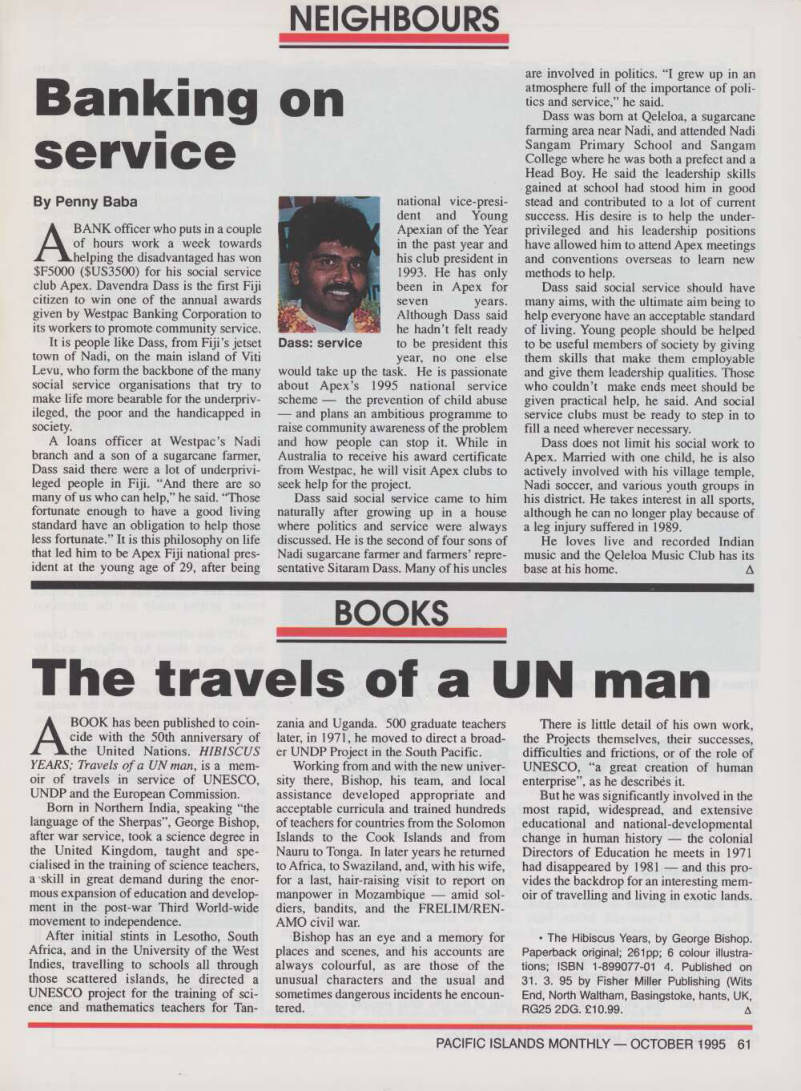
Neighbours
Banking on service
By Penny Baba
A BANK officer who puts in a couple of hours work a week towards helping the disadvantaged has won SFSOOO (SUS3SOO) for his social service club Apex. Davendra Dass is the first Fiji citizen to win one of the annual awards
given by Westpac Banking Corporation to
its workers to promote community service.
It is people like Dass, from Fiji’s jetset town of Nadi, on the main island of Viti Levu, who form the backbone of the many social service organisations that try to make life more bearable for the underpriv ileged, the poor and the handicapped in
society.
A loans officer at Westpac’s Nadi branch and a son of a sugarcane farmer, Dass said there were a lot of underprivi leged people in Fiji. “And there are so many of us who can help,” he said. “Those fortunate enough to have a good living standard have an obligation to help those less fortunate.” It is this philosophy on life that led him to be Apex Fiji national pres ident at the young age of 29, after being
national vice-presi
dent and Young Apexian of the Year in the past year and his club president in 1993. He has only been in Apex for seven years.
Although Dass said he hadn’t felt ready to be president this year, no one else
would take up the task. He is passionate about Apex’s 1995 national service scheme the prevention of child abuse and plans an ambitious programme to raise community awareness of the problem and how people can stop it. While in Australia to receive his award certificate from Westpac, he will visit Apex clubs to seek help for the project.
Dass said social service came to him naturally after growing up in a house where politics and service were always discussed. He is the second of four sons of Nadi sugarcane farmer and farmers’ representative Sitaram Dass. Many of his uncles
are involved in politics. “I grew up in an atmosphere full of the importance of poli tics and service,” he said.
Dass was bom at Qeleloa, a sugarcane farming area near Nadi, and attended Nadi
Sangam Primary School and Sangam
College where he was both a prefect and a Head Boy. He said the leadership skills gained at school had stood him in good stead and contributed to a lot of current success. His desire is to help the under
privileged and his leadership positions
have allowed him to attend Apex meetings and conventions overseas to learn new methods to help.
Dass said social service should have many aims, with the ultimate aim being to help everyone have an acceptable standard of living. Young people should be helped to be useful members of society by giving them skills that make them employable
and give them leadership qualities. Those
who couldn’t make ends meet should be given practical help, he said. And social service clubs must be ready to step in to fill a need wherever necessary.
Dass does not limit his social work to Apex. Married with one child, he is also actively involved with his village temple, Nadi soccer, and various youth groups in his district. He takes interest in all sports, although he can no longer play because of a leg injury suffered in 1989.
He loves live and recorded Indian music and the Qeleloa Music Club has its base at his home. A
Dass: service
The travels of a UN man
Books
A BOOK has been published to coin cide with the 50th anniversary of the United Nations. HIBISCUS YEARS; Travels of a UN man, is a mem oir of travels in service of UNESCO, UNDP and the European Commission.
Bom in Northern India, speaking “the language of the Sherpas”, George Bishop, after war service, took a science degree in the United Kingdom, taught and spe cialised in the training of science teachers, a skill in great demand during the enor mous expansion of education and develop ment in the post-war Third World-wide movement to independence.
After initial stints in Lesotho, South Africa, and in the University of the West Indies, travelling to schools all through those scattered islands, he directed a UNESCO project for the training of sci ence and mathematics teachers for Tan
zania and Uganda. 500 graduate teachers later, in 1971, he moved to direct a broad er UNDP Project in the South Pacific.
Working from and with the new univer sity there, Bishop, his team, and local assistance developed appropriate and acceptable curricula and trained hundreds of teachers for countries from the Solomon Islands to the Cook Islands and from Nauru to Tonga. In later years he returned to Africa, to Swaziland, and, with his wife, for a last, hair-raising visit to report on manpower in Mozambique amid sol diers, bandits, and the FRELIM/REN AMO civil war.
Bishop has an eye and a memory for places and scenes, and his accounts are always colourful, as are those of the unusual characters and the usual and sometimes dangerous incidents he encoun tered.
There is little detail of his own work, the Projects themselves, their successes, difficulties and frictions, or of the role of UNESCO, “a great creation of human enterprise”, as he describes it.
But he was significantly involved in the most rapid, widespread, and extensive educational and national-developmental change in human history the colonial Directors of Education he meets in 1971 had disappeared by 1981 and this pro vides the backdrop for an interesting mem oir of travelling and living in exotic lands. • The Hibiscus Years, by George Bishop.
Paperback original; 261 pp; 6 colour illustra tions; ISBN 1-899077-01 4. Published on 31. 3. 95 by Fisher Miller Publishing (Wits End, North Waltham, Basingstoke, hants, UK,
Rg2S 2Dg. £10.99. A
In God’s hands

Irfaan’s lessons in the mosque has nothing to do with the growth of Islam; it is a chance to escape the claws of poverty
By Yunus Rashid
IT was hardly dawn in Fiji’s capital Suva, but 15-year-old Irfaan Mo hammed was already getting out of bed. For him the day has begun.
Irfaan is a student of Islam, one of many teenagers devoted to the laws of the Koran, and learning Arabic to know the word of God. The ultimate aim is to
become a maulvi, one who can teach Islam in schools or preach it in mosques.
Today Irfaan lives in a dormitory and studies in the mosque. It is not an easy life. For Irfaan, the day starts at sam when he has to crawl out of the warmth of his blanket and perform wuzu, the first duty of the day, which involves the cere monial washing of the face, mouth, hands and feet. Only then is he ready for the first of the five daily prayers called Fajr
Having fulfilled the ritual, Irfaan makes his way to the mosque at Toorak, an old part of Suva; a cool, pre-dawn breeze blows in from the sea, slowly stir ring the rest of the city awake.
Irfaan came to the mosque after the death of his father. He was running away from the hopelessness of poverty. Back home are two brothers, and a mother who cannot find work.
At 5.30 am, Irfaan is at the mosque and the azan (prayer call) is made, echoing around the neighbourhood and waking Muslims in this part of the world. It’s all over in 25 minutes and for Irfaan, study begins. He gets a copy of the Holy Koran and revises the previous day’s lessons.
The reading of Arabic is hard and so is discipline. In an hour, breakfast is served and the little teenager settles in for the day.
Sometimes Irfaan feels the loneliness of being away from home for too long.
He misses his mother and brothers and yearns to return to the warmth of their company. The thought of the hardship at home and education’s promise of a better life keeps him in the city.
The second prayer, Zohar, is said at lunch. And Irfaan continues to study, learning to read and write Urdu, a combi nation of the Arabic, Sanskrit, and Persian languages. These lessons con ducted by Maulana Bashir Ahmed Diwan, a Muslim priest originally from India, continue until 3pm. Then it is time to clean the mosque and do personal chores like washing and mending clothes before getting ready for the afternoon prayer.
After the afternoon prayer, Asr, Irfaan leams more about his religion and by sunset he is ready for the fourth prayer, Magrib .
Dinner is served in the dormitory and the aspiring priest returns to the mosque for more lessons. The tutorials continue after, Isha, the last prayer of the day has been said. And at 9.30 pm Irfaan is in bed and falling off to sleep.
It is a regimented lifestyle, well ros tered and adhering strictly to the disci pline and teachings of the Koran. For Irfaan it offers a light at the end of the tunnel. It is an opportunity to escape the claws of poverty.
And it is a partnership with God. A
Ifraan Mohammed: the day begins early
Advertisements & other items, pp. 62-64 (1 item)
Scrap Metal
Tall ingots operate from Brisbane, Australia and make frequent visits to the Pacific Islands which they have done for twenty-five years. We are buyers of Copper, Brass, Aluminium, Lead, Batteries, Battery Lead. Cable etc.
Inspection no problems.
Telephone 817 8922033 Fax 61 78922077.
0 5 10 15 20 25 30 35 40 45 50 55 60 0 0
I A LIFETIME OF SERVICES
35 40 Grand Pacific Life Insurance offers you a lifetime of safe, secure products at very competitive rates. Choose from a full range of products such as
• Super Ordinary Life
• Super Universal • Non-Participating Whole Life • 10-Year Level Term • Flexible Premium Annuities • Group Life Insurance
• IRAs
• Graded Premium Whole Life Jj We've been dedicated to providing fast, personalized service for more than 35 years through local ownership and management.
Pacific life Insurance, UA That's why Grand Pacific Life is your Family for Life ...throughout the Pacific . 35 40 45 45 10 15 20 25 30 35 40 45 50 55 60
Grand PAcpcjM Insurance, Ltd.
... * * A member of the Finance Factors Family
FEDERATED STATES
OF MICRONESIA
Actouka Executive Insurance Underwriters P.O. Box 55, Kolonia, Pohnpei, Federated States of Micronesia 96941 Pacific Basin Insurance & General Services, Inc P.O. Box 494, Chuuk State, Federated States of Micronesia 96942
TONGA
Peseti Ma ‘afu Ins. & Finance, Ltd.
Private Bag 2, Taumoepeau Bldg.
Nukualofa, Tonga
GUAM
Great National Insurance Underwriters, Inc.
P.O. Box GA, Agana, Guam 96910 Pacific Financial Corporation P.O. Box AT, Agana, Guam 96910 Takagi & Associates, Inc.
GCIC Bldg., Suite 100 414 W. Soledad Ave.
Agana, Guam 96910
MARSHALL ISLANDS
Marshalls Insurance Agency P.O. Box 113, Majuro, Marshall Islands 96960
AMERICAN SAMOA
Mark Solofa Pacific Insurance & Finance, Inc.
P.O. Box 3149 Pago Pago, American Samoa 96799
WESTERN SAMOA
Mark Solofa Pacific Insurance & Finance, Inc.
P.O. Box 3149 Pago Pago, American Samoa 96799
NORTHERN MARIANAS
Pacific Basin Insurance Underwriters, Inc.
P.O. Box 710 Saipan, Mariana Islands 96950 Pacifica Insurance Underwriters, Inc.
P.O. Box 168, Saipan, Mariana Islands 96950 Grand Pacific Life Insurance, Ltd. • 1164 Bishop Street, sth Floor, Honolulu, HI 96813 Phone: (808) 548-3363 • FAX: (808) 548-5122
N c>
Pff
Bom to run
The Mitsubishi Lancer: A family sedan that’s practically built to perform.
Lancer leaves the rest of its class in the dust.
Yes, it is a family sedan. Comfortable and practical.
But exciting, too, because Mitsubishi hasn’t forgotten what truly drives you: the pure pleasure of total driving performance.
Its ground-hugging chassis holds comers tight. A self-aligning multi-link suspension adjusts to the road no matter what the driving conditions. And the aggressive, fuel-efficient 16-valve SOHC engine makes Lancer eager and responsive in the passing lane.
All of this performance comes from one very simple idea —our total approach to engineering.
We believe that unless each aspect of a car is fully integrated into the overall design, the result will never exceed the sum of the parts. The difference is self-evident. Behind the wheel.
And on the road.
It is this philosophy that makes every Mitsubishi such a reassuring and rewarding driving experience. Whether it’s our top-end Mitsubishi Sigma, technologically sophisticated Galant, all-weather 3000 GT sports car, or offroad 4WD Pajero... they’re all driven by the power of positive thinking.
So take the wheel of a Lancer, the family sedan that performs like a thoroughbred.
MITSUBISHI LRNCER
What Drives You.
AMERICAN SAMOA: PACIFIC MARKETING INC. P.O. Box 698, Pago Pago, Tel. 699-9140 / AUSTRALIA; MITSUBISHI MOTORS AUSTRALIA LTD. 1284 South Road, Clovelly Park, South Australia, 5042, Tel. (08) 2757297 / FLU: NIVIS MOTOR & MACHINERY CO. LTD. G.P.O. Box 150, Suva, Tel. 383411 / GUAM: TRIPLE J ENTERPRISES INC. P.O. Box 6066, Tamuning, Tel. 6469126 / NEW CALEDONIA: SOCIETE DTMPORTATION D'AUTO DU RACIFIQUE SUD S.A. P.D Box 438, Noumea, Tel. 272-562 / NEW ZEALAND: MITSUBISHI MOTORS NEW ZEALAND LTD Private Bag. Porirua, Tel. 237-0109 / NORFOLK ISLAND; BORRY'S PTY LTD P.D Box 169, Taylors Road, Burnt, Tel. 2114 / PAPUA NEW GUINEA: TOBA MOTORS PTY LTD. P.O. Box 503, Port Moresby, Tel. 217-874 / SAIPAN: SAIPAN AUTOWORLD INC. P.O. Box 487, Tel. 234-7133 / SOLOMON ISLANDS; HARVEST PACIFIC LTD. G.P.O. Box 888, Honiara, Tel. 30407 / TAHITI: SOPADEP S.A. B.P. 1617, Papeete, Tel. 427393 / TONGA: SITANI MAPI CO., LTD. P.D Box 83, Nuku'Alofa, Tel. 24044 / VANUATU: SOCOMETRA VANUATU LTD. B.P. 6, Port-Vila, Tel. 2314 / WESTERN SAMOA: MOTOR DISTRIBUTORS (SAMOA) LTD P.O. Box 576, Apia, Tel. 20957 A
MITSUBISHI
MOTORS
CREATING TOGETHER