Pacific
Islands
Monthly
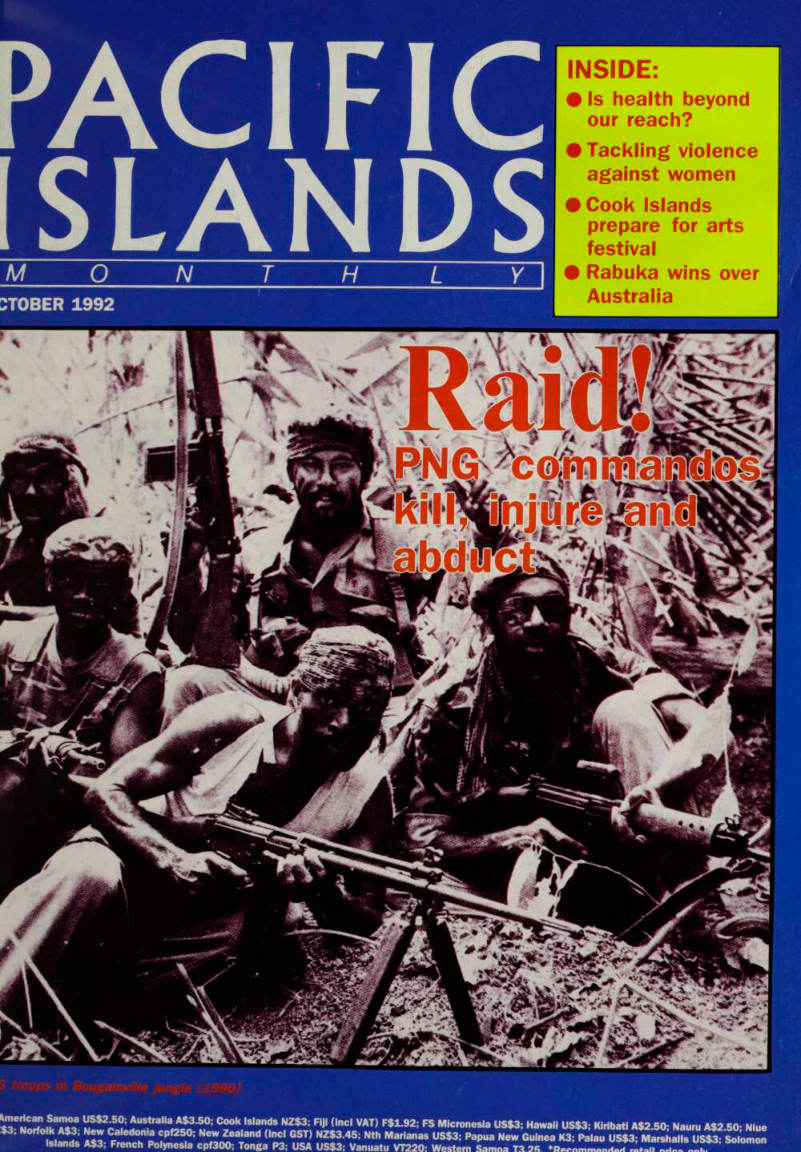
Inside:
• Is health beyond our reach? • Tackling violence against women • Cook Islands prepare for arts festival • Rabuka wins over Australia
:Tober 1992
KOVufcll?’
t
S3 e N C o a ;„,tT«. ? s2^?; * U,tralUl -^ 3 - 50; c “V S, “ dS NZs3 \ Fl|i l lncl VAT > f* l - FS Micronesia US$3; Hawaii US$3: Kiribati A$2.SO; Nauru A$2.SO: Niue $ ’ Caledonia cpf2so; New Zealand (incl GST) NZ53.45; Nth Marianas US$3; Papua New Guinea K 3; Palau US$3; Marshalls US$3; Solomon Islands As 3; French Polynesia cpf3oo; Tonga P 3; USA US$3; Vanuatu VT22O: Western Samoa T 3 3s retail nri/sA
Advertisements & other items, p. 2 (1 item)
Pacificall
A warm welcome is probably the m important thing that any bank has offer. Being the biggest bank in Fiji c part of the largest banking group in Pacific may give us the edge in provid the best facilities for you locally c internationally, but never at the expe: of our individual personal service. A ■ all, that is why we are where we today. Here for you, ANZ Bank F Your bank.
Official Sponsor 1992 Olympic Team
OQO
Fiji
Pacific
Islands
Montly
Vol 62 No. 10
The News Magazine
October 1992
From The
Editor’S Desk 4
Letters 5
20Ver Story:
S NG troops in cross-border raid 6
Olitics:
abuka wins over Australia 10
Uman Rights:
le East Timor dilemma 13 )ugainville on the aggenda 15
Isaster:
phoon Omar smashes Guam 16
Women:
It’s a woman’s life 19 A new kind of violence 21
Health:
Are we eating ourselves to death? 24 Famine of knowledge 26 When the doctors leave 27 The growing threat of AIDS 28 A matter of setting the right priorities 32 Looking abroad for treatment 34 The cost of health 35 Setting an example 36
Environment:
Caring for the country a new dimension 38
Festival:
A spectacular cultural event in the making 40 Sea-faring Pacific Islanders 42
Culture:
Hip-notizing hula 46
Sports:
Having a (net) ball 49 More than ‘sports tourists’ 50
Yacthing:
Fiji Regatta Week 52
Shipping:
Shipping Schedules 56
Columnists:
Margot O’Neill 9 Jemima Garrett 11 David Barber iq Bill McCabe 37 Alfred Sasako 45 Julian Moti 43
Publisher: Gene Swinstead
Editor: Mala Jagmohan
ienlor Writer: Martin Tiffany Correspondents: Christine Hatcher, David North, Ed Rampell, lan Villiams, Johnson Honimae, Karen Mangnall, Liz hompson, Nicholas Rothwell, Pesi Fonua Wally liambohn.
Columnists: David Barber (Wellington), Futa Helu Tonga, covering the Pacific Islands), Jemima .arrett (Sydney), Margot O’Neill (Washington) ulian Moti (Pacific Law), Alfred Sasako (The orum).
Business and Advertising Manager, Charlotte Thomas Advertising Sales: • Regional Sales (South Pacific); Salendra Narayan. Tel (679) 304111, Fx (679) 303809 • Sydney, Canberra: Bob Hill Media Reoresen tations, Tel (61-2) 4164245, Fx (61-2) 4165064 • Brisbane: Robert Walker, Media House, Tel (61-7) 3710533, Fx (61-7) 371-8904 • Adelaide: Hastwell Williamsons Representations, Tel (61-8) 799522, Fx (61-8) 799735 • Auckland: McKay International Media Reps Ltd, Tel (64-9) 4190561, Fx (64-9) 4192243 • Japan; Universal Media Corporation, Tokyo, Tel (3) 6663036, 66630R4 Cable: UNIMEDIA Tokyo, Tx 2524665.
Founded 1930 (USPS 952480). A Fiji Times Limited production.
Cover prices are recommended retail only. Regis tered by Australia Post, Publication No. NBP 1210 © Copyright Fiji Times Limited, 177 Victoria Parade, Suva. Fiji. Tel (679) 304111, Fx (679)
303809. Tx Fj2124.
Pacific Islands Monthly is published monthly by The Fiji Times Limited, a division of Nationwide News, 2 Holt Street. Surry Hills, Sydney. NSW 2010.
Send address changes to: • Pacific Islands Monthly, PO Box 1167, Suva, Fiji Typeset and printed by The Fiji Times Limited, 177 Victoria Parade, Suva, Fiji.
[?]rster: on Bougainville
Kanawi: on violence against women
Cook Islands: prepares for festival
Is health beyond our reach?
From The Editor’S Desk
POUR-YEAR-OLD Sonia Nisha (pic tured) of Suva, Fiji has a serious heart condition which needs treatment not available in Fiji. But to go overseas, Australia or New Zealand, would cost money the type of money her family does not have. Efforts were made in the last two years to launch fund-raising drives, but these have not been succesful.
So she whiles away her time at home, waiting for a miracle.
Sonia is but one of hundreds of children throughout the region who need medical attention not available locally.
In addition, there are just as many adults whose financial positions do not give them access to treatments they need to lead healthy normal lives.
This is the situation in the Pacific. And this is the situation PIM has chosen to highlight this issue. For while we think we are developing and progressing econ omically, we are still not able to adequately look after the health needs of
our people.
We have the hospitals, but not enough skilled people to man them; we have health education programs but they are
not reaching enough people; and we
have drug-purchasing schemes but are still chronically short of them.
While governments desperately try to improve our health standards, they receive blame, for a large part, for bungling the system in the first place for failing to provide incentives for
doctors to remain, for bad administration which means hospitals are running short of drugs, and for not treating health as
a priority in allocating budgetary funds.
The governments and regional health bodies have recognised the system needs to be improved and have begun a number of processes to address the problems. One of these is the introduc tion of a new curruculum at the Fiji School of Medicine the regional
medical school. It has moved away from I the standard six-year degree program adopted by developed countries and has! formulated its own course which will produce medical officers more suited to needs of the region. This is perhaps a double-pronged approach to the prob-” lem the doctors will gain training specifically for the Pacific so that there are more health workers in the field and will probably also deter them from leaving the region for “greener pastures”! elsewhere.
A number of options have been offered to regional governments all require a redefining of the role of government asr provider of health services. One of them is to encourage the development of private health care and hospitals to makejj them cater to the general out-patient ; needs. This would free-up the public i health sector and its funds to provide the specialised treatment not available now. 1 Another alternative is for the govern-1 ment to encourage the development of a! health insurance scheme. The scheme] need not be run by the government, but < it should have regulatory controls to ensure adequate cover is provided. And! governments may consider releasing doc-1 tors administering health departments I and replacing them with administrators I so that the doctors can do the work they have been trained for.
Advertisements & other items, p. 4 (2 items)
4
PAPIPir IQ I AM HQ MOMTHI Y Dr.TDRFR IQQP
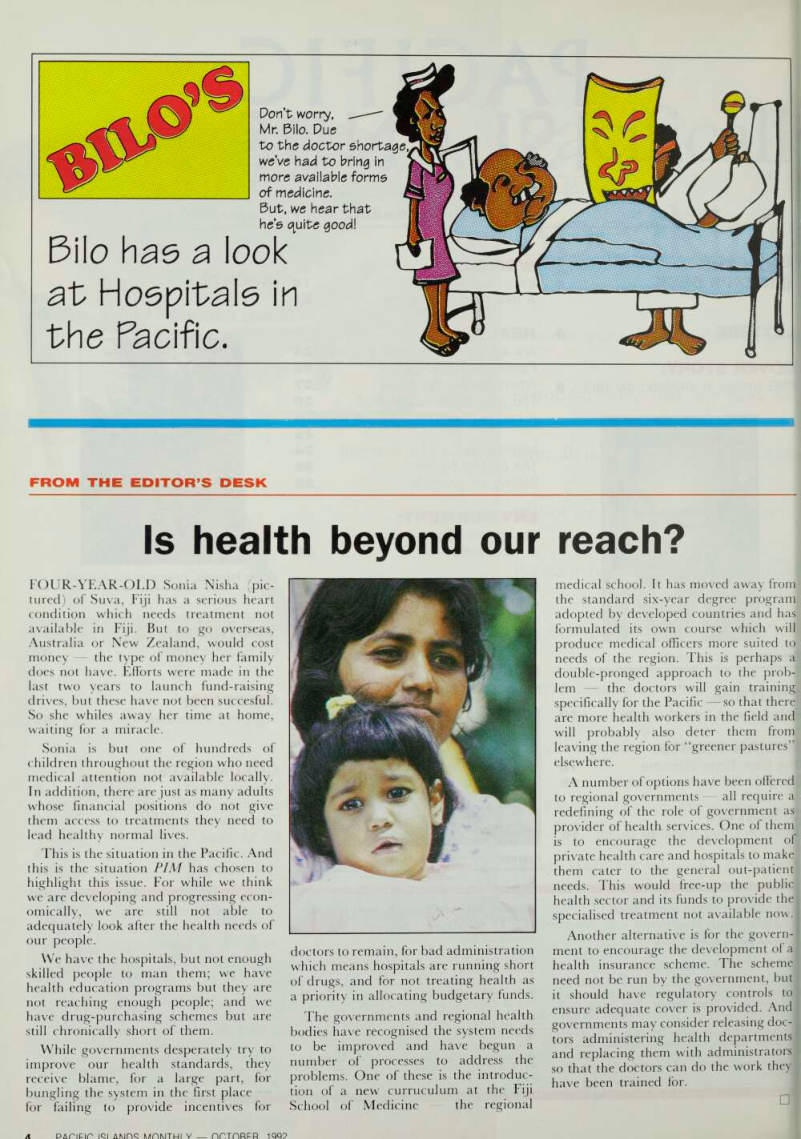
the Pacific.
Don't worry, — Mr. E3il o. Due to the doctor shortage,] we’ve had to bring in more available forms of medicine.
But, we hear that he’s quite good!
E3il o has a look
at Hospitals in
the Pacific.
r
pollution
Letters
Kanak
mind
pollution
I wish to add to Susi Newborn’s “Toxic New Caledonia” {PIM, July 1992) a few comments on a related issue: mind pollution.
Since the Prise de possession , the Kanak people have been so intensively brain washed that they now are deliberate or innocent accomplices of the colonialist system.
Indeed, in Kanaky presently, the mported society is the norm, for
environmental problems are uncon
;ciously perceived as logical and ac :epted steps towards development in ts general meaning.
True freedom fighters aware of this ibsurdity have all paid with their lives, fhey are Atai, Eloi Machoro, Djubelly Yea and Alphonse Dianou to name a ew. Present Kanak leaders are com iromised individuals who more and norc distance themselves from the
ribe-peoplc majority.
Yet, they fail to acknowledge the acial and health problems of salaried
Lanak workers living in polluted
reas. Governmental housing projects
overtly favour foreign immigration,
nence the continuing colonisation of Lanak lands.
Moreover, no awareness program on te effects of pollutants on humans is vailable. The average person in the reet does not even know of the E.P.A. r the objectives of the news-making rreenpeace movement.
Hazardous chemicals are “White’s lings” like the HIV virus and Kanak Inesses are caused by sorcery.
Unfortunately, Kanak, people ig
ure their ignorance of the colonial oety, which makes them easy prey to ilonialists and themselves.
Political divisions within the FLNKS are direct effects of mind pollution, consequently, it comes as no surprise that the Kanak independence movement moves one step forward today and two steps backward tomor row, as illustrated by the signing of the Matignon Accords.
And for what price! Remember the Tiendanite and the Gossana massacres.
Wake up Kanaky, time is running out ! -Benjamin Malie (Kanak student) Victoria Australia.
Ratieta
Foundation
The Florence Reiher Ratieta Mem orial Foundation has begun its 1992 contribution drive. The foundation will recognise excellence in English composition by senior honor roll students in primary and high schools of Kiribati.
SUS2SO is awarded at the end of each school year to a student from each
school. The award is based on a
composition competition addressing a
pertinent topic. This year’s topic is environmental issues facing the Re public of Kiribati. The foundation was established in 1990 in memory of Florence Reiher Ratieta who was killed in an automobile accident.
Several contribution levels have been set up: benefactor SUSIOOO or more; patron S 500; sponsor 5250; contributor - SI00; friend 5435; and special - 5425. The last category is especially for Kiribatise students overseas.
Contributions should be sent to Florence Reiher Ratieta Memorial Foundation, Box 251, Majuro, MH 96960; or, c/o Anne loanne, trustee, Ratieta Brothers, Box 801, Majuro, MH 96960.
Mary C. loane
Secretary for the Foundation Majuro
Letters To The Editor Should
be adrressed to: Pacific Islands Monthly PO Box 1167 Suva, Fiji Islands.
Fax: (679) 303809
Advertisements & other items, p. 5 (1 item)
Pacific Islands Monthly
GPO Box 1167, Suva, Fiji.
Subscriptions rates include the cost of airspeeding to all destinations set out above.
Direct airmail rates on application.
Telephone: 304111 Fax: 303809
PNG troops in cross-border[?]raid
COVER STORIES PNG in cress-border[?]raid
By Johnson Honimae
On September 12, PNG Defence Force troops crossed the Solomon Islands border, killed two unarmed civilians, abducted another and injured a three-year-old. The incident has further strained the detriorating relations between the two countries.
SOLOMON ISLANDS government has issued its strongest statement to date in the two-year Bougainville civil strife but was waiting the return from the Shortland Islands of a high level delegation before making any further moves in the border crisis.
The prime minister wanted first-hand information on the cross-border raid which resulted in the killing of two Solomon Islanders, the wounding of a young child and the abduction of another Solomon Islands citizen.
The delegation comprising the Governor-General, Sir George Lepping, Minister of Police and Justice, Albert Laore, Commissioner of Police, Fred Soaki, and other senior government officials is to present a report on its findings to Cabinet.
The government is then expected to decide whether to expel, the Papua New Guinea High Commissioner, Frank Miro, and the hard-core BRA (Bougain ville Revolutionary Army) elements liv ing in Honiara, including Martin Miriori and John Zale.
But documents seen by Solomons Voice have revealed the Minister of Foreign Affai rs and Trade Relations, Job Duddley Tausinga, is against expelling Miro.
The minister has, instead, recom mended the government expel the Bou gainville interim government spokes man, Miriori, and Zale. The report will also decide whether a state of emergency be declared at the border area and an emergency meeting of the national par liament held.
The early morning raid, w hich saw the
killing of a ni-Kiribati-Solomon Islander, Peter Kamaraia, and his sister, the wounding of the sister’s three-year-old daughter, Jacinta, and the abduction of her husband, have resulted in some of the strongest statements ever issued by a Solomon Islands government.
In its formal protest note, sent through the PNG High Commissioner, late Tues day, Solomon Islands said the acts of the members of the PNG Defence Force were totally unprovoked and uncalled for.
“The people and government of Sol omon Islands express with deep shock and displeasure the atrocious and sadistic acts of members of the PNG Defence Force on innocent and unarmed civ ilians.”
“The people and government of Sol omon Islands protest in the strongest possible terms the brutal killing of its citizens over an internal dispute in which they have little part to play.”
The government said it did not want to pay in blood and life over a dispute that ought to be fought on PNG soil.
In the protest letter, the Solomon Islands government called on the PNG government to: * immediately give assurance of the
safety and return of Beiaruru, who was abducted, to Komaliae Village; * give an expression of regret and excuses to the people and government of Sol omon Islands; * make payment of an indemnity in favour of the families of the deceased; * and bring those involved in this criminal act to justice.
In a statement issued on September 14, Prime Minister Solomon Mamaloni described the incident as barbaric. He said his government viewed the action of the PNG Defence Forces with seriousness and sadness.
“It is a very difficult time for all of us and Solomon Islands must now question the genuineness of some of its traditional friends.”
A meeting on Sunday (September 13) of representatives of the government, opposition and the chairman of the Parliamentary Foreign Relations Com mittee, questioned the sincerity of the Australian High Commission in Honiara and the Australian defence advisors attached to the Royal Solomon Islands Police Force.
The meeting also agreed to appoint a neutral special emissary to mediate
Conflicting reports on incursion
CONFLICTING reports of the incident have been received as inquiries and protests into the raid continue.
The Solomon Islands government’s official protest note to PNG says between 4.00-4.30 am on September 12, two out board motor-powered canoes identified as belonging to the PNG Defence Force were seen entering Komaliae Village in Shortland Islands.
“On reaching the shore, the soldiers went into the village whereupon they destroyed the trade store lights and fired shots from Ml 6 machine guns at the fuel
drums in the compound. A woman who attempted to escape the scene with her three-year-old child was fired at, injuring both her and her child seriously.” The woman subsequently died from loss of
blood.)
“Her brother, Peter Kamaraia, who came out of his house to investigate the noise, was stopped by two soldiers at gun point. He was shot at point blank range while trying to free himself. These were unprovoked attacks on unarmed civ ilians.”
The PNG government’s version says
PNG soldiers had knowingly crossed into Solomon Islands territory in pursuit of two “hard-core” BRA members after they crossed from Buin to the Shortland Islands.
“PNG Defence Force has reason to believe that when the two BRA members got to Shortlands, they were assisted by the Solomon Islands police and taken to Komaliae Village where the store owner would be harbouring them.”
When they were at the store two BRA members and the store owner apparently knew that the PNG Security Forces were
between PNG and SI on the spill-over effects of the Bougainville crisis and sent a full report on the intrusion by PNG Forces to the United Nations Security Council.
Meanwhile, PNG Prime Minister Paias Wingti had directed the acting Commander of the PNG Defence Force, Colonel Robert Dademo, to undertake a full investigation into the incident.
Wingti said if it was confirmed citizens of lis country killed citizens of another, hen “they must be brought to justice.”
In another development, PNG High Commissioner in Honiara, Frank Miro, lescribed as “total lies” a statement from he Solomon Islands National Security ieadquarters (5.1.N.5.H.) in the prime ninister’s office, that he had contacted Jougainvilleans and the PNG Defence "orce through a radio in the store which yas raided.
A statement from the S.I.N.S.H. had laimed the Komaliae trade store where be raid took place was a contact point Dr PNG agents operating in the Solomon slands and South Bougainville. The tatement claimed two people, identified s Tony Anugu and Bernard Simiha, sed the store radio to communicate with NG forces and the PNG High Com lission in Honiara.
Miro strongly refuted the claims, tying “My office had never had any Dmmunication with any radio in the hortland Islands or in any other part of le country for that matter.”
But the national security headquarters ys “it might be concluded that the tiding PNG party discovered the wrong ?rson at the trade store instead of its jent” and were “forced to shoot the rmer to silence him forever”. □ •ruing and so escaped to hide in a ;arby area. The PNG soldiers were shot first, followed by some cross-fire, “but e PNG Security Forces fired into the
r as they were retreating”.
“Furthermore, the PNG Security >rces claim they have not shot anybody >r had they any intention of raiding the )re. They were merely there to arrest e two hard-core BRA members who e known for harassment and murder of nocent PNG citizens around the Buin ea.”
As the soldiers retreated they took ptive a Solomon Islander and a two ly radio “believed to be frustrating the iteration process”. The Solomon ander was taken to Buka and wass to ve been released on September 15. □
Solomons may give
recognition to BRA
By Johnson Honimae
THE Solomon Islands govern
ment is contemplating giving
recognition to the Bougainville
Revolutionary Army and the
self-styled Republic of Bou
gainville. In a statement issued
on Tuesday (September 15),
his second since two Solomon Islanders were killed in the Shortland Islands on Saturday
by Papua New Guinea
soldiers, Prime Minister Sol omon Mamaloni said the issue of recognition could be an issue to be raised at an emergency meeting of parliament, if a state of emergency were to be declared at the border area.
Mamaloni said,“Many Solomon Islands leaders and people are now questioning the sincerity of both PNG and Australian Governments since it is Australia which is supply ing the lethal weapons with which PNG forces are killing Bougainvilleans and Solomon Island ers.”
The Prime Minister said in terms of Melanesian culture and tradition it seemed the BRA respected Solomon Islands sovereignty more than the PNG sovereign government.
“BRA has not yet killed any Sol omon Islands citizens during this long protracted crisis. This is not the same case with PNG and Australia.”
In the same statement, Prime Min ister Mamaloni revealed that a request had been made to the Australian government to send its troops to Solomon Islands to protect the border and ensure that PNG force did not cross into Shotlands or Choiseul.
“Failing this,” Mamaloni said, “the Solomon Islands government has no option but to venture out into the world to seek for much needed military assistance.”
Meanwhile, the Solomon Islands
government has refused diplomatic clearance for a visit of the Royal Australian Navy ship Bendigo.
The weekend raid by PNG soldiers has also led the questioning of the genuineness of the Australian High Commission in Honiara by Prime Minister Mamaloni.
This has raised questions in the Australian National parliament. In answer to the questions, Australia’s Foreign Affairs Minister, Senator Gareth Evans, said the High Com mission in Honiara and its officers had at all times carried out with meticulous care the Australian government’s pol icy of support for Solomon Islands
sovereignty.
“We have offered on a number of occasions to provide appropriate assist ance to the Solomons to help the country manage its borders,” said Senator Evans.
Senator Evans said his government had offered assistance to the Solomon Islands government to build a perma nent base in the Western Province for the border activities of its police, “but we have not yet received any formal proposal from the government.”
And Australia is to re-state its concern about controls on Papua New Guinea’s military.
The Australian Minister for trade and Overseas Development, John Kerin, is scheduled to visit Papua New Guinea capital Port Moresby primarily for aid review matters.
But he is also expected to express Canberra’s concern about the killings in the cross-border raid. Australian officials say Kerin will repeat the message given in August by Evans that the civilian government in Papua New Guinea must assert full control over its soldiers.
Meanwhile, Solomon Islands Cabi net met most of Thursday (September 17), to discuss its next political move following a fact-finding mission to the site of the raid.
Cabinet was expected to discuss the convening of an emergency session of the Solomon parliament to debate the issue. □
Advertisements & other items, p. 8 (1 item)
Your Island Connections
% m 4
Cable and Wireless began keep-
ing people in touch around the
world more than a century ago. Today,
while the technology has changed,
the tradition of service to our customers in the
South Pacific is just the same.
We work in partnership with Governments,
dedicated to meeting the need of communities and businesses to stay in touch. From one island to the next or to the other side of the world, the message is the same: Cable and Wireless is
your South Pacific
connection bringing the
islands together.
CABLE & WIRELESS
Asia Pacific Head Office Cable and Wireless pic Cable and Wireless (Pacific) Limited 22 nd Floor Office Tower Convention Plaza 1 Harbour Road Hong Kong Australia Cable and Wireless (Australia) Pty Ltd PO Box 675, Double Bay NSW 2028 Sydney Australia Tel/Fax (61-2) 362 3625 Fiji In association with the Government of Fiji Fiji International Telecommunications Ltd.
PO Box 59 Mercury House 158 Victoria Parade Suva Fiii Solomon Islands In association with the Government of the Solomon Islands Solomon Telekom Company Limited PO. Box 148 Honiara Solomon Islands Tel: (677) 21576 Tonga Cable and Wireless pic Private Mail Bag 4 General Post Office Nuku Alofa Tonga South Pacific Tel: (676) 23499 Vanuatu In association with the Government of Vanuatu and France Cables et Radio Vanuatu International Telecommunications Ltd.
PO. Box 164 Port Vila Vanuatu Tel: (678) 22185
To the presidents’ health
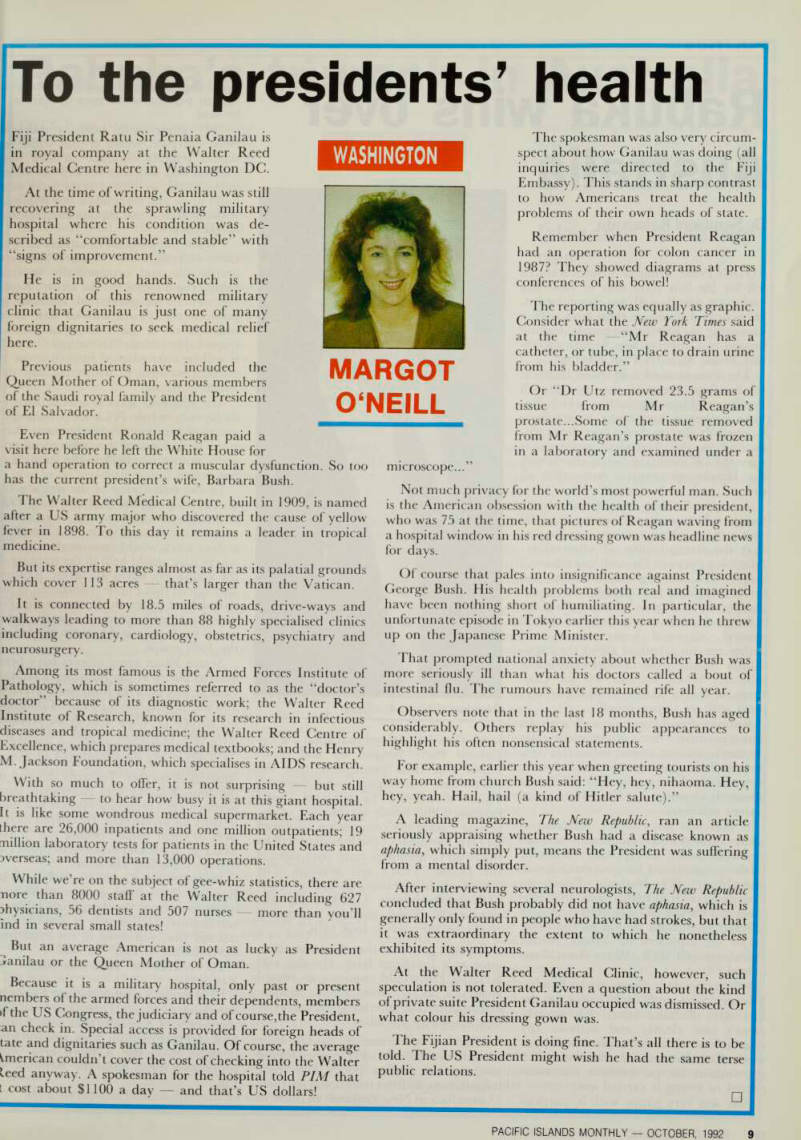
Fiji President Ratu Sir Penaia Ganilau is in royal company at the Walter Reed Medical Centre here in Washington DC.
At the time of writing, Ganilau was still recovering at the sprawling military hospital where his condition was de scribed as “comfortable and stable” with “signs of improvement.”
He is in good hands. Such is the reputation of this renowned military clinic that Ganilau is just one of many foreign dignitaries to seek medical relief here.
Previous patients have included the Queen Mother of Oman, various members of the Saudi royal family and the President of El Salvador.
Even President Ronald Reagan paid a visit here before he left the White House for
a hand operation to correct a muscular dysfunction. So too has the current president’s wife, Barbara Bush.
The Walter Reed Medical Centre, built in 1909, is named after a US army major who discovered the cause of yellow fever in 1898. To this day it remains a leader in tropical medicine.
But its expertise ranges almost as far as its palatial grounds which cover 113 acres that’s larger than the Vatican.
It is connected by 18.5 miles of roads, drive-ways and walkways leading to more than 88 highly specialised clinics including coronary, cardiology, obstetrics, psychiatry and neurosurgery.
Among its most famous is the Armed Forces Institute of Pathology, which is sometimes referred to as the “doctor’s doctor” because of its diagnostic work; the Walter Reed Institute of Research, known for its research in infectious diseases and tropical medicine; the Walter Reed Centre of Excellence, which prepares medical textbooks; and the Henry M. Jackson Foundation, which specialises in AIDS research.
With so much to offer, it is not surprising but still breathtaking to hear how busy it is at this giant hospital.
It is like some wondrous medical supermarket. Each year there are 26,000 inpatients and one million outpatients; 19 million laboratory tests for patients in the United States and overseas; and more than 13,000 operations.
While we’re on the subject of gee-whiz statistics, there are more than 8000 staff at the Walter Reed including 627 physicians, 56 dentists and 507 nurses more than you’ll ind in several small states!
But an average American is not as lucky as President 3anilau or the Queen Mother of Oman.
Because it is a military hospital, only past or present nembers of the armed forces and their dependents, members >fthe US Congress, the judiciary and of course, the President, an check in. Special access is provided for foreign heads of tate and dignitaries such as Ganilau. Of course, the average American couldn’t cover the cost of checking into the Walter leed anyway. A spokesman for the hospital told PIM that t cost about SHOO a day and that’s US dollars!
The spokesman was also very circum spect about how Ganilau was doing (all inquiries were directed to the Fiji Embassy). This stands in sharp contrast to how Americans treat the health problems of their own heads of state.
Remember when President Reagan had an operation for colon cancer in 1987? They showed diagrams at press conferences of his bowel!
The reporting was equally as graphic.
Consider what the New York Times said at the time —“Mr Reagan has a catheter, or tube, in place to drain urine from his bladder.”
Or “Dr Utz removed 23.5 grams of tissue from Mr Reagan’s prostate... Some of the tissue removed from Mr Reagan’s prostate was frozen in a laboratory and examined under a
microscope...”
Not much privacy for the world’s most powerful man. Such is the American obsession with the health of their president, who was 75 at the time, that pictures of Reagan waving from a hospital window in his red dressing gown was headline news for days.
Of course that pales into insignificance against President George Bush. His health problems both real and imagined have been nothing short of humiliating. In particular, the unfortunate episode in Tokyo earlier this year when he threw up on the Japanese Prime Minister.
That prompted national anxiety about whether Bush was more seriously ill than what his doctors called a bout of intestinal flu. The rumours have remained rife all year.
Observers note that in the last 18 months, Bush has aged considerably. Others replay his public appearances to highlight his often nonsensical statements.
For example, earlier this year when greeting tourists on his way home from church Bush said: “Hey, hey, nihaoma. Hey, hey, yeah. Hail, hail (a kind of Hitler salute).”
A leading magazine, The New Republic , ran an article seriously appraising whether Bush had a disease known as aphasia , which simply put, means the President was suffering from a mental disorder.
After interviewing several neurologists, The New Republic concluded that Bush probably did not have aphasia , which is generally only found in people who have had strokes, but that it was extraordinary the extent to which he nonetheless i exhibited its symptoms.
At the Walter Reed Medical Clinic, however, such speculation is not tolerated. Even a question about the kind of private suite President Ganilau occupied was dismissed. Or what colour his dressing gown was.
The Fijian President is doing fine. That’s all there is to be told. The US President might wish he had the same terse public relations. □
Washington
Margot
O‘Neill
Rabuka wins over
Politics
Rabuka wins over Australia
By Samisoni Kakaivalu
FIJIAN Prime Minister Sitiveni Rabuka left for his first state visit to Australia early last month with no shopping list.
He returned home six days later with a promising package for his people, leaving behind in Canberra new friends, especi ally Prime Minister Paul Keating.
The visit marked a renewed bilateral relationship between the two South Pacific neighbouring nations which Ra buka reckoned had never before been enjoyed. It also marked a complete turn around by the Australian government since the 1987 military coups, after which the Hawke government suspended all defence and trade ties with Fiji.
A happy Rabuka said afterwards, “I feel that the most important aspect of the visit is that we have come to a realisation that the strengthening of bilateral re lationship between Fiji and Australia will augur well for regional stability and
further regional co-operation as equal
partners in the region.” The results of the talks, and media review of the visit in general, surprised many who would rather remain sceptical about the capa bilities of the army officer-cum-prime minister. When Rabuka left for Can berra, he said he had no shopping list and went with an “open mind”.
Rabuka timed his visit well with an announcement that government was putting in motion a constitutional review process. It was an announcement many, in particular Keating, longed to hear. It obviously cleared a hurdle in attempts to restore relations.
If that was not enough, Rabuka, in what political observers thought was an apparent move to appease Canberra further, announced his government was dismantling Fiji National Petroleum Company (FINAPECO). The establish ment of FINAPECO would have greatly affected operations in Fiji of the three major oil suppliers viz Mobil, British Petroleum and Shell. All are Australian owned.
When he sat down with Foreign Minister Senator Gareth Evans on the first day, Rabuka stated his govern ment’s case clearly and without any reservations. On the constitutional re view, Rabuka assured the Australian government his government was com mitted to seeing it carried out.
“He was very happy with it, particu-
larly when I explained that what the Fiji Labour Party jumped up and down about was their perception...that the referendum will be purely an indigenous Fijian referendum,” he said later. “But I explained the whole mechanism of the review ... that the commission approved by (His Excellency) the President will be made up of nominees from both sides of the House. That’s one concept. The other is a parliamentary committee to get MPs involved in it. I believe that the commission from outside parliament might be the way to look at it.”
Rabuka gave Keating the same assur ance at a luncheon later. He also told Keating Fiji would continue to regard Australia as a close friend, despite attempts by the interim government to look elsewhere for allies.
“Previous governments in Fiji have sometimes taken the view that we should re-direct our foreign policy and trade initiatives away from traditional partners (Australia and New Zealand) in order to
avoid dependency and also as a reaction against political differences of opinion,”] he said.
“My government holds a different! view, however, which is that while we] should sensibly continue to seek new! markets and alliances for Fiji elsewhere] in the world, we should at the same time! build upon and consolidate our relations] with our traditional trading and regional] neighbours.
“While our political views may have at] times differed, we are nevertheless, geo-] graphically and economically inextri-] cably bound together.” In return, Keat-j ing assured his guest that relationship between the two countries had been renewed on a basis of equality and respect. He added, “In the years ahead, it will be strengthened in such areas as trade, development assistance and de fence.
“In whatever ways practical, Austra lia is ready to help Fiji achieve balanced, i sustainable economic development. Aus-1 tralia looks forward to working with you once more to strengthen the security of
our region.”
In the resumption of the defence co operation program, Rabuka told PIM Australia would this month be resuming aerial maritime surveillance. The Aus tralian navy would resume visits to Fiji where they would help in the training of the young Fiji naval squadron. Keating also agreed that Fiji be re-included in the patrol boat program. It means the Fiji naval squadron would soon get the three patrol boats promised to them just before the 1987 coups.
Senior Fijian army officers have been assured places at the Joint Services Staff College in Canberra from next January,! and the new National Defence College to be opened in 1995. On trade, Rabuka was told Australia would review the' conditions of SPARTECA with a view to allowing more Fiji exports into the Australian market. Towards the end ofl the tour, Rabuka told Australian busi-l nessmen Fiji’s economic climate was now • healthy for investment. He offered incen-| tives to them while opening the “Lakop Mai Fiji” trade and investment project at Sydney’s Darling Harbour.
Before leaving Canberra, Rabuka told Keating Fiji sought greater trade and investment from the Australian business * community. “Ultimately it is trade and j not aid that will assist in the economic! development of Fiji,” he said.
He offered a final handshake to Keating.
“Let us both stretch out our hands in friendship as equals. I can assure you and the people of Australia that with a little give and take on both sides, you will find it hard to secure a more loyal and supportive friend than the Republic of Fiji.”
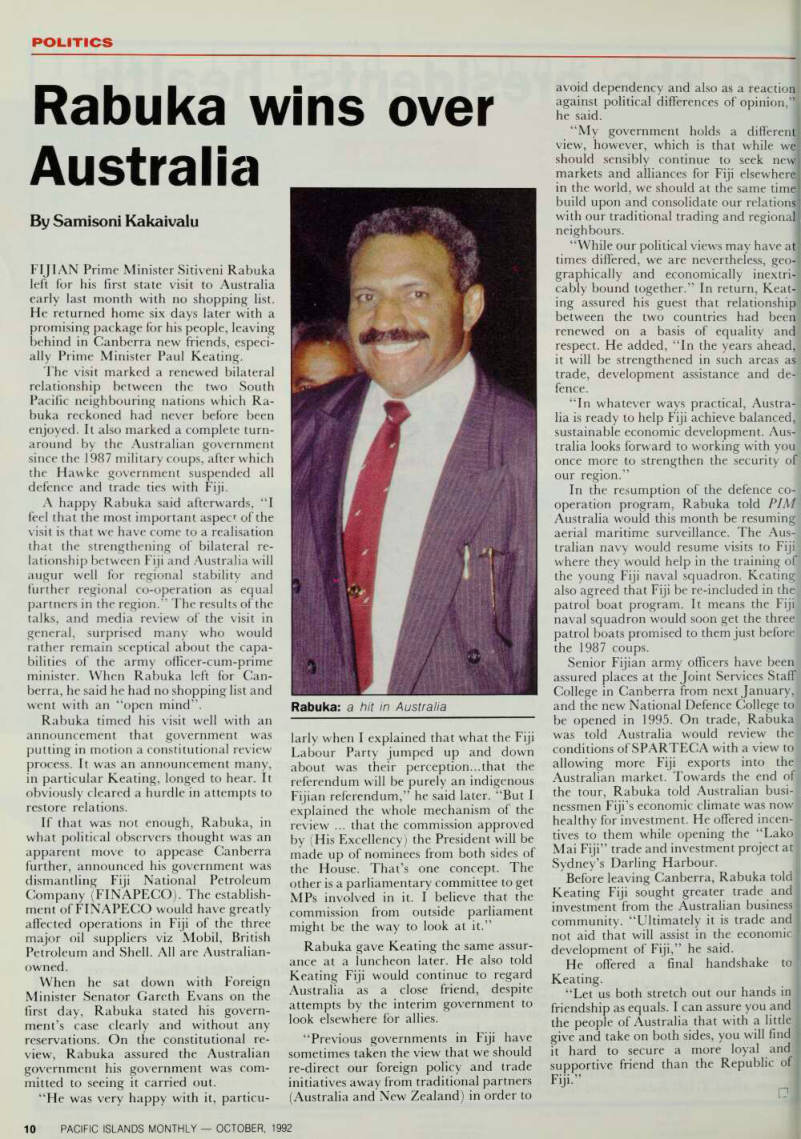
Rabuka: a hit in Australia
Rabuka’s triumph in Australia
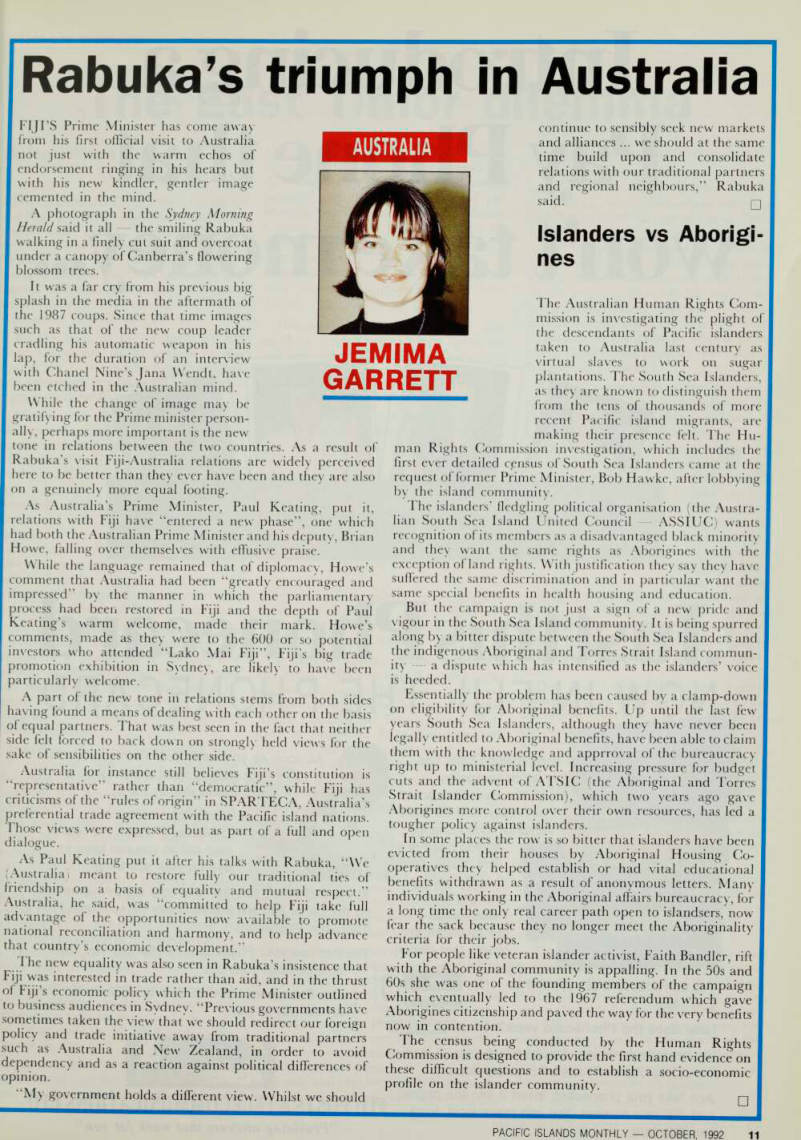
FIJI’S Prime Minister has come away from his first official visit to Australia not just with the warm echos of I endorsement ringing in his hears but with his new kindler, gentler image cemented in the mind.
A photograph in the Sydney Morning
Herald said it all the smiling Rabuka walking in a finely cut suit and overcoat under a canopy of Canberra’s flowering blossom trees. 11 was a far cry from his previous big splash in the media in the aftermath of the 1987 coups. Since that time images such as that of the new coup leader cradling his automatic weapon in his lap, for the duration of an interview with Chanel Nine’s Jana Wendt, have been etched in the Australian mind.
While the change of image may be gratifying for the Prime minister person ally, perhaps more important is the new
I tone in relations between the two countries. As a result of I Rabuka’s visit Fiji-Australia relations are widely perceived I here to be better than they ever have been and they are also I on a genuinely more equal footing.
As Australia’s Prime Minister, Paul Keating, put it, I relations with Fiji have “entered a new phase”, one which I had both the Australian Prime Minister and his deputy, Brian I Howe, falling over themselves with effusive praise.
While the language remained that of diplomacy, Howe’s I comment that Australia had been “greatly encouraged and impressed” by the manner in which the parliamentary process had been restored in Fiji and the depth of Paul Keating’s warm welcome, made their mark. Howe’s comments, made as they were to the 600 or so potential investors who attended “Lako Mai Fiji”, Fiji’s big trade promotion exhibition in Sydney, are likely to have been
particularly welcome.
A part of the new tone in relations stems from both sides having found a means of dealing with each other on the basis of equal partners. That was best seen in the fact that neither side felt forced to back down on strongly held views for the sake of sensibilities on the other side.
Australia for instance still believes Fiji’s constitution is “representative” rather than “democratic”, while Fiji has criticisms of the “rules of origin” in SPARTECA, Australia’s preferential trade agreement with the Pacific island nations.
Those views were expressed, but as part of a full and open dialogue.
As Paul Keating put it after his talks with Rabuka, “We (Australia) meant to restore fully our traditional ties of friendship on a basis of equality and mutual respect.”
Australia, he said, was “committed to help Fiji take full advantage of the opportunities now available to promote national reconciliation and harmony, and to help advance that country’s economic development.”
The new equality was also seen in Rabuka’s insistence that Fiji was interested in trade rather than aid, and in the thrust of Fiji’s economic policy which the Prime Minister outlined to business audiences in Sydney. “Previous governments have sometimes taken the view that we should redirect our foreign policy and trade initiative away from traditional partners such as Australia and New Zealand, in order to avoid dependency and as a reaction against political differences of opinion.
My government holds a different view. Whilst we should
continue to sensibly seek new markets and alliances ... we should at the same time build upon and consolidate relations with our traditional partners
and regional neighbours,’' Rabuka
said. □
Islanders vs Aborigi
nes The Australian Human Rights Com mission is investigating the plight of the descendants of Pacific islanders taken to Australia last century as virtual slaves to work on sugar plantations. The South Sea Islanders, as they are known to distinguish them from the tens of thousands of more recent Pacific island migrants, are making their presence felt. The Hu
man Rights Commission investigation, which includes the first ever detailed cpnsus of South Sea Islanders came at the request of former Prime Minister, Bob Hawke, after lobbying by the island community.
The islanders’ fledgling political organisation (the Austra lian South Sea Island United Council ASSIUC) wants recognition of its members as a disadvantaged black minority and they want the same rights as Aborigines with the exception of land rights. With justification they say they have suffered the same discrimination and in particular want the same special benefits in health housing and education.
But the campaign is not just a sign of a new pride and vigour in the South Sea Island community. It is being spurred along by a bitter dispute between the South Sea Islanders and the indigenous Aboriginal and Torres Strait Island commun ity a dispute which has intensified as the islanders’ voice is heeded.
Essentially the problem has been caused by a clamp-down on eligibility for Aboriginal benefits. Up until the last few years South Sea Islanders, although they have never been legally entitled to Aboriginal benefits, have been able to claim them with the knowledge and apprroval of the bureaucracy right up to ministerial level. Increasing pressure for budget cuts and the advent of ATSIC (the Aboriginal and Torres Strait Islander Commission), which two years ago gave Aborigines more control over their own resources, has led a tougher policy against islanders.
In some places the row is so bitter that islanders have been evicted from their houses by Aboriginal Housing Co operatives they helped establish or had vital educational benefits withdrawn as a result of anonymous letters. Many individuals working in the Aboriginal affairs bureaucracy, for a long time the only real career path open to islandsers, now fear the sack because they no longer meet the Aboriginally criteria for their jobs.
For people like veteran islander activist, Faith Bandler, rift with the Aboriginal community is appalling. In the 50s and I 60s she was one of the founding members of the campaign I which eventually led to the 1967 referendum which gave I Aborigines citizenship and paved the way for the very benefits I now in contention.
The census being conducted by the Human Rights I Commission is designed to provide the first hand evidence on I these difficult questions and to establish a socio-economic I profile on the islander community. □ I
Australia
Jemima
Garrett
Advertisements & other items, p. 12 (1 item)
Introducing a
Pay Phone that
won't take money
m
Just this Phonecard
NOW IN FIJI. THE PHONECARD
Now, making calls has never been easier...
With the new Phonecard.
Fast. Easy. And no more need for loose change.
All you need is a light plastic card that fits snugly into any wallet.
Phonecards are available at outlets that display this sign; You can choose a $2, $5, $lO or $2O card.
How does the Phonecard work?
As soon as you insert your Phonecard, your - starting credit will show on a 1 1 special display panel. 1 As you talk, the panel A , W continuously shows the cost of your call so you can keep an f eye on your spending.
At the end of the call, the total cost will be flashed on the panel and will automatically be subtracted from your Phonecard.
You can use your Phonecard as often as you wish until its value runs out. 3 Phonecards Available Here Pttsl&fetecom The Phonecard from Fiji Post and Telecom.
A new way to pay.
C- Phonecards work with special telephones in Nadi, Suva, Lautoka and soon all over the country. can 'make* beat funk* FIJI POSTS TELECOMMUNICATIONS LTD and ISD calls. ”Providing answers that work for you "
The East Timor dilemma
Human Rights
By lan Williams
FORUM COUNTRIES were united on the New Caledonia issue when it surfaced again at the United Nations Decolonization Committee in August.
While France still refuses to have any thing to do with the UN Committee, the actual resolution emerging from it was a collaborative effort between the Forum diplomats, FLNKS and France.
In the light of the struggle by the Forum countries, in the teeth of French opposition, to re-inscribe New Caledonia as a dependent territory, this is, in its own way, considerable progress.
Moved by Fiji and Papua New Guinea, the resolution supported the measures already taken to implement the
Matignon Ac :ords, particu larly com nending the iecision to ipen a Melanesian :ulture centre ind the French
villingness to foster relations between the "orum countries and New Caledonia.
Alexis O. Maino of PNG noted the 'orum would have preferred the in lusion of a clause on a visiting UN nission to the territory, but accepted hat realistically, the best that could be oped for at the moment was French cceptance of bilateral visits from the orum countries.
However, the hearing revealed that ot everyone was happy with the latignon Accords. Several petitioners iggested the Accord had derailed the lomentum of the Kanaks’ struggle and iven much more opportunity for the ‘ttlers to be reinforced and liberal el pings of French money to win sup ort. Paul Robel of the Independent lommission of Inquiry into New Cale onia pointed out there was only one .anak physician and he was working i France. Professional jobs generated by :onomic expansion in the territory went > French people from the metropolis ither than to Kanaks.
The attitude of the committee next ‘ ar will depend on the progress of the rthcoming talks to monitor the accords id the attitude the FLNKS takes to the •ogress so far.
Unfortunately, there was much less icific unity on the most contentious on the agenda East Timor.
Considering the issue for the first time since the Dili massacre last November, the Committee over-rode Indonesian protests and heard a number of pet itioners. One diplomat somewhat shame facedly confessed to PIM. “I think the people in East Timor would welcome the degree of repression carried out by the French in New Caledonia, in comparison with what the Indonesians have been doing”.
However, among the Forum del egations, only Vanuatu dares speak out officially about East Timor. Vanuatu’s Ambassador Robert Van Lierop said trenchantly, “Indonesia is just as wrong in its occupation of East Timor as Iraq was in its annexation of Kuwait”. For the others, the long shadow of Indonesia ensured silence. In that thev are not
‘lndonesia is just as wrong its occupation timor as Iraq was in its annexation
alone. Very few countries recognize the legality of Djakarta’s annexation, but most of the world community has decided to hold its peace.
At the Decolonization Committee, the chairman, PNG’s Renagi Renagi Lohia, resisted Indonesian objections to allow ing petitioners to be heard. Professor Roger Clark of the International Plat form of Jurists for East Timor revived what is probably the most sensitive issue.
The issue was not just human rights, he said, but that of self-determination, and added that Indonesia was in breach of UN charter prohibitions on the use of force.
On the human rights issue he pointed out that Francisco Miranda Branco was sentenced to 15 years for “subversion”.
His main crime was that he was a member of a committee intended to meet the Portuguese parliamentary delegation to which Djarkta had agreed.
Since the massacre, the issue has caused the Timor file to be dusted off in many foreign ministries, under heavy pressure from voters and human rights organizations. European governments, spurred along by Portugal, have pro tested vociferously at the disparity be tween the reprimands and dismissals meted out to some of the soldiers involved, and the lengthy jail sentences imposed on civilians who survived the
massacre but were arrested subsequently.
Following the massacre, the issue was revived at the LIN Human Rights Committee, where Indonesian lobbying had driven it off the agenda since 1985.
In 1988 the Sub-Commission on Preven tion of Discrimination and Protection of Minorities decided by 10 votes to nine, with five abstentions, not to take action on the territory. However, the same sub commission, voting by secret ballot, agreed in 1989 and 1990 to send a draft resolution to the Human Rights Com mittee, which may illustrate the effect of Indonesian pressure.
In 1991, the resolution was once again thwarted. Indonesia is a member of the Human Rights Committee as is in fact Iraq! But in 1992, the massacre forced the issue. However, Portugal accepted a
compromise, a chairman’s statement which con demned the massacre but welcomed the prompt set ting up of an
Indonesian government commission to investigate. Portugal thought it did not have the votes to carry a resolution, but others thought it underestimated inter national revulsion following the mass acre.
One can hardly blame the Forum countries, since even the United Nations secretariat itself behaves timorously on the issue. In the wake of the massacre, the Secretary General sent Amos Wako to report. His report was received in private and has not been made public, despite protests in the British House of Lords.
There a government minister said icily, “It is for the United Nations Secretary General to decide whether or not to release Wako’s report, and we under stand that he has chosen not to”.
In the US, the House of Representa tives had voted unanimously to cut off military aid to Indonesia, and there is a bill pending which would cut other aid and trade support.
The Decolonization Committee could not pass a resolution on the issue because Djakarta’s friends in the UN General Assembly have ensured the item is not raised there. Indeed the last time it was, in 1983, the abstentions almost won the day, proving perhaps the truth of the saying that all it takes for evil to triumph is for good men to remain silent or democratic countries to abstain. □
Advertisements & other items, p. 14 (1 item)
Instant,,
r r 1 V
ESTABLISHED IN IftPUANEWGUINEA
Already the value of Pacific Instant Lottery has been assessed in one Pacific nation and seen to be of great advantage to that nation's development.
Papua New Guinea will officially launch Pacific Instant Lottery as their generic Instant Scratch Ticket Lottery Game.
Prize Guarantees and Tattersalls' 120 years of Lottery guidance means Papua New Guinea benefits from a totally controlled revenue earning instrumentality.
Your country may well benefit accordingly when you become another
Pacific
Instant,,
Lottery' country.
THE MAIL SERVICE: sum 5,55 flemngton road, north Melbourne, victoriabosi, Australia, fax: country code m + 3 3292166.
Bougainville on the agenda
By lan Williams
OUTSIDE the Pacific, few people have heard of Bougain ville, Papua New Guinea’s troubled province. Many more will now, since the issue was successfully put onto the agenda of the United Nations Human Rights Commission in Geneva this August. The Sub- Commission on the Prevention of Discrimination and Protection of Minorities for the first time adopted a resolution which called on PNG to restore freedom of movement to the inhabitants of Bougainville in the interests of protecting and promoting hu man rights and fundamental freedoms. It also asked the Spe cial Rapporteur on the study of treaties between states and indi genous people to include in his report the case of the agreements between PNG and the indigenous
people of Bougainville.
The sub-commission allows petitioners from human rights arganizations, and in this case
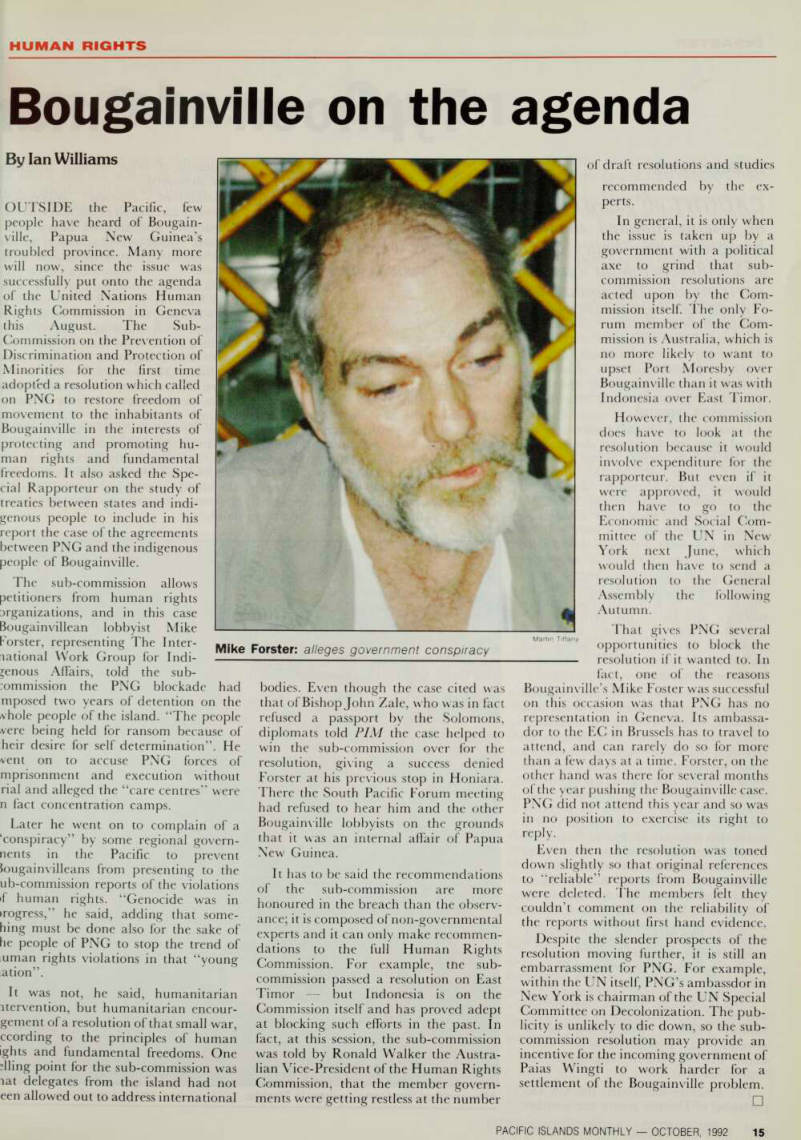
Bougainvillean lobbyist Mike
Forster, representing The Inter lational Work Group for Indi genous Affairs, told the sub
:ommission the PNG blockade had mposed two years of detention on the vhole people of the island. “The people vere being held for ransom because of heir desire for self determination”. He vent on to accuse PNG forces of mprisonment and execution without rial and alleged the “care centres” were n fact concentration camps.
Later he went on to complain of a ‘conspiracy” by some regional govern nents in the Pacific to prevent lougainvilleans from presenting to the ub-commission reports of the violations if human rights. “Genocide was in trogress,” he said, adding that some hing must be done also for the sake of he people of PNG to stop the trend of uman rights violations in that “young ation”.
It was not, he said, humanitarian itervention, but humanitarian encour gement of a resolution of that small war, ccording to the principles of human ights and fundamental freedoms. One dling point for the sub-commission was lat delegates from the island had not een allowed out to address international
bodies. Even though the case cited was that of Bishop John Zale, who w as in fact refused a passport by the Solomons, diplomats told PIM the case helped to win the sub-commission over for the resolution, giving a success denied Forster at his previous stop in Honiara.
There the South Pacific Forum meeting had refused to hear him and the other Bougainville lobbyists on the grounds that it was an internal affair of Papua New Guinea.
It has to be said the recommendations of the sub-commission are more honoured in the breach than the observ ance; it is composed of non-governmental experts and it can only make recommen dations to the full Human Rights Commission. For example, tne sub commission passed a resolution on East Timor but Indonesia is on the Commission itself and has proved adept at blocking such efforts in the past. In fact, at this session, the sub-commission was told by Ronald Walker the Austra lian Vice-President of the Human Rights Commission, that the member govern ments were getting restless at the number
of draft resolutions and studies recommended by the ex perts.
In general, it is only when the issue is taken up by a government with a political axe to grind that sub commission resolutions are acted upon by the Com mission itself. The only Fo rum member of the Com mission is Australia, which is no more likely to want to upset Port Moresby over Bougainville than it was with Indonesia over East Timor.
However, the commission does have to look at the resolution because it would involve expenditure for the rapporteur. But even if it were approved, it would then have to go to the Economic and Social Com mittee of the UN in New York next June, which would then have to send a resolution to the General Assembly the following Autumn.
That gives PNG several opportunities to block the resolution if it wanted to. In fact, one of the reasons
Bougainville’s Mike Foster was successful on this occasion was that PNG has no representation in Geneva. Its ambassa dor to the EC in Brussels has to travel to attend, and can rarely do so for more than a few days at a time. Forster, on the other hand was there for several months °f the Y ear pushing the Bougainville case, PNG did not attend this year and so was in no position to exercise its right to re P T Even then the resolution was toned
m “rehable” reVom hTlucamv^
wer/ltL/X^bers^lh'They 6
couldn’t comment on the reliability of the reports without first hand evidence, Des^ite the slender DrosDerts of thp resolution moving further it is still an res ° lutlon moving further, it. is still an embarrassment for PNG. For example, within the UN itself, PNG’s ambassdor in New York is chairman of the UN Special Committee on Decolonization. The pub licity is unlikely to die down, so the sub commission resolution may provide an incentive for the incoming government of Paias Wingti to work harder for a settlement of the Bougainville problem, □
Mike Forster: alleges government conspiracy
Typhoon Oma[?]smashes Guam
Disaster
By David North
CAUGHT off guard by erratic Typhoon Omar, the people of Guam huddled in their homes and shelters for a harrowing nine hours on August as winds as high as 155 miles per hour bashed, ripped, twisted, and levelled parts of the 212 square-mile island.
By the time Omar moved into the Philippine Sea, the storm had left an estimated S5OO million in damage to homes, government buildings, military bases, and tourist hotels. About 80 residents were injured, mostly by explod ing windows and flying debris, but no deaths were reported.
However, the 140,000 residents of the island were left dazed and demoralized by the sudden arrival of the powerful storm one of the the strongest typhoons to hit Guam in the last 50 years, according to Guam officials. Onl) 12 hours before Omar came ashore, US Navy weather forecasters were still re porting it as only a tropical storm with sustained winds of 60 to 70 miles per hour. In the aftermath, angry Guam officials blamed the faulty forecasting on the absence of U.S. Air Force storm tracking aircraft the 54th Weather Reconnaissance Squadron (known as Typhoon Trackers). The group was pulled off Guam in 1987 in a Pentagon
budget-cutting move.
The four-engine, turbo-prop aircraft
can fly directly through the walls of a typhoon, taking wind speed and baro metric measurements. The long-range modified C-130s can stay with storms for hours by flying in the eye. Without this ability, Guam forecasters had to rely on satellite pictures and ground radar.
These systems are unable to precisely measure the speed and intensity of a storm that was stalled close to Guam and intensifying. That is exactly what Omar did before hitting the island. Guam leaders also were aware that Air Force WC-130 aircraft, flying from bases in the southeastern United States, were able to accurately gauge the precise speed and direction of Hurricane Andrew, allowing residents of South Florida and Louisiana ample opportunity to prepare for that storm.
“We believe we were not adequately warned of the disaster before us,” Guam Senator Michael Reidy said as he introduced a “Typhoon Tracker” resol ution in the Guam Legislature on
September 1.
The measure demanded the US De partment of Defense return the weather
aircraft to Guam. Reidy countered opponents who argued the navy fore casters should not be blamed by saying the devastation throughout the island proved otherwise. “The facts speak for themselves,” he said. The resolution passed by a majority vote.
Omar hit the most heavily populated sections of Guam with sustained winds of 125 miles per hour and gusts up to 155.
The storm was an exceptionally slow moving front, virtually sitting on the northern and central two-thirds of the island for about nine hours. An estimated 3000 wood-frame houses as well as
thousands of other wooden structures were destroyed.
Reinforced concrete government buildings and tourist hotels had windows blown out and suffered heavy waten damage. Construction cranes at building sites were twisted into corkl screws.
US military installations were simi-j larly hard hit. At the US Navy Base in Apra Harbor, two US navy supply ships' snapped their moorings, ripped metal mooring cleats from concrete piers, and were blown aground on reefs and sandbars. The powerful winds sent a dozen Korean and Taiwanese fishing boats to the bottom of the harbour, spilling oil throughout the berthing areas. Several Anderson Air Force Base buildings received heavy structural and water damage. Agricultural damage was! extensive and the entire northern half of the island was stripped clear of trees and greenery, leaving a desolate brown landscape.
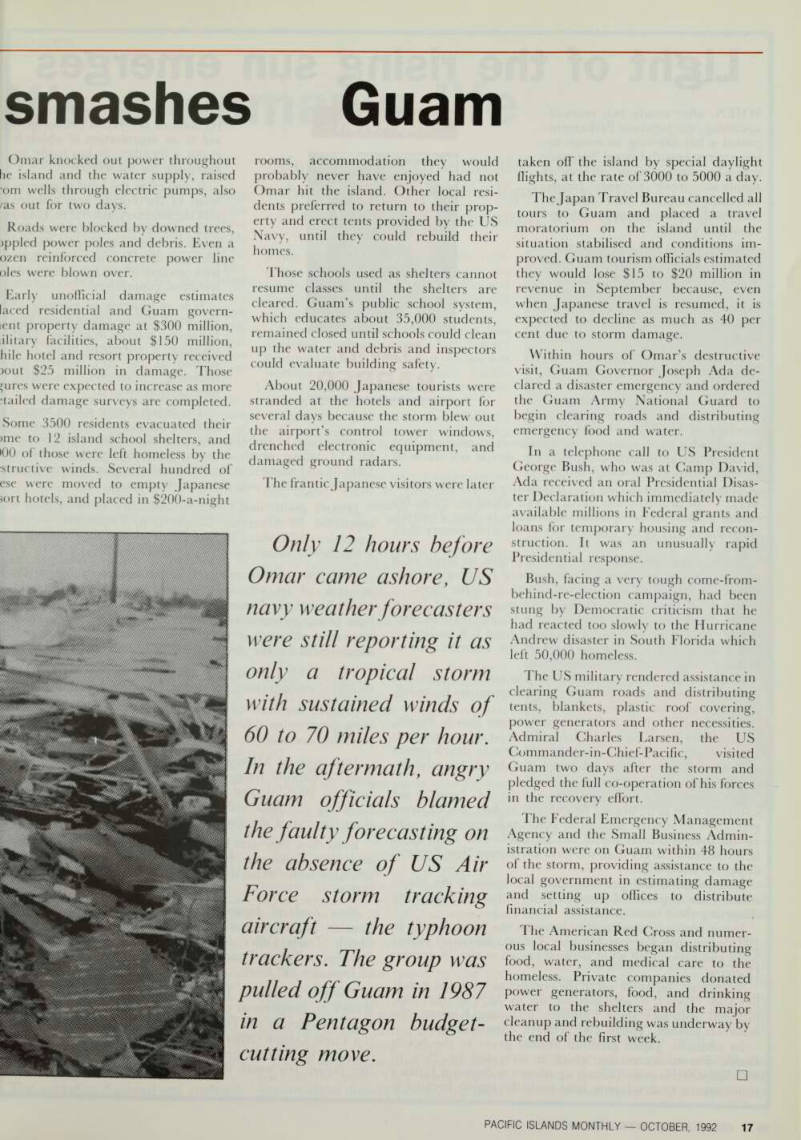
Aftermath of Hurricane Andrew in Florida: residents had ample opportunity to prepare
Omar knocked out power throughout he island and the water supply, raised ■om wells through electric pumps, also ts out for two days.
Roads were blocked by downed trees, tppled power poles and debris. Even a 11 1 1 ozen reinforced concrete power line oles were blown over. r . rp • , , Early unomcial damage estimates i , • , • , , laced residential and Guam govern- . . , „ & lent property damage at $3OO million, T( f • i■ • P t a-, r n ihtary facilities, about $l5O million, bile hotel and resort property received tout $25 million in damage. Those were expected to increase as more
‘tailed damage surveys are completed.
Some 3500 residents evacuated their • . , , , , . j >me to 12 island school shelters, and 100 of those were left homeless by the structive winds. Several hundred of ese were moved to empty Japanese sort hotels, and placed in $2OO-a-night
rooms, accommodation they would probably never have enjoyed had not Omar hit the island. Other local resi dents preferred to return to their prop and ‘ ents provided by the US , NaVy > untll the y could rebulld ,heir homes Those schools used as shelters cannot resume classes until the shelters are , , 0 , Ul . , . cleared. Guam s public school system, .• . , T 0 r which educates about 35,000 students, • , , , , ’ ... ’ remained closed until schools could clean ~,, , . , .
Up , he Water , a " d debriS a " d lns P ectors C ° U ' d eVa ' Uate bulldmg Safety ' About 20,000 Japanese tourists were stranded at the hotels and airport for ™’ beCaUSe St ° rm out the airports control tower windows, ~j, , • . I drenched electronic equipment, and
damaged grOUnd radars '
The frantic Japanese visitors were later
Only 12 hours before Omar came ashore, US navy weather forecasters were still reporting it as only a tropical storm with sustained winds of 60 to 70 miles per hour.
In the aftermath, angry Guam officials blamed
the faulty forecasting on
the absence of US Air Force storm tracking aircraft the typhoon trackers. The group was pulled off Guam in 1987 in a Pentagon budget cutting move.
taken off the island by special daylight flights, at the rate of 3000 to 5000 a day.
The Japan Travel Bureau cancelled all tours to Guam and placed a travel moratorium on the island until the situation stabilised and conditions im proved. Guam tourism officials estimated they would lose $l5 to $2O million in revenue in September because, even when Japanese travel is resumed, it is expected to decline as much as 40 per cent due to storm damage.
Within hours of Omar’s destructive visit, Guam Governor Joseph Ada de clared a disaster emergency and ordered the Guam Army National Guard to begin clearing roads and distributing emergency food and water.
In a telephone call to US President George Bush, who was at Camp David, Ada received an oral Presidential Disas ter Declaration which immediately made available millions in Federal grants and loans for temporary housing and recon struction. It was an unusually rapid Presidential response.
Bush, facing a very tough come-from behind-re-election campaign, had been stung by Democratic criticism that he had reacted too slowly to the Hurricane Andrew disaster in South Florida which left 50,000 homeless.
The US military rendered assistance in clearing Guam roads and distributing tents, blankets, plastic roof covering, power generators and other necessities.
Admiral Charles Larsen, the US Commander-in-Chief- Pacific, visited Guam two days after the storm and pledged the full co-operation of his forces in the recovery effort.
The Federal Emergency Management
Agency and the Small Business Admin istration were on Guam within 48 hours of the storm, providing assistance to the local government in estimating damage and setting up offices to distribute financial assistance.
The American Red Cross and numer ous local businesses began distributing food, water, and medical care to the homeless. Private companies donated power generators, food, and drinking water to the shelters and the major
cleanup and rebuilding was underway by
the end of the first week.
Light of the rising sun emerges
WHEN, after nearly two years of agonising, the Japanese Parliament passed a bill allowing its troops to serve overseas with United Nations’ peace-keeping missions, it was a significant move towards Japan exercising political and security leadership commensurate with its economic power.
When three ships of the Self- Defence Forces made another tour of Asian and Pacific ports recently, it provided a further reminder that
Japan was shrugging off a long
standing insistence on hiding the light of its rising sun under a bushel.
Both moves raised Japan’s pro file, internationally and regionally a profile it has been reluctant, for obvious reasons, to elevate.
There has, over the years, been no shortage of critics, at home and
abroad, who have maintained (for historical reasons) that Japan, while an economic superpower, should not claim its rightful status in the world order.
This is an outdated view that no country in our part of the world or probably any other can afford to retain. No nation is likely to be of more importance to New Zealand, Australia or any of the island states in the 21st century than
Japan.
While it has generally kept a low profile in terms of a physical presence, Japan has quietly been fulfilling interna tional obligations in line with its wealth for some years.
It is probably not widely known, for instance, that Japan is the second biggest contributor to the United Nations after the United States, paying 12.5% of the total UN budget half that of the US, but more than the contributions of Britain, France and China combined.
And last year, Japan again became the world’s biggest aid donor, lifting its assistance to developing countries by nearly 20% to more than SUSII billion.
All this is of growing importance to the South Pacific, especially as New Zealand, which reduced its aid again in this year’s budget, struggles to keep its overseas development assistance above 0.2% of gnp, a mark dubbed “measly” by at least one cabinet minister.
The lion’s share (nearly two-thirds) of Japan’s aid naturally goes to its nearest neighbours in Asia, but Oceania gets 1.4% modest enough in percentage terms, but with an aid budget of that size, a not inconsiderable amount. It is, for instance, larger than the total aid monies New Zealand dispenses worldwide.
And Japan would put more into the region if the island states were capable of absorbing it without dangerously distorting their economies.
Japan began its modern-day focus on the South Pacific in 1987 when then Foreign Minister Tadashi Kuranari visited Suva and expounded what became known as the “Kuranari Doctrine”.
Since then, Japanese aid to the region has increased nearly five-fold. Today it accounts for up to 35% of the total bilateral assistance some countries, including Kiribati, the Solomon Islands, Tonga and Western Samoa, receive.
In addition, Japan gives an annual grant to the South Pacific Forum secretariat which it increased by 25% to SUSSOO,OOO this year. (This is significant evidence of Japan’s commitment to developing links with the region because it
broke its own rules to do it. The regulations say Japan cannot .give aid to an organisation of which it is not a member. It has made an exception for the Forum).
It also takes the head of govern ment of the Forum host country and the secretary-general to Tokyo each year for consultations, partici pates in the annual post-Forum dialogue and has observer status with several of the organisation’s technical committees.
It is an observer at meetings of the South Pacific Commission and has shown interest in joining. That question is currently being con sidered as the SPG reviews its founding principles, including membership criteria.
The South Pacific stands to gain further from Japan’s substantial
contributions to global environmental problems. It provided SUS3.I billion worth of environment-related aid between 1989-91 and pledged at the Rio Earth Summit to expand this to SUS 7.7 billion over the next five years, Japan’s grants and technical assistance to the region is supported by Overseas Cooperation Volunteers the equivalent of America’s Peace Corps who have worked in a number of island countries at grassroots level.
With few natural resources, Japan has prospered on the strength of its educated people, says Hajime Sasaki, counsellor at the Japanese Embassy in Wellington. “In the light of our experience, we believe that developing human resources, although it takes time and money, is the basic requirement for the development of a country.”
That is why, he says, Japanese aid is concentrated on technical co-operation, technology transfer and education.
Another key to development, of course, is trade. There has been progress in this area over the last few years but
probably not enough.
International Monetary Fund statistics show that while Japan’s imports from around the world increased 84% between 1984-90, and 75% from the whole of Oceania, including Australia and New Zealand, they rose only 61% from the rest of the Pacific region.
Even then, they were largely limited to Papua New Guinea and New Caledonia, from whom Japan buys substantial amounts while importing very little from the other island states.
New Zealand Japan expert lan Kennedy suggests a possible solution would be the establishment of a South Pacific Trade Office (similar to those in Auckland and Sydney) in Tokyo. Funding it, he says, would be a good use of Japanese aid funds.
There is a snag Japanese rules forbid the use of aid money on commercial operations. But Japan bent the rules to give money to the Forum, and Kennedy suggests calling it a Trade Liaison Office might do the trick. The island states certainly need all the help they can get in a complex market like Japan. It’s worth thinking about.
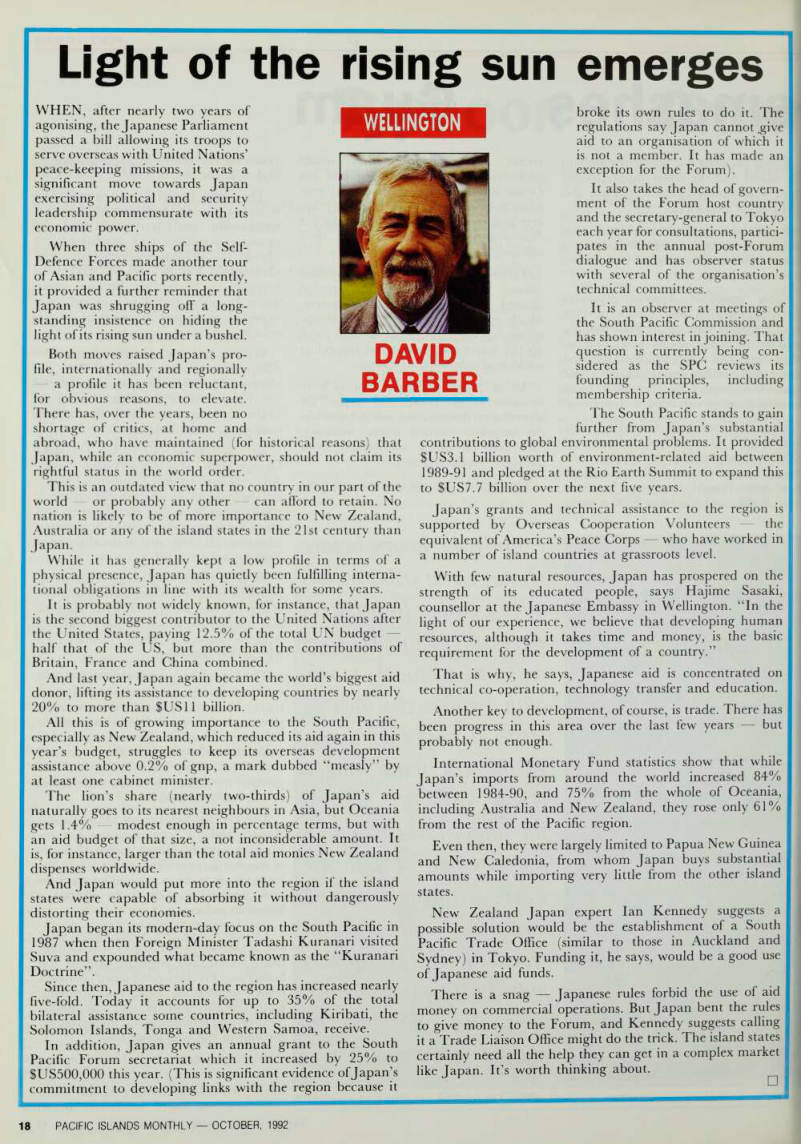
Wellington
David
Barber
It’s a woman’s life
Women
By Debbie Singh
“HE BEAT me like the devil . . . when he came home drunk, he broke down the door, I had been sleeping with my three children and he forced himself on me. He had some problem on the street and he came to reciprocate with me ... I hit him hard but didn’t leave a mark. He stabbed me but didn’t kill me”.
The words come from a Dominican woman who has survived domestic violence in one of its higher forms. But the problem of gender violence is not just confined to one particular class or society.
Violence against women is a pattern, a reign of force and terror, not just one physical attack. It involves a number of other tactics such as intimidation, threats, economic deprivation and re peated physical and psychological abuse.
In over 95 per cent of domestic assaults, the man is the assailant. There are rare cases where a woman batters a man and women have been known to kill their attacker after prolonged years of battering. But violence in the home is largely against women in all societies, cultures and ethnic groupings.
Many excuses such as alcohol, jeal ousy, work pressure and anger are used as reasons for wife-battery and violence.
And many myths cloud the reality of the issue as well.
Religion and culture have been used - more than any other reason to defend practices oppressive to women, both in the Pacific and the rest of the world.
While women realise religion and :ulture are necessary to maintain the identity of their societies, they are now beginning to question their destructive aspects.
In the Pacific, the issue of violence was lever publicly debated or questioned mtil recently with the convening of the irst regional workshop on women and /iolence, in Suva, Fiji.
The three-week, Fiji Women’s Crisis
Centre-organised workshop brought
ogether over 30 women from 10 Pacific sland countries which included Kanaky, Pallid, Irian Jaya, Papua New Guinea, Vanuatu, the Cook Islands, Solomons, he Federated States of Micronesia and dji.
A woman from the GABRIELA fem nist lobby group in the Philippines also )articipated in the workshop and gave m outline of the situation of women in icr country, as well.
The workshop discussed and analysed
For the first time in the Pacific the issue of violence against women
is being publicly debated and questioned
forms of violence against women; cam paigns and actions against violence; the women’s movement in the Pacific and Pacific culture in the changing social and political context.
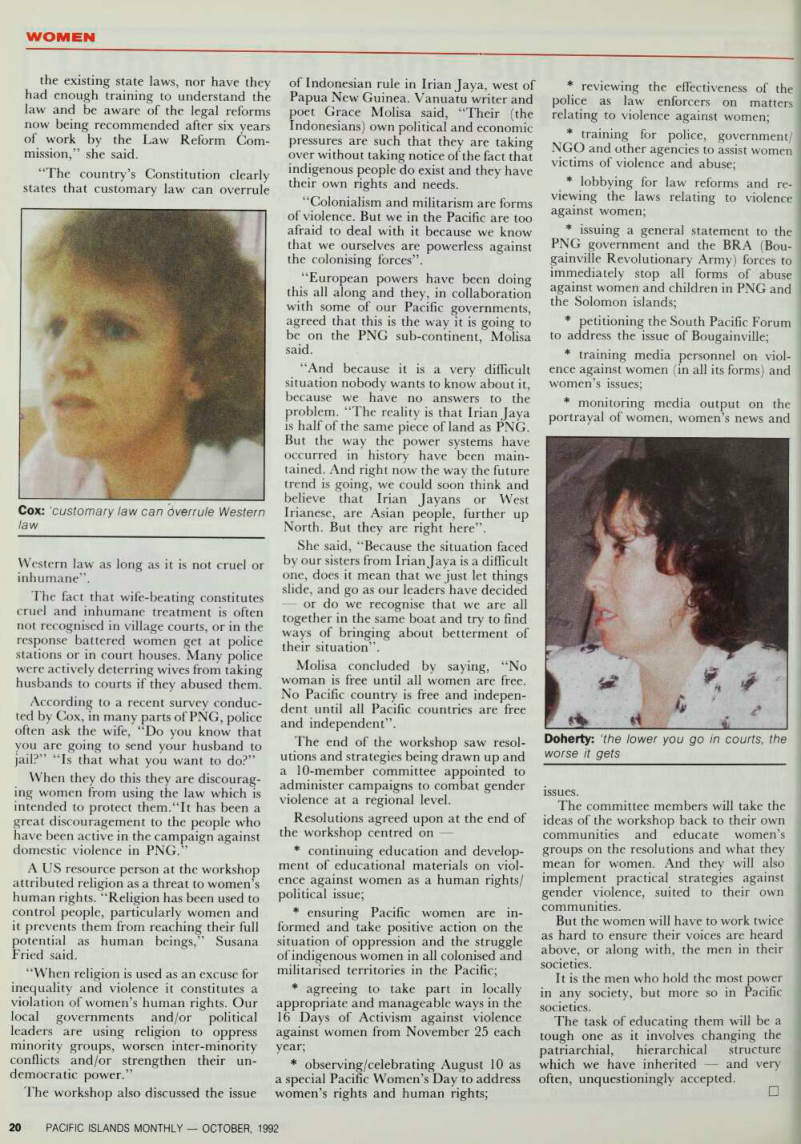
Laws of Pacific countries were also analysed and discussed. Fiji lawyer Imrana Jalal said,“Courts of law are not working for women in many Pacific island nations as they do not recognise women’s special situations.
“Although Fiji’s laws state that all men and women are equal before the law, this does not happen in practice”, Jalal said.
Under the current laws, happenings in the home, such as violence against women is not considered a criminal offence, while what happens outside the home is.
On the related topic of whether the justice system works for women, Papua New Guinea’s first and only woman judge, Theresa Doherty, said, “In our courts women and young people and the less educated are not as well treated by the courts as the better educated mem bers of the society.”
This was especially so in the lower courts. “The lower you go in courts, the worst it gets for women. “When it comes to bride price or compensation payments there is no limit to the amount that the village court will set,” Judge Doherty said.
Elizabeth Cox, a PNG development worker, told the workshop over 60 per cent of women are beaten by their partners, and wife and girlfriend beating is commonly accepted by both men and women in PNG communities.
She discussed studies of hospital, court and welfare records by the PNG Law Reform Commission, as well as case studies which showed 66 percent of rural and 100 percent of highland wives are beaten in the country. Cox also cited an example of gender violence from Bou gainville and said, “The government hoped to end the war (on Bougainville) by sending in the army, but the soldiers could not find any of the Bougainville Revolutionary Army rebels and so they turned on the women raping and beating them.
“Then they began using women to get back at the men. They would collect women, stand them in a circle, strip them
and make them perform sexual acts. Now gang rapes are more prevalent and all these contribute to violence against women”, Cox said.
She also criticised the type of custom ary law being practised in PNG, particu larly by male village court magistrates.
She said the laws were heavily biased and discriminatory against women and many women were being wrongfully and il legally imprisoned as a result.
“This is because village court magis trates do not understand the relationship between customary laws as opposed to
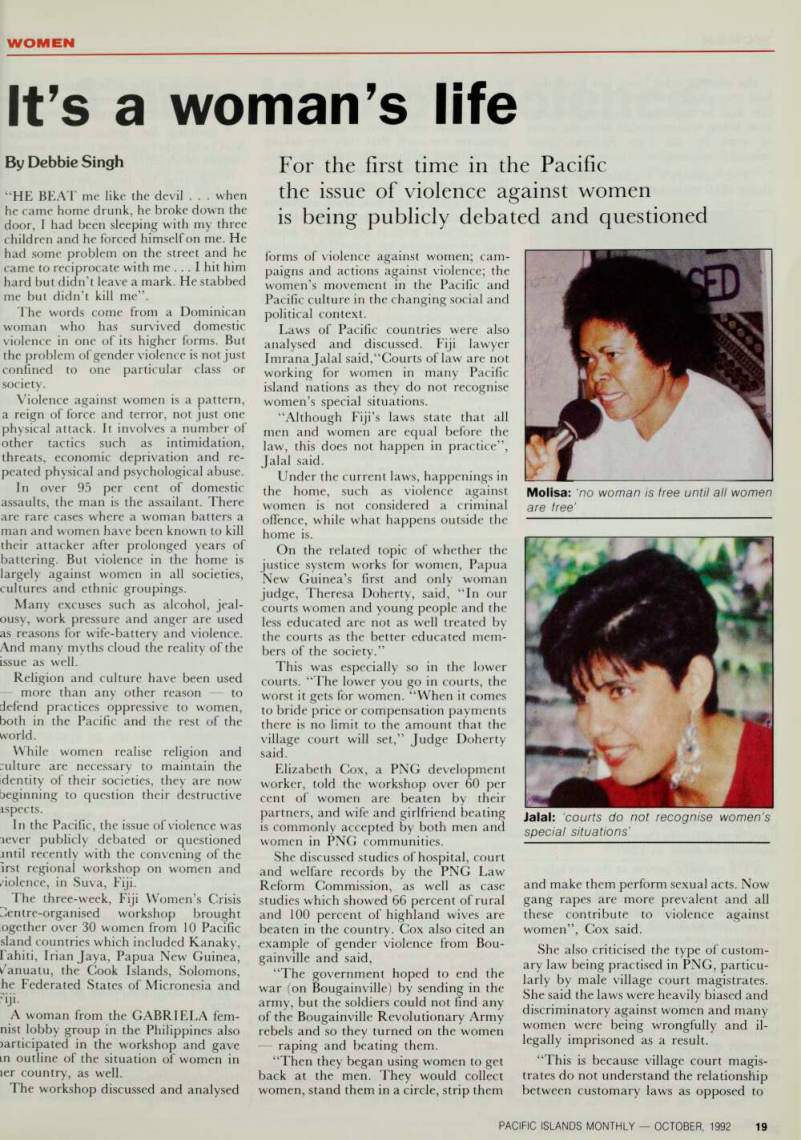
Molisa: no woman is free until all women are free’
Jalal: courts do not recognise women's special situations’
the existing state laws, nor have they had enough training to understand the law and be aware of the legal reforms now being recommended after six years of work by the Law Reform Com mission,” she said.
“The country’s Constitution clearly states that customary law can overrule
Western law as long as it is not cruel or inhumane”.
The fact that wife-beating constitutes cruel and inhumane treatment is often not recognised in village courts, or in the response battered women get at police stations or in court houses. Many police were actively deterring wives from taking husbands to courts if they abused them.
According to a recent survey conduc ted by Cox, in many parts of PNG, police often ask the wife, “Do you know that you are going to send your husband to jail?” “Is that what you want to do?”
When they do this they are discourag ing women from using the law which is intended to protect them.“lt has been a great discouragement to the people who have been active in the campaign against domestic violence in PNG.”
A US resource person at the workshop attributed religion as a threat to women’s human rights. “Religion has been used to control people, particularly women and it prevents them from reaching their full potential as human beings,” Susana Fried said.
“When religion is used as an excuse for inequality and violence it constitutes a violation of women’s human rights. Our local governments and/or political leaders are using religion to oppress minority groups, worsen inter-minority conflicts and/or strengthen their un democratic power.”
The workshop also discussed the issue
of Indonesian rule in Irian Jaya, west of Papua New Guinea. Vanuatu writer and poet Grace Molisa said, “Their (the Indonesians) own political and economic pressures are such that they are taking over without taking notice of the fact that indigenous people do exist and they have their own rights and needs.
“Colonialism and militarism are forms of violence. But we in the Pacific are too afraid to deal with it because we know that we ourselves are powerless against the colonising forces”.
“European powers have been doing this all along and they, in collaboration with some of our Pacific governments, agreed that this is the way it is going to be on the PNG sub-continent, Molisa said.
“And because it is a very difficult situation nobody wants to know about it, because we have no answers to the problem. “The reality is that Irian Jaya is half of the same piece of land as PNG.
But the way the power systems have occurred in history have been main tained. And right now the way the future trend is going, we could soon think and believe that Irian Jayans or West Irianese, are Asian people, further up North. But they are right here”.
She said, “Because the situation faced by our sisters from Irian Jaya is a difficult one, does it mean that we just let things slide, and go as our leaders have decided or do we recognise that we are all together in the same boat and try to find ways of bringing about betterment of their situation”.
Molisa concluded by saying, “No woman is free until all women are free.
No Pacific country is free and indepen dent until all Pacific countries are free
and independent”.
The end of the workshop saw resol utions and strategies being drawn up and a 10-member committee appointed to administer campaigns to combat gender violence at a regional level.
Resolutions agreed upon at the end of the workshop centred on * continuing education and develop ment of educational materials on viol ence against women as a human rights/ political issue; * ensuring Pacific women are in formed and take positive action on the situation of oppression and the struggle of indigenous women in all colonised and militarised territories in the Pacific; * agreeing to take part in locally appropriate and manageable ways in the 16 Days of Activism against violence against women from November 25 each year; * observing/celebrating August 10 as a special Pacific Women’s Day to address women’s rights and human rights;
* reviewing the effectiveness of the police as law enforcers on matters relating to violence against women; * training for police, government/ NGO and other agencies to assist women victims of violence and abuse; * lobbying for law reforms and re viewing the laws relating to violence against women; * issuing a general statement to the PNG government and the BRA (Bou gainville Revolutionary Army) forces to immediately stop all forms of abuse against women and children in PNG and the Solomon islands; * petitioning the South Pacific Forum to address the issue of Bougainville; * training media personnel on viol ence against women (in all its forms) and women’s issues; * monitoring media output on the portrayal of women, women’s news and
issues.
The committee members will take the ideas of the workshop back to their own communities and educate women’s groups on the resolutions and what they mean for women. And they will also
implement practical strategies against
gender violence, suited to their own communities.
But the women will have to work twice as hard to ensure their voices are heard above, or along with, the men in their societies.
It is the men who hold the most power in any society, but more so in Pacific societies.
The task of educating them will be a tough one as it involves changing the patriarchial, hierarchical structure which we have inherited and very often, unquestioningly accepted.
Cox: ‘customary law can Overrule Western law
Doherty: ‘the lower you go in courts, the worse it gets
A new kind of violence
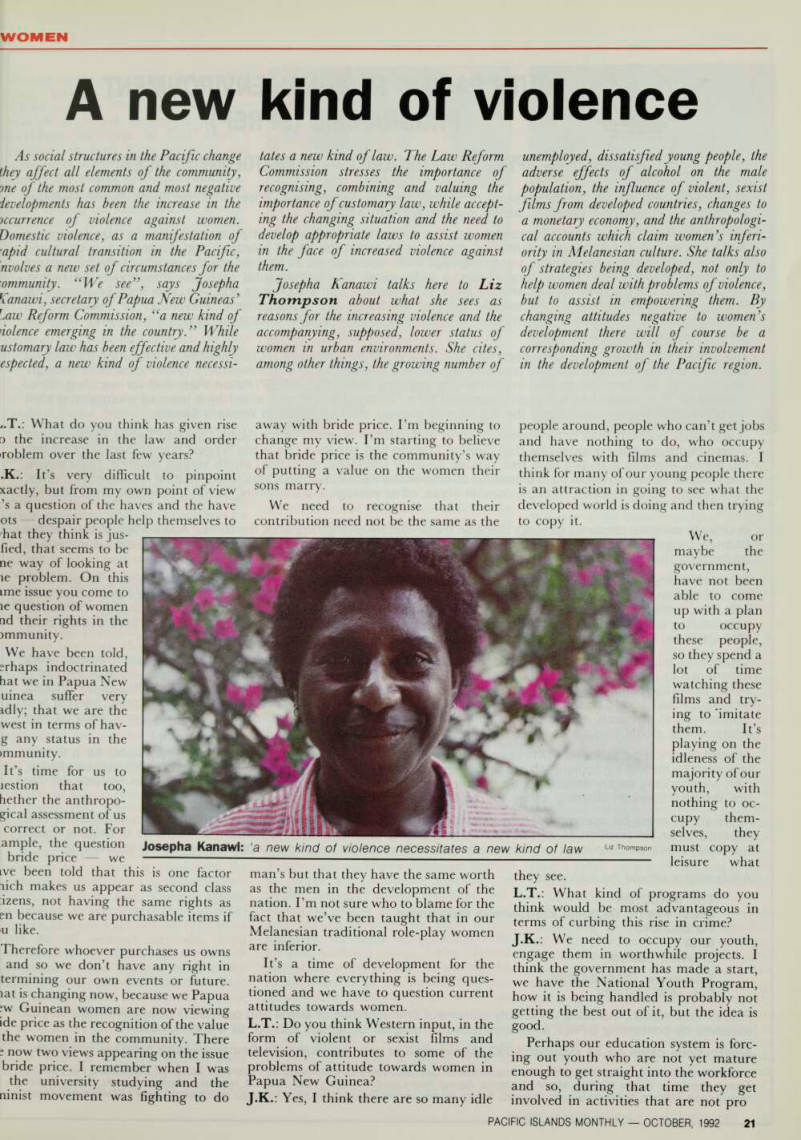
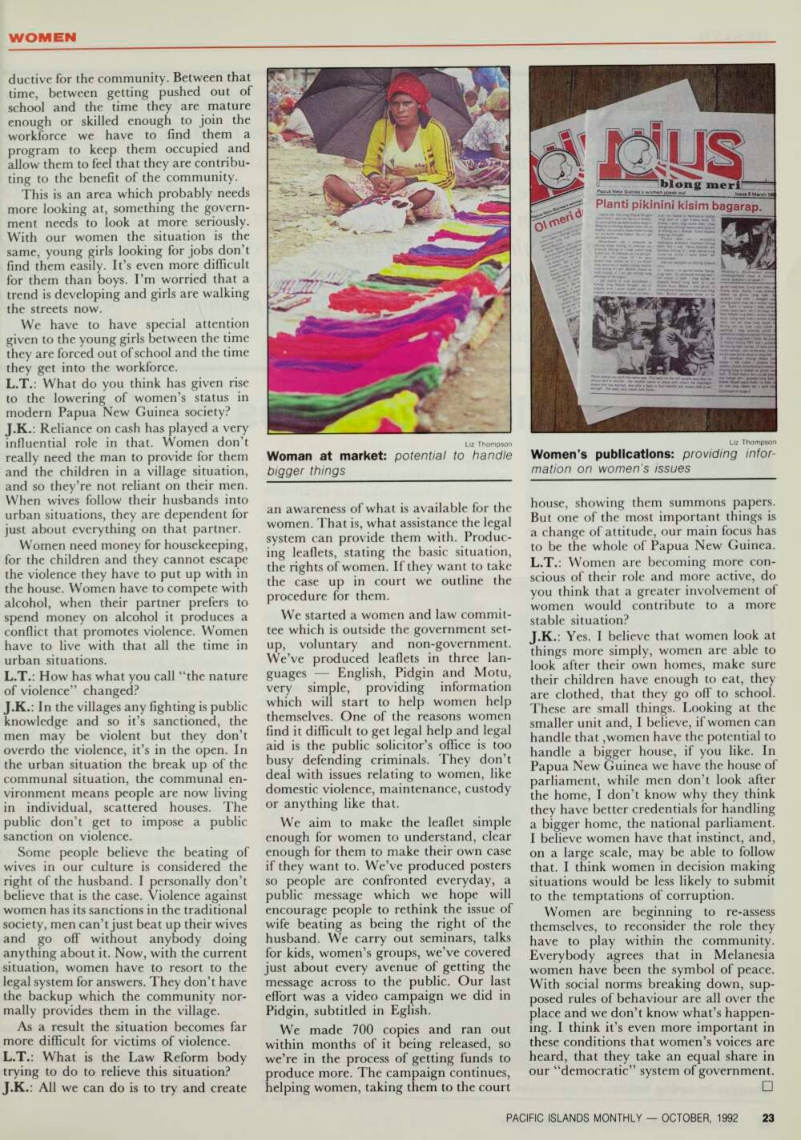
As social structures in the Pacific change they affect all elements of the community, me of the most common and most negative developments has been the increase in the Kcurrence of violence against women, Domestic violence, as a manifestation of apid cultural transition in the Pacific, nvolves a new set of circumstances for the ommunity. “We see”, says Josepha Kanawi, secretary of Papua New Guineas’
Law Reform Commission, “a new kind of iolence emerging in the country.” While ustomary law has been effective and highly espected, a new kind of violence necessi-
tales a new kind of law. The Law Reform Commission stresses the importance of
recognising, combining and valuing the
importance of customary law, while accept ing the changing situation and the need to develop appropriate laws to assist women in the face of increased violence against them.
Josepha Kanawi talks here to Liz Thompson about what she sees as reasons for the increasing violence and the
accompanying, supposed, lower status of
women in urban environments. She cites, among other things, the growing number of
unemployed, dissatisfied young people, the
adverse effects of alcohol on the male
population, the infuence of violent, sexist
films from developed countries, changes to
a monetary economy, and the anthropologi cal accounts which claim women’s inferi ority in Melanesian culture. She talks also of strategies being developed, not only to help women deal with problems of violence, but to assist in empowering them. By changing attitudes negative to women’s development there will of course be a corresponding growth in their involvement in the development of the Pacific region.
i.T.: What do you think has given rise 3 the increase in the law and order roblem over the last few years? .K.: It’s very difficult to pinpoint xactly, but from my own point of view ’s a question of the haves and the have ots despair people help themselves to
hat they think is jus fied, that seems to be ne way of looking at ic problem. On this ime issue you come to le question of women nd their rights in the immunity.
We have been told,
srhaps indoctrinated
hat we in Papua New uinea suffer very idly; that we are the west in terms of hav g any status in the unmunity.
It’s time for us to icstion that too,
hether the anthropo
gical assessment of us correct or not. For ample, the question bride price we
ive been told that this is one factor lich makes us appear as second class izens, not having the same rights as en because we are purchasable items if u like.
Therefore whoever purchases us owns and so we don’t have any right in termining our own events or future, lat is changing now, because we Papua *vv Guinean women are now viewing ide price as the recognition of the value the women in the community. There “ now two views appearing on the issue bride price. I remember when I was the university studying and the ninist movement was fighting to do
away with bride price. I’m beginning to change my view. I’m starting to believe that bride price is the community’s way of putting a value on the women their sons marry.
We need to recognise that their contribution need not be the same as the
man’s but that they have the same worth as the men in the development of the nation. I’m not sure who to blame for the fact that we’ve been taught that in our Melanesian traditional role-play women are inferior.
It’s a time of development for the nation where everything is being ques tioned and we have to question current attitudes towards women.
L.T.: Do you think Western input, in the form of violent or sexist films and television, contributes to some of the problems of attitude towards women in Papua New Guinea?
J.K.: Yes, I think there are so many idle
people around, people who can’t get jobs and have nothing to do, who occupy themselves with films and cinemas. I think for many of our young people there is an attraction in going to see what the developed world is doing and then trying to copy it.
We, or maybe the government, have not been able to come up with a plan to occupy
these people,
so they spend a lot of time watching these films and try ing to 'imitate them. It’s playing on the idleness of the majority of our youth, with nothing to oc cupy them
selves, they
must copy at leisure what
they see.
L.T.: What kind of programs do you think would be most advantageous in terms of curbing this rise in crime?
J.K.; We need to occupy our youth, engage them in worthwhile projects. I think the government has made a start, we have the National Youth Program, how it is being handled is probably not getting the best out of it, but the idea is good.
Perhaps our education system is forc ing out youth who are not yet mature enough to get straight into the workforce and so, during that time they get involved in activities that are not pro
Josepha Kanawi: ‘a new kind of violence necessitates a new kind of law nz Thompson
ductive for the community. Between that time, between getting pushed out of school and the time they are mature enough or skilled enough to join the workforce we have to find them a program to keep them occupied and allow them to feel that they are contribu ting to the benefit of the community.
This is an area which probably needs more looking at, something the govern ment needs to look at more seriously.
With our women the situation is the same, young girls looking for jobs don’t find them easily. It’s even more difficult for them than boys. I’m worried that a trend is developing and girls are walking the streets now.
We have to have special attention given to the young girls between the time they are forced out of school and the time they get into the workforce.
L.T.: What do you think has given rise to the lowering of women’s status in modern Papua New Guinea society?
J.K.: Reliance on cash has played a very influential role in that. Women don’t really need the man to provide for them and the children in a village situation, and so they’re not reliant on their men.
When wives follow their husbands into urban situations, they are dependent for just about everything on that partner.
Women need money for housekeeping, for the children and they cannot escape the violence they have to put up with in the house. Women have to compete with alcohol, when their partner prefers to spend money on alcohol it produces a conflict that promotes violence. Women have to live with that all the time in urban situations, L.T.: How has what you call “the nature of violence” changed?
J.K.: In the villages any fighting is public knowledge and so it’s sanctioned, the men may be violent but they don’t overdo the violence, it’s in the open. In the urban situation the break up of the communal situation, the communal en vironment means people are now living in individual, scattered houses. The public don’t get to impose a public sanction on violence.
Some people believe the beating of wives in our culture is considered the right of the husband. I personally don’t believe that is the case. Violence against women has its sanctions in the traditional society, men can’t just beat up their wives and go off without anybody doing anything about it. Now, with the current situation, women have to resort to the legal system for answers. They don’t have the backup which the community nor mally provides them in the village.
As a result the situation becomes far more difficult for victims of violence.
L.T.: What is the Law Reform body trying to do to relieve this situation?
J.K.: All we can do is to try and create
an awareness of what is available for the women. That is, what assistance the legal system can provide them with. Produc ing leaflets, stating the basic situation, the rights of women. If they want to take the case up in court we outline the procedure for them.
We started a women and law commit tee which is outside the government set up, voluntary and non-government.
We’ve produced leaflets in three lan guages English, Pidgin and Motu,
very simple, providing information
which will start to help women help themselves. One of the reasons women find it difficult to get legal help and legal aid is the public solicitor’s office is too busy defending criminals. They don’t deal with issues relating to women, like domestic violence, maintenance, custody or anything like that.
We aim to make the leaflet simple enough for women to understand, clear enough for them to make their own case if they want to. We’ve produced posters so people are confronted everyday, a public message which we hope will encourage people to rethink the issue of wife beating as being the right of the husband. We carry out seminars, talks for kids, women’s groups, we’ve covered just about every avenue of getting the message across to the public. Our last effort was a video campaign we did in Pidgin, subtitled in Eglish.
We made 700 copies and ran out within months of it being released, so we’re in the process of getting funds to produce more. The campaign continues, helping women, taking them to the court
house, showing them summons papers.
But one of the most important things is a change of attitude, our main focus has to be the whole of Papua New Guinea.
L.T.: Women are becoming more con scious of their role and more active, do you think that a greater involvement of women would contribute to a more stable situation?
J.K.; Yes. I believe that women look at things more simply, women are able to look after their own homes, make sure their children have enough to eat, they are clothed, that they go off to school.
These are small things. Looking at the smaller unit and, I believe, if women can handle that,women have the potential to handle a bigger house, if you like. In Papua New Guinea we have the house of parliament, while men don’t look after the home, I don’t know why they think they have better credentials for handling a bigger home, the national parliament.
I believe women have that instinct, and, on a large scale, may be able to follow that. I think women in decision making situations would be less likely to submit to the temptations of corruption.
Women are beginning to re-assess themselves, to reconsider the role they have to play within the community.
Everybody agrees that in Melanesia women have been the symbol of peace.
With social norms breaking down, sup posed rules of behaviour are all over the place and we don’t know what’s happen ing. I think it’s even more important in these conditions that women’s voices are heard, that they take an equal share in our “democratic” system of government. □
Liz Thompson Woman at market: potential to handle
bigger things
Liz Thompson Women’s publications: providing infor mation on women's issues
Advertisements & other items, p. 22 (1 item)
Programme (Sprep)
/viT\ SOUTH PACIFIC REGIONAL ENVIRONMENT
VACANCY - SPREP METEOROLOGY - CLIMATOLOGY OFFICER Applications are invited for the position of Meteorology Climatology Officer with the South Pacific Regional Environment Programme (SPREP), based in Apia, Western Samoa.
SPREP is a regional organisation established by the governments and administrations of 22 Pacific Island countries and territories and 4 developed countries*. Its aim is to assist the Island countries and territories to protect and improve their shared environment and to manage their resources so as to enhance the quality of life for present and future generations. SPREP undertakes a wide range of environmental activities throughout the region particularly in the areas of Conservation of Biological Diversity, Climate Change and Sea Level Rise, Environmental Planning and Management (Terrestial), Coastal Planning and Management, Prevention of Pollution and Management of Pollution Emergencies, Environmental Information, Education and Training and Regional Environmental Concerns.
The SPREP Secretariat, which has been based in Apia since early this year, is responsible for executing the policies and directives of its members, for providing advice and assistance to those members (either directly or through consultants), for formulating and implementing projects under the SPREP Action Plan and for securing donor assistance. It is headed by a Director, assisted by a Deputy Director, and aided by a team of professional staff recruited from within and outside the region and support staff recruited in Western Samoa.
Due to much publicity from international, regional and national quarters on the Global Climate Change, Pacific Island governments/people consider now that Climate Change and sea level rise is the biggest environmental threat into the region. Impacts from sea level rise, natural disaster (cyclones, hurricane) storm surges, flooding, huge waves, and volcanic activities would have enormous effects on the Pacific Islanders agriculture, marine resources (fisheries, coral reefs), water supplies, forestry, coastal areas, other ecological parameters, cultural, economic and social life style.
In order to mitigate response strategy plans on these climate change impacts, the SPREP Action Plan (in the Climate Change programme area) calls for the promotion of a comprehensive, multi-discipline integrated approach in addressing the climate change issues in the region.
The Meteorology Climatology Officer wil be responsible to the Director, through the Deputy Director for assisting the strengthening of national capabilities to formulate and implement climate change programmes through training activities, workshop and projects. In addition collaborate closely with the SPREP Climate Change Officer, in coordinating climate change activities including Meteorology/climatology, Oceanography, Integrated Coastal zone Management, Education and Public awareness and travel within the region and internationally.
Candidates must have appropriate tertiary qualifications from a recognised institution and at least five years’ work experience in a field related to this position. Other essential requirements are the abilities to work as part of a small, inter-disciplinary, team, to manage the work of consultants, to meet project deadlines (often under difficult circumstances) and to adapt to living in tropical island communities. Applicants with a demonstrated interest and involvement in research, educational training in meteorology/climatology affecting the region, particularly as they relate to the global climate change, will be highly regarded.
Appointment will be at Project Officer level and will be for two years in the first instance, renewable for a further two years by mutual agreement. An attractive remuneration package and other employment benefits, will be offered, with commencing salary dependant on qualifications, experience and current salary in country of recruitment. For non-Western Samoan citizens, salary will be tax-free in Western Samoa.
Applications must be accompanied by detailed curricula vitae containing full information on qualifications and experience for the position as well as names, addresses, telephone and/or fax contact numbers of three referees associated with the applicant professionally and who would be prepared to provide necessary references.
Applications should be addressed to:
THE DIRECTOR
South Pacific Regional Environment Programme PO Box 240
APIA
Western Samoa Telephone: (685) 21929 Fax: (685)20 231 Further information, including a full duty statement and schedule of terms and conditions of appointment, can be obtained by contacting SPREP’s Administrative Officer, Mr Ueligitone Sasagi, at these numbers.
Applications close on 31 October 1992. Application is only applicable to Commonwealth member countries. * SPREP member countries and territories are: American Samoa, Australia, Cook Islands, Federated States of Micronesia, Fiji, France, French Polynesia, Guam, Kiribati, Marshall Islands, Nauru, New Caledonia, Niue, New Zealand, Northern Mariana Islands, Palau, Papua New Guinea, Pitcairn, Solomon Islands, Tokelau, Tonga, Tuvalu, United States of America, Vanuatu, Wallis and Futuna and Western Samoa.
Are we eating ourselves to death?
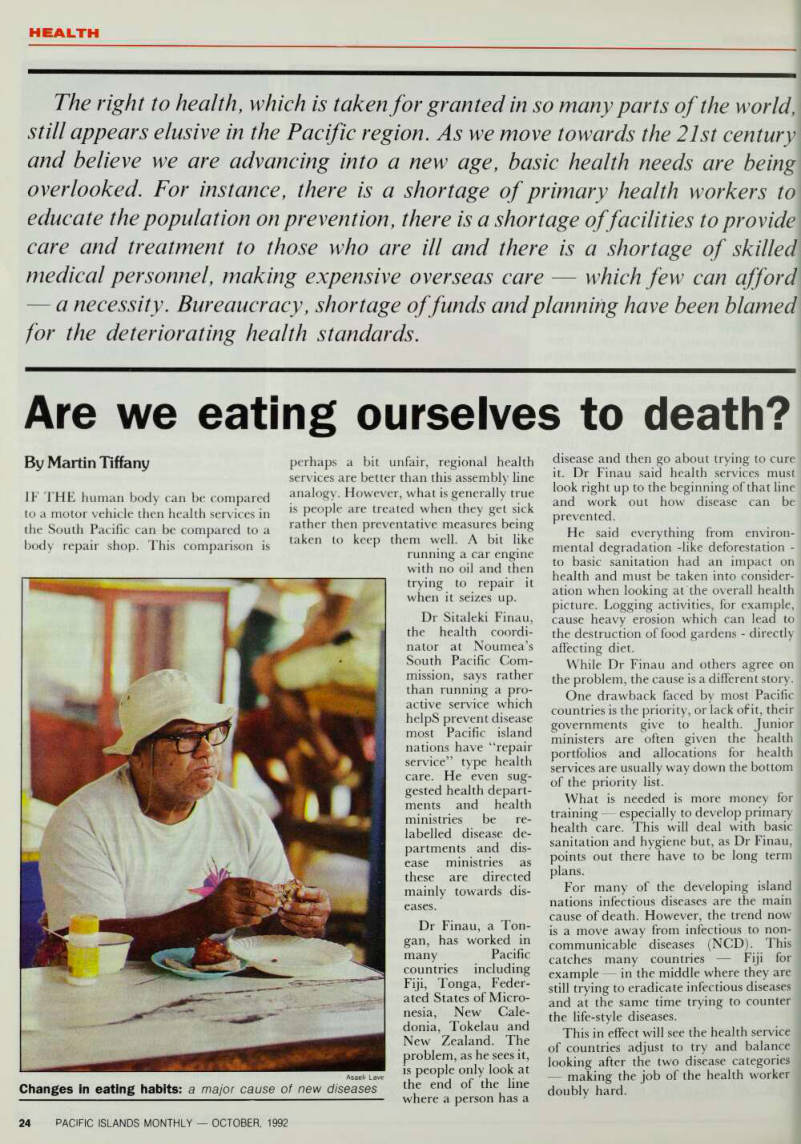
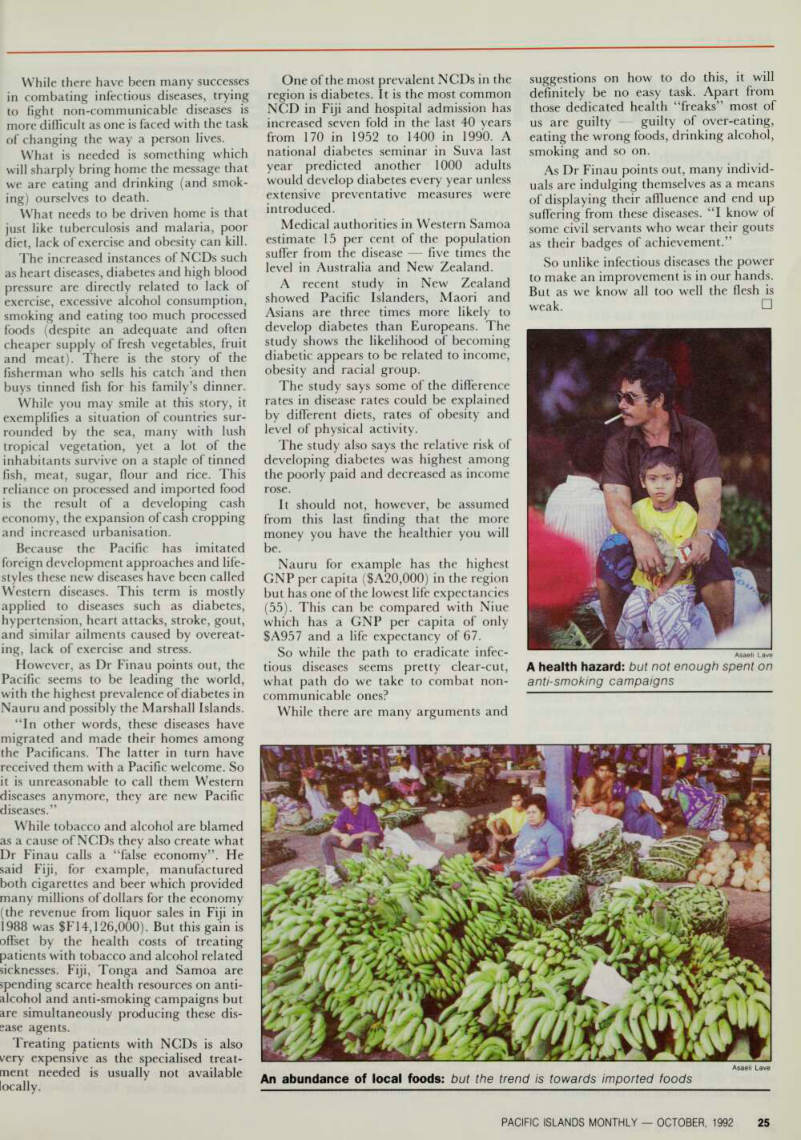
Health
The right to health, which is taken for granted in so many parts of the world, still appears elusive in the Pacific region. As we move towards the 21st century and believe we are advancing into a new age, basic health needs are being overlooked. For instance, there is a shortage of primary health workers to educate the population on prevention, there is a shortage of facilities to provide care and treatment to those who are ill and there is a shortage of skilled medical personnel, making expensive overseas care which few can afford a necessity. Bureaucracy, shortage offunds and planning have been blamed for the deteriorating health standards.
By Martin Tiffany
IF THE human body can be compared to a motor vehicle then health services in the South Pacific can be compared to a
body repair shop. This comparison is
perhaps a bit unfair, regional health services are better than this assembly line analogy. However, what is generally true is people are treated when they get sick rather then preventative measures being taken to keep them well. A bit like
running a car engine with no oil and then trying to repair it when it seizes up.
Dr Sitaleki Finau, the health coordi nator at Noumea’s South Pacific Com mission, says rather than running a pro active service which helpS prevent disease most Pacific island nations have “repair service” type health care. He even sug gested health depart ments and health ministries be re labelled disease de partments and dis ease ministries as these are directed mainly towards dis eases.
Dr Finau, a Ton gan, has worked in many Pacific
countries including
Fiji, Tonga, Feder ated States of Micro nesia, New Cale donia, Tokelau and New Zealand. The problem, as he sees it, is people only look at the end of the line where a person has a
disease and then go about trying to cure it. Dr Finau said health services must look right up to the beginning of that line and work out how disease can be prevented.
He said everything from environ mental degradation -like deforestation to basic sanitation had an impact on health and must be taken into consider ation when looking at the overall health picture. Logging activities, for example, cause heavy erosion which can lead to the destruction of food gardens - directly
affecting diet.
While Dr Finau and others agree on the problem, the cause is a different story.
One drawback faced by most Pacific countries is the priority, or lack of it, their governments give to health. Junior ministers are often given the health portfolios and allocations for health services are usually way down the bottom of the priority list.
What is needed is more money for training especially to develop primary health care. This will deal with basic sanitation and hygiene but, as Dr Finau, points out there have to be long term
plans.
For many of the developing island nations infectious diseases are the main cause of death. However, the trend now is a move away from infectious to non communicable diseases (NCD). This catches many countries Fiji for example in the middle where they are still trying to eradicate infectious diseases and at the same time trying to counter the life-style diseases.
This in effect will see the health service of countries adjust to try and balance looking after the two disease categories making the job of the health worker doubly hard.
Changes in eating habits: a major cause of new diseases
While there have been many successes in combating infectious diseases, trying to fight non-communicable diseases is more difficult as one is faced with the task of changing the way a person lives.
What is needed is something which will sharply bring home the message that we are eating and drinking (and smok ing) ourselves to death.
What needs to be driven home is that just like tuberculosis and malaria, poor diet, lack of exercise and obesity can kill.
The increased instances of NCDs such as heart diseases, diabetes and high blood pressure are directly related to lack of exercise, excessive alcohol consumption, smoking and eating too much processed foods (despite an adequate and often
cheaper supply of fresh vegetables, fruit
and meat). There is the story of the fisherman who sells his catch and then buys tinned fish for his family’s dinner.
While you may smile at this story, it exemplifies a situation of countries sur rounded by the sea, many with lush tropical vegetation, yet a lot of the inhabitants survive on a staple of tinned fish, meat, sugar, flour and rice. This reliance on processed and imported food is the result of a developing cash economy, the expansion of cash cropping and increased urbanisation.
Because the Pacific has imitated foreign development approaches and life styles these new diseases have been called Western diseases. This term is mostly applied to diseases such as diabetes, hypertension, heart attacks, stroke, gout, and similar ailments caused by overeat ing, lack of exercise and stress.
However, as Dr Finau points out, the Pacific seems to be leading the world, with the highest prevalence of diabetes in Nauru and possibly the Marshall Islands.
“In other words, these diseases have migrated and made their homes among the Pacificans. The latter in turn have received them with a Pacific welcome. So it is unreasonable to call them Western diseases anymore, they are new Pacific diseases.”
While tobacco and alcohol are blamed as a cause of NCDs they also create what Dr Finau calls a “false economy”. He said Fiji, for example, manufactured both cigarettes and beer which provided many millions of dollars for the economy (the revenue from liquor sales in Fiji in 1988 was 5F14,126,000). But this gain is offset by the health costs of treating patients with tobacco and alcohol related sicknesses. Fiji, Tonga and Samoa are spending scarce health resources on anti alcohol and anti-smoking campaigns but
are simultaneously producing these dis
ease agents.
Treating patients with NCDs is also very expensive as the specialised treat ment needed is usually not available locally.
One of the most prevalent NCDs in the region is diabetes. It is the most common NCD in Fiji and hospital admission has increased seven fold in the last 40 years from 170 in 1952 to 1400 in 1990. A national diabetes seminar in Suva last year predicted another 1000 adults would develop diabetes every year unless extensive preventative measures were introduced.
Medical authorities in Western Samoa estimate 15 per cent of the population suffer from the disease five times the level in Australia and New Zealand.
A recent study in New Zealand showed Pacific Islanders, Maori and Asians are three times more likely to develop diabetes than Europeans. The study shows the likelihood of becoming diabetic appears to be related to income, obesity and racial group.
The study says some of the difference rates in disease rates could be explained by different diets, rates of obesity and
level of physical activity.
The study also says the relative risk of developing diabetes was highest among the poorly paid and decreased as income rose.
It should not, however, be assumed from this last finding that the more money you have the healthier you will be.
Nauru for example has the highest GNP per capita (SA20,000) in the region but has one of the lowest life expectancies (55). This can be compared with Niue which has a GNP per capita of only 5A957 and a life expectancy of 67.
So while the path to eradicate infec tious diseases seems pretty clear-cut, what path do we take to combat non communicable ones?
While there are many arguments and
suggestions on how to do this, it will definitely be no easy task. Apart from those dedicated health “freaks” most of us are guilty guilty of over-eating, eating the wrong foods, drinking alcohol, smoking and so on.
As Dr Finau points out, many individ uals are indulging themselves as a means of displaying their affluence and end up suffering from these diseases. “I know of some civil servants who wear their gouts as their badges of achievement.”
So unlike infectious diseases the power to make an improvement is in our hands.
But as we know all too well the flesh is weak.
A health hazard: but not enough spent on anti-smoking campaigns
An abundance of local foods: but the trend is towards imported foods
Famine of knowledge
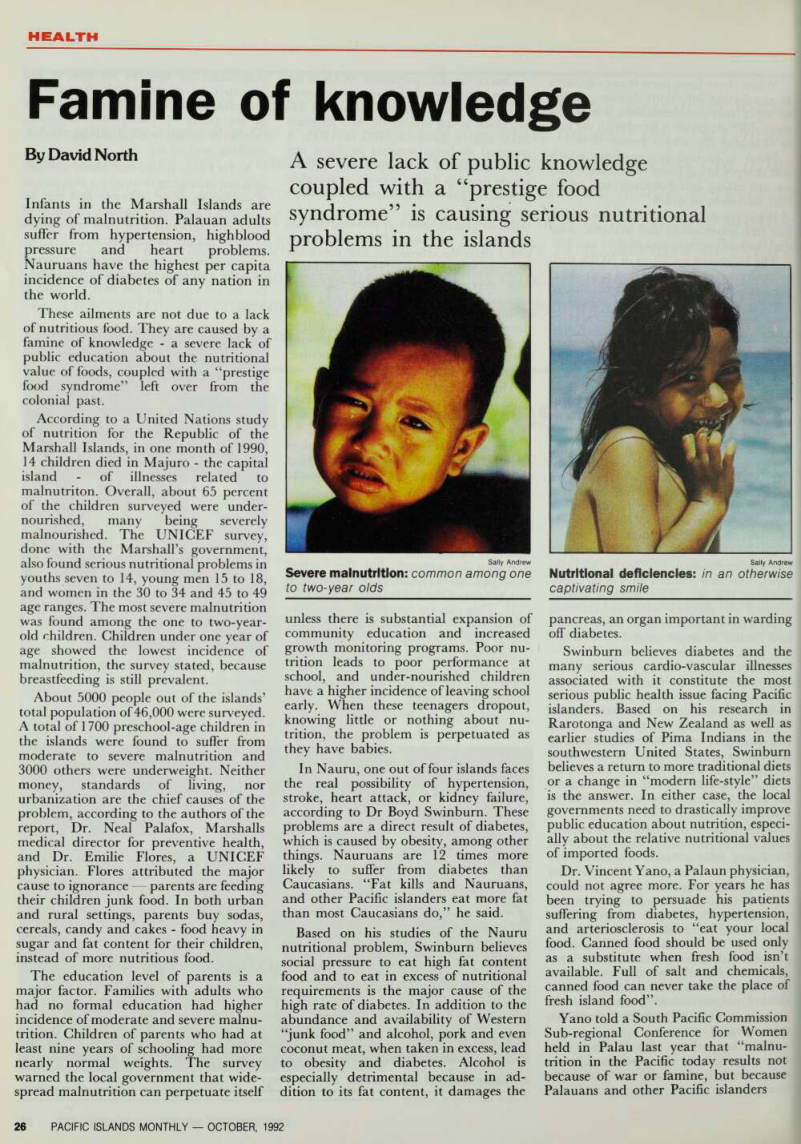
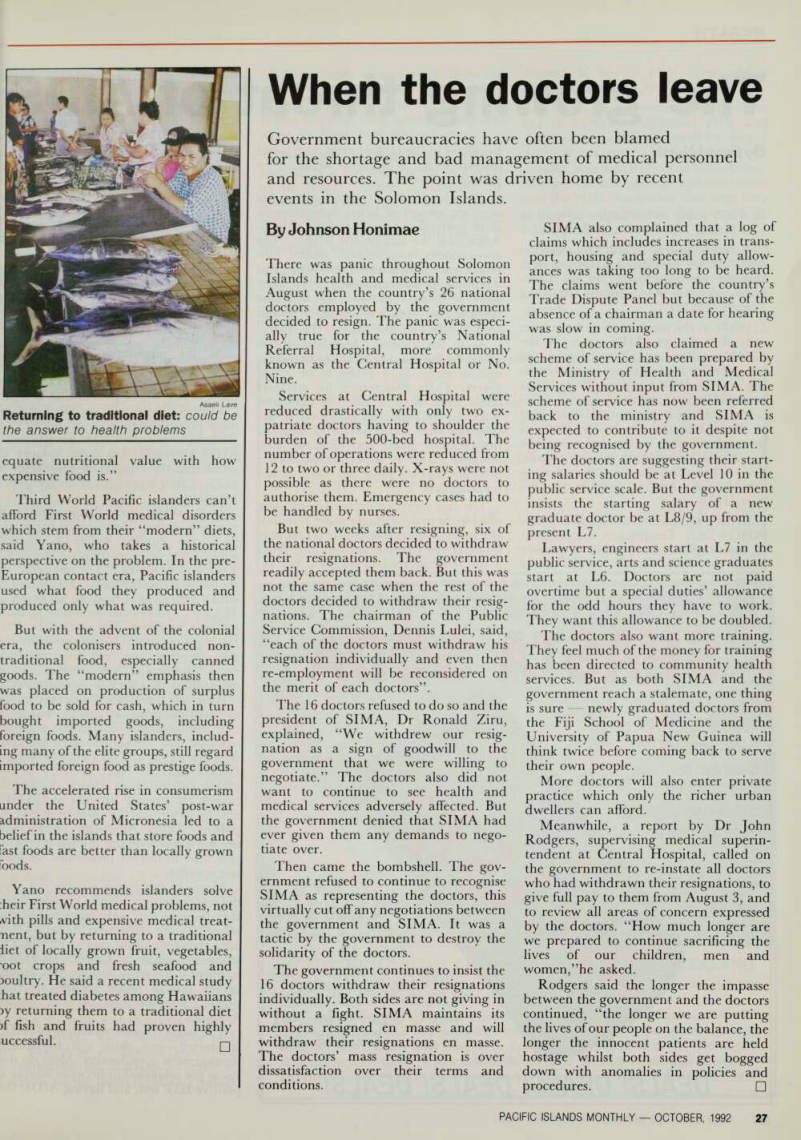
By David North
Infants in the Marshall Islands are dying of malnutrition. Palauan adults
suffer from hypertension, highblood
pressure and heart problems.
Nauruans have the highest per capita incidence of diabetes of any nation in the world.
These ailments are not due to a lack of nutritious food. They are caused by a famine of knowledge - a severe lack of public education about the nutritional value of foods, coupled with a “prestige food syndrome” left over from the colonial past.
According to a United Nations study of nutrition for the Republic of the Marshall Islands, in one month of 1990, 14 children died in Majuro - the capital island - of illnesses related to malnutriton. Overall, about 65 percent of the children surveyed were under nourished, many being severely malnourished. The UNICEF survey, done with the Marshall’s government, also found serious nutritional problems in youths seven to 14, young men 15 to 18, and women in the 30 to 34 and 45 to 49 age ranges. The most severe malnutrition was found among the one to two-year old children. Children under one year of age showed the lowest incidence of malnutrition, the survey stated, because
breastfeeding is still prevalent.
About 5000 people out of the islands’ total population 0f46,000 were surveyed.
A total of 1700 preschool-age children in the islands were found to suffer from moderate to severe malnutrition and 3000 others were underweight. Neither money, standards of living, nor urbanization are the chief causes of the problem, according to the authors of the report, Dr. Neal Palafox, Marshalls medical director for preventive health, and Dr. Emilie Flores, a UNICEF physician. Flores attributed the major cause to ignorance parents are feeding their children junk food. In both urban and rural settings, parents buy sodas, cereals, candy and cakes - food heavy in sugar and fat content for their children, instead of more nutritious food.
The education level of parents is a major factor. Families with adults who had no formal education had higher incidence of moderate and severe malnu trition. Children of parents who had at least nine years of schooling had more nearly normal weights. The survey warned the local government that wide spread malnutrition can perpetuate itself
A severe lack of public knowledge coupled with a “prestige food syndrome” is causing serious nutritional problems in the islands
unless there is substantial expansion of community education and increased growth monitoring programs. Poor nu trition leads to poor performance at school, and under-nourished children have a higher incidence of leaving school early. When these teenagers dropout, knowing little or nothing about nu trition, the problem is perpetuated as they have babies.
In Nauru, one out of four islands faces the real possibility of hypertension, stroke, heart attack, or kidney failure, according to Dr Boyd Swinburn. These problems are a direct result of diabetes, which is caused by obesity, among other things. Nauruans are 12 times more likely to suffer from diabetes than Caucasians. “Fat kills and Nauruans, and other Pacific islanders eat more fat than most Caucasians do,” he said.
Based on his studies of the Nauru nutritional problem, Swinburn believes social pressure to eat high fat content food and to eat in excess of nutritional requirements is the major cause of the high rate of diabetes. In addition to the abundance and availability of Western “junk food” and alcohol, pork and even coconut meat, when taken in excess, lead to obesity and diabetes. Alcohol is especially detrimental because in ad dition to its fat content, it damages the
pancreas, an organ important in warding off diabetes.
Swinburn believes diabetes and the many serious cardio-vascular illnesses associated with it constitute the most serious public health issue facing Pacific islanders. Based on his research in Rarotonga and New Zealand as well as earlier studies of Pima Indians in the southwestern United States, Swinburn believes a return to more traditional diets or a change in “modern life-style” diets is the answer. In either case, the local governments need to drastically improve public education about nutrition, especi ally about the relative nutritional values of imported foods.
Dr. Vincent Yano, a Palaun physician, could not agree more. For years he has been trying to persuade his patients suffering from diabetes, hypertension, and arteriosclerosis to “eat your local food. Canned food should be used only as a substitute when fresh food isn’t available. Full of salt and chemicals, canned food can never take the place of fresh island food”.
Yano told a South Pacific Commission Sub-regional Conference for Women held in Palau last year that “malnu trition in the Pacific today results not because of war or famine, but because Palauans and other Pacific islanders
Sally Andrew Severe malnutrition: common among one to two-year olds
Sally Andrew Nutritional deficiencies: in an otherwise captivating smile
equate nutritional value with how expensive food is.”
Third World Pacific islanders can’t afford First World medical disorders which stem from their “modern” diets, said Yano, who takes a historical perspective on the problem. In the pre- European contact era. Pacific islanders used what food they produced and produced only what was required.
But with the advent of the colonial era, the colonisers introduced non traditional food, especially canned goods. The “modern” emphasis then was placed on production of surplus food to be sold for cash, which in turn
bought imported goods, including
foreign foods. Many islanders, includ ing many of the elite groups, still regard imported foreign food as prestige foods.
The accelerated rise in consumerism under the United States’ post-war administration of Micronesia led to a belief in the islands that store foods and fast foods are better than locally grown bods.
Yano recommends islanders solve :heir First World medical problems, not -vith pills and expensive medical treat ment, but by returning to a traditional iiet of locally grown fruit, vegetables, oot crops and fresh seafood and xmltry. He said a recent medical study hat treated diabetes among Hawaiians )y returning them to a traditional diet )f fish and fruits had proven highly uccessful. |-j
Asaeli Lave Returning to traditional diet: could be the answer to health problems
When the doctors leave
Government bureaucracies have often been blamed for the shortage and bad management of medical personnel and resources. The point was driven home by recent events in the Solomon Islands.
By Johnson Honimae
There was panic throughout Solomon Islands health and medical services in August when the country’s 26 national doctors employed by the government decided to resign. The panic was especi ally true for the country’s National Referral Hospital, more commonly known as the Central Hospital or No.
Nine.
Services at Central Hospital were reduced drastically with only two ex patriate doctors having to shoulder the burden of the 500-bed hospital. The number of operations were reduced from 12 to two or three daily. X-rays were not possible as there were no doctors to authorise them. Emergency cases had to be handled by nurses.
But two weeks after resigning, six of the national doctors decided to withdraw their resignations. The government readily accepted them back. But this was not the same case when the rest of the doctors decided to withdraw their resig nations. The chairman of the Public Service Commission, Dennis Lulei, said, “each of the doctors must withdraw his resignation individually and even then re-employment will be reconsidered on the merit of each doctors”.
The 16 doctors refused to do so and the president of SIMA, Dr Ronald Ziru, explained, “We withdrew our resig nation as a sign of goodwill to the government that we were willing to negotiate.” The doctors also did not want to continue to see health and medical services adversely affected. But the government denied that SIMA had ever given them any demands to nego tiate over.
Then came the bombshell. The gov ernment refused to continue to recognise SIMA as representing the doctors, this virtually cut off any negotiations between the government and SIMA. It was a tactic by the government to destroy the solidarity of the doctors.
The government continues to insist the 16 doctors withdraw their resignations individually. Both sides are not giving in without a fight. SIMA maintains its members resigned en masse and will withdraw their resignations en masse.
The doctors’ mass resignation is over dissatisfaction over their terms and conditions.
SIMA also complained that a log of claims which includes increases in trans port, housing and special duty allow ances was taking too long to be heard.
The claims went before the country’s Trade Dispute Panel but because of the absence of a chairman a date for hearing was slow in coming.
The doctors also claimed a new scheme of service has been prepared by the Ministry of Health and Medical Services without input from SIMA. The scheme of service has now been referred back to the ministry and SIMA is expected to contribute to it despite not being recognised by the government.
The doctors are suggesting their start ing salaries should be at Level 10 in the public service scale. But the government insists the starting salary of a new graduate doctor be at L8/9, up from the present L7.
Lawyers, engineers start at L7 in the public service, arts and science graduates start at L6. Doctors are not paid overtime but a special duties’ allowance for the odd hours they have to work.
They want this allowance to be doubled.
The doctors also want more training.
They feel much of the money for training has been directed to community health services. But as both SIMA and the government reach a stalemate, one thing is sure — newly graduated doctors from the Fiji School of Medicine and the University of Papua New Guinea will think twice before coming back to serve their own people.
More doctors will also enter private practice which only the richer urban dwellers can afford.
Meanwhile, a report by Dr John
Rodgers, supervising medical superin
tendent at Central Hospital, called on the government to re-instate all doctors who had withdrawn their resignations, to give full pay to them from August 3, and to review all areas of concern expressed by the doctors. “How much longer are we prepared to continue sacrificing the lives of our children, men and women,”he asked.
Rodgers said the longer the impasse
between the government and the doctors continued, “the longer we are putting the lives of our people on the balance, the longer the innocent patients are held hostage whilst both sides get bogged down with anomalies in policies and
procedures. □
The growing threat of AIDS


By David North
Is AIDS going to hit Saipan as hard as it is hitting New York and Bangkok?
A recent World Health Organization study of the problem has caused both thought and controversy in the Com monwealth of the Northern Mariana Islands (CNMI.) While at the moment there have been only four known AIDS cases in the CNMI all natives, all now dead the prospects for the future are grim, accord ing to the WHO report. Widespread prostitution, and narrowly-spread infor mation on how to prevent AIDS are part of the problem. So is the lack of precautions taken by the native and the non-native homosexual male communi ties but dirty needles used in drug injections are not (or perhaps not yet) part of the scene.
In her own reserved and clinical prose, WHO’s Dr S. Tempongco, a consultant to that organization, paints a picture which in other hands would make
headlines in the tabloid press, or a social statement by a feminist writer or a political reformer.
She identified two apparently quite separate groups of active homosexuals, those from off-the-island and the natives.
Regarding the former, she writes: “The non-resident homosexuals, mostly Fili pinos, arrived in the islands with a clear definition of their sexuality . . . They work in beauty parlours all over the islands. Their length of stay in the islands ranged from four months to seven years.”
As to the natives: “Members of this group do not want to be called homosex uals or gays. They prefer to be called sisters. Their preferences for partners differ from that of gays in mainland USA. In the mainland gays have sexual relations with gays, but in CNMI the homosexuals have sex relations with bisexual males. It is not acceptable for homosexuals to have sex with other homosexuals.”
The last sentence presents something of a puzzle to this straight male; it sounds like male-to-male intercourse is OK only if one of the partners is bi-sexual. What if the self-described bi-sexual is not bi
sexual at all? The Filipino gays apparH ently do not have this hang-up.
She also reports that some Saipanese gays (or sisters) are attracted to the brighter lights of nearby Guam for celebratory weekends. There are gay bars on Guam. (And also more reported AIDS and HIV cases.) Whether native or foreign, the gays she interviewed engaged in both oral and anal sex. Only three of her many informants said they used condoms, although all recognized the utility of these devices.
As for prostitution, although the WHO visitor did not mention the fact, CNMI is virtually the only place under the US flag where prostitution is legal.
Further, there are apparently a lot more prostitutes than gays, and, in fact, Richard Ceyzk, the CNMI government’s AIDS specialist, has been quoted as estimating the number of prostitutes at 3125, or fully 6 per cent of the territory’s population.
In the WHO report the prostitutes are variously called “commercial sex work ers”, the current politically correct euphemism, or, more simply, “bar girls”.!
Tempongco writes, “The majority [of
the bar girls/waitresses] are Filipinos with a sprinkling of Korean, Chinese and Thais ... [they] can be found in bars, massage parlours, Karaoke clubs, etc.
During the group discussions with the girls about 80 per cent admitted they were commercial sex workers. Some maintained that they were waitresses.” j Although the doctor did not say so, the overwhelming majority of the bar girls, like the island’s ill-treated garment workers, are temporary alien workers, with few rights, and no ability to become CNMI citizens. Their presence in the island, ostensibly to service the tourist market, is another product of CNMI’s ability to control its own immigration
policies. Other American jurisdictions
are not allowed to use the US immigra tion laws to import prostitutes (at least ’
not openly).
Many of the young women say they . did not come to Saipan to be prostitutes; they thought they were going to work as waitresses, but discovered the reality only after spending all the money they had to make the flight to CNMI. (If this is frequently the case, it suggests a failure in the usually pretty reliable interna tional communication network among migrants.) The women’s understanding of AIDS is limited, and their will to protect themselves is even weaker. Most do not know the relationship between having a positive HIV test, and having AIDS; the
former is symptom-free but always leads to the latter, and the latter is always fatal. (US Olympic basketball player Magic Johnson, for example, is, at the moment, symptom-free, but has HIV and will ultimately die of AIDS, at the early age □f most AIDS victims.) The women also tend to feel powerless, against both the threat of the disease and the sexual preferences of the men in their lives.
Tempongco writes: “The use of
:ondoms is recognized as a preventive
neasure, but it is only in one massage aarlour where condom use is required by he girls ... In other places the use of :ondoms is dependent on the customers, fapanese customers are usually amen ible to condom use. The resistance to :ondom use, according to the girls, is nostly found among the locals. . . The firls also don’t find the need to use :ondoms with their regular boyfriend, vhatever the nationality of the boy riend. The use of condoms is associated vdth a customer, not with a boyfriend.”
The Saipan Tribune quoted one prosti ute on the interaction between disease >revention and economics. She said if she nd her colleagues insist on the use of ondoms, the clients “will pay us half the nice or lower than our regular rates.”
The WHO report has set off a variety f related activities: • The only woman in the CNMI
igislature, representative Ana S
"eregeyo, introduced a bill to ban restitution in the islands, but her male olleagues have (as yet) not been very jpportive. (Doris Brooks, one of the :veral women in the Guam legislature, ew to a meeting in Tinian, to add her apport to the measure.) • Several mass education sessions r ere held on AIDS prevention tech iques for the foreign-born women work ig in the island’s service industry. More lan 500 of the waitresses and others ere reported to have attended one such
leeting.
• And, meanwhile, off in Guam there as at least the glimmering notion that group of AIDS victims from the lainland might descend en masse on lat island.
A resourceful Oklahoma organization, ware that the homeless have some rarely sed rights under federal law to claim bout-to-be abandoned federal property, ut in a claim for a portion of a military ase on Guam. The Oklahomans said icy wanted to establish a hostel for lainlanders dying of AIDS. In addition » setting off the usual NIMBY (Not in
My Back Yard) protests, their efforts ran into a rival claim by a group of Chamorro nationalists for the same land.
If past patterns hold, neither group will wrest the land from the military.
Meanwhile, the true extent of HIV and AIDS is not well known in CNMI or in Guam. There is virtually no mandatory testing (except for a seldom used immigration benefit on Saipan) and only about 50 people a month opt for it voluntarily in CNMI.
In addition to the known four deaths from AIDS, there are three known HIV positive cases in the territory. The numbers are much higher in the larger island of Guam, where recent data
showed 36 known HIV cases, and a dozen instances of AIDS.
World-wide it is understood the num ber of formally recognized HIV and AIDS cases constitute a small fraction of the real universe. On Saipan there is another reason to suspect an undercount.
Many of the homosexuals and prostitutes told the WHO researcher that were they to contract the disease, they would go home to die.
Sadly, many of the informants also said that were they to test positive, they would not tell their friends and partners and that’s exactly how the condition
spreads.
Advertisements & other items, pp. 28-31 (1 item)
Shasta Soda
PROMOTION! PROMOTIONI PROMOTION!
Product: Soft Drinks Packing: 12 oz./24 oz. 2,000 per 20ft FCL Shipment: Next sail Price; U 554.49 FOB Seattle, Washington Term: 30 days L/C All orders must be placed at the South Pacific sales office in Tonga. Ph. No, (676) 21-105 Fax No. (676) 23-139. Contact Willis L. 'Unga. P.O. Box 2481 Nukualofa, Tonga
DEALS! DEALS! DEALS! DEALS!
The women’s understanding of AIDS is limited, and their will to protect themselves even weaker.
Most do not know the relationship between having a positive HIV test, and having AIDS; the former is sympton-free but always leads to the latter, and the latter is always fatal.
s -I" 1 * 't *
•fit
■V ri !<?/ New Zealand
BETTER PEOPLE, BETTER MEDICINES
142 BOTANICAL ROAD, PALMERSTON NORTH, NEW ZEALAND Glaxo is a long established New Zealand Company, having been in business for over 100 years and based in the Manawatu since 1904.
Originally an importer of supplies for the early settlers; then Glaxo manufactured dried milk based baby food and other food products for many years. Today, the Company produces human medicines only. Glaxo’s head office is in London and in world terms the 2nd largest pharmaceutical Company. In New Zealand the Company has market leadership. Glaxo New Zealand provides a special service and product range to South Pacific Island countries.
Creating a highly efficient, dynamic-looking car wo be simple if it weren’t for one complicating detail; passengers that must ride in it. Accommodating people comfortably in a pleasant, roo interior usually means a certain amount of aerodynamic potential has to be sacrifi « 4 * Exact features and specifications may vary depending on country of purchase. Please check with your nearest TOYOTA distributor/dealer for details.
DISTRIBUTORS/DEALERS
AMERICAN SAMOA BURNS PHILP (S.S.) CO. LTD. PH 633-4281 GUAM & MICRONESIA... ATKINS KROLL. INC. PH 646-1876/9 NORFOLK ISLANDS BORRY’S PTY LTD. PH 2114
SOLOMON ISLANDS MENDANA MOTORS PH 30314
VANUATU VANUATU MOTORS PH 22341
COOK ISLANDS PACIFIC MOTORS LTD.
KIRIBATI TARAWA MOTORS
PAPUA NEW GUINEA ... ELA MOTORS
TAHITI NIPPON AUTOMOTO
WESTERN SAMOA BURNS PHILP (S.S.) CO.
PH 20796 PH 21090 PH 217036 PH 429819
LTD. PH 20800
FIJI ASCO MOTORS
NEW CALEDONIA .. .S.I.A.P.
SAIPAN MICROL CORPORATION
TONGA BURNS PHILP (TONGA) LI
F PW ('(Mil DOFS IT RFIIITIFIIIIY L;ntll now. Using a con- L JLfT VlfllULLxl lil/LO II Dkll ill I LLI . cept called total airflow lagement, Toyota engineers were able to realize an efficient, wedge-shaped design le at the same time perfecting the alignment between body panels and components. :ourse our own innovative style of civilized ineering makes sure that none of this comes he expense of the luxurious, leg-stretching interior. Because we realize that even a 0.33 is useless if no one wants to drive the car.
®TOYOTA
A matter of setting the right priorities
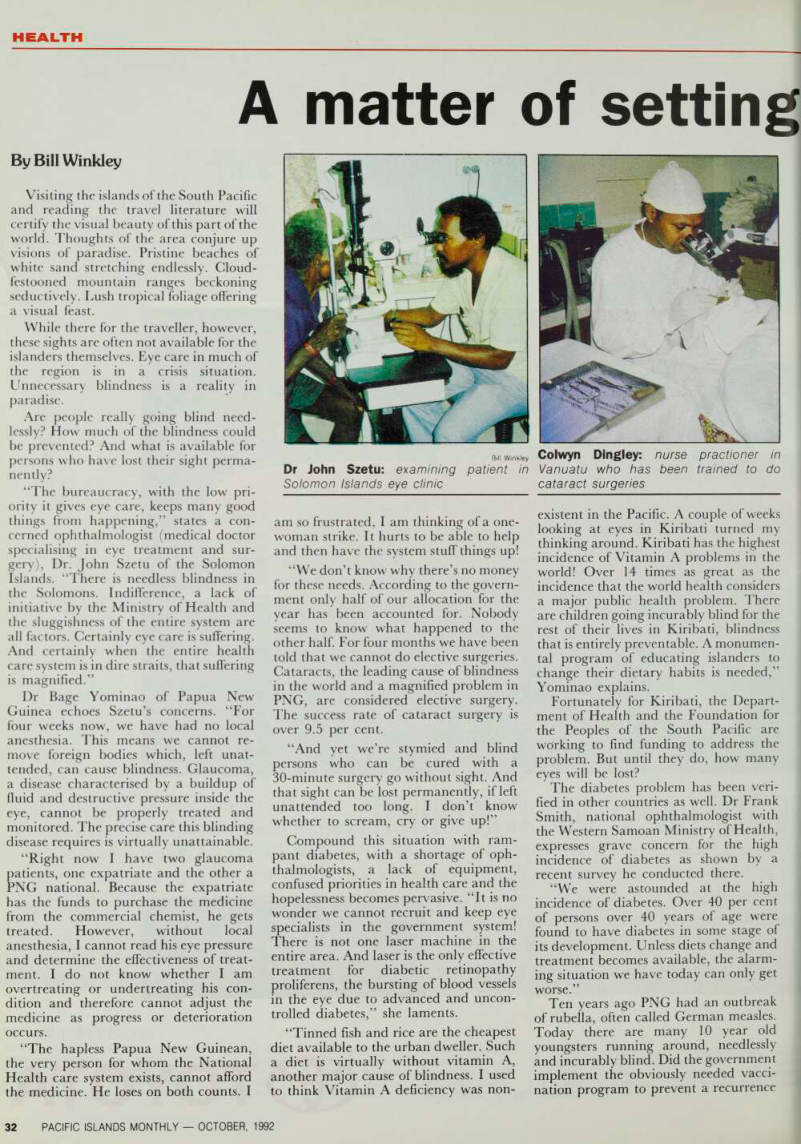
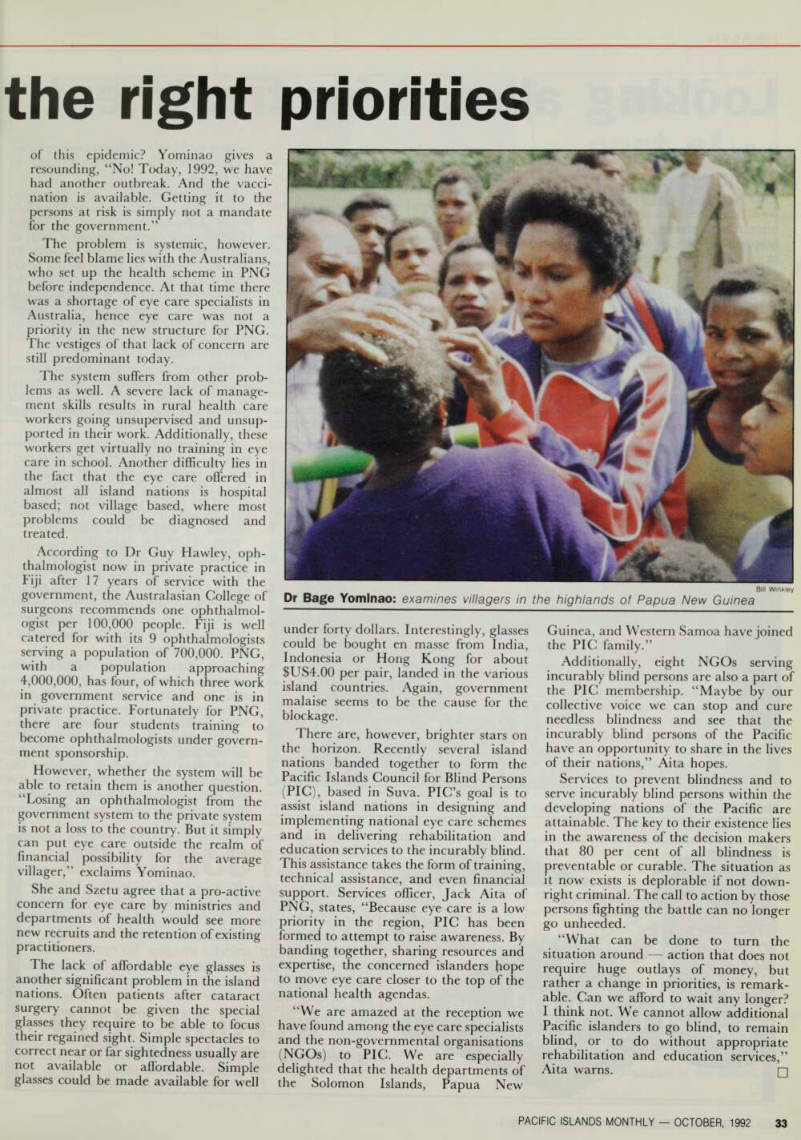
By Bill Winkley
Visiting the islands of the South Pacific and reading the travel literature will certify the visual beauty of this part of the world. Thoughts of the area conjure up visions of paradise. Pristine beaches of white sand stretching endlessly. Cloud festooned mountain ranges beckoning seductively. Lush tropical foliage offering a visual feast.
While there for the traveller, however, these sights are often not available for the islanders themselves. Eye care in much of the region is in a crisis situation.
Unnecessary blindness is a reality in
paradise.
Are people really going blind need lessly? How much of the blindness could be prevented? And what is available for persons who have lost their sight perma nently?
“The bureaucracy, with the low pri ority it gives eye care, keeps many good things from happening,” states a con cerned ophthalmologist (medical doctor specialising in eye treatment and sur gery), Dr. John Szetu of the Solomon Islands. “There is needless blindness in the Solomons. Indifference, a lack of initiative by the Ministry of Health and the sluggishness of the entire system are all factors. Certainly eye care is suffering.
And certainly when the entire health care system is in dire straits, that suffering
is magnified.”
Dr Bage Yominao of Papua New Guinea echoes Szetu’s concerns. “For four weeks now, we have had no local anesthesia. This means we cannot re move foreign bodies which, left unat tended, can cause blindness. Glaucoma, a disease characterised by a buildup of fluid and destructive pressure inside the eye, cannot be properly treated and monitored. The precise care this blinding disease requires is virtually unattainable.
“Right now I have two glaucoma patients, one expatriate and the other a PNG national. Because the expatriate has the funds to purchase the medicine from the commercial chemist, he gets treated. However, without local anesthesia, I cannot read his eye pressure and determine the effectiveness of treat ment. I do not know whether I am overtreating or undertreating his con dition and therefore cannot adjust the medicine as progress or deterioration occurs.
“The hapless Papua New Guinean, the very person for whom the National Health care system exists, cannot afford the medicine. He loses on both counts. I
am so frustrated, I am thinking of a one woman strike. It hurts to be able to help and then have the system stuff things up!
“We don’t know why there’s no money for these needs. According to the govern ment only half of our allocation for the year has been accounted for. Nobody seems to know what happened to the other half. For four months we have been told that we cannot do elective surgeries.
Cataracts, the leading cause of blindness in the world and a magnified problem in PNG, are considered elective surgery.
The success rate of cataract surgery is over 9.5 per cent.
“And yet we’re stymied and blind persons who can be cured with a 30-minute surgery go without sight. And that sight can be lost permanently, if left unattended too long. I don’t know whether to scream, cry or give up!”
Compound this situation with ram pant diabetes, with a shortage of oph thalmologists, a lack of equipment, confused priorities in health care and the hopelessness becomes pervasive. “It is no wonder we cannot recruit and keep eye specialists in the government system!
There is not one laser machine in the entire area. And laser is the only effective treatment for diabetic retinopathy proliferens, the bursting of blood vessels in the eye due to advanced and uncon trolled diabetes,” she laments.
“Tinned fish and rice are the cheapest diet available to the urban dweller. Such a diet is virtually without vitamin A, another major cause of blindness. I used to think Vitamin A deficiency was non-
existent in the Pacific. A couple of weeks looking at eyes in Kiribati turned my thinking around. Kiribati has the highest incidence of Vitamin A problems in the world! Over 14 times as great as the incidence that the world health considers a major public health problem. There are children going incurably blind for the rest of their lives in Kiribati, blindness that is entirely preventable. A monumen tal program of educating islanders to change their dietary habits is needed,”
Yominao explains.
Fortunately for Kiribati, the Depart ment of Health and the Foundation for the Peoples of the South Pacific are working to find funding to address the problem. But until they do, how many eyes will be lost?
The diabetes problem has been veri fied in other countries as well. Dr Frank Smith, national ophthalmologist with the Western Samoan Ministry of Health, expresses grave concern for the high incidence of diabetes as shown by a recent survey he conducted there.
“We were astounded at the high incidence of diabetes. Over 40 per cent of persons over 40 years of age were found to have diabetes in some stage of its development. Unless diets change and treatment becomes available, the alarm ing situation we have today can only get worse.”
Ten years ago PNG had an outbreak of rubella, often called German measles.
Today there are many 10 year old youngsters running around, needlessly and incurably blind. Did the government implement the obviously needed vacci nation program to prevent a recurrence
Bill Wlnkley Dr John Szetu: examining patient in Solomon Islands eye clinic
Colwyn Dingley: nurse practioner in Vanuatu who has been trained to do cataract surgeries
of this epidemic? Yominao gives a resounding, “No! Today, 1992, we have had another outbreak. And the vacci nation is available. Getting it to the persons at risk is simply not a mandate for the government.”
The problem is systemic, however.
Some feel blame lies with the Australians, who set up the health scheme in PNG before independence. At that time there was a shortage of eye care specialists in Australia, hence eye care was not a priority in the new structure for PNG.
The vestiges of that lack of concern are still predominant today.
The system suffers from other prob lems as well. A severe lack of manage ment skills results in rural health care workers going unsupervised and unsup ported in their work. Additionally, these workers get virtually no training in eye care in school. Another difficulty lies in the fact that the eye care offered in almost all island nations is hospital based; not village based, where most problems could be diagnosed and treated.
According to Dr Guy Hawley, oph
thalmologist now in private practice in Fiji after 17 years of service with the government, the Australasian College of surgeons recommends one ophthalmol ogist per 100,000 people. Fiji is well catered for with its 9 ophthalmologists serving a population of 700,000. PNG, with a population approaching 4,000,000, has four, of which three work in government service and one is in private practice. Fortunately for PNG, there are four students training to become ophthalmologists under govern
ment sponsorship.
However, whether the system will be able to retain them is another question.
“Losing an ophthalmologist from the government system to the private system is not a loss to the country. But it simply can put eye care outside the realm of financial possibility for the average villager,” exclaims Yominao.
She and Szetu agree that a pro-active concern for eye care by ministries and departments of health would see more new recruits and the retention of existing practitioners.
The lack of affordable eye glasses is another significant problem in the island nations. Often patients after cataract surgery cannot be given the special glasses they require to be able to focus their regained sight. Simple spectacles to correct near or far sightedness usually are not available or affordable. Simple glasses could be made available for well
under forty dollars. Interestingly, glasses could be bought en masse from India, Indonesia or Hong Kong for about SUS4.OO per pair, landed in the various island countries. Again, government malaise seems to be the cause for the
blockage.
There are, however, brighter stars on the horizon. Recently several island nations banded together to form the Pacific Islands Council for Blind Persons (PIC), based in Suva. PlC’s goal is to assist island nations in designing and implementing national eye care schemes and in delivering rehabilitation and education services to the incurably blind.
This assistance takes the form of training, technical assistance, and even financial support. Services officer, Jack Aita of PNG, states, “Because eye care is a low priority in the region, PIC has been formed to attempt to raise awareness. By banding together, sharing resources and expertise, the concerned islanders hope to move eye care closer to the top of the national health agendas.
“We are amazed at the reception we have found among the eye care specialists and the non-governmental organisations (NGOs) to PIC. We are especially delighted that the health departments of the Solomon Islands, Papua New
Guinea, and Western Samoa have joined the PIC family.”
Additionally, eight NGOs serving
incurably blind persons are also a part of the PIC membership. “Maybe by our collective voice we can stop and cure needless blindness and see that the incurably blind persons of the Pacific have an opportunity to share in the lives of their nations,” Aita hopes.
Services to prevent blindness and to serve incurably blind persons within the developing nations of the Pacific are attainable. The key to their existence lies in the awareness of the decision makers that 80 per cent of all blindness is preventable or curable. The situation as it now exists is deplorable if not down right criminal. The call to action by those persons fighting the battle can no longer go unheeded.
“What can be done to turn the situation around action that does not require huge outlays of money, but rather a change in priorities, is remark able. Can we afford to wait any longer?
I think not. We cannot allow additional Pacific islanders to go blind, to remain blind, or to do without appropriate rehabilitation and education services,”
Aita warns. □
Bill Winkley Dr Bage Yominao: examines villagers in the highlands of Papua New Guinea
Looking abroad for treatment
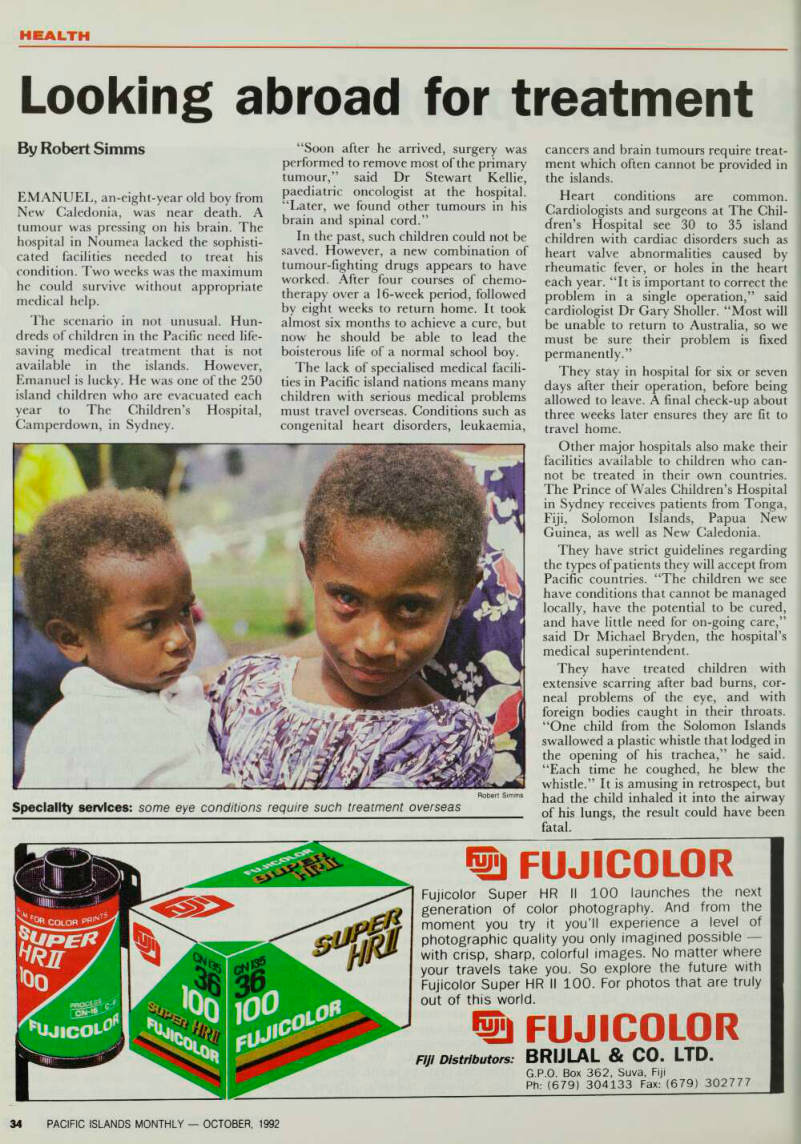
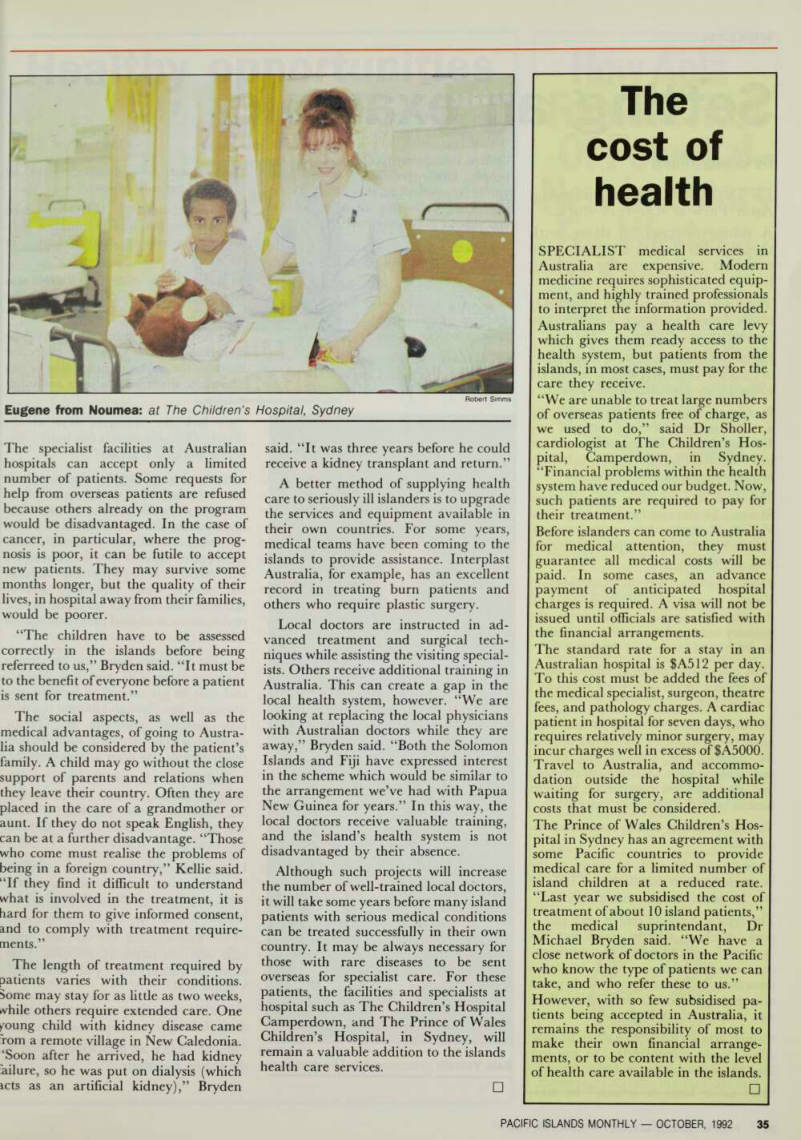
By Robert Simms
EMANUEL, an-eight-year old boy from New Caledonia, was near death. A tumour was pressing on his brain. The hospital in Noumea lacked the sophisti cated facilities needed to treat his condition. Two weeks was the maximum he could survive without appropriate
medical help.
The scenario in not unusual. Hun dreds of children in the Pacific need life saving medical treatment that is not available in the islands. However, Emanuel is lucky. He was one of the 250 island children who are evacuated each year to The Children’s Hospital, Camperdown, in Sydney.
“Soon after he arrived, surgery was performed to remove most of the primary tumour,” said Dr Stewart Kellie, paediatric oncologist at the hospital.
“Later, we found other tumours in his brain and spinal cord.”
In the past, such children could not be saved. However, a new combination of tumour-fighting drugs appears to have worked. After four courses of chemo therapy over a 16-week period, followed by eight weeks to return home. It took almost six months to achieve a cure, but now he should be able to lead the boisterous life of a normal school boy.
The lack of specialised medical facili ties in Pacific island nations means many children with serious medical problems must travel overseas. Conditions such as congenital heart disorders, leukaemia,
cancers and brain tumours require treat ment which often cannot be provided in the islands.
Heart conditions are common.
Cardiologists and surgeons at The Chil dren’s Hospital see 30 to 35 island children with cardiac disorders such as heart valve abnormalities caused by rheumatic fever, or holes in the heart each year. “It is important to correct the problem in a single operation,” said cardiologist Dr Gary Sholler. “Most will be unable to return to Australia, so we must be sure their problem is fixed permanently.”
They stay in hospital for six or seven days after their operation, before being allowed to leave. A final check-up about three weeks later ensures they are fit to travel home.
Other major hospitals also make their facilities available to children who can not be treated in their own countries.
The Prince of Wales Children’s Hospital
in Sydney receives patients from Tonga,
Fiji, Solomon Islands, Papua New Guinea, as well as New Caledonia.
They have strict guidelines regarding the types of patients they will accept from Pacific countries. “The children we see have conditions that cannot be managed locally, have the potential to be cured, and have little need for on-going care,” said Dr Michael Bryden, the hospital’s
medical superintendent.
They have treated children with extensive scarring after bad burns, cor neal problems of the eye, and with foreign bodies caught in their throats.
“One child from the Solomon Islands swallowed a plastic whistle that lodged in the opening of his trachea,” he said.
“Each time he coughed, he blew the whistle.” It is amusing in retrospect, but had the child inhaled it into the airway of his lungs, the result could have been fatal.
Robert Simms Speciality services: some eye conditions require such treatment overseas
The specialist facilities at Australian hospitals can accept only a limited number of patients. Some requests for help from overseas patients are refused because others already on the program would be disadvantaged. In the case of cancer, in particular, where the prog nosis is poor, it can be futile to accept new patients. They may survive some months longer, but the quality of their lives, in hospital away from their families, would be poorer.
“The children have to be assessed correctly in the islands before being referreed to us,” Bryden said. “It must be to the benefit of everyone before a patient is sent for treatment.”
The social aspects, as well as the medical advantages, of going to Austra lia should be considered by the patient’s family. A child may go without the close support of parents and relations when they leave their country. Often they are placed in the care of a grandmother or aunt. If they do not speak English, they can be at a further disadvantage. “Those who come must realise the problems of being in a foreign country,” Kellie said.
“If they find it difficult to understand what is involved in the treatment, it is hard for them to give informed consent, and to comply with treatment require ments.”
The length of treatment required by patients varies with their conditions.
Some may stay for as little as two weeks, while others require extended care. One child with kidney disease came Tom a remote village in New Caledonia. ‘Soon after he arrived, he had kidney ailure, so he was put on dialysis (which lets as an artificial kidney),” Bryden
said. “It was three years before he could receive a kidney transplant and return.”
A better method of supplying health care to seriously ill islanders is to upgrade the services and equipment available in their own countries. For some years, medical teams have been coming to the islands to provide assistance. Interplast Australia, for example, has an excellent record in treating burn patients and others who require plastic surgery.
Local doctors are instructed in ad vanced treatment and surgical tech
niques while assisting the visiting special
ists. Others receive additional training in Australia. This can create a gap in the local health system, however. “We are looking at replacing the local physicians with Australian doctors while they are away,” Bryden said. “Both the Solomon Islands and Fiji have expressed interest in the scheme which would be similar to the arrangement we’ve had with Papua New Guinea for years.” In this way, the local doctors receive valuable training, and the island’s health system is not
disadvantaged by their absence.
Although such projects will increase the number of well-trained local doctors, it will take some years before many island patients with serious medical conditions can be treated successfully in their own country. It may be always necessary for those with rare diseases to be sent overseas for specialist care. For these patients, the facilities and specialists at hospital such as The Children’s Hospital Camperdown, and The Prince of Wales Children’s Hospital, in Sydney, will remain a valuable addition to the islands health care services.
Robert Simms Eugene from Noumea: at The Children’s Hospital, Sydney
Advertisements & other items, p. 34 (1 item)
®| Fujicolor
* Cni
cnS
®| FUJI CO LOR
Fujicolor Super HR II 100 launches the next generation of color photography. And from the moment you try it you’ll experience a level of photographic quality you only imagined possible with crisp, sharp, colorful images. No matter where your travels take you. So explore the future with Fujicolor Super HR II 100. For photos that are truly out of this world.
®| FUJICOLOR
Fiji Distributors: BRIJLAL & CO- LTD.
G.P.O. Box 362, Suva, Fiji Ph: (679) 304133 Fax: (679) 302777
cost of
The cost of health
SPECIALIST medical services in Australia are expensive. Modern medicine requires sophisticated equip ment, and highly trained professionals to interpret the information provided.
Australians pay a health care levy which gives them ready access to the health system, but patients from the islands, in most cases, must pay for the care they receive.
“We are unable to treat large numbers of overseas patients free of charge, as we used to do,” said Dr Sholler, cardiologist at The Children’s Hos
pital, Camperdown, in Sydney.
“Financial problems within the health system have reduced our budget. Now, such patients are required to pay for their treatment.”
Before islanders can come to Australia for medical attention, they must guarantee all medical costs will be paid. In some cases, an advance
payment of anticipated hospital
charges is required. A visa will not be issued until officials are satisfied with the financial arrangements.
The standard rate for a stay in an Australian hospital is SASI2 per day.
To this cost must be added the fees of the medical specialist, surgeon, theatre fees, and pathology charges. A cardiac patient in hospital for seven days, who requires relatively minor surgery, may incur charges well in excess of SASOOO.
Travel to Australia, and accommo dation outside the hospital while waiting for surgery, are additional costs that must be considered.
The Prince of Wales Children’s Hos pital in Sydney has an agreement with some Pacific countries to provide medical care for a limited number of island children at a reduced rate.
“Last year we subsidised the cost of treatment of about 10 island patients,” the medical suprintendant, Dr Michael Bryden said. “We have a close network of doctors in the Pacific who know the type of patients we can take, and who refer these to us.”
However, with so few subsidised pa tients being accepted in Australia, it remains the responsibility of most to make their own financial arrange ments, or to be content with the level of health care available in the islands.
Setting an example
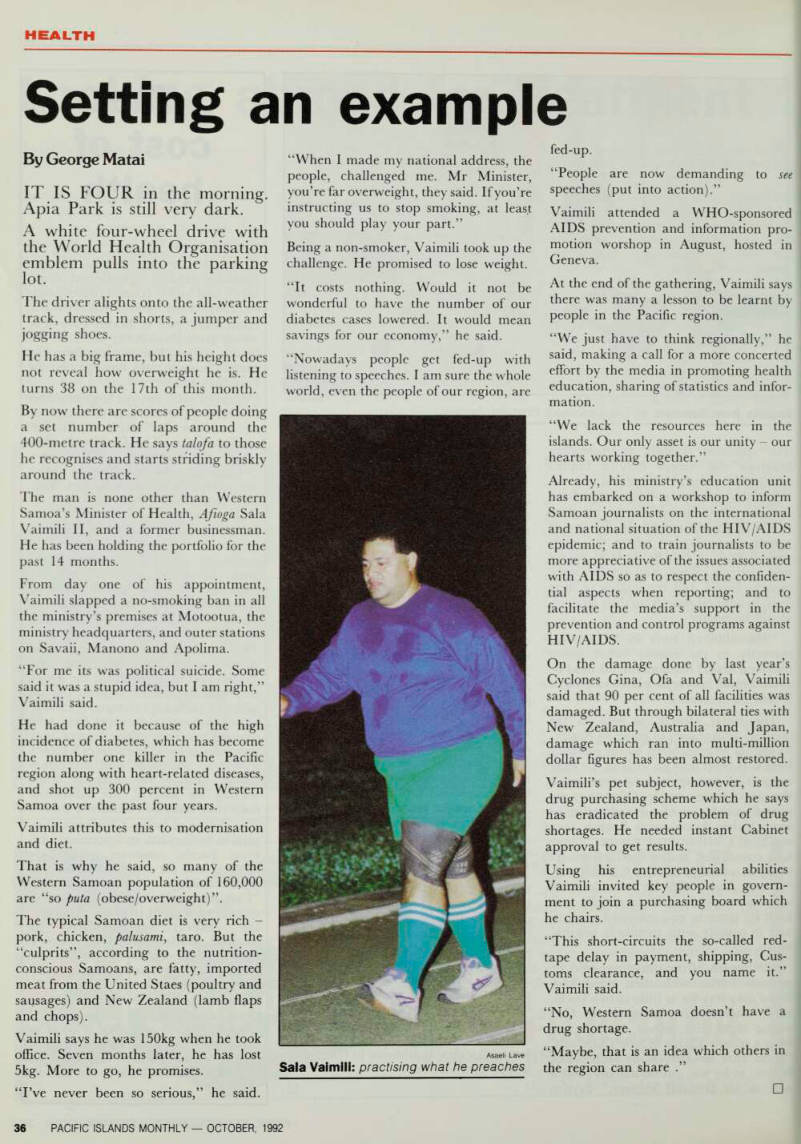
By George Matai
IT IS FOUR in the morning.
Apia Park is still very dark.
A white four-wheel drive with the World Health Organisation emblem pulls into the parking lot.
The driver alights onto the all-weather track, dressed in shorts, a jumper and
jogging shoes.
He has a big frame, but his height does not reveal how overweight he is. He turns 38 on the 17th of this month.
By now there are scores of people doing a set number of laps around the 400-metre track. He says talofa to those
he recognises and starts striding briskly
around the track.
The man is none other than Western Samoa’s Minister of Health, Afioga Sala Vaimili 11, and a former businessman.
He has been holding the portfolio for the past 14 months.
From day one of his appointment, Vaimili slapped a no-smoking ban in all the ministry’s premises at Motootua, the ministry headquarters, and outer stations on Savaii, Manono and Apolima.
“For me its was political suicide. Some said it was a stupid idea, but I am right,”
Vaimili said.
He had done it because of the high incidence of diabetes, which has become the number one killer in the Pacific region along with heart-related diseases, and shot up 300 percent in Western Samoa over the past four years.
Vaimili attributes this to modernisation and diet.
That is why he said, so many of the Western Samoan population of 160,000 are “so puta (obese/overweight)”.
The typical Samoan diet is very rich pork, chicken, palusami , taro. But the “culprits”, according to the nutrition conscious Samoans, are fatty, imported meat from the United Staes (poultry and sausages) and New Zealand (lamb flaps
and chops).
Vaimili says he was 150 kg when he took office. Seven months later, he has lost skg. More to go, he promises.
“I’ve never been so serious,” he said.
“When I made my national address, the people, challenged me. Mr Minister, you’re far overweight, they said. If you’re instructing us to stop smoking, at least you should play your part.”
Being a non-smoker, Vaimili took up the challenge. He promised to lose weight.
“It costs nothing. Would it not be wonderful to have the number of our diabetes cases lowered. It would mean savings for our economy,” he said.
“Nowadays people get fed-up with listening to speeches. I am sure the whole world, even the people of our region, are
fed-up.
“People are now demanding to see speeches (put into action).”
Vaimili attended a WHO-sponsored AIDS prevention and information pro motion worshop in August, hosted in Geneva.
At the end of the gathering, Vaimili says there was many a lesson to be learnt by people in the Pacific region.
“We just have to think regionally,” he said, making a call for a more concerted effort by the media in promoting health education, sharing of statistics and infor mation.
“We lack the resources here in the islands. Our only asset is our unity - our hearts working together.”
Already, his ministry’s education unit has embarked on a workshop to inform Samoan journalists on the international and national situation of the HIV/AIDS epidemic; and to train journalists to be more appreciative of the issues associated with AIDS so as to respect the confiden tial aspects when reporting; and to facilitate the media’s support in the prevention and control programs against
Hiv/Aids.
On the damage done by last year’s Cyclones Gina, Ofa and Val, Vaimili said that 90 per cent of all facilities was damaged. But through bilateral ties with New Zealand, Australia and Japan, damage which ran into multi-million dollar figures has been almost restored.
Vaimili’s pet subject, however, is the drug purchasing scheme which he says has eradicated the problem of drug shortages. He needed instant Cabinet approval to get results.
Using his entrepreneurial abilities Vaimili invited key people in govern ment to join a purchasing board which he chairs.
“This short-circuits the so-called red tape delay in payment, shipping, Cus toms clearance, and you name it.”
Vaimili said.
“No, Western Samoa doesn’t have a
drug shortage.
“Maybe, that is an idea which others in the region can share .”
Asaell Lave Sala Vaimili: practising what he preaches
Healthy opportunities
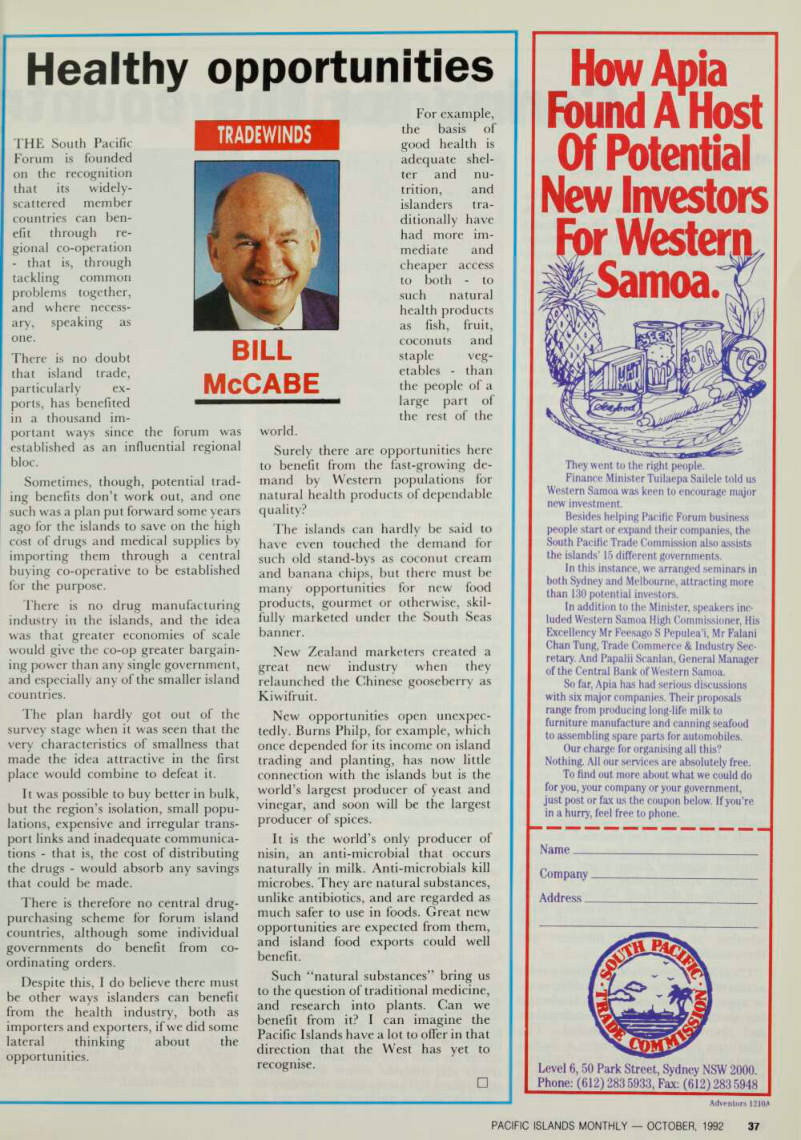
THE South Pacific Forum is founded on the recognition that its widely scattered member countries can ben efit through re
gional co-operation
- that is, through tackling common
problems together,
and where necess ary, speaking as one.
There is no doubt that island trade,
particularly ex
ports, has benefited in a thousand im
portant ways since the forum was established as an influential regional bloc.
Sometimes, though, potential trad ing benefits don’t work out, and one such was a plan put forward some years ago for the islands to save on the high cost of drugs and medical supplies by importing them through a central buying co-operative to be established for the purpose.
There is no drug manufacturing industry in the islands, and the idea was that greater economies of scale would give the co-op greater bargain ing power than any single government, and especially any of the smaller island countries.
The plan hardly got out of the survey stage when it was seen that the very characteristics of smallness that made the idea attractive in the first place would combine to defeat it.
It was possible to buy better in bulk, but the region’s isolation, small popu lations, expensive and irregular trans port links and inadequate communica tions - that is, the cost of distributing the drugs - would absorb any savings that could be made.
There is therefore no central drug purchasing scheme for forum island countries, although some individual governments do benefit from co
ordinating orders.
Despite this, I do believe there must be other ways islanders can benefit from the health industry, both as importers and exporters, if we did some lateral thinking about the opportunities.
For example, the basis of good health is adequate shel ter and nu trition, and islanders tra ditionally have had more im mediate and cheaper access to both - to such natural health products as fish, fruit, coconuts and staple veg etables - than the people of a large part of the rest of the
world.
Surely there are opportunities here to benefit from the fast-growing de mand by Western populations for natural health products of dependable
quality?
The islands can hardly be said to have even touched the demand for such old stand-bys as coconut cream and banana chips, but there must be many opportunities for new food products, gourmet or otherwise, skil fully marketed under the South Seas banner.
New Zealand marketers created a great new industry when they relaunched the Chinese gooseberry as Kiwifruit.
New opportunities open unexpec tedly. Burns Philp, for example, which once depended for its income on island trading and planting, has now little connection with the islands but is the world’s largest producer of yeast and vinegar, and soon will be the largest producer of spices.
It is the world’s only producer of nisin, an anti-microbial that occurs naturally in milk. Anti-microbials kill microbes. They are natural substances, unlike antibiotics, and are regarded as much safer to use in foods. Great new opportunities are expected from them, and island food exports could well benefit.
Such “natural substances” bring us to the question of traditional medicine, and research into plants. Can we benefit from it? I can imagine the Pacific Islands have a lot to offer in that direction that the West has yet to recognise.
Tradewinds
Bill
Mccabe
Advertisements & other items, p. 37 (1 item)
How Apia
Found A Host
Of Potential
New Investors
r Wester
moa
They went to the right people.
Finance Minister Tuilaepa Sailele told us Western Samoa was keen to encourage major new investment.
Besides helping Pacific Forum business people start or expand their companies, the South Pacific Trade Commission also assists the islands’ 15 different governments.
In this instance, we arranged seminars in both Sydney and Melbourne, attracting more than 130 potential investors.
In addition to the Minister, speakers included Western Samoa High Commissioner, His Excellency Mr Feesago S Pepulea’i, Mr Falani Chan Tung, Trade Commerce & Industry Secretary. And Papalii Scanlan, General Manager of the Central Bank of Western Samoa.
So far, Apia has had serious discussions with six major companies. Their proposals range from producing long-life milk to furniture manufacture and canning seafood to assembling spare parts for automobiles.
Our charge for organising all this?
Nothing. All our services are absolutely free.
To find out more about what we could do for you, your company or your government, just post or fax us the coupon below. If you’re in a hurry, feel free to phone.
Name
Company
Address m £ *5O o z Level 6, 50 Park Street, Sydney NSW 2000.
Phone: (612)2835933, Fax: (612)2835948
Adventors 1210 A
Caring for the country - a new dimension
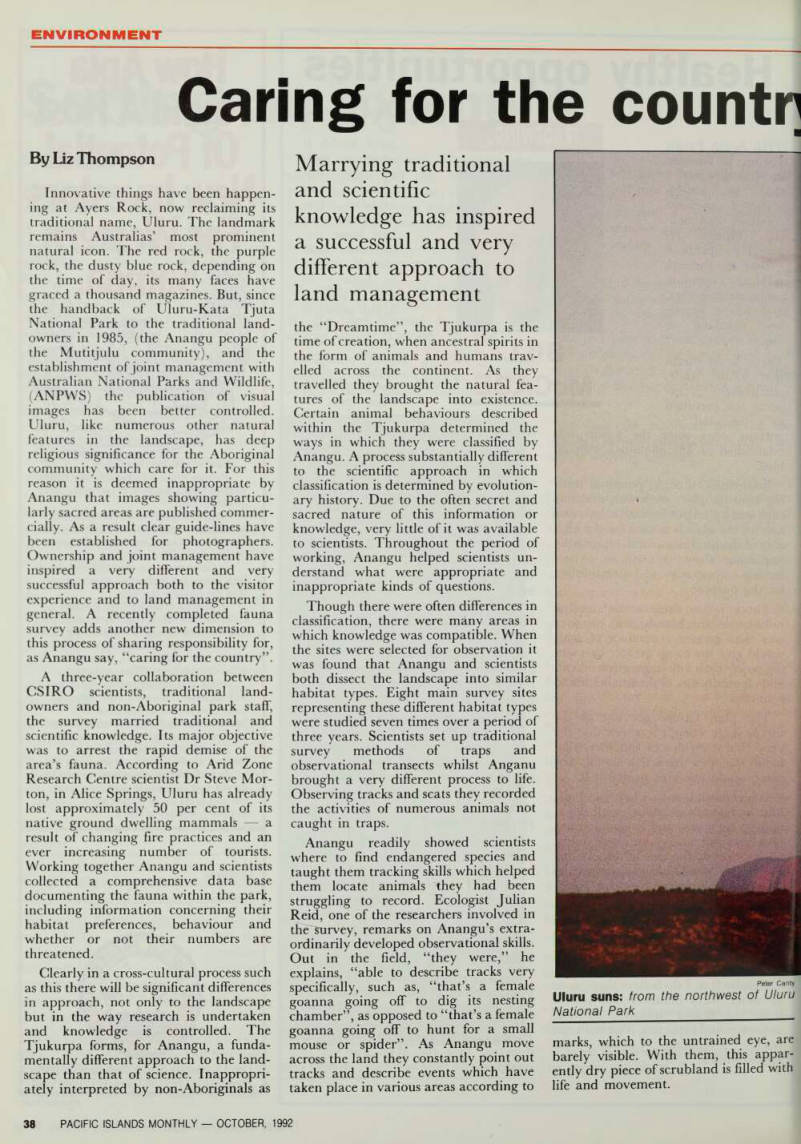
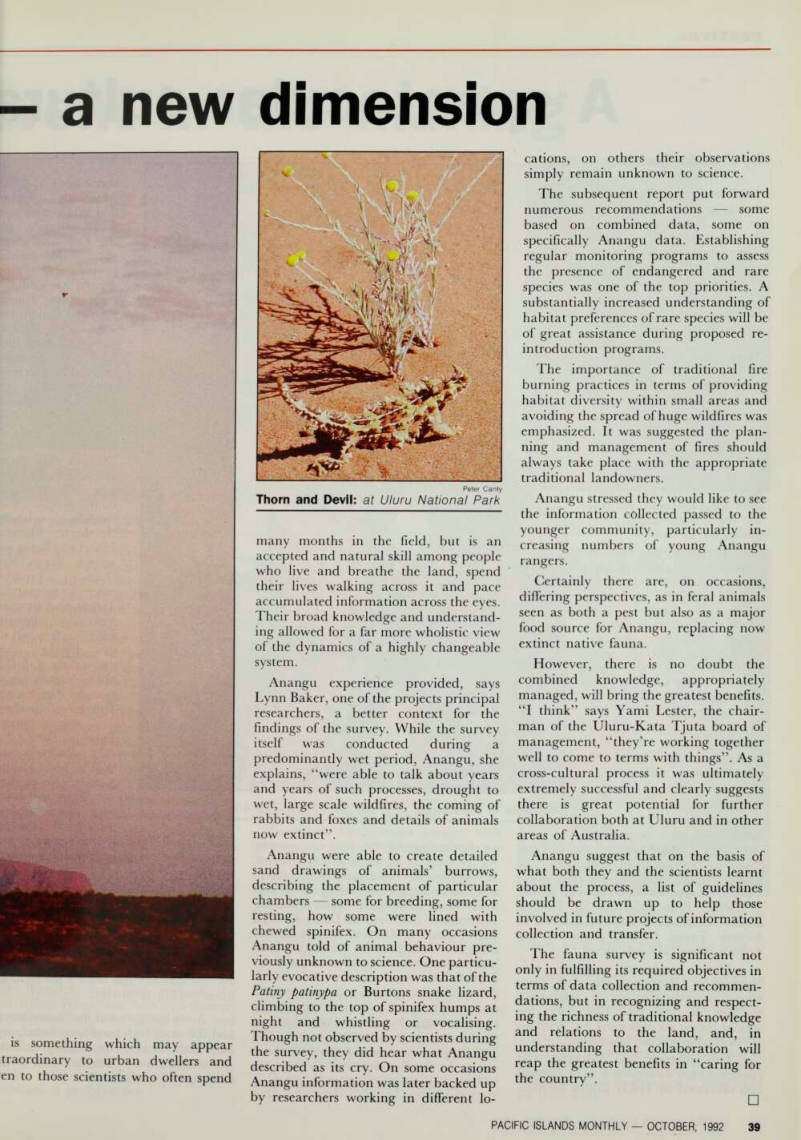
Environment
By Liz Thompson
Innovative things have been happen ing at Ayers Rock, now reclaiming its traditional name, Uluru. The landmark remains Australias’ most prominent natural icon. The red rock, the purple rock, the dusty blue rock, depending on the time of day, its many faces have graced a thousand magazines. But, since the handback of Uluru-Kata Tjuta National Park to the traditional land owners in 1985, (the Anangu people of the Mutitjulu community), and the establishment of joint management with Australian National Parks and Wildlife, (ANPWS) the publication of visual images has been better controlled.
Uluru, like numerous other natural features in the landscape, has deep religious significance for the Aboriginal community which care for it. For this reason it is deemed inappropriate by Anangu that images showing particu larly sacred areas are published commer cially. As a result clear guide-lines have been established for photographers.
Ownership and joint management have inspired a very different and very successful approach both to the visitor experience and to land management in general. A recently completed fauna survey adds another new dimension to this process of sharing responsibility for, as Anangu say, “caring for the country”.
A three-year collaboration between CSIRO scientists, traditional land owners and non-Aboriginal park staff, the survey married traditional and scientific knowledge. Its major objective was to arrest the rapid demise of the area’s fauna. According to Arid Zone Research Centre scientist Dr Steve Mor ton, in Alice Springs, Uluru has already lost approximately 50 per cent of its native ground dwelling mammals a result of changing fire practices and an ever increasing number of tourists.
Working together Anangu and scientists collected a comprehensive data base documenting the fauna within the park,
including information concerning their
habitat preferences, behaviour and whether or not their numbers are threatened.
Clearly in a cross-cultural process such as this there will be significant differences in approach, not only to the landscape but in the way research is undertaken and knowledge is controlled. The Tjukurpa forms, for Anangu, a funda mentally different approach to the land scape than that of science. Inappropri ately interpreted by non-Aboriginals as
Marrying traditional and scientific knowledge has inspired a successful and very different approach to land management
the “Dreamtime”, the Tjukurpa is the time of creation, when ancestral spirits in the form of animals and humans trav elled across the continent. As they travelled they brought the natural fea tures of the landscape into existence.
Certain animal behaviours described within the Tjukurpa determined the ways in which they were classified by Anangu. A process substantially different to the scientific approach in which classification is determined by evolution ary history. Due to the often secret and sacred nature of this information or knowledge, very little of it was available to scientists. Throughout the period of working, Anangu helped scientists un derstand what were appropriate and
inappropriate kinds of questions.
Though there were often differences in classification, there were many areas in which knowledge was compatible. When the sites were selected for observation it was found that Anangu and scientists both dissect the landscape into similar habitat types. Eight main survey sites representing these different habitat types were studied seven times over a period of three years. Scientists set up traditional survey methods of traps and observational transects whilst Anganu brought a very different process to life.
Observing tracks and scats they recorded the activities of numerous animals not caught in traps.
Anangu readily showed scientists where to find endangered species and taught them tracking skills which helped them locate animals they had been struggling to record. Ecologist Julian Reid, one of the researchers involved in theTlurvey, remarks on Anangu’s extra ordinarily developed observational skills.
Out in the field, “they were,” he explains, “able to describe tracks very specifically, such as, “that’s a female goanna going off to dig its nesting chamber”, as opposed to “that’s a female goanna going off to hunt for a small mouse or spider”. As Anangu move across the land they constantly point out tracks and describe events which have taken place in various areas according to
marks, which to the untrained eye, are barely visible. With them, this appar ently dry piece of scrubland is filled with life and movement.
Peter Canty Uluru suns: from the northwest of Uluru National Park
is something which may appear traordinary to urban dwellers and en to those scientists who often spend
many months in the field, but is an accepted and natural skill among people who live and breathe the land, spend their lives walking across it and pace accumulated information across the eyes.
Their broad knowledge and understand ing allowed for a far more wholistic view of the dynamics of a highly changeable system.
Anangu experience provided, says Lynn Baker, one of the projects principal researchers, a better context for the findings of the survey. While the survey itself was conducted during a predominantly wet period, Anangu, she explains, “were able to talk about years and years of such processes, drought to wet, large scale wildfires, the coming of rabbits and foxes and details of animals now extinct”.
Anangu were able to create detailed sand drawings of animals’ burrows, describing the placement of particular chambers some for breeding, some for resting, how some were lined with chewed spinifex. On many occasions Anangu told of animal behaviour pre viously unknown to science. One particu larly evocative description was that of the Patiny patinypa or Burtons snake lizard, climbing to the top of spinifex humps at
night and whistling or vocalising.
Though not observed by scientists during the survey, they did hear what Anangu described as its cry. On some occasions Anangu information was later backed up by researchers working in different lo
cations, on others their observations simply remain unknown to science.
The subsequent report put forward numerous recommendations some based on combined data, some on
specifically Anangu data. Establishing
regular monitoring programs to assess the presence of endangered and rare species was one of the top priorities. A substantially increased understanding of habitat preferences of rare species will be of great assistance during proposed re introduction programs.
The importance of traditional fire
burning practices in terms of providing
habitat diversity within small areas and avoiding the spread of huge wildfires was emphasized. It was suggested the plan ning and management of fires should always take place with the appropriate traditional landowners.
Anangu stressed they would like to see the information collected passed to the younger community, particularly in creasing numbers of young Anangu rangers.
Certainly there are, on occasions, differing perspectives, as in feral animals seen as both a pest but also as a major food source for Anangu, replacing now extinct native fauna.
However, there is no doubt the
combined knowledge, appropriately
managed, will bring the greatest benefits.
“I think” says Yami Lester, the chair man of the Uluru-Kata Tjuta board of management, “they’re working together well to come to terms with things”. As a cross-cultural process it was ultimately extremely successful and clearly suggests there is great potential for further collaboration both at Uluru and in other areas of Australia.
Anangu suggest that on the basis of what both they and the scientists learnt about the process, a list of guidelines should be drawn up to help those involved in future projects of information collection and transfer.
The fauna survey is significant not only in fulfilling its required objectives in terms of data collection and recommen dations, but in recognizing and respect ing the richness of traditional knowledge and relations to the land, and, in understanding that collaboration will reap the greatest benefits in “caring for the country”.
Peter Canty Thorn and Devil: at Uluru National Park
Advertisements & other items, p. 39 (1 item)
- a new dimension
A spectacular cultura[?]event in the making
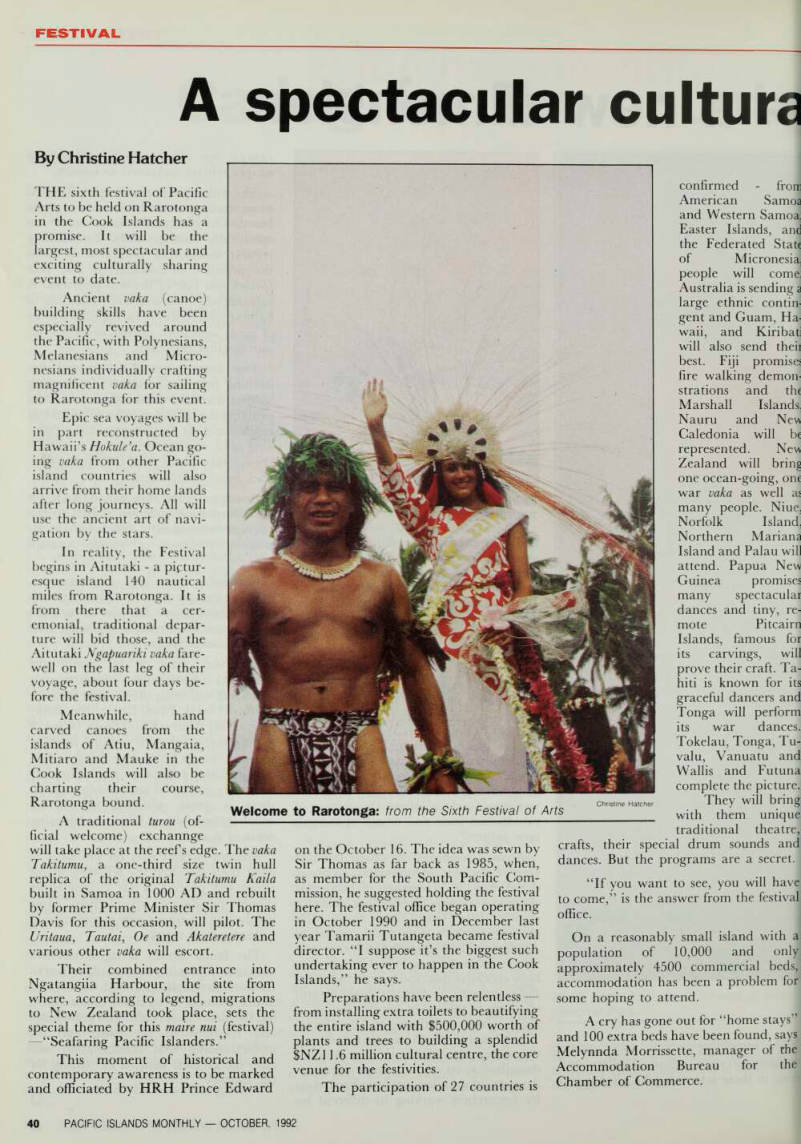
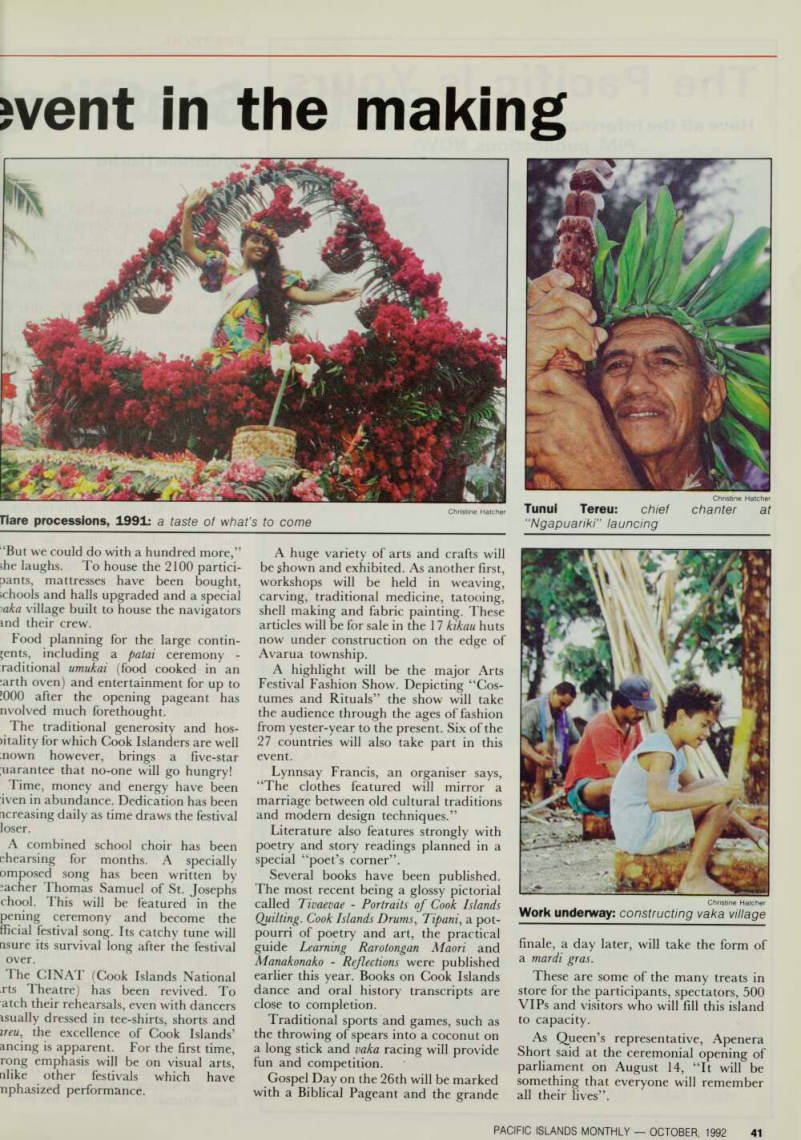
Festival
By Christine Hatcher
THE sixth festival of Pacific Arts to be held on Rarotonga in the Cook Islands has a promise. It will be the largest, most spectacular and
exciting culturally sharing
event to date.
Ancient vaka (canoe) building skills have been especially revived around the Pacific, with Polynesians, Melanesians and Micro nesians individually crafting magnificent vaka for sailing to Rarotonga for this event.
Epic sea voyages will be in part reconstructed by Hawaii’s Hokule’a. Ocean go ing vaka from other Pacific island countries will also arrive from their home lands after long journeys. All will use the ancient art of navi gation by the stars.
In reality, the Festival begins in Aitutaki - a pictur esque island 140 nautical miles from Rarotonga. It is from there that a cer emonial, traditional depar ture will bid those, and the Aitutaki Ngapuariki vaka fare well on the last leg of their voyage, about four days be fore the festival.
Meanwhile, hand carved canoes from the islands of Atiu, Mangaia, Mitiaro and Mauke in the Cook Islands will also be charting their course,
Rarotonga bound.
A traditional turou (of ficial welcome) exchannge
will take place at the reefs edge. The vaka Takitumu, a one-third size twin hull replica of the original Takitumu Kaila built in Samoa in 1000 AD and rebuilt by former Prime Minister Sir Thomas Davis for this occasion, will pilot. The Uritaua, Tautai, Oe and Akateretere and various other vaka will escort.
Their combined entrance into Ngatangiia Harbour, the site from where, according to legend, migrations to New Zealand took place, sets the special theme for this maire nui (festival) —“Seafaring Pacific Islanders.”
This moment of historical and contemporary awareness is to be marked and officiated by HRH Prince Edward
on the October 16. The idea was sewn by Sir Thomas as far back as 1985, when, as member for the South Pacific Com mission, he suggested holding the festival here. The festival office began operating in October 1990 and in December last year Tamarii Tutangeta became festival director. “I suppose it’s the biggest such undertaking ever to happen in the Cook Islands,” he says.
Preparations have been relentless from installing extra toilets to beautifying the entire island with $500,000 worth of plants and trees to building a splendid SNZII.6 million cultural centre, the core venue for the festivities.
The participation of 27 countries is
confirmed - fron] American Samod and Western Samoa] Easter Islands, and the Federated State of Micronesia people will come.
Australia is sending a large ethnic contin gent and Guam, Ha waii, and Kiribati will also send their best. Fiji promises fire walking demon strations and the Marshall Islands.
Nauru and New Caledonia will be represented. New Zealand will bring one ocean-going, one war vaka as well as many people. Niue, Norfolk Island, Northern Mariana Island and Palau will attend. Papua New
Guinea promises
many spectacular
dances and tiny, re mote Pitcairn Islands, famous for its carvings, will prove their craft. Ta hiti is known for its graceful dancers and Tonga will perform its war dances.
Tokelau, Tonga, Tu valu, Vanuatu and Wallis and Futuna
complete the picture.
They will bring with them unique traditional theatre,
crafts, their special drum sounds and dances. But the programs are a secret.
“If you want to see, you will have to come,” is the answer from the festival office.
On a reasonably small island with a population of 10,000 and onlyj approximately 4500 commercial beds, accommodation has been a problem for some hoping to attend.
A cry has gone out for “home stays”! and 100 extra beds have been found, says Melynnda Morrissette, manager of the Accommodation Bureau for the Chamber of Commerce.
Christine Hatcher Welcome to Rarotonga: from the Sixth Festival of Arts
‘But we could do with a hundred more,” she laughs. To house the 2100 partici pants, mattresses have been bought, schools and halls upgraded and a special >aka village built to house the navigators md their crew.
Food planning for the large contin gents, including a patai ceremony raditional umukai (food cooked in an ;arth oven) and entertainment for up to 1000 after the opening pageant has
nvolved much forethought.
The traditional generosity and hos )itality for which Cook Islanders are well ;nown however, brings a five-star guarantee that no-one will go hungry!
Time, money and energy have been iven in abundance. Dedication has been acreasing daily as time draws the festival loser.
A combined school choir has been ehearsing for months. A specially omposed song has been written by ;acher Thomas Samuel of St. Josephs chool. This will be featured in the pening ceremony and become the fficial festival song. Its catchy tune will nsure its survival long after the festival over.
The CINAT (Cook Islands National rts Theatre) has been revived. To atch their rehearsals, even with dancers isually dressed in tee-shirts, shorts and ireu , the excellence of Cook Islands’ ancing is apparent. For the first time, rong emphasis will be on visual arts, alike other festivals which have
nphasized performance.
A huge variety of arts and crafts will be shown and exhibited. As another first, workshops will be held in weaving, carving, traditional medicine, tatooing, shell making and fabric painting. These articles will be for sale in the 17 kikau huts now under construction on the edge of Avarua township.
A highlight will be the major Arts Festival Fashion Show. Depicting “Cos tumes and Rituals” the show will take the audience through the ages of fashion from yester-year to the present. Six of the 27 countries will also take part in this event.
Lynnsay Francis, an organiser says, “The clothes featured will mirror a marriage between old cultural traditions
and modern design techniques.”
Literature also features strongly with poetry and story readings planned in a
special “poet’s corner”.
Several books have been published.
The most recent being a glossy pictorial called Tivaevae - Portraits of Cook Islands Quilting. Cook Islands Drums , Tipani, a pot pourri of poetry and art, the practical guide Learning Rarotongan Maori and Manakonako - Reflections were published earlier this year. Books on Cook Islands dance and oral history transcripts are close to completion.
Traditional sports and games, such as the throwing of spears into a coconut on a long stick and vaka racing will provide fun and competition.
Gospel Day on the 26th will be marked with a Biblical Pageant and the grande
finale, a day later, will take the form of a mardi gras.
These are some of the many treats in store for the participants, spectators, 500 VIPs and visitors who will fill this island
to capacity.
As Queen’s representative, Apenera
Short said at the ceremonial opening of parliament on August 14, “It will be something that everyone will remember all their lives”.
[?]lare processions, 1991: a taste of what's to come
Christine Hatcher
Christine Hatcher Tunul Tereu: chief chanter at “Ngapuariki" launcing
Christine Hatcher Work underway: constructing vaka village
Seafaring pacific islanders
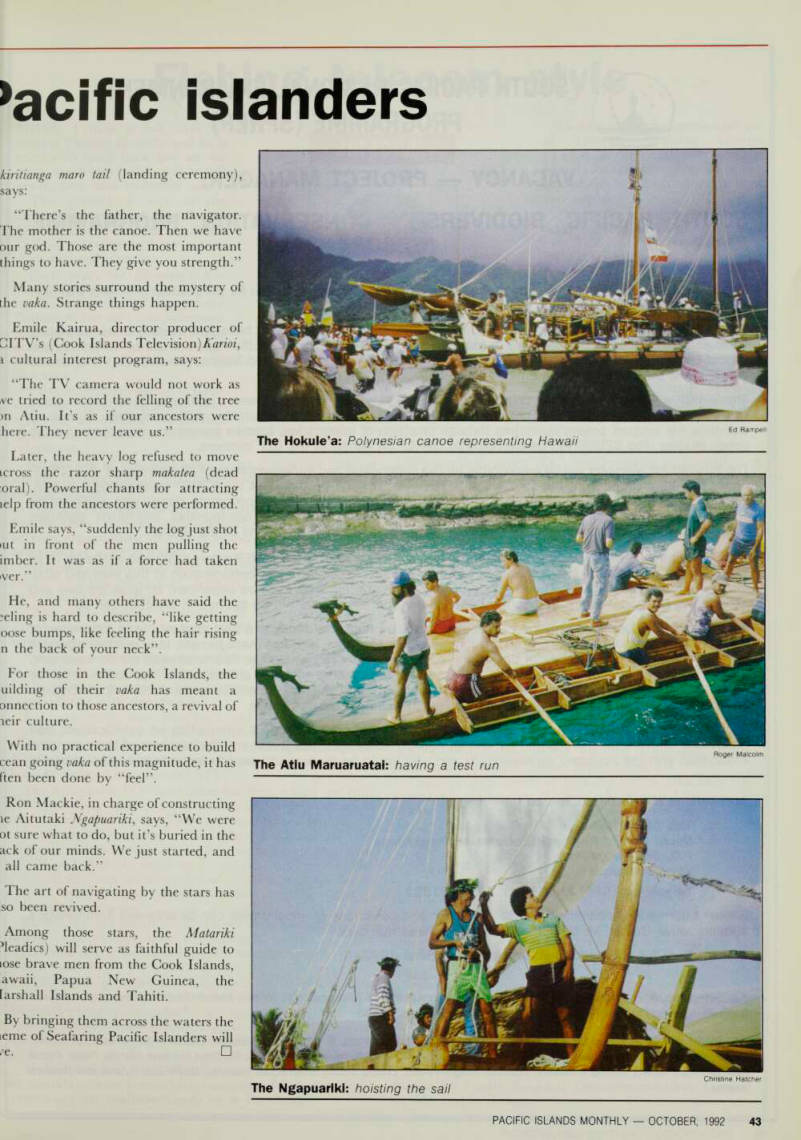
By Christine Hatcher
A haunting sound, muffled by dense, fringed woods echoes through a forest on the island of Atiu in the Cook Islands.
The morning sun scatters shadows as prayers go out to Tane, god of the forest, for permission to release one of his children.
The chain-saw bites. Birds scatter in alarmed white and brown patterns. A mango tree falls, releasing a musty fragrance as the hefty trunk indents the earth. There is much laughter, chanting and calling to the gods, to the ancestors for help with this heavy work. Many willing hands aid as another vaka (canoe) is born.
Similar ceremonies on Rarotonga have seen the birth of pilot vaka for the festival, the Takitumu and the 240-man war canoe, the Uritaua , the Ngapuariki from Aitutaki and vaka from Mauke, Mitiaro and Mangnia’s Te Uru Ote Rangi.
This life-force, poured into every vaka built in traditional times, has been revived here in the Pacific for the sixth Festival of Pacific Arts beginning in Rarotonga on October 16.
According to the Prime Minister of the Cook Islands, Sir Geoffrey Henry, the ideas were kindled in 1972.
“At that time, the then leaders of the Pacific decided something had to be done for the survival of their culture. They sensed an erosion taking place; Western philosophy began to have an impact.
Something had to be done. Then there was Fiji,” he said.
There have been five festivals since.
But, for the first time, participating countries have been challenged to build vaka and sail them to Rarotonga, navigating by the stars. In following the traditions of their ancestors the special theme of this festival “Seafaring Pacific Islanders” will be created.
And so, across the Moana-nui-o-kiva the great ocean of blue space a hand of welcome to the 27 countries participat ing from Polynesia, Micronesia and Melanesia, will extend.
Here, stories of the vaka will be recreated, as they tell of the nuku (travelling parties), and survival at sea, arrivals and departures. These are the stories not only of the past, but of the present and future which make up the mixtures of mythologies and genealogies that bind together the people of the Pacific. . , Toua Pitman, Rarotonga’s chief navi gator, who will sail Hawaii s Hokule a from the Society Islands to Mauke then from Aitutaki to Rarotonga for the
kiritianga maro tail (landing ceremony), says: “There’s the father, the navigator.
The mother is the canoe. Then we have our god. Those are the most important things to have. They give you strength.”
Many stories surround the mystery of the vaka. Strange things happen.
Emile Kairua, director producer of CITV’s (Cook Islands Television) Karioi, i cultural interest program, says: “The TV camera would not work as ve tried to record the felling of the tree )n Atiu. It’s as if our ancestors were here. They never leave us.”
Later, the heavy log refused to move icross the razor sharp makatea (dead oral). Powerful chants for attracting iclp from the ancestors were performed.
Emile says, “suddenly the log just shot iut in front of the men pulling the imber. It was as if a force had taken ver.”
He, and many others have said the deling is hard to describe, “like getting oose bumps, like feeling the hair rising n the back of your neck”.
For those in the Cook Islands, the uilding of their vaka has meant a onnection to those ancestors, a revival of leir culture.
With no practical experience to build cean going vaka of this magnitude, it has ften been done by “feel”.
Ron Mackie, in charge of constructing le Aitutaki Ngapuariki , says, “We were ot sure what to do, but it’s buried in the ack of our minds. We just started, and all came back.”
The art of navigating by the stars has so been revived.
Among those stars, the Matariki Readies) will serve as faithful guide to lose brave men from the Cook Islands, awaii, Papua New Guinea, the larshall Islands and Tahiti.
By bringing them across the waters the icrne of Seafaring Pacific Islanders will /e. □
Ed Rampell
Roger Malcolm
Christine Hatcher
The Hokule’a: Polynesian canoe representing Hawaii
The Atiu Maruaruatai: having a test run
The Ngapuariki: hoisting the sail
Advertisements & other items, pp. 42-44 (2 items)
The Pacific Is Yours
Have all the information at your fingertips order PIM publications NOW!
PACIFIC
|j & A WmM " •■■■•* a
Papua
New Guinea ■ Pacific Islands Yearbook 16th Edition ■ Fiji Handbook Business & Travel Guide ■ Fiji Times A History of Fiji ■ Vanuatu A-Guide ■ Tonga A-Guide ■ Cook Islands A-Guide ■ The Journal of William Lockerby ■ PNG Map ■ Fiji Map ■ Pacific Is. Map A 545.00 A 514.95 Aslo.oo A 514.95 A 514.95 A 514.95 A 53.50 . A 53.50 . A 53.50 . A 53.50 Number of copies being ordered: Pacific Is. Yearbook Fiji Handbook Fiji Times History Vanuatu A-Guide Tonga A-Guide Cook Islands A-Guide The Journal of W/Lockerby PNG Map Fiji Map Pacific Islands Map Enclosed is A$ for payment Debit A$ my
□ VISA □ MASTER
Card No Expiry Date My Name Postal Address Country Tel Post to: PACIFIC ISLANDS MONTHLY, PO BOX 1167, SUVA, FIJI ISLANDS.
\Jll Programme (Sprep)
SOUTH PACIFIC REGIONAL ENVIRONMENT
VACANCY PROJECT MANAGER:
SOUTH PACIFIC BIODIVERSITY CONSERVATION PROGRAMME
(SPBCP)
The South Pacific Regional Environment Programme (SPREP) seeks applicants for the position of Project Manager for the South Pacific Biodiversity Conservation Programme (SPBCP).
The SPBCP is envisaged as a five-year, $lO million concerted effort to protect biological diversity while facilitating ecologically-sustainable development in fourteen countries of the South Pacific region. It will be funded by the Global Environment Facility (GEF), a joint effort of the World Bank, the United Nations Development Programme (UNDP) and the United Nations Environment Programme (UNEP).
The SPBCP will help participating countries establish and initially manage a series of diverse conservation areas (terrestrial, marine and combined) and to enable the sustainable use of the area’s natural resources. Subsidiary activities will support project objectives through provision of information, species protection and action-oriented policy studies. The SPBCP will be executed by SPREP on behalf of the GEF partners.
The Programme Manager will be responsible for the supervision and implementation of all activities of the SPBCP under the administration of the Director of SPREP. He/she will be based at the SPREP Headquarters in Apia, Western Samoa but will also travel widely throughout the region. He/she will cooperate closely with participating countries, local and international non-governmental organisations, local communities and other agencies concerned with the establishment of conservation areas and other operations of the SPBCP.
The Programme Manager position will be at the Senior Advisor level of the SPREP salary scale and will be for three years in the first instance and renewable by mutual agreement. An attractive remuneration at this level and other employment benefits will be offered although the actual starting salary will be dependent on qualifications and experience. For non-Western Samoan citizens, salary and allowances will be tax-free in Western Samoa.
Applicants must possess a University degree in a relevant field, preferably at a post graduate level. Extensive (at least ten years) experience working on environmental conservation, resource management, land use management or related fields in or on behalf of developing countries, preferably within the Pacific Islands will be important.
Proven skills and experience in dealing with complex land tenure systems are desirable. Applicants must be nationals of a SPREP or United Nations member country and must be fluent in spoken and written English.
Knowledge of Pacific Island language and of French would be advantageous.
Applications must be accompanied by detailed curricula vitae containing full information on qualifications and experience relevant for the position as well as names, addresses, telephone and fax numbers of three persons associated with the applicant professionally and who would be prepared to provide testimonials when required.
Applications should be addressed to:
THE DIRECTOR
South Pacific Regional Environment Programme
P.O. Box 240, APIA
Western Samoa Telephone: (685) 21929 Fax: (685) 20 231 Further information, including full duty statement and conditions of appointment can be obtained from SPREP’s Administrative Officer, Mr Ueligitone Sasagi, at these numbers.
Closing Date for all applications will be 31 October 1992. * SPBCP participating countries are: Cook Islands, Federated States of Micronesia, Fiji, Kiribati, Marshall Islands, Nauru, Niue, Palau, Solomon Islands, Tokelau, Tonga, Tuvalu, Vanuatu and Western Samoa. ** SPREP member countries and territories are: American Samoa, Australia, Cook Islands, Federated States of Micronesia, Fiji, France, French Polynesia, Guam, Kiribati, Marshall Islands, Nauru, New Caledonia, Niue, New Zealand, Northern Mariana Islands, Palau, Papua New Guinea, Pitcairn, Solomon Islands, Tokelau, Tonga, Tuvalu, United States of America, Vanuatu, Wallis and Futuna and Western Samoa.
Fishing telecom style
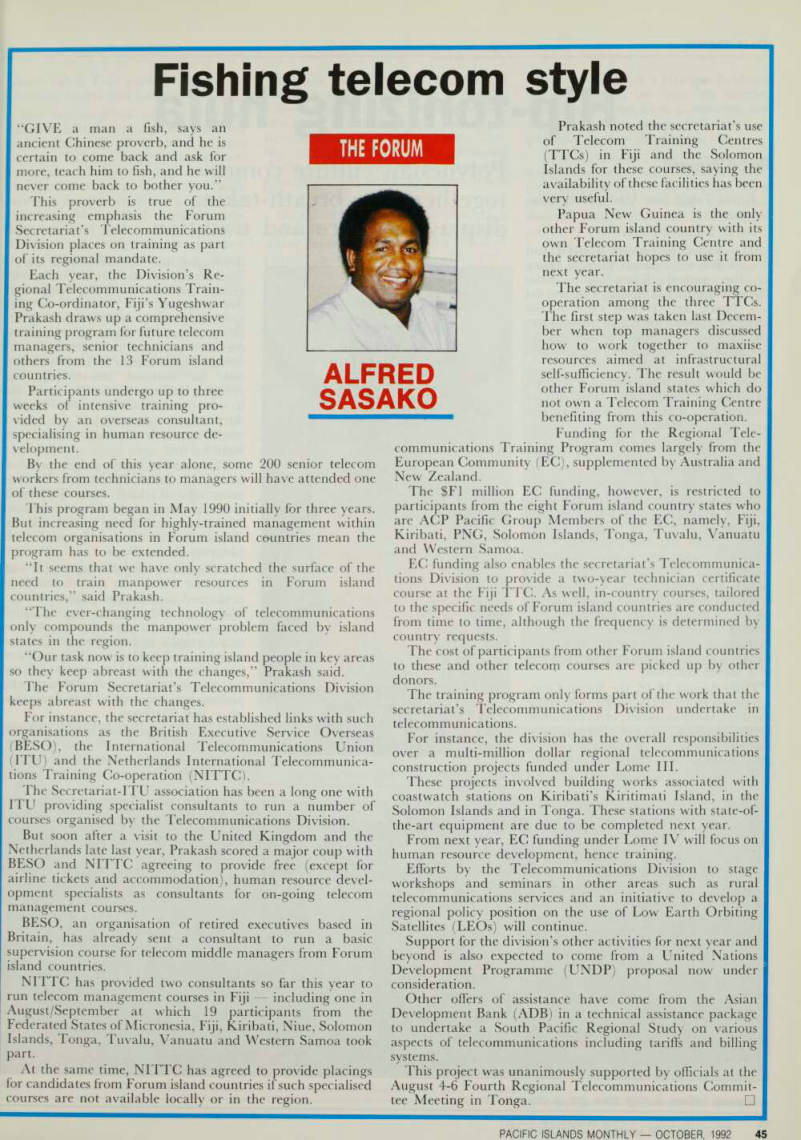
“GIVE a man a fish, says an ancient Chinese proverb, and he is certain to come back and ask for more, teach him to fish, and he will never come back to bother you.”
This proverb is true of the increasing emphasis the Forum Secretariat’s Telecommunications Division places on training as part of its regional mandate.
Each year, the Division’s Re gional Telecommunications Train
ing Co-ordinator, Fiji’s Yugeshwar
Prakash draws up a comprehensive training program for future telecom managers, senior technicians and others from the 13 Forum island countries.
Participants undergo up to three weeks of intensive training pro vided by an overseas consultant, specialising in human resource de velopment.
By the end of this year alone, some 200 senior telecom workers from technicians to managers will have attended one of these courses.
This program began in May 1990 initially for three years.
But increasing need for highly-trained management within telecom organisations in Forum island countries mean the program has to be extended.
“It seems that we have only scratched the surface of the need to train manpower resources in Forum island countries,” said Prakash.
“The ever-changing technology of telecommunications only compounds the manpower problem faced by island states in the region.
“Our task now is to keep training island people in key areas so they keep abreast with the changes,” Prakash said.
The Forum Secretariat’s Telecommunications Division keeps abreast with the changes.
For instance, the secretariat has established links with such organisations as the British Executive Service Overseas (BESO), the International Telecommunications Union (ITU) and the Netherlands International Telecommunica
tions Training Co-operation (NITTC).
The Secretariat-ITU association has been a long one with ITU providing specialist consultants to run a number of courses organised by the Telecommunications Division.
But soon after a visit to the United Kingdom and the Netherlands late last year, Prakash scored a major coup with BESO and NITTC agreeing to provide free (except for airline tickets and accommodation), human resource devel opment specialists as consultants for on-going telecom management courses.
BESO, an organisation of retired executives based in Britain, has already sent a consultant to run a basic supervision course for telecom middle managers from Forum island countries.
NITTC has provided two consultants so far this year to run telecom management courses in Fiji including one in August/September at which 19 participants from the Federated States of Micronesia, Fiji, Kiribati, Niue, Solomon Islands, Tonga, Tuvalu, Vanuatu and Western Samoa took part.
At the same time, NITTC has agreed to provide placings for candidates from Forum island countries if such specialised courses are not available locally or in the region.
Prakash noted the secretariat’s use of Telecom Training Centres (TTCs) in Fiji and the Solomon Islands for these courses, saying the availability of these facilities has been very useful.
Papua New Guinea is the only other Forum island country with its own Telecom Training Centre and the secretariat hopes to use it from next year.
The secretariat is encouraging co operation among the three TTCs.
The first step was taken last Decem ber when top managers discussed how to work together to maxiise resources aimed at infrastructural self-sufficiency. The result would be other Forum island states which do not own a Telecom Training Centre
benefiting from this co-operation.
Funding for the Regional Tele
communications Training Program comes largely from the European Community (EC), supplemented by Australia and New Zealand.
The SFI million EC funding, however, is restricted to participants from the eight Forum island country states who are AGP Pacific Group Members of the EC, namely, Fiji, Kiribati, PNG, Solomon Islands, Tonga, Tuvalu, Vanuatu and Western Samoa.
EC funding also enables the secretariat’s Telecommunica tions Division to provide a two-year technician certificate course at the Fiji TTC. As well, in-country courses, tailored to the specific needs of Forum island countries are conducted from time to time, although the frequency is determined by country requests.
The cost of participants from other Forum island countries to these and other telecom courses are picked up by other donors.
The training program only forms part of the work that the secretariat’s Telecommunications Division undertake in telecommunications.
For instance, the division has the overall responsibilities over a multi-million dollar regional telecommunications construction projects funded under Lome 111.
These projects involved building works associated with coastwatch stations on Kiribati’s Kiritimati Island, in the Solomon Islands and in Tonga. These stations with state-of the-art equipment are due to be completed next year.
From next year, EC funding under Lome IV will focus on human resource development, hence training.
Efforts by the Telecommunications Division to stage workshops and seminars in other areas such as rural telecommunications services and an initiative to develop a regional policy position on the use of Low Earth Orbiting Satellites (LEOs) will continue.
Support for the division’s other activities for next year and beyond is also expected to come from a United Nations Development Programme (UNDP) proposal now under consideration.
Other offers of assistance have come from the Asian Development Bank (ADB) in a technical assistance package to undertake a South Pacific Regional Study on various aspects of telecommunications including tariffs and billing systems.
This project was unanimously supported by officials at the August 4-6 Fourth Regional Telecommunications Commit tee Meeting in Tonga. □
The Forum
Alfred
Sasako
Hip-tonizing hula
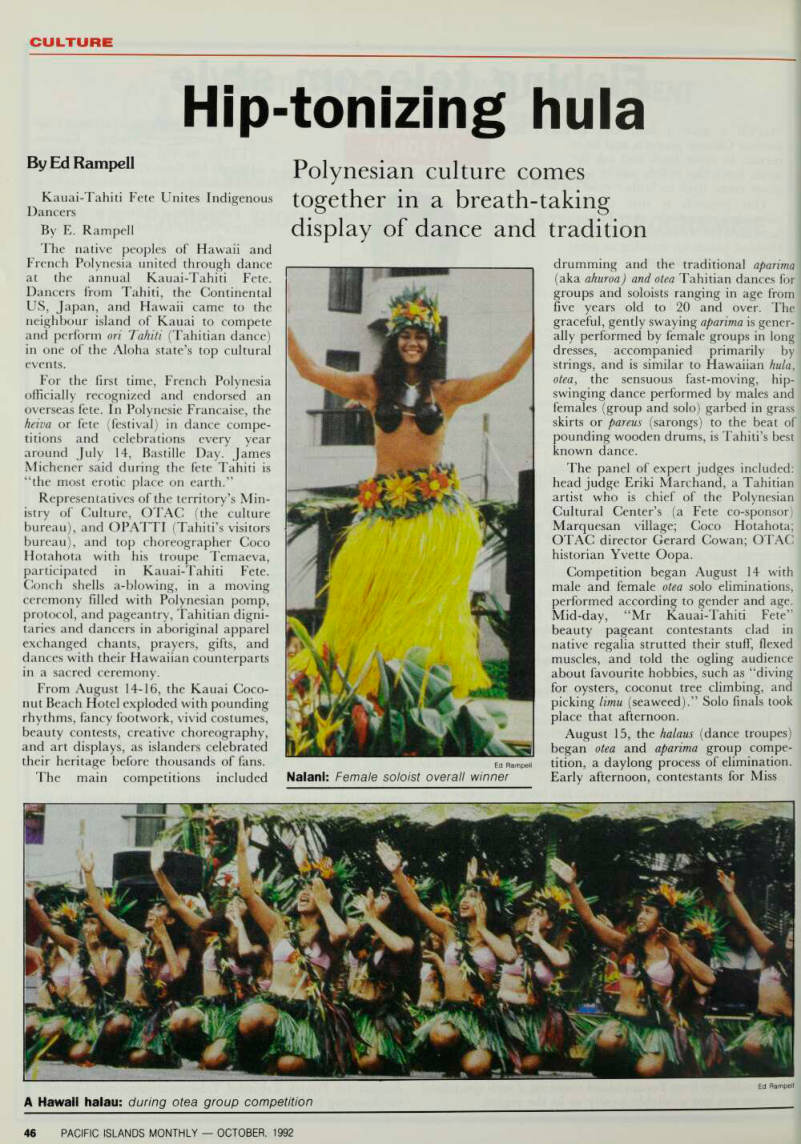
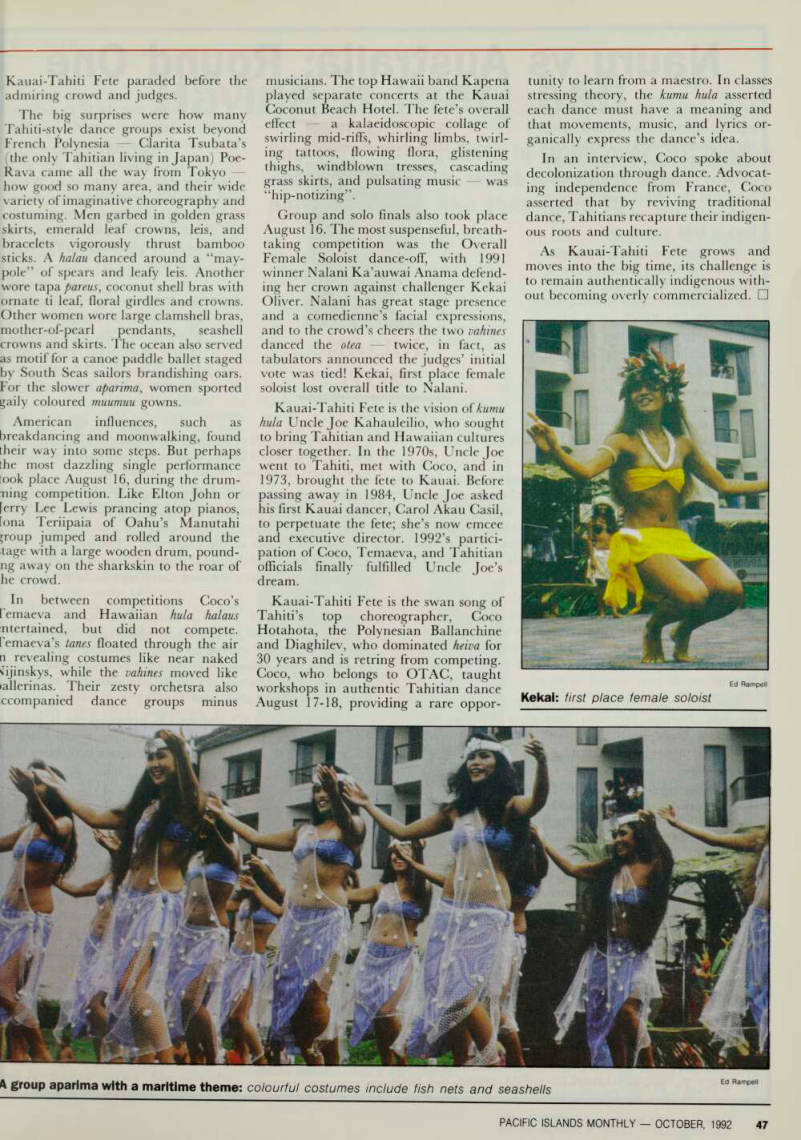
Culture
By Ed Rampell
Polynesian culture comes
together in a breath-taking
display of dance and tradition
Kauai-Tahiti Fete Unites Indigenous Dancers
By E. Rampell
The native peoples of Hawaii and French Polynesia united through dance at the annual Kauai-Tahiti Fete.
Dancers from Tahiti, the Continental US, Japan, and Hawaii came to the neighbour island of Kauai to compete and perform ori Tahiti (Tahitian dance) in one of the Aloha state’s top cultural events.
For the first time, French Polynesia officially recognized and endorsed an overseas fete. In Polynesie Francaise, the heiva or fete (festival) in dance compe titions and celebrations every year around July 14, Bastille Day. James Michener said during the fete Tahiti is “the most erotic place on earth,”
Representatives of the territory’s Min istry of Culture, OTAC (the culture bureau), and OPATTI (Tahiti’s visitors bureau), and top choreographer Coco Hotahota with his troupe Temaeva, participated in Kauai-Tahiti Fete.
Conch shells a-blowing, in a moving ceremony filled with Polynesian pomp, protocol, and pageantry, Tahitian digni taries and dancers in aboriginal apparel exchanged chants, prayers, gifts, and dances with their Hawaiian counterparts in a sacred ceremony.
From August 14-16, the Kauai Coco nut Beach Hotel exploded with pounding rhythms, fancy footwork, vivid costumes, beauty contests, creative choreography, and art displays, as islanders celebrated their heritage before thousands of fans.
The main competitions included
drumming and the traditional aparima (aka ahuroa) and otea Tahitian dances for groups and soloists ranging in age from five years old to 20 and over. The graceful, gently swaying aparima is gener ally performed by female groups in long dresses, accompanied primarily by strings, and is similar to Hawaiian hula, otea, the sensuous fast-moving, hip swinging dance performed by males and females (group and solo) garbed in grass skirts or pareus (sarongs) to the beat of pounding wooden drums, is Tahiti’s best known dance.
The panel of expert judges included: head judge Eriki Marchand, a Tahitian artist who is chief of the Polynesian Cultural Center’s (a Fete co-sponsor)
Marquesan village; Coco Hotahota;
OTAC director Gerard Cowan; OTAG historian Yvette Oopa.
Competition began August 14 with male and female otea solo eliminations, performed according to gender and age.
Mid-day, “Mr Kauai-Tahiti Fete” beauty pageant contestants clad in native regalia strutted their stuff, flexed muscles, and told the ogling audience about favourite hobbies, such as “diving for oysters, coconut tree climbing, and picking limu (seaweed).” Solo finals took place that afternoon.
August 15, the halaus (dance troupes) began otea and aparima group compe tition, a daylong process of elimination.
Early afternoon, contestants for Miss
Ed Rampell Nalani: Female soloist overall winner
Ed Rampell
A Hawaii halau: during otea group competition
Kauai-Tahiti Fete paraded before the admiring crowd and judges.
The big surprises were how many Tahiti-style dance groups exist beyond French Polynesia Clarita Tsubata’s (the only Tahitian living in Japan) Poe- Rava came all the way from Tokyo how good so many area, and their wide variety of imaginative choreography and costuming. Men garbed in golden grass skirts, emerald leaf crowns, leis, and bracelets vigorously thrust bamboo sticks. A halau danced around a “may pole” of spears and leafy leis. Another wore tapa pareus , coconut shell bras with ornate ti leaf, floral girdles and crowns.
Other women wore large clamshell bras, mother-of-pearl pendants, seashell crowns and skirts. The ocean also served as motif for a canoe paddle ballet staged by South Seas sailors brandishing oars.
For the slower aparima , women sported gaily coloured muumuu gowns.
American influences, such as breakdancing and moonwalking, found their way into some steps. But perhaps the most dazzling single performance took place August 16, during the drum rung competition. Like Elton John or ferry Lee Lewis prancing atop pianos, lona Teriipaia of Oahu’s Manutahi jroup jumped and rolled around the tage with a large wooden drum, pound ng away on the sharkskin to the roar of he crowd.
In between competitions Coco’s femaeva and Hawaiian hula halaus ntertained, but did not compete, femaeva’s fanes floated through the air n revealing costumes like near naked ftjinskys, while the vahines moved like •allerinas. Their zesty orchetsra also ccompanied dance groups minus
musicians. The top Hawaii band Kapena played separate concerts at the Kauai Coconut Beach Hotel. The fete’s overall effect a kalaeidoscopic collage of swirling mid-riffs, whirling limbs, twirl ing tattoos, flowing flora, glistening thighs, windblown tresses, cascading grass skirts, and pulsating music was
“hip-notizing”.
Group and solo finals also took place August 16. The most suspenseful, breath taking competition was the Overall Female Soloist dance-off, with 1991 winner Nalani Ka’auwai Anama defend ing her crown against challenger Kekai Oliver. Nalani has great stage presence and a comedienne’s facial expressions, and to the crowd’s cheers the two vahines danced the otea twice, in fact, as tabulators announced the judges’ initial vote was tied! Kekai, first place female soloist lost overall title to Nalani.
Kauai-Tahiti Fete is the vision o {kumu hula Uncle Joe Kahauleilio, who sought to bring Tahitian and Hawaiian cultures closer together. In the 19705, Uncle Joe went to Tahiti, met with Coco, and in 1973, brought the fete to Kauai. Before passing away in 1984, Uncle Joe asked his first Kauai dancer, Carol Akau Casil, to perpetuate the fete; she’s now emcee and executive director. 1992’s partici pation of Coco, Temaeva, and Tahitian officials finally fulfilled Uncle Joe’s dream.
Kauai-Tahiti Fete is the swan song of Tahiti’s top choreographer, Coco Hotahota, the Polynesian Ballanchine and Diaghilev, who dominated heiva for 30 years and is retring from competing.
Coco, who belongs to OTAC, taught workshops in authentic Tahitian dance August 17-18, providing a rare oppor
tunity to learn from a maestro. In classes stressing theory, the kumu hula asserted each dance must have a meaning and that movements, music, and lyrics or gamcally express the dance s idea. j n an j nterv i ew Coco spoke about decolonization through dance. Advocat jn g independence from France, Coco asserted that by reviving traditional dance, Tahitians recapture their indigen ous roots and culture, A • -n , . . , As Kaua.-Tah.ti Fete grows and moves 1n ° e 'S 1171 e ’ ls c a en g e 15 to re I maln authentically indigenous w.th out becoming overly commercialized. □
Ed Rampell
Kekai: first place female soloist
A group aparima with a maritime theme: colourful costumes include fish nets and seashells
Ed Rampell
Nauru vs Australia: Round One
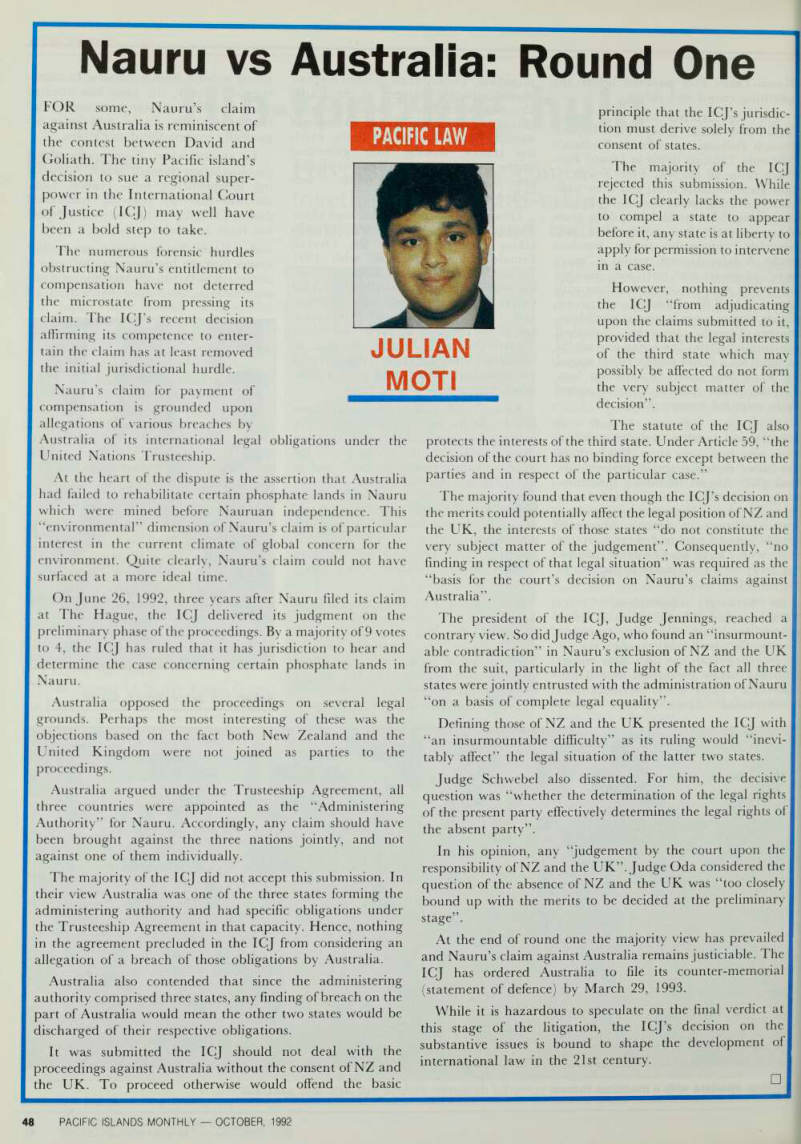
FOR some, Nauru’s claim against Australia is reminiscent of the contest between David and Goliath. The tiny Pacific island’s decision to sue a regional super power in the International Court of Justice (ICJ) may well have been a bold step to take.
The numerous forensic hurdles obstructing Nauru’s entitlement to compensation have not deterred the microstate from pressing its claim. The ICJ’s recent decision affirming its competence to enter tain the claim has at least removed the initial jurisdictional hurdle.
Nauru’s claim for payment of compensation is grounded upon allegations of various breaches by
Australia of its international legal obligations under the United Nations Trusteeship.
At the heart of the dispute is the assertion that Australia had failed to rehabilitate certain phosphate lands in Nauru which were mined before Nauruan independence. This “environmental” dimension of Nauru’s claim is of particular interest in the current climate of global concern for the environment. Quite clearly, Nauru’s claim could not have surfaced at a more ideal time.
On June 26, 1992, three years after Nauru filed its claim at The Hague, the ICJ delivered its judgment on the preliminary phase of the proceedings. By a majority of 9 votes to 4, the ICJ has ruled that it has jurisdiction to hear and determine the case concerning certain phosphate lands in Nauru.
Australia opposed the proceedings on several legal grounds. Perhaps the most interesting of these was the objections based on the fact both New Zealand and the United Kingdom were not joined as parties to the
proceedings.
Australia argued under the Trusteeship Agreement, all three countries were appointed as the “Administering Authority” for Nauru. Accordingly, any claim should have been brought against the three nations jointly, and not against one of them individually.
The majority of the ICJ did not accept this submission. In their view Australia was one of the three states forming the administering authority and had specific obligations under the Trusteeship Agreement in that capacity. Hence, nothing in the agreement precluded in the ICJ from considering an allegation of a breach of those obligations by Australia.
Australia also contended that since the administering authority comprised three states, any finding of breach on the part of Australia would mean the other two states would be discharged of their respective obligations.
It was submitted the ICJ should not deal with the proceedings against Australia without the consent of NZ and the UK. To proceed otherwise would offend the basic
principle that the ICJ’s jurisdic tion must derive solely from the consent of states.
The majority of the ICJ rejected this submission. While the ICJ clearly lacks the power to compel a state to appear before it, any state is at liberty to apply for permission to intervene in a case.
However, nothing prevents the ICJ “from adjudicating upon the claims submitted to it, provided that the legal interests of the third state which may possibly be affected do not form the very subject matter of the decision”.
The statute of the ICJ also
protects the interests of the third state. Under Article 59, “the decision of the court has no binding force except between the parties and in respect of the particular case.”
The majority found that even though the ICJ’s decision on the merits could potentially affect the legal position of NZ and the UK, the interests of those states “do not constitute the very subject matter of the judgement”. Consequently, “no finding in respect of that legal situation” was required as the “basis for the court’s decision on Nauru’s claims against Australia”.
The president of the ICJ, Judge Jennings, reached a contrary view. So did Judge Ago, who found an “insurmount able contradiction” in Nauru’s exclusion of NZ and the UK from the suit, particularly in the light of the fact all three states were jointly entrusted with the administration of Nauru “on a basis of complete legal equality”.
Defining those of NZ and the UK presented the ICJ with “an insurmountable difficulty” as its ruling would “inevi tably affect” the legal situation of the latter two states.
Judge Schwebel also dissented. For him, the decisive question was “whether the determination of the legal rights of the present party effectively determines the legal rights of the absent party”.
In his opinion, any “judgement by the court upon the responsibility ofNZ and the UK”. Judge Oda considered the question of the absence of NZ and the UK was “too closely bound up with the merits to be decided at the preliminary stage”.
At the end of round one the majority view has prevailed and Nauru’s claim against Australia remains justiciable. The ICJ has ordered Australia to file its counter-memorial (statement of defence) by March 29, 1993.
While it is hazardous to speculate on the final verdict at this stage of the litigation, the ICJ’s decision on the substantive issues is bound to shape the development of international law in the 21st century.
Pacific Law
Julian
Moti
Having a (net) ball
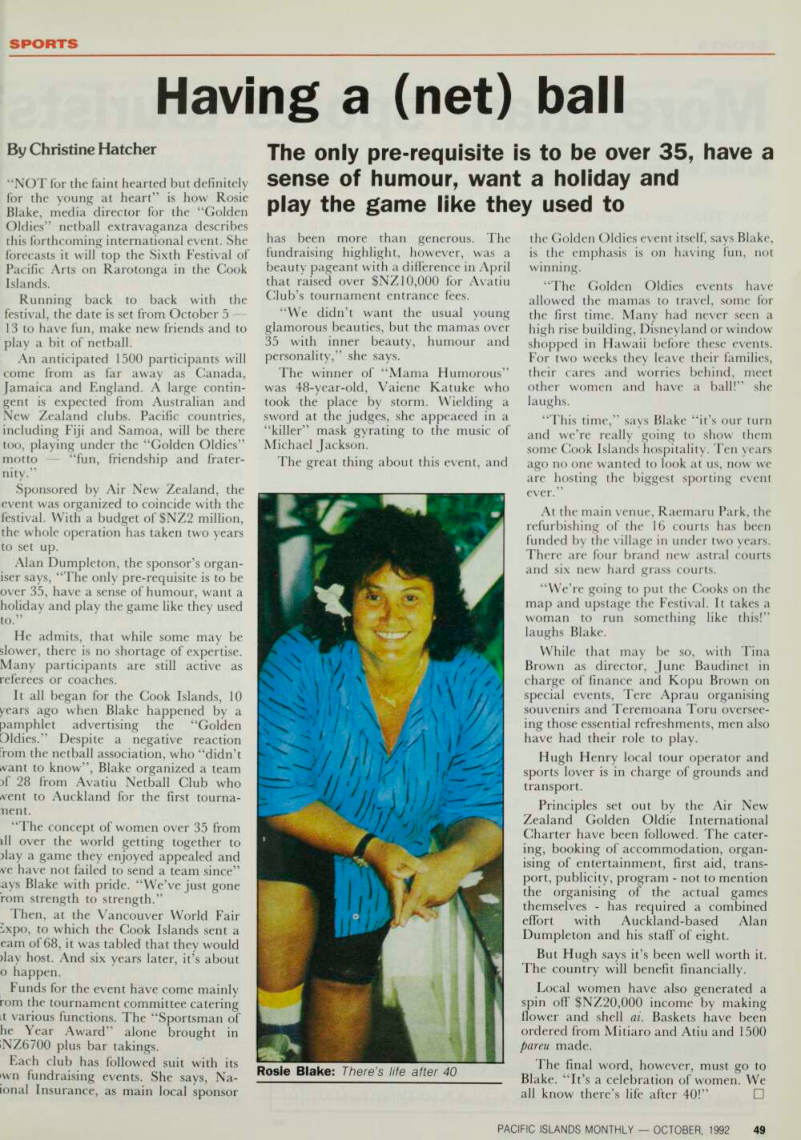
Sports
By Christine Hatcher
“NOT for the faint hearted but definitely for the young at heart” is how Rosie Blake, media director for the “Golden Oldies” netball extravaganza describes this forthcoming international event. She forecasts it will top the Sixth Festival of Pacific Arts on Rarotonga in the Cook Islands.
Running back to back with the festival, the date is set from October 5 13 to have fun, make new friends and to play a bit of netball.
An anticipated 1500 participants will come from as far away as Canada, Jamaica and England. A large contin gent is expected from Australian and New Zealand clubs. Pacific countries, including Fiji and Samoa, will be there too, playing under the “Golden Oldies” motto “fun, friendship and frater nity.”
Sponsored by Air New Zealand, the event was organized to coincide with the festival. With a budget of SNZ2 million, the whole operation has taken two years to set up.
Alan Dumpleton, the sponsor’s organ iser says, “The only pre-requisite is to be over 35, have a sense of humour, want a holiday and play the game like they used to.”
He admits, that while some may be slower, there is no shortage of expertise.
Many participants are still active as referees or coaches.
It all began for the Cook Islands, 10 years ago when Blake happened by a
pamphlet advertising the “Golden
Dldies.” Despite a negative reaction
'rom the netball association, who “didn’t want to know”, Blake organized a team Df 28 from Avatiu Netball Club who went to Auckland for the first tourna ment.
“The concept of women over 35 from ill over the world getting together to )lay a game they enjoyed appealed and ve have not failed to send a team since” ays Blake with pride. “We’ve just gone rom strength to strength.”
Then, at the Vancouver World Fair ilxpo, to which the Cook Islands sent a earn of 68, it was tabled that they would )lay host. And six years later, it’s about
o happen.
Funds for the event have come mainly rom the tournament committee catering it various functions. The “Sportsman of he Year Award” alone brought in
'NZ67OO plus bar takings.
Each club has followed suit with its wn fundraising events. She says, Na ional Insurance, as main local sponsor
The only pre-requisite is to be over 35, have a S6HS6 Of hUmOUf, W3Ht 3 holiday 3fld play the game like they used to
has been more than generous. The fundraising highlight, however, was a beauty pageant with a difference in April that raised over SNZ 10,000 for Avatiu Club’s tournament entrance fees.
“We didn’t want the usual young glamorous beauties, but the mamas over 35 with inner beauty, humour and personality,” she says.
The winner of “Mama Humorous” was 48-year-old, Vaiene Katuke who took the place by storm. Wielding a sword at the judges, she appeaeed in a “killer” mask gyrating to the music of Michael Jackson.
The great thing about this event, and
the Golden Oldies event itself, says Blake, is the emphasis is on having fun, not winning.
“The Golden Oldies events have allowed the mamas to travel, some for the first time. Many had never seen a high rise building, Disneyland or window shopped in Hawaii before these events.
For two weeks they leave their families, their cares and worries behind, meet other women and have a ball!” she laughs.
“This time,” says Blake “it’s our turn and we’re really going to show them some Cook Islands hospitality. Ten years ago no one wanted to look at us, now we are hosting the biggest sporting event ever.”
At the main venue, Raemaru Park, the refurbishing of the 16 courts has been funded by the village in under two years.
There are four brand new astral courts and six new hard grass courts.
“We’re going to put the Cooks on the map and upstage the Festival. It takes a woman to run something like this!”
laughs Blake.
While that may be so, with Tina Brown as director, June Baudinet in charge of finance and Kopu Brown on special events, Tere Aprau organising souvenirs and Teremoana Toru oversee ing those essential refreshments, men also have had their role to play.
Hugh Henry local tour operator and sports lover is in charge of grounds and transport.
Principles set out by the Air New Zealand Golden Oldie International Charter have been followed. The cater ing, booking of accommodation, organ ising of entertainment, first aid, trans port, publicity, program - not to mention the organising of the actual games themselves - has required a combined effort with Auckland-based Alan Dumpleton and his staff of eight.
But Hugh says it’s been well worth it.
The country will benefit financially.
Local women have also generated a spin off SNZ2O,OOO income by making flower and shell ai. Baskets have been ordered from Mitiaro and Atiu and 1500 pareu made.
The final word, however, must go to Blake. “It’s a celebration of women. We all know there’s life after 40!” □
Rosie Blake: There’s life after 40
More than 'sports tourists'
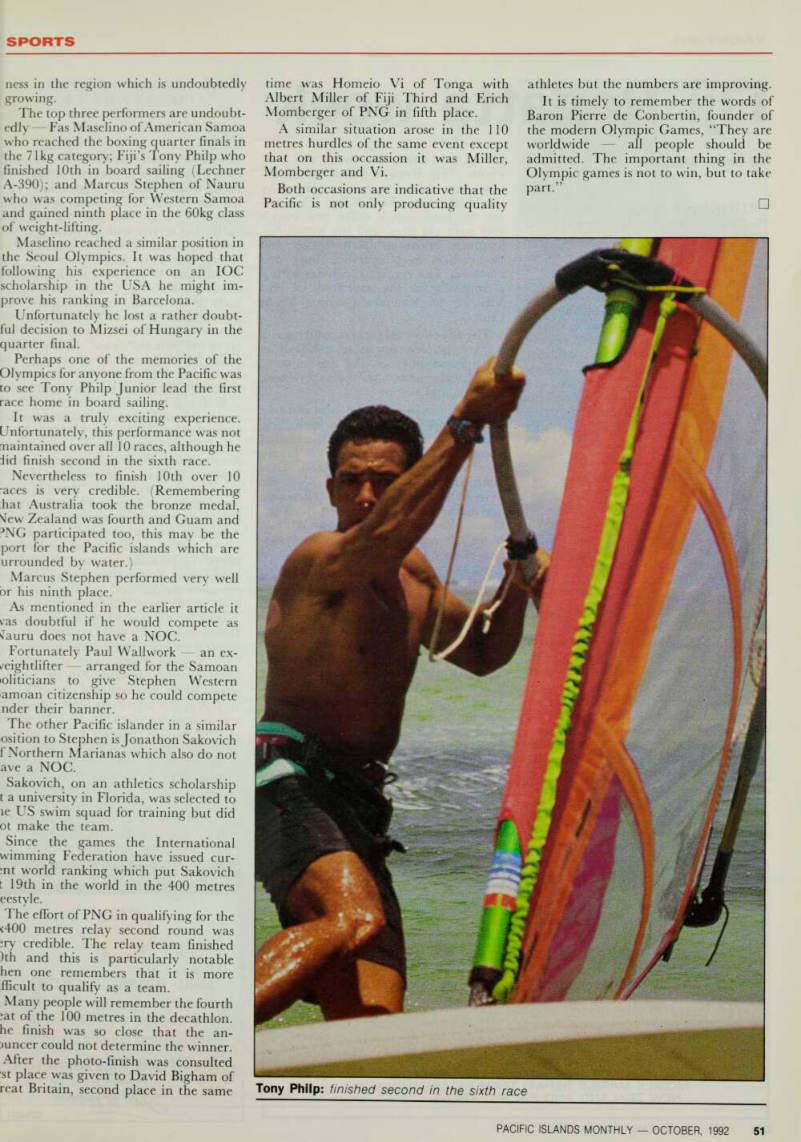
By Brian Wightman
NOW THAT the Olympic Games are over it is time to evaluate performances of Pacific islanders in Barcelona. Bearing in mind the article in PIM in July, 1992 it should be possible to determine answers to questions aired in that article.
It was at least the second Olympic Games for all participating Pacific countries and the figures indicate the regional countries have taken steps to ensure they are not qualified to be described as “sports tourists”.
This is definitely an improvement on Seoul where most countries sent the six athletes whose expenses were paid by the International Olympic Committee < IOC). We can remember some of those athletes being conspicuous for being lapped in athletics competition and others who were not even allowed to compete because of administrative hic cups.
A total of 80 competitors from the nine Pacific countries American Samoa, Cook Islands, Fiji, Guam, Papua New
Guinea, Solomon Islands, Tonga, Vanu atu, and Western Samoa competed in nine sports.
Pacific competitors were in the top 10 in three sports, were in the top 25 in a couple of athletic events and left behind a person ranked 19th in the world in
another discipline.
A closer look reveals only Fiji, Guam and Papua New Guinea exceeded their quota of six “free” or “paid for”
competitors.
Guam had the largest Pacific team with 22 competitors in eight disciplines which is indicative they have been selective taking only their best per formers in those sports and seeking experience and exposure.
Fiji had only one less competitor overall but only entered four sports. PNG took 16 competitors in five sports enter ing yachting for the first time.
All other countries entered five com petitors or less in one or two sports. It is interesting to note all Pacific countries with the exception of Fiji and Guam entered weight-lifting. These indications that it is the the most popular sport are quite different from the previous olym
pics where athletics and boxing were the] dominant sports.
On this occasion four countries were not represented in athletics and only three entered boxing (although one! withdrew at the last minute). Athletics] was still the sport with the highest] number of participants from the Pacific!
This is probably a result of boxers having to qualify at the Oceania Boxing Tournament held in Apia early this year.
A similar situation in weight-lifting: prevails although countries were able to enter one person who was not qualified which would account for the spread of weight-lifters.
What is of great significance is the administrative aspects of Pacific island attendance.
Every country had its National Olym pic Committee (NOC) president or secretary present in Barcelona in some capacity. Only two presidents and three secretaries did not attend.
This should augur well for the admin-; istrative future of the NOCs in the! region. However, it is perhaps even more surprising to look at the administrative people looking after the teams in the
Olympic Village.
All team managers are members of their country’s NOC executive. They include one president, one past president, one senior vice-president, one assistant secretary and two treasurers.
Included are Senator Mike Reily from Guam and Tevita Tupou, Tongan Minister for Justice. Viliame Saulekaleka Minister of State in Fiji was also part of the Fiji team.
This is all hopefully an indication of the enthusiasm of the leaders of sport in the Pacific and their desire to learn. The experience will certainly be of assistance.
While a couple of countries took media people of their own, it was a luxury most countries could not afford.
Remembering that radio is the fastest media in the Pacific, moves were begun at the Oceania National Olympic Com mittee’s annual meeting in the Cook Islands in May this year to ensure suitable coverage.
Fortunately the Australian Olympic Committee agreed to help the Pacific islands sports administrators and it transpired thanks to the efforts of the islands sports administrators that Brendan Telfer was filing daily reports back to the entire Pacific through Radio Australia.
This is one aspect of aid which is often underestimated or overlooked.
This is perhaps a measure of the administrative competence and aware
ness in the region which is undoubtedly growing.
The top three performers are undoubt edly — Fas Maselino of American Samoa who reached the boxing quarter finals in the 71kg category; Fiji’s Tony Philp who finished 10th in board sailing (Lechner A-390); and Marcus Stephen of Nauru who was competing for Western Samoa and gained ninth place in the 60kg class of weight-lifting.
Maselino reached a similar position in the Seoul Olympics. It was hoped that following his experience on an lOC scholarship in the USA he might im prove his ranking in Barcelona.
Unfortunately he lost a rather doubt ful decision to Mizsei of Hungary in the
quarter final.
Perhaps one of the memories of the Olympics for anyone from the Pacific was to see Tony Philp Junior lead the first race home in board sailing.
It was a truly exciting experience.
Unfortunately, this performance was not maintained over all 10 races, although he did finish second in the sixth race.
Nevertheless to finish 10th over 10 •aces is very credible. (Remembering hat Australia took the bronze medal, 'lew Zealand was fourth and Guam and -*NG participated too, this may be the port for the Pacific islands which are urrounded by water.) Marcus Stephen performed very well or his ninth place.
As mentioned in the earlier article it vas doubtful if he would compete as tfauru does not have a NOC.
Fortunately Paul Wallwork an ex /eightlifter arranged for the Samoan •oliticians to give Stephen Western amoan citizenship so he could compete nder their banner.
The other Pacific islander in a similar osition to Stephen is Jonathon Sakovich f Northern Marianas which also do not ave a NOC.
Sakovich, on an athletics scholarship t a university in Florida, was selected to ic US swim squad for training but did ot make the team.
Since the games the International wimming Federation have issued cur *nt world ranking which put Sakovich t 19th in the world in the 400 metres eestyle.
The effort of PNG in qualifying for the <4OO metres relay second round was "ry credible. The relay team finished )th and this is particularly notable hen one remembers that it is more fficult to qualify as a team.
Many people will remember the fourth *at of the 100 metres in the decathlon, he finish was so close that the an juncer could not determine the winner.
After the photo-finish was consulted st place was given to David Bigham of reat Britain, second place in the same
time was Homeio Vi of Tonga with Albert Miller of Fiji Third and Erich Momberger of PNG in fifth place.
A similar situation arose in the 110 metres hurdles of the same event except that on this occassion it was Miller, Momberger and Vi.
Both occasions are indicative that the
Pacific is not only producing quality
athletes but the numbers are improving, It is timely to remember the words of Baron Pierre de Conbertin, founder of the modern Olympic Games, “They are worldwide all people should be admitted. The important thing in the Olympic games is not to win, but to take part.” □
Tony Phllp: finished second in the sixth race
Advertisements & other items, p. 50 (2 items)
Sports
Abels
mm
New Zealand’s leading suppliers of: ♦ Catering <Sc Culinary Margarines ♦ Quality Deep Frying Shortenings ♦ Quality Blended Vegetable Oils ♦ Specialty Bakery Margarines <Sc Shortenings ♦ An extensive range of foodservice ingredients
Proudly support the 6th
Festival of Pacific Arts,
Rarotonga, Cook Islands,
October 16-27, 1992.
Serving Pacific Islands, Countries and Territories with Pride.
Abels Ltd, 101 Carlton Gore Rd., Newmarket, Auckland. Ph 64-9-5241000. Fax 64-9-5241161 7878
Fiji Regatta week
Yachting
By Sally Andrew
CRUISING Regattas in the South Pacific have caught on with cruising folk.
Not only first timers but seasoned sailors are joining in the fun of regatta cruising.
In 1992 three regattas headed north out of New Zealand to three different South Pacific locations in May to Nuku’alofa, Tonga; in June to Vava’u in northern Tonga; and in July to Savusavu in Fiji. These three cruising regattas, organized by Don and Jenny Mundell and the Island Cruising Association, provided cruising yachties with get togethers in prime blue-water cruising locations. But the original, the grand daddy of all the South Pacific regattas, is the “Musket Cove to Port Vila Regatta”.
The “Musket Cove to Port Vila Regatta” and the accompanying “Fiji Regatta Week” are the creations of Dick Smith, one of the pioneers in Fiji tourism and owner of Musket Cove Resort.
Conceived in the early eighties, this event has attracted boats from around the world year after year. This season marks the 13th annual “Fiji Regatta Week”.
Ocean going yachts sail in and out of the bay at Malolo Lailai Island in the beautiful Mamanuca Group in western Fiji all season long. But at the beginning of September the number of boats tugging at their anchors and the number of tourists staying in the resort increase to a maximum and the fun begins. By the start of “Fiji Regatta Week” nearly a hundred boats are gathered in the bay and crew members and skippers alike participate in the yacht racing and miscellaneous competitions. Semi-serious races to Castaway Island, Beachcomber Island and around Malolo Island are interspersed with windsurfing, dinghy
sailing, and biathalon (swim and run) events. “Fiji Regatta Week” tradition ally opens with a welcome feast hosted by the Musket Cove Yacht Club. Through ou< the we( * P eo P le make new fnends f nd , meet old ones ’ and the socializing aug ter, craziness, talent quests and X ach , t s u kee P ever y° n f busy and mvolved -. The re S atta concludes with a on the waterfront of Port a t the Vanuatu CruiBin S Yacht U . The key element in a successful regatta 18 diversity. Diversity in the nationalities and personalities of the participants; their backgrounds, ages and experiences; type and size of boats, Entrants in this year’s regatta and race week events include yachts from New Zealand, Australia, Canada, the United States, Vanuaatu, Finland, Japan,
Swede, \ Hong Kong, England, Ger
many. Sloops, cutters, ketches, yawls, monohulls, multihulls, motorisailors and one mo(or ht have ’ entered this QveraH length ranges from William Burns’ 30-foot sloop to the luxur ious 90 . r00t U K ac f t „ r , ... . , one °[ the youngest sailors this year is Marcus Boomen ' ° nl y. ls , months old, Marcus is participating m his first riji to Vanuatu regatta and will be sailing to Port Vila aboard Reuben , a 35-foot Alan Wright design. Well known in New Zealand as a Lotus 10.6, Reuben was built by Peter and Fiona Boomen of Snells Beach near Auckland, New Zealand, They bought the hull and deck, finished out the interior and launched her in December 1990. Like many of the regatta participants, Peter and Fiona have done the race before - in 1986 aboard the 33-foot trimaran Shula. This year they spent two months cruising in Fiji prior to the race and especially enjoyed their curise to the island of Yadua on the south-west coast of Vanua
Levu.Like many cruisers, Peter and Fiona found Fiji a convenient place to make repairs and for reprovision. The trip north from New Zealand to Fiji is an especially tough one and it’s the rare yacht that arrives without needing a sail repair or a part fabrication .Suileka, one of several European yachts entered in the regatta, is a 45-foot steel ketch designed by Bruce Roberts. Owner and skipper Sally Dodd from Sussex, England has participated twice in Fiji Regatta Week but this year is the first time she and her crew will join the “race” to Port Vila.
Sally left England to go cruising in September 1985 and has been cruising the South Pacific for the last seven years.
Powered by a huge Gardiner diesel engine, the only non-windpowered vessel in the regatta is Astron, a 65-foot ocean going motor yacht from New Zealand’s South Island. Owners Brian and Louise Pearce and their 12-year-old son Hedley came north to Nuku’alofa “Island Cruis ing Regatta” in May and have spent the last three months exploring in Tonga, American Samoa and Fiji. Astron can carry 10 tons of diesel fuel and has a range of 6000 miles. Given good weather conditions, Brian should be able to complete the 530 odd miles to Port Vila in 76 hours, or a little over three days.
Dick Smith and his wife Carol have always extended a royal welcome to the
cruising yachties, hosting and sponsoring
“Fiji Regatta Week” and sharing the
resort facilities. Because Fiji lies at the centre of all international trans-Pacific air traffic, it is a great location for family and friends to catch up with itinerent yachtsmen. Add Musket Cove’s ameni ties - like showers, swimming pool, fuel dock, water, moorings, its proximity to Lautoka and Nadi Airport and a well protected anchorage with good holding in about 15 metres - and you have all the ingredients for a successful yacht regatta.
Who won the Musket Cove to Port Vila Yacht Regatta? Everyone! □ ,
Advertisements & other items, p. 52 (1 item)
Garth Evans Marine
ATTENTION YACHTIES
SHELL FUELING FACILITIES
Shell Fiji Ltd. is offering the best in name brand lubricants and quality fuel in: Savusavu, Levuka, Suva.
/n7\ Shell Fiji Limited
? Telephone 313933, Fax 302279
// best
GR8337
PO BOX 5094
PORT NELSON
PH (3) 5468330
FAX (3) 5468351
GARTH EVANS MARINE
PORT OF NELSON NEW ZEALAND
SHIP CONSTRUCTION AND DESIGN
SHIP REPAIRS TO PLEASURE AND COMMERCIAL VESSELS SLIPPING FACILITIES TO 2000 TONS AND UP TO 6 METRE DRAFT
SAND BLASTING AND PAINTING
DIESEL AND ENGINE REPAIRS
AGENCIES FOR NEW AND REBUILT ENGINES
MOBILE MARINE REPAIR TEAM BY ARRANGEMENT
NEW ZEALAND AND PACIFIC AREAS
Contact
G. EVANS
A/H (3) 5482409
racing tips
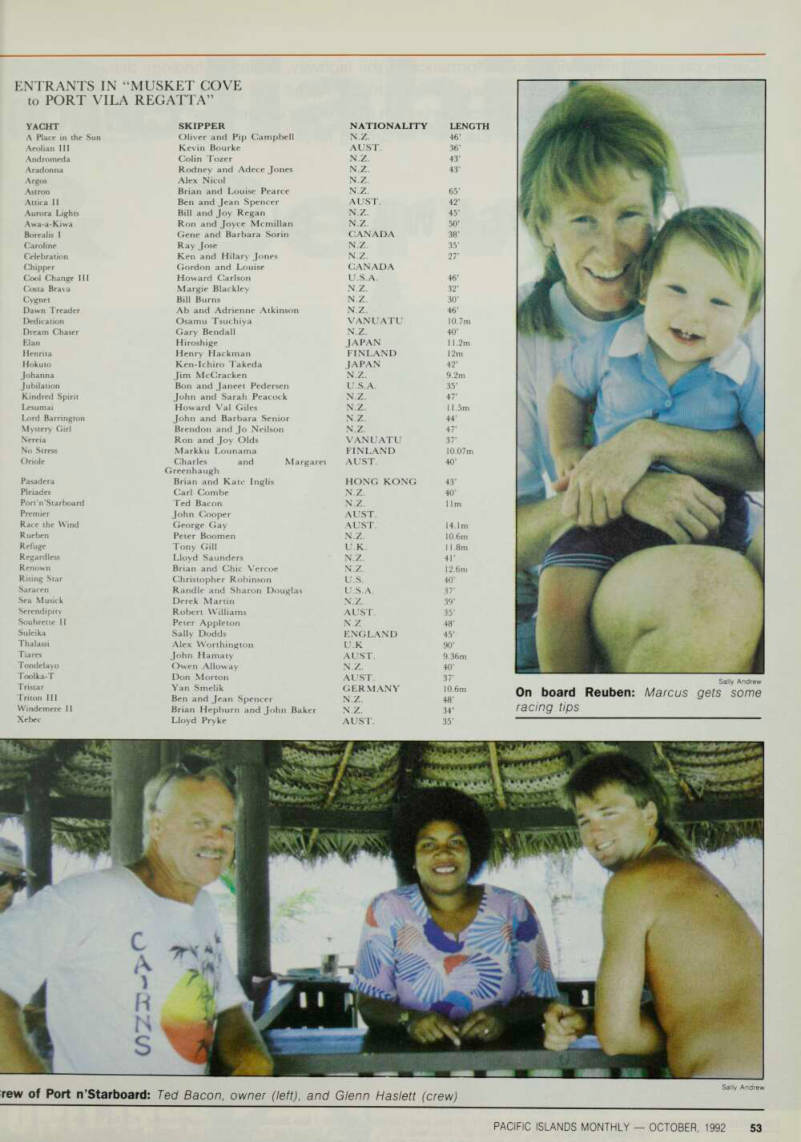
Entrants In “Musket Cove
To Port Vila Regatta”
Sally Andrew On board Reuben: Marcus gets some racing tips
Sally Andrew
few of Port n’Starboard: Ted Bacon, owner (left), and Glenn Haslett (crew)
Yacht
Skipper
Nationality
Length
A Place in the Sun Oliver and Pip Campbell N.Z. 46’
Aeolian III Kevin Bourke
Aust
36’
Andromeda Colin Tozer N.Z. 43’
Aradonna Rodney and Adece Jones N.Z. 43’
Argos Alex Nicol N.Z.
Astron Brian and Louise Pearce N.Z. 65’
Attica II Ben and Jean Spencer
Aust.
42’
Aurora Lights Bill and Joy Regan N.Z. 45’
Awa-a-Kiwa Ron and Joyce Mcmillan N.Z 50’
Borealis I Gene and Barbara Sorin
Canada
38’
Caroline Ray Jose N.Z 35’
Celebration Ken and Hilary Jones N.Z. 27’
Chipper Gordon and Louise
Canada
Cool Change III Howard Carlson
U.S.A.
46’
Costa Brava Margie Blackley N.Z. 32’
Cygnet Bill Burns N.Z. 30’
Dawn Treader Ab and Adrienne Atkinson N.Z. 46’
Dedication Osamu Tsuchiya
Vanuatu
10.7m Dream Chaser Gary Bendall N.Z. 40’
Elan Hiroshige
Japan
11.2m Henrita Henry Hackman
Finland
12m Hokuto Ken-Ichiro Takeda
Japan
42’
Johanna Jim McCracken N.Z. 9.2m Jubilation Bon and Janeet Pedersen
U.S.A.
35’
Kindred Spirit John and Sarah Peacock N.Z. 47’
Lesumai Howard Val Giles N.Z. 11.5m Lord Barrington John and Barbara Senior N.Z. 44’
Mystery Girl Brendon and Jo Neilson N.Z. 47’
Nereia Ron and Joy Olds
Vanuatu
37’
No Stress Markku Lounama
Finland
10.07m Oriole Charles and Margaret Greenhaugh
Aust.
40’
Pasadera Brian and Kate Inglis
Hong Kong
43’
Pleiades Carl Combe N.Z. 40’
Port’n’Starboard Ted Bacon N.Z. 1 Im Premier John Cooper
Aust.
Race the Wind
George Gay
Aust.
14.1m Rueben Peter Boomen N.Z 10.6m Refuge Tony Gill UK 11.8m Regardless Lloyd Saunders N Z. 41’
Renown Brian and Chic Vercoe N.Z 12.6m Rising Star Christopher Robinson u.s. 40’
Saracen Randle and Sharon Douglas
U.S.A.
37’
Sea Musick Derek Martin N.Z. 39’
Serendipity Robert Williams
Aust.
35’
Soubrette II Peter Appleton N.Z 48' Suleika Sally Dodds
England
45’
Thalassi Alex Worthington UK 90’
Tiares John Hamaty
Aust.
9.36m Tondelayo Owen Alloway N.Z. 40’
Toolka-T Don Morton
Aust.
37’
Tristar Yan Smelik
Germany
10.6m Triton III Ben and Jean Spencer N.Z. 48’
Windemere II Brian Hepburn and John Baker N.Z. 34’
Xebec Lloyd Pryke
Aust.
35’
Advertisements & other items, pp. 54-55 (1 item)
Highway Diva
Clarion car audio brings virtuoso performance to the highway. Digital technology delivers awesome bass, a transparent midrange and clear, sparkling highs. And if you couple • o it with one of our advanced CD changers, the built-in CD changer control gives ifif you concert-hall fidelity at redline. Clarion. The driving force in car audio.
' High-Tech High-Touch
clarion crx?ba
CD CHANGER
CONTROL
m FMI FM2 FM3
i n o n r o 9a
W I U LMJ 3
nniPOI.BYBWH|
AM MONO/FM STEREO RADIO
CASSETTE COMBINATION ;• * >
WITH CD CHANGER CONTROL ;
n COMPACT
(fi]D§Qß
isaiii FOR FURTHER INFORMATION Australia: Clarion Australia Ry. Ltd. Unit 17, 50 Keys Road Moorabbin, Vic 3189 / New Zealand: AWA New Zealand Limited, P.O. Box 50-248, Porirua Fiji Islands: Brijial & Co., Ltd., G.P.O. Box 362, Suva Tahiti; HI FI., VAIRAATOA Avenue Chef Vairaatoa B.P 1128, Papeete / New Caledonia: Caldis, B.PM 1, Noum PoHov / Aiisti/x I DO Dow 0/170 Aoooo P..0r0 OCO*m MCA Tol • 470 000*1 PoKlo PnWn- UICI ANRIO AH AM A / Wonnatn Tha QnimH Pontro PH Rnv A'XA Vila / f!nnk Isl^llOl
Reliability
& Service
nk .‘'V'V •o \ \ « - KflU TU
SUVA
3R SOFRANA has always had the good sense to adapt to suit the needs of its customers. In the majority of countries that we serve, we have established a network of agency offices that allow us to deal directly with you, giving us the ability to deliver a better, more personalised service to suit your needs. In years gone by it has served us well, and will continue to follow this policy in the future.
Principal countries served in the South Pacific • Australia • Fiji • Norfolk Islands • New Zealand • Vanuatu • New Caledonia • Papua New Guinea • Solomon Islands ? sth floor,Neptune House,Tofua Street, Walu Bay,Suva,Fiji.
Te1:315645,304528.
Fax:3oo 951, 300 057.
Postal Address:C/-Carpenters Shipping.
Private Mail Bag, Suva.
Shipping
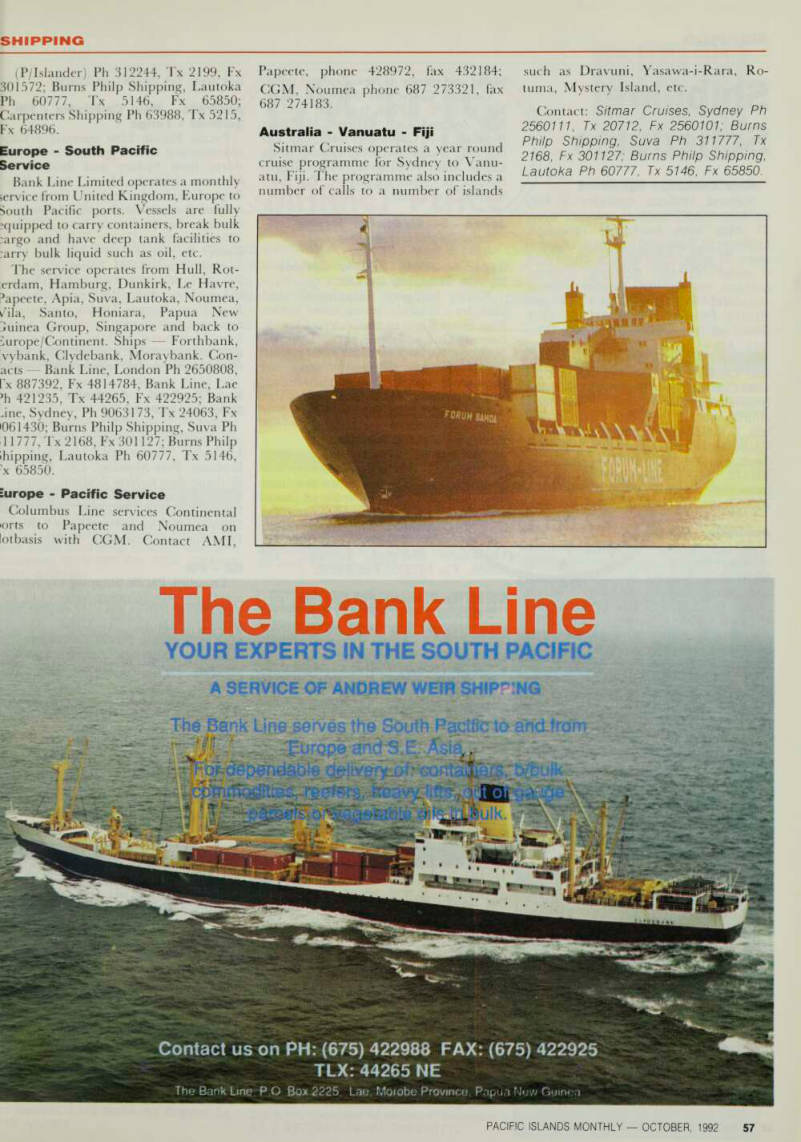
Schedules
Australia - Fiji Service Chief container services un der Australia Pacific Island Line Unitize Sofrana and PPL vessels to provide a twice monthly, service from Austra lia. Fiji Agents Campbells Shipping Agency Ltd Ph 314189 Fax 300144. System Agents Nedlloyd Swire Ph(2) 2512699. Melbourne Yarra Shipping Ph (3) 6936300. Bris bane, Nedlloyd Swire, ph (7) 8321551.
Australia - Fiji - Noumea - Vila - Santa Marsmond PLxpress Lines op erate a breakbulk service from Goodwood Island Australia to Fiji, Noumea, Vila Santo and Honiara. Continuous receiving depots in Sydney and Brisbane enable this vessel to bring cargoes from these parts. Fiji
Agents Campbells Shipping
Agency Ltd, ph. 314189, Fax 300144. Brisbane Agents - Shippings & Marketing Ph (7)
2628082. Sydney Agents Seabord Agencies (2) 3172325.
Australia - New Caledonia - Fiji - Hawaii - North Ame rica ACT Pace Pacific (ACTA Shipping) operates a fully containerised/break bulk ser vice every 17-20 from Mel bourne, Sydney, Brisbane to Noumea, Suva and Lautoka.
The vessels continue on to the West Coast of North America calling Honolulu at frequent intervals. Ships are ACT and ACT 12. Contacts: ACTA Pty Ltd, Sydney Ph 2869666, Tx
121369, Fx 2869610. Acta
Pty Ltd, Melbourne Ph 6112000, Tx 30949, Fx 6293055. ACTA Pty Ltd, Bris bane Ph 2213116 m Tx 40719, Fx 2298143. SATO, Noumea Ph 281122, Tx 3163, Fx 278532. Burns Philp Shipping, Suva Ph 31 1777, Tx 2168, Fx 301127; Burns Philp Shipping, Lautoka Ph 60777, Tx 5146, Fx
65850.
West Coast of North Ame rica - Fiji - New Zealand Blue Star Line Pacific Coast Service operates a fully containerised/break bulk ser vice every 23 days from Van couver, Seattle, San Francisco,
Los Angeles to Pago Pago,
Suva and New Zealand ports.
The vessels continue to call Suva on the Northbound voy age from New Zealand everv
fortnight to pick up Fiji exports
such as garments, fresh ginger, etc. for Hawaii and West Coast of North America ports. Blue Star Line also provides a through service to East Coast to North America. Ships are Wel lington Star, Southland Star and California Star. Contacts: Blue Star Line, San Francisco Ph 9282026, Tx 184925, Fx 6730355; Blue Star Line, Van couver Ph 6817300, Tx 0451326, Fx 6835797;
Interocean Steamship Corp,
Seattle Ph 6829820, Tx 321101, Fx 3437421; Blue Star Line, Los Angeles Ph 5970454, Tx 408564, Fx 5978710. New Zea land Line, Wellington, Ph 739029, Tx 3583, Fx 4992468;
New Zealand Line, Auckland Ph 390965, Tx 2556, Fx 3032039; Burns Philp Ship ping, Suva Ph 31 1777, Tx 2168, Fx 301127; Burns Philp Shipping, Lautoka Ph 60777 J Tx 5146, Fx 65850.
Japan - South Pacific Ser vice Bali Hai Line a joint service] of China Navigation, Mitsui OSK Line and NYK Line operates a fully containerised/j break bulk service from Korea, Japan to South Pacific ports on a monthly basis serving ports of Pusan, Kobe, Nagoya, Yoko hama, Tarawa, Lautoka, Suva, Apia, Pago Pago, Papeete,] Nukualofa, Noumea, Vila, Santo. The ships are also fully specialised to carry vehicles on ro/ro basis. Ships are Coral Islander and Pacific Islander.
Contacts: John Swire & Sons, Tokyo Ph 32309220, Tx 22248, Fx 3239288; Nippon Yusen Kaisha, Tokyo Ph 3284516, Tx 22236, Fx 32846332; Mtsuf OSK Lines, Tokyo Ph 35877086, Tx 22266, Fx 35877732; Burns Philp Ship ping, Suva (C/Islander) Ph 31 1777, Tx 2168, Fx 301127; Carpenters Shipping, Suva
(P/Islander) Ph 312244, Tx 2199, Fx 301572; Burns Philp Shipping, Lautoka Ph 60777, Tx 5146, Fx 65850; Carpenters Shipping Ph 63988, Tx 5215, Fx 64896.
Europe - South Pacific Service Bank Line Limited operates a monthly service from United Kingdom, Europe to South Pacific ports. Vessels are fully equipped to carry containers, break bulk :argo and have deep tank facilities to :arry bulk liquid such as oil, etc.
The service operates from Hull, Rot erdam, Hamburg, Dunkirk, Le Havre, Papeete, Apia, Suva, Lautoka, Noumea, /ila, Santo, Honiara, Papua New Guinea Group, Singapore and back to Surope/Continent. Ships Forthbank, vybank, Clydebank, Moraybank. Con acts Bank Line, London Ph 2650808, fx 887392, Fx 4814784, Bank Line, Lae >h 421235, Tx 44265, Fx 422925; Bank ane, Sydney, Ph 9063173, Tx 24063, Fx '061430; Burns Philp Shipping, Suva Ph 1 1777, Tx 2168, Fx 301127; Burns Philp •hipping, Lautoka Ph 60777, Tx 5146, x 65850.
Europe - Pacific Service Columbus Line services Continental •orts to Papeete and Noumea on lotbasis with CGM. Contact AMI,
Papeete, phone 428972, fax 432184; CGM, Noumea phone 687 273321, fax 687 274183.
Australia - Vanuatu - Fiji Sitmar Cruises operates a year round cruise programme for Sydney to Vanu atu, Fiji. The programme also includes a number of calls to a number of islands
such as Dravuni, Yasawa-i-Rara, Ro tuma, Mystery Island, etc.
Contact: Sitmar Cruises, Sydney Ph 2560111, Tx 20712, Fx 2560101; Burns Philp Shipping, Suva Ph 311777, Tx 2168, Fx 301127; Burns Philp Shipping, Lautoka Ph 60777, Tx 5146, Fx 65850.
Advertisements & other items, pp. 56-57 (1 item)
The Pacific Islands Rely
ON THE ENERGY OF BORAL
feSUiM •-i m American Samoa (684) Tafuna 699 2948 Aua6442170 Cook Islands (682) Rarotonga 24460 Fyi (679) Suva 315522 Lautoka 60088 Sigatoka 50578 Labasa 82973 Norfolk Islands (6723) Norfolk Island 2419 Papua New Guinea (675) Port Moresby 214248 Lae 422574 Rabaul 921225 Wewak 862125 Mount Hagen 551216 Solomon Islands (677) Honiara 21833 All through the Pacific Islands, people rely on Boral LP gas for their energy needs.
Boral has terminals throughout the area, and is proud to be a leading supplier.
Boral Gas is clean, efficient and low in cost.
It’s the ideal energy source for cooking and water beating in homes, motels and hotels, and for a wide range of industrial uses.
So call for Boral Gas. We have the energy you’re looking for.
Tonga(676) Nukualofa 24035 Vava’u 22903 Vanuatu (678) Santo 36455 Port Vila 22046
BORAL GAS
Boral Gas Pacific, John Oxley Centre, 339 Coronation Drive, Brisbane. Tel: (07) 3671365. Fax: (07) 3694347
The Bank Line
YOUR EXPERTS IN THE SOUTH PACIFIC
A SERVICE OF ANDREW WEIR SHIPPING
The Bank Line serves the South Pacific to ahdfrom uk t 0 M - * Contact us on PH; (675) 422988 FAX: (675) 422925
TLX; 44265 NE
The Bank Line P.O Box 2225. Lae, Moiobc Province Papua New Guinea
Shipping
Schedules
New Zealand - Fiji direct Sofrana Unilines operates a fully containerised/breakbulk service every 21 days from Auckland, Tauranga, Lyttleton to Suva and Lautoka. Loading every 21 days, ro/ro service, containers - reefer. Contact Sofrana Unilines, Sofrana House, 101 Customs Street, Auckland, PO Box 3614, Fax (09) 393874, Ph (09) 773279, Tlx NZ 2313.
Direct toll free line 0800 659-922, Con tact Alan Foote. Sofrana Shipping Agencies, PO Box 921 Wellington, Tel (04) 725 661, Fax (04) 725 749, Tlx NZ 4769 Contact Steve Brannigan. Sofrana Unilines Agencies, PO Box 22046 Christ church, tel (03) 667 180, Fax (03) 668 868, TLX NZ4769, Contact Tony Newell.
Carpenters Shipping, Private Mail Bag, Suva, Fiji, Tel (679) 312244_Fa*J§79) 301572, Tlx FJ 2199.
Suva. Fiji. Tel (679),£^^Tax767$ 300057.
i(o 2 7 nci r
Australia - Fiji direct ' u 1 ‘ Sofrana Unilines a ro/ro container service from Melbourne, Sydney, and Suva. Contact Sofrana Unilines (Aust) Pty Ltd, PO Box Q 136, Queen Victoria Building, Sydney, NSW 2000, Australia. Tel (02) 2648944, Fax (02) 2676547, Tlx (71) A 170090, Contact Andrew McLachlin, Sam Attaway.
Carpenters Shipping, Suva, Tel (679) 312244, Fax (679) 301572. Sofrana Unilines Suva, Tel (679) 315 645, Fax (679) 300057. Carpenters Shipping, Lautoka, Tel (679) 63988, Fax (679) 64896. Sofrana Unilines, Lautoka Tel (679) 62921, Fax (679) 64896.
Australia - Fiji monthly service Sofrana Unilines (Australia) Pty Ltd operates a regular monthly service with MV Capitaine Wallis. Contact Sofrana Unilines, Sydney, Tel (02) 2648944, Tlx AA170090, Fax (02) 267-6547.
Carpenters Shipping, Suva, Fiji, Tel (679) 312244, Fax (679) 301572, Sofrana Unilines, Suva, Fiji Tel (679) 315645, Fax (679) 300057. Carpenters Shipping, Lautoka, Tel (679) 63988, Fax (679) 64896. Sofrana Unilines, Lautoka, Fiji, Tel (679) 62921, Fax (679) 64896.
Far-East - Fiji - New Zealand Ser vice New Zealand Unit Express (NZUE) operates a monthly service accepting containerised and break-bulk cargoes from Manila, Keelung, Kaoshiung, Hong Kong, Lae to Suva, Lautoka (via
Suva) and thence to New Zealand ports.
Contact Carpenters Shipping Suva, Fiji, tel (679) 312244, fax (679) 301572.
New Zealand Unit Express, Maritime Building, 2-10 Customs House Quay, PO Box 890, Wellington. Tel 727865, Cables Enzue Man, Wellington, Tlx NZ31340 Nedlnz or Nedlloyd Swire Pty Ltd, Sydney, Tel 20522.
Japan - South Pacific Service Same as Burns Philp Japan - South Pacific Service - Kyowa Shipping Co Ltd Kyowa Shipping, Shipping Co Ltd provides a monthly containerised service from Hong Kong to main ports of Japan, Saipan, Guam, Island ports, Lautoka, Suva via Nukualofa to Pago Pago and
Apia. Contact Carpenters Shipping,
Neptune House, 3/4 floor, Tofuaa Street, Walu Bay, Suva. Tel 312244, Fax 301572, Tlx FJ2199.
Europe - Pacific Service Nedlloyd offers cargo services from Ports to Papeete, Fiji, New U&fedonia and Doniambo on slot basis with sank line. Contact Nedlloyd (Aust)
Spring Street, Sydney, Tel
273$bl|. Carpenters Shipping, Suva, tel Tlx FJ2199, Fax 301572. jUajjpenters Shipping, Lautoka, Tel *65988, Tlx FJ5215, Fax 64896.
South East Asia - Fiji Service Nedlloyd Lines (NZEAS) Service op erates regular fast cargo service from Jakarta, Pt Keelang, Singapore, Bang kok, Surubaya via Auckland to Suva and Lautoka. Contact Carpenters Shipping, Suva, Tel 312244, Tlx FJ2199, Fax
301572. Carpenters Shipping, Lautoka
Tel 63988, Tlx FJ5215, Fax 63988 South East Asia - Mid South pacific Columbus Line operates a regular container and breakbulk-heavy lift ser vice from/to Hongkong/Taiwan/Manila/
Singapore/Malaysia/Thailand/Indon
esia to Port Moresby/Lae/Rabaul/
Kimbe/Madang/Newark/Honiara and
Noro. Contact Express Freight, Lae, POB 3398, phone 423913 or 423822, fax 425193.
Far East - Mid South Pacific China Navigations New Guinea Pa cific Line operates a regular container and breakbulk heavy lift service from Hong Kong, Taiwan, Manila, Singa pore, Malaysia, Thailand to Port Moresby, Lae, Rabaul, Kieta and Honi ara. Cargo from the same eastern ports to the South Pacific Ports of Noumea, Santo, Vila, Papeete, PagoPago, Apia, Nukualofa, Rarotonga and Tarawa will be shipped via Japan or Busan on the monthly Bali Hai Service. Contact Steamships Shipping, Port Moresby, PO
Box 634, Tel 220283 or 220289.
Australia - New Caledonia - Fiji - Samoas - Tonga Pacific Forum Line operates a fully containerised service (general, reefer and ro-ro) from Sydney and Brisbane to Noumea, Lautoka, Suva, Apia, Pago
Pago, Nuku’alofa, Sydney. Cargo cen
tralised from Adelaide and Melbourne.
Contact: Pacific Forum Line, PO Box 796, Auckland; Union Bulkships, 333 George St, Sydney, Brisbane and Mel bourne; Union Co, Lautoka; Pacific Forum Line, Suva, Nuku’alofa; Pacific Forum Line, Apia; Polynesia Shipping, Pago Pago. Sofrana Unilines operates a roro/container service every three weeks from Melbourne, Sydney and Brisbane to Noumea, Suva and Lautoka with transhipment to the Samoas and Tonga.
New Zealand - Australia - PNG - Solomon Islands Pacific Forum Line operates a containerised and ro-ro service from Lyttleton, Napier and Auckland to Brisbane, Port Moresby, Lae, Honiara, Brisbane then to New Zealand. Contact: Pacific Forum, Auckland, Christchurch; Union Bulkships, Brisbane; Steamships Shipping Port Moresby and Lae Sullivan Ltd, Honiara; Seabridge, Wellington.
NZ - Fiji Translink Pacific Shipping Fiji Agents are: Campbells Shipping Agency Ltd, Ph 314189 Fax 300144 Suva; Ph 662231 Fax 662251 Lautoka. Auckland Agents: McKay Shipping Ph (9) 390229 Fax (9) 3032931. Tauranga Agents, seatrade agencies Ph (75) 754989 Fax (75) 758380.
NZ - Fiji - Pago - Apia - Nuk Translink Pacific Shipping operates a monthly sailing with Pacific Link, which carries Dry Container, reefers and breakbulk cargoes. NZ Agents McKay Shipping Shipping AKLD Ph 390229, Fax 3032931. Fiji Agents Campbells Shipping Agency & ltd Ph 314189 Fax 300144 NZ - Noumea - Wallis - Futuna Translink Pacific Agency operate a container Breakbulk service once a month from NZ through Fiji and Noumea to Wallis & Futuna.
South East Asia - Fiji - Noumea - Papeete - Chile Service “Seaspac” A joint Chilean CCNI/ j CSAU Service offers a regular monthly sailing from Djakarta and Singapore to Noumea, Fiji, Papeete, and Chile. Cargo also feedered to Singapore from Korea, Hong Kong, Taiwan, Malaysia, Bang kok. Fiji Agents: Campbells Shipping Agency Ltd, ph. 314189, Fax 300144.
Advertisements & other items, pp. 59-60 (1 item)
Pacific
ACIFI
ISLANDS
Imp n t h l y~\
flfiK€T PLflCf
3 1506 00027443 For the benefit of our readers who would like to place a small classified advertisement in our magazine, Market Place will assist you in selling personal items, accommodation, real estate, boating or a service ... in fact anything you would like to sell to our over 50,000 readers.
Market Place Advertising Rates are structured to allow you to place as many advertisements as you wish, economically.
BUSINESS OPPORTUNITY
Mobile Concrete Mini Batching Plant and .icence to use exclusive Addatives (which illow you to use on-site materials (Soil, Sand, 'lay, Coral, Sea Water ect.) To produce :oncrete. Huge potential throughout the Pa- ;ific. Ph. AUS. 71 533177 or P.O. Box 1904, Jundaberg, Qld. 4670.
CONSULTANTS
iCCOUNTANT/CHARTERED MANAGEMENT
IONSULTANT Computer Systems Expert, many ears island experience, available short-term ssignment Reply GPO Box 2758, Canberra 1601, Australia.
CONSULTANTS
DUR OWN AUSTRALIAN REPRESENTATIVE
FFICE OR AGENT in Australia’s National apital City of Canberra. GPO Box 2159, anberra ACT 2601 FAX +6l 6 2312632.
DRIED SEA CUCUMBERS WANTED
eafood importer is interested in buying andfish (Metriatyla Scabra), Black Fish \ctinopyga Lecanora) on basis of monthly lipment. Please contact Wealthy Ocean orporation, P.O. Box 36 503 Taipei, aiwan Telex: 19882 WOCO, Fax: (8862) 624455, Phone: (8862) 7661036.
BOOKS
bliophile, a secondhand bookshop in Sydney, keen to buy good books on the Pacific. Also, irrent book catalogue “Pacific & Southeast >ia” now available free on request, bliophile, 24 Glenmore Road, Paddington, 3W 2021, Australia. Ph. 61 2 331 1411 ix 61 2 361 3371.
TRAVEL GUIDES
stralian citizen planning to move to Fiji early )93 seeks partnership or purchase small siness in tourism or manufacturing preferly in western district. ive considerable business experience and ed to hard work. siting Fiji July/August 1992. in Gardner, 1/43 Beach Rd, Brighton SA •48 Australia.
WANTED TO BUY
Troka shells on regular monthly basis. Must be prepared and ready for shipment.
Write to: J. Marquardt, 7/4 Rednal Street, Mona Vale NSW 2103, Australia.
NEW BOOK!
TAKE NECESSARY ACTION authors Chris & Louise Harkness ex PNG. Available from publishers: Robert Brown & Assoc. 7 Atherton St Buranda Qld 4102 Australia. Hardcover 352 pages. Exciting PNG Highlands Fiction set pre-Independence era. $24.95 plus postage $5 Aust. $9.50 Overseas.
DEVELOPMENT GUIDEBOOK
AVAILABLE NOW: Free guide to development of commercial projects on Pacific Island sites.
Suggestions, ideas, and guidelines for planning, design, construction and operation.
Special emphasis on alternate energy systems, ecologically responsible design. Call, fax or write for a copy, with no cost or obligation.- TRB/Architects, Ltd., 1001 Bishop Street, Honolulu, Hawaii 96813. Phone (808) 528-2020: fax (808) 523-1264.
TATTOO SUPPLY
Everything. Write for price list. Tattoo Supply, P.O. Box 3068 Clontarf, Australia. Qld. 4019.
FOR SALE
Black-lipped Mother of Pearl Shell. Large or small quantities. Contact MOP Fax: (682) 21-543.
FOR SALE
Generator 270 KVA 3Ph 415 V: Mirroless/ Brush TL6 MX2. Auto start and switch over. As new unit $U545,000 Ph No. 61-3-8897-418.
SCRAP METAL
Tall ingots operate from Brisbane, Australia and make frequent visits to the Pacific Islands which they have done for twenty-five years. We are buyers of Copper, Brass, Aluminium, Lead, Cable etc. Inspection no problems. Telephone 61 7 8922033. Fax 61 78922077.
DRYDOCK FOR SALE
Floating Dry Dock capable of slipping vessels of up to 30 metres loa. 350 tonnes displacement. 9 metre beam and 3.75 metres draught.
Dock is in excellent condition and in current Queensland department of harbours and marine survey. It is fully self contained.
Including 150 kva generating plant.
For further information contact Rosshaven Marine Pty. Ltd.
Phone 077 726392 or Fax 077 714337
PACIFIC
SLANDS
IMQN T H L Y
MRRK6T PLRCC CRN UJOAK
LUOND6RS FOR VOU ...
Promote your business, or service, sell your household items, cars or heavy machinery etc.
ONLY AUSSI PER WORD.
NO COMPANY LOGO. NO
DISPLAY. NO BOLD TYPE.
Just forward your Advertisement together with payment to: PACIFIC ISLANDS MONTHLY "Market Place”, P.O. Box 1167, Suva, Fiji.
CONDITIONS:
1. All Advertisements are subject to acceptance and approval of publisher. 2. Advertisements are published as space permits: we cannot guarantee date of insertion. 3. All advertisements must be prepaid and should be typed or printed clearly. 4. Deadline for receipt of advertisements is the 10th of the month prior to issue.
5. PACIFIC ISLANDS MONTHLY
assumes no responsibility for any service other than publishing paid advertisements in this section.
KV
Even though we’re 75 yeai
sport still keeps us in shape
PA£L
A 50 1962 Mitsubishi 500 First of its class in the Macao Grand Prix. Powered by an air-cooled two-cylinder engine generating 21 ps. 1967 Mitsubishi Colt 1000 F First of its class in Australia’s 2nd Southern Cross Rally. The 3rd Rally one year later is won by its successor, the Mitsubishi Colt 1000 F Sports.
CjAIANT ciw 1970 Mitsubishi Galant GTO First Galant to race in a rally, Australia's sth Southern Cross Rally. Boosted by twin carbs, its 1.6 1972 Mitsubishi Galant 16 LGS First in the 7th Southern Cross Rally of Australia. m. 10 *♦* 1988 Mitsubishi Galant Dynamic 4 First in the 9th Himalaya Rally. 1964 Mitsubishi Colt 600 First of its class in the Malaysian Grand Prix. 1967 Mitsubishi Colt F 2-A First in the Grand Prix of Japan. Following in the tyremarks of its predecessor, the Colt F 3-A. It is powered by a 1.6 litre engine. 1970 Mitsubishi Colt F 2-D First of its class in the Grand Prix of Japan. 1973 Mitsubishi Lancer 1600 GSR First in the Bth Southern Cross Rally. Follow-up victories in the 9th, 10th and 11th rallies. It also finished first in the 22nd’(1974) and 24th (1976) East African Safari Rally. 1989 Mitsubishi Galant Dynamic 4 First in two WRC events, the 39th 1000 Lakes Rally in Finland and the 38th RAC Rally.
M iiL
15 1964 Mitsubishi Colt 1000 First in the Grand Prix of Japan. Its air-cooled engine with 51 ps gives it a top speed of 125 km/h. m 1969 Mitsubishi F 2-C First in the Grand Prix of Japan. Powered by a 1.6 litre fuel injection engine delivering 240 ps. B 1971 Mitsubishi Colt F 2000 First in the Grand Prix of Japan. Its 2.0 litre engine delivers 290 ps. sdnoto MITSUBISHI 1985 Mitsubishi Pajero/Montero First in the 7th Paris-Dakar Rally in unmodified 4WD production class. First in Australia’s Ist Wynn’s Safari Rally. 211 1992 Mitsubishi Pajero/Montero First, second and third in the Ist Paris-Cape Town Rally, the successor to Paris-Dakar. 13,000 gruelling kilometres extending the full length of Africa.
To many people, motorsport is great entertainment.
Modem rallies and races require skill, hard work, and a great deal of technological expertise. The resulting competition can be both fascinating and exhilarating
for participants and spectators alike.
But for Mitsubishi Motors there’s an added dimension—it ’s an essential part of our business. We view the world’s toughest raid and rally courses as among our
most important research and development facilities.
We thrive on finding the most extreme conditions for both vehicle and driver. And we love the challenge of proving that our technology is the world’s best. But most of all, motorsport is important for us because what we leam by racing through jungles and deserts ultimately translates into better performing road vehicles.
Mitsubishi Motors is one of the world’s oldest car manufacturers. And we’re certainly proud of that heritage. But we believe that our tradition is only important as long as we remain innovative.
AMERICAN SAMOA; PACIFIC MARKETING INC- PO Box 698, Pago Pago. Tel 699 9140 1 AUSTRALIA: MITSUBISHI MOTORS AUSTRALIA LTD. 1284 South Road. Clovelly Park. South Australia, Tel (08) 2757297 / FIJI; NIVIS MOTOR & MACHINERY CO. LTD. G PO Box 150, Suva. Tel 383411 / GUAM; GUAM INTERNATIONAL MOTORS INC. PO Box 8638. Tamuning Guam, Tel 6467622 / NEW CALEDONIA; SOCIETE DTMPORTATION D AUTO DU PACIFIQUE SUD S.A. PO Box 2548, Noumea.
Tel 274 144 / NEW ZEALAND: MITSUBISHI MOTORS NEW ZEALAND LTD. Private Bag Ponrua, Tel. 237 0109 I NORFOLK ISLAND: BORRY'S PTY LTD. PO Box 169. Tel 2114 / PAPUA NEW GUINEA: TOBA PTY LTD. PO Box 503, Port Moresby.
Tel 217-874 / SAIPAN: E'SAIPAN MOTORS INC PO Box 569, Tel 234 7343 1 SOLOMON ISLANDS: HARVEST PACIFIC LTD. G.PO Box 823, Honiara, Tel 30407 / TAHITI (FRENCH POLYNESIA): SOPADEP S.A. PO Box 1617, Papeete. Tel 427393 / TONGA: SITANI MAPI CO.. LTD. PO Box 83. Nuku Alofa, Tel 24044 / VANUATU: SOCOMETRA VANUATU LTD. B.P 06. Route de Lagon, Port-Vila, Tel 2314 / WESTERN SAMOA: MOTOR DISTRIBUTORS (SAMOA) LTD. PO Box 576, Apia, Tel 20957 A
MITSUBISHI
MOTORS