Advertisements & other items, pp. 1-2 (2 items)
dfsdfdf
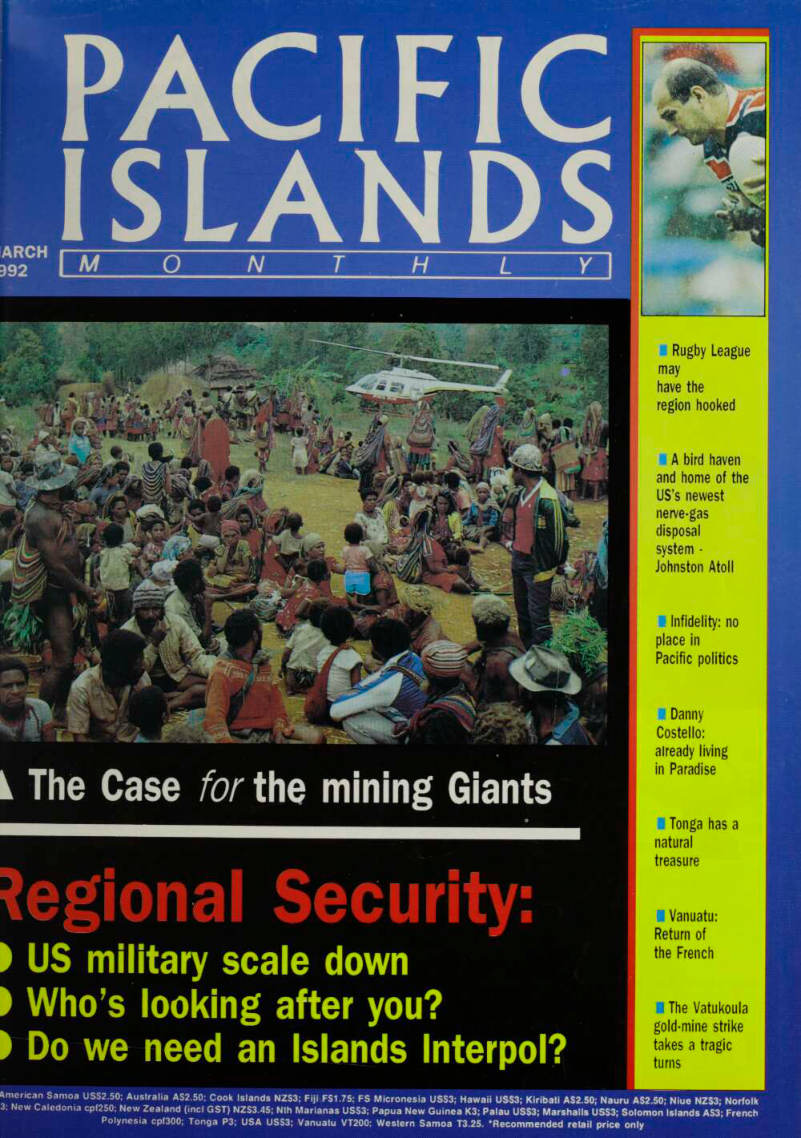
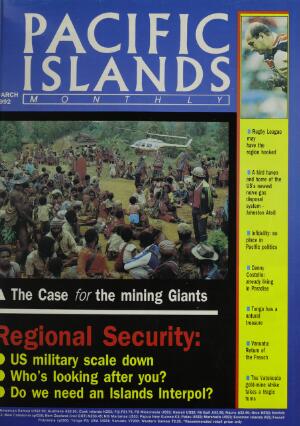
PACIFIC
ISLANDS
MONTHLY
ARCH
392
The Case for the mining Giants
dfsdfdf
I Rugby League may have the region hooked IA bird haven and home of the US’s newest nerve-gas disposal system ■ Johnston Atoll I Infidelity; no place in Pacific politics I Danny Costello: already living in Paradise I Tonga has a natural treasure ■ Vanuatu; Return of the French I The Vatukoula gold-mine strike takes a tragic turns
(American Samoa USS2.SO: Australia A 52.50: Cook Islands NZ$3; Fiji F 51.75; FS Micronesia USS 3; Hawaii USS 3; Kiribati A 52.50; Nauru A 52.50; Niue NZS3; Norfolk 3: New Caledonia cpf2so: New Zealand (incl GST) NZ53.45; Nth Marianas USS 3; Papua New Guinea K 3; Palau USS 3; Marshalls USS 3; Solomon Islands AS3; French Polynesia cpf3oo; Tonga P 3: USA USS 3; Vanuatu VT2OO: Western Samoa T 3.25. ‘Recommended retail price only
Cable & Wireless
Cable and Wireless began keep-
ing people in touch around the
world more than a century ago. Today,
while the technology has changed,
the tradition of service to our customers in the
South Pacific is just the same.
We work in partnership with Governments,
dedicated to meeting the need of communities and businesses to stay in touch. From one island to the next or to the other side of the world, the message is the same: Cable and Wireless is
your South Pacific connection bringing the
islands together.
CABLE & WIRELESS
THE WORLD TELEPHONE COMPANY
Asia Pacific Head Office Cable and Wireless pic Cable and Wireless (Pacific) Limited 22nd Floor Office Tower Convention Plaza 1 Harbour Road
Hong Kong
Tel: ■R. r )2) 848 8723 Facsimile: fBs2> 888 5200 Australia Cable and Wireless (Australia) Pty. Ltd: Level 66, M L. C. Centre 19 Martin Place Sydney
NSW 2000
Tel: (61-2) 2382252 Fiji In association with the Government of Fiji Fiji International Telecommunications Ltd.
RO. Box 59 Mercury House 158 Victoria Parade Suva Fiji Tel: (679) 312933 Solomon Islands In association with the Government of the Solomon Islands Solomon Telekom Company Limited P.O. Box 148 Honiara Solomon Islands Tel: (677) 21576 Tonga Cable and Wireless pic Private Mail Bag 4 General Post Office Nuku Alofa Tonga South Pacific Tel: (676) 23499 Vanuatu In association with the Government of Vanuatu and France Cables et Radio Vanuatu International Telecommunications Ltd.
P.O. Box 164 Port Vila Vanuatu
Tel: (678)22185
Pacific
Islands
Monthly
Vo I. 62 No. 3
The News Magazine
March 1992
Cover Stories:
Is there a case for an Islands Interpol? 6 What about a South Pacific peace keeping force?
Who’d want to foot the bill?
UN resolution to form a Security Force for Small States 7 PNG calls for a revamp of law enforcement agencies and its Defence Force 8 Australian policy on Bougainville: short-sighted or diplomatic? 9 A new book by the former head of the National Safety Council, who commit ted suicide after the first draft, reveals that a former NSC helicopter was used in Bougainville 10 Nuclear research making money? 11
Mining:
Mining millions, and what they cost CRA answers back 13 Sold prospects shine 15 D NG’s move into oil 17 3uide for mining guerillas 20 Violence at Vatukoula; the sheriff stoned to death 21
Fhe Region:
: rench Return to Vanuatu 34
Earhardt mystery unfolds 53 Johnston Atoll, a paradox 24 Infidelity: no place in Pacific politics 23
Music:
Danny Costello bad news for female fans 37 Aboriginal music bridges a special gap 39
Sport:
Tackling Rugby League 47 Willy ’0 turns down a million 48
Business:
In the can: guess who makes millions in the tuna business 41
Fijian Holdings, taking a big slice of the cake 42
Columnists:
Alfred Sasako, the Forum 49 Bill McCabe, Trade 55 Margot O’Neill, Washington 23 Julian Moti, Pacific Law 56 Jemima Garrett, Australia 45 Futa Helu, Tonga 33 David Barber, Wellington 32
Focus:
Tonga’s cultural ‘treasure’ 28 Letters 5 Shipping 50 Yachting 57
*ublisher; Gene Swinslead Assistant Editor; Beryl Cook ►enlor Writer: Martin Tiffany Correspondents; Al Prince, Angela 4cCarthy, David North, David Robie, liana McManus, Dykes Angiki, Frank ‘Olma, Franck Madoeuf, lan Williams, ene Nisbet, John Hunter, Karen langnall Lovenia Enan, Lito Vilisoni, lacel Manua, Nicholas Rothwelt, Pesi onua. Richard Dmnen. Ulafala Aiavao.
J ally Hiambohn Columnists: David Barber (Welling >n), Futa Helu (Tonga, covering the
Pacific Islands), Jemima Garrett (Syd ney). Margot O'Neill (Washington), Alfred Sasako (The Forum), Bill McCabe (South Pacific Trade Com mission), Julian Moti (Pacific Law) Business and Advertising Man ager: Charlotte Thomas Advertising Sales: • South Paciifc: Salendra Narayan, Tel (679) 304111, Fx (679) 303809 • Sydney, Melbourne: Fergus Mactagan, Tel (61-2) 4134689, Fx (61-2) 4123918 • Brisbane: Robert Walker, Tel (61-7)
3710533, Fx (61-7) 8798964 • Adelaide: Hastwell Williamsons Rep resentations, Tel (61-8) 799522, Fx (61-8) 799735 • Auckland: McKay International Me dia Reps Ltd, Tel (64-9) 4190561, Fx (64-9) 4192243 • Japan: Universal Media Corporation, Tokyo, Tel (3) 6663036, 6663094, Cable: UNIMEDIA Tokyo, Tx 2524665 Founded 1930 (USPS 952480). A Fiji Times Limited production.
Cover prices are recommended retail
only. Registered by Australia Post, Publication No. NBP 1210. © Copyright Fiji Times Limited, 177 Victoria Parade, Suva, Fiji. Tel (679) 304111, Fx (679)
303809, Tx Fj2124
Pacific Islands Monthly is published monthly by Fiji Times Limited, a division of Nationwide News, 2 Holt Street, Surry Hills, Sydney, NSW 2010.
S«nd address changes to: • Pacific Islands Monthly, PO Box 1167, Suva Fiji. Typeset and printed by Fiji Times Limited, 177 Victoria Parade, Suva, Fiji.
Regional security meeting: who's looking after us?
Advertisements & other items, pp. 4-5 (1 item)
Pacificalh
zn "I • A warm welcome is probably the rr important thing that any bank has offer. Being the biggest bank in Fiji part of the largest banking group in Pacific may give us the edge in provic the best facilities for you locally internationally, but never at the expe of our individual personal service. A all, that is why we are where we today. Here for you, ANZ Bank ' Your bank.
Fiji
Official Sponsor 1992 Olympic Team
OQP
m
V \ • * ■ i j m
as a free trip
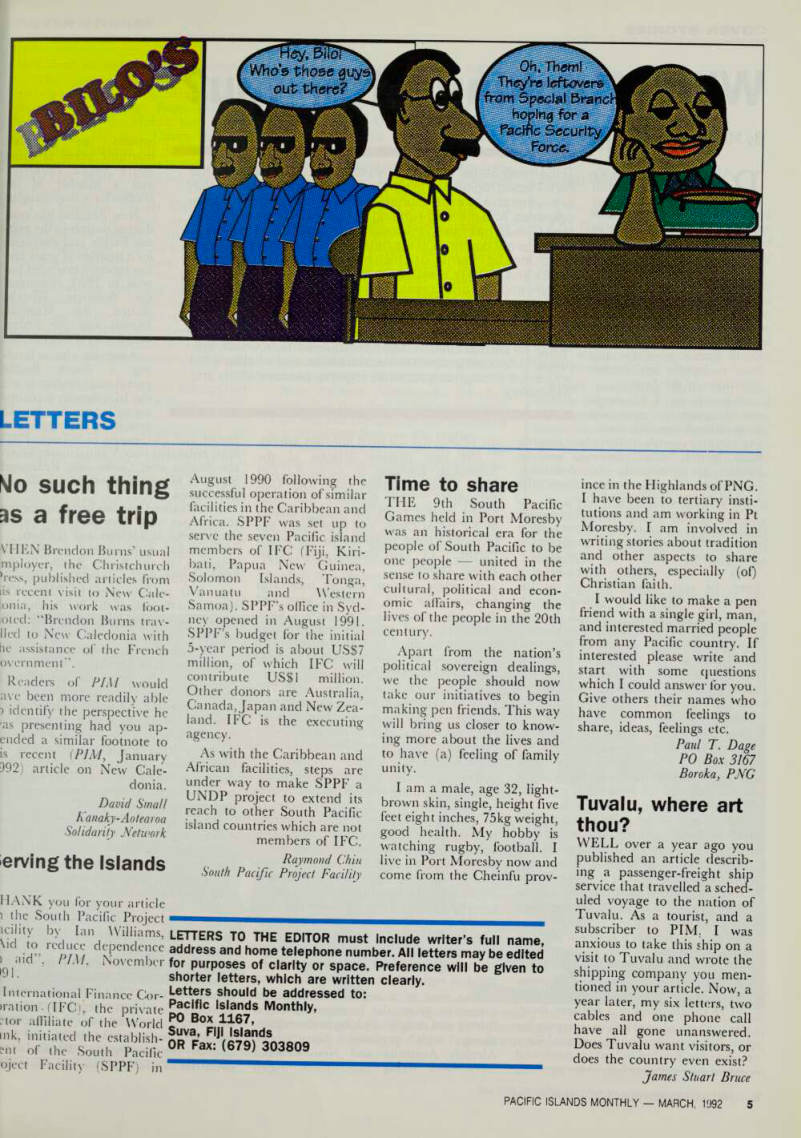
Letters
Mo such thing
VHEN Brendon Burns’ usual mployer, ihe Christchurch press, published articles from (is recent visit to New Calc lonia, his work was fbot oted: “Brendon Burns trav lled to New Caledonia with be assistance of the French bvernment”.
Readers of PIM would aye been more readily able > identify the perspective he r as presenting had you ap ended a similar footnote to
is recent (PIM, January
392) article on New Cale donia.
David Small Kanaky-Aotearoa Solidarity Network
erving the Islands
HANK you for your article i the South Pacific Project icility by lan Williams, to reduce dependence i aid’", PIM, November •91.
International Finance Cor tration - (IFC), the private :lor affiliate of the World ink, initiated the establish ment of the South Pacific oject Facility (SPPF) in'
August 1990 following the successful operation of similar facilities in the Caribbean and Africa. SPPF was set up to serve the seven Pacific island members of IFC (Fiji, Kiri bati, Papua New Guinea, Solomon Islands, Tonga, Vanuatu and Western Samoa). SPPF’s office in Syd ney opened in August 1991.
SPPF’s budget for the initial 5-year period is about USS 7 million, of which IFC will contribute USSI million.
Other donors are Australia, Canada, Japan and New Zea land. IFC is the executing agency.
As with the Caribbean and African facilities, steps are under way to make SPPF a UNDP project to extend its reach to other South Pacific island countries which are not members of IFC.
Raymond Chiu
South Pacific Project Facility
Time to share
THE 9th South Pacific Games held in Port Moresby was an historical era for the people of South Pacific to be one people united in the sense to share with each other cultural, political and econ omic affairs, changing the lives of the people in the 20th century.
Apart from the nation’s political sovereign dealings, we the people should now take our initiatives to begin making pen friends. This way will bring us closer to know ing more about the lives and to have (a) feeling of family unity.
I am a male, age 32, light brown skin, single, height five feet eight inches, 75kg weight, good health. My hobby is watching rugby, football. I live in Port Moresby now and come from the Cheinfu prov
ince in the Highlands of PNG.
I have been to tertiary insti tutions and am working in Pt Moresby. I am involved in writing stories about tradition and other aspects to share with others, especially (of) Christian faith.
I would like to make a pen friend with a single girl, man, and interested married people from any Pacific country. If interested please write and start with some cjuestions which I could answer for you.
Give others their names who have common feelings to share, ideas, feelings etc.
Paul T. Dage
PC) Box 3167 Boroka,
Tuvalu, where art
thou?
WELL over a year ago you published an article describ
ing a passenger-freight ship
service that travelled a sched uled voyage to the nation of Tuvalu. As a tourist, and a subscriber to PIM. I was anxious to take this ship on a visit to Tuvalu and wrote the shipping company you men tioned in your article. Now, a year later, my six letters, two cables and one phone call have all gone unanswered.
Does Tuvalu want visitors, or does the country even exist?
James Stuart Bruce
Lhi i ERS TO THE EDITOR must Include writer’s full name, address and home telephone number. All letters may be edited for purposes of clarity or space. Preference will be given to shorter letters, which are written clearly.
Letters should be addressed to: Pacific Islands Monthly, PO Box 1167, Suva, FIJI Islands OR Fax: (679) 303809
Who’s looking after you?
Cover Stories
By Martin Tiffany
THE United States’ scaling down of its military presence in the Asia-Pacific region has left the Islands to ponder whether they are vulnerable to expansionary moves or the conflicts of other countries. And the long-running Bougainville crisis in Papua New Guinea has raised the touchy subject of if and to what extent larger countries in the nation should interfere in crises which may be internal, or which may be a threat to regional peace and stability. Meetings in New Zealand and Fiji last month, and an earlier resolution in the United Nations at the end of last year, raised the question of whether we need a regional security or surveillance force, what form and role it would take, and how it would be funded. There has even been talk of an Islands Interpol. The basic questions, however, are just who is looking after the Island nations, and whether what we have is enough to guarantee regional peace, stability and well-being.
PAPUA New Guinea’s
deputy Opposition
Leader, Sir Julius Chan, first made reference to a regional security force in 1980 when, as PNG Prime Minister, he sent troops to the Vanuatu island of Espiritu Santo to help quell a secessionist attempt after independence.
At the lime, Sir Julius talked aboui “the need for a South Pacific peace-keeping force to handle any similar situations in the future’’.
“The force I envisage would contain personnel from all its democratic mem
her countries, w ith at least half coming from Island State members, and be funded predominantly by Australia, New Zealand and, maybe, even the United States," said Sir Julius.
"It would be a small but highly mobile body and, in times of peace, carry out a continuous programme of engineering projects and immediate disaster relief.”
Its use as a military peace-keeping force, he said, would be only at the
request of legitimate, democratically
elected governments “as was the case in Vanuatu”. He said the peace-keeping force would be a watchdog for small Island states “a potent deterrent to individuals seeking to overthrow the will of the majority". However, he pointed out that this was not a proposal for Australia to play “regional policemen”.
The idea could bear relevance to recent events. In January this year, PNG considered setting up its own anti terrorist squad to counter attacks like the one on January 23 which has crippled the Australian-owned Mount Kare al luvial gold mine. Police Minister Mathias Ijape wanted urgent cabinet approval to set up the crack unit of 300 specially trained policemen. Later that month, PNG announced it was going to establish a rapid response police unit to protect its mining industry (story page 8 But how realistic is a regional security or defence force? The New Zealand army chief of staff, Major General Bruce Meldrum, said his country is cautious about the political, financial, and admin istrative implications of a military force.
He said the idea of full-time armies for small Island nations and a regional force arc matters for individual nations and regional governments but, in his opinion,
the Islands did not need full-time armies.
The new defence attache at the Australian Embassy in Suva, Lt Col Mike Dennis, agrees with Maj Gen Meld rum. “This question has been raised several times previously, mainly by Sir Julius Chan, and it generally has received a cool reception in the South Pacific,” Lt Col Dennis told Pacific Islands Monthly.
A major reason for its lukewarm reception, he said, is people have had difficulty explaining how such a force would be used in what many people consider localised or internal problems.
Funding sources and the level of enthusi asm also are questionable.
The New Zealand Ambassador to Fiji, Don Mackay, said he was not aware of any firm stance his country has taken on the issue, and said if it was going to be pursued it would have to be at the very
highest level.
The issue also was expected to be discussed at the Forum Regional Secur ity Committee meeting from February 18 to 21 in Suva. Despite earlier rumours that the meeting could look at setting up an Islands Interpol, the meeting chair man, Nauru’s Leo Keke, told the media during the meeting that the Forum would not be setting up a regional security force and the idea was not even on the meeting agenda. They discussed
drug trafficking, a review of regional
arrangements for extradition and mutual assistance in criminal matters, and assess ment of regional training arrangements.
The idea of a regional force seems attractive given the increase in illegal fishing and drug trafficking in the region, along with regional disturbances.
Already Australia and New Zealand have been flying surveillance flights
around the exclusive maritime zones of some South Pacific countries, and a number of in truders have been caught.
New Zealand has con ducted patrols in the east ern Pacific and Polynesia for a number of years and has recently extended pa trols to PNG, Vanuatu, the Solomon Islands, Nauru, the Marshall Islands and the Feder ated States of Micronesia.
Australia also is fund ing a South Pacific
patrol-boat project to aid
the Islands with maritime surveillance. So far 15 vessels have been com
pleted and distributed as follows: PNG four; Solomons two; Vanuatu one; West ern Samoa one; Cooks one; Federated States of Micronesia two; Marshalls one and Tonga three.
New Zealand also has been supporting this project with navy personnel to the programme as advisers and trainers.
Australia’s total defence cooperation program, in the South Pacific in the 1991-92 period is worth As7s million. Of this, S4O million goes to PNG, 523 million to the rest of the Pacific and the remaining amount goes to the ASEAN
region.
Meanwhile, the discovery of S3o< million worth of hashish in Fiji recently' highlighted the need for an efficient;
regional drug-policing network.
Last month PNG closed all its airports* outside Port Moresby to direct interna tional flights in a bid to halt a thriving; trade in drugs and guns. According toe PNG Police Minister Ijape, Australiani crime syndicates are using PNG’s porous? borders to trade drugs from Australia! and marijuana from PNG.
PNG’s Comptroller of Customs, Pius?
Saun, said they did not have the! necessary capability to patrol thein borders and the exchange of informa tionr especially with Australia was a t vital part of their war against drugs.
Saun said a regional security forces might be hard to develop, and wouldt involve delicate questions such as na
tional sovereignty.
Saun is also the chairman of the Customs Heads of Administration Re gional Meeting (CHARM) which meets annually to discuss regional customs issues. He pointed to the growing regional concern about drugs, and par ticularly the growing use of Pacific Island: countries as transit points into Australia^
New Zealand and the United States.
“'Fhe problem will not disappear overnight. PNG is a staging point through which drugs from Thailand, Singapore and the Middle East come,”
Saun said. Me said Guam and the Northern Marianas are being increas ingly used as viable routes to the US drug market and again stressed the need for an exchange of information.
The Solomon Islands Customs De partment recently said the scattered nature of the country’s islands, man power shortages, and lack of modern equipment hindered them in battling narcotics. Many of the country’s islands are uninhabited, and some could be used by overseas drug syndicates for drug trafficking. However, they added that a regional police and customs network now enable national authorities to monitor, to a certain extent, the movement of illegal drugs.
A Pacific intelligence and information network would perhaps be more realistic than a regional defence force.
Asked about the feasibility of an information network, Lt Col Dennis said sharing ol intelligence information of a bilateral nature already occur in the South Pacific on drug trafficking, money laundering and the movement of fishing boats.
He said an organisation especially for intelligence was probably not necessary because there probably w'ere already enough existing avenues and bilateral
arrangements developing.
“ 1 he umbrella is basically provided
through the Forum with its regional security committee, where this type of information-sharing rather than intelli gence on those various subjects is dis cussed,” said Lt Col Dennis.
Meanwhile, the United States has again assured Pacific nations that it will maintain the appropriate military pres ence in the region to protect its allies and counter any threats to peace.
He echoes what US assistant state secretary, Richard Solomon, told the 22nd South Pacific Forum last year.
Solomon told leaders of 15 Pacific nations that it would remain a power in the region, warning that a unilateral withdrawal of American forces would be destabilising. He said that, despite the thawing of the Cold War in Asia, the US would remain a Pacific power, although the emerging political environment would affect the size and shape of the US security presence in the region.
New Zealand Ambassador Mackay said the fact that the US had no intention of pulling out completely was welcomed as a stabilising force in the region.
“ I here have been concerns that the scaling down will create greater scope for some disputes to develop further not disputes within the South Pacific, but if you look up north of the South Pacific, if you look up to the Asian region, there arc areas of potential disputes,” said Mackay. “It is important for Pacific Island, countries to be aware of develop ment in this region and to keep an eye on the potential implications for the South Pacific Region.” □
UN Security
Force for small states
By lan Williams
A RESOLUTION to form a United Nations Security Force for small states was passed unanimously by the General Assembly in December last year.
The resolution, jointly sponsored by the Maldives and the Solomons and supported by 64 other states, calls on the Secretary General to continue monitoring the security situation of small states while exploring further ways to ensure their safety.
Small developing states are con stantly exhorted by the international aid agencies not to dissipate their resources on military hardware or manpower. Most are very happy not to do so. However, the invasion of Kuwait reminded the world of the vulnerability of small states to aggressive neighbours.
It is not just larger countries which pose a threat. Many groups ranging from guerillas to drug smugglers would like to wrap themselves in the legal protection of a sovereign state, no matter how minute.
The fission of seemingly stable na tions in Europe indicates that soon
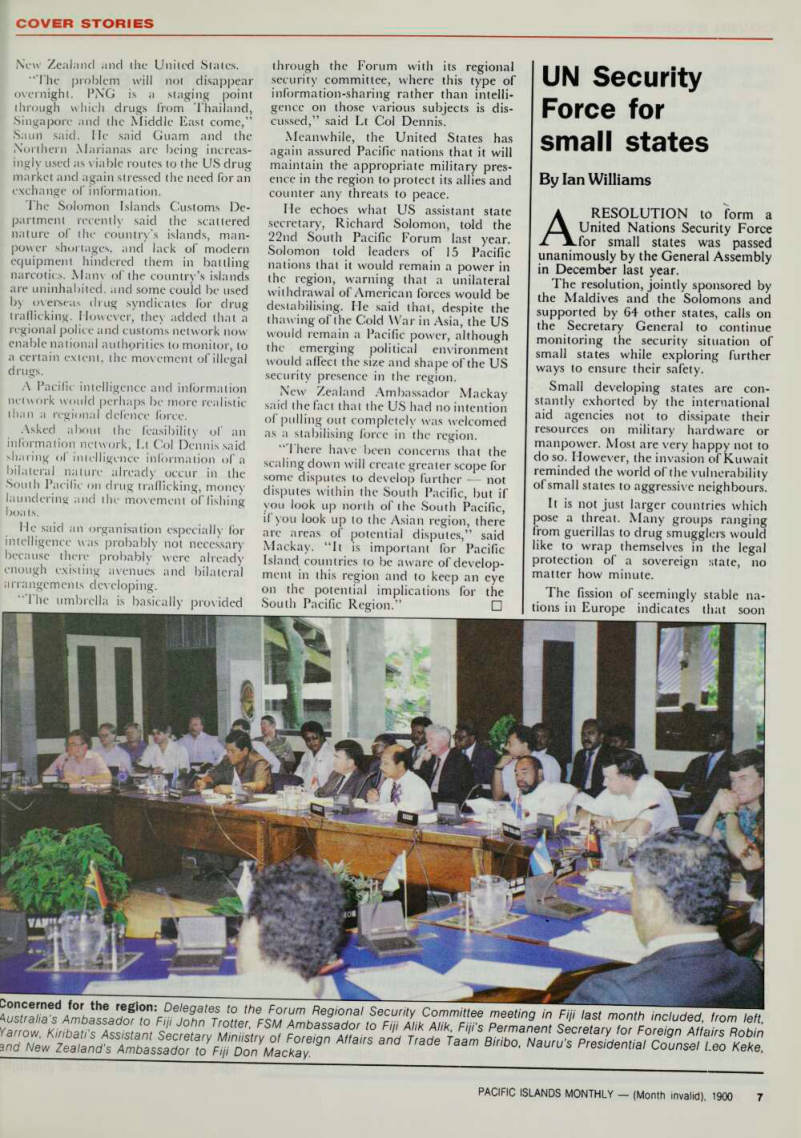
Concerned for the reglon: Delegates to the Forum Regional Seucurity Committee meeting in Fiji last month included. from left, Australia's Ambassador to Fiji John trotter, FSM Ambassador to Fiji Alik Alik, Fiji's Pernanent Secretary for Foreign Affairs Robin Yarrow, Kiribatis Assistan Secretary Miniistry of Foregin Affairs and Trade Taam Biribo, Nauru's Presidential Counsel Leo Keke, and New Zealand's ambassador to Fiji Don Mackay.
there will be a lot more small stales about.
In addition, for many Island states their biggest asset is their territorial waters. But that asset also implies isolation - and susceptibility to attack.
None of them have the type of force necessary to deter intrusion by foreign fishing fleets into the exclusive econ omic zones on which they depend for their livelihoods. Even dumping of toxic or radioactive w'aste is difficult to police.
After consultations with the Security Council, the Secretary General saw “significant areas of agreement”. “Be cause of their intrinsic characteristics, small states may need a special measure of attention and support. Member states clearly acknowledged that the international community had a vested interest in safeguarding the security of small states, since the international order could be undermined by their instability or loss of security”. That appeal to self interest may well be crucial in getting practical application of the proposals.
As Fiji said in its reply to the SG, "Political expediency appears to have played a major pivotal role in determining the type of action which has been taken. Small island states face particular vulnerabilities under these circumstances, where their isolation favours an aggressor, w ho can rely on a fair amount of time to consolidate his gains before he is required to go on the defensive”.
In the Special Political Committee, the draft resolution moved by the Solomons and the Maldives won com plete support.
The International Convention on Combating the Recruitment, Use, Financing and Training of Mercenaries has now been launched but needs many more stales to ratify it.
In fact (he resolution indicates the power which the small states have gained from the principle of one-stale one-vote in International Affairs. □
Special security force for mines
A GOVERNMENT rapid deployment police unit to protect the nation’s mines, gas and oil fields, was mooted by acting PNG Prime Minister Jack Genia last month.
“The sole task of the force unit will be around-the-clock security for the mines
and oil and gas projects,” he said.
The 150-man unit will be stationed in Goroka in the eastern Highlands and will be strengthened to 300 by May.
The unit would supplement the reg ular force’s special services division, which was busy with disturbances such as
Bougainville tribal fights. □
PNG emphasis on internal security
By Wally Hlambohn and Beryl Cook
A RECENT comprehensive re view of Papua New Guinea’s security needs found its biggest threat to be coming from law lessness within, and uprising such as that on Bougainville.
It was then decided that the country’s law enforcement agencies and the PNG Defence Force should be revamped and improved to give greater emphasis on internal security.
The findings, along with a detailed set of funding proposals, were presented to the Australian delegation to the annual joint ministerial forum in Madang last month to discuss Aid, Investment Law and Order, Security, and Bougainville.
The delegation included Australia’s De fence Minister Senator Robert Ray and Australia’s Foreign Affairs Minister Senator Gareth Evans.
The Australians were briefed on major resource developments in the country — a major share of it by Australians — and reassured Australian investments were sound, and future prospects were bright.
But while commending these companies’ contribution to PNG’s development, Namaliu urged them to diversify from mining into agriculture, and manufac turing and import replacement sectors.
In a veiled warning, he said, Asian investors were waiting in the wings to come into these areas.
“I hope that, in the immediate future, the remarkable and welcome level of Australian investment in mining and energy resource development in PNG will be followed by agricultural diversi fication, and import replacement,” he said.
The emphasis of key considerations in findings presented to the Australians were, in Namaliu’s own words, “to cut crime, and provide a more peaceful and secure environment for our people, our guests and investors”.
Evans was quite frank about his concern for Australian investors’ security when he said the “recent, well-organised attack on Mount Rare mine gives added
urgency to the need for the PNG government to act on law and order”.
Regarding Australia’s role and re sponse, he said during a press conference in Fiji on February 4 that Australia’s policy was one of ‘‘constructive commit ment” to the region as a whole, ap proaching it as an equal partner rather than as a dominant influence.
Evans and Bruce Grant in Australia’s Foreign Relations: in the World of the 1990 s
(Melbourne University Press, 1991)
point to the importance of both regional stability, and the security which hinges on economic and social development.
Asked at the press conference whether the two notions together suggested a case for more direct intervention by bigger countries like Australia in crises like Bougainville, Evans told PIM there could be a case for more concern with development co-operation programems and other forms of assistance that would “minimise the economic and social discontent of particular minority groups or regions within countries”. But he ruled out the possibility of more direct inter vention in the form of political or military response in Bougainville.
Queried on the use of Australian helicopters by the PNG Army he said this had been to assist with transport, move ment of troops and supplies in “a very complex logistical operation for the PNG Army in dealing with the situation they were confronted (with) in Bougainville”.
They also had been given, not just for Bougainville but for the general use of the PNG Army responding to disasters or other situations that might arise pro vided they were not used as gunships
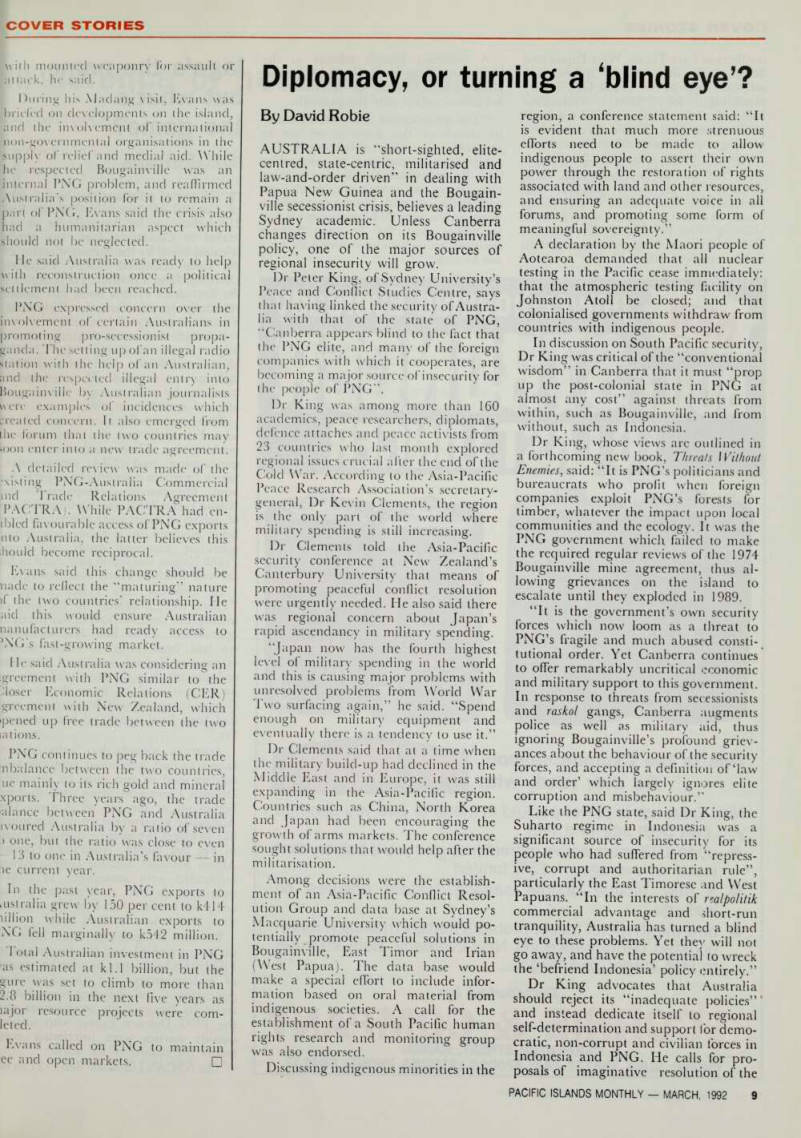
Revamp needed: a review focused on PNG police and defence forces
with mounted weaponry for assault or at lack, he said.
During his Madang v isit, Evans was briefed on developments on the island, and the involvement of international non-governmental organisations in die supply of relief and medial aid. While he respected Bougainville was an internal PNG problem, and reaffirmed Australia’s position for it to remain a part of PNG, Evans said the crisis also had a humanitarian aspect which should not be neglected.
He said Australia was ready to help with reconstruction once a political settlement had been reached.
PNG expressed concern over the involvement of certain Australians in promoting pro-secessionist propa ganda. The setting up of an illegal radio station w ith the help of an Australian, and the respected illegal entry into Bougainville by Australian journalists were examples of incidences which breated concern. It also emerged from the Ibrum that the two countries may toon enter into a new trade agreement.
A detailed review was made of the existing PNG-Auslralia Commercial ind Trade Relations Agreement PACTRA). While PACTRA had en titled favourable access of PNG exports nlo Australia, the latter believes this hould become reciprocal.
Evans said this change should be nadc to reflect the “maturing” nature >f the two countries’ relationship. He aid this would ensure Australian nanufaclurers had ready access to
) NG’s fast-growing market.
He said Australia was considering an igrecmcnl with PNG similar to the ■loser Economic Relations (CER) greement with New Zealand, which •pened up free trade between the two lations.
PNG continues to peg back the trade nbalance between the two countries, uc mainly to its rich gold and mineral xports. Three years ago, the trade alance between PNG and Australia iv cured Australia by a ratio of seven ) one, but the ratio was close to even 13 to one in Australia’s favour in le current year.
In the past year, PNG exports to Australia grew by 150 per cent to k 414 ii 11 ion while Australian exports to NO fell marginally to k 542 million. 4 otal Australian investment in PNG as estimated at kl.l billion, but the gure was set to climb to more than 2.8 billion in the next five years as tajor resource projects were com leled.
Evans called on PNG to maintain ee and open markets. □
Diplomacy, or turning a 'blind eye’?

By David Robie
AUSTRALIA is “short-sighted, elite centred, state-centric, militarised and law-and-order driven” in dealing with Papua New Guinea and the Bougain ville secessionist crisis, believes a leading Sydney academic. Unless Canberra changes direction on its Bougainville policy, one of the major sources of regional insecurity will grow.
Dr Peter King, of Sydney University’s Peace and Conflict Studies Centre, says that having linked the security of Austra lia with that of the state of PNG, “Canberra appears blind to the fact that the PNG elite, and many of the foreign companies with which it cooperates, are becoming a ma jor source of insecurity for the people of PNG”.
Dr King was among more than 160 academics, peace researchers, diplomats, defence attaches and peace activists from 23 countries who last month explored regional issues crucial after the end of the Cold War. According to the Asia-Pacific Peace Research Association’s secretary general, Dr Kevin Clements, the region is the only part of the world where military spending is still increasing.
Dr Clements told the Asia-Pacific security conference at New Zealand’s Canterbury University that means of promoting peaceful conflict resolution were urgently needed. He also said there was regional concern about Japan’s
rapid ascendancy in military spending.
“Japan now has the fourth highest level of military spending in the world and this is causing major problems with unresolved problems from World War Two surfacing again,” he said. “Spend enough on military equipment and eventually there is a tendency to use it.”
Dr Clements said that at a time when the military build-up had declined in the Middle East and in Europe, it was still expanding in the Asia-Pacific region.
Countries such as China, North Korea and Japan had been encouraging the growth of arms markets. The conference sought solutions that would help after the militarisation.
Among decisions were the establish ment of an Asia-Pacific Conflict Resol ution Group and data base at Sydney’s Macquarie University which would po tentially promote peaceful solutions in Bougainville, East Timor and Irian (West Papua). The data base would make a special effort to include infor mation based on oral material from indigenous societies. A call for the establishment of a South Pacific human rights research and monitoring group was also endorsed.
Discussing indigenous minorities in the
region, a conference statement said: “It is evident that much more strenuous efforts need to be made to allow indigenous people to assert their own power through the restoration of rights associated with land and other resources, and ensuring an adequate voice in all forums, and promoting some form of
meaningful sovereignty.”
A declaration by the Maori people of Aotearoa demanded that all nuclear testing in the Pacific cease immediately: that the atmospheric testing facility on Johnston Atoll be closed; and that colonialised governments withdraw from countries with indigenous people.
In discussion on South Pacific security, Dr King was critical of the “conventional wisdom” in Canberra that it must “prop up the post-colonial state in PNG at almost any cost” against threats from within, such as Bougainville, and from without, such as Indonesia.
Dr King, whose views arc outlined in a forthcoming new book, Threats Without Enemies , said: “It is PNG’s politicians and bureaucrats who profit when foreign companies exploit PNG’s forests for timber, whatever the impact upon local communities and the ecology. It was the PNG government which failed to make the required regular reviews of the 1974 Bougainville mine agreement, thus al lowing grievances on the island to escalate until they exploded in 1989.
“It is the government’s own security forces which now loom as a threat to PNG’s fragile and much abused consti tutional order. Yet Canberra continues to offer remarkably uncritical economic and military support to this government.
In response to threats from secessionists and raskol gangs, Canberra augments police as well as military aid, thus ignoring Bougainville’s profound griev ances about the behaviour of the security forces, and accepting a definition of‘law and order’ which largely ignores elite corruption and misbehaviour.”
Like the PNG state, said Dr King, the Suharto regime in Indonesia was a significant source of insecurity for its people who had suffered from “repress ive, corrupt and authoritarian rule”, particularly the East Timorese and West Papuans. “In the interests of realpolitik commercial advantage and short-run tranquility, Australia has turned a blind eye to these problems. Yet they will not go away, and have the potential to wreck the ‘befriend Indonesia’ policy entirely.”
Dr King advocates that Australia
should reject its “inadequate policies” 4
and instead dedicate itself to regional self-determination and support for demo cratic, non-corrupt and civilian forces in Indonesia and PNG. He calls for pro posals of imaginative resolution of the
conflicts in East Timor, West Papua and Bougainville such as a “quasi-state” solution; suspend the Timor Gap Treaty providing for joint Australian- Indonesian development of oil resources pending an East Timor solution; and phasing out military aid to Indonesia.
He also believes long-term develop ment aid should be conditional on a clean-up of high-level political and bureaucratic corruption. “As things stand, Australian police are in effect assisting over-privileged, irresponsible and corrupt black mastas to repress their less fortunate brethren.”
A Solomon Islands scholar at the University of the South Pacific, Tarcisius Kabutaulaka, called for a rethink of Solomons policy over Bougainville.
“The government must draw clearly its stand on the issue so as not to jeopardise the safety of its people. The nation cannot continue to sympathise with Bougainvilleans while at the same time attempting to maintain its relations with PNG,” he said. But the two policies were conflicting. “The government has to realise that the Solomon Islands political, economic and strategic interests are at stake.” □
the game?
lago’s the name, but what’s the game?
By Evelyn Hogan
THE use of a former National Safety Council of Australia (NSCA) Bell 212 helicopter in Bougainville is re vealed in Codename logo, the newly released book by the former director of the since collapsed NSCA Victorian Division, John Friedrich. He completed the first draft of this book just before suiciding on his farm in Gippsland, Victoria, on July 26 last year.
Friedrich fled across Australia after a huge scam involving the NSCA Victorian Division with debts of $260 million was exposed. The nationwide
manhunt by police caught the imagin
ation of Australia in 1989.
There were wild speculations about who Friedrich was and who he was working for. There were rumours of gunrunning and CIA involvement, which Friedrich does little to dispel in his book. His case was compared to the Nugan Hand Bank case in which millions of dollars of debts were alleged to have been incurred in a money-laundering operation involving drugs and guns.
Frank Nugan was found shot dead in his car and Michael Hand shot through.
In Codename lago Friedrich states: “There was. . . interest on the part of intelligence organisations in our overseas operations ... The Bell 212 helicopter we had been using to work on the volcano at Rabaul was found after our collapse, much to the surprise of some, to have been used to ferry Papua New Guinea troops around Bougainville, and had been fired upon and had returned fire.”
Australia already has been embar rassed to find Australian Iroquois heli copters used as gun ships by the PNG Defence Force and being used to drop bodies off in the sea off Arawa. The Australian government would very much like to forget the issue during his visit to Fiji last month, Australia’s Foreign Affairs Minister Senator Gareth Evans responded with annoyance to PlM’s questions on that incident by saying adequate answers had been given at the time, and it was “a dead issue”.
But the Bougainville issue itself re mains unresolved, and the revelations in Friedrich’s books may be a further source of embarrassment for the Australian government, and ill-feeling toward Aus tralia by Bougainville secessionists and the PNG Defence Force, who suspect outside parties were interfering even before the closure of the mine.
The NSCA’s US-made Bell 212 can be
seel as a military or civil-utility hclicop r. It can be fitted with rescue hoist and mergence dotation gear and converted )r use as a gun ship.
Even though the NSCA Victorian was in receivership in July 1989, loyd Helicopter, an Australian firm, ad acquired the former NSCA 'ictorian Division helicopter and was sing it in charter work lor the Papua iew Guinea Army, Friedrich stated.
Uith the Declaration of the State of mergence on June 22, security forces 'signed to Bougainville were increased ► 2000. There was an urgent need for 'licoptcrs and the Australian govern ent was pressured to deliver the four omised Iroquios. These were delivered i July 12, 1989.
Papua New Guinea defence sources mfirmed that both a Bell 212 and a korsk) helicopter were contracted from e end of April 1989 through May 1989 lei i y troops from Rabaul to Bougain- He. I his was before the Stale of ■nergencN was declared and before July ►B9, when Friedrich claims Lloyd clicopter acquired the Bell 212.
Defence Force sources add there was
no government-sponsored programme to use helicopters to evacuate civilians since Air Niugini maintained operations to Bougainville throughout 1989.
PNG Defence Force officers are puzzled about the role ofjohn Friedrich and the Bell 212 in Rabaul. According to one officer: “The government gets very uneasy about these kinds of develop
ments. Things happen mysteriously and
we never find out the full story.”
In the Appendix to Friedrich’s book, his solicitor Zig Zaler says Friedrich claimed he was “a CIA operative and the NSCA was a sleepy vehicle which he turned into an organisation available for counter-espionage activities”. Friedrich claims to have taken the identity of a German, Johann Friedrich Holcnberger, after Holenberger died in a skiing accident. He explained that it was “part of normal CIA practice, whereby in order to become useful to the CIA as an operative one would adopt a false
identity”.
Freidrich names other characters in volved in the NSCA Victorian Division and wonders who they are. Of one member of the Board of the NSCA, Mr
Maxwell Else, he says:“l know he had close links with the Australian govern ment, particularly the Attorney Gen eral’s (the department to which ASIO is attached) and the Defence Department”.
Friedrich claimed that the Senate inquiry into the collapse of the NSCA Victorian Division revealed that a lot of prominently placed and powerful people were not about to begin talking about their association with NSCA Victorian Division.
Michael o‘Connor of the Australian Defence Association cautions against taking the use of the Bell 212 in Bougainville too seriously. He said that it just happened to be in Rabaul at the time when the PNG Defence Force needed to transport troops.
Friedrich was arrested in 1990. With his alleged suicide, the case was closed.
Questions about who he was and who he was working for remain unanswered.
The taxpayers of Victoria are left with a huge debt and Pacific Islanders might wonder: were Friedrich’s activities part of his own magnificent obsession, or was he one player following instructions in larger covert operations? □.
Advertisements & other items, p. 10 (1 item)
Built M
power-boosted Eveready
TO LAST LONGER
IEREADI WEREADV
I general
1 PURPOSE
GENERAL
PURPOSE
SUPER HEAVY DUTY SUPER HEAVY DUTY
This is the Cyclone season.
Be ever ready with Now Eveready is power-packed in metal to give you benefits you can both see and feel. • up to 13% more active ingredients give you a battery that lasts an average of 13% longer! • a new unique double sealing system ensures no leakage. • new tough metal jacket protects battery making it moreboosted performance get New Eveready. Built stronger to last longer and longer...
Distributed by.
CORRIE & COMPANY
CARPENTER STREET, RAIWAI
PHONE: SUVA 386777 FAX: 370010 LAUTOKA PHONE: 660137
In defence of nuclear testing
By David Robie
FRANCE'S envoy in New Zea land warned at last month's Asia-Pacific security conference that any major reduction in military or nuclear-research activities in French Polynesia would provoke a severe financial crisis for the territory but he was strongly challenged by indigenous Pacific participants.^ Defending the French nuclear deter rent as still vital lor global security in spite of the end of the Cold War, Ambassador Gabriel de Bellescize also said the French-ruled Pacific territories '\‘ere becoming more involved in the South Pacific region, including security.
“Our military forces arc . . increas ingly involved in activities related to the hell-being of the people of the South Pacific region,” said de Bellescize. 'This means that f rench and European pres ence in the Pacific is already contributing [o the security and the well-being of the legion. In (lie future, (his European Contribution will increase and will re gain a stable lealtire of the Asia-Pacific
lecurily situation."
He added that British and French niclear deterrents were adding to the lobal deterrence of the Atlantic Al iance.
“Such has been the mainstay of our lefcnce policy since 1 9GG. The continuity
in our position has been remarkable. In recent years, there has been practically no debate in I*ranee about our defence policy because the consensus about it is so strong and encompassing all forces of the political spectrum. There has been from time to time criticism of certain aspects of our defence policy. I think it is fair to say that this criticism has not been understood in France because we have this absolute conviction that ... we have been lighting to maintain peace in the world.”
His statement provoked an angry response from several indigenous partici pants and peace researchers at the conference who challenged his views, labelling France’s deterrent policy as a colonial anachronism.
Pauline Tangiora, a respected kuia (elder) ol Te Whanau Rongomaiwahine and president of the Women’s Interna tional League for Peace and Freedom Aotearoa, declared that she spoke for many of the Pacific people not just Maori. Pointing out that the ambassador had said that he had known what it was like to be invaded, she replied: “Why do you remain in the indigenous lands of the Pacific? Why do you invade our land and suppress our people?”
She rejected the envoy s claim that nuclear testing was safe in the Pacific.
“Nuclear tests arc a crime against the people of the Pacific. When "I sec my cousins Irom Tahiti coming to New
Zealand for treatment for cancer, when I see them going to France for treatment, then I see your country’s military mind doesn’t care for the soul of our people . . . my family, my people. You are trespassing on our land.”
Tangiora was also scathing about French aid in the region. “What is a billion dollars? One dollar doesn’t allow France the right to colonise the people of Polynesia.”
A Solomon Islands participant, Tarcisius Kabutaulaka, condemned French policy in New Caledonia and asked about Moruroa Atoll: “What are you hiding? If you believe it is safe to test in the Pacific then why aren’t you testing nuclear weapons in France?”
Stephanie Mills, Greenpeace’s anti
nuclear campaigner, told the conference France could be “dragged kicking and screaming” into the post-deterrence era, or it could take a leadership role in shaping a new international security vision, “Before Moruroa becomes the Eur opean test site, before Europe accepts the anachronistic concept of nuclear deter rence as the basis for its future* security framework, it is vital that we... the public, the non-government organis ations, those involved in the elite debate challenge the assumptions that have underlaid security arrangements in Eur ope since world War Two.” Mills said.
“• • : key global security problems, including the environmental crisis facing us, cannot be solved by nuclear weapons.
A moratorium would drive an initial nail into the coffin of nuclear testing. □”
Advertisements & other items, pp. 11-12 (2 items)
Cover Stories
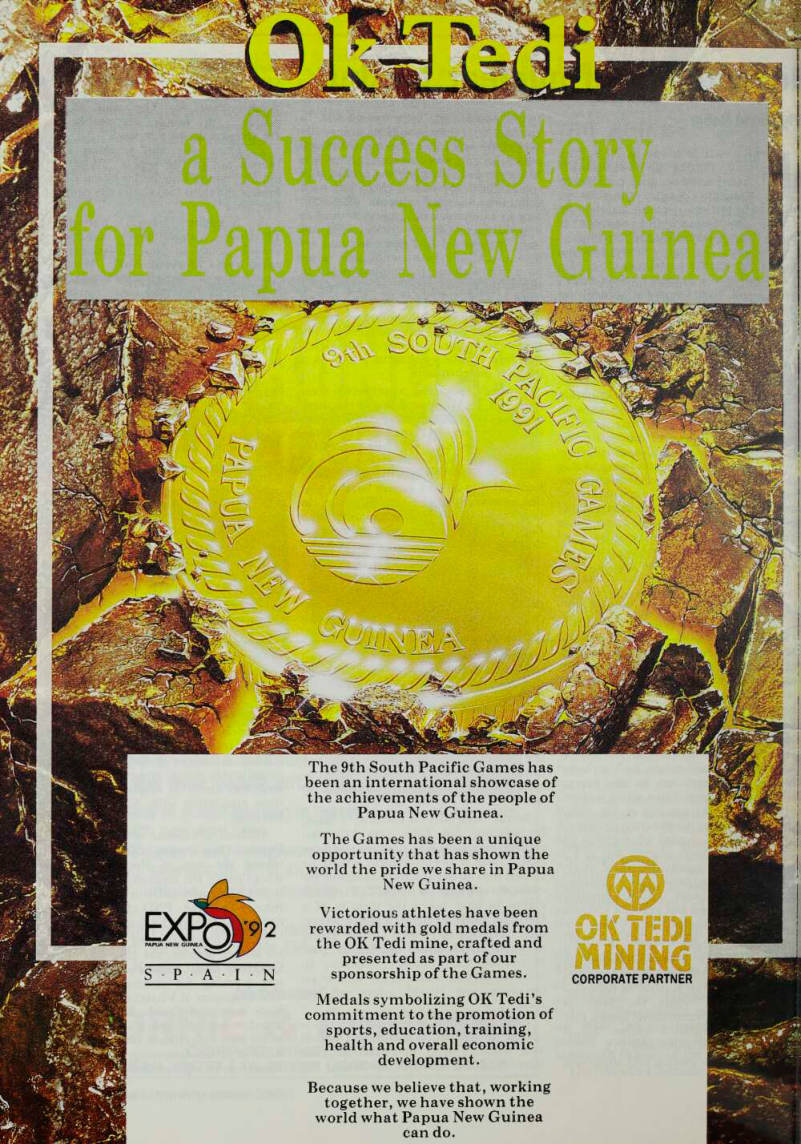
The 9th South Pacific Games has
been an international showcase of the achievements of the people of Papua New Guinea.
The Games has been a unique opportunity that has shown the world the pride we share in Papua New Guinea.
Victorious athletes have been rewarded with gold medals from the OK Tedi mine, crafted and presented as part of our sponsorship of the Games.
Medals symbolizing OK Tedi’s commitment to the promotion of sports, education, training, health and overall economic development.
Because we believe that, working together, we have shown the world what Papua New Guinea can do.
CORPORATE PARTNER
Mining millions:
Mining
Mining millions: how much are they worth?
HOW much can you give for something worth millions or possibly billions in return?
This question is being asked increasingly, particularly in Papua New Guinea. Landowners there claim CRA gave little for too many dividends. CRA says the deal got soured by dissidents and intruders to the agreement, and Doints to its contributions to the economy (story this page) The dispute has forced closure of two arge copper and gold mines at 3 anguna on Bougainville island in May, 1989, then at Mount Kare in the Highlands last January 9. The argument las reopened many tribal rivalries, )rought suffering and death to lundreds, and spurred investors to have lecono thoughts about how much they ire prepared to pay in security, royalties, hares and infrastructure.
Employees, like those at Vatukoula |old-mine in Fiji who saw a bailiff stoned o death in a confrontation last month page 21 ), must also be wondering iow high a price they will pay for a •igger share of the action.
Where the money goes
By Davendra Sharma
HOW are wealth from CRA’s mines distributed? Bougainville yields a good illustration.
CRA reckons PNG received a fair return for the sale of important natural resources, through which mining has been a major engine driving the export-driven economy. Some landowner groups question how the PNG government’s share of the income was divided between those immediately affected by the operation and the rest.
Mining analysts in Australia say it wasn’t so much the hatred against CRA, but largely government’s unwillingness to adequately redistribute earnings from the mine to Bougainvilleans that lengthened the crisis" into a secession movement. u i .• . a Dow much did CRA give for two decades of copper and gold mining on
Bougainville?
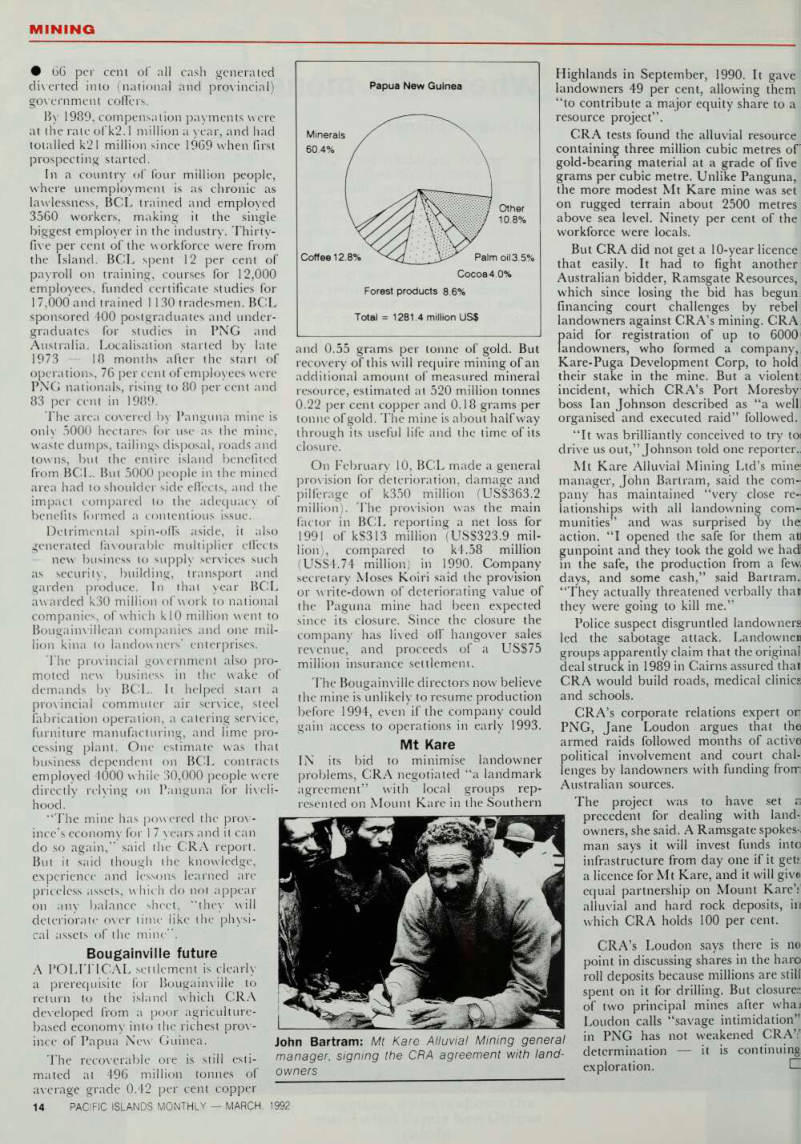
, n ... CRA s Bougainville accounts offer one theory; landowners got a meagre 1.4 per cent or k 24,2 million of the cash generated from Panguna operations between 1972-89. The national government took 61.5 per cent (k 1078.4 million), North Solomons provincial goveminent 4.3 per cent (k 75.2 million), CRA 22 per cent (k 387 million) and
other public shareholders 10.8 per cent (k 190 million).
CRA owns 53.6 per cent of Bougain ville Copper Ltd, while government has 19.1 per cent. Until its cessation of operations, the mine produced 3.1 mil lion tonnes of copper, 306 tonnes of gold, and 783 tonnes of silver. The production had a value of k 5.1 billion, representing 44 per cent of PNG’s exports over that period. During this time contributions to the government in the form of dividends, taxes and royalties amounted to k 1078 million, which represented 17 per cent of locally-generated revenue for the govern ment. Since the crisis on Bougainville grew in late 1988 with attacks by militants on BCL’s property, much has been raised about the company’s hand ling of sensif've issues like environment and demands of klO billion compen sation from landowners.
CRA argues its case differently. As a pioneer Australian mining company to enter PNG before Independence, it set new standards of conduct for mining in
an underdeveloped country issuing
large amounts of shares to the govern ment. BCL was a model and yielded: • 1 7 per cent of PNG’s locally generated revenue, • 45 per cent of export earnings; 12 per cent of gross domestic product with
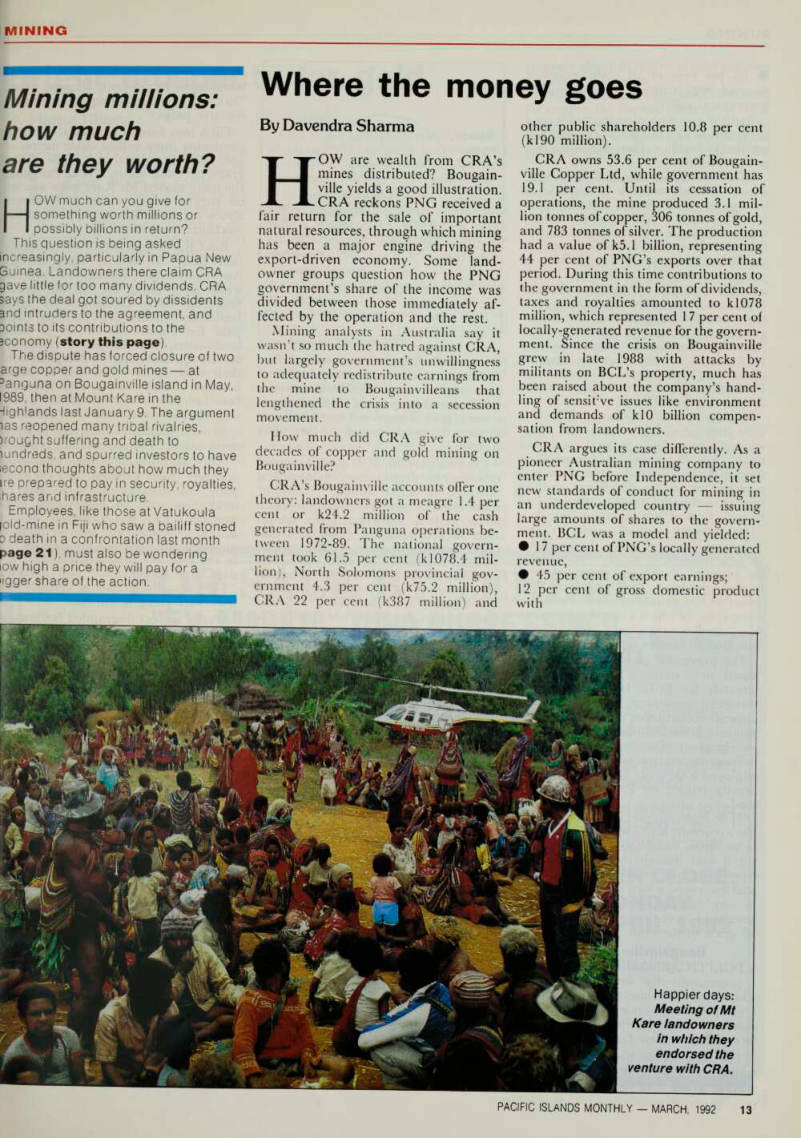
Happier days: Meeting of Mt Kare landowners in which they endorsed the venture with CRA.
• 66 per cent of all cash generated diverted into (national and provincial) government coffers.
By 1989, compensation payments w ere at the rale of k 2.1 million a year, and had totalled k2l million since 1969 when first prospecting started.
In a country of four million people, where unemployment is as chronic as lawlessness, BCL trained and employed 3560 workers, making it the single biggest employer in the industry. Thirty five per cent of the w orkforce were from the Island. BCL spent 12 per cent of payroll on training, courses for 12,000 employees, funded certificate studies for 17,000 and trained 1130 tradesmen. BCL sponsored 400 postgraduates and under graduates for studies in PNG and Australia. Localisation started by late 1973 18 months after the start of operations, 76 per cent of employees were PNG nationals, rising to 80 per cent and 83 per cent in 1989.
The area covered by Panguna mine is only 5000 hectares for use as the mine, waste dumps, tailings disposal, roads and towns, but the entire island benefited from BCL. But 5000 people in the mined area had to shoulder side effects, and the
impact compared to the adequacy of
benefits formed a contentious issue.
Detrimental spin-offs aside, it also generated favourable multiplier effects new business to supply services such as security, building, transport and garden produce. In that year BCL aw arded k3O million of w ork to national companies, of wdiich klO million went to Bougainvillean companies and one mil lion kina to landowners’ enterprises.
The provincial government also pro moted new business in the wake of demands by BCL. It helped start a provincial commuter air service, steel fabrication operation, a catering service, furniture manufacturing, and lime pro cessing plant. One estimate was that business dependent on BCL contracts employed 4000 while 30,000 people were directly relying on Panguna for liveli hood.
“The mine has pow ered the prov ince’s economy for 1 7 years and it can do so again,” said the CRA report.
But it said though the knowledge, experience and lessons learned arc priceless assets, which do not appear on any balance sheet, “they will deteriorate over lime like the physi cal assets of the mine”.
Bougainville future A POLITICAL settlement is clearly a prerequisite for Bougainville to return to the island which CRA developed from a poor agriculture based economy into the richest prov ince of Papua New Guinea.
The recoverable ore is still esti mated at 496 million tonnes of average grade 0.42 per cent copper
and 0.55 grams per tonne of gold. But recovery of this will require mining of an additional amount of measured mineral resource, estimated at 520 million tonnes 0.22 per cent copper and 0.18 grams per tonne of gold. The mine is about halfway through its useful life and the time of its closure.
On February 10, BCL made a general provision for deterioration, damage and pilferage of k 350 million (U 55363.2 million). The provision was the main factor in BCL reporting a net loss for 1991 of kS3I3 million (U 55323.9 mil lion), compared to k 1.58 million (U 554.74 million) in 1990. Company secretary Moses Roiri said the provision or write-down of deteriorating value of the Paguna mine had been expected since its closure. Since the closure the company has lived off hangover sales revenue, and proceeds of a US$75 million insurance settlement.
The Bougainville directors now believe the mine is unlikely to resume production before 1994, even if the company could gain access to operations in early 1993.
Mt Kare IN its bid to minimise landowner problems, CRA negotiated “a landmark agreement” with local groups rep resented on Mount Kare in the Southern
Highlands in September, 1990. It gave landowners 49 per cent, allowing them “to contribute a major equity share to a resource project”.
CRA tests found the alluvial resource containing three million cubic metres oT gold-bearing material at a grade of five grams per cubic metre. Unlike Panguna, the more modest Mt Rare mine was set on rugged terrain about 2500 metres above sea level. Ninety per cent of the workforce were locals.
But CRA did not get a 10-year licence that easily. It had to fight another Australian bidder, Ramsgate Resources, which since losing the bid has begun financing court challenges by rebel landowners against CRA’s mining. CRA. paid for registration of up to 6000' landowners, who formed a company,, Rare-Puga Development Corp, to hold, their stake in the mine. But a violent; incident, which CRA’s Port Moresby 1 boss lan Johnson described as “a well! organised and executed raid” followed.
“It was brilliantly conceived to try toi drive us out,” Johnson told one reporter., Mt Rare Alluvial Mining Ltd’s mine; manager, John Bartram, said the com pany has maintained “very close re lationships with all landowning com munities” and was surprised by the action. “I opened the safe for them at) gunpoint and they took the gold we hadf in the safe, the production from a few. days, and some cash,” said Bartram.
“They actually threatened verbally that they were going to kill me.”
Police suspect disgruntled landowners led the sabotage attack. Landownen groups apparently claim that the original deal struck in 1989 in Cairns assured that CRA would build roads, medical clinics and schools.
CRA’s corporate relations expert on PNG, Jane Loudon argues that the armed raids followed months of active political involvement and court chal lenges by landowners with funding from Australian sources.
The project was to have set a precedent for dealing with land owners, she said. A Ramsgate spokes-; man says it will invest funds into infrastructure from day one if it get?: a licence for Mt Rare, and it will givo equal partnership on Mount KareV alluvial and hard rock deposits, in which CRA holds 100 per cent.
CRA’s Loudon says there is no point in discussing shares in the haro roll deposits because millions are still spent on it for drilling. But closures of two principal mines after what Loudon calls “savage intimidation 5 ' in PNG has not weakened CRA’:' determination it is continuing;
exploration.
John Bartram: Mt Kare Alluvial Mining general manager, signing the CRA agreement with land owners
Bright prospects for gold
By Martin Tiffany
Discoveries of substantial deposits of gold and associ ated metals in Papua New Guinea highlight the excel lent gold potential of the entire region of the Outer Melanesian arc system in the Southwest Pacific, according to a report published by the Honolulu-based East- West Centre.
This region covers central and north ern PNG, the Solomon Islands, Vanuatu and Fiji, Twenty-two major gold deposits are scattered through the region many newly discovered.
Over the last decade PNG has the most impressive record on new gold discoveries and still is not fully explored.
The potential of the Solomon Islands and Vanuatu are even less well-known.
The report, Gold Potential Southwest Pacific says these countries of the Outer Melanesian arcs and their gold potential have a promising decade ahead.
With an increase in gold prices, nearly all available space was taken up in Papua New Guinea, Solomon Islands, Vanuatu and Fiji. Several large gold deposits were
discovered.
One is the Ladolam deposit, on Lihir Island in PNG (although geographically part of the Solomons) which has esti mated gold reserves of 19 million oz.
Another is the Porgera deposit in central PNG which contains around nine million ounces of recoverable gold, valued at about USS 3 billion and has begun production.
In the Solomon Islands, Gold Ridge, in Central Guadalcanal, is a potentially rich deposit and a mining lease to start mining has been requested. Gold reserves are quoted at 1.3 million tonnes, valued at about USS4O million.
There are other prospects in the Solomons that are likely to be released for further exploration.
In Fiji, the Emperor Mine at Vatu koula on Viti Levu began production in 1935 and was estimated capable of producing some 130,000 oz of gold per year. The nearby Nasomo deposit has an estimated 300,000 tonnes of ore at 14g/t gold.
On Fiji’s second largest island, Vanua Levu, a relatively small prospect at Mt Kasi is being evaluated. This could
>”7' With the recent high prices recorded for copper, the Namosi prospect in Fiji is being actively assessed and could be developed as a significant copper/gold prospect comparable to the Bougainville
mine. Neighbouring Vanuatu is not currently a gold producer but has promising prospects with three deposits under exploration.
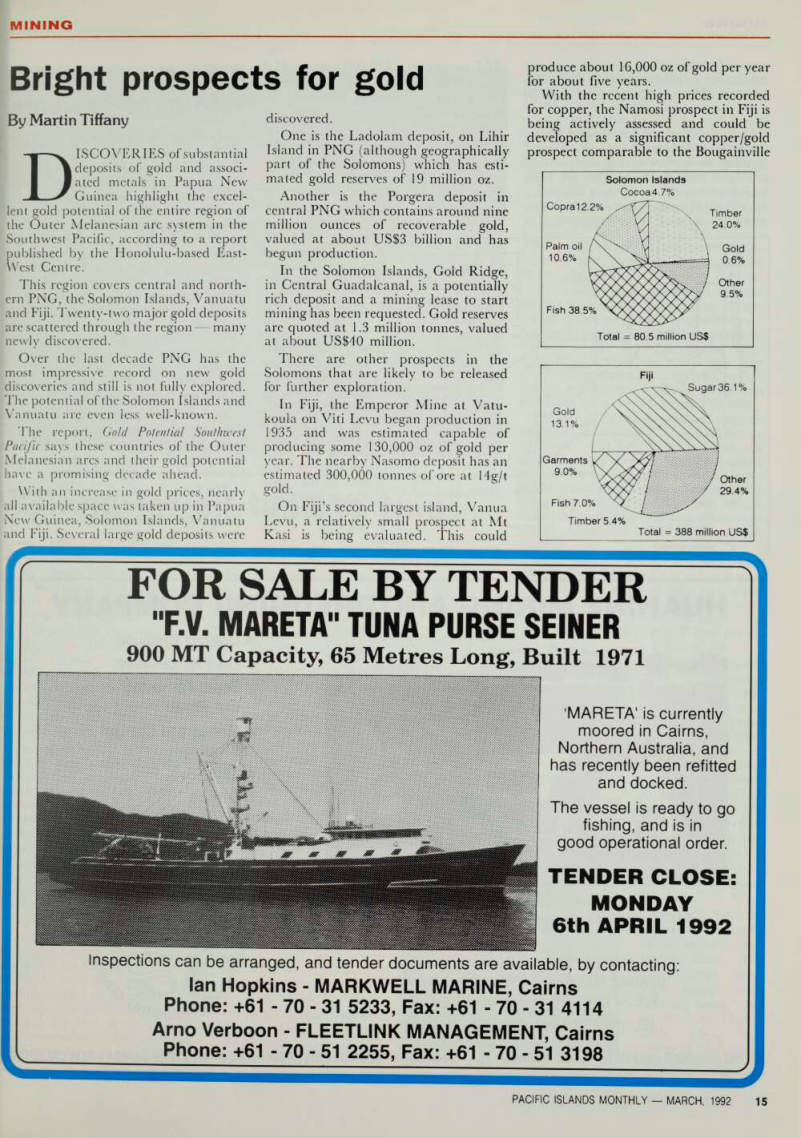
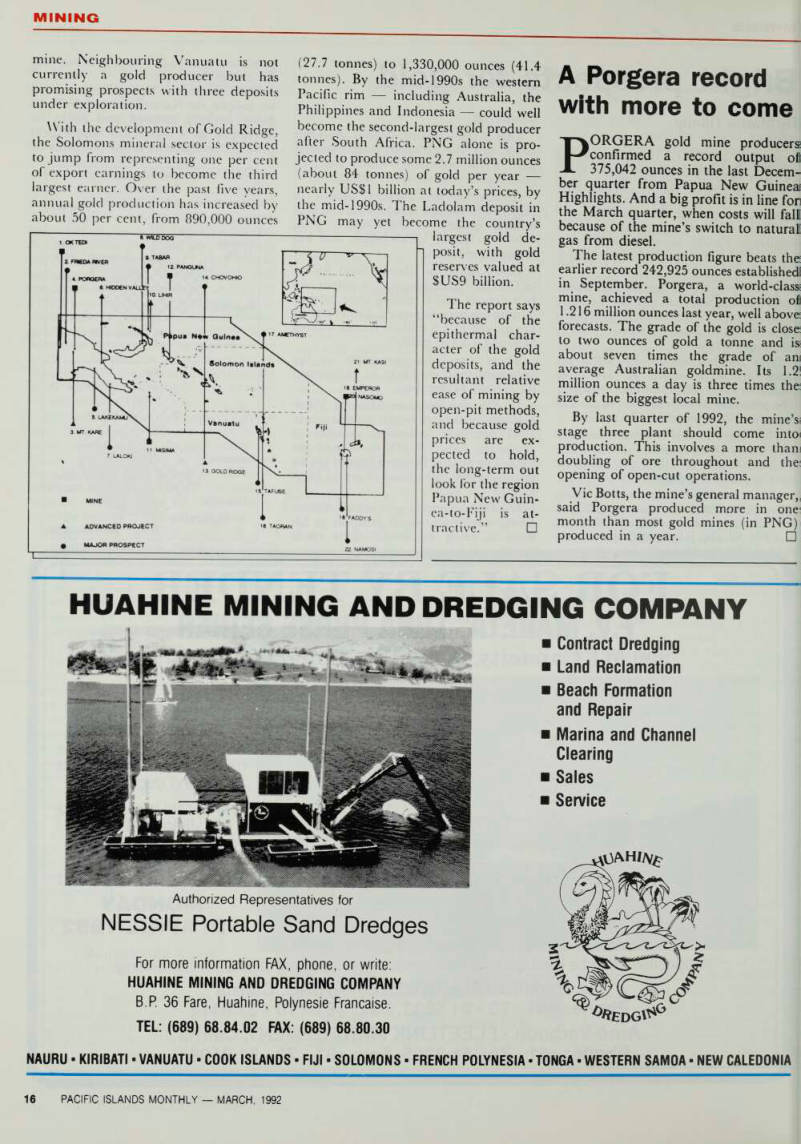
With the development of Gold Ridge, the Solomons mineral sector is expected to jump from representing one per cent of export earnings to become the third largest earner. Over the past five years, annual gold production has increased by about 50 per cent, from 890,000 ounces
(27.7 tonnes) to 1,330,000 ounces (41.4 tonnes). By the mid-1990s the western Pacific rim including Australia, the Philippines and Indonesia could well become the second-largest gold producer after South Africa. PNG alone is pro jected to produce some 2.7 million ounces (about 84 tonnes) of gold per year nearly US$l billion at today’s prices, by the mid-19905. The Ladolam deposit in PNG may yet become the country’s
largest gold de posit, with gold reserves valued at SUS 9 billion.
The report says “because of the epithermal char acter of the gold deposits, and the resultant relative ease of mining by open-pit methods, and because gold prices are ex pected to hold, the long-term out look for the region Papua New Guin ea-to-Fiji is at tractive.” □
Advertisements & other items, pp. 15-16 (1 item)
For Sale By Tender
"F.V. MARETfI" TUNA PURSE SEINER
900 MT Capacity, 65 Metres Long, Built 1971 Inspections can be arranged, and tender documents are available, by contacting: lan Hopkins - MARKWELL MARINE, Cairns Phone: +6l - 70 - 31 5233, Fax: +6l - 70 - 31 4114 Arno Verboon - FLEETLINK MANAGEMENT, Cairns Phone: +6l - 70 - 51 2255, Fax: +6l - 70 - 51 3198 'MARETA 1 is currently moored in Cairns, Northern Australia, and has recently been refitted and docked.
The vessel is ready to go fishing, and is in good operational order.
TENDER CLOSE:
MONDAY
6th APRIL 1992
HUAHINE MINING AND DREDGING COMPANY
Authorized Representatives for
NESSIE Portable Sand Dredges
For more information FAX, phone, or write:
HUAHINE MINING AND DREDGING COMPANY
B.P 36 Fare, Huahine, Polynesie Francaise.
TEL: (689) 68.84.02 FAX; (689) 68.80.30
■ Contract Dredging ■ Land Reclamation ■ Beach Formation and Repair ■ Marina and Channel
Clearing
■ Sales ■ Service
,OAH//V£
ar % * NAURU • KIRIBATI • VANUATU ■ COOK ISLANDS ■ FIJI • SOLOMONS • FRENCH POLYNESIA • TONGA • WESTERN SAMOA ■ NEW CALEDONIA
A Porgera record
with more to come
PORGERA gold mine producers confirmed a record output ofl 375,042 ounces in the last Decem ber quarter from Papua New Guineaf Highlights. And a big profit is in line fan the March quarter, when costs will falll because of the mine’s switch to natural! gas from diesel.
The latest production figure beats the! earlier record 242,925 ounces established! in September. Porgera, a world-class? mine, achieved a total production of! 1.216 million ounces last year, well above! forecasts. The grade of the gold is close! to two ounces of gold a tonne and is? about seven times the grade of am average Australian goldmine. Its 1.21 million ounces a day is three times the! size of the biggest local mine.
By last quarter of 1992, the mine’s? stage three plant should come into< production. This involves a more lhani doubling of ore throughout and the; opening of open-cut operations.
Vic Botts, the mine’s general manager,, said Porgera produced more in one* month than most gold mines (in PNG)i produced in a year. □
Waiting for oil taps to turn
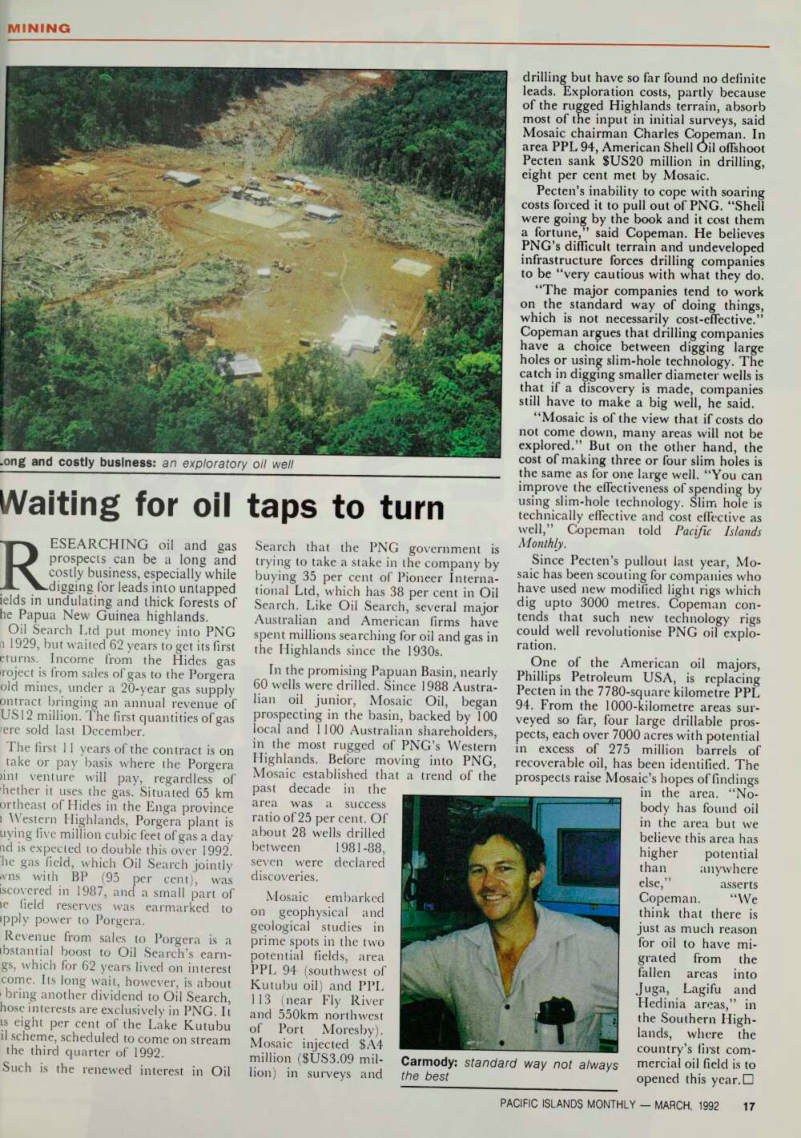
RESEARCHING oil and gas prospects can be a long and costly business, especially while digging for leads into untapped ields in undulating and thick forests of he Papua New Guinea highlands.
Oil Search Ltd put money into PNG n 1929, but waited 62 years to get its first bturns. Income from the Hides gas Toject is from sales of gas to the Porgera old mines, under a 20-year gas supply ontract bringing an annual revenue of US 1 2 million. The first quantities of gas 'ere sold last December.
The first 11 years of the contract is on take or pay basis where the Porgera )int venture will pay, regardless of r hether it uses the gas. Situated 65 km ortheast of Hides in the Enga province
i Western Highlands, Porgera plant is
uying five million cubic feet of gas a day ad is expected to double this over 1992. he gas Held, which Oil Search jointly >vns with BP (95 per cent), was iscovered in 1987, and a small part of ie field reserves was earmarked to
ipply power to Porgera.
Revenue from sales to Porgera is a ibstantial boost to Oil Search’s earn gs, which for 62 years lived on interest come. Its long wait, however, is about 1 bring another dividend to Oil Search, hose interests are exclusively in PNG. It is eight per cent of the Lake Kutubu il scheme, scheduled to come on stream the third quarter of 1992.
Such is the renewed interest in Oil
Search that the PNG government is trying to take a stake in the company by buying 35 per cent of Pioneer Interna tional Ltd, which has 38 per cent in Oil Search. Like Oil Search, several major Australian and American firms have spent millions searching for oil and gas in the Highlands since the 19305.
In the promising Papuan Basin, nearly 60 wells were drilled. Since 1988 Austra lian oil junior, Mosaic Oil, began prospecting in the basin, backed by 100 local and 1100 Australian shareholders, in the most rugged of PNG’s Western Highlands. Before moving into PNG, Mosaic established that a trend of the
P ast decade m the a *^ a was a success ratio of 25 per cent. Of ab out 28 wells drilled between 1981-88, seven were declared discoveries, Mosaic embarked on geophysical and i • 1 1 a geological studies in prime spots in the two potential fields, area PPL 94 (southwest of Kutubu oil) and PPL 113 (near Fly River and 550 km northwest of Port Moresby),
Mosaic injected »A 4
million (SUS3.O9 mil lion) in surveys and
drilling but have so far found no definite leads. Exploration costs, partly because of the rugged Highlands terrain, absorb most of the input in initial surveys, said Mosaic chairman Charles Copeman. In area PPL 94, American Shell Oil offshoot Pecten sank SUS2O million in drilling, eight per cent met by Mosaic.
Pecten’s inability to cope with soaring costs forced it to pull out of PNG. “Shell were going by the book and it cost them a fortune,” said Copeman. He believes PNG’s difficult terrain and undeveloped infrastructure forces drilling companies to be “very cautious with what they do.
“The major companies tend to work on the standard way of doing things, which is not necessarily cost-effective.”
Copeman argues that drilling companies have a choice between digging large holes or using slim-hole technology. The catch in digging smaller diameter wells is that if a discovery is made, companies still have to make a big well, he said.
“Mosaic is of the view that if costs do not come down, many areas will not be explored.” But on the other hand, the cost of making three or four slim holes is the same as for one large well. “You can improve the effectiveness of spending by using slim-hole technology. Slim hole is technically effective and cost effective as well,” Copeman told Pacific Islands Monthly.
Since Pecten’s pullout last year, Mo saic has been scouting for companies who have used new modified light rigs which dig upto 3000 metres. Copeman con tends that such new technology rigs could well revolutionise PNG oil explo ration.
One of the American oil majors, Phillips Petroleum USA, is replacing Pecten in the 7780-square kilometre PPL 94. From the 1000-kilometre areas sur veyed so far, four large drillable pros pects, each over 7000 acres with potential in excess of 275 million barrels of recoverable oil, has been identified. The prospects raise Mosaic’s hopes of findings
in the area. “No body has found oil in the area but we believe this area has higher potential than anywhere else,” asserts
Copeman. “We
think that there is just as much reason for oil to have mi grated from the fallen areas into
Juga, Lagifu and
Hedinia areas,” in the Southern High lands, where the country’s first com mercial oil field is to opened this ycar.D
Long and costly business: an exploratory oil well
Carmody: standard way not always the best
Advertisements & other items, pp. 18-19 (1 item)
Here's Your
For 61 years
PACIFIC ISLANDS MONTHLY
has brought the Pacific Islands to you...
HERE'S YOUR
CHANCE TO
%'oYAL T
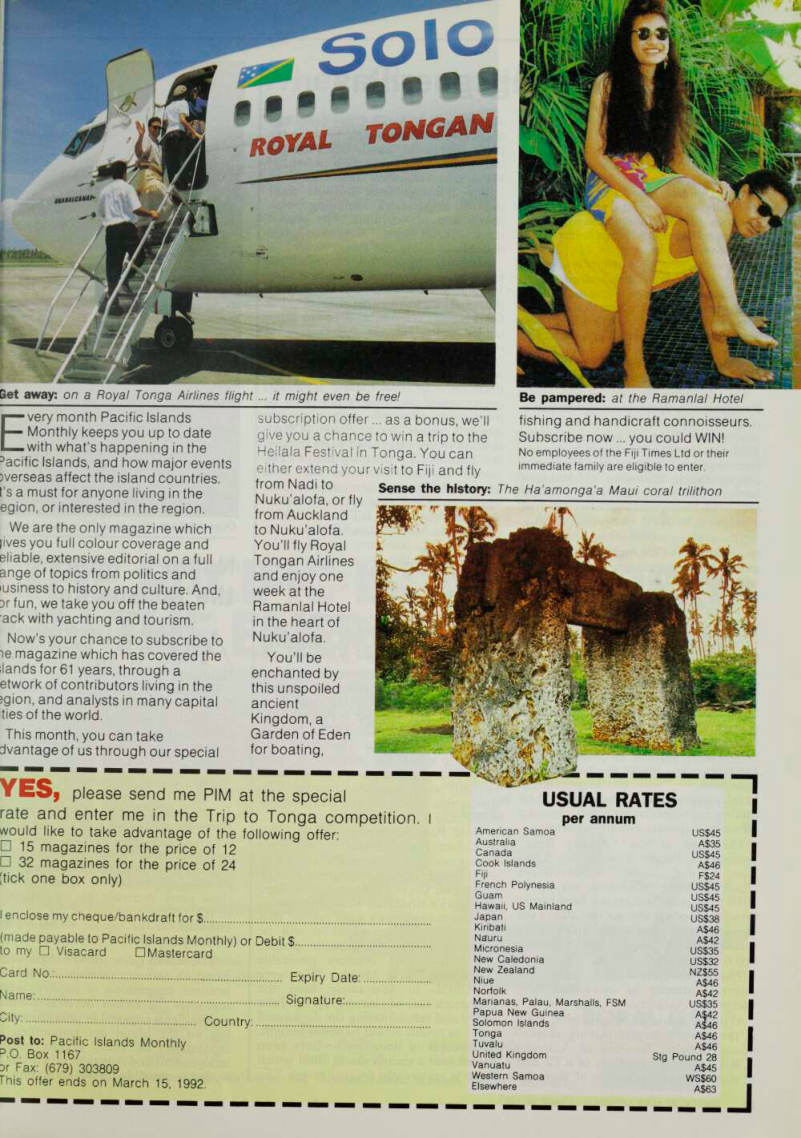
tuuietMi* BH Get away: on a Royal Tonga Airlines flight ... it might even be free! 51 -A t It w b s **w mm m a :: - i##r Si- -r.- Be pampered: at the Ramanlal Hotel Every month Pacific Islands Monthly keeps you up to date with what’s happening in the Pacific Islands, and how major events )verseas affect the island countries, t’s a must for anyone living in the egion, or interested in the region.
We are the only magazine which lives you full colour coverage and eliable, extensive editorial on a full ange of topics from politics and 'usiness to history and culture. And, Dr fun, we take you off the beaten ack with yachting and tourism.
Now’s your chance to subscribe to ie magazine which has covered the lands for 61 years, through a etwork of contributors living in the jgion, and analysts in many capital ties of the world.
This month, you can take of us through our special subscription offer... as a bonus, we’ll give you a chance to win a trip to the Heilala Festival in Tonga. You can either extend your visit to Fiji and fly fishing and handicraft connoisseurs.
Subscribe now... you could WIN!
No employees of the Fiji Times Ltd or their immediate family are eligible to enter. from Nadi to Nukualofa, or fly from Auckland to Nuku’alofa.
You’ll fly Royal Tongan Airlines and enjoy one week at the Ramanlal Hotel in the heart of Nuku’alofa.
You’ll be enchanted by this unspoiled ancient Kingdom, a Garden of Eden
for boating,
Sense the history: The Ha'amonga’a Maui coral trilithon 9 please send me RIM at the special rate and enter me in the Trip to Tonga competition. I would like to take advantage of the following offer; □ 15 magazines for the price of 12 □ 32 magazines for the price of 24 [tick one box only) G fC r-r 0 m .V ■ •
USUAL RATES
I enclose my cheque/bankdraft for $. (made payable to Pacific Islands Monthly) or Debit $. to my □ Visacard □ Mastercard Card No.: * Expiry Date: ame: Signature: Country: Post to: Pacific Islands Monthly P.O. Box 1167 Dr Fax: (679) 303809 This offer ends on March 15. 1992.
BOUGAINVILLE’S rebellion
Guide for mining guerillas
Plunder! by Roger Moody, PARTIZANS/Campaign Against Foreign Control of Aotearoa in London and Christchurch, NZ$25.
and secession have become pointers to the future for Pacific indigenous land rights guerillas.
The term “to Bougainville” is already a new lexicon among activists confronting
mining companies.
Roger Moody, author of the contro versial new book, Plunder! , argues that opposition is growing among indigenous groups over the ravages caused by mining companies, particularly the British-based giant Rio Tin to Zinc. He believes two critical focus points for opposition to RTZ are in Papua New Guinea and the United Stales.
On Bougainville, the Bougainville Revolutionary Army is still precariously clinging to power alter succeeding in closing the Panguna copper mine in 1989 and turning the island into a de facto republic. And, at the Flambeau copper mine in Wisconsin, a coalition of farmers, environmentalists, political groups and indigenous activists defeated a proposal by RTZ to develop a mine.
“By working together and putting the spotlight on RTZ’s high-handed disre gard for the land, people and laws of the world,” says Moody, “opponents have been able to create some semblance of accountability and to protect themselves against some of RTZ’s worst misdeeds.”
According to Professor A 1 Gedicks, of the US-based Centre for Alternative
Mining Development Policy, Plunder!
gives a “rare glimpse into the neo colonial mindset of RTZ’s top execu tives” and gives a valuable account of community-based organising methods to defend indigenous land rights, work er’s health and the environment. He describes the book as a guerilla’s handbook “with this knowledge in hand, communities directly affected by mining activities can go about planning effective corporate counter-strategies.”
Described as the “driving force” behind the People Against Rio Tinto Zinc and its Subsidiaries (PARTIZANS) movement, set up in 1978 to fight for indigenous land owner groups, Moody is also coordinator of the London-based Mincwatch, which moni tors the international activities of min
ing conglomerates.
Plunder! chronicles RTZ , which has mineral interests in every continent except the Antarctic.
With 52 mines in 40 countries, RTZ is the world’s largest mining corpor ation. Conzinc Riotinto of Australia (CRA Ltd) is a subsidiary of RTZ and in turn is principal owner of Bougain
ville Copper Ltd. CRA five years ago discovered the Mt Kare gold mine in the PNG Highlands, which has been the target of a protest raid by a provincial MP and seven armed landowners.
The 198-page book includes more than 80 illustrations, including maps, charts and photographs. The longest chapter deals with CRA, Aboriginal and Maori land, and Bougainville.
Measured by market capitalisation, CRA ranks sixth among the world’s top 10 mining corporations. RTZ may be the world’s most criticised miner, but CRA is more responsible than any other of its units for the desecration of indigenous land and culture. Comalco (67 per cent CRA-owned) has, for more than a decade, successfully cajoled, deceived and browbeaten legislators over a whole continent. CRA could be producing yellowcake long after Rio Algom’s mines have closed. CRA’s operations are bigger and more import ant than RTZ’s smelting plants. The parent company may be the most diversified mining company in the world, but CRA runs a close second.
In the context of RTZ’s worldwide operations, Moody says CRA was the first mining company in Australia against which the major land councils called a boycott for its violation of ancestral land at Lake Argyle and at Noonkanbah.
The author warns that there is a paradox in that, successful as land protesters might be in squeezing com panies like RTZ and CRA, the more likely they would move into other Pacific countries and territories such as elsewhere in PNG, Fiji and New Caledonia. He claims it is Bougainville Copper Ltd which, of all CRA’S main enterprises, has best illustrated the degree to which the company is “pre
pared to exploit indigenous people” and
virtually wreck a major ecosystem. The destruction of VVeipa and Mapoon, he adds, runs a close second.
Until Panguna mine closed in 1989, BCL had also probably been CRA’s most consistently successful subsidiary although Comalco’s bauxite mining returns on Cape York peninsular have paid major dividends in recent years.
“The savage irony is, of course, that no meaningful compensation will be
provided to the Bougainville people,
unless the mine resumes profitable production,” says Moody. “Yet were CRA/BCL to adequately fund the mammoth task of cleaning up the Jaba valley and rehabilitating the devastated land, its profits would be set at nought.
The people of Bougainville have been locked into a vicious circle, from which there is apparently no real escape.” □
the phosphate
Nauru ... after the phosphate
AFTER nearly a century of mining; phosphate will cease to be the source of wealth for 10,000 Nauruans.
Such has been the impact of mining in Nauru since 1907, that primary sources of phosphate will be depleted by the year 1995. Only one-fifth of its land area of 21 square km will be left for a rising population to occupy.
The Nauru government has taken Australia to the international Court oc Justice in The Hague claiming compem sation for rehabiliation of the land from which it reaped millions. Its claim against Australia is that as administraton of the island from 1920-68, it should pay for damage caused by mining during those years. Australia has an obligation to rehabilitate that part of the island one-third of the topside mined oui before July, 1967, it claims in a report) The Nauru government’s argument ii based on recommendations of an hides pendent commission of inquiry, whicH: says that the former overseas partner! governments engaged in phosphate minr ing on the island are responsible foe reparation. In 1967, Nauru became independent and Australia says it was n*i longer responsible for rehabilitation, d
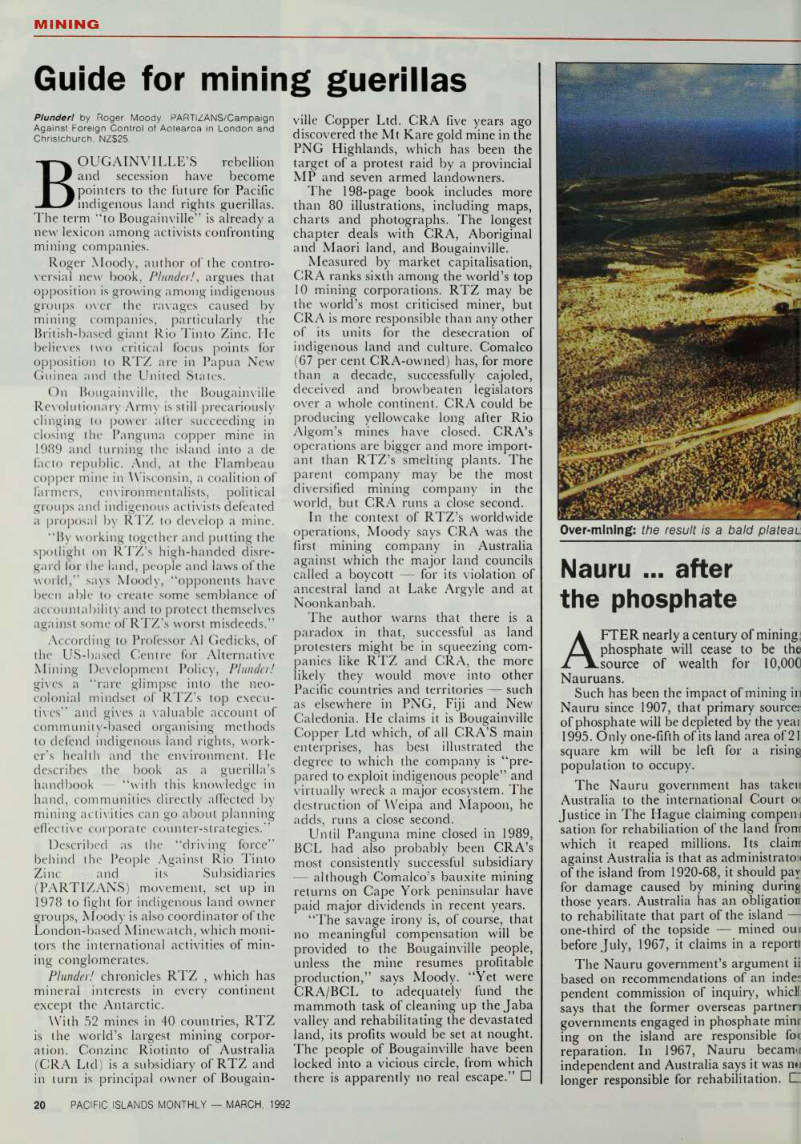
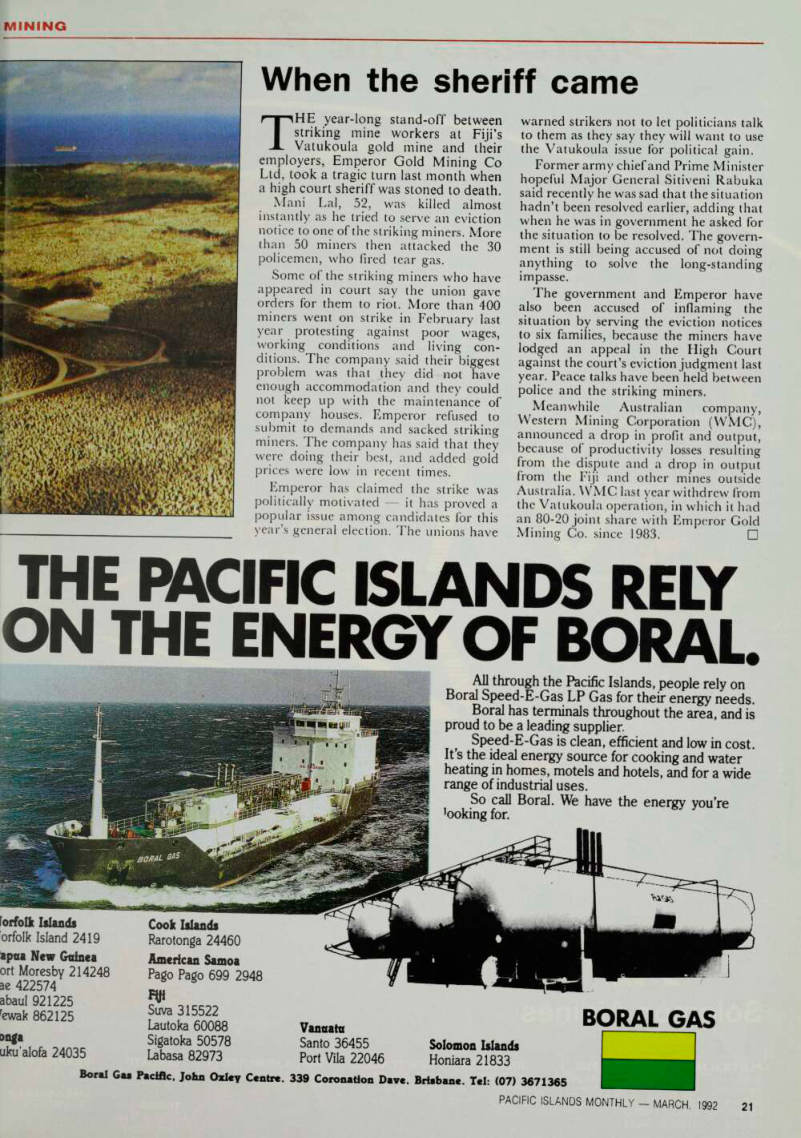
Over-mining: the result is a bald platea
When the sheriff came
THE year-long stand-off between striking mine workers at Fiji’s Vatukoula gold mine and their employers, Emperor Gold Mining Co Ltd, took a tragic turn last month when a high court sheriff was stoned to death.
Mani Lai, 52, was killed almost instantly as he tried to serve an eviction notice to one of the striking miners. More than 50 miners then attacked the 30 policemen, who fired tear gas.
Some of the striking miners who have appeared in court say the union gave orders for them to riot. More than 400 miners went on strike in February last year protesting against poor wages, working conditions and living con ditions. The company said their biggest problem was that they did not have enough accommodation and they could not keep up with the maintenance of company houses. Emperor refused to submit to demands and sacked striking miners. The company has said that they were doing their best, and added gold prices were low in recent times.
Emperor has claimed the strike was politically motivated it has proved a popular issue among candidates for this year’s general election. The unions have
warned strikers not to let politicians talk to them as they say they will want to use the Vatukoula issue for political gain.
Former army chief and Prime Minister hopeful Major General Sitiveni Rabuka said recently he was sad that the situation hadn’t been resolved earlier, adding that when he was in government he asked for the situation to be resolved. The govern ment is still being accused of not doing anything to solve the long-standing
impasse.
The government and Emperor have also been accused of inflaming the situation by serving the eviction notices to six families, because the miners have lodged an appeal in the High Court against the court’s eviction judgment last year. Peace talks have been held between police and the striking miners.
Meanwhile Australian company,
Western Mining Corporation (WMC),
announced a drop in profit and output, because of productivity losses resulting from the dispute and a drop in output from the Fiji and other mines outside Australia. WMC last year withdrew from the Vatukoula operation, in which it had an 80-20 joint share with Emperor Gold Mining Co. since 1983. □
Advertisements & other items, pp. 21-22 (1 item)
The Pacific Islands Rely
ON THE ENERGY OF BORAL.
mm Norfolk Islands orfolk Island 2419 apna New Guinea ort Moresby 214248 ae 422574 abaul 921225 r ewak 862125 Dnga uku’alofa 24035 Cook Islands Rarotonga 24460 American Samoa Pago Pago 699 2948 All through the Pacific Islands, people rely on Boral Speed-E-Gas LP Gas for their energy needs.
Boral has terminals throughout the area, and is proud to be a leading supplier.
Speed-E-Gas is clean, efficient and low in cost.
It’s the ideal energy source for cooking and water heating in homes, motels and hotels, and for a wide range of industrial uses.
So call Boral. We have the energy you’re Poking for.
Suva 315522 Lautoka 60088 Vanuatu Sigatoka 50578 Santo 36455 Solomon Islands Labasa 82973 Port Vila 22046 Honiara 21833 Boral Gas Pacific. John Oxley Centre. 339 Coronation Dave. Brisbane. Tel: (07) 3671365
BORAL GAS
ida&tty the racUic
•*>*r°lOrr>
{l Port Moresby
v SOLOMON
ISLANDS
Honiara
PAPUA NEW GUINEA
WSm Cairns
k
FIJI
mi Nadi
TONGA
Brisbane L Port Vila //
AUSTRALIA
VANUATU
vV. / ongatapu Auckland r
NEW ZEALAND
THE NATIONAL AIRLINE OF THE KINGDOM OF TONGA
FRANKFURT
(69) 17 2260
VANUATU
(678) 23838 Port Vila
LOS ANGELES
(213) 670 7302
Solomon Airlines
AUSTRALIA
Brisbane: (07) 221 4433 Brisbane: (07)229 7813 Sydney: (02)239 1722 Melbourne: (03) 321 6860 Caims: (070) 31 5634
FIJI
31 4666 Suva
SOLOMONS
(677) 20031 Honiara
NEW ZEALAND
(09) 308 9098 Auckland
PAPUA NEW GUINEA
(675) 25 5724 Port Moresby
TONGA
(676) 23414 Tongatapu
Infidelity: no place in Pacific politics
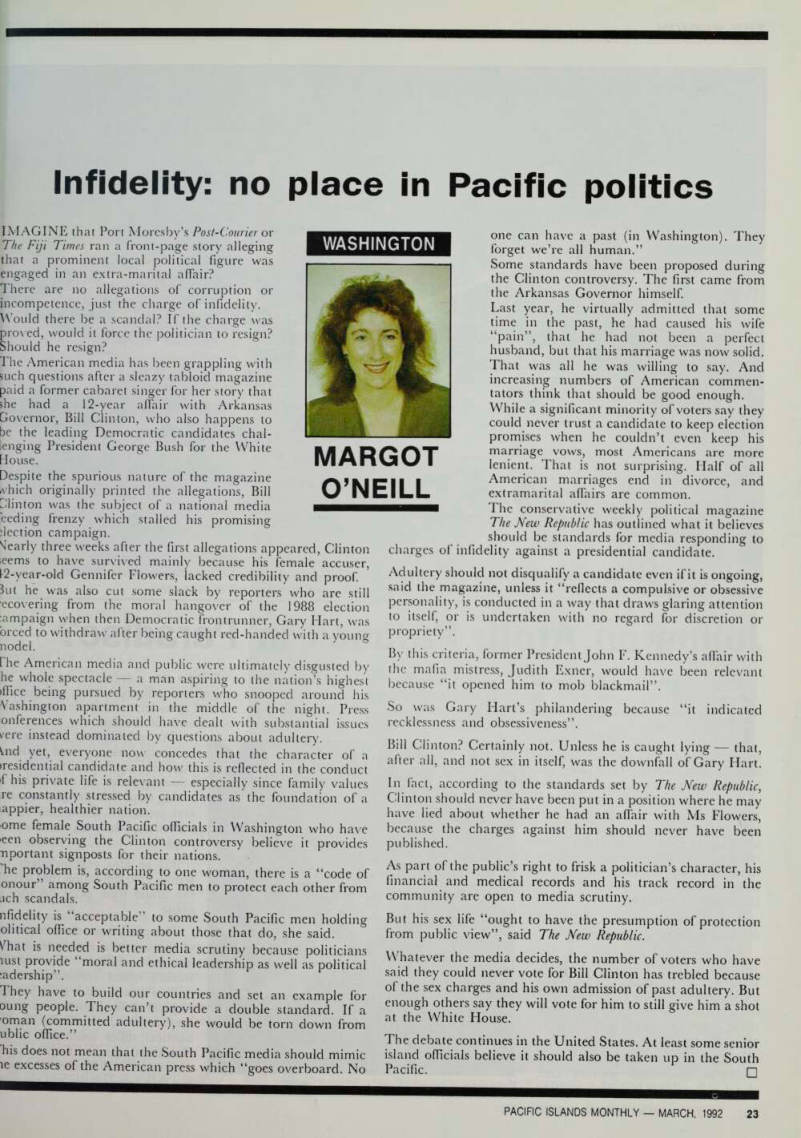
IMAGINE that Port Moresby’s Post-Courier or The Fiji Times ran a front-page story alleging that a prominent local political figure was engaged in an extra-marital affair?
There are no allegations of corruption or
incompetence, just the charge of infidelity.
Would there be a scandal? If the charge was proved, would it force the politician to resign?
Should he resign?
The American media has been grappling with such questions after a sleazy tabloid magazine paid a former cabaret singer for her story that she had a 12-year affair with Arkansas Governor, Bill Clinton, who also happens to be the leading Democratic candidates chal lenging President George Bush for the White House.
Despite the spurious nature of the magazine
A’hich originally printed the allegations, Bill
Dlinton was the subject of a national media ceding frenzy which stalled his promising
election campaign.
Nearly three weeks after the first allegations appeared, Clinton eems to have survived mainly because his female accuser, f2-year-old Gennifer Flowers, lacked credibility and proof.
Jut he was also cut some slack by reporters who are still ecovering from the moral hangover of the 1988 election :ampaign when then Democratic frontrunner, Gary Hart, was breed to withdraw after being caught red-handed with a young nodel. fhe American media and public were ultimately disgusted by he whole spectacle a man aspiring to the nation’s highest iffice being pursued by reporters who snooped around his Vashington apartment in the middle of the night. Press onferences which should have dealt with substantial issues yere instead dominated by questions about adultery. yet, everyone now concedes that the character of a •residential candidate and how this is reflected in the conduct f private life is relevant especially since family values re constantly stressed by candidates as the foundation of a appier, healthier nation. ome female South Pacific officials in Washington who have ceil observing the Clinton controversy believe it provides nportant signposts for their nations. he problem is, according to one woman, there is a “code of onour” among South Pacific men to protect each other from ach scandals. n fidelity is ‘acceptable ’ to some South Pacific men holding olitical office or writing about those that do, she said. is needed is better media scrutiny because politicians lust provide moral and ethical leadership as well as political
;adership”.
They have to build our countries and set an example for Dung people. They can’t provide a double standard. If a oman (committed adultery), she would be torn down from üblic office.” his does not mean that the South Pacific media should mimic le excesses of the American press which “goes overboard. No
Washington
one can have a past (in Washington). They forget we’re all human.”
Some standards have been proposed during the Clinton controversy. The first came from the Arkansas Governor himself.
Last year, he virtually admitted that some time in the past, he had caused his wife “pain”, that he had not been a perfect husband, but that his marriage was now solid.
That was all he was willing to say. And increasing numbers of American commen tators think that should be good enough.
While a significant minority of voters say they could never trust a candidate to keep election promises when he couldn’t even keep his marriage vows, most Americans are more lenient. That is not surprising. Half of all American marriages end in divorce, and extramarital affairs are common.
The conservative weekly political magazine The New Republic has outlined what it believes should be standards for media responding to
charges of infidelity against a presidential candidate.
Adultery should not disqualify a candidate even if it is ongoing, said the magazine, unless it “reflects a compulsive or obsessive personality, is conducted in a way that draws glaring attention to itself, or is undertaken with no regard for discretion or
propriety”.
By this criteria, former President John F. Kennedy’s affair with the mafia mistress, Judith Exner, would have been relevant because “it opened him to mob blackmail”.
So was Gary Hart’s philandering because “it indicated recklessness and obsessiveness”.
Bill Clinton? Certainly not. Unless he is caught lying — that, after all, and not sex in itself, was the downfall of Gary Hart.
In fact, according to the standards set by The New Republic , Clinton should never have been put in a position where he may have lied about whether he had an affair with Ms Flowers, because the charges against him should never have been
published.
As part of the public’s right to frisk a politician’s character, his financial and medical records and his track record in the community are open to media scrutiny.
But his sex life “ought to have the presumption of protection from public view”, said The New Republic .
Whatever the media decides, the number of voters who have said they could never vote for Bill Clinton has trebled because of the sex charges and his own admission of past adultery. But enough others say they will vote for him to still give him a shot at the White House.
The debate continues in the United States. At least some senior island officials believe it should also be taken up in the South Pacific. □
Margot
O’Neill
Johnston Atoll: Paradox in Paradise?
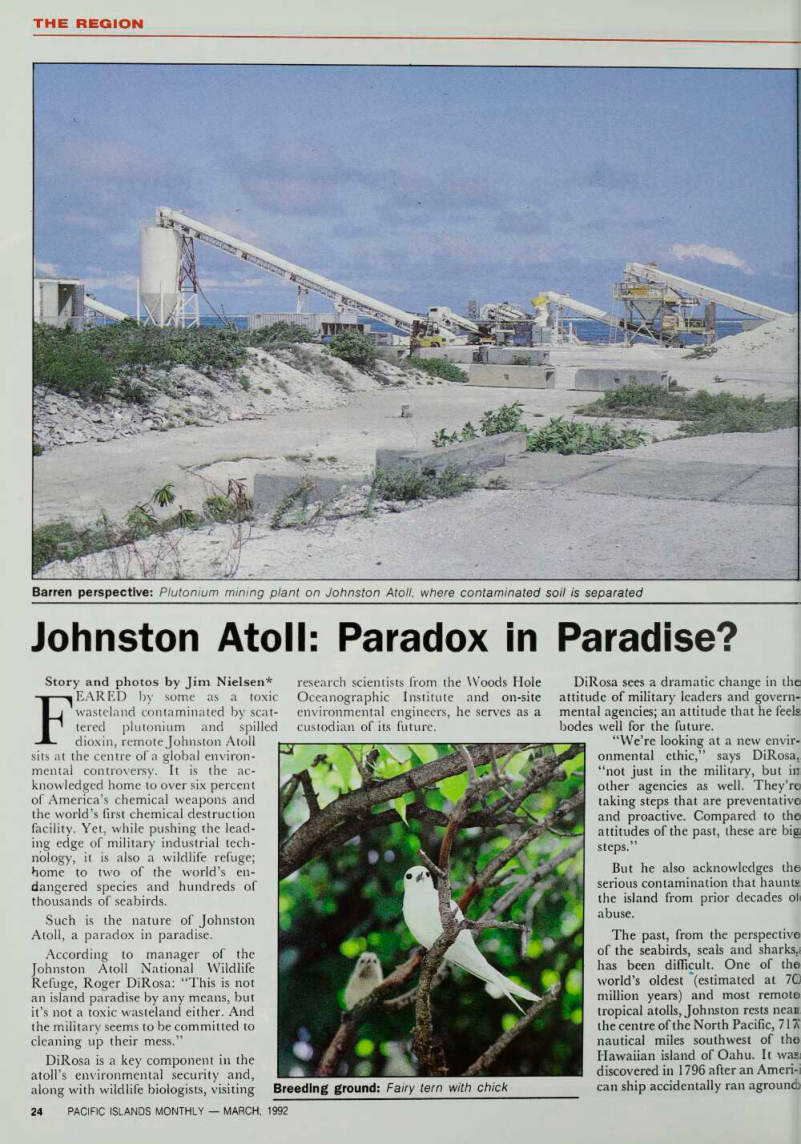
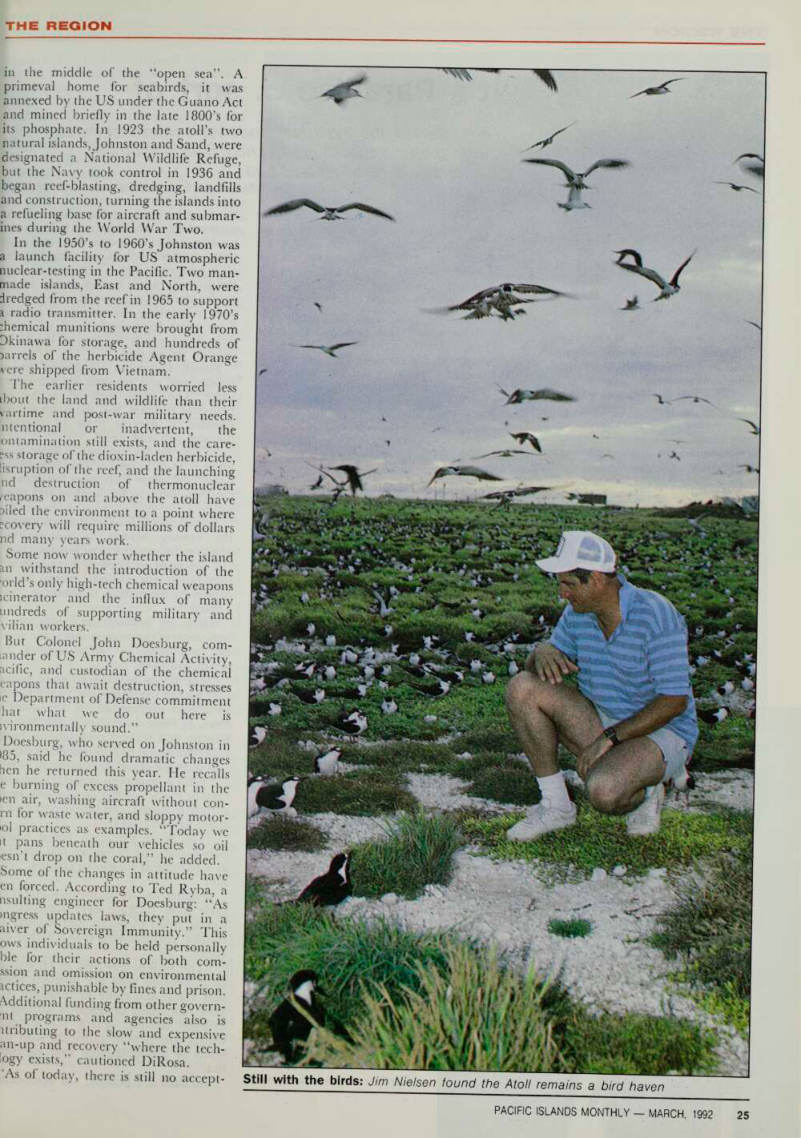
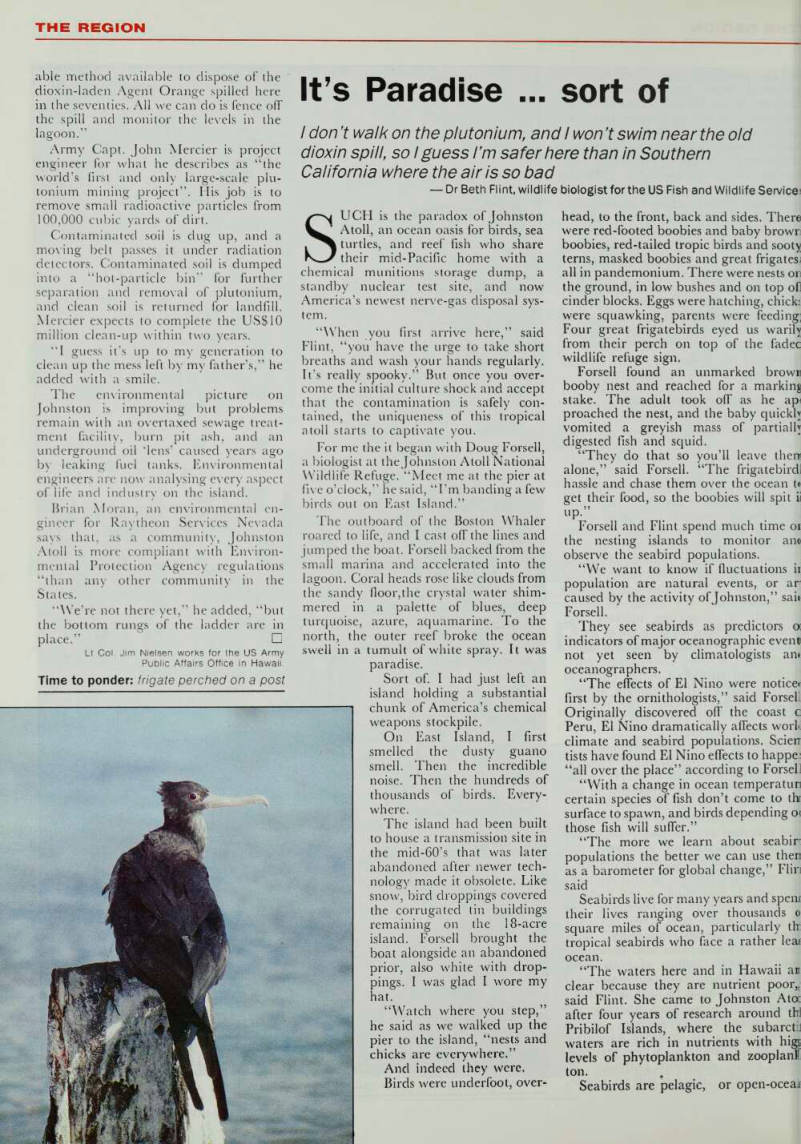
The Region
Story and photos by Jim Nielsen* FEARED by some as a toxic wasteland contaminated by scat tered plutonium and spilled dioxin, remote Johnston Atoll
sits at the centre of a global environ mental controversy. It is the ac knowledged home to over six percent of America’s chemical weapons and the world’s first chemical destruction facility. Yet, while pushing the lead ing edge of military industrial tech nology, it is also a wildlife refuge; home to two of the world’s en dangered species and hundreds of thousands of seabirds.
Such is the nature of Johnston Atoll, a paradox in paradise.
According to manager of the Johnston Atoll National Wildlife Refuge, Roger Dißosa: “This is not an island paradise by any means, but it’s not a toxic wasteland either. And the military seems to be committed to cleaning up their mess.”
Dißosa is a key component in the atoll’s environmental security and,
along with wildlife biologists, visiting
research scientists from the Woods Hole Oceanographic Institute and on-site environmental engineers, he serves as a custodian of its future.
DiRosa sees a dramatic change in the attitude of military leaders and govern mental agencies; an attitude that he feels bodes well for the future.
“We’re looking at a new envir onmental ethic,” says DiRosa,.
“not just in the military, but iiu other agencies as well. They’re taking steps that are preventative and proactive. Compared to the attitudes of the past, these are big
steps.”
But he also acknowledges the serious contamination that haunts; the island from prior decades ot< abuse.
The past, from the perspective of the seabirds, seals and sharks.* has been difficult. One of the world’s oldest (estimated at 70 million years) and most remote tropical atolls, Johnston rests neaii. the centre of the North Pacific, 71 7\ nautical miles southwest of the Hawaiian island of Oahu. It wasi discovered in 1796 after an Ameri- i can ship accidentally ran agrouncb
Barren perspective: Plutonium mining plant on Johnston Atoll, where contaminated soil is separated
Breeding ground: Fairy tern with chick
in the middle of the “open sea”. A primeval home for seabirds, it was annexed by the US under the Guano Act and mined briefly in the late 1800’s for its phosphate. In 1923 the atoll’s two natural islands, Johnston and Sand, were designated a National Wildlife Refuge, but the Navy took control in 1936 and began reef-blasting, dredging, landfills and construction, turning the islands into a refueling base for aircraft and submar ines during the World War Two.
In the 1950’s to 1960’s Johnston was a launch facility for US atmospheric nuclear-testing in the Pacific. Two man made islands, East and North, were dredged from the reef in 1965 to support a radio transmitter. In the early 1970’s :hemical munitions were brought from Dkinawa for storage, and hundreds of Darrels of the herbicide Agent Orange vere shipped from Vietnam.
The earlier residents worried less ibout the land and wildlife than their vartime and post-war military needs, intentional or inadvertent, the ontamination still exists, and the care ess storage of the dioxin-laden herbicide, lisruption of the reef, and the launching nd destruction of thermonuclear weapons on and above the atoll have Diled the environment to a point where ?covery will require millions of dollars nd many years work.
Some now wonder whether the island m withstand the introduction of the orld’s only high-tech chemical weapons Icin era tor and the influx of many und reds of supporting military and vilian workers.
But Colonel John Doesburg, com lander of US Army Chemical Activity, acific, and custodian of the chemical capons that await destruction, stresses c Department of Defense commitment hat what we do out here is i viron men tall y sou nd. ”
Doesburg, who served on Johnston in >BS, said he found dramatic changes hen he returned this year. He recalls e burning of excess propellant in the ten air, washing aircraft without con rn for waste water, and sloppy motor •ol practices as examples. “Today we it pans beneath our vehicles so oil esn’t drop on the coral,” he added.
Some of the changes in attitude have en forced. According to Ted Ryba, a nsulting engineer for Doesburg: “As ingress updates laws, they put in a
aiver of Sovereign Immunity.” This
ows individuals to be held personally ble for their actions of both com ssion and omission on environmental notices, punishable by fines and prison.
Additional funding from other oovern ■nt programs and agencies °also is itributing to the slow and expensive an-up and recovery “where the tech iogy exists,” cautioned Dißosa.
As of today, there is still no accept-
Still with the birds: Jim Nielsen found the Atoll remains a bird haven
able method available to dispose of the dioxin-laden Agent Orange spilled here in the seventies. All we can do is fence off the spill and monitor the levels in the lagoon.”
Army Capt. John Mercier is project engineer for what he describes as “the world’s first and only large-scale plu tonium mining project”. His job is to remove small radioactive particles from 100,000 cubic yards of dirt.
Contaminated soil is dug up, and a moving belt passes it under radiation detectors. Contaminated soil is dumped into a “hot-particle bin” for further separation and removal of plutonium, and clean soil is returned for landfill.
Mercier expects to complete the USSIO million clean-up within two years.
“I guess it’s up to my generation to clean up the mess left by my father’s,” he added with a smile.
The environmental picture on Johnston is improving but problems remain with an overtaxed sewage treat ment facility, burn pit ash, and an underground oil ‘lens’ caused years ago by leaking fuel tanks. Environmental engineers are now analysing every aspect of life and industry on the island.
Brian Moran, an environmental en gineer for Raytheon Services Nevada says that, as a community, Johnston Atoll is more compliant with Environ mental Protection Agency regulations “than any other community in the States.
“We’re not there yet,” he added, “but the bottom rungs of the ladder arc in
place.” □
LI Col. Jim Nielsen works for the US Army Public Affairs Office in Hawaii.
Time to ponder: frigate perched on a post
It's Paradise ... sort of
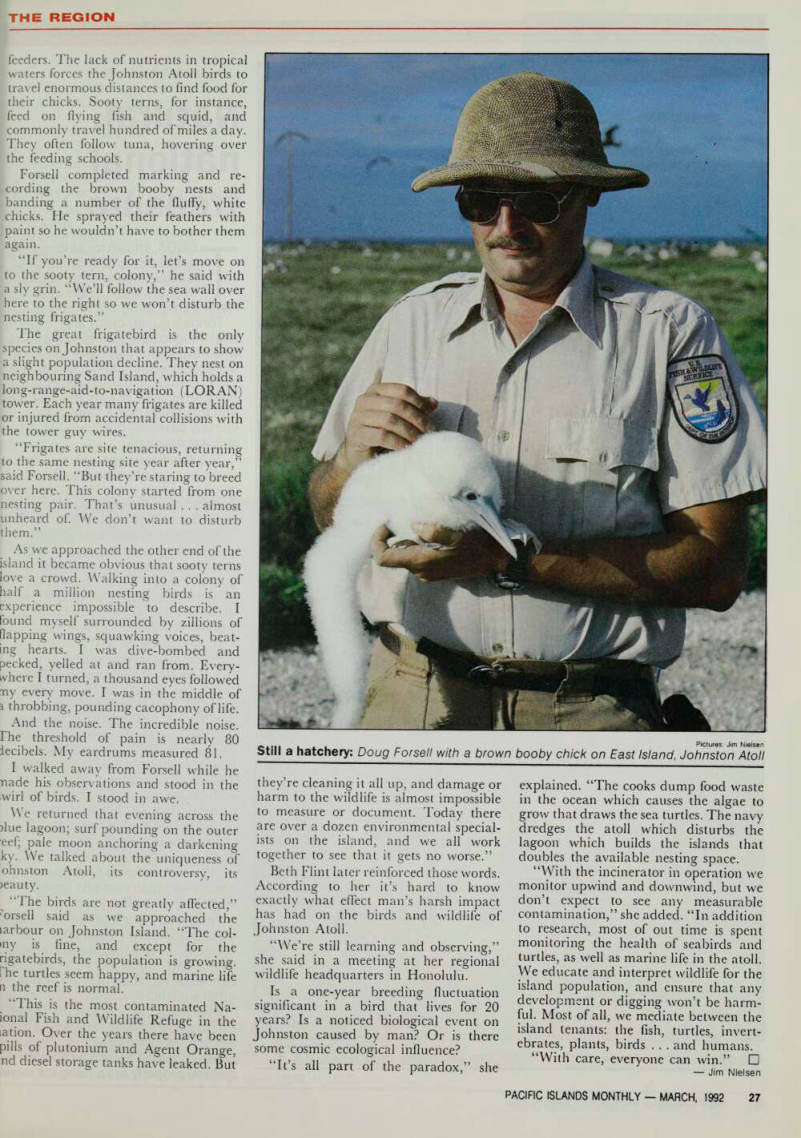
I don’t walk on the plutonium, and I won’t swim near the old dioxin spill, so I guess km safer here than in Southern California where the air is so bad — Dr Beth Flint, wildlife biologist for the US Fish and Wildlife Service
UCH 18 the paradox of Johnston A' o ' 1 ’ an oc s an oas r ls , for birds sea t turtles, and reef fish who share th , elr ™d-Pac.fic home with a chen jl cal rrru.i.tiorrs storage dump, a standby nuclear test site and now Amenca s newest nerve-gas disposal sys em‘ “When you first arrive here,” said you have the urge to take short breaths and wash your hands regularly, U 8 rea,l Y spooky. But once you over c°me imtial culture shock acce P l that the contamination is safely con ta,,;.ed ’ the umc l ueneßß of this tropical atoll starts to captivate you.
P° r mc the it began with Doug Forsell, a biologist at the Johnston Atoll National Wildlife Refuge. “Meet me at the pier at five o’clock,” he said,‘Tm banding a few birds out on East Island, The outboard of the Boston Whaler roared to life, and I cast off the lines and Jumped the boat. Forsell backed from the small marina and accelerated into the lagoon. Coral heads rose like clouds from the sandy floor,the crystal water shim in a palette of blues, deep turquoise, azure, aquamarine. To the north, the outer reef broke the ocean swell in a tumult of white spray. It was
paradise.
Sort of. I had just left an
island holding a substantial chunk of America’s chemical
weapons stockpile.
On East Island, I first smelled the dusty guano smell. Then the incredible noise. Then the hundreds of thousands of birds. Every where.
The island had been built to house a transmission site in the mid-60’s that was later abandoned after newer tech nology made it obsolete. Like snow, bird droppings covered the corrugated tin buildings remaining on the 18-acre island. Forsell brought the boat alongside an abandoned prior, also white with drop pings. I was glad I wore my hat.
“Watch where you step,” he said as we walked up the pier to the island, “nests and chicks are everywhere.”
And indeed they were.
Birds were underfoot, over
head, to the front, back and sides. There were red-footed boobies and baby brown boobies, red-tailed tropic birds and sooty terns, masked boobies and great frigates; all in pandemonium. There were nests on the ground, in low bushes and on top oil cinder blocks. Eggs were hatching, chick:, were squawking, parents were feeding; Four great frigatebirds eyed us warily from their perch on top of the fadec wildlife refuge sign.
Forsell found an unmarked brown booby nest and reached for a marking stake. The adult took off as he ap* proached the nest, and the baby quickly vomited a greyish mass of partially digested fish and squid.
“They do that so you’ll leave there alone,” said Forsell. “The frigatebirdl hassle and chase them over the ocean t* get their food, so the boobies will spit ii up.”
Forsell and Flint spend much time 01 the nesting islands to monitor ano observe the seabird populations.
“We want to know if fluctuations ii population are natural events, or ar caused by the activity ofjohnston,” saw Forsell.
They see seabirds as predictors oc indicators of major oceanographic event not yet seen by climatologists am
oceanographers.
“The effects of El Nino were notice*: first by the ornithologists,” said ForselU Originally discovered off the coast o Peru, El Nino dramatically affects worM climate and seabird populations. Scien lists have found El Nino effects to happe; “all over the place” according to Forsell “With a change in ocean temperatun certain species of fish don’t come to thr surface to spawn, and birds depending 0( those fish will suffer.”
“The more we learn about seabin populations the better we can use then as a barometer for global change,” Flin said Seabirds live for many years and spent their lives ranging over thousands o square miles of ocean, particularly thi tropical seabirds who face a rather leaf ocean.
“The waters here and in Hawaii an clear because they are nutrient poor, t said Flint. She came to Johnston Atoc after four years of research around tH Pribilof Islands, where the subarctiJ waters are rich in nutrients with higs levels of phytoplankton and zooplanlL ton.
Seabirds are pelagic, or opcn-ocear
feeders. The lack of nutrients in tropical waters forces the Johnston Atoll birds to travel enormous distances to find food for their chicks. Sooty terns, for instance, feed on flying fish and squid, and commonly travel hundred of miles a day.
They often follow tuna, hovering over the feeding schools.
Forsell completed marking and re cording the brown booby nests and banding a number of the fluffy, white chicks. He sprayed their feathers with paint so he wouldn’t have to bother them again.
“If you’re ready for it, let’s move on to the sooty tern, colony,” he said with a sly grin. “We’ll follow the sea wall over here to the right so we won’t disturb the nesting frigates.”
The great frigatebird is the only species on Johnston that appears to show a slight population decline. They nest on neighbouring Sand Island, which holds a
long-range-aid-to-navigation (LORAN)
tower. Each year many frigates are killed or injured from accidental collisions with the tower guy wires.
“Frigates are site tenacious, returning to the same nesting site year after year,” said Forsell. “But they’re staring to breed over here. This colony started from one nesting pair. That’s unusual . . . almost unheard of. We don’t want to disturb them.”
As we approached the other end of the island it became obvious that sooty terns love a crowd. Walking into a colony of half a million nesting birds is an experience impossible to describe. I found myself surrounded by zillions of [lapping wings, squawking voices, beat ing hearts. I was dive-bombed and pecked, yelled at and ran from. Every where I turned, a thousand eyes followed my every move. I was in the middle of
i throbbing, pounding cacophony of life.
And the noise. The incredible noise.
Fhe threshold of pain is nearly 80 lecibels. My eardrums measured 81.
I walked away from Forsell while he nade his observations and stood in the wirl of birds. I stood in awe.
We returned that evening across the flue lagoon; surf pounding on the outer eef; pale moon anchoring a darkening ky. We talked about the uniqueness of ohnston Atoll, its controversy, its )eauty.
“The birds are not greatly affected,” ■orsell said as we approached the larbour on Johnston Island. “The col >ny is fine, and except for the rigatebirds, the population is growing, fhe turtles seem happy, and marine life n the reef is normal.
“This is the most contaminated Na ional Fish and Wildlife Refuge in the lation. Over the years there have been pills of plutonium and Agent Orange, nd diesel storage tanks have leaked. But
they’re cleaning it all up, and damage or harm to the wildlife is almost impossible to measure or document. Today there are over a dozen environmental specialists on the island, and we all work together to see that it gets no worse.”
Beth Flint later reinforced those words.
According to her it’s hard to know exactly what effect man’s harsh impact has had on the birds and wildlife of Johnston Atoll.
“We’re still learning and observing,” she said in a meeting at her regional wildlife headquarters in Honolulu.
Is a one-year breeding fluctuation significant in a bird that lives for 20 years? Is a noticed biological event on Johnston caused by man? Or is there some cosmic ecological influence? oil . r j „ i Its all part of the paradox,” she
explained. “The cooks dump food waste in the ocean which causes the algae to grow that draws the sea turtles. The navy dredges the atoll which disturbs the lagoon which builds the islands that doubles the available nesting space.
“With the incinerator in operation we monitor upwind and downwind, but we don’t expect to see any measurable contamination,” she added. “In addition to research, most of out time is spent monitoring the health of seabirds and turtles, as well as marine life in the atoll, W e educate and interpret wildlife for the island population, and ensure that any development or digging won t be harm ! , , ° st °^ a ’ 'ye mediate between the 18 an d tenants: the fish, turtles, invert ebf^^.s ’ P lants > birds . . . and humans.
With care, everyone can win.” □ 7
Jim Nielsen
Pictures: Jim Nielsen Still a hatchery: Doug Forsell with a brown booby chick on East Island, Johnston Atoll
Advertisements & other items, p. 26 (1 item)
The Region
Natural,
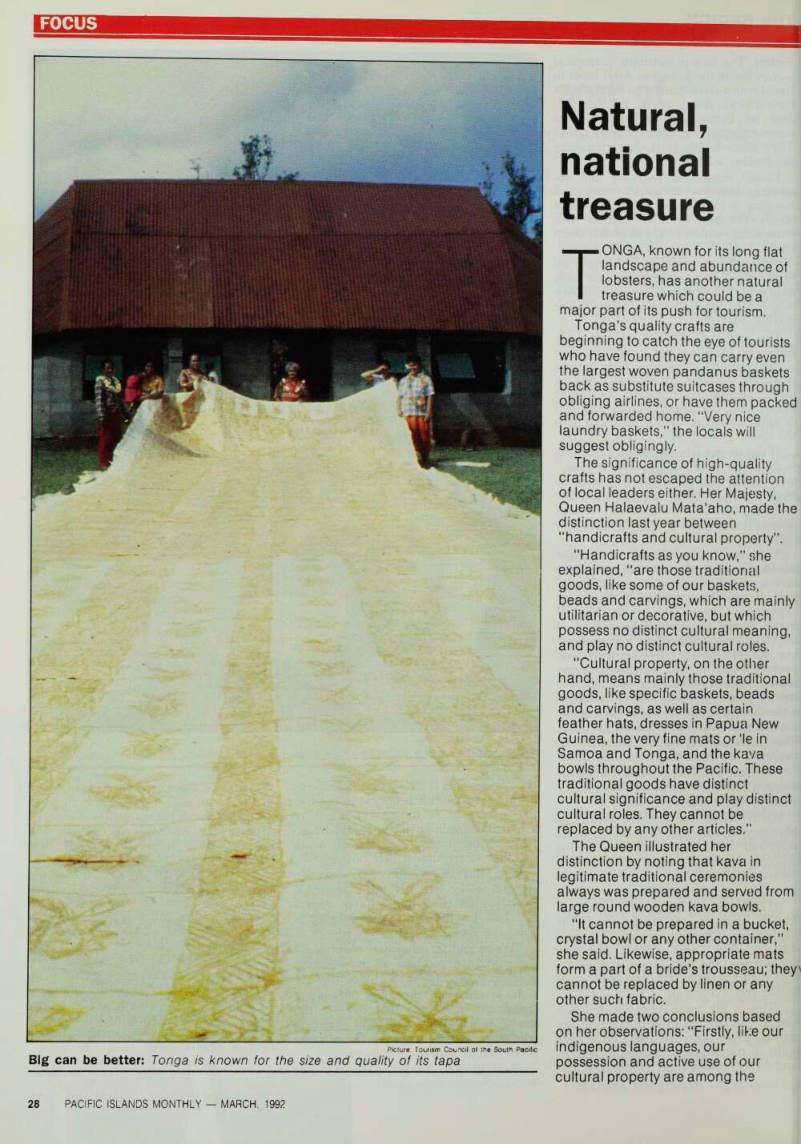
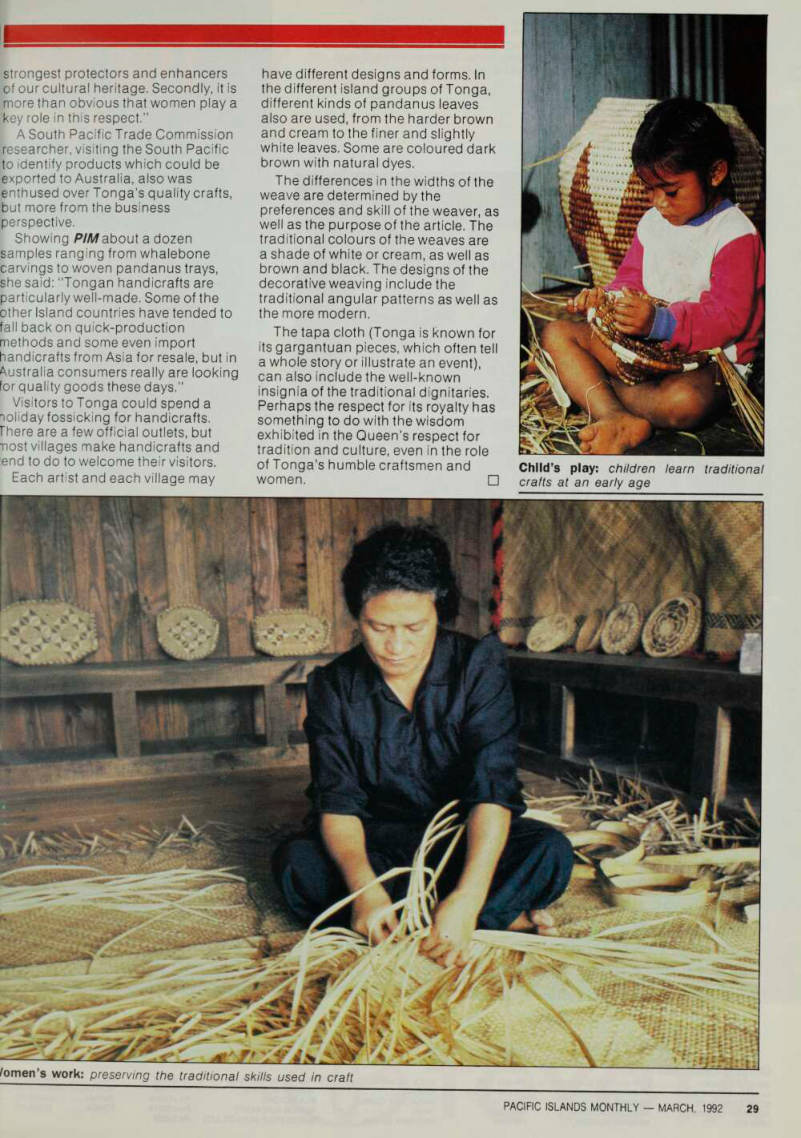
Focus
Natural, national treasure
TONGA, known for its long flat landscape and abundance of lobsters, has another natural treasure which could be a major part of its push for tourism.
Tonga’s quality crafts are beginning to catch the eye of tourists who have found they can carry even the largest woven pandanus baskets back as substitute suitcases through obliging airlines, or have them packed and forwarded home. “Very nice laundry baskets,” the locals will suggest obligingly.
The significance of high-quality crafts has not escaped the attention of local leaders either. Her Majesty, Queen Halaevalu Mata’aho, made the distinction last year between “handicrafts and cultural property”.
“Handicrafts as you know,” she explained, “are those traditional goods, like some of our baskets, beads and carvings, which are mainly utilitarian or decorative, but which possess no distinct cultural meaning, and play no distinct cultural roles.
“Cultural property, on the other hand, means mainly those traditional goods, like specific baskets, beads and carvings, as well as certain feather hats, dresses in Papua New Guinea, the very fine mats or ‘le in Samoa and Tonga, and the kava bowls throughout the Pacific. These traditional goods have distinct cultural significance and play distinct cultural roles. They cannot be replaced by any other articles.”
The Queen illustrated her distinction by noting that kava in legitimate traditional ceremonies always was prepared and served from large round wooden kava bowls.
“It cannot be prepared in a bucket, crystal bowl or any other container,” she said. Likewise, appropriate mats form a part of a bride’s trousseau: theyv cannot be replaced by linen or any other such fabric.
She made two conclusions based on her observations: “Firstly, like our indigenous languages, our possession and active use of our cultural property are among the
Picture; Tourism Council of the South Pacific Big can be better: Tonga is known for the size and quality of its tapa
strongest protectors and enhancers of our cultural heritage. Secondly, it is more than obvious that women play a key role in this respect.”
A South Pacific Trade Commission researcher, visiting the South Pacific to identify products which could be exported to Australia, also was enthused over Tonga’s quality crafts, but more from the business perspective.
Showing PlM about a dozen samples ranging from whalebone carvings to woven pandanus trays, she said: ‘Tongan handicrafts are particularly well-made. Some of the other Island countries have tended to fall back on quick-production methods and some even import handicrafts from Asia for resale, but in Australia consumers really are looking for quality goods these days.”
Visitors to Tonga could spend a noliday fossicking for handicrafts.
Fhere are a few official outlets, but nost villages make handicrafts and end to do to welcome their visitors.
Each artist and each village may
have different designs and forms. In the different island groups of Tonga, different kinds of pandanus leaves also are used, from the harder brown and cream to the finer and slightly white leaves. Some are coloured dark brown with natural dyes.
The differences in the widths of the weave are determined by the preferences and skill of the weaver, as well as the purpose of the article. The traditional colours of the weaves are a shade of white or cream, as well as brown and black. The designs of the decorative weaving include the traditional angular patterns as well as the more modern.
The tapa cloth (Tonga is known for its gargantuan pieces, which often tell a whole story or illustrate an event), can also include the well-known insignia of the traditional dignitaries.
Perhaps the respect for its royalty has something to do with the wisdom exhibited in the Queen’s respect for tradition and culture, even in the role of Tonga’s humble craftsmen and women. □
Child’s play; children learn traditional crafts at an early age
[?]omen's work: preserving the traditional skills used in craft
Advertisements & other items, pp. 30-31 (1 item)
luxury-car ride.
The new Toyota brand mark. Three ellipses forming a “T” which stand for our customer, our commitment to the satisfaction of that customer through our product and for our spirit of creativity.
It’s not often that you hear descriptions like rugged or durable combined with refined and elegant. But then there’s never been a vehicle quite like the new Toyota Land Cruiser Station Wagon. The unrivalled legend of off-road reliability is now unsurpassed in comfort and sophistication as well. Attention to detail is found everywhere, from the fine trim to the instrument panel to the graceful lines of its exterior. Even in places you can’t see, like the heavy-duty ladder frame and suspension design that add to the superb
But Toyota’s innovation goes beyond providing luxury and durability. The new Land Cruiser Station Wagon, and all of our cars, are designed to create a harmony between car and driver, and to provide you with the ultimate
driving experience.
The new Toyota Land Cruiser Station Wagon. Think of it as much more than a spacious luxury sedan with fourwheel drive.
H 4* ' % * im. v % • H
DISTRIBUTORS/DEALERS
AMERICAN SAMOA BURNS PHILP (S.S.) CO. LTD. PH 633-4281 GUAM & MICRONESIA ATKINS KROLL, INC. PH 646-1876/9 NORFOLK ISLANDS BORRY’S PTY LTD. PH 2114
SOLOMON ISLANDS MENDANA MOTORS PH 22884
VANUATU VANUATU MOTORS PH 2341
COOK ISLANDS PACIFIC MOTORS LTD. PH 20796
KIRIBATI TARAWA MOTORS PH 21090
PAPUA NEW GUINEA ELA MOTORS PH 217036
TAHITI NIPPON AUTOMOTO PH 429819
WESTERN SAMOA BURNS PHILP (S.S.) CO. LTD. PH 20800
FIJI
NEW CALEDONIA
SAIPAN
TONGA
ki 7
m
Cruiser
nd % ft 3 m le m y o m & L OM> m ■* »X PH 312666 PH 282848 PH 234-5911 PH 23673
TOYOTA
Heart-warming end to the year
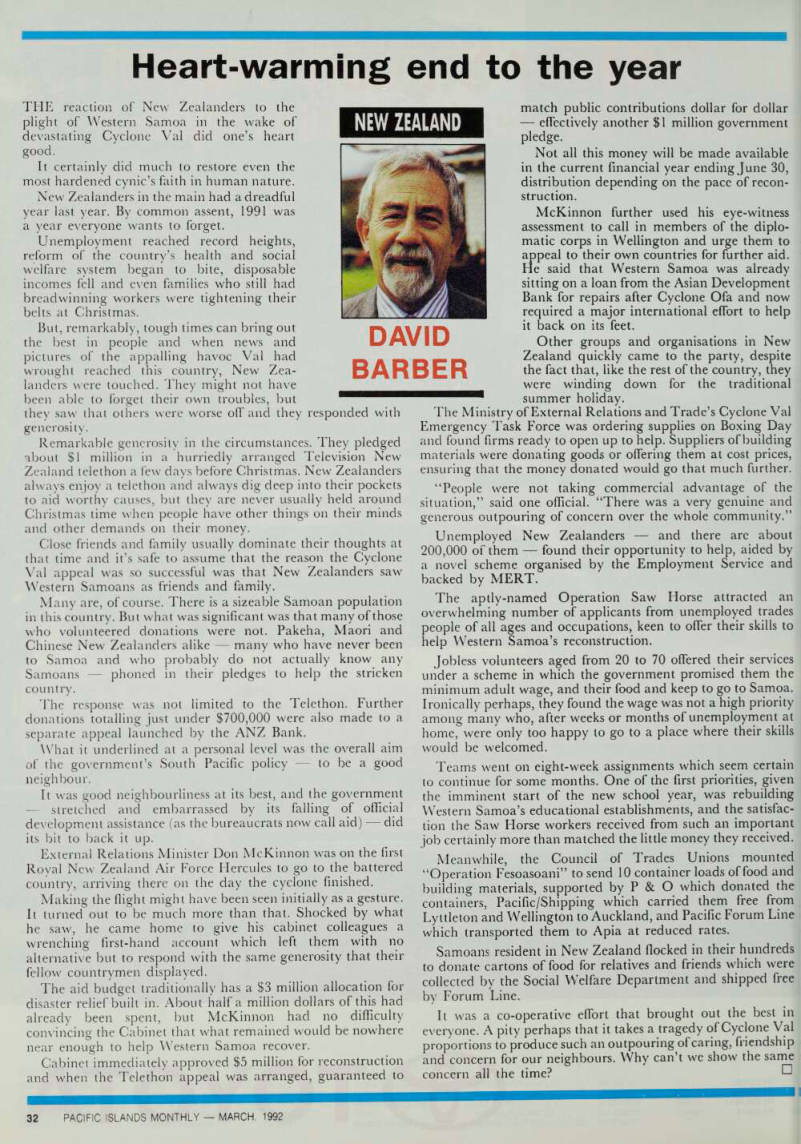
THE reaction of New Zealanders to the plight of Western Samoa in the wake of devastating Cyclone Val did one’s heart
good.
It certainly did much to restore even the most hardened cynic’s faith in human nature.
New Zealanders in the main had a dreadful year last year. By common assent, 1991 was a year everyone wants to forget.
Unemployment reached record heights, reform of the country’s health and social welfare system began to bite, disposable incomes fell and even families who still had breadwinning workers were tightening their belts at Christmas.
But, remarkably, tough times can bring out the best in people and when news and pictures of the appalling havoc Val had wrought reached this country, New Zea landers were touched. They might not have been able to forget their own troubles, but
they saw that others were worse off and they responded with
generosity.
Remarkable generosity in the circumstances. They pledged about SI million in a hurriedly arranged Television New Zealand telethon a few days before Christmas. New Zealanders always enjoy a telethon and always dig deep into their pockets to aid worthy causes, but they are never usually held around Christmas time when people have other things on their minds and other demands on their money.
Close friends and family usually dominate their thoughts at that time and it’s safe to assume that the reason the Cyclone Val appeal was so successful was that New Zealanders saw Western Samoans as friends and family.
Many are, of course. There is a sizeable Samoan population in this country. But what was significant was that many of those who volunteered donations were not. Pakeha, Maori and Chinese New Zealanders alike many who have never been to Samoa and who probably do not actually know any Samoans phoned in their pledges to help the stricken country.
The response was not limited to the Telethon. Further donations totalling just under $700,000 were also made to a separate appeal launched by the ANZ Bank.
What it underlined at a personal level was the overall aim of the government’s South Pacific policy to be a good
neighbour.
It was good neighbourliness at its best, and the government stretched and embarrassed by its falling of official development assistance (as the bureaucrats now call aid) did its bit to back it up.
External Relations Minister Don McKinnon was on the first Royal New Zealand Air Force Hercules to go to the battered country, arriving there on the day the cyclone finished.
Making the flight might have been seen initially as a gesture.
It turned out to"be much more than that. Shocked by what he saw, he came home to give his cabinet colleagues a wrenching first-hand account which left them with no alternative but to respond with the same generosity that their fellow countrymen displayed.
The aid budget traditionally has a S 3 million allocation for disaster relief built in. About half a million dollars of this had already been spent, but McKinnon had no difficulty convincing the Cabinet that what remained would be nowhere near enough to help Western Samoa recover.
Cabinet immediately approved S 5 million for reconstruction and when the Telethon appeal was arranged, guaranteed to
New Zealand
match public contributions dollar for dollar effectively another SI million government
pledge.
Not all this money will be made available in the current financial year ending June 30, distribution depending on the pace of recon struction.
McKinnon further used his eye-witness assessment to call in members of the diplo matic corps in Wellington and urge them to appeal to their own countries for further aid.
He said that Western Samoa was already sitting on a loan from the Asian Development Bank for repairs after Cyclone Ofa and now required a major international effort to help it back on its feet.
Other groups and organisations in New Zealand quickly came to the party, despite the fact that, like the rest of the country, they were winding down for the traditional summer holiday.
The Ministry of External Relations and Trade’s Cyclone Val Emergency Task Force was ordering supplies on Boxing Day and found firms ready to open up to help. Suppliers of building materials were donating goods or offering them at cost prices, ensuring that the money donated would go that much further.
“People were not taking commercial advantage of the situation,” said one official. “There was a very genuine and generous outpouring of concern over the whole community.”
Unemployed New Zealanders and there arc about 200,000 of them found their opportunity to help, aided by a novel scheme organised by the Employment Service and backed by MERT.
The aptly-named Operation Saw Horse attracted an overwhelming number of applicants from unemployed trades people of all ages and occupations, keen to offer their skills to help Western Samoa’s reconstruction.
Jobless volunteers aged from 20 to 70 offered their services under a scheme in which the government promised them the minimum adult wage, and their food and keep to go to Samoa.
Ironically perhaps, they found the wage was not a high priority among many who, after weeks or months of unemployment at home, were only too happy to go to a place where their skills would be welcomed.
Teams went on eight-week assignments which seem certain to continue for some months. One of the first priorities, given the imminent start of the new school year, was rebuilding Western Samoa’s educational establishments, and the satisfac tion the Saw Horse workers received from such an important job certainly more than matched the little money they received.
Meanwhile, the Council of Trades Unions mounted “Operation Fesoasoani” to send 10 container loads of food and building materials, supported by P & O which donated the containers, Pacific/Shipping which carried them free from Lyttleton and Wellington to Auckland, and Pacific Forum Line which transported them to Apia at reduced rates.
Samoans resident in New Zealand flocked in their hundreds to donate cartons of food for relatives and friends which were collected by the Social Welfare Department and shipped free by Forum Line.
It was a co-operative effort that brought out the best in everyone. A pity perhaps that it takes a tragedy of Cyclone Val proportions to produce such an outpouring of caring, friendship and concern for our neighbours. Why can’t we show the same concern all the time?
David
Barber
Playing into priviligentia hands
EDUCATION in the Pacific Islands has taken a new and strange turn everyone wants a university for his own island.
This, in spite of the fact that a university is an immense investment in terms of monetary and, or, intellectual capital.
Many Islanders have had university education yet very few really understand how a university ticks, and much less how to set up one.
The belief that money is the one key to tertiary education development, nay, to every type of development, is also widespread in the Islands. It is part of the so-called modernist position.
But money alone can never guarantee quality or lasting benefit. Because it is a tool it can only be used, and so its effect is determined entirely by external factors, especially the good judgment or folly of the user. In fact there are Island groups which have been “blessed” with money.
Yet it is extremely doubtful whether quality of life is necessarily better in them than in the others. Viewed from a wider, longer-range perspective, what can the touristy, not even-skin-deep culture of a Hawaii, or misfortune-ridden, essentially despairing one of a Nauru, offer our grandchildren in terms of a power for discernment or permanent social and cultural gains? If they are to teach, it shall only be by negative example.
Similarly with university development in the Islands. The most notable examples are University of the South Pacific (USPj, University of Papua New Guinea (UPNG), and the new French university.
They were set up in the Islands like buildings being erected but pre-fabricated by metropolitan designers of highly doubtful competence in matters academic, i.e. bureaucrats, politicians, and Big Business interests. The Islanders, however, with their time-hallowed phobia for speed, would be more at home with institutions which grow like trees from a seed, but making sure, of course, that the seeds are the right ones what thougroweth thou verily shall reap.
And money has been amply poured into these three schools.
But apart from vague schemes for economic development, what
provisions have they in their books, for real intellectual, or even moral improvement in the broadest sense of the term?
On the other hand what can we expect from establishments which are primarily weapons of the politically powerful within the Island communities, apparatuses for the maintenance of the status quo in the island world and the hegemony of metropolitan powers over same? We must face it: the problems of the Islands both internal and external are ultimately political not economic i.e. they relate to the distribution of Dower and rights within the Island societies diemselves and between the Islands and their brmer colonial masters.
Largely from economic and logistical xmsiderations the regional character of these hree universities, especially the USP, has :ome under fire. _,,The S°l omon Islanders, complaining that dji is the only real beneficiary of USP, have,
or some time, been talking about establishing their own miversity. The Roman Catholics there, in the meantime, have et up the Divine Word Institute, a school that promises to be >f consequence in the future.
And at PNG, the Pacific Adventist College is providing an
The Islands
alternative option for people requiring tertiary education in that country.
Western Samoa, another grumbling member of the USP region, has now put the National University of Western Samoa on the tracks. Tonga is talking about following suit soon.
In Tonga also PACU (Pacific-Asia Christian University) threatens to open its doors to students in the immediate future, though its main concern may be the training of young missionaries.
And the institution where I work, ‘Atenisi Institute, which has a tertiary part, has just celebrated its Silver Jubilee. These institutions taken together provide a measure of the Islanders’ ardour for education at the highest level.
There is, however, a fundamental flaw in the education of Pacific peoples. They conceive education from a purely utilitarian standpoint. This, however, is not peculiar to the Pacific. Pacific “thinking” on education has always been influenced by ideas from far and wide, but arriving in the Islands via Australia and especially New Zealand.
A specially vicious ethos called modernisation-development theory is now being hailed as the most laudable foundation for educational development in both New Zealand and the Islands.
The nation maintains that education is there solely to raise the GNP so that teachers’ roles consist of nothing but the passing-on of productive skills to students who must concen trate only on mastering the techniques so imparted. It is an extremely deceptive concept because it conducts a false diagnosis of the problems of I bird World Countries bv setting the cart before the horse.
In emphasising economic needs it strengthens, and plays into, the hands of the powers that be and traditional priviligentia who proceed to parrot the developmental rhetoric thus sustaining the fantasies of the have-nots in those communities who continually dream of material plenty. 1 he originators of modernisation ideas have no sense of history or social facts. They have no understanding of education as a historical movement with distinct characters of
its own. They exhibit no appreciation at all of the inevitability of conflict and change, and the complexity and permanence of social struggle.
They present the matter as simplicity itself, that if only a few simple facts c.g. economic
growth, require technological development
which requires technical skills which requires teachers to transfer them, are mastered, all will be well.
But this historical and illiberal doctrine has been the basis of educational policies of the islands in the last two decades or so, enabling politicians and governments to saddle edu cators and schools with responsibility for social ills or economic backwardness.
And so, although the present clamour for more tertiary institutions in the Islands has merit, I cannot but be sad about it all for they will be modelled on UPNG, USP, and the French university, bastions of technical functional education in the islands and
instruments for the protection of privilege, ancestral status, and political influence.
If Pacific people do not wake up to themselves, a multitude of new higher educational institutions will be a force for dull conservatism bent on the elevation of crudeness and worship of mediocrity. q
Futa
Helu
Return of the French
Headlines
By Anna Buckley
ON January 31, 1992, the great, grey French warship Comman dant Birot arrived in Santo, Vanuatu’s largest island. It is also the island from which, 11 years earlier, hundreds of French residents were deported following the Santo rebellion
after Independence.
A French flag on Santo had not been seen since Anglo-French Condominium days, when French settlers there out numbered the British by three to one.
The general election on December 2, 1991, brought Vanuatu’s first francophone Prime Minister, Maxime Carlot, to power. In January, the new Minister for Foreign Affairs Serge Vohor led the first Ministerial del egation to New Caledonia since Inde pendence. Vanuatu received V 35 mil lion to “welcome the new government”.
Walter Lini, now leader of the National United Party (NUP) and Carlot’s partner in the new coalition govern ment, was quick to accuse UMP of selling the nation’s sovereignty for V 35 million. Carlot responded that Vanu atu’s hard-won independence would not be compromised, but that it was natural to develop friendly relations with her nearest neighbour, New Caledonia.
The French navy were paying a courtesy call. On board Commandant Birot , government officials, remaining French residents and the Santo elite were celebrating, with sailors passing around patisseries and champagne flow ing. The first French charge d’affaires allowed in the country' for five years, Phillipe Guerin, chatted with Serge Vohor like an old friend.
It was easy to forget that recent relations between France and Vanuatu have been far from friendly. During his 11-year rule, Walter Lini played a leading role in the Campaign for an Independent and Nuclear Free Pacific.
He was a critic of French nuclear testing in Moruroa and supporter of the Kanak in New Caledonia. Lini juggled overseas donors while maintaining an indepen dent and idiosyncratic foreign policy.
Between 1980 and 1987, three French ambassadors in a row were expelled from Vanuatu for alleged support of the opposition Union of Moderate Parties (UMP). (Formed in the seventies, UMP was initially an odd assortment of francophone parties, custom-oriented movements and cargo cults wanting to delay British-led plans for early Inde pendence). The last French Com missioner, Jean Jacques Robert, is still banned from the country for his Santo rebellion role in 1980. He approved
publicly of plans drawn up for Indepen dence, but Robert is now known to nave supported Jimmy Stevens’ rebels in their fight for an Independence Republic of Vemarana on Santo.
During his brief spell as Prime Minister (September-November 1991), Donald Kalpokas started to normalise relations with France. He attended the Summit of Independent French Speak ing Countries in Paris; renewed the lease on the French Embassy and Lcyee Francaise in Vila and reversed deport ation orders on two French business men. France cancelled Vanuatu’s exter nal debt to it since 1980.
Most political appointees are now French speakers, as are the newly appointed heads of Media Services and Education. Prime Minister Maxime Carlot, educated under the French and British systems, talks of redressing the balance. Francophones have been under-represented in the civil service, the French language regarded as “a linguistic optional extra”, and business and aid policy oriented towards the English-speaking world, namely Britain, Australia and New Zealand, he said.
The UMP election manifesto prom ised free health and education, higher copra prices and lower food prices, promises dependent on more funds from somewhere. In a recent interview, Minister for Foreign Affairs, Serge Vohor, explained that the V 35 million from New Caledonia was just a prelimi nary gift. The new government antici pates hundreds of millions of vatu for health and education. French teachers absent from Santo since the rebellion will be allowed to return, and Vanuatu can expect more French doctors in the future.
The new coalition government could benefit from links with both the anglophone and francophone world.
But first Carlot and Lini have to mark out their differences.
Carlot openly admits that NUP was not UMP’s first choice of a coalition partner, but “time was running out”, he said. “Marriages of convenience are fragile things, so too are coalition
governments.”
The new government was expected to meet for the first time on February 28.
The latest source of aggravation be tween the two leaders has been the return of 20 French deportees for a weekend party. Former copra, cocoa and cattle industry leaders on Santo for decades, they talked of compensation during their a la carte dinner at Santo’s top restaurant. They left 11 years ago with nothing, but were able to hire two
charter planes (Noumea-Vila, Vila-
Santo) for last month’s occasion. □
Solomons budget
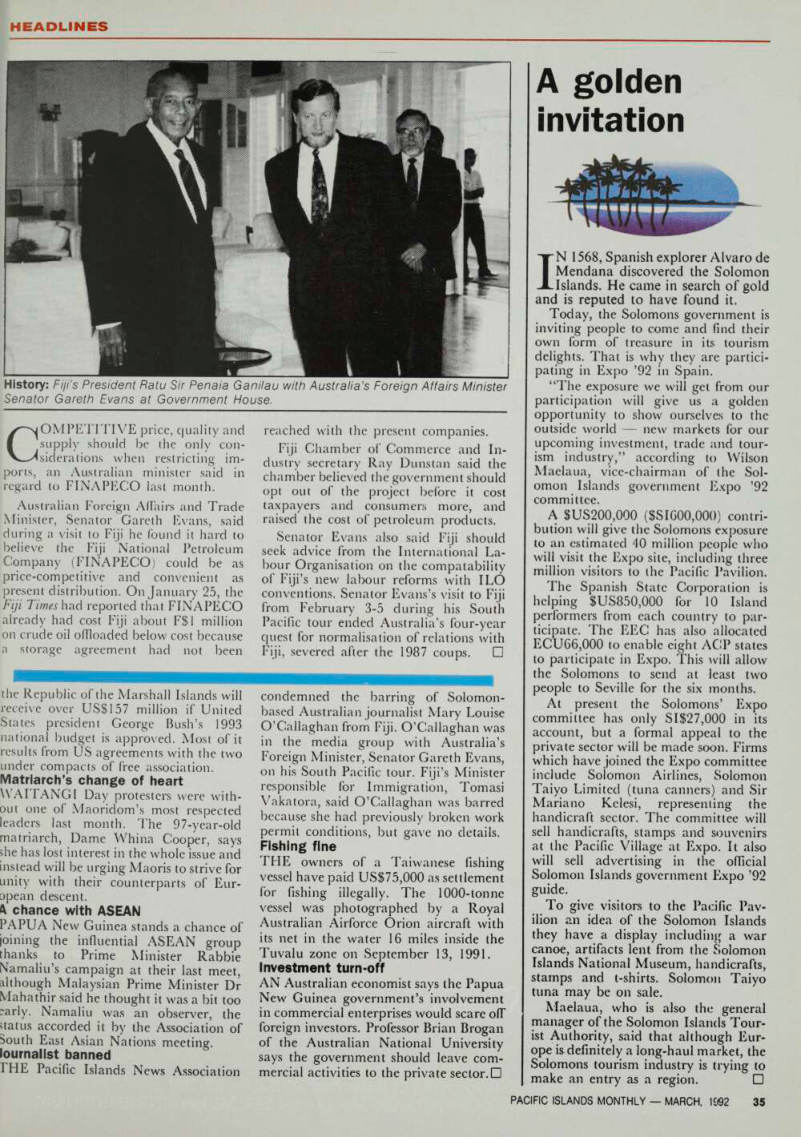
Heated debate on Solomons budget
THE Solomon Islands budget generated heated debate and resentment in the House, with a government proposal to raise taxes by as much as seven to 10 per cent. Soaring inflation, increased spend ing on development projects and a trade deficit forecast also feature in the USS 92 million 1992 budget.
Solomon summonsed SOLOMON Islands Prime Minister Solomon Mamaloni allegedly owes a Brisbane finance corporation USSI I,SOO which he borrowed in 1989 for a
fibreglass manufacturing company, of
which he is a director. Former Oppo sition leader and private lawyer Andrew Nori, for the Brisbane company, said Mamaloni had 45 days to respond to a summons by the Brisbane company.
A first victory PAPUA New Guinea security forces scored their first real victory in the three year secessionist rebellion on Bougain ville when 15 Bougainville Revolution ary Army (BRA) members surrendered in January. The surrender has allowed the PNG defence forces to begin con structing their first camp on Bougainville since they were forced to leave in 1990.
Pressure on Solomons PAPUA New Guinea has again protested to the Solomon Islands government for what it says is increased Bougainville rebel propaganda in Honiara. A protest note has been sent to the Solomons government demanding immediate ac tion to remove the rebel government office in Honiara.
Fighting zone THE Papua New Guinea city of Lae has; been declared a fighting zone. The; declaration by the Morobe Law andJ Good Order Committee enables police to< erect roadblocks search vehicles and the; public for dangerous weapons.
Bird racket FIJI’S native birds are being smuggled! out of the country in what is believed tot be a million-dollar international racket..
The racket is said to involve visiting* yachties who are selling the birds at) prices of up to USS 14,000 a pair.
Rorovana row THE Papua New Guinea government) and the Bougainville Revolutionary, Army have issued contradictory state ments on fighting at Rorovana nean Arawa in central Bougainville. The PNG Defence Force initially said a patrol boat) had been sent to Arawa to help villagers fleeing to sea to escape BRA members.) However, a shortwave radio message from Francis Ona in Bougainville said: PNG patrol boats fired mortar bombs al Rorovana village for several hours.
Boost by US budget?
THE Federated States of Micronesia aneb
COMPETITIVE price, quality and supply should be the only con siderations when restricting im ports, an Australian minister said in regard to FINAPECO last month.
Australian Foreign Affairs and Trade Minister, Senator Gareth Evans, said during a visit to Fiji he found it hard to believe the Fiji National Petroleum Company (FINAPECO) could be as price-competitive and convenient as present distribution. On January 25, the Fiji Times had reported that FINAPECO already had cost Fiji about FSI million on crude oil offloaded below cost because a storage agreement had not been
reached with the present companies.
Fiji Chamber of Commerce and In dustry secretary Ray Dunstan said the chamber believed the government should opt out of the project before it cost taxpayers and consumers more, and raised the cost of petroleum products.
Senator Evans also said Fiji should seek advice from the International La bour Organisation on the compatability of Fiji’s new labour reforms with ILO conventions. Senator Evans’s visit to Fiji from February 3-5 during his South Pacific tour ended Australia’s four-year quest for normalisation of relations with Fiji, severed after the 1987 coups. □
the Republic of the Marshall Islands will receive over US$l57 million if United States president George Bush’s 1993 national budget is approved. Most of it results from US agreements with the two under compacts of free association.
Matriarch’s change of heart WAITANGI Day protesters were with out one of Maoridom’s most respected leaders last month. The 97-year-old matriarch, Dame Whina Cooper, says die has lost interest in the whole issue and instead will be urging Maoris to strive for unity with their counterparts of Eur opean descent.
I chance with ASEAN PAPUA New Guinea stands a chance of joining the influential ASEAN group thanks to Prime Minister Rabbie Namaliu’s campaign at their last meet, although Malaysian Prime Minister Dr Mahathir said he thought it was a bit too ?arly. Namaliu was an observer, the Uatus accorded it by the Association of South East Asian Nations meeting, lournalist banned THE Pacific Islands News Association
condemned the barring of Solomon based Australian journalist Mary Louise
O’Callaghan from Fiji. O’Callaghan was
in the media group with Australia’s Foreign Minister, Senator Gareth Evans, on his South Pacific tour. Fiji’s Minister responsible for Immigration, Tomasi Vakatora, said O’Callaghan was barred because she had previously broken work permit conditions, but gave no details.
Fishing fine THE owners of a Taiwanese fishing vessel have paid U 5575,000 as settlement for fishing illegally. The 1000-tonne vessel was photographed by a Royal Australian Airforce Orion aircraft with its net in the water 16 miles inside the Tuvalu zone on September 13, 1991.
Investment turn-off AN Australian economist says the Papua New Guinea government’s involvement in commercial enterprises would scare off foreign investors. Professor Brian Brogan of the Australian National University says the government should leave com mercial activities to the private sector.□
History: Fiji's President Ratu Sir Penaia Ganilau with Australia's Foreign Affairs Minister Senator Gareth Evans at Government House.
A golden
invitation
IN 1568, Spanish explorer Alvaro de Mendana discovered the Solomon Islands. He came in search of gold and is reputed to have found it.
Today, the Solomons government is inviting people to come and find their own form of treasure in its tourism delights. That is why they are partici pating in Expo ’92 in Spain.
“The exposure we will get from our participation will give us a golden opportunity to show ourselves to the outside world new markets for our upcoming investment, trade and tour ism industry,” according to Wilson Maelaua, vice-chairman of (he Sol omon Islands government Expo ’92 committee.
A SUS2OO,OOO ($81600,000) contri bution will give the Solomons exposure to an estimated 40 million people who will visit the Expo site, including three million visitors to the Pacific Pavilion.
The Spanish State Corporation is helping SUSBSO,OOO for 10 Island performers from each country to par ticipate. The EEC has also allocated ECU66,000 to enable eight ACP states to participate in Expo. This will allow the Solomons to send at least two people to Seville for the six months.
At present the Solomons’ Expo committee has only 51527,000 in its account, but a formal appeal to the private sector will be made soon. Firms which have joined the Expo committee include Solomon Airlines, Solomon Taiyo Limited (tuna canners) and Sir Mariano Kclesi, representing the handicraft sector. The committee will sell handicrafts, stamps and souvenirs at the Pacific Village at Expo. It also will sell advertising in the official Solomon Islands government Expo ’92
guide.
To give visitors to the Pacific Pav ilion an idea of the Solomon Islands they have a display including a war canoe, artifacts lent from the Solomon Islands National Museum, handicrafts, stamps and t-shirts. Solomon Taiyo tuna may be on sale.
Maelaua, who is also the general manager of the Solomon Islands Tour ist Authority, said that although Eur ope is definitely a long-haul market, the Solomons tourism industry is trying to make an entry as a region. □
Advertisements & other items, p. 36 (1 item)
S&twH***' V<
THE ISLANDS LOST IN TIME
Without doubt, we are the islands lost in time But look at what we have to offer our visitors...
Unspoilt, unsophisticated friendly people Magnificent reef and wreck diving Spectacular waterfalls in lush tropical rainforests Unique flora and fauna Traditional artifacts and handicrafts elaborately made by skilled craftsmen Traditional dances and folklore dating back centuries Thermal springs and dormant volcanoes World War II relics and battlefields Golden sundrenched beaches surrounded by turqoise waters So!
If you're looking for a new destination with something different to see and d 0...
Look our way, Come, before word gets around.
Solomon Islands
For further information contact: Solomon Islands Tourist Authority, PO Box 321, Honiara. Phone: (677) 22*1-12. Fax: (677) 23986 our representative: General Travel Marketing Services, Suite 20/37 Alexander Street, Crows Nest, N.S.W. 2065, Phone (02) 4384555 Fax (02) 4385197
He’s already
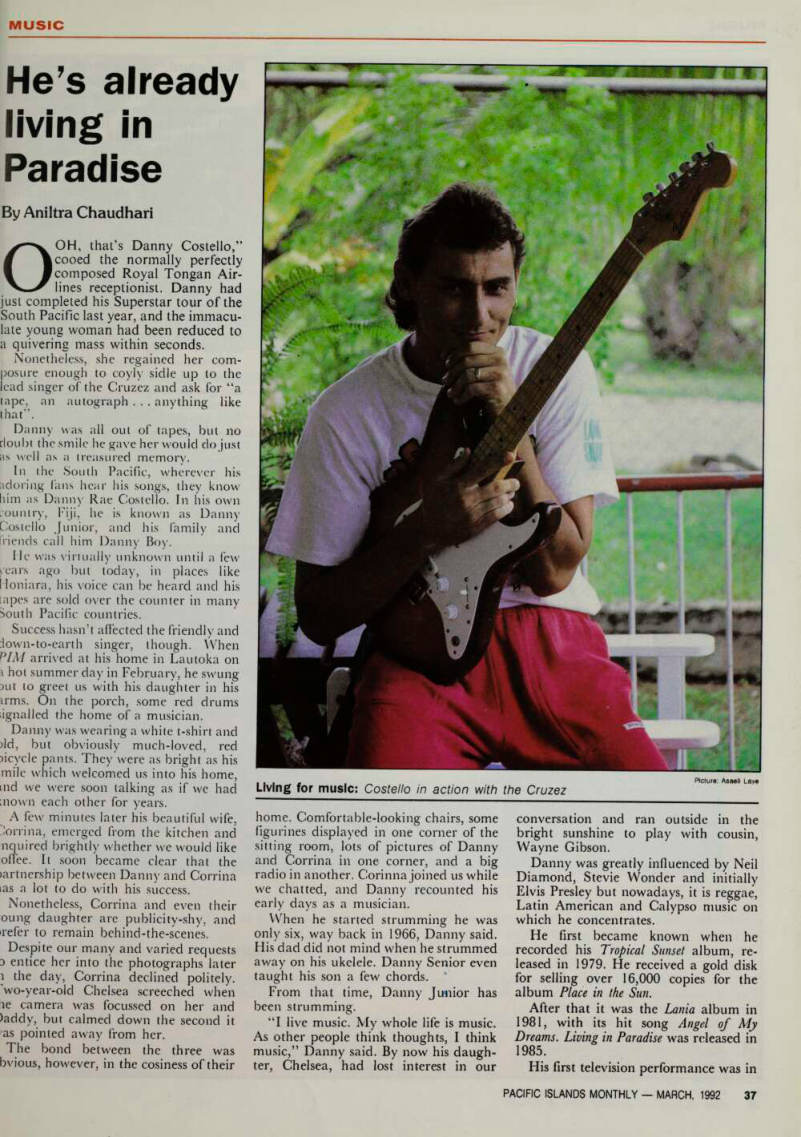
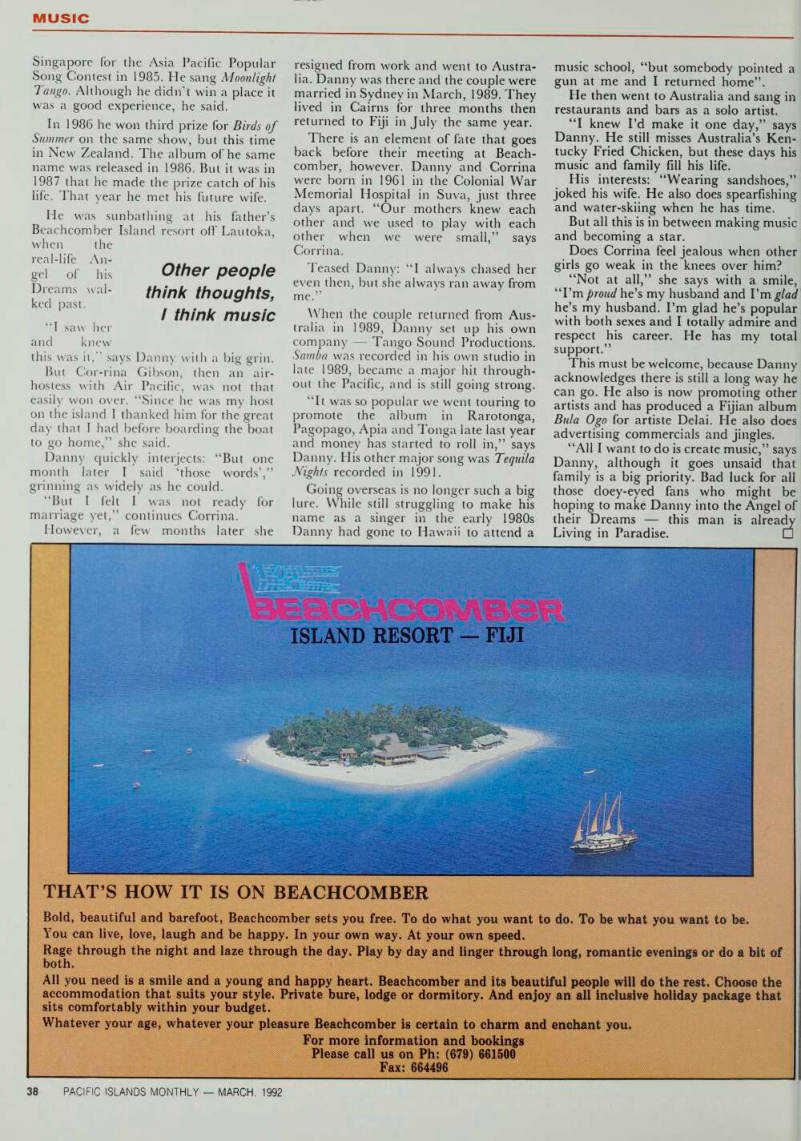
Music
He’s already living in Paradise
By Aniltra Chaudhari
OOH, that’s Danny Costello,” cooed the normally perfectly composed Royal Tongan Air lines receptionist. Danny had just completed his Superstar tour of the South Pacific last year, and the immacu late young woman had been reduced to a quivering mass within seconds.
Nonetheless, she regained her com posure enough to coyly sidle up to the lead singer of the Cruzcz and ask for “a tape, an autograph .. . anything like that”.
Danny was all out of tapes, but no doubt the smile he gave her would do just as well as a treasured memory.
In the South Pacific, wherever his adoring fans hear his songs, they know him as Danny Rae Costello. In his own :ountry, Fiji, he is known as Danny Costello Junior, and his family and friends call him Danny Boy.
He was virtually unknown until a few rears ago but today, in places like Honiara, his voice can be heard and his tapes are sold over the counter in many South Pacific countries.
Success hasn’t affected the friendly and down-to-earth singer, though. When FIM arrived at his home in Lautoka on \ hot summer day in February, he swung nit to greet us with his daughter in his irms. On the porch, some red drums ignallcd the home of a musician.
Danny was wearing a white t-shirt and )ld, but obviously much-loved, red )icycle pants. They were as bright as his mile which welcomed us into his home, md we were soon talking as if we had mown each other for years.
A few minutes later his beautiful wife, florrina, emerged from the kitchen and nquired brightly whether we would like offee. It soon became clear that the tartnership between Danny and Corrina las a lot to do with his success.
Nonetheless, Corrina and even their oung daughter arc publicity-shy, and refer to remain behind-the-scenes.
Despite our many and varied requests d entice her into the photographs later i the day, Corrina declined politely, wo-year-old Chelsea screeched when ic camera was focussed on her and )addy, but calmed down the second it as pointed away from her.
The bond between the three was bvious, however, in the cosiness of their
home. Comfortable-looking chairs, some figurines displayed in one corner of the sitting room, lots of pictures of Danny and Corrina in one corner, and a big radio in another. Corinna joined us while we chatted, and Danny recounted his early days as a musician.
When he started strumming he was only six, way back in 1966, Danny said.
His dad did not mind when he strummed away on his ukclele. Danny Senior even taught his son a few chords.
From that time, Danny Junior has
been strumming.
“I live music. My whole life is music.
As other people think thoughts, I think music,” Danny said. By now his daughter, Chelsea, had lost interest in our
conversation and ran outside in the bright sunshine to play with cousin, Wayne Gibson, Danny was greatly influenced by Neil Diamond, Stevie Wonder and initially Elvis Presley but nowadays, it is reggae, Latin American and Calypso music on which he concentrates, He first became known when he recorded his Tropical Sunset album, re leased in 1979. He received a gold disk for selling over 16,000 copies for the album Place in the Sun.
After that it was the Lania album in 1981, with its hit song Angel of My Dreams. Living in Paradise was released in 1985.
His first television performance was in
Living for music: Costello in action with the Cruzez
Picture: Asaell Lavs
Singapore for the Asia Pacific Popular Song Contest in 1985. Pie sang Moonlight Tango. Although he didn’t win a place it was a good experience, he said.
In 1986 he won third prize for Birds of Summer on the same show, but this time in New Zealand. The album of he same name was released in 1986. But it was in 1987 that he made the prize catch of his life. That year he met his future wife.
He was sunbathing at his father’s Beachcomber Island resort off Lautoka.
when the real-life An gel of his Dreams wal ked past.
“1 saw her
Other people think thoughts, I think music
and knew this was it,” says Danny with a big grin.
But Cor-rina Gibson, then an air hostess with Air Pacific, was not that easily won over. “Since he was my host on the island I thanked him for the great day that I had before boarding the boat to go home,” she said.
Danny quickly interjects: “But one month later I said ‘those words’,” grinning as widely as he could.
“But I felt I was not ready for marriage yet,” continues Corrina.
However, a few months later she
resigned from work and went to Australia. Danny was there and the couple were married in Sydney in March, 1989. They lived in Cairns for three months then returned to Fiji in July the same year.
There is an element of fate that goes back before their meeting at Beachcomber, however. Danny and Corrina were born in 1961 in the Colonial War Memorial Hospital in Suva, just three days apart. “Our mothers knew each other and we used to play with each othel; when we were * / mal ; . says Corrina.
Teased Danny: “I always chased her even then, but she always ran away from me ”
I When the couple returned from Austrnlia in 1989, Danny set up his own company - Tango Sound Productions.
Sam ba was recorded in his own studio in late 1989, became a major hit through out the Pacific . and > s stlll g o '»g str °«g- It was so popular we went touring to promote the album in Rarotonga, Pagopago, Apia and Tonga late last year and money has started to roll in,” says Danny. His other major song was Tequila Nights recorded in 1991.
Going overseas is no longer such a big lure. While still struggling to make his name as a singer in the early 1980 s Danny had gone to Hawaii to attend a
music school, “but somebody pointed a gun at me and I returned home”.
He then went to Australia and sang in restaurants and bars as a solo artist.
“I knew I’d make it one day,” says Danny. He still misses Australia’s Ken tucky Fried Chicken, but these days his music and family fill his life.
His interests: “Wearing sandshoes,” joked his wife. He also does spearfishing and water-skiing when he has time.
But all this is in between making music and becoming a star.
Does Corrina feel jealous when other girls go weak in the knees over him?
“Not at all,” she says with a smile, “I’m proud he’s my husband and I’m glad he’s my husband. I’m glad he’s popular with both sexes and I totally admire and respect his career. He has my total support.”
This must be welcome, because Danny acknowledges there is still a long way he can go. He also is now promoting other artists and has produced a Fijian album Bnla Ogo for artiste Delai. He also does advertising commercials and jingles.
“All I want to do is create music,” says Danny, although it goes unsaid that family is a big priority. Bad luck for all those doey-eyed fans who might be hoping to make Danny into the Angel of their Dreams this man is already Living in Paradise. □
Advertisements & other items, p. 38 (2 items)
Music
ClrmJOVtflßis
- 1 ttWaa^
ISLAND RESORT FIJI
Jl mmSM
THAT’S HOW IT IS ON BEACHCOMBER
Bold, beautiful and barefoot, Beachcomber sets you free. To do what you want to do. To be what you want to be.
You can live, love, laugh and be happy. In your own way. At your own speed.
Rage through the night and laze through the day. Play by day and linger through long, romantic evenings or do a bit of both.
All you need is a smile and a young and happy heart. Beachcomber and its beautiful people will do the rest. Choose the accommodation that suits your style. Private bure, lodge or dormitory. And enjoy an all inclusive holiday package that sits comfortably within your budget.
Whatever your age, whatever your pleasure Beachcomber is certain to charm and enchant you.
For more information and bookings Please call us on Ph: (679) 661500 Fax: 664496
Mix and match to build a bridge
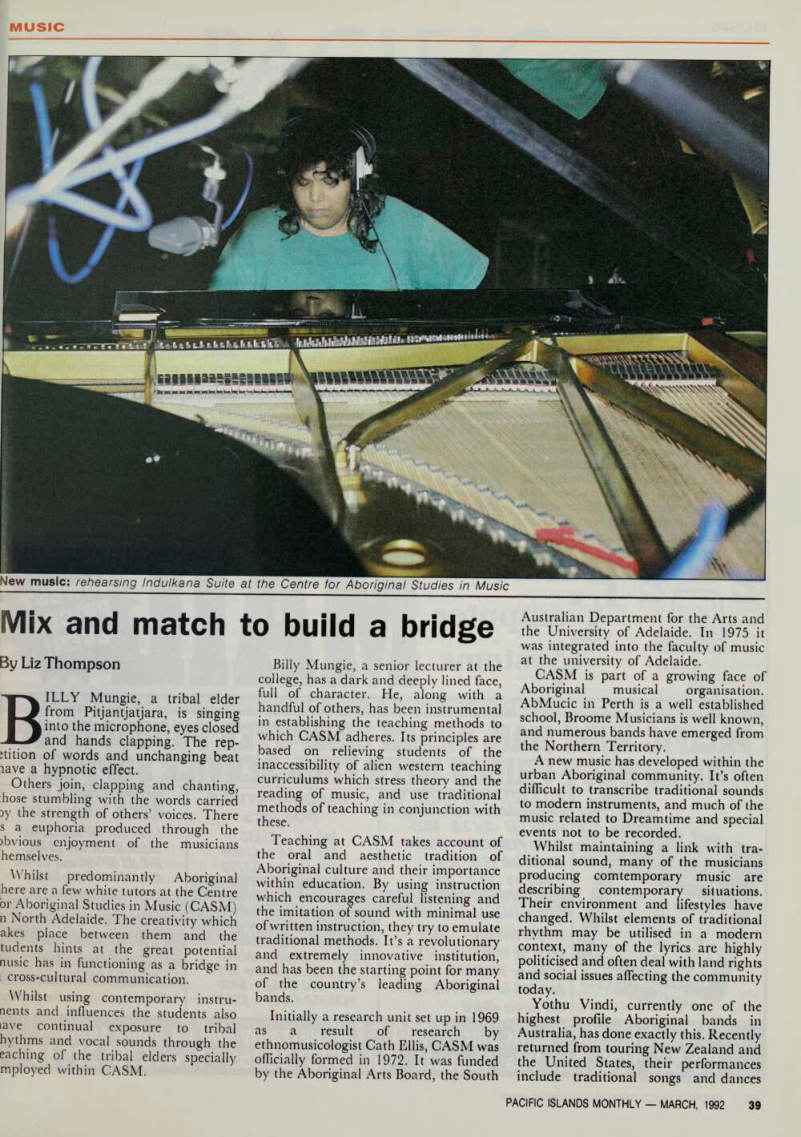

By Liz Thompson
Australian Department for the Arts and the University of Adelaide. In 1975 it was integrated into the faculty of music at the university of Adelaide.
CASM is part of a growing face of
Aboriginal musical organisation.
AbMucic in Perth is a well established school, Broome Musicians is well known, and numerous bands have emerged from the Northern Territory.
A new music has developed within the urban Aboriginal community. It’s often difficult to transcribe traditional sounds to modern instruments, and much of the music related to Dreamtime and special events not to be recorded.
Whilst maintaining a link with tra ditional sound, many of the musicians producing comtemporary music are describing contemporary situations.
Their environment and lifestyles have changed. Whilst elements of traditional rhythm may be utilised in a modern context, many of the lyrics are highly politicised and often deal with land rights and social issues affecting the community today.
Yothu Vindi, currently one of the
highest profile Aboriginal bands in
Australia, has done exactly this. Recently returned from touring New Zealand and the United States, their performances include traditional songs and dances
Billy Mungie, a senior lecturer at the college, has a dark and deeply lined face, full of character. He, along with a handful of others, has been instrumental in establishing the teaching methods to which CASM adheres. Its principles are based on relieving students of the inaccessibility of alien western teaching curriculums which stress theory and the reading of music, and use traditional methods of teaching in conjunction with these.
Teaching at CASM takes account of the oral and aesthetic tradition of Aboriginal culture and their importance within education. By using instruction which encourages careful listening and the imitation of sound with minimal use of written instruction, they try to emulate traditional methods. It’s a revolutionary and extremely innovative institution, and has been the starting point for many of the country’s leading Aboriginal bands.
Initially a research unit set up in 1969 as a result of research by ethnomusicologist Cath Ellis, CASM was officially formed in 1972. It was funded by the Aboriginal Arts Board, the South
BILLY Mungie, a tribal elder from Pitjantjatjara, is singing into the microphone, eyes closed and hands clapping. The rep etition of words and unchanging beat lave a hypnotic effect.
Others join, clapping and chanting, hose stumbling with the words carried )y the strength of others’ voices. There s a euphoria produced through the )bvious enjoyment of the musicians hemselves.
Whilst predominantly Aboriginal here are a few white tutors at the Centre or Aboriginal Studies in Music (CASM) n North Adelaide. The creativity which akes place between them and the tudents hints at the great potential nusic has in functioning as a bridge in cross-cultural communication.
Whilst using contemporary instru ments and influences the students also lave continual exposure to tribal hythms and vocal sounds through the caching of the tribal elders specially mployed within CASM.
New music: rehearsing Indulkana Suite at the Centre for Aboriginal Studies in Music
accompanied by an electrical rock sound, mixing drums and guitars with the Yidaki (didgeridoo). The name of the band, formed in 1986, means “Mother and Child” or “Children of the Earth”.
Since then they’ve been acclaimed at the 1988 South Pacific Arts Festival, and at Darwin’s inaugural Festival of Aborig inal Rock Music. They’ve toured in North America and represented Austra lia at the Cultural Olympics in South Korea in 1988.
Mundawuy Yunupingue, the band’s
lead singer, says all his music is derived from a traditional understanding. “I want my music to give others an understanding of Aboriginal life. In setting up this band my objective has been to try to combine together the music of the past with the music of the future. Everything is centred on tra ditional music, the rhythm and the beat.
We’re trying to bring about an indigen ous rhythm,” he says.
This is an interesting concept a unique, Australian sound drawing from the sound of indigenous music and bands like Yothu Yindi are experimenting with it. There’s an extraordinary incongruity when Yunupingue in jeans and a t-shirt plays bass, the drums beat in the background and two dancers in body
paint thrust spears, play clapsticks and
didgeridoo. Incongruous but fascinating.
Lima Nyi: Nyi , produced by CASM and performed at the Adelaide Univer sity in the 19705, was a superb example of this juxtaposition and exemplary of CASM’s aims. One of a traditional Dreaming series, it was adapted to celebrate the tribal elders having taken on the responsibility of teaching music to non-Aboriginal students as well as the traditional teaching of their own chil dren.
Lima, using traditional and contem porary instruments as well as voices, is a song which describes events in the travels of a large group of birds at the beginning of birds. These Nyi:Nyi:, having inter changeable human and bird character istics, set out from a place called Kuituwa in the corner of South Australia. The Lima Nyi.'Nyi is a song generally taught to children and the purpose, according to the elders, was so that we may learn to listen more carefully to the important aspects of their culture.
They believed that the teaching of children’s songs was most suitable to Europeans who had a very limited knowledge of their music. Incorporating traditional and contemporary sound, the Indulkana suite as it became known, was
an educational tool as well as an extremely innovative piece of music, forging old and new.
Whether it be in pieces of this nature, designed by the traditional elders within an urban music college, or contemporary bands such as Kuckles, Warupi Band, No Fixed Address and Yothu Yindi, who have all gained wide popularity, there is
an increasing and exciting amalga
mation of old and new sounds, using traditional and contemporary instru ments.
Institutions like CASM, which have been the starting point for many of the major Aboriginal bands, are committed to designing a new kind of music. Their teaching methods are about forging a link between the past and the future in
which Aboriginal and non-Aboriginal
musicians exchange information. Whilst learning from one another, Australia is coming up with its first uniquely Austra lian sound.
The incorporation of indigenous sound is a far cry from appropriated European sound, and it’s refreshing to find that Australia is establishing the beginnings of a musical identity of its own and that a lot of it is coming from an ancient tradition. □
Advertisements & other items, pp. 39-40 (3 items)
Music
Music
L^ystems
o Pr acme Q c m
Computer
sofmE-QmDm.AcmmcMm-Hmmmummm-BmamoMOHSfJtiNSfmioHSifMctmwmisonmtsuppoinmma PACIFIC WIDE MAIL ORDER COMPUTER PRODUCTS AT THE LOWEST PRICES WITH FULL SERVICE SUPPORT aa-^5 5-5 SW 5#
SOFTWARE SPECIALS
LOTUS 123 ■ Rel 23 ■ $825
WORD P[RFia 5.1 -$650
WORDSTAR V 6.0 ■ $595
D BASE IV-VI.I .$lOOO
WINDOWS 3.0
MOUSE/WINDOWSS32S
EXCEL hr WINDOWS -
WORD hr WINDOWS -
AM! PRO hr WIND
Call hr aay at hart!
IBM COMPATIBLE
DOS PC'S
286-16 ■ $1650 386 SX-16$1800 486 SX-33■ $2750
ALL SYSTEMS:
40Mb Hard Disk; IMb memory SVC A Colour Monitor
S2SFDD,2S, 1?. 1C
Electrical apply preblems?
Usa a battery UPS
PCM-250 (286) ■ $4OO
PCM-350 (386) ■ $5OO
W/S% HEWLETT
OL'EM PACKARD
LASER HP IllPaaly $2400 LASER HP 111 aaly $3700
INKJET HPSOO aaly $lOOO
INK JET SOOC aaly $lB5O
* All exclusive Pacific
distributorships
* Trade, Government and commercial enquiries welcome AH Pricing in Australian Dollars * Servicing the Pacific since 1980 * Full warranty and on going support PO Box 198, Port Vila, Vanuatu - Tel: (678) 25065 - Fax: (678) 22938
Pacific
Islands
Monthly
Business
Who’s making millions?
While 2500 StarKist workers reap a watered-down wage, its lone executive nets some hefty earnings
By David North
WHO do you suppose was paid more during 1990, the Mainland-based corporate boss of the StarKist tuna racking plant in American Samoa, or he 2500 people who work there?
Bear in mind that most of the people vho gut and clean the tuna have nigra ted to Pago Pago to do the work, ind arc covered by a watered-down version of the Mainland minimum wage, n short, they are not the worst-paid workers in the Islands.
Nevertheless, PIM estimates that the 500 production workers (mostly West m Samoans) were paid no more than 16,000 while the single executive re eived more than $75,000,000 that year.
Thai is not a typographical error, •ritish-born 7 ony O’Reilly, chairman of IJ. Heinz, which owns the StarKist lant and other food-producing oper tions around the globe, had a total □mpensation during Heinz’ 1990 fiscal ear of $75,084,622. More than 71,000,000 of that was because Heinz ad granted him a large number ofstock larket warrants, and when the share rice rose he secured a $71,000,000 rofit. The rest of his compensation was continuing flow of salary, pension sel ves, and other goodies worth 3,625,698. (This can be seen by reading te fine type of the company’s reports.) O’Reilly’s $75,000,000 haul will ap irently not be the highpoint of his
lancial career, according to Peg
Hara, a senior staff member at a Washington think tank, Investor Re lonsibility Research Center. She says at if things go reasonably well for einz, O’Reilly can use another batch of arrants to collect something like 150,000,000 in 1995. That’s four times
the annual budget of American Samoa, and more than the combined 1989 expenditures of Kiribati, Tuvalu, Tonga, Vanuatu, and Western Samoa.
It is against this background of corporate affluence that StarKist’s Washington lobbyists have been handed a tough assignment: to convince the Congress of the United States that Heinz cannot afford to raise the minimum wage for the 2500 workers in the Pago Pago tuna cannery.
StarKist’s team is not alone, however.
The other, slightly smaller cannery, Van Camp-Samoa Packing, is also opposed to increasing minimum wages from the current 52.92/hour; Van Camp’s hand is weakened, however, because its owner ship is in Indonesia (while Heinz’ is in the US).
A much more significant and vocal ally is Governor Peter Tali Coleman, who is an outspoken opponent of raising minimum wages in Samoa.
Minimum wage levels are set differently in American Samoa than they are in all other US jurisdictions. While the Mainland minimum wage of $4.25 an hour applies everywhere else, includ ing Guam, Puerto Rico and the US Virgin Islands, a special board sets minimum wages by industry in Ameri can Samoa. The minimum wage for the tuna canneries is now set at $2.92 an hour (see PIM, July 1991) although most workers get a few cents an hour more.
Recently the powerful chairman of the House of Representatives subcommittee controlling such legislation introduced a bill that would phase out the special treatment of American Samoa’s wages, and bring them up to the Mainland levels over three years. This move by Congressman Austin Murphy (D Pa.) would give most of the cannery workers roughly a dollar-an-hour increase spread over the next three years. (We got the
516,000,000 payroll by multiplying 2500 workers by 2000 hours a year probably a little generous by an estimated average wage of 53.20 an hour).
The last time an American Samoa minimum wage bill came before the Congress, StarKist and Van Camp had two allies that they have since lost,
Congressman Murphy and American
Samoan Congressman Eni F H Faleomavaega, who has since reluctantly accepted the existing minimum wage, out of the desire to keep the canneries in the area.
He now thinks, in general terms, that the minimum should be raised as well, though he has not yet committed himself to a specific formula such as Murphy’s.
In a letter to Murphy, for example, he pointed out: “American Samoa is the only jurisdiction in the US in which the federal minimum wage law does not apply. A clear example of the dispartiy under our current structure in the territory is apprentice carpenters who are paid less than $2.00 an hour while some attorneys make as much as 5125 an hour.” (Both Faleomaveaga and Murphy are lawyers.) Perhaps a greater self-confidence com ing from his thunderous re-election victory over Coleman’s ally, and Terri torial Treasurer, Ace Tago, in Novem ber, 1990, had something to do with the new position; in any case, he and Coleman have battled vigorously over the minimum wage bill, which may go to hearings later this year, Coleman was doubly incensed because of the timing of the announcement of the proposed labor legislation. He had worked out a deal with StarKist to exchange $2O million of additional in vestment in facilities improvements in return for yet another round of lax breaks, this time for 10 years. The Governor felt that the entire deal was being threatened by a change in the ground rules regarding wages. (As StarKist pointed out, Pago Pago’s tuna competes in American markets with tuna packed by low-wage workers in Thailand and Indonesia. The firm did not, how ever, discuss the size of the tariff barriers which help protect this product.) □
for Fijian
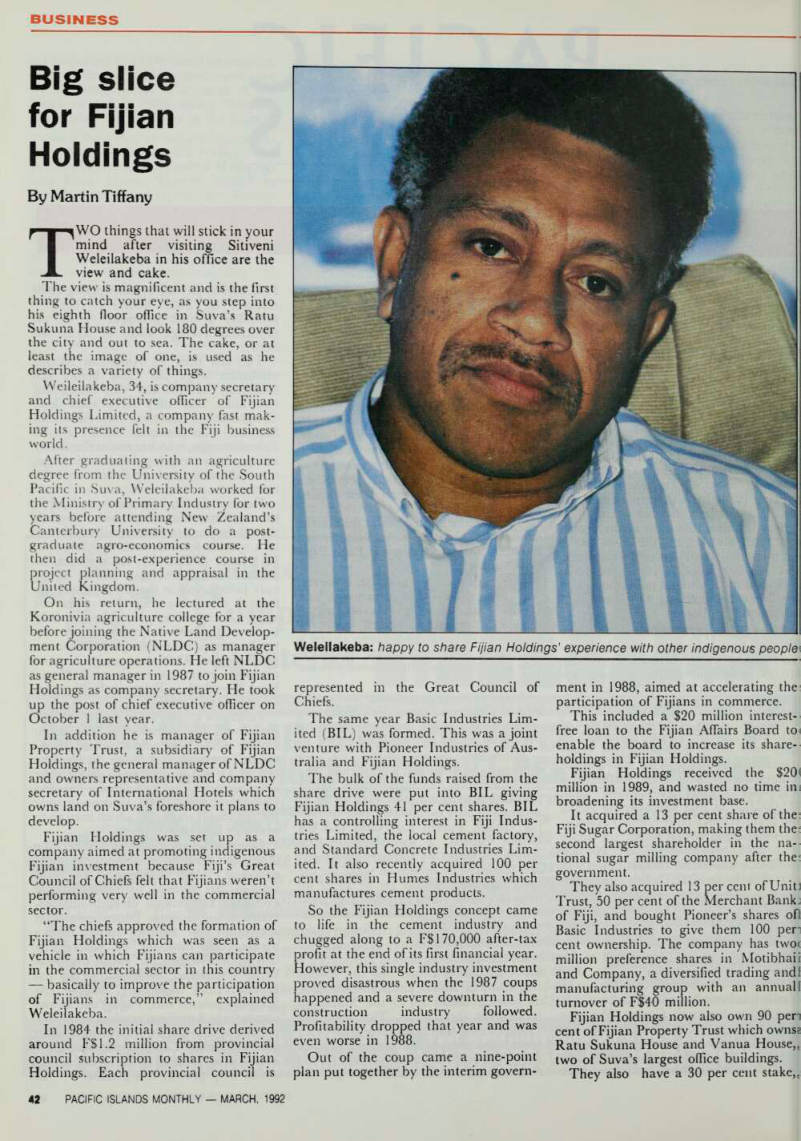
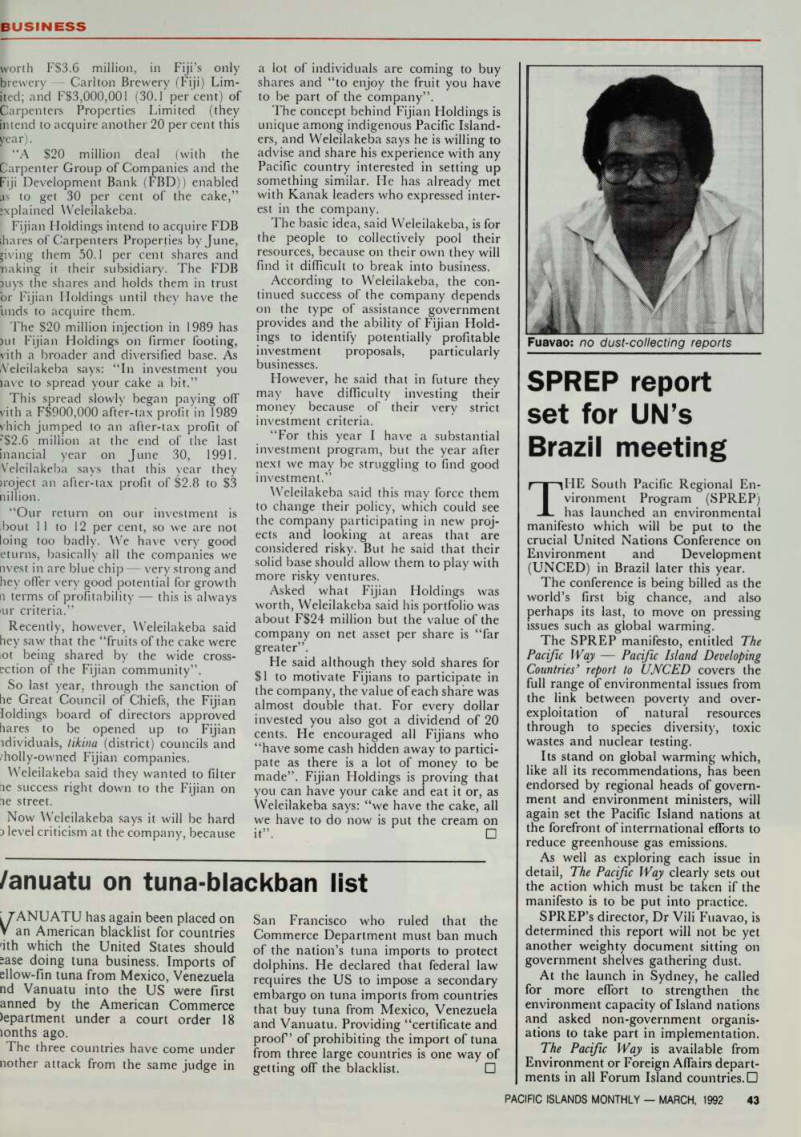
Big slice for Fijian Holdings
By Martin Tiffany
TWO things that will stick in your mind after visiting Sitiveni Weleilakeba in his office are the view and cake.
The view is magnificent and is the first thing to catch your eye, as you step into his eighth floor office in Suva’s Ratu Sukuna House and look 180 degrees over the city and out to sea. The cake, or at least the image of one, is used as he describes a variety of things.
Weileilakeba, 34, is company secretary and chief executive officer of Fijian Holdings Limited, a company fast mak ing its presence felt in the Fiji business world.
After graduating with an agriculture degree from the University of the South Pacific in Suva, Weleilakeba worked for the Ministry of Primary Industry for two years before attending New Zealand’s Canterbury University to do a post graduate agro-economics course. He then did a post-experience course in project planning and appraisal in the United Kingdom.
On his return, he lectured at the Koronivia agriculture college for a year before joining the Native Land Develop ment Corporation (NLDC) as manager for agriculture operations. He left NLDC as general manager in 1987 to join Fijian Holdings as company secretary. He took up the post of chief executive officer on October 1 last year.
In addition he is manager of Fijian Property Trust, a subsidiary of Fijian Holdings, the general manager of NLDC and owners representative and company secretary of International Hotels which owns land on Suva’s foreshore it plans to
develop.
Fijian Holdings was set up as a company aimed at promoting indigenous Fijian investment because Fiji’s Great Council of Chiefs felt that Fijians weren’t performing very well in the commercial sector.
“The chiefs approved the formation of Fijian Holdings which was seen as a vehicle in which Fijians can participate in the commercial sector in this country basically to improve the participation of Fijians in commerce,” explained Weleilakeba.
In 1984 the initial share drive derived around FSI.2 million from provincial council subscription to shares in Fijian Holdings. Each provincial council is
represented in the Great Council of Chiefs.
The same year Basic Industries Lim ited (BIL) was formed. This was a joint venture with Pioneer Industries of Aus
tralia and Fijian Holdings.
The bulk of the funds raised from the share drive were put into BIL giving Fijian Holdings 41 per cent shares. BIL has a controlling interest in Fiji Indus tries Limited, the local cement factory, and Standard Concrete Industries Lim ited. It also recently acquired 100 per cent shares in Humes Industries which manufactures cement products.
So the Fijian Holdings concept came to life in the cement industry and chugged along to a F$ 170,000 after-tax profit at the end of its first financial year.
However, this single industry investment proved disastrous when the 1987 coups happened and a severe downturn in the construction industry followed.
Profitability dropped that year and was even worse in 1988.
Out of the coup came a nine-point plan put together by the interim govern
ment in 1988, aimed at accelerating the; participation of Fijians in commerce.
This included a $2O million interest free loan to the Fijian Affairs Board to< enable the board to increase its share holdings in Fijian Holdings.
Fijian Holdings received the $2O( million in 1989, and wasted no time ini broadening its investment base.
It acquired a 13 per cent share of the;
Fiji Sugar Corporation, making them the;
second largest shareholder in the na tional sugar milling company after the; government.
They also acquired 13 per cent of Unit j Trust, 50 per cent of the Merchant Bank, of Fiji, and bought Pioneer’s shares ofl Basic Industries to give them 100 pen cent ownership. The company has twoc million preference shares in Motibhaii and Company, a diversified trading and! manufacturing group with an annual I turnover of Fs4o million.
Fijian Holdings now also own 90 pen cent of Fijian Property Trust which ownsz Ratu Sukuna House and Vanua House,* two of Suva’s largest office buildings.
They also have a3O per cent stake,*
Welellakeba: happy to share Fijian Holdings' experience with other indigenous peoples
worth F 53.6 million, in Fiji’s only brewery Carlton Brewery (Fiji) Lim ited; and F 53,000,001 (30.1 percent) of Carpenters Properties Limited (they intend to acquire another 20 per cent this
pear).
“A $2O million deal (with the
Carpenter Group of Companies and the
Fiji Development Bank (FBD)) enabled us to get 30 per cent of the cake,” explained Weleilakeba.
Fijian Holdings intend to acquire FDB
ihares of Carpenters Properties by June,
living them 50.1 per cent shares and naking it their subsidiary. The FDB mys the shares and holds them in trust or Fijian Holdings until they have the linds to acquire them.
The $2O million injection in 1989 has nit Fijian Holdings on firmer footing, vith a broader and diversified base. As iVelcilakeba says: “In investment you lave to spread your cake a bit.”
This spread slowly began paying off vith a F 5900,000 after-tax profit in 1989 vhich jumped to an after-tax profit of r 52.6 million at the end of the last inancial year on June 30, 1991.
Veleilakeba says that this year they iroject an after-tax profit of $2.8 to $3 nillion.
“Our return on our investment is bout 11 to 12 per cent, so we are not loing too badly. We have very good eturns, basically all the companies we iivest in are blue chip very strong and hey offer very good potential for growth ii terms of profitability this is always ur criteria.”
Recently, however, Weleilakeba said hey saw that the “fruits of the cake were ot being shared by the wide cross ection of the Fijian community”.
So last year, through the sanction of he Great Council of Chiefs, the Fijian loldings board of directors approved hares to be opened up to Fijian idividuals, tikina (district) councils and
wholly-owned Fijian companies.
Weleilakeba said they wanted to filter he success right down to the Fijian on he street.
Now Weleilakeba says it will be hard i level criticism at the company, because
a lot of individuals are coming to buy shares and “to enjoy the fruit you have to be part of the company”.
The concept behind Fijian Holdings is unique among indigenous Pacific Island ers, and Weleilakeba says he is willing to advise and share his experience with any Pacific country interested in setting up something similar. He has already met with Kanak leaders who expressed inter est in the company.
The basic idea, said Weleilakeba, is for the people to collectively pool their resources, because on their own they will find it difficult to break into business.
According to Weleilakeba, the con tinued success of the company depends on the type of assistance government provides and the ability of Fijian Hold ings to identify potentially profitable
investment proposals, particularly
businesses.
However, he said that in future they may have difficulty investing their money because of their very strict investment criteria.
“For this year I have a substantial investment program, but the year after next we may be struggling to find good investment.”
Weleilakeba said this may force them to change their policy, which could see the company participating in new proj ects and looking at areas that are considered risky. But he said that their solid base should allow them to play with more risky ventures.
Asked what Fijian Holdings was worth, Weleilakeba said his portfolio was about Fs24 million but the value of the company on net asset per share is “far greater”.
He said although they sold shares for SI to motivate Fijians to participate in the company, the value of each share was almost double that. For every dollar invested you also got a dividend of 20 cents. He encouraged all Fijians who “have some cash hidden away to partici pate as there is a lot of money to be
made”. Fijian Holdings is proving that
you can have your cake and eat it or, as Weleilakeba says: “we have the cake, all we have to do now is put the cream on it”. □
Vanuatu on tuna-blackban list
has again been placed on V an American blacklist for countries ith which the United States should ~ase doing tuna business. Imports of ellow-fin tuna from Mexico, Venezuela nd Vanuatu into the US were first anned by the American Commerce lepartment under a court order 18 lonths ago.
The three countries have come under nother attack from the same judge in
San Francisco who ruled that the Commerce Department must ban much of the nation’s tuna imports to protect dolphins. He declared that federal law requires the US to impose a secondary embargo on tuna imports from countries that buy tuna from Mexico, Venezuela and Vanuatu. Providing “certificate and proof’ of prohibiting the import of tuna from three large countries is one way of getting off the blacklist. □
Brazil meeting
SPREP report set for UN’s Brazil meeting
THE South Pacific Regional En vironment Program (SPREP) has launched an environmental manifesto which will be put to the crucial United Nations Conference on Environment and Development (UNCED) in Brazil later this year.
The conference is being billed as the world’s first big chance, and also perhaps its last, to move on pressing issues such as global warming.
The SPREP manifesto, entitled The Pacific Way Pacific Island Developing Countries * report to UNCED covers the full range of environmental issues from the link between poverty and over exploitation of natural resources through to species diversity, toxic wastes and nuclear testing.
Its stand on global warming which, like all its recommendations, has been endorsed by regional heads of govern ment and environment ministers, will again set the Pacific Island nations at the forefront of international efforts to reduce greenhouse gas emissions.
As well as exploring each issue in detail, The Pacific Way clearly sets out the action which must be taken if the manifesto is to be put into practice.
SPREP’s director, Dr Vili Fuavao, is determined this report will not be yet another weighty document sitting on government shelves gathering dust.
At the launch in Sydney, he called for more effort to strengthen the environment capacity of Island nations and asked non-government organis ations to take part in implementation.
The Pacific Way is available from Environment or Foreign Affairs depart ments in all Forum Island countries. □
Fuavao: no dust-collecting reports
Advertisements & other items, p. 44 (1 item)
Stylish and Compact
CO PIONEER
The Art of Entertainment
In today's active society, a compact and modular Hi-Fi component stereo system is the perfect answer to home entertainment. The Contempo series gives you all you could ask for in both convenience and sound quality, as well as a stylish design that complements your living space.
Hi-Fi Compact System
In spile of ils compact design, Contempo is pack ed with a variclv of high-tech features that prod uce high-qualit\ sound in almost anv listening s pace. Contempo s specialls engineered function s compensate for the loss of sound presence in I imiled spaces. As a result, Contempo sound is c risp and clear, no matter where sou are in the r oom. What's more. Pioneer Smart Operation c apabililies make the Contempo ssstem simple to use. A touch of the START/SET button and I he ststem delivers qualilv hi-fi sound. Various Contempo models will suit almost any taste with a choice of Single. Tw in and Multi-play CO capabilities. And all of the Contempo m odels emplov 1-Bit DEC (Direct Linear Con version) technology for extremely high-qu alitv sound. Add to this an ASES (Auto Sy nchronized Editing Svstem) provided on t he Double Auto-Reverse Cassette Deck th at lets vou program Contempo to automat
ically create professional-sounding cassetl
e recordings. All of this makes Contempo t he ideal personal entertainment system. In spite of ils compact design, Contempo is p acked with a variety of high-tech features that produce high-qualitv sound in almos I any listening space. Contempo' s specia lly engineered functions compensate for the loss of sound presence in limited sp aces. As a result, Contempo sound is cr isp and clear, no matter where you are in the room. What's more, Pioneer Sm art Operation capabilities make the C onlempo system simple to use. A touch of I he START/SET button and the system deliv ers quality hi-fi sound. Various Contempo models will suit almost any taste with a c hoice of Single, Twin and Multi-play CD capabilities. And all of the Contempo models employ 1-Bil DEC (Direct Li near Conversion) technology for e xtremely high-quality sound. Add to this an ASES (Auto Synchroniz ed Editing System) provided on t he Double Auto-Reverse Casse tie Deck that lets you progr am Contempo to automat icallv creaf professionalsounding cassette recor dings. All of this makes Contempo the ideal pe rsonal entertainment system. In spite of ils co mpact design, Conlemp o is packed with a variet y of high-tech features that produce high-quality sound in almost any listening space. Coni empo's specially engineered fundi ons compensate for the loss of sou nd presence in limited spaces. As a result, Contempo sound is crisp an d clear, no matter where you are in the room . What's more. Pioneer Smart Operation capa bilities make the Contempo sy stem simple to u se. A touch of the START/SET button and the system delivers quality hi-fi sound. Various Conte mpo models will suit almost any taste with a cho ice of Single, Twin and Multi-play CD capabilities And all of the Contempo models emplov I -Bit D EC (Direct Linear Conversion) technology for extr emely high-quality sound. Add to this an ASES (A uto Synchronized Editing System) provided on t he Double Auto-Reverse Cassette Deck that let s you program Contempo to automatically ere
ale professional-sounding cassette recordings.
All of this makes Contempo the ideal personal e ntertainment system. In spite of its compact des ign, Contempo is packed with a variety of higb-t ech features that produce high-qualitv sound in almost any listening space. Contempo's speciallyengineered functions compensate for the loss of sound presence in limited spaces. As a re suit, Contempo sound is crisp and clear, no matter where you are in the room.
What's more. Pioneer Smart Opera lion capabilities make the Conte mpo system simple to use. A t ouch of the START/SET b ulton and the system
delivers quality
hi-fi sound.
Various Co X-P77 305 W
(PMPO)
will suit almost any taste with a choice of Singl e. Twin and Multi-play CD capabilities. And all of the Contempo models employ 1 -Bit DEC (Di reel Linear Conversion) technology for extrem ely high-quality sound. Add to this an ASES (A uto Synchronized Editing System) provided o ‘n the Double Auto-Reverse Cassette Deck Ih at lets you program Contempo to automatic ally create professional-sounding cassette r ecordings. All of this makes Contempo the ideal personal entertainment system. In sp ile of ils compact design, Contempo is pa eked with a variety of high-tech features that produce high-quality sound in aim ost any listening space. Contempo > sp ecially engineered functions compensa le for the loss of sound presence in lim ited spaces. As a result, Contempo sou nd is crisp and clear, no matter where you are in the room. What's more, Pion eer Smart Operation capabilities make t he Contempo system simple to use. In s pile of its compact design, Contempo is pack ed with a variety of high-tech fea lures that produce high-quality sound i n almost any listening space. Conlemp o’s specially engineered functions com pensale for the loss of sound presence in limited spaces. As a result. Conte mpo sound is crisp and clear, no ma ■ 305 W (PMPO) ■ Digital sound field
processor ■ L.P.S. (Listening Point
Selector) ■ One-touch KARAOKE (Vocaf
Cancel) ■ Sound jog dial for sound
control and S.F.C. effect ■ Auto
Synchronized Editing System (A.S.E.S.) (
ready ■ P.Bass (Power Bass)
* X-P55/X-PSSM (305 W PMPO), X-P33 (21OW PMPO) arm X-Pll (200 W PMPO) Contempo models are also available
For further information, please contact:
Australia: Pioneer Electronics Australia Pty. Ltd. (Incorporated in Victoria), 178- 184 Boundary Road, Braeside Victoria 3195 Tel; 580-9911 Fiji Islands: Brijlal & Company, G.P.O. Box No. 362, Suva, Fiji Islands Tel; 22258 New Zealand: Monaco Corporation Ltd., 41 Poland Road, Glenfield, Auckland,
New Zealand Tel: (09)444-9144
Norfolk Island: Burnt Pine Traders Ltd., P.O. Box 21, Norfolk Island Vanuatu: Burns Philp (Vanuatu) Ltd., Vila, Vanuatu Nauru Island: Jacob Enterprises, P.O. Box N 0.4, Republic of Nauru Tahiti: Tahiti Hi-Fi, P.O. Box 848, Papeete, Tahiti New Caledonia: Menard Pacifique Sari, B.P. 3899, Noumea, New Caledonia
Tel: 27-62-23
American Samoa: Transpac Corporation, P.O. Box 1477, Pago Pago, Americio
Samoa 96799 Tel: 633-5224
Rarotonga: South Seas International Ltd., P.O. Box 49, Rarotonga, Cook Islam
Tel: 2327
Thaw in relations on many fronts
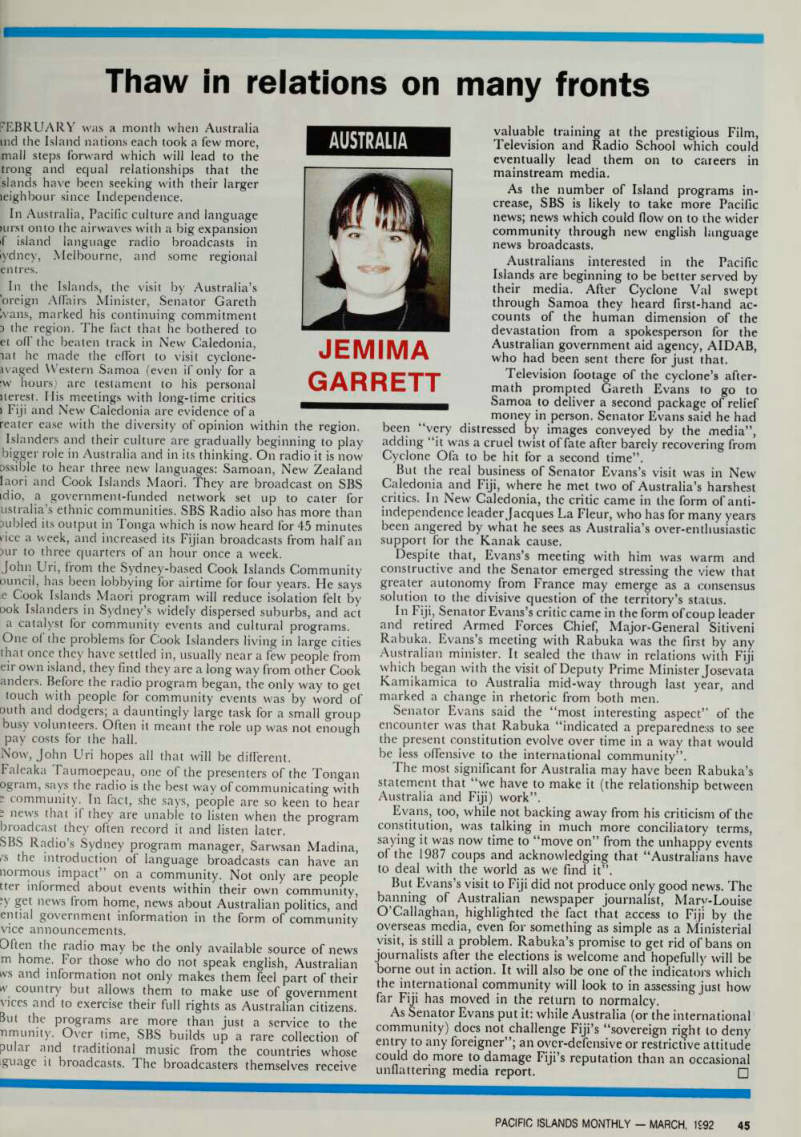
Australia
reatcr ease with the diversity of opinion within the region.
Islanders and their culture are gradually beginning to play bigger role in Australia and in its thinking. On radio it is now Dssible to hear three new languages: Samoan, New Zealand laori and Cook Islands Maori. They are broadcast on SBS idio, a government-funded network set up to cater for ustralia’s ethnic communities. SBS Radio also has more than xibled its output in Tonga which is now heard for 45 minutes dee a week, and increased its Fijian broadcasts from half an >ur to three quarters of an hour once a week.
John Uri, from the Sydney-based Cook Islands Community ouncil, has been lobbying for airtime for four years. He says e Cook Islands Maori program will reduce isolation felt by □ok Islanders in Sydney’s widely dispersed suburbs, and act a catalyst for community events and cultural programs.
One of the problems for Cook Islanders living in large cities that once they have settled in, usually near a few people from eir own island, they find they are a long way from other Cook anders. Before the radio program began, the only way to get touch with people for community events was by word of Quth and dodgers; a dauntingly large task for a small group busy volunteers. Often it meant the role up was not enough pay costs for the hall.
Now, John Uri hopes all that will be different.
Faleaka Taumoepeau, one of the presenters of the Tongan ogram, says the radio is the best way of communicating with s community. In fact, she says, people are so keen to hear - news that if they are unable to listen when the program broadcast they often record it and listen later.
SBS Radio’s Sydney program manager, Sarwsan Madina, /s the introduction of language broadcasts can have an noi mous impact on a community. Not only are people tter informed about events within their own community, ; y £ et news from home, news about Australian politics, and ential government information in the form of community vice announcements.
Often the radio may be the only available source of news m home. For those who do not speak english, Australian m and information not only makes them feel part of their w , country but allows them to make use of government vices and to exercise their full rights as Australian citizens.
But the programs are more than just a service to the nmunity. Over time, SBS builds up a rare collection of pular and traditional music from the countries whose guage it broadcasts. The broadcasters themselves receive
FEBRUARY was a month when Australia md the Island nations each took a few more, mall steps forward which will lead to the trong and equal relationships that the islands have been seeking with their larger leighbour since Independence.
In Australia, Pacific culture and language mrst onto the airwaves with a big expansion >f island language radio broadcasts in Sydney, Melbourne, and some regional entres.
In the Islands, the visit by Australia’s 'oreign Affairs Minister, Senator Gareth Ivans, marked his continuing commitment j the region. The fact that he bothered to et of]' the beaten track in New Caledonia, lat he made the effort to visit cyclone avaged Western Samoa (even if only for a ;w hours) are testament to his personal ilerest. His meetings with long-time critics i Fiji and New Caledonia are evidence of a
valuable training at the prestigious Film, Television and Radio School which could eventually lead them on to careers in mainstream media.
As the number of Island programs in crease, SBS is likely to take more Pacific news; news which could flow on to the wider
community through new english language
news broadcasts.
Australians interested in the Pacific Islands are beginning to be better served by their media. After Cyclone Val swept through Samoa they heard first-hand ac counts of the human dimension of the devastation from a spokesperson for the Australian government aid agency, AIDAB, who had been sent there for just that.
Television footage of the cyclone’s after math prompted Gareth Evans to go to Samoa to deliver a second package of relief money in person. Senator Evans said he had
been “very distressed by images conveyed by the media”, adding “it was a cruel twist of fate after barely recovering from Cyclone Ofa to be hit for a second time”.
But the real business of Senator Evans’s visit was in New Caledonia and Fiji, where he met two of Australia’s harshest critics. In New Caledonia, the critic came in the form of anti independence leader Jacques La Fleur, who has for many years been angered by what he sees as Australia’s over-enthusiastic support for the Kanak cause.
Despite that, Evans’s meeting with him was warm and constructive and the Senator emerged stressing the view that greater autonomy from France may emerge as a consensus solution to the divisive question of the territory’s status.
In Fiji, Senator Evans’s critic came in the form ofcoup leader and retired Armed Forces Chief, Major-General Sitiveni Rabuka. Evans’s meeting with Rabuka was the first by any Australian minister. It sealed the thaw in relations with Fiji which began with the visit of Deputy Prime Minister Josevata Kamikamica to Australia mid-way through last year, and marked a change in rhetoric from both men.
Senator Evans said the “most interesting aspect” of the encounter was that Rabuka “indicated a preparedness to see the present constitution evolve over time in a way that would be less offensive to the international community”.
The most significant for Australia may have been Rabuka’s statement that “we have to make it (the relationship between Australia and Fiji) work”.
Evans, too, while not backing away from his criticism of the constitution, was talking in much more conciliatory terms, saying it was now time to “move on” from the unhappy events of the 1987 coups and acknowledging that “Australians have to deal with the world as we find it”.
But Evans’s visit to Fiji did not produce only good news. The banning of Australian newspaper journalist, Mary-Louise O’Callaghan, highlighted the fact that access to Fiji by the overseas media, even for something as simple as a Ministerial visit, is still a problem. Rabuka’s promise to get rid of bans on journalists after the elections is welcome and hopefully will be borne out in action. It will also be one of the indicators which the international community will look to in assessing just how far Fiji has moved in the return to normalcy.
As Senator Evans put it: while Australia (or the international community) docs not challenge Fiji’s “sovereign right to deny entry to any foreigner”; an over-defensive or restrictive attitude could do more to damage Fiji’s reputation than an occasional unflattering media report. □
Jemima
Garrett
Advertisements & other items, p. 46 (1 item)
Kinhill Kramer
Professional Project Managers Consulting Engineers Architects Surveyors
edibility. ..continuity...
commitment.. .quality.. .excellence arc all terms synonymous with Papua New Guinea's leading engineering consultant.
mu iimi
till Illli
IS mins - Papua New Guinea Solomon Islands Fiji Head Office Port Moresby
KINHILL KRAMER PTY LTD.,
Kinhill Kramer Building Cnr Islander Drive & Wards Road
HOHOLA
National Capital District
PO Box 1948, BOROKO,
Papua New Guinea Telephone (675) 256033 Facsimile (675) 211049
Telex CAMAKRA NE 23050
KINHILL KRAMER (SOLOMON ISLANDS)
Fourth Floor NPF Building Mendana Avenue PO Box 377 Honiara, Solomon Islands Telephone (677) 21996 Facsimile (677) 22190 Vanuatu
KINHILL KRAMER (VANUATU) LTD.,
Ist FLoor, Drugstore Building Kumul Highway P.O. Box 96, Port Vila Vanuatu Telephone (678) 23 457 Facsimile (678) 22455
LTD KINHILL KACIMAIWAI PTY LTD
First Floor, 6-12 Andrews Street, Nadi Fiji Islands PO Box 9213 Nadi Airport, Fiji Islands Telephone (679) 780033 Facsimile (679) 780131 Australia Head Office Adelaide
KINHILL ENGINEERS PTY. LTD.,
200 East Terrace, GPO Box 2702, Adelaide South Australia 5001 Telephone (08) 2237011 Facsimile (08) 2320163 Telex AA82364 A MEMBER OF THE Stiililifci. GROUP OF COMPANIES
Nabbed!
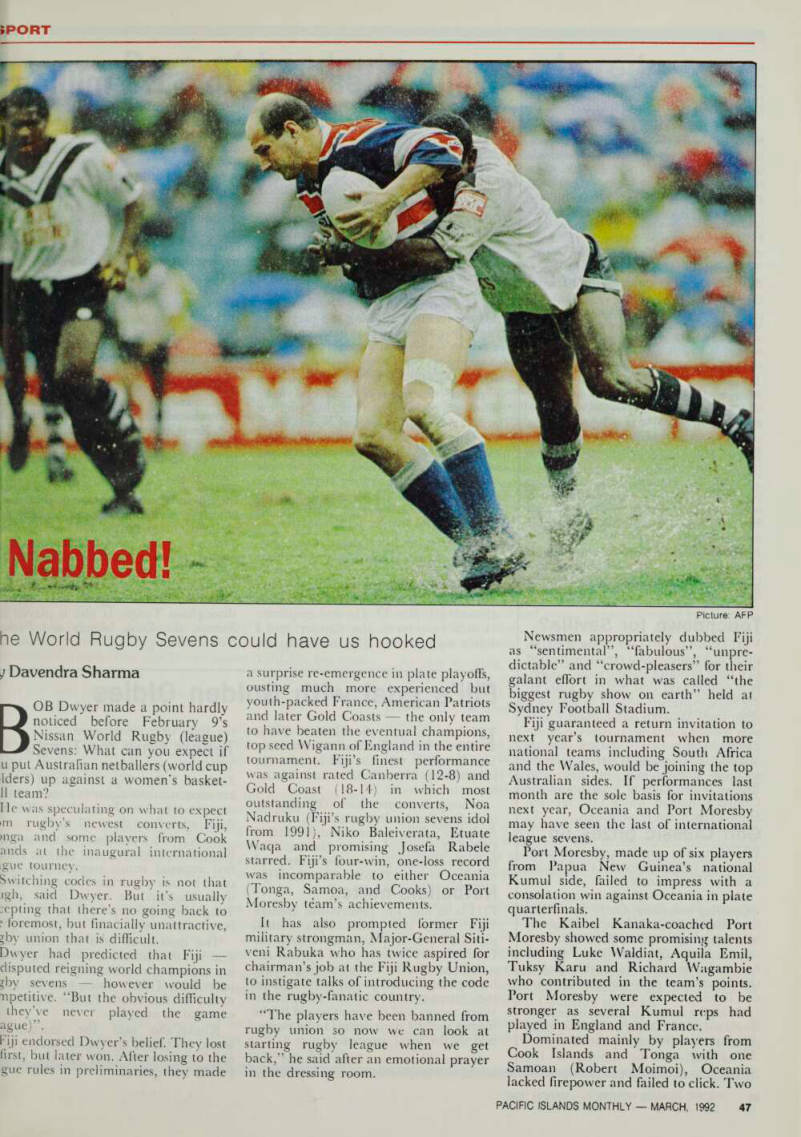
Sport
he World Rugby Sevens could have us hooked
Davendra Sharma
808 Dwyer made a point hardly noticed before February 9’s Nissan World Rugby (league) Sevens: What can you expect if u put Australian netballers (world cup Iders) up against a women's basket -11 team?
Me was speculating on what to expect •m rugby’s newest converts, Fiji, mga and some players from Cook ands at the inaugural international iguc tourney.
Switching codes in rugby is not that igh, said Dwyer. But it’s usually jepting that there’s no going back to - foremost, but fmacially unattractive, *by union that is difficult.
Dwyer had predicted that Fiji disputed reigning world champions in sevens however would be npetitive. “But the obvious difficulty they’ve never played the game ague)”. f iji endorsed Dwyer’s belief. They lost first, but later won. After losing to the guc rules in preliminaries, they made
a surprise re-emergence in plate playoffs, ousting much more experienced but youth-packed France, American Patriots and later Gold Coasts - the only team to have beaten the eventual champions, top seed Wigann of England in the entire tournament. Fiji’s finest performance was against rated Canberra (12-8) and Gold Coast (18-14) in which most outstanding of the converts, Noa Nadruku (Fiji’s rugby union sevens idol from 1991), Niko Baleiverata, Etuate Waqa and promising Josefa Rabele starred. Fiji’s four-win, one-loss record was incomparable to either Oceania (Tonga, Samoa, and Cooks) or Port Moresby team’s achievements.
It has also prompted former Fiji
military strongman, Major-General Siti
veni Rabuka who has twice aspired for chairman’s job at the Fiji Rugby Union, to instigate talks of introducing the code in the rugby-fanatic country.
“The players have been banned from rugby union so now we can look at starting rugby league when we get back,” he said after an emotional prayer in the dressing room.
Newsmen appropriately dubbed Fiji as sentimental , “fabulous , “unpre dictablc” and “crowd-pleasers” for their |am e(lbrt in what H was ca ed .< the iggest rugby show on earth - he d a( Sydney Football Stadium, Fiji guaranteed a return invitation to nex , year’s tournament when more nation ', teams induding Soutl. Africa and the Wa , wou|d be s joining lhe top Australian sides. If performances last month are the sole basis for invitations next year, Oceania and Port Moresby may have seen the last of international league sevens.
Port Moresby, made up of six players from Papua New Guinea’s national Kumul side, failed to impress with a consolation win against Oceania in plate quarterfinals.
The Kaibel Kanaka-coached Port Moresby showed some promising talents including Luke Waldiat, Aquila Emil, Tuksy Karu and Richard Wagambie who contributed in the team’s points, Port Moresby were expected to be st , ron g, er as several Kumul reps had ph'jyed 111 England and France.
Dominated mainly by players from ? ° ok Islai l ds L and Ton S a with one bamoan (Robert Moimoi), Oceania lacked firepower and failed to click. Two
Picture: AFP
Samoan players withdrew last minute after the national rugby union threatened to do what Fiji did: impose a life ban.
Apart from Fiji and Cup winners, Wigan a Wellington side composed of several Pacific islanders and which qualified for the World Sevens after winning a 36-team national lournamment - did not win a match. • Wigan’s Martin Ofliah who was undoubtedly without a peer as an expert of league sevens was the lone choice for the man of the series award.
The Englishman scored 10 tries, including all ofWigan’s four in the final to beat Brisbane, 18-6. • Tonga’s Willie ’Ofahengaue is to be the first Tongan player to play rugby union in South Africa legally this year.
He has two chances to do that:first he can take up an invitation to play for the Transvaal Club against the South African Barbarians, or alternatively win selection in Dwyer’s Australian squad which will play Tests in that country, where players from Tonga, Samoa and Fiji have been part of two recent rebel tours.
Willie ’O injured his neck while playing for Sydney Downunders in a sevens tournament in Western Samoa last month and was to be sidelined for
a fortnight.
The backrow powerhouse was heavily tackled by three players at tempting to prevent him from scoring the second of his two tries in the match. □
Touchdown for Seville?
VISITORS to this year’s World Expo sition in Seville, Spain could be treated to a taste of South Pacific rugby union.
It is understood that Spanish authori ties have expressed interest in getting a team from Western Samoa and Fiji to play while Expo is on. Interest in South Pacific rugby was started among
Spaniards following Western Samoa’s
exciting performance in last year Rugby World Cup in France and the United Kingdom which saw Western Samoa reach the quaterfinals. □
Golf Classic prizes up
PRIZE money and amateur trophies have been increased for the 1992 Pacific Harbour Golf Classic.
Col. Paul Manueli, chairman of the sponsoring company, Cable and Wire less (Pacific) Ltd, said the prize money had been increased to $50,000 and a once only $25,000 hole-in-one for the first professional to achieve this distinc tion. There also is an amateur hole-in
one trophy.
Overall amateur trophies have been increased to 38 categories and the social programme is being expanded.
The field will be limited to 168 players. □
Willie ’0 says no to $1.2 million
WOULD you spurn $1.2 million for anything? Tonga’s power house rugby international, Viliami ’Ofahengaue did.
The big bustling Tongan-born
breakway known as “Willy ’O”, declined the money for turning to rugby league from his favourite, rugby union.
Ofahengaue, who was instrumental in the Australian Wallabies’ triumph in the Rugby World Cup, turned down the offer to stay on in rugby union, which has made him immensely popular in Austra lia and world-wide. Rugby union offic ials are terrified of losing top players to rugby league, which pays handsomely for a player’s ability and performance.
Willie ’O is the Tongan 1.9 metre, 100 kg powerhouse known in Australian rugby circuits as one of the several rugby union players sought after they won the prestigious World Cup last November 2.
His lawyer, Kahu Baron-Afeake, at first claimed that ’Ofahengaue was “99 per cent sure” of signing a three-year contract with top Sydney rugby league club, St George. “It will put him in the top 10 or 15 players in Australia for earnings,” his lawyer told reporters.
But pressure from rugby union col leagues and his Manly Club, which took him in after he was stranded in Australia a few years ago travelling with the New Zealand youth team, is believed to have dissuaded Willie ’O. He told enquirers: “I didn’t say no to him (lawyer) and I didn’t say yes. But I’ve made up my
mind that I don’t want to play rugby 1 league, no matter what the money is. It’s; not my game, and I don’t think I would I like it much.”
St George officials stayed confident of Willie ’O joining them. Coach Brian; Smith said they forked out SAI.S million; specially for Willie ’O. “It’s no big secret that we had discussions with him. The 1 money’s available if he joined us.” The: money was to be given as salary.
His stardom at the cup final at Twickenham last year earned him popu larity. Tongan Rugby Union officials; invited him to play in a President’s XV against a visiting New Zealand XV in January, When he returned to Sydney,, he was immediately told of a New South; Wales state camp on Februry 7-9.
Willie ’O joined the Sydney Manly
club after he was left stranded in; Australia while visiting the country with; the New Zealand rugby union youth; team. He did not have a visa to return; to New Zealand. Manly club has since; developed contacts with Willie O’s; homeland, where it toured for an; invitation Sevens tournament this year.
Manly president lan Macdonald, claimed that Willie O had spoken; “warmly about his enjoyment playing; rugby union for Australian and that he; was looking forward to resuming his;
representative career this year”.
Since 1988, league has spread! throughout Tonga. It also is played in; Samoa, the Cook Islands and Papua.
New Guinea. □
Fiji’s goal with Golden Oldies
FIJI is to host the Golden Oldies World Rugby Festival in September.
The Republic won the bid to host the festival over New Zealand and Austra lia.
Among the more than 1000 players, including former internationals, will be Australia’s Ella brothers and All Blacks Colin Meads and Andy Dalton. The festival will last five days, and is expected to bring at least SUS 3 million for Fiji.
Netballers netted
FIJI is to host the 1992 World Netball Youth Cup next June. Fiji’s netball president Nasiki Waqanaceva said the International Federation of Netball As sociations, the world governing body, have given Fiji the go-ahead to organise the international netball compeition.
Waqanaceva said the event would be the biggest netball tournament to be organ ised by the local association.
Under 21 teams from around the world will contest for the top honours in
the June 1992 tournament.
Tennis time for Tonga
TENNIS teams from Australia, New 1 Zealand, Tahiti, Fiji, Samoa and Tongaj are expected to compete in a tournament] organised by the Tonga Lawn Tennis; Association from April 17 to 25.
Association president Talanoafukaj Kitekei’aho said the event was one of the; first regional tennis tournaments, andl could become a tourism drawcard. Asked J if he thought the event could make; Tonga the tennis capital of the region, he* laughed but said it was a nice I bought..
The association held the event last] year but the number of competing teams? has expanded considerably. This year aj team from Tahiti, which won the gold I medal in the South Pacific Games, is? expected to attend.
Kitekei’aho said the tournament] would be played on the six three-year old, hard courts built for the South i
Pacific Minigames.
Days of handouts are numbered
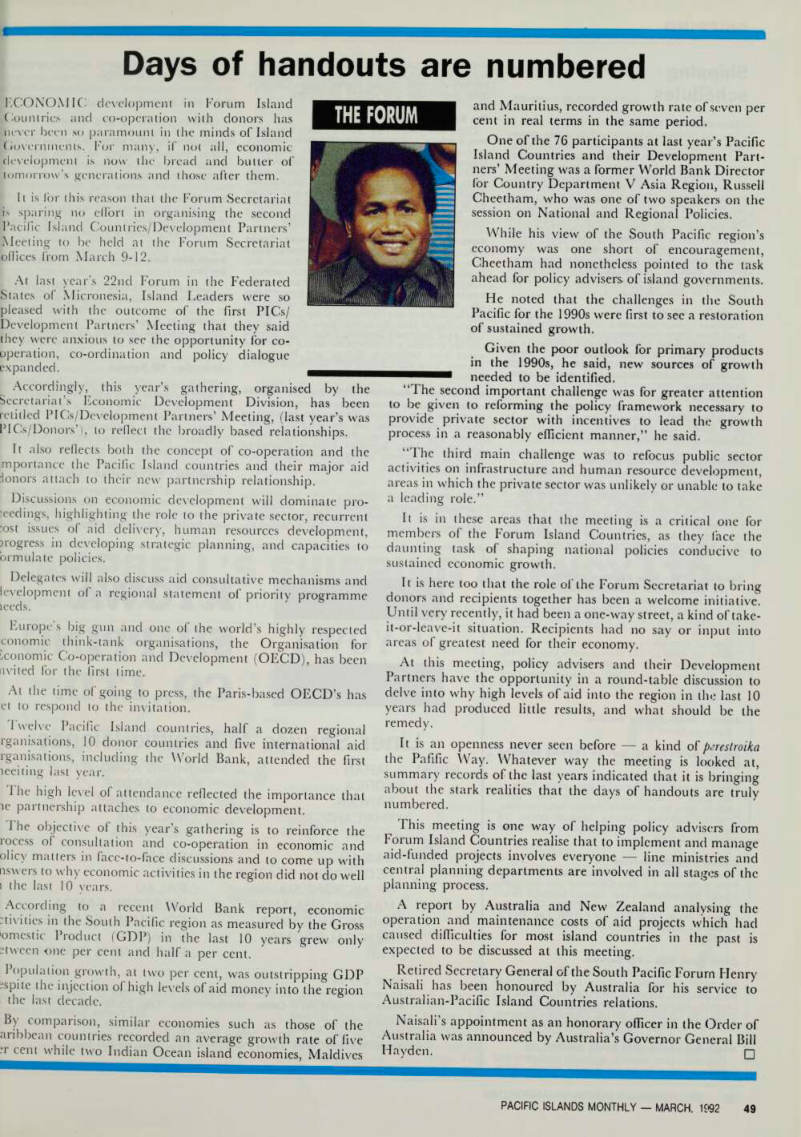
ECONOMIC development in Forum Island Countries and co-operation with donors has never been so paramount in the minds of Island Governments. For many, if not all, economic development is now the bread and butter of tomorrow’s generations and those after them.
It is lor this reason that the Forum Secretariat is sparing no effort in organising the second Pacific Island Countrics/Development Partners’
Meeting to be held at (he Forum Secretariat offices from March 9-12.
At last year’s 22nd Forum in the Federated States of Micronesia, Island Leaders were so pleased with the outcome of the first PICs/ Development Partners’ Meeting that they said they were anxious to see the opportunity for co operation, co-ordination and policy dialogue expanded.
Accordingly, this year’s gathering, organised by the Secretariat’s Economic Development Division, has been re titled PICs/Development Partners’ Meeting, (last year’s was PICs/Donors’), to reflect the broadly based relationships.
It also reflects both the concept of co-operation and the mportance the Pacific Island countries and their major aid lonors attach to their new partnership relationship.
Discussions on economic development will dominate pro reedings, highlighting the role to the private sector, recurrent :ost issues of aid delivery, human resources development, progress in developing strategic planning, and capacities to
brmulatc policies.
Delegates will also discuss aid consultative mechanisms and levelopment of a regional statement of priority programme Leeds.
Europe s big gun and one of the world’s highly respected conomic think-tank organisations, the Organisation for economic Co-operation and Development (OECD), has been nvited for the first time.
At the time of going to press, the Paris-based OECD’s has et to respond to the invitation. iwelve Pacific Island countries, half a dozen regional rganisations, 10 donor countries and five international aid rganisations, including the World Bank, attended the first leeiting last year.
The high level of attendance reflected the importance that
le partnership attaches to economic development.
The objective of this year’s gathering is to reinforce the rocess of consultation and co-operation in economic and olicy matters in face-to-face discussions and to come up with nswers to why economic activities in the region did not do well i the last 10 years.
According to a recent World Bank report, economic rtivi ties in the South Pacific region as measured by the Gross omcstic Product (GDP) in the last 10 years grew only e tween one per cent and half a per cent. 1 opulalion growth, at two per cent, was outstripping GDP _spi te the injection of high levels of aid money into the region the last decade.
By comparison, similar economies such as those of the an bbean countries recorded an average growth rate of five -i cent while two Indian Ocean island economies, Maldives
The Forum
and Mauritius, recorded growth rate of seven per cent in real terms in the same period.
One of the 76 participants at last year’s Pacific Island Countries and their Development Part ners’ Meeting was a former World Bank Director for Country Department V Asia Region, Russell Cheetham, who was one of two speakers on the session on National and Regional Policies.
While his view of the South Pacific region’s economy was one short of encouragement, Cheetham had nonetheless pointed to the task ahead for policy advisers of island governments.
He noted that the challenges in the South Pacific for the 1990 s were first to see a restoration of sustained growth.
Given the poor outlook for primary products in the 19905, he said, new sources of growth needed to be identified.
“The second important challenge was for greater attention to be given to reforming the policy framework necessary to provide private sector with incentives to lead the growth process in a reasonably efficient manner,” he said.
“The third main challenge was to refocus public sector activities on infrastructure and human resource development, areas in which the private sector was unlikely or unable to take a leading role.”
It is in these areas that the meeting is a critical one for members of the Forum Island Countries, as they face the daunting task of shaping national policies conducive to sustained economic growth.
It is here too that the role of the Forum Secretariat to bring donors and recipients together has been a welcome initiative.
Until very recently, it had been a one-way street, a kind of take it-or-leave-it situation. Recipients had no say or input into areas of greatest need for their economy.
At this meeting, policy advisers and their Development Partners have the opportunity in a round-table discussion to delve into why high levels of aid into the region in the last 10 years had produced little results, and what should be the remedy.
It is an openness never seen before a kind o tperestroika the Pafific Way. Whatever way the meeting is looked at, summary records of the last years indicated that it is bringing about the stark realities that the days of handouts are truly numbered.
This meeting is one way of helping policy advisers from Forum Island Countries realise that to implement and manage aid-funded projects involves everyone line ministries and central planning departments are involved in all stages of the planning process.
A report by Australia and New Zealand analysing the operation and maintenance costs of aid projects which had caused difficulties for most island countries in the past is expected to be discussed at this meeting.
Retired Secretary General of the South Pacific Forurn Henry Naisali has been honoured by Australia for his service to Australian-Pacific Island Countries relations.
Naisali s appointment as an honorary officer in the Order of Australia was announced by Australia’s Governor General Bill Hayden. n
Shipping
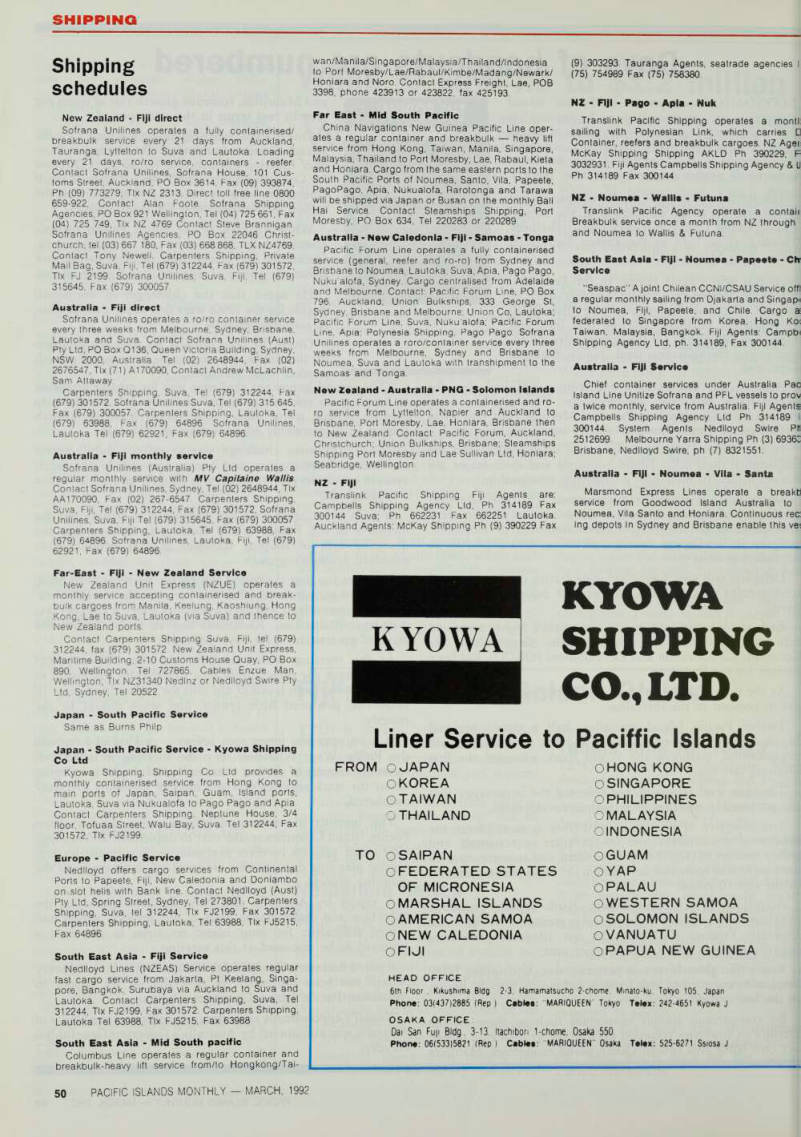
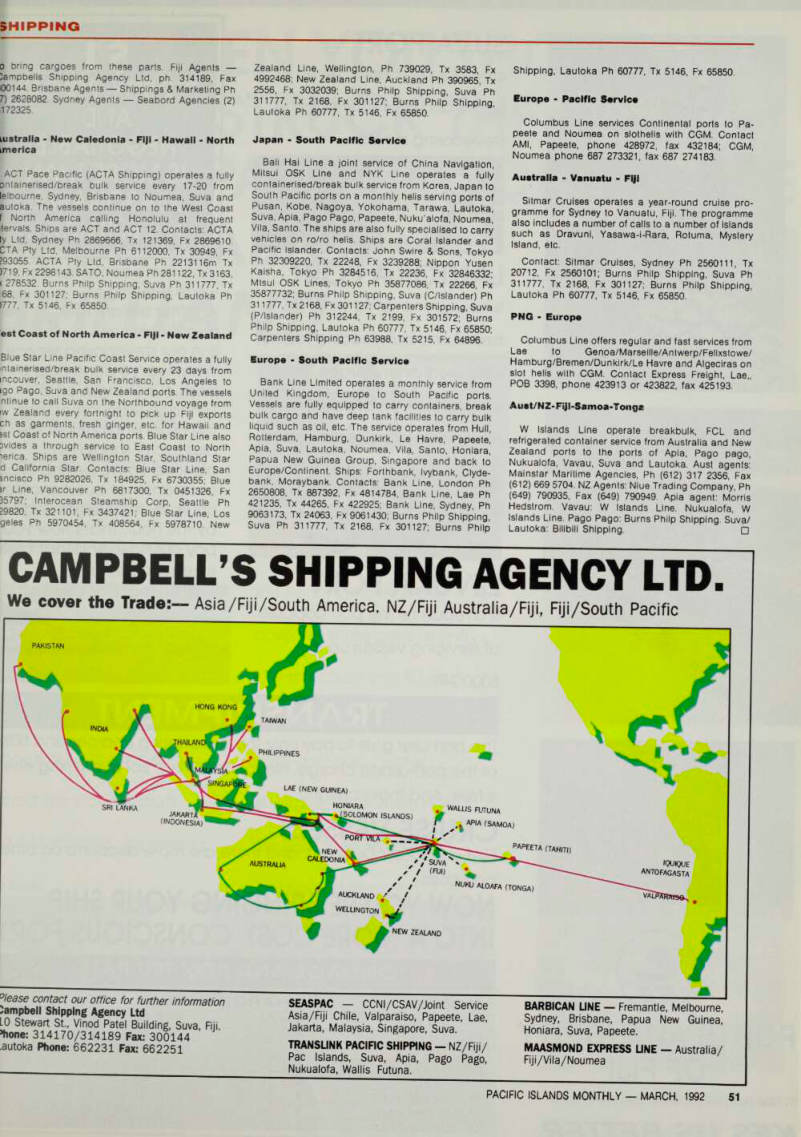
schedules
New Zealand - Fiji direct Sofrana Unilines operates a fully containerised/ breakbulk service every 21 days from Auckland, Tauranga, Lyttelton to Suva and Lautoka. Loading every 21 days, ro/ro service, containers - reefer.
Contact Sofrana Unilines, Sofrana House, 101 Cus toms Street, Auckland, PO Box 3614. Fax (09) 393874, Ph (09) 773279, Tlx NZ 2313. Direct toll free line 0800 659-922, Contact Alan Foote Sofrana Shipping Agencies, PO Box 921 Wellington, Tel (04) 725 661, Fax (04) 725 749, Tlx NZ 4769 Contact Steve Brannigan Sofrana Unilines Agencies, PO Box 22046 Christ church, tel (03) 667 180, Fax (03) 668 868, TLX NZ4769, Contact Tony Newell. Carpenters Shipping, Private Mail Bag, Suva, Fiji, Tel (679) 312244, Fax (679) 301572, Tlx FJ 2199. Sofrana Unilines, Suva. Fiji. Tel (679) 315645, Fax (679) 300057.
Australia - Fiji direct Sofrana Unilines operates a ro/ro container service every three weeks from Melbourne, Sydney, Brisbane, Lautoka and Suva, Contact Sofrana Unilines (Aust) Pty Ltd, PO Box Q 136, Queen Victoria Building, Sydney, NSW 2000, Australia Tel (02) 2648944. Fax (02) 2676547, Tlx (71) A 170090, Contact Andrew McLachlin, Sam Attaway Carpenters Shipping, Suva, Tel (679) 312244, Fax (679) 301572. Sofrana Unilines Suva, Tel (679) 315 645, Fax (679) 300057. Carpenters Shipping, Lautoka, Tel (679) 63988, Fax (679) 64896 Sofrana Unilines, Lautoka Tel (679) 62921, Fax (679) 64896.
Australia - Fiji monthly service Sofrana Unilines (Australia) Ply Ltd operates a regular monthly service with MV Capitaine Wallis Contact Sofrana Unilines, Sydney, Tel (02) 2648944, Tlx AA170090, Fax (02) 267-6547 Carpenters Shipping, Suva, Fiji, Tel (679) 312244, Fax (679) 301572, Sofrana Unilines, Suva. Fiji Tel (679) 315645, Fax (679) 300057 Carpenters Shipping, Lautoka, Tel (679) 63988, Fax (679) 64896. Sofrana Unilines, Lautoka, Fiji, Tel (679) 62921, Fax (679) 64896.
Far-East - Fiji - New Zealand Service New Zealand Unit Express (NZUE) operates a monthly service accepting containerised and break bulk cargoes from Manila, Keelung, Kaoshiung, Hong Kong, Lae to Suva, Lautoka (via Suva) and thence to New Zealand ports.
Contact Carpenters Shipping Suva, Fiji, tel (679) 312244, fax (679) 301572 New Zealand Unit Express, Maritime Building, 2-10 Customs House Quay, PO Box 890, Wellington Tel 727865, Cables Enzue Man, Wellington, Tlx NZ31340 Nedlnz or Nedlloyd Swire Ply Ltd. Sydney, Tel 20522.
Japan - South Pacific Service Same as Burns Philp Japan - South Pacific Service - Kyowa Shipping Co Ltd Kyowa Shipping, Shipping Co Ltd provides a monthly containerised service from Hong Kong to main ports of Japan, Saipan, Guam, Island ports, Lautoka, Suva via Nukualofa to Pago Pago and Apia Contact Carpenters Shipping, Neptune House, 3/4 floor, Tofuaa Street, Walu Bay, Suva. Tel 312244, Fax 301572, Tlx FJ2199.
Europe - Pacific Service Nedlloyd offers cargo services from Continental Ports to Papeete, Fiji, New Caledonia and Doniambo on-slot helis with Bank line. Contact Nedlloyd (Aust) Pty Ltd, Spring Street, Sydney, Tel 273801. Carpenters Shipping, Suva, tel 312244, Tlx FJ2199, Fax 301572.
Carpenters Shipping, Lautoka, Tel 63988, Tlx FJ5215, Fax 64896.
South East Asia - Fiji Service Nedlloyd Lines (NZEAS) Service operates regular fast cargo service from Jakarta, Pt Keelang, Singa pore, Bangkok, Surubaya via Auckland to Suva and Lautoka, Contact Carpenters Shipping, Suva, Tel 312244, Tlx FJ2199, Fax 301572. Carpenters Shipping, Lautoka Tel 63988, Tlx FJ5215, Fax 63988 South East Asia - Mid South pacific Columbus Line operates a regular container and breakbulk-heavy lift service from/to Hongkong/Tai
wan/Manila/Singapore/Malaysia/Thailand/Indonesia to Port Moresby/Lae/Rabaul/Kimbe/Madang/Newark/ Honiara and Noro. Contact Express Freight, Lae, POB 3398, phone 423913 or 423822, fax 425193.
Far East - Mid South Pacific China Navigations New Guinea Pacific Line oper ates a regular container and breakbulk heavy lift service from Hong Kong, Taiwan, Manila, Singapore, Malaysia, Thailand to Port Moresby, Lae, Rabaul, Kieta and Honiara. Cargo from the same eastern ports to the South Pacific Ports of Noumea, Santo, Vila, Papeete, PagoPago, Apia, Nukualofa, Rarotonga and Tarawa will be shipped via Japan or Busan on the monthly Bali Hai Service. Contact Steamships Shipping, Port Moresby, PO Box 634, Tel 220283 or 220289.
Australia - New Caledonia - FIJI - Samoas • Tonga Pacific Forum Line operates a fully containerised service (general, reefer and ro-ro) from Sydney and Brisbane to Noumea, Lautoka, Suva, Apia, Pago Pago, Nukualofa, Sydney. Cargo centralised from Adelaide and Melbourne. Contact: Pacific Forum Line, PO Box 796. Auckland, Union Bulkships, 333 George St, Sydney, Brisbane and Melbourne; Union Co, Lautoka; Pacific Forum Line, Suva, Nukualofa; Pacific Forum Line, Apia; Polynesia Shipping, Pago Pago Sofrana Unilines operates a roro/container service every three weeks from Melbourne, Sydney and Brisbane to Noumea, Suva and Lautoka with transhipment to the Samoas and Tonga New Zealand - Australia • PNG - Solomon Islands Pacific Forum Line operates a containerised and ro ro service from Lyttelton, Napier and Auckland to Brisbane, Port Moresby, Lae, Honiara, Brisbane then to New Zealand Contact: Pacific Forum, Auckland, Christchurch; Union Bulkships, Brisbane: Steamships Shipping Port Moresby and Lae Sullivan Ltd, Honiara; Seabridge, Wellington
Nz • Fiji
Translink Pacific Shipping Fiji Agents are: Campbells Shipping Agency Ltd, Ph 314189 Fax 300144 Suva; Ph 662231 Fax 662251 Lautoka.
Auckland Agents; McKay Shipping Ph (9) 390229 Fax
(9) 303293. Tauranga Agents, sealrade agencies I (75) 754989 Fax (75) 758380 NZ - FIJI - Pago - Apia - Nuk TranslinK Pacific Shipping operates a montll sailing with Polynesian Link, which carries □ Container, reefers and breakbulk cargoes. NZ Agen McKay Shipping Shipping AKLD Ph 390229, F 3032931. Fiji Agents Campbells Shipping Agency & U Ph 314189 Fax 300144 NZ - Noumea - Wallis - Futuna Translink Pacific Agency operate a contaii Breakbulk service once a month from NZ through and Noumea to Wallis & Futuna.
South East Asia - FIJI - Noumea - Papeete - Chr Service "Seaspac" A joint Chilean CCNI/CSAU Service offt a regular monthly sailing from Djakarta and Singapu to Noumea, Fiji, Papeete, and Chile. Cargo a= federated to Singapore from Korea, Hong Ko< Taiwan, Malaysia, Bangkok, Fiji Agents: Campb< Shipping Agency Ltd, ph. 314189, Fax 300144.
Australia • FIJI Service Chief container services under Australia Pao Island Line Unitize Sofrana and PFL vessels to prov a twice monthly, service from Australia. Fiji Agents Campbells Shipping Agency Ltd Ph 314189 i 300144. System Agents Nedlloyd Swire PM 2512699 Melbourne Yarra Shipping Ph (3) 6936 C Brisbane, Nedlloyd Swire, ph (7) 8321551.
Australia - FIJI - Noumea - Vila - Santa Marsmond Express Lines operate a breakb service from Goodwood Island Australia to Noumea, Vila Santo and Honiara. Continuous rec Ing depots In Sydney and Brisbane enable this vet
0 bring cargoes from these parts. Fiji Agents Jampbells Shipping Agency Ltd, ph, 314189, Fax 00144. Brisbane Agents Shippings & Marketing Ph 7) 2628082. Sydney Agents Seabord Agencies (2) 172325.
Lustralia - New Caledonia - Fiji - Hawaii - North America ACT Pace Pacific (ACTA Shipping) operates a fully ontainerised/break bulk service every 17-20 from lelbourne, Sydney, Brisbane to Noumea, Suva and autoka. The vessels continue on to the West Coast f North America calling Honolulu at frequent itervals. Ships are ACT and ACT 12, Contacts: ACTA ly Ltd, Sydney Ph 2869666, Tx 121369, Fx 2869610.
CTA Pty Ltd, Melbourne Ph 6112000, Tx 30949, Fx >93055. ACTA Pty Ltd, Brisbane Ph 2213116 m Tx )719, Fx 2298143. SATO, Noumea Ph 281122, Tx 3163, ( 278532. Burns Philp Shipping, Suva Ph 311777, Tx 68, Fx 301127; Burns Philp Shipping, Lautoka Ph 1777, Tx 5146, Fx 65850. est Coast of North America - Fiji - New Zealand Blue Star Line Pacific Coast Service operates a fully mtainerised/break bulk service every 23 days from mcouver, Seattle, San Francisco, Los Angeles to igo Pago, Suva and New Zealand ports. The vessels ntinue to call Suva on the Northbound voyage from iw Zealand every fortnight to pick up Fiji exports ch as garments, fresh ginger, etc. for Hawaii and 3st Coast of North America ports. Blue Star Line also wides a through service to East Coast to North lerica, Ships are Wellington Star, Southland Star d California Star. Contacts: Blue Star Line, San ancisco Ph 9282026, Tx 184925, Fx 6730355; Blue ir Line, Vancouver Ph 6817300, Tx 0451326, Fx 35797; Interocean Steamship Corp. Seattle Ph -9820, Tx 321101, Fx 3437421; Blue Star Line, Los geles Ph 5970454, Tx 408564, Fx 5978710. New
Zealand Line, Wellington, Ph 739029, Tx 3583, Fx 4992468; New Zealand Line, Auckland Ph 390965, Tx 2556, Fx 3032039; Burns Philp Shipping, Suva Ph 311777, Tx 2168, Fx 301127; Burns Philp Shipping, Lautoka Ph 60777, Tx 5146, Fx 65850.
Japan - South Pacific Service Bali Hai Line a joint service of China Navigation, Mitsui OSK Line and NVK Line operates a fully containerlsed/break bulk service from Korea, Japan to South Pacific ports on a monthly helis serving ports of Pusan, Kobe, Nagoya, Yokohama, Tarawa, Lautoka, Suva, Apia, Pago Pago, Papeete, Nukualofa, Noumea!
Vila, Santo, The ships are also fully specialised to carry vehicles on ro/ro helis. Ships are Coral Islander and Pacific Islander. Contacts: John Swire & Sons, Tokyo Ph 32309220, Tx 22248. Fx 3239288; Nippon Yusen Kaisha, Tokyo Ph 3284516, Tx 22236, Fx 32846332; Mlsul OSK Lines, Tokyo Ph 35877086, Tx 22266, Fx 35877732; Burns Philp Shipping, Suva (C/lslanderj Ph 311777, Tx 2168, Fx 301127; Carpenters Shipping, Suva (P/lslander) Ph 312244, Tx 2199, Fx 301572; Burns Philp Shipping, Lautoka Ph 60777, Tx 5146, Fx 65850; Carpenters Shipping Ph 63988, Tx 5215, Fx 64896.
Europe - South Pacific Service Bank Line Limited operates a monthly service from United Kingdom, Europe to South Pacific ports.
Vessels are fully equipped to carry containers, break bulk cargo and have deep tank facilities to carry bulk liquid such as oil. etc. The service operates from Hull.
Rotterdam, Hamburg, Dunkirk, Le Havre, Papeete, Apia, Suva, Lautoka, Noumea, Vila, Santo, Honiara!
Papua New Guinea Group, Singapore and back to Europe/Continent. Ships: Forthbank, Ivybank, Clyde bank, Moraybank. Contacts: Bank Line, London Ph 2650808, Tx 887392, Fx 4814784, Bank Line. Lae Ph 421235, Tx 44265, Fx 422925; Bank Line, Sydney, Ph 9063173, Tx 24063, Fx 9061430; Burns Philp Shipping, Suva Ph 311777, Tx 2168, Fx 301127; Burns Philp
Shipping, Lautoka Ph 60777, Tx 5146, Fx 65850.
Europe - Pacific Service Columbus Line services Continental ports to Pa peete and Noumea on slothelis with CGM. Contact AMI, Papeete, phone 428972, fax 432184; CGM, Noumea phone 687 273321, fax 687 274183.
Australia - Vanuatu • Fiji Sitmar Cruises operates a year-round cruise pro gramme for Sydney to Vanuatu, Fiji. The programme also includes a number of calls to a number of islands such as Dravunl, Yasawa-i-Rara, Rotuma, Mystery Island, etc.
Contact: Sitmar Cruises, Sydney Ph 2560111, Tx 20712, Fx 2560101; Burns Philp Shipping, Suva Ph 311777, Tx 2168, Fx 301127; Burns Philp Shipping, Lautoka Ph 60777, Tx 5146, Fx 65850.
PNG - Europe Columbus Line offers regular and fast services from Lae to Genoa/Marseille/Anlwerp/Felixslowe/ Hamburg/Bremen/Dunklrk/Le Havre and Algeclras on slot hells with CGM. Contact Express Freight, Lae,, POB 3398, phone 423913 or 423822, fax 425193.
Aust/NZ-FiJI-Samoa-Tonga
W Islands Line operate breakbulk. FCL and refrigerated container service from Australia and New Zealand ports to the ports of Apia, Pago pago, Nukualofa, Vavau, Suva and Lautoka. Ausl agents: Mainslar Maritime Agencies, Ph (612) 317 2356, Fax (612) 669 5704. NZ Agents: Niue Trading Company, Ph (649) 790935, Fax (649) 790949. Apia agent: Morris Hedstrom. Vavau: W Islands Line. Nukualofa, W Islands Line. Pago Pago: Burns Philp Shipping. Suva/ Lautoka: Biiibill Shipping. □
Advertisements & other items, pp. 50-52 (1 item)
Co., Ltd.
KYOWA
KYOWA
SHIPPING
CO., LTD.
Liner Service to Paciffic Islands
FROM OJAPAN
OKOREA
©TAIWAN
©THAILAND
TO ©SAIPAN
©FEDERATED STATES
OF MICRONESIA
©MARSHAL ISLANDS
©AMERICAN SAMOA
©NEW CALEDONIA
©FIJI
©HONG KONG
©SINGAPORE
©PHILIPPINES
©MALAYSIA
©INDONESIA
©GUAM
©YAP
©PALAU
©WESTERN SAMOA
©SOLOMON ISLANDS
©VANUATU
©PAPUA NEW GUINEA
HEAD OFFICE
6th Floor . Kikushima Bldg 2-3, Hamamatsucho 2-chome Mmato-ku, Tokyo 105, Japan Phone: 03(437)2885 (Rep ) Cables: MARIQUEEN Tokyo Telex: 242-4651 Kyowa J
OSAKA OFFICE
Dai San Fuji Bldg, 3-13. Itachibon 1-chome, Osaka 550 Phone; 06(533)5821 (Rep ) Cables: MARIQUEEN Osaka Telex: 525-6271 Ssiosa J
CAMPBELL’S SHIPPING AGENCY LTD.
We cover the Trade:— Asia/Fiji/South America. NZ/Fiji Australia/Fiji, Fiji/South Pacific %
PAKISTAN
HONG KONG
TAIWAN
INDIA
HAILAN
I
PHILIPPINES
it I
LAt (NEW GUINEA)
SRI LANKA
. WALLIS FUTUNA
j .j APIA (SAMOA)
JAKARTA
(INDONESIA)
PAPEETA (TAHITI)
NEW \
CALEDONIA
• /SUVA *
/ (Fill)
/ NUKU ALOAFA (TONGA)
IQUIQUE
ANTOFAGASTA
AUSTRALIA
AUCKLAND ' f
WELLINGTON V*
NEW ZEALAND
°lease contact our office for further information Campbell Shipping Agency Ltd LO Stewart St., Vinod Patel Building, Suva, Fiji.
*hone: 314170/314189 Fax: 300144
.autoka Phone: 662231 Fax: 662251 SEASPAC CCNI/CSAV/Joint Service Asia/Fiji Chile, Valparaiso, Papeete, Lae, Jakarta, Malaysia, Singapore, Suva.
TRANSLINK PACIFIC SHIPPING - NZ/Fiji/
Pac Islands, Suva, Apia, Pago Pago, Nukualofa, Wallis Futuna.
BARBICAN LINE Fremantle, Melbourne, Sydney, Brisbane, Papua New Guinea, Honiara, Suva, Papeete.
MAASMOND EXPRESS UNE - Australia/
Fiji/Vila/Noumea
WTfiP.
THE
RIGHT
, .. x- I I !-• ' ' Mftf —r . J 4; A
of solving the
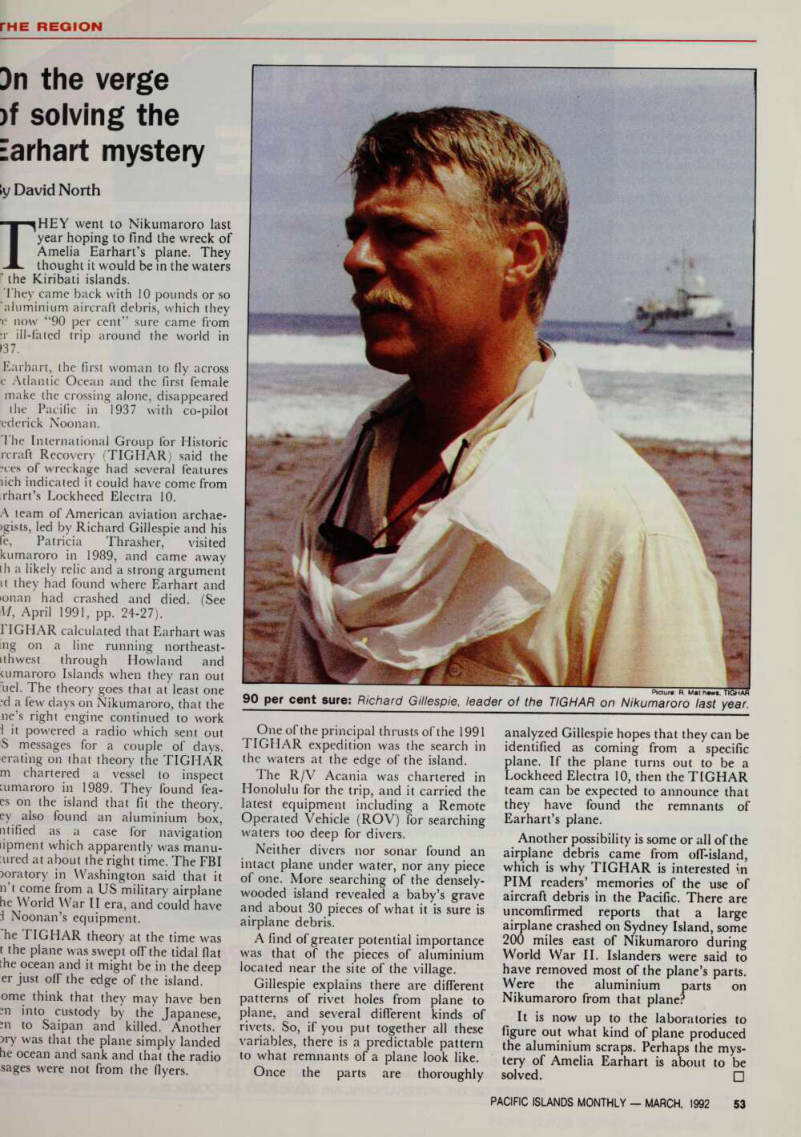
The Region
On the verge of solving the Earhart mystery
By David North
rHEY went to Nikumaroro last year hoping to find the wreck of Amelia Earhart’s plane. They thought it would be in the waters r the Kiribati islands.
They came back with 10 pounds or so ‘aluminium aircraft debris, which they e now “90 per cent” sure came from *r ill-fated trip around the world in 137.
Earhart, the first woman to fly across e Atlantic Ocean and the first female make the crossing alone, disappeared the Pacific in 1937 with co-pilot ederick Noonan.
The International Group for Historic rcraft Recovery (TIGHAR) said the ?ces of wreckage had several features lich indicated it could have come from rhart’s Lockheed Electra 10.
A team of American aviation archae )gists, led by Richard Gillespie and his fe, Patricia Thrasher, visited kumaroro in 1989, and came away th a likely relic and a strong argument it they had found where Earhart and •onan had crashed and died. (See M, April 1991, pp. 24-27).
LIGHAR calculated that Earhart was ing on a line running northeast ithwest through Howland and aimaroro Islands when they ran out ucl. The theory goes that at least one *1 a few days on Nikumaroro, that the ne’s right engine continued to work f it powered a radio which sent out S messages for a couple of days, crating on that theory the TIGHAR m chartered a vessel to inspect mmaroro in 1989. They found fea es on the island that fit the theory, cy also found an aluminium box, ii tilled as a case for navigation lipment which apparently was manu ured at about the right time. The FBI moratory in Washington said that it n t come from a US military airplane he World War II era, and could have I Noonan’s equipment.
'he TIGHAR theory at the time was t the plane was swept off the tidal flat the ocean and it might be in the deep er just off the edge of the island, ome think that they may have ben - n into custody by the Japanese, -n to Saipan and' killed. Another }ry was that the plane simply landed he ocean and sank and that the radio sages were not from the flyers.
One of the principal thrusts of the 1991 TIGHAR expedition was the search in the waters at the edge of the island.
The R/V Acania was chartered in Honolulu for the trip, and it carried the latest equipment including a Remote Operated Vehicle (ROV) for searching waters too deep for divers.
Neither divers nor sonar found an intact plane under water, nor any piece of one. More searching of the densely wooded island revealed a baby’s grave and about 30 pieces of what it is sure is airplane debris.
A find of greater potential importance was that of the pieces of aluminium located near the site of the village.
Gillespie explains there are different patterns of rivet holes from plane to plane, and several different kinds of rivets. So, if you put together all these variables, there is a predictable pattern to what remnants of a plane look like.
Once the parts are thoroughly
analyzed Gillespie hopes that they can be identified as coming from a specific plane. If the plane turns out to be a Lockheed Electra 10, then theTIGHAR team can be expected to announce that they have found the remnants of Earhart’s plane.
Another possibility is some or all of the airplane debris came from off-island, which is why TIGHAR is interested in PIM readers’ memories of the use of aircraft debris in the Pacific. There are uncomfirmed reports that a large airplane crashed on Sydney Island, some 200 miles east of Nikumaroro during World War 11. Islanders were said to have removed most of the plane’s parts.
Were the aluminium parts on Nikumaroro from that plane?
It is now up to the laboratories to figure out what kind of plane produced the aluminium scraps. Perhaps the mys tery of Amelia Earhart is about to be solved. □
Picture R. Mat[?]hews. TIGHAR 90 per cent sure: Richard Gillespie, leader of the TIGHAR on Nikumaroro last year.
Advertisements & other items, p. 54 (1 item)
F'l Royal Tong An Airlines
m
ROYAL TONGAN BUSINESS CLASS
Royal Tongan Business Class, a new style and standard of service from a country renowned for its friendliness and hospitality.
Domestic services throughout the Kingdom of Tonga.
International services linking Tonga with New Zealand and Fiji. Book with us and experience service that’s normally reserved for Royalty.
f'l ROYAL TONG AN AIRLINES
THE NATIONAL AIRLINE OF THE KINGDOM OF TONGA
OFFICES AND REPRESENTATIVES:
Nukualofa Royal Tongan Airlines: Tel-(676) 23 414 Fax-(676) 24 056 Auckland World Aviation Systems: Tel-(09) 794 454 Fax-(09) 775 648 Sydney World Aviation Systems: Tel-(02) 239 1722 Fax-(02) 290 3641 Nadi Sunflower Airlines: Tel-(679) 723 016, 723 408 Suva Sunflower Airlines: Tel-(679) 315 755 MEMBER OF THE INTERNATIONAL AIR TRANSPORT ASSOCIATION
There’s aid, and there’s aid
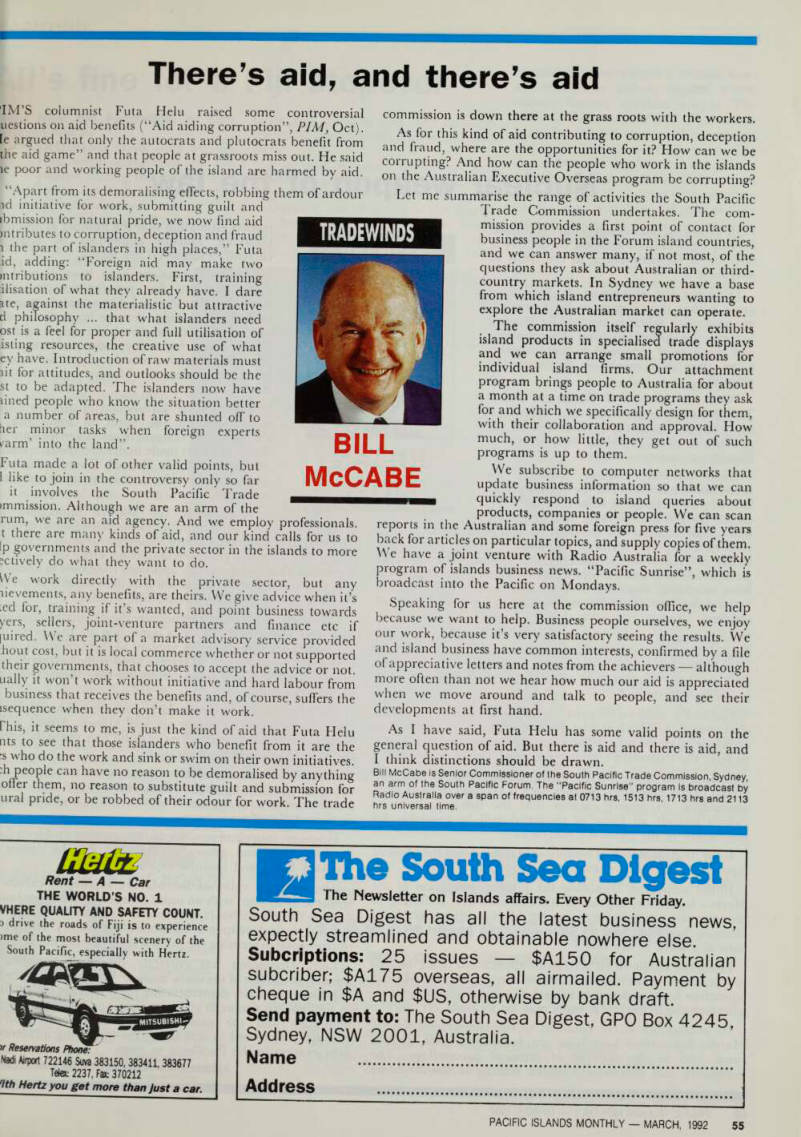
IM’S columnist Futa Helu raised some controversial uestions on aid benefits (“Aid aiding corruption”, PIM, Oct), le argued that only the autocrats and plutocrats benefit from the aid game” and that people at grassroots miss out. He said le poor and working people of the island are harmed by aid.
“Apart from its demoralising effects, robbing them of ardour
id initiative for work, submitting guilt and ibmission for natural pride, we now find aid mtributes to corruption, deception and fraud i the part of islanders in high places,” Futa id, adding: “Foreign aid may make two in tri but ions to islanders. First, training ilisation of what they already have. I dare ate, against the materialistic but attractive d philosophy ... that what islanders need ost is a feel for proper and full utilisation of isting resources, the creative use of what ey have. Introduction of raw materials must ait for attitudes, and outlooks should be the st to be adapted. The islanders now have lined people who know the situation better a number of areas, but are shunted off to tier minor tasks when foreign experts carin’ into the land”.
Futa made a lot of other valid points, but I like to join in the controversy only so far it involves the South Pacific Trade immission. Although we are an arm of the
rum, we are an aid agency. And we employ professionals, t there are many kinds of aid, and our kind calls for us to Ip governments and the private sector in the islands to more actively do what they want to do.
We work directly with the private sector, but any lievements, any benefits, are theirs. We give advice when it’s ;ed for, training if it’s wanted, and point business towards /ers, sellers, joint-venture partners and finance etc if |uired. We are part of a market advisory service provided hout cost, but it is local commerce whether or not supported their governments, that chooses to accept the advice or not. ually it won’t work without initiative and hard labour from business that receives the benefits and, of course, suffers the isequence when they don’t make it work. fhis, it seems to me, is just the kind of aid that Futa Helu nts to see that those islanders who benefit from it are the s who do the work and sink or swim on their own initiatives. :h people can have no reason to be demoralised by anything offer them, no reason to substitute guilt and submission for ural pride, or be robbed of their odour for work. The trade
Tradewinds
commission is down there at the grass roots with the workers.
As for this kind of aid contributing to corruption, deception and fraud, where are the opportunities for it? How can we be corrupting? And how can the people who work in the islands on the Australian Executive Overseas program be corrupting?
Let me summarise the range of activities the South Pacific
Trade Commission undertakes. The com mission provides a first point of contact for business people in the Forum island countries, and we can answer many, if not most, of the questions they ask about Australian or third country markets. In Sydney we have a base from which island entrepreneurs wanting to explore the Australian market can operate.
The commission itself regularly exhibits island products in specialised trade displays and we can arrange small promotions for individual island firms. Our attachment program brings people to Australia for about a month at a time on trade programs they ask for and which we specifically design for them, with their collaboration and approval. How much, or how little, they get out of such programs is up to them.
We subscribe to computer networks that update business information so that we can quickly respond to island queries about products, companies or people. We can scan
reports in the Australian and some foreign press for five years back for articles on particular topics, and supply copies of them.
We have a joint venture with Radio Australia for a weekly program of islands business news. “Pacific Sunrise”, which is broadcast into the Pacific on Mondays.
Speaking for us here at the commission office, we help because we want to help. Business people ourselves, we enjoy our work, because it’s very satisfactory seeing the results. We and island business have common interests, confirmed by a file of appreciative letters and notes from the achievers although more often than not we hear how much our aid is appreciated when we move around and talk to people, and see their developments at first hand.
As I have said, Futa Helu has some valid points on the general question of aid. But there is aid and there is aid, and I think distinctions should be drawn.
Bill McCabe is Senior Commissioner of the South Pacific Trade Commission, Sydney, an arm of the South Pacific Forum. The "Pacific Sunrise" program Is broadcast by Radio Australia over a span of frequencies at 0713 hrs, 1513 hrs, 1713 hrs and 2113 hrs universal time.
Bill
Mccabe
Advertisements & other items, p. 55 (1 item)
The South Sea Digest
1
The Newsletter on Islands affairs. Every Other Friday.
South Sea Digest has all the latest business news, expectly streamlined and obtainable nowhere else Subcriptions: 25 issues SAISO for Australian subcriber; SAI7S overseas, all airmailed. Payment by cheque in $A and SUS, otherwise by bank draft.
Send payment to: The South Sea Digest, GPO Box 4245 Sydney, NSW 2001, Australia.
Name Address
UMit
Rent A Car
THE WORLD S NO. 1
VHERE QUALITY AND SAFETY COUNT.
d drive the roads of Fiji is to experience )me of the most beautiful scenery of the South Pacific, especially with Hertz. /I >r Reservations Phone: Nadi Airport 722146 Suva 383150,383411,383677 Tetet 2237, Fan 370212 Ith Hertz you get more than Just a car.
Nuclear weapon of the law
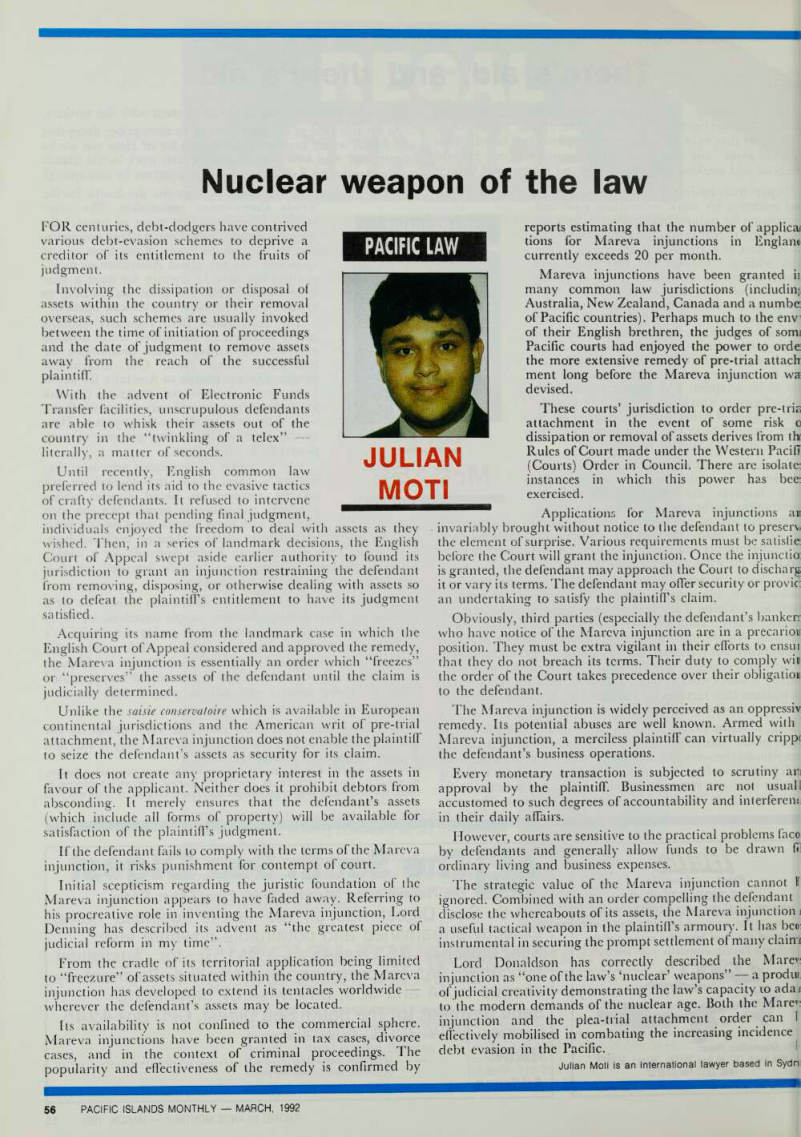
FOR centuries, debt-dodgers have contrived various debt-evasion schemes to deprive a creditor of its entitlement to the fruits of judgment.
Involving the dissipation or disposal of assets within the country or their removal overseas, such schemes are usually invoked between the time of initiation of proceedings and the date of judgment to remove assets away from the reach of the successful
plaintiff.
With the advent of Electronic Funds Transfer facilities, unscrupulous defendants are able to whisk their assets out of the country in the “twinkling of a telex” literally, a matter of seconds.
Until recently, English common law preferred to lend its aid to the evasive tactics of crafty defendants. It refused to intervene on the precept that pending final judgment,
individuals enjoyed the freedom to deal with assets as they wished. Then, in a series of landmark decisions, the English Court of Appeal swept aside earlier authority to found its jurisdiction to grant an injunction restraining the defendant from removing, disposing, or otherwise dealing with assets so as to defeat the plaintiffs entitlement to have its judgment satisfied.
Acquiring its name from the landmark case in which the English Court of Appeal considered and approved the remedy, the Mareva injunction is essentially an order which “freezes” or “preserves” the assets of the defendant until the claim is
judicially determined.
Unlike the saisie conservatoire which is available in European continental jurisdictions and the American writ of pre-trial attachment, the Mareva injunction does not enable the plaintiff to seize the defendant’s assets as security for its claim.
It does not create any proprietary interest in the assets in favour of the applicant. Neither does it prohibit debtors from absconding. It merely ensures that the defendant’s assets (which include all forms of property) will be available for satisfaction of the plaintiff’s judgment.
If the defendant fails to comply with the terms of the Mareva injunction, it risks punishment for contempt of court.
Initial scepticism regarding the juristic foundation of the Mareva injunction appears to have faded away. Referring to his procreative role in inventing the Mareva injunction, Lord Denning has described its advent as “the greatest piece of judicial reform in my time”.
From the cradle of its territorial application being limited to “freezure” of assets situated within the country, the Mareva injunction has developed to extend its tentacles worldwide wherever the defendant’s assets may be located.
Its availability is not confined to the commercial sphere.
Mareva injunctions have been granted in tax cases, divorce cases, and in the context of criminal proceedings. The popularity and effectiveness of the remedy is confirmed by
Pacific Law
reports estimating that the number of applicai tions for Mareva injunctions in Englano currently exceeds 20 per month.
Mareva injunctions have been granted ii many common law jurisdictions (including Australia, New Zealand, Canada and a numbe of Pacific countries). Perhaps much to the env' of their English brethren, the judges of somi Pacific courts had enjoyed the power to orde the more extensive remedy of pre-trial attach ment long before the Mareva injunction wa devised.
These courts’ jurisdiction to order pre-tris attachment in the event of some risk o dissipation or removal of assets derives from thr Rules of Court made under the Western PacifT (Courts) Order in Council. There are isolate: instances in which this power has bee: exercised.
Applications for Mareva injunctions an
invariably brought without notice to the defendant to preserve the element of surprise. Various requirements must be salislie: before the Court will grant the injunction. Once the injunctioc is granted, the defendant may approach the Court to discharge it or vary its terms. The defendant may offer security or provic: an undertaking to satisfy the plaintiffs claim.
Obviously, third parties (especially the defendant’s banker;who have notice of the Mareva injunction are in a precariou position. They must be extra vigilant in their efforts to ensui that they do not breach its terms. Their duty to comply will the order of the Court takes precedence over their obligation to the defendant.
The Mareva injunction is widely perceived as an oppressiv remedy. Its potential abuses are well known. Armed with Mareva injunction, a merciless plaintiff can virtually crippi the defendant’s business operations.
Every monetary transaction is subjected to scrutiny am approval by the plaintiff. Businessmen arc no! usuall accustomed to such degrees of accountability and interfere in. in their daily affairs.
However, courts are sensitive to the practical problems face by defendants and generally allow funds to be drawn fil ordinary living and business expenses.
The strategic value of the Mareva injunction cannot If ignored. Combined with an order compelling the defendant disclose the whereabouts of its assets, the Mareva injunction] a useful tactical weapon in the plaintiff’s armoury. It has beo; instrumental in securing the prompt settlement of many claim] Lord Donaldson has correctly described the Marev; injunction as “one of the law’s ‘nuclear’ weapons” a prodm. of judicial creativity demonstrating the law’s capacity to adai to the modern demands of the nuclear age. Both the Mare*; injunction and the plea-trial attachment order can I effectively mobilised in combating the increasing incidence debt evasion in the Pacific.
Julian Moll is an International lawyer based in Sydm
Julian
Moti
All's fine for a Fiji stopover
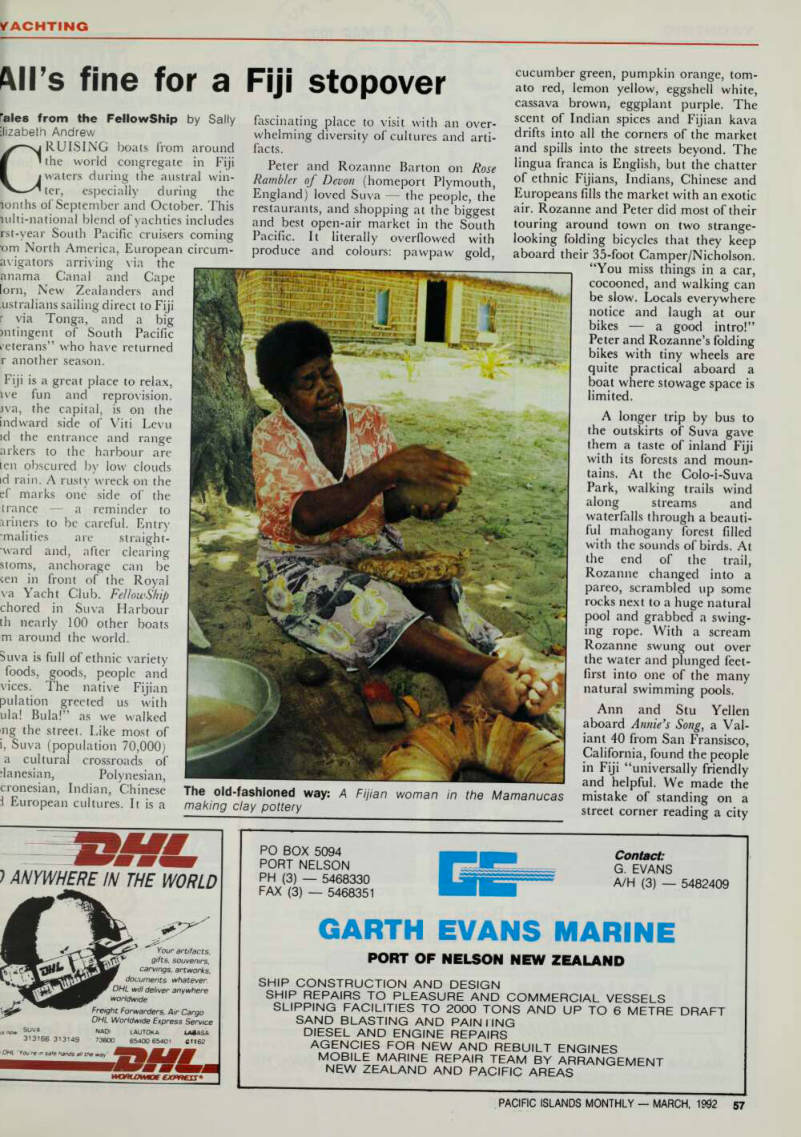
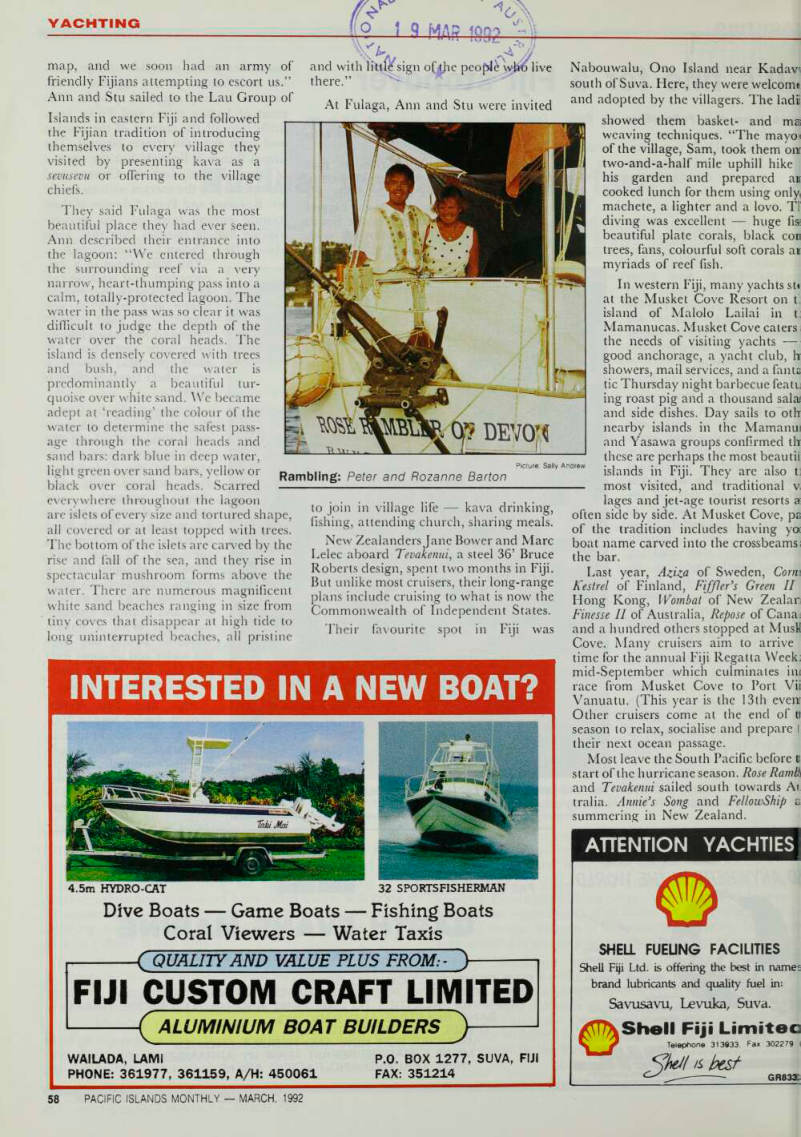
Yachting
p ales from the Fellowship by Sally •lizabeth Andrew CRUISING boats from around the world congregate in Fiji waters during the austral win ter, especially during the lonths of September and October. This uilti-national blend ofyachties includes rst-year South Pacific cruisers coming om North America, European circum
avigators arriving via the anama Canal and Cape forn, New Zealanders and ustralians sailing direct to Fiji r via Tonga, and a big mtingent of South Pacific veterans” who have returned r another season.
Fiji is a great place to relax, ive fun and reprovision, iva, the capital, is on the indward side of Viti Levu id the entrance and range arkers to the harbour are ten obscured by low clouds id rain. A rusty wreck on the ef marks one side of the trance a reminder to dinners to be careful. Entry
-malities are straight
■ward and, after clearing stoms, anchorage can be ten in front of the Royal va Yacht Club. Fellowship chored in Suva Harbour th nearly 100 other boats m around the world.
Suva is full of ethnic variety foods, goods, people and vices. The native Fijian pulation greeted us with ula! Bula!” as we walked ng the street. Like most of i, Suva (population 70,000) a cultural crossroads of
“lanesian, Polynesian,
cronesian, Indian, Chinese i European cultures. It is a
fascinating place to visit with an over whelming diversity of cultures and arti facts.
Peter and Rozanne Barton on Rose Rambler of Devon (homeport Plymouth, England) loved Suva the people, the restaurants, and shopping at the biggest and best open-air market in the South Pacific. It literally overflowed with produce and colours: pawpaw gold,
cucumber green, pumpkin orange, tom ato red, lemon yellow, eggshell white, cassava brown, eggplant purple. The scent of Indian spices and Fijian kava drifts into all the corners of the market and spills into the streets beyond. The lingua franca is English, but the chatter of ethnic Fijians, Indians, Chinese and Europeans fills the market with an exotic air. Rozanne and Peter did most of their touring around town on two strange looking folding bicycles that they keep aboard their 35-foot Camper/Nicholson.
“You miss things in a car, cocooned, and walking can be slow. Locals everywhere notice and laugh at our bikes a good intro!”
Peter and Rozanne’s folding bikes with tiny wheels are quite practical aboard a boat where stowage space is limited.
A longer trip by bus to the outskirts of Suva gave them a taste of inland Fiji with its forests and moun tains. At the Colo-i-Suva Park, walking trails wind along streams and waterfalls through a beauti ful mahogany forest filled with the sounds of birds. At the end of the trail, Rozanne changed into a pareo, scrambled up some rocks next to a huge natural pool and grabbed a swing ing rope. With a scream Rozanne swung out over the water and plunged feet first into one of the many natural swimming pools.
Ann and Stu Yellen aboard Annie’s Song , a Val iant 40 from San Fransisco, California, found the people
in Fiji “universally friendly
and helpful. We made the mistake of standing on a street corner reading a city
The old-fashioned way: A Fijian woman in the Mamanucas making clay pottery
map, and we soon had an army of friendly Fijians attempting to escort us.”
Ann and Stu sailed to the Lau Group of
Islands in eastern Fiji and followed the Fijian tradition of introducing themselves to ever)' village they visited by presenting kava as a sevusevu or offering to the village chiefs.
They said Fulaga was the most beautiful place they had ever seen.
Ann described their entrance into the lagoon: “We entered through the surrounding reef via a very narrow, heart-thumping pass into a calm, totally-protected lagoon. The water in the pass was so clear it was difficult to judge the depth of the water over the coral heads. The island is densely covered with trees and bush, and the water is predominantly a beautiful tur quoise over white sand. We became adept at ‘reading’ the colour of the water to determine the safest pass age through the coral heads and sand bars: dark blue in deep water, light green over sand bars, yellow or black over coral heads. Scarred
everywhere throughout the lagoon
are islets of every size and tortured shape, all covered or at least topped with trees.
The bottom of the islets are carved by the rise and fall of the sea, and they rise in spectacular mushroom forms above the water. There are numerous magnificent white sand beaches ranging in size from tiny coves that disappear at high tide to long uninterrupted beaches, all pristine
and with little sign o(jtJie people wj *6 live there.”
At Fulaga, Ann and Stu were invited
to join in village life kava drinking, fishing, attending church, sharing meals.
New Zealanders Jane Bower and Marc Lelec aboard Tevakenui , a steel 36’ Bruce Roberts design, spent two months in Fiji.
But unlike most cruisers, their long-range plans include cruising to what is now the Commonwealth of Independent States.
Their favourite spot in Fiji was
Nabouwalu, Ono Island near Kadavv south of Suva. Here, they were welcome and adopted by the villagers. The ladil
showed them basket- and ma weaving techniques. “The mayo* of the village, Sam, took them onr two-and-a-half mile uphill hike his garden and prepared an cooked lunch for them using machete, a lighter and a lovo. Tl' diving was excellent huge fis beautiful plate corals, black con trees, fans, colourful soft corals an myriads of reef fish.
In western Fiji, many yachts sU at the Musket Cove Resort on t; island of Malolo Lailai in f: Mamanucas. Musket Cove caters. the needs of visiting yachts good anchorage, a yacht club, hr showers, mail services, and a fanta tic Thursday night barbecue featu ing roast pig and a thousand salat and side dishes. Day sails to othr nearby islands in the Mamanui and Yasawa groups confirmed thr these are perhaps the most beautii islands in Fiji. They are also tJ most visited, and traditional v, lages and jet-age tourist resorts a
often side by side. At Musket Cove, ps of the tradition includes having ya boat name carved into the crossbeams the bar.
Last year, Aziza of Sweden, Conn Kestrel of Finland, Fifjler’s Green II Hong Kong, Wombat of New Zealar Finesse II of Australia, Repose of Cana, and a hundred others stopped at MusW Cove. Many cruisers aim to arrive time for the annual Fiji Regatta Week mid-September which culminates ini race from Musket Cove to Port Vii Vanuatu. (This year is the 13th even Other cruisers come at the end of t) season to relax, socialise and prepare I their next ocean passage.
Most leave the South Pacific before tl start of the hurricane season. Rose Ram& and Tevakenui sailed south towards At tralia. Annie's Song and Fellowship a summering in New Zealand.
Rambling: Peter and Rozanne Barton
Picture: Sally Andrew
Advertisements & other items, pp. 57-60 (1 item)
Garth Evans Marine
7 ANYWHERE IN THE WORLD
313166 313149 Your artifacts, gifts, souvenirs, carvings, artworks, documents whatever DHL will deliver anywhere worldwide Freight Forwarders. Air Cargo DHL Worldwide Express Service
NAOI
73800 wontowKX exmess
PO BOX 5094
PORT NELSON
PH (3) 5468330
FAX (3) 5468351
UB Contact:
G. EVANS
A/H (3)
GARTH EVANS MARINE
PORT OF NELSON NEW ZEALAND
SHIP CONSTRUCTION AND DESIGN
SHIP REPAIRS TO PLEASURE AND COMMERCIAL VESSELS SLIPPING FACILITIES TO 2000 TONS AND UP TO 6 METRE
SAND BLASTING AND PAIN lING
DIESEL AND ENGINE REPAIRS
AGENCIES FOR NEW AND REBUILT ENGINES
MOBILE MARINE REPAIR TEAM BY ARRANGEMENT
NEW ZEALAND AND PACIFIC AREAS
5482409
DRAFT
INTERESTED IN A NEW BOAT?
4.5 m HYDRO-CAT
32 SPORTSFISHERMAN
Dive Boats Game Boats Fishing Boats Coral Viewers Water Taxis
< QUALITY AND VALUE PLUS FROM
FIJI CUSTOM CRAFT LIMITED
( ALUMINIUM BOAT BUILDERS )
WAILADA, LAMI
PHONE: 361977, 361159, A/H: 450061
P.O. BOX 1277, SUVA, FIJI
FAX: 351214
ATTENTION YACHTIES
SHELL FUEUNG FACILITIES
Shell Fiji Ltd. is offering the best in names brand lubricants and quality fuel in: Savusavu, Levuka, Suva. © Shell Fiji Limitec Telephone 313933 Fax 302279 (
s^/ /s best
GRB3X
VTIONAL
ARY OF AUSTRALIA
Pacific:
ISLANDS
I M
ONTH L Y
fifiK€T PlfiCe
For the benefit of our readers who would like to place a small classified advertisement in our magazine, Market Place will assist you in selling personal items, accommodation real estate hoaung or a service ... in fact anything you would like to sell to our over 50,000 readers.
Market Place Advertising Rates are structured to allow you to place as many advertisements as you wish, economically. 1
ANNOUNCEMENT
Sample copy Expat World, "the newletter of ptornational living” USSS.OO (or equivalent) nclusive airmail delivery. EW. Box 1341. raffles City. Singapore.
REAL ESTATE
/lotel 10 units, plus managers unit with iffice and now 2 br house on adjacent block, n Paradise (Tax Haven) US$5OO,OOO. Phone ir Fax (678) 23569.
COMMERCIAL PRINTING
op quality four colour printing, irochures, posters, packaging, product abels, fabric labels, billboards, books, lagazines, stickers, books. Export quali- /. Contact Fiji’s most experienced Comnercial Printers. FIJI TIMES COMMER- CE PRINTING, P C. Box 1167, Suva. Fiji, hone: 304111 Fax. 301521.
SCRAP METAL
ood prices paid for your clean scrap Aluinium, Brass, Copper, Lead, etc. Contact Dnferral Pty. Ltd. 23 Davis Rd. Wetherill Park 5W 2164 Australia. Fax 612 604 1304 for ompt reply. Our Company is a long estab- •hed smelter and a leading metals buyer )m the Pacific region. Telephone L 2 604 8855.
TRAVEL GUIDES
)00K ISLANDS COMPANION...The Visitors’
Jide to Rarotonga and The Outer Islands,” -4 pages, 40 color photos; US$2O (airtight): Pacific Publishing, Box 8031, neryville, California, 94608, USA.
FISHING LINE
st quality fishing lines from major regional anufacturer. Great opportunity to distribute and names or private labels of commercial, treational, tournament lines. Contact Mr
Mings, AUSTRALIAN MONOFIL COMPANY.
). Box 5584 Strathpine, Australia 4500 < 61 7 8811523 Ph: 61 7 8811522
DANCE GROUPS
oking Agency for conventions, festivals, irs, needs South Pacific performers for :oming events. Send resumes, details etc
PACIFIC PEOPLES, P.O. Box 5622, West
1, Brisbane, Australia 4101. Ph- 61 7 844 96. Fax 61 7 846 4709
FIJI MANUFACTUBEB/PARTNEB WANTED
Brisbane (Austr.) based Trading Co. is looking to invest in small Fijian Furniture manufacturer (Gardensettings, Leisure) and small textile manufacturer (Beachtowels etc.) for export purposes. Principals of Trading Co. are Dutch Nationals, Permanent Residents of Australia.
Reply in writting: Confidential: to Amflw, GPO Box 2720 Brisbane 4001, Australia.
RE INVESTMENT OPPORTUNI
A major block of shares in magnificent 100 hectare Uepi Island Resort, located in Marovo Lagoon in the beautiful Solomon Islands, one of the last unspoiled areas in the South Pacific and only a 3 hour flight from Brisbane. These shares are for sale in a block or individually.
This is a well established, recently upgraded Island Resort with rainforest, white sand beaches, 6 large self-contained cabins and diver’s lodge. The main building comprises central dining room, bar, kitchen, guest rooms and sweeping sheltered verandah with dazzling view. Also included is a fully equipped dive centre, trade store, Manager’s house, staff quarters, workshops, laundry, generator room and 3 excellent jetties. This popular Resort is one of the top South Pacific diving destinations. For further information, contact Bob Reed. 4 7 Warners Avenue North Bondi, NSW Australia 2026. Phone: (02) 30-2455 Fax: (02) 300-9889.
OCEANAMICS PTY. LTD.
We require unserviceable ships, hulks and floating equipment for scrapping. Contact: Oceanamics Pty. Ltd. P.O. Box 1303, Fremantle 6160. West. Australia. Tel: 61-9-3397804 Fax: 61-9-3191443. Singapore Fax: 65-2239144.
FOR SALE BY TENDER
The Tonga Commodities Board advises its intentions to sell by tender a wide range of construction and workshop equipment, desiccated coconut and snack food processing plant and equipment. For a list of assets available and the terms and conditions of the tender, please contact Mr Vic Huddleston, Commodities Board P.O. Box 27 Nukualofa, Tonga. Tenders will close at 4.00 pm April 2nd 1992.
SCRAP METAL
Tall ingots operate from Brisbane, Australia and make frequent visits to the Pacific Islands, as they have done for twenty-five years. We are buyers of Copper, Brass. Aluminium, Lead, Cable etc. Inspection for big lots no problem.
Telephone 61 7 8922033. Fax 61 7 8922077.
DISTRIBUTOR WANTED
Manufacturer of Ball Point and Pens Disposable Gas Lighters.
Please contact JNJ CORPORATION (FIJI) LTD G.P O. Box 285, Suva, Fiji. Ph 394000, Fax: (679) 411898.
OPTICIANS AND OPTOMETRISTS
Spectacles, Contact Lenses, Sunglasses, See JEKISHAN & JEKISHAN, Epworth House, G.P.O.
Box 285, Suva, Fiji. Ph 311002 Fax: (679) 411898.
PACIFIC
ISLANDS
IMQNT H L Y
MfIRK€T PLflC€ CRN UJORK
WOND6RS FOR VOU ...
Promote your business, or service, sell your household
items, cars or heavy machinery
etc.
ONLY AUSSI PER WORD.
NO COMPANY LOGO. NO
DISPLAY. NO BOLD TYPE.
Just forward your Advertisement together with payment to: PACIFIC ISLANDS MONTHLY "Market Place", P.O. Box 1167, Suva, Fiji.
CONDITIONS:
1. All Advertisements are subject to acceptance and approval of publisher. 2. Advertisements are published as space permits; we cannot guarantee date of insertion. 3. All advertisements must be prepaid and should be typed or printed clearly. 4. Deadline for receipt of advertisements is the 10th of the month prior to issue.
5. PACIFIC ISLANDS MONTHLY
assumes no responsibility for any service other than publishing paid advertisements in this section.
Designed to be P M mm m : . fl m - as«i ' n a
MITSUBISH
motors; Proven in Every Comer of the World.
Stylish elegance and luxurious detail are the first things you’ll notice about the new Galant. So you might be surprised to learn that Galants have driven to victory in more than 10 major rally raid events— from the snowy slopes of Sweden, to the African savannah. And you’ll be pleased to know that the same performance features keeping those rally cars competitive on the course are also what make your Galant one of the best performance saloons on the road today.
For years, Mitsubishi engineers have known that motorsports are an ideal place for testing new and improved technologies.
The hard, fast driving required to win a rally strains every part of a car —generating pressures that exceed the demands of normal driving. Here, as drivers push their cars to the limit, the rigidity and strength of new space-age constructions can be checked and proven reliable.
The new Galant s advanced triplelink torsion axle rear suspension is a good example. It is the result of many small yet critical refinements, ultimately designed to grip the road for safer, more comfortable control when changing lanes and cornering.
The severe demands of international motorsport competition: just further proof of how far Mitsubishi will go to build the best cars for you.
MITSUBISHI GRLRNT
AMERICAN SAMOA: MORRIS SCANLAN SERVICE INC. P.O. Box 3 67 . p ago PagP. Tel MjraiMSHI CJ^H>ONIA : SOCIETE 275-7223/FUI: NIVIS MOTOR & MACHINERY CO., LTD. G P.O Box 150, Suva, Tel SSSA! 1 /FRENCH POLYNESIA fT )_ MOTORS NEW ZEALAND LTD. Todd Park, Herlot Drive. Private Bag, Ponrua, Tel. 370-109/