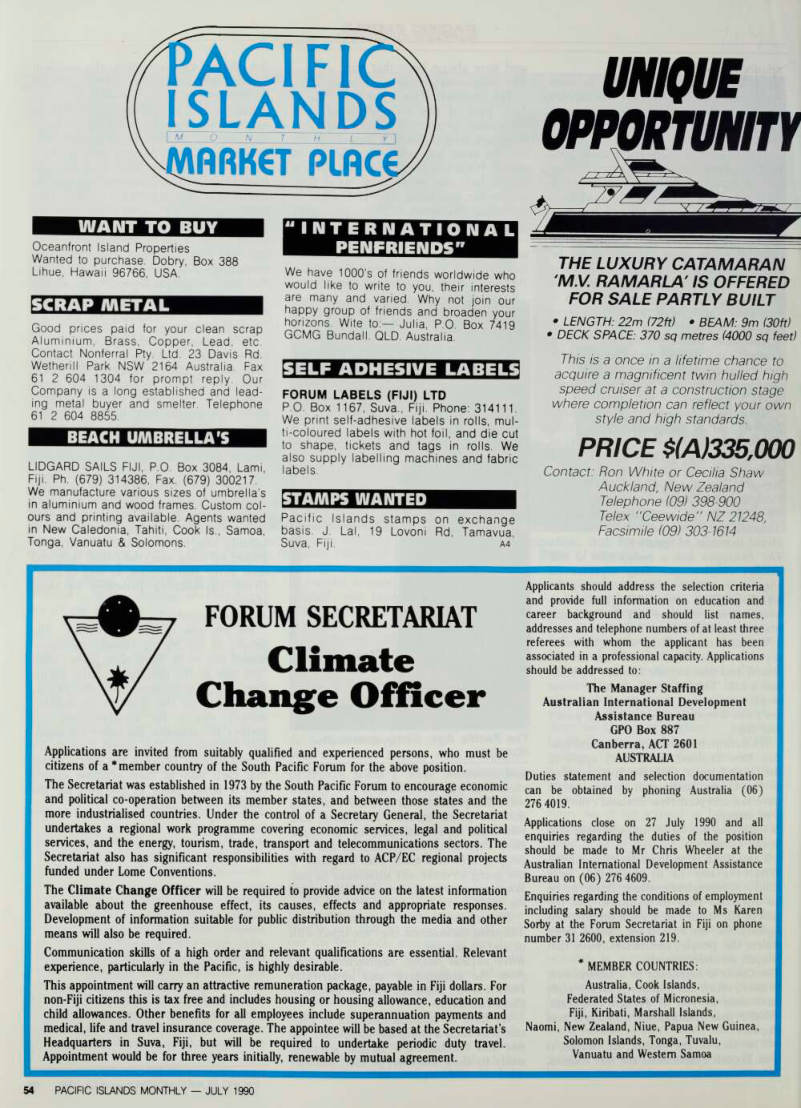
Pacific
Islands
Monthly
July 1990
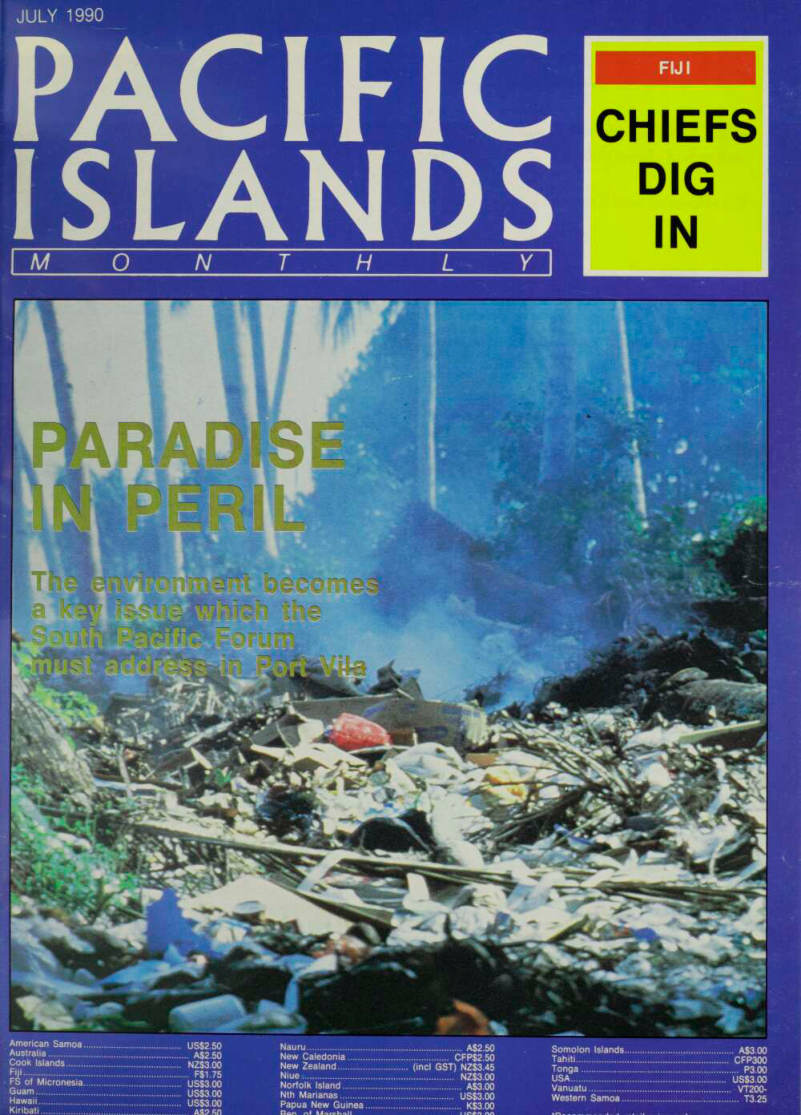
Fiji
Chiefs
Dig
IN
■ r if i Hr , m m k I x_ im\ H . * ■I n 1-t WjJ I >-i ■A £ •* -S J* -aK. -1 iflt ■ a sJIL L L V . Lyi L : L CJ. L L v-.. i .
s|lSevl vchicb. tISJ
• • Rjsl••• -
American Samoa US$2.5O Australia A 52.50 Cook Islands NZ$3.OO F$l.75 FS of Micronesia US$3 00 Guam US$3.OO Hawaii US$3.OO Kiribati a
Nauru A 52.50 New Caledonia CFPS2.SO New Zealand (incl GST) NZ53.45 Niue NZ$3.OO Norfolk Island A 53.00 Nth Marianas US$3.OO Papua New Guinea K 53.00 Dan rtf Unrcknll I Art
Somolon Islands A 53.00 Tahiti CFP3OO Tonga P 3.00
Usa Us$3.Oo
Vanuatu VT2OO - Samoa T 3.25
Advertisements & other items, pp. 2-5 (2 items)
The new 3235.
Not just
two of a kind.
A pair of true individuals.
While most manufacturers offer different engine sizes and options, their new models usually look as sinn-
ing apart.
The new Mazda 3235.
Not just variations on a theme. Two totally different cars.
The 323 5-door Astina combines rugged versatility and sporty performance in an unexpectedly graceful silhouette. The sleek, agile profile turns heads as easily as the Astina turns corners. Precise handling and enthusiastic response make every drive a
sheer delight.
The 323 4-door Sedan is the ultimate in affordable style. Seductive contours and energetic performance belie this car’s functional beauty. The well-appointed cabin fits a family in comfort. And, the spacious trunk fits all their luggage, too.
Take a look at the new Mazda 3235. Drive one.
Then the other. Break away from the humourless, homogenized moulds of automotive design.
These are the shapes of things to come. lar as peas in a pod.
But here’s a set of twins you’ll have no trouble tell- This warranty is valid only in Australia.
■mazoa
© Mazda Motor Corporation
. :*s. r.:\ m x N
CMX23O
STEREO CASSETTE DECK
WITH FM-STEREO/MW TUNER
& CD CHANGER CONTROL
CMX23O the trend-setting in-car sound player offered by Clarion, that front runner in the car audio field. Visit new sound frontiers with the
amazing CMX23O,
a masterpiece in human
engineering.
m A? / / /, A J, <p o A /
clarior
For further information Australia: AWA Distribution Limited Dept. 112-118 Talavera Road North Ryde NSW 2113 / New Zealand: AWA New Zealand Limited, P.O. Box 50-248, Porirua / Fiji Islands: Brij & Co., Ltd., G.P.O. Box 362, Suva Tahiti: HI FI., VAIRAATOA. Avenue Chef Vairaatoa B.P 1128, Papeete / New Caledonia; Caldis, 8.P.M1, Noumea Cedex / Guam: Micropac Auo Inc., P.O. Box 3478, Agana, Guam 96910, U.S.A. Tel: 472-8091, Cable Code: HIFI AUDIO AGANA / Vanuatu: The Sound Centre, PO. Box 434, Vila / Cook Islands; South Se International Ltd., PO. Box 49, Rarotonaa / Papua New Guinea: Haoemever (P.N.G.) Ptv. Ltd., PO. Box 1428, Boroko, Port Moresby
Pacific
ISLANDS
MONTHLY
Vol. 60, No. 7
VOICE OF THE PACIFIC
July 1990
Focus
The New
COVER WHEN leaders of the Pacific meet in Port Vila for the 21st South Pacific Forum next month their attention will focus on the environment and their decisions will shape the region’s environmental policies for the 90s.
There is urgency in the move to set up regulations before Paradise is Lost.
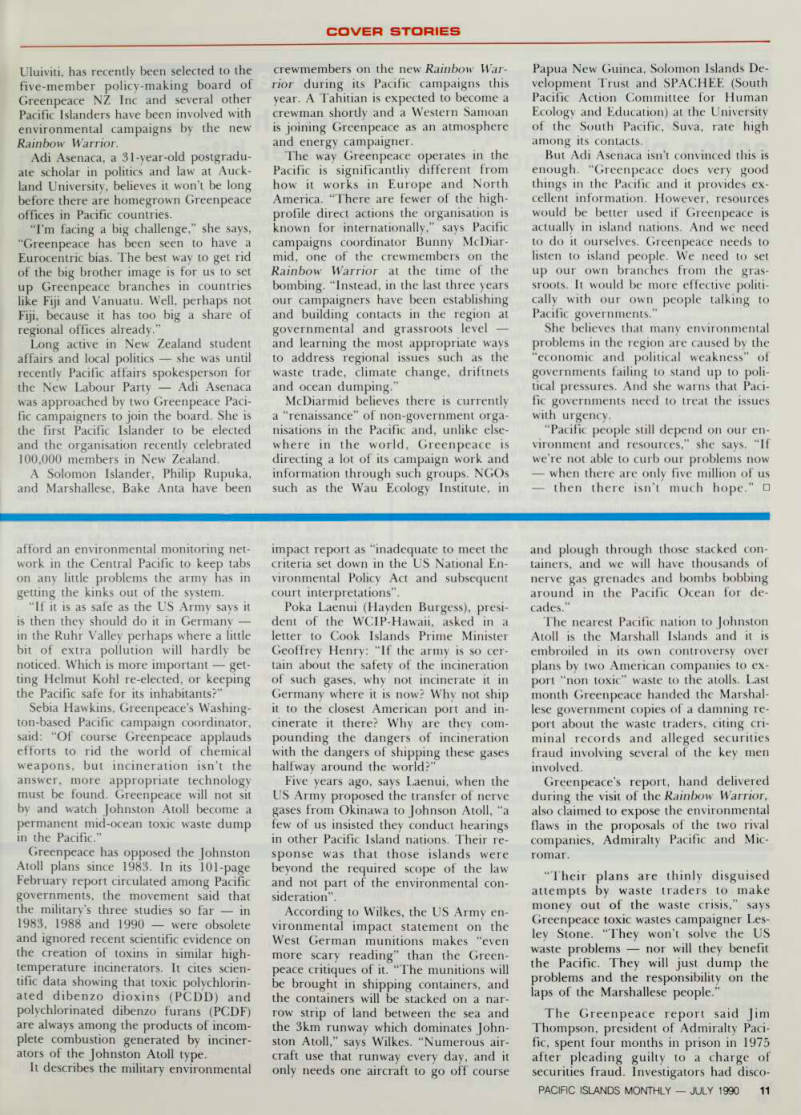
Cover photo: Waste dump on Western Samoa’s main island ofLpolu; by Lesley Slone, Greenpeace.
The Region
Western Samoa: As the country goes through a rehabilitation programme after Cyclone Ofa, politicians debate the right of com moners to vote. Page 15.
Micronesia: an innocent move to bring some United States islands under the jurisdiction of Hawaii and Guam has revived an accident claim. Page 19.
Tonga: Commoners continue their battle to bring accoun tability to the noble-dominated government. Page 39.
Vanuatu: Soldiers play a diffe rent role by erecting a simple hoist to make life easier on the remote island of Futuna. Page 40.
Marshall Islands: President Kabua goes to Washington, meets President Bush and tries to win some deals. Page 46.
Business
Papua New Guinea: Prime Minis ter Rabbie Namaliu tries out a strategy to arrest his country’s di ving economy, mostly the result of the unrest on the island of Bougainville. Page 23.
Fiji: The Asian Development Bank reports that the prospects for the Fiji economy look optimis tic but warns of lack of growth in some sectors. Page 26.
Shipping: A crocodile hunter’s yacht is found. But there is a mis sing link. Page 33.
Editor Jale Moala Correspondents: Al Prince, Belinda Meares, Carrie Loranger, David North, David Robie, Diana McManus, Dykes Angiki, Ed Rampell, Frank Senge, John Hunter, Jope Balawani lotu, Karen Mangnall, Macel Manua, Nicholas Rothwell, Paul Moon, Pesi Fonua, Ulafala Aiavao,’
Richard Dinnen.
Business correspondent Robin Bromby
Publisher Geoffrey Hussey Advertising Manager Lionel Heffernan Business Manager Charlotte Thomas
Advertising Sales • Fiji; Peter Prasad, Tel (679) 314 111 • Sydney & Melbourne: Fergus Mac lagan, Tel (02) 4123918
• Brisbane; Robert Walker, Tel (07) 3710533 • Adelaide; Hastwell Williamson Rep resentations, Tel (08) 799522 Cover prices are recommended retail only.
Registered by Australia Post, publication No.
NBP 1210. Copyright Fiji Times Limited, Suva, Fiji.
A Fiji Times Limited Production.
Founded 1930 (USPS 952480). 20 Gordon Street, Suva, Fiji. Telex FJ2124, Fax (679) 303809, Tel (679) 303244.
Pacific Islands Monthly (APRS No.
NBP1210) is published monthly by Fiji Times Limited, a division of Nationwide News, 2 Holt Street, Surry Hills, NSW 2010. Second class post age paid to Honolulu, Hawaii Post master.
Send address changes to: • Pacific Islands Monthly, PO Box 1167, Suva, Fiji. • or, Pacific Islands Monthly, PO Box 2250, Honolulu. Hawaii 96822.
Typeset and printed by Fiji Times Limited, 20 Gordon Street, Suva, Fiji.
Advertisements & other items, p. 5 (1 item)
Departments
Letters 6
Stamps 38
Books 47 Pacific People 49 Market Place 54
Letters
Quaker opposition THE Fiji Action Committee of Quaker Peace and Service hopes that the New Zealand Government will not resume top level political ties with the present regime in Fiji and that it will not consider any military assistance to it.
The regime was established through military action by one section of the Melanesian people against a democratically elected Government, in which all the people of Fiji had expressed their wishes in a constitutional way.
Apparent acceptance of this military action, whatever the pretext, signals acceptance of violence and can set a dangerous precedent for the rest of the Pacific and for New Zealand, too.
Mary Woodward
Fiji Action Committee QPSNZ, Auckland Bounty debate, Part 111 NO wonder Norman Douglas is eager to close the “Bounty debate” ( PIM , Letters, May 1990). Despite his profuse and grossly sarcastic verbiage (which evident ly is his idea of humour) he is still un able to point out one single substantial inaccuracy or error (or even unlikeli
hood) in my book Mutiny and Romance in the South Seas: A Companion to the Bounty Adventure.
On the other hand, how can one de bate meaningfully with someone who doesn’t have his facts straight (e.g.), it was the Government of Fiji who used the
phrase “principal discoverer of Fiji” to
describe Bligh), who prefers sarcasm to constructive criticism, and who claims that his sense of adventure is proved by his passport and (oh dear, to use Mr Douglas’ phrase) his sense of romance by his ex-wives?
Sven Wahlroos, Ph.D.
California Forum airline WHILST I was pleased to see you quot ing from my contribution to Chris Kis sling’s book, Communications and Transport for Pacific Micro-States , (USP 1984), I very much regret the situation that is developing in scheduled airline service within the South Pacific. Only Air Pacific has the critical mass necessary for sustainable self-sufficiency and yet, coun tries suffering from under-provision of
air service by major metropolitan car
riers continue to launch brave, but
under resourced, new airline ventures.
Whilst some six or seven years ago I was of the view that a liberalisation of
the inappropriate traffic rights regime
would be of great advantage to the South Pacific carriers, I believe that the markets and capacity have changed to such an extent that the only way for aviation to be put on a sound footing within the South Pacific is the formation of a co-operative regional carrier.
The island states of the Pacific have established a now successful Forum ship ping line and the Forum could be an ideal launching vehicle for such an air line. Of course, non Forum countries must be invited to participate and hope fully, New Zealand and Fiji, whilst re taining the identities of their widebody operating carriers, will be willing to ex plore a basis of their future contribution as well.
The situation requires an initiative: as a former airline executive and now as a consultant with extensive awareness of Pacific aviation, I can see no other solu tion to the ongoing losses which no in vestor can afford, whether that investor
be private or public.
Jm King
Melbourne
Advertisements & other items, pp. 6-7 (1 item)
The Pacific Islands Rely
ON THE ENERGY OF BORAL.
■ I *l- - Island Norfolk Island 2419 Papua New Guinea Port Moresby 214248 Lae 42 2574 Rabaul 921225 WewakB6 2125 Tonga Nukualofa 21388 Cook Islands Rarotonga 24460 American Samoa Pago Pago 6332170 Fiji Suva 24035 Lautoka 60088 Sigatoka 50578 Labasa 82973 All through the Pacific Islands, people rely on Boral Speed-E-Gas LP Gas for their energy needs.
Boral has terminals throughout the area, and is proud to be a leading supplier.
Speed-E-Gas is clean, efficient and low in cost.
It's the ideal energy source for cooking and water heating in homes, motels and hotels, and for a wide range of industrial uses.
So call Boral. We have the energy you’re looking for. 1 Vanuatu Santo 455 Port Vila 2046
BORAL GAS
Solomon Islands Honiara 21833 Boral Gas Limited, Bth Floor, IBM House, 168 Kent St., Sydney, NSW 2000. Tel: (02) 278512.
Fuels and lubricants.
Plastics. Chemicals. Bitumen.
Aviation Services. Bunkering.
Shell has penetrated even more of the Pacific to widen its network of offices, terminals and
Network Shell,
now servicing
even more
of the Pacific.
distributors as well as service stations.
Now you can re-assess your source of supply, because Shell quality and value is close at hand, with the service to back it up.
REGIONAL OFFICES; GLAM 671 477 4350. Also servicing Marshall Islands (Majuro), Northern Marianas (Saipan), Palau. 1313 433. Also servicing tonga. Cook Islands. American Samoa, Western Samoa • PAPLA NEW GUINEA 675 228 TOO, Also servicing Solomon Islands.
NEW CALEDONIA OS' 285 720. Also servicing Tahiti, Vanuatu.
Paradise
Cover Stories
Paradise in Peril
Global environmental problems are now confronting Pacific nations with a vengeance. The South Pacific Forum ponders the future.
By David Robie
WHILE much of the world de bates the mounting environ mental crisis with growing pleas for urgent solutions, the South Pacific is discovering the region isn’t immune.
Pacific nations also have thorny environ mental issues to confront.
Although global problems such as the
greenhouse effect and ozone depletion have mainly been caused by the indust rial world, it is the low-lying atoll nations and other territories in the Pacific that face the worst consequences. It is a ques tion of survival.
Industrial neo-colonialism has under mined and harmed the harmony tradi tional Pacific communities have enjoyed with nature. But now paradise is in peril.
The region is a mosaic of serious actual
or potential environmental problems
hazardous waste dumping, driftnet
fishing, ocean dumping, greenhouse
effect, ozone depletion, nuclear tests, de forestation, nerve gas burn-offs, coral reef damage, mining devastation and pollution. And the list is growing.
Some of these issues will be discussed when the region’s heads of government
Lesley Stone/Greenpeace
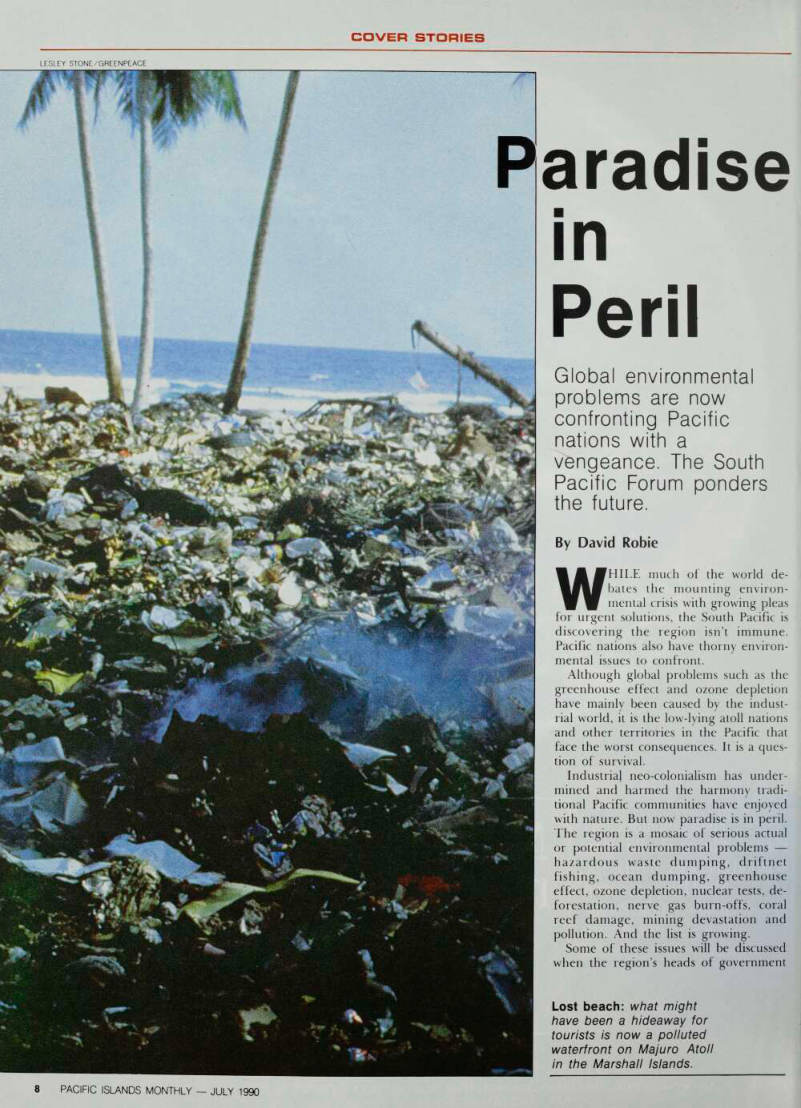
Lost beach: what might have been a hideaway for tourists is now a polluted waterfront on Majuro Atoll in the Marshall Islands.
gather at the 21st South Pacific Forum in Port Vila from July 23 to August 5, but there are unlikely to be many easy or instant solutions. And it is debatable whether some of the more contentious issues will even be discussed frankly.
Australian and New Zealand officials are cautious. Although the environmen tal debate looms large in both countries, they don’t want to be seen as pushing their concerns onto island leaders too forcibly or too quickly. “It has taken three decades for the environmental de bate to get where it is New Zealand,” said one senior External Affairs official.
“But it is only just beginning in many Pacific nations.”
Few observers believe the Pacific en vironment has been managed on a sus tainable basis over the past two decades, let alone been improved. The region’s few ecology specialists, such as the South
Pacific Regional Environment Program
me (SPREP) coordinator Dr Vili Fuavao, are concerned about the future.
“As you’d expect, most of our environ mental problems are related to marine resources,” he says. “The absence of a ‘fallback’ option for small Pacific coun tries increases their vulnerability and sus ceptibility of our region to environmen tal disasters”.
Roy Ferguson, director of New Zea land’s MERT environment division, be lieves environmental issues are likely to be among major domestic challenges for South Pacific governments over the com ing decade as well as continuing to be
a major part of regional politics.
“And we shouldn’t overlook popula tion pressures among the environmental challenges the region faces,” he says.
“The total population of the region at about five million appears low. But not only is the population density very high by world standards in some parts of the Pacific for example Tarawa in Kiribati has a density of 2190 people per square kilometre but the growth rates are
high.”
Among politicians with a high profile
in the region is French Polynesia’s Health and Environment Minister Jacqui Drollet, who is pushing for a “local con sultation” among Tahitians over the fu ture of nuclear testing at Moruroa and Fangataufa atolls. Long an advocate of environmental concerns, Drollet is now concerned about the social and economic implications for Tahiti if France “pulls
the plug”.
Opposition to nuclear testing in the region was an issue that unified nations when the South Pacific Forum was founded in 1971, and eventually led to the singing of the South Pacific Nuclear Free Zone Treaty in 1985.
Twelve years of United States atmos pheric testing in the Marshall Islands atolls of Bikini and Enewetak and its legacy of radiation-linked illnesses and dislocated people, followed by French testing in the atmosphere from 1966 to 1974 and underground since then, have helped make Pacific governments and people sensitive to environmental abuse by outside powers.
Environmental pressure groups are now lobbying for greater priority and resources to be given to environmental issues in the Pacific but they too are
treading warily.
Blaming industrialised nations for the problems now facing the Pacific, Green peace Pacific campaigns coordinator Bunny McDiarmid says: “It’s hardly fair to us to turn around to the developing world and tell them they cannot have
refrigerators, they cannot have cars, they
cannot have what we have because it is destroying our environment.
“This means that information, re sources and clean technology have to be made accessible to the developing world so that its peoples can choose develop ment options which are informed and
environmentally-sustainable. Up-to-date
information, especially on recent tech
nological developments, is especially im portant and often hard to obtain within a developing region like the Pacific Is lands. Greenpeace can often contribute information to balance and strengthen the debate on a certain issue.”
But Greenpeace is playing a low-key role. And Pacific islanders are taking an increasingly crucial responsibility in the New Zealand branch of an international movement that has five million suppor ters in 25 countries and turns over more than US$5O million a year.
For the past three years the organisa tion has been establishing and building contacts in the region at government and grassroots level, and learning the most appropriate ways to address regional issues such as the waste trade, climate change, driftnets and ocean dumping.
Unlike its gung-ho style of direct ac tion protests elsewhere in the world, Greenpeace’s new Pacific flagship Rain bow Warrior has been deployed on a relatively modest campaigns in the past few months. It has targetted driftnet fishing boats in the South Pacific, visited Tahiti on an education mission, teamed up with Vaomatua environmental action group in American Samoa to protect coral reefs, delivered building supplies and solar panels to the Rongelap Islan
ders on Mejalo, protested against Star
Wars and missile testing on Kwajalein Atoll, demonstrated offshore against the nerve gas burn-off plans on Johnston
Atoll, and protested against a geoth
ermal power plant on Hawaii’s Island which threatens the last significant low land rainforest in the US. Now the ship is seeking out Japanese, Taiwanese and South Korean driftnet fleets in the North Pacific.
Environmentalists, church leaders and politicians, fearing the risk of “another Bhopal or Chernobyl” as some critics claim —.have stepped up a campaign to block the US military plans to store and
destroy a huge stockpile of chemical
Brian Coffey/Greenpeace
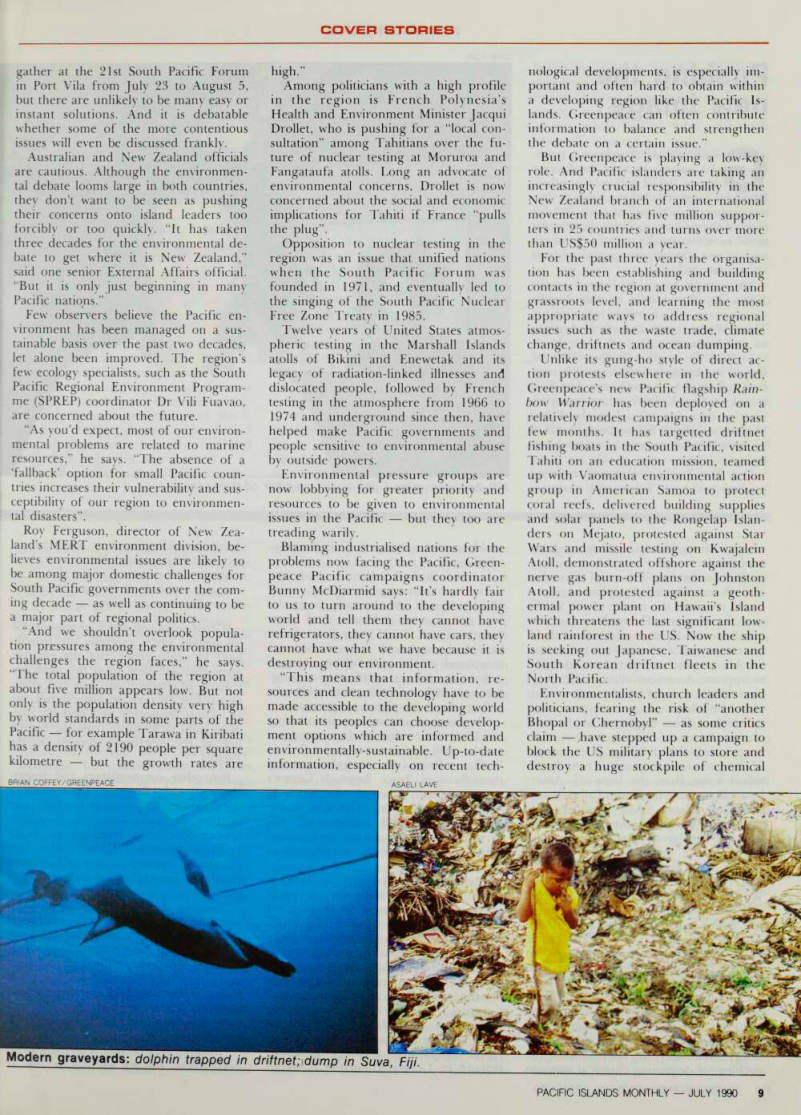
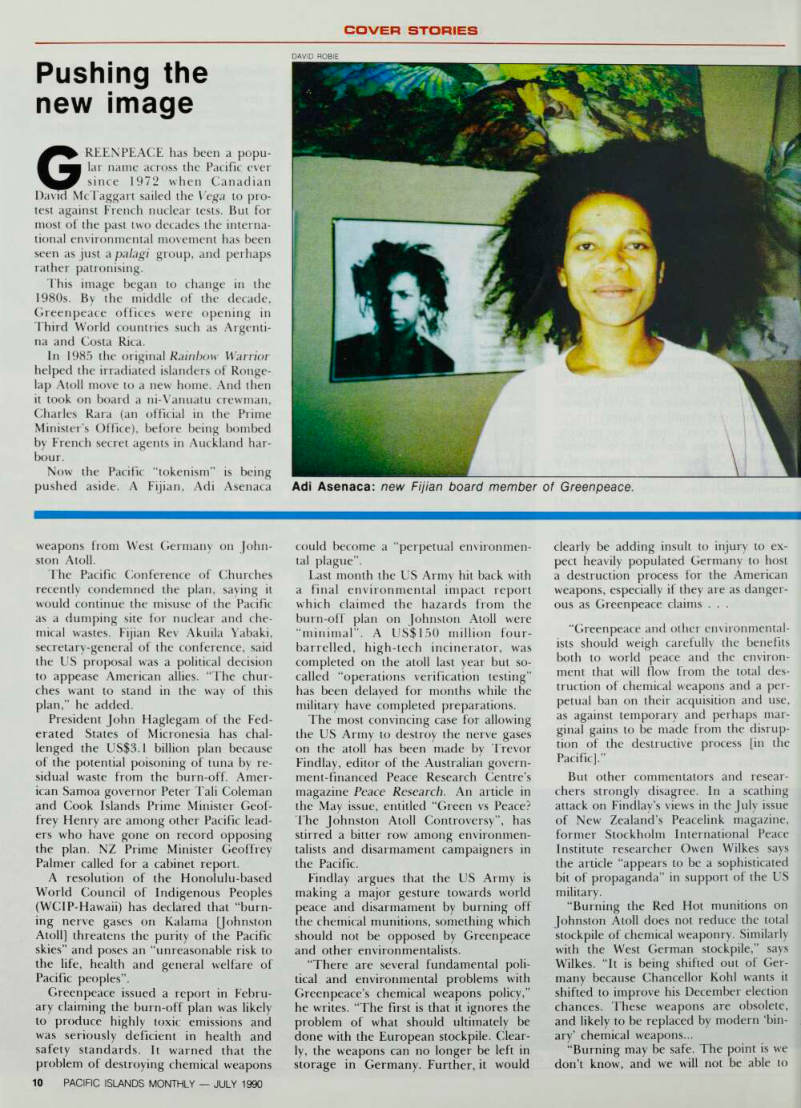
Modern graveyards: dolphin trapped in driftnet; dump in Suva, Fiji.
Asaeli Lave
weapons from West Germany on John ston Atoll.
The Pacific Conference of Churches
recently condemned the plan, saying it
would continue the misuse of the Pacific as a dumping site for nuclear and che mical wastes. Fijian Rev Akuila Yabaki, secretary-general of the conference, said the US proposal was a political decision to appease American allies. “The chur ches want to stand in the way of this plan,” he added.
President John Haglegam of the Fed erated States of Micronesia has chal lenged the USs3.l billion plan because of the potential poisoning of tuna by re sidual waste from the burn-off. Amer ican Samoa governor Peter Tali Coleman and Cook Islands Prime Minister Geof frey Henry are among other Pacific lead ers who have gone on record opposing the plan. NZ Prime Minister Geoffrey Palmer called for a cabinet report.
A resolution of the Honolulu-based World Council of Indigenous Peoples (WCIP-Hawaii) has declared that “burn ing nerve gases on Kalama [Johnston Atoll] threatens the purity of the Pacific skies” and poses an “unreasonable risk to the life, health and general welfare of Pacific peoples”.
Greenpeace issued a report in Febru ary claiming the burn-off plan was likely to produce highly toxic emissions and was seriously deficient in health and safety standards. It warned that the problem of destroying chemical weapons
could become a “perpetual environmen-
tal plague”.
Last month the US Army hit back with a final environmental impact report which claimed the hazards from the burn-off plan on Johnston Atoll were ■■minimal". A US$l5O million fourbarrelled, high-tech incinerator, was completed on the atoll last year but so-
called “operations verification testing”
has been delayed for months while the
military have completed preparations.
The most convincing case for allowing the US Army to destroy the nerve gases on the atoll has been made by Trevor Findlay, editor of the Australian government-fmanced Peace Research Centre’s magazine Peace Research. An article in the May issue, entitled “Green vs Peace?
The Johnston Atoll Controversy”, has stirred a bitter row among environmentalists and disarmament campaigners in the Pacific.
Findlay argues that the US Army is making a major gesture towards world peace and disarmament by burning off the chemical munitions, something which should not be opposed by Greenpeace and other environmentalists.
“There are several fundamental political and environmental problems with
Greenpeace’s chemical weapons policy,”
he writes. “The first is that it ignores the problem of what should ultimately be done with the European stockpile. Clearly, the weapons can no longer be left in storage in Germany. Further, it would
clearly be adding insult to injury to ex pect heavily populated Germany to host a destruction process for the American weapons, especially if they are as danger ous as Greenpeace claims . . . . “Greenpeace and other environmental sts s hould weigh carefully the benefits botb to woldd peace and the enyiron ment that wlll flow from the des ‘ tructlon of chemical weapons and a per- P etual ban on their acquisition and use, as a g amst temporary and perhaps mar- S mal S ams to be made from the dlsru P‘ tion of „ the destructive process [m the Pacific].
But other commentators and resear
chers strongly disagree. In a scathing
attack on Findlay’s views in the July issue of New Zealand’s Peacelink magazine, former Stockholm International Peace Institute researcher Owen Wilkes says the article “appears to be a sophisticated bit of propaganda” in support of the US military.
“Burning the Red Hot munitions on Johnston Atoll does not reduce the total stockpile of chemical weaponry. Similarly with the West German stockpile,” says Wilkes. “It is being shifted out of Ger many because Chancellor Kohl wants it shifted to improve his December election chances. These weapons are obsolete, and likely to be replaced by modern ‘bin ary’ chemical weapons...
“Burning may be safe. The point is we don’t know, and we will not be able to
afford an environmental monitoring net work in the Central Pacific to keep tabs on any little problems the army has in getting the kinks out of the system.
“If it is as safe as the US Army says it is then they should do it in Germany in the Ruhr Valley perhaps where a little bit of extra pollution will hardly be noticed. Which is more important get ting Helmut Kohl re-elected, or keeping the Pacific safe for its inhabitants?”
Sebia Hawkins, Greenpeace’s Washing ton-based Pacific campaign coordinator, said: “Of course Greenpeace applauds efforts to rid the world of chemical weapons, but incineration isn’t the
answer, more appropriate technology
must be found. Greenpeace will not sit by and watch Johnston Atoll become a permanent mid-ocean toxic waste dump in the Pacific.”
Greenpeace has opposed the Johnston
Atoll plans since 1983. In its 101-page February report circulated among Pacific governments, the movement said that the military’s three studies so far in 1983, 1988 and 1990 were obsolete and ignored recent scientific evidence on the creation of toxins in similar high temperature incinerators. It cites scien tific data showing that toxic polychlorin ated dibenzo dioxins (PCDD) and polychlorinated dibenzo furans (PCDF) are always among the products of incom plete combustion generated by inciner ators of the Johnston Atoll type.
It describes the military environmental
impact report as “inadequate to meet the criteria set down in the US National En vironmental Policy Act and subsequent
court interpretations”.
Poka Laenui (Hayden Burgess), presi dent of the WCIP-Hawaii, asked in a letter to Cook Islands Prime Minister Geoffrey Henry: “If the army is so cer tain about the safety of the incineration of such gases, why not incinerate it in Germany where it is now? Why not ship it to the closest American port and in cinerate it there? Why are they com pounding the dangers of incineration with the dangers of shipping these gases halfway around the world?”
Five years ago, says Laenui, when the US Army proposed the transfer of nerve gases from Okinawa to Johnson Atoll, “a few of us insisted they conduct hearings in other Pacific Island nations. Their re sponse was that those islands were beyond the required scope of the law and not part of the environmental con sideration”.
According to Wilkes, the US Army en vironmental impact statement on the West German munitions makes “even more scary reading” than the Green peace critiques of it. “The munitions will be brought in shipping containers, and the containers will be stacked on a nar row strip of land between the sea and the 3km runway which dominates John ston Atoll,” says Wilkes. “Numerous air craft use that runway every day, and it only needs one aircraft to go off course
and plough through those stacked con tainers, and we will have thousands of nerve gas grenades and bombs bobbing around in the Pacific Ocean for de cades.”
The nearest Pacific nation to Johnston Atoll is the Marshall Islands and it is embroiled in its own controversy over plans by two American companies to ex port “non toxic” waste to the atolls. Last month Greenpeace handed the Marshal lese government copies of a damning re port about the waste traders, citing cri minal records and alleged securities fraud involving several of the key men involved.
Greenpeace’s report, hand delivered during the visit of the Rainbow Warrior, also claimed to expose the environmental flaws in the proposals of the two rival companies, Admiralty Pacific and Mic romar.
“Their plans are thinly disguised
attempts by waste traders to make money out of the waste crisis,” says Greenpeace toxic wastes campaigner Les ley Stone. “They won’t solve the US waste problems nor will they benefit the Pacific. They will just dump the problems and the responsibility on the laps of the Marshallese people.”
The Greenpeace report said Jim
Thompson, president of Admiralty Paci
fic, spent four months in prison in 1975 after pleading guilty to a charge of securities fraud. Investigators had disco
vered that “Thompson has a history of financial deception and other alleged illegal activities for which he has received criminal charges more than once,” the report said. Several court records, letters from prosecutors and a prosecution affi davit are cited in support of the claims.
Admiralty Pacific has proposed schemes for garbage landfill on Ebeye, Kwajalein and other atolls and to dump used tires in lagoons, and Thompson re portedly tried to secretly negotiate a plan for nuclear waste dumping in the Mar shalls.
Micromar’s president Dan Fleming, who split with Thompson last year, is
currently preparing an engineering
study on the feasibility of exporting US garbage to create almost 100 hectares of landfill at Kwajalein Atoll. He promises no garbage will be dumped in lagoons or the ocean and no toxic waste will be shipped in to the Marshalls.
Fleming also claims “landfill will be protected by massive seawalls, dikes and will be sealed and leak proof’. But, says Greenpeace in its detailed critique of the Micromar proposals, claims that there
will be no toxics and the surrounding environment would not be contaminated “are impossible to fulfill”.
While most other Pacific nations have
rejected waste dumping proposals or put
them on hold, a California-based com pany has also come back into the reckon ing. Global Telesis is trying to arrange a long-term deal that could send millions of tonnes of US hazardous waste to in cinerators throughout Asia and the Paci fic. The same company tried unsuccess fully to export US waste to Papua New Guinea and the Solomon Islands in
1988.
Although Global Telesis has not yet followed US law by filing a notice of intent to export waste with the US En vironmental Protection Agency, the com pany claims to have agreements with several Asian and Pacific countries. It already has an agreement with China to build a factory for the “processing of toxic and non-toxic chemical materials and wastes” at the Basuo Development Zone in Hainan province.
Also, Global Telesis claims to have a deal with Papua New Guinea to con
struct an incinerator for hazardous wastes. However, Papua New Guinea is a signature to the Lome Convention and consequently prohibits the import of
foreign waste.
The company is also reported to be trying to build an incinerator in Vanuatu, another Lome convention
signatory.
Meanwhile, Taiwan is reported to have low-level nuclear waste stored on a small Pacific island, reviving fears of ocean dumping after the Japanese plans in the 1970 s were abandoned. According to a
report in Radioactive Waste Manage ment magazine, the waste, mainly from nuclear power plants, has been regularly shipped to a storage site on Lan-Yu islet since 1982.
Among several alternatives to the final disposal of radioactive waste, in particu lar low-level radwaste, ocean dumping will probably prove the most feasible method,” said the report. It added that 270 shipments of radioactive waste had been shipped to the island until the end of 1988. D
new image
Pushing the new image
GREENPEACE has been a popu lar name across the Pacific ever since 1972 when Canadian David McTaggart sailed the Vega to pro test against French nuclear tests. But for most of the past two decades the interna tional environmental movement has been seen as just a palagi group, and perhaps
rather patronising.
This image began to change in the 1980 s. By the middle of the decade, Greenpeace offices were opening in Third World countries such as Argenti na and Costa Rica.
In 1985 the original Rainbow Warrior helped the irradiated islanders of Ronge lap Atoll move to a new home. And then it took on board a ni-Vanuatu crewman, Charles Rara (an official in the Prime Minister’s Office), before being bombed by French secret agents in Auckland har bour.
Now the Pacific “tokenism” is being pushed aside. A Fijian, Adi Asenaca
David Robie
Adi Asenaca: new Fijian board member of Greenpeace.
Uluiviti, has recently been selected to the five-member policy-making board of Greenpeace NZ Inc and several other Pacific Islanders have been involved with environmental campaigns by the new Rainbow Warrior.
Adi Asenaca, a 31-year-old postgradu ate scholar in politics and law at Auck land University, believes it won’t be long before there are homegrown Greenpeace offices in Pacific countries.
“I’m facing a big challenge,” she says, “Greenpeace has been seen to have a Eurocentric bias. The best way to get rid of the big brother image is for us to set up Greenpeace branches in countries like Fiji and Vanuatu. Well, perhaps not Fiji, because it has too big a share of
regional offices already.”
Long active in New Zealand student affairs and local politics she was until recently Pacific affairs spokesperson for the New Labour Party Adi Asenaca
was approached by two Greenpeace Paci
fic campaigners to join the board. She is the first Pacific Islander to be elected and the organisation recently celebrated 100,000 members in New Zealand.
A Solomon Islander, Philip Rupuka, and Marshallese, Bake Anta have been
crewmembers on the new Rainbow War rior during its Pacific campaigns this year. A Tahitian is expected to become a crewman shortly and a Western Samoan is joining Greenpeace as an atmosphere and energy campaigner.
The way Greenpeace operates in the Pacific is significantliy different from how it works in Europe and North America. “There are fewer of the high profile direct actions the organisation is known for internationally,” says Pacific campaigns coordinator Bunny McDiar mid, one of the crewmembers on the Rainbow Warrior at the time of the bombing. “Instead, in the last three years our campaigners have been establishing and building contacts in the region at governmental and grassroots level and learning the most appropriate ways to address regional issues such as the waste trade, climate change, driftnets and ocean dumping.”
McDiarmid believes there is currently a “renaissance” of non-government orga nisations in the Pacific and, unlike else where in the world, Greenpeace is directing a lot of its campaign work and information through such groups. NGOs such as the Wau Ecology Institute, in
Papua New Guinea, Solomon Islands De velopment Trust and SPACHEE (South Pacific Action Committee for Human Ecology and Education) at the University of the South Pacific, Suva, rate high among its contacts.
But Adi Asenaca isn’t convinced this is enough. “Greenpeace does very good things in the Pacific and it provides ex cellent information. However, resources would be better used if Greenpeace is actually in island nations. And we need to do it ourselves. Greenpeace needs to listen to island people. We need to set up our own branches from the gras sroots. It would be more effective politi cally with our own people talking to Pacific governments.”
She believes that many environmental problems in the region are caused by the “economic and political weakness” of governments failing to stand up to poli tical pressures. And she warns that Paci fic governments need to treat the issues with urgency.
“Pacific people still depend on our en vironment and resources,” she says. “If we’re not able to curb our problems now when there are only five million of us then there isn’t much hope.” □
action plan
The watchdog
The Oceania
BASED in Noumea, the South Pacific Regional Environ ment Programme, or SPREP, coordinates the “action plan” for Oceania. It works on behalf of the 22 island governments and administrations of the region in partnership with the South Pacific Commission, the United Nations En vironment Programme, the Forum Secretariat and the Econo mic and Social Commission for Asia and the Pacific.
“Some people argue that economic development is foremost and must be achieved at all cost,” says SPREP coordinator Dr Vili Fuavao. “Part of the resources are then diverted to ‘mend’ the environmental damages an approach used by ‘de veloped’ countries to achieve economic independence. The situation in the Pacific doesn’t allow that.”
Established in 1978, SPREP’s action plan was mapped out at the inaugural Conference of the Human Environment in the South Pacific at Rarotonga in 1982. The Plan is a regional strategy, identifying about 60 aspects of environmental assess ment, management and law.
In 1986 the SPREP Convention and its protocols were signed. Besides prohibiting the dumping of radioactive waste in the marine environment of the region, its provisions cover other forms of marine pollution from land-based sources, from the atmosphere, mining and coastal erosion. The pream ble recognises the need for cooperation to ensure sustainable Pacific resource management.
Six years ago the SPREP secretariat formed an Association of South Pacific Environmental Institutions (ASPEI) to coor dinate their activities.
Among the agency’s activities are; • Coastal water quality monitoring: Studies are made of coastal water conditions and marine pollutants such as heavy metals and pesticides are monitored. • Natural resource management: SPREP carried out the sur vey and monitoring of coastal ecosystems and the interaction of mangrove, seagrass ad coral reef communities. • Environmental education and training: The agency gives high priority to helping member governments through train ing courses, workshops and seminars, and distributes a variety of information. • Waste management and pollution control: SPREP includes several projects in its action plan dealing with the occupational and environmental hazards of pesticide use, the development of effluent and waste disposal standards for governments of the region. □
Moruroa
When the
disaster hits
RADIOACTIVE waste from French underground nuc lear tests at Moruroa Atoll is seeping towards the surface faster than has been previously claimed, warns a leading New Zealand scientist.
Professor Manfred Hochstein, director of Auckland Uni versity’s Geothermal Institute, believes the waste could come to the top of the atoll in about 30 years not the thousands of years claimed by French authorities.
“It is not a matter of 2000 years, nor is it a matter of 100 years,” he says. “In about 30 years the disaster will hit us.”
Speaking in May at a conference of the New Zealand branch of the International Physicians for the Prevention of Nuclear War, Professor Hochstein revealed that he had tried to pre sent his findings to the NZ National Radiation Laboratory which has been accused by several environmental groups as being partisan in favour of French testing.
He has also sent data from his “reservoir model”, a five-year computer study into the effects of radioactive contamination on Moruroa. The computer model has demonstrated that nuc lear explosions have seriously cracked and weakened the hard basalt core of the atoll.
Hochstein’s theory has been confirmed by analysis of data collected at Moruroa by French oceanographer Jacques Cous teau during a 1987 visit to the atoll. Although Cousteau de clared testing safe at present, his data showed the presence of radioactive caesium 137 in lagoon water.
“The only objective data has been from the Cousteau report and that still showed a mild leakage of radioactive material equivalent to nuclear power station in Europe,” he says.
Opponents of the nuclear tests were embarrassed in April when a French news agency report purported to cite a group of 22 French medical experts as saying the risks of radiation at Moruroa were “infinitesimal”.
The report came out two days before the group’s official Press statement was made public.
The doctors said in a statement published in the Tahiti newspaper La Depeche after a two-day visit: “Without pre judging the situation of Fangataufa and Hao atolls, the delega tion considered that there is not a major radiological risk on Moruroa atoll at present.
“However, [we] are not convinced of the absence of medium and long-term risks because of the strong concentration of radioactive material in the sub-soil of the atoll.” □
Old questions,
Johnston
new threats
JOHNSTON Atoll, about 1300 kilometres southwest of Honolulu, is a bleak, treeless, uninhabited former bird sanctuary. From the air it looks like an oversized aircraft carrier about half of the main island, Johnston, is taken up
by a three-kilometre-long runway.
Originally there were just two tiny islands on the atoll Johnston and Sand but they have been expanded and two artificial islands created for the military installations. Johnston Island has been increased twelvefold to 260 hectares.
The United States Army’s $3.1 billion plan to destroy its aging chemical weapons arsenal has stirred fears of potentially disastrous consequences. Although the final military environ mental impact report released last month claimed the hazards on Johnston Atoll were “minimal”, Pacific anxiety remains strong.
Testing for the full-scale burn-off of nerve and mustard gas stockpiles removed from Okinawa and moved to the atoll in 1971 is due to start soon. Full operation is expected by next month. The chemical weapon destruction plant, called the Johnston Atoll Chemical Agent Disposal System (JACADS), has been built over several years.
The army plans to ship other chemical weapons from West Germany and destroy them in the four JACADS incinerators on Johnston Island. Among the US stockpile in Germany is an estimated 400 tonnes of lethal nerve gas GB (Sarin) and VX contained in about 100,000 8-inch and 155 mm shells.
Nerve gas causes convulsions and death sometimes within 10 minutes of exposure. Mustard blistering agents H, HD and HT are also among the weapons.
Comprising about 1 per cent of the total US chemical weapons arsenal, the chemical weapons have been stockpiled in the past few years at Clausen in the state of Rhineland- Palatinate, close to the French border. Under the army plan the shells would be transported in high-security convoys almost 50 km by road to Miesau, carried by train to the North Sea port of Nordenham, and then shipped to Johnston Atoll.
However, the weapons would not be destroyed until 1994 after the Okinawa and Johnston arsenals have been burnt off.
If the Johnston Atoll weapons burn-offs are considered suc cessful, chemical weapons stocks will be dismantled and des troyed on the mainland US in Alabama, Arkansas, Colorado, Indiana, Kentucky, Maryland, Oregon and Utah. Within seven years about 30,000 tonnes of the weapons will be burned. □
Deception or
Marshalls
development?
TWO American companies have been trying to persuade the Marshall Islands government to give the green light to huge schemes for exporting waste to the low-lying atoll nation. But they have been accused by the international environmental organisation Greenpeace of being “skilled in
deception not waste development”.
An investigation by Greenpeace made public last month has claimed that not only are the environmental claims by the companies indefensible, but the principle players have long records of financial deception and other alleged illegal activi ties.
The two companies are Seattle-based Admiralty Pacific, which launched the proposal almost two years ago, and the rival Micronesian Marine Development (known as Micromar) of Oakland. Last year Admiralty Pacific offered a plan to ship 17 million tonnes of “non toxic” municipal waste over five years to the atoll chain and to add topsoil from New Zealand, or possibly Australia. The company offered a fee of US$l4O million with an option to continue dumping for a further 10 years.
Admiralty offered this “garbage mountain” to counter the threat of flooding from rising sea levels caused by the so-called greenhouse effect. When that proposal collapsed, the company revamped its idea. Now Admiralty claims that it can enhance Marshallese fisheries resources while solving North America’s tire disposal problem by exporting waste tyres to the Marshall Islands for dumping in lagoons to create artificial reefs.
As many as 250 million tires are discarded each year in the US half of them being randomly dumped throughout the country. Enormous tyre fires have raged for weeks at many tyres dumps, spreading toxic fumes for many kilometres.
Pressure is mounting to get rid of stockpiled scrap tyres.
However, Admiralty has not abandoned its plans to fill in the Marshallese lagoons with waste. “With the addition of solid waste to the artificial reefs and lagoons created by the tyres,” the company proposal said, “new land could be created for agricultural use.”
Micromar’s plan is a variation on the original Admiralty proposal. Micromar wants to use millions of tonnes of US garbage to create landfill in the Marshall Islands. Although the company claims the garbage will not contain any toxics and will not contaminate the environment, critics say these claims are impossible to fill. □
Chiefs dig in
Fiji
By Iva Tora
A LETTER that would have caught many readers’ eyes in The Fiji Times on June 29 was a two-paragraph Citizen’s Declaration: “I have no intention of abiding by the racist laws of a racist constitution.” Signed by Sudesh Prasad, of Lami, just outside the capital Suva, the letter referred to the new constitution of Fiji approved a week earlier by the Great Council of Chiefs, the ultimate decision-making body of the
indigenous Fijians.
Prasad’s letter underscored continuing Indian opposition to the constitution which gives the indigenous race numeric
al superiority in parliament plus some
customary guarantees. The constitution’s approval by the Great Council of Chiefs was expected and had the support of the army which overthrew an Indian dominated government in 1987 and de clared Fiji a republic.
While the Fijians may have reason to celebrate the approval of a new constitu tion weighted in their favour, there were warning bells that the new sense of pow er could, if abused, lead to some frag mentation. Speaking at the Great Council of Chiefs meeting, The President, Ratu Sir Penaia Ganilau, whose chiefly title of Tui Cakau is the one of the most power ful symbols of Fijian politics, hit out at the emergence of several Taukei (indige nous) movements after the military coup.
These movements, Ganilau said, had multiplied tenfold overnight and and had degraded the meaning of the word taukei and distorted the essence of the Fijian identity. One chief, from the pro vince of Naitasiri, said the speech “im mediately diffused the situation and eased whatever tension we may have brought with us”. In an effort to main tain unity the chiefs from throughout Fiji formed a new “Fijian political party”.
In a three-page communique, the chiefs issued a brief summary outline of the new party whose primary objective was the safeguarding of Fijian interests.
The party, the statement said, would “guarantee, promote and strengthen the
indigenous rights, political aspirations
and political future of the Fijian people; facilitate, promote and stimulate the accelerated participation of the Fijian in business, commerce and industry in the country. It would “facilitate, promote and stimulate the economic and social development of the Fijian people in their villages, districts and provinces and pro tect, strengthen and promote the unity of the Fijian people and the consolida tion of their tradition and culture.
There may not have been anything novel in the preamble to differentiate it from the usual ultra-rightist Taukei plat forms. But what did raise a few suspect ing eye-brows were the provisions that the party would “accommodate associa tion with other political/ethnic groups/
parties” while “fully understanding that
Fiji is a multi-racial country”.
The mention of multi-racialism sent sirens ringing. For many it was a remin der of Ratu Sir Kamisese Mara’s Alliance Government which ruled Fiji for 17 years from independence until being un seated in the general elections of 1987.
Mara’s acceptance of the post-coup lead ership and a self-appointed Cabinet mostly from within his old Alliance lineup had torpedoed hope by his party to mend its fences and revive the multi
racial image it successfully pushed for
most of its existence. The new party, however, reminds critics of the Alliance
and, especially, its organisational wing
the Fijian Association. Some warned the new party was giving the Alliance and the Fijian Association, presumed to have waned into antiquity after the coup, a chance of a new life and re-birth.
Reaction to the announcement poured in thick and fast. Said one former Alliance Cabinet Minister turned anti- Mara campaigner, Sakeasi Butadroka (now leader of the Fijian Christian Nationalist Party): “If this proposal did not have Mara’s blessing, it would never have been initiated.” Another former Alliance, Isireli Vuibau, said: “It is a re surrection of the Fijian Association under a new mask, new guise. Vuibau, now the leader of the Conservative Party of Fiji, added: “I don’t believe the old chiefs are involved it is most probably and highly likely just one or two groups from the Ministry of Fijian Affairs.” The Fiji Labour Party, a partner in the de posed Coalition government, was also worried. Its vice-president, Simione Durutalo, a lecturer in sociology at the University of the South Pacific in Suva, said: “This is the last hurrah of the chiefs. It is an attempt to stem the tide and salvage their hold and support of the Fijian people. There has been a gra dual erosion of their political influence, accelerated particularly in the urban areas and this is a last ditch attempt to contain that.”
If the changes made to the distribution of Fijian seats was anything to go by, there may well have been some truth to the claim. The draft document, after three days of deliberations, reduced the number of urban seats for Fijian from
eight to five and increased the number of rural seats in three of the 14 pro vinces from two to three. Mara’s pro vince Lau, Ganilau’s area Cakaud rove, and Tailevu, each received an extra seat. But the logic behind the increase in rural seats escaped some observers.
“There are 42,000 people from the Lau province but only 12,000 live there and yet they have been given three seats.
In the urban areas where you have one
third of the Fijian population living
there, there’s only five seats,” lamented a former Junior Vice-president of the Fi jian Association, Ratu Timoci Vesikula, another former Alliance Cabinet Minis ter. “Does that sound like a fair distribu tion? I think it is absolutely unfair.
Urban people are in many ways the foundation, the ones responsible for run ning the country. Most of the educated Fijians live in the urban areas and those who can best represent Fiji live in the urban areas.”
But for others, such as Durutalo, the re-distribution of seats showed all the classic signs of those resorting to heavy gerimandering to achieve their ends in the real politik numbers game. “It’s all about numbers and (the chiefs) will try to get as much support as they can hence the heavy gerimandering and weight given to the rural areas,” he said.
Responding to the attacks, Fiji’s Minis ter for Fijian Affairs, Lieutenant-Colonel Vatiliai Navunisaravi, lashed out at the critics as opponents who “were still wrap ped up in past dominion thinking; “We’re now in the republic era those critics ought to just come out from their shells and realise this is a different era.
So what if this party is a revival of the Fijian Association? Isn’t this party deal ing with Fijian solidarity, with Fijian poli
tical aspirations?”
Strongly refuting claims that the prop osal was initiated by a core group of indi viduals, the Minister said only that “the chiefs had initiated the proposal”, and did not elaborate. □
Advertisements & other items, p. 14 (1 item)
Martin Fabrics
FIJI’S ONLY HOUSE OF FASHION WEAR
a FLORAL DRESS PRINTS a HABUTAE SILK a 100% COTTON PRINTS a FANCY FABRICS a TAPA PRINTS a MENS SUITING &
a ISLAND PRINTS SHIRTING MATERIAL
LARGEST SELECTION! IN FIJI OF
a CURTAIN FABRIC FROM SWEDEN
AVAILABLE AT ALL
MARTIN FABRICS RETAIL OUTLET
SUVA
281 VICTORIA PRO.
BA TOWN
MAIN STREET
NADI TOWN
OPP. NAMOTOMOTO VILLAGE
LAUTOKA
BILA STREET
MARTINS CORNER
4 MILES NABUA
Chance for Democracy
The Region
Western Samoa
By Ulafala Aiavao
WESTERN Samoa plans to hold a referendum in October on the issue of allowing everyone on or over the age of 21 years to vote in
general elections, currently a privilege
only of the chiefs ( niatai ). The referen dum, if approved by the Matai dominated Parliament, will, however, not question the right of chiefs only to stand in general elections. But the referendum will be open to everyone aged 21 years and over.
The 47-seat Western Samoa Fono (Parliament) consists of 45 seals reserved for niatai who are elected by niatai. The other two seats are for people of non- Samoan ancestry who are elected under
universal suffrage by voters aged 21
years and over and registered under the Individual Voter’s Roll.
The referendum “is a delicate issue", said Finance Minister and Cabinet
spokesman Tuilaepa Sailele when
announcing the plan last month. If
accepted by Par liament, universal suffrage will com
pletely transform
Western Samoan politics and re volutionise an electoral system
that currently
allows only 11 per cent of the
population to
vote. In the 1988
general elections,
for example, only
8.7 per cent of the population of 160,000 voted; 12,110 matai andf 1955 Individual Voters. The de bate for universal suffrage has been going on since the
1970 s although
there have been differences on the voting age, some wanting 21 years, some 25 and some 30.
Sailele acknow
ledged the prob
lems created by the presence of matai with multi
pie title holders. This year’s count showed that 18,000 matai hold 24,000 titles. More titles are being created or bestowed. The rate is faster than that of population growth. In 1961, a year be fore independence, there was one matai title to every 24 people. In 1981 the ratio was 1:11, and for the 1988 general elections it was 1:8. The ratio drops to 1:4 if those below the age of 16 years are not counted.
The current electoral system causes the abuse of the matai system. In West ern Samoa, only matai can participate in elections for the 45 seats filled by the
indigenous people. Only a matai can
vote and only a matai can stand for elec tions. It is not a democracy of one man one vote, but it is a system of one matai title one vote. A man or woman with 10 matai titles, for example, can vote 10 times in one general election. The num ber of registered matai titles has in creased from 4700 in 1961 to 20,600 for the 1988 general elections. Some chiefs hold seven titles, enabling them to vote
seven times.
The number of multiple title holders have increased dramatically in recent years, so has the number of people hold ing the same title. The Registrar of the Lands and Titles Court, Galumalemana Netina, said one recent case involved a matai who wanted to share his title with 117 other people. Another tried to give his title to 153 others. The record is held by a chief who tried to share his title with 200 people. This record attempt was challenged and the number of peo ple was reduced.
As they run out of chiefly titles, the West Samoans simply create new ones.
One new title being challenged by the Lands and Titles Court is Ofa, a name many Samoans remember as that of the killer cyclone which hit them last Febru ary. Other new titles being challenged are Apaau Vaalele (aeroplane wings), Samala (hammer), Vaiaga (cave pool), Tatatuli (knee tapping), Tee (defy), and Luka (Luke). Titles are being crosscheck ed with a 1955 register listing all ancient
Samoan titles.
Winning votes
is not all that is behind the flood of titles in West ern Samoa. In many cases titles are bestowed as reward for good deeds. For exam ple, Samoans liv ing overseas send back to their families at home WSS7O million a year, half the
country’s annual
budget. To re ward their family members abroad, those at home give them a chief ly title. While it is illegal to bestow title on someone living outside the country, cere monies still take place and the ti tles continue to be
exported. People
in Western Samoa are also made chiefs as an ack
nowledgment of
their services. They in turn are sought to help families during weddings, funer als and fundraising. There was even a case where a four-year-old boy was given a title.
The alarming increase in the number of matai is having an effect on tradition al resources and village life. Take the sharing of land, for example, where matai have the first say. While in the past land and other property might be the responsibility of on e matai, today the same property can be the subject of dis pute among several people holding the
same chiefly title. Village-level leadership
has also been weakened by the presence of too many chiefs in one village. There are so many chiefs these days that when they meet in one village some remain outside the meeting house because all the customary seats have been taken up.
October’s referendum will also seek opinion on an enlarged parliament, whether numerically, or from unicamer al to bicameral. A bicameral system is likely to involve a lower House of Repre sentatives and an Upper House of Pule and Tumua comprised of customary
groupings of people.
An example of the weaknesses of Western Samoa’s electoral system was the case involving Muliagatele Gina Moore, a woman who beat the system. She is the only person in Western Samoa to have legally voted in the Individual Voter’s roll, while her husband, who holds a matai title, was voting in the separate roll for matai.
How did she do it? Using the name Gina Moore, she was listed on the Indi vidual Voter’s roll to help elect two MPs to represent people of non-Samoan ancestry. She was removed from that roll when her husband registered his matai title because no one can vote as an Indi vidual Voter if they hold a registered matai title or are married to someone with a registered matai title.
So Moore was stripped of her right to vote.
She sued and lost in the Magistrate’s Court in January 1982. She sued again, this time in the Supreme Court. In a landmark decision the Supreme Court not only overruled the lower court, it declared the electoral system unconstitu tional because it discriminated against voters. A subsequent Court of Appeal decision in August 1982 reversed the Supreme Court ruling, but not before Gina Moore managed to vote on the In dividual Voter’s roll while her husband cast his vote as a matai.
Today Gina Moore holds the title Muliagatele which she hopes to use for the first time as a voter in the February election where she will vote as a chief.
“It’s about time,” she said, when she heard of the planned referendum. □
Cardinal with a view
ONE of the influential groups which has pursued universal suffrage for Western Samoa is the country’s Council of Churches, headed by Roman Catholic Cardinal, Pio Taofmuu. The council began making formal approaches to government about electoral reform five years ago, although its concern over abuse of matai titles dates back well before then.
Cardinal Pio said there is no point in saying that only chiefs should vote when so many people are becoming chiefs.
Universal suffrage will protect traditional values and customs. Cardinal Pio said the present system permits the creation of matai titles merely for political pur poses; more chiefs mean more votes. He said abuse is destroying the foundations of Samoan traditions and way of life.
Cardinal Pio wants the practise of mak ing chiefs out of children stopped.
Cardinal Pio opposes party politics and suggests government appoints Cabinet Ministers from both sides of the House.
Western Samoa’s ruling Human Rights Protection Party is headed by Prime Minister Tofilau Eti Alesana. The
Opposition Samoa National Develop
ment Party is headed by former Prime Minister Tupuola Efi, now known as Tupua Tamasese Efi. □
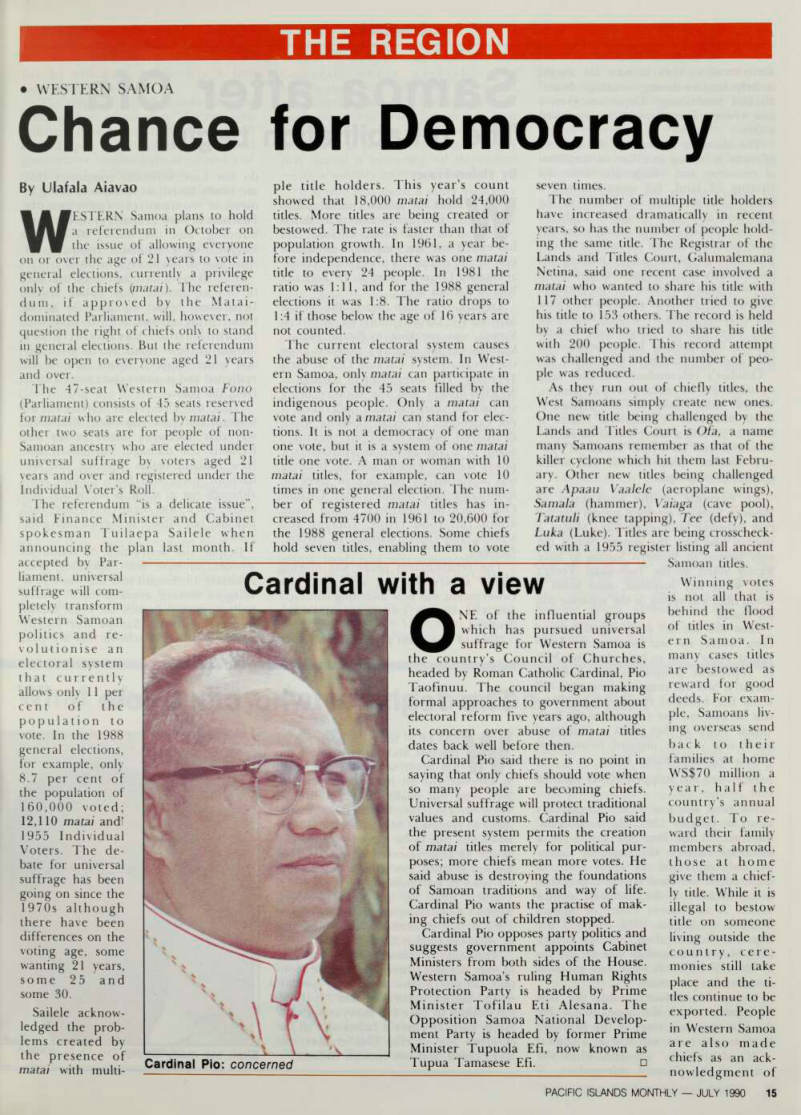
Cardinal Pio: concerned
Samoa after Ofa
The rehabilitation begins
By Helen Fraser
WESTERN Samoa’s initial phase
of emergency and then short term relief after Cyclone Ofa has ended and the long-term rehabilita tion of the country is underway, Nation al Disaster Council chairman Dr Leiataua Kilifoti Eteuati says.
Eteuati, who also heads the Prime Minister’s Department of Western Samoa, was speaking to Pacific Islands Monthly on his country’s progress since the devastation of Cyclone Ofa in early February. The assessment of damage at NZ$3OO-million and the country being set back 20 years has been underlined, if not extended, by recent flooding which destroyed inland road on the main island of Upolu as well as hydro-electric power stations. Eteuati said the flooding was worsened by the lack of trees on mountains and hillsides after Cyclone Ofa, which has destroyed coastal roads, almost all food crops, villages and schools, and caused damage to harbour facilities.
The rehabilitation phase was moving ahead slowly, Eteuati said, and the Government was now awarding contracts for the major construction work involved.
“One of our main problems is that we
do not have sufficient companies that are locally based, so we have to bring in
outside companies, for example
Fletchers of New Zealand, to do the road building, and the Snowy Mountains Engineering Consultants company (of Australia) is also heavily involved.
“As well as we have had to go overseas to buy equipment, our Public Works Department is not equipped so all these things combined to slow our rehabilitation, particularly the
infrastructure roads, electricity supply
and water supply.” Roads have to be realigned and in many cases moved away from the coast.
One of the first things the Government had requested after Ofa, was that specialist teams survey the harbour for damage. Australian and New Zealand teams reported that the harbour itself was fine, Eteuati said, although not as deep as previously, and some work was needed to the fuel pipeline but tanker deliveries had gone ahead.
Despite the destruction of almost all schools, all have been operating since February 19. Eteuati said this was due to villagers making available their church halls, pastors’ homes or even family homes. Western Samoa has mostly village and district schools that are paid
for by villagers, with only a few Government schools.
“The response from Samoans has been nothing short of amazing,” Eteuati says, “villagers have got up by themselves and cleared up the chiefs, matais and local government leaders have organised and coordinated all their activities.
“Good leadership and coordination is one very important reason we’ve been able to get people to work instead of moping,” he said.
Assessments made by both overseas experts and the Agriculture Department have calculated that food crops in the ground are a mere 10 per cent of a normal May quantity, and Eteuati says, not much of this is any use for harvest.
While a tremendous amount of replanting is well under way, a mature taro crop takes eight to nine months. He said one of the concerns of the Government was to ensure that villagers did not harvest their taro early because this would mean there was no mature taro suitable for export in several months time.
The Government had carried out a distribution of four days food supplies in the immediate aftermath of the cyclone, and in mid-June had begun a distribu tion of four weeks supplies of foodstuffs such as flour, rice and canned food.
Eteuati strongly condemned reports in the New Zealand media which described Western Samoa as becoming aid dependent and “the Ethiopia of the South Pacific”.
“The truth of the matter is that our
Council, where everything is coordinated, has really only given out one distribution and the formula we used would feed one person for four days. It’s almost five months now I can’t see how it is possible for anyone to say that Samoa is becoming aid dependent it’s absolutely incorrect,” he said.
“It is true that there is other assistance coming from families (in New Zealand) but that’s going direct. Three quarters of that first distribution was food bought by us and one quarter came direct.”
Eteuati said the records of all donations both material and cash were open to inspection by the public and the press. The records show where the materials have gone to and all cash donations had gone into a special account which was established from the start.
“We’ve heard overseas complaints and virtually all of it is ignorance, and a deal of it is political,” Eteuati said. Some members of the Samoan community in New Zealand had criticised the role of some local MPs in relief distribution on the grounds of favouritism and political patronage, allegations which have been firmly denied by Samoan authorities. A recent statement from the Australian High Commissioner to Apia, Basil Teasy, announcing A$ 100,000 that would go to buying food, had also commended the Council and the International Committee for its work.
Western Samoa’s National Disaster Plan was adopted by Cabinet in 1986. It established the National Disaster
Council, comprising heads of Departments, Government organisations, Non Government Organisations, and the International Committee made up of representatives of all diplomatic missions
in Apia along with regional and
international organisations and Government members.
Eteuati said the coordination of assistance had gone “exceedingly smoothly”, with efficient and effective distribution. He said there had been no problems apart from one case of confusion in overseas reports going out from Apia, which had led to the cancellation of a flour shipment. The Samoan Cabinet had called in the missions involved, explained that the reports were not correct and the matter had been resolved, Eteuati said, and the flour shipment went ahead, although late.
As Chairman of the National Disaster Council Eteuati stressed immediately after Cyclone Ofa that Western Samoa wanted to coordinate the relief and nearly five months on he sums up:
“I’m extremely proud of our people,
there’s been no feeling of depression if anything it’s been a feeling of let’s gel out there and help ourselves. It’s also demonstrated very strongly just how valuable the leadership and guidance, that we have in the organisation of the villages. The attitude in the country is very positive one of cheer and
helping others, although it’s real tough
times, because there is no money around and there’s no food.” □
The registrar who can’t vote
WESTERN Samoa’s Registrar of
Electors and Voters, Tate Simi, has never voted. He will be 38 in October. As an indigenous Samoan, Simi does not qualify as an Individual Voter to elect two Members of Parlia ment to represent non-Samoans. He has no chiefly title so he cannot vote for any of the 45 seats reserved for matai. That has not stopped him from taking on ma jor roles in government.
Since 1984 he has been Western Samoa’s Commissioner of Labour. Since 1987 he has determined who votes, and in what electoral roll.
“Personally, I refuse to take a title just to vote because there are more impor tant considerations as to why people should become matai," he saicf. “It is not too healthy to have too many matai in a family such as where a father and all his children are chiefs. This creates too many chiefs and not enough Indians.”
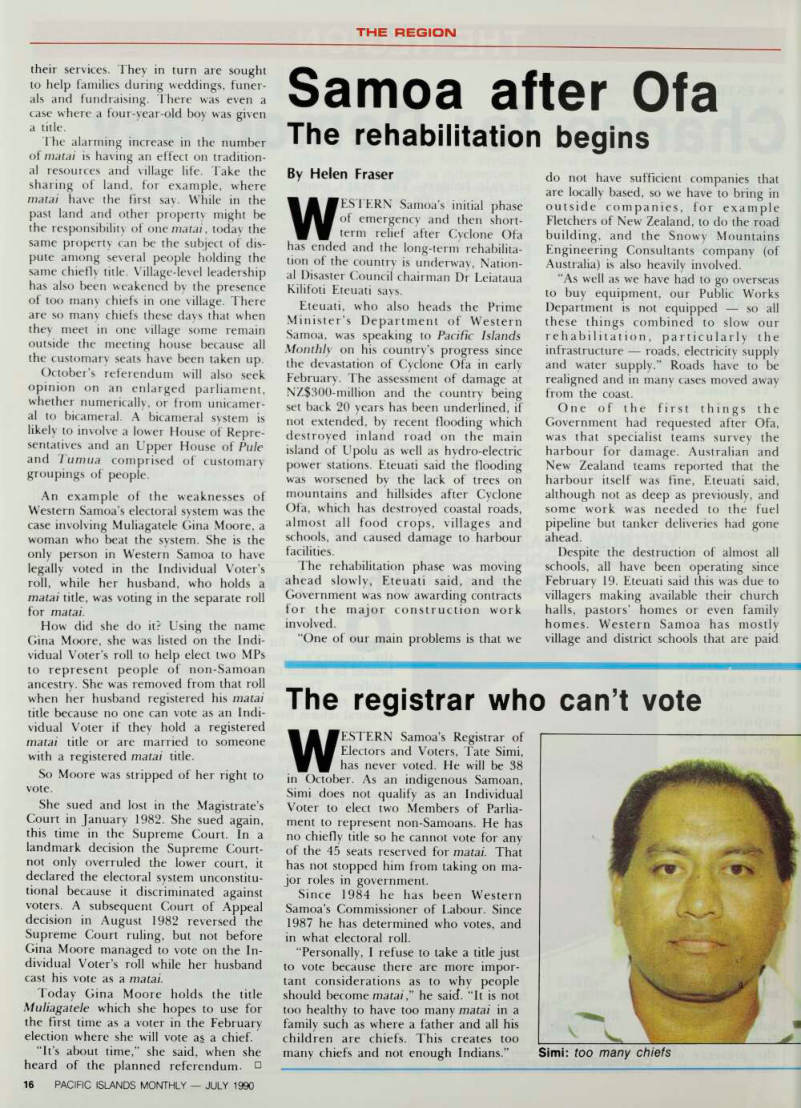
Simi: too many chiefs
What about dirty water and broken roads?
// A WASTE of time and a waste of money” is how ndependent MP, Le Tagaloa Pita, described plans for a referendum on universal suffrage. “The most urgent problem now is to pull the country out of the shame of no electricity, of dirty water, of no water and of broken roads.” (Daily power cuts have been in force for weeks after breakdowns in half the eight diesel generators run by the Electric Power Corporation and the writeoff of a hydro generator. The power went off again during the interview with Le Tagaloa).
“No Samoan is currently prevented from making his views known to his chief. '"All suli (heirs) have the right to dissent under the Samoan system. Why bring in a new system when the Samoan way is adequate? Plebiscite comes from plebian which effectively means commoner. There are no commoners in
Samoa, only chiefs and their heirs.
Faamatai, or the chiefly way, is the system of respect and consensus. That is the system of the future because foreign ways are basically a divisive process.”
Pita’s views are the same as those of Falemalu Asoau, an 18-year-old who opposes universal suffrage. He believes such a reform will affect the respect for ( decision-making elders that young people are supposed to have. Falemalu is unsure whether 21-year-olds are old
enough.
For those of non-Samoan ancestry, universal suffrage could hasten the phasing out of their two Parliamentary seats reserved for Individual Voters.
“Individual Voter’s representation, and the formula for determining that representation, will be made redundant through the introduction of universal suffrage,” said Registrar of Electors and Voters, Tate Simi.
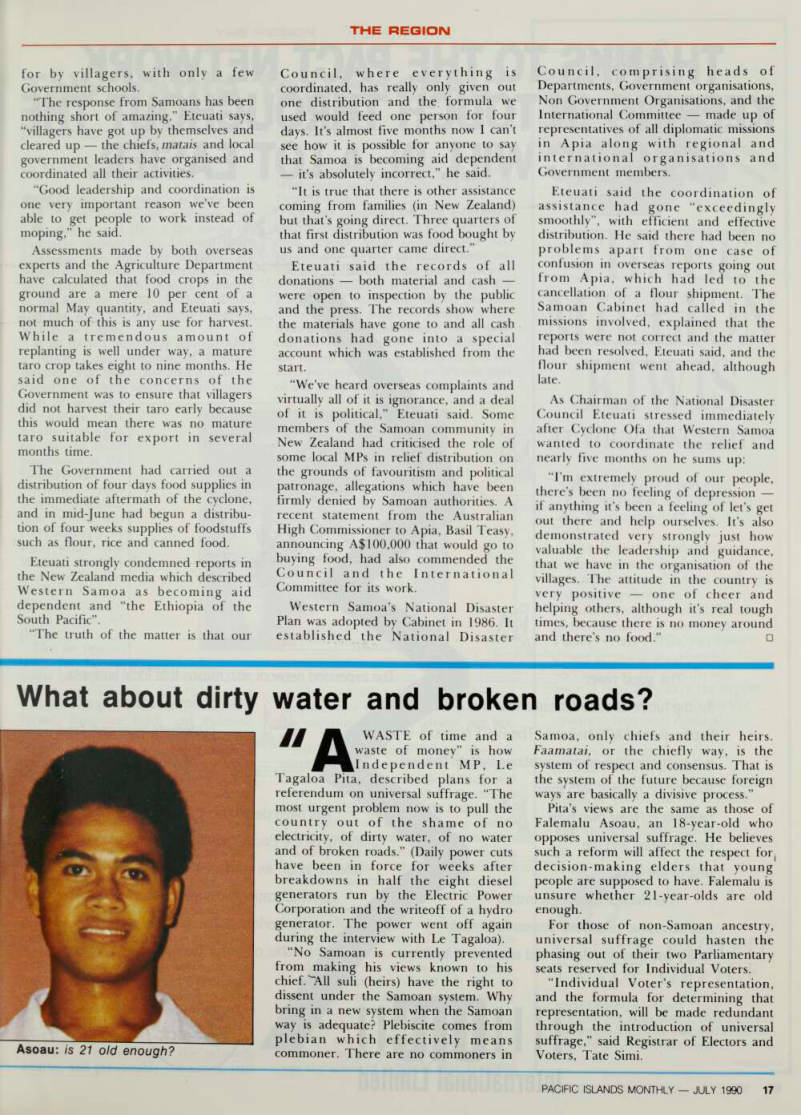
Asoau: is 21 old enough?
Advertisements & other items, p. 18 (1 item)
Thanks To The Pact Network,
KEEPING IN TOUCH THROUGHOUT THE
PACIFIC WILL BE A LOT EASIER.
The good news for the future of communications in the Jm i The expanded network also means that local business can communicate easily with Pacific is the PACT Network. The PACT Network is a cost-effective communications system that will link Pacific nations with their neighbours, their own rural communities and the rest of the world. customers by phone, fax or data link.
The PACT Network planning of the Pacific nations together with OTC This Network provides instant and economic telephone access to friends, has been developed through the careful family and even to medical and educational facilities.
International, an arm of Australia’s worldwide communications company, and INTELSAT, the world’s global satellite system.
No one's far from anyone anymore. inbelsab
International Limited
The battle for Enenkio
An innocent proposition sparks a territorial row.
By David North
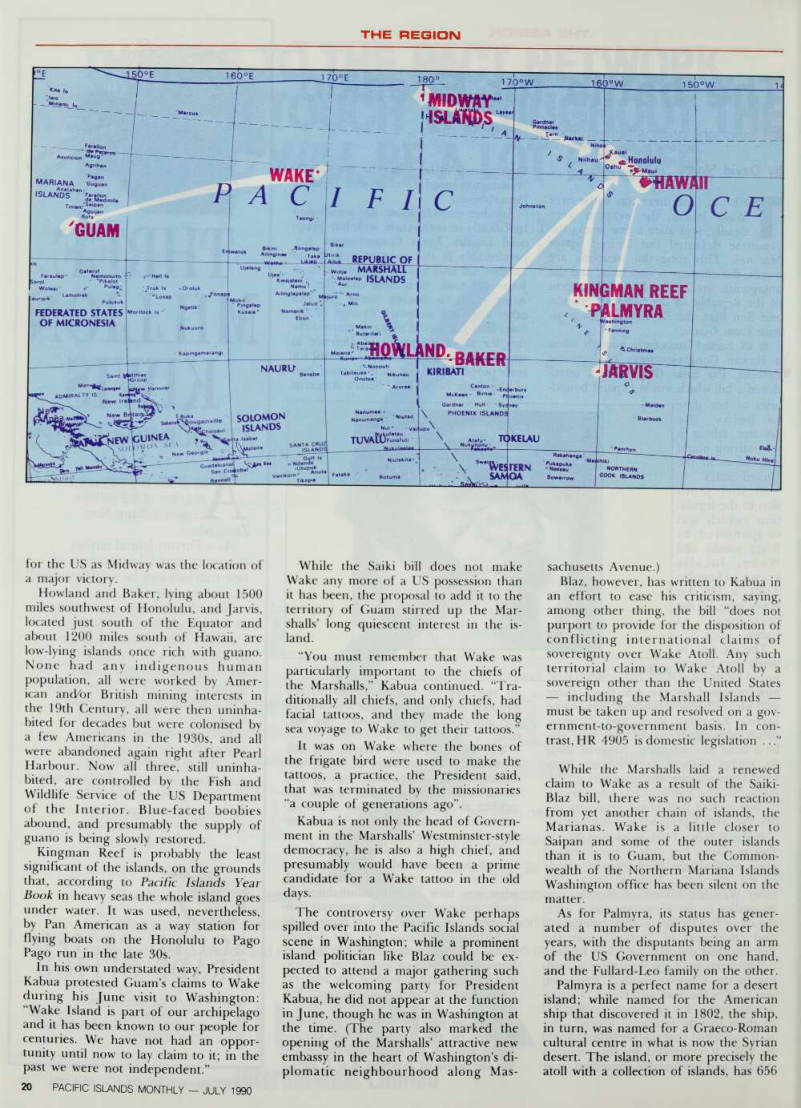
THE last time there was battle over Wake Island, the weapons were deadly, and after a few weeks the Japanese defeated the United States Marines. This time the weapons are words, the outcome is uncertain, and the antagonists are Amata Kabua, President of the Republic of the Marshall Islands, and Ben Blaz, the Republican Congress man from Guam.
It all started innocently enough when a Hawaii Congresswoman of Japanese descent, Pat Saiki (Republican), intro duced a bill which would expand bound
aries of her state to below the Equator, taking in six outlying island possessions of the United States.
Another provi
sion in the legisla tion (which was
co-sponsored by
Blaz) would add
Wake, locally
known as Enenkio Atoll, a US Air Force base, to the
territory of
Guam.
The six new is lands for Hawaii would be Midway,
now occupied by the US Navy, three wild-life refugees (Howland, Baker and Jarvis), Kingman Reef, and Palmyra, which is privately owned and may also be a bone of contention. None of these six, except Midway, are routinely inha bited although one of the owners of Pal myra, Ainsley Fullard-Leo, coincidental ly, was visiting that island group on the day that Saiki’s proposal was announced.
Wake is some 1400 miles East-North- East of Guam but only a few hundred miles north of the northernmost islands of the Marshalls; Midway, some 1500 miles West-North-West of Honolulu, is an outlier in the Hawaiian chain; while the other five lie 900 to 1600 miles south and southwest of Hawaii, near the Equator, and near the waters of Kiribati.
The purpose of the legislation, accord ing to the Congresswoman’s statement, was to give the State of Hawaii “a stron ger argument for environmental control of these islands’ territorial waters”. Her staff suggested that the six islands would be safer if controlled by the relatively nearby, and presumably concerned, state
Government rather than by the distant Washington-based Interior and Defence Departments.
Another consideration, not mentioned specifically in connection with her prop osed Insular Areas Consolidation Act, presumably is the current activity on another US island in the general area Johnston Atoll. It is here that the US Army plans to destroy nerve gas and other chemical weapons. Passage of the Saiki-Blaz bill would make it more diffi cult for the Department of Defence to use islands not now under its control for such purposes were they to become part of the State of Hawaii. Saiki’s concerns
on the use of Johnston to destroy weapons were reflected in a separate bill she introduced on the subject (see box, p2l).
Still another factor behind the bill, particularly the inclusion of Wake into Guam, relates to possible fishing and underwater mineral rights. Guam has neither at the moment, but might ac quire them from the US during the on
going Commonwealth negotiations.
The proposed re-alignment of the boundaries, discussed by Saiki in terms of future concerns, and dealing with what are now largely uninhabited is lands, was not expected to generate con troversy, but it certainly has done so. In addition to setting off the Guam- Marshalls controversy, the bill has re minded observers of some grim historic al events, and has rubbed salt into the wounds of the family which owns Pal myra.
Howland was the objective of Amelia Erhardt on the last leg of her ill-fated flight around the world. Wake Island was the scene of a World War II defeat
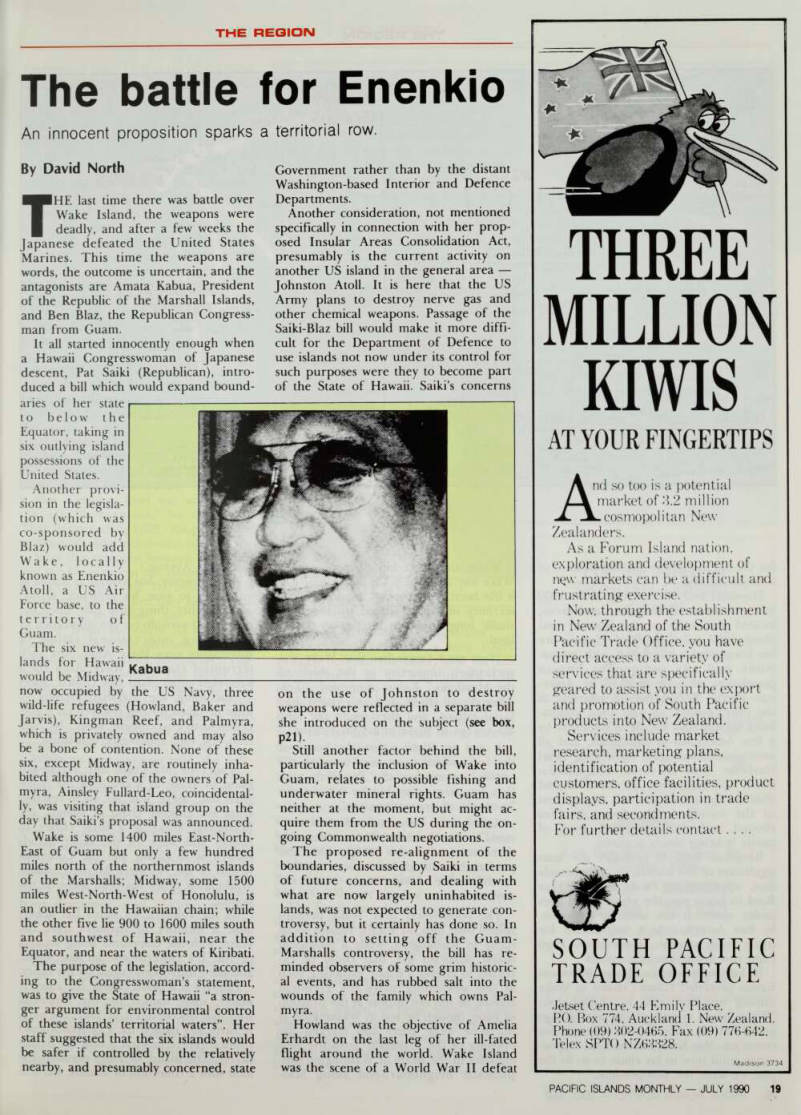
Kabua
for the US as Midway was the location of
a major victory.
Howland and Baker, lying about 1500 miles southwest of Honolulu, and Jarvis, located just south of the Equator and about 1200 miles south of Hawaii, are low-lying islands once rich with guano.
None had any indigenous human population, all were worked by Amer- ? n in D u r British mining interests m the 19th Century all were then unmhabited tor decades but were colonised by a few Americans m the 19305, and all were abandoned again right after Pearl Harbour. Now all three, still unmha-
WndlWe 3 "^^^ 6^ 15 “"I
Wildlife Service of the US Department of the Interior. Blue-faced boobies abound, and presumably the supply of guano is being slowly restored.
Kingman Reef is probably the least significant of the islands, on the grounds that, according to Pacific Islands Year Book in heavy seas the whole island goes under water. It was used, nevertheless, by Pan American as a way station for flying boats on the Honolulu to Pago Pago run in the late 30s.
In his own understated way, President Kabua protested Guam’s claims to Wake during his June visit to Washington: Wake Island is part of our archipelago and it has been known to our people for centuries. We have not had an opportunity until now to lay claim to it; in the past we were not independent.”
While the Saiki bill does not make Wake any more of a US possession than it has been, the proposal to add it to the territory of Guam stirred up the Marshalls’ long quiescent interest in the island.
“ Yo u must remember that Wake was particularly important to the chiefs of the Marshalls,” Kabua continued. “Traditionally all chiefs, and only chiefs, had f ac i a l tattoos> an d t h ey made the long sea voyage to Wake to get their tattoos.” r w . . . . f T f WaS °" ,^ ake where ‘he bones of that was terminated by the missionaries .. . f t - 1. » . 8 8 * Kabua is not only the head of Government m the Marshalls Westmmster-style democracy, he is also a high chief, and presumably would have been a prime candidate for a Wake tattoo m the old days.
The controversy over Wake perhaps spilled over into the Pacific Islands social scene in Washington; while a prominent island politician like Blaz could be expected to attend a major gathering such as the welcoming party for President Kabua, he did not appear at the function in June, though he was in Washington at the time. (The party also marked the opening of the Marshalls’ attractive new embassy in the heart of Washington’s diplomatic neighbourhood along Mas-
sachusetts Avenue.) Blaz, however, has written to Kabua in an effort to ease his criticism, saying, among other thing, the bill “does not purport to provide for the disposition of conflicting international claims of sovereignty over Wake Atoll. Any such territorial claim to Wake Atoll by a sovereign other than the United States including the Marshall Islands must be taken up and resolved on a gov ernment-to-government basis. In con trast, HR 4905 is domestic legislation ...”
While the Marshalls laid a renewed claim to Wake as a result of the Saiki- Blaz bill, there was no such reaction from yet another chain of islands, the Marianas. Wake is a little closer to Saipan and some of the outer islands than it is to Guam, but the Common wealth of the Northern Mariana Islands Washington office has been silent on the matter.
As for Palmyra, its status has gener ated a number of disputes over the years, with the disputants being an arm of the US Government on one hand, and the Fullard-Leo family on the other.
Palmyra is a perfect name for a desert island; while named for the American ship that discovered it in 1802, the ship, in turn, was named for a Graeco-Roman cultural centre in what is now the Syrian desert. The island, or more precisely the atoll with a collection of islands, has 656
hectares or over 1400 acres of dry land.
The total area of land and sheltered wa ter is about 40,000 acres according to its owners. It is probably the largest private
ly-owned grouping of tropical islands
under the US flag.
The US however, has not always had it. The Kingdom of Hawaii first laid claim to Palmyra in 1868. Britain did the same in 1889, and the Americans in cluded it in Hawaii’s boundaries when it took over the islands in 1898. A few years later a Judge Cooper, of Honolulu, acquired the title to the island group and used it to grow coconuts. Subsequently, the Judge, who died in 1929, sold vir tually all of his holdings there to the late Leslie and Ellen Fullard-Leo, of Hawaii, keeping two islets, about one acre, for his heirs, who own that smidgin of land to this day.
The first really significant contact be tween the Fullard-Leos and the Govern ment was a happy one according to Les lie Fullard-Leo, one of the three sons of the original owners.
“My mother was the only woman in the history of the United States to cause the annexation of an island to the US,”
Leslie Fullard-Leo told PIM. “She saw to it that Kingman Reef was acquired by the US Government,” he explained.
That happened in 1922. Kingman Reef is about 50 miles north-west of Palmyra.
After that relations between the family and the Government ran downhill. After the attack on Pearl Harbour the US armed services decided they needed Pal myra as a re-fuelling site for planes headed from Honolulu to the South Pacific. (Some of the alternative stopping points, such as Tarawa, having been cap tured by the Japanese). The family was willing, according to Fullard-Leo, and signed a lease prepared by the Navy, giving them full use of the Palmyra dur ing the war. But although the Navy had prepared the lease, it did not sign it.
While no rent was ever paid, the milit ary took over Palmyra in a big way.
There had been three lagoons and 52 islands. The seabees merged two of the
lagoons to create a protected landing
area for seaplanes; similarly, the military
strung together a number of the islands (there are now 39 of them) to build an
1800-metre-long landing strip for land
based planes. Roads were built, the har bour deepened, and a radio sending facility was constructed. At one point there were thousands of troops on Pal myra.
Although the US Air Force continued to use the landing strip as late as 1961, it is now unserviceable. “Too much vegeta tion, and too many birds’ nests to use,” according to a member of the family.
After the war the family sought com pensation for the war-time use of the island. “All we got was $lOO,OOO for
damages,” according to Fullard-Leo.
Meanwhile, there was a long court struggle between the family and the US Government as to who owned the islands; eventually it went to the US Sup reme Court, and eventually the family won. “And while this was going on the State of Hawaii, which had issued us our deed, never lifted a finger to help us.
We do not have much aloha for the State of Hawaii,” Fullard-Leo told PIM.
Saiki’s bill could not have come at a worse moment for the owners, the three sons of the late Leslie and Ellen Fullard-
Leo, Leslie, Dudley and Ainsley. They
have been seeking to sell the islands for some time; the asking price, we gather, has risen from $1 1,000,000 to $36,000,000 over the last several years.
The family now has a prospective cus
tomer, willing to sign a lease-purchase
arrangement. Leslie Fullard-Leo would not divulge the terms, the purchaser, or the prospective use of the islands but did allow that the pending bill might compli cate matters. Meanwhile, the deal had not been signed at press time because when the document was ready brother
Ainsley was visiting Palmyra maybe
for the last time as co-owner of the is lands. c
Advertisements & other items, p. 19 (1 item)
Kiwis
THREE
MILLION
AT YOUR FINGERTIPS
cosmopolitan New Zealanders.
As a Forum Island nation, exploration and development of new markets can be a difficult and frustrating exercise.
Now. through the establishment in New Zealand of the South Pacific Trade Office, you have direct access to a variety of services that are specifically geared to assist you in the export and promotion of South Pacific products into New Zealand.
Services include market research, marketing plans, identification of potential customers, office facilities, product displays, participation in trade fairs, and secondments.
For further details contact ...
SOUTH PACIFIC
TRADE OFFICE
Jetset Centre. 44 Emily Place.
RO. Box 774. Auckland 1. New Zealand.
Phone (09) 802-0465, Fax (09) 776-642.
Telex SPTO NZ68828. nd so too is a potential market of 8.2 million Madison 3734
Keeping Johnston Atoll in mind
ALTHOUGH Johnston Atoll, where the US Army plans to destroy tons of che mical weapons, is not included in the boundaries of Hawaii in Congresswoman Saiki’s bill, it is not far from her mind.
Finding that the Department of De fense was adamantly opposed to the prospect of putting the island within Hawaii’s boundaries, Saiki took a two
level approach.
On the long-term basis, her bill on
Hawaii’s boundaries mandates that the US President should at the end of 10 years conduct a study “and submit to the Congress recommendations on the use, if any, of the Johnston Islands by the United States and the appropriate ness of including the Johnston Islands in the State of Hawaii.” By then, it is hoped, the island would no longer be needed for the storage and destruction of chemical weapons.
On a short-term basis, Saiki submitted another piece of legislation which would prevent the Department of Defense from shipping chemical munitions to Johnston after January 1, 1991. Of her two bills, this one, (HR 4838), is re garded as less likely to succeed than the Hawaii borders bill.
These bills, incidentally, remind obser vers that each of the principal units of the US military has its very own, res tricted-access island in the Central Paci fic. The Army has Johnston, the Navy has Midway and the Air Force has Wake. □
Pat Saiki
Advertisements & other items, pp. 21-22 (1 item)
6 reap
For the finest in
SICHUAN CUISINE
dine at m
6 reap
Cnr. Bau St/Laucala Bay Rd, Flagstaff, Suva.
LUNCH • DINNER
Phone: 301285
NOW ALSO AT:
404, Khyber Pass Rd, Newmarket, Auckland.
Phone: 5221752
• Friendly and unpretentious oriental style service. • Fully licensed bar and a splendid wine list. • All major credit cards accepted.
Now more visitors than
ever are winding in.
£s> 1 r 9
AIR PACIFIC
Pacific
Islands
Monthly
Business
Time for a change
Namaliu looks for a way around his current economic dilemma
By Robin Bromby
GREATER foreign investment is
to be encouraged by the Papua New Guinea Government as a way around its current and pressing economic problems. Prime Minister Rabbie Namaliu has announced sweeping changes, which will include administrative, economic, legal and social measures aimed at generating a growth rate of between seven and nine per cent by 1995. The foreign investment
changes are particularly significant given
the problems that foreign companies have had in the country with restrictive visa and work permit policies, calls for nationalisation and the very serious breakdown in law and order. But also important is the drastic extent of the Prime Minister’s new initiatives in one hit, he has promised to tackle all the various problems which have been identified as impeding economic progress, such as the often ridiculous compensation claims.
The Government in Port Moresby is confronted by developments which have been closing off the economic options, or threatening to create even worse problems. The huge gap left in its revenue by the closure of the Bougainville copper mine has resulted in
the Namaliu admin istration working with one hand tied behind its back.
Unemployment in the urban areas is growing rapidly threatening law and
Lack of economic growth will cause internal upheaval
order in the towns which makes the task of creating new jobs one of extreme urgency.
Namaliu said his Government would simply open up its economy to foreign investment and give it a free hand. His new proposals include a drastic reduction in the size of the public service; law and order measures; abolition of the National Investment and Development Agency; reclassification of foreign companies from ones having 75 per cent overseas ownership to those with 50 per cent foreign-held equity; increasing involvement of Papua New Guineans in business; a mortgage
finance company providing long-term
housing loans; disposal of all surplus Government land to the private sector; a committee to review regulations; rural diversification; eradication of compensation claims; allowing resident status to people investing more than K 250,000 (U 55245,100); tax holidays for pioneer industries; removal of duty on materials needed by manufacturers and wage restraint.
Namaliu said the Government’s role should be merely to create the right climate for investment and for real private sector growth. “That means smaller Government, more accountable for its spending and more responsive to
the changing needs of a young nation, rich in resources
including human
resources,” he said.
“It most certainly means less Gover nment involvement
in business, not more.”
The Prime Minister said the Government spending would not increase in real terms between 1990 and 1993 and this year it was planned to cut 7.5 per cent off the budget.
Recent statements by deputy Prime Minister Ted Diro show the extent of the Government’s concern: he warned that lack of economic growth and development will cause internal upheaval and invite intrusion by outside powers.
He said Papua New Guinea leaders must not pretend that all is well when the country cannot provide jobs for as many as 70,000 school leavers and undergraduates each year.
This matter is also of great concern in the private sector. Lae Chamber of Commerce president Cedric Holland
said recently that increasing population
growth was having a serious effect on
job availability, particularly in urban
areas. The private sector was becoming worried about the pressure being placed on it to give work to more people. “On the one hand we are receiving demands for pay increases and better conditions while on the other hand there is very little growth in the private sector,” he said. “What it will do is put out of business companies which are operating on marginal lines.”
Holland presented a research paper which showed that while Papua New Guinea’s population as a whole was growing at about 2.3 per cent a year, the urban numbers were running at more than five per cent. In 1966 only five per cent of the population lived in urban areas today, more than 13 per cent are in towns. At this rate more than 1 million people would live in urban centres by the year 2000, 2.3 million by 2015.
Holland said one of the main objectives should be to create import
substitution industries, thereby creating
more jobs for the growing population.
Unemployment was a particular problem
with the young, many of whom were displaced and disillusioned and turning to crime. About 48 per cent of all serious crime in the country is committed by youths aged between 17 and 25 years, and 11 per cent by those aged between 13 and 16. The report said that, with
rapid population growth, the number of
urban youths aged between 12 and 25 will increase from about 160,000 today to 270,000 by the year 2000, and 625,000 by 2015.
The problem of urban migration is, naturally, most acutely felt in Port
Moresby.
Senior officials of the National Capital District Interim Commission (NCDIC) have now called for immediate controls on urban migration they said the city authorities were no longer able to keep pace with the increasing population and its need for services. NCDIC commissioner Sir Hugo Berghuser said the biggest cause of urban drift lay outside the city and much of the blame lay with provincial governments. “These money-burning, ineffective, corrupt, totally useless bodies known as provincial governments ... have totally failed the people at all levels in most provinces, especially in Central and Gulf where most of Port Moresby’s urban drift comes from,” he said. The urban migrants came to Port Moresby in search of health, education and other services which the provincial governments had failed to provide.
A new report from the Asian Development Bank (ADB) shows that body is concerned about the future of Papua New Guinea. Its Asian Development Outlook 1990 study said that events in 1989 highlighted the structural weaknesses in the country’s economy.
There were weak linkages between the mining and non-mining sectors, but the lack of development in the latter was also a result of most of the state’s income
from mining being channelled through
the Mineral Resource Stabilisation Fund (MRSF). This fund had been building up reserves on which the Government could draw to finance its budget.
The ADB said that with the projected mining and oil boom, the prospects for the country over the medium term would have been bright had it not been for the possible extended closure of the Bougainville copper mine. Therefore, the Government was likely to face severe resource constraints in the next two
years, making sharp spending cuts
necessary. The balance of payments situation was forecast to deteriorate
sharply, most probably requiring more
external assistance. The bank has
predicted inflation will reach nine per cent this year, 10.5 per cent in 1991 way out of line with the Government’s own allowance for a six per cent inflation rate in the current Budget.
Agriculture will have to be given priority as the main source of income and employment for the bulk of the population. But the ADB also urges the sort of changes in the foreign investment climate which Prime Minister Namaliu now seems ready to make. The report
said the Government had to reduce the high cost structure of the economy, costs which stem largely from a rigid labour market.
The bank has predicted the current account deficit in 1990 will increase from US$72O million to US$l.3 billion equivalent to 35 per cent of gross domestic product. The country’s debt-service ratio (interest charges on debt as a proportion of export income) will rise to 40 per cent. □
Hides contract awarded AN Australian engineering firm, Kinhill Engineers, has won a contract to develop the Hides gas field in the Papua New Guinea Highlands which will supply power to the Porgera gold mine, 70 km away. Kinhill will build the plant to house a gas turbine power station, in cluding the gas pipeline from the well head to the station, roads and other in frastructure. The project will employ 240 people and the company had pledged to use as many local employees
as possible.
Deal with Soviet Union PAPUA New Guinea and the Soviet Un ion have, after an earlier signing was called off, finally put their signatures on a new fishing agreement. The Soviets will help the Papua New Guinean indus try in the areas of harvesting resources and marketing, as well as research, train ing and technical assistance. Soviet traw lers will be able to start fishing in the country’s exclusive economic zone by the end of this year. The Russians say they plan to use two purse seiners to fish for tuna, and may also look for mackerel.
Maoris win fishing rights
MAORI fishing right claims in
New Zealand are on their way to being met with the transfer of part of the nation’s catch quota to the recently-established Maori Fisheries Commission (MFC). By October 1992, 10 per cent of the quota of fish allowed to be caught within the country’s exclusive economic zone must be passed to the MFC, which is charged with allocating its share among the various tribes. The first transfer involved 2.5 per cent of the national quota, or a quarter of what the MFC will eventually receive.
The commission was established after Maori groups claimed that the Treaty of Waitangi, under which the Maori ceded sovereignty to the British Crown in 1840, entitled them to retention of their fisheries as well as land. The fishing quotas are currently divided between
private fishing companies. The Govern-
ment will have to purchase some of that quota to meet its commitment. The reluctance of private operators to relinquish their allocations was shown by the fact that the Government was not able to present the first 2.5 per cent in full instead it handed the MFC a package made up of 14,481 tonnes of various species plus NZ$l3 million (U 557.67 million) in cash to compensate for the shortfall, although the MFC has stressed that it wants fish rather than money.
New Zealand Fisheries Minister Ken Shirley said he hoped the 10 per cent
settlement would enable many Maori to return to fishing for their livelihood, The MFC allocates the quota it re ceives to Maori groups taking into account custom, social and economic considerations, and is required to consult with those people who have a traditional interest in sea fisheries. While the quota resources is accumulating to the final 10 per cent level, the MFC can lease fishing rights on a short-term basis, The commission is also required to set up a commercial arm in the form of a public company, Aotearoa Fisheries Ltd, which will get at least half the Maori quota.
Some Maori groups have been unhap py with what they see as the slow prog ress toward receiving the full quota. A Maori Council leader, Maanu Paul, has threatened that Maori fishermen will start catching fish without quotas be cause of the delays over gaining their rights. “Fishermen are disillusioned by the non-action of the commission and are rapidly coming to the conclusion that they will have to go fishing regardless of the law,” he said.
The New Zealand Government now has an opportunity to buy more quota,
The country’s largest corporation,
Fletcher Challenge Ltd, has said it will sell off its fishing arm, which controls 18 per cent of the national quota, with the right to catch hoki, squid and orange
roughy species. □
Randall Pacific buys
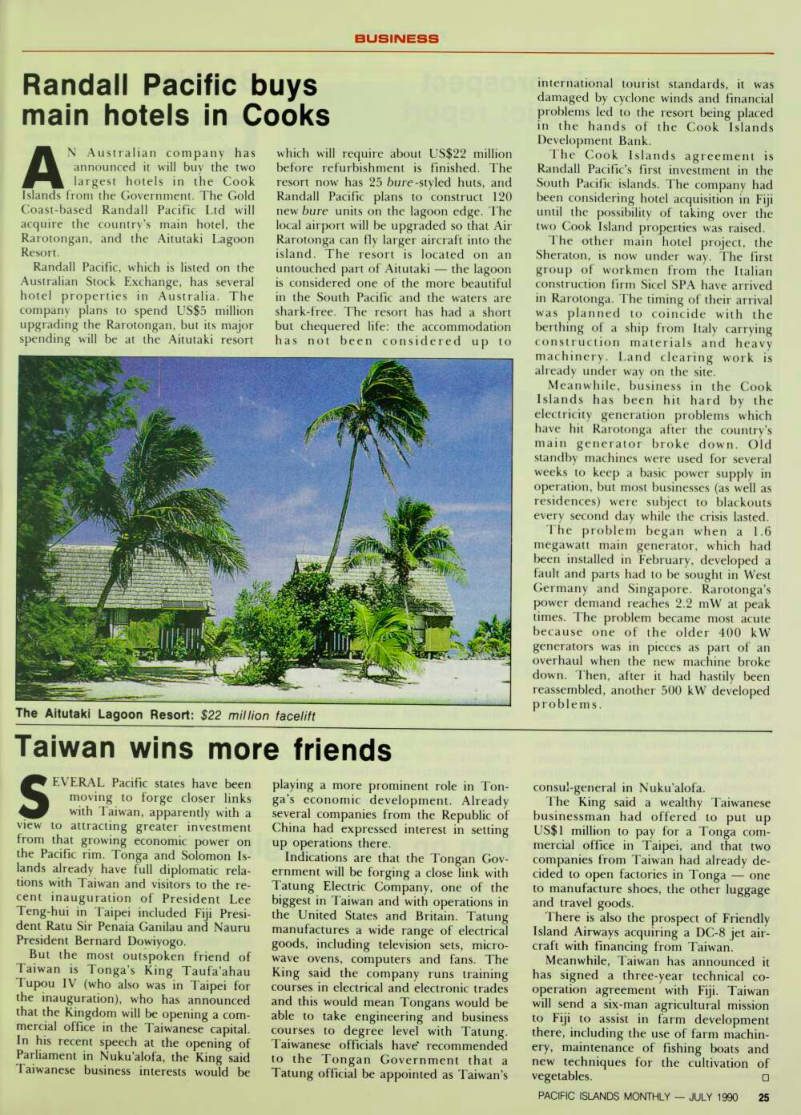
main hotels in Cooks
AN Australian company has announced it will buy the two largest hotels in the Cook Islands from the Government. The Gold Coast-based Randall Pacific Ltd will acquire the country’s main hotel, the Rarotongan, and the Aitutaki Lagoon Resort.
Randall Pacific, which is listed on the Australian Stock Exchange, has several hotel properties in Australia. The company plans to spend US$5 million
upgrading the Rarotongan, but its major
spending will be at the Aitutaki resort
which will require about US$22 million before refurbishment is finished. The resort now has 25 bure -styled huts, and Randall Pacific plans to construct 120 new bure units on the lagoon edge. The local airport will be upgraded so that Air Rarotonga can fly larger aircraft into the island. The resort is located on an untouched part of Aitutaki the lagoon is considered one of the more beautiful in the South Pacific and the waters are shark-free. The resort has had a short but chequered life: the accommodation has not been considered up to
international tourist standards, it was damaged by cyclone winds and financial problems led to the resort being placed in the hands of the Cook Islands
Development Bank.
The Cook Islands agreement is Randall Pacific’s first investment in the South Pacific islands. The company had
been considering hotel acquisition in Fiji
until the possibility of taking over the two Cook Island properties was raised.
The other main hotel project, the Sheraton, is now under way. The first group of workmen from the Italian construction firm Sicel SPA have arrived in Rarotonga. The timing of their arrival was planned to coincide with the berthing of a ship from Italy carrying construction materials and heavy machinery. Land clearing work is already under way on the site.
Meanwhile, business in the Cook Islands has been hit hard by the
electricity generation problems which
have hit Rarotonga after the country’s main generator broke down. Old standby machines were used for several weeks to keep a basic power supply in operation, but most businesses (as well as residences) were subject to blackouts every second day while the crisis lasted.
The problem began when a 1.6 megawatt main generator, which had been installed in February, developed a fault and parts had to be sought in West
Germany and Singapore. Rarotonga’s
power demand reaches 2.2 mW at peak times. The problem became most acute because one of the older 400 kW generators was in pieces as part of an overhaul when the new machine broke down. Then, after it had hastily been reassembled, another 500 kW developed
problems.
The Aitutaki Lagoon Resort: $22 million facelift
Taiwan wins more friends
SEVERAL Pacific states have been moving to forge closer links with Taiwan, apparently with a view to attracting greater investment u on \> th r growm B economic P ower on the Pacific Tonga and Solomon Islands already have full diplomatic relations Wlth Taiwan and visitors to the recent inauguration of President Lee eng-hui in Taipei included Fiji President Ratu Sir Penaia Gamlau and Nauru President Bernard Dowiyogo.
But the most outspoken friend of laiwan is Tonga’s King Taufa’ahau 1 upon IV (who also was m Taipei for t e inauguration), who has announced that the Kingdom will be opening a commercial ottice m the Taiwanese capital. in his recent speech at the opening of Parliament in Nukualofa, the King said laiwanese business interests would be
playing a more prominent role in Ton
gas economic development. Already
several companies from the Republic of China had expressed interest in setting up operations there.
Indications are that the Tongan Gov eminent will be forging a close link with Tatung Electric Company, one of the biggest in Taiwan and with operations in the United States and Britain. Tatung manufactures a wide range of electrical goods, including television sets, micro wave ovens, computers and fans. The King said the company runs training courses in electrical and electronic trades and this would mean Tongans would be able to take engineering and business courses to degree level with Tatung.
Taiwanese officials have recommended to the Tongan Government that a Tatung official be appointed as Taiwan’s
consul-general in Nukualofa.
The King said a wealthy Taiwanese businessman had offered to put up US$l million to pay for a Tonga com mercial office in Taipei, and that two companies from Taiwan had already de cided to open factories in Tonga one to manufacture shoes, the other luggage and travel goods.
There is also the prospect of Friendly Island Airways acquiring a DC-8 iet air craft with financing from Taiwan.
Meanwhile, Taiwan has announced it has signed a three-year technical co operation agreement with Fiji. Taiwan will send a six-man agricultural mission to Fiji to assist in farm development there, including the use of farm machin ery, maintenance of fishing boats and new techniques for the cultivation of vegetables. □
Fiji’s economic prospect
remains optimistic: report
MEDIUM-term prospects for the
Fiji economy will hinge largely
on the deepening of current market liberalisation, as well as on
re-establishing business confidence by
devising an acceptable long-term solution
to the political uncertainties of the country, according to the Asian Development Outlook 1990 issued by the Asian Development Bank (ADB).
The report said the Fiji economy staged a sharp recovery in 1989 and its prospects over the short term remained optimistic. The recovery stemmed partly from rapid policy responses to the near collapse of the economy following the
political instability of 1987.
Despite the efforts which have gone
into developing a light manufacturing
base and one aimed at the export market, the report said that the sugar and tourism industries remained the backbone of the economy. “Over the medium term, both industries could face some difficulties,” it said. “The expansion of the sugar industry is
seriously limited by the possibility of
both yield and planted area increases.”
In addition, the recent high prices on the world market which sugar has been receiving are unlikely to be sustained (and since the report was compiled, world sugar prices have declined from more than USl6tf a pound to just over USl3tf a pound. The ADB said the contribution of the sugar industry cannot be expected to be so vital as it has been in recent years. As for tourism, that industry could face constraints because of limited airline seat capacity and
availability of skilled personnel.
There would also be problems for export-oriented manufacturing sector: this would face major adjustment problems resulting from the loss of privileged market access by the
mid-19905. The ADB believes that the future of the Fiji garments industry is clouded by the prospect of losing preferential market access to Australia by 1995. It also notes: “A worrisome evolution has been slow growth in industrial investment in the rest of the economy, reflecting the lack of business confidence in spite of recent achievements.”
On the agricultural front, the report expects that sugar production will rise as better extraction methods are brought into operation, while copra, coconut oil and cocoa production should continue to recover from drought and cyclone
damage in previous years. The forestry
sector is expected to perform well in 1990 and 1991 as pine harvesting and processing are stepped up. But the
industry will suffer significant
competition from other softwood producers, including Chile, New Zealand and Australia.
Despite the longer term outlook,
export manufacturing stimulated by
foreign investment will grow by 8.5 per cent in 1990 and 7 per cent in 1991, with garment, furniture and footwear companies continuing to be attracted to Fiji by low wages and investment. But there could soon be shortages of skilled labour and factory space the ADB said the construction of new industrial facilities has been slow while the investment climate remained very uncertain.
Meanwhile, the Fiji Government is seeking F 5266 million (U 55173.85 million) in capital investment from aid donors and international financial organisations in order to fund 41 projects of which 16 are in the economic sector, 17 infrastructure and utilities, with others being for social welfare and human resources. □
Banking
ONTROL of banking in the V South Pacific continues to become concentrated in the hands of Australian companies, with ANZ bidding for Niugini-Lloyd’s Inter national Bank, of Papua New Guinea, and the Bank of New Zealand selling out of the Bank of Tonga with Westpac picking up part of its share.
ANZ is offering K 4.5 million (U 554.59 million) for Niugini-Lloyd, a company owned by Lloyds Bank Pic of Britain (49 per cent), the Papua New Guinea Gov ernment (35 per cent) and local share holders (16 per cent). It was one of two largely foreign-owned banks granted li cences in the early 1980 s, but one which never looked like becoming a major fi gure in the Papua New Guinea banking scene. Niugini-Lloyd has 80 staff and three branches Port Moresby, Arawa and Lae. The bid is supported by the Bank of Papua New Guinea and the Government, but conditional on 90 per cent shareholder acceptance.
ANZ chief executive Will Bailey said ANZ’s presence in Papua New Guinea dated back to 1910, and the bank has eight branches in the country and em ploys 300 people. “Expansion in the Pacific Islands is also a key part of our Asia-Pacific strategy,” said Bailey. This strategy was built around projected trade flows. ANZ believed 50 per cent of Au stralian and New Zealand trade would be with the Asia-Pacific region by the year 2000.
ANZ Bank recently acquired the Fiji and Western Samoan interests of the Bank of New Zealand, but BNZ’s 20 per cent stake in the Bank of Tonga has gone elsewhere: Split between Westpac and the Bank of Hawaii. They will now each hold 30 per cent of the Bank of Tonga, with the remaining 40 per cent staying in the Tongan Government’s hands. BNZ bought the 20 per cent stake in 1972. D
PNG puts 2-year ban on new logging leases
NO new logging permits will be
issued by the Papua New Guinea Government for two years in an effort to conserve the forest resources in the country a move which will cost K3O million in lost government revenue. Forests Minister Karl Stack has appealed to major nations and environmental organisations for up to K6O million to back his plan to set aside between 15 and 20 per cent of Papua New Guinea’s 46 million hectares of land as World Heritage areas or national
parks.
Twenty-eight new applications for logging rights have now been put on hold and when the moratorium is lifted in 1992 there will be no permits issued for the export of logs, although firms now exporting will be able to work out the balance of their permit time. Stack said the Government was taking a political and economic risk and its success depended entirely on international aid to compensate landowners and to make up the shortfall in government revenue.
The announcement was made at an international conference on forestry and
the environment held in Port Moresby, Donor organisations at the conference committed Kl 5 million toward the World Heritage project, and other fore stry improvement projects. The Asian Development Bank has made available K2O million as a soft loan if the Govern ment cannot raise all it needs by way of aid contributions.
Six companies which are already in advanced stages of negotiations with the Government will be exempted from the ban. D
Exports hit by cocoa slump
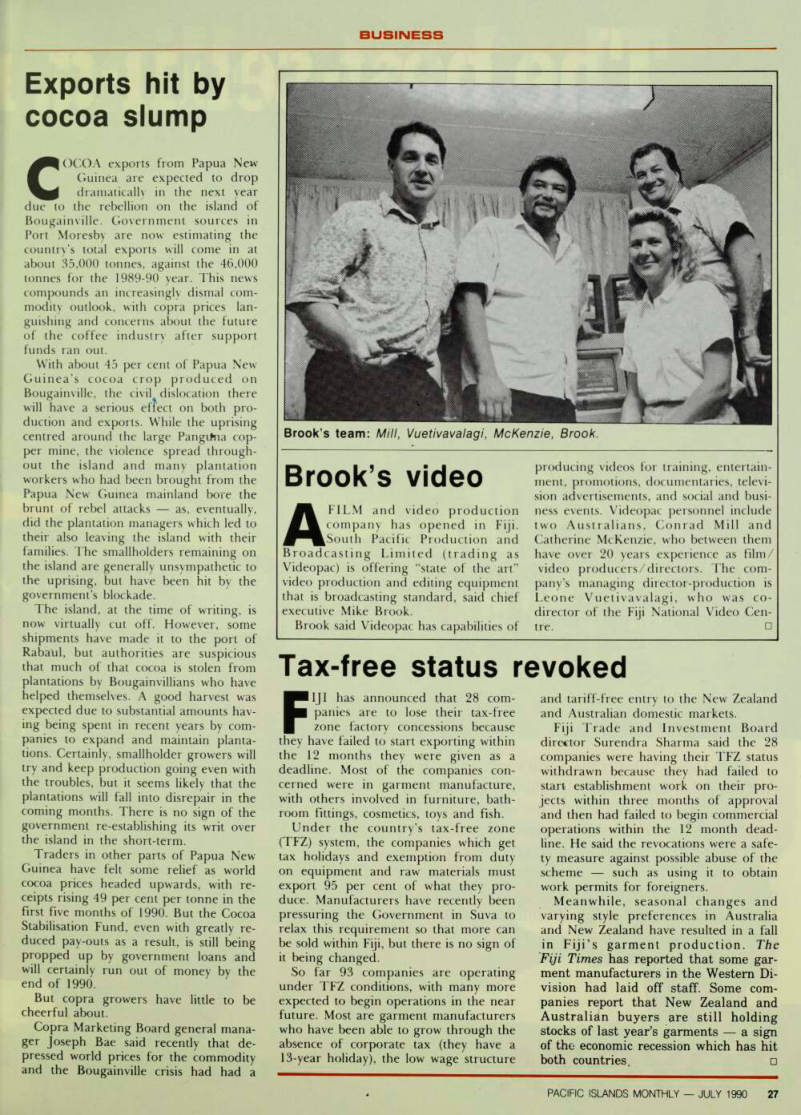


cocoa slump
COCOA exports from Papua New Guinea are expected to drop dramatically in the next year due to the rebellion on the island of Bougainville. Government sources in Port Moresby are now estimating the country’s total exports will come in at about 35,000 tonnes, against the 46,000 tonnes for the 1989-90 year. This news compounds an increasingly dismal com modity outlook, with copra prices lan guishing and concerns about the future of the coffee industry after support funds ran out.
With about 45 per cent of Papua New Guinea’s cocoa crop produced on Bougainville, the civil dislocation there will have a serious effect on both pro duction and exports. While the uprising centred around the large Pangiina cop per mine, the violence spread through out the island and many plantation workers who had been brought from the Papua New Guinea mainland bore the brunt of rebel attacks as, eventually, did the plantation managers which led to their also leaving the island with their families. The smallholders remaining on the island are generally unsympathetic to the uprising, but have been hit by the government’s blockade.
The island, at the time of writing, is now virtually cut off. However, some shipments have made it to the port of Rabaul, but authorities are suspicious that much of that cocoa is stolen from
plantations by Bougainvillians who have
helped themselves. A good harvest was expected due to substantial amounts hav ing being spent in recent years by com
panies to expand and maintain planta
tions. Certainly, smallholder growers will try and keep production going even with the troubles, but it seems likely that the plantations will fall into disrepair in the coming months. There is no sign of the government re-establishing its writ over the island in the short-term.
Traders in other parts of Papua New Guinea have felt some relief as world cocoa prices headed upwards, with re ceipts rising 49 per cent per tonne in the first five months of 1990. But the Cocoa Stabilisation Fund, even with greatly re duced pay-outs as a result, is still being propped up by government loans and will certainly run out of money by the end of 1990.
But copra growers have little to be cheerful about.
Copra Marketing Board general mana
ger Joseph Bae said recently that de pressed world prices for the commodity and the Bougainville crisis had had a
dramatic effect on copra production output was declining rapidly. Bae said the recent kina devaluation had helped growers but not enough: the Papua New Guinea currency was still at a high level against other currencies. “The hard kina policy acts to keep the costs of imports down and restrains inflation,” he said.
“But it probably also penalises exporters of coconut products because copra and coconut oil prices fall and the US dollar weakens revenue in kina terms will be
double depressed.”
Copra and cocoa growers have now taken their battle into the political arena in an effort to further the desperate bat tle for survival which they see facing both copra and cocoa. The Planters Association of Papua New Guinea has launched a campaign for the removal of the Agriculture and Livestock Minister,
Galeng Lang. They are demanding in
terest-free loans for cocoa and coconut
research, rescheduling of development
credit to the industry, a new industry corporation and grower appointments to
the commodity boards. They complain
all these decisions had been made by the government, but not implemented. The problem for the government is that its finances have been severely stretched by the Bougainville crisis, both in terms of lost earnilngs and the cost of the army actions there.
Planters Association executive director David Loh said both the cocoa and copra industries were experiencing their most difficult times ever and plantations were going up for sale all over the country, particularly in the islands off the main land. The two industries now owe about 40 million kina (U 5539.2 million) in commercial bank loans and are having great difficulty meeting repayment sche dules. Despite a Government assurance to reduce interest rates from 11 per cent to about six per cent, banks had gone ahead and increased these rates to 15 per cent much to the industries’ hor ror, he said. Loh has reported that many plantations are continuing to lay off staff and restricting work to three or four days a week.
The planters placed a large advertise
ment in newspapers calling for Prime Minister Rabbie Namaliu to replace Lang with someone who would “assist and support the rural sector in its struggle for survival”. The advertisement said that in a time of low commodity prices, high interest rates and lack of law and order in rural areas, the growers needed a minister who was “capable of fighting for the needs of rural industries”.
Meanwhile on the coffee front, one company has come out and urged far mers to diversify away from that crop.
The general manager of Kainantu De
velopment Corporation (KDC), John
Wilkinson, said the current low prices
for coffee should cause farmers to turn to other areas of agricultural and indust rial development. KDC manages 45 cof fee plantations, mostly in the Eastern Highlands Province. Wilkinson said that when the Coffee Stabilisation Fund ran out of money at the end of the year, coffee growers and the local economy would probably collapse with the grow ers being unable to repay bank loans;
they might even lose their plantations,
he said.
He argued that there was a great need for massive agricultural development of the country’s rich soils and an even grea ter need for onshore manufacturing of many of the items now imported. “In stead of importing finished goods, we need to look at importing technology, management skills and equipment . . . and setting up our own manufacturing and processing industries,” he said.
Meanwhile, the Government has been warned of widespread trouble in coffee
growing provinces if the Coffee Develop
ment Agency (CDA) is abolished.
Former Agriculture and Livestock Minister Gai Duwabane said the agency had been established by the Wingti Gov ernment because it could better serve smallholder growers to get better yields from their coffee trees, and that since it had been set up coffee production had increased.
Brook’s video
A FILM and video production company has opened in Fiji.
South Pacific Production and Broadcasting Limited (trading as Videopac) is offering “state of the art” video production and editing equipment that is broadcasting standard, said chief executive Mike Brook.
Brook said Videopac has capabilities of
producing videos for training, entertain ment, promotions, documentaries, televi sion advertisements, and social and busi ness events. Videopac personnel include two Australians, Conrad Mill and Catherine McKenzie, who between them have over 20 years experience as film/ video producers/directors. The com
pany’s managing director-production is
Leone Vuetivavalagi, who was co director of the Fiji National Video Cen tre. □
Brook’s team: Mill, Vuetivavalagi, McKenzie, Brook.
Tax-free status revoked
FIJI has announced that 28 com panies are to lose their tax-free zone factory concessions because they have failed to start exporting within the 12 months they were given as a deadline. Most of the companies con cerned were in garment manufacture, with others involved in furniture, bath room fittings, cosmetics, toys and fish.
Under the country’s tax-free zone (TFZ) system, the companies which get
tax holidays and exemption from duty
on equipment and raw materials must export 95 per cent of what they pro duce. Manufacturers have recently been pressuring the Government in Suva to relax this requirement so that more can be sold within Fiji, but there is no sign of
it being changed.
So far 93 companies are operating under TFZ conditions, with many more expected to begin operations in the near future. Most are garment manufacturers who have been able to grow through the absence of corporate tax (they have a 13-year holiday), the low wage structure
and tariff-free entry to the New Zealand and Australian domestic markets.
Fiji Trade and Investment Board director Surendra Sharma said the 28 companies were having their TFZ status withdrawn because they had failed to start establishment work on their pro jects within three months of approval and then had failed to begin commercial operations within the 12 month dead line. He said the revocations were a safe ty measure against possible abuse of the scheme such as using it to obtain work permits for foreigners.
Meanwhile, seasonal changes and varying style preferences in Australia and New Zealand have resulted in a fall in Fiji’s garment production. The Fiji Times has reported that some gar ment manufacturers in the Western Di vision had laid off staff. Some com panies report that New Zealand and Australian buyers are still holding stocks of last year’s garments a sign of the economic recession which has hit both countries. □
Advertisements & other items, pp. 28-29 (1 item)
Toyota
The Toyota Hilux is the world’s most popular pick-up.
And the Hilux 4X4 is the best-selling Hilux of them all. Which stands to reason. People around the world respect Toyota’s attention to style. Hilux’s car-like comfort. Rugged reliability. And as you might expect from Toyota, power. This, of course, is the most important asset for a truck. And happily, the Hilux 4X4 offers a choice of four powerful engines: 2.8 and 2.4-litre diesel engines. Plus 2.2 and 1.8-litre petrol engines. When it comes to power and good looks, nobody can beat Toyota. Nobody.
Li* * - V f v I'* , L s V v ... i m p'*y
Telecom revival
N EARLY 85 per cent of Western Samoa’s cyclone-damaged tele communications services is back in action, according to Barry Bailey, Director, Operations for Telecom Net works and International. “Cyclone Ofa devastated Western Samoa’s telecom munications facilities and networks,” says
Bailey.
Telecom New Zealand and the New
Zealand Government responded by joint
ly funding a NZ$l.4 million aid prog ramme which has included technical ser vices from 38 Telecom staff, and the provision of 12 vehicles, a tractor and over 40 tonnes of parts and supplies.
The cyclone damaged three exchanges
beyond repair, and left 90 per cent of radio bearers and 85 per cent of exter nal plant out of service. Salt water had
seeped into pressurised underground
cables threatening further damage in the
cyclone’s wake.
At least 70 per cent of the major underground cabling work and 60 per cent of overhead cabling has been recon structed. 90 per cent of the important village radio network and the Salelologa exchange have been restored to opera tion. n
Tonga boosts development projects
TONGA’S latest budget makes pro vision for T 571.74 million (U 5554.76 million) to be spent in the 1990-91 year on development pro jects, an increase of T 529.08 million (U 5522.19 million) over the previous year. Finance Minister Cecil Cocker said in a statement that the priority was being placed on roads, airports, wharves, water supplies, electricity, post offices and small industry centres all the infras tructure needed to foster private sector
production, growth and marketing. A
large proportion of the development
budget will be channelled into the Tonga Development Bank with Sea Star Fishing Co Ltd to be established as a public com pany with the Government providing a substantial share of its initial capital.
The budget statement also targets assistance to vanilla and other crops, de velopment of tree nurseries and the Mataliku sawmill, construction of tuna fishing vessels, setting up a second in dustry centre at Popua on Tongatapu.
The Asian Development Bank is ex pected to be the largest single source of funds, with money also coming in the form of aid from Australia, the Euro pean Community, Japan and New Zea
land. Transfers from the Tonga Trust Fund (proceeds of passport sales) are budgetted to bring TsB million, with another Ts 4 million to be raised through the issue of Government bonds.
The total Budget expenditure will be T 5119.7 million, only slightly up on last year. Total estimated revenue is T 548.05 million. Other than development pro jects, the largest allocations are for education (T|B.6 million), health (T 55.2 million) and public works (T 53.9 mil lion).
The income tax threshold is to be raised from Ts2ooo to T|2500 to ex empt the poorer people, while farmers and fishermen are to be exempt from income tax altogether. The Industrial Development Incentives Act is to be amended to expand the system of de velopment licences to cover commercial export fishermen and farmers, and to allow for tax holidays of 15 years for
approved enterprises, especially those
which boost foreign exchange earnings.
Meanwhile, farmers will receive added protection from imports by means of
higher duties on imported poultry, pork
and other fresh and frozen meats. □
[Micronesia
Trade Winds
Air Marshalls expands AIR Marshall Islands, which took over a DC-8 jet in January, is now looking for a second aircraft with which to expand its fleet. The preference is for a British
Aerospace BA-146 four-engine jet,
which seats about 100 passengers. The plan is for the aircraft to be used on the Majuro-Tarawa-Nadi service, on which Air Marshall Islands now employs a 48-
seater Hawker-Siddley 748 turbo-prop.
Hawaiian gets new routes HAWAIIAN Airlines has obtained per mission to fly two new routes between Japan and the Northern Marianas. The Honolulu-based carrier will fly between Fukuoka and Nagoya in Japan to Saipan and Guam. Hawaiian has been operating in Guam since 1987 but this will be its first service into Saipan.
Seaweed project study MAJURO’S College of Micronesia is to
study the feasibility of growing seaweed
in the lagoons around the Marshall Is lands. Seaweed aquaculture is seen as a
profitable export industry.
Of the seaweed species, Eucheuma is grown commercially in the Federated States of Micronesia and Kiribati.
Solomon Islands
Credit grows, liquidity tightens COMMERCIAL bank surplus liquidity tightened further during the first quar ter of 1990 to just 515200,000 (U 5580,645) compared with 5155.7 mil lion (U 552.29 million) for the corres ponding period of 1989. The March quarterly review from the Central Bank of Solomon Islands said this deteriora tion in liquidity resulted from a con tinued expansion in domestic credit and a marked decline in foreign assets, the latter down Slsl9 million (U 557.66 mil lion) in the period.
Total domestic credit grew by 13.6 per cent, or Sls 16.5 million during the quar ter under review. There had been a 13.5 per cent expansion in the December 1989 quarter. Government credit re quirements expanded more quickly than the private sector’s, with agricultural and forestry sectors showing a decline.
In the quarter, the following produc tion level changes were recorded: copra 17 per cent; palm oil and kernal + 37.2 per cent; cocoa 29.9 per cent; fish 74.1 per cent and timber +24,1 per cent. Total visitor arrivals were down 8.9 per cent for the March quarter, but the average stay for tourists rose from 10 to 12 days compared to the same period of 1989.
Samoa
New housing corporation WESTERN SAMOA has established a Housing Corporation with a capital of WS$l million (U 55430,000). The money will be lent to low-income families, with lending being limited in each case to US$l4,OOO with interest set slightly be low the commercial bank rates. The loans will be advanced for a 20-year
period.
Airport lights repaired RUNWAY lights at Pago Pago’s interna tional airport have now been repaired and the runway is now open again to night landings and takeoffs. The airport was restricted to daylight operations while 10,000 metres of underground cable much of it waterlogged was replaced.
Port ready on time APIA’S port development is expected to be completed in March next year the scheduled time despite the damage caused to the harbour by Cyclone Ofa.
Japanese aid is funding the work which will make Apia harbour much less vulnerable to sea swell by the construc tion of a breakwater. The main wharf is being enlarged and there will be a new container yard and ferry terminal. The Japanese companies involved in the pro ject said they now expect to complete work on target.
Ofa empties markets FAGATOGO market in Pago Pago is now bare of the staple fruit, bananas, and there are now fears of crop disease problems, reports the Samoa Journal & Advertiser. Plantations of bananas were worst hit by Cyclone Ofa than the low lying taro plants. The director of Amer ican Samoa’s Agriculture Department, Lauofo Ta’alo, said new bananas should appear on trees during July and August but there may be few fingers on the plants he fears an outbreak of Black Leaf disease. Taro crops could also be hit if there were to be an outbreak of Army Worm or Leafhopper. Disease outbreaks have occurred often after hur ricanes.
Vanuatu
Fishermen boost foreign earnings
NI-VANUATU employed by foreign
fishing vessels now number almost 400 and are remitting a total of US$l million back home each year. Men from Vanuatu had initially been employed on Taiwanese longliners working in the South Pacific, but now they are also being hired for vessels fishing in the In dian Ocean and based in Singapore.
Island to get air link NEW Zealand has handed over US$l4,OOO as the first payment on an air strip to be built on the small island of Gaua, in the Banks group in northern Vanuatu. The strip will allow the islan ders to receive their basic needs by air rather than depend entirely on inter
island shipping.
Kiribati
Car corruption alleged KIRIBATI Audit Director Beniamina Tinga has sent a special report to the
country’s parliament calling for an inves
tigation into the alleged irregularities he discovered regarding the sale of used government cars by lender. He said the Government had missed out on about A 5200,000 (US$l5,OOO) because cars had now always been sold to the people who won government tenders. Some cars were released before payment was re ceived.
No homing beacon A RECENT Air Marshall Islands flight from Nadi could not find Kiribati’s main island of Tarawa because the Bonriki In ternational Airport radio beacon was not working. The pilot managed to send an urgent message to Radio Kiribati, which is normally off the air in the afternoon, and a technician raced to turn on its transmitter. The aircraft was able to home in on the signal and make a safe
landing.
Tonga
Inflation up INFLATION is now runnning at 6 per cent in Tonga. The latest survey shows that housing costs are up 4.9 per cent in the first quarter of 1990, with rises also shown in food, clothing and footwear and transport.
Tonga exports paint TONGA has exported its first consign ment of paint to Niue and is now looking to establish markets in the Samoas and the Cook Islands. Asian Paints (Tonga) Ltd made the sale of paint worth $4270 (U 553259), which is seen as an important step because the local market has now reached saturation point. The company employs 20 people and produced 15,000 litres of paint a month.
Hawaiian cleared for third flight HAWAIIAN Airlines has received Ton ga Government approval to operate a third flight each week into the Kingdom.
The airline now operates flights to Hon olulu on Monday, Tuesday and Thurs day, using either LlOll or DC-8 aircraft.
Solomons
Bank opens at Auki THE National Bank of Solomon Islands has expanded its provincial branch net work with a new office at Auki, in Malaita Province. The new branch cost 515200,000 (U 5597,940), replaces rented premises, and represents another exten sion of the bank’s computerisation of
national operations.
Copra production rises INCREASED activity by smallholders led to a rise in Solomon Islands copra pro duction in 1988, according to figures just released. But the industry still has major problems; the latest report of the Cen tral Bank of Solomon Islands says that substantial amounts of copra are lying dried but unshipped in rural areas poor
ly served by boats.
New rice sales NEW Zealand and Papua New- Guinea importers are to begin buying rice from the Solomon Islands, and there have also been enquiries from Western Samoa, Kiribati and Vanuatu. The rice will be sold by Filders Industries (SI) Ltd, which has just obtained additional protection because the Government considers it an important source of local employment.
Fiji
Emigrant numbers still high
NUMBERS of people leaving Fiji have
continued to rise over the last two years.
The annual rate of emigration went up 7.8 per cent in 1988. There was a furth er increase of 1.5 per cent in the first nine months of 1989, to 4153 for the period ended September 30. The emigration of teachers leaving the coun try also rose markedly in the first nine months of last year.
Airline eyes new planes FIJI Air is planning to upgrade its fleet with the acquisition of a 24-seat Casa turbo-prop aircraft, and will sell the two long-serving 16-seat herons. The Casa will be employed flying out of Nausori on internal routes to Labasa and Rotu ma, as well as its one international ser vice to Funafuti in Tuvalu.
Trade deficit grows Fiji’s visible trade deficit jumped by 45 per cent to F$ 150.6 million (US$9B.4 million) in the first quarter of 1990. Tot al exports fetched F$ 113.4 million, with imports running at F 5264 million. The main destinations for Fijian exports were Australia (F 527.5 million), Britain (F 520.4 million) and New Zealand (F 519.4 million).
(Tuvalu
Funafuti seeks project aid INTERNATIONAL aid agencies are being asked to support a package of 22 development projects worth more than US$57 million, the biggest single item being a planned new airport on Funafuti to replace the existing grass strip. The country also wants to boost the Tuva lu Trust Fund, set up with capital from New- Zealand, Britain and Australia, and which has been invested by Westpac to provide sufficient income to cover Tuva lu’s annual budget deficit. The Govern ment is also seeking finance to upgrade the island nation’s Business Development Advisory Bureau.
Kiribati
New industry centre BRITAIN is to provide about US$5OO,OOO for the construction of Kiri bati’s first smallscale industry centre, to be located on Betio Atoll (the main com mercial district). The centre will cater for such industries as garment manufactur
ing, production of kamaimai (a toddy
condensed from coconut) and footwear manufacturing, for both domestic sale and export.
French Polynesia
Tourist trend reversed FRENCH Polynesia, whose tourist num bers have been dropping since 1986, managed to turn the sector around in 1989 with a 2.7 per cent increase for the year, or a total of 139,705 visitors. The greatest number 50406 came from the United States, but that source continues to show a decline with the ma jor increases coming from Australia, Europe, Japan and New Zealand.
Another trade deficit VISIBLE trade figures for 1989 show that French Polynesia still has a large gap between exports and imports.
Traded goods figures show a deficit of CFP78,904 million (U 55770.32 million).
The territory exported goods worth CFP9BSO million, but imports totalled CFP88,754 million.
Papua New Guinea
Oil palm growers’ plea OIL palm growers in West New Britain Province are demanding K4§ million (U 5547.3 million) in compensation for hardships resulting from low commodity prices over the past four years. Grower representatives told Agriculture Minister Galeng Lang that New Britain Palm Oil Development Pty Ltd, the only buyer
and exporter in the province, had failed to pay smallholders proper prices for their produce. The minister offered K 350,000 as an interim compensation payment and promised to investigate the complaints.
Ok Tedi’s record result OK Tedi Mining Ltd recorded an in creased profit of K 24.2 million (U 5524.2 million) for the year to Decemer 31, 1989 its biggest ever. The company said the healthy financial results was because a high production rate in the second half of the year after problems in the first six months with the failure of the copper and old mine’s ore delivery system.
India seeks new ties INDIA is considering establishing a full diplomatic mission in Port Moresby in order to increase its trading and com mercial links with Papua New Guinea.
Shortly before the Indian diplomatic post in Suva was closed at the orders of the Fiji Government, the charge d’af faires, Vidhya Soni, said his country was planning to boost what he called its mod est trade with the South Pacific, and this would include extending the operation of Indian merchant ships into the re gion. Soni said Indian businessmen would explore the markets for heavy
earth-moving equipment for mining op
erations in the area, but also look to sell ing garments. Fiji was India’s single big gest customer in the South Pacific with trade estimated at US$4 million a year.
Businessman expelled A RABAUL-based businessman has been ordered out of Papua New Guinea on the grounds that he had become un popular with the local Tolai people and was “evasive” about his business activi ties. A government official said Selwyn Krapp, who was involved in manage ment services, take-away food, home fur nishings, road contracting and souvenir sales, had refused to comply with gov
ernment requirements.
Rubber exports to grow A RECORD export total of 8000 tonnes of rubber next year has been predicted by Papua New Guinea Prime Minister Namaliu. He was speaking at the open ing of a high school at Cape Rodney, Central Province, the site of a multi million dollar smallholder scheme. The Government planned to lift annual rub ber exports from 5000 tonnes to 8000 tonnes by next year, he said, and would commit K 5 million (US$4.9 million) over the next five years to develop the rubber industry together with the establishment of a five-year training course for de velopment experts.
Know this yacht?
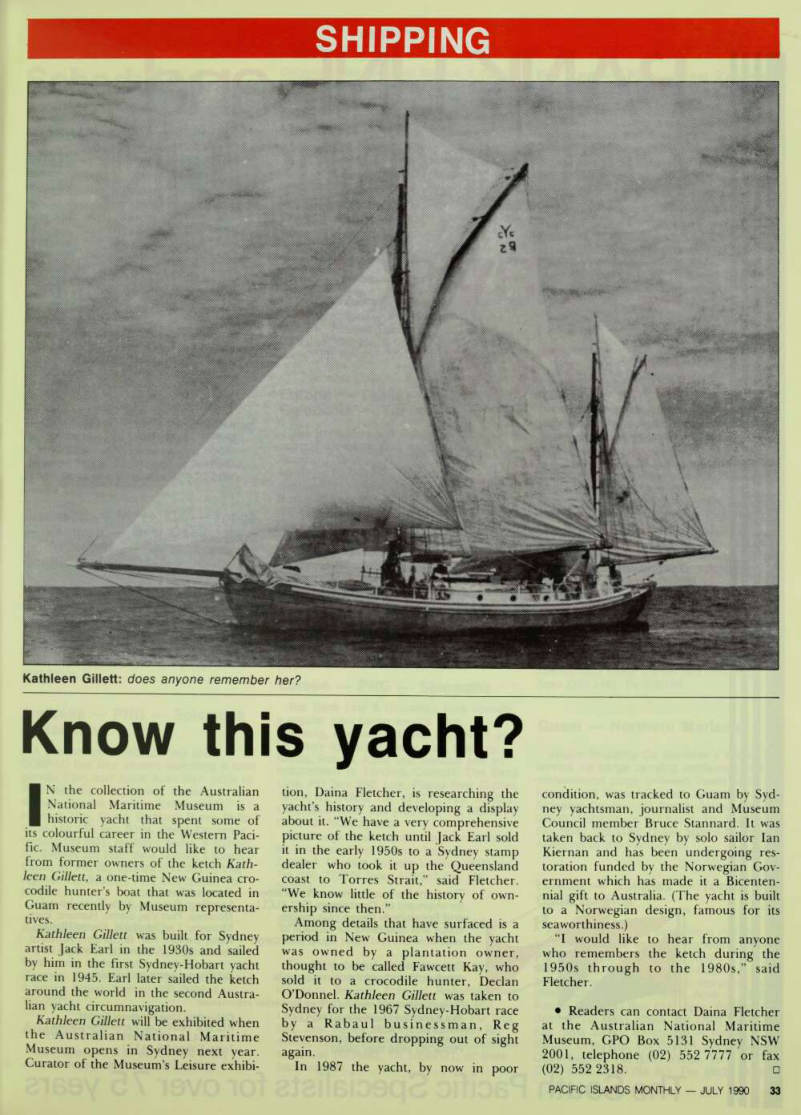
Shipping
IN the collection of the Australian National Maritime Museum is a historic yacht that spent some of its colourful career in the Western Pacifie. Museum staff would like to hear from former owners of the ketch Kathleen Gillett, a one-time New Guinea crocodile hunter s boat that was located in Guam recently by Museum representa-
tlves -
Kathleen Gillett was built for Sydney artist Jack Earl in the 1930 s and sailed by him in the first Sydney-Hobart yacht race in 1945. Earl later sailed the ketch around the world in the second Australian yacht circumnavigation.
Kathleen Gillett will be exhibited when the Australian National Maritime Museum opens in Sydney next year.
Curator ot the Museum’s Leisure exhibi-
tion, Daina Fletcher, is researching the
yacht’s history and developing a display
about it. “We have a very comprehensive picture of the ketch until Jack Earl sold it in the early 1950 s to a Sydney stamp dealer who took it up the Queensland coast to Torres Strait,” said Fletcher.
“We know little of the history of ownership since then.”
Among details that have surfaced is a period in New Guinea when the yacht was owned by a plantation owner, thought to be called Fawcett Kay, who sold it to a crocodile hunter, Declan O’Donnel. Kathleen Gillett was taken to Sydney for the 1967 Sydney-Hobart race by a Rabaul businessman, Reg Stevenson, before dropping out of sight
again.
In 1987 the yacht, by now in poor
condition, was tracked to Guam by Syd ney yachtsman, journalist and Museum Council member Bruce Stannard. It was taken back to Sydney by solo sailor lan Kiernan and has been undergoing res toration funded by the Norwegian Gov ernment which has made it a Bicenten nial gift to Australia. (The yacht is built to a Norwegian design, famous for its seaworthiness.) “I would like to hear from anyone who remembers the ketch during the 1950 s through to the 1980 s,” said Fletcher, • Readers can contact Daina Fletcher at the Australian National Maritime Museum, GPO Box 5131 Sydney NSW 2001, telephone (02) 552 7777 or fax (02) 552 2318. □
Kathleen Gillett: does anyone remember her?
Advertisements & other items, p. 34 (1 item)
Europe.
BANK LINE and
COLUMBUS LINE
24 day service to
Europe.
Need we say more...
G The Joint Service Partners offer facilities for shipment of: Containers (PCL/LCL) and Break-bulk Cargo plus reefer space and deeptanks for carriage of vegetable oils and other liquid bulk cargo.
Carriers also accept heavy lifts, overlength and cumbersome parcels.
Ports of Service: Loading: Papeete, Apia, Suva, Lautoka, Noumea, Port Vila, Santo, Honiara, Port Moresby, Lae, Madang, Kimbe, Rabaul, Kieta, Darwin. For: Rotterdam, Antwerp, Hamburg, Hull, Dunkirk, Le Havre.
Additional ports on enquiry.
Please contact our regional offices for further information: The Bank Line (Australasia) Pty Ltd Columbus Line Reederei GmbH Suite 701, 51 Pitt St, P.O. Box 1 667, Lae/Papua New Guinea.
Sydney, NSW, Australia 2000 Phone: 423466/423487/A.H. 422481 Phone 251 6688 Telex 24063 Telex: Colline NE 441 71 The South Pacific Specialists for over 75 years
Schedules
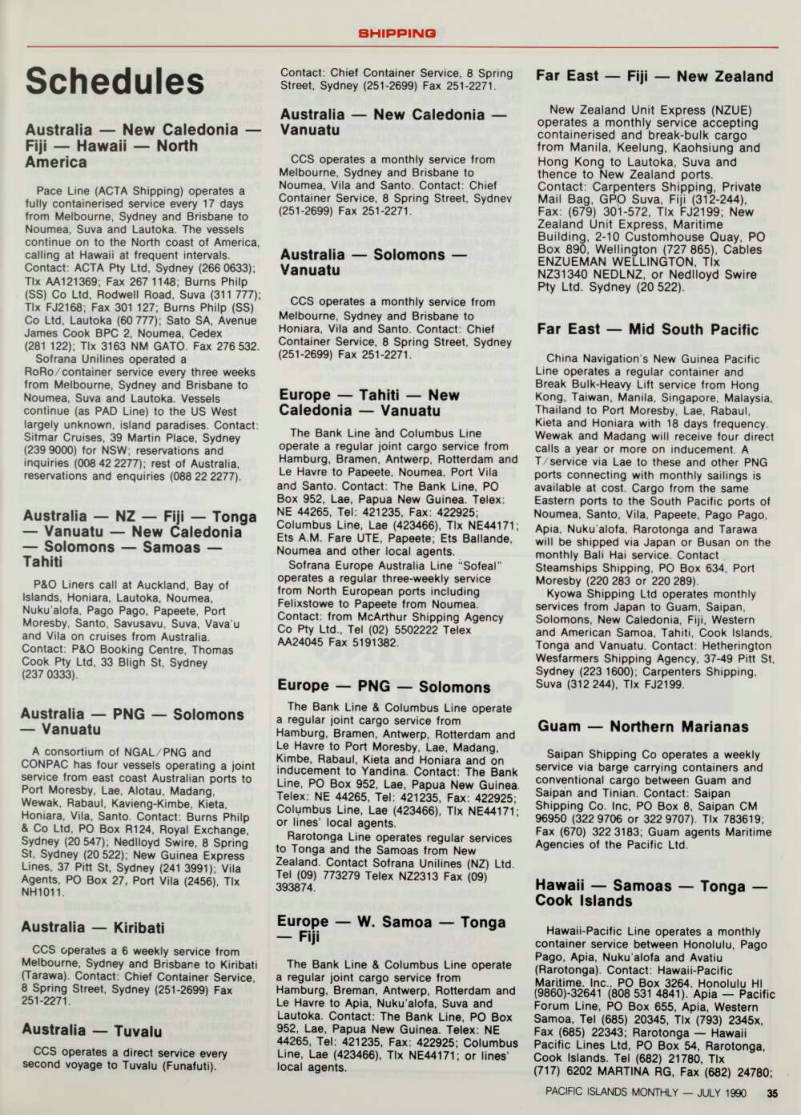
Australia New Caledonia Fiji Hawaii North America Pace Line (ACTA Shipping) operates a fully containerised service every 17 days from Melbourne, Sydney and Brisbane to Noumea, Suva and Lautoka. The vessels continue on to the North coast of America, calling at Hawaii at frequent intervals.
Contact: ACTA Pty Ltd, Sydney (266 0633); Tlx AA121369; Fax 2671148; Burns Philp (SS) Co Ltd, Rodwell Road. Suva (311 777); Tlx FJ2168; Fax 301 127; Burns Philp (SS) Co Ltd, Lautoka (60 777); Sato SA, Avenue James Cook BPC 2, Noumea, Cedex (281 122); Tlx 3163 NM GATO. Fax 276 532.
Sofrana Unilines operated a Roßo/container service every three weeks from Melbourne, Sydney and Brisbane to Noumea, Suva and Lautoka. Vessels continue (as PAD Line) to the US West largely unknown, island paradises. Contact: Sitmar Cruises, 39 Martin Place, Sydney (239 9000) for NSW; reservations and inquiries (008 42 2277); rest of Australia, reservations and enquiries (088 22 2277).
Australia NZ Fiji Tonga
Vanuatu New Caledonia Solomons Samoas Tahiti P&O Liners call at Auckland, Bay of Islands, Honiara, Lautoka, Noumea, Nukualofa, Pago Pago, Papeete, Port Moresby, Santo, Savusavu, Suva, Vava’u and Vila on cruises from Australia.
Contact; P&O Booking Centre, Thomas Cook Pty Ltd. 33 Bligh St. Sydney (237 0333).
Australia PNG Solomons Vanuatu A consortium of NGAL/PNG and CONPAC has four vessels operating a joint service from east coast Australian ports to Port Moresby, Lae, Alotau, Madang, Wewak, Rabaul, Kavieng-Kimbe, Kieta, Honiara, Vila, Santo. Contact: Burns Philp & Co Ltd, PO Box R 124, Royal Exchange, Sydney (20 547); Nedlloyd Swire, 8 Spring St, Sydney (20 522); New Guinea Express Lines, 37 Pitt St, Sydney (241 3991); Vila Agents, PO Box 27, Port Vila (2456), Tlx
Nhioii.
Australia Kiribati CCS operates a 6 weekly service from Melbourne, Sydney and Brisbane to Kiribati (Tarawa). Contact: Chief Container Service, 8 Spring Street. Sydney (251-2699) Fax 251-2271.
Australia Tuvalu CCS operates a direct service every second voyage to Tuvalu (Funafuti).
Contact; Chief Container Service, 8 Spring Street, Sydney (251-2699) Fax 251-2271.
Australia New Caledonia Vanuatu CCS operates a monthly service from Melbourne, Sydney and Brisbane to Noumea, Vila and Santo. Contact: Chief Container Service, 8 Spring Street, Sydnev (251-2699) Fax 251-2271.
Australia Solomons
Vanuatu CCS operates a monthly service from Melbourne, Sydney and Brisbane to Honiara, Vila and Santo. Contact; Chief Container Service, 8 Spring Street, Sydney (251-2699) Fax 251-2271.
Europe Tahiti New
Caledonia Vanuatu
The Bank Line and Columbus Line operate a regular joint cargo service from Hamburg, Bramen, Antwerp, Rotterdam and Le Havre to Papeete, Noumea. Port Vila and Santo. Contact; The Bank Line, PO Box 952, Lae, Papua New Guinea. Telex: NE 44265, Tel: 421235, Fax; 422925; Columbus Line, Lae (423466). Tlx NE44171; Ets A.M. Fare UTE, Papeete; Ets Ballande, Noumea and other local agents.
Sofrana Europe Australia Line “Sofeal" operates a regular three-weekly service from North European ports including Felixstowe to Papeete from Noumea.
Contact: from McArthur Shipping Agency Co Pty Ltd.. Tel (02) 5502222 Telex AA24045 Fax 5191382.
Europe PNG Solomons
The Bank Line & Columbus Line operate a regular joint cargo service from Hamburg, Bramen, Antwerp, Rotterdam and Le Havre to Port Moresby, Lae, Madang, Kimbe, Rabaul, Kieta and Honiara and on inducement to Yandina. Contact; The Bank Line, PO Box 952, Lae, Papua New Guinea.
Telex; NE 44265, Tel: 421235, Fax: 422925; Columbus Line, Lae (423466), Tlx NE44171; or lines’ local agents.
Rarotonga Line operates regular services to Tonga and the Samoas from New Zealand. Contact Sofrana Unilines (NZ) Ltd.
Tel (09) 773279 Telex NZ2313 Fax (09) 393874.
Europe W. Samoa Tonga
- Fiji
The Bank Line & Columbus Line operate a regular joint cargo service from Hamburg, Breman, Antwerp, Rotterdam and Le Havre to Apia, Nukualofa, Suva and Lautoka. Contact: The Bank Line, PO Box 952, Lae, Papua New Guinea. Telex: NE 44265, Tel; 421235. Fax: 422925; Columbus Line, Lae (423466). Tlx NE44171; or lines’ local agents.
Far East Fiji New Zealand New Zealand Unit Express (NZUE) operates a monthly service accepting containerised and break-bulk cargo from Manila, Keelung, Kaohsiung and Hong Kong to Lautoka, Suva and thence to New Zealand ports.
Contact: Carpenters Shipping, Private Mail Bag, GPO Suva, Fiji (312-244), Fax; (679) 301-572, Tlx FJ2199; New Zealand Unit Express, Maritime Building, 2-10 Customhouse Quay, PC Box 890, Wellington (727 865), Cables
Enzueman Wellington, Tlx
NZ31340 NEDLNZ, or Nedlloyd Swire Pty Ltd. Sydney (20 522).
Far East Mid South Pacific China Navigation’s New Guinea Pacific Line operates a regular container and Break Bulk-Heavy Lift service from Hong Kong, Taiwan, Manila, Singapore, Malaysia, Thailand to Port Moresby, Lae, Rabaul, Kieta and Honiara with 18 days frequency.
Wewak and Madang will receive four direct calls a year or more on inducement. A T/service via Lae to these and other PNG ports connecting with monthly sailings is available at cost. Cargo from the same Eastern ports to the South Pacific ports of Noumea, Santo, Vila, Papeete, Pago Pago, Apia, Nukualofa, Rarotonga and Tarawa will be shipped via Japan or Busan on the monthly Bali Hai service. Contact Steamships Shipping, PC Box 634, Port Moresby (220 283 or 220 289).
Kyowa Shipping Ltd operates monthly services from Japan to Guam, Saipan, Solomons, New Caledonia, Fiji, Western and American Samoa, Tahiti, Cook Islands, Tonga and Vanuatu. Contact; Hetherington Wesfarmers Shipping Agency, 37-49 Pitt St, Sydney (223 1600); Carpenters Shipping, Suva (312 244), Tlx FJ2199.
Guam Northern Marianas Saipan Shipping Co operates a weekly service via barge carrying containers and conventional cargo between Guam and Saipan and Tinian. Contact; Saipan Shipping Co. Inc, PO Box 8, Saipan CM 96950 (322 9706 or 322 9707). Tlx 783619; Fax (670) 322 3183; Guam agents Maritime Agencies of the Pacific Ltd.
Hawaii Samoas Tonga Cook Islands Hawaii-Pacific Line operates a monthly container service between Honolulu, Pago Pago, Apia, Nukualofa and Avatiu (Rarotonga). Contact: Hawaii-Pacific Maritime. Inc.. PO Box 3264. Honolulu HI (9860)-32641 (808 531 4841). Apia Pacific Forum Line, PO Box 655, Apia, Western Samoa, Tel (685) 20345, Tlx (793) 2345 x.
Fax (685) 22343; Rarotonga Hawaii Pacific Lines Ltd, PO Box 54, Rarotonga, Cook Islands. Tel (682) 21780, Tlx (717) 6202 MARTINA RG. Fax (682) 24780;
Pagopago Kneubuhl Maritime Service Corporation, PO Box 39, Pagopago, American Samoa 96799, Tel (684) 6335121 6335122, Tlx (682) 505
Kneubuhl Sb, Fax (684) 6335100;
Nukualofa,
Japan Fiji Island Ports
Kyowa Shipping Coperates a monthly containerised service from main ports of Japan to Suva, Lautoka, thence to island ports. Contact; Carpenters Shipping, Neptune House, 3 4 Floor, Tofua St, Walu Bay, Suva (31 2244); Fax (679) 301 572 Tlx FJ2199
Japan Micronesia
The NYK Shipping Line operates a monthly cargo service from Japan to Micronesia, calling at Yoko, Nagoya, Kobe, Guam, Saipan, Truk, Ponape and Majuro, returning via Yoko, Nagoya and Kobe Contact Burns Philp & Co Ltd, 51 Pitt St.
Sydney (259 1000).
Saipan Shipping Co operates a monthly service from Japan to Saipan, Guam, Truk, Ponape, Majuro (Kosrae and Ebeye on inducement). Contact: Saipan Shipping Co, PO Box 8. Saipan, CM 96960 (322 9706 or
322 9707). Tlx 783619, Fax (670) 322 3183.
Japan agents: Kyowa Shipping Company Ltd; Guam Agents: Maritime Agencies of the Pacific Ltd. coast. Contact. Sofrana-Unilines (Aust) Pty Ltd., Sydney. Tel. 264 8944; Telex AA170090; Fax 267 6547. Sofrana Unilines, Noumea Tel 275191; Telex NM3048; Fax 272611. Wiltrans Agency, Melbourne Tel (03) 6144788; Telex AA30163; Fax (03) 6145909. Wiltrans Agency, Melbourne Tel (03) 6144788 Telex AA30163 Fax (03) 6145909. Wiltrans Agency, Brisbane Tel (07) 8541855 Telex AA40712 Fax (07) 2524953. Carpenters Shipping, Suva.
Tel 25141 Telex FJ2IBB Fax 301572.
Australia Samoas Tonga
Warner Pacific Lines operates a regular container service from Sydney, Brisbane and Melbourne to Nuku’alofa, Pago Pago, Apia and Vava’u with transhipment to Rarotonga. Contact: Hetherington Westfarmers Shipping Agency. 37-49 Pitt St, Sydney (223 1600).
Australia New Caledonia
Fiji Samoas Tonga
Pacific Forum Line operates a fully containerised service (general, reefer ‘and
ro-ro) from Sydney to Noumea, Lautoka, Suva, Apia, Pago Pago, Nuku’alofa, Sydney. Cargo centralised from Adelaide, Melbourne, Brisbane. Contact; Pacific Forum Line, PC Box 796, Auckland; Union Bulkships, 333 George St, Sydney, Brisbane and Melbourne; Union Co, Lautoka: Pacific Forum Line, Suva, Nuku’alofa; Pacific Forum Line, Apia; Polynesia Shipping, Pago Pago.
Sofrana Unilines operated a Roßo/container service every three weeks from Melbourne, Sydney and Brisbane to Noumea, Suva and Lautoka with transhipment to the Samoas and Tonga.
For details see above.
Australia Norfolk Island Lord Howe Island Sofrana-Unilines (Australia) Pty Ltd operates a regular monthly service with MV Capitaine Wallis. Contact. Sofrana-Unilines, Sydney (02) 2648944; Telex AA170090 Fax 2676547.
Australia New Caledonia Vanuatu Campagnie Generale Maritime operates a monthly service from Sydney, Melbourne and Brisbane to Noumea, Port Vila and Santo, for containerised and break-bulk cargo. Contact: Compagnie Generale Maritime 12 Castlereagh St, Sydney (231 3700).
Australia Nauru Nauru Pacific Line operates a regular cargo service from Melbourne to Nauru, passenger service to Nauru only. Contact; Nauru Pacific Line (Aust) Pty Ltd, Nauru House, 80 Collins St, Melbourne (653 5709), Nedlloyd Swire, 8 Spring St, Sydney, (20 522).
Australia Solomon Islands Vanuatu NGAL/PNGL joint service operates a monthly service. Contact: Nedlloyd Swire Pty Ltd, 6 Spring St, Sydney (20 522).
Australia New Zealand ANL Ltd operates the Tranztas contain er service between Australia and New Zealand, offering access to five vessels.
These vessels call at Melbourne, Sydney, Brisbane (Tasmania, Adelaide and Fre mantle via feeder services) in Australia and Auckland, Wellingtoin, Lyttelton, Port Chalmers, Nelson, Tauranga (Napier via feeder service) in New Zealand. Each ves sel operates on an approximate three weekly round voyage schedule.
Australia NZ Fiji Vanuatu New Caledonia Solomons New Guinea Sitmar Cruises operates a year-round cruise programme from Sydney to include the better-known ports in the above countries plus a number of unspoilt, and Pacific Forum Line operates a containerised and ro-ro 21 day service from Auckland to Lautoka, Suva, Apia, Pago Pago and Nukualofa. Contact: Pacific Forum Line, Auckland, Christchurch, Suva and Apia, Union Maritime, Lautoka, and Nukualofa, Polynesian Shipping, Pago Pago.
New Zealand Tonga Samoas Warner Pacific Line Services from Auckland to Nukualofa, Vava’u, Apia, Pago Pago monthly carrying general and freezer cargoes and FCL Dry Freezer. Contact: McKay Shipping Ltd, 2nd Floor, Ferry Bldg, Quay St., Auckland PO Box 3 (390 229).
Cables MACSHIP, Tlx NZ2554f; Warner Pacific Line, Box 93, Nukualofa, Tonga; Mealelel (Western Samoa Ltd), Private Bag, Apia, Western Samoa; Burns Philp (SS) Co Ltd, PO Box 129, Pago Pago, American Samoa (633 2709), Burnsouth SB.
Rarotonga Line operates regular services to Tonga and the Samoas from New Zealand. Contact: Sofrana Unilines (NZ) Ltd. Tel (09) 773279 Telex NZ2313 Fax (09) 393874.
NZ Cook Islands Aitutaki Niue Cook Islands Line services Auckland, Rarotonga, Aitutaki, Niue monthly carrying general and freezer cargoes. Contact: McKay Shipping Ltd, 2nd Floor, Ferry Bldg, Quay St, Auckland/PO Box 3, Auckland (390 229). Cables: MACSHIP, Tlx NZ2554; Fax 32 931.
Rarotonga Line operates regular services to Tonga and the Samoas from New Zealand. Contact: Sofrana Unilines (NZ) Ltd, Tel. (09) 773279 Telex NZ2313 Fax (09) 393874.
Southeast Asia Fiji Nedlloyd Lines (NZEAS) Service operates regular fast cargo service from Surabaya, Jakarta, Port Kelang, Bangkok and Singapore via New Zealand to Suva and Lautoka. Contact: Carpenters Shipping, Neptune House, 3/4 Floor, Tofua St., Walu Bay, Suva (312 244). Fax: (679) 301 572.
Tlx: FJ2199.
Europe Tahiti New Caledonia New Zealand Vanuatu Solomons PNG
Europe
Polish Ocean Lines offers regular monthly sailings for containerised and
break-bulk cargo, also conventional reefer space and reefer containers from Hamburg, Rotterdam, Dunkirk, Le Havre to Papeete, Noumea, Auckland, Santo, Honiara, Rabaul, Lae, Singapore, returning to Europe via Suez. Other ports in the South Pacific can be served directly with inducement or otherwise via transhipment. Contact; Sotama, BP 9170, Papeete (42 7805), Tlx Sotama 373FP; SATO: BP, 02 Noumea Cedex (27 2094), Tlx 163 NM; Universal Shipping Agencies, PO Box 2282, Auckland (30 930), Tlx 21517; Vanua Navigation, PO Box 44, Vila (2027), Tlx 1033; Melan Chine Shipping Co. PO Box 71, Honiara (21 678).
Tlx 66335; Steamships Trading Co Ltd, PO Box 85, Lae (42 4666), Tlx 4243; Union Steamship Co NZ Ltd, PO Box 50, Apia (21 781); Tlx 226; Warner Pacific Line, PO Box 93, Nukualofa (22 088). Tlx 66219; Fiji Agents TBA.
Europe Tahiti New Caledonia Nedlloyd offers regular cargo services from Continental ports to Papeete, Apia, Fiji and New Caledonia. Contact Nedlloyd (Aust) Pty Ltd, Spring St, Sydney (27 3801); Carpenters Shipping, Ist Floor, Harbour Centre Bldg, 100 Thomson St., Suva (31 2244), Tlx 2199FJ and Vetari St..
Lautoka (63 988), Tlx 5215FJ.
Sofrana Europe Australia Line operates a three-weekly cargo service from Continental ports, including Felixtowe, to Papeete and Noumea. Contact McArthur Shipping Agency Co Pty Ltd, Sydney. Tel (02) 5502222 Telex AA24045 Fax (02) 5191382.
UK Western Samoa
Tonga Fiji
The Bank Line and Columbus Line operate a regular joint cargo service from Hull to Apia, Nukualofa, Suva and Lautoka. Contact: The Bank Line, PO Box 952, Lae, Papua New Guinea. Telex; NE 44265, Tel: 421235, Fax: 422925; Columbus Line, Lae (423466); Tlx NE44171; or lines' local agents.
UK PNG Solomons The Bank Line and Columbus Line operate a regular joint cargo service from Hull to Port Moresby, Lae, Madang, Kimbe, Rabaul, Kieta and Honiara and on inducement to Yandina. Contact; The Bank Line, PO Box 952, Lae, Papua New Guinea.
Telex: NE 44265, Tel: 421235, Fax: 422925; Columbus Line, Lae (423466); Tlx NE44171; or lines’ local agents.
UK Tahiti New Caledonia Vanuatu The Bank Line and Columbus Line
operate a regular joint cargo service from Hull, to Papeete, Noumea, Port-Vila and Santo. Contact: The Bank Line, PO Box 952, Lae, Papua New Guinea. Telex; NE 44265. Tel: 421235, Fax: 422925; Columbus Line, Lae (423466); Tlx NE44171; Ets A.M Fare DTE, Papeete, Ets Ballande, Noumea and other local agents.
US Hawaii Micronesia
Png
PM & O Lines operate two fully self-contained container vessels on a sailing frequency of every 30 days between the San Francisco Bay Area, Los Angeles, Honolulu and Majuro, Ebeye, Kosrae, Ponape, Truk, Saipan, Yap, Palau, Cebu, Davao, Manila, Lae, Kieta and Rabaul.
Contact: PM&O Lines, 353 Sacramento St., San Francisco, California 94111 (415 421 5400); Tlx: 278016 PMO UR; Owner’s Representative, PO Box 803, Saipan. NMI 96950 (234 8819); Tlx 783605
Cmcaa.
Europe Tahiti New Caledonia Vanuatu The Bank Line and Columbus Line operate a regular joint cargo service from Hamburg, Bramen, Antwerp, Rotterdam and Le Havre to Papeete, Noumea, Port Vila and Santo. Contact: The Bank Line (A’asia) Pty Ltd, 53 Martin Place, Sydney (223 6255), Tlx AA24063; Columbus Line, Lae (423 466), Tlx NE44171; Ets A M. Fare UTE, Papeete; Ets Ballande, Noumea and other local agents.
Sofrana Europe Australia Line “Sofeal” operates a regular three-weekly service from North European ports including Felixstowe to Papeete from Noumea.
Contact: from McArthur Shipping Agency Co Pty Ltd., Tel (02) 5502222 Telex AA24045 Fax 5191382.
Europe W. Samoa Tonga
Fiji
The Bank Line & Columbus Line operate a regular joint cargo service from Hamburg, Breman, Antwerp, Rotterdam and Le Havre to Apia, Nukualofa, Suva and Lautoka. Contact: The Bank Line (A’asia) Pty Ltd, 53 Martin Place, Sydney (223 6255), Tlx AA24063; Columbus Line, Lae (423 466), Tlx NE44171; or lines’ local agents.
Singapore Hong Kong Fiji
Islands ports
Kyowa Shipping Co Ltd operates a monthly containerised and break-bulk cargo service from Hong Kong to Lautoka, Suva and then to island ports. Contact: Carpenters Shipping, Private Mail Bag, GPO Suva, Fiji (31 2244); Fax: (679) 301 572. Tlx FJ2199.
Advertisements & other items, p. 36 (1 item)
Co., Ltd.
KYOWA
KYOWA
SHIPPING
CO., LTD.
Liner Service to Paciffic Islands
FROM OJAPAN
OKOREA
OTAIWAN
THAILAND
TO OSAIPAN
©FEDERATED STATES
OF MICRONESIA
OMARSHAL ISLANDS
OAMERICAN SAMOA
ONEW CALEDONIA
O FIJI
OHONG KONG
©SINGAPORE
PHILIPPINES
MALAYSIA
INDONESIA
©GUAM
©YAP
©PALAU
©WESTERN SAMOA
©SOLOMON ISLANDS
©VANUATU
©PAPUA NEW GUINEA
HEAD OFFICE
6th Floor . Kikushima Bldg 2-3, Hamamatsucho 2-chome Mmato-ku, Tokyo 105, Japan Phone: 03(437)2885 (Rep ) Cables: MARIQUEEN" Tokyo Telex: 242-4651 Kyowa J
OSAKA OFFICE
Dai San Fuji Bldg, 3-13, Itachibori 1-chome, Osaka 550.
Phone: 06(533)5821 (Rep ) Cables: MARIQUEEN" Osaka Telex; 525-6271 Ssiosa J
So Samoan, so beautiful
Stamps
Y r OU lie on a mat in cool Samoan hut and look out on the white sand under the high palms and a gentle sea, and the black line of the reef a mile out and moonlight over every thing. And then among it all are the loveliest people in the world moving and dancing like gods and goddesses. It is sheer beauty, so pure it is difficult to breathe in it . . .”
So wrote Rubert Brooke, like many other Europeans besotted with the charm of Samoa. Even when he wrote that, a hundred or so years ago, much of the traditional ways of life were dis appearing rapidly. One area which has seen change come, perhaps more slowly than others, is that of canoe building. In many parts of the Pacific Islands there are man great traditions associated with this craft and canoes are valuable pieces of property. Those skilled in building them are accorded great respect.
Released on January 31 are four stamps from Samoa showing traditional and modern methods of transport. They were designed by Roger Roberts, of Adelaide, and were printed in lithogra phy by the Note Printing Branch of the Reserve Bank of Australia.
The 18sene features the Samoan canoe known as paopao which is the smallest dugout with two outrigger booms and propelled by paddling. The paopao is in common use throughout the islands for fishing and transport in side the reef. In the villages, the canoe was almost an indispensable part of ev ery male adult’s equipment in life.
The paopao is essentially a one-man canoe and although it will hold two per sons, the added weight usually brings the gunwale edge down to the water line. As expert carpenters are not used for the construction of the paopao, it can be said to be ‘home-made’. The costs involved using skilled labour is uneconomical and only warranted on the larger craft.
The 55sene shows a fautasi with ab out 40 rowers. Although nowadays used mostly for competitive sport between vil lages and nearby countries such as Ton ga and Samoa, in earlier times fautasi were a popular means of travel between the coastal villages and even distant is lands. During the June independence celebrations each year, fautasi races which are very popular, feature a num ber of the longboats preserved exclusive ly for the annual events.
Polynesian Airlines, the Samoan flag carrier came into existence on May 7, 1959 when a syndicate of businessmen at a meeting in Apia decided to purchase a Percival Prince from an Australian aero club. They flew their first official service with the 10-seater aircraft between Apia and Pago Pago (American Samoa) in March 1960.
In the years that followed, the airline has owned or leased several DC3s, a DC4, HS74B, Boeing 737 and 727 as well as light aircraft used on domestic flights and to Pago Pago. The aircraft appearing on the 60 sene stamp, is a member of Polynesian Airlines domestic fleet.
Ferries or island boats have long been a means of transport in the Pacific Is lands. In the Samoan archipelago, the people frequency visit relatives in the three main islands of Upolu, Savaii and Tutuila, necessitating a number of ves sels operating almost continuously. The $3 stamp shows the ferryboat Lady Samoa, one of the most modern in the fleet. D A dog for a lamb BEHIND every stamp there lies a good story. The latest to come to light con cerns the 1982 Christmas issue from Vanuatu. Peter Smith reported in the Stamp News that Vanuatu was not going to issue a miniature sheet for Christmas 1982. However, the authorities changed their minds and commissioned Gyula Vasarhelyi to prepare an original paint ing of the nativity.
Vasarhelyi is quoted in the Guinness Book of Stamps: Facts and Figures as the most profilic stamp designer in the world with 5000 stamps designed for 110 countries since 1962. The interesting story is found in the design of the nativ ity scene. One of the shepherds is cares sing not a sheep but Gyula’s favourite pet Kuvassy (a Hungarian breed of dog) called Csiga. All the other characters are there in the nativity scene, angels, shepherds, wise men, Mary, Joseph and the babe Jesus and even a sheep. But the
appearance of a Hungarian dog adds to the scene something not seen in any other nativity painting. □ New Issues Tuvalu: 28 February Tropical Trees. 15c Cocus Nucifera, 30c Phyzophora Samoensis, 40c Messerschmidia Argen tea, 50c Pandanus Tectorius, 60c Her nandia Nymphaeifolia, 90c Pisonia Grandis.
Solomon Islands: 26 February Per sonal Ornaments. 5c A Solomon Islander wearing ornaments, 12c Neck ornament, 18c a Solomon Islander wearing orna ments, $2 Forehead ornament.
Niue; February 5 World Cup Foot ball. 80c Fritz Walter, $1.15 Franz Beck enbouer, $1.40 Vure Seeler, $l.BO Ger man Football team symbol.
Western Samoa: January 31 Trans port Modern & Traditional. 18s Canoe, 55s Long Boat, 60s Airlines, $3 Ferry Boat.
Cook Islands: February 19 Mis sionaries. 70c Rev John Williams, LMS, 85c MGR Bernardine Lastanie, Catholic, 95c Ellder Osborne Widstoe, Church of Jesus Christ Latter Day Saints, $1.60 Dr Caldwell, Seventh Day Adventist.
French Polynesia: February 9 Fish.
40f perch, 50f shrimp.
March 14 Early Discovery. The Mashi explorers —58 f, 59f, 63f, 7lf.
New Caledonia: February 22 But terflies. Paratisiphone Lynessa —18 f, 50f, 94f.
March 17 Traditional Money. Ex amples of seal or canaque exchange
money —85 f, 140 f.
March 17 Sade and Pearl Show.
Sade and Pearl carved ornament 230 f.
Norfolk Islands March 19 200th Anniversary of the Wrek of HMS Sirius. 41c x 2 two scenes combined into one view of the Sirius, 65c Recovery team at work, 1 Artifacts recovered from the wreck. D
Advertisements & other items, p. 38 (1 item)
Dhl It!
HOW ON EARTH AM I GOING TO TAKE
ALL THIS HOME ?
DHL has years of experience carefully packing and shipping Fiji's outstanding works of art directly to your home doorstep.
Our reputation has been built on caring for your valuables Don’t take chances, phone us we're here to help Just call DHL we ll do the rest
LABASA
81162 wofKDwtx expness
BAPTISM
Essential to Salvation He that believeth and is baptised shall be saved: he that believeth not shall be condemned" (Mark 16:16)
ARE YOU INTERESTED?
For a copy of this FREE booklet write to
THE CHRISTADELPHIAN
BIBLE MISSION
BOX 881 GPO ADELAIDE
SOUTH AUSTRALIA 5001
Matangi Tonga
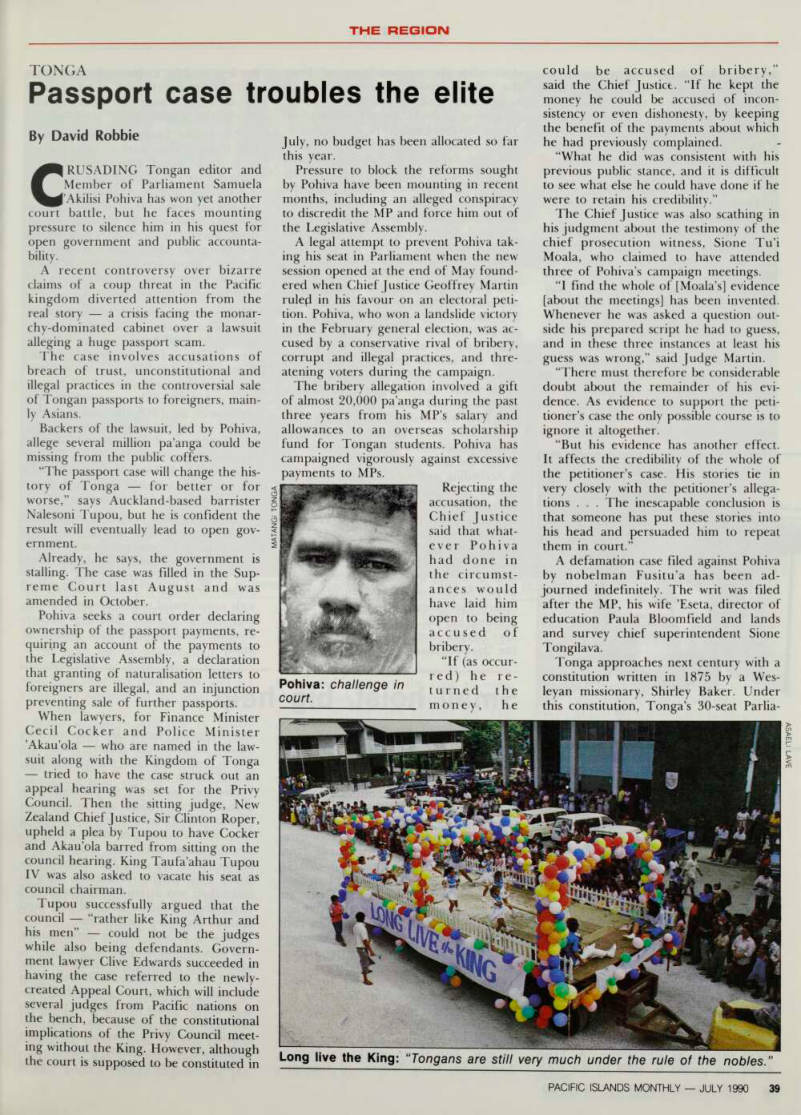
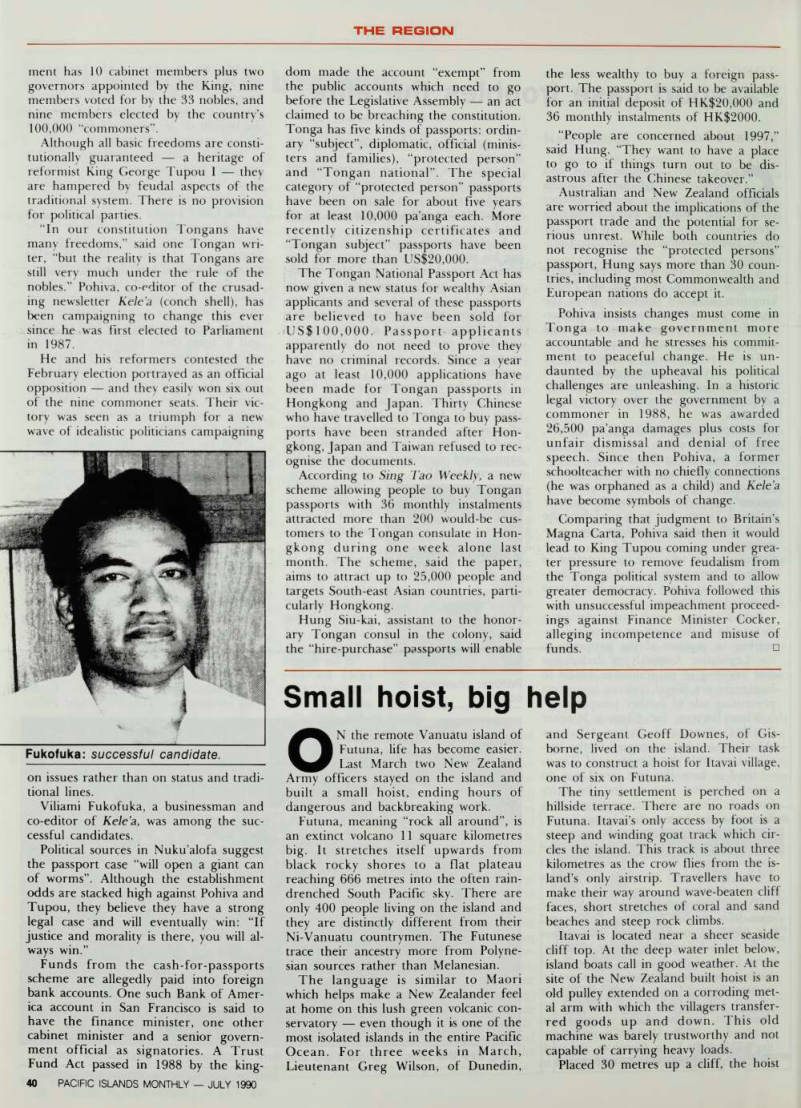
The Region
Tonga
Passport case troubles the elite
By David Robbie
CRUSADING Tongan editor and Member of Parliament Samuela ’Akilisi Pohiva has won yet another court battle, but he faces mounting pressure to silence him in his quest for open government and public accounta bility.
A recent controversy over bizarre claims of a coup threat in the Pacific kingdom diverted attention from the real story — a crisis facing the monar chy-dominated cabinet over a lawsuit alleging a huge passport scam.
The case involves accusations of breach of trust, unconstitutional and illegal practices in the controversial sale of Tongan passports to foreigners, main
ly Asians.
Backers of the lawsuit, led by Pohiva, allege several million pa’anga could be missing from the public coffers.
“The passport case will change the his tory of Tonga — for better or for worse,” says Auckland-based barrister Nalesoni Tupou, but he is confident the result will eventually lead to open gov ernment.
Already, he says, the government is stalling. The case was filled in the Sup reme Court last August and was amended in October.
Pohiva seeks a court order declaring ownership of the passport payments, re quiring an account of the payments to the Legislative Assembly, a declaration that granting of naturalisation letters to
foreigners are illegal, and an injunction
preventing sale of further passports.
When lawyers, for Finance Minister Cecil Cocker and Police Minister ’Akau’ola — who are named in the law suit along with the Kingdom of Tonga — tried to have the case struck out an appeal hearing was set for the Privy Council. Then the sitting judge, New Zealand Chief Justice, Sir Clinton Roper, upheld a plea by Tupou to have Cocker and Akau’ola barred from sitting on the
council hearing. King Taufa’ahau Tupou
IV was also asked to vacate his seat as council chairman.
Tupou successfully argued that the council — “rather like King Arthur and his men” — could not be the judges while also being defendants. Govern ment lawyer Clive Edwards succeeded in having the case referred to the newly created Appeal Court, which will include several judges from Pacific nations on the bench, because of the constitutional implications of the Privy Council meet
ing without the King. However, although
the court is supposed to be constituted in
July, no budget has been allocated so far this year.
Pressure to block the reforms sought by Pohiva have been mounting in recent
months, including an alleged conspiracy
to discredit the MP and force him out of
the Legislative Assembly.
A legal attempt to prevent Pohiva tak ing his seat in Parliament when the new session opened at the end of May found ered when Chief Justice Geoffrey Martin ruled in his favour on an electoral peti tion. Pohiva, who won a landslide victory in the February general election, was ac cused by a conservative rival of bribery, corrupt and illegal practices, and thre
atening voters during the campaign.
The bribery allegation involved a gift
of almost 20,000 pa’anga during the past three years from his MP’s salary and allowances to an overseas scholarship fund for Tongan students. Pohiva has
campaigned vigorously against excessive
payments to MPs.
Rejecting the
accusation, the Chief Justice said that what ever Pohiva had done in the circumst ances would have laid him open to being accused of
bribery.
“If (as occur red) he re turned the money, he
could be accused of bribery,” said the Chief Justice. “If he kept the money he could be accused of incon
sistency or even dishonesty, by keeping
the benefit of the payments about which
he had previously complained.
“What he did was consistent with his previous public stance, and it is difficult to see what else he could have done if he were to retain his credibility.”
The Chief Justice was also scathing in his judgment about the testimony of the chief prosecution witness, Sione Tu’i Moala, who claimed to have attended three of Pohiva’s campaign meetings.
“1 find the whole of [Moala’s] evidence [about the meetings] has been invented.
Whenever he was asked a question out side his prepared script he had to guess, and in these three instances at least his guess was wrong,” said Judge Martin.
“There must therefore be considerable doubt about the remainder of his evi dence. As evidence to support the peti tioner’s case the only possible course is to
ignore it altogether.
“But his evidence has another effect.
It affects the credibility of the whole of the petitioner’s case. His stories tie in
very closely with the petitioner’s allega
tions . . . The inescapable conclusion is that someone has put these stories into his head and persuaded him to repeat them in court.”
A defamation case filed against Pohiva by nobelman Fusitu’a has been ad journed indefinitely. The writ was filed after the MP, his wife ’Eseta, director of education Paula Bloomfield and lands and survey chief superintendent Sione
Tongilava.
Tonga approaches next century with a constitution written in 1875 by a Wes
leyan missionary, Shirley Baker. Under
this constitution, Tonga’s 30-seat Parlia-
Matangi Tonga
Pohiva: challenge in court.
Long live the King: “Tongans are still very much under the rule of the nobles.”
ment has 10 cabinet members plus two governors appointed by the King, nine members voted for by the 33 nobles, and nine members elected by the country’s 100,000 “commoners”.
Although all basic freedoms are consti tutionally guaranteed a heritage of
reformist King George Tupou I they
are hampered by feudal aspects of the traditional system. There is no provision
for political parties.
“In our constitution Tongans have many freedoms,” said one Tongan wri ter, “but the reality is that Tongans are still very much under the rule of the nobles.” Pohiva, co-editor of the crusad ing newsletter Kele’a (conch shell), has been campaigning to change this ever since he was first elected to Parliament in 1987.
He and his reformers contested the February election portrayed as an official opposition and they easily won six out of the nine commoner seats. Their vic tory was seen as a triumph for a new wave of idealistic politicians campaigning
on issues rather than on status and tradi tional lines.
Viliami Fukofuka, a businessman and co-editor of Kele’a, was among the suc cessful candidates.
Political sources in Nukualofa suggest the passport case “will open a giant can of worms”. Although the establishment odds are stacked high against Pohiva and Tupou, they believe they have a strong legal case and will eventually win: “If justice and morality is there, you will al ways win.”
Funds from the cash-for-passports
scheme are allegedly paid into foreign
bank accounts. One such Bank of Amer ica account in San Francisco is said to have the finance minister, one other cabinet minister and a senior govern ment official as signatories. A Trust Fund Act passed in 1988 by the king
dom made the account “exempt” from the public accounts which need to go before the Legislative Assembly an act claimed to be breaching the constitution.
Tonga has five kinds of passports: ordin-
ary subject , diplomatic, official (minis-
ters and families), protected person
and Tongan national . The special
category of protected person passports have been on sale for about five years for at east 10,000 paanga each. More
recently citizenship certificates and
Tongan subject passports have been sold formcrc than US$2O,OOO. he Tongan National Passport Act has now given a new status for wealthy Asian applicants and several or these passports are believed to have been sold for US$lOO,OOO. Passport applicants apparently do not need to prove they have no criminal records. Since a year ago at least 10,000 applications have been made for Tongan passports in Hongkong and Japan. Thirty Chinese who have travelled to Tonga to buy passports have been stranded after Hongkong, Japan and Taiwan refused to recognise the documents.
According to Sing Tao Weekly, a new
scheme allowing people to buy Tongan
passports with 36 monthly instalments attracted more than 200 would-be customers to the Tongan consulate in Hongkong during one week alone last month. The scheme, said the paper, aims to attract up to 25,000 people and targets South-east Asian countries, parti-
cularly Hongkong.
Hung Siu-kai, assistant to the honorary Tongan consul in the colony, said the “hire-purchase” passports will enable
the less wealthy to buy a foreign pass port. The passport is said to be available for an initial deposit of HK$2O,OOO and 36 monthly instalments of HK$2OOO.
“People are concerned about 1997,” said H “ They want t 0 have a place t 0 to if things turn out to be ' dls . astrous after the chinese takeover Australian and New Zealand officials are worried abou( the imp i ications of the t trade and the potemia for se . rious unrest while bo [ h coumries do not recognise the .. protect ed persons” passport, Hung says r ' m)re than £ 0 coun . tries, including most Commonwealth and European nations do accept it Pohiva insists changes must come in Tonga to make government more accountable and he stresses his commit ment to peaceful change. He is un
daunted by the upheaval his political
challenges are unleashing. In a histone le g al victory over the government by a commoner in 1988, he was awarded 26 ’ 500 pa’anga damages plus costs for unfair dismissal and denial of free speech. Since then Pohiva, a former schoolteacher with no chiefly connections (^ e was orphaned as a child) and Kelea have become symbols of change, Comparing that judgment to Britain’s Magna Carta, Pohiva said then it would lead to King Tupou coming under grea ter pressure to remove feudalism from the Tonga political system and to allow greater democracy. Pohiva followed this
with unsuccessful impeachment proceed
ings against Finance Minister Cocker, alleging incompetence and misuse of funds. □
Fukofuka: successful candidate.
Small hoist, big help
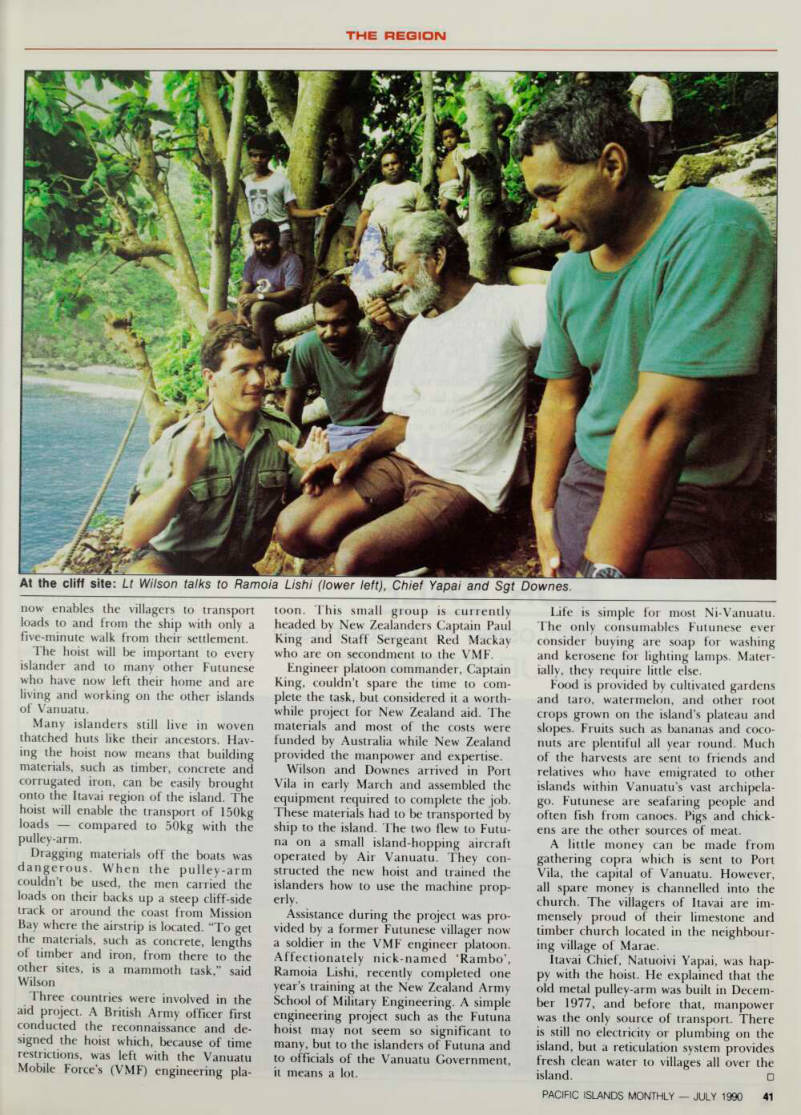
ON the remote Vanuatu island of Futuna, life has become easier.
Last March two New Zealand Army officers stayed on the island and built a small hoist, ending hours of
dangerous and backbreaking work.
Futuna, meaning “rock all around”, is an extinct volcano 11 square kilometres big. It stretches itself upwards from black rocky shores to a flat plateau reaching 666 metres into the often raindrenched South Pacific sky. There are only 400 people living on the island and they are distinctly different from their Ni-Vanuatu countrymen. The Futunese trace their ancestry more from Polynesian sources rather than Melanesian.
The language is similar to Maori which helps make a New Zealander feel at home on this lush green volcanic conservatory even though it is one of the most isolated islands in the entire Pacific Ocean. For three weeks in March, Lieutenant Greg Wilson, of Dunedin,
and Sergeant Geoff Downes, of Gis borne, lived on the island. Their task was to construct a hoist for Itavai village, one of six on Futuna, The tiny settlement is perched on a hillside terrace. There are no roads on Futuna. Itavai’s only access by foot is a steep and winding goat track which cir cles the island. This track is about three kilometres as the crow flies from the is land’s only airstrip. Travellers have to make their way around wave-beaten cliff faces, short stretches of coral and sand beaches and steep rock climbs.
Itavai is located near a sheer seaside cliff top. At the deep water inlet below, island boats call in good weather. At the site of the New Zealand built hoist is an old pulley extended on a corroding met al arm with which the villagers transfer red goods up and down. This old machine was barely trustworthy and not
capable of carrying heavy loads.
Placed 30 metres up a cliff, the hoist
now enables the villagers to transport loads to and from the ship with only a five-minute walk from their settlement.
The hoist will be important to every islander and to many other Futunese who have now left their home and are living and working on the other islands of Vanuatu.
Many islanders still live in woven thatched huts like their ancestors. Hav ing the hoist now means that building materials, such as timber, concrete and corrugated iron, can be easily brought onto the Itavai region of the island. The hoist will enable the transport of 150 kg loads compared to 50kg with the pulley-arm.
Dragging materials off the boats was
dangerous. When the pulley-arm
couldn’t be used, the men carried the loads on their backs up a steep cliff-side track or around the coast from Mission Bay where the airstrip is located. “To get the materials, such as concrete, lengths of timber and iron, from there to the other sites, is a mammoth task,” said Wilson Three countries were involved in the aid project. A British Army officer first conducted the reconnaissance and de signed the hoist which, because of time restrictions, was left with the Vanuatu Mobile Force’s (VMF) engineering pla
toon. This small group is currently headed by New Zealanders Captain Paul
King and Staff Sergeant Red Mackay
who are on secondment to the VMF.
Engineer platoon commander, Captain
King, couldn’t spare the time to com plete the task, but considered it a worth while project for New Zealand aid. The materials and most of the costs were funded by Australia while New Zealand provided the manpower and expertise.
Wilson and Downes arrived in Port Vila in early March and assembled the
equipment required to complete the job.
These materials had to be transported by ship to the island. The two flew to Futu na on a small island-hopping aircraft operated by Air Vanuatu. They con structed the new hoist and trained the islanders how to use the machine prop
erly.
Assistance during the project was pro vided by a former Futunese villager now a soldier in the VMF engineer platoon.
Affectionately nick-named ‘Rambo’, Ramoia Lishi, recently completed one year’s training at the New Zealand Army
School of Military Engineering. A simple
engineering project such as the Futuna hoist may not seem so significant to many, but to the islanders of Futuna and to officials of the Vanuatu Government, it means a lot.
Life is simple for most Ni-Vanuatu.
The only consumables Futunese ever consider buying are soap for washing and kerosene for lighting lamps. Mater
ially, they require little else.
Food is provided by cultivated gardens
and taro, watermelon, and other root crops grown on the island’s plateau and slopes. Fruits such as bananas and coco nuts are plentiful all year round. Much of the harvests are sent to friends and relatives who have emigrated to other islands within Vanuatu’s vast archipela go. Futunese are seafaring people and often fish from canoes. Pigs and chick ens are the other sources of meat.
A little money can be made from gathering copra which is sent to Port Vila, the capital of Vanuatu. However, all spare money is channelled into the church. The villagers of Itavai are im mensely proud of their limestone and timber church located in the neighbour
ing village of Marae.
Itavai Chief, Natuoivi Yapai, was hap py with the hoist. He explained that the old metal pulley-arm was built in Decem ber 1977, and before that, manpower was the only source of transport. There is still no electricity or plumbing on the island, but a reticulation system provides fresh clean water to villages all over the island. □
At the cliff site: Lt Wilson talks to Ramoia Lishi (lower left), Chief Yapai and Sgt Downes.
The crazy life of Rev Crook
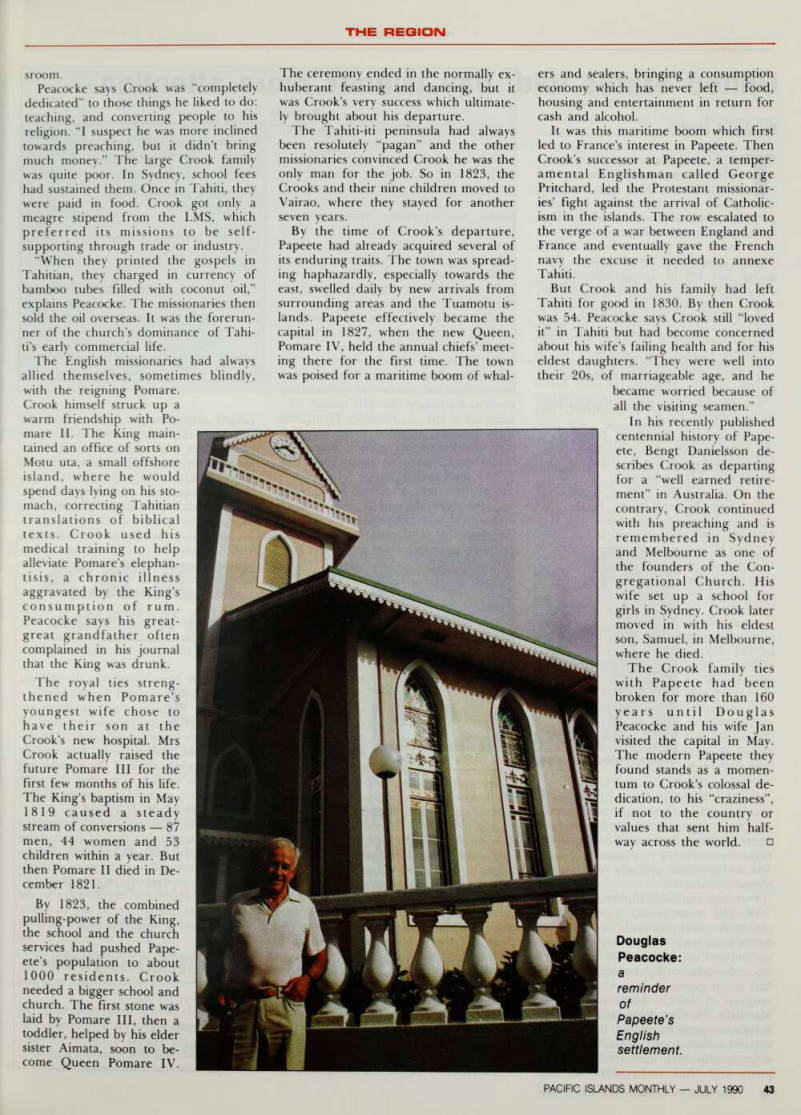
By Karen Mangnall
PAPEETE’S recent centenary celebrations held little to suggest the town’s history had not always been with France. Amidst the legions of French politicians, a lone Australian guest provided a reminder that Papeete started life as an English settlement. And that it was religion, as in many colonies, which altered the destiny of Tahiti, and ultimately the South Pacific.
That lone Australian was Douglas Peacocke, the great-great grandson of an English missionary, William Crook, who founded Papeete on April 14, 1818.
Crook was a dissenter who described himself as a Calvinistic Methodist, and who ended up spending 17 years of his life preparing for as many years evange lising in Tahiti.
Today, Douglas Peacocke views his great-great grandfather’s dedication with bemusement. “He was a nut,” he says, shaking his head. “A complete nut. All those sorts of people have got a little bit of craziness in them.” Peacocke, the only
descendant of Papeete’s early settlers who could be traced by the centenary organisers, has spent his five years of retirement researching Crook’s life.
“I always knew of him,” Peacocke says.
“There were some most astounding tales told by the family, true or otherwise, ab out his experiences.” In the end, Peacocke says his researches proved these stories were either “completely false” or had understated the truth.
Crook had first gone to Tahiti in 1797 on a London Missionary Society ship, the HMS Duff, with 19 other missionaries.
The young Englishman spent two years alone in the Marquesas without convert ing a soul. Undaunted, he set out again from London two years later. But when Crook and his new wife arrived in Syd ney in 1803, they discovered Tahiti had plunged into a series of bloody wars be tween the new King, Pomare 11, and other chiefs.
“Samuel Marsden was the LMS rep in Sydney at the time,” says Peacocke. “It was on his advice that Crook didn’t go immediately to Tahiti.” In fact the wait
lasted 13 years. Crook and his wife set up a school in Sydney and preached to convicts and remittance men while their
missionary colleagues one by one fled
Tahiti.
By 1816, Pomare II had reconquered Tahiti and in that year Crook, his wife and seven children moved to the island of Moorea, where four remaining mis sionaries had taken refuge since 1808 with a temporarily defeated Pomare 11.
During his years of waiting, Crook had apprenticed himself to a leading surgeon and a Sydney printer. His two years of training in each discipline were to prove invaluable.
The Moorea mission had a printing press and Crook, with his gift for lan
guages, helped produce hymnals in
Tahitian. In 1818, he moved his family across the channel to a scrubby, swampy uninhabited plain. Crook named it Wilks Harbour, after an LMS luminary. He built a villa back in the hills to escape the humidity and mosquitoes much as wealthy residents do today. On the fore shore he built a church and school at Paofai, now downtown Papeete. Crook preached in Tahitian on Sundays and for the rest of the week joined his wife and two eldest daughters in the clas
sroom.
Peacocke says Crook was “completely dedicated” to those things he liked to do: teaching, and converting people to his religion. “I suspect he was more inclined towards preaching, but it didn’t bring much money.” The large Crook family was quite poor. In Sydney, school fees had sustained them. Once in Tahiti, they were paid in food. Crook got only a meagre stipend from the LMS, which preferred its missions to be self
supporting through trade or industry.
“When they printed the gospels in
Tahitian, they charged in currency of bamboo tubes filled with coconut oil,” explains Peacocke. The missionaries then sold the oil overseas. It was the forerun ner of the church’s dominance of Tahi ti’s early commercial life.
The English missionaries had always allied themselves, sometimes blindly,
with the reigning Pomare.
Crook himself struck up a warm friendship with Po mare 11. The King main tained an office of sorts on Motu uta, a small offshore island, where he would
spend days lying on his sto
mach, correcting Tahitian translations of biblical texts. Crook used his
medical training to help
alleviate Pomare’s elephan tisis, a chronic illness
aggravated by the King’s
consumption of rum.
Peacocke says his great great grandfather often
complained in his journal
that the King was drunk.
The royal ties streng thened when Pomare’s youngest wife chose to have their son at the Crook’s new hospital. Mrs Crook actually raised the future Pomare 111 for the first few months of his life.
The King’s baptism in May 1819 caused a steady stream of conversions 87 men, 44 women and 53 children within a year. But then Pomare II died in De cember 1821.
By 1823, the combined
pulling-power of the King,
the school and the church
services had pushed Pape
ete’s population to about 1000 residents. Crook needed a bigger school and church. The first stone was laid by Pomare 111, then a toddler, helped by his elder sister Aimata, soon to be come Queen Pomare IV.
The ceremony ended in the normally ex huberant feasting and dancing, but it was Crook’s very success which ultimate
ly brought about his departure.
The Tahiti-iti peninsula had always been resolutely “pagan” and the other missionaries convinced Crook he was the only man for the job. So in 1823, the Crooks and their nine children moved to Vairao, where they stayed for another seven years.
By the time of Crook’s departure, Papeete had already acquired several of its enduring traits. The town was spread
ing haphazardly, especially towards the
east, swelled daily by new arrivals from surrounding areas and the Tuamotu is lands. Papeete effectively became the capital in 1827, when the new Queen, Pomare IV, held the annual chiefs’ meet ing there for the first time. The town was poised for a maritime boom of whal-
ers and sealers, bringing a consumption economy which has never left food, housing and entertainment in return for cash and alcohol.
It was this maritime boom which first led to France’s interest in Papeete. Then Crook’s successor at Papeete, a temper
amental Englishman called George
Pritchard, led the Protestant missionar ies’ fight against the arrival of Catholic ism in the islands. The row escalated to the verge of a war between England and France and eventually gave the French navy the excuse it needed to annexe Tahiti.
But Crook and his family had left Tahiti for good in 1830. By then Crook was 54. Peacocke says Crook still “loved it” in Tahiti but had become concerned about his wife’s failing health and for his eldest daughters. “They were well into their 20s, of marriageable age, and he
became worried because of all the visiting seamen.”
In his recently published
centennial history of Pape
ete, Bengt Danielsson de scribes Crook as departing for a “well earned retire ment” in Australia. On the contrary, Crook continued with his preaching and is remembered in Sydney and Melbourne as one of the founders of the Con gregational Church. His wife set up a school for girls in Sydney. Crook later moved in with his eldest son, Samuel, in Melbourne, where he died.
The Crook family ties with Papeete had been broken for more than 160 years until Douglas Peacocke and his wife Jan visited the capital in May.
The modern Papeete they
found stands as a momen tum to Crook’s colossal de dication, to his “craziness”, if not to the country or values that sent him half way across the world. □
Douglas Peacocke: a reminder of Papeete's English settlement.
Advertisements & other items, p. 42 (1 item)
For Sale
BY-TENDER CLOSING 15 AUGUST 1990
“PROUD SYDNEY”
f*« 1 lII* W fp
AFTER SERVICE AS AN IN-
TER-ISLAND PLEASURE
CRUISE VESSEL IN THE PACI-
FIC THE VESSEL WAS CON-
VERTED IN 1988 TO A FUNC-
TIONAL CRUISE VESSEL
FEATURING A MODERN AMBI-
ENCE COUPLED WITH OLD
FASHIONED CHARM. SHE
WAS UNDER CHARTER TO
THE ROYAL FAMILY AS THE
OFFICIAL VICE REGAL VES-
SEL ON AUSTRALIA'S BICEN-
TANNIAL CELEBRATIONS
DURING 1988. THE SHOAL
DRAFT PERMITS OPERATION
IN SHALLOW WATERS CLOSE
TO ISLAND BEACHES AND
DESTINATIONS WITH RES-
TRICTED ACCESS. CURRENT-
LY OPERATING ON SYDNEY
HARBOUR, THE VESSEL IS
AVAILABLE FOR IMMEDIATE
DELIVERY AND IS QUALIFIED
FOR CONVERSION TO ABS
CLASS.
BRIEF SPECIFICATIONS:
BUILDER: FIJI MARINE
LAUNCHED: 1972
REBUILT: 1988 (A.S.C. SOUTH AUSTRALIA)
DIMENSIONS: 38m x 7.5 m x I.Bm ENGINES: 2 x GMBV7I (TOTAL 460 HP) AUXILIARIES: 2 x LISTER 4 CYL (70 KVA)
PASSENGERS: 74 IN 26 CABINS
FOR FURTHER PARTICULARS PLEASE CONTACT SOLE BROKERS: GANNETT PTY LIMITED PO BOX 1573, SYDNEY NSW 2001
PH: 02/29 2125 FAX: 02/290 3513
United States told: pay islands more attention
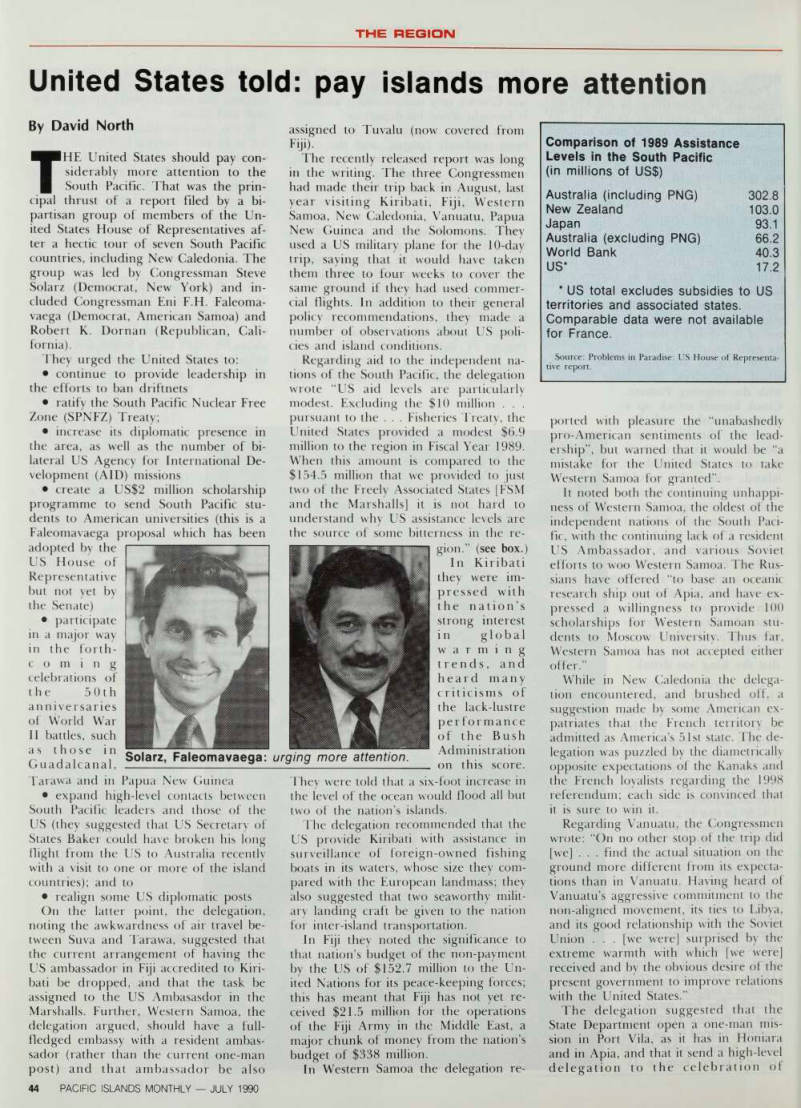
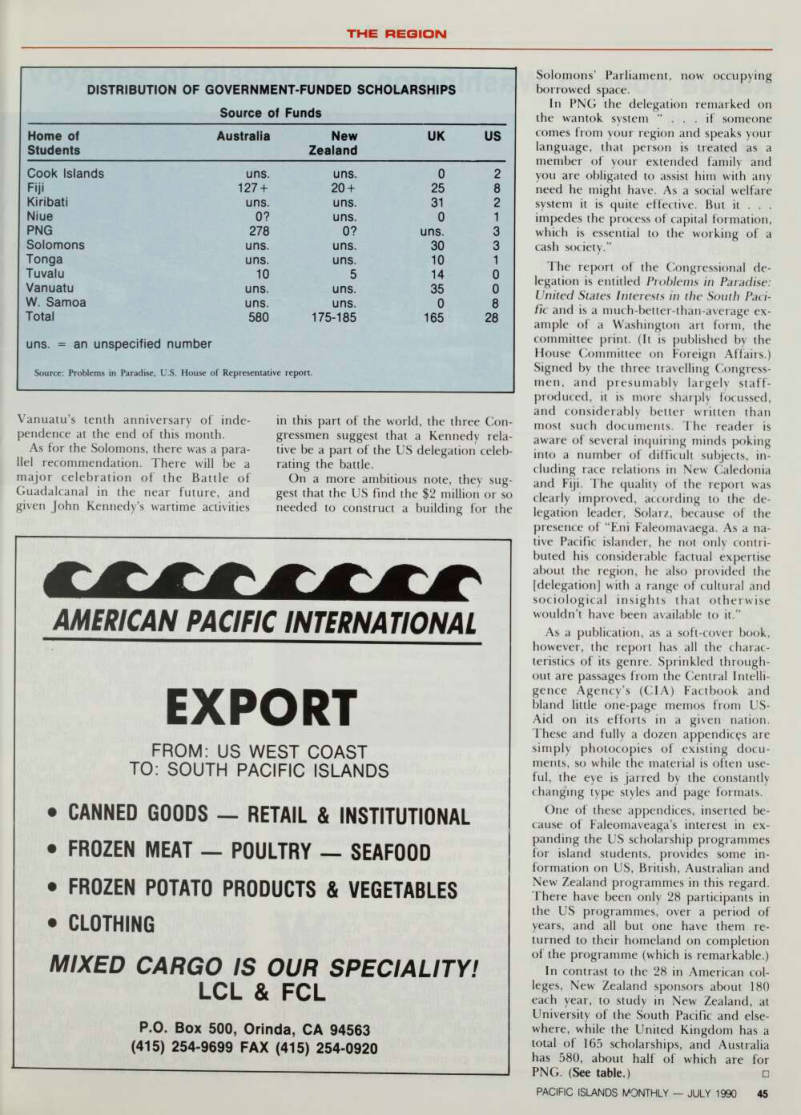
By David North
THE United States should pay con siderably more attention to the South Pacific. That was the prin cipal thrust of a report filed by a bi partisan group of members of the Un ited States House of Representatives af ter a hectic tour of seven South Pacific countries, including New Caledonia. The group was led by Congressman Steve Solarz (Democrat, New York) and in cluded Congressman Eni F.H. Faleoma vaega (Democrat, American Samoa) and Robert K. Dornan (Republican, Cali fornia).
They urged the United States to: • continue to provide leadership in the efforts to ban driftnets • ratify the South Pacific Nuclear Free Zone (SPNFZ) Treaty; • increase its diplomatic presence in the area, as well as the number of bi lateral US Agency for International De velopment (AID) missions • create a US$2 million scholarship programme to send South Pacific stu dents to American universities (this is a Faleomavaega proposal which has been
adopted by the US House of Representative but not yet by the Senate)
• participate
in a major way in the forth
coming
celebrations of the 50th anniversaries of World War II battles, such as those in Guadalcanal,
Tarawa and in Papua New Guinea • expand high-level contacts between South Pacific leaders and those of the US (they suggested that US Secretary of States Baker could have broken his long flight from the US to Australia recently with a visit to one or more of the island countries); and to • realign some US diplomatic posts On the latter point, the delegation, noting the awkwardness of air travel be tween Suva and Tarawa, suggested that the current arrangement of having the US ambassador in Fiji accredited to Kiri bati be dropped, and that the task be assigned to the US Ambasasdor in the Marshalls. Further, Western Samoa, the delegation argued, should have a full fledged embassy with a resident ambas sador (rather than the current one-man post) and that ambassador be also
assigned to Tuvalu (now covered from
Fiji).
The recently released report was long in the writing. The three Congressmen had made their trip back in August, last year visiting Kiribati, Fiji, Western Samoa, New Caledonia, Vanuatu, Papua New Guinea and the Solomons. They used a US military plane for the 10-day trip, saying that it would have taken them three to four weeks to cover the same ground if they had used commer cial flights. In addition to their general policy recommendations, they made a number of observations about US poli cies and island conditions.
Regarding aid to the independent na tions of the South Pacific, the delegation wrote “US aid levels are particularly modest. Excluding the $lO million .. . pursuant to the . . . Fisheries Treaty, the United States provided a modest $6.9 million to the region in Fiscal Year 1989.
When this amount is compared to the $154.5 million that we provided to just two of the Freely Associated States [FSM and the Marshalls] it is not hard to understand why US assistance levels are the source of some bitterness in the re
gion.” (see box.) In Kiribati they were im
pressed with
the nation’s strong interest in global warming trends, and heard many criticisms of the lack-lustre performance of the Bush Administration on this score.
They were told that a six-foot increase in the level of the ocean would flood all but two of the nation’s islands.
The delegation recommended that the US provide Kiribati with assistance in
surveillance of foreign-owned fishing
boats in its waters, whose size they com pared with the European landmass; they also suggested that two seaworthy milit ary landing craft be given to the nation for inter-island transportation.
In Fiji they noted the significance to that nation’s budget of the non-payment by the US of $152.7 million to the Un ited Nations for its peace-keeping forces; this has meant that Fiji has not yet re ceived $21.5 million for the operations of the Fiji Army in the Middle East, a major chunk of money from the nation’s budget of $338 million.
In Western Samoa the delegation re-
Comparison of 1989 Assistance Levels in the South Pacific (in millions of US$) Australia (including PNG) 302.8 New Zealand 103.0 Japan 93.1 Australia (excluding PNG) 66.2 World Bank 40.3 US* 17.2 * US total excludes subsidies to US territories and associated states.
Comparable data were not available for France.
Source: Problems in Paradise: US House of Representa tive report.
ported with pleasure the “unabashedly
pro-American sentiments of the lead ership”, but warned that it would be “a mistake for the United States to take Western Samoa for granted”.
It noted both the continuing unhappi ness of Western Samoa, the oldest of the independent nations of the South Paci fic, with the continuing lack of a resident US Ambassador, and various Soviet efforts to woo Western Samoa. The Rus sians have offered “to base an oceanic research ship out of Apia, and have ex
pressed a willingness to provide 100
scholarships for Western Samoan stu dents to Moscow University. Thus far, Western Samoa has not accepted either offer.”
While in New Caledonia the delega tion encountered, and brushed off, a suggestion made by some American ex patriates that the French territory be admitted as America’s 51st state. The de
legation was puzzled by the diametrically
opposite expectations of the Kanaks and the French loyalists regarding the 1998 referendum; each side is convinced that it is sure to win it.
Regarding Vanuatu, the Congressmen wrote: “On no other stop of the trip did [we] . . . find the actual situation on the ground more different from its expecta tions than in Vanuatu. Having heard of Vanuatu’s aggressive commitment to the non-aligned movement, its ties to Libya, and its good relationship with the Soviet Union . . . [we were] surprised by the extreme warmth with which [we were] received and by the obvious desire of the present government to improve relations with the United States.”
The delegation suggested that the State Department open a one-man mis sion in Port Vila, as it has in Honiara and in Apia, and that it send a high-level delegation to the celebration of
Solarz, Faleomavaega: urging more attention.
Distribution Of Government-Funded Scholarships
Source of Funds
Vanuatu’s tenth anniversary of inde pendence at the end of this month.
As for the Solomons, there was a para llel recommendation. There will be a major celebration of the Battle of Guadalcanal in the near future, and given John Kennedy’s wartime activities
in this part of the world, the three Con gressmen suggest that a Kennedy rela tive be a part of the US delegation celeb rating the battle.
On a more ambitious note, they sug gest that the US find the $2 million or so needed to construct a building for the
Solomons’ Parliament, now occupying borrowed space.
In PNG the delegation remarked on the wantok system “ ... if someone comes from your region and speaks your language, that person is treated as a member of your extended family and you are obligated to assist him with any need he might have. As a social welfare system it is quite effective. But it . . . impedes the process of capital formation, which is essential to the working of a cash society.”
The report of the Congressional de legation is entitled Problems in Paradise: United States Interests in the South Paci fic and is a much-betler-lhan-average ex ample of a Washington art form, the committee print. (It is published by the House Committee on Foreign Affairs.)
Signed by the three travelling Congress
men, and presumably largely staff produced, it is more sharply focussed, and considerably belter written than most such documents. The reader is aware of several inquiring minds poking into a number of difficult subjects, in cluding race relations in New- Caledonia and Fiji. The quality of the report was
clearly improved, according to the de
legation leader, Solarz, because of the presence of “Eni Faleomavaega. As a na tive Pacific islander, he not only contri buted his considerable factual expertise about the region, he also provided the [delegation] with a range of cultural and
sociological insights that otherwise
wouldn’t have been available to it.”
As a publication, as a soft-cover book, however, the report has all the charac teristics of its genre. Sprinkled through out are passages from the Central Intelli gence Agency’s (CIA) Factbook and bland little one-page memos from US- Aid on its efforts in a given nation.
These and fully a dozen appendices are
simply photocopies of existing docu
ments, so while the material is often use ful, the eye is jarred by the constantly changing type styles and page formats.
One of these appendices, inserted be cause of Faleomaveaga’s interest in ex panding the US scholarship programmes for island students, provides some in formation on US, British, Australian and New Zealand programmes in this regard.
There have been only 28 participants in the US programmes, over a period of years, and all but one have them re turned to their homeland on completion of the programme (which is remarkable.) In contrast to the 28 in American col leges, New Zealand sponsors about 180 each year, to study in New Zealand, at University of the South Pacific and else where, while the United Kingdom has a total of 165 scholarships, and Australia has 580, about half of which are for PNG. (See table.) □
rgdfdHome of Students Australia New Zealand UK US Cook Islands uns. uns. 0 2 Fiji 127 + 20 + 25 8 Kiribati uns. uns. 31 2 Niue 0? uns. 0 1
Png
278 0? uns. 3 Solomons uns. uns. 30 3 Tonga uns. uns. 10 1 Tuvalu 10 5 14 0 Vanuatu uns. uns. 35 0 W. Samoa uns. uns. 0 8 Total 580 175-185 165 28 uns. = an unspecified number Source: Problems in Paradise, U.S. House of Representative report.
Advertisements & other items, p. 45 (1 item)
Export
AMERICAN PACIFIC INTERNATIONAL
FROM: US WEST COAST
TO: SOUTH PACIFIC ISLANDS
• CANNED GOODS RETAIL & INSTITUTIONAL
• FROZEN MEAT POULTRY SEAFOOD
• FROZEN POTATO PRODUCTS & VEGETABLES
• CLOTHING
MIXED CARGO IS OUR SPECIALITY!
LCL & FCL
P.O. Box 500, Orinda, CA 94563
(415) 254-9699 FAX (415) 254-0920
Kabua goes to Washington
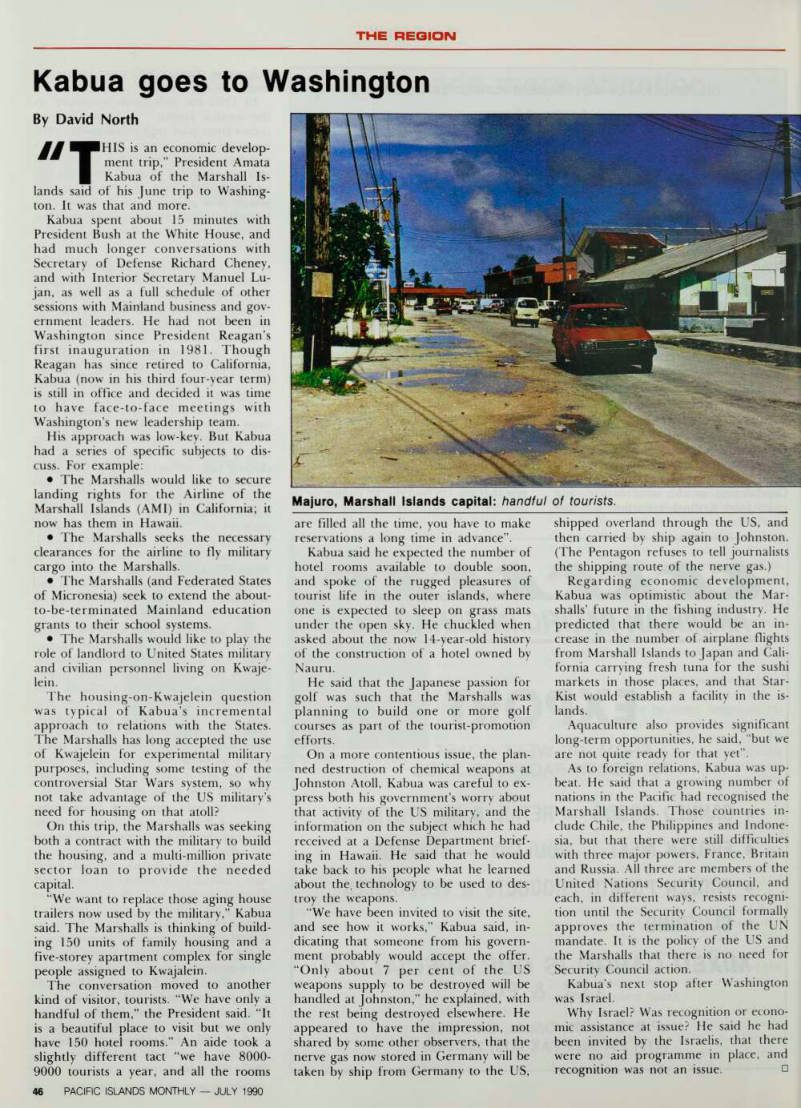
By David North
MM HHIS is an economic develop ® ment trip,” President Amata Kabua of the Marshall Is lands said of his June trip to Washing ton. It was that and more.
Kabua spent about 15 minutes with President Bush at the White House, and had much longer conversations with Secretary of Defense Richard Cheney, and with Interior Secretary Manuel Lu jan, as well as a full schedule of other sessions with Mainland business and gov ernment leaders. He had not been in
Washington since President Reagan’s
first inauguration in 1981. Though Reagan has since retired to California, Kabua (now in his third four-year term) is still in office and decided it was time to have face-to-face meetings with
Washington’s new leadership team.
His approach was low-key. But Kabua had a series of specific subjects to dis cuss. For example: • The Marshalls would like to secure landing rights for the Airline of the Marshall Islands (AMI) in California; it now has them in Hawaii. • The Marshalls seeks the necessary clearances for the airline to fly military cargo into the Marshalls. • The Marshalls (and Federated States of Micronesia) seek to extend the about to-be-terminated Mainland education grants to their school systems. • The Marshalls would like to play the role of landlord to United States military
and civilian personnel living on Kwaje
lein.
The housing-on-Kwajelein question
was typical of Kabua’s incremental approach to relations with the States.
The Marshalls has long accepted the use of Kwajelein for experimental military purposes, including some testing of the controversial Star Wars system, so why not take advantage of the US military’s need for housing on that atoll?
On this trip, the Marshalls was seeking both a contract with the military to build the housing, and a multi-million private sector loan to provide the needed
capital.
“We want to replace those aging house trailers now used by the military,” Kabua said. The Marshalls is thinking of build ing 150 units of family housing and a
five-storey apartment complex for single
people assigned to Kwajalein.
The conversation moved to another kind of visitor, tourists. “We have only a handful of them,” the President said. “It is a beautiful place to visit but we only have 150 hotel rooms.” An aide took a slightly different tact “we have 8000- 9000 tourists a year, and all the rooms
are filled all the time, you have to make reservations a long time in advance”.
Kabua said he expected the number of hotel rooms available to double soon, and spoke of the rugged pleasures of tourist life in the outer islands, where one is expected to sleep on grass mats under the open sky. He chuckled when asked about the now 14-year-old history of the construction of a hotel owned by Nauru.
He said that the Japanese passion for golf was such that the Marshalls was planning to build one or more golf courses as part of the tourist-promotion efforts.
On a more contentious issue, the plan ned destruction of chemical weapons at Johnston Atoll, Kabua was careful to ex press both his government’s worry about that activity of the US military, and the information on the subject which he had received at a Defense Department brief ing in Hawaii. He said that he would take back to his people what he learned about the, technology to be used to des troy the weapons.
“We have been invited to visit the site, and see how it works,” Kabua said, in dicating that someone from his govern ment probably would accept the offer.
“Only about 7 per cent of the US weapons supply to be destroyed will be handled at Johnston,” he explained, with the rest being destroyed elsewhere. He appeared to have the impression, not shared by some other observers, that the nerve gas now stored in Germany will be taken by ship from Germany to the US,
shipped overland through the US, and then carried by ship again to Johnston. (The Pentagon refuses to tell journalists the shipping route of the nerve gas.)
Regarding economic development,
Kabua was optimistic about the Mar shalls’ future in the fishing industry. He predicted that there would be an in crease in the number of airplane flights from Marshall Islands to Japan and Cali fornia carrying fresh tuna for the sushi markets in those places, and that Star- Kist would establish a facility in the is lands.
Aquaculture also provides significant
long-term opportunities, he said, “but we are not quite ready for that yet”.
As to foreign relations, Kabua was up beat. He said that a growing number of nations in the Pacific had recognised the Marshall Islands. Those countries in clude Chile, the Philippines and Indone sia, but that there were still difficulties with three major powers, France, Britain and Russia. All three are members of the United Nations Security Council, and each, in different ways, resists recogni tion until the Security Council formally approves the termination of the UN mandate. It is the policy of the US and the Marshalls that there is no need for Security Council action.
Kabua’s next stop after Washington was Israel.
Why Israel? Was recognition or econo mic assistance at issue? He said he had been invited by the Israelis, that there were no aid programme in place, and recognition was not an issue. □
Majuro, Marshall Islands capital: handful of tourists.
Voyages of discovery
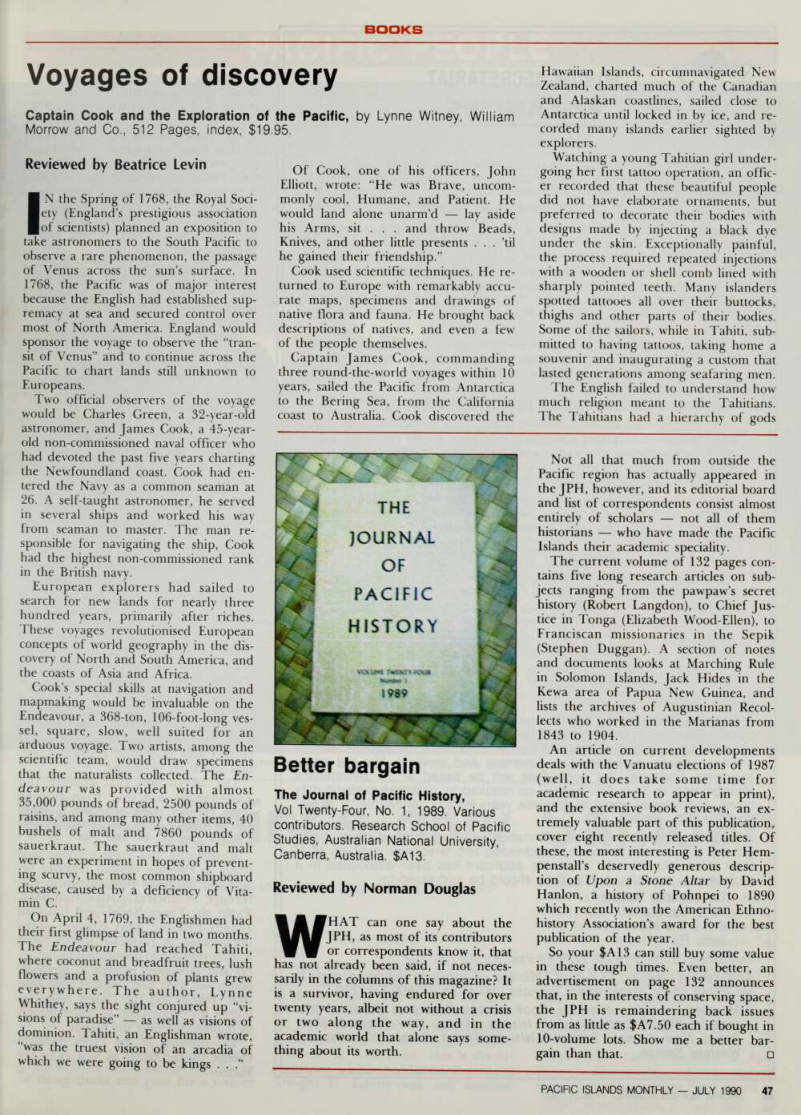
Books
Captain Cook and the Exploration of the Pacific, by Lynne Witney, William Morrow and Co., 512 Pages, index, $19.95.
Reviewed by Beatrice Levin IN the Spring of 1768, the Royal Soci
ety (England’s prestigious association
of scientists) planned an exposition to take astronomers to the South Pacific to observe a rare phenomenon, the passage of Venus across the sun’s surface. In 1768, the Pacific was of major interest because the English had established sup remacy at sea and secured control over most of North America. England would sponsor the voyage to observe the “tran sit of Venus” and to continue across the Pacific to chart lands still unknown to
Europeans.
Two official observers of the voyage would be Charles Green, a 32-year-old astronomer, and James Cook, a 45-year old non-commissioned naval officer who had devoted the past five years charting the Newfoundland coast. Cook had en tered the Navy as a common seaman at 26. A self-taught astronomer, he served in several ships and worked his way from seaman to master. The man re sponsible for navigating the ship, Cook had the highest non-commissioned rank in the British navy.
European explorers had sailed to search for new lands for nearly three hundred years, primarily after riches.
These voyages revolutionised European concepts of world geography in the dis covery of North and South America, and the coasts of Asia and Africa.
Cook’s special skills at navigation and mapmaking would be invaluable on the Endeavour, a 368-ton, 106-foot-long ves sel, square, slow, well suited for an arduous voyage. Two artists, among the scientific team, would draw specimens that the naturalists collected. The En deavour was provided with almost 35,000 pounds of bread, 2500 pounds of raisins, and among many other items, 40 bushels of malt and 7860 pounds of sauerkraut. The sauerkraut and malt were an experiment in hopes of prevent ing scurvy, the most common shipboard disease, caused by a deficiency of Vita min C.
On April 4, 1769, the Englishmen had their first glimpse of land in two months.
The Endeavour had reached Tahiti, where coconut and breadfruit trees, lush flowers and a profusion of plants grew everywhere. The author, Lynne Whithey, says the sight conjured up “vi sions of paradise” as well as visions of dominion. Tahiti, an Englishman wrote, “was the truest vision of an arcadia of which we were going to be kings . . .”
Of Cook, one of his officers, John Elliott, wrote: “He was Brave, uncom monly cool, Humane, and Patient. He would land alone unarm’d lay aside his Arms, sit . . . and throw Beads, Knives, and other little presents . . . ’til he gained their friendship.”
Cook used scientific techniques. He re turned to Europe with remarkably accu rate maps, specimens and drawings of native flora and fauna. He brought back descriptions of natives, and even a few of the people themselves.
Captain James Cook, commanding three round-the-world voyages within 10 years, sailed the Pacific from Antarctica to the Bering Sea, from the California coast to Australia. Cook discovered the
Hawaiian Islands, circumnavigated New Zealand, charted much of the Canadian and Alaskan coastlines, sailed close to Antarctica until locked in by ice, and re corded many islands earlier sighted by
explorers.
Watching a young Tahitian girl under going her first tattoo operation, an offic er recorded that these beautiful people did not have elaborate ornaments, but preferred to decorate their bodies with designs made by injecting a black dye under the skin. Exceptionally painful,
the process required repeated injections
with a wooden or shell comb lined with sharply pointed teeth. Many islanders spotted tattooes all over their buttocks, thighs and other parts of their bodies.
Some of the sailors, while in Tahiti, sub mitted to having tattoos, taking home a souvenir and inaugurating a custom that lasted generations among seafaring men.
The English failed to understand how much religion meant to the Tahitians.
The Tahitians had a hierarchy of gods
and spirits, and believed that everything, people, plants, animals, even inanimate objects, had a kind of spiritual aura cal led mana, that flowed from the gods.
The good relations that Cook always tried to foster with natives the Euro pean and the Polynesian, Maori, Melane sian, Australian aborigine, Eskimo, Cana dian Indian, Patagonian rested on a respect for human values, never on the false acceptance of any form of the su pernatural, the godlike, or one people
being superior to another.
At Christmas Island, (a turtle hunter’s paradise), the Englishmen were asto nished to find these people resembling the Tahitians and speaking a language remarkably similar to the Tahitian.
Historian Lynne Withey points out
that Cook was not always a model com mander but was often hot-tempered and severe with his crew and natives. His harshness on the third voyage may have been responsible for his murder.
The effects of the voyages of Captain James Cook were far-reaching both for the Pacific and for Europe. Those who followed Cook, William Bligh and George Vancouver were deeply influ enced by Cook’s methods and carried on his work into the closing years of the century. Struck by how much Tahiti and Hawaii changed in the few years be tween Cook’s voyages and their own, Bligh and Vancouver observed the de cline of population and the islanders in creasing dependence on European pro ducts. Interisland warfare became more common and more deadly with the use of European weapons and ships.
So much European attention was fo cused on certain Hawaiian chiefs, TW Tynah/ Pomare in Tahiti and Kame hameha in Hawaii that they achieved a degree of influence and prestige that played on their ambitions and encour aged them to extend their influence far
beyond what traditional Polynesian poli
tical structures permitted.
The advantages that Pomare and Kamehameha had over rivals through these foreign contacts led to political power that would have been impossible without such aid.
Missionaries and traders encouraged chiefs to embrace western religious be liefs and European forms of law in pre ference to ancient native traditions.
Tahiti, the Tonga, Society and Hawaiian Islands had the most complex social organisation in Polynesia, strong native leaders resistant to domination by outsid ers and intelligent enough to use fore igners for their own needs. Later, Eng land, France and the United States re quired the cooperation of native leaders to impose rule over the islands.
The opening of the Pacific brought change to Europeans as well as to the Pacific. D
Better bargain
The Journal of Pacific History, Vol Twenty-Four, No. 1, 1989. Various contributors. Research School of Pacific Studies, Australian National University, Canberra, Australia. $A13.
Reviewed by Norman Douglas
WHAT can one say about the JPH, as most of its contributors or correspondents know it, that has not already been said, if not neces sarily in the columns of this magazine? It is a survivor, having endured for over twenty years, albeit not without a crisis or two along the way, and in the academic world that alone says some thing about its worth.
Not all that much from outside the Pacific region has actually appeared in the JPH, however, and its editorial board and list of correspondents consist almost entirely of scholars not all of them historians who have made the Pacific Islands their academic speciality.
The current volume of 132 pages con tains five long research articles on sub jects ranging from the pawpaw’s secret history (Robert Langdon), to Chief Jus tice in Tonga (Elizabeth Wood-Ellen), to Franciscan missionaries in the Sepik (Stephen Duggan). A section of notes and documents looks at Marching Rule in Solomon Islands, Jack Hides in the Kewa area of Papua New Guinea, and lists the archives of Augustinian Recol lects who worked in the Marianas from 1843 to 1904.
An article on current developments deals with the Vanuatu elections of 1987 (well, it does take some time for academic research to appear in print), and the extensive book reviews, an ex tremely valuable part of this publication, cover eight recently released titles. Of these, the most interesting is Peter Hem
penstall’s deservedly generous descrip
tion of Upon a Stone Altar by David Hanlon, a history of Pohnpei to 1890 which recently won the American Ethno history Association’s award for the best publication of the year.
So your SAI3 can still buy some value in these tough times. Even better, an advertisement on page 132 announces that, in the interests of conserving space, the JPH is remaindering back issues from as little as $A7.50 each if bought in 10-volume lots. Show me a better bar gain than that. □
Advertisements & other items, p. 48 (1 item)
Vacancies
V FORUM SECRETARIAT
Applications are invited from suitably qualified and experienced persons, who must be citizens of a 'member country of the South Pacific Forum, for the following positions with the Forum Secretariat:
. EXECUTIVE ENGINEER, TELECOMMUNICATIONS DIVISION
The Executive Engineer is responsible for the engineering management of all development projects under the Forum Telecommunications Programme (FTP) which is administered by the Telecommunications Division of the Forum Secretariat. He/She will also be responsible for preparation of forward plans for telecommunications development, the preparation of project proposals, and the assembly and updating of the Regional Telecommunications Funding Schedule and associated project dossiers.
Applicants who have a degree or diploma in Communications, Engineering or Science with evidence of specialisation in telecommunications engineering and extensive experience working for a telecommunications organisation.
. TELECOMMUNICATIONS ENGINEER, TELECOMMUNICATIONS DIVISION
The Telecommunications Engineer is required to develop and implement telecommunciations projects in the Forum Island Countries as well as provide technical assistance when requested. This work forms part of the Forum Telecommunications Programme which is administered by the Telecommunications Division of the South Pacific Forum Secretariat.
Applicants should have a degree or diploma in Communications Engineering or Science with evidence of specialisation in telecommunications and at least five years experience working for a telecommunications organisation.
- LEGAL & POLITICAL OFFICER
The Legal and Political officer will be required to undertake legal research and investigation, provide legal advice and prepare legal documents. He/She would also be expected to carry out the duties involved in the Secretariat role as Depositary for a number of Regional Treaties.
Applicants should have a law degree, preferably majoring in international law, and be familiar with, and capable of analysing and preparing reports on, regional and international political developments. Forum Government experience would be an advantage.
General Information These appointments carry attractive remuneration packages payable in Fiji dollars. For non-Fiji citizens this is tax free and includes housing or housing allowance, education and child allowances. Other benefits for all employees include superannuation payments and medical, life and travel insurance coverage. The appointees will be based at the Secretariat’s Headquarters in Suva, Fiji, but will be required to undertake periodic duty travel. Appointment would be for three years initially, renewable by mutual agreement.
Applicants should provide full information on education and career background and should list names, addresses and telephone numbers of at least three referees with whom the applicant has been associated in a professional capacity. Applications should be addressed to: The Secretary General Forum Secretariat G P 0 Box 856 Suva, Fiji Telephone: 312600 Telex; 2229 FJ Fax: 302204/301102 Applications close on 15 August 1990 and all enquiries should be made to Ms Karen Sorby, Management Services Officer on 312600 Ext. 216. * Member countries: Australia, Cook Islands, Federated States of Micronesia, Fiji, Kiribati, Marshall Islands, Nauru, New Zealand, Niue, Papua New Guinea, Solomon Islands, Tonga, Tuvalu, Vanuatu and Western Samoa.
West Point’s only Samoan
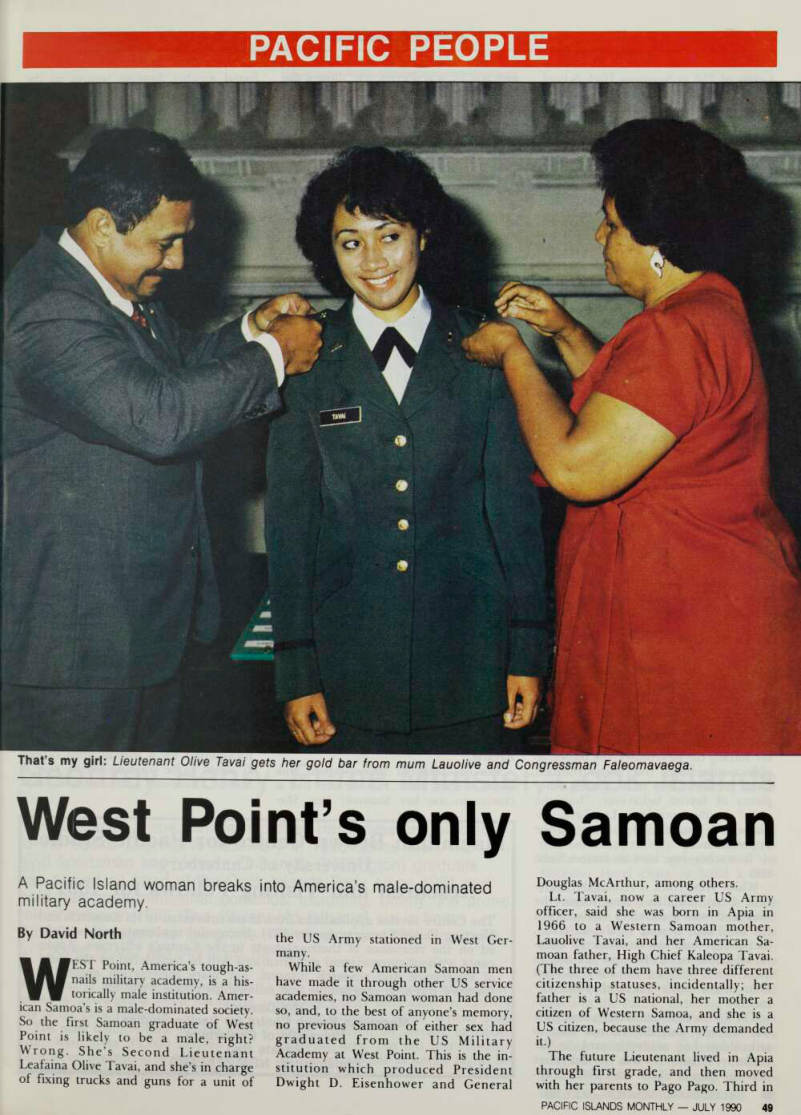
Pacific People
A Pacific Island woman breaks into America’s male-dominated military academy.
By David North
WEST Point, America’s tough-as
nails military academy, is a his torically male institution. Amer ican Samoa’s is a male-dominated society.
So the first Samoan graduate of West Point is likely to be a male, right?
Wrong. She’s Second Lieutenant Leafaina Olive Tavai, and she’s in charge of fixing trucks and guns for a unit of
the US Army stationed in West Ger many, While a few American Samoan men have made it through other US service academies, no Samoan woman had done so, and, to the best of anyone’s memory, no previous Samoan of either sex had graduated from the US Military Academy at West Point. This is the in stitution which produced President Dwight D. Eisenhower and General
Douglas McArthur, among others.
Lt. Tavai, now a career US Army officer, said she was born in Apia in 1966 to a Western Samoan mother, Lauolive Tavai, and her American Sa moan father, High Chief Kaleopa Tavai. (The three of them have three different
citizenship statuses, incidentally; her
father is a US national, her mother a citizen of Western Samoa, and she is a US citizen, because the Army demanded it.) The future Lieutenant lived in Apia through first grade, and then moved with her parents to Pago Pago. Third in
That’s my girl: Lieutenant Olive Tavai gets her gold bar from mum Lauolive and Congressman Faleomavaega.
a class of 250 at Somoana High School, she decided in her senior year there to apply to several Mainland colleges. She sent off applications to Lewis and Clark in Oregon, to Auburn in Alabama and to Brigham Young in Utah. They all
accepted her.
But the high school student had heard from then Congressman Fofo Sunia that his office was looking for applicants to the military academies, so she had ap plied to them as well, sending off the results of her aptitude tests, and the physical examinations demanded by the academies.
She had almost forgotten about the academies, and had all but decided to attend Lewis and Clark, which had offered her a good scholarship and a pre-law course she wanted to follow, when the word came that she had been accepted by West Point. She learnt about her good fortune in an odd way she heard about it while listening to the local television news. The Congressman’s Pago Pago office, informed of her selection by
Washington, had passed the good news
on to the TV station, but had not yet called her about it. (Ever the diplomat, she would not be drawn into a conversa tion about what she thought of that noti fication process.) The first step was a year at the West Point prep school, at Fort Monmouth, New Jersey, where she got ready for the rigors of West Point. Then, in the au tumn of 1985 she became a plebe (fresh man) at the big grey institution on the Hudson, a hundred miles north of New
York City.
All Americans attending West Point encounter the cultural shock of the place, with its intense schedule, its high demands (both academic and physical), its military discipline and the first year of hazing. The hazing, which sometimes gets out of hand, is routinely a technique for forcing the newcomers, the plebes, to play a subservient role under constant social pressure; they must, among other pieces of forced behaviour, “hug the walls” in the corridors, Lt. Tavai ex plained, to stay out of the way of the
upperclassmen.
“It teaches you how to survive,” she said.
Whilst West Point is remarkably diffe rent from Mainland Americans, the Mainland was a different environment for Lt. Tavai, as well, so she, in effect, had to cope with two simultaneous cultu ral adjustments, to Mainland life and to West Point. (The ice and snow of West Point in the winter was another new ele ment).
The Lieutenant did survive, though it was not easy, and she did not want to talk about her academic rank at the academy. Whatever it was, she did better than the quarter of the class which drop
ped out, or was forced out, during the
four-year grind.
“It was not so much the level of diffi culty at West Point, it was the amount of work piled on you; we all had seven courses; you had to learn to manage your time and your priorities,” she said.
When she graduated, in the summer of 1989, her mother made the 10,000 mile trip to the academy to pin her second lieutenant’s golden bars on her shoulders; her father, being ill at the time, asked Congressman Eni F.H.
Faleomavaega, to fill in for him at the ceremony.
After a welcome period of leave in Samoa, and a four-month course at the maintenance and logistics training prog ramme at Fort Aberdeen, Maryland, the new officer was shipped out to her first assignment in the “real army”, a job with the Third Infantry Division in southern Germany, where she arrived in January.
She is in charge of the Automotive and Armament Platoon, (consisting of three women and 67 men) in Company B, of the 3rd Support Battalion of the Di visional Support Command of the 3rd Infantry Division. The 3rd Infantry is posted near what used to be the Iron Curtain, and would be instantly in the heat of battle were there an East-West war.
Her company is charged with provid ing maintenance services to the First Bri gade of the 3rd Infantry. Her platoon,
working in a huge garage-like facility
(“motor pool” is the military term), re pairs M-16 rifles, .50 calibre machine guns, jeeps, trucks and tanks. When we talked she and her platoon were working long hours, trying to get everything in shape for summer manoeuvres.
Lt. Tavai likes Germany, but has not seen much of it yet, becase “I usually have to work weekends”. She is stationed in Schweinfurt, a small city in Northern Bavaria.
She has learnt a little German and wants to learn more. Has she ever had a chance to use her Samoan? Yes. She
found another Samoan woman in the American Army, a non-commissioned officer in a communications unit is sta tioned nearby. She was also born in Western Samoa.
Lt. Tavai has opted to live off-base, “in the local economy” as the military say, and has rented an apartment for herself from a German family. She is getting used to German food, as she got used to West Point food, but looks backs fondly on a diet dominated by pork (available in Germany), bananas (a few varieties are imported) and taro (unknown in Ger many).
What’s next for Lt. Tavai? She is hap py in the Army, and plans to make her career in the military. In May, 1991, if all goes as planned, she will become a First Lieutenant, and at some point a little later will move into the second ranking job at Company B, when she will become the shop officer. (She will succeed another woman; both of them report to the company commander, another woman.) At the end of 1992 her three-year tour of duty in Germany will end, and she will go on to another assignment, probably in the Mainland.
Would she suggest that other women other Samoans go into the armed forces? “Yes, it’s a good idea, if you like what you are doing,” she said, adding that she adapts easily, and that this has helped her both in West Point and in
Germany.
There is something of a military tradi tion in the family. Her father, during a 10-year-period before she was born, served in the US Navy, and one of her younger brothers, Fa’agi a 22-year-old E -5 (non-commissioner officer) in the Army, has just returned to Pago Pago after a tour of duty in Korea.
Maybe, coming from a family with a military history and being the eldest sis ter, with four little brothers, is good background for a woman army officer.
It seems to be working in the case of Second Lieutenant Leafaina Olive Tavai. □
Advertisements & other items, p. 50 (1 item)
Macmillan Brown Centre for Pacific Studies
University of Canterbury
Research and Visiting Fellows for 1991
The Centre invites applications from those interested in its Research and Visiting Fellows programme for 1991. Successful applicants will be picked on the relevance of their interests to the Centre’s activities. Applicants without conventional qualifications will be considered on the basis of experience and research interest. For more information about the Centre’s research programme and fellowships please write to: The Director Macmillan Brown Centre for Pacific Studies University of Canterbury Private Bag Christchurch, NEW ZEALAND
Geoffrey Henry: Prime Minister, Cook Islands
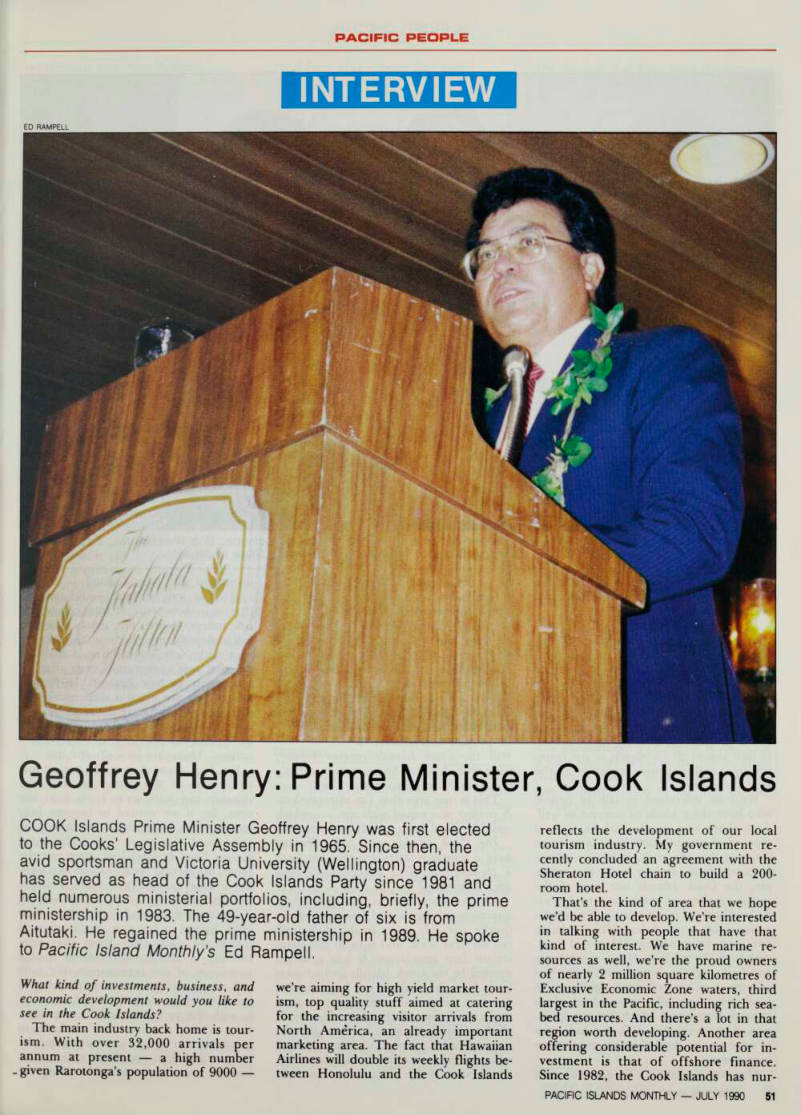
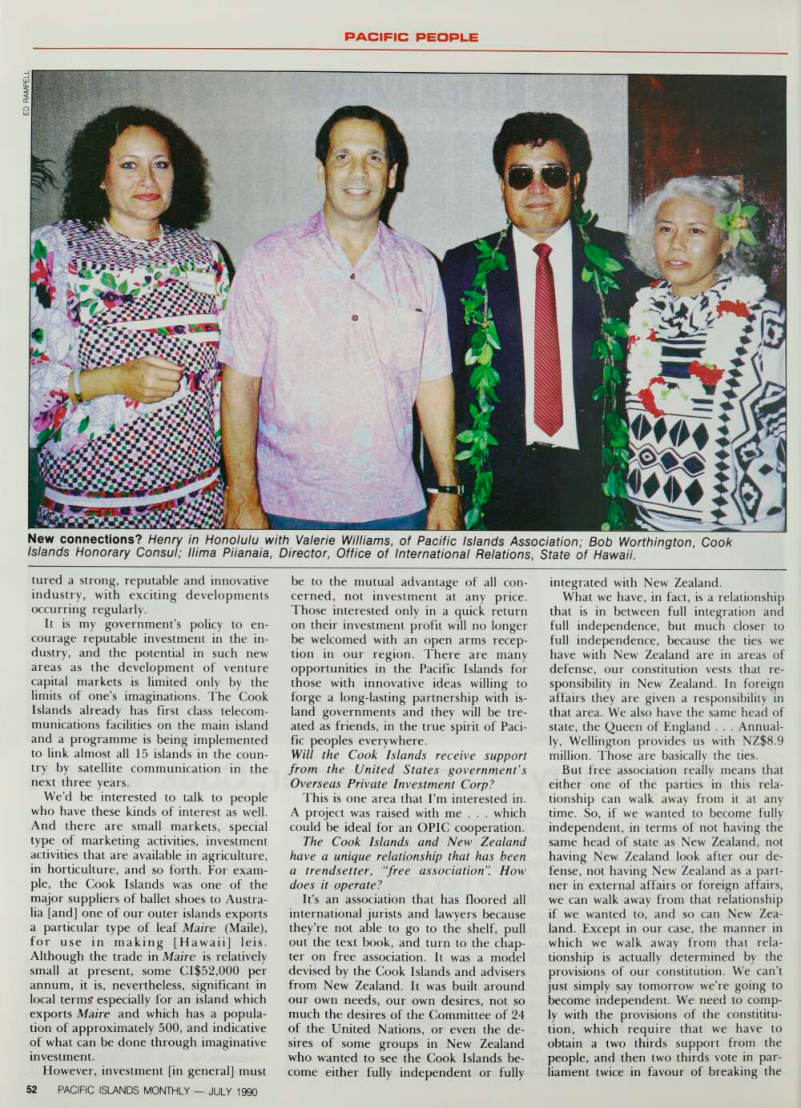
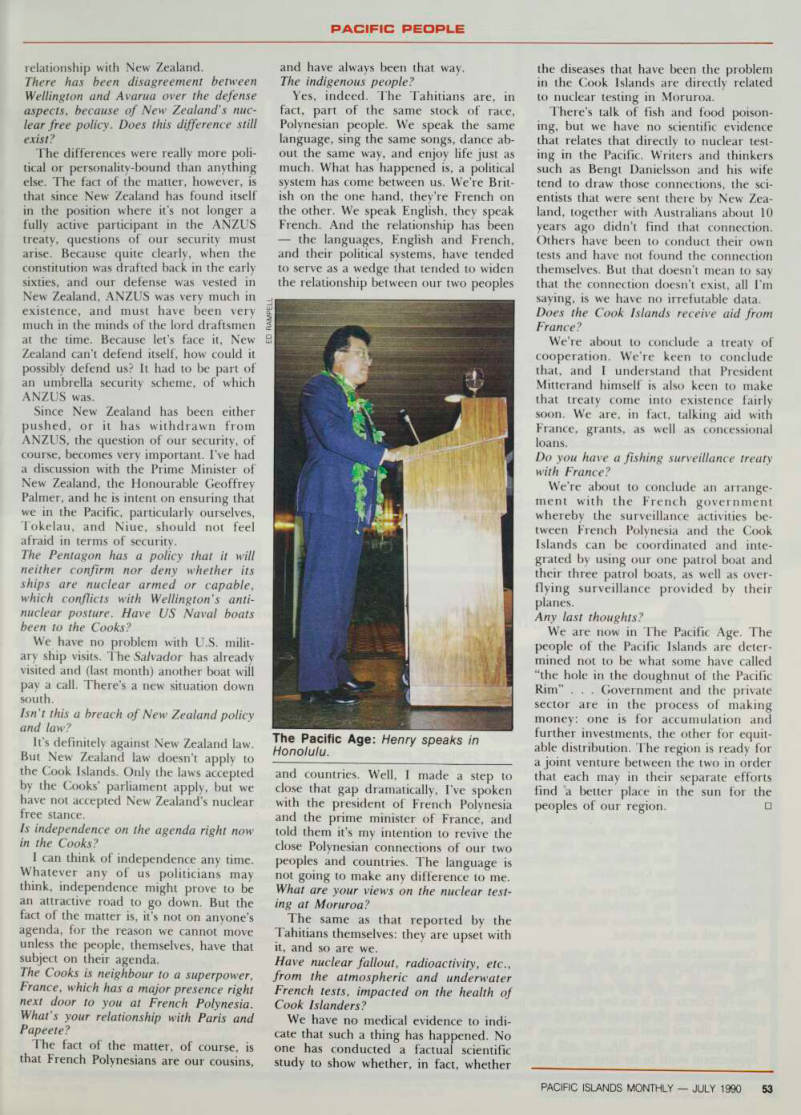
Interview
COOK Islands Prime Minister Geoffrey Henry was first elected to the Cooks’ Legislative Assembly in 1965. Since then, the avid sportsman and Victoria University (Wellington) graduate has served as head of the Cook Islands Party since 1981 and held numerous ministerial portfolios, including, briefly, the prime ministership in 1983. The 49-year-old father of six is from Aitutaki. He regained the prime ministership in 1989. He spoke to Pacific Island Monthly’s Ed Rampell.
What kina of investments, business, and economic development would you like to see in the Cook Islands?
The main industry back home is tourism. With over 32,000 arrivals per annum at present a high number given Rarotonga’s population of 9000
we’re aiming for high yield market tour ism, top quality stuff aimed at catering for the increasing visitor arrivals from North America, an already important marketing area. The fact that Hawaiian Airlines will double its weekly flights be tween Honolulu and the Cook Islands
reflects the development of our local tourism industry. My government re cently concluded an agreement with the Sheraton Hotel chain to build a 200room hotel.
That’s the kind of area that we hope we’d be able to develop. We’re interested in talking with people that have that kind of interest. We have marine re sources as well, we’re the proud owners of nearly 2 million square kilometres of Exclusive Economic Zone waters, third largest in the Pacific, including rich sea bed resources. And there’s a lot in that region worth developing. Another area offering considerable potential for in vestment is that of offshore finance.
Since 1982, the Cook Islands has nur-
Ed Rampell
tured a strong, reputable and innovative
industry, with exciting developments
occurring regularly.
It is my government’s policy to en courage reputable investment in the in dustry, and the potential in such new areas as the development of venture capital markets is limited only by the limits of one’s imaginations. The Cook Islands already has first class telecom munications facilities on the main island and a programme is being implemented to link almost all 15 islands in the coun try by satellite communication in the next three years.
We’d be interested to talk to people who have these kinds of interest as well.
And there are small markets, special type of marketing activities, investment activities that are available in agriculture, in horticulture, and so forth. For exam ple, the Cook Islands was one of the major suppliers of ballet shoes to Austra lia [and] one of our outer islands exports a particular type of leaf Maire (Maile), for use in making [Hawaii] leis.
Although the trade in Maire is relatively small at present, some C 1552,000 per annum, it is, nevertheless, significant in local terms especially for an island which exports Maire and which has a popula tion of approximately 500, and indicative of what can be done through imaginative investment.
However, investment [in general] must
be to the mutual advantage of all con cerned, not investment at any price.
Those interested only in a quick return on their investment profit will no longer be welcomed with an open arms recep tion in our region. There are many opportunities in the Pacific Islands for those with innovative ideas willing to
forge a long-lasting partnership with is
land governments and they will be tre ated as friends, in the true spirit of Paci
fic peoples everywhere.
Will the Cook Islands receive support from the United States government’s Overseas Private Investment Corp?
This is one area that I’m interested in.
A project was raised with me . . . which could be ideal for an OPIC cooperation.
The Cook Islands and New Zealand have a unique relationship that has been a trendsetter, “free association” How does it operate?
It’s an association that has floored all international jurists and lawyers because they’re not able to go to the shelf, pull out the text book, and turn to the chap ter on free association. It was a model devised by the Cook Islands and advisers from New Zealand. It was built around our own needs, our own desires, not so much the desires of the Committee of 24 of the United Nations, or even the de sires of some groups in New Zealand who wanted to see the Cook Islands be
come either fully independent or fully
integrated with New Zealand.
What we have, in fact, is a relationship that is in between full integration and full independence, but much closer to full independence, because the ties we have with New Zealand are in areas of defense, our constitution vests that re sponsibility in New Zealand. In foreign affairs they are given a responsibility in that area. We also have the same head of state, the Queen of England . . . Annual
ly, Wellington provides us with NZ$B.9
million. Those are basically the ties.
But free association really means that either one of the parties in this rela tionship can walk away from it at any time. So, if we wanted to become fully independent, in terms of not having the same head of state as New Zealand, not having New Zealand look after our de fense, not having New Zealand as a part ner in external affairs or foreign affairs, we can walk away from that relationship if we wanted to, and so can New Zea land. Except in our case, the manner in which we walk away from that rela tionship is actually determined by the provisions of our constitution. We can’t just simply say tomorrow we’re going to become independent. We need to comp ly with the provisions of the constititu tion, which require that we have to obtain a two thirds support from the people, and then two thirds vote in par liament twice in favour of breaking the
New connections? Henry in Honolulu with Valerie Williams, of Pacific Islands Association; Bob Worthington, Cook Islands Honorary Consul; llima Piianaia, Director, Office of International Relations, State of Hawaii.
relationship with New Zealand.
There has been disagreement between Wellington and Avarua over the defense aspects, because of New Zealand’s nuc lear free policy. Does this difference still exist?
The differences were really more poli tical or personality-bound than anything else. The fact of the matter, however, is that since New Zealand has found itself in the position where it’s not longer a fully active participant in the ANZUS treaty, questions of our security must arise. Because quite clearly, when the constitution was drafted back in the early sixties, and our defense was vested in New Zealand, ANZUS was very much in existence, and must have been very much in the minds of the lord draftsmen at the time. Because let’s face it, New Zealand can’t defend itself, how could it possibly defend us? It had to be part of an umbrella security scheme, of which ANZUS was.
Since New Zealand has been either pushed, or it has withdrawn from ANZUS, the question of our security, of course, becomes very important. I’ve had a discussion with the Prime Minister of New Zealand, the Honourable Geoffrey Palmer, and he is intent on ensuring that we in the Pacific, particularly ourselves, Tokelau, and Niue, should not feel afraid in terms of security.
The Pentagon has a policy that it will neither confirm nor deny whether its ships are nuclear armed or capable, which conflicts with Wellington’s anti nuclear posture. Have US Naval boats been to the Cooks?
We have no problem with U.S. milit ary ship visits. The Salvador has already visited and (last month) another boat will pay a call. There’s a new situation down south.
Isn’t this a breach of New Zealand policy and law?
It’s definitely against New Zealand law.
But New Zealand law doesn’t apply to the Cook Islands. Only the laws accepted by the Cooks’ parliament apply, but we have not accepted New Zealand’s nuclear free stance.
Is independence on the agenda right now in the Cooks?
I can think of independence any time.
Whatever any of us politicians may think, independence might prove to be an attractive road to go down. But the fact of the matter is, it’s not on anyone’s agenda, for the reason we cannot move unless the people, themselves, have that
subject on their agenda.
The Cooks is neighbour to a superpower, France, which has a major presence right next door to you at French Polynesia.
What’s your relationship with Paris and Papeete?
The fact of the matter, of course, is that French Polynesians are our cousins,
and have always been that way.
The indigenous people?
Yes, indeed. The Tahitians are, in fact, part of the same stock of race, Polynesian people. We speak the same language, sing the same songs, dance ab out the same way, and enjoy life just as much. What has happened is, a political system has come between us. We’re Brit ish on the one hand, they’re French on the other. We speak English, they speak French. And the relationship has been the languages, English and French, and their political systems, have tended to serve as a wedge that tended to widen the relationship between our two peoples
and countries. Well, I made a step to close that gap dramatically, I’ve spoken with the president of French Polynesia and the prime minister of France, and told them it’s my intention to revive the close Polynesian connections of our two peoples and countries. The language is not going to make any difference to me.
What are your views on the nuclear test ing at Moruroa?
The same as that reported by the Tahitians themselves: they are upset with it, and so are we.
Have nuclear fallout, radioactivity, etc., from the atmospheric and underwater French tests, impacted on the health of Cook Islanders?
We have no medical evidence to indi cate that such a thing has happened. No one has conducted a factual scientific study to show whether, in fact, whether
the diseases that have been the problem in the Cook Islands are directly related to nuclear testing in Moruroa.
There’s talk of fish and food poison ing, but we have no scientific evidence that relates that directly to nuclear test ing in the Pacific. Writers and thinkers such as Bengt Danielsson and his wife tend to draw those connections, the sci entists that were sent there by New Zea land, together with Australians about 10 years ago didn’t find that connection.
Others have been to conduct their own tests and have not found the connection themselves. But that doesn’t mean to say that the connection doesn’t exist, all I’m saying, is we have no irrefutable data.
Does the Cook Islands receive aid from France?
We’re about to conclude a treaty of cooperation. We’re keen to conclude that, and I understand that President Mitterand himself is also keen to make that treaty come into existence fairly soon. We are, in fact, talking aid with France, grants, as well as concessional loans.
Do you have a fishing surveillance treaty with France?
We’re about to conclude an arrange ment with the French government whereby the surveillance activities be tween French Polynesia and the Cook Islands can be coordinated and inte grated by using our one patrol boat and their three patrol boats, as well as over
flying surveillance provided by their
planes.
Any last thoughts?
We are now in The Pacific Age. The people of the Pacific Islands are deter mined not to be what some have called “the hole in the doughnut of the Pacific Rim” . . . Government and the private sector are in the process of making money: one is for accumulation and further investments, the other for equit able distribution. The region is ready for a joint venture between the two in order that each may in their separate efforts find a better place in the sun for the peoples of our region. □
Ed Rampell
The Pacific Age: Henry speaks in Honolulu.
Advertisements & other items, pp. 54-56 (1 item)
moat
AC IFI
ISLANDS
MfiftK€T Pine
moat
opfmmn
THE LUXURY CATAMARAN
'MV. RAMARLA' IS OFFERED
FOR SALE PARTLY BUILT
• LENGTH: 22m (72ft) • BEAM: 9m (30ft) • DECK SPACE: 370 sq metres (4000 sq feet) This is a once in a lifetime chance to acquire a magnificent twin hulled high speed cruiser at a construction stage where completion can reflect your own style and high standards.
PRICE $!
Contact: Ron White or Cecilia Shaw Auckland, New Zealand Telephone (09) 398-900 Telex "Ceewide" NZ 21248, Facsimile (09) 303-1614
WANT TO BUY
Oceanfront Island Properties Wanted to purchase. Dobry, Box 388 Lihue, Hawaii 96766, USA.
SCRAP AAETAL
Good prices paid for your clean scrap Aluminium, Brass, Copper, Lead, etc.
Contact Nonferral Pty, Ltd. 23 Davis Rd.
Wetherill Park NSW 2164 Australia. Fax 61 2 604 1304 for prompt reply. Our Company is a long established and leading metal buyer and smelter Telephone 61 2 604 8855.
BEACH UMBRELLA’S
LIDGARD SAILS FIJI, P.O. Box 3084, Lami, Fiji. Ph. (679) 314386, Fax. (679) 300217.
We manufacture various sizes of umbrella's in aluminium and wood frames. Custom colours and printing available. Agents wanted in New Caledonia, Tahiti, Cook Is., Samoa, Tonga, Vanuatu & Solomons.
INTERNATIONAL
PENFRIENDS"
We have 1000's of friends worldwide who would like to write to you, their interests are many and varied. Why not join our happy group of friends and broaden your horizons. Wife to:— Julia, P.O. Box 7419 GCMG Bundall. OLD. Australia.
SELF ADHESIVE LABELS
FORUM LABELS (FIJI) LTD
P.O. Box 1167, Suva., Fiji. Phone: 314111.
We print self-adhesive labels in rolls, multi-coloured labels with hot foil, and die cut to shape, tickets and tags in rolls. We also supply labelling machines and fabric labels.
STAMPS WANTED
Pacific Islands stamps on exchange basis. J. Lai, 19 Lovoni Rd, Tamavua, Suva, Fiji. A 4
FORUM SECRETARIAT
Climate
Change Officer
Applications are invited from suitably qualified and experienced persons, who must be citizens of a * member country of the South Pacific Forum for the above position.
The Secretariat was established in 1973 by the South Pacific Forum to encourage economic and political co-operation between its member states, and between those states and the more industrialised countries. Under the control of a Secretary General, the Secretariat undertakes a regional work programme covering economic services, legal and political services, and the energy, tourism, trade, transport and telecommunications sectors. The Secretariat also has significant responsibilities with regard to ACP/EC regional projects funded under Lome Conventions.
The Climate Change Officer will be required to provide advice on the latest information available about the greenhouse effect, its causes, effects and appropriate responses.
Development of information suitable for public distribution through the media and other means will also be required.
Communication skills of a high order and relevant qualifications are essential. Relevant experience, particularly in the Pacific, is highly desirable.
This appointment will carry an attractive remuneration package, payable in Fiji dollars. For non-Fiji citizens this is tax free and includes housing or housing allowance, education and child allowances. Other benefits for all employees include superannuation payments and medical, life and travel insurance coverage. The appointee will be based at the Secretariat’s Headquarters in Suva, Fiji, but will be required to undertake periodic duty travel.
Appointment would be for three years initially, renewable by mutual agreement.
Applicants should address the selection criteria and provide full information on education and career background and should list names, addresses and telephone numbers of at least three referees with whom the applicant has been associated in a professional capacity. Applications should be addressed to: The Manager Staffing Australian International Development Assistance Bureau GPO Box 887 Canberra, ACT 2601
AUSTRALIA
Duties statement and selection documentation can be obtained by phoning Australia (06) 276 4019.
Applications close on 27 July 1990 and all enquiries regarding the duties of the position should be made to Mr Chris Wheeler at the Australian International Development Assistance Bureau on (06) 276 4609.
Enquiries regarding the conditions of employment including salary should be made to Ms Karen Sorby at the Forum Secretariat in Fiji on phone number 31 2600, extension 219.
* MEMBER COUNTRIES:
Australia, Cook Islands, Federated States of Micronesia, Fiji, Kiribati, Marshall Islands, Naomi, New Zealand, Niue, Papua New Guinea, Solomon Islands, Tonga, Tuvalu, Vanuatu and Western Samoa
Move Uptown to CD Sound
There is no substitute for CD sound against the electrifying backdrop of the city.
The bright lights, the rush of people, the intensity in the air— the only way to complete this picture is with realistic sound. Fill in the picture with a high-power CD system from Pioneer including the KEH-M3OO2QR with CD Controls and CDX-M5O CD Changer. Now the streets belong to CD sound. m 5
KEH-M3OO2QR
Auto-Reverse Cassette/Receiver
with Multi-Play CD Controls
• Power output; 25W x 2 or 15W x 4
(max.) • Supertuner™ •24-station (18
FM/6 AM) presets #BSM (Best Stations
Memory) • Dual-groove SHC head
•Quick-Release System
“Flip-Down" Protective Cassette Door (during cassette eject or insertion) Multi-Play CD Controls: • Program Play (Instant Track Program) • Random Play on 6 discs •Repeat (Track/AII Discs) Compatible for Car and Home
CDX-M5O
Trunk-Mount Multi-Play CD Player Home-Use
JD-M2OO
CDX-M5O
Multi-Play Compact Disc Player
• 6-disc magazine loading ©AMPS (Auto-
matic Magazine Program Selection) •“Dou-
ble-Float” anti-vibration design •Protection against heat and dust •Ultra slim profile
•Versatile Horizontal/Vertical mounting system
Note: The CDX M5O can be easily connected to units incorporating an amplifier, such as the KEH-M3OO2QR, and a set of speakers for complete system integration.
AD PIONEER
The future of sound and vision.
For further Information, please contact; Australia: Pioneer Electronics Australia Pty. Ltd. (Incorporated in Victoria), 178-184 Boundary Road, Braeside Victoria 3195 Tel: 580-9911 Fiji Islands: Brijlal & Company, G.PO. Box No. 362, Suva Fiji Islands Tel: 22258 New Zealand: Monaco Corporation Ltd., 41 Poland Road, Glenfield, Auckland, New Zealand Tel; (09) 444-9144 Norfolk Island: Burnt Pine Traders Ltd., PO. Box 21, Norfolk Island Vanuatu: Burns Philp (Vanuatu) Ltd., Vila. Vanuatu Nauru Island: Jacob Enterprises, PO, Box N 0.4, Republic of Nauru Tahiti: Tahiti Hi-Fi, PO. Box 848, Papeete, Tahiti New Caledonia: Menard Pacifique Sari, B.P 3899, Noumea, New Caledonia Tel: 27-62-23 American Samoa: Transpac Corporation. PO. Box 1477, Pago Pago, American Samoa 96799 Tel: 633-5224 Rarotonga: South Seas International Ltd., PO. Box 49, Rarotonga Cook Islands Tel: 2327
A Measure of Comfort
■ •- ■ P m To Mitsubishi Motors, how a car feels is as important as how it performs since that performance is greatly influenced by the quality of interface between the vehicle and its driver. And by perfecting the man/ machine interface, the variety of ways that a car will ‘interact’ with its human occupant, the total driving experience becomes more satisfying.
One example is the driver’s seat. In designing the Galant, Mitsubishi’s engineers employed the latest scientific methods to determine the ideal seat design. Considering support, comfort and road-feel, they looked at a variety of physical indicators from body temperature and blood flow to weight distribution on the seat. The smaller the biophysical reaction, the more in-tune Xg= .00 Vg= • - Distribution of body weight is precisely measured at 200 points on the seat under conditions of changing front/rear and left/right G-forces at one second intervals a seat is with the driver and the more it promotes fatigue-free, enjoyable driving.
The Galant’s driver’s seat does just that.
From its gentle styling to its responsive performance, the Mitsubishi Galant works in harmony with human senses.
A
MITSUBISHI
MOTORS
MITSUBISHI GHLHNT
AMERICAN SAMOA: MORRIS SCANLAN SERVICE INC. PO Box 367 Pago Pago Tel 633-5520/AUSTRALIA: MITSUBISHI MOTORS AUSTRALIA LTD. Box 1284, South Road, Clovelly Park, South Australia 5042, Tel (08) 275-7223/FIJI: NIVIS MOTOR & MACHINERY CO.. LTD. G.PO, Box 150, Suva, Tel 38341 1 /FRENCH POLYNESIA (TAHITI): ETS-BREDIN FRERESETFILS PO. Box 21, Papeete, Tahiti, Tel 4-202-58/NEW CALEDONIA: SOCIETE D'IMPORTATION D AUTO DU PACIFIQUE SUD S.A. B P 438 Rond Point du Pacifique. Noumea, Tel. 274144/NEW ZEALAND: MITSUBISHI MOTORS NEW ZEALAND LTD Todd Park, Henot Drive, Private Bag, Ponrua, Tel 370-109/ NORFOLK ISLAND: BORRYS LTD P O Box 169, Norfolk Island, Tel 2 114/PAPUA NEW GUINEA: TOBA PTY LTD P O Box 503, Port Moresby, Tel. 21-7874/SOLOMON ISLANDS: HARVEST PACIFIC LTD. G.P O, Box 88, Honiara.
Guadalcanal, Tel 30128/TONGA: SITANI MAPI CO.. LTD. PO Box 83, Nuku'ALOFA, Tel 21-044/VANUATU: SOCOMETRA B P 06 Route de Lagon. Port-Vila. Tel 2314/WESTERN SAMOA: A M. MACDONALD HOLDINGS LTD.
PO. Box 576, Apia, Tel 22022/SAIPAN/POHNPEI/MAJURO/KOSRAE/TRUK/YAP/BELAU: MICRONESIAN MOTORS, INC. 997 South Marine Dnve. Tamuning, Guam 96911. Tel. 646-6827