Pacific
Islands
Monthy
American Samoa USS2.OO Australia A 52.50 Cook Islands NZ$3,OO Fiji F 51.75 Hawaii USS2.SO Kiribati As 2 00 Nauru A 52.00 New Caledonia CFP2SO New Zealand NZ$3.OO Niue NZ$2.5O Norfolk Island A 52.00 Papua New Guinea K 2.00 Solomon Islands 552.00 Tahiti CFP3OO Tonga P 2.00 Tuvalu A 52.00
Usa Uss3.Oo
USTT and Guam USS2.SO Vanuatu VT2.00 Western Samoa T 2.75 ♦Recommended retail price only
June 1989
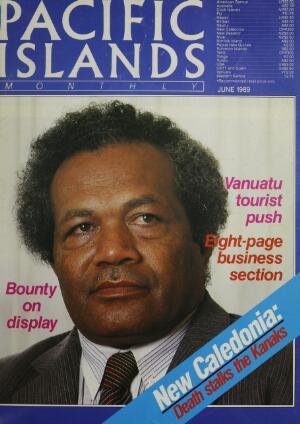
Bounty on display
Vanuatu tourist I push
mghtpage business I section
Advertisements & other items, pp. 2-4 (1 item)
of innovation to make
It takes a measure
a classic statement .
To set new standards, one must have e healthy disregard for timeworn formula and a genuine respect for innovatio The kind of innovation that went into the Honda Legend Sedan, a car that has the automotive world reevaluating its standards of quality, design, comfor and value.
With functional elegance drawn to exacting specifications, the Legend has lean looks that speak of serious drivinj potential. Looks that do not deceive.
Beneath the Legend's low aerodynami . s'* . -• i AUSTRALIA: Honda Australia Pty., Ltd. Lot 95 Sharps Road, Tullamarine, Victoria 3043/NEW ZEALAND: Honda New Zealand Ltd. P.O. Box 97-340, South Auckland/PAPUA NEW GUINEA: Toba Pty„ Ltd. PO. 503, Port Moresby/TAHITI Honda Distribution S.A. R.L. B P 1665, Papeete/KIRIBATI: Atoll Motor & Marino Services PO. Box 49. Bairiki Tarawa, Republic of Kiribati/U.S. TRUST TERRITORY: United■M'cron Development Association P O Box 235, CHRB Saipan CM 96950/COOK ISLANDS: Cook Islands Motor Centre Ltd. P O. Box 74, Rarotonga/GUAM: Mark’s Motor Co., Inc. P.O. Box DV. Agana/WESTERN SAW Motor Distributors (Samoa) Ltd. P.O Box 576, Apia/SOLOMON ISLANDS: Lee Kwok Kuen & Co.. Ltd. PO, Box 537, Honiara/NAURU: Nauru Cooperation Republic of Nauru/FIJI: Coral Island Motors Ltd P a 12052 Suva Fiji/AMERICAN SAMOA: Holiday Motors, Parts and Service P.O, Box 968, Pago Pago, American Samoa 96799: Heleck’s Service Center Ltd. PO, Box 1 138 Pago Pago American Samoa 96799/TON Tonga Industrial Traders P O Box 1035, Nukualofa, Tonga/NORFOLK ISLAND; Duncombe Bay Garage P.O. Box 220, Norfolk Island South Pacific 2899/VANUATU: Honda Farm Ltd. P.O. Box 1031, Pori Vila, Van
hood beats the heart of a high performance 2.7-liter V 6 24-valve engine with race-bred PGM-FI programmed fuel injection. A sophisticated 4-wheel double wishbone suspension is teamed with an advanced 4-wheel Anti-Lock Braking system to give new meaning to the words "comfort" and "precision".
Inside, you will discover luxurious surroundings without ostentation a world of rich leathers* and woods that accentuates your driving pleasure and inspires a mood of quiet relaxation.
The Legend Sedan, in short, is the standard bearer of a new era that combines luxury performance with unrivaled comfort and distinctive styling E with timeless elegance. A car that makes a classic statement by departing from conventional wisdom. ’Leather seats are optionally available.
SEDAN
' V - 'l*'.' f jg/, 7 ’’V A*. -AT ' <L/>i fry mV < f
nekiu &&&#*-■
x J /./ • ;* Vr; " ■ X o*h , ' $
f<S&r '
> » „ Specifications and equipment may vary in some countries the 1988 Formula One Constructor's Championship, anda engines powered the HONDA Marlboro cLaren to victory, as they did the illiams HONDA team in 1986 and 1987.
LINTAS MELB H0J1451/PIM
How to develop
your economy
by developing your
communications.
In today’s world, no country can develop in isolation.
To grow it must compete in fast-moving world markets, and to gain access to these a modern telecommunications network is essential.
When you invest in OTC telecommunications you get more than the best telecommunications system available.
You also get the financial expertise that has made OTC Australia’s leading international telecommunications company.
By providing training to your staff in all aspects of financial planning and cost accounting, your system will operate on a sound financial basis. And pay for itself.
Bringing world markets to you.
Australia, like many nations, is a long way from the world’s business
capitals. However, through OTC’s
advanced communications network, the world is now on our doorstep.
OTC is the world’s leading exponent of thin route satellite systems for isolated areas. OTC was one of the founders of Intelsat. And, in the development of optical fibre cable systems, OTC is a pioneer.
This technology which put Australia at the forefront of communications is now available to you through OTC International.
Tailor-made telecommunications.
OTC gives you the choice of the world’s best communications systems which can be specifically designed to meet your needs.
Because we design and operate our own systems, we can offer you experience in integrating the best software and hardware available.
Our experience in the international arena has taught us valuable lessons about the reliability of equipment and supply.
Making the right decision.
For an objective appraisal of your communication needs contact OTC now. Telephone or write to: Mr. Peter Shore, Executive Director, OTC International Limited, GPO Box 7000, Sydney, NSW 2001 Australia. Phone: (612) 2875410, Fax: (612) 2875617.
imiOlCii
OTIO4OO/PI
Pacific
Islands
Monthly
Vol. 59 No. 17
Voice Of The Pacific
June, ’B9
Cover Story i 6
Jean-Marie Tjibaou and Yeiwene Yeiwene are the latest victims of the clash between European and Pacific cultures and aspirations. Their deaths strike at the heart of the Matignon accord and threaten the stability of the Rocard Government. David Robie and Nicholas Rothwell report on events in New Caledonia and Paris.
COOK ISLANDS PEARL INDUSTRY UNDER THREAT 8 Cheryl Lilly reports on a dispute that could cost the Cooks millions of dollars in lost revenue.
Zeder Under The Spotlight 16
An old friend of US President George Bush aims for high Pacific office but allegations of impropriety may halt his bid.
THE HEALERS OF TONGA ARE TIRED 18 The doctors and surgeons of Tonga are over-worked and face a frightening lack of resources.
Pacific Treasure In Europe 20
Papua New Guinea artwork goes on display in Budapest.
In Search Of Silver Galleons 22
An Australian group is hot on the trail of sunken treasure.
Canoes Are Back In Style 24
Auckland plays host to an exhibition of rare canoes and prepares for an international canoe sprint championship.
SPECIAL EIGHT PAGE BUSINESS NEWS SECTION 27
Bounty Sets Sail
Again 39
A London exhibition puts Bligh and Christian on a high-tech stage and does them both justice.
Acting Editor Richard Dinnen Editorial Adviser John Carter Art Direction Adam Brooke Richard Dinnen Art Adviser Warren Scott Contributors Robin Bromby Chris Ashton Cheryl Lilly Sarah Kennett David Robie Nicholas Rothwell Diana McManus John Hunter lan Downes David North Ed Rampell
Publisher Geoffrey Hussey
Advertising Sales Sydney & Melbourne Fergus Maclagan (02) 412 3918, Brisbane Robert Walker (07) 371 0533 Adelaide Hastwell Williamson Representations (08)79 9522
Our editorial office is now located at 20 Gordon Street. Suva. All editorial material and correspondence should be sent there and not to our old Syd ney address.
Cover prices are recommended retail only Registered by Australia Post, publication No NBP 1210, Copyright Pip Times Limited, Suva, Fiji
Advertisements & other items, pp. 5-6 (3 items)
Departments
OPINION 7
TRANSITION 47
ISLAND PRESS 46
PACIFIC REPORT 42
SHIPPING SCHEDULES 50
OUT OF THE PAST 54
5
PACIFIC ISLANDS MONTHLY JUNE 1989
A Fiji Times Limited Production.
Founded 1930 (USPS 952480) 20 Gordon Street, Suva, Fiji; Telex; FJ2124; Fax: (679)314 111 Pacific Islands Monthly (APPS No. NBP 1210) is published month ly by Fiji Times Limited, a division of Nationwide News, 2 Holt St, Sur ry Hills, NSW 2010. Second class postage paid at Honolulu, Hawaii, POSTMASTER. Send address changes to PACIFIC ISLANDS MONTHLY, PO Box 22250, Honolu lu, Hawaii 96822. Typeset and printed by Fiji Times Limited, 20 Gordon Street, Suva, Fiji.
Good Looks Ron In The Family
World’s No.l Family of Multi-valve Automobiles
Toyota introduces the all-new Corona. A sweeping beauty that slips through the wind with its powerful 2.0-litre 16-valve engine. Aerodynamic. Luxuriously appointed. And Corolla. The car of preference for more drivers in the world than any other. With sleek, spirited looks and a new 1.6-litre 16-valve engine. Two outstanding members of Toyota’s multi-valve family. With over 5 million multi-valves produced and driven daily on roads throughout the world.
TOYOTA
MULTI-VALVE
ENGINE
TOYOTA
From the Bastille
Opinion
From the Bastille to Ouvea
THE MURDER of any individual is a brutal crime, always tragic and never justified. When a muraer has a political motivation, it becomes an assassination a word that seems to offer some justification for the crime. Pundits and opponents will suggest that victims knowingly put themselves at risk by taking a public stand. Such killings are lamentable, they say, but are part and parcel of politics. Leaders who attempt to change their society may encounter the ultimate resistance; it is a risk they recognise and knowingly take. The pages of modern history bear the names of many such victims Gandhi, Kennedy, King, Sadat.
They become martyrs to their cause, martyrs to change and progress that is often abruptly and permanently terminated by the assassin’s gun.
Two more names are now added to the list; Jean-Marie Tjibaou and Yeiwene Yeiwene were gunned down on Ouvea on May 4 as they left a ceremony to mark the end of mourning for 19 Kanaks killed a year ago during an assault by French paramilitary forces. The unlikely assassin, Dioubelly Wea, died of wounds sustained during the attack. As leaders of New Caledonia’s Kanak independence movement, Tjibaou and Yeiwene had been at the forefront of the push for change. Were they victims of the inevitable struggle between ELNK elements unwilling to trust the French and their Matignon accord? Were the killings master-minded by the French right wing in an attempt to discredit the Rocard Government? The speculation continues and may never end.
The killings caused deep concern in Paris where politicians saw them as a renewed threat to the Matignon accord, and thus their own slim mandate. It is unlikely the Rocard Government could survive the electoral damage of a new wave of violence in its Pacific territory.
These murders carry special poignancy for France as it prepares to commemo rate its bicentenary the 200th anniversary of the storming of the under populated and poorly defended Bastille that marked the beginning of the re volution. Edmund Burke wrote with alarming insight in 1791 that France had, by the Revolution, overthrown legality, traditional loyalty and religion as the basis of governmental authority. Reason the professed oasis of authority, was too contentious and so the Frencn would come to rely more and more on armed force to command obedience until a powerful dictatorship took control. The course of the Revolution followed Burke’s prediction almost to the letter, with the tyrrany of the Jacobin reign of terror and the eventual rise of Napoleon.
The French Revolution was proclaimed in the history books as the birth of enlightened European democracy. This may well be so but it is unlikely that the tens of thousands who went to the guillotine would agree. For them and the hundreds of thousands of victims of the Revolution, the period was nothing more than a bloodbath of rape and carnage. The common people were being encouraged and organised to take a direct and influential part m politics, but few could afford the price.
The lesson of history is seldom learned. France now has an opportunity to heed the lesson of the event it is about to commemorate. Independence in New Caledonia is inevitable. It can be achieved by two paths peaceful negotiation or bloody uprising. The slaying of two FLNK leaders is early warning of an impending uprising. Such violence can be avoided if all interested parties com mit to and work toward independence and self-determination. The only alterna tive is the carnage of the French Revolution or the murder of New Caledonians be they leaders or innocent bystanders.
It falls to Prime Minister Rocard to take the sort of step into the unknown that has sealed the fate of many a world leader. He must demonstrate France’s respect for the integrity of New Caledonia’s journey to independence and facili tate every step along that twisting path. The French must recognise in the FLNKS’ struggle the same desires that inspired their own forefathers in 1789 and realise the danger of inaction in the face of such energy.
France must relinquish the colonial days and treat the nations of the Pacific as equal partners in global co-existence. The mid-May detonation of a French nuclear device at Muroroa was an unnecessary step in the wrong direction one that will earn the enmity of an increasingly environment-aware world com munity and encourage violent uprising in its Pacific territory.
Advertisements & other items, p. 7 (1 item)
Pacific
SLANDS
I MON T H L ~n
FIJI: Distribution, subscriptions and advertising; Fiji Times Limited, GPO Box 1167, Suva, Fiji. Phone 31-4111 telex FJ2124 FRENCFI POLYNESIA: Distribution: Hachette Pacifique 10 Ave Bruat, Papeete. Phone 25-610 HAWAII: UNITED STATES: Distribution: PIM Hawaii, PO Box 22250, Honolulu, Hawaii, 96822 Advertising: Brian C Asgill, Apt 1308, 1676 Ala Moana Blvd , Honolulu Hawaii, 96815. Phone (808) 955-9718 JAPAN: Advertising and subscriptions: Universal Media Corporation, GPO Box 46, Tokyo Phone 666-3036 cable UNIMEDIA Tokyo, telex 2524665 MALAYSIA: Advertising and subscriptions: Worldwide Media Services, 57-B Komplex Damai, Jin Dato Haji Eusoff, Kuala Lumpur Phone 63-9340, cables WORLDMEDIA Kuala Lumpur, telex 31533 VANUATU: Distribution: The Vanuatu Stationery and Book Centre, PO Box 557 Port Vila Advertising: Norman Bros Bookshop Port Vila Phone 2232 NEW CALEDONIA: Distribution: Depot Centre de Presse Michel Pentecost CBP2, Noumea Phone 27 2434, 27-4729 NEW ZEALAND: Distribution: Gordon & Gotch, PO Box 584, 2 Carr Road, Mt Roskill, Auckland 4 Advertising: McKay International Media Reps Ltd, C/- Albany PO, Auckland 10, New Zealand Phone 413-9119.
Telex NZ22701, FAX 413-9110 WELLINGTON: Ross Quaid Media, 1 Scholes Lane Petone (04) 68-7593, PO Box 38699, Petone PAPUA NEW GUINEA: Distribution: Gordon & Gotch PO Box 3395, Port Moresby Phone 25-4551 25-4855 Advertising: Robert Walker, PO Box 600, Indooroopilly Old Australia 4068. Phone (07) 371-0533 SOLOMON ISLANDS: Distribution and Advertising: The Bookshop, (Norman Bros ) PO Box 503, Honiara PHILIPPINES: Advertising: The GF Group, 12 San Ignacio St., Uroaneta Village, Makati, Metro Manila Phone 817-7299, telex 45950 and 4233 UNITED KINGDOM: F A Smyth and Associates, 23A Aylmer Parade, London N2OPO, England. Phone (01 )340 5088, fax (01)341 9602.
UNITED STATES MAINLAND: Advertising: Joshua B Powers Jr , Powers International Inc , Suite 708, 271 Madison Ave , New York, NY 10016 Phone 867-9580, Subscriptions PIM, Hawaii, PO Box 22250, Honolulu Hawaii, 96822
SUBSCRIPTIONS
American Samoa US$45 Australia AUSS3O Canada US$45 Cook Islands AUSS46 Fiji F $24 French Polynesia US$45 Guam US$45 Hawaii US$45 Japan US$3B Kiribati AUSS46 Micronesia US$35 Nauru AUSS42 New Caledonia US$32 New Zealand AUSS42 Niue AUSS46 Norfolk Island AUSS42 Northern Marianas US$36 Papua New Guinea AUSS42 Solomon Islands AUSS46 Tonga AUSS46 Tuvalu AUSS46 United Kingdom Stg£2B US (Mainland) US$45 Vanuatu AUSS42 Western Samoa AUSS6O Elsewhere AUSS63 Payments to Pacific Islands Monthly: Subscriptions Dept, GPO Box 1167, Suva, Fiji.
Subscriptions rates includes the cost of airspeeding to all destinations set out above Direct airmail rates on application
Pearls in peril
Cook Islands
Cheryl Lilly reports on a row that threatens a lucrative pearl farming industry.
THE PAST year the M W small island of Manihiki in the northern Cook Islands hasbeen the centre of a bitter conflict between its traditional Island Council and the Cook Islands Government in Rarotonga, over the issue of who con trols ana administers Manihiki and thus an emerging multi-million dollar
black pearl industry.
Threats of violence have been made against individual pearl farmers and the Government has closed Manihiki to all shipping and air flights, saying the restrictions will remain in force until the Island Council realises who runs the country and begins to act accordingly. It has been estimated that
a well-managed local pearl farming in
dustry would yield the Cook Islands |NZ4O million over a 10-year period, yet Manihikian pearl farmers are being denied the chance to participate fully in an exciting new industry that has the potential to play a significant role in salvaging the Cooks’ financial situation.
Much of the blame for the current situation has been levelled at the pre vious Government, which persisted in what many saw as support for a fore ign investor over local pearl farmers.
In 1981, the administration approached French Polynesia to allow officers within the Ministry of Marine
Resources to study pearl farming in
that country. Their visit convinced the Ministry it was imperative that the Cook Islands implement a pearl cul ture programme at the earliest oppor
tunity.
Since the first private farm was established in 1982, the Ministry has assisted by providing both technical in formation and pearl farming materials to that farmer. In 1987, following an arrangement made by the Minister of Marine Resources (at that time the former prime Minister, Dr Pupuke
Robati), Japanese pearl technicians
seeded 10,000 oysters belonging to private farmers om Manihiki. The
Japanese experts were so impressed by
the quality of the oysters in Manihiki that they recommended two seeding programmes be undertaken each year.
As a result of their recommenda tions (and to coincide with the opti
mum seeding period) two Japanese
technicians arrived in Rarotonga in March 1988 to seed 40,000 oysters but for more than a month were de nied access to the island by the Man ihiki Island Council, which declared
that it would not be dictated to bv the central Government some 1000 kilometres away in Rarotonga. It was estimated that local pearl farmers have lost a potential revenue of SNZ2.4 mil lion of the council’s decision.
Manihiki MP Mr Ben Toma, who resides for most of the year in Austra lia, reported that the people of Man ihiki wanted nothing to do with the Department of Marine Resources scheme. He explained that the prob lems surrounding the two Japanese technicians were caused by the De partment of Marine Resources enter ing into an illegal arrangement that was “not in line’’ with the legislated definition of the management of Man ihiki lagoon.
This legislation, which provides for the management of Penrhyn, Raka hanga ana Manihiki lagoons, was pas sed ny Parliament in 1982 and grants power to island Councils over the
pearl shell and pearl farming indus
tries. In essence, it states that no-one may seed, cultivate, collect or harvest any pearl or pearl shell in or from the lagoon unless a permit has been ap plied for and granted by the Island Council.
In denying the two Japanese techni cians access to Manihiki to seed oys ters, the Island Council argued that no local farmers had applied for li cences and that therefore seeding could not take place. Many farmers disputed this claim and subsequently the Council admitted that all local far mers involved with the programme had applied, but while tne licences
had been granted in principle they
had not been signed.
Manihikians also appeared to be misinformed at various public meet ings as to the role of the Department of Marine Resources. Island Council members did not trust the Depart ment, which they felt had given no thing to the Island Council in more than 30 years of operation in the la goon. The island’s people were asked if they wanted the Department of Marine Resources to manage the la goon . . . and were told that if the visit by the two technicians went ahead, the
allegedly iniqitious arrangement would
continue.
Marine Resources Secretary Julian
Dashwood was quick to point out that the Department was simply negotiat
ing and facilitating the seeding and
technical expertise for the local Man ihikian farmers. It also appeared that
many of those who opposed the tech nicians’ visit believed they would only seed one farmer’s shells and that the technicians somehow ‘belonged’ to the farmers, Tekakae Williams.
This belief was encouraged, in September 1987, by the fact that the technicians had seeded 10,000 oysters ... of which 6000 belonged to Wil liams. However, Williams had more than 50,000 oysters prepared while all other farmers had between 500 and 2000 each, of which 500 were seeded under a formula agreed on at a meet ing attended by all the farmers in volved in the programme.
Williams was one of the first to be
gin farming pearls in Manihiki lagoon
at a time wnen there was no legislation covering the use of the lagoon. He is a well-known fisherman and pearl far mer in the Cook Islands (and in 1957 held the record for the world’s deepest skin dive). There is no love lost between the Island Council, MP Ben Toma and Tekake Williams, who has expressed his unwillingness to accept what he sees as the Council’s victimisation of himself and his family when they simply want to get on witn their business of farming pearls.
For most of 1988, local pearl far mers waited for the Council to issue their licences but were given no ex planation for the apparent delay. The
legislation covering the management
of the lagoon makes it possible for any person dissatisfied with a decision of the Island Council to appeal to the Minister of Marine Resources who, af ter consultation with the Island Coun cil, may affirm, vary or reverse the Council’s decision. Unfortunately for the farmers, the prolonged delays meant there was no decision and thus
there was nothing to appeal against.
The Manihiki Council’s decisions
were supported strongly by Ben Toma
and appear to have been influenced by the activities of another company operating in the Manihiki lagoon, Cook Islands Pearls Limited. While Williams and other Manihiki pearl far mers spent most of 1988 waiting for their licences to be issued, Cook Is lands Pearls Limited continued to farm 200,000 oysters (the firm was established in 1986 and is owned by Tahitian Yves Tchen Pan, who also operates a farm in French Polynesia).
Mr Toma maintains that the Island Council has a 30 per cent share in the company, but a search of the company records in Rarotonga indicates that
Yves Tchen Pan holds 95 per cent of the company with the remaining 5 per cent being neld by his wife Henrietta.
Over an eight-month period in 1988 an estimated SNZI.S million was in jected into Tchen Pan’s Manihiki op eration, from which locals derived ancillary benefits in the form of air travel (Yves has his own private plane and no local airline flies regularly to Manihiki), employment and an outlet for the sale of pearl shell. However, the Department of Marine Resources as well as local pearl farmers had ex pressed concern last year following a report from EVAAM (French Polyne
sian Fisheries Agency) questioning
Tchen Pan’s pearl farming practices in
French Polynesia and alleging that his farm has suffered oyster mortality in excess of 60 per cent.
EVAAM also stated that it has had no co-operation from Tchen Pan and that as a result there had been over exploitation of the whole lagoon, with widespread disease. Tchen Pan denied the allegations and labelled the report a “mistake”. His solicitor at the time, Mr Reuben Tvlor, suggested that EVAAM may have haa an ulterior motive in its “deliberate interference with the black pearl industry in Man ihiki; that of protection of their own
pearl industry’'.
According to the Department of Marine Resources, Manihiki is a highly
productive lagoon perfectly suited to
oyster farming, but there is a limit to the number of farmed oysters the la goon can sustain. The Department estimates it could not support in ex cess of 400,000 and has recommended
responsible and co-operative manage
ment of farming to ensure disease problems and depletion of the natural pearl oyster stocks do not arise.
However, the Department’s advice has been ignored and under present management there is no control over
pearl farming practices. If the Depart
ment’s concerns are realised, the fu ture of this emerging industry is threatened.
The dispute has now broadened to a conflict between the traditional Is land Councils and the central Govern ment, as demonstrated by the Manihi ki Council’s recent decision to refuse an official visit by Education and Civil Aviation Minister Ngereteina Puna.
The Minister’s visit was unrelated to the dispute over the management of the pearl industry, but the Council de manded that certain requirements be met by the Minister before it would permit him to visit the island.
Island Council elections are to be held in the outer Islands in the near future, and many Cook Islands hope some changes and that the conflict will be resolved by a new atmosphere of co-operation. □
Rarotonga rorts
by Robin Bromby
A MEMBER OF the former Coalition Government in the Cook Islands claimed SNZ9IS a day in meal and incidental expenses during a visit to Sydney, according to
the country’s premier, Mr Geoffrey
Henry, in a recent Parliamentary speech broadcast over Radio Cook Is lands. The prime minister was ex plaining to tne House the problems laced after his Government took office
last February.
By August last year, he said, the budget deficit totalled $2.5 million, compared with $0.25 million when his Government had left office in Novem ber 1983. The high deficit run up by the Coalition had sparked a financial crisis for the Cook Islands: the over draft on the government bank account amounted to $1.17 million, on which 21 per cent interest was being charged on the amount over one million dol lars.
Mr Henry accused the former admi nistration of serious financial misman agement. Part of the problem had arisen from the over-estimation of re ceipts due from customs duty, tourist generated income and sundry govern ment trading activities. In customs re venue alone, the shortfall came to $776,000. Former Minister of Customs Norman George should have reviewed the estimates calculated by his own de partment, he said, “In particular, he
might have queried how a significant
increase in levy revenue could possibly be expected in light of he himself hav
ing successfully promoted an order in
council in 198/ reducing import levies
on numerous commonly imported
items such as building materials,” said Mr Henry. “It is, of course, irrelevant
that Mr Norman George began con struction of his own house around the same time.”
Mr Henry said the ultimate respon sibility lay with the former Prime Minister and Finance Minister, Dr Pupuke Robati, to have examined all
departmental plans before framing
the annual budget. Even when the cabinet was aware there was going to be a serious shortfall in excise receipts, it took no action to find replacement revenue such as an increase m the im port levy on petrol. He said that Mr George has also allowed many partial
or complete exemptions from import
levy.
Mr Henry then detailed the foreign travel of various members of the pre vious government. While the customs crisis was coming to a head, he said, Mr George was at Expo in Brisbane and then at a Commonwealth Par liamentary Association Conference, while Prime Minister Robati visited Tonga, spent 17 days at the Olympics in Seoul and then time in Australia for the bicentennial celebrations.
“Major areas of growth in expendi
ture were personnel and overseas travel,” said Mr Henry. It was in these areas that integrity crumbled in the lace of greed. Just before the last elec tions, hiring of wage workers blew out the Government’s payroll $278,000 above the budget estimate, with hiring on some islands resulting in as many as 39 per cent of the adults being on
the public payroll. “Investigation has
revealed that the majority of such workers were collecting their wages for little or no effort,” says Mr Henry.
Since his Government came to power, some wage workers on the outer is lands had been laid off.
He then detailed travel expenses of ministers of the Robati Government.
One minister and his wife, as part of a trip that included Manila, Cyprus and Berlin, claimed $5191 in meal allowances and incidental expenses for five nights’ stay in Hawaii. This minis ter claimed an additional $lOOO in en tertainment allowance.
The Minister of Customs, Mr
George, stayed at the Park Royal
Hotel in Auckland for one night — his room cost $250, meals and incidentals another $375. “In Paris, the minister was accommodated at his instructions at one of the more exclusive hotels.
The tariff for his double room was $5OO per night. The three nights he stayed at the hotel he received $1875 for meals and incidentals, or $625 per day,” said Mr Henry. “No doubt cav iar and champagne [were] more his
style by now. □
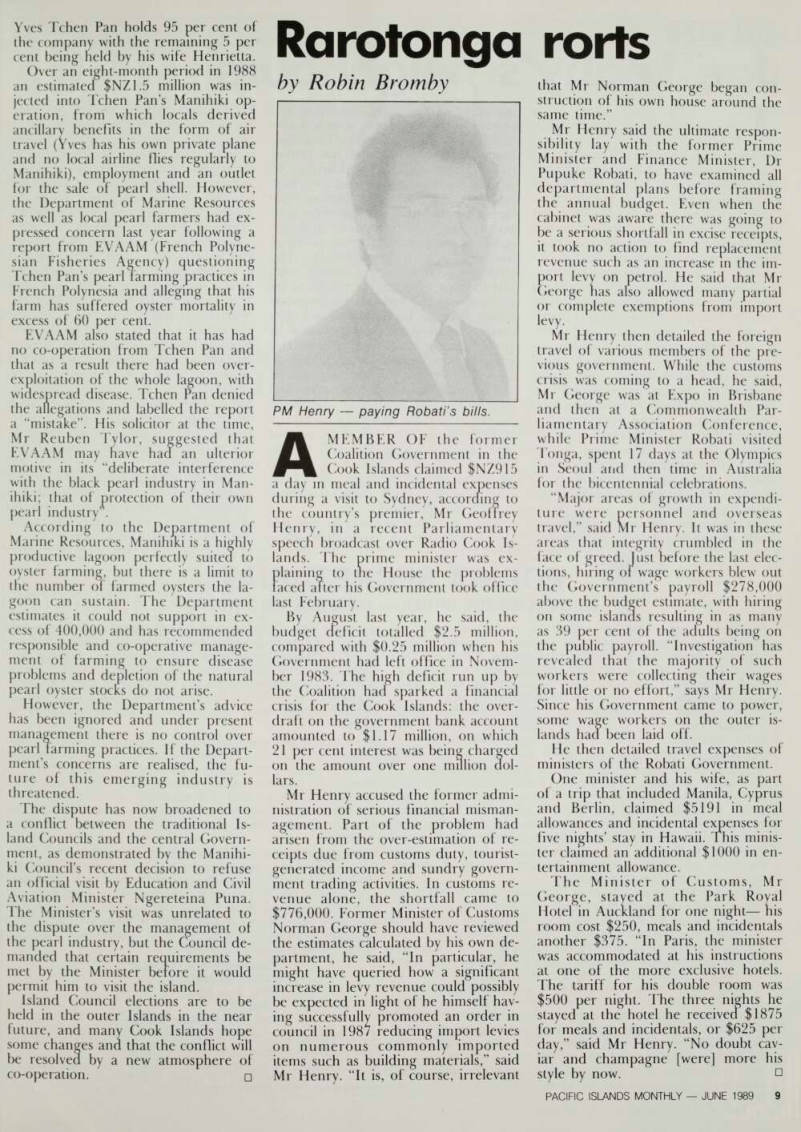
PM Henry - paying Robati's bills.
Joe Leahy's neighbours
Film Review
THIS 90-minute gem of a documentary, set in tne Western
Highlands of Papua New
Guinea, is the work of husband and wife film-makers Bob Connolly and Robin Anderson. It is a slice of life, fly on the wall glimpse of the fractious no-man’s land between the Western capitalist world and a tribal community grappling to understand and acquire its material culture without discarding its own customs and beliefs.
Anderson and Connolly camped on the border of the two societies for 18 months, living in a bamboo and thatch house as they filmed the Ganiga peopie and their mixed-race kinsmen ineluding Joe Leahy the son of a local woman and Mick Leahy, one of the first white explorers to reach the Western Highlands, loe Leahy is a self-made man, a hard-working coffee planter who has prospered from his labour. He lives in a large house, drives a Mercedes and a Range Rover, watches Australian television via a satellite dish and sends his children to Australian schools.
Joe bears an uncanny resemblance to his father and reflects the pioneer-
ing spirit of the early Australian explorers in the Highlands. But he’s also
half-Ganiga: he speaks their language,
knows their customs and has turned the Ganiga’s claim of kinship to advantage, buying clan land on which he has built a thriving plantation. Now he walks the fine line between supporting the local community and suecumbing to blandishments to share all his wealth with his wantoks. The pressure is relentless: for money, cars, lifts to town, even for the return of his plantation land with all its improvements because his kinsmen feel they
cannot be adequately compensated by
Joe’s prosperity. Envy and avarice coalesce with bewilderment at his reluctance to share his largesse.
The mist-shrouded mountains and valleys, the red earth and undulating
grassland are the stunning backdrops
to Joe’s story. The pigs, clogs, women and children are background chargeters as the men, heirs to a warrior tradition, strut, threaten, plan intrigues and press their claims to power, money and authority.
Joe Leahy emerges as a shrewd and tough businessman, more than fair in
his dealings, at least by Western stan dards. His patience is sorely tried by the claims and expectations of his wantoks and he is a reluctant foil in their power struggles. He is a compell
ing figure, apparently free from the
identity crisis afflicting so many mixed-race people in the competing claims of disparate cultures,
Joe Leahy’s Neighbours is a signifi
candy better film than Anderson and
Connolly’s previous documentary,
First Contact, the story of Mick and Dan Leahy prospecting for gold in the Western Highlands in the 1930 s and the impact of their arrival on the local
people. Documentary makers attempt
to hold viewers’ attention by giving a dramatic form to otherwise shapeless material and thus giving a point of view. The temptation to go on from there and “play God” is not often re sisted. It is rewarding to see the mak ers of this documentary have resisted
the temptation.
The documentary is being screened across Australia this month and is available on video cassette through Ronin Films, PO Box 1005, Civic Square, Canberra, Australia, 2608.
Advertisements & other items, pp. 10-11 (1 item)
Forum Secretariat
SPEC
SENIOR PETROLEUM OFFICER ECONOMICS AND STATISTICS
Applications are invited from citizens of ‘member countries for the position of Senior Petroleum Officer Economics and Statistics, in the newly-established Regional Petroleum Unit within the Forum Secretariat (formerly the South Pacific Bureau for Economic Co-operation). The Secretariat, based in Suva, was established to encourage co-operation between island member states and between those states and the more industrialised countries on all aspects of economic development, trade, transport, telecommunications, tourism and energy.
The Regional Petroleum Unit (RPU) was created under the auspices of the Secretariat to provide specialist assistance to its member governments to improve existing petroleum supply and pricing arrangements on an on-going basis. The RPU will assist in ensuring that the costs of supply and marketing arrangements, in and between member countries are minimised. It also aims at harmonising the relationship between Governments and the oil companies represented in the South Pacific region, and at reducing the dependence of governments on short term consultancies.
The Senior Petroleum Officer Economics and Statistics will be required to establish and maintain an economic and statistical data base for the RPU and provide analysis and advice on economic matters and matters relating to petroleum. Duties will include providing advice on trends in world oil prices and oil industry developments, particularly in South East Asia and the Pacific, advice on freight rates and shipping trends, including charter rates, and advice on policy developments in countries of the region. The officer will also be required to provide an annual overview of the Pacific petroleum supply system and the regional petroleum energy balance as well as provide advice to island countries on oil supply tendering and contract negotiations and administration.
It is anticipated that the successful candidate would have relevant tertiary qualifications in economics, science or en-
gineering with a minimum of 5 years experience in the petroleum industry or a related field. It is also expected that the SPO-ES will have experience in establishing data bases and analysing petroleum data. He/She must also have the ability to manage and relate to people from a wide range of backgrounds, to train Forum Island personnel, have good written and oral communication and be willing to travel throughout the region.
This senior appointment will attract a substantial remuneration, payable in Fiji dollars. For non-Fiji citizens this is tax-free and includes housing or housing allowance, education and child allowances. Superannuation, medical, life and travel insurance benefits apply to all staff. The appointee will be based at the Secretariat’s Headquarters in Suva, Fiji. Appointment would be for three years initially, renewable for one term by mutual agreement.
Applications close on July 8, 1989. As it is intended to make the appointment as soon as possible, the successful applicant must be able to take up the appointment shortly thereafter.
Applications should contain full information on education and career background and should list names, addresses and telephone numbers of at least three referees with whom the applicant has been associated in a professional capacity.
Applications should be addressed to: The Secretary General Forum Secretariat GPO Box 856 Suva, Fiji Tel: 312600 Fax: 302204 All enquiries should be addressed to Mike Lawrence, Manager, Regional Petroleum Unit. *Member countries: Australia, Cook Islands, Federated States of Micronesia, Fiji, Kiribati, Marshall Islands, Nauru, New Zealand, Niue, Papua New Guinea, Solomon Islands, Tonga, Tuvalu, Vanuatu, Western Samoa.
jr% jC%' vV vV «>vV - V i - Vo
■ffis&ss& s "b yyu
9 » V >.
■*,'■; Sxaft
/j M *
yprlf,
V W' - %afc -fe\« >•*. A- f , * r ' •■ " fc - . *■*#» *'-'■& L>- %>> t *V* -t>
rIOwV^CVM
vV V %|Q V •%# '- V "V>- V v
ggr. jogsy^ui^g' .
<M < »# v \i v \* .. \i» «, %0 * ' * ’■ « *
. vJV. w \O. V V
I#* X. W
sl^ciSJl is . .3L, . a ’A A . nK\»
v; -a^V'S t*"
*(# 4 5 v' W* y-’ v -vi % &7-* k>; ,< a< M . ' 'lv
*jsS
sot& a * v\S y\e* v\^ ■* - Ik
t ij jf
t j» ■ ' % *s|s
I « * jS*or'- ■W* •■*s* % *M * ■in *l** % ** * * jk ■*> j*
*** Jijcj
it * it 4 * *:. K’ 1 %l sJ*i& 5 % J "'% ‘4 X,*|i , 4 3 % $* %> % «:.;* a %J% m£)& • '■•''* % ' ’■* ’ * Aj. 3 --; i i w 11 ' - ■•»-« - ' 3JWk m %*T " „ f>Q5
APB 7010/C
1 W* 4 «,. - : -: ■ % f %
down the Accord?
Did Wea gun down the Accord?
Like Chief Atai in 1878, New Caledonia’s pro-independence architect of peace Jean-Marie Tjibaou, has been slain by a fellow Kanak. David Robie, who knew the main characters in last month’s tragic events, reports on the killings and their background and profiles the three men who died.
Pierre Declercq In 1981,
Eloi Machuro in 1985, Alphonse Dianou last year . . . and now
Jean-Marie Tjibaou and Yeiwene
Yeiwene. The list of political assassina tions among Kanak independence leaders continues to grow.
Last month’s double murder of Kanak Socialist National Liberation Front (FLNKS) president Tjibaou and his deputy, and the death of their assassin, Pastor Djoubelly Wea a maverick but respected political leader on the island of Ouvea was particu larly devastating however; these kill ings were the first assassinations of leaders in modern political times that were committed by a Kanak. The tra
gic slaughter recalls the ignominious
end of High Chief Atai during the Great Insurrection of 1878, when he was betrayed by rival tribesmen from Canala, executed and his severed head sent to Paris.
But this time Tjibaou and Yeiwene were slain by men who felt a bitter sense of betrayal at the hands of the FLNKS leadership and who be lieved their struggle for the independ ence of Kanaky had been cynically compromised. It was a cruel irony that Tjibaou, the man of conciliation and negotiation, should die at the hand of Kanak: he had seemed, if anything, a prime target for the right wing ex tremist’s bullet.
The deaths of all three men were a savage blow to peace in the South Pacific, shattering attempts to heal the growing differences between the four political parties, the Kanak and Ex ploited Workers’ Union (USTKE) and the militant Kanak women’s group GFKEL that together comprise the FLNKS, threatening the future of the Matignon peace accord and leaving a power vacuum at the centre of the
Flnks.
Father Walter Lini, Prime Minister of neighbouring Vanuatu itself once burdened not only by British but also by French colonialism called
for immediate independence in Kanaky. “The slayings represent more of a fundamental process of reaction against the imposition of different forms of French colonialism,” he said.
“Vanuatu continues to believe that only independence will prevent a new chapter in the long bloody history of New Caledonia.”
Deposed Fiji Prime Minister Dr
Timoci Bavadra, currently president
of the South Pacific Progressive Par ties Association (which includes the FLNKS as a member), described Tjibaou as a “political giant” in the South Pacific.
Recalling his “huge personal sacri
fice” two of Tjibaou’s brothers died in a massacre by mixed race settlers at Hienghene in 1984 Bavadra added: “Yet Tjibaou remained always a man of peace, one who believed in dialogue and compromise to achieve the aspira tions of his people while minimising the personal cost to them.”
RPCR leader Jacques Lafleur said he had only recently warned Tjibaou to “be careful”. Speaking on radfio, he said “a certain number of individuals live in New Caledonia who have only violence, vengeance and death in their mouths, hearts and spirit ... I regret that Tjibaou did not take precau tions.”
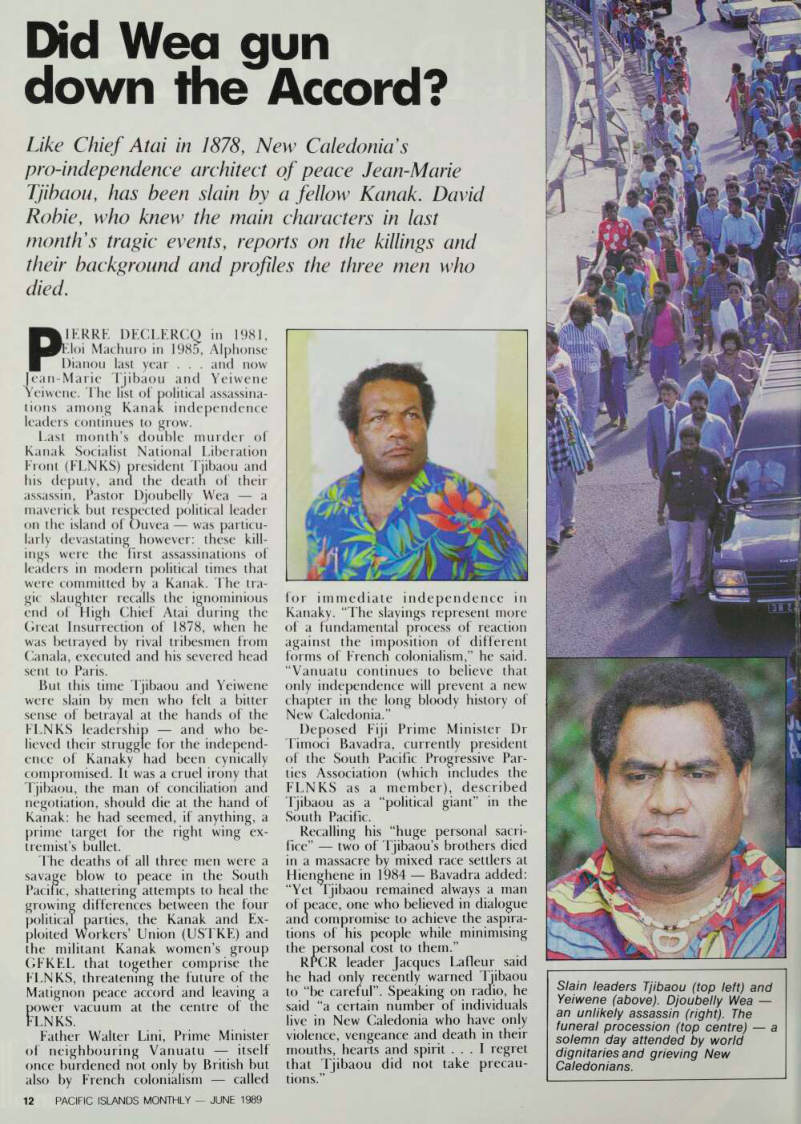
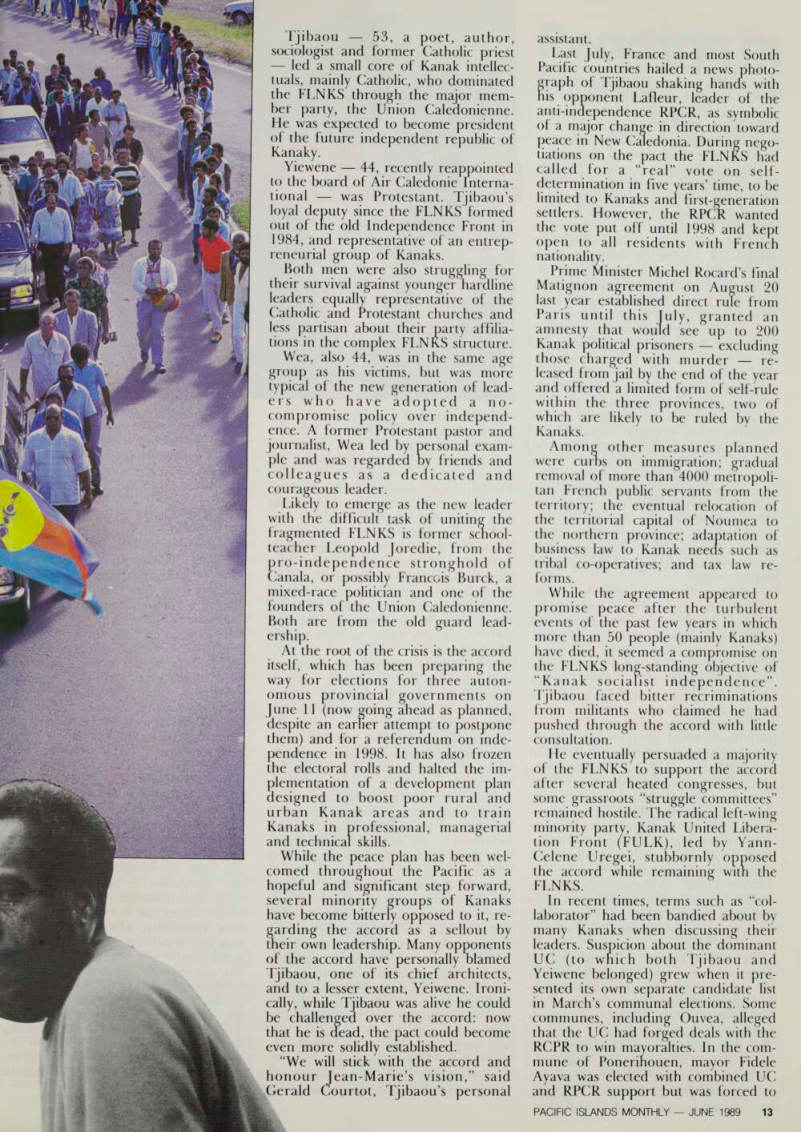
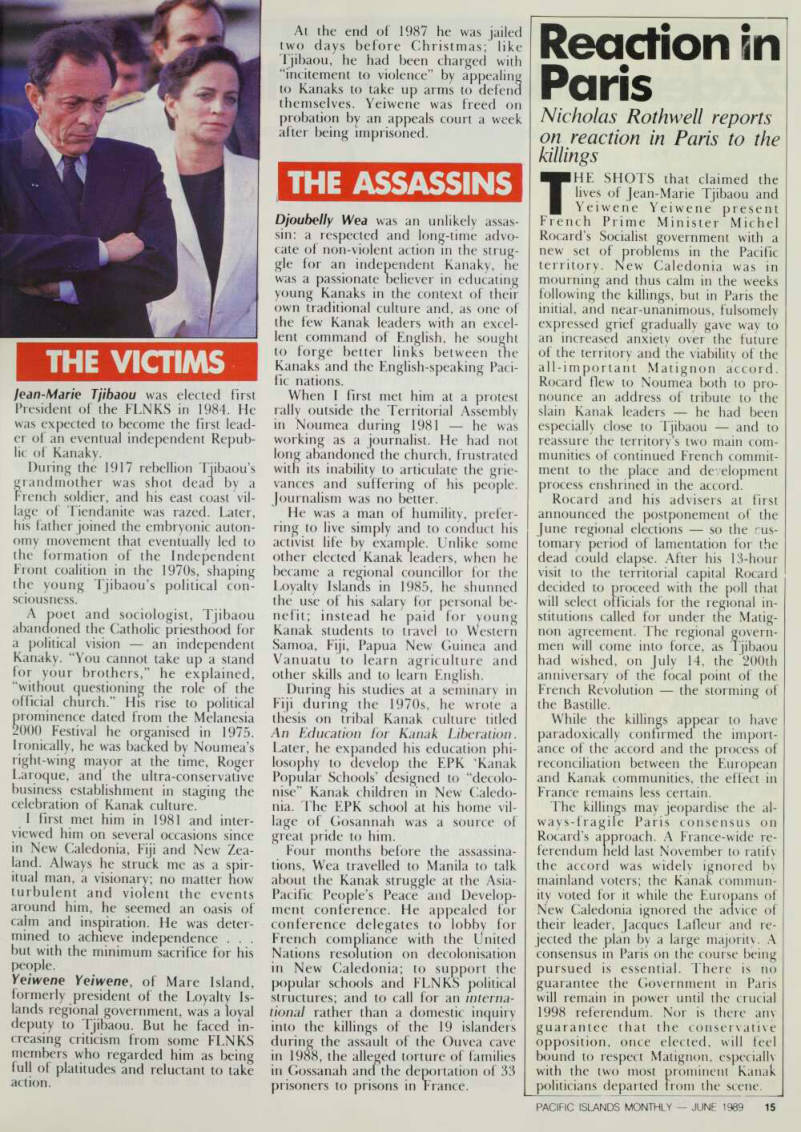
Slain leaders Tjibaou (top left) and Yeiwene (above). Djoubelly Wea an unlikely assassin (right). The funeral procession (top centre) - a solemn day attended by world dignitaries and grieving New Caledonians.
Tjibaou 53, a poet, author, sociologist and former Catholic priest led a small core of Kanak intellec tuals, mainly Catholic, who dominated the FLNKS through the major mem ber party, the Union Caledonienne.
He was expected to become president of the future independent republic of
Kanaky.
Yiewene 44, recently reappointed
to the board of Air Caledonie Interna tional was Protestant. Tjibaou’s loyal deputy since the FLNKS formed out of tne old Independence Front in 1984, and representative of an entrep reneurial group of Kanaks.
Both men were also struggling for their survival against younger hardline leaders equally representative of the Catholic and Protestant churches and less partisan about their party affilia tions in the complex FLNKS structure.
Wea, also 44, was in the same age group as his victims, but was more typical of the new generation of lead ers who have adopted a no
compromise policy over independ
ence. A former Protestant pastor and
journalist, Wea led by personal exam
ple and was regarded hy friends and colleagues as a dedicated and courageous leader.
Likely to emerge as the new leader with the difficult task of uniting the fragmented FLNKS is former school teacher Leopold Joredie, from the
pro-independence stronghold of
Canala, or possibly Francois Burck, a mixed-race politician and one of the founders of the Union Caledonienne.
Both are from the old guard lead
ership.
At the root of the crisis is the accord itself, which has been preparing the way for elections for three auton omous provincial governments on June 11 (now going ahead as planned, despite an earner attempt to postpone them) and for a referendum on inde pendence in 1998. It has also frozen the electoral rolls and halted the im
plementation of a development plan
designed to boost poor rural and urban Kanak areas and to train
Kanaks in professional, managerial
and technical skills.
While the peace plan has been wel comed throughout the Pacific as a hopeful and significant step forward, several minority groups of Kanaks have become bitterly opposed to it, re garding the accord as a sellout by their own leadership. Many opponents of the accord have personally Blamed Tjibaou, one of its chief architects, and to a lesser extent, Yeiwene. Ironi cally, while Tjibaou was alive he could be challenged over the accord: now that he is dead, the pact could become even more solidly established.
“We will stick with the accord and honour Jean-Marie’s vision,” said
.Gerald Courtot, Tjibaou’s personal
assistant.
Last July, France and most South Pacific countries hailed a news photo
graph of Tjibaou shaking hands with
his opponent Lafleur, leader of the
anti-inaependence RPCR, as symbolic
of a major change in direction toward peace in New Caledonia. During nego tiations on the pact the FLNKS had called for a “real” vote on self determination in five years’ time, to be limited to Kanaks ana first-generation settlers. However, the RPCR wanted the vote put off until 1998 and kept open to all residents with French
nationality.
Prime Minister Michel Rocard’s final Matignon agreement on August 20 last year established direct rule from Paris until this July, granted an amnesty that would see up to 200
Kanak political prisoners excluding
those charged with murder re leased from jail by the end of the year and offered a limited form of self-rule within the three provinces, two of which are likely to be ruled by the Kanaks.
Among other measures planned
were euros on immigration; gradual removal of more than 4000 metropoli tan French public servants from the territory; the eventual relocation of the territorial capital of Noumea to the northern province; adaptation of business law to Kanak needs such as tribal co-operatives; and tax law re forms.
While the agreement appeared to promise peace after the turbulent events of the past few years in which more than 50 people (mainly Kanaks) have died, it seemed a compromise on the FLNKS long-standing objective of “Kanak socialist independence”.
Tjibaou faced bitter recriminations from militants who claimed he had pushed through the accord with little consultation.
He eventually persuaded a majority
of the FLNKS to support the accord after several heated congresses, but some grassroots “struggle committees” remained hostile. The radical left-wing minority party, Kanak United Libera tion Front (FULK), led by Yann-
Celene Uregei, stubbornly opposed
the accord while remaining with the
Flnks.
In recent times, terms such as “col laborator” had been bandied about by many Kanaks when discussing their leaders. Suspicion about the dominant UC (to which both Tjibaou and Yeiwene belonged) grew when it pre sented its own separate candidate list in March’s communal elections. Some
communes, including Ouvea, alleged
that the UC had forged deals with the RCPR to win mayoralties. In the com mune of Ponerinouen, mayor Fidele Ayava was elected with combined UC and RPCR support but was forced to
resign in favour of Richard Poarairi wa, of the Melanesian Progressive Un ion (UPM). But the most fierce resist ance to the accord came from Ouvea, which has the least development of any part of New Caledonia. It has a population of fewer than 3000 and only a handful of telephones none north of the chief town of Fayaoue.
Historically, the Loyalty Islands
were never subjected to the wholesale land seizures and repression that fol lowed the Kanak insurrections in 1878 and 1917, and Ouvea is the least affected of New Caledonia’s islands by erosion of traditional culture. When the FLNKS decided to boycott and ob struct the French presidential elections last May, tactics were left up to local “struggle committees”: Ouvea militants staged a dramatic raid on the Fayaoue gendarme barracks, killing four gen darmes and seizing 27 as hostages.
The militants abducted most of their prisoners to a cave in rugged bush country near Gossanah and, as gen darmes searched for them, they de manded that regional elections be abandoned and that a mediator be flown from France to negotiate for a real referendum under United Na tions supervision. They threatened to kill their hostages if their demands were not met and the rest of that tragic action has passed into Kanak
history, forming part of the separatist
movement’s mythology of struggle and
martyrdom.
At dawn on May 5, 1988, French military and secret service forces laun ched an attack on the Ouvea cave and killed 19 Kanaks in what was officially described as a “fierce battle”. The hos tages were freed for the loss of only two French soldiers . . . but evidence indicated that they had been on the verge of being freed anyway.
Tne assault came just three days be fore the crucial presidential vote in which President Mitterrand defeated the challenge of Prime Minister Jac ques Chirac, and hours after three French hostages had been freed in Lebanon following the Chirac govern ment’s reported payment of a massive ransom. To top it off, convicted Rain bow Warrior bomber Dominique Prieur was repatriated to France. ‘Op eration Victor, as the cave assault was dubbed, was widely condemned as a
cynical political ‘adventure’ by Chirac
to gain the presidency but the move backfired.
Reports of summary executions and torture of at least three and possibly as many as nine of the militants, in cluding leader Alphonse Dianou, were published by De Monde and other leading French newspapers. One of the executed was a 19-year-old ‘tea boy’, Waina Amossa, who had been delivering food to the hostages. De fence Minister Jean-Pierre Chevene-
ment ordered an inquiry, saying that former Overseas Territories Minister Bernard Pons had not used “all possi ble means” of negotiation witn the nationalists. However, while the French Government later admitted “excesses” had occurred, no judicial action has so far been taken.
After the cave assault, Ouveans sus pected of helping the militants were harassed and assaulted. Thirty-two
prisoners, including Djoubelly Wea,
were flown to France. After a legal battle, Wea was released and returned home to a hero’s welcome; the rest were eventually freed as part of the
Matignon accord.
Wea bitterly resisted the linking of the prisoners to the accord, but was
ignored by Tjibaou when he wanted
to take part in the peace negotiations.
The FLNKS failed to act over the Ouvea islanders’ major demands, such as an international inquiry into allega tions of atrocities perpetrated by the
military.
Media reports following last month’s killings incorrectly claimed Wea was a member of FULK. He had previously belonged to the radical FLNKS mem ber party Palika, but was dumped in 1980 when he stuck to his no compromise stand. He later became undisputed political leader of the Ouvea militants and worked through the local FLNKS “struggle committee”.
Wea was deeply bitter about the treatment given to his father and un cle by the French authorities. His elderly father, Gogny Wea, died short ly after last years hostage crisis; he had been beaten and left tied up in fierce sunshine by the military, and was soon regarded as the “20th vic tim” of the Ouvea massacre.
Wea’s uncle, Maki Touet, was put in a cage and displayed as a ‘cannibal’ in
a Paris colonial exposition in the 19305.
After first meeting Wea in 1981, following the assassination of French born ‘white Kanak’ Pierre Declerq, I recently met him again in Manila, sharing a hotel room with him during the Asia-Pacific Peace and Develop ment conference. He was thoughtful, warm and dedicated to the cause . . . and though he passionately discussed New Caledonia several times and stressed his bitter opposition to the Matignon accord, he never gave any hint of the explosive anger that would lead to the assassinations.
During Wea’s last conversation with me he said that last November’s re ferendum on the Matignon accord overwhelmingly endorsed overall in the French republic showed that most settlers in Noumea rejected the agreement and Kanak independence. (On November 6, 1988, more than 80 per cent of French voters approved the agreement in an unprecedented national referendum, but 63 per cent of all voters did not cast a ballot. In New Caledonia, where the participa tion rate was twice as high, tne agree ment won 57 per cent of the ‘Yes’ vote but was strongly rejected by the large ly white population of Noumea). “For us this raises the question of whether the accord has already been broken.
These Caldochcs are already coming up strongly; racism and fascism are growing and will continue to grow.
Kanaky is already in a state of colonial war,” ne said.
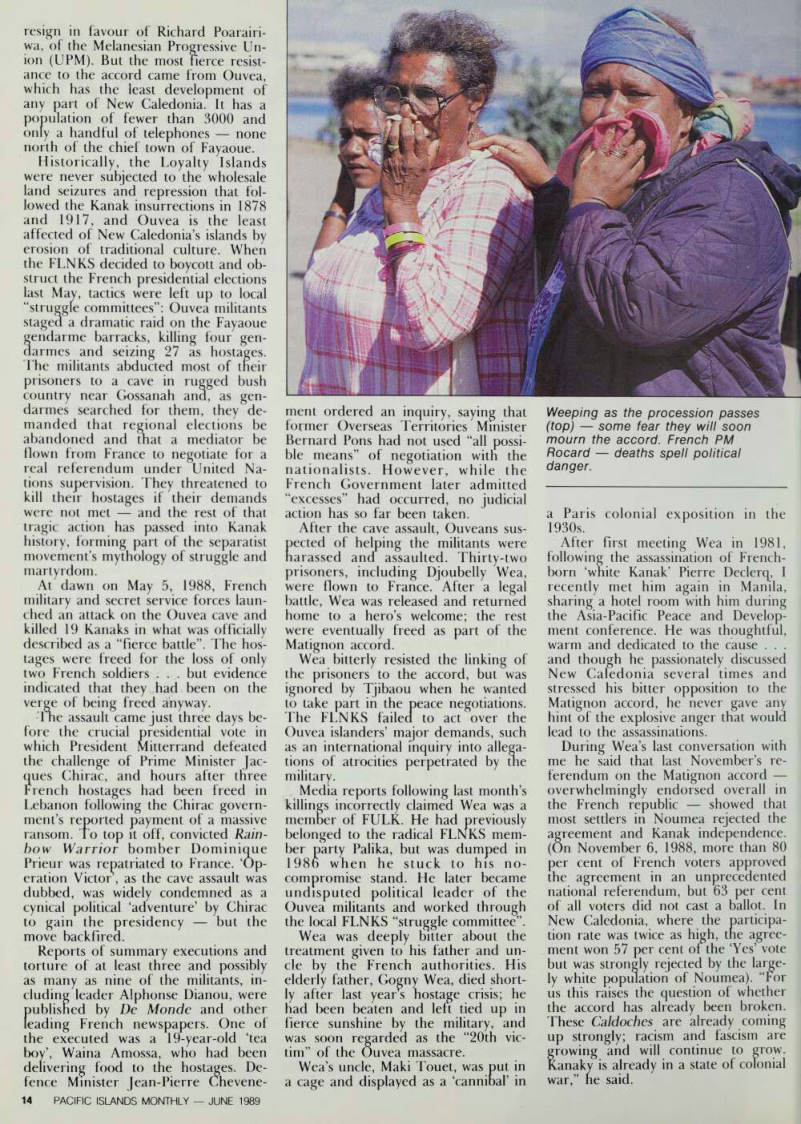
Weeping as the procession passes (top) - some fear they will soon mourn the accord. French PM Rocard - deaths spell political danger.
The Victims
Jean-Marie Tjibaou was elected first President of the FLNKS in 1984. He was expected to become the first lead er of an eventual independent Repub lic of Kanaky.
During the 1917 rebellion Tjibaou’s grandmother was shot dead by a French soldier, and his east coast vil lage of Tiendanite was razed. Later, his father joined the embryonic auton omy movement that eventually led to the formation of the Independent Front coalition in the 19705, shaping the young Tjibaou’s political con sciousness.
A poet and sociologist, Tjibaou
abandoned the Catholic priesthood for a political vision an independent Kanaky. “You cannot take up a stand for your brothers,” he explained, “without questioning the role of the official church.” His rise to political prominence dated from the Melanesia 2000 Festival he organised in 1975.
Ironically, he was bacled by Noumea’s right-wing mayor at the time, Roger Laroque, and the ultra-conservative business establishment in staging the celebration of Kanak culture.
I first met him in 1981 and inter viewed him on several occasions since in New Caledonia, Fiji and New Zea land. Always he struck me as a spir itual man, a visionary; no matter how turbulent and violent the events around him, he seemed an oasis of calm and inspiration. He was deter mined to achieve independence . . . but with the minimum sacrifice for his people.
Yeiwene Yeiwene , of Mare Island,
formerly president of the Loyalty Is
lands regional government, was a loyal deputy to Tjibaou. But he faced in creasing criticism from some FLNKS members who regarded him as being full of platitudes and reluctant to take action.
At the end of 1987 he was jailed two days before Christmas; like Tjibaou, he had been charged with “incitement to violence” by appealing to Kanaks to take up arms to defend themselves. Yeiwene was freed on probation by an appeals court a week
after being imprisoned.
The Assassins
Djoubelly Wea was an unlikely assas sin: a respected and long-time advo cate of non-violent action in the strug
gle for an independent Kanaky, he
was a passionate believer in educating
young Kanaks in the context of their own traditional culture and, as one of the few Kanak leaders with an excel lent command of English, he sought to forge better links between the Kanaks and the English-speaking Paci fic nations.
When I first met him at a protest rally outside the Territorial Assembly in Noumea during 1981 he was working as a journalist. He had not long abandoned the church, frustrated with its inability to articulate the grie vances and suffering of his people.
Journalism was no better.
He was a man of humility, prefer ring to live simply and to conduct his activist life by example. Unlike some other elected Kanak leaders, when he became a regional councillor for the Loyalty Islands in 1985, he shunned the use of his salary for personal be nefit; instead he paid for young Kanak students to travel to Western Samoa, Fiji, Papua New Guinea and Vanuatu to learn agriculture and other skills and to learn English.
During his studies at a seminary in Fiji during the 19705, he wrote a thesis on tribal Kanak culture titled An Education for Kanak Liberation.
Later, he expanded his education phi losophy to develop the EPK ‘Kanak Popular Schools’ designed to “decolo nise” Kanak children in New Caledo nia. The EPK school at his home vil lage of Gosannah was a source of great pride to him.
Four months before the assassina tions, Wea travelled to Manila to talk about the Kanak struggle at the Asia- Pacific People’s Peace and Develop ment conference. He appealed for conference delegates to lobby for French compliance with the United Nations resolution on decolonisation in New Caledonia; to support the popular schools and FLNKS political structures; and to call for an interna tional rather than a domestic inquiry into the killings of the 19 islanders during the assault of the Ouvea cave in 1988, the alleged torture of families in Gossanah and the deportation of 33 prisoners to prisons in France.
Reaction in Paris
Paris
Nicholas Rothwell reports
on reaction in Paris to the
killings
THE SHOTS that claimed the lives of Jean-Marie Tjibaou and Yeiwene Yeiwene present French Prime Minister Michel Rocard’s Socialist government with a new set of problems in the Pacific territory. New Caledonia was in mourning and thus calm in the weeks following the killings, but in Paris the initial, and near-unanimous, fulsomely
expressed grief gradually gave way to
an increased anxiety over the future of the territory and the viability of the
all-important Matignon accord.
Rocard flew to Noumea both to pro nounce an address of tribute to the slain Kanak leaders he had been especially close to Tjibaou and to reassure the territory’s two main com munities of continued French commit ment to the place and development process enshrined in the accord.
Rocard and his advisers at first announced the postponement of the June regional elections so the cus tomary period of lamentation for the dead could elapse. After his 13-hour visit to the territorial capital Rocard decided to proceed with the poll that will select officials for the regional in stitutions called for under the Matig non agreement. The regional govern men will come into force, as Tjibaou had wished, on July 14, the 200th anniversary of the focal point of the French Revolution the storming of the Bastille.
While the killings appear to have
paradoxically confirmed the import
ance of the accord and the process of reconciliation between the European and Kanak communities, the effect in France remains less certain.
The killings may jeopardise the al ways-fragile Paris consensus on Rocard’s approach. A France-wide re ferendum held last November to ratifv the accord was widely ignored bv mainland voters; the Kanak commun ity voted for it while the Europans of New Caledonia ignored the advice of their leader, Jacques Lafleur and re jected the plan by a large majority. A consensus in Paris on the course being pursued is essential. There is no guarantee the Government in Paris will remain in power until the crucial 1998 referendum. Nor is there any guarantee that the conservative opposition, once elected, will feel bound to respect Matignon, especiallv with the two most prominent Kanak politicians departed from the scene.
Zeder under the spotlight
The Region
Allegations of impropriety dog the US President’s old friend.
By Ed Rampell
Newly Elected Us Presi
dent George Bush has nomin ated former United States Ambassador to Micronesia Fred Zeder to head a federal development agency
though the ex-diplomat played a key
role in a power deal in Palau that is
currently under investigation by the
US Congress’ watchdog agency. Senate
confirmation hearings are currently
under way regarding Zeder’s nomina tion as chairman and chief executive of the Overseas Private Investment
Corporation.
OPIC is a well-sustaining govern ment agency that facilitates American investment m development projects in the Third World, including Oceania.
It assists US investors primarily by in
suring investments against political
risks and by financing such invest ments through direct loans and/or loan guarantees. OPIC also aids inves tors with investment information on development countries, via a compute rised data system called the Opportun
ity Bank. Another service provided by
OPIC is feasibility studies of proposer!
projects; according to William Paupe,
the former Suva-based regional direc tor for USAID,OPIC has country agreements with Tonga, Kiribati and
Fiji and projects already established in
Papua New Guinea. £eder has an impressive career re sume that parallels that of his old friend and longtime political associate, George Bush. Like Bush, Zeder was a Pilot m the Pacific during World War I, serving in the Aluetians, and flew in the first air strikes launched against Japan. In the Postwar era, Zedar Rico, the Virgin Islands and Japan, worked with Chrysler and his Hydrometals firm was listed on the New York Stock Exchange.
Friends with Bush since the 19505, Zeder hails from Connecticut but moved to Texas. He served during the Ford administration as the Interior Department’s director of Territorial Affairs, while Bush was director of the Central Intelligence Agency. More re cently, he was one of the Bush cam paign’s top 10 fund raisers and one of the highest paid membrs of the presi dent’s transition team thougn he reportedly took less than was allocated to him under budgetary restraints.
In 1982, Bush was instrumental in arranging the appointment of his old friend as the President’s Personal Rep resentative to Micronesia. As the US
ambassador to Micronesia, Zeder pres ided over the disputed termination of the Trust Territory of the Pacific Is lands (TTPI): his gruff demeanour stirred controversy and Palau’s former Senate President, Isidore Rudimch, was quoted as saying that Zeder was “a pain in the ass'’ whose “cowboy di plomacy” led eventually to involve ment in one of the Pacific’s biggest fiscal fiascoes one that has me potential to cause severe embarrass ment to him during the OPIC Senate
confirmation hearings.
In 1983, during a crucial moment in the negotiations of a power project for the Republic of Palau, Zeder inter vened m the discussion with the result that, while Palauan representa tives negotiated with financiers in London over the terms for a 16 mega watt IPSECO power plant and 24million-litre fuel storage facility, Zeder and US Interior Department officers dispatched an official cable to the Un itea Kingdom that deliberately or un
internationally misrepresented a prop
osed Compact of Free Association be tween Palau and the US as having
been “approved by the people of
Palau in a February 10, 1983 plebis cite”. The cable goes on to contend
that the proposed Compact’s funding
could be used as collateral for
Ipseco.
The multinational banking cartel that financed IPSECO later told the
American Broadcasting Corporation’s
20/20 news program that Zeder’s cable played a pivotal role in convinc ing the financiers to back IPSECO. On the strength of the cable, Her Majes
ty’s Government guaranteed, the
IPSECO loans with Export Credit Guarantee Department (ECGD) funds.
Hence, the micro-nation of 15,000 people with limited resources and assets, totally dependent on US gov ernment aia of about $2O million a year received more than SUS 24 million in loans from the consortium.
IPSECO proved to be a debacle, and the over-sized, over-priced project has bankrupted Palau. In early 1985 the Republic defaulted on its national debt for IPSECO, in late 1985, IPSE CO’s financiers countered by suing Palau in a New York federal court. In early 1986 IPSECO itself, a British Eower firm, declared bankruptcy in ondon and last year IPSECO’s bank ers won a $44 million judgement against Palau ... one that remains to be
paid. The Republic s political ‘reign of terror’, which includes the gunshot deaths of two presidents has been spe culatively linked to the IPSECO scandal.
Despite Zeder’s assertions that the Palauans electorate has passed the Compact (with a 61 per cent vote), the ROP Supreme Court ruled twice in 1986 that the Compact required 75 per cent approval to override Palau’s anti-nuclear constitution. The Palauan people have so far refused to pass the Compact and the treaty has not been implemented six years after Zeder’s fateful cable. (There is even dispute, should the Compact ever be passed, over whether or not the accord s funds can be used for the staggering IPSECO debt. For mer Palau Vice President Alfonso Aiterong claims that though the Re public asked Zeder to assist it in obtaining IPSECO loans, the then
ambassador was specificallv requested
not to indicate that Compact funds could be used to pay for the plant.) IPSECO proved to be such a major controversy that the General Account ing Office, the investigative arm of the US Congress, has already sent two missions to Palau to probe the power project. The GAO has charged that top Palauan politicians, including late President Lazarus Salii, former Speak er of the House Carlos Salii and Palau National Development Bank chairman Polycarp Basilius received about $1 million in kickbacks. IPSECO critics including former Speaker of the House Santos Olikong and the Amer ican Civil Liberties Union have charged that in addition to being a poor business deal, IPSECO was in fact designed to destroy Palau’s nuc lear-free constitution.
The conspiracy scenario is as fol
lows: the Repuolic’s representatives
were ‘deceived’ into believing that the power plant and fuel storage facility could pay for themselves by selling fuel and electricity. Trust Territory
High Commissioner Janet McCoy
approved a special law allowing IPSE
CO exemption from most business norms, including a feasibility study, despite protests from Palauan leaders and the US Interior Department’s au ditor. The facility created a devastat ing debt burden for Palau, which was faced with an enormous economic dilemma: the only way it culd possibly pay off its debt would be by entering
into the Compact with the United States.
The Compact would provide sub stantial funding, replace Palau’s status as a United Nations trusteeship with limited home rule, and grant tne US military access to up to 3o per cent of
the strategically located archipelago.
Should U§ bases in the Philippines close the Pentagon has prepared a contingency plan, called tne Western Pacific Defence Arc, that has Tinian and Guam as its northern angles and Palau at the south.
In six referenda the treaty has failed to garner the mandated 75 per cent vote required to overrule Palau’s anti-nuclear constitutional stipulations, and according to the conspiracy thesis IPSECO was intended to create such economic distress for the Republic that Palauans would vote for the Com pact under duress. Once 75 per cent
of the people approved the Compact
(or an appropriate constitutional amendment was passed) and the treaty ratification process was completed, the US could transit nuclear craft within Palau and build military bases there.
And that would be waiting for the Pentagon? A brand new power plant and fuel facility, already constructed ... and conveniently too large for the miniscule Republic’s needs. It would also represent a facility for which the military would not have to pay a cent and with so much of the Compact’s funds used to pay off IPSECO and other outstanding debts, Palau could
remain perpetually dependent on
America.
In a Washington telephone inter view, Zeder dismissed the conspiracy theory and asserted that IPSECO cri tics “follow an old Marxist line”. Point ing out that the facility is currently on line (thanks to Japanese aid) and in
operation, Zeder contended that
‘TPSECO is not a scandal at all” and that a smiliar IPSECO plant in the Re public of the Marshall Islands (which did not approve the Compact), is cur
rently running without any problems.
Nevertheless, the situation could cause Zeder’s nomination serious harm. It raises important questions ab out the business acumen of the man who would head OPIC. As the agen cy’s key function is risk insurance and loan guarantees for overseas investors in developing countries, it is curious that somebody so closely associated with the IPSECO fiasco would be con sidered to head OPIC (especially since Zeder asked the UK to use ECGD funds, earmarked for supporting de velopment projects, to back the IPSE CO bankers loans with what is basical ly a loan guarantee or risk insurance).
Is it appropriate for somebody re sponsible for arranging a loan for such a development project to be appointed the head of a government
agency in charge of making loans, loan guarantees and risk insurance for US investments?
It is also curious that Zeder would be nominated to head an agency in volved with feasibility studies when IPSECO lacked such a study as well as other normal business practices. But
purely economic bungling aspects
aside, it has yet to be demonstrated whether or not ISPECO was a politi cally motivated action and, if so, whether or not Zeder knew this.
In 1976, fresh from his Watergate exposes, Bob Woodward revealed in a front-page Washington Post scoop that the CIA had bugged that Micronesia status negotiations for four years.
Then-Secretary of State and National Security Adviser Henry Kissinger had ordereo the surveillance of America’s United Nations wards during the Nix on administration in order “to assist the possibility of exerting convert in fluence on key elements of the Mic ronesian”.
President Bush recently named Scowcroft as his National Security Adviser and the agency’s chief dur ing the final year of the ClA’s surveill ance of Mirconesia was none other than George Bush himself.
In 1985, then Vice-President Bush returned after 40 years to Saipan en route to China, where he had pre viously represented the US. Bush travelled with Zeder and his Office of Micronesian Status Negotiations (OSMN) about three months after the still unsolved investigative reporter Jack Anderson, a number of US politi cans whose careers have been linked with the Trust Territory have profited from their association with the Islands, primarily through IPSECO. “First you start with Fred Zeder,” Ohio Demo crat John Seiberling told Anderson.
“He had business interests in Hawaii. 1 didn’t feel he should be able to profit from any of his activities in the nego
tiations.’' OMSN legal counsel John Arm strong’s law firm received a $20,000 retainer from the British power com fany and was paid more than 135,000 for defending IPSEC in a law suit at the Marshall Islands. For mer TTPI attorney general and high commissioner Daniel High received $50,000 from IPSECO for acting as the firm’s Honolulu agent and former TTPI director Governor Peter Cole man of American Samoa served on IPSECO’s board of directors and re ceived payments from the power firm.
Zeder denies that IPSECO paid for his airfare from London to Scotland in 1984 to attend a golf tournament,
though IPSECO’s bankruptcy records
indicate otherwise. According to Anderson, the ex-ambassador also de nies that he supported IPSECO’s busi ness venture ... [Daniel] High recalls that it was Zeder and Armstrong who introduced him to IPSECO’s president and convinced him to work for the firm, a decision High says he now re grets.
Allegations of purported improprie
ty do not end with IPSECO. Zeder’s son Howard heads the Marshall Is lands Maritime Authority, which regis
ters foreign ships: Seilberling and
other Congressmen have expressed
concern over what Anderson calls Mic ronesia’s “revolving door” policy of US government officials going on to enjoy personal gain from their island ser vice, and Seiberling sought unsuccess fully to block Howard Zeder’s appoint ment. Zeder Junior insists that his appointment is legitimate and con tends that he is highly qualified for the position, saying v ‘my whole career has been in shipping ... I resent and
totally disagree with the charges of
neoptism and profiteering. The Mari time head claims that the registry “could be one of the single largest re venue makers for the Marshalls” and that it is “the first private sector initia tive showing a return in Micronesia” albeit earning less than $1 million so far.
The irony is that Bush has called for stricter ethics legislations for gov ernment officials and has instituted the President’s Commission on Federal Ethics Law Reform, saying that “cur rent federal ethics rules do not serve adequately to eliminate use of public
funds for private gains.” The Presi
dent added that he favours “a code of conduct to ensure that those who serve the public trust avoid any actual or apparent conflict between their
personal and public interests”.
It remains to be seen whether the US Senate will appoint a man to be the head of a federal agency while a project he promoted with such zeal is at the same time under investigation by Congress own investigations. □
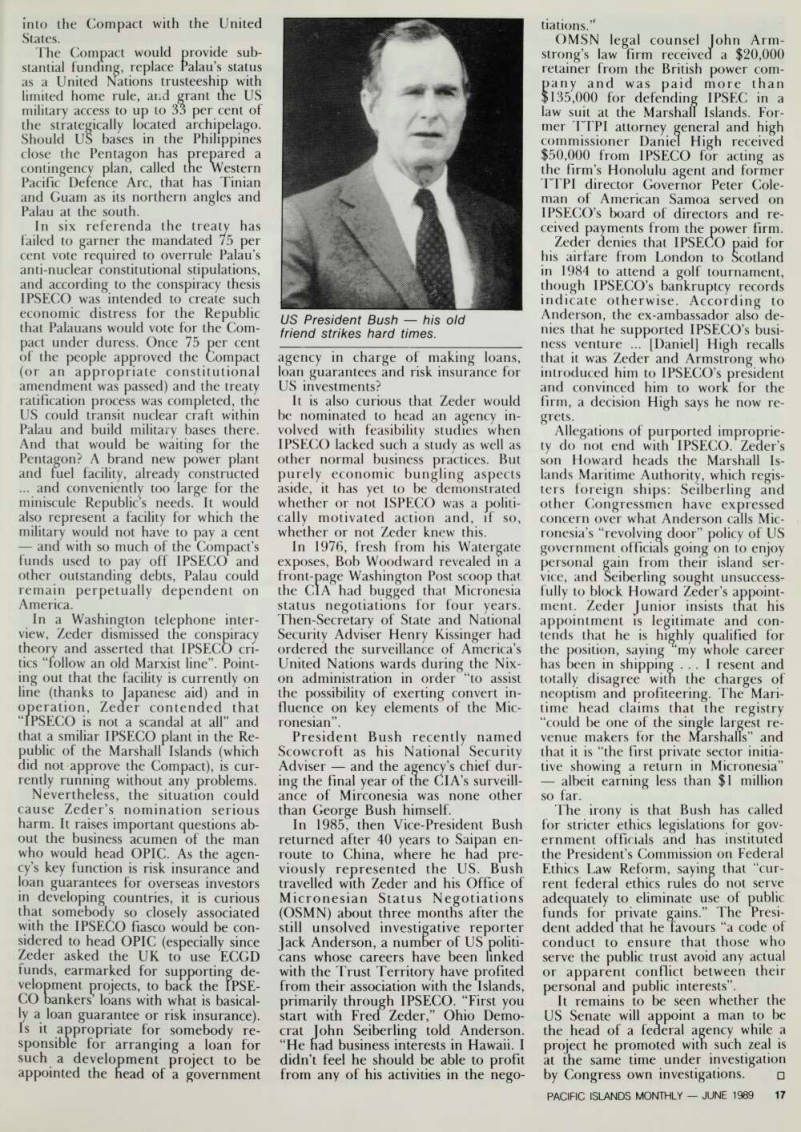
US President Bush - his old friend strikes hard times.
The healers of Tonga
Tonga
by Robert Simms
era of high-tech medicine is 1 well advanced in Australia and I New Zealand. Facilities and spe cialists are available to perform the most intricate surgery and treatment to correct problems that, until a few years ago, were considered terminal.
However, the reality in some of the Pacific island nations, only a short flight away, is quite different. A lack of funds that can be devoted to medi cine, has led to a critical shortage of doctors, surgeons and specialists and has led to facilities that are inadequate
by today’s standards.
The situation in the Kingdom of Tonga is as acute as any in the Pacific.
Although approximately 13% of the national budget is spent on health, this represents only $l2B per head of population. With fewer than 100,000 people living in the country, it means there is little money to spend on any thing more than basic health and spe cialist care. There are less than forty doctors in Tonga to attend to a
population that is spread throughout
the island chain.
Consequently, a shortage of special
ists has occurred because of the diffi culty in releasing these doctors from
duty to study overseas for perhaps
four or five years. There is only one general surgeon fully trained to deal
with all major operations ranging
from motor trauma to peptic ulcer perforations and “diabetes foot”. A second surgeon, who recently gradu ated, will return shortly, but tne work load is unlikely to diminish.
Elective surgery and operations that the Tongan doctors are unable to handle, are referred to Australian or New Zealand hospitals, or are post poned until an appropriate group of overseas specialists visits the country.
Interplast, a plastic surgery team, ASPE f, an opthamology group, and the Seventh Day Adventist neart team go to Tonga from Australia. An American eye specialist group and in dividual specialists also visit regularly.
Dr lan Stratton, an orthopaedic surgeon from Australia who worked in the Kingdom between 1978 and 1980, returns for two weeks each year to operate on children with talipes (club feet). He has performed surgery on over one hundred and eighty five children, correcting deformaties known locally as “hape”, i.e. laugh at.
Dr Stratton said that talipes has been in Polynesian society for centuries.
The incidence of approximately 1% is
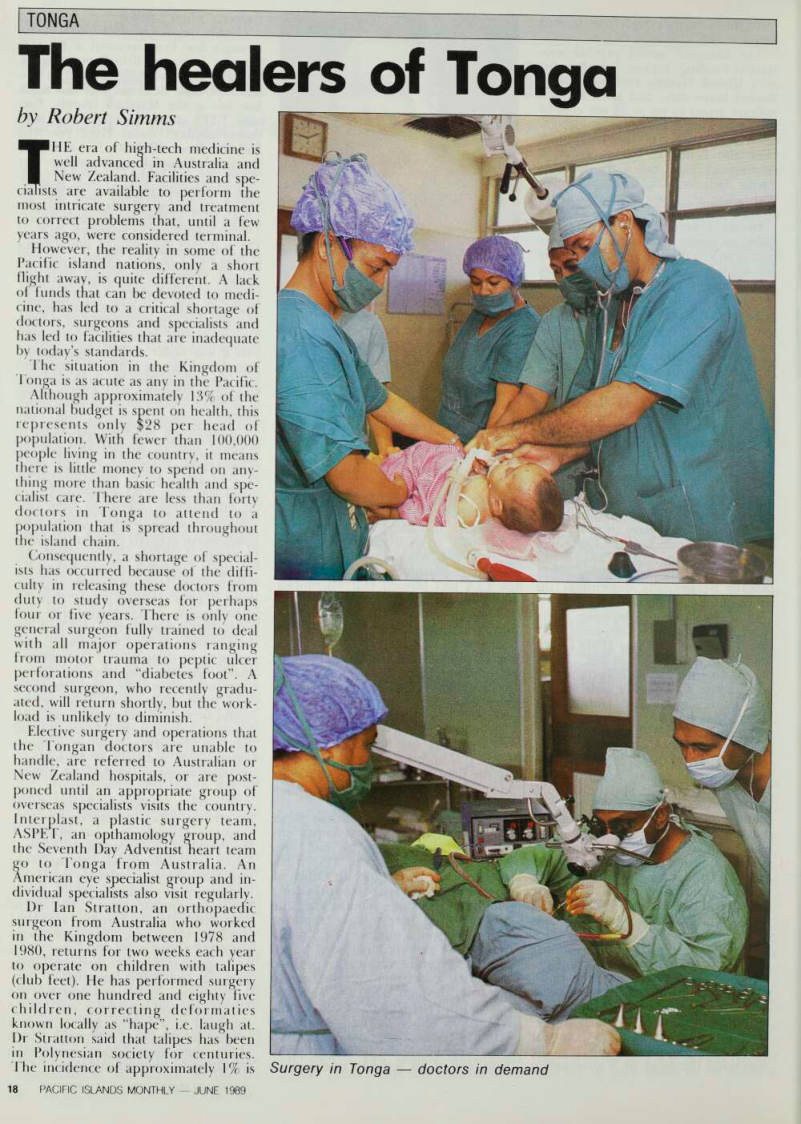
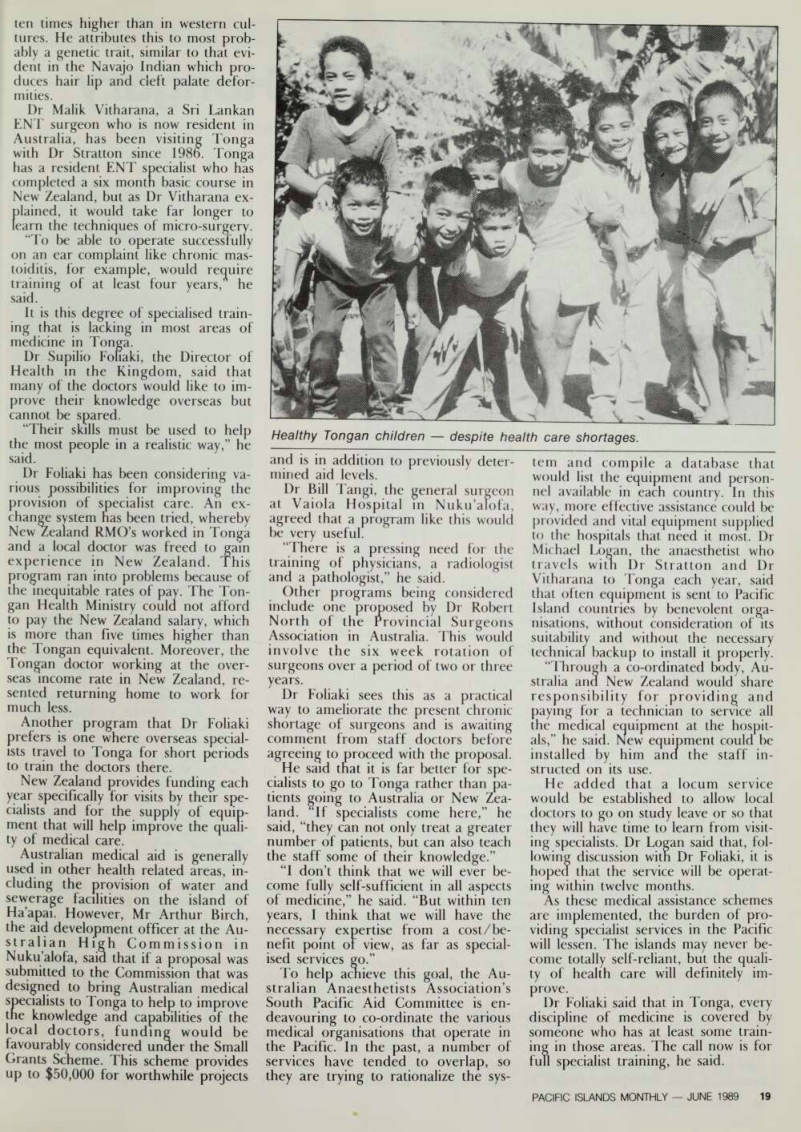
Surgery in Tonga - doctors in demand
ten times higher than in western cul tures. He attributes this to most prob ably a genetic trait, similar to that evi dent in the Navajo Indian which pro duces hair lip and cleft palate defor mities.
Dr Malik Vitharana, a Sri Lankan ENT surgeon who is now resident in Australia, has been visiting Tonga with Dr Stratton since 1986. Tonga has a resident ENT specialist who has completed a six month basic course in New Zealand, but as Dr Vitharana ex plained, it would take far longer to learn the techniques of micro-surgery.
“To be able to operate successfully on an ear complaint like chronic mas toiditis, for example, would reouire training of at least four years/ he said.
It is this degree of specialised train ing that is lacking in most areas of medicine in Tonga.
Dr Supilio Fofiaki, the Director of Health in the Kingdom, said that many of the doctors would like to im prove their knowledge overseas but cannot be spared.
“Their skills must be used to help the most people in a realistic way,” he said.
Dr Foliaki has been considering va rious possibilities for improving the provision of specialist care. An ex
change system has been tried, whereby
New Zealand RMO’s worked in Tonga and a local doctor was freed to gam experience in New Zealand. This program ran into problems because of the inequitable rates of pay. The Ton gan Health Ministry could not afford to pay the New Zealand salary, which is more than five times higher than the Tongan equivalent. Moreover, the Tongan doctor working at the over seas income rate in New Zealand, re sented returning home to work for much less.
Another program that Dr Foliaki prefers is one where overseas special ists travel to Tonga for short periods to train the doctors there.
New Zealand provides funding each year specifically for visits by their spe cialists and for the supply of equip ment that will help improve the quali ty of medical care.
Australian medical aid is generally used in other health related areas, in cluding the provision of water and sewerage facilities on the island of Ha’apai. However, Mr Arthur Birch, the aid development officer at the Au stralian High Commission in Nukualofa, said that if a proposal was submitted to the Commission that was designed to bring Australian medical specialists to Tonga to help to improve the knowledge and capabilities of the local doctors, funding would be favourably considered under the Small Grants Scheme. This scheme provides up to $50,000 for worthwhile projects
and is in addition to previously determined aid levels.
Dr Bill Tangi, the general surgeon at Vaiola Hospital in Nuku’aiofa, agreed that a program like this would be very useful.
“There is a pressing need for the
training of physicians, a radiologist
and a pathologist,” he said.
Other programs being considered include one proposed by Dr Robert North of the Provincial Surgeons Association in Australia. This would involve the six week rotation of surgeons over a period of two or three years.
Dr Foliaki sees this as a practical way to ameliorate the present chronic shortage of surgeons and is awaiting comment from staff doctors before agreeing to proceed with the proposal, He said that it is far better for specialists to go to Tonga rather than padents going to Australia or New Zealand. ‘lf specialists come here,” he said, “they can not only treat a greater number of patients, but can also teach the staff some of their knowledge.”
“I don’t think that we will ever become fully self-sufficient in all aspects of medicine,” he said. “But within ten years, I think that we will have the necessary expertise from a cost/benefit point of view, as far as specialised services go.”
To help acnieve this goal, the Australian Anaesthetists Association’s South Pacific Aid Committee is endeavouring to co-ordinate the various medical organisations that operate in the Pacific. In the past, a number of services have tended to overlap, so they are trying to rationalize the sys
tern and compile a database that would list the equipment and person nel available in each country. In this way, more effective assistance could be
provided and vital equipment supplied
to the hospitals that need it most. Dr Michael Logan, the anaesthetist who travels with Dr Stratton and Dr Vitharana to Tonga each year, said that often equipment is sent to Pacific Island countries by benevolent orga nisations, without consideration of its suitability and without the necessary technical backup to install it properly, “Through a co-ordinated body, Au stralia and New Zealand would share
responsibility for providing and
paying for a technician to service all the medical equipment at the hospit als,” he said. New equipment could be installed by him and the staff in structed on its use.
He added that a locum service would be established to allow local doctors to go on study leave or so that they will have time to learn from visit ing specialists. Dr Logan said that, fol lowing discussion with Dr Foliaki, it is hopea that the service will be operat ing within twelve months, As these medical assistance schemes are implemented, the burden of pro viding specialist services in the Pacific will lessen. The islands may never be come totally self-reliant, but the quali ty of health care will definitely im prove.
Dr Foliaki said that in Tonga, every discipline of medicine is covered by someone who has at least some train ing in those areas. The call now is for full specialist training, he said,
Healthy Tongan children - despite health care shortages.
Oceania on show in Hungary
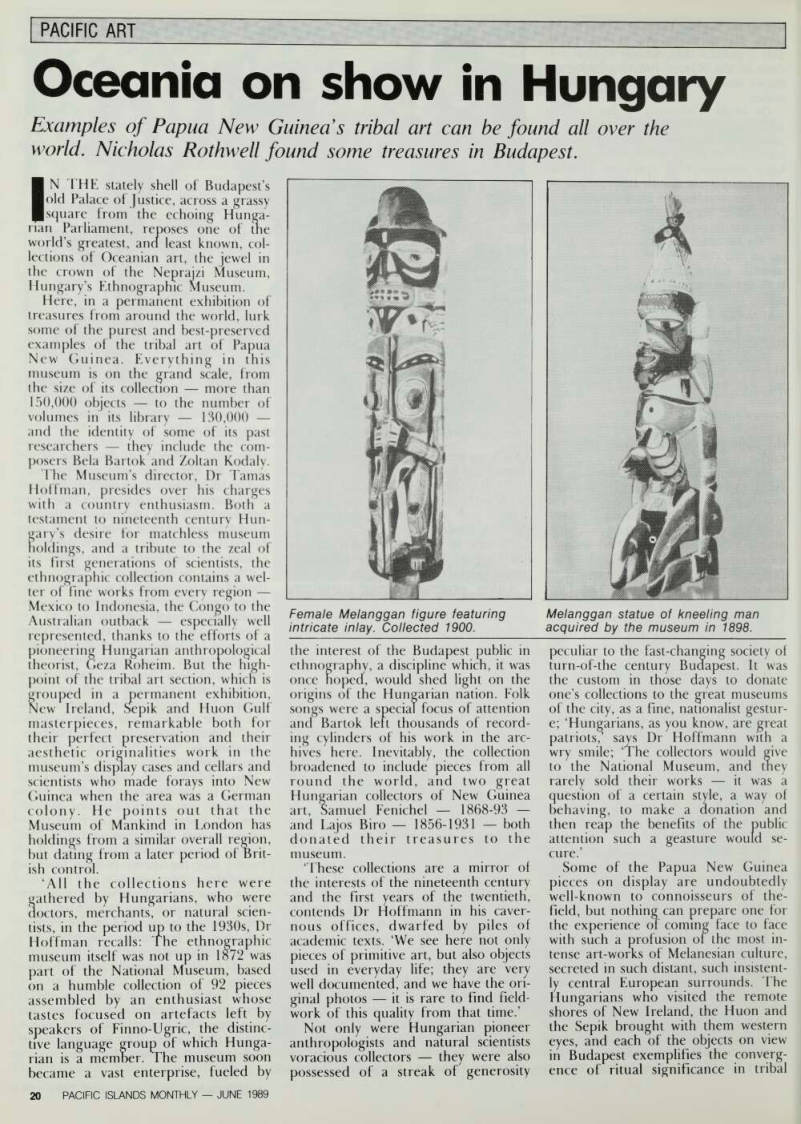
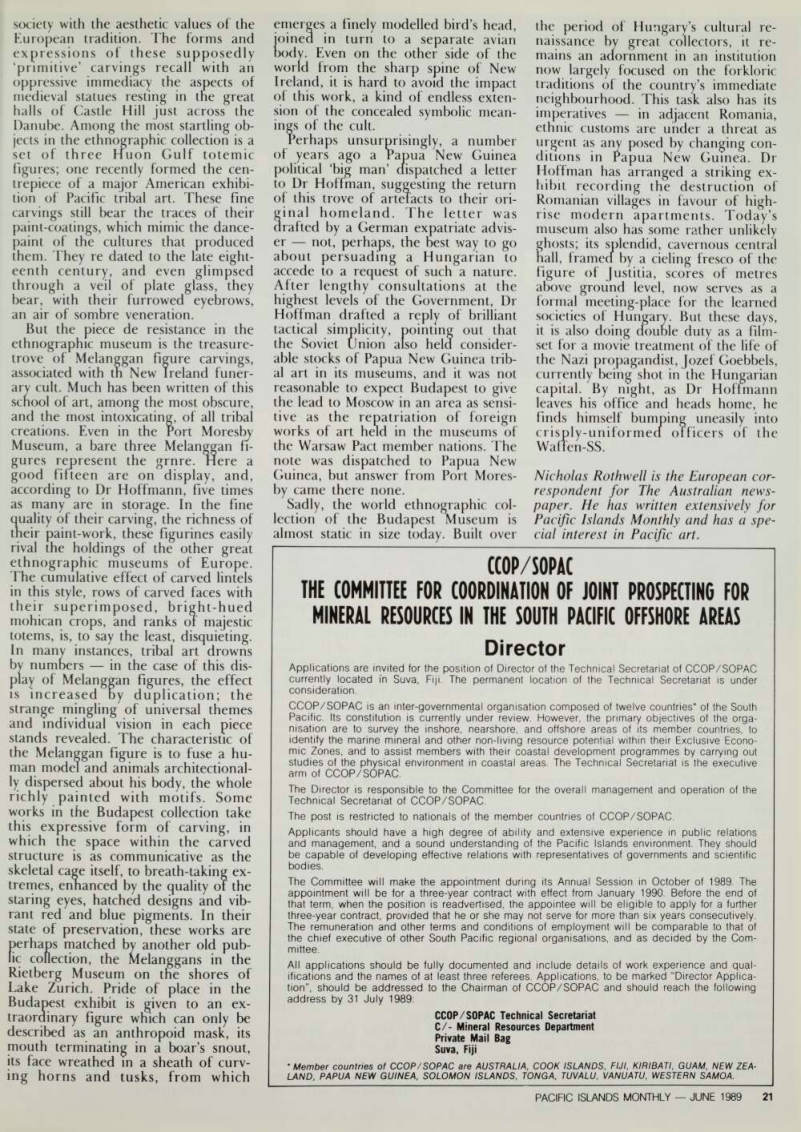
Pacific Art
Examples of Papua New Guinea’s tribal art can be found all over the world. Nicholas Rothwell found some treasures in Budapest.
IN THE stately shell of Budapest’s
old Palace of Justice, across a grassy square from the echoing Hunga rian Parliament, reposes one of the world’s greatest, and least known, col lections of Oceanian art, the jewel in the crown of the Neprajzi Museum,
Hungary’s Ethnographic Museum.
Here, in a permanent exhibition of treasures from around the world, lurk some of the purest and best-preserved examples of the tribal art of Papua New Guinea. Everything in this museum is on the grand scale, from the size of its collection more than 150,000 objects to the number of volumes in its library 130,000 and the identity of some of its past researchers they include the com posers Bela Bartok and Zoltan Kodaly.
The Museum’s director. Dr Tamas Hoffman, presides over his charges with a country enthusiasm. Both a testament to nineteenth century Hun gary’s desire for matchless museum holdings, and a tribute to the zeal of its first generations of scientists, the ethnographic collection contains a wel ter of fine works from every region Mexico to Indonesia, the Congo to the Australian outback especially well represented, thanks to the efforts of a
pioneering Hungarian anthropological
theorist, Geza Roheim. But the high
point of the tribal art section, which is grouped in a permanent exhibition, New Ireland, S>epik and Huon Gulf masterpieces, remarkable both for their perfect preservation and their aesthetic originalities work in the museum’s display cases and cellars and scientists who made forays into New Guinea when the area was a German colony. He points out that the Museum of Mankind in London has holdings from a similar overall region, but dating from a later period of Brit ish control. ‘All the collections here were
gathered by Hungarians, who were
doctors, merchants, or natural scien tists, in the period up to the 19305, Dr Hoffman recalls; The ethnographic museum itself was not up in 1872 was part of the National Museum, based on a humble collection of 92 pieces assembled by an enthusiast whose tastes focused on artefacts left by speakers of Finno-Ugric, the distinc tive language group of which Hunga rian is a member. The museum soon became a vast enterprise, fueled by
the interest of the Budapest public in ethnography, a discipline which, it was once hoped, would shed light on the origins of the Hungarian nation. Folk songs were a special focus of attention and Bartok left thousands of record ing cylinders of his work in the arc hives here. Inevitably, the collection broadened to include pieces from all round the world, and two great Hungarian collectors of New Guinea art, Samuel Fenichel 1868-93 and Lajos Biro 1856-1931 both donated their treasures to the museum. ‘These collections are a mirror of the interests of the nineteenth century and the first years of the twentieth, contends Dr Hoffmann in his caver nous offices, dwarfed by piles of academic texts. ‘We see here not only pieces of primitive art, but also objects used in everyday life; they are very well documented, and we have the ori ginal photos it is rare to find field work of this quality from that time.’
Not only were Hungarian pioneer
anthropologists and natural scientists voracious collectors they were also possessed of a streak of generosity
peculiar to the fast-changing society of
turn-of-the century Buaapest. It was the custom in those days to donate one’s collections to the great museums of the city, as a fine, nationalist gestur e; ‘Hungarians, as you know, are great patriots,’ says Dr Hoffmann with a wry smile; The collectors would give to the National Museum, and they rarely sold their works it was a question of a certain style, a way of behaving, to make a donation and then reap the benefits of the public attention such a geasture would se cure.’
Some of the Papua New Guinea
pieces on display are undoubtedly
well-known to connoisseurs of the field, but nothing can prepare one for the experience of coming face to face with such a profusion of the most in tense art-worlcs of Melanesian culture, secreted in such distant, such insistent ly central European surrounds. The Hungarians who visited the remote shores of New Ireland, the Huon and the Sepik brought with them western eyes, and each of the objects on view in Budapest exemplifies the converg ence of ritual significance in tribal
Female Melanggan figure featuring intricate inlay. Collected 1900.
Melanggan statue of kneeling man acquired by the museum in 1898.
society with the aesthetic values of the European tradition. The forms and
expressions of these supposedly
primitive’ carvings recall with an
oppressive immediacy the aspects of
medieval statues resting in the great halls of Castle Hill just across the Danube. Among the most startling ob jects in the ethnographic collection is a set of three Huon Gulf totemic figures; one recently formed the cen trepiece of a major American exhibi tion of Pacific tribal art. These fine carvings still bear the traces of their paint-coatings, which mimic the dance paint of the cultures that produced them. They re dated to the late eight eenth century, and even glimpsed through a veil of plate glass, they bear, with their furrowed eyebrows, an air of sombre veneration.
But the piece de resistance in the ethnographic museum is the treasure trove of Melanggan figure carvings, associated with tn New Ireland funer ary cult. Much has been written of this scnool of art, among the most obscure, and the most intoxicating, of all tribal creations. Even in the Port Moresby Museum, a bare three Melanggan fi gures represent the grnre. Here a good fifteen are on display, and, according to Dr Hoffmann, five times as many are in storage. In the fine Quality of their carving, the richness of
tneir paint-work, these figurines easily
rival the holdings of the other great
ethnographic museums of Europe.
The cumulative effect of carved lintels in this style, rows of carved faces with their superimposed, bright-hued mohican crops, and ranks of majestic totems, is, to say the least, disquieting.
In many instances, tribal art drowns by numbers in the case of this dis
play of Melanggan figures, the effect
is increased by duplication; the strange mingling of universal themes and individual vision in each piece stands revealed. The characteristic of the Melanggan figure is to fuse a hu man model and animals architectional ly dispersed about his body, the whole richly painted with motifs. Some works in the Budapest collection take this expressive form of carving, in which the space within the carved structure is as communicative as the skeletal cage itself, to breath-taking ex tremes, ennanced by the quality of the staring eyes, hatched designs and vib rant red and blue pigments. In their state of preservation, these works are
perhaps matched by another old pub
lic collection, the Melanggans in the Rietberg Museum on the shores of Lake Zurich. Pride of place in the Budapest exhibit is given to an ex
traordinary figure which can only be
described as an anthropoid mask, its mouth terminating in a boar’s snout, its face wreathed in a sheath of curv ing horns and tusks, from which
emerges a finely modelled bird’s head, joined in turn to a separate avian body. Even on the other side of the world from the sharp spine of New Ireland, it is hard to avoid the impact of this work, a kind of endless exten sion of the concealed symbolic mean ings of the cult.
Perhaps unsurprisingly, a number
of years ago a Papua New Guinea
political ‘big man’ dispatched a letter
to Dr Hoffman, suggesting the return of this trove of artefacts to their ori ginal homeland. The letter was drafted by a German expatriate advis er not, perhaps, the best way to go about persuading a Hungarian to accede to a request of such a nature.
After lengthy consultations at the highest levels of the Government, Dr Hoffman drafted a reply of brilliant tactical simplicity, pointing out that the Soviet Union also held consider able stocks of Papua New Guinea trib al art in its museums, and it was not reasonable to expect Budapest to give the lead to Moscow in an area as sensi tive as the repatriation of foreign works of art held in the museums of the Warsaw Pact member nations. The note was dispatched to Papua New Guinea, but answer from Port Mores by came there none.
Sadly, the world ethnographic col lection of the Budapest Museum is almost static in size today. Built over
the period of Hungary’s cultural re naissance by great collectors, it re mains an adornment in an institution now largely focused on the forkloric traditions of the country’s immediate neighbourhood. This task also has its
imperatives in adjacent Romania,
ethnic customs are under a threat as urgent as any posed by changing con ditions in Papua New Guinea. Dr Hoffman has arranged a striking ex hibit recording the destruction of Romanian villages in favour of high rise modern apartments. Today’s museum also has some rather unlikely ghosts; its splendid, cavernous central hall, framed by a cieling fresco of the figure of Justitia, scores of metres above ground level, now serves as a formal meeting-place for the learned societies of Hungary. But these days, it is also doing double duty as a film set for a movie treatment of the life of the Nazi propagandist, Jozef Goebbels, currently being shot in the Hungarian
capital. By night, as Dr Hoffmann
leaves his office and heads home, he finds himself bumping uneasily into crisply-uniformed officers of the Waffen-SS.
Nicholas Rothwell is the European cor respondent for The Australian news paper. He has written extensively for Pacific Islands Monthly and has a spe cial interest in Pacific art.
Advertisements & other items, p. 21 (1 item)
Ccop/Sopac
THE COMMITTEE FOR COORDINATION OF JOINT PROSPECTING FOR MINERAL RESOURCES IN THE SOUTH PACIFIC OFFSHORE AREAS
Director
Applications are invited for the position of Director of the Technical Secretariat of CCOP/SOPAC currently located m Suva, Fiji. The permanent location of the Technical Secretariat is under consideration.
CCOP/SOPAC is an inter-governmental organisation composed of twelve countries* of the South Pacific. Its constitution is currently under review. However, the primary objectives of the organisation are to survey the inshore, nearshore, and offshore areas of its member countries, to identify the marine mineral and other non-living resource potential within their Exclusive Economic Zones, and to assist members with their coastal development programmes by carrying out studies of the physical environment in coastal areas. The Technical Secretariat is the executive arm of CCOP/SOPAC.
The Director is responsible to the Committee for the overall management and operation of the Technical Secretariat of CCOP/SOPAC.
The post is restricted to nationals of the member countries of CCOP/SOPAC.
Applicants should have a high degree of ability and extensive experience in public relations and management, and a sound understanding of the Pacific Islands environment. They should be capable of developing effective relations with representatives of governments and scientific bodies.
The Committee will make the appointment during its Annual Session in October of 1989. The appointment will be for a three-year contract with effect from January 1990. Before the end of that term, when the position is readvertised, the appointee will be eligible to apply for a further three-year contract, provided that he or she may not serve for more than six years consecutively.
The remuneration and other terms and conditions of employment will be comparable to that of the chief executive of other South Pacific regional organisations, and as decided by the Committee.
All applications should be fully documented and include details of work experience and qualifications and the names of at least three referees. Applications, to be marked “Director Application”, should be addressed to the Chairman of CCOP/SOPAC and should reach the following address by 31 July 1989.
CCOP/SOPAC Technical Secretariat C/- Mineral Resources Department Private Mail Bag
Suva, Fiji
* Member countries of CCOP/SOPAC are AUSTRALIA, COOK ISLANDS. FIJI, KIRIBATI. GUAM, NEW ZEA- LAND, PAPUA NEW GUINEA, SOLOMON ISLANDS, TONGA. TUVALU. VANUATU, WESTERN SAMOA.
galleon off Guam
Australians seek silver galleon off Guam
By David North
Ml SOUTH Australian syndicate has won the exclusive right to excavate a silver-laden Manila galleon sunk off Guam in 1690. The group, headed by John Bent and Paul Lunn, co-owners of the Adelaide Skin diving Centre, and backed by Austra
lian businessman Anthony O’Grady,
estimates there could be as much as SUSSOO million in precious metal and gems at the wreck site of the Nuestra Senora del Pilar de Zaragoza.
The 1200-ton vessel, mounting 50 cannon, was transporting the Royal Situardo, the King’s annual allowance to underwrite a year’s trading in Man ila, including 1.5 million silver ‘pieces of eight’ as well as an unknown amount of gold coins and ingots.
The project, licensed to do business as Davey Jones Archaeology in the US
territory of Guam, places a heavy
emphasis on the proper recovery of the vessel’s historical treasure. “This is not a plundering mission,” says Lunn.
This will be a thorough archaeolo gical survey and recovery exercise to present to the world for the first time not only the wealth of the vessel but priceless antiquities, and return to Guam its historic heritage.”
The group has already invested “a small fortune” over the past five years
conducting historical research in
Spain, the United States, the Philip pines and Guam, mounting several ex ploratory dives on the del Pilar site and fighting a drawn-out but ultimate ly successful court battle with Amer ican treasure hunter and marine archaeologist Robert Marx over ex
cavation rights.
Now that US courts have sanctioned Guam’s right to enter an exclusive agreement with Davey Jones, the terms of the pact will grant the Gov ernment of Guam 25 per cent of the recovered items as well as an option to negotiate on any particular item of historical or commercial interest.
Davey Jones, which will finance the effort and carry it out under elaborate archaeological recovery rules, is enti tled to 75 per cent.
The excavation team has its work cut out: the galleon slid down a reef face after grounding near Cocos Is land, a spur of coral and sand spits jutting out from Guam’s southwestern coast. With a crew of 300 and another 200 passengers, the overloaded and
ungainly ship built for cargo capacity
and defensive strength was difficult to manoeuvre in the best of conditions.
Ending the tiring two-month, 7500nautical-mile crossing from Acapulco, the vessel (the largest commercial ship of its era) was attempting to skirt Cocos and make the galleon port of Umatac some distance further along the west coast, but the winds were light and variable, the current was
running inshore and night was falling
when the del Pilar struck at Bpm on June 2, 1690.
Despite attempts to lighten the ves sel and row her off the reef, the be hemoth would not budge and when the wind began picking up the del Pi lar's passengers and much of its cargo were transferred by boats to its sister ship, the Santo Nino, which continued on to Manila the next day, anxious to cross the Philippine Sea before the typhoon season struck in its full
ferocity.
All the next day the del Pilar was blown across the boulder-strewn reef and sucked down the steeply sloping face, breaking up and spilling its re maining cargo along the way. Contem porary reports indicate that much of the treasure slid beneath the reach of breath-holding native divers, and now lies strewn across several square kilometres of sloping sand-bottom and perhaps on shelves as deep as 100 metres. Heavier sections of the vessel are believed to have slid below that level.
Robert Marx, who was Davey Jones’
chief competitor for salvage rights,
had listed the del Pilar as one of the 10 richest unsalvaged ships in the world. Davey Jones’ own estimates place the bullion value of the 1.5 mil lion silver coins (about 47 tonnes of silver) at SUSI 3 million, but collectors’ condition Spanish coins of the era fetch up to |250 each.
The ship’s manifest only hints at the true value of the cargo, as has been demonstrated in the recovery of Span ish galleon treasure in the Caribbean.
The Manila galleon trade w'as con
stantly and severely restricted by Royal
decrees limiting the amount of bullion that could be allocated to the Asian trade: Acapulco and Manila traders circumvented the decrees by simply
not listing and/or by undervaluing
their actual bullion and cargo on offi cial manifests.
Historians estimate the galleons annually carried $2 to $5 million in Royal Situardo as well as the personal wealth of the merchants, noble sons, soldiers and adventurers who took
passage on them to Spain’s colonial outposts. While treasure recovery of Spanish galleons in the Caribbean has a track record of high return on in vestment, there are few cases of suc cessful recovery on the Pacific side of
Spain’s trading empire. But the recent
recovery of hundreds of gold artifacts from another Manila galleon off Saipan in the Northern Marianas has heightened interest and faith in the search for the del Pilar.
A Singapore-based marine construc tion firm, Pacific Sea Resources Inc, used a high-tech recovery ship and trained crews to bring up hundreds of
gold articles, including coins, jewellery
and plate from the Nuestra Senora de la Concepcion, wrecked off Saipan in 1638. The recovery also included dozens of clay storage jars, hundreds of cannon balls and ballast stones as well as a few anchors.
The del Pilar historical treasure could include ornately decorated bronze and iron cannon, ceramics and stoneware as well as metal tools and implements of everyday use. Intri gumgly, Lunn believes some of the ships timbers may still be intact. Parts of the vessel could have survived either by sliding below the habitat of the wood-eating teredo worm or by being buried under tonnes of sana.
One of about 80 Manila galleons built in the 350-year history of the Spanish colonial shipping line, the del Pilar was 52 metres (170 feet) long, with a 15 metre beam and masts rising almost 40 metres above the water. She was constructed (by a thousand work men) entirely of Philippine hardwoods and christened in 1653. Her keel and ribs were mahogany, her decking teak and hull planking lanang-which was re puted to be impervious to cannon shot.
Whatever artifacts and treasure are re covered could help write a better ver sion of this important early chapter in Pacific island interaction with the West. As Lunn said in describing the goals of the team: “We believe our project to excavate this important Manila galleon will help lift world rec ognition of this aspect of Pacific his- Manila galleon was a repre sentative of the first trans-Pacific European trading line which lost at least |US6O million treasure in ship wrecks during the 350 years the route was used, a fraction of the fantastic wealth it carried from South America to the Philippines. □
Advertisements & other items, p. 23 (1 item)
Bird Of Paradise.
LAP OF LUXURY.
I * • • ■ m
BEAST OF BURDEN.
The Bird of Paradise, the new emblem of Air Niugini, can now be seen adorning the tail of another magnificent bird - the A3lO-300.
Air Niugini’s latest plane has launched a whole new era of comfort and cost-effective flying to and from Papua New Guinea.
Passengers sit in the kind of luxury that can only be enjoyed on a truly wide-bodied jet.
Whilst as a beast of burden the A3lO is incomparable. The underfloor cargo hold handles all current types of containers. And the increase of payload is a further source of revenue.
All this goes to show why Air Niugini chose this bird to fly to paradise.
When will you fly one? £ AIRBUS INDUSTRIE
age of seafarers
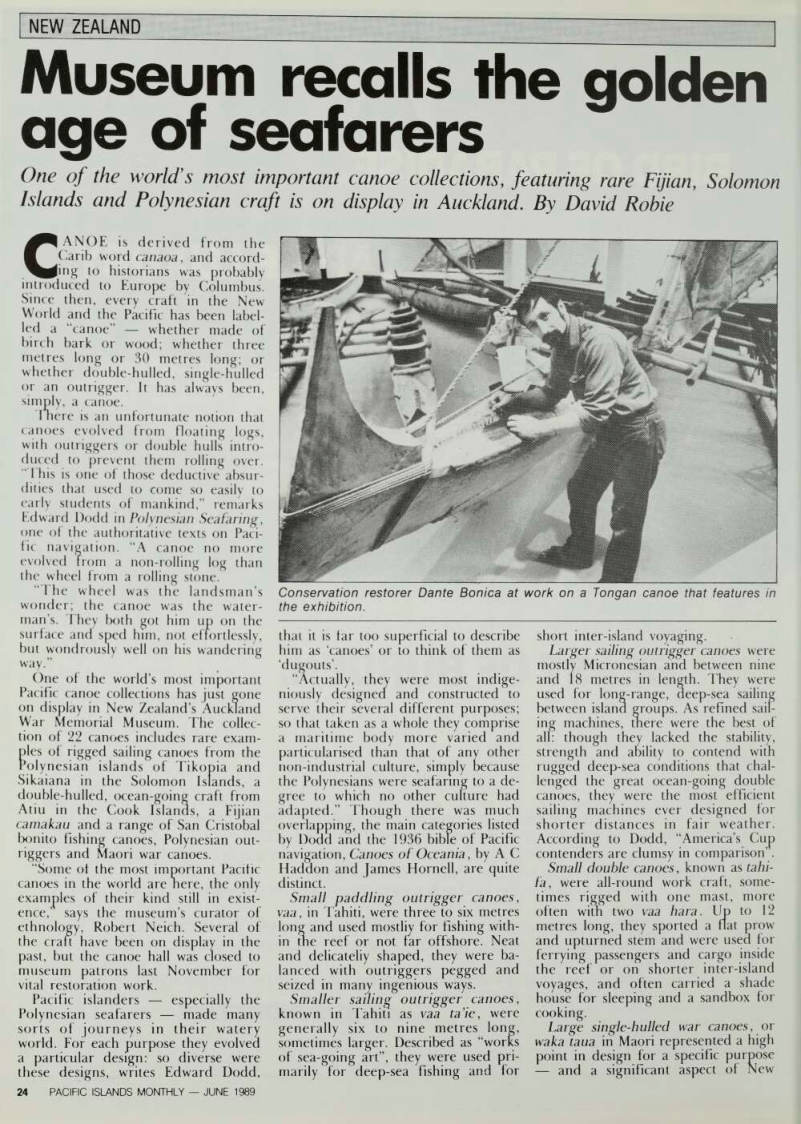
New Zealand
Museum recalls the golden age of seafarers
One of the world’s most important canoe collections, featuring rare Fijian, Solomon
Islands and Polynesian craft is on display in Auckland.
By David Robie
ANOE is derived from the ■ Carib word canaoa , and accordto historians was probably introduced to Europe by Columbus.
Since then, every craft in the New World and the Pacific has been label led a “canoe” whether made of birch bark or wood; whether three metres long or 30 metres long; or whether double-hulled, single-hulled or an outrigger. It has always been, simply, a canoe. friere is an unfortunate notion that canoes evolved from floating logs, with outriggers or double hulls intro duced to prevent them rolling over.
“ I his is one of those deductive absur dities that used to come so easily to early students of mankind,” remarks Edward Dodd in Polynesian Seafaring, one of the authoritative texts on Paci fic navigation. “A canoe no more evolved from a non-rolling log than the wheel from a rolling stone.
“The wheel was the landsman’s wonder; the canoe was the water man’s. They both got him up on the surface and sped him, not effortlessly, but wondrously well on his wandering way.”
One of the world’s most important Pacific canoe collections has just gone on display in New Zealand’s Auckland War Memorial Museum. The collec tion of 22 canoes includes rare exam ples of rigged sailing canoes from the Polynesian islands of Tikopia and Sikaiana in the Solomon Islands, a double-hulled, ocean-going craft from Atiu in the Cook Islands, a Fijian camakau and a range of San Cristobal bonito fishing canoes, Polynesian out riggers and Maori war canoes.
“Some ol the most important Pacific canoes in the world are nere, the only examples of their kind still in exist ence,’' says the museum’s curator of ethnology, Robert Neich. Several of the craft have been on display in the past, but the canoe hall was closed to museum patrons last November for vital restoration work.
Pacific islanders especially the Polynesian seafarers made many sorts of journeys in their watery world. For each purpose they evolved a particular design: so diverse were these designs, writes Edward Dodd,
that it is far too superficial to describe him as ‘canoes’ or to think of them as
‘dugouts’.
“Actually, they were most indige
niously designee! and constructed to serve their several different purposes; so that taken as a whole they comprise a maritime body more varied and particularised than that of any other non-industrial culture, simply because the Polynesians were seafaring to a de gree to which no other culture had adapted.” Though there was much overlapping, the main categories listed by Dodd and the 1936 bible of Pacific navigation, Canoes of Oceania, by A C Haddon and James Hornell, are quite distinct.
Small paddling outrigger canoes,
vaa, in Tahiti, were three to six metres long and used mostliy for fishing with in tne reef or not far offshore. Neat
and delicateliy shaped, they were ba
lanced with outriggers pegged and seized in many ingenious ways.
Smaller sailing outrigger canoes,
known in Tahiti as vaa ta’ie, were generally six to nine metres long, sometimes larger. Described as “works of sea-going art”, they were used pri
marily for deep-sea fishing and for
short inter-island voyaging.
Larger sailing outrigger canoes were
mostly Micronesian and between nine and 18 metres in length. They were used for long-range, deep-sea sailing between island groups. As refined sail ing machines, mere were the best of
all: though they lacked the stability,
strength and ability to contend with rugged deep-sea conditions that chal lenged the great ocean-going double canoes, they were the most efficient sailing machines ever designed for shorter distances in fair weather.
According to Dodd, “America’s Cup contenders are clumsy in comparison’.
Small double canoes, known as tahi fa, were all-round work craft, some times rigged with one mast, more often with two vaa hara. Up to 12 metres long, they sported a flat prow and upturned stem and were used for ferrying passengers and cargo inside the reef or on shorter inter-island voyages, and often carried a shade house for sleeping and a sandbox for
cooking.
Large single-hulled war canoes, or waka taua in Maori represented a high point in design for a specific purpose and a significant aspect of New
Conservation restorer Dante Bonica at work on a Tongan canoe that features in the exhibition.
Zealand’s pre-contact culture. Running up to more than 30 metres in length,
they were the only non-outrigger or
non-double-hulled craft in Polynesia: a late development whose beam was made possible only because of the hugeness of New Zealand forest trees such as kauri, kahikatea and totara and used for coastal warfare only.
As Dodd points out, “magnificent
structures though they were, they can
not be classed as ocean-going vessels” . . . but they were nevertheless magnifi cent.
Large double-hulled war canoes or pahi tamai were the largest craft built m eastern Polynesia (mainly in Tahiti), being excelled in size only by the huge
Fijian drua or Tongan tongiaki. Cook
measured one of almost 40 metres.
Propelled by paddlers only, with up
turned bows and high sterns, they were not true seafaring craft, though they did voyage more than a hundred miles of open sea between Raiatea and Tahiti.
Large double-hulled voyaging
canoes designed for exploration and distant ocean transport were virtually extinct when the first Europeans ar rived in the Pacific. Hawaiian double canoes are regarded as their nearest relatives, but by the time of Cook they were inter-island rather than ocean going vessels, paddled as well as sailed.
The pride of the Auckland exhibi tion is Rakeitonga, a vaka tapu, or sacred sailing canoe, from Tikopia, be lieved to be more than a century old.
Built by Pu Auekofe for Te Ariki Taumoko, chief of the Taumako clan, it is famous in the Tikipian tradition and made long ocean voyages to Anu ta and the New Hebrides (now Vanuatu).
It was presented to the museum by Bishop Woods in 1916 and 1953 was rigged in the traditional way by Ra
Rangimarepe, Pa Motuanga, Farava
and Koroimoana, Tikopian crewmen from the Melanesian Mission ship Southern Cross.
“Named after an ancestor of Te Ariki Taumako, as a vaka tapu this canoe has its own spirit guardians,”
says ethnologist Michael Pendegrast.
“In seasonal canoe rituals, appeals are made to these spirits to protect the fishermen and to ensure a successful harvest from the sea.”
A vakafaimanu , or outrigger canoe from Tikopia, is also of considerable interest. It was built by a group of Tikopians stranded on the Banks Is lands during the World War II to take them home. This type of canoe is used in Tikopia for catching flying fish at night with hand nets, oy the light of coconut-frond flares.
For conservation restorer Dante Bonica, preparing the canoes has been a labour of love: “I’ve always had a
passionate interest in Pacific and Maori culture, and in canoes. I built my first canoe with an outrigger when 1 was 16,” he says, “and ever since I’ve had a fascination with their tech-
nology.
Most of Bomca’s restoration work has involved cleaning and re-rigging.
With the vaka tapu of Tikopia he had to use a neutral detergent to clean off hand grease on the outside and some kind of slick “linseed or engine oil from the ship that brought it here” from the inside; indeed, the Atiu vaka katea was almost black from oil dam age. □
Canoe Races
Auckland to host Canoe Races
Sarah Kennett previews the fourth World Polynesian Canoe Sprint Championships
IN JANUARY next year, competi
tors from as far away as Canada, Ireland and Spain will gather in Auckland for the fourth World
Polynesian Canoe Sprint Cham
pionships.
The canoe sprints are a ‘theme set ting’ feature of the Festival of the XIV Commonwealth Games, and cultural exhibits will line the foreshore of the Orakei Basin where the sprints are to be held. The festival is being billed as a reflection of New Zealand s increas ing recognition of its place as a Pacific nation, but outrigger canoes are an uncommon sight in New Zealand and racing them is a sport that is only now
catching on.
The country’s first four clubs got together in 1988 to launch a national federation called Tatou Hoe o Aotearoa. At that time, several more clubs were in the process of forma tion; there are now a dozen or more scattered around New Zealand and more are being brought into being, in remote rural communities as wen as the cities, with Maori, Pakeha and islander members.
The dream of two of the founding members of Tatou Hoe o Aotearoa, Matahi Whakataka-Brightwell (a New Zealand Maori) and Pih Muaulu (a Sa moan) was to see a revival of canoe culture in New Zealand: a recognition that the canoe is the connecting factor in all Pacific cultures. Herb Kawainue Kane, Hawaiian artist, carver, canoe builder and amateur anthropologist, says that among Pacific Islanders, the canoe is the symbol of their mutuality: “It lies at the heart of island culture, for without it neither the people nor their culture would have come into ex istence. It reminds them of the cour age, resourcefulness and excellence of the skills their ancestors possessed
qualities worthy of emulation today,
and on which future survival may de
pend.”
Matahi Whakataka-Brightwell says his intention “is a family reunion be tween Polynesian peoples of the Paci fic. New Zealand can find its identity in the Pacific through the canoe. Pake has? They’re part of the Pacific; it’s only natural/ He agrees that the
World Canoe Sprint Championships
will do much to raise the profile of the sport in New Zealand. “After these sprints, the sport will rocket,” he pre dicts. It is also hoped that the sprints will help to present the canoe as a
unifying symbol, “drawing people
together with peaceful intentions to ward each other and society.”
With the recent confirmation of sponsorship and the formulation of canoe designs, clubs affiliated with Tatou Hoe o Aotearoa are flat out building canoes. Nga Hoe Horo o Pawarenga Canoe Chib, situated in a remote Northland harbour, has built six-person and single prototype hulls and, unable to obtain official moulds from Tahiti due to transport difficul ties, Tatou Hoe o Aotearoa used a 1984 World Sprints mould and adapted it to new specifications, in cluding some New Zealand features since approved by the International Polynesian Canoe Federation.
An Auckland-based construction company, Wilkins and Davies, is a ma jor sponsor of the fourth World
Polynesian Canoe Sprint Cham
pionships and is setting up the venue for the sprints at Orakei Basin on Waitemata Harbour. Nestled beside one of Auckland’s most scenic seaside drives, Orakei Basin will be lined for the event with displays of visual, liter ary and performing arts and crafts from around the Pacific and the Com monwealth. Spectator accommodation for upwards of 2000 people will be constructed, and the races will finish in clear view of the shore. □
Advertisements & other items, pp. 26-29 (1 item)
Martin Fabrics
FOCAL
COMMUNICATIONS
EDUCATIONAL AND
HEALTH TRAINING
VIDEOS
science * maths * history * health and guidance
Suitable for primary, secondary
schools, hospitals, etc.
FOR FURTHER INFORMATION, PLEASE
COMPLETE
THE COUPON BELOW AND RETURN
TO: Focal Communications, PO Box 383, St Leonards NSW 2065 Australia tel: (02) 437 6855 fax: (02) 436 0175 PM 1
NAME: TITLE:
ORGANISATION:
ADDRESS:
COUNTRY:
MARTIN FABRICS
FIJI’S ONLY HOUSE OF
FASHION WEAR
★ FLORAL DRESS PRINTS
★ 100% COTTON PRINTS
★ TAPA PRINTS
★ ISLAND PRINTS
★ HABUTAE SILK
★ FANCY FABRICS
★ MENS SUITING &
SHIRTING MATERIAL
LARGEST SELECTION
IN FIJI OF
★ CURTAIN FABRIC FROM
SWEDEN.
AVAILABLE AT ALL
MARTIN FABRICS RETAIL OUTLET
SUVA NADI TOWN
281 VICTORIA PRO. OPP NAMOTOMOTO VILLAGE.
LAUTOKA BA TOWN
BILA STREET. MAIN STREET.
MARTINS CORNER
4 MILES NABUA.
Situation Required
Insurance Industry
Mature person, widely experienced in general insurance, with extensive background in all aspects of underwriting, claim-settlement and management, is seeking a suitable position in the Pacific Islands or New Guinea. Is also thoroughly acquainted with the “Lloyds of London” agency operations and has over 10 years experience in cargo-claim surveys and hull casualty investigations in the Western Pacific.
Post Office Box 1882 C.P.O.
Auckland
NEW ZEALAND
CONFERENCES* MEETINGS* SEMINARS
POTS HIDDEN PARADISE
NaKoro
Resort ,
* Small, Exclusive Romantic Lost in Time Individual Spacious Bures, Live reef, Crystal Clear Water.
Scuba Diving, Snorkelling, Fishing, Sailing, Tennis.
Ph (075) 92 2664. Fax (075) 92 2038 P.O. Box 91, Surfers Paradise, 4217 Australia Please send me information on conferences/meetings/holidays Name; Company:.
Business Address:,
SPEC
T.
FORUM SECRETARIAT
(formerly South Pacific Bureau for Economic Co-operation [SPEC])
Applications are invited for the position of AID CO-ORDINATION OFFICER within the Forum Secretariat. The Secretariat, based in Suva, was established to encourage cooperation between island member states and between those states and the more industrialised countries on all aspects of economic development, trade, transport, telecommunications, tourism and energy.
The appointee will work principally on development coordination and liaison activities and on the preparation of project dossiers. Applicants should be well qualified in economics or a related field and should have a sound knowledge of the economies of South Pacific island countries.
Familiarity with donor government and agency procedures in the region would be an advantage.
We are also looking for a capacity to set clear priorities, to work under pressure, and to present work in a clear and concise manner. The officer will work as part of the team within the Secretariat’s Economic Services Division.
This appointment will carry an attractive remuneration package, payable in Fiji dollars. For non-Fiji citizens this is tax free and includes housing or housing allowance, education and child allowances. Other benefits for all employees include superannuation payments and medical, life and travel insurance coverage. The appointee will
be based at the Secretariat’s Headquarters in Suva, Fiji, but will be required to undertake periodic duty travel. Appointments would be for three years initially, renewable by mutual agreement.
Applications close on 30 June, 1989. As it is intended to make the appointment as soon as possible, the successful applicant must be able to take up the position shortly afterwards. Applications should contain full information on education and career background and should list names, addresses and telephone numbers of at least three referees with whom the applicant has been associated in a professional capacity. Previous applicants will also be considered and need not re-apply at this stage.
Applications should be addressed to: The Secretary General Forum Secretariat GPO Box 856, Suva, Fiji Telephone: 312600 Telex: 2229 FJ; Fax 302204 All enquiries should be made to Mr Rene Wilson, Director of Services, on 312600 extension 202. *Forum Secretariat Member countries are: Australia, Cook Islands, Federated States of Micronesia, Fiji, Kiribati, Nauru, New Zealand, Niue, Papua New Guinea, Republic of Marshall Islands, Solomon Islands, Tonga, Tuvalu, Vanuatu and Western Samoa.
PACIFIC
ISLANDS
M q N T H L Y
PACIFIC
BUSINESS
EIGHT PAGES OF BUSINESS AND
FINANCIAL NEWS FROM
THROUGHOUT THE PACIFIC
EDITED BY ROBIN BROMBY
Leave the humdrum behind.
Own a Mazda 626, and
you own the road.
Boredom’s a strong emotion.
And at Mazda, we think there’s no good reason why any driver should have to suffer it.
That’s why we created the Mazda 626. A car offering equal measures of uncommon good looks. Unrestrained performance. And a remarkable degree of precision handling.
This last, especially, has earned the 626 much praise throughout Europe. Enthusiasts speak of the 626’s grip on all kinds of surfaces. Its assured cornering and straight-line stability. Its regard for everything, in fact, that pays off in enhanced driver feel.
Driver feel has long been a >- *
riority at Mazda. We’ve gone so far s to construct a Global Road ircuit in which every conceivable >ad condition, from ice to Belgian )bblestone to city pothole, is aplicated. Sensors gauge our cars’ over these surfaces, as ell as through the many twists and irns we’ve designed to simulate European roadways.
The results include innovative and acclaimed suspension systems.
As well as the world’s first speedsensing, 4-wheel steering system.
Regrettably, some people will remain unaware of their options and, by choosing an ordinary car, suffer the consequences.
You needn’t be one of them.
Instead you can choose a Mazda.
Model and features shown may not be available in your area. Please consult your local Mazda dealer.
mazoa
Mazda Motor Corporation
Tax havens threatened
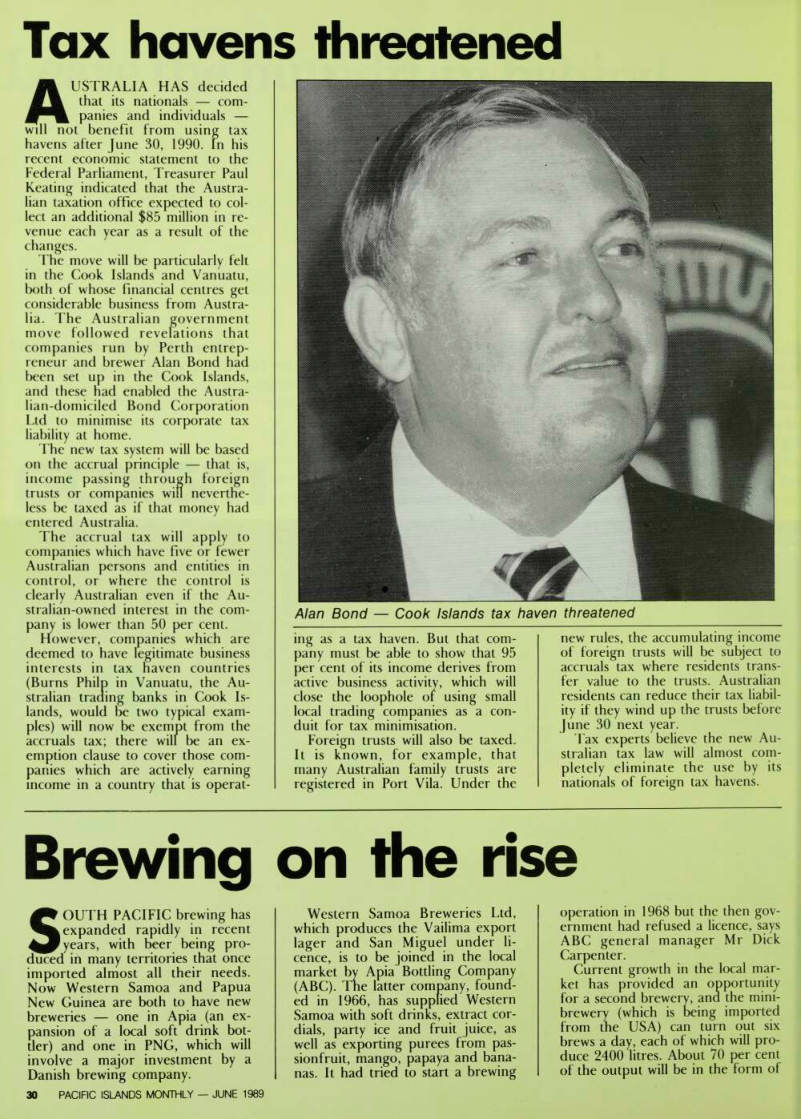
Australia has decided that its nationals com panies and individuals will not benefit from using tax havens after June 30, 1990. In his recent economic statement to the Federal Parliament, Treasurer Paul Keating indicated that the Austra lian taxation office expected to col lect an additional $B5 million in re venue each year as a result of the
changes.
The move will be particularly felt in the Cook Islands and Vanuatu, both of whose financial centres get considerable business from Austra lia. The Australian government move followed revelations that companies run by Perth entrep reneur and brewer Alan Bond had been set up in the Cook Islands, and these had enabled the Austra lian-domiciled Bond Corporation Ltd to minimise its corporate tax liability at home.
The new tax system will be based on the accrual principle that is,
income passing through foreign
trusts or companies will neverthe less be taxed as if that money had entered Australia.
The accrual tax will apply to companies which have five or fewer Australian persons and entities in control, or where the control is clearly Australian even if the Au stralian-owned interest in the com pany is lower than 50 per cent.
However, companies which are deemed to have legitimate business interests in tax haven countries (Burns Philp in Vanuatu, the Au stralian trading banks in Cook Is lands, would be two typical exam ples) will now be exempt from the accruals tax; there will be an ex emption clause to cover those com
panies which are actively earning
income in a country that is operat-
ing as a tax haven. But that com pany must be able to show that 95 per cent of its income derives from active business activity, which will close the loophole of using small local trading companies as a con duit for tax minimisation.
Foreign trusts will also be taxed.
It is known, for example, that many Australian family trusts are registered in Port Vila. Under the
new rules, the accumulating income of foreign trusts will be subject to accruals tax where residents trans fer value to the trusts. Australian residents can reduce their tax liabil ity if they wind up the trusts before June 30 next year.
Tax experts believe the new Au stralian tax law will almost com pletely eliminate the use by its nationals of foreign tax havens.
Alan Bond - Cook Islands tax haven threatened
Brewing on the rise
SOUTH PACIFIC brewing has
expanded rapidly in recent
years, with beer being pro duced in many territories that once imported almost all their needs.
Now Western Samoa and Papua New Guinea are both to have new breweries one in Apia (an ex pansion of a local soft drink bot tler) and one in PNG, which will involve a major investment by a Danish brewing company.
Western Samoa Breweries Ltd, which produces the Vailima export lager and San Miguel under li cence, is to be joined in the local
market by Apia Bottling Company
(ABC). The latter company, found ed in 1966, has supplied Western Samoa with soft drinks, extract cor dials, party ice and fruit juice, as well as exporting purees from pas sionfruit, mango, papaya and bana nas. It had tried to start a brewing
operation in 1968 but the then gov ernment had refused a licence, says ABC general manager Mr Dick
Carpenter.
Current growth in the local mar ket has provided an opportunity for a second brewery, ana the mini
brewery (which is oeing imported
from the USA) can turn out six brews a day, each of which will pro duce 2400 litres. About 70 per cent of the output will be in the form of
lager beer in medium and large bottles, with draught beer available
in kegs.
Because all the bottles are sold on a returnable basis, Apia Bottling will be confining its sales to the domestic market. Mr Carpenter says the company will be selling a traditional beer without additives or sugar and will promote it as a
quality product. The brewery was
Purchased from Red Hook Ale rewery in Seattle, and will initially
employ about 20 people.
The agreement to permit the construction of a brewery at Kero wagi, in the Simbu Province of Papua New Guinea, was due to be
signed in early May. The Danish
company Danbrew Consult will put up most of the Kl 7 million cost of the new Highlands Brewery while each of the provinces involved (Southern Highlands, Simbu, East ern Highlands, Enga and Western Highlands) will each pay K 300,000.
There had previously oeen differ ing opinions about whether the brewery should go ahead; for ex
ample, Southern Highlands Pre
mier Yaungtine Koromba had pre viously opposed any rush decision on the establishment of the brew ery, as had Egna premier Ned Laina. The reluctant premiers accepted the argument that they would need other Highland pro vinces to support future projects in their areas.
BBC targets
Pacific
IT HAS been reported that the
British Broadcasting Corpora
tion is planning to install new, high-powered shortwave transmit ters m New Zealand in order to better relay its World Service prog rams to trie South Pacific region.
The BBC has been searching for a way to increase its coverage of the
region since the Fijian military
coup when it found that its signal could not be reliably heard in that country.
The British move follows deci sion by both Radio New Zealand and Radio Australia to improve their services to the South Pacific.
In fact, it is apparently the RNZ decision to develop a new short wave transmitting base in the cen tral North Island which has made possible the BBC extension it plans to erect its masts on the same site.
The South Pacific is the one ma
jor region without strong signals
from London.
Forum slams
wall of death
THE SpUTH Pacific Forum’s
fisheries committee, after a meeting at Majuro in the Marshall Islands, has strongly con demned the operation of Asian gill net fishing boats in the South Paci fic. A meeting with government representatives from South Korea, Taiwan and Japan has been sche duled for Suva in late June, and if progress is not made it is expected that the matter will be discussed at the full Forum meeting to be held the following month on Tarawa in Kiribati.
Gill netting involves the use of nets of up to 56 km in length, which are designed to drift in the ocean and catch albacore tuna.
Most of this takes place in interna tional waters east of New Zealand and in the Tasman Sea. The nets also catch sea birds, dolphins, and even small whales which led to the nets being dubbed the “wall of death” but the most immediate problem is that most of the catch is m the form of juvenile albacore tuna. This has resulted in depletion of the tuna numbers of adult fish in the economic zones of the Forum states. The Forum Fishing Agency in Honiara estimates the depletion already caused may take five years to be repaired pro video gill netting does not resume in the southern summer.
The Suva meeting will aim to seek agreement from the Asians that gill netting will be stopped, or at least wound down.
The meetings of fisheries com mittee in Majuro noted that the dramatic and unregulated increase in the number of gill net vessels from Taiwan, South Korea and Japan operating in the Pacific and the Tasman during 1988-89 posed
a major resource and environmen tal threat. The meeting repeated an earlier call for distant water fishing nations to co-operate fully “in an international effort to prevent this random and unjustified plunder of the region’s marine resource”.
The Forum Fishing Agency will be putting proposals at the Suva meeting along the lines that the boats could be used for long-line albacore fishing further north, and even in some economic zones. The only catch is that the resource has been depleted by gill netting to the stage where there would not be enough adult fish to go around an
enlarged long-line fleet.
The agency has been heartened by the growing concern in Australia and New Zealand. The political weight of these countries is con siderably greater than that of the small island states. Also, the U.S.
State Department and the provin cial government of British Col umbia, Canada, have requested observer status at Suva, a sign the North Americans are alarmed by the damage being done to fish stocks in the Pacific Ocean.
There seems little question that the Forum nations are reaching a point where they want urgent ac tion on the matter, and there is a
growing body of opinion that
should the distant fishing nations not curb and then eliminate gill net fishing the island states should threaten to close their economic zones to those countries. This is a potent weapon, as the only area outside the zones which is suitable for long-line tuna fishing is a nar row band between the outer limits of the Papua New Guinea and Solomon Islands’ 200 mile limit.
□ Agbank Needs Bailing Out
The Agricultural Bank Of
Papua New Guinea needs an injec tion of KlOO million to keep it out of serious trouble, according to chairman Fred Reiher. The bank’s expanding volume of loan commit ments has far outpaced the growth of equity capital, says Mr Reiher, and the Agriculture Bank has failed to approve many genuine proposals, either because it nad run out of funds or because projected
viability was limited by the interest
rates currently being charged.
The chairman suggests that the National Government seek other sources of funding on cheaper or more favourable terms. Lower in terest rates on money borrowed by the bank would mate low-interest
loans, particularly for agricultural
or fisheries projects more feasible.
Agbank is now approving loans at the rate of K3O million a year.
Mr Reiher says the mining sector boom will not be everlasting.
Rural expansion a must
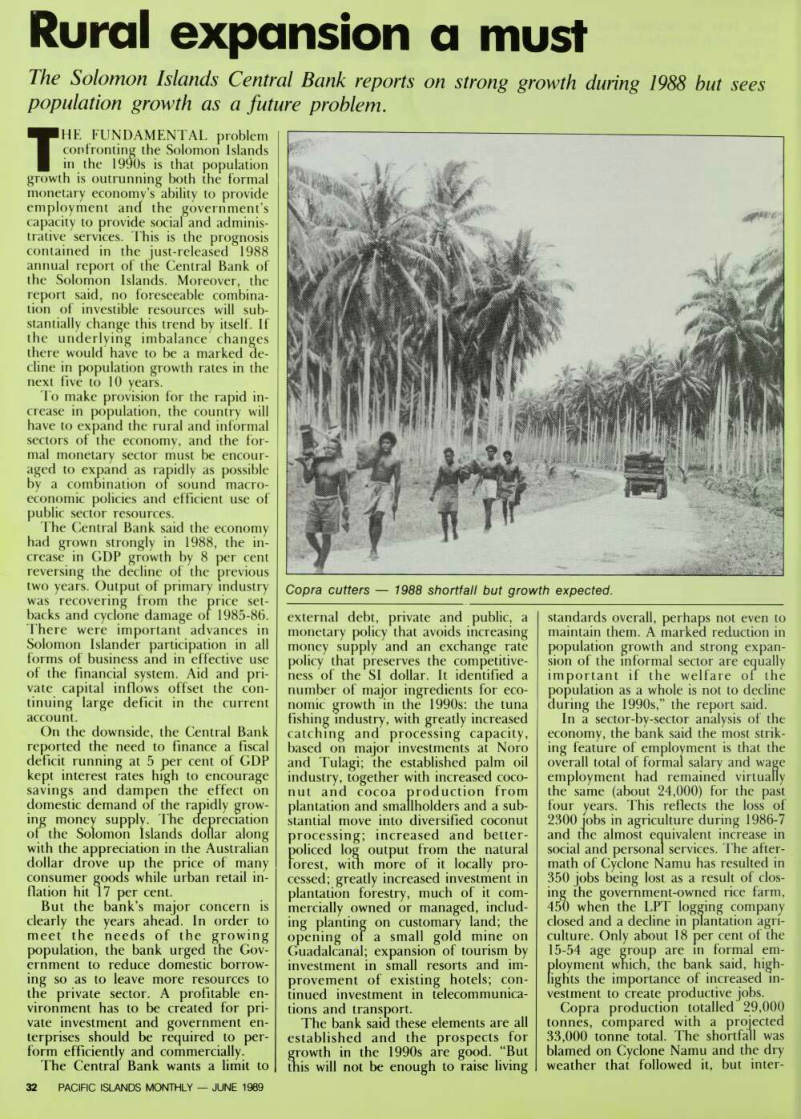
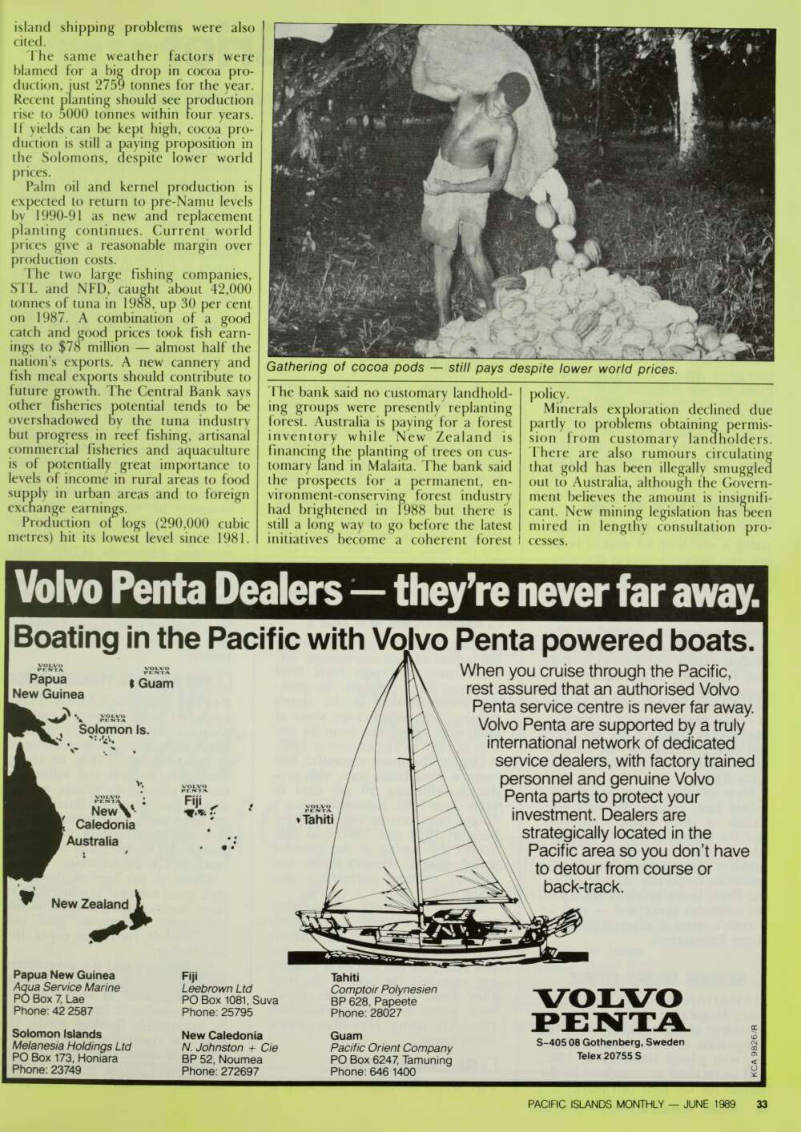
The Solomon Islands Central Bank reports on strong growth during 1988 but sees population growth as a future problem.
THE FUNDAMENTAL problem
confronting the Solomon Islands in the 1990 s is that population growth is outrunning both the formal
monetary economy’s ability to provide
employment and the government’s capacity to provide social and adminis trative services. This is the prognosis contained in the just-released 1988 annual report of the Central Bank of the Solomon Islands. Moreover, the report said, no foreseeable combina tion of investible resources will sub stantially change this trend by itself. If
the underlying imbalance changes
there would have to be a marked de cline in population growth rates in the next five to 10 years.
To make provision for the rapid in crease in population, the country will have to expand the rural and informal sectors of the economy, and the for mal monetary sector must be encour aged to expand as rapidly as possible by a combination of sound macro economic policies and efficient use of public sector resources.
The Central Bank said the economy had grown strongly in 1988, the in crease in GDP growth by 8 per cent reversing the decline of the previous
two years. Output of primary industry
was recovering from the price set backs and cyclone damage of 1985-86.
There were important advances in Solomon Islander participation in all forms of business and in effective use of the financial system. Aid and pri vate capital inflows offset the con tinuing large deficit in the current account.
On the downside, the Central Bank reported the need to finance a fiscal deficit running at 5 per cent of GDP kept interest rates high to encourage savings and dampen the effect on domestic demand of the rapidly grow
ing money supply. The depreciation
of the Solomon Islands dollar along with the appreciation in the Australian dollar drove up the price of many consumer goods while urban retail in flation hit 17 per cent.
But the bank’s major concern is clearly the years ahead. In order to meet the needs of the growing population, the bank urged the Gov ernment to reduce domestic borrow ing so as to leave more resources to the private sector. A profitable en vironment has to be created for pri vate investment and government en terprises should be required to per
form efficiently and commercially.
The Central Bank wants a limit to
external debt, private and public, a monetary policy that avoids increasing money supply and an exchange rate policy that preserves the competitive ness of the SI dollar. It identified a number of major ingredients for eco nomic growth in the 19905: the tuna
fishing industry, with greatly increased
catching and processing capacity,
based on major investments at Noro and Tulagi; the established palm oil industry, together with increased coco nut and cocoa production from plantation and smallholders and a sub stantial move into diversified coconut processing; increased and better policed log output from the natural forest, with more of it locally pro cessed; greatly increased investment in plantation forestry, much of it com mercially owned or managed, includ ing planting on customary land; the opening of a small gold mine on Guadalcanal; expansion of tourism by investment in small resorts and im provement of existing hotels; con tinued investment in telecommunica tions and transport.
The bank said these elements are all established and the prospects for growth in the 1990 s are good. “But this will not be enough to raise living
standards overall, perhaps not even to maintain them. A marked reduction in population growth and strong expan sion of the informal sector are equally important if the welfare of the population as a whole is not to decline during the 19905,” the report said.
In a sector-by-sector analysis of the economy, the bank said the most strik ing feature of employment is that the overall total of formal salary and wage
employment had remained virtually
the same (about 24,000) for the past four years. This reflects the loss of 2300 lobs in agriculture during 1986-7 and tne almost equivalent increase in social and personal services. The after math of Cyclone Namu has resulted in 350 jobs being lost as a result of clos ing the government-owned rice farm, 450 when the LPT logging company closed and a decline in plantation agri culture. Only about 18 per cent of the 15-54 age group are m formal em ployment wnich, the bank said, high lights the importance of increased in vestment to create productive jobs.
Copra production totalled 29,000
tonnes, compared with a projected 33,000 tonne total. The shortfall was blamed on Cyclone Namu and the dry weather that followed it, but inter
Copra cutters - 1988 shortfall but growth expected.
island shipping problems were also cited.
The same weather factors were blamed for a big drop in cocoa pro duction, Just 2759 tonnes for the year.
Recent planting should see production rise to 0000 tonnes within four years.
If yields can be kept high, cocoa pro duction is still a paying proposition in the Solomons, despite lower world
prices.
Palm oil and kernel production is expected to return to pre-Namu levels bv 1990-91 as new and replacement planting continues. Current world prices give a reasonable margin over
production costs.
The two large fishing companies,
STL and NFD, caught about 42,000 tonnes of tuna in 1988, up 30 per cent on 1987. A combination of a good catch and good prices took fish earn ings to $7B million almost half the nation’s exports. A new cannery and fish meal exports should contribute to future growth. The Central Bank says other fisheries potential tends to be overshadowed by the tuna industry but progress in reef fishing, artisanal commercial fisheries and aquaculture is of potentially great importance to levels of income in rural areas to food supply in urban areas and to foreign
exchange earnings.
Production of logs (290,000 cubic metres) hit its lowest level since 1981.
The bank said no customary landhold
ing groups were presently replanting
forest. Australia is paying for a forest inventory while New Zealand is financing the planting of trees on cus tomary land in Malaita. The bank said the prospects for a permanent, en
vironment-conserving forest industry
had brightened in 1988 but there is still a long way to go before the latest initiatives become a coherent forest
policy.
Minerals exploration declined due partly to problems obtaining permis sion from customary landholders.
There are also rumours circulating that gold has been illegally smuggled out to Australia, although the Govern ment believes the amount is insignifi cant. New mining legislation has Teen mired in lengthy consultation pro cesses.
Gathering of cocoa pods - still pays despite lower world prices.
Advertisements & other items, p. 33 (1 item)
Volvo Renta Dealers —they're never far away.
Boating in the Pacific with Volvo Renta powered boats.
Papua New Guinea I\.
I Guam
A PE NTA
Solomon Is.
PENTA
Newy
Caledonia Australia New Zealand Papua New Guinea Aqua Service Marine PO Box 7, Lae Phone: 42 2587 Solomon Islands Melanesia Holdings Ltd PO Box 173, Honiara Phone: 23749
Fiji
♦ Tahiti
When you cruise through the Pacific,
rest assured that an authorised Volvo Renta service centre is never far away.
Volvo Renta are supported by a truly international network of dedicated service dealers, with factory trained
personnel and genuine Volvo
Renta parts to protect your
investment. Dealers are strategically located in the Pacific area so you don’t have to detour from course or back-track.
Fiji Leebrown Ltd PO Box 1081, Suva Phone; 25795 New Caledonia N. Johnston + Cie BP 52, Noumea Phone: 272697 Tahiti Comptoir Polynesian BP 628, Papeete Phone: 28027 Guam Pacific Orient Company PO Box 6247, Tamuning Phone: 646 1400
VOLVO
S-405 08 Gothenberg, Sweden Telex 20755 S
Business In Brief
The latest trade and finance news from around the region.
□ Union Leaves Fiji
THE UNION Steamship Company
is closing its operations m Fiji after more than 100 years connection with that country. The company is selling its Union Maritime Services Ltd operations in Suva and Lauto ka to the Pacific Forum Line, although Union will continue to represent the Forum Line in
Tonga.
Since the Union company had withdrawn the vessel Marama from the Fiji run in 1979 and Forum having taken up the route, the
company had been dependent
upon agency business alone. Now that the Forum Line had grown, there was no need for Union also to be operating in Fiji. But the ves sel Union Auckland will still carry sugar between Fiji and New Zea land.
□ Pacific Stamps On Wane
THE FORUM Secretariat is orga nising a workshop on ways of reviv
ing the region’s stamp industry.
The small island states are feeling the pinch as world interest in stamp collecting appears to be on the de cline, but of the 15 South Pacific Forum nations, six depend on phi latelic sales for a major proportion of their export earnings; in Kiribati and Tuvalu the stamp business is a major employer. Tuvalu, which has issued vast numbers of new stamps in recent years, has seen a devastat ing drop m sales and the workshop will loot at restraining the number of new issues as well as new market
possibilities.
Most of the island nations in volved have commercial links with British or other stamp companies and the stamps are often designed and printed overseas. Another problem is that stamps from Pacific countries frequently do not reflect the flora, fauna or social history of the countries concerned sucn as Tuvalu’s series of stamps featuring steam locomotives.
□ Hawaiian Airlines Change
HAWAIIAN AIRLINES chairman John Magoon Jr is also to become president of the company after the resignation of Paul Finazzo. Finaz zo, who joined Hawaiian in 1982, will be retained as consultant by the airline for the next two years.
□ Solomons Postpones Forest
Plan
THE Solomon Islands government
has suspended a forestry project
due to go ahead in the country’s Western province. Prime Minister Mamaloni said the SSI 25 million earmarked for the forest scheme will be diverted to other develop ment plans. He pointed to the dan gers of having the money all in vested in one project which could be lost in one of the frequent cyc lones.
□ Tonga Price Index
THE consumer price index in Ton ga rose by 1.6 per cent in the first three months of the year, with
household products (firewood, gas
stoves, posts, insecticides, mirrors) heading the list with a 2.5 per cent increase. Food increased by 1.7 per cent, with larger increases for most fresh vegetables and fish offset by the prices of bele, onions and taro leaves. Clothing and footwear rose 1.8 per cent, mainly for men’s clo
thing and footwear. Transportation
actually dropped, with lower prices
for bicycles, petrol and diesel fuel.
□ Hawaii Farms New Crops
WHILE Hawaii’s sugar and pineap ple industries face increasingly dif ficult times, a report from First Hawaiian Bank points to the grow ing diversification in the state’s farming. Diversified crops’ share of total crop value rose from 24 per cent in 1983 to 32 per cent in 1987.
One of the more successful new crops is macadamia nuts, with pro duction climbing 50 per cent in value since 1983. Kona coffee saw a 15 per cent increase in areaplanted between 1983 and 1987, and pro ducers are aiming at the gourmet coffee market. Hawaii’s flower and nursery product industry is also
doing well.
Several new crops are showing
commercial potential: guava (crop
value in 1987 was |US2 million) and cocoa (with a first harvest due this year), are the two most promis ing, especially the latter if the Her shey Food Company goes ahead witn plans to develop chocolate
products using Hawaiian-grown
cocoa beans.
□ Fiji Economic Summit
FIJI WILL this month hold its first
national economic summit meeting in three years. Finance Minister Josevata Kamikamica said the meet ing will help develop a consultative framework to further Fiji’s econo mic recovery, and leaders from a cross-section of the community will be able to express views and contri bute their ideas. “Fiji’s economic re covery is still in its early stages and it is vital that the nation under stands this,” the Minister said.
□ Nz Seeks New Fly Killer
NEW ZEALAND’S Ministry of Agriculture and Fisheries (MAF) is testing a new method to kill fruitflv in food imports from the Soutn Pacific. The new process is dry heat disinfestation, which uses warm air circulated at relatively low humidity to destroy the pest. The fruit is
held at a temperature just long
enough to kill the fly.
The research has been made necessary by New Zealand health
regulations recently introduced re
quiring a reduction in the use of ethylene dibromide (EDB) tradi tionally used on fruit from Fiji, Niue, Tonga, Western Samoa and the Cook Islands. The lucrative fruit and vegetable export trade to New Zealana is threatened unless a new method is found to kill the
fruitfly.
□ Png Needs To Process Goods
Papua New Guinea’S Trade
and Industry Minister Galewa Kwarara says his country urgently needs to increase the processing of its raw products. “Unless we set up companies which are willing to further process our goods, we will slowly lose whatever little market we have to our competitors in In donesia, Malaysia and the Philip pines,” the Minister told a business lunch in Cairns, Australia.
About 40 per cent of the coun try’s gross national product derives
from unprocessed products, includ
ing copper concentrate, gold, cof fee, palm oil, cocoa, tea, copra, fish and timber.
Mr Kwarara said the government not only wanted the raw products to be exported as semi-processed but, if possible, to leave the country as consumable finished goods. He said that Australian companies in vesting in manufacturing would get preferential access to the Austra lian, New Zealand and European
Community markets.
□ Solomons To Privatise
THE SOLOMON Islands govern ment will seek to privatise some of its major corporate investments in
joint-venture enterprises or wholly
owned government companies. Fi nance Minister Christopher Col umbus Abe said the first property to be sold off is the government owned 101-bed Hotel Mendana, the nation’s biggest; the sale of the National Fisheries Development company will follow. The Minister said it was Alliance Party policy to encourage maximum private sector investment.
□ Oils Under Attack
THE SOUTH Pacific Forum Secre tariat is concerned about the dam age to the region’s exporters of coconut and palm oils caused by a US health awareness campaign.
Washington had prepared legisla
tion aimed at introducing compul sory labelling on coconut oil and
palm oil products. The two tropical
oils came under the spotlight m a national campaign titled “the poisoning of America”.
The Forum Secretariat’s trade and investment division believes the two tropical products have been unjustly singled out in an emotive
and unbalanced campaign that
ignores other substances, particu
larly soya oil, produced in the US and not mentioned in the cam paign. The division will consider ways in which the campaign can be countered.
□ New Png Shipping Service
THE JOHN Burke Group is to start a new service from Sydney to Lae, Madang and Port Moresby.
The company will use the vessel Sid McGrath ana will ship refrigerated containers, break bult and roll-on, roll-off cargo.
□ Miners Watch Solomons
Policies
IN ITS latest quarterly report, the
Australian mining company Mag
num Resources Ltd reported to the Australian Stock exchange that no work had been carried out on its Solomons tenements during the March quarter. The company said that, as a result of recent elections in the Solomon Islands and the new government being in power, Magnum and other explorers were anxiously awaiting the new admi
nistration’s specific policies regard
ing exploration and mining.
Magnum said the new govern ment was reported to be keen to encourage productive investment in
the country, but “the extent to which this will assist exploration and overcome currently onerous (and often unresolvable) access problems remains to be seen”.
□ Bougainville Share Offer
THE PAPUA New Guinea govern ment is to offer about half its shares in Bougainville Copper Ltd to local landholders in the North Solomons Province in an attempt to quell the violence surrounding the mining project. The National Gov ernment has a 19.1 per cent in terest in BCL, and Prime Minister Rabbie Namaliu announced that 4.9 per cent of the company will be available to the landholders at cost with a further 5.1 per cent to be sold to them at current market value.
□ Sugar Agreement Renewed
THE SOUTH Pacific regional sugar agreement has been renewed for a further three years after a meeting of Forum countries Fiji, Kiribati, Tonga, Tuvalu and West ern Samoa in Suva, a gathering that saw the admission to tne agree ment of the Republic of the Mar shall Islands. Tne new agreement runs until 1992 and includes quota allocations and prices for sugar supplied for the 1989-90 season.
Advertisements & other items, pp. 34-35 (2 items)
34
PACIRC ISLANDS MONTHLY JUNE 1989
ofOhiM
... Now from Suva to Auckland ... mm
Fiji’s famous Sichuan restaurant
THE GREAT WOK of China Cnr. Bau St./Laucala Bay Rd., Flagstaff, Suva Telephone 301 285 Will be expanding across the ocean to offer Aucklanders a new era in oriental cuisine THE GREAT WOK of China will open in June 404 Khyber Pass Rd., Newmarket, Auckland Telephone 522-1752 Facsimile 608-488
Share market for PNG
An exchange may be set up with assistance from the Kuala Lumpur share market.
But many insiders doubt the viability of the move.
Papua new guinea is to have its own stock ex
change, though financial
vers still question whether there are enough companies and investors to make it viable. The de cision followed a visit to Port Moresby by the chairman and general manager of the Kuala
Lumpur Stock Exchange (KLSE)
and the offer of that organisation’s assistance in setting up the Port
Moresby operation.
This in itself caused some sur &rise in Australia; it had always een assumed that the PNG bourse would be linked closely to the Au
stralian Stock Exchange, especially
since there are 16 companies listed on Australian or New Zealand stock exchanges that are either PNG domiciled or that conduct consider able business in PNG (in April, Pacific Islands Monthly reported the listing on the Australian ex change of Pc Arc Niugini NL, the first company owned in PNG to be listed since Independence).
The Australian exchange had stated on several occasions that it was ready to help set up a similar institution in Port Moresby and even in today’s difficult financial situation several major Australian broking firms have expressed a readiness to open offices there once
an exchange is operating.
So the Australians were taken by surprise at the KLSE intervention.
It is regarded as part of PNG’s growing interest in further econo mic ties with Southeast Asia; Kuala
Lumpur is a small exchange by
world standards and its officials have made the case that they can offer the PNG financial world the benefit of relevant experience, but the possible tie with the KLSE is also being seen as a logical result of Australian lack of interest in Papua New Guinea’s economy. “Apart from the mining and petroleum
sector, we’re just not getting any
investor interest from Australia, ’ said one financial consultant in Port
Moresby.
“Australians seem to have written off Papua New Guinea.”
In contrast, Asian companies appear to believe great opportuni ties exist to help restructure the
country’s capital markets. One
problem that has partially paralysed
the PNG capital market is its lack
of local institutional players: the na
tion’s major investment organisa
tions (National Provident Fund, Public Officers Superannuation Fund, Motor Vehicles Insurance Trust) have been loath to make
equity investments, partly because
they do not possess the trained staff to do so.
While the stock exchange propos al has been talked about for several years, the issue returned in November last year when Finance Minister Paul Pora repeated during his Budget speech that the Govern ment was reviving the plan. It is
understood the Malaysian High
Commissioner in Port Moresby saw the potential for his nation to be associated with the project and arranged for the KLSE delegation to visit in early April.
A few days later, the PNG Cabinet agreed in principle to establish a stock exchange m the country. Prime Minister Rabbie Namaliu announced that a high level committee made up of gov ernment officials and private fi nance officials was to be set up to work out details of the proposal and a timetable for implementa tion. The committee is clue to re port in July.
Mr Poras argument to his col leagues had been that companies within Papua New Guinea had to place excessive reliance on loan fi nance in the absence of raising
money through equity placements.
“The local market is not well inte grated with world capital markets, and thus misses out on significant
capital flows seeking investment
outlets in the more sophisticated markets of the world,’' he said.
“This includes the growth of mar kets in developing countries, espe cially in our own region.” Mr Pora said the exchange (to be capitalised in part by the KLSE) would be pri vately owned and set up at no cost to tne Government, though the Government would need to meet the initial costs of establishing a
regulatory agency.
It has been estimated that as many as 270 companies might list their shares; private financial obser vers believe the likely initial figure will be between 30 and 50, but
PNG’s larger private companies
may be encouraged to ‘go public’.
The potential demand for holding
listed stocks is currently estimated at KB4 million, and the existence of a stock exchange would be impor tant for major floats such as that planned for MIM Holdings’ sub sidiary Highlands Gold Ltd, one of the partners in the giant Porgera
gold project.
The Port Moresby exchange
could be in operation oy late 1990, but the Government will need to make major amendments to the
Companies Act, including; drafting
legislation for a securities agency and the licensing of stockbrokers; changes to legislation relating to the investment requirements of the National Provident Fund, Public Officers’ Superannuation Fund and Motor Vehicles Insurance Trust; al teration of the Income Tax Act to
remove impediments to trading
securities; and amendments to the Central Banking Act and foreign exchange regulations to allow for an easier flow of investment funds.
The big question, however, re mains: is tnere adequate equity capital within PNG? Angco was badly disappointed when it tried to raise just K 5 million by a public float, and if local investments will not or, more precisely, cannot come up with equity capital, there will be
a major dependence on foreign
money. In the absence of Austra lian interest, this will be coming from the Asian capital markets and will thus take Papua New Guinea one step further from its traditional ties with Australia.
□ Nz Co Shifts To Fui
THE TRANSFER of garment firms to take advantage of low wages in Fiji continues with the decision of Hamilton-based New Zealand clo thing maker Bruce Powell to shift his operations to Fiji. The move was made necessary by growing
competition from cheap imported
products that are driving New Zea land factories out of business.
The Fiji Times reports that Mr Powell plans to set up a factory em ploying 70 people to make gar ments for export to New Zealand, Australia ana the US. Mr Powell was reported as saying that other New Zealand firms will go out of business if they do not move offshore.
Women who mean business
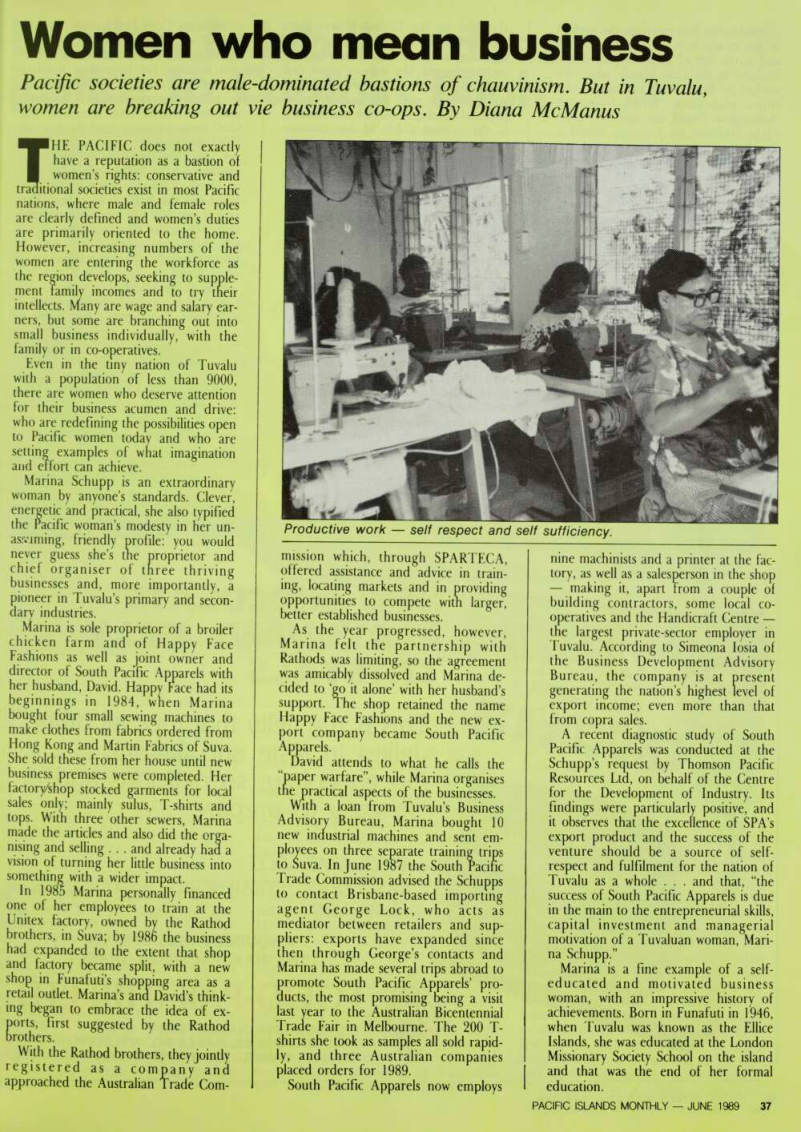
Pacific societies are male-dominated bastions of chauvinism. But in Tuvalu
women are breaking out vie business co-ops.
By Diana McManus
PACIFIC does not exactly have a reputation as a bastion of I women’s rights: conservative and traditional societies exist in most Pacific nations, where male and female roles are clearly defined and women’s duties are primarily oriented to the home.
However, increasing numbers of the women are entering the workforce as
the region develops, seeking to supple
ment family incomes and to try their intellects. Many are wage and salary ear ners, but some are branching out into small business individually, with the
family or in co-operatives.
Even in the tiny nation of Tuvalu with a population of less than 9000, there are women who deserve attention for their business acumen and drive: who are redefining the possibilities open to Pacific women today and who are
setting examples of wnat imagination
and effort can achieve.
Marina Schupp is an extraordinary woman by anyone’s standards. Clever,
energetic and practical, she also typified
the Pacific woman’s modesty in her un
assuming, friendly profile: you would
never guess she’s tne proprietor and chief organiser of three thriving businesses and, more importantly, a pioneer in Tuvalu’s primary and secon
dary industries.
Marina is sole proprietor of a broiler chicken farm and of Happy Face Fashions as well as joint owner and director of South Pacific Apparels with her husband, David. Happy Face had its beginnings in 1984, when Marina bought four small sewing machines to make clothes from fabrics ordered from Hong Kong and Martin Fabrics of Suva.
She sold these from her house until new business premises were completed. Her factory/shop stocked garments for local sales only; mainly sulus, T-shirts and tops. With three other sewers, Marina made the articles and also did the orga nising and selling . . . and already haa a vision of turning her little business into something with a wider impact.
In 1985 Marina personally financed one of her employees to train at the Umtex factory, owned by the Rathod brothers, in Suva; by 1986 the business had expanded to the extent that shop and factory became split, with a new shop in Funafuti’s shopping area as a retail outlet. Marina’s and David’s think mg began to embrace the idea of ex ports, first suggested by the Rathod brothers.
With the Rathod brothers, they jointly registered as a company and approached the Australian Trade Com-
mission which, through SPARTECA, offered assistance and advice in train
ing, locating markets and in providing
opportunities to compete with larger, better established businesses.
As the year progressed, however, Marina felt the partnership with Rathods was limiting, so the agreement was amicably dissolved and Marina de cided to ‘go it alone’ with her husband’s support. The shop retained the name Happy Face Fashions and the new ex port company became South Pacific Apparels.
David attends to what he calls the “paper warfare”, while Marina organises the practical aspects of the businesses.
With a loan from Tuvalu’s Business Advisory Bureau, Marina bought 10 new industrial machines and sent em ployees on three separate training trips to Suva. In June 1987 the South Pacific Trade Commission advised the Schupps to contact Brisbane-based importing agent George Lock, who acts as mediator between retailers and sup pliers; exports have expanded since then through George’s contacts and Marina has made several trips abroad to promote South Pacific Apparels’ pro ducts, the most promising being a visit last year to the Australian Bicentennial Trade Fair in Melbourne. The 200 T shirts she took as samples all sold rapid ly, and three Australian companies placed orders for 1989.
South Pacific Apparels now employs
nine machinists and a printer at the fac tory, as well as a salesperson in the shop making it, apart from a couple of building contractors, some local co operatives and the Handicraft Centre
the largest private-sector employer in
Tuvalu. According to Simeona losia of
the Business Development Advisory
Bureau, the company is at present generating the nation’s highest level of export income; even more than that from copra sales.
A recent diagnostic study of South Pacific Apparels was conducted at the Schupp’s request by Thomson Pacific Resources Ltd, on behalf of the Centre for the Development of Industry. Its
findings were particularly positive, and
it observes that the excellence of SPA’s export product and the success of the venture should be a source of self respect and fulfilment for the nation of Tuvalu as a whole . . . and that, “the success of South Pacific Apparels is due in the main to the entrepreneurial skills,
capital investment and managerial
motivation of a Tuvaluan woman, Mari
na Schupp.”
Marina is a fine example of a self educated and motivated business woman, with an impressive history of achievements. Born in Funafuti in 1946, when Tuvalu was known as the Ellice Islands, she was educated at the London Missionary Society School on the island and that was the end of her formal education.
Productive work - self respect and self sufficiency.
Prior to her first marriage she worked at the newly built Vaiaku Lagi Hotel and at the age of 20 accompanied her husband to tne Line Islands, where he worked for Burns Philp as manager of a copra plantation. While living on Washington Island she had two sons; while resident on Fanning Island a daughter. During these years in the Line Islands, Manna also found time to run an active social club, and her fund raising efforts eventually resulted in a
large clubhouse being built on Fanning
Island. To this day it is named the Marina Club, after tne energy and time she invested in its establishment.
In 1981, three years after the Ellice Islands became the sovereign nation of Tuvalu, Marina’s husband aied. She re turned to Funafuti, where the following year she met Australian David Schupp, then working as an accounting adviser under an Australian air scheme. They married in 1984.
Marina was still restless for something to occupy her mind, at the suggestion of the Agriculture Office (which was trying to encourage individuals to take over egg production) became only the second Tuvaluan to establish a chicken farm.
She found the returns were not worth while so, with the help and advice of the Agriculture Office, switched to produc ing broilers with gratifying success.
In a remote island microstate that is
classified by the United Nations as a ‘least developed country’, Marina’s con tribution to her nation should not be underestimated. She is living proof that traditional Pacific roles and lack of for mal education need not be barriers to
personal development. Fler contribution
to the economic life of her country bears testimony to the important role of women in the development of the newly emerging Pacific nations, and deserves special recognition in Tuvalu’s brief his tory.
No less inspiring is the story of Miliama Manapa, manager of the co operative Tuvalu Women’s Craft Centre at Funafuti.
Miliama is 34 years old, married and the mother of five children three of whom were born since she became the Craft Centre’s manager. She was one of the first group of women to graduate from Motufoa High School on the is land of Vaitupu in 1973. It was a bitter pill f or Miliama to swallow when, though she was very good at her studies and enjoyed school, her father called an end to her education because she was a girl. Her excellent English came later, she says, as a result of working and speaking with former expatriate craft centre managers, especially Amanda
Courage and Jonathan Gaunt.
At first she was employed at the Cen tre on a casual basis, out was promoted
to Assistant Craft Development Officer in 1982 when her predecessor moved to Fiji. After the business moved to its pre sent location (an impressive builaing adjacent to Funafuti’s airport terminal) its administration was given a facelift and new names were accorded: The CDO became manager and the Assistant DDO (Miliama) became Assistant Mana ger. The last technical assistant to be appointed from Britain ended her term in March 1985, from which time Mili has been the official Manager. That year is one Mili will never forget: apart from the added responsibilities of the job, her eight-year-old son died of pneumonia while visiting relatives on an outer island.
Miliama’s managerial skills are contri buting in no small way to the success of the Craft Centre, and her personal background reflects the determination and drive required to bring success: as well as a wife and mother, Mili has de voted immense time, energy and travel to the business and to her own educa tion. The development of the Women’s Craft Centre owes a lot to this very modest, attractive and capable lady. De spite the obstacles created by tradition Miliama has established herself as a businesswoman, wife and mother within the traditional framework: a worthy ex emplar for Pacific women searching for new forms of identity and expression. □
Advertisements & other items, p. 38 (1 item)
Food-Pak (Fiji) Ltd
* «Sg&*
NEW CHOCOLATE
FLAVOURED JELLY
CRYSTALS
This is the Jelly that tops all other Jellies in taste and flavour.
So chocolaty, so delicious and so easy to prepare.
ALSO AVAILABLE:
RASPBERRY,STRAWBERRY AND ORANGE
FLAVOURS
ENQUIRIES WELCOME TO
THE MANUFACTURER DIRECT
FOOD-PAK (FIJI) LTD
P.O. BOX 6293, NASINU, FIJI
FACTORY: LOT 23, DABEA RD., VALELEVU
KALABO, NASINU. PH. 394396/393960 .
justice to Captain Bligh
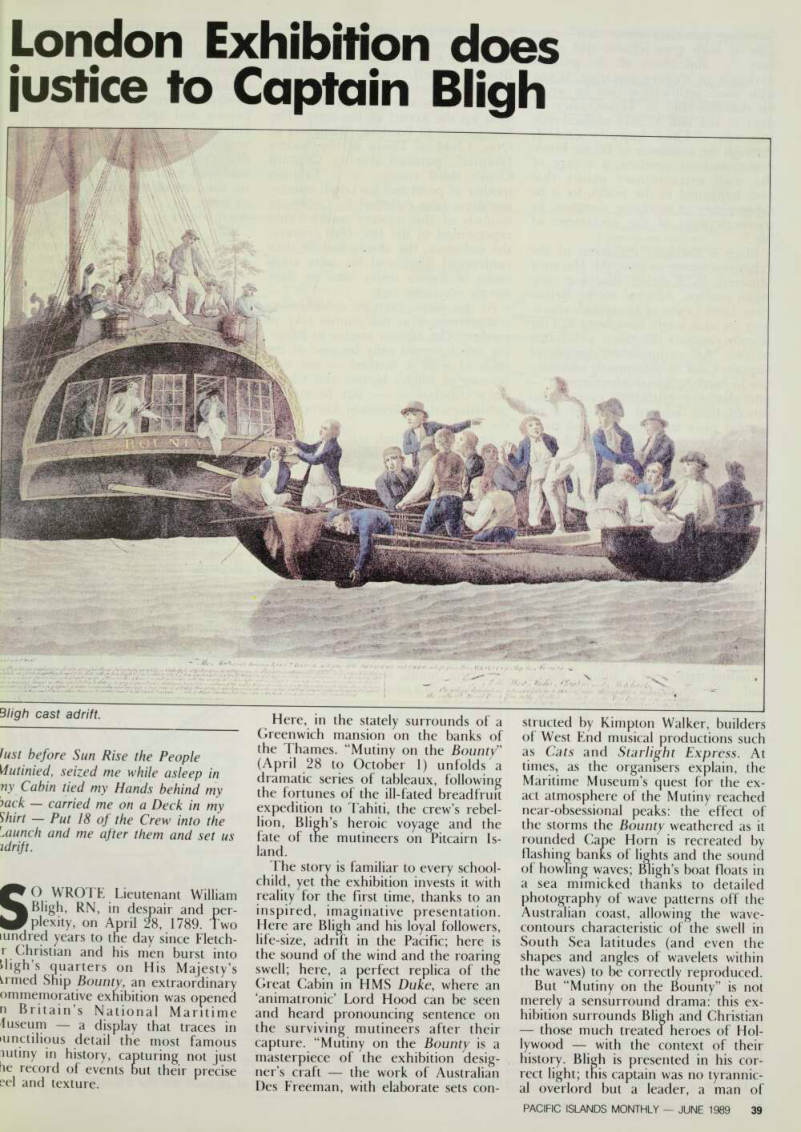
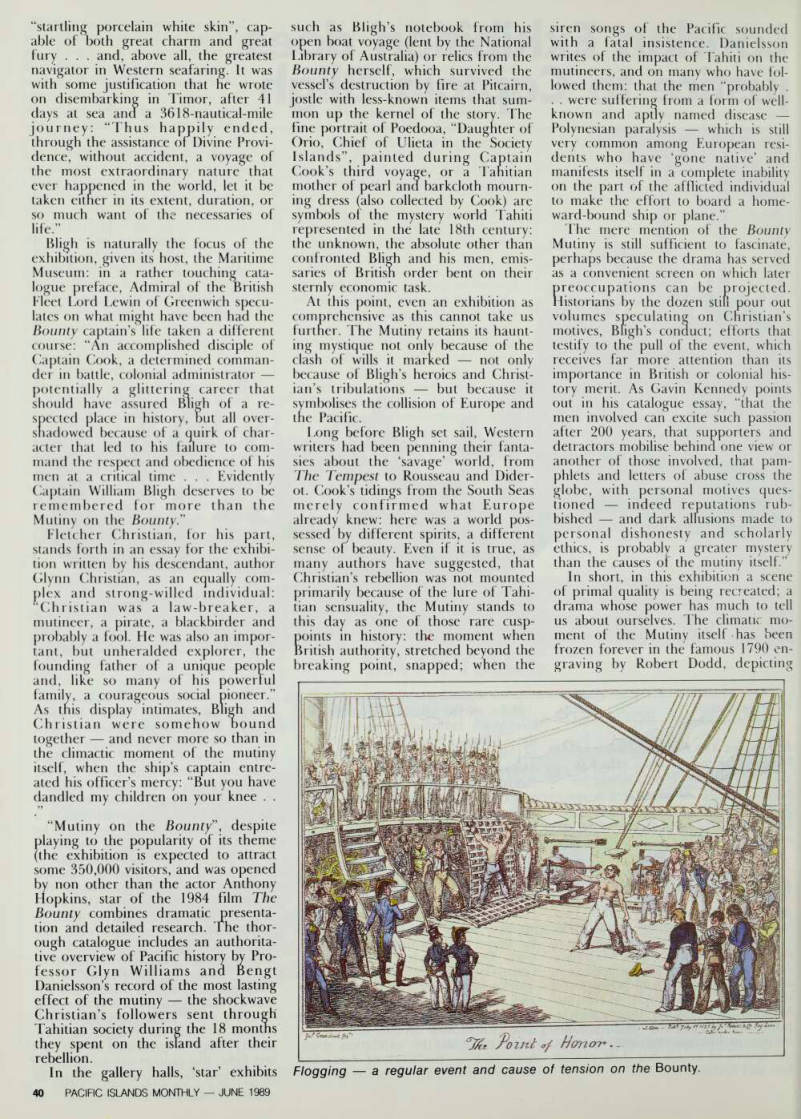
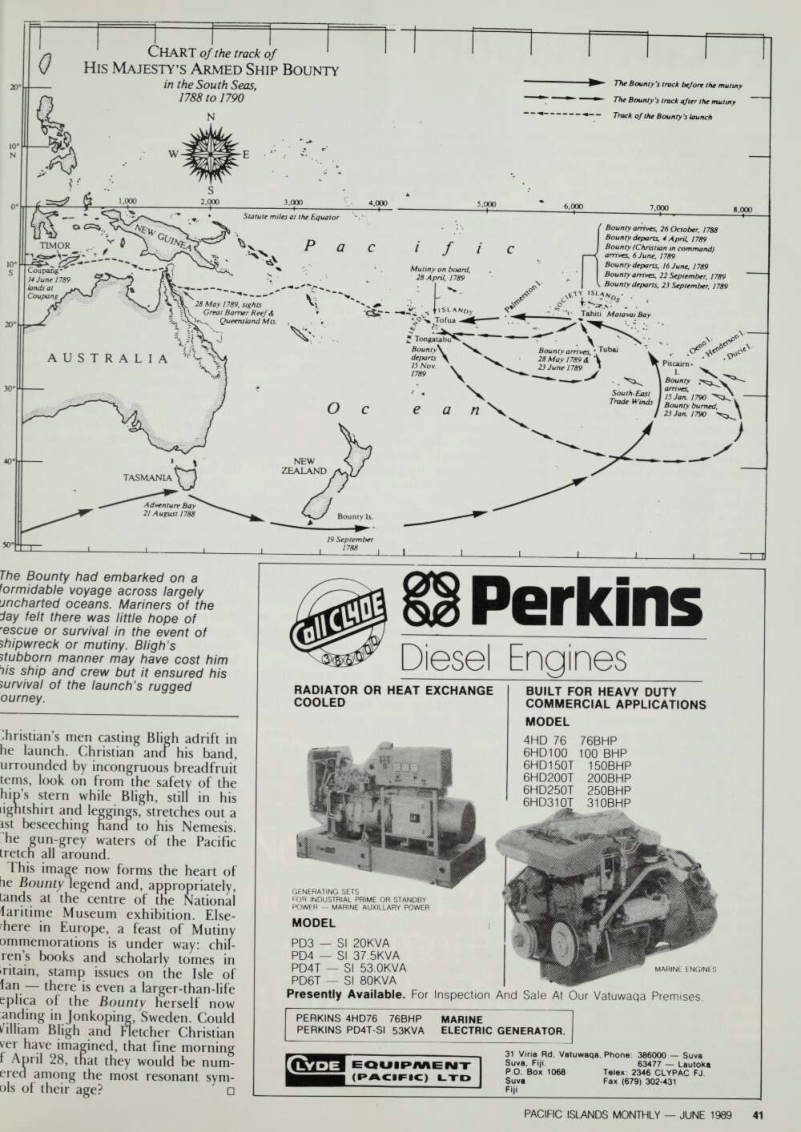
London Exhibition does justice to Captain Bligh
fust before Sun Rise the People Mutinied, seized me while asleep in ny Cabin tied my Hands behind my yack carried me on a Deck in my Shirt Put 18 oj the Crew into the launch and me after them and set us idrift.
SO WROTE Lieutenant William Bligh, RN, in despair and per plexity, on April 28, 1789 . Two inndred years to the day since Fletch r Christian and his men burst into High’s quarters on His Majesty’s trmed Snip Bounty, an extraordinary
ommemorative exhibition was opened
n Britain’s National Maritime Museum a display that traces in •unctilious detail the most famous
lutiny in history, capturing not just
lie record of events but their precise eel and texture.
Here, in the stately surrounds of a Greenwich mansion on the banks of the Thames. “Mutiny on the Bounty ” (April 28 to October 1) unfolds a dramatic series of tableaux, following the fortunes of the ill-fated breadfruit expedition to Tahiti, the crew’s rebel lion, Bligh’s heroic voyage and the fate of tne mutineers on Pitcairn Is land.
The story is familiar to every school child, yet tne exhibition invests it with reality for the first time, thanks to an
inspired, imaginative presentation.
Here are Bligh and his loyal followers, life-size, adrift in the Pacific; here is the sound of the wind and the roaring swell; here, a perfect replica of the Great Cabin in HMS Duke, where an ‘animatronic’ Lord Hood can be seen and heard pronouncing sentence on the surviving mutineers after their capture. “Mutiny on the Bounty is a masterpiece of the exhibition desig ner’s craft the work of Australian Des Freeman, with elaborate sets con
strutted by Kimpton Walker, builders of West End musical productions such as Cats and Starlight Express. At times, as the organisers explain, the Maritime Museum’s quest for the ex act atmosphere of the Mutiny reached near-obsessional peaks: the effect of the storms the Bounty weathered as it rounded Cape Horn is recreated by flashing banks of lights and the sound of howling waves; Bligh’s boat floats in a sea mimicked thanks to detailed photography of wave patterns off the Australian coast, allowing the wave contours characteristic of the swell in South Sea latitudes (and even the shapes and angles of wavelets within the waves) to be correctly reproduced.
But “Mutiny on the Bounty” is not merely a sensurround drama: this ex hibition surrounds Bligh and Christian those much treated heroes of Hol lywood with the context of their history. Bligh is presented in his cor rect light; this captain was no tyrannic al overlord but a leader, a man of
Bligh cast adrift.
“startling porcelain white skin”, cap able of both great charm and great fury . . . and, above all, the greatest navigator in Western seafaring. It was with some justification that he wrote on disembarking in Timor, after 41 days at sea and a 3618-nautical-mile
journey: “Thus happily ended,
through the assistance of Divine Provi dence, without accident, a voyage of the most extraordinary nature that ever happened in the world, let it be taken either in its extent, duration, or so much want of the necessaries of life.”
Bligh is naturally the focus of the exhibition, given its host, the Maritime Museum: in a rather touching cata logue preface, Admiral of the British Fleet Lord Lewin of Greenwich specu lates on what might have been had the Bounty captain’s life taken a different course: “An accomplished disciple of Captain Cook, a determined comman der in battle, colonial administrator potentially a glittering career that should have assured Bligh of a re spected place in history, but all over shadowed because of a quirk of char acter that led to his failure to com mand the respect and obedience of his men at a critical time . . . Evidently Captain William Bligh deserves to be remembered for more than the Mutiny on the Bounty .”
Fletcher Christian, for his part, stands forth in an essay for the exhibi tion written by his descendant, author Glynn Christian, as an equally com
plex and strong-willed individual:
? ‘Christian was a law-breaker, a mutineer, a pirate, a blackbirder and probably a fool. He was also an impor tant, but unheralded explorer, the
founding father of a unique people
and, like so many of his powerful family* a courageous social pioneer.”
As this display intimates, Bligh and Christian were somehow oound together and never more so than in the climactic moment of the mutiny itself, when the ship’s captain entre ated his officer’s mercy: “But you have dandled my children on your knee . .
“Mutiny on the Bounty ”, despite
playing to the popularity of its theme (the exhibition is expected to attract some 350,000 visitors, and was opened by non other than the actor Anthony Hopkins, star of the 1984 film The Bounty combines dramatic presenta tion and detailed research. The thor ough catalogue includes an authorita tive overview of Pacific history by Pro fessor Glyn Williams and Bengt Danielsson’s record of the most lasting effect of the mutiny the shockwave Christian’s followers sent through Tahitian society during the 18 montns they spent on the island after their rebellion.
In the gallery halls, ‘star’ exhibits
such as Bligh’s notebook from his open boat voyage (lent by the National Library of Australia) or relics from the Bounty herself, which survived the vessel’s destruction by fire at Pitcairn, jostle with less-known items that sum mon up the kernel of the story. The fine portrait of Poedooa, “Daugnter of Orio, Chief of Ulieta in the Society
Islands”, painted during Captain
Cook’s third voyage, or a Tanitian mother of pearl and barkcloth mourn ing dress (also collected by Cook) are symbols of the mystery world Tahiti represented in the late 18th century: the unknown, the absolute other than confronted Bligh and his men, emis saries of Britisn order bent on their sternly economic task.
At this point, even an exhibition as comprehensive as this cannot take us further. The Mutiny retains its haunt ing mystique not only because of the clash of wills it marked not only because of Bligh’s heroics and Christ ian’s tribulations but because it symbolises the collision of Europe and tne Pacific.
Long before Bligh set sail, Western writers had been penning their fanta sies about the ‘savage’ world, from The Tempest to Rousseau and Dider ot. Cook’s tidings from the South Seas
merely confirmed what Europe
already knew: here was a world pos sessed by different spirits, a different sense of beauty. Even if it is true, as many authors have suggested, that Christian’s rebellion was not mounted primarily because of the lure of Tahi tian sensuality, the Mutiny stands to this day as one of those rare cusp points m history: the moment when British authority, stretched beyond the
breaking point, snapped; when the
siren songs of the Pacific sounded with a fatal insistence. Danielsson writes of the impact of Tahiti on the mutineers, and on many who have fol lowed them: that the men “probably . . . were suffering from a form of well known and aptly named disease Polynesian paralysis which is still very common among European resi dents who have ‘gone native’ and manifests itself in a complete inability on the part of the afflicted individual to make the effort to board a home
ward-bound ship or plane.”
The mere mention of the Bounty Mutiny is still sufficient to fascinate, perhaps because the drama has served as a convenient screen on which later
preoccupations can be projected.
Historians by the dozen still pour out volumes speculating on Cnristian’s motives, Bligh’s conduct; efforts that testify to the pull of the event, which receives far more attention than its importance in British or colonial his tory merit. As Gavin Kennedy points out in his catalogue essay, “that the men involved can excite such passion after 200 years, that supporters and detractors mobilise behind one view or another of those involved, that pam phlets and letters of abuse cross the globe, with personal motives ques tioned indeed reputations rub bished and dark allusions made to
personal dishonesty and scholarly
ethics, is probably a greater mystery than the causes of the mutiny itself.”
In short, in this exhibition a scene of primal quality is being recreated; a drama whose power has much to tell us about ourselves. The climatic mo ment of the Mutiny itself has been frozen forever in the famous 1790 en
graving by Robert Dodd, depicting
Flogging - a regular event and cause of tension on the Bounty.
Christian’s men casting Bligh adrift in he launch. Christian and his band, urrounded by incongruous breadfruit terns, look on from the safety of the hip’s stern while Bligh, still in his lightshirt and leggings, stretches out a ist beseeching hand to his Nemesis, he gun-grey waters of the Pacific tretch all around.
This image now forms the heart of tie Bounty legend and, appropriately, Lands at the centre of the National laritime Museum exhibition. Else where in Europe, a feast of Mutiny ommemorations is under way: chil ren s books and scholarly tomes in •ritain, stamp issues on the Isle of lan there is even a larger-than-life eplica of the Bounty herself now priding in Jonkoping, Sweden. Could William Bligh and Fletcher Christian ver have imagined, that fine morning f April 28, that they would be num ered among the most resonant sym ols of their age? □
The Bounty had embarked on a formidable voyage across largely uncharted oceans. Mariners of the day felt there was little hope of r escue or survival in the event of shipwreck or mutiny. Bligh’s stubborn manner may have cost him his ship and crew but it ensured his survival of the launch’s rugged ourney.
Advertisements & other items, p. 41 (1 item)
Perkins
Diesel Engines
RADIATOR OR HEAT EXCHANGE
COOLED
BUILT FOR HEAVY DUTY
COMMERCIAL APPLICATIONS
MODEL
4HD 76 76BHP
6HDIOO 100 BHP
6HDISOT 150BHP
6HD2OOT 200BHP
6HD2SOT 2508 HP
6HD3IOT 310BHP
GENERATING SETS
FOR INDUSTRIAL PRIME OR STANDBY
POWER MARINE AUXILLARY POWER
MODEL
PD3 SI 20KVA
PD4 SI 37.5KVA
PD4T SI 53.0KVA
PD6T SI 80KVA
Presently Available. For Inspection And Sale At Our Vatuwaqa Premises.
MARINE ENGINES
EQUIPMENT
(PACIFIC) LTD
31 Viria Rd, Vatuwaqa, Phone 386000 Suva Suva, Fiji. 63477 Lautoka P.O. Box 1068 Telex 2346 CLYPAC FJ Suva Fax (679) 302-431 Fiji
Pacific Report
THE VANUATU Government has launched a SALS million tour ism marketing push aimed at Australian holiday-makers. The cam paign presents tne theme “Vanuatu the untouched paradise” in newspap ers and magazines and with a televi
sion campaign featuring the John Far
nham hit “Touch of Paradise”.
Vanuatu’s latest Minister for Tourism,
Edward Natapei, supported the push
with appearances at travel industry functions in Brisbane, Sydney and Melbourne.
The decision by Ansett to cease flights to Vanuatu in February 1985 marked the beginning of the decline in tourism that hit rock-bottom after Cyclone Uma in 1987, the May 1988 riot and the shooting of an Australian tourist later that year. Then president Ati George Sokomanu’s failed Decem ber attempt to set up an interim gov ernment further discouraged intend ing tourists.
The campaign represents a first attempt at co-operative and cohesive marketing. Sources within the industry say the negative publicity of these events has never been counter balanced by a united and concerted effort by the Government, the private sector, tourist operators and tne air lines.
Tourism was stumbling along dur ing the 1970 s but the Santo rebellion and ensuing publicity was a formid able deterrent. Ansett began direct flights in 1981 but pulled out after the Government refused to drop a 10 per cent sales levy. The Ansett link pro vided tourists and an international marketing operation, both lost in the sales tax row.
Media coverage of events in Vanuatu is generally seen by ni- Vanuatu and local operators as the primary cause of the decline in tour ism. One hotel owner blames the Au stralian media generally and one radio
journalist in particular. But opinions
vary considerately. Port Vila tour oper ator Frank King, 12 years in the busi ness, says last year’s media coverage had an obvious negative effect. “But it happens to be a convenient fall-guy for the marketing problems. It’s con venient to be able to blame something on somebody from another country.
Others say the media coverage was largely the Government’s fault. Key Government figures refused to give media comment fearing public pro nouncements would dignify Barak
Sope. Journalists, under pressure
from editors, delivered unbalanced
stories because the Government had declined the opportunity to balance them.
The current marketing push is the result of a recent series of meetings of various industry operators in a “Tour ist Committee” that includes the Minister for Tourism, airline and civil aviation personnel as well as hotel and public works representatives.
The Vanua’aku Pati policy at inde pendence was that tourism should continue because the infrastructure was already in place and stopping it would cause more social disruption
than continuing. Tourist development
was to be kept in proportion with growth in other sectors of the eco nomy to prevent an over-dependence on tourism. This policy is now being questioned as the general economy shrinks and pressure increases for more tourist development.
A major upgrading of Vanuatu’s Bauerfield Airport is planned for the mid 19905, with Australian and Japanese investors supporting the pro ject. A new international terminal is planned, along with a 600 metre ex tension to the runway and renovation of the existing domestic terminal. The
airport project does not necessarily in
dicate an intention to build more re sorts. Rather it will allow airlines to land bigger aircraft, making services to Vanuatu a more profitable proposi tion.
More planes will not mean more tourists. That is very much “cargo cult” thinking, says Frank King. “The airport is not going to improve tour ism by itself. You have to improve tourism first so that you can use an
enlarged airport.”
But one Fort Vila tourist operator, who did not wish to be named, said tourism in Vanuatu had stalled be
cause of “political appointments being
put in charge of tourism”.
□ More Quality Needed
PNG LABOUR and Employment Minister Peter Garong has called on his country’s manufacturers to place more emphasis on quality. The Minis ter made the call while opening the new K 2 million Associated Mills Ltd flour mill extension at Lae. This will process Australian wheat for PNG consumption. Mr Garong said that while the Government wants increased food processing and manufacture,
companies producing goods must en
sure they maintain the highest stan dards of quality control.
□ Gloom For Cocoa
WESTPAC Banking Corporation’s
latest tropical products survey says the likely collapse of the cocoa act spells gloom for prices over the next two
years. Big production increases during
the 1980 s have been caused by expan sion in planting and greater use of hybrid varieties in Cote d’lvoire, Bra zil and Malaysia. Ten years ago, Malaysia grew less cocoa than PNG but it has increased its output twenty fold to become the world’s fourth
largest producer.
Because cocoa trees take seven to ten years to reach full production, cocoa output is likely to continue ris ing in the short term, said the West pac report. A major crop failure was
the only hope for price recovery.
The current cocoa pact expires in September 1990, having operated as a buffer stock scheme. This buffer stock had risen dramatically in the last few years, almost doubling in 1987-88 be cause of the high levels of production.
At the same time producer nations failed to pay their share of the levies necessary to operate the scheme.
Westpac reports that members cannot agree on a new intervention price, meaning that a scheme to expand the buffer stock by 120,000 tonnes has been blocked.
□ Nauru Seeks Pilots
AIR NAURU has reportedly offered New Zealand pilots as much as SNZBO,OOO in an attempt to get the airline into the skies again. Most of Air Nauru’s experienced captains and first officers left the airline after last
year’s dispute over safety standards.
The airline has been grounded since New Zealand and Australia civil avia tion authorities withdrew airworthi ness certification.
□ Fui To Join Apcc
THE FIJIAN Government has de cided to join the Jakarta-based Asian and Pacific Coconut Community (APCC). The organisation was estab lished to promote and co-ordinate coconut industry activities and now represents about 90 per cent of world producers. Current APCC projects in clude replacement of senile coconut palms in small holdings, copra stabi lisation schemes.
Advertisements & other items, p. 43 (1 item)
now servicing
Fuels and lubricants.
Plastics. Chemicals. Bitumen. \viation Services. Bunkering.
Shell has penetrated even more of the Pacific to widen its network of offices, terminals and
Network Shell
now servicing
even more
of the Pacific.
distributors as well as service stations.
Now you can re-assess your source of supply, because Shell quality and value is close at hand, with the service to back it up.
REGIONAL OFFICES: GUAM 6"1 4"" 4350. Also servicing Marshall Islands {Majuro), Northern Marianas (Saipan). Palau.
“ • Also servicing Tonga. Cook Islands. American Samoa. Western Samoa • PAPUA NEW GUINEA 675 2281)0. Also servicing Solomon Islands.
NEW CALEDONIA 68" 285 "20. Also servicing Tahiti. Vanuatu.
the mend
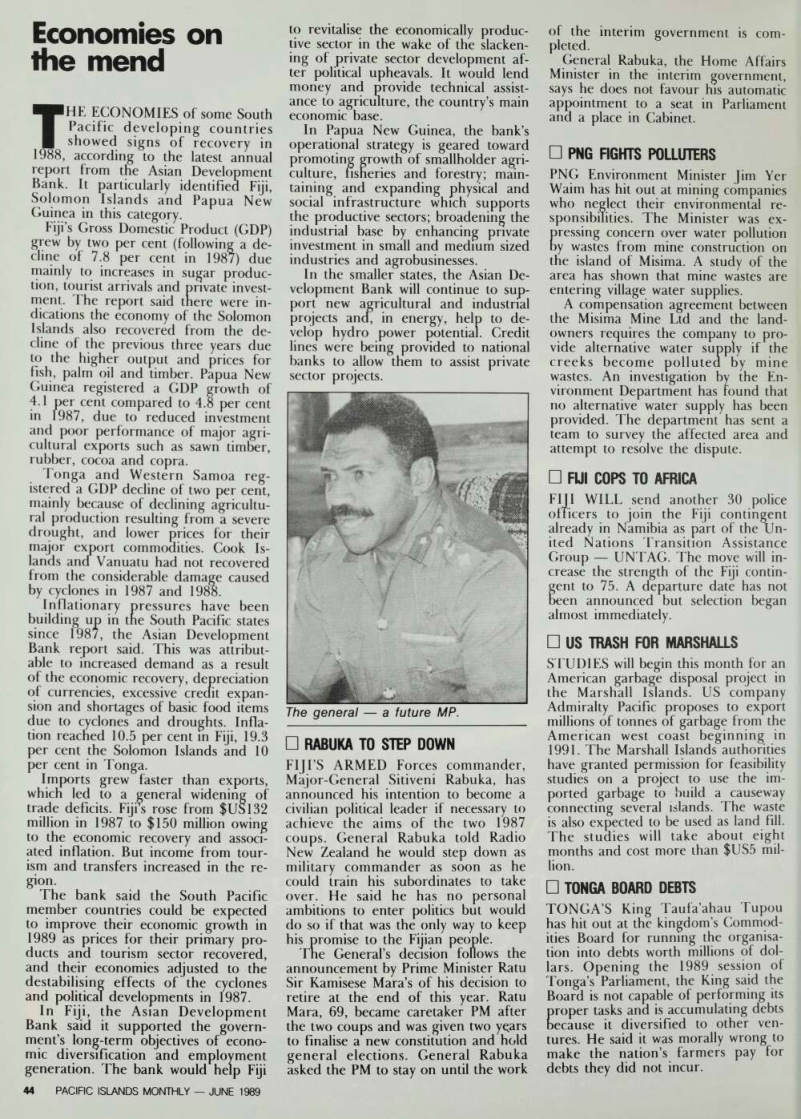
Economies on the mend
ECONOMIES of some South Pacific developing countries U showed signs of recovery in 1988, according to the latest annual report from the Asian Development Bank. It particularly identified Fiji, Solomon Islands and Papua New Guinea in this category.
Fiji’s Gross Domestic Product (GDP) grew by two per cent (following a de cline of 7,8 per cent in 198/) due mainly to increases in sugar produc tion, tourist arrivals and private invest ment. The report said there were in dications the economy of the Solomon Islands also recovered from the de cline of the previous three years due to the higher output and prices for fish, palm oil and timber. Papua New Guinea registered a GDP growth of 4.1 per cent compared to 4.8 per cent in 1987, due to reduced investment
and poor performance of major agri
cultural exports such as sawn timber, rubber, cocoa and copra.
Tonga and Western Samoa reg istered a GDP decline of two per cent,
mainly because of declining agricultu
ral production resulting from a severe drought, and lower prices for their major export commodities. Cook Is lands ana Vanuatu had not recovered from the considerable damage caused by cyclones in 1987 and 1988.
Inflationary pressures have been building up in the South Pacific states since 1987, the Asian Development Bank report said. This was attribut able to increased demand as a result of the economic recovery, depreciation of currencies, excessive creak expan sion and shortages of basic food items due to cyclones and droughts. Infla tion reached 10.5 per cent m Fiji, 19.3 per cent the Solomon Islands and 10 per cent in Tonga.
Imports grew faster than exports, which led to a general widening of trade deficits. Fiji s rose from |U§l32 million in 1987 to $l5O million owing to the economic recovery and associ ated inflation. But income from tour ism and transfers increased in the re
gion.
The bank said the South Pacific member countries could be expected to improve their economic growth in 1989 as prices for their primary pro ducts and tourism sector recovered, and their economies adjusted to the destabilising effects of the cyclones and political developments in 1987.
In Fiji, the Asian Development Bank said it supported the govern ment’s long-term objectives of econo mic diversification and employment
generation. The bank would help Fiji
to revitalise the economically produc tive sector in the wake of the slacken
ing of private sector development af
ter political upheavals. It would lend money and provide technical assist ance to agriculture, the country’s main economic base.
In Papua New Guinea, the bank’s operational strategy is geared toward promoting growth of smallholder agri culture, fisheries and forestry; main
taining and expanding physical and
social infrastructure which supports the productive sectors; broadening the industrial base by enhancing private investment in small and medium sized industries and agrobusinesses.
In the smaller states, the Asian De velopment Bank will continue to sup port new agricultural and industrial projects and, in energy, help to de
velop hydro power potential. Credit
lines were being provided to national banks to allow them to assist private
sector projects.
□ Rabuka To Step Down
FIJI’S ARMED Forces commander, Major-General Sitiveni Rabuka, has announced his intention to become a civilian political leader if necessary to achieve the aims of the two 1987 coups. General Rabuka told Radio New Zealand he would step down as military commander as soon as he could train his subordinates to take over. He said he has no personal ambitions to enter politics but would do so if that was the only way to keep
his promise to the Fijian people.
Trie General’s decision follows the announcement by Prime Minister Ratu Sir Kamisese Mara’s of his decision to retire at the end of this year. Ratu Mara, 69, became caretaker PM after the two coups and was given two to finalise a new constitution and hold general elections. General Rabuka asked the PM to stay on until the work
of the interim government is com
pleted.
General Rabuka, the Home Affairs Minister in the interim government, says he does not favour his automatic appointment to a seat in Parliament and a place in Cabinet.
□ Png Fights Polluters
PNG Environment Minister Jim Yer Waim has hit out at mining companies who neglect their environmental re sponsibilities. The Minister was ex pressing concern over water pollution by wastes from mine construction on the island of Misima. A study of the area has shown that mine wastes are
entering village water supplies.
A compensation agreement between the Misima Mine Ltd and the land owners requires the company to pro vide alternative water supply if the creeks become polluted by mine wastes. An investigation by the En vironment Department has found that no alternative water supply has been provided. The department has sent a team to survey the affected area and attempt to resolve the dispute.
□ Fui Cops To Africa
FIJI WILL send another 30 police
officers to join the Fiji contingent
already in Namibia as part of the Un ited Nations Transition Assistance Group UNTAG. The move will in crease the strength of the Fiji contin gent to 75. A departure date has not been announced but selection began
almost immediately.
□ Us Trash For Marshalls
STUDIES will begin this month for an
American garbage disposal project in
the Marshall Islands. US company Admiralty Pacific proposes to export millions of tonnes of garbage from the American west coast beginning in 1991. The Marshall Islands authorities
have granted permission for feasibility
studies on a project to use the im ported garbage to build a causeway connecting several islands. The waste is also expected to be used as land fill.
The studies will take about eight months and cost more than SUSS mil lion.
□ Tonga Board Debts
TONGA’S King Taufa’ahau Tupou
has hit out at the kingdom’s Commod ities Board for running the organisa tion into debts worth millions of dol lars. Opening the 1989 session of Tonga’s Parliament, the King said the Board is not capable of performing its proper tasks and is accumulating debts because it diversified to other ven tures. He said it was morally wrong to make the nation’s farmers pay for debts they did not incur.
The general - a future MP.
Advertisements & other items, p. 45 (1 item)
dreamers, too.
i* ■ ■ • . 5 : v ■ SS il £*«* Si : m
People said they were just
Flying is for the birds. So said the world when Orville and Wylbur decided to build their ‘flying machine’.
Much the same reaction greeted many of our endeavours over the past 20 years, and like the Wright Brothers, we didn’t give up either.
When our peers shook their heads and said it was impossible to successfully ship apples and pears to the United States or grapes to the United Kingdom; when they said frozen meat couldn’t be transported by rail across inland Australia or onions wouldn’t keep in containers on the open sea, ACTA proved them wrong.
Through innovative research and countless tests and trials, ACTA developed revolutionary new methods for the transport of perishable as well as general cargo.
And this unfailing dedication to excellence is still very much a part of our philosophy today.
At ACTA, we’re not just dreaming of the future.
We’re creating it.
ACTA PTY. LIMITED ACTA HOUSE 447 Kent St Sydney N.S.W. 2000 Phone {02)2660633 Fax (02)2671148 Telex 121369
ACT 003
The Island Press
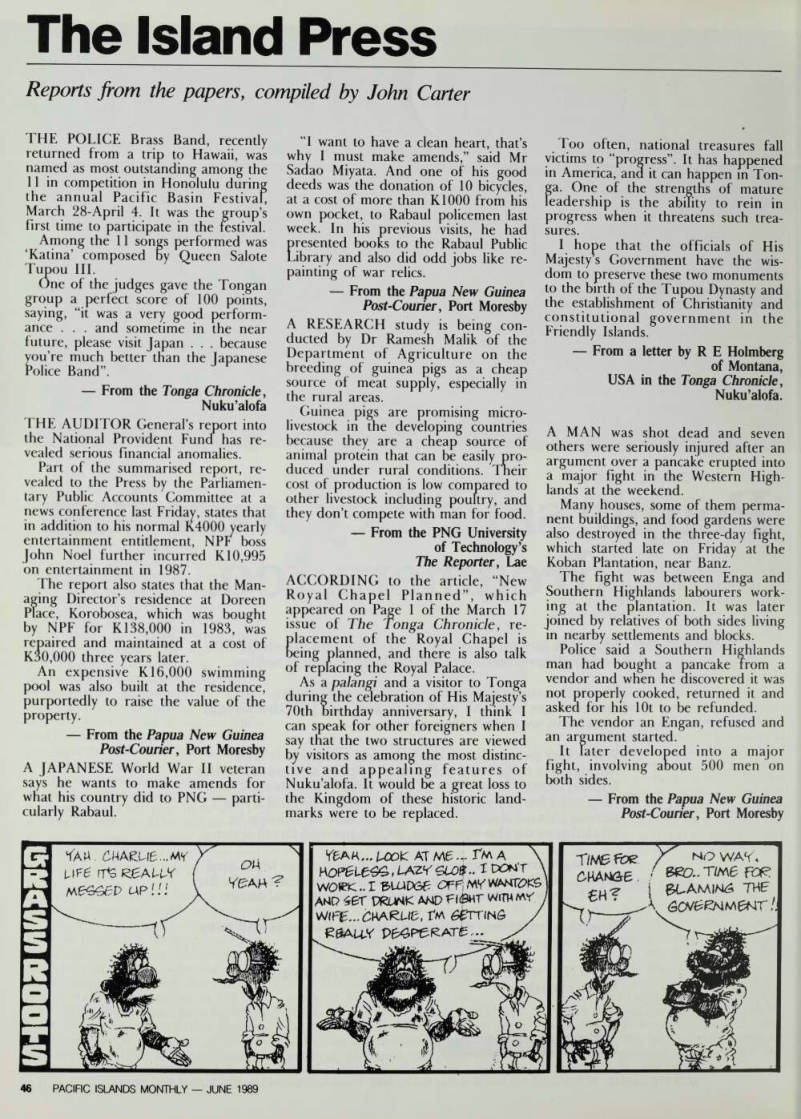
Reports from the papers, compiled
by John Carter
THE POLICE Brass Band, recently returned from a trip to Hawaii, was named as most outstanding among the 11 in competition in Honolulu during the annual Pacific Basin Festival, March 28-April 4. It was the group’s first time to participate in the festival.
Among the 11 songs performed was
‘Katina’ composed by Queen Salote
Tupou 111.
One of the judges gave the Tongan group a perfect score of 100 points, saying, “it was a very good perform ance . . . and sometime in the near future, please visit Japan . . . because you’re much better than the Japanese Police Band”.
From the Tonga Chronicle, Nuku’alofa THE AUDITOR General’s report into the National Provident Fund has re vealed serious financial anomalies.
Part of the summarised report, re vealed to the Press by the Parliamen tary Public Accounts Committee at a news conference last Friday, states that in addition to his normal K4OOO yearly entertainment entitlement, NPF boss John Noel further incurred K 10,995 on entertainment in 1987.
The report also states that the Man aging Director’s residence at Doreen Place, Korobosea, which was bought by NPF for K 138,000 in 1983, was repaired and maintained at a cost of k 30,000 three years later.
An expensive K 16,000 swimming pool was also built at the residence, purportedly to raise the value of the property.
From the Papua New Guinea Post-Courier, Port Moresby A JAPANESE World War II veteran says he wants to make amends for what his country did to PNG parti
cularly Rabaul.
“I want to have a clean heart, that’s why I must make amends,” said Mr Sadao Miyata. And one of his good deeds was the donation of 10 bicycles, at a cost of more than KlOOO from his own pocket, to Rabaul policemen last week. In his previous visits, he had presented books to the Rabaul Public Library and also did odd jobs like re painting of war relics.
From the Papua New Guinea Post-Courier, Port Moresby A RESEARCH study is being con ducted by Dr Ramesh Malik of the Department of Agriculture on the breeding of guinea pigs as a cheap source of meat supply, especially in the rural areas.
Guinea pigs are promising micro livestock in the developing countries because they are a cheap source of animal protein that can be easily pro duced under rural conditions. Their cost of production is low compared to other livestock including poultry, and they don’t compete with man for food.
From the PNG University of Technology’s The Reporter, Lae ACCORDING to the article, “New
Royal Chapel Planned”, which
appeared on Page 1 of the March 17 issue of The Tonga Chronicle, re
placement of the Royal Chapel is
being planned, and there is also talk of replacing the Royal Palace.
As a palangi and a visitor to Tonga during the celebration of His Majesty’s 70th birthday anniversary, I think I can speak for other foreigners when I say that the two structures are viewed by visitors as among the most distinc tive and appealing features of Nuku’alofa. It would be a great loss to the Kingdom of these historic land marks were to be replaced.
Too often, national treasures fall victims to “progress”. It has happened in America, and it can happen m Ton ga. One of the strengths of mature leadership is the ability to rein in progress when it threatens such trea sures.
I hope that the officials of His Majesty s Government have the wis dom to preserve these two monuments to the birth of the Tupou Dynasty and the establishment of Christianity and constitutional government in the
Friendly Islands.
From a letter by R E Holmberg of Montana, USA in the Tonga Chronicle, Nukualofa.
A MAN was shot dead and seven others were seriously injured after an argument over a pancake erupted into a major fight in the Western High lands at the weekend.
Many houses, some of them perma nent buildings, and food gardens were
also destroyed in the three-day fight,
which started late on Friday at the Koban Plantation, near Banz.
The fight was between Enga and Southern Highlands labourers work ing at the plantation. It was later joined by relatives of both sides living in nearby settlements and blocks.
Police said a Southern Highlands man had bought a pancake from a vendor and when he aiscovered it was not properly cooked, returned it and asked for his lOt to be refunded.
The vendor an Engan, refused and an argument started.
It later developed into a major
fight, involving about 500 men on
both sides.
From the Papua New Guinea Post-Courier, Port Moresby
Transition
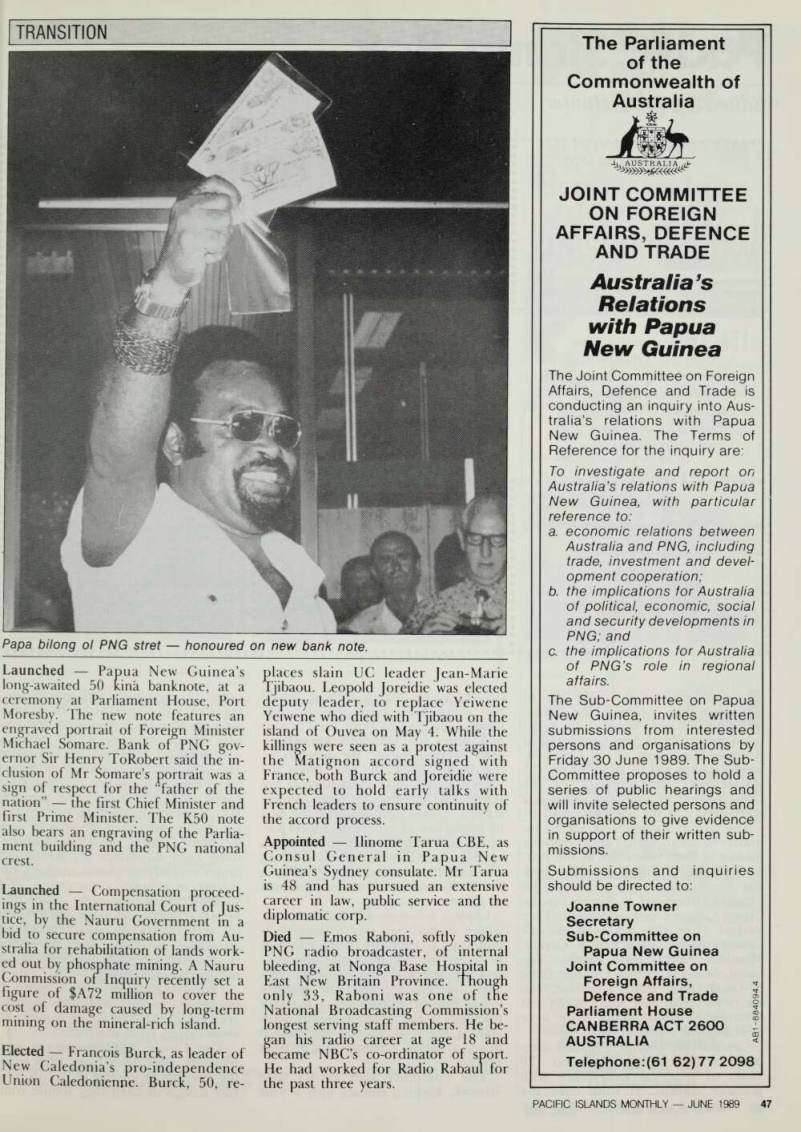
Launched Papua New Guinea’s long-awaited 50 tina banknote, at a ceremony at Parliament House, Port Moresby. The new note features an
engraved portrait of Foreign Minister
Michael Somare. Bank of PNG gov ernor Sir Henry Toßobert said the in clusion of Mr Somare’s portrait was a sign of respect for the of the nation” the first Chief Minister and first Prime Minister. The K5O note also bears an engraving of the Parlia ment building and the PNG national crest.
Launched Compensation proceed
ings in the International Court of Jus tice, by the Nauru Government m a bid to secure compensation from Au stralia for rehabilitation of lands work ed out by phosphate mining. A Nauru Commission of Inquiry recently set a figure of SA72 million to cover the
cost of damage caused by long-term
mining on the mineral-ricn island.
Elected Francois Burck, as leader of New Caledonia’s pro-independence Union Caledonienne. Burck, 50, re
places slain UC leader Jean-Marie
Tjibaou. Leopold Joreidie was elected
deputy leader, to replace Yeiwene Yeiwene who died with Tjibaou on the island of Ouvea on May 4. While the killings were seen as a protest against the Matignon accord signed with France, both Burck and Joreidie were expected to hold early talks with French leaders to ensure continuity of the accord process.
Appointed Ilinome Tarua CBE, as Consul General in Papua New Guinea’s Sydney consulate. Mr Tarua is 48 and has pursued an extensive career in law, public service and the
diplomatic corp.
Died Emos Raboni, softly spoken PNG radio broadcaster, of internal
bleeding, at Nonga Base Hospital in
East New Britain Province. Though only 33, Raboni was one of the National Broadcasting Commission’s longest serving staff members. He be gan his radio career at age 18 and became NBC’s co-ordinator of sport.
He had worked for Radio Rabaul for the past three years.
Papa bilong ol PNG stret - honoured on new bank note.
Advertisements & other items, p. 47 (1 item)
with Papua
The Parliament
of the
Commonwealth of
Australia
JOINT COMMITTEE
ON FOREIGN
AFFAIRS, DEFENCE
AND TRADE
Australia’s
Relations
with Papua
New Guinea
The Joint Committee on Foreign Affairs, Defence and Trade is conducting an inquiry into Australia’s relations with Papua New Guinea. The Terms of Reference for the inquiry are: To investigate and report on Australia’s relations with Papua New Guinea, with particular reference to: a. economic relations between Australia and PNG, including trade, investment and development cooperation; b. the implications for Australia of political, economic, social and security developments in PNG; and c. the implications for Australia of PNG’s role in regional affairs.
The Sub-Committee on Papua New Guinea, invites written submissions from interested persons and organisations by Friday 30 June 1989. The Subcommittee proposes to hold a series of public hearings and will invite selected persons and organisations to give evidence in support of their written submissions.
Submissions and inquiries should be directed to: Joanne Towner Secretary Sub-Committee on Papua New Guinea Joint Committee on Foreign Affairs, « Defence and Trade Parliament House S
CANBERRA ACT 2600 !
AUSTRALIA <
Telephone:(6l 62)77 2098
-^.AUSTRALIA
viwww .W///W
Pacific Stamp Box
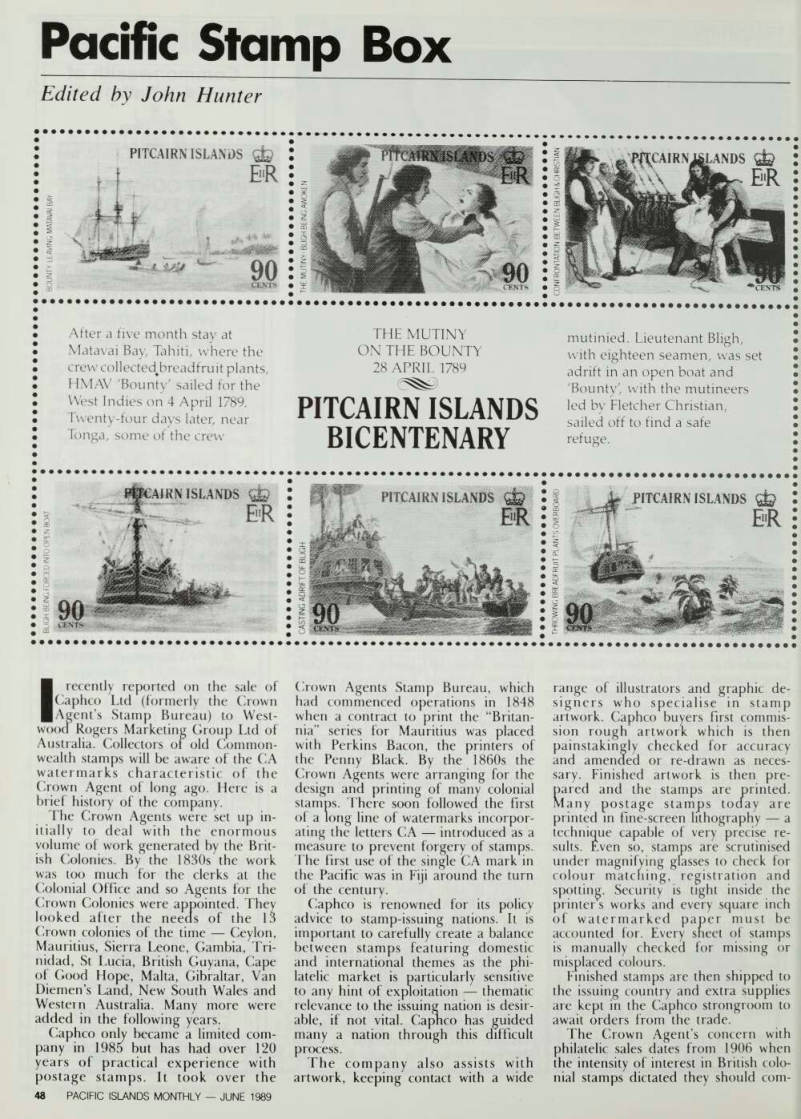
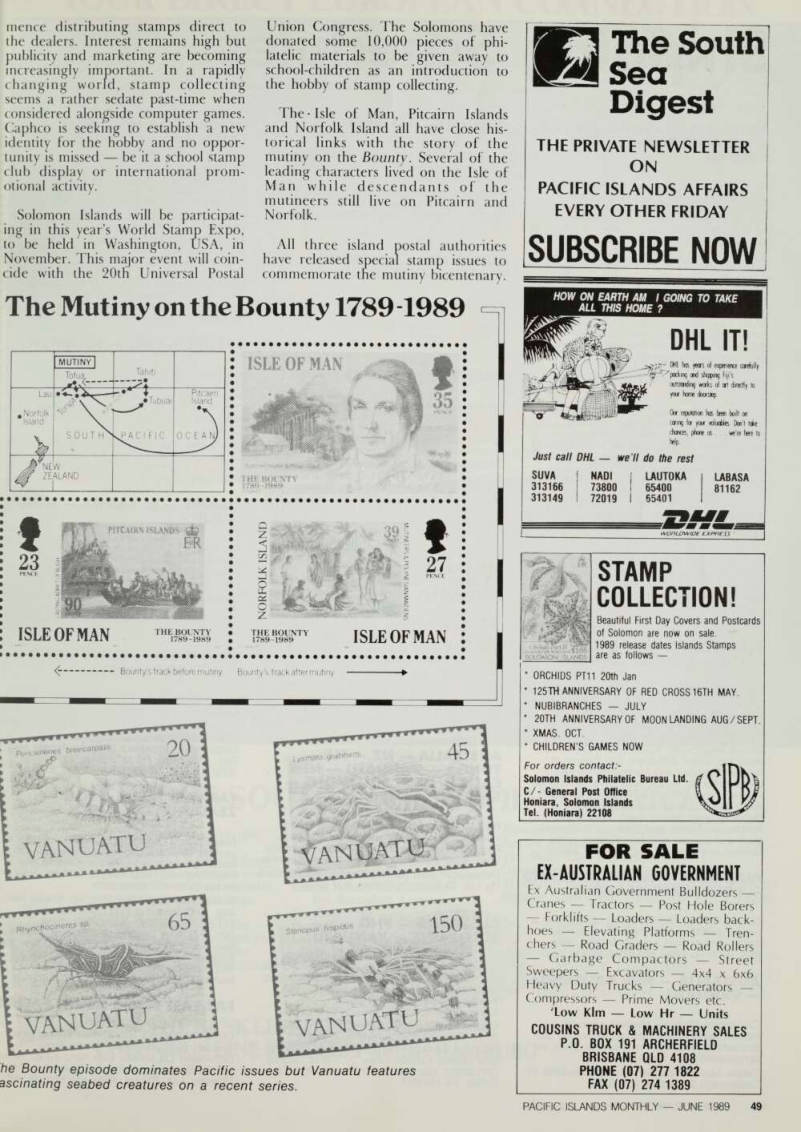
Edited by John Hunter
I recently reported on the sale of Caphco Ltd (formerly the Crown Agent’s Stamp Bureau) to West
wood Rogers Marketing Group Ltd of
Australia. Collectors of old Common wealth stamps will be aware of the CA watermarks characteristic of the Crown Agent of long ago. Here is a brief history of the company.
The Crown Agents were set up in itially to deal with the enormous volume of work generated by the Brit ish Colonies. By the 1830 s the work was too much for the clerks at the Colonial Office and so Agents for the Crown Colonies were appointed. They looked after the needs of the 13 Crown colonies of the time Ceylon, Mauritius, Sierra Leone, Gambia, Tri nidad, St Lucia, British Guyana, Cape of Good Hope, Malta, Gibraltar, Van Diemen’s Land, New South Wales and Western Australia. Many more were added in the following years.
Caphco only became a limited com pany in 1985 but has had over 120 years of practical experience with postage stamps. It took over the
Crown Agents Stamp Bureau, which had commenced operations in 1848 when a contract to print the “Britan nia” series for Mauritius was placed with Perkins Bacon, the printers of the Penny Black. By the 1860 s the Crown Agents were arranging for the design and printing of many colonial stamps. There soon follower! the first of a long line of watermarks incorpor ating the letters CA introduced as a measure to prevent forgery of stamps.
The first use of the single CA mark in the Pacific was in Fiji around the turn of the century.
Caphco is renowned for its policy advice to stamp-issuing nations. It is important to carefully create a balance between stamps featuring domestic and international themes as the phi latelic market is particularly sensitive to any hint of exploitation thematic relevance to the issuing nation is desir able, if not vital. Capnco has guided many a nation through this difficult process.
The company also assists with artwork, keeping contact with a wide
range of illustrators and graphic de signers who specialise in stamp artwork. Caphco buyers first commis sion rough artwork which is then painstakingly checked for accuracy and amended or re-drawn as neces sary. Finished artwork is then pre pared and the stamps are printed.
Many postage stamps today are printed m fine-screen lithography a
technique capable of very precise re
sults. Even so, stamps are scrutinised under magnifying glasses to check for
colour matcning, registration and
spotting. Security is tight inside the
printers works and every square inch of watermarked paper must be accounted for. Every street of stamps is manually checked for missing or
misplaced colours.
Finished stamps are then shipped to the issuing country and extra supplies are kept in the Caphco strongroom to await orders from the trade.
The Crown Agent’s concern with philatelic sales dates from 1906 when the intensity of interest in British colo nial stamps dictated they should com
mence distributing stamps direct to the dealers. Interest remains high but
publicity and marketing are becoming
increasingly important. In a rapidly
changing world, stamp collecting
seems a rather sedate past-time when considered alongside computer games.
Caphco is seeking to establish a new identity for the hobby and no oppor tunity is missed be it a school stamp club display or international prom
otional activity.
Solomon Islands will be participat ing in this year’s World Stamp Expo, to be held in Washington, USA, in November. This major event will coin cide with the 20th Universal Postal
Union Congress. The Solomons have donated some 10,000 pieces of phi latelic materials to be given away to school-children as an introduction to the hobby of stamp collecting.
The • Isle of Man, Pitcairn Islands and Norfolk Island all have close his torical links with the story of the mutiny on the Bounty. Several of the leading characters lived on the Isle of Man while descendants of the mutineers still live on Pitcairn and Norfolk.
All three island postal authorities have released special stamp issues to
commemorate the mutiny bicentenary.
Advertisements & other items, p. 49 (1 item)
BThe South
Sea
■ JL
THE PRIVATE NEWSLETTER
ON
PACIFIC ISLANDS AFFAIRS
EVERY OTHER FRIDAY
SUBSCRIBE NOW
HOW ON EARTH AM I GOING TO TAKE
ALL THIS HOME ?
o
DHL IT!
DHL has years of experience carefully ==W = V’’pocking and shipping Fiji's outstanding worts of art directly to your home doorstep ftjr reputation has been built on coring for your valuables. Don't idee chances, phone us we re here to help Just call DHL we 'II do the rest
SUVA
313166 313149
NADI I LAUTOKA
73800 i 65400 72019 I 65401
LABASA
81162
WORLDWIDE EXPRESS
STAMP
COLLECTION!
Beautiful First Day Covers and Postcards of Solomon are now on sale. 1989 release dates Islands Stamps are as follows
* ORCHIDS PTII 20th Jan
* 125TH ANNIVERSARY OF RED CROSS 16TH MAY.
* NUBIBRANCHES JULY
* 20TH ANNIVERSARY OF MOON LANDING AUG/SEPT.
* XMAS. OCT.
* CHILDREN’S GAMES NOW
For orders contact Solomon Islands Philatelic Bureau Ltd.
C/- General Post Office Honiara, Solomon Islands Tel. (Honiara) 22108
FOR SALE
EX-AUSTRALIAN GOVERNMENT
Ex Australian Government Bulldozers Cranes Tractors Post Hole Borers Forklifts Loaders Loaders backhoes Elevating Platforms Trenchers Road Graders Road Rollers Garbage Compactors Street Sweepers Excavators 4x4 x 6x6 Heavy Duty Trucks Generators Compressors Prime Movers etc.
Low Kim Low Hr Units
COUSINS TRUCK & MACHINERY SALES
P.O. BOX 191 ARCHERFIELD
BRISBANE OLD 4108
PHONE (07) 277 1822
FAX (07) 274 1389
Shipping Schedules
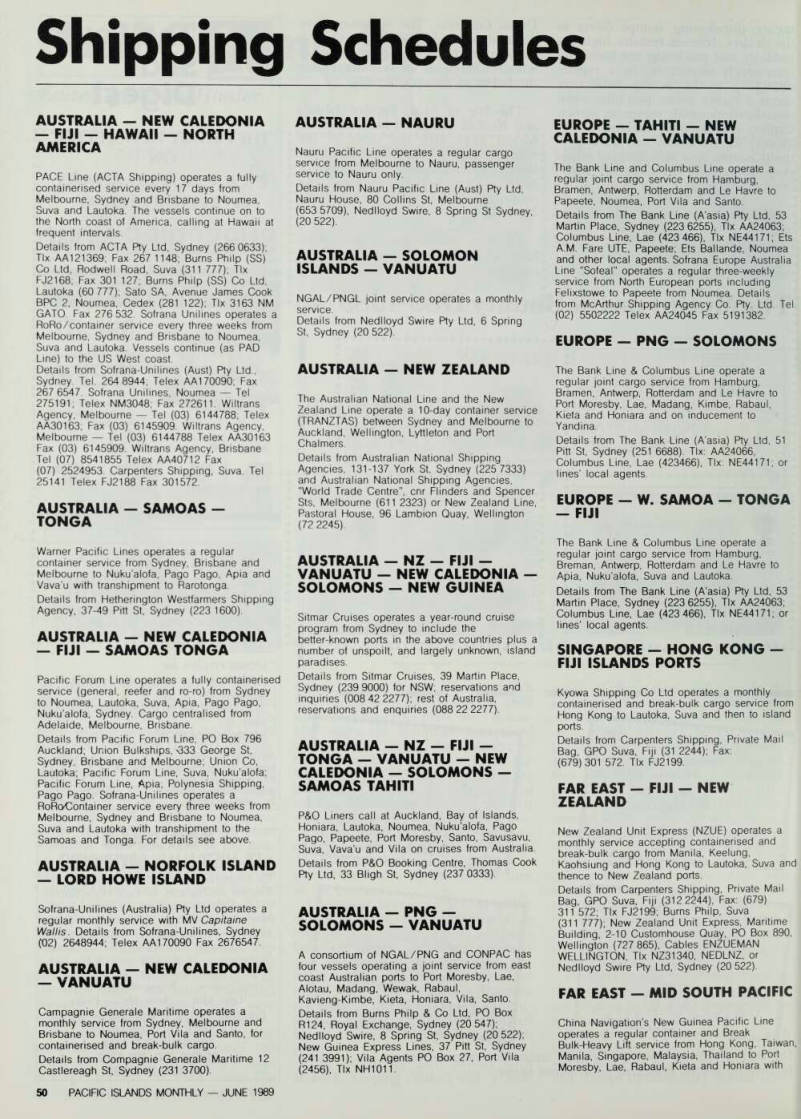
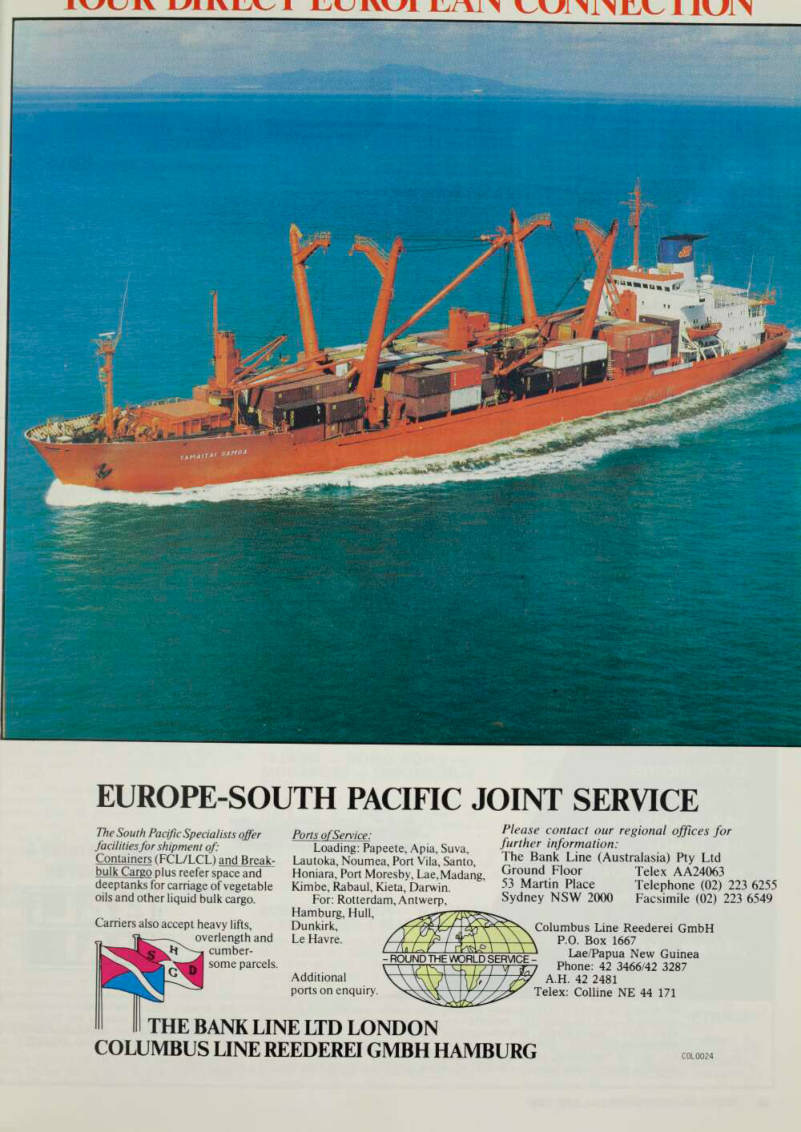
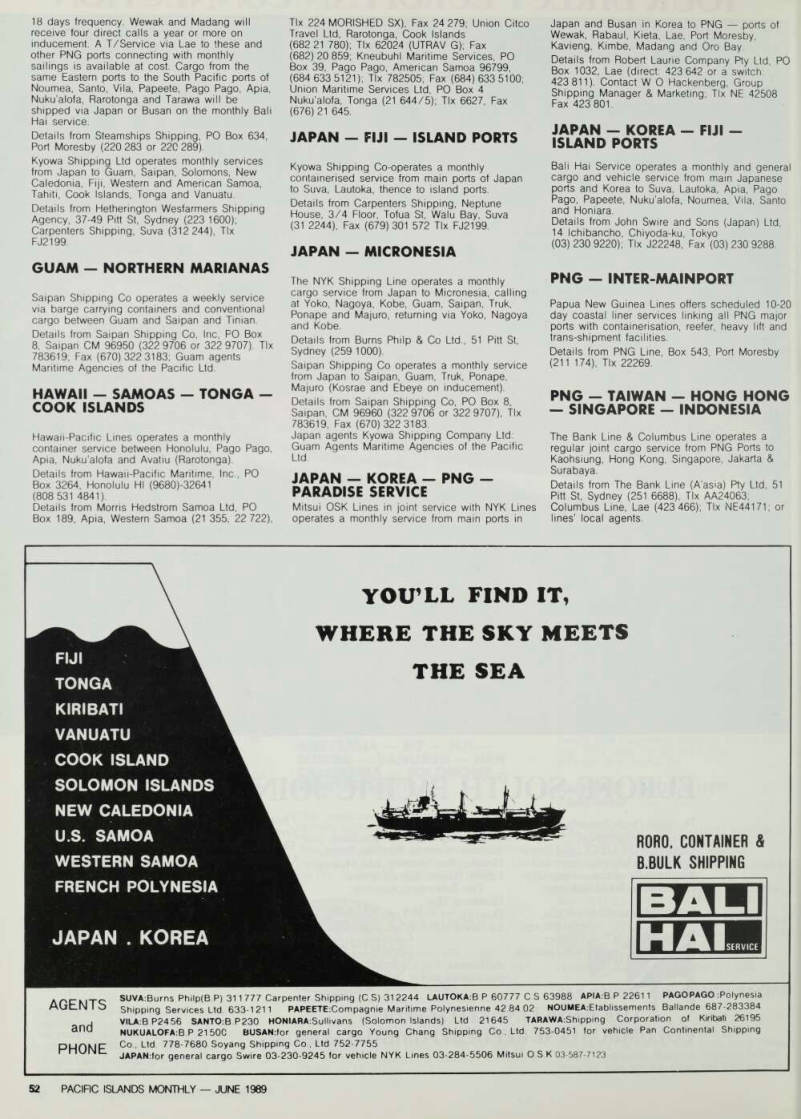
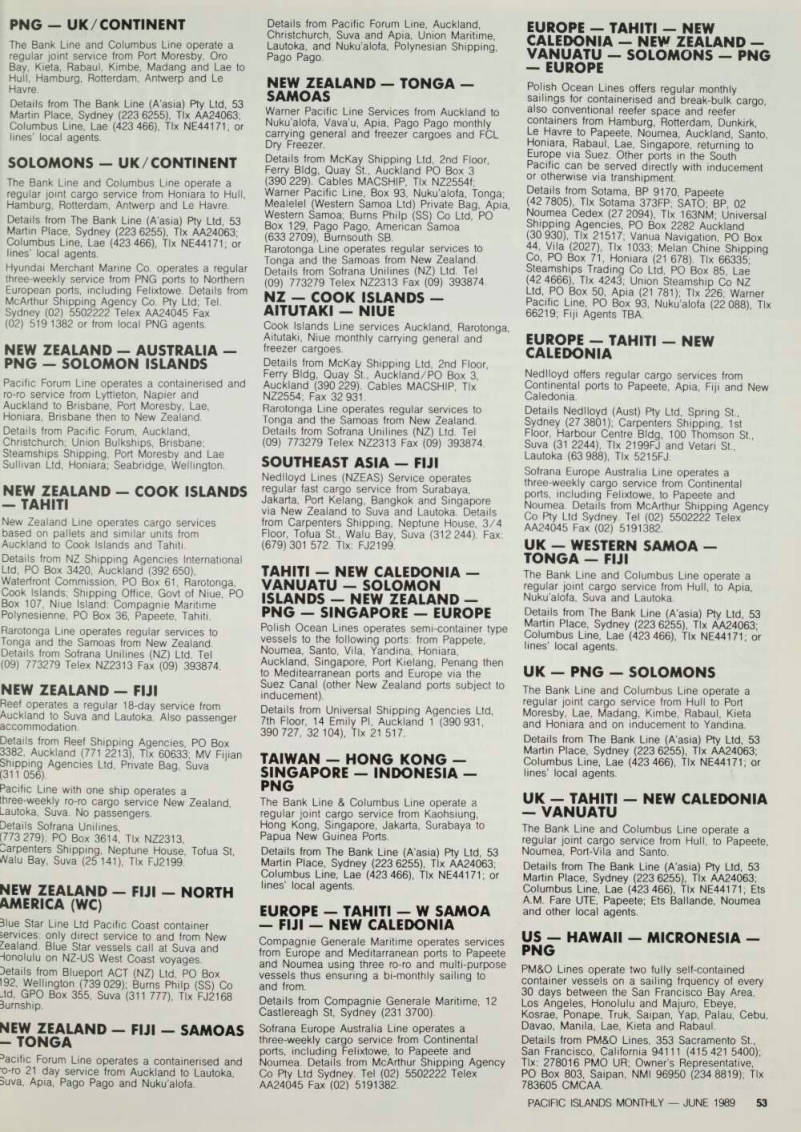
Australia New Caledonia
Fiji - Hawaii North
America
PACE Line (ACTA Shipping) operates a fully containerised service every 17 days from Melbourne, Sydney and Brisbane to Noumea, Suva and Lautoka. The vessels continue on to the North coast of America, calling at Hawaii at frequent intervals.
Details from ACTA Pty Ltd. Sydney (266 0633); Tlx AA121369; Fax 267 1148; Burns Philp (SS) Co Ltd, Rodwell Road, Suva (311 777); Tlx FJ2168; Fax 301 127; Burns Philp (SS) Co Ltd, Lautoka (60 777); Sato SA. Avenue James Cook BPC 2. Noumea, Cedex (281 122); Tlx 3163 NM GATO. Fax 276 532. Sofrana Unilines operates a Roßo/container service every three weeks from Melbourne, Sydney and Brisbane to Noumea, Suva and Lautoka. Vessels continue (as PAD Line) to the US West coast.
Details from Sofrana-Unilines (Aust) Pty Ltd., Sydney. Tel. 264 8944; Telex AA170090; Fax 267 6547. Sofrana Unilines, Noumea Tel 275191; Telex NM3048; Fax 272611. Wiltrans Agency, Melbourne Tel (03) 6144788; Telex AA30163; Fax (03) 6145909. Wiltrans Agency, Melbourne Tel (03) 6144788 Telex AA30163 Fax (03) 6145909. Wiltrans Agency, Brisbane Tel (07) 8541855 Telex AA40712 Fax (07) 2524953. Carpenters Shipping, Suva. Tel 25141 Telex FJ2IBB Fax 301572.
Australia - Samoas
Tonga
Warner Pacific Lines operates a regular container service from Sydney, Brisbane and Melbourne to Nuku’alofa, Pago Pago, Apia and Vava’u with transhipment to Rarotonga.
Details from Hetherington Westfarmers Shipping Agency, 37-49 Pitt St, Sydney (223 1600).
Australia - New Caledonia
Fiji Samoas Tonga
Pacific Forum Line operates a fully containerised service (general, reefer and ro-ro) from Sydney to Noumea, Lautoka, Suva, Apia, Pago Pago, Nuku’alofa, Sydney. Cargo centralised from Adelaide, Melbourne, Brisbane.
Details from Pacific Forum Line, PO Box 796 Auckland; Union Bulkships, <333 George St, Sydney, Brisbane and Melbourne; Union Co, Lautoka; Pacific Forum Line, Suva, Nuku’alofa; Pacific Forum Line, Apia; Polynesia Shipping, Pago Pago. Sofrana-Unilines operates a RoßoContainer service every three weeks from Melbourne, Sydney and Brisbane to Noumea, Suva and Lautoka with transhipment to the Samoas and Tonga. For details see above.
Australia Norfolk Island
Lord Howe Island
Sofrana-Unilines (Australia) Pty Ltd operates a regular monthly service with MV Capitaine Wallis. Details from Sofrana-Unilines, Sydney (02) 2648944; Telex AA170090 Fax 2676547,
Australia - New Caledonia
Vanuatu
Campagnie Generate Maritime operates a monthly service from Sydney, Melbourne and Brisbane to Noumea, Port Vila and Santo, for containerised and break-bulk cargo.
Details from Compagnie Generate Maritime 12 Castlereagh St, Sydney (231 3700).
Australia Nauru
Nauru Pacific Line operates a regular cargo service from Melbourne to Nauru, passenger service to Nauru only.
Details from Nauru Pacific Line (Aust) Pty Ltd, Nauru House, 80 Collins St, Melbourne (653 5709), Nedlloyd Swire, 8 Spring St Sydney, (20 522).
Australia - Solomon
Islands Vanuatu
NGAL/PNGL joint service operates a monthly service.
Details from Nedlloyd Swire Pty Ltd, 6 Spring St. Sydney (20 522).
Australia - New Zealand
The Australian National Line and the New Zealand Line operate a 10-day container service (TRANZTAS) between Sydney and Melbourne to Auckland, Wellington, Lyttleton and Port Chalmers.
Details from Australian National Shipping Agencies, 131-137 York St, Sydney (225 7333) and Australian National Shipping Agencies, “World Trade Centre”, cnr Flinders and Spencer Sts, Melbourne (611 2323) or New Zealand Line, Pastoral House, 96 Lambion Quay, Wellington (72 2245).
Australia Nz Fiji
Vanuatu - New Caledonia
Solomons - New Guinea
Sitmar Cruises operates a year-round cruise program from Sydney to include the better-known ports in the above countries plus a number of unspoilt, and largely unknown, island paradises.
Details from Sitmar Cruises, 39 Martin Place, Sydney (239 9000) for NSW; reservations and inquiries (008 42 2277); rest of Australia, reservations and enquiries (088 22 2277).
Australia Nz Fiji
Tonga Vanuatu - New
Caledonia Solomons
Samoas Tahiti
P&O Liners call at Auckland, Bay of Islands, Honiara, Lautoka, Noumea, Nuku’alofa, Pago Pago, Papeete, Port Moresby, Santo, Savusavu, Suva, Vava’u and Vila on cruises from Australia.
Details from P&O Booking Centre, Thomas Cook Pty Ltd, 33 Bligh St, Sydney (237 0333).
Australia Png
Solomons Vanuatu
A consortium of NGAL/PNG and CONPAC has four vessels operating a joint service from east coast Australian ports to Port Moresby, Lae.
Alotau, Madang, Wewak, Rabaul, Kavieng-Kimbe, Kieta, Honiara, Vila, Santo.
Details from Burns Philp & Co Ltd, PO Box R 124, Royal Exchange, Sydney (20 547); Nedlloyd Swire, 8 Spring St, Sydney (20 522); New Guinea Express Lines, 37 Pitt St, Sydney (241 3991); Vila Agents PO Box 27, Port Vila
(2456), Tlx Nhioii.
Europe Tahiti New
Caledonia Vanuatu
The Bank Line and Columbus Line operate a regular joint cargo service from Hamburg, Bramen, Antwerp, Rotterdam and Le Havre to Papeete, Noumea, Port Vila and Santo.
Details from The Bank Line (A’asia) Pty Ltd, 53 Martin Place, Sydney (223 6255), Tlx AA24063; Columbus Line, Lae (423 466), Tlx NE44171; Ets A.M. Fare LITE, Papeete; Ets Ballande, Noumea and other local agents. Sofrana Europe Australia Line “Sofeal” operates a regular three-weekly service from North European ports including Felixstowe to Papeete from Noumea. Details from McArthur Shipping Agency Co. Pty. Ltd. Tel (02) 5502222 Telex AA24045 Fax 5191382.
Europe - Png - Solomons
The Bank Line & Columbus Line operate a regular joint cargo service from Hamburg, Bramen, Antwerp, Rotterdam and Le Havre to Port Moresby, Lae, Madang, Kimbe, Rabaul, Kieta and Honiara and on inducement to Yandina.
Details from The Bank Line (A’asia) Pty Ltd, 51 Pitt St, Sydney (251 6688). Tlx: AA24066, Columbus Line, Lae (423466), Tlx: NE44171; or lines’ local agents.
Europe W. Samoa Tonga
Fiji
The Bank Line & Columbus Line operate a regular joint cargo service from Hamburg, Breman, Antwerp, Rotterdam and Le Havre to Apia, Nuku’alofa, Suva and Lautoka.
Details from The Bank Line (A’asia) Pty Ltd, 53 Martin Place, Sydney (223 6255), Tlx AA24063; Columbus Line, Lae (423 466), Tlx NE44171; or lines’ local agents.
Singapore Hong Kong
Fiji Islands Ports
Kyowa Shipping Co Ltd operates a monthly containerised and break-bulk cargo service from Hong Kong to Lautoka, Suva and then to island ports.
Details from Carpenters Shipping, Private Mail Bag, GPO Suva, Fiji (31 2244); Fax: (679)301 572. Tlx FJ2199.
Far East Fiji New
Zealand
New Zealand Unit Express (NZUE) operates a monthly service accepting containerised and break-bulk cargo from Manila, Keelung, Kaohsiung and Hong Kong to Lautoka, Suva and thence to New Zealand ports.
Details from Carpenters Shipping, Private Mail Bag, GPO Suva, Fiji (312 2244), Fax: (679) 311 572; Tlx FJ2199; Burns Philp, Suva (311 777); New Zealand Unit Express, Maritime Building, 2-10 Customhouse Quay, PO Box 890, Wellington (727 865), Cables ENZUEMAN
Wellington, Tlx Nz31340, Nedlnz, Or
Nedlloyd Swire Pty Ltd, Sydney (20 522).
Far East Mid South Pacific
China Navigation’s New Guinea Pacific Line operates a regular container and Break Bulk-Heavy Lift service from Hong Kong, Taiwan, Manila, Singapore, Malaysia, Thailand to Port Moresby, Lae, Rabaul, Kieta and Honiara with
18 days frequency. Wewak and Madang will receive four direct calls a year or more on inducement. A T/Service via Lae to these and other PNG ports connecting with monthly sailings is available at cost. Cargo from the same Eastern ports to the South Pacific ports of Noumea, Santo, Vila, Papeete, Pago Pago, Apia, Nukualofa, Rarotonga and Tarawa will be shipped via Japan or Busan on the monthly Bali Hai service.
Details from Steamships Shipping, PO Box 634, Port Moresby (220 283 or 22C 289).
Kyowa Shipping Ltd operates monthly services from Japan to Guam, Saipan, Solomons, New Caledonia, Fiji, Western and American Samoa, Tahiti, Cook Islands, Tonga and Vanuatu.
Details from Hetherington Wesfarmers Shipping Agency, 37-49 Pitt St, Sydney (223 1600); Carpenters Shipping. Suva (312 244), Tlx FJ2199.
Guam Northern Marianas
Saipan Shipping Co operates a weekly service via barge carrying containers and conventional cargo between Guam and Saipan and Tinian.
Details from Saipan Shipping Co, Inc, PO Box 8, Saipan CM 96950 (322 9706 or 322 9707). Tlx 783619; Fax (670)322 3183; Guam agents Maritime Agencies of the Pacific Ltd.
Hawaii Samoas Tonga
Cook Islands
Hawaii-Pacific Lines operates a monthly container service between Honolulu, Pago Pago, Apia, Nukualofa and Avatiu (Rarotonga).
Details from Hawaii-Pacific Maritime, Inc., PO Box 3264, Honolulu HI (9680)-32641 (808 531 4841).
Details from Morris Hedstrom Samoa Ltd, PO Box 189, Apia, Western Samoa (21 355, 22 722),
Tlx 224 MORISHED SX), Fax 24 279; Union Citco Travel Ltd, Rarotonga, Cook Islands (682 21 780); Tlx 62024 (UTRAV G); Fax (682) 20 859; Kneubuhl Maritime Services, PO Box 39, Pago Pago, American Samoa 96799, (684 633 5121); Tlx 782505; Fax (684)633 5100; Union Maritime Services Ltd, PO Box 4 Nukualofa, Tonga (21 644 / 5); Tlx 6627, Fax (676) 21 645.
Japan Fiji Island Ports
Kyowa Shipping Co-operates a monthly containerised service from main ports of Japan to Suva, Lautoka, thence to island ports.
Details from Carpenters Shipping, Neptune House, 3/4 Floor, Tofua St, Walu Bay, Suva (31 2244), Fax (679) 301 572 Tlx FJ2199.
Japan Micronesia
The NYK Shipping Line operates a monthly cargo service from Japan to Micronesia, calling at Yoko, Nagoya, Kobe, Guam, Saipan, Truk, Ponape and Majuro, returning via Yoko, Nagoya and Kobe.
Details from Burns Philp & Co Ltd., 51 Pitt St, Sydney (259 1000).
Saipan Shipping Co operates a monthly service from Japan to Saipan, Guam, Truk, Ponape, Majuro (Kosrae and Ebeye on inducement).
Details from Saipan Shipping Co, PO Box 8, Saipan, CM 96960 (322 9706 or 322 9707), Tlx 783619, Fax (670)322 3183.
Japan agents Kyowa Shipping Company Ltd: Guam Agents Maritime Agencies of the Pacific Ltd.
Japan Korea - Png
Paradise Service
Mitsui OSK Lines in joint service with NYK Lines operates a monthly service from main ports in
Japan and Busan in Korea to PNG ports of Wewak, Rabaul, Kieta, Lae, Port Moresby, Kavieng, Kimbe, Madang and Oro Bay Details from Robert Laurie Company Pty Ltd, PO Box 1032, Lae (direct; 423 642 or a switch: 423 811). Contact W 0 Hackenberg, Group Shipping Manager & Marketing; Tlx NE 42508 Fax 423 801,
Japan - Korea Fiji -
Island Ports
Bali Hai Service operates a monthly and general cargo and vehicle service from main Japanese ports and Korea to Suva, Lautoka, Apia, Pago Pago, Papeete, Nukualofa, Noumea, Vila, Santo and Honiara.
Details from John Swire and Sons (Japan) Ltd, 14 Ichibancho, Chiyoda-ku, Tokyo (03) 230 9220); Tlx J 22248, Fax (03) 230 9288.
Png Inter-Mainport
Papua New Guinea Lines offers scheduled 10-20 day coastal liner services linking all PNG major ports with containerisation, reefer, heavy lift and trans-shipment facilities.
Details from PNG Line, Box 543, Port Moresby (211 174), Tlx 22269.
Png - Taiwan - Hong Hong
- Singapore - Indonesia
The Bank Line & Columbus Line operates a regular joint cargo service from PNG Ports to Kaohsiung, Hong Kong, Singapore, Jakarta & Surabaya.
Details from The Bank Line (A’asia) Pty Ltd, 51 Pitt St, Sydney (251 6688), Tlx AA24063; Columbus Line, Lae (423 466); Tlx NE44171; or lines’ local agents.
Png Uk/Continent
The Bank Line and Columbus Line operate a regular joint service from Port Moresby, Oro Bay, Kieta, Rabaul, Kimbe, Madang and Lae to Hull, Hamburg, Rotterdam, Antwerp and Le Havre.
Details from The Bank Line (A’asia) Pty Ltd, 53 Martin Place, Sydney (223 6255), Tlx AA24063; Columbus Line, Lae (423 466), Tlx NE44171, or lines’ local agents.
Solomons - Uk/Continent
The Bank Line and Columbus Line operate a regular joint cargo service from Honiara to Hull, Hamburg, Rotterdam, Antwerp and Le Havre.
Details from The Bank Line (A’asia) Pty Ltd, 53 Martin Place, Sydney (223 6255), Tlx AA24063; Columbus Line, Lae (423 466), Tlx NE44171; or lines’ local agents.
Hyundai Merchant Marine Co. operates a regular three-weekly service from PNG ports to Northern European ports, including Felixtowe. Details from McArthur Shipping Agency Co. Pty Ltd; Tel.
Sydney (02) 5502222 Telex AA24045 Fax (02) 519 1382 or from local PNG agents.
New Zealand - Australia -
Png - Solomon Islands
Pacific Forum Line operates a containerised and ro-ro service from Lyttleton, Napier and Auckland to Brisbane, Port Moresby, Lae, Honiara, Brisbane then to New Zealand.
Details from Pacific Forum, Auckland, Christchurch; Union Bulkships, Brisbane; Steamships Shipping, Port Moresby and Lae Sullivan Ltd, Honiara; Seabridge, Wellington.
New Zealand Cook Islands
Tahiti
New Zealand Line operates cargo services based on pallets and similar units from Auckland to Cook Islands and Tahiti.
Details from NZ Shipping Agencies International Ltd, PO Box 3420, Auckland (392 650), Waterfront Commission, PO Box 61, Rarotonga, Cook Islands; Shipping Office, Govt of Niue, PO Box 107, Niue Island: Compagnie Maritime Polynesienne, PO Box 36, Papeete, Tahiti.
Rarotonga Line operates regular services to Tonga and the Samoas from New Zealand.
Details from Sofrana Uni lines (NZ) Ltd. Tel (09) 773279 Telex NZ2313 Fax (09) 393874.
New Zealand Fiji
Reef operates a regular 18-day service from Auckland to Suva and Lautoka. Also passenger accommodation.
Details from Reef Shipping Agencies, PO Box 3382, Auckland (771 2213), Tlx 60633; MV Fijian Shipping Agencies Ltd, Private Bag, Suva (311 056).
Pacific Line with one ship operates a three-weekly ro-ro cargo service New Zealand, Lautoka, Suva. No passengers.
Details Sofrana Unilines, [773 279); PO Box 3614, Tlx NZ2313, Darpenters Shipping, Neptune House, Tofua St, Walu Bay, Suva (25141), Tlx FJ2199.
New Zealand Fiji North
America (Wc)
Blue Star Line Ltd Pacific Coast container services: only direct service to and from New Zealand. Blue Star vessels call at Suva and Honolulu on NZ-US West Coast voyages.
Details from Blueport ACT (NZ) Ltd, PO Box 1 92, Wellington (739 029); Burns Philp (SS) Co _td, GPO Box 355, Suva (311 777), Tlx FJ2168 Burnship.
New Zealand Fiji Samoas
- Tonga
Pacific Forum Line operates a containerised and p-ro 21 day service from Auckland to Lautoka, Suva, Apia, Pago Pago and Nuku'alofa.
Details from Pacific Forum Line, Auckland, Christchurch, Suva and Apia, Union Maritime, Lautoka, and Nukualofa, Polynesian Shipping, Pago Pago.
New Zealand Tonga
Samoas
Warner Pacific Line Services from Auckland to Nukualofa, Vava'u, Apia, Pago Pago monthly carrying general and freezer cargoes and FCL Dry Freezer.
Details from McKay Shipping Ltd, 2nd Floor, Ferry Bldg, Quay St., Auckland PO Box 3 (390 229). Cables MACSHIP, Tlx NZ2554f; Warner Pacific Line, Box 93, Nuku’alofa, Tonga; Mealelel (Western Samoa Ltd) Private Bag, Apia, Western Samoa; Burns Phi Ip (SS) Co Ltd, PO Box 129, Pago Pago, American Samoa (633 2709), Burnsouth SB.
Rarotonga Line operates regular services to Tonga and the Samoas from New Zealand.
Details from Sofrana Unilines (NZ) Ltd. Tel (09) 773279 Telex NZ2313 Fax (09) 393874.
Nz Cook Islands
Aitutaki Niue
Cook Islands Line services Auckland, Rarotonga, Aitutaki, Niue monthly carrying general and freezer cargoes.
Details from McKay Shipping Ltd, 2nd Floor, Ferry Bldg, Quay St., Auckland/PO Box 3, Auckland (390 229). Cables MACSHIP, Tlx NZ2554; Fax 32 931, Rarotonga Line operates regular services to Tonga and the Samoas from New Zealand.
Details from Sofrana Unilines (NZ) Ltd. Tel (09) 773279 Telex NZ2313 Fax (09) 393874.
Southeast Asia Fiji
Nedlloyd Lines (NZEAS) Service operates regular fast cargo service from Surabaya, Jakarta, Port Kelang, Bangkok and Singapore via New Zealand to Suva and Lautoka. Details from Carpenters Shipping, Neptune House, 3/4 Floor, Tofua St., Walu Bay, Suva (312 244). Fax: (679)301 572. Tlx: FJ2199.
Tahiti - New Caledonia
Vanuatu - Solomon
Islands - New Zealand
Png Singapore - Europe
Polish Ocean Lines operates semi-container type vessels to the following ports: from Pappete, Noumea, Santo, Vila, Yandina, Honiara, Auckland, Singapore, Port Kielang, Penang then to Meditearranean ports and Europe via the Suez Canal (other New Zealand ports subject to inducement).
Details from Universal Shipping Agencies Ltd, 7th Floor, 14 Emily PI, Auckland 1 (390 931, 390 727, 32 104), Tlx 21 517.
Taiwan Hong Kong
Singapore Indonesia
Png
The Bank Line & Columbus Line operate a regular joint cargo service from Kaohsiung, Hong Kong, Singapore, Jakarta, Surabaya to Papua New Guinea Ports.
Details from The Bank Line (A’asia) Pty Ltd, 53 Martin Place, Sydney (223 6255), Tlx AA24063; Columbus Line, Lae (423 466), Tlx NE44171; or lines’ local agents.
Europe Tahiti - W Samoa
Fiji New Caledonia
Compagnie Generale Maritime operates services from Europe and Mediterranean ports to Papeete and Noumea using three ro-ro and multi-purpose vessels thus ensuring a bi-monthly sailing to and from.
Details from Compagnie Generale Maritime, 12 Castlereagh St, Sydney (231 3700).
Sofrana Europe Australia Line operates a three-weekly cargo service from Continental ports, including Felixtowe, to Papeete and Noumea. Details from McArthur Shipping Agency Co Pty Ltd Sydney. Tel (02) 5502222 Telex AA24045 Fax (02) 5191382.
Europe Tahiti New
Caledonia New Zealand
Vanuatu Solomons Png
Europe
Polish Ocean Lines offers regular monthly sailings for containerised and break-bulk cargo, also conventional reefer space and reefer containers from Hamburg, Rotterdam, Dunkirk.
Le Havre to Papeete, Noumea, Auckland, Santo, Honiara, Rabaul, Lae, Singapore, returning to Europe via Suez. Other ports in the South Pacific can be served directly with inducement or otherwise via transhipment.
Details from Sotama, BP 9170, Papeete (42 7805), Tlx Sotama 373FP; SATO; BP 02 Noumea Cedex (27 2094), Tlx 163 NM; Universal Shipping Agencies, PO Box 2282 Auckland (30 930), Tlx 21517; Vanua Navigation, PO Box 44, Vila (2027), Tlx 1033; Melan Chine Shipping Co, PO Box 71, Honiara (21 678). Tlx 66335; Steamships Trading Co Ltd, PO Box 85, Lae (42 4666), Tlx 4243; Union Steamship Co NZ Ltd, PO Box 50, Apia (21 781); Tlx 226; Warner Pacific Line, PO Box 93, Nukualofa (22 088), Tlx 66219; Fiji Agents TBA.
Europe Tahiti New
Caledonia
Nedlloyd offers regular cargo services from Continental ports to Papeete, Apia, Fiji and New Caledonia.
Details Nedlloyd (Aust) Pty Ltd, Spring St., Sydney (27 3801); Carpenters Shipping, Ist Floor, Harbour Centre Bldg, 100 Thomson St.
Suva (31 2244), Tlx 2199FJ and Vetari St..
Lautoka (63 988), Tlx 5215FJ.
Sofrana Europe Australia Line operates a three-weekly cargo service from Continental ports, including Felixtowe, to Papeete and Noumea. Details from McArthur Shipping Agency Co Pty Ltd Sydney. Tel (02) 5502222 Telex AA24045 Fax (02) 5191382.
Uk - Western Samoa -
Tonga Fiji
The Bank Line and Columbus Line operate a regular joint cargo service from Hull, to Apia, Nukualofa, Suva and Lautoka.
Details from The Bank Line (A’asia) Pty Ltd. 53 Martin Place. Sydney (223 6255), Tlx AA24063; Columbus Line, Lae (423 466), Tlx NE44171; or lines’ local agents.
Uk Png Solomons
The Bank Line and Columbus Line operate a regular joint cargo service from Hull to Port Moresby, Lae, Madang, Kimbe, Rabaul, Kieta and Honiara and on inducement to Yandina.
Details from The Bank Line (A’asia) Pty Ltd, 53 Martin Place, Sydney (223 6255), Tlx AA24063; Columbus Line. Lae (423 466), Tlx NE44171; or lines’ local agents.
Uk Tahiti New Caledonia
Vanuatu
The Bank Line and Columbus Line operate a regular joint cargo service from Hull, to Papeete, Noumea, Port-Vila and Santo.
Details from The Bank Line (A'asia) Pty Ltd, 53 Martin Place, Sydney (223 6255), Tlx AA24063; Columbus Line, Lae (423 466), Tlx NE44171; Ets A M. Fare UTE, Papeete; Ets Ballande, Noumea and other local agents.
Us - Hawaii - Micronesia -
Png
PM&O Lines operate two fully self-contained container vessels on a sailing frquency of every 30 days between the San Francisco Bay Area, Los Angeles, Honolulu and Majuro, Ebeye, Kosrae, Ponape, Truk, Saipan, Yap, Palau, Cebu, Davao, Manila, Lae, Kieta and Rabaul.
Details from PM&O Lines, 353 Sacramento St., San Francisco, California 94111 (415 421 5400); Tlx: 278016 PMO UR; Owner’s Representative, PO Box 803, Saipan, NMI 96950 (234 8819); Tlx
783605 Cmcaa.
Advertisements & other items, pp. 51-52 (1 item)
Europe-South Pacific Joint Service
U« ...
The South Pacific Specialists offer facilities for shipment of: Containers (FCL/LCL) and Breakbulk Cargo plus reefer space and deeptanks for carriage of vegetable oils and other liquid bulk cargo.
Carriers also accept heavy lifts, overlength and cumbersome parcels.
Ports of Service: Loading; Papeete, Apia, Suva, Lautoka, Noumea, Port Vila, Santo, Honiara, Port Moresby, Lae,Madang, Kimbe, Rabaul, Kieta, Darwin.
For; Rotterdam, Antwerp, Hamburg, Hull, Dunkirk, Le Havre.
Additional ports on enquiry.
ROUND THE WORLD SERVICE
Please contact our regional offices for further information: The Bank Line (Australasia) Pty Ltd Ground Floor Telex AA24063 53 Martin Place Telephone (02) 223 6255 Sydney NSW 2000 Facsimile (02) 223 6549 Columbus Line Reederei GmbH P.O. Box 1667 Lae/Papua New Guinea Phone: 42 3466/42 3287 A.H. 42 2481 Telex: Colline NE 44 171
THE BANK LINE LTD LONDON
COLUMBUS LINE REEDEREI GMBH HAMBURG
TONGA
KIRIBATI
VANUATU
COOK ISLAND
SOLOMON ISLANDS
NEW CALEDONIA
U.S. SAMOA
WESTERN SAMOA
FRENCH POLYNESIA
JAPAN . KOREA
YOU’LL FIND IT,
WHERE THE SKY MEETS
THE SEA
RORO, CONTAINER &
B.BULK SHIPPING
BALI
AGENTS
and
PHONE
SUVA:Burns Philp(B P) 311 777 Carpenter Shipping (C.S) 31 2244 LAUTOKA:B P 60777 C S 63988 APIA B P 22611 PAGOPAGO :Polynesia Shipping Services Ltd 633-1 211 PAPEETE:Compagnie Maritime Polynesienne 42 84 02 NOUMEA;Etablissements Ballande 687-283384 VILA:B P 2456 SANTO:B P 230 HONlARAiSullivans (Solomon Islands) Ltd 21645 TARAWA:Shipping Corporation of Kiribati 26195 NUKUALOFA:B P 21500 BUSANrfor general cargo Young Chang Shipping Co , Ltd 753-0451 for vehicle Pan Continental Shipping Co., Ltd 778-7680 Soyang Shipping Co , Ltd 752-7755 JAPANrfor general cargo Swire 03-230-9245 for vehicle NYK Lines 03-284-5506 Mitsui O S K 03-587-7123
The hazards of the patrol
Out Of The Past
Dr lan Downes recalls the perils of early PNG police-work.
JA S 1936 DREW TO a close Ed ward Taylor, District Officer of the Morobe District in New Guinea, was finding it difficult to cope with the flood of gold prospectors, labour recruiters and missionaries hoping to enter new country being opened up on the New Guinea Main land. The decline of the stabilised goldfields in the Wau-Bulolo area, the
discovery of the huge populations in
the Highlands valleys from Kainantu to Mount Hagen, the recent search for oil and the rejuvenation of island plantations all contributed to this pressure and by late November,
Taylor had only three patrol officers
available for routine patrols (the others were operating from estab lished police posts). There was also a
shortage of experienced national
police to accompany patrols, and the situation was daily growing more diffi cult: the Morobe District, which in cluded Wau, Bulolo, Lae and Fins chaffen and which then extended be hind the Madang and Sepik Districts as far as the border of Dutch New Guinea, was simply being over whelmed by an invasion of Europeans.
All of us patrol officers knew this.
The Montoro had arrived from Syd
ney with patrol officers John Milligan
and Thomas Hough, wno had com pleted their year of study at the Uni versity of Sydney after two years’ ser vice in New Guinea. The Montoro also brought a draft of 20 police const ables, all natives of Bougainville Is
land, who had just completed training
in Rabaul.
Taylor called Milligan, Hough and I
into nis office: we were to go on pat rol within a week. Hough was to pat rol the watershed of the Leron, the northern tributory of the Markham; Milligan was to patrol the Irumu and Erap and I was to complete the pat tern by covering the Wain, Naba and Momalili tribal areas eastward and in ward from the Bakauwa coast. I had the largest area, but the more civilised people. Hough had the smallest area, out its inhabitants had only experi enced half a dozen patrols. We had to record a complete census, visit every hamlet and village and would prob ably be away for two or three months.
I can remember Tom Hough; a tall, rangy, fresh-faced young man with fair surf-bleached hair and pale blue eyes. I think he had been studying architecture before he came to New Guinea: he spoke quietly and was
fond of music, owning one of those
portable wind-up gramophones that
were still the latest thing in 1936.
There were a few photographs of family, and one of a girl, that ne put in the patrol box with nis bush clothes.
On that evening, the last time I saw him in Salamaua, he was playing gra mophone records. I can’t remember why I wanted to ask him why he had come to New Guinea he seemed a most unlikely person to be there but I never did: I left for Lae in the
morning and Milligan and Hough
were to fly as far as Kaiapit in tne
Markham Valley.
On December 17, a runner arrived from Milligan when I was just above Boana Mission station in the Wain: Hough had been wounded, Milligan was on his way to the Leron and in tended to get Hough to Kaiapit.
Would I send a messgae to Alan Roberts, the Assistant District Officer in Lae? Milligan had already sent one runner, but another message would do no harm and perhaps there was a transmitter on the mission station at
Kaiapit.
Jonn Milligan brought Tom Hough
out of the Leron and nad him carried for two days to the airfield at Kaiapit, where an aircraft from Lae was wait ing to fly him to Salamaua. He died nine days after admission to hospital, from complications that followed an arrow wound in the lung. Arrowheads do not have to be poison tipped: if they’re dirty, they will kill you if you don’t get them out in time.
Alan Roberts and John Milligan re turned to the Leron, where 17 men implicated in the attack gave them selves up and “friendly contact was
successfully established”. Only the
man who fired the arrow at Tom Hough was committed for trial in the Supreme Court. He was ultimately sentenced to five years’ imprisonment for manslaughter; the defence coun
sel, paid by the government, argued
that the man who fired at Hough had not even aimed at him. He said ne was
firing at the police.
This is what had happened: Thomas Alfred Hougn was wound ed on a Sunday morning, while lying in a hammock outside nis tent ana reading a book. He had 12 Bougain ville police with him, none of wnom had ever been on patrol before. They had all wandered off unarmed to Suenda Village, about 300 metres away, to go to church.
From evidence presented at the trial, it appeared the police had been refused entry to the Lutheran church because they were Catholics. They had then tried to negotiate for a woman, but had been refused: they had been led to believe at the training depot in Rabaul that it was normal for ‘bush kanakas’ to provide women for police on patrol. Finally, one of them tried a direct approacn to a girl carrying bamboo water containers, apparently on her way to deliver them to Hough’s camp.
Tne rest of the police gathered, sur rounding the young woman, who be gan to run, dropped the bamboo con tainers and called for help. Village men grabbed bows and arrows and startea to shoot. The police were un armed, and ran to the camp with the bowmen sending showers of arrows behind them.
The police rushed past Hough . . . and kept on running. Tom scrambled out of his hammock and for a mo ment was between the police and the Suenda bowmen. He held up his arms, calling on them to stop. They shot at him and ran on after the
fleeing police.
Eight of the Bougainville police nev
er returned. Some of them, however, managed to find Milligan, who had
already learned of Hough’s wounding
by ‘village telegraph’. The Suenda
Ceople and Hough’s cook did their est to look after the injured man un til Milligan arrived.
Tom Hough was the only person wounded in the whole affair: not much more than a month earlier, he had been surfing at Manly.
As was customary, there was a press release from the Minister for Territor ies and a letter of condolence to Hough’s family. In those days it was generally accepted that “death or in jury by violence from natives may be considered one of the occupational hazards of a patrol officer’s life”. I’m sure they had this pasted up some where in the records office of the de partment in Canberra it was in all the letters they wrote to next-of-kin.
In 1937, five of us attending train ing courses at the University of Syd ney seized on this quote and sought a meeting with the then Minister for Territories.
We were assured that something would be done . . . but of course no thing was, until after World War ll.□
Advertisements & other items, pp. 55-56 (1 item)
the Fkciiic, you need to have
Wlien (loin« business in
the rioht connections.
Now, with our Sunday service to Tokyo, Air Pacific can link you with Japan, and the main business destinations of Asia: Taipei, Hong Kong, Seoul, Malaysia, Singapore and India. Also Air Pacific still has the most convenient flights to Australia and New Zealand. We’ll fly you to Nadi onboard our spacious ATR42’s and then onto your destination in one of our 747’s or 737’5.
And we’ll do it with the kind of first class service you’ll always find in our Business Class. Check out all the details for the best connections by asking your travel agent or Air Pacific.
The friendly face of Fiji.
W
W PACIFIC
fU'SINrtPNAHONAL A!R(.,'NE
Timetable
IJfcctlve March. 1988 w% p • J - % %
AIR MCI
nc^
FIJI'S INTERNATIONAL AIRLINE
©ShdocS'.
Organic Diamonds.
The Mark of Distinction The Mitsubishi Diamonds Only those of true distinction, poise and grace are invited to wear the Mitsubishi Three- Diamonds mark. One of the more shapely yet to be dressed in the Diamonds is the new Mitsubishi Galant. A classic beauty both sensual and svelte. Its gently flowing body whispers refinement and the promise of excitement.
It invites personal intimacy. To be touched, driven, experienced. And the experience is uniquely seductive.
The Galant is the product of both cool logic and warm emotion. The most advanced automotive technology available was brought to life in a natural organic design of elegant flowing lines and contoured surfaces.
In developing a passenger vehicle worthy of wearing the Three-Diamonds, the designers and engineers at Mitsubishi set out to produce a car whose systems worked as a single ‘thinking’ organism. One that would actively promote yp safe, convenient and exhilarating driving.
Any less, and it wouldn’t be a Mitsubishi.
The result is truly inspired. It so impressed th editorial staff of the respected US automotive journal, Motor Trend, that it quickly became their choice for the 1989 Import Car of the Year Award. Amid praise like, “a virtuoso effort”, the Galant was selected for the coveted award over the finest models from car markers around the world.
The Mitsubishi Galant is a new experience with the time-honoured reverence of beauty. The organic experience. But then, diamonds have always looked great on nicely curved forms.
,^V.ARY
Of c V ,/V
2 2 JUN 1989 «/»
:> * A
MITSUBISHI
MOTORS
MITSUBISHI (3RLHNT
AMERICAN SAMOA: MORRIS SCANLAN SERVICE INC, P.O, Box 367, Pago Pago, Tel 633-5520/AUSTRALIA: MITSUBISHI MOTORS AUSTRALIA LTD. Box 1284, South Poad Clo^ 275-7223/FIJI: NIVIS MOTOR & MACHINERY CO.. LTD. G.P.O. Box 150, Suva, Tel. 383411 /FRENCH POLYNESIA (TAHITI): ETS-BREDIN FRERES ETFIUSP.O, Box Tahitael CALEDONIA SOCIETE DIMPORTATION D AUTO DU PACIFIQUE SUDSA. B P 438 Rond Point du Pacifique, Noumea, Tel. 274144/NEW ZEALAND: MITSUBISHI MOTORS NEW ZEALAND LTD Todd Park. Henot Drive Private Bag, Por ua • NORFOLK ISLAND: BORRYS LTD. PO Box 169, Norfolk Island, Tel 2114/PAPUA NEW GUINEA: TOBA PTY LTD. PO Box 503, Port Moresby, Tel, MACDONALD HOLDINGS LTD Guadalcanal Tel 30128/TONGA: SITANI MAFI CO., LTD. PO Box 83, Nuku ALOFA, Tel 21-044/VANUATU: SOCOMETRA B P 06 Route de Lagon, Port-VHa, Tel 2314/WESTERN SAMOA A M MACDONALD HOLDINGS LTD „ ._ . ah. mipdokicqiam MnrnßQ iMr QQ7 Marine Drive Tamunina. Guam 96911. Tel. 646-6827