Pacific

Islands
Monthly
American Samoa US$2.OO Australia A 52.00 Cook Islands NZ$3.OO Fiji F 51.75 Hawaii US$2.5O Kiribati A 52.00 Nauru A 52.00 New Caledonia CFP2SO New Zealand NZ$3.OO Niue NZ$2.5O Norfolk Island A 52.00 Papua New Guinea K 2.00 Solomon Islands 552.00 Tahiti CFP3OO Tonga P 2.00 Tuvalu A 52.00
Usa Us$3.Oo
USTT and Guam US$2.5O Vanuatu VT2.00 Westerm Samoa T 2.75 * Recommended retail price only
October 1987
St ijpp.l ßwi |BH| n b||s ■ aJm Bfl W B BB H ib Hi fpH h| « ■■ m bbb ■■ H[ 11
/ p* l 1 L/ !
5r I |« *i i" v j 5: i
Registered by Australia Post Publication No. NBPI2IO
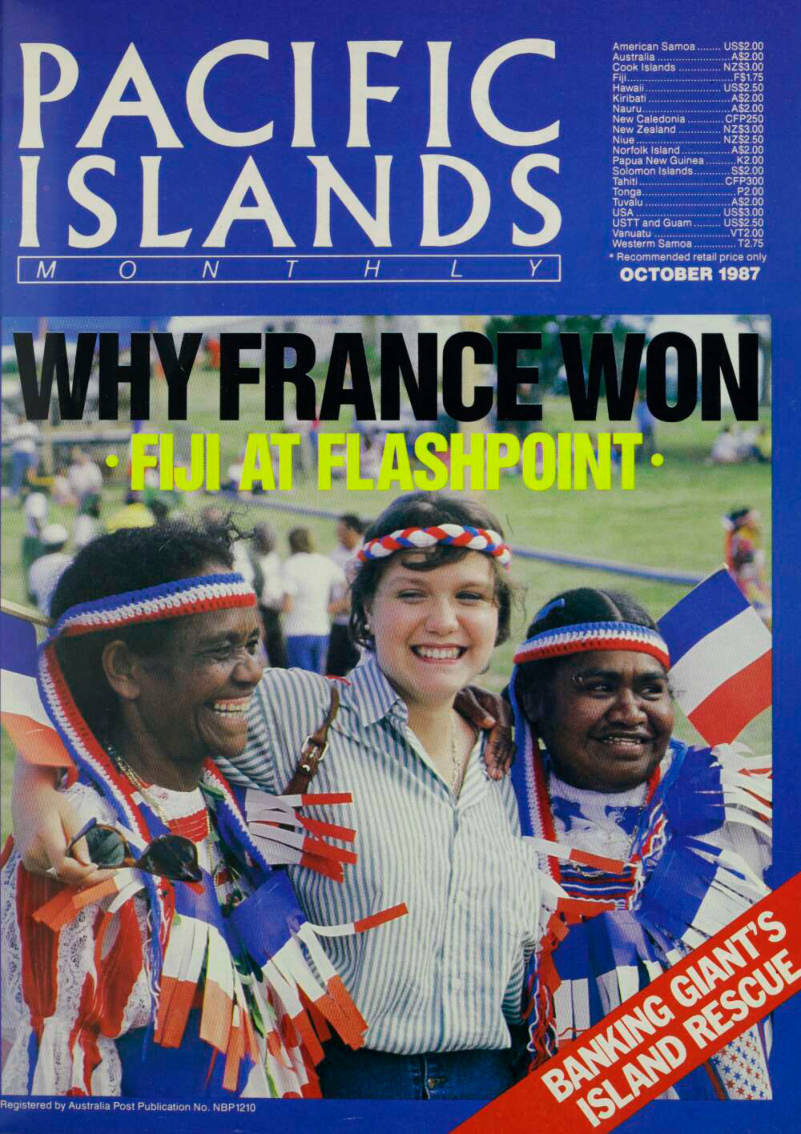
Cover Photograph: Patrick Riviere/Sydney Freelance
Advertisements & other items, p. 2 (1 item)
Revolutionary
H)
Progress with Distinction.
at every
The new Prelude is a sports coupe which will revolutionise conventional ideas of the relationship between a car and its driver.
It is a car with sporty, responsive handling to appeal to the keen driver: but through continual refinement by an enthusiastic team of engineers, the new Prelude 2.0i-16 adds a new dimension to the pleasure of motoring with almost extra-sensory handling performance. The secret is in Honda's revolutionary 4-wheel steering system. And it has no precedent in the modern motor car.
New Dimensions in Motoring.
Every revolution begins with a daring new initiative. The new Prelude features a bonnet line that is closer to the road than ever, conveying a real sports car feel. Inside, the wide glass area and wraparound console increase visibility and enhance a spacious, airy environment which centres on the needs of the driver. Each and every facet of performance elevates the relationship between man and machine to a higher level; the innovative 4-wheel double wishbone suspension, 4-wheel anti-lock braking, the race-bred 2.0 litre 16- and 12-valve engines... all work in perfect harmony to satisfy the Same direction* Opposite direction* ' driver's wants and desires. Add to this the 4WS system on the 2.0i-16, and you have a package which offers supreme handling with looks to match. The new Prelude is a revolutionary move in the right direction Breathtaking styling and exhilarating responsiveness geared to the true driving enthusiast's innermost desires. It's the Honda way. *The wheel angles are exaggerated for illustrative purposes Honda's 4WS is fitted to the 2.0M6 as a standard feature
hHONDA
PRELUDE
20-16 4111 Specifications and equipment may vary in some countries. m - In 1986, Williams/Honda won the Formula 1 Constructors' Championship.
In 1987, Honda's Formula 1 engines power both Williams and Lotus.
Thus, we continue to polish our expertise at the pinnacle of automotive technology.
Mobilll
cMIOI I
AUSTRALIA: Honda Australia Pty., Ltd. Lot 95 Sharps Road, Tullamarine, Victoria 3043: Bennett Honda Pty., Ltd. 250 Victoria Road, Wetherill Park, NSW. 2164/NEW ZEALAND NZMC Limited Manners Plaza, 57-65 Manners St., Wellmgton/PAPUA NEW GUINEA: Toba Pty., Ltd. P.O, Box 503, Port Moresby/TAHITI: Honda Distribution S.A. R.L. BP 1665, Papeete/KIRIBATI: Atoll Motor & Marino Services PC Box 49, Bairiki Tarawa, Republic of Kiribati/U.S. TRUST TERRITORY: United Micronesia Development Association P 0 Box 235, CHRB Saipan CM 96950/COOK ISLANDS: Cook Islands Motor Centre Ltd. PC Box 74, Rarotonga/GUAM: Mark’s Motor Co., Inc. PC Box DV, Agana/WESTERN SAMOA; Motor Distributors (Samoa) Ltd. PC Box 576, Apia/SOLOMON ISLANDS: Lee Kwok Kuen & Co., Ltd. P.O, Box 537, Honiara/NEW CALEDONIA Soci6t6 Du Chalandage 8, Rue de la somme-B.P. 97, Noumea/NAURU: Nauru Cooperation Republic of Nauru/FIJI Coral Island Motors Ltd. Robertson Road, Suva, i Fiji/AMERICAN SAMOA: Holiday Motors, Parts and Service P C Box 968, Pago Pago, American Samoa 96799 Heleck’s Service Center Ltd. P C Box 1138 Pago Pago, American Samoa 96799/TONGA: j Tonga Industrial Traders PC. Box 1035, Nukualofa, Tonga/NORFOLK ISLAND: Duncombe Bay Garage New Cascade Road, Norfolk Island/VANUATU: Honda Farm Ltd. PC. Box 1031, Pori Vila, Vanuatu
Pacific
Islands
Monthly
Vol 58, No. 10
Voice Of The Pacific
October, 'B7
Cover Story 8
The New Caledonia independence referendum is over and the troubled territory will remain under French control. But what are the implications of the result for the Kanaks, for France, for New Caledonia’s neighbors? Special correspondent Nicholas Rothwell reports from Noumea.
Fiji At Flashpoint 14
The terror attacks that stalled the peace talks; the disastrous effect of the military coup on the nation ‘s economy; the findings of the Governor General’s Fahey Committee Report.
Wingti’S Defence Trump 17
Defence expert Peter Young tells how the Papua New Guinea Prime Minister pulled off a masterly coup.
American Samoa’S Sunia In Payroll
Storm 20
Serious accusations have been levelled at the Senator after a visit by the US Secret Service.
Westpac Manages S27M Tuvalu Fund 23
A banking giant comes to the aid of the struggling islands.
Inside Lange’S New Cabinet 25
The New Zealand Prime Minister shuffles his team for a second term of reform.
War Declared On Maori Gangs 26
NZ’s new Police Minister cracks down on mob violence.
Png Troupe Dazzles Edinburgh 28
How Raun Raun stole the limelight at the prestigious Edinburgh arts festival.
Problems Come To French Polynesia 32
Why the Pacific paradise is not what it used to be.
FORUM: FIJI COUP - WAS USA TO BLAME? 47 A noted American Pacific watcher airs her theory that the United States plotted the Fiji coup.
Page 32
Page 26
Editor Larry Writer Art Director Warren Scott Editorial Adviser John Carter Contributors
Peter Young
Nicholas Rothwell John Dunn David S. North Melissa Roberts
Gabriel Singh
Chris Ashton John Hunter Bert Weston
Publisher Geraldine Baton
Managing Editor
Arnold Earnshaw
Advertising Sales Sydney & Melbourne - Lawson Dixon (02) 288 3541 Fergus Mac lagan (02) 412 3918; Brisbane - Robert Walker (07) 371 0533.
Australian cover price is recommended retail only Registered by Australia Post, publication No NBP1210 Copyright Pacific Publications (Aust) Pty Ltd
Advertisements & other items, pp. 3-4 (3 items)
Departments
OPINION 5
LETTERS 7
PACIFIC REPORT 35
BOOK REVIEWS 37
TRADE WINDS 38
TRANSITION 44
ISLANDS PRESS 45
STAMPS 46
SHIPPING SCHEDULES SO
OUT OF THE PAST 56
3
PACIFIC ISLANDS MONTHLY
A Pacific Publications production Founded 1930 (USPS 952480) 64-76 Kippax St, Surry Hills, NSW 2010; GPO Box 4245, Sydney, NSW, 2001; Telex: AA20124; Fax: (02)288 3322; Cables: PACPUB Sydney; Telephone: (02) 288 3000.
Pacific Islands Monthly (APPS No NBP1210) is published monthly for $US45 per year by Pacific Publications Pty Ltd, a division of News Ltd, 2 Holt St, Surry Hills, NSW 2010. Second class postage paid at Honolulu, Hawaii, POSTMASTER. Send address changes to PACIFIC ISLANDS MONTHLY, PO Box 22250, Honolulu, Hawaii 96822. Typeset by David Graphics, Sydney, and printed by Progress Press, 2 Keys Rd, Moorabbin, Victoria
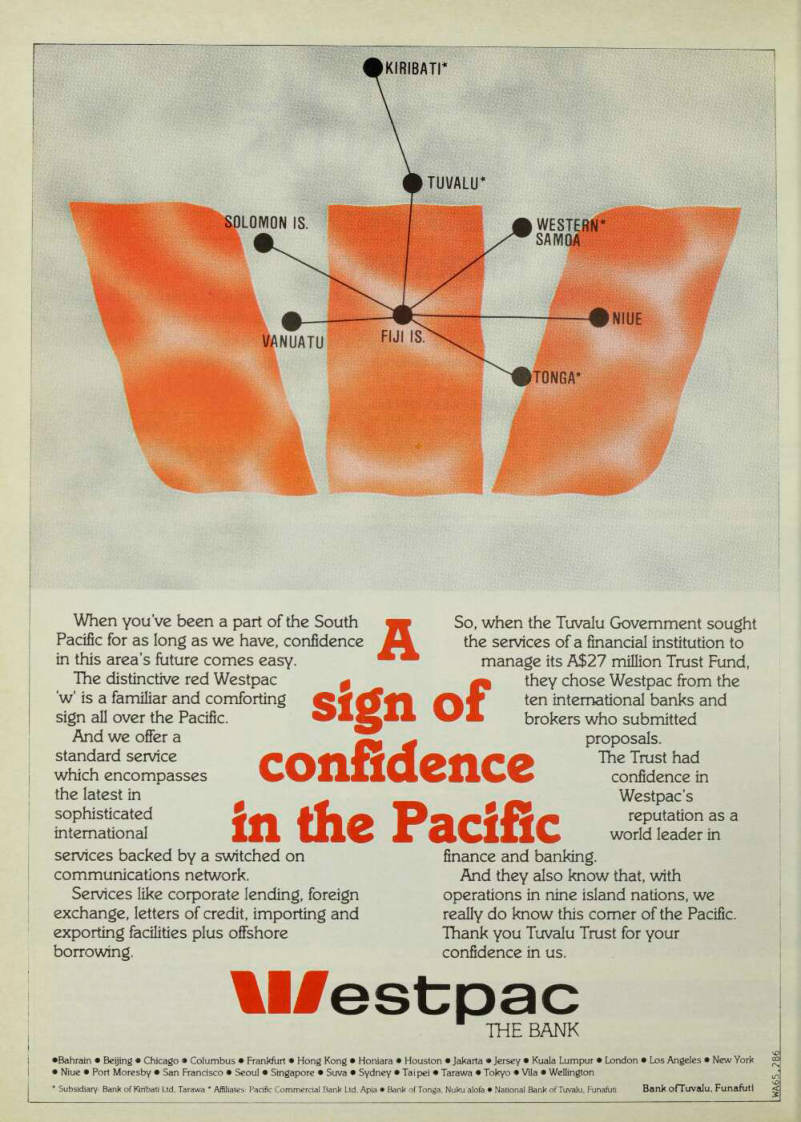
sign of
KIRIBATI
SOLOMON IS
TUVALU*
FIJI
IS
VANUATU
WESTERN*
SAMOA
iiSli
NIUE
TONGA*
When you’ve been a part of the South Pacific for as long as we have, confidence in this area’s future comes easy.
The distinctive red Westpac ‘w’ is a familiar and comforting sign all over the Pacific.
And we offer a standard service which encompasses the latest in sophisticated international services backed by a switched on communications network.
Services like corporate lending, foreign exchange, letters of credit, importing and exporting facilities plus offshore borrowing.
So, when the Tuvalu Government sought the services of a financial institution to manage its As 27 million Trust Fund, they chose Westpac from the ten international banks and brokers who submitted proposals.
The Trust had confidence in Westpac’s reputation as a world leader in finance and banking.
And they also know that, with operations in nine island nations, we really do know this comer of the Pacific.
Thank you Tuvalu Trust for your confidence in us.
A
sign of
confidence
in the Pacific
llfestpac
THE BANK
! • Bahrain • Beijing • Chicago • Columbus • Frankfurt • Hong Kong • Honiara • Houston • Jakarta • Jersey • Kuala Lumpur • London • Los Angeles • New York ® • Niue • Port Moresby • San Francisco • Seoul • Singapore • Suva • Sydney •Taipei • Tarawa • Tokyo • Vila • Wellington v£> * Subsidiary: Bank of Kiribati Ltd, Tarawa * Affiliates: Pacific Commercial Bank Ltd, Apia • Bank of Tonga, Nukualofa • National Bank of Tuvalu, Funafuti Bank ofTuvalu. Funafuti <
A Formula for Harmony
Opinion
The New Caledonia vote clears the way for harmony.
NEW CALEDONIA’S politicians, whether loyalists or leaders of the independence cause, have always looked to the outside world for solutions. The great merit of this September’s referendum is not only that it records the will of the majority that the territory remain French, and marks the end of a three-year period of un certainty it also points the way forward to a political evolution an evolution loyalists and pro-independence forces should shape together. The pro-French establish ment favours greater internal autonomy for the territory, with a continued political tie to France. Moderate pro-in dependence leaders envisage a privileged role for France even after the creation of a new Kanak state.
The referendum result clears the way for coherent dis cussion to bridge these positions. No one expects the pres sures for Kanak independence to vanish; no one expects the Europeans to pack up and leave the territory. The trick is for the different communities to devise a formula by which they can live, and develop, harmoniously together.
Sadly, examples of how not to decolonise, how not to handle tensions between separate ethnic groups, now abound among the nations of the Pacific. There is Vanu atu. This neighbouring regime’s expulsion of its own French loyalists is often held up by pro-French Caledon ians as a portent of the fate they might suffer under Kanak rule; but the real lesson to be learned from Vanuatu’s early years of independence is that international activism, however satisfying it may be for the political class, brings little in the way of tangible gain. Then there is Fiji, rather disturbingly presented by pro-independence Kanaks as an example of the inevitable consequences of a decolon isation that failed to enshrine in law the special claims of the indigenous population. Kanak leaders would do well
to drop this troubling endorsement of Fijian racial supre macism. Fiji’s lesson is this: the retreat from democracy, even when justified by a principle as fair-sounding as the rights of a native people, inevitably entails a growing con tempt for freedom and the rule of law.
New Caledonia’s community has advantages denied other Pacific islands; the region’s most potent economy, a rich mix of cultures, the attention and concern of France.
It also has more than its fair share of politicians; these have spent much of the past two years engaged in sterile debate, putting forward absolutist demands, secure in the knowledge that the territory’s future was uncertain. The referendum has now cleared the way for a more construc tive dialogue between communities that must learn not only to cohabit but to develop together, and devise their own common solution to a range of political problems.
Fiji: The Terror Continues
THE SPATE of vicious beatings, lootings and arson attacks on Indian property in Fiji can not be con doned or tolerated. It makes no difference whether the violence, more befitting a B-grade western than a na tion only recently hailed by Pope John Paul as a shining example to the rest of the world, is politically orchestrated by extremist groups such as Taukei or the mindless action of drunken mobs out for a little Indian-bashing. The fact is that no masterplan for a return to normalcy can be re solved in an atmosphere of violence and hatred.
Mr Bavadra is well within his rights to refuse to par ticipate in peace talks when, just down the road, his trusted spokesman Mr Richard Naidu is being assailed with spears and fists. But he also knows that if he refuses to
play ball with the Governor General and the Alliance he could forfeit his rights, and those of the people he rep resents, for ever. Hardly an environ ment for reasoned negotiation. Also, mob violence creates an aura of inst ability which, understandably, repels the rest of the civilised world, on whom Fiji will increasingly depend for moral support, financial aid and trade agreements if it is ever to reverse its fall from grace.
After the Taukei attack on Mr Naidu, the Governor General gave as surances that the violence would stop.
It did not. Now Ratu Sir Penaia Gan ilau’s words must be backed by action.
He must direct the police and the army to crack down on those who would make their point with the fist, the spear, the molotov cocktail.
A workable solution to Fiji’s woes can only be found if civil peace prevails. □
Fiji in turmoil: Indian faces that mirror despair ,
Advertisements & other items, p. 6 (1 item)
Bensonand Hedges
i
TRADiTiONALLV THE NAME
ASSOCsATED WITH PERFECTION
IN CIGARETTES
BENSON & HEDGES
20
Bensonand Hedges
WARNING-SMOKING IS A HEALTH HAZARD
Letters
Be Prepared
Stuck away in your July “Transitions” page was a piece about Ratu Sir Kamisese Mara receiving SUSSO,OOO for Disaster Prevention and Preparedness in Fiji. Will Dr Bavadra become the recipient of next year’s award and who gets to share the prize money with Mara this year.
Diana Rickard
Casuarina, NT, Australia
Success For New Palau Fish Co-Op
Since early in the American Trustee ship, the fishermen of Palau have formed themselves into co-operatives.
The latest group to carry on the fishing co-operative enterprise is the Palau Fish ermen’s Association (PFA). The group is comprised of fishermen from all over Be lau. Each location in Belau has a repre sentative which is chosen from among its members, and this group forms the board for the PFA. They set the prices and make the policies at their regular meetings.
What is especially impressive about this current management is that it is able to send fish to Guam on a fairly regular basis.
This not only is a delight for Guam con sumers, but for the Palauan fishermen as well. Each day there are about 10 boats bringing in about 1000 kilos of fish to the cooperative for purchase.
When the fishermen come in with their catch, shoppers can find easily up to 10 va rieties of reef fish as well as the deeper water varieties. Trading is lively and one has to get there early to get the finest selection.
During recent times when Palau has been politically unsettled and suffering a considerable economic pinch as a result of US Compact monies being withheld until the problems are straightened out, it is re assuring to see that the business of fishing and of providing fish for the households of Palau continues successfully, much as it always has.
Dirk Anthony Ballendorf
Micronesian Area Research Centre, University of Guam, Mangilao, Guam.
Fiji Myths Exploded
The motives behind the Fiji coup will be debated for years, but it is already pos sible to explode some myths which have emerged around it. For instance, it was not a military coup but a political coup in which Col. Rabuka became the hired gun of a band of defeated politicians desperate for power. Rabuka was the only soldier on his own Council of Ministers which was dominated by members of the Mara ad ministration. The unseemly haste with which they embraced the coup left the world stunned.
The coup was not engineered to pre empt a breakdown of law and order. Some
Fijian leaders, such as Taniela Veitata, re portedly planned to burn Suva and torch Indian settlements surrounding it. But in stead of apprehending the would-be ar sonists as an officer in Her Majesty’s armed forces, Rabuka not only joined them but also rewarded them with posi tions on his Council.
And the coup was not about protecting Fijian land and customary rights, for these are too deeply entrenched in the consti tution to be changed, even by Fijians themselves, without the consent of six of the eight Great Council of Chiefs nomi nees in the Fiji Senate.
More than anything else, the coup was about power. The emergence in an incip ient form of class-based multi-racial poli tics, symbolised by the Labour Party, and made possible by the support of many ur ban Fijians, posed a grave threat to the politics of race and racial compartmen talisation preached by the Alliance, and thus had to be nipped in the bud.
The ascent of Dr Bavadra, a chief from the long-neglected western Viti Levu, to the highest elected office in the land, posed an unprecedented challenge to the tradi tional dominance of eastern chiefs, espe cially from Lau and Cakaundrove.
The high chiefs felt particularly ag grieved at Labour’s victory and what it represented. Never ardent supporters of the principles of political pluralism and of checks and balances inherent in the West minster system of parliamentary democ racy practised in Fiji, they voiced their opposition to them on several occasions.
The Labour Government talked of promoting balanced regional develop ment, and criticised Lau, Mara’s prov ince, for deriving a disproportionate share of benefits “from wealth produced by oth ers in the country”. The Bavadra Govern ment proposed an anti-corruption bill, and heat was felt by many Alliance politicians who had benefitted from fudging the line between business and politics. It talked of openness and accountability in national affairs, which contrasted sharply with the Alliance’s policy.
There can be little doubt about what the coup has done to Fiji. It’s wrecked a once prosperous economy now teetering on the brink of collapse brought about by a flight of capital and trained manpower and van ished investor confidence; torn the fabric of race relations built over a century; de stroyed the fragile edifice of democratic institutions still in their infancy.
Brij V Lai
Dept of History University of Hawaii at Manoa, Honolulu, Hawaii For a further view ofthe Fiji coup, turn to Forum, page 48.
Advertisements & other items, p. 7 (1 item)
Pacific
ISLANDS
I M O N T H L Y I FIJI: Distribution and subscriptions: Desai Bookshops, PO Box 160, Suva, Fiji Phone Suva 23036.
Advertising; Fiji Times & Herald Ltd, 20 Gordon St., Suva, Phone 31-4111, telex FJ2124.
FRENCH POLYNESIA: Distribution: Hachette Pacifique 10 Ave., Bruat, Papeete Phone 25-610.
HAWAII; UNITED STATES: Distribution: PIM, Hawaii, PO Box 22250, Honolulu, Hawaii, 96822 Advertising: Brian C Asgill, Apt. 1308,1676 Ala Moana Blvd , Honolulu, Hawaii, 96815 Phone (808) 955-9718.
JAPAN: Advertising and subscriptions: Universal Media Corporation, GPO Box 46, Tokyo. Phone 666-3036, cable UNIMEDIA Tokyo, telex 2524665.
MALAYSIA: Advertising and subscriptions: Worldwide Media Services, 57-B Komplex Damai, Jin Dato Haji Eusoff, Kuala Lumpur. Phone 63-9340, cables WORLDMEDIA Kuala Lumpur, telex 31533.
VANUATU: Distribution: The Bookshop, HQ Box 210, Port Vila. Advertising: Norman Bros. Bookship, Port Vila Phone 2232 NEW CALEDONIA: Distribution: Depot Centre de Presse Michel Pentecost. CBP2, Noumea Phone 27- 2434, 27-4729 NEW ZEALAND: Distribution: Gordon & Gotch, PO Box 584, 2 Carr Road, Mt Roskill, Auckland 4, Advertising; McKay International Media Reps Ltd, C/- Albany PO, Auckland 10, New Zealand Phone 413-9119.
Telex NZ22701, FAX 413-9110.
WELLINGTON: Ross Quaid Media, 1 Scholes Ln , Petone. (04) 68-7593, PO Box 38699, Petone PAPUA NEW GUINEA: Distribution: Gordon & Gotch, PO Box 3395, Port Moresby Phone 25-4551, 25-4855.
Advertising: Ken Head, PNG Post-Courier, PO Box 85, Port Moresby Phone 21-2577, telex 22120 SOLOMON ISLANDS: Distribution and Advertising: The Bookshop, (Norman Bros.) PO Box 503, Honiara.
PHILIPPINES: Advertising: The GF Group, 12 San Ignacio St., Uroaneta Village, Makati, Metro Manila. Phone 817-7299, telex 45950 and 4233 UNITED KINGDOM: The Herald & Weekly Times Ltd, No 1 Maltravers St., London WC2R3DZ, England. Phone (01) 836-5162, telex London 21989 UNITED STATES MAINLAND: Advertising: Joshua B. Powers Jr,, Powers International Inc,, Suite 708, 271 Madison Ave , New York, NY 10016. Phone 867-9580, Subscriptions: PIM, Hawaii, PO Box 22250, Honolulu.
Hawaii, 96822.
SUBSCRIPTIONS
American Samoa US$45 Australia AUSS24 Canada US$45 Cook Islands AUS$46 Fiji AUS$46 French Polynesia US$45 Guam US$45 Hawaii US$45 Japan US$38 Kiribati AUS$46 Micronesia US$35 Nauru AUS$42 New Caledonia US$32 New Zealand AUSS42 Niue AUS$46 Norfolk Island AUS$42 Northern Marianas US$36 Papua New Guinea AUS$42 Solomon Islands AUS$46 Tonga AUS$46 Tuvala AUS$46 United Kingdom Stg£28 US (Mainland) US$45 Vanuatu AUS$42 Western Samoa AUS$60 Elsewhere AUS$63 Payments to Pacific Island Monthly: P.O. Box 2283U, Melbourne 3001, Australia.
Subscription rates includes the cost of airspeeding to all destinations set out above. Direct airmail rates on application.
of Strength
New Caledonia
France’s Show of Strength
Crushing victory or French farce? NICHOLAS ROTH WELL explains the implications of the New Caledonia independence referendum result for the French, the Kanaks and the troubled territory’s Pacific neighbours.
NEW CALEDONIAN politics, troubled and stalemated for the past two years, entered a new phase with the referendum of September 13. The high vote for continued ties with France 50,250 out of 85,022 citizens on the electoral roll, or 59.10 per cent of the total, took part in the referendum, 98.3 per cent of these pro-French surprised both French and international pundits, and even astonished the Caledonians them selves. In the wake of the referendum, as the Paris Government of conservative Prime Minister Jacques Chirac readies an “autonomy statute” for its South Pacific territory, an implacable mathematical logic comes into play.
New Caledonia’s political future may yet be held hostage for a few more months, as Mr Chirac and the incumbent socialist Mr Francois Mitterand, the likely rivals for next year’s Presidential elections, make their respective bids for the Elysee Palace.
But even in the event of a victory by Mr Mitterand, architect of previous plans for New Caledonian independence, the ref erendum result will be hard to ignore.
The message of the poll was unequi vocal. The referendum was first suggested by the pro-independence Kanak umbrella group, the Kanak Socialist National Lib eration Front (FLNKS). The Government of Mr Chirac this year decided to allow all French citizens with more than three years’ residence in the territory to vote, and posed them two simple questions: “Do you wish New Caledonia to become independent?” and “Do you wish New Caledonia to re main in the bosom of the French Repub lic?” The FLNKS called a boycott of the poll. It wanted the vote limited to indige nous Kanaks and those people, “victims of colonial history”, who were born in the territory with one parent also of Caledon ian birth.
Participation in the referendum thus
became a crucial test of strength for the FLNKS, which, according to French of ficials, placed considerable “physical and moral pressure” on Kanaks not to vote.
The results, though interpreted var iously by the different sides, have effec tively redrawn the political map in New Caledonia, and so pose a serious set of new policy questions for the neighbouring countries of the South Pacific region.
The French authorities in New Cale-
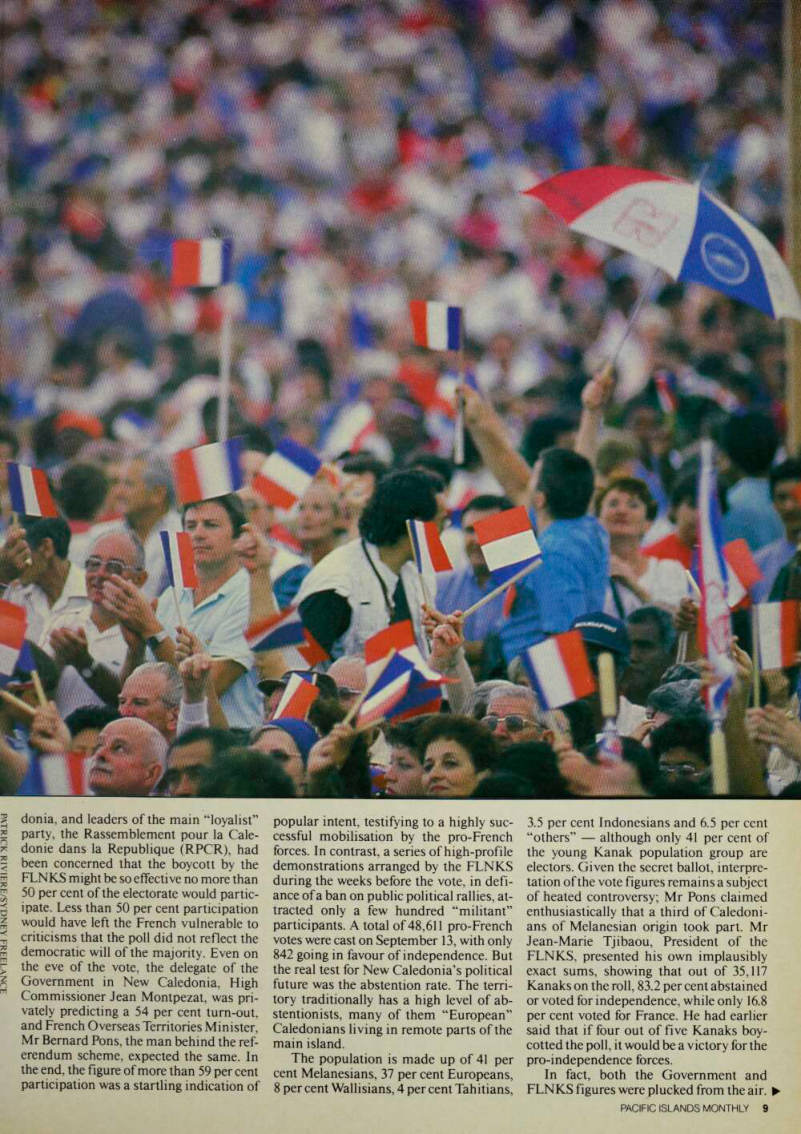
Right: Territorial Congress President Dick Ukeiwe. Above right: French supporters out in force at the Liberty Day Rally. Above: Jacques Lafleur savours the vote.
donia, and leaders of the main “loyalist” party, the Rassemblement pour la Caledonie dans la Republique (RPCR), had been concerned that the boycott by the FLNKS might be so effective no more than 50 per cent of the electorate would participate. Less than 50 per cent participation would have left the French vulnerable to criticisms that the poll did not reflect the democratic will of the majority. Even on the eve of the vote, the delegate of the Government in New Caledonia, High Commissioner Jean Montpezat, was privately predicting a 54 per cent turn-out, and French Overseas Territories Minister, Mr Bernard Pons, the man behind the referendum scheme, expected the same. In the end, the figure of more than 59 per cent participation was a startling indication of
popular intent, testifying to a highly sue cessful mobilisation by the pro-French forces. In contrast, a series of high-profile demonstrations arranged by the FLNKS during the weeks before the vote, in defi ance of a ban on public political rallies, at tracted only a few hundred “militant” participants. A total of 48,611 pro-French votes were cast on September 13, with only 842 going in favour of independence. But the real test for New Caledonia’s political future was the abstention rate. The terri tory traditionally has a high level of ab stentionists, many of them “European”
Caledonians living in remote parts of the main island.
The population is made up of 41 per cent Melanesians, 37 per cent Europeans, 8 per cent Wallisians, 4 per cent Tahitians,
3.5 per cent Indonesians and 6.5 per cent “others” although only 41 per cent of the young Kanak population group are electors. Given the secret ballot, interpre tation of the vote figures remains a subject of heated controversy; Mr Pons claimed enthusiastically that a third of Caledoni ans of Melanesian origin took part. Mr Jean-Marie Tjibaou, President of the FLNKS, presented his own implausibly exact sums, showing that out of 35,117 Kanaks on the roll, 83.2 per cent abstained or voted for independence, while only 16.8 per cent voted for France. He had earlier said that if four out of five Kanaks boy cotted the poll, it would be a victory for the pro-independence forces.
In fact, both the Government and FLNKS figures were plucked from the air. ►
Patrick Riviere/Sydney Freelance
◄ The truth lies somewhere in between; about a quarter of the Kanak population seems to have defied the boycott call well above the 20 per cent that was expected to side with the RPCR “loyalists”, This means that, gradually, the political authority of the FLNKS is waning, from the high point in 1984 when violent proindependence protests gripped the territory. Detailed study of the referendum resuits shows that in several former FLNKS strongholds, a surprising number of elec-
erendum result, the conservative forces are likely to adopt more moderate and con dilatory policies towards the Kanak mi nority, rather than hewing to the “if you’re not for us you must be against us” school of thought that has predominated since the 1984 and 1985 political riots that con vulsed the territory.
Moderate Kanak leaders may be wooed into the conservative, pro-French camp by generous political and economic patron age. An interesting figure in this context is
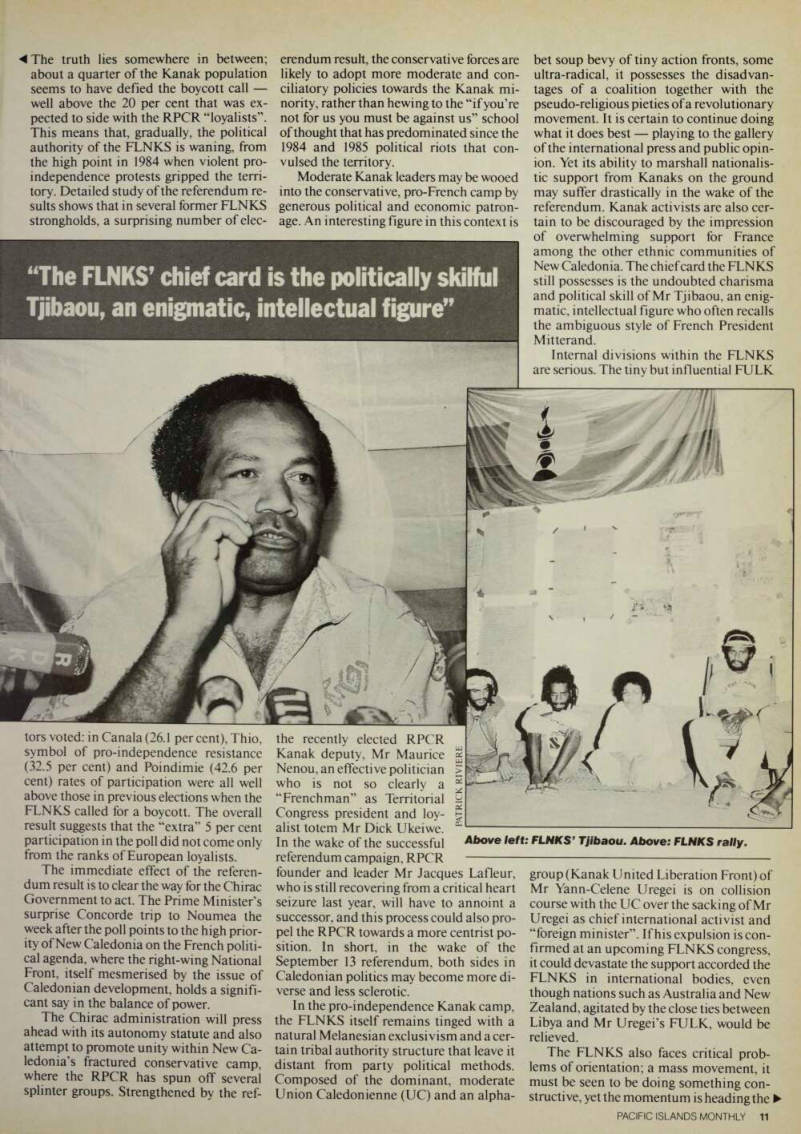
bet soup bevy of tiny action fronts, some ultra-radical, it possesses the disadvan tages of a coalition together with the pseudo-religious pieties of a revolutionary movement. It is certain to continue doing what it does best playing to the gallery of the international press and public opin ion. Yet its ability to marshall nationalis tic support from Kanaks on the ground may suffer drastically in the wake of the referendum. Kanak activists are also cer tain to be discouraged by the impression of overwhelming support for France among the other ethnic communities of New Caledonia. The chief card the FLNKS still possesses is the undoubted charisma and political skill of Mr Tjibaou, an enig matic, intellectual figure who often recalls the ambiguous style of French President Mitterand.
Internal divisions within the FLNKS are serious. The tiny but influential FULK
tors voted: in Canala (26.1 per cent), Thio, symbol of pro-independence resistance (32.5 per cent) and Poindimie (42.6 per cent) rates of participation were all well above those in previous elections when the FLNKS called for a boycott. The overall result suggests that the “extra” 5 per cent participation in the poll did not come only from the ranks of European loyalists.
The immediate effect of the referen dum result is to clear the way for the Chirac Government to act. The Prime Minister’s surprise Concorde trip to Noumea the week after the poll points to the high prior ity of New Caledonia on the French politi cal agenda, where the right-wing National Front, itself mesmerised by the issue of Caledonian development, holds a signifi cant say in the balance of power.
The Chirac administration will press ahead with its autonomy statute and also attempt to promote unity within New Ca ledonia’s fractured conservative camp, where the RPCR has spun off several splinter groups. Strengthened by the ref
the recently elected RPCR Kanak deputy, Mr Maurice Nenou, an effective politician who is not so clearly a “Frenchman” as Territorial Congress president and loy alist totem Mr Dick Ukeiwe.
In the wake of the successful referendum campaign, RPCR
founder and leader Mr Jacques Lafleur, who is still recovering from a critical heart seizure last year, will have to annoint a successor, and this process could also pro pel the RPCR towards a more centrist po sition. In short, in the wake of the September 13 referendum, both sides in Caledonian politics may become more di verse and less sclerotic.
In the pro-independence Kanak camp, the FLNKS itself remains tinged with a natural Melanesian exclusivism and a cer tain tribal authority structure that leave it distant from party political methods.
Composed of the dominant, moderate Union Caledonienne (UC) and an alpha
group (Kanak United Liberation Front) of Mr Yann-Celene Uregei is on collision course with the UC over the sacking of Mr Uregei as chief international activist and “foreign minister”. If his expulsion is con firmed at an upcoming FLNKS congress, it could devastate the support accorded the FLNKS in international bodies, even though nations such as Australia and New Zealand, agitated by the close ties between Libya and Mr Uregei’s FULK, would be relieved.
The FLNKS also faces critical prob lems of orientation; a mass movement, it must be seen to be doing something con structive, yet the momentum is heading the ►
Patrick Riviere
Above left: FLNKS’ Tjibaou. Above: FLNKS rally.
◄ other way in Caledonian politics. Its much bruited adoption of a strategy of “non violence”, which won plaudits briefly when local gendarmes charged a defence less crowd of women and children protes ters in Noumea’s central square this August, has brought little in the way of concrete achievements. A heavy (and costly) French military presence is likely to remain in New Caledonia for the bal ance of this year as an undeclared peace keeping force. Radical activists within the FLNKS are said to be deeply disheart ened by the spectacle of a weakening political front that will not countenance more “direct” action although discus sion of the activities of “Kanak extre mists” often has a decidely mirage-like quality.
Another significant Kanak pro-inde pendence party exists outside the FLNKS structure: Kanak Socialist Liberation, the party formed by a customary chief from the Loyalty Islands, the charismatic radi cal turned social democrat, Mr Nidoish Naisseline. This group has significant re gional importance, and managed to pro
duce a heavy referendum abstention rate in the island of Mare. But its importance is that it represents the elusive “third way” in Caledonian politics. Pro-independ ence, it is also open-minded and speaks the language of European politics. A number of reflective, highly intelligent Kanaks have crystallised around Mr Naisseline, and their continued success as a party and engine of ideas would form a vital com ponent in any movement towards further co-operation between the two main racial groups in New Caledonia. The great hope the referendum result holds out is that confirmation of the strength of the loyal ists may enable some in their ranks to con sider working towards a form of shared evolution with centrist parties. Only in this way could the pro-French and pro-inde pendence camps begin to forge a common political vocabulary.
The referendum has not only set the seal on a realignment of forces inside the territory; it has redefined New Caledonia as a problem for the countries of the re gion, and for the United Nations member states that will debate the territory’s status in the General Assembly this year.
Australia and New Zealand seem set to maintain their policies favouring Cale donian independence, but the strong ma jority vote for ties with France leaves these countries with one unpleasant dilemma now more clearly focused; if they call on France to disregard the majority’s will, and grant independence to the native people, what standard should they apply within their own borders, where a settler major ity has itself displaced an indigenous people?
On a more serious level, the pro-French vote, coupled with the strong support of the French Government, seems likely to ensure a continued French presence in the Pacific on the current terms. A policy of rigid hostility towards France, on the part of the South Pacific Forum nations, could be one that produces its own harvest of instability, disunity and confusion in a re gion that prides itself on consensus and discussion of political dilemmas.
The first serious policy test for the South Pacific Forum nations will come with this December’s South Pacific games, scheduled to be held in Noumea. A boy cott of the games, as called for by some Pa cific nations, would send a clear signal to Paris that continued intransigence and unreflective, absolutist opposition will be the pattern for the future.
France, of course, has the demon strated political will and economic power to remain in the Pacific indefinitely. The referendum has shown that the Caledon ian population is itself increasingly rec onciled to this scenario. A crucial time for reassessment has been reached.
The nations of the Melanesian Spear head group The Solomons, Vanuatu and Papua New Guinea yoked together largely by the single issue of Kanak inde pendence, pointedly failed to devise any new policies during a September meeting to consider the referendum. They decided against the option of creating a Kanak government in exile, but their discussions remained opposed to acceptance of New Caledonia’s French territorial status. The FLNKS itself has recently promoted a concept of “regional union” among Me lanesian nations, which could later be ex tended to other Pacific states. But the referendum appears to have dealt this pro ject a serious blow, even though the “union pact” provides for the FLNKS to partici pate even while New Caledonia stays French.
September 13, then, not only ushered in a new political era for new Caledonia; it presented a fresh challenge to the nations of the Pacific; they must now balance care fully the competing pressures of nation alism and democracy, of racial solidarity and respect for liberal principles. The ref erendum phrased the dilemma and high lighted it with exquisite accuracy; the time has come, both for New Caledonians and the nations of the Pacific, to devise a solution. n
Advertisements & other items, pp. 10-12 (1 item)
your watch
* * /* I «■ 1 * r V ■/ •. *■' ♦' Va j. 4 r i iV / IF 1 -r- -n
©CITIZEN
V.J /# We Ve got fashion creations, sports innovations, high-tech inspirations. For any situation - there’s a Citizen watch.
‘ CITIZEN
FOR FURTHER INFORMATION, PLEASE CONTACT:
Australia: Citizen Watches Australia Pty. Ltd., 122 Old Pittwater Road, Brookvale, NSW 2100.
Tel: 939 7077. Cable: Citizen Sydney.
Telex: AA26633. Fax: 932864.
Fiji Islands: Tappoo Limited, P.O. Box, Sigatoka, Fiji. Tel: 50199. Telex: FJ4244.
New Zealand: Citizen Watches (N.Z.) Ltd., ' P.O. Box 9518, Auckland, New Zealand.
Tel: 543 393. Telex: 21429. Fax: 544177.
Norfolk Island: Landy & Co., P.O. Box 31, Norfolk Island, 2899, South Pacific. Tel: 2163.
American Samoa: Malaloa Duty Free Shoppers, P.O. Box 2183, Pago Pago, American Samoa, 96799. Tel: 633 5513.
Tahiti: Morgan Vernex, Fare Lite B.P. 449, Tahiti.
Tel: 2.03.09.
New Caledonia: Est. Ballande, B.P. Box C 4, Noumea, New Caledonia. Tel: 27.20.31.
Rarotonga: South Seas International Ltd., P.O. Box 49, Rarotonga, Cook Islands. Tel: 2327 Papua New Guinea: Kara Pty. Limited, P.O. Box 329, Port Moresby. Tel: 25 6044.
anyhow
have a
Winfield
five smokes ahead of • merest HE Air H
OKIN e
WAfiN |NG
What The World Says
World Reaction To The
referendum result in New Caledonia was predictable.
French Prime Minister Mr Jacques Chirac called the result a “triumph” and pledged that his Government would strive to “ensure that Caledonians can build together a fraternal society based on tolerance”. In an attempt to as suage Kanak feelings Mr Chirac said he would offer more autonomy to the territory.
“My Government will propose an Autonomy Statute within the frame work of a broad regionalisation which can be accepted by all Caledonians and provide the stable institutions so badly needed by the territory,” the French leader said.
His Socialist opponent in Paris, First Secretary Mr Lionel Jospin, disa greed, saying that the referendum “would not solve a thing”.
This view was echoed by Australian Prime Minister Mr Hawke who said that 58 per cent voter participation would not sustain “any assertion by France that they have an authority now which will settle the issue in the troubled region ... I can’t see any real likelihood (except) instability.” The result of the referendum would only make both sides more intransigent in their de mands, Mr Hawke said.
The New Zealand Foreign Minister Mr Russell Marshall said that a “sig nificant proportion of the population did not express their views and that the referendum could serve to deepen the divisions between the communities of New Caledonia.
The Foreign Ministers of Papua New Guinea, Vanuatu and the Solomon Islands, in a joint statement, called for international pressure to end French rule in New Caledonia in the wake of the referendum result. The three Min isters declared their Government’s and peoples’ “total solidarity with the Kanaks in their continuing struggle for freedom and independence in New Caledonia”.
The Ministers appealed for international co-operation in bringing an im mediate end to the “deliberate French neo-colonial policies which are seri ously threatening peace and security in the region”.
Taukei Terror Stalls Talks
Fiji
Arson attacks and a vicious bashing put peace talks at risk
LIFE IN FUI alternates between hope and despair. Just when peace talks aimed at resolving the deep politi cal crisis looked set to put the nation on the path to normalcy, a vicious assault and a series of arson attacks on Indian-owned shops has once more put a resolution in jeopardy.
The peace talks at Government House between representatives of the deposed Bavadra Government and the Opposition Alliance Party are being held under the chairmanship of the Governor General Ralu Sir Penaia Ganilau.
The two sides were brought together at the initiative of the Governor General who heads the interim administration in a bid to explore the possibility of forming a “caretaker” government or “government of national unity” to assume office until Fiji is again ready to go to the polls under a revised constitution.
The first round of talks on Friday Sep tember 4 began on a positive note when both sides displayed goodwill and a deter mination to continue dialogue. The at mosphere at the meeting was friendly.
During the tea break Ratu Sir Kamisese Mara, who led the Alliance delega tion,and Dr Bavadra, who headed the Co alition team, chatted informally. Others in the Alliance delegation were Mr Tomasi Vakatora, Mr Apisai Tora, Mr Filipe Bole, Mr David Pickering and Dr Ahmed Ali.
Besides Dr Bavadra the Coalition delega tion consisted of Mr Jai Ram Reddy, Mr Joeli Kalou, Mr Mahendra Chawdhary, Mr Etuate Tavai and Dr Balwant Singh Rakka.
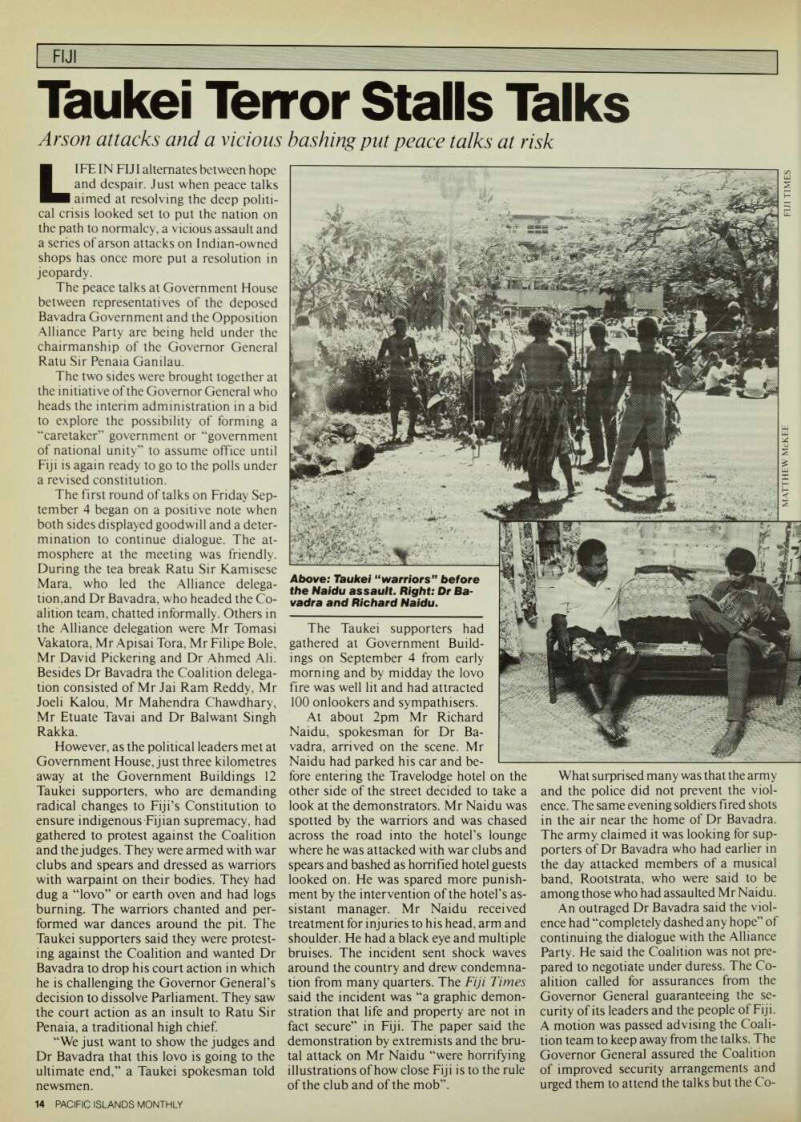
However, as the political leaders met at Government House, just three kilometres away at the Government Buildings 12 Taukei supporters, who are demanding radical changes to Fiji’s Constitution to ensure indigenous Fijian supremacy, had gathered to protest against the Coalition and the judges. They were armed with war clubs and spears and dressed as warriors with warpaint on their bodies. They had dug a “lovo” or earth oven and had logs burning. The warriors chanted and per formed war dances around the pit. The Taukei supporters said they were protest ing against the Coalition and wanted Dr Bavadra to drop his court action in which he is challenging the Governor General’s decision to dissolve Parliament. They saw the court action as an insult to Ratu Sir Penaia, a traditional high chief.
“We just want to show the judges and Dr Bavadra that this lovo is going to the ultimate end,” a Taukei spokesman told newsmen.
The Taukei supporters had gathered at Government Build ings on September 4 from early morning and by midday the lovo fire was well lit and had attracted 100 onlookers and sympathisers.
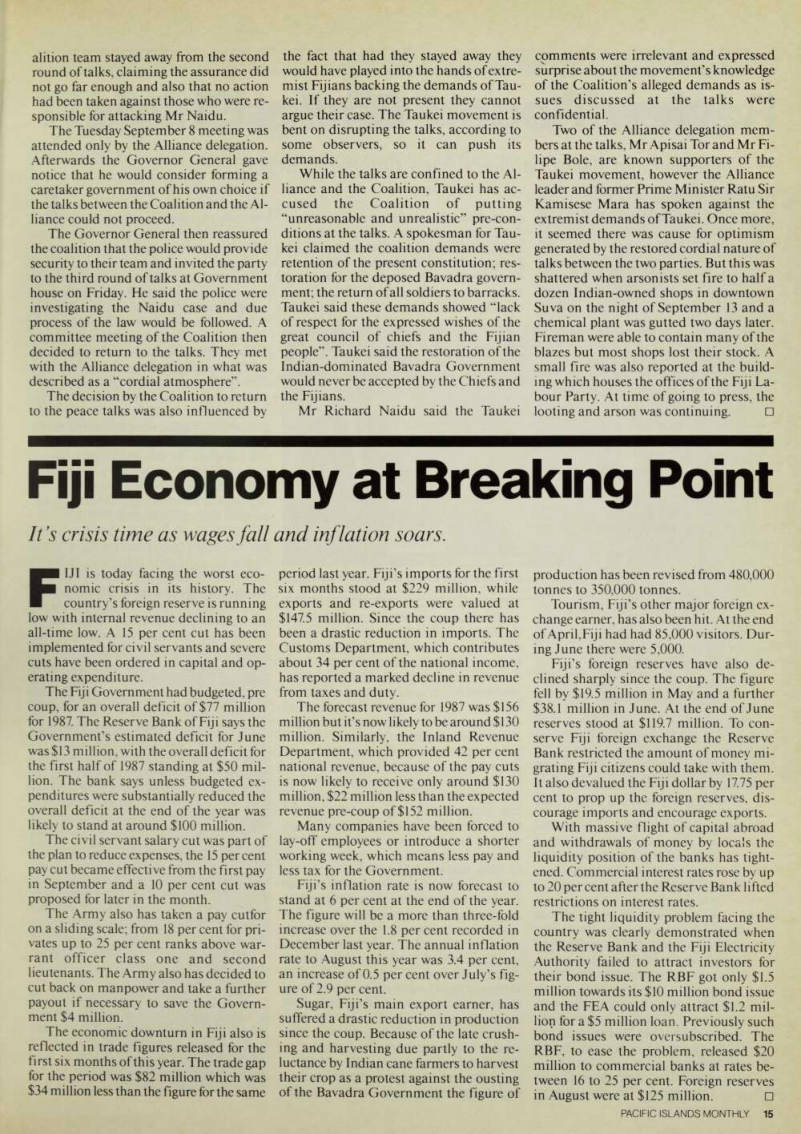
At about 2pm Mr Richard Naidu, spokesman for Dr Ba vadra, arrived on the scene. Mr Naidu had parked his car and be
fore entering the Travelodge hotel on the other side of the street decided to take a look at the demonstrators. Mr Naidu was spotted by the warriors and was chased across the road into the hotel’s lounge where he was attacked with war clubs and spears and bashed as horrified hotel guests looked on. He was spared more punishment by the intervention of the hotel’s assistant manager. Mr Naidu received treatment for injuries to his head, arm and shoulder. He had a black eye and multiple bruises. The incident sent shock waves around the country and drew condemnadon from many quarters. The Fiji Times said the incident was “a graphic demonstration that life and property are not in fact secure” in Fiji. The paper said the demonstration by extremists and the brutal attack on Mr Naidu “were horrifying illustrations of how close Fiji is to the rule of the club and of the mob”.
What surprised many was that the army and the police did not prevent the viol ence. The same evening soldiers fired shots in the air near the home of Dr Bavadra.
The army claimed it was looking for sup porters of Dr Bavadra who had earlier in the day attacked members of a musical band, Rootstrata, who were said to be among those who had assaulted Mr Naidu.
An outraged Dr Bavadra said the viol ence had “completely dashed any hope” of continuing the dialogue with the Alliance Party. He said the Coalition was not pre pared to negotiate under duress. The Co alition called for assurances from the Governor General guaranteeing the se curity of its leaders and the people of Fiji, A motion was passed advising the Coali tion team to keep away from the talks. The Governor General assured the Coalition of improved security arrangements and urged them to attend the talks but the Co
Matthew Mck Ee
Above: Taukei warriors" before "the Naidu assault. Right: Dr Ba vadra and Richard Naidu.
alition team stayed away from the second round of talks, claiming the assurance did not go far enough and also that no action had been taken against those who were re sponsible for attacking Mr Naidu.
The Tuesday September 8 meeting was attended only by the Alliance delegation.
Afterwards the Governor General gave notice that he would consider forming a caretaker government of his own choice if the talks between the Coalition and the Al liance could not proceed.
The Governor General then reassured the coalition that the police would provide security to their team and invited the party to the third round of talks at Government house on Friday. Fie said the police were investigating the Naidu case and due process of the law would be followed. A committee meeting of the Coalition then decided to return to the talks. They met with the Alliance delegation in what was described as a “cordial atmosphere”.
The decision by the Coalition to return to the peace talks was also influenced by
the fact that had they stayed away they would have played into the hands of extre mist Fijians backing the demands of Tau kei. If they are not present they cannot argue their case. The Taukei movement is bent on disrupting the talks, according to some observers, so it can push its demands.
While the talks are confined to the Al liance and the Coalition, Taukei has ac cused the Coalition of putting “unreasonable and unrealistic” pre-con ditions at the talks. A spokesman for Tau kei claimed the coalition demands were retention of the present constitution; res toration for the deposed Bavadra govern ment; the return of all soldiers to barracks.
Taukei said these demands showed “lack of respect for the expressed wishes of the great council of chiefs and the Fijian people”. Taukei said the restoration of the Indian-dominated Bavadra Government would never be accepted by the Chiefs and the Fijians.
Mr Richard Naidu said the Taukei
comments were irrelevant and expressed surprise about the movement’s knowledge of the Coalition’s alleged demands as is sues discussed at the talks were confidential.
Two of the Alliance delegation mem bers at the talks, Mr Apisai Tor and Mr Fi lipe Bole, are known supporters of the Taukei movement, however the Alliance leader and former Prime Minister Ratu Sir Kamisese Mara has spoken against the extremist demands of Taukei. Once more, it seemed there was cause for optimism generated by the restored cordial nature of talks between the two parties. But this was shattered when arsonists set fire to half a dozen Indian-owned shops in downtown Suva on the night of September 13 and a chemical plant was gutted two days later.
Fireman were able to contain many of the blazes but most shops lost their stock. A small fire was also reported at the build ing which houses the offices of the Fiji La bour Party. At time of going to press, the looting and arson was continuing. □
Fiji Economy at Breaking Point
It’s crisis time as wages fall and inflation soars.
FIJI is today facing the worst eco nomic crisis in its history. The country’s foreign reserve is running low with internal revenue declining to an all-time low. A 15 per cent cut has been implemented for civil servants and severe cuts have been ordered in capital and op erating expenditure.
The Fiji Government had budgeted, pre coup, for an overall deficit of $77 million for 1987. The Reserve Bank of Fiji says the Government’s estimated deficit for June was $l3 million, with the overall deficit for the first half of 1987 standing at $5O mil lion. The bank says unless budgeted ex penditures were substantially reduced the overall deficit at the end of the year was likely to stand at around $lOO million.
The civil servant salary cut was part of the plan to reduce expenses, the 15 per cent pay cut became effective from the first pay in September and a 10 per cent cut was proposed for later in the month.
The Army also has taken a pay cutfor on a sliding scale; from 18 per cent for pri vates up to 25 per cent ranks above war rant officer class one and second lieutenants. The Army also has decided to cut back on manpower and take a further payout if necessary to save the Govern ment $4 million.
The economic downturn in Fiji also is reflected in trade figures released for the first six months of this year. The trade gap for the period was $B2 million which was $34 million less than the figure for the same
period last year. Fiji’s imports for the first six months stood at $229 million, while exports and re-exports were valued at $147.5 million. Since the coup there has been a drastic reduction in imports. The Customs Department, which contributes about 34 per cent of the national income, has reported a marked decline in revenue from taxes and duty.
The forecast revenue for 1987 was $156 million but it’s now likely to be around $l3O million. Similarly, the Inland Revenue Department, which provided 42 per cent national revenue, because of the pay cuts is now likely to receive only around $l3O million, $22 million less than the expected revenue pre-coup of $152 million.
Many companies have been forced to lay-off employees or introduce a shorter working week, which means less pay and less tax for the Government.
Fiji’s inflation rate is now forecast to stand at 6 per cent at the end of the year.
The figure will be a more than three-fold increase over the 1.8 per cent recorded in December last year. The annual inflation rate to August this year was 3.4 per cent, an increase of 0.5 per cent over July’s fig ure of 2.9 per cent.
Sugar, Fiji’s main export earner, has suffered a drastic reduction in production since the coup. Because of the late crush ing and harvesting due partly to the re luctance by Indian cane farmers to harvest their crop as a protest against the ousting of the Bavadra Government the figure of
production has been revised from 480,000 tonnes to 350,000 tonnes.
Tourism, Fiji’s other major foreign ex change earner, has also been hit. At the end of April,Fiji had had 85,000 visitors. Dur ing June there were 5,000.
Fiji’s foreign reserves have also de clined sharply since the coup. The figure fell by $19.5 million in May and a further $38.1 million in June. At the end of June reserves stood at $119.7 million. To con serve Fiji foreign exchange the Reserve Bank restricted the amount of money mi grating Fiji citizens could take with them.
It also devalued the Fiji dollar by 17.75 per cent to prop up the foreign reserves, dis courage imports and encourage exports.
With massive flight of capital abroad and withdrawals of money by locals the liquidity position of the banks has tight ened. Commercial interest rates rose by up to 20 per cent after the Reserve Bank lifted restrictions on interest rates.
The tight liquidity problem facing the country was clearly demonstrated when the Reserve Bank and the Fiji Electricity Authority failed to attract investors for their bond issue. The RBF got only $1.5 million towards its $lO million bond issue and the FEA could only attract $1.2 mil lion for a $5 million loan. Previously such bond issues were oversubscribed. The RBF, to ease the problem, released $2O million to commercial banks at rates be tween 16 to 25 per cent. Foreign reserves in August were at $125 million. □
Review Report Backs Chiefs
Probing the crucial Constitutional Review Committee Report.
THE 16 MEMBER Constitutional Review Committee appointed by Fiji’s Governor General Ratu Sir Penaia Ganilau has come out with two reports. A Majority Report echoing the submissions of the Great Council of Chiefs and a Minority Report which recom-
mends the wishes of the Labour/National Feder ation Party Coalition.
The Governor Gen eral appointed the Com mittee as a first step to reconciliation and a means of ret urn i ng to Fij i a democratically elected government after the May 14 military coup. Its function was to propose amendments to the Fiji Constitution “which will strengthen the political representation of indige nous Fijians, and in doing so bear in mind the best interests of the other peoples in Fiji”.
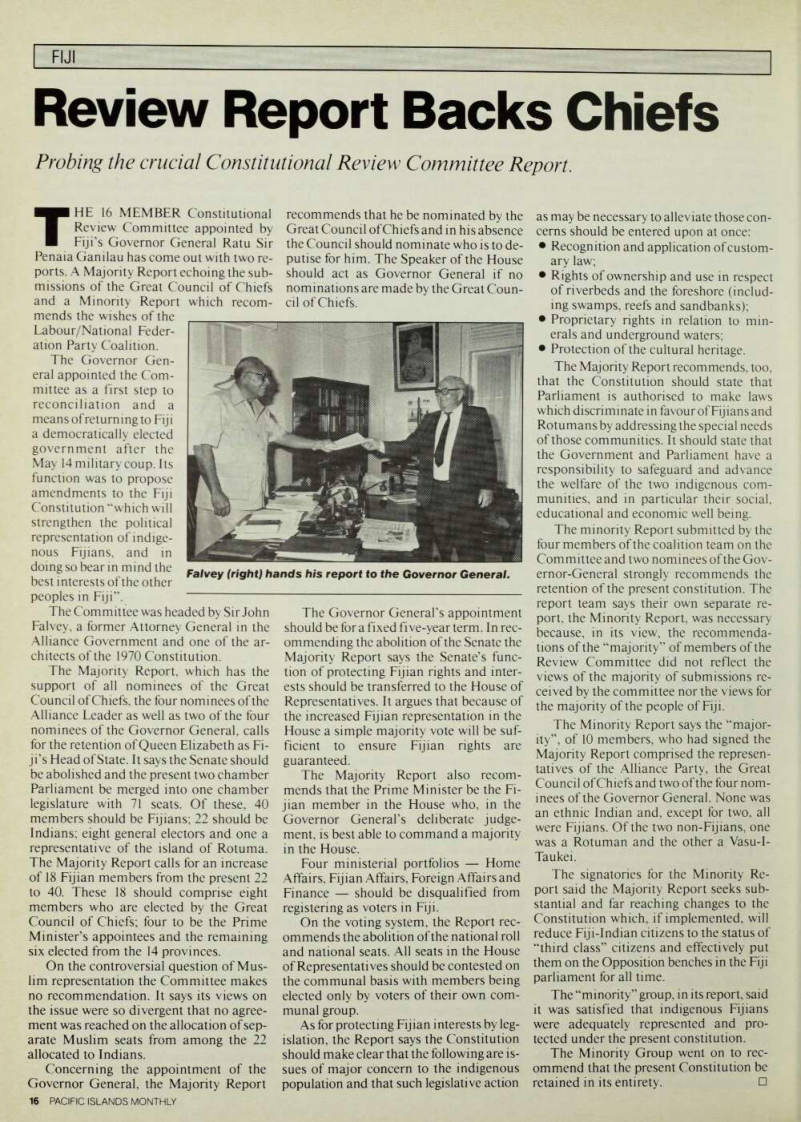
The Committee was headed by Sir John Falvey, a former Attorney General in the Alliance Government and one of the ar chitects of the 1970 Constitution.
The Majority Report, which has the support of all nominees of the Great Council of Chiefs, the four nominees of the Alliance Leader as well as two of the four nominees of the Governor General, calls for the retention of Queen Elizabeth as Fi ji’s Head of State. It says the Senate should be abolished and the present two chamber Parliament be merged into one chamber legislature with 71 seats. Of these, 40 members should be Fijians; 22 should be Indians; eight general electors and one a representative of the island of Rotuma.
The Majority Report calls for an increase of 18 Fijian members from the present 22 to 40. These 18 should comprise eight members who are elected by the Great Council of Chiefs; four to be the Prime Minister’s appointees and the remaining six elected from the 14 provinces.
On the controversial question of Mus lim representation the Committee makes no recommendation. It says its views on the issue were so divergent that no agree ment was reached on the allocation of sep arate Muslim seats from among the 22 allocated to Indians.
Concerning the appointment of the Governor General, the Majority Report
recommends that he be nominated by the Great Council of Chiefs and in his absence the Council should nominate who is to de putise for him. The Speaker of the House should act as Governor General if no nominations are made by the Great Coun cil of Chiefs.
The Governor General’s appointment should be for a fixed five-year term. In rec ommending the abolition of the Senate the Majority Report says the Senate’s func tion of protecting Fijian rights and inter ests should be transferred to the House of Representatives. It argues that because of the increased Fijian representation in the House a simple majority vote will be suf ficient to ensure Fijian rights are guaranteed.
The Majority Report also recom mends that the Prime Minister be the Fi jian member in the House who, in the Governor General’s deliberate judge ment, is best able to command a majority in the House.
Four ministerial portfolios Home Affairs, Fijian Affairs, Foreign Affairs and Finance should be disqualified from registering as voters in Fiji.
On the voting system, the Report rec ommends the abolition of the national roll and national seats. All seats in the House of Representatives should be contested on the communal basis with members being elected only by voters of their own com munal group.
As for protecting Fijian interests by leg islation, the Report says the Constitution should make clear that the following are is sues of major concern to the indigenous population and that such legislative action
as may be necessary to alleviate those con cerns should be entered upon at once; • Recognition and application of custom ary law; • Rights of ownership and use in respect of riverbeds and the foreshore (includ ing swamps, reefs and sandbanks); • Proprietary rights in relation to min erals and underground waters; • Protection of the cultural heritage.
The Majority Report recommends, too, that the Constitution should state that Parliament is authorised to make laws which discriminate in favour of Fijians and Rotumans by addressing the special needs of those communities. It should state that the Government and Parliament have a responsibility to safeguard and advance the welfare of the two indigenous com munities, and in particular their social, educational and economic well being.
The minority Report submitted by the four members of the coalition team on the Committee and two nominees of the Gov ernor-General strongly recommends the retention of the present constitution. The report team says their own separate re port, the Minority Report, was necessary because, in its view, the recommenda tions of the “majority” of members of the Review Committee did not reflect the views of the majority of submissions re ceived by the committee nor the views for the majority of the people of Fiji.
The Minority Report says the “major ity”, of 10 members, who had signed the Majority Report comprised the represen tatives of the Alliance Party, the Great Council of Chiefs and two of the four nom inees of the Governor General. None was an ethnic Indian and, except for two, all were Fijians. Of the two non-Fijians, one was a Rotuman and the other a Vasu-I- Taukei.
The signatories for the Minority Re port said the Majority Report seeks sub stantial and far reaching changes to the Constitution which, if implemented, will reduce Fiji-Indian citizens to the status of “third class” citizens and effectively put them on the Opposition benches in the Fiji parliament for all time.
The “minority” group, in its report, said it was satisfied that indigenous Fijians were adequately represented and pro tected under the present constitution.
The Minority Group went on to rec ommend that the present Constitution be retained in its entirety. □
Falvey (right) hands his report to the Governor General.
Wingti Plays Defence Trump
Papua New Guinea
PETER YOUNG on PNG’s masterly plan for self-protection.
THE WINGTI Government ap pears to have pulled off the diplo matic coup of having its cake and eating it too with new links with In donesia, a defence agreement with Aus tralia and now reports that it intends to distance itself from the West and join the non-aligned movement.
PNG is of course only exercising its sovereign rights in the same manner as other regional nations such as Malaysia with whom Australia also has defence links but it is noteworthy that the decision has come within weeks of the Hawke Government’s approval of the request from Port Moresby for a more formal def ence arrangement between the two countries.
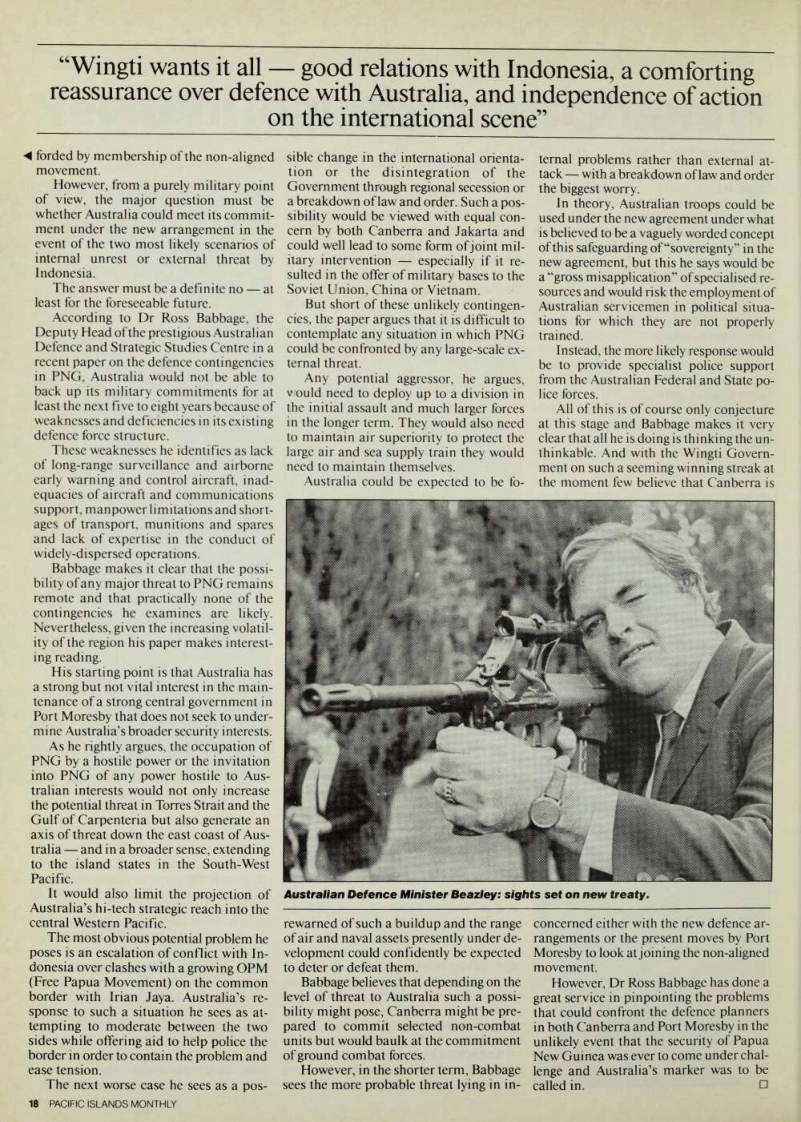
The decision in favour of closer def ence links was seen as a major win for Aus tralian Defence Minister Kim Beazley over the more cautious approach taken by For eign Minister Bill Hayden who felt that more was to be gained by keeping Aus
tralia’s options open and avoiding any specific commitment.
Four courses of action were proposed to Cabinet. They ranged from Option A, proposed by Mr Hayden, which argued for no change to the existing arrangements, all the way to Option D, put forward by Mr Beazley which called for a more formal agreement in line with the importance placed on PNG by the Defence White Pa per and the Government’s initiatives in the South West Pacific tabled in Parliament last February.
Option D was accepted and Mr Bea zley won but only after a healed argu ment in Cabinet where Mr Hayden is reported as having argued that it might be a decision Australia may one day regret.
No details have yet been released of the text of the agreement or the results of the discussions between the Wingti Govern ment and an Australian delegation held in Port Moresby early in September, but it is believed that the new arrangements closely follow the line of the 1971 Five-power Def ence Agreement with Malaysia.
This states that in the event of any form of armed attack, the five contracting par ties “would immediately consult together for the purposes of deciding what meas ures should be taken jointly or separately in relation to such attack or threat”.
A similar form of wording with PNG would formalise the de facto defence co operation arrangements that stemmed from the 1977 agreement between the Fraser and Somare Governments and open the way to a further range of co-operative measures, whilst stopping short of any outright guarantees.
Defence argued that this solution would underline Australia’s appreciation of the strategic importance of PNG and the spe cial relationship that exists between the two countries.
It is also believed that Defence was also very much alert to the fact that such an agreement would go a long way to heading off any possible search for other partners by Port Moresby whilst allowing Australia a continued involvement in regional def ence matters.
The more cautious approach by For eign Affairs however is believed to have been based on an appreciation that de spite the promise shown by the present Administration, PNG is inherently politi cally unstable and that the shared border with Indonesia is a potential time bomb.
Foreign Affairs also believes that even such an innocuous document as is being proposed could well lead Papua New
Guinea to act with far more confidence in her relations with Indonesia than she might otherwise.
There was also puzzlement in some quarters in Canberra as to why it was nec essary to formalise what up until now has been a very effective working arrange ment both at the defence and political levels. This is especially so considering the recent signing of the treaty of mutual re spect, friendship and co-operation be tween PNG and Indonesia and the excellent relations built up with Jakarta by Mr Wingti.
The answer of course is that Mr Wingti wants it all. Good relations with Indone sia, a comforting reassurance over defence from Australia and now the independence of action on the international scene af
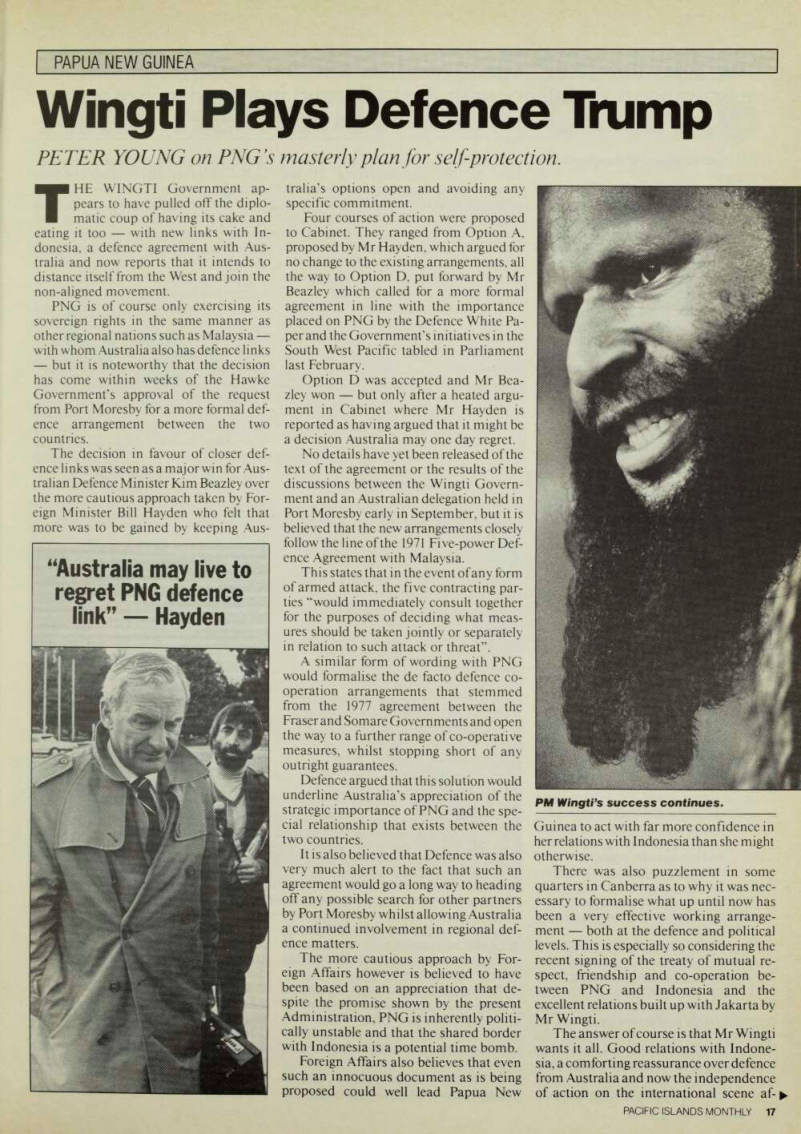
PM Wingti’s success continues.
“Wingti wants it all good relations with Indonesia, a comforting reassurance over defence with Australia, and independence of action on the international scene”
◄ forded by membership of the non-aligned movement.
However, from a purely military point of view, the major question must be whether Australia could meet its commit ment under the new arrangement in the event of the two most likely scenarios of internal unrest or external threat by Indonesia.
The answer must be a definite no at least for the foreseeable future.
According to Dr Ross Babbage, the Deputy Head of the prestigious Australian Defence and Strategic Studies Centre in a recent paper on the defence contingencies in PNG, Australia would not be able to back up its military commitments for at least the next five to eight years because of weaknesses and deficiencies in its existing defence force structure.
These weaknesses he identifies as lack of long-range surveillance and airborne early warning and control aircraft, inad equacies of aircraft and communications support, manpower limitations and short ages of transport, munitions and spares and lack of expertise in the conduct of widely-dispersed operations.
Babbage makes it clear that the possi bility of any major threat to PNG remains remote and that practically none of the contingencies he examines are likely.
Nevertheless, given the increasing volatil ity of the region his paper makes interest ing reading.
His starting point is that Australia has a strong but not vital interest in the main tenance of a strong central government in Port Moresby that does not seek to under mine Australia’s broader security interests.
As he rightly argues, the occupation of PNG by a hostile power or the invitation into PNG of any power hostile to Aus tralian interests would not only increase the potential threat in Torres Strait and the Gulf of Carpenteria but also generate an axis of threat down the east coast of Aus tralia and in a broader sense, extending to the island states in the South-West Pacific.
It would also limit the projection of Australia’s hi-tech strategic reach into the central Western Pacific.
The most obvious potential problem he poses is an escalation of conflict with In donesia over clashes with a growing OPM (Free Papua Movement) on the common border with Irian Jaya. Australia’s re sponse to such a situation he sees as at tempting to moderate between the two sides while offering aid to help police the border in order to contain the problem and ease tension.
The next worse case he sees as a pos
sible change in the international orientation or the disintegration of the Government through regional secession or a breakdown of law and order. Such a possibility would be viewed with equal concern by both Canberra and Jakarta and could well lead to some form of joint military intervention especially if it resuited in the offer of military bases to the Soviet Union, China or Vietnam.
But short of these unlikely contingencies, the paper argues that it is difficult to contemplate any situation in which PNG could be confronted by any large-scale external threat.
Any potential aggressor, he argues, v ould need to deploy up to a division in the initial assault and much larger forces in the longer term. They would also need to maintain air superiority to protect the large air and sea supply train they would need to maintain themselves.
Australia could be expected to be fo-
ternal problems rather than external at tack with a breakdown of law and order the biggest worry, In theory, Australian troops could be used under the new agreement under what is believed to be a vaguely worded concept of this safeguarding of “sovereignty” in the new agreement, but this he says would be a “gross misapplication” of specialised re sources and would risk the employment of Australian servicemen in political situa tions for which they are not properly trained.
Instead, the more likely response would be to provide specialist police support from the Australian Federal and State po lice forces.
All of this is of course only conjecture at this stage and Babbage makes it very clear that all he is doing is thinking the un thinkable. And with the Wingti Govern ment on such a seeming winning streak at the moment few believe that Canberra is
rewarned of such a buildup and the range of air and naval assets presently under de velopment could confidently be expected to deter or defeat them.
Babbage believes that depending on the level of threat to Australia such a possi bility might pose, Canberra might be pre pared to commit selected non-combat units but would baulk at the commitment of ground combat forces.
However, in the shorter term, Babbage sees the more probable threat lying in in
concerned either with the new defence ar rangements or the present moves by Port Moresby to look at joining the non-aligned movement.
However, Dr Ross Babbage has done a great service in pinpointing the problems that could confront the defence planners in both Canberra and Port Moresby in the unlikely event that the security of Papua New Guinea was ever to come under chal lenge and Australia’s marker was to be called in. □
Australian Defence Minister Beazley: sights set on new treaty.
Advertisements & other items, p. 17 (1 item)
“Australia may live to
regret PNG defence link” Hayden
After Namu: The Big Clean-up
The Solomon Islands
Rotary volunteers lend a hand to rebuild schools.
By Billy Williams.
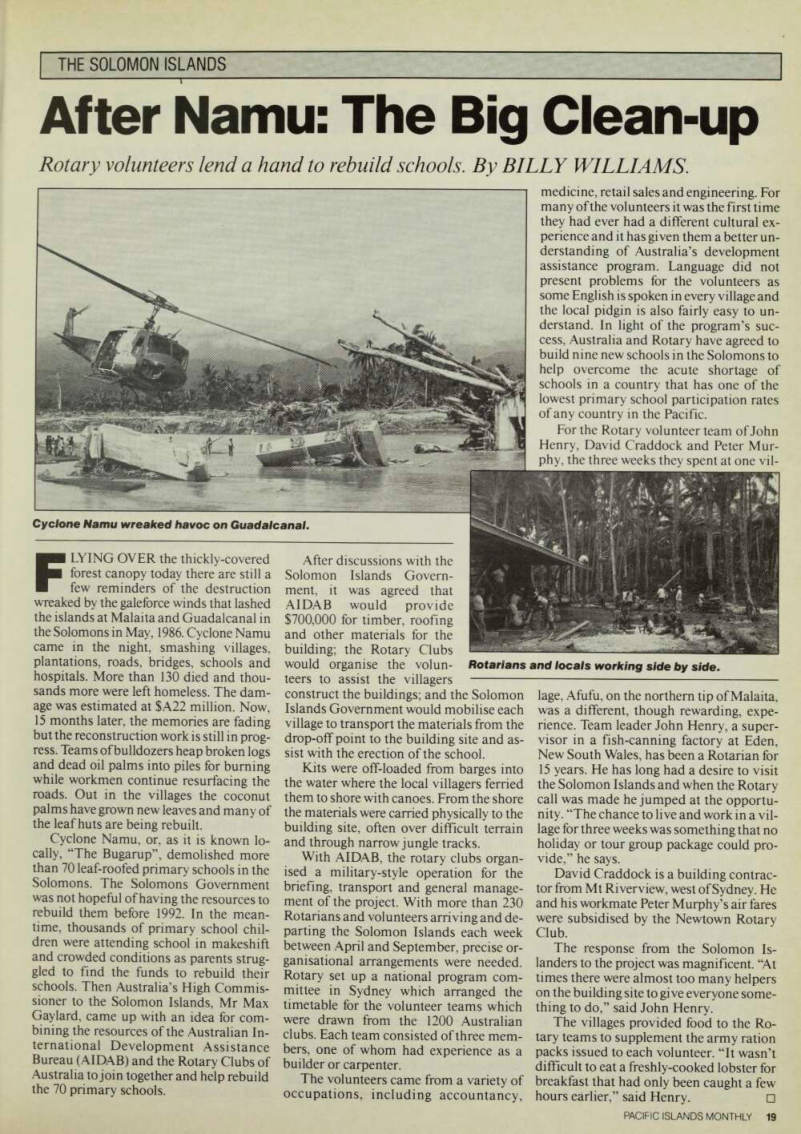
FLYING OVER the thickly-covered forest canopy today there are still a few reminders of the destruction wreaked by the galeforce winds that lashed the islands at Malaita and Guadalcanal in the Solomons in May, 1986. Cyclone Namu came in the night, smashing villages, plantations, roads, bridges, schools and hospitals. More than 130 died and thou sands more were left homeless. The dam age was estimated at SA22 million. Now, 15 months later, the memories are fading but the reconstruction work is still in prog ress. Teams of bulldozers heap broken logs and dead oil palms into piles for burning while workmen continue resurfacing the roads. Out in the villages the coconut palms have grown new leaves and many of the leaf huts are being rebuilt.
Cyclone Namu, or, as it is known lo cally, “The Bugarup”, demolished more than 70 leaf-roofed primary schools in the Solomons. The Solomons Government was not hopeful of having the resources to rebuild them before 1992. In the mean time, thousands of primary school chil dren were attending school in makeshift and crowded conditions as parents strug gled to find the funds to rebuild their schools. Then Australia’s High Commis sioner to the Solomon Islands, Mr Max Gaylard, came up with an idea for com bining the resources of the Australian In ternational Development Assistance Bureau (AIDAB) and the Rotary Clubs of Australia to join together and help rebuild the 70 primary schools.
After discussions with the Solomon Islands Govern ment, it was agreed that AIDAB would provide $700,000 for timber, roofing and other materials for the building; the Rotary Clubs would organise the volun teers to assist the villagers
construct the buildings; and the Solomon Islands Government would mobilise each village to transport the materials from the drop-off point to the building site and as sist with the erection of the school.
Kits were off-loaded from barges into the water where the local villagers ferried them to shore with canoes. From the shore the materials were carried physically to the building site, often over difficult terrain and through narrow jungle tracks.
With AIDAB, the rotary clubs organ ised a military-style operation for the briefing, transport and general manage ment of the project. With more than 230 Rotarians and volunteers arriving and de parting the Solomon Islands each week between April and September, precise or ganisational arrangements were needed.
Rotary set up a national program com mittee in Sydney which arranged the timetable for the volunteer teams which were drawn from the 1200 Australian clubs. Each team consisted of three mem bers, one of whom had experience as a builder or carpenter.
The volunteers came from a variety of occupations, including accountancy,
medicine, retail sales and engineering. For many of the volunteers it was the first time they had ever had a different cultural ex perience and it has given them a better un derstanding of Australia’s development assistance program. Language did not present problems for the volunteers as some English is spoken in every village and the local pidgin is also fairly easy to un derstand. In light of the program’s suc cess, Australia and Rotary have agreed to build nine new schools in the Solomons to help overcome the acute shortage of schools in a country that has one of the lowest primary school participation rates of any country in the Pacific.
For the Rotary volunteer team of John Henry, David Craddock and Peter Mur phy, the three weeks they spent at one vil-
lage, Afufu, on the northern tip of Malaita, was a different, though rewarding, expe rience. Team leader John Henry, a super visor in a fish-canning factory at Eden, New South Wales, has been a Rotarian for 15 years. He has long had a desire to visit the Solomon Islands and when the Rotary call was made he jumped at the opportu nity. “The chance to live and work in a vil lage for three weeks was something that no holiday or tour group package could pro vide,” he says.
David Craddock is a building contrac tor from Mt Riverview, west of Sydney. He and his workmate Peter Murphy’s air fares were subsidised by the Newtown Rotary Club.
The response from the Solomon Is landers to the project was magnificent. “At times there were almost too many helpers on the building site to give everyone some thing to do,” said John Henry.
The villages provided food to the Ro tary teams to supplement the army ration packs issued to each volunteer. “It wasn’t difficult to eat a freshly-cooked lobster for breakfast that had only been caught a few hours earlier,” said Henry. □
Cyclone Namu wreaked havoc on Guadalcanal.
Rotarians and locals working side by side.
Sunia in Payroll Storm
American Samoa
Serious accusations hound the charismatic congressman.
By David S. North.
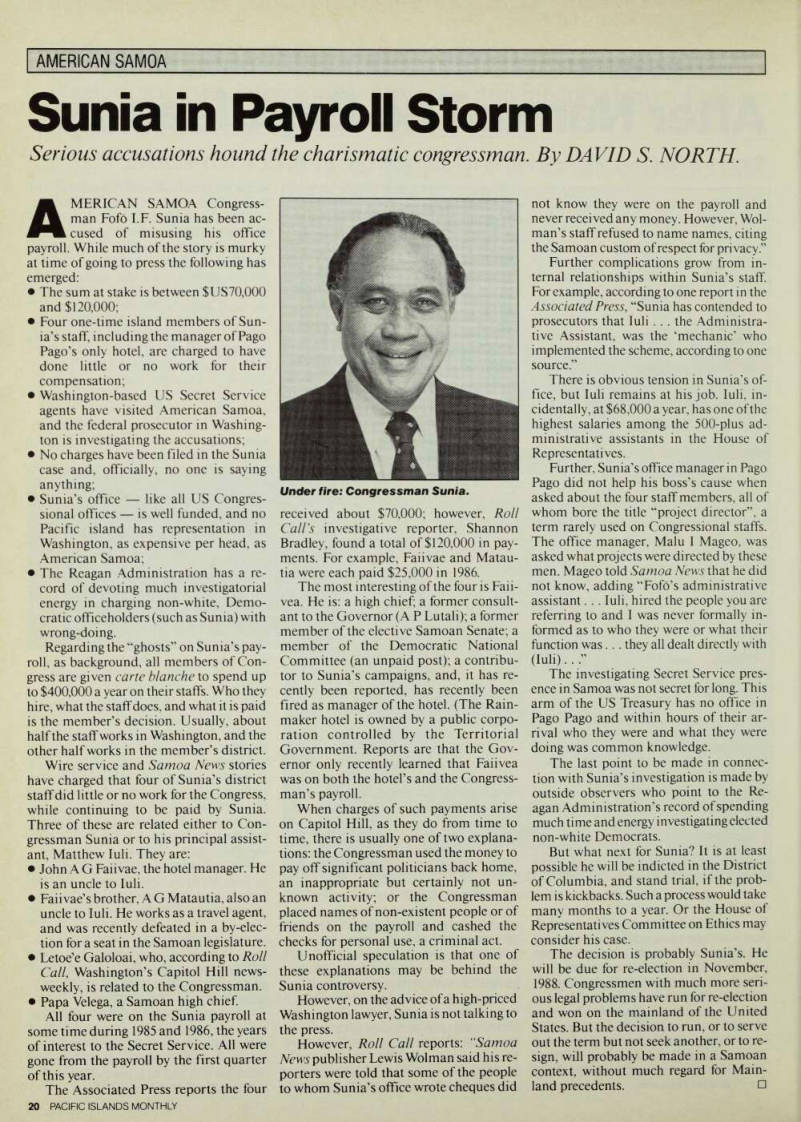
AMERICAN SAMOA Congress man Fofo I.F. Sunia has been ac cused of misusing his office payroll. While much of the story is murky at time of going to press the following has emerged: • The sum at stake is between SUS7O,OOO and $120,000; • Four one-time island members ofSun ia’s staff, including the manager of Pago Pago’s only hotel, are charged to have done little or no work for their compensation; • Washington-based US Secret Service agents have visited American Samoa, and the federal prosecutor in Washing ton is investigating the accusations; • No charges have been filed in the Sunia case and, officially, no one is saying anything; • Sunia’s office like all US Congres sional offices is well funded, and no Pacific island has representation in Washington, as expensive per head, as American Samoa; • The Reagan Administration has a re cord of devoting much investigatorial energy in charging non-white. Demo cratic officeholders (such as Sunia) with wrong-doing.
Regarding the “ghosts” on Sunia’s pay roll, as background, all members of Con gress are given carte blanche to spend up to $400,000 a year on their staffs. Who they hire, what the staff does, and what it is paid is the member’s decision. Usually, about half the staff works in Washington, and the other half works in the member’s district.
Wire service and Samoa News stories have charged that four of Sunia’s district staff did little or no work for the Congress, while continuing to be paid by Sunia.
Three of these are related either to Con gressman Sunia or to his principal assist ant, Matthew luli. They are: • John A G Faiivae, the hotel manager. He is an uncle to luli. • Faiivae’s brother, A G Matautia, also an uncle to luli. He works as a travel agent, and was recently defeated in a by-elec tion for a seat in the Samoan legislature. • Letoe’e Galoloai, who, according to Roll Call , Washington’s Capitol Hill news weekly, is related to the Congressman. • Papa Velega, a Samoan high chief.
All four were on the Sunia payroll at some time during 1985 and 1986, the years of interest to the Secret Service. All were gone from the payroll by the first quarter of this year.
The Associated Press reports the four
received about $70,000; however, Roll Call's investigative reporter, Shannon Bradley, found a total of $120,000 in pay ments. For example, Faiivae and Matau tia were each paid $25,000 in 1986.
The most interesting of the four is Faii vea. He is: a high chief; a former consult ant to the Governor (A P Lutali); a former member of the elective Samoan Senate; a member of the Democratic National Committee (an unpaid post); a contribu tor to Sunia’s campaigns, and, it has re cently been reported, has recently been fired as manager of the hotel. (The Rain maker hotel is owned by a public corpo ration controlled by the Territorial Government. Reports are that the Gov ernor only recently learned that Faiivea was on both the hotel’s and the Congress man’s payroll.
When charges of such payments arise on Capitol Hill, as they do from time to time, there is usually one of two explana tions: the Congressman used the money to pay off significant politicians back home, an inappropriate but certainly not un known activity; or the Congressman placed names of non-existent people or of friends on the payroll and cashed the checks for personal use, a criminal act.
Unofficial speculation is that one of these explanations may be behind the Sunia controversy.
However, on the advice of a high-priced Washington lawyer, Sunia is not talking to the press.
However, Roll Call reports: “Samoa News publisher Lewis Wolman said his re porters were told that some of the people to whom Sunia’s office wrote cheques did
not know they were on the payroll and never received any money. However, Wol man’s staff refused to name names, citing the Samoan custom of respect for privacy.”
Further complications grow from in ternal relationships within Sunia’s staff.
For example, according to one report in the Associated Press, “Sunia has contended to prosecutors that luli ... the Administra tive Assistant, was the ‘mechanic’ who implemented the scheme, according to one source.”
There is obvious tension in Sunia’s of fice, but luli remains at his job. luli, in cidentally, at $68,000 a year, has one of the highest salaries among the 500-plus ad ministrative assistants in the House of Representatives.
Further, Sunia’s office manager in Pago Pago did not help his boss’s cause when asked about the four staff members, all of whom bore the title “project director”, a term rarely used on Congressional staffs.
The office manager, Malu I Mageo, was asked what projects were directed by these men. Mageo told Samoa News that he did not know, adding “Fofo’s administrative assistant. . . luli, hired the people you are referring to and I was never formally in formed as to who they were or what their function was... they all dealt directly with (1uh)...”
The investigating Secret Service pres ence in Samoa was not secret for long. This arm of the US Treasury has no office in Pago Pago and within hours of their ar rival who they were and what they were doing was common knowledge.
The last point to be made in connec tion with Sunia’s investigation is made by outside observers who point to the Re agan Administration’s record of spending much time and energy investigating elected non-white Democrats.
But what next for Sunia? It is at least possible he will be indicted in the District of Columbia, and stand trial, if the prob lem is kickbacks. Such a process would take many months to a year. Or the House of Representatives Committee on Ethics may consider his case.
The decision is probably Sunia’s. He will be due for re-election in November, 1988. Congressmen with much more seri ous legal problems have run for re-election and won on the mainland of the United States. But the decision to run, or to serve out the term but not seek another, or to re sign, will probably be made in a Samoan context, without much regard for Main land precedents. □
Under fire: Congressman Sunia.
Melanesian Union Bid Falters
The Region
FLNKS faces a struggle to form a power bloc.
By John Dunn.
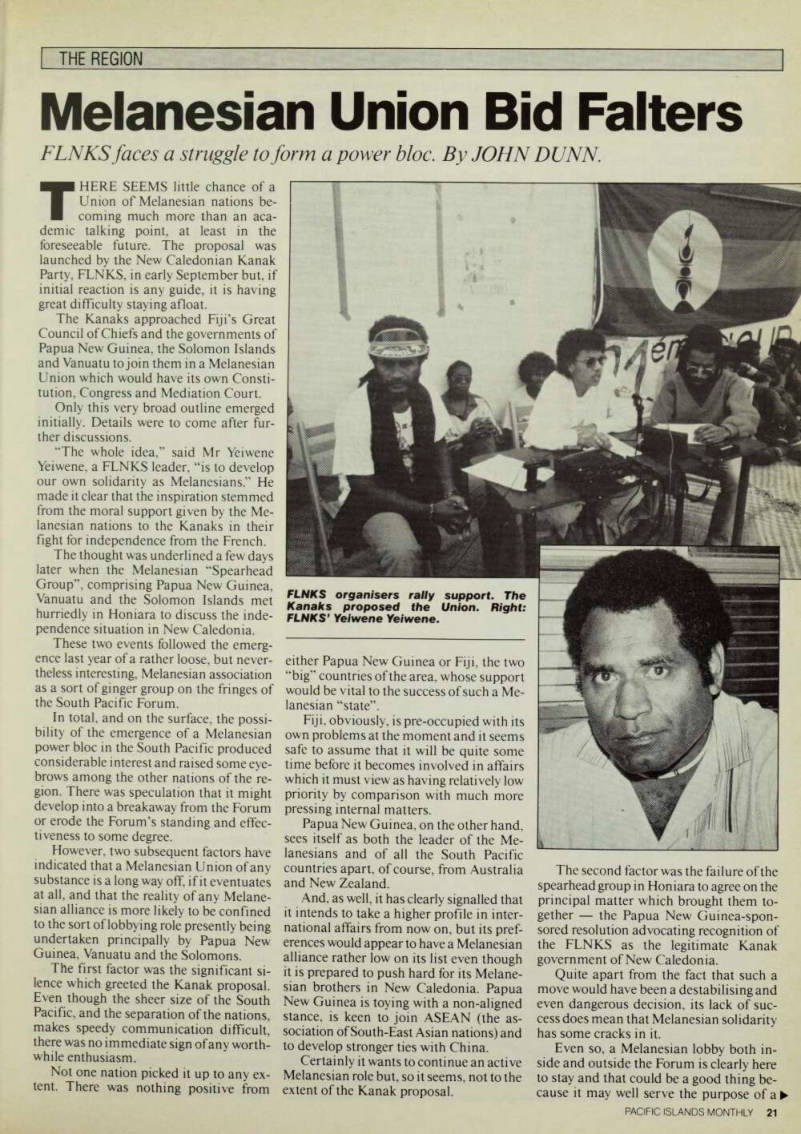
THERE SEEMS little chance of a Union of Melanesian nations be coming much more than an aca demic talking point, at least in the foreseeable future. The proposal was launched by the New Caledonian Kanak Party, FLNKS, in early September but, if initial reaction is any guide, it is having great difficulty staying afloat.
The Kanaks approached Fiji’s Great Council of Chiefs and the governments of Papua New Guinea, the Solomon Islands and Vanuatu to join them in a Melanesian Union which would have its own Consti tution, Congress and Mediation Court.
Only this very broad outline emerged initially. Details were to come after fur ther discussions.
“The whole idea,” said Mr Yeiwene Yeiwene, a FLNKS leader, “is to develop our own solidarity as Melanesians.” He made it clear that the inspiration stemmed from the moral support given by the Me lanesian nations to the Kanaks in their fight for independence from the French.
The thought was underlined a few days later when the Melanesian “Spearhead Group”, comprising Papua New Guinea, Vanuatu and the Solomon Islands met hurriedly in Honiara to discuss the inde pendence situation in New Caledonia.
These two events followed the emerg ence last year of a rather loose, but never theless interesting, Melanesian association as a sort of ginger group on the fringes of the South Pacific Forum.
In total, and on the surface, the possi bility of the emergence of a Melanesian power bloc in the South Pacific produced considerable interest and raised some eye brows among the other nations of the re gion. There was speculation that it might develop into a breakaway from the Forum or erode the Forum’s standing and effec tiveness to some degree.
However, two subsequent factors have indicated that a Melanesian Union of any substance is a long way off, if it eventuates at all, and that the reality of any Melane sian alliance is more likely to be confined to the sort of lobbying role presently being undertaken principally by Papua New Guinea, Vanuatu and the Solomons.
The first factor was the significant si lence which greeted the Kanak proposal.
Even though the sheer size of the South Pacific, and the separation of the nations, makes speedy communication difficult, there was no immediate sign of any worth while enthusiasm.
Not one nation picked it up to any ex tent. There was nothing positive from
either Papua New Guinea or Fiji, the two “big” countries of the area, whose support would be vital to the success of such a Me lanesian “state”.
Fiji, obviously, is pre-occupied with its own problems at the moment and it seems safe to assume that it will be quite some time before it becomes involved in affairs which it must view as having relatively low priority by comparison with much more pressing internal matters.
Papua New Guinea, on the other hand, sees itself as both the leader of the Me lanesians and of all the South Pacific countries apart, of course, from Australia and New Zealand.
And, as well, it has clearly signalled that it intends to take a higher profile in inter national affairs from now on, but its pref erences would appear to have a Melanesian alliance rather low on its list even though it is prepared to push hard for its Melane sian brothers in New Caledonia. Papua New Guinea is toying with a non-aligned stance, is keen to join ASEAN (the as sociation of South-East Asian nations) and to develop stronger ties with China.
Certainly it wants to continue an active Melanesian role but, so it seems, not to the extent of the Kanak proposal.
The second factor was the failure of the spearhead group in Honiara to agree on the principal matter which brought them to gether the Papua New Guinea-spon sored resolution advocating recognition of the FLNKS as the legitimate Kanak government of New Caledonia.
Quite apart from the fact that such a move would have been a destabilising and even dangerous decision, its lack of suc cess does mean that Melanesian solidarity has some cracks in it.
Even so, a Melanesian lobby both in side and outside the Forum is clearly here to stay and that could be a good thing be cause it may well serve the purpose of a ►
FLNKS organisers rally support. The Kanaks proposed the Union. Right: FLNKS’ Yeiwene Yeiwene.
◄ healthy and useful outlet for whatever frustrations may stem from Forum conservatism.
On the New Caledonia question, the Melanesians do not regard the Forum line, as framed by Australia and New Zealand, as being tough enough.
Mr Arum Matiabe, Papua New Guin ea’s acting Foreign Minister, made this plain when he called the Honiara meeting.
“Australia and New Zealand have sup ported together with other Forum countries the reinscription of New Ca ledonia on the UN agenda,” he said. “They have also talked on various occasions in the past about the Kanak cause but now is the time for us to show our support in practical action.”
That action was not forthcoming be cause, as Solomons Prime Minister, Mr Ezekiel Alebua quite rightly pointed out, recognition of the FLNKS as proposed “would create problems, not only for them but also for us”.
A Papua New Guinea call for a meeting
of Forum Foreign Ministers did not get off the ground but, nevertheless, the Melane sians will continue to function effectively as a lobby group and this would seem to be their best, and most effective, role at this stage.
And it just may be that the FLNKS will not be too worried if their Melanesian “state” goes no further than the call for it to take place. It could be that their pro posal may have been no more than a “kite” designed to put some additional pressure on the French in the run-up to the refer endum. A Melanesian Union on its own may not be all that threatening to Paris but it is yet another opposition factor to be considered.
It would be difficult, indeed, to visual ise the Kanaks wanting to cede any of the self-governing gains they may ultimately win to a vague and perhaps unmanagea ble union of scattered states. And if and when self-government does come, a Me lanesian Union would probably lose most of the point of its existence. □
Nauru Escape in DC
Property a prime investment says DAVID S. NORTH.
NAURU’S latest investment in ur ban real estate is open for busi ness. The five-storey office and apartment building in Washington’s fash ionable Dupont Circle area is named “Pa cific House”. The building is designed to house the representatives of the various Pacific island jurisdictions, now scattered throughout the city.
A brand-new structure, Pacific House represents a sUSsmillion investment of the Nauru Phosphate Royalties Trust. The Trust owns the building there is no mortgage. This and other urban invest ments, such as the massive Nauru House
in Melbourne, will provide the people of Nauru with a continuing income after the phosphate isexhausted on the island a few years from now.
Fred Radewagen, who represents both the Phosphate Trust and the Cook Islands in Washington, says efforts are being made to encourage Pacific countries and lerri tories to take offices in the building, and to share joint services such as photoco pying, library and telex, In addition to office and meeting space, the building also has room, and separate entrances for, residential apartments on the top two floors of the building. □
An artist’s Impression of Pacific House.
face attacks
Palau women face attacks
Violent warnings for 30
Compact dissenters.
THE SITUATION in Palau, where, at time of going to press, a court de cision was awaited on the legality of the two recent referendums on the Com pact of Free Association between the US and Palau, took a grave and violent turn with a murder, arson and a bombing. As the victims in all three incidents opposed the plan to remove the constitutional ban on nuclear material entering, or being
stored or used in the country, blame has been directed at supporters of the plan to change the constitution.
Thirty women had entered a writ in the Supreme Court challenging the result of the referendum to remove the ban. A bomb exploded outside the home of one. The father of the women’s lawyer was shot dead at the door of his son’s office. The lawyer believes the bullet was meant for him. An abandoned clubhouse belonging to a Ko ror chief opposed to the Compact was de stroyed by fire. The women then withdrew the court action, but Judge Robert Hefner said the women should refile the case if fear prompted its withdrawal.
Palau President Lazarus Salii appealed for calm, saying his government was in control of the situation. He also expressed confidence that the Supreme Court would uphold the Compact approved by 73 per cent of the voters. Meanwhile, Palau funds are short and 900 government employees are on unpaid leave because the govern ment does not have the money to pay their wages. If the Compact of Free Association goes through, the Palauans will begin to share a portion of the SUSIOOO million which the US has promised to pay over 50 years in return for “eminent domain”, the use of bases and freedom to come and go without question. □
Westpac Manages $27m Fund
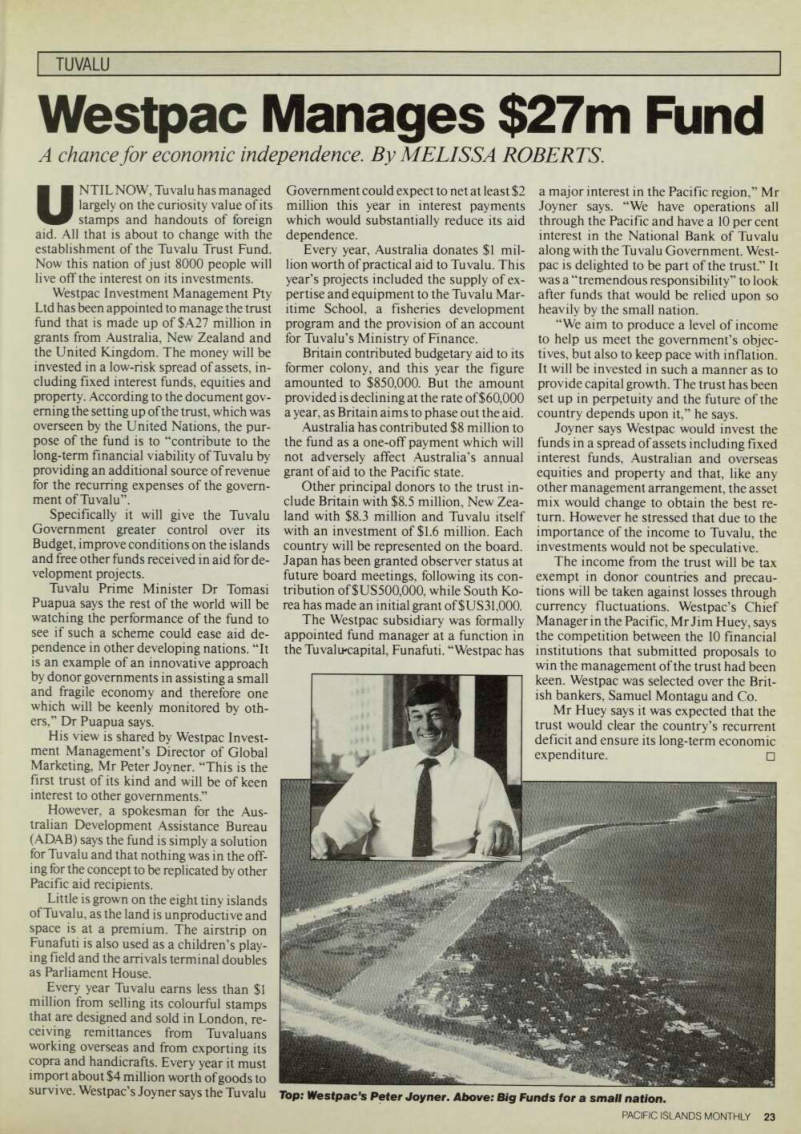
A chance for economic independence.
By Melissa Roberts.
UNTIL NOW, Tuvalu has managed largely on the curiosity value of its stamps and handouts of foreign aid. All that is about to change with the establishment of the Tuvalu Trust Fund.
Now this nation of just 8000 people will live off the interest on its investments.
Westpac Investment Management Pty Ltd has been appointed to manage the trust fund that is made up of SA27 million in grants from Australia, New Zealand and the United Kingdom. The money will be invested in a low-risk spread of assets, in cluding fixed interest funds, equities and property. According to the document gov erning the setting up of the trust, which was overseen by the United Nations, the pur pose of the fund is to “contribute to the long-term financial viability of Tuvalu by providing an additional source of revenue for the recurring expenses of the govern ment of Tuvalu”.
Specifically it will give the Tuvalu Government greater control over its Budget, improve conditions on the islands and free other funds received in aid for de velopment projects.
Tuvalu Prime Minister Dr Tomasi Puapua says the rest of the world will be watching the performance of the fund to see if such a scheme could ease aid de pendence in other developing nations. “It is an example of an innovative approach by donor governments in assisting a small and fragile economy and therefore one which will be keenly monitored by oth ers,” Dr Puapua says.
His view is shared by Westpac Invest ment Management’s Director of Global Marketing, Mr Peter Joyner. “This is the first trust of its kind and will be of keen interest to other governments.”
However, a spokesman for the Aus tralian Development Assistance Bureau (ADAB) says the fund is simply a solution for Tuvalu and that nothing was in the off ing for the concept to be replicated by other Pacific aid recipients.
Little is grown on the eight tiny islands of Tuvalu, as the land is unproductive and space is at a premium. The airstrip on Funafuti is also used as a children’s play ing field and the arrivals terminal doubles as Parliament House.
Every year Tuvalu earns less than $1 million from selling its colourful stamps that are designed and sold in London, re ceiving remittances from Tuvaluans working overseas and from exporting its copra and handicrafts. Every year it must import about $4 million worth of goods to survive. Westpac’s Joyner says the Tuvalu
Government could expect to net at least $2 million this year in interest payments which would substantially reduce its aid dependence.
Every year, Australia donates $1 mil lion worth of practical aid to Tuvalu. This year’s projects included the supply of ex pertise and equipment to the Tuvalu Mar itime School, a fisheries development program and the provision of an account for Tuvalu’s Ministry of Finance.
Britain contributed budgetary aid to its former colony, and this year the figure amounted to $850,000. But the amount provided is declining at the rate of $60,000 a year, as Britain aims to phase out the aid.
Australia has contributed $8 million to the fund as a one-off payment which will not adversely affect Australia’s annual grant of aid to the Pacific state.
Other principal donors to the trust in clude Britain with $8.5 million. New Zea land with $8.3 million and Tuvalu itself with an investment of $1.6 million. Each country will be represented on the board.
Japan has been granted observer status at future board meetings, following its con tribution of$US5OO,OOO, while South Ko rea has made an initial grant of SUS3I,OOO.
The Westpac subsidiary was formally appointed fund manager at a function in the Tuvalihcapital, Funafuti. “Westpac has
a major interest in the Pacific region,” Mr Joyner says. “We have operations all through the Pacific and have a 10 per cent interest in the National Bank of Tuvalu along with the Tuvalu Government. West pac is delighted to be part of the trust.” It was a “tremendous responsibility” to look after funds that would be relied upon so heavily by the small nation.
“We aim to produce a level of income to help us meet the government’s objec tives, but also to keep pace with inflation.
It will be invested in such a manner as to provide capital growth. The trust has been set up in perpetuity and the future of the country depends upon it,” he says.
Joyner says Westpac would invest the funds in a spread of assets including fixed interest funds, Australian and overseas equities and property and that, like any other management arrangement, the asset mix would change to obtain the best re turn. However he stressed that due to the importance of the income to Tuvalu, the investments would not be speculative.
The income from the trust will be tax exempt in donor countries and precau tions will be taken against losses through currency fluctuations. Westpac’s Chief Manager in the Pacific, Mr Jim Huey, says the competition between the 10 financial institutions that submitted proposals to win the management of the trust had been keen. Westpac was selected over the Brit ish bankers, Samuel Montagu and Co.
Mr Huey says it was expected that the trust would clear the country’s recurrent deficit and ensure its long-term economic expenditure. □
Top: Westpac’s Peter Joyner. Above: Big Funds for a small nation.
Advertisements & other items, p. 24 (1 item)
Hawaiian Tel
Private Line Channels. Microwave and Fiber Systems. Local Area Networks and VAN’s.
Consulting. PBXs. Operations and Maintenance. International Calling. Multiplexers.
Packet Switching. Data Comm. Pagers. Systems Integration. Project Management. Network Planning, Designing, Engineering and Construction Services. Trainir^g^gM^rketing.
There’s
more to
Hawaiian Tel
than meets
the ear.
HAWAIIAN TEL
Beyond the call ' , * * m ■
Inside Lange’s New Cabinet
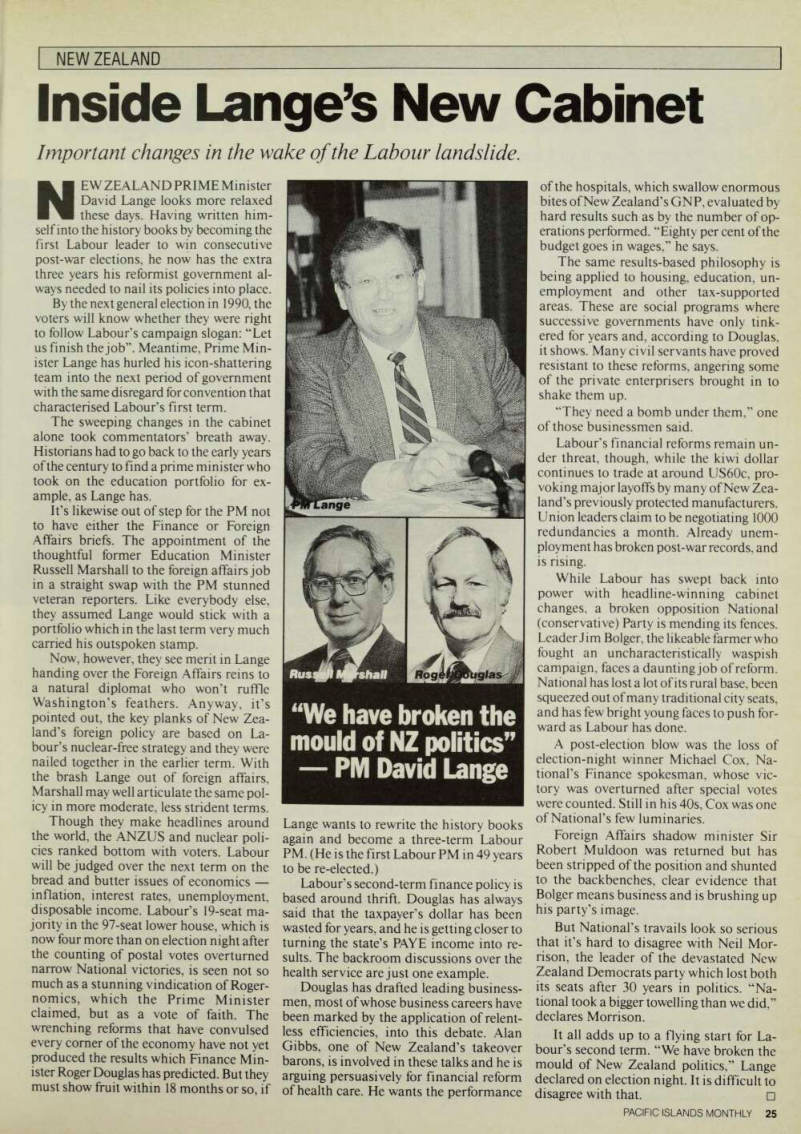
New Zealand
Important changes in the wake of the Labour landslide.
NEW ZEALAND PRIME Minister David Lange looks more relaxed these days. Having written him self into the history books by becoming the first Labour leader to win consecutive post-war elections, he now has the extra three years his reformist government al ways needed to nail its policies into place.
By the next general election in 1990, the voters will know whether they were right to follow Labour’s campaign slogan: “Let us finish the job”. Meantime, Prime Min ister Lange has hurled his icon-shattering team into the next period of government with the same disregard for convention that characterised Labour’s first term.
The sweeping changes in the cabinet alone took commentators’ breath away.
Historians had to go back to the early years of the century to find a prime minister who took on the education portfolio for ex ample, as Lange has.
It’s likewise out of step for the PM not to have either the Finance or Foreign Affairs briefs. The appointment of the thoughtful former Education Minister Russell Marshall to the foreign affairs job in a straight swap with the PM stunned veteran reporters. Like everybody else, they assumed Lange would stick with a portfolio which in the last term very much carried his outspoken stamp.
Now, however, they see merit in Lange handing over the Foreign Affairs reins to a natural diplomat who won’t ruffle Washington’s feathers. Anyway, it’s pointed out, the key planks of New Zea land’s foreign policy are based on La bour’s nuclear-free strategy and they were nailed together in the earlier term. With the brash Lange out of foreign affairs, Marshall may well articulate the same pol icy in more moderate, less strident terms.
Though they make headlines around the world, the ANZUS and nuclear poli cies ranked bottom with voters. Labour will be judged over the next term on the bread and butter issues of economics inflation, interest rates, unemployment, disposable income. Labour’s 19-seat ma jority in the 97-seat lower house, which is now four more than on election night after the counting of postal votes overturned narrow National victories, is seen not so much as a stunning vindication of Roger nomics, which the Prime Minister claimed, but as a vote of faith. The wrenching reforms that have convulsed every comer of the economy have not yet produced the results which Finance Min ister Roger Douglas has predicted. But they must show fruit within 18 months or so, if
Lange wants to rewrite the history books again and become a three-term Labour PM. (He is the first Labour PM in 49 years to be re-elected.) Labour’s second-term finance policy is based around thrift. Douglas has always said that the taxpayer’s dollar has been wasted for years, and he is getting closer to turning the state’s PAYE income into re sults. The backroom discussions over the health service are just one example.
Douglas has drafted leading business men, most of whose business careers have been marked by the application of relent less efficiencies, into this debate. Alan Gibbs, one of New Zealand’s takeover barons, is involved in these talks and he is arguing persuasively for financial reform of health care. He wants the performance
of the hospitals, which swallow enormous bites of New Zealand’s GNP, evaluated by hard results such as by the number of op erations performed. “Eighty per cent of the budget goes in wages,” he says.
The same results-based philosophy is being applied to housing, education, un employment and other tax-supported areas. These are social programs where successive governments have only tink ered for years and, according to Douglas, it shows. Many civil servants have proved resistant to these reforms, angering some of the private enterprisers brought in to shake them up.
“They need a bomb under them,” one of those businessmen said.
Labour’s financial reforms remain un der threat, though, while the kiwi dollar continues to trade at around US6Oc, pro voking major layoffs by many of New Zea land’s previously protected manufacturers.
Union leaders claim to be negotiating 1000 redundancies a month. Already unem ployment has broken post-war records, and is rising.
While Labour has swept back into power with headline-winning cabinet changes, a broken opposition National (conservative) Party is mending its fences.
Leader Jim Bolger, the likeable farmer who fought an uncharacteristically waspish campaign, faces a daunting job of reform.
National has lost a lot of its rural base, been squeezed out of many traditional city seats, and has few bright young faces to push for ward as Labour has done.
A post-election blow was the loss of election-night winner Michael Cox, Na tional’s Finance spokesman, whose vic tory was overturned after special votes were counted. Still in his 40s, Cox was one of National’s few luminaries.
Foreign Affairs shadow minister Sir Robert Muldoon was returned but has been stripped of the position and shunted to the backbenches, clear evidence that Bolger means business and is brushing up his party’s image.
But National’s travails look so serious that it’s hard to disagree with Neil Mor rison, the leader of the devastated New Zealand Democrats party which lost both its seats after 30 years in politics. “Na tional took a bigger towelling than we did,” declares Morrison.
It all adds up to a flying start for La bour’s second term. “We have broken the mould of New Zealand politics,” Lange declared on election night. It is difficult to disagree with that. □
“We have broken the mould of NZ politics”
PM David Lange
War Declared on Maori Mobs
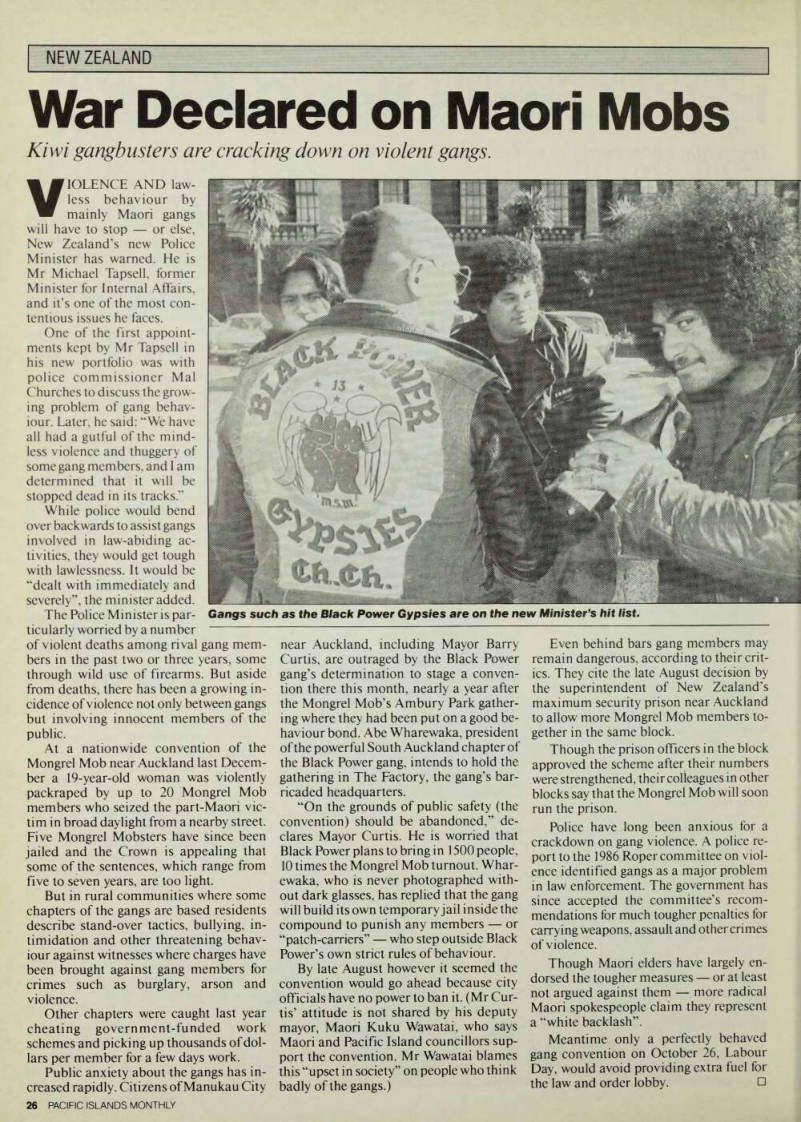
Kiwi gangbusters are cracking down on violent gangs.
Violence And Law
less behaviour by mainly Maori gangs will have to stop or else, New Zealand’s new Police Minister has warned. He is Mr Michael Tapsell, former Minister for Internal Affairs, and it’s one of the most con tentious issues he faces.
One of the first appoint ments kept by Mr Tapsell in his new portfolio was with police commissioner Mai Churches to discuss the grow ing problem of gang behav iour. Later, he said: “We have all had a gutful of the mind less violence and thuggery of some gang members, and I am determined that it will be stopped dead in its tracks.”
While police would bend over backwards to assist gangs involved in law-abiding ac tivities, they would get lough with lawlessness. It would be “dealt with immediately and severely”, the minister added.
The Police Minister is par ticularly worried by a number
of violent deaths among rival gang members in the past two or three years, some through wild use of firearms. But aside from deaths, there has been a growing incidence of violence not only between gangs but involving innocent members of the public.
At a nationwide convention of the Mongrel Mob near Auckland last Decernber a 19-year-old woman was violently packraped by up to 20 Mongrel Mob members who seized the part-Maori vietim in broad daylight from a nearby street, Five Mongrel Mobsters have since been jailed and the Crown is appealing that some of the sentences, which range from five to seven years, are too light.
But in rural communities where some chapters of the gangs are based residents desenbe stand-over tact.cs, bullying, intimidation and other threatening behaviour against witnesses where charges have been brought against gang members for crimes such as burglary, arson and violence.
Other chapters were caught last year cheating government-funded work schemes and picking up thousands of dollars per member for a few days work.
Public anxiety about the gangs has increased rapidly. Citizens of Manukau City
near Auckland, including Mayor Barry Curtis, are outraged by the Black Power gang’s determination to stage a convention there this month, nearly a year after the Mongrel Mob’s Ambury Park gathering where they had been put on a good behaviour bond. Abe Wharewaka, president of the powerful South Auckland chapter of the Black Power gang, intends to hold the gathering in The Factory, the gang’s bar- Headed headquarters.
“On the grounds of public safety (the convention) should be abandoned,” dedares Mayor Curtis. He is worried that Black Power plans to bring in 1500 people, 10 times the Mongrel Mob turnout. Wharewaka, who is never photographed without dark glasses, has replied that the gang will build its own temporary jail inside the compound to pun.sh any members - or “patch-carriers” who step outside Black Power’s own strict rules of behaviour.
By late August however it seemed the convention would go ahead because city officials have no power to ban it. (Mr Curtis’ attitude is not shared by his deputy mayor, Maori Kuku Wawatai, who says Maori and Pacific Island councillors support the convention. Mr Wawatai blames this “upset in society” on people who think badly of the gangs.)
Even behind bars gang members may remain dangerous, according to their crit ics. They cite the late August decision by the superintendent of New Zealand’s maximum security prison near Auckland to allow more Mongrel Mob members to gether in the same block.
Though the prison officers in the block approved the scheme after their numbers were strengthened, their colleagues in other blocks say that the Mongrel Mob will soon run the prison.
Police have long been anxious for a crac kd own on gang violence. A police re porttothe 1986 Roper committee on viol ence identified gangs as a major problem in law enforcement The government has s - nce acce p tec j t h e committee’s recom mpnriotirm« fnr much tnnpher penalties for o f v i o i ence * , . . . .
Ma ? n elc * ers have ar 8 e Y en ‘ dorsedthe tougher measures —oral least not argued against them- more rad,ca Maori spokespeople claim they represent a w “ lte back as Meantime only a perfectly behaved gang convention on October 26, Labour Day, would avoid providing extra fuel for the aw a °d order lobby. □
Gangs such as the Black Power Gypsies are on the new Minister’s hit list.
Fungus Fighters
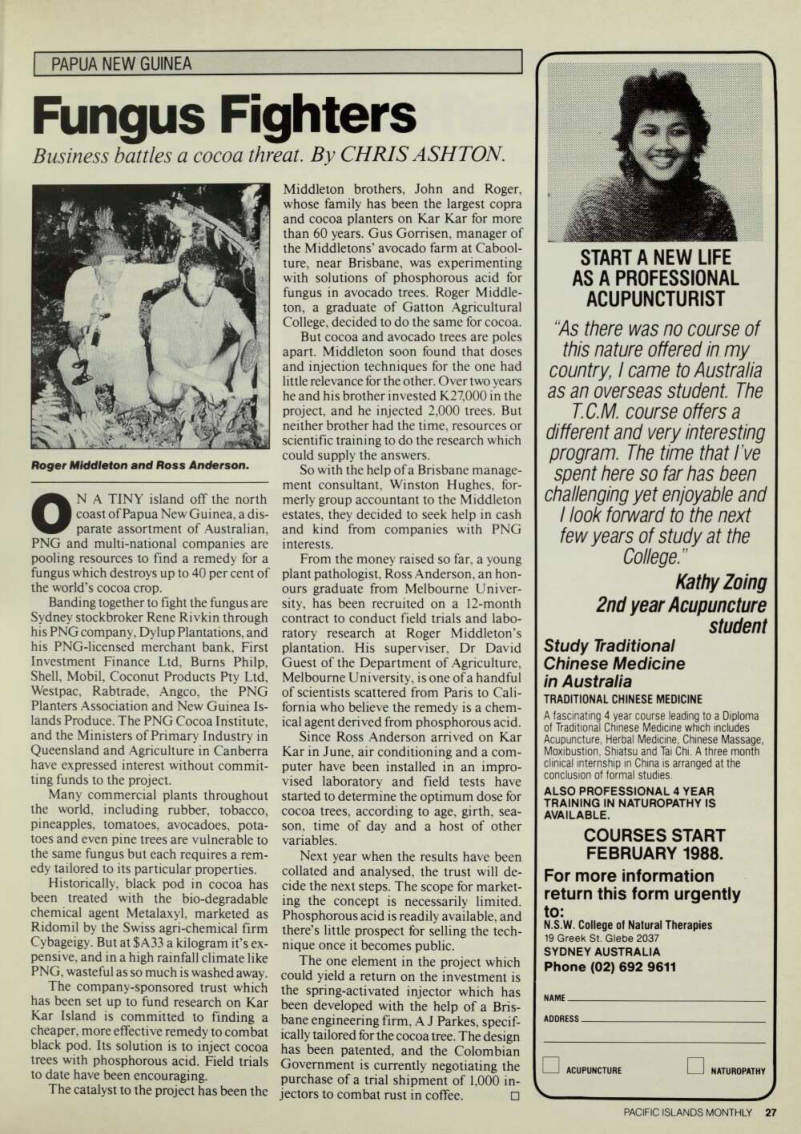
Papua New Guinea
Business battles a cocoa threat.
By Chris Ashton.
ON A TINY island off the north coast of Papua New Guinea, a dis parate assortment of Australian, PNG and multi-national companies are pooling resources to find a remedy for a fungus which destroys up to 40 per cent of the world’s cocoa crop.
Banding together to fight the fungus are Sydney stockbroker Rene Rivkin through his PNG company, Dylup Plantations, and his PNG-licensed merchant bank, First Investment Finance Ltd, Burns Philp, Shell, Mobil, Coconut Products Pty Ltd, Westpac, Rabtrade, Angco, the PNG Planters Association and New Guinea Is lands Produce. The PNG Cocoa Institute, and the Ministers of Primary Industry in Queensland and Agriculture in Canberra have expressed interest without commit ting funds to the project.
Many commercial plants throughout the world, including rubber, tobacco, pineapples, tomatoes, avocadoes, pota toes and even pine trees are vulnerable to the same fungus but each requires a rem edy tailored to its particular properties.
Historically, black pod in cocoa has been treated with the bio-degradable chemical agent Metalaxyl, marketed as Ridomil by the Swiss agri-chemical firm Cybageigy. But at SA33 a kilogram it’s ex pensive, and in a high rainfall climate like PNG, wasteful as so much is washed away.
The company-sponsored trust which has been set up to fund research on Kar Kar Island is committed to finding a cheaper, more effective remedy to combat black pod. Its solution is to inject cocoa trees with phosphorous acid. Field trials to date have been encouraging.
The catalyst to the project has been the
Middleton brothers, John and Roger, whose family has been the largest copra and cocoa planters on Kar Kar for more than 60 years. Gus Gorrisen, manager of the Middletons’ avocado farm at Cabool ture, near Brisbane, was experimenting with solutions of phosphorous acid for fungus in avocado trees. Roger Middle ton, a graduate of Gatton Agricultural College, decided to do the same for cocoa.
But cocoa and avocado trees are poles apart. Middleton soon found that doses and injection techniques for the one had little relevance for the other. Over two years he and his brother invested K 27,000 in the project, and he injected 2,000 trees. But neither brother had the time, resources or scientific training to do the research which could supply the answers.
So with the help of a Brisbane manage ment consultant, Winston Hughes, for merly group accountant to the Middleton estates, they decided to seek help in cash and kind from companies with PNG interests.
From the money raised so far, a young plant pathologist, Ross Anderson, an hon ours graduate from Melbourne Univer sity, has been recruited on a 12-month contract to conduct field trials and labo ratory research at Roger Middleton’s plantation. His supervisor, Dr David Guest of the Department of Agriculture, Melbourne University, is one of a handful of scientists scattered from Paris to Cali fornia who believe the remedy is a chem ical agent derived from phosphorous acid.
Since Ross Anderson arrived on Kar Kar in June, air conditioning and a com puter have been installed in an impro vised laboratory and field tests have started to determine the optimum dose for cocoa trees, according to age, girth, sea son, time of day and a host of other variables.
Next year when the results have been collated and analysed, the trust will de cide the next steps. The scope for market ing the concept is necessarily limited.
Phosphorous acid is readily available, and there’s little prospect for selling the tech nique once it becomes public.
The one element in the project which could yield a return on the investment is the spring-activated injector which has been developed with the help of a Bris bane engineering firm, A J Parkes, specif ically tailored for the cocoa tree. The design has been patented, and the Colombian Government is currently negotiating the purchase of a trial shipment of 1,000 in jectors to combat rust in coffee. □
Roger Middleton and Ross Anderson.
Advertisements & other items, p. 27 (1 item)
College."
START A NEW LIFE
AS A PROFESSIONAL
ACUPUNCTURIST
‘‘/Is there was no course of this nature offered in country, I came to Australia as an overseas student. The T.C.M. course offers a different and very interesting program. The time that I’ve spent here so far has been
challenging yet enjoyable and
I look forward to the next few years of study at the
College."
Kathy Zoing
2nd year Acupuncture student Study Traditional Chinese Medicine in Australia
TRADITIONAL CHINESE MEDICINE
A fascinating 4 year course leading to a Diploma of Traditional Chinese Medicine which includes Acupuncture, Herbal Medicine, Chinese Massage, Moxibustion, Shiatsu and Tai Chi. A three month clinical internship in China is arranged at the conclusion of formal studies.
ALSO PROFESSIONAL 4 YEAR
TRAINING IN NATUROPATHY IS
AVAILABLE.
COURSES START
FEBRUARY 1988.
For more information return this form urgently to: N.S.W. College of Natural Therapies 19 Greek St. Glebe 2037
SYDNEY AUSTRALIA
Phone (02) 692 9611
ADDRESS
ACUPUNCTURE
□ NATUROPATHY
Raun Raun a Hit at Edinburgh
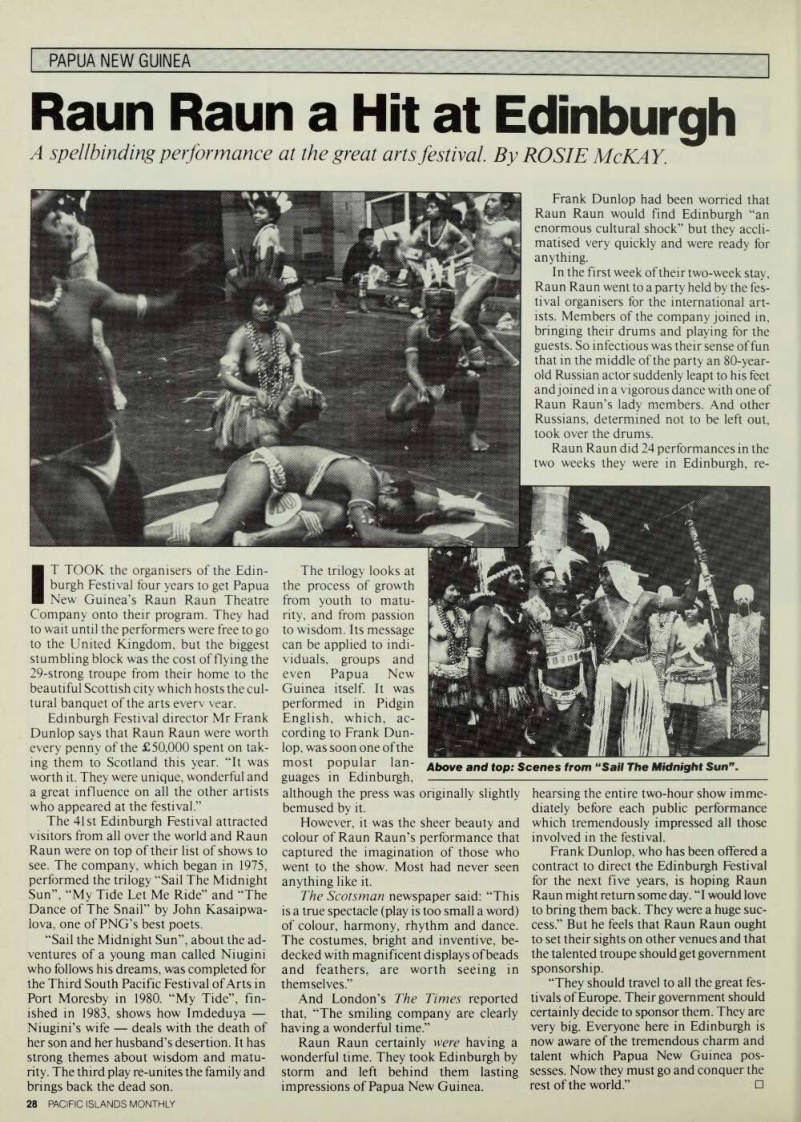
A spellbinding performance at the great arts festival.
By Rosie Mckay.
IT TOOK the organisers of the Edin burgh Festival four years to get Papua New Guinea’s Raun Raun Theatre Company onto their program. They had to wait until the performers were free to go to the United Kingdom, but the biggest stumbling block was the cost of flying the 29-strong troupe from their home to the beautiful Scottish city which hosts the cul tural banquet of the arts everv year.
Edinburgh Festival director Mr Frank Dunlop says that Raun Raun were worth every penny of the £50,000 spent on tak ing them to Scotland this year. “It was worth it. They were unique, wonderful and a great influence on all the other artists who appeared at the festival.”
The 41st Edinburgh Festival attracted visitors from all over the world and Raun Raun were on top of their list of shows to see. The company, which began in 1975, performed the trilogy “Sail The Midnight Sun”, “My Tide Let Me Ride” and “The Dance of The Snail” by John Kasaipwa lova, one of PNG’s best poets.
“Sail the Midnight Sun”, about the ad ventures of a young man called Niugini who follows his dreams, was completed for the Third South Pacific Festival of Arts in Port Moresby in 1980. “My Tide”, fin ished in 1983, shows how Imdeduya Niugini’s wife deals with the death of her son and her husband’s desertion. It has strong themes about wisdom and matu rity. The third play re-unites the family and brings back the dead son.
The trilogy looks at the process of growth from youth to matu rity, and from passion to wisdom. Its message can be applied to indi viduals, groups and even Papua New Guinea itself. It was performed in Pidgin English, which, ac cording to Frank Dun lop, was soon one of the most popular lan guages in Edinburgh,
although the press was originally slightly bemused by it.
However, it was the sheer beauty and colour of Raun Raun’s performance that captured the imagination of those who went to the show. Most had never seen anything like it.
The Scotsman newspaper said: “This is a true spectacle (play is too small a word) of colour, harmony, rhythm and dance.
The costumes, bright and inventive, be decked with magnificent displays of beads and feathers, are worth seeing in themselves.”
And London’s The Times reported that, “The smiling company are clearly having a wonderful time.”
Raun Raun certainly were having a wonderful time. They took Edinburgh by storm and left behind them lasting impressions of Papua New Guinea.
Frank Dunlop had been worried that Raun Raun would find Edinburgh “an enormous cultural shock” but they accli matised very quickly and were ready for anything.
In the first week of their two-week stay, Raun Raun went to a party held by the fes tival organisers for the international art ists. Members of the company joined in, bringing their drums and playing for the guests. So infectious was their sense of fun that in the middle of the party an 80-year old Russian actor suddenly leapt to his feet and joined in a vigorous dance with one of Raun Raun’s lady members. And other Russians, determined not to be left out, took over the drums.
Raun Raun did 24 performances in the two weeks they were in Edinburgh, re
hearsing the entire two-hour show imme diately before each public performance which tremendously impressed all those involved in the festival.
Frank Dunlop, who has been offered a contract to direct the Edinburgh Festival for the next five years, is hoping Raun Raun might return some day. “I would love to bring them back. They were a huge suc cess.” But he feels that Raun Raun ought to set their sights on other venues and that the talented troupe should get government sponsorship.
“They should travel to all the great fes tivals of Europe. Their government should certainly decide to sponsor them. They are very big. Everyone here in Edinburgh is now aware of the tremendous charm and talent which Papua New Guinea pos sesses. Now they must go and conquer the rest of the world.” □
Above and top: Scenes from “Sail The Midnight Sun”.
Fiji Flair Dazzles Rivals
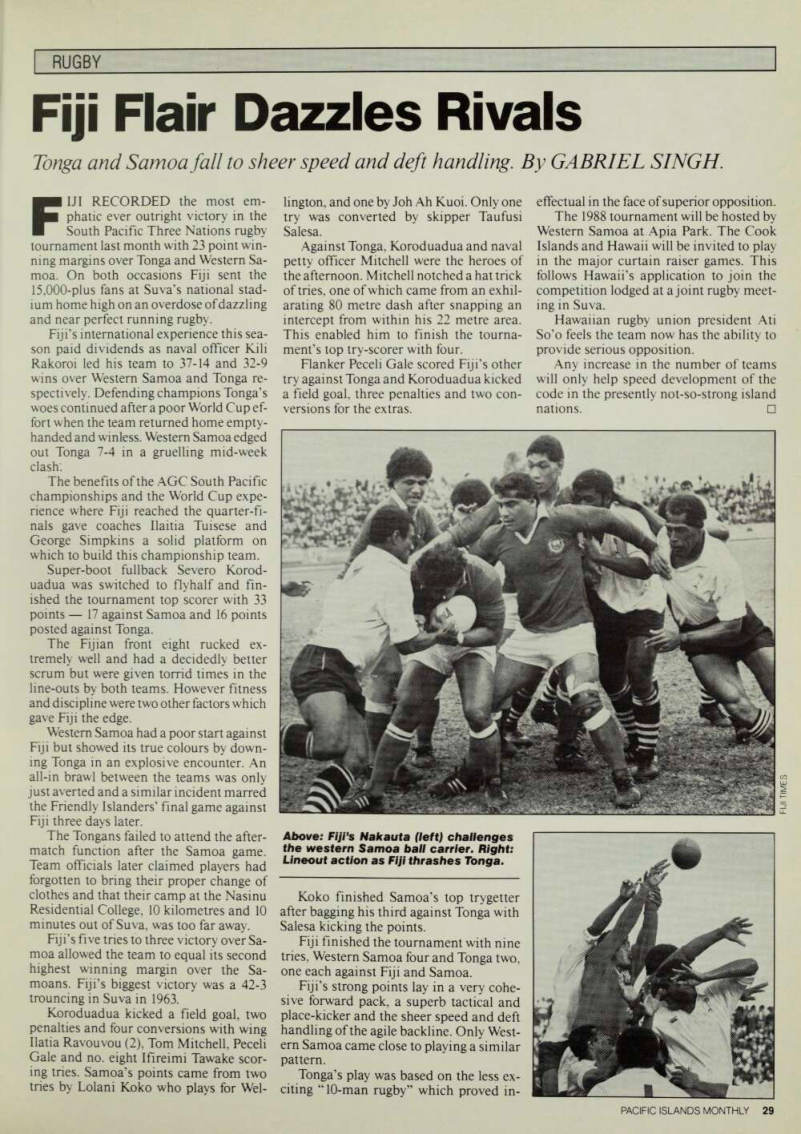
Rugby
Tonga and Samoa fall to sheer speed and deft handling.
By Gabriel Singh.
FIJI RECORDED the most em phatic ever outright victory in the South Pacific Three Nations rugby tournament last month with 23 point win ning margins over Tonga and Western Sa moa. On both occasions Fiji sent the 15,000-plus fans at Suva’s national stad ium home high on an overdose of dazzling and near perfect running rugby.
Fiji’s international experience this sea son paid dividends as naval officer Kili Rakoroi led his team to 37-14 and 32-9 wins over Western Samoa and Tonga re spectively. Defending champions Tonga’s woes continued after a poor World Cup ef fort when the team returned home empty handed and winless. Western Samoa edged out Tonga 7-4 in a gruelling mid-week clash: The benefits of the AGC South Pacific championships and the World Cup expe rience where Fiji reached the quarter-fi nals gave coaches Ilaitia Tuisese and George Simpkins a solid platform on which to build this championship team.
Super-boot fullback Severe Korod uadua was switched to flyhalf and fin ished the tournament top scorer with 33 points 17 against Samoa and 16 points posted against Tonga.
The Fijian front eight rucked ex tremely well and had a decidedly better scrum but were given torrid times in the line-outs by both teams. However fitness and discipline were two other factors which gave Fiji the edge.
Western Samoa had a poor start against Fiji but showed its true colours by down ing Tonga in an explosive encounter. An all-in brawl between the teams was only just averted and a similar incident marred the Friendly Islanders’ final game against Fiji three days later.
The Tongans failed to attend the after match function after the Samoa game.
Team officials later claimed players had forgotten to bring their proper change of clothes and that their camp at the Nasinu Residential College, 10 kilometres and 10 minutes out of Suva, was too far away.
Fiji’s five tries to three victory over Sa moa allowed the team to equal its second highest winning margin over the Sa moans. Fiji’s biggest victory was a 42-3 trouncing in Suva in 1963.
Koroduadua kicked a field goal, two penalties and four conversions with wing Ilatia Ravouvou (2), Tom Mitchell, Peceli Gale and no. eight Ifireimi Tawake scor ing tries. Samoa’s points came from two tries by Lolani Koko who plays for Wel
lington, and one by Joh Ah Kuoi. Only one try was converted by skipper Taufusi Salesa.
Against Tonga, Koroduadua and naval petty officer Mitchell were the heroes of the afternoon. Mitchell notched a hat trick of tries, one of which came from an exhil arating 80 metre dash after snapping an intercept from within his 22 metre area.
This enabled him to finish the tourna ment’s top try-scorer with four.
Flanker Peceli Gale scored Fiji’s other try against Tonga and Koroduadua kicked a field goal, three penalties and two con versions for the extras.
eflfectual in the face of superior opposition.
The 1988 tournament will be hosted by Western Samoa at Apia Park. The Cook Islands and Hawaii will be invited to play in the major curtain raiser games. This follows Hawaii’s application to join the competition lodged at a joint rugby meet ing in Suva.
Hawaiian rugby union president Ati So’o feels the team now has the ability to provide serious opposition.
Any increase in the number of teams will only help speed development of the code in the presently not-so-strong island nations. □
Koko finished Samoa’s top trygetter after bagging his third against Tonga with Salesa kicking the points.
Fiji finished the tournament with nine tries, Western Samoa four and Tonga two, one each against Fiji and Samoa.
Fiji’s strong points lay in a very cohe sive forward pack, a superb tactical and place-kicker and the sheer speed and deft handling of the agile backline. Only West ern Samoa came close to playing a similar pattern.
Tonga’s play was based on the less ex citing “ 10-man rugby” which proved in-
Above: Fiji's Nakauta (left) challenges the western Samoa ball carrier. Right: Lineout action as Fiji thrashes Tonga.
Advertisements & other items, pp. 30-31 (1 item)
Road-Hugging. Rock-fiitlng. p
Kiwi
¥ ■- I 0 %r i ■C m m m-4 Si MT' ► •J I HILUX 4WD Regular Cab, Long Wheelbase One tough truck just got tougher. Toyota’s dedication to superiG performance vehicles takes a step forward today with the New Hilu> A refined front grille and bumper design, new instrument panel for a feeling of spaciousness and command and plush colour co-ordinated trim are a few new additions to the New Hilux.
And extensive anti-corrosive galvanealed steel protection now includes the tailgate panel and rear door panel, making Hilux more durable than ever before.
Yet for all its improvements, the best of the original Hilux is als<
TOYOTA
QUALITY SERVICE
AMERICAN SAMOA: BURNS PHILP (SOUTH SEA) CO., LTD., P.O. Box 129, Pago Pago. COOK ISLANDS: COOK ISLA AUTOMOTIVE SUPPLIES COMPANY, A Division of Burns Philp (South Sea) Co., Ltd., G.P.O. Box 355, Suva. GUAM & M Tamuning. KIRIBATI: TARAWA MOTORS, A Division of Bairiki Holdings Ltd., P.O. Box 36, Bairiki, Tarawa. NAURU: NAL SERVICE IMPORTATION AUTOMOBILE DU PACIFIQUE, Rond-Point du Pacifique (Station Total) B.P. 438, Noumea. NIUE: NORFOLK ISLAND: BORRY’S LIMITED, P.O. Box 169. PAPUA NEW GUINEA: ELA MOTORS, A Division of Burns Ph CORPORATION, P.O. Box 267, Saipan. SOLOMON ISLANDS: SOLOMON ISLANDS INVESTMENTS LTD.. G.P.O. Box 141 TONGA: BURNS PHILP (TONGA) LTD., P.O. Box 55, Nukualofa. VANUATU: VANUATU MOTORS, A Division of Burns Phi BURNS PHILP (SOUTH SEA) CO.. LTD., P.O. Box 188, Apia.
if ic-lough. The New Hllux.
3 is * ft. s .*■ - \ v ** - * * r 4 m ** * r i* M ere; a big tailgate conveniently hinged for quick loading and unloading; reinforced front suspension to smooth out le bumps, and bias-mounted, extra-heavy-duty rear shocks and knobbly tyres to take on any terrain.
Toyota’s long history of super-responsive engines, ruggedness, reliability and comfort goes without saying. And in the Hilux, it’s yours in both 2-wheel-drive and 4x4 versions.
So, after comprehensive testing and thorough quality control, the New Hilux is ready to bring a new standard of toughness to the Pacific.
And isn’t that exactly what you expect from Toyota?
Areas where gaivanealed steel is used ‘DING CORPORATION LTD., Private Bag, Rarotonga. FIJI: SIA: ATKINS KROLL, INC., 443 South Marine Drive, 3 ERATIVE SOCIETY, Central Pacific. NEW CALEDONIA: >HILP (SOUTH SEA) CO.. LTD., P.O. Box 39, Alofi.
Ltd., P.O. Box 75, Port Moresby. SAIPAN: MICROL a. TAHITI: NIPPON AUTOMOTO, B.P. 342, Papeete, itu) Ltd., P.O. Box 18, Port Vila. WESTERN SAMOA:
TOYOTA
Problems Come to Paradise
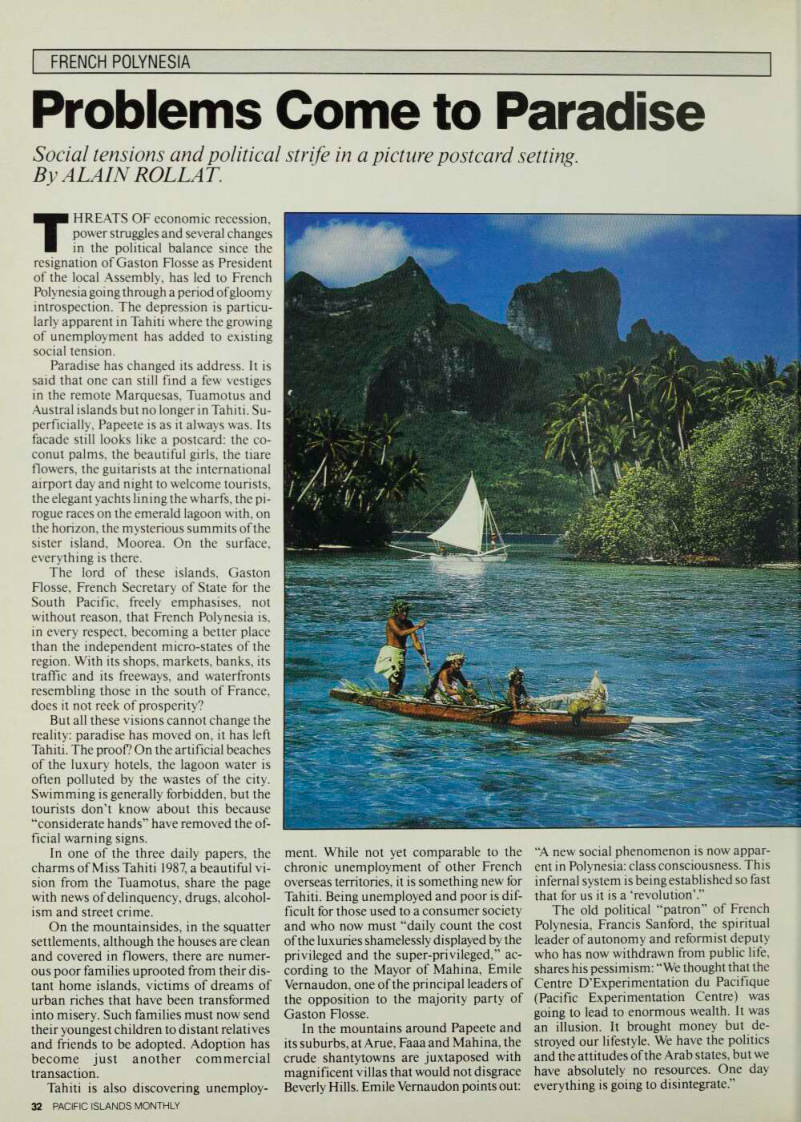
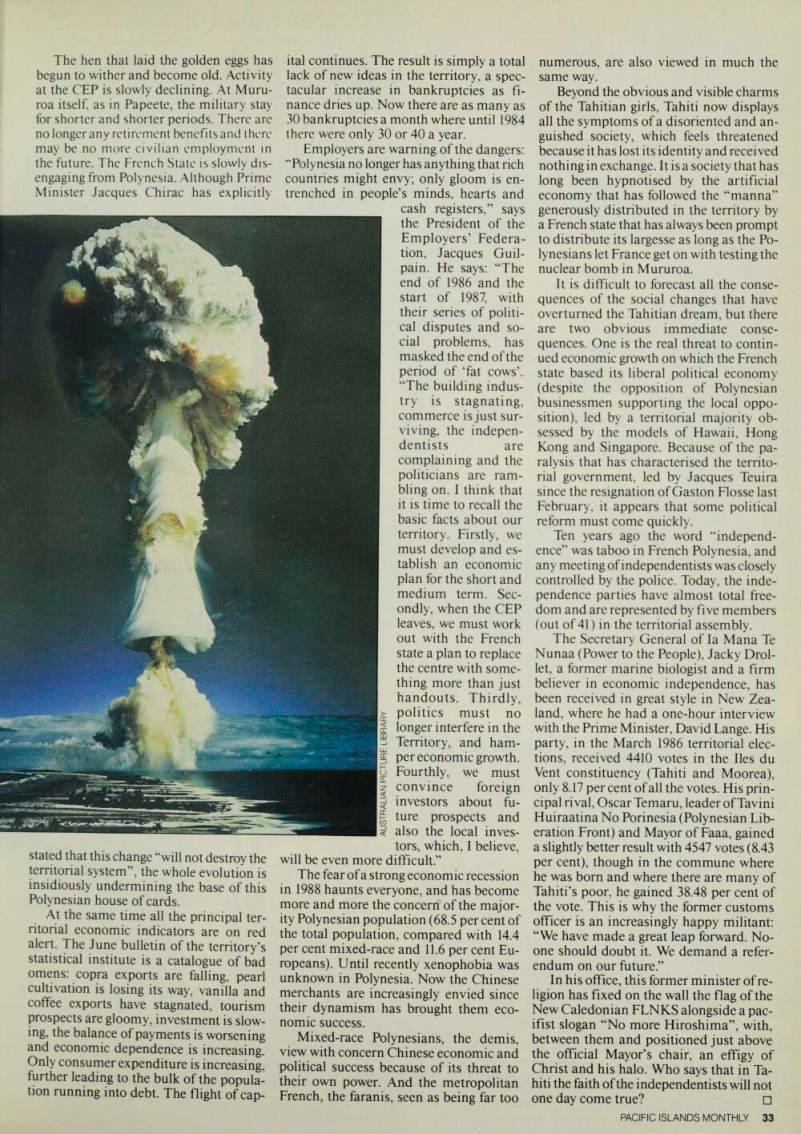
French Polynesia
Social tensions and political strife in a picture postcard setting.
By Alain Rollat.
THREATS OF economic recession, power struggles and several changes in the political balance since the resignation of Gaston Flosse as President of the local Assembly, has led to French Polynesia going through a period of gloomy introspection. The depression is particu larly apparent in Tahiti where the growing of unemployment has added to existing social tension.
Paradise has changed its address. It is said that one can still find a few vestiges in the remote Marquesas, Tuamotus and Austral islands but no longer in Tahiti. Su perficially, Papeete is as it always was. Its facade still looks like a postcard: the co conut palms, the beautiful girls, the tiare flowers, the guitarists at the international airport day and night to welcome tourists, the elegant yachts lining the wharfs, the pi rogue races on the emerald lagoon with, on the horizon, the mysterious summits of the sister island, Moorea. On the surface, everything is there.
The lord of these islands, Gaston Flosse, French Secretary of State for the South Pacific, freely emphasises, not without reason, that French Polynesia is, in every respect, becoming a better place than the independent micro-states of the region. With its shops, markets, banks, its traffic and its freeways, and waterfronts resembling those in the south of France, does it not reek of prosperity?
But all these visions cannot change the reality: paradise has moved on, it has left Tahiti. The proof? On the artificial beaches of the luxury hotels, the lagoon water is often polluted by the wastes of the city.
Swimming is generally forbidden, but the tourists don’t know about this because “considerate hands” have removed the of ficial warning signs.
In one of the three daily papers, the charms of Miss Tahiti 1987, a beautiful vi sion from the Tuamotus, share the page with news of delinquency, drugs, alcohol ism and street crime.
On the mountainsides, in the squatter settlements, although the houses are clean and covered in flowers, there are numer ous poor families uprooted from their dis tant home islands, victims of dreams of urban riches that have been transformed into misery. Such families must now send their youngest children to distant relatives and friends to be adopted. Adoption has become just another commercial transaction.
Tahiti is also discovering unemploy-
ment. While not yet comparable to the chronic unemployment of other French overseas territories, it is something new for Tahiti. Being unemployed and poor is dif ficult for those used to a consumer society and who now must “daily count the cost of the luxuries shamelessly displayed by the privileged and the super-privileged,” ac cording to the Mayor of Mahina, Emile Vernaudon, one of the principal leaders of the opposition to the majority party of Gaston Flosse.
In the mountains around Papeete and its suburbs, at Arue, Faaa and Mahina, the crude shantytowns are juxtaposed with magnificent villas that would not disgrace Beverly Hills. Emile Vernaudon points out:
“A new social phenomenon is now appar ent in Polynesia: class consciousness. This infernal system is being established so fast that for us it is a ‘revolution’.”
The old political “patron” of French Polynesia, Francis Sanford, the spiritual leader of autonomy and reformist deputy who has now withdrawn from public life, shares his pessimism: “We thought that the Centre D’Experimentation du Pacifique (Pacific Experimentation Centre) was going to lead to enormous wealth. It was an illusion. It brought money but de stroyed our lifestyle. We have the politics and the attitudes of the Arab states, but we have absolutely no resources. One day everything is going to disintegrate.”
The hen that laid the golden eggs has begun to wither and become old. Activity at the CEP is slowly declining. At Muru roa itself, as in Papeete, the military stay for shorter and shorter periods. There arc no longer any retirement benefits and there may be no more civilian employment in the future. The French Stale is slowly dis engaging from Polynesia. Although Prime Minister Jacques Chirac has explicitly
stated that this change “will not destroy the territorial system”, the whole evolution is insidiously undermining the base of this Polynesian house of cards.
At the same time all the principal ter ritorial economic indicators are on red alert. The June bulletin of the territory’s statistical institute is a catalogue of bad omens: copra exports are falling, pearl cultivation is losing its way, vanilla and coffee exports have stagnated, tourism prospects are gloomy, investment is slow ing, the balance of payments is worsening and economic dependence is increasing.
Only consumer expenditure is increasing, further leading to the bulk of the popula tion running into debt. The flight of cap
ital continues. The result is simply a total lack of new ideas in the territory, a spec tacular increase in bankruptcies as fi nance dries up. Now there are as many as 30 bankruptcies a month where until 1984 there were only 30 or 40 a year.
Employers are warning of the dangers: “Polynesia no longer has anything that rich countries might envy; only gloom is en trenched in people’s minds, hearts and
cash registers,” says the President of the Employers’ Federa tion, Jacques Guil pain. He says: “The end of 1986 and the start of 1987, with their series of politi cal disputes and so cial problems, has masked the end of the period of ‘fat cows’.
“The building indus try is stagnating, commerce is just sur viving, the indepen dentists are complaining and the politicians are ram bling on. I think that it is time to recall the basic facts about our territory. Firstly, we must develop and es tablish an economic plan for the short and medium term. Sec ondly, when the CEP leaves, we must work out with the French state a plan to replace the centre with some thing more than just handouts. Thirdly, politics must no longer interfere in the Territory, and ham per economic growth.
Fourthly, we must convince foreign investors about fu ture prospects and also the local inves tors, which, I believe,
will be even more difficult.”
The fear of a strong economic recession in 1988 haunts everyone, and has become more and more the concern of the major ity Polynesian population (68.5 percent of the total population, compared with 14.4 per cent mixed-race and 11.6 per cent Eu ropeans). Until recently xenophobia was unknown in Polynesia. Now the Chinese merchants are increasingly envied since their dynamism has brought them eco nomic success.
Mixed-race Polynesians, the demis, view with concern Chinese economic and political success because of its threat to their own power. And the metropolitan French, the faranis, seen as being far too
numerous, are also viewed in much the same way.
Beyond the obvious and visible charms of the Tahitian girls, Tahiti now displays all the symptoms of a disoriented and an guished society, which feels threatened because it has lost its identity and received nothing in exchange. It is a society that has long been hypnotised by the artificial economy that has followed the “manna” generously distributed in the territory by a French state that has always been prompt to distribute its largesse as long as the Po lynesians let France get on with testing the nuclear bomb in Mururoa.
It is difficult to forecast all the conse quences of the social changes that have overturned the Tahitian dream, but there are two obvious immediate conse quences. One is the real threat to contin ued economic growth on which the French state based its liberal political economy (despite the opposition of Polynesian businessmen supporting the local oppo sition), led by a territorial majority ob sessed by the models of Hawaii, Hong Kong and Singapore. Because of the pa ralysis that has characterised the territo rial government, led by Jacques Teuira since the resignation of Gaston Flosse last February, it appears that some political reform must come quickly.
Ten years ago the word “independ ence” was taboo in French Polynesia, and any meeting of independentists was closely controlled by the police. Today, the inde pendence parties have almost total free dom and are represented by five members (out of 41) in the territorial assembly.
The Secretary General of la Mana Te Nunaa (Power to the People), Jacky Drol let, a former marine biologist and a firm believer in economic independence, has been received in great style in New Zea land, where he had a one-hour interview with the Prime Minister, David Lange. His party, in the March 1986 territorial elec tions, received 4410 votes in the lies du Vent constituency (Tahiti and Moorea), only 8.17 percent of all the votes. His prin cipal rival, Oscar Temaru, leader ofTavini Huiraatina No Porinesia (Polynesian Lib eration Front) and Mayor of Faaa, gained a slightly better result with 4547 votes (8.43 per cent), though in the commune where he was born and where there are many of Tahiti’s poor, he gained 38.48 per cent of the vote. This is why the former customs officer is an increasingly happy militant: “We have made a great leap forward. No one should doubt it. We demand a refer endum on our future.”
In his office, this former minister of re ligion has fixed on the wall the flag of the New Caledonian FLNKS alongside a pac ifist slogan “No more Hiroshima”, with, between them and positioned just above the official Mayor’s chair, an effigy of Christ and his halo. Who says that in Ta hiti the faith of the independentists will not one day come true? □
Australian Picture Library
Advertisements & other items, p. 34 (1 item)
Norths*
r.- * Farmers throughout the Pacific recognise the need to increase yields and improve quality - particularly for
the EXPORT MARKET.
To achieve these aims ICI New Zealand Limited provide a comprehensive range of specialised pesticides to enable consistent, safe control of WEEDS, PLANT DISEASES, INSECT
PESTS AND RODENTS.
Backed by worldwide research and development, ICI New Zealand products have been formulated specifically for Pacific conditions.
FUSILADE
The GRASS
WEEDKILLER! for
selective control of grass weeds in broadleaf crops.
BE WISE. BEWARE
HANDLE PESTICIDES
WITH CARE
ORTHENE
The SYSTEMIC
INSECTICIDE! for
use in rice and vegetable crops.
fORSAFS
use,ALWAYS
READ LABELS.
NORTHS*
fitcmic inject on**®
CAREFULLY.
ortho*
STJ
Fusilade 2 Fusilade
FURADAN®
100 106 Insectickte/Nematicide a
THE WORLDS MOST EFFECTIVE
KILLER OF R ATS AND MICE
FURADAN
The granular Insecticide/ nematicide! for bananas, vegetables, sugarcane & rice.
SI
FUNGINEX
The FUNGICIDAL
DIP! for treating cane sets before planting.
Controls Pineapple disease.
TALON WB
Kills RATS and MICE fast!
At home, or on the farm. The World’s most effective rodenticide.
Attack
POISON
GRAMOXOS^E
r w
WEEDKILLER
& DESICCANT
GRAMOXONE
The fast acting TOTAL weedkillercan be used in most crops! Will not poison soil. For LONGTERM control, add DIURON 80.
ATTACK
Kills a wide range of insect pests. Can be used on most crops. m For full details on any ICI product, address your enquiry to “Export”, ICI New Zealand Limited. P.O. Box 900, AUCKLAND, NEW ZEALAND.
Pacific Report
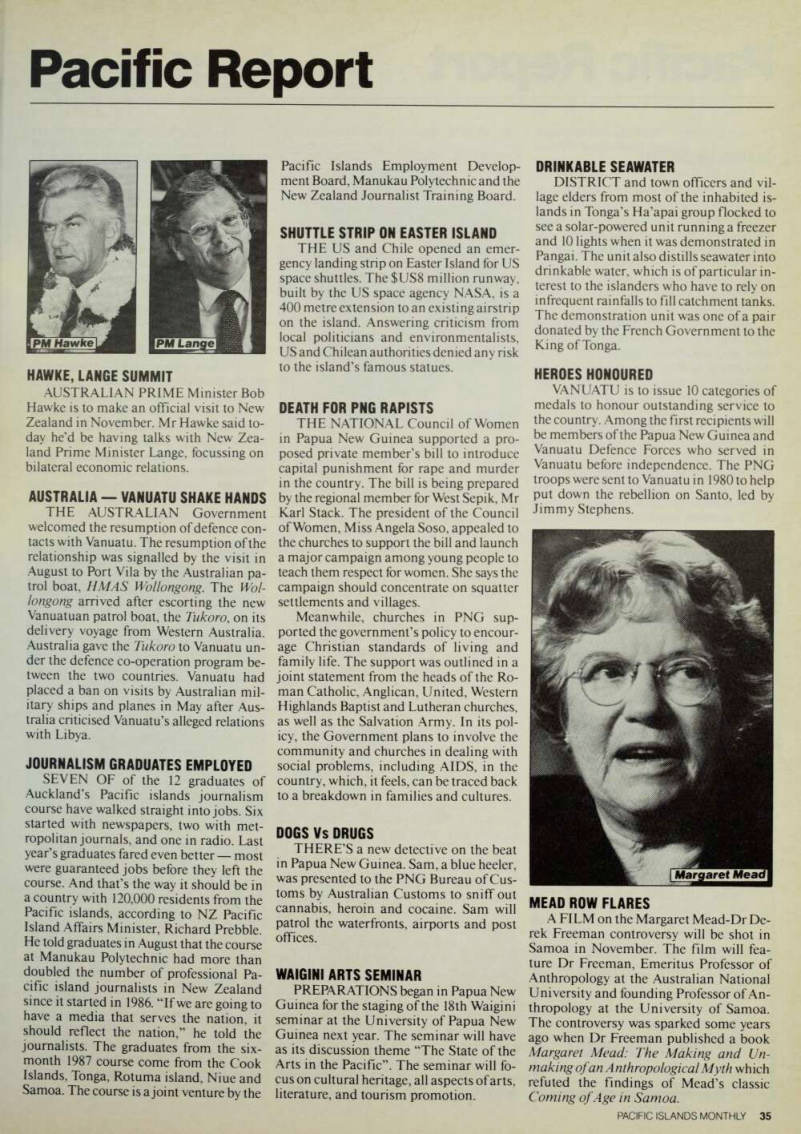
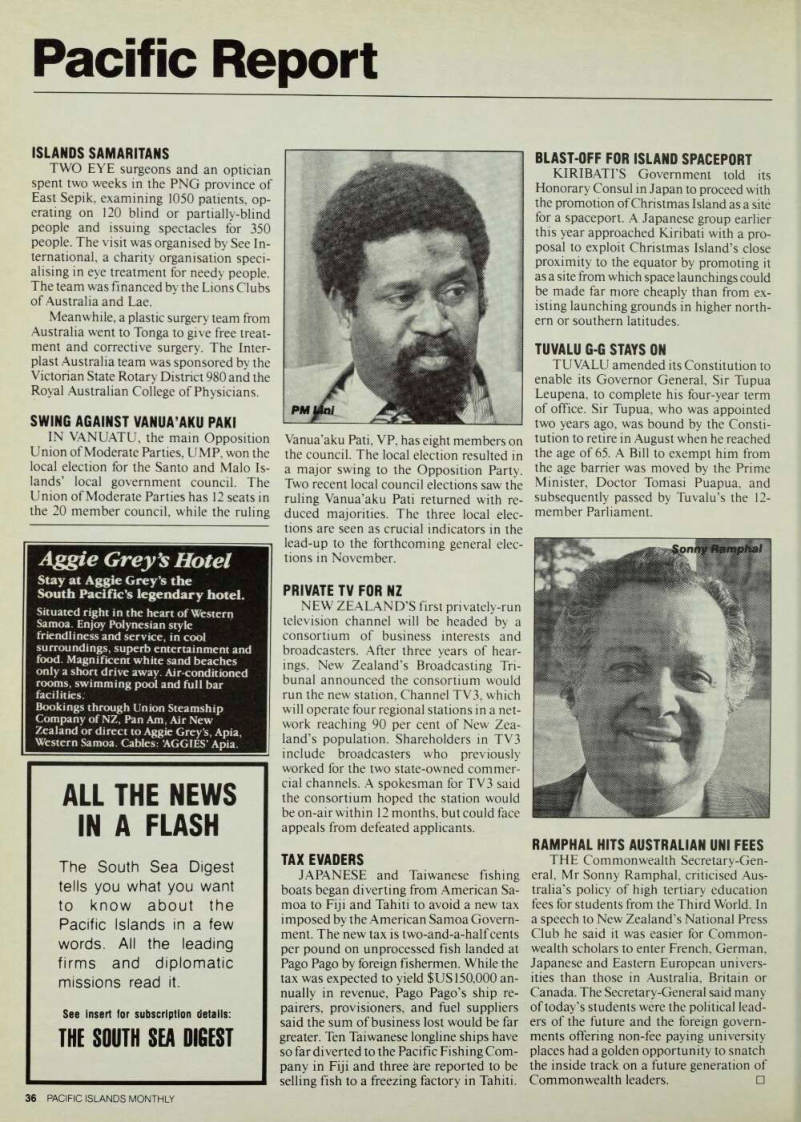
Hawke, Lange Summit
AUSTRALIAN PRIME Minister Bob Hawke is to make an official visit to New Zealand in November. Mr Hawke said to day he’d be having talks with New Zea land Prime Minister Lange, focussing on bilateral economic relations.
Australia Vanuatu Shake Hands
THE AUSTRALIAN Government welcomed the resumption of defence con tacts with Vanuatu. The resumption of the relationship was signalled by the visit in August to Port Vila by the Australian pa trol boat, HMAS Wollongong. The Wol longong arrived after escorting the new Vanuatuan patrol boat, the Tukoro, on its delivery voyage from Western Australia.
Australia gave the Tukoro to Vanuatu un der the defence co-operation program be tween the two countries. Vanuatu had placed a ban on visits by Australian mil itary ships and planes in May after Aus tralia criticised Vanuatu’s alleged relations with Libya.
Journalism Graduates Employed
SEVEN OF of the 12 graduates of Auckland’s Pacific islands journalism course have walked straight into jobs. Six started with newspapers, two with met ropolitan journals, and one in radio. Last year’s graduates fared even better most were guaranteed jobs before they left the course. And that’s the way it should be in a country with 120,000 residents from the Pacific islands, according to NZ Pacific Island Affairs Minister, Richard Prebble.
He told graduates in August that the course at Manukau Polytechnic had more than doubled the number of professional Pa cific island journalists in New Zealand since it started in 1986. “If we are going to have a media that serves the nation, it should reflect the nation,” he told the journalists. The graduates from the six month 1987 course come from the Cook Islands, Tonga, Rotuma island, Niue and Samoa. The course is a joint venture by the
Pacific Islands Employment Develop ment Board, Manukau Polytechnic and the New Zealand Journalist Training Board.
Shuttle Strip On Easter Island
TFIE US and Chile opened an emer gency landing strip on Easter Island for US space shuttles. The SUSB million runway, built by the US space agency NASA, is a 400 metre extension to an existing airstrip on the island. Answering criticism from local politicians and environmentalists, US and Chilean authorities denied any risk to the island’s famous statues.
Death For Png Rapists
THE NATIONAL Council of Women in Papua New Guinea supported a pro posed private member’s bill to introduce capital punishment for rape and murder in the country. The bill is being prepared by the regional member for West Sepik, Mr Karl Stack. The president of the Council of Women, Miss Angela Soso, appealed to the churches to support the bill and launch a major campaign among young people to teach them respect for women. She says the campaign should concentrate on squatter settlements and villages.
Meanwhile, churches in PNG sup ported the government’s policy to encour age Christian standards of living and family life. The support was outlined in a joint statement from the heads of the Ro man Catholic, Anglican, United, Western Highlands Baptist and Lutheran churches, as well as the Salvation Army. In its pol icy, the Government plans to involve the community and churches in dealing with social problems, including AIDS, in the country, which, it feels, can be traced back to a breakdown in families and cultures.
Dogs Vs Drugs
THERE’S a new detective on the beat in Papua New Guinea. Sam, a blue heeler, was presented to the PNG Bureau of Cus toms by Australian Customs to sniff out cannabis, heroin and cocaine. Sam will patrol the waterfronts, airports and post offices.
Waigini Arts Seminar
PREPARATIONS began in Papua New Guinea for the staging of the 18th Waigini seminar at the University of Papua New Guinea next year. The seminar will have as its discussion theme “The State of the Arts in the Pacific”. The seminar will fo cus on cultural heritage, all aspects of arts, literature, and tourism promotion.
Drinkable Seawater
DISTRICT and town officers and vil lage elders from most of the inhabited is lands in Tonga’s Ha’apai group flocked to see a solar-powered unit running a freezer and 10 lights when it was demonstrated in Pangai. The unit also distills seawater into drinkable water, which is of particular in terest to the islanders who have to rely on infrequent rainfalls to fill catchment tanks.
The demonstration unit was one of a pair donated by the French Government to the King of Tonga.
Heroes Honoured
VANUATU is to issue 10 categories of medals to honour outstanding service to the country. Among the first recipients will be members of the Papua New Guinea and Vanuatu Defence Forces who served in Vanuatu before independence. The PNG troops were sent to Vanuatu in 1980 to help put down the rebellion on Santo, led by Jimmy Stephens.
Mead Row Flares
A FILM on the Margaret Mead-Dr De rek Freeman controversy will be shot in Samoa in November. The film will fea ture Dr Freeman, Emeritus Professor of Anthropology at the Australian National University and founding Professor of An thropology at the University of Samoa.
The controversy was sparked some years ago when Dr Freeman published a book Margaret Mead: The Making and Un making of an Anthropological Myth which refuted the findings of Mead’s classic Coming of Age in Samoa.
PM Hawke
PM Lange
Margaret Mead
Islands Samaritans
TWO EYE surgeons and an optician spent two weeks in the PNG province of East Sepik, examining 1050 patients, op erating on 120 blind or partially-blind people and issuing spectacles for S5O people. The visit was organised by See In ternational, a charity organisation speci alising in eye treatment for needy people.
The team was financed by the Lions Clubs of Australia and Lae.
Meanwhile, a plastic surgery team from Australia went to Tonga to give free treat ment and corrective surgery. The Inter plast Australia team was sponsored by the Victorian State Rotary District 980 and the Royal Australian College of Physicians.
Swing Against Vanua’Aku Paki
IN VANUATU, the main Opposition Union of Moderate Parties, UMP, won the local election for the Santo and Malo Is lands’ local government council. The Union of Moderate Parties has 12 seats in the 20 member council, while the ruling
Vanua’aku Pati, VP, has eight members on the council. The local election resulted in a major swing to the Opposition Party.
Two recent local council elections saw the ruling Vanua’aku Pati returned with re duced majorities. The three local elec tions are seen as crucial indicators in the lead-up to the forthcoming general elec tions in November.
Private Tv For Nz
NEW ZEALAND’S first privately-run television channel will be headed by a consortium of business interests and broadcasters. After three years of hear ings, New Zealand’s Broadcasting Tri bunal announced the consortium would run the new station, Channel TV3, which will operate four regional stations in a net work reaching 90 per cent of New Zea land’s population. Shareholders in TVS include broadcasters who previously worked for the two state-owned commer cial channels. A spokesman for TVS said the consortium hoped the station would be on-air within 12 months, but could face appeals from defeated applicants.
Tax Evaders
JAPANESE and Taiwanese fishing boats began diverting from American Sa moa to Fiji and Tahiti to avoid a new tax imposed by the American Samoa Govern ment. The new tax is two-and-a-half cents per pound on unprocessed fish landed at Pago Pago by foreign fishermen. While the tax was expected to yield SUS 150,000 an nually in revenue, Pago Pago’s ship re pairers, provisioned, and fuel suppliers said the sum of business lost would be far greater. Ten Taiwanese longline ships have so far diverted to the Pacific Fishing Com pany in Fiji and three are reported to be selling fish to a freezing factory in Tahiti.
Blast-Off For Island Spaceport
KIRIBATI’S Government told its Honorary Consul in Japan to proceed with the promotion of Christmas Island as a site for a spaceport. A Japanese group earlier this year approached Kiribati with a pro posal to exploit Christmas Island’s close proximity to the equator by promoting it as a site from which space launchings could be made far more cheaply than from ex isting launching grounds in higher north ern or southern latitudes.
Tuvalu G-G Stays On
TUVALU amended its Constitution to enable its Governor General, Sir Tupua Leupena, to complete his four-year term of office. Sir Tupua, who was appointed two years ago, was bound by the Consti tution to retire in August when he reached the age of 65. A Bill to exempt him from the age barrier was moved by the Prime Minister, Doctor Tomasi Puapua, and subsequently passed by Tuvalu’s the 12member Parliament.
Ramphal Hits Australian Uni Fees
THE Commonwealth Secretary-Gen eral, Mr Sonny Ramphal, criticised Aus tralia’s policy of high tertiary education fees for students from the Third World. In a speech to New Zealand’s National Press Club he said it was easier for Common wealth scholars to enter French, German, Japanese and Eastern European univers ities than those in Australia, Britain or Canada. The Secretary-General said many of today’s students were the political lead ers of the future and the foreign govern ments offering non-fee paying university places had a golden opportunity to snatch the inside track on a future generation of Commonwealth leaders. □
Advertisements & other items, p. 36 (1 item)
All The News
Aggie Grey’s Hotel
Stay at Aggie Grey’s the South Pacific’s legendary hotel.
Situated right in the heart of Western Samoa. Enjoy Polynesian style friendliness and service, in cool surroundings, superb entertainment and food. Magnificent white sand beaches only a short drive away. Air-conditioned rooms, swimming pool and full bar facilities.
Bookings through Union Steamship Company of N 2, Pan Am, Air New Zealand or direct to Aggie Grey’s, Apia, Western Samoa. Cables: AGGIES’ Apia.
ALL THE NEWS
IN A FLASH
The South Sea Digest tells you what you want to know about the Pacific Islands in a few words. All the leading firms and diplomatic missions read it.
See insert for subscription details:
THE SOUTH SEA DIGEST
Book Reviews
MAINLY ABOUT FIJI: A Collection of Writings, Broadcasts and Speeches.
Published by Sir Leonard Usher, GPO Box 14432, Suva. Marketed by Desai Bookshops, Suva, 1987.
Reviewed by Stuart Inder ££ EMOCRACY, clearly, was ** B B alive and well in Fiji.” This last line in Len Usher’s book, Mainly About Fiji, made ironic reading at the book’s launching party in Suva re cently. The Governor General, Ratu Sir Penaia Ganilau, was to have launched it, but he sent last minute regrets that he was otherwise occupied with the military coup that destroyed democracy in Fiji. The gathering drank Fiji’s health anyhow.
Nobody could read this collection of Sir Leonard Usher’s newspaper editorials, broadcasts, speeches, lectures and occa sional pieces culled from the great number he has produced during 57 years in Fiji in many different capacities, without ac knowledging his deep commitment to his adopted country and his fellow citizens.
Thus one wonders how he copes in today’s political climate in Fiji.
Clearly he did not predict the coup.
What is the depth of his regret that Fiji is suddenly not the country he has known since 1930, when he arrived from New Zealand as a young schoolteacher? That he understands the genesis of the coup there could be no doubt, but to hear what he feels about it, and how deeply he feels about it, we may have to wait for the autobiography he promises us in his preface, and for which he says the present collection of mostly re cycled pieces is a curtain-raiser.
But until his memoirs appear with their personal views and insights, better half a loaf than no bread. And if the half-loaf is a little stale, it still sustains.
As well as his major pieces the book in cludes unsigned reports and editorials he wrote for the Fiji Times that were not eas ily identifiable as his, radio interviews whose tapes were not preserved, many eu logies presented at funerals, addresses made at school prize-giving ceremonies, talks to clubs and conferences.
He has now prefaced many of his pieces with brief introductions that add to the re cord. Those many who shared a spirited friendship with Sir Maurice Scott would, for instance, relish Usher’s preface to his eulogy on him, recalling that the former Speaker of Fiji’s Legislative Council left instructions that his coffin be of un dressed inch-thick damanu, a Fiji hard wood, resulting in the complaint of a pall bearing friend labouring under its weight: “The bastard was impossible when he was alive. He’s just the same now he’s dead.”
Len Usher is 80. From a junior teacher he went on to become headmaster,
government information officer and broadcaster, editor and publisher of the Fiji Times, and two years of dedicated community leadership which saw him four times Mayor of Suva.
His pieces reflect this broad involve ment with Fiji life. Well worth new study are his articles on pre-independence pol itics, the constitutional crisis of 1977, the Native Land Trust Board, Fiji land own ership, and the Great Council of Chiefs.
Looking back at some of these reports it is clear now that the Fijian-Indian relation ship was always explosive despite the gen uine and determined efforts of so many in promoting harmony. Thus Usher in the Fiji Times in 1968 pays posthumous trib ute to the political leader Vishnu Deo, drawing attention to the way he was held in respect and affection after “the years had dulled the bitterness of controversy”. Yet, as Usher points out in the same piece, early in Deo’s career, that controversy included his dramatic walk-out from the Legisla tive Council, to which he had just been elected, in protest at the defeat of Indian efforts to bring in a common electoral roll.
Fiji never did get one-man, one-vote elections, and perhaps never will, but the Indian desire for a common roll didn’t di minish, any more than did the Fijian (and European) determination to block it.
By Independence in 1970 the politi cians appeared to have made it up, but as Usher wrote then, it was “a honeymoon of mutual convenience rather than deep love”. Writers of political theses will no doubt find new meaning between the lines of some of these pieces.
Vulnerability Of Small States In
THE GLOBAL SOCIETY: Report of a Commonwealth Consultative Group.
Published by the Commonwealth Secretariat, Marlborough House, London, UK. £5. 158N085092280-1.
Reviewed by Sandra Rennie THIS BOOK defines small states as those with populations under one million and encompasses all such states in the Commonwealth the South Pacific, In dian Ocean islands, Asia (Brunei), the Caribbean and the Mediterranean (Cy prus and Malta). It stresses the inherent vulnerability of these small states in the face of external interference. Hence de velopment and security are directly re lated. Yet while a state may be regarded as weak because of a small population and inadequate resources, it still can be strong.
Widely-shared values among its people, family-based institutions and long-recog nised borders make a state strong.
The theme of security problems is dwelt upon in the book. A limited population
means essential security needs at various levels often cannot be met. A weak state also lacks the economic capacity to take countervailing measures or purchase se curity-related material. And, the book warns, external aggression can come in many guises. There can be both political and military threats as well as economic pressure for change. Social and cultural identity is often eroded.
In the Pacific, despite obstacles of dis tance, islands have created a sense of re gional identity. While in this region, the book says there is no marked sense of im mediate political and military threat, there is the deep-felt concern that stronger pow ers are exploiting Pacific islands for nu clear testing and dumping of nuclear waste.
Further, there are local issues which could have a disruptive impact, such as the bor der problem between Papua New Guinea and Indonesia, the colonial issue of New Caledonia, and secessionist threats.
Having established the case for the vul nerability of small states, the book out lines means of reducing this vulnerability, such as: capacity to meet security needs; external assistance and training; diversi fied economic development; promotion of internal cohesion.
In meeting security needs, three guide lines are set. These are defence arrange ments with other states, regional co operation, and information networks. The book puts the case for a considerable role for development assistance. This assist ance can be related to provision of security technical assistance and co-operation in non-military areas such as smuggling and surveillance of the seas. □ The last chapters cover Conclusions and Recommendations. The conclusions reached are that there is a need to: en hance regional infrastructures; strengthen domestic security; develop a flexible and diversified approach to economic devel opment; exploit the patrimony of the seas; reinvigorate development assistance.
There is a wealth of good advice in this book which is valuable for anyone inter ested in the future of small states and their development. The focus on the relation ship between security and development is stressed. However, the security of small states is inextricably linked to the security of the superpowers. Hence programs of development assistance. This is not so much a result of an obligation felt by stronger states as a response to looking after their own needs political, eco nomic and security-wise. Beneficial de velopment occurs when a symbiotic relationship develops between stronger and weaker states, and the stronger states are as interested in assisting small states as they are in assisting themselves. □
Trade Winds
Mixed Fortune For Ship Line
THE CHIEF executive of the Pacific Forum Shipping Line, Mr John Mc- Lennan, announced an operating profit for 1986, but warned of serious problems ahead for the Line. He told the Forum Li ne’s Annual Shareholders’ Meeting in Suva that there had been a profit of $707,000 in 1986, but said a loss of more than $BOO,OOO was predicted for this year. He said that the island governments which jointly owned the shipping line would have to give thought to protecting their investment, as the company could not sustain financial losses for long. Mr McLennan said the projected losses were due in part to in tense competition from big container ship companies which had moved in on the Australia-Fiji trade. He said another prob lem was the sharp drop in the amount of cargo being carried from Fiji to Australia and New Zealand, following the recent military coup in Fiji. The shipping line’s main problem was that there was little outward cargo to be carried from the is land countries, which the line was founded to serve. But major trans-Pacific con tainer liners needed only to make a small diversion to Suva to skim off the cream of the trade that had originally made the Forum Line viable.
Fiji Army Goes Commercial
THE FIJI Army said it had been au thorised by the GovemorGeneral, Ratu Sir Penaia Ganilau, to begin commercial ven tures as a means of reducing severe strains on the Government budget. The Army Construction Battalion will undertake work in regions not easily accessible to commercial interests. It will also accept some Government contracts. The Army’s small naval squadron will undertake com mercial fishing, while the Fiji National Marketing Authority will give the Army advice on the production and marketing of cash crops.
Ec Loan To Png
PAPUA NEW Guinea received more than K4B million from the European Community, under the Lome Conven tion’s Stabex scheme. The money was in the form of an interest-free loan to com pensate for shortfalls in Papua New Guin ea’s exports of agricultural commodities to the EC countries. The commodities in clude coconut, cocoa coffee and oil-palm.
The money will also be used in promoting agricultural and rural development proj ects. These will include the Poliamba oil palm and coconut projects in New Ire land, and the East New Britain small holder cocoa and coconut projects. Some KlOmillion from the EC’s allocation will be directed to the Agricultural Bank, for
lending to village farmers, fishermen and small-scale forestry projects. The Govern ment will repay the interest-free loan to the EC over a seven-year period, following the first two-year grace period. Cabinet has decided to channel the Stabex fund direct into the government’s agricultural invest ment programs rather than put the money into consolidated revenue, as previous governments had done.
Boat & Food Trade Show Success
THE SOUTH Pacific Trade Commis sion successfully exhibited Pacific island products at the 1987 Sydney Boat Show and Sydney’s Fine Foods ’B7 Food and Beverage Exhibition. For the first time the Trade Commission entered the Boat Show with participants from South Seas Yacht ing Pty Ltd and K W International (Tonga) Pty Ltd exhibiting their marine craft at the Kingdom ofTonga stand. Surf skis, dingh ies, 4.5 metre runabouts and photographic material were on display over the five-day period. All products on display were sold on the first day and orders were taken for surf skis, surfboards, dinghies, oars, yachts and related products from new Tongan companies, with estimated orders worth SAI million for next year.
At Fine Foods ’B7, representatives from some 18 companies in the South Pacific region exhibited products to trade visi tors, resulting in total sales of approxi mately $A250,000 with over SA3 million contracted in the next 12 months. Prod ucts from Fiji, the Cook Islands, Western Samoa, Papua New Guinea, Tonga, the Solomon Islands and Vanuatu were on display.
Chan Predicts Record Revenue
THE PAPUA New Guinea Govern ment’s revenue for the current year could be more than KlOOO million, said Deputy Prime Minister and Minister for Trade and Industry, Sir Julius Chan. He was reply ing to Opposition claims that the nation’s revenue for the year would fall short of the budgetted mark by K6O million. The Op position made the forecast following the release by the Bank of Papua New Guinea of budget revenue figures for the first quarter of 1987.
Png Banks Cut Lending Rates
TWO OF PNG’s six commercial banks reduced their lending rates. The Papua New Guinea Banking Corporation cut its indicator lending rates from 12.75 per cent to 12.5 per cent. The Westpac Bank cut its rates by half-a-percent to 12.5 per cent.
The PNG Government asked the com mercial banks to reduce their lending rates because of the tight liquidity situation in the country. Other commercial banks had
been in touch with the Reserve Bank of Papua New Guinea and were expected to announce similar rate reductions.
Australia-Fiji Trade Slump
TRADE between Australia and Fiji was well down, as the island nation struggled to regain normality after the military coup.
Official sources in Suva said trade figures for the period since the May coup were not yet available, but are expected to reflect the nation’s economic slump. After the coup, the economy was hit by Australian and New Zealand union bans on most trade with Fiji. The bans lasted two months.
Businessmen who deal with Australian companies expect trade to recover over the next two years. Australian Associated Press reported that imports into Fiji had been hit by the slump, but authorities said they believed the downturn was lessening.
Fiji’S S3M Fishing Boat Deal
THE FIJI Government shipyard in Suva was awarded a contract to build two 26-metre fishing vessels for Kiribati. The project is being funded by the European Economic Community. The two ships will cost about SA3 million and will be ready by the end of next year.
Japan Fisheries Agreement
THE SOUTH Pacific Forum Fisheries Agency is to invite Japan to talks about a major new fishing rights agreement. The approach follows a decision of the 15-na tion South Pacific Forum at its May meet ing in Western Samoa to enter talks with Japan as soon as possible. The aim would be to get a fishing treaty covering all mem bers of the Forum. The Fisheries Agency director, Mr Philip Mueller, said in Hon iara that the outcome of the proposed talks was not predictable, but they would be a huge challenge. He said no comparison could be made between talks with Japan and the fishing treaty signed this year be tween Pacific nations and the US.
Dovair Takes Off
VANUATU’S new domestic airline, Dovair, made an inaugural flight from Port Vila to the northern islands of Santo, Ambae, Pentecost and Malekula. Passen ger services to the southern islands began the day after. The airline planned to pro vide services to all islands with airfields, and also to nearby New Caledonia. Do vair is 60 per cent owned by Vanuatu busi nessman Mr Dinh Van Than, and 40 per cent by the Australian pilot and business man Mr Keith Barlow, who previously op erated a five-seater Commanche Piper aircraft. In addition to the Commanche Piper the airline is using two 12-seater Ex calibur Queenaire planes and one 10-seater Britten Norman Islander.
Advertisements & other items, pp. 39-40 (1 item)
Bank
AV\L\J UA BANK
ECONOMIC INDICATORS
COMMODITY PRICES
INDUSTRIAL WORLD DEMAND
Industrial Output (per cent change) Belgium Canada France Italy Japan Netherlands ...
Switzerland ...
UK
USA
West Germany
TOTAL OECD .
Sources: AAR Reuters: FFA Honiara. Fiji Forest Industries IMF (IFS). Compiled by ANZ International Economics, Melbourne.
BANK
Branches In
Fiji, Papua New Guinea,
Vanuatu and Solomon Is.
■MEL
Services
Reach Out
Thousands
of Miles
into The
Pacific. It's
where we
work.
• Heavy Engineering • Air Conditioning • Sheetmetal • Electrical • Refrigeration • Quality work • Competitive prices.
O^9>IMEL
/ INDUSTRIAL AND MARINE
ENGINEERING LIMITED
Tel: 312133. Telex: FJ2195
P.O. Box 296, Suva FIJI ISLANDS
FAX: 312854
“the complete Engineering Company of the South Pacific”.
Trade Winds

Govt Loan For Tongan Industry
THE TONGA Government gave al most SA2 million to the Tonga Develop ment Bank for loans to the agriculture, manufacturing, tourism and service in dustries. The money was lent to the government under special drawing rights from the World Bank the first such loan since Tonga became a member of the World Bank two years ago. The Develop ment Bank loan agreement was signed by Finance Minister Mr James Cocker and the Deputy Bank Chairman, Baron Vaes of Houma.
Bougainville Profits Down
BOUGAINVILLE Copper Limited announced a half yearly profit of K 17.5 million, a 22 per cent drop in profit com pared with the first half of last year. Di rectors said the lower profit is attributable to reduced sales of copper concentrate.
They said that although metal prices were higher, these were offset by a less favour able exchange rate and by a fall in the gold content of its produced concentrate. In the six months to the end of June, Bougain ville Copper Ltd produced 85,000 tonnes of copper, seven tonnes of gold and 24 tonnes of silver. The company paid KlO million in tax to the Papua New Guinea Government, down from Kl 7 million in the corresponding period last year. The directors declared an interim dividend of four toea per share.
Fiji To Export Beer
FIJI’S ONLY beer manufacturing company, the Carlton Brewery, an nounced it would export beer to New Zea land, Canada, and the US from this month.
Distribution would be handled by the Fiji company’s parent organisation in Aus tralia, Carlton and United Brewers. Fiji’s post-coup economic downturn encour aged the beer company to examine over seas markets to boost its sales.
New Solomons Ventures Named
THE SOLOMON Islands Foreign In vestment Board approved two new ven tures in the Solomon Islands. They are for the Rottan Seashell Button Company to process seashells for the manufacture of clothing buttons, and Arimco (Solomon Islands) to establish a wholly-owned sub sidiary, Arimco (Solomon Islands) Ltd.
The Rottan Seashell Button Manufactur ing Company hopes to set up a factory in Honiara to buy and process seashells for manufacture into buttons and jewellery, aiming for export markets in the US, China, and Japan. Arimco will manage mineral exploration for its parent company.
Customs Conference
REPRESENTATIVES from 11 South Pacific countries attended a meeting in Vanuatu to discuss customs administra tion in the South Pacific. Vanuatu’s Min ister of Finance, Mr Kalpokor Kalsakau, said the customs services of small island states had a vital role in raising substantial government revenue, and that the island economies were heavily dependent on im ports and exports and the development of satisfactory tariffs was important. The conference, funded by the Australian Cus toms Service, was attended by represen tatives from Cook Islands, Fiji, Kiribati, Papua New Guinea, Tonga, Tuvalu, Sol omon Islands, Vanuatu, Western Samoa, Australia and New Zealand.
Air Nz Returns To Fiji
AIR NEW ZEALAND has resumed flights to Fiji. Its twice-weekly services between Los Angeles and Auckland will stop over in Nadi. Air New Zealand sus pended its links with Fiji shortly after the May military coup when a worker at Nadi airport attempted to hijack one of its jets.
Upgrade Costs Millions
AUSTRALIA will spend some S 3 mil lion over the next five years to help Papua New Guinea upgrade its Bureau of Cus toms and Excise. The major aim of the project is to develop Papua New Guinea’s abiliy to collect revenue through customs and excise. The Australian Customs Serv ice has posted two experienced officers to Port Moresby. It will also provide tech nical experts, who will visit Papua New Guinea to provide staff training and development.
More Fiji Fare Bargains
HOLIDAYMAKERS can now fly with Qantas and Air Pacific from Melbourne to Fiji for 5A439. Accommodation packages start at SAIOO for seven nights and the 20 per cent devaluation of the Fijian dollar make a holiday in Fiji excellent value, said Qantas officials. The new fare is available for departures until December 14, includ ing the September-October school holi days. All travel needs to be completed by December 29. The children’s fare is $329 for children under 16 years of age. Infants tickets cost 10 per cent of the adult fare.
The tickets must be booked and paid for within seven days of a traveller’s flight being confirmed. Passengers need to stay between five and 15 days in Fiji.
Soft Opening For Sheraton Fiji
SHERATON FIJI Resort, the first ma jor hotel development in Fiji in the past 10 years and Sheraton’s first in the South Pa cific, will have a soft opening on October 15, followed by a grand opening in early
December. Sheraton Fiji Resort is about 15 minutes from Nadi International Air port at Denarau Beach. About 450 staff will cater to a maximum 550 guests at the 300-room resort hotel, which has four res taurants, three bars and 16 specialty shops including a duty-free store, a fashion bou tique and a Fijian handicrafts outlet. Sher aton Fiji Resort also claims the South Pacific’s most sophisticated conference venue with facilities seating up to 800 people theatre-style.
Nz Food Giant Beats Png Tariffs
NEW ZEALAND food-processing giant Wattie Industries has found a way to beat Papua New Guinea’s tariff barriers.
It has bought a 75 per cent stake in PNG based Tanubada Holdings so that it can continue to sell its Tip Top ice cream there despite new tariff barriers. Wattie subsid iary Tip Top Ice Cream Company has been exporting for years to PNG but a 25 per cent import duty imposed from January reduced the competitiveness of the com pany’s products, especially against Aus tralian exporters. Until January PNG was Tip Top’s main export market with sales worth about SNZI million. Tip Top’s General Manager Mark Cowsill feared that further protective barriers could squeeze out the company’s main product. “We de cided to establish a manufacturing base in PNG now because we are sure in time bar riers will become even higher,” he ex plained. Wattie Industries bought the 75 per cent stake from the New Zealand Dairy Board for an undisclosed sum. As for the Dairy Board, it is seeking alternative dis tribution methods to bypass the barriers.
Png’S Australian Beef Scare
PAPUA NEW Guinea sought an assur ance that all beef imports from Australia would be properly checked for pesticide content. The Agriculture Minister, Mr Gai Duwabane, said he was very concerned to learn about the United States discovery of higher-than-acceptable levels of pesti cides in Australian beef shipped to Amer ica. The problem with the United States has been overcome with Australia prom ising better testing of future beef ship ments. Mr Duwabane said he would be seeking similar assurances from Australia that beef sent to Papua New Guinea would have the same safeguards. More than 80 per cent of PNG’s beef is imported, most of it from Australia.
Singapore-Air Niugini Pact
PAPUA NEW Guinea’s national air line, Air Niugini, and Singapore Airlines signed an agreement for a joint air service.
The agreement allows for two direct flights a week between Singapore and Port Mo resby. The new service will be provided by Air Nuigini using its airbus starting on October 28. Airline officials said the sign ing marked the beginning of commercial co-operation between the two airlines.
Advertisements & other items, p. 41 (1 item)
Forklifts
CONTAINER HANDLERS
HEAVY DUTY YARD FORKLIFTS
WALKIE STACKERS
WAREHOUSE FORKLIFTS
Ft
SALES
SERVICE
HIRE
£ J For the total , : solution to the high cost of new equipment
USED FORKLIFT SPECIALISTS
Queensland
Wholesale Forklifts 736 Kingsford Smith Drive, Eagle Farm, Queensland, Australia 4007.
Ph. (07) 268 7755.
Fax. (07) 268 5862.
JAPANESE
RECONDITIONED
USED CARS
TOYOTA NISSAN
MITSUBISHI HONDA
DAIHATSU HINO
MAZDA
SUZUKI
ISUZU
•Top Quality • Economical Price • Quick Delivery
MEIHO TRADE AGENCY
P.0.80X NO. 1 TOYOAKE
2-19-24 FUTAMURADAI
TOYOAKE AICHI 470-11 JAPAN
TELEPHONE : 052-21 1-5865
TELEX : 0447-3456 MEITRA J
CABLE : MEITRA NAGOYA
Disease Traced to Sago Palm
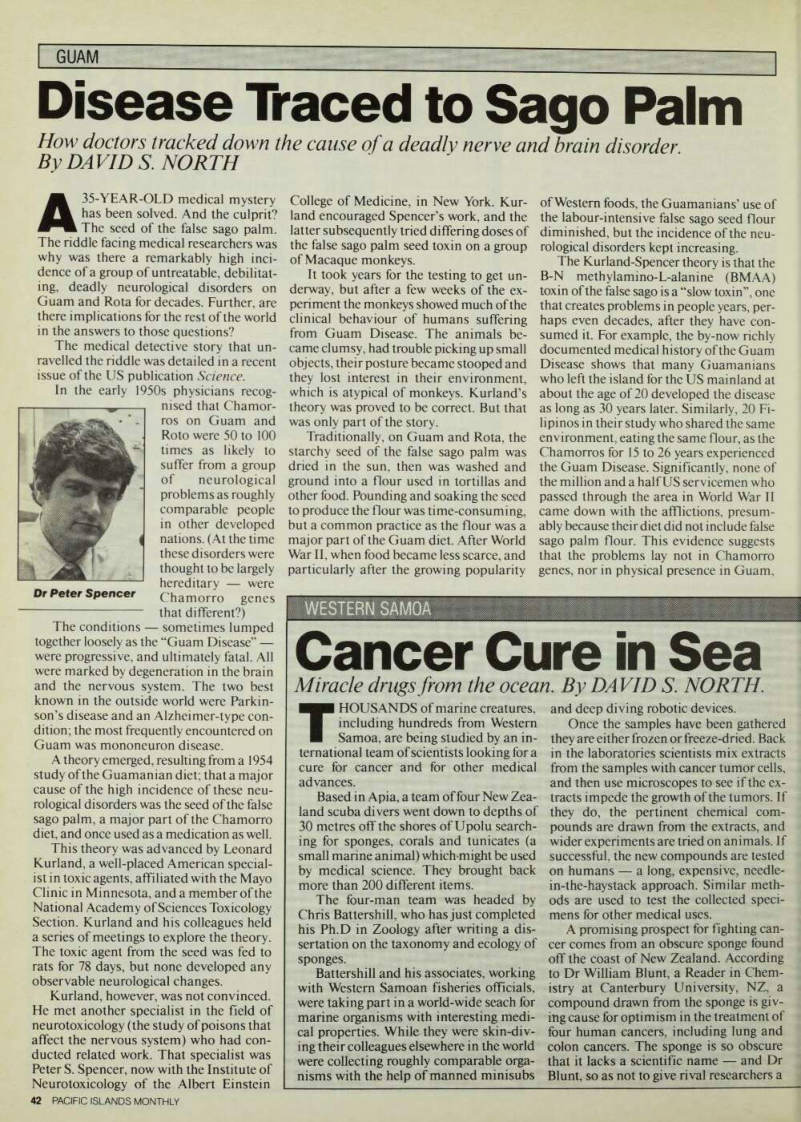
How doctors tracked down the cause of a deadly nerve and brain disorder.
By Davids. North
A 35-YEAR-OLD medical mystery has been solved. And the culprit?
The seed of the false sago palm.
The riddle facing medical researchers was why was there a remarkably high inci dence of a group of unbeatable, debilitat ing, deadly neurological disorders on Guam and Rota for decades. Further, are there implications for the rest of the world in the answers to those questions?
The medical detective story that un ravelled the riddle was detailed in a recent issue of the US publication Science.
In the early 1950 s physicians recog-
nised that Chamor ros on Guam and Roto were 50 to 100 times as likely to suffer from a group of neurological problems as roughly comparable people in other developed nations. (At the time these disorders were thought to be largely hereditary were Chamorro genes that different?)
The conditions sometimes lumped together loosely as the “Guam Disease” were progressive, and ultimately fatal. All were marked by degeneration in the brain and the nervous system. The two best known in the outside world were Parkin son’s disease and an Alzheimer-type con dition; the most frequently encountered on Guam was mononeuron disease.
A theory emerged, resulting from a 1954 study of the Guamanian diet; that a major cause of the high incidence of these neu rological disorders was the seed of the false sago palm, a major part of the Chamorro diet, and once used as a medication as well.
This theory was advanced by Leonard Kurland, a well-placed American special ist in toxic agents, affiliated with the Mayo Clinic in Minnesota, and a member of the National Academy of Sciences Toxicology Section. Kurland and his colleagues held a series of meetings to explore the theory.
The toxic agent from the seed was fed to rats for 78 days, but none developed any observable neurological changes.
Kurland, however, was not convinced.
He met another specialist in the field of neurotoxicology (the study of poisons that affect the nervous system) who had con ducted related work. That specialist was Peter S. Spencer, now with the Institute of Neurotoxicology of the Albert Einstein
College of Medicine, in New York. Kur land encouraged Spencer’s work, and the latter subsequently tried differing doses of the false sago palm seed toxin on a group of Macaque monkeys.
It took years for the testing to get un derway, but after a few weeks of the ex periment the monkeys showed much of the clinical behaviour of humans suffering from Guam Disease. The animals be came clumsy, had trouble picking up small objects, their posture became stooped and they lost interest in their environment, which is atypical of monkeys. Kurland’s theory was proved to be correct. But that was only part of the story.
Traditionally, on Guam and Rota, the starchy seed of the false sago palm was dried in the sun, then was washed and ground into a flour used in tortillas and other food. Pounding and soaking the seed to produce the flour was time-consuming, but a common practice as the flour was a major part of the Guam diet. After World War 11, when food became less scarce, and particularly after the growing popularity
of Western foods, the Guamanians’ use of the labour-intensive false sago seed flour diminished, but the incidence of the neu rological disorders kept increasing.
The Kurland-Spencer theory is that the B-N methylamino-L-alanine (BMAA) toxin of the false sago is a “slow toxin”, one that creates problems in people years, per haps even decades, after they have con sumed it. For example, the by-now richly documented medical history of the Guam Disease shows that many Guamanians who left the island for the US mainland at about the age of 20 developed the disease as long as 30 years later. Similarly, 20 Fi lipinos in their study who shared the same environment, eating the same flour, as the Chamorros for 15 to 26 years experienced the Guam Disease. Significantly, none of the million and a half US servicemen who passed through the area in World War II came down with the afflictions, presum ably because their diet did not include false sago palm flour. This evidence suggests that the problems lay not in Chamorro genes, nor in physical presence in Guam,
Dr Peter Spencer
but in the food that is consumed there.
In the Pacific, the false sago palm is far flung. Although Spencer and the other six authors of the article in Science report no incidence of the Guam Disease being con tracted outside Guam and Roto, they do note that “delayed-onset locomotor dys function of cattle, sheep and horses has been recorded on numerous occasions in north eastern Australia”. They do report, too, that the false sago palm grows throughout the Marshalls and the Caro lines, and that it has been used for food in the Caroline and Marshall Islands.
Spencer and his colleagues reveal that the false sago extends from the northern coast of Australia, through Indonesia and Papua New Guinea and north to the southern-most part of Japan.
On a world-wide level, physicians, sci entists and those afflicted with Alz heimer’s disease and related conditions, can take heart because of Spencer and Kurland’s discovery. (Alzheimer’s dis ease saps, and then destroys, the memory, weakens the mind’s control over the body, and, eventually, is fatal.) The work of Spencer, Kurland and others proves that at least some of the forces leading to these conditions are, fortunately, environmen tal and not genetic ones.
The discovery of the toxin within the false sago palm seed on Guam could lead to the discovery of other poisons and this may help in the control of Alzheimer’s dis ease and similar conditions. □
Cancer Cure in Sea
Western Samoa
Miracle drugs from the ocean. By DAVID S. NORTH.
THOUSANDS of marine creatures, including hundreds from Western Samoa, are being studied by an in ternational team of scientists looking for a cure for cancer and for other medical advances.
Based in Apia, a team of four New Zea land scuba divers went down to depths of 30 metres off the shores of Upolu search ing for sponges, corals and tunicates (a small marine animal) whicfrmight be used by medical science. They brought back more than 200 different items.
The four-man team was headed by Chris Battershill, who has just completed his Ph.D in Zoology after writing a dis sertation on the taxonomy and ecology of sponges.
Battershill and his associates, working with Western Samoan fisheries officials, were taking part in a world-wide seach for marine organisms with interesting medi cal properties. While they were skin-div ing their colleagues elsewhere in the world were collecting roughly comparable orga nisms with the help of manned minisubs
and deep diving robotic devices.
Once the samples have been gathered they are either frozen or freeze-dried. Back in the laboratories scientists mix extracts from the samples with cancer tumor cells, and then use microscopes to see if the ex tracts impede the growth of the tumors. If they do, the pertinent chemical com pounds are drawn from the extracts, and wider experiments are tried on animals. If successful, the new compounds are tested on humans a long, expensive, needle in-the-haystack approach. Similar meth ods are used to test the collected speci mens for other medical uses.
A promising prospect for fighting can cer comes from an obscure sponge found off the coast of New Zealand. According to Dr William Blunt, a Reader in Chem istry at Canterbury University, NZ, a compound drawn from the sponge is giv ing cause for optimism in the treatment of four human cancers, including lung and colon cancers. The sponge is so obscure that it lacks a scientific name and Dr Blunt, so as not to give rival researchers a
lead, declined to describe it further.
The sea is increasingly being seen as a fertile source of new drugs. Nature has created an immense variety of living crea tures, many of which have armed them selves with unique defensive chemical mixes; it apparently is easier to screen ex isting compounds, such as those in the sea, than to create new ones in the laboratory.
With this in mind, the National Cancer Institute in Washington is spending mil lions of dollars on several maritime col lection operations designed to find and test compounds in the sea. Both Canterbury University, which sent scientist-divers to Western Samoa, and Captain Cook Uni versity, in Townsville in Queensland, have grants to do this work.
Once a likely compound has been lo cated it is turned over to an American firm, SeaPharm Inc., of Princeton, New Jersey, for further development. SeaPharm is conducting the animal tests of the mys terious New Zealand sponge, and sorting through the materials collected in Western Samoa.
Dr Blunt’s Canterbury team is plan ning to spend more time in the islands over the next few years, and is also thinking about doing some collecting in Antarctica. □
Advertisements & other items, pp. 43-44 (1 item)
14 Cash-cropping,
(D (/> I- <D CX3 0) 3
re -m
Pacific Policy Papers No 3
ISSN 0817-6301
Human Resource Development in
the Pacific
C.D. Throsby •ditor 250 + x approx A 520.00
ISBN 0 7315 0448 8
Human resources development is of crucial importance to developing countries and nowhere of more significance than in the small and isolated states of the Pacific, neighbours of Australia Emphasis throughout this volume is on current and future policy directions in health, nutrition, formal and non-formal education and developments in labour markets, including employment, wages, labour relations and women’s participation in labour markets Particular reference is made throughout to the role of aid in improving human resource development
Pacific Research Monographs
ISSN 0155-9060
13 The Cash Incentive; the
economic response of semisubsistent craftworkers in
Papua New Guinea
Norman E. Philp 134 + x Aslo 00
ISBN 0 86784 984 3
This study of a sample of craftspeople examines the income-earning potential, the cash expenditure behaviour and the work effort of the handloom wool weavers who operated in both the remote villages and urban areas of pre-Independence Papua New Guinea Although weaving represented the mam cash*earmng activity of these households, they continued to rely on the traditional economy for a substantial part of their livelihood
14 Cash-cropping,
Catholicism and Change;
resettlement among the Kuni,
Central Province, Papua
New Guinea
OlgaGostin 170+xxiipp Asl2 00
ISBN 0 86784 992 4
In 1961, a Roman Catholic priest told his Papuan congregation in the foothills of the Owen Stanley Ranges of his intention to relocate the mission station on the plains to the south, and to start cash-cropping This monograph is the story of the relocation It focuses on the problems of social change generated by the new lifestyle, with its unprecedented concentration of population, and unfamiliar cash-cropping of rubber Changes in leadership structure, problems of residence, kinship organizations and social custom are all reviewed, and the author points to the role of the Catholic ethic in rationalizing, inhibiting and sometimes facilitating change
15 Fiji’s Economic History,
1874-1939: studies in
capitalist colonial development
Unci Knapman 154 + viii pp Asl2 00
ISBN 0 86784 977 0
This book examines the spread, functioning and impact of capitalism in Fiji during the first sixty-five years of British colonial rule, 1874-1939 the period during which the present basic structure of Fiji's economy was formed The general argument is that Fiji provides an excellent example of foreign, corporate capitalist domination of a colonial export economy Most of the benefits of the remarkably successful sugar-led export growth accrued to foreigners Capitalism and colonialism and their long term effects on the Fijian economy are explored through seven case studies Neither impoverished the country nor destroyed long-term development prospects Rather, it is concluded, the absolute level of income increased and important foundations for postwar economic expansion were laid 16 New Caledonia or
Kanaky? The political history of
a French colony John Connoll 520 + xn pp approx
AS2S 00
ISBN 0 7315 0512 3
Few states in the South Pacific are so poorly understood as New Caledonia despite the drama and significance of political events of the 1980 s, the bitterness of recent disputes and the continued tension in this divided French territory This is the first book in English to give a detailed account of the historic sources of conflict and to describe the recent struggle for independence and its wider significance for the South Pacific region and for other overseas French territories This account traces the continuity of political disputes from early mission rivalries, through two bloody insurrections in Melanesian defiance of the settler colony to the rise of radicalism in the 19705, culminating in the abortive declaration of a Republic of Kanaky immediately after the 1984 elections and the aftermath of violence and reprisals These books are available from: Bibliotech, ANUTECH Pty. Ltd GPO Box 4 Canberra ACT 2601 Australia Postage and packing charges for all books except Pacific Research Monograph No 16: 1 book; $2 30 OSAS3.IO 2or 3 books; $5 00 05A57.70 PRM No 16 $4 30 OS A 56.90 An invoice can be raised, or a charge made to Bankcard or Mastercard The prices listed above are the recommended retail prices and are subiect to change without notice
117 York St., Sydney Cables: Henco Sydney.
C.P.O. Box 5949 Telephone: 261 1955.
For
specialised
and
personalised
buying
service
throughout
the
Pacific Islands
and the East
LOCAL AGENTS AND
REPRESENTATION
PAPUA NEW GUINEA
RABAUL: M. & C. Seeto, P.O. Box 131, Rabaul.
Telephone 92 2919
FIJI
K. Witherington Ltd., P.O. Box 293, Suva.
Telephone 22 356.
VANUATU
John Lum & Associates, P.O. Box 65, Santo.
Telephone 329.
Exporters
General
Merchants
Transition
Arrived: Dr Arnold Van Niekerk in Port Moresby to commence work as Delegate of the Commission of the European Com munities (EEC). He will work with the PNG Government implementing the Lome Conventions on trade and devel opment. Dr Van Niekerk replaces Mr Robert Goldsmith.
Decorated: Private Luke Vukivuki of Yasawi-i-Rara for courage and heroic service in Southern Lebanon. Vukivuki received the Knight of the Legion of Hon our for rescuing three wounded French soldiers.
Established: The first Consulate in Australia of the Republic of Kiribati. The Sydney Consulate will be headed by Hon orary Consul Mr William Franken.
Signed: An agreement between Fiji coup leader Colonel Sitiveni Rabuka and New Litho Pty Ltd, a Melbourne publish ing company, giving the company the rights to publish the Colonel’s biography.
The company also won the rights to pro duce a documentary on Col Rabuka’s life and an option on the film rights on the book. It is understood the Colonel has been paid a retainer of $A50,000.
Appointed: Mr David Evans as New Zealand Consul General in New Cale donia with cross accreditation to French Polynesia, Wallis and Futuna. Mr Evans recently served in Paris as Deputy Per manent Delegate to the Organisation for Economic Co-operation and Develop ment, and replaces Miss Sarah Dennis in New Caledonia.
Appointed: Mr Adrian Sincock as New Zealand Representative to the Cook Is lands. He takes over from Mr Lance Heath.
Mr Sincock was most recently Director of Personnel in the Ministry of Foreign Affairs in Wellington.
Appointed: Mr Kikuhiko Nishida to Executive Vice President of Tokyu Hotels International, operator of Pan Pacific Ho tels. A former Managing Director of the
Bank of Tokyo, Mr Nishida will control future hotel projects throughout the Greater Pacific Basin.
Appointed: Mr Peter Bassett as Aus tralian High Commissioner in Kiribati.
Appointed: Honolulu businessman John Henry Felix to a two-year term as the US Representative to the South Pacific Commission. The Commission is the 27member international support agency providing social, economic and technical assistance to 22 island nations.
Elected: Hon. Asi Eikeni Fruean has been elected chairman of the Pacific Is lands Association of Chambers of Com merce. The Hon Asi Eikeni is a Western Samoan businessman and member of Parliament. Newly-elected vice-chairmen are Mr Ronald Yea of Tonga and Mr Ken neth Walters of Cook Islands.
Died: Pedro C Sanchez, 62, Demo cratic member of the Guam Senate, in Ha waii on August 17 of internal bleeding. He was, at the time of his death, Chairman of the Federal, Foreign and Legal Affairs Committee of the Guam Senate, and Vice- Chair on the Guam Commission on Self Determination.
Died: Mr Raj Charan Bali, 59, on Au gust 18, who pioneered the book store business in Ba. Mr Bali ran the Ba Book Centre and served two terms as a Ba town councillor.
Died: Bhagat Singh Dausangh, 76, prominent Fiji businessman, in mid-Au gust. He established the Wailoku Bus Company and opened the first grocery shop in Naders.
Died: Bill Nolan, 55, known as the father of PNG broadcasting, of cancer in Port Moresby at the end of July. Nolan joined the ABC in Port Moresby in 1962 as an assistant program officer. He en couraged PNG music and radio plays written by Papua New Guineans about contemporary situations. He remained in radio until his death and was helpful to many PNG broadcasters throughout their careers.
Died: Dennis Walker, 43, of unknown causes in a Las Vegas, Nevada, motel room.
Walker was being sought by the Oregon Attorney General’s office for his involve ment in a pyramid scheme that promised more than 25 per cent interest in money deposited in the International Bank of the South Pacific, based in Nukualofa. □
Rabuka with New Litho’s Paul Daley
The Island Press
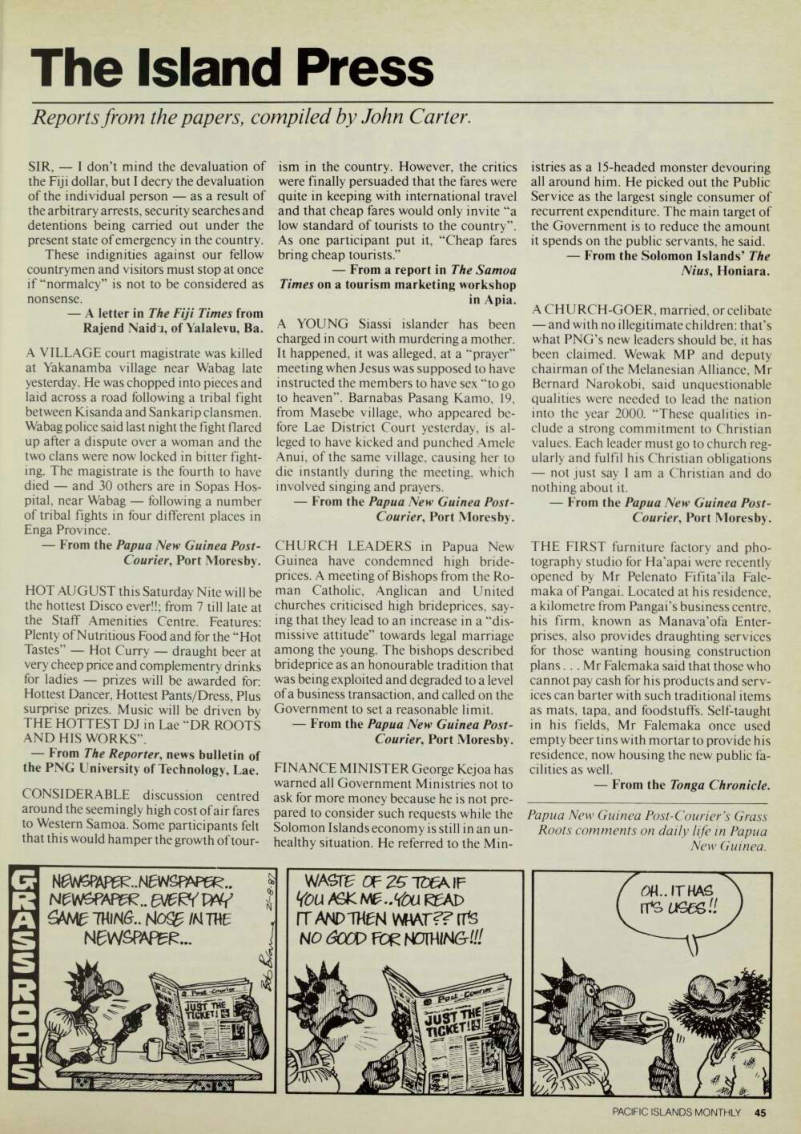
Reports from the papers, compiled by John Carter.
SIR, I don’t mind the devaluation of the Fiji dollar, but I decry the devaluation of the individual person as a result of the arbitrary arrests, security searches and detentions being carried out under the present state of emergency in the country.
These indignities against our fellow countrymen and visitors must stop at once if “normalcy” is not to be considered as nonsense.
A letter in The Fiji Times from Rajend Naid j, of Yalalevu, Ba, A VILLAGE court magistrate was killed at Yakanamba village near Wabag late yesterday. He was chopped into pieces and laid across a road following a tribal fight between Kisanda and Sankarip clansmen.
Wabag police said last night the fight flared up after a dispute over a woman and the two clans were now locked in bitter fight ing. The magistrate is the fourth to have died and 30 others are in Sopas Hos pital, near Wabag following a number of tribal fights in four different places in Enga Province.
From the Papua New Guinea Post- Courier , Port Moresby.
HOT AUGUST this Saturday Nite will be the hottest Disco ever!!; from 7 till late at the Staff Amenities Centre. Features: Plenty of Nutritious Food and for the “Hot Tastes” Hot Curry draught beer at very cheep price and complementry drinks for ladies prizes will be awarded for: Hottest Dancer, Hottest Pants/Dress, Plus surprise prizes. Music will be driven by THE HOTTEST DJ in Lae “DR ROOTS
And His Works”.
From The Reporter , news bulletin of the PNG University of Technology, Lae.
CONSIDERABLE discussion centred around the seemingly high cost of air fares to Western Samoa. Some participants felt that this would hamper the growth of tour
ism in the country. However, the critics were finally persuaded that the fares were quite in keeping with international travel and that cheap fares would only invite “a low standard of tourists to the country”.
As one participant put it, “Cheap fares bring cheap tourists.”
From a report in The Samoa Times on a tourism marketing workshop in Apia.
A YOUNG Siassi islander has been charged in court with murdering a mother.
It happened, it was alleged, at a “prayer” meeting when Jesus was supposed to have instructed the members to have sex “to go to heaven”. Barnabas Pasang Kamo, 19, from Masebe village, who appeared be fore Lae District Court yesterday, is al leged to have kicked and punched Amele Anui, of the same village, causing her to die instantly during the meeting, which involved singing and prayers.
From the Papua New Guinea Post- Courier , Port Moresby.
CHURCH LEADERS in Papua New Guinea have condemned high bride prices. A meeting of Bishops from the Ro man Catholic, Anglican and United churches criticised high brideprices, say ing that they lead to an increase in a “dis missive attitude” towards legal marriage among the young. The bishops described brideprice as an honourable tradition that was being exploited and degraded to a level of a business transaction, and called on the Government to set a reasonable limit.
From the Papua New Guinea Post- Courier , Port Moresby.
FINANCE MINISTER George Kejoa has warned all Government Ministries not to ask for more money because he is not pre pared to consider such requests while the Solomon Islands economy is still in an un healthy situation. He referred to the Min
istries as a 15-headed monster devouring all around him. He picked out the Public Service as the largest single consumer of recurrent expenditure. The main target of the Government is to reduce the amount it spends on the public servants, he said.
From the Solomon Islands' The Nius , Honiara.
A CHURCH-GOER, married, or celibate and with no illegitimate children: that’s what PNG’s new leaders should be, it has been claimed. Wewak MP and deputy chairman of the Melanesian Alliance, Mr Bernard Narokobi, said unquestionable qualities were needed to lead the nation into the year 2000. “These qualities in clude a strong commitment to Christian values. Each leader must go to church reg ularly and fulfil his Christian obligations not just say I am a Christian and do nothing about it.
From the Papua New Guinea Post- Courier , Port Moresby.
THE FIRST furniture factory and pho tography studio for Ha’apai were recently opened by Mr Pelenato Fifita’ila Fale maka of Pangai. Located at his residence, a kilometre from Pangai’s business centre, his firm, known as Manava’ofa Enter prises, also provides draughting services for those wanting housing construction plans... Mr Falemaka said that those who cannot pay cash for his products and serv ices can barter with such traditional items as mats, tapa, and foodstuffs. Self-taught in his fields, Mr Falemaka once used empty beer tins with mortar to provide his residence, now housing the new public fa cilities as well.
From the Tonga Chronicle.
Papua New Guinea Post-Courier’s Grass Roots comments on daily life in Papua New Guinea.
Was America to Blame?
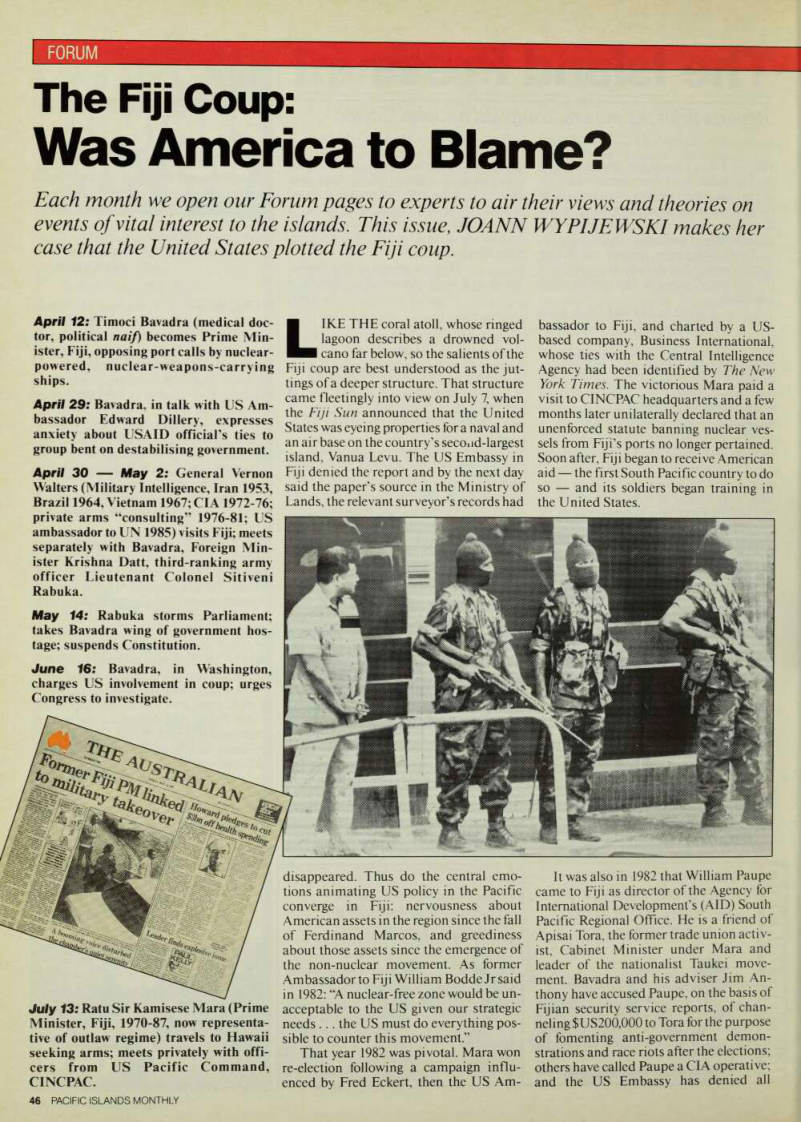
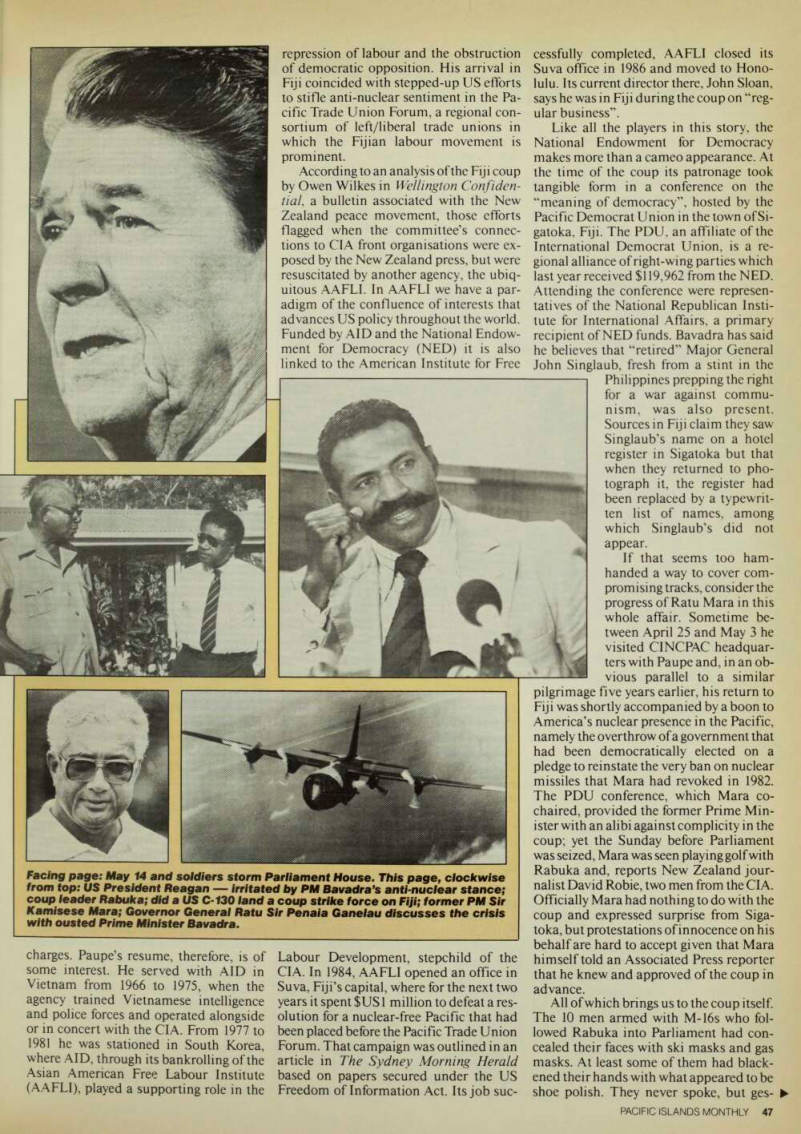
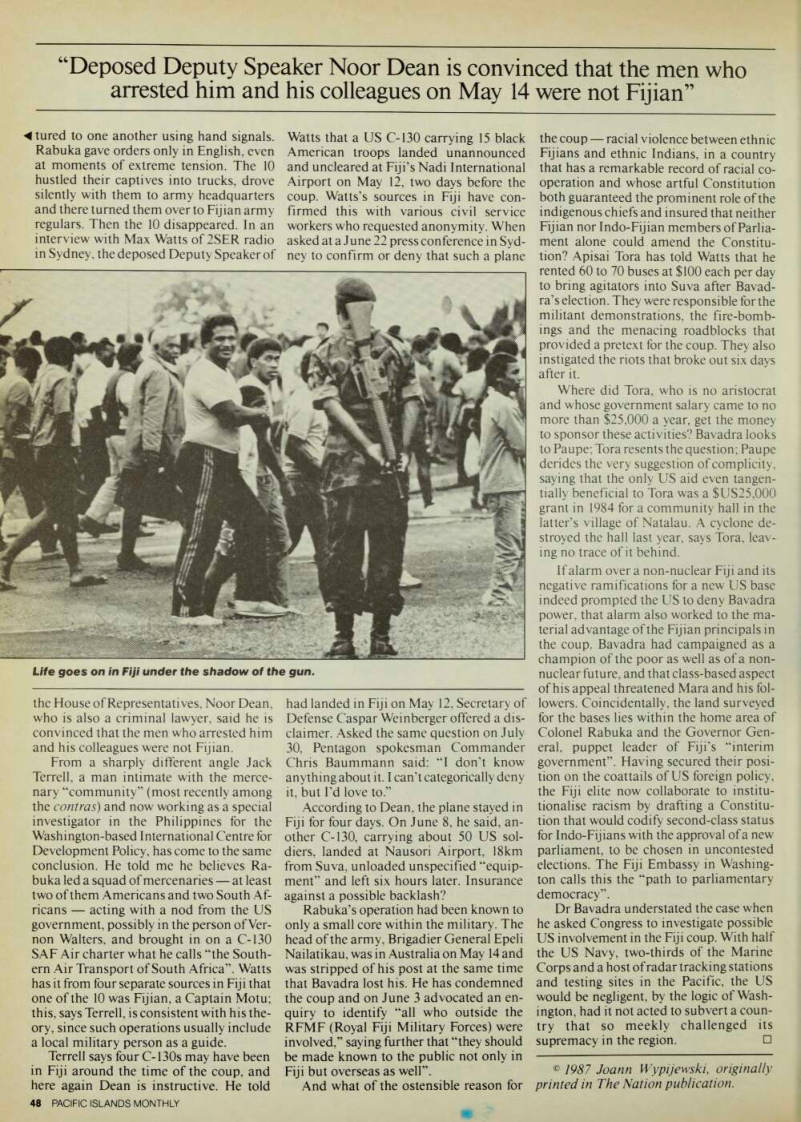
Forum
The Fiji Coup: Was America to Blame?
Each month we open our Forum pages to experts to air their views and theories on events of vital interest to the islands. This JOANN WYPIJEWSKI makes her case that the United States plotted the Fiji coup.
April 12: Timoci Bavadra (medical doc tor, political naif) becomes Prime Min ister, Fiji, opposing port calls by nuclear powered, nuclear-weapons-carrying ships.
April 29: Bavadra, in talk with US Am bassador Edward Dillery, expresses anxiety about USAID official’s ties to group bent on destabilising government.
April 30 May 2: General Vernon Walters (Military Intelligence, Iran 1953, Brazil 1964, Vietnam 1967; CIA 1972-76; private arms “consulting” 1976-81; US ambassador to UN 1985) visits Fiji; meets separately with Bavadra, Foreign Min ister Krishna Datt, third-ranking army officer Lieutenant Colonel Sitiveni Rabuka.
May 14: Rabuka storms Parliament; takes Bavadra wing of government hos tage; suspends Constitution.
June 16: Bavadra, in Washington, charges US involvement in coup; urges Congress to investigate.
July 13: Ratu Sir Kamisese Mara (Prime Minister, Fiji, 1970-87, now representative of outlaw regime) travels to Hawaii seeking arms; meets privately with officers from US Pacific Command,
Cincpac.
LIKE THE coral atoll, whose ringed lagoon describes a drowned vol cano far below, so the salients of the Fiji coup are best understood as the jut tings of a deeper structure. That structure came fleetingly into view on July 7, when the Fiji Sun announced that the United States was eyeing properties for a naval and an air base on the country’s second-largest island, Vanua Levu. The US Embassy in Fiji denied the report and by the next day said the paper’s source in the Ministry of Lands, the relevant surveyor’s records had
bassador to Fiji, and charted by a US based company, Business International, whose ties with the Central Intelligence Agency had been identified by The New York Times. The victorious Mara paid a visit to CINCPAC headquarters and a few months later unilaterally declared that an unenforced statute banning nuclear ves sels from Fiji’s ports no longer pertained.
Soon after, Fiji began to receive American aid the first South Pacific country to do so and its soldiers began training in the United States.
disappeared. Thus do the central emo tions animating US policy in the Pacific converge in Fiji: nervousness about American assets in the region since the fall of Ferdinand Marcos, and greediness about those assets since the emergence of the non-nuclear movement. As former Ambassador to Fiji William Bodde Jr said in 1982: “A nuclear-free zone would be un acceptable to the US given our strategic needs ... the US must do everything pos sible to counter this movement.”
That year 1982 was pivotal. Mara won re-election following a campaign influ enced by Fred Eckert, then the US Am-
It was also in 1982 that William Paupe came to Fiji as director of the Agency for International Development’s (AID) South Pacific Regional Office. He is a friend of Apisai Tora, the former trade union activ ist, Cabinet Minister under Mara and leader of the nationalist Taukei move ment. Bavadra and his adviser Jim An thony have accused Paupe, on the basis of Fijian security service reports, of chan neling SUS2OO,OOO to Tora for the purpose of fomenting anti-government demon strations and race riots after the elections; others have called Paupe a CIA operative; and the US Embassy has denied all
charges. Paupe’s resume, therefore, is of some interest. He served with AID in Vietnam from 1966 to 1975, when the agency trained Vietnamese intelligence and police forces and operated alongside or in concert with the CIA. From 1977 to 1981 he was stationed in South Korea, where AID, through its bankrolling of the Asian American Free Labour Institute (AAFLI), played a supporting role in the
repression of labour and the obstruction of democratic opposition. His arrival in Fiji coincided with stepped-up US efforts to stifle anti-nuclear sentiment in the Pa cific Trade Union Forum, a regional con sortium of left/liberal trade unions in which the Fijian labour movement is prominent.
According to an analysis of the Fiji coup by Owen Wilkes in Wellington Confiden tial, a bulletin associated with the New Zealand peace movement, those efforts flagged when the committee’s connec tions to CIA front organisations were ex posed by the New Zealand press, but were resuscitated by another agency, the übiq uitous AAFLI. In AAFLI we have a par adigm of the confluence of interests that advances US policy throughout the world.
Funded by AID and the National Endow ment for Democracy (NED) it is also linked to the American Institute for Free
Labour Development, stepchild of the CIA. In 1984, AAFLI opened an office in Suva, Fiji’s capital, where for the next two years it spent SUS 1 million to defeat a res olution for a nuclear-free Pacific that had been placed before the Pacific Trade Union Forum. That campaign was outlined in an article in The Sydney Morning Herald based on papers secured under the US Freedom of Information Act. Its job suc
cessfully completed, AAFLI closed its Suva office in 1986 and moved to Hono lulu. Its current director there, John Sloan, says he was in Fiji during the coup on “reg ular business”.
Like all the players in this story, the National Endowment for Democracy makes more than a cameo appearance. At the time of the coup its patronage took tangible form in a conference on the “meaning of democracy”, hosted by the Pacific Democrat Union in the town of Si gatoka, Fiji. The PDU, an affiliate of the International Democrat Union, is a re gional alliance of right-wing parties which last year received $119,962 from the NED.
Attending the conference were represen tatives of the National Republican Insti tute for International Affairs, a primary recipient of NED funds. Bavadra has said he believes that “retired” Major General John Singlaub, fresh from a stint in the
Philippines propping the right for a war against commu nism, was also present.
Sources in Fiji claim they saw Singlaub’s name on a hotel register in Sigatoka but that when they returned to pho tograph it, the register had been replaced by a typewrit ten list of names, among which Singlaub’s did not appear.
If that seems too ham handed a way to cover com promising tracks, consider the progress of Ratu Mara in this whole affair. Sometime be tween April 25 and May 3 he visited CINCPAC headquar ters with Paupe and, in an ob vious parallel to a similar
pilgrimage five years earlier, his return to Fiji was shortly accompanied by a boon to America’s nuclear presence in the Pacific, namely the overthrow of a government that had been democratically elected on a pledge to reinstate the very ban on nuclear missiles that Mara had revoked in 1982.
The PDU conference, which Mara co chaired, provided the former Prime Min ister with an alibi against complicity in the coup; yet the Sunday before Parliament was seized, Mara was seen playing golf with Rabuka and, reports New Zealand jour nalist David Robie, two men from the CIA.
Officially Mara had nothing to do with the coup and expressed surprise from Siga toka, but protestations of innocence on his behalf are hard to accept given that Mara himself told an Associated Press reporter that he knew and approved of the coup in advance.
All of which brings us to the coup itself.
The 10 men armed with M-16s who fol lowed Rabuka into Parliament had con cealed their faces with ski masks and gas masks. At least some of them had black ened their hands with what appeared to be shoe polish. They never spoke, but ges- ►
Facing page: May 14 and soldiers storm Parliament House. This page, clockwise from top: US President Reagan -irritated by PM Bavadra’s anti-nuclear stance; coup leader Rabuka; did a US C-130 land a coup strike force on Fiji; former PM Sir Kamisese Mara; Governor General Ratu Sir Penaia Ganelau discusses the crisis with ousted Prime Minister Bavadra.
“Deposed Deputy Speaker Noor Dean is convinced that the men who arrested him and his colleagues on May 14 were not Fijian”
◄ tured to one another using hand signals.
Rabuka gave orders only in English, even at moments of extreme tension. The 10 hustled their captives into trucks, drove silently with them to army headquarters and there turned them over to Fijian army regulars. Then the 10 disappeared. In an interview with Max Watts of 2SER radio in Sydney, the deposed Deputy Speaker of
Watts that a US C-130 carrying 15 black American troops landed unannounced and uncleared at Fiji’s Nadi International Airport on May 12, two days before the coup. Watts’s sources in Fiji have con firmed this with various civil service workers who requested anonymity. When asked at a June 22 press conference in Syd ney to confirm or deny that such a plane
the House of Representatives, Noor Dean, who is also a criminal lawyer, said he is convinced that the men who arrested him and his colleagues were not Fijian.
From a sharply different angle Jack Terrell, a man intimate with the merce nary “community” (most recently among the contras) and now working as a special investigator in the Philippines for the Washington-based International Centre for Development Policy, has come to the same conclusion. He told me he believes Ra buka led a squad of mercenaries at least two of them Americans and two South Af ricans acting with a nod from the US government, possibly in the person of Ver non Walters, and brought in on a C-130 SAF Air charter what he calls “the South ern Air Transport of South Africa”. Watts has it from four separate sources in Fiji that one of the 10 was Fijian, a Captain Motu; this, says Terrell, is consistent with his the ory, since such operations usually include a local military person as a guide.
Terrell says four C-130s may have been in Fiji around the time of the coup, and here again Dean is instructive. He told
had landed in Fiji on May 12, Secretary of Defense Caspar Weinberger offered a dis claimer. Asked the same question on July 30, Pentagon spokesman Commander Chris Baummann said: “I don’t know anything about it. I can’t categorically deny it, but I’d love to.”
According to Dean, the plane stayed in Fiji for four days. On June 8, he said, an other C-130, carrying about 50 US sol diers, landed at Nausori Airport, 18km from Suva, unloaded unspecified “equip ment” and left six hours later. Insurance against a possible backlash?
Rabuka’s operation had been known to only a small core within the military. The head of the army, Brigadier General Epeli Nailatikau, was in Australia on May 14 and was stripped of his post at the same time that Bavadra lost his. He has condemned the coup and on June 3 advocated an en quiry to identify “all who outside the RFMF (Royal Fiji Military Forces) were involved,” saying further that “they should be made known to the public not only in Fiji but overseas as well”.
And what of the ostensible reason for
the coup racial violence between ethnic Fijians and ethnic Indians, in a country that has a remarkable record of racial co operation and whose artful Constitution both guaranteed the prominent role of the indigenous chiefs and insured that neither Fijian nor Indo-Fijian members of Parlia ment alone could amend the Constitu tion? Apisai Tora has told Watts that he rented 60 to 70 buses at $lOO each per day to bring agitators into Suva after Bavad ra’s election. They were responsible for the militant demonstrations, the fire-bomb ings and the menacing roadblocks that provided a pretext for the coup. They also instigated the riots that broke out six days after it.
Where did Tora, who is no aristocrat and whose government salary came to no more than $25,000 a year, get the money to sponsor these activities? Bavadra looks to Paupe; Tora resents the question; Paupe derides the very suggestion of complicity, saying that the only US aid even tangen tially beneficial to Tora was a $U525,000 grant in 1984 for a community hall in the latter’s village of Natalau. A cyclone de stroyed the hall last year, says Tora, leav ing no trace of it behind.
If alarm over a non-nuclear Fiji and its negative ramifications for a new US base indeed prompted the US to deny Bavadra power, that alarm also worked to the ma terial advantage of the Fijian principals in the coup. Bavadra had campaigned as a champion of the poor as well as of a non nuclear future, and that class-based aspect of his appeal threatened Mara and his fol lowers. Coincidentally, the land surveyed for the bases lies within the home area of Colonel Rabuka and the Governor Gen eral, puppet leader of Fiji’s “interim government”. Having secured their posi tion on the coattails of US foreign policy, the Fiji elite now collaborate to institu tionalise racism by drafting a Constitu tion that would codify second-class status for Indo-Fijians with the approval of a new parliament, to be chosen in uncontested elections. The Fiji Embassy in Washing ton calls this the “path to parliamentary democracy”.
Dr Bavadra understated the case when he asked Congress to investigate possible US involvement in the Fiji coup. With half the US Navy, two-thirds of the Marine Corps and a host of radar tracking stations and testing sites in the Pacific, the US would be negligent, by the logic of Wash ington, had it not acted to subvert a coun try that so meekly challenged its supremacy in the region. □
® 1987 Joann Wypijewski, originally printed in The Nation publication.
Life goes on in Fiji under the shadow of the gun.
Pacific Stamp Box
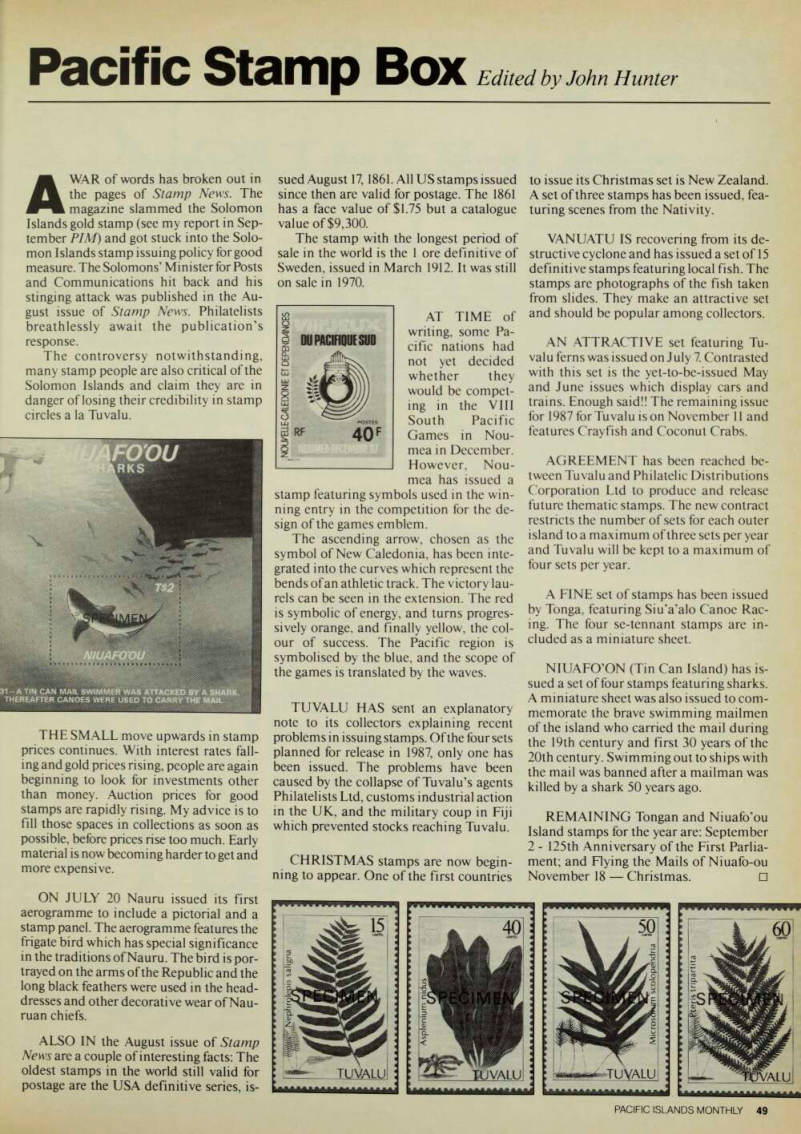
Edited by John Hunter
A WAR of words has broken out in the pages of Stamp News. The magazine slammed the Solomon Islands gold stamp (see my report in Sep tember PIM) and got stuck into the Solo mon Islands stamp issuing policy for good measure. The Solomons’ Minister for Posts and Communications hit back and his stinging attack was published in the Au gust issue of Stamp News. Philatelists breathlessly await the publication’s response.
The controversy notwithstanding, many stamp people are also critical of the Solomon Islands and claim they are in danger of losing their credibility in stamp circles a la Tuvalu.
THE SMALL move upwards in stamp prices continues. With interest rates fall ing and gold prices rising, people are again beginning to look for investments other than money. Auction prices for good stamps are rapidly rising. My advice is to fill those spaces in collections as soon as possible, before prices rise too much. Early material is now becoming harder to get and more expensive.
ON JULY 20 Nauru issued its first aerogramme to include a pictorial and a stamp panel. The aerogramme features the frigate bird which has special significance in the traditions of Nauru. The bird is por trayed on the arms of the Republic and the long black feathers were used in the head dresses and other decorative wear of Nau ruan chiefs.
ALSO IN the August issue of Stamp News are a couple of interesting facts: The oldest stamps in the world still valid for postage are the USA definitive series, is
sued August 17,1861. All US stamps issued since then are valid for postage. The 1861 has a face value of $1.75 but a catalogue value of $9,300.
The stamp with the longest period of sale in the world is the 1 ore definitive of Sweden, issued in March 1912. It was still on sale in 1970.
At Time Of
writing, some Pa cific nations had not yet decided whether they would be compet ing in the VIII South Pacific Games in Nou mea in December.
However, Nou mea has issued a
stamp featuring symbols used in the win ning entry in the competition for the de sign of the games emblem.
The ascending arrow, chosen as the symbol of New Caledonia, has been inte grated into the curves which represent the bends of an athletic track. The victory lau rels can be seen in the extension. The red is symbolic of energy, and turns progres sively orange, and finally yellow, the col our of success. The Pacific region is symbolised by the blue, and the scope of the games is translated by the waves.
TUVALU HAS sent an explanatory note to its collectors explaining recent problems in issuing stamps. Of the four sets planned for release in 1987, only one has been issued. The problems have been caused by the collapse of Tuvalu’s agents Philatelists Ltd, customs industrial action in the UK, and the military coup in Fiji which prevented stocks reaching Tuvalu.
CHRISTMAS stamps are now begin ning to appear. One of the first countries
to issue its Christmas set is New Zealand.
A set of three stamps has been issued, fea turing scenes from the Nativity.
VANUATU IS recovering from its de structive cyclone and has issued a set of 15 definitive stamps featuring local fish. The stamps are photographs of the fish taken from slides. They make an attractive set and should be popular among collectors.
AN ATTRACTIVE set featuring Tu valu ferns was issued on July 7. Contrasted with this set is the yet-to-be-issued May and June issues which display cars and trains. Enough said!! The remaining issue for 1987 for Tuvalu is on November 11 and features Crayfish and Coconut Crabs.
AGREEMENT has been reached be tween Tuvalu and Philatelic Distributions Corporation Ltd to produce and release future thematic stamps. The new contract restricts the number of sets for each outer island to a maximum of three sets per year and Tuvalu will be kept to a maximum of four sets per year.
A FINE set of stamps has been issued by Tonga, featuring Siu’a’alo Canoe Rac ing. The four se-tennant stamps are in cluded as a miniature sheet.
NIUAFO’ON (Tin Can Island) has is sued a set of four stamps featuring sharks.
A miniature sheet was also issued to com memorate the brave swimming mailmen of the island who carried the mail during the 19th century and first 30 years of the 20th century. Swimming out to ships with the mail was banned after a mailman was killed by a shark 50 years ago.
REMAINING Tongan and Niuafo’ou Island stamps for the year are: September 2 - 125th Anniversary of the First Parlia ment; and Flying the Mails of Niuafo-ou November 18 Christmas. □
Shipping Schedules

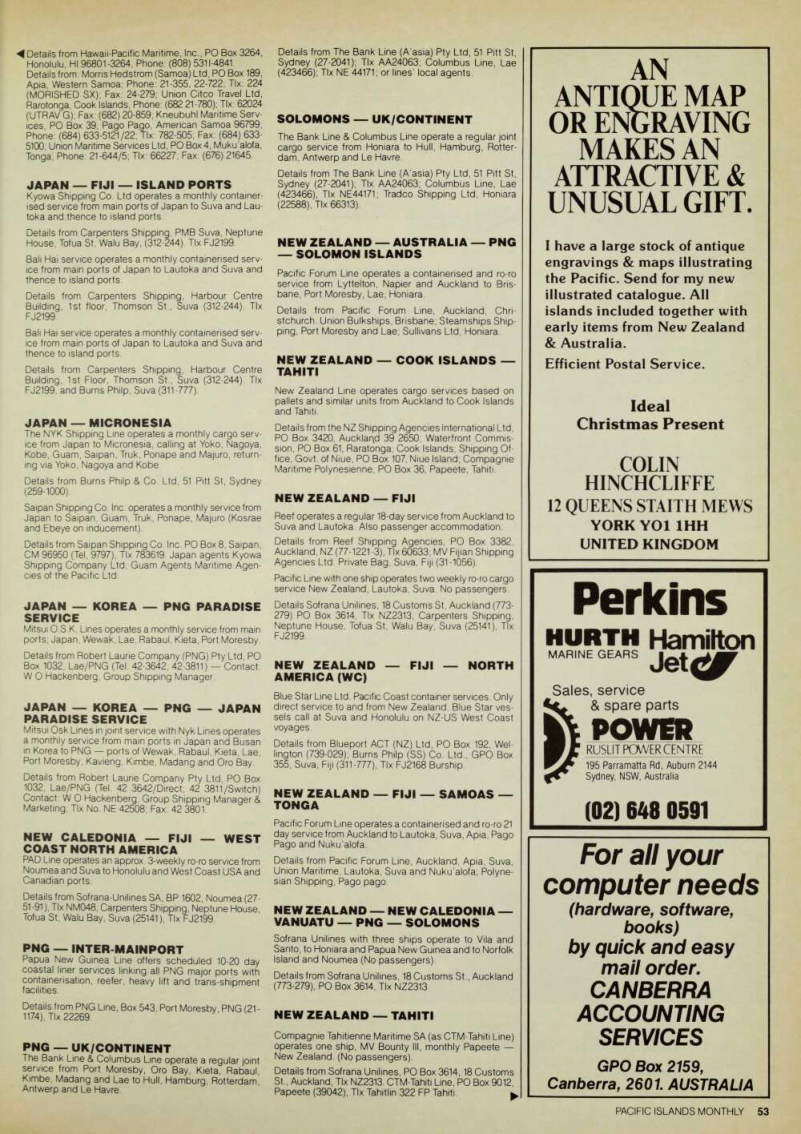
Australia New Caledonia
Fiji Hawaii North America
PACE Line (ACTA Shipping) operates a fully container ised service every 17 days from Melbourne, Sydney and Brisbane to Suva and Lautoka A new feature of the service is direct calls at Noumea. The vessels continue on to the North coast of America, calling at Hawaii at frequent intervals.
Details from ACTA Pty Ltd, Sydney (266 0633) Tlx AA121369, Fax 267 1148; Burns Philp (SS) Co Ltd, Rod well Road, Suva, (31 1777), Tlx FJ2168, Fax 311 804; Burns Philp (SS) Co Ltd, Lautoka (60 777); Sato SA, Avenue James Cook, BPC 2, Noumea, Cedex, (281 122) Tlx 163
Nm Sato, Fax 278 532.
Australia Fiji
Sofrana-Unilines (Fiji Express Line) operates to Suva and Lautoka every three weeks from the mam ports on the east coast of Australia and monthly to Lautoka from Mel bourne and Sydney Details from Sofrana-Unilines, 432 Kent St, Sydney (264- 8944), Tlx AA 70090; Wiltrans Agency Pty Ltd, 21 st Floor, 60 Market St. Melbourne (614-4788), Tlx 30163 Wiltrans Agency Pty Ltd, 633 Wickham St, Fortitude Valley, Old 4006 Tel. 07-8541855. Tlx AA40712 Elders-ANL Pty Ltd, Port Adelaide, (47-5688); Newcastle, Sofrana Sydney (264-8944), Websters-ANL, 58 Charles St Launceston, Tasmania (320-555); Carpenters Shipping, Neptune House, Tofua St, Walu Bay, Suva, Fiji (Ph: 25141); Tlx FJ2199.
Australia Samoas Tonga
Warner Pacific Lines operates a regular cargo service from Sydney, Brisbane and Melbourne to Nukualofa, Pago Pago, Apia and Vavau Feeder service available from Apia to Cook, Christmas, Fanning and Washington Islands.
Details from Hetherington Wesfarmers Shipping Agency, 37-49 Pitt St, Sydney, (223-1600)
Australia New Caledonia
Fiji Samoas Tonga
Pacific Forum Line operates a fully containerised service (general, reefer and ro-ro) from Sydney to Noumea, Lau toka, Suva, Apia, Pago Pago, Nukualofa, Sydney, Cargo centralised from Adelaide, Melbourne, Brisbane Details from Pacific Forum Line PO Box 796 Auckland, Union Bulkships, 333 George St, Sydney, Brisbane and Melbourne, Union Co., Lautoka, Pacific Forum Line, Suva, Nukualofa, Pacific Forum Line, Apia, Polynesia Ship ping Pago Pago
Australia Lord Howe Island
Norfolk Island
Compagnie des Chargeurs Caledoniens operates four weekly cargo service Sydney-Lord Howe Island and Norfolk Island.
Details Hetherington Wesfarmers Shipping Agency, 37- 49 Pitt St, Sydney (223-1600).
Australia Kiribati
K. Asia Pacific operates a 5/6 weekly service from Mel bourne and Sydney to Kiribati (Tarawa).
Details from K. Asia Pacific Pty Ltd, Goldfields House, 1 Alfred St, Circular Quay, Sydney (232-2277), Tlx 1221- 143.
KAP New Guinea Lines call Tarawa after NPG ports on a 35-day basis from Melbourne and Sydney/Brisbane.
Details from K. Asia Pacific Pty Ltd, Goldfields House, 1 Alfred St. Circular Quay, Sydney (232-2277); Tlx 122143.
Australia Tuvalu
K-Asia Pacific operates direct service every second voy age to Tulalu (Funafuti).
Details from K. Asia Pacific Pty Ltd, Goldfield House, 1 Alfred St, Circular Quay, Sydney (232-2277); Tlx 122143.
Australia Norfolk Island
Lord Howe Island
Norfolk Island Shipping Line operates direct service every 5/6 weeks ex-Sydney.
Details from K. Asia Pacific Pty Ltd as managing agents for NISL Goldfields House, 1 Alfred St, Circular Quay, Sydney (232 2277).
Australia Cook Islands
Norfolk Island Shipping Line operates Direct service every 5/6 weeks ex-Sydney Details from K. Asia Pacific Pty Ltd as managing agents for NISL, Goldfields House, 1 Alfred St, Circular Quay Sydney (232 2277).
Australia New Caledonia And/
Or Vanuatu
Sofrana-Unilines ships serve Noumea every three weeks from the main ports along the east Australian coast.
Details from Sofrana-Unilines, 432 Kent St, Sydney (264- 8944), Wiltrans-Agency Pty Ltd, 21st Floor, 60 Market St., Melbourne (614-4788); Tlx 30163, ACTA Pty Ltd, Bris bane (221-3116). Elders-ANL Pty Ltd, Port Adelaide (47- 5688), Newcastle, Sofrana Sydney; Websters-ANL, 58 Charles St. Launceston, Tasmania (320-555) Compagnie Generale-Maritime operates a monthly serv ice from Sydney, Melbourne and Brisbane to Noumea, Port Villa and Santo, for containerised and break bulk cargo Details from Compagnie Generale Maritime, 12 Castler eagh St, Sydney (231-3700).
Australia Nauru Marshall
Islands —Kiribati
Nauru Pacific Line operates regular cargo service from Melbourne to Nauru, Majuro and Tarawa, passenger service to Nauru only.
Details from Nauru Pacific Line (Aust) Pty Ltd, Nauru House, 80 Collins St, Melbourne (653-5709). Nedlloyd Swire, 8 Spring St, Sydney (2-0522).
Australia Solomon Islands
Vanuatu
NGAL/PNGL joint service operates a monthly service Details from Nedlloyd Swire Pty Ltd, 8 Spring St, Syd ney, Ph0ne:20522
Australia New Zealand
The Australian National Line and the New Zealand Line operate a 10-day container service (TRANZTAS) be tween Sydney and Melbourne to Auckland, Wellington, Lyttleton and Port Chalmers.
Details from Australian National Shipping Agencies, 131 - 137 York St, Sydney (225-7333) and ANL Shipping Agen cies, "World Trade Centre,” Cnr Flinders and Spencer Sts, Melbourne (611-2323) or New Zealand Line, Pas toral House, 96 Lambton Quay, Wellington (728-5000).
Australia Nz Fiji Vanuatu
New Caledonia Solomons
New Guinea
Sitmar Cruises operates a year-round cruise program from Sydney to include the better-known ports in the above countries plus a number of unspoilt, and largely unknown, island paradises.
Details from Sitmar Cruises, 39 Martin Place, Sydney (239- 9000), NSW, reservations and inquiries (008) 42-2277; Rest of Australia, reservations and inquiries (008 22-2277).
Australia Nz Fiji Tonga
Vanuatu New Caledonia Sol
Omons - Samoas Tahiti
P&O Liners call at Auckland, Bay of Islands, Honiare, Lautoka, Noumea, Nukualofa, Pago Pago, Papeete, Port Moresby, Santo, Savu-Savu, Suva, Vavua and Vila on cruises from Australia.
Details from P&O Booking Centre, World Travel Head quarters Pty Ltd, 33 Bligh St, Sydney (237-0333).
Australia Png Solomons
Vanuatu
A consortium of NGAL/PNGL and CONPAC/NEL have four vessels operating a joint service from east coast Australian ports to Port Moresby, Lae, Alotau, Madang, Wewak, Rabaul, Kavleng-Kembe, Kleta, Honiara, Vila, Santo.
Details from Burns Philp & Co, Ltd, PO Box R 124, Royal Exchange, Sydney, 2000 (2-0547); Nedlloyd Swire, 8 Spring St, Sydney (2-0522); New Guinea Express Lines, 37 Pitt St, Sydney (241 -3991); Vila Agents PO Box 27, Port- Vila (2456), Tlx NHIOII
New Guinea Express Lines operates a weekly container service from Melbourne, Sydney, Brisbane to Port Mo resby, Lae, Alotau, Kimbe, Rabaul, Kleta, Honiara, Kav leng, Madang, Wewak, Santo, Vila.
Details from New Guinea Express Lines, PO Box R 73, Royal Exchange, Sydney (241-3991); New Guinea Ex press Lines, 127 Creek St, Brisbane (221-9333); New Guinea Express Lines, 84 William St, Melbourne, Phone: 602 5544; Nuigini Express Lines, Port Moresby, Phone: 21 4572; Niugini Island Cargo Services Pty Ltd, Rabaul (922-467); Bougainville Agencies Pty Ltd, Kieta (956-089); Robert Laurie (PNG) P/L, Madang (82-2157); Garamut Enterprises, Wewak; Burns Philp (PNG) Ltd, Kavieng (94- 2133); Alotau Steevedoring and Transport Alotau (61- 1318); Ngatia Wholesalers Pty Ltd; Kimba (93-5102); and Tradco Shipping, Mandana Avenue, Honiara (22588); Vila Agents Ltd, PO Box 971, Vila, Vanuatu (2490); John Lum & Associates, PO Box 65, Santo, Vanuatu (329).
Australia Tahiti
Compagnie Generale Maritime operates a monthly serv ice from Sydney, Melbourne and Brisbane to Papeete, for containerised and break bulk cargo.
Details from Compagnie Generale Maritime, 12 Castler eagh St, Sydney (231-3700).
Sofrana Unilines (Aust) P/L operates a 3/4 weekly cargo service to Papeete ex main ports on the east coast of Australia Details from Sofrana Unilines, 432 Kent St, Sydney (264- 8944). Tlx AA70090.
Singapore Hong Kong Fiji Is
Lands Ports
Kyowa Shipping Co. Ltd, operates a monthly container ised and break bulk cargo service from Singapore, Hong Kong to Lautoka, Suva and then to island ports.
Details from Carpenters Shipping, PMB Suva, Neptune House, Tofua St, Walu Bay, (312-244); Tlx FJ2199.
Far East Fiji New Zealand
New Zealand Unit Express (NZUE), now operates a monthly service accepting containerised and break bulk cargo from Manila, Keelung, Kaohslung and Hong Kong to Lautoka, Suva and thence to New Zealand ports.
Details from Carpenters Shipping, PMB Suva, Neptune House, Tofua St, Walu Bay, (312-244); Tlx FJ2199; Burns Philp, Suva (311-777); New Zealand Unit Express, Mari time Building, 2-10 Customhouse Quay, PO Box 890, Wellington. Cables: ENZUE-MAN WELLINGTON, Tlx: NZ1340. NEDLNZ, Telephone: 727-865 or Nedlloyd Swire Pty Ltd, Sydney (20-522).
Far East Mid-S. Pacific
China Navigation’s New Guinea Pacific Line operates a regular container service from Hong Kong, Taiwan, Ma nila, Port Kelang and Singapore to Port Moresby, Lae, Rabaul and Honiara monthly and to Wewak, Madang and Keta every three months. Cargo from the same Far East ern ports to the South Pacific ports of Noumea, Santo Vila, Papeete, Pago Pago, Apia, Raratonga and Tarawa will be shipped via Japan on the monthly Bali Hal service.
Details from Steamships Shipping, PO Box 634, Port Moresby (22-0289).
Kyowa Shipping Ltd, operates monthly services from Japan to Guam, Saipan, Solomons, New Caledonia, Fiji, Western and American Samoa, Tahiti, Cook Is. Tonga and Vanuatu.
Details from Hetherington Wesfarmers Shipping Agency, 37-49 Pitt St, Sydney (223-1600); Carpenters Shipping, Suva (312-244) Tlx FJ2199.
Guam Northern Marianas
Saipan Shipping Co. Inc., operates a weekly service via barge carrying containers and conventional cargo be tween Guam and Saipan and Tinian.
Details from Saipan Shipping Co, Inc, PO Box 8, Saipan, CM 96950 (Tel. 9707), Tlx 783619; Guam agents Maritime Agencies of the Pacific Ltd.
Hawaii Samoas Tonga
Cook Islands
Hawaii-Pacific Lines operates monthly container service between Honolulu, Pago Pago, Apia, Nukualofa and Avatiu (Rarotonga).
M Details from Hawaii-Pacific Maritime, Inc., PO Box 3264, Honolulu, HI 96801-3264, Phone: (808) 5311-4841.
Details from: Morris Hedstrom (Samoa) Ltd, PO Box 189, Apia, Western Samoa; Phone: 21-355, 22-722; Tlx: 224 (MORISHED SX); Fax: 24-279; Union Citco Travel Ltd, Rarotonga, Cook Islands, Phone: (682 21-780); Tlx: 62024 (UTRAV G); Fax: (682) 20-859; Kneubuhl Maritime Serv ices, PO Box 39, Pago Pago, American Samoa 96799; Phone: (684) 633-5121/22; Tlx: 782-505; Fax: (684) 633- 5100; Union Maritime Services Ltd, PO Box 4, Muku’alofa, Tonga; Phone: 21-644/5; Tlx: 66227; Fax: (676) 21645.
Japan Fiji Island Ports
Kyowa Shipping Co. Ltd operates a monthly container ised service from main ports of Japan to Suva and Lau toka and.thence to island ports Details from Carpenters Shipping, PMB Suva, Neptune House, Tofua St, Walu Bay, (312-244). Tlx FJ2199.
Bali Hai service operates a monthly containerised serv ice from main ports of Japan to Lautoka and Suva and thence to island ports.
Details from Carpenters Shipping, Harbour Centre Building, Ist floor, Thomson St., Suva (312-244). Tlx FJ2199 Bali Hai service operates a monthly containerised serv ice from main ports of Japan to Lautoka and Suva and thence to island ports.
Details from Carpenters Shipping, Harbour Centre Building, Ist Floor, Thomson St., Suva (312-244). Tlx FJ2199, and Burns Philp, Suva (311-777)
Japan Micronesia
The NYK Shipping Line operates a monthly cargo serv ice from Japan to Micronesia, calling at Yoko, Nagoya, Kobe, Guam, Saipan, Truk, Ponape and Majuro, return ing via Yoko, Nagoya and Kobe.
Details from Burns Philp & Co. Ltd, 51 Pitt St, Sydney (259-1000).
Saipan Shipping Co. Inc. operates a monthly service from Japan to Saipan, Guam, Truk, Ponape, Majuro (Kosrae and Ebeye on inducement).
Details from Saipan Shipping Co. Inc. PO Box 8, Saipan, CM 96950 (Tel, 9797), Tlx 783619. Japan agents Kyowa Shipping Company Ltd; Guam Agents Maritime Agen cies of the Pacific Ltd.
Japan Korea Png Paradise
Service
Mitsui O.S.K. Lines operates a monthly service from main ports; Japan, Wewak, Lae, Rabaul, Kieta, Port Moresby.
Details from Robert Laurie Company (PNG) Pty Ltd, PO Box 1032, Lae/PNG (Tel. 42-3642, 42-3811) Contact: W O Hackenberg, Group Shipping Manager.
Japan Korea Png Japan
Paradise Service
Mitsui Osk Lines in joint service with Nyk Lines operates a monthly service from main ports in Japan and Busan in Korea to PNG ports of Wewak, Rabaul, Kieta, Lae, Port Moresby, Kavieng, Kimbe, Madang and Oro Bay.
Details from Robert Laurie Company Pty Ltd, PO Box 1032, Lae/PNG (Tel. 42 3642/Direct; 42 3811/Switch) Contact: W O Hackenberg, Group Shipping Manager & Marketing; Tlx No. NE 42508; Fax: 42 3801.
New Caledonia Fiji West
Coast North America
PAD Line operates an approx. 3-weekly ro-ro service from Noumea and Suva to Honolulu and West Coast USA and Canadian ports.
Details from Sofrana-Unilines SA, BP 1602, Noumea (27- SI -91), Tlx NMO4B; Carpenters Shipping, Neptune House Tofua St, Walu Bay, Suva (25141), Tlx FJ2199.
Png Inter-Mainport
Papua New Guinea Line offers scheduled 10-20 day coastal liner services linking.all PNG major ports with containerisation, reefer, heavy lift and trans-shipment facilities.
Details from PNG Line, Box 543, Port Moresby, PNG (21 - 1174), Tlx 22269.
Png Uk/Continent
The Bank Line & Columbus Line operate a regular joint service from Port Moresby, Oro Bay, Kieta, Rabaul, Kimbe, Madang and Lae to Hull, Hamburg, Rotterdam, Antwerp and Le Havre.
Details from The Bank Line (A'asia) Pty Ltd, 51 Pitt St, Sydney (27-2041); Tlx AA24063; Columbus Line, Lae (423466); Tlx NE 44171; or lines' local agents.
Solomons Uk/Continent
The Bank Line & Columbus Line operate a regular joint cargo service from Honiara to Hull, Hamburg, Rotter dam, Antwerp and Le Havre.
Details from The Bank Line (A’asia) Pty Ltd, 51 Pitt St, Sydney (27-2041); Tlx AA24063; Columbus Line, Lae (423466), Tlx NE44171; Tradco Shipping Ltd, Honiara (22588), Tlx 66313).
New Zealand Australia Png
Solomon Islands
Pacific Forum Line operates a containerised and ro-ro service from Lyttelton, Napier and Auckland to Bris bane, Port Moresby, Lae, Honiara.
Details from Pacific Forum Line, Auckland, Chri stchurch. Union Bulkships, Brisbane: Steamships Ship ping, Port Moresby and Lae; Sullivans Ltd, Honiara
New Zealand Cook Islands
Tahiti
New Zealand Line operates cargo services based on pallets and similar units from Auckland to Cook Islands and Tahiti.
Details from the NZ Shipping Agencies International Ltd, PC Box 3420, Auckland 39 2650; Waterfront Commis sion, PC Box 61, Raratonga; Cook Islands; Shipping Of fice, Govt, of Niue, PO Box 107, Niue Island; Compagme Maritime Polynesienne, PO Box 36, Papeete, Tahiti.
New Zealand Fiji
Reef operates a regular 18-day service from Auckland to Suva and Lautoka. Also passenger accommodation Details from Reef Shipping Agencies, PO Box 3382, Auckland, NZ (77-1221 -3), Tlx 60633; MV Fijian Shipping Agencies Ltd Private Bag, Suva, Fiji (31-1056).
Pacific Line with one ship operates two weekly ro-ro cargo service New Zealand, Lautoka, Suva. No passengers Details Sofrana Unilmes, 18 Customs St, Auckland (773- 279) PO Box 3614, Tlx NZ2313, Carpenters Shipping, Neptune House, Tofua St, Walu Bay, Suva (25141), Tlx FJ2199.
New Zealand Fiji North
America (Wc)
Blue Star Line Ltd. Pacific Coast container services. Only direct service to and from New Zealand. Blue Star ves sels call at Suva and Honolulu on NZ-US West Coast voyages Details from Blueport ACT (NZ) Ltd, PO Box 192, Wel lington (739-029); Burns Philp (SS) Co. Ltd., GPO Box 355, Suva, Fiji (311-777), Tlx FJ2168 Burship.
New Zealand Fiji Samoas
Tonga
Pacific Forum Line operates a containerised and ro-ro 21 day service from Auckland to Lautoka, Suva, Apia, Pago Pago and Nukualofa.
Details from Pacific Forum Line, Auckland, Apia, Suva, Union Maritime, Lautoka, Suva and Nukualofa; Polyne sian Shipping, Pago pago.
New Zealand New Caledonia
Vanuatu Png Solomons
Sofrana Unilines with three ships operate to Vila and Santo, to Honiara and Papua New Guinea and to Norfolk Island and Noumea (No passengers).
Details from Sofrana Unilines, 18 Customs St., Auckland (773-279), PO Box 3614, Tlx NZ2313
New Zealand Tahiti
Compagnie Tahitienne Maritime SA (as CTM-Tahiti Line) operates one ship, MV Bounty 111, monthly Papeete New Zealand. (No passengers).
Details from Sofrana Unilines, PO Box 3614,18 Customs St., Auckland, Tlx NZ2313. CTM-Tahiti Line, PO Box 9012, Papeete (39042), Tlx Tahitlin 322 FP Tahiti. *
◄ Nz Cook Islands Aitutaki
Niue
Cook Islands Line services Auckland, Aitutaki, Niue monthly carrying general and freezer cargoes Details from McKay Shipping Ltd, Downtown House, 21 Queen Street, Auckland, PO Box 3, Auckland Phone: 39 0229. Cables MACSHIP, Tlx: NZ2554; Fax: 32-931
Tahiti New Caledonia Vanu
Atu Solomon Islands New
Zealand Png - Singapore
Europe
Polish Ocean Lines operate in semi-container type ves sels to the following ports: from Papeete, Noumea, Santo, Vila, Yandina, Honiara. Auckland, Rabaul, Lae, Singa pore, Port Kielang, Penang then to Mediterranean ports and Europe via the Suez Canal. (Other New Zealand ports subject to inducement).
Details from Universal Shipping Agencies Ltd, 6th Floor 38 Fort St, Auckland 1, New Zealand (390931, 390727 32104), Tlx 21517
Europe Tahiti New
Caledonia
Compagme Generate Maritime operates services from Europe and Mediterranean ports to Papeete and Nou mea using three ro-ro and multi-purpose vessels thus ensuring a bi-montly sailing to and from Details Compagme Generate Maritime, 12 Castlereagh St, Sydney (231-3700).
Europe Tahiti New Cale
Donia New Zealand Vanuatu
Solomons Png - Europe
Polish Ocean Lines offers regular monthly sailings for containerised and break bulk cargo, also conventional reefer space and reefer containers from Hamburg, Rot terdam, Dunkirk, Rouen to Papeete, Noumea, Auckland, Santo, Honiara, Rabaul, Lae, Singapore, returning to Eu
rope via Suez. Other ports in the South Pacific can be served directly with inducement or otherwise via transshipment.
Details from Sotama, BP 9170, Papeete, Tel. 427805, Tlx 373, Tlx Sotama 373FP; SATO: BP, C 2 Noumea Cedex Tel. 272094, Tlx 163 NM; Universal Shipping Agencies, PO Box 2282 Auckland, Tel. 30930 Tlx 21517; Vanua Navi gation, PO Box 44, Vila, Tel. 2027, Tlx 1033; Melan Chine Shipping Co., PO Box 71, Honiara, Tel. 21678, Tlx 66335; Steamships Trading Co. Ltd., PO Box 85, Lae, Tel. 424666, Tlx 42423; Union Steamship Co. of NZ Ltd, PO Box 50, Apia, Tel. 21781, Tlx 225; Warner Pacific Line, PO Box 93, Nukualofa, Tel. 22088, Tlx 66219; Fiji Agents TBA.
Europe Tahiti W. Samoa Fiji
N. Caledonia
Nedlloyd offers regular cargo services from Continental ports to Papeete, Apia, Fiji and New Caledonia.
Details Nedlloyd (Aust.) Pty Ltd, Spring St, Sydney (27- 3801); Carpenters Shipping, Ist Floor, Harbour Centre Bldg, 100 Thomson St, Suva (312-244) Tlx 2199FJ and Vetan St, Lautoka (63988), Tlx 5215FJ.
Uk N. Continent W. Samoa
Tonga Fiji
The Bank Line & Columbus Line operate a regular joint cargo service from Hull, Hamburg, Bremen, Antwerp, Rotterdam and Le Havre to Apia, Nukualofa, Suva and 1 .autoka.
Details from The Bank Line (A’asia) Pty Ltd, 51 Pitt St, Sydney (27-2041), Tlx AA24063, Columbus Line, Lae (423- 466), Tlx NE 44111, or Lines' local agents.
Uk N. Continent Png
Solomons
The Bank Line & Columbus Line operate a regular joint cargo service from Hull, Hamburg, Bremen, Antwerp, Rotterdam and Le Havre to Port Moresby. Lae, Madang, Kimbe, Rabaul, Kieta and Honiara and on inducement to Yandina.
Details from The Bank Line (A'asia) Pty Ltd, 51 Pitt St, Sydney (27-2041), Tlx AA 24063. Columbus Line, Lae (42- 3466). Tlx NE 44171; or Lines’ local agents.
Uk/N. Continent Tahiti N. Ca
Ledonia Vanuatu
The Bank Line and Columbus Line operate a regular joint cargo service from Hull, Hamburg, Bremen, Antwerp, Rotterdam and Le Havre to Papeete, Noumea, Port-Vila and Santo.
Details from The Bank Line (A'asia) Pty Ltd, 51 Pitt St, Sydney (27-2041), Tlx AA 24063, Columbus Line, Lae (42- 3466), Tlx NE 44171; Ets A M, Fare UTE, Papeete; Ets, Ballande, Noumea and other local agents.
Us Hawaii Micronesia Png
Philippines
PM&O Lines operates two fully self-contained container vessels on a sailing frequency of every 30 days between the San Francisco Bay Area, Los Angeles, Honolulu and Majuro, Ebeye, Kosrae, Ponape, Truk, Saipan, Yap, Pa lau, Cebu, Davao, Lae, Kieta and Rabaul.
Details from PM&O Lines, 353 Sacramento St, San Fran cisco, California 94111, USA (415) 421-5400, Tlx 278016 PMO UR; owner’s Representative PO Box 803, Saipan, NMI 96950, Ph. 234-6819, Tlx 783-605 CMCAA.
Us Noumea Fiji
PAD Line operates a 3-weekly ro-ro service from west coast USA and Canada to Noumea, Suva and Lautoka.
Detais from Sofrana Unilines BP 1602, Noumea (27-51- 91), Tlx NMO4B; Carpenters Shipping, Neptune House, Tofua St, Walu Bay, Suva (25141), Tlx FJ2199; Trans-Aus tral Shipping Pty Ltd, PO Box R 232, Royal Exchange, 2000 (231 -8411), Tlx AA21204.
Advertisements & other items, pp. 51-55 (2 items)
Pacific Island Monthly
to Nouifii
if mif m m m : S m m r m m m m m m i i M a S @a i I If I if m m m m w m m m m m
can
When it comes to shipping, ACTA really know their onions.
Which makes the addition of Noumea to the ports we service welcome news for Australian exporters.
ACTA boasts a purpose built fleet of ships, backed by on-shore and after-sail service that can’t be beaten.
We’ll keep your fresh food fresh, frozen foods frozen and protect your more fragile exports as if they were our own.
And deliver the same first class service established by ACTA between Australia and Fiji, not to mention both coasts of North America.
The new ACTA service between Australia and Noumea.
If you have a first class product, it’s the only way to travel.
Sydney (02) 2660633, Melbourne (03) 611 2000, Brisbane (07) 2213116 I
cruis
to Nouifii
m m m id m i? m m m m id m m id id m id id id s /m E ® B E E if i* is i? if i» //B/S|/S|/g|/S|/S|/S|,.'^|/ 5 /'S /'@/S|
BANK LINE and
COLUMBUS LINE
24 day service to
Europe.
Need we say more...
D o The Joint Service Partners offer facilities for shipment of: Containers (FCiyLCL) and Break-bulk Cargo plus reefer space and deeptanks for carriage of vegetable oils and other liquid bulk cargo.
Carriers also accept heavy lifts, overlength and cumbersome parcels.
Ports of Service: Loading: Papeete, Apia, Suva, Lautoka, Noumea, Port Vila, Santo, Honiara, Port Moresby, Lae, Madang, Kimbe, Rabaul, Kieta, Darwin. For: Rotterdam, Antwerp, Hamburg, Hull, Dunkirk, Le Havre.
Additional ports on enquiry.
Please contact our regional offices for further information: The Bank Line (Australasia) Pty Ltd Columbus Line Reederei GmbH Suite 801, 51 Pitt St, P.O. Box 1 667, Lae/Papua New Guinea.
Sydney, NSW, Australia 2000 Phone; 423466/423487/AH. 422481 Phone 27 2041 Telex 24063 Telex; Colline NE 441 71 The South Pacific Specialists for over 75 years
AN
ANTIQUE MAP
OR ENGRAVING
MAKES AN
ATTRACTIVE &
UNUSUAL GIFT.
I have a large stock of antique engravings & maps illustrating the Pacific. Send for my new illustrated catalogue. All islands included together with early items from New Zealand & Australia.
Efficient Postal Service.
Ideal Christmas Present
COLIN
HINCHCLIFFE
12 QUEENS STAITH MEWS
YORK YOl IHH
UNITED KINGDOM
Perkins
hurth Hamilton
MARINE GEARS
Sales, service & spare parts
KV POWER
mt RUSLIT POWER CENTRE
195 Parramatta Rd, Auburn 2144 Sydney, NSW, Australia (02) 648 0591
For all your
computer needs
(hardware, software, books) by quick and easy mail order.
CANBERRA
ACCOUNTING
SERVICES
GPO Box 2159, Canberra, 2601. AUSTRALIA
YOU’LL FIND IT,
WHERE THE SKY MEETS
THE SEA
TONGA
KIRIBATI
VANUATU
COOK ISLAND
SOLOMON ISLANDS
NEW CALEDONIA
U.S. SAMOA
WESTERN SAMOA
FRENCH POLYNESIA
JAPAN . KOREA
RORO. CONTAINER &
B.BULK SHIPPING
BALI
HAI SERVICE
AGENTS
and
PHONE
SUVA:Burns Philp(B.P) 311 111 Carpenter Shipping (C.S) 312244 LAUTOKA:B.P 60777 C.S 63988 APIA:B P 22611 PAGOPAGO rPolynesia Shipping Services Ltd. 633-1211 PAPEETE:Compagnie Maritime Polynesienne 42.84.02 NOUMEA:Etablissements Ballande 687-283384 V1LA:8.P2456 SANTO:B P 230 HONlARA:Sullivans (Solomon Islands) Ltd 21645 TARAWA:Shipping Corporation of Kiribati 26195 NUKUALOFA:B P 21500 BUSAN:for general cargo Young Chang Shipping Co., Ltd. 753-0451 for vehicle Pan Continental Shipping Co., Ltd. 778-7680 Soyang Shipping Co., Ltd 752-7755 JAPAN:for general cargo Swire 03-230-9245 for vehicle NYK Lines 03-284-5506 Mitsui O.S.K 03-584-0916
POLISH OCEAN IMS
General Management, 10 Lutego 24,81-364 GDYNIA, POLAND, Phone: 20-19-01, Cables: POLOCEAN Telex: 054-231 © % m •*? & '} •rfc 1 •tt r yi Si £ 4 V'- $ ps
Roaring Days at Edie Creek
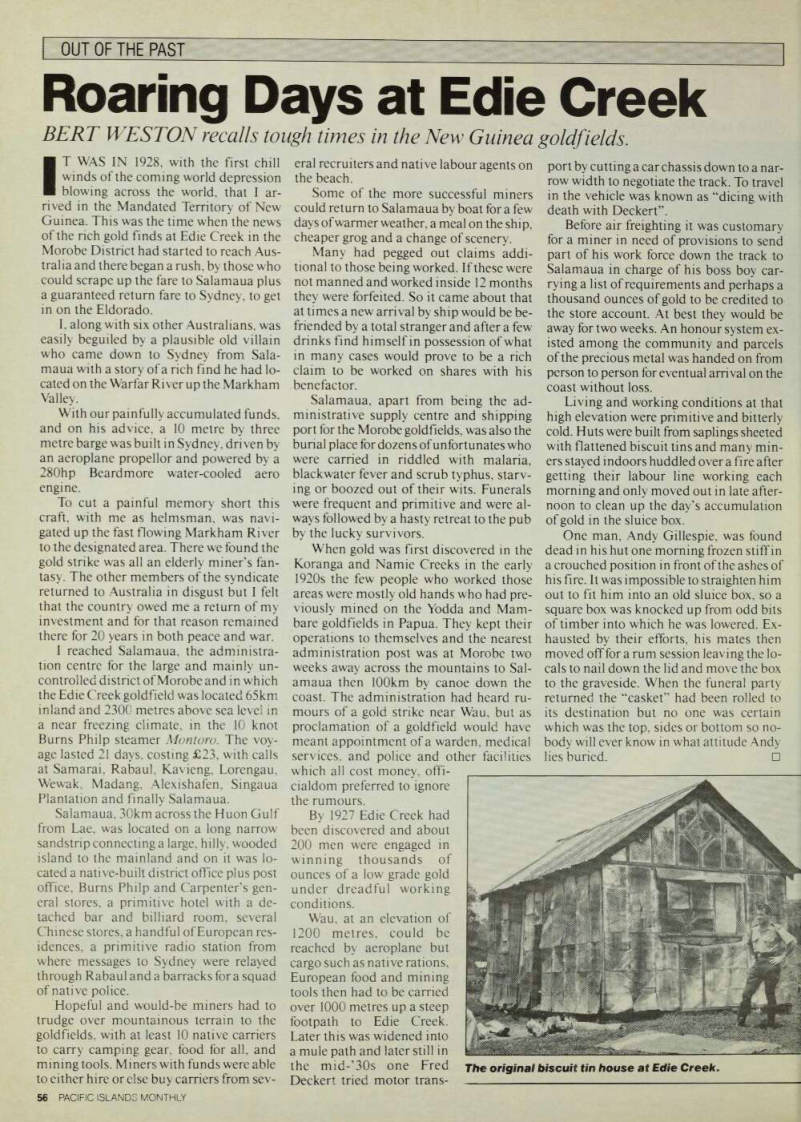
Out Of The Past
BERT WESTON recalls tough times in the New Guinea goldfields.
IT WAS IN 1928, with the first chill winds of the coming world depression blowing across the world, that I ar rived in the Mandated Territory of New Guinea. This was the time when the news of the rich gold finds at Edie Creek in the Morobe District had started to reach Aus tralia and there began a rush, by those who could scrape up the fare to Salamaua plus a guaranteed return fare to Sydney, to gel in on the Eldorado.
I, along with six other Australians, was easily beguiled by a plausible old villain who came down to Sydney from Sala maua with a story of a rich find he had lo cated on the Warfar River up the Markham Valley.
With our painfully accumulated funds, and on his advice, a 10 metre by three metre barge was built in Sydney, driven by an aeroplane propeller and powered by a 280 hp Beardmore water-cooled aero engine.
To cut a painful memory short this craft, with me as helmsman, was navi gated up the fast flowing Markham River to the designated area. There we found the gold strike was all an elderly miner’s fan tasy. The other members of the syndicate returned to Australia in disgust but I felt that the country owed me a return of my investment and for that reason remained there for 20 years in both peace and war.
I reached Salamaua, the administra tion centre for the large and mainly un controlled district of Morobe and in which the Edie Creek goldfield was located 65km inland and 2300 metres above sea level in a near freezing climate, in the 10 knot Burns Philp steamer Montow. The voy age lasted 21 days, costing £23, with calls at Samarai. Rabaul. Kavieng, Lorengau, Wewak. Madang, Alexishafen, Singaua Plantation and finally Salamaua.
Salamaua. 30km across the Huon Gulf from Lae. was located on a long narrow sandstrip connecting a large, hilly, wooded island to the mainland and on it was lo cated a native-built district office plus post office. Burns Philp and Carpenter’s gen eral stores, a primitive hotel with a de tached bar and billiard room, several Chinese stores, a handful of European res idences, a primitive radio station from where messages to Sydney were relayed through Rabaul and a barracks for a squad of native police.
Hopeful and would-be miners had to trudge over mountainous terrain to the goldfields, with at least 10 native carriers to carry camping gear, food for all, and mining tools. Miners with funds were able to either hire or else buy carriers from sev
eral recruiters and native labour agents on the beach.
Some of the more successful miners could return to Salamaua by boat for a few days of warmer weather, a meal on the ship, cheaper grog and a change of scenery.
Many had pegged out claims addi tional to those being worked. If these were not manned and worked inside 12 months they were forfeited. So it came about that at times a new arrival by ship would be be friended by a total stranger and after a few drinks find himself in possession of what in many cases would prove to be a rich claim to be worked on shares with his benefactor.
Salamaua, apart from being the ad ministrative supply centre and shipping port for the Morobe goldfields, was also the burial place for dozens of unfortunates who were carried in riddled with malaria, blackwater fever and scrub typhus, starv ing or boozed out of their wits. Funerals were frequent and primitive and were al ways followed by a hasty retreat to the pub by the lucky survivors.
When gold was first discovered in the Koranga and Namie Creeks in the early 1920 s the few people who worked those areas were mostly old hands who had pre viously mined on the Yodda and Mam bare goldfields in Papua. They kept their operations to themselves and the nearest administration post was at Morobe two weeks away across the mountains to Sal amaua then 100 km by canoe down the coast. The administration had heard ru mours of a gold strike near Wau. but as proclamation of a goldfield would have meant appointment of a warden, medical services, and police and other facilities
which all cost money, offi cialdom preferred to ignore the rumours.
By 1927 Edie Creek had been discovered and about 200 men were engaged in winning thousands of ounces of a low grade gold under dreadful working conditions.
Wau, at an elevation of 1200 metres, could be reached by aeroplane but cargo such as native rations, European food and mining tools then had to be carried over 1000 metres up a steep footpath to Edie Creek.
Later this was widened into a mule path and later still in the mid-’3os one Fred Deckert tried motor trans
port by cutting a car chassis down to a nar row width to negotiate the track. To travel in the vehicle was known as “dicing with death with Deckert”.
Before air freighting it was customary for a miner in need of provisions to send part of his work force down the track to Salamaua in charge of his boss boy car rying a list of requirements and perhaps a thousand ounces of gold to be credited to the store account. At best they would be away for two weeks. An honour system ex isted among the community and parcels of the precious metal was handed on from person to person for eventual arrival on the coast without loss.
Living and working conditions at that high elevation were primitive and bitterly cold. Huts were built from saplings sheeted with flattened biscuit tins and many min ers stayed indoors huddled over a fire after getting their labour line working each morning and only moved out in late after noon to clean up the day’s accumulation of gold in the sluice box.
One man. Andy Gillespie, was found dead in his hut one morning frozen slififin a crouched position in front of the ashes of his fire. It was impossible to straighten him out to fit him into an old sluice box, so a square box was knocked up from odd bits of timber into which he was lowered. Ex hausted by their efforts, his mates then moved off for a rum session leaving the lo cals to nail down the lid and move the box to the graveside. When the funeral party returned the “casket” had been rolled to its destination but no one was certain which was the top, sides or bottom so no body will ever know in what attitude Andy lies buried. □
The original biscuit tin house at Edie Creek.
Advertisements & other items, pp. 57-60 (1 item)
Add the finishing touches
Shelf Component Systems
... -i (T 1 «L.mr H
to your fantasy...
The dream comes true with NEW PERSONNA PLUS shelf-size component systems, and the model X-550R —a sound system more than brimming with high fidelity, and feature-packed!
In fact, boasting a full 350 W of high-power (PMPO) output, the X-550R delivers the convenience of remote control for amp, tuner, deck, turntable* and an optional CD player, plus a 5-band graphic equalizer for frequency distribution adjustments —and still there’s more!
Like sensational Surround Sound for rich, ambient sound, and the beauty of Stereo Wide, for extended stereo effects.
Then there’s a Double Auto-Reverse Cassette Deck with Deck I-II relay play for continuous auto-reverse playback, plus synchrorecording for Deck I-II tape duplication, to say nothing of great features like normal/high-speed copy, Music Search, and Dolby* B Noise Reduction.
Still, there’s more to the X-550R than this, and more to NEW PERSONNA PLUS than the system X-550 R—like the X-880R, with 440 W of high power (PMPO), and the X-220, with 270 W (PMPO), for example. The point is that it is the beauty of pure sound and NEW PERSONNA PLUS that lets your imagination take flight!
r 1 COMPACT
lag®
X-550R 0 Tunction-switching only “ Dolby” and the double-D symbol are trademarks of Dolby Laboratories Licensing Corporation.
NOTE: The PD-XBB CD player and S-XIA “surround sound” rear-speaker system are included in the photograph, but both are options.
CiD PIONEER
The future of sound and vision.
For further information, please contact: Australia: Pioneer Electronics Australia Pty. Ltd. (Incorporated in Victoria) P.O. Box 295, Mordialloc, Victoria, 3195 Tel: 580-9911 Fiji Islands: Brijlal & Company, G.P.O. Box No, 362, Suva, Fiji Islands Tel; 22258 New Zealand; Monaco Distributors Ltd, 41 Poland Road, Glenfield Auckland New Zealand Tel: (09) 444-9144 Norfolk Island: Burnt Pine Traders Ltd, P.O. Box 21, Norfolk Island Vanuatu: Burns Philp (Vanuatu) Ltd, Vila, Vanuatu Nauru Island: Jacob Enterprises, P.O. Box N 0.4, Republic of Nauru Tahiti: Tahiti Hi-Fi, P.O. Box 848, Papeete, Tahiti New Caledonia: Menard Pacifique Sari, B.P. 3899, Noumea, New Caledonia Tel: 27-62.23 American Samoa: Transpac Corporation, P.O. Box 1477, Pago Pago, American Samoa 96799 Tel: 633-5224 Rarotonga: South Seas International Ltd, P.O. Box 49, Rarotonga, Cook Islands Tel; 2327
Singing in the lane
Our search for the
ultimate in rear wheel
control technology has
made driving a Mazda
something to sing about.
Go ahead, take the new Mazda 626 through its paces. And experience a feeling of freedom and of confidence that could only be the result of Mazda’s unique suspension geometry.
Now high speed lane changes, even in the rain, are something you can look forward to with pleasure.
Cornering loses its histrionic swerving; what remains is a sensation of extraordinary control.
Singing our praises.
Of course, you would expect us to say just this sort of thing in an ad. Am so, all modesty aside, we’d like to poin out that automotive experts and drivers the world over have been singing tl praises of the Mazda 626 and the unique feeling its rear suspension tech nology delivers for quite some time.
What’s behind it all.
The reason is that for quite some time now Mazda has been concentrat-
ing on developing rear suspension systems that actually help steer the car. It started with the award winning TTL suspension found on the 323 and 626.
The search for the ultimate continued with the development of a 4-Wheel Steering system. What we learned in that search was applied to the development of our award winning DTS system for the RX-7 and the E-Link suspension for the 929.
This continuous process of refinement has come full circle again to the 626, and applied its TTL suspension. We’ve completely recalculated its suspension geometry to deliver a feeling of control that’s clearly superior and absolutely exhilarating.
Keeping on our toes.
It’s Mazda’s unique dedication to engineering the ultimate in rear wheel toe control and suspension technology that has resulted in such enjoyable driving in the Mazda 626.
And in fact, in all Mazda vehicles.
Take one out for yourself and see. You may just find yourself singing in the showers.
New Mazda 626 Models and features shown may not be available in your area. Please consult your local Mazda dealer This warranty is valid only in Australia.
Your kind of car.
Si m
■ T.afe
*E B * s ;• •
Gregor Mendel theorized that
certain dominant characteristics
are passed onto the next generation.
At Mitsubishi we’ve recognized that for 70 years.
Known as the father of modern genetics. Gregor Mendel (1822—1884) discovered the fundamental principle underlying heredity.
Mitsubishi's pioneering work in automotives led to applying the same principle Mendel discovered.
With the 1934 Mitsubishi PX33, Japan's first 4x4 diesel passenger car for example, we took the dominant characteristics of 4 x 4—better traction and better overall handling and stability—and applied them not only to passenger cars but also to light commercial vehicles, heavy-duty trucks and large-size buses.
Like Mendel's experiments with garden peas, our 50-plus years of blazing new trails with 4x4 has given us the ability to pass the hybrid benefits of four-wheel-drive onto our customers. The result is that today, Mitsubishi drivers have the world's widest range of 4 x 4 vehicles to choose from.
Mitsubishi Motors is now offering a free 24-page leaflet “The Mitsubishi", an introduction of Mitsubishi's pioneering history. If interested, write to; P I. Section, Advertising. International Business Planning Department, Office of International Business, Mitsubishi Motors Corporation. 33-8, Shiba 5-chome, Minato-ku, Tokyo 108, Japan.
AMERICAN SAMOA; MORRIS SCANLAN SERVICE INC. P.O Box 367, Pago Pago. Tel 633-5520/AUSTRALIA: MITSUBISHI MOTORS AUSTRALIA LTD Box 1284 South Road. Clovelly Park, South Australia 5042, Tel (08) 275-7223/FIJI: NIVIS MOTOR & MACHINERY CO , LTD. G.PO Box 150. Suva Tel 38341 1 /FRENCH POLYNESIA (TAHITI): ETS-BREDIN FRERES ET FILS PO Box 21. Papeete, Tahiti, Tel 4-202 58/NEW CALEDONIA: SOCIETE D IMPORTATION D AUTO DU PACIFIQUE SUD SA. B P 438 Rond Point du Pacifique, Noumea, Tel 274144/NEW ZEALAND; MITSUBISHI MOTORS NEW ZEALAND LTD. Todd Park, Heriot Drive. Private Bag, Ponrua, Tel 370-109/NORFOLK ISLAND: BORRYS LTD. PO Box 169, Norfolk Island. Tel. 2114/PAPUA NEW GUINEA: TOBA PTY LTD. PO. Box 503, Port Moresby, Tel 21-7874/SOLOMON ISLANDS: HARVEST PACIFIC LTD. G P O Box 88, Honiara, Guadalcanal, Tel. 30128/TONGA: SITANI MAPI CO.. LTD. PO Box 83. Nuku ALOFA. Tel 21-044/VANUATU; SOCOMETRA B P 06 Route de Lagon, Porl-Vila, Tel 2314/WESTERN SAMOA: A M MACDONALD HOLDINGS LTD. PO Box 576. Apia. Tel 22022/SAIPAN/POHNPEI/MAJURO/KOSRAE/TRUK/YAP/ BELAU: MICRONESSIAN MOTORS, INC 997 South Marine Drive. Tamunmg. Guam 96911, Tel 646-6827 A/ 9/9
fiAC
JmrM A
MITSUBISHI
MOTORS