Pacific

Advertisements & other items, pp. 2-3 (2 items)
A new legend begins.
Photo: Equipment may vary in some countries.
The 1984 Civic 2-door Hatchback, combining innovative technologies with the great Civic tradition, is a very special car. For this new Civic is destined to become the model on which other cars in this class will be based.
Distinguished by a long roofline and rear appearance, the 2-door Hatchback’s flush-surface aerodynamic design gives superb stability at high speeds, improves fuel economy, and provides a truly spacious interior.
Interior space is also expanded by the Honda concept of making all mechanical parts as small as possible, leaving more room for people. High-tech components include an ultra-compact, economical-yet-powerful OHC, 12-valve engine, and space-saving Sportec suspension that really smooths out the road.
The Civic 2-door Hatchback. Its new technology confirms that a new legend has begun.
door Hatchback
S AN AUSTRALIA: Honda Australia Pty., Ltd. Lot 96 Sharps Road, Tullamarme. Victoria 3043; Bennett Honda Road >arkKLS W 2164 I y a nno« pio, n ctcc Marmpri Rf Weltmaton PAPUA NEW GUINEA: Toba Pty., Ltd. P.O. Box 503, Port Moresby /TAHITI. Honda Distribution S.A.H.L. UK loos, KIRIBATI; Atoll Motor & Marino Services P.O Box 49, Bainki Tarawa, Republic of Kiribati/U.S. TRUST TERRITORY: United Micronesia Development ?3S.CHR Saioan CM 96950/COOK ISLANDS Cook Islands Motor Centre Ltd. P.O. Box 74, Rarotonga /GUAM: Mark s Motor Co., Inc P.O Sox OV, Agana/ WESTERN SAMOA, oor Noumea/NAURU- Nauru Cooperation Republic of Nauru/FIJI: Carpenters Motors Private Mail Bag, Suva, Fiji/AMERICAN SAMOA: Holiday Motors, Parts and Service . ( Pago Pago. American Samoa 96799; Haleck s Service Center Ltd. P.O. Box 1 133. Pago Pago, American Samoa 96799/TONGA: Tonga Industrial Traders PO. Box 1035. Nuku aof .
Islands
PACIFIC
MONTHLY
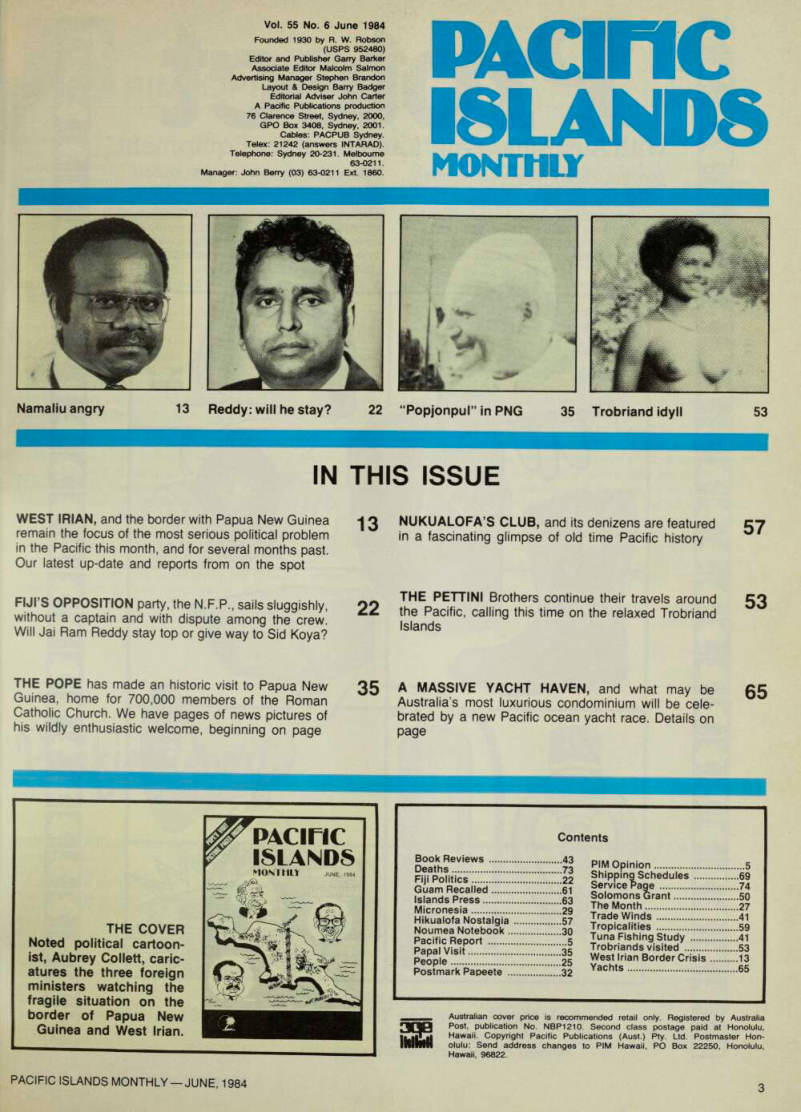
Vol. 55 No. 6 June 1984
Namaliu angry 13
Reddy: will he stay? 22
“Popjonpul” in PNG 35
Trobriand idyll 53
In This Issue
WEST IRIAN, and the border with Papua New Guinea *| 3 remain the focus of the most serious political problem in the Pacific this month, and for several months past.
Our latest up-date and reports from on the spot FIJI’S OPPOSITION party, the N.F.P., sails sluggishly, 02 without a captain and with dispute among the crew.
Will Jai Ram Reddy stay top or give way to Sid Koya?
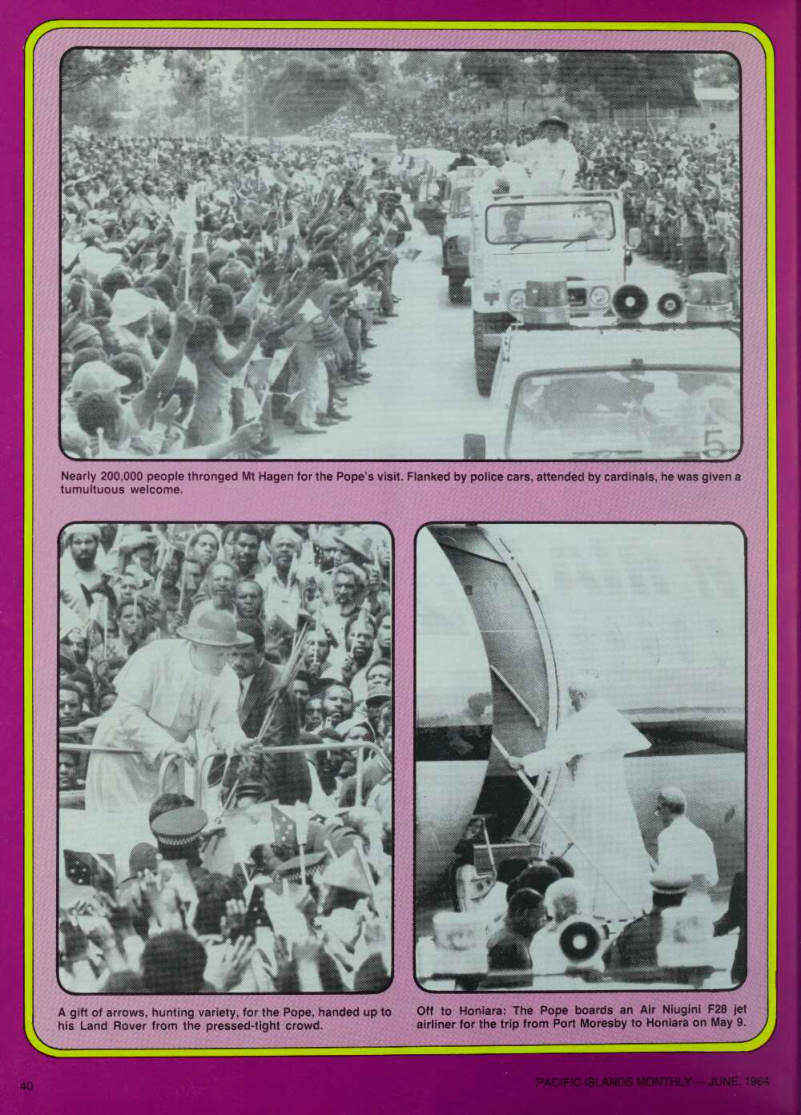
THE POPE has made an historic visit to Papua New 35 Guinea, home for 700,000 members of the Roman Catholic Church. We have pages of news pictures of his wildly enthusiastic welcome, beginning on page
NUKUALOFA’S CLUB, and its denizens are featured cy in a fascinating glimpse of old time Pacific history THE PETTINI Brothers continue their travels around 53 the Pacific, calling this time on the relaxed Trobriand Islands A MASSIVE YACHT HAVEN, and what may be g 5 Australia’s most luxurious condominium will be cele brated by a new Pacific ocean yacht race. Details on page
Contents
Book Reviews 43 Deaths 73 Fiji Politics 22 Guam Recalled 61 Islands Press 63 Micronesia 29 Hikualofa Nostalgia 57 Noumea Notebook 30 Pacific Report 5 Papal Visit 35 People 25 Postmark Papeete 32
PIM Opinion 5 Shipping Schedules 69 Service Paoe 74 Solomons Grant 50 The Month 27 Trade Winds 41 Tropicalities 59 Tuna Fishing Study 41 Trobriands visited 53 West Irian Border Crisis 13 Yachts 65
Australian cover price is recommended retail only. Registered by Australia Post, publication No. NBPI2IO. Second class postage paid at Honolulu, Hawaii. Copyright Pacific Publications (Aust.) Pty. Ltd. Postmaster Hon olulu: Send address changes to PIM Hawaii, PO Box 22250, Honolulu, Hawaii, 96822.
Advertisements & other items, pp. 3-4 (2 items)
Pacific Islands Monthly —June, 1984
3
Founded 1930 by R. W. Robson
(USPS 952480)
Editor and Publisher Garry Barker Associate Editor Malcolm Salmon Advertising Manager Stephen Brandon Layout & Design Barry Badger Editorial Adviser John Carter A Pacific Publications production 76 Clarence Street, Sydney. 2000, GPO Box 3408, Sydney, 2001.
Cables. PACPUB Sydney.
Telex: 21242 (answers INTARAD).
Telephone: Sydney 20-231. Melbourne 63-0211.
Manager: John Berry (03) 63-0211 Ext. 1860.
Protect
□ □ □ □ □ □ □ □ □ □ □ □ □ □ □ □ □ □ □ □ □ □ □ □ □ lAl
with Australian Safety and Security Equipment Workforce, property, valuables, environment.
They all need protection, from injury, damage, theft, fire. You can rely on Australian Safety and Security Equipment to protect efficiently and effectively. That’s because Australian equipment is made to standards rated among the strictest in the world. Products that cover a wide range of functions are readily available.
Protective clothing. Helmets. Gloves. Eye and ear protectors. Dust and air masks. Life jackets and rafts. Fire fighting equipment. Respirators.
Warning and detection systems. Security devices. Locks and safes. Emergency lighting systems. Check to see how Australia can fulfil your requirements. 3 Q n E For more information Ask the Australian Trade Commissioner Port Moresby: Phone 25 9333. Suva: Phone: 31 2844.
Honolulu: Phone (808) 524 5050. Noumea: Phone 27 2414, 27 2426. □ □ □ □ □ □ □ □ □ □ □ □ □ □ □ □ □ □ □ □ □ □ □ □ □ 1/vJ
Pim Opinion
In August. 1969, shortly after good sense, humanity and principle were once more thrown to the political winds at the United Nations, this magazine denounced the “act of free choice” in West Irian as a fraud and a sham. We were of the view then that Indonesia had no more right to take over that Melanesian territory than to take over the Rotterdam urban transit system. We forecast that much misery, and not a little anxiety among nations of the region would arise because of what was, in fact, a sell-out in the name of short-term political expediency.
Nothing which has occurred since has led us to change our views and the events of the last month or two have served only to confirm them.
But those were the days of Soekamo, the demagogue, high upon his wave, leading his millions of countrymen in the chant for Indonesian rule “from Sabang to Merauke.”
The American ambassador Elsworth Bunker led the merchants in the U.N. temple as they traded their political markers, claiming that theirs was the true realism, ignoring the utterly sincere dismay, and thoroughly well-founded apprehensions of not only West Irian leaders, but also those who, soon, would come to lead Papua New Guinea.
Australia accepted the Bunker formula because it seemed to make good political “banking” sense at the time. Indonesia was playing a heady, bullying game. They had already “confronted”
Malaysia. They threatened to be very difficult over West Irian.
Western nations wanted Indonesia in their camp fearing, at the time, a Soviet intrusion if they did not accede to Jakarta’s demands. But, as plenty of knowledgeable people said then and have continued to say, the United Nations was only feeding a monster.
In the end. however persuasively the “realists” argued, and however tempting their rationalising, the fact remained that Indonesia was being helped to re-colonise a people, not of their race, who had been told that their own independence from the Dutch was on the way. Given the hue and cry in the United
Nations about the evils of colonialism, this left a lot of people gasping.
In fact, and belated as they were, the Dutch had been doing quite a good deal to develop West Irian, to identify and promote an elite which might have taken over and governed the territory with an efficiency and aplomb approaching that achieved across the border in Papua New Guinea.
Having thus pointed out, without any pleasure, that “we told you so” it must also be recognised that the “freedom fighters” of the Operasi Papua-Merdeka (OPM, or Free West Papua) movement are neither numerous, nor likely to throw the Indonesians out of their territory. The unfortunate, and unneces sary, sore will continue to fester and upset relations between Jakarta and Port Moresby.
PNG’s prime minister, Michael Somare, and his foreign minister.
Rabbie Namaliu, are angry about what they see as the arrogance of the Indonesian government. But both will do their best to at least keep talking and contain outraged public opinion in PNG. Indeed, it is this sense of Melanesian brotherhood, and feeling for clansmen betrayed, which is the fuel for the ongoing fire.
The Indonesians could, and should, have done much more from the beginning of this latest outcry, to appear cooperative with Papua New Guinea. Instead they acted in some way like colonial masters, treating in very cavalier fashion attempts to talk about the facts of the border-crossings and the reasons for them.
Australia, quite rightly, kept off the stage, but did what it could to persuade Jakarta to own up to what was going on in Jayapura and its environs and to talk constructively with PNG about the OPM refugees. Australia will continue to follow this policy, but at the same time must view with anxiety this sort of bad blood between its biggest neighbor and a developing country with which it is inextricably involved.
The only lesson to be drawn is that when basic human rights are cast aside, and when principle is ignored for expediency, there is always a bill to be paid.
Pacific Report

Foreign Ministers Conclude S.R.O. Talks
Foreign ministers from four South Pacific countries have agreed on an interim report to this year’s conference of the South Pacific Forum on the setting up of a single regional organisation (SRO).
After two days of talks in April in Wellington, New Zealand, Papua New Guinea’s Foreign Minister Rabbie Namaliu said it was not I* \ new k°dy would be formed in the next year or so.
Mr Namaliu said the interim report would go before the South Pacific Forum meeting in Tuvalu in August. A new body has been suggested as a replacement for the South Pacific Bureau for Economic Co-operation (SPEC), the regional secretariat of the forum and the South Pacific Commission (SPC). Apart from Mr Namaliu, the Wellington talks were attended by the foreign ministers of New Zealand, Fiji and Tonga. They were delegated to study the problem by the 1983 meeting of the forum which was held in Canberra.
Regular Talks For Solomons, Png
The prime ministers of Papua New Guinea (Michael Somare) and Solomon Islands (Solomon Mamaloni) have agreed, in talks in Honiara, that their countries will hold a series of talks each year on subjects of mutual interest.
Bikinians Plan New Legal Move
Former residents of Bikini Atoll say they will take new legal action in an effort to force the United States Government to clean up radioactive material from atomic bomb tests so they can resettle their central home island. The Bikinians were removed in 1946 to enable the U.S. to conduct a series of nuclear tests. Their lawsuit, to be filed in the federal court in Honolulu, seeks an injunction to require the government to make the atoll safe for human habitation. Last November, a committee of scientists reported that decontamination of the atoll was technically feasible. In March, the
House of Representatives Committee on Interior and Insular Affairs recommended that SUSIO million be spent annually, beginning in the 1985 fiscal year, to clean up the atoll. The Bikini Atoll Rehabilitation Committee, which was funded by Congress, estimated it would cost up to $l3O million to decontaminate Bikini’s two main residential islands Bikini and Eneu. American Associated Press said the nearby atoll of Enewetak, the site of 43 nuclear tests, was cleaned up and rehabilitated in the late 1970 s at a cost of $l5O million. The U.S. returned the Enewetak people to their atoll in 1980.
A.C.P. NATIONS BALK AT HUMAN RIGHTS TIE Delegates from more than 50 African, Caribbean and Pacific nations say they are opposed to a plan to link aid from European countries to their records on human rights. The African, Caribbean and Pacific Council of Ministers was meeting in Fiji in April-May to discuss aid under the Lome Convention with officials of the European Economic Community. A press spokesman said the ministers had no objection to discussing human rights, but said it should not be linked to aid or trade concessions.
Traditional Court Set Up In Marshalls
The first Traditional Rights Court has been established on Majuro under the new constitution of the Marshall Islands Republic with nine judges and a clerk sworn in by Judge Kabua Kabua, presiding judge of the District Court. The new rights court will define and protect the customs and traditions of the Marshallese concerning their land rights, titles and other rights. Speaking at the swearing-in ceremony, Judge John C. Lanham, Chief Justice of the High Court, said the new court “will protect and define the customs and traditions of the Marshallese people . . . your lands will not disappear into the hands of missionaries and greedy businesses as did the Hawaiian lands in Hawaii. ” Chief Judge of the new court is Berson Joseph.
French Poll Looms Large In Noumea
Among reasons why New Caledonia’s Independence Front leaders are rejecting the French Government’s proposals for the territory’s future is that they fear that the French socialists will lose their parliamentary majority in France’s elections in 1986, and that the new, conservative National Assembly will scrap the socialists’ plans anyway. Making this point in the Paris daily Le Monde in April, Alain Rollat, who had just returned from Noumea, added: “They also fear that the new statute for internal self-government, once in operation, will work to the advantage of both the European and Kanak communities, and that in consequence a good number of Melanesians might be turned off the idea of complete separation from France. Because they have made a similar analysis of the situation, and are convinced that the moves set in train by the Left will not have time to be fully worked out, the leaders of the main conservative movement, the RPCR whose president, Jacques Lafleur, is one of New Caledonia’s two deputies to the National Assembly in Paris have shown moderation in their attitude to the government’s plans.”
ESCAP TO SET UP SHOP IN VANUATU The Economic and Social Commission for Asia and the Pacific (ESCAP) has decided to establish its regional headquarters in Vanuatu, to be known as the ESCAP Pacific Operations Centre. At its recent annual session in Tokyo, the commission endorsed the plan to merge its offices in Suva and Nauru as part of the process of launching a program of special projects to meet the needs of the Pacific Islands. Earlier this year, the Asian Development Bank announced its decision to establish its regional headquarters in Port-Vila, Vanuatu’s capital. Some observers feel that this emergence of Vanuatu as an important centre of the activities of international agencies will do much to keep the country within the ambit of the Western powers, as Vanuatu has been seen by some as a potential power vacuum in a sensitive South Pacific.
Unesco Goes To Apia
Unesco plans to open its first regional office for the South Pacific at Apia i n June, if the Western Samoa Government approves. The office will handle all business involving its member states in the South Pacific, Western Samoa, Papua New Guinea, Fiji, Tonga, Australia and New Zealand, at present administered, along with the Asian states, from Bangkok.
Greece's Pacific Push (Ujn. In Mind)
Greece is to open diplomatic relations with five countries in the Pacific, the European Affairs Minister, Theodore Pangalos, said in April. Mr Pangalos, about to leave for Fiji for a meeting between European Community ministers and the African, Caribbean and Pacific states associated with the bloc, said he would take the opportunity to agree on starting diplomatic ties with Solomon Islands, Tonga, Tuvalu, Kiribati and Vanuatu. He said that Turkey, which competes with Greece at the UN for votes over the Cyprus issue, had relations with the Solomons and Tuvalu. He expected the Greek Ambassador to Australia to be accredited to the five countries.
JAKARTA PAPER HITS GOVT, ON IRIAN JAVA Indonesia had made little progress in developing Irian Jaya, the Jakarta Post newspaper said in May. “The majority of the people in Irian Java are still living in the stone age,” an editorial in the English-language daily said. This was partly because the govern ment, despite spending millions of rupiahs, sent in “second if not third class officials when what was needed were top-rated and dedicated government servants,” it said. The Post said Indonesian administrators often looked down on the Irianese. The officials’ attitude irritated the locals and made them easy targets for the propaganda of the rebel Free West Papua Movement, which was fighting for independence from Indonesia, the Post said.
Hustings In The Highlands
It’s election time in the PNG Highlands provinces of Chimbu and Western Highlands. Nominations opened on April 24 in Mt Hagen and Kundiawa. Observers expect Western Highlands premier, Nambuga Mara to face a stiff battle to retain power,and even his own seat. His Chimbu counterpart, Matthew Siune, who has held office for the past four years is said to be under no immediate threat, althougfh Henry Tokam, formerly police commissioner at the time of the Chan/Okuk government, is said to be interested in nominating. Mara’s opponent is a wealthy planter, Clement Leahy, son of the Australian explorer and a Mt Hagen mother. Leahy has a large local following and is said to identify more closely with the Melanesian side of his ancestry, despite his smart Mercedes-Benz.
Many feel Leahy will have an easy win. He has represented the area on a number of local government bodies and is at the centre of a movement to reform the provincial government. He has accused Mara’s administration of withholding funds earmarked for rural development and of failing to establish proper communica tion between themselves, councils and the people. As in all Highlands elections campaigns, candidates are distributing free beer and food and many of them are back in their villages for the first time in years, distributing goodies and promises. Aside from the usual charge and counter-charge among the hopefuls there has been a dispute over the reason why Leahy’s name apparently did not appear on the election rolls. Mara said that disqualified Leahy from standing, but the campaign is proceeding with Leahy’s name still on the candidates’ register. Ballots will be counted on July 3.
Leo Scheps.
Rotten Eggs Treatment' For Oz Professor
Professor Harry Lander, newly appointed head of the Fiji School of Medicine, had a mixture of rotten eggs and milk dumped on him in an incident in Suva on May 2. The man doing the dumping was Dr Deo Dutt Sharma, president of the Fiji Medical Association, who claimed the mixture was his “lunch”. Dr Sharma denied the incident had anything to do with his earlier threat that any expatriate who took on the job would be given “the rotten egg treatment”. Dr Sharma said his car was chased and stoned by officers of the health ministry as he drove away after the incident.
Police were investigating complaints relating both to the rotten eggs affair and the alleged stoning of Dr Sharma’s car. Professor Lander, formerly of Australia’s University of Adelaide, was appointed by the Fiji Public Service Commission. On behalf of the Fiji Medical Association, Dr Sharma claimed that Professor Lander’s appointment was “a waste of Australian aid money, because there are local people qualified to do the job”. The association has said it will refuse to co-operate with Professor Lander.
Ramphal To Make Small States Study
Commonwealth Secretary-General Shridath Ramphal in May completed a three-day visit to Tonga, which has the largest
Commonwealth development program in the Pacific. Before leaving Nukualofa Mr Ramphal said he would be carrying out the first major international study on the special needs of small states.
He said the study had been recommended by the last Commonwealth Heads of Government Meeting (CHOGM).
According to Mr Ramphal, the Pacific makes up a large part of the study, and, because of this, island countries like Tonga, Western Samoa, Tuvalu and Kiribati would be given particular attention. He said that when Papua New Guinea opens its new parliament buildings in August, the heads of governments would meet to discuss the future of Commonwealth Heads of Government Regional Meetings (CHOGRM). Mr Ramphal added he hoped they would preserve the regional meetings because they helped to develop a world more peaceful, habitable and prosperous for the majority of its people.
World's Largest Telescope For Hawaii
The world’s largest telescope will be built on a mountain peak in the Hawaiian islands at a cost of SUSIOO million. Construction is expected to be completed in 1990. The telescope which is being financed in part by a $36 million grant to the University of California will be placed on Mauna Kea, a 4300-metre high peak on the island of Hawaii. A spokeswoman for the university said the peak had been selected because it was generally free of cloud cover and provided excellent possibilities for making observations. She added that the project would open new windows on the universe. United Press International said a working demonstration of the telescope was scheduled for completion in June at the Lawrence Berkeley Laboratory in the United States.
UPI said the model is expected to demonstrate that the full-scale telescope and its 36 mirrors can be controlled with precision.
Bulk-Buy Plan By Co Operatives
A group of seven Pacific Island countries have agreed to go ahead with a major regional scheme, under which their national co-operative societies will place joint orders for a wide range of consumer goods. Approval for the bulk purchasing scheme followed a week-long meeting of co-operative officials in Suva.
Countries represented were Fiji, Solomon Islands, Vanuatu, Tonga, Western Samoa, Tuvalu and Kiribati. A statement issued at the end of the conference said a committee of three, chaired by Fiji, had been set up to co-ordinate the scheme. The statement added that delegates had agreed that the committee should be operating effectively by July, with an initial working period of one year. A follow-up meeting with the managers of the seven co-operatives is to be held in Fiji later this year to review the committee’s progress.
New Caledonia's Bullish Marble Industry
New Caledonia has set up a Territoral Marble Service which will co-ordinate the activities of the administrative and Melanesian customary authorities concerned with the exploitation of the territory’s marble deposits. The service will work to discover new deposits of the stone, offer assistance to investors, and train craftsmen. According to a spokesman for one company founded only a few months ago: “We’re up to our eyes in orders. . . New Caledonia’s marble looks like being a rich lode to work.”
Reagan's Man Quits Suva Post
Fred Eckert, the U.S. ambassador to Fiji and four other Pacific countries, has resigned and will return to his home state, New York, this month to run for election as a congressman. Mr Eckert, a political appointee to the Fiji post, replaced career diplomat William Bodde early in 1982 as part of the customary ambassadorial reshuffle in the wake of the arrival of a new U.S. president, in this case. Ronald Reagan. Mr Eckert, a leading Republican politician in Rochester, New York, was formerly a state senator and, in that position, had a good deal to do with President Reagan’s successful campaign. Diplomatic speculation suggests that Mr Eckert’s resignation has touched off a vigorous competition for the important Pacific post. Leading the race is a strong posse of U.S.
Department of State bureaucrats who want to see the job back in the hands of a career officer, and away from U.S. political patronage. Of the posts available in the Pacific, and on the rim, the politicos have four embassies, Tokyo, Canberra, Wellington and Suva. The career men have three, Port Moresby, Manila and Jakarta. Mr Eckert’s appointment to Suva was a loss to this faction lorr? 6 ernbass V bab been a professional appointment since 1977 when it was raised from the status of a consulate.
New Caledonia's Bibliography Rounded Off
New Caledonia’s Historical Studies Society has announced in its second quarterly bulletin for 1984 the publication of a 350-page book, Bibliographie de la Nouvelle-Caledonie, 1955-1982, designed for use in libraries throughout the world. The new publication carries on from where French Pacific scholar Father Patrick O’Reilly’s bibliography left off. Father O’Reilly’s work, published in 1955, covered the period from European discovery in 1774 to 1954.
Vanuatu Seeks Malaysian Aid
During a four-day visit to Malaysia in April, Vanuatu Prime Minister Fr Walter Lini asked the Malaysian Prime Minister, Dr Mahathir, for more help in developing Vanuatu’s cocoa industry and for Malaysian investment in his country’s hotel and airport construc tion projects. Fr Lini said he wanted a further supply of cocoa seedlings. A previous gift of seedlings helped Vanuatu to start a cocoa industry. Dr Mahathir told Fr Lini that it was Malaysia’s intention to extend training facilities in youth leadership and radio broadcasting for ni-Vanuatu in Malaysia.
Big War Memorial Project In Solomons
The Solomon Islands Government has approved a plan to build a multi-million dollar war memorial complex on Guadalcanal, scene of some of the fiercest fighting of the War in the Pacific. The complex, a memorial to all who fought on Guadalcanal, will contain a chapel and shrine, a war museum and a Solomon Islands cultural centre. Dedication ceremonies are scheduled for Septem ber 2, 1985, the 40th anniversary of the end of the Pacific War.
Beef Canning Underway At Bouloupari
A beef-canning operation at Bouloupari, about 80 km west of Noumea, has begun production. New Caledonia’s official weekly news release says that the company, Conseb, is at present producing 1000 cans of beef a day, and plans gradually to raise output to 2000 cans daily.
Tahiti Corruption Charges Quashed
A court in Papeete, Tahiti, has dismissed charges of corruption against Rodrigue Legayic, a former director of Papeete’s Port Authority, and Napoleon Spitz, a member of the Territorial Assembly and president of the French Polynesia Permanent Commission. The charges were based on allegations that port authority workers were used to build a house for Spitz’s mother.
Other charges are still pending against Legayic and a local businessman alleging corruption and misuse of funds.
Hawaiian Air's Record High
Hawaiian Airlines in April reported that in the first quarter of 1984, the company achieved its best operating results for any quarter in its 54-year history. Hawaiian Air’s first-quarter operating profit of SUS 4.2 million exceeded any previous quarterly operating profit by a considerable margin. The net income during the quarter was also the best in the company’s history, excluding any gain from the sale of aircraft and extraordinary items in earlier quarters.
“Come Inland" Lure For N.C. Tourists
New Caledonia’s tourist operators catering for visitors outside Noumea have set up a Tourist Development Office for the Interior and the Islands. The two bodies representing the operators of Melanesian-style accommodation, Melatour and Melanesian Holi days Service, have joined in setting up a Tribal Lodgings Federation. The moves are part of an officially sponsored drive to attract tourists to the interior of the main island, to its lush but seldom visited east coast, and to the Loyalty Islands and the Isle of Pines.
Fire Closes Fiji Resort
Fiji’s Treasure Island Resort will be closed until September 1 after a fire which caused about $1 million damage on April 28. The decision to close the island was announced by Bill Waddell, general manager of Islands In The Sun, operators of the resort near Lautoka. He said closure was necessary to ensure reconstruction at speed. The fire destroyed the resort’s central building complex, containing the kitchen, powerhouse, dining room, lounge and administration offices. About 100 guests and 40 staff were in the building at the time of the fire but no one was injured.
Advertisements & other items, pp. 6-8 (1 item)
experience with Super 148
We can prove youl profit by
Nearly 4 million hours of operating experience in just about every conceivable short-haul environment prove that Super 748 offers seat-mile costs as low as 10.65 cents per nautical mile. More than 350 earlier versions of 748 have built up this experience with some 80 operators in 50 different countries. Super 748 adds the latest flight-deck technology and other advances to this proven basic engine/airframe combination, with its known operating and maintenance costs, outstanding airfield performance, reliability and passenger appeal.
No such experience backs the new 40/50-seat airliners now being developed to compete with Super 748. Their economics remain unproven. By the time they enter service, the inevitable processes of inflation and escalation will keep their seat-mile costs well above those of Super 748. And, in the meantime, Super 748 could be building new traffic and new profits for you.
Super 748 the proven facts ■ less than 1 maintenance man-hour per flying hour, contributing to operating costs equivalent to only 10.65 cents per seat-nautical mile. ■ outstanding airfield performance. ■ ability to operate multi-stop routes without refuelling. ■ environmental noise levels already well below all existing and proposed international noise standards. ■ pressurised, air-conditioned cabin with full service amenities and reclining seats and ample leg-room for 48 passengers, overhead luggage bins and 6.6 cu ft of baggage-hold space per passenger. ■ worldwide technical support organisation proven over 20 years of 748 operation.
A 748 unGCjuaiiGci in fiy&Gnteciiruyio&y British Aerospace PLC. Kingston-upon-Thames, England
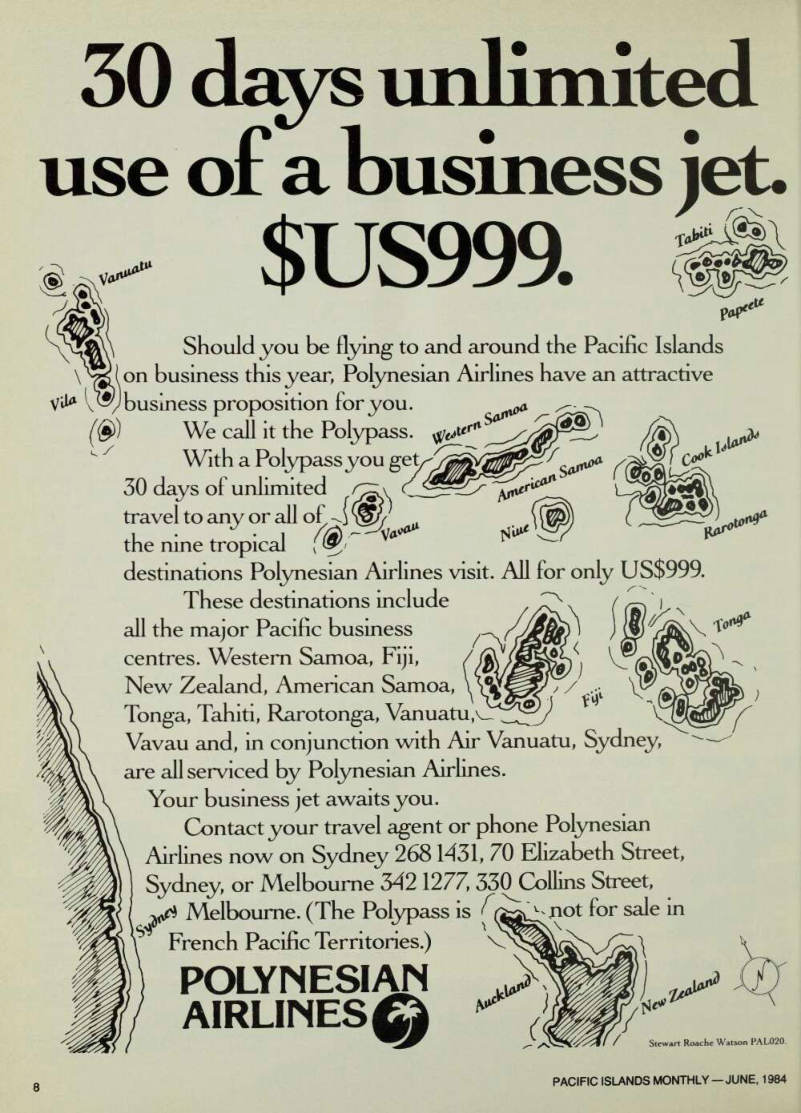
30 days unlimited
use of a business jet.
- SUS 999.
m i V M Should you be flying to and around the Pacific Islands on business this year, Polynesian Airlines have an attractive business proposition for you. (&) We call it the Polypass.
With a Polypassyou get, 30 days of unlimited travel to any or aUo£4®/ the nine tropical ( destinations Polynesian Airlines visit. All for only US$999.
These destinations include //v\ all the major Pacific business \ centres. Western Samoa, Fiji, / V in ur* <ait* 7 Co° n is. ictf** <S« m /a f/. h V 1 % » o New Zealand, American Samoa, Tonga, Tahiti, Rarotonga, Vanuatu, Vavau and, in conjunction with Air Vanuatu, Sydney, are all serviced by Polynesian Airlines.
Your business jet awaits you.
Contact your travel agent or phone Polynesian Airlines now on Sydney 2681431, 70 Elizabeth Street, Sydney, or Melbourne 3421277, 330jColIins Street, Melbourne. (The Polypass is not for sale in French Pacific Territories.)
POLYNESIAN s*
AIRLINES©
/ \ Stewart Roache Watson PALO2O.
letters
New Zealand’s RDF: A second opinion
The rapid deployment force that New Zealand is currently organising should serve as a reminder to the Pacific Islands that gunboat diplomacy and colonialism are well and truly alive in the Pacific region.
Contrary to Ratu Sir Kamisese Mara’s confidence that the proposed force would serve as a security deterrent for the Pacific region, I believe that such a force under the sponsor ship of a single nation is very dangerous. My view is that there is no guarantee that a force of this kind would not be used to suppress smaller island nations who fail to see matters eye to eye with “Big Brother”.
Should the Cook Islands, for argument’s sake, invite a power unfriendly with New Zealand to participate in and assist in their development, there is no guarantee that New Zealand would not use its rapid deploy ment force to discourage Cook Islanders from exercising their democratic right to free associa tion with whoever they wish.
Another factor that should not be overlooked is the de stabilising effect that the New Zealand proposal is likely to create in the region. There already exists within the region a degree of suspicion by smaller Polynesian states of the Melanesian states. This has been especially apparent following the Papua New Guinea Defence Force aid to Vanuatu in its bid for independ ence.
The fact that New Zealand, which was formerly completely against PNG’s proposal for the establishment of a Pacific peace-keeping force, has seen fit to reverse its position follow ing upon Vanuatu’s recent deci sion to permit the establishment of a Cuban diplomatic mission in Villa may not be simply coincidence.
Enthusiastic support for Prime Minister Muldoon’s pro
posals by another opponent of a Pacific peace-keeping force, Ratu Sir Kamisese Mara, appears not to have been given simply to please Sir Robert but rather as an indirect manner of signalling agreement between New Zealand and Fiji as to the real nature and purpose of such a force which appears to me to be to act as a deterrent to other Pacific nations.
I suspect that Sir Robert’s next move, now that he has gained Fiji’s support, will be to bulldoze his proposals through the South Pacific Forum. I hope and trust that the Melanesian states, namely PNG, Solomon Islands and Vanuatu, will not lend blind support to them. The broader implications of such a single-nation rapid deployment force must be honestly and thoroughly examined by all na tions of this region if the pro posals are tabled at the next Forum meeting.
At a time when the less fortunate nations of the Pacific region are making attempts to help themselves through gain ing membership of co-operative organisations in the Pacific, they are on the point of being blatantly subjugated by the re gion’s so-called “elder states men”, who appear to be simply awaiting their opportunity to gather support for proposals that on the surface appear benevolent but in fact are characterised by a diabolical interest.
I detect the germination of a most unfavorable set of values in the South Pacific. Such values pose a very real threat to peace and co-operative deve lopment within the region.
These misplaced values appear to be being nurtured in New Zealand and Fiji, and perhaps to a lesser extent within Austra lia as well. I fear that if con tinued growth of such values is permitted they will soon lead to the undermining and break
down of the spirit of co-opera tion that gave rise to the Forum and the other co-operative or ganisations of this region.
I question the sincerity of New Zealand’s rapid deploy ment force proposals, and feel that Pacific support for such proposals would amount to un precedented political hypocrisy.
Sir, my letter is written in my capacity as an elected leader within this region. I am con cerned for the welfare of the small island states that make up a large part of the Pacific.
I firmly believe that Ratu Sir Kamisese Mara’s spontaneous support for Muldoon’s pro posals cannot result in any practical contribution to resolv ing the basic problems of practi cal development in the Pacific.
W. Noel Levi Cbe Mr
Member for New Ireland National Parliament Port Moresby Papua New Guinea
E. E. Luxford
Some years ago, with the aid of a metal detector, I found a stainless steel identity disc. It was unearthed on Horn Island, Torres Strait, and was owned by E. E. Luxford, NX 149971, a New Guinea volunteer.
Does any PIM reader know anything about E. E. Luxford?
David Richardson
Cairns, Qld.
Australia
‘Bombay factor’
I was saddened to find, under the heading “PIM Opinion” (February PIM, p 5), reference, in some comment on a recent political event in Fiji, to “what might be termed the ‘Bombay Factor’ adding . . . curry to an already active pot”. I hope and trust that most of your readers will, like me, regard the “Bom bay Factor” wording as a de plorable lapse from the good sense and good taste which have for quite some time now
characterised the phraseology of PIM. As for the culinary metaphor the sooner that is consigned to oblivion the better.
David Walsh
Anthropology Department University of Sydney, Sydney, NSW Australia Our thanks to Dr Walsh for writing. We regret that he took offence, but his is the on/y such reaction received from any where and that, of course, includes Fiji. Editor.
Micronesia
Not only do I find Floyd K.
Takeuchi’s bias extremely dis tasteful in its openly subversive “Uncle Sam-ism”, but I am surprised that PIM constantly allows him to air his emotional personal opinions to the detri ment of the constructive alternatives given by Pacific Islanders who are not ashamed to become independent of “Big Brother” paternalism.
How many times must the Palauans be humiliated and belittled by their U.S. “super iors” telling them to take their brilliant, world-influencing, ma ture constitution back to their parliamentary “schoolrooms” and wait until their U.S. masters correct all the “mistakes”?
Recently a U.S. presidential adviser, who is also a leading academic, was questioned by me during a seminar he gave in Perth. To my question “When will the U.S. accept that auton omy and independence mean governments in places like Palau must be left to make democratic policies and de cisions for the good of their people and their future?” he replied: “The Reagan adminis tration cannot be asked to consider seriously the opinions of countries of 15,000 people in opposition to the views of the political leaders of the U.S.”
That just about sums it all up!
Just as the political leaders in the U.S. adore our own Labor prime minister because he is
prepared to go all the way with Reagan, even on such issues as the mining of uranium (against the stand of a majority in his own Labor Party), the Palauans are expected to behave “ration ally” and let the U.S. continue to control their future by using their country as a base to accelerate the arms race.
My suggestion to RIM if it wishes to continue as a credible magazine representing views from the Pacific Islanders is to find a less openly biased repor ter than its Micronesian cor respondent. Obviously, my bias is as strong as his in the opposite direction, but I’m sure there are proficient Micronesi ans able to strike a healthy balance, just as those who report to the magazine from the other islands appear to do.
Diana Rickard
Bullcreek, WA Australia
Nauru
RIM has received five letters from correspondents commen ting unfavorably on the story headlined “Unchanged Change in Nauru” (RIM Feb p 49).
All are strongly critical of the article, which one writer de scribed “a fawning and servile load of rubbish”.
Likewise all are strongly criti cal of President Hammer De- Roburt (“one man band”, “thinks he talks to God”).
Again, all strongly support Bernard Dowiyogo (“someone you can talk to”, “didn’t let the job gp to his head when he was
president”).
In view of the fact that the letters are so similar, and espe cially that none of the writers signed his/her name, we are able only to summarise their content here. Editor.
Western Samoa
I read with interest your article entitled “Smooth Talking, Rough Times” (RIM Jan. p 23) on the Western Samoan eco nomy and would like to offer a number of comments.
I was surprised at the bleak picture painted by your cor respondent of the Western Samoa economy and of the performance of the Tofilau gov ernment in view of the remark able turn-around in Western Samoa’s economy in the past 12 months. It is common know ledge that Tofilau and his gov ernment inherited an economy that was all but bankrupt after six years of mismanagement.
The country had no foreign exchange reserves left. Instead it owed millions overseas. In ternally, government had bor rowed most of the money from the banking system to finance its over-spending, leaving nothing for the private sector.
The measures the new gov ernment implemented to avert a total collapse included a se vere cutback in government spending and in the flow of some imports. Devaluation and other measures were taken to stimulate production and ex ports. Such measures do not win popularity but they were necessary for an economy that
had been made to live beyond its means for too long.
The success of these mea sures is now apparent. The country’s external trade posi tion is healthier now than it has been in years. This is reflected in the availability of more im ports and the reported fall in the rate of inflation for 1983. The reduction in the government’s overdraft with the banking sys tem has meant that the private sector has money for invest ment. Overall, a very happy position to be in for an eco nomy that was on the blink only a year ago.
Your correspondent may find it useful to compare Western Samoa’s 1984 budget with some of the other island coun tries in the region to see how they are faring before he criti cises. I would also refer your writer to an editorial in The Samoa Times recently, which, while referring to the eco nomy’s performance under Tofilau’s leadership, said, “these achievements were all made within 12 months and no one can take the credit away from government.” As no one could ever accuse that paper of a pro-government bias, that is praise indeed! It went on also to warn the government against “eating these gains away”. And yet that seems to be the kind of policy which your writer advo cates.
Tupuola, as reported in your article, now criticises what he refers to as government corrup tion. Really, one can only won der at such hypocrisy. As your correspondent points out him self, scandals and corruption were part of the reasons for the failure of the Tupuola govern ment. But if enough muck gets thrown around, some of it is bound to stick. Never mind that he may be covered in the stuff himself.
His criticisms of the prime minister’s overseas travel are equally without any basis.
Western Samoa, like most other nations, has joined the major forums of the world. This necessitates a certain amount of overseas travel. It is also quite normal for heads of govern ments to take officials to advise if necessary. No one is an expert on every issue these days. Tupuola himself used to take an entourage on his exten sive overseas trips. And what is
more, his entourage consisted mainly of his papalagi cronies and advisers. Really he should be the last person to want to raise such an issue!
Your correspondent will no doubt be producing other re ports in future on the Western Samoan situation. If he does, one hopes that he will be a little more factual and a little less biased, with these accounts.
One could be forgiven for thinking that Tupuola himself wrote the last one. Better to leave politics to the politicians and let reporters stick to provid ing information so people can make up their own minds.
(Name And Address Sup-
Plied)
Apia Western Samoa
Grenada
In reporting on a rapid-deploy ment force for the Pacific, your writers dragged in the irrelevant analogy of Grenada and then proceeded to garble the story.
The U.S. invasion was not in respose to a Cuban “attempt”.
Grenada had long had a Marx ist government, aided by Cuba.
But when the Grenadan leaders feuded bloodily among them selves, the U.S. took its opportunity to depose them.
Please stick to PlM’s area of expertise: the Pacific.
Supportively,
G. Maxwell
Sydney NSW Australia While we would expend our last breath in defence of Mr Maxwell’s right to interpret in ternational politics as he chooses, we rather thought we were dealing with the Pacific and its defence problems. Gre nada was used simply as an example, probably fresh in most minds, of a small nation under threat of political hi jacking. In politics, we fear, much depends upon viewpoint, and the truth in any situation as complicated as the Grenadan affair may hardly be summed up in 40 words.
It is perhaps also worth not ing that in a speech welcoming the establishment of the N.Z. rapid deployment force Fiji’s prime minister, Ratu Sir Kaminese Mara, also used the Grenada analogy.—Editor.
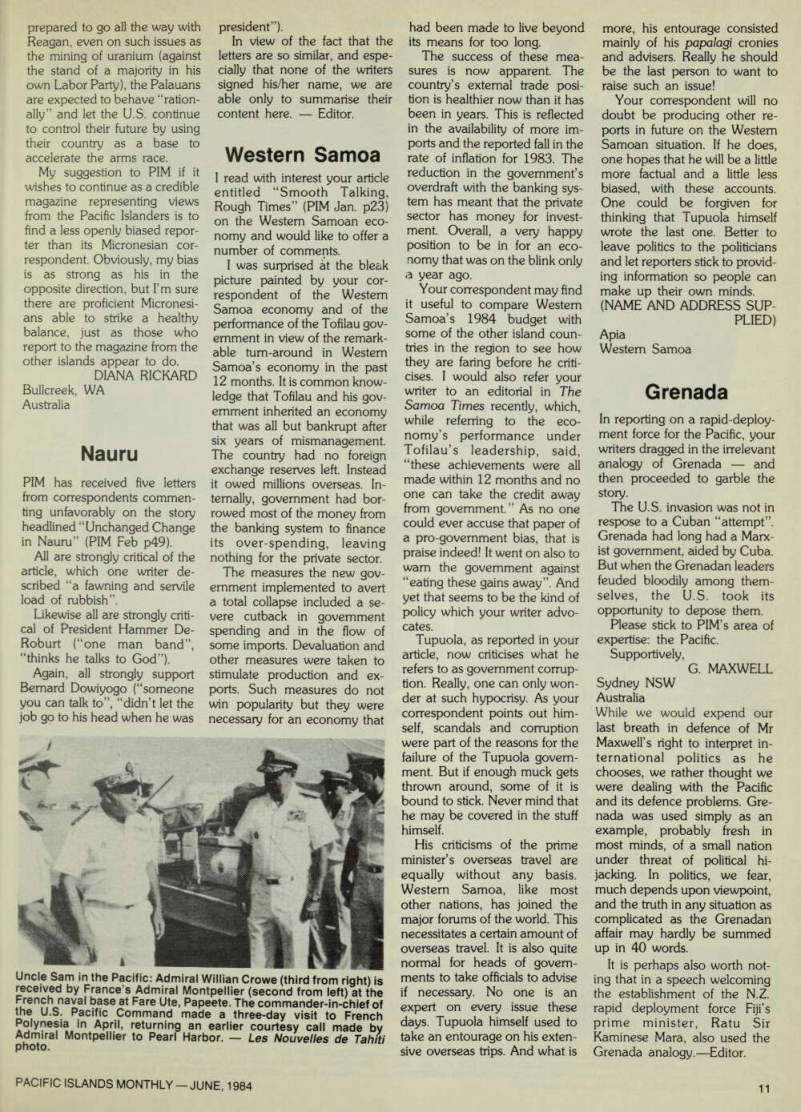
Uncle Sam in the Pacific: Admiral Willian Crowe (third from right) is received by France’s Admiral Montpellier (second from left) at the French naval base at Fare Ute, Papeete. The commander-in-chief of the U.S. Pacific Command made a three-day visit to French Polynesia in April, returning an earlier courtesy call made by Admiral Montpellier to Pearl Harbor. - Les Nouvelles de Tahiti photo.
Advertisements & other items, p. 12 (1 item)
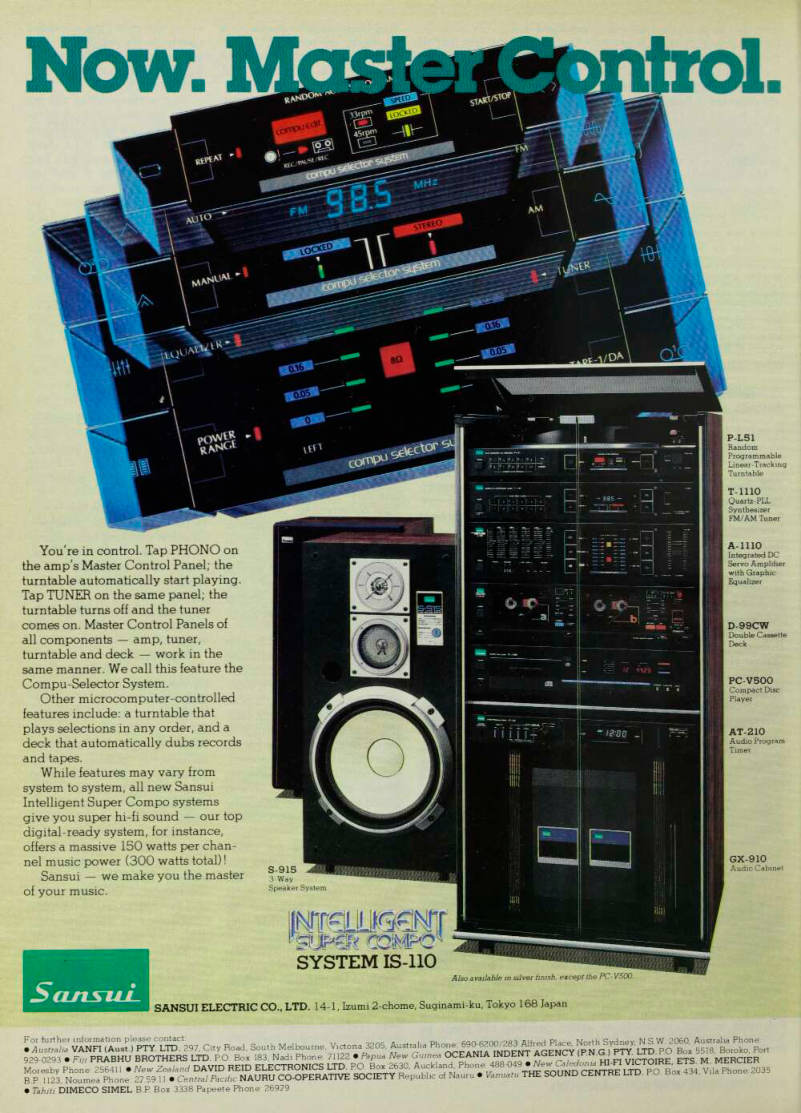
System Is-110
C 3 ed" ro^ s-ttßto oc&2— OAb ■
O.OS
T-1110
D-99CW
Double Cassette Deck GX-910 (7, :fp You're in control. Tap PHONO on the amp's Master Control Panel; the turntable automatically start playing.
Tap TUNER on the same panel; the turntable turns off and the tuner comes on. Master Control Panels of all components amp, tuner, turntable and deck work in the same manner. We call this feature the Compu-Selector System.
Other microcomputer-controlled features include: a turntable that plays selections in any order, and a deck that automatically dubs records and tapes.
While features may vary from system to system, all new Sansui Intelligent Super Compo systems give you super hi-fi sound our top digital-ready system, for instance, offers a massive 150 watts per channel music power (300 watts total)!
Sansui we make you the master of your music.
SYSTEM IS-110
Also available in silver finish, except the PC- V5OO.
SANSUI ELECTRIC CO., LTD. 14-1, Izumi 2-chome, Suginami-ku, Tokyo 168 Japan For further information please contact; con Rom/ORR Plsrp North Svdnev N S W 2060, Australia Phone: Aus„.t. VANFI (Aust.) PTY, LTD. 297, C.ly Red, South Melbourne, m AGENCY (P.N.G.) PTY LTD, PO 80, 55.8, Bo„ko Pot, Fw PRABHU BROTHERS LTD. PO. Box 183, Nadi Phone: rapua -- - . WTi TO trf M MERCIER New Zealand DAVID REID ELECTRONICS LTD. PO. Box 2630, Auckland, Phone. 488 049 /-,T..,0.n,0 T -rn or. a-ja v,i= Pimno-Pfl' 929-0293 Moresby Phone: 256411 - d tim B.P 1123, Noumea Phone: 27.59.11 • Central Pacific NAURU CO-OPERATIVE SOCIETY Republic of Nauru • Tahiti DIMECO SIMEL B P Box 3338 Papeete Phone: 26979 Vanuatu THE SOUND CENTRE LTD. PO. Box 434, Vila Phone: 2035
running out
Time, and the race, running out
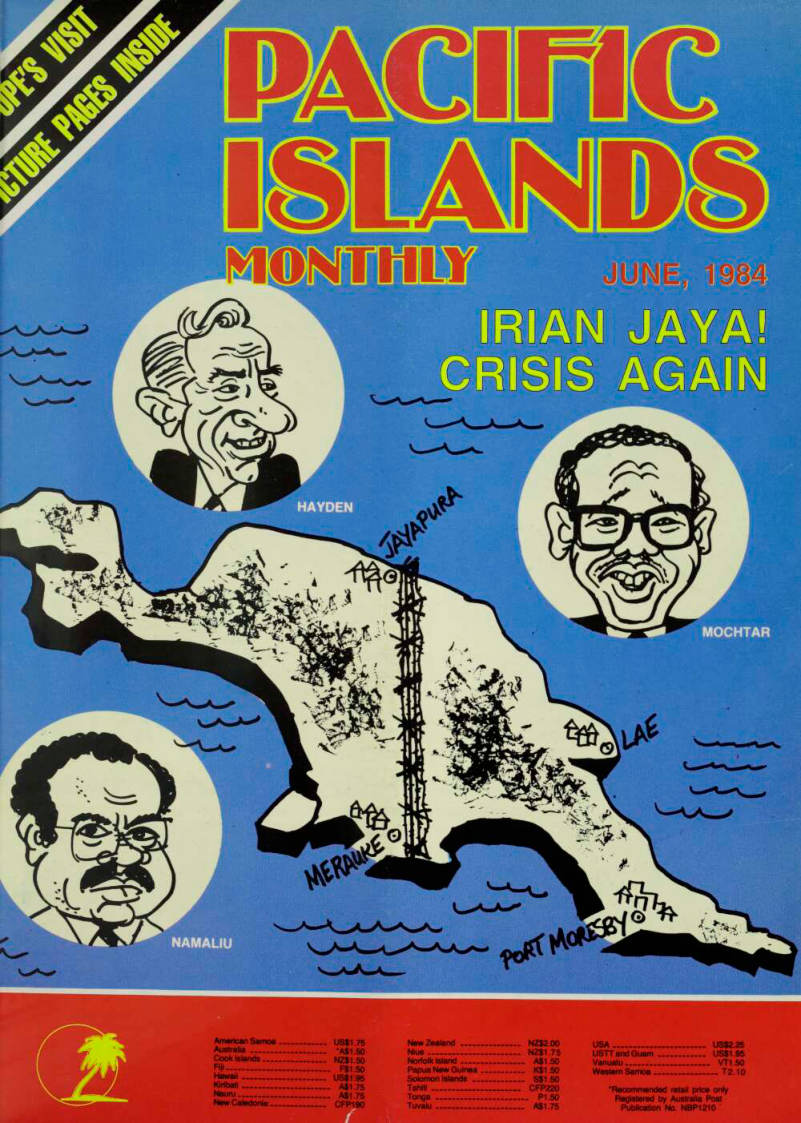
Two independence movements are now running in Melanesia - the painful affair in New Caledonia, and the much more violent and potentially dangerous upset in Irian Jaya. Both occupy the attention of regional governments but none so much as the tangled and fragile situation along the 141st meridian of longitude which divides Papua New Guinea from Irian Jaya.
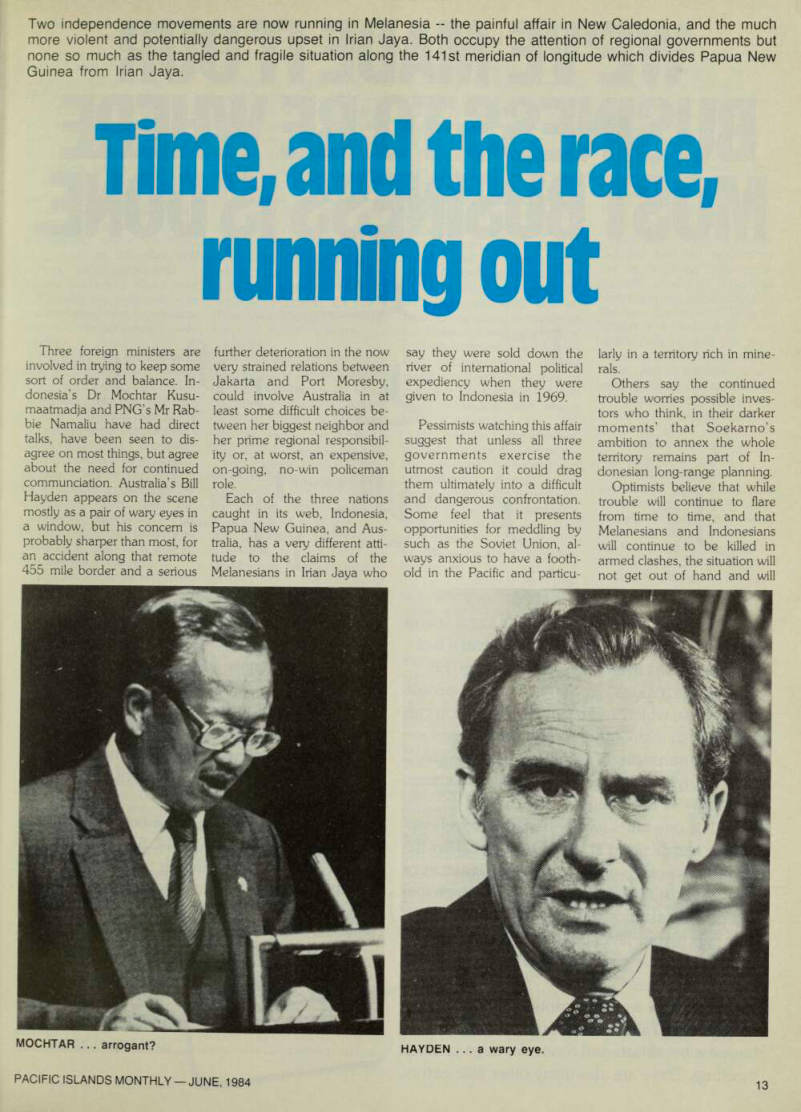
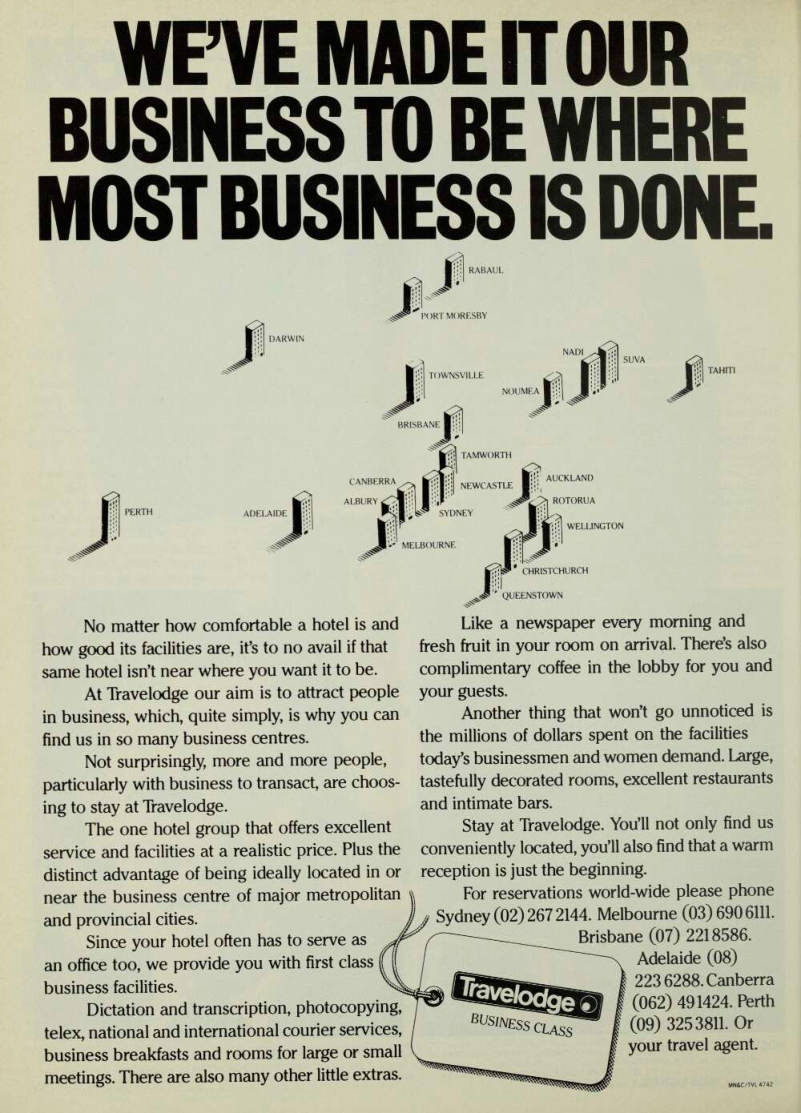
Three foreign ministers are involved in trying to keep some sort of order and balance. In donesia’s Dr Mochtar Kusu maatmadja and PNG’s Mr Rab bie Namaliu have had direct talks, have been seen to dis agree on most things, but agree about the need for continued communciation. Australia’s Bill Hayden appears on the scene mostly as a pair of wary eyes in a window, but his concern is probably sharper than most, for an accident along that remote 455 mile border and a serious
further deterioration in the now very strained relations between Jakarta and Port Moresby, could involve Australia in at least some difficult choices be tween her biggest neighbor and her prime regional responsibil ity or, at worst, an expensive, on-going, no-win policeman role.
Each of the three nations caught in its web, Indonesia, Papua New Guinea, and Aus tralia, has a very different atti tude to the claims of the Melanesians in Irian Jaya who
say they were sold down the river of international political expediency when they were given to Indonesia in 1969.
Pessimists watching this affair suggest that unless all three governments exercise the utmost caution it could drag them ultimately into a difficult and dangerous confrontation.
Some feel that it presents opportunities for meddling by such as the Soviet Union, al ways anxious to have a footh old in the Pacific and particu
larly in a territory rich in mine rals.
Others say the continued trouble worries possible inves tors who think, in their darker moments’ that Soekarno’s ambition to annex the whole territory remains part of In donesian long-range planning.
Optimists believe that while trouble will continue to flare from time to time, and that Melanesians and Indonesians will continue to be killed in armed clashes, the situation will not get out of hand and will
MOCHTAR . . . arrogant?
HAYDEN ... a wary eye.
involve no-one in more than police operations.
Murphy’s law of politics says that if a situation can be hand led badly, and go wrong, it will.
But only time will tell.
In this present angry round the Indonesian position has been marked by refusal to admit that a problem exists, and an attitude which Papua New Guinea has found to be arro gant and callous.
After some difficulties, which the PNG foreign minister, Rab bie Namaliu, saw as something of a snub to his office and person, talks were held in Jakarta late in May. These were not notably successful although a sort of agreement on repatria tion of border-crossers was reached.
The agreement is more form than fact for there is not much doubt that Free West Papua Movement refugees will not want to be handed over to the Indonesian army, despite assur ances that only ’’criminals” among them will be punished.
Equally, it will be very difficult for Mr Somare’s government to enforce the return, given the outrage felt, particularly in Port Moresby, about the Indonesian presence in Irian Jaya and all that has gone with it.
Australia has so far preserved a very careful pace or two of distance between itself and the
argument between Jakarta and Port Moresby, at least publicly.
Behind the scenes Canberra’s men have been doing what they can to keep tempers cool and also to help PNG with some of its technical problems.
Nonetheless the Indonesian foreign minister, Dr Mochtar, blamed Australian ’’influence” for continuing PNG suspicions about Indonesia’s ultimate plans for the territory.
So far about 4500 men, women and children have cros sed the border, fleeing, they say, from the attacks of strengthened Indonesian Army and field force police units seeking to punish the OPM (Free West Papua Movement) for its latest uprising in Jayapura.
Dr Mochtar said that future good relations depended upon securing the border by which he meant, in effect, denying the OPM the chance of sanctuary among their Melanesian cousins in PNG.
He conceded in an interview that Indonesia’s image was poor on the question, but said it was unfair to continue to blame his country for what Soekarno did. Asked if Indonesia’s annexation of East Timor (in 1976) could have anything to do with regional suspicions of Jakarta’s motives, he said: ”We were forced to do that. There is a certain segment, young peo ple, and university progressives, who refuse to listen and they are doing a lot of damage in Port Moresby. PNG’s view of Indonesia as a threat is base less,” he said.
Dr Mochtar said there was ”no need” for PNG to expel the Indonesian military attache from Port Moresby as a sign of their displeasure over border incidents, including an alleged intrusion by two Indonesian FE 5 jet fighters. He said Mr Nama liu had made ’’offensive and provocative” statements upon his arrival in Jakarta for their talks. (Among other things Mr Namaliu offered to ’’help In donesia understand” the cul ture and values of the Melane sian people.) Dr Mochtar asserted that In donesia had acted quickly to meet with Mr Namaliu and had bent over backwards in the cause of maintaining good rela tions. He said it was vital now to have close co-operation on bor
der security if ’’lndonesian suspicions” that PNG was ’’aid ing and abetting” the OPM rebels were to be allayed. How ever he did say that he believed PNG had done its best to honor the 1979 joint border agree ment to bar OPM activities on its soil.
Papua New Guinea’s approach to the problem is compounded by the very strong feelings of brotherhood expressed in PNG for Melane sians in Irian Jaya. From the very beginning the Bunker pro posals, and the ’’act of free choice” were regarded in PNG as a sell-out and a fraud.
Indonesia, they said, had no right to assume the mantle of the Dutch colonial masters and had no business in a Melane sian territory. More militant people accused Indonesia of planning ’’Javanisation” of Irian Jaya which, they said, was a form of genocide.
Mr Somare’s government, however, avoided the tempta tion to look backwards for political gain, although it was clearly conscious of the outrage in its community and unhappy with events in Irian Jaya. The real problem, however, be tween Jakarta and Port Mores by seemed to arise because of the extreme difficulty Mr Nama liu’s ministry seemed to have in getting any information out of the Indonesians.
They sent a senior official to Indonesia to ask for some re ports. He was fobbed off with some minor pen-pusher who either did not, or could not, tell him anything. Mr Namaliu was then incensed by reports of two Indonesian jet fighters buzzing PNG territory on March 27, a matter which the Indonesians still appear to deny. Angry statements in Port Moresby drew nothing from Jakarta and finally the Indonesian military attache was, in effect, expelled.
Prime minister Michael So mare, who has always held very strong reservations about In donesian rule in Irian Jaya, has done a manful balancing act between the emotions of his own people and the needs of international diplomacy. He said the Irian Jaya issue was ”a major concern” to his govern ment, but ’’the welfare of Papua New Guineans must be considered first.”
His government would help refugees if they were genuine, he said. ’’But if people come into PNG thinking this is a refuge, it is a different story altogether. We are human beings, and human beings have a concern for others, but only to an extent.”
His first duty, he said, was to keep peace and stability in the region. He did not want PNG used as a training ground for outside armed groups.
Yet there is no doubt Mr Somare and his government are in no way likely to be pushed about by Indonesia.
There is an agreement between the two countries on how the border is to be handled, and Article VIII of that document demands that each side tell the other, well in advance, of any military operations in the bor der zones. Mr Namaliu’s point was that if Indonesia had hon ored this there would have been more understanding, and less panic all round.
The Australian view is that moderation, good sense, close communication, and goodwill are all necessary to preserve peace, stability and order on the border. Mr Hayden and his people have not the slightest desire to become involved either in a public slanging match, or a private choice be tween the two countries.
Thus, statements from Can berra have been notably spare and cautious, although diplo mats have been active in offer ing ’’good advice” wherever it could be dropped.
The feeling in Canberra seems to be that the border will provide alarums and problems for many years yet but that a major upset is fairly unlikely, provided no-one paints himself into a comer, or exhibits the sort of clumsiness which was apparent on both sides in the early days of the present upset.
Meantime newspapers in Australia and PNG have recent ly carried pictures of Indone sians killed by arrows and bone daggers wielded by OPM guer rillas, together with statements by OPM men calling them selves ministers in the ’’Senate of West Papua New Guinea” of which, it appears, the motto is ’’One People, One Soul.”
One of these, Yarisetouw, who said he was senate chair
man, said he had been in the jungle since 1969, had started out fighting the Dutch, but was now fighting the Indonesians.
He said a split which had developed in the OPM in 1971 had now been healed and a new group formed with a cabi net of 20 self-appointed minis ters drawn from the ranks of the jungle fighters. Their transport is their feet and their arms a mixture of old Dutch rifles, the guns they take from Indonesian soldiers killed in clashes, bows and arrows or bayonets made from the leg bones of cassowar ies.
Yarisetouw said the OPM regarded Indonesia as a com munist country and thought communism was no good. ”We believe in Christianity and democracy,” he said. He claimed 5000 men on the bor der (Port Moresby puts the figure at 1000).
Some of these appear to be Melanesian deserters from In donesian units and, indeed, such men, in uniform and with their weapons, are among the border-crossers now detained in PNG.
They said that a rebellion had been planned in Jayapura for February 13, but that it had failed and the rebels had scat tered into the bush. The In donesian Army had been or dered to pursue and arrest or kill them and was embarked on a three or four month cam paign. The OPM rebels said this campaign was being handled • with brutality and that there had been cases of rape and houses set on fire.
They expressed all along, the reports said, concern that, if they were not wiped out in armed clashes they would be bred out in the end by mixture with Javanese men and women brought in under the Indone sian transmigrasi system.
In this, too, they saw grave injustice on grounds that their traditional lands were being taken from them, often, they said, without compensation or consultation, and given to Javanese peasants.
But, in the end, no-one, not even the OPM, offered a reasonable solution. Like everyone else involved, they ride the juggernaut of time and events, hoping not to be among the victims to fall under its wheels.
Advertisements & other items, p. 14 (1 item)
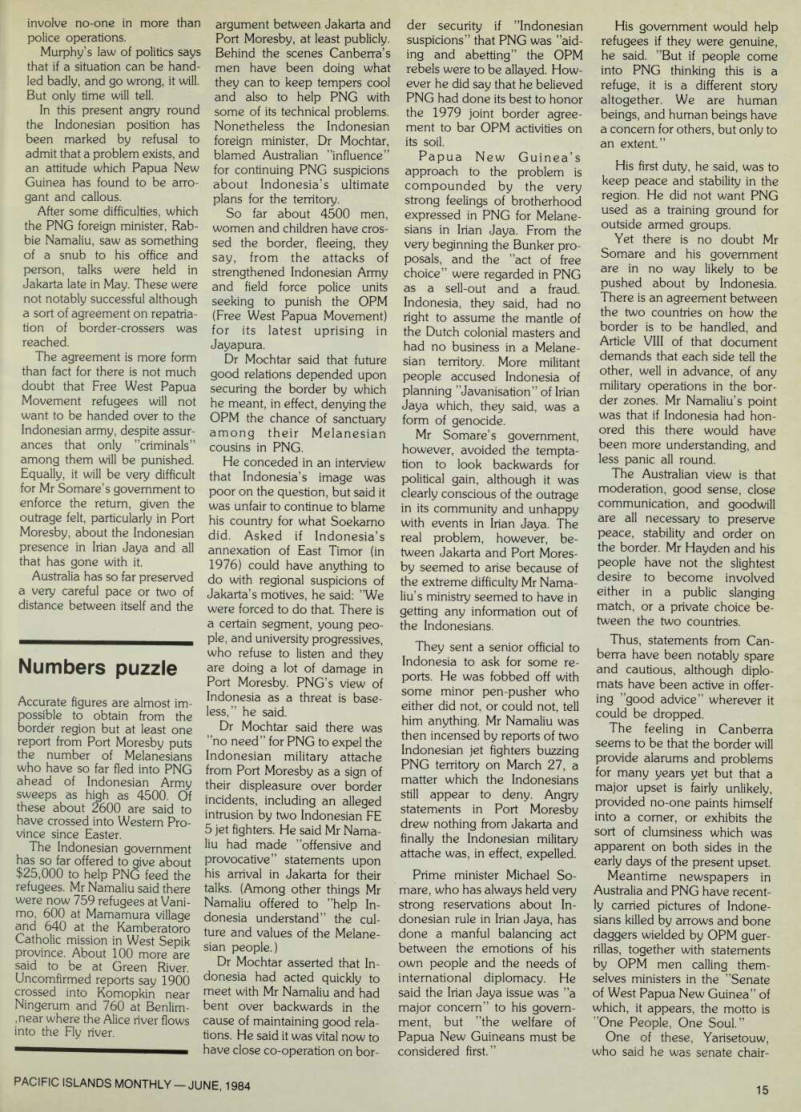
Most Business Is Done
WE’VE MADE IT OUR
(BUSINESS TO BE WHERE
i i n
RABAUL
I *
PORT MORESBY
DARWIN
TOWNSVILLE
PERTH
ADELAIDE
I
ALBURY
I
NOUMEA
NADI
iJP J
TAHITI
TAMWORTH
SYDNEY
MELBOURNE
AUCKLAND
ROTORUA
WELLINGTON
No matter how comfortable a hotel is and how good its facilities are, it’s to no avail if that same hotel isn’t near where you want it to be.
At Travelodge our aim is to attract people in business, which, quite simply, is why you can find us in so many business centres.
Not surprisingly, more and more people, particularly with business to transact, are choosing to stay at Travelodge.
The one hotel group that offers excellent service and facilities at a realistic price. Plus the distinct advantage of being ideally located in or near the business centre of major metropolitan and provincial cities.
Since your hotel often has to serve as an office too, we provide you with first class business facilities.
Dictation and transcription, photocopying, telex, national and international courier services, business breakfasts and rooms for large or small meetings. There are also many other little extras.
CHRISTCHURCH
'* QUEENSTOWN
Like a newspaper every morning and fresh fruit in your room on arrival. There’s also complimentary coffee in the lobby for you and your guests.
Another thing that won’t go unnoticed is the millions of dollars spent on the facilities today’s businessmen and women demand. Large, tastefully decorated rooms, excellent restaurants and intimate bars.
Stay at Travelodge. You’ll not only find us conveniently located, you’ll also find that a warm reception is just the beginning.
For reservations world-wide please phone Sydney (02) 267 2144. Melbourne (03) 690 6111.
Brisbane (07) 2218586.
Adelaide (08)
223 6288. Canberra (062) 491424. Perth (09) 3253811. Or your travel agent. class
Numbers puzzle
Accurate figures are almost im possible to obtain from the border region but at least one report from Port Moresby puts the number of Melanesians who have so far fled into PNG ahead of Indonesian Army sweeps as high as 4500. Of these about 2600 are said to have crossed into Western Pro vince since Easter.
The Indonesian government has so far offered to give about $25,000 to help PNG feed the refugees. Mr Namaliu said there were now 759 refugees at Vani mo, 600 at Mamamura village and 640 at the Kamberatoro Catholic mission in West Sepik province. About 100 more are said to be at Green River.
Uncomfirmed reports say 1900 crossed into Komopkin near Ningerum and 760 at Benlim ,near where the Alice river flows into the Fly river.
Advertisements & other items, p. 16 (1 item)
Skip into Video
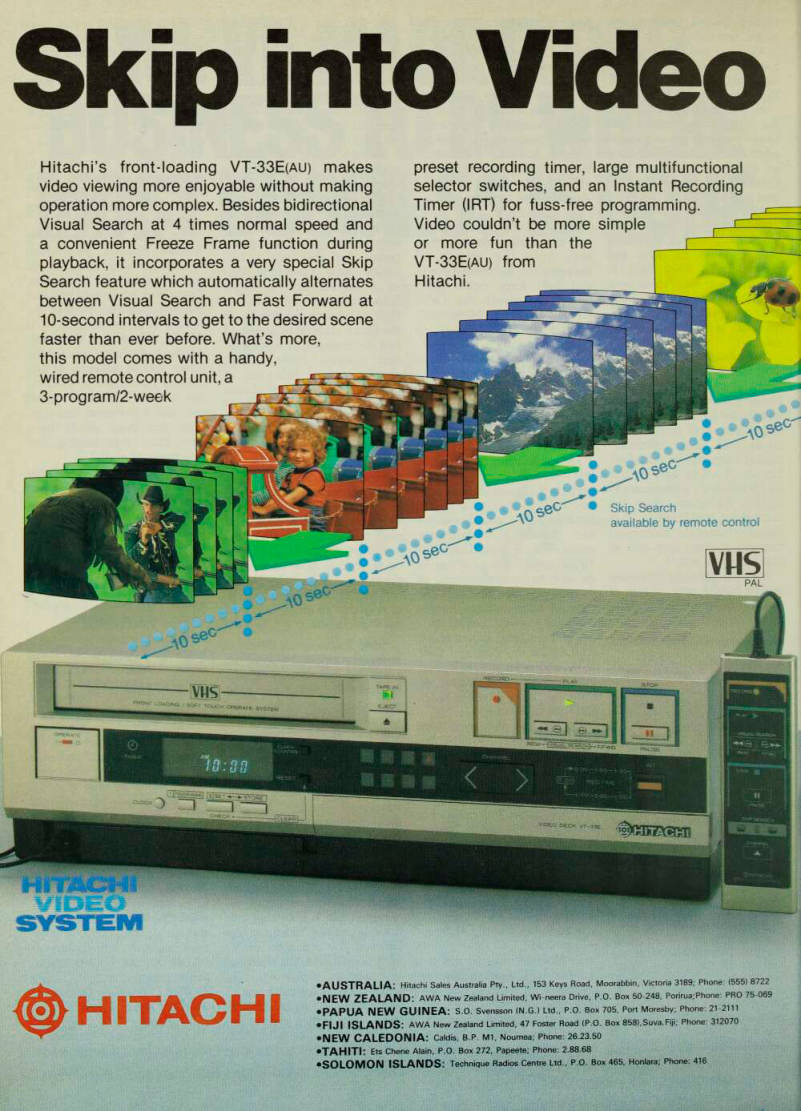
Hitachi’s front-loading VT-33E(AU) makes video viewing more enjoyable without making operation more complex. Besides bidirectional Visual Search at 4 times normal speed and a convenient Freeze Frame function during playback, it incorporates a very special Skip Search feature which automatically alternates between Visual Search and Fast Forward at 10-second intervals to get to the desired scene faster than ever before. What’s more, this model comes with a handy, wired remote control unit, a 3-program/2-week preset recording timer, large multifunctional selector switches, and an Instant Recording Timer (IRT) for fuss-free programming.
Video couldn’t be more simple or more fun than the VT-33E(AU) from Hitachi. ± L_ A o^ c V Skip Search available by remote control AO s® c
VMS
PAL
VMS
/n• n n lu. u u Z 3
0 HITACHI
•AUSTRALIA: Hitachi Sales Australia Pty., Ltd., 153 Keys Road, Moorabbin, Victoria 3189; Phone: (555) 8722 •NEW ZEALAND: AWA New Zealand Limited, Wi-neera Drive, P.O. Box 50-248, Porirua;Phone: PRO 75-069 •PAPUA NEW GUINEA: S.o. Svensson (N.G.) Ltd., P.O. Box 705, Port Moresby; Phone; 21-2111 •FIJI ISLANDS: AWA New Zealand Limited, 47 Foster Road (P.O. Box 858),Suva,Fiji; Phone: 312070 •NEW CALEDONIA: Caldis, B.P. Ml, Noumea; Phone; 26.23.50 •TAHITI: Ets Chene Alain, P.O. Box 272, Papeete; Phone: 2.88.68 •SOLOMON ISLANDS: Technique Radios Centre Ltd., P.O. Box 465, Honiara; Phone: 416
Rebels, rhetoric and jets

mar area relations
PIM correspondent PAMA ANIO reports from Port Moresby on recent events which have Strained relations between Papua New Guinea and Indonesia, its big neighbor to the west.
Papua New Guinea’s relation ship with its big and powerful neighbor Indonesia has come under great strain in the past few months. Source of the latest conflict has once again been the border region.
Since early February, hun dreds of Irian Jayans have been crossing into PNG, reportedly fleeing major clashes between the Free Papua Movement (OPM) and Indonesian troops.
As the influx continued, pressure mounted on the So mare government to make a decision on the fate of the border-crossers, most of whom were camped in PNG’s border province of West Sepik.
PNG’s Foreign Minister Rab bie Namaliu sought an urgent explanation from Indonesia on the Irian Jaya situation, and a week later received a “sufficient enough” reply from his coun terpart Dr Mochtar Kusumaat madja.
It confirmed an incident in the Irian Jaya capital of Jayapura on February 13 when OPM supporters raised a “West Papua” flag at the provincial parliament building.
According to one border crosser, an Indonesian army defector who was an OPM supporter was shot dead by Indonesian troops in the inci dent. It is believed it was this incident that sparked off clashes, leading to the exodus.
The reply however did not satisfy critics in PNG, and one of them, East New Britain Pre mier Ronald Tovue, accused the government of taking an “evasive and fearful” approach to the border problems.
Mr Namaliu hit back, saying that administering any in ternational border was a “sensi tive, complex, and time-con suming matter”.
Mr Namaliu’s departmental head, Paulias Matane, tried to soothe feelings when he said,
on his return from special border liaison meetings in Jayapura in mid-March, that the government might repatriate some of the border-crossers if their safety were guaranteed by Indonesia. He added that a third country may have to be found for those who were identified as defectors, and active members of OPM.
The day after Mr Matane made this statement, 73 Irian Jaya men were jailed for six weeks by Vanimo district court in West Sepik for illegally entering PNG. Another 38 were found guilty, but were not convicted and were discharged.
The decisions to charge and jail the border-crossers caused an uproar throughout the coun-
try, and many felt the govern ment had ignored humanitarian factors.
Even the magistrate who jailed the men seemed reluctant to do so. “I sympathise with your reasons for crossing the border into PNG, but I am by law required to administer the laws of this country,” he told them. The 73 were later re leased pending an appeal.
Amid criticisms of the legal proceedings, Mr Namaliu said: “We are not doing anything different from the past. Under normal circumstances, if they are illegal crossers, the police will deal with them.”
His comments only reaf firmed the government’s stand on the crossings that the Irian Jayans were not refugees, but illegal border-crossers.
PNG, like most South Pacific Island nations, is not a signatory to the United Nations conven-
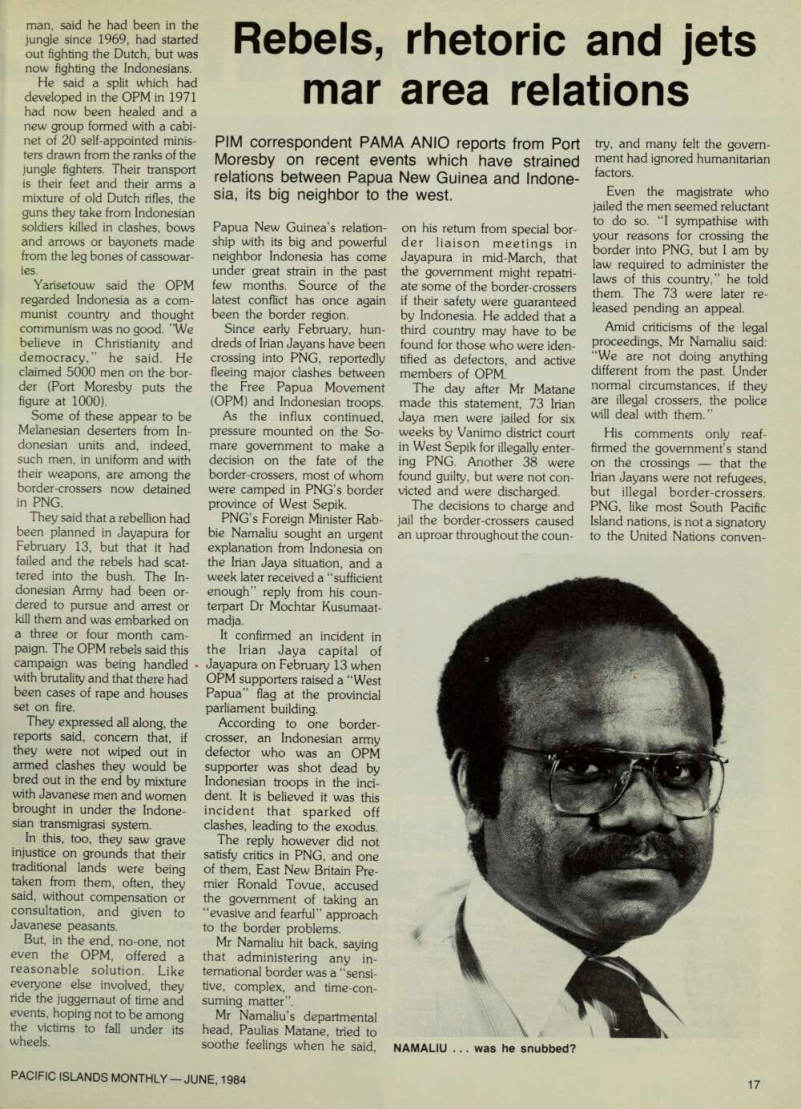
NAMALIU . . . was he snubbed?
tion on refugees.
On March 27, almost a week after the jailings, two unidenti fied jet fighter planes flew into PNG and, according to witnes ses, circled the Green River government station three times.
The station is about 20 km from the Irian Jaya border. The witnesses said the planes flew very low “two to three hundred feet above the ground” and left in the direction of Irian Jaya.
The government was con vinced from initial reports that the jets were Indonesian, but Indonesia, through its Port Moresby embassy, immediately denied owning the jets.
Prime Minister Michael So mare was not impressed by this denial and instructed Mr Nama liu to seek an immediate meet ing with Dr Mochtar.
The government then threatened to expel an Indone sian military attache in Port Moresby over what it called Indonesian “lack of response” over the border matters, includ ing the jet violations.
Jakarta withdrew the attache, but later accused PNG of ex pelling him.
PNG was also accused of allowing the OPM to operate inside its territory.
This charge followed the kid napping of the Swiss pilot of a mission aircraft by the rebels at an Irian Jaya outpost on March 26. The pilot was released unharmed, but the rebels shot dead two of his Indonesian passengers a doctor and an army officer.
PNG at the time denied knowledge of the whereabouts of the secret negotiations be tween the OPM and Swiss government representatives for the pilot’s release. It has now been confirmed that the talks took place in West Sepik.
The two countries finally came to the conference table in Jakarta on April 15 to attempt to resolve their differences and discuss the fate of the border crossers (who totalled almost 1800 by the end of March).
The PNG delegation, led by Mr Namaliu, presented a formal protest against the alleged air intrusions. In turn the Indone sians, led by Dr Mochtar, formally protested against the expulsion of their attache.
Both sides firmly maintained
their stances, and after an un scheduled third day of delibera tions finally “agreed to dis agree”, as Mr Namaliu nicely put it.
On other matters concerning the border crossings, the two sides came to terms. A joint communique said they had agreed to co-operate in retur ning the border-crossers to their homes in an orderly manner.
Dr Mochtar assured Mr Namaliu that the safety of the returnees would be guaranteed, provided they had not broken any laws. Mr Namaliu in turn assured his counterpart that PNG would not allow its terri tory to be used as a sanctuary by anti-Indonesian elements.
Both ministers agreed that misunderstanding may have occurred because of inadequ ate communication, and said measures should be taken im mediately to rectify the problem.
They also agreed to meet in Port Moresby for further talks.
The Jakarta talks are seen by many as a turning point in PNG-Indonesian relations. At the very least, many hope rela tions will improve from now on.
The outcome of the talks was in fact a success for PNG. For the first time PNG has got the Indonesians to listen and not
take her for granted, as it has done for the past decade.
For a country of its size and status, it has been a difficult task for PNG to maintain good relations with a neighbor which not only has a military govern ment but which has failed to recognise that the land border it shares with PNG cuts through ethnic ties. Lack of communica tion and dialogue is certainly a stumbling block to better rela tions, as both sides admitted at the talks. “We don’t know enough about each other,” Mr Namaliu said on his return from Jakarta.
The comment signified the fact that, to all intents and purposes, both countries have made little or no effort to improve relations beyond dip lomatic exchanges ever since Mr Somare made his first offi cial visit to Indonesia in 1973 (he was chief minister at the time), and President Suharto’s return visit to PNG in 1979.
Such basic requirements as trade and educational links, and cultural and sporting ex changes, are non-existent.
Maybe Mr Namaliu’s propo sal to Dr Mochtar for an In donesian soccer team to visit PNG will do something for the present tattered relations.
Pama Anio in Port Moresby.
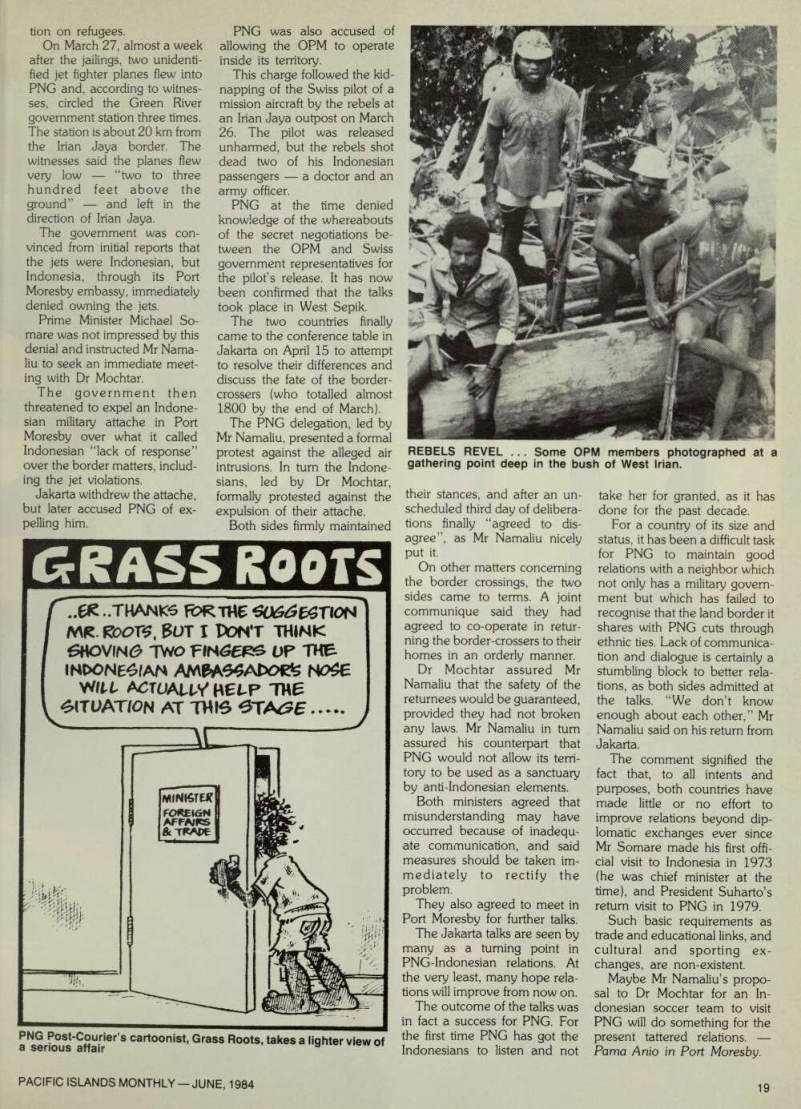
PNG Post-Courier’s cartoonist, Grass Roots, takes a lighter view of a serious affair
REBELS REVEL ... Some OPM members photographed at a gathering point deep in the bush of West Irian.
Advertisements & other items, pp. 18-21 (1 item)
Try it, you’ll buy it
Kk MtAUIA Olt American Airlines has announced the purchase I Ivl Ivlll I of 67 MD-80 airliners.. .with options for 100 more. m « That’s the largest commercial aircraft order Airlines CllCll in Vn 5 1982, they leased 20 MD-80s-American calls them “Super 80s”-in a unique “try it” contract. A year later, because of passenger acceptance, departure reliability and low direct operating costs, they ordered an additional 13. Now, they’re back for more.
Try it... but be prepared to buy it.
MCDO/V/Vi
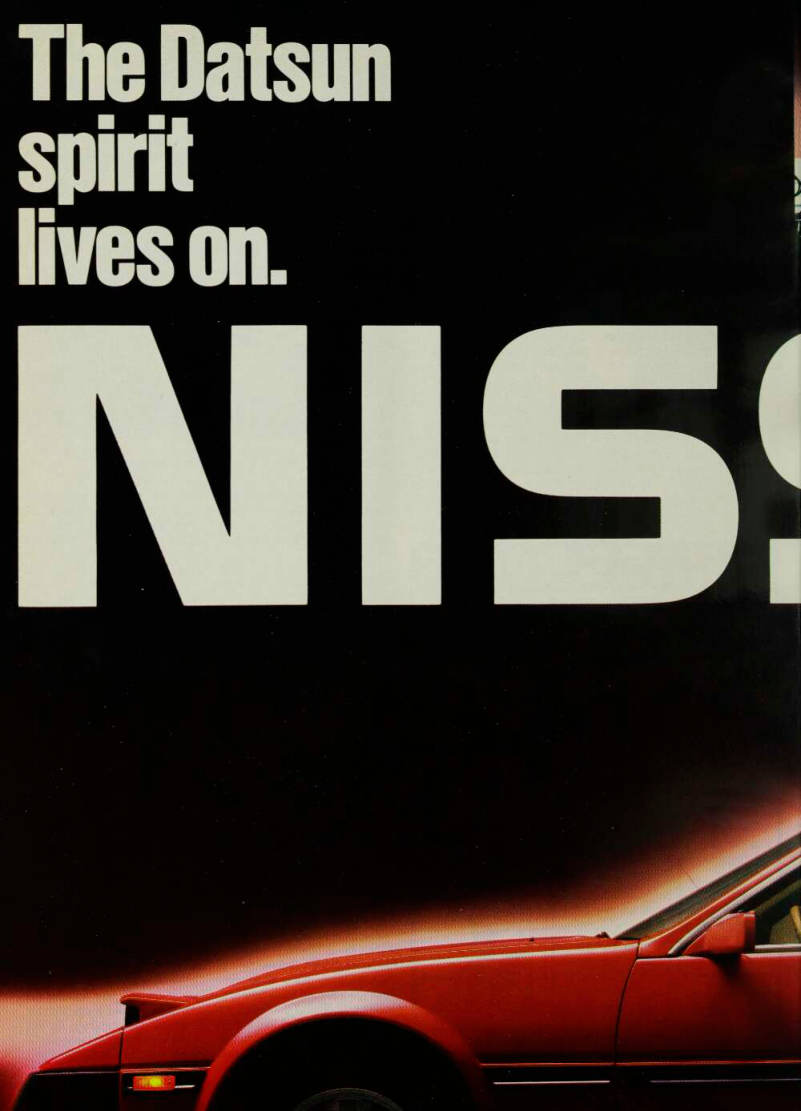
The Datsun spirit lives on.
tJft, 3*tl ir I mI •h' (Ae future
NX2I
'/ ♦ l.: _r -i • Perhaps you’ve noticed. Datsun is changing its name. But the spirit that made Datsun j, a symbol for advanced automotive technology throughout the world will never disappear. Because now Datsun is Nissan.
Fact is, the two have always been one and the same. Nissan has been Datsun’s corporate name for over 50 years. The only change we’ve really made is to give our products their proper name.
So if you’ve begun to miss the name Datsun, rest easy.
The spirit that made Datsun IC for computerized cars Production line with welding robots so great is alive and well and living inside every Nissan.
NISSAN
NISSAN
What made Reddy run

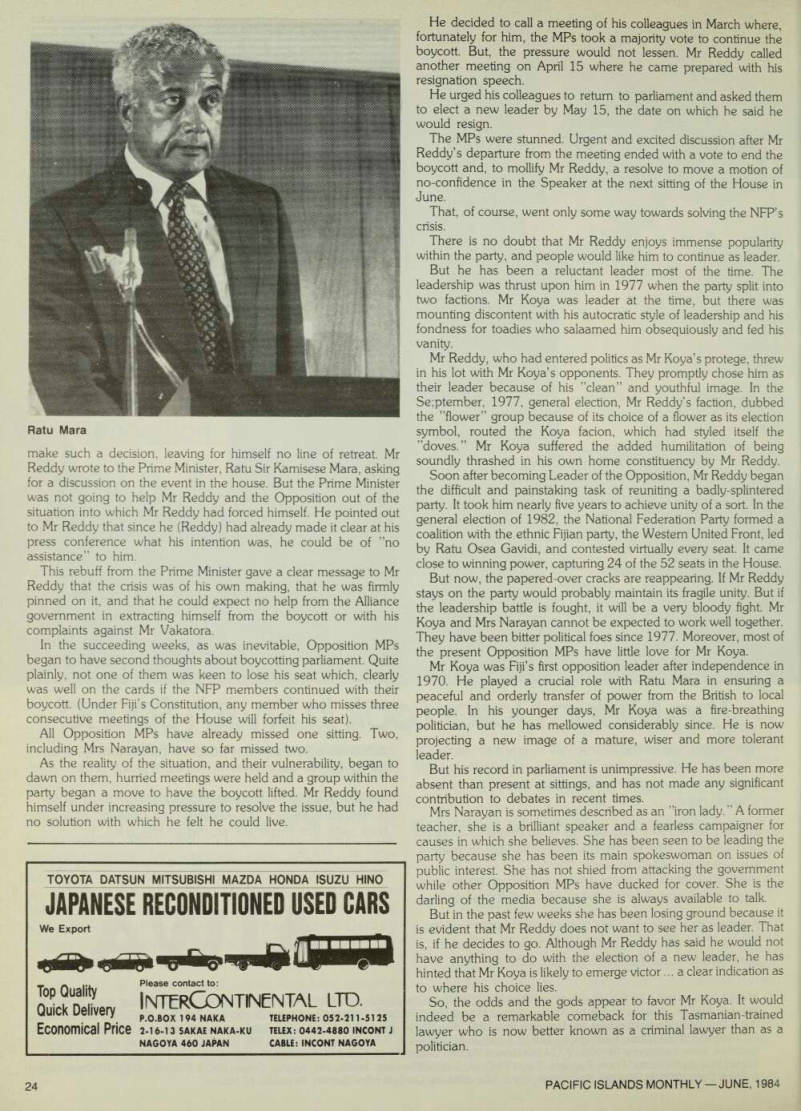
Fiji Opposition in disarray What made Reddy run
Editor of The Fiji Times, VIJENDRA KUMAR, traces the recent turbulent history of Fiji’s opposition National Federation Party, whose leadership is once again in a state of crisis and up for grabs.
Fiji’s Leader of the Opposition, Jai Ram Reddy, 48, has created a major crisis in his National Federation Party by a shock announcement in April of his decision to quit.
A scramble for the leadership has already started, bringing to the surface the deep cracks within the party which were patched up three years ago, largely through Mr Reddy’s own efforts. In the running are lawyer and former leader, Siddiq Koya, 58, whom none other than Mr Reddy ignominiously defeated and temporarily sent into the political wilderness seven years ago, and the present Deputy Leader of the Opposition, Mrs Irene Jai Narayan, 50.
But at the time of writing, frantic efforts were being made by party people to persuade Mr Reddy to withdraw his resignation and continue as leader. While greatly flattered by a groundswell of support, Mr Reddy was giving no hint to anyone whether he would be staying on.
The Opposition now has 23 seats in the House of Representa tives, discounting a rebel MP, Vijaya Parmanandam, whom the party expelled two years ago for criticising Mr Reddy. At first, Mrs Narayan, the only woman in parliament, held a comfortable edge over Mr Koya in the leadership race, but Mr Koya’s lieutenants have been busy mustering support from grassroots party members to bring popular pressure on parliamentarians to vote for Koya.
This strategy has worked well.
Mr Reddy’s decision to resign both the leadership and his seat in the house stemmed from growing dissatisfaction among his colleagues over a decision to boycott parliament to protest against what the Opposition claimed were insults and unfair rulings against it by the Speaker, Tomasi Vakatora.
On December 15, Mr Reddy had a heated exchange with the Speaker during an emergency sitting of the house to approve a Bill granting civil servants a pay rise. Mr Vakatora ordered Mr Reddy to stand up to address him, after Mr Reddy had interjected angrily while the speaker was giving a ruling. Mr Koya was on the floor at the time.
Mr Reddy retorted that he would not stand up for Mr Vakatora.
The Speaker then ordered Mr Reddy to leave the chamber, but Mr Reddy shouted back: ”You have me removed’.
Mr Vakatora obliged him, but as the Sergeant-at-Arms moved in to eject him, Mr Reddy walked out. All his party colleagues followed him. Shortly after, Mr Reddy called a news conference and announced that he and his colleagues would not be returning to parliament as long as Mr Vakatora sat in the Speaker s chair.
As for himself, personally, Mr Reddy said his decision to stay out was ’’irrevocable” ... ’’and I keep my word, he said.
By his ’’irrevocable” decision Mr Reddy boxed himself in firmly.
Observers were astounded that a politician of his stature would
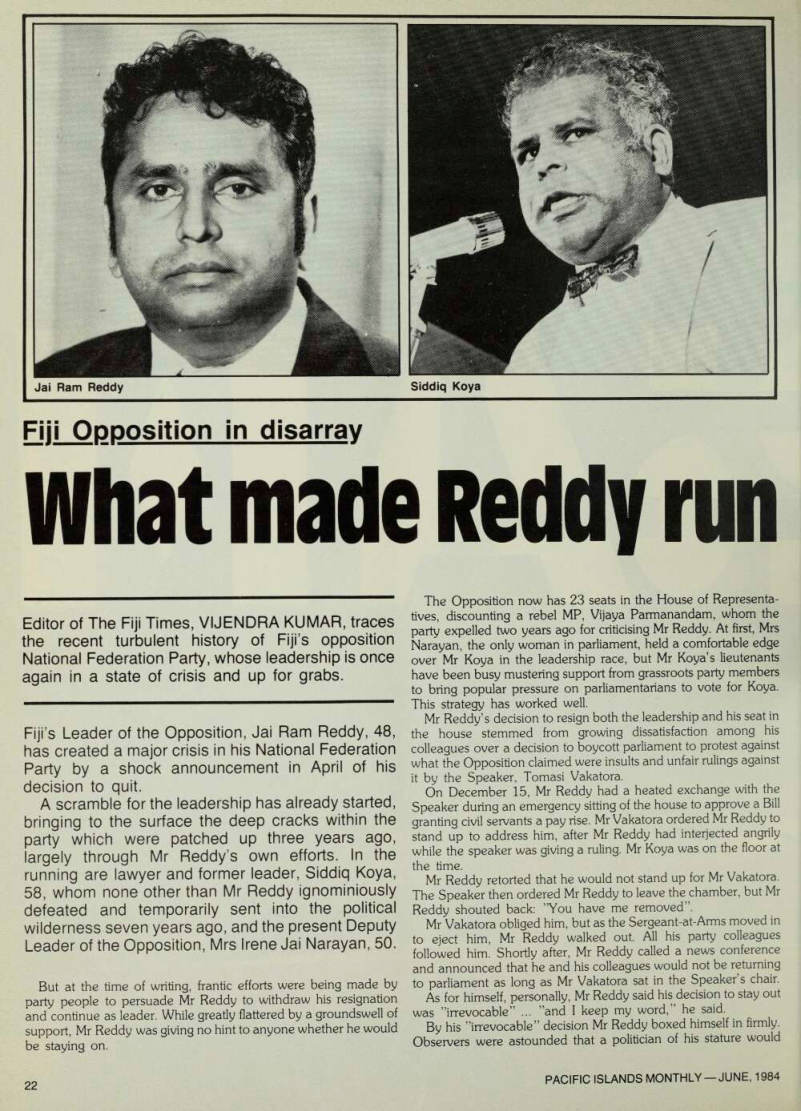
Siddiq Koya
Jai Ram Reddy
make such a decision, leaving for himself no line of retreat. Mr Reddy wrote to the Prime Minister, Ratu Sir Kamisese Mara, asking for a discussion on the event in the house. But the Prime Minister was not going to help Mr Reddy and the Opposition out of the situation into which Mr Reddy had forced himself. He pointed out to Mr Reddy that since he (Reddy) had already made it clear at his press conference what his intention was, he could be of ”no assistance” to him.
This rebuff from the Prime Minister gave a clear message to Mr Reddy that the crisis was of his own making, that he was firmly pinned on it, and that he could expect no help from the Alliance government in extracting himself from the boycott or with his complaints against Mr Vakatora.
In the succeeding weeks, as was inevitable, Opposition MPs began to have second thoughts about boycotting parliament. Quite plainly, not one of them was keen to lose his seat which, clearly was well on the cards if the NFP members continued with their boycott. (Under Fiji’s Constitution, any member who misses three consecutive meetings of the House will forfeit his seat).
All Opposition MPs have already missed one sitting. Two, including Mrs Narayan, have so far missed two.
As the reality of the situation, and their vulnerability, began to dawn on them, hurried meetings were held and a group within the party began a move to have the boycott lifted. Mr Reddy found himself under increasing pressure to resolve the issue, but he had no solution with which he felt he could live.
He decided to call a meeting of his colleagues in March where, fortunately for him, the MPs took a majority vote to continue the boycott. But, the pressure would not lessen. Mr Reddy called another meeting on April 15 where he came prepared with his resignation speech.
He urged his colleagues to return to parliament and asked them to elect a new leader by May 15, the date on which he said he would resign.
The MPs were stunned. Urgent and excited discussion after Mr Reddy’s departure from the meeting ended with a vote to end the boycott and, to mollify Mr Reddy, a resolve to move a motion of no-confidence in the Speaker at the next sitting of the House in June.
That, of course, went only some way towards solving the NFP’s crisis.
There is no doubt that Mr Reddy enjoys immense popularity within the party, and people would like him to continue as leader.
But he has been a reluctant leader most of the time. The leadership was thrust upon him in 1977 when the party split into two factions. Mr Koya was leader at the time, but there was mounting discontent with his autocratic style of leadership and his fondness for toadies who salaamed him obsequiously and fed his vanity.
Mr Reddy, who had entered politics as Mr Koya’s protege, threw in his lot with Mr Koya’s opponents. They promptly chose him as their leader because of his ’’clean” and youthful image. In the September, 1977, general election, Mr Reddy’s faction, dubbed the ’’flower” group because of its choice of a flower as its election symbol, routed the Koya facion, which had styled itself the ’’doves.” Mr Koya suffered the added humilitation of being soundly thrashed in his own home constituency by Mr Reddy.
Soon after becoming Leader of the Opposition, Mr Reddy began the difficult and painstaking task of reuniting a badly-splintered party. It took him nearly five years to achieve unity of a sort. In the general election of 1982, the National Federation Party formed a coalition with the ethnic Fijian party, the Western United Front, led by Ratu Osea Gavidi, and contested virtually every seat. It came close to winning power, capturing 24 of the 52 seats in the House.
But now, the papered-over cracks are reappearing. If Mr Reddy stays on the party would probably maintain its fragile unity. But if the leadership battle is fought, it will be a very bloody fight. Mr Koya and Mrs Narayan cannot be expected to work well together.
They have been bitter political foes since 1977. Moreover, most of the present Opposition MPs have little love for Mr Koya.
Mr Koya was Fiji’s first opposition leader after independence in 1970. He played a crucial role with Ratu Mara in ensuring a peaceful and orderly transfer of power from the British to local people. In his younger days, Mr Koya was a fire-breathing politician, but he has mellowed considerably since. He is now projecting a new image of a mature, wiser and more tolerant leader.
But his record in parliament is unimpressive. He has been more absent than present at sittings, and has not made any significant contribution to debates in recent times.
Mrs Narayan is sometimes described as an ’’iron lady. ” A former teacher, she is a brilliant speaker and a fearless campaigner for causes in which she believes. She has been seen to be leading the party because she has been its main spokeswoman on issues of public interest. She has not shied from attacking the government while other Opposition MPs have ducked for cover. She is the darling of the media because she is always available to talk.
But in the past few weeks she has been losing ground because it is evident that Mr Reddy does not want to see her as leader. That is, if he decides to go. Although Mr Reddy has said he would not have anything to do with the election of a new leader, he has hinted that Mr Koya is likely to emerge victor... a clear indication as to where his choice lies.
So, the odds and the gods appear to favor Mr Koya. It would indeed be a remarkable comeback for this Tasmanian-trained lawyer who is now better known as a criminal lawyer than as a politician.
Ratu Mara
Advertisements & other items, pp. 23-24 (1 item)
Aiwa*
The Million Dollar Look in Stylish Sound This year’s top-of-the-line AIWA system is designed to stay in style next year, and the year after too. With high-power component separates designed to be “Digital ready”.
In fact, with such features as a dedicated CD function selector and Dolby HX Professional* equipped auto-reverse cassette deck, the V-1100 is an 85 watt-per-channel system ready to deliver better performance from any music source—digital or analog.
Want to put your records onto tape? AIWA makes it easier than you ever believed. A microprocessorcontrolled “Auto Editing” facility lets you dub AIWA Australia Pty., Ltd 14 Gertrude St., Arnoliffe, N.S.W. Australia 2205 AUSTRALIA PHONE; (597) 2388/Oceania Indent Agency (P.N.G.) Pty., Ltd Ago St, Gordon Box 5518, Boroko, Papua New Guinea PHONE; 256411/The Sound Centre Ltd P.O. Box 434 Port Vila, Vanuatu PHONE; 2035/P. Hargovind Bros 190 Renwick Road P.O. Box 490 Suva Fiji PHONE; 24350/Makanjee & Sons Limited P.O. Box 91 Sigatoka Fiji PHONE; 50158/Milaw Trading Co, Ltd 36 Airedale St. Auckland, New Zealand PHONE; (09) 399175/hifivox 79, rue de Sebastopol, Noumea, New Caledonia PHONE; 27.24.66/Harvest Pacific Limited P.O. Box 517, Honiara, Solomon Islands PHONE; 131/Fare Hi-Fi Stereo Rue du Marechal Foch, Papeete, Tahiti PHONE; 2-4814/Micropac Audio, Inc. Agana, Guam 96910 PHONE; 472-8091/Cook Island Trading Corp Ltd P.O. Box 92, Rarotonga, Cook Island/Nauru Co-Operative Society Republic of Nauru automatically from the programmable turntable to the cassette deck, even in random track order.
V-1100—Sophisticated separates with totally automated integration. It’s AlWA’s new concept in audio that sets the trend for sound in the 80s! * Dolby and the double-D symbol are trademarks of Dolby Laboratories Licensing Corporation. *HX PROFESSIONAL ORIGINATED BY BANG & OLUFSEN
AIWA*
TOYOTA DATSUN MITSUBISHI MAZDA HONDA ISUZU HINO
JAPANESE RECONDITIONED USED CARS
We Export
Top Quality
Quick Delivery
Please contact to:
Inter Continental ltd.
P.0.80X 194 NAKA TELEPHONE: 052-211 -51 25 Economical Price 2-16-l3 SAKAE NAKA.KU TELEX: 0442.4880 INCONT J
NAGOYA 460 JAPAN CABLE: INCONT NAGOYA
people
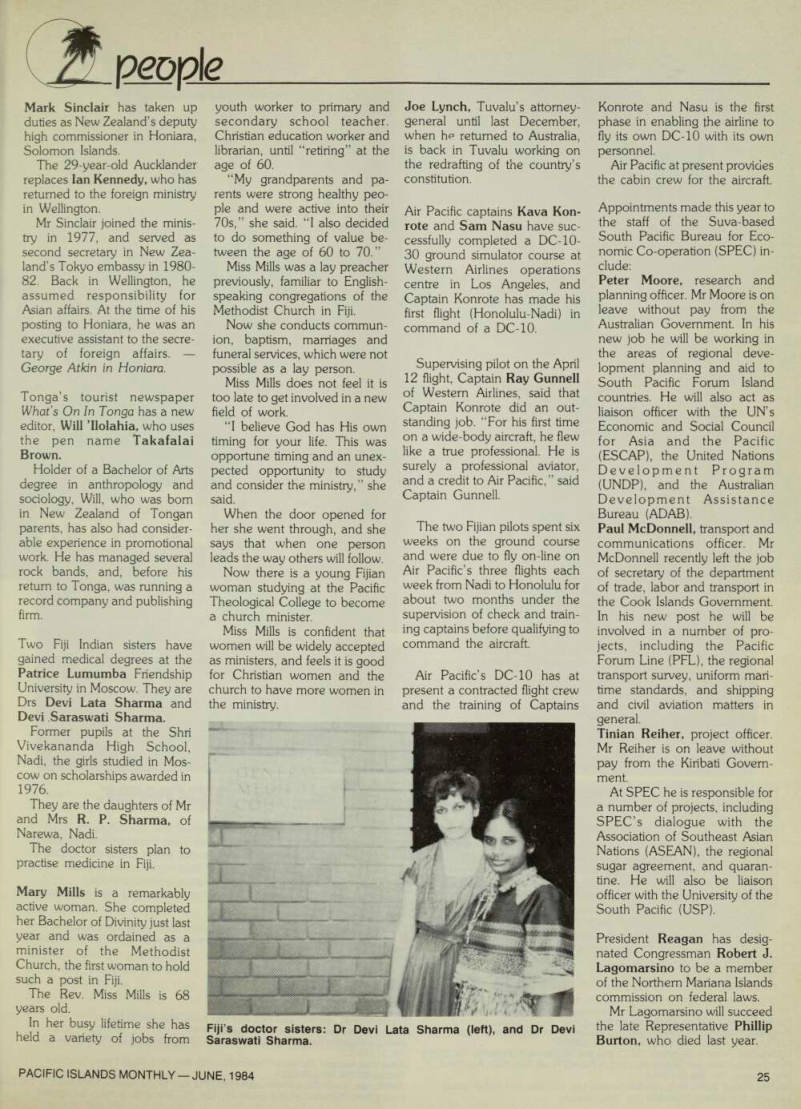
Mark Sinclair has taken up duties as New Zealand’s deputy high commissioner in Honiara, Solomon Islands.
The 29-year-old Aucklander replaces lan Kennedy, who has returned to the foreign ministry in Wellington.
Mr Sinclair joined the minis try in 1977, and served as second secretary in New Zea land’s Tokyo embassy in 1980- 82. Back in Wellington, he assumed responsibility for Asian affairs. At the time of his posting to Honiara, he was an executive assistant to the secre tary of foreign affairs.
George Atkin in Honiara.
Tonga’s tourist newspaper What’s On In Tonga has a new editor, Will Tlolahia, who uses the pen name Takafalai Brown.
Holder of a Bachelor of Arts degree in anthropology and sociology, Will, who was bom in New Zealand of Tongan parents, has also had consider able experience in promotional work. He has managed several rock bands, and, before his return to Tonga, was running a record company and publishing firm.
Two Fiji Indian sisters have gained medical degrees at the Patrice Lumumba Friendship University in Moscow. They are Drs Devi Lata Sharma and Devi Saraswati Sharma.
Former pupils at the Shri Vivekananda High School, Nadi, the girls studied in Mos cow on scholarships awarded in 1976.
They are the daughters of Mr and Mrs R. P. Sharma, of Narewa, Nadi.
The doctor sisters plan to practise medicine in Fiji.
Mary Mills is a remarkably active woman. She completed her Bachelor of Divinity just last year and was ordained as a minister of the Methodist Church, the first woman to hold such a post in Fiji.
The Rev. Miss Mills is 68 years old.
In her busy lifetime she has held a variety of jobs from
youth worker to primary and secondary school teacher.
Christian education worker and librarian, until “retiring” at the age of 60.
“My grandparents and pa rents were strong healthy peo ple and were active into their 705,” she said. “I also decided to do something of value be tween the age of 60 to 70.”
Miss Mills was a lay preacher previously, familiar to English speaking congregations of the Methodist Church in Fiji.
Now she conducts commun ion, baptism, marriages and funeral services, which were not possible as a lay person.
Miss Mills does not feel it is too late to get involved in a new field of work.
“I believe God has His own timing for your life. This was opportune timing and an unex pected opportunity to study and consider the ministry,” she said.
When the door opened for her she went through, and she says that when one person leads the way others will follow.
Now there is a young Fijian woman studying at the Pacific Theological College to become a church minister.
Miss Mills is confident that women will be widely accepted as ministers, and feels it is good for Christian women and the church to have more women in the ministry.
Joe Lynch, Tuvalu’s attorney general until last December, when he returned to Australia, is back in Tuvalu working on the redrafting of the country’s constitution.
Air Pacific captains Kava Kon rote and Sam Nasu have suc cessfully completed a DC-10- 30 ground simulator course at Western Airlines operations centre in Los Angeles, and Captain Konrote has made his first flight (Honolulu-Nadi) in command of a DC-10.
Supervising pilot on the April 12 flight, Captain Ray Gunnell of Western Airlines, said that Captain Konrote did an out standing job. “For his first time on a wide-body aircraft, he flew like a true professional. He is surely a professional aviator, and a credit to Air Pacific,” said Captain Gunnell.
The two Fijian pilots spent six weeks on the ground course and were due to fly on-line on Air Pacific’s three flights each week from Nadi to Honolulu for about two months under the supervision of check and train ing captains before qualifying to command the aircraft.
Air Pacific’s DC-10 has at present a contracted flight crew and the training of Captains
Konrote and Nasu is the first phase in enabling the airline to fly its own DC-10 with its own personnel.
Air Pacific at present provides the cabin crew for the aircraft.
Appointments made this year to the staff of the Suva-based South Pacific Bureau for Eco nomic Co-operation (SPEC) in clude: Peter Moore, research and planning officer. Mr Moore is on leave without pay from the Australian Government. In his new job he will be working in the areas of regional deve lopment planning and aid to South Pacific Forum Island countries. He will also act as liaison officer with the UN’s Economic and Social Council for Asia and the Pacific (ESCAP), the United Nations Development Program (UNDP), and the Australian Development Assistance Bureau (ADAB).
Paul McDonnell, transport and communications officer. Mr McDonnell recently left the job of secretary of the department of trade, labor and transport in the Cook Islands Government.
In his new post he will be involved in a number of pro jects, including the Pacific Forum Line (PFL), the regional transport survey, uniform mari time standards, and shipping and civil aviation matters in general.
Tinian Reiher, project officer.
Mr Reiher is on leave without pay from the Kiribati Govern ment.
At SPEC he is responsible for a number of projects, including SPEC’s dialogue with the Association of Southeast Asian Nations (ASEAN), the regional sugar agreement, and quaran tine. He will also be liaison officer with the University of the South Pacific (USP).
President Reagan has desig nated Congressman Robert J.
Lagomarsino to be a member of the Northern Mariana Islands commission on federal laws.
Mr Lagomarsino will succeed the late Representative Phillip Burton, who died last year.
Fiji’s doctor sisters: Dr Devi Lata Sharma (left), and Dr Devi Saraswati Sharma.
Advertisements & other items, p. 26 (1 item)
Dd Pioneer
* ill
AUTO-REVERSE
a-WAV Ki9«-«BWSH SVSTSM
ox&mssi 100 Ci
? SOT
103.0 M
ffl PIONEGH
Pioneer puts you ahead with power.
The KEH-9000 is no ordinary “regular” in-dash car stereo. For one, it has more than twice the power of ordinary types. Its “2-Way High-Power” system generates a hefty 20W per channel of maximum power output. And that’s a full 20 per channel, to be sure, because it comes from four separate and discrete power amps strapped together in pairs for faultless performance.
The “2-Way” advantage comes in when you hook up an extra stereo-pair of speakers and divide those four amps to deliver a big 6.5 watts to each. The front-to-rear “fader” control is built into the preamp, so you don’t lose a bit of the dynamic low-frequency punch your music deserves.
The KEH-9000, despite its compact size, also offers the latest in car-audio technology and features. There’s auto-reverse cassetting with Dolby* noise reduction, Quartz-PLL preset tuning with ARC-V auto-reception control for ideal FM listening, a 5-band graphic equalizer, a bright Liquid-Crystal Display, and much more.
Go with the powerful one that puts you ahead—the KEH-9000, from Pioneer.
“Dolby’ and the double-D symbol are trademarks of Dolby Laboratories Licensing Corporation. The Pioneer KEH-9000 comes with a wired remote control for Up/Down Seek.
dD PIONEER
For further information, please contact: Australia: Pioneer Electronics Australia Pty. Ltd. (Incorporated in Victoria), P.O. Box 295, Mordialloc, Victoria, 3195 Tel: 580-9911 Fiji Islands: Brijlal & Company, G.P.O. Box No. 362, Suva, Fiji Islands Tel: 22258 New Zealand: Monaco Distributors Ltd., 2 Poland Road, Glenfield, Auckland, New Zealand Tel: (09) 444-9144 Norfolk Island: Burns Philp (Norfolk Island) Ltd., P.O. Box 21, Norfolk Island Vanuatu: Burns Philp (Vanuatu) Ltd., Vila, Vanuatu Nauru Island: Jacob Enterprises, P.O. Box No. 4, Republic of Nauru Tahiti: Tahiti Hi-Fi, P.O. Box 848, Papeete, Tahiti New Caledonia: Menard Pacifique Sari, B.P. 3899, Noumea, New Caledonia Tel: 27*62*23 American Samoa: Transpac Corporation, P.O. Box 1477, Pago Pago, American Samoa 96799 Tel: 633-5224 . ...
Rarotonga: South Seas International Ltd., P.O. Box 49, Rarotonga, Cook Islands Tel: 232/ Papua New Guinea: Bali Merchants Pty. Ltd., P.O. Box 6103, Boroko Tel: 254887
Reaganomics
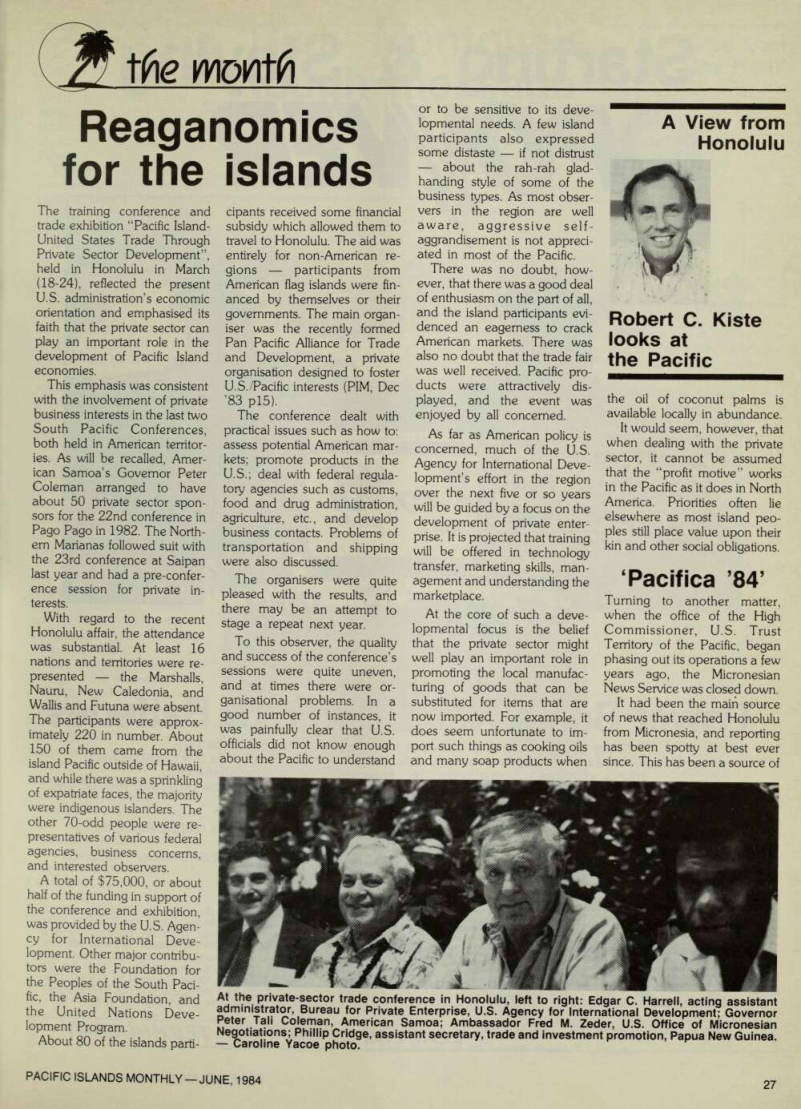

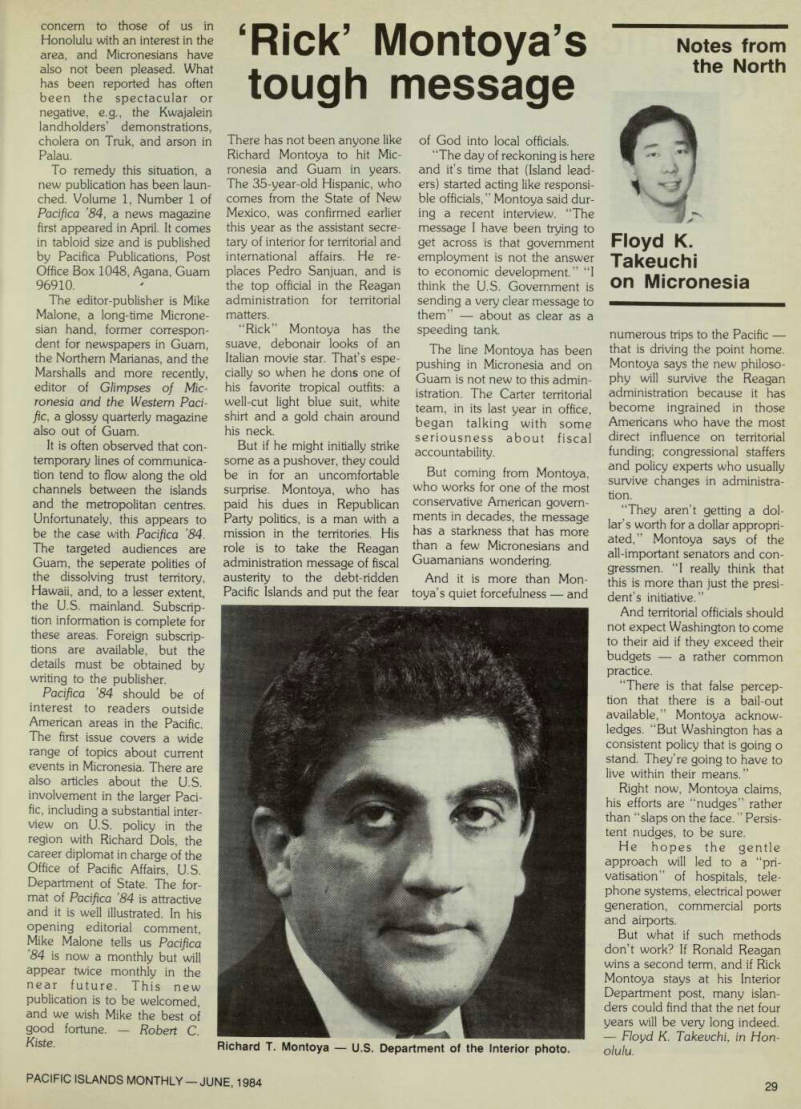
the month
Reaganomics for the islands
The training conference and trade exhibition “Pacific Island- United States Trade Through Private Sector Development”, held in Honolulu in March (18-24), reflected the present U.S. administration’s economic orientation and emphasised its faith that the private sector can play an important role in the development of Pacific Island economies.
This emphasis was consistent with the involvement of private business interests in the last two South Pacific Conferences, both held in American territor ies. As will be recalled, Amer ican Samoa’s Governor Peter Coleman arranged to have about 50 private sector spon sors for the 22nd conference in Pago Pago in 1982. The North ern Marianas followed suit with the 23rd conference at Saipan last year and had a pre-confer ence session for private in terests.
With regard to the recent Honolulu affair, the attendance was substantial. At least 16 nations and territories were re presented the Marshalls, Nauru, New Caledonia, and Wallis and Futuna were absent.
The participants were approx imately 220 in number. About 150 of them came from the island Pacific outside of Hawaii, and while there was a sprinkling of expatriate faces, the majority were indigenous islanders. The other 70-odd people were re presentatives of various federal agencies, business concerns, and interested observers.
A total of $75,000, or about half of the funding in support of the conference and exhibition, was provided by the U.S. Agen cy for International Deve lopment. Other major contribu tors were the Foundation for the Peoples of the South Paci fic, the Asia Foundation, and the United Nations Deve lopment Program.
About 80 of the islands parti
cipants received some financial subsidy which allowed them to travel to Honolulu. The aid was entirely for non-American re gions participants from American flag islands were fin anced by themselves or their governments. The main organ iser was the recently formed Pan Pacific Alliance for Trade and Development, a private organisation designed to foster U.S./Pacific interests (PIM, Dec ’B3 pls).
The conference dealt with practical issues such as how to: assess potential American mar kets; promote products in the U.S.; deal with federal regula tory agencies such as customs, food and drug administration, agriculture, etc., and develop business contacts. Problems of transportation and shipping were also discussed.
The organisers were quite pleased with the results, and there may be an attempt to stage a repeat next year.
To this observer, the quality and success of the conference’s sessions were quite uneven, and at times there were or ganisational problems. In a good number of instances, it was painfully clear that U.S. officials did not know enough about the Pacific to understand
or to be sensitive to its deve lopmental needs. A few island participants also expressed some distaste if not distrust about the rah-rah glad handing style of some of the business types. As most obser vers in the region are well aware, aggressive self aggrandisement is not appreci ated in most of the Pacific.
There was no doubt, how ever, that there was a good deal of enthusiasm on the part of all, and the island participants evi denced an eagerness to crack American markets. There was also no doubt that the trade fair was well received. Pacific pro ducts were attractively dis played, and the event was enjoyed by all concerned.
As far as American policy is concerned, much of the U.S.
Agency for International Deve lopment’s effort in the region over the next five or so years will be guided by a focus on the development of private enter prise. It is projected that training will be offered in technology transfer, marketing skills, man agement and understanding the marketplace.
At the core of such a deve lopmental focus is the belief that the private sector might well play an important role in promoting the local manufac turing of goods that can be substituted for items that are now imported. For example, it does seem unfortunate to im port such things as cooking oils and many soap products when
the oil of coconut palms is available locally in abundance.
It would seem, however, that when dealing with the private sector, it cannot be assumed that the “profit motive” works in the Pacific as it does in North America. Priorities often lie elsewhere as most island peo ples still place value upon their kin and other social obligations.
‘Pacifica ’B4’
Turning to another matter, when the office of the High Commissioner, U.S. Trust Territory of the Pacific, began phasing out its operations a few years ago, the Micronesian News Service was closed down.
It had been the main source of news that reached Honolulu from Micronesia, and reporting has been spotty at best ever since. This has been a source of
A View from Honolulu
Robert C. Kiste looks at the Pacific
At the private-sector trade conference in Honolulu, left to right: Edgar C. Harrell, acting assistant administrator, Bureau for Private Enterprise, U.S. Agency for International Development; Governor Peter Tali Coleman, American Samoa; Ambassador Fred M. Zeder, U.S. Office of Micronesian Negotiations; Phillip Cridge, assistant secretary, trade and investment promotion, Papua New Guinea. -Caroline Yacoe photo.
concern to those of us in Honolulu with an interest in the area, and Micronesians have also not been pleased. What has been reported has often been the spectacular or negative, e.g., the Kwajalein landholders’ demonstrations, cholera on Truk, and arson in Palau.
To remedy this situation, a new publication has been laun ched. Volume 1, Number 1 of Pacifica ’B4 , a news magazine first appeared in April. It comes in tabloid size and is published by Pacifica Publications, Post Office Box 1048, Agana, Guam 96910.
The editor-publisher is Mike Malone, a long-time Microne sian hand, former correspon dent for newspapers in Guam, the Northern Marianas, and the Marshalls and more recently, editor of Glimpses of Mic ronesia and the Western Paci fic, a glossy quarterly magazine also out of Guam.
It is often observed that con temporary lines of communica tion tend to flow along the old channels between the islands and the metropolitan centres.
Unfortunately, this appears to be the case with Pacifica ’B4.
The targeted audiences are Guam, the seperate polities of the dissolving trust territory, Hawaii, and, to a lesser extent, the U.S. mainland. Subscrip tion information is complete for these areas. Foreign subscrip tions are available, but the details must be obtained by writing to the publisher.
Pacifica ’B4 should be of interest to readers outside American areas in the Pacific.
The first issue covers a wide range of topics about current events in Micronesia. There are also articles about the U.S. involvement in the larger Paci fic, including a substantial inter view on U.S. policy in the region with Richard Dols, the career diplomat in charge of the Office of Pacific Affairs, U.S.
Department of State. The for mat of Pacifica ’B4 is attractive and it is well illustrated. In his opening editorial comment, Mike Malone tells us Pacifica ’B4 is now a monthly but will appear twice monthly in the near future. This new publication is to be welcomed, and we wish Mike the best of
good fortune.
Robert C.
Kiste.
Advertisements & other items, p. 28 (1 item)
pcmst
Starting & Staying
Wmmm ;; Vi
AMP
poymt
X COHVHUOUS use
71 f DGFPOCLf atrr&rv
tUU'J
MARINI
STOW
AV W
U 2327 £1257
Power Boats Need Different Batteries
There is a big difference between a car battery and a marine battery.
A car battery, for example, is never really discharged, as it is only used for a few seconds each day and promptly re-charged. Not so your cruiser or sportsfisherman.
Starting the engine is only the beginning. During the day, weekend or cruise, how often will you run the live bait tank, the depth sounder, the nav. lights or maintain a listening watch on your radio transceiver?
As well as cranking power, boats need staying power. Boats need Besco's Marine Batteries, deep cycle, heavy duty marine batteries.
If your boat is getting a little flat in the electrics department, write or phone BESCO today and ask for more information, more facts about
BESCO MARINE BATTERIES.
Batteries Division Of Sims Products Pty Ltd. I A Peko Wall send Group Member ipua New Guinea: Lae, Automarine Industries P.a Box 785, Ph 42-U25, Rabaul jtomarine Industries. P.O. Box 248, Ph. 92-2574; Port Moresby Par Sales PX3 Box 168 a >roko, Ph. 25-6266. Fiji: Suva, Fjji Bandag, 23 Smoma Street, Walu Bay, Ph. 31-1200. New iledonia: Noumea, Andre Thuilier, BP 889. Ph. 27-4906. Solomon Islands: jadalcanal Electrics Ltd.. P.O. Box 521. Hongkong: Kowloon, T. L Knight &Co PC. Box >585 IST, Ph. 366-5341. New Zealand: Auckland, Battery Services (!nd.) Ltd., P.O. tox 27- '5, Ph. 69-4111; Wellington, Gould Batteries, 58 Hautana Street Lower Hutt, TLX NZ3714 jstralia: Sydney, Besco Batteries, P.O. Box 1, Villawood.Ph. 632-0251 TLX 21886, Jarwil International Ptv. Ltd., 410 Kent Street, Sydney, Ph. 264-3477, TLX 72102.
LEADERS IN BATTERY
‘Rick’ Montoya’s
tough message
There has not been anyone like Richard Montoya to hit Mic ronesia and Guam in years.
The 35-year-old Hispanic, who comes from the State of New Mexico, was confirmed earlier this year as the assistant secre tary of interior for territorial and international affairs. He re places Pedro Sanjuan, and is the top official in the Reagan administration for territorial matters.
“Rick” Montoya has the suave, debonair looks of an Italian movie star. That’s espe cially so when he dons one of his favorite tropical outfits: a well-cut light blue suit, white shirt and a gold chain around his neck.
But if he might initially strike some as a pushover, they could be in for an uncomfortable surprise. Montoya, who has paid his dues in Republican Party politics, is a man with a mission in the territories. His role is to take the Reagan administration message of fiscal austerity to the debt-ridden Pacific Islands and put the fear
of God into local officials.
“The day of reckoning is here and it’s time that (Island lead ers) started acting like responsi ble officials,” Montoya said dur ing a recent interview. “The message I have been trying to get across is that government employment is not the answer to economic development.” “I think the U.S. Government is sending a very clear message to them” about as clear as a speeding tank.
The line Montoya has been pushing in Micronesia and on Guam is not new to this admin istration. The Carter territorial team, in its last year in office, began talking with some seriousness about fiscal accountability.
But coming from Montoya, who works for one of the most conservative American govern ments in decades, the message has a starkness that has more than a few Micronesians and Guamanians wondering.
And it is more than Mon toya’s quiet forcefulness and
numerous trips to the Pacific that is driving the point home.
Montoya says the new philoso phy will survive the Reagan administration because it has become ingrained in those Americans who have the most direct influence on territorial funding; congressional staffers and policy experts who usually survive changes in administra tion.
“They aren’t getting a dol lar’s worth for a dollar appropri ated,” Montoya says of the all-important senators and con gressmen. “I really think that this is more than just the presi dent’s initiative.”
And territorial officials should not expect Washington to come to their aid if they exceed their budgets a rather common practice.
“There is that false percep tion that there is a bail-out available,” Montoya acknow ledges. “But Washington has a consistent policy that is going o stand. They’re going to have to live within their means.”
Right now, Montoya claims, his efforts are “nudges” rather than “slaps on the face. ” Persis tent nudges, to be sure.
He hopes the gentle approach will led to a “pri vatisation” of hospitals, tele phone systems, electrical power generation, commercial ports and airports.
But what if such methods don’t work? If Ronald Reagan wins a second term, and if Rick Montoya stays at his Interior Department post, many islan ders could find that the net four years will be very long indeed.
Floyd K. Takeuchi, in Hon-
olulu.
Richard T. Montoya - U.S. Department of the Interior photo.
Notes from the North
Floyd K.
Takeuchi on Micronesia
A difficult visit

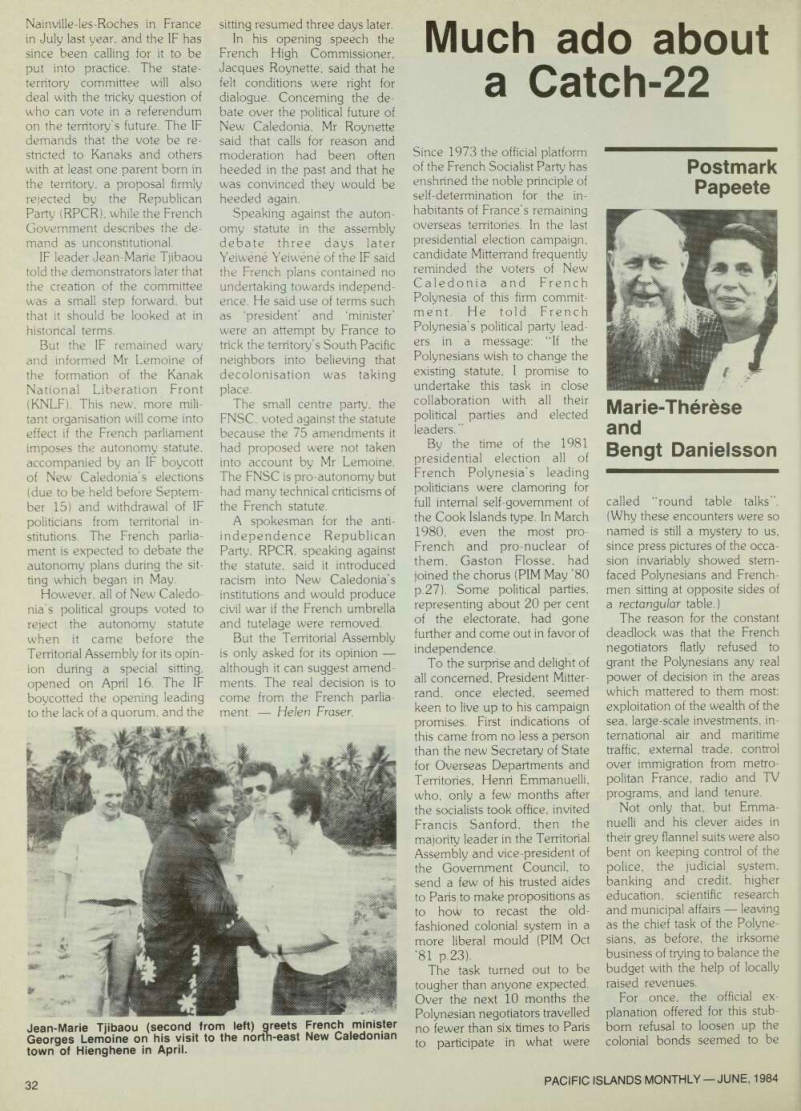
for Mr Lemoine
Independence Front (IF) mem bers boycotted the visit in early April of French Minister for Overseas Territories, Georges Lemoine. Mr Lemoine, who visited New Caledonia twice in 1983. came this time to discuss the five-year autonomy statute proposed by his government.
However, unlike previous trips,
the minister spent most of his time in the countryside and only met with political leaders the day of his departure.
In calling the boycott, and for demonstrations in the villages visited by the minister, the IF accused France of using the autonomy statute to continue colonialism for another five
years, and of ignoring their call for a precise timetable leading to independence.
But the first demonstration encountered by Mr Lemoine was put on by the Caledonian Front, a hard-line group opposed to independence.
About 100 Caledonian Front members, led by Republican member of the territorial assem bly, Justin Guillemard, demon strated outside the administra tive headquarters at La Foa on the west coast. The demonstra tors told the minister they were fed up with harassment from the IF in the countryside and with land occupations. They called for an end to the land reform system, and for respect for private property and for democratic rights. One Caledo nian Front member warned there could be “regrettable inci dents”, because European far mers had reached the limits of tolerance.
Throughout his tour of the northwest and the top half of the east coast Mr Lemoine encountered a cold reception from Kanak villagers. At Noelly, in the mountain chain, demon strators told the minister they rejected his autonomy project, and the tribal spokesman hesi tated to accept a custom gift. At Neamy, further on in the chain, the village was deserted save for an old man and children at kindergarten.
At Bopope, members of the Palika Party demonstrated against the autonomy statute and later discussed some of their claims with the minister. At Hienghene, on the northeast coast, Mr Lemoine lunched with mayor and IF leader Jean- Marie Tjibaou, as well as the great chiefs of the region. Mr Tjibaou explained to PIM that arrangements for Mr Lemoine’s visit to his town had been made before the IF decision to boycott. At the site for the Hienghene Cultural Centre Mr Lemoine was greeted by a demonstration and the Kanak independence flag flying from a traditional house.
Later the minister encoun tered a road block outside Ponerihouen where IF and Pali ka members told him they rejected the autonomy plans, and accused him of trying to divide the Kanak people. How ever, Mr Lemoine received a
warm welcome at Neoueta tribe at Ponerihouen where he spent the night. The minister was also greeted with traditional wel comes in the tribal villages in the southern district of Yate that he visited.
However, it was in Noumea that the largest demonstration awaited Mr Lemoine. About 600 IF and Palika members demonstrated on the minister’s last day in the territory, while he was holding talks with local political leaders. Led by IF leaders and members of the Territorial Assembly, the demonstration met up with a cordon of helmeted and shield carrying police, with the garde mobile behind them.
The police had received orders not to allow the demon strators to approach the gates of the French High Commission where the minister was en gaged in the talks. However, faced with the evident de termination of the demonstra tors to advance the 30 metres requested, even if it meant a battle with police, they were allowed to move forward. After speeches a delegation of 12 IF and trade union leaders were received by Mr Lemoine and spent 90 minutes with him.
The result of these talks was a joint statement, in which the IF and the minister agreed on the creation of a special state territory committee. The task of this committee will be to pre pare what was termed “the exercise of the innate and active right of the Kanak people to independence by way of a referendum.’’ This right was recognised by France during the round table talks held at
Noumea Notebook
Helen Fraser
Nainville-les-Roches in France in July last year, and the IF has since been calling for it to be put into practice. The state territory committee will also deal with the tricky question of who can vote in a referendum on the territory's future. The IF demands that the vote be re stricted to Kanaks and others with at least one parent born in the territory, a proposal firmly rejected by the Republican Party (RPCR). while the French Government describes the de mand as unconstitutional.
IF leader Jean-Marie Tjibaou told the demonstrators later that the creation of the committee was a small step forward, but that it should be looked at in historical terms.
But the IF remained wary and informed Mr Lemoine of the formation of the Kanak National Liberation Front (KNLF). This new. more mili tant organisation will come into effect if the French parliament imposes the autonomy statute, accompanied by an IF boycott of New Caledonia's elections (due to be held before Septem ber 15) and withdrawal of IF politicians from territorial in stitutions. The French parlia ment is expected to debate the autonomy plans during the sit ting which began in May.
However, all of New Caledo nia's political groups voted to reject the autonomy statute when it came before the Territorial Assembly for its opin ion during a special sitting, opened on April 16. The IF boycotted the opening leading to the lack of a quorum, and the
sitting resumed three days later.
In his opening speech the French High Commissioner.
Jacques Roynette. said that he felt conditions were right for dialogue. Concerning the de bate over the political future of New Caledonia. Mr Roynette said that calls for reason and moderation had been often heeded in the past and that he was convinced they would be heeded again.
Speaking against the auton omy statute in the assembly debate three days later Yeiwene Yeiwene of the IF said the French plans contained no undertaking towards independ ence. He said use of terms such as ‘president’ and ‘minister’ were an attempt by France to trick the territory’s South Pacific neighbors into believing that decolonisation was taking place.
The small centre party, the FNSC. voted against the statute because the 75 amendments it had proposed were not taken into account by Mr Lemoine.
The FNSC is pro-autonomy but had many technical criticisms of the French statute.
A spokesman for the anti independence Republican Party. RPCR. speaking against the statute, said it introduced racism into New Caledonia's institutions and would produce civil war if the French umbrella and tutelage were removed.
But the Territorial Assembly is only asked for its opinion although it can suggest amend ments. The real decision is to come from the French parlia
ment.
Helen Fraser.
Jean-Marie Tjibaou (second from left) greets French minister Georges Lemoine on his visit to the north-east New Caledonian town of Hienghene in April.
Advertisements & other items, pp. 30-31 (1 item)
Home
DARWIN COMMUNITY COLLEGE ]
SCHOOL OF EXTENSION SERVICES
CORRESPONDENCE
COURSES
Our new series for 1984 is now available. These courses are open to anyone Fees range from $4O Study at home, at your own pace, with no classes or examinations, using self instructional materials prepared by college staff and consultants. the coupon and return to.
Co-ordinator, Home Correspondence Courses, Darwin Community College, P.O. 80x40146, Casuarina, NT 5792, Australia Please send me: • Home Correspondence brochure: • Information on course numbers: Name: Address:
* * wt / m i / a/r helu zc&l ana u, u
Fly the easy way
New Zealand with
to us.
Making it easy for you to en joy your flight to New Zealand is easy for us, because we’re your kind of people; and also because we offer you our extra- friendly “Frangipani Service” from many Pacific Islands.
Ask your travel agent how you can make substantial savings within New Zealand with an “Air Pass” which gives you 14 or 21 days unlimited air travel. And you can also enjoy savings on our exclusive Hotpac hotel rates that put you into fine accommodation at especially favourable rates.
So, tell your travel agent: “I’d rather fly Number One!”
air /if n/ zEBLano
The Pacific’s Number One
1m
G0LD0647
a Catch-22
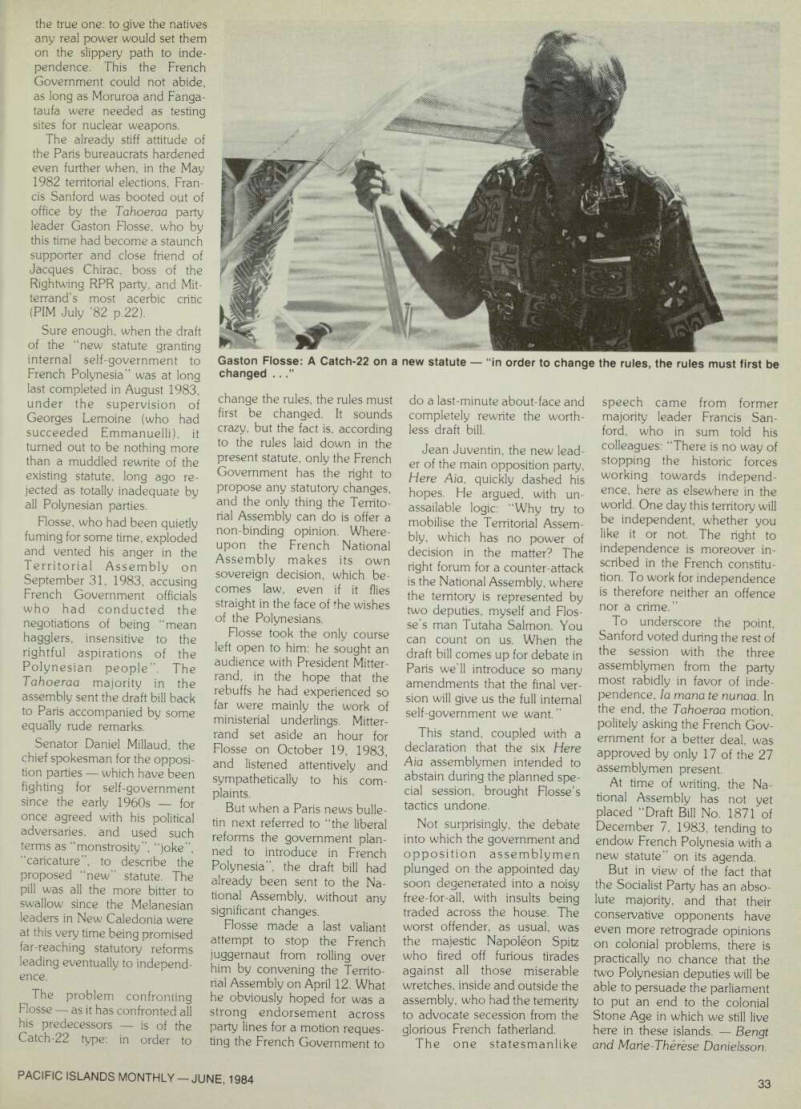
Much ado about a Catch-22
Since 1973 the official platform of the French Socialist Party has enshrined the noble principle of self-determination for the in habitants of France's remaining overseas territories. In the last presidential election campaign, candidate Mitterrand frequently reminded the voters of New Caledonia and French Polynesia of this firm commit ment. He told French Polynesia’s political party lead ers in a message; "If the Polynesians wish to change the existing statute, I promise to undertake this task in close collaboration with all their political parties and elected leaders."
By the time of the 1981 presidential election all of French Polynesia's leading politicians were clamoring for full internal self-government of the Cook Islands type. In March 1980. even the most pro- French and pro-nuclear of them. Gaston Flosse. had joined the chorus (PIM May 'BO p. 27). Some political parties, representing about 20 per cent of the electorate, had gone further and come out in favor of independence.
To the surprise and delight of all concerned, President Mitter rand. once elected, seemed keen to live up to his campaign promises. First indications of this came from no less a person than the new Secretary of State for Overseas Departments and Territories, Henri Emmanuelli, who, only a few months after the socialists took office, invited Francis Sanford, then the majority leader in the Territorial Assembly and vice-president of the Government Council, to send a few of his trusted aides to Paris to make propositions as to how to recast the old fashioned colonial system in a more liberal mould (PIM Oct 'Bl p. 23).
The task turned out to be tougher than anyone expected.
Over the next 10 months the Polynesian negotiators travelled no fewer than six times to Paris to participate in what were
called "round table talks”. (Why these encounters were so named is still a mystery to us, since press pictures of the occa sion invariably showed stern faced Polynesians and French men sitting at opposite sides of a rectangular table.) The reason for the constant deadlock was that the French negotiators flatly refused to grant the Polynesians any real power of decision in the areas which mattered to them most; exploitation of the wealth of the sea, large-scale investments, in ternational air and maritime traffic, external trade, control over immigration from metro politan France, radio and TV programs, and land tenure.
Not only that, but Emma nuelli and his clever aides in their grey flannel suits were also bent on keeping control of the police, the judicial system, banking and credit, higher education, scientific research and municipal affairs leaving as the chief task of the Polyne sians, as before, the irksome business of trying to balance the budget with the help of locally raised revenues.
For once, the official ex planation offered for this stub born refusal to loosen up the colonial bonds seemed to be
Postmark Papeete
Marie-Thérèse and Bengt Danielsson
the true one; to give the natives any real power would set them on the slippery path to inde pendence. This the French Government could not abide, as long as Moruroa and Fanga taufa were needed as testing sites for nuclear weapons.
The already stiff attitude of the Paris bureaucrats hardened even further when, in the May 1982 territorial elections. Fran cis Sanford was booted out of office by the Tahoeraa party leader Gaston Flosse. who by this time had become a staunch supporter and close friend of Jacques Chirac, boss of the Rightwing RPR party, and Mit terrand’s most acerbic critic (PIM July 'B2 p. 22).
Sure enough, when the draft of the “new statute granting internal self-government to French Polynesia” was at long last completed in August 1983, under the supervision of Georges Lemoine (who had succeeded Emmanuelli), it turned out to be nothing more than a muddled rewrite of the existing statute, long ago re jected as totally inadequate by all Polynesian parties.
Flosse, who had been quietly fuming for some time, exploded and vented his anger in the Territorial Assembly on September 31. 1983, accusing French Government officials who had conducted the negotiations of being “mean hagglers, insensitive to the rightful aspirations of the Polynesian people”. The Tahoeraa majority in the assembly sent the draft bill back to Paris accompanied by some equally rude remarks.
Senator Daniel Millaud. the chief spokesman for the opposi tion parties which have been fighting for self-government since the early 1960 s for once agreed with his political adversaries, and used such terms as “monstrosity”, “joke”, “caricature”, to describe the proposed “new” statute. The pill was all the more bitter to swallow since the Melanesian leaders in New Caledonia were at this very time being promised far-reaching statutory reforms leading eventually to independ ence.
The problem confronting Flosse as it has confronted all his predecessors is of the Catch-22 type; in order to
change the rules, the rules must first be changed. It sounds crazy, but the fact is, according to the rules laid down in the present statute, only the French Government has the right to propose any statutory changes, and the only thing the Territo rial Assembly can do is offer a non-binding opinion. Where upon the French National Assembly makes its own sovereign decision, which be comes law, even if it flies straight in the face of the wishes of the Polynesians.
Flosse took the only course left open to him: he sought an audience with President Mitter rand, in the hope that the rebuffs he had experienced so far were mainly the work of ministerial underlings. Mitter rand set aside an hour for Flosse on October 19, 1983, and listened attentively and sympathetically to his com plaints.
But when a Paris news bulle tin next referred to “the liberal reforms the government plan ned to introduce in French Polynesia”, the draft bill had already been sent to the Na tional Assembly, without any significant changes.
Flosse made a last valiant attempt to stop the French juggernaut from rolling over him by convening the Territo rial Assembly on April 12. What he obviously hoped for was a strong endorsement across party lines for a motion reques ting the French Government to
do a last-minute about-face and completely rewrite the worth less draft bill.
Jean Juventin, the new lead er of the main opposition party.
Here Aia . quickly dashed his hopes. He argued, with un assailable logic: "Why try to mobilise the Territorial Assem bly, which has no power of decision in the matter? The right forum for a counter-attack is the National Assembly, where the territory is represented by two deputies, myself and Flos se's man Tutaha Salmon. You can count on us. When the draft bill comes up for debate in Paris we’ll introduce so many amendments that the final ver sion will give us the full internal self-government we want.”
This stand, coupled with a declaration that the six Here Aia assemblymen intended to abstain during the planned spe cial session, brought Flosse’s tactics undone.
Not surprisingly, the debate into which the government and opposition assemblymen plunged on the appointed day soon degenerated into a noisy free-for-all. with insults being traded across the house. The worst offender, as usual, was the majestic Napoleon Spitz who fired off furious tirades against all those miserable wretches, inside and outside the assembly, who had the temerity to advocate secession from the glorious French fatherland.
The one statesmanlike
speech came from former majority leader Francis San ford, who in sum told his colleagues: "There is no way of stopping the historic forces working towards independ ence, here as elsewhere in the world. One day this territory will be independent, whether you like it or not. The right to independence is moreover in scribed in the French constitu tion. To work for independence is therefore neither an offence nor a crime.”
To underscore the point.
Sanford voted during the rest of the session with the three assemblymen from the party most rabidly in favor of inde pendence, la mono te nunaa. In the end, the Tohoeraa motion, politely asking the French Gov ernment for a better deal, was approved by only 17 of the 27 assemblymen present.
At time of writing, the Na tional Assembly has not yet placed "Draft Bill No. 1871 of December 7. 1983, tending to endow French Polynesia with a new statute” on its agenda.
But in view of the fact that the Socialist Party has an abso lute majority, and that their conservative opponents have even more retrograde opinions on colonial problems, there is practically no chance that the two Polynesian deputies will be able to persuade the parliament to put an end to the colonial Stone Age in which we still live here in these islands. Bengt and Marie-Therese Danielsson.
Gaston Flosse: A Catch-22 on a new statute - “in order to change the rules, the rules must first be changed ..."
Advertisements & other items, p. 34 (1 item)
The Search Is Over
You were looking for the perfect fit, U ncompromising sound quality. As beautiful to look at as it is to listen to. Advanced electronics. A choice of sophisticated features that are easy to use. Reliability that's no fairy tale. Clarion makes a wide selection of models, with one that’s just your size. Clarion Car Stereo. Listen, and drive happily ever after, vld 11011
FADER
model 900 E Clarion Ml - 11 11 I U
B iu
i m
LD ME
Arc ■ For further information - Australia: Amalgamated Wireless (Australasia) Ltd., 554 Parramatta Road, Ashfield, NSW, 2131 1 New Zealand: AWA New ZialancLirrled PO 8 Suva / Tahiti: HI-FI Shangrila, B.P. 200, Papeete / New Caledonia: Caldis, 8.P.M1, Noumea Cedex / Guam: Micropac Audio Inc PO. Box 3478. Agana Guam 969 p °-. J. 72 80r0 o Port Moresby Vanuatu- The Sound Centre PO. Box 434, Vila / Cook Islands: South Seas International Ltd., P.O, Box 49, Rarotonga / Papua New Guinea: Hagemeyer (P.N.G.) Pty. Ltd., P.O. Box 1428, Boroko, Port Moresby.
“Popjonpul, mipela laikim yu!"


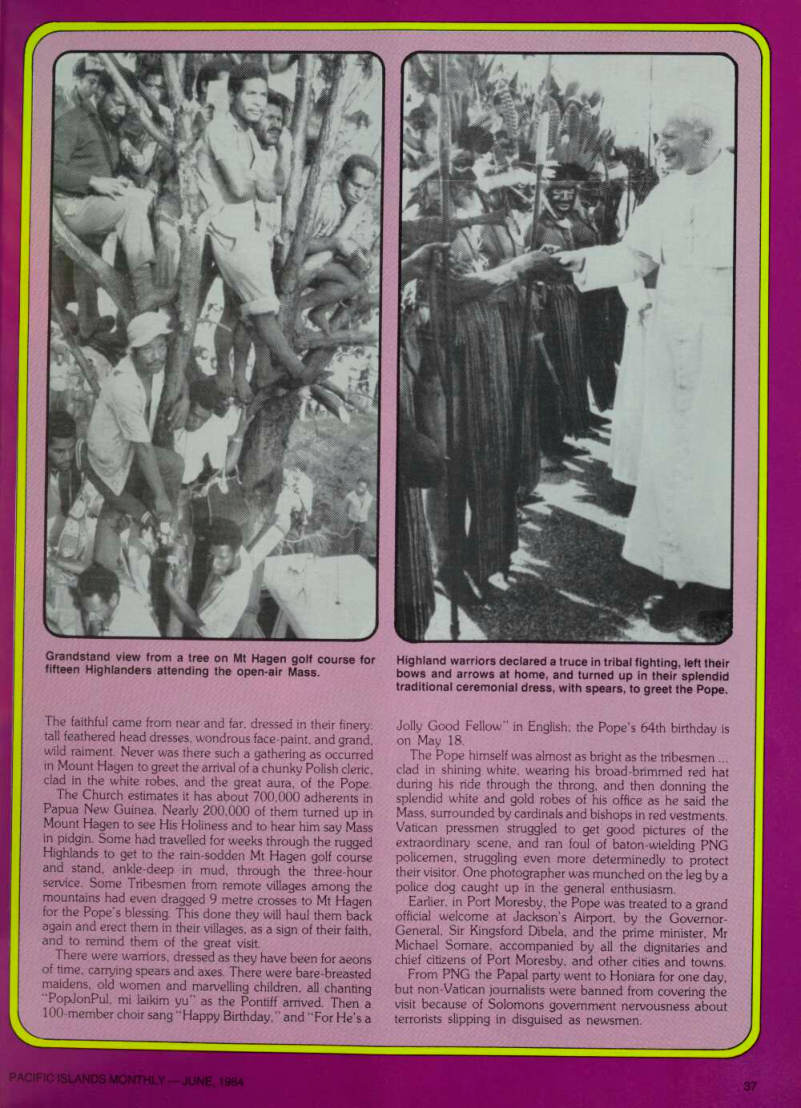

The Pope greets two tiny Highland children during the open-air Mass at Mt Hagen. AP color radiophoto.
The faithful came from near and far. dressed in their finery: tall feathered head dresses, wondrous face-paint, and grand, wild raiment. Never was there such a gathering as occurred in Mount Hagen to greet the arrival of a chunky Polish cleric, clad in the white robes, and the great aura, of the Pope.
The Church estimates it has about 700,000 adherents in Papua New Guinea. Nearly 200,000 of them turned up in Mount Hagen to see His Holiness and to hear him say Mass in pidgin. Some had travelled for weeks through the rugged Highlands to get to the rain-sodden Mt Hagen golf course and stand, ankle-deep in mud, through the three-hour service. Some Tribesmen from remote villages among the mountains had even dragged 9 metre crosses to Mt Hagen for the Pope’s blessing. This done they will haul them back again and erect them in their villages, as a sign of their faith, and to remind them of the great visit.
There were warriors, dressed as they have been for aeons of time, carrying spears and axes. There were bare-breasted maidens, old women and marvelling children, all chanting “PopJonPul. mi laikim yu” as the Pontiff arrived. Then a 100-member choir sang ‘‘Happy Birthday,” and ‘‘For He’s a
Jolly Good Fellow” in English; the Pope’s 64th birthday is on May 18.
The Pope himself was almost as bright as the tribesmen ... clad in shining white, wearing his broad-brimmed red hat during his ride through the throng, and then donning the splendid white and gold robes of his office as he said the Mass, surrounded by cardinals and bishops in red vestments.
Vatican pressmen struggled to get good pictures of the extraordinary scene, and ran foul of baton-wielding PNG policemen, struggling even more determinedly to protect their visitor. One photographer was munched on the leg by a police dog caught up in the general enthusiasm.
Earlier, in Port Moresby, the Pope was treated to a grand official welcome at Jackson’s Airport, by the Governor- General. Sir Kingsford Dibela, and the prime minister, Mr Michael Somare, accompanied by all the dignitaries and chief citizens of Port Moresby, and other cities and towns.
From PNG the Papal party went to Honiara for one day, but non-Vatican journalists were banned from covering the visit because of Solomons government nervousness about terrorists slipping in disguised as newsmen.
Grandstand view from a tree on Mt Hagen golf course for fifteen Highlanders attending the open-air Mass.
Highland warriors declared a truce in tribal fighting, left their bows and arrows at home, and turned up in their splendid traditional ceremonial dress, with spears, to greet the Pope.
Nearly 200,000 people thronged Mt Hagen for the Pope’s visit. Flanked by police cars, attended by cardinals, he was given a tumultuous welcome.
A gift of arrows, hunting variety, for the Pope, handed up to his Land Rover from the pressed-tight crowd.
Off to Honiara: The Pope boards an Air Niugini F28 jet airliner for the trip from Port Moresby to Honiara on May 9.
Advertisements & other items, pp. 36-39 (1 item)
Kenwood
Here’s one way to improve the quality of your life. Listen just once to some familiar music from a Spectrum stereo system.
You’ll hear rich, dynamic and “pure” music like you’ve never heard at home before!
Spectrum systems also offer a whole array of helpful functions—electronic and
computerized. Plus plenty of fingertip-ready
operating convenience.
Spectrum stereo component systems.
Engineered for you by world-leading
audio specialists.
IJ I 111 - Top Features of Spectrum 72 Shown ■29 OW Dynamic Power Output (4 ohms) ■Advanced parametric tone controls ■Computer-guided tuning and 10-station random memory ■ Double cassette deck with doublespeed dubbing Computerized tape music search/ repeat system S' =: a Hiiiiiiiiiii SI ■ - —Aik Hkt ' - :
KENWOOD
TRIO-KENWOOD CORPORATION
Shionogi Shibuya Building, 17-5, 2-chome Shibuya, Shibuya-ku, Tokyo 150, Japan TRIO-KENWOOD (AUSTRALIA) PTY. LTD. (INCORPORATED IN N S W.) 4E Woodcock Place, Lane Cove, N.S.W. 2066, Australia. Tel: 428-1455 NEW ZEALAND JOHN GILBERT & CO., LTD, Auckland Tel. 0011-64-9-30839 FIJI PEPE’S DUTY FREE CENTRE LTD. Tel. 25496, 25497 PAPUA NEW GUINEA S.O. SVENSSON (N.G.) LTD. Port Moresby Tel. 212158, 212111 SOLOMON ISLANDS TECHNIQUE RADIOS CENTRE LTD. Honiara Tel. 416 NEW CALEDONIA HI-FI VOX Noumea Tel. 27-2466, 28-2931 VANUATU FUNG CHOI LUEN. Port-Vila Tel. 2556
TAHITI MAISON AURORE Papeete Tel. 29703
AMERICAN SAMOA ISLAND PACIFIC AGENCIES, INC. Pago Pago Tel. 633-4687
REPUBLIC OF NAURU NAURU CO-OPERATIVE SOCIETY
MARIANA ISLANDS J.C. TENORIO ENTERPRISES Saipan Tel. 6445
NEW ’B4 TOYOTA
INTRODUCING PERFOf
Performance p comfort.
Performance plus durability.
Performance plus variety.
Advanced, powerful new engines put you in command with higher torque, better efficiency. Inside, more driving comfort than ever before - with a roomier cabin, bigger windscreens, and lean, clean instrumentation. Newly designed suspension gives you big carrying capability, yet carries you in comfort HILUX is one tough truck with a suspension you can count on. Choose from a wide variety, including 4WD regular or double cab - and two new additions - 2WD extra cab and flatdeck. The all-new Toyota HILUX. Add it all up, and you have performance plus! i I iiiii dL
TOYOTA
QUALITY SERVICE
AMERICAN SAMOA: BURNS PHILP (SOUTH SEA)
CO., LTD., P.O. Box 129, Pago Pago.
COOK ISLANDS: COOK ISLANDS TRADING
CORPORATION LTD., Private Bag, Rarotonga.
FIJI: AUTOMOTIVE SUPPLIES COMPANY, G.P.O.
Box 355, Suva.
GUAM A MICRONESIA: ATKINS, KROLL (GUAM) LTD. 443 South Marine Drive, Tamuning.
KIRIBATI: TARAWA MOTORS, P.O. Box 36, Bairiki, Tarawa, Kiribati.
NAURU: NAURU COOPERATIVE SOCIETY.
NEW CALEDONIA: SERVICE IMPORTATION
AUTOMOBILE DU PACIFIQUE, Rond-Point du Pach (Station Total) B.P. 438, Noumea.
MANGE PLUS!
H 4WD Double Cab lORFOLK ISLAND: SORRY’S LIMITED, P.O. Box 169 •APUA NEW GUINEA: ELA MOTORS, A Division of lurns Philp (PNG) Ltd., P.O. Box 75, Port Moresby.
iAIPAN: MICROL CORPORATION, P.O. Box 267,
aipan.
OLOMON: MENDANA ENTERPRISES (5.1.) LTD.,
i.P.O. Box 174, Honiara.
TAHITI; NIPPON AUTOMOTO, P.O. Box 342, Papeete.
TONGA: BURNS PHILP (SOUTH SEA) CO., LTD., P.O. Box 55, Nukualofa.
VANUATU: VANUATU MOTORS, P.O. Box 18,
Port Vila.
WESTERN SAMOA: BURNS PHILP (SOUTH SEA)
CO., LTD., P.O. Box 188, Apia.
TOYOTA
of fishing pressure’
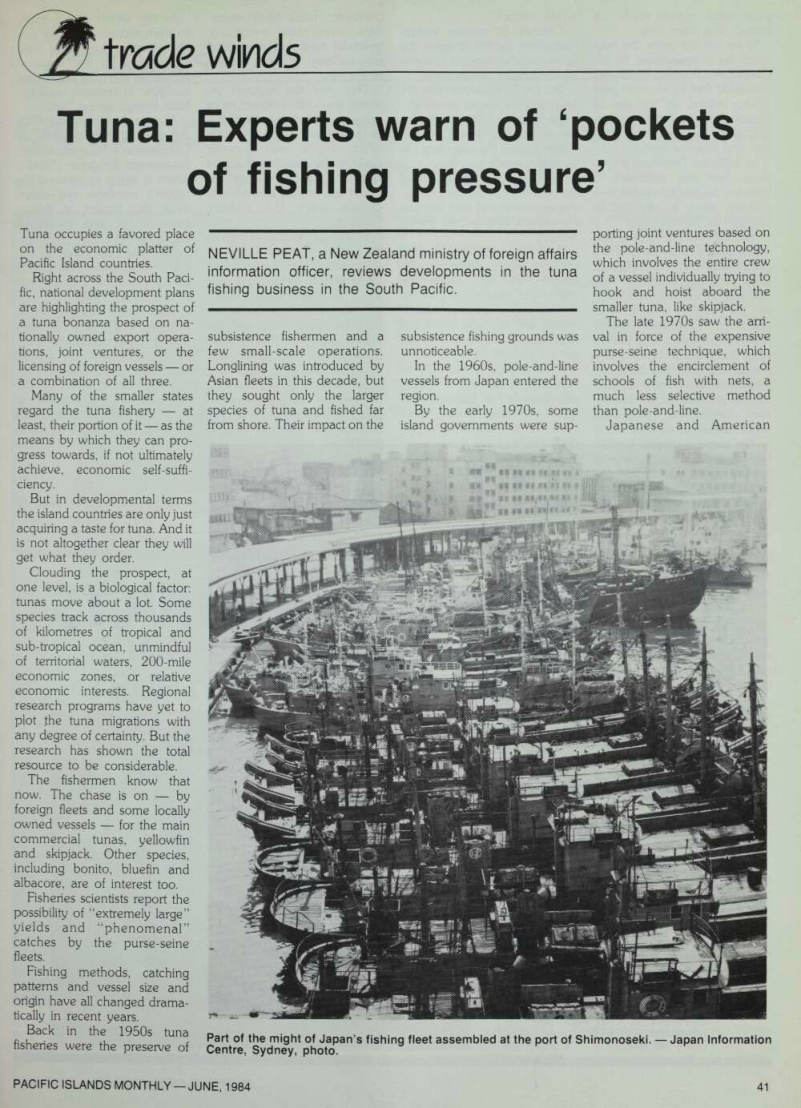

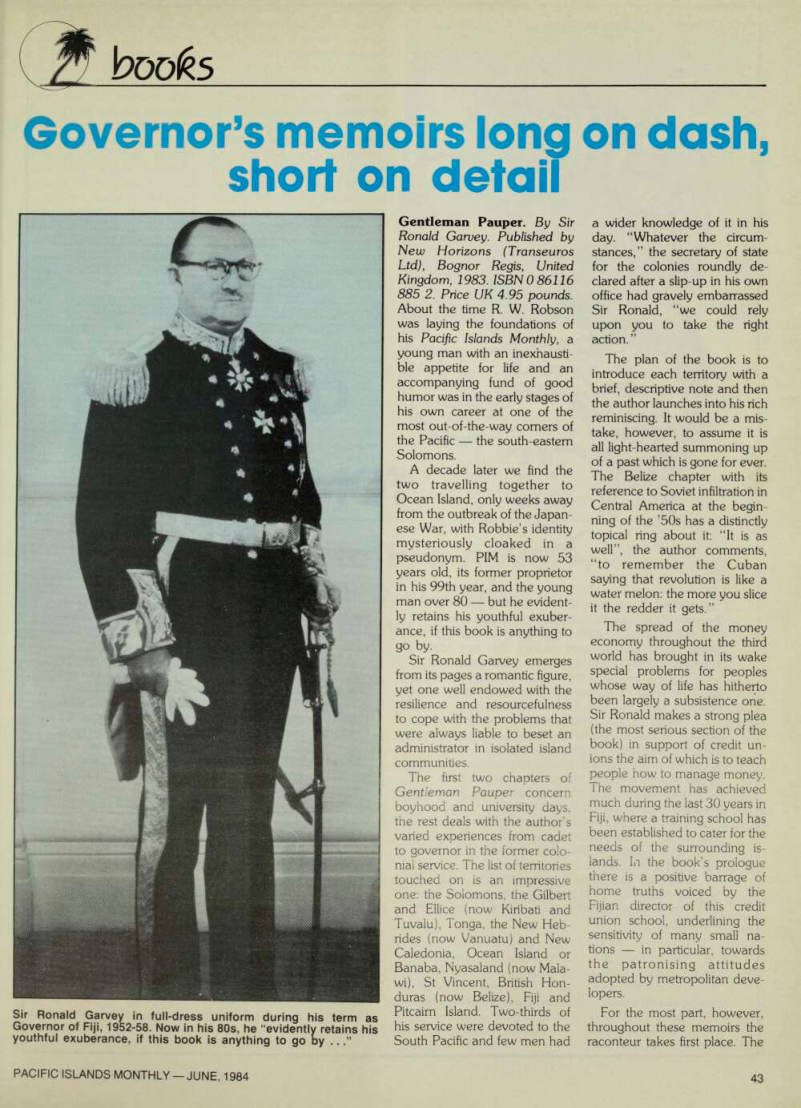

trade winds
Tuna: Experts warn of ‘pockets of fishing pressure’
NEVILLE PEAT, a New Zealand ministry of foreign affairs , information officer, reviews developments in the tuna fishing business in the South Pacific.
Tuna occupies a favored place on the economic platter of Pacific Island countries.
Right across the South Paci fic, national development plans are highlighting the prospect of a tuna bonanza based on na tionally owned export opera tions, joint ventures, or the licensing of foreign vessels or a combination of all three.
Many of the smaller states regard the tuna fishery at least, their portion of it as the means by which they can pro gress towards, if not ultimately achieve, economic self-suffi ciency.
But in developmental terms the island countries are only just acquiring a taste for tuna. And it is not altogether clear they will get what they order.
Clouding the prospect, at one level, is a biological factor: tunas move about a lot. Some species track across thousands of kilometres of tropical and sub-tropical ocean, unmindful of territorial waters, 200-mile economic zones, or relative economic interests. Regional research programs have yet to plot the tuna migrations with any degree of certainty. But the research has shown the total resource to be considerable.
The fishermen know that now. The chase is on by foreign fleets and some locally owned vessels for the main commercial tunas, yellowfin and skipjack. Other species, including bonito, bluefin and albacore, are of interest too.
Fisheries scientists report the possibility of “extremely large” yields and “phenomenal” catches by the purse-seine fleets.
Fishing methods, catching patterns and vessel size and origin have all changed drama tically in recent years.
Back in the 1950 s tuna fisheries were the preserve of
subsistence fishermen and a few small-scale operations.
Longlining was introduced by Asian fleets in this decade, but they sought only the larger species of tuna and fished far from shore. Their impact on the
subsistence fishing grounds was unnoticeable.
In the 19605, pole-and-line vessels from Japan entered the region.
By the early 19705, some island governments were sup
porting joint ventures based on the pole-and-line technology, which involves the entire crew of a vessel individually trying to hook and hoist aboard the smaller tuna, like skipjack.
The late 1970 s saw the arri val in force of the expensive purse-seine technique, which involves the encirclement of schools of fish with nets, a much less selective method than pole-and-line.
Japanese and American
Part of the might of Japan’s fishing fleet assembled at the port of Shimonoseki. - Japan Information Centre, Sydney, photo.
purse-seine vessels made an impact in a short time.
In the last few years, the tuna catch by purse-seining in the Central and Western Pacific has exceeded that by all other gear types. Indeed, as the use of purse-seining has spread, there has been a decline in pole-and line and longline fleets.
In 1983 the American purse seine fleet was estimated at between 50 and 60 vessels a number which is expected to increase to 90 this year.
Yet last year the industry was in the throes of a slump. Tuna prices were low. A glut affected some American canneries. And changes in oceanic conditions in the Eastern Pacific (the Southern Oscillation/E/ Nino de Nauidad phenomenon) altered tuna migration habits and caused many of the American vessels to work more assured fishing grounds in the South west Pacific, far from their traditional areas of operation.
The purse-seiners seek main ly the big yellowfin tuna, a species more abundant in the South Pacific than previously thought. Studies show this, and
so do catches.
Catches by certain foreign fleets now exceed in value the gross national product of some of the smaller island states.
But the fisheries scientists are beginning to sound warnings.
Pockets of fishing pressure are expected to have a regional bearing given the migratory na ture of tunas.
There is now officially “cause for concern” about the increas ing exploitation of tuna fisheries by vessels engaged in purse seining.
As for the skipjack tuna, the goal of pole-and-line vessels, catches are well within the maximum sustainable yield of known stocks, although the sci entists are quick to point out that fishery inter-action is still poorly understood.
Optimum yields will only be achieved, they say, if fishing effort heeds the distribution of fish in other words, some form of management is re quired at regional level.
Fisheries officers in island governments are warned to look out for evidence of “heavy localised exploitation” by, in
particular, purse-seine opera tions, which take everything, yellowfin tuna and everything else enclosed by the great bite of the net.
This year the regional re search work will try to win more catch-and-effort data from the distant-water fleets data which can be used to better evaluate the standing stocks of tuna and the inter-action be tween and among fisheries that comes from the fishing pressure.
What regional bodies such as the Forum Fisheries Agency (Honiara) and the South Pacific Commission (Noumea) are trying to demonstrate is that although the total resources may be great, they are not infinite, and that the best-laid management plans for one country’s 200-mile zone can come unstuck if due account is not taken of the fishing activities going on next door.
These two organisations are committed to identifying the resources available to each of the island member countries, and to maximising economic returns.
As one aspect of this effort, an international conference due to be held in Noumea in June will attempt to find ways of improving the tuna catch data available to research scientists from foreign fishing fleets.
The conference arises from the work of the South Pacific Commission’s Tuna and Billfish Assessment Program (TBAP), which is trying to evaluate the region’s resources and deter mine the impact of fishing pressure on tuna fishery in particular.
Up until now research has been hampered by the lack of catch-and-effort data from foreign fishing fleets.
The TBAP was set up in October, 1981, as a successor to a four-year program of re search into one commercial species of tuna, skipjack.
New Zealand, under its offi cial regional aid program in the South Pacific, contributed $BO,OOO towards the TBAP in 1982-83 and $60,000 in the current year.
continued on page 50
from page 42
The proposed September, 1984, completion date was ex tended by two years at the 23rd South Pacific Conference at Saipan (Northern Mariana Is lands) last October.
The same meeting accepted a recommendation from a technical committee that the program’s priorities be revised in 1984-86 to give emphasis to assessing levels of exploitation of the commercially-important tuna species. This would be achieved largely through obser ver programs on distant-water fishing vessels, and increased catch sampling.
In addition, the TBAP will study “inter-action” in greater depth, from three perspectives: Regional how fishing pres sure on highly migratory spe cies is reflected in the various country fisheries.
National how the various fisheries within a country inter act (for example, the impact of foreign fishing vessels’ activities on subsistence fisheries).
Technical a comparative study of the different gear types, including purse-seine,
pole-and-line, and longline, and their impact on various fisheries.
Other priorities in the 1984- 86 extension period include studies to compare the biologi cal data of major species with relevant oceanographic and en vironmental information, stu dies of baitfish biology and ecology, and monitoring of the use of fish aggregation devices such as anchored rafts.
In support of the new priori ties, the Saipan conference agreed to the idea of a round table meeting of coastal states, distant-water fishing nations and international organisations with experience in the field, with the aim of improving the “input” of distant-water fishing nations.
The SPC Secretariat was directed to consult with the Forum Fisheries Agency in Honiara about convening this June meeting in Noumea.
A draft budget for the TBAP in 1984-86 estimates expendi ture at over $4 million with more than half of the cost being
for vessel charter.
Neville
Peat.
Advertisements & other items, p. 42 (1 item)
Longlife Products
11
AND FRESH DAIRY FOODS,
QUALITY YOU CAN TRUST
QUF Industries Ltd. offers an export award winning range of Longlife products as well as a complete range of quality fresh dairy foods.
With 15 years’ experience in export markets, QUF has the product knowledge and expertise to provide you with outstanding service in the 1980’s. • Pauls Longlife UHT Milk is natural liquid cow's milk with no preservatives or additives and is available in the 250m1, 500 ml and 1 litre sizes. • Shake Longlife flavoured milk is offered in delicious Chocolate, Malted, Caramel and Strawberry flavours. • Pauls Longlife Thickened Cream is ideal for whipping or pouring. • Popper 100% Fruit Juice is available in seven flavours in a wide range of Longlife pack sizes. • Pauls fresh Dairy Products including Milk, Cream, Yoghurt and Cottage Cheese are available in an extensive range of flavours and sizes,
TRADE ENQUIRIES:
QUF Industries Ltd., P.O. Box 12, South Brisbane, Queensland, 4101 Australia Telephone: (07) 44-0151 Telex: AA 40614 " c* a V J nuchened mm r« nn
NIEW
c_ ’• u
m iK
hulk UfTRf 4 I
mi IK
books
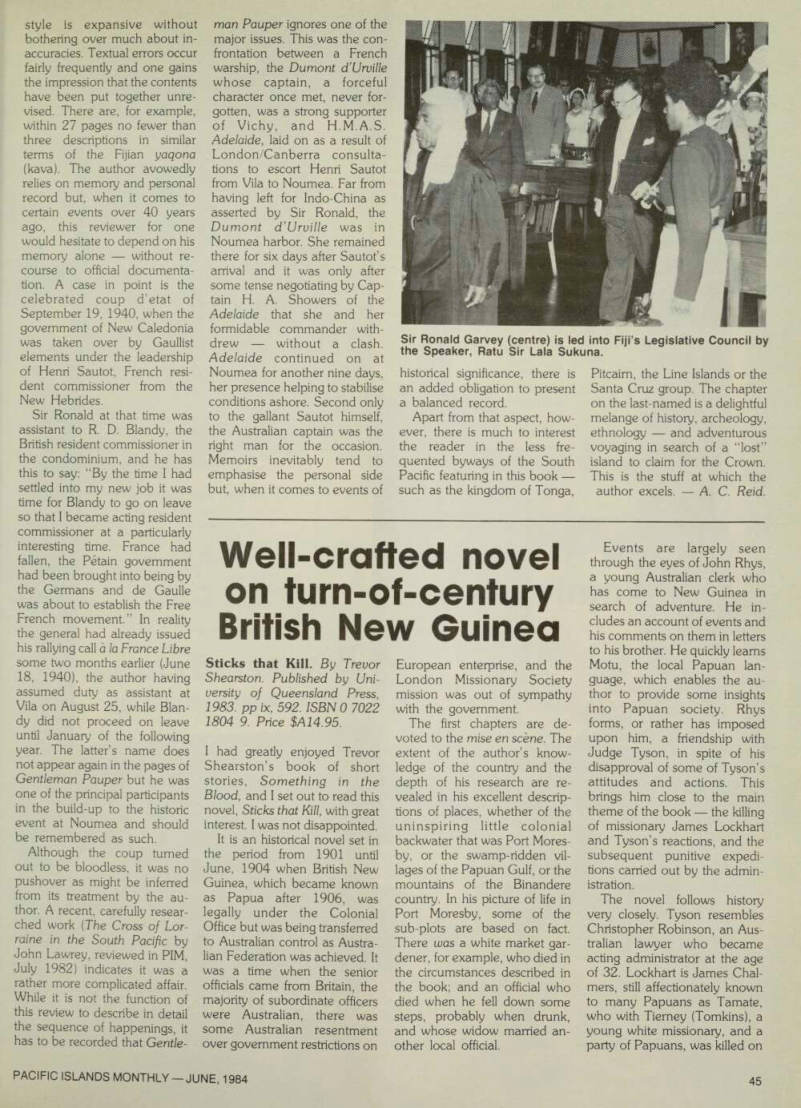
Governor’s memoirs long on dash, short on detail
Gentleman Pauper. By Sir Ronald Garvey. Published by blew Horizons (Transeuros Ltd), Bognor Regis, United Kingdom, 1983. ISBN 0 86116 885 2. Price UK 4.95 pounds.
About the time R. W. Robson was laying the foundations of his Pacific Islands Monthly, a young man with an inexhausti ble appetite for life and an accompanying fund of good humor was in the early stages of his own career at one of the most out-of-the-way comers of the Pacific the south-eastern Solomons.
A decade later we find the two travelling together to Ocean Island, only weeks away from the outbreak of the Japan ese War, with Robbie’s identity mysteriously cloaked in a pseudonym. PIM is now 53 years old, its former proprietor in his 99th year, and the young man over 80 but he evident ly retains his youthful exuber ance, if this book is anything to go by.
Sir Ronald Garvey emerges from its pages a romantic figure, yet one well endowed with the resilience and resourcefulness to cope with the problems that were always liable to beset an administrator in isolated island communities.
The first two chapters of Gentleman Pauper concern boyhood and university days, the rest deals with the author’s varied experiences from cadet to governor in the former colo nial service. The list of territories touched on is an impressive one; the Solomons, the Gilbert and Ellice (now Kiribati and Tuvalu), Tonga, the New Heb rides (now Vanuatu) and New Caledonia, Ocean Island or Banaba, Nyasaland (now Mala wi), St Vincent, British Hon duras (now Belize), Fiji and Pitcairn Island. Two-thirds of his service were devoted to the South Pacific and few men had
a wider knowledge of it in his day. “Whatever the circum stances,” the secretary of state for the colonies roundly de clared after a slip-up in his own office had gravely embarrassed Sir Ronald, “we could rely upon you to take the right action.”
The plan of the book is to introduce each territory with a brief, descriptive note and then the author launches into his rich reminiscing. It would be a mis take, however, to assume it is all light-hearted summoning up of a past which is gone for ever.
The Belize chapter with its reference to Soviet infiltration in Central America at the begin ning of the ’sos has a distinctly topical ring about it: “It is as well”, the author comments, “to remember the Cuban saying that revolution is like a water melon; the more you slice it the redder it gets.”
The spread of the money economy throughout the third world has brought in its wake special problems for peoples whose way of life has hitherto been largely a subsistence one.
Sir Ronald makes a strong plea (the most serious section of the book) in support of credit un ions the aim of which is to teach people how to manage money.
The movement has achieved much during the last 30 years in Fiji, where a training school has been established to cater for the needs of the surrounding is lands. In the book’s prologue there is a positive barrage of home truths voiced by the Fijian director of this credit union school, underlining the sensitivity of many small na tions in particular, towards the patronising attitudes adopted by metropolitan deve lopers.
For the most part, however, throughout these memoirs the raconteur takes first place. The
Sir Ronald Garvey in full-dress uniform during his term as Governor of Fiji, 1952-58. Now in his 80s, he “evidently retains his youthful exuberance, if this book is anything to go by .."
man Pauper ignores one of the major issues. This was the con frontation between a French warship, the Dumont d’Urville whose captain, a forceful character once met, never for gotten, was a strong supporter of Vichy, and H.M.A.S.
Adelaide, laid on as a result of London/Canberra consulta tions to escort Henri Sautot from Vila to Noumea. Far from having left for Indo-China as asserted by Sir Ronald, the Dumont d’Urville was in Noumea harbor. She remained there for six days after Sautot’s arrival and it was only after some tense negotiating by Cap tain H. A. Showers of the Adelaide that she and her formidable commander with drew without a clash.
Adelaide continued on at Noumea for another nine days, her presence helping to stabilise conditions ashore. Second only to the gallant Sautot himself, the Australian captain was the right man for the occasion.
Memoirs inevitably tend to emphasise the personal side but, when it comes to events of
style is expansive without bothering over much about in accuracies. Textual errors occur fairly frequently and one gains the impression that the contents have been put together unre vised. There are, for example, within 27 pages no fewer than three descriptions in similar terms of the Fijian yaqona (kava). The author avowedly relies on memory and personal record but, when it comes to certain events over 40 years ago, this reviewer for one would hesitate to depend on his memory alone without re course to official documenta tion. A case in point is the celebrated coup d’etat of September 19, 1940, when the government of New Caledonia was taken over by Gaullist elements under the leadership of Henri Sautot, French resi dent commissioner from the New Hebrides.
Sir Ronald at that time was assistant to R. D. Blandy, the British resident commissioner in the condominium, and he has this to say; “By the time I had settled into my new job it was time for Blandy to go on leave so that I became acting resident commissioner at a particularly interesting time. France had fallen, the Retain government had been brought into being by the Germans and de Gaulle was about to establish the Free French movement.” In reality the general had already issued his rallying call d la France Libre some two months earlier (June 18, 1940), the author having assumed duty as assistant at Vila on August 25, while Blan dy did not proceed on leave until January of the following year. The latter’s name does not appear again in the pages of Gentleman Pauper but he was one of the principal participants in the build-up to the historic event at Noumea and should be remembered as such.
Although the coup turned out to be bloodless, it was no pushover as might be inferred from its treatment by the au thor. A recent, carefully resear ched work ( The Cross of Lor raine in the South Pacific by John Lawrey, reviewed in RIM, July 1982) indicates it was a rather more complicated affair.
While it is not the function of this review to describe in detail the sequence of happenings, it has to be recorded that Gentle-
historical significance, there is an added obligation to present a balanced record.
Apart from that aspect, how ever, there is much to interest the reader in the less fre quented byways of the South Pacific featuring in this book such as the kingdom of Tonga,
Pitcairn, the Line Islands or the Santa Cruz group. The chapter on the last-named is a delightful melange of history, archeology, ethnology and adventurous voyaging in search of a “lost” island to claim for the Crown.
This is the stuff at which the
author excels.
A. C. Reid.
Sir Ronald Garvey (centre) is led into Fiji’s Legislative Council by the Speaker, Ratu Sir Lala Sukuna.
Advertisements & other items, p. 44 (1 item)
Tomorrow’S
/-■ <r~7Z.» 1 -«®v.
'S’S r m k. h** *-* r a* r-
CHILDREN'S
HEALTH
TOMORROW’S
WEALTH
Half of the people who will be living on earth in the year 2000 haven’t even been born yet.
For the World Health Organization and its Member States, such as your own country, this fact offers a sobering challenge and reason for great hope.
Together we have set a goal of “Health for All by the Year 2000”. That has a special meaning for every country’s most precious asset its children.
“Health for All” means, not that nobody will get sick or that every ailment will be cured, but that all people, beginning at home and with children, shall know about the most common avoidable diseases and how to use simple, effective methods to prevent them.
More than 40,000 children died today, most from causes it doesn’t take a doctor to cure.
If only their mothers had known that breast-feeding both protects babies and provides the perfect nutritional start. Bottle-fed babies have been found to be 3-4 times more likely to malnourished.
Diarrhoea kills some 5 million children each year.
A home-made mixture of sugar and salt in water, called ORS, could have saved most if only their parents had known.
WHO ACKNOWLEDGES THE DONATION OF THIS SPACE ADVERTISEMENT PREPARED AS A PUBLIC SERVICE BYBOBOT V FONTANILLA -BA GRAPHICS.
Six common childhood diseases measles, polio, tetanus, diphtheria, whooping cough and tuberculosis claim another 5 million children. Simple, inexpensive vaccinations could have protected them.
Survival is the bottom line, but children are not statistics. Look into their eyes. True health is not just lack of disease. It is also a sense of dignity and worth.
It is a healthy, active mind stimulated by education.
Health, prosperity and quality of life are intertwined.
Children's health is tomorrow’s wealth in many ways.
Here in Asia, WHO is an active partner with national health services and people like you, in promoting practical, “primary health care” work in education, nutrition, safe water, mother & child health, immunization, control and treatment of local diseases, essential medicines and lifestyle diseases such as alcohol abuse and smoking.
Join us in the health revolution. Contact your local health service today or write to us directly. It can’t wait until the Year 2000!
WORLD HEALTH
ORGANIZATION
WESTERN PACIFIC
REGION
P.O BOX 2932
MANILA, PHILIPPINES
on turn-of-century
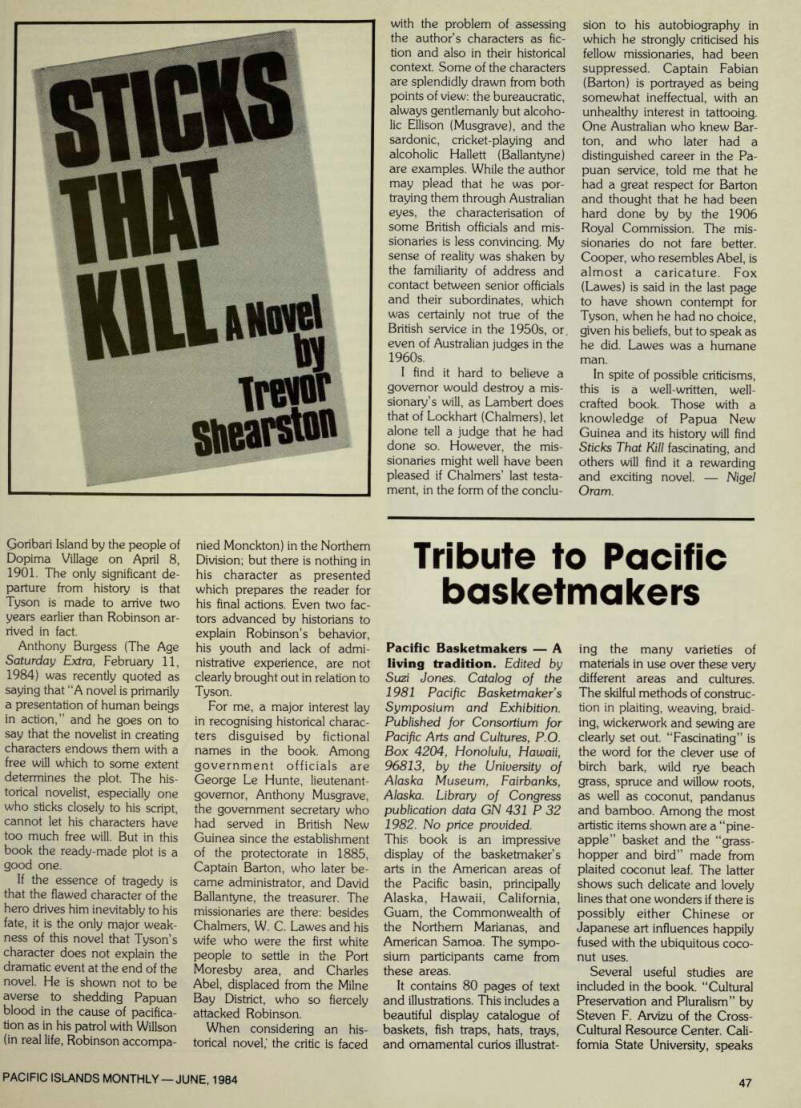
Well-crafted novel on turn-of-century British New Guinea
Sticks that Kill. By Trevor Shearston. Published by Uni versity of Queensland Press, 1983. pp ix, 592. ISBN 0 7022 1804 9. Price $A14.95.
I had greatly enjoyed Trevor Shearston’s book of short stories, Something in the Blood, and I set out to read this novel, Sticks that Kill, with great interest. I was not disappointed.
It is an historical novel set in the period from 1901 until June, 1904 when British New Guinea, which became known as Papua after 1906, was legally under the Colonial Office but was being transferred to Australian control as Austra lian Federation was achieved. It was a time when the senior officials came from Britain, the majority of subordinate officers were Australian, there was some Australian resentment over government restrictions on
European enterprise, and the London Missionary Society mission was out of sympathy with the government.
The first chapters are de voted to the mise en scene. The extent of the author’s know ledge of the country and the depth of his research are re vealed in his excellent descrip tions of places, whether of the uninspiring little colonial backwater that was Port Mores by, or the swamp-ridden vil lages of the Papuan Gulf, or the mountains of the Binandere country. In his picture of life in Port Moresby, some of the sub-plots are based on fact.
There was a white market gar dener, for example, who died in the circumstances described in the book; and an official who died when he fell down some steps, probably when drunk, and whose widow married an other local official.
Events are largely seen through the eyes of John Rhys, a young Australian clerk who has come to New Guinea in search of adventure. He in cludes an account of events and his comments on them in letters to his brother. He quickly leams Motu, the local Papuan lan guage, which enables the au thor to provide some insights into Papuan society. Rhys forms, or rather has imposed upon him, a friendship with Judge Tyson, in spite of his disapproval of some of Tyson’s attitudes and actions. This brings him close to the main theme of the book the killing of missionary James Lockhart and Tyson’s reactions, and the subsequent punitive expedi tions carried out by the admin istration.
The novel follows history very closely. Tyson resembles Christopher Robinson, an Aus tralian lawyer who became acting administrator at the age of 32. Lockhart is James Chal mers, still affectionately known to many Papuans as Tamate, who with Tierney (Tomkins), a young white missionary, and a party of Papuans, was killed on
Qoribari Island by the people of Dopima Village on April 8, 1901. The only significant departure from history is that Tyson is made to arrive two years earlier than Robinson arrived in fact.
Anthony Burgess (The Age Saturday Extra, February 11, 1984) was recently quoted as saying that “A novel is primarily a presentation of human beings in action,” and he goes on to say that the novelist in creating characters endows them with a free will which to some extent determines the plot. The historical novelist, especially one who sticks closely to his script, cannot let his characters have too much free will. But in this book the ready-made plot is a good one.
If the essence of tragedy is that the flawed character of the hero drives him inevitably to his fate, it is the only major weakness of this novel that Tyson’s character does not explain the dramatic event at the end of the novel. He is shown not to be averse to shedding Papuan blood in the cause of pacification as in his patrol with Willson (in real life, Robinson accompa-
nied Monckton) in the Northern Division; but there is nothing in his character as presented which prepares the reader for his final actions. Even two fac tors advanced by historians to explain Robinson’s behavior, his youth and lack of admi nistrative experience, are not clearly brought out in relation to Tyson.
For me, a major interest lay in recognising historical charac ters disguised by fictional names in the book. Among government officials are George Le Hunte, lieutenant governor, Anthony Musgrave, the government secretary who had served in British New Guinea since the establishment of the protectorate in 1885, Captain Barton, who later be came administrator, and David Ballantyne, the treasurer. The missionaries are there; besides Chalmers, W. C. Lawes and his wife who were the first white people to settle in the Port Moresby area, and Charles Abel, displaced from the Milne Bay District, who so fiercely attacked Robinson, When considering an his torical novel; the critic is faced
with the problem of assessing the author’s characters as fic tion and also in their historical context. Some of the characters are splendidly drawn from both points of view: the bureaucratic, always gentlemanly but alcoho lic Ellison (Musgrave), and the sardonic, cricket-playing and alcoholic Hallett (Ballantyne) are examples. While the author may plead that he was por traying them through Australian eyes, the characterisation of some British officials and mis sionaries is less convincing. My sense of reality was shaken by the familiarity of address and contact between senior officials and their subordinates, which was certainly not true of the British service in the 19505, or even of Australian judges in the 19605.
I find it hard to believe a governor would destroy a mis sionary’s will, as Lambert does that of Lockhart (Chalmers), let alone tell a judge that he had done so. However, the mis sionaries might well have been pleased if Chalmers’ last testa ment, in the form of the conclu
sion to his autobiography in which he strongly criticised his fellow missionaries, had been suppressed. Captain Fabian (Barton) is portrayed as being somewhat ineffectual, with an unhealthy interest in tattooing.
One Australian who knew Bar ton, and who later had a distinguished career in the Pa puan service, told me that he had a great respect for Barton and thought that he had been hard done by by the 1906 Royal Commission. The mis sionaries do not fare better.
Cooper, who resembles Abel, is almost a caricature. Fox (Lawes) is said in the last page to have shown contempt for Tyson, when he had no choice, given his beliefs, but to speak as he did. Lawes was a humane man.
In spite of possible criticisms, this is a well-written, well crafted book. Those with a knowledge of Papua New Guinea and its history will find Sticks That Kill fascinating, and others will find it a rewarding
and exciting novel.
Nigel
Oram.
Advertisements & other items, pp. 46-47 (1 item)
Bens on aj Hedges
m j m B
TRADITIONALLY THE NAME
ASSOCIATED WITH PERFECTION
IN CIGARETTES
BENSON & HEDGES
20
Bens on aj Hedges
WARNING-SMOKING IS A HEALTH HAZARD
♦ m
ONLY THE BEST WILL DO.
i si ill il *
basketmakers
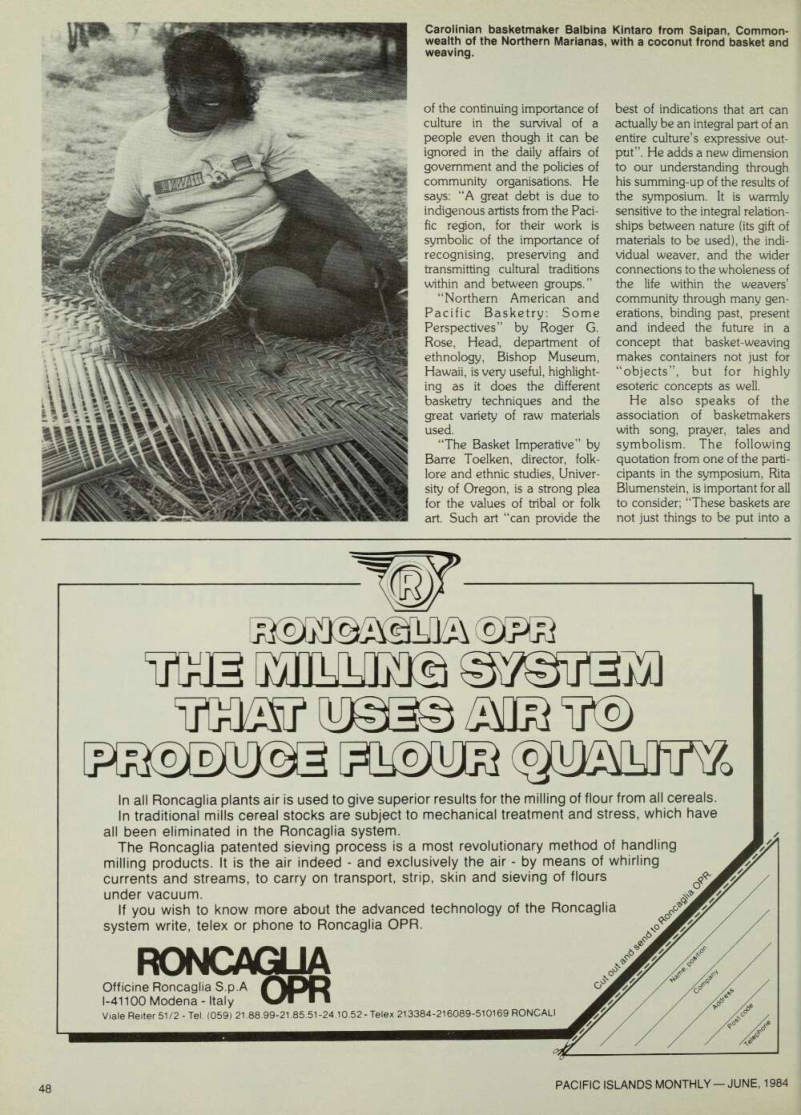
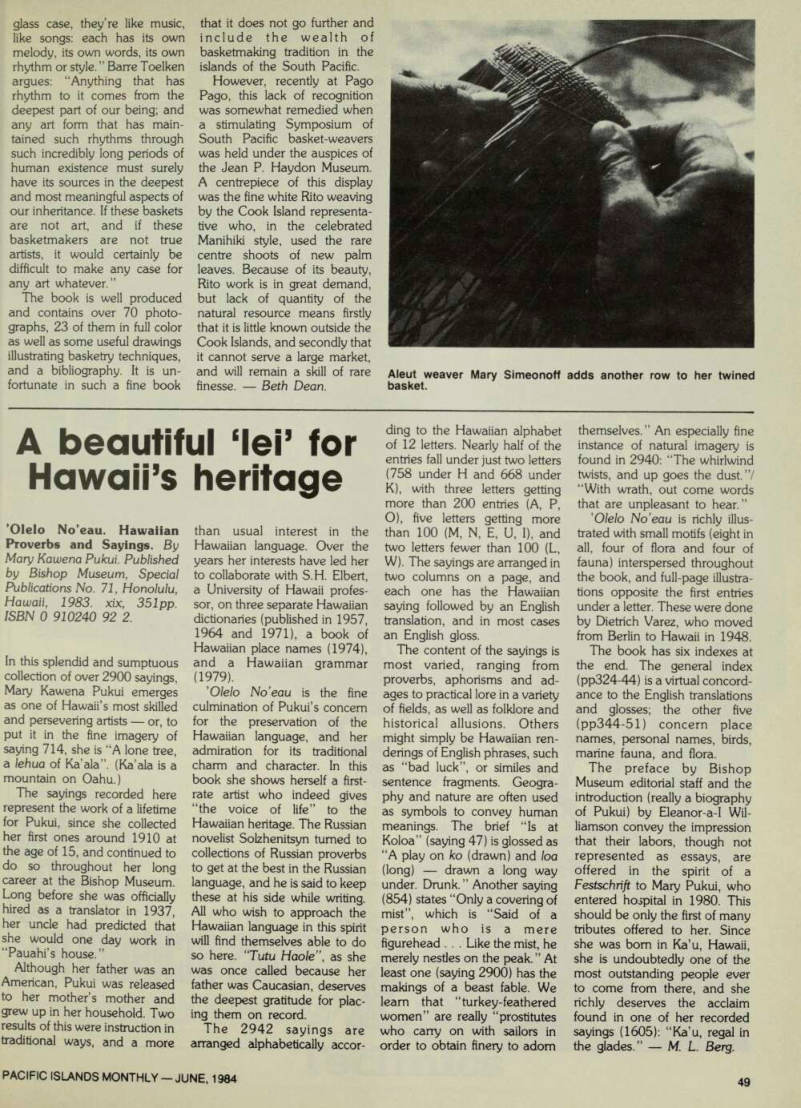
Tribute to Pacific basketmakers
Pacific Basketmakers A living tradition. Edited by Suzi Jones. Catalog of the 1981 Pacific Basketmakers Symposium and Exhibition.
Published for Consortium for Pacific Arts and Cultures, P.O.
Box 4204, Honolulu, Hawaii, 96813, by the University of Alaska Museum, Fairbanks, Alaska. Library of Congress publication data GN 431 P 32 1982. No price provided.
This book is an impressive display of the basketmaker’s arts in the American areas of the Pacific basin, principally Alaska, Hawaii, California, Guam, the Commonwealth of the Northern Marianas, and American Samoa. The sympo sium participants came from these areas.
It contains 80 pages of text and illustrations. This includes a beautiful display catalogue of baskets, fish traps, hats, trays, and ornamental curios illustrat
ing the many varieties of materials in use over these very different areas and cultures.
The skilful methods of construc tion in plaiting, weaving, braid ing, wickerwork and sewing are clearly set out. “Fascinating” is the word for the clever use of birch bark, wild rye beach grass, spruce and willow roots, as well as coconut, pandanus and bamboo. Among the most artistic items shown are a “pine apple” basket and the “grass hopper and bird” made from plaited coconut leaf. The latter shows such delicate and lovely lines that one wonders if there is possibly either Chinese or Japanese art influences happily fused with the übiquitous coco nut uses.
Several useful studies are included in the book. “Cultural Preservation and Pluralism” by Steven F. Arvizu of the Cross- Cultural Resource Center. Cali fornia State University, speaks
of the continuing importance of culture in the survival of a people even though it can be ignored in the daily affairs of government and the policies of community organisations. He says; “A great debt is due to indigenous artists from the Paci fic region, for their work is symbolic of the importance of recognising, preserving and transmitting cultural traditions within and between groups.”
“Northern American and Pacific Basketry: Some Perspectives” by Roger G.
Rose, Head, department of ethnology, Bishop Museum, Hawaii, is very useful, highlight ing as it does the different basketry techniques and the great variety of raw materials used.
“The Basket Imperative” by Barre Toelken, director, folk lore and ethnic studies, Univer sity of Oregon, is a strong plea for the values of tribal or folk art. Such art “can provide the
best of indications that art can actually be an integral part of an entire culture’s expressive out put”. He adds a new dimension to our understanding through his summing-up of the results of the symposium. It is warmly sensitive to the integral relation ships between nature (its gift of materials to be used), the indi vidual weaver, and the wider connections to the wholeness of the life within the weavers’ community through many gen erations, binding past, present and indeed the future in a concept that basket-weaving makes containers not just for “objects”, but for highly esoteric concepts as well.
He also speaks of the association of basketmakers with song, prayer, tales and symbolism. The following quotation from one of the parti cipants in the symposium, Rita Blumenstein, is important for all to consider; “These baskets are not just things to be put into a
Carolinian basketmaker Balbina Kintaro from Saipan, Common wealth of the Northern Marianas, with a coconut frond basket and weaving.
glass case, they’re like music, like songs: each has its own melody, its own words, its own rhythm or style.” Barre Toelken argues; “Anything that has rhythm to it comes from the deepest part of our being; and any art form that has maintained such rhythms through such incredibly long periods of human existence must surely have its sources in the deepest and most meaningful aspects of our inheritance. If these baskets are not art, and if these basketmakers are not true artists, it would certainly be difficult to make any case for any art whatever.”
The book is well produced and contains over 70 photographs, 23 of them in full color as well as some useful drawings illustrating basketry techniques, and a bibliography. It is unfortunate in such a fine book
that it does not go further and include the wealth of basketmaking tradition in the islands of the South Pacific, However, recently at Pago Pago, this lack of recognition was somewhat remedied when a stimulating Symposium of South Pacific basket-weavers was held under the auspices of the Jean P. Haydon Museum, A centrepiece of this display was the fine white Rito weaving by the Cook Island representa tive who, in the celebrated Manihiki style, used the rare centre shoots of new palm leaves. Because of its beauty, Rito work is in great demand, but lack of quantity of the natural resource means firstly that it is little known outside the Cook Islands, and secondly that it cannot serve a large market, and will remain a skill of rare finesse. Beth Dean.
Aleut weaver Mary Simeonoff adds another row to her twined basket.
Advertisements & other items, p. 48 (1 item)
©ip®
pm w§)
OJD
0 In all Roncaglia plants air is used to give superior results for the milling of flour from all cereals.
In traditional mills cereal stocks are subject to mechanical treatment and stress, which have all been eliminated in the Roncaglia system.
The Roncaglia patented sieving process is a most revolutionary method of handling milling products. It is the air indeed - and exclusively the air - by means of whirling currents and streams, to carry on transport, strip, skin and sieving of flours under vacuum.
If you wish to know more about the advanced technology of the Roncaglia system write, telex or phone to Roncaglia OPR.
Officine Roncaglia S.p.A 1-41100 Modena - Italy Viale Reiter 51 /2 - Tel. (059) 21.88.99-21.85.51 -24.10.52 • Telex 213384-216089-510169 RONCALI
Hawaii’s heritage
A beautiful ‘lei’ for Hawaii’s heritage
’Olclo No’eau. Hawaiian Proverbs and Sayings. By Mary Kawena Pukui. Published by Bishop Museum, Special Publications No. 71, Honolulu, Hawaii, 1983. xix, 351 pp.
Isbn 0 910240 92 2.
In this splendid and sumptuous collection of over 2900 sayings, Mary Kawena Pukui emerges as one of Hawaii’s most skilled and persevering artists or, to put it in the fine imagery of saying 714, she is “A lone tree, a lehua of Ka’ala”. (Ka’ala is a mountain on Oahu.) The sayings recorded here represent the work of a lifetime for Pukui, since she collected her first ones around 1910 at the age of 15, and continued to do so throughout her long career at the Bishop Museum.
Long before she was officially hired as a translator in 1937, her uncle had predicted that she would one day work in “Pauahi’s house.”
Although her father was an American, Pukui was released to her mother’s mother and grew up in her household. Two results of this were instruction in traditional ways, and a more
than usual interest in the Hawaiian language. Over the years her interests have led her to collaborate with S.H. Elbert, a University of Hawaii profes sor, on three separate Hawaiian dictionaries (published in 1957, 1964 and 1971), a book of Hawaiian place names (1974), and a Hawaiian grammar (1979). ’O/e/o No’eau is the fine culmination of Pukui’s concern for the preservation of the Hawaiian language, and her admiration for its traditional charm and character. In this book she shows herself a first rate artist who indeed gives “the voice of life” to the Hawaiian heritage. The Russian novelist Solzhenitsyn turned to collections of Russian proverbs to get at the best in the Russian language, and he is said to keep these at his side while writing.
All who wish to approach the Hawaiian language in this spirit will find themselves able to do so here. ‘Tutu Haole”, as she was once called because her father was Caucasian, deserves the deepest gratitude for plac ing them on record.
The 2942 sayings are arranged alphabetically accor
ding to the Hawaiian alphabet of 12 letters. Nearly half of the entries fall under just two letters (758 under H and 668 under K), with three letters getting more than 200 entries (A, P, O), five letters getting more than 100 (M, N, E, U, I), and two letters fewer than 100 (L, W). The sayings are arranged in two columns on a page, and each one has the Hawaiian saying followed by an English translation, and in most cases an English gloss.
The content of the sayings is most varied, ranging from proverbs, aphorisms and ad ages to practical lore in a variety of fields, as well as folklore and historical allusions. Others might simply be Hawaiian ren derings of English phrases, such as “bad luck”, or similes and sentence fragments. Geogra phy and nature are often used as symbols to convey human meanings. The brief “Is at Koloa” (saying 47) is glossed as “A play on ko (drawn) and loa (long) drawn a long way under. Drunk.” Another saying (854) states “Only a covering of mist”, which is “Said of a person who is a mere figurehead . . . Like the mist, he merely nestles on the peak. ” At least one (saying 2900) has the makings of a beast fable. We learn that “turkey-feathered women” are really “prostitutes who carry on with sailors in order to obtain finery to adorn
themselves.” An especially fine instance of natural imagery is found in 2940: “The whirlwind twists, and up goes the dust.”/ “With wrath, out come words that are unpleasant to hear.” ’O/e/o No’eau is richly illus trated with small motifs (eight in all, four of flora and four of fauna) interspersed throughout the book, and full-page illustra tions opposite the first entries under a letter. These were done by Dietrich Varez, who moved from Berlin to Hawaii in 1948.
The book has six indexes at the end. The general index (pp 324-44) is a virtual concord ance to the English translations and glosses; the other five (pp 344-51) concern place names, personal names, birds, marine fauna, and flora.
The preface by Bishop Museum editorial staff and the introduction (really a biography of Pukui) by Eleanor-a-I Wil liamson convey the impression that their labors, though not represented as essays, are offered in the spirit of a Festschrift to Mary Pukui, who entered hospital in 1980. This should be only the first of many tributes offered to her. Since she was bom in Ka’u, Hawaii, she is undoubtedly one of the most outstanding people ever to come from there, and she richly deserves the acclaim found in one of her recorded sayings (1605); “Ka’u, regal in
the glades.”
M. L. Berg.
New grant for Tonga,



Solomons, farm research
A grant of about $350,000 has been made to the University of New England by the Australian Centre for International Agricultural Research (ACIAR), a statutory authority established by the Australian Government to promote research on the agricultural problems of deve loping countries.
The grant will enable re search workers headed by Associate Professor Brian Hardaker and Euan Fleming, of the UNE’s department of agri culture economics and business managment, to investigate opportunities for development of small-holder agriculture in Tonga and the Solomons.
The project is to start in mid-1984 and will finish to wards the end of 1986.
This will allow the resear chers the time to carry out an intensive study of the agricul ture of each country for at least 12 months and thus to collect
data over a full seasonal cycle.
Most of the on-site work will be undertaken by specially appointed research staff who will be assisted by local people in both Tonga and the Solo mons.
Professor Hardaker said that as well as employing other short-term consultants, he and Mr Fleming hoped to use the services of an anthropologist whose role would be to assess the acceptability of different technologies which may be in troduced into the existing Ton gan and Solomons socio-eco nomic framework.
ACIAR will simultaneously fund a project parallel to that directed by the UNE to allow Dr Satish Chandra of the Austra lian National University to re view the available improved agricultural technologies in the South Pacific. His conclusions will be useful to the UNE workers in suggesting improve-
merits to the existing farming systems.
Both Mr Fleming and Profes sor Hardaker already know the South Pacific region well. Mr Fleming spent two years teaching in the agriculture facul ty of the University of the South Pacific in Western Samoa and has worked in other South Pacific countries, as has Profes sor Hardaker who, over the last 15 years, has made several working visits to Tonga.
Flip-flop op.
in Ponape
Ponape, in Micronesia, has opened a factory to make what most people call flip-flops, New Zealanders call jandals, Austra lians call thongs, and Japanese call zoris. Production seems to have gone well with 15,000 pairs made in the first month, according to Anson Chong, director of Ponape’s Economic Development Authority.
Sales have been good. The locally-made zoris are cheaper than imported brands. How ever, a slight problem deve loped with the larger sizes. ’’Heavier people tended to wear down the sole faster, so we have had to order tougher material. ”
The factory was established
to replace imports and thus save foreign exchange, but Ponape is looking towards ex ports to other FSM states and then Pacific countries as soon as local demand has been satis fied.
Hml
Owßwl vlwQI
Jq Rh66m
Rheem Australia Ltd., has won a three-year contract for the supply of solar water heaters to the government of Papua New Guinea. The previous contract, also helcl ky Rheem against stiff international competition, was valued at almost $500,000.
Under the terms of the con tract Rheem will supply solar water heaters to government organisations and Rheem offi cials believe demand will ex ceed predicted levels because of the government’s increasing commitment to solar water heating as a cost-saver in ener gy use.
The contract was awarded to Steamships Trading, Ltd., Rheem distributors for PNG.
The company s solar water heater features a copper collec tor panel with a selective sur face developed by the Austra lian C.5.1.R.0. This surface pre vents heat loss from the collector panels
Euan Fleming (left) and Brian Hardaker study a Solomon Islands map in preparation for their work on the ACIAR farm research project.
Advertisements & other items, pp. 50-52 (1 item)
hmssomd
Suppliers of top quality handtools to the world market for 50 years
Nr. Farimagsgade 65-67 DK-1364 Copenhagen K Denmark Telephone 45-1-13 70 50 Telex 15110 dk Telegrams TOOLS
MCI
So 933
There’s never been a compact portable hi-fi like it. The new Technics CO9 will thrill you with its dynamic and realistic sound reproduction. With 200 watts power output, it delivers incredibly clear sound indoors or out, even at earthshaking volume levels.
Space Display
This big music machine will turn on your eyes as well as your ears with its dramatic Space Display, a “3-dimensional” source level indicator. And when you record from any kind of input source, the Space Display acts as a peak level indicator.
1-hand Graphic Equalizer
A built-in 7-band graphic equalizer puts you behind the controls. You’re free to tailor the sound to fit the environment and your personal music tastes. You can even record tapes with special equalization. And the 4-band (FM/MW/SWI/SW2) radio gives you sharp reception of your favorite stations.
Home hi-fi too Indoors, the CO9 becomes the core of a sophisticated home entertainment center. The 2-way linear phase speakers disconnect so that you can spread them out to enjoy a wider stereo image. If you add a turntable, the Co9’s low-noise 3-stage phono EQ circuit ensures high quality disc reproduction.
And the CD/video input terminal permits it to be connected to a CD player or VTR.
The CO9. It’s a Technics.
cos
The CO9 comes in Black (shown) or Silver.
Technics
National, Panasonic and Technics are the brandnames of Matsushita Electric.
Four Ways to Better
Heating & cooking
Reliability & savings
Improve your current heating and cooking facilities now, and save on fuel costs almost immediately.
At Water Wheel Exports, we're pleased to introduce an exciting range of alternative heating, cooking and solar energy products to suit all domestic, commercial and industrial market requirements.
Naturally, the key advantage of hsfalling a solid fuel sfove, boiler or solar energy hof wafer sysfem, is the fact that you'll never again be totally dependent on gas or electricity for all your heating or cooking requirements.
And, when you consider you're also investing in long-term reliability, it means you'll make substantial savings year after year, after year...
For complete details on our export range of 'Fuel Efficient Money Saving', heating and cooking products, please, fill in the coupon below.
A7\ Wafer Wheel Exports Pty. Ltd Exporters of a large wW and diverse range of products to the Pacific region.
WATER WHEEL EXPORTS PTY. LTD.,
53-57 Market Street, South Melbourne, 3205. Victoria, Australia. Telephone: 699 1722, Telex: AA32165.
Telegraphic Address: "Watermiir, Melbourne
NAME:
ADDRESS:
COUNTRY: TELEPHONE:
PLEASE SUPPLY INFORMATION ON:
DOMESTIC □ INDUSTRIAL □ COMMERCIAL □
APPLICATIONS OF:
STOVES □ BOILERS □ SOLAR ENERGY SYSTEMS □ with
ALL PURPOSE BOILERS
SOLAR ENERGY SYSTEMS
COMMERCIAL STOVES
DOMESTIC STOVES
Trobriands: The cult of yams,
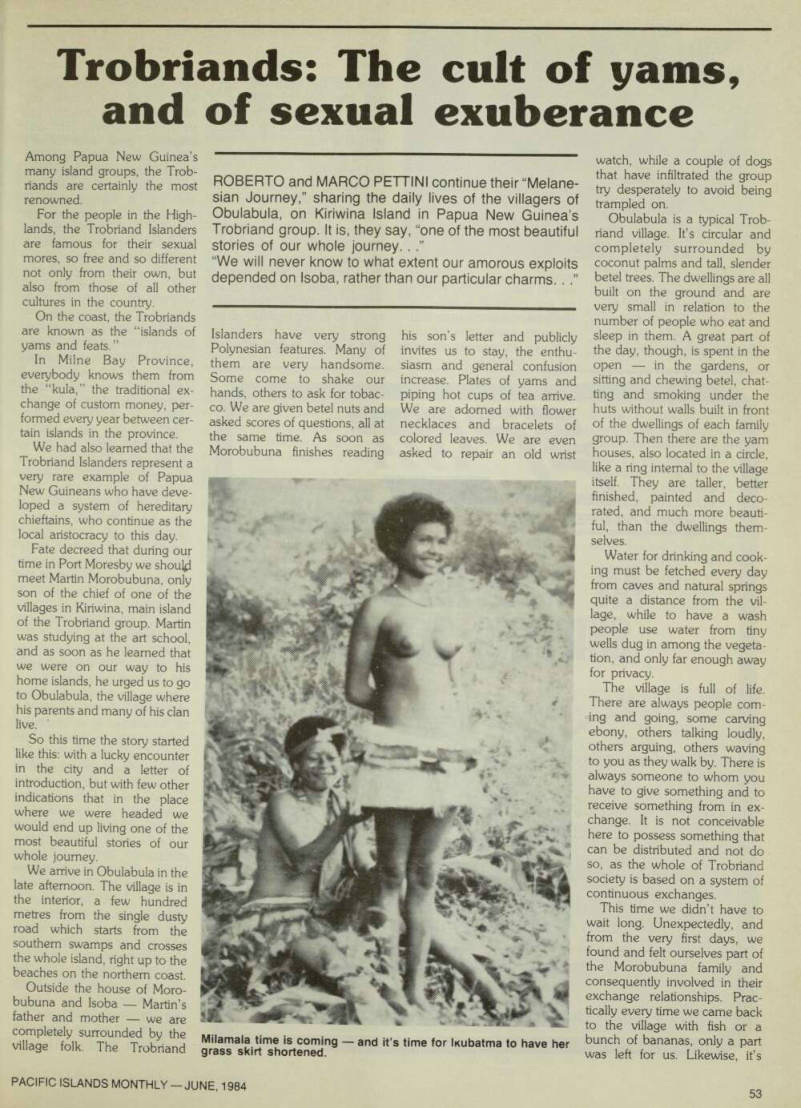
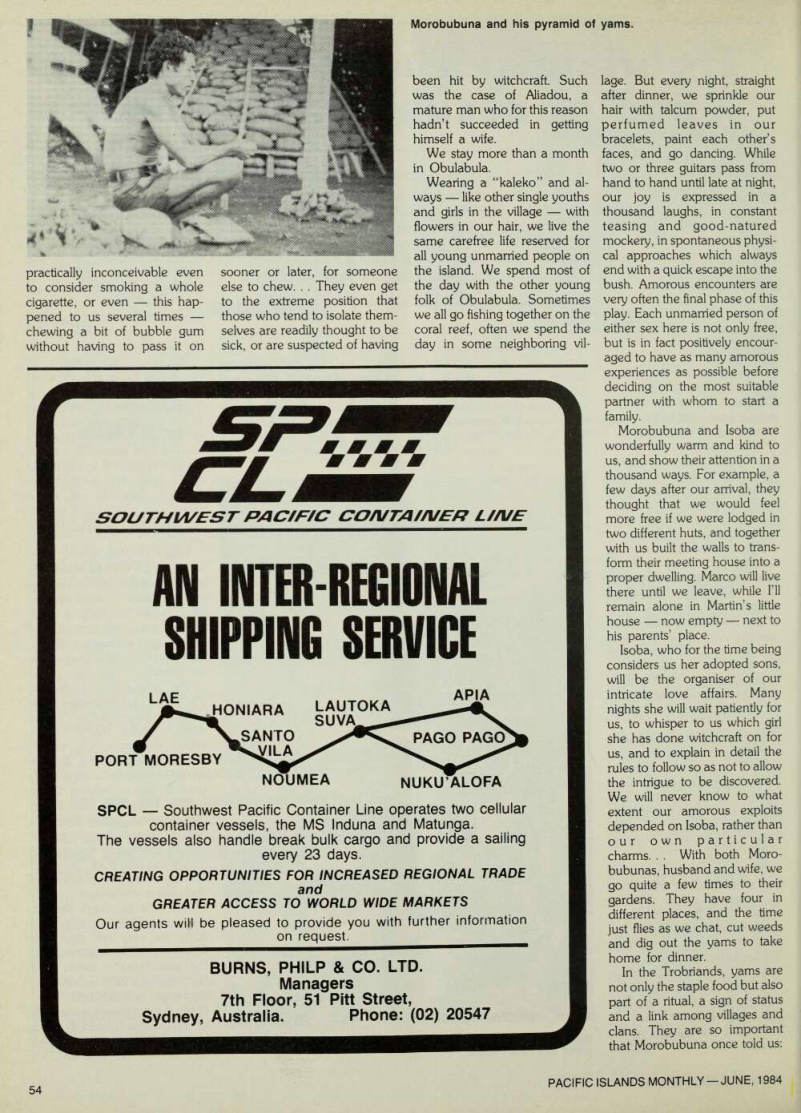
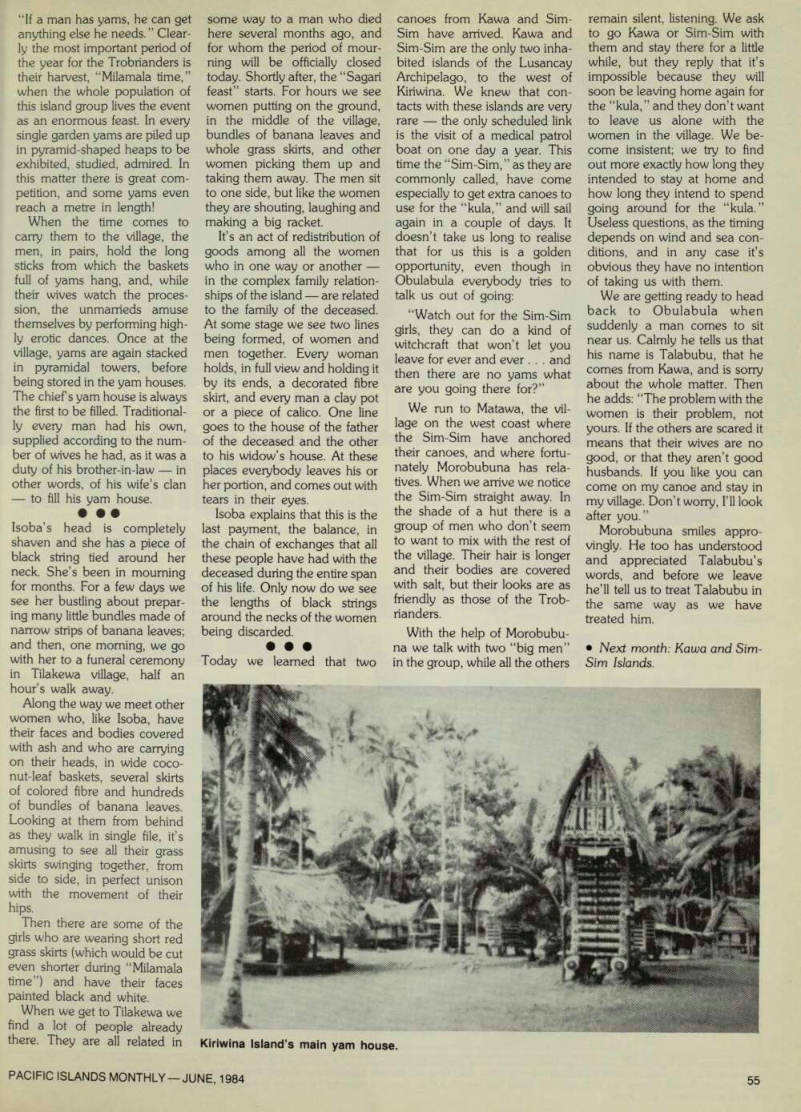
and of sexual exuberance
ROBERTO and MARCO PETTINI CODtinu© their “Melane sian Journey,” sharing the daily lives of the villagers of Obulabula, on Kiriwina Island in Papua New Guinea’s Trobriand group. It is, they say, “one of the most beautiful stories of our whole journey..
“We will never know to what extent our amorous exploits depended on Isoba, rather than our particular charms. .
Among Papua New Guinea’s many island groups, the Trob riands are certainly the most renowned.
For the people in the High lands, the Trobriand Islanders are famous for their sexual mores, so free and so different not only from their own, but also from those of all other cultures in the country.
On the coast, the Trobriands are known as the “islands of yams and feats.”
In Milne Bay Province, everybody knows them from the “kula,” the traditional ex change of custom money, per formed every year between cer tain islands in the province.
We had also learned that the Trobriand Islanders represent a very rare example of Papua New Guineans who have deve loped a system of hereditary chieftains, who continue as the local aristocracy to this day.
Fate decreed that during our time in Port Moresby we should meet Martin Morobubuna, only son of the chief of one of the villages in Kiriwina, main island of the Trobriand group. Martin was studying at the art school, and as soon as he learned that we were on our way to his home islands, he urged us to go to Obulabula, the village where his parents and many of his clan live.
So this time the story started like this: with a lucky encounter in the city and a letter of introduction, but with few other indications that in the place where we were headed we would end up living one of the most beautiful stories of our whole journey.
We arrive in Obulabula in the late afternoon. The village is in the interior, a few hundred metres from the single dusty road which starts from the southern swamps and crosses the whole island, right up to the beaches on the northern coast.
Outside the house of Moro bubuna and Isoba Martin’s father and mother we are completely surrounded by the village folk. The Trobriand
Islanders have very strong Polynesian features. Many of them are very handsome.
Some come to shake our hands, others to ask for tobac co. We are given betel nuts and asked scores of questions, all at the same time. As soon as Morobubuna finishes reading
his son’s letter and publicly invites us to stay, the enthu siasm and general confusion increase. Plates of yams and piping hot cups of tea arrive.
We are adorned with flower necklaces and bracelets of colored leaves. We are even asked to repair an old wrist
watch, while a couple of dogs that have infiltrated the group try desperately to avoid being trampled on.
Obulabula is a typical Trob riand village. It’s circular and completely surrounded by coconut palms and tall, slender betel trees. The dwellings are all built on the ground and are very small in relation to the number of people who eat and sleep in them. A great part of the day, though, is spent in the open in the gardens, or sitting and chewing betel, chat ting and smoking under the huts without walls built in front of the dwellings of each family group. Then there are the yam houses, also located in a circle, like a ring internal to the village itself. They are taller, better finished, painted and deco rated, and much more beauti ful, than the dwellings them selves.
Water for drinking and cook ing must be fetched every day from caves and natural springs quite a distance from the vil lage, while to have a wash people use water from tiny wells dug in among the vegeta tion, and only far enough away for privacy.
The village is full of life.
There are always people com ing and going, some carving ebony, others talking loudly, others arguing, others waving to you as they walk by. There is always someone to whom you have to give something and to receive something from in ex change. It is not conceivable here to possess something that can be distributed and not do so, as the whole of Trobriand society is based on a system of continuous exchanges.
This time we didn’t have to wait long. Unexpectedly, and from the very first days, we found and felt ourselves part of the Morobubuna family and consequently involved in their exchange relationships. Prac tically every time we came back to the village with fish or a bunch of bananas, only a part was left for us. Likewise, it’s
Milamala time is coming - and it’s time for kubatma to have her grass skirt shortened.
practically inconceivable even to consider smoking a whole cigarette, or even this happened to us several times chewing a bit of bubble gum without having to pass it on
sooner or later, for someone else to chew. . . They even get to the extreme position that those who tend to isolate them selves are readily thought to be sick, or are suspected of having
been hit by witchcraft. Such was the case of Aliadou, a mature man who for this reason hadn’t succeeded in getting himself a wife.
We stay more than a month in Obulabula.
Wearing a “kaleko” and al ways like other single youths and girls in the village with flowers in our hair, we live the same carefree life reserved for all young unmarried people on the island. We spend most of the day with the other young folk of Obulabula. Sometimes we all go fishing together on the coral reef, often we spend the day in some neighboring vil
lage. But every night, straight after dinner, we sprinkle our hair with talcum powder, put perfumed leaves in our bracelets, paint each other’s faces, and go dancing. While two or three guitars pass from hand to hand until late at night, our joy is expressed in a thousand laughs, in constant teasing and good-natured mockery, in spontaneous physi cal approaches which always end with a quick escape into the bush. Amorous encounters are very often the final phase of this play. Each unmarried person of either sex here is not only free, but is in fact positively encour aged to have as many amorous experiences as possible before deciding on the most suitable partner with whom to start a family.
Morobubuna and Isoba are wonderfully warm and kind to us, and show their attention in a thousand ways. For example, a few days after our arrival, they thought that we would feel more free if we were lodged in two different huts, and together with us built the walls to trans form their meeting house into a proper dwelling. Marco will live there until we leave, while I’ll remain alone in Martin’s little house now empty next to his parents’ place.
Isoba, who for the time being considers us her adopted sons, will be the organiser of our intricate love affairs. Many nights she will wait patiently for us, to whisper to us which girl she has done witchcraft on for us, and to explain in detail the rules to follow so as not to allow the intrigue to be discovered.
We will never know to what extent our amorous exploits depended on Isoba, rather than our own particular charms. . . With both Moro bubunas, husband and wife, we go quite a few times to their gardens. They have four in different places, and the time just flies as we chat, cut weeds and dig out the yams to take home for dinner.
In the Trobriands, yams are not only the staple food but also part of a ritual, a sign of status and a link among villages and clans. They are so important that Morobubuna once told us:
Morobubuna and his pyramid of yams.
“If a man has yams, he can get anything else he needs. ” Clear ly the most important period of the year for the Trobrianders is their harvest, “Milamala time,” when the whole population of this island group lives the event as an enormous feast. In every single garden yams are piled up in pyramid-shaped heaps to be exhibited, studied, admired. In this matter there is great com petition, and some yams even reach a metre in length!
When the time comes to carry them to the village, the men, in pairs, hold the long sticks from which the baskets full of yams hang, and, while their wives watch the proces sion, the unmarrieds amuse themselves by performing high ly erotic dances. Once at the village, yams are again stacked in pyramidal towers, before being stored in the yam houses.
The chief s yam house is always the first to be filled. Traditional ly every man had his own, supplied according to the num ber of wives he had, as it was a duty of his brother-in-law in other words, of his wife’s clan to fill his yam house. • •• Isoba’s head is completely shaven and she has a piece of black string tied around her neck. She’s been in mourning for months. For a few days we see her bustling about prepar ing many little bundles made of narrow strips of banana leaves; and then, one morning, we go with her to a funeral ceremony in Tilakewa village, half an hour’s walk away.
Along the way we meet other women who, like Isoba, have their faces and bodies covered with ash and who are carrying on their heads, in wide coco nut-leaf baskets, several skirts of colored fibre and hundreds of bundles of banana leaves.
Looking at them from behind as they walk in single file, it’s amusing to see all their grass skirts swinging together, from side to side, in perfect unison with the movement of their hips.
Then there are some of the girls who are wearing short red grass skirts (which would be cut even shorter during “Milamala time”) and have their faces painted black and white.
When we get to Tilakewa we find a lot of people already there. They are all related in
some way to a man who died here several months ago, and for whom the period of mour ning will be officially closed today. Shortly after, the “Sagari feast” starts. For hours we see women putting on the ground, in the middle of the village, bundles of banana leaves and whole grass skirts, and other women picking them up and taking them away. The men sit to one side, but like the women they are shouting, laughing and making a big racket.
It’s an act of redistribution of goods among all the women who in one way or another in the complex family relation ships of the island are related to the family of the deceased.
At some stage we see two lines being formed, of women and men together. Every woman holds, in full view and holding it by its ends, a decorated fibre skirt, and every man a clay pot or a piece of calico. One line goes to the house of the father of the deceased and the other to his widow’s house. At these places everybody leaves his or her portion, and comes out with tears in their eyes.
Isoba explains that this is the last payment, the balance, in the chain of exchanges that all these people have had with the deceased during the entire span of his life. Only now do we see the lengths of black strings around the necks of the women being discarded. • • • Today we learned that two
canoes from Kawa and Sim- Sim have arrived. Kawa and Sim-Sim are the only two inha bited islands of the Lusancay Archipelago, to the west of Kiriwina. We knew that con tacts with these islands are very rare the only scheduled link is the visit of a medical patrol boat on one day a year. This time the “Sim-Sim,” as they are commonly called, have come especially to get extra canoes to use for the “kula,” and will sail again in a couple of days. It doesn’t take us long to realise that for us this is a golden opportunity, even though in Obulabula everybody tries to talk us out of going: “Watch out for the Sim-Sim girls, they can do a kind of witchcraft that won’t let you leave for ever and ever . . . and then there are no yams what are you going there for?”
We run to Matawa, the vil lage on the west coast where the Sim-Sim have anchored their canoes, and where fortu nately Morobubuna has rela tives. When we arrive we notice the Sim-Sim straight away. In the shade of a hut there is a group of men who don’t seem to want to mix with the rest of the village. Their hair is longer and their bodies are covered with salt, but their looks are as friendly as those of the Trob rianders.
With the help of Morobubu na we talk with two “big men” in the group, while all the others
remain silent, listening. We ask to go Kawa or Sim-Sim with them and stay there for a little while, but they reply that it’s impossible because they will soon be leaving home again for the “kula,” and they don’t want to leave us alone with the women in the village. We be come insistent; we try to find out more exactly how long they intended to stay at home and how long they intend to spend going around for the “kula.”
Useless questions, as the timing depends on wind and sea con ditions, and in any case it’s obvious they have no intention of taking us with them.
We are getting ready to head back to Obulabula when suddenly a man comes to sit near us. Calmly he tells us that his name is Talabubu, that he comes from Kawa, and is sorry about the whole matter. Then he adds: “The problem with the women is their problem, not yours. If the others are scared it means that their wives are no good, or that they aren’t good husbands. If you like you can come on my canoe and stay in my village. Don’t worry, I’ll look after you.”
Morobubuna smiles appro vingly. He too has understood and appreciated Talabubu’s words, and before we leave he’ll tell us to treat Talabubu in the same way as we have treated him. • Next month: Kawa and Sim- Sim Islands.
Kiriwina Island’s main yam house.
Advertisements & other items, pp. 54-56 (1 item)
Shipping Service
SOUEHIA/EST RAC/E/C
AN INTERREGIONAL
LAE HONIARA LAUTOKA
SUVA
SANTO
PORT MORESBY V,LA
NOUMEA
SPCL Southwest Pacific Container Line operates two cellular container vessels, the MS Induna and Matunga.
The vessels also handle break bulk cargo and provide a sailing every 23 days.
CREATING OPPORTUNITIES FOR INCREASED REGIONAL TRADE
and
GREATER ACCESS TO WORLD WIDE MARKETS
Our agents wiH be pleased to provide you with further information on request.
BURNS, PHILP & CO. LTD.
Managers
7th Floor, 51 Pitt Street, Sydney, Australia. Phone: (02) 20547
* n > r ■ >.-* * ■
Toughness.
-i Nissan Cabstar Nissan Sunny Nissan Vanette aaaag , n Nissan Urvan rV K
*‘ SSAN PATROL
Nissan Patrol Datsun Pickup 4WD That’s why Nissan means higher performance. Toughness is total. Every member of the widerange lineup has extra strength and durability built-in along with superior maneuverability. These high performers deliver penny-pinching fuel economy and tough reliability. Once you discover how great the ride and handling ease are, you will understand what makes ““ Nissan commercial and passenger vehicles worldwide favorites.
There’s more to a Nissan than meets the eye.
NISSAN
American Samoa Max Haleck Inc., Pago Pago Cook Islands Cook Islands Motor Centre Ltd., Rarotonga Fiji Carpenters Motors, Suva Kiribati Atoll Auto Stores Bairiki Nauru Jacob Enterprises New Caledonia Agence Alma S.A., Noumea Norfolk Island Sirius Motors Papua New Guinea Boroko Motors, Port I Moresby Solomon Islands United Enterprises Ltd., Honiara Tahiti Tahitibull S.A.R.L, Papeete Vanuatu Pentecost Vanua Trading Ltd., Port Vila Western Samoa Morris Hedstrom Samoa Ltd., Apia
In off the palace roof . . .
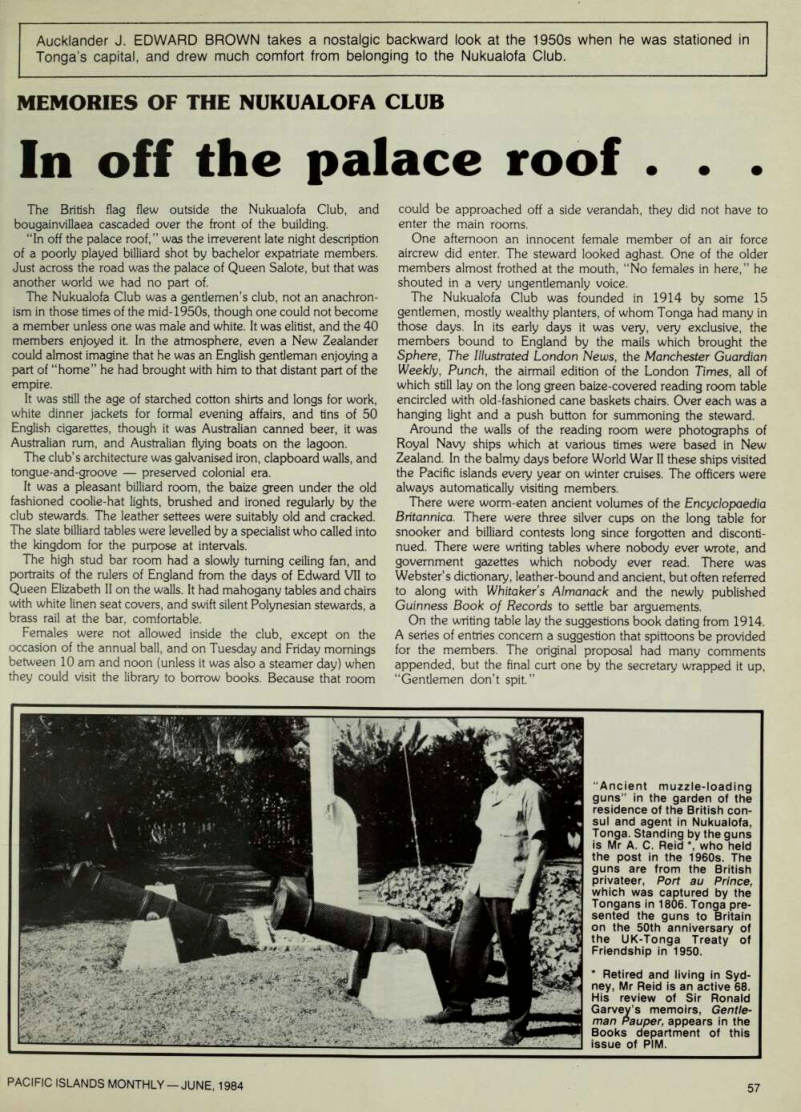

Memories Of The Nukualofa Club
Aucklander J. EDWARD BROWN takes a nostalgic backward look at the 1950 s when he was stationed in Tonga’s capital, and drew much comfort from belonging to the Nukualofa Club.
The British flag flew outside the Nukualofa Club, and bougainvillaea cascaded over the front of the building.
“In off the palace roof,” wajs the irreverent late night description of a poorly played billiard shot by bachelor expatriate members.
Just across the road was the palace of Queen Salote, but that was another world we had no part of.
The Nukualofa Club was a gentlemen’s club, not an anachron ism in those times of the mid-19505, though one could not become a member unless one was male and white. It was elitist, and the 40 members enjoyed it. In the atmosphere, even a New Zealander could almost imagine that he was an English gentleman enjoying a part of “home” he had brought with him to that distant part of the empire.
It was still the age of starched cotton shirts and longs for work, white dinner jackets for formal evening affairs, and tins of 50 English cigarettes, though it was Australian canned beer, it was Australian rum, and Australian flying boats on the lagoon.
The club’s architecture was galvanised iron, clapboard walls, and tongue-and-groove preserved colonial era.
It was a pleasant billiard room, the baize green under the old fashioned coolie-hat lights, brushed and ironed regularly by the club stewards. The leather settees were suitably old and cracked.
The slate billiard tables were levelled by a specialist who called into the kingdom for the purpose at intervals.
The high stud bar room had a slowly turning ceiling fan, and portraits of the rulers of England from the days of Edward VII to Queen Elizabeth II on the walls. It had mahogany tables and chairs with white linen seat covers, and swift silent Polynesian stewards, a brass rail at the bar, comfortable.
Females were not allowed inside the club, except on the occasion of the annual ball, and on Tuesday and Friday mornings between 10 am and noon (unless it was also a steamer day) when they could visit the library to borrow books. Because that room
could be approached off a side verandah, they did not have to enter the main rooms.
One afternoon an innocent female member of an air force aircrew did enter. The steward looked aghast. One of the older members almost frothed at the mouth, “No females in here,” he shouted in a very ungentlemanly voice.
The Nukualofa Club was founded in 1914 by some 15 gentlemen, mostly wealthy planters, of whom Tonga had many in those days. In its early days it was very, very exclusive, the members bound to England by the mails which brought the Sphere, The Illustrated London News, the Manchester Guardian Weekly, Punch, the airmail edition of the London Times, all of which still lay on the long green baize-covered reading room table encircled with old-fashioned cane baskets chairs. Over each was a hanging light and a push button for summoning the steward.
Around the walls of the reading room were photographs of Royal Navy ships which at various times were based in New Zealand. In the balmy days before World War II these ships visited the Pacific islands every year on winter cruises. The officers were always automatically visiting members.
There were worm-eaten ancient volumes of the Encyclopaedia Britannica. There were three silver cups on the long table for snooker and billiard contests long since forgotten and disconti nued. There were writing tables where nobody ever wrote, and government gazettes which nobody ever read. There was Webster’s dictionary, leather-bound and ancient, but often referred to along with Whitaker’s Almanack and the newly published Guinness Book of Records to settle bar arguements.
On the writing table lay the suggestions book dating from 1914.
A series of entries concern a suggestion that spittoons be provided for the members. The original proposal had many comments appended, but the final curt one by the secretary wrapped it up, “Gentlemen don’t spit.”
“Ancient muzzle-loading
guns” in the garden of the residence of the British con sul and agent in Nukualofa, Tonga. Standing by the guns is Mr A. C. Reid *, who held the post in the 1960s. The guns are from the British privateer, Port au Prince, which was captured by the Tongans in 1806. Tonga pre sented the guns to Britain on the 50th anniversary of the UK-Tonga Treaty of Friendship in 1950. * Retired and living in Syd ney, Mr Reid is an active 68.
His review of Sir Ronald Garvey’s memoirs, Gentle man Pauper, appears in the Books department of this issue of PIM.
The club had hundreds of books on its shelves and a new parcel arrived from England once a month. A curious collection, or maybe not so curious in the circumstances, the author with the most books in it was P.G. Wodehouse. What could be more British than Wodehouse novels with characters like Jeeves and Bertie Wooster?
However, there were very few English members then, they were mostly New Zealanders or Australians. Fresh copies of the magazines and newspapers were a relic of the old days. Other magazines were gradually being introduced the American Saturday Evening Post , Time, the Australian People , though there was opposition.
The president was English, for by custom he was always the British consul, but the secretary was a New Zealander, and the treasurer was stateless.
In the old days, when members of the committee met, they dressed in white tie and tails. In the ’sos, it was sufficient if they wore ties, and sometimes they didn’t even do that, though the line was drawn at hula shirts after all, it was still a gentlemen’s club.
On the billiard tables the gentlemen’s game of billiards had been replaced by snooker or perhaps pool, or games like slosh or rafferty snooker. Though once a month there was a formal games evening when billiards and snooker competitions were held. The general, who was English, retired, touring, came along one night. “I can’t play,” he said in his barking voice. “They wouldn’t let me play in the mess in India, too bad a player, had to wait until there was nobody there and play the steward. Only man I had a hope of winning against.”
He then proceeded to rack up a large score and win the competition, in fine old English style.
There was a small card room, but nobody played cards, though years ago the members played regularly, and for high stakes, and one night a member lost his plantation on the turn of cards, so it was said.
There were difficulties in running a club in remote Nukualofa. A
visiting ship’s officer complained that he didn’t like drinking gin with raspberry (though it said ginger beer on a bottle). It had to be explained to him that this was just one of the trials of living in Nukualofa. Aerated waters were made locally, but nobody knew what they were going to get when a bottle was opened. Apparently the system the manufacturer used was to make a batch of waters, be it lemonade or anything else, then pick up a handful of assorted labels and slap them on the latest brew, so that ordinary lemonade became ginger beer, raspberry, kola, tropical fruit salad, or more exotically pineapple champagne.
In my time the stewards were Lua and Ella, somewhat Laurel and Hardy-ish. Lua was a stem man of massive Tongan proportions, his skirt-like uala held up by a large leather belt with an enormous brass buckle, while Ella, who was actually a Niuean who had lived in Tonga a long time, was a laughing old man.
Inside the club it was a world without women, except when the telephone rang. Perhaps Lua knew his place, but sometimes he couldn’t resist stepping out. He would answer the telephone and then bend deferentially over the wanted member: “Telephone, sir.” And if it was a woman he always added dead pan, “long-haired voice.” Or, in a tone of disappointment, “short-haired voice.” And if a member should commit the faux pas of bringing out a book of Yacht Club bar tickets to pay for drinks he lifted them disdainfully from the silver tray, “no picture tickets.”
George Quensell, a member of the Nukualofa Club, died. He was the only man who had swum to Tonga, and in later years established the famous Tin Can Island postal service. His coffin was carried to the cemetery on the back of a truck. The only two persons allowed aboard the truck were the two club stewards, Lua and Ella.
Twenty-four hour drinking was possible in those days in Tonga.
One could get a morning bracer at 8 am when the club opened and cold beers could be had through until 11 pm but the services of the steward could be retained by paying 10 shillings an hour overtime.
There was no limit on overtime and some nights the club never closed, overtime being paid until 8 am when it normally opened.
There was another gentlemen’s club at Vavau in northern Tonga, the Vavau Club, run on more or less conventional lines, but it couldn’t compete with Nukualofa Club. A European who had lived in Vavau said thoughtfully: “They have no jiggers for their billiard table, so that members climb up on the table to play those difficult shots. Not done, old boy.”
The Nukualofa Club was the nearest I’ll ever get to being a member of a club modelled on a London gentlemen’s club. Sure, the sweet aphrodisiacal scent of frangipani often wafted through the bar room, smothering the aroma of beer and whisky, and the trade winds rustled the coconut palms, and the sun was hot and blinding, but it was an English club, despite the steady antipodean erosion of its values and its customs.
A hansom cab outside would not have been out of place, and late at night, moonless, it was akin to a pea soup London fog for some members who had imbibed.
There was Her Majesty’s palace adjacent, but of course that was wooden, with colonial fretwork, corrugated iron, hardly Bucking ham Palace; and there was that damned tortoise, Tu’imalila, allegedly brought to Tonga by Captain Cook, which often wandered from the palace into the club grounds, hardly corgi-like, and a danger to an unsteady body who had been attempting to forget the isolation and exile. Nevertheless it was an oasis of civilisation, comforting. One could lounge there drinking Australian Foster’s beer and stare at the picture of Queen Elizabeth newly ascended to the throne, and know that with orb and sceptre underhand she was thinking of this kingdom which was under her protection.
Only a few hundred yards down the road, past the palace, was Her Britannic Majesty’s Agent and Consul’s residence, also with the British flag flying in the front garden, with ancient muzzle loading cannons pointing seaward, ensuring that the Tongans’ foreign relations didn’t go wrong, that the kingdom’s finances didn’t go awry. It was a different age and one felt so secure.
J. Edward Brown.
Advertisements & other items, p. 58 (1 item)
Houses’
INSTANT
and Commercial Buildings with Therma-Panel, R the
fully insulated inter-locking
Building System
Cyclone rated George Hudson Homes (Aust.) pty. Ltd 186 Hume Highway Cabramatta NSW 2166 Australia. Tel: (02) 727 9066. Telex: AA25800 Post coupon for details and prices.
tropicalities
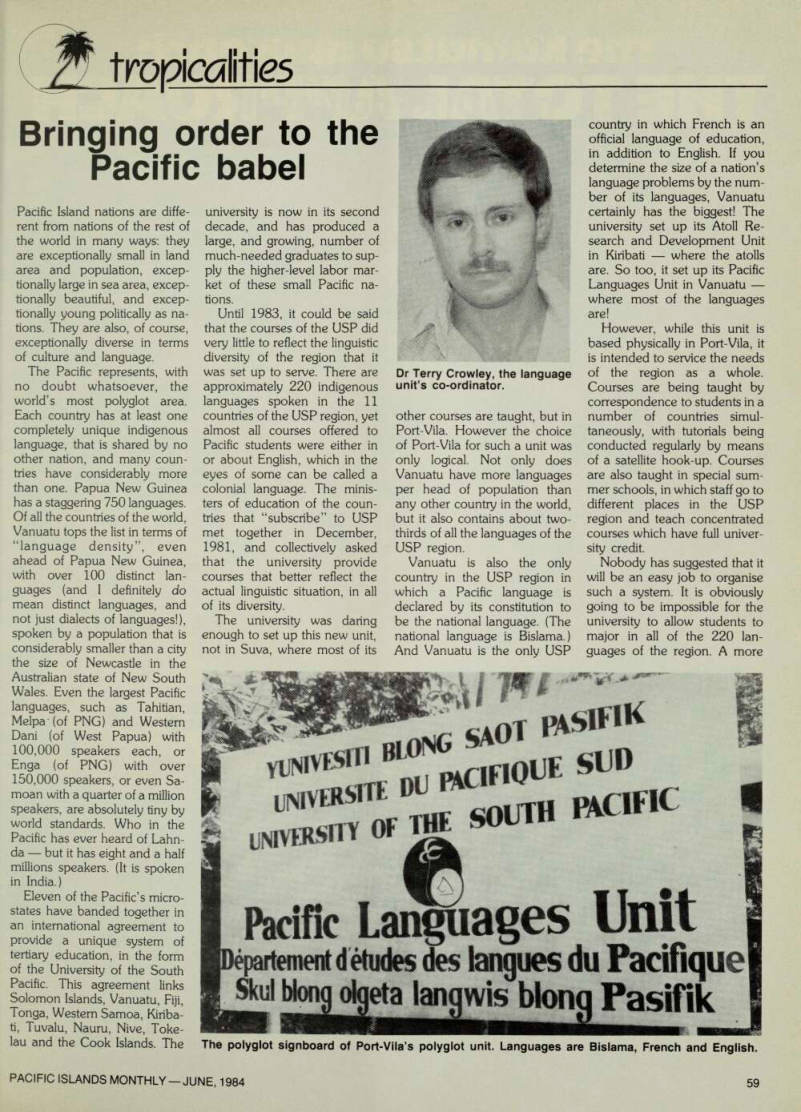
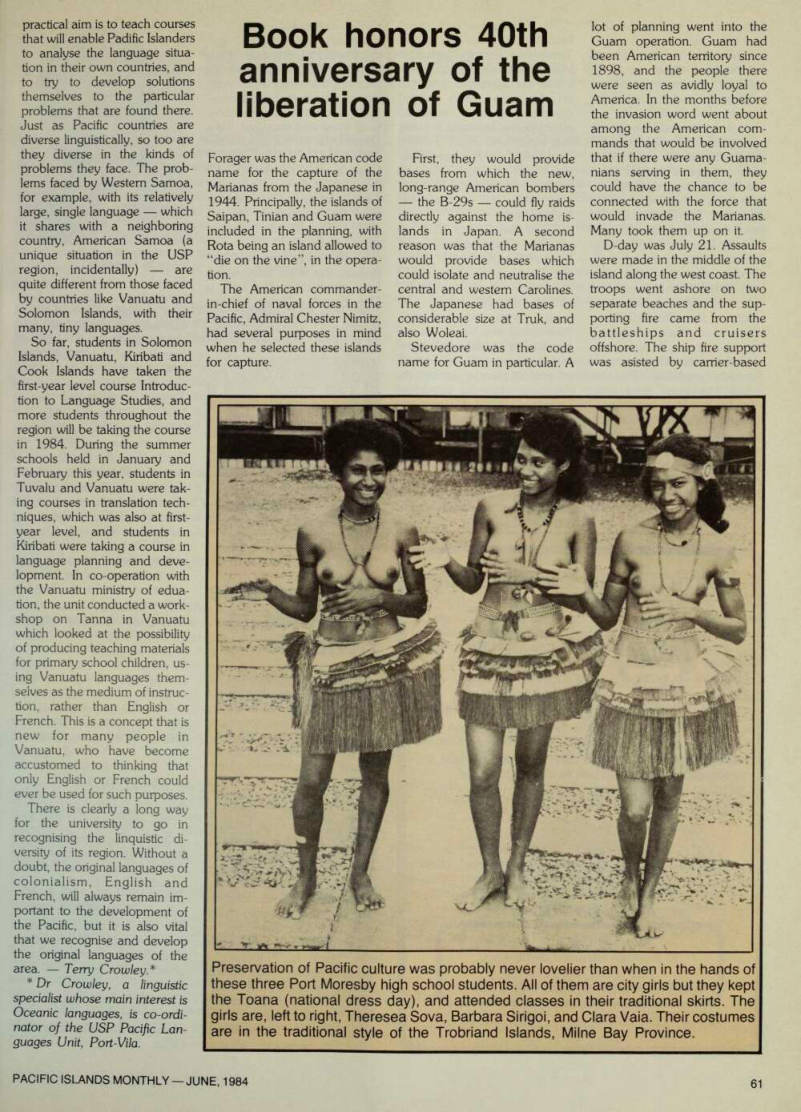
Bringing order to the Pacific babel
Pacific Island nations are diffe rent from nations of the rest of the world in many ways: they are exceptionally small in land area and population, excep tionally large in sea area, excep tionally beautiful, and excep tionally young politically as na tions. They are also, of course, exceptionally diverse in terms of culture and language.
The Pacific represents, with no doubt whatsoever, the world’s most polyglot area.
Each country has at least one completely unique indigenous language, that is shared by no other nation, and many coun tries have considerably more than one. Papua New Guinea has a staggering 750 languages.
Of all the countries of the world, Vanuatu tops the list in terms of “language density”, even ahead of Papua New Guinea, with over 100 distinct lan guages (and I definitely do mean distinct languages, and not just dialects of languages!), spoken by a population that is considerably smaller than a city the size of Newcastle in the Australian state of New South Wales. Even the largest Pacific languages, such as Tahitian, Melpa (of PNG) and Western Dani (of West Papua) with 100.000 speakers each, or Enga (of PNG) with over 150.000 speakers, or even Sa moan with a quarter of a million speakers, are absolutely tiny by world standards. Who in the Pacific has ever heard of Lahn da but it has eight and a half millions speakers. (It is spoken in India.) Eleven of the Pacific’s micro states have banded together in an international agreement to provide a unique system of tertiary education, in the form of the University of the South Pacific. This agreement links Solomon Islands, Vanuatu, Fiji, Tonga, Western Samoa, Kiriba ti, Tuvalu, Naum, Nive, Toke lau and the Cook Islands. The
university is now in its second decade, and has produced a large, and growing, number of much-needed graduates to sup ply the higher-level labor mar ket of these small Pacific na tions.
Until 1983, it could be said that the courses of the USP did very little to reflect the linguistic diversity of the region that it was set up to serve. There are approximately 220 indigenous languages spoken in the 11 countries of the USP region, yet almost all courses offered to Pacific students were either in or about English, which in the eyes of some can be called a colonial language. The minis ters of education of the coun tries that “subscribe” to USP met together in December, 1981, and collectively asked that the university provide courses that better reflect the actual linguistic situation, in all of its diversity.
The university was daring enough to set up this new unit, not in Suva, where most of its
other courses are taught, but in Port-Vila. However the choice of Port-Vila for such a unit was only logical. Not only does Vanuatu have more languages per head of population than any other country in the world, but it also contains about two thirds of all the languages of the USP region.
Vanuatu is also the only country in the USP region in which a Pacific language is declared by its constitution to be the national language. (The national language is Bislama.) And Vanuatu is the only USP
country in which French is an official language of education, in addition to English. If you determine the size of a nation’s language problems by the num ber of its languages, Vanuatu certainly has the biggest! The university set up its Atoll Re search and Development Unit in Kiribati where the atolls are. So too, it set up its Pacific Languages Unit in Vanuatu where most of the languages are!
However, while this unit is based physically in Port-Vila, it is intended to service the needs of the region as a whole.
Courses are being taught by correspondence to students in a number of countries simul taneously, with tutorials being conducted regularly by means of a satellite hook-up. Courses are also taught in special sum mer schools, in which staff go to different places in the USP region and teach concentrated courses which have full univer sity credit.
Nobody has suggested that it will be an easy job to organise such a system. It is obviously going to be impossible for the university to allow students to major in all of the 220 lan guages of the region. A more
The polyglot signboard of Port-Vila’s polyglot unit. Languages are Bislama, French and English.
Dr Terry Crowley, the language unit’s co-ordinator.
practical aim is to teach courses that will enable Padific Islanders to analyse the language situa tion in their own countries, and to try to develop solutions themselves to the particular problems that are found there.
Just as Pacific countries are diverse linguistically, so too are they diverse in the kinds of problems they face. The prob lems faced by Western Samoa, for example, with its relatively large, single language which it shares with a neighboring country, American Samoa (a unique situation in the USP region, incidentally) are quite different from those faced by countries like Vanuatu and Solomon Islands, with their many, tiny languages.
So far, students in Solomon Islands, Vanuatu, Kiribati and Cook Islands have taken the first-year level course Introduc tion to Language Studies, and more students throughout the region will be taking the course in 1984. During the summer schools held in January and February this year, students in Tuvalu and Vanuatu were tak ing courses in translation tech niques, which was also at first year level, and students in Kiribati were taking a course in language planning and deve lopment. In co-operation with the Vanuatu ministry of edua tion, the unit conducted a work shop on Tanna in Vanuatu which looked at the possibility of producing teaching materials for primary school children, us ing Vanuatu languages them selves as the medium of instruc tion, rather than English or French. This is a concept that is new for many people in Vanuatu, who have become accustomed to thinking that only English or French could ever be used for such purposes.
There is clearly a long way for the university to go in recognising the linguistic di versity of its region. Without a doubt, the original languages of colonialism, English and French, will always remain im portant to the development of the Pacific, but it is also vital that we recognise and develop the original languages of the area. Terry Crowley * *Dr Crowley, a linguistic specialist whose main interest is Oceanic languages, is co-ordi nator of the USP Pacific Lan guages Unit, Port-Vila.
Advertisements & other items, p. 60 (1 item)
The Total Approach
The Komatsu approach
' .»*' .M.'jntam i m & mf. «* WL* HI SS?
'• r* * Our primary concern at Komatsu is to keep the customer satisfied. For us, it's a company-wide endeavor—from management to rank and file. And it's ultimately what enables us to approach problems from all angles.
To assure total quality control, we’ve adopted The Total Approach’: we actively engage In research and development activities, we manufacture, we distribute. This is why we can create products that meet the needs of the market head on, and why we can control the quality of everything we make— from bulldozers, dump trucks and hydraulic excavators to diesel engines, diesel generator sets, presses, machine tools, even industrial robots. All available In a wide range to suit every conceivable application. And all backed by Komatsu’s worldwide service network.
And part of our total approach is keeping an eagle eye on the future. Our pioneering work in the exciting new field of "mechatronics’’ enables us to respond to the needs of today and anticipate those of tomorrow...
Looking for The Total Approach? Look to Komatsu.
KOMATSU
anniversary of the
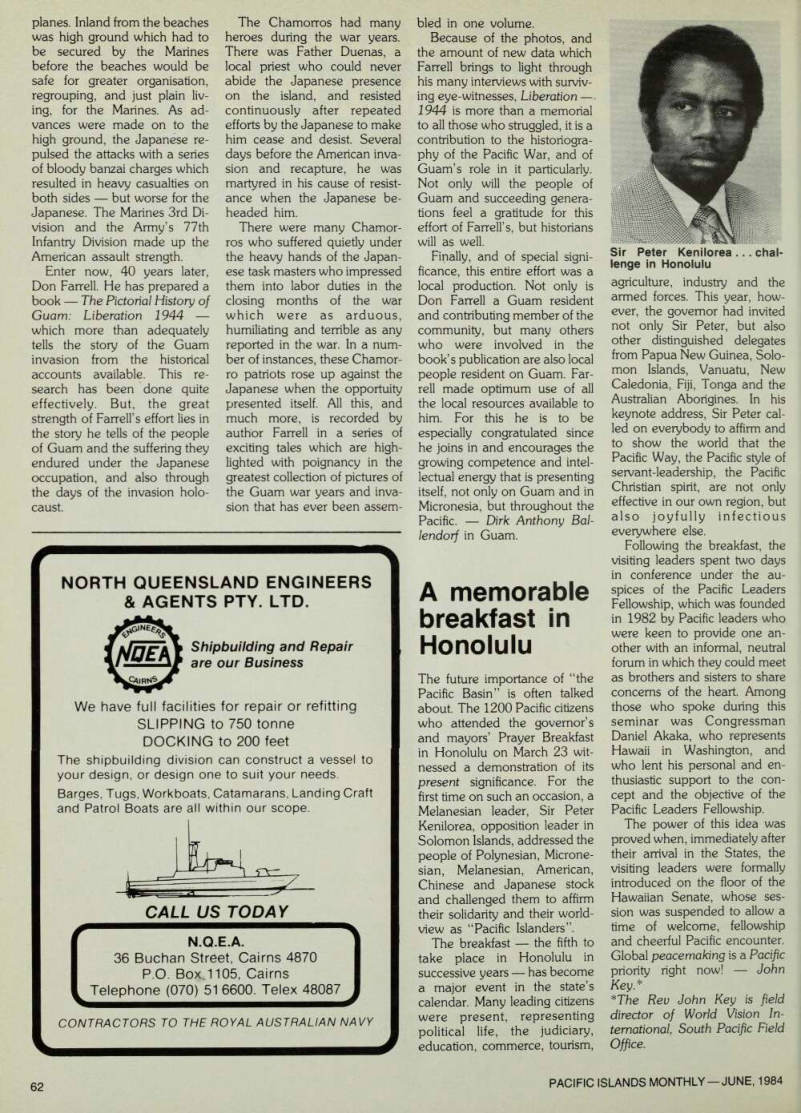
Book honors 40th anniversary of the liberation of Guam
Forager was the American code name for the capture of the Marianas from the Japanese in 1944. Principally, the islands of Saipan, Tinian and Guam were included in the planning, with Rota being an island allowed to “die on the vine”, in the opera tion.
The American commander in-chief of naval forces in the Pacific, Admiral Chester Nimitz, had several purposes in mind when he selected these islands for capture.
First, they would provide bases from which the new, long-range American bombers the B-29s could fly raids directly against the home is lands in Japan. A second reason was that the Marianas would provide bases which could isolate and neutralise the central and western Carolines.
The Japanese had bases of considerable size at Truk, and also Woleai.
Stevedore was the code name for Guam in particular. A
lot of planning went into the Guam operation. Guam had been American territory since 1898, and the people there were seen as avidly loyal to America. In the months before the invasion word went about among the American com mands that would be involved that if there were any Guama nians serving in them, they could have the chance to be connected with the force that would invade the Marianas.
Many took them up on it.
D-day was July 21. Assaults were made in the middle of the island along the west coast. The troops went ashore on two separate beaches and the sup porting fire came from the battleships and cruisers offshore. The ship fire support was asisted by carrier-based
Preservation of Pacific culture was probably never lovelier than when in the hands of these three Port Moresby high school students. All of them are city girls but they kept the Toana (national dress day), and attended classes in their traditional skirts. The girls are, left to right, Theresea Sova, Barbara Sirigoi, and Clara Vaia. Their costumes are in the traditional style of the Trobriand Islands, Milne Bay Province.
planes. Inland from the beaches was high ground which had to be secured by the Marines before the beaches would be safe for greater organisation, regrouping, and just plain liv ing, for the Marines. As ad vances were made on to the high ground, the Japanese re pulsed the attacks with a series of bloody banzai charges which resulted in heavy casualties on both sides but worse for the Japanese. The Marines 3rd Di vision and the Army’s 77th Infantry Division made up the American assault strength.
Enter now, 40 years later, Don Farrell. He has prepared a book The Pictorial History of Guam: Liberation 1944 which more than adequately tells the story of the Guam invasion from the historical accounts available. This re search has been done quite effectively. But, the great strength of Farrell’s effort lies in the story he tells of the people of Guam and the suffering they endured under the Japanese occupation, and also through the days of the invasion holo caust.
The Chamorros had many heroes during the war years.
There was Father Duenas, a local priest who could never abide the Japanese presence on the island, and resisted continuously after repeated efforts by the Japanese to make him cease and desist. Several days before the American inva sion and recapture, he was martyred in his cause of resist ance when the Japanese be headed him.
There were many Chamor ros who suffered quietly under the heavy hands of the Japan ese task masters who impressed them into labor duties in the closing months of the war which were as arduous, humiliating and terrible as any reported in the war. In a num ber of instances, these Chamor ro patriots rose up against the Japanese when the opportuity presented itself. All this, and much more, is recorded by author Farrell in a series of exciting tales which are high lighted with poignancy in the greatest collection of pictures of the Guam war years and inva sion that has ever been assem
bled in one volume.
Because of the photos, and the amount of new data which Farrell brings to light through his many interviews with surviv ing eye-witnesses, Liberation —, 1944 is more than a memorial to all those who struggled, it is a contribution to the historiogra phy of the Pacific War, and of Guam’s role in it particularly.
Not only will the people of Guam and succeeding genera tions feel a gratitude for this effort of Farrell’s, but historians will as well.
Finally, and of special signi ficance, this entire effort was a local production. Not only is Don Farrell a Guam resident and contributing member of the community, but many others who were involved in the book’s publication are also local people resident on Guam. Far rell made optimum use of all the local resources available to him. For this he is to be especially congratulated since he joins in and encourages the growing competence and intel lectual energy that is presenting itself, not only on Guam and in Micronesia, but throughout the Pacific. Dirk Anthony Bal lendorf in Guam.
A memorable
breakfast in Honolulu
The future importance of “the Pacific Basin” is often talked about. The 1200 Pacific citizens who attended the governor’s and mayors’ Prayer Breakfast in Honolulu on March 23 wit nessed a demonstration of its present significance. For the first time on such an occasion, a Melanesian leader, Sir Peter Kenilorea, opposition leader in Solomon Islands, addressed the people of Polynesian, Microne sian, Melanesian, American, Chinese and Japanese stock and challenged them to affirm their solidarity and their world view as “Pacific Islanders”.
The breakfast the fifth to take place in Honolulu in successive years has become a major event in the state’s calendar. Many leading citizens were present, representing political life, the judiciary, education, commerce, tourism,
agriculture, industry and the armed forces. This year, how ever, the governor had invited not only Sir Peter, but also other distinguished delegates from Papua New Guinea, Solo mon Islands, Vanuatu, New Caledonia, Fiji, Tonga and the Australian Aborigines. In his keynote address, Sir Peter cal led on everybody to affirm and to show the world that the Pacific Way, the Pacific style of servant-leadership, the Pacific Christian spirit, are not only effective in our own region, but also joyfully infectious everywhere else.
Following the breakfast, the visiting leaders spent two days in conference under the au spices of the Pacific Leaders Fellowship, which was founded in 1982 by Pacific leaders who were keen to provide one an other with an informal, neutral forum in which they could meet as brothers and sisters to share concerns of the heart. Among those who spoke during this seminar was Congressman Daniel Akaka, who represents Hawaii in Washington, and who lent his personal and en thusiastic support to the con cept and the objective of the Pacific Leaders Fellowship.
The power of this idea was proved when, immediately after their arrival in the States, the visiting leaders were formally introduced on the floor of the Hawaiian Senate, whose ses sion was suspended to allow a time of welcome, fellowship and cheerful Pacific encounter.
Global peacemaking is a Pacific priority right now! John Key* *The Rev John Key is field director of World Vision In ternational, South Pacific Field Office.
Sir Peter Kenllorea ... chal lenge in Honolulu
Advertisements & other items, p. 62 (1 item)
North Queensland Engineers
& AGENTS PTY. LTD.
We have full facilities for repair or refitting SLIPPING to 750 tonne DOCKING to 200 feet The shipbuilding division can construct a vessel to your design, or design one to suit your needs.
Barges, Tugs, Workboats, Catamarans, Landing Craft and Patrol Boats are all within our scope.
CALL US TODAY
N.Q.E.A.
I 36 Buchan Street, Cairns 4870 ; P.O. Box. 1105, Cairns Telephone (070) 51 6600. Telex 48087 J
CONTRACTORS TO THE ROYAL AUSTRALIAN NAVY
,9*l RW^, Shipbuilding and Repair .rTr/i/ are our Business
from the islands press
From a speech by Marshall Islands businessman Robert Reimers in favor of U.S. Commonwealth status for Marshall Islands reported in the Marshall Islands Journal. . . . When asked why the people did not go to the outer islands where there is not too much population and food to gather, Robert said: “No way they want to go to the outer islands there is no beer in the outer islands, no taxis in the outer islands, no icc cream either. At least there is beer in Majuro. Better when the Japanese were here, at that time everyone had everything they wanted. The Japanese government took good care of everyone.”
From an editorial in The Samoa Observer, Apia, commen ting on a government decision to declare April 19 a public holiday for the purpose of “beautification and cleaning of cemeteries.”
Quite apart from the economic cost to the country in terms of lost production, especially in these difficult economic times, the very act of according an honor normally reserved for occasions of national and historical importance to such a non-event as cleaning cemeteries reflects a misguided sense of priorities. But why cemeteries?
From the Marshall Islands Journal: On Tuesday at Bing’s restaurant a little boy got real lucky; he was having lunch with his father and to play he put a quarter in the poker machine. Then, lo and behold, a full house appeared. Of course the machine mal-functioned and the cashier had to give the tyke twenty quarters ($5.00) and with this the papa and son paid for their lunch. They left with a smile leaving behind the envious stares of other customers . . .
From Radio Vanuatu, Port-Vila: The latest bulletin of the Chamber of Commerce contains an article which analyses where your money goes when you buy a tin of beer or a packet of cigarettes. Close to half the cost of the tin of beer (44 per cent) goes to the Government as duty, and two-thirds of the price of a packet of cigarettes (67 per cent) goes into general Government revenue. Along with the duties on fuel and vehicles, the beer, wines, spirits and tobacco duties provide 20 per cent of Vanuatu’s total Budget. It could be said that they are able to finance a service like Health, which absorbs 15 per cent of the total budget.
From Te Uekera, Tarawa, Kiribati: A new history page was recorded on Saturday when the women in their colorful uniforms stood gentlemanly and listened to an address by the wife of the Vice-President of the Republic of Kiribati, Mrs Maria Teannaki, at the opening of the first women’s soccer league ever in the Diary of Sport in the country . . .
From a letter by Concerned, Mt. Hagen, in the Papua New Guinea Post-Courier: I am concerned about the high bride-prices paid in Papua New Guinea. My special concern is that you, the fathers and mothers, of the girls should try to lower the bride-price. Sometimes, bride-prices go up as high as K 20,000. I would like to ask the parents of the girls this: Is your daughter a big ship or truck which you want to make a business out of. Shame on you, parents. Your daughter will just get old and bear children and she may even die after a year or two of marriage, then the man has just wasted his money.
From the Papua New Guinea Post-Courier, Port Moresby: Stories of a disease-infected “mushrooms man” are turning people away from using Goroka’s main water supply system. Most residents and nearby villagers have stopped using water from the town’s supply since last week following rumors that a man who grew mushrooms on his body was bathing in the water supply dam at Komiufa. They fear catching the man’s disease if they used the water for drinking or washing . . . According to the rumors, the man’s skin cracks open when it is hot and mushrooms grow through the cracks . . . However, the Town Council clerk, Mr Himony Lapiso, has dismissed the rumors. He said three tests were done on the dam water last week and proved the water to be safe From Tam-Tam, Port-Vila: The people of Paama Island are suspicious of the latest shark attack on a young woman in their lagoon this month, they even urged their Local Government Council to investigate the incident, and a man currently believed to be in Vila, has been summoned to return to Paama for questioning. They said the suspected man, Marcel of Pentecost, is known to be involved in “black magic” and that, between 1977 and 1978 in Tavulai Village, he was seen to be performing custom rituals to attract fish to catch them, and that on one occasion he caught a fish in this spot and threw it to the graves.
Another reason for their suspecting human involvement, they claimed, is that each time a victim was dragged ashore, the victim’s wound just stopped bleeding which to them “is not normal.”
From The Drum column, Papua New Guinea Post-Courier: Selecting a top spot to watch the eruption is a popular pastime in Rabaul. Walter Darius, our man there, says many people have picked vantage points from where they hope to capture the blast on video or film. Malmaluan United Church’s training centre, on a safe ridge overlooking the caldera, has had numerous inquiries from people wanting to book rooms. Villagers in the same area have also given permission for people to camp on their land.
From the Papua New Guinea Post-Courier: The men had been fighting for some time on land that had been earmarked for women’s gardening project. The members of the Kumak Pinat Women’s Group stepped in. The male fighters received, so it was reported at the time, quite a tonguelashing, which obviously hurt more than the spears and bows and arrows as the two clans laid down their arms and departed from the scene of the fighting . . .
From The Fiji Times Disgruntled members of Labasa Club bombarded the club house with empty bottles, smashed doors and windows and assaulted other members at the end of the annual meeting on Sunday. Only the intervention of the Divisional Police Commander Northern, Superintendent Waisele Vakaloloma, stopped the dozen or so members from wreckng the place . . .
A Fiji gold rush? From a caption under a photograph in The Fiji Times Yellow affluent from the Fiji Foods Limited factory at Walu Bay.
The yellow discharge from the plant has been the cause of much concern for National Trust of Fiji officials.
Advertisements & other items, p. 64 (1 item)
Europe.
BANK LINE and
COLUMBUS LINE
24 day service to
Europe.
Need we say more...
n G The Joint Service Partners offer facilities for shipment of: Containers (FCL/LCL) and Break-bulk Cargo plus reefer space and deeptanks for carriage of vegetable oils and other liquid bulk cargo.
Carriers also accept heavy lifts, overlength and cumbersome parcels.
Ports of Service: Loading: Papeete, Apia, Suva, Lautoka, Noumea, Port Vila, Santo, Honiara, Port Moresby, Lae, Madang, Kimbe, Rabaul, Kieta, Darwin. For: Rotterdam, Antwerp, Hamburg, Hull, Dunkirk, Le Havre.
Additional ports on enquiry.
Please contact our regional offices for further information: The Bank Line (Australasia) Pty Ltd Columbus Line Reederei GmbH Suite 801, 51 Pitt St, P.O. Box 1 667, Lae/Papua New Guinea.
Sydney, NSW, Australia 2000 Phone: 423466/423487/AH. 422481 Phone 27 2041 Telex 24063 Telex: Colline NE 441 71 The South Pacific Specialists for over 75 years
yachts
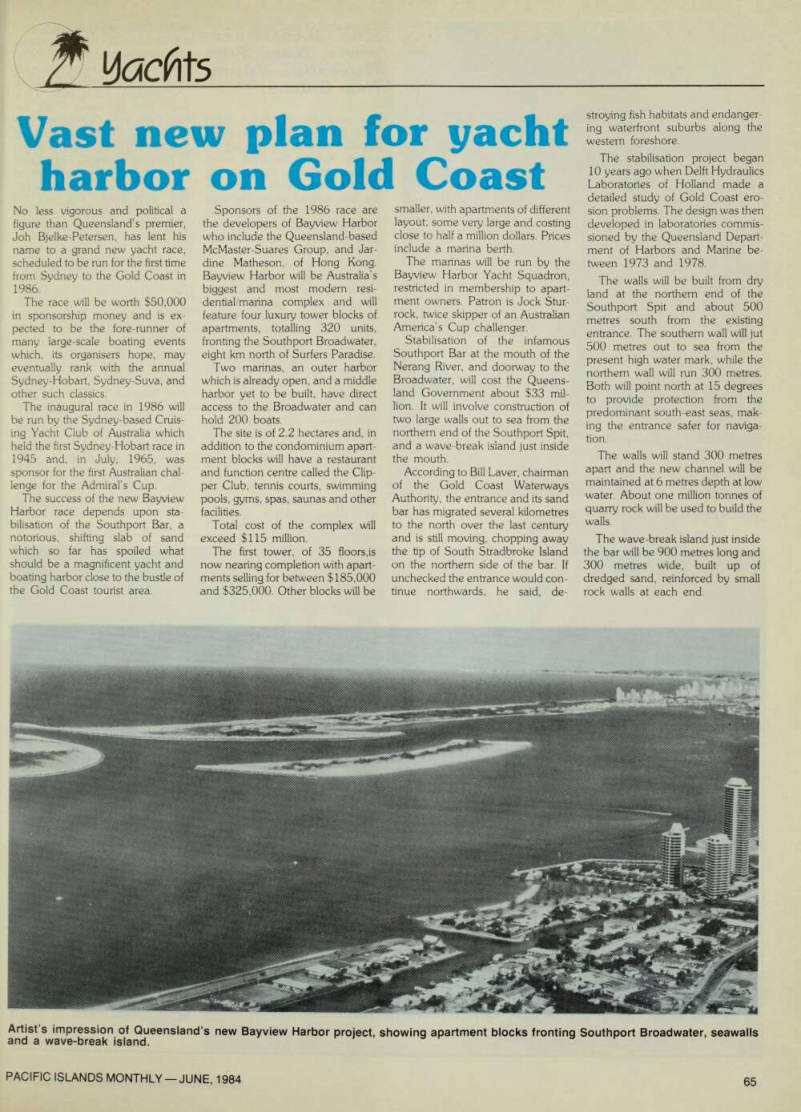
Vast new plan for yacht harbor on Gold Coast
No less vigorous and political a figure than Queensland’s premier, Joh Bjelke-Petersen, has lent his name to a grand new yacht race, scheduled to be run for the first time from Sydney to the Gold Coast in 1986.
The race will be worth $50,000 in sponsorship money and is ex pected to be the fore-runner of many large-scale boating events which, its organisers hope, may eventually rank with the annual Sydney-Hobart, Sydney-Suva, and other such classics.
The inaugural race in 1986 will be run by the Sydney-based Cruis ing Yacht Club of Australia which held the first Sydney-Hobart race in 1945 and, in July, 1965, was sponsor for the first Australian chal lenge for the Admiral’s Cup.
The success of the new Bayview Harbor race depends upon sta bilisation of the Southport Bar, a notorious, shifting slab of sand which so far has spoiled what should be a magnificent yacht and boating harbor close to the bustle of the Gold Coast tourist area.
Sponsors of the 1986 race are the developers of Bayview Harbor who include the Queensland-based McMaster-Suares Group, and Jar dine Matheson, of Hong Kong.
Bayview Harbor will be Australia’s biggest and most modern resi dential/marina complex and will feature four luxury tower blocks of apartments, totalling 320 units, fronting the Southport Broadwater, eight km north of Surfers Paradise.
Two marinas, an outer harbor which is already open, and a middle harbor yet to be built, have direct access to the Broadwater and can hold 200 boats.
The site is of 2.2 hectares and, in addition to the condominium apart ment blocks will have a restaurant and function centre called the Clip per Club, tennis courts, swimming pools, gyms, spas, saunas and other facilities.
Total cost of the complex will exceed $ll5 million.
The first tower, of 35 floors,is now nearing completion with apart ments selling for between $185,000 and $325,000. Other blocks will be
smaller, with apartments of different layout; some very large and costing close to half a million dollars. Prices include a marina berth.
The marinas will be run by the Bayview Harbor Yacht Squadron, restricted in membership to apart ment owners. Patron is Jock Stur rock, twice skipper of an Australian America’s Cup challenger.
Stabilisation of the infamous Southport Bar at the mouth of the Nerang River, and doorway to the Broadwater, will cost the Queens land Government about $33 mil lion. It will involve construction of two large walls out to sea from the northern end of the Southport Spit, and a wave-break island just inside the mouth.
According to Bill Laver, chairman of the Gold Coast Waterways Authority, the entrance and its sand bar has migrated several kilometres to the north over the last century and is still moving, chopping away the tip of South Stradbroke Island on the northern side of the bar. If unchecked the entrance would con tinue northwards, he said, de
stroying fish habitats and endanger ing waterfront suburbs along the western foreshore.
The stabilisation project began 10 years ago when Delft Hydraulics Laboratories of Holland made a detailed study of Gold Coast ero sion problems. The design was then developed in laboratories commis sioned by the Queensland Depart ment of Harbors and Marine be tween 1973 and 1978.
The walls will be built from dry land at the northern end of the Southport Spit and about 500 metres south from the existing entrance. The southern wall will jut 500 metres out to sea from the present high water mark, while the northern wall will run 300 metres.
Both will point north at 15 degrees to provide protection from the predominant south-east seas, mak ing the entrance safer for naviga tion.
The walls will stand 300 metres apart and the new channel will be maintained at 6 metres depth at low water. About one million tonnes of quarry rock will be used to build the walls.
The wave-break island just inside the bar will be 900 metres long and 300 metres wide, built up of dredged sand, reinforced by small rock walls at each end.
Artist’s impression of Queensland’s new Bayview Harbor project, showing apartment blocks fronting Southport Broadwater, seawalls and a wave-break island.
Moresby , Papua
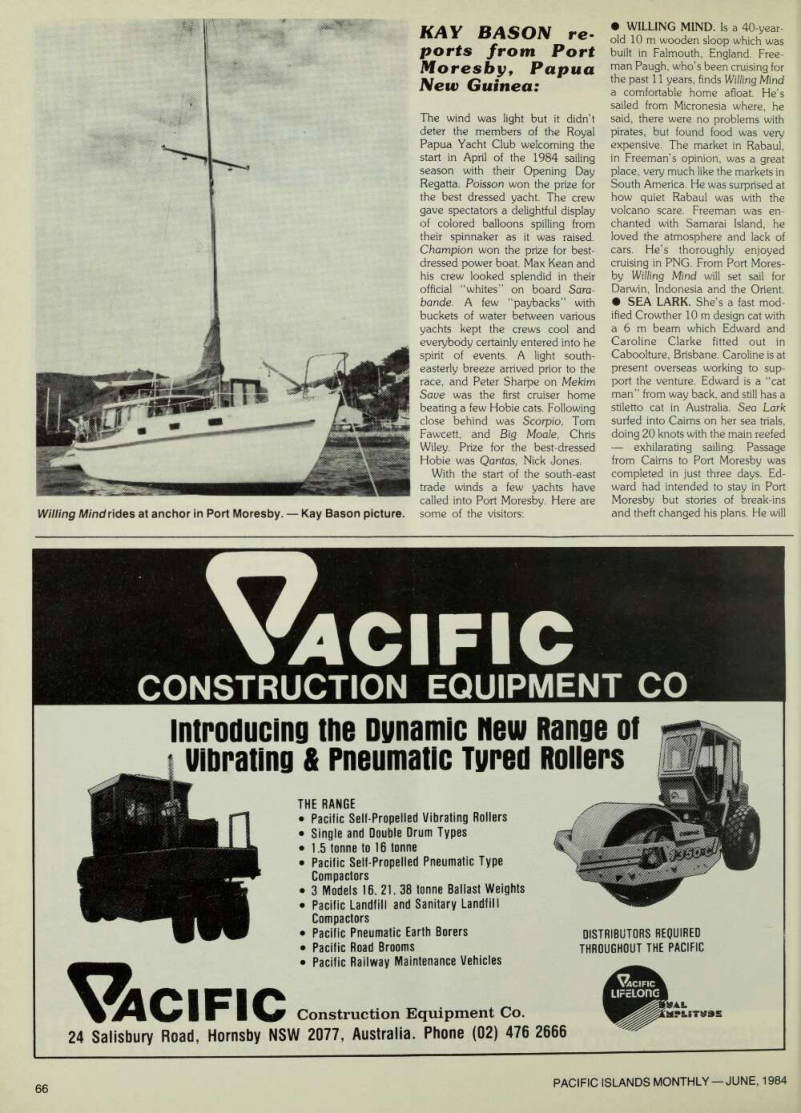
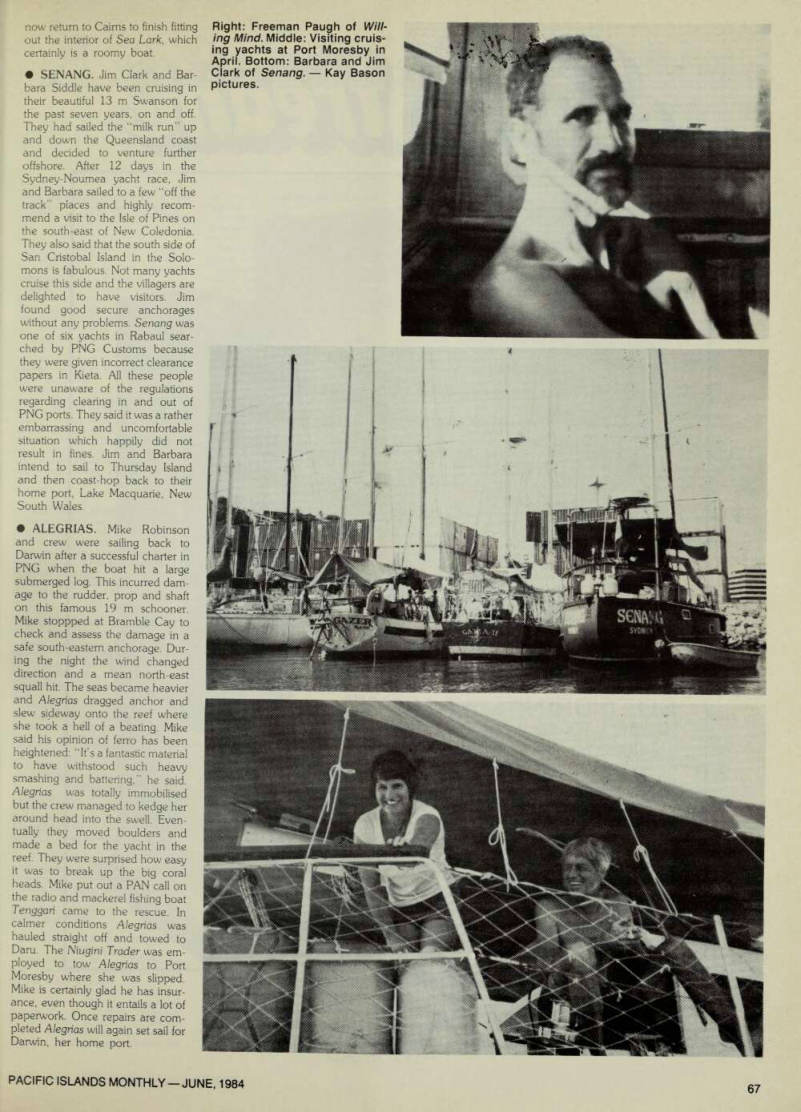
Kay Bason Re
ports from Port Moresby , Papua New Guinea:
• WILLING MIND. Is a 40-year old 10 m wooden sloop which was built in Falmouth, England. Free man Paugh, who’s been cruising for the past 11 years, finds Willing Mind a comfortable home afloat. He’s sailed from Micronesia where, he said, there were no problems with pirates, but found food was very expensive. The market in Rabaul, in Freeman’s opinion, was a great place, very much like the markets in South America. He was surprised at how quiet Rabaul was with the volcano scare. Freeman was en chanted with Samarai Island, he loved the atmosphere and lack of cars. He’s thoroughly enjoyed cruising in PNG. From Port Mores by Willing Mind will set sail for Darwin, Indonesia and the Orient. • SEA LARK. She’s a fast mod ified Crowther 10 m design cat with a 6 m beam which Edward and Caroline Clarke fitted out in Caboolture, Brisbane. Caroline is at present overseas working to sup port the venture. Edward is a “cat man” from way back, and still has a stiletto cat in Australia. Sea Lark surfed into Cairns on her sea trials, doing 20 knots with the main reefed exhilarating sailing. Passage from Cairns to Port Moresby was completed in just three days. Ed ward had intended to stay in Port Moresby but stories of break-ins and theft changed his plans. He will
The wind was light but it didn’t deter the members of the Royal Papua Yacht Club welcoming the start in April of the 1984 sailing season with their Opening Day Regatta. Poisson won the prize for the best dressed yacht. The crew gave spectators a delightful display of colored balloons spilling from their spinnaker as it was raised.
Champion won the prize for best dressed power boat. Max Kean and his crew looked splendid in their official “whites” on board Sara bande. A few “paybacks” with buckets of water between various yachts kept the crews cool and everybody certainly entered into he spirit of events. A light south easterly breeze arrived prior to the race, and Peter Sharpe on Mekim Save was the first cruiser home beating a few Hobie cats. Following close behind was Scorpio, Tom Fawcett, and Big Moale, Chris Wiley. Prize for the best-dressed Hobie was Qantas, Nick Jones.
With the start of the south-east trade winds a few yachts have called into Port Moresby. Here are some of the visitors:
Willing Mind rides at anchor in Port Moresby. - Kay Bason picture.
now return to Cairns to finish fitting out the interior of Sea Lark, which certainly is a roomy boat. • SENANG. Jim Clark and Bar bara Siddle have been cruising in their beautiful 13 m Swanson for the past seven years, on and off.
They had sailed the “milk run” up and down the Queensland coast and decided to venture further offshore. After 12 days in the Sydney-Noumea yacht race, Jim and Barbara sailed to a few “off the track” places and highly recom mend a visit to the Isle of Pines on the south-east of New Coledonia.
They also said that the south side of San Cristobal Island in the Solo mons is fabulous. Not many yachts cruise this side and the villagers are delighted to have visitors. Jim found good secure anchorages without any problems. Senang was one of six yachts in Rabaul sear ched by PNG Customs because they were given incorrect clearance papers in Kieta. All these people were unaware of the regulations regarding clearing in and out of PNG ports. They said it was a rather embarrassing and uncomfortable situation which happily did not result in fines. Jim and Barbara intend to sail to Thursday Island and then coast-hop back to their home port, Lake Macquarie, New South Wales. • ALEGRIAS. Mike Robinson and crew were sailing back to Darwin after a successful charter in PNG when the boat hit a large submerged log. This incurred dam age to the rudder, prop and shaft on this famous 19 m schooner.
Mike stoppped at Bramble Cay to check and assess the damage in a safe south-eastern anchorage. Dur ing the night the wind changed direction and a mean north-east squall hit. The seas became heavier and Alegrias dragged anchor and slew sideway onto the reef where she took a hell of a beating. Mike said his opinion of ferro has been heightened: “It’s a fantastic material to have withstood such heavy smashing and battering,” he said.
Alegrias was totally immobilised but the crew managed to kedge her around head into the swell. Even tually they moved boulders and made a bed for the yacht in the reef. They were surprised how easy it was to break up the big coral heads. Mike put out a PAN call on the radio and mackerel fishing boat Tenggari came to the rescue. In calmer conditions Alegrias was hauled straight off and towed to Dam. The Niugini Trader was em ployed to tow Alegrias to Port Moresby where she was slipped.
Mike is certainly glad he has insur ance, even though it entails a lot of paperwork. Once repairs are com pleted Alegrias will again set sail for Darwin, her home port.
Right: Freeman Faugh of Will ing Mind. Middle: Visiting cruis ing yachts at Port Moresby in April. Bottom: Barbara and Jim Clark of Senang. - Kay Bason pictures.
Advertisements & other items, pp. 66-68 (1 item)
Acific
CONSTRUCTION EQUIPMENT CO
introducing the ognamic new Range of
Vibrating S Pneumatic Tyred Rollers
THE RANGE
• Pacific Self-Propelled Vibrating Rollers • Single and Double Drum Types • 1.5 tonne to 16 tonne • Pacific Self-Propelled Pneumatic Type Compactors • 3 Models 16. 21. 38 tonne Ballast Weights • Pacific Landfill and Sanitary Landfill Compactors • Pacific Pneumatic Earth Borers • Pacific Road Brooms • Pacific Railway Maintenance Vehicles m M
DISTRIBUTORS REQUIRED
THROUGHOUT THE PACIFIC
Construction Equipment Co. 24 Salisbury Road, Hornsby NSW 2077, Australia. Phone (02) 476 2666
SAL
HFLiTSSE
I I I ft
IPUH
lii m m m mm Hi ■ Mi lilf ~1 yyp mi
MAKE YOUR OWN FIZZY
SOFT DRINKS AT HOME!
It’s quick it’s easy and it costs so little! All you need is water, Sodastream flavours and this incredible machine. You fill the Sodastream bottle with water put in the machine... press... now add your favourite flavour and it’s ready to drink.
Fourteen great flavours including Cola, Orange, Raspberry, Tropical Pineapple, Ginger Ale, Tonic... everything for children and adults. You’ll never need to buy soft drinks again. No electricity, no batteries, all you ever do is exchange your gas refill. So simple.
ANW 1292
TRADE ENQUIRIES WELCOME TO
MARKETING MANAGER,
THORN EMI DOMESTIC APPLIANCES (N.Z.) LTD,
P.O. BOX 71-129, ROSEBANK,
AUCKLAND, NEW ZEALAND.
TFI FX- NZ 2648
shipping schedules
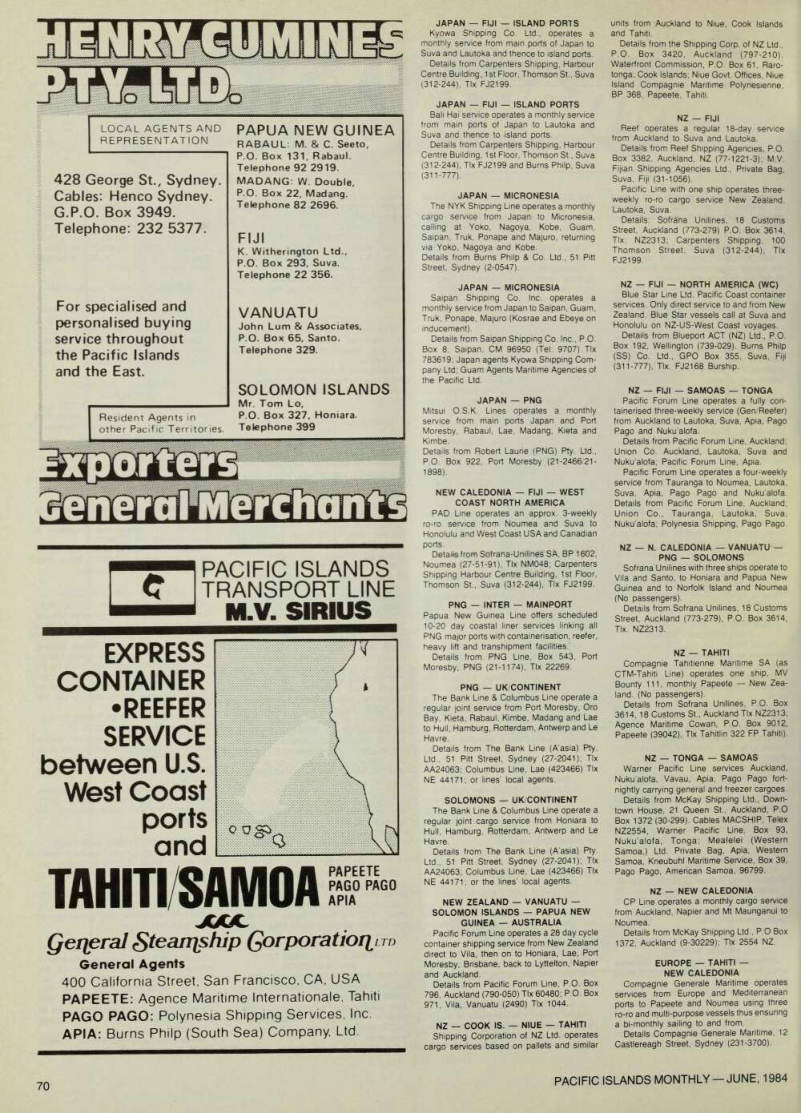
Should any shipping company wish to have its services cargo and passenger included in these listings they should contact
Pim.
Australia - Fiji
KKL (Kangaroo Line) Pty. Ltd., operates a 4 5 weekly cargo service from Sydney and Melbourne to Suva and Lautoka.
Details from KKL (Kangaroo Line) Pty. Ltd., 4th Floor, 19-31 Pitt Street, Sydney (235- 0322), Dalgety Shipping. World Trade Centre, Melbourne (616-6700), Burns Philp (SS) Co.
Ltd., Suva and Lautoka.
Sofrana-Unilines (Fiji Express Line) oper ates to Suva and Lautoka every three weeks from the main ports on the east coast of Australia and monthly to Lautoka from Mel bourne and Sydney.
Details from Sofrana-Unilines, 19 Pitt Street, Sydney (27-9851), Trans-Austral Shipping Pty. Ltd. 570 Bourke Street, Mel bourne (67-9162), ACTA Pty. Ltd., Brisbane (221-3116); Elders-ANL Pty. Ltd. Port Adelaide (47-5688); Newcastle, Sofrana Syd ney (27-9851); Clements and Marshall, Bur nie, Tasmania (31-1833), Carpenters Ship ping, Harbour Centre Building, Ist Floor, Thomson Street, Suva, Fiji (312-244), Tlx FJ2199.
Australia - Samoas - Tonga
Warner Pacific Lines operates a regular cargo service from Sydney, Brisbane and Melbourne to Nukualofa, Pago Pago, Apia and Vavau. Feeder service available from Apia to Cook. Christmas, Fanning and Washington Islands.
Details from Hetherington Wesfarmers Shipping Agency, 37-49 Pitt Street, Sydney (27-1671).
Australia - New Caledonia -
Fiji - Samoas - Tonga
Pacific Forum Line operates a fully con tainerised service (general, reefer and ro-ro) from Sydney to Noumea, Lautoka, Suva, Apia, Pago Pago, Nukualofa, Sydney. Cargo centralised from Adelaide, Melbourne, Bris bane.
Details from: Pacific Forum Line, P.O. Box 796 Auckland; Union Bulkships. 333 George Street, Sydney, Brisbane and Melbourne: Union Co., Lautoka, Suva, Nukualofa; Pacific Forum Line Apia; Polynesia Shipping Pago Pago.
Australia - Lord Howe Is -
Norfolk Is
Compagnie des Chargeurs Caledoniens operates four-weekly cargo service Sydney- Lord Howe Island and Norfolk Island.
Details Hetherington Wesfarmers Shipping Agency, 37-49 Pitt Street, Sydney (27-1671).
Australia - Kiribati
KKL operates a 5/6 weekly service from Melbourne and Sydney to Kiribati (Tarawa).
Details: KKL (Kangaroo Line) Pty. Ltd., 4th Floor, 19-31 Pitt Street, Sydney (235-0322) and Dalgety Shipping, World Trade Centre, Melbourne (616-6700).
Australia - New Caledonia
And Or Vanuatu
Sofrana-Unilines ships serve Noumea every three weeks from the main ports along the east Australian coast.
Details from Sofrana-Unilines, 19 Pitt Street, Sydney (27-9851), Trans-Austral Shipping Pty. Ltd., 570 Bourke Street, Mel bourne (67-9162), ACTA Pty. Ltd., Bnsbane (221-3116), Elders-ANL Pty. Ltd., Port Adelaide (47-5688), Newcastle, Sofrana Syd
ney (27-9851); Clements & Marshall, Bumie, Tasmania (31-1833).
Compagnie des Chargeurs Caledoniens operates a three-weekly containensed cargo service from Sydney to Noumea.
Details Hetherington Wesfarmers Shipping Agency, 37-49 Pitt Street, Sydney (27-1671).
Compagnie Generate Maritime operates a monthly service from Sydney to Noumea, Port Vila and Santo, for containerised and break bulk cargo.
Details Compagnie Generate Maritime, 12 Casttereagh Street, Sydney (231-3700).
Australia - Nauru - Marshall
Is • Kiribati
Nauru Pacific Line operates regular cargo service from Melbourne to Nauru, Majuro and Tarawa. Passenger service to Nauru only.
Details: Nauru Pacific Line (Aust.) Pty. Ltd.
Nauru House, 80 Collins Street, Melbourne (653-5709). Nedlloyd Swire, 8 Spring Street.
Sydney (2-0522).
Australia - New Zealand
The Australian National Line (ANL) and the Shipping Corporation of New Zealand oper ate a 10-day container service between Sydney and Melbourne to Auckland, Welling ton, Lyttelton and Port Chalmers.
Details from ANL, 20 Bond Street, Sydney (232-0444) and Shipping Corporation of New Zealand Ltd., P.O. Box 3420, Auckland, (797-210).
Australia - Nz - Fiji -
Hawaii - Us
P&O liners call at Auckland, Suva, Pago Pago and Honolulu on eastbound and west bound voyages between Sydney and the US.
Details from P&O Booking Centre, World Travel Headquarters Pty. Ltd., 33 Bligh Street, Sydney (237-0333).
AUSTRALIA - NZ - FIJI - TONGA -
Vanuatu - New Caledonia -
Solomons - New Guinea
Sitmar Cruises operates a year-round cruise program to include the above coun tries.
Details from Sitmar Cruises, 39 Martin Place, Sydney (239-9000); NSW, reserva tions & enquiries (008 42-2277); Rest of Australia, reservations & enquiries (008 22- 2277).
AUSTRALIA - NZ - FIJI - TONGA -
Vanuatu - New Caledonia -
Solomons - Samoas - Tahiti
P&O liners call at Auckland, Bay of Islands, Honiara, Lautoka, Noumea, Nukualofa, Pago Pago, Papeete. Port Mores by. Santo, Savusavu, Suva, Vavau and Vila on cruises from Australia.
Details from P&O Booking Centre. World Travel Headquarters Pty. Ltd., 33 Bligh Street, Sydney (237-0333).
Australia - Nz - Solomons -
Png
Pacific Forum Line operates containerised and general cargo service from Lyttleton, Napier and Auckland to Honiara, Lae, Port Moresby, Brisbane.
Details from: Pacific Forum Line, Auckland; Steamships Shipping, Port Moresby; Sulli vans Ltd., Honiara; Union Bulkships, Bris bane.
Australia - Micronesia
Nauru Pacific Line operates a regular container service from Melbourne to Ponape, Truk, Guam and Saipan, Details: N.P.L. (Australia) Pty. Ltd. Nauru
House, 80 Collins Street, Melbourne (653- 5709). Nedlloyd Swire, 8 Spring Street.
Sydney (2-0522).
Australia - Tuvalu
KKL operates a 3 monthly service from Sydney and Melbourne to Tuvalu (Funafuti).
Subject inducement.
Details from KKL (Kangaroo Line) Pty. Ltd., 4th Floor, 19-31 Pitt Street, Sydney (235- 0322).
Australia - Png
KAP New Guinea Lines cargo vessels call at Melbourne, Sydney, Port Moresby, Lae.
Madang, Wewak, Manus, Kimbe, Rabaul.
Popondetta.
Details from K. Asia Pacific Pty. Ltd., 19-31 Pitt Street, Sydney (232-2277), Dalgety Ship ping, World Trade Centre, Melbourne (616- 6700).
Australia - Png - Solomons -
Vanuatu
A consortium of NGAUPNGL and CON PAC/NEL have four vessels operating a joint service from east coast Australian ports to Port Moresby, Lae, Alotau, Madang, Wewak, Rabaul, Kavieng-Kimbe, Kieta, Honiara, Vila, Santo.
Details from Burns, Philp & Co. Ltd., 51 Pitt Street, Sydney, (2-0547); Interocean Swire, 8 Spring Street, Sydney, (2-0522); New Guinea Express Lines, 37 Pitt Street, Sydney, (241- 3991); Vila Agents, PO Box 971, Port-Vila (2490) Tlx. NH1044.
New Guinea Express Lines operates a weekly container service from Melbourne, Sydney, Bnsbane to Port Moresby, Lae, Alotau, Kimbe, Rabaul, Kieta, Honiara, Kavieng, Madang, Wewak, Santo, Vila.
Details from New Guinea Express Lines, PO Box R 73, Royal Exchange, Sydney (241-3991); New Guinea Express Lines, 127 Creek Street, Brisbane (221-9333); New Guinea Express Lines, 327 Collins Street, Melbourne (61-3053); Niugini Express Lines, Port Moresby (21-4572); Lae (42-1536); Niugini Island Cargo Services Pty. Ltd., Rabaul (922-467); Bougainville Agencies Pty Ltd., Kieta (956-089); Alotau Stevedoring & Transport, Alotau (61-1318); Ngatia Wholesalers Pty. Ltd., Kimbe (93-5102); and Trading Company, Mendana Avenue, Hon iara (22588); Vila Agencies Ltd., PO Box 971, Vila, Vanuatu (2490); John Lum & Associ ates, PO Box 65, Santo, Vanuatu (329).
Australia - Tahiti
Compagnie Generate Maritime operates a monthly service from Sydney to Papeete, for containerised and break bulk cargo.
Details Compagnie Generate Maritime, 12 Casttereagh Street, Sydney (231-3700).
Australia - Tahiti - Us
KKL operates a 4/5 weekly cargo service from Melbourne and Sydney to Papeete, and a fortnightly service to US west coast.
Details: KKL (Kangaroo Line) Pty. Ltd., 4th Floor, 19-31 Pitt Street, Sydney (235-0322) and Dalgety Shipping, World Trade Centre, Melbourne (616-6700).
Australia - Nz - West Coast
South America
South Pacific Seaboard Service offers a regular cargo service from Brisbane, Sydney, Adelaide and Melbourne to New Zealand ports Lyttelton and Tauranga and to the west coast of South America, calling at BeuVen tura, Guayaquil. Callao and other ports on inducement.
Details from South Pacific Seaboard
Service agents, Mendian Shipping & Trans port Agencies, 50 Clarence Street, Sydney (290-1633), Tlx 25970; Melbourne (67-5907); Bnsbane (267-6355); Adelaide (47-6600); Oceanbridge Shipping Ltd., 22 Emily Place, Auckland (33-279). Tlx 60523; lan Taylor V Cia Ltda, Prat 827 Of. 301, Valparaiso, Chile (59096), Tlx. 30331 SINGAPORE - HONG KONG - FIJI -
Islands Ports
Kyowa Shipping Co. Ltd. operates a month ly service from Singapore, Hongkong to Lautoka, Suva and then to island ports.
Details from Carpenters Shipping, Harbour Centre Building, Ist Floor, Thomson Street.
Suva. (312-244), Tlx FJ2199.
Far East - Fiji - New
Zealand
New Zealand Unit Express (NZUE) oper ates a monthly palletised cargo service from Manila, Keelung, Kashiung and Hongkong to Lautoka. Suva and thence to NZ.
Details from Carpenters Shipping, Harbour Centre Building, Ist Floor, Thomson Street, Suva (312-244), Tlx FJ2199, Burns Philp, Suva (311-777) P&O S.N. Co. Wellington (736-477) or Nedlloyd Swire Pty. Ltd., Sydney (20-522).
Nedlloyd operates bi-weekly cargo service with four ships from Sourabaya, Jakarta, Bangkok, Port Kelang and Singapore to Suva, Lautoka and NZ ports.
Details from Nedlloyd (Aust.) Pty. Ltd., 8 Spring St., Sydney (27-3801). Burns Philp (SS) Co. Ltd., Suva and Lautoka.
Far East - Mid-S. Pacific
China Navigation's New Guinea Pacific Line operates a regular container service from Hongkong, Taiwan, Manila, Port Kelang and Singapore to Port Moresby, Lae. Rabaul and Honiara monthly and to Wewak, Madang and Kieta every three months. Cargo from the same Far Eastern ports to the South Pacific ports of Noumea, Santo, Vila, Papeete, Pago Pago, Apia, Raratonga and Tarawa will be shipped via Japan on the monthly Bali Hal service.
Details from Steamships Trading Co. Ltd., PO Box 1, Port Moresby (22-0222).
Kyowa Shipping Ltd. operates monthly services from Japan to Guam, Saipan. Solo mons, New Caledonia, Fiji, Western and American Samoa, Tahiti, Cook Is., Tonga and Vanuatu.
Details: Hetherington Wesfarmers Shipping Agency, 37-49 Pitt Street. Sydney (27-1671); Carpenters Shipping. Suva (312-244), Tlx FJ2199.
Guam - Northern Marianas
Saipan Shipping Co. Inc. operate a weekly service via barge carrying containers and conventional cargo between Guam and Saipan and Tinian.
Details from Saipan Shipping Co. Inc., PO Box 8. Saipan, CM 96950 (Tel: 9707) Tlx 783619; Guam agents Maritime Agencies of the Pacific Ltd.
Inter Pacific Islands
South West Pacific Containers Line offers a scheduled container service with 23 day frequency between Apia, Honiara, Kieta, Lae, Noumea, Nukualofa, Pago Pago, Port Moresby, Santo, Suva and Lautoka, Vila.
Trans-shipment to overseas markets can be arranged. Breakbulk cargo, heavy lifts and refrigerated accepted.
Details from Burns Philp and Co., 7 Bridge Street, Sydney (20-547) Tlx AA20290.
Japan Fiji Island Ports
Kyowa Shipping Co. Ltd., operates a monthly service from main ports of Japan to Suva and Lautoka and thence to island ports.
Details from Carpenters Shipping, Harbour Centre Building, Ist Floor, Thomson St., Suva (312-244), Tlx FJ2199.
Japan Fiji Island Ports
Bali Hai service operates a monthly service from main ports of Japan to Lautoka and Suva and thence to island ports.
Details from Carpenters Shipping, Harbour Centre Building, Ist Floor, Thomson St., Suva (312-244), Tlx FJ2199 and Burns Philp, Suva (311-777).
Japan Micronesia
The NYK Shipping Line operates a monthly cargo service from Japan to Micronesia, calling at Yoko, Nagoya, Kobe, Guam, Saipan, Truk, Ponape and Majuro, returning via Yoko, Nagoya and Kobe.
Details from Burns Philp & Co. Ltd., 51 Pitt Street, Sydney (2-0547).
Japan Micronesia
Saipan Shipping Co. Inc. operates a monthly service from Japan to Saipan, Guam, Truk, Ponape, Majuro (Kosrae and Ebeye on inducement).
Details from Saipan Shipping Co. Inc., P.O.
Box 8, Saipan, CM 96950 (Tel; 9707) Tlx 783619; Japan agents Kyowa Shipping Com pany Ltd; Guam Agents Maritime Agencies of the Pacific Ltd.
Japan Png
Mitsui O.S.K. Lines operates a monthly service from main ports Japan and Port Moresby, Rabaul, Lae, Madang, Kieta and Kimbe.
Details from Robert Laurie (PNG) Pty. Ltd., P.O. Box 922, Port Moresby (21-2466/21- 1898).
New Caledonia Fiji West
Coast North America
PAD Line operates an approx. 3-weekly ro-ro service from Noumea and Suva to Honolulu and West Coast USA and Canadian ports.
Details from Sofrana-Unilines SA, BP 1602, Noumea (27-51-91), Tlx NMO4B; Carpenters Shipping Harbour Centre Building, Ist Floor, Thomson St., Suva (312-244), Tlx FJ2199.
Png Inter Mainport
Papua New Guinea Line offers scheduled 10-20 day coastal liner services linking all PNG major ports with containerisation, reefer, heavy lift and transhipment facilities.
Details from PNG Line, Box 543, Port Moresby. PNG (21-1174), Tlx 22269.
Png Uk Continent
The Bank Line & Columbus Line operate a regular joint service from Port Moresby, Oro Bay, Kieta, Rabaul, Kimbe, Madang and Lae to Hull, Hamburg, Rotterdam, Antwerp and Le Havre.
Details from The Bank Line (A'asia) Pty.
Ltd . 51 Pitt Street, Sydney (27-2041); Tlx AA24063; Columbus Line. Lae (423466) Tlx NE 44171; or lines' local agents.
Solomons - Uk Continent
The Bank Line & Columbus Line operate a regular joint cargo service from Honiara to Hull, Hamburg, Rotterdam, Antwerp and Le Havre.
Details from The Bank Line (A'asia) Pty.
Ltd., 51 Pitt Street, Sydney (27-2041); Tlx AA24063; Columbus Line, Lae (423466) Tlx NE 44171; or the lines' local agents.
New Zealand Vanuatu
Solomon Islands Papua New
Guinea - Australia
Pacific Forum Line operates a 28 day cycle container shipping service from New Zealand direct to Vila, then on to Honiara, Lae, Port Moresby, Brisbane, back to Lyttelton, Napier and Auckland.
Details from Pacific Forum Line, P.O. Box 796, Auckland (790-050) Tlx 60480; P.O. Box 971, Vila, Vanuatu (2490) Tlx 1044.
Nz Cook Is. Niue Tahiti
Shipping Corporation of NZ Ltd. operates cargo services based on pallets and similar
units from Auckland to Niue, Cook Islands and Tahiti.
Details from the Shipping Corp. of NZ Ltd., P.O. Box 3420, Auckland (797-210).
Waterfront Commission, P.O. Box 61, Raro tonga; Cook Islands; Niue Govt. Offices, Niue Island Compagnie Maritime Polynesienne, BP 368, Papeete, Tahiti.
Nz Fiji
Reef operates a regular 18-day service from Auckland to Suva and Lautoka.
Details from Reef Shipping Agencies, P.O.
Box 3382, Auckland, NZ (77-1221-3); M.V.
Fijian Shipping Agencies Ltd., Private Bag, Suva, Fiji (31-1056).
Pacific Line with one ship operates three weekly ro-ro cargo service New Zealand.
Lautoka, Suva.
Details: Sofrana Unilines, 18 Customs Street, Auckland (773-279) P.O. Box 3614, Tlx: NZ2313; Carpenters Shipping, 100 Thomson Street. Suva (312-244), Tlx FJ2199.
Nz Fiji North America (Wc)
Blue Star Line Ltd. Pacific Coast container services. Only direct service to and from New Zealand. Blue Star vessels call at Suva and Honolulu on NZ-US-West Coast voyages.
Details from Blueport ACT (NZ) Ltd., P.O.
Box 192, Wellington (739-029). Burns Philp (SS) Co. Ltd., GPO Box 355, Suva, Fiji (311-777), Tlx. FJ2168 Burship.
Nz Fiji Samoas Tonga
Pacific Forum Line operates a fully con tainerised three-weekly service (Gen. Reefer) from Auckland to Lautoka, Suva, Apia, Pago Pago and Nukualofa.
Details from Pacific Forum Line, Auckland; Union Co. Auckland. Lautoka, Suva and Nukualofa; Pacific Forum Line, Apia, Pacific Forum Line operates a four-weekly service from Tauranga to Noumea, Lautoka, Suva, Apia, Pago Pago and Nukualofa.
Details from Pacific Forum Line, Auckland; Union Co., Tauranga, Lautoka, Suva, Nuku’alofa; Polynesia Shipping, Pago Pago.
Nz N. Caledonia Vanuatu
Png - Solomons
Sofrana Unilines with three ships operate to Vila and Santo, to Honiara and Papua New Guinea and to Norfolk Island and Noumea (No passengers).
Details from Sofrana Unilines, 18 Customs Street, Auckland (773-279), P.O. Box 3614, Tlx. NZ2313.
Nz Tahiti
Compagnie Tahitienne Maritime SA (as CTM-Tahiti Line) operates one ship, MV Bounty 111, monthly Papeete New Zea land. (No passengers).
Details from Sofrana Unilines, P.O. Box 3614, 18 Customs St., Auckland Tlx NZ2313; Agence Maritime Cowan, P.O. Box 9012, Papeete (39042), Tlx Tahitlin 322 FP Tahiti).
Nz Tonga Samoas
Warner Pacific Line services Auckland, Nukualofa. Vavau, Apia, Pago Pago fort nightly carrying general and freezer cargoes.
Details from McKay Shipping Ltd., Down town House, 21 Queen St., Auckland, P.O Box 1372 (30-299). Cables MACSHIP, Telex NZ2554, Warner Pacific Line, Box 93, Nukualofa, Tonga; Mealelei (Western Samoa,) Ltd. Private Bag, Apia, Western Samoa, Kneubuhl Maritime Service, Box 39, Pago Pago, American Samoa, 96799.
Nz New Caledonia
CP Line operates a monthly cargo service from Auckland, Napier and Mt Maunganui to Noumea.
Details from McKay Shipping Ltd., P.O Box 1372. Auckland (9-30229); Tlx 2554 NZ.
Europe Tahiti
New Caledonia
Compagnie Generate Maritime operates services from Europe and Mediterranean ports to Papeete and Noumea using three ro-ro and multi-purpose vessels thus ensuring a bi-monthly sailing to and from.
Details Compagnie Generate Maritime, 12 Castlereagh Street, Sydney (231-3700).
Europe Tahiti
New Caledonia New Zealand
Solomons Png Europe
Polish Ocean Lines offers regular monthly sailings for containerised and breakbulk car go and reefer space, conventional and in reefer containers, from Hamburg, Antwerp, Dunkirk and Rouen to Papeete, Noumea, New Zealand, Honiara, Lae, Manila and Singapore, returning to Europe via Suez.
Other ports in the South Pacific can be served with inducement.
Details from Sotama, BP 9170, Papeete (27805), Tlx. 296: SATO, BP C 2, Noumea (272094), Tlx. 163 NM SATO; Union Steam ship Co of NZ, P.O Box 50, Apia, Tlx. 25; Williams and Gosling, P.O Box 79, Suva (312633), Tlx. 2163; Warner Pacific Line, P.O. Box 93 Nukualofa (21089), Tlx. 66219; Universal Shipping Agencies, P.O Box 2282, Auckland (30930), Tlx. 21517.
Europe Tahiti —W. Samoa
Fiji N. Caledonia
Nedlloyd offers regular cargo services from Northern Europe and U.K. to Papeete, Apia, Fiji and New Caledonia.
Details Nedlloyd (Aust.) Pty. Ltd., 8 Spring Street, Sydney (27-3801); Carpenters Ship ping, 100 Thomson St., Suva (312-244), Tlx. 2199 FJ and Vetari Street, Lautoka (63988), Tlx. 5215FJ.
Uk N. Continent W. Samoa
Tonga, Fiji
The Bank Line & Columbus Line operate a regular joint cargo service from Hull, Ham burg, Bremen, Antwerp, Rotterdam and le Havre to Apia, Nukualofa, Suva and Lautoka.
Detalis from The Bank Line (A'asia) Pty.
Ltd., 51 Pitt Street, Sydney (27-2041); Tlx AA 24063; Columbus Line, Lae (423-466) Tlx NE 44171; or lines' local agents.
Uk N. Continent Png
Solomons
The Bank Line & Columbus Line operate a regular joint cargo service from Hull, Ham burg, Bremen, Antwerp. Rotterdam and Le Havre to Port Moresby, Lae, Madang, Kimbe, Rabaul, Kieta and Honiara and on induce ment to Yandina.
Details from The Bank Line (A'asia) Pty.
Ltd,, 51 Pitt Street, Sydney (27-2041) Tlx AA 24063; Columbus Line, Lae (42-3466) Tlx NE 44171; or lines' local agents.
Uk/N. Continent Tahiti
N. Caledonia Vanuatu
The Bank Line & Columbus Line operate a regular joint cargo service from Hull, Ham burg, Bremen, Antwerp, Rotterdam and Le Havre to Papeete, Noumea, Port-Vila and Santo.
Details from The Bank Line (A'asia) Pty.
Ltd., 51 Pitt Street, Sydney (27-2041) Tlx AA 24063; Columbus Line, Lae (42-3466) Tlx NE 44171; Ets. A M. Fare UTE, Papeete; Ets.
Ballande, Noumea and other local agents.
Us Fiji Tahiti Nz
Australia
The Bank Savill Line Ltd. operates regular cargo services from U.S. Gulf ports to Australia and N.Z. Calls at Suva, Lautoka and Papeete on demand.
Details from The Bank and Savill Line Ltd., 51 Pitt Street, Sydney (27-2041) or Orient Shipping Services, 32 Bridge Street, Sydney (241-2753)
Us Hawaii Micronesia
E. Malaysia Brunei Papua New
Guinea Philippines
PM&O Lines operates three fully self-sus tained container vessels on a sailing frequen cy of every 21 days from the San Francisco Bay Area, Los Angeles, and Honolulu to Majuro, Ebeye, Kosrae, Ponape, Truk, Saipan, Yap, Koror, Kota Kinabalu, Brunei, Lae, Port Moresby, Kieta and Rabaul.
Service is also offered utilising the same vessels on the same 21-day frequency from the Philippine ports of Manila, Cebu, Cagayan de Oro, Davao and General Santos to Hawaii, San Francisco Bay Area and Los Angeles.
Details from PM&O Lines, 181 Fremont Street, San Francisco, California, 94105, U.S,A, (415) 543-7430, Tlx. 278016, Cable PMONAV SFO; PM&O Owner's representa tive, P.O. Box 803, Saipan, N.M.I. 96950.
Cable Commontime Saipan, Tlx.
783605; Soriamont Steamship Agencies Inc., Soriamont House, 801 United Nations Ave nue, Manila, Philippines. Tel 50-1831 and
50-1851, Tlx. 40138. Anship Pn.
Us Hawaii Nauru
Micronesia
Nauru Pacific Line operates regular con ventional and container services from San Francisco and Honolulu to Majuro, Ponape, Truk and Saipan. Cargo is accepted for Nauru and Kosrae with transhipment at Majuro and Ponape.
Details from N.P.O. (Australia) Pty, Ltd., Nauru House, 80 Collins Street, Melbourne (653-5709); Nauru Air and Shipping Agency.
Suite 2803, 185 Berry Street. San Francisco, California 94107 (415-543-1737); Nauru Air and Shipping Agency, Suite 506, 841 Bishop St., Honolulu, HI 96813 (808-523-0441).
Hawaii Tahitii Samoas
Marshall Islands Maritime Co-operates a service every 32 days between Honolulu, Papeete, Pago Pago and Apia.
Details from the Maritime Co. of the Pacific, 567 South King Street, Suite 310, Honolulu, Hawaii, Morris Hedstrom, Box 189, Apia, Western Samoa and the Marshall Islands Maritime Co., Box 679, Majuro, Marshall Islands.
Us. Noumea Fiji
PAD Line operates an approx. 3-weekly ro-ro service from West coast USA and Canada to Noumea, Suva and Lautoka.
Details from Trans-Austral Shipping BP 1602, Noumea (27-51-91), Tlx. NMO4B; Carpenters Shipping, Harbour Centre Buil ding, Ist Floor, Thomson Street, Suva (312- 244), Tlx. FJ2199; Trans-Austral Shipping Pty. Ltd., P.O. Box R 232, Royal Exchange, 2000 (231-8411). Tlx AA21204.
Us Tahiti Samoa
Pacific Islands Transport operates a five weekly cargo service from North America west coast ports to Papeete, Pago Pago, Apia.
Details from Polynesia Shipping Services Inc. P.O. Box 1478, Pago Pago 96799.
Polynesia Line operates container and general cargo service from US west coast ports to Papeete and Pago Pago.
Details from Polynesia Shipping Services Inc., P.O. Box 1478, Pago Pago 96799.
Advertisements & other items, pp. 70-72 (1 item)
jiiju-Kru^
LOCAL AGENTS AND
REPRESENTATION
428 George St., Sydney.
Cables: Henco Sydney.
G.P.O. Box 3949.
Telephone: 232 5377.
PAPUA NEW GUINEA
RABAUL: M. & C. Seeto, P.O. Box 131, Rabaul.
Telephone 92 2919.
MADANG: W. Double, P.O. Box 22, Madang.
Telephone 82 2696.
FIJI
K. Witherington Ltd., P.O. Box 293, Suva.
Telephone 22 356.
For specialised and personalised buying service throughout the Pacific Islands
VANUATU
John Lum & Associates, P.O. Box 65, Santo.
Telephone 329. and the East.
SOLOMON ISLANDS
Mr. Tom Lo, P.O. Box 327, Honiara.
Resident Agents in other Pacific Territories. Telephone 399 11 e
PACIFIC ISLANDS
TRANSPORT LINE
M.V. SIRIUS
EXPRESS
CONTAINER
•REEFER
SERVICE
between U.S.
West Coast
ports
and
r
TAHITI SflMOflr
xot
QeqeraJ Steamship Qorporatioq^Lm
General Agents 400 California Street, San Francisco, CA, USA PAPEETE: Agence Maritime Internationale, Tahiti PAGO PAGO: Polynesia Shipping Services, Inc.
APIA: Burns Philp (South Sea) Company, Ltd.
POLISH OCUN IMS
General Management, 10 Lutego 24,81-364 GDYNIA. POLAND, Phone: 20-19-01, Cables: POLOCEAN Telex: 054-231 © © I
ZXVi
Hi ■TV k Ml ■an '■v? 0.-V,V/
SOUTH PACIFIC SERVICE 1!
from: GDYNIA, HAMBURG, ROTTERDAM, MIDDLESBOROUGH/IMMINGHAM,
RK ’, ROUENI PAPEETE (Via PANAMA), NOUMEA, AUCKLAND, HONIARA, RABAUL, LAE, oiNuArUHE, by our multipurpose vessels carrying dry and reefer containers, reefer chambers, heavy lifts, breakbulk or palletized, bulk liquids.
POLISH OCEAN LINES Representatives AUCKLAND T.B.A. Telex 21517 NZ “UNISHIP”. SYDNEY Mr Walenciak Telex 20428 AA “SLEIGH”
TAUi-r. oat*... , POLISH OCEAN LINES Agents AP T 8 f X CAL EDONIA SATO Telex 163 NM “SATO”. AUCKLAND UNIVERSAL SHIPPING AGENCIES LTD., Telex 21517 NZ UNISHIP . SOLOMONS MELAN CHINE SHIPPING CO., LTD Telex 66335 HO “SYMECO” PNG STEAMSHIPS TRADING CO., LTD Telex 42423 NE “STEAM”.
ALL THE
NEWS
IN A
FLASH
The South Sea Digest tells you what you want to know about the Pacific Islands in a few words. All the leading firms and diplomatic missions read it. You can ’phone or write or call for a follow up.
See insert for subscription details:
THE SOUTH SEA DIGEST
We’ve just made
the ocean smaller!
Polynesia Line's new MS Polynesia 550-container ship provides regular monthly cargo service between Papeete, Pago Pago and Apia in the South Pacific, and Long Beach and Oakland on the US Pacific Coast.
POLYNESIA LINE
Interocean Steamship Corporation General Agent Oh 9 <2 .s u T® 3* 5* & * 1-1 Apia Pago Pago Serving Polynesia is all we do—and we do it better!
deaths
Sir John Gunther Sir John Gunther has died in Melbourne at the age of 73 and a remarkable man has left the scene.
The bare facts of his life are sufficient to indicate his achievements. John Thomson Gunther was born on October 2, 1910, at Sydney, NSW, and was educated at the King’s School, Parramatta, and at the University of Sydney, graduat ing in medicine and joining Lever Brothers’ Pacific Planta tions Ltd., in the British Solo mon Islands Protectorate in 1935. He was chairman of the medical board investigating lead-poisoning at Mt Isa in Queensland from 1938 to 1940 and, in 1941, joined the R.A.A.F. as a medical officer.
He did valuable work in ma lariology in 1943 and was com manding officer of the Ist Aus tralian Tropical Research Field Unit in 1944-45.
In 1949 he was appointed Director of Public Health in the Papua New Guinea Administra tion, and for the rest of his life he was closely involved in the affairs of PNG. He ran P.H.D. until 1957, with fierce effective ness. He saw malaria as his principal enemy, and he fought hard ... he was always a fighter ... for the manpower and funds he had to have if the malaria scourge was to be beaten.
When Sir Paul Hasluck be came Minister for Territories in 1951 he was exceedingly criti cal of the overall quality of the PNG Public Service as he found it, and as he makes very clear in his 1976 book, A Time for Building. He says this of John Gunther; ”he was easily the strongest single driving force in the Administration ... here I had someone who needed no pushing ... Gunther had not yet received any major policy decisions on health and he had been given scant funds, but he had gone ahead without waiting for either...” That was typical of John Gunther.
So effective a director was he that nobody in PNG was in the least surprised when in 1957 he
was appointed to the vital posi tion of Assistant Administrator.
He now had a wider field for his talents. He was a powerful force in the Legislative Council and later in the House of Assembly, and he was one of the first in high places to realise that the pace of constitutional change in PNG was about to accelerate.
Although an obvious repre sentative of entrenched authority, he was still able to forge close links with emerging national figures like John Guise, Gala Oala-Rarua and Matthias Toliman. He was chairman of the 1962 Select Committee on Constitutional Development set up by the Legislative Council to go to the people and seek their views, and which recom mended changes that heralded the beginning of the end of the colonial era in PNG.
The third phase of John Gunther’s official life in PNG began in 1963 with his appoint ment as a member of the Commission on Higher Educa tion in Papua and New Guinea, chaired by Sir George Currie.
The Commission recom mended the immediate estab lishment of a University at Port Moresby. There was tremendous controversy, but the decision to establish the university was taken and, in 1966, Gunther accepted the appointment of Vice-Chancel lor. He virtually created the university as it is today.
There was much speculation in PNG at the time about the real reason for Gunther’s retire ment from the powerful posi tion of Assistant Administrator to that of university vice-chan cellor. Most observers thought that he would naturally succeed Sir Donald Cleland upon his retirement as Administrator, due in 1966. I saw much of John Gunther during his final years of retirement at Buderim, and he told me that he had every reason to believe that had Hasluck remained Minister for Territories he would have been offered the appointment, but in December, 1963, Hasluck left Territories.
I believe that Gunther, al
ways a realist, came to the conclusion that the top Public Service job in PNG would not from then on come his way.
The vice-chancellorship offered him the chance of a new career, in a field in which he pas sionately believed.
History shows that he was just as effective in his new role as he had been in the old. The University of Papua New Guinea owes him a massive debt.
In 1972 Gunther retired. He had been in ill-health for years and had never spared himself physically throughout his time in PNG. Along the way his work had been acknowledged by the award of the OBE and CMG, and in 1973, he was knighted.
He shared his retirement with his beloved wife, Dot, who survives him. A son carries on the Gunther name and there are three daughters.
Few men had a greater influ ence on the affairs of Papua New Guinea than John Gunth er. His interest in the country never flagged, and he was greatly disturbed by the reappearance of malaria on a serious scale after independ ence. The disease, in Gunther’s view, the greatest single scourge of the PNG people, was well on the way to contain ment during the Australian era, but many of the control mea sures were unpopular and after independence were relaxed.
Many times Gunther was urged to write about his years in PNG, for his testimony would have been invaluable to the historians of the future, but strangely enough for a man of his quality and intellect he did not find writing easy, and his health was too fragile.
No-one who knew him is ever likely to forget him.
James Sinclair.
Vivian George Plant Vivian George Plant In Sydney, on March 9, aged 68, following heart surgery. George Plant first settled on Norfolk Island in 1956 with his wife Enid. He managed the Hopkins Store and then joined the whaling station until it closed in 1960.
He was an active member of the Norfolk Island community, serving on the committee of the R.S.L. sub-branch as well as being its welfare officer.
Jane Hammond Usher In San Francisco on February 28, aged 68. Mrs Usher col lapsed and died in her hotel room during a stopover on a business trip. She was the wife of L.G.Usher, of Suva, Fiji, who is among the most prominent figures in Fiji politics and so ciety, and a former executive director and editor of the Fiji Times and Herald Ltd.
Mrs Usher was on her way home from one of her regular buying expeditions to Italy and the United States. She operated the Suva boutique, Crossroads, which specialised in high-qua lity china and crystal.
Born in Oakland, California, Mrs Usher graduated with a Bachelor of Arts degree at San Jose State College and qual ified as a certified teacher, working in a number of schools before going to Fiji in 1961.
Adi Lefulefu Talo In San Francisco, reportedly aged 122. Adi Lefulefu Talo was the great grand-daughter of Ratu Seru Cabobau, her father being Ratu Etuate Wainiu, grandson of Ratu Seru. She married an American naval officer at the age of 15 and spent most of her life in Amer ican Samoa. She leaves a fam ily of 112, including many great grand children.
Mrs H. Simmonds In Auckland, on March 26, aged 86. Mrs Simmonds was the wife of Hubert Simmonds who was the government en tomologist in Suva, Fiji, be tween 1919 and 1936, when he retired. They were married in 1924, and lived in Suva until around 1938, returning to Aus tralia. Hubert Simmonds died in 1966 after which Mrs Sim monds moved to Auckland, New Zealand. She died after a period of failing health, leaving two children, seven grandchil dren and four great grand chil dren.
Advertising
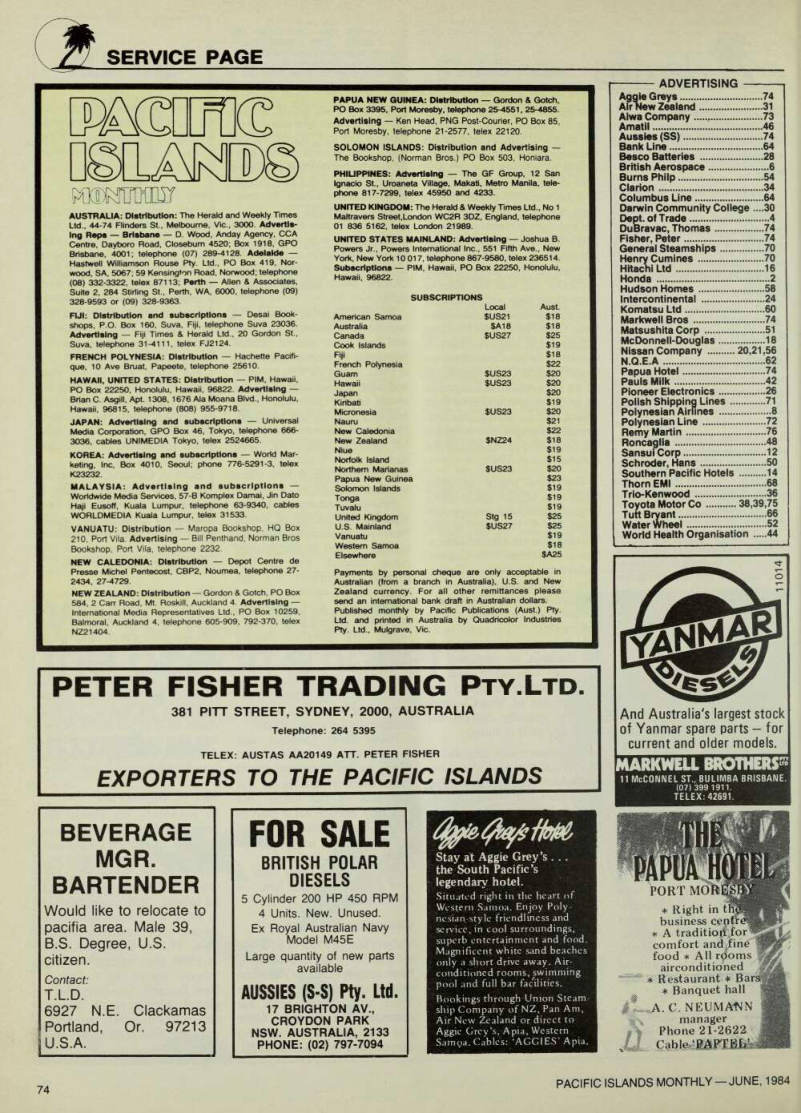
Aggie Greys 74 Air New Zealand 31 Aiwa Company 73 Amatil 46 Aussies (SS) 74 Bank Line 64 Besco Batteries 28 British Aerospace 6 Burns Philp 54 Clarion 34 Columbus Line 64 Darwin Community College ...30 Dept, of Trade 4 DuBravac, Thomas 74 Fisher, Peter 74 General Steamships 70 Henry Cumines 70 Hitachi Ltd 16 Honda 2 Hudson Homes 58 Intercontinental 24 Komatsu Ltd 60 Markwell Bros 74 Matsushita Corp 51 McDonnell-Douglas 18 Nissan Company 20,21,56
N.Q.E.A 62
Papua Hotel 74 Pauls Milk 42 Pioneer Electronics 26 Polish Shipping Lines 71 Polynesian Airlines 8 Polynesian Line 72 Remy Martin 76 Roncaglia 48 SansuiCorp 12 Schroder, Hans 50 Southern Pacific Hotels 14 Thorn EMI 68 Trlo-Kenwood 36 Toyota Motor Co 38,39,75 Tutt Bryant 66 WaterWheel 52 World Health Organisation 44
Advertisements & other items, pp. 74-76 (2 items)
For Sale
SERVICE PAGE
mm D ’nm
lOT^rnrasr
AUSTRALIA: Distribution: The Herald and Weekly Times Ltd., 44-74 Flinders St., Melbourne, Vic., 3000. Advertising Reps Brisbane D. Wood, Anday Agency, CCA Centre, Dayboro Road, Closebum 4520; Box 1918, GRO Brisbane, 4001; telephone (07) 289-4128. Adelaide Hastwell Williamson Rouse Pty. Ltd., PO Box 419, Norwood, SA, 5067; 59 Kensington Road. Norwood; telephone (08) 332-3322, telex 87113; Perth Allen & Associates, Suite 2, 284 Stirling St., Perth, WA, 6000, telephone (09) 328-9593 or (09) 328-9363.
FIJI: Distribution and subscriptions Desai Bookshops, P.O. Box 160, Suva, Fiji, telephone Suva 23036.
Advertising Fiji Times & Herald Ltd., 20 Gordon St., Suva, telephone 31-4111, telex FJ2124.
FRENCH POLYNESIA: Distribution Hachette Padfique, 10 Ave Bruat, Papeete, telephone 25610.
HAWAII, UNITED STATES: Distribution PIM, Hawaii.
PO Box 22250, Honolulu, Hawaii, 96822 Advertising Brian C. Asgill, Apt. 1308, 1676 Ala Moana Blvd., Honolulu.
Hawaii, 96815, telephone (808) 955-9718.
JAPAN: Advertising and subscriptions Universal Media Corporation, GPO Box 46, Tokyo, telephone 666- 3036. cables UNIMEDIA Tokyo, telex 2524665.
KOREA: Advertising and subscriptions World Marketing, Inc, Box 4010, Seoul; phone 776-5291-3, telex K 23232.
MALAYSIA: Advertising and subscriptions Worldwide Media Services. 57-B Komplex Damai, Jin Dato Haji Eusoff, Kuala Lumpur, telephone 63-9340, cables WORLDMEDIA Kuala Lumpur, telex 31533.
VANUATU: Distribution Maropa Bookshop, HQ Box 210, Port Vila Advertising Bill Penthand, Norman Bros Bookshop. Port Vila, telephone 2232.
NEW CALEDONIA: Distribution - Depot Centre de Presse Michel Pentecost, CBP2, Noumea, telephone 27- 2434, 27-4729.
NEW ZEALAND: Distribution Gordon & Gotch, PO Box 584, 2 Carr Road, Mt. Roskill, Auckland 4 Advertising International Media Representatives Ltd., PO Box 10259, Balmoral. Auckland 4, telephone 605-909, 792-370, telex NZ21404.
PAPUA NEW GUINEA: Distribution Gordon & Gotch, PO Box 3395, Port Moresby, telephone 25-4551,25-4855.
Advertising Ken Head, PNG Post-Courier, PO Box 85, Port Moresby, telephone 21-2577, telex 22120.
SOLOMON ISLANDS: Distribution and Advertising The Bookshop, (Norman Bros.) PO Box 503, Honiara.
PHILIPPINES: Advertising The GF Group, 12 San Ignacio St., Uroaneta Village, Makati, Metro Manila, telephone 817-7299, telex 45950 and 4233.
UNITED KINGDOM: The Herald & Weekly Times Ltd., No 1 Maltravers Street,London WC2R 3DZ, England, telephone 01 836 5162, telex London 21989.
UNITED STATES MAINLAND: Advertising Joshua B.
Powers Jr.. Powers International Inc., 551 Fifth Ave., New York, New York 10 017. telephone 867-9580, telex 236514.
Subscriptions PIM, Hawaii, PO Box 22250, Honolulu, Hawaii. 96822.
SUBSCRIPTIONS
Payments by personal cheque are only acceptable in Australian (from a branch in Australia), U.S. and New Zealand currency. For all other remittances please send an international bank draft in Australian dollars.
Published monthly by Pacific Publications (Aust.) Pty.
Ltd. and printed in Australia by Quadricolor Industries Pty. Ltd., Mulgrave, Vic.
PETER FISHER TRADING Pty.Ltd.
381 PITT STREET, SYDNEY, 2000, AUSTRALIA
Telephone: 264 5395
TELEX: AUSTAS AA20149 ATT. PETER FISHER
EXPORTERS TO THE PACIFIC ISLANDS
Stay at Aggie Grey’s . . . the South Pacific’s
legendary hotel.
Situated right in the heart of Western Samoa. Enjoy Polynesian.-style friendliness and service., in cool surroundings, superb entertainment and food.
Magnificent white sand beaches only a short drive away. Airconditioned rooms, swimming pool and full bar facilities.
Bookings through Union Steamship Company of NZ, Pan Am, Air New Zealand or direct to Aggie Grey’s, Apia, Western Sampa. Cables: ‘AGGIES’Apia.
BEVERAGE
MGR.
BARTENDER
Would like to relocate to pacifia area. Male 39, B.S. Degree, U.S. citizen.
Contact: T. 6927 N.E. Clackamas Portland, Or. 97213 U. A.
FOR SALE
BRITISH POLAR
DIESELS
5 Cylinder 200 HP 450 RPM 4 Units. New. Unused.
Ex Royal Australian Navy Model M4SE Large quantity of new parts available
AUSSIES (S-S) Pty. Ltd.
17 BRIGHTON AV.,
CROYDON PARK
NSW. AUSTRALIA, 2133
PHONE: (02) 797-7094
business cepfl-
And Australia's largest stock of Yanmar spare parts - for current and older models.
MARKMELL BROTHERS-
-11 McCONNEL ST., BULIMBA BRISBANE.
(07)399 1911.
TELEX: 42691.
PORT MOh
* Right in tl
business cepfl-
♦ A traditioif for comfort and.fine food * All rpoms airconditioned * Restaurant-* Bai * Banquet hall
C. NEUMANN
manager Phone 21-2622 Cabled
ENGHEREO TO BE BEST
TOYOTA
FORKLIFT
3 TECHNOLOGY Toyota Forklifts are built to last over the long haul, utilizing a Central Hydraulic Power System (C.H.P.S.) that not only speeds maintenance but also increases operator efficiency through power assistance. Only Toyota offers C.H.P.S. in the 1-3 ton range. HUMAN ENGINEERING Down the road, Toyotas stay as reliable as ever because they're built solid. A standard reinforced Wide Visible mast for both durability and safety is just one example. Toyota's design thinks beyond the machine itself to the operator for more comfort with a lower noise level, assist grips and bucket seat THE CHOICE We also take your individual business into account with a wide selection of models, options and attachments to suit you best.
This kind of thinking has made Toyota forklifts the choice of more businesses around the world than any other forklift. Because, if you're thinking ahead,
you're thinking Toyota.
Take the lead with
TOYOTA G 3
1,000-3,000 kg SERIES PNEUMATIC-TYRED/ENGINE-POWERED
TOYOTA
AMERICAN SAMOA: BURNS PHILP (S.S.) CO., LTD. TEL; 633-4281 AUSTRALIA: THIESS TOYOTA PTY, LTD. TEL: 526-0333
FIJI: AUTOMOTIVE SUPPLIES CO.,
A DIVISION OF BURNS PHILP (S.S.) CO., LTD. TEL: 383444 GUAM: ATKINS, KROLL (GUAM) LTD. TEL: 646-1876 NEW CALEDONIA. SERVICE IMPORTATION AUTOMOBILE DU PACIFIQUE
TEL: 27-41-44
NEW ZEALAND: ANDREWS & BEAVEN INDUSTRIAL EQUIPMENT LTD. TEL: 2780940
PAPUA NEW GUINEA: ELA MOTORS,
A DIVISION OF BURNS PHILP (P N G.), LTD. TEL: 217036 VANUATU: VANUATU MOTORS, A DIVISION OF BURNS PHILP (VANUATU) LTD.
TEL: VILA 2341
WESTERN SAMOA: BURNS PHILP (S.S.) CO., LTD. TEL: 22611 And distributors around the world.
COGNAC
REMY MARTIN
FINE CHAMPAGNE COGNAC, SINCE 1724.
REMY MARTIN CENTAURE XO