Pacific

Inlands
Monthly
|3 Q Ifio -V
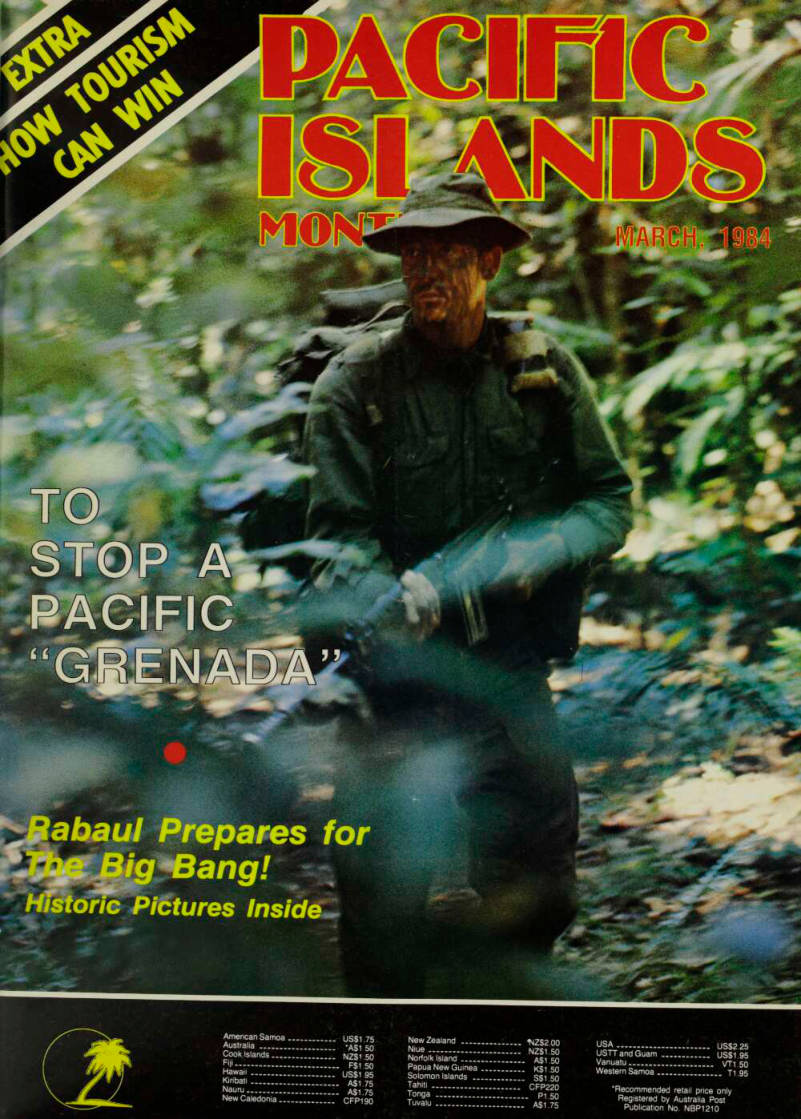
'Babaul Prepares for £&? Big -Bang!
Historic Pictures Inside
American Samoa US$l 75 Australia *A$l 50 Cook Islands Nzsi 50 --- Fsl-50 tl a .wa" US$l95 K |ribatl Asl 75 Nauru ... aj-j 75 New Caledonia " CFPI9O
New Zealand <nzs2 00 Niue NZ$l.5O Norfolk Island A si 50 Papua New Guinea K 5 1.50 Solomon Islands ssl 50 Tahiti I' CFP22O Tonga P 1.50 Tuvalu A 51.75
u fA U 552.25 USTT and Guam US$l,95 Vanuatu VTI 50 Western Samoa T 1.95 'Recommended retail price only Registered by Australia Post Publication No. NBPI2IO
The Cover
Australian O.D.F. soldier in training at Tully, Queensland (see story page 13).
Australian Army Public Relations photo.
Advertisements & other items, pp. 2-3 (2 items)
Skip into Video
Hitachi’s front-loading VT-33E(AU) makes video viewing more enjoyable without making operation more complex. Besides bidirectional Visual Search at 4 times normal speed and a convenient Freeze Frame function during playback, it incorporates a very special Skip Search feature which automatically alternates between Visual Search and Fast Forward at 10-second intervals to get to the desired scene faster than ever before. What’s more, this model comes with a handy, wired remote control unit, a 3-program/2-week preset recording timer, large multifunctional selector switches, and an Instant Recording Timer (IRT) for fuss-free programming.
Video couldn’t be more simple or more fun than the
VT-33E(AU)
Hitachi. from ■ . i ft oS®° • Skip Search available by remote control ao aO
VMS
PAL
AO® 60
VMS
e I b n• n n lu. u u
HITAOHiM I
w
0 HITACHI
•AUSTRALIA: Hitachi Sales Australia Pty., Ltd., 153 Keys Road, Moorabbin, Victoria 3189; Phone: (555) 8722 •NEW ZEALAND: AWA New Zealand Limited, Wi-neera Drive, P.O. Box 50 248, Porirua;Phone: PRO 75-069 •PAPUA NEW GUINEA: S.o. Svensson (N.G.) Ltd., P.O. Box 705, Port Moresby; Phone. 21-2111 •FIJI ISLANDS: AWA New Zealand Limited, 47 Foster Road (P.O. Box 858),Suva,Fiji; Phone: 312070 •NEW CALEDONIA: Caldis, B.P. Ml, Noumea; Phone: 26.23.50 •TAHITI: Ets Chene Alain, P.O. Box 272, Papeete; Phone; 2.88.68 •SOLOMON ISLANDS: Technique Radios Centre Ltd., P.O. Box 465, Honiara; Phone: 416
Islands
PACIFIC
MONTHLY
Vol. 55 No. 3 March 1984
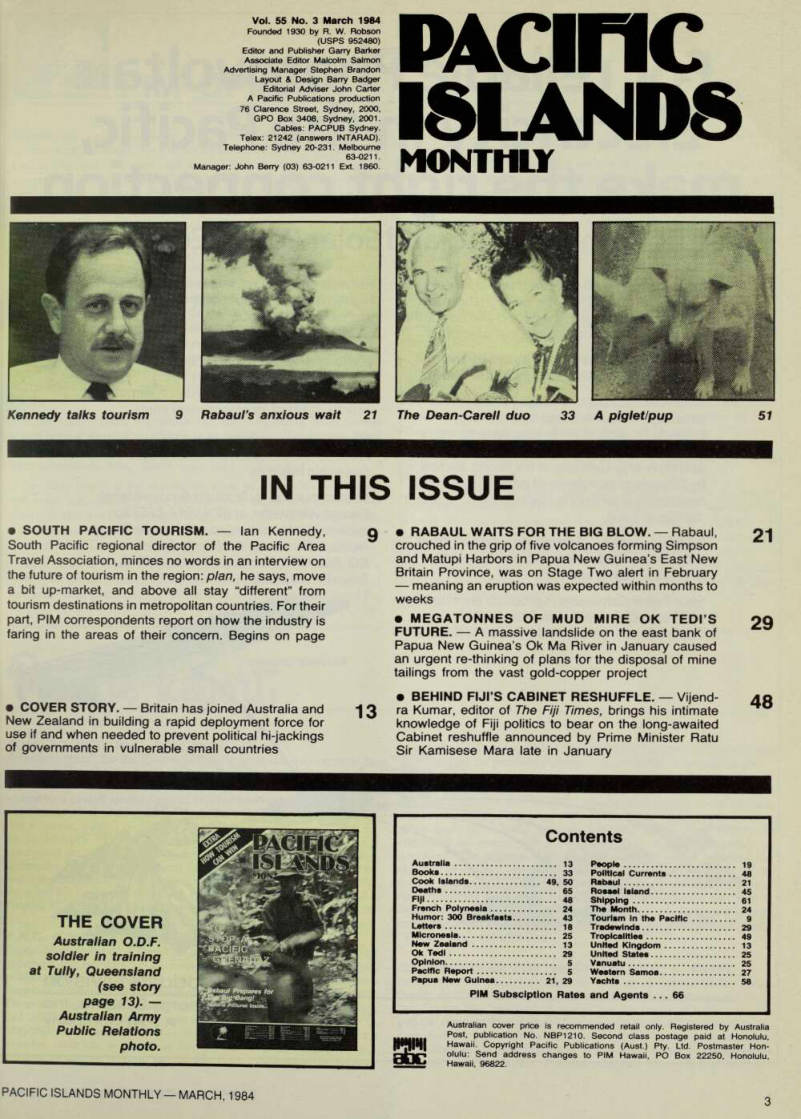
Kennedy talks tourism 9
Ra haul's anxious wait 21
The Dean-Carell duo 33
A piglet/pup 51
In This Issue
• SOUTH PACIFIC TOURISM. lan Kennedy, g South Pacific regional director of the Pacific Area Travel Association, minces no words in an interview on the future of tourism in the region: plan, he says, move a bit up-market, and above all stay “different” from tourism destinations in metropolitan countries. For their part, PIM correspondents report on how the industry is faring in the areas of their concern. Begins on page • COVER STORY. Britain has joined Australia and *| 3 New Zealand in building a rapid deployment force for use if and when needed to prevent political hi-jackings of governments in vulnerable small countries
• RABAUL WAITS FOR THE BIG BLOW. Rabaul, 21 crouched in the grip of five volcanoes forming Simpson and Matupi Harbors in Papua New Guinea’s East New Britain Province, was on Stage Two alert in February meaning an eruption was expected within months to weeks • MEGATONNES OF MUD MIRE OK TEDI’S 29 FUTURE. A massive landslide on the east bank of Papua New Guinea’s Ok Ma River in January caused an urgent re-thinking of plans for the disposal of mine tailings from the vast gold-copper project • BEHIND FIJI’S CABINET RESHUFFLE. Vijend- 40 ra Kumar, editor of The Fiji Times, brings his intimate 0 knowledge of Fiji politics to bear on the long-awaited Cabinet reshuffle announced by Prime Minister Ratu Sir Kamisese Mara late in January
Contents
Australia 13 Books 33 Cook Islands 49, 50 Deaths 65
Fiji 48
French Polynesia 24 Humor: 300 Breakfasts 43 Letters 18 Micronesia 25 New Zealand 13 Ok Tedl 29 Opinion s Pacific Report 5 Papua New Guinea 21, 29
People 19 Political Currents 48 Rabaul 21 Rossal Island 45 Shipping 61 The Month 24 Tourism In the Pacific 9 Trade wind 8 29 Troplcallties 49 United Kingdom 13 United States 25 Vanuatu 25 Western Samoa 27 Yachts 58
PIM Subsciptlon Rates and Agents ... 66
Australian cover price is recommended retail only. Registered by Australia Post, publication No. NBPI2IO. Second class postage paid at Honolulu, Hawaii. Copyright Pacific Publications (Aust.) Pty. Ltd. Postmaster Hon olulu: Send address changes to PIM Hawaii, PO Box 22250, Honolulu, Hawaii, 96822.
Advertisements & other items, pp. 3-4 (2 items)
Pacific Islands Monthly March, 1984
3
Founded 1930 by R. W. Robson
(USPS 952480)
Editor and Publisher Garry Barker Associate Editor Malcolm Salmon Advertising Manager Stephen Brandon Layout & Design Barry Badger Editorial Adviser John Carter A Pacific Publications production 76 Clarence Street, Sydney, 2000, GPO Box 3408, Sydney, 2001.
Cables; PACPUB Sydney.
Telex: 21242 (answers INTARAD).
Telephone: Sydney 20-231. Melbourne 63-0211.
Manager: John Berry (03) 63-0211 Ext. 1860.
Electricity in the Pacific,
For reliable Photovoltaic
make the right connection
Pacific Resources, Inc and Solar Power Corporation Reliable photovoltaic electrical power is now available in the Pacific Basin through the leader in alternative energy in the Pacific, and one of the world's foremost photovoltaic manufacturers.
Photovoltaic panels distributed by the leader in alternative energy in the Pacific Solar Power Corporation's (SPC) photovoltaic panels are now distributed by the Energy Products Division of PRI Energy Systems, Inc, a Pacific Resources, Inc. (PRI) company. PRI is the leading energy company in the Pacific, backed by 80 years of experience of providing energy products and services to Hawaii, and throughout the Pacific Basin.
Reliable, proven photovoltaic panels from one of the world's leading photovoltaic products manufacturers.
Railways. Rugged, yet simple systems using the highest quality components provide reliability and easy maintenance.
PRl's Energy Products Division will provide a photovoltaic system to your specifications, whether your needs are in pumping, telecommunications, microwave communications, lighting, or other energy areas.
PRI welcomes questions about SPC's photovoltaic products, and encourages dealership inquiries.
Contact our Energy Products Representative, George Westwater, at (808) 547-3263 for additional information, or write to the Energy Products Division of PRI Energy Systems, Inc.
P.O. 80x3379, Honolulu, Hawaii, 96842.
Telex ITT 7430292.
Solar Power Corporation's products are in use in 65 countries worldwide, from the U.S.
Department of Energy to the Australia National Solar Power Corporation Pacific Resources, Inc Hdrk>kjJu> Hawaii The Pacific Islands
Energy Products Division
PRI Energy Systems, Inc.
A PRI Company
Pim Opinion
Bureaucracy and its denizens are probably now essential to the operation of our world, even in the admirably relaxed environs of the Pacific. And yet, one must view their proliferation with regret and, to a certain degree, suspicion. They are the means of social control, of putting people and their affairs into little boxes. While control is vital it must also be applied with understanding, purpose and moderation, and not just for its own sake.
Traditionally the Pacific has worked by consensus and with a minimum of red tape. But things seem to be changing.
For example, it was with regret that we heard of an instruction issued by the director of the South Pacific Bureau for Economic Cooperation (SPEC), that no initiative should be taken by any member of his staff, but that they should restrict themselves to responding to formal requests from member countries for action or advice.
Such an order is perfectly proper and good in a political context but, with great respect to SPEC, we suggest that it is a nonsense in an organisation set up to promote the economic growth of the South Pacific.
If the experts hired to produce commercially-viable ideas for the region are not allowed to rush out from their bureaucratic hidey-holes crying “Eureka!”, and set about to show people how they can improve their economies, then, surely, very little will happen.
Or, more likely, if the experts are made of worthwhile stuff, they will sneak out, clutching their ideas in plain brown wrappers, to find someone who will then formally ask for them. That is not healthy, for it breeds clandestine habits and difficult politics, and could isolate the director of SPEC from the people he most needs ... or should need.
Most of those involved with setting up SPEC in 1972 saw it as a vehicle for producing regional co-operation at the project level ... a nuts-and-bolts, practical, sort of outfit of a type everyone agreed the
Pacific needed. SPEC was bom, but things did not happen in the way intended.
Very rapidly SPEC became a secretariat for the Forum, formalising Island affairs, keeping records, publishing reports, arranging meet ings. It is important work which the politicians of the Forum nations need . . . but it is not a SPEC.
Concurrently, the bureaucracy has grown, become more rigid and much more expensive.
The last Forum meeting in Canberra was monumentally expensive and wrapped around in red tape, security men and all the other trappings of international summits, much more than any previous Forum. In Canberra such was probably inevitable, but was it necessary for the meeting to be held in Canberra? Why not Caims, or somewhere on the Great Barrier Reef? It certainly would have been more in keeping with the Pacific.
But can the Forum return to the old days of informality and genuine
cross-table opinion-swapping? Sadly, probably not.
In former years there was not a lot of vote-taking at the meetings, and there was much more interchange among delegates and staff.
Now it seems to be heading towards formal votes and strict control.
There is even a danger of the veto being introduced, or so it would seem from an incident at the last Forum when one nation refused to agree to the appointment of a man to run a printing machine given under Australian aid.
They continued to refuse even after Australia offered to pay his salary on grounds that, having given the machine, they wanted to see it used. The chairman accepted their refusal and the appointment was not made. It was, in effect, a veto applied for the first time in an organisation which had previously worked on majority decision. It hasn’t happened since, but one never knows . . . and the original ideal of a free-speaking, freely co-operating Pacific region is therefore just a little more dented.
Pacific Report

POPE TO VISIT PNG , SOLOMONS , IN MAY A historic “first” for the southwest Pacific is on the way up with the announcement of visits by Pope John Paul II to Papua New Guinea and Solomon Islands in May. The only other Pacific islands ever visited by a pontiff are the Samoas (visited by Pope Paul VI in 1970), and Guam (which received John Paul II in 1981). Pope John Paul II is due to arrive in PNG on May 6, spend three days there, and then fly on to Honiara on May 9. Details of the Solomons visit were announced on his return to Honiara from a visit to Port Moresby late in January by Archbishop Daniel Stuyzenberg. The archbishop, who had consultations with Vatican officials in the PNG capital, said the Pope and his party would fly from Port Moresby to Honiara in two Air Niugini F2Bs, landing about 11.30 a.m. and leaving about 7.30 p.m.
P.N.G. GIVES NEW GO-AHEAD ON OK TEDI Papua New Guinea’s Cabinet at a lengthy meeting on January 25 approved the building of an interim tailings dam at the Ok Tedi gold/copper mining project but with stringent environmental and financial conditions. This reversed a government decision in mid- December rejecting a request from the company. Ok Tedi Mining Ltd. (OTML), to enable it to meet its gold production start-up date of May this year. The rejection was announced only three weeks before a massive landslide occurred on the site of what was planned as a permanent tailings dam on the Ok Ma River. Following the January
25 meeting of Cabinet, PNG Prime Minister Michael Somare said the landslide had “dramatically changed the situation facing the project.”
Without an interim scheme, the project would have faced a delay of up to 15 months, between 300 and 500 jobs would have been lost, and the government, which is a 20 per cent shareholder in the project, would have forgone revenue. Mr Somare said: “The government has given approval to build an interim tailings dam but with tough conditions to ensure that a permanent dam is built as quickly as possible.” The interim scheme rejected in December involved the disposal of tailings into the Ok Ninga. It was rejected because of the risk of polluting the Fly River system. The revised scheme will deposit tailings into the Ok Mani, but with the condition that they be deducted from the 60 million tonnes that the mine had previously been permitted to put into its southern dumps area. (See background report,
“Tradewinds” department.)
’B3 GOOD YEAR FOR FRENCH PACIFIC PAPER In a review of France’s relations with the countries of the South Pacific in 1983, the Noumea daily Les Nouvelles Caledoniennes says that France had “chalked up points” on the issues of nuclear testing and the status of French territories, especially New Caledonia, in the course of the year. On the nuclear question, the paper noted that in 1983 France for the first time had waged a major campaign of information in the region. Nuclear tests had taken place at Moruroa
since the campaign, but, the paper said, the protests had appeared “less fierce” than in the past. It said that on the matter of the status of French territories, the Round Table meeting at Nainville-les-Roches near Paris in July, at which all political factions in New Caledonia were represented, had “marked an important new stage.” The paper said: “The meeting could be presented abroad as showing that France was open to dialogue and that it was prepared to consider all possible avenues of change, including independence. It could be emphasised that France had recognised the need for the abolition of the ‘colonial reality’, and the positive right of the territory to independence.
Having done these things, France had shown that she was in fact acting in accordance with the traditions of a freedom-loving country, and with the ideals of the French revolution.”
A.D.B. Regional Office For Portmla
The Asian Development Bank is to establish its South Pacific regional headquarters in Port-Vila, capital of Vanuatu. Vanuatu Finance Minister Kalpokor Kalsakau said the bank’s executive had unanim ously approved the proposal. Mr Kalsakau said he was grateful to the finance ministers of Papua New Guinea, Kiribati, and Solomon Islands who had supported Vanuatu’s application. He said he hoped the regional office would be able to satisfy the needs of the region. Mr Kalsakau, who is the bank’s governor in Vanuatu, said the office would open in June. Siting of the ADB regional headquarters had been the basis of much speculation, with Fiji’s capital Suva being widely tipped in many circles as the applicant most likely to succeed.
Flu P.M. Loses Libel Action
Fiji’s Prime Minister, Ratu Sir Kamisese Mara, has failed in a libel suit against the country’s leading newspaper, The Fiji Times , and costs have been awarded against him. The action, heard in the Fiji Supreme Court before Mr Justice Rooney, arose from a letter to the editor published by the Times in which Senator Inoke Tabua was criticised for a speech, in parliament, calling for the deportation of certain citizens of Indian ethnic background. The letter suggested that the senator was the nominee in the senate of the prime minister and noted that Ratu Mara had not commented on the speech, or rebuked Senator Tabua. Senator Tabua is the nominee of the Great Council of Chiefs, and not the prime minister, which fact was published by the newspaper together with an apology for the error made by the writer of the letter. In dismissing the action Mr Justice Rooney said holders of public office should not be thin-skinned in receiving public criticism, so long as it was fair and in the public interest. Mr Barrie Sweetman appeared for The Fiji Times and Mr Laßaleister, a Sydney based Queen’s Counsel, instructed by Fiji solicitor, G. P. Lala, for the prime minister.
BURNS PHILP PLANTATION BOUGHT BY PNG GOVT.
The Papua New Guinea Government gave Bums Philp (PNG) Ltd one month from January 27 to cease all its operations on Kenabot plantation in East New Britain. PNG Lands Minister Mr Korowaro said the government would also charge monthly rents for the plantation manager’s residence and a Chinese businessman’s trade store on the plantation. The government is buying the 300-hectare property for K 162,000 to resettle people in case of a volcanic eruption in Rabaul. The sale would affect 15 families, and arrangements were being made to resettle them. Bums Philp’s general manager Chester Ryan described the government’s decision as “a very satisfactory conclusion for all concerned.” Earlier, Mr Morowaro had claimed that the company had refused the government’s purchase offer, and warned that government powers of compulsory acquisition might be used. Mr Ryan responded by saying that he believed Mr Korowaro had not clearly understood his company’s requirements. Later Mr Ryan said: “The situation has been resolved and we thank Mr Korowaro for his understanding.” Mr Korowaro said rents would be charged at the rate of K3OO a month for the manager’s residence, and K2OO a month for the trade store run by businessman Ron Seeto. He explained: “Rent is being charged because the valuation of K 162,000 (by the government) included the buildings on the property, which consequently become the property of the State.”
South America’S Pacific-Coast Nations Meet
Foreign ministers of Chile, Peru, Ecuador and Colombia, member nations of the Permanent Commission of the South Pacific, met in
Vina del Mar, Chile, from February 9-11. The commission was bom out of what is known as the Santiago Declaration of 1952, in which the four Pacific-coast South American nations for the first time established in international law the 200-mile exclusive maritime zone, which has since been adopted by nations throughout the world.
Matters high on the agenda of this year’s meeting were: the exploration and exploitation of the seabed, including mining; the protection of the maritime environment from radio-active radiation; the protection and better utilisation of living maritime resources; latest developments in research into the El Nino phenomenon; and co operation between the PCSP and other international organisations. A central concern of the PCSP meeting was to “look at strategies linking both sides of the Pacific Ocean.”
Big Islands Trade Display For Honolulu
A trade exhibition of South Pacific Island products will be held in conjunction with the 1984 Conference on Pacific Island-United States Trade Through Private Sector Development on the evenings of March 19, 20 and 21, at the Pagoda Hotel in Honolulu, Hawaii. The trade show will be sponsored by the Pan Pacific Alliance for Trade and Development, which is also co-sponsoring the conference with the United States Agency for International Development. Exhibitors from 21 South Pacific Island nations will be displaying their products to Pacific Rim country buyers, investors and trade representatives.
Island nation governments also have been invited to discuss trade and investment opportunities in their countries. Products expected to be on display available from Islands countries include: hardwoods (furniture, veneer panelling, timber); agricultural products (vanilla, ginger, pepper, cardamom, coffee, tea, sugar, tropical fruits and juices); coconut products (soap, copra, cosmetic and cooking oil, wood, cream, syrup); handicrafts (tapa cloth and other fibre products such as baskets and weavings, wood carvings, ethnocultural artifacts, masks); mineral resources (bauxite, copper, nickel); marine products; and specialty products such as tropical wines and liqueurs, woollen sweaters and collector postage stamps. Primarily, the exhibit is planned to introduce Island products to U.S. buyers and importers.
The conference will bring together Pacific Island business and government leaders with American private sector expertise to help develop the export capabilities of Islands businesses.
Tongan Royalist Revels Rile Mt. Roskill
The Auckland New Zealand home of King Taufa’ahau Tupou IV of Tonga has become the target of complaints by nearby residents, says a recent report in the The Fiji Sun. Residents say that noisy kava parties at the house in posh St. Andrew’s Road, Mt Roskill are keeping them awake at night. Angry locals are organising a petition to Mt.
Roskill’s mayor, Dick Fielding. A report in The Auckland Star says the parties, which include singing and traditional band music, are held to honor Tonga’s king whenever he stays in Auckland. “They just get noisier all the time,” said one resident. “They continue all night. On Friday, they had one which went on until 10 the next morning.”
Manager of the king’s household, Vava Falemaka, acknowledged the complaints but explained the parties were a Tongan custom. He said: “It happens only when the king is here. Tongan people come to pay their respects and do a bit of singing and dancing... If we told everyone ‘no noise’, they wouldn’t come. We can’t just turn them out. I know this is a nuisance for Europeans. As Tongans, we don’t mind a lot of noise from neighbors. I hope they understand it’s only for a while.”
P & O TO CUT VISITS TO SUVA The cruise line P&O says it is considering dropping Fiji’s capital, Suva, as a port of call because of what it says is the harassment of tourists by taxi drivers and curio vendors. The warning has been conveyed to the Fiji Visitors Bureau by the President of the National Tourist Association, Gerald Barrack. Reports from Suva say the FVB has also received a number of letters of complaint from P&O itself, asking the organisation to do something about the problem. The company’s Fiji representative. Jack St. Julian, says P&O has no plans to pull out of Fiji completely, but will be reducing its trips to Suva and calling into the country’s second city, Lautoka, more often. At present most P&O liners call at Lautoka before stopping at Suva.
About 27,000 tourists arrived in Fiji by ship between June and December, 1983, compared with about 30,000 in the same period in 1982.
Advertisements & other items, pp. 6-8 (1 item)
Qf) Pioneer*
I ■
AUTO
REVERSE
DOLBY SYSTEM
O 2 ■?? -3
naa
m
Pioneer puts you ahead with power.
The KEH-9000 is no ordinary “regular” in-dash car stereo. For one, it has more than twice the power of ordinary types. Its “2-Way High-Power” system generates a hefty 20W per channel of maximum power output. And that’s a full 20 per channel, to be sure, because it comes from four separate and discrete power amps strapped together in pairs for faultless performance.
The “2-Way” advantage comes in when you hook up an extra stereo-pair of speakers and divide those four amps to deliver a big 6.5 watts to each. The front-to-rear “fader” control is built into the preamp, so you don’t lose a bit of the dynamic low-frequency punch your music deserves.
The KEH-9000, despite its compact size, also offers the latest in car-audio technology and features. There’s auto-reverse cassetting with Dolby* noise reduction, Quartz-PLL preset tuning with ARC-V auto-reception control for ideal FM listening, a 5-band graphic equalizer, a bright Liquid-Crystal Display, and much more.
Go with the powerful one that puts you ahead—the KEH-9000, from Pioneer.
Qf) PIONEER*
“Dolby’ and the double-D symbol are trademarks of Dolby Laboratories Licensing Corporation. The Pioneer KEH-9000 comes with a wired remote control for Up/Down Seek.
For further information, please contact: Australia: Pioneer Electronics Australia Pty. Ltd. (Incorporated in Victoria), P.O. Box 295, Mordialloc, Victoria, 3195 Tel: 580-9911 Fiji Islands: Brijlal & Company, G.P.O. Box No. 362, Suva, Fiji Islands Tel: 22258 New Zealand: Monaco Distributors Ltd., 2 Poland Road, Glenfield, Auckland, New Zealand Tel: (09)444-9144 Norfolk Island: Burns Philp (Norfolk Island) Ltd., P.O. Box 21, Norfolk Island Vanuatu; Burns Philp (Vanuatu) Ltd., Vila, Vanuatu uru Island: Jacob Enterprises, P.O. Box No. 4, Republic of Nauru ilti: Tahiti Hi-Fi, P.O. Box 848, Papeete, Tahiti w Caledonia: Menard Pacifique Sari, B.P. 3899, Noumea, New Caledonia , 27*02*23 ierican Samoa: Transpac Corporation, P.O. Box 1477, Pago Pago, American mia Naw Guinea: Bali Merchants Pty. Ltd., P.O. Box 6103, Boroko Tel. 254887
m
sfif
V// At N crrr netu zea L ana «i.
ndon wit
to us.
We make it easy for you to id ' to enjoy low-cost stopovers in enjoy a comfortable and friendly Fiji, Tahiti, Honolulu or flight to London, with our superb 747 Service all the way from Nadi or Papeete.
We also make it easy for business and holiday travellers Los Angeles.
If you’re going beyond London, on business or pleasure, our 747 service gives you convenient connections.
Making everything easy for you is easy for us, because we’re your kind of people. So, tell your travel agent: “I’d rather fly Number One to London”.
air new z
The Pacific’s Number One
m
GOLDOBOB
Pacific Tourism
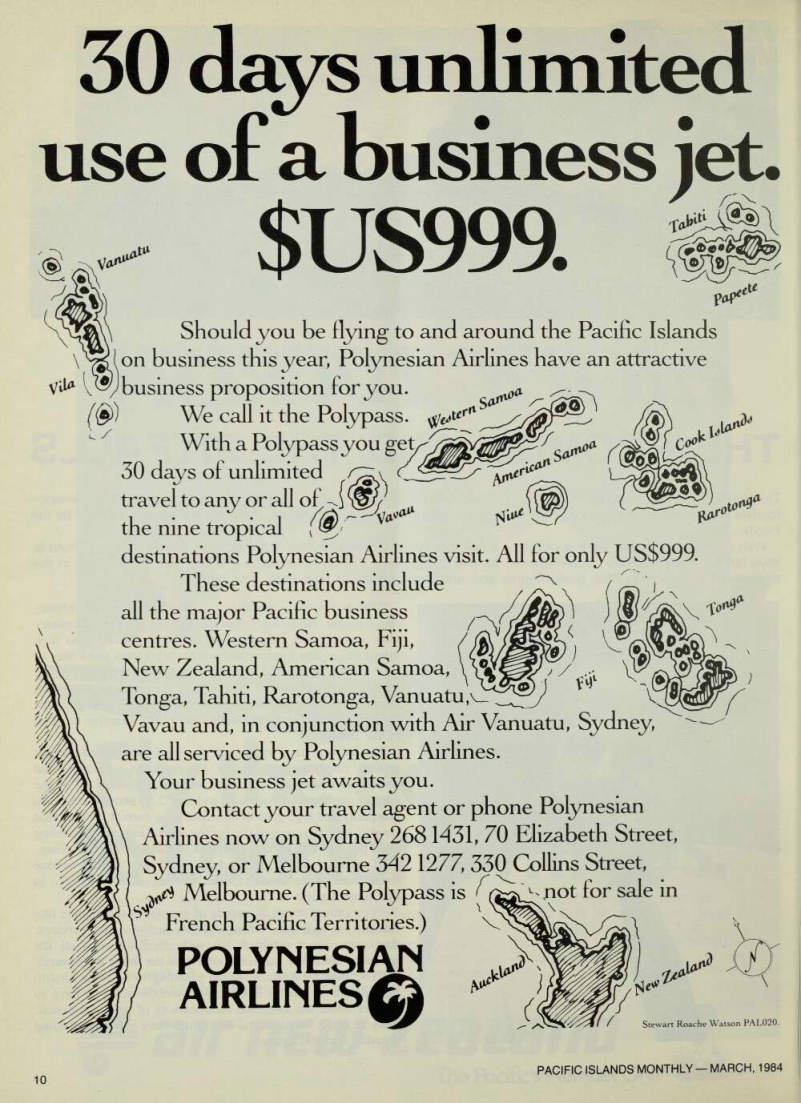

The Promise And The Pitfalls
The Pacific is the last great tourist paradise left unspoiled on earth. In a world increasingly beset by evil and by violence tourists are looking ever more longingly at the tranquillity and, perhaps above all, the personal security offered by the Pacific.
With a scenario like that there ought to be a dollar or two to be made by the judicious from the discerning. There is, says lan Kennedy, Director, South Pacific, for the Pacific Area Travel Association (PATA). But, he advises in this exclusive interview with PIM, governments and entrepreneurs must take care, and plan.
The key word is planning . . . total planning of industry development. No country, and particularly not a small country with a population vulnerable to cultural upheaval, can now afford to get into tourism without having a very good idea of how it is to be handled, and what its effects are going to be.
PATA is more conscious than most of the problems caused by over-development and too-rapid development. It’s no good for the host country, no good for the visitor, and therefore no good to the industry.”
The halcyon days when some destinations reported tourism growth rates ranging up to 15 per cent annually, and sometimes more, are now over, he said. “Even if all of the current optimism in Australia and the U.S. about a return to prosperity and high growth turns out to be correct, I doubt that we will see expansion of the Pacific tourist industry exceeding eight per cent a year, and even that is going to be good going.
Too fast is bad,” Kennedy said. “I don’t think anyone would want to see another Guam, or even another Waikiki, in the South Pacific.
You cannot dump thousands of people on somewhere like Samoa, for example, without proper facilities and services.
And you cannot establish the right facilities, and all the necessary ancillary services, with just the wave of a wand.
“You look at Western Samoa planning to build an airstrip big enough to handle Boeing 747 jumbos and you have to wonder about the awesome ramifications of such a decision.
They’re really monumental and could have effects extending decades into the future.”
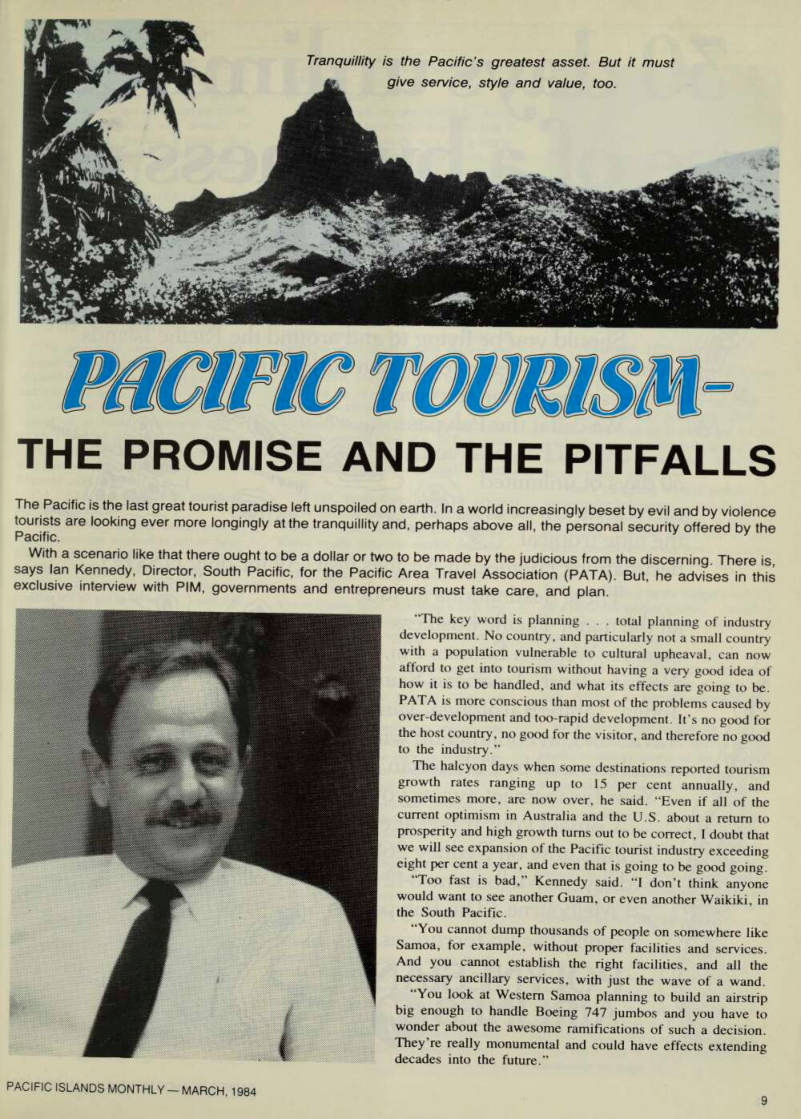
Tranquillity is the Pacific’s greatest asset. But it must give service , style and value, too.
PAT A sought to encourage rational, ordered and planned tourist development in the Pacific, said Kennedy, and spent a good deal of time and money on the effort.
It might be the long way around, he indicated, but in the end it made for a
healthy and profitable industry with a
minimum of problems and a maximum of satisfaction to all.
As part of this approach PATA provided what it called “task forces” to help coun tries develop their tourism.
During 1984 two such groups of experts . . . sociologists, planners, trainers, ar chitects and managers . . . will go into the South Pacific, one to Madang and the other to the Solomons.
The Solomons Case
“The Solomons came to our PATA regional conference in Fiji late last year and said they wanted to ‘embrace tourism’ and could we help.”
In 1981 the Solomons reported 11,171 visitors of all kinds, which was only a trickle compared with Fiji’s 200,000-odd tourists and New Caledonia’s 82,000. “So they have virtually no tourism at present,”
Kennedy said.
The PATA task force will, therefore, start from scratch.
“They have no real resort hotels, none of the infrastructure required to service large tourist numbers on the ground, no way of handling a Boeing 747 full of tourists all at once ... if they are going to embrace tourism it’s all got to be built . . . and if it is going to last, and not do any damage after it is built, it has to be done with great care,” Kennedy said.
“At the moment they have very little and, at the same time, scenically and in a number of other ways, what they have is wonderful, even magical.”
The task ahead was huge and, because it meant the establishment of a tourist indus try from the beginning, development had to
be totally phased and integrated, Kennedy
said.
“There are formulas, and people have
done it before, so there is track-record stuff to follow. But it does require a hell of a lot of thought and care.
“I don’t think anyone should be scared of it, but they have to be conscious that if they get off incorrectly they are going to damage not just one small resort, but possibly a whole country and cause all of the animosities and problems which every one dreads.”
‘Chicken or egg *
Most tourist countries, and particularly those in more remote “tropic idyll” sur roundings, suffer from the “chicken or the egg” syndrome. Even Fiji, which is well ahead of most of the other South Pacific tourist countries, has the condition. It needs to increase its tourist income but sometimes hasn’t enough hotel rooms and beds to do it. They need more beds, but do they risk the investment before the num bers really show up?
“Money is around for investment,” said Kennedy. “Quite a lot of it, in fact, from places like the U.S., Singapore, Malysia, and, perhaps a bit surprisingly, South Korea.
“In fact. South Korea looks hot to trot and is about to boom the way Japan did.
We have done some research in South Korea on the outbound market potential, and it is very exciting.
“But, again, the island countries have to decide whether they are going to go the way of Guam, or do something a little less extreme. In most cases they will need to spread their eggs around a number of baskets.
“Fiji is a very good example of how to handle it. They have their basic trade from Australia and New Zealand. They are developing their American end through this new service Air Pacific has started, and they are doing very nicely from Japan. It is a good spread, and so they are protected to some extent from individual market fluctu ations,” Kennedy said.
“They are avoiding the problem Bali had. There the industry became totally dependent on Australia and, to a very large extent, on a particular segment of that market ... the young things looking for low prices and a bit of free-swinging.
“So when the Australian economy took a tumble, so did the Balinese tourist
industry.”
Catering to South Korean tourists would present some problems for South Pacific resorts, Kennedy said. Tastes in food, entertainment, and services had to be taken into account. So had cultural differences.
But places like Fiji had coped with the new problems presented by Japanese tourists and so South Korean tastes would be met, too.
Going up-market
“Deciding what kind of tourist you want is very important,” he said. “Fiji, for example, has been through the football club thing. I think, personally, that the Pacific should go up-market, and let the footballers go and make their noise on the Gold Coast of Queensland. They’d be happier there, anyway.
“That’s something we will probably be saying to the Solomons .. . that they don’t want 747-loads of footballers in non-stop celebration. The odd cruise ship is okay but, in general, it is much better for Pacific islands resorts to aim at the top of the market.
“There is a need for the budget hotel, but for a particular kind of tourist. . . possibly the family looking for good value and a quiet, pleasant time.
“If you start high you can always come down in price. But if you get a reputation for low prices and whoopee all night, it’s very difficult to upgrade yourself. Ask Bali.” lan Kennedy believes that the secret to success in Pacific Islands tourism lies in small, exclusive resorts of the Toberua, Fiji, or Vavau, Tonga, style. Some will be bigger, others small and very specialised, depending very much upon the individual styles established by their management.
But all will convey something exclusive . . . “snobby, if you like,” said Kennedy.
“This isn’t to denigrate the Club Med pattern. It fills a definite need, and is extremely well-run. Something like 60 per cent of all Australians who go to New Caledonia go to Club Med and have a very good time.”
But if a nation’s tourist industry decided to go up-market, it had to be sure it had the plant to match, Kennedy advised.
“People prepared to pay top dollar also tend to be keen on value. They don’t mind the money, but they do mind being ripped off. They have great perception of quality.
“In some caes it takes government en-
Continued on page 55
“Start high . . .
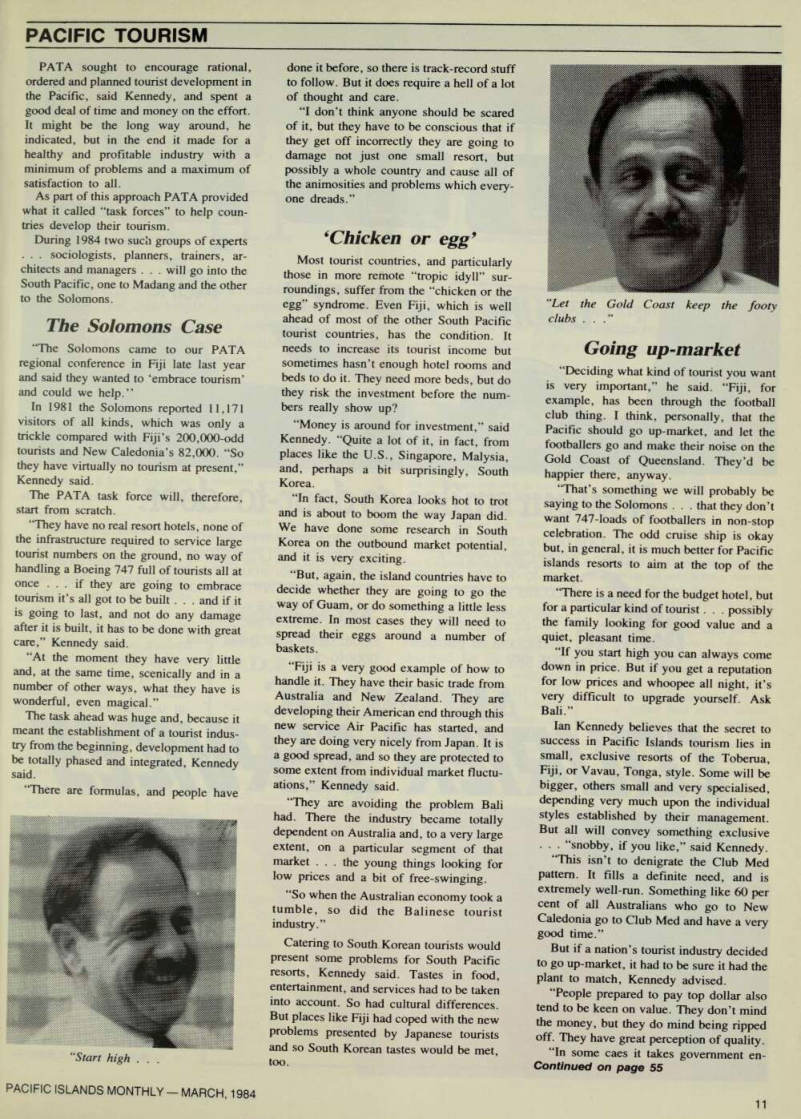
“Let the Gold Coast keep the footy clubs ...”
couragement to get operators to see the sort of thing which is needed.
Management is all
“But, in the end, it is management which decides it all . . . how a resort is operated, how the staff handles its job, and the customers; all the many very delicate fac tors which contribute to a feeling of sat sifaction in the mind of the tourist so that he will tell everyone back home how good it was and so he will keep on coming back.”
India, particularly, and also New Zea land, had done excellent work in making their own people, both inside and outside the industry, conscious of the value to the nation of tourism.
“At the next Fiji Tourism Convention we hope to have an expert from India speaking on this crucial aspect,” Kennedy said.
PAT A also had a standard kit for the Pacific on tourist awareness which set out what governments, the public and the tourist industry needed to know.
One of the problems of the Pacific lay in its distances and airline services, Kennedy said, although he believed that a more rational and integrated approach to the region’s problems was in process of
development.
“I am optimistic,” he said. “You have people like Ansett coming into the area very aggressively and you have develop
ments like the seat-sharing between Qantas and Air Pacific.
“The South Pacific has gone through a very interesting era since the arrival of the Boeing 747,” Kennedy said.
“Previous aircraft, like the DC-8 and 707, had to stage through places like Fiji.
Then came the 747 which could over-fly the islands and go direct from North America to Australia and New Zealand.”
Islands-Oz-NZ
“For most tourists, Australia and New Zealand are the magnets which bring them to the South Pacific. That is why it is important to see the island countries and Australia and New Zealand as part of a whole . . . they are complementary. Each can serve the other if they approach the business with that understanding in mind.
“So, while the 747 s still mostly fly overhead, we are beginning to see the advent of a more professional approach to route development. Better inter-island ser vices are being introduced, using more suitable aircraft, and there is less competi tion purely on price. Airlines cannot be expected to operate loss-making services unless it is done for a reason and with the understanding and agreement of the gov ernments involved. [Air Pacific is probably an example of this latter philosophy. Their management has said it was less concerned in launching their Project America with profits on the airline than with increasing the national income from tourists. Thus, while Air Pacific has just reported a loss of $6
million for the last financial year ($lOO,OOO less than the previous year) Fiji is understood to be more than satisfied with the growth achieved in high-spending tour ist business from North America. 1 “Overall it looks pretty good,” said Kennedy. “There are problems, and there will be hiccoughs, but in general I am very optimistic about the Pacific.
‘ Stay different .. .’
“There are great differences in the de gree of development and professionalism.
Fiji is well ahead. Tahiti, New Caledonia and the Cook Islands have all been at it for some time. Vanuatu is very much a com petitor. Samoa has problems, the Sol omons really have yet to get going, and apart from Madang, Papua New Guinea is also yet to decide what it wants to do.
“There are differences of sophistication which make some difficulties, and yet, they are also very much a plus. The primitive nature of some of the areas provides perhaps their greatest attraction.
“But where you have an unsophisticated area you also have great vulnerability, which gets back to what I was saying about the enormous need for careful, intelligent and far-sighted planning.”
“I would hate to see something like Queensland’s Gold Coast in the Pacific.
The islands just couldn’t afford it. It would
destroy them.
“But there’s no need for that. They will do better by being different, by specialising and, I think, by going up-market and choosing their markets very carefully.”
Advertisements & other items, pp. 10-12 (1 item)
30 days unlimited
use of a business jet.
SUS 999.
m V M Should you be Hying to and around the Pacific Islands on business this year, Polynesian Airlines have an attractive v'-v business proposition lor you. (<&) We call it the Polypass. //*)) t Co° r\ 6t> 6 c. o f & With a Polypass you get rAfaogfe' 30 days ol unlimited \ travel to any or all of4w . ft® A.. ..• . .._I fa the nine tropical destinations Polynesian Airlines visit. All for only US$999.
These destinations include 7s. all the major Pacific business centres. Western Samoa, Fiji, New Zealand, American Samoa, Tonga, Tahiti, Rarotonga, Vanuatu,' V"
Vavau and, in conjunction with Air Vanuatu, Sydney, are all serviced by Polynesian Airlines.
Your business jet awaits you.
Contact your travel agent or phone Polynesian Airlines now on Sydney 2681431, 70 Elizabeth Street, Sydney, or Melbourne 3421277, 330 Collins Street, Melbourne. (The Polypass is f not for sale in French Pacific Territories.) WV 1 .
POLYNESIAN
airlines^
I t OM * O @ / \ r Stewart Roache Watson PALO2O.
Now our smiles go door-to-door.
One phone call gets Air Pacific Courier Cargo going. A jet express courier service that A i picks up and delivers nlr-iFir throughout Fiji, throughout Air Pacific’s
YOUR ISLAND IN THE SKY.
growing Pacific route network, or linking up with international airline networks around the world.
It all starts with one phone call. And it finishes with Air Pacific’s smile of success, because we’ll get it there fast, door-to-door.
AIR PACIFIC
COURIER SERVICES
* ansa The smile of success.
Nadi Phone 72694 done Tavuto or Anne McComber Suva 382-444 Alfred or Narend (or Sales Rep: Jenny Wallace).
A Hi-Jacking


Cover Story
How To Stop
Pacific means peaceful. And so it has been, more or less, tribal rivalries and historic happenings excluded, since time immemorial. Yet, how fragile is that most devoutly-sought condition of peace. Could we see a Grenada in the Pacific?
Defence planners don’t say yes, and they don’t say no. But Britain has now joined Australia and New Zealand in establishing within her armed forces units designed to react quickly in support of any regional government appealing for help against political “hi-jacking.”
THE ATTEMPT made late last year by Cuban-supported forces to “hi-jack” the small British Commonwealth na tion of Grenada, in the Carib bean, shook a lot of comfort able international thinking to its core.
It also embarrassed Britain as the United States, ignoring accusations that it was using a broad-sword to pluck a daisy, staged a massive rescue operation.
Today, with order restored, and coup-makers pushed back, calmer heads believe the Americans were probably correct to thus demonstrate how costly any political hi jacking attempt could be, and how slender its chances of success.
But there is another, and more pregnant question which is now bothering many small countries, even in the warm and serene Pacific reg ion. Could it happen again?
And if it did, how could the hi-jackers be stopped?
Australia, which takes its “friend and brother” role in the Pacific very seriously, has for some time had within its army a battalion-strength unit called the O.D.F. (operational deployment force) capable of re
spending within hours to any call for
help.
New Zealand is about to set up a similar group of about 1200 men backed up by Scorpion light armored reconnaissance tanks, helicopters and transport aircraft.
And now, from London, come reports that the British also have contingency plans for a highly sophisticated amphibious strike force able to move by jet transport aircraft to the aid of any Commonwealth or
friendly nation under threat of a
political hi-jacking.
The Special Air Service (SAS), that most expert and secret of special commando forces, and its naval counterpart, the Special Boat Squad ron (SBS) are reported to have sur veyed both the Caribbean and the Pacific already, working to special orders written by the British Prime Minister, Mrs Thatcher.
London reports say that the idea of this Commonwealth strike force was
raised at the last Commonwealth Heads of Government Meeting (CHOGM) in New Delhi in December.
Mrs Thatcher is believed to have suggested the Commonwealth force, involving not only Britain, Australia and New Zealand, but also Canada, as a way of avoiding repetition of the
embarrassing and dangerous Grenada
affair. That Grenada happened at all was bad enough, she is believed to have said, but that a non- Commonwealth nation had to go in and clean up is worse, for it threw into doubt the Commonwealth’s abil ity to defend itself and its smaller, possibly more vulnerable members.
How far strategic and tactical plan ning has gone on an integrated Com monwealth force is unknown, but, since Commonwealth armed forces leaders are in constant contact, the files are probably more than detailed.
The British Foreign Secretary, Sir Geoffrey Howe, more or less con firmed Whitehall’s decision to go ahead on the strike force in a state ment to the House of Commons in December. At that time it seemed that the Commonwealth, judged at least by reactions at the CHOGM meeting, were not about to cooper ate. Yet, very soon afterwards, the New Zealand Defence Review tabled in parliament in Wellington, was also talking about a “ready reaction force.”
This, said the Wellington reports, would be part of a program which would involve scrapping New Zea land’s frigate fleet and replacing
those surface ships with four submarines.
The special ready reaction force would consist of between 1000 and 1200 troops and be based at Burnham Camp in Canterbury. In addition to ordinary infantry companies and light, fast. Jaguar-engined Scorpion tanks, this force would also include SAS troopers.
“It will be equipped and trained for land operations up to as high a scale of intensity as can be foreseen in the circumstances of the South Pacific,” said the review. It would also have priority within the New Zealand ar my in its selection of manpower and equipment.
And then, in one small paragraph, came what most see as the core of the thinking behind the plan: “The South Pacific has remained largely unaf fected by the military conflicts and tensions that have plagued other reg ions. The aim of our foreign and defence policies must be to keep things that way ...”
Australia’s interest in keeping the peace in the Pacific and in South-East Asia is well-established, but, like Britain, Australia is also interested in reducing as far as might be possible the very high cost of maintaining battle-ready forces capable of handl ing any call for help. The Queens land-based ODF is battalion strength,
jungle-trained, and highly
sophisticated. It has not only com panies of infantry soldiers equipped with the most modem light arms available but also armored personnel carriers, helicopters and other sup port facilities.
Australia also, at present, main tains an air force squadron of fairly elderly aircraft at Butterworth, Malaysia, but has given notice that it will withdraw this unit as part of a cost-saving program when the Royal Australian Air Force begins to re ceive its new F.lB jet aircraft. Both Singapore and Malaysia have expre ssed concern over this decision, par ticularly in view of Britain’s clearly stated desire also to cut the cost of her Commonwealth defence commitment.
Indeed, according to London re ports, it was cost-cutting, particularly in the light of the huge expense of maintaining the defence of the Falk land Islands, which prompted Mrs Thatcher’s proposal at CHOGM.
Britain maintains a full-time milit ary presence in more than a dozen potentially troublesome places around the world and, in addition, has to accept that most of the smaller Commonwealth countries, of which
there is a multitude, look to her for
military “insurance.”
Ever since Empire became Com monwealth, and even before, London has accepted its policeman role. Yet the fact that Britain appeared to be indecisive over the Grenada affair at the time shook some Commonwealth confidence and led to speculation about whether Britain could have mounted a retaliatory force even if Whitehall had decided to act sooner.
British forces are currently deploy ed in: . . .Ascension Island in the mid- Atlantic where one helicopter detach ment, Victor jet aerial fuel tankers, and Hercules transport aircraft keep the “air bridge” to the Falklands open.
Belize, Central America, which has one infantry battalion, one ar mored reconnaissance troop, one field artillery battery, one squadron of engineers, one helicopter detach ment, four Harrier vertical take-off “jump” jet fighter-bombers, half a squadron of Rapier anti-missile bat teries. Belize is independent, but relies on Britain for the military deterrent against Gautemala’s oft
stated hostility.
. . . Berlin, Germany, which has one infantry brigade as part of the Allied “occupation” force. . Brunei has one battalion of Gurkha riflemen, one company of Royal Marines and one flight of helicopters. It is believed that the Sultanate of Brunei contributes to at least some of the cost of this establishment. ... In Canada Britain maintains one army training unit. . . . Cyprus, still a very tense place, absorbs the attention of a squadron of Scorpion tanks, some engineers, half a battalion of infantry, army and R.A.F. helicopter units, a squadron
of R.A.F. Regiment troops, and some forces committed to the UN
peace-keeping force.
. . . In the Falkland Islands, scene of Britain’s latest, and expensively won military victory, are kept a battalion of soldiers, five Royal Navy frigates or destroyers, a nuclear sub marine, ten Phantom jet fighter bombers, six Harrier jets, an R.A.F. helicopter detachment and a Rapier ground-to-air missile unit. ... In Gibraltar there are infantry and artillery units, R.A.F. maritime patrol aircraft and ships. ... In Hong Kong there are four Gurkha battalions, one English bat talion engineers, helicopters and pat rol boats. ... In the Lebanon they have an armored reconnaisance unit in the international force trying to keep order in Beirut. ... In Sinai there is a similar detachment in the international force of which, as with the Lebanon, Fiji’s army is involved. ... In West Germany, in addition to the Berlin brigade, Britain keeps an army corps headquarters, three armored divisions of Chieftain and other heavy tanks, an artillery divi sion and an Air Force tactical air group. . . . and then there is the never ending tragedy of Northern Ireland where the British Army and Air Force and Navy battle manfully to maintain some kind of order in a sad insanity of religion and inter communal fear. This absorbs eight infantry battalions, one Royal Marine commando, and engineer squadron, three helicopter squadrons, en gineers, transport, patrol boats, and airport perimeter defence forces.
All of that is apparently why Bri tain decided to establish rapid de
ployment forces to reach flash points anywhere in the world in times of crisis.
The idea is to use a small, highly trained, expert force of SAS and SBS commandos, or men like them, who could strike literally within hours of a call for help being received and polit ical leaders deciding to commit them selves to aiding the assaulted.
Political hi-jackings, or even civil disturbances which went beyond the abilities of small governments to con tain, could bring about their use, the London reports say. The aim would be to contain “brush-fires” so that they did not grow into full-scale political conflagrations.
The Whitehall planners point, in support of their thinking, to the at tempted coup in the Gambia in Au gust, 1981, when Mrs Thatcher or dered in the SAS to rescue President Dawda Jawara and some imprisoned British holiday-makers. In that action just a handful of SAS troopers over turned a military coup in a matter of hours.
Despite Britain’s apparent vacilla tion over Grenada it appears that Mrs Thatcher, and probably also others among the Commonwealth’s leaders, have been considering small, fast, strike forces for some time. One London report recently suggested that Mrs Thatcher had ordered such a unit before Grenada occurred and was on the verge of sending it in when the Americans staged their massive invasion.
But, what is also clear enough from the Grenadan affair is that while Britain, and other nations, might keep strike forces on hand, they will be cautious about deploying them.
Whitehall sources insist that they would be used only as a last resort, even if the appeal for help came from a Commonwealth country. Britain would not wish to be accused of interference in a sovereign nation’s internal affairs . . . and nor, for that matter, would Australia or New Zealand.
It was this thorny point of how anyone decides certainly on what constituted a legitimate intervention that is believed to have stymied Mrs Thatcher’s initiative at CHOGM.
How that will be worked out . . . and how much at risk any of the Commonwealth countries in the Pacific might yet be . . .is among the more potent mysteries of our complex time.
All the governments, and the de fence planners are doing they say, is obeying Lord Baden Powell’s stric ture ... Be Prepared!
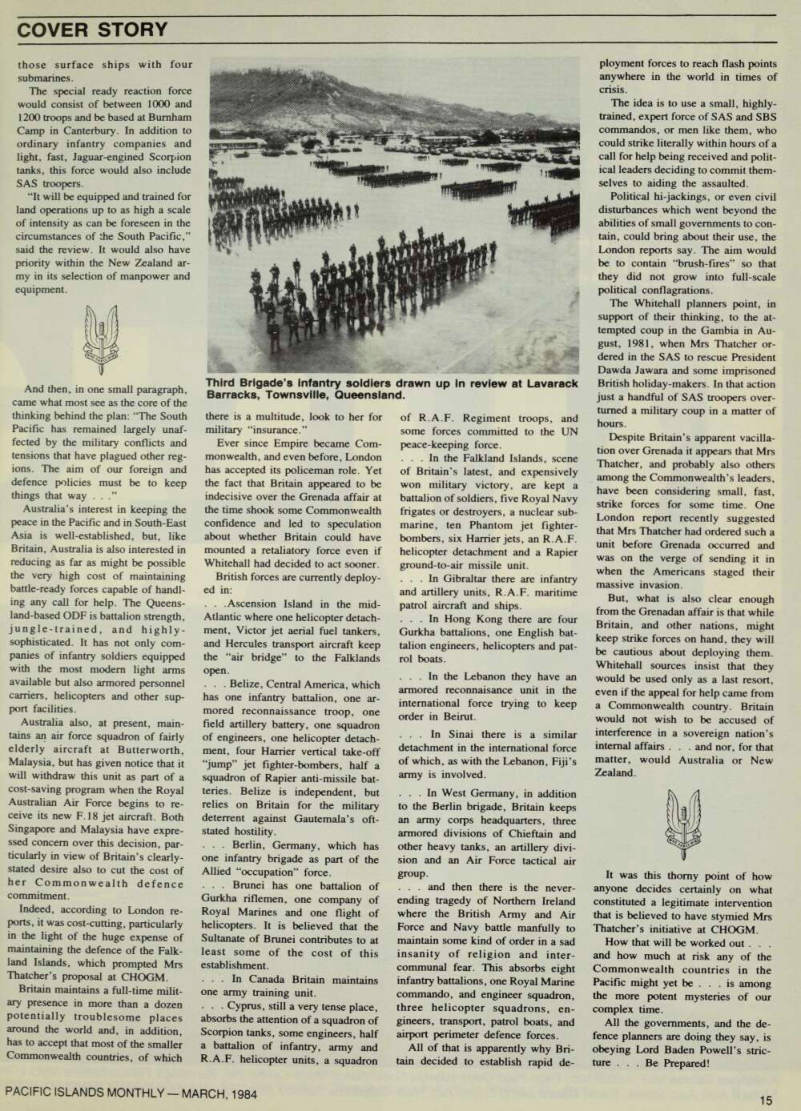
Third Brigade’s infantry soldiers drawn up in review at Lavarack Barracks, Townsville, Queensland.
Lightness the key
key to Oz
O.D.F.
Australia’s Operational De fence Force, based in Townsville, Queensland, is both older, and somewhat different,from the British, New Zealand and American ready reaction strike forces.
Established in 1978 it is formed around Third Bri gade, commanded by Briga dier Murray Blake, and is made up of about 2500 men in two infantry battalions, and squadrons of field artil lery, engineers, signallers, workshop and supply specialists.
O.D.F. is air portable and thus has no armor, but uses light weight, fast Land-Rov ers and light trucks, carried in with the troops aboard Royal Australian Air Force
Hercules and Caribou trans ports.
Everything about O.D.F. is designed for lightness and speed, from the weapons carried to the vehicles used. ”We are designed to handle small scale incursions on Australian soil, or overseas, as may be needed,” said a Third Brigade spokesman.
In addition to the Hercules the force has access to Chi nook heavy lift helicopters for carrying supplies vehicles guns and men.
No Australian S.A.S. squad ron is attached to O.D.F. but, as was done in Exercise Kangaroo in 1983, S.A.S. troopers can be added as the situation might demand, the spokesman said.
It would appear, also, that some of the equipment used by O.D.F. is common through the British and New Zealand units, which would help supplies in any joint operation overseas.
Advertisements & other items, pp. 14-17 (1 item)
Most Business Is Done
WE’VE MADE HOUR
BUSINESS TO BE WHERE
PERTH
ADELAIDE
<s# I I
RABAUL
■ V
PORT MORESBY
SUVA
TAHITI
CHRISTCHURCH
QUEENSTOWN
No matter how comfortable a hotel is and how good its facilities are, it’s to no avail if that same hotel isn’t near where you want it to be.
At Travelodge our aim is to attract people in business, which, quite simply, is why you can find us in so many business centres.
Not surprisingly, more and more people, particularly with business to transact, are choosing to stay at Travelodge.
The one hotel group that offers excellent service and facilities at a realistic price. Plus the distinct advantage of being ideally located in or near the business centre of major metropolitan and provincial cities.
Since your hotel often has to serve as an office too, we provide you with first class business facilities.
Dictation and transcription, photocopying, telex, national and international courier services, business breakfasts and rooms for large or small meetings. There are also many other little extras.
Like a newspaper every morning and fresh fruit in your room on arrival. There’s also complimentary coffee in the lobby for you and your guests.
Another thing that won’t go unnoticed is the millions of dollars spent on the facilities today’s businessmen and women demand. Large, tastefully decorated rooms, excellent restaurants and intimate bars.
Stay at Travelodge. You’ll not only find us conveniently located, you’ll also find that a warm reception is just the beginning.
For reservations world-wide please phone Sydney (02) 267 2144. Melbourne (03)6906111.
Brisbane (07) 2218586.
Adelaide (08)
223 6288. Canberra (062) 491424. Perth (09) 3253811. Or your travel agent.
MN&C/TVL 4742
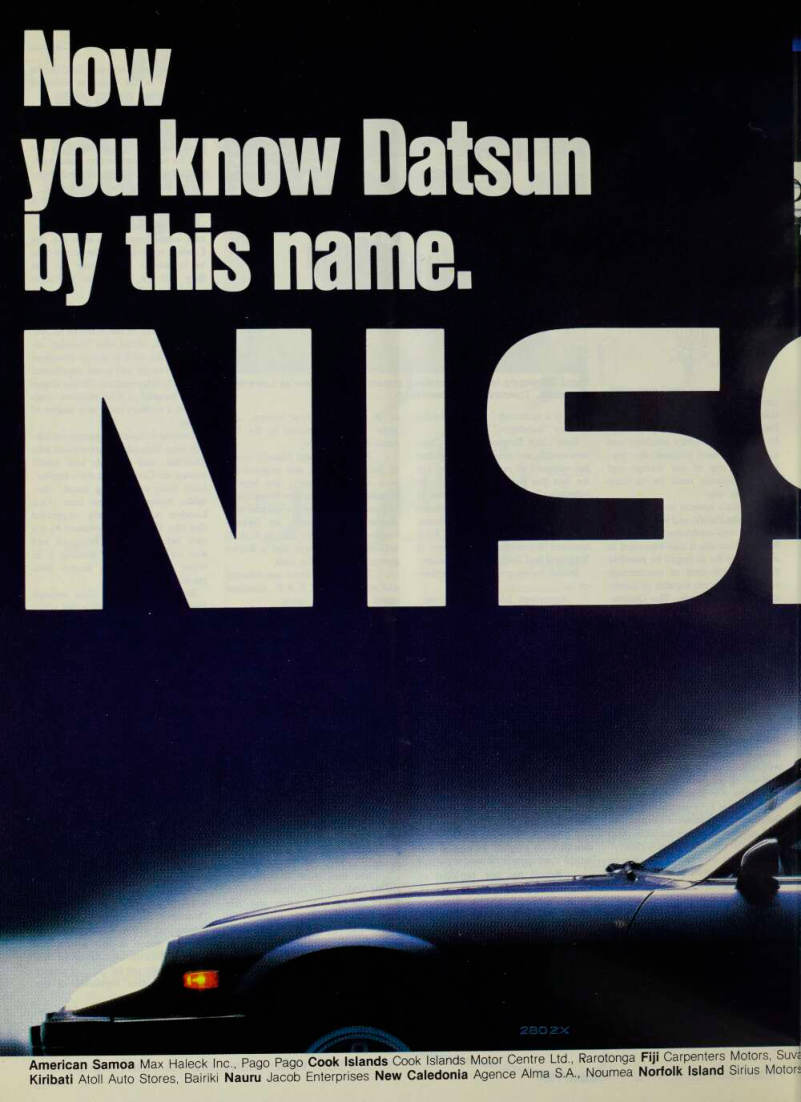
Now
you know Datsun
by this name.
I m i .. r f*.
American Samoa Max Haleck Inc., rayu rayu ioiumuo Q irillo u ntnr Kiribati Atoll Auto Stores, Bairiki Nauru Jacob Enterprises New Caledonia Agence Alma S.A., Noumea Norfolk Island Sinus Motor Cook Islands Cook Islands Motor Centre Ltd, Rarotonga Fiji Carpenters Motors, Suva . * a i r't a ku. M sm'ls-vI 1/ Irlonrl QirillC Motor
Prototype of Nissan's car of (he future •/: ,-u - • • • < - 0 f • ' ’J * , ' ; i ;: % j Production line with welding robots % Throughout the world, Datsun has become a symbol ■. for superior achievement in advanced technology.
S’') We’re proud of that. And we appreciate your approval. But the truth is, superior technology isn’t P our goal. It’s just a tool. A tool we very innovatively use to help reach what is our goal. And that is, to enrich the lives of people everywhere with products that not only meet their individual needs, ic tor computerized cars but meet them in a way that’s in harmony with the broader needs of society. So, to more accurately symbolize our real aims, we’re giving our Datsun products a new name. Our corporate name. Nissan. That way you’ll be calling Datsun by its most proper name.
NISSAN
NISSAN
▲ k ' .. *
Grasping the
Letters
Grasping the significance of Samoa
The letter (PIM Jan p 9) by Grant McCall, who is an associate pro fessor in the school of sociology of the University of New South Wales, is an outlandish product.
Dedicated to the great philosopher of science Sir Karl Popper, my book Margaret Mead and Samoa: The Making and Unmaking of an An
thropological Myth is an applica
tion to Mead’s romantic writings on Samoa of Popper’s fundamen tal principle that science progres ses by the elimination of error from its formulations. The need for this elimination of error in the case of Samoan studies is strik ingly demonstrated in Falani Pe ters’ poignant letter (PIM Jan p 9) in which she recounts the deplor able treatment meted out to her by her woefully ignorant social psychology lecturer in an Ameri
can university.
It is only by securing exact
knowledge about the problems that face human beings that we have any prospect of genuine solutions, and to suppose, as does Associate Professor McCall, that the recognition of an undesirable state of affairs is in any sense to condone this state is a quite elementary logical error.
The information in my book about unlawful behavior in Samoa is, for the most part, drawn from court records, and is, therefore public knowledge. As I emphasise in my book, the Sa moans are, first and foremost, a Christian people, and, this being so, the great majority of them have the capacity to face the facts about such unlawful behaviour as exists in Samoa without anger or fear, and with a determination to see that it is lessened as far as
may be humanly possible.
Moreover, it is in the open sided council houses of Samoa that this capacity is most con
spicuously displayed. There is,
of course, no “genetic message” written on the “open walls” of these houses as McCall suggests in his egregious letter. Rather
they are symbols of the “shining
virtues” of the Samoans to
which I refer on p 278 and elsewhere in my book. Samoa is no paradise, but it is, very defi nitely, a place of immense hu man worth.
Indeed, it is my hope, as the academic pro-chancellor of the University of Samoa, that as authentic Samoan studies develop it will be possible to communicate to the outside world, many of the humanly valuable aspects of Samoan cul ture. As, for example, the dig nified politeness, or amio fa’aaloalo of Samoa; the practice of tapua'i, or the formal offering of sympathy to those in misfor tune or distress; the enlightened way in which Samoa deals with convicted criminals; and, perhaps most importantly of all, the techniques in which the Sa moans are expert for achieving when necessary, a fa’aleleiga, or reconciliation between warring social factions.
It is thus very much my view that although Samoa is a small country it has great significance for the world at large, and that Samoan studies as they develop, will contribute importantly to hu man studies in general, and to our understanding of what it means to be human.
Derek Freeman
Australian National University Canberra. A.C.T.
Australia.
All Called
Together
In his column, “A View from Honolulu” in your December, 1983 issue, Robert C. Kiste repeats a “Washington Pacific Report” story that Senate Energy and Natural Re sources Committee Chairman James McClure has requested a comprehen sive General Accounting Office study of federal policy toward United States territories.
While that is true, I must point out for the record that the request was conceived of and developed by both Senator McClure’s committee and the House Committee on Interior and Insular Affairs and a companion re quest for the study was made by House Committee Chairman Morris Udall.
Antonio Won Pat
Washington, D.C. USA Congressman Won Pat, of Guam, is chairman of the Subcommittee on Insular Affairs at the U.S. House of Representatives.
Remembering
Rennell
I greatly enjoyed the fine article on Rennell Island in the October issue of PIM. It gave me an excellent picture of life on this unique Polynesian outer island of the Solomons, as it is today and perhaps forever was and will be.
During the Guadalcanal phase
of World War II in 1942, Rennell figured in our fantasies if not in our combat operations. It seems that a Navy PBY Catalina flying
boat landed on Rennell’s Lake Tegano to fix some minor engine
problem. The reception by the
Polynesians was warm and the young ladies were so friendly that it took three days to repair the PBY’s engine.
Word got around, of course, and one day while our Army B -17 Flying Fortress was on a routine search mission west out of Espiritu Santo, we detoured over to Rennell for a good look.
There on Lake Tegano was yet another PBY, no doubt with another engine problem! Our B -17 crew vowed that if we ever got in trouble in that part of the Coral Sea, somehow we’d man age to ditch your plane on Lake
Tegano!
I certainly enjoy your fine
magazine.
808 Berger
Harbor Springs, Michigan, 49740,
Usa.
South Pacific Island Airways (SPIA) has appointed Charles E.
Phelan area manager for the Samoas.
Mr Phelan will be responsible for all of SPIA’s activities within the Samoan region, including operations to the outer islands of Tau and Ofu and the main island of Tutuila in American Samoa, as well as Apia and Faleolo airport in Western Samoa.
SPIA operates trans-Pacific jet ser vices as well as original inter-island flights from their Pago Pago hub.
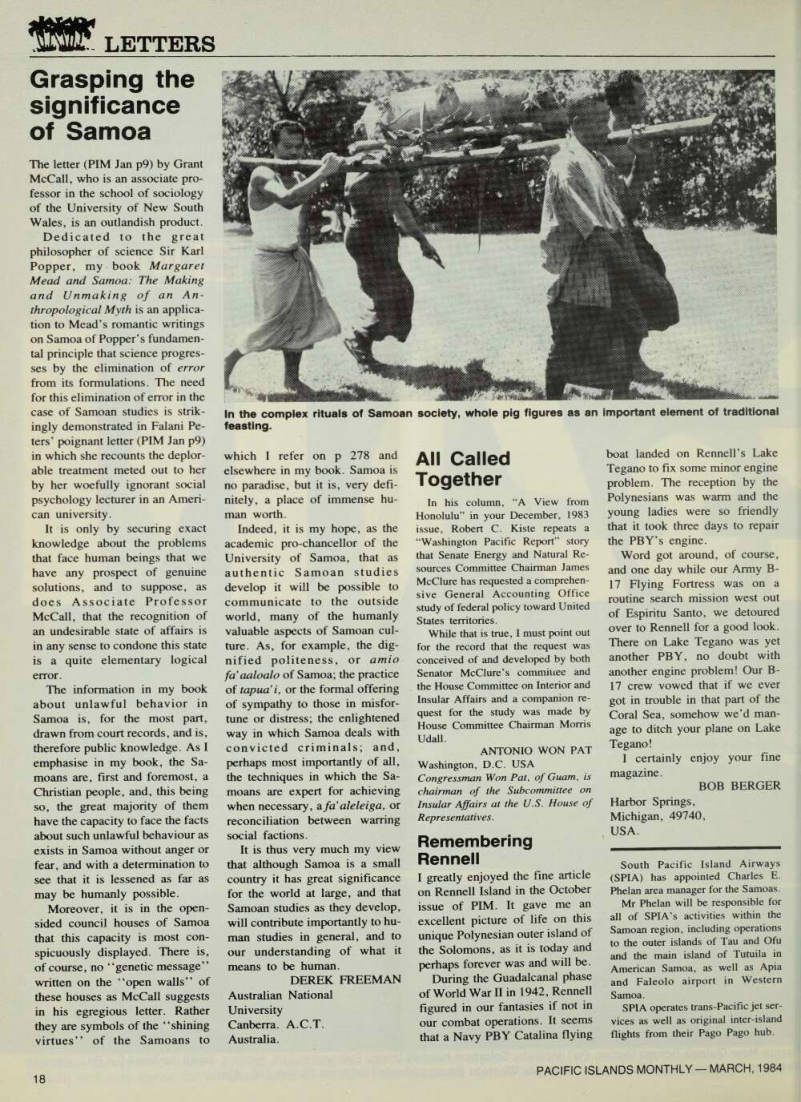
In the complex rituals of Samoan society, whole pig figures as an important element of traditional feasting.
People
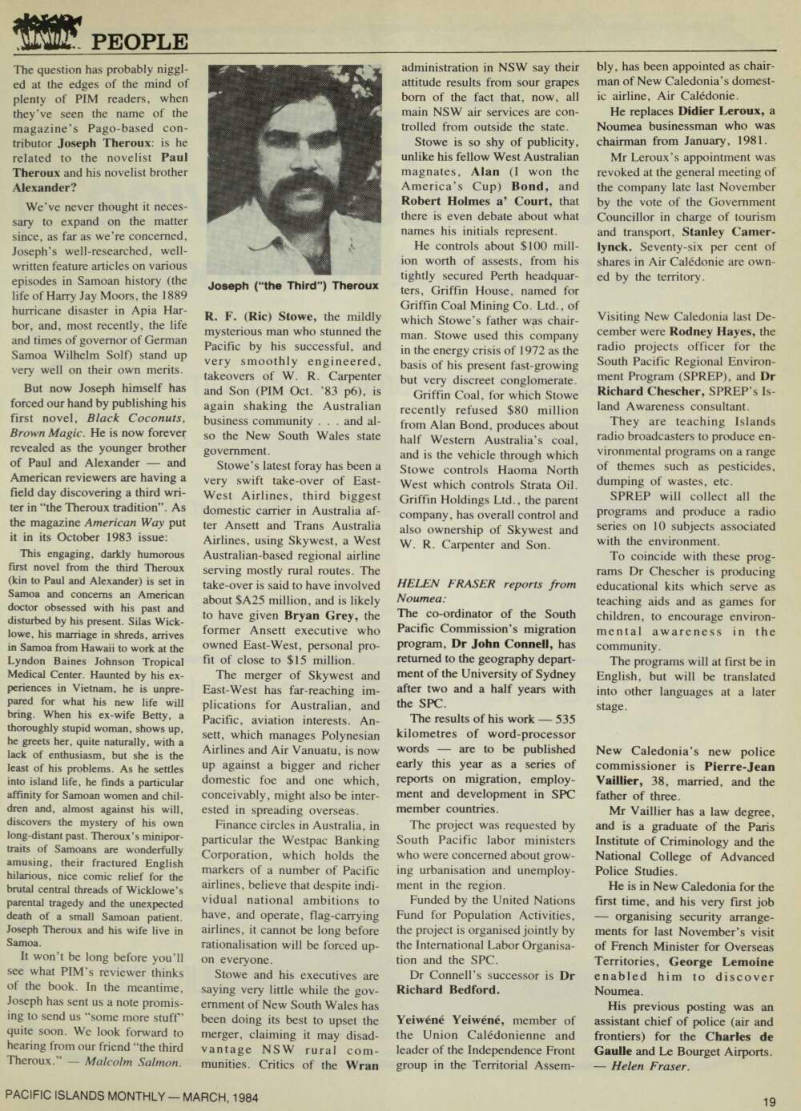
The question has probably niggl
ed at the edges of the mind of plenty of PIM readers, when they’ve seen the name of the
magazine’s Pago-based con
tributor Joseph Theroux; is he related to the novelist Paul Theroux and his novelist brother Alexander?
We’ve never thought it neces sary to expand on the matter since, as far as we’re concerned, Joseph’s well-researched, well written feature articles on various episodes in Samoan history (the life of Harry Jay Moors, the 1889 hurricane disaster in Apia Har bor, and, most recently, the life and times of governor of German Samoa Wilhelm Solf) stand up very well on their own merits.
But now Joseph himself has forced our hand by publishing his first novel, Black Coconuts, Brown Magic. He is now forever revealed as the younger brother of Paul and Alexander and American reviewers are having a field day discovering a third wri ter in “the Theroux tradition”. As the magazine American Way put it in its October 1983 issue; This engaging, darkly humorous first novel from the third Theroux (kin to Paul and Alexander) is set in Samoa and concerns an American doctor obsessed with his past and disturbed by his present. Silas Wick lowe, his marriage in shreds, arrives in Samoa from Hawaii to work at the Lyndon Baines Johnson Tropical Medical Center. Haunted by his ex periences in Vietnam, he is unpre pared for what his new life will bring. When his ex-wife Betty, a thoroughly stupid woman, shows up, he greets her, quite naturally, with a lack of enthusiasm, but she is the least of his problems. As he settles into island life, he finds a particular affinity for Samoan women and chil dren and, almost against his will, discovers the mystery of his own long-distant past. Theroux’s minipor traits of Samoans are wonderfully amusing, their fractured English hilarious, nice comic relief for the brutal central threads of Wicklowe’s parental tragedy and the unexpected death of a small Samoan patient.
Joseph Theroux and his wife live in Samoa.
It won’t be long before you’ll see what PlM’s reviewer thinks of the book. In the meantime, Joseph has sent us a note promis ing to send us “some more stuff’ quite soon. We look forward to hearing from our friend “the third
Theroux.”
Malcolm Salmon.
R. F. (Ric) Stowe, the mildly mysterious man who stunned the Pacific by his successful, and very smoothly engineered, takeovers of W. R. Carpenter and Son (PIM Oct. ’B3 p 6), is again shaking the Australian business community . . . and al so the New South Wales state government.
Stowe’s latest foray has been a very swift take-over of East- West Airlines, third biggest domestic carrier in Australia af ter Ansett and Trans Australia Airlines, using Skywest, a West Australian-based regional airline serving mostly rural routes. The take-over is said to have involved about SA2S million, and is likely to have given Bryan Grey, the former Ansett executive who owned East-West, personal pro fit of close to $l5 million.
The merger of Skywest and East-West has far-reaching im plications for Australian, and Pacific, aviation interests. An sett, which manages Polynesian Airlines and Air Vanuatu, is now up against a bigger and richer domestic foe and one which, conceivably, might also be inter ested in spreading overseas.
Finance circles in Australia, in particular the Westpac Banking Corporation, which holds the markers of a number of Pacific airlines, believe that despite indi vidual national ambitions to have, and operate, flag-carrying airlines, it cannot be long before rationalisation will be forced up on everyone.
Stowe and his executives are saying very little while the gov ernment of New South Wales has been doing its best to upset the merger, claiming it may disad vantage NSW rural com munities. Critics of the Wran
administration in NSW say their attitude results from sour grapes bom of the fact that, now, all main NSW air services are con trolled from outside the state.
Stowe is so shy of publicity, unlike his fellow West Australian magnates, Alan (I won the America’s Cup) Bond, and Robert Holmes a’ Court, that there is even debate about what names his initials represent.
He controls about $lOO mill ion worth of assests, from his tightly secured Perth headquar ters, Griffin House, named for Griffin Coal Mining Co. Ltd., of which Stowe’s father was chair man. Stowe used this company in the energy crisis of 1972 as the basis of his present fast-growing but very discreet conglomerate.
Griffin Coal, for which Stowe recently refused $BO million from Alan Bond, produces about half Western Australia’s coal, and is the vehicle through which Stowe controls Haoma North West which controls Strata Oil.
Griffin Holdings Ltd., the parent company, has overall control and also ownership of Skywest and W. R. Carpenter and Son.
HELEN FRASER reports from Noumea: The co-ordinator of the South Pacific Commission’s migration program. Dr John Connell, has returned to the geography depart ment of the University of Sydney after two and a half years with the SPC.
The results of his work 535 kilometres of word-processor words are to be published early this year as a series of reports on migration, employ ment and development in SPC member countries.
The project was requested by South Pacific labor ministers who were concerned about grow ing urbanisation and unemploy ment in the region.
Funded by the United Nations Fund for Population Activities, the project is organised jointly by the International Labor Organisa tion and the SPC.
Dr Connell’s successor is Dr Richard Bedford.
Yeiwene Yeiwene, member of the Union Caledonienne and leader of the Independence Front group in the Territorial Assem
bly, has been appointed as chair man of New Caledonia’s domest ic airline. Air Caledonie.
He replaces Didier Leroux, a Noumea businessman who was chairman from January, 1981.
Mr Leroux’s appointment was revoked at the general meeting of the company late last November by the vote of the Government Councillor in charge of tourism and transport, Stanley Camer lynck. Seventy-six per cent of shares in Air Caledonie are own
ed by the territory.
Visiting New Caledonia last De cember were Rodney Hayes, the radio projects officer for the South Pacific Regional Environ ment Program (SPREP), and Dr Richard Chescher, SPREP’s Is land Awareness consultant.
They are teaching Islands
radio broadcasters to produce en vironmental programs on a range of themes such as pesticides, dumping of wastes, etc.
SPREP will collect all the programs and produce a radio series on 10 subjects associated with the environment.
To coincide with these prog rams Dr Chescher is producing educational kits which serve as teaching aids and as games for children, to encourage environ mental awareness in the
community.
The programs will at first be in English, but will be translated into other languages at a later stage.
New Caledonia’s new police commissioner is Pierre-Jean Vaillier, 38, married, and the father of three.
Mr Vaillier has a law degree, and is a graduate of the Paris Institute of Criminology and the National College of Advanced Police Studies.
He is in New Caledonia for the first time, and his very first job
organising security arrange
ments for last November’s visit of French Minister for Overseas Territories, George Lemoine enabled him to discover Noumea.
His previous posting was an assistant chief of police (air and frontiers) for the Charles de Gaulle and Le Bourget Airports.
Helen Fraser.
Joseph (“the Third”) Theroux
Advertisements & other items, p. 20 (1 item)
Expert
Insurance Service
throughout the islands
Queensland Insurance (Fiji) Limited
Head Office: Queensland Insurance Centre, Victoria Parade SUVA. General Manager: R. Jackson Assistant Manager: Vijay Lai. Phone 23 851.
LAUTOKA OFFICE: Burns Philp Bldg., Naviti St. District Manager: R. Sharma. Phone 60 642 LABASA OFFICE: Burns Philp Bldg. Phone: 8 2139
Queensland Insurance (PNG) Limited
PAPUA NEW GUINEA
Head Office, B.N.G. Building, Musgrave St .PORT MORESBY. General Manager T. H. Sarti Phone: 21 2144.
LAE. 4th St & Coronation Drive District Manager: C. D. Killier Phone: 423873.
MOUNT HAGEN Hagen Drive District Manager: R. She]bourn Phone: 521002.
ARAWA: Chebu St., District Manager; B. Bowers Phone; 95 1555 MADANG: Kasagten St., District Manager: J. Longbut Phone: 82 2020 RABAUL Wirraway St. District Manager.R. McManus Phone. 921014,
QBE Insurance (International) Limited
VANUATU. PORT VILA: Rue de Pans, Suite 19,Oceania Bldg. Manager: I R. Martin.
Phone: 2299.
SANTO: Burns Philp (Vanuatu) Ltd. Phone: 230.
PACIFIC AGENCIES
NEW CALEDONIA Ste. W. A. Johnston, S.A.R.L. 5 Rue Anatole France, NOUMEA Phone: 272083.
TAHITI Arthur Chung. Immeuble B I S . Front de Mer, PAPEETE Phone: 2.86.19 NIUE Burns Philp (South Sea) Company Ltd.
NORFOLK ISLAND: Burns Philp ('N I ) Company Ltd. Phone: 2191 SAMOA APIA, Burns Philp (South Sea) Company Ltd Phone: 22611 TONGA Burns Philp (South Sea) Company Ltd. NUKU’ALOFA. Phone 21500 HAAPAI, VAVAU
MEMBERS OF THE
INSURANCE GROUP LIMITED
Sulphur in the air as Rabaul
waits for the big blow
The acid, acrid smell of sulphur is strong over Rabaul these days as the city of 20,000 souls waits, tensely, for a volcanic eruption scientists say is imminent and which could be at least as bad as the 1937 explosions which killed more than 500.
Aircraft leaving the town are now full, and arrivals are dwindling. It is becom ing more difficult to find a place on one of the coastal barges by which local peo ple get around the region.
People are heeding the warning of the Chief Gov ernment Vulcanologist, Dr Peter Lowenstein, and are either moving out, or pre paring to do so.
Rabaul, crouched in the grip of five volcanoes for ming Simpson and Matupi Harbors on the island of New Britain, in Papua New Guinea is now on Stage Two alert, which means the eruption is expected within months to weeks. Soon, however, if the scientists now constantly and anx iously monitoring the im mense natural bombs now ticking away around Rabaul are correct, they will call Stage Three and expect the big bang within weeks or perhaps days.
Stage Four will mean com pulsory, and prompt, evacuation ... if, by then, there is time, and means.
Experts from Australia were sent up to Rabaul within days of Dr Lowen stein’s report being made public to help plan for an evacuation should it be ordered.
There is no panic in Rabaul. The place is accus tomed to earthquakes and they come so frequently locals no longer notice them. But apprehension is in the air, and a bit of bravado with it as men hang on, having sent their women and children out to safety.
Rabaul has always been a dangerous place to live.
Almost everyone wonders why it was built there, sit ting, literally, on top of a
seething caldera, sur rounded by its necklace of volcanoes, any of which is capable of catastrophic eruption.
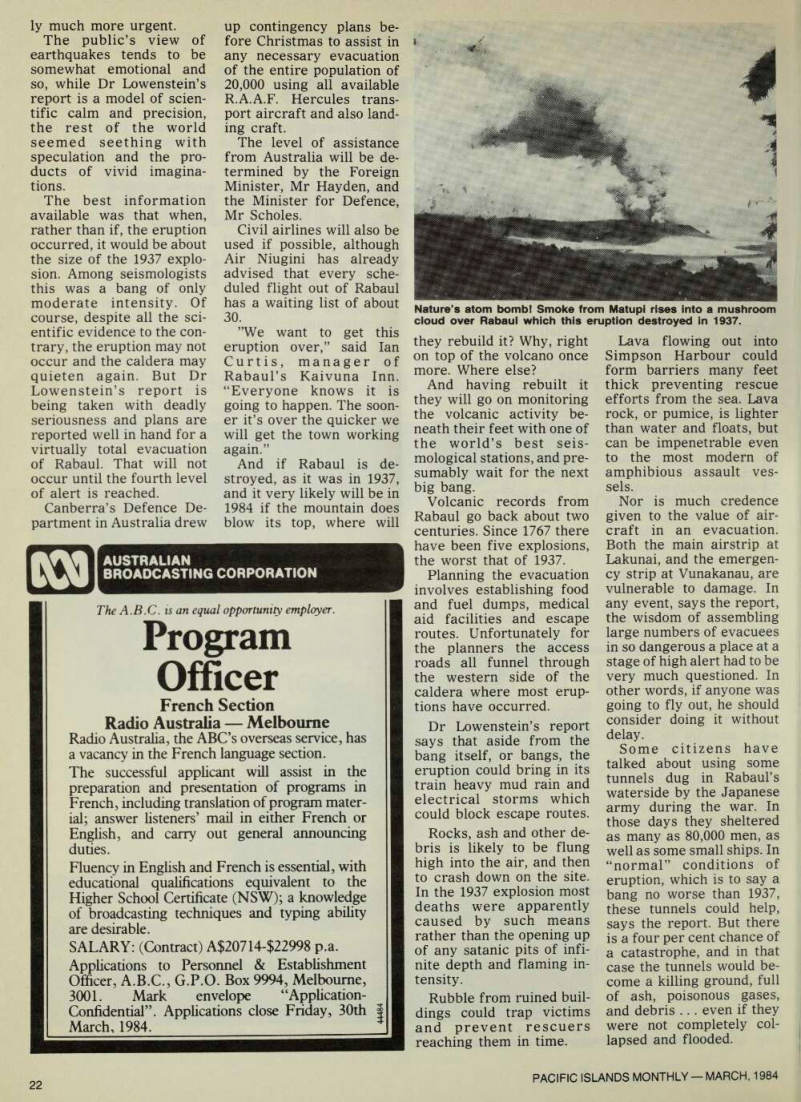
The tallest of the volca noes, believed to be ex tinct, is the “Mother”. On her left flank stands Raba lankaia, a relatively small crater, still very much alive and regarded as a prime suspect in the cur rent emergency.
Rabalankaia looms over Rabaul airport and could destroy it in minutes with a major blow. On the other side of the strip is Matupi, the other danger point now.
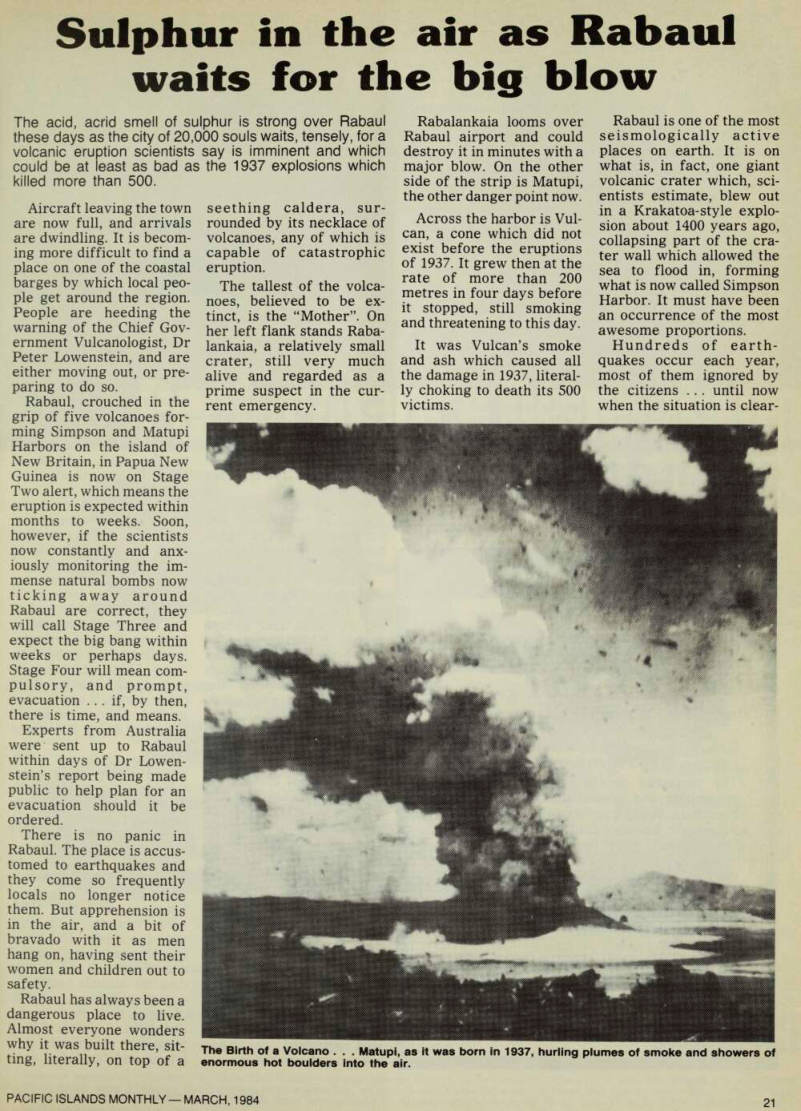
Across the harbor is Vul can, a cone which did not exist before the eruptions of 1937. It grew then at the rate of more than 200 metres in four days before it stopped, still smoking and threatening to this day.
It was Vulcan’s smoke and ash which caused all the damage in 1937, literal ly choking to death its 500 victims.
Rabaul is one of the most seismologically active places on earth. It is on what is, in fact, one giant volcanic crater which, sci entists estimate, blew out in a Krakatoa-style explo sion about 1400 years ago, collapsing part of the cra ter wall which allowed the sea to flood in, forming what is now called Simpson Harbor. It must have been an occurrence of the most awesome proportions.
Hundreds of earth quakes occur each year, most of them ignored by the citizens ... until now when the situation is clear-
The Birth of a Volcano . . . Matupi, as it was born in 1937, hurling plumes of smoke and showers of enormous hot boulders into the air.
ly much more urgent.
The public’s view of earthquakes tends to be somewhat emotional and so, while Dr Lowenstein’s report is a model of scien tific calm and precision, the rest of the world seemed seething with speculation and the pro ducts of vivid imagina tions.
The best information available was that when, rather than if, the eruption occurred, it would be about the size of the 1937 explo sion. Among seismologists this was a bang of only moderate intensity. Of course, despite all the sci entific evidence to the con trary, the eruption may not occur and the caldera may quieten again. But Dr Lowenstein’s report is being taken with deadly seriousness and plans are reported well in hand for a virtually total evacuation of Rabaul. That will not occur until the fourth level of alert is reached.
Canberra’s Defence De partment in Australia drew
up contingency plans be fore Christmas to assist in any necessary evacuation of the entire population of 20,000 using all available R.A.A.F. Hercules trans port aircraft and also land ing craft.
The level of assistance from Australia will be de termined by the Foreign Minister, Mr Hayden, and the Minister for Defence, Mr Scholes.
Civil airlines will also be used if possible, although Air Niugini has already advised that every sche duled flight out of Rabaul has a waiting list of about 30. ”We want to get this eruption over,” said lan Curtis, manager of Rabaul’s Kaivuna Inn.
“Everyone knows it is going to happen. The soon er it’s over the quicker we will get the town working again.”
And if Rabaul is de stroyed, as it was in 1937, and it very likely will be in 1984 if the mountain does blow its top, where will
they rebuild it? Why, right on top of the volcano once more. Where else?
And having rebuilt it they will go on monitoring the volcanic activity be neath their feet with one of the world’s best seis mological stations, and pre sumably wait for the next big bang.
Volcanic records from Rabaul go back about two centuries. Since 1767 there have been five explosions, the worst that of 1937.
Planning the evacuation involves establishing food and fuel dumps, medical aid facilities and escape routes. Unfortunately for the planners the access roads all funnel through the western side of the caldera where most erup tions have occurred.
Dr Lowenstein’s report says that aside from the bang itself, or bangs, the eruption could bring in its train heavy mud rain and electrical storms which could block escape routes.
Rocks, ash and other de bris is likely to be flung high into the air, and then to crash down on the site.
In the 1937 explosion most deaths were apparently caused by such means rather than the opening up of any satanic pits of infi nite depth and flaming in tensity.
Rubble from ruined buil dings could trap victims and prevent rescuers reaching them in time.
Lava flowing out into Simpson Harbour could form barriers many feet thick preventing rescue efforts from the sea. Lava rock, or pumice, is lighter than water and floats, but can be impenetrable even to the most modern of amphibious assault ves sels.
Nor is much credence given to the value of air craft in an evacuation.
Both the main airstrip at Lakunai, and the emergen cy strip at Vunakanau, are vulnerable to damage. In any event, says the report, the wisdom of assembling large numbers of evacuees in so dangerous a place at a stage of high alert had to be very much questioned. In other words, if anyone was going to fly out, he should consider doing it without delay.
Some citizens have talked about using some tunnels dug in Rabaul’s waterside by the Japanese army during the war. In those days they sheltered as many as 80,000 men, as well as some small ships. In “normal” conditions of eruption, which is to say a bang no worse than 1937, these tunnels could help, says the report. But there is a four per cent chance of a catastrophe, and in that case the tunnels would be come a killing ground, full of ash, poisonous gases, and debris ... even if they were not completely col lapsed and flooded.
Nature’s atom bomb! Smoke from Matupi rises into a mushroom cloud over Rabaul which this eruption destroyed in 1937.
Advertisements & other items, pp. 22-23 (1 item)
Program
AUSTRALIAN
BROADCASTING CORPORATION
The A.B.C. is an equal opportunity employer.
Program
Officer
French Section Radio Australia Melbourne Radio Australia, the ABC’s overseas service, has a vacancy in the French language section.
The successful applicant will assist in the preparation and presentation of programs in French, including translation of program material; answer listeners’ mail in either French or English, and carry out general announcing duties.
Fluency in English and French is essential, with educational qualifications equivalent to the Higher School Certificate (NSW); a knowledge of broadcasting techniques and typing ability are desirable.
SALARY: (Contract) A 520714-$22998 p.a.
Applications to Personnel & Establishment Officer, A.8.C., G.P.O. Box 9994, Melbourne, 3001. Mark envelope “Application- Confidential”. Applications close Friday, 30th March, 1984.
Toughness.
Nissan Cabstar Nissan Sunn Nissan Vanette n Nissan Urvan
PATROL
Nissan Patrol Datsun Pickup 4WD That’s why Nissan means higher performance. Toughness is total. Every member of the widerange lineup has extra strength and durability built-in along with superior maneuverability These high performers dehver penny-pinehirig fuel economy and tough reliability. Once you discover how great the ride and handling ease are, you will understand what makes Nissan commercial and passenger vehicles worldwide favorites.
There’s more to a Nissan than meets the eye.
NISSAN
BairikT Na urn™ otf Ent e rpr ises" N e oAa c e I m a°9 If * S Moto^ c ® ntre Ltd > Rf roton g a F 'j' Carpenters Motors, Suva Kiribati Atoll Auto Stores Solomon Islands United Enterprises Ltd Honiara Tahm A o R7%"no 0 fk Island Sinus Motors Papua New Guinea Boroko Motors, Port Moresb' Morris Hedstrom Samoa Ltd Apia ’ a Tahltl Tahltlbull S.A.R.L, Papeete Vanuatu Pentecost Vanua Trading Ltd., Port Vila Western Samoa
Yellow Submarine
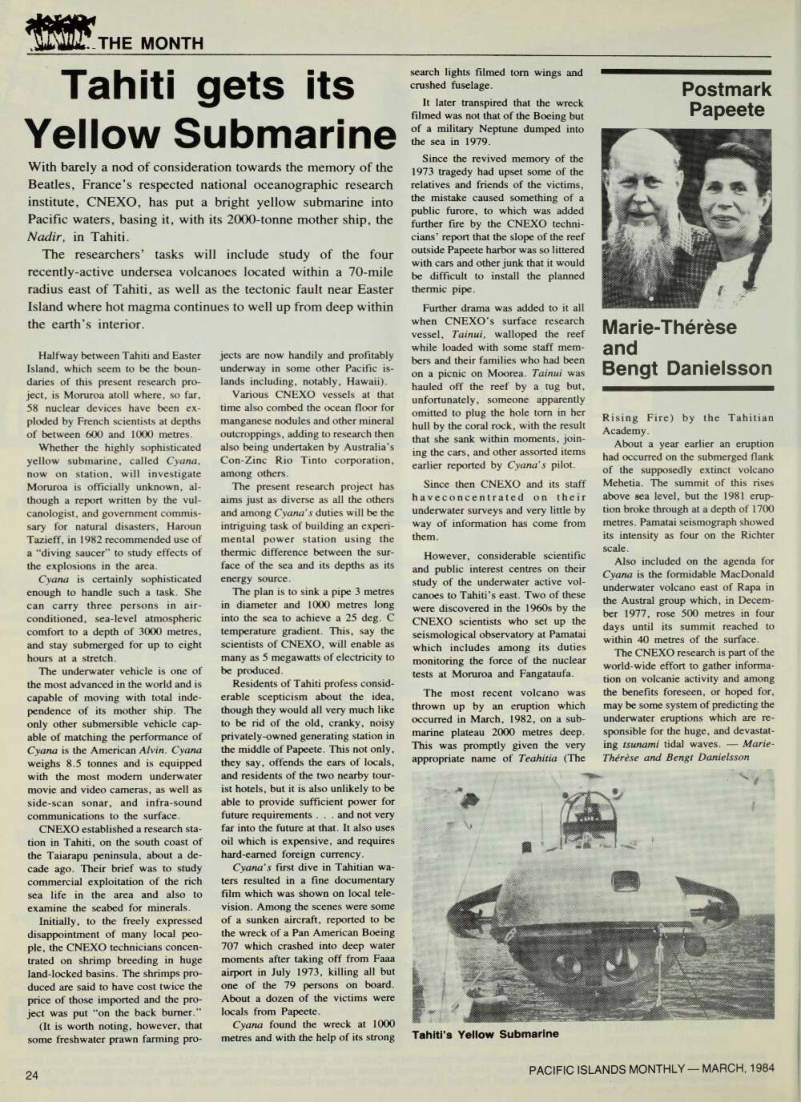
The Month
Tahiti gets its Yellow Submarine
With barely a nod of consideration towards the memory of the Beatles, France’s respected national oceanographic research institute, CNEXO, has put a bright yellow submarine into Pacific waters, basing it, with its 2000-tonne mother ship, the Nadir , in Tahiti.
The researchers’ tasks will include study of the four recently-active undersea volcanoes located within a 70-mile radius east of Tahiti, as well as the tectonic fault near Easter Island where hot magma continues to well up from deep within the earth’s interior.
Halfway between Tahiti and Easter Island, which seem to be the boun daries of this present research pro ject, is Moruroa atoll where, so far, 58 nuclear devices have been ex ploded by French scientists at depths of between 600 and 1000 metres.
Whether the highly sophisticated
yellow submarine, called Cyana, now on station, will investigate Moruroa is officially unknown, al though a report written by the vul canologist, and government commis sary for natural disasters, Haroun Tazieff, in 1982 recommended use of a “diving saucer” to study effects of the explosions in the area.
Cyana is certainly sophisticated enough to handle such a task. She can carry three persons in air conditioned, sea-level atmospheric comfort to a depth of 3000 metres, and stay submerged for up to eight hours at a stretch.
The underwater vehicle is one of the most advanced in the world and is capable of moving with total inde pendence of its mother ship. The only other submersible vehicle cap able of matching the performance of Cyana is the American Alvin. Cyana weighs 8.5 tonnes and is equipped with the most modem underwater movie and video cameras, as well as side-scan sonar, and infra-sound communications to the surface.
CNEXO established a research sta tion in Tahiti, on the south coast of the Taiarapu peninsula, about a de cade ago. Their brief was to study commercial exploitation of the rich sea life in the area and also to examine the seabed for minerals.
Initially, to the freely expressed disappointment of many local peo ple, the CNEXO technicians concen trated on shrimp breeding in huge land-locked basins. The shrimps pro duced are said to have cost twice the price of those imported and the pro ject was put “on the back burner.” (It is worth noting, however, that some freshwater prawn farming pro
jects are now handily and profitably underway in some other Pacific is lands including, notably, Hawaii).
Various CNEXO vessels at that time also combed the ocean floor for manganese nodules and other mineral outcroppings, adding to research then also being undertaken by Australia’s Con-Zinc Rio Tinto corporation, among others.
The present research project has aims just as diverse as all the others and among Cyana’s duties will be the intriguing task of building an experi mental power station using the thermic difference between the sur face of the sea and its depths as its energy source.
The plan is to sink a pipe 3 metres in diameter and 1000 metres long into the sea to achieve a 25 deg. C temperature gradient. This, say the scientists of CNEXO, will enable as many as 5 megawatts of electricity to
be produced.
Residents of Tahiti profess consid erable scepticism about the idea, though they would all very much like to be rid of the old, cranky, noisy privately-owned generating station in the middle of Papeete. This not only, they say, offends the ears of locals, and residents of the two nearby tour ist hotels, but it is also unlikely to be able to provide sufficient power for future requirements . . . and not very far into the future at that. It also uses oil which is expensive, and requires hard-earned foreign currency.
Cyana’s first dive in Tahitian wa ters resulted in a fine documentary film which was shown on local tele vision. Among the scenes were some of a sunken aircraft, reported to be the wreck of a Pan American Boeing 707 which crashed into deep water moments after taking off from Faaa airport in July 1973, killing all but one of the 79 persons on board.
About a dozen of the victims were locals from Papeete.
Cyana found the wreck at 1000 metres and with the help of its strong
search lights filmed tom wings and
crushed fuselage.
It later transpired that the wreck filmed was not that of the Boeing but of a military Neptune dumped into the sea in 1979.
Since the revived memory of the 1973 tragedy had upset some of the relatives and friends of the victims, the mistake caused something of a public furore, to which was added further fire by the CNEXO techni cians’ report that the slope of the reef outside Papeete harbor was so littered with cars and other junk that it would be difficult to install the planned thermic pipe.
Further drama was added to it all when CNEXO’s surface research vessel, Tainui, walloped the reef while loaded with some staff mem bers and their families who had been on a picnic on Moorea. Tainui was hauled off the reef by a tug but, unfortunately, someone apparently omitted to plug the hole tom in her hull by the coral rock, with the result that she sank within moments, join ing the cars, and other assorted items earlier reported by Cyana’s pilot.
Since then CNEXO and its staff haveconcentrated on their underwater surveys and very little by way of information has come from them.
However, considerable scientific and public interest centres on their study of the underwater active vol canoes to Tahiti’s east. Two of these were discovered in the 1960 s by the CNEXO scientists who set up the seismological observatory at Pamatai which includes among its duties monitoring the force of the nuclear tests at Moruroa and Fangataufa.
The most recent volcano was thrown up by an eruption which occurred in March, 1982, on a sub marine plateau 2000 metres deep.
This was promptly given the very appropriate name of Teahitia (The
Rising Fire) by the Tahitian Academy.
About a year earlier an eruption had occurred on the submerged flank of the supposedly extinct volcano Mehetia. The summit of this rises above sea level, but the 1981 erup tion broke through at a depth of 1700 metres. Pamatai seismograph showed its intensity as four on the Richter scale.
Also included on the agenda for Cyana is the formidable MacDonald underwater volcano east of Rapa in the Austral group which, in Decem ber 1977, rose 500 metres in four days until its summit reached to within 40 metres of the surface.
The CNEXO research is part of the world-wide effort to gather informa tion on volcanic activity and among the benefits foreseen, or hoped for, may be some system of predicting the underwater eruptions which are re sponsible for the huge, and devastat
ing tsunami tidal waves.
Marie-
Therese and Bengt Danielsson
Postmark Papeete
Marie-Therese and Bengt Danielsson
Tahiti’s Yellow Submarine
The case of the tree that walked
tree that walked
In the late 19505, when Quonset still dotted the Micronesian land scape, curious military exercises used to take place in the Marianas. At the time, of course, the U.S. was running a sup posedly super-secret CIA train ing base on Saipan. Nationalist Chinese were being prepared for the invasion of the mainland, an idea as crackpot then as it is
today.
Nevertheless, that never stopped the government. Among the skills American trainers pass ed along to the Chinese was
camouflage, and an appreciation
for stealth.
How successful was the Un ited States effort? Obviously the mainland was never invaded
although guerrillas could have
been landed but by one ac count, the Chinese learned their lessons well.
In one exercise, U.S. Navy authorities on Saipan alerted
Trust Territory headquarters,
then located on Guam, to the fact that the “invaders” would travel from Saipan to Guam and “pene trate” the T.T. compound.
Not many days afterwards, the
Trust Territory High Commis
sioner’s secretary was leaving the main administration office.
As she strolled along the sidewalk she noticed something peculiar: it looked like one of the trees was moving. She stared at the plant, and sure enough, it was inching its way forward.
The “tree,” it turned out, was a Nationalist Chinese invader.
Somehow he had made it from Saipan to Guam, a 125-mile trip across open ocean, worked his way into the Trust Territory com plex, and found enough twigs and leaves to make his costume
complete.
The secretary, who recounted this tale many years later, swore it was true. Regardless, it is a wonderful story and, in some ways, foreshadowed the Mic ronesian preoccupation (some of it justified) about American spies in their midst.
Two events contributed might ily to today’s sad state of suspi
cion. The first took place in the
early 19605. President Kennedy,
smarting from United Nations criticism of the Americans “zoo
theory” administrative practices,
ordered a commission to study the Micronesian situation and of fer policy recommendations.
The team was led by Anthony Solomon, now with the Federal Reserve Bank in New York.
What resulted was, in retrospect,
fairly predictable stuff, given the
tenor of those times: more money and more education with the hope that in the East-West “struggle” for the hearts and minds of the developing world, the far-away Micronesian islan ders would enjoy America’s be neficence and seek a close polit ical relationship with
Washington.
Unfortunately, the recommen dations were classified (and re main so to this day). Still, in the early 19705, the talented Palauan
journalist, Francisco Uludong,
published a copy of the secret volume. “The Solomon Re port,” as it was known, became synonymous with a notion that somewhere in darkest Washing ton, officials had a master plan for Micronesia. Whatever took place in the islands was some how related to a U.S.
conspiracy.
Anyone who knows anything about how the American Govem-
ment operates particularly in relation to Micronesia knows that the conspiracy theory of ad ministration has no basis in reali ty. But that has not stopped the speculation and suspicion, which continue unabated.
The other event was of far more consequence. In the mid -1970s during a political status negotiating session in Hawaii, the CIA did indeed “bug”
Micronesians.
According to one high-level
Micronesian who was active in the negotiations at the time, most of the islanders had hotel rooms which were next to the elevator shaft. That made it easier to run wires to the rooms, he believes.
When the story broke, it be came clear some Micronesians had aided the American agents.
Drawing up a list of the culprits was an issue at the mid-1977 negotiating round on Guam, but
the idea was quietly shelved. The reason? One theory is that a number of high-ranking islanders might have been implicated.
There have been related events over the years: stories of Ameri can military officers trying to buy informants; sotto voce fears that the U.S. political status team had the services of former agents; tales that grow more col orful with each retelling of State
Department types spending long
evening hours at the telex machine on Saipan, sending off reports to Washington.
How much is fact, how much is fiction and how much is a symptom of the small island fas cination with gossip and intrigue is difficult to say. Certainly those events which did occur like the “Coconutgate” affair of the bugging have fed the fears.
Indeed, surreptitious intelli gence-gathering activity is one of the darker chapters of American Administration in the Pacific.
The few organised events and they do appear limited have affected U.S.-Micronesian relations for the worse.
Once the new political statuses are in place, this unsavory chap ter may be relegated to a footnote in the history of Micronesia. But that footnote will still be there as a reminder that at a time when Micronesian trust of America was total, the United States saw fit to spy on its island friends.
Trees may no longer waddle across government compounds, but one cannot help but look
twice at them.
Floyd K.
Takeuchi.
Notes from the North
Floyd K.
Takeuchi on Micronesia
Vanuatu?
A U.S. tie for Vanuatu?
On more than one occasion since
independence, the foreign policy
of Vanuatu has set an alarmist cat among the South Pacific pi geons. The most recent example was last year’s diplomatic recog nition of Cuba.
This provoked a chorus of apparent astonishment and horror from neighbors and other inter ested parties, and much specula tion as to what ideology the
government had embraced.
Some commentators excused Vanuatu for its actions by assum ing that the government had been led astray by foreign advisers, or even by its own United Nations representative. Others suggested, ominously, that Vanuatu was
thoughtlessly leading the South
Pacific into danger. Michael So mare went on record as having expressed the concern felt by
Report from Vanuatu
Julie-Ann Ellis
Advertisements & other items, p. 26 (1 item)
Fid Pioneer'
Pioneer Avante A 9. Every hi-fi advantage
an integrated component system
can offer—and more power too!
Come to Avante for real music power—26s watts of it per channel. Hear Avante and listen to your music bigger and brighter than ever before. Really listen closely to Avante and marvel at how true and realistic the sound is, with so little distortion thanks to Pioneer’s unique Dynamic Power Non-Switching™ amp.
Avante A 9. It has more of the power you want and more of the features you need for modern, hi-technology hi-fi, such as a double cassette deck for easy taping, quartz-PLL synthesizer tuning and a ribbon supertweeter.
Avante A 9. The best friend a music collection can have.
Note: Graphic equalizer, audio timer, audio lamp, cassette case and headphones are all optional.
fID PIONEER'
For further information, please contact: Australia: Pioneer Electronics Australia Pty. Ltd. (Incorporated in Victoria), P.O. Box 295, Mordialloc, Victoria, 3195 Tel: 580-9911 Fiji Islands: Brijlal & Company, G.P.O. Box No. 362, Suva, Fiji Islands Tel: 22258 New Zealand: Monaco Distributors Ltd., 2 Poland Road, Glenfield, Auckland, New Zealand Tel: (09) 444-9144 Norfolk Island: Burns Philp (Norfolk Island) Ltd., P.O. Box 21, Norfolk Island Vanuatu: Burns Philp (Vanuatu) Ltd., Vila, Vanuatu Nauru Island: Jacob Enterprises, P.O. Box No. 4, Republic of Nauru Tahiti: Tahiti Hi-Fi, P.O. Box 848, Papeete, Tahiti New Caledonia: Menard Pacifique Sari, B.P 3899, Noumea, New Caledonia Tel: 27-62.23 American Samoa: Transpac Corporation, P.O. Box 1477, Pago Pago, American Samoa 96799 Tel: 633-5224 „ 4 .. . . T . 0 07 Rarotonga: South Seas International Ltd., P.O. Box 49, Rarotonga, Cook Islands Tel. 2327 Papua New Guinea: Bali Merchants Pty. Ltd., P.O. Box 6103, Boroko Tel: 254887
The Month
Pacific leaders about the recogni tion, and reported that In donesia’s President Suharto had also raised the matter with him.
All this has not been lost on the Vanuatu Government, and, without moving away from their major foreign policy positions, they are now at pains to make clear that pragmatism, more than ideology, is behind their actions.
When Sela Molisa, now minister for foreign affairs and external trade, gave his first policy state ment to parliament on January 27, he commented briefly that “we have all been entertained by the foreign media with specula tions as to what our real inten tions are,’’ and that, as to ideological tendencies, “the government of Vanuatu and the Vanuaaku party do not profess any.’’
Certainly there has been much more of pragmatism to Vanuatu’s foreign policy than is generally recognised. Links have been carefully forged with Com mon Market countries such as West Germany and Belgium, in consideration of the need for trade and the benefits of the Lom6 Convention. Molisa has suggested, too, that Vanuatu’s first permanent overseas repre sentation would be to the Euro pean Economic Community, for the same reasons. Membership in the World Bank, the Internation al Monetary Fund, and the Asian Development Bank (which has just agreed to open its regional centre in Port-Vila), have been negotiated as part of the govern ment’s economic strategy. Mem bership of the Commonwealth and its French equivalent the ACCT has been important for aid and training programs. But prag matism is not the only force
important in forming foreign
policy.
Even Molisa’s speech, while denying any ideological tenden cies, lists the ideals that the government espouses, including “support for the principles of
self-determination, independ
ence and denuclearisation, espe cially in the Pacific region, re cognition of the existence of states, respect for human rights, territorial integrity and sovereignty, support for socio economic advancement in the
Third World, and commitment and support to the Charter of the United Nations,” among others.
These are ideals that have been given more than lip service.
When Prime Minister Lini, then also responsible for the foreign affairs portfolio, spoke to the General Assembly of the UN in September last year, he vigor ously defended his country’s right to speak in defence of these ideals, even when friendly na tions were involved. “We, as a nation, are not cynical enough to have interests which would lead us to close our eyes to the injus tices imposed on our fellow hu man beings,” he declared, while addressing issues as diverse as the shooting down of Korean airliner 007, and the invasion and long occupation of East Timor by Indonesia.
Now, however, with the gov ernment concerned to present a pragmatic face to the Pacific, these policies, though unlikely to be dropped, may be less em phasised. One possible shift has already been signalled. Molisa’s speech referred to four possible new diplomatic ties, with Israel, the republic of Kiribati, the Socialist Republic of Nicaragua, and, most significantly, the Un ited States.
Hitherto Vanuatu has avoided diplomatic recognition of either the United States or the USSR, as part of its non-aligned policy, and perhaps also as a way of avoiding the overwhelming help these nations can give their client states. Now diplomatic ties with the U.S. (and not with the USSR) are mentioned as a possibility.
There are good economic reasons as well as political ones for this. The U.S. has the poten tial to be a profitable market for Vanuatu’s beef. Nevertheless it would be a significant shift, as would be the formation of ties with Israel, as Vanuatu has no tie at all so far with the Middle East.
However, Molisa has only said that these possibilities “will be processed this year.”
It may be many months before it becomes apparent just where the government is prepared to go in search of a new image.
Julie-Ann Ellis.
Economy recovers
on paper
Western Samoa’s Prime Minister Tofilau Eti announced in parlia ment in January that the coun try’s credibility among foreign lenders has been assured. This was because lenders, including the International Monetary Fund (IMF), and the World Bank, were now convinced that the government was again paying its way.
And Financial Secretary Alis tair Hutchison, often referred to as “the most powerful man in government, ’ ’ quickly agreed.
He told PIM: “In economic terms, we (Western Samoa) are now in reasonable shape. There will be stabilisation, but it will take several months.’’
Tofilau attributed the econom ic recovery to his government’s tough policies imposed last year which increased earnings from taxes, government charges and reduced foreign exchange spend ing by restrictions on imports.
He said that in the last nine months of 1983, the government was able to reduce its foreign debt of SWSI3 million to $5 million, made a record foreign exchange saving of $10.2 million ($8 million in 1977), cleared its bank overdraft of $10.2 million, and secured a bank account of $2.2 million in credit.
The government’s perform ance is undoubtedly impressive except that the recovery is on paper only. The cost of living is still climbing and the man in the street is still being hard-hit.
Meantime, the government has yet to spell out where it would be getting the $lO million it needs for the airport extension, and the “millions more’’ for the proposed national university.
In these times of funds scarci ty, the government is being bit terly assailed by members of the public and the opposition party of former Prime Minister Tupuo la Efi for embarking on these ambitious projects.
To make matters still more difficult to understand, the gov ernment went ahead and awarded the contract for the airport exten-
sion to its construction company.
Special Projects Development Corporation (SPDC), despite the fact that its bid was not the lowest.
SPDC later dropped its asking price to $3.6 million, but Tupuo la charged that the public “will again be made responsible for the balance.’’ Hutchison, who left the government in February after 16 years service, was also unhap py about the decision.
When Tofilau announced that the economy was recovering, his government was tabling five tax bills in parliament. The bills in clude a new tax called an “excise tax. ’’ They aimed at raising taxes further and reducing incentives
for manufacturing.
The cost of drafting these bills by a New Zealand lawyer was about $96,000, an amount not provided for in the 1984 budget.
The cost of electricity will also be raised from 23 cents a unit to 33 cents.
Still, Tofilau was insistent that his tough policies should be pass ed into law. He is also extremely confident that he will be returned to power in the general elections due in February next year. He told Tupuola in parliament that if both men were to resign from parliament on the spot, only he, Tofilau, would be re-elected.
Sana Malifa.
Samoa Report
Sano Malifa on Western Samoa
Advertisements & other items, p. 28 (1 item)
nuiomoTiuE
PRODUCTS
Seruiie equipment, parts, accessories
...they're reliable,praffitable
Australia has developed a technologically advanced and efficient automotive industry.
Its wide range of quality products has brought sales in over 100 countries.
Australian equipment is available for major service jobs such as engine tuning, wheel balancing and alignment, electrical service, and testing for compression, timing, ignition, etc. Clutch and brake linings, suspension, bearings, wheels, engine and transmission components, electrical equipment, oil seals, trimware, etc. can be supplied at competitive prices. Find out about products you are interested in, it could prove very profitable.
Ask the expert who knows Australia The Australian Trade Commissioner can give you details of suppliers and also advise you on ways to research or develop markets in Australia. You can contact an Australian Trade Commissioner at:
FIJI
PC. Box 1252, Suva.
Phone: 31 2844 Telex: FJ2126
PAPUA NEWGUINEA
PC.. Box 9129, Hohola.
Phone: 25 9333 Telex: NE22109
NEW CALEDONIA
PC. Box 22, Noumea.
Phone: 27 2414 Telex: 087
HAWAII
Australian Consulate. 1000 Bishop Street, Hawaii, 96813, USA.
Phone: (808) 524 5050 Telex: 633128 Si a m o
ITjJ
Ask the Australian Trade Commissioner
of megabucks Ok Tedi
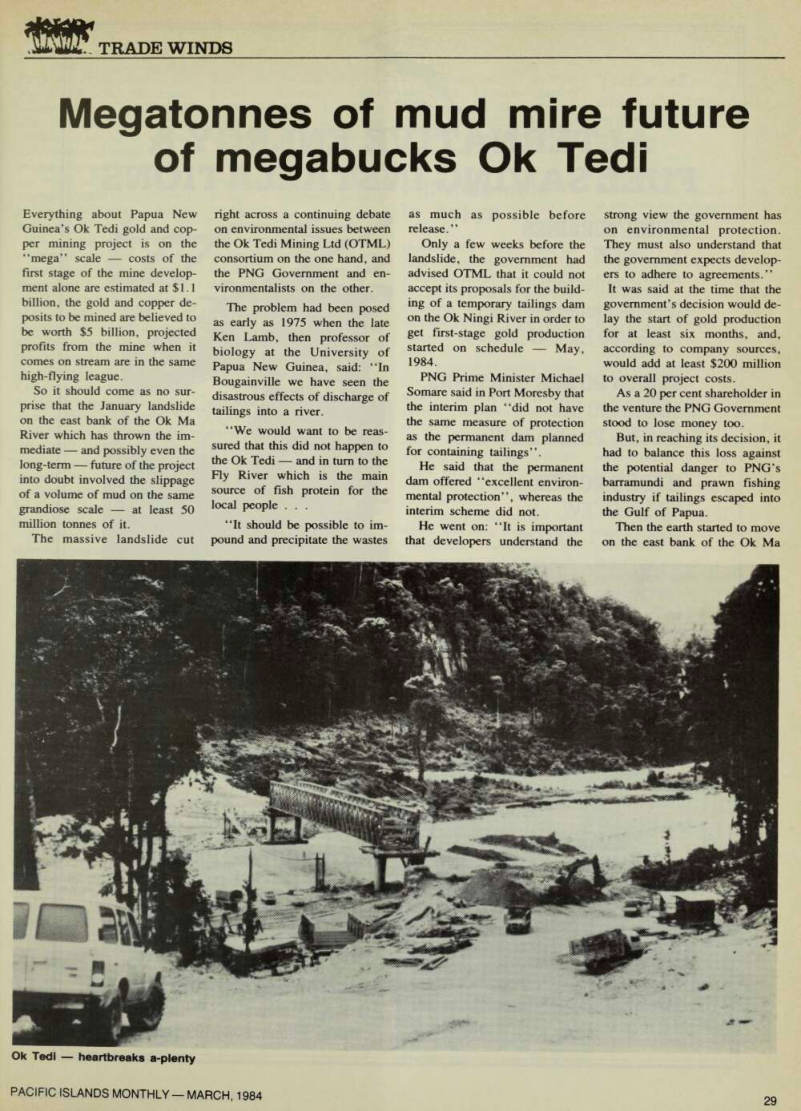

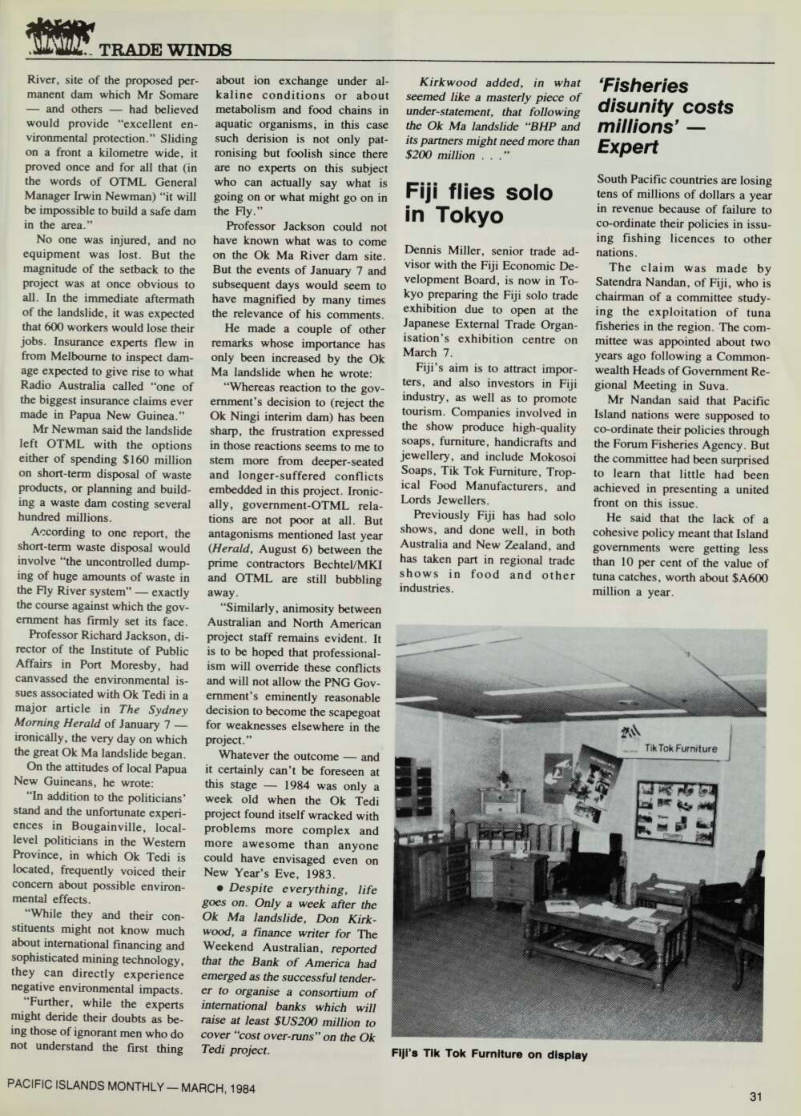
Trade Winds
Megatonnes of mud mire future of megabucks Ok Tedi
Everything about Papua New
Guinea’s Ok Tedi gold and cop per mining project is on the ‘‘mega” scale costs of the first stage of the mine develop ment alone are estimated at $l.l billion, the gold and copper de posits to be mined are believed to be worth $5 billion, projected profits from the mine when it comes on stream are in the same
high-flying league.
So it should come as no sur prise that the January landslide on the east bank of the Ok Ma River which has thrown the im mediate and possibly even the long-term future of the project into doubt involved the slippage of a volume of mud on the same grandiose scale at least 50 million tonnes of it.
The massive landslide cut
right across a continuing debate on environmental issues between the Ok Tedi Mining Ltd (OTML) consortium on the one hand, and the PNG Government and en vironmentalists on the other.
The problem had been posed as early as 1975 when the late Ken Lamb, then professor of biology at the University of Papua New Guinea, said: ‘‘ln Bougainville we have seen the disastrous effects of discharge of tailings into a river. ‘‘We would want to be reas sured that this did not happen to the Ok Tedi and in turn to the Fly River which is the main source of fish protein for the
local people . . .
‘‘lt should be possible to im pound and precipitate the wastes
as much as possible before release.”
Only a few weeks before the landslide, the government had advised OTML that it could not accept its proposals for the build ing of a temporary tailings dam on the Ok Ningi River in order to
get first-stage gold production
started on schedule May, 1984.
PNG Prime Minister Michael Somare said in Port Moresby that the interim plan ‘‘did not have the same measure of protection as the permanent dam planned
for containing tailings”.
He said that the permanent dam offered ‘‘excellent environ mental protection”, whereas the interim scheme did not.
He went on: ‘‘lt is important that developers understand the
strong view the government has on environmental protection.
They must also understand that the government expects develop ers to adhere to agreements.”
It was said at the time that the government’s decision would de
lay the start of gold production
for at least six months, and, according to company sources, would add at least $2OO million to overall project costs.
As a 20 per cent shareholder in the venture the PNG Government stood to lose money too.
But, in reaching its decision, it had to balance this loss against the potential danger to PNG’s barramundi and prawn fishing
industry if tailings escaped into
the Gulf of Papua.
Then the earth started to move on the east bank of the Ok Ma
Ok Tedi heartbreaks a-plenty
River, site of the proposed per manent dam which Mr Somare and others had believed would provide “excellent en vironmental protection.” Sliding on a front a kilometre wide, it proved once and for all that (in the words of OTML General Manager Irwin Newman) “it will be impossible to build a safe dam in the area.”
No one was injured, and no equipment was lost. But the magnitude of the setback to the project was at once obvious to all. In the immediate aftermath of the landslide, it was expected that 600 workers would lose then jobs. Insurance experts flew in from Melbourne to inspect dam age expected to give rise to what Radio Australia called “one of the biggest insurance claims ever made in Papua New Guinea.”
Mr Newman said the landslide left OTML with the options either of spending $l6O million on short-term disposal of waste products, or planning and build ing a waste dam costing several hundred millions.
According to one report, the short-term waste disposal would involve “the uncontrolled dump ing of huge amounts of waste in the Fly River system” exactly the course against which the gov ernment has firmly set its face.
Professor Richard Jackson, di rector of the Institute of Public Affairs in Port Moresby, had canvassed the environmental is sues associated with Ok Tedi in a major article in The Sydney Morning Herald of January 7 ironically, the very day on which the great Ok Ma landslide began.
On the attitudes of local Papua New Guineans, he wrote: “In addition to the politicians’ stand and the unfortunate experi ences in Bougainville, local level politicians in the Western Province, in which Ok Tedi is located, frequently voiced their concern about possible environ mental effects.
“While they and their con stituents might not know much about international financing and sophisticated mining technology, they can directly experience negative environmental impacts.
“Further, while the experts might deride their doubts as be ing those of ignorant men who do not understand the first thing
about ion exchange under al kaline conditions or about metabolism and food chains in aquatic organisms, in this case such derision is not only pat ronising but foolish since there are no experts on this subject who can actually say what is going on or what might go on in the Fly.”
Professor Jackson could not have known what was to come on the Ok Ma River dam site.
But the events of January 7 and subsequent days would seem to have magnified by many times the relevance of his comments.
He made a couple of other remarks whose importance has only been increased by the Ok Ma landslide when he wrote: “Whereas reaction to the gov ernment’s decision to (reject the Ok Ningi interim dam) has been sharp, the frustration expressed in those reactions seems to me to stem more from deeper-seated and longer-suffered conflicts embedded in this project. Ironic ally, govemment-OTML rela tions are not poor at all. But antagonisms mentioned last year C Herald , August 6) between the prime contractors Bechtel/MKI and OTML are still bubbling away.
“Similarly, animosity between
Australian and North American project staff remains evident. It is to be hoped that professional ism will override these conflicts and will not allow the PNG Gov ernment’s eminently reasonable decision to become the scapegoat for weaknesses elsewhere in the project.”
Whatever the outcome and it certainly can’t be foreseen at this stage 1984 was only a week old when the Ok Tedi project found itself wracked with problems more complex and more awesome than anyone could have envisaged even on New Year’s Eve, 1983. • Despite everything, life goes on. Only a week after the Ok Ma landslide, Don Kirk wood, a finance writer for The Weekend Australian, reported that the Bank of America had emerged as the successful tender er to organise a consortium of international banks which will raise at least SUS2OO million to cover “cost over-runs” on the Ok Tedi project.
Kirkwood added, in what seemed like a masterly piece of understatement, that following the Ok Ma landslide “BHP and its partners might need more than $2OO million ...”
Fiji flies solo
in Tokyo
Dennis Miller, senior trade ad visor with the Fiji Economic De velopment Board, is now in To kyo preparing the Fiji solo trade exhibition due to open at the Japanese External Trade Organ isation’s exhibition centre on March 7.
Fiji’s aim is to attract impor ters, and also investors in Fiji industry, as well as to promote tourism. Companies involved in the show produce high-quality soaps, furniture, handicrafts and jewellery, and include Mokosoi Soaps, Tik Tok Furniture, Trop ical Food Manufacturers, and Lords Jewellers.
Previously Fiji has had solo shows, and done well, in both Australia and New Zealand, and has taken part in regional trade shows in food and other industries.
‘Fisheries
disunity costs
millions’
Expert
South Pacific countries are losing tens of millions of dollars a year in revenue because of failure to co-ordinate their policies in issu ing fishing licences to other nations.
The claim was made by Satendra Nandan, of Fiji, who is chairman of a committee study ing the exploitation of tuna fisheries in the region. The com mittee was appointed about two years ago following a Common wealth Heads of Government Re gional Meeting in Suva.
Mr Nandan said that Pacific Island nations were supposed to co-ordinate their policies through the Forum Fisheries Agency. But the committee had been surprised to leam that little had been achieved in presenting a united front on this issue.
He said that the lack of a cohesive policy meant that Island governments were getting less than 10 per cent of the value of tuna catches, worth about SA6OO million a year.
Fiji’s Tik Tok Furniture on display
Advertisements & other items, p. 30 (1 item)
Alternative Energy &
FUEL SAVING INSTALLATIONS
WIND TURBINES
1-1000 KW Grid connected Independent operation AC 50/60 Hz and DC
STEAM POWER STATIONS
100-10000 KW Burning Plantation Waste
HYDRO POWER
10-15 000 KW Heads of 1-1000 m 55 KW Wind Turbine L Eight cylinder steam motor set 2000 k VA
HEAT RECOVERY
Hot Water Process Steam Fresh Water
SOLAR WATER HEATERS
Domestic Industrial
PHOTOVOLTAIC PANELS
Lighting Solar Pumps Feasibility Studies Turn Key Projects Engineering Pty. Ltd.
Maintenance Contracts p.o. Box 271, MILSONS POINT 2061 Leasing Contracts Australia Phone: 909 2199 Telex: 24432
Roncaglia OPR flour milling plant
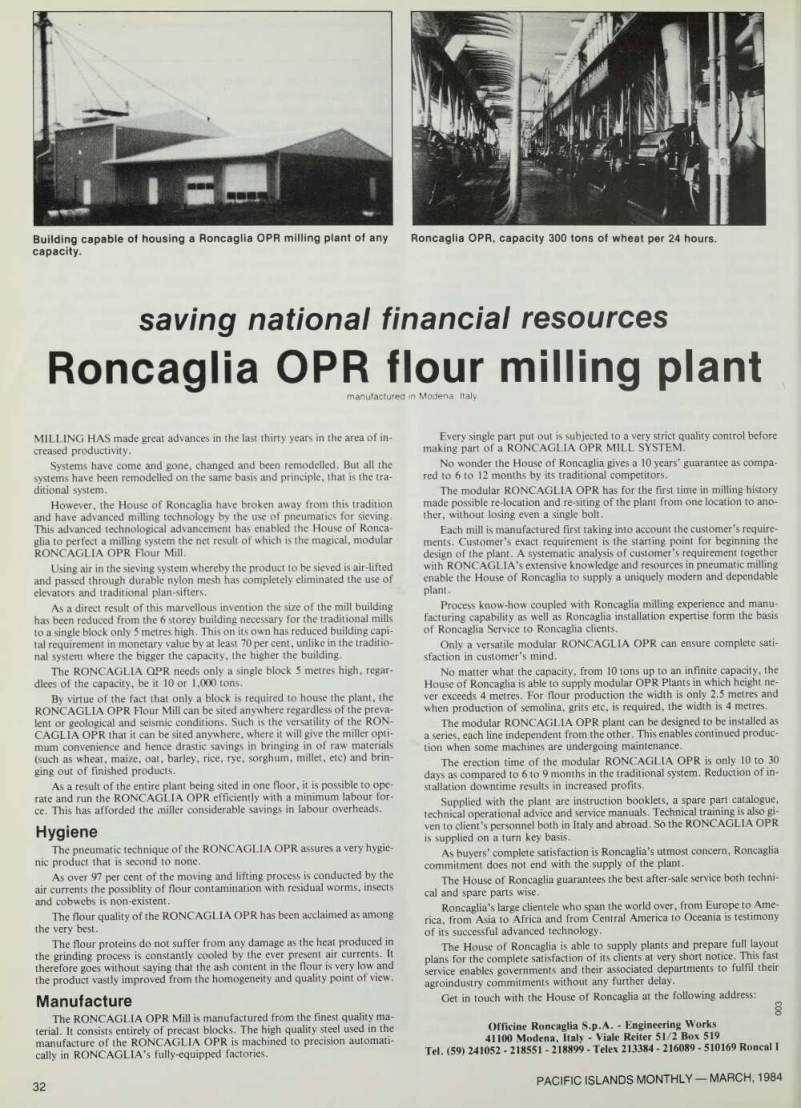
saving national financial resources
manufactured in Modena. Italy
MILLING HAS made great advances in the last thirty years in the area of in creased productivity.
Systems have come and gone, changed and been remodelled. But all the systems have been remodelled on the same basis and principle, that is the tra ditional system.
However, the House of Roncaglia have broken away from this tradition and have advanced milling technology by the use of pneumatics for sieving.
This advanced technological advancement has enabled the House of Ronca glia to perfect a milling system the net result of which is the magical, modular RONCAGLIA OPR Flour Mill.
Using air in the sieving system whereby the product to be sieved is air-lifted and passed through durable nylon mesh has completely eliminated the use of elevators and traditional plan-sifters.
As a direct result of this marvellous invention the size of the mill building has been reduced from the 6 storey building necessary for the traditional mills to a single block only 5 metres high. This on its own has reduced building capi tal requirement in monetary value by at least 70 per cent, unlike in the traditio nal system where the bigger the capacity, the higher the building.
The RONCAGLIA OPR needs only a single block 5 metres high, regar dlees of the capacity, be it 10 or 1,000 tons.
By virtue of the fact that only a block is required to house the plant, the RONCAGLIA OPR Flour Mill can be sited anywhere regardless of the preva lent or geological and seismic conditions. Such is the versatility of the RON CAGLIA OPR that it can be sited anywhere, where it will give the miller opti mum convenience and hence drastic savings in bringing in of raw materials (such as wheat, maize, oat, barley, rice, rye, sorghum, millet, etc) and brin ging out of finished products.
As a result of the entire plant being sited in one floor, it is possible to ope rate and run the RONCAGLIA OPR efficiently with a minimum labour for ce. This has afforded the miller considerable savings in labour overheads.
Hygiene
The pneumatic technique of the RONCAGLIA OPR assures a very hygie nic product that is second to none.
As over 97 per cent of the moving and lifting process is conducted by the air currents the possiblity of flour contamination with residual worms, insects and cobwebs is non-existent.
The flour quality of the RONCAGLIA OPR has been acclaimed as among the very best.
The flour proteins do not suffer from any damage as the heat produced in the grinding process is constantly cooled by the ever present air currents. It therefore goes without saying that the ash content in the flour is very low and the product vastly improved from the homogeneity and quality point of view.
Manufacture
The RONCAGLIA OPR Mill is manufactured from the finest quality ma terial. It consists entirely of precast blocks. The high quality steel used in the manufacture of the RONCAGLIA OPR is machined to precision automati cally in RONCAGLIA’s fully-equipped factories.
Every single part put out is subjected to a very strict quality control before making part of a RONCAGLIA OPR MILL SYSTEM.
No wonder the House of Roncaglia gives a 10 years’ guarantee as compa red to 6 to 12 months by its traditional competitors.
The modular RONCAGLIA OPR has for the first time in milling history made possible re-location and re-siting of the plant from one location to ano ther, without losing even a single bolt.
Each mill is manufactured first taking into account the customer’s require ments. Customer’s exact requirement is the starting point for beginning the design of the plant. A systematic analysis of customer’s requirement together with RONCAGLIA’s extensive knowledge and resources in pneumatic milling enable the House of Roncaglia to supply a uniquely modern and dependable plant.
Process know-how coupled with Roncaglia milling experience and manu facturing capability as well as Roncaglia installation expertise form the basis of Roncaglia Service to Roncaglia clients.
Only a versatile modular RONCAGLIA OPR can ensure complete sati sfaction in customer’s mind.
No matter what the capacity, from 10 tons up to an infinite capacity, the House of Roncaglia is able to supply modular OPR Plants in which height ne ver exceeds 4 metres. For flour production the width is only 2.5 metres and when production of semolina, grits etc, is required, the width is 4 metres.
The modular RONCAGLIA OPR plant can be designed to be installed as a series, each line independent from the other. This enables continued produc tion when some machines are undergoing maintenance.
The erection time of the modular RONCAGLIA OPR is only 10 to 30 days as compared to 6 to 9 months in the traditional system. Reduction of in stallation downtime results in increased profits.
Supplied with the plant are instruction booklets, a spare part catalogue, technical operational advice and service manuals. Technical training is also gi ven to client’s personnel both in Italy and abroad. So the RONCAGLIA OPR is supplied on a turn key basis.
As buyers’ complete satisfaction is Roncaglia’s utmost concern, Roncaglia commitment does not end with the supply of the plant.
The House of Roncaglia guarantees the best after-sale service both techni cal and spare parts wise.
Roncaglia’s large clientele who span the world over, from Europe to Ame rica, from Asia to Africa and from Central America to Oceania is testimony of its successful advanced technology.
The House of Roncaglia is able to supply plants and prepare full layout plans for the complete satisfaction of its clients at very short notice. This fast service enables governments and their associated departments to fulfil their agroindustry commitments without any further delay.
Get in touch with the House of Roncaglia at the following address: CO o o Officine Roncaglia S.p.A. - Engineering Works 41100 Modena, Italy - Viale Reiter 51/2 Box 519 Tel. (59) 241052 - 218551 - 218899 - Telex 213384 - 216089 - 510169 Roncal I
Building capable of housing a Roncaglia OPR milling plant of any capacity.
Roncaglia OPR, capacity 300 tons of wheat per 24 hours.
Story of the Dean-Carell
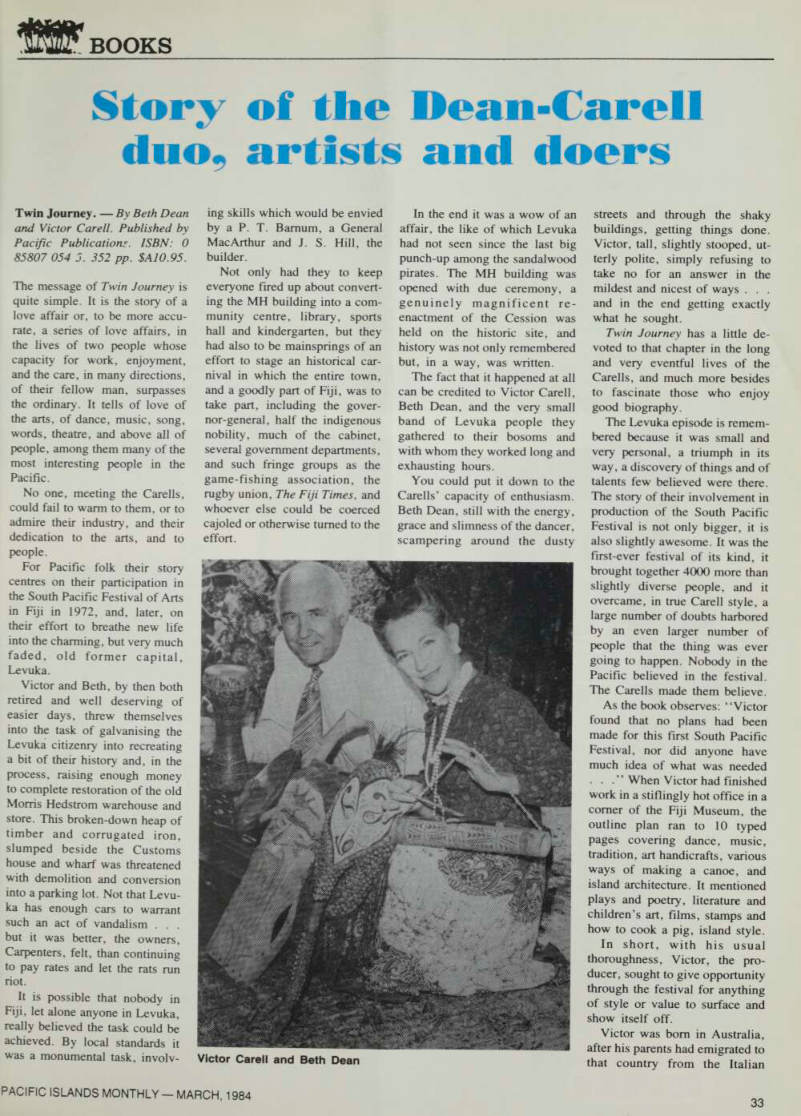


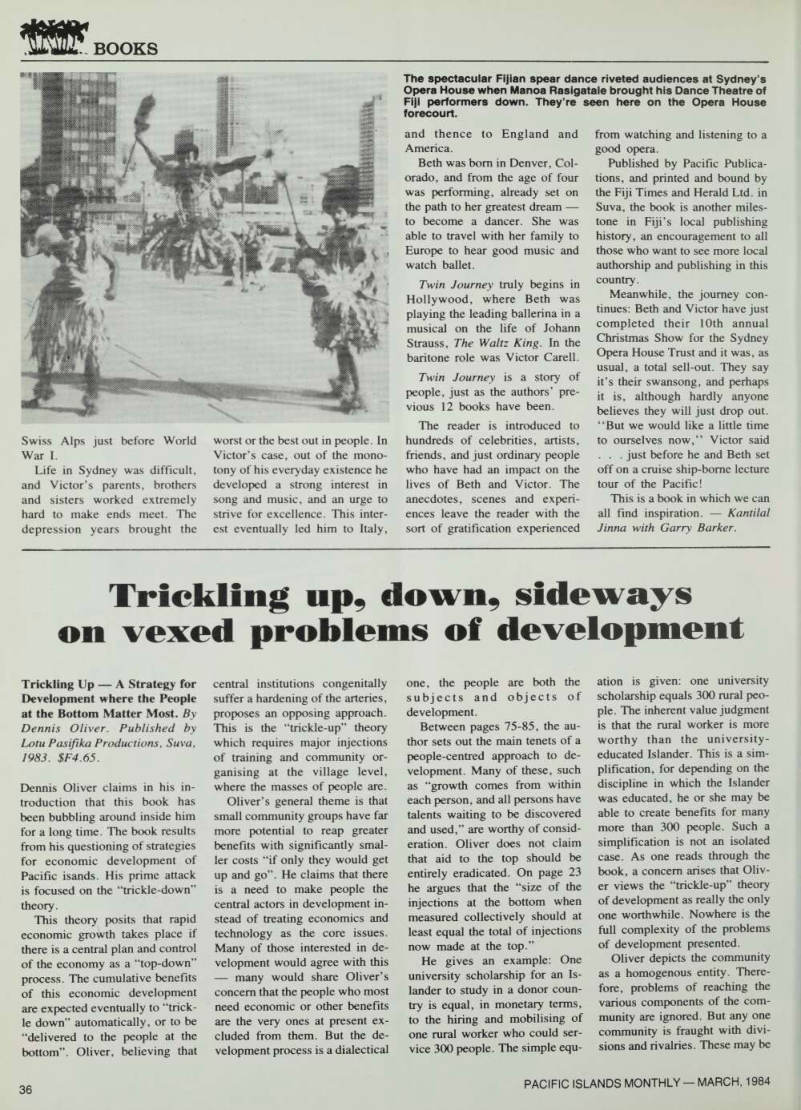
Books
Story of the Dean-Carell duo, artists and doers
Twin Journey. By Beth Dean and Victor Carell. Published by Pacific Publications. ISBN: 0 85807 054 3. 352 pp. $A10.95.
The message of Twin Journey is quite simple. It is the story of a love affair or, to be more accu rate, a series of love affairs, in the lives of two people whose capacity for work, enjoyment, and the care, in many directions, of their fellow man, surpasses the ordinary. It tells of love of the arts, of dance, music, song, words, theatre, and above all of people, among them many of the most interesting people in the Pacific.
No one, meeting the Carells, could fail to warm to them, or to admire their industry, and their dedication to the arts, and to people.
For Pacific folk their story centres on their participation in the South Pacific Festival of Arts in Fiji in 1972, and, later, on their effort to breathe new life into the charming, but very much faded, old former capital, Levuka.
Victor and Beth, by then both retired and well deserving of easier days, threw themselves into the task of galvanising the Levuka citizenry into recreating a bit of their history and, in the process, raising enough money to complete restoration of the old Morris Hedstrom warehouse and store. This broken-down heap of timber and corrugated iron, slumped beside the Customs house and wharf was threatened with demolition and conversion into a parking lot. Not that Levu ka has enough cars to warrant such an act of vandalism . . . but it was better, the owners, Carpenters, felt, than continuing to pay rates and let the rats run riot.
It is possible that nobody in Fiji, let alone anyone in Levuka, really believed the task could be achieved. By local standards it was a monumental task, involv
ing skills which would be envied by a P. T. Bamum, a General Mac Arthur and J. S. Hill, the builder.
Not only had they to keep everyone fired up about convert ing the MH building into a com
munity centre, library, sports
hall and kindergarten, but they had also to be mainsprings of an effort to stage an historical car nival in which the entire town, and a goodly part of Fiji, was to take part, including the gover
nor-general, half the indigenous
nobility, much of the cabinet, several government departments, and such fringe groups as the game-fishing association, the rugby union, The Fiji Times, and whoever else could be coerced cajoled or otherwise turned to the effort.
In the end it was a wow of an affair, the like of which Levuka had not seen since the last big punch-up among the sandalwood pirates. The MH building was opened with due ceremony, a genuinely magnificent re enactment of the Cession was held on the historic site, and history was not only remembered but, in a way, was written.
The fact that it happened at all can be credited to Victor Carell, Beth Dean, and the very small band of Levuka people they gathered to their bosoms and with whom they worked long and
exhausting hours.
You could put it down to the Carells’ capacity of enthusiasm.
Beth Dean, still with the energy, grace and slimness of the dancer,
scampering around the dusty
streets and through the shaky buildings, getting things done.
Victor, tall, slightly stooped, ut terly polite, simply refusing to take no for an answer in the mildest and nicest of ways . . . and in the end getting exactly what he sought.
Twin Journey has a little de voted to that chapter in the long and very eventful lives of the Carells, and much more besides to fascinate those who enjoy good biography.
The Levuka episode is remem bered because it was small and very personal, a triumph in its way, a discovery of things and of talents few believed were there.
The story of their involvement in production of the South Pacific Festival is not only bigger, it is also slightly awesome. It was the first-ever festival of its kind, it brought together 4000 more than slightly diverse people, and it overcame, in true Carell style, a large number of doubts harbored by an even larger number of people that the thing was ever going to happen. Nobody in the Pacific believed in the festival.
The Carells made them believe.
As the book observes: “Victor found that no plans had been made for this first South Pacific Festival, nor did anyone have much idea of what was needed . . When Victor had finished work in a stiflingly hot office in a comer of the Fiji Museum, the outline plan ran to 10 typed pages covering dance, music, tradition, art handicrafts, various ways of making a canoe, and island architecture. It mentioned plays and poetry, literature and children’s art, films, stamps and how to cook a pig, island style.
In short, with his usual thoroughness, Victor, the pro ducer, sought to give opportunity through the festival for anything of style or value to surface and show itself off.
Victor was bom in Australia, after his parents had emigrated to that country from the Italian
Victor Carell and Beth Dean
Swiss Alps just before World War I.
Life in Sydney was difficult, and Victor’s parents, brothers and sisters worked extremely hard to make ends meet. The depression years brought the
worst or the best out in people. In Victor’s case, out of the mono tony of his everyday existence he developed a strong interest in song and music, and an urge to strive for excellence. This inter est eventually led him to Italy,
and thence to England and America.
Beth was bom in Denver, Col orado, and from the age of four was performing, already set on the path to her greatest dream to become a dancer. She was able to travel with her family to Europe to hear good music and watch ballet.
Twin Journey truly begins in Hollywood, where Beth was playing the leading ballerina in a musical on the life of Johann Strauss, The Waltz King. In the baritone role was Victor Carell.
Twin Journey is a story of people, just as the authors’ pre vious 12 books have been.
The reader is introduced to hundreds of celebrities, artists,
friends, and just ordinary people
who have had an impact on the lives of Beth and Victor. The anecdotes, scenes and experi ences leave the reader with the
sort of gratification experienced
from watching and listening to a good opera.
Published by Pacific Publica tions, and printed and bound by the Fiji Times and Herald Ltd. in Suva, the book is another miles tone in Fiji’s local publishing history, an encouragement to all those who want to see more local authorship and publishing in this country.
Meanwhile, the journey con tinues: Beth and Victor have just completed their 10th annual Christmas Show for the Sydney Opera House Trust and it was, as usual, a total sell-out. They say it’s their swansong, and perhaps it is, although hardly anyone
believes they will just drop out.
“But we would like a little time to ourselves now,’’ Victor said . . . just before he and Beth set off on a cruise ship-bome lecture tour of the Pacific!
This is a book in which we can
all find inspiration.
Kantilal
Jinna with Garry Barker.
The spectacular Fijian spear dance riveted audiences at Sydney’s Opera House when Manoa Rasigatale brought his Dance Theatre of Fiji performers down. They’re seen here on the Opera House forecourt.
Advertisements & other items, pp. 34-35 (1 item)
New *B4 Toyota Hiud
INTRODUCING PERFOf
Performance plus comfort.
Performance p durability.
Performance plus variety.
Advanced, powerful new engines put you in command with higher torque, better efficiency. Inside, more driving comfort than ever before with a roomier cabin, bigger windscreens, and lean, clean instrumentation. Newly designed suspension gives you big carrying capability, yet carries you in comfort. HILUX is one tough truck with a suspension you can count on. Choose from a wide variety, including 4WD regular or double cab and two new additions - 2WD extra cab and flatdeck. The all-new Toyota HILUX. Add it all up, and you have performance plus! m
TOYOTA
QUALITY SERVICE
AMERICAN SAMOA; BURNS PHILP (SOUTH SEA)
CO., LTD., P.O. Box 129, Pago Pago.
COOK ISLANDS: COOK ISLANDS TRADING
CORPORATION LTD., Private Bag, Rarotonga.
FIJI: AUTOMOTIVE SUPPLIES COMPANY, G.P.O.
Box 355, Suva.
GUAM & MICRONESIA: ATKINS, KROLL (GUAM) LTD., 443 South Marine Drive, Tamuning.
KIRIBATI: TARAWA MOTORS, P.O. Box 36, Bairiki, Tarawa, Kiribati.
NAURU: NAURU COOPERATIVE SOCIETY.
NEW CALEDONIA: SERVICE IMPORTATION
AUTOMOBILE DU PACIFIQUE, Rond-Point du Pacifir (Station Total) B.P. 438, Noumea.
MANGE PL
3! $ 4WD Double Cab 3RFOLK ISLAND; SORRY’S LIMITED, P.O. Box 169 UA NEW GUINEA; ELA MOTORS, A Division of ’ rns Philp (PNG) Ltd., P.O. Box 75, Port Moresby
'■iPAN; MICROL CORPORATION, P.O. Box 267
ipan. ’
>LOMON: MENDANA ENTERPRISES (5.1.) LTD.
P O. Box 174, Honiara.
TAHITI: NIPPON AUTOMOTO, P.O. Box 342, Papeete.
TONGA: BURNS PHILP (SOUTH SEA) CO., LTD., P.O. Box 55, Nukualofa.
VANUATU: VANUATU MOTORS, P.O. Box 18,
Port Vila.
WESTERN SAMOA: BURNS PHILP (SOUTH SEA)
CO., LTD., P.O. Box 188, Apia.
rOTA
Trickling up, down, sideways
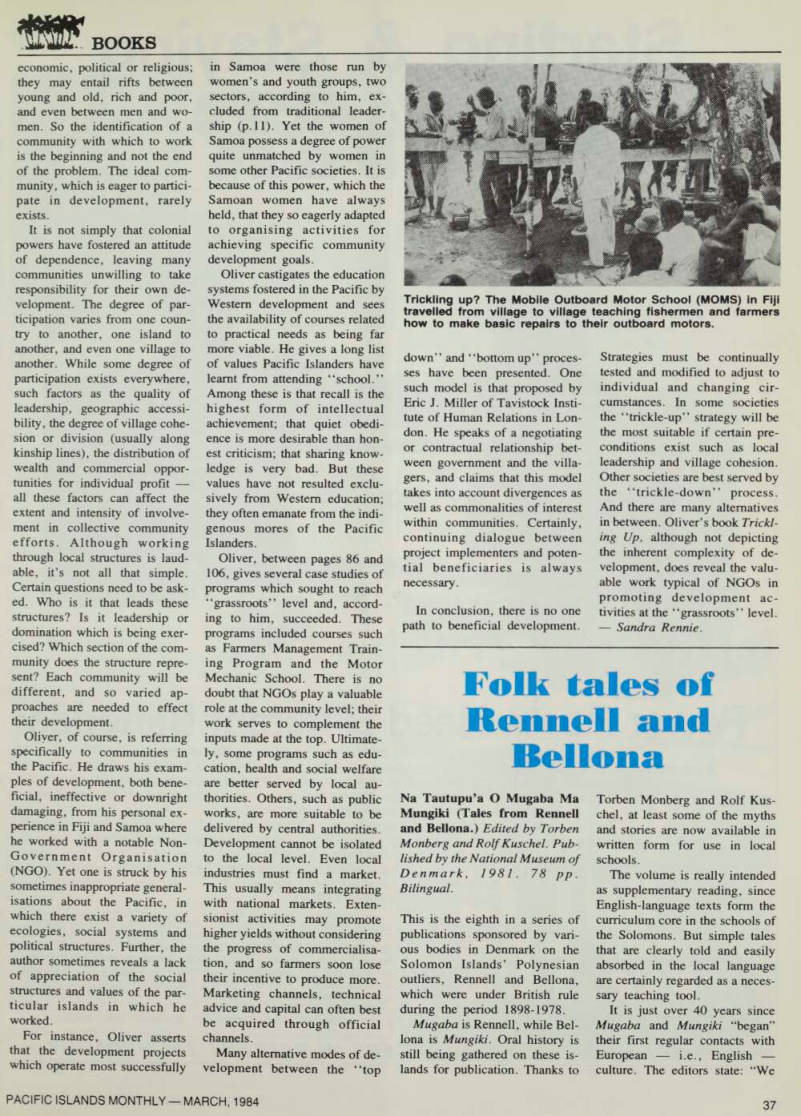
on vexed problems of development
Trickling Up A Strategy for
Development where the People
at the Bottom Matter Most. By Dennis Oliver. Published by Lotu Pasifika Productions, Suva, 1983. $F4.65.
Dennis Oliver claims in his in troduction that this book has been bubbling around inside him for a long time. The book results from his questioning of strategies for economic development of Pacific isands. His prime attack is focused on the “trickle-down” theory.
This theory posits that rapid
economic growth takes place if there is a central plan and control of the economy as a “top-down” process. The cumulative benefits of this economic development are expected eventually to “trick le down” automatically, or to be “delivered to the people at the bottom”. Oliver, believing that
central institutions congenitally suffer a hardening of the arteries,
proposes an opposing approach.
This is the “trickle-up” theory
which requires major injections
of training and community or ganising at the village level, where the masses of people are.
Oliver’s general theme is that small community groups have far more potential to reap greater benefits with significantly smal ler costs “if only they would get up and go”. He claims that there is a need to make people the central actors in development in stead of treating economics and technology as the core issues.
Many of those interested in de velopment would agree with this many would share Oliver’s concern that the people who most need economic or other benefits are the very ones at present ex cluded from them. But the de velopment process is a dialectical
one, the people are both the
subjects and objects of
development.
Between pages 75-85, the author sets out the main tenets of a
people-centred approach to de-
velopment. Many of these, such as “growth comes from within each person, and all persons have talents waiting to be discovered and used,” are worthy of consideration. Oliver does not claim that aid to the top should be entirely eradicated. On page 23 he argues that the “size of the injections at the bottom when measured collectively should at least equal the total of injections now made at the top.”
He gives an example: One university scholarship for an Islander to study in a donor country is equal, in monetary terms, to the hiring and mobilising of one rural worker who could service 300 people. The simple equ-
ation is given: one university scholarship equals 300 rural peo ple. The inherent value judgment is that the rural worker is more
worthy than the university
educated Islander. This is a sim plification, for depending on the discipline in which the Islander was educated, he or she may be able to create benefits for many more than 300 people. Such a simplification is not an isolated case. As one reads through the book, a concern arises that Oliv er views the “trickle-up” theory of development as really the only one worthwhile. Nowhere is the full complexity of the problems
of development presented.
Oliver depicts the community
as a homogenous entity. There fore, problems of reaching the various components of the com munity are ignored. But any one community is fraught with divi sions and rivalries. These may be
economic, political or religious;
they may entail rifts between young and old, rich and poor, and even between men and wo men. So the identification of a community with which to work is the beginning and not the end of the problem. The ideal com munity, which is eager to partici
pate in development, rarely
exists.
It is not simply that colonial powers have fostered an attitude
of dependence, leaving many
communities unwilling to take responsibility for their own de velopment. The degree of par ticipation varies from one coun try to another, one island to another, and even one village to another. While some degree of
participation exists everywhere,
such factors as the quality of
leadership, geographic accessi
bility, the degree of village cohe
sion or division (usually along kinship lines), the distribution of wealth and commercial oppor tunities for individual profit all these factors can affect the extent and intensity of involve ment in collective community
efforts. Although working
through local structures is laud able, it’s not all that simple.
Certain questions need to be ask ed. Who is it that leads these structures? Is it leadership or domination which is being exer cised? Which section of the com munity does the structure repre sent? Each community will be different, and so varied ap proaches are needed to effect
their development.
Oliver, of course, is referring specifically to communities in the Pacific. He draws his exam ples of development, both bene ficial, ineffective or downright damaging, from his personal ex perience in Fiji and Samoa where he worked with a notable Non-
Government Organisation
(NGO). Yet one is struck by his sometimes inappropriate general isations about the Pacific, in which there exist a variety of ecologies, social systems and political structures. Further, the author sometimes reveals a lack of appreciation of the social structures and values of the par ticular islands in which he worked.
For instance, Oliver asserts
that the development projects
which operate most successfully
in Samoa were those run by women’s and youth groups, two sectors, according to him, ex cluded from traditional leader ship (p. 11). Yet the women of Samoa possess a degree of power quite unmatched by women in some other Pacific societies. It is because of this power, which the Samoan women have always held, that they so eagerly adapted to organising activities for achieving specific community development goals.
Oliver castigates the education systems fostered in the Pacific by Western development and sees the availability of courses related to practical needs as being far more viable. He gives a long list of values Pacific Islanders have learnt from attending “school.”
Among these is that recall is the highest form of intellectual achievement; that quiet obedi ence is more desirable than hon est criticism; that sharing know ledge is very bad. But these values have not resulted exclu sively from Western education; they often emanate from the indi genous mores of the Pacific Islanders.
Oliver, between pages 86 and 106, gives several case studies of programs which sought to reach “grassroots” level and, accord ing to him, succeeded. These programs included courses such as Farmers Management Train ing Program and the Motor Mechanic School. There is no doubt that NGOs play a valuable role at the community level; their work serves to complement the inputs made at the top. Ultimate ly, some programs such as edu cation, health and social welfare are better served by local au thorities. Others, such as public works, are more suitable to be delivered by central authorities.
Development cannot be isolated to the local level. Even local industries must find a market.
This usually means integrating with national markets. Exten sionist activities may promote higher yields without considering the progress of commercialisa tion, and so farmers soon lose their incentive to produce more.
Marketing channels, technical advice and capital can often best be acquired through official channels.
Many alternative modes of de velopment between the “top
down” and “bottom up” proces ses have been presented. One such model is that proposed by Eric J. Miller of Tavistock Insti tute of Human Relations in Lon don. He speaks of a negotiating or contractual relationship bet ween government and the villa gers, and claims that this model takes into account divergences as well as commonalities of interest within communities. Certainly,
continuing dialogue between
project implementers and poten
tial beneficiaries is always necessary.
In conclusion, there is no one
path to beneficial development.
Strategies must be continually tested and modified to adjust to individual and changing cir cumstances. In some societies the “trickle-up” strategy will be the most suitable if certain pre conditions exist such as local leadership and village cohesion.
Other societies are best served by the “trickle-down” process.
And there are many alternatives in between. Oliver’s book Trickl ing Up, although not depicting the inherent complexity of de velopment, does reveal the valu able work typical of NGOs in promoting development ac tivities at the “grassroots” level.
Sandra Rennie.
Trickling up? The Mobile Outboard Motor School (MOMS) in Fiji travelled from village to village teaching fishermen and farmers how to make basic repairs to their outboard motors.
Rennell and

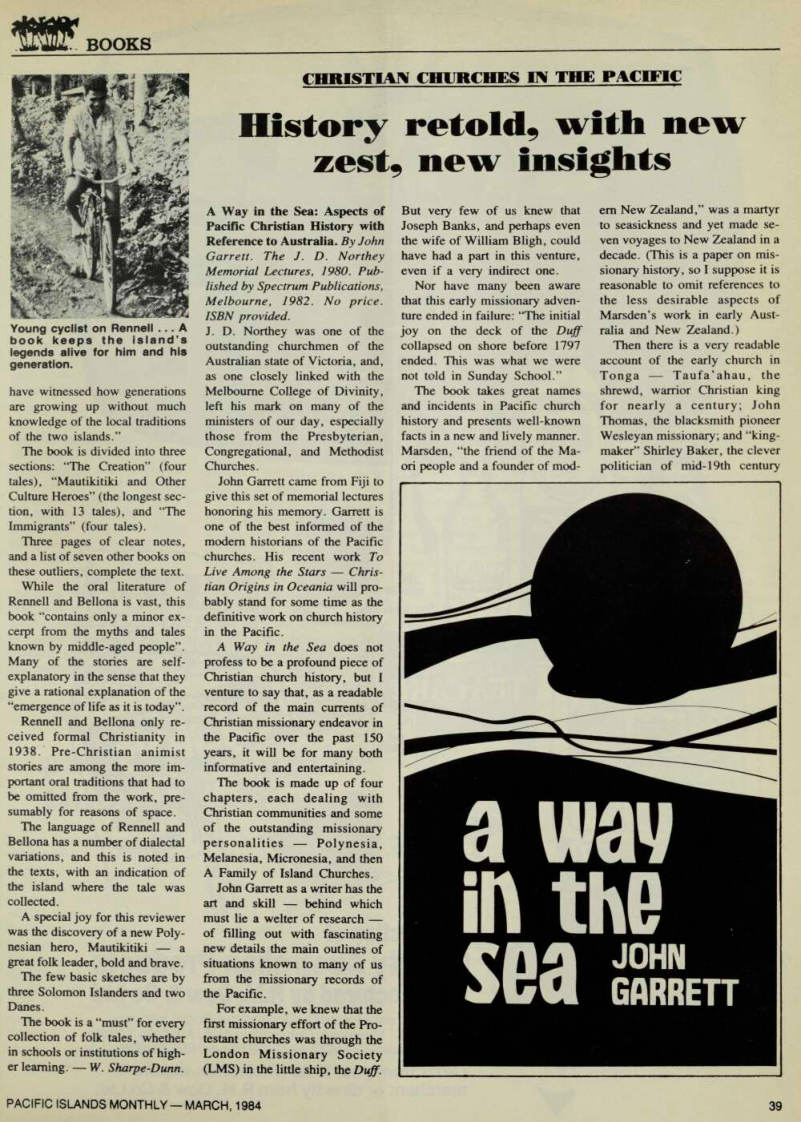
Folk tales of Rennell and Bellona
Na Tautupu’a O Mugaba Ma Mungiki (Tales from Rennell and Bellona.) Edited by Torben Monberg and Rolf Kuschel. Pub lished by the National Museum of Denmark, 1981. 78 pp.
Bilingual.
This is the eighth in a series of publications sponsored by vari ous bodies in Denmark on the Solomon Islands’ Polynesian outliers, Rennell and Bellona, which were under British rule during the period 1898-1978.
Mugaba is Rennell, while Bel lona is Mungiki. Oral history is still being gathered on these is lands for publication. Thanks to
Torben Monberg and Rolf Kus chel, at least some of the myths and stories are now available in written form for use in local schools.
The volume is really intended as supplementary reading, since English-language texts form the curriculum core in the schools of the Solomons. But simple tales that are clearly told and easily absorbed in the local language are certainly regarded as a neces sary teaching tool.
It is just over 40 years since Mugaba and Mungiki “began” their first regular contacts with European i.e., English culture. The editors state: “We
have witnessed how generations are growing up without much knowledge of the local traditions of the two islands.”
The book is divided into three sections: “The Creation” (four tales), “Mautikitiki and Other Culture Heroes” (the longest sec tion, with 13 tales), and “The Immigrants” (four tales).
Three pages of clear notes, and a list of seven other books on these outliers, complete the text.
While the oral literature of Rennell and Bellona is vast, this book “contains only a minor ex cerpt from the myths and tales known by middle-aged people”.
Many of the stories are self explanatory in the sense that they give a rational explanation of the “emergence of life as it is today”.
Rennell and Bellona only re ceived formal Christianity in 1938. Pre-Christian animist stories are among the more im portant oral traditions that had to be omitted from the work, pre sumably for reasons of space.
The language of Rennell and Bellona has a number of dialectal variations, and this is noted in the texts, with an indication of the island where the tale was collected.
A special joy for this reviewer was the discovery of anew Poly nesian hero, Mautikitiki a great folk leader, bold and brave.
The few basic sketches are by three Solomon Islanders and two Danes.
The book is a “must” for every collection of folk tales, whether in schools or institutions of high
er learning.
W. Sharpe-Dunn.
Young cyclist on Rennell ... A book keeps the island’s legends alive for him and his
generation.
Advertisements & other items, p. 38 (1 item)
pomß i
Starting & Staying
r --fcr a if j .jfjr * r 4/Mr r» ■ t ij{<n %
MASS
now
Amr
GZSO
CSZZv
Power Boats Need Different Batteries
There is a big difference between a car battery and a marine battery.
A car battery, for example, is never really discharged, as it is only used for a few seconds each day a nd promptly re-charged. Not so your cruiser or sportsfisherman.
Starting the engine is only the beginning. During the day, weekend or cruise, how often will you run the live bait tank, the depth sounder, the nav. lights or maintain a listening watch on your radio transceiver?
As well as cranking power, boats need staying power. Boats need Besco's Marine Batteries, deep cycle, heavy duty marine batteries.
If your boat is getting a little flat in the electrics department, write or phone BESCO today and ask for more information, more facts about
BESCO MARINE BATTERIES.
BESCO
I Batteries Division Of Sims Products Pty. Ltd. / A Peko hVa/lsend Group Member Papua New Guinea: Lae, Automarine Industries P.O. Box 785, Ph 42-1 25 - abau '’
Automarine Industries, P.O. Box 248, Ph. 92-2574; Port Moresby Par Sales PXD Box 168 a Boroko, Ph. 25-6266. Fiji: Suva, Fiji Bandag, 23 Smoma Street, Walu Bay, Ph. 31 -1 2 p0. New Caledonia: Noumea, Andre Thuilier, BP 889, Ph. 27-4906. Solomon Islands. Honiara Guadalcanal Electrics Ltd., P.O. Box 521. Hongkong: Kowloon, T. L. Knight &Co P_o. Box 95585 TST, Ph. 366-5341. New Zealand: Auckland, Battery Services (Ind.) Ltd., P.O. Box 27 375 Ph 69-4111- Wellington, Gould Batteries, 58 Hautana Street, Lower Hurt, TLX NZ3714 Australia: Sydney, Besco Batteries, P.O. Box 1, Villawood, Ph 632-0251 TLX.21886; Jarw.l International Pty. Ltd., 410 Kent Street, Sydney, Ph. 264-3477, TLX 72102.
LEADERS IN BATTERY TECHNOLOGY —
History retold, with new

Christian Churches In The Pacific
History retold, with new zest, new insights
A Way in the Sea: Aspects of Pacific Christian History with Reference to Australia. By John Garrett. The J. D. Northey Memorial Lectures, 1980. Pub lished by Spectrum Publications, Melbourne, 1982. No price.
ISBN provided.
J. D. Northey was one of the outstanding churchmen of the Australian state of Victoria, and, as one closely linked with the Melbourne College of Divinity, left his mark on many of the ministers of our day, especially those from the Presbyterian, Congregational, and Methodist Churches.
John Garrett came from Fiji to give this set of memorial lectures honoring his memory. Garrett is one of the best informed of the modem historians of the Pacific churches. His recent work To Live Among the Stars Chris tian Origins in Oceania will pro bably stand for some time as the definitive work on church history in the Pacific.
A Way in the Sea does not profess to be a profound piece of Christian church history, but I venture to say that, as a readable record of the main currents of Christian missionary endeavor in the Pacific over the past 150 years, it will be for many both informative and entertaining.
The book is made up of four chapters, each dealing with Christian communities and some of the outstanding missionary personalities Polynesia, Melanesia, Micronesia, and then A Family of Island Churches.
John Garrett as a writer has the art and skill behind which must lie a welter of research of filling out with fascinating new details the main outlines of situations known to many of us from the missionary records of the Pacific.
For example, we knew that the first missionary effort of the Pro testant churches was through the London Missionary Society (LMS) in the little ship, the Duff.
But very few of us knew that Joseph Banks, and perhaps even the wife of William Bligh, could have had a part in this venture, even if a very indirect one.
Nor have many been aware that this early missionary adven ture ended in failure: “The initial joy on the deck of the Duff collapsed on shore before 1797 ended. This was what we were not told in Sunday School.”
The book takes great names and incidents in Pacific church history and presents well-known facts in a new and lively manner.
Marsden, “the friend of the Ma ori people and a founder of mod
em New Zealand,” was a martyr to seasickness and yet made se ven voyages to New Zealand in a decade. (This is a paper on mis sionary history, so 1 suppose it is reasonable to omit references to the less desirable aspects of Marsden’s work in early Aust ralia and New Zealand.) Then there is a very readable account of the early church in Tonga Taufa’ahau, the shrewd, warrior Christian king for nearly a century; John Thomas, the blacksmith pioneer
Wesleyan missionary; and “king
maker” Shirley Baker, the clever politician of mid-19th century
Tonga “the most celebrated Humpty Dumpty of Polynesian history.”
Then there is John Hunt, a Lincolnshire ploughboy in Fiji, and “one of the missionary saints of the Pacific;” and George Brown, a Wesleyan, and intrepid pioneer in New Britain: “He could deal with British pro consuls and measure them, if need be, eyeball to eyeball.”
These were men of the Protes tant preserve, but John Garrett gives a striking record of the Roman Catholic foundations in the Pacific missionaries of great calibre from the Order of the Marists, and the Sacred Heart of Jesus, matching the Protes tants in courage; sacrifice and
empire-building.
The record on Melanesia deals with exploits of what to us are the great names of such as Patte son and Selwyn “old fashioned high churchmen, sus pect by the Protestants of burning candles at Holy Communion.”
For Micronesia the story is the same, with many new details filling out the generally well known record.
He deals with dominant characters who did not worry over much about the meetings of mission boards and committees in London and Sydney, but set themselves pragmatic policies, and laid foundations of churches
which today look back on them with affection and gratitude as their fathers in God.
As John Garrett says: “Those churches now read in their own languages the words of the Gos
pel, spoken originally to alarmed
onlookers: ‘He began in Galilee and now he is here.’ In the Pacific people say, in many is lands from east to west: ‘He began in Tahiti and now he is here.’”
Today the word missionary is almost a dirty word, and we tend to analyse and research the work of Christian missions looking for mistakes and weaknesses of the Christian church in its en thusiasm to spread the Gospel.
This book is a needed correc tive, written in simple, direct, and very readable terms. Few know the strengths and weaknes ses of Christian missions as John Garrett does. I find few who write with both objectivity and sensitive understanding about them as he does.
The pages listing reference books will be a goldmine to those who want to know more about the churches of the Pacific their origins, their growth over one and a half centuries, and their place in the life of the world
church today.
A Way in the Sea is available at church bookshops in Sydney,
Melbourne, and Suva.
Cecil.
Gribble.
Advertisements & other items, p. 40 (1 item)
ppiim|
mi
GOLD
CREST
UikSJiL/ I "'MI sao< eedy to freeze ►
GOLD
I
3 \CHtBT
ENGLISH
TEACAKE
* Cake mi\_ , . With cmnamon topping I gtotoe ar
FRJTT JUtCE CORDIAL 2 Litre
I I till
444A/GO
S?Sf
am>M. »ONXJ« *•!*»»•*»•■
«nity4iwf «* «*i*o*«u me j* o»mu '**' *X« Di»«»cc r*atirf* oxa* mtfMIM MtTfOOCKO Mdiuruiii'ia «o»»eo " n “**
JOCbN Et
M /o\ E
A selection of
Quality Australian Products
manufactured by R.M. Gow & Co Ltd 30 Gow Street, Moorooka, Queensland. Postal address: PO Box 111, Moorooka, Queensland 4105, Australia. Cables; GOWCO Telex GOWCO AA42839 Phone: (07) 48 5061 Order from your local wholesaler, export merchant or directly from R.M. Gow & Co Ltd.
TCAI
the microscope
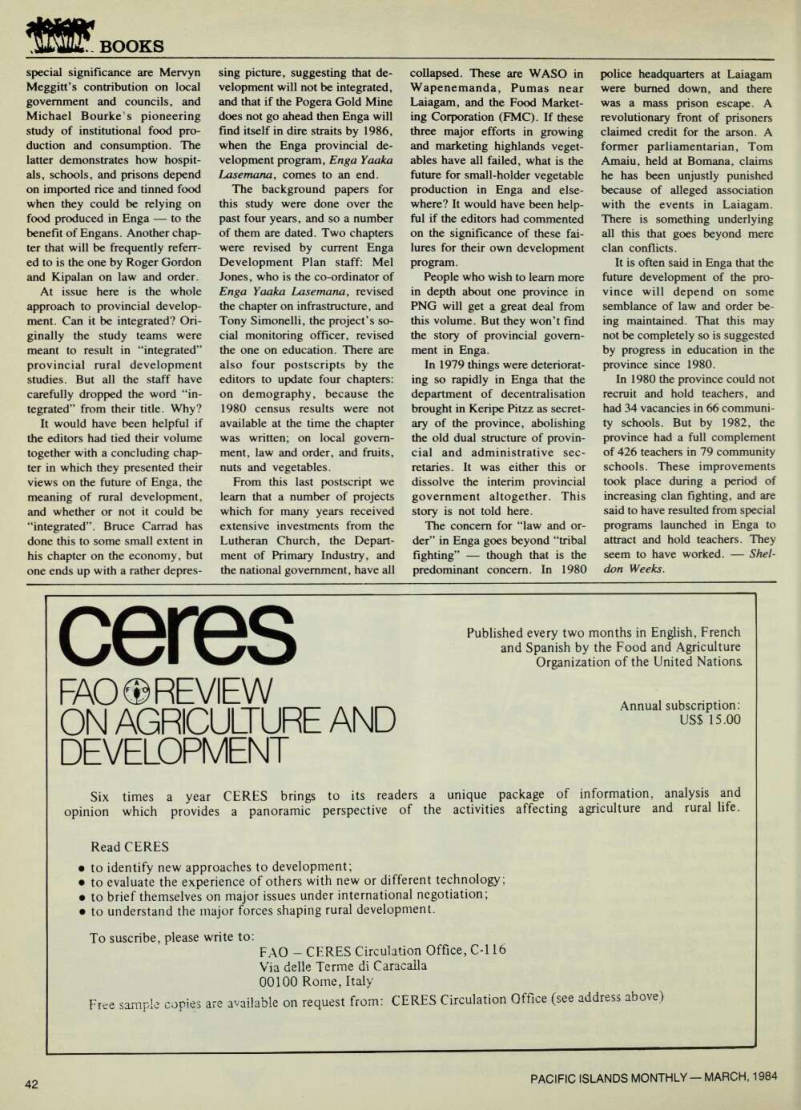
Enga: A PAG province under the microscope
Enga: Foundations for Development. Edited by Bruce Carrad, David Lea and Kundapen Talyaga. Printed by the Universify of New England, Armidale, Australia, for the Enga Provincial Government and the National Planning Office. 1982. 381 pages. 87 tables, 26 maps.
K 8.50 from Enga Yaaka Lasemana, Box 153, Wabag, Enga, PNG,or lASER, Box 1432, Boroko. Price, in Australia,
Sai6.
This is a significant book. It is the first study of a province of
Papua New Guinea since the start of provincial government in 1977, and the second since inde pendence the other being Chimbu: Issues in Development, released in 1976. With 19 pro vinces in the country, it is sur prising that no other studies have been compiled, particularly as there have been major develop ment projects in a number of other provinces (Southern High lands, West Sepik, Manus, East Sepik, and Milne Bay) which would have lent themselves well to such reports. The editors are to
be congratulated on the extra efforts put in to make this study available to the public.
Enga: Foundations for De
velopment contains 17 chapters
and four appendices, by 26 con tributors. The book covers his tory and demography, economy, agriculture and land use in the province, one of the most dense ly populated areas of PNG, situated in the central highlands.
There are two chapters on vio lence, and law and order, and five chapters on infrastructure, including communications, edu cation, health and administra tion. Also included are some of
the background papers prepared
for the Enga Rural Development Study. Others not included are mentioned in the extensive bib liography on Enga at the end of the volume.
Of the contributors, only four are Papua New Guineans. These are Talyaga, one of the editors, Clemens Runawery, who was the first national education superin tendent in Enga in 1975, Keripe Pitzz who was secretary for the province from 1979 to early 1983 (and is now secretary of lands in Port Moresby), and Albert Kipa lan, former senior magistrate, who is now MP for Wabag Open. All the other contributors have had extensive experience as residents of PNG and in both teaching and research with six contributors having been on the staff of the University of PNG.
While the development pro jects in the East Sepik, Simbu, and Southern Highlands fol lowed studies that were largely made by outside consultants, the
Enga Rural Development Study
of 1978-82 was more of a homegrown product. It took lon ger, and people were hired as team members who provided continuity and purpose to the study. In this case they were Bruce Carrad, a department of
primary industry economist, and
Kundapen Talyaga, an Enga who
is now first assistant secretary for policy and planning in the pro vincial government. Instead of
bringing in expensive overseas
consultants, who might know lit tle about Enga and PNG, they sought to mobilise resources from within the country to get the
required background papers
done.
The process being followed in Enga, Manus, West Sepik and Milne Bay (and starting in 1983 in Western) by the national plan ning office in Waigani has been to require an integrated rural de velopment study team to work for a number of years on the ground in a province. This team then has the task of producing a list of development projects for the province to be presented through the national planning of fice for funding under a NPEP (National Public Expenditure Plan). After investigation by the World Bank, or the Asian De velopment Bank, these projects may be externally funded through a loan agreement.
It is to the credit of the team in Enga that of just over 50 projects presented by them for funding through the NPEP system, 49 have been endorsed. The World Bank has approved the projects and granted a loan of K 2 million a year for four years to cover them.
A number of chapters stand out and are bound to be quoted in future as major references on Enga. These are the ones by Kundapen Talyaga on the Enga a personal account; Bryant Allen’s three case studies of sub sistence agriculture; and his chapter, done with Rick Gid dings, on land disputes and vio lence in the province. Also of
The map on the wail bears the name “Wabag Sub-district” just behind the head of the Aust ralian Administration official of pre-independence times.
“Wabag Sub-district” em braces the present-day Papua New Guinea province of Enga where problems of develop ment are proving just as big a headache to post independence politicians as they ever were in the past.
special significance are Mervyn
Meggitt’s contribution on local government and councils, and Michael Bourke’s pioneering study of institutional food pro duction and consumption. The latter demonstrates how hospit als, schools, and prisons depend on imported rice and tinned food when they could be relying on food produced in Enga to the benefit of Engans. Another chap ter that will be frequently referr ed to is the one by Roger Gordon and Kipalan on law and order.
At issue here is the whole
approach to provincial develop
ment. Can it be integrated? Ori ginally the study teams were meant to result in “integrated”
provincial rural development
studies. But all the staff have carefully dropped the word “in tegrated” from their title. Why?
It would have been helpful if the editors had tied their volume
together with a concluding chap
ter in which they presented their views on the future of Enga, the
meaning of rural development,
and whether or not it could be “integrated”. Bruce Carrad has done this to some small extent in his chapter on the economy, but one ends up with a rather depres
sing picture, suggesting that de velopment will not be integrated, and that if the Pogera Gold Mine does not go ahead then Enga will find itself in dire straits by 1986, when the Enga provincial de velopment program, Enga Yaaka Lasemana, comes to an end.
The background papers for this study were done over the past four years, and so a number of them are dated. Two chapters were revised by current Enga Development Plan staff: Mel Jones, who is the co-ordinator of Enga Yaaka Lasemana, revised the chapter on infrastructure, and Tony Simonelli, the project’s so cial monitoring officer, revised the one on education. There are also four postscripts by the editors to update four chapters: on demography, because the 1980 census results were not available at the time the chapter was written; on local govern ment, law and order, and fruits, nuts and vegetables.
From this last postscript we learn that a number of projects which for many years received extensive investments from the Lutheran Church, the Depart ment of Primary Industry, and the national government, have all
collapsed. These are WASO in Wapenemanda, Pumas near Laiagam, and the Food Market ing Corporation (FMC). If these three major efforts in growing and marketing highlands veget ables have all failed, what is the future for small-holder vegetable production in Enga and else where? It would have been help ful if the editors had commented on the significance of these fai lures for their own development program.
People who wish to learn more in depth about one province in PNG will get a great deal from this volume. But they won’t find the story of provincial govern ment in Enga.
In 1979 things were deteriorat ing so rapidly in Enga that the department of decentralisation brought in Keripe Pitzz as secret ary of the province, abolishing the old dual structure of provin cial and administrative sec retaries. It was either this or dissolve the interim provincial government altogether. This story is not told here.
The concern for “law and or der” in Enga goes beyond “tribal fighting” though that is the predominant concern. In 1980
police headquarters at Laiagam
were burned down, and there was a mass prison escape. A
revolutionary front of prisoners
claimed credit for the arson. A former parliamentarian, Tom Amaiu, held at Bomana, claims he has been unjustly punished because of alleged association with the events in Laiagam.
There is something underlying
all this that goes beyond mere clan conflicts.
It is often said in Enga that the future development of the pro vince will depend on some semblance of law and order be ing maintained. That this may not be completely so is suggested by progress in education in the province since 1980.
In 1980 the province could not recruit and hold teachers, and had 34 vacancies in 66 communi ty schools. But by 1982, the province had a full complement of 426 teachers in 79 community schools. These improvements
took place during a period of
increasing clan fighting, and are said to have resulted from special programs launched in Enga to attract and hold teachers. They
seem to have worked.
Shel-
don Weeks.
Advertisements & other items, p. 42 (1 item)
ceres
FAO® REVIEW
ON AGRICULTURE AND
DEVELOPMENT
Published every two months in English, French and Spanish by the Food and Agriculture Organization of the United Nations Annual subscription: US$ 15.00 Six times a year CERES brings opinion which provides a panoramic to its readers a unique package of information, analysis and perspective of the activities affecting agriculture and rural life.
Read CERES • to identify new approaches to development; • to evaluate the experience of others with new or different technology; • to brief themselves on major issues under international negotiation ; • to understand the major forces shaping rural development.
To suscribe, please write to: FAO - CERES Circulation Office, C-l 16 Via delle Terme di Caracalla 00100 Rome, Italy- Free sample copies are available on request from: CERES Circulation Office (see address above)
The night of the 300 breakfasts
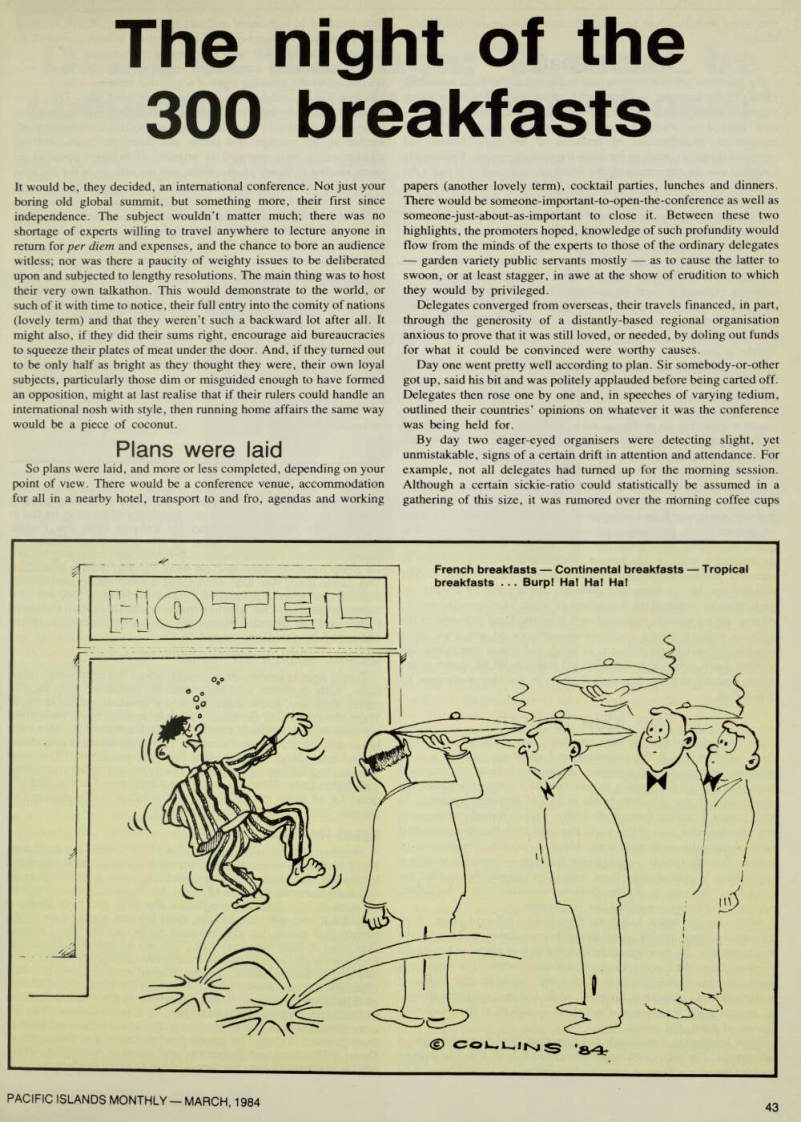
300 breakfasts
It would be, they decided, an international conference. Not just your boring old global summit, but something more, their first since independence. The subject wouldn’t matter much; there was no shortage of experts willing to travel anywhere to lecture anyone in return for per diem and expenses, and the chance to bore an audience witless; nor was there a paucity of weighty issues to be deliberated upon and subjected to lengthy resolutions. The main thing was to host their very own talkathon. This would demonstrate to the world, or such of it with time to notice, their full entry into the comity of nations (lovely term) and that they weren’t such a backward lot after all. It might also, if they did their sums right, encourage aid bureaucracies to squeeze their plates of meat under the door. And, if they turned out to be only half as bright as they thought they were, their own loyal subjects, particularly those dim or misguided enough to have formed an opposition, might at last realise that if their rulers could handle an international nosh with style, then running home affairs the same way would be a piece of coconut.
Plans were laid
So plans were laid, and more or less completed, depending on your point of view. There would be a conference venue, accommodation for all in a nearby hotel, transport to and fro, agendas and working
papers (another lovely term), cocktail parties, lunches and dinners.
There would be someone-important-to-open-the-conference as well as someone-just-about-as-important to close it. Between these two highlights, the promoters hoped, knowledge of such profundity would flow from the minds of the experts to those of the ordinary delegates garden variety public servants mostly as to cause the latter to swoon, or at least stagger, in awe at the show of erudition to which
they would by privileged.
Delegates converged from overseas, their travels financed, in part, through the generosity of a distantly-based regional organisation anxious to prove that it was still loved, or needed, by doling out funds for what it could be convinced were worthy causes.
Day one went pretty well according to plan. Sir somebody-or-other got up, said his bit and was politely applauded before being carted off.
Delegates then rose one by one and, in speeches of varying tedium, outlined their countries’ opinions on whatever it was the conference was being held for.
By day two eager-eyed organisers were detecting slight, yet unmistakable, signs of a certain drift in attention and attendance. For example, not all delegates had turned up for the morning session.
Although a certain sickie-ratio could statistically be assumed in a gathering of this size, it was rumored over the morning coffee cups
that some absentees had been sighted souvenir-hunting in a nearby
village.
Insubordination
By day three insubordination was in the open. The local bookshop enhanced its business in paperbacks which had replaced working papers in light-reading popularity, while contraband copies of the then banned Playboy were being passed around with draft resolutions. Recollections of revelries of the night before had superseded agenda items as the main topic of discussion. Particularly poignant was the experience of one who had awakened if that’s the word to use that morning to discern dimly, through a green fog shrouding his vision, stabbing pains alternating between his temple and his liver, and a palate reminiscent of the encrusted droppings of generations of noddy birds, snuggled beside him under the covers what was subsequently confirmed as being a 1.5 metre totem-pole arrangement of carved crocodiles being devoured by pterodactyls and similar horrors. The unfortunate fellow, in the state he was in, on tentative exploration, perhaps understandably, jumped to the conclu sion that he had been seduced the night before by a not particularly pulchritudinous representative of the local talent who had, apparently, passed away rapturously beside him in the night. He was still shaking visibly at lunchtime.
The experts never lost heart, however. Hour after epic hour they stoically lectured their diminishing audience on the most important issues to confront humankind since their previous conference. With amazing seriousness, in answer to a provocation from the floor, one expert expounded on problems associated with combining imperial tools and metric screws. Much mirth followed in the bar that evening as simple delegates dreamed up even more preposterous questions with which to set up the experts again.
On day four, the organisers scored a try by producing a comely lass fluent in one of the oriental languages. This facility was required to translate a message from a delegate who had insisted that if it were not so delivered, his very important country might take umbrage. The problem to date had been that this delegate neither spoke nor understood a word of any tongue recognisable to the gathering, or vice visa, and had so far sat uncomprehendingly through three days of proceedings. His attempts to explain his predicament by sounds and gesticulations assumed the beginnings of a bad Tai-Kwan-Do movie.
At any rate his speech, when at length translated and delivered to the by now curious throng, bore no resemblance to any topic even vaguely relevant to the business in hand, and it was concluded, not without more mirth, that the poor lad had got off his plane at the wrong country and had just trotted along to the first conference he could find.
The idea is born
In the wee hours of the next morning, after a tour of the town’s flesh pots on which the carousing and imbibing reached a level possibly bordering on the unwise, a gaggle of delegates stumbled back to the hotel determined to maintain their spirit of regional co operation with the aid of the bottle or two of duty-free remaining in their rooms. Lurching through the lobby, with no thought whatever to the consequences, one of this party liberated from the desk a hundred or so rectangular cards with donut holes at one end. These were, of course, breakfast cards you know the type you tick what you want, hang it outside your door, and at an ungodly hour, after the obligatory mix-up, a waiter delivers someone else’s breakfast, normally cold and congealed, to your room.
Well into the Black Label the finer points fell into place. With astounding concentration, considering their condition, and the help of a delegate list, the revellers undertook the task of planning breakfasts appropriate to their perceptions of individual needs. For instance a particulary obese delegate in need of a diet, would receive a glass of water and half a grapefruit, no more, while one much slighter, in need of several good feeds, would get them mixed grills, omelettes, loaves of toast, the works.
Now imaginations ran amok and fingers worked feverishly ticking off options. For our heroes were determined that all who had worked so hard towards achieving a successful conference, should begin their
final morning in substantial and satisfying manner. Their daunting task completed, a tippy-toed trip was made around corridors to substitute existing cards with new, improved versions.
At 6 a.m. the fun started. First to answer his door knock was confronted by the amazing sight of a veritable safari of waiters no less than five each bearing steaming, overloaded trays. They were followed closely by the drinks waiter and his trolley, conveying a not to-be-sneezed at bar of fine ales, wines and spirits, each quintupled.
Farther up the passage, and down, and down the stairs, and up, similar scenes were repeated as brigades of bellhops pounded on doors smiling at bleary guests. Great was the activity in the kitchens as assistant cooks rattled pans and used a month’s supply of eggs in an hour. As runners sped to ever-more-distant stores for extra bread, bacon and sausages, the demand for matinal comestibles raged, while guests who had been served thus far shrugged their shoulders and tucked in.
At 8 a.m. with inventories running dangerously low, an assistant manager attempted to bring order to a situation which he shrewdly judged, was not quite normal. To no avail. Guests who had still not had breakfast quite rightly insisted that they should. It is an eternal tribute to that particular hotel’s resilience that all its 100-odd guests received at least one breakfast that morning. Most got two, some three, and at least one, as we saw, got five. Except for one small group, of course. The perpetrators, in their care to ensure they missed nobody, overlooked themselves and became rather obvious in the crowd. At the time of writing it is believed that none has ever returned to that hotel, although I heard a rumor that one attempted to do so incognito years later.
Mullet Farms
The Tongan Fisheries Division is currently reviewing reports from an aquaculture team on the feasibility of farming mullet in Vava’u. The reports, prepared by experts from the Pacific Islands Development Program of the East-West Centre in Honolulu, cover most aspects of the proposal, inlcuding figures on world mullet culture, and on local Tongan fishing practices.
The same team has also completed a draft report on baitfish, milkfish and animal protein for Kiribati and these, too, are now being evaluated. The team is made up of Dr Roger Uwate of PIDP and Mr Peniasi Kunatuba, a senior fisheries officer seconded by the Government of Fiji.
Midpac Simplifies Fares
Travel agents worldwide complain about the complexity of air fares, both domestic and international. Whatever they recom mend, they say, some client will find a cheaper way of doing it.
Thus Honolulu and Sandwich Islands agents have welcomed the new fare schedule published by Mid Pacific Air. . . fares are lower and the schedule is simpler. “Basically we have only three fares,” said John Higgins, Mid Pacific’s president. “The new unrestricted full fare is $33.95 each way on any of our more than 130 flights daily. Then we have the Kama’aina Fare at $28.95, good for all seats on all flights, and availble to any resident of Hawaii, and a $19.95 Standby Fare.
Semu Hints At Comms
Western Samoa seems determined to proceed with establish ment of its own national university, and some political elements in the country now sound almost belligerent about it. Former Western Samoan Finance Minister, Mr Faasoo Semu, suggest ed recently that if Pacific neighbors Australia and New Zealand would not help with the project, then Samoa should turn to the communist giants for aid. He said he would ask the Chinese first, and if they wouldn’t help, he would ask the Russians.
Meanwhile at the existing Pacific regional university, the Univer sity of the South Pacific, headquartered in Suva, two pro-vice chancellors have been named. They are the head of the School of Education, Dr Robert Stewart, and the director of the Institute of Social and Administrative Studies, Mr Esekai Solofa. They will concentrate on the administration of the University in addition to their present duties. The appointments mean that the posts of Dean of Planning and Personnel and Dean of Academic Affairs will be abolished when the terms of the present holders run out.
someone’s fault - but whose?’
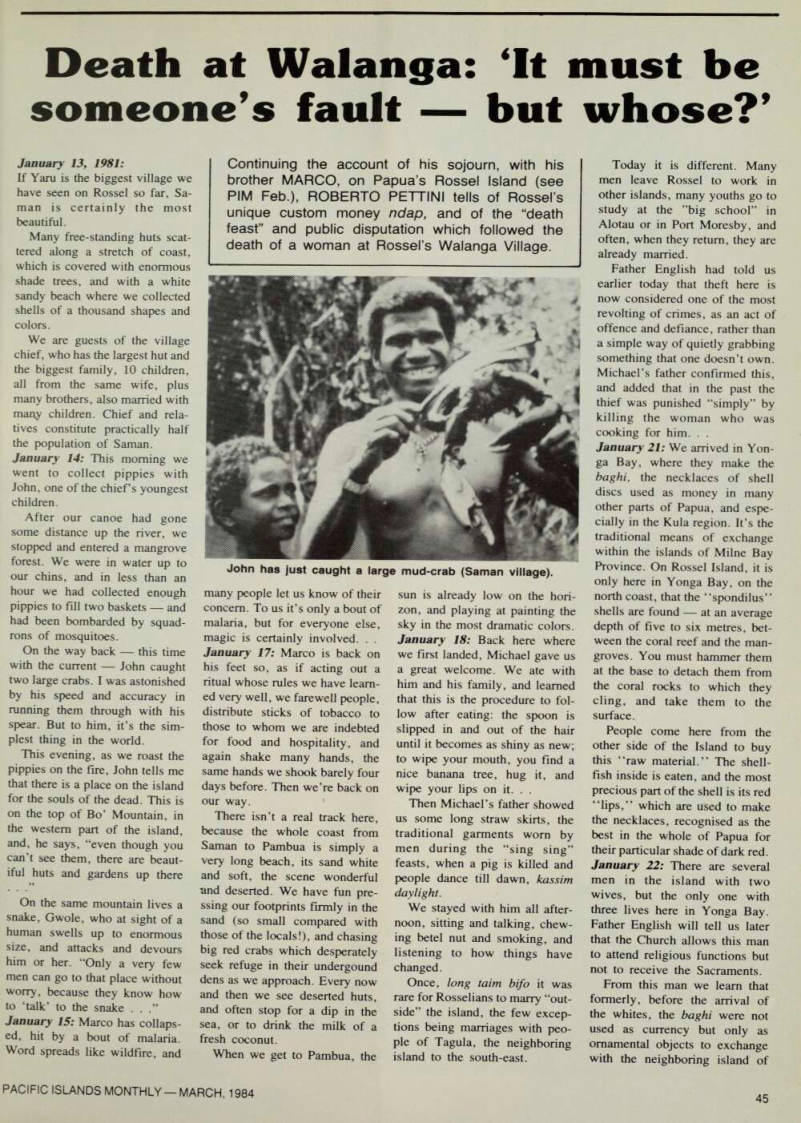
Death at Walanga: ‘lt must be someone’s fault - but whose?’
Continuing the account of his sojourn, with his brother MARCO, on Papua’s Rossel Island (see PIM Feb.), ROBERTO PETTINI tells of Rossel’s unique custom money ndap, and of the “death feast” and public disputation which followed the death of a woman at Rossel’s Walanga Village.
January 13, 1981: If Tam is the biggest village we have seen on Rossel so far, Sa man is certainly the most beautiful.
Many free-standing huts scat
tered along a stretch of coast, which is covered with enormous shade trees, and with a white sandy beach where we collected shells of a thousand shapes and colors.
We are guests of the village chief, who has the largest hut and the biggest family, 10 children, all from the same wife, plus many brothers, also married with mapy children. Chief and rela tives constitute practically half the population of Saman.
January 14: This morning we went to collect pippies with John, one of the chiefs youngest children.
After our canoe had gone some distance up the river, we stopped and entered a mangrove forest. We were in water up to our chins, and in less than an hour we had collected enough pippies to fill two baskets and had been bombarded by squad rons of mosquitoes.
On the way back this time with the current John caught two large crabs. I was astonished by his speed and accuracy in running them through with his spear. But to him, it’s the sim plest thing in the world.
This evening, as we roast the pippies on the fire, John tells me that there is a place on the island for the souls of the dead. This is on the top of Bo’ Mountain, in the western part of the island, and, he says, “even though you can’t see them, there are beaut iful huts and gardens up there On the same mountain lives a snake, Gwole, who at sight of a human swells up to enormous size, and attacks and devours him or her. “Only a very few men can go to that place without worry, because they know how to ‘talk’ to the snake ...”
January 15: Marco has collaps ed, hit by a bout of malaria.
Word spreads like wildfire, and
many people let us know of their concern. To us it’s only a bout of malaria, but for everyone else, magic is certainly involved. . .
January 17: Marco is back on his feet so, as if acting out a ritual whose rules we have learn ed very well, we farewell people, distribute sticks of tobacco to those to whom we are indebted for food and hospitality, and again shake many hands, the same hands we shook barely four days before. Then we’re back on our way.
There isn’t a real track here, because the whole coast from Saman to Pambua is simply a very long beach, its sand white and soft, the scene wonderful mid deserted. We have fun pre ssing our footprints firmly in the sand (so small compared with those of the locals!), and chasing big red crabs which desperately seek refuge in their undergound dens as we approach. Every now and then we see deserted huts, and often stop for a dip in the sea, or to drink the milk of a fresh coconut.
When we get to Pambua, the
sun is already low on the hori zon, and playing at painting the sky in the most dramatic colors.
January 18: Back here where we first landed, Michael gave us a great welcome. We ate with him and his family, and learned that this is the procedure to fol low after eating; the spoon is slipped in and out of the hair until it becomes as shiny as new; to wipe your mouth, you find a nice banana tree, hug it, and wipe your lips on it. . .
Then Michael’s father showed us some long straw skirts, the traditional garments worn by men during the “sing sing’’ feasts, when a pig is killed and people dance till dawn, kassim daylight.
We stayed with him all after noon, sitting and talking, chew ing betel nut and smoking, and listening to how things have changed.
Once, long taint bifo it was rare for Rosselians to marry “out side” the island, the few excep tions being marriages with peo ple of Tagula, the neighboring island to the south-east.
Today it is different. Many men leave Rossel to work in other islands, many youths go to study at the ’’big school” in Alotau or in Port Moresby, and often, when they return, they are
already married.
Father English had told us earlier today that theft here is now considered one of the most revolting of crimes, as an act of offence and defiance, rather than
a simple way of quietly grabbing
something that one doesn’t own.
Michael’s father confirmed this, and added that in the past the
thief was punished “simply” by
killing the woman who was
cooking for him. . .
January 21: We arrived in Ton ga Bay, where they make the baghi, the necklaces of shell discs used as money in many other parts of Papua, and espe cially in the Kula region. It’s the traditional means of exchange within the islands of Milne Bay Province. On Rossel Island, it is only here in Tonga Bay, on the north coast, that the “spondilus” shells are found at an average depth of five to six metres, bet ween the coral reef and the man groves. Tou must hammer them at the base to detach them from the coral rocks to which they cling, and take them to the surface.
People come here from the other side of the Island to buy this “raw material.’’ The shell fish inside is eaten, and the most precious part of the shell is its red “lips,’’ which are used to make the necklaces, recognised as the best in the whole of Papua for their particular shade of dark red.
January 22: There are several men in the island with two wives, but the only one with three lives here in Tonga Bay.
Father English will tell us later that the Church allows this man to attend religious functions but not to receive the Sacraments.
From this man we learn that formerly, before the arrival of the whites, the baghi were not used as currency but only as
ornamental objects to exchange
with the neighboring island of
John has just caught a large mud-crab (Saman village).
Tagula, the only island that has always had contact with Rossel a contact, moreover, that has
always been peaceful.
“People of Tagula never came here to fight the inhabitants of Rossel, and the Brooka Islanders and other pirates who often at tacked the coasts of Tagula, were too far away to reach Rossel . . .
In exchange for the baghi and carved “lime sticks,” the Rosse lians would receive clay pots and beautiful parrots of many colors, the latter being favorite presents for their women.
“Do you still go to Tagula?” we ask.
“In the last few years, con tacts have been less frequent, and
were completely interrupted two
years ago when one of our sailing canoes was almost wrecked dur
ing the crossing.”
The clay pots, as well as sev eral other things, have been re placed. Metal pots can be pur chased at the Mission store: “They are much less fragile, lighter, and much easier to wash 9 9 January 23: We picked the best baghi, those that were the brigh test red and best crafted. We paid one Kina per inch, the “official
price” the price Father
English pays when he goes on patrol around the island. Now we too have “custom money” around our necks . . . very use ful in case we should want to take a wife ... It will be the memento of a “story,” the first in this journey of ours through Melanesia.
January 24: We were sitting
quietly, chatting and chewing be
tel, when news came of a woman found dead yesterday in Walanga
Village. The body has already
been buried and many people have gone there to mourn. In two or three days there will be the “payment,” and the traditional quarrels among relatives.
Everywhere in Melanesia it seems that death is never accept ed as a“natural” event, as part of life itself. There is always someone or something respons ible, a precise reason. Here in Rossel, it is explained to us, tradition requires a public meet ing where the dead woman’s
family, especially the relatives
who were living with her, are publicly accused of being re sponsible for her death, of not having been able to look after her
“properly.”
January 26: Walanga Village.
We have been in Rossel for almost a month, and those who haven’t met us in person have certainly heard of “those two white brothers who chew betel.”
Maybe our presence in the island has been, in some way, accepted. For the fact is that we too are here, at the “death feast,” and nobody seems
surprised.
Inevitably, magic is discussed.
Three people have died in the same family over the last two months, including the father of Miami, the deceased, a man of great power, a “big man” known throughout the island.
Many people have come from far away journeying for many hours by canoe, to talk and establish a price to be paid to compare sus picions . . .
Who is the puri-puri man (the witch) who killed Miami?
Behind the accusations thrown from one side and the other, there are moments of attrition, alternating with sentiments of in tense rivalry going back for gen erations; there are loyalties to one’s clan; there are jealousies and competition among different villages, villages which in some cases have been foes from time immemorial.
Everybody is convinced that there is a culprit, a murderer, and
today everyone’s trying to find
out who it is.
Direct and indirect accusations have gone on all morning, but the “culprit” is still without a name, even though the suspi cions will remain alive for a long time to come.
Now the time has come to pay for the work of those who buried Miami. The “coins” used for this occasion, and used only here in Rossel, are called ndap. They are flat orange shells, very smooth because they have been passed and rubbed from hand to hand for centuries. Everyone was
very busy establishing the
“price,” the number and quality of the ndap, and we also saw polished stone axes being drawn out. By the time everybody had taken his or her way home, on foot or by canoe, the sun was
already low.
January 28: We are in Ginger again!
After 26 days of sweet potatoes, boiled bananas, pump kins, taro, yams, coconut and some fish, we had a super breakfast of porridge, slices of bread, butter and jam, cheese,
meat, fruit, milk and coffee!
Father English could not have welcomed us in a better way.
January 29: The Christmas holi days are over.
The day after tomorrow, the Mission boat should come on a
“special” trip to take the high
school students back to Alotau,
the provincial capital. It’s a gol
den opportunity, since the next boat won’t sail until March, for us to reach Nimowa, the first island of the Calvados Chain.
February 3: Since first light, the small wharf at Ginger has gradu
ally been filling up with people,
parents and relatives coming to farewell their boys: It will be a year till they see them again.
The luggage and food baskets for the trip pass from hand to hand and are loaded on board in the general confusion. People laugh, gesticulate, talk: many
continually get on and off the boat as if they are in two minds as to whether to go or stay.
Being the only white man.
Father Kevin English is easily spotted in the crowd. With his hat in his hand, and wiping away his sweat, he comes towards us and says: “This is for you,’’ as he hands us a basket containing lunch, dinner and breakfast, al
ready prepared.
“God only knows whether you will return to Rossel one day, isn’t that so . . .?”
“Maco Bamba, Father . .
“Maco Bamba, boys ...”
The boat starts rocking gently, the whole wharf is a waving of hands. We pass the small island of Heron and then enter the open sea towards . . . Another story is about to begin. • Next month: Through the Calvados Chain.
Advertisements & other items, p. 46 (1 item)
i.R184D.6.
Agents sought
for new-design security fence
Pacific agents are now being
sought for a revolutionary high
security fencing system de
veloped in Ireland and now being introduced to this part of the world by R. H. Engineering (N.S.W.) Pty. Ltd., of Coward Street, Mascot, N.S.W.
Australia.
The barrier is made up of expanded steel, and is a vane rotating on a shaft, so that any one attempting to climb over the fence is unable to gain a stable foothold. Specialists from the West German army, who nor mally clear a barbed wire fence in less than a minute, took more than four minutes to get over one fitted with this new system, known as Rotaguard.
Sharp edges on the mesh vanes shred even thick protective clo thing and can cause serious lacer
ations to unwisely placed flesh.
Rotaguard units can be fitted to walls, fences, roofs or drain
pipes, and are already widely
used in Britain, Ireland, Europe and the United States on such diverse places as prisons, banks, airports, power stations, Yonkers Raceway, and the Manchester
City football ground.
The weave of the mesh used is designed to deter cutting with high-strength shears and it can not be avoided by draping it with cloth because each 11-inch wide unit turns with the climber’s
weight-shifts.
Irish engineer Thomas McLoughlin invented the anti thief, anti-vandal, barrier after his young nephew was strangled when he slipped while climbing a barbed-wire fence. What he pro duced has been hailed as the best bit of security hardware since the Romans stopped building forts to fight off the Saracens.
Rotaguard is now patented in 19 countries and is being made in Australia under licence.
Behind Fiji’s

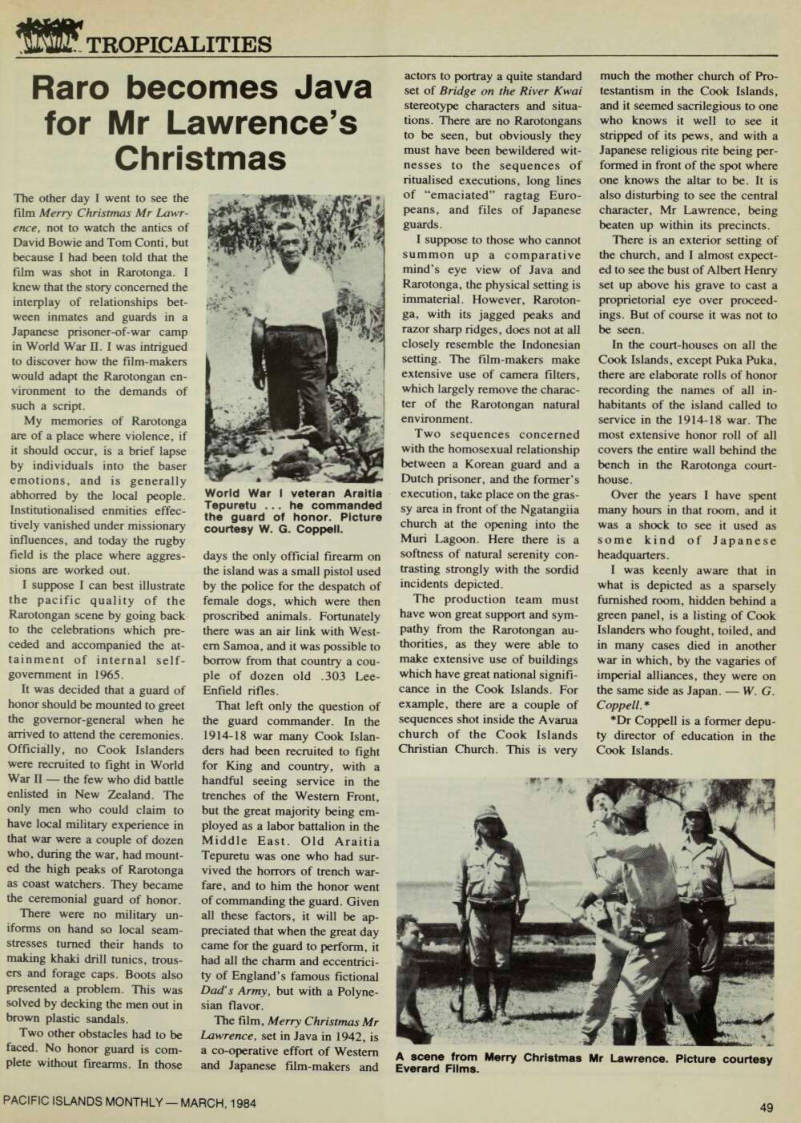
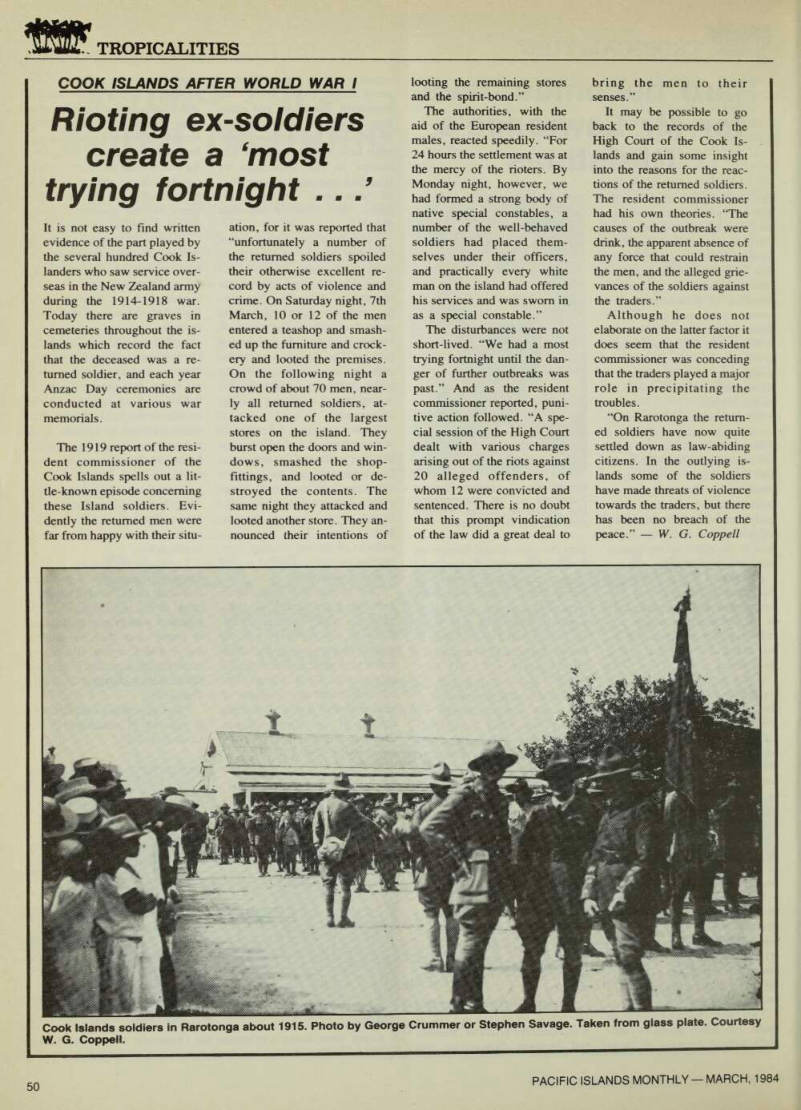
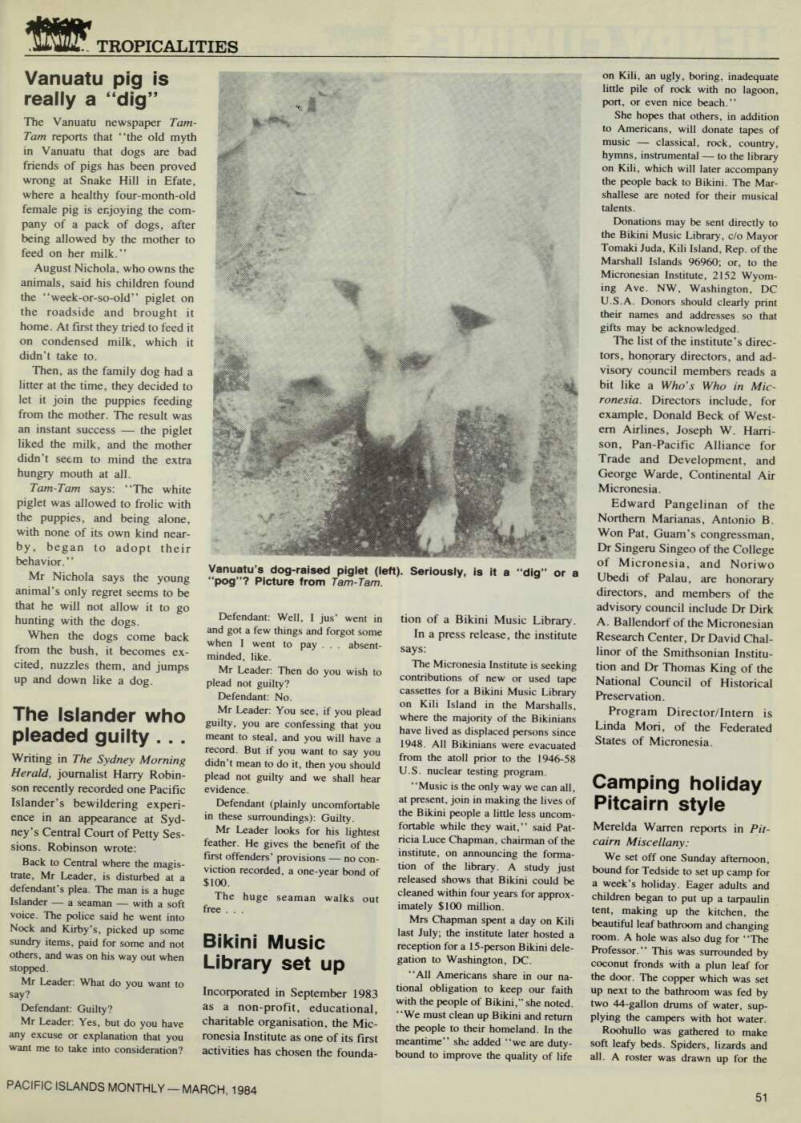
Political Currents
Behind Fiji’s Cabinet reshuffle
Fiji’s Prime Minister, Ratu Sir Kamisese Mara, has ended his country’s most popular guessing game by naming Ratu David Toganivalu, 49, his deputy in a minor, but significant, cabinet reshuffle which cost two ministers their jobs, but solved some prickly political problems.
In the move he dropped the minister for home affairs, Ratu William Toganivalu, 53, elder brother to Ratu David, whose portfolio was handed over to the controversial, and powerful, Northern Division leader, Militoni Leweniqila, who was previously minister of lands, housing and urban affairs. The other ministerial casualty was Akariva Nabati, minister of state without port-
folio, who had been head of the Special Branch, of the Royal Fiji Police before re tiring to contest, and win, a seat in parliament in the 1982 general election, The position of deputy prime minister, generally accepted as the heir-appa rent to Ratu Mara, became vacant in February, 1983, with the resignation of Ratu Penaia Ganilau who had been appointed Gov ernor-General in place of
Ratu Sir George Cakobau, the Vunivalu (king) of Fiji.
Sir George is said to have retired somewhat reluc tantly, but now lives quiet ly on the chiefly island of Bau, on the coast near Suva in Viti Levu.
After Ratu Penaia’s move into the stately and beautiful government house Suva, always eager for gossip and speculation, seethed with rumors of in fighting and advantage seeking among par liamentarians. But Ratu Mara, thoroughly aware of the traps, refused to name anyone and, until now, has let the situation stabilise and cool.
Now, by giving the job to Ratu David, Ratu Mara has again demonstrated his mastery of Fijian affairs, and of the rebels in his party, and is thus now even more firmly in control than before.
Ratu William is consi
dered by many to have posed a potential threat to Ratu Mara because he is, in his own right a high-rank ing chief, and a popular leader with substantial support in the Bau-Tailevu province, still regarded as the seat of power in Fiji.
The Toganivalu clan holds a unique position in Fijian society, akin to that occupied by the Borgias in Rome or the Brahmins of India who were kingmak ers and counsellors to royalty.
As eldest brother and head of the clan, William is a close confidant and advis er to the Vunivalu, Ratu Sir George Cakobau, who lives with his active and influen tial wife right on that seat of power.
Before his removal from the Cabinet was announced Ratu William was offered
Continued on page 54
the consolation prize of a roving ambassadorship, but he declined it, prefer ring, he said, to remain in parliament and honor the duty given him by his con stituents. He has accepted the loss of his ministry with apparent calm and good grace, and is thought likely to continue coopera tive. He is unlikely to cause any problems for a prime minister to whom his brother is deputy, for to do so would be seen as bet rayal of family loyalty.
Ratu William is, howev er, a powerful and some times unpredictable man and only time will tell whether he will continue to sit quietly and enjoying the social round of Fiji and the duties of his electorate, or, from the inner councils of Bau, become a thorn in Ratu Mara’s side.
The choice of Ratu David as deputy has been greeted with general approval and genuine pleasure in most quarters of Fiji. Not only is Ratu David popular among Fijians, but he is very well regarded by the Indians and Europeans of the com munity. He was Western educated, and also schooled in the deep tradi tions of Fiji. He is comfort able in the corridors of power at home and over seas, and is known as a man of reason, and political moderation. Most impor tantly in a society where race relations are vitally important, he has stood out as a champion of multi racial harmony.
Indeed, his first words after being named Deputy Prime Minister were that he ’’would die a happy man if I can bring the two major communities, the Fijian and the Indian, closer together.”
Two other leading politi cians were tipped as possi ble candidates for the de puty’s job. The first of these, Mosese Qionibaravi, was formerly the Speaker of the House and then an excellent minister for fore ign affairs and tourism for 18 months before taking over as Minister of Fi nance. That post had just been vacated, reportedly with some heat, by the highly respected Charles Walker who was, himself, the other candidate for De puty Prime Minister.
Mr Walker’s resignation from the cabinet came as a surprise and has not been fully explained, although it is widely assumed it was in angry protest over cabinet’s majority decision to give public servants a pay rise at a time when, quite plainly, the country could not really afford it.
Civil servants make up 60 per cent of the wage-ear ning work force in Fiji and represent a potent political force.
By walking out Mr Wal ker is considered to have torpedoed his chances of becoming deputy prime minister, although there are those who suggest he may have guessed the ulti mate decision before he walked out, or that he was not interested anyway.
In any event, Ratu Mara, wisely recognising that Fiji can ill-afford to lose a man of Mr Walker’s consider able skill and experience, brought him back into the cabinet in the reshuffle, giving him the portfolio of primary industry.
The other significant change in the cabinet in volves the powerful, and controversial, Mr Militoni
Leweniqila. He has been shifted out of the sensitive lands, housing and urban affairs ministry and put into home affairs, the post vacated by Ratu William Toganivalu. Land is the most touchy of all political issues in Fiji where 85 per cent of the land area is owned by the Fijians who make up just under half the total population. This was a deliberate condition of the Constitution at the end of British colonialism and one which Fijian leaders guard jealously.
Mr Leweniqila stirred a national controversy last year when it was disclosed in parliament that he had handed out, virtually free of cost, choice lots of Crown land in Suva to va rious aquaintances.
He was also involved in some quite acrimonious political scraps with the mayors of several towns over urban matters. It has been fairly frequently sug gested that Mr Leweniqila looks after his friends with the same vigor as he pur sues his foes.
By moving him Ratu Mara has taken the steam out of a potentially danger ous situation which could have racial overtones, and at the same time has avoided argument from Mr Leweniqila by giving him a post of equal importance and influence.
The thorny lands port folio has gone to mild mannered Jone Naisara, a party veteran, who also re tains the ministry of ener gy. Housing and urban affairs have gone to Mr Ted Beddoes, an affable and easy-going man who tends to leave day-to-day operation of his ministry to the bureaucrats.
On the whole the changes are beneficial for Fiji.
They have removed some problems, both present and potential, and they have consolidated Ratu Mara’s position as the accepted leader of all communities
in Fiji.
Vijendra Kumar.
Ratu Sir Kamisese Mara
Advertisements & other items, p. 48 (1 item)
Check these great tastes
from Edmonds*
Serving the Pacific for over 100 years
Products Available
Baking Powder Custard Jelly Pancake Mix Pikelet Mix Beef Stock Chicken Stock Scone Mix Pastry Mix Donut Mix Sponge Mix Bun Mix Soups Pickles Preserves Pkt Cake Mixes Mixed Fruit for Baking Cheesecake Peanut Butter Sandwich Spreads Rice Risotto Quick Snacks Imitation Cherries Glace Cherries Cocktail Cherries in maraschino oil Canned Mushrooms Curry Powder Breadcrumbs Glucose D Vita Crunch Breakfast Cereals Fla-vor-ice (liquid ice block) Flour Icing Sugar Mix n Bake Pastries Peanuts Coconut Rice packs Sugar Sachets Soya Oil Honey Cordials Cornflour Cut Peel Crystallised Ginger Pet Food Detergent Disinfectant Ant Killer
iMM
Our Famous Brands Av
Fii'
a iiab ,e sa^ 03
ut
Co° K ' f jev' u
PaP ‘
Ne w ca
Proudly manufactured in New Zealand by
EDMONDS FOOD INDUSTRIES LTD.
PC Box 27-249 Mt Roskill
AUCKLAND NZ
Brochure Factory 83 Telephone 698-167 Cable Address Sunshine Telex Address 21690
*Ask for our
Illustrated product catalogue
and export price list.
Bankers National Bank Year Established 1881 Export Manager Tony Babbage incl W F Tucker & Company Limited
Raro becomes Java
Tropicalities
Raro becomes Java for Mr Lawrence’s Christmas
The other day I went to see the film Merry Christmas Mr Lawr ence, not to watch the antics of David Bowie and Tom Conti, but because I had been told that the film was shot in Rarotonga. I knew that the story concerned the
interplay of relationships bet
ween inmates and guards in a
Japanese prisoner-of-war camp
in World War n. I was intrigued to discover how the film-makers would adapt the Rarotongan en vironment to the demands of such a script.
My memories of Rarotonga
are of a place where violence, if it should occur, is a brief lapse by individuals into the baser emotions, and is generally abhorred by the local people.
Institutionalised enmities effec
tively vanished under missionary
influences, and today the rugby field is the place where aggres sions are worked out.
I suppose I can best illustrate the pacific quality of the
Rarotongan scene by going back
to the celebrations which pre ceded and accompanied the at tainment of internal self government in 1965.
It was decided that a guard of honor should be mounted to greet the governor-general when he arrived to attend the ceremonies.
Officially, no Cook Islanders were recruited to fight in World War II the few who did battle enlisted in New Zealand. The only men who could claim to have local military experience in that war were a couple of dozen who, during the war, had mount
ed the high peaks of Rarotonga
as coast watchers. They became the ceremonial guard of honor.
There were no military un iforms on hand so local seam stresses turned their hands to making khaki drill tunics, trous ers and forage caps. Boots also presented a problem. This was solved by decking the men out in brown plastic sandals.
Two other obstacles had to be faced. No honor guard is com plete without firearms. In those
days the only official firearm on the island was a small pistol used by the police for the despatch of female dogs, which were then proscribed animals. Fortunately there was an air link with West ern Samoa, and it was possible to borrow from that country a cou ple of dozen old .303 Lee- Enfield rifles.
That left only the question of the guard commander. In the 1914-18 war many Cook Islan ders had been recruited to fight for King and country, with a handful seeing service in the trenches of the Western Front, but the great majority being em ployed as a labor battalion in the Middle East. Old Araitia Tepuretu was one who had sur vived the horrors of trench war fare, and to him the honor went of commanding the guard. Given all these factors, it will be ap preciated that when the great day came for the guard to perform, it had all the charm and eccentrici ty of England’s famous fictional Dad’s Army, but with a Polyne sian flavor.
The film, Merry Christmas Mr Lawrence, set in Java in 1942, is a co-operative effort of Western and Japanese film-makers and
actors to portray a quite standard set of Bridge on the River Kwai stereotype characters and situa tions. There are no Rarotongans to be seen, but obviously they must have been bewildered wit nesses to the sequences of ritualised executions, long lines of “emaciated” ragtag Euro peans, and files of Japanese guards.
I suppose to those who cannot summon up a comparative mind’s eye view of Java and
Rarotonga, the physical setting is
immaterial. However, Raroton ga, with its jagged peaks and razor sharp ridges, does not at all closely resemble the Indonesian setting. The film-makers make extensive use of camera filters, which largely remove the charac ter of the Rarotongan natural environment.
Two sequences concerned with the homosexual relationship between a Korean guard and a Dutch prisoner, and the former’s execution, take place on the gras sy area in front of the Ngatangiia church at the opening into the Muri Lagoon. Here there is a softness of natural serenity con trasting strongly with the sordid
incidents depicted.
The production team must have won great support and sym pathy from the Rarotongan au thorities, as they were able to make extensive use of buildings which have great national signifi cance in the Cook Islands. For example, there are a couple of sequences shot inside the Avarua church of the Cook Islands Christian Church. This is very
much the mother church of Pro testantism in the Cook Islands, and it seemed sacrilegious to one who knows it well to see it stripped of its pews, and with a
Japanese religious rite being per
formed in front of the spot where one knows the altar to be. It is also disturbing to see the central character, Mr Lawrence, being beaten up within its precincts.
There is an exterior setting of the church, and I almost expect ed to see the bust of Albert Henry set up above his grave to cast a
proprietorial eye over proceed
ings. But of course it was not to be seen.
In the court-houses on all the Cook Islands, except Puka Puka, there are elaborate rolls of honor recording the names of all in habitants of the island called to service in the 1914-18 war. The most extensive honor roll of all covers the entire wall behind the bench in the Rarotonga court house.
Over the years I have spent many hours in that room, and it was a shock to see it used as some kind of Japanese
headquarters.
I was keenly aware that in what is depicted as a sparsely furnished room, hidden behind a green panel, is a listing of Cook Islanders who fought, toiled, and in many cases died in another war in which, by the vagaries of imperial alliances, they were on the same side as Japan. W. G.
Coppell. *
*Dr Coppell is a former depu ty director of education in the Cook Islands.
World War I veteran Araitia Tepuretu ... he commanded the guard of honor. Picture courtesy W. G. Coppell.
A scene from Merry Christmas Mr Lawrence. Picture courtesy Everard Films.
Rioting ex-soldiers
Cook Islands After World War I
Rioting ex-soldiers create a ‘most trying fortnight ..'
It is not easy to find written evidence of the part played by the several hundred Cook Is landers who saw service over seas in the New Zealand army during the 1914-1918 war.
Today there are graves in cemeteries throughout the is lands which record the fact that the deceased was a re turned soldier, and each year Anzac Day ceremonies are conducted at various war memorials.
The 1919 report of the resi dent commissioner of the Cook Islands spells out a lit
tle-known episode concerning
these Island soldiers. Evi dently the returned men were far from happy with their situ
looting the remaining stores
and the spirit-bond.”
The authorities, with the aid of the European resident males, reacted speedily. “For 24 hours the settlement was at the mercy of the rioters. By
Monday night, however, we
had formed a strong body of native special constables, a number of the well-behaved soldiers had placed them selves under their officers, and practically every white man on the island had offered his services and was sworn in as a special constable.”
The disturbances were not short-lived. “We had a most trying fortnight until the dan ger of further outbreaks was past.” And as the resident
commissioner reported, puni
tive action followed. “A spe cial session of the High Court dealt with various charges arising out of the riots against 20 alleged offenders, of whom 12 were convicted and sentenced. There is no doubt that this prompt vindication of the law did a great deal to
bring the men to their senses.”
It may be possible to go back to the records of the High Court of the Cook Is lands and gain some insight into the reasons for the reac tions of the returned soldiers.
The resident commissioner had his own theories. “The causes of the outbreak were drink, the apparent absence of any force that could restrain the men, and the alleged grie vances of the soldiers against the traders.”
Although he does not elaborate on the latter factor it does seem that the resident commissioner was conceding that the traders played a major role in precipitating the troubles.
“On Rarotonga the return ed soldiers have now quite settled down as law-abiding citizens. In the outlying is lands some of the soldiers have made threats of violence towards the traders, but there has been no breach of the
ation, for it was reported that “unfortunately a number of the returned soldiers spoiled their otherwise excellent re cord by acts of violence and crime. On Saturday night, 7th March, 10 or 12 of the men entered a teashop and smash ed up the furniture and crock ery and looted the premises.
On the following night a crowd of about 70 men, near ly all returned soldiers, at tacked one of the largest stores on the island. They burst open the doors and win dows, smashed the shop fittings, and looted or de stroyed the contents. The same night they attacked and looted another store. They an nounced their intentions of
peace.”
W. G. Coppell
Cook Islands soldiers in Rarotonga about 1915. Photo by George Crummer or Stephen Savage. Taken from glass plate. Courtesy W. G. Coppell.
Camping holiday
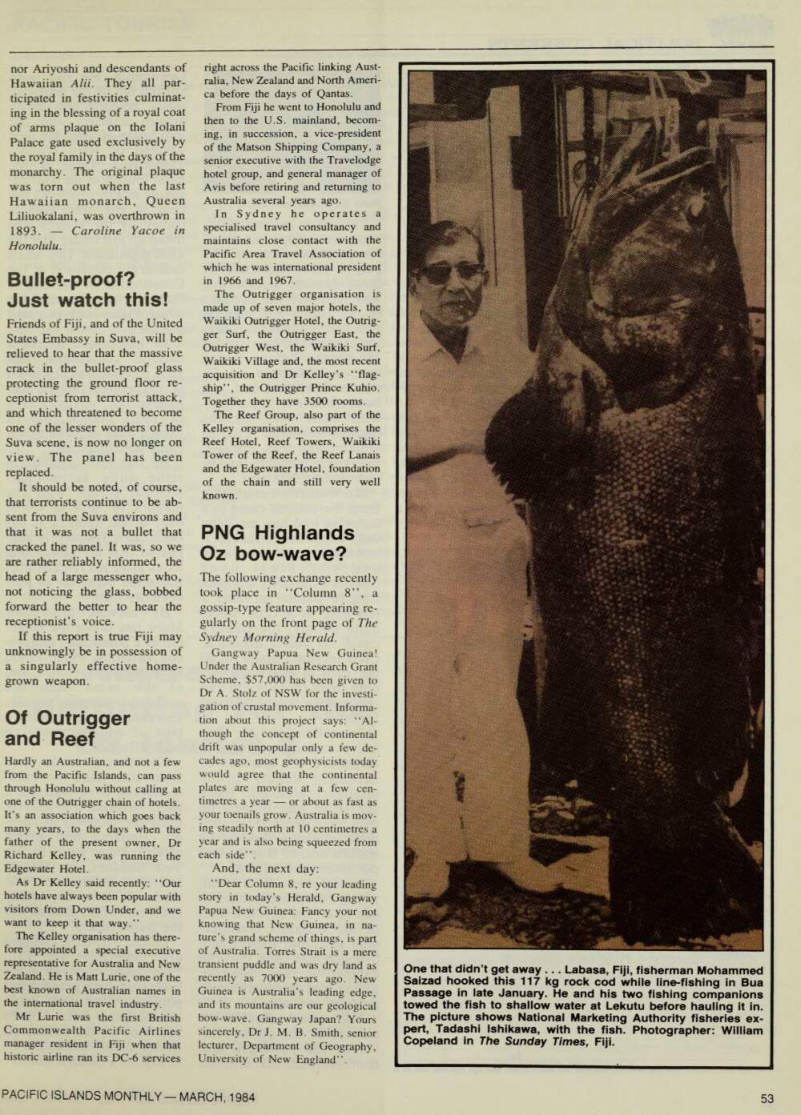
Vanuatu pig is really a “dig”
The Vanuatu newspaper Tam- Tam reports that “the old myth in Vanuatu that dogs are bad friends of pigs has been proved wrong at Snake Hill in Efate, where a healthy four-month-old female pig is enjoying the com pany of a pack of dogs, after being allowed by the mother to feed on her milk.”
August Nichola, who owns the animals, said his children found the “week-or-so-old” piglet on the roadside and brought it home. At first they tried to feed it on condensed milk, which it didn’t take to.
Then, as the family dog had a litter at the time, they decided to
let it join the puppies feeding
from the mother. The result was an instant success the piglet liked the milk, and the mother didn’t seem to mind the extra hungry mouth at all.
Tam-Tam says: “The white piglet was allowed to frolic with the puppies, and being alone, with none of its own kind near
by, began to adopt their
behavior.”
Mr Nichola says the young animal’s only regret seems to be that he will not allow it to go
hunting with the dogs.
When the dogs come back from the bush, it becomes ex cited, nuzzles them, and jumps up and down like a dog.
The Islander who
pleaded guilty .. .
Writing in The Sydney Morning
Herald, journalist Harry Robin son recently recorded one Pacific
Islander’s bewildering experi
ence in an appearance at Syd ney’s Central Court of Petty Ses sions. Robinson wrote: Back to Central where the magis trate, Mr Leader, is disturbed at a defendant’s plea. The man is a huge Islander a seaman with a soft voice. The police said he went into Nock and Kirby’s, picked up some sundry items, paid for some and not others, and was on his way out when stopped.
Mr Leader: What do you want to say?
Defendant: Guilty?
Mr Leader: Yes, but do you have any excuse or explanation that you want me to take into consideration?
Defendant; Well, I jus’ went in and got a few things and forgot some when I went to pay . . . absent minded, like.
Mr Leader: Then do you wish to plead not guilty?
Defendant: No.
Mr Leader: You see, if you plead guilty, you are confessing that you meant to steal, and you will have a record. But if you want to say you didn’t mean to do it, then you should plead not guilty and we shall hear evidence.
Defendant (plainly uncomfortable in these surroundings): Guilty.
Mr Leader looks for his lightest feather. He gives the benefit of the first offenders’ provisions no con viction recorded, a one-year bond of $lOO.
The huge seaman walks out free . . .
Bikini Music
Library set up
Incorporated in September 1983
as a non-profit, educational,
charitable organisation, the Mic ronesia Institute as one of its first activities has chosen the founda
tion of a Bikini Music Library.
In a press release, the institute says: The Micronesia Institute is seeking contributions of new or used tape cassettes for a Bikini Music Library on Kili Island in the Marshalls, where the majority of the Bikinians have lived as displaced persons since 1948. All Bikinians were evacuated from the atoll prior to the 1946-58 U.S. nuclear testing program.
“Music is the only way we can all, at present, join in making the lives of the Bikini people a little less uncom fortable while they wait,” said Pat ricia Luce Chapman, chairman of the institute, on announcing the forma tion of the library. A study just released shows that Bikini could be cleaned within four years for approx imately $lOO million.
Mrs Chapman spent a day on Kili last July; the institute later hosted a reception for a 15-person Bikini dele gation to Washington, DC.
“All Americans share in our na tional obligation to keep our faith with the people of Bikini,” she noted.
“We must clean up Bikini and return the people to their homeland. In the meantime” she added “we are duty bound to improve the quality of life
on Kili, an ugly, boring, inadequate little pile of rock with no lagoon, port, or even nice beach.”
She hopes that others, in addition to Americans, will donate tapes of music classical, rock, country, hymns, instrumental to the library on Kili, which will later accompany the people back to Bikini. The Mar shallese are noted for their musical talents.
Donations may be sent directly to the Bikini Music Library, c/o Mayor Tomaki Juda, Kili Island, Rep. of the Marshall Islands 96960; or, to the Micronesian Institute, 2152 Wyom ing Ave. NW, Washington, DC U.S.A. Donors should clearly print their names and addresses so that gifts may be acknowledged.
The list of the institute’s direc tors, honorary directors, and ad visory council members reads a bit like a Who’s Who in Mic ronesia. Directors include, for example, Donald Beck of West ern Airlines, Joseph W. Harri son, Pan-Pacific Alliance for Trade and Development, and George Warde, Continental Air Micronesia.
Edward Pangelinan of the Northern Marianas, Antonio B.
Won Pat, Guam’s congressman.
Dr Singeru Singeo of the College
of Micronesia, and Noriwo Übedi of Palau, are honorary directors, and members of the advisory council include Dr Dirk A. Ballendorf of the Micronesian Research Center, Dr David Chal linor of the Smithsonian Institu tion and Dr Thomas King of the National Council of Historical Preservation.
Program Director/Intern is Linda Mori, of the Federated States of Micronesia.
Camping holiday
Pitcairn style
Merelda Warren reports in Pit
cairn Miscellany:
We set off one Sunday afternoon, bound for Tedside to set up camp for a week’s holiday. Eager adults and children began to put up a tarpaulin tent, making up the kitchen, the beautiful leaf bathroom and changing room. A hole was also dug for “The Professor. ’ ’ This was surrounded by coconut fronds with a plun leaf for the door. The copper which was set up next to the bathroom was fed by two 44-gallon drums of water, sup plying the campers with hot water.
Roohullo was gathered to make soft leafy beds. Spiders, lizards and all. A roster was drawn up for the
Vanuatu’s dog-raised piglet (left). Seriously, is it a “dig" or a “pog”? Picture from Tam-Tam.
cooks and dishwashers. Some snazzy meals came out of that kitchen.
Monday came and with enough provisions for the week the two trac tors and three wheel Hondas set off with all the holiday-makers. By lunch time the campsite was con sidered to be a palace, so off to Water Valley we all trooped to catch and spear fresh fish for dinner. Dinner was washed down with Dean’s brewed coffee while eyes feasted on the setting sun.
For the rest of the week campers explored and collected food and meat from the land, and collected scraped and balled the prickly pandanus thatch. Some funny looking Niau baskets materialised from the coconut fronds. The brooms were made from scraping the green leaf from the fronds, leaving the centre stem bare. Evenings were spent play ing cards and singing. “Coffee” whispered was all that was needed and “Spuds” (Dean) would have it by your side in a flash. His constant cry was “Anyone for coffee?” By six o’clock everyone was up and about finding new things to do and play.
For exercise goats were chased from one valley to the next. One little kid was caught which was soon tamed and named “George.” The old Turpin was found and the poor thing got poked and ridden on most of that day. Swims were taken in the pool called “Cabin.” The little kids enjoyed the little rock pools to paddle in and the sand to build castles.
Visitors from town checked out our palace and Rester on the balcony under the coconut palms on Saturday and had dinner with us that night.
Sad faces lined the breakfast table as we all looked at the porridge and realised that by dark we would be home and the camping would be over. Everyone dug in and packed in
their possessions and then pulled the tent down. The night before Jay had almost brought the tent down with his noisy snoring, and Steve, Clarice and Olive poured a bucket of water over his head.
Time to say Good Bye Campsite it was most enjoyable.
Hawaii monarchs
remembered
Ceremonies honoring the 147th anniversary of the birth of King David Kalakaua took place late last year at the Royal Mausoleum and lolani Palace in Honolulu.
The Sons and Daughters of Hawaiian Warriors, resplendent in their long black hoku style dresses, illima leis and tradition
ally designed capes (including
several superb antique feather
ones) gathered in the grounds of the Royal Mausoleum where King Kalakaua and other Hawaiian Alii are buried.
Music by the Royal Hawaiian Band (which originated in Kalakaua’s time), and singer Pa
lani Vaughan, accompanied by
hula dancers, formed a major part of the memorial service.
Such musical tribute is particu
larly appropriate for this “Merry
Monarch” (as King Kalakaua came to be called) for by reinstat ing the hula, banned by New England missionaries, and re vitalising Hawaiian music, Kalakaua is credited with inspir ing the Hawaiian renaissance still in progress.
Later, at lolani Palace, the Sons and Daughters of Hawaiian Warriors were joined by Gover-
Sons and Daughters of Hawaiian Warriors at the memorial service for King David Kalahaua. Photo Joel Karini.
nor Ariyoshi and descendants of Hawaiian Alii. They all par ticipated in festivities culminat ing in the blessing of a royal coat of arms plaque on the lolani Palace gate used exclusively by the royal family in the days of the
monarchy. The original plaque
was torn out when the last Hawaiian monarch. Queen Liliuokalani, was overthrown in 1893. Caroline Yacoe in Honolulu.
Bullet-proof?
Just watch this!
Friends of Fiji, and of the United States Embassy in Suva, will be relieved to hear that the massive crack in the bullet-proof glass protecting the ground floor re ceptionist from terrorist attack, and which threatened to become one of the lesser wonders of the Suva scene, is now no longer on view. The panel has been
replaced.
It should be noted, of course, that terrorists continue to be ab sent from the Suva environs and that it was not a bullet that cracked the panel. It was, so we are rather reliably informed, the head of a large messenger who, not noticing the glass, bobbed forward the better to hear the
receptionist’s voice.
If this report is true Fiji may unknowingly be in possession of a singularly effective home grown weapon.
Of Outrigger
and Reef
Hardly an Australian, and not a few from the Pacific Islands, can pass through Honolulu without calling at one of the Outrigger chain of hotels.
It’s an association which goes back many years, to the days when the father of the present owner. Dr Richard Kelley, was running the Edgewater Hotel.
As Dr Kelley said recently: “Our hotels have always been popular with visitors from Down Under, and we want to keep it that way.”
The Kelley organisation has there fore appointed a special executive representative for Australia and New Zealand. He is Matt Lurie, one of the best known of Australian names in the international travel industry.
Mr Lurie was the first British Commonwealth Pacific Airlines manager resident in Fiji when that historic airline ran its DC-6 services
right across the Pacific linking Aust ralia, New Zealand and North Ameri ca before the days of Qantas.
From Fiji he went to Honolulu and then to the U.S. mainland, becom ing, in succession, a vice-president of the Matson Shipping Company, a senior executive with the Travelodge hotel group, and general manager of Avis before retiring and returning to Australia several years ago.
In Sydney he operates a specialised travel consultancy and maintains close contact with the Pacific Area Travel Association of which he was international president in 1966 and 1967.
The Outrigger organisation is made up of seven major hotels, the Waikiki Outrigger Hotel, the Outrig ger Surf, the Outrigger East, the Outrigger West, the Waikiki Surf, Waikiki Village and, the most recent acquisition and Dr Kelley’s “flag ship”, the Outrigger Prince Kuhio.
Together they have 3500 rooms.
The Reef Group, also part of the
Kelley organisation, comprises the
Reef Hotel, Reef Towers, Waikiki Tower of the Reef, the Reef Lanais and the Edgewater Hotel, foundation of the chain and still very well known.
PNG Highlands
Oz bow-wave?
The following exchange recently
took place in “Column 8”, a
gossip-type feature appearing re
gularly on the front page of The
Sydney Morning Herald.
Gangway Papua New Guinea!
Under the Australian Research Grant Scheme, $57,000 has been given to Dr A. Stolz of NSW for the investi gation of crustal movement. Informa tion about this project says: “Al though the concept of continental drift was unpopular only a few de cades ago, most geophysicists today would agree that the continental plates are moving at a few cen timetres a year or about as fast as your toenails grow. Australia is mov ing steadily north at 10 centimetres a year and is also being squeezed from each side”.
And, the next day:
“Dear Column 8, re your leading story in today’s Herald, Gangway Papua New Guinea; Fancy your not knowing that New Guinea, in na ture’s grand scheme of things, is part of Australia. Torres Strait is a mere transient puddle and was dry land as recently as 7000 years ago. New Guinea is Australia’s leading edge, and its mountains are our geological bow-wave. Gangway Japan? Yours sincerely. Dr J. M. B. Smith, senior
lecturer, Department of Geography,
University of New England”.
One that didn’t get away . . . Labasa, Fiji, fisherman Mohammed Saizad hooked this 117 kg rock cod while line-fishing in Bua Passage in late January. He and his two fishing companions towed the fish to shallow water at Lekutu before hauling it in.
The picture shows National Marketing Authority fisheries ex pert, Tadashi Ishikawa, with the fish. Photographer: William Copeland in The Sunday Times, Fiji.
Advertisements & other items, pp. 52-54 (2 items)
■warn
LOCAL AGENTS AND
REPRESENTATION
428 George St., Sydney.
Cables: Henco Sydney.
G.P.O. Box 3949.
Telephone: 232 5377.
PAPUA NEW GUINEA
RABAUL: M. & C. Seeto, P.O. Box 131, Rabaul.
Telephone 92 2919.
MADANG: W. Double, P.O. Box 22, Madang.
Telephone 82 2696.
FIJI
K. Witherington Ltd., P.O. Box 293, Suva.
Telephone 22 356.
For specialised and
personalised buying
service throughout
the Pacific Islands
and the East.
Resident Agents in other Pacific Territories.
VANUATU
John Lum & Associates, P.O. Box 65, Santo.
Telephone 329.
SOLOMON ISLANDS
Mr. Tom Lo, P.O. Box 327, Honiara.
Telephone 399 11 e
USED EQUIPMENT
SALE
Due to major projects completion Australia s leading construction hire company offers for sale: Diesel Generators: 100-300 KVA Caterpillar.
Air Compressors: Mobile 125 CFM to 1200 CFM Excavators: Kato 750 and 1200 Series.
Cranes: Warman 8 Tonne Tadano 15-25 Tonne Rough Terrain Road Construction: Vibrating Compaction Roller 6-16 Tonne. Ingersoll-Rand SR 60 Self Propelled and DA 30.
All late model well maintained equipment Agent enquiries welcome.
For details contact Brian McGrath,
COATES HIRE
15 Kumulla Road, MIRANDA. N.S.W. 2228 Phone: (02) 525-3333
‘INSTANT
HOUSES’
and Commercial Buildings with Therma-Panel, R the
fully insulated inter-locking
Building System
Cyclone rated George Hudson Homes (Aust.) pty. Ltd. 186 Hume Highway Cabramatta NSW 2166 Australia. Tel: (02) 727 9066. Telex: AA25800 Post coupon for details and prices.
Name...
Address Tel:,
Hhsr Political Currents
From page 48
Australia is
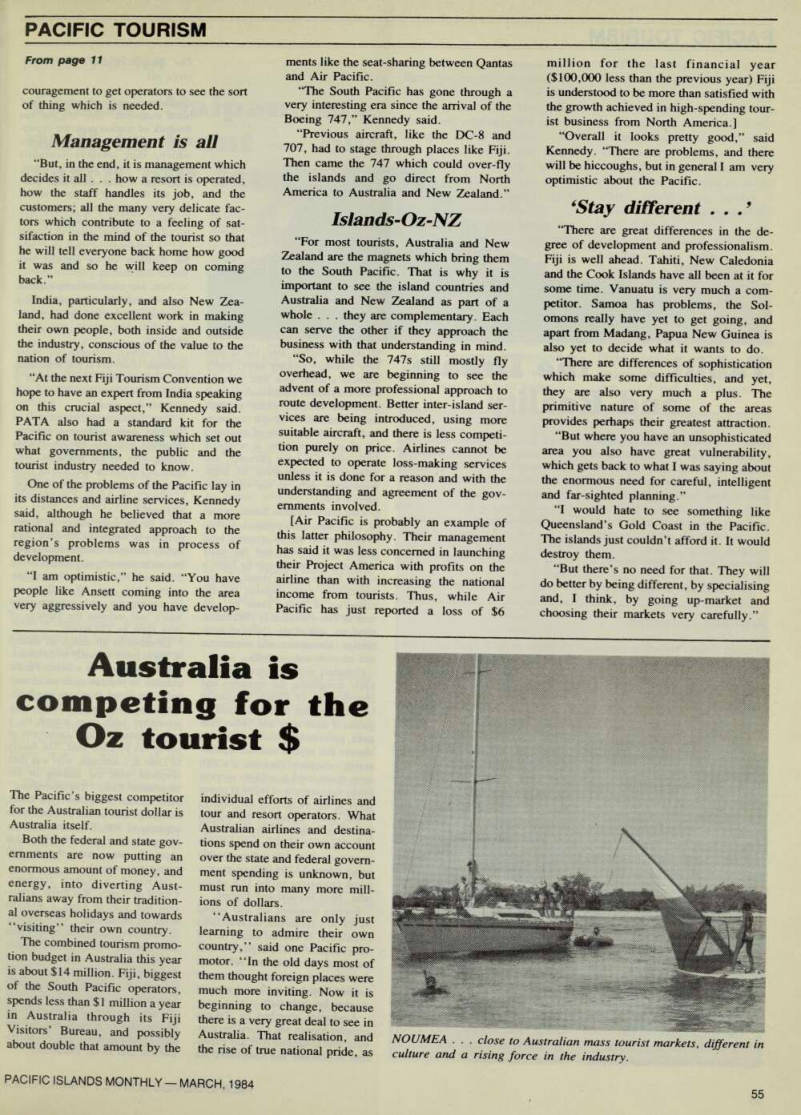
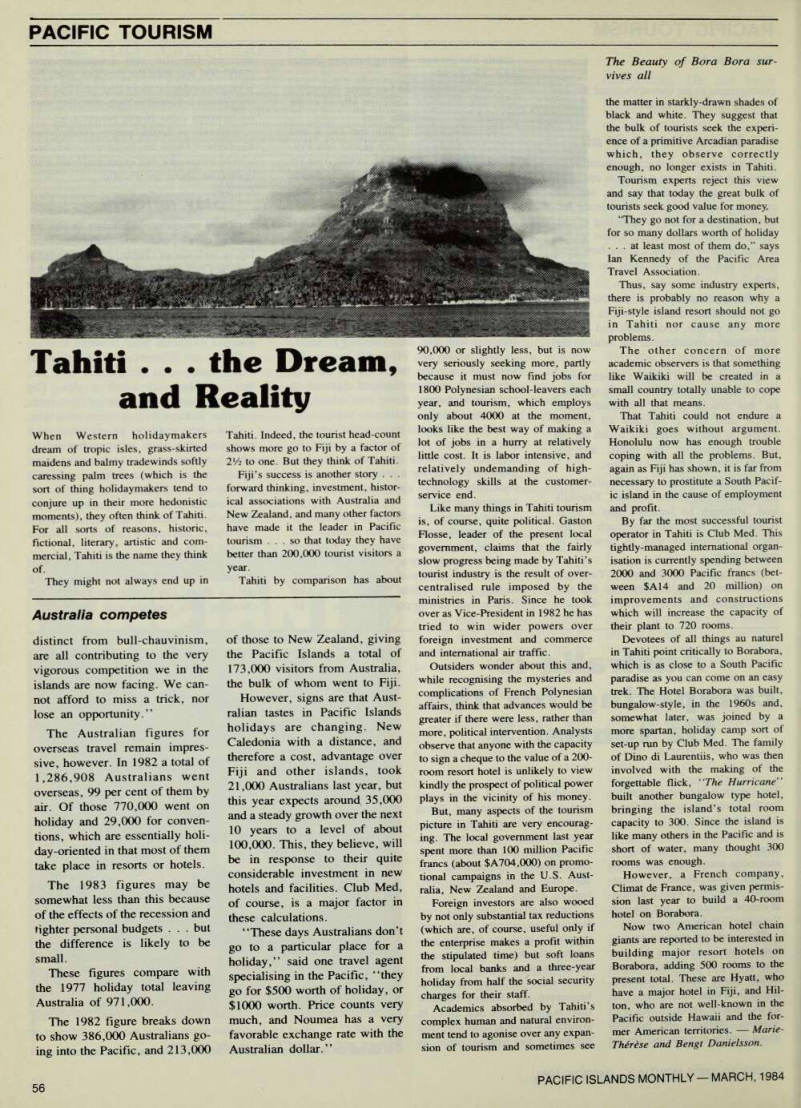
competing for the Oz tourist $
The Pacific’s biggest competitor for the Australian tourist dollar is Australia itself.
Both the federal and state gov ernments are now putting an enormous amount of money, and energy, into diverting Aust ralians away from their tradition al overseas holidays and towards “visiting’’ their own country.
The combined tourism promo tion budget in Australia this year is about $l4 million. Fiji, biggest of the South Pacific operators, spends less than $1 million a year in Australia through its Fiji Visitors’ Bureau, and possibly about double that amount by the
individual efforts of airlines and tour and resort operators. What Australian airlines and destina tions spend on their own account over the state and federal govern ment spending is unknown, but must run into many more mill ions of dollars.
“Australians are only just learning to admire their own country,’’ said one Pacific pro moter. “In the old days most of them thought foreign places were much more inviting. Now it is beginning to change, because there is a very great deal to see in Australia. That realisation, and the rise of true national pride, as
NOUMEA . . . close to Australian mass tourist markets, different in culture and a rising force in the industry.
Australia competes
distinct from bull-chauvinism, are all contributing to the very vigorous competition we in the islands are now facing. We can not afford to miss a trick, nor lose an opportunity.”
The Australian figures for overseas travel remain impres sive, however. In 1982 a total of 1,286,908 Australians went overseas, 99 per cent of them by air. Of those 770,000 went on holiday and 29,000 for conven tions, which are essentially holi day-oriented in that most of them take place in resorts or hotels.
The 1983 figures may be somewhat less than this because of the effects of the recession and tighter personal budgets . . . but the difference is likely to be small.
These figures compare with the 1977 holiday total leaving Australia of 971,000.
The 1982 figure breaks down to show 386,000 Australians go ing into the Pacific, and 213,000
of those to New Zealand, giving the Pacific Islands a total of 173.000 visitors from Australia, the bulk of whom went to Fiji.
However, signs are that Aust ralian tastes in Pacific Islands
holidays are changing. New
Caledonia with a distance, and therefore a cost, advantage over Fiji and other islands, took 21.000 Australians last year, but this year expects around 35,000 and a steady growth over the next 10 years to a level of about 100,000. This, they believe, will be in response to their quite considerable investment in new hotels and facilities. Club Med, of course, is a major factor in these calculations.
“These days Australians don’t go to a particular place for a holiday,” said one travel agent specialising in the Pacific, “they go for SSOO worth of holiday, or SIOOO worth. Price counts very much, and Noumea has a very favorable exchange rate with the Australian dollar.”
Advertisements & other items, p. 55 (1 item)
Pacific Tourism
From page 11
and Reality
Tahiti . . . the Dream, and Reality
When Western holidaymakers dream of tropic isles, grass-skirted maidens and balmy tradewinds softly caressing palm trees (which is the sort of thing holidaymakers tend to conjure up in their more hedonistic moments), they often think of Tahiti.
For all sorts of reasons, historic, fictional, literary, artistic and com mercial, Tahiti is the name they think of.
They might not always end up in
Tahiti. Indeed, the tourist head-count shows more go to Fiji by a factor of 2'/ 2 to one. But they think of Tahiti.
Fiji’s success is another story . . . forward thinking, investment, histor ical associations with Australia and New Zealand, and many other factors have made it the leader in Pacific tourism ... so that today they have better than 200,000 tourist visitors a year.
Tahiti by comparison has about
90,000 or slightly less, but is now very seriously seeking more, partly because it must now find jobs for 1800 Polynesian school-leavers each year, and tourism, which employs only about 4000 at the moment, looks like the best way of making a lot of jobs in a hurry at relatively little cost. It is labor intensive, and
relatively undemanding of high
technology skills at the customer service end.
Like many things in Tahiti tourism is, of course, quite political. Gaston Flosse, leader of the present local government, claims that the fairly slow progress being made by Tahiti’s tourist industry is the result of over centralised rule imposed by the ministries in Paris. Since he took over as Vice-President in 1982 he has tried to win wider powers over foreign investment and commerce and international air traffic.
Outsiders wonder about this and, while recognising the mysteries and
complications of French Polynesian
affairs, think that advances would be greater if there were less, rather than more, political intervention. Analysts observe that anyone with the capacity to sign a cheque to the value of a 200room resort hotel is unlikely to view kindly the prospect of political power plays in the vicinity of his money.
But, many aspects of the tourism picture in Tahiti are very encourag ing. The local government last year spent more than 100 million Pacific francs (about $A704,000) on promo tional campaigns in the U.S. Aust ralia, New Zealand and Europe.
Foreign investors are also wooed by not only substantial tax reductions (which are, of course, useful only if the enterprise makes a profit within the stipulated time) but soft loans from local banks and a three-year holiday from half the social security charges for their staff.
Academics absorbed by Tahiti’s complex human and natural environ ment tend to agonise over any expan sion of tourism and sometimes see
The Beauty of Bora Bora sur vives all the matter in starkly-drawn shades of black and white. They suggest that the bulk of tourists seek the experi ence of a primitive Arcadian paradise which, they observe correctly enough, no longer exists in Tahiti.
Tourism experts reject this view and say that today the great bulk of tourists seek good value for money.
“They go not for a destination, but for so many dollars worth of holiday ... at least most of them do,” says lan Kennedy of the Pacific Area Travel Association.
Thus, say some industry experts, there is probably no reason why a Fiji-style island resort should not go in Tahiti nor cause any more problems.
The other concern of more academic observers is that something like Waikiki will be created in a small country totally unable to cope with all that means.
That Tahiti could not endure a Waikiki goes without argument.
Honolulu now has enough trouble coping with all the problems. But, again as Fiji has shown, it is far from necessary to prostitute a South Pacif ic island in the cause of employment
and profit.
By far the most successful tourist operator in Tahiti is Club Med. This tightly-managed international organ isation is currently spending between 2000 and 3000 Pacific francs (bet ween SAI4 and 20 million) on improvements and constructions which will increase the capacity of their plant to 720 rooms.
Devotees of all things au naturel in Tahiti point critically to Borabora, which is as close to a South Pacific paradise as you can come on an easy trek. The Hotel Borabora was built, bungalow-style, in the 1960 sand, somewhat later, was joined by a more spartan, holiday camp sort of set-up run by Club Med. The family of Dino di Laurentiis, who was then involved with the making of the forgettable flick, “The Hurricane ” built another bungalow type hotel, bringing the island’s total room capacity to 300. Since the island is like many others in the Pacific and is short of water, many thought 300 rooms was enough.
However, a French company, Climat de France, was given permis sion last year to build a 40-room hotel on Borabora.
Now two American hotel chain giants are reported to be interested in building major resort hotels on Borabora, adding 500 rooms to the present total. These are Hyatt, who have a major hotel in Fiji, and Hil ton, who are not well-known in the Pacific outside Hawaii and the for
mer American territories.
Marie-
Therese and Bengt Danielsson.
Advertisements & other items, p. 56 (1 item)
Pacific Tourism
Guam, Saipan, are
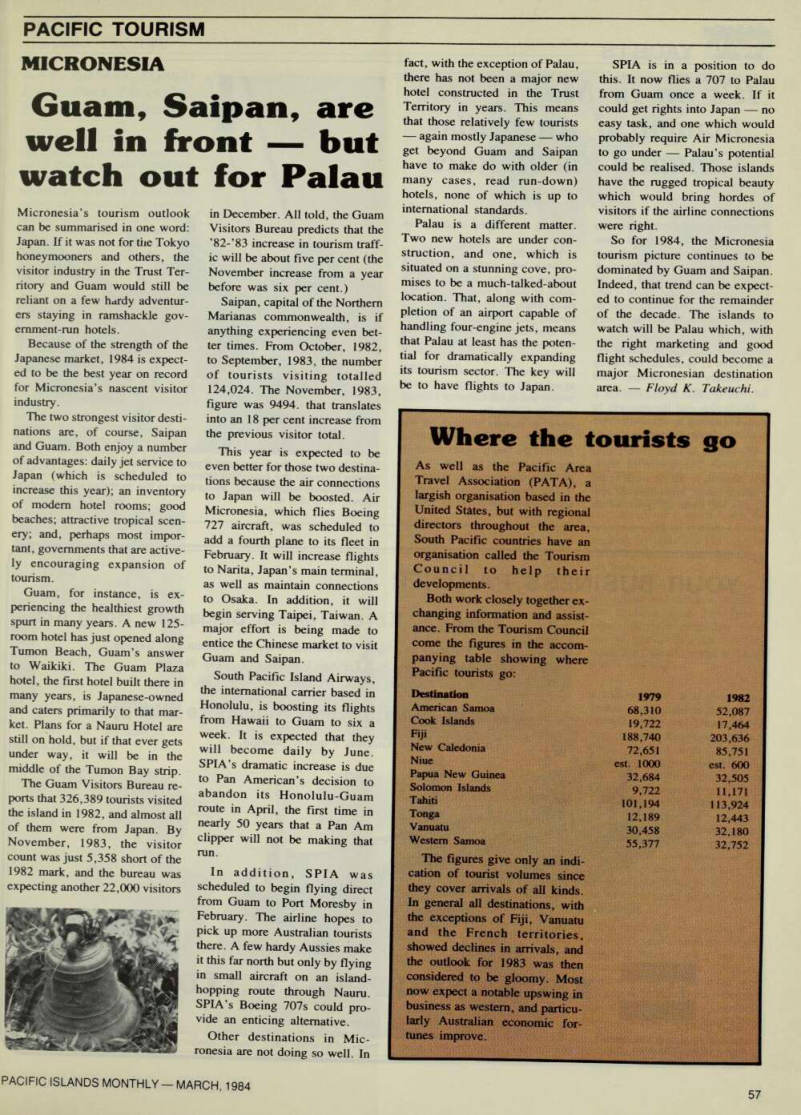
Micronesia
Guam, Saipan, are well in front - but watch out for Palau
Micronesia’s tourism outlook can be summarised in one word: Japan. If it was not for the Tokyo honeymooners and others, the visitor industry in the Trust Ter ritory and Guam would still be reliant on a few hardy adventur ers staying in ramshackle gov ernment-run hotels.
Because of the strength of the Japanese market, 1984 is expect ed to be the best year on record for Micronesia’s nascent visitor
industry.
The two strongest visitor desti nations are, of course, Saipan and Guam. Both enjoy a number
of advantages; daily jet service to
Japan (which is scheduled to increase this year); an inventory of modem hotel rooms; good beaches; attractive tropical scen ery; and, perhaps most impor tant, governments that are active
ly encouraging expansion of
tourism.
Guam, for instance, is ex
periencing the healthiest growth
spurt in many years. A new 125room hotel has just opened along Turnon Beach, Guam’s answer to Waikiki. The Guam Plaza hotel, the first hotel built there in many years, is Japanese-owned and caters primarily to that mar ket. Plans for a Naum Hotel are still on hold, but if that ever gets under way, it will be in the middle of the Turnon Bay strip.
The Guam Visitors Bureau re ports that 326,389 tourists visited the island in 1982, and almost all of them were from Japan. By November, 1983, the visitor count was just 5,358 short of the 1982 mark, and the bureau was expecting another 22,000 visitors
in December. All told, the Guam Visitors Bureau predicts that the ’B2-’B3 increase in tourism traff ic will be about five per cent (the November increase from a year before was six per cent.) Saipan, capital of the Northern Marianas commonwealth, is if anything experiencing even bet ter times. From October, 1982, to September, 1983, the number of tourists visiting totalled 124,024. The November, 1983, figure was 9494. that translates into an 18 per cent increase from the previous visitor total.
This year is expected to be even better for those two destina tions because the air connections to Japan will be boosted. Air Micronesia, which flies Boeing 727 aircraft, was scheduled to add a fourth plane to its fleet in February. It will increase flights to Narita, Japan’s main terminal, as well as maintain connections to Osaka. In addition, it will begin serving Taipei, Taiwan. A major effort is being made to entice the Chinese market to visit Guam and Saipan.
South Pacific Island Airways, the international carrier based in Honolulu, is boosting its flights from Hawaii to Guam to six a week. It is expected that they will become daily by June.
SPIA’s dramatic increase is due to Pan American’s decision to abandon its Honolulu-Guam route in April, the first time in nearly 50 years that a Pan Am clipper will not be making that run.
In addition, SPIA was scheduled to begin flying direct from Guam to Port Moresby in February. The airline hopes to pick up more Australian tourists there. A few hardy Aussies make it this far north but only by flying in small aircraft on an island
hopping route through Nauru.
SPIA’s Boeing 707 s could pro
vide an enticing alternative.
Other destinations in Mic ronesia are not doing so well. In
fact, with the exception of Palau, there has not been a major new hotel constructed in the Trust Territory in years. This means that those relatively few tourists
again mostly Japanese who
get beyond Guam and Saipan have to make do with older (in many cases, read run-down) hotels, none of which is up to international standards.
Palau is a different matter.
Two new hotels are under con struction, and one, which is situated on a stunning cove, pro mises to be a much-talked-about location. That, along with com pletion of an airport capable of
handling four-engine jets, means
that Palau at least has the poten
tial for dramatically expanding
its tourism sector. The key will be to have flights to Japan.
SPIA is in a position to do this. It now flies a 707 to Palau from Guam once a week. If it could get rights into Japan no easy task, and one which would
probably require Air Micronesia
to go under Palau’s potential could be realised. Those islands
have the rugged tropical beauty
which would bring hordes of visitors if the airline connections
were right.
So for 1984, the Micronesia tourism picture continues to be dominated by Guam and Saipan.
Indeed, that trend can be expect ed to continue for the remainder of the decade. The islands to watch will be Palau which, with the right marketing and good flight schedules, could become a major Micronesian destination
area.
Floyd K. Takeuchi.
Where the tourists go
As well as the Pacific Area Travel Association (PATA), a largish organisation based in the United States, but with regional directors throughout the area, South Pacific countries have an organisation called the Tourism Council to help their developments.
Both work closely together ex changing information and assist ance. From the Tourism Council come the figures in the accom panying table showing where Pacific tourists go:
The figures give only an indi cation of tourist volumes since they cover arrivals of all kinds.
In general all destinations, with the exceptions of Fiji, Vanuatu and the French territories, showed declines in arrivals, and the outlook for 1983 was then considered to be gloomy. Most now expect a notable upswing in business as western, and particu larly Australian economic for tunes improve.
Destination 1979 1982 American Samoa 68,310 52,087 Cook Islands 19,722 17,464 Fiji 188,740 203,636 New Caledonia 72,651 85,751 Niue est. 1000 est. 600 Papua New Guinea 32,684 32,505 Solomon Islands 9,722 11,171 Tahiti 101,194 113,924 Tonga 12,189 12,443 Vanuatu 30.458 32,180 Western Samoa 55,377 32,752
inaugural Australia-
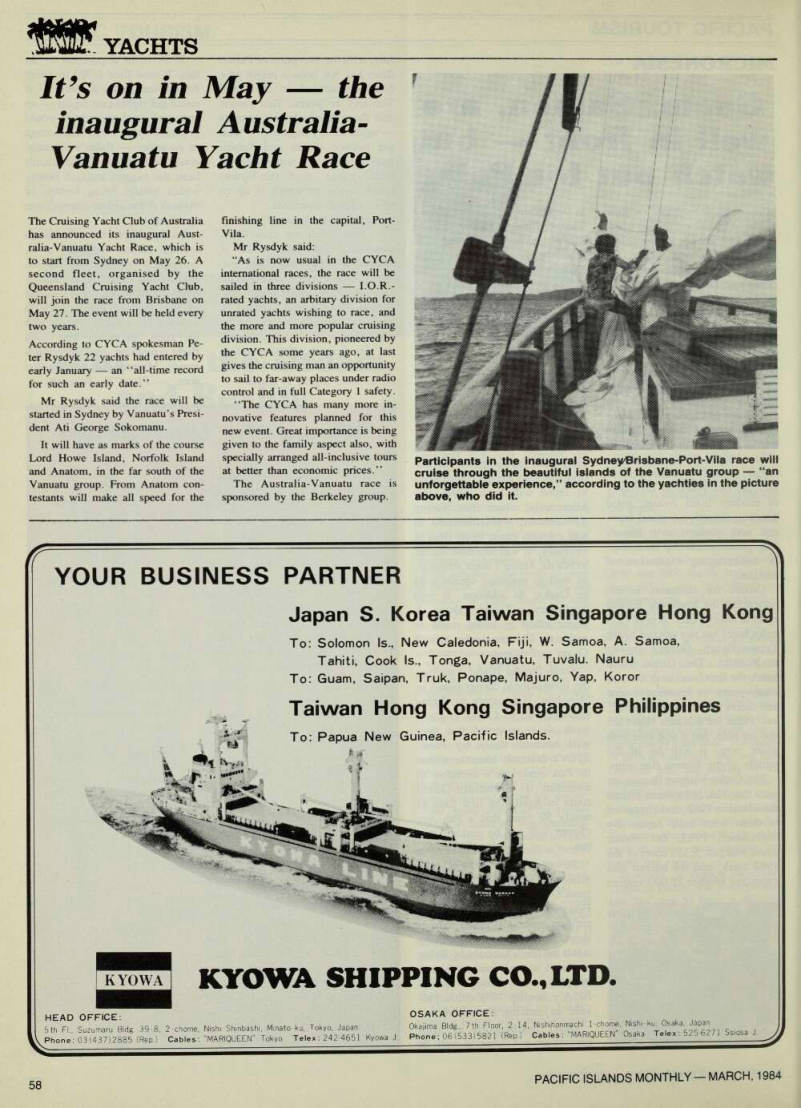
Yachts
It’s on in May the inaugural Australia- Vanuatu Yacht Race
The Cruising Yacht Club of Australia has announced its inaugural Aust ralia-Vanuatu Yacht Race, which is to start from Sydney on May 26. A second fleet, organised by the Queensland Cruising Yacht Club, will join the race from Brisbane on May 27. The event will be held every two years.
According to CYCA spokesman Pe ter Rysdyk 22 yachts had entered by early January an “all-time record for such an early date.”
Mr Rysdyk said the race will be started in Sydney by Vanuatu’s Presi dent Ati George Sokomanu.
It will have as marks of the course Lord Howe Island, Norfolk Island and Anatom, in the far south of the Vanuatu group. From Anatom con testants will make all speed for the
finishing line in the capital, Port- Vila.
Mr Rysdyk said: “As is now usual in the CYC A international races, the race will be sailed in three divisions —1.0. rated yachts, an arbitary division for unrated yachts wishing to race, and the more and more popular cruising division. This division, pioneered by the CYCA some years ago, at last gives the cruising man an opportunity to sail to far-away places under radio control and in full Category 1 safety.
“The CYCA has many more in novative features planned for this new event. Great importance is being given to the family aspect also, with specially arranged all-inclusive tours at better than economic prices.”
The Australia-Vanuatu race is sponsored by the Berkeley group.
Participants in the inaugural Sydney/Brisbane-Port-Vila race will cruise through the beautiful islands of the Vanuatu group “an unforgettable experience,” according to the yachties in the picture above, who did it.
Advertisements & other items, p. 58 (1 item)
Kyowa Shipping Co., Ltd.
YOUR BUSINESS PARTNER
Japan S. Korea Taiwan Singapore Hong Kong To: Solomon Is., New Caledonia, Fiji, W. Samoa, A. Samoa, Tahiti, Cook Is., Tonga, Vanuatu, Tuvalu. Nauru To: Guam, Saipan, Truk, Ponape, Majuro, Yap, Koror
Taiwan Hong Kong Singapore Philippines
£ To: Papua New Guinea, Pacific Islands. r ft*; st
KYOWA
KYOWA SHIPPING CO., LTD.
HEAD OFFICE:
OSAKA OFFICE:
sth Ft, Suzumaru Bldg, 39-8, 2-chome, Nishi-Shinbashi, Minalo-ko, Tokyo, Jaoaa Okai.ma Bldg, 7th Floor 2 14, “sh.hoomach, ku T^ k \f s P =" , Ssiosa j Phone: 03(437)2885 (Rep.) Cables: MARIQUEEN" Tokyo. Telex : 242-4651 Kyowa J. Phone; 06(533)5821 (Rep.) Cables. MARIQUEEN Os •
KAY BASON reports
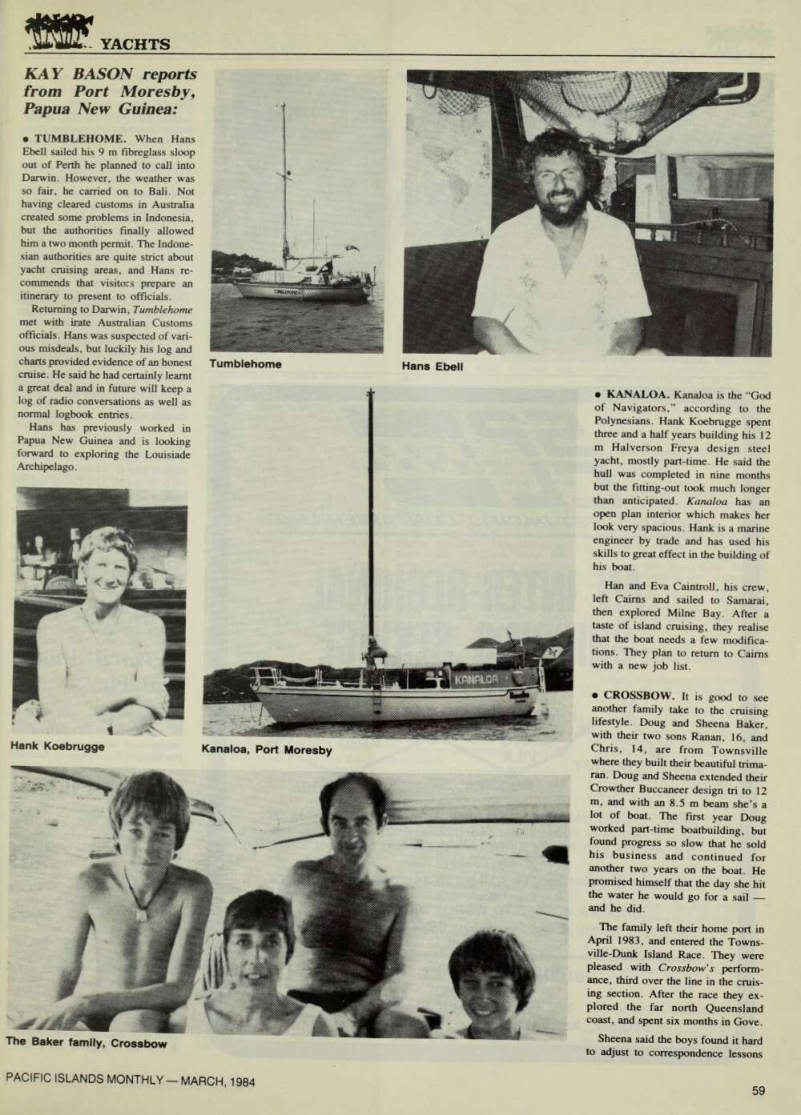
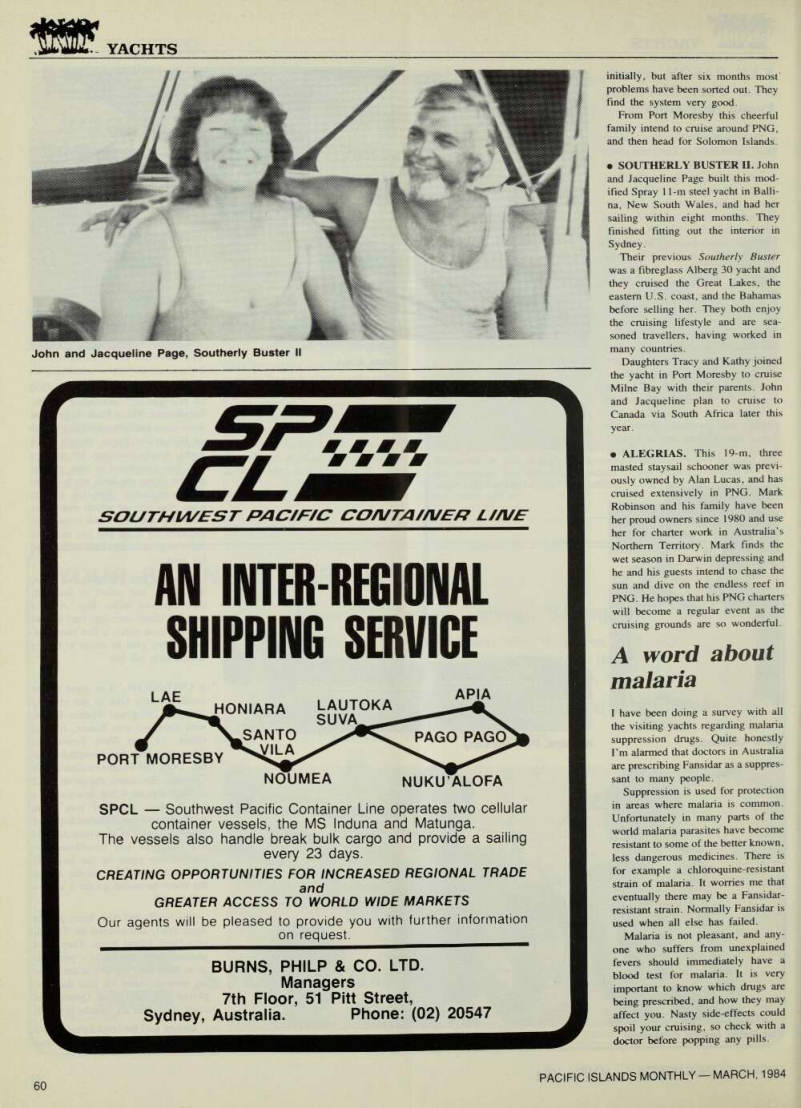
from Port Moresby, Papua New Guinea:
• TUMBLEHOME. When Hans Ebell sailed his 9 m fibreglass sloop out of Perth he planned to call into Darwin. However, the weather was so fair, he carried on to Bali. Not having cleared customs in Australia created some problems in Indonesia, but the authorities finally allowed him a two month permit. The Indone sian authorities are quite strict about yacht cruising areas, and Hans re commends that visitors prepare an itinerary to present to officials.
Returning to Darwin, Tumblehome met with irate Australian Customs officials. Hans was suspected of vari ous misdeals, but luckily his log and charts provided evidence of an honest cruise. He said he had certainly learnt a great deal and in future will keep a log of radio conversations as well as normal logbook entries.
Hans has previously worked in Papua New Guinea and is looking forward to exploring the Louisiade Archipelago.
• KANALOA. Kanaloa is the “God of Navigators,” according to the
Polynesians. Hank Koebmgge spent
three and a half years building his 12 m Halverson Freya design steel yacht, mostly part-time. He said the hull was completed in nine months but the fitting-out took much longer than anticipated. Kanaloa has an open plan interior which makes her look very spacious. Hank is a marine engineer by trade and has used his skills to great effect in the building of his boat.
Han and Eva Caintroll, his crew, left Cairns and sailed to Samarai, then explored Milne Bay. After a taste of island cruising, they realise that the boat needs a few modifica tions. They plan to return to Cairns with a new job list. • CROSSBOW. It is good to see another family take to the cruising lifestyle. Doug and Sheena Baker, with their two sons Ran an, 16, and Chris, 14, are from Townsville where they built their beautiful trima ran. Doug and Sheena extended their Crowther Buccaneer design tri to 12 m, and with an 8.5 m beam she’s a lot of boat. The first year Doug worked part-time boatbuilding, but found progress so slow that he sold his business and continued for another two years on the boat. He promised himself that the day she hit the water he would go for a sail and he did.
The family left their home port in April 1983, and entered the Towns ville-Dunk Island Race. They were pleased with Crossbow’s perform ance, third over the line in the cruis ing section. After the race they ex plored the far north Queensland coast, and spent six months in Gove.
Sheena said the boys found it hard to adjust to correspondence lessons
Hank Koebmgge
The Baker family, Crossbow
Tumblehome
Kanaloa, Port Moresby
Hans Ebell
initially, but after six months most problems have been sorted out. They find the system very good.
From Port Moresby this cheerful family intend to cruise around PNG, and then head for Solomon Islands.
• Southerly Buster H. John
and Jacqueline Page built this mod ified Spray 11 -m steel yacht in Balli na. New South Wales, and had her sailing within eight months. They finished fitting out the interior in Sydney.
Their previous Southerly Buster was a fibreglass Alberg 30 yacht and they cruised the Great Lakes, the eastern U.S. coast, and the Bahamas before selling her. They both enjoy the cruising lifestyle and are sea soned travellers, having worked in many countries.
Daughters Tracy and Kathy joined the yacht in Port Moresby to cruise Milne Bay with their parents. John and Jacqueline plan to cruise to Canada via South Africa later this year. • ALEGRIAS. This 19-m, three masted staysail schooner was previ ously owned by Alan Lucas, and has cruised extensively in PNG. Mark Robinson and his family have been her proud owners since 1980 and use her for charter work in Australia’s Northern Territory. Mark finds the wet season in Darwin depressing and he and his guests intend to chase the sun and dive on the endless reef in PNG. He hopes that his PNG charters will become a regular event as the cruising grounds are so wonderful.
A word about
malaria
I have been doing a survey with all the visiting yachts regarding malaria suppression drugs. Quite honestly I’m alarmed that doctors in Australia are prescribing Fansidar as a suppres sant to many people.
Suppression is used for protection in areas where malaria is common.
Unfortunately in many parts of the world malaria parasites have become resistant to some of the better known, less dangerous medicines. There is for example a chloroquine-resistant strain of malaria. It worries me that eventually there may be a Fansidar resistant strain. Normally Fansidar is used when all else has failed.
Malaria is not pleasant, and any one who suffers from unexplained fevers should immediately have a blood test for malaria. It is very important to know which drugs are being prescribed, and how they may affect you. Nasty side-effects could spoil your cruising, so check with a doctor before popping any pills.
John and Jacqueline Page, Southerly Buster II
Advertisements & other items, p. 60 (1 item)
Shipping Service
SOUTHWEST PAO/FIC 00/UTA//UEA7 L//UE
Ml INTER-REGIONAL
APIA
LAE
LAUTOKA
SUVA .
HONIARA
SANTO
S^VILA
PAGO PAGO
NUKUALOFA
PORT MORESBY
NOUMEA
SPCL Southwest Pacific Container Line operates two cellular container vessels, the MS Induna and Matunga.
The vessels also handle break bulk cargo and provide a sailing every 23 days.
CREATING OPPORTUNITIES FOR INCREASED REGIONAL TRADE
and
GREATER ACCESS TO WORLD WIDE MARKETS
Our agents will be pleased to provide you with further information on request.
BURNS, PHILP & CO. LTD.
Managers
7th Floor, 51 Pitt Street, Sydney, Australia. Phone: (02) 20547
Sydney and'sC
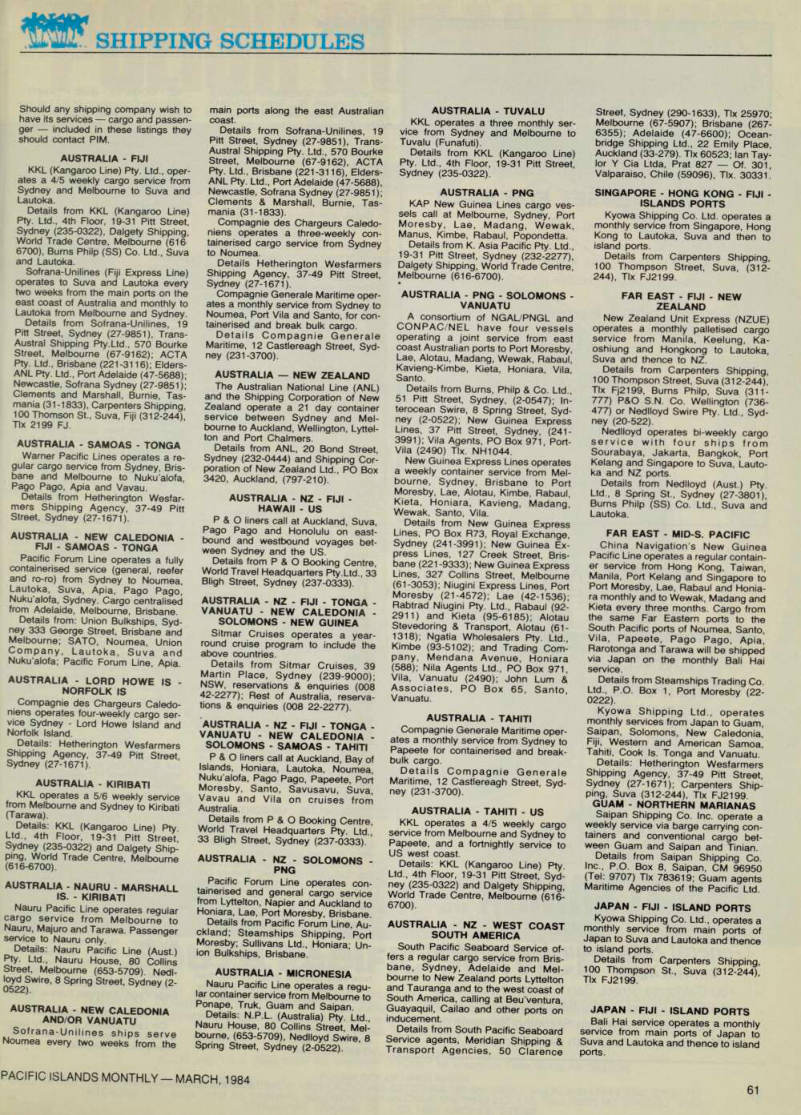
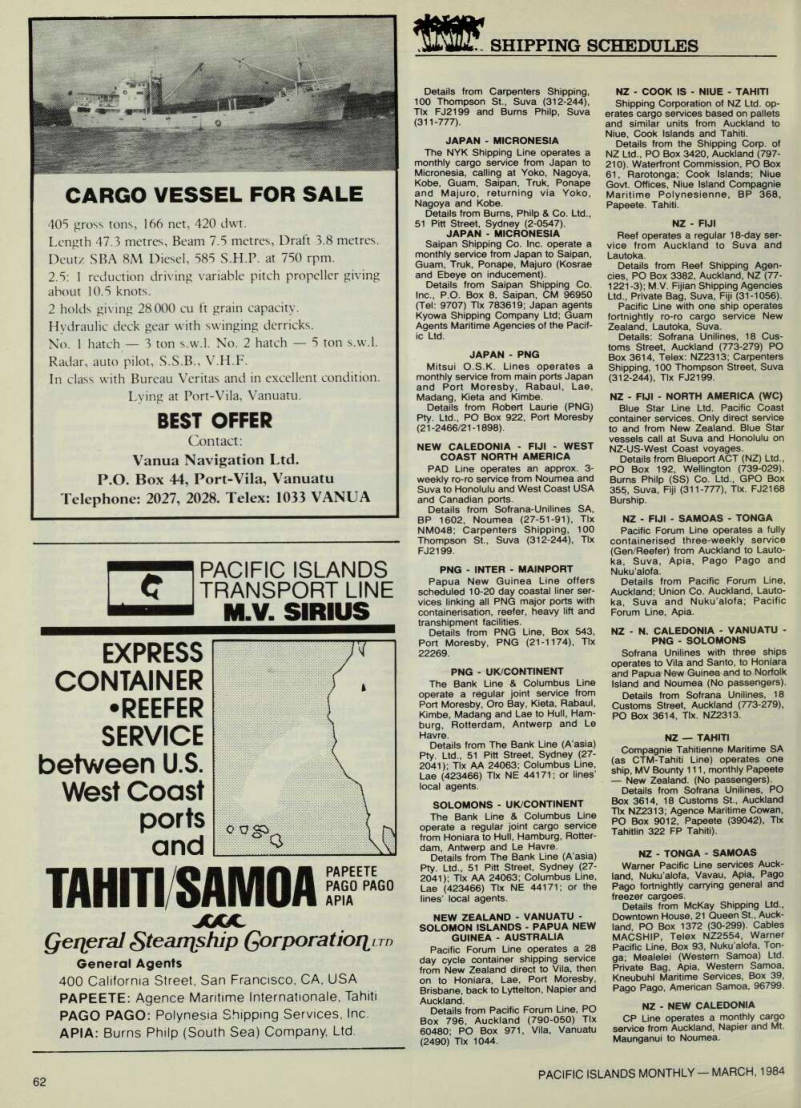
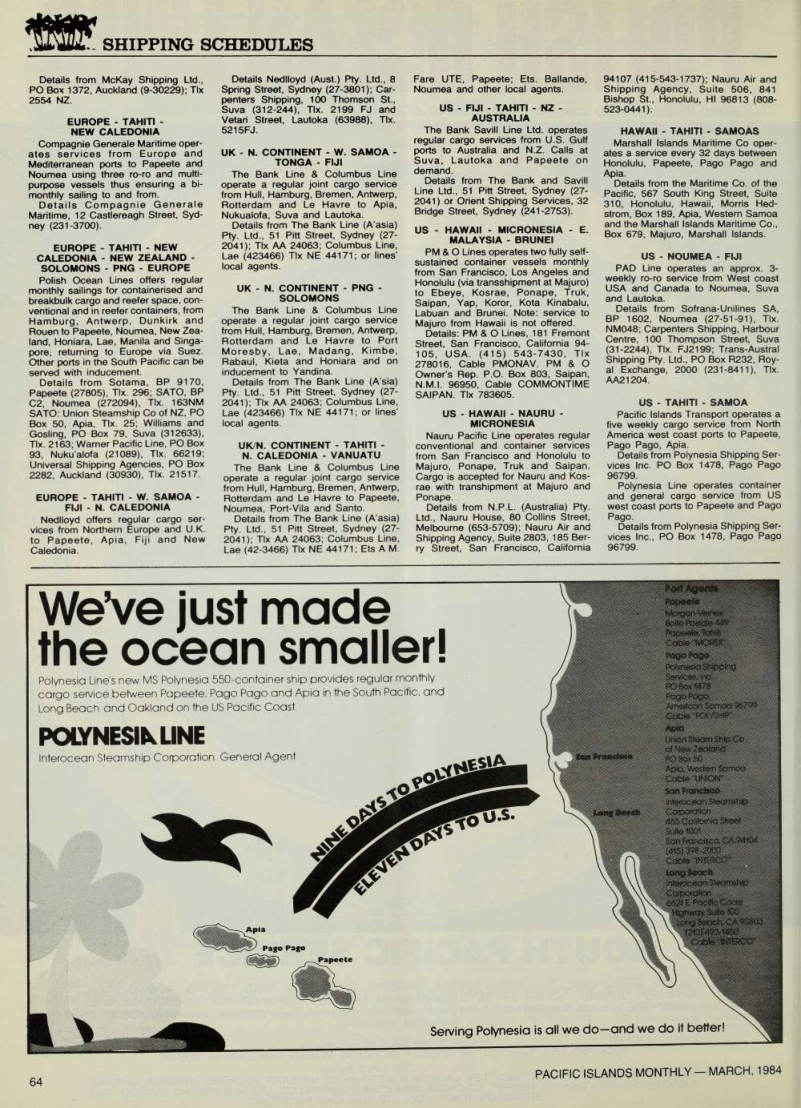
Shipping Schedules
Should any shipping company wish to have its services cargo and passenger included in these listings they should contact PIM. a.ictba. .a c...
Australia - Fiji
KKL (Kangaroo Line) Pty. Ltd., operates a 4/5 weekly cargo service from Sydney and Melbourne to Suva and Lautoka.
Details from KKL (Kangaroo Line) Pty. Ltd., 4th Floor, 19-31 Pitt Street, Sydney (235-0322), Dalgety Shipping, World Trade Centre, Melbourne (616 6700), Burns Philp (SS) Co. Ltd., Suva and Lautoka.
Sofrana-Unilines (Fiji Express Line) operates to Suva and Lautoka every two weeks from the main ports on the east coast of Australia and monthly to Lautoka from Melbourne and Sydney.
Details from Sofrana-Unilines, 19 Pitt Street, Sydney (27-9851), Trans- Austral Shipping Pty.Ltd., 570 Bourke Street. Melbourne (67-9162); ACTA Pty. Ltd., Brisbane (221-3116); Elders- ANL Pty. Ltd., Port Adelaide (47-5688); Newcastle, Sofrana Sydney (27-9851); Clements and Marshall, Burnie, Tasmania (31-1833), Carpenters Shipping. 100 Thomson St., Suva, Fiji (312-244), Tlx 2199 FJ. aiictdai ia .
Australia - Samoas - Tonga
Warner Pacific Lines operates a regular cargo service from Sydney, Brisbane and Melbourne to Nukualofa, Pago Pago, Apia and Vavau.
Details from Hetherington Wesfarmers Shipping Agency, 37-49 Pitt Street, Sydney (27-1671).
AUSTRALIA npw rai cnrmiA FkS SAMO E a£ C ?nwrA N A '
Fiji - Samoas - Tonga
Pacific Forum Line operates a fully containerised service (general, reefer and ro-ro) from Sydney to Noumea, Lautoka, Suva, Apia, Pago Pago, Nukualofa, Sydney. Cargo centralised from Adelaide, Melbourne, Brisbane.
Details from; Union Bulkships, Sydney 333 George Street, Brisbane and Melbourne, SATO, Noumea, Union Company, Lautoka, Suva and Nukualofa; Pacific Forum Line, Apia.
Australia - Lord Howe Iq
norpoi »? ic ° WE S * r ° ° * lB Compagnie des Chargeurs Caledomens operates four-weekly cargo ser vice Sydney - Lord Howe Island and Norfolk Island.
Details: Hetherington Wesfarmers 37 ‘ 49 Pin S,ree ’' Sydney (27-1671).
AUSTRAt ia krioioATi
Australia- Kiribati
fJl K K°P® rates a 5/ '* eekl V ser vice from Melbourne and Sydney to Kiribati Ltd e, 4ih (K ?3 9 f, ro °p Line) Ply '
Sydney and'sC
ping, World Trade Centre, Melbourne (616-6700).
AUSTRALIA - NAURU marcuai i , s KiRiRAT?
Naum Pani.n i *
camo sr^c f « iTf reguiar
Naum r ilx Melbourne to dT f rawa Passenger S °rTic^ e il° K 3UrU o ny ‘ PK? *1 M 3uru P f c,flc Llne (Aust.) Pty. Ltd., Nauru House, 80 Collins Street. Melbourne (653-5709). Nedlk)yd Swre, 8 Spring Street. Sydney (2- ''
Australia - New Cai Pnouia
And/Or Vans£Tu
Sofrana c h botrana-Umlmes ships serve Noumea every two weeks from the
main ports along the east Australian coast.
Details from Sofrana-Unilines, 19 Pitt Street, Sydney (27-9851). Trans- Austral Shipping Pty. Ltd., 570 Bourke Street, Melbourne (67-9162), ACTA Pty. Ltd., Brisbane (221-3116), Elders- ANL Pty. Ltd., Port Adelaide (47-5688), Newcastle, Sofrana Sydney (27-9851); Clements & Marshall, Burnie, Tas mania (31-1833).
Compagnie des Chargeurs Caledo nians operates a three-weekly con tainerised cargo service from Sydney to Noumea.
Details Hetherington Wesfarmers Shipping Agency, 37-49 Pitt Street, Sydney (27-1671).
Compagnie Generale Maritime oper ates a monthly service from Sydney to Noumea, Port Vila and Santo, for con tainerised and break bulk cargo.
Details Compagnie Generale Maritime, 12 Castlereagh Street, Syd ney (231-3700).
Australia New Zealand
The Australian National Line (ANL) and the Shipping Corporation of New Zealand operate a 21 day container service between Sydney and Mel bourne to Auckland, Wellington, Lyttel ton and Port Chalmers.
Details from ANL, 20 Bond Street.
Sydney (232-0444) and Shipping Cor poration of New Zealand Ltd., PO Box 3420, Auckland, (797-210).
Australia - Nz - Fiji -
Hawaii - Us
P&O liners call at Auckland, Suva, Pago Pago and Honolulu on east bound and westbound voyages bet ween Sydney and the US.
Details from P&O Booking Centre, World Travel Headquarters Pty.Ltd., 33 Bligh Street, Sydney (237-0333).
AUSTRALIA - NZ - FIJI - TONGA -
Vanuatu - New Caledonia -
Solomons - New Guinea
Sitmar Cruises operates a year round cruise program to include the above countries.
Details from Sitmar Cruises, 39 Martin Place, Sydney (239-9000); NSW, reservations & enquiries (008 42-2277); Rest of Australia, reserva tions & enquiries (008 22-2277).
AUSTRALIA - NZ - FIJI - TONGA -
Vanuatu - New Caledonia -
Solomons - Samoas - Tahiti
P&O liners call at Auckland, Bay of Islands, Honiara, Lautoka, Noumea, Nukualofa, Pago Pago, Papeete, Port Moresby, Santo, Savusavu, Suva, Vavau and Vila on cruises from Australia.
Details from P&O Booking Centre, World Travel Headquarters Pty. Ltd., 33 Bligh Street, Sydney (237-0333).
Australia - Nz - Solomons -
Png
Pacific Forum Line operates con tainerised and general cargo service from Lyttelton, Napier and Auckland to Honiara, Lae, Port Moresby, Brisbane.
Details from Pacific Forum Line, Au ckland: Steamships Shipping, Port Moresby; Sullivans Ltd., Honiara; Un ion Bulkships, Brisbane.
Australia - Micronesia
Nauru Pacific Line operates a regu lar container service from Melbourne to Ponape, Truk, Guam and Saipan.
Details: N.P.L. (Australia) Pty. Ltd Nauru House, 80 Collins Street, Mel bourne, (653-5709), Nedlloyd Swire, 8 Spring Street, Sydney (2-0522).
Australia - Tuvalu
KKL operates a three monthly ser vice from Sydney and Melbourne to Tuvalu (Funafuti).
Details from KKL (Kangaroo Line) Pty. Ltd., 4th Floor, 19-31 Pitt Street.
Sydney (235-0322).
Australia - Png
KAP New Guinea Lines cargo ves sels call at Melbourne, Sydney, Port Moresby, Lae, Madang, Wewak, Manus, Kimbe, Rabaul, Popondetta.
Details from K. Asia Pacific Pty. Ltd., 19-31 Pitt Street, Sydney (232-2277), Dalgety Shipping, World Trade Centre, Melbourne (616-6700).
Australia - Png - Solomons -
Vanuatu
A consortium of NGAL/PNGL and CONPAC/NEL have four vessels operating a joint service from east coast Australian ports to Port Moresby, Lae, Alotau, Madang, Wewak, Rabaul, Kavieng-Kimbe, Kieta, Honiara, Vila.
Santo.
Details from Burns, Philp & Co. Ltd., 51 Pitt Street, Sydney, (2-0547); In terocean Swire, 8 Spring Street, Syd ney (2-0522); New Guinea Express Lines, 37 Pitt Street, Sydney, (241- 3991); Vila Agents, PO Box 971, Port- Vila (2490) Tlx. NH1044.
New Guinea Express Lines operates a weekly container service from Mel bourne, Sydney, Brisbane to Port Moresby, Lae, Alotau, Kimbe, Rabaul, Kieta, Honiara, Kavieng, Madang, Wewak, Santo, Vila.
Details from New Guinea Express Lines, PO Box R 73, Royal Exchange, Sydney (241-3991); New Guinea Ex press Lines, 127 Creek Street, Bris bane (221-9333); New Guinea Express Lines, 327 Collins Street, Melbourne (61-3053); Niugini Express Lines, Port Moresby (21-4572); Lae (42-1536); Rabtrad Niugini Pty. Ltd., Rabaul (92- 2911) and Kieta (95-6185); Alotau Stevedoring & Transport, Alotau (61- 1318); Ngatia Wholesalers Pty. Ltd..
Kimbe (93-5102); and Trading Com pany, Mendana Avenue, Honiara (588); Nila Agents Ltd., PO Box 971, Vila, Vanuatu (2490); John Lum & Associates, PO Box 65, Santo, Vanuatu.
Australia - Tahiti
Compagnie Generate Maritime oper ates a monthly service from Sydney to Papeete for containerised and break bulk cargo.
Details Compagnie Generale Maritime, 12 Castlereagh Street. Syd ney (231-3700).
Australia - Tahiti - Us
KKL operates a 4/5 weekly cargo service from Melbourne and Sydney to Papeete, and a fortnightly service to US west coast.
Details: KKL (Kangaroo Line) Pty.
Ltd., 4th Floor, 19-31 Pitt Street, Syd ney (235-0322) and Dalgety Shipping, World Trade Centre, Melbourne (616- 6700).
Australia - Nz - West Coast
South America
South Pacific Seaboard Service of fers a regular cargo service from Bris bane, Sydney, Adelaide and Mel bourne to New Zealand ports Lyttelton and Tauranga and to the west coast of South America, calling at Beu’ventura, Guayaquil, Cailao and other ports on inducement.
Details from South Pacific Seaboard Service agents, Meridian Shipping & Transport Agencies, 50 Clarence
Street, Sydney (290-1633), Tlx 25970; Melbourne (67-5907); Brisbane (267- 6355); Adelaide (47-6600); Ocean bridge Shipping Ltd., 22 Emily Place, Auckland (33-279). Tlx 60523; lan Tay lor Y Cia Ltda, Prat 827 Of. 301, Valparaiso, Chile (59096), Tlx. 30331.
SINGAPORE - HONG KONG - FIJI -
Islands Ports
Kyowa Shipping Co. Ltd. operates a monthly service from Singapore, Hong Kong to Lautoka, Suva and then to island ports.
Details from Carpenters Shipping, 100 Thompson Street, Suva, (312- 244), Tlx FJ2199.
Far East - Fiji - New
Zealand
New Zealand Unit Express (NZUE) operates a monthly palletised cargo service from Manila, Keelung, Ka oshiung and Hongkong to Lautoka, Suva and thence to NZ.
Details from Carpenters Shipping, 100 Thompson Street, Suva (312-244), Tlx Fj2199, Burns Philp, Suva (311- 777) P&O S.N. Co. Wellington (736- 477) or Nedlloyd Swire Pty. Ltd., Syd ney (20-522).
Nedlloyd operates bi-weekly cargo service with four ships from Sourabaya, Jakarta, Bangkok, Port Kelang and Singapore to Suva, Lauto ka and NZ ports.
Details from Nedlloyd (Aust.) Pty.
Ltd., 8 Spring St., Sydney (27-3801), Burns Philp (SS) Co. Ltd., Suva and Lautoka.
Far East - Mid-S. Pacific
China Navigation’s New Guinea Pacific Line operates a regular contain er service from Hong Kong, Taiwan, Manila, Port Kelang and Singapore to Port Moresby, Lae, Rabaul and Honia ra monthly and to Wewak, Madang and Kieta every three months. Cargo from the same Far Eastern ports to the South Pacific ports of Noumea, Santo, Vila. Papeete, Pago Pago, Apia] Rarotonga and Tarawa will be shipped via Japan on the monthly Bali Hai service.
Details from Steamships Trading Co.
Ltd., P.O. Box 1, Port Moresby (22- 0222).
Kyowa Shipping Ltd., operates monthly services from Japan to Guam, Saipan, Solomons, New Caledonia, Fiji, Western and American Samoa, Tahiti, Cook Is. Tonga and Vanuatu.
Details: Hetherington Wesfarmers Shipping Agency, 37-49 Pitt Street, Sydney (27-1671); Carpenters Ship ping, Suva (312-244), Tlx FJ2199
Guam - Northern Marianas
Saipan Shipping Co. Inc. operate a weekly service via barge carrying con tainers and conventional cargo bet ween Guam and Saipan and Tinian.
Details from Saipan Shipping Co.
Inc., P.O. Box 8, Saipan, CM 96950 (Tel: 9707) Tlx 783619; Guam agents Maritime Agencies of the Pacific Ltd.
Japan - Fiji - Island Ports
Kyowa Shipping Co. Ltd., operates a monthly service from main ports of Japan to Suva and Lautoka and thence to island ports.
Details from Carpenters Shipping, 100 Thompson St., Suva (312-244) Tlx FJ2199.
Japan - Fiji - Island Ports
Bali Hai service operates a monthly service from main ports of Japan to Suva and Lautoka and thence to island ports.
Details from Carpenters Shipping, 100 Thompson St., Suva (312-244), Tlx FJ2199 and Burns Philp, Suva (311-777).
Japan - Micronesia
The NYK Shipping Line operates a monthly cargo service from Japan to Micronesia, calling at Yoko, Nagoya, Kobe, Guam, Saipan, Truk, Ponape and Majuro, returning via Yoko, Nagoya and Kobe.
Details from Burns, Philp & Co. Ltd., 51 Pitt Street, Sydney (2-0547).
Japan - Micronesia
Saipan Shipping Co. Inc. operate a monthly service from Japan to Saipan, Guam, Truk, Ponape, Majuro (Kosrae and Ebeye on inducement).
Details from Saipan Shipping Co.
Inc., P.O. Box 8, Saipan, CM 96950 (Tel: 9707) Tlx 783619; Japan agents Kyowa Shipping Company Ltd; Guam Agents Maritime Agencies of the Pacif ic Ltd.
Japan - Png
Mitsui O.S.K. Lines operates a monthly service from main ports Japan and Port Moresby, Rabaul, Lae, Madang, Kieta and Kimbe.
Details from Robert Laurie (PNG) Pty. Ltd., PO Box 922, Port Moresby (21-2466/21-1898).
New Caledonia - Fiji - West
Coast North America
PAD Line operates an approx. 3weekly ro-ro service from Noumea and Suva to Honolulu and West Coast USA and Canadian ports.
Details from Sofrana-Unilines SA, BP 1602, Noumea (27-51-91), Tlx NMO4B; Carpenters Shipping, 100 Thompson St., Suva (312-244), Tlx FJ2199.
Png - Inter - Mainport
Papua New Guinea Line offers scheduled 10-20 day coastal liner ser vices linking all PNG major ports with containerisation, reefer, heavy lift and transhipment facilities.
Details from PNG Line, Box 543, Port Moresby, PNG (21-1174), Tlx 22269.
Png - Uk/Continent
The Bank Line & Columbus Line operate a regular joint service from Port Moresby, Oro Bay, Kieta, Rabaul, Kimbe, Madang and Lae to Hull, Ham burg, Rotterdam, Antwerp and Le Havre.
Details from The Bank Line (A’asia) Pty. Ltd., 51 Pitt Street, Sydney (27- 2041); Tlx AA 24063; Columbus Line, Lae (423466) Tlx NE 44171; or lines’ local agents.
Solomons - Uk/Continent
The Bank Line & Columbus Line operate a regular joint cargo service from Honiara to Hull, Hamburg, Rotter dam, Antwerp and Le Havre.
Details from The Bank Line (A'asia) Pty. Ltd., 51 Pitt Street, Sydney (27- 2041); Tlx AA 24063; Columbus Line, Lae (423466) Tlx NE 44171; or the lines’ local agents.
New Zealand - Vanuatu -
Solomon Islands - Papua New
Guinea - Australia
Pacific Forum Line operates a 28 day cycle container shipping service from New Zealand direct to Vila, then on to Honiara, Lae, Port Moresby, Brisbane, back to Lyttelton, Napier and Auckland.
Details from Pacific Forum Line, PO Box 796, Auckland (790-050) Tlx 60480; PO Box 971, Vila, Vanuatu (2490) Tlx 1044.
NZ - COOK IS - NIUE - TAHITI Shipping Corporation of NZ Ltd. op erates cargo services based on pallets and similar units from Auckland to Niue, Cook Islands and Tahiti.
Details from the Shipping Corp. of NZ Ltd., PO Box 3420, Auckland (797- 210). Waterfront Commission, PO Box 61, Rarotonga: Cook Islands; Niue Govt. Offices, Niue Island Compagnie Maritime Polynesienne, BP 368, Papeete. Tahiti.
Nz - Fiji
Reef operates a regular 18-day ser vice from Auckland to Suva and Lautoka.
Details from Reef Shipping Agen cies, PO Box 3382, Auckland, NZ (77- 1221-3); M.V. Fijian Shipping Agencies Ltd., Private Bag, Suva, Fiji (31-1056).
Pacific Line with one ship operates fortnightly ro-ro cargo service New Zealand, Lautoka, Suva.
Details: Sofrana Unilines, 18 Cus toms Street, Auckland (773-279) PO Box 3614, Telex; NZ2313; Carpenters Shipping, 100 Thompson Street, Suva (312-244), Tlx FJ2199.
NZ - FIJI - NORTH AMERICA (WC) Blue Star Line Ltd. Pacific Coast container services. Only direct service to and from New Zealand. Blue Star vessels call at Suva and Honolulu on NZ-US-West Coast voyages.
Details from Blueport ACT (NZ) Ltd., PO Box 192, Wellington (739-029).
Burns Philp (SS) Co. Ltd., GPO Box 355, Suva, Fiji (311-777), Tlx. FJ2168 Burship.
NZ - FIJI - SAMOAS - TONGA Pacific Forum Line operates a fully containerised three-weekly service (Gen/Reefer) from Auckland to Lauto ka, Suva, Apia, Pago Pago and Nukualofa.
Details from Pacific Forum Line, Auckland; Union Co. Auckland, Lauto ka, Suva and Nuku’alofa; Pacific Forum Line, Apia.
NZ - N. CALEDONIA - VANUATU -
Png - Solomons
Sofrana Unilines with three ships operates to Vila and Santo, to Honiara and Papua New Guinea and to Norfolk Island and Noumea (No passengers).
Details from Sofrana Unilines, 18 Customs Street, Auckland (773-279), PO Box 3614, Tlx. NZ2313.
Nz Tahiti
Compagnie Tahitienne Maritime SA (as CTM-Tahiti Line) operates one ship, MV Bounty 111, monthly Papeete New Zealand. (No passengers).
Details from Sofrana Unilines, PO Box 3614, 18 Customs St., Auckland Tlx NZ2313; Agence Maritime Cowan, PO Box 9012, Papeete (39042), Tlx Tahitlin 322 FP Tahiti).
Nz - Tonga - Samoas
Warner Pacific Line services Auck land, Nuku’alofa. Vavau, Apia, Pago Pago fortnightly carrying general and freezer cargoes.
Details from McKay Shipping Ltd., Downtown House, 21 Queen St., Auck land, PO Box 1372 (30-299). Cables MACSHIP, Telex NZ2554, Warner Pacific Line, Box 93, Nukualofa, Ton ga; Mealelei (Western Samoa) Ltd.
Private Bag, Apia, Western Samoa, Kneubuhl Maritime Services, Box 39, Pago Pago, American Samoa, 96799.
Nz - New Caledonia
CP Line operates a monthly cargo service from Auckland, Napier and Mt.
Maunganui to Noumea.
Details from McKay Shipping Ltd., PO Box 1372, Auckland (9-30229); Tlx 2554 NZ.
Europe - Tahiti -
New Caledonia
Compagnie Generale Maritime oper ates services from Europe and Mediterranean ports to Papeete and Noumea using three ro-ro and multi purpose vessels thus ensuring a bi monthly sailing to and from.
Details Compagnie Generale Maritime, 12 Castlereagh Street, Syd ney (231-3700).
Europe - Tahiti - New
Caledonia - New Zealand -
Solomons - Png - Europe
Polish Ocean Lines offers regular monthly sailings for containerised and breakbulk cargo and reefer space, con ventional and in reefer containers, from Hamburg, Antwerp, Dunkirk and Rouen to Papeete, Noumea, New Zea land, Honiara, Lae, Manila and Singa pore, returning to Europe via Suez.
Other ports in the South Pacific can be served with inducement.
Details from Sotama, BP 9170, Papeete (27805), Tlx. 296; SATO, BP C 2, Noumea (272094), Tlx. 163 NM SATO: Union Steamship Co of NZ, PO Box 50, Apia, Tlx. 25; Williams and Gosling, PO Box 79, Suva (312633), Tlx. 2163; Warner Pacific Line, PO Box 93. Nukualofa (21089), Tlx. 66219; Universal Shipping Agencies, PO Box 2282, Auckland (30930), Tlx. 21517.
EUROPE - TAHITI - W. SAMOA -
Fiji - N. Caledonia
Nedlloyd offers regular cargo ser vices from Northern Europe and U.K. to Papeete, Apia, Fiji and New Caledonia.
Details Nedlloyd (Aust.) Pty. Ltd., 8 Spring Street, Sydney (27-3801); Car penters Shipping, 100 Thomson St., Suva (312-244), Tlx. 2199 FJ and Vetari Street, Lautoka (63988), Tlx. 5215FJ.
UK - N. CONTINENT - W. SAMOA -
Tonga - Fiji
The Bank Line & Columbus Line operate a regular joint cargo service from Hull, Hamburg, Bremen, Antwerp, Rotterdam and Le Havre to Apia, Nukualofa, Suva and Lautoka.
Details from The Bank Line (A’asia) Pty. Ltd., 51 Pitt Street, Sydney (27- 2041); Tlx AA 24063; Columbus Line, Lae (423466) Tlx NE 44171; or lines’ local agents.
UK - N. CONTINENT - PNG -
Solomons
The Bank Line & Columbus Line operate a regular joint cargo service from Hull, Hamburg, Bremen, Antwerp, Rotterdam and Le Havre to Port Moresby, Lae, Madang, Kimbe, Rabaul, Kieta and Honiara and on inducement to Yandina.
Details from The Bank Line (A’sia) Pty. Ltd., 51 Pitt Street, Sydney (27- 2041); Tlx AA 24063; Columbus Line, Lae (423466) Tlx NE 44171; or lines’ local agents.
Uk/N. Continent - Tahiti -
N. Caledonia - Vanuatu
The Bank Line & Columbus Line operate a regular joint cargo service from Hull, Hamburg, Bremen, Antwerp, Rotterdam and Le Havre to Papeete, Noumea, Port-Vila and Santo.
Details from The Bank Line (A’asia) Pty. Ltd., 51 Pitt Street, Sydney (27- 2041); Tlx AA 24063; Columbus Line, Lae (42-3466) Tlx NE 44171; Ets A M.
Fare UTE, Papeete; Ets. Ballande, Noumea and other local agents.
US - FIJI - TAHITI - NZ -
Australia
The Bank Savill Line Ltd. operates regular cargo services from U.S. Gulf ports to Australia and N.Z. Calls at Suva, Lautoka and Papeete on demand.
Details from The Bank and Savill Line Ltd., 51 Pitt Street, Sydney (27- 2041) or Orient Shipping Services, 32 Bridge Street, Sydney (241-2753).
US - HAWAII - MICRONESIA - E.
Malaysia - Brunei
PM & O Lines operates two fully self sustained container vessels monthly from San Francisco, Los Angeles and Honolulu (via transshipment at Majuro) to Ebeye, Kosrae, Ponape, Truk, Saipan, Yap, Koror, Kota Kinabalu, Labuan and Brunei. Note: service to Majuro from Hawaii is not offered.
Details: PM & O Lines, 181 Fremont Street, San Francisco, California 94- 105, USA. (415) 543-7430, Tlx
278016, Cable Pmonav. Pm & O
Owner’s Rep. P.O. Box 803, Saipan,
N.M.I. 96950, Cable Commontime
Saipan. Tlx 783605.
Us - Hawaii - Nauru -
Micronesia
Nauru Pacific Line operates regular conventional and container services from San Francisco and Honolulu to Majuro, Ponape, Truk and Saipan.
Cargo is accepted for Nauru and Kos rae with transhipment at Majuro and Ponape.
Details from N.P.L. (Australia) Pty.
Ltd., Nauru House, 80 Collins Street, Melbourne (653-5709); Nauru Air and Shipping Agency, Suite 2803, 185 Ber ry Street, San Francisco, California
94107 (415-543-1737); Nauru Air and Shipping Agency, Suite 506, 841 Bishop St., Honolulu, HI 96813 (808- 523-0441).
Hawaii - Tahiti - Samoas
Marshall Islands Maritime Co oper ates a service every 32 days between Honolulu, Papeete, Pago Pago and Apia.
Details from the Maritime Co. of the Pacific, 567 South King Street, Suite 310, Honolulu, Hawaii, Morris Hed strom, Box 189, Apia, Western Samoa and the Marshall Islands Maritime Co., Box 679, Majuro, Marshall Islands.
Us - Noumea - Fiji
PAD Line operates an approx. 3weekly ro-ro service from West coast USA and Canada to Noumea, Suva and Lautoka.
Details from Sofrana-Unilines SA, BP 1602, Noumea (27-51-91), Tlx.
NMO4B; Carpenters Shipping, Harbour Centre, 100 Thompson Street, Suva (31-2244), Tlx. FJ2199; Trans-Austral Shipping Pty. Ltd., PO Box R 232, Roy al Exchange, 2000 (231-8411), Tlx.
AA21204.
Us - Tahiti - Samoa
Pacific Islands Transport operates a five weekly cargo service from North America west coast ports to Papeete, Pago Pago, Apia.
Details from Polynesia Shipping Ser vices Inc. PO Box 1478, Pago Pago 96799.
Polynesia Line operates container and general cargo service from US west coast ports to Papeete and Pago Pago.
Details from Polynesia Shipping Ser vices Inc., PO Box 1478, Pago Pago 96799.
Advertisements & other items, pp. 62-64 (2 items)
Shipping Schedules
Tahiti Samoa S™
CARGO VESSEL FOR SALE
405 gross tons, 166 net, 420 dwt.
Length 47.3 metres, Beam 7.5 metres, Draft 3.8 metres.
Dent/ SBA 8M Diesel, 585 S.H.P. at 750 rpm. 2.5: 1 reduction driving variable pitch propeller giving about 10.5 knots. 2 holds giving 28000 cu ft grain capacity.
Hydraulic deck gear with swinging derricks.
No. 1 hatch 3 ton s.w.l. No. 2 hatch 5 ton s.w.l.
Radar, auto pilot, 5.5.8., V.H.F.
In class with Bureau Veritas and in excellent condition.
Lying at Port-Vila, Vanuatu.
BEST OFFER
Contact: Vanua Navigation Ltd.
P.O. Box 44, Port-Vila, Vanuatu Telephone: 2027, 2028. Telex: 1033 VANUA
PACIFIC ISLANDS
C TRANSPORT LINE
M.V. SIRIUS
and l. Qq ** Vfl
TAHITI SAMOA S™
xot Qerjeral Steamship Qorporatioriur, General Agents 400 California Street, San Francisco, CA. USA PAPEETE: Agence Maritime Internationale, Tahiti PAGO PAGO: Polynesia Shipping Services, Inc.
APIA: Burns Philp (South Sea) Company, Ltd.
:v>:
ROUSH OCEAN IMS
General Management, 10 Lutego 24,81-364 GDYNIA, POLAND, Phone: 20-19-01, Cables: POLOCEAN Telex: 054-231 <P © 7a % TT •v:-: i m s ( J V ft A\v
SOUTH PACIFIC SERVICE
,by our multipurpose vessels carrying dry and reefer containers, reefer chambers, heavy’ lifts, breakbulkor palletized, bulk liquids. • I a mr~v xO A T , POLISH OCEAN LINES Representatives AUCKLAND T.B.A. Telex 21517 NZ “UNISHIP”. SYDNEY Mr Walenciak Telex 20428 AA “SLEIGH”
We’ve just made
the ocean smaller!
Polynesia Line's new MS Polynesia 550-container ship provides regular monthly cargo service between Papeete, Pago Pago and Apia in the South Pacific, and Long Beach and Oakland on the US Pacific Coast.
POLYNESIMJNE
Interocean Steamship Corporation General Agent <2 & 5* 3 Papeete
Serving Polynesia is
1 ■ it to Cable Pago Pago Services.
Box 1478 American Cable '“POLYSHIP"
ApfO Union Steam or New POBox Apia, Western Samoa Cable "UNION' Son Francisco interocean Steornsrap Corporation 465 California Street SuHelOOl Son Francisco. CA94104 {4153 398-2000 cAW Long Beach and do do all we we better!
Deaths
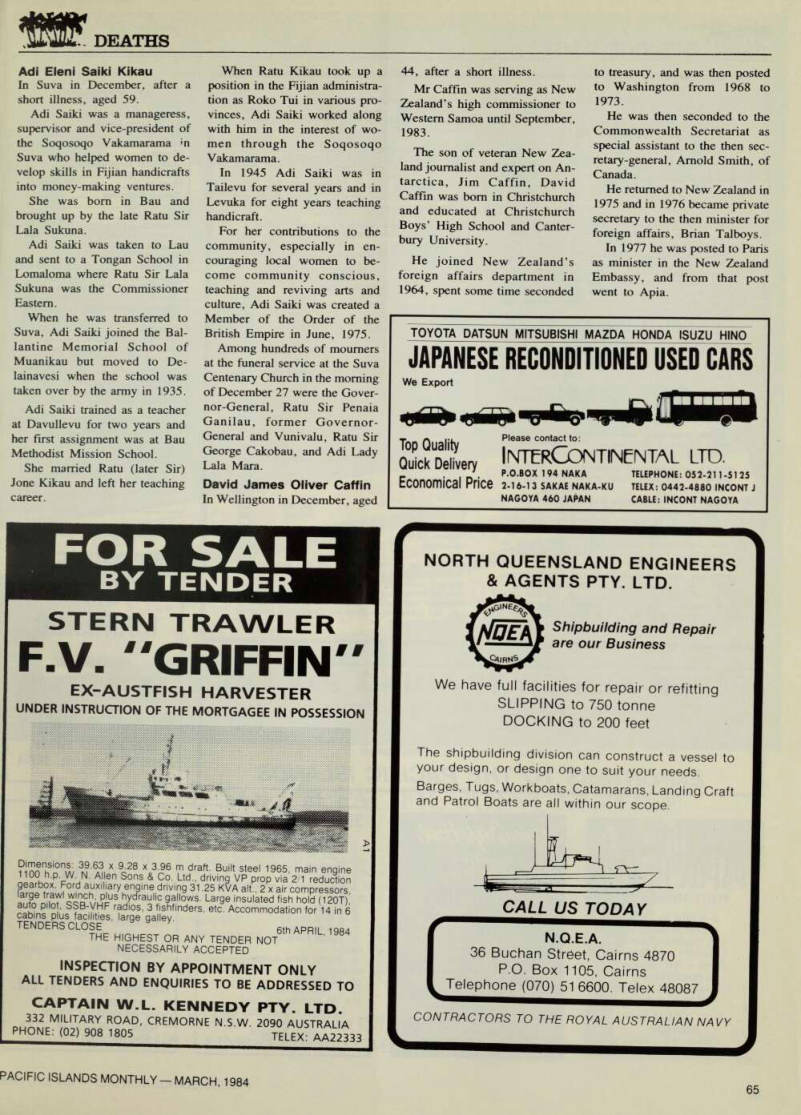
Adi Eleni Saiki Kikau In Suva in December, after a short illness, aged 59.
Adi Saiki was a manageress,
supervisor and vice-president of
the Soqosoqo Vakamarama m Suva who helped women to de velop skills in Fijian handicrafts into money-making ventures.
She was bom in Bau and brought up by the late Ratu Sir Lala Sukuna.
Adi Saiki was taken to Lau and sent to a Tongan School in Lomaloma where Ratu Sir Lala Sukuna was the Commissioner Eastern.
When he was transferred to Suva, Adi Saiki joined the Bal lantine Memorial School of Muanikau but moved to De lainavesi when the school was taken over by the army in 1935.
Adi Saiki trained as a teacher at Davullevu for two years and her first assignment was at Bau Methodist Mission School.
She married Ratu (later Sir) Jone Kikau and left her teaching career.
When Ratu Kikau took up a position in the Fijian administra tion as Roko Tui in various pro vinces, Adi Saiki worked along with him in the interest of wo men through the Soqosoqo Vakamarama.
In 1945 Adi Saiki was in Tailevu for several years and in Levuka for eight years teaching handicraft.
For her contributions to the
community, especially in en
couraging local women to be come community conscious, teaching and reviving arts and culture, Adi Saiki was created a Member of the Order of the British Empire in June, 1975.
Among hundreds of mourners at the funeral service at the Suva Centenary Church in the morning of December 27 were the Gover nor-General, Ratu Sir Penaia Ganilau, former Governor- General and Vunivalu, Ratu Sir George Cakobau, and Adi Lady Lala Mara.
David James Oliver Caffin In Wellington in December, aged
44, after a short illness.
Mr Caffin was serving as New Zealand’s high commissioner to Western Samoa until September, 1983.
The son of veteran New Zea land journalist and expert on An tarctica, Jim Caffin, David Caffin was bom in Christchurch and educated at Christchurch Boys’ High School and Canter
bury University.
He joined New Zealand’s
foreign affairs department in
1964, spent some time seconded
to treasury, and was then posted to Washington from 1968 to 1973.
He was then seconded to the Commonwealth Secretariat as special assistant to the then sec retary-general, Arnold Smith, of Canada.
He returned to New Zealand in 1975 and in 1976 became private secretary to the then minister for
foreign affairs, Brian Talboys.
In 1977 he was posted to Paris as minister in the New Zealand Embassy, and from that post went to Apia.
Advertisements & other items, pp. 65-66 (1 item)
F-V. "Griffin"
TOYOTA DATSUN MITSUBISHI MAZDA HONDA ISUZU HINO
JAPANESE RECONDITIONED USED CARS
We Export
Top Quality
Quick Delivery
Economical Price Please contact to;
I nterContiinental ltd.
P.0.80X 194NAKA TELEPHONE: 052-211 -51 25
2-1 6-1 3 SAKAE NAKA-KU TELEX: 0442-4880 INCONT J
NAGOYA 460 JAPAN CABLE: INCONT NAGOYA
FOR SALE
BY TENDER
STERN TRAWLER
F-V. "GRIFFIN"
EX-AUSTFISH HARVESTER
UNDER INSTRUCTION OF THE MORTGAGEE IN POSSESSION ?im n hi? n uu * 9 0 28 x 0396 ™ draft Built steel 1965, main engine c W '^ N ’ Aen Bons & Co ' Ltd -’ drivin 9 VP prop via 2 1 reduction SfrnL ord \ ux,l, l ar y u en g |n e driving 31.25 KVA alt,, 2 x air compressors, tn ri QQR C \/uc US ol c 9 all ° ws - Lar 9 e insulated fish hold (120 T), nahnc n!' radlos - 3 fisminders, etc. Accommodation for 14 in 6 cabins plus facilities, large qallev TENDERSCLOSE y ' 6thAPß|ll9fi4 THE HIGHEST OR ANY TENDER NOT ’
NECESSARILY ACCEPTED
INSPECTION BY APPOINTMENT ONLY
ALL TENDERS AND ENQUIRIES TO BE ADDRESSED TO
CAPTAIN W.L. KENNEDY PTY. LTD.
ROAD ' CREMORNE N.S.W. 2090 AUSTRALIA
PHONE: (02) 908 1805 TELEX; AA22333
GINEa
HSEh
9*IRHS
NORTH QUEENSLAND ENGINEERS
& AGENTS PTY. LTD.
Shipbuilding and Repair are our Business We have full facilities for repair or refitting SLIPPING to 750 tonne DOCKING to 200 feet The shipbuilding division can construct a vessel to your design, or design one to suit your needs.
Barges, Tugs, Workboats, Catamarans, Landing Craft and Patrol Boats are all within our scope. z
CALL US TODAY
N.Q.E.A.
36 Buchan Street, Cairns 4870 P.O. Box 1105, Cairns Telephone (070) 51 6600. Telex 48087 ]
CONTRACTORS TO THE ROYAL AUSTRALIAN NAVY
llltintr
.SHJff
SERVICE PAGE
D AW AUSTRALIA: Distribution: The Herald and Weekly Times Ltd., 44-74 Flinders St.. Melbourne, Vic., 3000. Advertising Reps Brisbane D. Wood, Anday Agency, CCA Centre, Dayboro Road, Closebum 4520; Box 1918, GPO Brisbane, 4001; telephone (07) 289-4128. Adelaide Hastwell Williamson Rouse Pty. Ltd., PO Box 419, Norwood, SA, 5067; 59 Kensington Road, Norwood; telephone (08) 332-3322. telex 87113; Perth Allen & Associates, Suite 2. 284 Stirling St., Perth, WA. 6000, telephone (09) 328-9593 or (09) 328-9363.
FIJI: Distribution and subscriptions Desai Bookshops, P.O. Box 160, Suva, Fiji, telephone Suva 23036.
Advertising Fiji Times & Herald Ltd., 20 Gordon St., Suva, telephone 31-4111, telex FJ2124.
FRENCH POLYNESIA: Distribution Hachette Pacifique, 10 Ave Bruat, Papeete, telephone 25610.
HAWAII, UNITED STATES: Distribution PIM, Hawaii.
PO Box 22250, Honolulu, Hawaii, 96822. Advertising Brian C. Asgill, Apt. 1308, 1676 Ala Moana Blvd., Honolulu, Hawaii, 96815, telephone (808) 955-9718.
JAPAN: Advertising and subscriptions Universal Media Corporation, GPO Box 46, Tokyo, telephone 666- 3036, cables UNIMEDIA Tokyo, telex 2524665.
KOREA: Advertising and subscriptions World Marketing, Inc, Box 4010, Seoul; phone 776-5291-3, telex K 23232.
MALAYSIA: Advertising and subscriptions Worldwide Media Services, 57-B Komplex Damai, Jin Dato Haji Eusoff, Kuala Lumpur, telephone 63-9340, cables WORLDMEDIA Kuala Lumpur, telex 31533.
NEW CALEDONIA: Distribution Depot Centre de Presse Michel Pentecost, CBP2, Noumea, telephone 27- 2434. 27-4729.
NEW ZEALAND: Distribution Gordon & Gotch, PO Box 584, 2 Carr Road. Mt. Roskill, Auckland 4 Advertising International Media Representatives Ltd., PO Box 2313, Auckland, telephone 79-5487; 49-3389, cables Intereps, Auckland Subscriptions Ross Haines & Son Ltd., PO Box 1289, Auckland, telephone 76-9042.
PAPUA NEW GUINEA: Distribution Gordon & Gotch, PO Box 3395, Port Moresby, telephone 25-4551,25-4855.
Advertising PNG Post-Courier, PO Box 85, Port Moresby, telephone 21-2577, telex 22120.
PHILIPPINES: Advertising The GF Group, 12 San Ignacio St.. Uroaneta Village, Makati. Metro Manila, telephone 817-7299. telex 45950 and 4233.
UNITED KINGDOM: The Herald & Weekly Times Ltd., No 1 Maltravers Street,London WC2R 3DZ, England, telephone 01 836 5162, telex London 21989.
UNITED STATES MAINLAND: Advertising Joshua B.
Powers Jr., Powers International Inc., 551 Fifth Ave., New York, New York 10 017, telephone 867-9580, telex 236514.
Subscriptions PIM, Hawaii, PO Box 22250, Honolulu, Hawaii, 96822.
SUBSCRIPTIONS
Payments by personal cheque are only acceptable in Australian (from a branch in Australia), U.S. and New Zealand currency. For all other remittances please send an international bank draft in Australian dollars.
Published monthly by Pacific Publications (Aust.) Pty.
Ltd. and printed in Australia by Quadricolor Industries Pty. Ltd., Mulgrave, Vic.
PETER FISHER TRADING Pty.Ltd.
381 PITT STREET, SYDNEY, 2000, AUSTRALIA
Telephone: 264 5395
TELEX: AUSTAS AA20149 ATT. PETER FISHER
EXPORTERS TO THE PACIFIC ISLANDS
35 mm PROJECTOR
SPECIFICATION
1. Type Bawer Standard 5 2. Peerless Mag Arcs Type “F” 3. Fisher Stands 4. 2 Channel 60 amp rectifier 3 phase 5. 3 phase projector drive motors 6. 2 W/S lenses 7. 2 C/S lenses 8. Fisher Films Drive Sound Head 9. Excitor lamp supply transformer 10. 13 Spools 11.2 Take Up Spools N.B. NO Amplifier with plant Inquiries P.O. Box 465 Auckland New Zealand Telephone 73-4352
Stay at Aggie Grey’s . . . the South Pacific’s
legendary hotel.
Situated right in the heart of Western Samoa. Enjoy Polynesian-style friendliness and service, in cool surroundings, superb entertainment and food.
Magnificent white sand beaches only a short drive away. Airconditioned rooms, swimming pool and full bar facilities.
Bookings through Union Steamship Company of NZ, Pan Am, Air New Zealand or direct to Aggie Grey’s, Apia, Western Samga. Cables: ‘AGGIES’Apia.
PORT MOh
* Right in t business ceji, * A traditioh for comfort and fine food * All r<soms airconditioned * Restaurant * Ba * Banquet hall
,A. C. NEUMAIMN
Phone 21-2622 Cable ‘EAFPBM manager
Advertising
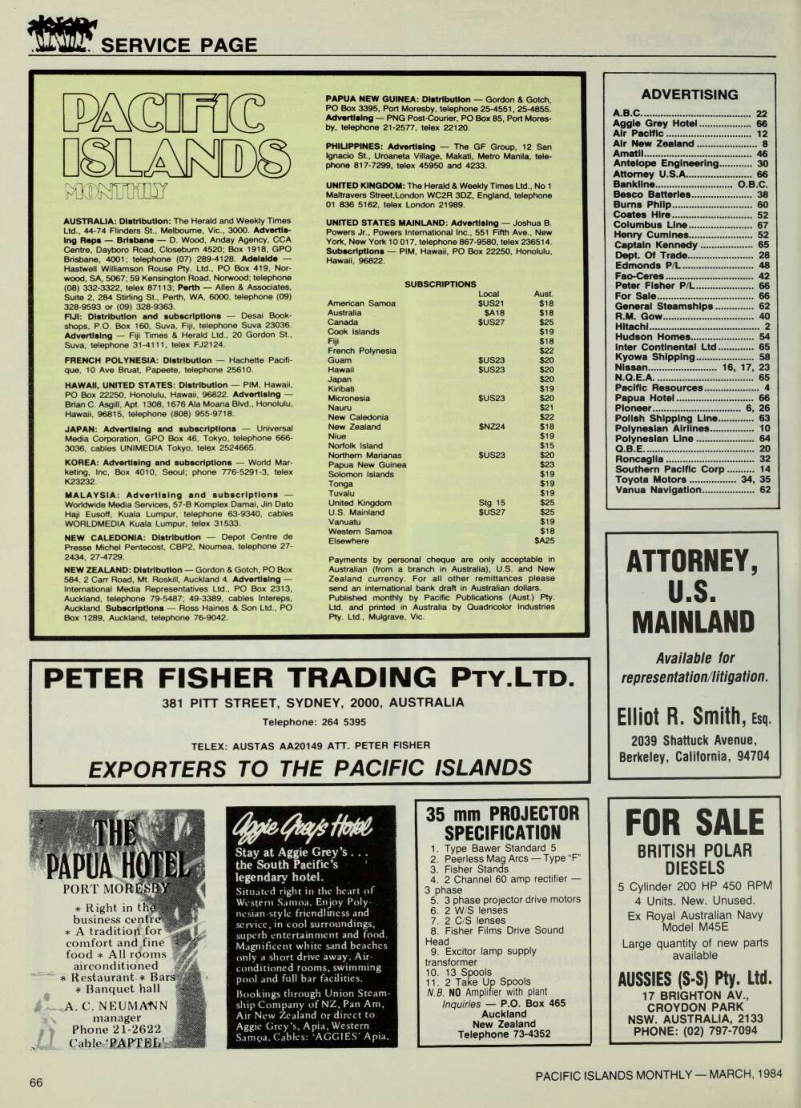
A.B.C 22
Aggie Grey Hotel 66 Air Pacific 12 Air New Zealand 8 Amatll 46 Antelope Engineering 30 Attorney U.S.A 66 Bankline 0.8. C.
Besco Batteries 38 Bums Philp 60 Coates Hire 52 Columbus Line 67 Henry Cumlnes 52 Captain Kennedy 65 Dept. Of Trade 28 Edmonds P/L 48 Fao-Ceres 42 Peter Fisher P/L 66 For Sale 66 General Steamships 62 R.M. Gow 40 Hitachi 2 Hudson Homes 54 Inter Continental Ltd 65 Kyowa Shipping 58 Nissan 16, 17, 23
N.Q.E.A 65
Pacific Resources 4 Papua Hotel 66 Pioneer 6, 26 Polish Shipping Line 63 Polynesian Airlines 10 Polynesian Line 64
Q.B.E 20
Roncaglla 32 Southern Pacific Corp 14 Toyota Motors 34, 35 Vanua Navigation 62
Advertisements & other items, pp. 66-68 (1 item)
For Sale
ATTORNEY,
U.S.
MAINLAND
Available for representation/litigation.
Elliot R. Smith, Esq 2039 Shattuck Avenue, Berkeley, California, 94704
FOR SALE
BRITISH POLAR
DIESELS
5 Cylinder 200 HP 450 RPM 4 Units. New. Unused.
Ex Royal Australian Navy Model M4SE Large quantity of new parts available
AUSSIES (S-S) Pty. Ltd.
17 BRIGHTON AV.,
CROYDON PARK
NSW. AUSTRALIA, 2133
PHONE: (02) 797-7094
t » •« « i •* •' • « •:
I II 11 * "
*4Ufi /?
II .!• •»» • •• ; r: * •»• m .v - - * *v - -. ~\ >■'->" - X -Cv ■:},.*' ;V • , ■■ •i' “ v •': s -
EUROPE-SOUTH PACIFIC JOINT SERVICE
The South Pacific Specialists offer facilities for shipment of: Containers (FCL/LCL) and Breakbulk Cargo plus reefer space and deeptanks for carriage of vegetable oils and other liquid bulk cargo.
Carriers also accept heavy lifts, overlength and cumbersome parcels.
G\D Ports of Service: Loading; Papeete, Apia, Suva, Lautoka, Noumea, Port Vila, Santo, Honiara, Port Moresby, Lae,Madang, Kimbe, Rabaul, Kieta, Darwin.
For: Rotterdam, Antwerp, Hamburg, Hull.
Dunkirk, Le Havre.
- ROUND THE WORLD SERVICE
Additional ports on enquiry Please contact our regional offices for further information: The Bank Line (Australasia) Pty. Ltd.
Suite 801,51 Pitt Street Sydney N.S.W. 2000 Phone: 27 2041 Telex: 24063 Columbus Line Reederei GmbH p 0 Box 1667 * Lae/Papua New Guinea Phone; 423 466/423 487 A H. 422 481 Telex; Colline NE 44 171
THE BANK LINE LTD LONDON
COLUMBUS LINE REEDEREI GMBH HAMBURG
BANK LINE and
COLUMBUS LINE
24 day service to
Europe.
Need we say more...
D Q The Joint Service Partners offer facilities for shipment of: Containers (FCL/LCL) and Break-bulk Cargo plus reefer space and deeptanks for carriage of vegetable oils and other liquid bulk cargo.
Carriers also accept heavy lifts, overlength and cumbersome parcels.
Ports of Service: Loading: Papeete, Apia, Suva, Lautoka, Noumea, Port Vila, Santo, Honiara, Port Moresby, Lae, Madang, Kimbe, Rabaul, Kieta, Darwin. For: Rotterdam, Antwerp, Hamburg, Hull, Dunkirk, Le Havre.
Additional ports on enquiry.
Please contact our regional offices for further information: The Bank Line (Australasia) Pty Ltd Columbus Line Reederei GmbH Suite 801, 51 Pitt St, P.O. Box 1 667, Lae/Papua New Guinea.
Sydney, NSW, Australia 2000 Phone: 423466/423487/AH. 422481 Phone 27 2041 Telex 24063 Telex: Colline NE 441 71 The South Pacific Specialists for over 75 years