Pacific

Islands
Monthly
August,I9B3
American Samoa US$l.75 Australia *A$l.5O Cook Islands NZ$l.5O Fiji F 51.50 Hawaii US$l.95 Kiribati A 51.75 Nauru A 51.75 New Caledonia CFPI9O New Zealand NZ$2.OO Niue NZ$l.5O Norfolk Island A 51.50 Papua New Guinea K 1.50 Solomon Islands 551.50 Tahiti CFPI9O Tonga PI ,50 Tuvalu A 51.75
Usa U 552.25
USTT and Guam US$l95 Vanuatu VT1.50 Western Samoa T 1.95 'Recommended retail price only.
Registered by Australia Post Publication No NBPI2IO
iiWAEY mah lmkiu mum ffl gw ISLAIDI
liMtsi
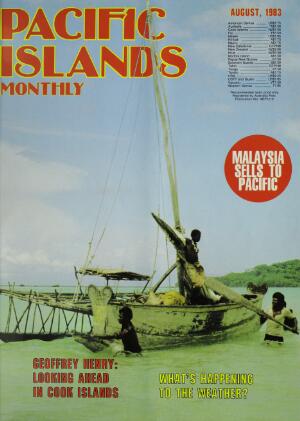
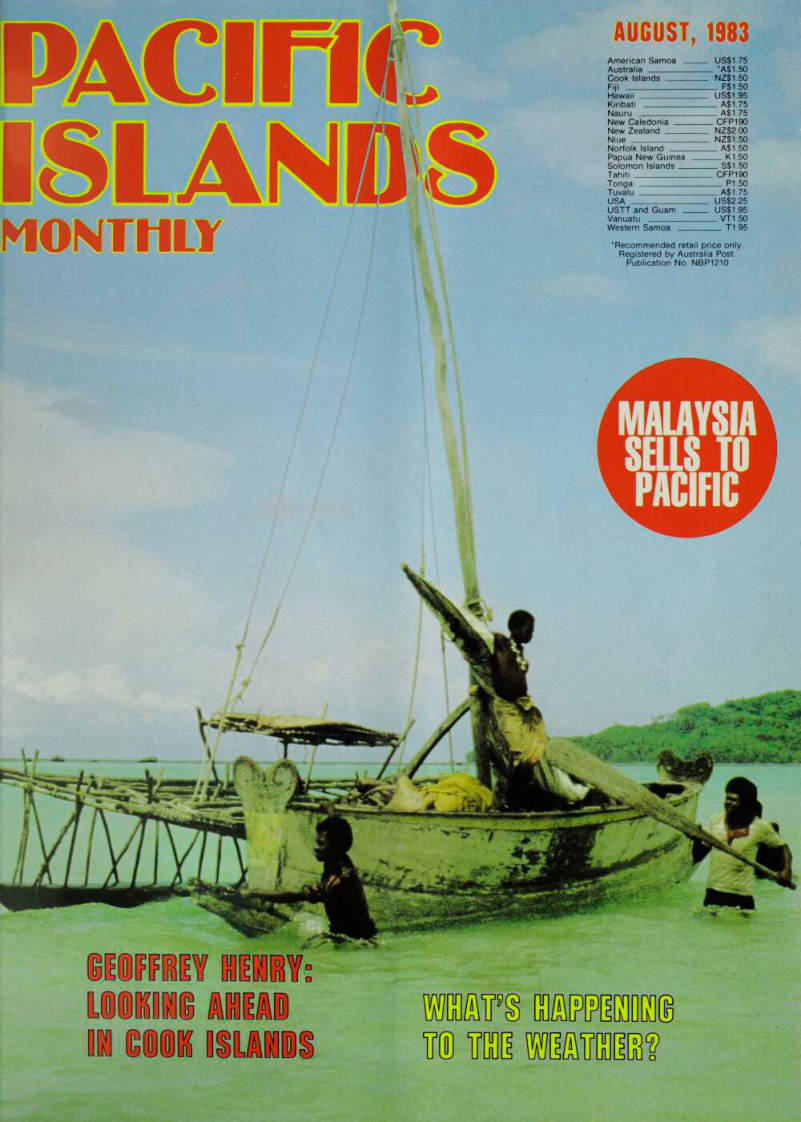
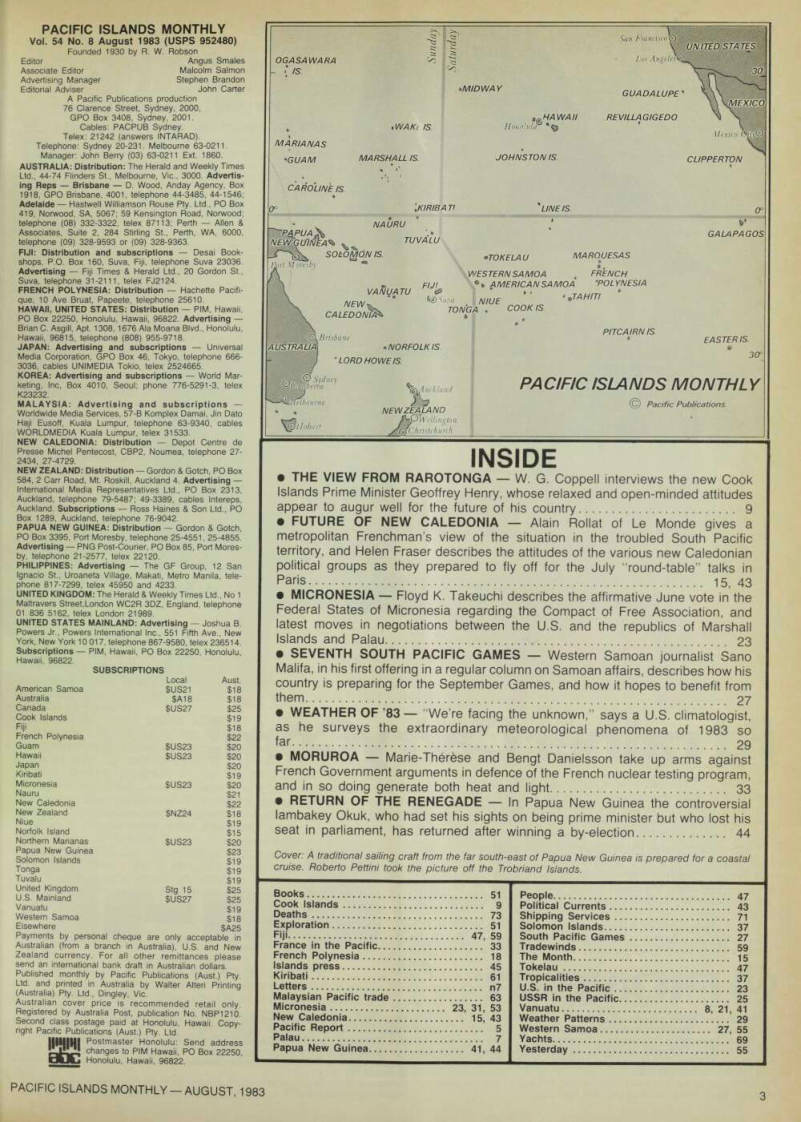
Cover: A traditional sailing craft from the far south-east of Papua New Guinea is prepared for a coastal cruise. Roberto Pettini took the picture off the Trobriand Islands.
Advertisements & other items, p. 2 (1 item)
The Miracle Workers
Making The World An Exciting Place
w /mi-
tt W "i A* •‘9 r *r . ■*.**';'&*'%***■ wp
'> J., .JS
-?c rT •'* . ;■ • - *. •f-v • ■*>,*
i mu
». V * r / ATC. The go-anywhere, do-anything All Terrain Cycles play as hard as they work, are simple for all to ride and cheap and easy to maintain.
ATC. Honda invented them. Can you or your business do without one?
WORLD'S LARGEST MOTORCYCLE MANUFACTURER
HONDA MOTOR CO.. LTD. TOKYO, JAPAN
ATC2OOE
ATCIBSS
ATCIIO
AUSTRALIA: Honda Australia Pty. Ltd. Lot 95 Sharps Road, Tullamarine, Vic., 3043/Bennett Honda Pty. Ltd. 250 Victoria Road, Wetherill Park, N S W. 2164/NEW ZEALAND: Blue Wing Honda Ltd. 99-101 Carbine Road Mt. Wellington, Auckland/PAPUA NEW GUINEA: Steamships Trading Company Ltd. P.O. Box 1, Port Moresby/TAHITI: Honda Distribution S.A.R.L. B.P. 1665, Papeete/FIJI ISLANDS: Carpenters Motors Private Mail Bag Suva, Fiji/KIRIBATI; Atoll Motor & Marine Services P.O. Box 49 Bairiki Tarawa/U.S. TRUST TERRITORY; United Micronesia Development Association P.O. Box 238, Saipan Mariana Islands 96950/COOK ISLANDS: Cook Islands Motor Centre Ltd. P.O. Box 74, Rarotonga/AMERICAN SAMOA: Holiday Motors, Parts and Service P.O. Box 968 Pago Pago, American Samoa 96799/Haleck’s Service Certre Ltd. P.O. Box 1138, Pago Pago, American Samoa 96799/GUAM: Mark’s Motor Co., Inc. PO_Box uv, Agana/WESTERN SAMOA: Motor Distributors (Samoa) Ltd. P.O. Box 576, Apia/SOLOMON ISLANDS: Guadalcanal Garage Limited P.O. Box 537 Homara/NEW CALEDONIA.
Establissements Ballande Boite Postale No. C 4 Noumea Cedex/NAURU: Nauru Cooperation Republic of Nauru/TONGA; Tonga Industrial Traders P.O. Box 1035, Nukualofa Tonga
Pacific Islands Monthly
Vol. 54 No. 8 August 1983 (USPS 952480)
AUSTRALIA: Distribution: The Herald and Weekly Times Ltd., 44-74 Flinders St., Melbourne, Vic., 3000. Advertis ing Reps Brisbane D. Wood, Anday Agency, Box 1918, GPO Brisbane, 4001, telephone 44-3485, 44-1546; Adelaide Hastwell Williamson Rouse Pty. Ltd., PO Box 419, Norwood, SA, 5067; 59 Kensington Road, Norwood; telephone (08) 332-3322, telex 87113; Perth Allen & Associates, Suite 2, 284 Stirling St., Perth, WA, 6000, telephone (09) 328-9593 or (09) 328-9363.
FIJI: Distribution and subscriptions Desai Book shops, P.O. Box 160, Suva, Fiji, telephone Suva 23036.
Advertising Fiji Times & Herald Ltd., 20 Gordon St., Suva, telephone 31-2111, telex FJ2124.
FRENCH POLYNESIA: Distribution Hachette Pacifi que, 10 Ave Bruat, Papeete, telephone 25610.
HAWAII, UNITED STATES: Distribution PIM, Hawaii, PO Box 22250, Honolulu, Hawaii, 96822. Advertising Brian C. Asgill, Apt. 1308,1676 Ala Moana Blvd., Honolulu, Hawaii, 96815, telephone (808) 955-9718.
JAPAN: Advertising and subscriptions Universal Media Corporation, GPO Box 46, Tokyo, telephone 666- 3036, cables UNIMEDIA Tokio, telex 2524665.
KOREA: Advertising and subscriptions World Mar keting, Inc, Box 4010, Seoul; phone 776-5291-3, telex K 23232.
MALAYSIA: Advertising and subscriptions Worldwide Media Services, 57-B Komplex Damai, Jin Dato Haji Eusoff, Kuala Lumpur, telephone 63-9340, cables WORLDMEDIA Kuala Lumpur, telex 31533.
NEW CALEDONIA: Distribution Depot Centre de Presse Michel Pentecost, CBP2, Noumea, telephone 27- 2434, 27-4729.
NEW ZEALAND: Distribution Gordon & Gotch, PO Box 584, 2 Carr Road, Mt. Roskill, Auckland 4. Advertising International Media Representatives Ltd., PO Box 2313, Auckland, telephone 79-5487; 49-3389, cables Intereps, Auckland. Subscriptions Ross Haines & Son Ltd., PO Box 1289, Auckland, telephone 76-9042.
PAPUA NEW GUINEA: Distribution Gordon & Gotch, PO Box 3395, Port Moresby, telephone 25-4551,25-4855.
Advertising PNG Post-Courier, PO Box 85, Port Mores by, telephone 21-2577, telex 22120.
PHILIPPINES: Advertising The GF Group, 12 San Ignacio St., Uroaneta Village, Makati, Metro Manila, tele phone 817-7299, telex 45950 and 4233.
UNITED KINGDOM: The Herald & Weekly Times Ltd., No 1 Maltravers Street,London WC2R 3DZ, England, telephone 01 836 5162, telex London 21989.
UNITED STATES MAINLAND: Advertising Joshua B Powers Jr., Powers International Inc., 551 Fifth Ave., New York, New York 10 017, telephone 867-9580, telex 236514.
Subscriptions PIM, Hawaii, PO Box 22250, Honolulu, Hawaii, 96822.
Payments by personal cheque are only acceptable in Australian (from a branch in Australia), U.S. and New Zealand currency. For all other remittances please send an international bank draft in Australian dollars.
Published monthly by Pacific Publications (Aust.) Pty.
Ltd. and printed in Australia by Walter Alteri Printing (Australia) Pty. Ltd., Dingley, Vic.
Australian cover price is recommended retail only.
Registered by Australia Post, publication No. NBPI2IO.
Second class postage paid at Honolulu, Hawaii. Copy right Pacific Publications (Aust.) Pty. Ltd.
Postmaster Honolulu: Send address changes to PIM Hawaii, PO Box 22250, Honolulu, Hawaii, 96822.
ShĥBscriptions
Local Aust.
American Samoa $US21 $18 Australia $A18 $18 Canada $US27 $25 Cook Islands $19 Fiji $18 French Polynesia $22 Guam
Sus23
$20 Hawaii $US23 $20 Japan $20 Kiribati $19 Micronesia $US23 $20 Nauru $21 New Caledonia $22 New Zealand $NZ24 $18 Niue $19 Norfolk Island $15 Northern Marianas $US23 $20 Papua New Guinea $23 Solomon Islands $19 Tonga $19 Tuvalu $19 United Kingdom Stg 15 $25 U.S. Mainland $US27 $25 Vanuatu $19 Western Samoa $18 Elsewhere $A25
Inside
• THE VIEW FROM RAROTONGA W. G. Coppell interviews the new Cook Islands Prime Minister Geoffrey Henry, whose relaxed and open-minded attitudes appear to augur well for the future of his country 9 • FUTURE OF NEW CALEDONIA Alain Rollat of Le Monde gives a metropolitan Frenchman’s view of the situation in the troubled South Pacific territory, and Helen Fraser describes the attitudes of the various new Caledonian political groups as they prepared to fly off for the July “round-table” talks in Paris 15, 43 • MICRONESIA Floyd K. Takeuchi describes the affirmative June vote in the Federal States of Micronesia regarding the Compact of Free Association, and latest moves in negotiations between the U.S. and the republics of Marshall Islands and Palau 23 • SEVENTH SOUTH PACIFIC GAMES Western Samoan journalist Sano Malifa, in his first offering in a regular column on Samoan affairs, describes how his country is preparing for the September Games, and how it hopes to benefit from them 27 • WEATHER OF ’B3 “We’re facing the unknown,” says a U.S. climatologist, as he surveys the extraordinary meteorological phenomena of 1983 so far 29 • MORUROA Marie-Therese and Bengt Danielsson take up arms against French Government arguments in defence of the French nuclear testing program, and in so doing generate both heat and light 33 • RETURN OF THE RENEGADE In Papua New Guinea the controversial lambakey Okuk, who had set his sights on being prime minister but who lost his seat in parliament, has returned after winning a by-election 44
Books 51 Cook Islands 9 Deaths 73 Exploration 51 Fiji 47, 59 France in the Pacific 33 French Polynesia 18 Islands press 45 Kiribati 61 Letters n 7 Malaysian Pacific trade 63 Micronesia 23, 31, 53 New Caledonia 15, 43 Pacific Report 5 Palau 7 Papua New Guinea 41, 44
People 47 Political Currents 43 Shipping Services 71 Solomon Islands 37 South Pacific Games 27 Tradewinds 59 The Month 15 Tokelau 47 Tropicalities 37 U.S. in the Pacific 23 USSR in the Pacific 25 Vanuatu 8,21,41 Weather Patterns 29 Western Samoa 27, 55 Yachts 69
Yesterday 55
Advertisements & other items, pp. 3-4 (2 items)
Founded 1930 by R. W. Robson
Editor Angus Smales Associate Editor Malcolm Salmon Advertising Manager Stephen Brandon Editorial Adviser John Carter A Pacific Publications production 76 Clarence Street, Sydney, 2000, GPO Box 3408, Sydney, 2001.
Cables: PACPUB Sydney.
Telex: 21242 (answers INTARAD).
Telephone: Sydney 20-231. Melbourne 63-0211.
Manager: John Berry (03) 63-0211 Ext. 1860.
I’d rather Carry Com!
Portable Component System
1 i
CK-7T
I’d rather Carry Com!
Carry Com packs like a portable, but unpacks into four individual components. It’s a true component system, just like a home hi-fi.
Carry it everywhere and enjoy hi-fi sound with sweet highs and rich lows. The sound is bigger and deeper because the entire front of each speaker is a “Flat Woofer” of a unique Pioneer design.
Carry Com’s stereo FM/MW/SW tuner has quartz-PLL synthesizer accuracy with computer-like preset tuning, even a digital timer and frequency readout. The amp has its own 5-band graphic equalizer to let you adjust the sound to your liking. Cassette taping is fun and easy with Skip-Search, Dolby* noise reduction, metal-tape play and lots more.
Home or away, it’s Carry Com. The only one to play. * ‘Dolby’ and the double-D symbol are trademarks of Dolby Laboratories Licensing Corporation.
fID PIONEER*
CK-7T
For further information, please contact: Australia: Pioneer Electronics Australia Pty. Ltd., P.O. Box 295, Mordialloc, Victoria, 3195 Tel: 580-9911 Fiji Islands: Brijlal & Company,G.P.O. Box No. 362, Suva, Fiji Islands Tel: 22258 New Zealand: Monaco Distributors Ltd., 2 Poland Road, Glenfield, Auckland, New Zealand Tel: (09) 444-9144 Norfolk Island: Burns Philp (Norfolk Island) Ltd., P.O. Box 21, Norfolk Island Vanuatu: Burns Philp (Vanuatu) Ltd., Vila, Vanuatu Nauru Island: Jacob Enterprises, P.O. Box No. 4, Republic of Nauru Tahiti: Tahiti Hi-Fi, P.O. Box 848, Papeete, Tahiti New Caledonia: Menard Pacifique Sari, B.P. 3899, Noumea, New Caledonia Tel: 27*62.23 American Samoa: Transpac Corporation, P.O. Box 1477, Pago Pago, American Samoa 96799 Tel: 633-5224 Rarotonga: South Seas International Ltd., P.O. Box 49, Rarotonga, Cook Islands Tel: 2327 Papua New Guinea; Bali Merchants Pty. Ltd., P.O. Box 6103, Boroko Tel: 254887
Pacific Report
U.S. SENATE GIVES NOD TO ISLAND TREATIES After two years in which it could not make up its mind, the U.S.
Senate on June 21 finally ratified four treaties of friendship with Kiribati, Tuvalu, Cook Islands and Tokelau, which is adminis tered by New Zealand. Ratification means that the U.S. gives up century-old claims to 26 islands in the groups concerned. New Zealand also gives up a claim, on behalf of Tokelau, to Swain’s Island, administered by the U.S. as part of American Samoa since 1925. The treaties establish maritime boundaries and provide for consultation on fishing rights, and military use of islands in the Kiribati and Tuvalu groups. The Senate vote was 94-4, with two abstentions. Diehard opponents of the treaties used arguments such as that of Republican Steven Simms who said: “I do not believe in giving away territory for which American blood was spilled.”
Paris Talks On New Caledonia’S Future
Members of New Caledonia’s three main political groups left Noumea for Paris on July 6, to take part in round-table discussions with President Mitterrand’s government on the political future of the territory. The French Government invited 20 New Caledonian political leaders to Paris for the five-day round of talks on a statute of internal autonomy. Delegates are from the Independence Front, which favors early independence, the Republican Party, which is against independence, and the Centre Party, the F.N.S.C. A spokesman for the F.N.S.C. told newsmen at Noumea airport that his delegation was not going to Paris to talk about independence, but in a spirit of dialogue and consultation. A spokesman for the Republican Party delegation, Dick Ukeiwe, said the position of his party would be determined by what is proposed during the talks, but it would expect elections to be held before a statute of autonomy was applied.
Vanuaaku Party Congress Heals Wounds
The keenly awaited congress of Vanuatu’s ruling Vanuaaku Party held in June patched up the recent disputes within the party which led to a parliamentary motion of no confidence being moved against Prime Minister Walter Lini, in April. The move followed Father Lini’s dismissal of his deputy prime minister and the resignation in protest of two other ministers. The motion failed, but under party rules those who supported it were disqualified from the party. The Vanuaaku Party congress re elected Father Lini as party president, and unanimously accept ed the three former ministers back into the party. In November, Vanuatu will hold its first elections since independence in 1980 The Vanuaaku Party holds two-thirds of the 39 seats in the present parliament.
Australia’S New Move Against N-Tests?
Australia has appointed its first ambassador for disarmament.
The appointment is seen as a signal that the Labor Government plans to take the lead in trying to force an end to France’s nuclear testing program in the South Pacific. A strong strengthening of the country’s Department of Foreign Affairs is planned to deal with issues of nuclear disarmament and arms control. The initiatives were detailed by the Foreign Minister, Bill Hayden, in a major statement in Adelaide in early July. The new ambassador is Richard Butler, Australia’s deputy permanent representative at the Organisation of Economic Co-operation and Development in Paris. Mr Butler, has specialised in nuclear matters for several years. Mr Hayden announced efforts to wards a comprehensive treaty banning nuclear tests which he said would put heavy pressure on France to cease its Pacific testing program. The Foreign Minister added that such a treaty would have to be independently verified, and the Australian Government would be improving the country’s seismic monitor ing capacity to detect nuclear blasts.
U.S. Sponsors Tsunami Warning Project
The U.S. Agency for International Development (AID) is spon sonng a pilot study of methods used to warn coastal residents in South Pacific countries of impending seismic-triggered tidal waves (tsunamis). The study will be conducted by the National Oceanic and Atmospheric Administration on a budget of about $U.5.250,000. A spokesman for the project said the new system
will provide warnings of tidal waves only 10 minutes after an undersea earthquake. It is estimated that more than 70,000 people have been killed by tidal waves in the Pacific Basin over the past century.
Png Still Eyes Asean
Papua New Guinea is planning higher levels of co-operation with the Association of South East Asian Nations, but has not decided whether it will join the association. PNG Foreign Minister Rabbie Namaliu said in June his country still regarded itself as a Pacific nation, and would not be hasty about joining ASEAN, with which at present PNG has observer status. Mr Namaliu said he had instructed his department to make an assessment of the advantages of PNG joining ASEAN, and to report by the end of the year. Mr Namaliu added that his country faced financial and staffing restraints in expanding its foreign relations. Members of ASEAN are Indonesia, Singapore, Thai land, Malaysia and the Philippines.
New Ocean Minerals Search Planned
The United States, Australia and New Zealand have agreed in principle to finance a second scientific cruise of the South Pacific, it will be a follow-up to 1982 studies carried out by two American research vessels searching for mineral resources in offshore areas. Six regional governments Papua New Guinea, Solomon Islands, Vanuatu, Fiji, Tonga and Western Samoa are involved in the projected cruise, which is likely to begin in October. It is expected to cover two areas Kiribati and Cook Islands not studied last time.
Telecommunications On Forum Agenda
Proposals to develop reliable telecommunications among South Pacific Island nations are to be discussed at the meeting of the South Pacific Forum in Canberra in late August. The ministers have stated that without reliable communications it is difficult to plan effective development and to ensure the growth of trade. A 1981 report on the subject recommends a balance of satellite and land telecommunications on a country-by-country basis, but it calls for overall co-ordination.
Fiji: Mara Warns On ’B4
Fiji’s Prime Minister Ratu Sir Kamisese Mara said in June that 1984 is shaping up as the most difficult year the country has faced since independence in 1970. He said recent cyclones had caused considerable damage to a number of vital sectors of Fiji’s economy. In such circumstances this year’s agreement on national wage guidelines, giving workers an average pay rise of five per cent, was fair and reasonable. Ratu Mara was speaking in Suva at the formal signing of the agreement.
Fsm, Marshalls, Palau Latest
Voters in the Federated States of Micronesia have supported the proposed Compact of Free Association, with the U.S.
Meanwhile, progress has been made in negotiations between the U.S. and Marshall Islands and Palau. (See Floyd K.
Takeuchi’s column in “The Month”.) FRANCE S FOURTH MORUROA BLAST FOR ’B3 France’s fourth nuclear test at Moruroa this year, staged on July 5, came only days after Regis Debray, President Mitterrand’s special envoy, had completed visits to Fiji, Vanuatu, New Zealand, Australia and Papua New Guinea. Mr Debray had invited all governments to send a scientific representative to Moruroa for a one-off inspection visit to Moruroa later in the year. In a statement in late June, French Defence Minister Charles Hernu confirmed that France had tested the neutron bomb at Moruroa, but had not yet made a decision to produce it. (See the critique by Marie-Therese and Bengt Danielsson of France’s official defence of its Moruroa testing program in this issue.)
“Neo-Colonialist” Australia Rapped
Vanuatu’s Opposition Union of Moderate Parties (UMP) has claimed the country is becoming increasingly controlled by Australia. In a statement issued in June which describes Australia’s influence in Vanuatu as “neo-colonialist”, the UMP claims the country is losing its freedom. Quoting Papua New Guinea as an example of a country which is suffering as a result
of its close relations with Australia, the group says it “cannot accept” Australian influence in the South Pacific, and does not want to see Australia supplying all the region’s financial and technical needs. Referring to New Caledonia, the UMP, which consists mainly of French-speaking Ni-Vanuatu, says it does not want Vanuatu to become a tool of Australia in getting France out of the Pacific. However, the statement supports independence for all Pacific countries, and calls on France to begin moving towards a peaceful independence in New Caledonia.
Solomons: Solomon The Survivor
Solomon Islands Prime Minister Solomon Mamaloni survived a no-confidence motion in parliament on June 23. After nine hours debate, the motion’s sponsor, Peter Salaka, MP for Shortland Islands, finally withdrew it, saying that while he considered himself the best alternative to Mr Mamaloni as prime minister, he had observed that other political parties were lining up their candidates for the post. “So why the hell should I move it if I couldn’t be prime minister?” he said. “I withdraw the motion.”
Earlier in June, Mr Mamolni had sacked his third minister in a month Paul Keyaumi, who had held the portfolio of police and justice. The victims of previous sackings had been (PIM Jul. p. 33) Peter Salaka (lands, energy and natural resources), and John Ngina (transport, communications and government utilities).
Lone Pacific Rower Makes It Just
Solo Pacific rower Peter Bird ended his 16,000-kilometre, 294day, journey in mid-June when he was taken on board an Australian navy patrol boat 33 nautical miles from the north Queensland coast. An Australian naval spokesman said Mr Bird’s 12-metre craft, Hele on Britannia, broke up shortly after it was taken in tow. He said the boat was being swept towards a reef by strong winds and heavy seas, and Mr Bird was forced to ask for help. Mr Bird began his voyage from San Francisco in August 1982.
Trachoma On Wane In Fiji
There has been a drop in the prevalence of the eye infection, trachoma, in Fiji. A survey by a World Health Organisation consultant has shown that trachoma occurred in about six per cent of Fijians, and that just under one per cent of the Indian community was affected. The figures were given by Minister of Health Dr Apenisa Kurisaqila, when he opened a conference of the Australian Optometrical Association held in Fiji in July. Dr Kurisaqila said the drop has been brought about by Fiji’s improved health and socio-economic standards.
New Australia-Noumea Flights Approved
Agreement has been reached between the Australian and French Governments on the introduction of new air services between Australia and New Caledonia. Australia’s Minister for Aviation Kim Beazley said in June that Qantas and the new regional airline Air Caledonie International would introduce services between Melbourne and Noumea before the end of the year. Mr Beazley said the services would make New Caledonia more accessible to travellers from Victoria and Australia’s other southern states. He said Air Caledonie International would introduce services between Brisbane and Noumea.
Talair Takes On Govt. On Fares
Papua New Guinea’s biggest third-level airline Talair is mount ing a legal challenge to a bid by the government to make it reduce its fares. Earlier, the PNG Government had ordered the national airline Air Niugini to reduce fares on its domestic services by 10 per cent by June 1. The instruction was then extended to other, privately operated, carriers. Talair is chal lenging the legality of the government’s action.
Solomons: Baddeley, Easily
Governor-General Sir Baddeley Devesi of Solomon Islands was easily re-elected in June for another five-year term. Parliament voted 22 to 12 in his favor over a former public servant and politician, Sir Gideon Zoloveke. Interest in the election waned when Opposition Leader and former Prime Minister Sir Peter Kenilorea withdrew his nomination the day before the vote.
Png Government Doctors, Lawyers Strike
Government doctors and lawyers in Papua New Guinea took separate strike actions in June in support of a demand for pay and conditions equal to those enjoyed by expatriates practising their respective professions in the country. PNG’s Cabinet
undertook to speed up examination of a proposal for a one wage professional wage structure.
ADB STUDIES ITS ROLE IN ISLANDS AID The Asian Development Bank plans an in-depth study of its role in meeting the needs of its South Pacific developing member countries (SPDMCs) in the 1980 s. The bank’s future operations in the islands will be guided by the recommendations of the members of the study team in close consultation with the SPDMC governments and donor agencies. Over the last 16 years to the end of 1982, the bank made loans to its eight SPDMCs, Cook Islands, Fiji, Kiribati, Papua New Guinea, Solomon Islands, Tonga, Vanuatu and Western Samoa, total ling SUS 244 million and technical assistance valued at $8.6 million.
Png Renames Radio Networks
Papua New Guinea’s national radio has renamed its three networks. The changes were announced on July 7 by the chairman of Papua New Guinea’s National Broadcasting Com mission, Austin Sapias. Radio One, the national medium wave service, will be named the Karai service. Karai is the Motu name for “cockatoo”, one of the few birds in PNG that can be taught to speak. This capacity for learning represents the educational services provided on the first national network. Radio Two, the FM service broadcasting in the major cities and towns, is to be known as the Kalang service. Kalang is a Pidgin word, originally from Tolai, meaning the gold-lipped pearlshell or an earring, or the long feather of a bird. These are all highly prized objects, and Kalang reflects the commercial nature of the second national network. The former Radio Three service, comprising 19 provincial stations and broadcasting mostly on short wave, becomes the Kundu service. Kundu is the Pidgin word for a type of ceremonial drum, and so emphasises the NBC’s link with the rural populations through its third network.
Scientific Commission Reports On Moruroa
The report of a scientific commission appointed by the French Government concluded in early July that radio-active contami nation from underground nuclear tests at Moruroa Atoll in the Pacific has been practically zero. The commission was headed by Haroun Tazieff, one of the world’s leading experts on volcanoes. The French press agency AFP said Mr Tazieff wrote that the main danger from the blasts was that the shocks could cause tidal waves, but added that the danger was very local.
The agency said the report does not exclude the possibility that radio-activity might partially escape from the cavity caused by an underground nuclear explosion. It also concedes that the tests have caused earth slips and sedimentation which could have resulted in changes in the geological make-up of the atoll, such as the opening and closing of cracks in the earth. The commission suggests various ways of improving the quality of radio-activity controls and more routine analysis of seawater at different depths in the lagoon and around the atoll. The report, handed on July 5 to Defence Minister Charles Hernu, adds that official announcements of each test, and the publication of unimpeachable scientific findings on their effects, are both desirable
Stinson Resigns From Fiji Ministry
Fiji’s Minister for Energy Peter Stinson resigned in early July and was replaced by a Minister of State Without Portfolio, Jone Naisara. Mr Stinson’s resignation was announced by Prime Minister Ratu Sir Kamisese Mara. The prime minister said Mr Stinson had resigned to concentrate on his business activities.
His family business, Stinson Pearce, is among the biggest in Fiji.
However, political observers in Suva said Mr Stinson had been having differences with other cabinet ministers.
Western Samoa’S Vital’ Legislation
The Legislative Assembly in Western Samoa met in June to consider a number of bills described as “vital for the social and cultural well-being” of the country by Prime Minister Tofilau Etii.
The Western Samoan leader said a bill to increase the authority of the village chiefs is particularly important as it will directly involve them in basic administrative decision-making at the village and district level. Other bills considered include mea sures to speed up the hearing of cases in Land and Titles Court, allowing bingo games on Saturday afternoons, and fortnightly pay for parliamentarians.
Margaret
Letters
Margaret Mead and
Png
I read with the greatest interest Albert Wendt’s review of Profes sor Derek Freeman’s Margaret Mead and Samoa: The Making and Unmaking of an An thropological Myth. It is a relief that Professor Freeman, a non- Samoan, has been so accurate, Wendt (one of the “objects” studied and written about) ag rees, about what the real Samoa is all about. He should be, after all he studied the Samoans for some 40 years, as against Mead’s nine months. Yet, Mead is the myth around the world. Through Mead’s writings, real Samoa is,
unfortunately, portrayed wrong
ly. It is time her fame is chal lenged and questioned from all sides. Thanks to both Wendt and Freeman the record is now beginning to be put right.
Now that Mead’s credibility is being challenged, it is an oppor tune time for someone to do the same for her “fictitious” writ ings about my country, Papua New Guinea. Although I am not an anthropologist, I challenge the late Mead’s Growing Up In PNG, New Lives For Old: Cul tural Transformation Manus, 1928-1953, The Mountain Arap esh and Sex and Temperament in Three Primitive Societies.
What do foreigners, like Mead, know about our own peo ple, culture and ways of life? The ones qualified to write an thropological books about us are ourselves.
When I was PNG’s ambas sador to the USA in the 1970 s for five years, I travelled extensive
ly, addressing countless audi
ences about PNG. Most people have read something about the country. Mead’s books about PNG (and Samoa) have truly set her up as the “expert” on our
people.
The Americans view us as
primitive people practising free
love, etc. Rubbish. My view about the USA is that many of its citizens fit well into these categories. They, like other foreigners, should write about themselves and definitely not ab out us.
My family knew Mead very well. She was our friend but a very aggressive woman. She considered herself above others and that she was the authority on the Papua New Guinean (and Samoan) ways of life.
I argued with her on numerous occasions with a view to correct ing her numerous errors about PNG. She was never convinced.
I wish she were still alive to read Freeman’s book and Wendt’s review.
In 1978, PNG put on a major cultural exhibition at the Ameri can Museum of Natural History in New York. The former Gover nor-General, Sir Tore Lokoloko, was there to open the exhibition. A day before the opening. Mead sent me a copy of the speech she was going to deliver. She had not been invited to speak at the opening. I called her and said that she was not going to speak because I had planned for only two, the presi dent of the museum and the governor-general, to speak.
When she insisted, I said “no” but invited her to the opening.
She attended but did not speak.
A few weeks after her death, a U.S. senator asked me to speak at her church memorial service in Washington D.C. I declined be cause if I had spoken I would not have said anything good about her. I attended a packed church.
When I heard three speeches made about Mead’s good work among the “primitives” in PNG (and Samoa), and how she had put these two countries on the world map, I almost felt sick.
Before the service was over, I left the church, disgusted.
The people of PNG and Samoa have a lot of work to do to correct the damage Mead created about us internationally.
Freeman and Wendt have start ed. It is now Papua New Gui neans’ turn. Papua New Guinean academics: Wake up and start the ball rolling now. We’ve had enough.
Paulias N. Matane
(Secretary, Department of Foreign Affairs and Trade) Port Moresby, Papua New Guinea
From Hula to
Flamenco?
I was somewhat surprised that my simple plea for more accurate reporting of archeological con cerns in PIM (Feb. plO), excited such ire from Robert Langdon (PIM, May p 9).
The points raised by Mr Lang don perhaps require some riposte. One could for instance throw back into his court the “invidiousness” of his own pos ition at the Australian National University not being held by an Australian Aborigine or a Pacific Islander. By innuendo Mr Lang don sugests that a higher degree from the ANU isn’t worth very much. If he feels that way about that worthy institution, one won ders why he sought employment there in the first place.
The idea that the 18th-century Hawaiian masks were copied from Spanish helmets is indeed
ingenious, although one wonders about the other side of this “in terchange of ideas” referred to by Mr Langdon. Is Flamenco dancing perhaps influenced by Hawaiian hula? I await a letter from Erich von Daniken violent ly disagreeing with Mr Lang don’s interpretation. Surely it would be as logical to suggest that the Hawaiian masks were copies of spacemen’s helmets?
(Dr) Matthew Spriggs
University of Hawaii at Manoa Hawaii,
Usa
Explaining Palau’s
plebiscite
In regard to Mr Takeuchi’s “The super tangle that is Palau” (PIM, Apr. p 23), let me explain to PIM readers that the result of the plebiscite held in Palau in Feb ruary on the Compact of Free Association is not a fair indica tion of the Palauan people’s per ceptions of their future political status.
First of all, the compact is a very complex legal document which is very hard to com prehend without specialist legal interpretation. Secondly, there were no legal representatives in volved in the educational prog-
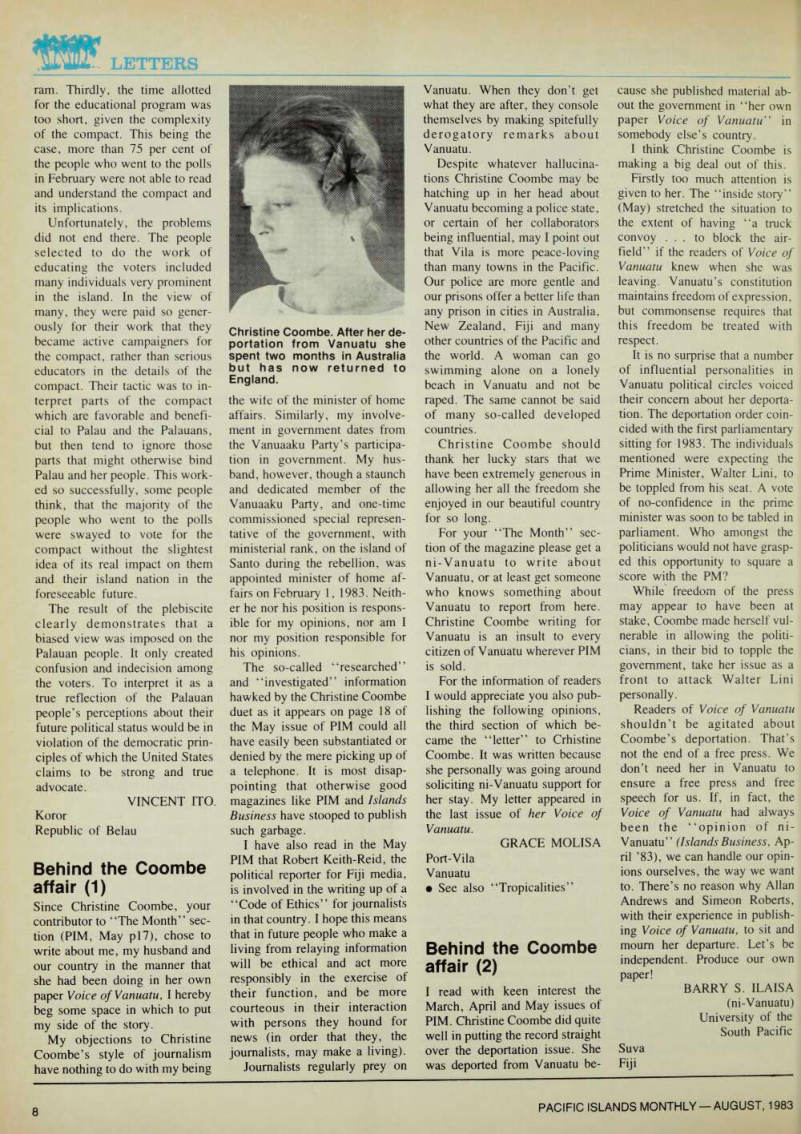
Growing up in Samoa - the Mead controversy continues.
And now Papua new Guinea, too, is showing involvement.
ram. Thirdly, the time allotted for the educational program was too short, given the complexity of the compact. This being the case, more than 75 per cent of the people who went to the polls in February were not able to read and understand the compact and its implications.
Unfortunately, the problems did not end there. The people selected to do the work of educating the voters included many individuals very prominent in the island. In the view of many, they were paid so gener ously for their work that they became active campaigners for the compact, rather than serious educators in the details of the compact. Their tactic was to in terpret parts of the compact which are favorable and benefi cial to Palau and the Palauans, but then tend to ignore those parts that might otherwise bind Palau and her people. This work ed so successfully, some people think, that the majority of the people who went to the polls were swayed to vote for the compact without the slightest idea of its real impact on them and their island nation in the foreseeable future.
The result of the plebiscite clearly demonstrates that a biased view was imposed on the Palauan people. It only created confusion and indecision among the voters. To interpret it as a true reflection of the Palauan people’s perceptions about their future political status would be in violation of the democratic prin ciples of which the United States claims to be strong and true advocate.
Vincent Ito.
Koror Republic of Belau
Behind the Coombe
affair (1)
Since Christine Coombe, your contributor to “The Month” sec tion (PIM, May pi 7), chose to write about me, my husband and our country in the manner that she had been doing in her own paper Voice of Vanuatu, I hereby beg some space in which to put my side of the story.
My objections to Christine Coombe’s style of journalism have nothing to do with my being
the wife of the minister of home affairs. Similarly, my involve ment in government dates from the Vanuaaku Party’s participa tion in government. My hus band, however, though a staunch and dedicated member of the Vanuaaku Party, and one-time commissioned special represen tative of the government, with ministerial rank, on the island of Santo during the rebellion, was appointed minister of home af fairs on February 1, 1983. Neith er he nor his position is respons ible for my opinions, nor am I nor my position responsible for his opinions.
The so-called “researched” and “investigated” information hawked by the Christine Coombe duet as it appears on page 18 of the May issue of PIM could all have easily been substantiated or denied by the mere picking up of a telephone. It is most disap pointing that otherwise good magazines like PIM and Islands Business have stooped to publish such garbage.
I have also read in the May PIM that Robert Keith-Reid, the political reporter for Fiji media, is involved in the writing up of a “Code of Ethics” for journalists in that country. I hope this means that in future people who make a living from relaying information will be ethical and act more responsibly in the exercise of their function, and be more courteous in their interaction with persons they hound for news (in order that they, the journalists, may make a living).
Journalists regularly prey on
Vanuatu. When they don’t get what they are after, they console
themselves by making spitefully
derogatory remarks about Vanuatu.
Despite whatever hallucina tions Christine Coombe may be hatching up in her head about Vanuatu becoming a police state, or certain of her collaborators being influential, may I point out that Vila is more peace-loving than many towns in the Pacific.
Our police are more gentle and our prisons offer a better life than any prison in cities in Australia, New Zealand, Fiji and many other countries of the Pacific and the world. A woman can go swimming alone on a lonely beach in Vanuatu and not be raped. The same cannot be said of many so-called developed countries.
Christine Coombe should thank her lucky stars that we have been extremely generous in allowing her all the freedom she enjoyed in our beautiful country for so long.
For your “The Month” sec tion of the magazine please get a ni-Vanuatu to write about Vanuatu, or at least get someone who knows something about Vanuatu to report from here.
Christine Coombe writing for Vanuatu is an insult to every citizen of Vanuatu wherever PIM is sold.
For the information of readers I would appreciate you also pub
lishing the following opinions,
the third section of which be came the “letter” to Crhistine Coombe. It was written because she personally was going around soliciting ni-Vanuatu support for her stay. My letter appeared in the last issue of her Voice of Vanuatu.
Grace Molisa
Port-Vila Vanuatu • See also “Tropicalities”
Behind the Coombe
affair (2)
I read with keen interest the March, April and May issues of PIM. Christine Coombe did quite well in putting the record straight over the deportation issue. She was deported from Vanuatu be
cause she published material ab out the government in “her own paper Voice of Vanuatu” in somebody else’s country.
I think Christine Coombe is making a big deal out of this.
Firstly too much attention is given to her. The “inside story” (May) stretched the situation to the extent of having “a truck convoy ... to block the air field” if the readers of Voice of Vanuatu knew when she was leaving. Vanuatu’s constitution maintains freedom of expression, but commonsense requires that this freedom be treated with respect.
It is no surprise that a number of influential personalities in Vanuatu political circles voiced their concern about her deporta tion. The deportation order coin cided with the first parliamentary sitting for 1983. The individuals mentioned were expecting the Prime Minister, Walter Lini, to be toppled from his seat. A vote of no-confidence in the prime minister was soon to be tabled in parliament. Who amongst the politicians would not have grasp ed this opportunity to square a score with the PM?
While freedom of the press may appear to have been at stake, Coombe made herself vul nerable in allowing the politi cians, in their bid to topple the government, take her issue as a front to attack Walter Lini
personally.
Readers of Voice of Vanuatu shouldn’t be agitated about Coombe’s deportation. That’s not the end of a free press. We don’t need her in Vanuatu to ensure a free press and free speech for us. If, in fact, the Voice of Vanuatu had always been the “opinion of ni- Vanuatu” (Islands Business, Ap ril ’B3), we can handle our opin ions ourselves, the way we want to. There’s no reason why Allan Andrews and Simeon Roberts, with their experience in publish ing Voice of Vanuatu, to sit and mourn her departure. Let’s be independent. Produce our own
paper!
Barry S. Ilaisa
(ni-Vanuatu) University of the South Pacific Suva Fiji
Christine Coombe. After her de portation from Vanuatu she spent two months in Australia but has now returned to
England.
New PM describes the world as


Cook Islands
New PM describes the world as seen from Rarotonga
Prime Minister GEOFFREY HENRY of the Cook Islands was interviewed in Rarotonga in June by roving PIM correspondent W. G. COPPELL.
Q. Prime Minister, all the dis puted electoral results from your 1983 general election have now been resolved. Do you feel that you have a safe enough majority to enable your government to carry out the policies you have in mind?
A. Yes, I think so. At the moment the seating stands at 13 to 11, with the Cook Islands
Party having a majority of two.
There is one more seat still to be settled, that is the by-election set for August 19 on Atiu. We are hoping to be able to take that, which would give us a working majority of three. But even with two, I believe we have a working majority. Naturally I would have liked to have had a two-thirds majority, that is 16 seats, but
unfortunately the people didn’t
give us that. At the moment we have a legislative program that I am certain we will be able to implement even with a majority of two.
Q. Mr Hawke, the newly elected Australian prime minis ter, has stressed the theme of reconciliation and reconstruc tion. Do you have any particular theme that you wish to see adopt
ed during your leadership?
A. Yes indeed. And I must say that Prime Minister Hawke has begun his term rather brilliantly.
We here in the Cook Islands are in fact moving along the same lines. I have on a number of occasions made it known public ly and in interviews that it is my intention to run an open type of government, more a consulta tive, parliamentary type of gov ernment, than an executive gov ernment, where all the decisions are made by the few in cabinet rather than being made by parliament.
In fact I intend to go further than this. We will be setting up more committees in parliament to consider the various legislative measures that the government seeks to have passed through
parliament, in order that there will be greater participation in the discussion stage at any rate in the formulation stages of any legislation that is going through parliament. Then I am going to do something that’s pro bably not done anywhere else in the Commonwealth, that is to set up a public expenditure commit tee, comprising not just members of the legislature but also repre sentatives of the private sector.
This means that we will be able to bring the public much closer to government, closer to the expen diture program of government.
The critical reviewing process that is so essential for an effec tive government will thereby have been met.
Q. The economy of the Cook Islands has undergone many changes in recent years. Has the Cook Islands Party government any specific development prog rams in mind to stimulate the economy?
A. I believe the future of the Cook Islands relies very impor tantly on a few areas, which we intend to concentrate on. First, it may not sound like a develop mental project, but in my view it is water supply. The eight months or so before the election brought home to me and certain ly to my party, the importance of water supply. If we don’t have any water supply we can forget about tourism, and certainly we can forget about any agricultural program we might have in mind.
The first emphasis of my gov ernment this year is to ensure that there will be an adequate water supply on the island of Raroton ga, and more particularly in the northern group where unfortu nately for them they have to rely on what the clouds are willing to give them so whimsically.
Secondly, of course, agricul ture. At present the cost of grow ing crops in the Cook Islands is extremely high. We have to bring in expensive fertilisers,
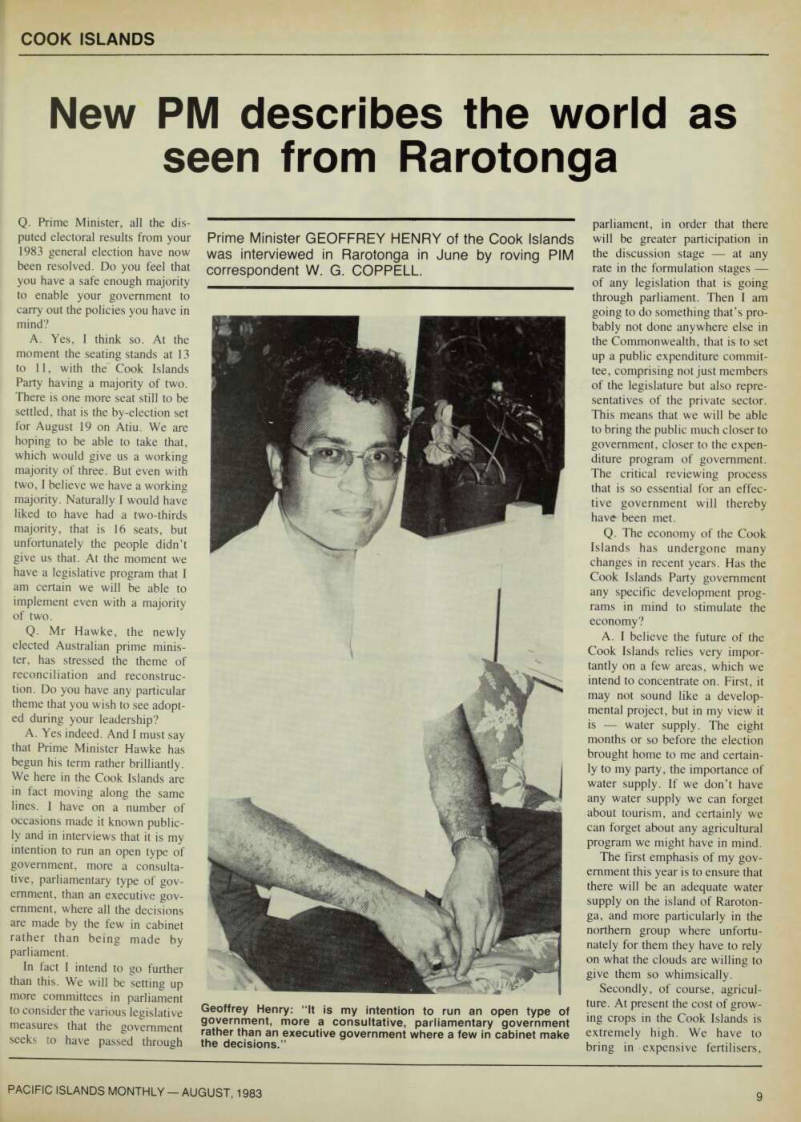
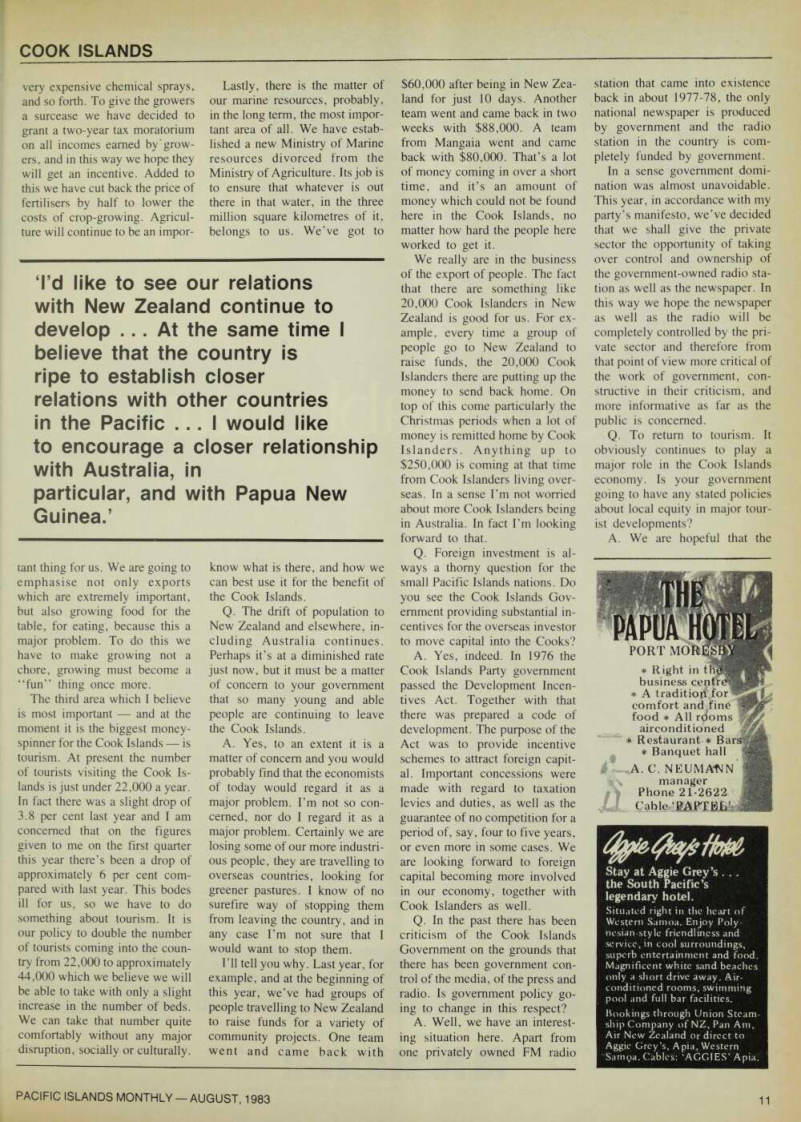
Geoffrey Henry: “It is my intention to run an open type of government, more a consultative, parliamentary government rather than an executive government where a few in cabinet make the decisions.”
very expensive chemical sprays, and so forth. To give the growers a surcease we have decided to grant a two-year tax moratorium on all incomes earned by grow ers, and in this way we hope they will get an incentive. Added to this we have cut back the price of fertilisers by half to lower the
costs of crop-growing. Agricul
ture will continue to be an impor
‘l’d like to see our relations with New Zealand continue to develop ... At the same time I believe that the country is ripe to establish closer relations with other countries in the Pacific ... I would like to encourage a closer relationship with Australia, in particular, and with Papua New Guinea.’
rant thing for us. We are going to emphasise not only exports which are extremely important, but also growing food for the table, for eating, because this a major problem. To do this we have to make growing not a chore, growing must become a “fun” thing once more.
The third area which I believe is most important and at the moment it is the biggest money spinner for the Cook Islands is tourism. At present the number of tourists visiting the Cook Is lands is just under 22,000 a year.
In fact there was a slight drop of 3.8 per cent last year and I am concerned that on the figures given to me on the first quarter this year there’s been a drop of approximately 6 per cent com pared with last year. This bodes ill for us, so we have to do something about tourism. It is our policy to double the number of tourists coming into the coun try from 22,000 to approximately 44,000 which we believe we will be able to take with only a slight increase in the number of beds.
We can take that number quite comfortably without any major disruption, socially or culturally.
Lastly, there is the matter of our marine resources, probably, in the long term, the most impor tant area of all. We have estab lished a new Ministry of Marine resources divorced from the
Ministry of Agriculture. Its job is
to ensure that whatever is out there in that water, in the three million square kilometres of it, belongs to us. We’ve got to
know what is there, and how we can best use it for the benefit of the Cook Islands.
Q. The drift of population to New Zealand and elsewhere, in cluding Australia continues.
Perhaps it’s at a diminished rate just now, but it must be a matter of concern to your government that so many young and able people are continuing to leave the Cook Islands.
A. Yes, to an extent it is a matter of concern and you would probably find that the economists of today would regard it as a major problem. I’m not so con cerned, nor do I regard it as a major problem. Certainly we are losing some of our more industri ous people, they are travelling to overseas countries, looking for greener pastures. I know of no surefire way of stopping them from leaving the country, and in any case I’m not sure that I would want to stop them.
I’ll tell you why. Last year, for example, and at the beginning of this year, we’ve had groups of people travelling to New Zealand to raise funds for a variety of
community projects. One team
went and came back with
$60,000 after being in New Zea land for just 10 days. Another team went and came back in two weeks with $BB,OOO. A team from Mangaia went and came back with $BO,OOO. That’s a lot of money coming in over a short time, and it’s an amount of money which could not be found here in the Cook Islands, no matter how hard the people here worked to get it.
We really are in the business of the export of people. The fact that there are something like 20,000 Cook Islanders in New Zealand is good for us. For ex ample, every time a group of people go to New Zealand to raise funds, the 20,000 Cook Islanders there are putting up the money to send back home. On top of this come particularly the Christmas periods when a lot of money is remitted home by Cook Islanders. Anything up to $250,000 is coming at that time from Cook Islanders living over seas. In a sense I’m not worried about more Cook Islanders being in Australia. In fact I’m looking forward to that.
Q. Foreign investment is al ways a thorny question for the small Pacific Islands nations. Do you see the Cook Islands Gov ernment providing substantial in centives for the overseas investor to move capital into the Cooks?
A. Yes, indeed. In 1976 the Cook Islands Party government
passed the Development Incen
tives Act. Together with that there was prepared a code of development. The purpose of the Act was to provide incentive schemes to attract foreign capit al. Important concessions were made with regard to taxation levies and duties, as well as the guarantee of no competition for a period of, say, four to five years, or even more in some cases. We are looking forward to foreign capital becoming more involved in our economy, together with Cook Islanders as well.
Q. In the past there has been criticism of the Cook Islands Government on the grounds that there has been government con trol of the media, of the press and radio. Is government policy go
ing to change in this respect?
A. Well, we have an interest ing situation here. Apart from one privately owned FM radio
station that came into existence back in about 1977-78, the only national newspaper is produced by government and the radio station in the country is com
pletely funded by government.
In a sense government domi nation was almost unavoidable.
This year, in accordance with my party’s manifesto, we’ve decided that we shall give the private sector the opportunity of taking over control and ownership of the government-owned radio sta tion as well as the newspaper. In this way we hope the newspaper as well as the radio will be
completely controlled by the pri
vate sector and therefore from that point of view more critical of the work of government, con structive in their criticism, and more informative as far as the public is concerned.
Q. To return to tourism. It obviously continues to play a major role in the Cook Islands economy. Is your government going to have any stated policies about local equity in major tour
ist developments?
A. We are hopeful that the
developments that take place in that area would in the main be owned by Cook Islanders. But where it is clear that foreign capital is essential for the de velopment to take place, we have a minimum requirement of no less than 10 per cent equity, or
‘We are in the business of the export of people. The fact that there are something like 20,000 Cook Islanders in New Zealand is good for us. For example, every time a group of people go to New Zealand to raise funds, the 20,000 Cook Islanders there are putting up the money to send back home.’
one per cent of gross profit, would belong to a local entity.
Our hope is that, in contrast to some other places in the world.
Cook Islanders will benefit di rectly from any tourist activity that takes place.
Q. The Cook Islands have relied for many years on grants in-aid from New Zealand. Do you expect the rate of funding to be maintained or even increased?
A. I’m hoping that the donor countries would consider in creasing their aid. We’ve been lucky this year, our application for the grant-in-aid from the New Zealand Government has been met in full in fact with an increase of $50,000. We are looking to other countries for assistance in this area. I can’t help feeling that donor countries have to accept that a small coun try like mine, with a total land area of 240 square kilometres in the scattered situation that we have, there is no way, given our resources, that we can ever be
come completely independent. I
am hoping that donor countries would accept that as a fact.
Let us, allow us, the pleasure and the joy of pursuing a goal of economic independence, because that we have to chase anyway, to make life meaningful and worth while. It must be accepted, how
ever, that we can never attain it.
Q. When governments change in the Cook Islands and they
have only changed once really
there are questions about will there be any changes in relation ships between the Cook Islands and New Zealand. Does your
government see any substantial change or will the present rela tionships be kept on much as
they are?
A. We have enjoyed an ex
tremely sound working relation
ship with the New Zealand gov ernment. I guess it started off in the beginning as a sort of father child type of relationship. New Zealand was the country with the colony, and it was very much paternal. In 1965 we became kind of partners as it were. But since then the relationship bet ween the two countries has in deed matured considerably, to the point where New Zealand is
actively seeking acceptance
overseas of our state of
independence.
Our constitution leaves itself open to the interpretation that we might still be controlled by New Zealand, but that is not the case.
New Zealand is anxious that it is seen by the outside world that we have a perfect relationship bet
ween two sovereign independent
states. I’d like to see our rela tions with New Zealand continue to develop. We’ve enjoyed it very much and we don’t want to lose it.
At the same time I believe that the country is ripe to establish closer relations with other coun tries in the Pacific. We have a
very close relationship with Fiji, Western Samoa, Tonga, and so on. I would like to encourage a closer relationship with Aust ralia, in particular, and with Papua New Guinea.
Q. I was about to ask you about your government’s attitude to South Pacific regional ar rangements, such as the South Pacific Forum, the Forum Line, the South Pacific Commission all those regional activities?
A. We are firm believers in regional organisations. We are a founding member of the Forum, and a fully fledged member of the South Pacific Commission.
We have attained membership of the Pacific Islands Industrial De velopment Scheme and we are involved in a variety of other regional activities such as the Forum Line and the South Pacif ic Regional Civil Aviation Coun cil. I would like to see a situation where these organisations offer more of an opportunity for coun tries to get together and talk things out, rather than their be coming the channels of aid to the Pacific. I firmly believe that the
most useful way of giving aid to Pacific countries is through bila teral aid directly from govern ment to government, rather than
through costly intermediary
organisations.
Q. The Cook Islands constitu tion is framed in such a sway that it requires a two-thirds majority in parliament to bring about
changes. During the period of the
Democratic Party’s rule they did have a two-thirds majority and were able to make some very substantial changes to the con stitution. You don’t have that two-thirds majority. Are there any constitutional changes you would like to bring forward and hope that perhaps the opposition would give you support in the interests of the nation?
A. Yes, there are some. I must say that it is unfortunate for us that we didn’t get our two-thirds majority in order to ensure that our proposals for changes in the constitution could be put through. For example we are determined to alter the constitu tion to do away with the overseas seat and have it replaced by some
other arrangement which would still ensure that the Cook Islan ders who are overseas and elig ible do not lose their franchise.
Q. However, if you put that through at the present time you would lose one of your seats . . . ’
A. Yes, that would be a rather
silly thing to do.
Q. The opposition would obvi
ously support you . . .
A. Absolutely, all the way.
I’m sure. If the change was made it would come at the end of the term. One of the changes we also did want to make was the reduc tion of the parliamentary term from five years to four years.
The five-year term was in
troduced by the previous govern ment, we are the beneficiaries of it now, but I maintain, and my team maintains, that five years is too long for the people to wait to exercise their right to change the government, if they so wish.
Another important issue is the position of the speaker. The pre vious government introduced the measure that rendered the posi tion of the Speaker rather pre carious, in that all that was re quired was a substantive motion by a two-thirds majority and the Speaker would find himself flat on his face, and out of the House. Our preference was for a situation where the Speaker
could not be removed from parli ament during the term of govern ment by any means, other than his own resignation, or illness, or retirement. The tenure of the Speaker would be firmer, a lot stronger and less subject to the
majority in parliament.
The fact that the Speaker is not an elected member but is ap
pointed by parliament contri
butes greatly to the independence of the position of the Speaker.
Any legislative measure that
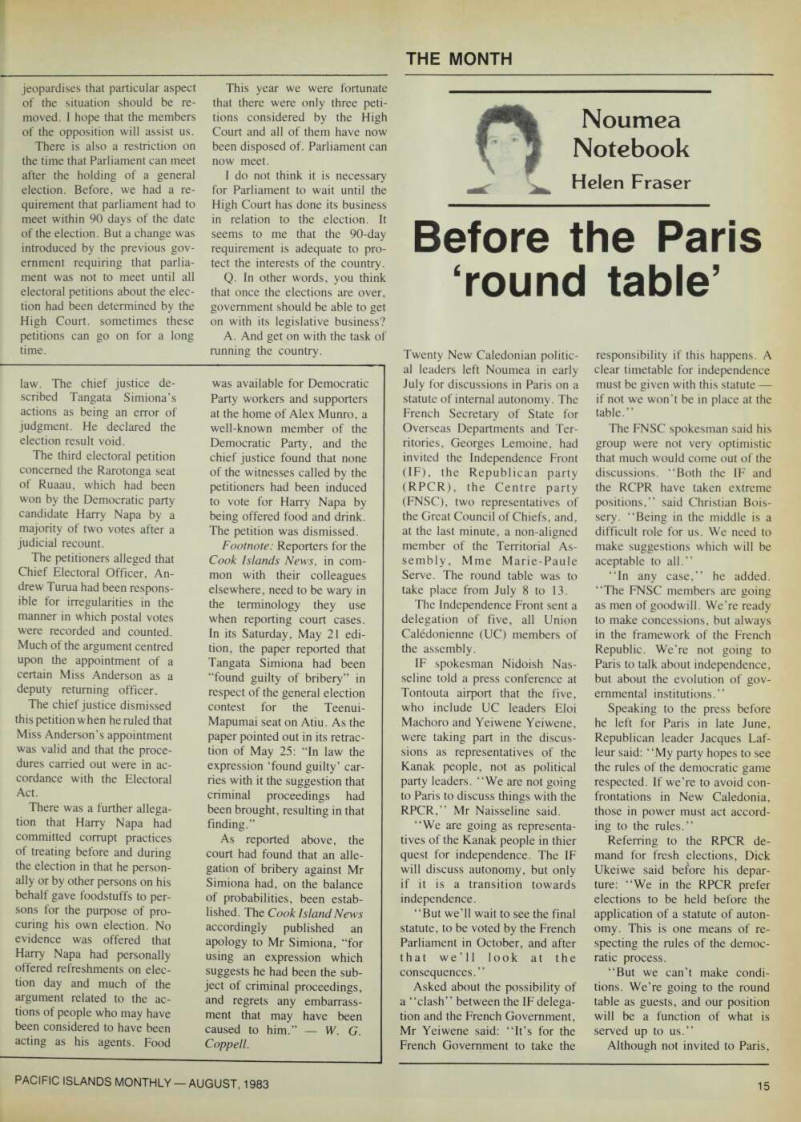
Norman George: When is a tin of fish bribery, and when is it plain good manners? See re port below.
jeopardises that particular aspect
of the situation should be re moved. I hope that the members of the opposition will assist us.
There is also a restriction on the time that Parliament can meet after the holding of a general election. Before, we had a re quirement that parliament had to meet within 90 days of the date of the election. But a change was introduced by the previous gov ernment requiring that parlia ment was not to meet until all electoral petitions about the elec tion had been determined by the High Court, sometimes these petitions can go on for a long time.
This year we were fortunate that there were only three peti tions considered by the High Court and all of them have now been disposed of. Parliament can now meet.
I do not think it is necessary for Parliament to wait until the High Court has done its business in relation to the election. It seems to me that the 90-day requirement is adequate to pro tect the interests of the country.
Q. In other words, you think that once the elections are over, government should be able to get on with its legislative business?
A. And get on with the task of running the country.
Advertisements & other items, pp. 10-13 (1 item)
Expert
Insurance Service
throughout the islands
Queensland Insurance (Fiji) Limited
Head Office: Victoria Parade SUVA. General Manager: R. Jackson. Assistant Manager: Vijay Lai. Phone 23 851.
LAUTOKA OFFICE: Burns Philp Bldg., Naviti St. District Manager: R. Sharma. Phone 60 642 LABASA OFFICE; Burns Philp Bldg. District Manager; R. Sharma Phone: 8 2139
Queensland Insurance (PNG) Limited
PAPUA NEW GUINEA
Head Office. B N G. Building. Musgrave St..PORT MORESBY. General Manager: T, Sarti Phone: 21 2144.
LAE. 4th St. & Coronation Drive District Manager: C. D. Hillier Phone: 423873.
MOUNT HAGEN; Hagen Drive District Manager: G. Hayes Phone: 521002.
ARAWA: Chebu St., District Manager; R. Bowers Phone: 95 1555 MADANG: Kasagten St., District Manager: J. Longbut Phone; 82 2020 RABAUL: Wirraway St. District Managerß. McManus Phone: 921014
QBE Insurance (International) Limited
VANUATU. PORT VILA: Rue de Pans, Suite 19,Oceania Bldg. Manager: I R. Martin.
Phone: 2299.
SANTO: Bums Philp ( Vanuatu) Ltd Phone: 230.
PACIFIC AGENCIES
NEW CALEDONIA: Ste. W. A. Johnston, S.A.R.L. 5 Rue Anatole France, NOUMEA Phone: 272083.
TAHITI Arthur Chung. Immeuble BIS.. Front de Mer, PAPEETE Phone: 2.86.19 NIUE: Burns Philp (South Sea) Company Ltd.
NORFOLK ISLAND: Burns Philp ('N I ) Company Ltd. Phone: 2191 SAMOA APIA, Burns Philp (South Sea) Company Ltd. Phone: 22611 TONGA Burns Philp (South Sea) Company Ltd. NUKUALOFA. Phone 21500 HAAPAI, VAVAU x
•MEMBERS OF THE
QBE INSURANCE GROUP LIMITED
PORT MOR
* Right in business cep * A traditiopcomfort food ♦ All r<soms airconditioned * Restaurant * Ba * Banquet hall
..A. C. NEUMANN
manager Phone 21-2622 Cable ‘EAFTEMm
Stay at Aggie Grey’s . . . the South Pacific’s
legendary hotel.
Situated right in the heart of Western Samoa. Enjoy Polynesian-style friendliness and service, in cool surroundings, superb entertainment and food.
Magnificent white sand beaches only a short drive away. Airconditioned rooms, swimming pool and full bar facilities.
Bookings through Union Steamship Company of NZ, Pan Am, Air New Zealand or direct to Aggie Grey’s, Apia, Western Samoa. Cables: ‘AGGIES’ Apia.
'iv %
St i V
«• «* t?. ■ * & 4. w~ "S* v ns-. 1 & ■ M \ m M w I# <£ V
The portable party
It’s light. It’s compact. Its 3-way power supply [AC/battery/car] lets you take it anywhere. And anywhere you take it, it’s bound to start a party. Simply because it sounds so good.
It’s the RX-C 45 3-piece portable stereo system by National.
And when the party gets hot, the RX-C4s’s got the right stuff to handle it. A big 40 watts peak music power output-perfect for the highenergy sound of Earth, Wind and Fire Cthe superstar group that gives us the pro’s pointof-view on all our portable designs]. And a 5-band graphic equalizer that lets you shape the sound to the acoustics of your listening area indoors or out.
The metal tape compatible cassette deck features a long life AX amorphous record/playback head [usually found only in the very best hi-fi cassette decks] that delivers startlingly crisp sound with an exceptionally wide frequency response through the detachable 2-way/ 4-speaker system. The MW/SWI/SW2/FM stereo receiver offers accurate tuning and an LED indicator for FM stations broadcasting in stereo.
The RX-C 45. Go for it! Then get ready to party.
National t* n —i 5
I , I ■ £D
s The RX-C 45 comes in Brown (shown) or Silver.
National, Panasonic and Technics are the brandnames of Matsushita Electric.
FOR SALE
PEARL CULTURE
BUSINESS
Buildings, rafts, island lease, and all essential equipment. Technical instruction & SAV if required. $170,000 Enquiries to Manager PO Box 167 Thursday Island, Australia 4875.
FOR SALE
HOME UNIT
YORKEYSKNOB. CAIRNS
Two bedroom prestigious unfurn. unit on top floor of unique circular building containing only 20 units. Seaward aspect with view of Double Is., Green Is., Cairns cannot be built out. Two patios. Ensuite.
Drapes and carpeted throughout. Refrig., dishwasher, clothes drier, ceiling fans Built-in robes. Intercom security system. Basement car space.
Swimming pool A 5150.000.
P.O. Box 5292, Cairns Mail Centre. 4870.
FOR SALE
Ready Mix Concrete Weight Batch Plant and 2 Peterbilt/Challenge Mixer Trucks.
Complete with spares.
All in going order Available late 1983. contact Mainzeal Construction Ltd.
P.O. Box 1124, Apia, Western Samoa.
Telex 281 Mainzeal SX.
Telephone 21239.
petitions in the Cooks
Tangled tale of electoral petitions in the Cooks
Following the March 1983 general election in the Cook Islands, there were three elec
toral petitions. They were
heard by Chief Justice Sir Graham Speight, and the pro ceedings were conducted in a
predominantly low-ley man
ner, quite unlike the almighty row that followed the 1978 elections and the “fly-in” vo ters issue.
Two of the cases were heard on the island of Atiu and concerned seats which had been successfully con tested by Democratic Party candidates Norman George and Tangata Simiona.
In the case of Norman George, much of the petition ers’ evidence related to alle gations of treating and brib
ery, especially alleged offers
to secure overseas training or promotion for several poss ible supporters, and the sup plying of a carton of meat and a bag of sugar to a group of Atiuans working on the build ing of a palace on the marae of the Ngati Paraurangi tribe.
Giving evidence, Mr George outlined the several conversations he had had with the petitioners’ witnesses ab out overseas training and pro motions, stating in one inst ance; “The view I hold, and
made mention of to Paratain ga and his wife, is that far too
many opportunities are given
to personnel based in Raro.
My task, if I am elected, would be to fight for those opportunities to be given to young Atiuans.”
The case produced vivid examples of the problems as sociated with campaigning in the numerically small electo rates of the Cook Islands, where candidates may, if they want to, speak personally to all constituents. Norman George told the hearing: “I said that I am endeavoring to go to every house and to know as many people in the district as possible. To this Terangi Roi replied, T knew you were coming, my hus band told me. ’ She added that her father-in-law was against my visit but she insisted I be allowed to visit her like any other human being.”
Vincent Ingram, represent
ing Norman George, brought
out in evidence that George is a member of the Paraurangi tribe, and that it was expected that members of the tribe would contribute to the work on the palace, and that mem bers absent from Atiu were also expected to contribute in kind. Although it was alleged
that by providing the food George was treating, it was brought out that Tepou Boa za, the Cook Islands Party candidate had also been ac tive on the marae site. A witness for the petitioners stated: “He was not playing politics when he was coming on the marae, he was just discharging tribal customs.”
The response to the allega
tion of treating produced sig
nificant evidence relating to customary practices. As Nor man George testified: “As I approached them a lady said to me, ‘You have the audacity to come here with your bare hands.’ She said in Atiuan ‘E tae koe ite acre mai ki konei aau pakau. ’ Some other lady said: ‘Where is your tin of fish?’ I was taken by surprise and said to her: T can’t buy you tin fish, it is bribery and you know this is election time.’ She replied: ‘No, no, no, this is a tribal function angaanga kopu tangata teia . . . this is not politics and you are allowed to bring food
for Ngati Paruarangi’.”
The petitions against Nor
man George were dismissed.
In the case of Tangata
Simiona the petitions princip
ally concerned $95 worth of volleyball and .other sports
equipment supplied through
Mr Simiona to the Seventh day Adventist School on Atiu. The evidence recalled discussions between Tangata Simiona and the head teacher relating to the proposed sup ply of the equipment. The letter advising that the equip ment was to be provided, according to the head teacher,
was accompanied by another
from Tangata Simiona, headed “Confidential.”
This letter asked the head teacher to lend her support to Tangata at election time. She said: “Boy, I was scared, scared. Above all else I re gretted making the list (of sports equipment). I regret answering ‘yes’ when he ask ed if we wanted sports gear.”
When asked “Why did you regret it?”, she replied: “Well, it’s simple, as the let ter says, he was only using me to campaign for him. He wanted me to speak to my pastor and his wife and my head elder.” She was then asked: “Having received this letter, what did you think Mr Simiona’s purpose had been?” “I said to myself that that was the only reason he came to see me, but he used the sports gear to cover himself.”
The chief justice found in favor of the petitioners and said in his summing-up that the allegation of bribery had on the balance of probabilities been established, this being a determination under civil
law. The chief justice described Tangata Simiona’s actions as being an error of judgment. He declared the election result void.
The third electoral petition concerned the Rarotonga seat of Ruaau, which had been won by the Democratic party candidate Harry Napa by a majority of two votes after a judicial recount.
The petitioners alleged that Chief Electoral Officer, Andrew Turua had been responsible for irregularities in the manner in which postal votes were recorded and counted.
Much of the argument centred upon the appointment of a certain Miss Anderson as a deputy returning officer.
The chief justice dismissed this petition when he ruled that Miss Anderson’s appointment was valid and that the procedures earned out were in accordance with the Electoral Act.
There was a further allegation that Harry Napa had committed corrupt practices of treating before and during the election in that he personally or by other persons on his behalf gave foodstuffs to persons for the purpose of procuring his own election. No evidence was offered that Harry Napa had personally offered refreshments on election day and much of the argument related to the actions of people who may have been considered to have been acting as his agents. Food
was available for Democratic Party workers and supporters at the home of Alex Munro, a well-known member of the Democratic Party, and the chief justice found that none of the witnesses called by the petitioners had been induced to vote for Harry Napa by being offered food and drink, The petition was dismissed, Footnote: Reporters for the Cook Islands News, in com mon with their colleagues elsewhere, need to be wary in the terminology they use when reporting court cases, In its Saturday, May 21 edi tion, the paper reported that Tangata Simiona had been “found guilty of bribery” in respect of the general election contest for the Teenui- Mapumai seat on Atiu. As the paper pointed out in its retrac tion of May 25: “In law the expression ‘found guilty’ car ries with it the suggestion that criminal proceedings had been brought, resulting in that
finding.”
As reported above, the court had found that an alle gation of bribery against Mr Simiona had, on the balance of probabilities, been estab lished. The Cook Island News accordingly published an apology to Mr Simiona, “for using an expression which suggests he had been the sub ject of criminal proceedings, and regrets any embarrass ment that may have been caused to him.” W. G.
Coppell.
Before the Paris
The Month
Before the Paris ‘round table’
Twenty New Caledonian politic al leaders left Noumea in early July for discussions in Paris on a statute of internal autonomy. The French Secretary of State for Overseas Departments and Ter ritories, Georges Lemoine, had invited the Independence Front (IF), the Republican party (RPCR), the Centre party (FNSC), two representatives of the Great Council of Chiefs, and, at the last minute, a non-aligned member of the Territorial As sembly, Mme Marie-Paule Serve. The round table was to take place from July 8 to 13.
The Independence Front sent a delegation of five, all Union Caledonienne (UC) members of the assembly.
IF spokesman Nidoish Nas seline told a press conference at Tontouta airport that the five, who include UC leaders Eloi Machoro and Yeiwene Yeiwene, were taking part in the discus sions as representatives of the Kanak people, not as political party leaders. “We are not going to Paris to discuss things with the RPCR,” Mr Naisseline said.
“We are going as representa tives of the Kanak people in thier quest for independence. The IF will discuss autonomy, but only if it is a transition towards independence.
“But we’ll wait to see the final statute, to be voted by the French Parliament in October, and after that we’ll look at the consequences.”
Asked about the possibility of a “clash” between the IF delega tion and the French Government, Mr Yeiwene said: “It’s for the French Government to take the
responsibility if this happens. A clear timetable for independence must be given with this statute if not we won’t be in place at the table.”
The FNSC spokesman said his group were not very optimistic that much would come out of the discussions. “Both the IF and the RCPR have taken extreme positions,” said Christian Bois sery. “Being in the middle is a difficult role for us. We need to make suggestions which will be aceptable to all.”
“In any case,” he added.
“The FNSC members are going as men of goodwill. WeTe ready to make concessions, but always in the framework of the French Republic. We’re not going to Paris to talk about independence, but about the evolution of gov ernmental institutions. ’ ’
Speaking to the press before he left for Paris in late June,
Republican leader Jacques Laf
leur said: “My party hopes to see the rules of the democratic game respected. If we’re to avoid con frontations in New Caledonia, those in power must act accord ing to the rules.”
Referring to the RPCR de mand for fresh elections, Dick Ukeiwe said before his depar ture; “We in the RPCR prefer elections to be held before the application of a statute of auton omy. This is one means of re specting the rules of the democ ratic process.
“But we can’t make condi tions. We’re going to the round table as guests, and our position will be a function of what is served up to us.”
Although not invited to Paris,
Noumea Notebook Helen Fraser
two other groups have launched ideas on the autonomy question.
The anti-independence
Caledonia Front put out a pro position for a decentralised reg ional government, based on that recently decided by France for Corsica.
Their idea would create a reg ional assembly, with its president holding executive office. New Caledonians would control their own budget, but most powers would rest with France.
Caledonian Front leader Justin Guillemard would like the pro position to be put to a referen
dum, although he acknowledges
the chances are not high.
Mr Guillemard was also in the news recently when he wrote to Queen Elizabeth II protesting against the behaviour of Aust ralia’s Prime Minister Hawke
and Foreign Minister Hayden.
Referring to recent statements by the two men on New Caledonia, Mr Guillemard complained to Her Majesty about their “out rageous language, attitude and declarations”.
The lengthy letter describes Mr Hawke’s support for inde pendence as “supporting Marx ism and international Commun ism”. The Queen was also warn ed that the statements by the Australian Government were “detrimental to good and cordial relations between friends and neighbors”. The Caledonian Front also wrote to Mr Hawke in
early May.
The Caledonian Youth Party (AJC) also put up suggestions for a decentralised statute on the eve of the round table. The AJC was formed in 1979 and has several hundred members.
They want to see two elected
bodies in New Caledonia, one the Territorial Assembly, the other a Council of New Caledo nian Affairs, to be the local executive, with a president as its head. The AJC puts emphasis on freedom of commerical relations for such a decentralised territory, with the lifting of import quotas
being proposed.
The AJC contests the IF claim for recognition of the Kanak peo ple as the legitimate people of New Caledonia. “Why separate people who were bom and live
together in this territory, having
need of each other, and having together created the New Caledonia of today?” they ask.
They are “not against the Kanaks, but they are against Kanak socialist independence”.
New Caledonia now has her first-ever Kanak judge. Fote Trolue, 34, from Lifou Island,
has been installed as a magistrate in one of the lower courts. Mr Trolue was warmly welcomed as a magistrate in traditional cere monies by his colleagues and by the State Prosecutor, Mr Bilbao.
Mr Trolue completed his studies at the University of Montpellier in France. Helen Fraser.
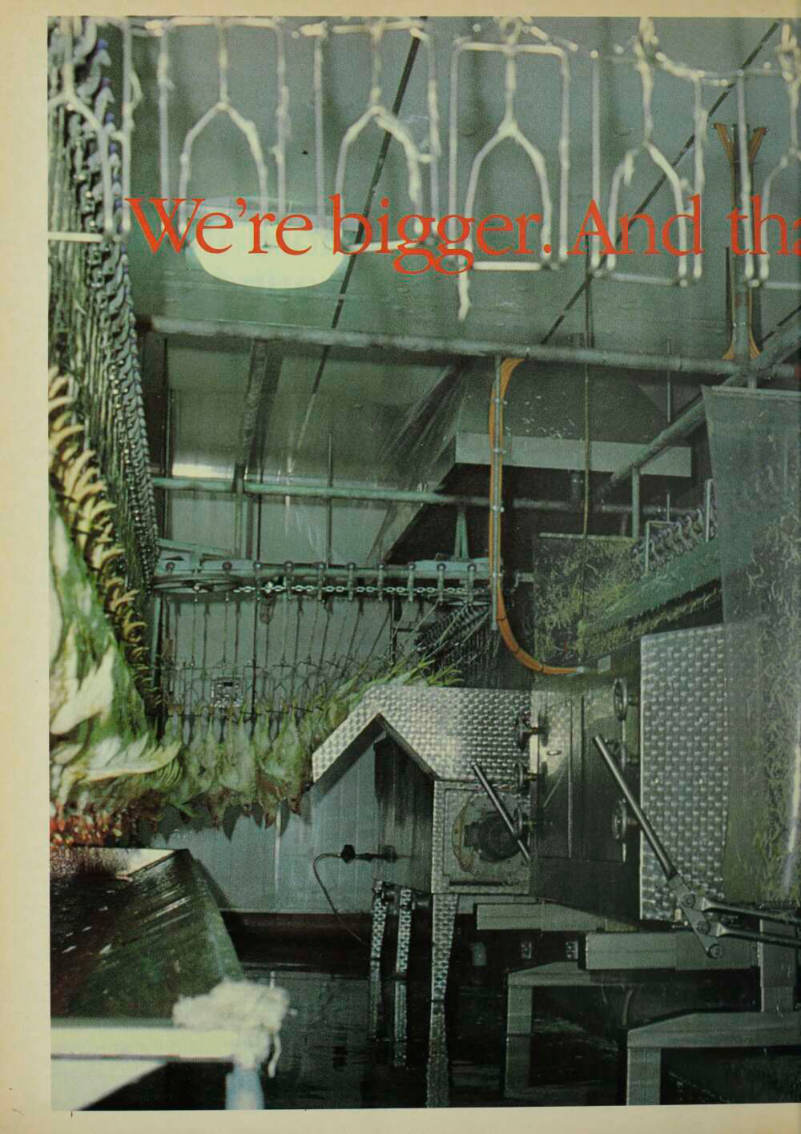
Hayden: “Outrageous outlook”
Advertisements & other items, pp. 16-17 (1 item)
t
r * it r -i re 0 •Vi Vrij&Ss n *» pm '< fT ** ■ > fa
for Fiji.
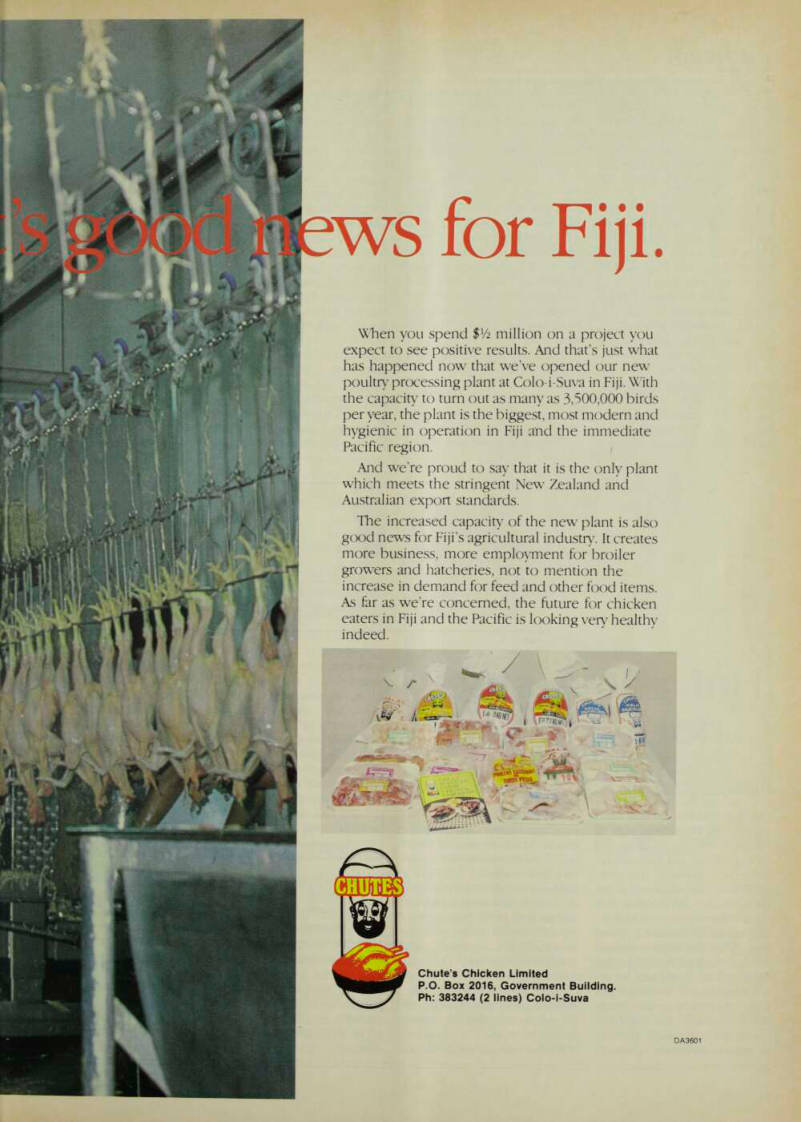
When you spend $Vi million on a project you expect to see positive results. And that’s just what has happened now that we’ve opened our new poultry processing plant at Colo-i-Suva in Fiji. With the capacity to turn out as many as 3,500,000 birds per year, the plant is the biggest, most modern and hygienic in operation in Fiji and the immediate Pacific region.
And we’re proud to say that it is the only plant which meets the stringent New Zealand and Australian export standards.
The increased capacity of the new plant is also good news for Fiji’s agricultural industry. It creates more business, more employment for broiler growers and hatcheries, not to mention the increase in demand for feed and other food items.
As far as we’re concerned, the future for chicken eaters in Fiji and the Pacific is looking very healthy indeed. v r M A
[fSL
CHUTES
Chute’s Chicken Limited P.O. Box 2016, Government Building.
Ph: 383244 (2 lines) Colo-i-Suva DA3601
Nut name study
not so nutty
The idea of making a compara tive study of the words used by different Pacific Island com munities for the various parts of the palm tree, as a means of tracing cultural and historical re lationships between the com munities, first occurred to us during a cruise on that fine ship the Linblad Explorer, which by now has almost become a second home to us. The fact that coconut palms abound on all islands, and that the finer points can be de
monstrated simply by picking up
a nut or a frond from the ground not only made our inquiries easier, but also made it possible to ensure maximum accuracy,
even when our shore visits were
fairly brief.
We have also tried to find corroborative and supplementary data in the anthropological litera ture, but, we must confess, with very little success. Even when a field, worker gives a rather full account of the uses to which the various parts of the palm are put, the native terminology is rarely indicated in a systematic and exhaustive manner. The out standing exception is not al
together unexpectedly Peter
Buck, the only anthropologist of Polynesian ancestry. His chapter in Ethnology of Tongareva (Bishop Museum, 1932) should
serve as a model for all Pacific field workers. Unfortunately, it has never done so.
We have gathered relevant names from 11 island groups or individual islands. Most of the terms have an extremely wide distribution. This is the case, for example, with the word for the coconut palm itself niu (nu,
We leave it to the judgement of the intelligent reader to decide whether the almost universal use of these terms is at all related to the fact that they denote the most useful parts of the palm tree.
Another observation which does not take long to make is that the generally acknowledged cul tural and linguistic cleavage bet-
ni). Other widespread terms are kaka for the stipule or fibrous tissue at the base of the frond, puru for the husk, and uto for the haustorium, or the white spongy mass that fills a sprouting coconut.
ween eastern and western Poly nesia is reflected in the existence of the pairs of terms listed in the
accompanying table.
Far more interesting than such universal parallels and broad di visions, however, are the histor
Postmark Papeete Marie-Thérèse and Bengt Danielsson
Western Polynesian languages Eastern Polynesian languages English equivalent launiu/rouniu nikau frond taume roro/’oroe spathe kano kiko/To kernel hua/sua vai water
ical relationships revealed by the many small word clusters linking a limited number of islands.
One such cluster, as might be expected, encompasses the Soci ety and the Cook islands, where the following variants of the word for midrib are found: fa-niu (Tahiti), ’a-nu (Rarotonga), and wha-ni (Manihiki-Rakahanga). ’Apu/kapu for coconut shell cup has an identical distribution. The most interesting case is surely that of the highly aberrant term used in the Southern Marquesas islands for the palm tree, e’ehi, which reappears in Mangareva as ere’i, which is perfectly in ac cordance with the laws govern ing the inter-island sound shifts.
The same holds true for the Mar quesan term for the spathe, ’o’o, and its Mangarevan counterpart, roro. Finally, if we equate, as we should, the Marquesan term kei kaha with the Mangarevan puru ka’a, both meaning husk, we have a third word-pair confirm ing the oral traditions recorded by the early missionaries to the effect that Mangareva was originally settled from the Marquesas.
But this is not all. There are also linguistic links between is lands at opposite ends of Poly nesia, with no traces in between.
The most intriguing example is the unique sharing between Mangareva and Samoa of the word raparapa/lapalapa for the midrib of the frond. It is also worth nothing that the typically western Polynesian word for coconut shell cup, ipu, is found, in eastern Polynesia, only in the Marquesas. As is widely known to Polynesian scholars, the main conclusion to be drawn from the extensive archeological excava tions undertaken since World War II is that the Marquesas were the first islands to be settled in eastern Polynesia, and that the early settlers must have come straight from the then culturally uniform area of today’s Samoan and Tongan island groups.
A short disgression seems jus tified here. It concerns the very similar findings made by Ber nhard Zepemick in his study from 1970: Pflanzennamen als Hinweis auf kulturelle Be ziehungen innerhalb Polyne siens. For instance, the Samoan and Futunan word for the candle
nut tree, lama, jumps over the Cook and Society islands (where the tree is called tutui ) to the Marquesas, Mangareva, and all the way to Easter Island, sub stituting only r for /.
Another botanical name that makes an almost identical jump is mei, the common word for the breadfruit tree both in a western cluster of islands made up of Tonga, Futuna-Uvea, and Niue (as well as the Carolines), and in an eastern cluster consisting, sig nificantly enough, once more of the Marquesas and Mangarevan islands. Everywhere else in Poly nesia it is called kuru, ’uru or ’ulu.
Last but not least we have intriguing instances of unique terms, used only in an extremely restricted geographical area. The Tuamotu archipelago is a fine example, for practically all the names of the two dozen or so plants that make up the meagre local flora have no counterparts elsewhere in Polynesia. To cite only a few such isolates: Col ocasia esculenta, is called fakea, Messerschmidtia argentea, ngeongeo, Guettarda speciosa, kahaia and Portulaca species pokea. As for the pandanus palm, which throughout Poly nesia is known by the name fara/hala it is called tima in the western and viri in the eastern Tuamotus. In more than 50 inst ances, a certain plant name is restricted to a single atoll.
Coconut terminology is equally varied and distinct: of the 16 terms listed in the table for the island of Raroia, nine are un known in the rest of Polynesia, and some of them have never been recorded elsewhere in the Tuamotus. The only explanation we can offer for this peculiar situation is the extreme isolation, of both of the group as a whole, and of the individual atolls with in it.
The only big island possessing an equally high percentage of isolates is Tahiti, and in this particular case we can for once discern the social mechanism re sponsible for the vocabulary changes.
This has been done in an expe cially able manner by our friend and neighbor Ralph Gardner White in his contribution to the Kenneth P. Emory Festschrift.
His article is entitled “Onomast ically induced word replace ments in Tahitian” (“onomastic” means “relating to names”).
The most famous example of such a replacement is one dating from the second half of the 18th century, and resulting from the tabooing of the syllable tu, be cause Tu was the title of the new Tahitian “king” who has gone down in history as Pomare I.
It seems that at a slightly ear lier date, the same principle had caused the palm tree to be re named ha’ari. The word is still commonly used today, although
we can find the old pan- Polynesian word niu in some legends and mythological texts recorded around 1820 by the first Protestant missionaries. We can even get an inkling of the basis for the creation of the new word when we learn that ’akari is the word for a mature nut in the adjacent Cook Islands.
As we said at the outset, this is an extremely simple type of
Parts of the coconut in the lan guage of Raroia, a small atoll in the Tuamotu archipelago of French Polynesia.
study in which our only aim has been to establish historical rela tionships with the help of coconut terminology. But al though we have made an effort to avoid it, there is nevertheless a
methodological problem involv
ed, which we must in honesty touch upon.
The problem can be stated as follows; shall we compare only
the words used for absolutely identical features of the palm tree, the nuts and the frond, or shall we base our comparisons on all existing cognate words, even when their meaning differs con siderably? The conclusions we draw from our material will not be the same in the first case as in the second.
For example, in the sense of a
frond, the word nikau/ni’au ex ists only in the Society and Cook Islands. But a dry flower stalk is called nikau in Mangareva, and ni’au means coconut leaf midrib in the Hawaiian language. The Marquesan word for a flower stalk is hihi, which at first glance seems to be a completely unique appellation until we open the LMS Tahitian dictionary and dis
cover that there is indeed a word hihi, which is used to describe the two holes in a nut that cannot be pierced! Throwing our net a little more widely, we can haul in the word ’a’ano which in Tahi tian denotes a container consist ing of an emptied whole coconut shell, but in Samoan means the coconut kernel Marie- Therese and Bengt Danielsson.
Roncaglia OPR flour milling plant
saving national financial resources
manufactured in Modena. Italy
MILLING HAS made great advances in the last thirty years in the area of in creased productivity.
Systems have come and gone, changed and been remodelled. But all the systems have been remodelled on the same basis and principle, that is the tra ditional system.
However, the House of Roncaglia have broken away from this tradition and have advanced milling technology by the use of pneumatics for sieving.
This advanced technological advancement has enabled the House of Ronca glia to perfect a milling system the net result of which is the magical, modular
Roncaglia Opr Hour Mill.
Using air in the sieving system whereby the product to be sieved is air-lifted and passed through durable nylon mesh has completely eliminated the use of elevators and traditional plan-sifters.
As a direct result of this marvellous invention the size of the mill building has been reduced from the 6 storey building necessary for the traditional mills to a single block only 5 metres high. This on its own has reduced building capi tal requirement in monetary value by at least 70 per cent, unlike in the traditio nal system where the bigger the capacity, the higher the building.
The RONCAGLIA OPR needs only a single block 5 metres high, regar dlees of the capacity, be it 10 or 1,000 tons.
By virtue of the fact that only a block is required to house the plant, the RONCAGLIA OPR Flour Mill can be sited anywhere regardless of the preva lent or geological and seismic conditions. Such is the versatility of the RON CAGLIA OPR that it can be sited anywhere, where it will give the miller opti mum convenience and hence drastic savings in bringing in of raw materials (such as wheat, maize, oat, barley, rice, rye, sorghum, millet, etc) and brin ging out of finished products.
As a result of the entire plant being sited in one floor, it is possible to ope rate and run the RONCAGLIA OPR efficiently with a minimum labour for ce. This has afforded the miller considerable savings in labour overheads.
Hygiene
The pneumatic technique of the RONCAGLIA OPR assures a very hygie nic product that is second to none.
As over 97 per cent of the moving and lifting process is conducted by the air currents the possiblity of flour contamination with residual worms, insects and cobwebs is non-existent.
The flour quality of the RONCAGLIA OPR has been acclaimed as among the very best.
The flour proteins do not suffer from any damage as the heat produced in the grinding process is constantly cooled by the ever present air currents. It therefore goes without saying that the ash content in the flour is very low and the product vastly improved from the homogeneity and quality point of view.
Manufacture
The RONCAGLIA OPR Mill is manufactured from the finest quality ma terial. It consists entirely of precast blocks. The high quality steel used in the manufacture of the RONCAGLIA OPR is machined to precision automati cally in RONCAGLIA’S fully-equipped factories.
Every single part put out is subjected to a very strict quality control before making part of a RONCAGLIA OPR MILL SYSTEM.
No wonder the House of Roncaglia gives a 10 years’ guarantee as compa red to 6 to 12 months by its traditional competitors.
The modular RONCAGLIA OPR has for the first time in milling history made possible re-location and re-siting of the plant from one location to ano ther, without losing even a single bolt.
Each mill is manufactured first taking into account the customer’s require ments. Customer’s exact requirement is the starting point for beginning the design of the plant. A systematic analysis of customer’s requirement together with RONCAGLIA’s extensive knowledge and resources in pneumatic milling enable the House of Roncaglia to supply a uniquely modern and dependable plant.
Process know-how coupled with Roncaglia milling experience and manu facturing capability as well as Roncaglia installation expertise form the basis of Roncaglia Service to Roncaglia clients.
Only a versatile modular RONCAGLIA OPR can ensure complete sati sfaction in customer’s mind.
No matter what the capacity, from 10 tons up to an infinite capacity, the House of Roncaglia is able to supply modular OPR Plants in which height ne ver exceeds 4 metres. For flour production the width is only 2.5 metres and when production of semolina, grits etc, is required, the width is 4 metres.
The modular RONCAGLIA OPR plant can be designed to be installed as a series, each line independent from the other. This enables continued produc tion when some machines are undergoing maintenance.
The erection time of the modular RONCAGLIA OPR is only 10 to 30 days as compared to 6 to 9 months in the traditional system. Reduction of in stallation downtime results in increased profits.
Supplied with the plant are instruction booklets, a spare part catalogue, technical operational advice and service manuals. Technical training is also gi ven to client’s personnel both in Italy and abroad. So the RONCAGLIA OPR is supplied on a turn key basis.
As buyers’ complete satisfaction is Roncaglia’s utmost concern, Roncaglia commitment does not end with the supply of the plant.
The House of Roncaglia guarantees the best after-sale service both techni cal and spare parts wise.
Roncaglia’s large clientele who span the world over, from Europe to Ame rica, from Asia to Africa and from Central America to Oceania is testimony of its successful advanced technology.
The House of Roncaglia is able to supply plants and prepare full layout plans for the complete satisfaction of its clients at very short notice. This fast service enables governments and their associated departments to fulfil their agroindustry commitments without any further delay.
Get in touch with the House of Roncaglia at the following address: CO o o Officine Roncaglia S.p.A. - Engineering Works 41100 Modena, Italy - Viale Reiter 51/2 Box 519 Tel. (59) 241052 - 218551 - 218899 - Telex 213384 - 216089 - 510169 Roncal I
Building capable of housing a Roncaglia OPR milling plant of any capacity.
Roncaglia OPR, capacity 300 tons of wheat per 24 hours.
After the storm,

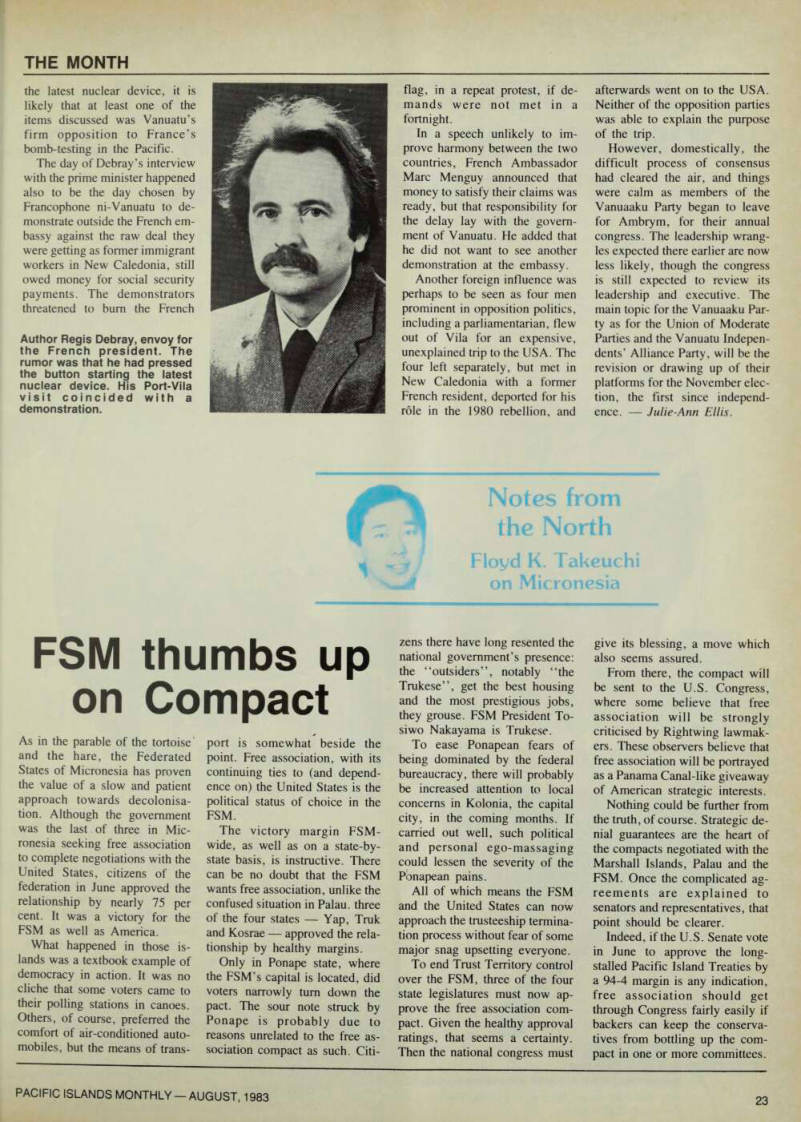
calm consensus
June in Vanuatu saw the second meeting of parliament for the year and a determined attempt by both sides to overcome par liamentary hostilities left over from the vote of no-confidence in April (PIM May p 5).
The Opposition had refused then to pass an amendment to the constitution which would have solved a tangle hindering valid elections later this year. That refusal a silent abstention had been part of the preliminary manoeuvring for the vote of no confidence in the Vanuaaku Par ty’s Prime Minister Walter Lini.
Accordingly, the day before the second meeting was to have opened, a tri-partite meeting of Lini, the Union of Moderate Par ties’ new Secretary-General Vin cent Boulekone, and the Vanuatu Independents’ Alliance Party’s Thomas Reuben Seru, hammered out a consensus approach to the amendment. Things seemed set for a smooth passage. But during the week the consensus-seekers encountered unexpected squalls.
The meeting got off to a bad start when a late entrance by a
number of Opposition members on Monday morning meant that the sitting had to be abandoned.
That afternoon saw a series of extra-parliamentary meetings, as members talked over their views.
Op Tuesday morning, too, a quorum was not present. Tues day afternoon the business of the session began. The amendment was to be left to last, as it required a special sitting.
Education Minister Onneyn Tahi introduced the long-overdue Bill for the Teaching Service Act of 1983. Vanuatu’s teachers have for a long time felt themselves to be the neglected poor relations of the professional class, and there has been a large wastage of teachers to other employment.
The Vanuatu Teachers’ Federa tion had had stormy discussions at its annual conference in May, with hints that a salary rise of 80 per cent might be demanded. The bill was passed after short discus sion, with approval from mem bers of all parties, and particular ly those who had formerly taught.
Other bills also passed easily
the Citizenship Regulation (Amendment) Act, and the Land Reform (Amendment) Act.
Friday, June 3 was the day set aside for the special sitting to debate the constitutional amend ment. It was introduced by Prime Minister Lini, and instantly de bate snagged. Whatever had been the consensus before, the Opposition now found itself un able to agree with certain sec tions of the amendment. The problem was the exact status and method of appointment of the newly-created post of Principal Electoral Officer whether this should be a presidential appoint ment or a public service position, and if a public service position, whether the appointee would be responsible to the Public Service Commission.
This delay seems to have taken both sides of the parliament by surprise. Certainly both sides were anxious that the process of consensus should not fall into disrepute; each stressed that “misunderstandings” were the cause of the delay, not intransi gence or political deviousness.
This anxiety was not lost on the Speaker, Maxime Carlot, who observed dryly “the parliamen tary method does not involve consensus. We use the par liamentary system”.
After a further emergency meeting to find a new consensus,
the revised amendment was pass ed on the afternoon of June 3.
The constitutional effect of this is that the Speaker of Parliament is
no longer automatically appoint
ed chairman of the Electoral Commission. Instead, the post of Principal Electoral Officer is created. It is an ordinary Public Service Commission appoint ment, but with the appointee primarily responsible to the Elec toral Commission. As this would be a permanent post, the former constitutional difficulties would be overcome.
The immediate political effect is that there will be elections, for the first time in independent Vanuatu, later this year. And there was a third effect: consen sus, as a method of resolving
political difficulties, had proved
itself, and the special session of parliament closed amid a general air of relief.
But if things at home seem calmer, relationships with other governments, and other overseas interests, still seem likely to cause some tensions. Author Re gis Debray ( Revolution in the Revolution, Leftist primer of the ’6os), turned up in Port-Vila as a special envoy of President Mit terrand to discuss “matters of interest to both governments”.
As Debray had come straight from Tahiti, where rumor had it that he had pressed the button for
Report from Vanuatu Julie-Ann Ellis
the latest nuclear device, it is likely that at least one of the items discussed was Vanuatu’s firm opposition to France’s bomb-testing in the Pacific.
The day of Debray’s interview with the prime minister happened also to be the day chosen by Francophone ni-Vanuatu to de monstrate outside the French em
bassy against the raw deal they
were getting as former immigrant workers in New Caledonia, still owed money for social security payments. The demonstrators threatened to bum the French
flag, in a repeat protest, if de mands were not met in a
fortnight.
In a speech unlikely to im prove harmony between the two countries, French Ambassador Marc Menguy announced that money to satisfy their claims was ready, but that responsibility for the delay lay with the govern ment of Vanuatu. He added that he did not want to see another demonstration at the embassy.
Another foreign influence was perhaps to be seen as four men
prominent in opposition politics,
including a parliamentarian, flew
out of Vila for an expensive, unexplained trip to the USA. The four left separately, but met in New Caledonia with a former French resident, deported for his role in the 1980 rebellion, and
afterwards went on to the USA.
Neither of the opposition parties was able to explain the purpose of the trip.
However, domestically, the difficult process of consensus had cleared the air, and things were calm as members of the Vanuaaku Party began to leave for Ambrym, for their annual congress. The leadership wrang les expected there earlier are now less likely, though the congress is still expected to review its leadership and executive. The main topic for the Vanuaaku Par ty as for the Union of Moderate Parties and the Vanuatu Indepen dents’ Alliance Party, will be the revision or drawing up of their platforms for the November elec tion, the first since independ
ence.
Julie-Ann Ellis.
Author Regis Debray, envoy for the French president. The rumor was that he had pressed the button starting the latest nuclear device. His Port-Vila visit coincided with a demonstration.
Advertisements & other items, p. 22 (1 item)
Europe.
BANK LINE and
COLUMBUS LINE
24 day service to
Europe.
Need we say more...
D o The Joint Service Partners offer facilities for shipment of: Containers (FCL/LCL) and Break-bulk Cargo plus reefer space and deeptanks for carriage of vegetable oils and other liquid bulk cargo.
Carriers also accept heavy lifts, overlength and cumbersome parcels.
Ports of Service: Loading; Papeete, Apia, Suva, Lautoka, Noumea, Port Vila, Santo, Honiara, Port Moresby, Lae, Madang, Kimbe, Rabaul, Kieta, Darwin. For: Rotterdam, Antwerp, Hamburg, Hull, Dunkirk, Le Havre.
Additional ports on enquiry.
Please contact our regional offices for further information: The Bank Line (Australasia) Pty Ltd Columbus Line Reederei GmbH Suite 801, 51 Pitt St, P.O. Box 1 667, Lae/Papua New Guinea.
Sydney, NSW, Australia 2000 Phone: 423466/423487/AH. 422481 Phone 27 2041 Telex 24063 Telex: Colline NE 441 71 The South Pacific Specialists for over 75 years
on Compact
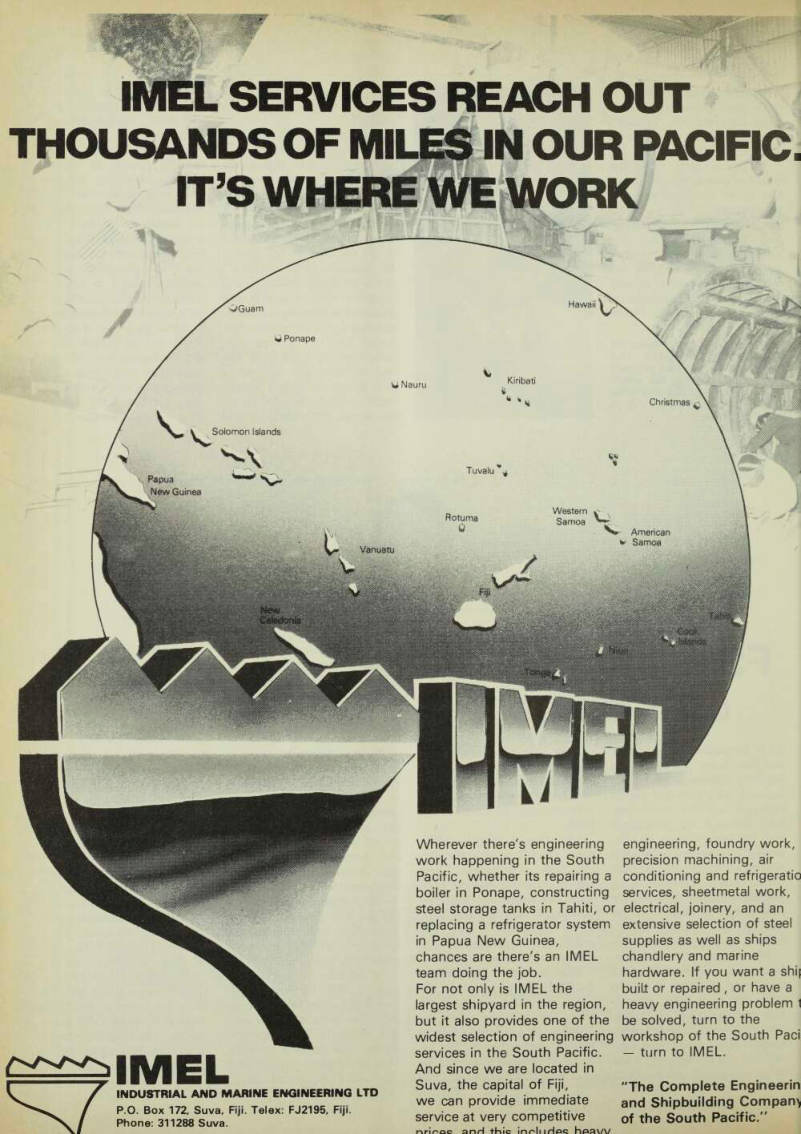
FSM thumbs up on Compact
As in the parable of the tortoise and the hare, the Federated States of Micronesia has proven the value of a slow and patient approach towards decolonisa tion. Although the government was the last of three in Mic ronesia seeking free association to complete negotiations with the United States, citizens of the federation in June approved the relationship by nearly 75 per cent. It was a victory for the FSM as well as America.
What happened in those is lands was a textbook example of democracy in action. It was no cliche that some voters came to their polling stations in canoes.
Others, of course, preferred the comfort of air-conditioned auto mobiles, but the means of trans
port is somewhat beside the point. Free association, with its continuing ties to (and depend ence on) the United States is the political status of choice in the
Fsm.
The victory margin FSM wide, as well as on a state-by state basis, is instructive. There can be no doubt that the FSM wants free association, unlike the confused situation in Palau, three of the four states Yap, Truk and Kosrae approved the rela tionship by healthy margins.
Only in Ponape state, where the FSM’s capital is located, did voters narrowly turn down the pact. The sour note struck by Ponape is probably due to reasons unrelated to the free as sociation compact as such. Citi
zens there have long resented the national government’s presence; the “outsiders”, notably “the Trukese”, get the best housing and the most prestigious jobs, they grouse. FSM President To siwo Nakayama is Trukese.
To ease Ponapean fears of being dominated by the federal bureaucracy, there will probably be increased attention to local concerns in Kolonia, the capital city, in the coming months. If carried out well, such political and personal ego-massaging could lessen the severity of the Ponapean pains.
All of which means the FSM and the United States can now approach the trusteeship termina tion process without fear of some major snag upsetting everyone.
To end Trust Territory control over the FSM, three of the four state legislatures must now ap prove the free association com pact. Given the healthy approval ratings, that seems a certainty.
Then the national congress must
give its blessing, a move which also seems assured.
From there, the compact will be sent to the U.S. Congress, where some believe that free association will be strongly criticised by Rightwing lawmak ers. These observers believe that free association will be portrayed as a Panama Canal-like giveaway of American strategic interests.
Nothing could be further from the truth, of course. Strategic de nial guarantees are the heart of the compacts negotiated with the Marshall Islands, Palau and the FSM. Once the complicated ag reements are explained to senators and representatives, that point should be clearer.
Indeed, if the U.S. Senate vote in June to approve the long stalled Pacific Island Treaties by a 94-4 margin is any indication, free association should get through Congress fairly easily if backers can keep the conserva tives from bottling up the com pact in one or more committees.
Notes from the North Floyd K. Takeuchi on Micronesia
The history of the free associa tion negotiations should make anyone extremely wary of offer ing predictions on how long the termination process may take.
However, it seems reasonable at this point to suggest that perhaps within a year the Trust Territory administration’s suzerainty could be ended over the Federated States. And it is likely that Washington will use that time frame to end formal “control” over the Northern Marianas, which have waited patiently for nearly a decade to become an American commonwealth similar to Puerto Rico.
In the Marshall Islands and in Palau there has also been prog ress in recent weeks. U.S. Am bassador Fred Zeder flew from Washington to Majuro in late June for intensive negotiations.
The result was an agreement on the controversial nuclear-testing compensation package of the compact, and a September 7 date for a plebiscite in the Marshalls.
The compromise essentially frontloads about $l5O million in assistance for the peoples of Bi kini, Enewetak, Rongelap and Utirik atolls, which were directly affected by U.S. atomic weapons testing during the 1940’s and 1950’5. While representatives of those groups and others par ticipated in the talks, it is unclear wheather they will support the new agreement. If not, the com pact could be in for big trouble in September despite President Amata Kabua’s strong support.
After completing his work in the Marshalls, Zeder flew to Guam where he met a Palauan delegation.
Following three days of inten
sive negotiations a compromise
to the Palauan quagmire was announced.
The U.S. will be allowed to have its military ships and planes transit Palau with nuclear mate rial aboard, but will not be al lowed to “store the nuclear weapons, reactors and the like” in Palau.
The agreement is seen as one interpretation of the Palauan con stitution, which prohibits the en trance of hazardous materials. As in the Marshalls, whether Zed er’s handiwork goes over in Palau remains to be seen.
But those are the continuing “problems” of Micronesia. The successful plebiscite in the Federated States is reason for celebration. It was an example of how the Pacific Island nations
have been able, almost without exception, to make the transition from colonialism to self government without bloodshed or strife.
In the FSM’s case, free associ ation may not be independence.
But the status does allow for considerable administrative aut onomy, and with the level of assured fiscal resources that many another Pacific govern ment would dearly love to have.
All in all, this is a most impre ssive record for the leaders of the Federated States, who have taken diverse island groups and within just a few years have managed to melcf them into a cohesive unit.
Whether the federation stand the test of time remains to be seen, but the young government is cer tainly off to a good start.
Floyd K. Takeuchi.
Advertisements & other items, p. 24 (1 item)
It’S Where We Wor
IMEL SERVICES REACH OUT
THOUSANDS OF IN OUR PACIFIC.
;rf|r
Ponape Christmas % lslands y Papua New Guinea Western .
Samoa '"F Rotuma Q American v Samoa u Vanuatu / m a
e^^IMEL
INDUSTRIAL AND MARINE ENGINEERING LTD
P.O. Box 172, Suva, Fiji. Telex: FJ2195, Fiji.
Phone: 311288 Suva.
Wherever there's engineering work happening in the South Pacific, whether its repairing a boiler in Ponape, constructing steel storage tanks in Tahiti, or replacing a refrigerator system in Papua New Guinea, chances are there's an IMEL team doing the job.
For not only is IMEL the largest shipyard in the region, but it also provides one of the widest selection of engineering services in the South Pacific.
And since we are located in Suva, the capital of Fiji, we can provide immediate service at very competitive nrinoc anrl thic inf'll iHpq hpflW engineering, foundry work, precision machining, air conditioning and refrigeratio services, sheetmetal work, electrical, joinery, and an extensive selection of steel supplies as well as ships chandlery and marine hardware. If you want a shi| built or repaired , or have a heavy engineering problem 1 be solved, turn to the workshop of the South Pad turn to IMEL.
"The Complete Engineerin and Shipbuilding Compan\ of the South Pacific.”
Pacific studies,

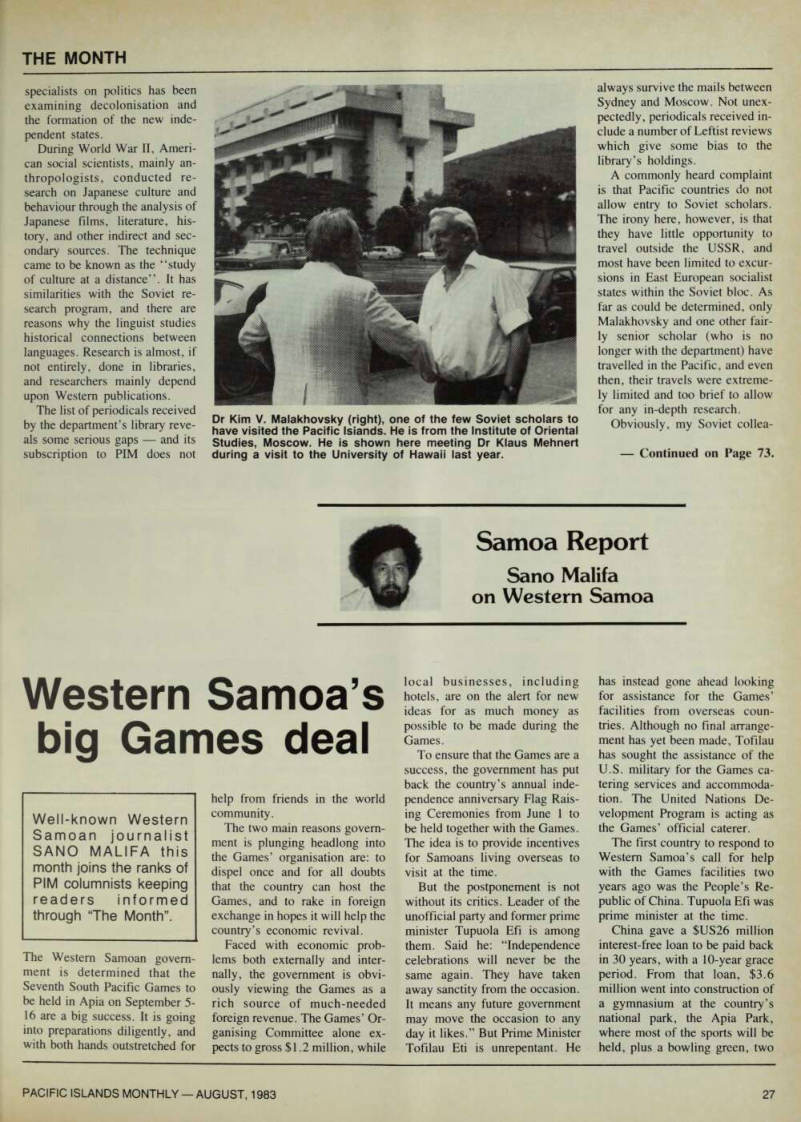
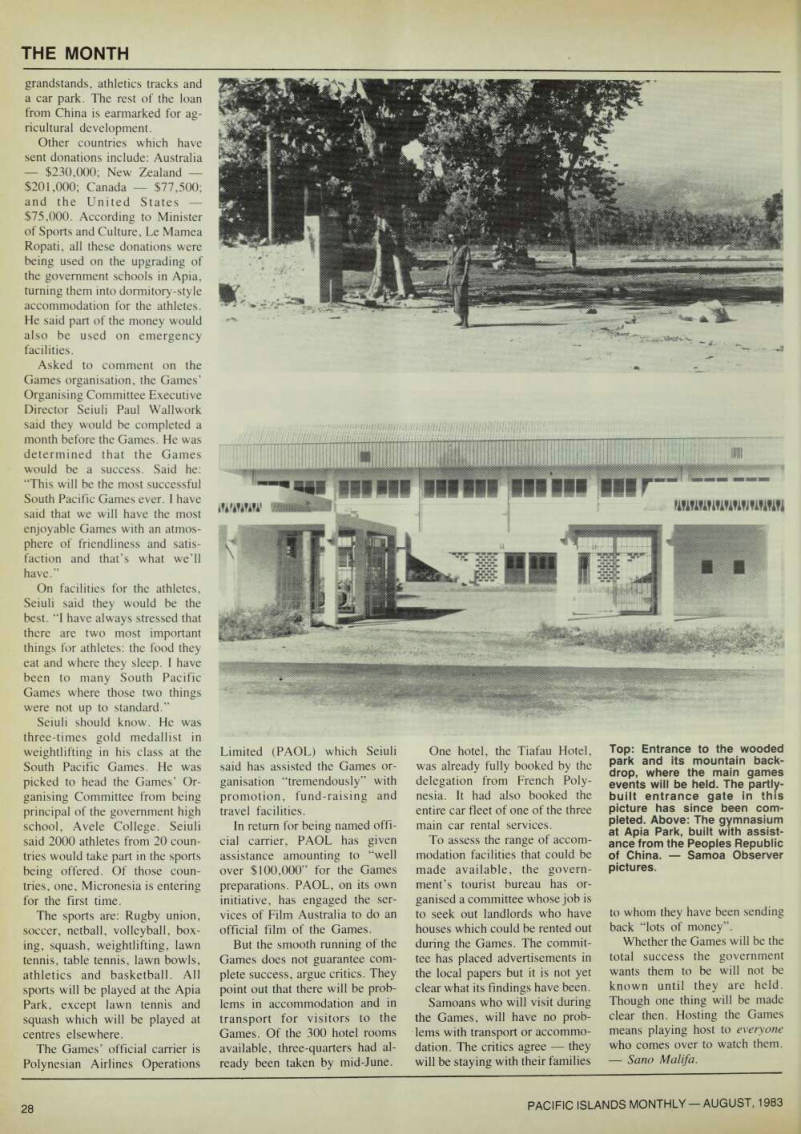
the Soviet way
During the last full week of May, Dr Stephen Uhalley and this cor respondent were guests of the Department of Pacific Studies, Institute of Oriental Studies, USSR Academy of Sciences, in Moscow. Uhalley is director, Center for Asian and Pacific Studies (CAPS), University of Hawaii, and, as noted in PIM, March, I serve as director of the Pacific Islands Studies Program, which is one of several units within CAPS.
We were invited to Moscow by Dr Kim Vladimirovich Malakhovsky, the director of the Department of Pacific Studies, who had visited our campus last November. The following re cords some of our observations
about the state of Pacific studies in the Soviet Union today.
The Department of Pacific Studies was founded by Malakhovsky, and he has been its only director. In addition to
Malakhovsky, the department
consists of 10 scholars who work full-time on research related to the Pacific region. While the Pacific region is defined to in clude the three culture areas of Melanesia, Micronesia, and Polynesia, as well as Australia and New Zealand, the emphasis until recently has been on the latter two.
Pacific studies is one of sever
al ‘ ‘geographical ’ ’ departments
in the Institute of Oriental Studies. Other such departments
deal with other areas such as East Asia, Southeast Asia, South Asia, the Middle East, etc. There are also “functional” depart ments such as economics, orien tal languages, and linguistics. In the latter, at least one linguist is working on Pacific languages, particularly the generic relations among Polynesian languages.
In addition to the above, there is a separate Institute of Ethnog raphy within the Academy of Sciences which has a number of anthropologists specialising in the traditional cultures of the Pacific. But we had no contact with them.
Returning to Pacific studies, a wide variety of research special ties are represented in the depart ment itself: 1) social and politic al developments in the Pacific; 2) literature, art, and the reg ion’s news media; 3) France in the Pacific; 4) economics of the region; 5) mineral and energy resources; 6) international rela
tions and social and political problems; 7) education; 8) labor movements and organisations.
Malakhovsky is a director in the true sense of the word. He draws up a plan covering five or so years and assigns research projects. The operation resem bles the “think tanks” found in the U.S., rather than the univer sities, where researchers have a penchant for going off on their own respective tangents.
While there has been a quite heavy focus on Australia and New Zealand and their roles in the region, there are definite signs that a shift of interest to the island Pacific is occurring. A year or so ago, the literature specialist moved away from Australian topics to study the work of indigenous Pacific wri ters. The economist, who recent ly completed a book on Aust ralia’s economy, has now begun research on the economies of Pacific Island states. One of the
A View from Honolulu Robert C. Kiste
specialists on politics has been examining decolonisation and the formation of the new inde
pendent states.
During World War 11, Ameri can social scientists, mainly an thropologists, conducted re search on Japanese culture and behaviour through the analysis of Japanese films, literature, his tory, and other indirect and sec
ondary sources. The technique
came to be known as the “study of culture at a distance’’. It has similarities with the Soviet re search program, and there are reasons why the linguist studies historical connections between languages. Research is almost, if not entirely, done in libraries, and researchers mainly depend upon Western publications.
The list of periodicals received by the department’s library reve als some serious gaps and its subscription to PIM does not
always survive the mails between Sydney and Moscow. Not unex pectedly, periodicals received in clude a number of Leftist reviews which give some bias to the library’s holdings.
A commonly heard complaint is that Pacific countries do not allow entry to Soviet scholars.
The irony here, however, is that they have little opportunity to travel outside the USSR, and most have been limited to excur sions in East European socialist states within the Soviet bloc. As far as could be determined, only Malakhovsky and one other fair ly senior scholar (who is no longer with the department) have travelled in the Pacific, and even then, their travels were extreme ly limited and too brief to allow for any in-depth research.
Obviously, my Soviet collea-
Continued on Page 73.
Dr Kim V. Malakhovsky (right), one of the few Soviet scholars to have visited the Pacific Islands. He is from the Institute of Oriental Studies, Moscow. He is shown here meeting Dr Klaus Mehnert during a visit to the University of Hawaii last year.
gues labor under serious hand icaps, and it is to their credit that they do as well as they do.
Historical topics are generally well done, especially as they relate to uncontroversial topics such as voyages of exploration and Russian activities in the Pacific and the west coast of north America during the last century. Analyses of ethnic and racial relations in the Pacific are fairly accurate. The literature specialist is producing quite good work and has a good feel and understanding of the themes em ployed by contemporary authors.
Papers on recent and current political developments are based on accurate information. Howev er, analyses are cast in the ex pected ideologies of Morgan, Engels, and Lenin, about nation al liberation movements and the incomplete struggle of the op pressed to free themselves from the shackles of Western colonial imperialism.
It is clear from some publica tions that discussions about a Pan-Pacific Community that are common today in Australia, Canada, Japan, New Zealand, and the United States are viewed as an attempt on the part of the
capitalist nations to minimise Soviet influence in the islands, and it would be difficult to argue against such an interpretation.
Uhalley and I also met some of the staff in the Institute of U.S.A. and Canada Studies, and the Institute of Far Eastern Studies. The former has recently added to its ranks a specialist on ocean policy who is looking at American policies in the Pacific, especially the U.S. stance on fishing rights, the Law of the Sea Treaty, etc. We met only Japan ese specialists in the Institute of Far Eastern Studies. They claim they are primarily concerned with Soviet-Japanese relations, and are not all that interested in Japan’s renewed interests and ac tivities in the islands today.
Interest in the Pacific is cer tainly not limited to the crew in Moscow. Each May, researchers from around the country gather in Moscow for an annual confer ence, and this year’s was the 14th. A total of 31 papers were presented, and reportedly ap proximately 50 participants attended.
A good many of the papers dealt with contemporary issues and reflect a continued strong interest in Australia and New Zealand, e.g., trade union activi ty in Asia, Australia and the
Pacific; the neo-colonial policies of Australia and New Zealand; internal political and economic problems in the two countries; the status of Aboriginals in Aust
ralia today; and Japan-Australia
relations in the 1980 s.
Other papers were concerned with historical issues such as Australian colonialism and the League of Nations, German- Australian relations in 1938, and the internal political history of New Zealand. Eight papers were on island topics such as Polyne sian voyaging and folklore, Rus sian experience in the last cen tury in Papua New Guinea, and shell money in Melanesia.
Our visit to the Soviet Union was my first and Uhalley’s third.
It was interesting and informa tive, yet somewhat frustrating.
Our visit was controlled in that we met and talked to individuals whom they wanted us to see.
Access to others, both in and outside the department, was either difficult or not possible.
I note that “reportedly there were about 50 participants in the annual conference. We were not among the 50, and apparently outsiders were not welcome. Our visas were issued for the week of May 22 to 27, and the conference was held on May 19 and 20.
Robert C. Kiste.
Advertisements & other items, p. 26 (1 item)
0 Hitachi
w
ESSING
EWERA
OGY.
* ■ m K 1 i A m
COMPACT
15
□ IGITAt AUDIO
W
Compact Disc
ft I Hitachi has crossed the threshold of a music lover’s dream. Perfect concert reproduction is now a reality. It is all possible due to the new Hitachi DA-1000, one of the world’s first commercially available compact disc digital audio players. It is an exciting new form of sound system that relies on digital audio signal encoding, rather than an analog system. This allows performance levels that far exceed even the finest conventional turntable. The result is pure, clean sound, absolutely faithful to the original performance.
The Hitachi DA-1000 plays digital audio compact discs (CD), the disc format adopted by all of the major audio manufacturers. A compact disc is capable of storing an uninterrupted 60 minutes of beautiful music on a single side.
The compact disc is perfectly smooth. Its clear plastic protective surface eliminates the annoying effects of dust, scratches and wear.
The music you hear will sound exactly the same as when the artist originally recorded it, the first time you play the disc as well as the 1000th.
The DA-1000 was crafted to ensure superior performance as well as optimum convenience. The vertical design offers the space-saving benefits of component rack installation as well as the ease of a cassettestyle front loading system.
The DA-1000 delivers a comprehensive playback control. With a simple touch of the fingertip, the user may elect to pick-up Forward or Reverse, Cue, Repeat, and Auto Search.
The DA-1000 also has Program Playback, a feature which allows the user to program up to 15 selections for playback in any sequence, automatically.
One listen is worth a thousand words. Come and witness for yourself the superior sound of the Hitachi DA-1000.
0 HITACHI
A World Leader in Technology • AUSTRALIA: Hitachi Sales Australia Pty., Ltd., 153 Keys Road. Moorabbin, Victoria 3189 Phone: (555) 8722 • PAPUA NEW GUINEA: S.O. Svensson (N.G.) Ltd, P.O. Box 705, p °rt Moresby Phone: 21-2111 • FIJI ISLANDS: Burns Philp(South Sea)Company Ltd., G.P.O. Box 355, Suva Phone: 311777 • NEW CALEDONIA: Caldis, B.P. Ml, Noumea Phone: 26. 23. 50 •TAHITI: Ets Chene Alain, P.O. Box 272, Papeete Phone: 2. 88. 68. • SOLOMON ISLANDS : Technique Radios Centre Ltd., P.O. Box 465, Honiara Phone: 416
big Games deal
Western Samoa’s big Games deal
Well-known Western Samoan journalist
Sano Malifa This
month joins the ranks of PIM columnists keeping readers informed through “The Month”.
The Western Samoan govern ment is determined that the Seventh South Pacific Games to be held in Apia on September 5- 16 are a big success. It is going into preparations diligently, and with both hands outstretched for
help from friends in the world community.
The two main reasons govern ment is plunging headlong into the Games’ organisation are: to dispel once and for all doubts that the country can host the Games, and to rake in foreign exchange in hopes it will help the country’s economic revival.
Faced with economic prob lems both externally and inter nally, the government is obvi ously viewing the Games as a rich source of much-needed foreign revenue. The Games’ Or ganising Committee alone ex pects to gross $1.2 million, while
local businesses, including hotels, are on the alert for new ideas for as much money as possible to be made during the Games.
To ensure that the Games are a success, the government has put back the country’s annual inde
pendence anniversary Flag Rais
ing Ceremonies from June 1 to be held together with the Games.
The idea is to provide incentives for Samoans living overseas to visit at the time.
But the postponement is not without its critics. Leader of the unofficial party and former prime minister Tupuola Efi is among them. Said he: “Independence celebrations will never be the same again. They have taken away sanctity from the occasion.
It means any future government may move the occasion to any day it likes.” But Prime Minister Tofilau Eti is unrepentant. He
has instead gone ahead looking for assistance for the Games’ facilities from overseas coun tries. Although no final arrange ment has yet been made, Tofilau has sought the assistance of the U.S. military for the Games ca tering services and accommoda tion. The United Nations De velopment Program is acting as the Games’ official caterer.
The first country to respond to Western Samoa’s call for help with the Games facilities two years ago was the People’s Re public of China. Tupuola Efi was prime minister at the time.
China gave a SUS 26 million interest-free loan to be paid back in 30 years, with a 10-year grace period. From that loan, $3.6 million went into construction of a gymnasium at the country’s national park, the Apia Park, where most of the sports will be held, plus a bowling green, two
Samoa Report
Sano Malifa on Western Samoa
grandstands, athletics tracks and a car park. The rest of the loan from China is earmarked for ag ricultural development.
Other countries which have sent donations include; Australia $230,000; New Zealand $201,000; Canada $77,500; and the United States $75,000. According to Minister of Sports and Culture, Le Mamea Ropati, all these donations were being used on the upgrading of the government schools in Apia, turning them into dormitory-style accommodation for the athletes.
He said part of the money would also be used on emergency facilities.
Asked to comment on the Games organisation, the Games’
Organising Committee Executive Director Seiuli Paul Wallwork said they would be completed a month before the Games. He was determined that the Games would be a success. Said he; “This will be the most successful South Pacific Games ever. I have said that we will have the most enjoyable Games with an atmos phere of friendliness and satis faction and that’s what we’ll have.”
On facilities for the athletes, Seiuli said they would be the best. “I have always stressed that there are two most important things for athletes: the food they eat and where they sleep. I have been to many South Pacific Games where those two things were not up to standard.”
Seiuli should know. He was three-times gold medallist in weightlifting in his class at the South Pacific Games. He was picked to head the Games’ Or ganising Committee from being principal of the government high school, Avele College. Seiuli said 2000 athletes from 20 coun tries would take part in the sports being offered. Of those coun tries, one, Micronesia is entering for the first time.
The sports are: Rugby union, soccer, netball, volleyball, box ing, squash, weightlifting, lawn tennis, table tennis, lawn bowls, athletics and basketball. All sports will be played at the Apia Park, except lawn tennis and squash which will be played at centres elsewhere.
The Games’ official carrier is Polynesian Airlines Operations
Limited (PAOL) which Seiuli said has assisted the Games or
ganisation “tremendously” with
promotion, fund-raising and
travel facilities.
In return for being named offi cial carrier, PAOL has given assistance amounting to “well over $100,000” for the Games preparations. PAOL, on its own initiative, has engaged the ser vices of Film Australia to do an official film of the Games.
But the smooth running of the Games does not guarantee com plete success, argue critics. They point out that there will be prob lems in accommodation and in transport for visitors to the Games. Of the 300 hotel rooms available, three-quarters had al ready been taken by mid-June.
One hotel, the Tiafau Hotel, was already fully booked by the
delegation from French Poly
nesia. It had also booked the entire car fleet of one of the three main car rental services.
To assess the range of accom modation facilities that could be made available, the govern ment’s tourist bureau has or ganised a committee whose job is to seek out landlords who have houses which could be rented out during the Games. The commit tee has placed advertisements in the local papers but it is not yet clear what its findings have been.
Samoans who will visit during the Games, will have no prob lems with transport or accommo dation. The critics agree they will be staying with their families
to whom they have been sending back “lots of money”.
Whether the Games will be the total success the government wants them to be will not be known until they are held.
Though one thing will be made clear then. Hosting the Games means playing host to everyone who comes over to watch them.
Sano Malifa.
Top: Entrance to the wooded park and its mountain back drop, where the main games events will be held. The partly built entrance gate in this picture has since been com pleted. Above: The gymnasium at Apia Park, built with assist ance from the Peoples Republic of China. - Samoa Observer pictures.
the unknown’ - U.S. scientist
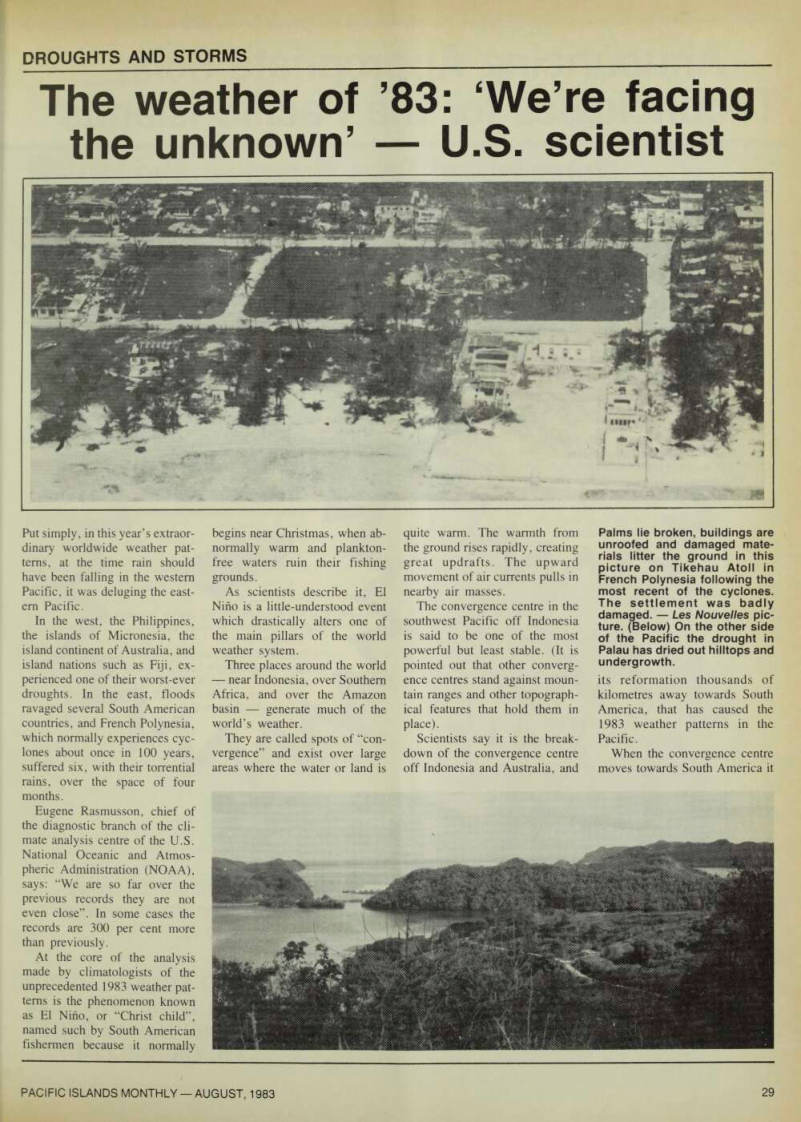

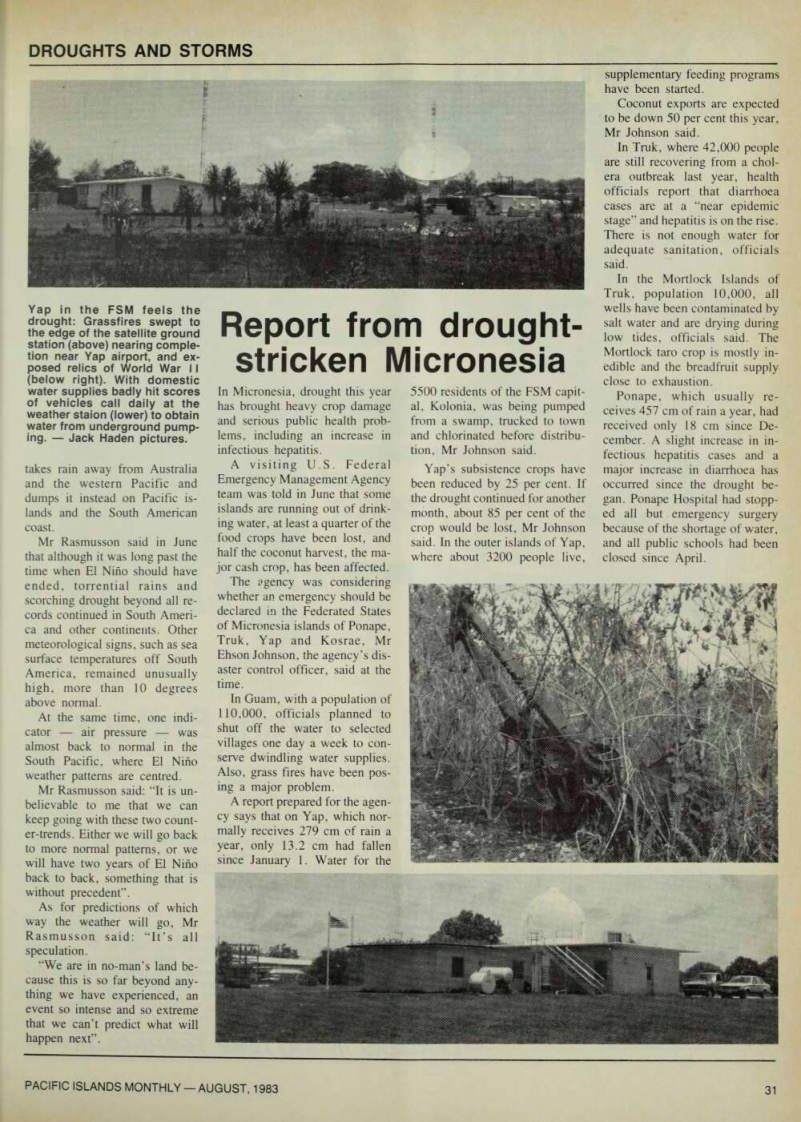
Droughts And Storms
The weather of ’83: ‘We’re facing the unknown’ - U.S. scientist
Put simply, in this year’s extraordinary worldwide weather pat- ♦ * *u *• . terns, at the time ram should have been falling in the western Pacific, it was deluging the eastem Pacific.
In the west, the Philippines, the islands of Micronesia, the island continent of Australia, and island nations such as Fiji, experienced one of their worst-ever droughts. In the east, floods ravaged several South American countries, and French Polynesia,
which normally experiences eye-
lones about once in 100 years, suffered six, with their torrential rains, over the space of four months.
Eugene Rasmusson, chief of the diagnostic branch of the cli mate analysis centre of the U.S.
National Oceanic and Atmos pheric Administration (NOAA), says; "We are so far over the previous records they are not even close". In some cases the records are 300 per cent more
than previously.
At the core of the analysis made by climatologists of the unprecedented IWS3 weather patterns is the phenomenon known as Id Nine, or "Christ On Id". named such b\ South Amenc, fishermen because normally
begins near Christmas, when ab
normally warm and plankton
free waters ruin their fishing grounds.
As scientists describe it, El Nino is a little-understood event which drastically alters one of the main pillars of the world weather system.
Three places around the world near Indonesia, over Southern Africa, and over the Amazon basin generate much of the world’s weather.
They are called spots of “con vergence” and exist over large areas where the water or land is
quite warm. The warmth from
the ground rises rapidly, creating
great updrafts. The upward
movement of air currents pulls in nearby air masses.
The convergence centre in the southwest Pacific off Indonesia is said to be one of the most powerful but least stable. (It is pointed out that other converg ence centres stand against moun tain ranges and other topograph ical features that hold them in
place).
Scientists say it is the break down of the convergence centre off Indonesia and Australia, and
its reformation thousands of kilometres away towards South America, that has caused the 1983 weather patterns in the Pacific.
When the convergence centre moves towards South America it
Palms lie broken, buildings are unroofed and damaged mate rials litter the ground in this picture on Tikehau Atoll in French Polynesia following the most recent of the cyclones.
The settlement was badly
damaged. - Les Nouvelles pic
ture. (Below) On the other side of the Pacific the drought in Palau has dried out hilltops and undergrowth.
takes rain away from Australia and the western Pacific and dumps it instead on Pacific is lands and the South American coast.
Mr Rasmusson said in June that although it was long past the time when El Nino should have ended, torrential rains and scorching drought beyond all re cords continued in South Ameri ca and other continents. Other meteorological signs, such as sea surface temperatures off South America, remained unusually high, more than 10 degrees above normal.
At the same time, one indi cator air pressure was almost back to normal in the South Pacific, where El Nino weather patterns are centred.
Mr Rasmusson said; “It is un believable to me that we can keep going with these two count er-trends. Either we will go back to more normal patterns, or we will have two years of El Nino back to back, something that is without precedent”.
As for predictions of which way the weather will go, Mr Rasmusson said: “It’s all speculation.
“We are in no-man’s land be cause this is so far beyond any thing we have experienced, an event so intense and so extreme that we can’t predict what will happen next”.
Yap in the FSM feels the drought: Grassfires swept to the edge of the satellite ground station (above) nearing comple tion near Yap airport, and ex posed relics of World War II (below right). With domestic water supplies badly hit scores of vehicles call daily at the weather staion (lower) to obtain water from underground pump
ing. - Jack Haden pictures.
Advertisements & other items, p. 30 (1 item)
Announcing Appropriate Solar
Technologies for the Pacific Islands
Inter Island Solar Supply is the largest distributor of solar thermal and solar electric products to the Pacific Basin since 1975.
PT-40 > • Self-Contained 40 gallon Solar Water Heater Stainless Steel Progressive Tube Design • Triple Glazed for Heat Retention W • Simple Installation. No Pumps, h * No Controls, No Maintenance • 20 Year Warranty 1 • Lowest Price Solar Edwards Thermosyphon Systems (passive) Choice of 48, 80, 116 or 160 Gallon Systems • Highly Insulated Stainless Steel W Storage Cylinder • Efficient Absorbers with Fiberglass ; Insulation and Double Sealed V* Operates by Natural Water Convection and has no Moving Parts ■ • Best System Buy Solec Solar Electric Panels Superior Silicone Cell Quality and Expert Module Construction Higher Electric Output than any Solar Cells Available Inter Island also carries * appropriate Solar Electric Appliances H including 12 Volt Refrigerators, ■ Lighting Systems, and Pumps.
Dealers, government agencies and
individuals, write us for complete
technical and pricing information.
Contact our Sales Representative,
John Grandinetti at:
INTER ISLAND SOLAR SUPPLY
345 A Nimitz Highway
Honolulu, Hawaii 96817
Ph. (808) 523-0711
Report from drought
stricken Micronesia
In Micronesia, drought this year
has brought heavy crop damage
and serious public health prob lems, including an increase in infectious hepatitis.
A visiting U.S. Federal Emergency Management Agency team was told in June that some islands are running out of drink ing water, at least a quarter of the food crops have been lost, and half the coconut harvest, the ma jor cash crop, has been affected.
The agency was considering whether an emergency should be declared in the Federated States of Micronesia islands of Ponape, Truk, Yap and Kosrae, Mr Ehson Johnson, the agency’s dis aster control officer, said at the time.
In Guam, with a population of 110,000, officials planned to shut off the water to selected villages one day a week to con
serve dwindling water supplies.
Also, grass fires have been pos
ing a major problem.
A report prepared for the agen cy says that on Yap, which nor mally receives 279 cm of rain a year, only 13.2 cm had fallen since January 1. Water for the
5500 residents of the FSM capit al, Kolonia, was being pumped from a swamp, trucked to town and chlorinated before distribu tion, Mr Johnson said.
Yap’s subsistence crops have been reduced by 25 per cent. If the drought continued for another month, about 85 per cent of the crop would be lost, Mr Johnson said. In the outer islands of Yap, where about 3200 people live,
supplementary feeding programs have been started.
Coconut exports are expected to be down 50 per cent this year, Mr Johnson said.
In Truk, where 42,000 people are still recovering from a chol era outbreak last year, health officials report that diarrhoea cases are at a “near epidemic stage” and hepatitis is on the rise.
There is not enough water for adequate sanitation, officials said.
In the Mortlock Islands of Truk, population 10,000, all wells have been contaminated by salt water and are drying during low tides, officials said. The Mortlock taro crop is mostly in edible and the breadfruit supply close to exhaustion.
Ponape, which usually re ceives 457 cm of rain a year, had received only 18 cm since De cember. A slight increase in in fectious hepatitis cases and a major increase in diarrhoea has occurred since the drought be gan. Ponape Hospital had stopp ed all but emergency surgery because of the shortage of water, and all public schools had been closed since April.
Advertisements & other items, p. 32 (1 item)
Starting & Staying
- 3^ f i
AMP
mP** £3127
Power Boats Need Different Batteries
There is a big difference between a car battery and a marine battery.
A car battery, for example, is never really discharged, as it is only used for a few seconds each day and promptly re-charged. Not so your cruiser or sportsfisherman.
Starting the engine is only the beginning. During the day, weekend or cruise, how often will you run the live bait tank, the depth sounder, the nav. lights or maintain a listening watch on your radio transceiver?
As well as cranking power, boats need staying power. Boats need Besco’s Marine Batteries, deep cycle, heavy duty marine batteries. ’
If your boat is getting a little flat in the electrics department, write or phone BESCO today and ask for more information, more facts about
BESCO MARINE BA TTERIES.
BESCO
/Batteries Division Of Sims Products Pty. Ltd. j_ A Peko Wall send Group Member Papua New Guinea: Lae, Automarine Industries, P.O. Box 785, Ph. 42-1125; Rabaul, Automarine Industries, P.O. Box 248, Ph. 92-2574; Port Moresby, Par Sales, P.O. Box 1680, Boroko, Ph. 25-6266. Fiji: Suva, Fiji Bandag, 23 Sinoma Street, Walu Bay, Ph. 31-1200. New Caledonia: Noumea, Andre Thuilier, BP 889, Ph. 27-4906. Solomon Islands: Honiara, Guadalcanal Electrics Ltd., P.O. Box 521. Hongkong: Kowloon, T. L. Knight & Co., P.O. Box 95585 IST, Ph. 366-5341. New Zealand: Auckland, Battery Services (Ind.) Ltd., P.O. Box 27- 375, Ph. 69-4111; Wellington, Gould Batteries, 58 Hautana Street, Lower Hutt, TLX NZ3714.
Australia: Sydney, Besco Batteries, P.O. Box 1, Villawood, Ph. 632-0251, TLX 21886; Jarwil International Pty. Ltd., 410 Kent Street, Sydney, Ph. 264-3477, TLX 72102.
LEADERS IN BATTERY
Half-truths, glaring omissions,
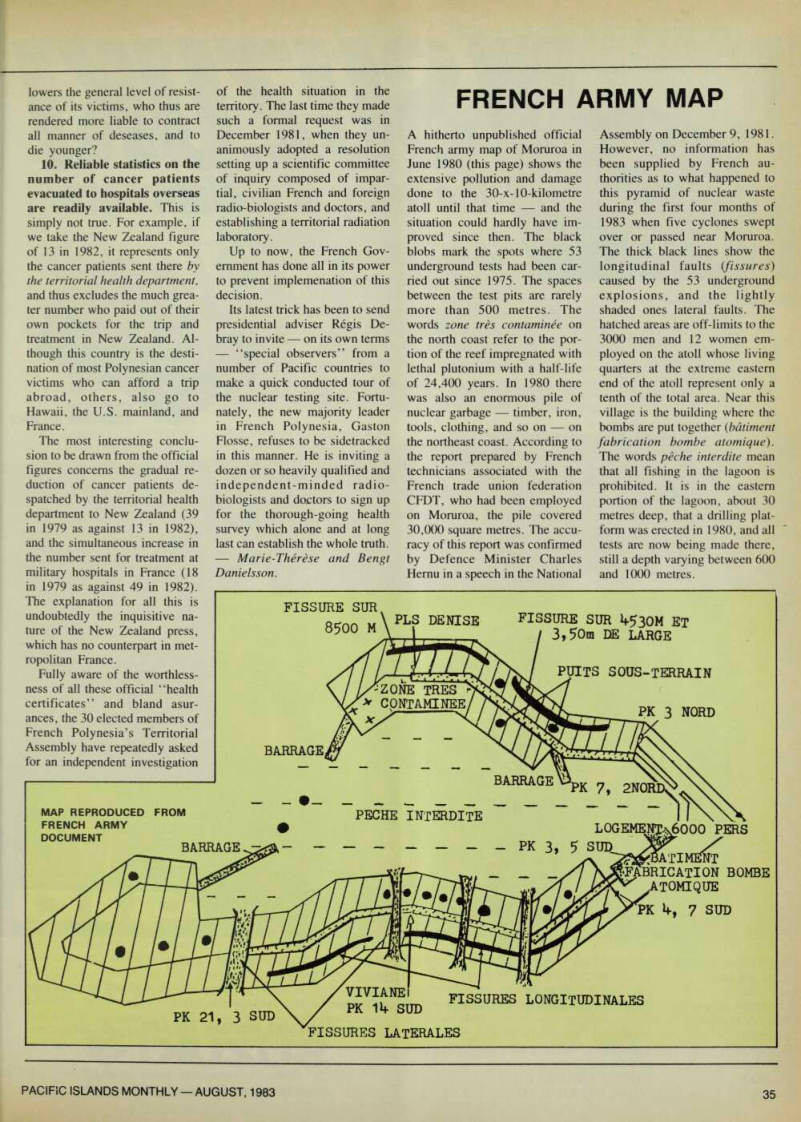
Official Document On Moruroa Tests
Half-truths, glaring omissions, downright lies, critics claim
Marie-Therese And Bengt Danielsson Subject A
recent statement released by the French embassy in Canberra (RIM Jun p3l) on nuclear testing at Moruroa Atoll, French Polynesia, to rigorous analysis and are notably unimpressed with what they find in it.
Arch-conservative French presi dents of the past de Gaulle, Pompidou and Giscard react ed to criticism of the Moruroa nuclear tests by wrapping them selves in a cloak of haughty official silence. The present pseudo-socialist government of President Mitterrand, which took over the reins of power in May 1981, seemed keen from the start to break with this offensive “no comment” policy.
The first to preach the doctrine of a “Pacific dialogue” was the new Defence Minister, Charles Hemu, who, during a visit to French Polynesia in August 81 (PIM Oct ’Bl p 22), made the following eminently sensible statement: “The press must be informed about security prob lems. If there is an accident (at Moruroa) it is better to the let the truth be known than to let all sorts of rumors spread. Nothing must be hidden that affects the health of the population. When New Zealand and Australia ask for information, we shall supply it.”
For one reason or another, it has taken the French Govern ment 18 months to come good on this promise. But, finally, all French embassies in the Pacific region have begun distributing lengthy statements to the press on the Moruroa tests. The one released by the French embassy in Canberra (PIM Jun p3l) deals in impressive detail with various aspects of the testing program, and the possible health hazards arising from it. The happy con clusion reached by the authors at the close of almost every parag raph is that, unlike the Ameri can, British, Russian and Chin ese tests, the explosion of 96 atomic bombs at Moruroa and Fangataufa has not given rise to the slightest harmful radioactive fall-out. This highly self congratulatory document merits a close, point-by-point analysis. 1. What France does in French Polynesia is nobody
else’s business, because France owns these islands. To start off with an arrogant statement of this sort is certainly not suggestive of
a high degree of diplomatic
finesse, to say the least of it, especially in view of the fact that all Pacific leaders most definitely believe that they have a right and a duty to protest against any nuclear pollution of their ter ritories. As many readers will recall, it was this form of en vironmental aggression which was the basis of the complaint lodged with the International Court of Justice at the Hague by the Australian and New Zealand Governments in 1973. It was also the basis of the attitude adopted by all West African gov ernments in the early 19605, when their territories were ex posed to radio-active clouds from the French nuclear tests in the Sahara desert, which France “owned” until Algeria won its
independence.
This general disapproval led to the transfer of the tests to Moruroa and Fangataufa and a long series of protests from all
Polynesian leaders, accompanied
by appeals to France to stop testing atomic weapons in their islands. 2. The nuclear tests are an essential part of France’s de fence policy. Perhaps. But this is beside the point, since the elect ed representatives of the Polyne sian people, sitting in the Territo rial Assembly, have never sought to interfere with French defence policy. All they ask of the French Government is that they conduct their tests guaranteed as per fectly harmless by all their own experts in France.
3. Radio-activity is carefully monitored by the French army and Atomic Energy Commis sion. As in Australia and New Zealand, there exists in France a National Radiation Laboratory.
But, strangely enough, this gov ernment agency has never been permitted to undertake any radia tion studies whatever in French Polynesia. Instead, the two bodies responsible for the nuc lear testing program the army and the AEC evaluate the health hazards resulting from them. In other words, the ac cused sits in judgement on his own case. Similar, the territory’s health department is headed by an army doctor with the rank of general, and the so-called public hospital at Mamao, Papeete, is likewise mn by army doctors. 4. For the whole of 1982, all personnel on Moruroa Atoll collectively received a radia tion dose of only 4800 mrems.
Sweeping statements of this kind are meaningless, especially as no information is supplied about seasonal variations, and the par ticularly hot spots.
The only way to get a fairly accurate picture of the extent of nuclear pollution at Moruroa is to study the well-documented re port prepared by the people most directly involved the French technicians connected with the socialist trade union federation CFDT, who live and work on the atoll.
This frightening report dated October 19, 1981, reveals among other things that the north coast of the atoll is impregnated with lethal plutonium whose half-life is 24,000 years; that the pile of nuclear waste which has been
allowed to accumulate on the reef covers an area of 30,000 square metres; and that there are numerous faults in the atoll, showing that much underground seepage and leakage must have taken place. Further details were furnished at the time by the lead ing Australian newspapers. Our own summary of the CFDT re port appeared in PIM, January, 1982. 5. The air pollution at Moruroa is practically nil, as anyone can find out for them selves. With blinding scientific precision, the French embassy in Canberra records that in 1981, “alpha element radio-activity as expressed in femto-curies per cubic metre of air” was only three in Moruroa, three in Tahiti, but 25 at Montlhery near Paris, and a scary 106 in Senegal. This may well explain why so many Frenchman and Africans have migrated to French Polynesia in recent years. But as an indication of the level of air pollution it is worthless since it leaves unans wered such basic questions as: How many samples were taken, and where, on the atoll? If this is the annual average, what were the maximum and minimum fi gures? And so on . . .
Particularly puzzling is the ac companying assertion that air pollution “can easily be checked by anybody with basic equip ment taking samples outside ter ritorial waters downwind from Mururoa”.
Even if a private citizen managed to sneak into the re stricted zones around Momma and Fangataufa the proposed ob servations would be of very little interest today, considering that atmospheric testing was aban doned eight years ago!
Any meaningful observations would have to be made by med ical doctors systematically ex amining representative samples of the whole population of French Polynesia. If French ar my doctors have ever made any
such thorough health survey, the results have never been published. 6. No sea pollution has oc curred, as proved by the fact that military and civilian per sonnel at Moruroa are allowed to go swimming in the lagoon.
Swimming has not always been permitted, and what is more the French technicians who wrote the CFDT report believe that the ban should never have been lift ed. There is also the tragic case of former Governor Jean Sicu rani. He often went swimming in the lagoon in a period when megatonne H-bombs were being exploded and eventually died of leukemia. He could also, of course, have been contaminated at many other places in the test area which are above water . . .
It is in any case quite ridicul ous to pretend that personnel swimming in the lagoon during their leisure hours could know anything about the amount of damage and pollution that have occurred in the base of the atoll at a depth of 600-1000 metres, where the bombs are
exploded. We may ask: who me asures the plutonium and carbon -14 which slowly sink to the bottom of the ocean only to re emerge years later through the food chain at the surface? It is high time for Captain Cousteau and his bathyscape to be stationed permanently at Moruroa to carry out regular “in depth” studies. 7. Data regularly sent to the United Nations Scientific Com mittee on the Effects of Atomic Radiation (UNSCEAR), plus those collected by a “UN An tenna” in French Polynesia, prove conclusively that the tests are harmless. The truth is quite different. If we examine not only the French reports, but also the minutes of the UN SCEAR meetings, we shall im mediately find that committee members are constantly comp laining about “the paucity of the data” supplied, which makes it impossible for them to reach “any valid conclusions”. Read ers interested in the subject will find a more searching analysis of the annual reports sent by France
to UNSCEAR in our book Moruroa, mon amour (Penguin 1977).
As for the so-called “UN An tenna”, it is simply the same old army laboratory in Tahiti, re named Laboratoire d’ etude et de surveillance de V environnement, and its only connection with the UN is that it gathers the highly unsatisfactory data from which the above-mentioned inadequate reports are put together.
But, talking of UN reports, there is also one marked A/35/392, dated September 12, 1980. It was especially prepared for the UN by the prestigious International Commission on Radiological Protection, and pre dicts that no fewer than 15,000 people in the southern hemis phere will eventually die as a result of radiation doses received from all American, British, and French nuclear tests. The fact that the number of victims will be 10 times higher in the more densely populated northern hemisphere is no consolation.
Not a word is said in the French Moruroa report about this impor tant UN document. 8. The number of cancer cases in French Polynesia is in no way higher than in other parts of the world. In support of this bold statement, France’s Canberra embassy presents a table of statistics headed “Cases of Cancer in French Polynesia”.
The figures given are: 62 in 1977, 65 in 1978, 85 in 1979, 58 in 1980, and 71 in 1981, which represents an incidence of about 50 cases per 100,000 population.
This compares very favorably indeed with the averages for Australia (106), France (175), and New Zealand (264). Won derful, if it were true.
Actually, the statistics pub lished by the French embassy do not show the total number of cancer cases in French Polynesia (as the heading would have us believe). They show only the number of cases treated in the Namao government hospital, and one small private hospital in Papeete.
Conspicuously lacking are da ta concerning cancer patients treated by: The 80 doctors in private practice who, until a few months ago, had no obligation to provide information on such mat
ters; the Polynesian healers and various quacks; the special hos pital for military and civilian personnel on Moruroa, where all data are top secret; the doctors in France who are consulted by former servicemen discharged after serving in French Polynesia for shorter or longer periods. (A parallel with this last category is provided by the belated discov ery in the U.S. and Australia that servicemen present during nuc lear testing in Nevada and at Maralinga were contaminated to such an extent that they got cancer.) Finally, there are large num bers of people living in remote islands of French Polynesia where there are no doctors at all, and who consequently die from all sorts of diseases, including cancer, without receiving any medical treatment at all.
Yet, in the French embassy statement, a glaringly incomplete collection of figures is compared with the overwhelmingly more comprehensive and reliable can cer statistics kept by countries like Australia, France and New Zealand, and the totally unwar ranted conclusion is drawn that the rate in French Polynesia is much lower.
This is an unabashed attempt to deceive the governments and peoples of the South Pacific, no more and no less.
It should also be noted that it was precisely because of the abs ence of reliable health statistics in French Polynesia that the World Health Organisation in 1981 pressed the local health authorities to start a cancer regis ter on the internationally ap proved model. Sad to say, it is still in its development stages. 9. The most common form of cancer is lung cancer, and the cause is heavy smoking.
Once again, the statistics are reassuring only because they are so outrageously incomplete. The only good thing about this part of the statement is that the embassy has refrained from repeating the preposterous claim of the local health department in French Polynesia that heavy smoking is the sole cause of all cancer cases.
Is it really necessary to point out that all medical research points to the fact that the worst thing about exposure to radiation is that it
lowers the general level of resist ance of its victims, who thus are rendered more liable to contract all manner of deseases, and to
die younger?
10. Reliable statistics on the number of cancer patients evacuated to hospitals overseas are readily available. This is simply not true. For example, if we take the New Zealand figure of 13 in 1982, it represents only the cancer patients sent there by the territorial health department, and thus excludes the much grea ter number who paid out of their own pockets for the trip and treatment in New Zealand. Al though this country is the desti nation of most Polynesian cancer victims who can afford a trip abroad, others, also go to Hawaii, the U.S. mainland, and France.
The most interesting conclu sion to be drawn from the official figures concerns the gradual re duction of cancer patients de spatched by the territorial health department to New Zealand (39 in 1979 as against 13 in 1982), and the simultaneous increase in the number sent for treatment at military hospitals in France (18 in 1979 as against 49 in 1982).
The explanation for all this is
undoubtedly the inquisitive na
ture of the New Zealand press, which has no counterpart in met
ropolitan France.
Fully aware of the worthless ness of all these official “health certificates” and bland asur ances, the 30 elected members of French Polynesia’s Territorial
Assembly have repeatedly asked
for an independent investigation
of the health situation in the territory. The last time they made such a formal request was in December 1981, when they un animously adopted a resolution setting up a scientific committee of inquiry composed of impar tial, civilian French and foreign radio-biologists and doctors, and establishing a territorial radiation laboratory.
Up to now, the French Gov ernment has done all in its power to prevent implemenation of this decision.
Its latest trick has been to send
presidential adviser Regis De
bray to invite on its own terms “special observers’’ from a number of Pacific countries to make a quick conducted tour of the nuclear testing site. Fortu nately, the new majority leader in French Polynesia, Gaston Flosse, refuses to be sidetracked in this manner. He is inviting a dozen or so heavily qualified and
independent-minded radio
biologists and doctors to sign up for the thorough-going health survey which alone and at long last can establish the whole truth.
Marie-Thérèse and Bengt Danielsson.
Advertisements & other items, p. 34 (1 item)
Building System
and Commercial Buildings
with Therma-Panel, R the
fully insulated inter-locking
Building System
Cyclone rated
Economical • Fast The building you can assemble Name.
George Hudson Homes (Aust.) pty. Ltd. 186 Hume Highway Cabramatta NSW 2166 Australia. Tel: (02) 727 9066. Telex: AA25800 Post coupon for details and prices.
Address .Tel:
French Army Map
A hitherto unpublished official French army map of Moruroa in June 1980 (this page) shows the extensive pollution and damage done to the 30-x-10-kilometre atoll until that time and the situation could hardly have improved since then. The black blobs mark the spots where 53 underground tests had been carried out since 1975. The spaces between the test pits are rarely more than 500 metres. The words zone tres contaminee on the north coast refer to the portion of the reef impregnated with lethal plutonium with a half-life of 24,400 years. In 1980 there was also an enormous pile of nuclear garbage timber, iron, tools, clothing, and so on on the northeast coast. According to the report prepared by French technicians associated with the French trade union federation CFDT, who had been employed on Moruroa, the pile covered 30,000 square metres. The accuracy of this report was confirmed by Defence Minister Charles Hemu in a speech in the National
Assembly on December 9, 1981.
However, no information has been supplied by French au thorities as to what happened to this pyramid of nuclear waste during the first four months of 1983 when five cyclones swept over or passed near Moruroa.
The thick black lines show the
longitudinal faults (fissures )
caused by the 53 underground
explosions, and the lightly
shaded ones lateral faults. The hatched areas are off-limits to the 3000 men and 12 women em ployed on the atoll whose living quarters at the extreme eastern end of the atoll represent only a tenth of the total area. Near this village is the building where the bombs are put together ( bdtiment fabrication bombe atomique).
The words peche interdite mean that all fishing in the lagoon is prohibited. It is in the eastern portion of the lagoon, about 30
metres deep, that a drilling plat
form was erected in 1980, and all tests are now being made there, still a depth varying between 600 and 1000 metres.
Advertisements & other items, p. 36 (1 item)
\Suzuki
ml *
the name of performance.
SJ4IO Metal-Top
SUZUKI Vehicles are shipped to approximately
100 countries throughout the world and are well received by users in those countries.
Behind the high-quality of SUZUKI
4-wheelers is the in-depth research
carried out from all aspects, rigorous
tests and an extensive after-sales
service network Vehicles that are ready
when you need them and which you can
trust when driving. SUZUKI Vehicles.
Stripe tape and free-wheel-hubs are optional.
4-Door
:a * 4 W To
PAPUA NEW GUINEA . PNG MOTORS
GUAM & SAIPAN ISLAND CYCLERY, INC.
FIJI NIRANJANS AUTOPORT LTD.
SOLOMON ISLANDS . . . SOLOMON ISLAND SERVICE STATION LTD.
NEW CALEDONIA STE. SUPERCAL
VANUATU HENRI LEROUX
NIUE ISLAND BURNS PHILP (SOUTH SEA) CO., LTD.
TAHITI NIPPON AUTOMOTO
NORFOLK MARTIN’S AGENCIES LTD.
SAMOA PACIFIC PRODUCTS, INC.
TONGA PACIFIC PRODUCTS, INC.
NAURU EQUAPAC MOTORS
KIRIBATI KIRIBATI CO-OPERATIVE WHOLESALE SOCIETY LIMITED
RAROTONGA . . . AUTO HOLDINGS LTD.
SUZUKI MOTOR CO., LTD. I^^
SUZUKI $
300 Takatsuka, Hamamatsu, Japan Suzuki Sincel9ss. a world leader in mini-vehicles.
the Solomons’
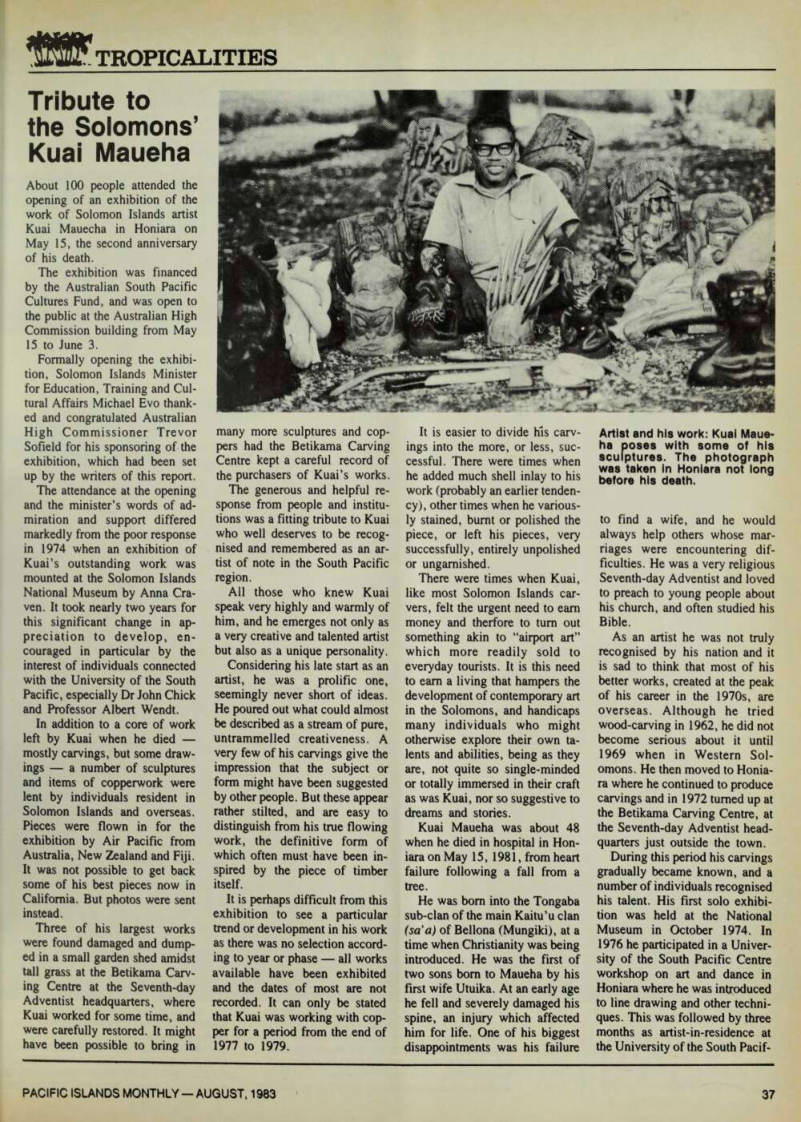


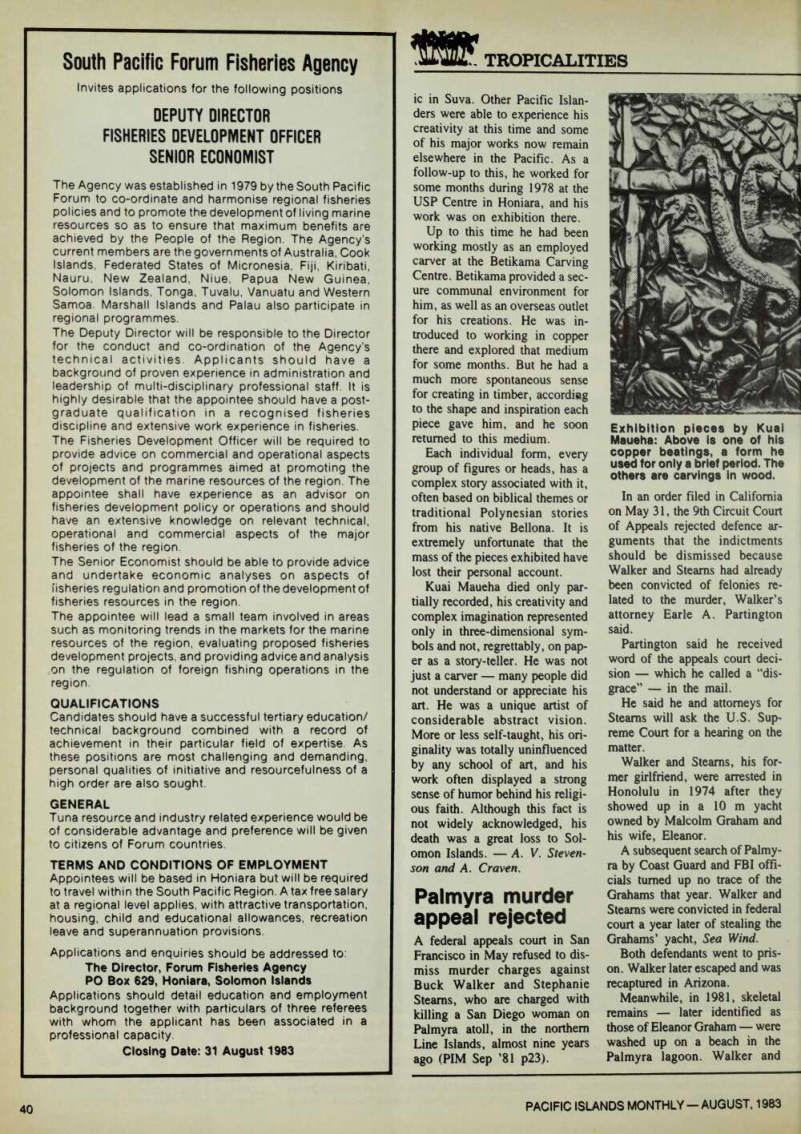
Tropicalities
Tribute to the Solomons’
Kuai Maueha
About 100 people attended the opening of an exhibition of the work of Solomon Islands artist Kuai Mauecha in Honiara on May 15, the second anniversary of his death.
The exhibition was financed by the Australian South Pacific Cultures Fund, and was open to the public at the Australian High Commission building from May 15 to June 3.
Formally opening the exhibi tion, Solomon Islands Minister for Education, Training and Cul tural Affairs Michael Evo thank ed and congratulated Australian High Commissioner Trevor Sofield for his sponsoring of the exhibition, which had been set up by the writers of this report.
The attendance at the opening and the minister’s words of ad miration and support differed markedly from the poor response in 1974 when an exhibition of Kuai’s outstanding work was mounted at the Solomon Islands National Museum by Anna Cra ven. It took nearly two years for this significant change in ap preciation to develop, en couraged in particular by the interest of individuals connected with the University of the South Pacific, especially Dr John Chick and Professor Albert Wendt.
In addition to a core of work left by Kuai when he died mostly carvings, but some draw ings a number of sculptures and items of copperwork were lent by individuals resident in Solomon Islands and overseas.
Pieces were flown in for the exhibition by Air Pacific from Australia, New Zealand and Fiji.
It was not possible to get back some of his best pieces now in California. But photos were sent instead.
Three of his largest works were found damaged and dump ed in a small garden shed amidst tall grass at the Betikama Carv ing Centre at the Seventh-day Adventist headquarters, where Kuai worked for some time, and were carefully restored. It might have been possible to bring in
many more sculptures and cop pers had the Betikama Carving Centre kept a careful record of the purchasers of Kuai’s works.
The generous and helpful re sponse from people and institu tions was a fitting tribute to Kuai who well deserves to be recog nised and remembered as an ar tist of note in the South Pacific region.
All those who knew Kuai speak very highly and warmly of him, and he emerges not only as a very creative and talented artist but also as a unique personality.
Considering his late start as an artist, he was a prolific one, seemingly never short of ideas.
He poured out what could almost be described as a stream of pure, untrammelled creativeness. A very few of his carvings give the impression that the subject or form might have been suggested by other people. But these appear rather stilted, and are easy to distinguish from his true flowing work, the definitive form of which often must have been in spired by the piece of timber itself.
It is perhaps difficult from this exhibition to see a particular trend or development in his work as there was no selection accord ing to year or phase all works available have been exhibited and the dates of most are not recorded. It can only be stated that Kuai was working with cop per for a period from the end of 1977 to 1979.
It is easier to divide his carv ings into the more, or less, suc cessful. There were times when he added much shell inlay to his work (probably an earlier tenden cy), other times when he various ly stained, burnt or polished the piece, or left his pieces, very successfully, entirely unpolished or ungamished.
There were times when Kuai, like most Solomon Islands car vers, felt the urgent need to earn money and therfore to turn out something akin to “airport art” which more readily sold to everyday tourists. It is this need to earn a living that hampers the development of contemporary art in the Solomons, and handicaps many individuals who might otherwise explore their own ta lents and abilities, being as they are, not quite so single-minded or totally immersed in their craft as was Kuai, nor so suggestive to dreams and stories.
Kuai Maueha was about 48 when he died in hospital in Hon iara on May 15, 1981, from heart failure following a fall from a tree.
He was bom into the Tongaba sub-clan of the main Kaitu’u clan (sa'a) of Bellona (Mungiki), at a time when Christianity was being introduced. He was the first of two sons bom to Maueha by his first wife Utuika. At an early age he fell and severely damaged his spine, an injury which affected him for life. One of his biggest disappointments was his failure
to find a wife, and he would always help others whose mar riages were encountering dif ficulties. He was a very religious Seventh-day Adventist and loved to preach to young people about his church, and often studied his Bible.
As an artist he was not truly recognised by his nation and it is sad to think that most of his better works, created at the peak of his career in the 19705, are overseas. Although he tried wood-carving in 1962, he did not become serious about it until 1969 when in Western Sol omons. He then moved to Honia ra where he continued to produce carvings and in 1972 turned up at the Betikama Carving Centre, at the Seventh-day Adventist head quarters just outside the town.
During this period his carvings gradually became known, and a number of individuals recognised his talent. His first solo exhibi tion was held at the National Museum in October 1974. In 1976 he participated in a Univer sity of the South Pacific Centre workshop on art and dance in Honiara where he was introduced to line drawing and other techni ques. This was followed by three months as artist-in-residence at the University of the South Pacif-
Artist and his work: Kuai Maue ha poses with some of his sculptures. The photograph was taken in Honiara not long before his death.
ic in Suva. Other Pacific Islan ders were able to experience his creativity at this time and some of his major works now remain elsewhere in the Pacific. As a follow-up to this, he worked for some months during 1978 at the USP Centre in Honiara, and his work was on exhibition there.
Up to this time he had been working mostly as an employed carver at the Betikama Carving Centre. Betikama provided a sec ure communal environment for him, as well as an overseas outlet for his creations. He was in troduced to working in copper there and explored that medium for some months. But he had a much more spontaneous sense for creating in timber, according to the shape and inspiration each piece gave him, and he soon returned to this medium.
Each individual form, every group of figures or heads, has a complex story associated with it, often based on biblical themes or traditional Polynesian stories from his native Bellona. It is extremely unfortunate that the mass of the pieces exhibited have lost their personal account.
Kuai Maueha died only par tially recorded, his creativity and complex imagination represented only in three-dimensional sym bols and not, regrettably, on pap er as a story-teller. He was not just a carver many people did not understand or appreciate his art. He was a unique artist of considerable abstract vision.
More or less self-taught, his ori ginality was totally uninfluenced by any school of art, and his work often displayed a strong sense of humor behind his religi ous faith. Although this fact is not widely acknowledged, his death was a great loss to Sol
omon Islands.
A. V. Steven -
son and A . Craven .
Palmyra murder
appeal rejected
A federal appeals court in San Francisco in May refused to dis miss murder charges against Buck Walker and Stephanie Steams, who are charged with killing a San Diego woman on Palmyra atoll, in the northern Line Islands, almost nine years ago (PIM Sep ’Bl p 23).
In an order filed in California on May 31, the 9th Circuit Court of Appeals rejected defence ar guments that the indictments should be dismissed because Walker and Steams had already been convicted of felonies re lated to the murder, Walker’s attorney Earle A, Partington said.
Partington said he received word of the appeals court deci sion which he called a “dis grace” in the mail.
He said he and attorneys for Steams will ask the U.S. Sup reme Court for a hearing on the matter.
Walker and Steams, his for mer girlfriend, were arrested in Honolulu in 1974 after they showed up in a 10 m yacht owned by Malcolm Graham and his wife, Eleanor.
A subsequent search of Palmy ra by Coast Guard and FBI offi cials turned up no trace of the Grahams that year. Walker and Steams were convicted in federal court a year later of stealing the Grahams’ yacht, Sea Wind.
Both defendants went to pris on. Walker later escaped and was recaptured in Arizona.
Meanwhile, in 1981, skeletal remains later identified as those of Eleanor Graham were washed up on a beach in the Palmyra lagoon. Walker and
Exhibition pieces by Kuai Maueha: Above is one of his copper beatings, a form he used for only a brief period. The others are carvings in wood.
Steams were then indicted for her murder. No trace of her husband has ever been found.
In arguments before the appeals court in April, Steams’ attorney, Leonard Wineglass, ar gued that prosecuting her on the murder charge constituted “dou ble jeopardy” since she had al ready been convicted of theft.
Partington argued that even though Walker’s theft conviction was later thrown out because he was denied a speedy trial, his client could not be tried for mur der because the theft charge was a “lesser included offence” that is inherently part of the murder indictment.
Walker and Steams have al ways maintained that the Grahams drowned while fishing in the atoll’s lagoon. Walker remains in federal prison.
Steams now lives in California.
Raro’s golfing
hour of glory
The Rarotonga Golf Club has achieved fame (or notoriety?) be cause of the charms (or fiendish devilry?) of its well-kept nine hole course set among the masts, stays and anchor pads of the wireless aerial farm at Black Rock.
The club in June realised a long-cherished ambition when it acted as the first host club in the 1983 Pro-Am Golf Tournament Pacific Circuit.
A very full program was or ganised for the visiting profes sionals and amateurs and local players over the four days June 24-27.
A total of SNZ 10,000 in prize money was available in prizes for the professionals, and a wide range of prizes were there to be won by successful amateurs.
After competing at Rarotonga, visiting golfers had the choice of continuing to take part in the circuit by moving on to French Polynesia, American Samoa, Western Samoa, and Fiji.
Incidentally, course record holder at the time of the tourna ment was none other the Cook Islands Prime Minister Geoffrey Henry. His record figure was 64, for two rounds of nine holes.
Bill Coppell.
Democracy, or
Dem a’ crazy?
The deportation from Vanuatu earlier this year of Englishwoman Christine Coombe (PIM May pi 7, June pi 1), and the consequent closure of the small weekly paper known as Voice of Vanuatu, generated considerable heat.
While critics of the deporta tion have been given wide media coverage, the same cannot be said for those who strongly sup ported it.
One such person is Grace Mera Molisa whose verses on the
subject were printed in the last issue of Voice of Vanuatu. Ms Molisa has now requested PIM to
reproduce them. Slightly shor
tened for legal reasons, they ap pear below.
Freedom of the Press
is a shining jewel
in the crown of any Democracy.
What is Democracy? is it something to cherish?
Or is it Dem a’ crazy?
So-called “Democracy”
is wielded over our heads like a guillotine by a handful of corrupt and power-hungry, dissident, misfit, tools of multi-nationals distorting truth via stacking a biased paper.
Who is to say that the Australian, Fijian or any other brand of Democracy is any better than our Democracy?
Our own system of Consensus is more democratic than the dictatorship
of the vote against the minority.
What Freedom of Speech is there in Freedom of the Press when my individual and human rights are denied in the unbalanced and twisted information hawked by a one-sided Press?
The other side of the coin of Freedom is Responsiblity
and Dignity . . .
Our democracy bom of consensus is the outcome
of personal
conversation
confronting
consulting
and consolidating
a political position
by means of direct dialogue ensuring a balanced
insight
derived from equitably expressed views conductive
to complete understanding
and harmonious existence in a common community.
What right
has the dictatorship of an outsider,
Australia, Fiji,
or World Press to interfere in the internal politics of our sovereign state by aiding and abetting dissent and disorder
pre-empting
the decisions we on our own accord by Constitutional right and sovereign duty should freely make?
This paternalistic
and condescending
tenth-rate journalist
of capitalist media is here purely to tarnish and taint our original Thought
and Life-style
in the consumptive and acquisitive interests
of capitalist
economic expansion.
The hardest slap in the face for every Ni Vanuatu
and the entire Republic is the impudence of this person presuming to be our mouthpiece.
We Ni Vanuatu can run our own Independent
Newspaper
in the same way We attained political Independence and many other achievements since!
Knowing a bunch of school dropouts is no ground to claim Ni Vanuatu cannot write nor run newspapers.
Government prohibits and deports undesirable aliens in the same way Mother England
“Champion” America
antiquated France and riff raff Aussie do for security reasons except we are more humane patient and compassionate.
The law exists to provide for Newspapers as in any Democracy.
The first duty of Government is to its citizens as in any other country.
These are, the frank, personal opinions, of my authentic autochthonous Ni Vanuatu Self.
Ancient garden
under threat
Archeologists at the National Museum of Papua New Guinea are pushing to have an ancient
Western Highlands garden site,
which also contains a number of traditional buildings, declared a World Heritage area.
Environment writer for The
Sydney Morning Herald, Joseph
Glascott, reports:
One of the oldest gardens in the world, dating back 9000 years, and traditional buildings, including a cult house which no one can enter, are threatened in Papua New Guinea.
The garden has been dis covered by archeologists of the Australian National University in the Western Highlands of PNG near Mt Hagen.
The archeologists have un covered drainage and ditch lines which show that 9000 years ago Papua New Guineans were among the world’s first gardeners.
The difficult problems of pre serving such historic and natural wonders were explained to dele gates to the UNESCO Regional Conference on Historic Places at Sydney University in May.
Archeological work in Kuk Swamp in the Wahgi Valley has found that people were planting crops in the area as soon as it was warm enough after the close of the last Ice Age.
The only comparable finds have been made in Western Asia, Southeast Asia and Central America.
Miss Pamela Swadling, the Australian curator of prehistory at the National Museum of Papua New Guinea, said the garden was threatened by development of a tea plantation and cassava planta tion by the Government’s Prim ary Industry Department.
The museum wanted the gar den preserved.
“But the Papua New Guinea Government and its Primary In dustry Department do not have the funds or the interest to pre serve the area,” she said.
“The local people do not ap preciate the great historical sig nificance of the garden.
“We need people from other parts of the world to support us in having the garden declared a World Heritage area.”
Miss Swadling and Mr Theo dore Mawe, of the prehistory department of the museum, said the traditional buildings, espe cially the religious buildings, of Papua New Guinea, were in dan ger of being lost by neglect.
“The power of the old relig ions has declined with the in roads of Christianity,” Miss Swadling said.
Advertisements & other items, pp. 38-42 (1 item)
The Toyota Roadmasters:
READY TO TAKE
ON THE TOUGHEST *K>BS.
Meet Toyota’s hard working commercial vehicles. Tough. Durable. Ready to meet the challenge of the worst roads and climates. Ready to do the job called for with ease. Rugged veterans, each one specifically designed to meet the different demands of the world’s businesses. One of them is just right for you. There are no vehicles more reliable. And if you need it, Toyota is ready with fast
backup service. Toyota’s roadmasters,
they’re a winning team.
fe
TOYOTA
QUALITY SERVICE
AMERICAN SAMOA: BURNS PHILP (SOUTH SEA)
CO., LTD., P.O. Box 129, Pago Pago.
COOK ISLANDS: COOK ISLANDS TRADING
CORPORATION LTD., P.O. Box 92, Rarotonga.
FIJI: AUTOMOTIVE SUPPLIES COMPANY, G.P.O.
Box 355, Suva.
GUAM & MICRONESIA: ATKINS, KROLL (GUAM) LTD.
P.O. Box 6428, Tamuning.
KIRIBATI: TARAWA MOTORS, P.O. Box 36,
Bairiki, Tarawa, Kiribati.
NAURU: NAURU COOPERATIVE SOCIETY.
NEW CALEDONIA: SERVICE IMPORTATION
AUTOMOBILE DU PACIFIQUE, Rond-Point
du Pacifique (Station Total) B.P. 438, Noumea
HI ACE
LAND CRUISER
STATION WAGON
IB i •U 1 • 1
HI-LUX
DOUBLE CAB
: I ■
HEAVY DUTY
TRUCK
NORFOLK ISLAND: BORRY’S LIMITED, P.O. Box 169.
3 API)A NEW GUINEA: ELA MOTORS,
Scratchley Rd„ Badili, P.O. Box 675, Port Moresby.
SAIPAN: MICROL CORPORATION, P.O. Box 267,
Saipan.
SOLOMON: MENDANA ENTERPRISES (5.1.) LTD.,
3.P.0. Box 174, Honiara.
TAHITI: NIPPON AUTOMOTO, P.O. Box 342, Papeete.
TONGA: BURNS PHILP (SOUTH SEA) CO., LTD., P.O. Box 55, Nuku’alofa.
VANUATU: VANUATU MOTORS, P.O. Box 18,
Port Vila.
WESTERN SAMOA: BURNS PHILP (SOUTH SEA)
CO., LTD., P.O. Box 188, Apia.
TOYOTA
The Toyota range includes:
COROLLA, STARLET, CORONA. CRESSIDA, HI-LUX,
STOUT. HI ACE, DYNA, COASTER and LAND CRUISER
South Pacific Forum Fisheries Agency
Invites applications for the following positions
DEPUTY DIRECTOR
FISHERIES DEVELOPMENT OFFICER
SENIOR ECONOMIST
The Agency was established in 1979 by the South Pacific Forum to co-ordinate and harmonise regional fisheries policies and to promote the development of living marine resources so as to ensure that maximum benefits are achieved by the People of the Region. The Agency’s current members are the governments of Australia, Cook Islands, Federated States of Micronesia. Fiji, Kiribati, Nauru. New Zealand. Niue, Papua New Guinea, Solomon Islands, Tonga. Tuvalu. Vanuatu and Western Samoa, Marshall Islands and Palau also participate in regional programmes.
The Deputy Director will be responsible to the Director for the conduct and co-ordination of the Agency’s technical activities. Applicants should have a background of proven experience in administration and leadership of multi-disciplinary professional staff. It is highly desirable that the appointee should have a postgraduate qualification in a recognised fisheries discipline and extensive work experience in fisheries.
The Fisheries Development Officer will be required to provide advice on commercial and operational aspects of projects and programmes aimed at promoting the development of the marine resources of the region. The appointee shall have experience as an advisor on fisheries development policy or operations and should have an extensive knowledge on relevant technical, operational and commercial aspects of the major fisheries of the region.
The Senior Economist should be able to provide advice and undertake economic analyses on aspects of fisheries regulation and promotion of the development of fisheries resources in the region.
The appointee will lead a small team involved in areas such as monitoring trends in the markets for the marine resources of the region, evaluating proposed fisheries development projects, and providing advice and analysis on the regulation of foreign fishing operations in the region.
QUALIFICATIONS
Candidates should have a successful tertiary education/ technical background combined with a record of achievement in their particular field of expertise. As these positions are most challenging and demanding, personal qualities of initiative and resourcefulness of a high order are also sought.
GENERAL
Tuna resource and industry related experience would be of considerable advantage and preference will be given to citizens of Forum countries.
TERMS AND CONDITIONS OF EMPLOYMENT
Appointees will be based in Honiara but will be required to travel within the South Pacific Region, A tax free salary at a regional level applies, with attractive transportation, housing, child and educational allowances, recreation leave and superannuation provisions.
Applications and enquiries should be addressed to: The Director, Forum Fisheries Agency PO Box 629, Honiara, Solomon Islands Applications should detail education and employment background together with particulars of three referees with whom the applicant has been associated in a professional capacity.
Closing Date: 31 August 1983
NORTH QUEENSLAND ENGINEERS
& AGENTS PTY. LTD.
tmk
Shipbuilding and Repair are our Business We have full facilities for repair or refitting SLIPPING to 750 tonne DOCKING to 200 feet The shipbuilding division can construct a vessel to your design, or design one to suit your needs.
Barges, Tugs, Workboats, Catamarans, Landing Craft and Patrol Boats are all within our scope. or
CALL US TODAY
N.Q.E.A.
36 Buchan Street, Cairns 4870 P.O. Box 1105, Cairns Telephone (070) 51 6600. Telex 48087
CONTRACTORS TO THE ROYAL AUSTRALIAN NAVY
Wind vs Fuel
More than just hot air
u Wind-matic mills are deceptively simple, being a genuine stalling regulated wind-mill.
Producing electricity from wind speeds as low as 6 metres per second and having an electronic control to provide maximum security against racing.
Look at the estimated production power of these mills: Model WM 10S 10-45,000 kWh per annum, Model WM 12S 25-70,000 kWh/annum, Model WM 14S 30-125,000 kWh/annum.
With the price of fuel oil about to increase, these mills are a cost-efficient supplement to any power supply.
For further details contact:
ANTELOPE ENGINEERING PTY. LTD.
P.O. Box 271, Miisons Point, Sydney, N.S.W. Australia, 2061. Telex 24432.
“An extraordinary challenge to
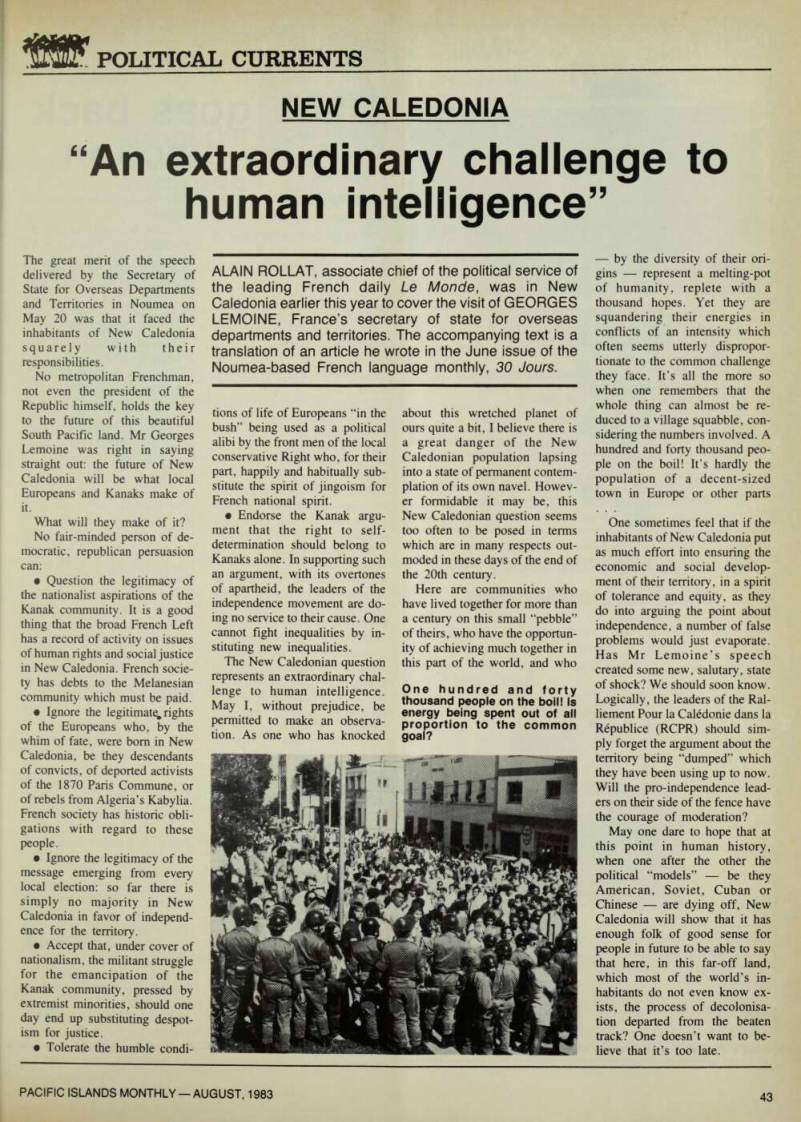
Political Currents
New Caledonia
“An extraordinary challenge to human intelligence”
ALAIN ROLLAT, associate chief of the political service of the leading French daily Le Monde, was in New Caledonia earlier this year to cover the visit of GEORGES LEMOINE, France’s secretary of state for overseas departments and territories. The accompanying text is a translation of an article he wrote in the June issue of the Noumea-based French language monthly, 30 Jours.
The great merit of the speech delivered by the Secretary of State for Overseas Departments and Territories in Noumea on May 20 was that it faced the inhabitants of New Caledonia squarely with their responsibilities.
No metropolitan Frenchman, not even the president of the Republic himself, holds the key to the future of this beautiful South Pacific land. Mr Georges Lemoine was right in saying straight out: the future of New Caledonia will be what local Europeans and Kanaks make of it.
What will they make of it?
No fair-minded person of de mocratic, republican persuasion can: • Question the legitimacy of the nationalist aspirations of the Kanak community. It is a good thing that the broad French Left has a record of activity on issues of human rights and social justice in New Caledonia. French socie ty has debts to the Melanesian community which must be paid. • Ignore the rights of the Europeans who, by the whim of fate, were bom in New Caledonia, be they descendants of convicts, of deported activists of the 1870 Paris Commune, or of rebels from Algeria’s Kabylia.
French society has historic obli gations with regard to these people. • Ignore the legitimacy of the message emerging from every local election: so far there is simply no majority in New Caledonia in favor of independ ence for the territory. • Accept that, under cover of nationalism, the militant struggle for the emancipation of the Kanak community, pressed by extremist minorities, should one day end up substituting despot ism for justice. • Tolerate the humble condi
tions of life of Europeans “in the bush” being used as a political alibi by the front men of the local conservative Right who, for their part, happily and habitually sub stitute the spirit of jingoism for French national spirit. • Endorse the Kanak argu ment that the right to self determination should belong to Kanaks alone. In supporting such an argument, with its overtones of apartheid, the leaders of the independence movement are do ing no service to their cause. One cannot fight inequalities by in stituting new inequalities.
The New Caledonian question represents an extraordinary chal lenge to human intelligence.
May I, without prejudice, be permitted to make an observa tion. As one who has knocked
about this wretched planet of ours quite a bit, I believe there is a great danger of the New Caledonian population lapsing into a state of permanent contem plation of its own navel. Howev er formidable it may be, this New Caledonian question seems too often to be posed in terms which are in many respects out moded in these days of the end of the 20th century.
Here are communities who have lived together for more than a century on this small “pebble” of theirs, who have the opportun ity of achieving much together in this part of the world, and who
by the diversity of their ori gins represent a melting-pot of humanity, replete with a thousand hopes. Yet they are squandering their energies in conflicts of an intensity which often seems utterly dispropor tionate to the common challenge they face. It’s all the more so when one remembers that the whole thing can almost be re duced to a village squabble, con sidering the numbers involved. A hundred and forty thousand peo ple on the boil! It’s hardly the population of a decent-sized town in Europe or other parts One sometimes feel that if the inhabitants of New Caledonia put as much effort into ensuring the economic and social develop ment of their territory, in a spirit of tolerance and equity, as they do into arguing the point about independence, a number of false problems would just evaporate.
Has Mr Lemoine’s speech created some new, salutary, state of shock? We should soon know.
Logically, the leaders of the Ral liement Pour la Caledonie dans la Republice (RCPR) should sim ply forget the argument about the territory being “dumped” which they have been using up to now.
Will the pro-independence lead ers on their side of the fence have the courage of moderation?
May one dare to hope that at this point in human history, when one after the other the political “models” be they American, Soviet, Cuban or Chinese are dying off, New Caledonia will show that it has enough folk of good sense for people in future to be able to say that here, in this far-off land, which most of the world’s in habitants do not even know ex ists, the process of decolonisa tion departed from the beaten track? One doesn’t want to be lieve that it’s too late.
One hundred and forty thousand people on the boil! Is energy being spent out of all proportion to the common goal?
in by-election
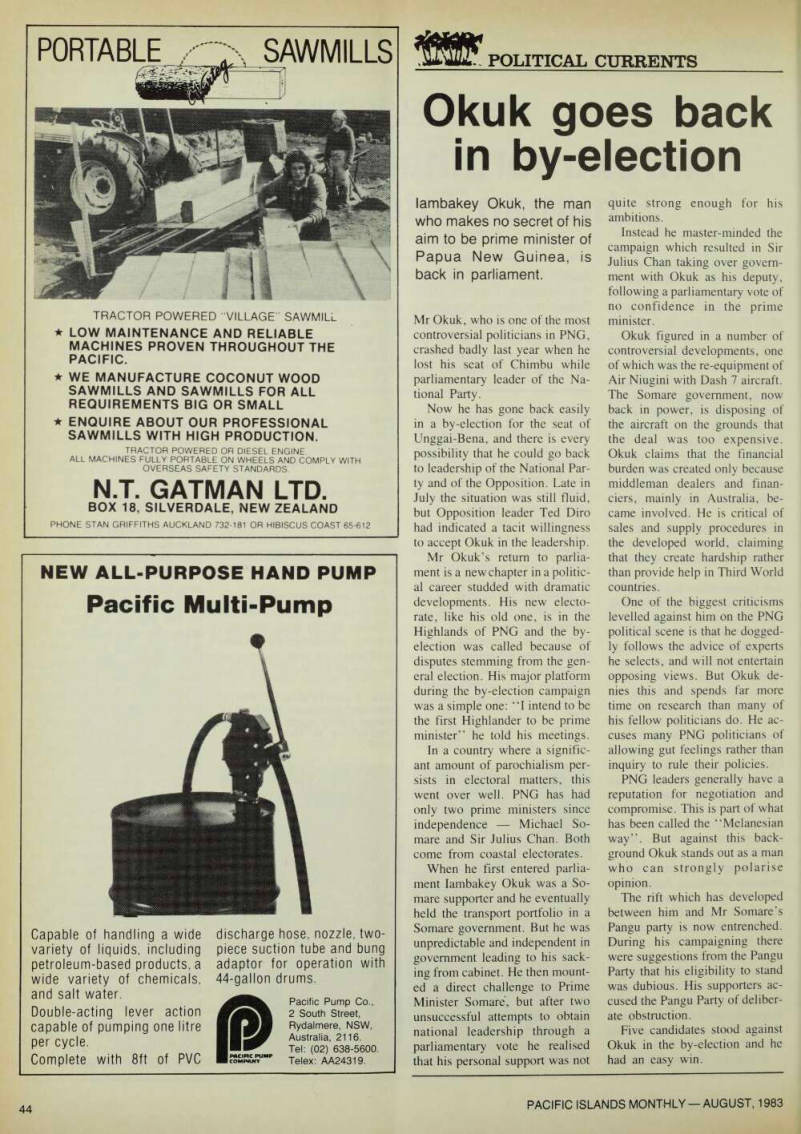
Okuk goes back in by-election
lambakey Okuk, the man
who makes no secret of his aim to be prime minister of
Papua New Guinea, is
back in parliament.
Mr Okuk, who is one of the most controversial politicians in PNG, crashed badly last year when he lost his seat of Chimbu while parliamentary leader of the Na
tional Party.
Now he has gone back easily in a by-election for the seat of Unggai-Bena, and there is every possibility that he could go back to leadership of the National Par ty and of the Opposition. Late in July the situation was still fluid, but Opposition leader Ted Diro had indicated a tacit willingness to accept Okuk in the leadership.
Mr Okuk’s return to parlia ment is a new chapter in a politic al career studded with dramatic developments. His new electo rate, like his old one, is in the Highlands of PNG and the by election was called because of disputes stemming from the gen eral election. His major platform
during the by-election campaign
was a simple one: “I intend to be the first Highlander to be prime minister” he told his meetings.
In a country where a signific ant amount of parochialism per sists in electoral matters, this went over well. PNG has had only two prime ministers since independence Michael So mare and Sir Julius Chan. Both come from coastal electorates.
When he first entered parlia ment lambakey Okuk was a So mare supporter and he eventually held the transport portfolio in a Somare government. But he was
unpredictable and independent in
government leading to his sack ing from cabinet. He then mount ed a direct challenge to Prime Minister Somare, but after two unsuccessful attempts to obtain
national leadership through a
parliamentary vote he realised that his personal support was not
quite strong enough for his ambitions.
Instead he master-minded the campaign which resulted in Sir Julius Chan taking over govern ment with Okuk as his deputy, following a parliamentary vote of no confidence in the prime minister.
Okuk figured in a number of controversial developments, one of which was the re-equipment of Air Niugini with Dash 7 aircraft.
The Somare government, now back in power, is disposing of the aircraft on the grounds that the deal was too expensive.
Okuk claims that the financial burden was created only because middleman dealers and finan ciers, mainly in Australia, be came involved. He is critical of sales and supply procedures in the developed world, claiming that they create hardship rather than provide help in Third World countries.
One of the biggest criticisms levelled against him on the PNG political scene is that he dogged ly follows the advice of experts he selects, and will not entertain opposing views. But Okuk de nies this and spends far more time on research than many of his fellow politicians do. He ac cuses many PNG politicians of allowing gut feelings rather than inquiry to rule their policies.
PNG leaders generally have a reputation for negotiation and compromise. This is part of what has been called the “Melanesian way”. But against this back ground Okuk stands out as a man who can strongly polarise opinion.
The rift which has developed between him and Mr Somare’s Pangu party is now entrenched.
During his campaigning there were suggestions from the Pangu Party that his eligibility to stand was dubious. His supporters ac cused the Pangu Party of deliber ate obstruction.
Five candidates stood against Okuk in the by-election and he had an easy win.
Advertisements & other items, p. 44 (1 item)
Sawmills
PORTABLE
a«5 « M
TRACTOR POWERED “VILLAGE" SAWMILL
★ LOW MAINTENANCE AND RELIABLE
MACHINES PROVEN THROUGHOUT THE
PACIFIC.
★ WE MANUFACTURE COCONUT WOOD
SAWMILLS AND SAWMILLS FOR ALL
REQUIREMENTS BIG OR SMALL
★ ENQUIRE ABOUT OUR PROFESSIONAL
SAWMILLS WITH HIGH PRODUCTION.
TRACTOR POWERED OR DIESEL ENGINE
ALL MACHINES FULLY PORTABLE ON WHEELS AND COMPLY WITH
OVERSEAS SAFETY STANDARDS
NT. GATMAN LTD.
BOX 18, SILVERDALE, NEW ZEALAND
PHONE STAN GRIFFITHS AUCKLAND 732-181 OR HIBISCUS COAST 65-612
NEW ALL-PURPOSE HAND PUMP
Pacific Multi-Pump
Capable of handling a wide variety of liquids, including petroleum-based products, a wide variety of chemicals, and salt water.
Double-acting lever action capable of pumping one litre per cycle.
Complete with Bft of PVC discharge hose, nozzle, twopiece suction tube and bung adaptor for operation with 44-gallon drums. ® Pacific Pump Co., 2 South Street, Rydalmere, NSW, Australia, 2116.
Tel: (02) 638-5600.
Telex: AA24319.
Islands
From the
Press
From The Drum column, Papua New Guinea Post-Courier, Port Moresby A big firm in Port Moresby has just extricated itself from The Great ‘Fridge Foul-Up’. The problem started when a refrigerator worth 1000 kina was moved from an executive’s house to the company’s warehouse for safe keeping. It got mixed up with a pile of second-hand refrigerators on sale for 25 kina each.
Needless to say it didn’t stay on the floor for long. Lucky buyer, when told there had been a blunder, agreed to pay another 225 kina and still walked out with a bargain basement grin.
Part of a reader’s letter published in The Observer, Apia, Western Samoa It is amazing to learn that the Prime Minister has had the audacity to ask the U.S. President to consider recruiting Western Samoan young men into the U.S. Army. This is offering them as mercenaries to a foreign army, or in other words it is prostituting our young men. When we run out of men and boys why not offer our girls? Their services would be in great demand around the world.
From The Drum column in the Papua New Guinea Post-Courier, Port Moresby There might not be honor among thieves but in one group at least there seems to be an appreciation of beauty. The hold-up gang that robbed a Port Moresby bookie shop a week ago, and stole a car, has returned to the woman owner of the vehicle her licence. A note with it said “You are beautiful, so we have decided to send back your licence. But not the car because it is too good for the police.”
From the Flotsam & Jetsam column in The Fiji Times, Suva A 30-year-old woman was fined $4O in Suva Court for stealing a duck. The woman, who admitted the offence, told the court she was cutting grass around her home when the duck waded onto her knife. The duck died as a result and her family had curry duck that night.
From Akio Heine’s column in the Marshall Islands Journal, regarding plans to provide sex education and birth control information We doubt that sex education is needed, at least in the Marshall Islands. Birth control, yes. But not sex education, and here is why. Almost every youth is not only knowledgeable but very experienced when it comes to sex an extracurricular activity here. It is like fishing just about every one knows how to fish.
Sir Julius Chan, quoted in The Times of Papua New Guinea, Port Moresby, appeals for a country of refuge for West Papuan freedom fighters Not necessarily the cold icy north like Sweden (where some West Papuans have been granted asylum) but somewhere where they can live like human beings, he said.
Solomons Toktok, Honiara, in an article on birth control We are well aware that unmarried women can produce babies if there are persuasive men about, therefore it will be necessary for
young women to have instruction in the strategies of the male sex and be brought to realise that it is not always in the nation’s interest to associate with men. Women can be patriotic too.
An unfortunate spelling error from a letter published in Solomons Toktok, Honiara, Solomon Islands An alien who forged a passport continues to exist happily in Solomon Islands extending his testacies to even politics.
From an item headed New Flags Needed’ in the Marshall Islands Journal Last week we set out to photograph the Marshall Islands flag flying in the capital. We were greatly disappointed that all the ones to be seen were too frayed and faded to have made a good picture. At the Aide building, the place where the flag was raised for the first time in 1979, there was no flag flying. At least on Constitution Day a new flag was flown. We think it would be a good use of funds to replace the flags at key places as often as needed.
Part of an editorial in the Samoa Times, Apia, Western Samoa Maybe it is about time we should ask the government to slow down the pace of development. The pace of development has been too fast. We are now seeing the effects of too rapid development cuts in the government budget, the laying off of workers, cuts in necessary imports and increases in charges. If conservation is the policy now, then that applies also to development.
The Times of Papua New Guinea, Port Moresby, from an article in which Bernard Narokobi warns against increasing dependence on foreign aid This money helps us to maintain very costly institutions and high standards on paper. It helps to create high rates of inflation by giving us the illusion that we can afford high wages, high prices and luxuries. We have had no chance to find our own level. The result is that we have set very high sights of expectation for our people. I believe this is partly the trouble with our education system. In the days that we didn’t have all this money coming in, we grew our own kaukau and aibika, we cut our own grass and cleaned the school area. We cooked our own food. Nowadays students expect “boys to cut grass with a lawn mower”. They also expect the government to supply them with food. They don’t know what self reliance is and those in power have no right to tell students to be self reliant.
Unsigned letter to the editor published in The Observer, Apia, Western Samoa It is indeed most heartening to hear that Chief Inspector Falaniko intends pursuing those people who insult the “freedom flag” by not saluting it. I am puzzled however, by the term “freedom flag”. What does the Chief Inspector mean? I am not a Matai, so I am not free to vote. I am not free to buy those things in the shops which I and my family need. I am not free to think except for those things that the Faifeau tell us on Sundays.
Please tell me, why do I not feel free? Why do I feel that I am trapped and unable to live a normal life, unable to do all those things which freedom entails. Freedom means much more than not saluting a flag.
The Marshall Islands Journal A slow-moving truck recently pulled over to allow the line of cars behind to pass. We don’t have a clue as to what caused the driver to break the custom of blocking traffic. The police better look into this deviant behavior.
A heading in the Papua New Guinea Post-Courier, Port Moresby, after a rugby league team from Australia defeated a PNG team by 106 to 3 Dark hour as Queensland drops bomb.
A view on slot machines expressed in Marianas Variety News & Views I don’t like them. They can cause banks to take back paid cars which are not paid because slot machines ate up the money.
Advertisements & other items, p. 46 (1 item)
neither time nor place...
% MSiii
ii'fi v.
Smsif?
Bhmriiiiij wSt % luSF* •T'S* k L 9 & »/■ ;- r '- % ft / c/g^Rs
SMOOTH, MILD CIGARS
Corona • Commodore Panatella • Lancers • Tipped Lancers • Panatella W 754
People
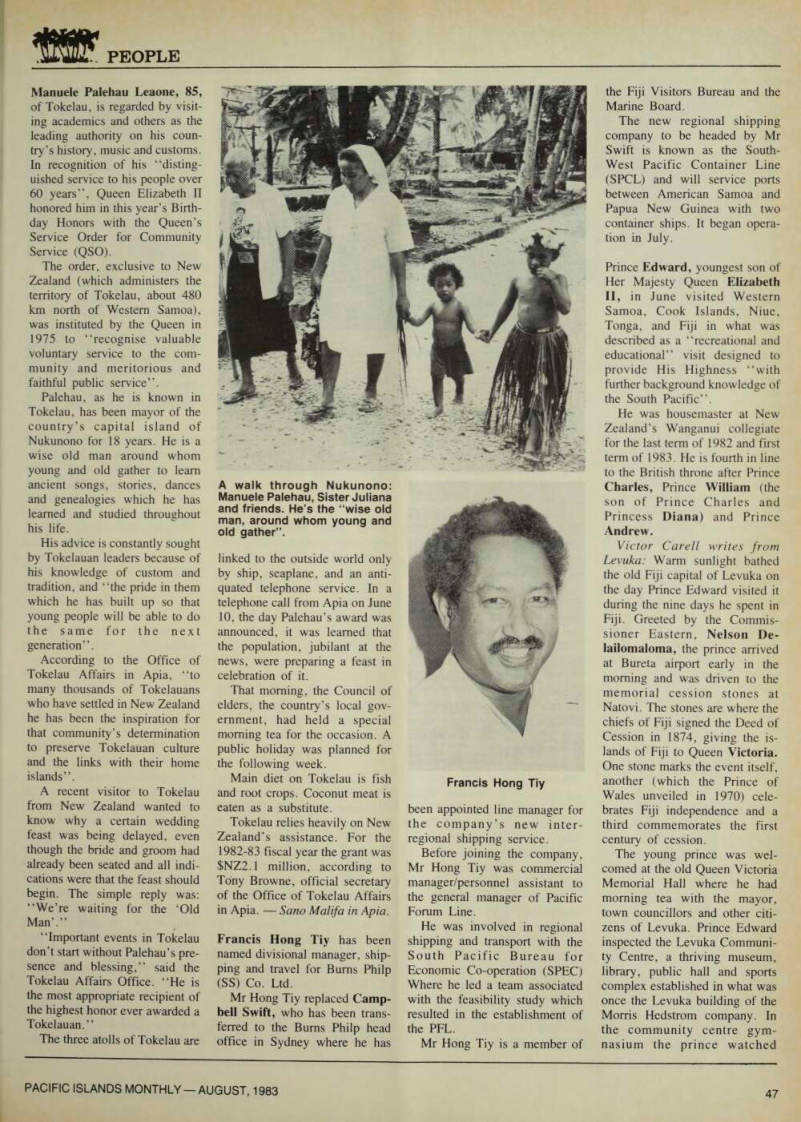
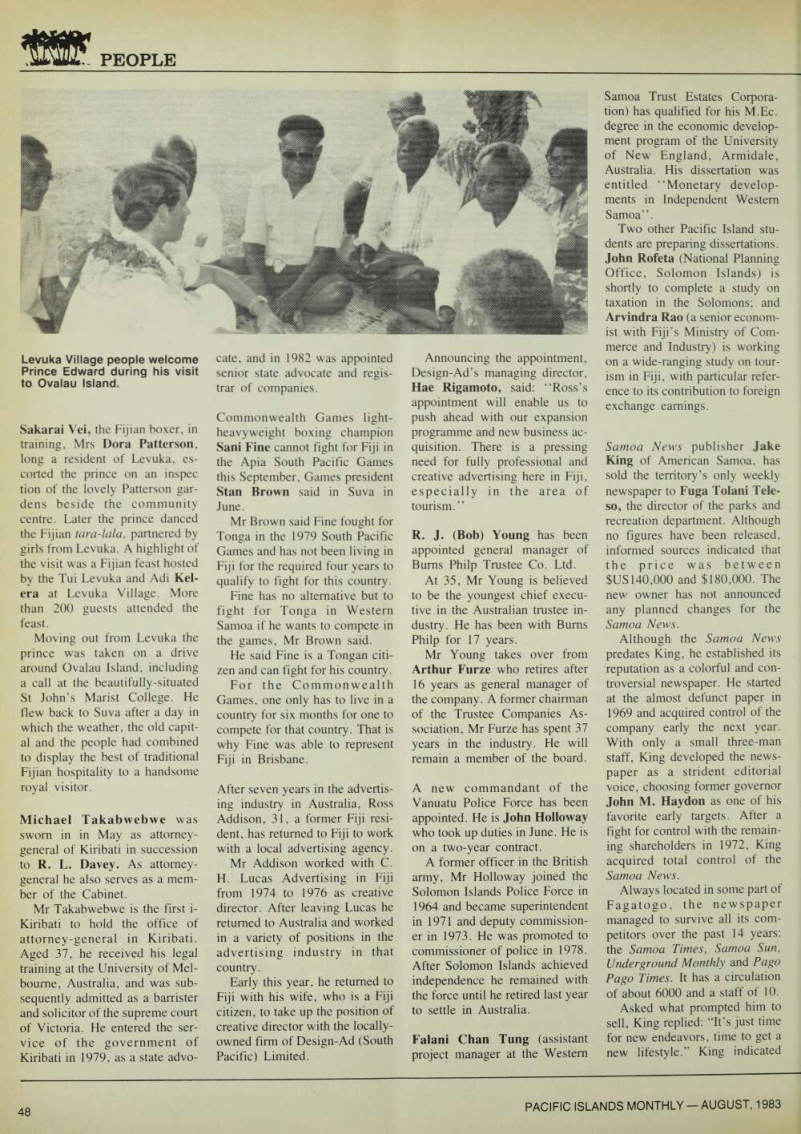
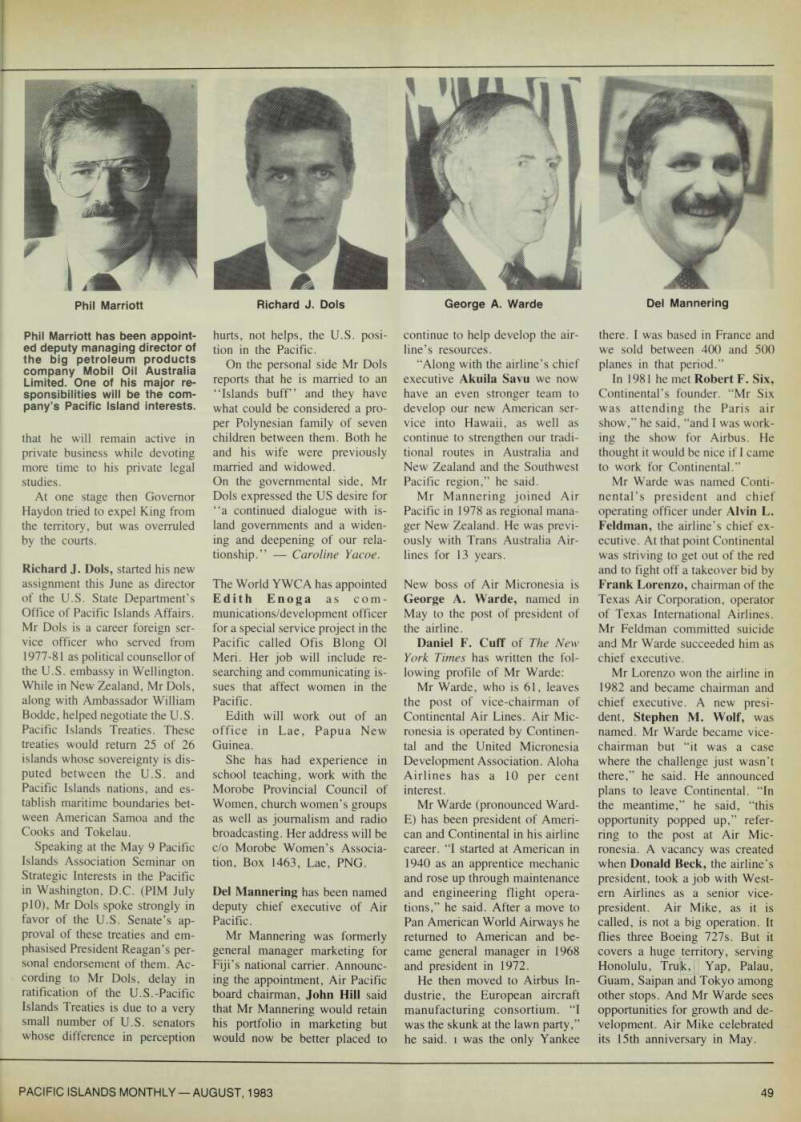
Manuele Palehau Leaone, 85, of Tokelau, is regarded by visit ing academics and others as the leading authority on his coun try’s history, music and customs.
In recognition of his “disting uished service to his people over 60 years”, Queen Elizabeth II honored him in this year’s Birth day Honors with the Queen’s Service Order for Community Service (QSO).
The order, exclusive to New Zealand (which administers the territory of Tokelau, about 480 km north of Western Samoa), was instituted by the Queen in 1975 to “recognise valuable voluntary service to the com munity and meritorious and faithful public service”.
Palehau, as he is known in Tokelau, has been mayor of the country’s capital island of Nukunono for 18 years. He is a wise old man around whom young and old gather to learn ancient songs, stories, dances and genealogies which he has learned and studied throughout his life.
His advice is constantly sought by Tokelauan leaders because of his knowledge of custom and tradition, and “the pride in them which he has built up so that young people will be able to do the same for the next generation”.
According to the Office of Tokelau Affairs in Apia, “to many thousands of Tokelauans who have settled in New Zealand he has been the inspiration for that community’s determination to preserve Tokelauan culture and the links with their home islands”.
A recent visitor to Tokelau from New Zealand wanted to know why a certain wedding feast was being delayed, even though the bride and groom had already been seated and all indi cations were that the feast should begin. The simple reply was; “We’re waiting for the ‘Old Man’.”
“Important events in Tokelau don’t start without Palehau’s pre sence and blessing,” said the Tokelau Affairs Office. “He is the most appropriate recipient of the highest honor ever awarded a Tokelauan.”
The three atolls of Tokelau are
linked to the outside world only by ship, seaplane, and an anti quated telephone service. In a telephone call from Apia on June 10, the day Palehau’s award was announced, it was learned that the population, jubilant at the news, were preparing a feast in celebration of it.
That morning, the Council of elders, the country’s local gov ernment, had held a special morning tea for the occasion. A public holiday was planned for the following week.
Main diet on Tokelau is fish and root crops. Coconut meat is eaten as a substitute.
Tokelau relies heavily on New Zealand’s assistance. For the 1982-83 fiscal year the grant was SNZ2.I million, according to Tony Browne, official secretary of the Office of Tokelau Affairs in Apia. Sano Malifa in Apia.
Francis Hong Tiy has been named divisional manager, ship ping and travel for Bums Philp (SS) Co. Ltd.
Mr Hong Tiy replaced Camp bell Swift, who has been trans ferred to the Bums Philp head office in Sydney where he has
been appointed line manager for the company’s new inter regional shipping service.
Before joining the company, Mr Hong Tiy was commercial manager/personnel assistant to the general manager of Pacific Forum Line.
He was involved in regional shipping and transport with the South Pacific Bureau for Economic Co-operation (SPEC) Where he led a team associated with the feasibility study which resulted in the establishment of the PEL.
Mr Hong Tiy is a member of
the Fiji Visitors Bureau and the Marine Board.
The new regional shipping company to be headed by Mr Swift is known as the South- West Pacific Container Line (SPCL) and will service ports between American Samoa and Papua New Guinea with two container ships. It began opera tion in July.
Prince Edward, youngest son of Her Majesty Queen Elizabeth 11, in June visited Western Samoa, Cook Islands, Niue, Tonga, and Fiji in what was described as a “recreational and educational” visit designed to provide His Highness “with further background knowledge of the South Pacific”.
He was housemaster at New Zealand’s Wanganui collegiate for the last term of 1982 and first term of 1983. He is fourth in line to the British throne after Prince Charles, Prince William (the son of Prince Charles and Princess Diana) and Prince Andrew.
Victor Carell writes from Levuka: Warm sunlight bathed the old Fiji capital of Levuka on the day Prince Edward visited it during the nine days he spent in Fiji. Greeted by the Commis sioner Eastern, Nelson De lailomaloma, the prince arrived at Bureta airport early in the morning and was driven to the memorial cession stones at Natovi. The stones are where the chiefs of Fiji signed the Deed of Cession in 1874, giving the is lands of Fiji to Queen Victoria.
One stone marks the event itself, another (which the Prince of Wales unveiled in 1970) cele brates Fiji independence and a third commemorates the first century of cession.
The young prince was wel comed at the old Queen Victoria Memorial Hall where he had morning tea with the mayor, town councillors and other citi zens of Levuka. Prince Edward inspected the Levuka Communi ty Centre, a thriving museum, library, public hall and sports complex established in what was once the Levuka building of the Morris Hedstrom company. In the community centre gym nasium the prince watched
A walk through Nukunono: Manuele Palehau, Sister Juliana and friends. He’s the “wise old man, around whom young and old gather”.
Francis Hong Tiy
Sakarai Vei, the Fijian boxer, in training, Mrs Dora Patterson, long a resident of Levuka, es corted the prince on an inspec tion of the lovely Patterson gar dens beside the community centre. Later the prince danced the Fijian tara-lala, partnered by girls from Levuka. A highlight of the visit was a Fijian feast hosted by the Tui Levuka and Adi Kel era at Levuka Village. More than 200 guests attended the feast.
Moving out from Levuka the prince was taken on a drive around Ovalau Island, including a call at the beautifully-situated St John’s Marist College. He flew back to Suva after a day in which the weather, the old capit al and the people had combined to display the best of traditional Fijian hospitality to a handsome royal visitor.
Michael Takabwebwe was sworn in in May as attorney general of Kiribati in succession to R. L. Davey. As attorney general he also serves as a mem ber of the Cabinet.
Mr Takabwebwe is the first i- Kiribati to hold the office of attorney-general in Kiribati.
Aged 37, he received his legal training at the University of Mel bourne, Australia, and was sub sequently admitted as a barrister and solicitor of the supreme court of Victoria. He entered the ser vice of the government of Kiribati in 1979, as a state advo
cate, and in 1982 was appointed senior state advocate and regis trar of companies.
Commonwealth Games light heavyweight boxing champion Sani Fine cannot fight for Fiji in the Apia South Pacific Games this September, Games president Stan Brown said in Suva in June.
Mr Brown said Fine fought for Tonga in the 1979 South Pacific Games and has not been living in Fiji for the required four years to qualify to fight for this country.
Fine has no alternative but to fight for Tonga in Western Samoa if he wants to compete in the games, Mr Brown said.
He said Fine is a Tongan citi zen and can fight for his country.
For the Commonwealth Games, one only has to live in a country for six months for one to compete for that country. That is why Fine was able to represent Fiji in Brisbane.
After seven years in the advertis ing industry in Australia, Ross Addison, 31, a former Fiji resi dent, has returned to Fiji to work with a local advertising agency.
Mr Addison worked with C.
H. Lucas Advertising in Fiji from 1974 to 1976 as creative director. After leaving Lucas he returned to Australia and worked in a variety of positions in the advertising industry in that country.
Early this year, he returned to Fiji with his wife, who is a Fiji citizen, to take up the position of creative director with the locally owned firm of Design-Ad (South Pacific) Limited.
Announcing the appointment,
Design-Ad’s managing director,
Hae Rigamoto, said: “Ross’s appointment will enable us to push ahead with our expansion programme and new business ac quisition. There is a pressing need for fully professional and creative advertising here in Fiji, especially in the area of tourism.”
R. J. (Bob) Young has been
appointed general manager of
Bums Philp Trustee Co. Ltd.
At 35, Mr Young is believed to be the youngest chief execu tive in the Australian trustee in dustry. He has been with Bums Philp for 17 years.
Mr Young takes over from Arthur Furze who retires after 16 years as general manager of the company. A former chairman of the Trustee Companies As sociation, Mr Furze has spent 37 years in the industry. He will remain a member of the board.
A new commandant of the Vanuatu Police Force has been appointed. He is John Holloway who took up duties in June. He is on a two-year contract.
A former officer in the British army, Mr Holloway joined the Solomon Islands Police Force in 1964 and became superintendent in 1971 and deputy commission er in 1973. He was promoted to commissioner of police in 1978.
After Solomon Islands achieved independence he remained with the force until he retired last year to settle in Australia.
Falani Chan Tung (assistant project manager at the Western
Samoa Trust Estates Corpora tion) has qualified for his M.Ec. degree in the economic develop ment program of the University of New England, Armidale, Australia. His dissertation was entitled “Monetary develop ments in Independent Western Samoa”.
Two other Pacific Island stu dents are preparing dissertations.
John Rofeta (National Planning Office, Solomon Islands) is shortly to complete a study on taxation in the Solomons; and Arvindra Rao (a senior econom ist with Fiji’s Ministry of Com merce and Industry) is working on a wide-ranging study on tour ism in Fiji, with particular refer ence to its contribution to foreign exchange earnings.
Samoa News publisher Jake King of American Samoa, has sold the territory’s only weekly newspaper to Fuga Tolani Tele so, the director of the parks and recreation department. Although no figures have been released, informed sources indicated that the price was between SUS 140,000 and $lBO,OOO. The new owner has not announced any planned changes for the Samoa News.
Although the Samoa News predates King, he established its reputation as a colorful and con troversial newspaper. He started at the almost defunct paper in 1969 and acquired control of the company early the next year.
With only a small three-man staff, King developed the news paper as a strident editorial voice, choosing former governor John M. Haydon as one of his favorite early targets. After a fight for control with the remain ing shareholders in 1972, King acquired total control of the Samoa News.
Always located in some part of Fagatogo, the newspaper managed to survive all its com petitors over the past 14 years: the Samoa Times, Samoa Sun, Underground Monthly and Pago Pago Times. It has a circulation of about 6000 and a staff of 10.
Asked what prompted him to sell, King replied: “It’s just time for new endeavors, time to get a new lifestyle.” King indicated
Levuka Village people welcome Prince Edward during his visit to Ovalau Island.
that he will remain active in private business while devoting more time to his private legal studies.
At one stage then Governor Haydon tried to expel King from the territory, but was overruled by the courts.
Richard J. Dols, started his new assignment this June as director of the U.S. State Department’s Office of Pacific Islands Affairs.
Mr Dols is a career foreign ser vice officer who served from 1977-81 as political counsellor of the U.S. embassy in Wellington.
While in New Zealand, Mr Dols, along with Ambassador William Bodde, helped negotiate the U.S.
Pacific Islands Treaties. These treaties would return 25 of 26 islands whose sovereignty is dis puted between the U.S. and Pacific Islands nations, and es tablish maritime boundaries bet ween American Samoa and the Cooks and Tokelau.
Speaking at the May 9 Pacific Islands Association Seminar on Strategic Interests in the Pacific in Washington, D.C. (PIM July plO), Mr Dols spoke strongly in favor of the U.S. Senate’s ap proval of these treaties and em phasised President Reagan’s per sonal endorsement of them. Ac cording to Mr Dols, delay in ratification of the U.S.-Pacific Islands Treaties is due to a very small number of U.S. senators whose difference in perception
hurts, not helps, the U.S. posi tion in the Pacific.
On the personal side Mr Dols reports that he is married to an “Islands buff’ and they have what could be considered a pro per Polynesian family of seven children between them. Both he and his wife were previously married and widowed.
On the governmental side, Mr Dols expressed the US desire for “a continued dialogue with is land governments and a widen ing and deepening of our rela
tionship.”
Caroline Yacoe.
The World YWCA has appointed Edith Enoga as com munications/development officer for a special service project in the Pacific called Ofis Blong Ol Meri. Her job will include re searching and communicating is sues that affect women in the Pacific.
Edith will work out of an office in Lae, Papua New Guinea.
She has had experience in school teaching, work with the Morobe Provincial Council of Women, church women’s groups as well as journalism and radio broadcasting. Her address will be c/o Morobe Women’s Associa tion, Box 1463, Lae, PNG.
Del Mannering has been named deputy chief executive of Air Pacific.
Mr Mannering was formerly general manager marketing for Fiji’s national carrier. Announc ing the appointment, Air Pacific board chairman, John Hill said that Mr Mannering would retain his portfolio in marketing but would now be better placed to
continue to help develop the air line’s resources.
“Along with the airline’s chief executive Akuila Savu we now have an even stronger team to develop our new American ser vice into Hawaii, as well as continue to strengthen our tradi tional routes in Australia and New Zealand and the Southwest Pacific region,” he said.
Mr Mannering joined Air Pacific in 1978 as regional mana ger New Zealand. He was previ ously with Trans Australia Air lines for 13 years.
New boss of Air Micronesia is George A. Warde, named in May to the post of president of the airline.
Daniel F. Cuff of The New York Times has written the fol lowing profile of Mr Warde: Mr Warde, who is 61, leaves the post of vice-chairman of Continental Air Lines. Air Mic ronesia is operated by Continen tal and the United Micronesia Development Association. Aloha Airlines has a 10 per cent interest.
Mr Warde (pronounced Ward- E) has been president of Ameri can and Continental in his airline career. “I started at American in 1940 as an apprentice mechanic and rose up through maintenance and engineering flight opera tions,” he said. After a move to Pan American World Airways he returned to American and be came general manager in 1968 and president in 1972.
He then moved to Airbus In dustrie, the European aircraft manufacturing consortium. “I was the skunk at the lawn party,” he said, i was the only Yankee
there. I was based in France and we sold between 400 and 500 planes in that period.”
In 1981 he met Robert F. Six, Continental’s founder. “Mr Six was attending the Paris air show,” he said, “and I was work ing the show for Airbus. He thought it would be nice if I came to work for Continental.”
Mr Warde was named Conti nental’s president and chief operating officer under Alvin L.
Feldman, the airline’s chief ex ecutive. At that point Continental was striving to get out of the red and to fight off a takeover bid by Frank Lorenzo, chairman of the Texas Air Corporation, operator of Texas International Airlines.
Mr Feldman committed suicide and Mr Warde succeeded him as chief executive.
Mr Lorenzo won the airline in 1982 and became chairman and chief executive. A new presi dent, Stephen M. Wolf, was named. Mr Warde became vice chairman but “it was a case where the challenge just wasn’t there,” he said. He announced plans to leave Continental. “In the meantime,” he said, “this opportunity popped up,” refer ring to the post at Air Mic ronesia. A vacancy was created when Donald Beck, the airline’s president, took a job with West ern Airlines as a senior vice president. Air Mike, as it is called, is not a big operation. It flies three Boeing 7275. But it covers a huge territory, serving Honolulu, Trulk, Yap, Palau, Guam, Saipan and Tokyo among other stops. And Mr Warde sees opportunities for growth and de velopment. Air Mike celebrated its 15th anniversary in May.
Phil Marriott
Phil Marriott has been appoint ed deputy managing director of the big petroleum products company Mobil Oil Australia Limited. One of his major re sponsibilities will be the com pany’s Pacific Island interests.
Richard J. Dols
George A. Warde
Del Mannering
Advertisements & other items, p. 50 (1 item)
Lujjjj
1 C
er Control at Your Fingertips
When Sansui mates computers with
high performance component systems
you get convenience. Like "Compu Edit.," a feature that allows automatic edit recording of songs from disc to tape in any programmed order. And the "Compu-Selector System" for onetouch synchronized play. And memory
station selection. Intelligent Super
Compo—the smartest hi-fi systems
ever designed.
LUJjJJ
T-909 FM/AM Tuner • i A-909 Integrated Amp D-99D Double Cassette Deck AT-202 Audio Program Timer GX-909 Audio Cabinet Also available in Black finish.
SANSUI ELECTRIC CO., LTD. 14-1 Izumi 2-chome, Suginami-ku, Tokyo 168, Japan For further information please contact: , , -.oncn n * i • Australia VANFI (Aust.) PTY. LTD. 297, City Road, South Melbourne, Victoria 3205, Australia Phone: 690-6200/283 Alfred Place, ortl iSydney 929-0293 • Fiji PRABHU BROTHERS LTD. P.O. Box 183, Nadi Phone: 71122 • Papua New Guinea OCEANIS INDENT AGENCY (P-N.Gd PTY LTD .Box 5518, ® or ° or Moresby Phone: 256411 • New Zealand DAVID REID ELECTRONICS LTD. P.O. Box 2630, Auckland, Phone: 488-049 • Ne ™Cf^oni6o n o* B.P 1123, Noumea Phone: 27.59,11 • Central Pacific NAURU CO-OPERATIVE SOCIETY Republic of Nauru • Vanuatu THE SOUND CENTRE LTD. P.O. Box 434, Vila Phone. 2035 • Tahiti DIMECO SIMEL B.P Box 3338 Papeete Phone: 26979
' A virtuoso display to
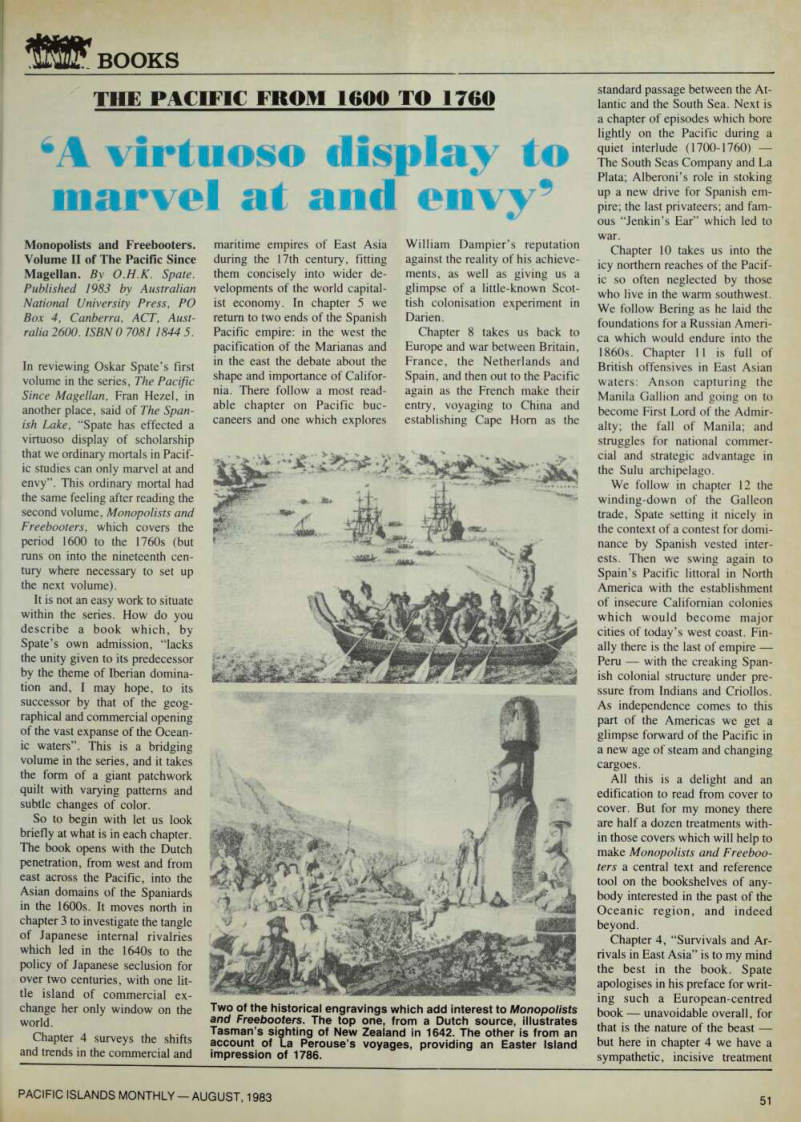

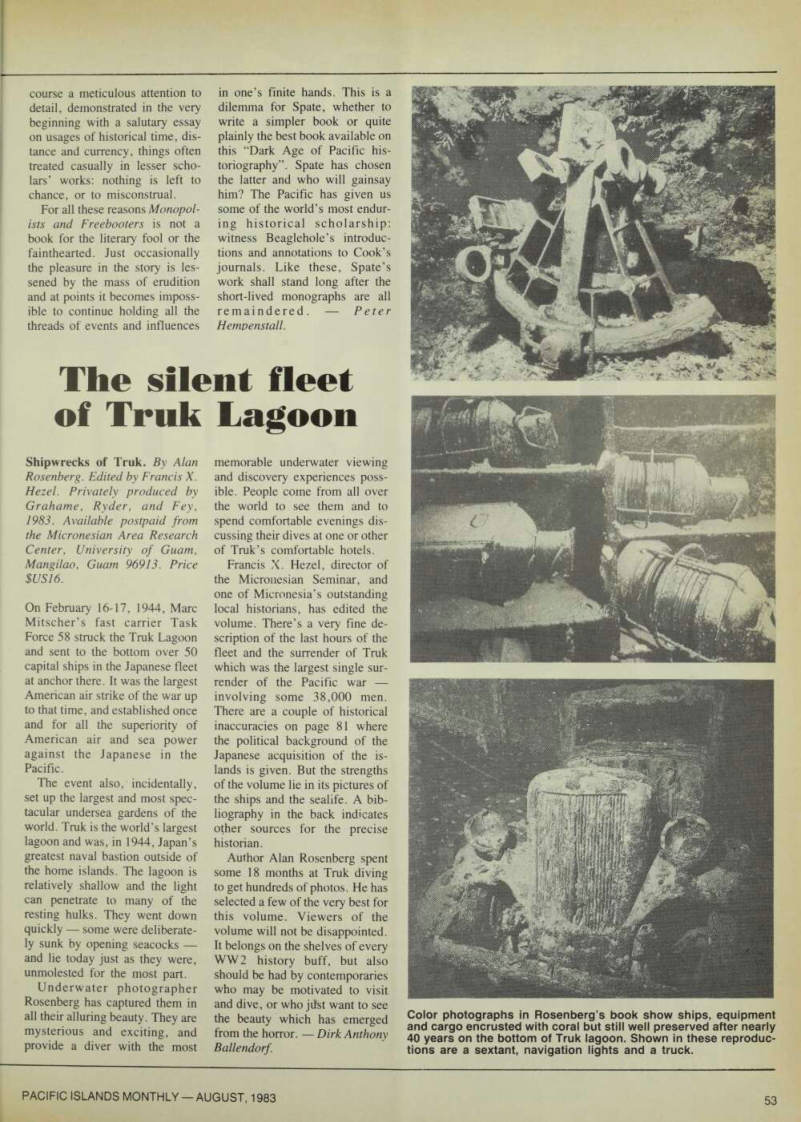
Books
The Pacific Rrom 1600 To 1760
' A virtuoso display to marvel at and envy '
Monopolists and Freebooters.
Volume II of The Pacific Since Magellan. By O.H.K. Spate.
Published 1983 by Australian National University Press, PO Box 4, Canberra, ACT, Aust ralia 2600. ISBN 0 7081 1844 5.
In reviewing Oskar Spate’s first volume in the series, The Pacific Since Magellan, Fran Hezel, in another place, said of The Span ish Lake, “Spate has effected a virtuoso display of scholarship that we ordinary mortals in Pacif ic studies can only marvel at and envy”. This ordinary mortal had the same feeling after reading the second volume, Monopolists and Freebooters, which covers the period 1600 to the 1760 s (but runs on into the nineteenth cen tury where necessary to set up the next volume).
It is not an easy work to situate within the series. How do you describe a book which, by Spate’s own admission, “lacks the unity given to its predecessor by the theme of Iberian domina tion and, I may hope, to its successor by that of the geog raphical and commercial opening of the vast expanse of the Ocean ic waters”. This is a bridging volume in the series, and it takes the form of a giant patchwork quilt with varying patterns and subtle changes of color.
So to begin with let us look briefly at what is in each chapter.
The book opens with the Dutch penetration, from west and from east across the Pacific, into the Asian domains of the Spaniards in the 1600 s. It moves north in chapter 3 to investigate the tangle of Japanese internal rivalries which led in the 1640 s to the policy of Japanese seclusion for over two centuries, with one lit tle island of commercial ex change her only window on the world.
Chapter 4 surveys the shifts and trends in the commercial and
maritime empires of East Asia during the 17th century, fitting them concisely into wider de velopments of the world capital ist economy. In chapter 5 we return to two ends of the Spanish Pacific empire: in the west the pacification of the Marianas and in the east the debate about the shape and importance of Califor nia. There follow a most read able chapter on Pacific buc caneers and one which explores
William Dampier’s reputation
against the reality of his achieve ments, as well as giving us a glimpse of a little-known Scot tish colonisation experiment in Darien.
Chapter 8 takes us back to Europe and war between Britain, France, the Netherlands and Spain, and then out to the Pacific again as the French make their entry, voyaging to China and establishing Cape Horn as the
standard passage between the At lantic and the South Sea. Next is a chapter of episodes which bore lightly on the Pacific during a quiet interlude (1700-1760) The South Seas Company and La Plata; Alberoni’s role in stoking up a new drive for Spanish em pire; the last privateers; and fam ous “Jenkin’s Ear” which led to war.
Chapter 10 takes us into the icy northern reaches of the Pacif ic so often neglected by those who live in the warm southwest.
We follow Bering as he laid the foundations for a Russian Ameri ca which would endure into the 1860 s. Chapter 11 is full of British offensives in East Asian waters; Anson capturing the Manila Gallion and going on to become First Lord of the Admir alty; the fall of Manila; and struggles for national commer cial and strategic advantage in the Sulu archipelago.
We follow in chapter 12 the winding-down of the Galleon trade, Spate setting it nicely in the context of a contest for domi nance by Spanish vested inter ests. Then we swing again to Spain’s Pacific littoral in North America with the establishment of insecure Californian colonies which would become major cities of today’s west coast. Fin ally there is the last of empire Peru with the creaking Span ish colonial structure under pre ssure from Indians and Criollos.
As independence comes to this part of the Americas we get a glimpse forward of the Pacific in a new age of steam and changing cargoes.
All this is a delight and an edification to read from cover to cover. But for my money there are half a dozen treatments with in those covers which will help to make Monopolists and Freeboo ters a central text and reference tool on the bookshelves of any body interested in the past of the Oceanic region, and indeed beyond.
Chapter 4, “Survivals and Ar rivals in East Asia” is to my mind the best in the book. Spate apologises in his preface for writ ing such a European-centred book unavoidable overall, for that is the nature of the beast but here in chapter 4 we have a sympathetic, incisive treatment
Two of the historical engravings which add interest to Monopolists and Freebooters. The top one, from a Dutch source, illustrates Tasman's sighting of New Zealand in 1642. The other is from an account of La Perouse’s voyages, providing an Easter Island impression of 1786.
of dynamic Asian policies and their commercial operations. We get a feeling of communities Asian and European engaged in an exquisite dance, stepping towards one another in new com mercial beginnings, retreating, trying new steps, new passages.
And Spate does not neglect the macro-economic trends, as the western economy begins to turn towards mass production in Europe and mass marketing in Asia. This is “significant his tory”: not just the art of story telling but the systematising of the record and meaning of human behavior over long periods as well. Thus Spate sums up crisply in this chapter the Portuguese legacy in Asia, the real reasons for European domination of Asian trade, the reason for France’s lack of commercial suc cess, and so on.
Another area which stands out in the book is Spate’s chapter on the buccaneers compulsive reading, this and especially his comments on the sources pertaining to them. Spate pro vides in the footnotes to chapter 6 a navigable channel through the readings on one of the more sensationalist areas of maritime history, to a degree which makes them an independent essay on the historiography of the theme. This is a feature of the footnotes as a whole: comprising 75 pages, they are a veritable booklet in themselves which will become a standard bibliographic source for scholars, and a fascinating read to boot.
For those interested in the his tory of the classic age of col onialism and its structures of domination, Spate’s last chapter is illuminating, with its concise description of one of the central functionaries of the European colonial system at all times and in all places the corregidor or district officer, with massive loc al influence and few effective restraints. Much of Europe’s col onial heritage can be traced back to these men, who, in Spate’s words “give the impression of being failed lawyers or the youn ger sons of the seedier gentry”.
They were also the focus of much protest even rebellion by Indios and by the mixed race Criollos, collaborators with
the Spaniards, thrusting ever up wards, with one eye on the In dian masses below as revolution neared.
Finally there are some lovely sketches of individual per sonalities and judicious judg ments on their limitations. Aust ralians will do well to read the portraits of Tasman, damned with faint praise, and of Dam pier, a sensible second-in command but “as a commander, an almost pitiable failure”: sober portraits, both, of men sanctified in the mythology of Australian history. And I defy anyone to remain unaffected by the poig nant journal descriptions of Ber ing and his colleagues living and dying on Bering Island during a dreadful winter of discovery.
One of the pre-eminent virtues of Monopolists and Freebooters is its scope. Spate drives home the fact of the enormous range of environments encompassed by this ocean, from forbidding arct ic wastes, through the sandy, arid shores of parts of the Americas, to the tropics splen did. But the book also stretches the historical eye well beyond the Pacific to the rest of world de velopments in the 16th and 17th centuries. On page one Spate reminds the reader that ours is not the first global century and readers will find here a world peopled not only by Castilians but by Hollanders and the English, by Japanese, Koreans, Filipinos, Russians, Aleuts and American Indians; the Oceanic islanders, Spate promises us, will come into their own in the third volume of the series.
All this is done in the rich prose which is a characteristic of Spate’s work. He is master of the wry characterisation of persons or events (the motives of the buccaneers were “purely, or im purely, predatory” one of the most famous, Henry Morgan, died “more in the odor of rum than of sanctity”) and of the witty editorial comment (when de scribing the proposal by Bering’s suffering party to break up their wrecked ship to build a smaller vessel Spate writes: “There’ll al ways be an apparatchik : objec tion was made that nobody had ever heard of building a vessel from a wreck(!)”). There is of
course a meticulous attention to detail, demonstrated in the very beginning with a salutary essay on usages of historical time, dis tance and currency, things often treated casually in lesser scho lars’ works: nothing is left to chance, or to misconstrual.
For all these reasons Monopol ists and Freebooters is not a book for the literary fool or the fainthearted. Just occasionally the pleasure in the story is les sened by the mass of erudition and at points it becomes imposs ible to continue holding all the threads of events and influences
in one’s finite hands. This is a dilemma for Spate, whether to write a simpler book or quite plainly the best book available on this “Dark Age of Pacific his
toriography”. Spate has chosen
the latter and who will gainsay him? The Pacific has given us some of the world’s most endur ing historical scholarship; witness Beaglehole’s introduc tions and annotations to Cook’s
journals. Like these, Spate’s
work shall stand long after the short-lived monographs are all
remaindered.
Peter
Hempenstall.
Advertisements & other items, pp. 52-54 (1 item)
Machinery
Rock Processing
For Sale or Rent
Crushing Plants
Screening Plants
■ • m CiK i *
Conveyors
J \ i ft %
Rock Systems, Inc
1600 Kapiolani Blvd. Suite 1300 Honolulu, HI 96814 Phone (808) 944-5562 Telex# 7431987
ANCHOR
diMi!
I
HJULCREAM|M
™«N ENRICH* 0
ni
KiM MILK
k pow
POWDER,
SKIM Ml
I POWDER
mm&aKKm
ANCHOR i
ANCHOR
Mm a h mri
WIM
mm* HI a
NEW
ZEALAND
DAIRY
BOARD
Anchor - premium quality dairy produce, packed with all the goodness of the finest pasture in the world.
Fresh to you from the world’s number one dairy producer, New Zealand Dairy Board.
Enquiries to: PO Box 417 Wellington, New Zealand
Telex: NZ3348 DAPMARK
Telephone; 724-399
of Truk Lagoon
The silent fleet of Truk Lagoon
Shipwrecks of Truk. By Alan Rosenberg. Edited by Francis X.
Hezel. Privately produced by Grahame, Ryder, and Fey, 1983. Available postpaid from the Micronesian Area Research Center, University of Guam, Mangilao, Guam 96913. Price
Susi 6.
On February 16-17, 1944, Marc Mitscher’s fast carrier Task Force 58 struck the Truk Lagoon and sent to the bottom over 50 capital ships in the Japanese fleet at anchor there. It was the largest American air strike of the war up to that time, and established once and for all the superiority of American air and sea power against the Japanese in the Pacific.
The event also, incidentally, set up the largest and most spec tacular undersea gardens of the world. Truk is the world’s largest lagoon and was, in 1944, Japan’s greatest naval bastion outside of the home islands. The lagoon is relatively shallow and the light can penetrate to many of the resting hulks. They went down quickly some were deliberate ly sunk by opening seacocks and lie today just as they were, unmolested for the most part.
Underwater photographer Rosenberg has captured them in all their alluring beauty. They are mysterious and exciting, and provide a diver with the most
memorable underwater viewing and discovery experiences poss ible. People come from all over the world to see them and to spend comfortable evenings dis cussing their dives at one or other of Truk’s comfortable hotels.
Francis X. Hezel, director of the Micronesian Seminar, and one of Micronesia’s outstanding local historians, has edited the volume. There’s a very fine de scription of the last hours of the fleet and the surrender of Truk which was the largest single sur render of the Pacific war involving some 38,000 men.
There are a couple of historical inaccuracies on page 81 where the political background of the Japanese acquisition of the is lands is given. But the strengths of the volume lie in its pictures of the ships and the sealife. A bib liography in the back indicates other sources for the precise historian.
Author Alan Rosenberg spent some 18 months at Truk diving to get hundreds of photos. He has selected a few of the very best for this volume. Viewers of the volume will not be disappointed.
It belongs on the shelves of every WW2 history buff, but also should be had by contemporaries who may be motivated to visit and dive, or who jifst want to see the beauty which has emerged
from the horror.
Dirk Anthony
Ballendorf.
Color photographs in Rosenberg’s book show ships, equipment and cargo encrusted with coral but still well preserved after nearly 40 years on the bottom of Truk lagoon. Shown in these reproduc tions are a sextant, navigation lights and a truck.
‘It is my love for you that has
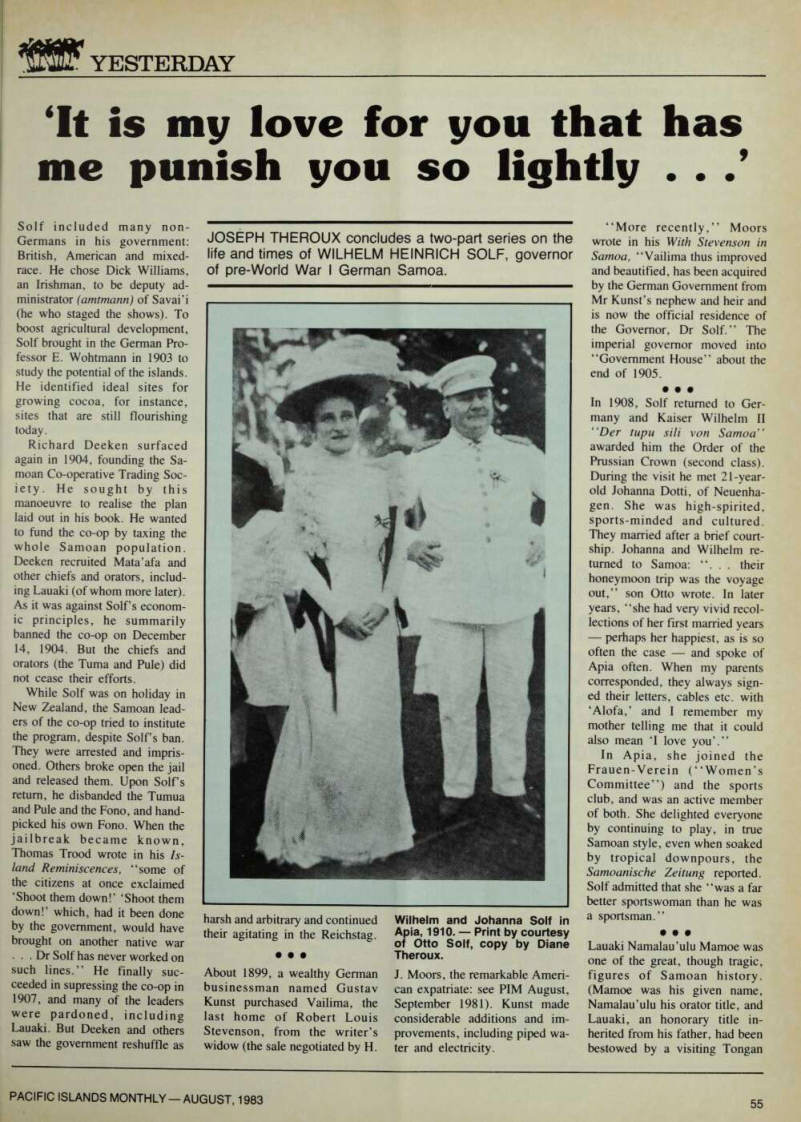

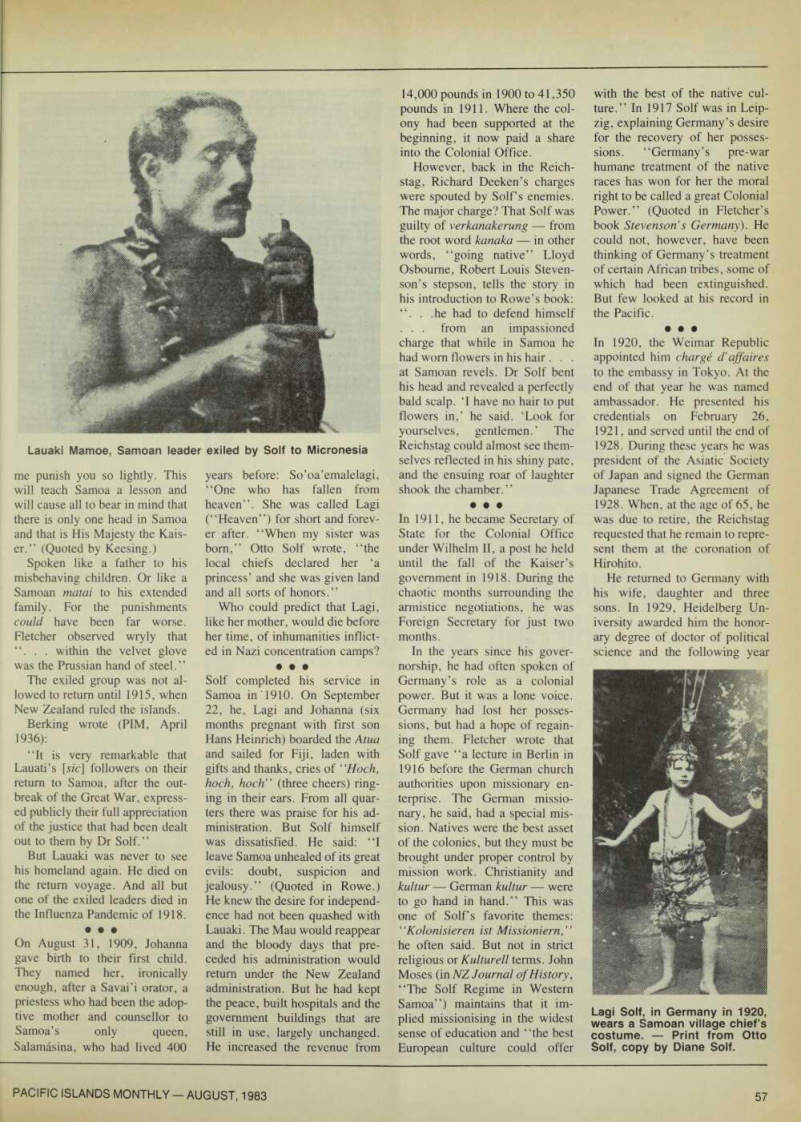
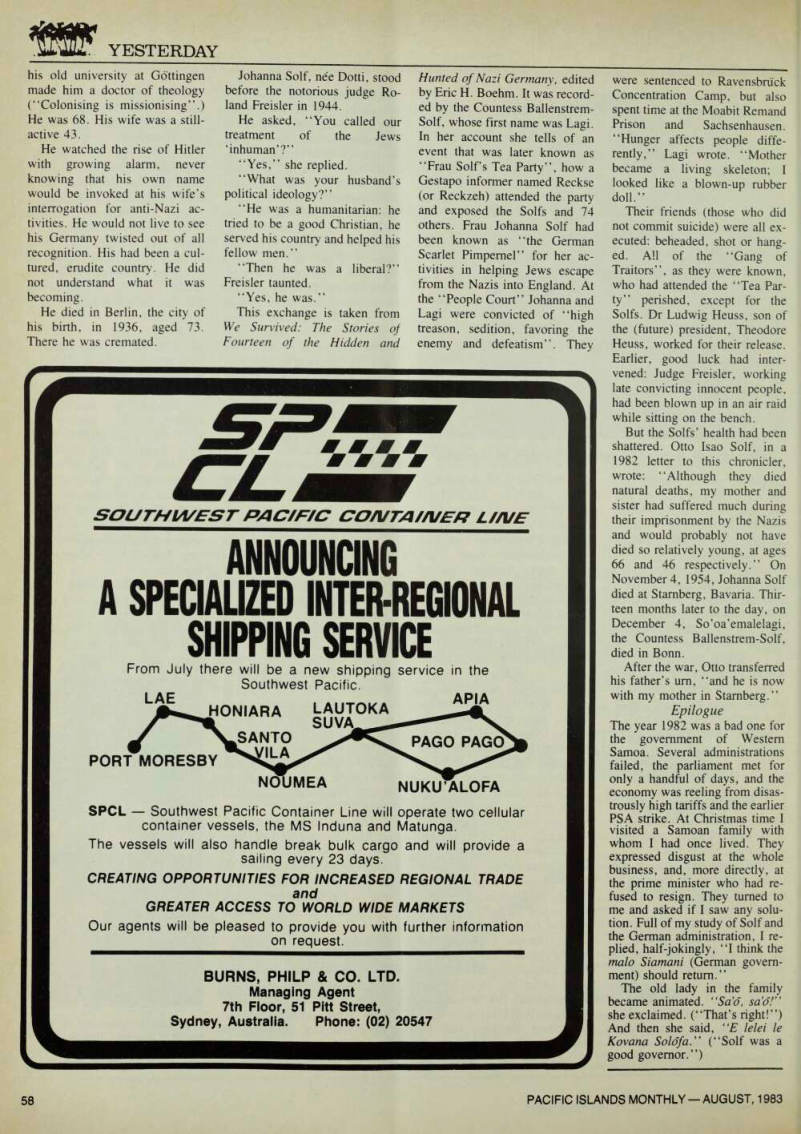
Yesterday
‘It is my love for you that has me punish you so lightly . . .'
JOSEPH THEROUX concludes a two-part series on the life and times of WILHELM HEINRICH SOLF, governor of pre-World War I German Samoa.
Solf included many non- Germans in his government: British, American and mixed race. He chose Dick Williams, an Irishman, to be deputy ad ministrator (amtmann) of Savai’i (he who staged the shows). To boost agricultural development, Solf brought in the German Pro fessor E. Wohtmann in 1903 to study the potential of the islands.
He identified ideal sites for growing cocoa, for instance, sites that are still flourishing today.
Richard Deeken surfaced again in 1904, founding the Sa moan Co-operative Trading Soc iety. He sought by this manoeuvre to realise the plan laid out in his book. He wanted to fund the co-op by taxing the whole Samoan population.
Deeken recruited Mata’afa and other chiefs and orators, includ ing Lauaki (of whom more later).
As it was against Self’s econom ic principles, he summarily banned the co-op on December 14, 1904. But the chiefs and orators (the Tuma and Pule) did not cease their efforts.
While Solf was on holiday in New Zealand, the Samoan lead ers of the co-op tried to institute the program, despite Self’s ban.
They were arrested and impris oned. Others broke open the jail and released them. Upon Self’s return, he disbanded the Tumua and Pule and the Fono, and hand picked his own Fono. When the jailbreak became known, Thomas Trood wrote in his Is land Reminiscences, “some of the citizens at once exclaimed ‘Shoot them down!’ ‘Shoot them down!’ which, had it been done by the government, would have brought on another native war ... Dr Solf has never worked on such lines.” He finally suc ceeded in supressing the co-op in 1907, and many of the leaders were pardoned, including Lauaki. But Deeken and others saw the government reshuffle as
harsh and arbitrary and continued their agitating in the Reichstag. • • • About 1899, a wealthy German businessman named Gustav Kunst purchased Vailima, the last home of Robert Louis Stevenson, from the writer’s widow (the sale negotiated by H.
J. Moors, the remarkable Ameri can expatriate: see PIM August, September 1981). Kunst made considerable additions and im
provements, including piped wa
ter and electricity.
“More recently,’’ Moors wrote in his With Stevenson in Samoa, “Vailima thus improved and beautified, has been acquired by the German Government from Mr Kunst’s nephew and heir and is now the official residence of the Governor, Dr Solf,’’ The imperial governor moved into “Government House’’ about the end of 1905. • • • In 1908, Solf returned to Ger many and Kaiser Wilhelm II “Der tupu sili von Samoa” awarded him the Order of the Prussian Crown (second class).
During the visit he met 21-year old Johanna Dotti, of Neuenha gen. She was high-spirited, sports-minded and cultured.
They married after a brief court ship. Johanna and Wilhelm re turned to Samoa; “. . . their honeymoon trip was the voyage out,” son Otto wrote. In later years, “she had very vivid recol lections of her first married years perhaps her happiest, as is so often the case and spoke of Apia often. When my parents corresponded, they always sign ed their letters, cables etc. with ‘Alofa,’ and I remember my mother telling me that it could also mean ‘I love you’.”
In Apia, she joined the Frauen-Verein (“Women’s Committee”) and the sports club, and was an active member of both. She delighted everyone by continuing to play, in true Samoan style, even when soaked by tropical downpours, the Samoanische Zeitung reported.
Solf admitted that she “was a far better sportswoman than he was a sportsman.” • • • Lauaki Namalau’ulu Mamoe was one of the great, though tragic, figures of Samoan history. (Mamoe was his given name, Namalau’ulu his orator title, and Lauaki, an honorary title in herited from his father, had been bestowed by a visiting Tongan
Wilhelm and Johanna Solf in Apia, 1910. - Print by courtesy of Otto Solf, copy by Diane Theroux.
chief; hence it is correct to spell it with a k.). He was the leading orator of Savai’i, handsome, dig nified, from a long line of king makers and intriguers. Even Solf referred to him as ‘‘a grand, eloquent epeaker”. He had been a member of the ill-fated Copra Co-operative.
Solf wrote: ‘‘A Samoan politi cian, he could not conceive that Germany for all time and alone without recourse to America and England was ruling in Samoa. He found Germany tedi ous he wanted a change.” (McKay’s Chronology of West ern Samoa).
Lauaki and Solf had basic dif ferences. Lauaki charged that the German administration sought to divide the Samoans; Lauaki was against the poll tax; he was angry when the copra prices paid to the Samoans had declined in 1904; he wanted the Tumua and Pule (whom Solf saw as mere trouble makers) recognised, not the Faipule Fono (created by Solf); Like Solf, he sought the abolition of the ali’i sill but Lauaki
wanted a return to a traditional
political structure.
Part of the problem was that he was so like Solf: cultured, stub born, articulate, devious, aloof.
A showdown was inevitable.
When Solf and Johanna toured Savai’i in November of 1908, it was as much a political jaunt as a social one. Lauaki had formed the Mau a Pule (literally, ‘The Opposition Movement of Savai’i”) and Solf saw this, rightly, as a threat to the German administration.
“ ‘Do not talk to me decep tively,’ said the governor to the Savaiians in various speeches, ‘and do not try to use your Samoan tricks. I am not so easily deceived by your tongafitis (knaveries); you often speak of the fa’a Samoa (Samoan cus tom), but only when you wish to bring it in. I try to uphold the good Samoan customs, but do not wish for tricks to be covered by them.’ ” ‘Quoted by
Keesing).
At Safotulafai, Solf delivered his last speech about the Mau a
Pule. He called Lauaki a ‘‘dangerous agitator” and or dered him to remain in Savai’i. ‘‘He succeeded by his person ality and ability to beat the Sa moan chiefs and orators at their own game talking. One at tempt after another by some par ty to gain superiority, was bro ken up, not by military force, but by the power of his eloquence,” wrote R.P. Berking, his collector of customs, in PIM, April, 1936.
But on January 18, 1909, Lauaki arrived at Vaiusu with ‘‘a canoe fleet” of armed men. ‘‘Faced with this show of force, Solf forgave Lauaki his past mis deeds and attempted to reach an agreement with him as to the future. But as the two had been dedicated for many years to the attainment of irreconcilable ob jectives, nothing was achieved.” (Davidson, Samoa mo Samoa). ‘‘[Solf] had a shrewd but harsh understanding of native respect for force,” Furnas wrote. ‘‘When unrealistic ambition in a brilliant Savai’i talking chief named Lauati [sic] culminated in
armed defiance of the govern ment, he [Solf] easily maintained his mana by showing nothing but easy-going contempt and simul taneously whistling up war ships.” The warships were from the German China Station. They arrived in March with 300 Sol omon Island troops.
Aggie Grey spoke of the inci dent in her biography. “As can be imagined,” she said, “the sight of the armed black troops was too much for the Samoans.
They surrendered, begging that their villages by spared, and Solf agreed.”
With permission of the Faipule Fono, Solf had Lauaki and 11 others, including relatives and a Samoan pastor (72 in all), de ported to Saipan. There were suspensions, fines and forced labor for those who were allowed to remain. (The labor included erecting government buildings on confiscated land in Savai’i.) Solf issued a proclamation ‘To All Samoa”. It concluded: ‘‘You will understand that it is my love for you that has made
me punish you so lightly. This will teach Samoa a lesson and will cause all to bear in mind that there is only one head in Samoa and that is His Majesty the Kais er.” (Quoted by Keesing.) Spoken like a father to his misbehaving children. Or like a Samoan matai to his extended
family. For the punishments
could have been far worse.
Fletcher observed wryly that “. . . within the velvet glove was the Prussian hand of steel.”
The exiled group was not al lowed to return until 1915, when New Zealand ruled the islands.
Berking wrote (PIM, April
1936): “It is very remarkable that Lauati’s [sic] followers on their return to Samoa, after the out break of the Great War, express ed publicly their full appreciation of the justice that had been dealt out to them by Dr Solf. ’ ’
But Lauaki was never to see his homeland again. He died on the return voyage. And all but one of the exiled leaders died in the Influenza Pandemic of 1918. • • • On August 31, 1909, Johanna gave birth to their first child.
They named her, ironically
enough, after a Savai’i orator, a priestess who had been the adop tive mother and counsellor to Samoa’s only queen, Salamasina, who had lived 400
years before; So’oa’emalelagi, ‘‘One who has fallen from heaven”. She was called Lagi (‘‘Heaven”) for short and forev er after. ‘‘When my sister was bom,” Otto Solf wrote, ‘‘the local chiefs declared her ‘a princess’ and she was given land and all sorts of honors.”
Who could predict that Lagi, like her mother, would die before her time, of inhumanities inflict ed in Nazi concentration camps? • • • Solf completed his service in Samoa in 1910. On September 22, he, Lagi and Johanna (six months pregnant with first son Hans Heinrich) boarded the Atua and sailed for Fiji, laden with gifts and thanks, cries of “Hoch, hoch, hoch” (three cheers) ring ing in their ears. From all quar ters there was praise for his ad ministration. But Solf himself was dissatisfied. He said: “I leave Samoa unhealed of its great evils: doubt, suspicion and jealousy.” (Quoted in Rowe.) He knew the desire for independ ence had not been quashed with Lauaki. The Mau would reappear and the bloody days that pre ceded his administration would return under the New Zealand administration. But he had kept the peace, built hospitals and the government buildings that are still in use, largely unchanged.
He increased the revenue from
14,000 pounds in 1900 to 41,350 pounds in 1911. Where the col ony had been supported at the beginning, it now paid a share into the Colonial Office.
However, back in the Reich stag, Richard Deeken’s charges were spouted by Self’s enemies.
The major charge? That Solf was guilty of verkanakerung ■ — from the root word kanaka in other words, ‘‘going native” Lloyd Osbourne, Robert Louis Steven son’s stepson, tells the story in his introduction to Rowe’s book: “. . .he had to defend himself . . . from an impassioned charge that while in Samoa he had worn flowers in his hair . . . at Samoan revels. Dr Solf bent his head and revealed a perfectly bald scalp. T have no hair to put flowers in,’ he said. ‘Look for yourselves, gentlemen.’ The Reichstag could almost see them selves reflected in his shiny pate, and the ensuing roar of laughter shook the chamber. ’ ’ • • • In 1911, he became Secretary of State for the Colonial Office under Wilhelm 11, a post he held until the fall of the Kaiser’s government in 1918. During the chaotic months surrounding the armistice negotiations, he was Foreign Secretary for just two months.
In the years since his gover norship, he had often spoken of Germany’s role as a colonial power. But it was a lone voice.
Germany had lost her posses sions, but had a hope of regain ing them. Fletcher wrote that Solf gave ‘‘a lecture in Berlin in 1916 before the German church authorities upon missionary en terprise. The German missio nary, he said, had a special mis sion. Natives were the best asset of the colonies, but they must be brought under proper control by mission work. Christianity and kultur German kultur were to go hand in hand.” This was one of Solf’s favorite themes: “Kolonisieren ist Missioniern,” he often said. But not in strict religious or Kulturell terms. John Moses (in NZ Journal of History, ‘‘The Solf Regime in Western Samoa”) maintains that it im plied missionising in the widest sense of education and ‘‘the best European culture could offer
with the best of the native cul ture.” In 1917 Solf was in Leip
zig, explaining Germany’s desire
for the recovery of her posses sions. ‘‘Germany’s pre-war humane treatment of the native races has won for her the moral right to be called a great Colonial Power.” (Quoted in Fletcher’s book Stevenson s Germany). He could not, however, have been
thinking of Germany’s treatment
of certain African tribes, of which had been extinguished.
But few looked at his record in the Pacific. • • • In 1920, the Weimar Republic
appointed him charge d’affaires
to the embassy in Tokyo. At the end of that year he was named ambassador. He presented his credentials on February 26, 1921, and served until the end of 1928. During these years he was president of the Asiatic Society of Japan and signed the German
Japanese Trade Agreement of
1928. When, at the age of 65, he was due to retire, the Reichstag requested that he remain to repre sent them at the coronation of Hirohito.
He returned to Germany with his wife, daughter and three sons. In 1929, Heidelberg Un iversity awarded him the honor ary degree of doctor of political science and the following year
Lauaki Mamoe, Samoan leader exiled by Solf to Micronesia
Lagi Solf, in Germany in 1920, wears a Samoan village chief’s costume. - Print from Otto Solf, copy by Diane Solf.
his old university at Gottingen made him a doctor of theology (“Colonising is missionising”.) He was 68. His wife was a still active 43.
He watched the rise of Hitler with growing alarm, never knowing that his own name would be invoked at his wife’s interrogation for anti-Nazi ac tivities. He would not live to see his Germany twisted out of all recognition. His had been a cul tured, erudite country. He did not understand what it was becoming.
He died in Berlin, the city of his birth, in 1936, aged 73.
There he was cremated.
Johanna Solf, nee Dotti, stood before the notorious judge Ro land Freisler in 1944.
He asked, “You called our treatment of the Jews ‘inhuman’?”
“Yes,” she replied.
“What was your husband’s political ideology?”
“He was a humanitarian; he tried to be a good Christian, he served his country and helped his fellow men.”
“Then he was a liberal?”
Freisler taunted.
“Yes, he was.”
This exchange is taken from We Survived: The Stones of Fourteen of the Hidden and
Hunted of Nazi Germany, edited by Eric H. Boehm. It was record ed by the Countess Ballenstrem- Solf, whose first name was Lagi.
In her account she tells of an event that was later known as “Frau Solf’s Tea Party’’, how a Gestapo informer named Reckse (or Reckzeh) attended the party and exposed the Solfs and 74 others. Frau Johanna Solf had been known as “the German Scarlet Pimpernel’’ for her ac tivities in helping Jews escape from the Nazis into England. At the “People Court’’ Johanna and Lagi were convicted of “high treason, sedition, favoring the enemy and defeatism”. They
were sentenced to Ravensbruck Concentration Camp, but also spent time at the Moabit Remand Prison and Sachsenhausen.
“Hunger affects people diffe rently,” Lagi wrote. “Mother became a living skeleton; I looked like a blown-up rubber doll.”
Their friends (those who did not commit suicide) were all ex ecuted: beheaded, shot or hang ed. All of the “Gang of Traitors”, as they were known, who had attended the “Tea Par ty” perished, except for the Solfs. Dr Ludwig Heuss, son of the (future) president, Theodore Heuss, worked for their release.
Earlier, good luck had inter vened: Judge Freisler, working late convicting innocent people, had been blown up in an air raid while sitting on the bench.
But the Solfs’ health had been shattered. Otto Isao Solf, in a 1982 letter to this chronicler, wrote: “Although they died natural deaths, my mother and sister had suffered much during their imprisonment by the Nazis and would probably not have died so relatively young, at ages 66 and 46 respectively.” On November 4, 1954, Johanna Solf died at Stamberg, Bavaria. Thir teen months later to the day, on December 4, So’oa’emalelagi, the Countess Ballenstrem-Solf, died in Bonn.
After the war, Otto transferred his father’s um, “and he is now with my mother in Stamberg.”
Epilogue
The year 1982 was a bad one for the government of Western Samoa. Several administrations failed, the parliament met for only a handful of days, and the economy was reeling from disas trously high tariffs and the earlier PSA strike. At Christmas time I visited a Samoan family with whom I had once lived. They expressed disgust at the whole business, and, more directly, at the prime minister who had re fused to resign. They turned to me and asked if I saw any solu tion. Full of my study of Solf and the German administration, I re plied, half-jokingly, “I think the malo Siamani (German govern ment) should return.”
The old lady in the family became animated. “Sa’o, sa'6!” she exclaimed. (“That’s right!”) And then she said, “E lelei le Kovana Solofa .” (“Solf was a good governor.”)
Advertisements & other items, pp. 56-58 (1 item)
package.
Mobile
power in a
self-contained
package.
No extras to buy.
Delivered ready to go.
f bj] 20kVA or 31kVA power wherever you want it. From rugged, reliable Dis-gen units that come complete with cabinet, fuel tank, power outlets, etc. And need no special mounting platform.
Dis-gen electric generating sets. An astute combination of Onan generator and Perkins diesel, Tough enough to take the hardest knocks. In mining. Construction sites.
Outback engineering projects. Hire
companies.
Or anywhere you need a durable, dependable 240/415v power source.
A special marine model is also available.
Rigid underchassis protects the unit wherever you take it. And however you get it there. On a truck or a trailer. On skids. Or lifted in by crane. Undercarriages, 2 or 4 wheels, available as options.
Dis-gen. Mobility and power in a self-
contained package.
Dis-gen 20kVA and 31kVA
electric generating sets.
Available from:
LINCOLN ■
■ ARC WELDING
The Lincoln Electric Company
(Aust.) Pty. Ltd.
Sydney (Head Office) 35 Bryant Street, Padstow, NSW 2211 Telephone: (02) 772 7222 Telex: 22792 Cobles: 'Linconweld ', Sydney Newcastle Telephone: (049) 61 5381 Telex. 28263 Wollongong Telephone; (042) 28 0565 Melbourne Telephone; (03) 481 8444 Telex: 31958 Brisbane Telephone: (07) 277 2955 Telex: 41268 Townsville Telephone: (077) 79 9777 Telex: 47247 Mackay Telephone: (079) 51 2599 Telex: 48655 Adelaide Telephone: (08) 43 8061 Telex: 82794 Perth Telephone: (09) 277 8744 Telex: 92914 Karratha (WA) Telephone: (091) 85 2405 Telex: 99640 Launceston Telephone: (003) 26 3388 Telex: 58517
Distragen
Distragen Pty Ltd.
New South Wales (Head Office) 4 Mitchell Road, Brookvale, NSW 2100 Telephone: (02) 9381777 Telex: 27733 Melbourne Telephone: (03) 481 0508 Telex: 31958 Brisbane Telephone: (07) 275 2926 Telex: 41268 S2* Sss ■ 5
SOUTHWEST PAC/F/C
ANNOUNCING
A SPECIALIZED INTER-REGIONAL
SHIPPING SERVICE
From July there will be a new shipping service in the Southwest Pacific.
LAE , ~. APIA
HONIARA LAUTOKA
SUVA
SA NTO PAGO PAGO'
PORT MORESBY —- ILA
NUKUALOFA
SPCL Southwest Pacific Container Line will operate two cellular container vessels, the MS Induna and Matunga.
The vessels will also handle break bulk cargo and will provide a sailing every 23 days.
CREATING OPPORTUNITIES FOR INCREASED REGIONAL TRADE
and
GREATER ACCESS TO WORLD WIDE MARKETS
Our agents will be pleased to provide you with further information on request.
BURNS, PHILP & CO. LTD.
Managing Agent 7th Floor, 51 Pitt Street, Sydney, Australia. Phone: (02) 20547
Imaginative moves from
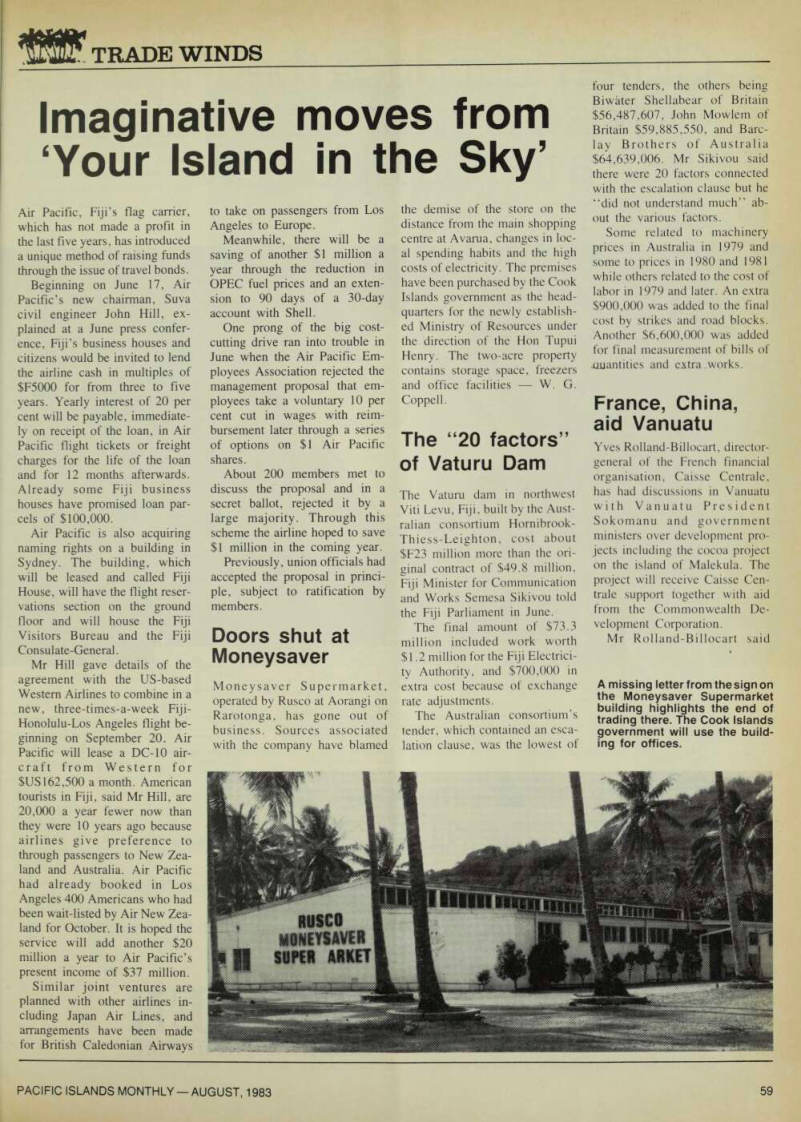
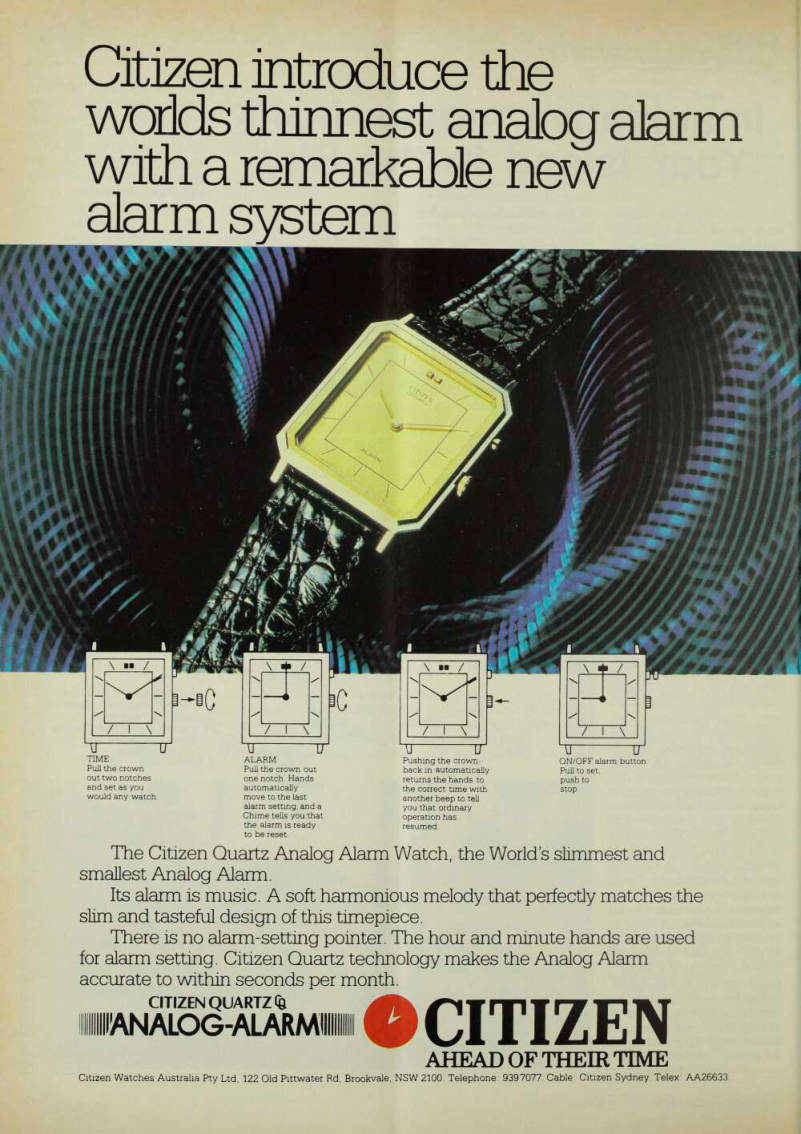
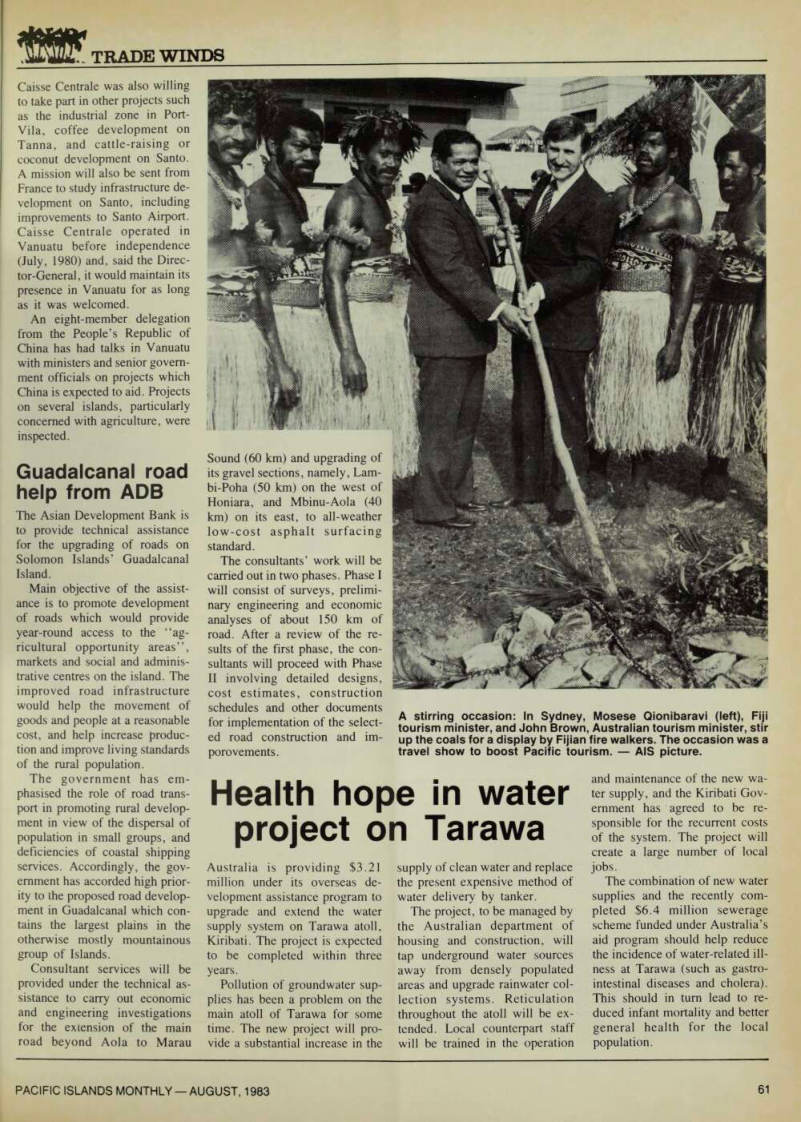
Trade Winds
Imaginative moves from ‘Your Island in the Sky’
Air Pacific, Fiji’s flag carrier, which has not made a profit in the last five years, has introduced a unique method of raising funds through the issue of travel bonds.
Beginning on June 17, Air Pacific’s new chairman, Suva civil engineer John Hill, ex plained at a June press confer ence, Fiji’s business houses and citizens would be invited to lend the airline cash in multiples of SFSOOO for from three to five years. Yearly interest of 20 per cent will be payable, immediate ly on receipt of the loan, in Air Pacific flight tickets or freight charges for the life of the loan and for 12 months afterwards.
Already some Fiji business houses have promised loan par cels of $lOO,OOO.
Air Pacific is also acquiring naming rights on a building in Sydney. The building, which will be leased and called Fiji House, will have the flight reser vations section on the ground floor and will house the Fiji Visitors Bureau and the Fiji Consulate-General.
Mr Hill gave details of the agreement with the US-based Western Airlines to combine in a new, three-times-a-week Fiji- Honolulu-Los Angeles flight be ginning on September 20. Air Pacific will lease a DC-10 air craft from Western for SUS 162,500 a month. American tourists in Fiji, said Mr Hill, are 20,000 a year fewer now than they were 10 years ago because airlines give preference to through passengers to New Zea land and Australia. Air Pacific had already booked in Los Angeles 400 Americans who had been wait-listed by Air New Zea land for October. It is hoped the service will add another $2O million a year to Air Pacific’s present income of $37 million.
Similar joint ventures are planned with other airlines in cluding Japan Air Lines, and arrangements have been made for British Caledonian Airways
to take on passengers from Los Angeles to Europe.
Meanwhile, there will be a saving of another $1 million a year through the reduction in OPEC fuel prices and an exten sion to 90 days of a 30-day account with Shell.
One prong of the big cost cutting drive ran into trouble in June when the Air Pacific Em ployees Association rejected the management proposal that em ployees take a voluntary 10 per cent cut in wages with reim bursement later through a series of options on $1 Air Pacific shares.
About 200 members met to discuss the proposal and in a secret ballot, rejected it by a large majority. Through this scheme the airline hoped to save $1 million in the coming year.
Previously, union officials had accepted the proposal in princi ple, subject to ratification by members.
Doors shut at
Moneysaver
Moneysaver Supermarket, operated by Rusco at Aorangi on Rarotonga, has gone out of business. Sources associated with the company have blamed
the demise of the store on the distance from the main shopping centre at Avarua, changes in loc al spending habits and the high costs of electricity. The premises have been purchased by the Cook Islands government as the head quarters for the newly establish ed Ministry of Resources under the direction of the Hon Tupui Henry. The two-acre property contains storage space, freezers
W. G.
and office facilities
Coppell.
The “20 factors”
of Vaturu Dam
The Vaturu dam in northwest Viti Levu, Fiji, built by the Aust ralian consortium Hornibrook- Thiess-Leighton, cost about SF23 million more than the ori ginal contract of $49.8 million, Fiji Minister for Communication and Works Semesa Sikivou told the Fiji Parliament in June.
The final amount of $73.3 million included work worth $1.2 million for the Fiji Electrici ty Authority, and $700,000 in extra cost because of exchange rate adjustments.
The Australian consortium’s tender, which contained an esca lation clause, was the lowest of
four tenders, the others being Biwater Shellabear of Britain $56,487,607, John Mowlem of Britain $59,885,550, and Barc lay Brothers of Australia $64,639,006. Mr Sikivou said there were 20 factors connected with the escalation clause but he “did not understand much’’ ab out the various factors.
Some related to machinery prices in Australia in 1979 and some to prices in 1980 and 1981 while others related to the cost of labor in 1979 and later. An extra $900,000 was added to the final cost by strikes and road blocks.
Another $6,600,000 was added for final measurement of bills of .Quantities and extra.works.
France, China,
aid Vanuatu
Yves Rolland-Billocart, director general of the French financial organisation, Caisse Centrale, has had discussions in Vanuatu with Vanuatu President Sokomanu and government ministers over development pro jects including the cocoa project on the island of Malekula. The project will receive Caisse Cen trale support together with aid from the Commonwealth De velopment Corporation.
Mr Rolland-Billocart said
A missing letter from the sign on the Moneysaver Supermarket building highlights the end of trading there. The Cook Islands government will use the build ing for offices.
Caisse Centrale was also willing to take part in other projects such as the industrial zone in Port- Vila, coffee development on Tanna, and cattle-raising or coconut development on Santo.
A mission will also be sent from France to study infrastructure de velopment on Santo, including improvements to Santo Airport.
Caisse Centrale operated in Vanuatu before independence (July, 1980) and, said the Direc tor-General, it would maintain its presence in Vanuatu for as long as it was welcomed.
An eight-member delegation from the People’s Republic of China has had talks in Vanuatu with ministers and senior govern ment officials on projects which China is expected to aid. Projects on several islands, particularly concerned with agriculture, were inspected.
Guadalcanal road
help from ADB
The Asian Development Bank is to provide technical assistance for the upgrading of roads on Solomon Islands’ Guadalcanal Island.
Main objective of the assist ance is to promote development of roads which would provide year-round access to the “ag ricultural opportunity areas”, markets and social and adminis trative centres on the island. The improved road infrastructure would help the movement of goods and people at a reasonable cost, and help increase produc tion and improve living standards of the rural population.
The government has em phasised the role of road trans port in promoting rural develop ment in view of the dispersal of population in small groups, and deficiencies of coastal shipping services. Accordingly, the gov ernment has accorded high prior ity to the proposed road develop ment in Guadalcanal which con tains the largest plains in the otherwise mostly mountainous group of Islands.
Consultant services will be provided under the technical as sistance to carry out economic and engineering investigations for the extension of the main road beyond Aola to Marau
Sound (60 km) and upgrading of its gravel sections, namely, Lam bi-Poha (50 km) on the west of Honiara, and Mbinu-Aola (40 km) on its east, to all-weather low-cost asphalt surfacing standard.
The consultants’ work will be carried out in two phases. Phase I will consist of surveys, prelimi nary engineering and economic analyses of about 150 km of road. After a review of the re sults of the first phase, the con sultants will proceed with Phase II involving detailed designs, cost estimates, construction schedules and other documents for implementation of the select ed road construction and im porovements.
Advertisements & other items, p. 60 (1 item)
©Citizen
Citizen introduce the
worlds thinnest analog alarm
with a remarkable new
alarm system
ViM
♦ P i* & i* A 0 Rfc 0, iC TT
TIME
Pull the crown out two notches and set as you would any watch
ALARM
Pull the crown out one notch Hands automatically move to the last alarm setting, and a Chime tells you that the alarm is ready to be reset.
M CT
Pushing the crownback in automatically returns the hands to the correct time with another beep to tell you that ordinary operation has resumed ON/OFF alarm button Pull to set, push to stop.
The Citizen Quartz Analog Alarm Watch, the World's slimmest and
smallest Analog Alarm.
Its alarm Is music. A soft harmonious melody that perfectly matches the slim and tasteful design of this timepiece.
There is no alarm-setting pointer. The hour and minute hands are used for alarm setting. Citizen Quartz technology makes the Analog Alarm
accurate to within seconds per month.
CITIZEN QUARTZ
IiIIIANALOG-ALARMiII
©CITIZEN
AHEAD OF THEIR TIME
Citizen Watches Australia Pty Ltd, 122 Old Pittwater Rd, Brookvale, NSW 2100. Telephone: 9397077. Cable: Citizen Sydney. Telex: AA26633
Health hope in water
project on Tarawa
Australia is providing $3.21 million under its overseas de velopment assistance program to upgrade and extend the water supply system on Tarawa atoll, Kiribati. The project is expected to be completed within three years.
Pollution of groundwater sup plies has been a problem on the main atoll of Tarawa for some time. The new project will pro vide a substantial increase in the
supply of clean water and replace the present expensive method of water delivery by tanker.
The project, to be managed by the Australian department of housing and construction, will tap underground water sources away from densely populated areas and upgrade rainwater col lection systems. Reticulation throughout the atoll will be ex tended. Local counterpart staff will be trained in the operation
and maintenance of the new wa ter supply, and the Kiribati Gov ernment has agreed to be re sponsible for the recurrent costs of the system. The project will create a large number of local
jobs.
The combination of new water supplies and the recently com pleted $6.4 million sewerage scheme funded under Australia’s aid program should help reduce the incidence of water-related ill ness at Tarawa (such as gastro intestinal diseases and cholera).
This should in turn lead to re duced infant mortality and better general health for the local
population.
A stirring occasion: In Sydney, Mosese Qionibaravi (left), Fiji tourism minister, and John Brown, Australian tourism minister, stir up the coals for a display by Fijian fire walkers. The occasion was a travel show to boost Pacific tourism. - AIS picture.
Advertisements & other items, p. 62 (1 item)
Ilding Costs
IPS TO REDUCE
‘Paling Industries’ Malaysia’s first quality uP.V.C. pipe and fittings manufacturer. A name backed by modern technology, equipment and expertise one you can count on for quality and the highest standards of production. ‘Paling’ products are made according to British standards and approved by the local authority. i ‘Paling’ uP.V.C. pipes and fittings are •cheaper than most conventional materials •resistant to chemicals ♦easier to install •lighter ♦durable , P: m -u
‘Paling uP.V.C. pipes & fittings for
• water supply system •electrical conduit •drainage and other purposes SS n2->
WHALE
High & low level flushing cisterns for sanitary use.
Manufactured by
PALING INDUSTRIES
SENDIRIAN BERHAD
Lot 12, Jaian Perusahaan Empat, Batu Caves, Selangor, Malaysia. Tel; 662034. 662098,664747. 664917
Malaysia sells
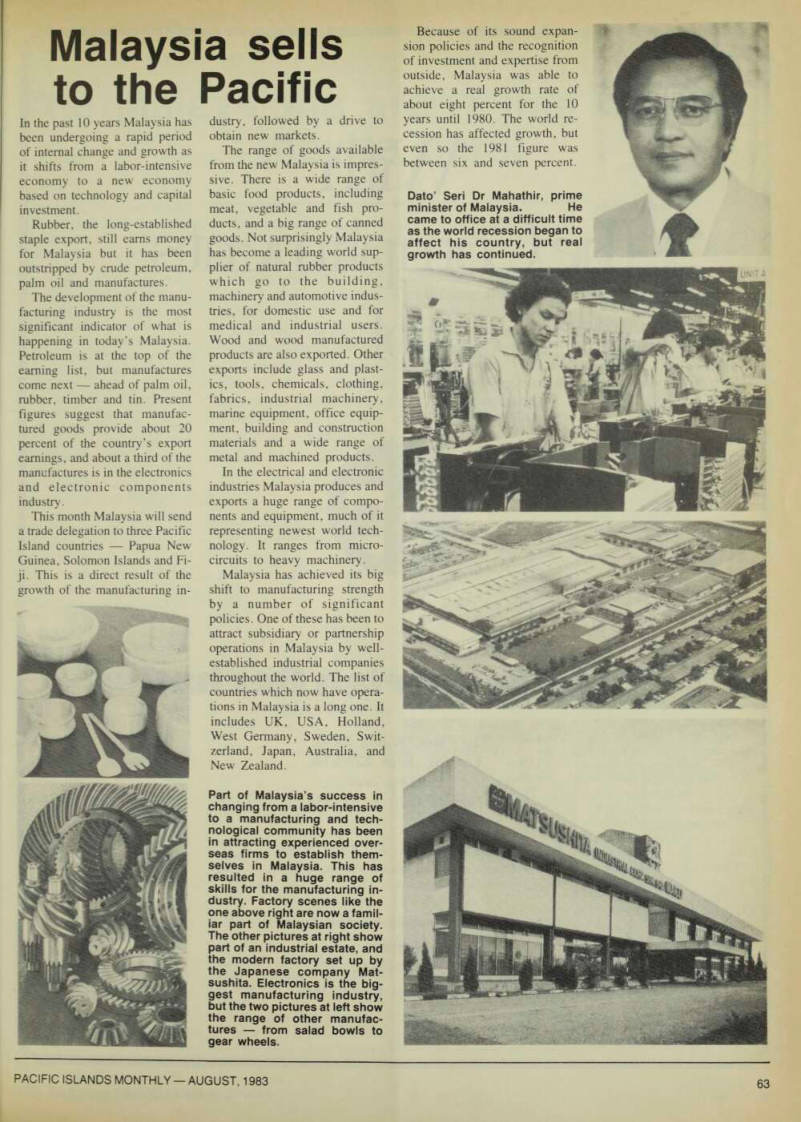
to the Pacific
In the past 10 years Malaysia has been undergoing a rapid period of internal change and growth as it shifts from a labor-intensive economy to a new economy based on technology and capital investment.
Rubber, the long-established staple export, still earns money for Malaysia but it has been outstripped by crude petroleum, palm oil and manufactures.
The development of the manu facturing industry is the most significant indicator of what is happening in today’s Malaysia.
Petroleum is at the top of the earning list, but manufactures come next ahead of palm oil, rubber, timber and tin. Present figures suggest that manufac tured goods provide about 20 percent of the country’s export earnings, and about a third of the manufactures is in the electronics and electronic components industry.
This month Malaysia will send a trade delegation to three Pacific Island countries Papua New Guinea, Solomon Islands and Fi ji. This is a direct result of the growth of the manufacturing in
dustry, followed by a drive to obtain new markets.
The range of goods available from the new Malaysia is impres sive. There is a wide range of basic food products, including meat, vegetable and fish pro ducts, and a big range of canned goods. Not surprisingly Malaysia has become a leading world sup plier of natural rubber products which go to the building, machinery and automotive indus tries, for domestic use and for medical and industrial users.
Wood and wood manufactured products are also exported. Other exports include glass and plast ics, tools, chemicals, clothing, fabrics, industrial machinery, marine equipment, office equip ment, building and construction materials and a wide range of metal and machined products.
In the electrical and electronic industries Malaysia produces and exports a huge range of compo nents and equipment, much of it representing newest world tech nology. It ranges from micro circuits to heavy machinery.
Malaysia has achieved its big shift to manufacturing strength by a number of significant policies. One of these has been to attract subsidiary or partnership operations in Malaysia by well established industrial companies throughout the world. The list of countries which now have opera tions in Malaysia is a long one. It includes UK, USA, Holland, West Germany, Sweden, Swit zerland, Japan, Australia, and New Zealand.
Because of its sound expansion policies and the recognition of investment and expertise from outside, Malaysia was able to achieve a real growth rate of about eight percent for the 10 years until 1980. The world re cession has affected growth, but even so the 1981 figure was between six and seven percent.
Part of Malaysia’s success in changing from a labor-intensive to a manufacturing and tech nological community has been
in attracting experienced over
seas firms to establish them selves in Malaysia. This has resulted in a huge range of skills for the manufacturing in dustry. Factory scenes like the one above right are now a famil iar part of Malaysian society.
The other pictures at right show part of an industrial estate, and the modern factory set up by the Japanese company Mat sushita. Electronics is the big
gest manufacturing industry,
but the two pictures at left show the range of other manufac tures - from salad bowls to gear wheels.
Dato’ Seri Dr Mahathir, prime minister of Malaysia. He came to office at a difficult time as the world recession began to affect his country, but real growth has continued.
Advertisements & other items, p. 64 (1 item)
With
the (x Jinpliments
of ac
Tcgo Scndirian Bcrhad
Ist Floor, Wisma Sama, Lot 26, Jalan 223/51A, Petaling Jaya.
Tels: 571270 & 571354 PP/PE Woven Bags For Flour, Sugar, Chemicals, Feed Meals, Fertilizer, Etc.
Factory: Senawang Industrial Estate Seremban.
Tels: 73361-2 Cable: Polytego Petaling Jaya.
The Malaysians aren’t just coming,
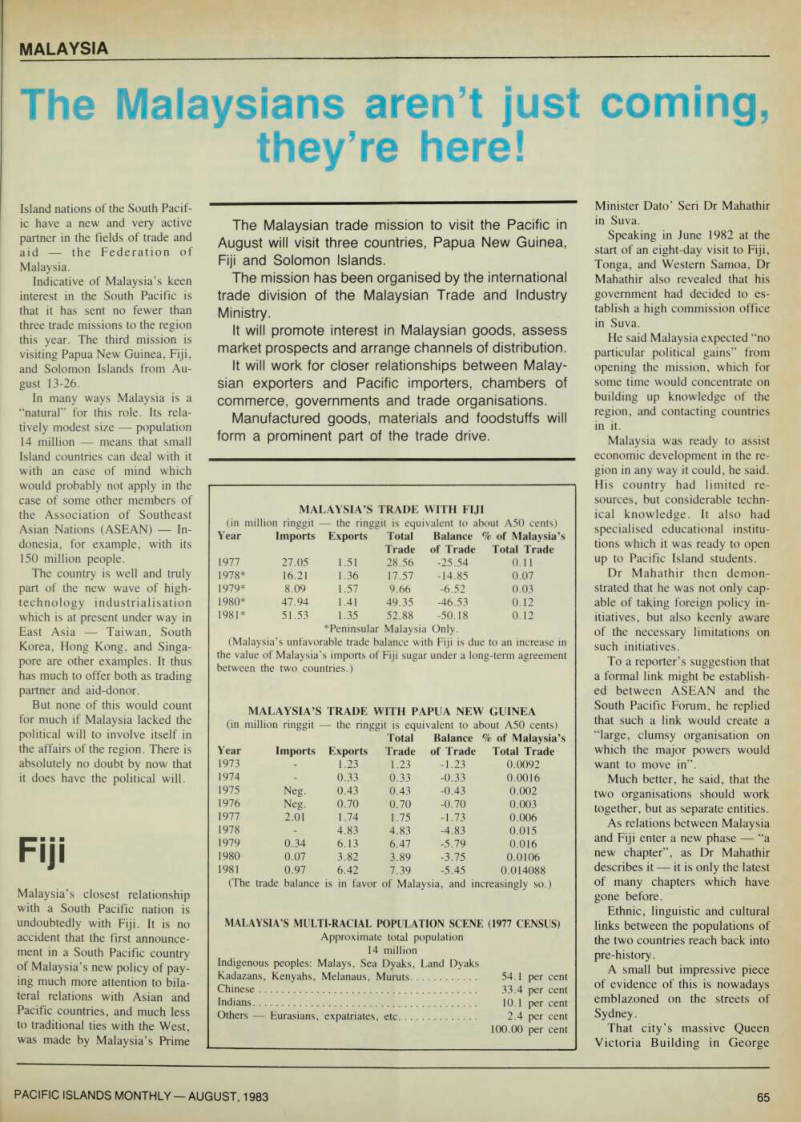
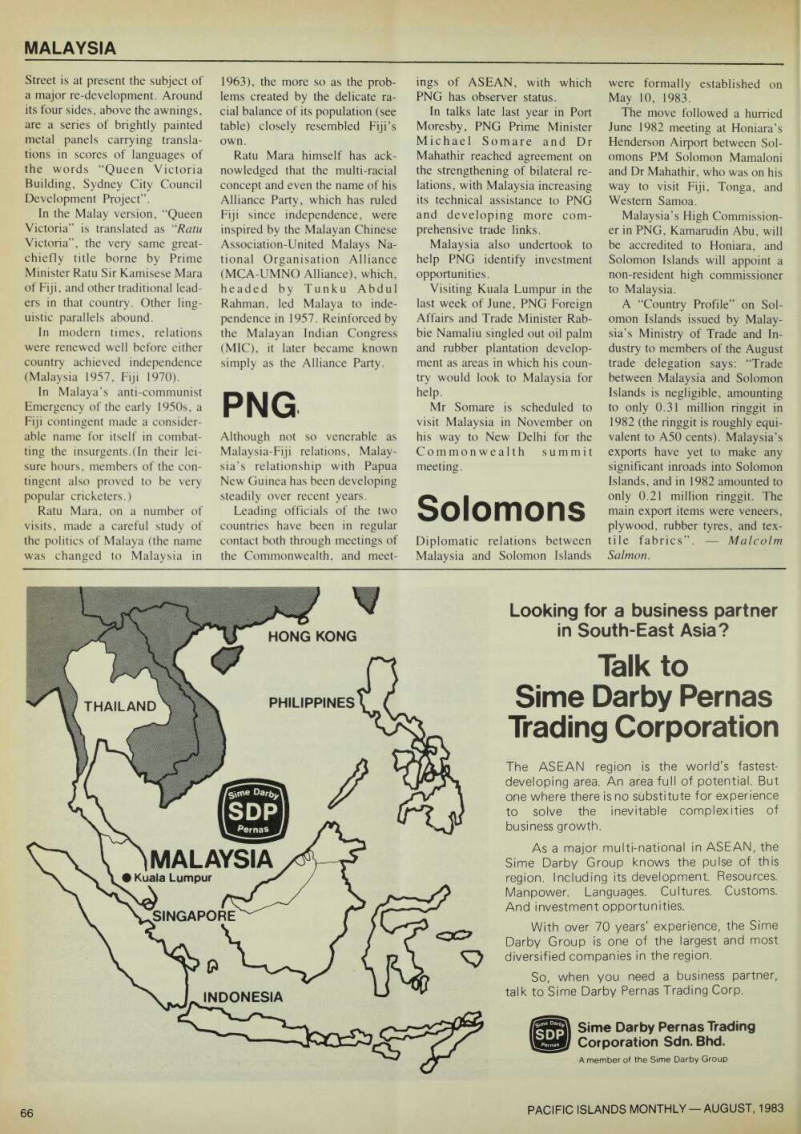
Malaysia
The Malaysians aren’t just coming, they’re here!
The Malaysian trade mission to visit the Pacific in August will visit three countries, Papua New Guinea, Fiji and Solomon Islands.
The mission has been organised by the international trade division of the Malaysian Trade and Industry Ministry.
It will promote interest in Malaysian goods, assess market prospects and arrange channels of distribution.
It will work for closer relationships between Malay sian exporters and Pacific importers, chambers of commerce, governments and trade organisations.
Manufactured goods, materials and foodstuffs will form a prominent part of the trade drive.
Island nations of the South Pacif ic have a new and very active partner in the fields of trade and aid the Federation of
Malaysia.
Indicative of Malaysia’s keen interest in the South Pacific is that it has sent no fewer than three trade missions to the region this year. The third mission is visiting Papua New Guinea, Fiji, and Solomon Islands from Au gust 13-26.
In many ways Malaysia is a “natural” for this role. Its rela
tively modest size population
14 million means that small Island countries can deal with it with an ease of mind which would probably not apply in the case of some other members of the Association of Southeast Asian Nations (ASEAN) In donesia, for example, with its 150 million people.
The country is well and truly part of the new wave of high
technology industrialisation
which is at present under way in East Asia Taiwan, South Korea, Hong Kong, and Singa pore are other examples. It thus has much to offer both as trading partner and aid-donor.
But none of this would count for much if Malaysia lacked the political will to involve itself in the affairs of the region. There is absolutely no doubt by now that it does have the political will.
Fiji
Malaysia’s closest relationship
with a South Pacific nation is undoubtedly with Fiji. It is no accident that the first announce ment in a South Pacific country of Malaysia’s new policy of pay ing much more attention to bila teral relations with Asian and Pacific countries, and much less to traditional ties with the West, was made by Malaysia’s Prime
Minister Dato’ Seri Dr Mahathir in Suva.
Speaking in June 1982 at the start of an eight-day visit to Fiji, Tonga, and Western Samoa, Dr Mahathir also revealed that his government had decided to es tablish a high commission office in Suva.
He said Malaysia expected “no
particular political gains” from
opening the mission, which for some time would concentrate on building up knowledge of the region, and contacting countries in it.
Malaysia was ready to assist economic development in the re gion in any way it could, he said.
His country had limited re sources, but considerable techn ical knowledge. It also had specialised educational institu tions which it was ready to open up to Pacific Island students.
Dr Mahathir then demon strated that he was not only cap
able of taking foreign policy in
itiatives, but also keenly aware of the necessary limitations on such initiatives.
To a reporter’s suggestion that a formal link might be establish ed between ASEAN and the South Pacific Forum, he replied that such a link would create a
“large, clumsy organisation on
which the major powers would want to move in”.
Much better, he said, that the two organisations should work together, but as separate entities.
As relations between Malaysia and Fiji enter a new phase “a new chapter”, as Dr Mahathir describes it it is only the latest of many chapters which have gone before.
Ethnic, linguistic and cultural links between the populations of the two countries reach back into
pre-history.
A small but impressive piece of evidence of this is nowadays emblazoned on the streets of
Sydney.
That city’s massive Queen
Victoria Building in George
Street is at present the subject of a major re-development. Around its four sides, above the awnings, are a series of brightly painted metal panels carrying transla tions in scores of languages of the words “Queen Victoria Building, Sydney City Council Development Project”.
In the Malay version, “Queen Victoria” is translated as “Ratu Victoria”, the very same great chiefly title borne by Prime Minister Ratu Sir Kamisese Mara of Fiji, and other traditional lead ers in that country. Other ling uistic parallels abound.
In modern times, relations were renewed well before either country achieved independence (Malaysia 1957, Fiji 1970).
In Malaya’s anti-communist Emergency of the early 19505, a Fiji contingent made a consider able name for itself in combat ting the insurgents.(ln their lei sure hours, members of the con tingent also proved to be very popular cricketers.) Ratu Mara, on a number of visits, made a careful study of the politics of Malaya (the name was changed to Malaysia in
1963), the more so as the prob lems created by the delicate ra cial balance of its population (see table) closely resembled Fiji’s own.
Ratu Mara himself has ack nowledged that the multi-racial concept and even the name of his Alliance Party, which has ruled Fiji since independence, were inspired by the Malayan Chinese Association-United Malays Na tional Organisation Alliance (MCA-UMNO Alliance), which, headed by Tunku Abdul Rahman, led Malaya to inde pendence in 1957. Reinforced by the Malayan Indian Congress (MIC), it later became known simply as the Alliance Party.
Png
Although not so venerable as Malaysia-Fiji relations, Malay sia’s relationship with Papua New Guinea has been developing steadily over recent years.
Leading officials of the two countries have been in regular contact both through meetings of the Commonwealth, and meet
ings of ASEAN, with which PNG has observer status.
In talks late last year in Port Moresby, PNG Prime Minister Michael Somare and Dr Mahathir reached agreement on the strengthening of bilateral re lations, with Malaysia increasing its technical assistance to PNG and developing more com prehensive trade links.
Malaysia also undertook to help PNG identify investment opportunities.
Visiting Kuala Lumpur in the last week of June, PNG Foreign Affairs and Trade Minister Rab bie Namaliu singled out oil palm and rubber plantation develop ment as areas in which his coun try would look to Malaysia for help.
Mr Somare is scheduled to visit Malaysia in November on his way to New Delhi for the Commonwealth summit meeting.
Solomons
Diplomatic relations between Malaysia and Solomon Islands
were formally established on May 10, 1983.
The move followed a hurried June 1982 meeting at Honiara’s Henderson Airport between Sol omons PM Solomon Mamaloni and Dr Mahathir, who was on his way to visit Fiji, Tonga, and Western Samoa.
Malaysia’s High Commission er in PNG, Kamarudin Abu, will be accredited to Honiara, and Solomon Islands will appoint a non-resident high commissioner
to Malaysia.
A “Country Profile” on Sol omon Islands issued by Malay sia’s Ministry of Trade and In dustry to members of the August trade delegation says; “Trade between Malaysia and Solomon Islands is negligible, amounting to only 0.31 million ringgit in
1982 (the ringgit is roughly equi
valent to A5O cents). Malaysia’s exports have yet to make any significant inroads into Solomon Islands, and in 1982 amounted to only 0.21 million ringgit. The main export items were veneers, plywood, rubber tyres, and tex tile fabrics”. Malcolm Salmon.
Malaysia’S Trade With Fiji
(in million ringgit the ringgit is equivalent to about A5O cents)
Year Imports Exports Total Balance % of Malaysia’s Trade of Trade Total Trade 1977 27.05 1.51 28.56 -25.54 0.11 1978* 16.21 1.36 17.57 -14.85 0.07 1979* 8.09 1.57 9.66 -6.52 0.03 1980* 47.94 1.41 49.35 -46.53 0.12 1981* 51.53 1.35 52.88 -50.18 0.12
*Peninsular Malaysia
Only.
(Malaysia’s unfavorable trade balance with Fiji is due to an increase in the value of Malaysia s imports of Fiji sugar under a long-term agreement between the two countries.)
Malaysia’S Trade With Papua New Guinea
(in million ringgit the ringgit is equivalent to about A5O cents)
Total Balance % of Malaysia’s Year Imports Exports Trade of Trade Total Trade 1973 - 1.23 1.23 -1.23 0.0092 1974 - 0.33 0.33 -0.33 0.0016 1975
Neg.
0.43 0.43 -0.43 0.002 1976
Neg.
0.70 0.70 -0.70 0.003 1977 2.01 1.74 1.75 -1.73 0.006 1978 - 4.83 4.83 -4.83 0.015 1979 0.34 6.13 6.47 -5.79 0.016 1980 0.07 3.82 3.89 -3.75 0.0106 1981 0.97 6.42 7.39 -5.45 0.014088 (The trade balance is in favor of Malaysia, and increasingly so.)
Malaysia’S Multi-Racial Population Scene (1977 Census)
Approximate total population
14 million Indigenous peoples: Malays, Sea Dyaks, Land Dyaks Kadazans, Kenyahs, Melanaus, Muruts. 54.1 per cent Chinese 33.4 per cent Indians 10.1 per cent Others Eurasians, expatriates, etc 2.4 per cent 100.00 per cent
Advertisements & other items, pp. 66-68 (1 item)
Trading Corporation
HONG KONG
PHILIPPINES
THAILAND
1 MALAYSIA
• Kuala Lumpur
SINGAPORE
P "-v
INDONESIA
CO
Looking for a business partner
in South-East Asia?
Talk to
Sime Darby Pernas
Trading Corporation
The ASEAN region is the world's fastestdeveloping area. An area full of potential. But one where there is no substitute for experience to solve the inevitable complexities of business growth.
As a major multi-national in ASEAN, the Sime Darby Group knows the pulse of this region. Including its development. Resources.
Manpower. Languages. Cultures. Customs.
And investment opportunities.
With over 70 years' experience, the Sime Darby Group is one of the largest and most diversified companies in the region.
So, when you need a business partner, talk to Sime Darby Pernas Trading Corp.
Sime Darby Pernas Trading Corporation Sdn. Bhd.
A member of the Sime Darby Group
You see opportunities
in Malaysia.
We understand them.
s 1 ti I*
Beyond this oil palm horizon,
lies boundless opportunities.
BANK BUNIPUTRA MALAYSIA BERHAD
your Malaysian banker
What we can offer you goes beyond
understanding. We have insight of the
economies and policies that shape
corporate planning and development in
this region. Capitalize on our strength,
our knowledge, our total service. We are
the largest bank in Malaysia.
If you see opportunities here, talk to us.
Make us your Malaysian banker.
■ 4 & * i. i Menara Bumijmtra, the Bank s HQ in Kuala Lumpur, Malaysia.
HEAD OFFICE:
Menara Bumiputra, Jalan Melaka Kuala Lumpur 01-18, Malaysia Tel: 03-988011,981011 (60 lines) Telex: PUTRA MA 30445
LONDON BRANCH:
36/38 Leadenhall Street, London EC3A IAP, United Kingdom Tel: 01-488-2021 (10 lines) Telex: PUTRA G 894705
TOKYO BRANCH:
Mon Building No. 18, 3-13 Toranomon 2-Chome, Mmalo-ku, Tokyo 105, Japan Tel: 502-1591-4 Telex: PUTRAJA J 22756
BAHRAIN BRANCH:
Bth Floor, Bahrain Tower, Government Road, P O Box 20392, Manama Bahrain Tel: 231073 Telex: 8884 PUTRA BN
NEW YORK BRANCH:
405, Park Avenue, New York, N Y 10022, USA Tel: (212) 888-1460 Telex: RCA 220524
LOS ANGELES AGENCY:
707 Wilshire Boulevard, Suite 5315, Los Angeles. California 90017,
USA
Tel: (213)627-4711 Telex: 215271 PUTRA UR
HONG KONG REPRESENTATIVE
OFFICE:
1802-1803 Admiralty Centre. 18/F.
Tower One, Queensway Road.
Hong Kong Tel 5-276267 Telex PUTRA X 65073
SINGAPORE ACU:
Ist Floor, Wing On Life Building. 150 Cecil Street. Singapore 0106 Tel 02 2222133 Telex BUMIS RS 34837
JAKARTA:
do Bank Bum! Daya (Kantor Pusat).
Jalan Kebon Sirih 66-70, P O Box 106, Jakarta Indonesia Tel 371749, 370807 Ext 255 Telex BDULN 1A 44117 Correspondents in all principal cities of the world.
SUBSIDIARIES:
Kewangan Bumiputra Berhad (Licensed Borrowing Company) Bumiputra Merchant Bankers Berhad Rothpulra Nominees Sdn Bhd Rothputra Development Sdn Bhd Malaysian General Investment Corporation Berhad Bumiputra Malaysia Finance Bhd Syarikal Nominee Bumiputra Sdn, Bhd Semerak Services Sdn Bhd Bumiputra Heller Factoring Bhd
JDA 066/83
YOUR LINK TO BUSINESS
IN MALAYSIA
• GENERAL TRADERS • EXPORTERS/IMPORTERS • WHOLESALE AND RETAIL MERCHANTS
• DEALERS IN HOUSEHOLD PRODUCTS
CONTACT US FOR
YOUR NEEDS
Patroco Patraco SDN. BHD. 57-B. Damai Complex Jalan Dato Haji Eusoff, Off Jalan Ipoh, Kuala Lumpur.
Tel 639340, 639630
Cable: “WORLDMEDIA"
Kuala Lumpur Telex: Action MA 31533
SUZUKI...
Hie name of PERFORMANCE
SUZUKI OUTBOARDS are truly ALL ROUND PERFORMER... reliable,
durable and economical under any' situation.
SUZUKI prepared outboards line up exclusively for the usage of professionals, and of course, also for the pleasure. Each has different construction respectively, so that you can choose your engine that is best suited to your boat and usage Get the fruitful life through SUZUKI OUTBOARDS. 2* O' i
• Iff
wm r • r - . u. 16 types from 2ps to 140ps
SUZUKI 1
SUZUKI MOTOR CO., LTD Hamamatsu, Japan SUZUKI GENERATOR SE25OOi JEW ZEALAND SOUTH PACIFIC SUZUKI DISTRIBUTORS LTD. PHONE: 58-599 *PAPUA NEW GUINEA HI SPEED DIESEL SERVICE PTY, 1 PHONE: 42-2679 • FIJI NIRANJANS AUTOPORT LTD. PHONE: 381555 •TAHITI NIPPON AUTOMOTO PHONE: 2-98-19 *SOLOMON lADALCANAL GARAGE LTD. PHONE: HONIARA 587 & 593 • VANUATU HENRI LEROUX *NEW CALEDONIA STE. SUPERCAL ONE: 272068 • AMERICAN SAMOA PACIFIC PRODUCTS, INC. PHONE: 639-9140 • WESTERN SAMOA VATCO LTD. *GUAM AND CYCLERY, INC. PHONE; 565-2298 »NIUE BURNS PHILP CO., LTD. *NAURU EQUIPAC MOTORS PHONE: 4019 • TONGA NGA EQUIPMENT *YAP AMBROSE VKOROR BECHESRRAK T. COMPANY PHONE: 338 *TRUK KIOMASA STORE PHONE: 470
Yachts
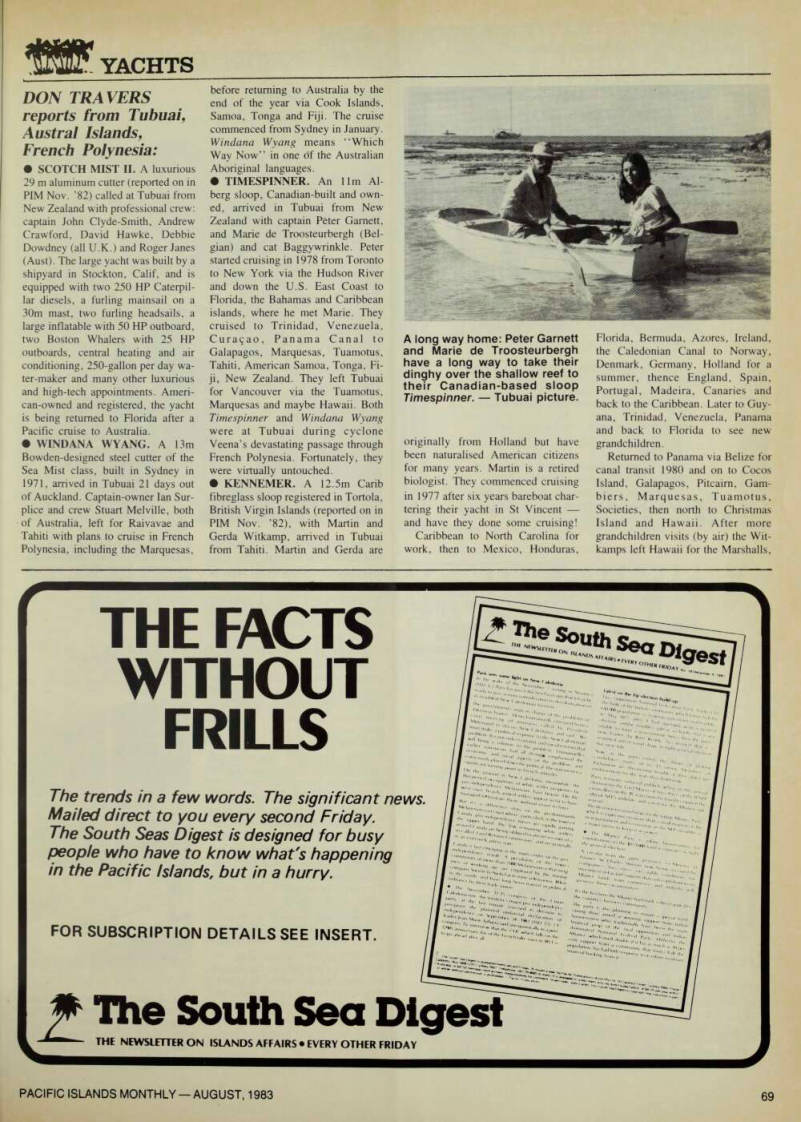
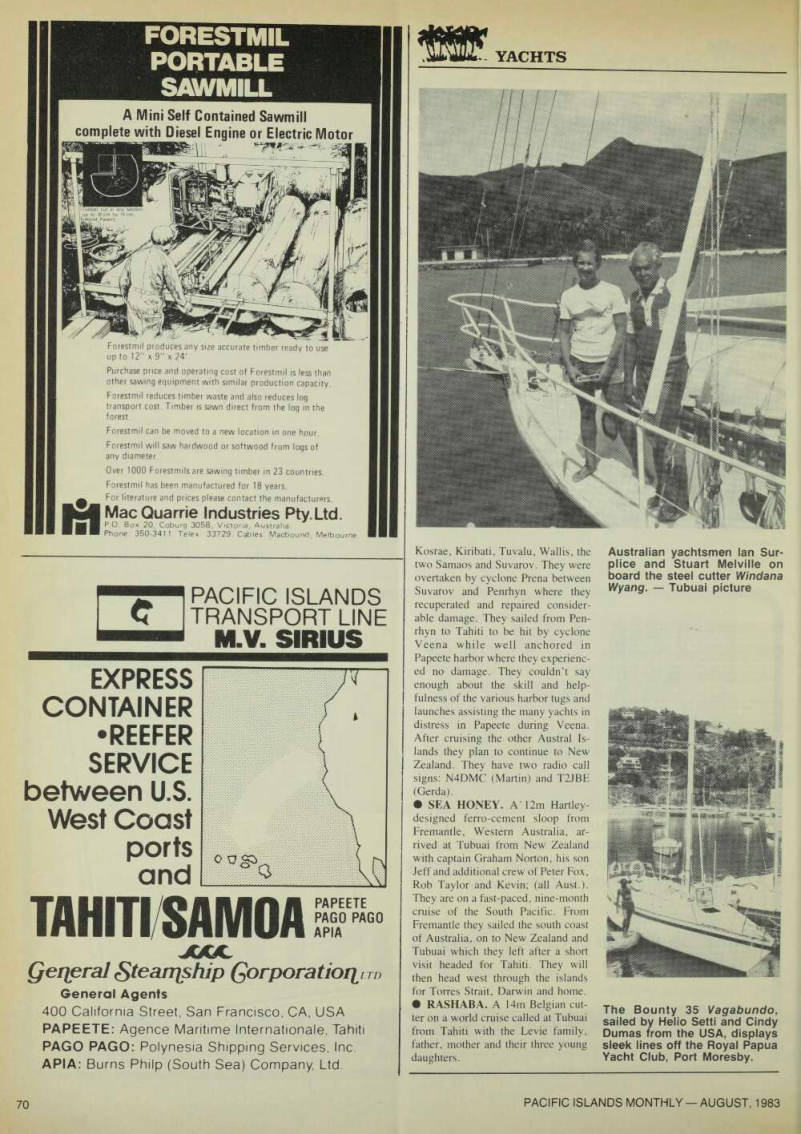
Don Travers
reports from Tubuai,
Austral Islands ,
French Polynesia:
• SCOTCH MIST 11. A luxurious 29 m aluminum cutter (reported on in PIM Nov. ’B2) called at Tubuai from New Zealand with professional crew:
captain John Clyde-Smith, Andrew
Crawford, David Hawke, Debbie Dowdney (all U.K.) and Roger Janes (Aust). The large yacht was built by a shipyard in Stockton, Calif, and is equipped with two 250 HP Caterpil lar diesels, a furling mainsail on a 30m mast, two furling headsails, a large inflatable with 50 HP outboard, two Boston Whalers with 25 HP outboards, central heating and air conditioning, 250-gallon per day wa ter-maker and many other luxurious
and high-tech appointments. Ameri
can-owned and registered, the yacht is being returned to Florida after a Pacific cruise to Australia.
• Windana Wyang. A 13M
Bowden-designed steel cutter of the Sea Mist class, built in Sydney in 1971, arrived in Tubuai 21 days out of Auckland. Captain-owner lan Sur plice and crew Stuart Melville, both of Australia, left for Raivavae and Tahiti with plans to cruise in French
Polynesia, including the Marquesas,
before returning to Australia by the end of the year via Cook Islands, Samoa, Tonga and Fiji. The cruise commenced from Sydney in January.
Windana Wyang means “Which Way Now” in one of the Australian
Aboriginal languages.
• Timespinner. An 11M Al
berg sloop, Canadian-built and own ed, arrived in Tubuai from New Zealand with captain Peter Garnett, and Marie de Troosteurbergh (Bel gian) and cat Baggy wrinkle. Peter started cruising in 1978 from Toronto to New York via the Hudson River and down the U.S. East Coast to Florida, the Bahamas and Caribbean islands, where he met Marie. They cruised to Trinidad, Venezuela, Curasao, Panama Canal to
Galapagos, Marquesas, Tuamotus,
Tahiti, American Samoa, Tonga, Fi ji, New Zealand. They left Tubuai for Vancouver via the Tuamotus, Marquesas and maybe Hawaii. Both Timespinner and Windana Wyang were at Tubuai during cyclone
Veena’s devastating passage through
French Polynesia. Fortunately, they
were virtually untouched. • KENNEMER. A 12.5 m Carib
fibreglass sloop registered in Tortola,
British Virgin Islands (reported on in PIM Nov. ’B2), with Martin and Gerda Witkamp, arrived in Tubuai from Tahiti. Martin and Gerda are
originally from Holland but have been naturalised American citizens for many years. Martin is a retired
biologist. They commenced cruising
in 1977 after six years bareboat char tering their yacht in St Vincent and have they done some cruising!
Caribbean to North Carolina for work, then to Mexico, Honduras,
Florida, Bermuda, Azores, Ireland, the Caledonian Canal to Norway, Denmark, Germany, Holland for a summer, thence England, Spain, Portugal, Madeira, Canaries and back to the Caribbean. Later to Guy ana, Trinidad, Venezuela, Panama and back to Florida to see new grandchildren.
Returned to Panama via Belize for canal transit 1980 and on to Cocos Island, Galapagos, Pitcairn, Gam biers, Marquesas, Tuamotus, Societies, then north to Christmas Island and Hawaii. After more grandchildren visits (by air) the Wit kamps left Hawaii for the Marshalls,
A long way home: Peter Garnett and Marie de Troosteurbergh have a long way to take their dinghy over the shallow reef to their Canadian-based sloop
Timespinner. - Tubuai picture.
Kosrae, Kiribati, Tuvalu, Wallis, the two Samaos and Suvarov. They were overtaken by cyclone Prena between Suvarov and Penrhyn where they recuperated and repaired consider able damage. They sailed from Pen rhyn to Tahiti to be hit by cyclone Veena while well anchored in
Papeete harbor where they experienc
ed no damage. They couldn’t say enough about the skill and help fulness of the various harbor tugs and launches assisting the many yachts in distress in Papeete during Veena.
After cruising the other Austral Is lands they plan to continue to New Zealand. They have two radio call signs: N4DMC (Martin) and T2JBE (Gerda). • SEA HONEY. A'l2m Hartley
designed ferro-cement sloop from
Fremantle, Western Australia, ar rived at Tubuai from New Zealand with captain Graham Norton, his son Jeff and additional crew of Peter Fox, Rob Taylor and Kevin; (all Aust.).
They are on a fast-paced, nine-month cruise of the South Pacific. From Fremantle they sailed the south coast of Australia, on to New Zealand and Tubuai which they left after a short visit headed for Tahiti. They will then head west through the islands for Torres Strait, Darwin and home. • RASHABA. A 14m Belgian cut ter on a world cruise called at Tubuai from Tahiti with the Levie family, father, mother and their three young daughters.
Australian yachtsmen lan Sur plice and Stuart Melville on board the steel cutter Windana Wyang. - Tubuai picture
The Bounty 35 Vagabundo, sailed by Helio Setti and Cindy Dumas from the USA, displays sleek lines off the Royal Papua Yacht Club, Port Moresby.
Advertisements & other items, pp. 69-70 (1 item)
The Facts
WITHOUT
FRILLS
The trends in a few words. The significant news.
Mailed direct to you every second Friday.
The South Seas Digest is designed for busy people who have to know what's happening in the Pacific Islands , but in a hurry.
FOR SUBSCRIPTION DETAILS SEE INSERT.
f The South Sea Digest
Dl 9est is sir THE NEWSLETTER ON ISLANDS AFFAIRS • EVERY OTHER FRIDAY
FORESTMIL
PORTABLE
SAWMILL
A Mini Self Contained Sawmill complete with Diesel Engine or Electric Motor r'A Forestmil produces any size accurate timber ready to use up to 12” x 9" x 24' Purchase price and operating cost of Forestmil is less than other sawing equipment with similar production capacity.
Forestmil reduces timber waste and also reduces log transport cost. Timber is sawn direct from the log in the forest.
Forestmil can be moved to a new location in one hour.
Forestmil will saw hardwood or softwood from logs of any diameter.
Over 1000 Forestmils are sawing timber in 23 countries.
Forestmil has been manufactured for 18 years.
For literature and prices please contact the manufacturers.
Mac Quarrie Industries Pty.Ltd.
P.O. Box 20, Coburg 3058, Victoria, Australia, Phone: 350-3411. Telex: 33729. Cables: Macbound, Melbourne
PACIFIC ISLANDS
TRANSPORT LINE
M.V. SIRIUS
and!"** VCI
TAHITI SAMOA ™
xot
QerjeralSteanjship Qorporatioq^rm
General Agents 400 California Street, San Francisco, CA, USA PAPEETE: Agence Maritime Internationale, Tahiti PAGO PAGO: Polynesia Shipping Services, Inc.
APIA: Burns Philp (South Sea) Company, Ltd.
Shipping Schedules
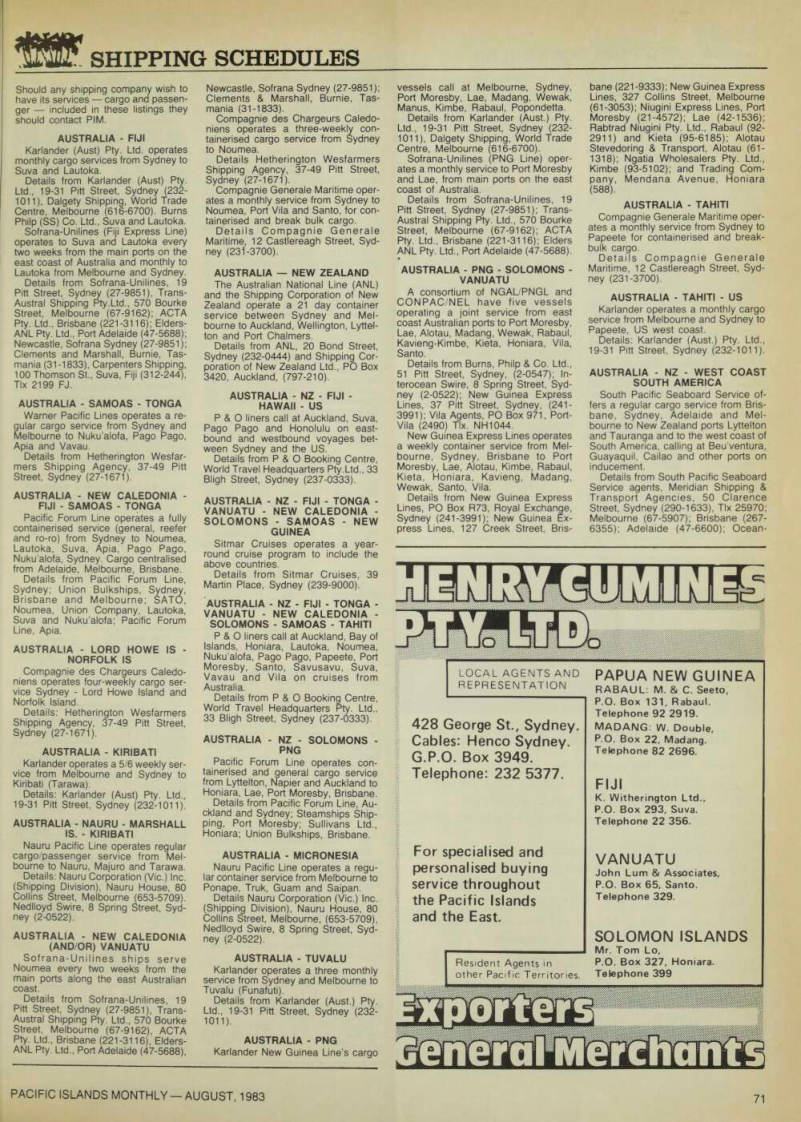
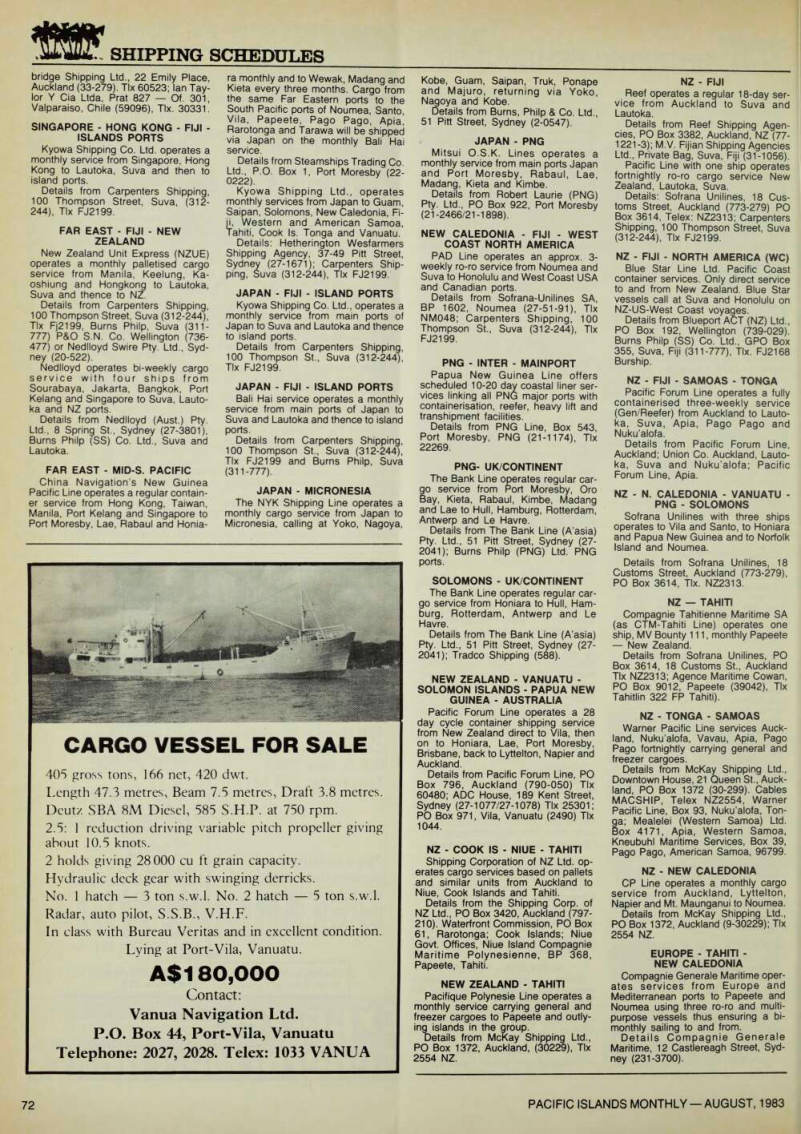
Should any shipping company wish to have its services cargo and passen ger included in these listings they should contact PIM.
Australia - Fiji
Karlander (Aust) Pty. Ltd. operates monthly cargo services from Sydney to Suva and Lautoka.
Details from Karlander (Aust) Pty.
Ltd., 19-31 Pitt Street, Sydney (232- 1011), Dalgety Shipping, World Trade Centre, Melbourne (616-6700). Burns Philp (SS) Co. Ltd., Suva and Lautoka.
Sofrana-Unilines (Fiji Express Line) operates to Suva and Lautoka every two weeks from the main ports on the east coast of Australia and monthly to Lautoka from Melbourne and Sydney.
Details from Sofrana-Unilines, 19 Pitt Street, Sydney (27-9851), Trans- Austral Shipping Pty.Ltd., 570 Bourke Street, Melbourne (67-9162); ACTA Pty. Ltd., Brisbane (221-3116); Elders- ANL Pty. Ltd., Port Adelaide (47-5688); Newcastle, Sofrana Sydney (27-9851); Clements and Marshall, Burnie, Tas mania (31-1833), Carpenters Shipping, 100 Thomson St., Suva, Fiji (312-244), Tlx 2199 FJ.
Australia - Samoas - Tonga
Warner Pacific Lines operates a re gular cargo service from Sydney and Melbourne to Nukualofa, Pago Pago, Apia and Vavau.
Details from Hetherington Wesfar mers Shipping Agency, 37-49 Pitt Street, Sydney (27-1671).
Australia - New Caledonia -
Fiji - Samoas - Tonga
Pacific Forum Line operates a fully containerised service (general, reefer and ro-ro) from Sydney to Noumea, Lautoka, Suva, Apia, Pago Pago, Nuku’alofa, Sydney. Cargo centralised from Adelaide, Melbourne, Brisbane.
Details from Pacific Forum Line, Sydney; Union Bulkships, Sydney, Brisbane and Melbourne; SATO, Noumea, Union Company, Lautoka, Suva and Nuku’alofa: Pacific Forum Line, Apia.
Australia - Lord Howe Is -
Norfolk Is
Compagnie des Chargeurs Caledo niens operates four-weekly cargo ser vice Sydney - Lord Howe Island and Norfolk Island.
Details: Hetherington Wesfarmers Shipping Agency, 37-49 Pitt Street, Sydney (27-1671).
Australia - Kiribati
Karlander operates a 5/6 weekly ser vice from Melbourne and Sydney to Kiribati (Tarawa).
Details: Karlander (Aust) Pty. Ltd., 19-31 Pitt Street, Sydney (232-1011).
Australia - Nauru - Marshall
Is. - Kiribati
Nauru Pacific Line operates regular cargo/passenger service from Mel bourne to Nauru, Majuro and Tarawa.
Details: Nauru Corporation (Vic.) Inc. (Shipping Division), Nauru House, 80 Collins Street, Melbourne (653-5709).
Nedlloyd Swire, 8 Spring Street, Syd ney (2-0522).
Australia - New Caledonia
(And/Or) Vanuatu
Sofrana-Unilines ships serve Noumea every two weeks from the main ports along the east Australian coast.
Details from Sofrana-Unilines, 19 Pitt Street, Sydney (27-9851), Trans- Austral Shipping Pty. Ltd., 570 Bourke Street, Melbourne (67-9162), ACTA Pty. Ltd., Brisbane (221-3116), Elders- ANL Pty. Ltd., Port Adelaide (47-5688),
Newcastle, Sofrana Sydney (27-9851); Clements & Marshall, Burnie, Tas mania (31-1833).
Compagnie des Chargeurs Caledo niens operates a three-weekly con tainerised cargo service from Sydney to Noumea.
Details Hetherington Wesfarmers Shipping Agency, 37-49 Pitt Street, Sydney (27-1671).
Compagnie Generale Maritime oper ates a monthly service from Sydney to Noumea, Port Vila and Santo, for con tainerised and break bulk cargo.
Details Compagnie Generale Maritime, 12 Castlereagh Street, Syd
ney (23i-3700).
Australia New Zealand
The Australian National Line (ANL) and the Shipping Corporation of New Zealand operate a 21 day container service between Sydney and Mel bourne to Auckland, Wellington, Lyttel ton and Port Chalmers.
Details from ANL, 20 Bond Street, Sydney (232-0444) and Shipping Cor poration of New Zealand Ltd., PO Box 3420, Auckland, (797-210).
Australia - Nz - Fiji -
Hawaii - Us
P & O liners call at Auckland, Suva, Pago Pago and Honolulu on east bound and westbound voyages bet ween Sydney and the US.
Details from P & O Booking Centre, World Travel Headquarters Pty.Ltd., 33 Bligh Street, Sydney (237-0333).
AUSTRALIA - NZ - FIJI - TONGA -
Vanuatu - New Caledonia -
Solomons - Samoas - New
Guinea
Sitmar Cruises operates a year round cruise program to include the above countries.
Details from Sitmar Cruises, 39 Martin Place, Sydney (239-9000).
AUSTRALIA - NZ - FIJI - TONGA -
Vanuatu - New Caledonia -
Solomons - Samoas - Tahiti
P & O liners call at Auckland, Bay of Islands, Honiara, Lautoka, Noumea, Nukualofa, Pago Pago, Papeete, Port Moresby, Santo, Savusavu, Suva, Vavau and Vila on cruises from Australia.
Details from P & O Booking Centre, World Travel Headquarters Pty. Ltd.. 33 Bligh Street, Sydney (237-0333).
Australia - Nz - Solomons -
Png
Pacific Forum Line operates con tainerised and general cargo service from Lyttelton, Napier and Auckland to Honiara, Lae, Port Moresby, Brisbane.
Details from Pacific Forum Line, Au ckland and Sydney: Steamships Ship ping, Port Moresby; Sullivans Ltd., Honiara: Union Bulkships, Brisbane.
Australia - Micronesia
Nauru Pacific Line operates a regu lar container service from Melbourne to Ponape, Truk, Guam and Saipan.
Details Nauru Corporation (Vic.) Inc. (Shipping Division), Nauru House, 80 Collins Street, Melbourne, (653-5709), Nedlloyd Swire, 8 Spring Street, Syd ney (2-0522).
Australia - Tuvalu
Karlander operates a three monthly service from Sydney and Melbourne to Tuvalu (Funafuti).
Details from Karlander (Aust.) Pty.
Ltd., 19-31 Pitt Street, Sydney (232- 1011).
Australia - Png
Karlander New Guinea Line’s cargo
vessels call at Melbourne, Sydney, Port Moresby, Lae, Madang, Wewak, Manus, Kimbe, Rabaul, Popondetta.
Details from Karlander (Aust.) Pty.
Ltd., 19-31 Pitt Street, Sydney (232- 1011), Dalgety Shipping, World Trade Centre, Melbourne (616-6700).
Sofrana-Unilines (PNG Line) oper ates a monthly service to Port Moresby and Lae, from main ports on the east coast of Australia.
Details from Sofrana-Unilines, 19 Pitt Street, Sydney (27-9851); Trans- Austral Shipping Pty. Ltd., 570 Bourke Street, Melbourne (67-9162); ACTA Pty. Ltd., Brisbane (221-3116); Elders ANL Pty. Ltd., Port Adelaide (47-5688).
Australia - Png - Solomons -
Vanuatu
A consortium of NGAL/PNGL and CONPAC/NEL have five vessels operating a joint service from east coast Australian ports to Port Moresby, Lae, Alotau, Madang, Wewak, Rabaul, Kavieng-Kimbe, Kieta, Honiara, Vila, Santo.
Details from Burns, Philp & Co. Ltd., 51 Pitt Street, Sydney, (2-0547); In terocean Swire, 8 Spring Street, Syd ney (2-0522); New Guinea Express Lines, 37 Pitt Street, Sydney, (241- 3991); Vila Agents, PO Box 971, Port- Vila (2490) Tlx. NH1044.
New Guinea Express Lines operates a weekly container service from Mel bourne, Sydney, Brisbane to Port Moresby, Lae, Alotau, Kimbe, Rabaul, Kieta, Honiara, Kavieng, Madang, Wewak, Santo, Vila.
Details from New Guinea Express Lines, PO Box R 73, Royal Exchange, Sydney (241-3991); New Guinea Ex press Lines, 127 Creek Street, Bris
bane (221-9333); New Guinea Express Lines, 327 Collins Street, Melbourne (61-3053); Niugini Express Lines, Port Moresby (21-4572); Lae (42-1536); Rabtrad Niugini Pty. Ltd., Rabaul (92- 2911) and Kieta (95-6185); Alotau Stevedoring & Transport, Alotau (61- 1318); Ngatia Wholesalers Pty. Ltd., Kimbe (93-5102); and Trading Com pany, Mendana Avenue, Honiara (588).
Australia - Tahiti
Compagnie Generate Maritime oper ates a monthly service from Sydney to Papeete for containerised and break bulk cargo.
Details Compagnie Generate Maritime, 12 Castlereagh Street, Syd ney (231-3700).
Australia - Tahiti - Us
Karlander operates a monthly cargo service from Melbourne and Sydney to Papeete, US west coast.
Details: Karlander (Aust.) Pty. Ltd., 19-31 Pitt Street, Sydney (232-1011).
Australia - Nz - West Coast
South America
South Pacific Seaboard Service of fers a regular cargo service from Bris bane, Sydney, Adelaide and Mel bourne to New Zealand ports Lyttelton and Tauranga and to the west coast of South America, calling at Beu’ventura, Guayaquil, Cailao and other ports on inducement.
Details from South Pacific Seaboard Service agents, Meridian Shipping & Transport Agencies, 50 Clarence Street, Sydney (290-1633), Tlx 25970; Melbourne (67-5907); Brisbane (267- 6355); Adelaide (47-6600); Ocean-
bridge Shipping Ltd., 22 Emily Place, Auckland (33-279). Tlx 60523; lan Tay lor Y Cia Ltda, Prat 827 Of. 301, Valparaiso, Chile (59096), Tlx. 30331.
SINGAPORE - HONG KONG - FIJI -
Islands Ports
Kyowa Shipping Co. Ltd. operates a monthly service from Singapore, Hong Kong to Lautoka, Suva and then to island ports.
Details from Carpenters Shipping, 100 Thompson Street, Suva, (312- 244), Tlx FJ2199.
Far East - Fiji - New
Zealand
New Zealand Unit Express (NZUE) operates a monthly palletised cargo service from Manila, Keelung, Ka oshiung and Hongkong to Lautoka, Suva and thence to NZ.
Details from Carpenters Shipping, 100 Thompson Street, Suva (312-244), Tlx Fj2199, Burns Philp, Suva (311- 777) P&O S.N. Co. Wellington (736- 477) or Nedlloyd Swire Pty. Ltd., Syd ney (20-522).
Nedlloyd operates bi-weekly cargo service with four ships from Sourabaya, Jakarta, Bangkok, Port Kelang and Singapore to Suva, Lauto ka and NZ ports.
Details from Nedlloyd (Aust.) Pty.
Ltd., 8 Spring St., Sydney (27-3801), Burns Philp (SS) Co. Ltd., Suva and Lautoka.
Far East - Mid-S. Pacific
China Navigation’s New Guinea Pacific Line operates a regular contain er service from Hong Kong, Taiwan, Manila, Port Kelang and Singapore to Port Moresby, Lae, Rabaul and Honia
ra monthly and to Wewak, Madang and Kieta every three months. Cargo from the same Far Eastern ports to the South Pacific ports of Noumea, Santo, Vila, Papeete, Pago Pago, Apia, Rarotonga and Tarawa will be shipped via Japan on the monthly Bali Hai service.
Details from Steamships Trading Co.
Ltd., P.O. Box 1, Port Moresby (22- 0222).
Kyowa Shipping Ltd., operates monthly services from Japan to Guam, Saipan, Solomons, New Caledonia, Fi ji, Western and American Samoa, Tahiti, Cook Is. Tonga and Vanuatu.
Details: Hetherington Wesfarmers Shipping Agency, 37-49 Pitt Street, Sydney (27-1671); Carpenters Ship ping, Suva (312-244), Tlx FJ2199.
Japan - Fiji - Island Ports
Kyowa Shipping Co. Ltd., operates a monthly service from main ports of Japan to Suva and Lautoka and thence to island ports.
Details from Carpenters Shipping, 100 Thompson St., Suva (312-244), Tlx FJ2199.
Japan - Fiji - Island Ports
Bali Hai service operates a monthly service from main ports of Japan to Suva and Lautoka and thence to island ports.
Details from Carpenters Shipping, 100 Thompson St., Suva (312-244), Tlx FJ2199 and Burns Philp, Suva (311-777).
Japan - Micronesia
The NYK Shipping Line operates a monthly cargo service from Japan to Micronesia, calling at Yoko, Nagoya,
Kobe, Guam, Saipan, Truk, Ponape and Majuro, returning via Yoko, Nagoya and Kobe.
Details from Burns, Philp & Co. Ltd., 51 Pitt Street, Sydney (2-0547).
Japan - Png
Mitsui O.S.K. Lines operates a monthly service from main ports Japan and Port Moresby, Rabaul, Lae, Madang, Kieta and Kimbe.
Details from Robert Laurie (PNG) Pty. Ltd., PO Box 922, Port Moresby (21-2466/21-1898).
New Caledonia - Fiji - West
Coast North America
PAD Line operates an approx. 3weekly ro-ro service from Noumea and Suva to Honolulu and West Coast USA and Canadian ports.
Details from Sofrana-Unilines SA, BP 1602, Noumea (27-51-91), Tlx NMO4B; Carpenters Shipping, 100 Thompson St., Suva (312-244), Tlx FJ2199.
Png - Inter - Mainport
Papua New Guinea Line offers scheduled 10-20 day coastal liner ser vices linking all PNG major ports with containerisation, reefer, heavy lift and transhipment facilities.
Details from PNG Line, Box 543, Port Moresby, PNG (21-1174), Tlx 22269.
Png- Uk7Continent
The Bank Line operates regular car go service from Port Moresby, Oro Bay, Kieta, Rabaul, Kimbe, Madang and Lae to Hull, Hamburg, Rotterdam, Antwerp and Le Havre.
Details from The Bank Line (A’asia) Pty. Ltd., 51 Pitt Street, Sydney (27- 2041); Burns Philp (PNG) Ltd. PNG ports.
Solomons - Uk/Continent
The Bank Line operates regular car go service from Honiara to Hull, Ham burg, Rotterdam, Antwerp and Le Havre.
Details from The Bank Line (A’asia) Pty. Ltd., 51 Pitt Street, Sydney (27- 2041); Tradco Shipping (588).
New Zealand - Vanuatu -
Solomon Islands - Papua New
Guinea - Australia
Pacific Forum Line operates a 28 day cycle container shipping service from New Zealand direct to Vila, then on to Honiara, Lae, Port Moresby, Brisbane, back to Lyttelton, Napier and Auckland.
Details from Pacific Forum Line, PO Box 796, Auckland (790-050) Tlx 60480; ADC House, 189 Kent Street, Sydney (27-1077/27-1078) Tlx 25301; PO Box 971, Vila, Vanuatu (2490) Tlx 1044.
NZ - COOK IS - NIUE - TAHITI Shipping Corporation of NZ Ltd. op erates cargo services based on pallets and similar units from Auckland to Niue, Cook Islands and Tahiti.
Details from the Shipping Corp. of NZ Ltd., PO Box 3420, Auckland (797- 210). Waterfront Commission, PO Box 61, Rarotonga; Cook Islands; Niue Govt. Offices, Niue Island Compagnie Maritime Polynesienne, BP 368, Papeete, Tahiti.
New Zealand - Tahiti
Pacifique Polynesie Line operates a monthly service carrying general and freezer cargoes to Papeete and outly ing islands in the group.
Details from McKay Shipping Ltd., PO Box 1372, Auckland, (30229), Tlx 2554 NZ.
Nz - Fiji
Reef operates a regular 18-day ser vice from Auckland to Suva and Lautoka.
Details from Reef Shipping Agen cies, PO Box 3382, Auckland, NZ (77- 1221-3); M.V. Fijian Shipping Agencies Ltd., Private Bag, Suva, Fiji (31-1056).
Pacific Line with one ship operates fortnightly ro-ro cargo service New Zealand, Lautoka, Suva.
Details: Sofrana Unilines, 18 Cus toms Street, Auckland (773-279) PO Box 3614, Telex: NZ2313; Carpenters Shipping, 100 Thompson Street, Suva (312-244), Tlx FJ2199.
NZ - FIJI - NORTH AMERICA (WC) Blue Star Line Ltd. Pacific Coast container services. Only direct service to and from New Zealand. Blue Star vessels call at Suva and Honolulu on NZ-US-West Coast voyages.
Details from Blueport ACT (NZ) Ltd., PO Box 192, Wellington (739-029).
Burns Philp (SS) Co. Ltd., GPO Box 355, Suva, Fiji (311-777), Tlx. FJ2168 Burship.
NZ - FIJI - SAMOAS - TONGA Pacific Forum Line operates a fully containerised three-weekly service (Gen/Reefer) from Auckland to Lauto ka, Suva, Apia, Pago Pago and Nukualofa.
Details from Pacific Forum Line, Auckland: Union Co. Auckland, Lauto ka, Suva and Nukualofa; Pacific Forum Line, Apia.
NZ - N. CALEDONIA - VANUATU -
Png - Solomons
Sofrana Unilines with three ships operates to Vila and Santo, to Honiara and Papua New Guinea and to Norfolk Island and Noumea.
Details from Sofrana Unilines, 18 Customs Street, Auckland (773-279), PO Box 3614, Tlx. NZ2313.
Nz Tahiti
Compagnie Tahitienne Maritime SA (as CTM-Tahiti Line) operates one ship, MV Bounty 111, monthly Papeete New Zealand.
Details from Sofrana Unilines, PO Box 3614, 18 Customs St., Auckland Tlx NZ2313; Agence Maritime Cowan, PO Box 9012, Papeete (39042), Tlx Tahitlin 322 FP Tahiti).
Nz - Tonga - Samoas
Warner Pacific Line services Auck land, Nukualofa, Vavau, Apia, Pago Pago fortnightly carrying general and freezer cargoes.
Details from McKay Shipping Ltd., Downtown House, 21 Queen St., Auck land, PO Box 1372 (30-299). Cables MACSHIP, Telex NZ2554, Warner Pacific Line, Box 93, Nukualofa, Ton ga; Mealelei (Western Samoa) Ltd.
Box 4171, Apia, Western Samoa, Kneubuhl Maritime Services, Box 39, Pago Pago, American Samoa, 96799.
Nz - New Caledonia
CP Line operates a monthly cargo service from Auckland, Lyttelton, Napier and Mt. Maunganui to Noumea.
Details from McKay Shipping Ltd., PO Box 1372, Auckland (9-30229); Tlx 2554 NZ.
Europe - Tahiti -
New Caledonia
Compagnie Generale Maritime oper ates services from Europe and Mediterranean ports to Papeete and Noumea using three ro-ro and multi purpose vessels thus ensuring a bi monthly sailing to and from.
Details Compagnie Generale Maritime, 12 Castlereagh Street, Syd ney (231-3700).
Europe - Tahiti - New
Caledonia - New Zealand -
Solomons - Png - Europe
Polish Ocean Lines offers regular monthly sailings for containerised and breakbulk cargo and reefer space, con ventional and in reefer containers, from Hamburg, Antwerp, Dunkirk and Rouen to Papeete, Noumea, New Zea land, Honiara, Lae, Manila and Singa pore, returning to Europe via Suez.
Other ports in the South Pacific can be served with inducement.
Details from Sotama, BP 9170, Papeete (27805), Tlx. 296; SATO, BP C 2, Noumea (272094), Tlx. 163 NM SATO: Union Steamship Co of NZ, PO Box 50, Apia, Tlx. 25; Williams and Gosling, PO Box 79, Suva (312633), Tlx. 2163; Warner Pacific Line, PO Box 93, Nukualofa (21089), Tlx. 66219; Universal Shipping Agencies, PO Box 2282, Auckland (30930), Tlx. 21517.
EUROPE - TAHITI - W. SAMOA -
Fiji - N. Caledonia
Nedlloyd offers regular cargo ser vices from Northern Europe and U.K. to Papeete, Apia, Fiji and New Caledonia.
Details Nedlloyd (Aust.) Pty. Ltd., 8 Spring Street, Sydney (27-3801); Car penters Shipping, 100 Thomson St., Suva (312-244), Tlx. 2199 FJ and Vetari Street, Lautoka (63988), Tlx. 5215FJ.
UK - N. CONTINENT - W. SAMOA -
Tonga - Fiji
The Bank Line operates a regular cargo service from Hull, Hamburg, Bre
men, Antwerp, Rotterdam and Le Havre to Apia, Nukualofa, Suva and Lautoka.
Details from The Bank Line (A’asia) Pty. Ltd., 51 Pitt Street, Sydney (27- 2041); Burns Philp (South Sea) Co.
Ltd., Suva and Lautoka.
UK - N. CONTINENT - PNG -
Solomons
The Bank Line operates a regular cargo service from Hull, Hamburg, Bre men, Antwerp, Rotterdam and Le Havre to Port Moresby, Lae, Madang, Kimbe, Rabaul, Kieta and Honiara and on inducement to Yandina.
Details from The Bank Line (A’sia) Pty. Ltd., 51 Pitt Street, Sydney (27- 2041); Burns Philp (PNG) Ltd. PNG ports: Tradco Shipping (588).
Uk/N. Continent - Tahiti -
N. Caledonia - Vanuatu
The Bank Line operates a regular cargo service from Hull, Hamburg, Bre men, Antwerp, Rotterdam and Le Havre to Papeete, Noumea, Port-Vila and Santo.
Details from The Bank Line (A’asia) Pty. Ltd., 51 Pitt Street, Sydney (27- 2041); Ets A M. Fare UTE, Papeete; Ets. Ballande, Noumea.
US - FIJI - TAHITI - NZ -
Australia
The Bank Savill Line Ltd. operates regular cargo services from U.S. Gulf ports to Australia and N.Z. Calls at Suva, Lautoka and Papeete on demand.
Details from The Bank and Savill Line Ltd., 51 Pitt Street, Sydney (27- 2041) or Orient Shipping Services, 32 Bridge Street, Sydney (241-2753).
U.S. - Hawaii - Kiribati -
Micronesia
Philippines, Micronesia & Orient Navigation Co. (PM&O Lines) operates regular container service on selfsus tained ship with ro-ro capabilities from Oakland, Portland and Honolulu to Tarawa, Ebeye, Majuro, Kosrae, Ponape, Truk, Saipan, Yap and Koror.
Details for Micronesia can be ob tained from Larry Guerrero, PM&O Owners Rep. PO Box 803, Saipan, Ml 96950, Cable COMMONTIME, Tlx 783605; PM&O: PM&O Lines, 181 Fremont St., San Francisco, California 94-105, Cable PMONAV.
Us - Hawaii - Nauru -
Micronesia
Nauru Pacific Line operates regular conventional container and passenger service from San Francisco and Hon olulu to Majuro, Ponape, Truk and Saipan. Cargo is accepted for Nauru and Kosrai with transhipment at Majuro and Ponape.
Details from Nauru Corporation (Vic.) Inc. (Shipping Division), Nauru House, 80 Collins Street, Melbourne (653-5709); Nauru Air and Shipping Agency, Suite 2803, 185 Berry Street, San Fransisco, California 94107 (415- 543-1737); Nauru Air and Shipping Agency, Suite 506, 841 Bishop St., Honolulu, HI 96813 (808-523-0441).
Hawaii - Tahiti - Samoas
Marshall Islands Maritime Co oper ates a service every 32 days between Honolulu, Papeete, Pago Pago and Apia.
Details from the Maritime Co. of the Pacific, 567 South King Street, Suite 310, Honolulu, Hawaii, Morris Hed strom, Box 189, Apia, Western Samoa and the Marshall Islands Maritime Co., Box 679, Majuro, Marshall Islands.
Us - Noumea - Fiji
PAD Line operates an approx. 3weekly ro-ro service from West coast USA and Canada to Noumea, Suva and Lautoka.
Details from Sofrana-Unilines SA, BP 1602, Noumea (27-51-91), Tlx.
NMO4B; Carpenters Shipping, Harbour Centre, Thompson Street, Suva (31- 2244), Tlx. FJ2199; Trans-Austral Shipping Pty. Ltd., PO Box R 232, Roy al Exchange, 2000 (231-8411), Tlx.
AA21204.
Us - Tahiti - Samoa
Pacific Islands Transport operates a five weekly cargo service from North America west coast ports to Papeete, Pago Pago, Apia.
Details from Polynesia Shipping Ser vices Inc. PO Box 1478, Pago Pago 96799.
Polynesia Line operates container and general cargo service from US west coast ports to Papeete and Pago Pago.
Details from Polynesia Shipping Ser vices Inc., PO Box 1478, Pago Pago 96799.
Advertisements & other items, pp. 71-72 (1 item)
MnaMmnmiE
JWIIM
LOCAL AGENTS AND
REPRESENTATION
428 George St., Sydney.
Cables: Henco Sydney.
G.P.O. Box 3949.
Telephone: 232 5377.
PAPUA NEW GUINEA
RABAUL: M. & C. Seeto, P.O. Box 131, Rabaul.
Telephone 92 2919.
MADANG: W. Double, P.O. Box 22, Madang.
Telephone 82 2696.
FIJI
K. Witherington Ltd., P.O. Box 293, Suva.
Telephone 22 356.
For specialised and
personalised buying
service throughout
the Pacific Islands and the East.
Resident Agents in other Pacific Territories.
VANUATU
John Lum & Associates, P.O. Box 65, Santo.
Telephone 329.
SOLOMON ISLANDS
Mr. Tom Lo, P.O. Box 327, Honiara.
Telephone 399
xpWters
CARGO VESSEL FOR SALE
405 gross tons, 166 net, 420 dwt.
Length 47.3 metres. Beam 7.5 metres, Draft 3.8 metres.
Dcutz SBA 8M Diesel, 585 S.H.P. at 750 rpm. 2.5: 1 reduction driving variable pitch propeller giving about 10.5 knots. 2 holds giving 28000 cu ft grain capacity.
Hydraulic deck gear with swinging derricks.
No. 1 hatch 3 ton s.w.l. No. 2 hatch 5 ton s.w.l.
Radar, auto pilot, 5.5.8., V.H.F.
In class with Bureau Veritas and in excellent condition.
Lying at Port-Vila, Vanuatu.
AslBo,ooo
Contact: Vanua Navigation Ltd.
P.O. Box 44, Port-Vila, Vanuatu Telephone: 2027, 2028. Telex: 1033 VANUA
Deaths
Miss Annie Williams At Lautoka, Fiji, on June 13, of a heart disorder, aged 74.
Miss Williams spent her life as a teacher and was well-known for her interest in the Girl Guide Movement, becoming Girl Guide Dominion Commissioner in Fiji.
She was also president of the Pan-Pacific Asia Women’s As sociation. She died on her 74th birthday.
Fonoti Galu, & Taula’i Ligoligo Tauiliili In American Samoa, on May 12 and May 13 respectively.
Fonoti Galu represented Saole County in the American Samoa Senate in the 10th Legislature 1966-68, and Taula’i Ligoligo Tauiliili represented Fitiuta County in the House of Repre sentatives from 1959 to 1962.
Both the Senate President and House Speaker expressed the Fono’s condolences to the be reaved families at the passing of two of those who helped to build American Samoa’s political foundations.
Chandra Pal Singh In Suva on June 5, aged 69.
Mr Singh was a member of the Legislative Council in the days before independence. He was bom at Nausori and attended St Columbus School in Suva. In
1940 he joined Suva Motors and became the first local garage supervisor. He then became a dairy farmer and bought a bus company and a sawmill. Mr Singh represented the Indian community in London at the first constitutional conference in 1965. He also served as a board member of the Fiji Broadcasting Commission for three years to 1967.
Dr Bruce Sinclair The dwindling band of pre-war residents of the former Mandated Territory of New Guinea lost another well-known and popular member with the death in mid- June of Dr Bruce Sinclair.
After serving with the Aust ralian Imperial Forces in France during World War 1, in which he received severe wounds from a shell burst which troubled him for the rest of his life, he studied medicine in Sydney during the early 19205. After qualifying and practising for a short time in New South Wales, he joined the New Guinea Administration medical service in 1928 and in 1929
married Sister Maud O’Donnell of Rabaul Hospital.
For 15 years his medical career was confined mainly to postings in Rabaul and at Salamaua in the Morobe gold fields district, where his skills as a medico and surgeon had ample scope.
Following the Japanese inva
sion of New Guinea he led the last party of Europeans out of Salamaua on a coastal trek on foot down into Papua.
He returned to New Guinea for some years after the war, and then returned to Australia to end his career as medical superinten
dent of Greenslopes Repatriation
Hospital in Brisbane.
Bad health plagued his later years and he spent the last 18 months of his life in hospital with his wife in daily attendance until he finally passed away in his
sleep.
Bert E. Weston.
Ratu Simione Batiratu Matanitobua In Fiji on June 6, aged 60.
The Tui (Chief) Namosi, Ratu Simione was a senior education
officer whose career spanned 40 years. He was awarded the MBE only this year. He was a well known radio personality as pro
ducer-presenter of the Ministry
of Education’s Fijian program.
The grandson of Ratu Siliano Ro Matanitobua, one of the 13 chiefs who signed the Deed of Cession to Britain in 1874, Ratu Simione had been a member of the Great Council of Chiefs since 1956.
John M. Calver In Canada on May 12 after a long illness, aged 65.
John Calver was a retired Roy al Canadian Navy Commander and veteran of World War 2, who came to American Samoa in 1967 as a harbor pilot. He was later named manager of the Wa ter Transportation Division and played an important part in the acquisition of the government vessels, Tatoso, Tavae, Toloa, Manusina, Talitiga and Matu’u.
John Calver’s first tour lasted six years, and in 1979 he was invited to be a temporary harbor pilot, later to become harbor master. 111-health forced him to resign in late 1981. Port Director Maiava Hunkin said of him: “He was a good man and a good friend and worker for American Samoa. He was awarded a certificate of ap
preciation by Governor Coleman
for his efforts. He will be greatly missed by all who knew him.”
Advertisements & other items, p. 73 (1 item)
Soviet studies
73
PACIFIC ISLANDS MONTHLY —AUGUST, 1983
Soviet studies From Page 27
THE MONTH
Advertising
Aggie Grey’s 11 Amatil 46 Antelope Engineering 42 Asia Tonga 74 Atlantic Trading 74 Bank Bumiputra 67 Bank Line 22 Besco Jarwil 32 Chutes Chicken 16 Citizen Watches 60 Columbus Line 22 For sale: Home unit 13 For sale: Pearl culture 13 For sale: Concrete plant ... 13 Forum Fisheries 40 GO-BA Enterprises 74 Gatman 44 Henry Cumines 71 Hitachi 26 Honda 2 Hudson Homes 34
Imel 24
Inter-Island Solar 30 Lincolm Electric 56 MacQuarrie Industries 70 Matsushita 12 New Zealand Dairy 54 Nissan 75 NQ Engineering 42 Pacific Pumps 44 Palings Industries 62 Papua Hotel 11 Patraco 67 Peter Fisher 74 Pioneer 2 P.l.T. Line 70 QBE Insurance 10 Rock Systems 52 Roncaglia 20 Sansui Electric 50 Sime Darby 66 SPC Line 58 Suzuki Motor 36
Teac 76
Tego 64 Toyota 38 Vanua Navigation 72
Advertisements & other items, pp. 74-76 (1 item)
Require
Proven Easy
MONEYMAKING
opportunities Supplement your income or get rich quick. Parttime or full time.
Beginners welcome.
GO-BA Enterpri Box 1868 Details:
ATLANTIC TRADING CO.
Fine Quality Swiss Watches Cannon & Rotary Brands.
Divers, Dress, Fashion watches available.
Agents inquiries welcome
ATLANTIC TRADING CO.
Office: sth Floor, ANZ Bank Building 411 Kent Street, Sydney Australia 2000 Phone 29 3777 Telex INTSY AAIOIOI BIRMINCO
FOR SALE
ADVERTISEMENTS
APPEAR ON
PAGE 13
PETER FISHER TRADING Pt y. Ltd.
381 PITT STREET, SYDNEY, 2000, AUSTRALIA
Telephone: 264 5395 CABLES: “FISHERION”, SYDNEY
TELEX: AUSTAS AA20149 ATT. PETER FISHER
EXPORTERS TO THE PACIFIC ISLANDS
REQUIRE
DRIED SHARK FINS
FOR PRICES AND
INFORMATION ETC.,
PLEASE WRITE TO:
S. DADDOW,
ASIA TONGA TRADING,
7 KASAI ROAD,
REPUBLIC OF SINGAPORE,
2880.
CABLE: "ASIATONGA"
FAAFETAL HOLDINGS PTY LTD
Management & Business Consultants Transportation, factory, establishment, office procedure, company formations, partnerships, finance, import, export, etc. Island rep available.
For further information write to
The Manager, FAAFETAL HOLDINGS PTY. LTD.
PO BOX 77, MOOREBANK, NSW, AUSTRALIA 2170
«t abkoet "to'
NISSAN MARCH
NISSAN
because Nissan recognizes drivers appreciate the of cars that are efficient and al, they still value comfort
fuse Tall our technological
lake our new Nissan March
o« ersth^^™°eUt
the lowest fuel consumption rate apS our Knowledge of iSrSss up and a luggage 'compartment thaVs eventen Whether we ca«rt logy our new Nissan Niaru. hether we call H Nissa, ers the best of both worlds. tsame kind of innovative dechn a new one Viter, light-weight, eve ry car we build. rior power performance yet a* m
NISSAN/DATSUN: ONE AND THE SADIE
NISSAN
DATSUN
Max HalecK Inc. Pago Pago, American Samoa Cook Islands Motor Centre Ltd. Rarotonga, Cook Islands Carpenters Motors Suva, Fiji Atoll Auto Stores Tarawa, Kiribati Jacob Enterprises Nauru Agence Alma S.A. Noumea, New Caledonia Sirius Motors Norfolk Island Boroko Motors Port Moresby, Papua New Guinea United Enterprises Ltd. Honiara, Solomon Islands Tahitibull S.A.R.L. Papeete, Tahiti Pentecost Vanua Trading Ltd. Port Vila, Vanuatu Morris Hedstrom Ltd. Apia, Western Samoa
An All-Hew World of S
O',* e&c.
Introducing the new PRISM Component Systems, efined reproduction performance and enhanced appearance make the new PRISM systems an extremely musical, elegant addition to any listening/living environment.
Another taste of advanced technology from
COMPONENT SYSTEMS
* rl O M 3 -2* V
TEAC
Where Art and Technology Meet