Pacific


Islands
Monthly
June, 1983
Niue . . . " ' %
Norfolk lsla.^B|
Papua NewZgffl
Solomon iKJm
Tahiti fZM
Tonga W : vv Tuvalu ?
Usa
Ustt A
Vanuatu
Western Samoa^^^H-• :
■RecomrAantfto retail^W
■ Nimimbimii J
||H
Ss23Shb^*
i lr
ppP^ray
Cover picture: Alan Weeks, whose pictures of people have been used by PIM before, photographed this smiling girl in Papua New Guinea.
Advertisements & other items, p. 2 (1 item)
The Miracle Workers
Making The World An Exciting Place
■ j m ■ * « -■ •:*
WLV-i
yr T. - f - * .> v T *r r *h 4,-' > * »**•* " r / f ATC. The go-anywhere, do-anything All Terrain Cycles that play as hard as they work, are simple for all to ride and cheap and easy to maintain.
ATC. Honda invented them. Can you or your business do without one?
WORLD’S LARGEST MOTORCYCLE MANUFACTURER
HONDA MOTOR CO.. LTD. TOKYO, JAPAN
ATC2OOE
ATCIBSS
ATCIIO
Pty. Ltd. Lot 95 Sharps Road, Tullamarine, Vic., 3043/Bennett Honda Pty. Ltd. 250 Victoria Road, Wetherill Park, 2164/NEW ZEALAND: Blue Wing Honda i/Vellinqton Auckland/PAPUA NEW GUINEA: Steamships Trading Company Ltd. P.O. Box 1, Port Moresby/TAHITI: Honda Distribution S.A-R.L. B.P. ibfab, AUSTRALIA; Honda Australia I Ltd. 99-101 Carbine Road Mt. Wellington, Auckland/PAPUA NEW GUINEA: Steamships Trading Company . 0 tdhct TcooirnDv- iinitoH Papeete/FIJI ISLANDS: Carpenters Motors Private Mail Bag Suva. Fiji/KIRIBATI: Atoll Motor & Marine Services P.O. Box 49 TRUST TERRITORY. United Micronesia Development Association P.O. Box 238, Saipan Mariana Islands 96950/COOK ISLANDS: Cook Islands Motor Centre Ltd. P.O. Box 74, Rarotonga AMERICAN SAMOA. Holiday Motors, Parts and Service P.O. Box 968 Pago Pago, American Samoa 96799/Haleck’s Service Certre Ltd. P.O. Box 1138, Pago Pago, American Samoa 96799/GUAM: Mark s Motor Co. Inc P.O_Box UV, Agana/WESTERN SAMOA: Motor Distributors (Samoa) Ltd. P.O. Box 576. Apia/SOLOMON ISLANDS; Guadalcanal Garage Limited P.O. Box 537 Honiara/NEW CALEDONIA.
Establissements Ballande Boite Postale No. C 4 Noumea Cedex/NAURU: Nauru Cooperation Republic of Nauru/TONGA: Tonga Industrial Traders P.O, Box 1035, Nukualofa longa
Pacific Islands Monthly
Vol. 54 No. 6
June 1983
(Usps 952480)
Representatives
AUSTRALIA: Distribution: The Herald and Weekly Times Ltd , 44-74 Flinders St., Melbourne, Vic., 3000. Advertis ing Reps Brisbane D. Wood, Anday Agency, Box 1918, GPO Brisbane, 4001, telephone 44-3485, 44-1546; Adelaide Hastwell Williamson Rouse Pty. Ltd., PO Box 419, Norwood, SA, 5067; 59 Kensington Road, Norwood; telephone (08) 332-3322, telex 87113, FIJI: Distribution and subscriptions Desai Book shops, P.O. Box 160, Suva, Fiji, telephone Suva 23036.
Advertising Fiji Times & Herald Ltd., 20 Gordon St., Suva, telephone 31-2111, telex FJ2124.
FRENCH POLYNESIA: Distribution Hachette Pacifi que, 10 Ave Bruat, Papeete, telephone 25610.
HAWAII, UNITED STATES: Distribution PIM, Hawaii, PO Box 22250, Honolulu, Hawaii. 96822. Advertising Brian C. Asgill, Apt. 1308, 1676 Ala Moana Blvd., Honolulu, Hawaii, 96815, telephone (808) 955-9718.
JAPAN: Advertising and subscriptions Universal Media Corporation, GPO Box 46, Tokyo, telephone 666- 3036, cables UNIMEDIA Tokio, telex 2524665.
KOREA: Advertising and subscriptions World Mar keting, Inc, Box 4010, Seoul; phone 776-5291-3, telex K 23232.
MALAYSIA: Advertising and subscriptions Worldwide Media Services, 57-B Komplex Damai, Jin Dato Haji Eusoff, Kuala Lumpur, telephone 63-9340, cables WORLDMEDIA Kuala Lumpur, telex 31533.
NEW CALEDONIA: Distribution Depot Centre de Presse Michel Pentecost, CBP2, Noumea, telephone 27- 2434, 27-4729.
NEW ZEALAND: Distribution Gordon & Gotch, PO Box 584, 2 Carr Road, Mt. Roskill, Auckland 4. Advertising International Media Representatives Ltd., PO Box 2313, Auckland, telephone 79-5487; 49-3389, cables Intereps, Auckland. Subscriptions Ross Haines & Son Ltd., PO Box 1289, Auckland, telephone 76-9042.
PAPUA NEW GUINEA: Distribution Gordon & Gotch, PO Box 3395, Port Moresby, telephone 25-4551,25-4855.
Advertising PNG Post-Courier, PO Box 85, Port Mores by, telephone 21-2577, telex 22120.
PHILIPPINES: Advertising The GF Group, 12 San Ignacio St., Uroaneta Village, Makati, Metro Manila, tele phone 817-7299, telex 45950 and 4233.
UNITED KINGDOM: The Herald & Weekly Times Ltd., No 1 Maltravers Street,London WC2R 3DZ, England, telephone 01 836 5162, telex London 21989.
UNITED STATES MAINLAND: Advertising Joshua B.
Powers Jr., Powers International Inc., 551 Fifth Ave., New York, New York 10 017, telephone 867-9580, telex 236514.
Subscriptions PIM, Hawaii, PO Box 22250, Honolulu, Hawaii, 96822.
Subscriptions
Payments by personal cheque are only acceptable in Australian (from a branch in Australia), U.S. and New Zealand currency. For all other remittances please send an international bank draft in Australian dollars.
Published monthly by Pacific Publications (Aust.) Pty.
Ltd. and printed in Australia by Walter Alteri Printing (Australia) Pty. Ltd., Dingley, Vic.
Australian cover price is recommended retail only.
Registered by Australia Post, publication No. NBPI2IO.
Second class postage paid at Honolulu, Hawaii. Copy right Pacific Publications (Aust.) Pty. Ltd.
Postmaster Honolulu: Send address changes to PIM Hawaii, PO Box 22250, Honolulu, Hawaii, 96822.
hr hLochal Aust.
American Samoa $US21 $18 Australia $A18 $18 Canada
Sus27
$25 Cook Islands $19 Fiji $18 French Polynesia $22 Guam
Sus23
$20 Hawaii $US23 $20 Japan $20 Kiribati $19 Micronesia $US23 $20 Nauru $21 New Caledonia $22 New Zealand $NZ24 $18 Niue $19 Norfolk Island $15 Northern Marianas $US23 $20 Papua New Guinea $23 Solomon Islands $19 Tonga $19 Tuvalu $19 United Kingdom Stg 15 $25 U.S. Mainland
Sus27
$25 Vanuatu $19 Western Samoa $18 Elsewhere $A25
Inside
• THOUGHTS OF PRESIDENT SOKOMANU Vanuatu’s President Ati George Sokomanu, the former leading Vanuaaku Party politician George Kalkoa, gives an interview to an Australian newspaper which amounts to an all-round challenge to the policies of Prime Minister Father Walter Uni 10 • MORUROA N-TESTS: THE FRENCH CASE The French Embassy in Canberra has issued an official statement on French nuclear testing. The statement followed a protest against the tests by the new Australian Government elected on March 5 31 • THE WHONSBON-ASTON PAPERS In the last extract from the memoirs of the late the Venerable Charles William Whonsbon-Aston, he writes of how he devised the inscription for the foundation stone of Apia’s Anglican church, and of his role in the mysterious Joyita affair 35 • THE MONTH Marie-Therese and Bengt Danielsson write on French Polynesia’s unprecedented series of cyclones and speculate on the reasons for them; Floyd K. Takeuchi comments on some peculiarities of Micronesian politics; Robert L. Kiste pays tribute to the late U.S. Congressman, Phillip Burton, who was perhaps the Pacific Islanders’ best friend in Washington: Helen Fraser reports on latest developments in New Caledonia, and Christine Coombe writes on the Vanuatu economy as the third anniversary of independence looms close .. 17 • FIJI’S POLITICAL ROYAL COMMISSION Robert Keith-Reid in Suva describes the work to date of the Royal Commission inquiring into alleged dirty work in this year’s Fiji general election. The question: Will the commission do more harm than good by arousing new tensions between the Fijian and Indian communities? 29
American Samoa 55 Books 58 Cook Islands 12 Deaths 73 Fiji 29, 44, 48, 57 French Polynesia 21, 31, 64 Guam 47 Islands Press 33 Kiribati 49 Letters 7 Matthew Island 7 Micronesia 8, 19, 53, 64 New Caledonia 15, 27 Niue 49 Notes from the North 19 Noumea Notebook 15 Nuclear Issues 31
Pacific Report 5 Papua New Guinea 45, 48, 57, 58 People 44 Political Currents 27 Postmark Papeete 21 Shipping Timetables 71 The Month 15 Tonga 51 Tradewinds 60 Tropicalities 48 Tuvalu 57 Vanuatu 8, 10, 18, 64 View from Honolulu 25 Voice of Vanuatu 18 Western Samoa 35, 49, 55 Yesterday 35
Advertisements & other items, pp. 3-4 (2 items)
Founded 1930 by R. W. Robson
Editor Angus Smales Associate Editor Malcolm Salmon Advertising Manager Stephen Brandon Editorial Adviser John Carter A Pacific Publications production 76 Clarence Street, Sydney, 2000, GPO Box 3408, Sydney, 2001.
Cables: PACPUB Sydney.
Telex: 21242 (answers INTARAD).
Telephone: Sydney 20-231.
Melbourne 63-0211.
Manager: John Berry (03) 63-0211 Ext. 1860.
Home video doesn’t
, have to stay
home anymore.
At National, we re taking home video out of the home.
Today, most home video systems are used only for viewing cassettes you buy or record from TV. But we think the real fun —and future— of home video lies in creating your own shows and in capturing those once-ina-lifetime occasions with family and friends.
Our remarkable NV-100 portable video cassette recorder lets you do just that easier and better than ever before. It’s so small and lightweight (a mere 3.8 kg.] you can carry it comfortably for hours at timedented space-efficiency and reliability For shooting the action, either of our great lightweight color video cameras, the WVP-100 or WVP-50, each with ultrasonic autofocusing, automatic audio/ video fader and low lighting requirements, is the perfect working partner for the
NV-100. The WVP-100,
equipped also with electronic viewfinder, character display with dating/stopwatch functions, and a 6:1 two-speed power zoom lens, is especially sophisticated yet surprising simple to use.
Complete the system with our matching NV-VlO tuner/timer and you can record 4 hours of TV on a single cassette, and program the unattended recording of 4 shows over 14 days.
There is one thing in our portable video system that definitely is not lightweight—the picture quality.
That’s because the NV-100 is supported by a rugged one-piece aluminum diecast chassis that ignores metal fatigue and provides optimum contact between video head and tape. And because it’s driven by our famous quartz-locked, direct drive motors that perform with an incredible 99.999 percent rotational accuracy.
The NV-100 and matching components are taking home video out of the home.
Unauthorized recording of TV programs and other materials may infringe the rights of others.
VMS
thanks mainly to our original FIC (Fine Hybrid IC) modules which create a circuitry assembly of unprece-
S 3 National
National. Panasonic and Technics are the brandnames of Matsushita Electric. ©
Pacific Report
French Polynesia’S Re-Building Effort
French Polynesia is setting up a special agency to handle reconstruction following its devastation by six cyclones in five months. The storms caused damage estimated at SUSI3O million, with the worst devastation caused by the most recent cyclone, Veena, which struck in April. The territory’s 30-member Territorial Assembly has created the new agency and given it a provisional budget of about $55 million to be provided through new taxes and funds from other budgetary sectors. The Vice- President of French Polynesia’s Government Council, Gaston Flosse, said the devastation presented the territory’s people with their biggest challenge in memory. (See also Postmark Papeete.)
Call For New Caledonia Census Boycott
New Caledonia’s Independence Front has called on its suppor ters not to participate in a census which got underway in the territory in April. In an open letter to French High Commissioner in Noumea Jacques Roynette, the Front claims that the category in the census concerning ethnic origin has been manipulated to establish the Kanaks as a minority in their own country. The census does not have a separate category for people of mixed race, who are included in the European category. The Inde pendence Front says this unfairly bolsters the number of so called Europeans in New Caledonia and decreases the Kanak percentage.
W. Samoa Gets First Samoan C.J.
The Western Samoan government has announced the appoint ment of a former minister of agriculture and minister of finance as the country’s new chief justice. Vaovasamanaia Filipo has said he will resign from parliament, his partnership in a law firm, and from several company directorships, to become the first Western Samoan to hold the post. Mr Vaovasamanaia has been in private practice as a lawyer since he graduated from a New Zealand university in 1953.
New Land Price Dispute On Tinian
Landowners on the island of Tinian, Northern Marianas, have rejected a cash offer for land which the U.S. Government wants for its armed forces. The landowners are asking the United Nations Trusteeship Council to help them get fair compensation.
They have rejected an offer of $lO a square metre. A few months ago the U.S. navy gave the Marianas government $33 million as payment for a lease on nearly one third of Tinian 17,000 acres. The 50-year lease may be doubled at no extra cost. Since then the Marianas government has been trying to reach an agreement with the 33 landowners who now say they will resume price talks once a Guam company they have engaged has valued their land. The landowners say they oppose government moves to place a fair market price on the land because a 15-year government moratorium on using it has artifically depressed development on Tinian.
Fiji Blast For France On N-Test
Fiji has strongly criticised France over an April nuclear test explosion at Moruroa, the first in the delayed 1983 testing program. Fiji’s Minister for Foreign Affairs, Mosese Qionibaravi, said that the test was a clear sign of France’s insensitivity to the feelings of Pacific Island people, and it was most regrettable that the French Government had decided to resume testing and he again urged them to stop.
Australian Aid Attitudes Reviewed
Australia’s Minister for Foreign Affairs Bill Hayden said in April that his government is committed to maintaining the highest possible level of overseas aid. Speaking after attending the first meeting of a new committee set up to review Australia’s overseas aid program, Mr Hayden said Australia had spent more than $7OO million in aid last year. Mr Hayden said it was in Australia’s interest to support the economic and social future of developing countries, especially in the Pacific region. The minister said there had been serious flaws in Australia’s past approach to providing foreign aid. He said there had been instances of investment in projects chosen more for their political significance than their economic benefit. Mr Hayden
said Australian aid should be directed towards serving the interests of the poor and economically deprived.
BRITAIN TO PAY UP FOR SANTO DAMAGE Britain agreed late in April to meet a third of the bill resulting from damage caused by the unsuccessful Santo rebellion In Vanuatu in 1980. Vanuatu’s Prime Minister Father Walter Uni said he had been informed by the British Government that it will accept responsibility for a third of the damage compensation claims.
Rebels on Santo blew up a copra mill, destroyed bridges, stole cars and looted warehouses, homes and businesses in the rebellion at the time of Vanuatu’s independence. After the rebellion had been put down by troops from Papua New Guinea, Vanuatu proposed that the former joint rulers of the country Britain and France each pay one-third of the damages and the Vanuatu Government pay a third. Father Lini said he was grateful that the British Government had now agreed to pay its share of the compensation.
Irian Java Road Crosses Png Border
Indonesia said in April that a complaint from Papua New Guinea that a new Indonesian road crosses into its territory “might be justified’’ because the border with Irian Jaya is “badly marked out”. Papua New Guinea’s Foreign Minister, Rabbie Namaliu, had asked Indonesia to explain why the road crosses the border from Irian Jaya twice and runs inside PNG for a total of eight kilometres. The issue was later to be discussed by the two countries at a meeting of their border liaison committee at Merauke in Irian Jaya.
Png: Judge Orders Jail Closure
A judge in Papua New Guinea has ordered the immediate closure of the maximum security division of Bomana Prison outside Port Moresby. Bomana’s “B“ division is the only maximum security prison division in PNG. The prison has been the centre of controversy for more than a year. Former inmates of “B” division at Bomana have repeatedly alleged that prison warders beat them up. Two judges who interviewed 28 prison ers at the jail late last year reported a common thread of complaints including assaults with baseball bats and electrical cords. Mr Justice Bredmeyer ordered in April that “B” division be closed immediately and that its 19 maximum security prisoners be moved back into other sections of the jail. He also ordered that “B” division remain closed until new regulations are drawn up governing prison officer behavior.
Scandal Hits Papeete Port Authority
After months of rumors of scandalous goings-on in the multi million dollar operations of Papeete’s Port Authority, its director Rodrigue Legayic was arrested and jailed on March 27. Joining him on the prison trail was prominent local businessman Philippe Chungall. The two men face charges of corruption and misuse of public funds in connection with harbor improvement works. In particular, it is alleged that Mr Legayic established a “front” company, Sopomat, which won tenders to do earth moving and embankment work around the harbor. Two other companies engaged in work for the authority, Sotrelec and Polyphone, are alleged to have won their tenders by corrupt means. Mr Chungall has links with all three companies. The local English-language weekly, Tahiti Sun Press, said that there was “speculation that the information thus far made public is only the tip of an iceberg of a major scandal involving several prominent persons.” Jean Juventin, Papeete’s mayor and one of French Polynesia’s two deputies to the National Assembly in Paris, publicly accused the Vice-President of the local Govern ment Council, Gaston Flosse, of pressuring one of Papeete’s two daily newspapers into withholding the story of the Port Authority scandal and the two arrests. Flosse replied by accusing Juventin of receiving the sum of CFP3O million (about $U5235,000) from the Port Authority a few days before the March municipal elections in the territory. Juventin claimed there was nothing illegal about the money, which had been owed by the Port Authority to the city under contract since 1981. After the territory has endured six cyclones in as many months, French
Polynesia’s political and business communities are now bracing themselves for a storm of another kind.
Hawaii Urges Stronger Islands Links
The Hawaii State Legislature in April adopted two resolutions designed to stimulate greater activity and interest by the US Senate and the Reagan administration on issues of concern to Pacific Islanders. The first urges the US Senate to “advise and consent to” the treaties with a number of Pacific Island countries which are now held up due to the opposition of a number of conservative senators, and, as the resolution states, to “misin formation published by such publications as The Washington Times which is owned by Rev. Sun Myung Moon’s New World Communications, Inc.”. Countries concerned include the Cook Islands, Tokelau, Tuvalu, Kiribati, and American Samoa. The treaties essentially concern renunciation of US claims to Pacific territories under the Guano Act of 1856. The second resolution urges the appointment of two additional US ambassadors to Pacific Island nations and territories. It called for appointment of “an ambassador-at-large to the South Pacific island nations of Western Samoa, Niue, Cook Islands, Vanuatu, Wallis/Futuna, and French Polynesia, who shall be headquartered in Pago Pago, American Samoa or in Hawaii; and an ambassador-at large to the Western and Central Pacific island nations of the Federated States of Micronesia. Palau, Republic of the Marshall Islands, Kiribati, Tuvalu, and Nauru, who shall be headquartered in Agana, Guam or Saipan, Commonwealth of the Northern Mariana Islands.” The resolution said appointment of the additional ambassadors “will further the understanding of Pacif ic problems and improve US policy in the area.” The two resolutions, which were adopted by the House of Representa tives on April 21 and the Senate on April 22, were proposed by Frederick W. Rohlfing, House Minority Leader and US Alternate Representative on the South Pacific Commission.
Fiji: Company, Govt., In Flour Fight
A row has broken out between the Fiji Government and a local company which owns the majority of shares in the company, Flour Mills of Fiji. The company, Punja and Sons, said it had been told by the Fiji Government to reduce its 56 per cent shareholding in Flour Mills of Fiji. Punja and Sons refused to do so and accused the Fiji government of victimisation, because it is a strong supporter of the opposition National Federation Party. The company says it has refused to reduce its sharehold ing but has offered to sell all its shares to the government. Punja and Sons is Fiji’s largest food processing company, and Flour Mills of Fiji is the country’s sole producer of flour.
Png: Unlucky Meeting With A Minister
Papua New Guinea’s Minister for Minerals and Energy Francis Pusal on May 1 personally confiscated the passports of four Australians and one Briton suspected of illegal gold mining in PNG’s Enga Province. Mr Pusal said he had gone to Porgera, an alluvial gold mining area, to look into the possibility of setting up a bank where people could take their gold. Locals told him there was a group of foreigners nearby looking for gold. Mr Pusal said: “I went down to see these people and they told me they had permission from the Minister for Minerals and Energy in Port Moresby. They didn’t know who I was. Then I said I was the Minister for Minerals and Energy, and ‘you haven’t seen me’.” He then confiscated the passports. Illegal gold buying and smuggling is at present under investigation by PNG’s National Intelligence Organisation.
Kiribati Buys Back Some Land
After negotiations spread over several years, Burns, Philp & Co.
Ltd. of Sydney (Australia) and the Kiribati Government have agreed on the purchase by Kiribati for SAI.S million of the freehold land on the island of Tabuaeran (Fanning) and all the island of Teraina (Washington) in the Line Islands of Kiribati.
They had been owned by the Burns Philp subsidiary, Fanning Island Plantations Ltd. since 1936. Teraina is completely covered with coconut palms, about 200,000 of them. The company owned most of Tabuaeran, which is an atoll.
Waterfront Strike In Moresby, Lae
Waterside workers in Papua New Guinea’s two major cities, Port Moresby and Lae, staged a four-day strike in April. They walked off in protest at an arbitration tribunal’s dismissal of
almost all their claims for better pay and conditions. Among other things they have been seeking a trebling of overtime pay, increased leave bonuses and accumulated sick leave. The only claim granted was a recommendation that the waterside work ers should get more variety in their meals than tinned fish, tinned meat and rice.
Money Needed For Jesus Centre
A special school named the Jesus Centre being built at Morata, Port Moresby, may fail through lack of money. The school, the idea of a Christian religious group, will cater for reformed, ex members of the many gangs roaming the towns of Papua New Guinea and will have a classroom, carpentry and mechanical workshops, a sports oval, and land for agricultural pursuits. The project needs KlO,OOO ($A13,000) to complete it.
Oz Cyclone Aid To Tahiti, Moorea
Australia has given $lOO,OOO in humanitarian aid to victims of the April Cyclone Veena on Tahiti and Moorea islands in French Polynesia. Cyclone Veena caused widespread damage, particu larly to housing. Australia was providing urgently needed roofing materials and fasteners for the building of temporary shelters.
‘I’M Not Going Yet Somare
Papua New Guinea’s Prime Minister Michael Somare moved in late April to quash speculation that he is about to retire. Mr Somare announced that he will lead the Pangu Party into the next elections in 1987. In a statement clarifying earlier com ments he had made about retirement, the prime minister said he would be around for a lot longer than most people expected. Mr Somare, 47, is one of the oldest politicians in the PNG Parliament, but he said he was still young by international standards. Mr Somare’s statement that he would lead Pangu into the next elections differed from earlier statements he had made about getting out of politics before the elections. There is no clear successor to Mr Somare and groups have been developing in the party around several possible candidates.
Good News In Copra Price Movements
Recent movements in the world price of copra have benefited copra growers in the South Pacific who have been suffering from poor prices for two years. The price for Philippines copra shipped to Europe has risen 17 per cent in recent months. The Philippines price is used as a world guide, and stood at $371 a tonne in April. For copra producers in countries that followed the recent devaluation of the Australian dollar, the improvement in copra prices is even more dramatic.
Former Png Minister Jailed For Rape
A former cabinet minister in Papua New Guinea has been jailed for four years for rape. John Jaminan, still an MP, was convicted in the national court at Mount Hagen on four counts of rape committed against a 16-year-old girl. He had denied having raped the girl at a hotel in Mount Hagen in October 1981. In 1980, Mr Jaminan was health minister in Sir Julius Chan’s government. He was also head of PNG’s National Intelligence Organisation during its formation. Mr Jaminan is now a member of the parliamentary opposition, but he will lose his seat unless his prison sentence is overthrown on appeal. Under the PNG constitution, anyone sentenced to more than nine months in prison cannot sit in parliament.
Tonga S First Air Fatality?
A plane crash in Tonga in April killed one man and slightly injured five others. It is thought to be Tonga’s first air fatality. The crash, involving a twin-engined Piper Aztec of Tonga Air, happened at Fuaamotu Airport outside Nukualofa. The plane, with five passengers and the pilot aboard, developed landing gear problems during a flight from the main island of Tongatapu to Niuatoputapu to the north. The plane crashed and turned over as the pilot tried to land after returning to Fuaamotu Airport. The dead man was 46-year-old Paula Vivili, a Tongan national. The pilot and the other passengers were treated for slight injuries in hospital. Tongan aviation officials asked New Zealand’s civil aviation authority to send investigators to look into the crash. (See also Deaths of Islands People.)
Fiji Opens New Zealand Consulate
Fiji opened its first consulate in Auckland, New Zealand, in May.
A former first secretary at the Fiji High Commission in Welling ton, lliatia Damu, has been appointed to the Auckland post.
once claimed
Letters
The man who once claimed Matthew Is.
Somehow or other the matter of Matthew Island keeps bobbing up. The present dispute between the governments of Vanuatu and France is only the latest instance.
Matthew which might as well be called “32 acres of nothing” was the subject of much dis cussion between Britain and France some years back. After they had divided up, to their apparent satisfaction, the shoals, reefs and islands left over they abandoned the matter. They did not in the slightest reckon with the kind of future dispute that has now broken out.
My personal part in the history of Matthew Island resulted from a discussion I had with the late Henri Martinet. He was then president of Transpac (now Air Caledonie), and I was chairman of New Hebrides Airways (now Air Melanesiae).
We were looking at possible future route structures beyond our two operating areas, and I asked him who owned Matthew Island. He didn’t know so we made inquiries and found it was not in fact owned by any country or persons. So we went to the Joint Court in Port-Vila and claimed it in our joint names. It cost us 15 shillings each.
Presumably someone from the Joint Court informed the Resi dent Commissioners, as I had hardly returned to my home is land of Tanna when a French warship pulled in to the harbor and picked up the French District Agent and took him to Matthew Island, apparently with the aim
of establishing a French claim.
They could not land, as landing there is very difficult, and the weather was bad.
The French District Agent on his return asked me what was the reason for my claim. I refused to state my reason, which annoyed him somewhat. Shortly after I myself tried to land on Matthew
with a bag of cement to make my claim valid by erecting a cement block. But once again it was too rough, so I had to swim ashore and plant a coconut. (The island is pure volcanic ash, so I doubt if the coconut grew . . .) The British Resident Commis sioner then spoke to me about my claim and suggested it be with
drawn, as it was costing the British Government a lot of time and money. It seems it had be come a matter of serious discus sion between Paris and London. I refused.
Some time later, I believe it was about two years, I received a letter from the British residency to the effect that as a result of discussions between Britain and
France concerning Conway
Reef, Matthew Island, and some others which escape my mem ory, it was agreed that Matthew would be allocated to New Caledonia. I replied immediately that it was not theirs to dispose of and that the decision was unac ceptable to me.
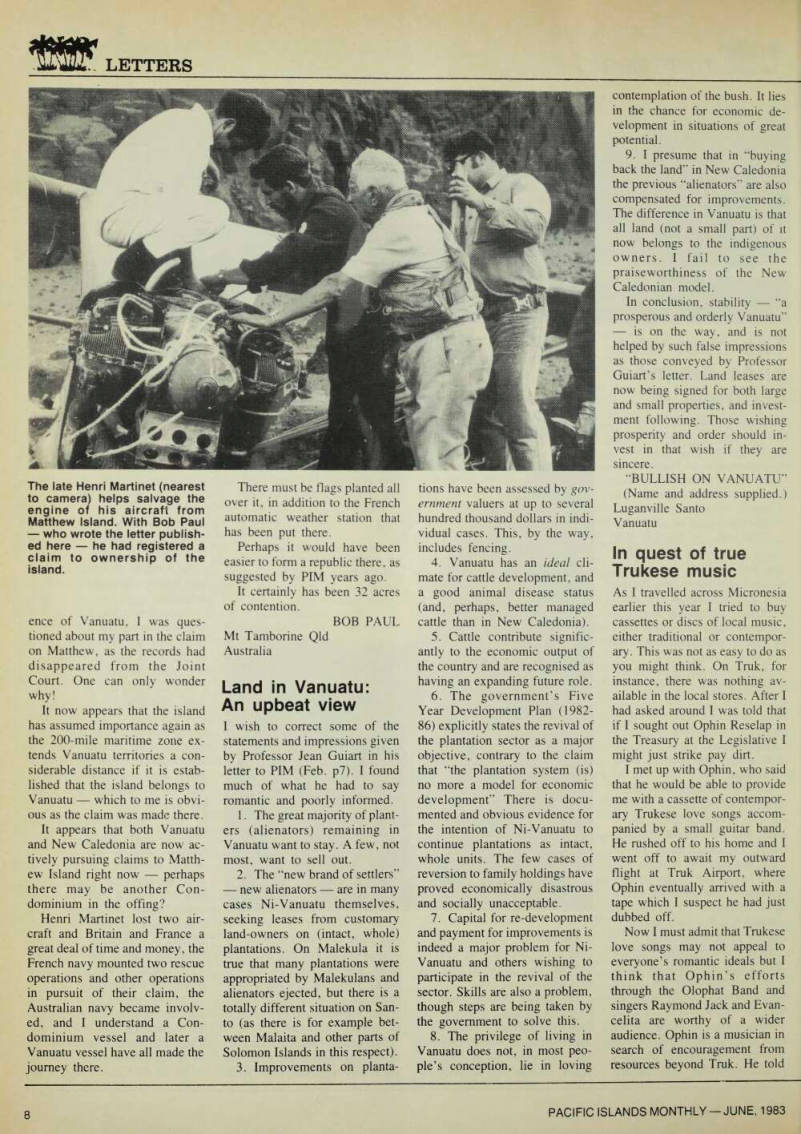
Later, Mr Martinet flew to Matthew is his Stinson L 5 light aircraft, and unfortunately se verely damaged the plane on landing. The French navy lifted him off with a helicopter. He again took off from New Caledonia in another aircraft to attempt to land on the island and repair his Stinson, but he got lost and landed in the sea, to be
picked up by the navy again.
Passing yachts reported the
aircraft on Matthew Island, so the Australian navy blew it up.
Thus, two aircraft had been lost so far on this exercise.
About the time of independ-
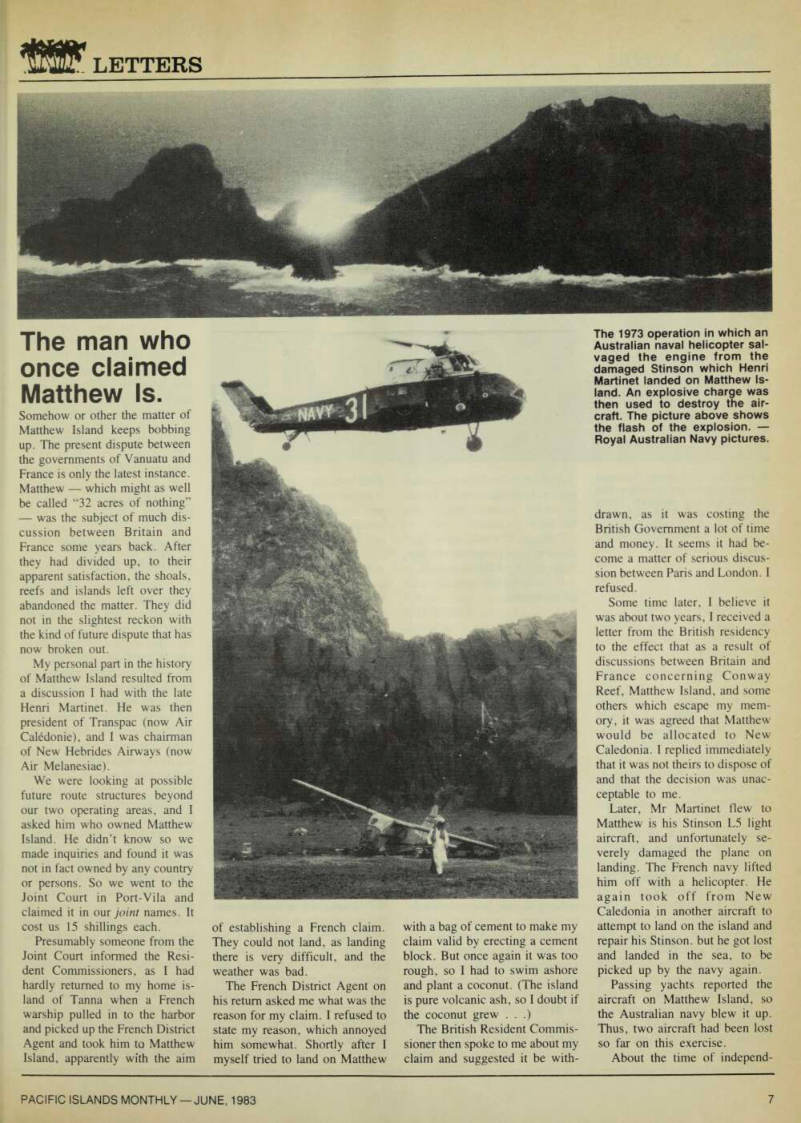
The 1973 operation in which an Australian naval helicopter sal vaged the engine from the damaged Stinson which Henri Martinet landed on Matthew Is land. An explosive charge was then used to destroy the air craft. The picture above shows the flash of the explosion. - Royal Australian Navy pictures.
ence of Vanuatu, I was ques tioned about my part in the claim on Matthew, as the records had disappeared from the Joint Court. One can only wonder why!
It now appears that the island has assumed importance again as the 200-mile maritime zone ex tends Vanuatu territories a con siderable distance if it is estab lished that the island belongs to Vanuatu which to me is obvi ous as the claim was made there.
It appears that both Vanuatu and New Caledonia are now ac tively pursuing claims to Matth ew Island right now perhaps there may be another Con dominium in the offing?
Henri Martinet lost two air craft and Britain and France a great deal of time and money, the French navy mounted two rescue operations and other operations in pursuit of their claim, the Australian navy became involv ed, and I understand a Con dominium vessel and later a Vanuatu vessel have all made the journey there.
There must be flags planted all over it, in addition to the French automatic weather station that has been put there.
Perhaps it would have been easier to form a republic there, as suggested by PIM years ago.
It certainly has been 32 acres of contention.
Bob Paul
Mt Tamborine Qld Australia
Land in Vanuatu:
An upbeat view
I wish to correct some of the statements and impressions given by Professor Jean Guiart in his letter to PIM (Feb. p 7). I found much of what he had to say romantic and poorly informed. 1. The great majority of plant ers (alienators) remaining in Vanuatu want to stay. A few, not most, want to sell out. 2. The “new brand of settlers” new alienators are in many cases Ni-Vanuatu themselves, seeking leases from customary land-owners on (intact, whole) plantations. On Malekula it is true that many plantations were appropriated by Malekulans and alienators ejected, but there is a totally different situation on San to (as there is for example bet ween Malaita and other parts of Solomon Islands in this respect). 3. Improvements on planta
tions have been assessed by gov ernment valuers at up to several hundred thousand dollars in indi vidual cases. This, by the way, includes fencing. 4. Vanuatu has an ideal cli mate for cattle development, and a good animal disease status (and, perhaps, better managed cattle than in New Caledonia). 5. Cattle contribute signific antly to the economic output of the country and are recognised as having an expanding future role. 6. The government’s Five Year Development Plan (1982- 86) explicitly states the revival of the plantation sector as a major objective, contrary to the claim that “the plantation system (is) no more a model for economic development” There is docu mented and obvious evidence for the intention of Ni-Vanuatu to continue plantations as intact, whole units. The few cases of reversion to family holdings have proved economically disastrous and socially unacceptable. 7. Capital for re-development and payment for improvements is indeed a major problem for Ni- Vanuatu and others wishing to participate in the revival of the sector. Skills are also a problem, though steps are being taken by the government to solve this. 8. The privilege of living in Vanuatu does not, in most peo ple’s conception, lie in loving
contemplation of the bush. It lies in the chance for economic de velopment in situations of great potential. 9. I presume that in “buying back the land” in New Caledonia the previous “alienators” are also compensated for improvements.
The difference in Vanuatu is that all land (not a small part) of it now belongs to the indigenous owners. I fail to see the praiseworthiness of the New Caledonian model.
In conclusion, stability “a prosperous and orderly Vanuatu” is on the way, and is not
helped by such false impressions
as those conveyed by Professor Guiart’s letter. Land leases are now being signed for both large and small properties, and invest
ment following. Those wishing
prosperity and order should in vest in that wish if they are sincere.
“Bullish On Vanuatu”
(Name and address supplied.)
Luganville Santo
Vanuatu
In quest of true
Trukese music
As I travelled across Micronesia earlier this year I tried to buy cassettes or discs of local music, either traditional or contempor ary. This was not as easy to do as you might think. On Truk, for instance, there was nothing av ailable in the local stores. After I had asked around I was told that if I sought out Ophin Reselap in the Treasury at the Legislative I might just strike pay dirt.
I met up with Ophin, who said that he would be able to provide me with a cassette of contempor ary Trukese love songs accom
panied by a small guitar band.
He rushed off to his home and I went off to await my outward flight at Truk Airport, where Ophin eventually arrived with a tape which I suspect he had just dubbed off.
Now I must admit that Trukese love songs may not appeal to everyone’s romantic ideals but I think that Ophin’s efforts through the Olophat Band and singers Raymond Jack and Evan celita are worthy of a wider audience. Ophin is a musician in search of encouragement from resources beyond Truk. He told
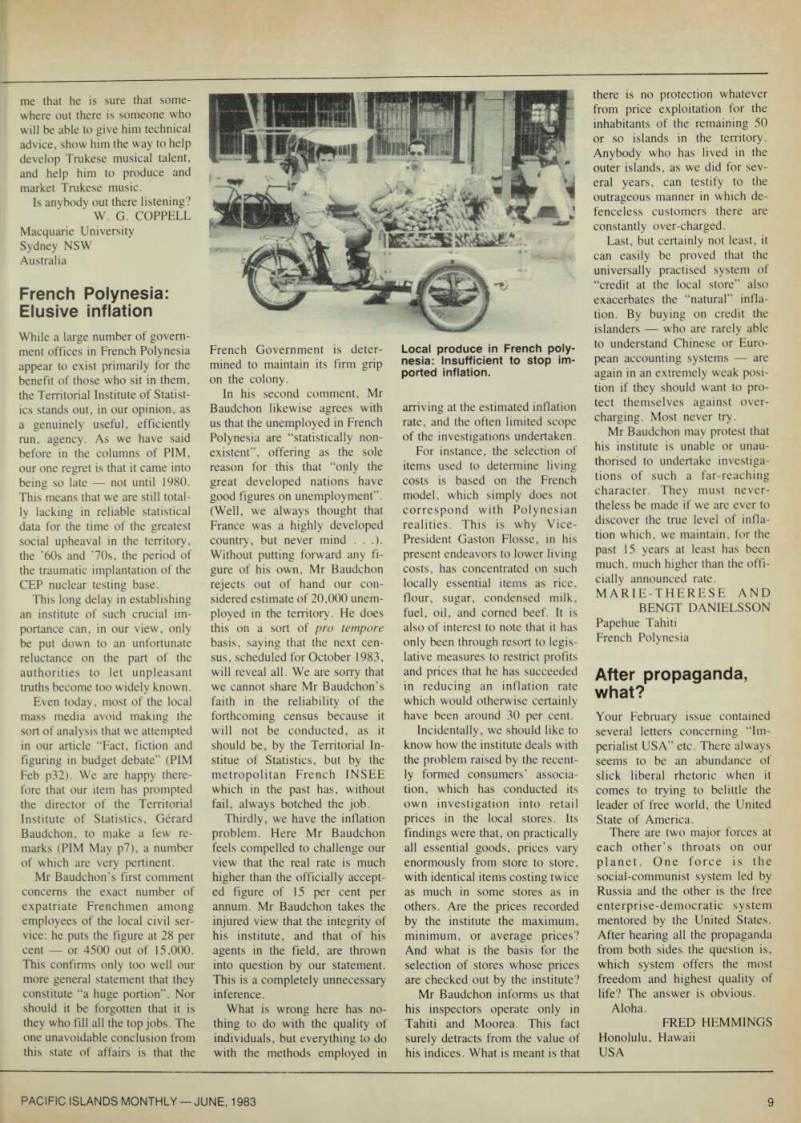
The late Henri Martinet (nearest to camera) helps salvage the engine of his aircraft from Matthew Island. With Bob Paul - who wrote the letter publish ed here - he had registered a claim to ownership of the island.
me that he is sure that some where out there is someone who will be able to give him technical advice, show him the way to help develop Trukese musical talent, and help him to produce and market Trukese music.
Is anybody out there listening?
W. G. Coppell
Macquarie University Sydney NSW Australia
French Polynesia:
Elusive inflation
While a large number of govern ment offices in French Polynesia appear to exist primarily for the benefit of those who sit in them, the Territorial Institute of Statist ics stands out, in our opinion, as a genuinely useful, efficiently run, agency. As we have said before in the columns of PIM, our one regret is that it came into being so late not until 1980.
This means that we are still total ly lacking in reliable statistical data for the time of the greatest social upheaval in the territory, the ’6os and ’7os, the period of the traumatic implantation of the CEP nuclear testing base.
This long delay in establishing an institute of such crucial im portance can, in our view, only be put down to an unfortunate reluctance on the part of the authorities to let unpleasant truths become too widely known.
Even today, most of the local mass media avoid making the sort of analysis that we attempted in our article “Fact, fiction and figuring in budget debate” (PIM Feb p 32). We are happy there fore that our item has prompted the director of the Territorial Institute of Statistics, Gerard Baudchon, to make a few re marks (PIM May p 7), a number of which are very pertinent.
Mr Baudchon’s first comment concerns the exact number of expatriate Frenchmen among employees of the local civil ser vice: he puts the figure at 28 per cent or 4500 out of 15,000.
This confirms only too well our more general statement that they constitute “a huge portion”. Nor should it be forgotten that it is they who fill all the top jobs. The one unavoidable conclusion from this state of affairs is that the
French Government is deter mined to maintain its firm grip on the colony.
In his second comment, Mr Baudchon likewise agrees with us that the unemployed in French Polynesia are “statistically non existent”, offering as the sole reason for this that “only the great developed nations have
good figures on unemployment”.
(Well, we always thought that France was a highly developed country, but never mind . . .).
Without putting forward any fi gure of his own, Mr Baudchon rejects out of hand our con sidered estimate of 20,000 unem ployed in the territory. He does this on a sort of pro tempore basis, saying that the next cen sus, scheduled for October 1983, will reveal all. We are sorry that we cannot share Mr Baudchon’s faith in the reliability of the forthcoming census because it will not be conducted, as it should be, by the Territorial In stitue of Statistics, but by the metropolitan French INSEE which in the past has, without fail, always botched the job.
Thirdly, we have the inflation problem. Here Mr Baudchon feels compelled to challenge our view that the real rate is much higher than the officially accept ed figure of 15 per cent per annum. Mr Baudchon takes the injured view that the integrity of his institute, and that of his agents in the field, are thrown into question by our statement.
This is a completely unnecessary inference.
What is wrong here has no thing to do with the quality of individuals, but everything to do with the methods employed in
arriving at the estimated inflation rate, and the often limited scope of the investigations undertaken.
For instance, the selection of items used to determine living costs is based on the French model, which simply does not
correspond with Polynesian
realities. This is why Vice- President Gaston Flosse, in his present endeavors to lower living costs, has concentrated on such locally essential items as rice, flour, sugar, condensed milk, fuel, oil, and corned beef. It is also of interest to note that it has
only been through resort to legis
lative measures to restrict profits and prices that he has succeeded in reducing an inflation rate which would otherwise certainly have been around 30 per cent.
Incidentally, we should like to know how the institute deals with the problem raised by the recent ly formed consumers’ associa tion, which has conducted its own investigation into retail prices in the local stores. Its findings were that, on practically all essential goods, prices vary enormously from store to store, with identical items costing twice as much in some stores as in others. Are the prices recorded by the institute the maximum, minimum, or average prices?
And what is the basis for the selection of stores whose prices are checked out by the institute?
Mr Baudchon informs us that his inspectors operate only in Tahiti and Moorea. This fact surely detracts from the value of his indices. What is meant is that
there is no protection whatever from price exploitation for the inhabitants of the remaining 50 or so islands in the territory.
Anybody who has lived in the outer islands, as we did for sev eral years, can testify to the outrageous manner in which de fenceless customers there are
constantly over-charged.
Last, but certainly not least, it can easily be proved that the
universally practised system of
“credit at the local store” also exacerbates the “natural” infla tion. By buying on credit the islanders who are rarely able to understand Chinese or Euro pean accounting systems are
again in an extremely weak posi
tion if they should want to pro tect themselves against over charging. Most never try.
Mr Baudchon may protest that his institute is unable or unau thorised to undertake investiga tions of such a far-reaching character. They must never theless be made if we are ever to discover the true level of infla tion which, we maintain, for the past 15 years at least has been much, much higher than the offi cially announced rate.
Marie-Therese And
Bengt Danielsson
Papehue Tahiti French Polynesia
After propaganda,
what?
Your February issue contained several letters concerning “Im perialist USA” etc. There always seems to be an abundance of slick liberal rhetoric when it comes to trying to belittle the leader of free world, the United State of America.
There are two major forces at each other’s throats on our planet. One force is the social-communist system led by Russia and the other is the free
enterprise-democratic system
mentored by the United States.
After hearing all the propaganda from both sides the question is, which system offers the most freedom and highest quality of life? The answer is obvious.
Aloha.
Fred Hemmings
Honolulu, Hawaii
Usa
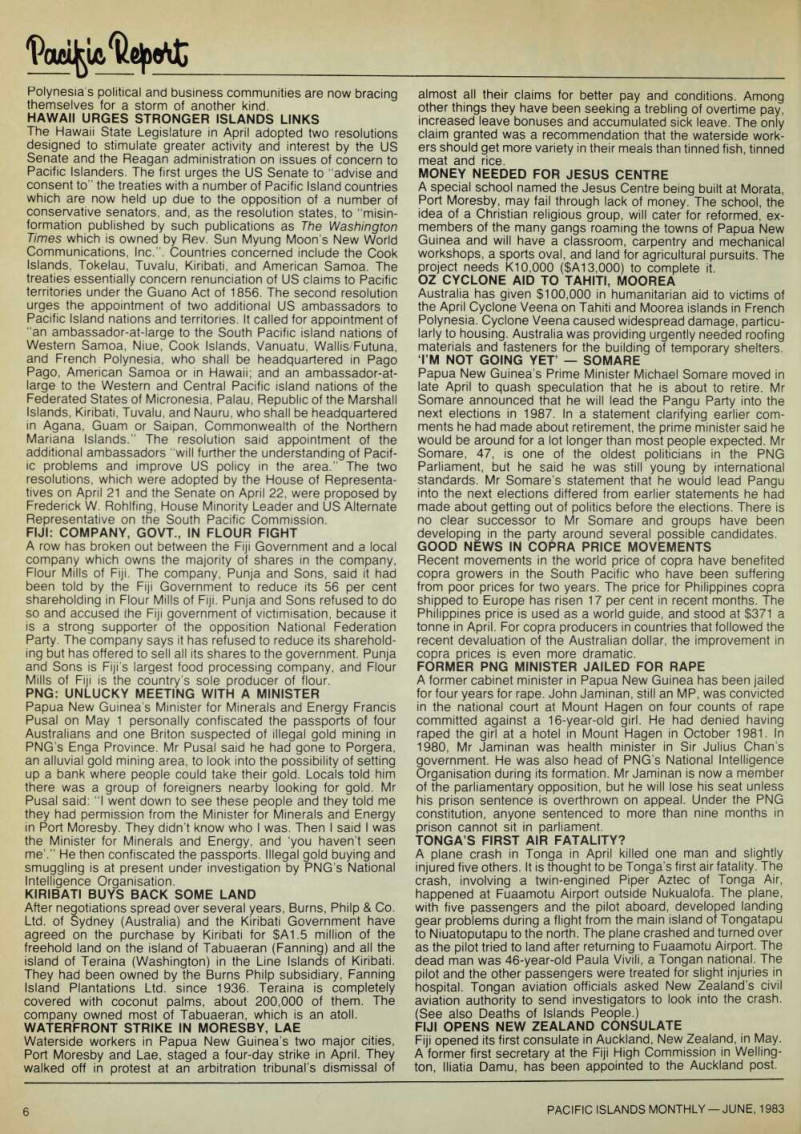
Local produce in French Poly nesia: Insufficient to stop im ported inflation.
Advertisements & other items, p. 8 (1 item)
Letters
the gauntlet
Politics Of Leadership
Vanuatu leadership: President Sokomanu throws down the gauntlet
Signs abounded as the June con gress of Vanuatu’s ruling Vanuaaku Party came closer that the congress could not only pro duce new divisions in the party’s ranks, but fundamental changes in the country’s political course.
The months of March-April saw two unsuccessful parliamen tary motions of no-confidence in the Prime Minister Father Walter Lini.
But, backed as they were by disgruntled former Vanuaaku Party ministers who had lost their jobs, and by the formal par liamentary opposition, it is perhaps easy to write them off as having no great significance.
Not so easily written off, how ever, is the position now taken by President Ati George Sokomanu in relation to the Lini government.
In a wide-ranging interview granted to Australian journalist Colleen Ryan in Port-Vila in April President Sokomanu clear
ly aligned himself with many of the government’s critics. He also made it clear he regards himself as the alternative prime minister to Father Lini.
The former George Kalkoa, a founding member of the Vanuaaku Party, a senior public servant in the British administra tion of the old condominium, and a political figure who enjoys widespread public support, would be a formidable challenger if a challenge to the leadership of Walter Lini were in fact to occur.
In the interview, published in the Sydney-based weekly The National Times (April 8-14), President Sokomanu made the following points: • On the latest no-confidence motion against Prime Minister Lini: “He has brought the whole thing on himself. There has not been proper consultation with the executive. He is not following party rules.
“The whole problem has
come because of lack of ad ministration and know-how at the top. It is on the executive side the Vanuaaku Party has no proper co-ordination.” • On advisers employed by various ministers: “Most minis ters have advisers whom I, as an old hand at administration, do
not consider suitable. We should have kept the expatriates we had before independence to work for a couple of years with us and train.
“Soon after independence most of the expatriates left or were replaced this was very sad I opposed it bitterly. This
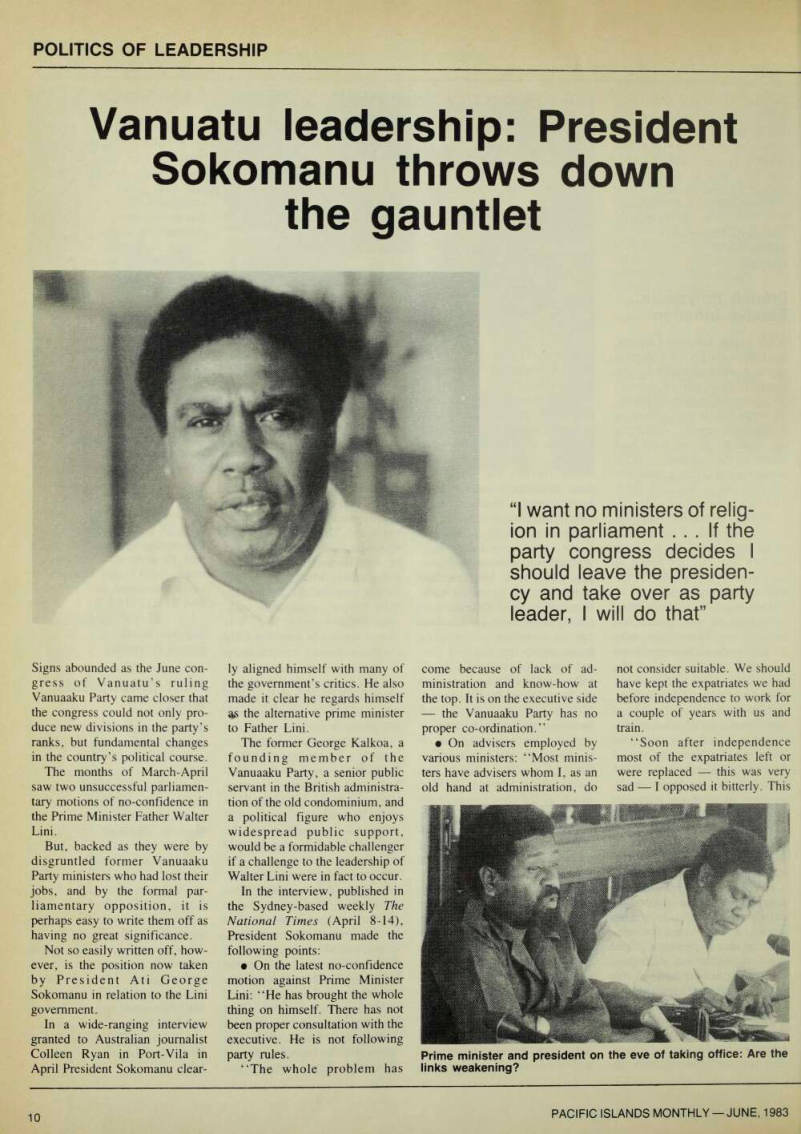
“I want no ministers of relig ion in parliament ... If the party congress decides I should leave the presiden cy and take over as party leader, I will do that”
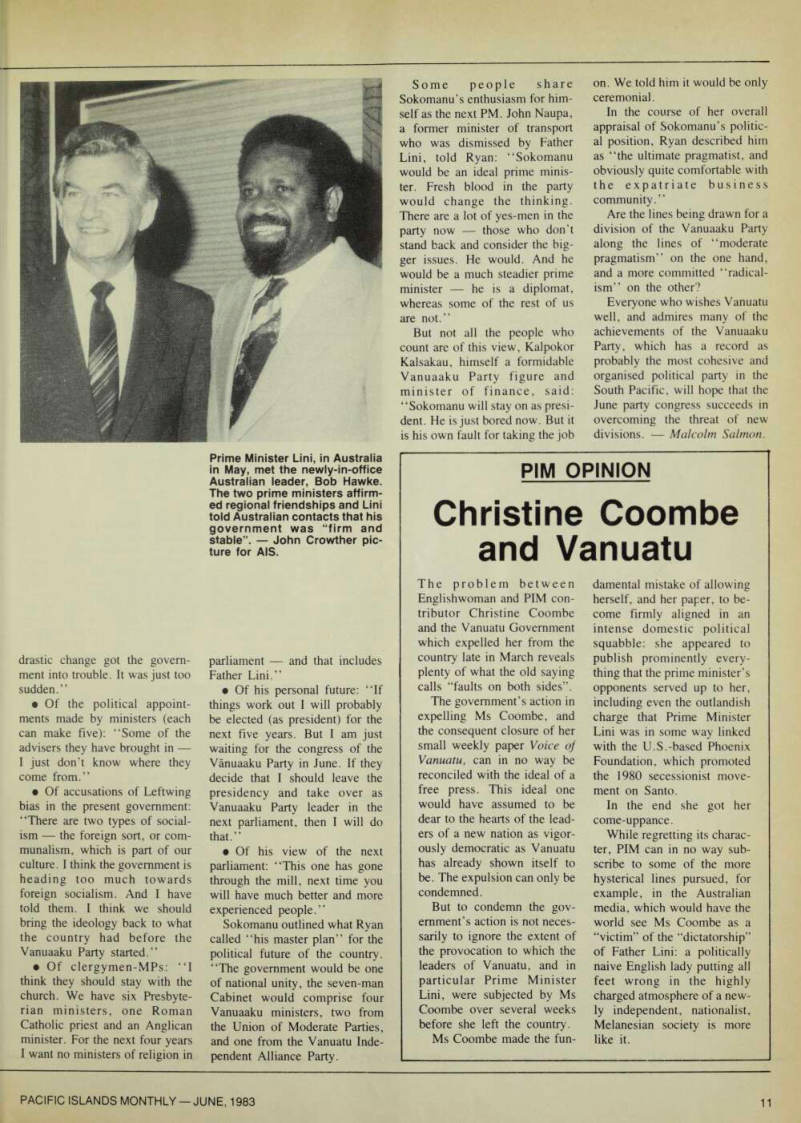
Prime minister and president on the eve of taking office: Are the links weakening?
drastic change got the govern ment into trouble. It was just too sudden.” • Of the political appoint ments made by ministers (each can make five): “Some of the advisers they have brought in I just don’t know where they come from.” • Of accusations of Leftwing bias in the present government; “There are two types of social ism the foreign sort, or com munalism, which is part of our culture. I think the government is heading too much towards foreign socialism. And I have told them. I think we should bring the ideology back to what the country had before the Vanuaaku Party started.” • Of clergymen-MPs: “I think they should stay with the church. We have six Presbyte rian ministers, one Roman Catholic priest and an Anglican minister. For the next four years I want no ministers of religion in
parliament and that includes Father Lini.” • Of his personal future: “If things work out I will probably be elected (as president) for the next five years. But I am just waiting for the congress of the Vanuaaku Party in June. If they decide that I should leave the presidency and take over as Vanuaaku Party leader in the next parliament, then I will do that.” • Of his view of the next parliament; “This one has gone through the mill, next time you will have much better and more experienced people.”
Sokomanu outlined what Ryan called “his master plan” for the political future of the country.
“The government would be one of national unity, the seven-man Cabinet would comprise four Vanuaaku ministers, two from the Union of Moderate Parties, and one from the Vanuatu Inde pendent Alliance Party.
Some people share Sokomanu’s enthusiasm for him self as the next PM. John Naupa, a former minister of transport who was dismissed by Father Lini, told Ryan; “Sokomanu would be an ideal prime minis ter. Fresh blood in the party would change the thinking.
There are a lot of yes-men in the party now those who don’t stand back and consider the big ger issues. He would. And he would be a much steadier prime minister he is a diplomat, whereas some of the rest of us are not.”
But not all the people who count are of this view, Kalpokor Kalsakau, himself a formidable Vanuaaku Party figure and minister of finance, said: “Sokomanu will stay on as presi dent. He is just bored now. But it is his own fault for taking the job
on. We told him it would be only ceremonial.
In the course of her overall
appraisal of Sokomanu’s politic
al position, Ryan described him as “the ultimate pragmatist, and
obviously quite comfortable with
the expatriate business
community.”
Are the lines being drawn for a division of the Vanuaaku Party along the lines of “moderate pragmatism” on the one hand, and a more committed “radical ism” on the other?
Everyone who wishes Vanuatu well, and admires many of the achievements of the Vanuaaku Party, which has a record as probably the most cohesive and organised political party in the South Pacific, will hope that the June party congress succeeds in overcoming the threat of new
divisions.
Malcolm Salmon.
Prime Minister Lini, in Australia in May, met the newly-in-office Australian leader, Bob Hawke.
The two prime ministers affirm ed regional friendships and Lini told Australian contacts that his government was “firm and
stable”. - John Crowther pic
ture for AIS.
Christine Coombe
Pim Opinion
Christine Coombe and Vanuatu
The problem between Englishwoman and PIM con tributor Christine Coombe and the Vanuatu Government which expelled her from the country late in March reveals plenty of what the old saying calls “faults on both sides”.
The government’s action in expelling Ms Coombe, and the consequent closure of her small weekly paper Voice of Vanuatu, can in no way be reconciled with the ideal of a free press. This ideal one would have assumed to be dear to the hearts of the lead ers of a new nation as vigor ously democratic as Vanuatu has already shown itself to be. The expulsion can only be condemned.
But to condemn the gov ernment’s action is not neces sarily to ignore the extent of the provocation to which the leaders of Vanuatu, and in particular Prime Minister Lini, were subjected by Ms Coombe over several weeks before she left the country.
Ms Coombe made the fun
damental mistake of allowing herself, and her paper, to be come firmly aligned in an intense domestic political squabble: she appeared to publish prominently every thing that the prime minister’s opponents served up to her, including even the outlandish charge that Prime Minister Lini was in some way linked with the U.S.-based Phoenix Foundation, which promoted the 1980 secessionist move ment on Santo.
In the end she got her come-uppance.
While regretting its charac ter, PIM can in no way sub scribe to some of the more hysterical lines pursued, for example, in the Australian media, which would have the world see Ms Coombe as a “victim” of the “dictatorship” of Father Lini: a politically naive English lady putting all feet wrong in the highly charged atmosphere of a new ly independent, nationalist, Melanesian society is more like it.
first government

Cook Islands
Henry the Second’s first government
Geoffrey Henry, prime minister and a successor to Albert Henry, has chosen his cabinet to govern the Cook Islands. For the first time a woman who ear lier threatened to resign holds one of the positions.
Geoffrey Arama Henry, 42, the new Cook Islands Prime Minis ter, sees the world trend to economic recession as a signific ant factor in his programs for government. Speaking soon after he was sworn in he said that the Cook Islands could not be isolated from the world trend, and there was “sweet little” that a country of its size could do to alter the situation.
This made the task facing his new government that much more difficult, Mr Henry said.
Mr Henry has created a seven member cabinet, which for the first time in the Cook Islands includes a woman. She is Mrs Fanaura Kingstone, 42, who will
be postmistress general and
minister for internal affairs. Mrs
Kingstone is also the first mem ber of parliament to represent the controversial newly-created elec torate: known as the Overseas electorate. It was created so that Cook Islanders living outside the country they are mainly in New Zealand could vote for and obtain a member of parlia ment to represent them at home.
However Mrs Kingstone’s election to the seat is not without its own controversy. Earlier she had stated that her only reason in standing for the seat was to abol ish it because she believed that the parliamentary affairs of the Cook Islands were matters only for Cook Islanders who lived in their own country. If she were elected she could be expected to resign “the very next day” she
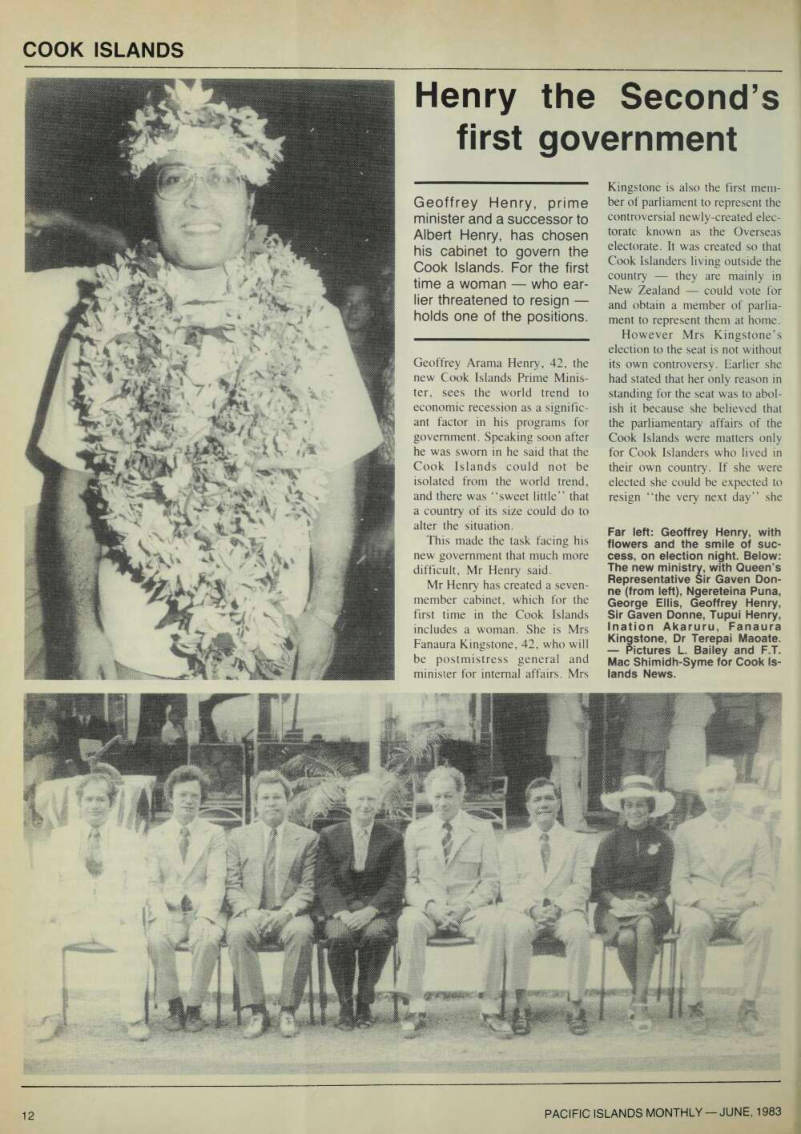
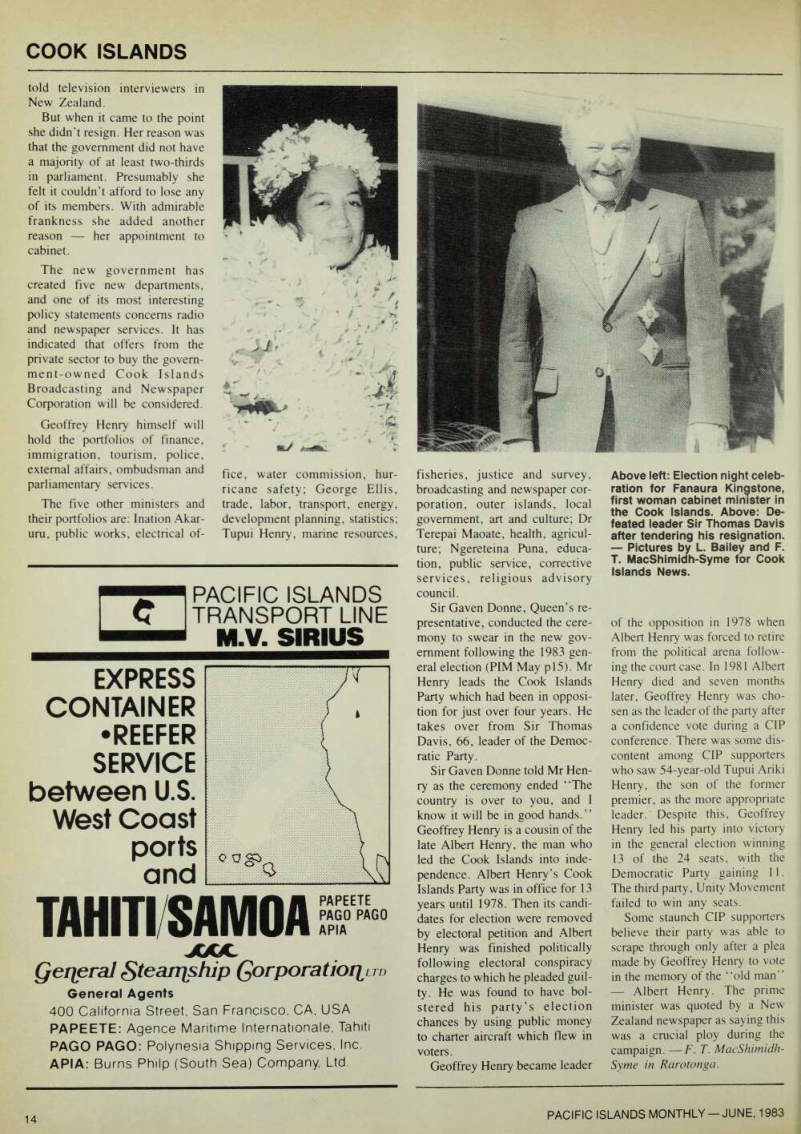
Far left: Geoffrey Henry, with flowers and the smile of suc cess, on election night. Below: The new ministry, with Queen’s Representative Sir Gaven Don ne (from left), Ngereteina Puna,
George Ellis, Geoffrey Henry,
Sir Gaven Donne, Tupui Henry, Ination Akaruru, Fanaura
Kingstone, Dr Terepai Maoate.
- Pictures L. Bailey and F.T.
Mac Shimidh-Syme for Cook Is lands News.
told television interviewers in New Zealand.
But when it came to the point she didn't resign. Her reason was that the government did not have a majority of at least two-thirds in parliament. Presumably she felt it couldn’t afford to lose any of its members. With admirable frankness she added another reason her appointment to cabinet.
The new government has created five new departments, and one of its most interesting policy statements concerns radio and newspaper services. It has indicated that offers from the private sector to buy the govem ment-owned Cook Islands Broadcasting and Newspaper Corporation will be considered.
Geoffrey Henry himself will hold the portfolios of finance, immigration, tourism, police, external affairs, ombudsman and parliamentary services.
The five other ministers and their portfolios are; Ination Akar uru, public works, electrical of-
fice, water commission, hur ricane safety; George Ellis, trade, labor, transport, energy, development planning, statistics; Tupui Henry, marine resources,
fisheries, justice and survey, broadcasting and newspaper cor poration, outer islands, local government, art and culture; Dr Terepai Maoate, health, agricul ture; Ngereteina Puna, educa tion, public service, corrective services, religious advisory council.
Sir Gaven Donne, Queen’s re presentative, conducted the cere mony to swear in the new gov ernment following the 1983 gen eral election (PIM May pi 5). Mr Henry leads the Cook Islands Party which had been in opposi tion for just over four years. He takes over from Sir Thomas Davis, 66, leader of the Democ ratic Party.
Sir Gaven Donne told Mr Hen ry as the ceremony ended “The country is over to you, and I know it will be in good hands.”
Geoffrey Henry is a cousin of the late Albert Henry, the man who led the Cook Islands into inde pendence. Albert Henry’s Cook Islands Party was in office for 13 years until 1978. Then its candi dates for election were removed by electoral petition and Albert Henry was finished politically following electoral conspiracy charges to which he pleaded guil ty. He was found to have bol stered his party’s election chances by using public money to charter aircraft which flew in voters.
Geoffrey Henry became leader
of the opposition in 1978 when Albert Henry was forced to retire from the political arena follow ing the court case. In 1981 Albert Henry died and seven months later, Geoffrey Henry was cho sen as the leader of the party after a confidence vote during a CIP conference. There was some dis content among CIP supporters who saw 54-year-old Tupui Ariki Henry, the son of the former premier, as the more appropriate
leader. Despite this, Geoffrey
Henry led his party into victory in the general election winning 13 of the 24 seats, with the
Democratic Party gaining 11.
The third party. Unity Movement failed to win any seats.
Some staunch CIP supporters believe their party was able to
scrape through only after a plea
made by Geoffrey Henry to vote in the memory of the “old man”
Albert Henry. The prime minister was quoted by a New Zealand newspaper as saying this was a crucial ploy during the
campaign.
F. T. MacShimidh-
Syme in Rarotonga.
Above left: Election night celeb ration for Fanaura Kingstone, first woman cabinet minister in the Cook Islands. Above: De feated leader Sir Thomas Davis after tendering his resignation. - Pictures by L. Bailey and F.
T. MacShimidh-Syme for Cook Islands News.
Advertisements & other items, pp. 13-14 (1 item)
There's
Why
gamble
on the
unknown?
So-called “new-technology” twin turboprops in the 40/50seat category may look tempting on paper but there is a large and risky element of the unknown in any aircraft unproven in operation. Super 748 costs can be substantiated in detail by nearly 4 million hours of operation in some 50 countries with earlier 748 versions with the same basic airframe/engine combination - and buying the Super 748 today will unquestionably ensure lower seat-mile costs than any comparable new-technology competitor coming into service in the mid-1980s.
So, with the escalation in first costs inevitable during the development of any new aircraft, what advantage could purchasers expect by waiting years for one of these unproven turboprops? Wasted time is wasted money when you could be profiting from Super 748’s proven operating and maintenance costs. When Super 748 has flight-deck technology comparable to that of any “new-technology” turboprop, plus proven passenger appeal. And when Super 748 is backed by worldwide support facilities which have proven their excellence over 20 years of operation.
Why gamble on the unknown when there is a known winner?
Super 748 the known facts
There's
a known
■ cost per seat-nautical mile, 10.65 cents. ■ maintenance requirements of less than 1 man-hour per flying hour. ■ environmental noise levels already well below all existing and proposed international noise standards. ■ outstanding airfield performance. ■ pressurised and air-conditioned cabin with reclining seats, ample leg room, overhead luggage bins, full cabinservice amenities and 6.6 cu ft of baggage space per passenger. ■ ability to operate multi-stop sectors without refuelling. /n ft a nart&o of aonoaoaco fyf-o&mmmos British Aerospace PLC, Kingston-upon-Thames, England /W /i
SFEI
PACIFIC ISLANDS
TRANSPORT LINE
M.V. SIRIUS
TAHITI/SAMOA
PAPEETE
PAGO PAGO
APIA
Qeqeral Stearqship (Corporation
General Agents 400 California Street, San Francisco, CA, USA PAPEETE: Agence Maritime Internationale, Tahiti PAGO PAGO: Polynesia Shipping Services, Inc.
APIA; Burns Philp (South Sea) Company, Ltd.
LTD
Algiers...

The Month
The word from Algiers...
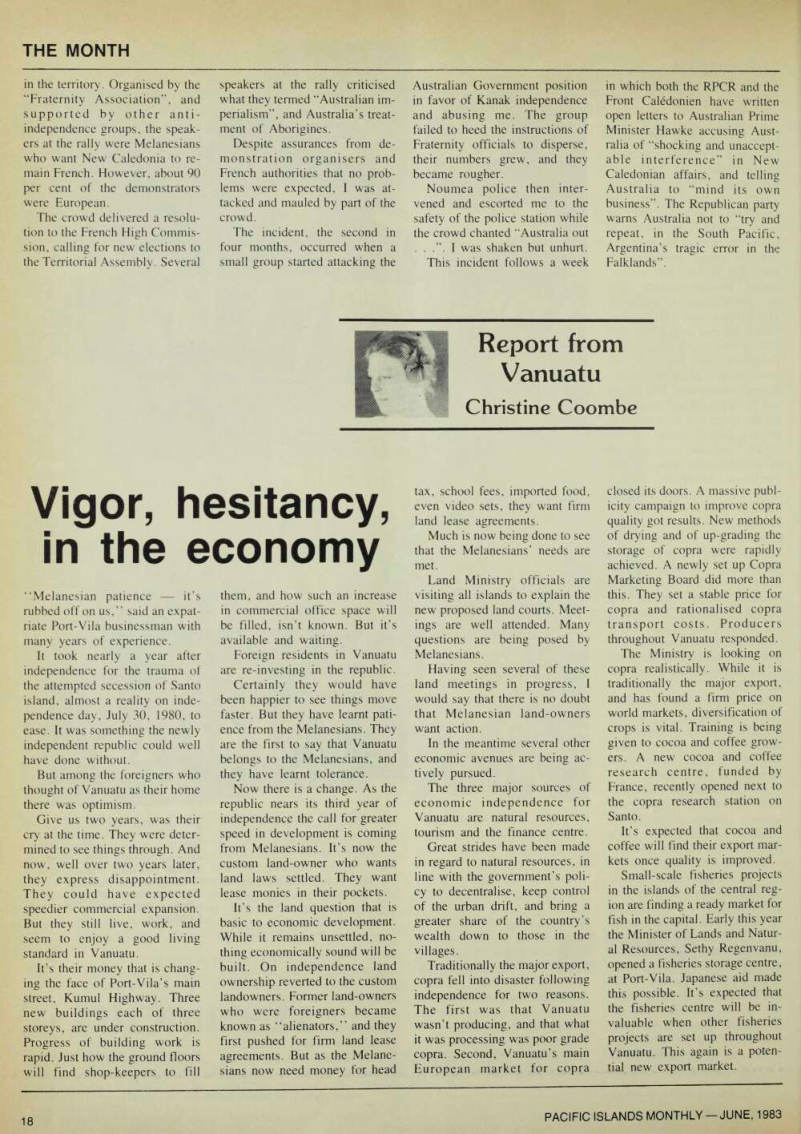
“Mitterrand say clearly whether Kanak independence is to be found at the point of a gun.”
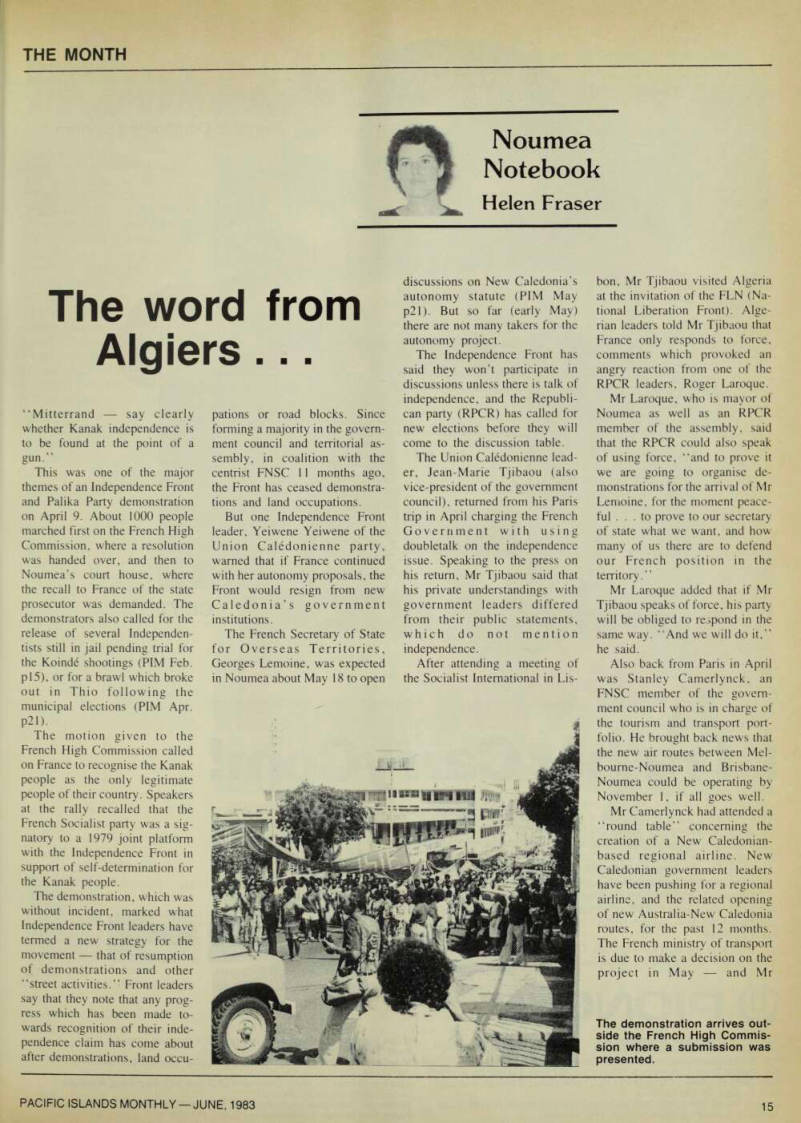
This was one of the major themes of an Independence Front and Palika Party demonstration on April 9. About 1000 people marched first on the French High Commission, where a resolution was handed over, and then to Noumea’s court house, where the recall to France of the state prosecutor was demanded. The demonstrators also called for the release of several Independen tists still in jail pending trial for the Koinde shootings (PIM Feb. pi 5), or for a brawl which broke out in Thio following the municipal elections (PIM Apr. p2l).
The motion given to the French High Commission called on France to recognise the Kanak people as the only legitimate people of their country. Speakers at the rally recalled that the French Socialist party was a sig natory to a 1979 joint platform with the Independence Front in support of self-determination for the Kanak people.
The demonstration, which was without incident, marked what Independence Front leaders have termed a new strategy for the movement that of resumption of demonstrations and other “street activities.” Front leaders say that they note that any prog ress which has been made to wards recognition of their inde pendence claim has come about after demonstrations, land occu
pations or road blocks. Since forming a majority in the govern ment council and territorial as sembly, in coalition with the centrist FNSC 11 months ago, the Front has ceased demonstra tions and land occupations.
But one Independence Front leader, Yeiwene Yeiwene of the Union Caledonienne party, warned that if France continued with her autonomy proposals, the Front would resign from new Caledonia’s government institutions.
The French Secretary of State for Overseas Territories, Georges Lemoine, was expected in Noumea about May 18 to open
discussions on New Caledonia’s autonomy statute (PIM May p2l). But so far (early May) there are not many takers for the autonomy project.
The Independence Front has said they won’t participate in discussions unless there is talk of independence, and the Republi can party (RPCR) has called for new elections before they will come to the discussion table.
The Union Caledonienne lead er, Jean-Marie Tjibaou (also vice-president of the government council), returned from his Paris trip in April charging the French Government with using doubletalk on the independence issue. Speaking to the press on his return, Mr Tjibaou said that his private understandings with government leaders differed from their public statements, which do not mention independence.
After attending a meeting of the Socialist International in Lis-
bon, Mr Tjibaou visited Algeria at the invitation of the FLN (Na tional Liberation Front). Alge rian leaders told Mr Tjibaou that France only responds to force, comments which provoked an angry reaction from one of the RPCR leaders, Roger Laroque.
Mr Laroque, who is mayor of Noumea as well as an RPCR member of the assembly, said that the RPCR could also speak of using force, “and to prove it we are going to organise de monstrations for the arrival of Mr Lemoine, for the moment peace ful .. . to prove to our secretary of state what we want, and how many of us there are to defend our French position in the
territory.”
Mr Laroque added that if Mr Tjibaou speaks of force, his party will be obliged to respond in the same way. “And we will do it,” he said.
Also back from Paris in April
was Stanley Camerlynck, an
FNSC member of the govern ment council who is in charge of the tourism and transport port folio. He brought back news that the new air routes between Mel bourne-Noumea and Brisbane- Noumea could be operating by November 1, if all goes well.
Mr Camerlynck had attended a “round table” concerning the creation of a New Caledonian based regional airline. New Caledonian government leaders have been pushing for a regional airline, and the related opening of new Australia-New Caledonia routes, for the past 12 months.
The French ministry of transport is due to make a decision on the project in May and Mr
Noumea Notebook Helen Fraser
The demonstration arrives out side the French High Commis sion where a submission was presented.
Camerlynck said he was “very
optimistic.’’
In a related development it has been announced that New Caledonia is to have the South Pacific’s biggest international re sort project. To be known as “Tiare’’ the resort is due to be completed by the end of 1985, on New Caledonia’s west coast 30 kilometres north of Noumea. The five-star resort complex will have 600 rooms, golf course, casino, marina, country club, etc., and will cover 150 hectares.
The project has 50 per cent French backing and 50 per cent foreign investment (Australian, Hongkong, etc), and will cost approximately 5U.5.35 million.
During construction, 800 people will be employed and after open ing the resort will have 600 em ployees, largely locals.
Late April saw the opening of the administrative session of the Territorial Assembly. French High Commissioner Jacques
Roynette delivered the opening
address, describing the French Government’s autonomy plans “as a necessary step in the histor ical process”. The assembly then elected its new bureau with Jean- Pierre Aifa (FNSC) beating Jean Deques (RPCR) by 23 votes to 12. Mr Aifa, who is also mayor of Bourail, was elected assembly president (speaker) on the votes of the Independence Front and the FNSC.
Independence Front members then won five of the bureau positions, with the sixth going to Mme Marie-Paule Serve, who is one of the three non-aligned members of the assembly.
The Independence Front ma jority in the assembly bureau was
strongly denounced by RPCR
President Jacques Lafleur. In a statement from Paris, where he is a deputy to the National Assem bly, Mr Lafleur called for new elections to the assembly. He described the assembly’s election of officers as a “travesty of de mocracy” and called for peaceful demonstration in New Caledonia to show “the desire of the territ ory to remain French”. The RPCR claim the IF-FNSC coali tion in the assembly and the government council is not repre sentative of majority views since it has yet to be tested in an election.
More than 400 people joined in the USTKE (Union of Kanak and Exploited Workers) May Day march. The union, joined by leaders of the Independence Front parties, the Exploited Kanak Women’s Group, the Pierre Declercq Memorial Com mittee and the League of Human Rights marched from downtown Noumea to Magenta Beach.
There they heard speeches, underlining the common aims of workers’ movements and the struggle for independence.
Jose Osaba, a member of the Paris-based Catholic Committee Against Hunger and for Develop
ment (CCFD) arrived in New Caledonia in late April as part of a CCFD mission in the Asia- Pacific region. But his arrival was marred by a one-hour search
and political interrogation at
Tontouta Airport.
Mr Osaba’s correspondence,
photographs, working docu
ments, bankbooks and personal affairs were closely scrutinised by an inspector, who gave him a false name. Mr Osaba was ac cused of having contact with agitators against France and of giving them money. He has com plained to the French authorities, demanding to know who was
behind the operation, which was of a type rarely seen in New Caledonia.
On Saturday May 7, more than
7000 people marched through
Noumea to show their opposition to IF demands for independence
The banner above, displayed outside the Noumea court building, asks President Mitter rand to indicate clearly whether Kanak socialist independence is to be at the point of a gun.
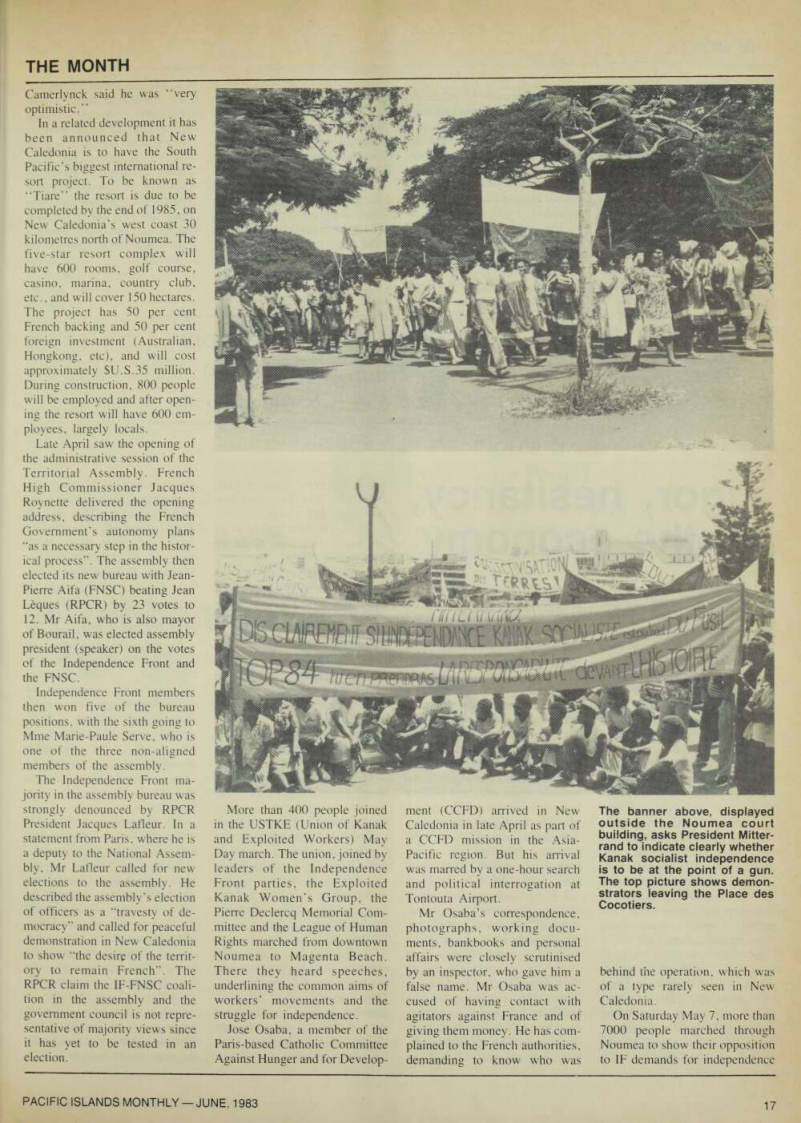
The top picture shows demon strators leaving the Place des Cocotiers.
in the territory. Organised by the “Fraternity Association”, and supported by other anti independence groups, the speak ers at the rally were Melanesians who want New Caledonia to re main French. However, about 90 per cent of the demonstrators were European.
The crowd delivered a resolu tion to the French High Commis sion, calling for new elections to the Territorial Assembly. Several
speakers at the rally criticised what they termed “Australian im perialism”, and Australia’s treat ment of Aborigines.
Despite assurances from de monstration organisers and French authorities that no prob lems were expected, I was at tacked and mauled by part of the crowd.
The incident, the second in four months, occurred when a small group started attacking the
Australian Government position in favor of Kanak independence and abusing me. The group failed to heed the instructions of
Fraternity officials to disperse,
their numbers grew, and they became rougher.
Noumea police then inter vened and escorted me to the safety of the police station while the crowd chanted “Australia out . . I was shaken but unhurt.
This incident follows a week
in which both the RPCR and the Front Caledonien have written open letters to Australian Prime Minister Hawke accusing Aust ralia of “shocking and unaccept able interference” in New Caledonian affairs, and telling Australia to “mind its own business”. The Republican party warns Australia not to “try and repeat, in the South Pacific, Argentina’s tragic error in the Falklands”.
Advertisements & other items, p. 16 (1 item)
Cawticm
Portable Component System
- *» I I ! I I I
«Jlf I I I
CK-7T
I’d rather Carry Com!
Carry Com packs like a portable, but unpacks into four individual components. It’s a true component system, just like a home hi-fi.
Carry it everywhere and enjoy hi-fi sound with sweet highs and rich lows. The sound is bigger and deeper because the entire front of each speaker is a “Flat Woofer” of a unique Pioneer design.
Carry Com’s stereo FM/MW/SW tuner has quartz-PLL synthesizer accuracy with computer-like preset tuning, even a digital timer and frequency readout. The amp has its own 5-band graphic equalizer to let you adjust the sound to your liking. Cassette taping is fun and easy with Skip-Search, Dolby* noise reduction, metal-tape play and lots more.
Home or away, it’s Carry Com. The only one to play. * ‘Dolby’ and the double-D symbol are trademarks of Dolby Laboratories Licensing Corporation.
(!,!) PIONEER*
For further information, please contact: Australia: Pioneer Electronics Australia Pty. Ltd., P.O. Box 295, Mordialloc, Victoria, 3195 Tel: 580-9911 Fiji Islands: Brijlal & Company,G.P.O. Box No. 362, Suva, Fiji Islands Tel: 22258 New Zealand: Monaco Distributors Ltd., 2 Poland Road, Glenfield, Auckland, New Zealand Tel: (09) 444-9144 Norfolk Island: Burns Philp (Norfolk Island) Ltd., P.O. Box 21, Norfolk Island Vanuatu: Burns Philp (Vanuatu) Ltd., Vila, Vanuatu
CK-7T
Nauru Island: Jacob Enterprises, P.O. Box No. 4, Republic of Nauru Tahiti: Tahiti Hi-Fi, P.O. Box 848, Papeete, Tahiti New Caledonia: Menard Pacifique Sari, B.P. 3899, Noumea, New Caledonia Tel; 27-62.23 American Samoa: Transpac Corporation, P.O. Box 1477, Pago Pago, American Samoa 96799 Tel: 633-5224 Rarotonga; South Seas International Ltd., P.O. Box 49, Rarotonga, Cook Islands Tel: 2327 Papua New Guinea: Bali Merchants Pty. Ltd., P.O. Box 6103, Boroko Tel: 254887
Vigor, hesitancy,
in the economy
“Melanesian patience it’s rubbed off on us,” said an expat riate Port-Vila businessman with many years of experience.
It took nearly a year after independence for the trauma of the attempted secession of Santo island, almost a reality on inde pendence day, July 30, 1980, to ease. It was something the newly independent republic could well have done without.
But among the foreigners who thought of Vanuatu as their home there was optimism.
Give us two years, was their cry at the time. They were deter mined to see things through. And now, well over two years later, they express disappointment.
They could have expected speedier commercial expansion.
But they still live, work, and seem to enjoy a good living standard in Vanuatu.
It’s their money that is chang ing the face of Port-Vila’s main street, Kumul Highway. Three new buildings each of three storeys, are under construction.
Progress of building work is rapid. Just how the ground floors will find shop-keepers to fill
them, and how such an increase in commercial office space will be filled, isn’t known. But it’s available and waiting.
Foreign residents in Vanuatu are re-investing in the republic.
Certainly they would have been happier to see things move faster. But they have leamt pati ence from the Melanesians. They are the first to say that Vanuatu belongs to the Melanesians, and they have leamt tolerance.
Now there is a change. As the republic nears its third year of independence the call for greater speed in development is coming from Melanesians. It’s now the custom land-owner who wants land laws settled. They want lease monies in their pockets.
It’s the land question that is basic to economic development.
While it remains unsettled, no thing economically sound will be built. On independence land ownership reverted to the custom landowners. Former land-owners who were foreigners became known as “alienators,” and they first pushed for firm land lease agreements. But as the Melane sians now need money for head
tax, school fees, imported food, even video sets, they want firm land lease agreements.
Much is now being done to see that the Melanesians’ needs are met.
Land Ministry officials are visiting all islands to explain the new proposed land courts. Meet ings are well attended. Many questions are being posed by Melanesians.
Having seen several of these land meetings in progress, I would say that there is no doubt that Melanesian land-owners want action.
In the meantime several other economic avenues are being ac
tively pursued.
The three major sources of economic independence for Vanuatu are natural resources, tourism and the finance centre.
Great strides have been made in regard to natural resources, in line with the government’s poli cy to decentralise, keep control of the urban drift, and bring a greater share of the country’s wealth down to those in the
villages.
Traditionally the major export,
copra fell into disaster following independence for two reasons.
The first was that Vanuatu wasn't producing, and that what it was processing was poor grade copra. Second, Vanuatu’s main European market for copra
closed its doors. A massive publ icity campaign to improve copra quality got results. New methods of drying and of up-grading the storage of copra were rapidly achieved. A newly set up Copra Marketing Board did more than this. They set a stable price for copra and rationalised copra transport costs. Producers throughout Vanuatu responded.
The Ministry is looking on copra realistically. While it is traditionally the major export, and has found a firm price on world markets, diversification of crops is vital. Training is being given to cocoa and coffee grow ers. A new cocoa and coffee research centre, funded by France, recently opened next to the copra research station on Santo.
It’s expected that cocoa and coffee will find their export mar kets once quality is improved.
Small-scale fisheries projects in the islands of the central reg ion are finding a ready market for fish in the capital. Early this year the Minister of Lands and Natur al Resources, Sethy Regenvanu, opened a fisheries storage centre, at Port-Vila. Japanese aid made this possible. It’s expected that the fisheries centre will be in valuable when other fisheries projects are set up throughout Vanuatu. This again is a poten tial new export market.
Report from Vanuatu Christine Coombe
Forestry is a long-term project. It’s been started on several islands where the fertile land is expected eventually to provide timber both for the republic’s needs and for export.
Attention to tourism from govemment is strong. It’s certainly providing income, and since independence there is a much greater participation in the industry by Melanesians. What’s holding Melanesians back from tourism is the lack of training. Government is offering training to give confidence to the naturally shy people, who’ve responded well.
As from the beginning of the year ground tour operations had to be owned by Melanesians.
While this move was seen by
foreigners who formerly owned such operations as doomed to fail, one might wonder why, after 10 years in the business, they hadn’t trained local staff to the point where they could take responsibility.
Major hotel projects are on the drawing board for Santo and Efate.
The finance industry seems to represent something of a poser for government. The finance centre was set up by the British in the early ’7os as a means by which Vanuatu might earn money. Money earned from foreign businesses registered in Vanuatu is estimated as equal to income gained from tourism.
The industry receives tacit ap
proval from government. “This is money going straight into Vanuatu’s bank, earned by the country and with no strings at tached,” a Port-Vila finance centre member with a great deal of experience told me. He feels more active government atten tion to this industry could quick ly bring it into line with that of Nauru.
The first major step to promote the industry in Hong Kong was organised by the finance centre earlier this year. While spokes men described the venture as a success, Finance Minister Kal pokor Kalsakau wasn’t with the mission as planned because of the political turmoil at home at the time.
Little use so far seems to have been made of the two-year-old
shipping register. While those
involved are tight-lipped about the number of ships registered in Vanuatu, they are believed to be a mere handful.
Political stability is vital to the finance centre. What it takes from the country is little a few floors of office space.
There’s money a-plenty still waiting in the wings. Finance centre experts know it’s been there for a long time. But there is a concern that it won’t wait around for too much longer. The industry would like to see more than tacit approval from govern ment, they would like to see the
centre actively promoted.
A piecemeal end

for the Trust?
Two general rules apply to the political decolonisation process in Micronesia: progress is not necessarily a function of either geographic area or population; and, more often than not, issues which appear to be of a bilateral nature (as in relations with the United States) in reality reflect internal political conditions.
Both apply to the hilt these days, as the American administered islands move ever so slowly towards full self government.
This month, barring any last minute complications, the sprawling Federated States of Micronesia comprised of Yap, Truk, Ponape and Kosrae will hold its plebiscite on the Free Association Compact.
While there are no guarantees, the outcome seems assured. The FSM is expected to approve free
association by a comfortable margin.
If so, the United States may be in an excellent position to use the FSM result to break deadlocks with Palau and the Marshall Is lands, both smaller geographical ly and in terms of population, but both stalemated in their ability to terminate the 36-year-old Trust Territory administration.
Palau, which held its plebis cite in February, has been in a holding pattern ever since. The compact was approved by a clear majority, but voters failed to override constitutional prohibi tions on nuclear materials.
Washington insists and rightly so that this is a constitutional issue and hence must be worked out by Palauans without Ameri can interference.
In the Marshalls, once thought to be the most politically cohe
sive of the three entities headed towards free association, Presi dent Amata Kabua is struggling to maintain a semblance of the once firm grip he held on internal politics.
In late March, his government issued a so-called Mutual Securi ty Agreement the aim of which was supposedly to supersede the compact of Free Association.
The MSA proclaimed “independ ence without conditions” for the group, but in a most unusual move also declared that sovereignty would last only 15 years, the time frame agreed up on for free association. In addi tion, the document demanded millions more from the United States but without any of the fiscal oversight provisions writ ten into the compact. (The most important requires that 40 per cent of U.S. aid be devoted to capital project).
Richard Teare, deputy U.S. status negotiator, said shortly af ter Kabua presented the MSA to Ambassador Fred Zeder in Hon olulu, that the document would quickly be “a footnote to his
tory”. Teare, who joins the American mission in New Zea land next month, was proved correct in a matter of days.
Kabua’s government abruptly did an about-face and, for the first time since signing the com pact in May, 1982, publicly de clared its support for the embattl ed free association agreement.
In a letter to President Ronald Reagan, Kabua cited fears that “your great nation had aban doned serious consideration of free association” as well as re ports that the U.S. House of Representatives might not ap prove the status. But a few days of meeting with Zeder had “dis sipated” the fears, Kabua added.
What he proposed instead with active American encourage ment was a change in Section 177 of the free association agree ment, the controversial “nuclear” subsidiary document. The peo ples of Bikini, Enewetak, Rongelap and Utirik atolls, who were directly affected by Ameri can nuclear weapons testing dur ing the 1940 s and 19505, have strenuously opposed 177. Specif
Notes from the North Floyd K. Takeuchi on Micronesia
ically, they fear the prohibition against any Marshallese group pressing claims related to the testing in American courts. That is a big problem, considering the Bikinians have a SUS 400 mill ion suit and the Enewetakese a $5OO million claim pending. An American judge in April ruled those actions could continue they had been halted because of the compact provision.
To quiet their concerns, Kabua is calling for “front-loading” the $l5O million financial package.
The funds would be placed in U.S. government securities as a trust. The interest would be used for the benefit of the “nuclear people”. In addition, a “claims tribunal” would be established to deal with future claims.
The attraction of this arrange ment, at least to Kabua and the United States, is that giving all the money at once may reassure the affected islanders that there was money available, and the tribunal would allow them to consider “court” action but out side of the U.S. judicial system.
For any attractions this com promise may have, its ultimate success obviously lies with the
nuclear people. And considering
that the Marshallese government retains significant control over their funds and claims process, it
seems highly unlikely that the arrangement will prove
satisfactory.
This comes to the crux of Kabua’s and thus the United States’ problem. The nuclear islanders have distrusted the pre sident for years; in their eyes, his chiefly ties and their rejection of that system make him suspect.
And latest reports from Maj uro, capital of the group, indicate that many others are also grow ing wary of their president.
There is talk of Kabua being “the godfather”, and the small par
liamentary opposition believes it
may be able to use this Novem ber’s elections to its advantage.
Over the past year, Kabua has seen his once dominant position weaken. The Kwajalein “sail-in” protest of last summer was a stunning defeat for him. The islanders there rejected outright his advice to end their demonst
ration. The continuing opposi
tion of the nuclear people has bedevilled him. And his inability to hold a free association plebis cite over a year after the compact was signed has made his political skills seem less polished in the eyes of some Americans.
While the continuing difficul ties in Palau and the Marshalls trouble Washington, the vote this month in the Federated States
and the likely “yes” result will put the U.S. in an excellent position to force the issue in the lagging groups.
Assuming FSM approval, here is what Washington may do.
Since the late 19705, the Northern Marianas has been anx iously awaiting the termination of the trusteeship. With a firm “yes” from the FSM, Washing ton would be able to give the Northern Marianas full common wealth status (which is similar to Puerto Rico’s).
Of course, American policy is that termination must be concur rent in all the entities. But look at the record: the original U.S. stand called for a unified Mic ronesia, and that gave way when the Marianas wanted out.
Then there was to be no furth er break-up. But that policy was changed on Guam in 1977 when the two-tiered negotiating ap
proach was proposed by
Washington. The result was the present political division.
More recently, the official U.S. line was that the plebiscites had to be held on the same day territory-wide. But that plan was discarded last year, in part to encourage the slower entities to get their political acts together.
Thus, it now seems reasonable to assume that Washington may decide to approve the piecemeal termination of the trusteeship.
That would quickly give the Northern Marianas and FSM the status they want.
And it would leave the Mar shalls and Palau in the political status backwaters. They would see the others enjoying self government with considerably increased American funding.
Under such conditions, it is not difficult to predict a concert ed push in the Marshalls and Palau to put aside any internecine squabbles and get aboard the free
association bandwagon.
But whether this happens de pends upon many factors, not the least of which is the unpredict able nature of Micronesian
politics.
President Kabua
Advertisements & other items, p. 20 (1 item)
Expert
Insurance Service
throughout the islands
Queensland Insurance (Fiji) Limited
Head Office. 34 Usher St . SUVA . General Manager L G, Liddell A.A.1.1. Assistant Managers : R. Jackson. Vijay Lai Phone: 23851.
LAUTOKA OFFICE Burns Phi Ip Bldg , Naviti St. District Manager J. Dalton. Phone: 60642.
LABASA OFFICE Burns Philp Bldg. District Manager: R Sharma Phone: 8 2139
Queensland Insurance (PNG) Limited
PAPUA NEW GUINEA
Head Office. B N G Building. Musgrave St..PORT MORESBY.,GeneraI Manager: T. Sarti Phone: 212144 LAE 4th St. & Coronation Drive. District Manager: C D Hillier Phone: 423873.
MOUNT HAGEN Hagen Drive District Manager: G. Hayes Phone: 521002.
ARAWA: Chebu St. District Manager. J. Longbut Phone: 951555.
MADANG Kasagten St. District Manager: N D. Ramage Phone: 822020 RABAUL: Wirraway St District Manager R. McManus Phone: 921014
QBE Insurance (International) Limited
VANUATU. PORT VILA: Rue de Pans, Suite 19. Oceania Bldg. Manager: I R. Martin.
Phone: 2299.
SANTO: Burns Philp ( Vanuatu) Ltd. Phone. 230. .
PACIFIC AGENCIES
NEW CALEDONIA: Ste. W. A. Johnston, S.A.R.L. 5 Rue Anatole France. NOUMEA Phone: 272083.
TAHITI: Arthur Chung. Immeuble B I S , Front de Mer, PAPEETE Phone: 286 19 NIUE: Burns Philp (South Sea) Company Ltd NORFOLK ISLAND: Burns Philp ('N I ) Company Ltd Phone: 2191 SAMOA APIA, Burns Philp (South Sea) Company Ltd. Phone 22611 TONGA Burns Philp (South Sea) Company Ltd. NUKU ALOFA Phone 21500 HAAPAI. VAVAU
MEMBERS OF THE:
INSURANCE GROUP UMITED
No flowers for
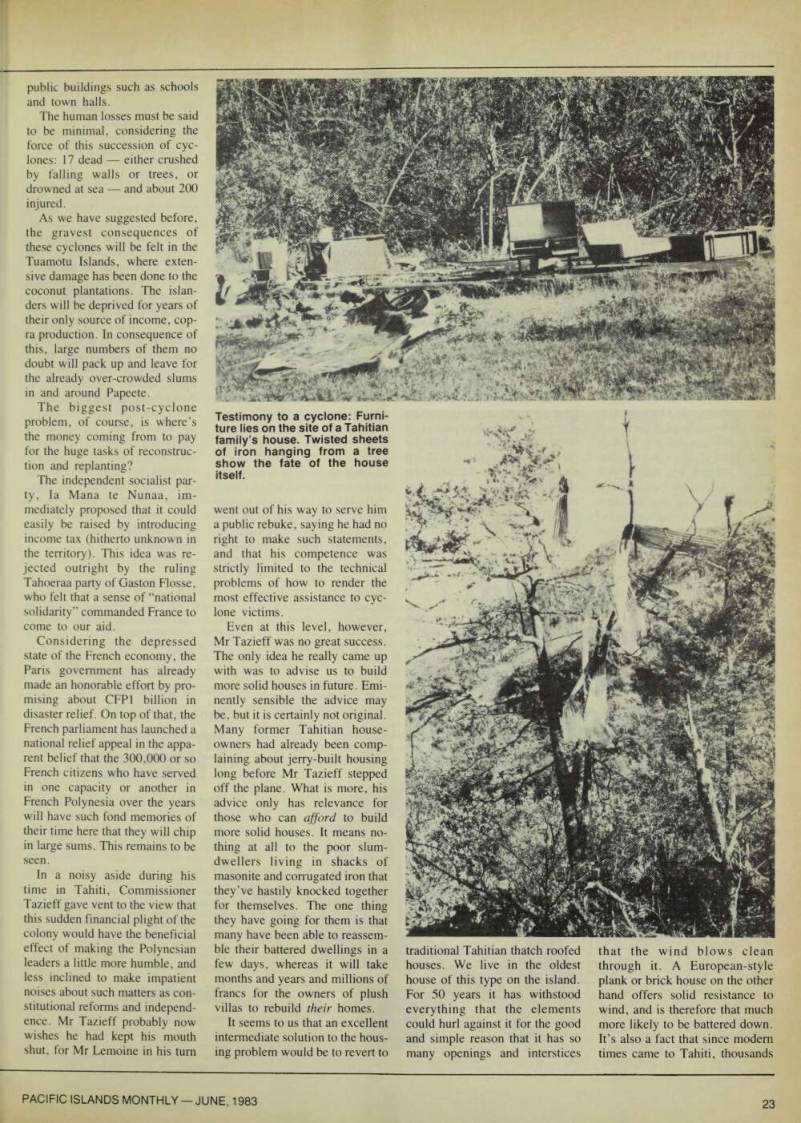

the visitor ...
The first and surest sign these days that something has gone wrong in Tahiti is that a traveller disembarking at Papeete’s Faaa airport will not be greeted by having a sweet-scented garland
of flowers hung round his neck, This does not mean at all that
Tahitian hospitality is breaking
down. It is simply that there are no more flower stalls, vendors or even flowers since Tahiti was
struck in early April by the most destructive of all the six cyclones that have devastated French Polynesia since December 1982 (PIM Mar. p3l, Apr. p 5, May p 23).
Despite all the recent experi ence, preparedness left much to be desired when the sixth cyc lone, Veena, hit Tahiti on the night of April 11-12. One expla nation for the curious apathy was undoubtedly the general feeling
that all cyclone danger just had to be over for this season at least.
But Veena, like those that had gone before, was full of dirty tricks. It seemed to be passing at a safe distance north of Tahiti, and in a westerly direction. But then it suddenly changed course and veered full speed towards Tahiti.
The hurricane-force gusts of Cyclone Reva a month before had followed a similar course,
Postmark Papeete Marie-Thérèse and Bengt Danielsson
jumped over the 2000-metre mountain range in the centre of the island, and ravaged the west coast. But Veena’s impact was felt mainly on the east coast and the peninsula. Even here at our home in Papehue on the west coast, however, we spent a very uncomfortable night, without
light, telephone or even running
water, since the pipes had burst as a result of the massive pres sure from overflowing dams and rivers.
The only sounds to be heard above the roaring wind and pounding rain were the sinister cracking noises of falling trees, and the thud of tom-off house roofs slamming into obstacles.
We were lucky still to have a roof over our heads when the new, bleak day dawned. Strange ly enough our rain gauge was still standing: it showed that 192 millimetres of rain had fallen in under eight hours.
At about the same time Radio Papeete, which had been dead for hours, came back on the air with a first appraisal of the havoc wrought, and we began to realise
more clearly the magnitude of the disaster. The whole village of Tautira, at the tip of the peninsu la, had disappeared. Several bridges on the west coast had been destroyed. All round the island, uprooted trees were blocking the coastal road. The number of houses flattened or
unroofed ran into thousands. Do zens of fine yachts whose own ers, ironically enough, had been sitting it out in Tahiti waiting for the cyclone season in the western Pacific to come to an end, were either sunk or wrecked.
Unfortunately, both the High
Commissioner and the head of the local government, Gaston Flosse, our senator and two de puties, and an assortment of par ty leaders, had flown off to Paris a few days before to take part in so-called round table discussions about much-needed constitution al reforms. So, at this critical moment, there was simply no
body in charge of the territory.
If ever the firm hand of a military commander was needed, it was then. But, surprisingly, the admiral who runs the CEP nuclear testing program, and who is boss of all land and sea forces in the colony, apparently felt no need to step in. He thus missed, among other things, a great opportunity to make him self popular. As things were, not even the poor yachties were gi ven any firm directions or useful advice. (We discount entirely the minor government official whose greatest achievement was to for bid, at the height of the cyclone, any movement of motor traffic.
When it became clear a few hours later that nobody was tak ing the slightest notice of him he threw up his hands and, in a special radio broadcast, an nounced: “Well, you’ve only got yourselves to blame!”) Flosse, who was sitting in the
Elysee Palace with President Mitterrand at the very moment Veena started veering down on Tahiti, asked for immediate French aid. He even managed to return on the first relief plane loaded with tarpaulins, chain saws, nails, water purification tablets, and military rations. The other political leaders followed within a day or two, and by the end of the week both the Minister for Overseas Territories, Georges Lemoine, and the Spe cial Commissioner for Natural Disasters, Haroun Tazieff, had also flown out to Tahiti.
By then the count of houses destroyed or damaged by Veena stood at 6000. As the previous
cyclones had destroyed about
4000 houses in the Leeward and Tuamotu Islands, the grand total for French Polynesia was now about 10,000. This meant that perhaps as much as a third of the population in the islands con cerned was homeless. With an estimated average value of about CFPI million per house, the staggering sum of CFPIO billion would be required to rebuild them. To all this must be added four or five billion more to repair damaged roads, power lines and
Part of Marie-Thérèse and Bengt Danielsson’s house in Tahiti. It escaped damage in the cyclone because of its tradi tional Islands style of construc tion which allows the wind to blow through the structure in stead of building up damaging pressures.
public buildings such as schools and town halls.
The human losses must be said to be minimal, considering the force of this succession of cyc lones: 17 dead either crushed by falling walls or trees, or drowned at sea and about 200
injured.
As we have suggested before, the gravest consequences of these cyclones will be felt in the Tuamotu Islands, where exten sive damage has been done to the coconut plantations. The islan ders will be deprived for years of their only source of income, cop ra production. In consequence of this, large numbers of them no doubt will pack up and leave for the already over-crowded slums in and around Papeete.
The biggest post-cyclone
problem, of course, is where’s the money coming from to pay for the huge tasks of reconstruc tion and replanting?
The independent socialist par ty, la Mana te Nunaa, im mediately proposed that it could
easily be raised by introducing
income tax (hitherto unknown in the territory). This idea was re
jected outright by the ruling
Tahoeraa party of Gaston Flosse, who felt that a sense of “national solidarity” commanded France to come to our aid.
Considering the depressed
state of the French economy, the Paris government has already made an honorable effort by pro mising about CFPI billion in disaster relief. On top of that, the French parliament has launched a national relief appeal in the appa rent belief that the 300,000 or so French citizens who have served in one capacity or another in French Polynesia over the years will have such fond memories of their time here that they will chip in large sums. This remains to be seen.
In a noisy aside during his time in Tahiti, Commissioner Tazieff gave vent to the view that this sudden financial plight of the colony would have the beneficial effect of making the Polynesian leaders a little more humble, and less inclined to make impatient noises about such matters as con stitutional reforms and independ ence. Mr Tazieff probably now wishes he had kept his mouth shut, for Mr Lemoine in his turn
went out of his way to serve him a public rebuke, saying he had no right to make such statements, and that his competence was strictly limited to the technical problems of how to render the most effective assistance to cyc lone victims.
Even at this level, however, Mr Tazieff was no great success.
The only idea he really came up with was to advise us to build more solid houses in future. Emi nently sensible the advice may be, but it is certainly not original.
Many former Tahitian house owners had already been comp
laining about jerry-built housing
long before Mr Tazieff stepped off the plane. What is more, his advice only has relevance for those who can afford to build more solid houses. It means no thing at all to the poor slum dwellers living in shacks of masonite and corrugated iron that
they’ve hastily knocked together
for themselves. The one thing they have going for them is that many have been able to reassem ble their battered dwellings in a few days, whereas it will take months and years and millions of francs for the owners of plush villas to rebuild their homes.
It seems to us that an excellent intermediate solution to the hous ing problem would be to revert to
traditional Tahitian thatch roofed houses. We live in the oldest house of this type on the island.
For 50 years it has withstood everything that the elements could hurl against it for the good and simple reason that it has so many openings and interstices
that the wind blows clean
through it. A European-style
plank or brick house on the other hand offers solid resistance to wind, and is therefore that much more likely to be battered down, It’s also a fact that since modem times came to Tahiti, thousands
Testimony to a cyclone: Furni ture lies on the site of a Tahitian family’s house. Twisted sheets of iron hanging from a tree show the fate of the house itself.
of houses have been built on the slopes and hills above Papeete where there is no natural protec tion whatever against the on slaught of high winds.
While the great reconstruction debate was raging in Tahiti, a rumor spread that yet another cyclone was on its way. The meteorological station reluctant ly confirmed that this was so, but at the same time pointed out it was located about 1300 kilometres east of the Mar quesas, and was therefore most unlikely to reach French Poly nesia. However, as the days passed, the new cyclone, which was first dubbed Whisky and then William, described an eleg ant arch which eventually took it down through the eastern Tuamotus towards Moruroa. Un like Cyclones Nano, Orama and Reva, William did not score a direct hit. But, like Cyclone Vee na, it stirred up eight-metre waves, and must have created great problems for the 3000 men and 12 women living and work ing on the low atoll, especially as the 23 refuge platforms built on
the reef for use during disasters of this sort are only 4.5 metres tall, about half the height of Williams’ waves.
However, two days later a sufficient number of the drench ed atoll dwellers were fit enough to explode the first bomb in the long-delayed 1983 test series, showing the determination of the socialist Mitterrand government to pursue the nuclear follies of its
conservative predecessors.
As usual, Paris kept mum ab out the blast, whose strength was put at five-plus on the Richter scale by the New Zealand and
Dutch seismological
observatories.
An equally impenetrable si lence met all anxious inquiries as to what has happened during all these cyclones to the enormous pile of nuclear waste stored in metal drums and plastic bags on the north shore of Moruroa. Even the chatty Haroun Tazieff, who is touted as the great expert on safety problems at the atoll, ap parently couldn’t find a word to say about this important problem.
When it comes to explaining this unprecedented series of six cyclones in five months, local oceanographers and meteorolog ists have also been remarkably tightlipped. The reason is almost certainly that they just haven’t put in much time on the problems of long-range forecasting, and Pacific-wide studies. Nor do they seem to have had much contact with their colleagues in the other Pacific islands and the Rim countries.
Had they done so they would probably have been aware that the gradual increase in the temp erature of the ocean waters around the Marquesas Islands over recent years (it is now more than 32 degrees Celsius) was creating a perfect breeding ground for cyclones. This was demonstrated as early as March, 1981, when Moruroa was wash ed over for the first time.
Then, in 1982, as was observ ed by every inhabitant of French Polynesia, a strange new phenomenon occurred: the cool southeast tradewind called mara’amu by the Tahitians,
which normally blows between June through September, simply failed to appear. On the other hand, we had quite exceptionally warm westerly winds later in the year.
It is quite clear that the whole wind and water circulation sys tem in the eastern Pacific is in a process of change. We personal ly would not be at all suiprised if all these new phenomena are due in the first place to the wide spread tampering with nature that has been going on in the world for the past few generations. We refer to such features of today’s world as massive deforestation, the effects on the atmosphere of automobile fumes, industrial pol lution, and the detonation (by all A-bomb-possessing countries) of more than 1200 atomic bombs in
the atmosphere.
The big question everyone is asking in Tahiti is: Are these changes irreversible? Can we look forward to more years like this one, with a similar series of
devastating cyclones every year?
Marie-Thérèse and Bengt Danielsson.
Advertisements & other items, pp. 22-24 (1 item)
Pacific Multi-Pump
NEW ALL-PURPOSE HAND PUMP
Capable of handling a wide variety of liquids, including petroleum-based products, a wide variety of chemicals, and salt water.
Double-acting lever action capable of pumping one litre per cycle.
Complete with Bft of PVC discharge hose, nozzle, twopiece suction tube and bung adaptor for operation with 44-gallon drums. t Pacific Pump Co., 2 South Street, Rydalmere, NSW, Australia, 2116.
Tel: (02) 638-5600.
Telex: AA24319.
Mobile
power in a
self-contained
package
No extras to buy.
Delivered ready to go.
D bSi 3S ; „ y ■ y
LEI 29 HPH S&P
20kVA or 31kVA power wherever you want it. From rugged, reliable Dis-gen units that come complete with cabinet, fuel tank, power outlets, etc. And need no special mounting platform.
Dis-gen electric generating sets. An astute combination of Onan generator and Perkins diesel.
Tough enough to take the hardest knocks. In mining. Construction sites.
Outback engineering projects. Hire companies.
Or anywhere you need a durable, dependable 240/415v power source.
A special marine model is also available.
Rigid underchassis protects the unit wherever you take it. And however you get it there. On a truck or a trailer. On skids. Or lifted in by crane. Undercarriages, 2 or 4 wheels, available as options.
Dis-gen, Mobility and power in a selfcontained package.
Dis-gen 20KVA and 31kVA
electric generating sets.
Available from:
LINCOLN ■
ARC WELDING
The Lincoln Electric Company
(Aust.) Pty. Ltd.
Sydney (Head Office) 35 Bryant Street, Padstow, NSW 2211 Telephone: (02) 772 7222 Telex: 22792 Cables: Tlnconweld'', Sydney Newcastle Telephone (049) 61 5381 Telex 28263 Wollongong Telephone (042) 28 0565 Melbourne Telephone: (03) 481 8444 Telex 31958 Brisbane Telephone: (07) 277 2955 Telex 41268 Townsville Telephone: (077) 79 9777 Telex 47247 Mackay Telephone: (079) 512599 Telex: 48655 Adelaide Telephone: (08) 43 8061 Telex 82794 Pertb Telephone: (09) 277 8744 Telex 92914 KarrathO (WA) Telephone (091) 85 2405 Telex 99640 Launceston Telephone: (003) 26 3388 Telex 58517
Distragen
Distragen Pty Ltd.
New South Wales (Head Office) 4 Mitchell Road, Brookvale, NSW 2100 Telephone: (02) 9381777 Telex; 27733 Melbourne Telephone: (03) 481 0508 Telex 31958 Brisbane Telephone: (07) 275 2926 Telex 41268 Ss*
Islanders’ ally
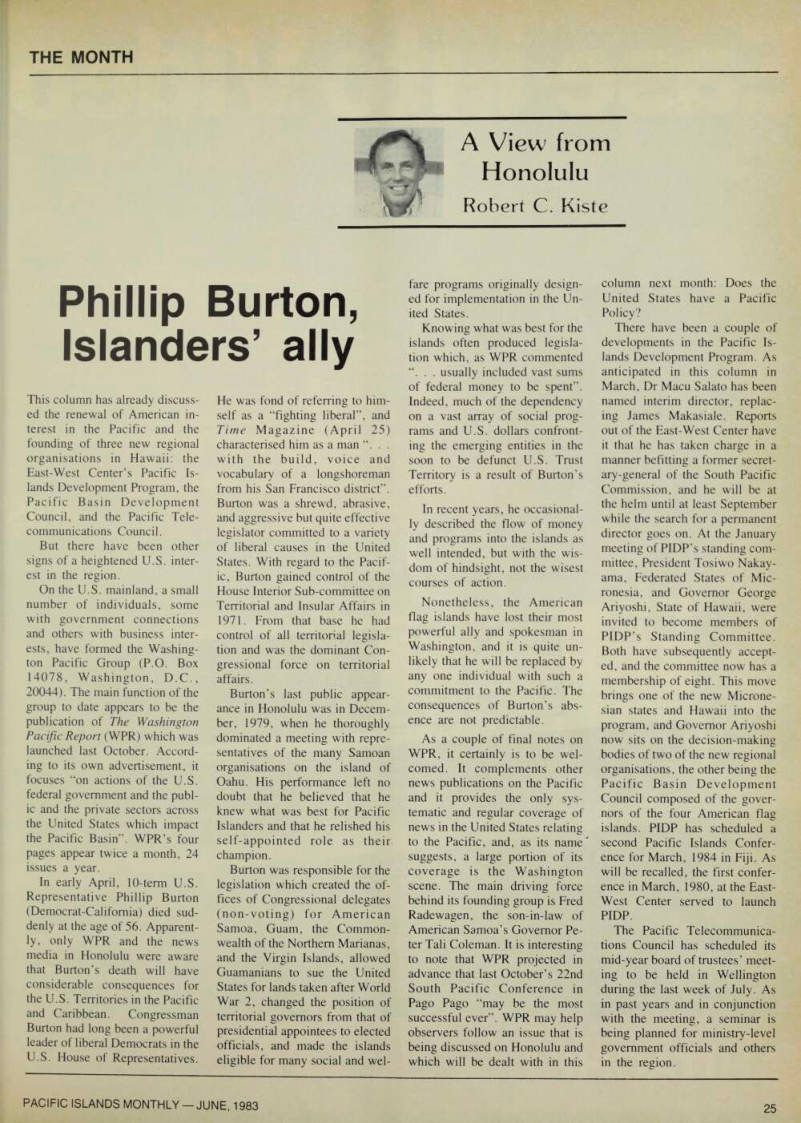
Phillip Burton, Islanders’ ally
This column has already discuss ed the renewal of American in terest in the Pacific and the founding of three new regional organisations in Hawaii: the East-West Center’s Pacific Is lands Development Program, the Pacific Basin Development Council, and the Pacific Tele communications Council.
But there have been other signs of a heightened U.S. inter est in the region.
On the U.S. mainland, a small number of individuals, some with government connections and others with business inter ests, have formed the Washing ton Pacific Group (P.O. Box 14078, Washington, D.C., 20044). The main function of the group to date appears to be the publication of The Washington Pacific Report (WPR) which was launched last October. Accord ing to its own advertisement, it focuses “on actions of the U.S. federal government and the publ ic and the private sectors across the United States which impact the Pacific Basin”. WPR’s four pages appear twice a month, 24 issues a year.
In early April, 10-term U.S.
Representative Phillip Burton (Democrat-Califomia) died sud denly at the age of 56. Apparent ly, only WPR and the news media in Honolulu were aware that Burton’s death will have considerable consequences for the U.S. Territories in the Pacific and Caribbean. Congressman Burton had long been a powerful leader of liberal Democrats in the U.S. House of Representatives.
He was fond of referring to him self as a “fighting liberal”, and
Time Magazine (April 25)
characterised him as a man . . with the build, voice and
vocabulary of a longshoreman
from his San Francisco district”.
Burton was a shrewd, abrasive, and aggressive but quite effective legislator committed to a variety of liberal causes in the United States. With regard to the Pacif ic, Burton gained control of the House Interior Sub-committee on Territorial and Insular Affairs in 1971. From that base he had control of all territorial legisla tion and was the dominant Con gressional force on territorial affairs.
Burton’s last public appear ance in Honolulu was in Decem ber, 1979, when he thoroughly dominated a meeting with repre sentatives of the many Samoan organisations on the island of Oahu. His performance left no doubt that he believed that he knew what was best for Pacific Islanders and that he relished his self-appointed role as their
champion.
Burton was responsible for the legislation which created the of
fices of Congressional delegates
(non-voting) for American Samoa, Guam, the Common wealth of the Northern Marianas, and the Virgin Islands, allowed Guamanians to sue the United States for lands taken after World War 2, changed the position of territorial governors from that of presidential appointees to elected officials, and made the islands eligible for many social and wel
fare programs originally design ed for implementation in the Un ited States.
Knowing what was best for the
islands often produced legisla
tion which, as WPR commented
. . usually included vast sums
of federal money to be spent”.
Indeed, much of the dependency on a vast array of social prog rams and U.S. dollars confront ing the emerging entities in the soon to be defunct U.S. Trust Territory is a result of Burton’s efforts.
In recent years, he occasional ly described the flow of money and programs into the islands as well intended, but with the wis dom of hindsight, not the wisest courses of action.
Nonetheless, the American flag islands have lost their most powerful ally and spokesman in Washington, and it is quite un likely that he will be replaced by any one individual with such a commitment to the Pacific. The consequences of Burton’s abs ence are not predictable.
As a couple of final notes on WPR, it certainly is to be wel comed. It complements other news publications on the Pacific and it provides the only sys tematic and regular coverage of news in the United States relating to the Pacific, and, as its name* suggests, a large portion of its coverage is the Washington scene. The main driving force behind its founding group is Fred Radewagen, the son-in-law of American Samoa’s Governor Pe ter Tali Coleman. It is interesting to note that WPR projected in advance that last October’s 22nd South Pacific Conference in Pago Pago “may be the most successful ever”. WPR may help observers follow an issue that is being discussed on Honolulu and which will be dealt with in this
column next month: Does the United States have a Pacific
Policy?
There have been a couple of developments in the Pacific Is
lands Development Program. As
anticipated in this column in March, Dr Macu Salato has been named interim director, replac
ing James Makasiale. Reports
out of the East-West Center have it that he has taken charge in a manner befitting a former secret ary-general of the South Pacific Commission, and he will be at the helm until at least September while the search for a permanent director goes on. At the January meeting of PIDP’s standing com mittee, President Tosiwo Nakay ama. Federated States of Mic ronesia, and Governor George Ariyoshi, State of Hawaii, were invited to become members of PIDP's Standing Committee.
Both have subsequently accept ed, and the committee now has a membership of eight. This move brings one of the new Microne sian states and Hawaii into the program, and Governor Ariyoshi now sits on the decision-making bodies of two of the new regional organisations, the other being the Pacific Basin Development Council composed of the gover nors of the four American flag islands. PIDP has scheduled a second Pacific Islands Confer ence for March, 1984 in Fiji. As will be recalled, the first confer ence in March, 1980, at the East- West Center served to launch
Pidp.
The Pacific Telecommunica tions Council has scheduled its mid-year board of trustees’ meet ing to be held in Wellington during the last week of July. As in past years and in conjunction with the meeting, a seminar is
being planned for ministry-level
government officials and others in the region.
A View from Honolulu Robert C. Kiste
Advertisements & other items, p. 26 (1 item)
to Video
The VT-11E is video at its easiest. Easy operation; Play, Record, Fast Forward, Rewind and Visual Search during playback via a four-corner access switch.
From Hitachi, the gateway to greater video entertainment.
■MWI
VT-11E
Features • TProgram/10-Day Preset Recording • 240-min. Recording/Playback with E-240 Tape • Visual Search • Freeze Action • Wired Remote Control ■*
SS Uls p \ns
l2O
HSB B V
AUSTRALIA: Hitachi Sales Australia Pty., Ltd. 153 Keys Road, Moorabbin, Victoria 3189 Phone: (555) 8722 NEW ZEALAND: AWA New Zealand Limited, Wi-neera Drive, P.O. Box 50-248, Porirua Phone: PRO 75-069 PAPUA NEW GUINEA: S.O. Svensson (N.G.) Ltd., P.O >!• w
0 HITACHI
New Caledonia: A changed mood

Political Currents
New Caledonia: A changed mood after events of January 10
Well-known French ethnologist Professor JEAN GUIART analyses the events of January 10, 1983, in which two gendarmes were killed by Melanesian villagers in New Caledonia; He describes a change of mood in the territory following these events, and concludes that for all the political talk in Noumea, the territory’s future will be shaped not by what happens there, but by what happens outside it.
What happened in Coinde, on January 10, 1983, may turn out to be a landmark on New Caledonia’s troubled path to
independence.
Coinde is a small Melanesian
village clinging to the slopes of
the mountainous ranges which tower over La Foa on the west coast and Canala on the east. La Foa is a strongly Right-wing and racist municipality; Canala is a populous Melanesian area, inde pendence-minded, where dis turbances have happened al
ready, in September 1981.
Coinde has lived a quiet but dreary life, with its neighbor village Wi Point, since the 1878 native uprising, the consequ ences of which left the inhabit ants of the two villages, partly
former insurgents, partly tradi
tional dependents of the Canala chieftainships, with difficult mountainous lands which are near impossible to till. Nothing has been done since to dramatic ally improve this situation, and the pressure of racist graziers on the two villages has never ceased.
Twelve years ago a ranch owner bulldozed Wi Point’s yam fields in order to push the people further into the mountain. They resisted and threatened to open fire on him. The grazier backed off, but the people had to wait until 1982 for the obvious solu tion; that the land neighboring their reservation be bought back by the state and handed over to them, which has somewhat al leviated their problem.
Over the last six years, the forests surrounding the two vil lages have been left open to a
tree-felling and sawmilling enter
prise which has belonged to two successive owners. The first started major pollution of the water supply of the two villages, ignoring the fundamental fact that tropical soils are tenuous and fragile, and that the underlying
geological layers contain miner
als which readily become toxic if
brought in contact with water.
The people protested and condi tions were laid down for the second entrepreneur to observe.
None of the undertakings gi ven was observed. The pollution became worse.
The Melanesians have always considered the forests as their
own a point insufficiently
stressed and there has thus developed a permanent situation of conflict throughout the territ ory between the Melanesians and the Forestry Department.
What is more the forests in the Coinde-Wi Point area have been badly misused, with trees felled that should never have been fell ed, and some tree-felling carried out even in the Melanesian reservation.
In desperation, the Coinde and Wi Point people last year block ed the roads and seized as “hos
tages” the heavy equipment of
the entrepreneur, a Mr Barbou, until the compensation they were
asking for was paid.
Things nearly worked out
right. New promises were made.
But the pressure of the Right wing group and of the friends of the white Deputy to the National Assembly in Paris, Jacques Laf leur, in late December 1982,
brought these hopes to nothing,
and Mr Barbou had to renege on
his promises. Negotiations were
apparently continuing in
January.
The conditions under which
High Commissioner Roynette
decided to send a mobile police force in to help in the evacuation
of Mr Barbou’s equipment are unknown. There had been threats by Europeans in La Foa to take independent action against Coinde.
Whatever the circumstances, on Monday, January 10, in the early morning, a police expedi tion passed through the village of Coinde, to the protests of the local people, went further up, and returned escorting the bull dozers and graders and other equipment belonging to Mr Barbou.
When they were passing through the village for the second time, the chief tried to stop them, and asked for last-minute negoti ations. He was brushed aside and the people allege he was struck.
Then stones started to fly. The police responded with canisters of tear gas and so-called stun grenades. Women and children fell sprawled on the ground.
These people had never before had experience of tear gas and stun grenades.
Hearing the explosions the men thought they and their families were being attacked in an act of war. In their minds the memory of what they had been told about the events of 1878 still lives. They started shooting at the police. Two gendarmes were killed, four men were wounded, two of them severely. Two civi lians were among those wound ed, one of them a bulldozer driver, the other the La Foa postman, on leave, who could well have had something to do with the fact that Coinde’s tele
phone communications had been cut.
The next day a major military operation, with heavy helicopters and troop carriers, swamped Coinde. The village was thoroughly searched. A few arms were found and confiscated and most of the men arrested were mistreated when being ques tioned. All knives and hatchets were confiscated, leaving the few men left around, and those later set free, and the women, with a lack of tools with which to work in the yam gardens. Their lawyers found the 10 men ac cused of manslaughter had swol len eyes and legs through beatings.
The reaction all over the coun try was one of contradictory moods of indignation. The Euro peans condemned the shooting of servants of law and order, al though a year and a half before, they had not shed a tear over a gendarme murdered in Gomen, some white men even saying that it served him right. He had been killed at night, by a shot from a high-powered rifle, as he was in the process of writing a report to his superiors on the arms smuggling practised on a grand scale by the New Caledonian Right-wing.
The Melanesians were hor rified by the brutality shown to the inhabitants of two small vil lages in the mountains and vow ed to a man that they would have shot at police if they had faced the same conditions.
The political situation stem ming from these events is entire ly new, and fluid. Nobody knew this was coming. No one knows any more where things are going.
Just three days before, a group of young men, encouraged by wo men, stoned the police station at Touho, in northeast New Caledonia, for hours during the night, and the police had to shoot into the air to get some respite.
In both cases we have Catholic villages, the descendants of peo-
pie who last century suffered the force of military repression of their resistance to European land encroachments. They have long been slumbering, but are waking now with very short tempers.
They are poor, devoid of suffi cient lands and without gains from the recent movement for land reforms through the opposi
tion of Right-wing European
mayors to any concessions to them. The stupid idea that one should never yield to Melanesian demands is now responsible for two more deaths. The tally of murders arising from the political situation in New Caledonia is now eight, as against only three in the course of the independence process in Vanuatu.
Up to now, European reac tions have been rather muted.
Meetings have been held around World War I monuments, but drawing smaller crowds than be fore. Activists have threatened once more to take to arms, but
the High Commissioner slapped
down an Order-in-Council ban ning the carrying of arms. Set
tiers out of town do not relish the idea of being caught up in a game where they might be shot at.
Right-wing activities, murders, death threats all round, are all right just as long as the Kanaks do not shoot back.
Everybody is waiting. What is difficult to see is what the young Melanesian generation will do, those up to 30 and over. This generation has been raised in the schools, has done military ser vice, has no future other than unemployment, due to the im migration policies practised by the local right over the years.
This generation isn’t afraid of anyone and is capable of the most courageous, and maybe rash, actions.
It is neither controlled by the churches, nor by the Noumea centred political parties. It has a capacity for organising itself in out-of-the-ordinary ways and for rapid mobilisation. It is support ed in its impatience by the wo men, who have accepted the idea of having numerous children to gain greater power for the
Melanesian people but want a future for them.
Things might get difficult, or even nasty, for certain Europeans on the east coast, or in the Loyal ty islands. But mostly it would need very little, just another stupid (but considered “dynam ic”) entrepreneur, and there are some, getting into conflict with another group of villages, and the guns might come out before the police have time to arrive.
The political game in Noumea will be shaped by what happens outside Noumea. Europeans and Tahitians, hundreds of them pre paring to leave the country, will be encouraged to do so. Settlers in the interior are suddenly find ing a new patience and prudence, and are much less heard from, not wanting to take the consequ ences because some silly ass has gone too far. The only activists still sounding off are in Noumea, encouraged if not dominated by former settlers from Algeria and Indochina. Their leaders have sent away their capital, as a precaution, to Switzerland,
America, Australia, New Zea land and even to the tax haven of Vanuatu.
In this situation, a referendum or elections would be inconclu sive. The electoral roll has been severely tampered with in the last 10 years, to the benefit of the
Right-wing. No significant elec
tions can be held before the rolls are thoroughly revised on the basis of the Census to be taken in 1983.
In the meantime, troubled wa ters lie ahead.
Cooks PM
looks to Oz
New Cook Islands Prime Minis ter Geoffrey Henry said after the election that he would like the Cook Islands to move closer to Australia and he sees the Aust ralian Labor Party as a natural
ally.
“I don’t mean that we want to lessen our traditional ties with New Zealand, but we think we’ve got a lot to gain by being closer to Australia,” he said.
Advertisements & other items, p. 28 (2 items)
Political Currents
Fsc Parbury Pty Ltd
EXPORTERS
Exporters of engineering supplies and related components and specialists in freight forwarding by air and sea to Pacific area countries BUYING OFFICE IN UK AND AGENTS IN JAPAN AND USA 1 Lincoln Street, Lane Cove 2066.
POSTAL ADDRESS: P.O. Box 84, Lane Cove 2066, Sydney, Australia.
TELEPHONE: (02) 428 3111 TELEX: AA20817
Fears in Fiji that inquiry could


Royal Commission
Fears in Fiji that inquiry could lead to new race tensions
The general election in Fiji last year re-opened divisions between ethnic Fijians and members of the numerically dominant Indian community. The drama is now being laboriously reconstructed in a specially-built wooden hut in Suva. ROBERT KEITH-REID tells the story of the Royal Commission which is inquiring into the election.
A Royal Commission of Inquiry in Fiji is investigating campaign methods used by the Alliance Party and by the National Feder ation Party at last year’s general election. The Alliance, led by Prime Minister Ratu Sir Kamis ese Mara, narrowly retained of fice in the face of a determined challenge from the NFP in par
liamentary opposition.
The bulk of evidence from the first three weeks of the hearing has been a tedious repetition of details already widely pub licised. The evidence recounts what has become known as the Carroll Report affair, involving a report on political tactics. A pro minent member of the Alliance allegedly commissioned the re port from an Australian consul tant, Alan Carroll.
The NFP claims that the Al liance hired Australian and American business and political consultants to devise a master election plan exploiting race ten sions between ethnic Indians and ethnic Fijians. Bribery, character assassination and similar tactics were involved, the NFP claims.
The Alliance, for its part, claims that the NFP was in collusion with leftist Australian elements to smear the ruling alliance on the eve of the election. It also alleges that the Alliance accepted campaign money from Russia on
the undertaking of granting
favors to Moscow if re-elected.
The Alliance claims that a television team from the Aust ralian Broadcasting Commission used documents obtained illicitly from the prime minister’s depart ment to produce a deliberately biased report of the Carroll af fair. The former Indian High Commissioner to Fiji, Mrs Soonu Kochar, is alleged to have constantly interfered in Fiji inter nal affairs and her husband is alleged to have been part of the claimed link with Russia.
Sir John White, a retired judge of the New Zealand Supreme
Court, is hearing the inquiry as a single commissioner. But as the hearing went into May, with 23 days of evidence already trans cribed, there was a growing
public reaction questioning
where the inquiry would lead.
There were also fears that the detailed raking up of incidents from a bitter election campaign would serve only to rekindle sus picions and tensions. Another possible effect would be to delay any moves towards inter-party co-operation on a higher level.
Since last year’s election Prime Minister Ratu Mara has made a tentative approach to the opposition to reconsider the of ten-mooted “government of na tional unity.” The opposition has
not flatly rejected the approach,
but clearly there can be few developments while the present inquiry drags on.
The Prime Minister’s appear
out manipulation and fraud re ferred to the NFP’s involvement in publicity about the report.
After the Australian Broadcast ing Commission had made a film about the Carroll Report the NFP had distributed 300 video tapes of the program in an attempt to discredit the Alliance.
The video program and an article published in the Aust ralian National Times inferred that big business and foreign
manipulation were entering the
Fiji political scene to bolster Ratu Mara’s Alliance Party. The program alleged that an Aust
ralian journalist, Clive Speed,
formerly of the Australian Broadcasting Commission, had been hired with Australian aid funds ostensibly as a public ser vice information officer but actu ally as an Alliance Party pro
paganda man.
Ratu Mara spent four days in the witness box and strongly de-
Campaign frauds alleged
ance in the witness box created wide public interest. In his evi dence Ratu Mara attacked the Opposition Leader, Mr Jai Ram
Reddy, and Sir Vijay Singh for
their part in the NFP campaign developments. He accused them of deliberate fraud and manipula tion in their campaign strategies.
Ratu Mara agreed that the Car roll report had been commis sioned from within his party, but he denied that its “repugnant” sections had been used to shape election tactics. His remarks ab
nied the allegations of improper election tactics. He said that Speed had been appointed on Carroll’s recommendation “in a sense” and that Speed’s salary had been paid by Australia.
Ratu Mara said that the Al liance Party as such had not commissioned the Carroll Re port. The report, formerly titled Strategic Issues Facing the Fiji Government, had emerged from a loose arrangement involving himself as party leader, Mr Mahendra Patel of Suva and Mr
Carroll. Mr Patel is an influential Fiji businessman and an official of the Alliance Party.
In any event, Ratu Mara said, the report had not been circulated among members of the party, it had remained locked in his safe throughout the election, he had not bothered to read its “repug nant” parts, and to this day he was ignorant of the meaning of some of the terms used. The terms included such words as “toecutter” and “stroking.”
Only a handful of Alliance Party officials had ever heard of Carroll and members of his team “until this monstrous lie sur faced on the very eve of the election that these outsiders had planned and were directing the Alliance campaign.” Ratu Mara also claimed that television interviewers had attempted to trick him in the train of events which followed. He said he had met Carroll through Mahendra Patel and had been impressed by the Australian’s grasp of the in ternational economic situation.
When Patel had offered Carroll’s services free to the Alliance he had, as a Fijian chief, felt unable to refuse.
Opposition Leader Jai Ram Reddy followed Ratu Mara into the witness box and strongly de nied that his NFP had col laborated with the Australian media to bring down the Alliance Party. He described allegations of this nature as utterly false and mischievous. He believed that some of the strategies advocated in the Carroll report were being implemented by the alliance dur ing the election.
A vital part of the inquiry involves the circumstances which made the contents of the Carroll Report available to the media. Evidence alleged that Rosemary Gillespie, a research assistant in the Carroll team, had become annoyed over an issue relating to the work she was
Continued Page 73.
attempting to do. She had gone to the television people showing them documents she alleged had come from the Secretary to Cabinet, DrTsireli Lasaqa. Ques tioned in the witness box Lasaqa denied this. All he had made available, he said, were papers relating to public opinion polling.
Ratu Osea Gavidi, leader of the pro-NFP minority party Western United Front, claimed that a plan to have him convicted of criminal offences had been part of the Carroll recommenda tions and that the Alliance had accepted this. Despite this situa tion he believed the inquiry should be abandoned before it did irreparable harm to Fiji race relations.
Ratu Gavidi said the inquiry suffered from the inbuilt disabili ty that much vital evidence could be obtained only from non resident foreigners people who could not be forced to travel to Fiji to give evidence.
Lawyers representing the Al liance and the NFP have agreed on 11 major issues for investiga tion and about the same number of subsidiary issues. The three
major issues involved in the early stages of the hearing concerned whether the Alliance had com missioned the Carroll report, whether any of the Carroll re commendations were implement ed and whether Clive Speed was hired to help the election cam paign. The inquiry has now turn ed to the issues involved in the making of the television prog ram, the involvement of Rose mary Gillespie and the allega tions of Soviet financial aid to the NFP and its supporters.
Many of the political leaders who have already given evidence are likely to be recalled in the months ahead as the inquiry moves from one issue to another.
Clive Speed and Rosemary Gil lespie are two foreigners who have indicated a willingness to give evidence if their costs are paid. But it appears unlikely that Alan Carroll and other central figures in the story will appear, and the overall value of the pro ceedings has become very much a matter of public conjecture.
Robert Keith-Reid in Suva.
Advertisements & other items, pp. 29-30 (2 items)
Political Currents
4
wra
& - The complete freight handling service requires an organization Robert Laurie-Carpenters Pty. Ltd. encompassing a daunting assembly of expertise. Stevedoring, PO Box 922 through cargo handling, ancillary shipping and packaging services, Port road haulage, specialised freight handling equipment, complete " container facilities, cold storage, full vessel agency are but some of the essential services required.
The Robert Laurie-Carpenters Group of Companies covers all these and more. In fact so comprehensive is the service offered that you are invited to send for the RLC information folio which describes in detail this complete freight handling service. Whether it’s sea, land or airfreight RLC have it all wrapped up Papua New Guinea Telephone: 217324, Telex: NE22107 Branches throughout Papua New Guinea
Protest by Australia prompts
French Polynesia
Protest by Australia prompts French statement on N-Tests
French Polynesia is a territory which is exclusively under French sovereignty. This point of international law is indisputable.
The French Government under takes measures which it sees as appropriate on its own territory, and, in so doing, France can be
the only judge.
Nuclear tests are an essential part of our defence policy. They aim at maintaining the credibility of our deterrent force, thereby
safeguarding our independence.
As the Minister for External Relations, M Claude Cheysson, said in July 1982 in the National Assembly: “French nuclear de terrent capabilities have been kept down to the strict minimum needed to ensure deterrence.
France cannot fall below the threshold of credibility without
endangering her security and
independence”.
Nuclear tests have a bearing on vital French interests and con tribute to the world strategic balance.
We are well aware of the position of Australia: this posi tion is opposed to all nuclear tests carried out by all States.
The French Government there fore feels that the Australian Government cannot fail likewise to make known its opposition to tests carried out by China, the USA, and the USSR.
The monitoring of radio activity: Radio-activity in French Polynesia is monitored by two organisations under the joint re sponsibility of the army and the Atomic Energy Commission; A) The joint radiological sur veillance service (Service Mixte de Surveillance Radiologique) is in charge of monitoring irradia tion of personnel working on the test sites, as well as the physical environment (water soil air). 1. As for personnel, very strin gent regulations and strict monitoring procedures are in
Following a protest in April by the Australian Government against the proposed resumption of nuclear tests by France at Moruroa Atoll, French Polynesia, the French Embassy in Canberra issued a statement. It was accom panied by statistical information seldom seen in English on such issues as the levels of radio-activity in French Polynesia, and the incidence of cancer in the territory.
Cases Of Cancer In French Polynesia
(Population 160,000)
force. In particular, it has been the policy of the Atomic Energy Commission for the last 10 years to inform anybody subjected to a detectable radiation dose (ap proximately 30 mrem on the per sonal film detectors) of the fact
in writing.
For the whole year 1982, all personnel on the atoll of Moruroa collectively received a total irradiation dose of 4800 mrems, which is less than the admissible dose for one profes sional agent working at the site.
The maximum dose accumulated during the same year by one individual was 400 mrem, which is below the limit of 500 mrem fixed for the general public.
Total irradiation in Tahiti itself is so small as to be negligible, and stood in 1980 and 1981 at 1.6 microrad/hour, as compared for instance to 2.9 microradtiour in Montlhery near Paris. 2. As for the environment, both the air and seawater are
closely monitored.
Radio-active air pollution at Moruroa, as can easily be check ed by anybody with basic equip ment taking samples outside ter ritorial waters down-wind from the atoll, is practically nil, and is much less than in other parts of the world. In 1981, for instance,
alpha element radioactivity as
expressed in femto-curies per cubic metre of air was three in Moruroa, three in Tahiti, 10 in Chile, 25 in Montlhery near Paris, and 106 in Senegal. (It is to be noted that overall levels in 1981 were higher than usual, especially in the northern hemis phere, due to atmospheric nuc lear tests carried out that year by the People’s Republic of China).
The same applies to sea radio activity, and the fact that there is no radiological risk whatsoever is illustrated by the fact that personnel are authorised to swim and engage in all water sports in
Moruroa lagoon. Radio-activity
Localisation
Years
1977 1978 1979 1980 1981 Lung 3 6 2 13 15 Skin 13 11 15 . - Uterus 8 12 17 11 14 Breast 5 10 14 6 - Ear-Nose-Throat 7 6 5 - 11 Liver 2 1 2 4 8 Gall-duct 2 1 . - - Parotid 2 . . - .
Ganglion (undetermined)
6 - 6 - - Digestive tract 2 11 9 - 6 Male genital 2 - 3 - - Urinary 1 2 1 3 4
Eyes
1 1 - - - Bone 1 1 1 2 1 Nervous system 1 - - - - Thyroid 2 1 1 - 1 Ovaries 1 4 3 .
Hydatiform mole - 1 - - Stomach . 2 .
Intestines . 2 .
Abdomen . 2 .
Blood . 7 8 Mediastinum . 1 .
Brain - 1 2 Undetermined 4 1 4 . .
Generalised . 1 .
Sacrum-coccyx area
- - 1
Total
62 65 85 58 71 Year Total Cancer
To Metropolitan
To New To the US Cases France Zealand and New Caledonia 1975 54 22 11 11 - 1976 66 18 5 12 1 1977 92 26 10 16 - 1978 102 43 13 30 - 1979 123 57 18 39 - 1980 188 80 42 38 - 1981 257 75 43 32 . 1982 (prov.) 263 70 49 13 2
in the waters of French Poly nesia, including Moruroa, is on a par with minimum levels re corded in the North Atlantic.
B) The joint biological control service (Service Mixte de Con trole Biologique) is in charge of
radiological monitoring of living
creatures except man, and of foodstuffs and drinking water.
More than 2000 samples are taken each year to test any radio activity in locally produced food stuffs. To put it simply, it has been observed that artificial radio-activity regularly amounts to no more than 1/10th of natural radio-activity.
C) These data, as well as those collected independently by a loc al United Nations antenna, are passed on to the UN, and provide the basis for the reports drawn up by the United Nations Scientific Committee on the Effects of Atomic Radiation (UNSCEAR).
The latest of these reports was published at the beginning of 1983 and can be purchased from the New York-based United Na tions Sales Section. 2. The Incidence of Cancer: Mortality rates in French Poly nesia are not a secret in any way.
They are in fact regularly brought to the attention of the relevant authorities, and publish ed in the local press.
The main conclusion to be drawn from the statistics is that the number of cancer cases in Polynesia, while subject as else where to variations, is in now way higher than in other areas.
It is in fact significantly lower than in some places, being on average 50 per 100,000, com pared with 106 in Australia, 175 in metropolitan France, and 264 in New Zealand. 1. Total figures for recent years are as follows: 1977 62, 1978 65, 1979 85, 1980 58, 1981 71.
The fluctuation in numbers is a direct result of the limited size of the population concerned (160,000), and is a normal stat
istical phenomenon.
2. Types of cancers: Cancers affecting organs which are the most radio-sensitive thyroid, blood cells do not occur more frequently than other types of cancers, and have shown no sig nificant variations.
On the other hand, cases of
cancer linked with tobacco and alcohol lungs, upper respirat ory tract, and digestive tract are very much on the increase, and this is a cause of great concern to the authorities. To bacco appears to be the major issue, since 75 per cent of all Polynesians are smokers, and to bacco consumption increased by 150 per cent between 1961 and 1979, while population rose by only 50 per cent.
Skin cancer occurrences ap pear to be no more numerous than would be expected in a climate- such as prevails in Polynesia. 3. Persons evacuated for med ical reasons; It should be noted that these figures obviously do not coincide with the figures for cancer cases. The same person may be evacuated for treatment overseas, twice or more in the course of a year, and this in any case may not be required in the year in which cancer has been
diagnosed.
The number of persons evacuated for medical reasons has been increasing. But all evacuees are not necessarily can cer cases. In 1982, for example, the latter were 70 out of a total of 263 persons sent overseas for medical treatment, the remainder being victims of heart disease, or
cases requiring major surgery.
Some are sent to metropolitan France, others to the United States or New Zealand. The reason for this is that the small
population in French Polynesia
has not made it possible to pro vide the islands with the com plete range of medical facilities to be found in larger communities.
At the same time increasing efforts are going into the early detection of cancer cases. This, coupled with a substantial rise in life expectancy, which brings a larger segment of the population into the potential cancer age groups, explains that there has been an increase in the numbers of persons evacuated.
The decision to evacuate pa tients is made on purely medical and/or personal grounds, and no attempt is made, contrary to cer tain allegations, to hide the fact since statistics on the matter, herewith provided, are readily available.
Advertisements & other items, pp. 31-32 (3 items)
Political Currents
Political Currents
Houses’
INSTANT
and Commercial Buildings with Therma-Panelf the
fully insulated inter-locking
Building System
Cyclone rated George Hudson Homes (Aust.) pty Ltd 186 Hume Highway Cabramatta NSW 2166 Australia. Tel: (02) 727 9066. Telex: AA25800 Post coupon for details and prices.
Tel:
FORESTMIL
PORTABLE
SAWMILL
A Mini Self Contained Sawmill
complete with Diesel Engine or Electric Motor i Forestmil produces any size accurate timber ready to use up to 12" x 9" x 24'.
Purchase price and operating cost of Forestmil is less than other sawing equipment with similar production capacity.
Forestmil reduces timber waste and also reduces log transport cost. Timber is sawn direct from the log in the forest.
Forestmil can be moved to a new location in one hour.
Forestmil will saw hardwood or softwood from logs of any diameter.
Over 1000 Forestmils are sawing timber in 23 countries.
Forestmil has been manufactured for 18 years.
For literature and prices please contact the manufacturers.
MacQuarrie Industries Pty.Ltd.
p O. Box 20, Coburg 3058, Victoria, Australia.
Phone: 350-3411 Telex: 33729. Cables: Macbound, Melbourne.
Islands
From the
Press
Part of a letter from teacher Dick Gavun, published in the Papua New Guinea Post-Courier, Port Moresby One of the reasons for the decline in our education standards is lack of discipline, and this is due to the fact that the government has put a full stop to harsh punishment. Therefore, to our dismay, we teachers never discipline the children. Good citizens and disciplined students were produced in the colonial days. I am proud to be one. I, for one, will produce undisciplined students for PNG because the government doesn’t allow me to discipline the children in a harsh way. We no longer have trust, confidence and respect from our students.
From a column by Akio Heine in the Marshall Islands
Journal, Majuro
A religious man has given me his opinion why we haven’t had much rain. There’s too much sinning in the Republic, he believes. He said the Republic had become like Sodom and Gommorah. Said he: “Sundays are now favorite fishing days for everybody, many stores are open and the girls are now wearing provocative trousers.” Many beer drinkers are now switching to hard liquor. Nowadays beer can leave you broke, but not drunk unlike, say, a bottle of vodka. So expect the sale of hard liquor to go up. Another man said he is definitely thinking of going back to drinking yeast, a favorite drink of the outer islands.
From a reader’s letter published in The Norfolk Islander, Norfolk Island In last week’s newspaper David Lewis wrote in a way which suggested Norfolk Island is part of Australia. I don’t think or feel that Norfolk is like Australia or is part of Australia, and I would hope that it never is. Norfolk can do without income tax, strikes, racial problems, police with guns, tall buildings, crowds, traffic jams, lights, parking meters and lots of other similar things. Norfolk is different and much better, too. That is why every one appreciates it. Many people want to come and live here, and if they meet the basic requirements they probably can. It is a good thing that Norfolk does not deliberately set out to increase its population. If it were to get any more crowded it would not be appreciated by the residents or by the tourists, either.
From a letter in the Papua New Guinea Post-Courier, Port Moresby, headed “Message to Hagen policemen”
Mount Hagen police are a disgrace to the public. Are there any regulations each policeman is supposed to abide by? Nearly all policemen in Hagen are improperly trained. If they are trained well they must have forgotten their notes. Any Western Highlander will agree with me. Some I have seen in the station were half dressed in prescribed uniforms. Some are drunk while on duty. I can name each policeman. Some during duties have their hands in their pockets just hanging around.
From a report in The Fiji Times, Suva, about a 19-year-old woman convicted of stealing from shops A gust of wind foiled a shoplifter’s attempt to steal a bottle of Tang which she had hidden under her skirt, Suva court heard yesterday. A witness told the court that the woman had walked out of the shop in a peculiar way. When a gust of wind came, her skirt lifted and a bottle of Tang was seen between her legs.
A second witness told the court that the woman walked from another shop in a waddling manner. When she shook her body
two mosquito nets and two towels fell from under her skirt. She pleaded not guilty to three charges of larceny but the court accepted the prosecution evidence and found she had stolen two bottles of Tang, two mosquito nets, two towels, shaving cream, after-shave lotion and film. She was remanded in custody for sentence.
From a letter in the Papua New Guinea Post-Courier, Port Moresby, headed “Be warned on race pollution”
I have seen many young ladies from towns or even outside the villages mucking around with white men. I am concerned and don’t want these matters brought out into our provinces. It will ruin the color of our bodies throughout PNG.
From the Marshall Islands Journal, Majuro If you need to visit any of the government offices the best time is after coffee break (around 9.00). But don’t get there late because at 10.00 there is another coffee break. You will have to sit around till they get back at 11.00, or maybe even after lunch. The same thing applies if you are trying to make your visit in the afternoon.
From an editorial in The Fiji Times, Suva, commenting on the despatch of Fiji avocados to Buckingham Palace
in England
Now the Fiji avocado pears have found their way to the Royal dining table in Buckingham Palace, hopefully some local entrepreneur will be sufficiently interested in exploiting the highly lucrative market abroad for this much sought-after tropical delicacy. Visitors to Fiji are astounded to find that the avocado pear grows wild, and not many people here care for it.
From an editorial in The Observer, Apia, on the condition of the roads in Western Samoa Meantime, every time a person is elected a Member of Parliament the road around where he lives gets pounded smooth and paved over in no time. Why don’t the Sinamoga people and the Leone people invite an MP to come and live in their
villages?
From an item published in the American Samoa News Bulletin, headed “Yachtsman confused by storm”
Yachtsman Stephen Neumann was riding out a cyclone off the Fiji Islands recently when a huge wave carried his boat across coral reefs and up to the bar of a beachfront hotel. Shocked and disorientated by the battering, Neumann leaned over the side of the yacht and fired a distress flare, right into the establishment ceiling . . . Feeling “like an idiot,” Neumann said he climbed out of the boat and hid in a linen room. The yacht is still parked in the bar at Plantation Village Resort. Said Neumann, “I think the manager would rather it was someplace else. The boat weighs 14 tons, not an easy item to move.”
From the Flotsam and Jetsam column in The Fiji Times, Suva OVERHEARD; A cyclone-struck resident commenting disgustedly on the threatened arrival of Cyclone Sarah. “Cyclone Oscar has come and gone, now his wife’s coming. Next it will be their kids.”
From the Marshall Islands Journal, Majuro The Majuro Police Department has decided to drop the physical fitness requirements to join the force. They said if they enforced these there would be no police force.
From the Pitcairn Miscellany Importation of Dogs: As the island population of dogs is now down to one lonely specimen, some members felt that more should be imported. The Governor thought this was up to the individual, as the “machinery” for importing dogs already existed. Other council members felt that one dog was too many.
From the Voice of Vanuatu Last Saturday was “Snail Day” at Walaha, West Ambae, and 331 kilos of snails were collected by Walaha school. First prize for the most snails caught went to Class Six. The agricultural department who organised the “Snail Day” congratulate the headmaster and pupils. African snails are a pest and are finding their way to more and more islands.
Advertisements & other items, p. 34 (1 item)
Come uptokool
its
- V* iW
fr^N
■ • , «3|r - :;^ ■«* ■ r v;? < S£2*g> ■*'^ 'C&k v - f -j - Si if #■ '.-■ sHf >* fo ft - L‘w r* m .V 5 »■ ma - ls n ' ■ '■■ ■ s .
RK 4 = ■ X € w
Come uptokool
The cool refreshing taste of menthol.
Of foundation stones, a temptress
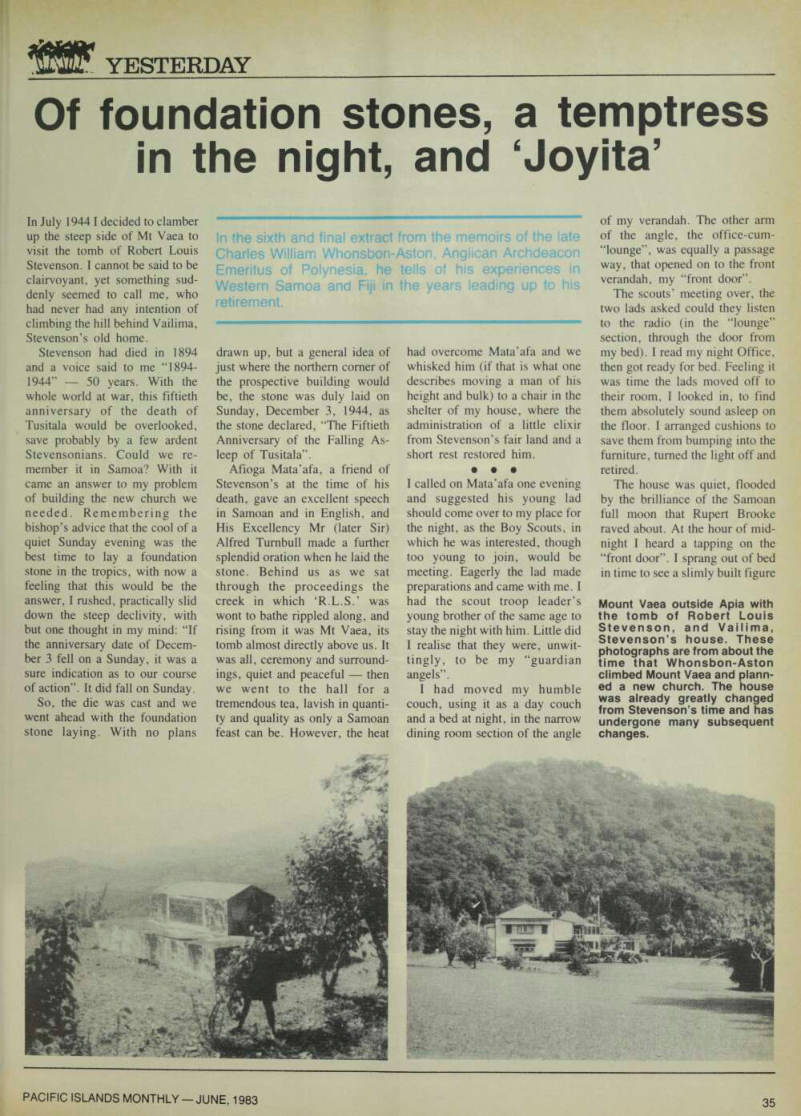
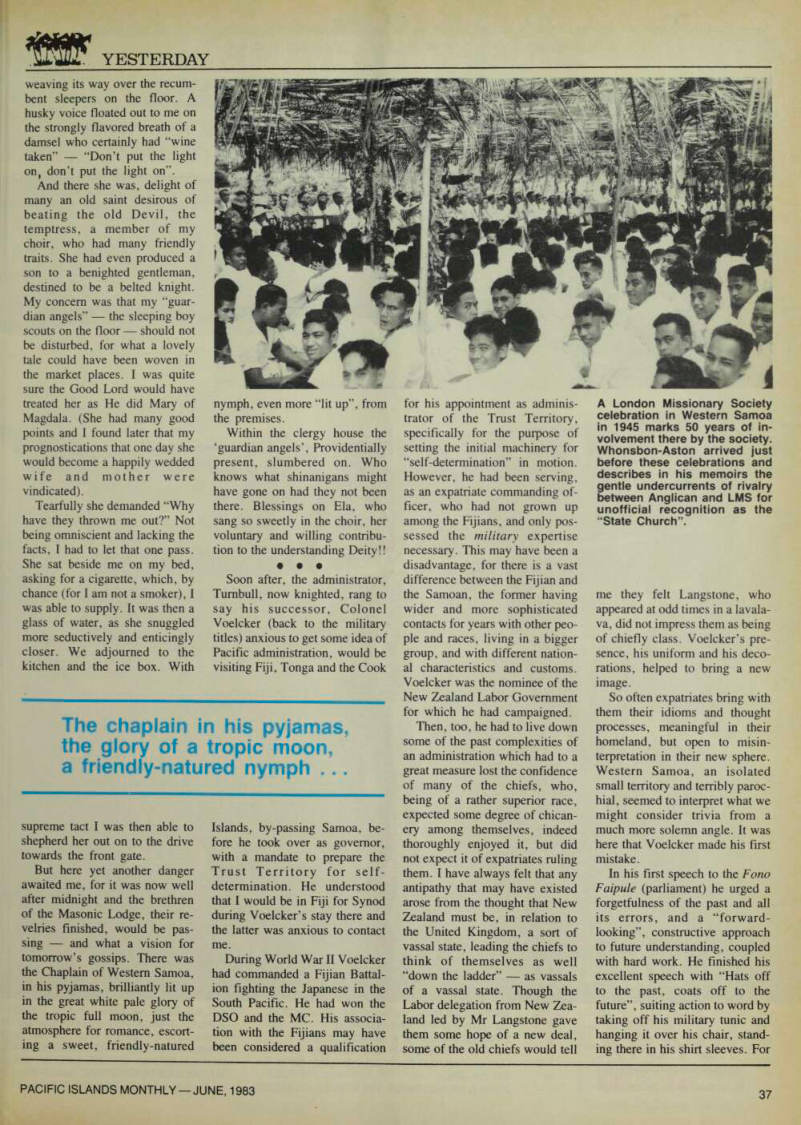

Yesterday
Of foundation stones, a temptress in the night, and ‘Joyita’
In the sixth and final extract from the memoirs of the late Charles William Whonsbon-Aston, Anglican Archdeacon Emeritus of Polynesia, he tells of his experiences in Western Samoa and Fiji in the years leading up to his retirement.
In July 1944 I decided to clamber up the steep side of Mt Vaea to visit the tomb of Robert Louis Stevenson. I cannot be said to be clairvoyant, yet something sud denly seemed to call me, who had never had any intention of climbing the hill behind Vailima, Stevenson’s old home.
Stevenson had died in 1894 and a voice said to me “1894- 1944” 50 years. With the whole world at war, this fiftieth anniversary of the death of Tusitala would be overlooked, save probably by a few ardent Stevensonians. Could we re member it in Samoa? With it came an answer to my problem of building the new church we needed. Remembering the bishop’s advice that the cool of a quiet Sunday evening was the best time to lay a foundation stone in the tropics, with now a feeling that this would be the answer, I rushed, practically slid down the steep declivity, with but one thought in my mind: “If the anniversary date of Decem ber 3 fell on a Sunday, it was a sure indication as to our course of action”. It did fall on Sunday.
So, the die was cast and we went ahead with the foundation stone laying. With no plans
drawn up, but a general idea of just where the northern comer of the prospective building would be, the stone was duly laid on Sunday, December 3, 1944, as the stone declared, “The Fiftieth Anniversary of the Falling As leep of Tusitala”.
Afioga Mata’afa, a friend of Stevenson’s at the time of his death, gave an excellent speech in Samoan and in English, and His Excellency Mr (later Sir) Alfred Turnbull made a further splendid oration when he laid the stone. Behind us as we sat through the proceedings the creek in which ‘R.L.S.’ was wont to bathe rippled along, and rising from it was Mt Vaea, its tomb almost directly above us. It was all, ceremony and surround ings, quiet and peaceful then we went to the hall for a tremendous tea, lavish in quanti ty and quality as only a Samoan feast can be. However, the heat
had overcome Mata’afa and we whisked him (if that is what one describes moving a man of his height and bulk) to a chair in the shelter of my house, where the administration of a little elixir from Stevenson’s fair land and a short rest restored him. • • • I called on Mata’afa one evening and suggested his young lad should come over to my place for the night, as the Boy Scouts, in which he was interested, though too young to join, would be meeting. Eagerly the lad made preparations and came with me. I had the scout troop leader’s young brother of the same age to stay the night with him. Little did I realise that they were, unwit tingly, to be my “guardian angels”.
I had moved my humble couch, using it as a day couch and a bed at night, in the narrow dining room section of the angle
of my verandah. The other arm of the angle, the office-cum “lounge”, was equally a passage way, that opened on to the front verandah, my “front door”.
The scouts’ meeting over, the two lads asked could they listen to the radio (in the “lounge” section, through the door from my bed). I read my night Office, then got ready for bed. Feeling it was time the lads moved off to their room, I looked in, to find them absolutely sound asleep on the floor. I arranged cushions to save them from bumping into the furniture, turned the light off and retired.
The house was quiet, flooded by the brilliance of the Samoan full moon that Rupert Brooke raved about. At the hour of mid night I heard a tapping on the “front door”. I sprang out of bed in time to see a slimly built figure
Mount Vaea outside Apia with the tomb of Robert Louis Stevenson, and Vailima, Stevenson’s house. These photographs are from about the time that Whonsbon-Aston climbed Mount Vaea and plann ed a new church. The house
was already greatly changed
from Stevenson’s time and has undergone many subsequent
changes.
weaving its way over the recum bent sleepers on the floor. A husky voice floated out to me on the strongly flavored breath of a damsel who certainly had “wine taken” “Don’t put the light on, don’t put the light on”.
And there she was, delight of many an old saint desirous of beating the old Devil, the temptress, a member of my choir, who had many friendly traits. She had even produced a son to a benighted gentleman, destined to be a belted knight.
My concern was that my “guar dian angels” the sleeping boy scouts on the floor should not be disturbed, for what a lovely tale could have been woven in the market places. I was quite sure the Good Lord would have treated her as He did Mary of Magdala. (She had many good points and I found later that my prognostications that one day she would become a happily wedded wife and mother were vindicated).
Tearfully she demanded “Why have they thrown me out?” Not being omniscient and lacking the facts, I had to let that one pass.
She sat beside me on my bed, asking for a cigarette, which, by chance (for I am not a smoker), I was able to supply. It was then a glass of water, as she snuggled more seductively and enticingly closer. We adjourned to the kitchen and the ice box. With
nymph, even more “lit up”, from the premises.
Within the clergy house the ‘guardian angels’. Providentially present, slumbered on. Who knows what shinanigans might have gone on had they not been there. Blessings on Ela, who sang so sweetly in the choir, her voluntary and willing contribu tion to the understanding Deity!! • • • Soon after, the administrator, Turnbull, now knighted, rang to say his successor. Colonel Voelcker (back to the military titles) anxious to get some idea of Pacific administration, would be visiting Fiji, Tonga and the Cook
supreme tact I was then able to shepherd her out on to the drive towards the front gate.
But here yet another danger awaited me, for it was now well after midnight and the brethren of the Masonic Lodge, their re velries finished, would be pas sing and what a vision for tomorrow’s gossips. There was the Chaplain of Western Samoa, in his pyjamas, brilliantly lit up in the great white pale glory of the tropic full moon, just the atmosphere for romance, escort ing a sweet, friendly-natured
The chaplain in his pyjamas, the glory of a tropic moon, a friendly-natured nymph ...
Islands, by-passing Samoa, be fore he took over as governor, with a mandate to prepare the Trust Territory for self determination. He understood that I would be in Fiji for Synod during Voelcker’s stay there and the latter was anxious to contact me.
During World War II Voelcker had commanded a Fijian Battal ion fighting the Japanese in the South Pacific. He had won the DSO and the MC. His associa tion with the Fijians may have been considered a qualification
for his appointment as adminis trator of the Trust Territory, specifically for the purpose of setting the initial machinery for “self-determination” in motion.
However, he had been serving, as an expatriate commanding of ficer, who had not grown up among the Fijians, and only pos sessed the military expertise necessary. This may have been a disadvantage, for there is a vast difference between the Fijian and the Samoan, the former having wider and more sophisticated contacts for years with other peo ple and races, living in a bigger group, and with different nation al characteristics and customs.
Voelcker was the nominee of the New Zealand Labor Government for which he had campaigned.
Then, too, he had to live down some of the past complexities of an administration which had to a great measure lost the confidence of many of the chiefs, who, being of a rather superior race, expected some degree of chican ery among themselves, indeed thoroughly enjoyed it, but did not expect it of expatriates ruling them. I have always felt that any antipathy that may have existed arose from the thought that New Zealand must be, in relation to the United Kingdom, a sort of vassal state, leading the chiefs to think of themselves as well “down the ladder” as vassals of a vassal state. Though the Labor delegation from New Zea land led by Mr Langstone gave them some hope of a new deal, some of the old chiefs would tell
me they felt Langstone, who appeared at odd times in a lavala va, did not impress them as being of chiefly class. Voelcker’s pre sence, his uniform and his deco rations, helped to bring a new image.
So often expatriates bring with them their idioms and thought processes, meaningful in their homeland, but open to misin terpretation in their new sphere.
Western Samoa, an isolated small territory and terribly paroc hial, seemed to interpret what we might consider trivia from a much more solemn angle. It was here that Voelcker made his first mistake.
In his first speech to the Fono Faipule (parliament) he urged a forgetfulness of the past and all its errors, and a “forward looking”, constructive approach to future understanding, coupled with hard work. He finished his excellent speech with “Hats off to the past, coats off to the future”, suiting action to word by taking off his military tunic and hanging it over his chair, stand ing there in his shirt sleeves. For
A London Missionary Society celebration in Western Samoa in 1945 marks 50 years of in volvement there by the society.
Whonsbon-Aston arrived just before these celebrations and describes in his memoirs the gentle undercurrents of rivalry between Anglican and LMS for unofficial recognition as the “State Church”.
a century and a half the coat, shirt, tie and walking stick were the status symbols of a gentle man and no one of any standing would think of attending church or some solemn assembly “un dressed”. Trivial it may seem to a European, but it was strictly “Non-U” to the Samoan at the time.
Voelcker felt he had a duty to educate the Samoan people to a goal of “self-determination”, though the great majority were not in any way interested in the matter. He gave addresses every Saturday evening over the radio, speaking of course in English.
Then on Mondays the two Fauta, Malietoa and Tamasese, would hold forth, but apparently without any guidance as to their subject. It must have been a nightmare to them seeking a theme and getting it into shape.
This came home to me particu larly when some of us climbed to the famous tomb to recite some of Stevenson’s prayers and re member the centenary of his birth. We were just a handful, joined by His Excellency the High Commissioner.
With the reputation “R.L.S.” had with regard to his love for the Samoan people and his fight for their rights, one would have thought the two fautua would have been primed to remember such a day. Instead both were left searching for a topic and filled in with some little stories from European fairy tales. A few days later, I asked Malietoa why he continued broadcasting on the radio. His reply was that he must educate his people.
I suggested that the strength of a big chief lay in his silence; King George spoke only when there was some great crisis that shook the world or at Christmas, but in Samoa tradition left it to the orators to talk to their hearts’ delight. It must have found a chord, for a few weeks later both the fautua were saved from furth er embarrassment.
During Voelcker’s term West ern Samoa Samoa i Sisifo began to see itself actually mov ing towards “self determination”. A Council of State had been set up consisting of the administrator and the fautua, a national flag had been
raised at Mulinuu amid great rejoicing, and a national anthem, locally written and scored by a local bandmaster, began to be sung with great gusto, especially by the hundreds of school chil dren (for more than half of the population were under 15). His Excellency the Administrator (to most people “the Governor”) be came the first High Commission er, a title that took a long time to sink in, for to many he was still “the Governor”, a term more significant.
Personally I have felt, and was moved to write so to the prime minister, that New Zealand, small in size and limited in fi nance, had done and was con tinuing to do, a splendid practical job, even if they had sometimes just “muddled through”. They might have been wiser had they, when they first accepted the mandate, asked for the second ment of some experienced colo nial adminstrator in the initial stages, a “know-how” that could have been a school for subse quent career administrations.
In March, 1949, Mr (later Sir) Guy Richardson Powles, later New Zealand’s first Ombuds man, arrived and assumed office as High Commissioner, to be reappointed again at the end of his first term for a further two years in 1954.
The soldier who was not a lawyer had departed and now
commemorated by a plaque in the new church.
There was no evidence of any “struggle” for independence, such as Home Rule in Ireland, nor were there any “freedom fighters” to rouse the populace; the Mau had done its job and was but a memory. In fact not many people even knew they were in the process of being “freed” or even thought they were shackled.
It never appeared to me that it was a political party matter. New Zealand, doing an excellent job in many ways, just wanted to get
Independence arrives quietly no freedom fighters, no evidence of struggle
came the lawyer, who had reach ed colonel’s rank in the war in the Pacific though he never paraded the fact. He, too, was an appointee of the Labor Govern ment of New Zealand, one would say, a Christian Socialist. His great old father, Colonel Powles, veteran of the Boer War and First and Second World Wars, would come to Samoa during the New Zealand winter, a grand old sol dier “of the old school”. He became attached to the services, at which he sang right lustily in the temporary church. He is
rid of the responsibility. What Labor initiated, the National (Conservative) Party carried along in its stride. The people were never really consulted save through their matais. However, whatever it meant, they have gone along with it. • • • I seemed to become involved nolens volens in the beginning and at several other points with the mystery of the loss in 1955 of the 70-foot fishing vessel Joyita.
It began when the children, nice lively Irish youngsters, of the
government doctor, burst in on me with “Will Sunday School be over before 11.15 because we want to see daddy off in the Joyitar Next morning as the dawn broke she was to be seen hull down well out to sea in its voy age to the Tokelau Group, under charter to the firm of E. A.
Coxon and Co., at the request of the government carrying a nor mal party of government officials on a routine visit to the atoll group. That was October 3, 1955.
On the Wednesday evening we dined with the Russells at their plantation a few miles further on from Faleolo Airport, returning to find a message to say that the Joyita was missing and that an aerial search by planes of the RNZAF would start at daylight next morning. Indeed, the search went on for many days without success and was eventually abandoned.
On November 9 news came that a passenger-cargo vessel, MV Tuvalu, returning from the Gilberts, had found the water logged abandoned Joyita off Vanua Levu, Fiji. There were some slight signs of a fire, not a soul aboard, ship’s papers and instruments gone, the thousand pounds in notes and silver like wise missing. Nor was there any sign of the 45 empty 44-gallon drums or the timber carried as
cargo. Her fate began to be equated with that of the Marie Celeste.
Joyita had been a private yacht of the United States Navy, built in 1931. It had been converted into a fishing vessel, with refrig eration and the holds lined with cork, helping to make her pract ically unsinkable. Owned by a Honolulu woman she had been chartered to Captain Thomas Henry (“Dusty”) Miller, of Car diff, Wales.
What happened to them all?
That is the mystery of the sea that has never been solved.
It was found most difficult to think of Captain Miller deserting his vessel. This was quite out of character. There was the mystery of the missing empty, floatable, 44-gallon oil drums and the tim ber, with which an excellent raft could have been made, and the 25 Tokelau people on board would have been thoroughly at home in the sea lashing them together. There seems to be no record of these washing-up on distant beaches. The ship, it was discovered, had no lifeboat, only three oval floats (never found).
There were life-jackets for all, but no effective radio.
Joyita was reconditioned after being sold in Fiji and was used on a copra run between the Vanua Levu coast and Levuka and Suva.
Some months later, Joyita met
her end. Coming from Savusavu on Vanua Levu and passing the end of the reef beyond Makogai, her skipper came on deck to alter course slightly, just in time, for she grazed the end of the reef, but with little damage. About 10 o’clock at night she landed two passengers at Levuka wharf and continued into heavy seas through the gap in the reef short
named the Malolo, brought along Robin Maugham (Lord Maugham), together with a Mr Savage, of New Zealand, to talk about the Joyita, about which Maugham hoped to write a book and also prepare a scenario for a film based on the Joyita, which he was arranging to purchase.
I put it to Maugham that it hardly seemed the right thing, so
Joyita: An unsolved puzzle, encounter with a reef, and a plan of exorcism.
ly to find herself in difficulties, between heavy seas and pumps that had reversed their opera tions. She struggled back into Levuka and beached at Nasova, near the government centre for the province, and never sailed again.
When I returned to Levuka as Archdeacon of Fiji in November, 1958, the Joyita seemed to fol low me. On August 16, 1961, Captain Frank Brown, then the owner and captain of the one time Royal Yacht of Queen Sa lote of Tonga, the Hifofua, re
near to the tragedy, to sear the minds of those bereaved. He assured me that he had no intent whatsoever and would avoid any such impression. I then suggest ed that one found it difficult to trust a Maugham after the way his uncle, Somerset, had ferreted out stories of people still living and had reopened old scandals and old sores. He asked “I sup pose you mean The Letter”. I agreed and I had also in my mind my old late friend, Sir Murchison Fletcher, Governor of Fiji, said to be the “Chinese official” in
Somerset Maugham’s The Paint ed Veil.
I was particularly concerned about one story that he would certainly hear on his coming visit to Samoa, a story with a dramatic savor someone seemed to have invented to depict a probable cause for the trouble aboard. Its
publication would certainly
cause great concern to a widow and delightful family. I wanted to avoid this.
He asked could I tell him about it. I decided I would only if he gave me his solemn promise that he would not use it under any circumstances. He gave me that word and subsequently his word (of the new aristocra cy!) was proved of no value whatever.
Unexpected circumstances
took me back to Samoa for two months and on my return through
The coastal ship Joyita was propped up on the beach (above) at Nasova in 1961 when Whonsbon-Aston, then Ar chdeacon of Fiji, was asked to conduct a ceremony of exor cism. In a mounting controver sy arising from published mate rial he did not go ahead with the suggestion. The picture above left shows the ship aground on Horseshoe Reef before being beached at Nasova.
Suva, staying at Bishop’s House, the bishop’s wife brought me a message from Lord Maugham, who had left for the UK, to ask if I would take a service of exor cism on the Joyita.
I was importuned then by tele phone calls, and Captain Brown himself came to talk to me about it. I said I would agree only after the ship was fully restored and certified seaworthy by the com petent authority, a properly qual ified skipper and engineer were in charge, and the bishop had issued the licence necessary in every such case in accordance with ancient Canon Law.
Bishop Kempthorne then re tired, after 39 years as bishop in Polynesia, to be succeeded by John Charles Vockler as third bishop, a tall handsome fellow, who, when resplendent in his cope and mitre, could look and fit the character of the moment like a medieval prelate, though at times he could appear as a humble suppliant at the Throne of grace. His real self seemed to be between the two when his best graces came out.
In the meantime a series of syndicated articles appeared from Robin Maugham in the Sydney Sunday paper, the Sun- Herald, in which it was men tioned that “the Archdeacon of Fiji had offered” to take a service of exorcism, which annoyed me.
I retired from the affair.
Soon after came a battle royal between the Lord Spiritual of Polynesia and the equally youn
gish Lord Temporal Maugham, all highly diverting. Maugham appeared to have called the Ar chbishop of Canterbury to his cause, and English ecclesiastical authorities on demon-possession and exorcism were called in. A perusal of the file in the Diocesan records is really interesting.
In the meantime an eccentric, but really competent, woman ar tist of worldwide renown settled temporarily (her stays were al way much on the pattern), Miss Edwell Burke, felt the Joyita should be permanently based ashore surrounded by bright flower beds, with teas served aboard.
I don’t know whether Maugham wrote with bitterness.
But I received a letter from a journalist friend in Salisbury, England, saying I should take an action for libel against Maugham, and then a letter from the one person I had hoped would be saved by my interven tion, a widow writing on behalf of her young and impressionable children, who had been wounded and disturbed by such a betrayal.
Of course I would not take any legal action, it might have en couraged people to buy the book, which was not by any means a literary triumph. Joyita, all this time sat in the comparative safety of the shore reef, buffeted by one hurricane, and overrun by chil dren and odd plunderers. • • • It was a day to be remembered.
That evening, John Martin, my choice, and a very good one, as my successor, was inducted and I was collated as Archdeacon of Fiji and, once again. Vicar of
Levuka in the line of the pioneer, William Floyd.
I had to return to Western Samoa four times in timfcs of crisis and twice to see my old friends, sadly decreasing in num bers as the years went by.
My packing done each farewell seemed a sad event. The last one occurred in 1958. His Excellency the High Commis sioner gave an open reception from 3.30 to 6.30 p.m., people coming at their own conveni ence. The scouts gave me an ornate and complicated-looking clock in a glass dome, a kindly thought, though I never found out how it worked. The guides gave me a small tanoa (a many legged bowl cut from a solid log used for kava).
The Returned Servicemen’s Club Committee had a small par ty for me. One member of the
committee, a hardened sailor, the Harbor Master, suddenly asked if he could say a word. I shall never forget his honest appraisal of my associations there.
In the early dusk a few even ings later, I was with a number of friends who were fare welling me on the wharf from which the passengers were ferried out to the ship, when the Harbor Master arrived with his boys.
I was not to be allowed to go aboard with the hoi pplloi, but was to be piped aboard from the Harbor Master’s vessel and an era, as they say, ended.
A few years later Samoa be came an independent sovereign state.
The damaged Joyita under tow in Laucala Bay off Suva.
Archdeacon Whonsbon-Aston In Suva with some younger members of the parish.
Advertisements & other items, pp. 36-42 (1 item)
\n All-Hew Worldof Sonic Clarity
Introducing the Hew PRISM Component Systems.
Ref ined reproduction performance and enhanced appearance make the Hew PRISM systems an extremely musical elegant addition to any listening/living environment.
Another taste of advanced technology from.TEAC.
COMPONENT SYSTEMS
E 8® B °°- ri I s I - Where Art and Technology Meet Australia: TEAC Australia, Pty., Ltd. 115 Whiteman Street South Melbourne, Victoria 3205 New Zealand: Direct Imports (N.Z.) Ltd P.O. Box 72 Hastings Fuji: D J eewan Reou^o^Vanuatu New Caledonia: HIFIVOX 79. Rue de Sebastopol B P 1458, Noumea Tahiti: Etablissements Wiking P.O Box 237 132 Rue Du Marechal Foch Papeete Vanuatu. Sound Center Box 434, Vila Republic ot Vanuatu
THE TOYOTA ROADMASTERS
READY TO TAKE
ON THE TOUGHESTOOBS.
Meet Toyota’s hard working commercial vehicles. Tough. Durable. Ready to meet the challenge of the worst roads and climates. Ready to do the job called for with ease. Rugged veterans, each one specifically designed to meet the different demands of the world’s businesses. One of them is just right for you. There are no vehicles more reliable. And if you need it, Toyota is ready with fast
backup service. Toyota’s roadmasters,
they’re a winning team.
HI-LUX 4WD
TOYOTA
QUALITY SERVICE
AMERICAN SAMOA: BURNS PHILP (SOUTH SEA)
CO., LTD., P.O. Box 129, Pago Pago.
COOK ISLANDS: COOK ISLANDS TRADING
CORPORATION LTD., P.O. Box 92, Rarotonga.
FIJI: AUTOMOTIVE SUPPLIES COMPANY, G.P.O.
Box 355, Suva.
GUAM & MICRONESIA: ATKINS. KROLL (GUAM) LTD., P.O. Box 6428, Tamuning.
KIRIBATI: TARAWA MOTORS, P.O. Box 36,
Bairiki, Tarawa, Kiribati.
NAURU: NAURU COOPERATIVE SOCIETY.
NEW CALEDONIA: SERVICE IMPORTATION
AUTOMOBILE DU PACIFIQUE, Rond-Point
du Pacifique (Station Total) B.P. 438, Noumec
X
mmm
f ■ m 1 !
HI-LUX
DOUBLE CAB
JfSi
' m NORFOLK ISLAND: BORRY’S LIMITED, P.O. Box 169.
J APUA NEW GUINEA: ELA MOTORS,
Bcratchley Rd., Badili, P.O. Box 675, Port Moresby.
SAIPAN: MICROL CORPORATION, P.O. Box 267,
Saipan.
SOLOMON: MENDANA ENTERPRISES (5.1.) LTD.,
3.P.0. Box 174, Honiara.
TAHITI: NIPPON AUTOMOTO, P.O. Box 342, Papeete.
TONGA: BURNS PHILP (SOUTH SEA) CO., LTD., P.O. Box 55, Nuku’alofa.
VANUATU; VANUATU MOTORS, P.O. Box 18.
Port Vila.
WESTERN SAMOA: BURNS PHILP (SOUTH SEA)
CO., LTD., P.O. Box 188, Apia.
TOYOTA
The Toyota range includes:
COROLLA, STARLET, CORONA, CRESSIDA, HI-LUX,
STOUT, HI ACE, DYNA, COASTER and LAND CRUISER
Komatsu Makes a Difference
n » i i: Sf i u m % -< In critical areas like reliability and performance, Komatsu products and systems are making a significant difference at mining and construction sites around the world.
In the USA, for example, Komatsu’s largest and most powerful work machine the D455A bulldozer is establishing a superior record of reliability and productivity at mining sites that virtually no other machine in its class can match.
And in another critical area, technology, Komatsu is also making a difference in responding to market demands for improved product quality, and for new and original product innovations.
Consider our new computerized seabed robot system: Operating on the ocean floor, it can relay TV pictures of the seabed to a mother ship, or perform man-like boring, drilling and piling operations down to planned depths of 500 meters* Discover the Komatsu difference above sea level, or down to depths of 500 meters. Komatsu a name you can build on.
•H KOMATSU LTD.
Tokyo, Japan Komatsu offices: Tokyo, Sydney, Singapore, Jakarta, Manila, Bangkok, Bangalore, Karachi, Beijing, Istanbul, Cairo, Alger, Dubai, Tehran, Baghdad, Jeddah, Riyadh, Damman, Nairobi, Abidjan, Lagos, Johannesburg, Moscow, Warsaw, Brussels, Paris, Madrid, Frankfurt, Stuttgart, London, Habana, Buenos Aires, Panama, Caracas, Sao Paulo, Bogota, Mexico City, San Francisco, Oakland, Philadelphia, Detroit, Dallas, Atlanta, Chicago, Toronto, Vancouver, and distributors in over 100 countries around the world.
JL
In Technology
i* > * The Komatsu seabed robot system ,s currently operating ,n the Japan Inland Sea a. depths down to a max,mum ol 70 meters, in a government-sponsored bridge vrorks program
People
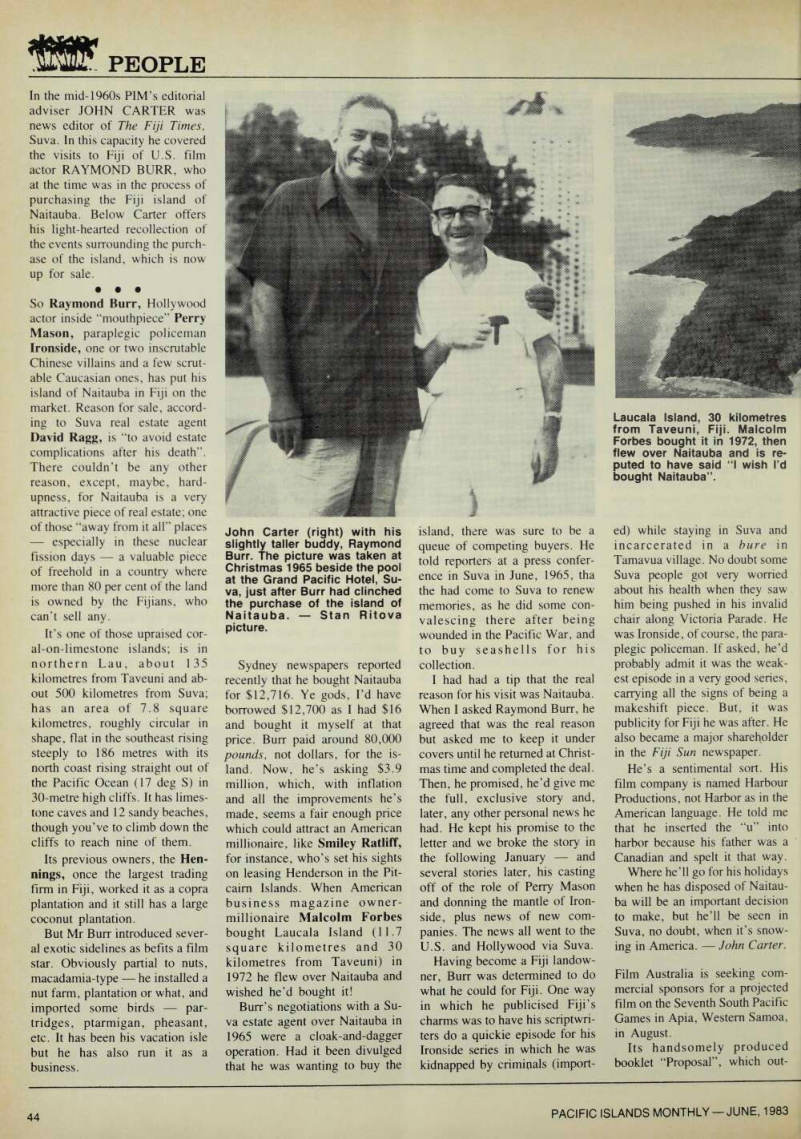
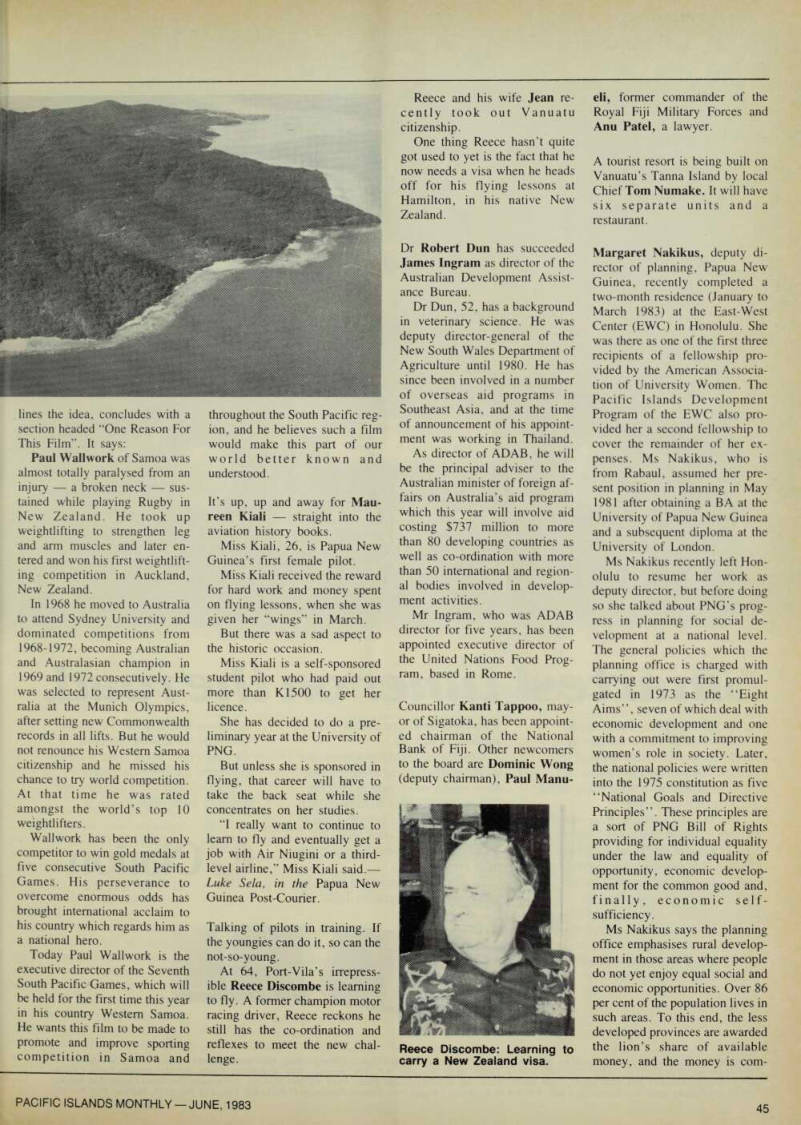

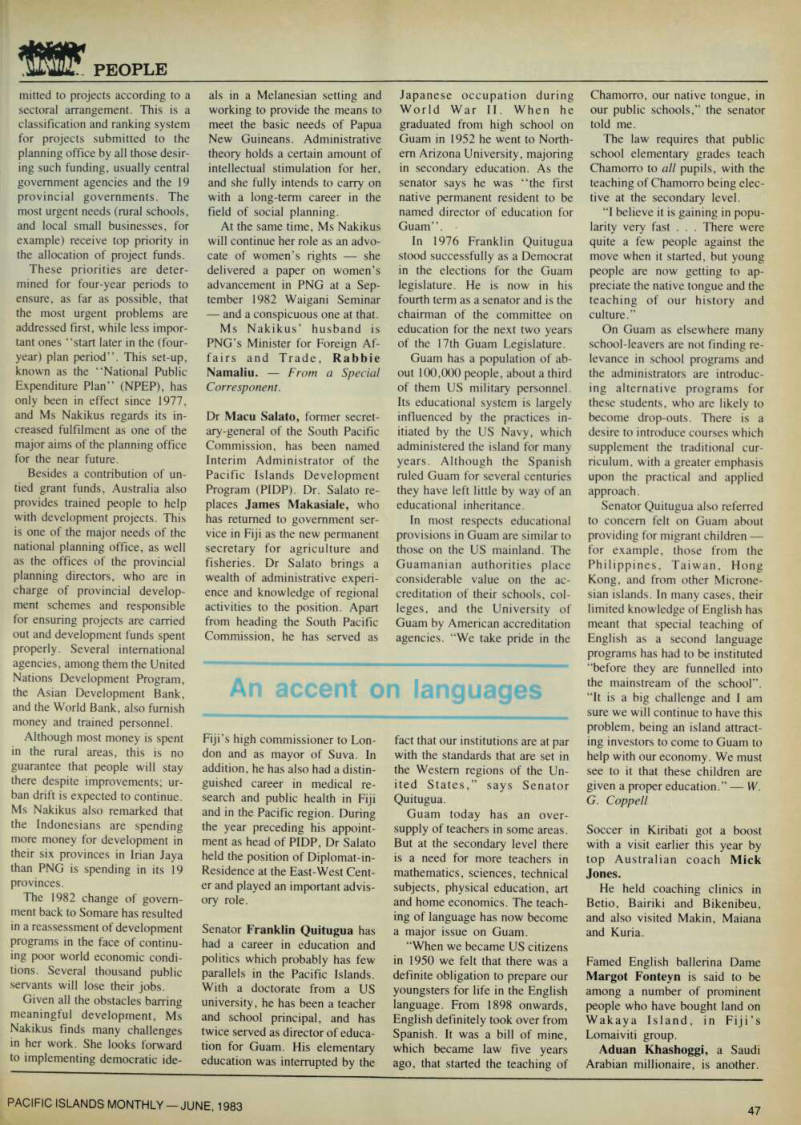
In the mid-1960s PlM’s editorial adviser JOHN CARTER was news editor of The Fiji Times, Suva. In this capacity he covered the visits to Fiji of U.S. film actor RAYMOND BURR, who at the time was in the process of purchasing the Fiji island of Naitauba. Below Carter offers his light-hearted recollection of the events surrounding the purch ase of the island, which is now up for sale. • • • So Raymond Burr, Hollywood actor inside “mouthpiece” Perry
Mason, paraplegic policeman
Ironside, one or two inscrutable Chinese villains and a few scrut able Caucasian ones, has put his island of Naitauba in Fiji on the market. Reason for sale, accord ing to Suva real estate agent David Ragg, is “to avoid estate complications after his death”.
There couldn’t be any other reason, except, maybe, hard upness, for Naitauba is a very attractive piece of real estate; one of those “away from it all” places especially in these nuclear fission days a valuable piece of freehold in a country where more than 80 per cent of the land is owned by the Fijians, who can’t sell any.
It’s one of those upraised cor al-on-limestone islands; is in northern Lau, about 135 kilometres from Taveuni and ab out 500 kilometres from Suva; has an area of 7.8 square kilometres, roughly circular in shape, flat in the southeast rising steeply to 186 metres with its north coast rising straight out of the Pacific Ocean (17 deg S) in 30-metre high cliffs. It has limes tone caves and 12 sandy beaches, though you’ve to climb down the cliffs to reach nine of them.
Its previous owners, the Hen
nings, once the largest trading
firm in Fiji, worked it as a copra plantation and it still has a large
coconut plantation.
But Mr Burr introduced sever al exotic sidelines as befits a film star. Obviously partial to nuts, macadamia-type he installed a nut farm, plantation or what, and imported some birds par
tridges, ptarmigan, pheasant,
etc. It has been his vacation isle but he has also run it as a business.
Sydney newspapers reported
recently that he bought Naitauba for $12,716. Ye gods. I’d have borrowed $12,700 as I had $l6 and bought it myself at that price. Burr paid around 80,000 pounds, not dollars, for the is land. Now, he’s asking $3.9 million, which, with inflation and all the improvements he’s made, seems a fair enough price which could attract an American millionaire, like Smiley Ratliff, for instance, who’s set his sights on leasing Henderson in the Pit cairn Islands. When American business magazine owner millionaire Malcolm Forbes bought Laucala Island (11.7 square kilometres and 30 kilometres from Taveuni) in 1972 he flew over Naitauba and wished he’d bought it!
Burr’s negotiations with a Su va estate agent over Naitauba in 1965 were a cloak-and-dagger operation. Had it been divulged that he was wanting to buy the
island, there was sure to be a queue of competing buyers. He told reporters at a press confer ence in Suva in June, 1965, tha the had come to Suva to renew memories, as he did some con valescing there after being wounded in the Pacific War, and to buy seashells for his collection.
I had had a tip that the real reason for his visit was Naitauba.
When I asked Raymond Burr, he agreed that was the real reason but asked me to keep it under covers until he returned at Christ mas time and completed the deal.
Then, he promised, he’d give me the full, exclusive story and, later, any other personal news he had. He kept his promise to the letter and we broke the story in the following January — and several stories later, his casting off of the role of Perry Mason and donning the mantle of Iron side, plus news of new com panies. The news all went to the U.S. and Hollywood via Suva.
Having become a Fiji landow ner, Burr was determined to do what he could for Fiji. One way in which he publicised Fiji’s charms was to have his scriptwri ters do a quickie episode for his Ironside series in which he was kidnapped by criminals (import-
ed) while staying in Suva and incarcerated in a bure in Tamavua village. No doubt some Suva people got very worried about his health when they saw him being pushed in his invalid chair along Victoria Parade. He was Ironside, of course, the para plegic policeman. If asked, he’d probably admit it was the weak est episode in a very good series, carrying all the signs of being a makeshift piece. But, it was publicity for Fiji he was after. He also became a major shareholder in the Fiji Sun newspaper.
He’s a sentimental sort. His film company is named Harbour Productions, not Harbor as in the American language. He told me that he inserted the “u” into harbor because his father was a Canadian and spelt it that way.
Where he’ll go for his holidays when he has disposed of Naitau ba will be an important decision to make, but he’ll be seen in Suva, no doubt, when it’s snow
ing in America.
John Carter.
Film Australia is seeking com mercial sponsors for a projected film on the Seventh South Pacific Games in Apia, Western Samoa, in August.
Its handsomely produced booklet “Proposal”, which out
John Carter (right) with his
slightly taller buddy, Raymond
Burr. The picture was taken at Christmas 1965 beside the pool at the Grand Pacific Hotel, Su va, just after Burr had clinched the purchase of the island of Naitauba. - Stan Ritova picture.
Laucala Island, 30 kilometres from Taveuni, Fiji. Malcolm Forbes bought it in 1972, then flew over Naitauba and is re puted to have said “I wish I’d bought Naitauba”.
lines the idea, concludes with a section headed “One Reason For This Film”. It says; Paul Wallwork of Samoa was almost totally paralysed from an injury a broken neck sus tained while playing Rugby in New Zealand. He took up
weightlifting to strengthen leg
and arm muscles and later en tered and won his first weightlift
ing competition in Auckland,
New Zealand.
In 1968 he moved to Australia to attend Sydney University and dominated competitions from 1968-1972, becoming Australian and Australasian champion in 1969 and 1972 consecutively. He was selected to represent Aust ralia at the Munich Olympics, after setting new Commonwealth records in all lifts. But he would not renounce his Western Samoa citizenship and he missed his chance to try world competition.
At that time he was rated amongst the world’s top 10
weightlifters.
Wallwork has been the only competitor to win gold medals at five consecutive South Pacific Games. His perseverance to overcome enormous odds has brought international acclaim to his country which regards him as a national hero.
Today Paul Wallwork is the executive director of the Seventh South Pacific Games, which will be held for the first time this year in his country Western Samoa.
He wants this film to be made to
promote and improve sporting
competition in Samoa and
throughout the South Pacific reg ion, and he believes such a film would make this part of our world better known and understood.
It’s up, up and away for Mau reen Kiali straight into the aviation history books.
Miss Kiali, 26, is Papua New Guinea’s first female pilot.
Miss Kiali received the reward for hard work and money spent on flying lessons, when she was given her “wings” in March.
But there was a sad aspect to the historic occasion.
Miss Kiali is a self-sponsored student pilot who had paid out more than Kl5OO to get her licence.
She has decided to do a pre liminary year at the University of
Png.
But unless she is sponsored in flying, that career will have to take the back seat while she concentrates on her studies.
“I really want to continue to learn to fly and eventually get a job with Air Niugini or a third level airline,” Miss Kiali said.— Luke Sela, in the Papua New Guinea Post-Courier.
Talking of pilots in training. If
the youngies can do it, so can the not-so-young.
At 64, Port-Vila’s irrepress ible Reece Discombe is learning to fly. A former champion motor racing driver, Reece reckons he still has the co-ordination and reflexes to meet the new chal lenge.
Reece and his wife Jean re cently took out Vanuatu
citizenship.
One thing Reece hasn’t quite got used to yet is the fact that he now needs a visa when he heads off for his flying lessons at Hamilton, in his native New Zealand.
Dr Robert Dun has succeeded James Ingram as director of the Australian Development Assist ance Bureau.
Dr Dun, 52, has a background in veterinary science. He was
deputy director-general of the
New South Wales Department of Agriculture until 1980. He has since been involved in a number of overseas aid programs in Southeast Asia, and at the time of announcement of his appoint ment was working in Thailand.
As director of ADAB, he will be the principal adviser to the Australian minister of foreign af fairs on Australia’s aid program which this year will involve aid costing $737 million to more than 80 developing countries as well as co-ordination with more than 50 international and region al bodies involved in develop ment activities.
Mr Ingram, who was ADAB director for five years, has been appointed executive director of the United Nations Food Prog ram, based in Rome.
Councillor Kanti Tappoo, may or of Sigatoka, has been appoint ed chairman of the National Bank of Fiji. Other newcomers to the board are Dominic Wong (deputy chairman), Paul Manu-
eli, former commander of the Royal Fiji Military Forces and Anu Patel, a lawyer.
A tourist resort is being built on Vanuatu’s Tanna Island by local Chief Tom Numake. It will have six separate units and a restaurant.
Margaret Nakikus, deputy di rector of planning, Papua New
Guinea, recently completed a
two-month residence (January to March 1983) at the East-West Center (EWC) in Honolulu. She was there as one of the first three recipients of a fellowship pro vided by the American Associa tion of University Women. The Pacific Islands Development Program of the EWC also pro vided her a second fellowship to cover the remainder of her ex penses. Ms Nakikus, who is from Rabaul, assumed her pre
sent position in planning in May
1981 after obtaining a BA at the University of Papua New Guinea and a subsequent diploma at the University of London.
Ms Nakikus recently left Hon olulu to resume her work as deputy director, but before doing so she talked about PNG’s prog ress in planning for social de velopment at a national level.
The general policies which the planning office is charged with carrying out were first promul gated in 1973 as the “Eight Aims”, seven of which deal with economic development and one with a commitment to improving women’s role in society. Later, the national policies were written into the 1975 constitution as five “National Goals and Directive
Principles”. These principles are
a sort of PNG Bill of Rights
providing for individual equality
under the law and equality of
opportunity, economic develop
ment for the common good and, finally, economic self
sufficiency.
Ms Nakikus says the planning
office emphasises rural develop
ment in those areas where people do not yet enjoy equal social and economic opportunities. Over 86 per cent of the population lives in such areas. To this end, the less
developed provinces are awarded
the lion’s share of available money, and the money is com-
Reece Discombe: Learning to carry a New Zealand visa.
mitted to projects according to a sectoral arrangement. This is a classification and ranking system for projects submitted to the planning office by all those desir ing such funding, usually central government agencies and the 19 provincial governments. The most urgent needs (rural schools, and local small businesses, for example) receive top priority in the allocation of project funds.
These priorities are deter mined for four-year periods to ensure, as far as possible, that the most urgent problems are addressed first, while less impor tant ones “start later in the (four year) plan period’’. This set-up, known as the “National Public Expenditure Plan” (NPEP), has only been in effect since 1977, and Ms Nakikus regards its in creased fulfilment as one of the major aims of the planning office for the near future.
Besides a contribution of un tied grant funds, Australia also provides trained people to help with development projects. This is one of the major needs of the national planning office, as well as the offices of the provincial planning directors, who are in charge of provincial develop ment schemes and responsible for ensuring projects are carried out and development funds spent properly. Several international agencies, among them the United Nations Development Program, the Asian Development Bank, and the World Bank, also furnish money and trained personnel.
Although most money is spent in the rural areas, this is no guarantee that people will stay there despite improvements; ur ban drift is expected to continue.
Ms Nakikus also remarked that the Indonesians are spending more money for development in their six provinces in Irian Jaya than PNG is spending in its 19 provinces.
The 1982 change of govern ment back to Somare has resulted in a reassessment of development programs in the face of continu ing poor world economic condi tions. Several thousand public servants will lose their jobs.
Given all the obstacles barring meaningful development, Ms Nakikus finds many challenges in her work. She looks forward to implementing democratic ide
als in a Melanesian setting and working to provide the means to meet the basic needs of Papua New Guineans. Administrative theory holds a certain amount of intellectual stimulation for her, and she fully intends to carry on with a long-term career in the field of social planning.
At the same time, Ms Nakikus will continue her role as an advo cate of women’s rights she delivered a paper on women’s advancement in PNG at a Sep tember 1982 Waigani Seminar and a conspicuous one at that.
Ms Nakikus’ husband is PNG’s Minister for Foreign Af fairs and Trade, Rabble Namaliu. From a Special
Corresponent.
Dr Macu Salato, former secret ary-general of the South Pacific Commission, has been named Interim Administrator of the Pacific Islands Development Program (PIDP). Dr. Salato re places James Makasiale, who has returned to government ser vice in Fiji as the new permanent secretary for agriculture and fisheries. Dr Salato brings a wealth of administrative experi ence and knowledge of regional activities to the position. Apart from heading the South Pacific Commission, he has served as
An accent on languages
Fiji’s high commissioner to Lon don and as mayor of Suva. In addition, he has also had a distin guished career in medical re search and public health in Fiji and in the Pacific region. During the year preceding his appoint ment as head of PIDP, Dr Salato held the position of Diplomat-in- Residence at the East-West Cent er and played an important advis ory role.
Senator Franklin Quitugua has had a career in education and politics which probably has few parallels in the Pacific Islands.
With a doctorate from a US university, he has been a teacher and school principal, and has twice served as director of educa tion for Guam. His elementary education was interrupted by the
Japanese occupation during World War 11. When he graduated from high school on Guam in 1952 he went to North ern Arizona University, majoring in secondary education. As the senator says he was “the first native permanent resident to be named director of education for Guam”.
In 1976 Franklin Quitugua stood successfully as a Democrat in the elections for the Guam legislature. He is now in his fourth term as a senator and is the chairman of the committee on education for the next two years of the 17th Guam Legislature.
Guam has a population of ab out 100,000 people, about a third of them US military personnel.
Its educational system is largely influenced by the practices in itiated by the US Navy, which administered the island for many years. Although the Spanish ruled Guam for several centuries they have left little by way of an educational inheritance.
In most respects educational provisions in Guam are similar to those on the US mainland. The Guamanian authorities place considerable value on the ac creditation of their schools, col leges, and the University of Guam by American accreditation agencies. “We take pride in the
fact that our institutions are at par with the standards that are set in the Western regions of the Un ited States,” says Senator
Quitugua.
Guam today has an over supply of teachers in some areas.
But at the secondary level there is a need for more teachers in mathematics, sciences, technical
subjects, physical education, art
and home economics. The teach ing of language has now become a major issue on Guam.
“When we became US citizens in 1950 we felt that there was a definite obligation to prepare our youngsters for life in the English language. From 1898 onwards, English definitely took over from Spanish. It was a bill of mine, which became law five years ago, that started the teaching of
Chamorro, our native tongue, in our public schools,” the senator told me.
The law requires that public
school elementary grades teach
Chamorro to all pupils, with the teaching of Chamorro being elec tive at the secondary level.
“I believe it is gaining in popu larity very fast . . . There were
quite a few people against the
move when it started, but young people are now getting to ap preciate the native tongue and the teaching of our history and culture.”
On Guam as elsewhere many school-leavers are not finding re levance in school programs and the administrators are introduc ing alternative programs for these students, who are likely to become drop-outs. There is a desire to introduce courses which supplement the traditional cur riculum, with a greater emphasis upon the practical and applied approach.
Senator Quitugua also referred to concern felt on Guam about
providing for migrant children
for example, those from the
Philippines, Taiwan, Hong
Kong, and from other Microne sian islands. In many cases, their limited knowledge of English has meant that special teaching of English as a second language programs has had to be instituted “before they are funnelled into the mainstream of the school”.
“It is a big challenge and I am sure we will continue to have this problem, being an island attract ing investors to come to Guam to help with our economy. We must see to it that these children are
given a proper education.”
w.
G. Coppell
Soccer in Kiribati got a boost with a visit earlier this year by top Australian coach Mick Jones.
He held coaching clinics in Betio, Bairiki and Bikenibeu, and also visited Makin, Maiana and Kuria.
Famed English ballerina Dame Margot Fonteyn is said to be among a number of prominent people who have bought land on Wakaya Island, in Fiji’s Lomaiviti group.
Aduan Khashoggi, a Saudi Arabian millionaire, is another.
Advertisements & other items, pp. 46-47 (2 items)
©Clarion
Smartest tuner on the road.
Clarion PE-9001 is one of a kind.
It’s a new breed of car stereo that lets you select your favorite music source at the push of a button. No more annoying knobs to twiddle with while you’re trying to concentrate on driving.
Thanks to an electronic tuner, station location is pushbutton simple. And you have a choice of tuning modes: 10-station (SFM, SAM) memory preset, auto-scan, and manual. Frequency and time are
displayed digitally, and advanced
circuitry includes auto DX/LO FM signal monitoring, SASC (signal-activated FM stereo control) and CZI noise elimination. The cassette section has auto reverse and metal tape selector. A power amplifier is built in.
Concentrated in this one smart unit is everything you need to enjoy living room quality stereo right in your car.
This car-filling sound is delivered with superb stereo realism through a pair of well-matched, high-power SK-317G, 2-way, 2-speaker systems housed in bass reflex enclosures.
So why not get smart and go pushbutton with new generation digital car electronics from Clarion. The people who make the smartest tuners on the road. Plus a whole range of quality engineered car stereo components to grade up your in-car entertainment system to living room standards.
©Clarion
CLARION CO., LTD.
Tokyo, Japan Australia: Amalgamated Wireless (Australasia) Ltd., 554 Parramatta Road, Ashf.eld, N SW, 2131 / New Zealand: AWA New Zealand Limited, PO. Box 50-248, Ponrua / Fiji Islands: Brijlal & Co., Ltd., G.P.O. Box 362, Suva / Tahiti: HI-FI Shangrila, BP. 200, Papeete / New Caledonia: Caldis, 8.P.M1, Noumea Cedex / Guam.
Micropac Audio Inc., PO. Box 3478, Agana, Guam 96910, U.S.A. Tel; 472-8091, Cable Code: HIFI AUDIO AGANA / Vanuatu: The Sound Centre PO. Box 434, Vila / Cook Islands: South Seas International Ltd., PO. Box 49, Rarotonga / Papua New Guinea: Hagemeyer (P.N.G.) Pty. Ltd., PO. Box 1428, Boroko, Port Moresby
People
A Suva
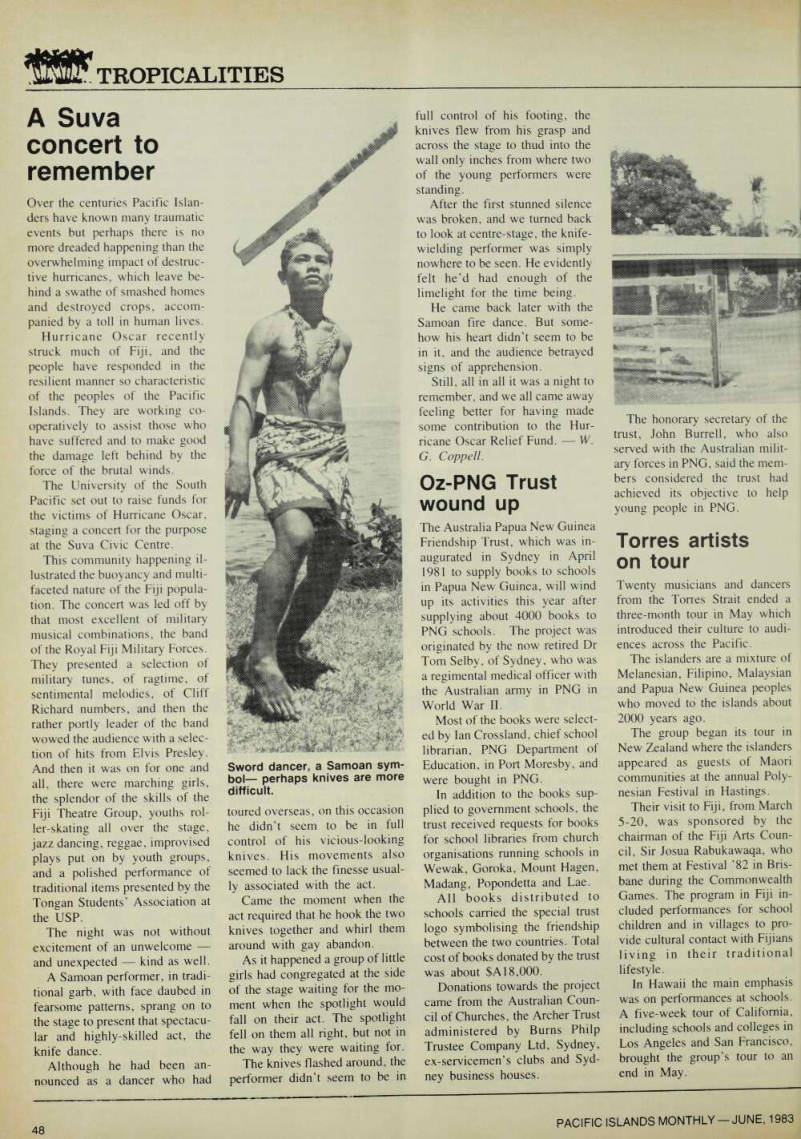
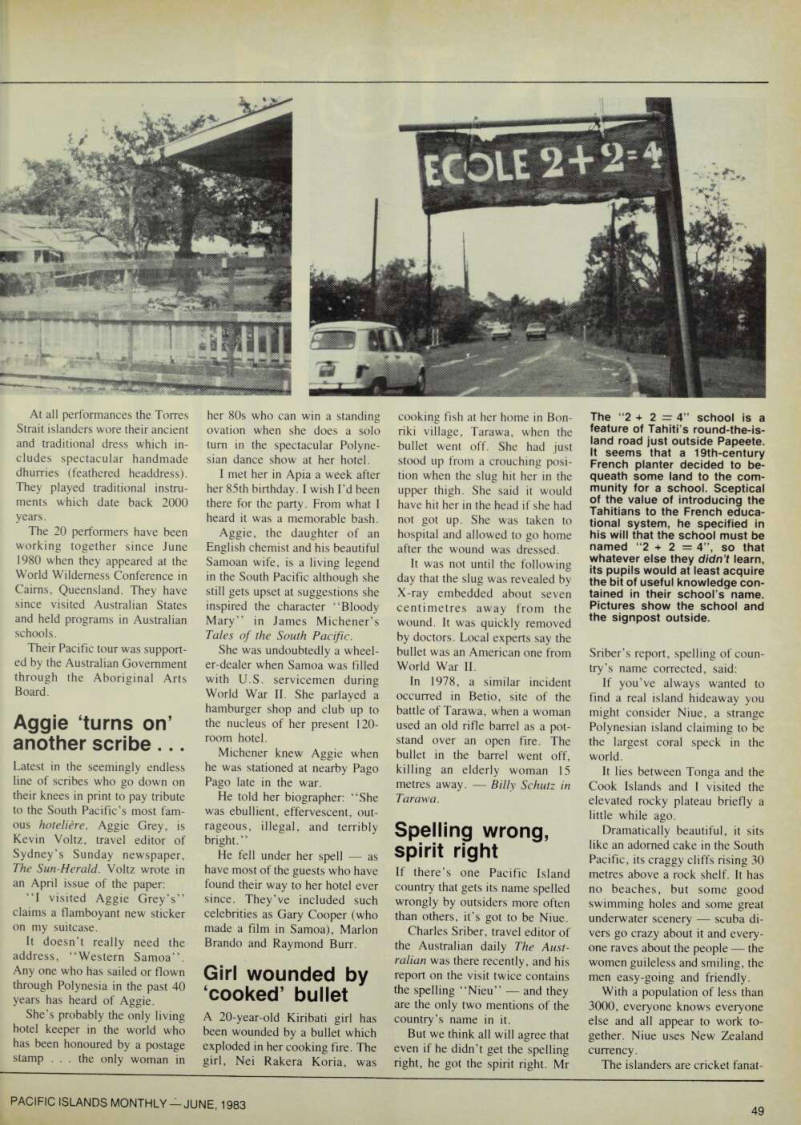
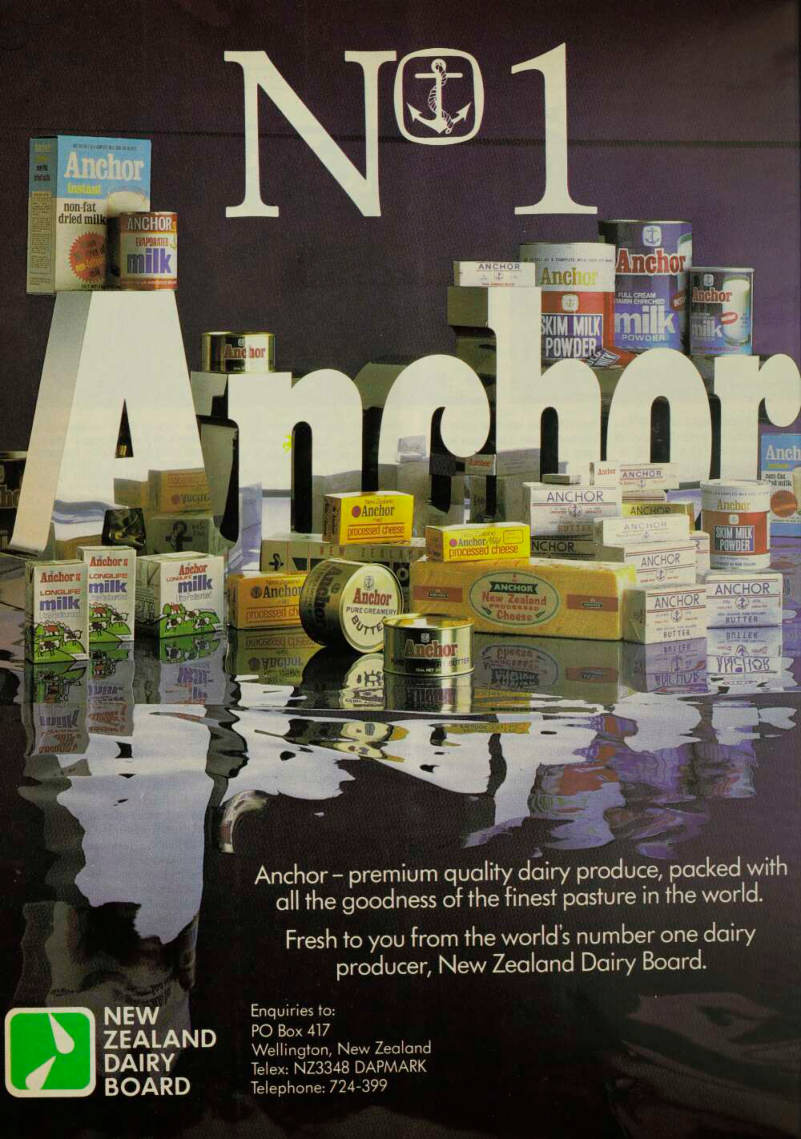
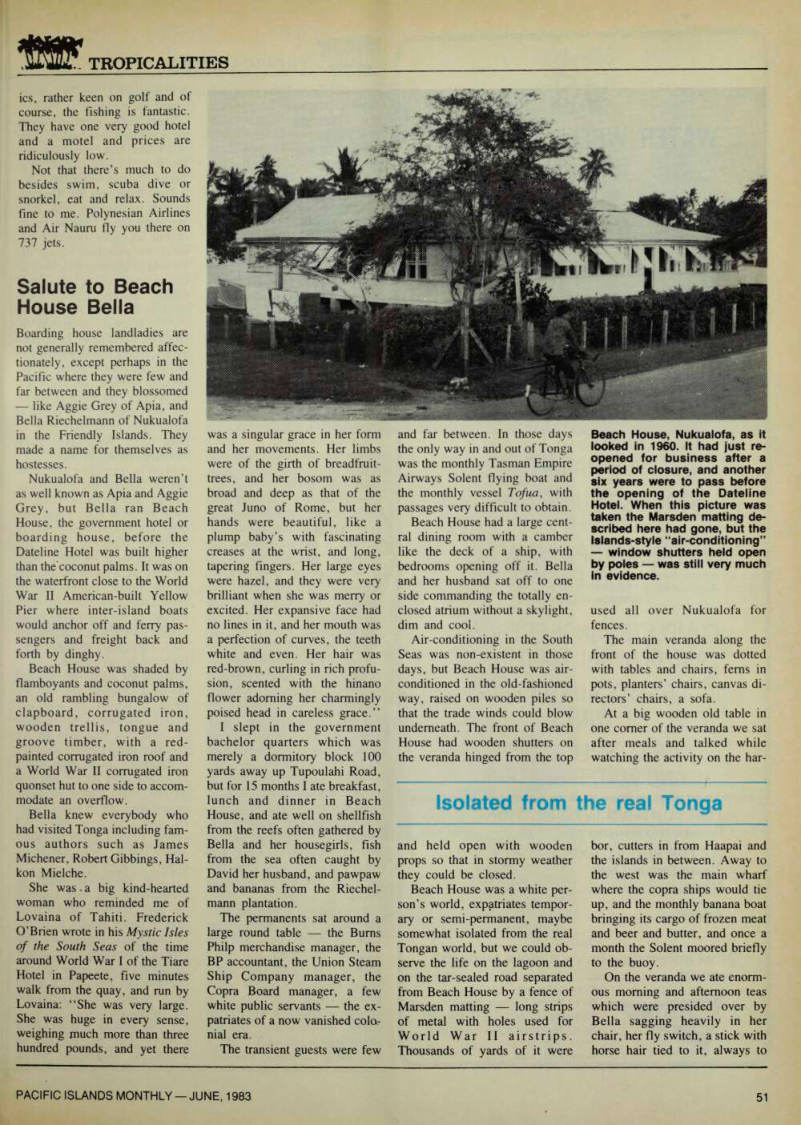
Tropicalities
A Suva concert to remember
Over the centuries Pacific Islan ders have known many traumatic events but perhaps there is no more dreaded happening than the overwhelming impact of destruc tive hurricanes, which leave be hind a swathe of smashed homes and destroyed crops, accom panied by a toll in human lives.
Hurricane Oscar recently struck much of Fiji, and the people have responded in the resilient manner so characteristic of the peoples of the Pacific Islands. They are working co operatively to assist those who have suffered and to make good the damage left behind by the force of the brutal winds.
The University of the South Pacific set out to raise funds for the victims of Hurricane Oscar, staging a concert for the purpose at the Suva Civic Centre.
This community happening il lustrated the buoyancy and multi faceted nature of the Fiji popula tion. The concert was led off by that most excellent of military musical combinations, the band of the Royal Fiji Military Forces.
They presented a selection of military tunes, of ragtime, of sentimental melodies, of Cliff Richard numbers, and then the rather portly leader of the band wowed the audience with a selec tion of hits from Elvis Presley.
And then it was on for one and all, there were marching girls, the splendor of the skills of the Fiji Theatre Group, youths rol ler-skating all over the stage, jazz dancing, reggae, improvised plays put on by youth groups, and a polished performance of traditional items presented by the Tongan Students’ Association at the USP.
The night was not without excitement of an unwelcome and unexpected kind as well.
A Samoan performer, in tradi tional garb, with face daubed in fearsome patterns, sprang on to the stage to present that spectacu lar and highly-skilled act, the knife dance.
Although he had been an nounced as a dancer who had
toured overseas, on this occasion he didn’t seem to be in full control of his vicious-looking knives. His movements also seemed to lack the finesse usual ly associated with the act.
Came the moment when the act required that he hook the two knives together and whirl them around with gay abandon.
As it happened a group of little girls had congregated at the side of the stage waiting for the mo ment when the spotlight would fall on their act. The spotlight fell on them all right, but not in the way they were waiting for.
The knives flashed around, the performer didn’t seem to be in
full control of his footing, the knives flew from his grasp and across the stage to thud into the wall only inches from where two of the young performers were standing.
After the first stunned silence was broken, and we turned back to look at centre-stage, the knife wielding performer was simply nowhere to be seen. He evidently felt he’d had enough of the limelight for the time being.
He came back later with the Samoan fire dance. But some how his heart didn’t seem to be in it, and the audience betrayed signs of apprehension.
Still, all in all it was a night to remember, and we all came away feeling better for having made some contribution to the Hur ricane Oscar Relief Fund. W.
G. Coppell.
Oz-PNG Trust
wound up
The Australia Papua New Guinea Friendship Trust, which was in augurated in Sydney in April 1981 to supply books to schools in Papua New Guinea, will wind up its activities this year after supplying about 4000 books to PNG schools. The project was originated by the now retired Dr Tom Selby, of Sydney, who was a regimental medical officer with the Australian army in PNG in World War 11.
Most of the books were select ed by lan Crossland, chief school librarian, PNG Department of Education, in Port Moresby, and were bought in PNG.
In addition to the books sup plied to government schools, the trust received requests for books for school libraries from church organisations running schools in Wewak, Goroka, Mount Hagen, Madang, Popondetta and Lae.
All books distributed to schools carried the special trust logo symbolising the friendship between the two countries. Total cost of books donated by the trust was about $A 18,000.
Donations towards the project came from the Australian Coun cil of Churches, the Archer Trust administered by Burns Philp Trustee Company Ltd, Sydney, ex-servicemen’s clubs and Syd ney business houses.
The honorary secretary of the trust, John Burrell, who also served with the Australian milit ary forces in PNG, said the mem bers considered the trust had achieved its objective to help young people in PNG.
Torres artists
on tour
Twenty musicians and dancers from the Torres Strait ended a three-month tour in May which introduced their culture to audi ences across the Pacific.
The islanders are a mixture of
Melanesian, Filipino, Malaysian
and Papua New Guinea peoples who moved to the islands about 2000 years ago.
The group began its tour in New Zealand where the islanders appeared as guests of Maori communities at the annual Poly nesian Festival in Hastings.
Their visit to Fiji, from March 5-20, was sponsored by the chairman of the Fiji Arts Coun cil, Sir Josua Rabukawaqa, who met them at Festival ’B2 in Bris bane during the Commonwealth Games. The program in Fiji in cluded performances for school children and in villages to pro vide cultural contact with Fijians living in their traditional lifestyle.
In Hawaii the main emphasis was on performances at schools.
A five-week tour of California, including schools and colleges in Los Angeles and San Francisco, brought the group’s tour to an end in May.
Sword dancer, a Samoan sym bol — perhaps knives are more difficult.
At all performances the Torres Strait islanders wore their ancient and traditional dress which in cludes spectacular handmade dhurries (feathered headdress).
They played traditional instru
ments which date back 2000 years.
The 20 performers have been
working together since June
1980 when they appeared at the World Wilderness Conference in Caims, Queensland. They have since visited Australian States and held programs in Australian schools.
Their Pacific tour was support ed by the Australian Government
through the Aboriginal Arts
Board.
Aggie ‘turns on’
another scribe ...
Latest in the seemingly endless line of scribes who go down on their knees in print to pay tribute to the South Pacific’s most fam ous hoteliere, Aggie Grey, is Kevin Voltz, travel editor of
Sydney’s Sunday newspaper,
The Sun-Herald. Voltz wrote in an April issue of the paper:
“I visited Aggie Grey’s’’
claims a flamboyant new sticker on my suitcase.
It doesn’t really need the address, “Western Samoa’’.
Any one who has sailed or flown through Polynesia in the past 40 years has heard of Aggie.
She’s probably the only living
hotel keeper in the world who has been honoured by a postage stamp ... the only woman in
her 80s who can win a standing ovation when she does a solo turn in the spectacular Polyne sian dance show at her hotel.
I met her in Apia a week after her 85th birthday. I wish I’d been there for the party. From what I heard it was a memorable bash.
Aggie, the daughter of an English chemist and his beautiful Samoan wife, is a living legend in the South Pacific although she still gets upset at suggestions she inspired the character “Bloody Mary’’ in James Michener’s Tales of the South Pacific.
She was undoubtedly a wheel er-dealer when Samoa was filled with U.S. servicemen during World War 11. She parlayed a hamburger shop and club up to the nucleus of her present 120room hotel.
Michener knew Aggie when he was stationed at nearby Pago Pago late in the war.
He told her biographer: “She was ebullient, effervescent, out rageous, illegal, and terribly bright.’’
He fell under her spell as have most of the guests who have found their way to her hotel ever since. They’ve included such celebrities as Gary Cooper (who made a film in Samoa), Marlon Brando and Raymond Burr.
Girl wounded by
‘cooked’ bullet
A 20-year-old Kiribati girl has been wounded by a bullet which exploded in her cooking fire. The girl, Nei Rakera Koria, was
cooking fish at her home in Bon riki village, Tarawa, when the bullet went off. She had just stood up from a crouching posi tion when the slug hit her in the upper thigh. She said it would have hit her in the head if she had not got up. She was taken to hospital and allowed to go home after the wound was dressed.
It was not until the following day that the slug was revealed by X-ray embedded about seven centimetres away from the wound. It was quickly removed by doctors. Local experts say the bullet was an American one from World War 11.
In 1978, a similar incident occurred in Betio, site of the battle of Tarawa, when a woman used an old rifle barrel as a pot stand over an open fire. The bullet in the barrel went off, killing an elderly woman 15 metres away. Billy Schutz in Tarawa.
Spelling wrong,
spirit right
If there’s one Pacific Island country that gets its name spelled wrongly by outsiders more often than others, it’s got to be Niue.
Charles Sriber, travel editor of the Australian daily The Aust ralian was there recently, and his report on the visit twice contains the spelling “Nieu” and they are the only two mentions of the country’s name in it.
But we think all will agree that even if he didn’t get the spelling right, he got the spirit right. Mr
Sriber’s report, spelling of coun try’s name corrected, said: If you’ve always wanted to find a real island hideaway you might consider Niue, a strange Polynesian island claiming to be the largest coral speck in the world.
It lies between Tonga and the Cook Islands and I visited the
elevated rocky plateau briefly a
little while ago.
Dramatically beautiful, it sits like an adorned cake in the South Pacific, its craggy cliffs rising 30 metres above a rock shelf. It has no beaches, but some good swimming holes and some great underwater scenery scuba di vers go crazy about it and every one raves about the people the women guileless and smiling, the
men easy-going and friendly.
With a population of less than 3000, everyone knows everyone else and all appear to work to gether. Niue uses New Zealand currency.
The islanders are cricket fanat-
The “2 + 2 = 4” school is a feature of Tahiti’s round-the-is land road just outside Papeete.
It seems that a 19th-century French planter decided to be queath some land to the com munity for a school. Sceptical of the value of introducing the Tahitians to the French educa tional system, he specified in his will that the school must be named “2 + 2 = 4”, so that whatever else they didn’t learn, its pupils would at least acquire the bit of useful knowledge con tained in their school’s name.
Pictures show the school and the signpost outside.
ics, rather keen on golf and of course, the fishing is fantastic.
They have one very good hotel and a motel and prices are ridiculously low.
Not that there’s much to do besides swim, scuba dive or snorkel, eat and relax. Sounds fine to me. Polynesian Airlines and Air Naum fly you there on 737 jets.
Salute to Beach
House Bella
Boarding house landladies are not generally remembered affec tionately, except perhaps in the Pacific where they were few and far between and they blossomed like Aggie Grey of Apia, and Bella Riechelmann of Nukualofa in the Friendly Islands. They made a name for themselves as hostesses.
Nukualofa and Bella weren’t as well known as Apia and Aggie Grey, but Bella ran Beach House, the government hotel or boarding house, before the Dateline Hotel was built higher than the coconut palms. It was on the waterfront close to the World War II American-built Yellow Pier where inter-island boats would anchor off and ferry pas sengers and freight back and forth by dinghy.
Beach House was shaded by flamboyants and coconut palms, an old rambling bungalow of clapboard, corrugated iron, wooden trellis, tongue and groove timber, with a red painted corrugated iron roof and a World War II corrugated iron quonset hut to one side to accom modate an overflow.
Bella knew everybody who had visited Tonga including fam ous authors such as James Michener, Robert Gibbings, Hal kon Mielche.
She was. a big kind-hearted woman who reminded me of Lovaina of Tahiti. Frederick O’Brien wrote in his Mystic Isles of the South Seas of the time around World War I of the Tiare Hotel in Papeete, five minutes walk from the quay, and run by Lovaina: “She was very large.
She was huge in every sense, weighing much more than three hundred pounds, and yet there
was a singular grace in her form and her movements. Her limbs were of the girth of breadfruit trees, and her bosom was as broad and deep as that of the great Juno of Rome, but her hands were beautiful, like a plump baby’s with fascinating creases at the wrist, and long, tapering fingers. Her large eyes were hazel, and they were very brilliant when she was merry or excited. Her expansive face had no lines in it, and her mouth was a perfection of curves, the teeth white and even. Her hair was red-brown, curling in rich profu sion, scented with the hinano flower adorning her charmingly poised head in careless grace.”
I slept in the government bachelor quarters which was merely a dormitory block 100 yards away up Tupoulahi Road, but for 15 months I ate breakfast, lunch and dinner in Beach House, and ate well on shellfish from the reefs often gathered by Bella and her housegirls, fish from the sea often caught by David her husband, and pawpaw and bananas from the Riechel mann plantation.
The permanents sat around a large round table the Bums Philp merchandise manager, the BP accountant, the Union Steam Ship Company manager, the Copra Board manager, a few white public servants the ex patriates of a now vanished cola nial era.
The transient guests were few
and far between. In those days the only way in and out of Tonga was the monthly Tasman Empire Airways Solent flying boat and the monthly vessel Tofua, with passages very difficult to obtain.
Beach House had a large cent ral dining room with a camber like the deck of a ship, with bedrooms opening off it. Bella and her husband sat off to one side commanding the totally en closed atrium without a skylight, dim and cool.
Air-conditioning in the South Seas was non-existent in those days, but Beach House was air conditioned in the old-fashioned way, raised on wooden piles so that the trade winds could blow underneath. The front of Beach House had wooden shutters on the veranda hinged from the top
Isolated from the real Tonga
and held open with wooden props so that in stormy weather they could be closed.
Beach House was a white per son’s world, expatriates tempor
ary or semi-permanent, maybe
somewhat isolated from the real Tongan world, but we could ob serve the life on the lagoon and on the tar-sealed road separated from Beach House by a fence of
Marsden matting long strips
of metal with holes used for World War II airstrips.
Thousands of yards of it were
used all over Nukualofa for fences.
The main veranda along the front of the house was dotted with tables and chairs, ferns in pots, planters’ chairs, canvas di rectors’ chairs, a sofa.
At a big wooden old table in one comer of the veranda we sat after meals and talked while watching the activity on the har
bor, cutters in from Haapai and the islands in between. Away to the west was the main wharf where the copra ships would tie up, and the monthly banana boat bringing its cargo of frozen meat and beer and butter, and once a month the Solent moored briefly to the buoy.
On the veranda we ate enorm ous morning and afternoon teas which were presided over by Bella sagging heavily in her chair, her fly switch, a stick with horse hair tied to it, always to
Beach House, Nukualofa, as it looked in 1960. It had just re opened for business after a period of closure, and another six years were to pass before the opening of the Dateline Hotel. When this picture was taken the Marsden matting de scribed here had gone, but the Islands-style "air-conditioning” - window shutters held open by poles - was still very much in evidence.
hand and flicked and used as a baton to punctuate the conversa tion. There was a mixed collec tion of magazines and world
newspapers acquired from ships.
The copra ships all seemed to have been to Mobile, Alabama, or Houston, Texas, most of the reading matter acquired from them was stamped “Seaman’s Mission Mobile” or “Seaman’s Mission Houston”.
The hotel was a meeting place for the Europeans of Nukualofa and at morning and afternoon tea there were always big stacks of cups and saucers brought out for the unexpected visitors who dropped in to hear and contribute the latest gossip.
On New Year’s Eve I attended an enormous party there, nearly every European on the beach was present. This was the place for the commencement of fishing parties, picnics. It was more than a place to stay, it was a home away from home.
Bella stood no nonsense from anybody, she ruled the boarding house autocratically, but she act ed like a mother towards her permanent boarders and worried if we didn’t eat. One night we were drinking at the Yacht Club, we hadn’t been to Beach House for dinner, and at 10 o’clock David arrived with steak, to matoes and bread. One Sunday we were drinking at the Nukualo fa Club and we had no transport to get back for lunch about a mile away. At 1.30 Bella rang and asked if we were coming for lunch. We said yes but we’d be walking. She sent David in their car to pick us up.
Before important boxing matches she was usually feeding one of the Tongan contestants, building him up for the big day.
She fed such well known Tongan boxers as Kitione Lave and Johnny Halafihi who were suc cessful in the boxing world of
Europe.
I often thought that some of the Beach House guests must have exasperated Bella, but like a good inn-keeper she never showed it, in public. There was a female journalist who spent some
time in Tonga, mostly trying to
arrange an interview with Queen Salote, unsuccessfully. But she would stay in bed until 10 or 11 a.m. every hot steamy morning.
We concluded that her father owned the paper.
There was the dietitian reading the traveller’s companion, Tol stoy’s War And Peace. She said she was going to finish it in Tonga, but she never did.
Then there was the General, recently retired from India, stay ing away from England on an income tax fiddle. From the mo ment he marched along the veranda in Bombay Bloomers he commenced talking in a loud slightly hectoring voice, “I was down in the bazaar this morning . . .” At meals he always re tailed the world news, he listened avidly, tuning into news bulletins on the shortwave bands of his portable wireless. He had a few pet sayings with which he started his monologues, “Of course I know all about that sort of thing. . .’’“Well, I don’t know anything about it, but . . .’’
And off he’d go into a long tirade against Nasser, the Americans.
During the Egyptian crisis of 1956 he grew more vocal than ever. The United Nations were a complete waste of time. The Egyptians were not worth much for they were the worst soldiers in the world. Dulles was no good. Of General Bums the com mander of the UN forces in the Middle East he said: “Know him well, very well. Brilliant man,
but entirely impractical.”
When the Egyptians blocked the Suez Canal he said that the thing to do, if we had any money, and what he was going to do, was buy shares in an ice company and a coaling company at Capetown, as all ships would be calling there for ice and coal on the long alternative route around the Cape of Good Hope.
He didn’t have to add: “Of course I don’t know anything about shares, only dabble in them.”
Local Europeans might be
complaining that they couldn’t
buy eggs, but there were always eggs at Beach House. If a Ton gan had four dozen eggs for sale, instead of hawking them around the houses of Europeans and sel ling a dozen here, half a dozen there, he took them to Bella and she bought the lot.
I was reading a book, Noel Coward And His Friends in which the biographer writes
“. . . continued our journey to Arequipa and drew up before the Quinta Bates unlikely that it still exists a guest house fam ous in its time for its haphazard comfort and even more famous for its proprietress, a redoubtable lady known to one and all as ‘Tia’ Bates. She was waiting up for Jeff and Noel in a red merino dressing-gown, with tea and hot water bottles at the ready, grey hair run wild, twinkling eyes and an air of distinction, cosy land lady and Grand Duchess in one.
Dead long since, she and her guest house had aficionados the world over, judging from the people Noel ran into many years after. Mention of the Quinta Bates made strangers at once become reunited members of some curious club.”
Though the Quinta Bates was in South America, the paragraph is fully appropriate to Beach House and Bella.
South Seas landladies are pro bably almost non-existent now, most of the centres of population in the Pacific have tourist hotels and the managers of those places tend to be faceless, never sight
ed, or known.
Brown.
J. Edward
Chamorros look
to their roots
A major activity of the Universi ty of Guam is undertaken by the Micronesian Area Research Center (MARC) of which Dr Dirk Ballendorf is director. He sees one of the major interests of the Center as being the study of early migrations of the Chamarro people to the Marianas islands.
Two archaeologists associated with the Centre are working on three “digs” on Guam.
He also stresses the interest of MARC in contemporary Mic ronesian issues, and emphasises that the concern is not only with “musty pot sherds and bones.
We investigate some of the cur rent social problems experienced here in Micronesia with a view to
achieving a better understanding
of our environment and all the people who live here.”
The earliest dates now estab lished for an aboriginal presence on Guam is about 3000 years ago, and now the archaeologists
are searching for sites which could be even more ancient.
The younger Chamorro people are quite passionate in their de sire to see greater attention paid to a Chamorro view of the his tory of Guam. As Dr Ballendorf
says; “Currently some Chamorro people don’t like the idea that their ancestors may have been Filipino. This is largely due to the fact that in the early Spanish period many Filipino soldiers were brought here as garrisons to
protect missionaries, and they committed some deeds that the Chamorros didn’t appreciate.”
The fact that many Filipinos are now migrating to Guam and competing for jobs with Chamor ros is no doubt another reason for denying an origin from the Philippines or Indonesia.
Another theory is of an early
Japanese migration to Guam.
Some Japanese academics like this theory and are spending time and money to investigate it furth er. “There has been a mixture of
exchanges, so fortunately the
Chamorros might be able to choose which theories they enjoy most.”
Although much research atten tion has also been given to the Spanish period on Guam, the Japanese influence is certainly showing itself, with about 300,000 Japanese tourists visit ing Guam each year. Japanese tourists are now quite active par
ticipants in Liberation Day,
which commemorates the Japan-
W. G. Coppell, who wrote the article on this page about mig ration in Micronesia, visited Ponape on his way to Guam, and his picture above shows a Ponape sakau (kava) bar in rustic setting. But does it RE ALLY cost 25 cents to visit the
architectually interesting little
house at the back? Commer cialism indeed seems to have arrived in Micronesia, Coppell suggests.
ese defeat on Guam in World War 11. However, the people are wary when Japanese military vessels call at Guam.
The contemporary Guamanian environment has areas of concern which MARC is studying, in cluding the presence of large and
growing expatriate ethnic com
munities, changing local cus toms, and a quickening pace of life. Says Dr Ballendorf: ”The local people are tending to be come more task-oriented, yet people still all get together at fiesta time. The basis of our life on Guam is food, the various
varieties of food.”
W. C.
Coppell on Guam.
Seattle Samoans
are organising
If Samoans were a united ethnic group Western and American Samoa they would never have allowed the division to happen.
As of September 1982, West ern Samoans in Seattle local communities gathered and or ganised their own group, name ly, Tusitala. Tusitala means story-teller, and is applied by Samoans to Robert Louis Steven son, the prominent Scottish au thor who lived and died in West ern Samoa.
The main idea of the club was to raise funds to establish a Sa moan Hall for the Samoan com munity as a whole. The Western Samoan move to organise the group came about due to the fact that many Samoan organisations and community efforts have been formed in the past but only to see the organisations become de funct, with no lasting results.
Initially, some agreed that
Western Samoans’ intention to organise the group was for a good cause. However there was no notion of excluding some Sa moans. One observer expressed concern about the exclusion of American Samoans and has re quested that the club accept them as club members.
Past Samoan organisations have been led mostly by Ameri can Samoan descendants, but the public reprimanded the Samoan community as a whole whenever such organisations became cor rupt. Nevertheless, the lack of
unity in the Seattle Samoan com munity is not limited to Ameri can and Western Samoans, but exists within people from diffe rent families, villages or churches. This is perhaps also true of Samoan communities in Hawaii, California, or elsewhere in the US. They compare them selves with one another and vie for status.
It seems clear to me that the problem afflicting Samoans to day reflects the old power strug gle among stronger nations to gain control over the Samoan Islands. In Samoa, these world powers were England, Germany
and the United States. They selected and signed a treaty with one Samoan faction, cham pioned, armed, advised and en couraged them in battle to fight against other factions, then proc laimed them, as a unit, to be a legitimate Samoan Government.
Each of the Western powers de nounced the faction championed by another power as illegitimate rebels. Thus, the factions have argued and fought among them selves ever since in order to resolve their differences.
Great Britain, Germany and the United States were reluctant to confront each other directly; they shot at one another through the Samoans or shelled by naval artillery Samoan villages allied against their favored factions.
The Americans and the British, for the first time, became allied against Germany; then the hostil ity grew.
To settle this enmity, in 1899, at a conference without Samoan representatives, our islands were divided. The Germans gained
control over Western Samoa un til 1914, whereas Eastern Samoa (American Samoa) became a US protectorate. England refrained from further confrontation; how ever, the New Zealand Govern ment assumed protection of Western Samoa through the Lea gue of Nations from World War I until 1962. Since then Westem- Samoa has become independent.
However, ambiguities remain.
For example, Western Samoans, unlike American Samoans in re lation to the US, are not allowed free access to New Zealand.
Finally, in view of these past injustices perpetrated by colonial powers, I feel it greatly and
presently impacts Samoan rela
tions not only in Samoa but the US as well. We cannot effective ly work together to solve the problems common to our people.
We cannot effectively convince elected officials, agency staff, or employers to be more responsive to our needs.
Some Samoans in New Zea land report other Samoans to the
Remains of Japanese wartime tunnel in Micronesia, once part of an extensive structure of underground equipment stores and shelters. Japanese tourists now come to Micronesia in thousands every year, 300,000 to Guam alone. On Guam they have even attended ceremonies which marked the defeat of their forces there, writes W. G.
Coppell.
immigration and naturalisation services, welfare offices and other authorities about visa expi ration and/or immigration status.
As a result, people have been abruptly ordered to leave the country or have had their public assistance terminated. The Sa moans who report other Samoans to these services, though, need to be told to put their tails between their legs and keep their mouths shut, or else seek psychiatric attention. Even people in this country don’t do these things.
Notwithstanding all this, I wish to appeal to our government leaders, in American Samoa, the United States, and Western Samoa, to, once again, seriously reconsider the importance of combining our own people. Are we to go from separation to separation, or from separation to unity? Falani A. Peters in Seattle.
Any PNG music
in your attic?
A major new project aims at tracking down and cataloguing all the tribal music of Papua New Guinea recorded since early this century.
Writing in The Sydney Morn ing Herald in April, the paper’s music critic Fred Blanks reported: It is believed that thousands of such recordings made by an thropologists, missionaries, visitors and settlers are now scat tered through museums, libraries and private collections around the world.
The project is being underta ken by Dr Gordon Spearritt, head of the music department in the University of Queensland, and Don Niles, an American eth nomusicologist working at the Institute of Papua New Guinea Studies in Port Moresby.
Work is expected to continue for at least two years, and in volves use of a computer. A further stage of the project could involve acquisition of all record ings for the Port Moresby Institute.
The importance of this work is seen to lie in the preservation of tribal history and traditions which are being eroded by changes in society.
Tahiti calling
Australia ...
Tahitian radio hams are planning a campaign to strengthen connec tions with their counterparts in Australia.
In a first effort early this year they made contact with 39 Aust ralian hams in Melbourne, Syd ney, Brisbane, Perth and Canberra.
The Tahitian hams’ organisa tion plans to follow up by send ing brochures on French Poly nesia to their Australian contacts in order to promote “better
mutual understanding’ ’.
Union: Fiji
beats Oz teams
Fiji sent 20,000 fans wild with delight when they completed an amazing Rugby Union double by
beating Sydney 33-19 in an April encounter in Suva.
Fiji had bounced back from the disappointing overseas tour last year to trounce Queensland 48-24 the week before.
The Queenslanders had no answer to the Fiji flair and quick ness to the loose ball, and Syd ney fared only marginally better.
Sydney did manage to contain the flying Fijians to only four tries, compared with the nine scored against Queensland.
But their difficulties were compounded by a flawless kick ing performance by the Fiji full back Severo Koroduadua who converted all the tries and landed three penalties.
Barry Want, a Sydney selector who had accompanied the team to Fiji, said Sydney had no ans wer to Fiji’s pace.
“Their speed was astonish
ing,” he said. “Their men were yards faster than ours and their
technique has improved
dramatically.
“Our forwards were generally good in winning the lineouts and better in the set play, but were outpaced in the backs.
“Apart from their try scorers, their five-eighth Esala Labiaba
was outstanding.”
Tuvalu, which relies on world interest in its stamps to support its economy, has issued a new set of definitives. Top picture shows the lower denomination
stamps depicting fishing gear,
decorative shell work, basket ware, a model canoe and climb
ing equipment. Eight other
stamps in the series also show handcrafts. Picture above shows the little Tuvalu Philatel- Ic Bureau which processes or ders from all parts of the world.
Advertisements & other items, pp. 50-57 (3 items)
rami
INGHOR
FUU. CREAM
TmHWMcmgi 1$ gM taminenrk
rami
powdeiu.
i • Anchor
SKIM MILK
i POWDER
iMSSS^laiaa j* anchor
ANCHOR
t-i & TtiSJUfil -» l—s
mmS
m m ■te fmi * Anchor - premium quality dairy produce, packed with all the goodness of the finest pasture in the world.
Fresh to you from the world’s number one dairy
producer, New Zealand Dairy Board.
NEW
ZEALAND
DAIRY
BOARD
Enquiries to: PO Box 417 Wellington, New Zealand
Telex: NZ3348 DAPMARK
Telephone: 724-399
WATER WHEEL EXPORTS
Pty. Ltd.
53 Market Street, South Melbourne 3205 Australia Tplox; AA 32165 Telephone: 699 1722
THE WATER WHEEL GROUP OF COMPANIES
Winners of Australia s Top Export Award and Flour Millers for over 100 years.
BEST AUSTRALIAN
WHEATEN FLOUR
(High Protein. Bakers. Stone ground Wholemeal. Donut)
COOLROOMS REFRIGERATED
CABINETS ETC.
INCLUDING SALT WATER
ICE MAKERS
STOCK & POULTRY FEEDS
(Pellets or Mash form)
YELLOW SPLIT PEAS &
WHOLE PEAS
(Machine-Dressed)
COMPLETE RANGE OF FROZEN
AND GENERAL FOOD ITEMS
QUALITY AUSTRALIAN
WINES
WOOD FUEL STOVES
AND WATER HEATERS
FOR FURTHER INFORMATION
Return this coupon to:
WATER WHEEL EXPORTS PTY. LTD.
Please forward me: Name Address.
Phone: More information on your above products/ product Export Manager Water Wheel Exports Pty. Ltd. 53 Market Street, 'P.O. Box 38) South Melbourne 3205 Australia Telex: AA 32165 Telephone: 699 1722
SUZUKI...
The name of PERFORMANCE
SUZUKI OUTBOARDS are truly ALL ROUND PERFORMER... reliable, durable and economical under any situation.
SUZUKI prepared outboards line up exclusively for the usage of professionals, and of course, also for the pleasure. Each has different construction respectively, so that you can choose your engine that is best suited to your boat and usage.
Get the fruitful life through SUZUKI OUTBOARDS. m ► • > >
■“if- f ;
n i 16 types from 2ps to 140ps i-.r -
Suzuki m
SUZUKI MOTOR CO, LTD Hamamatsu, Japan SUZUKI GENERATOR 2500 A • NEW ZEALAND SOUTH PACIFIC SUZUKI DISTRIBUTORS LTD PHONE.SB-599• • PAPUAI DIKa SERVICE|F LTD. PHONE: 42-2679 • FIJI NIRANJANS AUTOPORT LTD. PHONE: 381555 fIAMm NIPTON ALTOMOTO FJHONE 2-98-19 •SOLOMC GUADAI CANAL GARAGE LTD RHONE’ HONIARA 587 & 593 • VANUATU HENRI LEROUX #NEW CALwONUU b 1 1. bURtHCAL PHONF' 97?nfi8 •AMERICAN SAMOA PACIFIC PRODUCTS INC. PHONE: 639-9140 •WESTERN SAMOA VATCO LTD. •GUAM ISLAND CYCLERY INC PHONE' 565-2298 ©NIUE BURNS PHILP CO., LTD. ©NAURU EQUIPAC MOTORS 4019 #TONGA TONGA EQUIPMENT © YAP AMBROSE • KOROR BECHESRRAK T. COMPANY PHONE: 338 ©TRUK KIOMASA STORE PHONE: 47C
Starting & Staying
pcmst
m J Si bSs£ V
AMP
MS m m «'• .■■ / 7jT?^77
rmiZ**
\ [JS&
Power Boats Need Different Batteries
There is a big difference between a car battery and a marine battery.
A car battery, for example, is never really discharged, as it is only used for a few seconds each day and promptly re-charged. Not so your cruiser or sportsfisherman.
Starting the engine is only the beginning. During the day, weekend or cruise, how often will you run the y live bait tank, the depth sounder, the nav. lights or maintain a listening watch on your radio transceiver . Rattpripct As well as cranking power, boats need staying power. Boats need Besco s Marine Batteries, deep cycle, heavy duty marine batteries. .
If your boat is getting a little flat in the electrics department, write or phone BESCO today - and ask y a for more information, more facts about
BESCO MARINE BATTERIES.
. Papua New Guinea: Lae/Rabaul - Auto Marine Industries PO Box 785 Lae 42-1125. Port I Morpchv Par Sales Ptv. Ltd. Boroko. 25-6266. Fiji: Bar Motor Parts Ltd., PO Box 51, Bar, f 74-070 New Caledonia: Lotissement Industriel, BP 889, Noumea ‘ kninhu rn p0r0x5585 IST Kowloon 3-66 5341. N.Z.: Battery Services (Industrial) Ltd., P 0 AucWa°d 4 694-111. Gould Batteries, 58 Hautana St! Lower Hutt. Wellington.
Telex: CHACO N.Z. 3714. Other Areas: JarwH Internationa^^ - 7, Z, Z Z I 2000- (02) Telex: AA 72102. Besco Battenes, VHiawood. 2 m (02) 632 025 . A Peko Wa/lsend Group Member I FA nFRS IN BATTERY TECHNOLOGY —
Tropicalities
Tropic Alities
Aims and achievements of
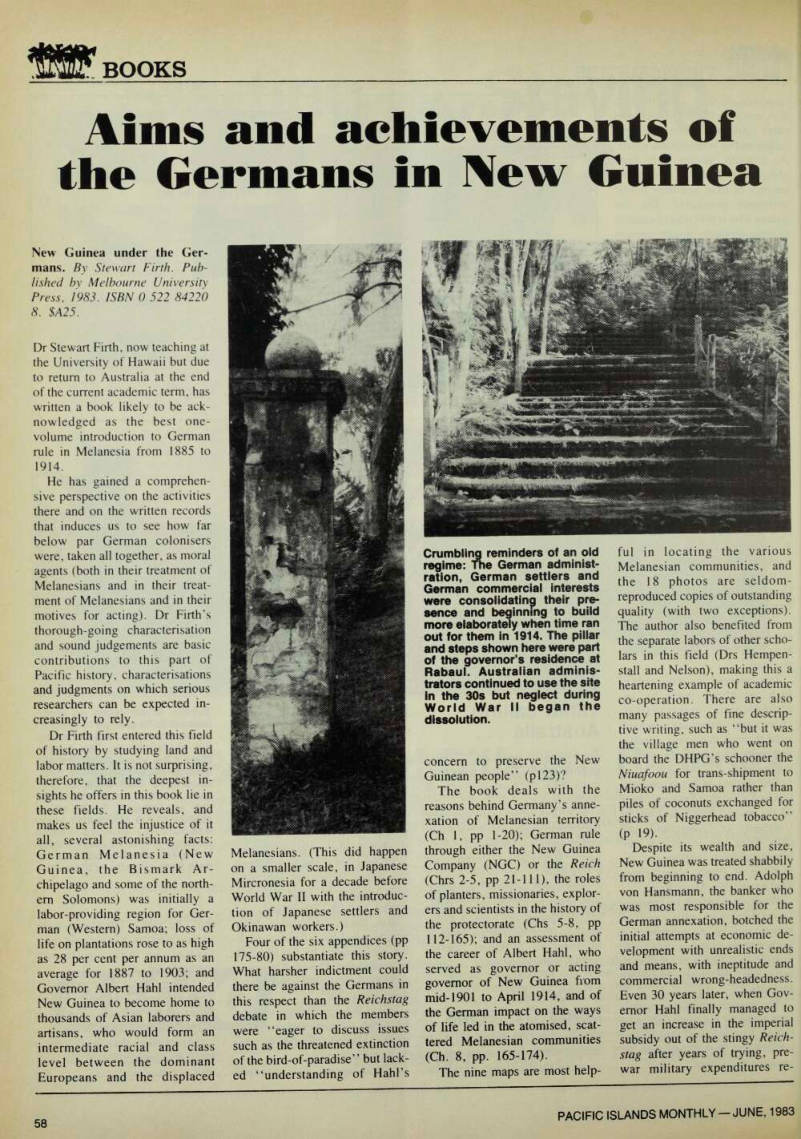
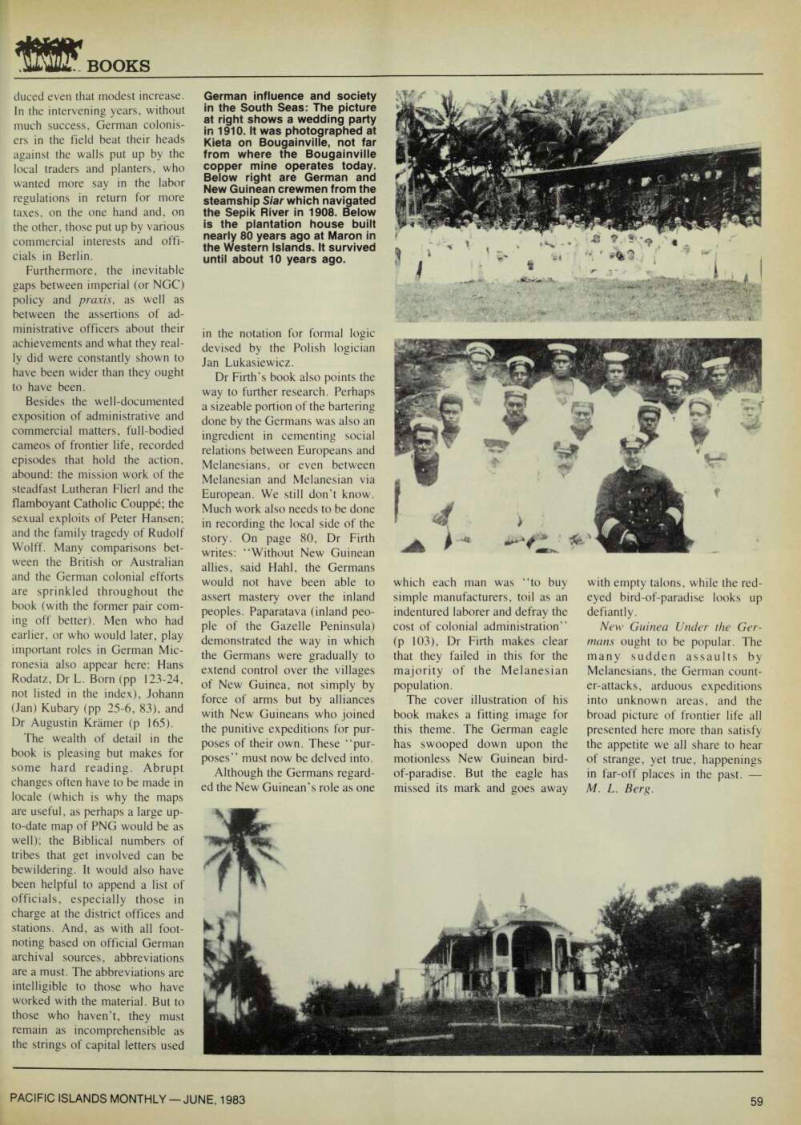
Books
Aims and achievements of the Germans in New Guinea
New Guinea under the Ger mans. By Stewart Firth. Pub lished by Melbourne University Press, 1983. ISBN 0 522 84220
8. Sa2S.
Dr Stewart Firth, now teaching at the University of Hawaii but due to return to Australia at the end of the current academic term, has written a book likely to be ack nowledged as the best one volume introduction to German rule in Melanesia from 1885 to 1914.
He has gained a comprehen sive perspective on the activities there and on the written records that induces us to see how far below par German colonisers were, taken all together, as moral agents (both in their treatment of Melanesians and in their treat ment of Melanesians and in their motives for acting). Dr Firth’s thorough-going characterisation and sound judgements are basic contributions to this part of Pacific history, characterisations and judgments on which serious researchers can be expected in creasingly to rely.
Dr Firth first entered this field of history by studying land and labor matters. It is not surprising, therefore, that the deepest in sights he offers in this book lie in these fields. He reveals, and makes us feel the injustice of it all, several astonishing facts: German Melanesia (New Guinea, the Bismark Ar chipelago and some of the north ern Solomons) was initially a labor-providing region for Ger man (Western) Samoa; loss of life on plantations rose to as high as 28 per cent per annum as an average for 1887 to 1903; and Governor Albert Hahl intended New Guinea to become home to thousands of Asian laborers and artisans, who would form an intermediate racial and class level between the dominant Europeans and the displaced
Melanesians. (This did happen on a smaller scale, in Japanese Mircronesia for a decade before World War II with the introduc tion of Japanese settlers and Okinawan workers.) Four of the six appendices (pp 175-80) substantiate this story.
What harsher indictment could there be against the Germans in this respect than the Reichstag debate in which the members were “eager to discuss issues such as the threatened extinction of the bird-of-paradise” but lack ed “understanding of Hahl’s
concern to preserve the New Guinean people” (pi 23)?
The book deals with the reasons behind Germany’s anne xation of Melanesian territory (Ch 1, pp 1-20); German rule through either the New Guinea Company (NGC) or the Reich (Chrs 2-5, pp 21-111), the roles of planters, missionaries, explor ers and scientists in the history of the protectorate (Chs 5-8, pp 112-165); and an assessment of the career of Albert Hahl, who served as governor or acting governor of New Guinea from mid-1901 to April 1914, and of the German impact on the ways of life led in the atomised, scat tered Melanesian communities (Ch. 8, pp. 165-174).
The nine maps are most help
ful in locating the various Melanesian communities, and the 18 photos are seldom reproduced copies of outstanding quality (with two exceptions).
The author also benefited from the separate labors of other scho lars in this field (Drs Hempen stall and Nelson), making this a heartening example of academic co-operation. There are also many passages of fine descrip tive writing, such as “but it was the village men who went on board the DHPG’s schooner the Niuafoou for trans-shipment to Mioko and Samoa rather than piles of coconuts exchanged for sticks of Niggerhead tobacco” (P 19).
Despite its wealth and size, New Guinea was treated shabbily from beginning to end. Adolph von Hansmann, the banker who was most responsible for the German annexation, botched the initial attempts at economic de velopment with unrealistic ends and means, with ineptitude and commercial wrong-headedness.
Even 30 years later, when Gov ernor Hahl finally managed to get an increase in the imperial subsidy out of the stingy Reich stag after years of trying, pre war military expenditures re-
Crumbling reminders of an old regime: The German administ ration, German settlers and German commercial interests were consolidating their pre sence and beginning to build more elaborately when time ran out for them in 1914. The pillar and steps shown here were part of the governor’s residence at Rabaul. Australian adminis trators continued to use the site in the 30s but neglect during World War II began the dissolution.
duced even that modest increase.
In the intervening years, without much success, German colonis ers in the field beat their heads against the walls put up by the local traders and planters, who wanted more say in the labor regulations in return for more taxes, on the one hand and, on the other, those put up by various commercial interests and offi cials in Berlin.
Furthermore, the inevitable gaps between imperial (or NGC) policy and praxis, as well as between the assertions of ad ministrative officers about their achievements and what they real ly did were constantly shown to have been wider than they ought to have been.
Besides the well-documented exposition of administrative and commercial matters, full-bodied cameos of frontier life, recorded episodes that hold the action, abound: the mission work of the steadfast Lutheran Flierl and the
flamboyant Catholic Couppe; the
sexual exploits of Peter Hansen; and the family tragedy of Rudolf
Wolff. Many comparisons bet
ween the British or Australian and the German colonial efforts
are sprinkled throughout the
book (with the former pair com ing off better). Men who had earlier, or who would later, play important roles in German Mic ronesia also appear here; Hans Rodatz, Dr L. Born (pp 123-24, not listed in the index), Johann (Jan) Kubary (pp 25-6, 83), and Dr Augustin Kramer (p 165).
The wealth of detail in the book is pleasing but makes for
some hard reading. Abrupt
changes often have to be made in locale (which is why the maps are useful, as perhaps a large up to-date map of PNG would be as well); the Biblical numbers of tribes that get involved can be bewildering. It would also have been helpful to append a list of officials, especially those in charge at the district offices and stations. And, as with all foot noting based on official German archival sources, abbreviations are a must. The abbreviations are intelligible to those who have worked with the material. But to those who haven’t, they must remain as incomprehensible as the strings of capital letters used
in the notation for formal logic devised by the Polish logician Jan Lukasiewicz.
Dr Firth’s book also points the way to further research. Perhaps a sizeable portion of the bartering done by the Germans was also an ingredient in cementing social relations between Europeans and Melanesians, or even between Melanesian and Melanesian via European. We still don’t know.
Much work also needs to be done in recording the local side of the story. On page 80, Dr Firth writes: “Without New Guinean allies, said Hahl, the Germans would not have been able to assert mastery over the inland peoples. Paparatava (inland peo ple of the Gazelle Peninsula) demonstrated the way in which the Germans were gradually to extend control over the villages of New Guinea, not simply by force of arms but by alliances with New Guineans who joined the punitive expeditions for pur poses of their own. These “pur poses” must now be delved into.
Although the Germans regard ed the New Guinean’s role as one
which each man was “to buy simple manufacturers, toil as an indentured laborer and defray the cost of colonial administration” (p 103), Dr Firth makes clear that they failed in this for the majority of the Melanesian population.
The cover illustration of his book makes a fitting image for this theme. The German eagle has swooped down upon the motionless New Guinean bird of-paradise. But the eagle has missed its mark and goes away
with empty talons, while the red eyed bird-of-paradise looks up defiantly.
New Guinea Under the Ger mans ought to be popular. The many sudden assaults by Melanesians, the German count er-attacks, arduous expeditions into unknown areas, and the broad picture of frontier life all presented here more than satisfy the appetite we all share to hear of strange, yet true, happenings in far-off places in the past.
M. L. Berg.
German influence and society in the South Seas: The picture at right shows a wedding party in 1910. It was photographed at Kieta on Bougainville, not far from where the Bougainville copper mine operates today.
Below right are German and New Guinean crewmen from the steamship Siar which navigated the Sepik River in 1908. Below is the plantation house built nearly 80 years ago at Maron in the Western Islands. It survived until about 10 years ago.
Advertisements & other items, p. 59 (1 item)
Books
in coming satellite tangle
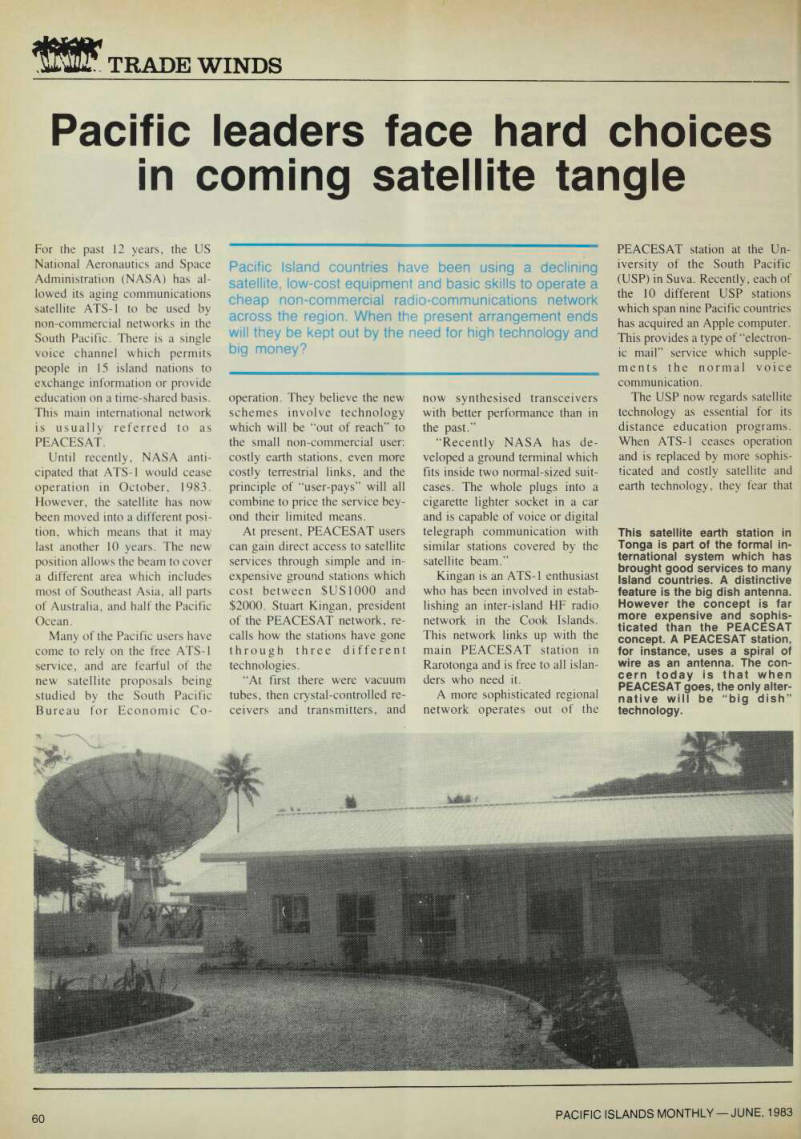

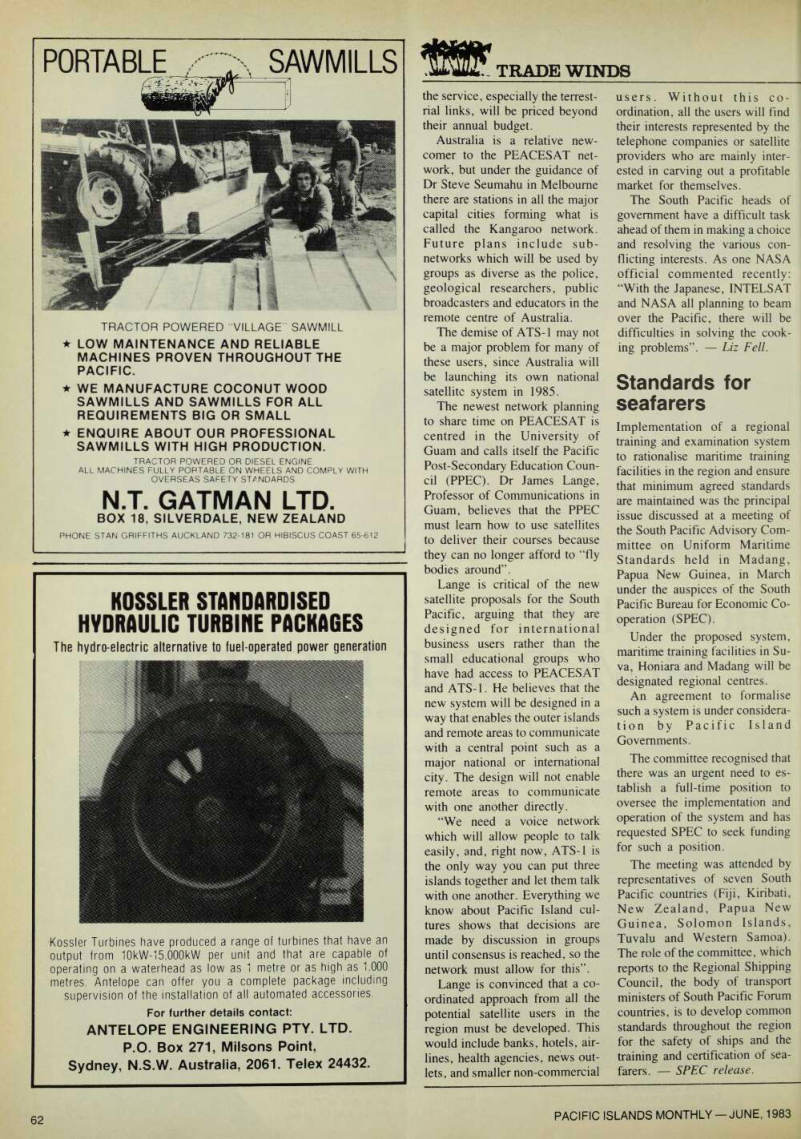
Trade Winds
Pacific leaders face hard choices in coming satellite tangle
Pacific Island countries have been using a declining satellite, low-cost equipment and basic skills to operate a cheap non-commercial radio-communications network across the region. When the present arrangement ends will they be kept out by the need for high technology and big money?
For the past 12 years, the US National Aeronautics and Space Administration (NASA) has al lowed its aging communications satellite ATS-1 to be used by non-commercial networks in the South Pacific. There is a single voice channel which permits people in 15 island nations to exchange information or provide education on a time-shared basis.
This main international network is usually referred to as
Peacesat.
Until recently, NASA anti cipated that ATS-1 would cease operation in October, 1983.
However, the satellite has now been moved into a different posi tion, which means that it may last another 10 years. The new position allows the beam to cover a different area which includes most of Southeast Asia, all parts of Australia, and half the Pacific Ocean.
Many of the Pacific users have come to rely on the free ATS-1 service, and are fearful of the new satellite proposals being studied by the South Pacific Bureau for Economic Co
operation. They believe the new schemes involve technology which will be “out of reach” to the small non-commercial user; costly earth stations, even more costly terrestrial links, and the principle of “user-pays” will all combine to price the service bey ond their limited means.
At present, PEACESAT users can gain direct access to satellite services through simple and in expensive ground stations which cost between SUSIOOO and $2OOO. Stuart Kingan, president of the PEACESAT network, re calls how the stations have gone through three different technologies.
“At first there were vacuum tubes, then crystal-controlled re ceivers and transmitters, and
now synthesised transceivers with better performance than in the past.”
“Recently NASA has de veloped a ground terminal which fits inside two normal-sized suit cases. The whole plugs into a cigarette lighter socket in a car and is capable of voice or digital telegraph communication with similar stations covered by the satellite beam.”
Kingan is an ATS-1 enthusiast who has been involved in estab lishing an inter-island HE radio network in the Cook Islands.
This network links up with the main PEACESAT station in Rarotonga and is free to all islan ders who need it.
A more sophisticated regional
network operates out of the
PEACESAT station at the Un iversity of the South Pacific (USP) in Suva. Recently, each of the 10 different USP stations which span nine Pacific countries has acquired an Apple computer.
This provides a type of “electron ic mail” service which supple ments the normal voice communication.
The USP now regards satellite technology as essential for its distance education programs.
When ATS-1 ceases operation and is replaced by more sophis ticated and costly satellite and earth technology, they fear that
This satellite earth station in Tonga is part of the formal in ternational system which has brought good services to many Island countries. A distinctive feature is the big dish antenna.
However the concept is far more expensive and sophis ticated than the PEACESAT concept. A PEACESAT station, for instance, uses a spiral of wire as an antenna. The con cern today is that when PEACESAT goes, the only alter native will be “big dish” technology.
the service, especially the terrest rial links, will be priced beyond their annual budget.
Australia is a relative new comer to the PEACES AT net work, but under the guidance of Dr Steve Seumahu in Melbourne there are stations in all the major capital cities forming what is called the Kangaroo network.
Future plans include sub networks which will be used by groups as diverse as the police,
geological researchers, public
broadcasters and educators in the remote centre of Australia.
The demise of ATS-1 may not be a major problem for many of these users, since Australia will be launching its own national satellite system in 1985.
The newest network planning to share time on PEACESAT is centred in the University of Guam and calls itself the Pacific Post-Secondary Education Coun cil (PPEC). Dr James Lange, Professor of Communications in Guam, believes that the PPEC must learn how to use satellites to deliver their courses because they can no longer afford to “fly bodies around”.
Lange is critical of the new satellite proposals for the South Pacific, arguing that they are designed for international business users rather than the small educational groups who have had access to PEACESAT and ATS-1. He believes that the new system will be designed in a way that enables the outer islands and remote areas to communicate with a central point such as a major national or international city. The design will not enable remote areas to communicate with one another directly.
“We need a voice network which will allow people to talk easily, and, right now, ATS-1 is the only way you can put three islands together and let them talk with one another. Everything we know about Pacific Island cul tures shows that decisions are made by discussion in groups until consensus is reached, so the network must allow for this”.
Lange is convinced that a co ordinated approach from all the potential satellite users in the region must be developed. This would include banks, hotels, air lines, health agencies, news out lets, and smaller non-commercial
users. Without this co ordination, all the users will find their interests represented by the telephone companies or satellite providers who are mainly inter ested in carving out a profitable market for themselves.
The South Pacific heads of government have a difficult task ahead of them in making a choice and resolving the various con flicting interests. As one NASA official commented recently: “With the Japanese, INTELSAT and NASA all planning to beam over the Pacific, there will be difficulties in solving the cook
ing problems”.
Liz Fell.
Standards for
seafarers
Implementation of a regional training and examination system to rationalise maritime training facilities in the region and ensure that minimum agreed standards are maintained was the principal issue discussed at a meeting of the South Pacific Advisory Com mittee on Uniform Maritime Standards held in Madang, Papua New Guinea, in March under the auspices of the South Pacific Bureau for Economic Co operation (SPEC).
Under the proposed system, maritime training facilities in Su va, Honiara and Madang will be designated regional centres.
An agreement to formalise such a system is under considera tion by Pacific Island Governments.
The committee recognised that there was an urgent need to es tablish a full-time position to oversee the implementation and operation of the system and has requested SPEC to seek funding for such a position.
The meeting was attended by representatives of seven South Pacific countries (Fiji, Kiribati, New Zealand, Papua New Guinea, Solomon Islands, Tuvalu and Western Samoa).
The role of the committee, which reports to the Regional Shipping Council, the body of transport ministers of South Pacific Forum countries, is to develop common standards throughout the region for the safety of ships and the training and certification of sea
farers.
SPEC release.
Advertisements & other items, pp. 61-62 (1 item)
Hotel Shilla:
r*
A MEMORABLE EXCEPTION
Known for its graciousness, Seoul's Hotel Shilla renders a traditional Korean ambience inspired by the renowned Shilla Dynasty.
This splendid setting, just a short thirty-minute drive from the airport, offers the most beautiful wooded gardens in town, 738 luxurious suites and rooms, 13 elegant banquet rooms, international restaurants, and expert services tailored to the needs of the business man or woman and visitors who wish to enjoy a unique and charming experience.
Above all, our guests return to us time after time because of our dedication to personalized, attentive service which makes all the difference in the world.
For Reservation: • Hotel Shilla Representive Office «New York: (212) 564-0718 (collect) •Tokyo; (03) 586-7571 'Osaka: (06) 271-7571 Odner Hotels Representatives Office »Hong Kong: (5) 262251 •Taipei; 5515933 ‘Singapore; 2353474 'Bangkok; 2521181 HRI Office *U.S.A (except N.Y. State): 800-223-1230 (toll free)»N.Y. State: (212) 751-8915 (collect) 'London: (01) 583-3050 'Paris: (01) 079-0000 'Frankfurt; (0611) 283345 'Riyadh: (01) 464-8411 'Svdnev: 233-8422 SSo Paulo; (lit 251-5021 ■ oi'JhffJeadinifHotcls of thcWbrid Represented Associated with the O/fuxa
ix jAL HOTEL SWEM
JOHN A. TETLEY CO.. INC.
CfIUX INTSWSATIONAL ASSOCIATION
Odner Hotel Representatives Ltd (O H R )
Seoul, Korea
202, 2-Ga, Jangchung-Dong, Chung-Ku, Seoul, Korea Tel: 295-3111, 3121, 3131, 3141, Cable: HOTELSHILLA C.P.O. Box: 7000 Telex: SHILLA K 24257, 24160 A
PORTABLE \ SAWMILLS
I
TRACTOR POWERED VILLAGE SAWMILL
★ LOW MAINTENANCE AND RELIABLE
MACHINES PROVEN THROUGHOUT THE
PACIFIC.
★ WE MANUFACTURE COCONUT WOOD
SAWMILLS AND SAWMILLS FOR ALL
REQUIREMENTS BIG OR SMALL
★ ENQUIRE ABOUT OUR PROFESSIONAL
SAWMILLS WITH HIGH PRODUCTION.
TRACTOR POWERED OR DIESEL ENGINE
ALL MACHINES FULLY PORTABLE ON WHEELS AND COMPLY WITH
OVERSEAS SAFETY STANDARDS
NT. GATMAN LTD.
BOX 18, SILVERDALE, NEW ZEALAND
PHONE STAN GRIFFITHS AUCKLAND 732-181 OR HIBISCUS COAST 65-612
KOSSLER STANDARDISED
HYDRAULIC TURBINE PACKAGES
The hydro-electric alternative to fuel-operated power generation Kossler Turbines have produced a range or turbines that have an output from 10kW-15.000kW per unit and that are capable of operating on a waterhead as low as 1 metre or as high as 1,000 metres. Antelope can offer you a complete package including supervision of the installation of all automated accessories.
For further details contact:
ANTELOPE ENGINEERING PTY. LTD.
P.O. Box 271, Milsons Point, Sydney, N.S.W. Australia, 2061. Telex 24432.
sights after 100 years

Burns Philp shifts its sights after 100 years
Burns, Philp and Company Ltd., the widely-established Australian company which became a major force in Pacific Island retailing, plantations, shipping and service industries, is celebrating its centenary.
Just on 100 years ago two Scots men who had migrated to Aust ralia formed a partnership which established one of the best known names in the economy of the Islands Bums Philp. At one stage their company was so influential and so much a part of the Islands economy that it was printing its own money with leg al recognition. The parent com pany of the group, Bums, Philp and Company Ltd., has been holding celebrations to mark its centenary.
The company is based in Syd ney and its subsidiaries continue to operate throughout the Is lands. But its financial base is now in Australian operations rather than in the Islands, and local equity has been absorbed into its Island subsidiaries. It has diversified widely, buying into a wide field of Australian ventures.
The company, which became known throughout the Islands as “Beeps”, has moved away from
its original shipping, retailing
and plantation interests, con
solidating some and shedding
others. Now it operates in the hardware industry as a major supplier, in the hotel and liquor industries, as a motor and machinery dealer, food and be verage supplier, food and bever age machinery supplier, in the travel industry, cement and building materials, leisure goods, office equipment, film
processing, photographic equip
ment interests and joint venture
mining.
James Bums arrived in Aust ralia in 1862 aged 16. He worked as a jackeroo at Helidon Station near Toowoomba in Queensland, and later on the Barcoo River.
His first experience of retailing was in the Queensland capital,
Brisbane, but soon afterwards he initiated his own retailing ven ture on the Queensland gold fields at Gympie. He was one of the first arrivals there, in 1866, supplying goods to the fast
increasing population. He
operated stores at Gympie, One- Mile Creek and Kilkiyan and his business thrived over a period of three years.
He returned to Scotland for a brief period, but by 1872 he was back in Queensland and in 1873 he opened a store in the prosper ous northern centre of Towns ville. The 15-metre frontage of his timber-built store in Towns ville carried a sign proclaiming “J. Bums, General Storekeep er” and advertised “Boots, Crockery, Wine and Spirit Mer
chant, Agent”.
Glasgow-born Robert Philp
was working in Australia for a shipping agent and merchant when he joined Bums in 1873, and soon afterwards the two men formed a partnership. Bums suf fered a bout of malaria in 1877, and this sent him south to Sydney from where he managed a chain of stores which he established in Queensland.
Bums, Philp and Company
was formally established in 1883, and four years later it began its movement into the Pacific Islands. The first Islands branch was on Samarai Island in what was then British New Guinea, later to be known as Papua, and now part of Papua New Guinea. Other branches fol lowed in Papua, one in Port Moresby and another in Dam.
Offices and branches then be gan to spread quickly. There was a move into other Island regions and the company also set up agency offices in New Zealand, England and USA. In the Island
countries Bums Philp was often established ahead of government services, and this was the period during which the company print ed its own money to facilitate exchange. Meanwhile there was also some expansion in Aust ralia, into the pastoral and timber industries.
Bums Philp was listed on the Sydney Stock Exchange in 1896 with a paid capital of 267,000 pounds, although accumulated reserves already were 100,000 pounds and total assets exceeded half a million. In 1900 the turn over exceeded one million pounds.
Bums became a respected citi zen of Sydney and founded the New South Wales Lancers, of which he was first colonel. He also served as a member of the NSW Legislative Council. He was knighted in 1917, and he died in 1923.
Philp became member for Townsville in the Queensland Legislative Assembly in 1886 and had a long career in state politics. He was Premier of Queensland when the Australian states federated.
World War II in the Pacific had far-reaching effects on a large proportion of the Bums Philp operation, including the destruction of assets in Papua New Guinea and Solomon Is lands. The Island operations re sumed after the war, but often with a different emphasis and sometimes on a smaller scale.
The political evolution of the Island countries also meant fi nancial restructuring in many of the Bums Philp companies.
One of the major subsidiaries, Burns Philp (New Guinea) Limited now Burns Philp (PNG) Limited was formed in 1946 to take over much of the
PNG operation. In 1972 the In vestment Corporation of PNG acquired a 26 percent interest in the Bums Philp PNG company.
The corporation is in effect a government-backed unit trust in vestment body which distributes portfolio dividends to sharehol ders who must be PNG citizens.
In the late 1960 s Bums Philp phased out of its international shipping services, ending the his toric Bums Philp Line which had been widely known across the Pacific and through the Island countries. The cost of operating under the Australian flag was a major ingredient in this decision.
The company retained some in terest in Island coastal services.
Although remaining a power
ful economic force in the Islands, Bums Philp in the past decade or so has been increasingly expand ing its Australian interests to the point where Australian opera tions now predominate. Since 1972 the company has purchased outright or obtained control of nine major ventures and a num ber of smaller ones. They range from electrical manufacturing to motor retailing, and include a controlling interest in Robe River Ltd., an iron ore mining opera tion in Western Australia.
Bob Lawrence in Sydney for Australian Associated Press.
Air Caledonie
to go regional?
New Caledonia’s Council of
Government has given approval
“in principle” to the establish ment of a Noumea-based region al airline to be called Air Caledonie International. The company would have a capital of CFP7O million (about $A625,000), with two-thirds of the shares held by local New Caledonian investors, and the other third by the territorial ad
ministration through the existing
domestic carrier Air Caledonie.
Talks on the project were to be held in Paris in April. As well as discussing creation of the airline, the talks were to deal with the opening of new air routes bet ween Noumea and the Australian cities of Brisbane and Mel bourne. The new routes have long been desired by New Caledonia’s tourist industry.
Senator wants
Clipperton
Senator Daniel Millaud, who re presents the territory of French Polynesia in the Parliament in Paris, wants Clipperton Island annexed to Polynesia. Clipper ton, taken by France in 1875, is 6500 kilometres from Tahiti, but only 1500 kilometres from the coast of Mexico.
The island is three kilometres wide by two kilometres long.
Senator Millaud's interest is in having the tiny island included in French Polynesia’s exclusive economic zone. It offers promis ing opportunities for high-seas fishing, and the deposits of man ganese nodules on its surround ing seabed are said to be more abundant than those already found off the islands of French Polynesia’s Marquesas group.
Ponape-U.S.
satellite link
With a phone call to Vice- President George Bush in Washington in March, Federated States of Micronesia President Tosiwo Nakayama inaugurated the first earth station in the FSM linked to a global satellite com munications network. President Nakayama spoke directly to the vice-president over the new satellite telephone system from the FSM capital on Ponape.
The earth station, the first of several scheduled to be built in the FSM by the Comsat Satellite Corporation, will vastly improve telephone and other communica tion between Micronesia and the rest of the world. The earth sta tion can also provide telex, data and television channels.
The new earth station, located on Ponape Island, will be fol lowed by others in Truk, Yap and Kosrae, tying the FSM to gether and linking it to the world.
Before construction of the Comsat link, Micronesia could be contacted only by unreliable high-frequency radio communications.
Speaking in front of a jubilant crowd including leading chiefs and other distinguished residents of Ponape, President Nakayama first telephoned Vice-President Bush and Ambassador Fred Zed
er, President Reagan’s special representative on Trust Territory status negotiations, in
Washington.
During the phone call, Vice- President Bush congratulated President Nakayama on the new system, and expressed admira tion for the president’s leader ship. In a later telephone call to the FSM’s Washington office, where a reception was taking
place, President Nakayama ask
ed Dr John McLucas, president of Comsat’s World Systems Di vision, to expedite construction of the other earth stations, if possible.
Speaking to President Nakaya
ma from the same reception, Pedro San Juan, U.S. assistant secretary of the interior for ter ritorial affairs, said: “We are all the beneficiaries of this. We are now all in touch with Ponape and that enriches our lives.”
Money in
snails?
The Giant African Snail, regard ed as a pest in most South Pacific islands, is expected to increase Vanuatu’s export income. A fac tory has been established on San to to process snails for export to France.
Vanuatu’s Land
Leasing Act OK’d
A number of new projects are expected to begin in Vanuatu
following the passing by parlia
ment in mid-April of the long awaited Land Leasing Act.
Foreign companies already es
tablished in Vanuatu have wel comed the measure. Ownership of all land in Vanuatu reverted to the traditional owners at inde pendence in mid-1980, and all foreign-owned freehold title was abolished.
The Land Leasing Act pro vides for 75-year leases, and protects both parties to a lease the traditional owners and the companies to whom they lease their land.
Many investors have held back from launching new projects in Vanuatu because of the uncer tainty that has existed over land since independence. Parliamen tary debate on the legislation lasted for three full weeks.
Advertisements & other items, p. 64 (2 items)
Trade Winds
Machinery
Rock Processing
For Sale or Rent
Crushing Plants
LN ■ i»» m
Screening Plants
M <3
Conveyors
i
Rock Systems, Inc
1600 Kapiolani Blvd. Suite 1300 Honolulu, HI 96814 Phone (808) 944-5562 Telex# 7431987
New yachting
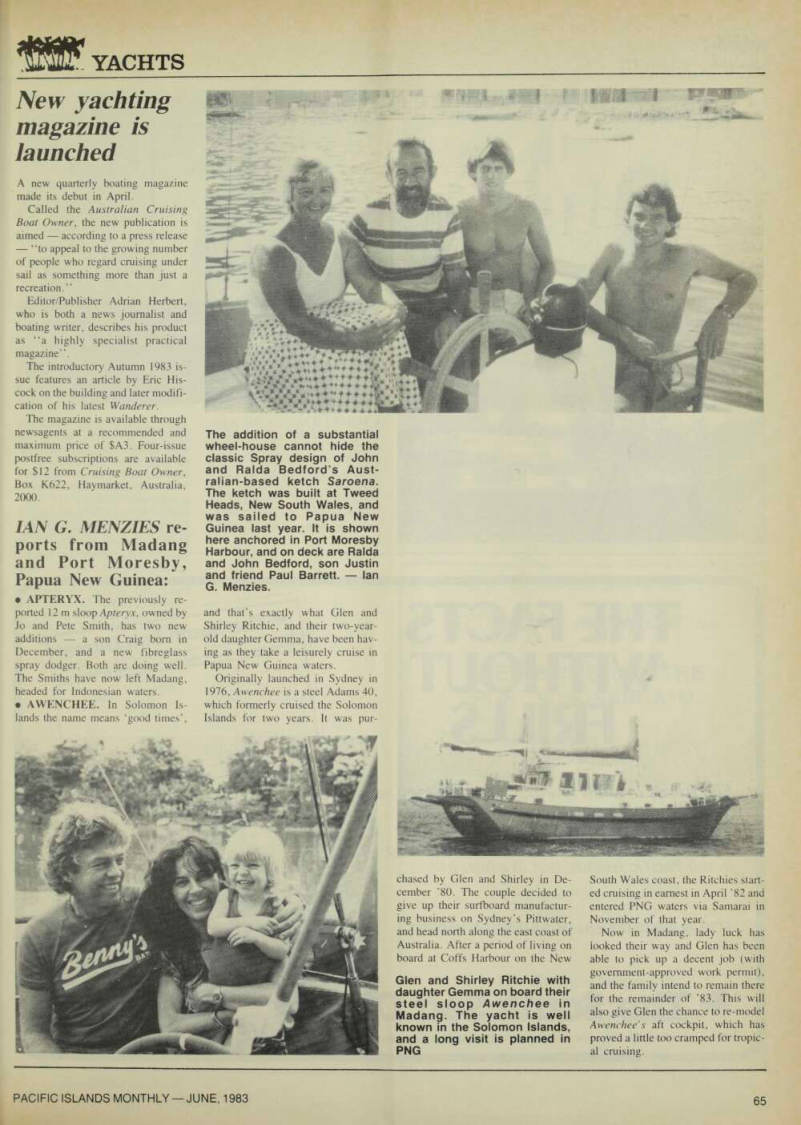
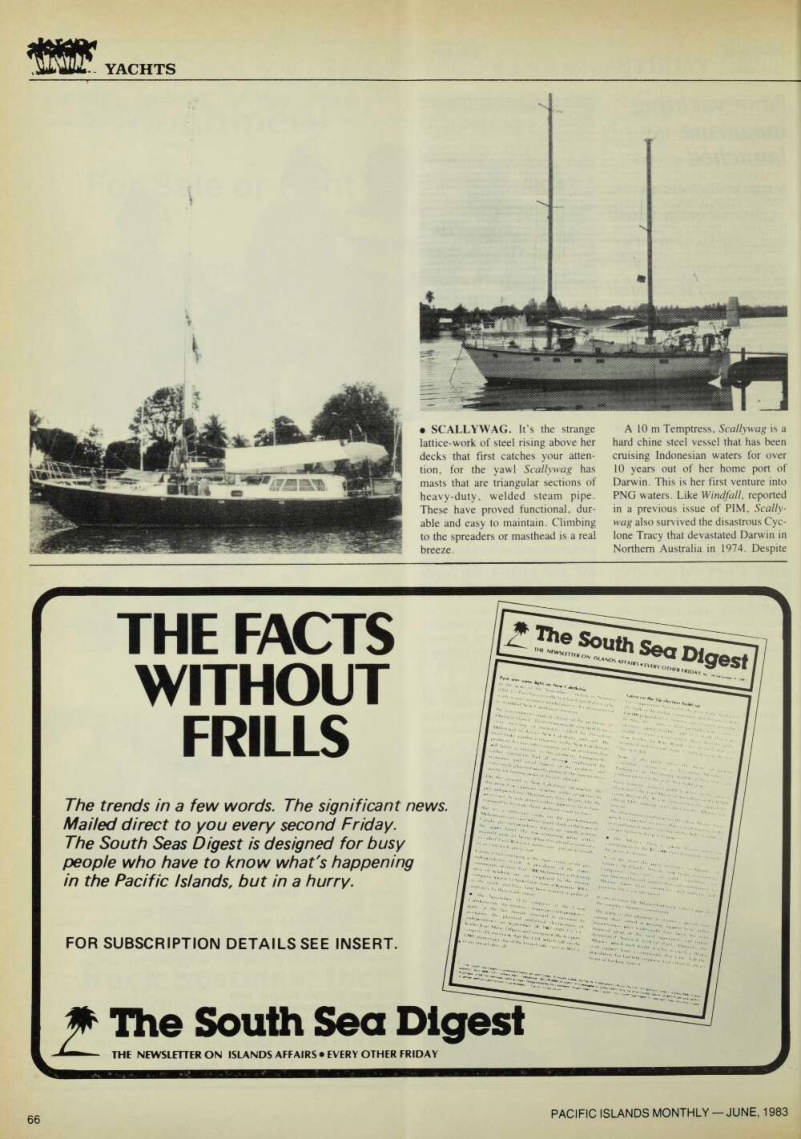
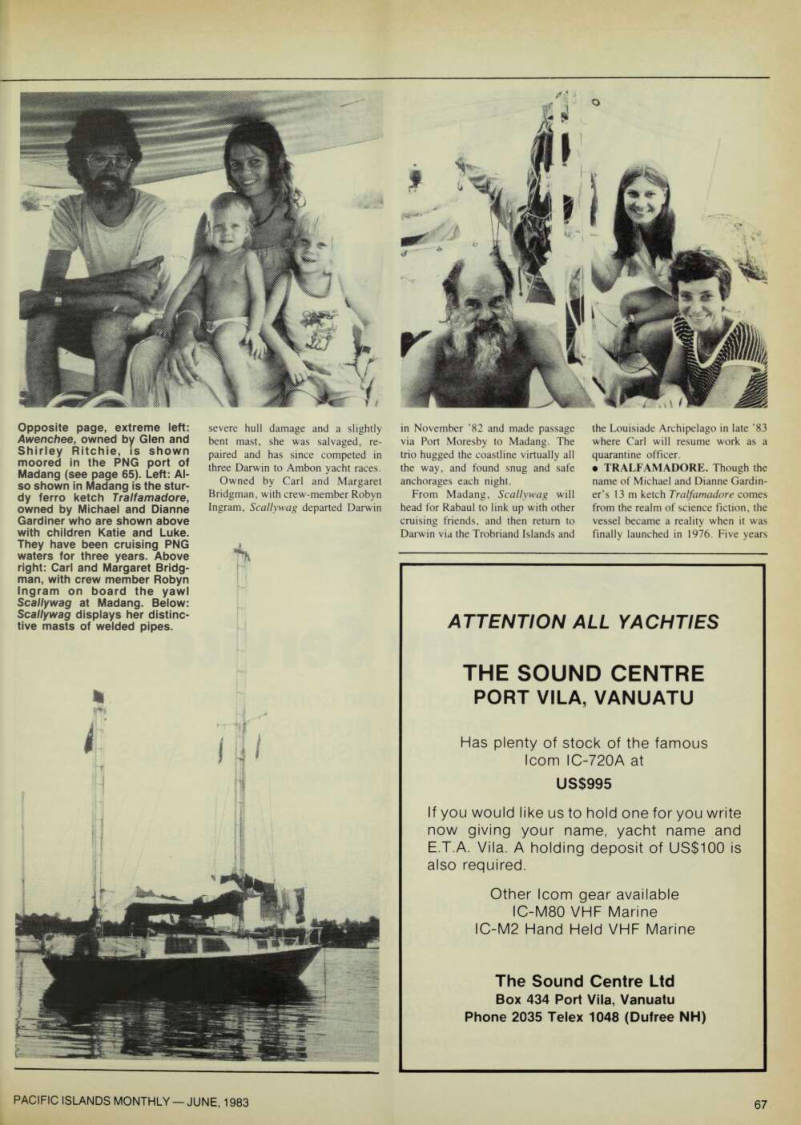
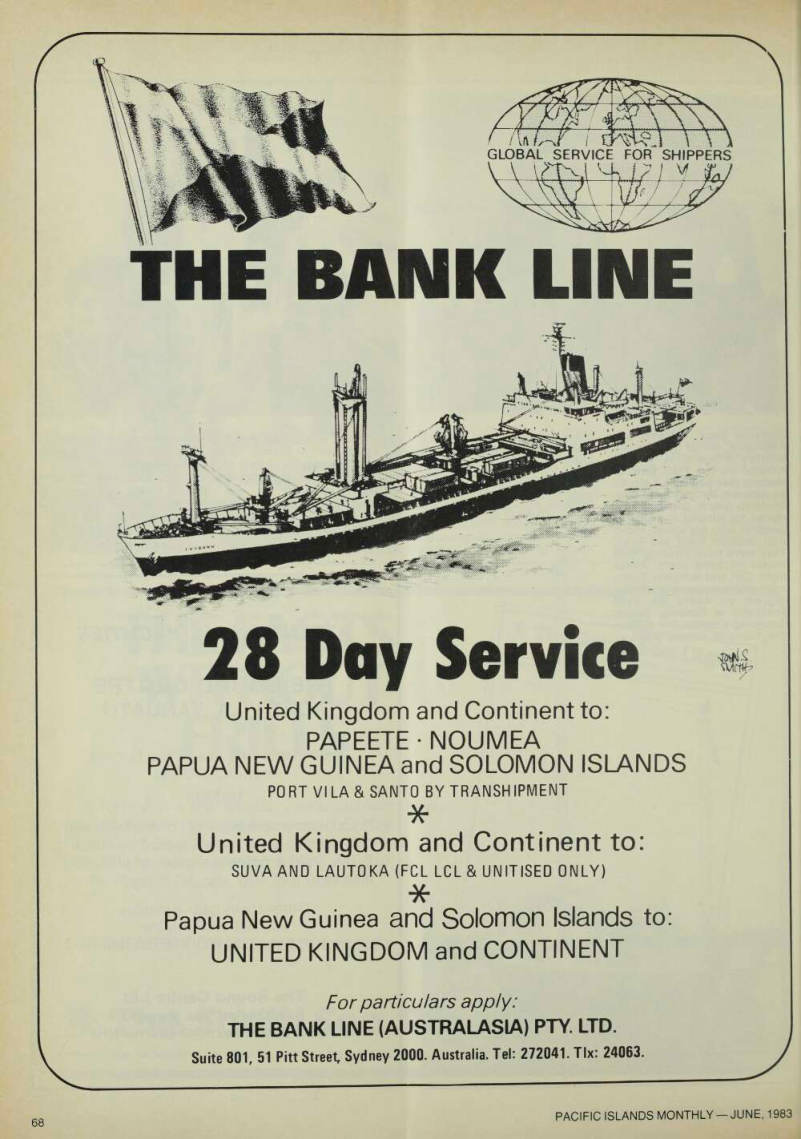
Yachts
magazine is
launched
A new quarterly boating magazine
made its debut in April.
Called the Australian Cruising Boat Owner, the new publication is aimed according to a press release “to appeal to the growing number of people who regard cruising under sail as something more than just a recreation.”
Editor/Publisher Adrian Herbert, who is both a news journalist and boating writer, describes his product as “a highly specialist practical magazine”.
The introductory Autumn 1983 is sue features an article by Eric His cock on the building and later modifi cation of his latest Wanderer.
The magazine is available through newsagents at a recommended and maximum price of SA3. Four-issue postfree subscriptions are available for $l2 from Cruising Boat Owner, Box K 622, Haymarket, Australia, 2000.
Lan G. Menzies Re
ports from Madang
and Port Moresby,
Papua New Guinea:
• APTERYX. The previously re ported 12 m sloop Apteryx, owned by Jo and Pete Smith, has two new additions a son Craig bom in December, and a new fibreglass spray dodger. Both are doing well.
The Smiths have now left Madang, headed for Indonesian waters. • AWENCHEE. In Solomon Is lands the name means ‘good times’,
and that’s exactly what Glen and Shirley Ritchie, and their two-year old daughter Gemma, have been hav ing as they take a leisurely cruise in Papua New Guinea waters.
Originally launched in Sydney in 1976, Awenchee is a steel Adams 40, which formerly cruised the Solomon Islands for two years. It was pur-
chased by Glen and Shirley in De cember ’BO. The couple decided to give up their surfboard manufactur ing business on Sydney’s Pittwater, and head north along the east coast of Australia. After a period of living on board at Coffs Harbour on the New
South Wales coast, the Ritchies start ed cruising in earnest in April 'B2 and entered PNG waters via Samarai in November of that year.
Now in Madang, lady luck has looked their way and Glen has been able to pick up a decent job (with
government-approved work permit),
and the family intend to remain there for the remainder of 'B3. This will also give Glen the chance to re-model Awenchee’s aft cockpit, which has proved a little too cramped for tropic al cruising.
The addition of a substantial wheel-house cannot hide the classic Spray design of John and Raida Bedford's Aust ralian-based ketch Saroena.
The ketch was built at Tweed Heads, New South Wales, and was sailed to Papua New Guinea last year. It is shown here anchored in Port Moresby Harbour, and on deck are Raida and John Bedford, son Justin and friend Paul Barrett. - Ian G. Menzies.
Glen and Shirley Ritchie with daughter Gemma on board their steel sloop Awenchee in Madang. The yacht is well known in the Solomon Islands, and a long visit is planned in
Png
• SCALLYWAG. It’s the strange lattice-work of steel rising above her decks that first catches your atten tion, for the yawl Scallywag has masts that are triangular sections of heavy-duty, welded steam pipe.
These have proved functional, dur able and easy to maintain. Climbing to the spreaders or masthead is a real breeze.
A 10 m Temptress, Scallywag is a hard chine steel vessel that has been cruising Indonesian waters for over 10 years out of her home port of Darwin. This is her first venture into PNG waters. Like Windfall, reported in a previous issue of PIM, Scally wag also survived the disastrous Cyc lone Tracy that devastated Darwin in Northern Australia in 1974. Despite
severe hull damage and a slightly bent mast, she was salvaged, re paired and has since competed in three Darwin to Ambon yacht races.
Owned by Carl and Margaret Bridgman, with crew-member Robyn
Ingram, Scallywag departed Darwin
in November ’B2 and made passage via Port Moresby to Madang. The trio hugged the coastline virtually all the way, and found snug and safe
anchorages each night.
From Madang, Scallywag will head for Rabaul to link up with other cruising friends, and then return to Darwin via the Trobriand Islands and
the Louisiade Archipelago in late ’B3 where Carl will resume work as a
quarantine officer.
• TRALFAMADORE. Though the name of Michael and Dianne Gardin er’s 13 m ketch Tralfamadore comes from the realm of science fiction, the vessel became a reality when it was finally launched in 1976. Five years
Opposite page, extreme left: Awenchee, owned by Glen and Shirley Ritchie, is shown moored in the PNG port of Madang (see page 65). Left: Al so shown in Madang is the stur dy ferro ketch Tralfamadore, owned by Michael and Dianne Gardiner who are shown above with children Katie and Luke.
They have been cruising PNG waters for three years. Above right: Carl and Margaret Bridg man, with crew member Robyn Ingram on board the yawl Scallywag at Madang. Below: Scallywag displays her distinc tive masts of welded pipes.
of hard labor had gone into the construction of this fine ferro-cement Hartley Fijian in their home port of Adelaide in South Australia.
The Gardiners’ cruising life started in ’77 when they headed out of South Australian waters up the east coast of Australia to the port of Brisbane.
After a one-year stopover in that port they sailed eastward to New Caledonia, and then worked their way through the Loyalty Islands, Vanuatu and the Solomons to Rabaul in PNG. Along the way they added to their crew with the birth of their son Luke, who is now four.
Michael is a chartered accountant, and was able to obtain two years work in Rabaul, and there was a further addition to their family Katie, now two. A company transfer meant a move to Madang where the family have been for the last 12 months.
When interviewed, the family were making final preparations to their vessel prior to their departure for Indonesian waters.
Note: Several cruising yachts seek ing permits for Indonesian waters have had such permits granted on the condition that they by-pass Irian Jaya. “Military restrictions’’ has been the reason given for the refusal to grant entry permits to Irian Jaya. • BELLE STARR. Originally from Rabaul in East New Britain, Peter
Robinson with his wife Wendy and son David, four, is headed back that way to renew old acquaintances. The family’s passage-maker is Belle Starr, a 12 m Carlita design by John Pugh, built in steel by the Robinsons over a period of three years. The vessel was launched in May ’BO at the port of Gladstone, east coast of Australia, where Peter had a motor cycle business.
Since leaving Gladstone in De cember ’Bl, the Robinsons have wended their way through the Great Barrier Reef and then spent a relax ing two months at Thursday Island.
Now moored behind the new groyne at the Royal Papua Yacht Club, Port
Moresby, the family are enjoying the
local hospitality and say it’s the friendliest place that they’ve visited so far.
Time is no great problem for the Robinsons, so they plan to explore the coast around to Madang before completing the first major leg of their Pacific cruise at Rabaul. As Peter says, “the wind is free, so why not
enjoy it?’’
• MEVAGISSEY. Two young men who are thoroughly enjoying their cruising life are Rob McCauley and Glen Norton, both of whom hail from Perth in Western Australia. Rob’s 28 ft GRP sloop Mevagissey , was designed by Perth naval architect Graham Tilley and built in the city.
Rob and Glen left Fremantle (the port of the city of Perth), at the mouth of the Swan River, in April ’BO, and spent many months explor ing the rigged and remote northern coastline of Australia. After spending a year in Darwin, where they were both able to find work, the pair departed for Port Moresby in October ’B2. Rob and Glen have applied for a six months cruising permit for PNG waters, and hope to return to Darwin later this year. • TANGOROA. Single-hander Siegfried Eigl arrived in Port Mores by just a little bit the worse for wear, after battling headwinds and stormy seas from Thursday Island and across the Gulf of Papua.
Tangoroa is an 8 m cutter, built of double diagonal marine ply. and was launched in New Zealand in '79. The yacht is very simple in design no frills and has no inboard motor.
Siegfried relies on a 6 hp. Seagull to provide auxiliary power.
Starting from Darwin, this was Siegfried's maiden voyage, and one that he will long remember. Despite the fact that he had only a very basic understanding of navigation and sea manship. he faced no serious prob lems as he crossed the Gulf of Car pentaria. It was near Gove, however, that his luck ran out. Heavy seas and high winds for over 40 hours eventu ally took their toll, and when Tan-
goroa’s starboard shroud parted she was completely dismasted. Luckily, Siegfried was able to lash the mast and its rigging alongside, and after radioing for assistance, was towed to safety by the Thursday Island pilot boat.
After drying out, and carrying out routine maintenance. Siegfried hopes to stay in Port Moresby for a while, before heading east to the Solomon Islands.
Left: The Carlita design Belle Starr, owned by Peter and Wendy Robinson, lies off the Royal Papua Yacht Club, Port Moresby.
Above: Together in Port Moresby are Rob McCauley and Glen Norton of Mevagissey, Tonga Bill Fehoko of Mata Moana and Sieg fried Eigl of Tangoroa. Right: Lou Mar chant’s steel ketch Windfall in Port Moresby (PIM May p66).
Advertisements & other items, pp. 66-70 (1 item)
The Facts
WITHOUT
FRILLS
The trends in a few words. The significant news.
Mailed direct to you every second Friday.
The South Seas Digest is designed for busy people who have to know what's happening in the Pacific Islands , but in a hurry.
FOR SUBSCRIPTION DETAILS SEE INSERT.
The South Sea Digest
THE NEWSLETTER ON ISLANDS AFFAIRS • EVERY OTHER FRIDAY Di 9est
ATTENTION ALL YACHTIES
THE SOUND CENTRE
PORT VILA, VANUATU
Has plenty of stock of the famous Icom IC-720A at US$995 If you would like us to hold one for you write now giving your name, yacht name and E.T.A. Vila. A holding deposit of US$lOO is also required.
Other Icom gear available IC-MBO VHP Marine IC-M2 Hand Held VHP Marine The Sound Centre Ltd Box 434 Port Vila, Vanuatu Phone 2035 Telex 1048 (Dufree NH)
GLOBAL SERVICE FOR SHIPPERS
THE BANK LINE
m-
-28 Day Service
■« United Kingdom and Continent to:
PAPEETE • NOUMEA
PAPUA NEW GUINEA and SOLOMON ISLANDS
PORT VILA & SANTO BY TRANSHIPMENT
* United Kingdom and Continent to: SUVA AND LAUTOKA (FCL LCL & UNITISED ONLY) * Papua New Guinea and Solomon Islands to:
UNITED KINGDOM and CONTINENT
For particulars apply:
THE BANK LINE (AUSTRALASIA) PTY. LTD.
Suite 801, 51 Pitt Street, Sydney 2000. Australia. Tel: 272041. Tlx: 24063.
5/
SERVICES REACH OUT
THOUSANDS OF MILES IN OUR PACIFIC.
IT’SWI
OR ' -if! ■ \s Hawaii WGuam Ponape Kiribati W Nauru Solomon Islands Tuvalu Papua Guinea Western .
Samoa V"
Rotuma Q American Samoa Vanuatu H / fv 1 . ■ iJ
IMEL
INDUSTRIAL AND MARINE ENGINEERING LTD
P.O. Box 172, Suva, Fiji. Telex: FJ2195, Fiji.
Phone: 311288 Suva.
Wherever there's engineering work happening in the South Pacific, whether its repairing a boiler in Ponape, constructing steel storage tanks in Tahiti, or replacing a refrigerator system in Papua New Guinea, chances are there's an IMEL team doing the job.
For not only is IMEL the largest shipyard in the region, but it also provides one of the widest selection of engineering services in the South Pacific.
And since we are located in Suva, the capital of Fiji, we can provide immediate service at very competitive prices, and this includes heavy engineering, foundry work, precision machining, air conditioning and refrigeratic services, sheetmetal work, electronics, joinery, and an extensive selection of steel supplies as well as ships chandlery and marine hardware. If you want a shi built or repaired , or have a heavy engineering problem be solved, turn to the workshop of the South Paci turn to IMEL.
"The Complete Engineerin and Shipbuilding Compam of the South Pacific.”
Shipping Schedules
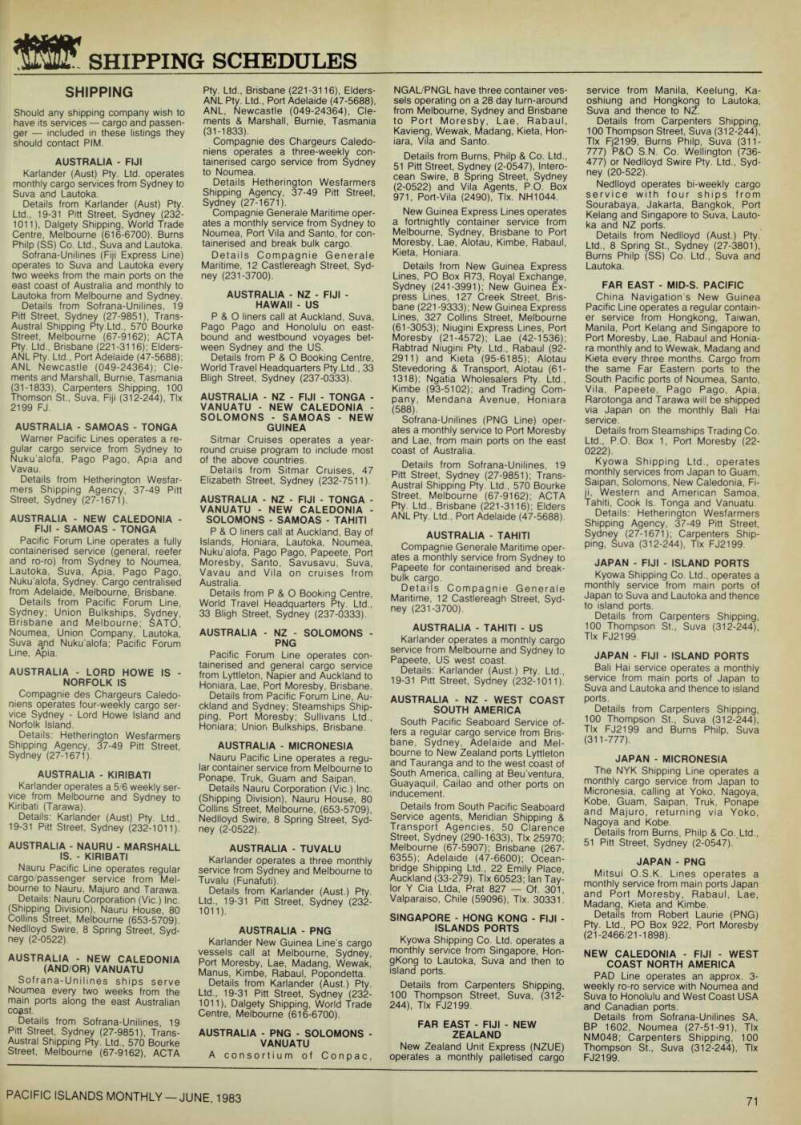
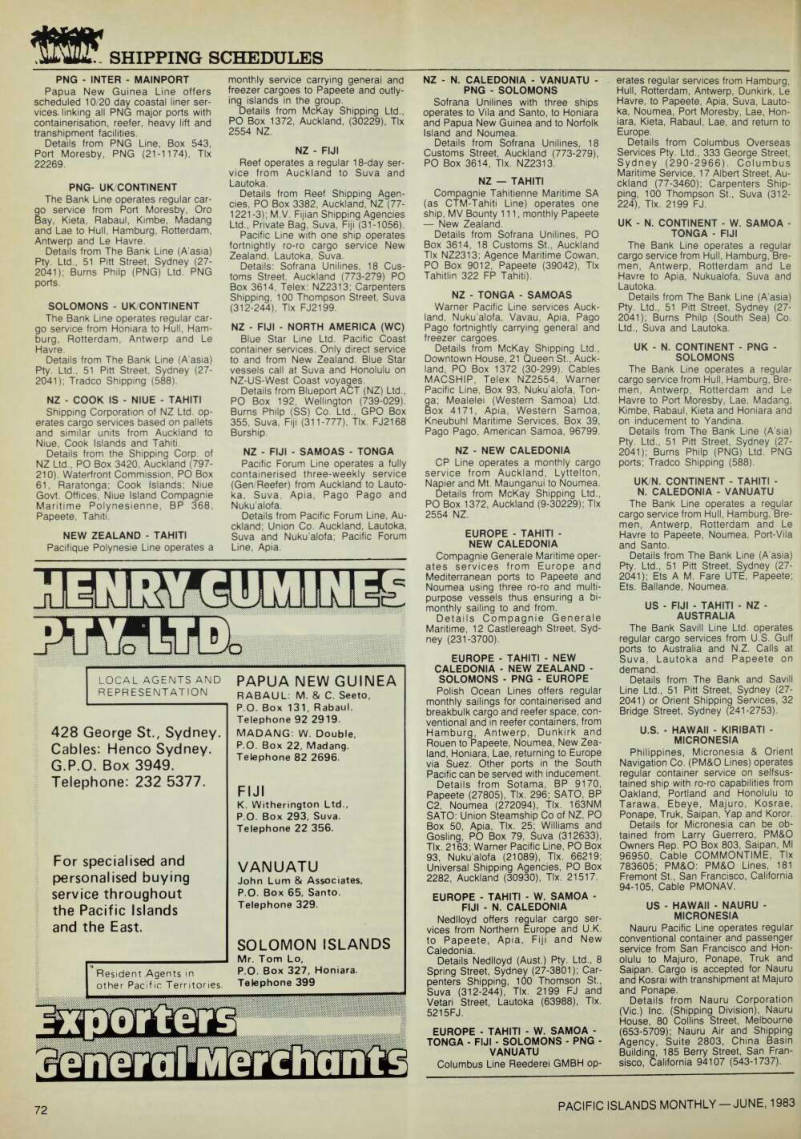
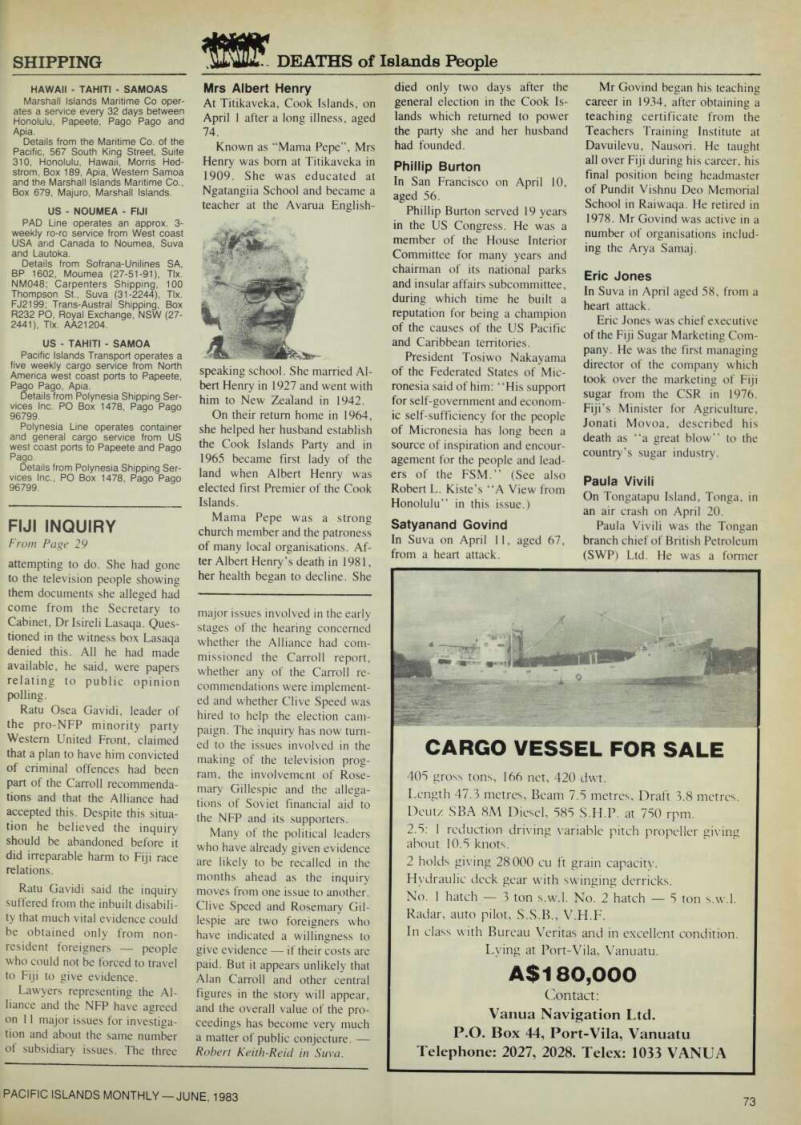
Shipping
Should any shipping company wish to have its services cargo and passen ger included in these listings they should contact PIM.
Australia - Fiji
Karlander (Aust) Pty. Ltd. operates monthly cargo services from Sydney to Suva and Lautoka.
Details from Karlander (Aust) Pty.
Ltd., 19-31 Pitt Street, Sydney (232- Id 1), Dalgety Shipping, World Trade Centre, Melbourne (616-6700). Burns Philp (SS) Co. Ltd., Suva and Lautoka.
Sofrana-Unilines (Fiji Express Line) operates to Suva and Lautoka every two weeks from the main ports on the east coast of Australia and monthly to Lautoka from Melbourne and Sydney.
Details from Sofrana-Unilines, 19 Pitt Street, Sydney (27-9851), Trans- Austral Shipping Pty.Ltd., 570 Bourke Street, Melbourne (67-9162); ACTA Pty. Ltd., Brisbane (221-3116); Elders- ANL Pty. Ltd., Port Adelaide (47-5688); ANL Newcastle (049-24364); Cle ments and Marshall, Burnie, Tasmania (31-1833), Carpenters Shipping, 100 Thomson St., Suva, Fiji (312-244), Tlx 2199 FJ.
Australia - Samoas - Tonga
Warner Pacific Lines operates a re gular cargo service from Sydney to Nukualofa, Pago Pago, Apia and Vavau.
Details from Hetherington Wesfar mers Shipping Agency, 37-49 Pitt Street, Sydney (27-1671).
Australia - New Caledonia -
Fiji - Samoas - Tonga
Pacific Forum Line operates a fully containerised service (general, reefer and ro-ro) from Sydney to Noumea, Lautoka, Suva, Apia, Pago Pago, Nukualofa, Sydney. Cargo centralised from Adelaide, Melbourne, Brisbane.
Details from Pacific Forum Line,
Sydney; Union Bulkships, Sydney,
Brisbane and Melbourne: SATO, Noumea, Union Company, Lautoka, Suva Nukualofa; Pacific Forum Line, Apia.
Australia - Lord Howe Is -
Norfolk Is
Compagnie des Chargeurs Caledo niens operates four-weekly cargo ser vice Sydney - Lord Howe Island and Norfolk Island.
Details: Hetherington Wesfarmers Shipping Agency, 37-49 Pitt Street,
Sydney (27-1671).
Australia - Kiribati
Karlander operates a 5/6 weekly ser vice from Melbourne and Sydney to Kiribati (Tarawa).
Details: Karlander (Aust) Pty. Ltd., 19-31 Pitt Street, Sydney (232-1011).
Australia - Nauru - Marshall
Is. - Kiribati
Nauru Pacific Line operates regular cargo/passenger service from Mel bourne to Nauru, Majuro and Tarawa.
Details: Nauru Corporation (Vic.) Inc. (Shipping Division), Nauru House, 80 Collins Street, Melbourne (653-5709).
Nedlloyd Swire, 8 Spring Street, Syd ney (2-0522).
Australia - New Caledonia
(And/Or) Vanuatu
Sofrana-Unilines ships serve Noumea every two weeks from the main ports along the east Australian
Co£St.
Details from Sofrana-Unilines, 19 Pitt Street, Sydney (27-9851), Trans- Austral Shipping Pty. Ltd., 570 Bourke Street, Melbourne (67-9162), ACTA
Pty. Ltd., Brisbane (221-3116), Elders- ANL Pty. Ltd., Port Adelaide (47-5688), ANL, Newcastle (049-24364), Cle ments & Marshall, Burnie, Tasmania (31-1833).
Compagnie des Chargeurs Caledo nians operates a three-weekly con tainerised cargo service from Sydney to Noumea.
Details Hetherington Wesfarmers Shipping Agency, 37-49 Pitt Street, Sydney (27-1671).
Compagnie Generale Maritime oper ates a monthly service from Sydney to Noumea, Port Vila and Santo, for con tainerised and break bulk cargo.
Details Compagnie Generale Maritime, 12 Castlereagh Street, Syd ney (231-3700).
Australia - Nz - Fiji -
Hawaii - Us
P&O liners call at Auckland, Suva, Pago Pago and Honolulu on east bound and westbound voyages bet ween Sydney and the US.
Details from P&O Booking Centre, World Travel Headquarters Pty.Ltd., 33 Bligh Street, Sydney (237-0333).
AUSTRALIA - NZ - FIJI - TONGA -
Vanuatu - New Caledonia -
Solomons - Samoas - New
Guinea
Sitmar Cruises operates a year round cruise program to include most of the above countries.
Details from Sitmar Cruises, 47 Elizabeth Street, Sydney (232-7511).
AUSTRALIA - NZ - FIJI - TONGA -
Vanuatu - New Caledonia -
Solomons - Samoas - Tahiti
P&O liners call at Auckland, Bay of Islands, Honiara, Lautoka, Noumea, Nukualofa, Pago Pago, Papeete, Port Moresby, Santo, Savusavu, Suva, Vavau and Vila on cruises from Australia.
Details from P&O Booking Centre, World Travel Headquarters Pty. Ltd., 33 Bligh Street, Sydney (237-0333).
Australia - Nz - Solomons -
Png
Pacific Forum Line operates con tainerised and general cargo service from Lyttleton, Napier and Auckland to Honiara, Lae, Port Moresby, Brisbane.
Details from Pacific Forum Line, Au ckland and Sydney; Steamships Ship ping, Port Moresby: Sullivans Ltd., Honiara: Union Bulkships, Brisbane.
Australia - Micronesia
Nauru Pacific Line operates a regu lar container service from Melbourne to Ponape, Truk, Guam and Saipan.
Details Nauru Corporation (Vic.) Inc. (Shipping Division), Nauru House, 80 Collins Street, Melbourne, (653-5709), Nedlloyd Swire, 8 Spring Street, Syd ney (2-0522).
Australia - Tuvalu
Karlander operates a three monthly service from Sydney and Melbourne to Tuvalu (Funafuti).
Details from Karlander (Aust.) Pty.
Ltd., 19-31 Pitt Street, Sydney (232- 1011).
Australia - Png
Karlander New Guinea Line’s cargo vessels call at Melbourne, Sydney, Port Moresby, Lae, Madang, Wewak, Manus, Kimbe, Rabaul, Popondetta.
Details from Karlander (Aust.) Pty.
Ltd., 19-31 Pitt Street, Sydney (232- 1011), Dalgety Shipping, World Trade Centre, Melbourne (616-6700).
Australia - Png - Solomons -
Vanuatu
A consortium of Conpac,
NGAL/PNGL have three container ves sels operating on a 28 day turn-around from Melbourne, Sydney and Brisbane to Port Moresby, Lae, Rabaul, Kavieng, Wewak, Madang, Kieta, Hon iara, Vila and Santo.
Details from Burns, Philp & Co. Ltd., 51 Pitt Street, Sydney (2-0547), Intero cean Swire, 8 Spring Street, Sydney (2-0522) and Vila Agents, P.O. Box 971, Port-Vila (2490), Tlx. NH1044.
New Guinea Express Lines operates a fortnightly container service from Melbourne, Sydney, Brisbane to Port Moresby, Lae, Alotau, Kimbe, Rabaul, Kieta, Honiara.
Details from New Guinea Express Lines, PO Box R 73, Royal Exchange, Sydney (241-3991); New Guinea Ex press Lines, 127 Creek Street, Bris bane (221 -9333); New Guinea Express Lines, 327 Collins Street, Melbourne (61-3053); Niugini Express Lines, Port Moresby (21-4572); Lae (42-1536); Rabtrad Niugini Pty. Ltd., Rabaul (92- 2911) and Kieta (95-6185); Alotau Stevedoring & Transport, Alotau (61- 1318); Ngatia Wholesalers Pty. Ltd., Kimbe (93-5102); and Trading Com pany, Mendana Avenue, Honiara (588).
Sofrana-Unilines (PNG Line) oper ates a monthly service to Port Moresby and Lae, from main ports on the east coast of Australia.
Details from Sofrana-Unilines, 19 Pitt Street, Sydney (27-9851); Trans- Austral Shipping Pty. Ltd., 570 Bourke Street, Melbourne (67-9162); ACTA Pty. Ltd., Brisbane (221-3116); Elders ANL Pty. Ltd., Port Adelaide (47-5688).
Australia - Tahiti
Compagnie Generale Maritime oper ates a monthly service from Sydney to Papeete for containerised and break bulk cargo.
Details Compagnie Generale Maritime, 12 Castlereagh Street, Syd ney (231-3700).
Australia - Tahiti - Us
Karlander operates a monthly cargo service from Melbourne and Sydney to Papeete, US west coast.
Details: Karlander (Aust.) Pty. Ltd., 19-31 Pitt Street, Sydney (232-1011).
Australia - Nz - West Coast
South America
South Pacific Seaboard Service of fers a regular cargo service from Bris bane, Sydney, Adelaide and Mel bourne to New Zealand ports Lyttleton and Tauranga and to the west coast of South America, calling at Beu’ventura, Guayaquil, Cailao and other ports on inducement.
Details from South Pacific Seaboard Service agents, Meridian Shipping & Transport Agencies, 50 Clarence Street, Sydney (290-1633), Tlx 25970; Melbourne (67-5907); Brisbane (267- 6355); Adelaide (47-6600); Ocean bridge Shipping Ltd,, 22 Emily Place, Auckland (33-279). Tlx 60523; lan Tay lor Y Cia Ltd a, Prat 827 Of. 301, Valparaiso, Chile (59096), Tlx. 30331.
SINGAPORE - HONG KONG - FIJI -
Islands Ports
Kyowa Shipping Co. Ltd. operates a monthly service from Singapore, Hon g Kong to Lautoka, Suva and then to island ports.
Details from Carpenters Shipping, 100 Thompson Street, Suva, (312- 244), Tlx FJ2199.
Far East - Fiji - New
Zealand
New Zealand Unit Express (NZUE) operates a monthly palletised cargo
service from Manila, Keelung, Ka oshiung and Hongkong to Lautoka, Suva and thence to NZ.
Details from Carpenters Shipping, 100 Thompson Street, Suva (312-244), Tlx FJ2199, Burns Philp, Suva (311- 777) P&O S.N. Co. Wellington (736- 477) or Nedlloyd Swire Pty. Ltd., Syd ney (20-522).
Nedlloyd operates bi-weekly cargo service with four ships from Sourabaya, Jakarta, Bangkok, Port Kelang and Singapore to Suva, Lauto ka and NZ ports.
Details from Nedlloyd (Aust.) Pty.
Ltd., 8 Spring St., Sydney (27-3801), Burns Philp (SS) Co. Ltd., Suva and Lautoka.
Far East - Mid-S. Pacific
China Navigation s New Guinea Pacific Line operates a regular contain er service from Hongkong, Taiwan, Manila, Port Kelang and Singapore to Port Moresby, Lae, Rabaul and Honia ra monthly and to Wewak, Madang and Kieta every three months. Cargo from the same Far Eastern ports to the South Pacific ports of Noumea, Santo, Vila, Papeete, Pago Pago, Apia, Rarotonga and Tarawa will be shipped via Japan on the monthly Bali Hai service.
Details from Steamships Trading Co.
Ltd., P.O. Box 1, Port Moresby (22- 0222).
Kyowa Shipping Ltd., operates monthly services from Japan to Guam, Saipan, Solomons, New Caledonia, Fi ji, Western and American Samoa, Tahiti, Cook Is. Tonga and Vanuatu.
Details: Hetherington Wesfarmers Shipping Agency, 37-49 Pitt Street, Sydney (27-1671); Carpenters Ship ping, Suva (312-244), Tlx FJ2199.
Japan - Fiji - Island Ports
Kyowa Shipping Co. Ltd., operates a monthly service from main ports of Japan to Suva and Lautoka and thence to island ports.
Details from Carpenters Shipping, 100 Thompson St., Suva (312-244), Tlx FJ2199.
Japan - Fiji - Island Ports
Bali Hai service operates a monthly service from main ports of Japan to Suva and Lautoka and thence to island ports.
Details from Carpenters Shipping, 100 Thompson St., Suva (312-244), Tlx FJ2199 and Burns Philp, Suva (311-777).
Japan - Micronesia
The NYK Shipping Line operates a monthly cargo service from Japan to Micronesia, calling at Yoko, Nagoya, Kobe, Guam, Saipan, Truk, Ponape and Majuro, returning via Yoko, Nagoya and Kobe.
Details from Burns, Philp & Co. Ltd., 51 Pitt Street, Sydney (2-0547).'
Japan - Png
Mitsui O.S.K. Lines operates a monthly service from main ports Japan and Port Moresby, Rabaul, Lae, Madang, Kieta and Kimbe.
Details from Robert Laurie (PNG) Pty. Ltd., PO Box 922, Port Moresby (21-2466/21-1898).
New Caledonia - Fiji - West
Coast North America
PAD Line operates an approx. 3weekly ro-ro service with Noumea and Suva to Honolulu and West Coast USA and Canadian ports.
Details from Sofrana-Unilines SA, BP 1602, Noumea (27-51-91), Tlx NMO4B; Carpenters Shipping, 100 Thompson St., Suva (312-244), Tlx FJ2199.
Png - Inter - Mainport
Papua New Guinea Line offers scheduled 10/20 day coastal liner ser vices. linking all PNG major ports with containerisation, reefer, heavy lift and transhipment facilities.
Details from PNG Line, Box 543, Port Moresby, PNG (21-1174), Tlx 22269.
Png- Uk/Continent
The Bank Line operates regular car go service from Port Moresby, Oro Bay, Kieta, Rabaul, Kimbe, Madang and Lae to Hull, Hamburg, Rotterdam, Antwerp and Le Havre.
Details from The Bank Line (A’asia) Pty. Ltd., 51 Pitt Street, Sydney (27- 2041); Burns Philp (PNG) Ltd. PNG ports.
Solomons - Uk/Continent
The Bank Line operates regular car go service from Honiara to Hull, Ham burg, Rotterdam, Antwerp and Le Havre.
Details from The Bank Line (A’asia) Pty. Ltd., 51 Pitt Street, Sydney (27- 2041); Tradco Shipping (588).
NZ - COOK IS - NIUE - TAHITI Shipping Corporation of NZ Ltd. op erates cargo services based on pallets and similar units from Auckland to Niue, Cook Islands and Tahiti.
Details from the Shipping Corp. of NZ Ltd,, PO Box 3420, Auckland (797- 210). Waterfront Commission, PO Box 61, Raratonga: Cook Islands; Niue Govt. Offices, Niue Island Compagnie Maritime Polynesienne, BP 368, Papeete, Tahiti.
New Zealand - Tahiti
Pacifique Polynesia Line operates a
monthly service carrying general and freezer cargoes to Papeete and outly ing islands in the group.
Details from McKay Shipping Ltd., PO Box 1372, Auckland, (30229), Tlx 2554 NZ.
Nz - Fiji
Reef operates a regular 18-day ser vice from Auckland to Suva and Lautoka.
Details from Reef Shipping Agen cies, PO Box 3382, Auckland, NZ (77- 1221-3); M.V. Fijian Shipping Agencies Ltd., Private Bag, Suva, Fiji (31-1056).
Pacific Line with one ship operates fortnightly ro-ro cargo service New Zealand, Lautoka, Suva.
Details: Sofrana Unilines, 18 Cus toms Street, Auckland (773-279) PO Box 3614, Telex: NZ2313; Carpenters Shipping, 100 Thompson Street, Suva (312-244), Tlx FJ2199.
NZ - FIJI - NORTH AMERICA (WC) Blue Star Line Ltd. Pacific Coast container services. Only direct service to and from New Zealand. Blue Star vessels call at Suva and Honolulu on NZ-US-West Coast voyages.
Details from Blueport ACT (NZ) Ltd., PO Box 192, Wellington (739-029).
Burns Philp (SS) Co. Ltd., GPO Box 355, Suva, Fiji (311-777), Tlx. FJ2168 Burship.
NZ - FIJI - SAMOAS - TONGA Pacific Forum Line operates a fully containerised three-weekly service (Gen/Reefer) from Auckland to Lauto ka, Suva, Apia, Pago Pago and Nukualofa.
Details from Pacific Forum Line, Au ckland: Union Co. Auckland, Lautoka, Suva and Nukualofa; Pacific Forum Line, Apia.
NZ - N. CALEDONIA - VANUATU -
Png - Solomons
Sofrana Unilines with three ships operates to Vila and Santo, to Honiara and Papua New Guinea and to Norfolk Island and Noumea.
Details from Sofrana Unilines, 18 Customs Street, Auckland (773-279), PO Box 3614, Tlx. NZ2313.
Nz Tahiti
Compagnie Tahitienne Maritime SA (as CTM-Tahiti Line) operates one ship, MV Bounty 111, monthly Papeete New Zealand.
Details from Sofrana Unilines, PO Box 3614, 18 Customs St., Auckland Tlx NZ2313; Agence Maritime Cowan, PO Box 9012, Papeete (39042), Tlx Tahitlin 322 FP Tahiti).
Nz - Tonga - Samoas
Warner Pacific Line services Auck land, Nukualofa, Vavau, Apia, Pago Pago fortnightly carrying general and freezer cargoes.
Details from McKay Shipping Ltd., Downtown House, 21 Queen St., Auck land, PO Box 1372 (30-299). Cables MACSHIP, Telex NZ2554, Warner Pacific Line, Box 93, Nukualofa, Ton ga; Mealelei (Western Samoa) Ltd.
Box 4171, Apia, Western Samoa, Kneubuhl Maritime Services, Box 39, Pago Pago, American Samoa, 96799.
Nz - New Caledonia
CP Line operates a monthly cargo service from Auckland, Lyttelton, Napier and Mt. Maunganui to Noumea.
Details from McKay Shipping Ltd., PO Box 1372, Auckland (9-30229); Tlx 2554 NZ.
Europe - Tahiti -
New Caledonia
Compagnie Generale Maritime oper ates services from Europe and Mediterranean ports to Papeete and Noumea using three ro-ro and multi purpose vessels thus ensuring a bi monthly sailing to and from.
Details Compagnie Generale Maritime, 12 Castlereagh Street, Syd ney (231-3700).
Europe - Tahiti - New
Caledonia - New Zealand -
Solomons - Png - Europe
Polish Ocean Lines offers regular monthly sailings for containerised and breakbulk cargo and reefer space, con ventional and in reefer containers, from Hamburg, Antwerp, Dunkirk and Rouen to Papeete, Noumea, New Zea land, Honiara, Lae, returning to Europe via Suez. Other ports in the South Pacific can be served with inducement.
Details from Sotama, BP 9170, Papeete (27805), Tlx. 296; SATO, BP C 2, Noumea (272094), Tlx. 163 NM SATO: Union Steamship Co of NZ, PO Box 50, Apia, Tlx. 25; Williams and Gosling, PO Box 79, Suva (312633), Tlx. 2163; Warner Pacific Line, PO Box 93, Nukualofa (21089), Tlx. 66219; Universal Shipping Agencies, PO Box 2282, Auckland (30930), Tlx. 21517.
EUROPE - TAHITI - W. SAMOA -
Fiji - N. Caledonia
Nedlloyd offers regular cargo ser vices from Northern Europe and U.K. to Papeete, Apia, Fiji and New Caledonia.
Details Nedlloyd (Aust.) Pty. Ltd., 8 Spring Street, Sydney (27-3801); Car penters Shipping, 100 Thomson St., Suva (312-244), Tlx. 2199 FJ and Vetari Street, Lautoka (63988), Tlx. 5215FJ.
EUROPE - TAHITI - W. SAMOA - TONGA - FIJI - SOLOMONS - PNG -
Vanuatu
Columbus Line Reederei GMBH op
erates regular services from Hamburg, Hull, Rotterdam, Antwerp, Dunkirk, Le Havre, to Papeete, Apia, Suva, Lauto ka, Noumea, Port Moresby, Lae, Hon iara, Kieta, Rabaul, Lae, and return to Europe.
Details from Columbus Overseas Services Pty. Ltd., 333 George Street, Sydney (290-2966). Columbus Maritime Service, 17 Albert Street, Au ckland (77-3460); Carpenters Ship ping, 100 Thompson St., Suva (312- 224), Tlx. 2199 FJ.
UK - N. CONTINENT - W. SAMOA -
Tonga - Fiji
The Bank Line operates a regular cargo service from Hull, Hamburg, Bre men, Antwerp, Rotterdam and Le Havre to Apia, Nukualofa, Suva and Lautoka.
Details from The Bank Line (A’asia) Pty. Ltd., 51 Pitt Street, Sydney (27- 2041); Burns Philp (South Sea) Co.
Ltd., Suva and Lautoka.
UK - N. CONTINENT - PNG -
Solomons
The Bank Line operates a regular cargo service from Hull, Hamburg, Bre men, Antwerp, Rotterdam and Le Havre to Port Moresby, Lae, Madang, Kimbe, Rabaul, Kieta and Honiara and on inducement to Yandina.
Details from The Bank Line (Asia) Pty. Ltd., 51 Pitt Street, Sydney (27- 2041); Burns Philp (PNG) Ltd. PNG ports; Tradco Shipping (588).
Uk/N. Continent ■ Tahiti -
N. Caledonia - Vanuatu
The Bank Line operates a regular cargo service from Hull, Hamburg, Bre men, Antwerp, Rotterdam and Le Havre to Papeete, Noumea, Port-Vila and Santo.
Details from The Bank Line (A’asia) Pty. Ltd., 51 Pitt Street, Sydney (27- 2041); Ets A M. Fare UTE, Papeete; Ets. Ballande, Noumea.
US - FIJI - TAHITI - NZ -
Australia
The Bank Savill Line Ltd. operates regular cargo services from U.S. Gulf ports to Australia and N.Z. Calls at Suva, Lautoka and Papeete on demand.
Details from The Bank and Savill Line Ltd., 51 Pitt Street, Sydney (27- 2041) or Orient Shipping Services, 32 Bridge Street, Sydney (241-2753).
U.S. - Hawaii - Kiribati -
Micronesia
Philippines, Micronesia & Orient Navigation Co. (PM&O Lines) operates regular container service on selfsus tained ship with ro-ro capabilities from Oakland, Portland and Honolulu to Tarawa, Ebeye, Majuro, Kosrae, Ponape, Truk, Saipan, Yap and Koror.
Details for Micronesia can be ob tained from Larry Guerrero, PM&O Owners Rep. PO Box 803, Saipan, Ml 96950, Cable COMMONTIME, Tlx 783605; PM&O: PM&O Lines, 181 Fremont St., San Francisco, California 94-105, Cable PMONAV.
Us - Hawaii - Nauru -
Micronesia
Nauru Pacific Line operates regular conventional container and passenger service from San Francisco and Hon olulu to Majuro, Ponape, Truk and Saipan. Cargo is accepted for Nauru and Kosrai with transhipment at Majuro and Ponape.
Details from Nauru Corporation (Vic.) Inc. (Shipping Division), Nauru House, 80 Collins Street, Melbourne (653-5709); Nauru Air and Shipping Agency, Suite 2803, China Basin Building, 185 Berry Street, San Fran sisco, California 94107 (543-1737).
Hawaii - Tahiti - Samoas
Marshall Islands Maritime Co oper ates a service every 32 days between Honolulu, Papeete, Pago Pago and Apia.
Details from the Maritime Co. of the Pacific, 567 South King Street, Suite 310, Honolulu, Hawaii, Morris Hed strom, Box 189, Apia, Western Samoa and the Marshall Islands Maritime Co., Box 679, Majuro, Marshall Islands.
Us - Noumea - Fiji
PAD Line operates an approx. 3weekly ro-ro service from West coast USA and Canada to Noumea, Suva and Lautoka.
Details from Sofrana-Unilines SA, BP 1602, Moumea (27-51-91), Tlx.
NMO4B; Carpenters Shipping, 100 Thompson St., Suva (31-2244), Tlx.
FJ2199; Trans-Austral Shipping, Box R 232 PO, Royal Exchange, NSW (27- 2441), Tlx. AA21204.
Us - Tahiti - Samoa
Pacific Islands Transport operates a five weekly cargo service from North America west coast ports to Papeete, Pago Pago, Apia.
Details from Polynesia Shipping Ser vices Inc. PO Box 1478, Pago Pago 96799.
Polynesia Line operates container and general cargo service from US west coast ports to Papeete and Pago Pago.
Details from Polynesia Shipping Ser vices Inc., PO Box 1478, Pago Pago 96799.
Advertisements & other items, p. 72 (1 item)
personalised buying
LOCAL AGENTS AND
REPRESENTATION
428 George St., Sydney.
Cables: Henco Sydney.
G.P.O. Box 3949.
Telephone: 232 5377.
For specialised and
personalised buying
service throughout
the Pacific Islands
and the East.
Resident Agents in other Pacific Territories.
PAPUA NEW GUINEA
RABAUL: M. & C. Seeto, P.O. Box 131, Rabaul.
Telephone 92 2919.
MADANG: W. Double, P.O. Box 22, Madang.
Telephone 82 2696.
FIJI
K. Witherington Ltd.
P.O. Box 293, Suva.
Telephone 22 356.
VANUATU
John Lum & Associates, P.O. Box 65, Santo.
Telephone 329.
SOLOMON ISLANDS
Mr. Tom Lo, P.O. Box 327, Honiara.
Telephone 399 «i i
DEATHS of Islands People
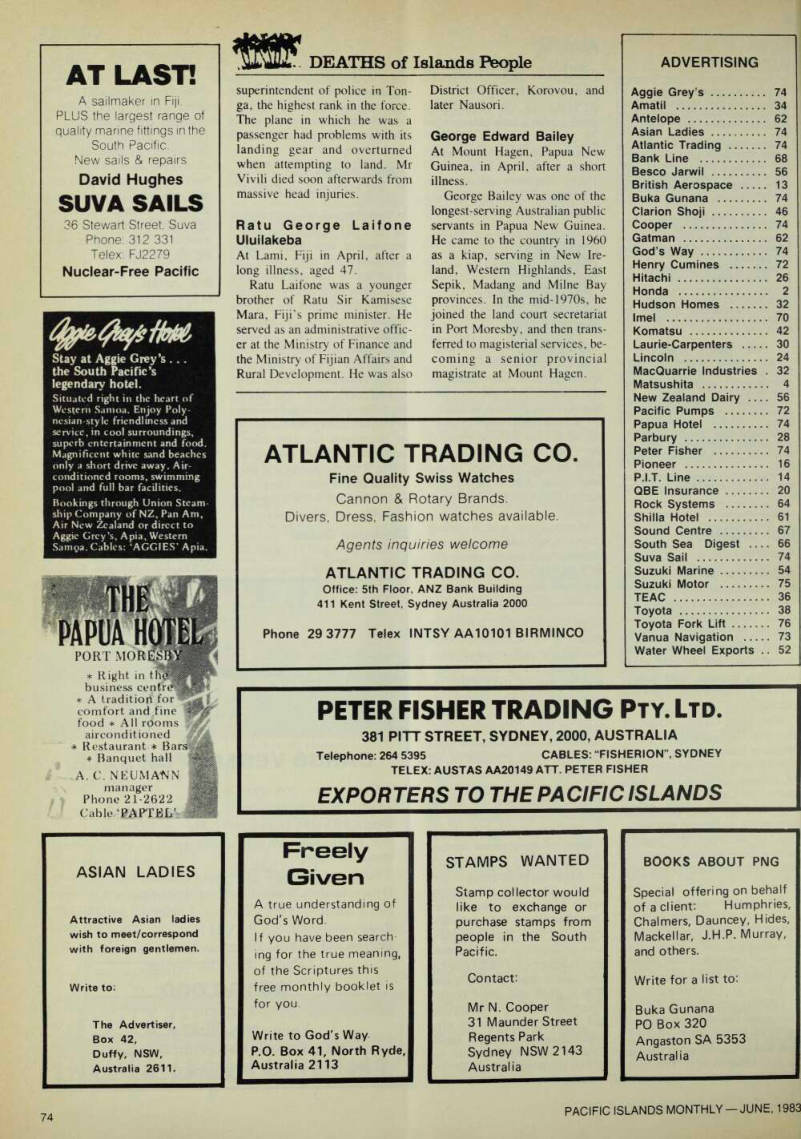
Mrs Albert Henry At Titikaveka, Cook Islands, on April 1 after a long illness, aged 74.
Known as “Mama Pepe”, Mrs Henry was bom at Titikaveka in 1909. She was educated at Ngatangiia School and became a teacher at the Avarua English-
speaking school. She married Al bert Henry in 1927 and went with him to New Zealand in 1942.
On their return home in 1964, she helped her husband establish the Cook Islands Party and in 1965 became first lady of the land when Albert Henry was elected first Premier of the Cook Islands.
Mama Pepe was a strong church member and the patroness of many local organisations. Af ter Albert Henry’s death in 1981, her health began to decline. She
died only two days after the general election in the Cook Islands which returned to power the party she and her husband had founded.
Phillip Burton
. c a m In San Francisco on April 10, aged 56 D . . jin Phillip Burton served 19 years in the US Congress. He was a member of the House Interior Committee for many years and chairman of its national parks a- i cc • . • and insular attairs subcommittee, . • u , . . ... during which time he built a reputation for being a champion f tU c ITC , r. r ot the causes of the US Pacific , r ... and Caribbean territories.
D . . . . KT .
President Tosiwo Nakayama r c k of the Federated States of Mic- . . ■ ... ronesia said of him: His support t tor selt-govemment and economif ff f .u i ic selt-sufficiency for the people r , , u ot Micronesia has long been a source ot inspiration and encouragement for the people and leadp S k °l . ‘ h p FSM • a v 566 f alS ° Robert L. Kiste s A View from u i . .
Honolulu m this issue.)
Satyanand Govind
In Suva on April 11, aged 67, from a heart attack.
Mr Govind began his teaching career in 1934, after obtaining a teaching certificate from the Teachers Training Institute at Davuilevu, Nausori. He taught all over during his career ’ his final position being headmaster c C.. ... , w °* un<^lt ls hnu Deo Memorial School in Raiwaqa. He retired in in 0 .. j 1978 k Mr f GoVmdwas active m a num . b k er ° f org ? n,satlons ■»clud ,ng e r ' Va ama J c • Eric Jones , c * ■. . co f In Suva m April aged 58, from a eart attack c . . . . c Eric Jones was chief executive c c w . . ot the Fiji Sugar Marketing Com , r . pany. He was the first managing A - t f .. f. f director ot the company which , . J f _.. took over the marketing of Fin f .. in -J sugar from the CSR m 1976. c ... . c . . riji s Minister for Agriculture, . J t .. , ...
Jonati Movoa, described his , ... ... death as a great blow to the . , CoUntry S SUgar mdUStr >' Paula Vivili m . , , .
On Tongatapu Island, Tonga, in a •, an air crash on April 20.
Paula Vivili was the Tongan branch chief of British Petroleum (SWP) Ltd. He was a former
superintendent of police in Ton ga, the highest rank in the force.
The plane in which he was a passenger had problems with its landing gear and overturned when attempting to land. Mr Vivili died soon afterwards from massive head injuries.
Ratu George Laifone Uluilakeba At Lami, Fiji in April, after a
long illness, aged 47.
Ratu Laifone was a younger brother of Ratu Sir Kamisese Mara, Fiji’s prime minister. He served as an administrative offic er at the Ministry of Finance and the Ministry of Fijian Affairs and Rural Development. He was also
District Officer, Korovou, and later Nausori.
George Edward Bailey At Mount Hagen, Papua New Guinea, in April, after a short illness.
George Bailey was one of the longest-serving Australian public servants in Papua New Guinea.
He came to the country in 1960 as a kiap, serving in New Ire land, Western Highlands, East Sepik, Madang and Milne Bay provinces. In the mid-19705, he joined the land court secretariat in Port Moresby, and then trans ferred to magisterial services, be coming a senior provincial magistrate at Mount Hagen.
Advertisements & other items, pp. 73-74 (2 items)
Fiji Inquiry
73
PACIFIC ISLANDS MONTHLY —JUNE, 1983
From Page 29
SHIPPING
AslBo,ooo
CARGO VESSEL FOR SALE
405 gross tons, 166 net, 420 dwt.
Length 47.3 metres, Beam 7.5 metres, Draft 3.8 metres.
Dcutz SBA 8M Diesel, 585 S.H.P. at 750 rpm. 2.5; 1 reduction driving variable pitch propeller giving about 10.5 knots. 2 holds giving 28 000 cu ft grain capacity.
Hydraulic deck gear with swinging derricks.
No. 1 hatch 3 ton s.w.l. No. 2 hatch 5 ton s.w.l.
Radar, auto pilot, 5.5.8., V.H.F.
In class with Bureau Veritas and in excellent condition.
Lying at Port-Vila, Vanuatu.
AslBo,ooo
Contact: Vanua Navigation Ltd.
P.O. Box 44, Port-Vila, Vanuatu Telephone: 2027, 2028. Telex: 1033 VANUA
AT LAST!
A sailmaker in Fiji.
PLUS the largest range of quality marine fittings in the South Pacific.
New sails & repairs
David Hughes
SUVA SAILS
36 Stewart Street, Suva Phone: 312 331 Telex: FJ2279 Nuclear-Free Pacific
Stay at Aggie Grey’s . . . the South Pacific’s legendary hotel.
Situated right in the heart of Western Samoa. Enjoy Polynesian-stylc friendliness and service, in cool surroundings, superb entertainment and food.
Magnificent white sand beaches only a short drive away. Airconditioned rooms, swimming pool and full bar facilities.
Bookings through Union Steamship Company of NZ, Pan Am, Air New Zealand or direct to Aggie Grey’s, Apia, Western Sampa. Cables: ‘AGGIES’Apia.
ATLANTIC TRADING CO.
Fine Quality Swiss Watches Cannon & Rotary Brands.
Divers, Dress, Fashion watches available.
Agents inquiries welcome
ATLANTIC TRADING CO.
Office: sth Floor, ANZ Bank Building 411 Kent Street, Sydney Australia 2000 Phone 29 3777 Telex INTSY AAIOIOI BIRMINCO
p A
PORT MOR
th ♦ Right in business cen * A traditiori for comfort and fine food * All rdoms airconditioned * Restaurant * Ba * Banquet hall
A. C. NEUMANN
manager Phone 21-2622 Cable ‘RAFTMn
PETER FISHER TRADING PTY. Ltd.
381 PITT STREET, SYDNEY, 2000, AUSTRALIA
Telephone: 264 5395 CABLES: “FISHERION”, SYDNEY
TELEX; AUSTAS AA20149 ATT. PETER FISHER
EXPORTERS TO THE PACIFIC ISLANDS
Freely
Given
A true understanding of God's Word.
If you have been searching for the true meaning, of the Scriptures this free monthly booklet is for you.
Write to God's Way P.O. Box 41, North Ryde, Australia 2113
STAMPS WANTED
Stamp collector would like to exchange or purchase stamps from people in the South Pacific.
Contact: Mr N. Cooper 31 Maunder Street Regents Park Sydney NSW 2143 Australia
BOOKS ABOUT PNG
Special offering on behalf of a client: Humphries, Chalmers, Dauncey, Hides, Mackellar, J.H.P. Murray, and others.
Write for a list to: Buka Gunana PO Box 320 Angaston SA 5353 Australia
ASIAN LADIES
Attractive Asian ladies wish to meet/correspond with foreign gentlemen.
Write to; The Advertiser, Box 42, Duffy, NSW, Australia 2611.
Advertising
Aggie Grey’s 74 Amatil 34 Antelope 62 Asian Ladies 74 Atlantic Trading 74 Bank Line 68 Besco Jarwil 56 British Aerospace 13 Buka Gunana 74 Clarion Shoji 46
Cooper 74
Gatman 62 God’s Way 74 Henry Cumines 72 Hitachi 26 Honda 2 Hudson Homes 32 Imel 70 Komatsu 42 Laurie-Carpenters 30 Lincoln 24 MacQuarrie Industries . 32 Matsushita 4 New Zealand Dairy 56 Pacific Pumps 72 Papua Hotel 74
Parbury 28
Peter Fisher 74 Pioneer 16 P.l.T. Line 14 QBE Insurance 20 Rock Systems 64 Shilla Hotel 61 Sound Centre 67 South Sea Digest — 66 Suva Sail 74 Suzuki Marine 54 Suzuki Motor 75
Teac 36
Toyota 38 Toyota Fork Lift 76 Vanua Navigation 73 Water Wheel Exports .. 52
Advertisements & other items, pp. 75-76 (1 item)
SuIWu Ok name of performance.
The Progressive Automobile Manufacturer for The 80':
SUZUKI MOTOR CO, LTD
SUZUKI
300Takatsuka. Hamamatsu, Japan
SUZUKI
% * tt ▼ ■ - 4 4 V e * A ,*d I ' PHOTO: Canadian version ' S580F ' V "■ -V- *- ■■ •. **, * S^ccaW^^Kn«89 : +■■ J-f SUZUKI Vehicles are shipped to approximately 100 countries throughout the world and are well received by users in those countries. Behind the high-quality of SUZUKI 4wheelers is the in-depth research carried out from all aspects, rigorous tests and an extensive after-sales service net-work. Vehicles that are ready when you need them and which you can trust when driving. SUZUKI Vehicles.
SuIWu Ok name of performance.
SOLOMON ISLANDS SOLOMON ISLAND SERVICE STATION LTD. NEW CALEDONIA STE. SUPERCAL PAPUA NEW GUINEA PNG MOTORS VANUATU HENRI LEROUX NIUE ISLAND BURNS PHILP (SOUTH SEA)CO., LTD. PONAPE LEO ETSCHEIT TAHITI NIPPON AUTOMOTO GUAM & SAIPAN ISLAND CYCLERY, INC. NORFOLK MARTIN’S AGENCIES LTD. SAMOA PACIRC PRODUCTS. INC. TONGA PACIFIC PRODUCTS, INC. NAURU EQUAPAC MOTORS FUJI NIRANJANS AUTOPORT LTD.
KIRIBATI: KIRIBATI CO-OPERATIVE WHOLESALE SOCIETY LIMITED RAROTONGA: AUTO HOLDINGS LTD.
If you’re thinking about tomorrow,
you’ll choose f ° rkuft
the world’s best selling forklift—Toyota—today.
TECHNOLOGY Toyota Forklifts are built to last over the long haul, utilizing a Central ydraulic ower ystem (C.H.P.S.) that not only speeds maintenance but also increases operator efficiency through power assistance. Only Toyota offers C.H.P.S. in the 1-3 ton range. HUMAN ENGINEERING Down the road, Toyotas stay as reliable as ever because they're built solid. A standard reinforced Wide Visible mast for both durability and safety is just one example. Toyota's design thinks beyond the machine itself to the operator for more comfort with a lower noise level, assist grips and bucket seat.
THE CHOICE We also take your individual business into account with a wide selection of models, options and attachments to suit you best.
This kind of thinking has made Toyota forklifts the choice of more businesses around the world than any other forklift. Because, if you're thinking ahead,
y «tteM., Toyota.
1,000-3,000 kg SERIES PNEUMATIC-TIRED/ENGINE-POWERED
TOYOTA
i AMERICAN SAMOA: BURNS PHILP (S.S.) CO., LTD. TEL: 633-4281 i AUSTRALIA: THIESS TOYOTA PTY, LTD. TEL; 526-0333
» FIJI: AUTOMOTIVE SUPPLIES CO.,
A DIVISION OF BURNS PHILP (S.S.) CO., LTD. TEL: 383444 « GUAM: ATKINS, KROLL (GUAM) LTD. TEL: 646-1876 i NEW CALEDONIA: SERVICE IMPORTATION AUTOMOBILE DU PACIFIQUE
TEL: 27-41-44
i NEW ZEALAND; ANDREWS & BEAVEN LTD. TEL: 381-400
» PAPUA NEW GUINEA: ELA MOTORS,
A DIVISION OF BURNS PHILP (P.N.G.), LTD. TEL; 217036 a VANUATU: VANUATU MOTORS, A DIVISION OF BURNS PHILP (VANUATU) LTD.
TEL: VILA 2341
9 WESTERN SAMOA: BURNS PHILP (S.S.) CO., LTD. TEL: 22611 And distributors around the world.