Pacific

Islands
Monthly
American Samoa 081171 Australia Cook islands NZ$1.50 • 'i' f $ 1.56 Hawaii A OS mainland US$1J& Kiribati ,tS4 AS»t Nauru ASM New Caledonia CFP1fl|R New Zealand NZ$175 Niue K NZ$150 Norfolk Island.A$1.50 Papua New K1 50 Solomons ..TfSHF,... S$i 50
Tahiti WmmCFPW
Tonga PI 50 Tuvalu A$1.75
Ustt A Guam Us$195
Vanuatu A$150 Western Samoa T1 60 ‘Recommended retail price only.
Registered by Australia Post Publication No NBP1210
@iS® - WMmwi lnplPlSt
Western Salml©S\
d@ii T© PCjXS
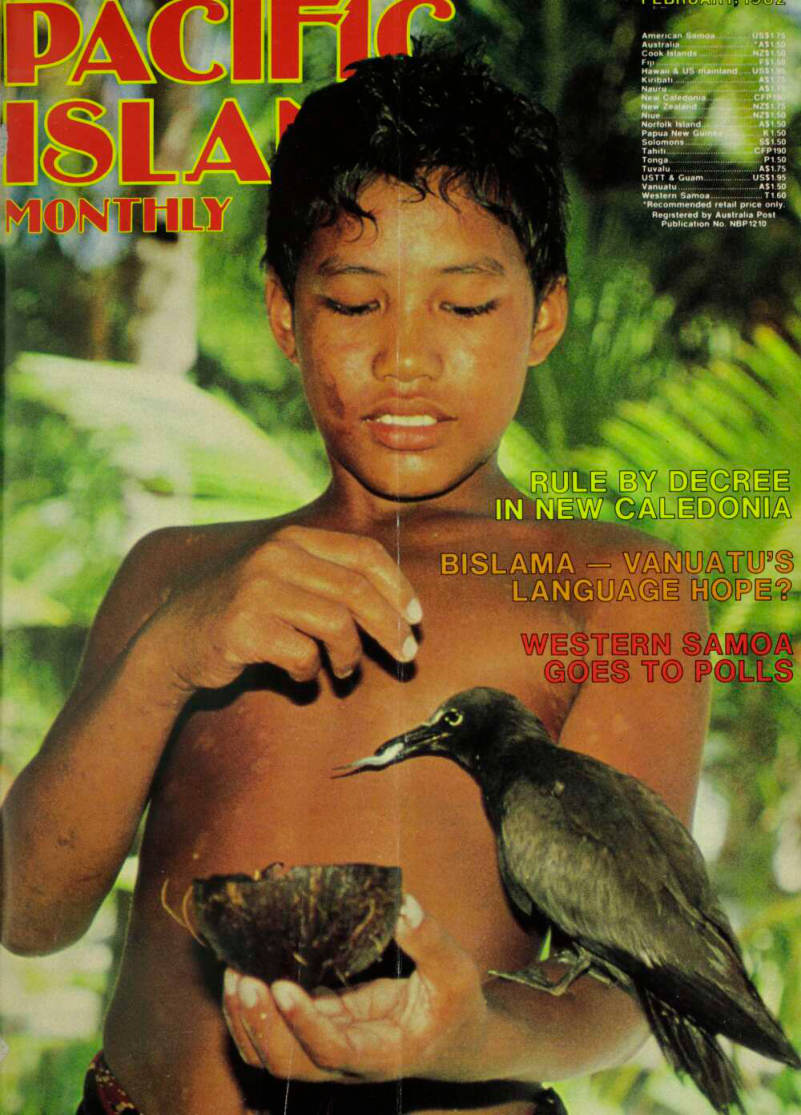
Cover picture: Having tamed it, this Tokelau youth evidently feels he has a responsibility to feed his pet bird. — George H. Baiazs picture. Correction: Due to an error in transcription, our December, 1981, cover picture was described as having been taken at 'Vanicolo, Milne Bay province, Papua New Guinea'. In fact it was taken at Vanikoro in the Santa Cruz group, Solomon Islands. Our apologies.
Advertisements & other items, p. 2 (1 item)
Accord
Born again bigger and better with fresh ideas.
The new Honda Accord 4-door Sedan is here!
The original Honda Accord was an international success. When it was introduced six years ago, it was the right car at the right time and fit the needs of its owners exceedingly well. The new Honda Accord 4-door is made for a new generation of buyers who want more space with improved performance and fuel efficiency. It’s built on a longer wheelbase and wider tread and gives more length and width in the roomy interior. And it’s all useable Equipment may vary in some countries. space. The trunk is 26.5% larger than the original Accord. All this extra space means more room to stretch out in greater comfort and you can carry more cargo.
The trusty engine coupled to the compact front-wheel drive system has also been made to work harder.
It’s more powerful and still more economical. Honda engineers have also upgraded the suspension and brakes. As a result, the new Accord performs better all around. It’s also more comfortable inside and the
fully instrumented easy-to-read
dashboard is only one of many luxury appointments.
The new Honda Accord: spacious and gracious—just the way you want it to be!
A HONDA
Accord
PAPUA NEW GUINEA: Steamships-Machinery P.O. Box 1, Port Moresby/TAHITI: Honda Distribution S.A.R.L. B.P. 1665 Papeete/FIJI ISLANDS: Carpenters Motors 61-63 Foster St., Walu Ba V> Suva/KIRIBATI; Atoll Auto Stores P.O. Box 71, Bairiki Tarawa/U.S. TRUST TERRITORY: United Micronesia Development Assn. P.O. Box 238, Saipan, Mariana Islands 96950/ HONDA MOTOR CO., LTD. TOKYO, JAPAN COOK ISLANDS: Cook Islands Motor Center Ltd. P.O. Box 74, Rarotonga/AMERICAN SAMOA: Holidy Motors, Parts and Service P.O. Box 968, Pago Pago Haleck’s Service Center P.O. Box 1138, Pago Pago/GUAM: Mark’s Motor Co., Inc. P.O. Box DV, Agana/WESTERN SAMOA: Motor Distributors (Samoa) Ltd. P.O. Box 576, Apia/SOLOMON ISLANDS: Trading Company (Solomon) Ltd. P.O. Box 114, Honiara/NEW CALEDONIA; Establissements Ballande Boite Postale No. C 4. Noumea Cedex/NIUE ISLAND: Niue Island United Enterprises P.O. Box 4, Alofi/NAURU: Nauru Cooperative Society Republic of Nauru, Nauru Island, Central Pacific/VANUATU; Yamathai (Melanesia) Kaihatsu Kaisha P.O. Box 194, Port Vila Santo Gas Centre Ltd. P.O. Box 45, Santo/TUVALU; Tuvalu Co-operative Wholesale Society P.O. Box Funafuti, Tuvalu/TONGA: Jones Holding P.O. Box 34, Nukualofa Tonga.
Pacific Islands Monthly
Vol. 53 No. 2
February 1982
(Usps 952480)
Representatives
AUSTRALIA: Distribution: NSW & ACT: Allan Rodney Wright (Circulation) Pty Ltd, PO Box 907, Darlinghurst, NSW 2010 Elsewhere: Gordon & Gotch (A/asia) Ltd, Box 40, PO, Roseberry, NSW 2018. Advertising Melbourne Brown Orr Fletcher Burrows Pty Ltd, 614 Queensberry St, North Melbourne 3051, telephone 329 8522, telex 31717; Brisbane D. Wood, Anday Agency, Box 1918, GPO, Brisbane 4001, telephone 44 3485, 44 1546; Adelaide Hastwell Media, PO Box 30, Glen Osmond, SA 5064, 23 Avenue Road, Frewville, SA 5063, telephone 79 9271. Perth Adrep, 62 Wickham St., East Perth, WA 6000, telephone 325 6395. FIJI: Distribution and subscriptions Desai Bookshops, PO Box 160, Suva, Fiji, telephone Suva 23036.
Advertising Fiji Times & Herald Ltd, 20 Gordon St, Suva, telephone 312 111, telex FJ2124.
FRENCH POLYNESIA: Distribution Hachette Pacifique, 10 Ave Bruat, Papeete, telephone 25610.
HAWAII, UNITED STATES: Distribution PIM, Hawaii, PO Box 22250, Honolulu, Hawaii 96822. Advertising Roger Brookes, PO Box 10217, Honolulu, Hawaii 96816, telephone 808 536 6677.
JAPAN: Advertising and subscriptions Universal Media Corporation, GPO Box 1762, Tokyo, telephone 666 3036.
NEW CALEDONIA: Distribution Depot Centre de Presse Michel Pentecost, CBP2, Noumea, telephone 27 2434, 27 4729.
NEW ZEALAND: Distribution Gordon & Gotch, PO Box 584, 2 Carr Road, Mt. Roskill, Auckland 4. Advertising International Media Representatives Ltd, PO Box 2313, Auckland, telephone 795 487; 493 389, cables Interops, Auckland. Subscriptions Ross Haines & Son Ltd, PO Box 1289, Auckland, telephone 769 042, PAPUA NEW GUINEA: Distribution Gordon & Gotch.
PO Box 3395, Port Moresby, telephone 254551, 254855.
Advertising PNG Post-Courier, PO Box 85, Port Moresby, telephone 21 2577.
UNITED KINGDOM: The Herald & Weekly Times Ltd, No. 1 Maltravers Street, London WC2R 3DZ, England, telephone 01 836 5162, telex London 21989.
UNITED STATES MAINLAND: Advertising - Joshua B Powers Jr, Powers International Inc., 551 Fifth Ave, New York, New York 10 017, telephone 867 9580, telex 236514.
Subscriptions PIM, Hawaii, PO Box 22250, Honolulu, Hawaii 96822.
Subscriptions
PIM is airfreighted to most subscribers and agents in the Pacific Islands and the United States, but not the UK or the Continent.
Payments by personal cheque are only acceptable in Australian (from a branch in Australia), US and New Zealand currency. For all other remittances please send an international bank draft in Australian dollars.
Published monthly by Pacific Publications (Aust.) Pty Ltd and printed in Australia by Paramac, Alexandria, NSW, Australian cover price is recommended retail only. Regis tered by Australia Post, publication No NBPI2IO. Second class postage paid at Honolulu, Hawaii. Copyright o Pacific
Publications (Aust.) Pty Ltd.
Postmaster Honolulu; Send address changes to PIM Hawaii, PO Box 22250, Honolulu, Hawaii 96822.
Local Aust.
American Samoa
Sus21
$18 Australia $18 $18 Canada $US23 $20 Cook Islands $19 Fiji $18 French Polynesia $22 Guam $US23 $20 Hawaii
Sus23
$20 Japan $20 Kiribati $19 Micronesia
Sus23
$20 Nauru $21 New Caledonia $22 New Zealand
Snz21
$18 Niue $19 Norfolk Island $15 Northern Marianas
Sus23
$20 Papua New Guinea $23 Solomon Islands $19 Tonga $19 Tuvalu $19 United Kingdom St 11 $20 US Mainland $US23 $20 Vanuatu $19 Western Samoa $18 Elsewhere $A23
This Month
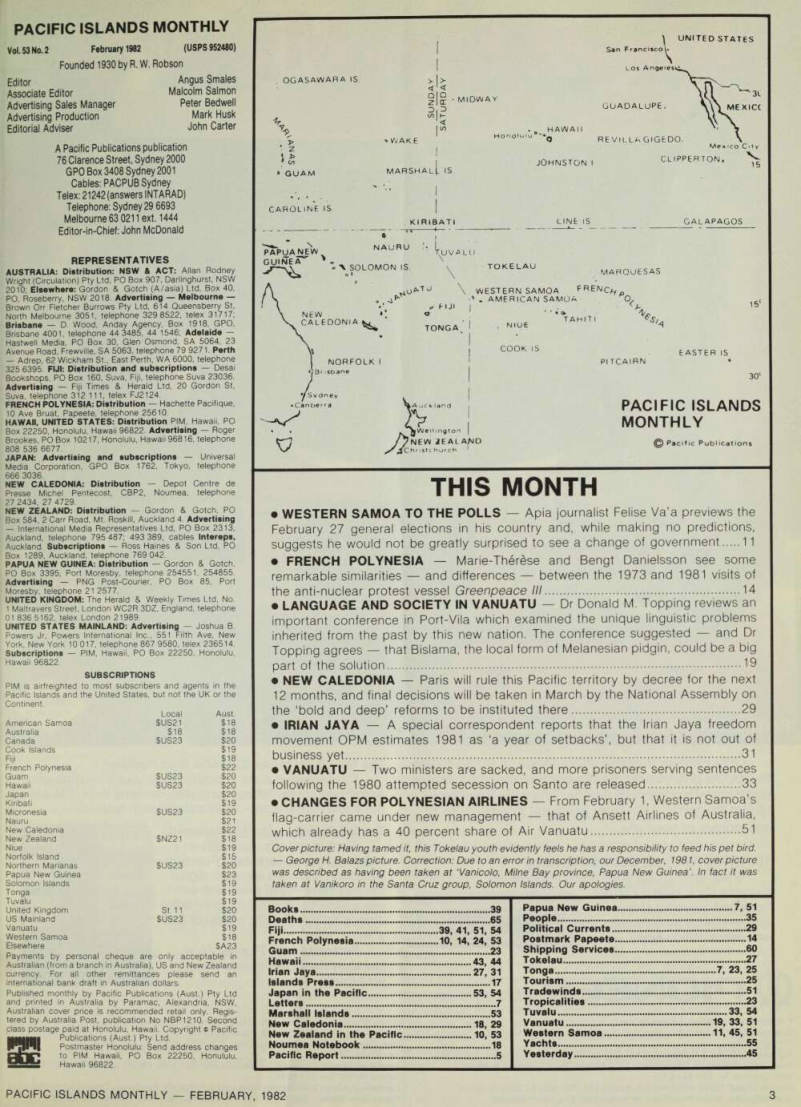
• WESTERN SAMOA TO THE POLLS Apia journalist Felise Va’a previews the February 27 general elections in his country and, while making no predictions, suggests he would not be greatly surprised to see a change of government 11 • FRENCH POLYNESIA Marie-Therdse and Bengt Danielsson see some remarkable similarities and differences between the 1973 and 1981 visits of the anti-nuclear protest vessel Greenpeace 111 14 • LANGUAGE AND SOCIETY IN VANUATU Dr Donald M Topping reviews an important conference in Port-Vila which examined the unique linguistic problems inherited from the past by this new nation. The conference suggested and Dr Topping agrees that Bislama, the local form of Melanesian pidgin, could be a big part of the solution 19 • NEW CALEDONIA Paris will rule this Pacific territory by decree for the next 12 months, and final decisions will be taken in March by the National Assembly on the ‘bold and deep’ reforms to be instituted there 29 • IRIAN JAYA A special correspondent reports that the Irian Jaya freedom movement OPM estimates 1981 as ‘a year of setbacks’, but that it is not out of business yet 31 • VANUATU Two ministers are sacked, and more prisoners serving sentences following the 1980 attempted secession on Santo are released 33 • CHANGES FOR POLYNESIAN AIRLINES From February 1, Western Samoa’s flag-carrier came under new management that of Ansett Airlines of Australia, which already has a 40 percent share of Air Vanuatu 51
Books 39 Deaths 65 Fiji 39, 41, 51, 54 French Polynesia 10, 14, 24, 53 Guam 23 Hawaii 43, 44 Irian Jaya 27, 31 Islands Press 17 Japan in the Pacific 53, 54 Letters 7 Marshall Islands 53 New Caledonia 18, 29 New Zealand in the Pacific 10, 53 Noumea Notebook 18 Pacific Report 5
Papua New Guinea 7, 51 People 35 Political Currents 29 Postmark Papeete 14 Shipping Services 60 Tokelau 27 Tonga 7, 23, 25 Tourism 25 Tradewinds 51 Tropicalities 23 Tuvalu 33, 54 Vanuatu 19, 33, 51 Western Samoa 11, 45, 51 Yachts 55 Yesterday 45
Advertisements & other items, pp. 3-4 (2 items)
Founded 1930 byR.W. Robson
Editor Angus Smales Associate Editor Malcolm Salmon Advertising Sales Manager Peter Bedwell Advertising Production Mark Husk Editorial Adviser John Carter A Pacific Publications publication 76 Clarence Street, Sydney 2000 GPO Box 3408 Sydney 2001 Cables: PACPUB Sydney Telex: 21242 (answers INTARAD) Telephone: Sydney 29 6693 Melbourne 63 0211 ext. 1444 Editor-in-Chief: John McDonald
Go Pioneer
Only Pioneer’s tremendous range of audio expertise could give you so great a combination of advanced technology and stylish design. The new Personna Music Systems...the truly personal approach to fit any corner of your life.
The RX-70 Personna Cassette Receiver Sharp styling plus solid audio engineering. Full-logic cassette deck, digital FM/AM tuner and powerful stereo amp—all very easy to use j* and easier still to enjoy.
O RX-70
GO PIONEER
The MX-80 Personna Cassette Disc Receiver Total stereo system capability is at your fingertips with Auto Function Switching. Turntable, cassette deck, FM/AM tuner and stereo amp—all in a single high-tech unit.
The S-9 Personna Shelf Components Sleek matching units with an individual outlook and Auto Function Switching. Includes separate digital synthesized FM/AM tuner with programmable timer, a full-logic cassette deck, a fully automatic turntable and a stereo amp.
Personna from Pioneer. Now, stereo systems as persona! as your music.
For further information, please contact: Australia: Pioneer Marketing Services Pty. Ltd., P.O. Box 317, Mordialloc, Victoria, 3195 Tel: 90-9011 Fiji Islands: Brijlal & Company, G.P.O. Box No. 362, Suva, Fiji Islands Tel: 22258 New Zealand: Monaco Distributors Ltd., 2 Poland Road, Glenfield, Auckland, New Zealand Tel; (09) 444-9144 Norfolk Island: Burns Philp (Norfolk Island) Ltd., P.O. Box 21, Norfolk Island, New Hebrides: Burns Philp (New Hebrides) Ltd., Vila, New Hebrides Nauru Island: Jacob Enterprises, P.O. Box No. 4, Republic of Nauru Tahiti: Tahiti Hi-Fi, P.O. Box 848, Papeete, Tahiti New Caledonia: Menard Pacifique Sari, B.P 3899, Noumea, New Caledonia Tel: 48.24.36 American Samoa: Transpac Corporation, P.O. Box 1477, Pago Pago, American Samoa 96799 Tel: 633-5224 Rarotonga: South Seas International Ltd., P.O. Box 49, Rarotonga, Cook Islands Tel: 2327 Papua New Guinea: Bali Merchants Pty. Ltd., P.O. Box 6103, Boroko Tel: 254887
Pacific Report
Png, Indonesia, In Diplomatic Spat
Relations between Papua New Guinea and its giant neighbour Indonesia were strained in January when the PNG Government failed to renew the visas of two non-diplomat members of the Indonesian embassy staff in Port Moresby. The two were Is Daryono and Koko Kamaludin. Mr Daryono had served only 18 months of his three-year assignment, while Mr Kamaludin had been in PNG for more than five years, far exceeding the normal two or three-year posting. Official explanation for the effective expulsion of the two staff members was that PNG’s protocol department is so over-stretched it cannot cope with the 36-strong Indonesian mission. But, quoting ‘very reliable sources in the Port Moresby intelligence community’, the weekly The Times of Papua New Guinea wrote on January 15: ‘Sources allege that the two officers have been engaged not only in information-gathering but in attempting to manipulate the West Irian community in PNG.
They are convinced that a few immigrants from Irian Jaya are Indonesian “plants” who were the contacts used by the two.’
Jakarta retaliated with the immediate closure of the embassy visa section, and Papua New Guinea applicants for visas to visit Indonesia are now being directed to that country's missions in Sydney and Singapore. Most are cancelling Indonesian visits because of the cost involved in securing entry visas. It is understood that Prime Minister Sir Julius Chan was not informed in advance of the decision not to renew the visas, although Foreign Affairs Minister Noel Levi was, and approved the action.
Vital Votes On New Caledonia’S Future
New Caledonia’s Territoral Assembly in January voted in support of the introduction of income tax (PIM Dec ’Bl p 22). The vote on the vexed issue split the assembly’s majority, with the ‘Giscardian’ Federation pour une Nouvelle Soci£te Caledonienne (FNSC) breaking away from its more conservative allies to vote with the I ndependence Front in support of the measure. A split also developed between two Melanesian members of the Council of Government (a type of Cabinet). Those at odds were Dick Ukeiwe, vice-president of the Council of Government, and Franck Wuhuzue, the youthful politician in charge of the Melanesian Promotion campaign. Also in January the territory saw the foundation of a new organisation in favour of independence for New Caledonia. Drawing its principal support from New Caledonians of French origin, the new body is led by Georges Chatenay, a lawyer. The dividing line between the new organisation and the Independence Front is that the former supports what it calls ‘multi-racial independence’, while the latter espouses ‘Kanak socialist independence’. In Paris on January 15 the National Assembly voted 327-148 in favour of a bill authorising the French Government to rule by decree in New Caledonia for the next 12 months (see p 29). New Caledonia’s pro-independence deputy, Roch Pidjot, said in the course of debate: ‘Because I see the bill as a sign of the government’s readiness to conduct a policy of decolonisation aimed at giving Melanesians the right to assert themselves in the economic and cultural fields, I will vote for it.’ Daniel Tardieu in Noumea.
1982 Election Rash
Papua New Guinea is one of four important Pacific Island states to have general elections scheduled for 1982: its citizens start voting on June 5. Western Samoa goes to the polls on February 27, and Kiribati on April 1, while Fiji citizens begin casting their ballots on July 10.
Australia, France In Sea Border Accord
Australia and France in January signed an agreement on maritime boundaries in the Southwest Pacific and the Southern Ocean. In the Southwest Pacific, a plotted boundary has been drawn between the Australian Islands in the Coral Sea and others such as Lord Howe and Norfolk Islands, and New Caledonia, the Chesterfield Islands, and other outlying French-controlled islands.
In the Southern Ocean, there is now a boundary between the Australian Heard and McDonald Islands and the French
Kerguelen Islands. The treaty was signed in Melbourne by Australian Minister for Foreign Affairs Tony Street and French Ambassador to Australia Pierre Carraud.
New Labour Party In Fiji
7h ree ex-members of the Fiji National Federation Party have formed a new political party, the National Labour and Farmers’
Party. The party’s first official statement said its aim was to safeguard the interests of labourers and farmers, particularly sugar-cane farmers who, since independence, have not been sufficiently protected economically by the government or the National Federation Party, according to the new political grouping. President Gurubux Singh is an assistant storeman and purchasing supervisor with the Fiji Electricity Authority. He says he hopes to get support from Labour Parties in other countries.
Last attempt to form a Labour Party was made in the 1960 s but it was abortive. Fiji now has five political parties the government Alliance Party, the National Federation Party, the Fijian Nationalist Party, and the Western United Front. The National Federation party and the Western United Front announced in January that they had reached agreement to fight the July general election as a coalition.
Nz Scientist Rebuts French N-Test Claim
Dr David Kear, director of New Zealand’s Department of Scientific and Industrial Research, has denied official French claims that statements by New Zealand scientists had ‘stressed the harmlessness’ of French nuclear testing at Moruroa Atoll. Dr Kear told a press conference in Auckland in December that the claim, made in an official French reply to representations on the tests made by the New Zealand Government, distorted the New Zealand scientists’ position. He said that while the general conclusion reached by them was that the tests would not be likely to harm New Zealand or its neighbours, no conclusions were reached on the safety of French Polynesia. ‘No one suggested things were safe as far as French Polynesia was concerned,’ he said" ‘lt is not possible to say how safe Tahiti and other inhabited islands are because the French will not let foreign scientists visit Moruroa.’
Not-So-Placid Futuna
A special squad of 40 police was sent in January to the French ruled island of Futuna to quell continuing civil disturbance. Long standing political differences between King Nasalio Keletelona, 50, and his Prime Minister Soane Failo, 50, crystallised in a charge by the latter that the king had acted extravagantly in the lavish welcome he offered to French Secretary of State for Overseas Departments and Territories Henri Emmanuelli when he visited the island on August 13, 1981. A long-running dispute on the issue between the two men and their supporters flared into violence in the Nuku church on New Year’s Eve. The fight between the two sides reduced the church to a shambles. The priest, Father Patrice, and a few helpers, managed with great difficulty to eject the combatants and shut the door. The two constables on the island were unable to cope with the situation.
Png Police Chief Resigns
The Papua New Guinea Police Commissioner, Phillip Bouraga, announced his resignation in mid-January following a protracted confrontation with Minister for Police Warren Dutton. Late last year Mr Bouraga was suspended from duty and in January he appeared before a Public Service Commission tribunal to answer four charges brought against him by Mr Dutton. The decision of the tribunal was still being awaited when Mr Bouraga announced his intention to resign, effective from February 17. In resigning as commissioner Mr Bouraga also resigned his position as Secretary for Police, the public service departmental position responsible for police matters to the minister and cabinet. The decision of the tribunal which heard charges against him is not expected to be given until late in February. The charges were that he had disobeyed lawful directions by refusing to brief Mr Dutton on four matters the tribal fighting situation, the murder of a policeman in Port Moresby, the state of police discipline and allegations that insufficient funds were available for operational duties. Mr Bouraga is one of PNG’s most senior and experienced public administrators and held a number of top government posts before his appointment as police commissioner.
Tongan Cops Cleared Of Murder Charge
Following an eight-day jury trial in Nukualofa in December, two Tongan policemen were acquitted of the murder, and five of abetting the murder, of an arrested suspect on the night of September 2. The man, according to the post-mortem evidence, died of massive multiple injuries and extensive internal haemor
rhages, consistent with his having been punched, kicked and stamped upon while his back was pressed against an unyielding surface. The prosecution proved that the injuries occurred while the deceased was lying double-handcuffed in the back of a Police Mobile Unit van, and while in the custody of the seven accused. (A more detailed report will appear in PIM, March) Penny Hodgkinson in Nukualofa.
N-Tests, Dumping: Boycott Planned
The Pacific Trade Union Forum, formed at a meeting in Port-Vila in June of trade unionists from 13 South Pacific countries, plans a campaign against nuclear testing and dumping of nuclear waste. The Fiji Trades Union Congress, a founder member of the forum, has meanwhile announced it is joining the New Zealand Federation of Labour and other South Pacific unions in a selective boycott of French and Japanese goods as a protest against testing and dumping.
Hijack Drama 1
The saga of the hijacked 1000-tonne Australian freighter Glenelg drew to a close in mid-January when it ran aground and was badly holed on Pott Island in New Caledonia’s Belep group, northwest of the main island. Glenelg was first hijacked from Cairns, north Queensland, in 1979, when the man to whom she had been leased sailed out of harbour owing charter fees. She was confiscated on the owner’s behalf at Santo, Vanuatu, in early 1980, and then brought down to Port-Vila for safe-keeping. It was held there until December, 1981, when two men an Australian and a New Zealander used force against guards to hijack the $250 000 vessel once again. Vanuatu Mobile Force personnel in the vessel Mala gave chase, firing machine-gun and teargas rounds across the Glenelg’s bridge" to prevent her escape. But their efforts failed. After running aground on Pott Island, the hijackers spent three weeks trying to repair and refloat the ship, but eventually sent a radio call for help which was picked up at an emergency listening post at Townsville, Queensland. A French naval vessel went to the island, and a helicopter took the two to hospital in Noumea. When they are well enough to travel, the Vanuatu Government has requested their extradition to Port-Vila to face hijacking charges.
Hijack Drama 2
A 46-year-old Frenchman from New Caledonia, said to have a history of mental illness, attempted to hijack the Pacific cruise vessel Minghua on December 15 and force it to change course to Noumea. The ship at the time was heading for Suva. After being overpowered and thrown into the brig, the man unsuccessfully tried to set fire to the ship, but managed to wreck his cell. He was arrested when the ship arrived in Suva, and deported to Noumea. The incident had a sequel in Australia when it was revealed that the two men who over-powered the would be hijacker when he was on the bridge threatening ship’s officers with a knife were off-duty policemen from the Australian State of New South Wales. A spokesman for the NSW police said the officers were ‘on a trip given in return for services rendered’. A company spokesman said a number of shipping companies were in the habit of using off-duty policemen as security guards. He would not give details of the concessional fares offered to police.
A FIRST FOR MOPIO, MR: THE SACK James Mopio, member of Papua New Guinea’s national parliament for Central Province, has been dismissed from office for misconduct in office. The dismissal followed a leadership tribunal hearing in which Mr Mopio was convicted of 15 charges and acquitted of one. The offences included refusal to pay legitimate debts, acceptance of gifts of money from private companies, tax evasion, and involvement in a black market beer operation in his home province. Judge Greville Smith, who headed the inquiry, said in his finding: ‘Mopio is in our view a person who is unfit to hold office. We find that public policy and public good require his dismissal.’ Mr Mopio is the first PNG MP to suffer this fate.
Airlines To Fly In Triangles
Australia’s national flag-carrier Qantas joined in January with the Pago-based South Pacific Island Airways (SPIA) to offer a new Pacific Triangle fare. At the same time, Continental Airlines and Thai International set up a new Pacific Circle to compete with circle fares already offered by combinations of four other airlines.
The new Pacific Triangle will enable passengers to fly to both Hawaii and Tahiti from Sydney for less than if they detoured through Los Angeles, Nadi or Auckland to visit both. Final details of fares were unavailable at press time, pending filing with the
Australian Department of Transport. SPIA will operate the connection between Honolulu and Papeete with the Boeing 707 it has on lease from American Airlines. The new Pacific Circle drawn by Thai and Continental traces the widest arc of all, from Bangkok to New York. It is also the most expensive, with a ticket quoted on January 20 at SUSI9SO
Port-Vila Loses Its Voice
Voice of Vanuatu, an English-language weekly published in Port- Vila since November, 1979, ceased publication ‘for an indefinite period’ with its Christmas ’Bl-New Year ’B2 number. The paper was virtually a one-woman operation conducted by Australian expatriate Christine Coombe. Ms Coombe explained that the closure was voluntary, and for personal reasons. The government weekly, Tam-Tam, accompanied its account of the closure with a warm tribute to Ms Coombe’s work, describing her as ‘editor publisher, reporter, typist’.
Png Provincial Heads Rap Star Kist
Five premiers of the Papua New Guinea provinces of Manus, East New Britain, North Solomons, West New Britain and New Ireland have given the American fishing company Star Kist three months to withdraw all its operations from the region. Their decision was made at a meeting held to review progress of the K2O million fish cannery at Kavieng, New Ireland. PNG has protested on several occasions at the slow rate of progress of the cannery plans. The latest upset was a complaint from a government consultant team that the site at Bagal plantation for the cannery was unsuitable.
The premiers opposed the granting of a three-month extension of negotiations between the government and Star Kist
A Month’S Uncomfortable Wait Then Gaol
Shipwrecked Canadian sailor John Harrison waited nearly a month in December-January to be rescued from Palmyra Island in mid-Pacific. But as soon as he returned to Honolulu and civilisation he was sent to gaol. Harrison was arrested at Honolulu airport on January 6 after he and his two daughters, Micki, 20, and Kristen, 13, had flown the 1770 kilometres from Palmyra. He was charged with taking property that belonged to a crew member when he sailed for Australia on his 12.5-metre trimaran, Sisyphus. Harrison and his daughters apparently left Maui in a hurry on November 10 as he was being confronted by collection agents for the Bank of British Columbia, which holds the mortgage on the craft, Hawaii officials said. The Sisyphus came apart in a storm on December 10, stranding the Harrisons on Palmyra.
Making Friends At Amazon Bay ...
Talair, the big third-level airline in Papua New Guinea, suspended flights into Amazon Bay southeast of Port Moresby for several days in mid-January after a man there attacked one of the company’s pilots. Pilot Peter Wilkinson was supervising the loading of an Islander aircraft at Amazon Bay when he became involved in an argument with four men over fare payments for the flight to Port Moresby. One of the men swung a punch at him and the group chased him to a nearby building where stones and pieces of wood were used to smash windows and a door. Police ended the disturbance and took one of the men into custody.
Population Fall In Cooks
The Cook Islands population has fallen by 2.4 percent since 1976, according to provisional 1981 census figures. The 1981 figures show a population of 17 695. The 1976 census recorded a population of 18 128. Northern group islands such as Penrhyn, Manihiki, Pukapuka and Nassau, however, showed a population increase since 1976.
Hail To The Veteran Dixie
The USS Dixie, oldest ship on continuous active duty in the US navy, is on a visit to the South Pacific. The 16 000-ton destroyer tender, commissioned in 1940, repaired and tendered ships taking part in the battles of the Coral Sea and Midway, following the attack on Pearl Harbor. Leaving Pearl Harbor in November 1942, she based her operations in Noumea, and later in Santo, Vanuatu. Commanded by Captain R. L. Coffey, USN, and carrying 870 enlisted crew and 32 officers, Dixie visited Sydney on January 14-18. Her first visit to Australia’s biggest port city was in September, 1943, and her second in May 1980, to mark her 40th birthday.
Guam In Escap
Guam is reported to have been admitted to the United Nations Economic and Social Commission for Asia and the Pacific (ESCAP), the first US Pacific territory to be admitted to a major functional body of the United Nations. As an associate member of ESCAP, Guam could receive UN technical assistance.
straight


Letters
Sir Julius
sets a record
straight
I was surprised to read Second Officer Kevin B. Judkin’s criti cism of my defence of the Pacific Forum Line (PIM Dec ’81 p9), and his assertion that my statement that the Papua New Guinea Government ‘saw the project as one supporting the islands that did not get shipping services to their part of the world’ was a political faux pas.
I question his competence to speak authoritatively on this subject.
It is a matter of personal pride to me that before entering politics 1 managed a modest coastal shipping business for
several years, and achieved some small success. 1 was interested, therefore, in pursuing the matter, and took the time and trouble to locate a copy of the September issue of PIM from which Second Officer Judkins had quoted. I was left with the impression that his remarks were intended as no more than a red herring. Cer tainly, his comments had little relation to what I was quoted as saying in the September PIM (p 74).
The PIM article stated right at the beginning that as finance
minister 1 had been opposed to the establishment of the Pacific Forum Line. I have, in addition, expressed on many occasions very strong reservations about
government-owned corpor
ations, which are rarely success ful because bureaucrats are not businessmen.
In the same issue of PIM I was also quoted as saying: relationships are not built on talks and politics alone. They need to have some visible sign of achievement, of together ness, and this (the Pacific Fo rum Line) is one of them.’
That was the essence of my remarks, and that was the message that seems to have escaped Second Officer Judkins.
(Sir) Julius Chan
Prime Minister of Papua New Guinea Port Moresby Papua New Guinea The handicrafts
of Tonga
I have just received a copy of Tongan Handicrafts , published in 1980 for the Australian Development Assistance Bu
reau by the Australian Govern ment Publishing Service.
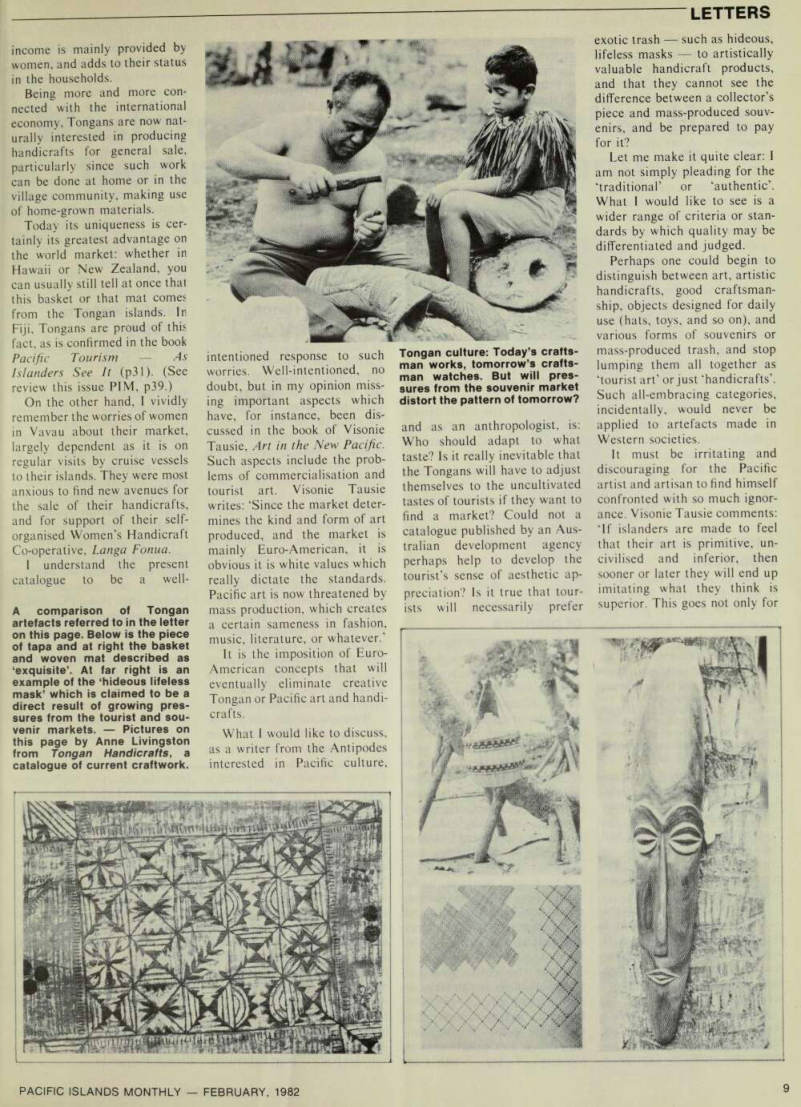
I have long been waiting for such a catalogue. When I finally had it in my hands, I was both excited and disappointed. Ex cited, because 1 recognised some of the most beautifully made handicrafts of the Pacific - mats, tapa, baskets. Disap pointed, because of the growing number of standardised curios or trash pretending to be tra ditional, and placed indiscrimi nately side by side with objects of exquisite craftsmanship. If those who have a copy of the book would just compare the finely woven mat (44), basket (31), or piece of tapa (60), with the lifeless mask (73), which has no relation whatsoever lo Tongan tradition, I think they will see my point.
My criticism, however, is not directed in the first place at the producers. I fully realise that for them handicrafts mean in come, important cash for school fees, and goods like tinned meat and clothing, and I am far from blaming the makers for their efforts to earn money for their families’ needs. Moreover, such
Sir Julius: Ship operator, prime minister - and letter-writer.
income is mainly provided by women, and adds to their status in the households.
Being more and more con nected with the international economy, Tongans are now nat urally interested in producing handicrafts for general sale, particularly since such work can be done at home or in the village community, making use of home-grown materials.
Today its uniqueness is cer tainly its greatest advantage on the world market; whether in Hawaii or New Zealand, you can usually still tell at once that this basket or that mat comes from the Tongan islands. In Fiji, Tongans are proud of this fact, as is confirmed in the book Pacific Tourism As Islanders See It (p3l). (See review this issue PIM, p 39.) On the other hand, I vividly remember the worries of women in Vavau about their market, largely dependent as it is on regular visits by cruise vessels to their islands. They were most anxious to find new avenues for the sale of their handicrafts, and for support of their self organised Women’s Handicraft Co-operative, Langa Fonua.
I understand the present catalogue to be a well-
intentioned response to such worries. Well-intentioned, no doubt, but in my opinion miss ing important aspects which have, for instance, been dis cussed in the book of Visonie Tausie, Art in the New Pacific.
Such aspects include the prob lems of commercialisation and tourist art. Visonie Tausie writes: ‘Since the market deter mines the kind and form of art produced, and the market is mainly Euro-American, it is obvious it is white values which really dictate the standards.
Pacific art is now threatened by mass production, which creates a certain sameness in fashion, music, literature, or whatever.’
It is the imposition of Euro- American concepts that will eventually eliminate creative Tongan or Pacific art and handi crafts.
What I would like to discuss, as a writer from the Antipodes interested in Pacific culture.
and as an anthropologist, is: Who should adapt to what taste? Is it really inevitable that the Tongans will have to adjust themselves to the uncultivated tastes of tourists if they want to find a market? Could not a catalogue published by an Aus tralian development agency perhaps help to develop the tourist’s sense of aesthetic ap preciation? Is it true that tour ists will necessarily prefer
exotic trash such as hideous, lifeless masks to artistically valuable handicraft products, and that they cannot see the difference between a collector’s piece and mass-produced souv enirs, and be prepared to pay for it?
Let me make it quite clear; 1 am not simply pleading for the ‘traditional’ or ‘authentic’.
What 1 would like to see is a wider range of criteria or stan dards by which quality may be differentiated and judged.
Perhaps one could begin to distinguish between art, artistic handicrafts, good craftsman ship, objects designed for daily use (hats, toys, and so on), and various forms of souvenirs or mass-produced trash, and stop lumping them all together as ‘tourist art’ or just ‘handicrafts’.
Such all-embracing categories, incidentally, would never be applied to artefacts made in Western societies.
It must be irritating and discouraging for the Pacific artist and artisan to find himself confronted with so much ignor ance. Visonie Tausie comments: ‘lf islanders are made to feel that their art is primitive, un civilised and inferior, then sooner or later they will end up imitating what they think is superior. This goes not only for
A comparison of Tongan artefacts referred to in the letter on this page. Below is the piece of tapa and at right the basket and woven mat described as ‘exquisite’. At far right is an example of the ‘hideous lifeless mask’ which is claimed to be a direct result of growing pres sures from the tourist and sou venir markets. - Pictures on this page by Anne Livingston from Tongan Handicrafts, a catalogue of current craftwork.
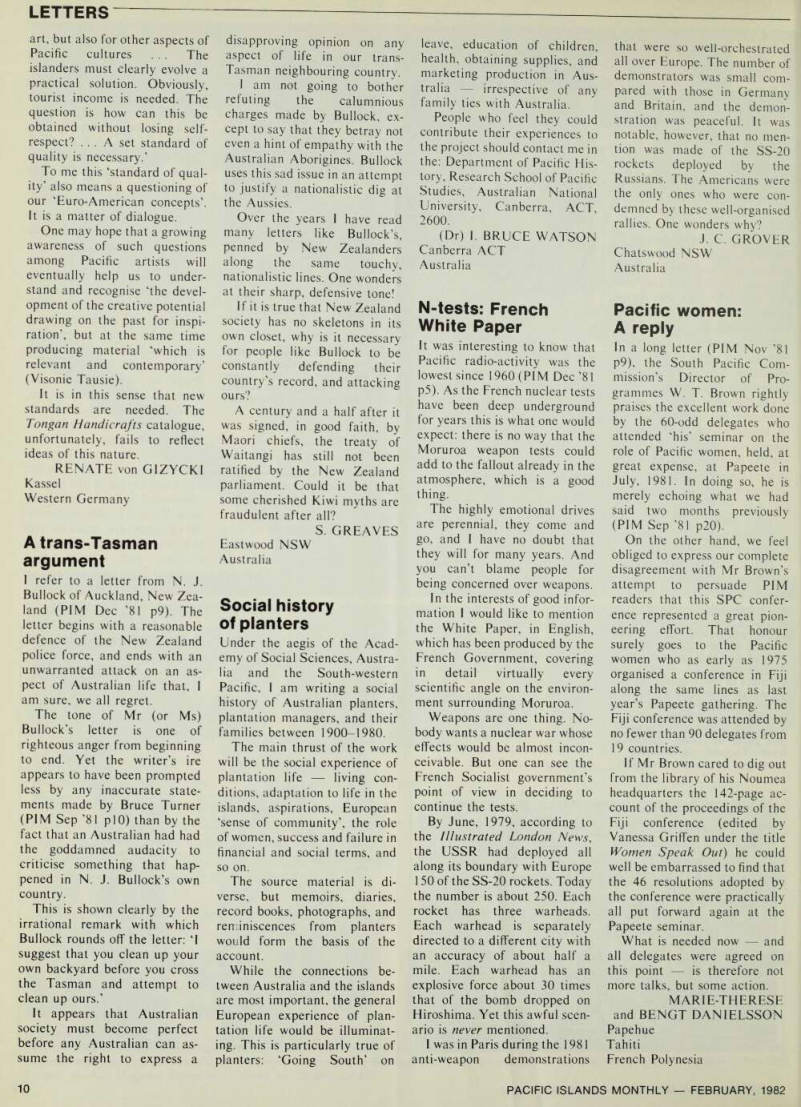
Tongan culture: Today’s crafts man works, tomorrow’s crafts man watches. But will pres sures from the souvenir market distort the pattern of tomorrow?
art, but also for other aspects of Pacific cultures .. . The islanders must clearly evolve a practical solution. Obviously, tourist income is needed. The question is how can this be obtained without losing self respect? ... A set standard of quality is necessary.’
To me this ‘standard of qual ity’ also means a questioning of our ‘Euro-American concepts’.
It is a matter of dialogue.
One may hope that a growing awareness of such questions among Pacific artists will eventually help us to under stand and recognise ‘the devel opment of the creative potential drawing on the past for inspi ration’, but at the same time producing material ‘which is relevant and contemporary’ (Visonie Tausie).
It is in this sense that new standards are needed. The Tongan Handicrafts catalogue, unfortunately, fails to reflect ideas of this nature.
Renate Von Gizycki
Kassel Western Germany
A trans-Tasman
argument
I refer to a letter from N. J.
Bullock of Auckland, New Zea land (PIM Dec ’Bl p 9). The letter begins with a reasonable defence of the New Zealand police force, and ends with an unwarranted attack on an as pect of Australian life that, I am sure, we all regret.
The tone of Mr (or Ms) Bullock’s letter is one of righteous anger from beginning to end. Yet the writer’s ire appears to have been prompted less by any inaccurate state ments made by Bruce Turner (PIM Sep ’Bl plO) than by the fact that an Australian had had the goddamned audacity to criticise something that hap pened in N. J. Bullock’s own country.
This is shown clearly by the irrational remark with which Bullock rounds off the letter; T suggest that you clean up your own backyard before you cross the Tasman and attempt to clean up ours.’
It appears that Australian society must become perfect before any Australian can as sume the right to express a
disapproving opinion on any aspect of life in our trans- Tasman neighbouring country.
I am not going to bother refuting the calumnious charges made by Bullock, ex cept to say that they betray not even a hint of empathy with the Australian Aborigines. Bullock uses this sad issue in an attempt to justify a nationalistic dig at the Aussies.
Over the years I have read many letters like Bullock’s, penned by New Zealanders along the same touchy, nationalistic lines. One wonders at their sharp, defensive tone!
If it is true that New Zealand society has no skeletons in its own closet, why is it necessary for people like Bullock to be constantly defending their country’s record, and attacking ours?
A century and a half after it was signed, in good faith, by Maori chiefs, the treaty of Waitangi has still not been ratified by the New Zealand parliament. Could it be that some cherished Kiwi myths are fraudulent after all?
S. Greaves
Eastwood NSW Australia
Social history
of planters
Under the aegis of the Acad emy of Social Sciences, Austra lia and the South-western Pacific, I am writing a social history of Australian planters, plantation managers, and their families between 1900-1980.
The main thrust of the work will be the social experience of plantation life living con ditions, adaptation to life in the islands, aspirations, European ‘sense of community’, the role of women, success and failure in financial and social terms, and so on.
The source material is di verse, but memoirs, diaries, record books, photographs, and reminiscences from planters would form the basis of the account.
While the connections be tween Australia and the islands are most important, the general European experience of plan tation life would be illuminat ing. This is particularly true of planters: ‘Going South’ on
leave, education of children, health, obtaining supplies, and marketing production in Aus tralia irrespective of any family ties with Australia.
People who feel they could contribute their experiences to the project should contact me in the: Department of Pacific His tory, Research School of Pacific Studies, Australian National University, Canberra, ACT, 2600.
(Dr) I. Bruce Watson
Canberra ACT Australia
N-tests: French
White Paper
It was interesting to know that Pacific radio-activity was the lowest since 1960 (PIM Dec ’Bl p 5). As the French nuclear tests have been deep underground for years this is what one would expect: there is no way that the Moruroa weapon tests could add to the fallout already in the atmosphere, which is a good thing.
The highly emotional drives are perennial, they come and go, and I have no doubt that they will for many years. And you can’t blame people for being concerned over weapons.
In the interests of good infor mation I would like to mention the White Paper, in English, which has been produced by the French Government, covering in detail virtually every scientific angle on the environ ment surrounding Moruroa.
Weapons are one thing. No body wants a nuclear war whose effects would be almost incon ceivable. But one can see the French Socialist government’s point of view in deciding to continue the tests.
By June, 1979, according to the Illustrated London News, the USSR had deployed all along its boundary with Europe 150 of the SS-20 rockets. Today the number is about 250. Each rocket has three warheads.
Each warhead is separately directed to a different city with an accuracy of about half a mile. Each warhead has an explosive force about 30 times that of the bomb dropped on Hiroshima. Yet this awful scen ario is never mentioned. 1 was in Paris during the 1981 anti-weapon demonstrations
that were so well-orchestrated all over Europe. The number of demonstrators was small com pared with those in Germany and Britain, and the demon stration was peaceful. It was notable, however, that no men tion was made of the SS-20 rockets deployed by the Russians. The Americans were the only ones who were con demned by these well-organised rallies. One wonders why?
J. C. Grover
Chatswood NSW Australia
Pacific women:
A reply
In a long letter (PIM Nov ’Bl p 9), the South Pacific Com mission’s Director of Pro grammes W. T. Brown rightly praises the excellent work done by the 60-odd delegates who attended ‘his’ seminar on the role of Pacific women, held, at great expense, at Papeete in July, 1981. In doing so, he is merely echoing what we had said two months previously (PIM Sep ’Bl p2O).
On the other hand, we feel obliged to express our complete disagreement with Mr Brown’s attempt to persuade PIM readers that this SPC confer ence represented a great pion eering effort. That honour surely goes to the Pacific women who as early as 1975 organised a conference in Fiji along the same lines as last year’s Papeete gathering. The Fiji conference was attended by no fewer than 90 delegates from 19 countries.
If Mr Brown cared to dig out from the library of his Noumea headquarters the 142-page ac count of the proceedings of the Fiji conference (edited by Vanessa Griffen under the title Women Speak Out ) he could well be embarrassed to find that the 46 resolutions adopted by the conference were practically all put forward again at the Papeete seminar.
What is needed now and all delegates were agreed on this point is therefore not more talks, but some action.
Marie-Therese
And Bengt Danielsson
Papehue Tahiti French Polynesia
Advertisements & other items, pp. 7-8 (1 item)
Dezurbk
A complete valve range in a multitude of material and specification options in sizes V 2” - 72” with manual, pneumatic, hydraulic or electric actuators. Proven worldwide in municipal, industrial and process applications.
Electric Control Valves V-port Ball Valves J Resilient Seated Butterfly Valves High Pressure Butterfly Valves
DeZURBK
DeZURIK OF AUSTRALIA PTY. LTD., P.O. Box 204, Vineyard Road, Sunbury, Victoria 3429, Australia. Telephone; 03-744-2244, Telex; AA33732. : Paper Stock Consistency Transmitters A Eccentric Plug Valves Knife Gate Valves T n
A LIMIT OF GEMERAJ- SIGNAL
DZ - AUS, 020 - A
3.5-ton Pneumatic/Cushion/Turbo-charger 4.0-ton Pneumatic/Cushion/Turbo-charger 4.0-ton Heavy Duty Pneumatic/Cushion/Turbo-charger The difference will amaze you. These monocoque body heavyweights are tough on big jobs, maneuverable enough for small aisles and easy on operators.
New Datsun Forklift FO3 Series models excel in any role. Even many reserved for smaller lift capacity forklifts.
Smart 3/3.5/3.5-ton heavy-duty cushion tire and 3.5/4/4-ton heavy-duty pneumatic tire models
DATSUN
provide optimum tight-space handling. Rugged, fuelefficient gasoline engines or a turbo-charged diesel engine assure high torque, gradeability and speed.
Total toughness reduces downtime. Maintenance is minimal. Single-lever tilt/lift control, power steering and wide-angle visibility keep operator fatigue low.
Built to give owners and operators more in return.
The versatile Datsun Forklift FO3 Series.
FORKLIFT
NISSAN MOTOR CO., LTD. 17-1, Ginza 6-Chome, Chuo-ku, Tokyo 104, Japan Loadlift Equipment Limited 2Maurice Road, Penrose, Auckland 6, New Zealand Tel: 663-714 Auckland Nissan Motor Co., (Australia) Pty. Ltd.
Industrial Machinery Division Suite 1, 6th Floor, 100 William Street, Sydney, N.S.W. 2000, Australia Tel: 358-5444 Boroko Motors Ltd. P O Rnx 1259, Boroko, Via Port Moresby, Papua New Guinea Tel; 255255, 255347
Western Samoa to the polls: Has

the time come for a change?
Leading Apia journalist REUSE VA’A previews the general elections to be held in Western Samoa on February 27 If there is to be a change of government, he says, the man most likely to be his country’s next prime minister is Vaai Kolone, leader of the Human Rights Protection Party, now in opposition.
Western Samoa’s general elec tions on Saturday, February 27, are almost certain to result in a 50 to 60 percent turn-over of sitting members at least that has generally been the case with such elections in the past. Past experience also shows that no body is safe from this tendency to violent shake-outs in the membership of the Fono, or Legislative Assembly, at elec tion times: candidates of all political beliefs are liable to suffer nasty shocks.
However, there is a unique feature about the 1982 election that could possibly be significant enough to upset this long-standing tradition. This is the fact that for the first time in the history of this country a strong political party, the Hu man Rights Protection Party (HRPP), is taking the field against the government and, indeed, all comers. The electors may just decide to sweep the HRPP to power, in reaction against the two-term govern ment of Tupuola Efi. Certainly, all sitting HRPP members (they represent about half the 47-strong membership of the assembly), are confident they will be returned. Their opti mism stems in part from their
For the first time in what has been a no party system, a strong party is now challenging the established government.
party’s success against govern ment candidates in 1981 and earlier by-elections.
Tupuola’s supporters, inside and outside parliament, do not constitute a formal political parly. In effect, however, they are a party, since they have political organisation, and the common goal of holding on to power. They also have a central fund for political campaigning, and other party-type expendi
tures. The organisation is cer tainly there a fact which becomes most obvious around campaign time, from November to election day.
The newly formed Labour Party (Tautua mo Samoa in Samoan) represents a third force in the field for the 1982 poll. According to its leader, the sitting MP Mapuilesua Pelenato, this party stands for free enterprise, and for the development of an industrial base to supplement agriculture.
Mapuilesua accuses both the government and the HRPP of hypocrisy. They say one thing in debate and then vote against it later,' he says, referring to the practice of certain members who vole against their individ ual beliefs in order to support a parly position.
Apart from the fact that he is an able parliamentary orator, little is known about Mapuilesua’s capabilities. He obviously aspires to be prime minister, but he labours under the handicap that he is not well known on a nation-wide scale.
These then are the three political parlies or, rather, two parties, and one ‘party’ that will contest the elections. It is unlikely that any more will
appear between lime of writing and election day.
Of course, there will be independents. But most of these are already secretly committed to one or other of the three major groupings. The fact is that it is extremely difficult for candidates to remain unat tached to a party: the need for campaign funds literally forces them into the arms of one or the other of them. So, not in-
frequently, it is financial need rather than ideological convic tion that drives candidates to join a political organisation. At this stage of development, it may be seriously doubted whether many of the chiefs (< matai) understand, or can dis tinguish between, political ideologies such as conservatism, liberalism, socialism, commu nism, and so on.
It may be safely assumed that the Labour Party will offer no serious threat to the two main parties. For one thing, Mapuilesua Pelenato is re ported to have only a shaky hold on his own constituency. His chief rival for the seat will be veteran politician Tagaloa Leota Pita whom he unseated in 1979. Tagaloa must be counted as a strong candidate.
So the real fight will be between the government and the HRPP and the power
brokers will be the indepen dents.
Looking at the government’s record since the last elections in February 1979, no one could accuse it of not trying. It has continued to do everything ex pected of it in maintaining and extending government oper ations, most notably in econ omic development. In foreign relations, Tupuola has followed an innovative course, and with overall success.
The recent budget figures provide some evidence of pro gress, and generally reflect good economic management. Any careful study of the economic record (including foreign aid.
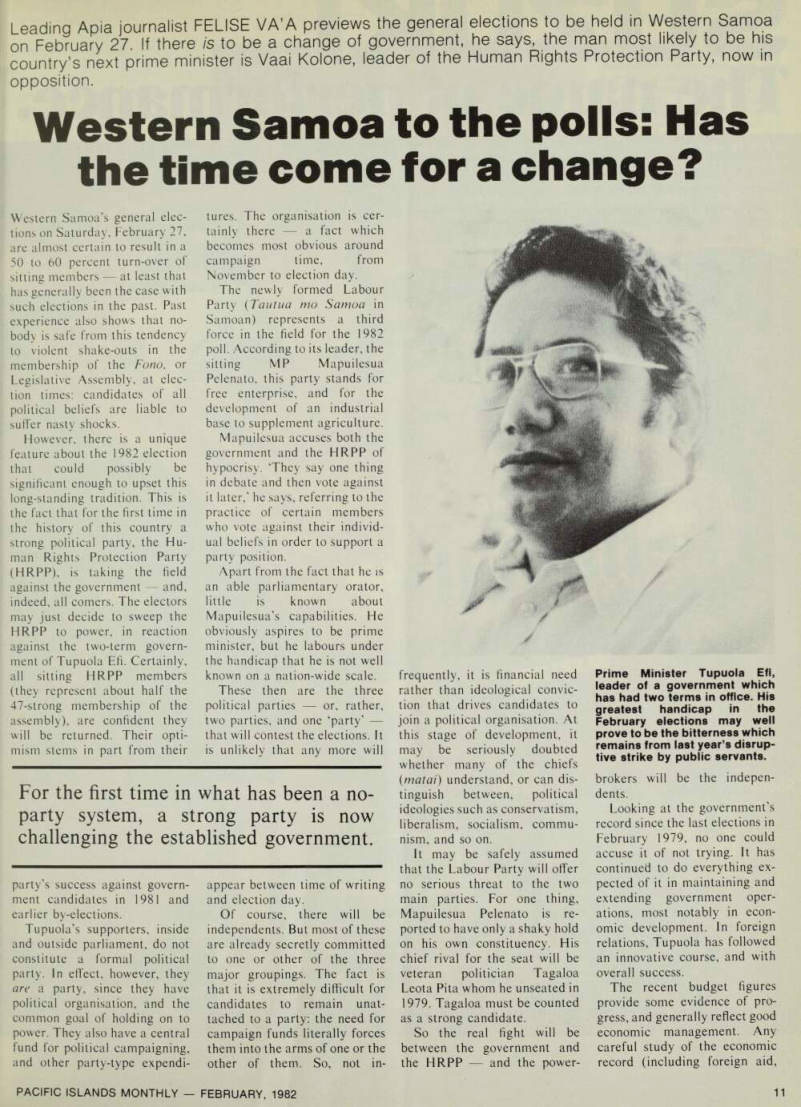
Prime Minister Tupuola Efi, leader of a government which has had two terms in office. His greatest handicap in the February elections may well prove to be the bitterness which remains from last year’s disrup tive strike by public servants.
which jumped from SWS6 200 000 in 1979 to $l2 050 000 in 1981, a 94 percent increase) shows a gener ally good performance.
The main dark spot appears in the export-import figures.
Exports in 1979 reached an all time high of $l5 340 000. This performance was maintained in 1980, with a figure of about $l5 250 000. But exports nosedived in the first nine months of 1981 to about $7.7 million. Final figures for the year are unlikely to exceed $lO million, a massive fall from the $l5 million of the preceding two years.
Government is blamed for this fall. One MP has claimed that the government’s inability to settle the public servants’ strike of April-July 1981 had meant that people were discour aged from producing key export products such as copra and cocoa. There is surely much substance to this claim.
The export figures must be seen against the background of the figures for imports. These were worth approximately $6l million in 1979, $57.5 million in 1980, and $44.9 million for the first nine months of 1981. Indi cations are that the figure for the full year will again exceed $6O million.
The cost of living remains high. While no Sampan is starving, the locals generally are finding the cost of many
items beyond their means. To buy them, they depend on remittances from overseas.
There was a 24 percent increase in the Consumer Price Index in 1979, and a 29 percent increase in 1980. Figures for 1981 show a 21 percent rise over the first nine months, with clear indi cations of further increases in the final quarter.
International reserves fell from a high point of $5 161 000 in December 1979 to $3 088 000 in September 1981. ‘This figure is dangerously low and makes us extremely vulner able to any one of a number of contingencies,’ Finance Minis ter Vaovasa Filipo observed in his budget speech. In this con nection, government introduced a bill, later passed, enabling it to borrow for the purpose of meeting any balance of pay ments problems.
All things considered, Tupuola’s government is un popular.
The biggest single reason is the bitterness left over from the public servants’ strike. The strike arose over a claim for a salary increase, and other griev ances. But the government handled it badly from beginning to end.
The cost of the strike to the country was enormous. While estimates vary greatly, the min ister of finance puts the figure at about $3 million. But in fact it is much more, given the $5 million decline in the value of exports almost certainly a side-effect of the strike and the many millions lost in remit tances from Samoans abroad.
The other major reason for the government’s unpopularity is the series of scandals in government, first in the Health Department the uncovering
of a conspiracy to defraud government and, more re cently, the case involving for mer Minister of Justice Asi Eikeni.
The Chief Justice found that the former minister was not telling the truth in court, and that he had conspired to deceive Customs concerning goods he had brought into the country, and the duty to be paid on them.
While the minister is unlikely to face perjury charges a legal istic point the scandal has seriously undermined his pos ition as a politician and an individual. Asi, for his part, has denied that he did any wrong.
Perhaps a further reason for the unpopularity of the govern ment is the simple fact that it has been in power for so long.
Power breeds indifference and arrogance. It also breeds care lessness.
It was arrogance that pre vented the government from recognising that the public ser vants fully intended to go ahead with their strike. It was arro gance that led them to treat with disdain the public ser vants’ petition for a salary increase. It was arrogance again that led them to refer to the public servants as ‘good-for nothings who in any case are not earning their pay, or are steal ing government property’.
Then, the Public Accounts Committee and the Auditor began spilling the beans and for much of 1981 the public in Western Samoa had a heavy diet of scandals reported in the press, all involving government figures.
After all this, the Samoans reason, perhaps it is time for a change.
Time will tell.
If there is to be a change of government and a change is almost universally predicted by the usual crop of pre-election prophets in Apia Vaai Kolone, leader of the HRPP, is the man most likely to be this country’s next prime minister.
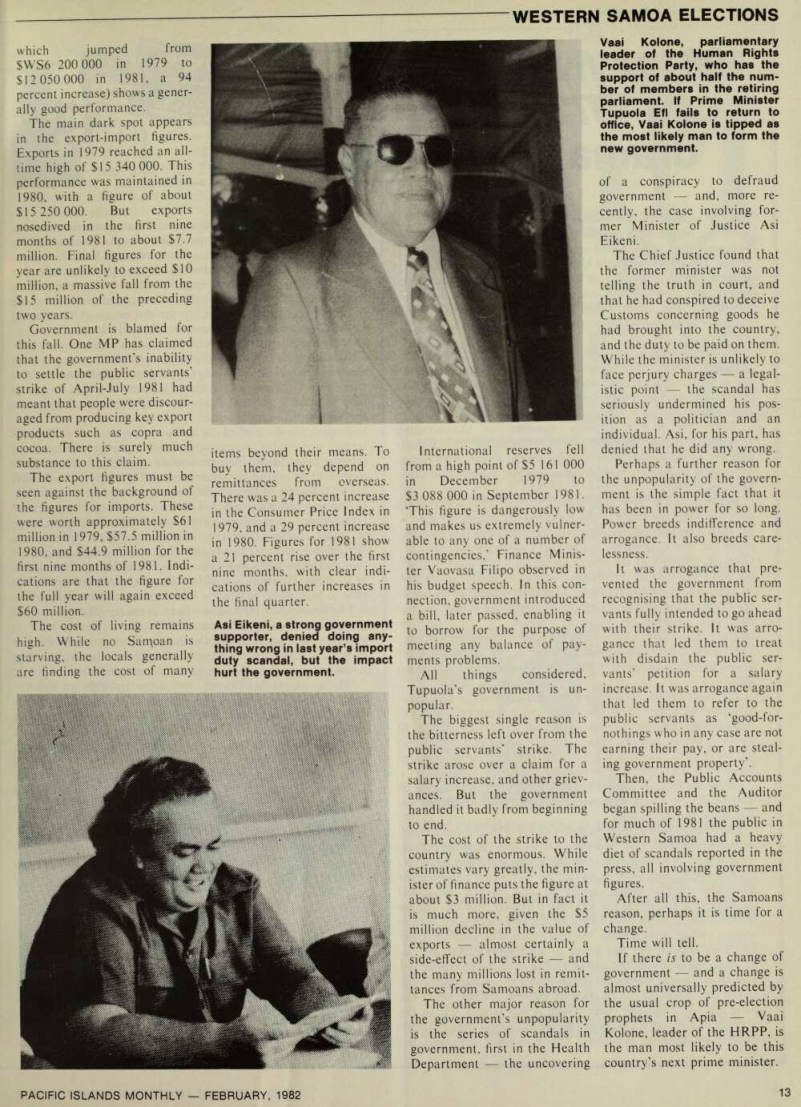
Asi Eikeni, a strong government supporter, denied doing any thing wrong in last year’s import duty scandal, but the impact hurt the government.
Vaai Kolone, parliamentary leader of the Human Rights Protection Party, who has the support of about half the num ber of members in the retiring parliament. If Prime Minister Tupuola Efi fails to return to office, Vaai Kolone is tipped as the most likely man to form the new government.
Advertisements & other items, p. 12 (1 item)
The name of performance.
SUZUKI Vehicles are shipped to approximately 100 countries throughout the world and are well received by users in those countries. Behind the high-quality of SUZUKI 4-wheelers is the in-depth research carried out from all aspects, rigorous tests and an extensive after-sales service J — net-work. Vehicles that are ready when you need them and which you can trust when driving SUZUKI Vehicles. mm ' ✓ r. r-/. d X K t
SJ4IO
SSBOF
ST9O
ST9OVT
r I ' -■ V.
M t C;' ■7
s^ZUKI
SUZUKI MOTOR CO, LTD
300Takatsuka. I lamamatsu. Japan SOLOMON ISLANDS SOLOMON ISLAND SERVICE STATION LTD. NEW CALEDONIA STE, SUPERCAL PAPUA NEW GUINEA PACIFIC MOTORS VANUATU HENRI LEROUX NIUE ISLAND BURNS PHILP (SOUTH SEA) CO, LTD. PONAPE LEO ETSCHEIT TAHITI NIPPON AUTOMOTO ELLICE ISLAND TUVALU COOPERATIVE WHOLESALES SOCIETY LTD, GUAM & SAIPAN ISLAND CYCLERY, INC. NORFOLK MARTIN’S AGENCIES LTD. SAMOA PACIFIC PRODUCTS, INC, KIRIBATI GILBERT ISLANDS
drama
1981 revival of a 1973 drama
History seemed to be repeating itself just before Christmas, 1981, as the nuclear protest drama that had shaken French Polynesia nine years before was re-enacted in almost identical terms. There was the yacht Greenpeace 111 again, patrolling at Moruroa outside the 12-mile limit, escorted by a French naval vessel. Her captain was once again the courageous David McTaggart who, in 1973, had almost lost the sight of his right eye after being beaten up by the French marines who captured his yacht.
In Papeete itself, the elected members of the Territorial Assembly were protesting more vociferously than ever against the serious health hazards resulting from the steadily increasing number of nuclear explosions 88 so far at the badly battered atoll.
When the French defence minister, or the admirals responsible for the Moruroa testing programme, occasionally deigned to reply, they simply continued to swear, with fingers crossed on the bomb, that Moruroa was the cleanest and safest place on earth.
But the main difference between 1973 and 1981 was that the tests are no longer made in the atmosphere but underground or, should we say, under-water. It was precisely this fact that made the new Greenpeace 111 protest voyage (begun from San Diego, California, at the end of October) much more difficult.
Back in 1972 and ’73, the presence of a yacht in Moruroa waters meant that no bombs could be exploded without exposing its crew to lethal irradiation. This explains why the French navy at the time resorted to piratical seizure of the vessel in international waters. This time, the CEP technicians felt they had no reason to stop exploding their depth charges. So the choice of protest tactics left to the Greenpeace people was rather narrow.
The most obvious course was to take on board a few radio biologists equipped with the necessary instruments and put them ashore here and there in the islands to take samples of the flora and fauna, and examine the health of the population. But the big drawback to this scheme was that the French navy was perfectly willing and able to prevent any such landings.
David McTaggart sought to meet his problems by taking on board a person whose sensitivity to nuclear health hazards was of a quite special quality.
The person in question looked exactly like the other long haired, bearded crew members Chris Robinson from Australia, Lloyd Anderson from the USA, and Tony Marriner from the UK. But as it happened he was Brice Lalonde, the politically highly astute leader of the French ecological movement. A veteran of the 1973 sea battle off Moruroa (where he had arrived on the vessel Fri), he has continued ever since to wage a valiant fight against the proliferation of nuclear power plants in France. He has acted to such good effect that he became eventually, at the age of 35, the candidate of the entire French ecological movement in the May 1981 presidential poll.
In the first round of the election he secured 3.9 percent of the total vote I I 26 254 votes. Then, it was largely due to the support of Lalonde’s voters in the second round that Frangois Mitterrand became president. The ecologists still hold the
balance of power in a good number of French constituencies. So, Brice Lalonde was actually more important to the success of the new Greenpeace mission than a whole swarm of radio-biologists.
The goal he set himself from the beginning of the cruise was to elicit a firm commitment from President Mitterrand that all nuclear tests at Moruroa would be suspended until the whole disarmament problem came up for discussion at the special United Nations conference on the subject in May, 1982.
Mitterrand again demonstrated what a consummate poli tician he is by sending a most graciously worded message saying that he was most strongly in favour of general disarmament, and that Brice Lalonde was ‘welcome back to Moruroa at a later date to make a personal examination of the flora and fauna in the region of the testing site’.
Brice Lalonde replied in similarly vague and ambiguous terms, saying that he considered the message ‘an excellent starting point for further discussions’, and that he was ‘much interested in taking an active part in the study of the radio active pollution in French Polynesia’.
Not a word was said on either side about the proposed moratorium even though at the very moment of the exchange of these polite messages, the seismological stations in Wellington, New Zealand, and Hagfors, Sweden, announced that on December 5 and 8 two more bombs had been exploded at Moruroa. However, it could be argued that these were the last tests to take place before the UN disarmament conference . . .
The Greenpeace 111 had now been at sea for 40 days, and her provisions were almost exhausted. No invitation to land on Moruroa had been received. On the contrary, the sturdy French navy ship Hippopotame kept circling the yacht, and cutting across its bows to show how far it was to be allowed to go.
Wisely, David McTaggart and Brice Lalonde set sail for Tahiti, tailed closely by the Hippopotame. Although they didn’t know it, their timing was perfect: the French press, including such respected and widely known newspapers and magazines as Le Monde, Le Figaro, and Le Point had been publishing a whole
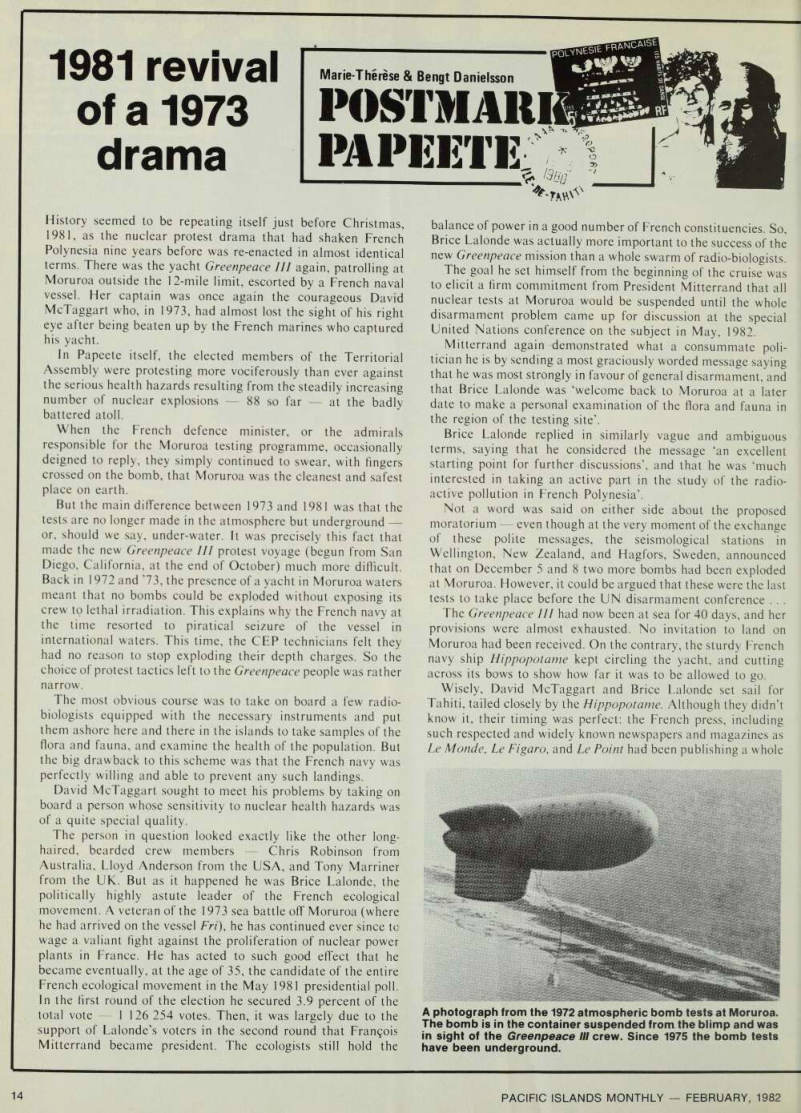
A photograph from the 1972 atmospheric bomb tests at Moruroa.
The bomb is in the container suspended from the blimp and was in sight of the Greenpeace III crew. Since 1975 the bomb tests have been underground.
series of Moruroa horror stories about the plutonium exper iments, the huge pile of nuclear waste swept out to sea, the extensive underwater leakage and fracturing of the atoll, the sinking of the atoll, and the arrival of African monkeys for use in experiments with the neutron bomb.
It also happened that as the Greenpeace 111 was sailing into Papeete harbour on December 16, our own little local parliament, the Territorial Assembly, had just started meeting for its annual budgetary session. Having been lulled for years into believing that the nuclear tests were harmless, the members felt betrayed and outraged by the latest revelations of the many nuclear leaks and accidents at Moruroa.
Most vocal of all in protest was Deputy Gaston Flosse, leader of the local branch of the French Gaullist party. With a long record of blind trust in his French masters, Flosse made a spectacular reversal of his previous pro-nuclear stand; he quickly proposed a motion recommending a sensationally simple method of discovering the truth about the nuclear pollution of France’s Polynesian territory. He proposed the immediate calling-in of an unspecified number of impartial civilian radio biologists of both French and foreign nationalities, of whom some at least should come from Australia and New Zealand.
Their task would be to take samples everywhere in the islands of plants, animals and foods, and to make a detailed health survey of the whole population.
The December 21 debate followed attentively by Brice Lalonde from the public gallery resulted in early and overwhelming victory for the anti-nuclear forces.
Strongest support for Flosse’s motion came, paradoxically, from his arch-enemy, the respected Autonomist leader Jean Teariki although Mr Teariki was unable to prevent himself from wondering aloud whether Flosse’s dramatic reversal of position might not have something of an opportunistic character, given that elections were only five months away.
Flosse and other members of his party replied, with what seemed unfeigned sincerity, that they had changed their minds after the recent revelations about the frightening extension of radioactive pollution of the atoll.
Flosse therefore voted with what feelings one cannot tell for a last-minute amendment emanating from Teariki’s party which requested the French Government to suspend immedi ately all testing at Moruroa until the international team of radio biologists had completed its survey.
A few assemblymen protested that such a suspension, which would probably last a long time, would suddenly throw thousands of men out of work. (Actually, only 750 Polynesians are employed by the CEP, a number representing less than two percent of the total workforce in the territory.) Flosse very pointedly declared that he considered health more important than money, and in the end the amendment was adopted by a two-thirds majority.
Since President Mitterrand is determined to maintain and develop France’s nuclear strike force, it is most unlikely that he will take much notice of this last request. All he has to do is to repeat what all his predecessors have said in such situations in the past: that, under the present colonial system of government, the Polynesians have no say in matters of national defence.
But, luckily, French Polynesia’s Territorial Assembly is fully in charge of local health services. It can thus without delay implement the bold decisions taken during its momentous Christmas session of 1981, even though such action will be frowned upon by the French authorities.
Anticipating that, in the event, the assemblymen will muster the necessary courage to act along these lines, David McTaggart and Brice Lalonde are already on the look-out for experienced radio-biologists willing to spend some time doing interesting fieldwork in our radio-active paradise. Marie-Therese and Bengt Danielsson.
Advertisements & other items, pp. 15-16 (1 item)
Taim
coo
Outstanding ABC Radio series now available on sound cassettes
BILOHG
HASTA
THE AUSTRALIAN INVOLVEMENT
UIITH PAPUA HEUI GUINEA
A fascinating account of how Australians lived in PNG, told by those who lived there - patrol officers, miners, traders, planters, missionaries and, of course, the Papua New Guineans, who describe their experiences under Australian rule. Topics covered include I the effect of World War 11, the position of the Chinese and mixed race communities, race relations, justice, health,
transport, exploration,
and the emerging nationalism which I led to independence in 1975.
The complete series is available on a set of twelve audio cassettes for the full price of
$A62.85 POST FREE.
The Cashier. ABC GPO Box 487, Sydney 2001.
I would like to purchase set/s of TAIM BILONG MASTA @ 5A62.85 ea.
My remittance for $ is enclosed.
NAME
ADDRESS
PNG residents may obtain the cassettes from the ABCs Port Moresby office, PO Box 779, Port Moresby. Price is K 48.00.
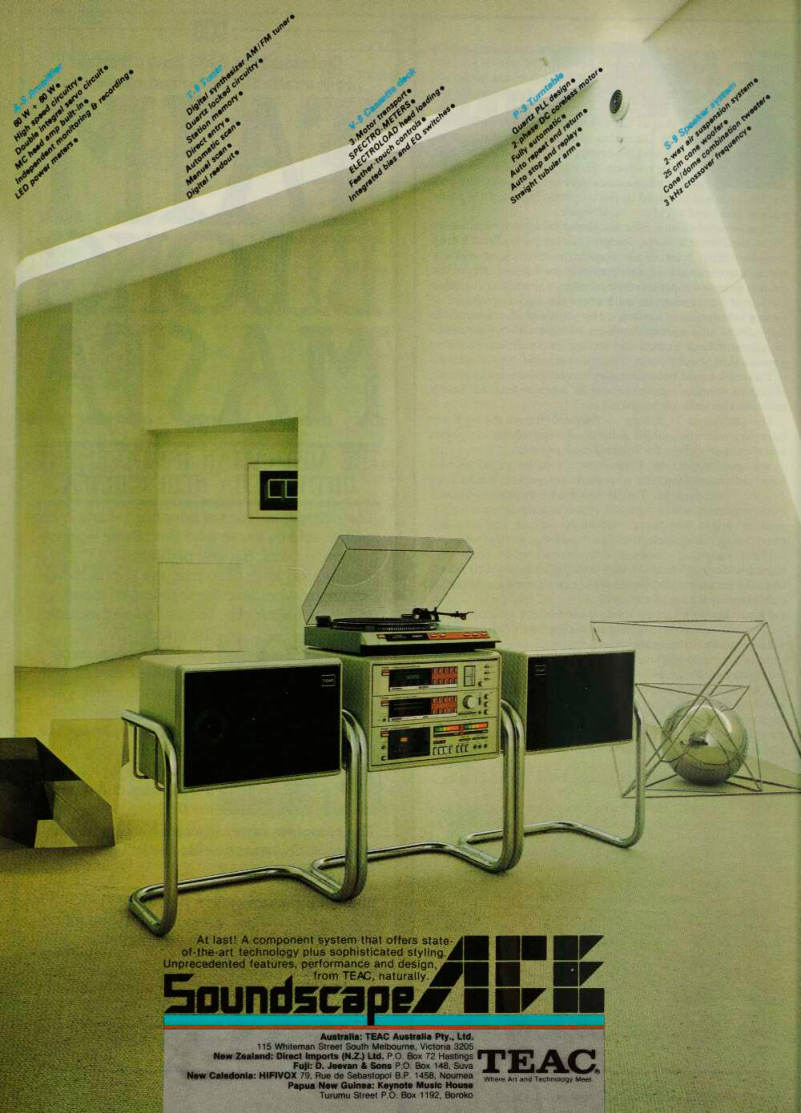
At last! A component system that offers state-
of-the-art technology plus sophisticated styling.
Unprecedented features, performance and design,
from TEAC, naturally.
Australia: TEAC Australia Pty., Ltd. 115 Whiteman Street South Melbourne, Victoria 3205 New Zealand: Direct Imports (N.Z.) Ltd. P.O. Box 72 Hastings Fuji: D. Jeevan & Sons P.O. Box 148, Suva New Caledonia: HIFIVOX 79, Rue de Sebastopol B.P. 1458, Noumea Papua New Guinea: Keynote Music House Turumu Street P.O. Box 1192, Boroko Where Art and Technology I
Islands
From the
Press
Part of a letter signed Kingston Kamurar, University of Papua New Guinea, published in the Papua New Guinea Post-Courier, Port Moresby Our national government, with the backing of the news media organisations, is spending a fortune in trying to combat crime. Of all the anti-crime slogans advocated so far by our leaders through the media, not a single one has challenged our political weaknesses causing wide social and economic inequalities in our society.
Should we not have a leader who is ready to challenge the causes of this social unrest rather than beating around the bush?
The Observer, Apia, Western Samoa, in an editorial comment on the failure of parliament to achieve a quorum on the first day of its December sitting The failure by more than half the members of parliament to turn up for the session on Tuesday strongly convinces us that most politicians do not really care if they contribute to the sound development of the country or not. When they should have been in parliament discussing ways and means of improving the general welfare of the country they stayed away obviously with the idea that their terms of office were nearing the end and that they should now pursue their plans for re-election in February. It would be well for the voters when they are given the chance to have their say on February 27 to keep in mind the members who ignored parliament yet are seeking re-election. A look at the overall government spending on the services provided for running public affairs shows that the cost of having the services of parliament fails desperately to match the effectiveness which materialises from it.
From an editorial in The Times of Papua New Guinea,
Port Moresby
There has been a perceptible shift in the attitude of many overseas countries, including near neighbours, to Papua New Guinea. No longer are we seen as the proud new nation successfully avoiding the pitfalls that have claimed the hopes of so many developing countries. We are beginning to be seen as a country whose only growth industry is official corruption. A massive clean-up of our image is required.
A warning on the dangers of electricity, published in Tohi Tala Niue, Niue If you have an electric lead coming outside your house, the lamp may break, one of your family may touch the wires, the flex may be damaged, or rain water may have caused the lamp holder or the cable to become alive. The result is a shock which could be fatal.
Sure, it costs more to have a light installed permanently but death is more permanent.
The Papua New Guinea Post-Courier, Port Moresby Is the national airline’s new Dash 7 aircraft to be used as a secret government weapon to placate the people of the highlands and thus curb tribal fighting there? At least one of our Port Moresby readers thinks so, and has drawn attention to an Air Niugini advertisement.
The advertisement says the new plane can take five tonnes of fish to Chimbu in the highlands for breakfast, and fly 48 highlanders to Port Moresby for lunch.
Part of a letter in The Observer, Apia, Western Samoa, complaining about the influence of movies on local
young people
What a disgrace these movies have brought the Samoan youths.
Gangs of youths, one group known as the Dirt Gang or something,
have been parading round town looking for a clash. They have imitated everything that was in the movies carrying sticks, wearing sloggy costumes, etc. Sooner or later if they’re not stopped they’ll probably start crashing windows, or will become pickpockets etc. Then there’s going to be a lot of crime. Government should look thoroughly into these matters. ... and another letter on the same subject from the same paper Our young people have absorbed the junk in these films, and have formed gangs and have shown vandalism. They have intruded into private properly by scribbling on the buildings all over the place, making the buildings in Apia look like an untidy scrapbook.
An apology for a typesetting error, from the Times of Papua New Guinea, Port Moresby A correspondent wrote to us that someone appeared to be making large sums of money in Australia by selling Papua New Guinea art.
Somehow in our pages that ‘someone’ appeared as ‘Somare’. Our apologies to Mr Somare, the Leader of the Opposition. He is definitely a ‘someone’ but definitely not THAT particular ‘someone’.
The Cook Island News, Rarotonga A New Zealander ordered to leave the Cook Islands had a philosophical response when questioned about his future. When he was asked if he had any employment to go to when he reached New Zealand he replied that he had something sorted out. When asked to elaborate he replied ‘watch and pray’.
From The Drum, a regular column in the Papua New Guinea Post-Courier, Port Moresby Even thieves are apparently concerned about the zero allocation of funds to the family planning programme. Apparently mindful of keeping population growth at 2.4 percent a year, thugs broke into the family planning office in Port Moresby last weekend. Guess what they got away with? Yes, boxes of condoms.
Part of a letter from a cruise ship visitor, Mrs S.M.
Tapper, published in the Samoa Times, Apia, Western Samoa I came to Apia some weeks ago with some friends on a cruise. We hoped to enjoy our visit, but we did not. All we had on our minds was the shocking state of health of your dogs. Never had we seen such ill-cared-for animals and in a country where the people kept telling us how religious and good they were ... It was a shocking, unhappy visit, the memory of which will never go away. I cannot remember the scenery of Apia as anything else but STARVING
Dogs.
From a letter defending the Prime Minister of Solomon Islands, Solomon Mamaloni, published in the Solomon Islands News Drum, Honiara Don’t you know that our present PM is one of the three top politicians in the Pacific Islands. He is not a confused man internationally, but a top politician. He knows his constitutions. He may be regarded as a confused man in his own private life, but that should not take his political brains off him. ... and from another letter in the same paper, in which Mr Mamaloni’s supporters are roundly criticised Perhaps you believe things just because you have been told so by your friends, but you have only the brains of a dog a dog which awaits his master’s command. You bark aloud with empty words.
I suggest you pull those logs from inside you own eyes before telling another to do the same.
A widely-published quotation in Papua New Guinea from the Leader of the Opposition, Michael Somare, in an address to the Port Moresby Chamber of Commerce Unemployment among young people is potentially the most explosive situation that this country will be facing during the coming decade.
A two-column-wide personal advertisement from The Observer, Apia, Western Samoa Ann: It was only a rash. Please come back. lan.
facing an
New Caledonia facing an uncertain ’82
Thc French Government has said it: ‘We shall move rapidly ahead (in New Caledonia) in the direction of political, economic and social reforms.’ It seemed at the lime the announcement was made that the govern ment intended to take the destinies of New Caledonia directly in hand, introducing its policies by way of ordi nances without consulting either the French Parlia ment or the Territorial As sembly in New Caledonia.
The Secretary of State for Overseas Departments and Territories, Henri Em manuelli, has indicated to the French Senate that the first thing the government planned to do was put the land reform under way already for three years into effect. Up to now, the Territorial Assembly in Noumea has had respons ibility in this matter. Now it seems that a new office is to be created made up of equal numbers of representatives of the Melanesians, the French State, and the Terri tory.
In November, 1981, 16 European landowners were dispossessed of their lands in the context of the land reform. Their properties were concentrated mainly on the east coast. A similar operation undertaken in the south led to sharp conflict between various Melanesian tribes, who have conflicting claims to the land acquired.
At present the dispute re mains at the level of threats of this and that type of action, and palavering.
Gendarmes recently inter vened to cool a dispute between rival clans in the Yate region.
Taxation: The French Government considers that the measures of direct tax
ation proposed by the Terri torial Assembly and the Council of Government for New Caledonia are ‘far too timid’.
Here again, ordinances from Paris will have the force of law, and the inhabi tants of New Caledonia will have to bow, without being consulted, to the point, of view of Paris.
The taxation question has always been a bone of con tention between Paris and Noumea, where it is esti mated that the New Caledonian standard of liv ing is 20 percent below that of the metropolitan French.
Tax increases might ap pear to achieve ‘greater fiscal justice’, but in fact they would only swell the administrative budgets.
Powers of elected New Caledonian representatives: The French Government’s take-over of New Caledonia’s affairs is clearly to be seen in the appoint ment as high commissioner of an eminent politician, Christian Nucci, 42 (PIM Jan p 5). Until his appoint ment Mr Nucci was vice president of the National Assembly. Born in Algeria, he studied in metropolitan France, and was later a teacher in Morocco and Algeria.
Solutions to New Caledonia’s problems must first of all be political sol utions at least that is what Paris says, that is its belief.
The majority of the New Caledonian population are opposed to this effective abrogation by Paris of the internal autonomy of New Caledonia, and the president of the Territorial Assembly has protested vigorously against this unilateral ac tion. An indicator of the situation: governmental pro
posals for changing the ‘profile’ of New Caledonian society were presented to the assembly ‘for information’.
What course of action is open to those who have been democratically elected, both to the Council of Govern ment and the Territorial Assembly? Speaking in the French Senate, Senator Calhavet declared that the government should seek the opinion of the New Caledonian population on their future by way of a referendum. In the course of debate. Mr Emmanuelli de clared: ‘The result of a referendum, if it were held today, would be against in dependence.’ Revealing the thinking of the French Gov ernment on this score, Mr Emmanuelli said: ‘The New Caledonian populations will be consulted on their future in three years, if they so desire.’
No Kanak Socialist Inde pendence: The French Gov ernment has thus not ac cepted Kanak socialist inde pendence as expounded by New Caledonian inde pendenlists. The fact is and this must be strongly emphasised in view of the great confusion in the Pacific on this matter there never has been a demand for the indepen dence of New Caledonia.
What there has been is a demand for Kanak socialist independence put forward by a minority who do not even represent the whole Melanesian population.
When the energetic and bold reforms of the French Government have been put into full effect, and have made themselves felt all round, after three years have
elapsed the French Govern ment is prepared to consult the populations all the populations of New Caledonia about their fu ture.
What is the Independence Front going to do in the face of this decisive and uncom promising (towards all par ties involved) attitude adopted by Paris? In the months ahead, the various demands put forward by the political parties in the front will be satisfied.
Things will settle down that is the hope of all inhabitants of the country.
And as they do, it is to be hoped that there will also come the confidence that is indispensable if the New Caledonia economy, badly shaken by the worldwide crisis in the Western econ omies, is to be got going again.
Sickly nickel: The main plant of Socicte Le Nickel in Noumea is working at only 48 percent capacity, and to maintain even this level the Doniambo plant had to close down two furnaces at the beginning of December. Per sonnel who have either left Le Nickel voluntarily, or have been retired, have re duced the labour force to 3000.
Nickel ore exports to Japan have fallen by 50 percent in four years. How ever, the high prices being paid for the ore, and for metal products generally, have kept financial damage to a minimum.
Hopes now centre on the opening up of the chromite mines in the north by the American company Inco. It is hoped that production will start by the end of 1982.
- and 111 languages

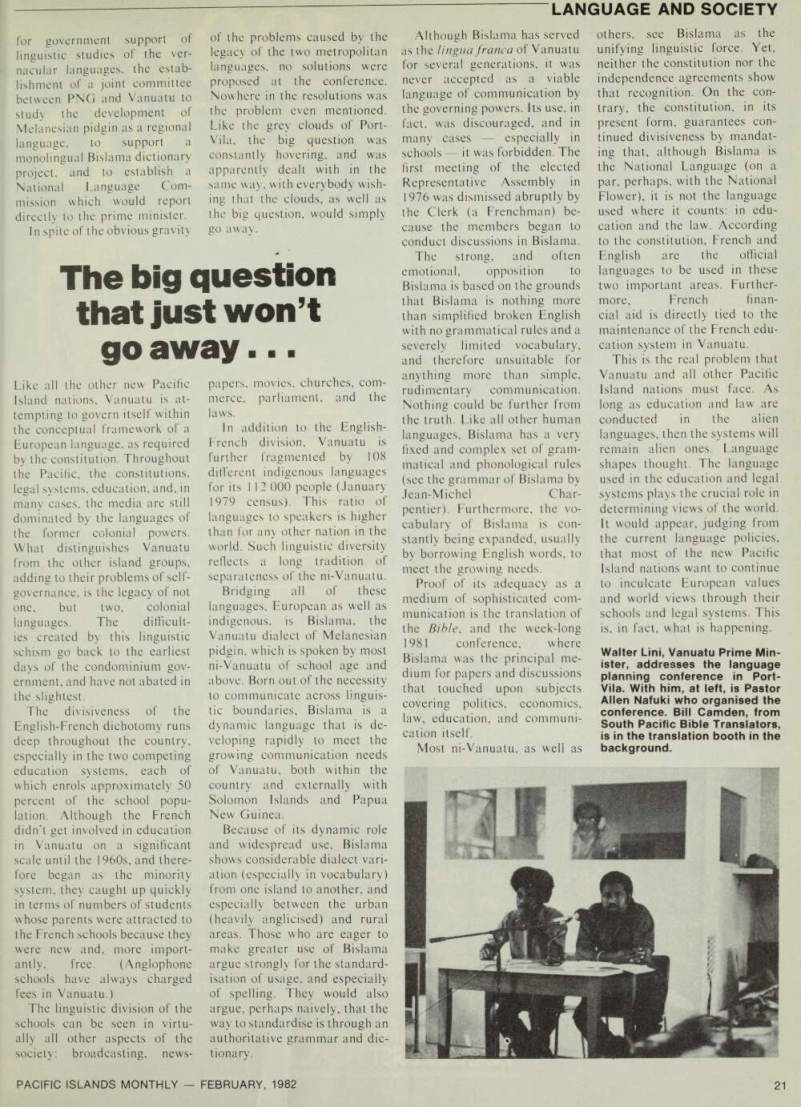
Vanuatu: Land of 112 000 people - and 111 languages
Livelv discussions continue in Vanuatu on the unique language problems faced by the country. A landmark in these discussions was a four-and-half-day international conference held in Port-Vila Town Hall last year on the subject ‘ Language Planning and Policy in Vanuatu’.
Organised by the Pacific Churches Research Centre and the Extension Centre of the University of the South Pacific in Port- Vila, with funds provided by UNESCO and the Vanuatu Government, the conference offered no solution to the grave problems of the country’s inheritance of the two metropolitan languages, English and French. But on the other hand it did much to promote and plan the development of the country’s ‘national language’ of Bislama, the local variant of Melanesian pidgin. In this connection, one of its more interesting proposals was for the establishment of a joint Papua New Guinea- Vanuatu committee to study the fostering of Melanesian pidgin as a regional language. Such a proposal is directly in line with the modern trend to ‘internationalise’ pidgin as a means of communication between countries such as Solomon Islands, PNG, and Vanuatu.
Dr DONALD M. TOPPING of the University of Hawaii at Manoa was among the foreign observers at the conference. His reports follow.
Sitting in straight-backed chairs for sessions running from 8 am to 4.30 pm with a two hour Vila-esque lunch break 30 ni-Vanuatu delegates, and 14 observers from five Pacific countries and one US Territory engaged in serious discussions of one of Vanuatu’s most urgent post-condominium problems: what to do about more than 100 different indigenous languages, the legacy of two European language systems, and the ris ing tide of Bislama, a dialect of Melanesian pidgin, whose roots go back to the same plantation sources as do Tokpisin and Solomon Islands pidgin.
With simultaneous trans lation services provided by the South Pacific Bible Translators, the all-day sessions were con ducted predominantly in Bislama, which was translated into English for the benefit of the overseas observers. The use of Bislama as the primary language of the conference en abled full participation of the ni-Vanuatu delegates, several of whom do not speak any European language. Perhaps another very important point was made in the process: Bislama, a pidgin language, is an adequate language for con
ducting complex, and often abstract, discussions involving education, law, the media, and politics.
In his opening address. Prime Minister Waller Lini, speaking in Bislama, stressed that he hoped the conference would look hard at ‘the role of Bislama in the development of this country as it strives for national unity’. The PM also made clear his view that English and French had driven a wedge between ni-Vanuatu, and that ‘Bislama is drawing our people together’, as well as providing communication linkages with the neighbours to the north (Solomon Islands and Papua New Guinea).
Strongly supporting the PM’s views concerning the role of Bislama was Chief Willie Bongmatur, chairman of the Vanuatu National Council of Chiefs. In addition, Chief Willie spoke frequently throughout the conference stressing the need for the chil dren of Vanuatu to be thoroughly grounded in custom and in their own languages, even if this meant holding them back from school until age seven or eight. The seven other custom chiefs, representing a
cross-section of different islands, strongly backed Chief Willie’s argument for retaining custom, and the use of vernacu lar languages in the early pri mary school years as a means of developing a strong local ident ity among ni-Vanuatu.
Perhaps the strongest advo cates for Bislama as a standard ised national language on a par with English and French were the South Pacific Bible Trans lators, who recently issued a translation of the Nyu Tesamen in ‘standard’ Bislama, and are currently engaged in a trans lation of the Old Testament to match the New in spelling, vocabulary, and structure.
When they were not in the booth providing excellent simul taneous translations, the Bible translators stressed the need for standardising Bislama, both spoken and written, throughout the country, so that it could be widely used in print.
On the government side, rep resentatives from broadcasting and information, the Ministry of Education, and the attorney general’s office presented their current practices and positions as specified in the constitution and in termination agreements.
Although Bislama is recognised constitutionally as the national language,; English and French are the official languages of education, law, and government correspondence, while broad
principle, there must be room for and recognition of vernacu lar, Bislama, and the metropoli tan languages in the education system of Vanuatu. 2. (a) Vernacular languages must be used as the medium of instruction in primary schools through Classes 1-3. (b) Bislama will be intro duced in primary schools begin ning Class 4. (c) Bislama should be used as the medium of instruction.
Classes 4-6, with French and English introduced as subjects of study. (d) French and/or English will be.introduced and used as media of instruction in second ary schools with Bislama con tinued as a subject of study. (e) Technical school should continue with Bislama as the medium of instruction through Classes 7 and 8. (f) If these new language requirements necessitate ex tending the time period for primary school, this is some thing for the Ministry of Edu cation to study.
Law: I. All laws should be translated into Bislama. 2. In case of dispute of interpretation, Bislama will be the definitive version. 3. Translators for court cases must be provided when re quested. 4. Parliamentarians should strive to improve their Bislama
Language And Society
cast time for international sub ject matter is nearly equally divided to allow for trans mission in English, French, and Bislama. Matters of staffing and of time-consuming translations were cited as major problems.
At the end of four and a half days of informed, and some times impassioned, discussion, the delegates passed a series of resolutions to be passed on to the Vanuatu Government. The resolutions, written in Bislama, fall into three categories: edu cation, law, and the media.
They are summarised below; Education: 1. As a general
by expunging Anglicisms from their vocabulary.
Media: 1 . French and English radio news should be restricted to once per evening each, with perhaps more in expatriate centres such as Port-Vila and Luganville. 2. All educational pro grammes in English and French should be translated into Bislama. 3. Radio translators should be given opportunity for train ing in translation techniques, and should be encouraged to strive for a standard Bislama.
Additional resolutions called
for government support of linguistic studies of the vernacular languages, the establishmcnl of a joint committee between PNG and Vanuatu to study the development of Melanesian pidgin as a regional language, to support a monolingual Bislama dictionary project, and to establish a National Language Commission which would report directly to the prime minister.
In spite of the obvious gravity
of the problems caused by the legacy of the two metropolitan languages, no solutions were proposed at the conference, Nowhere in the resolutions was the problem even mentioned.
Like the grey clouds of Port- Vila, the big question was constantly hovering, and was apparently dealt with in the same way, with everybody wish ing that the clouds, as well as the big question, would simply go away.
Advertisements & other items, p. 20 (1 item)
Performance
r 2) S ! & i> -R —p -—f U: c: A Z 2 ■« j 1! i—in-
dependable
marine engines
When fishing is your living, you know you need dependable gear working with minimum downtime and your engines have to deliver reliable power when and where you need it.
CATERPILLAR offers you a comprehensive selection of performance proven Cat Marine Diesel Engines from 85hp up to IOOOhp, backed by after sales service and replacement parts facilities that are second to none.
dependable
generator sets
Whatever your electric power needs, there’s a Catbuilt generator set to meet them. Caterpillar generators feature adjustment free fuel systems, large capacity radiators, heavy duty air cleaners and quick-change fuel and oil filters to ensure dependable performance throughout the islands, in all kinds of tropical conditions.
'mxi- L.
HASTINGS DIERING
LAE:
Milford Haven Road, Telephone 42 2355.
PORT MORESBY:
Telephone 256650.
BOUGAINVILLE:
Itakara Industrial Park, Arawa Telephone 959077.
Caterpillar, Cat and I
carptrac
SUVA; Carpenter Street, Raiwai.
Private Mail Bag, GPO Suva, Fiji. Ph. 381622.
Telex FJ2190 Cables CARPTRAC.
LAUTOKA: Veitari. Telephone 61877.
LABASA: Vulovi. Telephone 81868.
Trademarks of Caterpillar Tractor Co.
YOUR
CATERPILLAR
DEALER
8A10452
The big question
that just won’t go away...
Like all the other new Pacific Island nations, Vanuatu is at tempting to govern itself within the conceptual framework of a European language, as required by the constitution. Throughout the Pacific, the constitutions, legal systems, education, and, in many cases, the media are still dominated by the languages of the former colonial powers.
What distinguishes Vanuatu from the other island groups, adding to their problems of self governance, is the legacy of not one, but two, colonial languages. The difficult ies created by this linguistic schism go back to the earliest days of the condominium gov ernment, and have not abated in the slightest.
The divisiveness of the English-French dichotomy runs deep throughout the country, especially in the two competing education systems, each of which enrols approximately 50 percent of the school popu lation. Although the French didn't gel involved in education in Vanuatu on a significant scale until the 19605, and there fore began as the minority system, they caught up quickly in terms of numbers of students whose parents were attracted to the French schools because they were new and, more import antly, free. (Anglophone schools have always charged fees in Vanuatu.) The linguistic division of the schools can be seen in virtu ally all other aspects of the society: broadcasting, news
papers, movies, churches, com merce, parliament, and the laws.
In addition to the English- French division, Vanuatu is further fragmented by 108 different indigenous languages for its 112 000 people (January 1979 census). This ratio of languages to speakers is higher than for any other nation in the world. Such linguistic diversity reflects a long tradition of separateness of the ni-Vanuatu.
Bridging all of these languages, European as well as indigenous, is Bislama, the Vanuatu dialect of Melanesian pidgin, which is spoken by most ni-Vanuatu of school age and above. Born out of the necessity to communicate across linguis tic boundaries, Bislama is a dynamic language that is de veloping rapidly to meet the growing communication needs of Vanuatu, both within the country and externally with Solomon Islands and Papua New Guinea.
Because of its dynamic role and widespread use, Bislama shows considerable dialect vari ation (especially in vocabulary) from one island to another, and especially between the urban (heavily anglicised) and rural areas. Those who are eager to make greater use of Bislama argue strongly for the standard isation of usage, and especially of spelling. They would also argue, perhaps naively, that the way to standardise is through an authoritative grammar and dic tionary.
Although Bislama has served as the lingua franca of Vanuatu for several generations, it was never accepted as a viable language of communication by the governing powers. Its use, in fact, was discouraged, and in many cases especially in schools it was forbidden. The first meeting of the elected Representative Assembly in 1976 was dismissed abruptly by the Clerk (a Frenchman) be cause the members began to conduct discussions in Bislama.
The strong, and often emotional, opposition to Bislama is based on the grounds that Bislama is nothing more than simplified broken English with no grammatical rules and a severely limited vocabulary, and therefore unsuitable for anything more than simple, rudimentary communication.
Nothing could be further from the truth. Like all other human languages, Bislama has a very fixed and complex set of gram matical and phonological rules (see the grammar of Bislama by Jean-Michel Char pentier). Furthermore, the vo cabulary of Bislama is con stantly being expanded, usually by borrowing English words, to meet the growing needs.
Proof of its adequacy as a medium of sophisticated com munication is the translation of the Bible , and the week-long 1981 conference, where Bislama was the principal me dium for papers and discussions that touched upon subjects covering politics, economics, law, education, and communi cation itself.
Most ni-Vanuatu, as well as
others, see Bislama as the unifying linguistic force. Yet, neither the constitution nor the independence agreements show that recognition. On the con trary, the constitution, in its present form, guarantees con tinued divisiveness by mandat ing that, although Bislama is the National Language (on a par, perhaps, with the National Flower), it is not the language used where it counts: in edu cation and the law. According to the constitution, French and English are the official languages to be used in these two important areas. Further more, French finan cial aid is directly tied to the maintenance of the French edu cation system in Vanuatu.
This is the real problem that Vanuatu and all other Pacific Island nations must face. As long as education and law are conducted in the alien languages, then the systems will remain alien ones. Language shapes thought. The language used in the education and legal systems plays the crucial role in determining views of the world.
It would appear, judging from the current language policies, that most of the new Pacific Island nations want to continue to inculcate European values and world views through their schools and legal systems. This is, in fact, what is happening.
Walter Lini, Vanuatu Prime Min ister, addresses the language planning conference in Port- Vila. With him, at left, is Pastor Allen Nafuki who organised the conference. Bill Camden, from South Pacific Bible Translators, is in the translation booth in the background.
Advertisements & other items, pp. 22-28 (1 item)
Citize
Om ir
accu
m
W l.l
'0 m s S2oo . .>. r ? v " rv i \«/ Ml i *im v w ' s\ T?; I .-••v A- / 100
-/ II \ N
- . t • /J I d Hi w ✓/ I ' .’I
u H^mSi
i * ■ W'/U ft. v;' ,!v»l , f'»‘ »' *« * iit« ; i
iff*- .M,'
m ifh S* i -■ ‘V - i -- Ik • - Iffl -A - -
Water-resistant quartz watches from Citizen.
Under a clear blue sky or tire deep blue sea, these slim quartz watches from Citizen are always at home. Accurate to within seconds a month, the Water Resist 100 series keeps time"at 100 metres below the.surface as well as it does on dry land. AH models, analog and *r. digital, feature day and all are made to Citizen'S high
■■ standards of riiggedness andj>recisiqn-.
' CITIZEN QUART
WATER H
It
The New
40 Series
bobcat
Loaders
by Clark
»<* Your choice of 641 Powerful Deutz diesel 32hp 642 Economic Ford petrol 30hp 743 Quiet Kubota diesel 36hp 843 Reliable Perkins diesel 56hp See the New 40 Series AT YOUR NEAREST CLAR K BOBCAT DE ALE R BOROKO Conquip ph 25 6699 telex NE 2247 LAE Conquip ph 45 1545 telex NE 42586
CL4RK
Clark Equipment Australia Limited Melroe Division
Scott Carpenter
and JVC.
Both explorers.
Both dedicated to —
*!■ m Vf m Scott Carpenter. An explorer who has spent his professional career on the cutting edge of innovation. One of the original US astronauts and an aquanaut. The only man to penetrate both inner and outer space.
JVC, too, has always been identified with innovation. Like Scott, we have spent years opening up new worlds. New worlds of home entertainment. We originated VMS, the most widely used home video system. We make versatile equipment like the HR-2200 portable video cassette recorder and the GX-68 video camera.
Take a look and see if you don V agree that JVC products are out of this world.
Innovation
mM+m SsSi ife
IBM
JVC
JVC
Save energy.
Save money.
With Rheem Solar.
tmeem a Now is the time to think about installing Rheem Solar.
With a Rheem Solar system, you can save on your annual hot water bill and help conserve valuable energy.
A Rheem Solar system offers you some very special features:- The exclusive Rheem Sunstat* valve controls water temperature.
This means your water temperature can’t exceed 70 degrees, so there is no risk of accidental scalding.
Rheem Solar systems have all copper absorber plates, one of the best heat conductors in the world.
Their 200 or 300litre capacity will suit your family needs.
And they come with Rheem reliability and 40 years’ experience in the hot water business.
I For a free brochure on Rheem Solar, send in the coupon below.
Pfb: Export Manager, Appliance Division, Rheem Australia Ltd, RO j Box 6, Rydalmere 2116. Australia.
Name Address iTI L DISTRIBUTORS: PAPUA NEW GUINEA. Steamships Trading Co. Ltd: Port Moresby, Lae, Kieta, Goroka, Madang, Rabaul, Popondetta, Kundiawa, Samaria, Mt. Hagen, Vanimo. Mainland Plumbing Supplies: Lae. NEW CALEDONIA. Ballande; Noumea. TAHITI. Coupimex: Papeete.
We would welcome enquiries for agencies in areas not covered above.
RHAIIO6
Tonga’s no
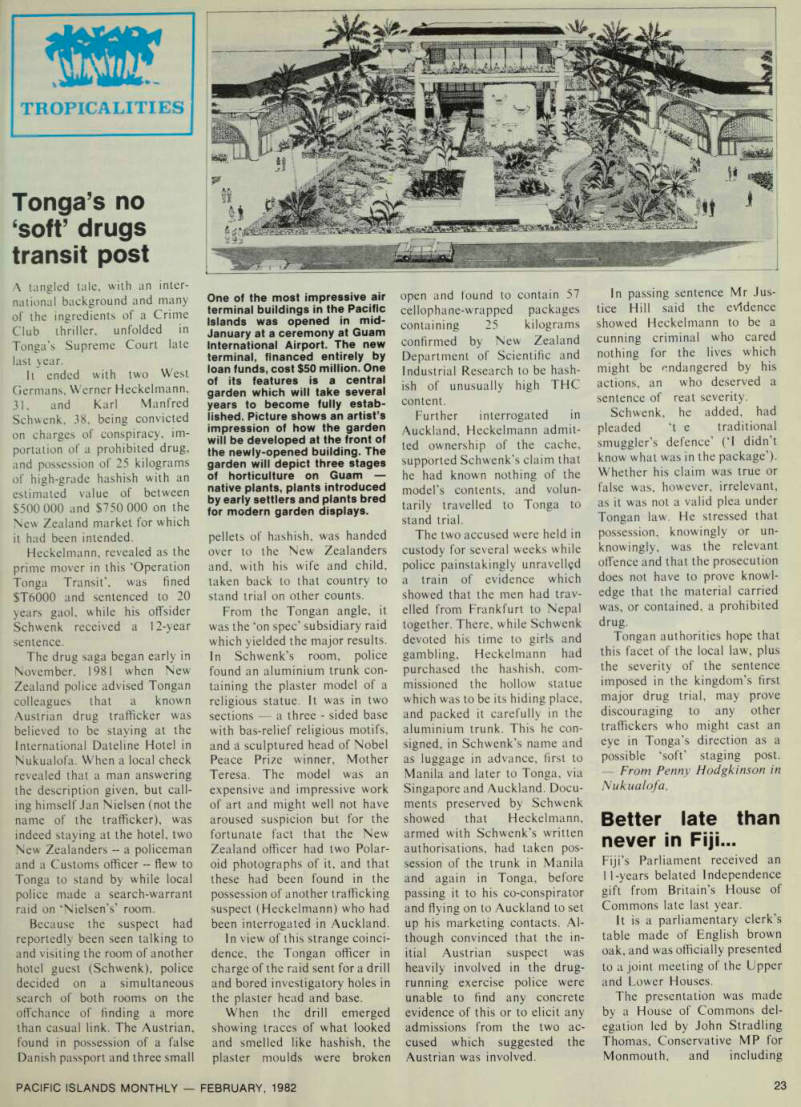

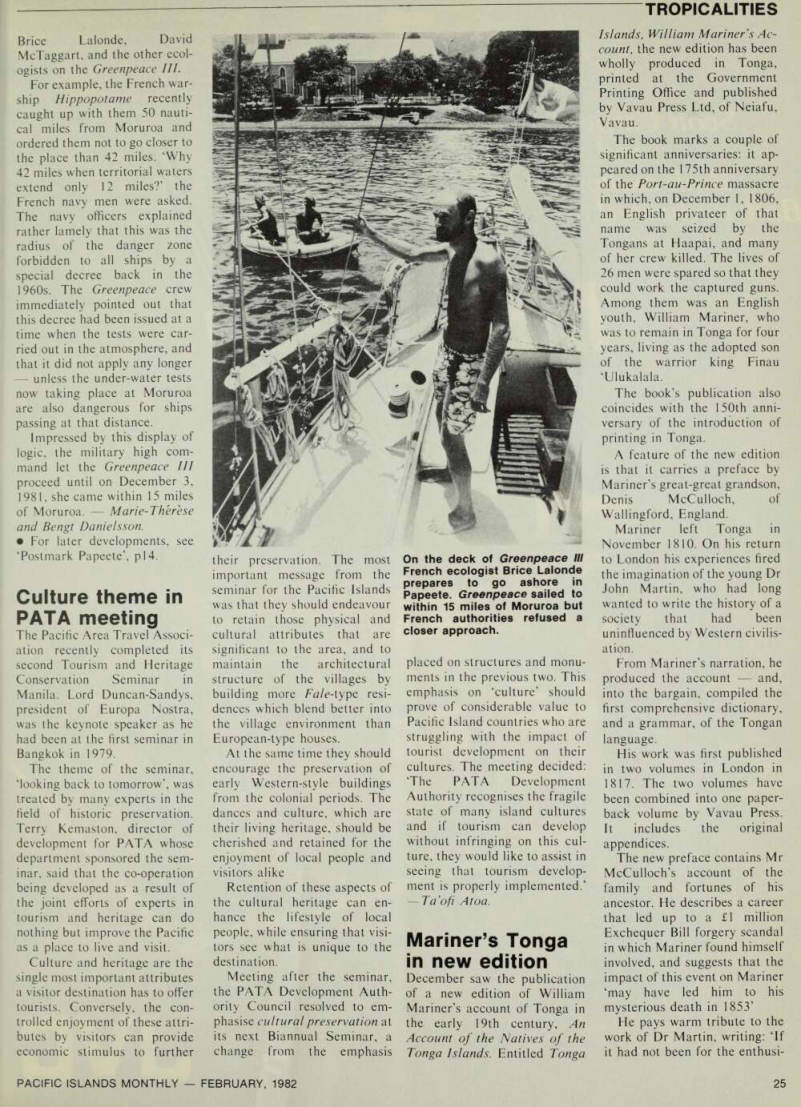

Tropicalities
‘soft’ drugs
transit post
A tangled tale, with an inter national background and many of the ingredients of a Crime Club thriller, unfolded in Tonga's Supreme Court late last year.
It ended with two West Germans, Werner Heckelmann, 31, and Karl Manfred Schwenk, 38, being convicted on charges of conspiracy, im portation of a prohibited drug, and possession of 25 kilograms of high-grade hashish with an estimated value of between $5OO 000 and $750 000 on the New Zealand market for which it had been intended.
Heckelmann, revealed as the prime mover in this ‘Operation Tonga Transit’, was fined ST6OOO and sentenced to 20 years gaol, while his offsider Schwenk received a 12-year sentence.
The drug saga began early in November, 1981 when New Zealand police advised Tongan colleagues that a known Austrian drug trafficker was believed to be staying at the International Dateline Hotel in Nukualofa. When a local check revealed that a man answering the description given, but call ing himself Jan Nielsen (not the name of the trafficker), was indeed staying at the hotel, two New Zealanders -- a policeman and a Customs officer -- flew to Tonga to stand by while local police made a search-warrant raid on ‘Nielsen’s’ room.
Because the suspect had reportedly been seen talking to and visiting the room of another hotel guest (Schwenk), police decided on a simultaneous search of both rooms on the offchance of finding a more than casual link. The Austrian, found in possession of a false Danish passport and three small
pellets of hashish, was handed over to the New Zealanders and, with his wife and child, taken back to that country to stand trial on other counts.
From the Tongan angle, it was the ‘on spec’ subsidiary raid which yielded the major results.
In Schwenk’s room, police found an aluminium trunk con taining the plaster model of a religious statue. It was in two sections a three - sided base with bas-relief religious motifs, and a sculptured head of Nobel Peace Prize winner. Mother Teresa. The model was an expensive and impressive work of art and might well not have aroused suspicion but for the fortunate fact that the New Zealand officer had two Polar oid photographs of it, and that these had been found in the possession of another trafficking suspect (Heckelmann) who had been interrogated in Auckland.
In view of this strange coinci dence, the Tongan officer in charge of the raid sent for a drill and bored investigatory holes in the plaster head and base.
When the drill emerged showing traces of what looked and smelled like hashish, the plaster moulds were broken
open and found to contain 57 cellophane-wrapped packages containing 25 kilograms confirmed by New Zealand Department of Scientific and Industrial Research to be hash ish of unusually high THC content.
Further interrogated in Auckland, Heckelmann admit ted ownership of the cache, supported Schwenk’s claim that he had known nothing of the model’s contents, and volun tarily travelled to Tonga to stand trial.
The two accused were held in custody for several weeks while police painstakingly unravelled a train of evidence which showed that the men had trav elled from Frankfurt to Nepal together. There, while Schwenk devoted his time to girls and gambling, Heckelmann had purchased the hashish, com missioned the hollow statue which was to be its hiding place, and packed it carefully in the aluminium trunk. This he con signed, in Schwenk’s name and as luggage in advance, first to Manila and later to Tonga, via Singapore and Auckland. Docu ments preserved by Schwenk showed that Heckelmann, armed with Schwenk’s written authorisations, had taken pos session of the trunk in Manila and again in Tonga, before passing it to his co-conspirator and flying on to Auckland to set up his marketing contacts. Al though convinced that the in itial Austrian suspect was heavily involved in the drug running exercise police were unable to find any concrete evidence of this or to elicit any admissions from the two ac cused which suggested the Austrian was involved.
In passing sentence Mr Jus tice Hill said the evidence showed Heckelmann to be a cunning criminal who cared nothing for the lives which might be endangered by his actions, an who deserved a sentence of real severity.
Schwenk, he added, had pleaded ‘t e traditional smuggler’s defence’ (‘I didn’t know what was in the package’).
Whether his claim was true or false was, however, irrelevant, as it was not a valid plea under Tongan law. He stressed that possession, knowingly or un knowingly, was the relevant offence and that the prosecution does not have to prove knowl edge that the material carried was, or contained, a prohibited drug.
Tongan authorities hope that this facet of the local law, plus the severity of the sentence imposed in the kingdom’s first major drug trial, may prove discouraging to any other traffickers who might cast an eye in Tonga’s direction as a possible ‘soft’ staging post.
From Penny Hodgkinson in Nukualofa,
Better late than
never in Fiji...
Fiji’s Parliament received an 11-years belated Independence gift from Britain’s House of Commons late last year.
It is a parliamentary clerk’s table made of English brown oak, and was officially presented to a joint meeting of the Upper and Lower Houses.
The presentation was made by a House of Commons del egation led by John Stradling Thomas, Conservative MP for Monmouth, and including
One of the most impressive air terminal buildings in the Pacific Islands was opened in mid- January at a ceremony at Guam International Airport. The new terminal, financed entirely by loan funds, cost $50 million. One of its features is a central garden which will take several years to become fully estab lished. Picture shows an artist’s impression of how the garden will be developed at the front of the newly-opened building. The garden will depict three stages of horticulture on Guam native plants, plants introduced by early settlers and plants bred for modern garden displays.
Austin Mitchell, Labour MP for Grimsby, and Michael Ryle, the Clerk of the Overseas Office at the House of Commons.
Speaking after presenting the keys of the desk to the Clerk of Parliament Mrs Lavinia Ah Koy. Mr Thomas said it was a great honour and privilege for him to present the gift from the ‘Mother of Parliaments’.
Bill Clark, Leader of the Fiji House, said it was a tradition of Commonwealth parliaments to send gifts. The Speaker’s chair in the House was a gift from India, for example. The Oppo sition Whip, Mrs Irene Jai Narayan, endorsed Mr Clark’s remarks and said that the table was an excellent gift of fine craftsmanship. But finer still were the sentiments behind the gift, she said.
Greenpeace vs.
Hippopotame
The revelation that huge quantities of nuclear waste that had been stockpiled on Morurua Atoll, French Polynesia, are spilling over into the ocean coincided with and perhaps even prompted the sailing of the protest vessel Greenpeace 111 (also described in many press reports as Vega).
Little by little the mass media in Europe, America, Australia, New Zealand and the Pacific Islands began spreading the bad news. The fact that France’s best known ecologist, Brice Lalonde who attracted no fewer than 1 200 000 votes in France’s May 1981 presidential election - had joined his friend and fellow peace activist Bruce McTaggart for the new protest cruise to Moruroa was particu larly embarrassing for the French Government.
To stem the mounting tide of criticism at home and abroad.
Minister for Defence Charles Hernu. at the end of November, produced an old trick that has always worked well in the past: he announced in the French National Assembly that he was going to invite a number of Polynesian government council lors and parly leaders to visit Moruroa on December 3 ‘so that they can see for themselves that there are no radiation dangers for the personnel living
there’. Their lour conductor was to be no less a personage than the boss of the French nuclear submarine fleet. Admiral Claude Fieri, who lost no lime in flying out to Tahiti to ac complish his mission.
The last time such an invi tation was issued was in 1979 after it had become known (thanks to articles in opposition newspapers) that several serious accidents had occurred on Moruroa, resulting in the deaths of two technicians, the spilling of plutonium on the atoll's surface, and a large-scale under-water leakage of radio active matter into the ocean.
The eight assemblymen and government councillors (who, of course, had no expert know ledge of radiation problems) were literally taken for a ride: all they did, or were allowed to do, was to make a tour of the atoll by helicopter. On their return to Tahiti they quite frankly declared that they had seen nothing and learnt nothing.
In the official bulletin, distrib uted to all mass media, their main conclusion was worded slighty differently it stated that they had noticed no pol lution whatsoever on Moruroa...
Their reaction to the 1981 invitation was different from that of two years before: like wise old barracudas who’ve already been hooked, they all refused to take the bait. Even worse for the poor minister and his admirals, they recalled that the Territorial Assembly had voted unanimously on August 18, 1979, for the French Gov ernment to allow a group of French and foreign radio biologists to visit all the relevant islands of French Polynesia and publish their findings. Since Minister Hernu had stated in Papeete on July 31, 1981, that the new Socialist government of President Mitterrand to which he belonged was going to make a complete break with the hush up policies of previous Right wing governments, this re minder was a timely one. The assemblymen are still waiting for Minister Hernu to make good on his promise.
Nor has Charles Hernu thought of extending his invi tation to the only ones left who are definitely not only willing but eager to go to Moruroa
Brice Lalonde, David McTaggart, and the other ecol ogists on the Greenpeace 111.
For example, the French war ship Hippopotame recently caught up with them 50 nauti cal miles from Moruroa and ordered them not to go closer to the place than 42 miles. ‘Why 42 miles when territorial waters extend only 12 miles?’ the French navy men were asked.
The navy officers explained rather lamely that this was the radius of the danger zone forbidden to all ships by a special decree back in the 19605. The Greenpeace crew immediately pointed out that this decree had been issued at a time when the tests were car ried out in the atmosphere, and that it did not apply any longer unless the under-water tests now taking place at Moruroa are also dangerous for ships passing at that distance.
Impressed by this display of logic, the military high com mand let the Greenpeace 111 proceed until on December 3, 1981, she came within 15 miles
of Moruroa.
Marie-Thérèse
and Bengt Danielsson.
• For later developments, see ‘Postmark Papeete’, pi 4.
Culture theme in
PATA meeting
The Pacific Area Travel Associ ation recently completed its second Tourism and Heritage Conservation Seminar in Manila. Lord Duncan-Sandys, president of Europa Nostra, was the keynote speaker as he had been at the first seminar in Bangkok in 1979.
The theme of the seminar, ‘looking back to tomorrow’, was treated by many experts in the field of historic preservation.
Terry Kemaslon, director of development for PATA whose department sponsored the sem inar, said that the co-operation being developed as a result of the joint efforts of experts in tourism and heritage can do nothing but improve the Pacific as a place to live and visit.
Culture and heritage are the single most important attributes a visitor destination has to offer tourists. Conversely, the con trolled enjoyment of these attri butes by visitors can provide economic stimulus to further
their preservation. The most important message from the seminar for the Pacific Islands was that they should endeavour to retain those physical and cultural attributes that are significant to the area, and to maintain the architectural structure of the villages by building more Tale- type resi dences which blend better into the village environment than European-type houses.
At the same time they should encourage the preservation of early Western-style buildings from the colonial periods. The dances and culture, which are their living heritage, should be cherished and retained for the enjoyment of local people and visitors alike Retention of these aspects of the cultural heritage can en hance the lifestyle of local people, while ensuring that visi tors see what is unique to the destination.
Meeting after the seminar, the PATA Development Auth ority Council resolved to em phasise cultural preservation at its next Biannual Seminar, a change from the emphasis
placed on structures and monu ments in the previous two. This emphasis on ‘culture’ should prove of considerable value to Pacific Island countries who are struggling with the impact of tourist development on their cultures. The meeting decided: ‘The PATA Development Authority recognises the fragile state of many island cultures and if tourism can develop without infringing on this cul ture, they would like to assist in seeing that tourism develop ment is properly implemented.’
Ta’ofi Atoa.
Mariner’s Tonga
in new edition
December saw the publication of a new edition of William Mariner’s account of Tonga in the early 19th century, An Account of the Natives of the Tonga Islands. Entitled Tonga
Islands, William Mariner’s Ac count, the new edition has been wholly produced in Tonga, printed at the Government Printing Office and published by Vavau Press Ltd, of Neiafu, Vavau.
The book marks a couple of significant anniversaries: it ap peared on the 175th anniversary of the Port-au-Prince massacre in which, on December 1, 1806, an English privateer of that name was seized by the Tongans at Haapai, and many of her crew killed. The lives of 26 men were spared so that they could work the captured guns.
Among them was an English youth, William Mariner, who was to remain in Tonga for four years, living as the adopted son of the warrior king Finau ‘Ulukalala.
The book’s publication also coincides with the 150th anni versary of the introduction of printing in Tonga.
A feature of the new edition is that it carries a preface by Mariner’s great-great grandson, Denis McCulloch, of Wallingford, England.
Mariner left Tonga in November 1810. On his return to London his experiences fired the imagination of the young Dr John Martin, who had long wanted to write the history of a society that had been uninfluenced by Western civilis ation.
From Mariner’s narration, he produced the account and, into the bargain, compiled the first comprehensive dictionary, and a grammar, of the Tongan language.
His work was first published in two volumes in London in 1817. The two volumes have been combined into one paper back volume by Vavau Press.
It includes the original
appendices.
The new preface contains Mr McCulloch’s account of the family and fortunes of his ancestor. He describes a career that led up to a £1 million Exchequer Bill forgery scandal in which Mariner found himself involved, and suggests that the impact of this event on Mariner ‘may have led him to his mysterious death in 1853’
He pays warm tribute to the work of Dr Martin, writing: Tf it had not been for the enthusi
On the deck of Greenpeace III French ecologist Brice Lalonde prepares to go ashore in Papeete. Greenpeace sailed to within 15 miles of Moruroa but French authorities refused a closer approach.
asm, tact and patience of this young doctor, we should today know practically nothing of the story, and the record of an important period in the history of Tonga would be much the poorer... I leave to scholars in the various fields of Polynesian studies to assess the values of the Account in their own ways’.
McCulloch recognises Mafi Habe, Mariner’s adoptive mother, and the great debt Mariner owed her for her efforts in educating a desperate European castaway to become a confident young Tongan chief.
Of the forgery scandal of his later years McCulloch says it came as a shattering blow to Mariner, who had been held in high regard for his probity in business.
The new edition contains an etching depicting Mariner as a young man, and a previously unpublished daguerreotype of him done in about 1850. Tonga Islands, William Mariner’s Ac count, by John Martin, MD, fourth edition, Neiafu 1981, is available from booksellers, or from Vavau Press Ltd, PO Box 83. Neiafu, Vavau, Tonga.
Stuart Inder comments: There may be some dispute as to whether the Vavau Press edition is in fact the fourth edition, as claimed, depending on whether or not one is a purist in these matters The original editions of Mari ner’s Tonga were published in 1817, 1818 and 1827, and all were extremely popular in their dav All of them were two-volume editions, the second volume being three-quarters filled with the dictionary of Tongan words put down by Dr Martin from young Mariner’s memory.
The 1827 edition is marked on the title page as ‘third edition’. But in fact an American publisher in 1820 had pirated the second, 1818, edition, and published it in one volume in the USA, omitting the dictionary and a short introduction to the dictionary, but publishing the narrative in full, complete with the foldout map seen in each of the original editions.
Specialist collectors might debate whether in view of this American edition of 1820, the British 1827 one published as a
Constable Miscellany edition was not in fact the fourth edition, making the new Vavau edition the fifth.
In recent years two other reprints were published in Tonga before the Vavau Press edition, both by H. G.
Cummins. But as these were
straight reprints they cannot fairly be called ‘new editions’.
The Vavau Press edition, reset and put into one volume, complete with the dictionary, and with the new introduction by McCulloch, is an important development in the production history of this famous work.
It is worth noting that a straight French translation of the book has also appeared.
Beche-de-mer to
the pigs?
Will sea slugs appeal to a pig’s palate?
That is the question behind a novel proposal to boost the supply of pig food in Tokelau.
The Director of Agriculture and Fisheries, Semu Uili, realis ing that land sources of animal feeds are limited, is looking to the sea for help and specifically in the direction of the beche-de-mer which litter the lagoon floors of each atoll.
The beche-de-mer are a wasted resource,’ says Mr Uili. ‘Although Samoans eat them, our people just don’t bother.’
His idea is for the slugs to be gathered from the shallows, dried in the sun then ground up with coconut as a basic pig food. ‘We’ve got to look at all the possibilities for feed if we are to increase pig production. Our pigs are used to eating fish occasionally when there is a surplus in the village, and at Fakalaofo the pigs actually go fishing themselves on the reef.’
Mr Uili graduated from the University of the South Pacific School of Tropical Agriculture and Fisheries at Alatua, near Apia, in 1977. The following year he was appointed director of agriculture and fisheries in a revamped Tokelau Public Ser vice. His right-hand man is another Alafua graduate, Foua Toloa, who was appointed ex tension officer in 1981.
Mr Uili’s staff includes three field supervisors (one on each atoll) and about six field assist ants. Both the director and extension officer are based in Apia, where the Tokelau Public Service has its headquarters, and visit Tokelau by sea when ever they can. From Devel opment, published by the Exter nal Aid Division of the New Zealand Ministry of Foreign Affairs.-
‘Extinct’ bird in
Irian Jaya
A typ.c of bird believed to have died out nearly a century ago has been discovered in Irian Jaya, according to a report in The Evening Standard , Lon don.
It was living in an elaborate tower of boughs and fruit built to attract its mate, the news paper said.
There may be a thousand or more of the birds left, said explorer Jared Diamond who discovered the Yellow-Fronted Gardener Bowerbird in an Irian Jaya rainforest.
The British National Geo graphical Society, which has supported Diamond’s research, said the only previous trace of the bird in the Western world came from three skins and plumes sold to British zoologist Lord Rothschild in 1895.
Several expeditions to locate the ‘mystery bird of New Guinea’ ended in failure.
Diamond said the bird looked like ‘a fat chunky robin with an incredibly glorious golden or ange crest’.
Diamond, Professor of Physi ology at the University of Cali fornia Medical School in Los Angeles, came across the bird in largely unexplored mountains.
He said: The discovery was a totally unexpected bonus. It’s like being in the world 30 million years ago.’
Englishman William Mariner (above) as the 18-year-old adopted son of a Tongan noble, and (top) 40 years later as a London stockbroker. His four years in Tonga provided ma terial for an important contem porary book which has now been re-published.
month’ on New Caledonia
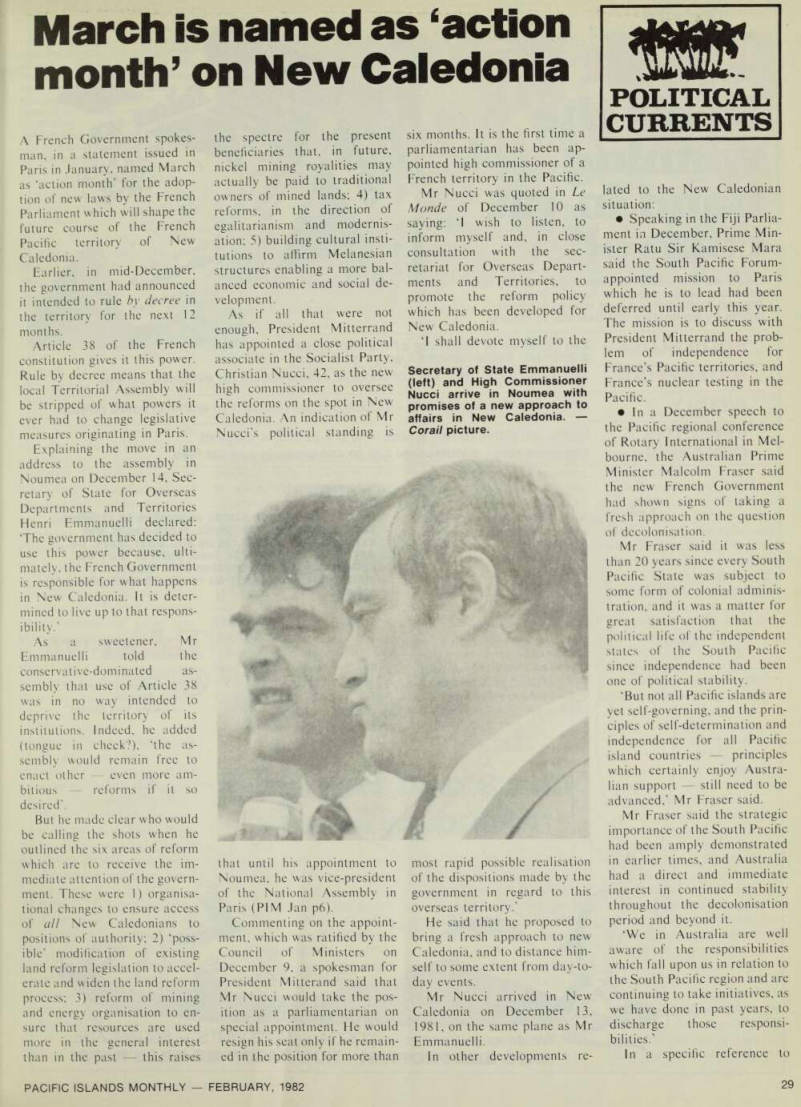

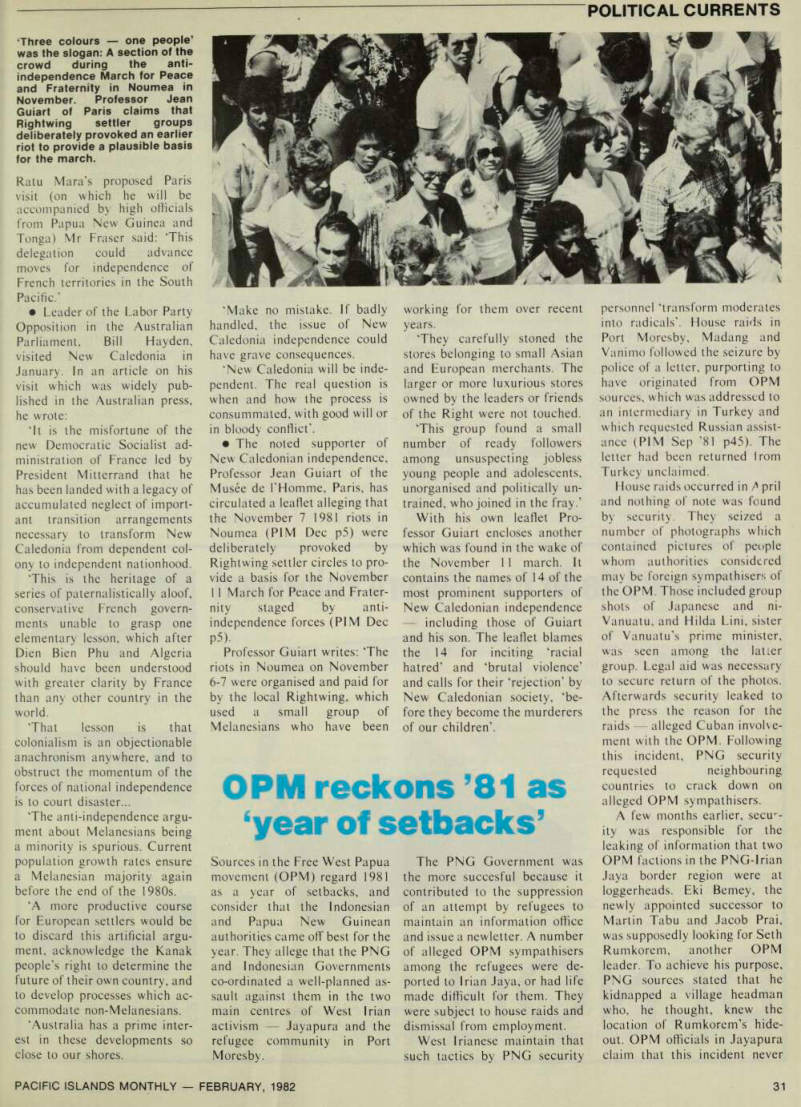
March is named as ‘action month’ on New Caledonia
Political
Currents
A French Government spokes man, in a statement issued in Paris in January, named March as ‘action month’ for the adop tion of new laws by the French Parliament which will shape the future course of the French Pacific territory of New Caledonia.
Earlier, in mid-December, the government had announced it intended to rule by decree in the territory for the next 12 months.
Article 38 of the French constitution gives it this power.
Rule by decree means that the local Territorial Assembly will be stripped of what powers it ever had to change legislative measures originating in Paris.
Explaining the move in an address to the assembly in Noumea on December 14, Sec retary of State for Overseas Departments and Territories Henri Emmanuelli declared: ‘The government has decided to use this power because, ulti mately, the French Government is responsible for what happens in New Caledonia. It is deter mined to live up to that respons ibility.’
As a sweetener, Mr Emmanuelli told the conservative-dominated as sembly that use of Article 38 was in no way intended to deprive the territory of its institutions. Indeed, he added (tongue in check?). The as sembly would remain free to enact other even more am bitious reforms if it so desired’.
But he made clear who would be calling the shots when he outlined the six areas of reform which are to receive the im mediate attention of the govern ment. These were 1) organisa tional changes to ensure access of all New Caledonians to positions of authority; 2) ‘poss ible’ modification of existing land reform legislation to accel erate and widen the land reform process; 3) reform of mining and energy organisation to en sure that resources are used more in the general interest than in the past this raises
the spectre for the present beneficiaries that, in future, nickel mining royalities may actually be paid to traditional owners of mined lands; 4) tax reforms, in the direction of egalitarianism and modernis ation; 5) building cultural insti tutions to affirm Melanesian structures enabling a more bal anced economic and social de velopment.
As if all that were not enough. President Mitterrand has appointed a close political associate in the Socialist Parly, Christian Nucci, 42, as the new high commissioner to oversee the reforms on the spot in New Caledonia. An indication of Mr Nucci's political standing is
that until his appointment to Noumea, he was vice-president of the National Assembly in Paris (PIM Jan p 6).
Commenting on the appoint ment, which was ratified by the Council of Ministers on December 9, a spokesman for President Mitterand said that Mr Nucci would lake the pos ition as a parliamentarian on special appointment. He would resign his seat only if he remain ed in the position for more than
six months. It is the first time a parliamentarian has been ap pointed high commissioner of a French territory in the Pacific.
Mr Nucci was quoted in Le Monde of December 10 as saying: T wish to listen, to inform myself and, in close consultation with the sec retariat for Overseas Depart ments and Territories, to promote the reform policy which has been developed for New Caledonia. ‘I shall devote myself to the
most rapid possible realisation of the dispositions made by the government in regard to this overseas territory.’
He said that he proposed to bring a fresh approach to new Caledonia, and to distance him self to some extent from day-to day events.
Mr Nucci arrived in New Caledonia on December 13, 1981, on the same plane as Mr Emmanuelli.
In other developments re
lated to the New Caledonian situation; • Speaking in the Fiji Parlia ment in December, Prime Min ister Ratu Sir Kamisese Mara said the South Pacific Forum appointed mission to Paris which he is to lead had been deferred until early this year.
The mission is to discuss with President Mitterrand the prob lem of independence for France’s Pacific territories, and France’s nuclear testing in the Pacific. • In a December speech to the Pacific regional conference of Rotary International in Mel bourne, the Australian Prime Minister Malcolm Fraser said the new French Government had shown signs of taking a fresh approach on the question of decolonisation.
Mr Fraser said it was less than 20 years since every South Pacific State was subject to some form of colonial adminis tration, and it was a matter for great satisfaction that the political life of the independent states of the South Pacific since independence had been one of political stability. ‘But not all Pacific islands are yet self-governing, and the prin ciples of self-determination and independence for all Pacific island countries principles which certainly enjoy Austra lian support still need to be advanced,’ Mr Fraser said.
Mr Fraser said the strategic importance of the South Pacific had been amply demonstrated in earlier limes, and Australia had a direct and immediate interest in continued stability throughout the decolonisation period and beyond it. ‘We in Australia are well aware of the responsibilities which fall upon us in relation to the South Pacific region and are continuing to take initiatives, as we have done in past years, to discharge those responsi bilities.’
In a specific reference to
Secretary of State Emmanuelli (left) and High Commissioner Nucci arrive in Noumea with promises of a new approach to affairs in New Caledonia. - Corail picture.
Ratu Mara’s proposed Paris visit (on which he will be accompanied by high officials from Papua New Guinea and Tonga) Mr Fraser said: This delegation could advance moves for independence of French territories in the South Pacific.’ • Leader of the Labor Party Opposition in the Australian Parliament, Bill Hayden, visited New Caledonia in January. In an article on his visit which was widely pub lished in the Australian press, he wrote: ‘lt is the misfortune of the new Democratic Socialist ad ministration of France led by President Mitterrand that he has been landed with a legacy of accumulated neglect of import ant transition arrangements necessary to transform New Caledonia from dependent col ony to independent nationhood.
This is the heritage of a series of paternalistically aloof, conservative French govern ments unable to grasp one elementary lesson, which after Dien Bien Phu and Algeria should have been understood with greater clarity by France than any other country in the world.
That lesson is that colonialism is an objectionable anachronism anywhere, and to obstruct the momentum of the forces of national independence is to court disaster...
The anti-independence argu ment about Melanesians being a minority is spurious. Current population growth rales ensure a Melanesian majority again before the end of the 1980 s. ‘A more productive course for European settlers would be to discard this artificial argu ment, acknowledge the Kanak people’s right to determine the future of their own country, and to develop processes which ac commodate non-Melanesians. ‘Australia has a prime inter est in these developments so close to our shores.
‘Make no mistake. If badly handled, the issue of New Caledonia independence could have grave consequences. ‘New Caledonia will be inde pendent. The real question is when and how the process is consummated, with good will or in bloody conflict’. • The noted supporter of New Caledonian independence.
Professor Jean Guiart of the Musee de I’Homme, Paris, has circulated a leaflet alleging that the November 7 1981 riots in Noumea (PIM Dec p 5) were deliberately provoked by Righlwing settler circles to pro vide a basis for the November 11 March for Peace and Frater nity staged by anti independence forces (PIM Dec p 5).
Professor Guiart writes; The riots in Noumea on November 6-7 were organised and paid for by the local Rightwing, which used a small group of Melanesians who have been
working for them over recent years.
They carefully stoned the stores belonging to small Asian and European merchants. The larger or more luxurious stores owned by the leaders or friends of the Right were not touched.
This group found a small number of ready followers among unsuspecting jobless young people and adolescents, unorganised and politically un trained, who joined in the fray.’
With his own leaflet Pro fessor Guiart encloses another which was found in the wake of the November 11 march. It contains the names of 14 of the most prominent supporters of New Caledonian independence including those of Guiart and his son. The leaflet blames the 14 for inciting ‘racial hatred’ and ‘brutal violence’ and calls for their ‘rejection’ by New Caledonian society, ‘be fore they become the murderers of our children’.
‘Three colours - one people’ was the slogan: A section of the crowd during the anti independence March for Peace and Fraternity in Noumea in November. Professor Jean Guiart of Paris claims that Rightwing settler groups deliberately provoked an earlier riot to provide a plausible basis for the march.
Advertisements & other items, p. 30 (1 item)
Tdon wb
to 6- & Sr Si®*, c o *<* p «Qo
Deals the
winning
hand in rat
control!
TALON WB Is a world breakthrough In killing rats and mice. Developed by ICI Tasman In New Zealand TALON WB is a sure way to increase profits by eliminating RAT DAMAGE TO CROPS!
SOLID BLOCKS Can be wired or nailed out of reach of children & animals. Easily handled - won't blow away.
WATERPROOF Safe year round use - will not dissolve, resists mould for extended periods.
DEADLY
Kills even the toughest rats - Including those resistant to warfarin based poisons.
EFFECTIVE
POWERFUL
Highly attractive to rats & mice - no pre-baiting is required.
Kills more rats - a lethal dose can be consumed In a single feed.
Do not lay baits In places accessible to children, / \ pets and domestic animals, wash hands and / 4r„ exposed skin before meals and after work. Do not store near food or feed. Bum or bury all * rodent bodies and uneaten bait. Empty / containers should not be re-used but disposed of / / safely.
■ Talon wb
\C\S A Product of IC4 Tasman Limited P.O. Box 900, Auckland, New Zealand
WARNING
U 1 ' f £ Whatever your crops COCOA COCONUTS SUGARCANE.
RATS Kll.l. PROFITS! NOW TALON WB KILLS RATS!
‘year of setbacks’
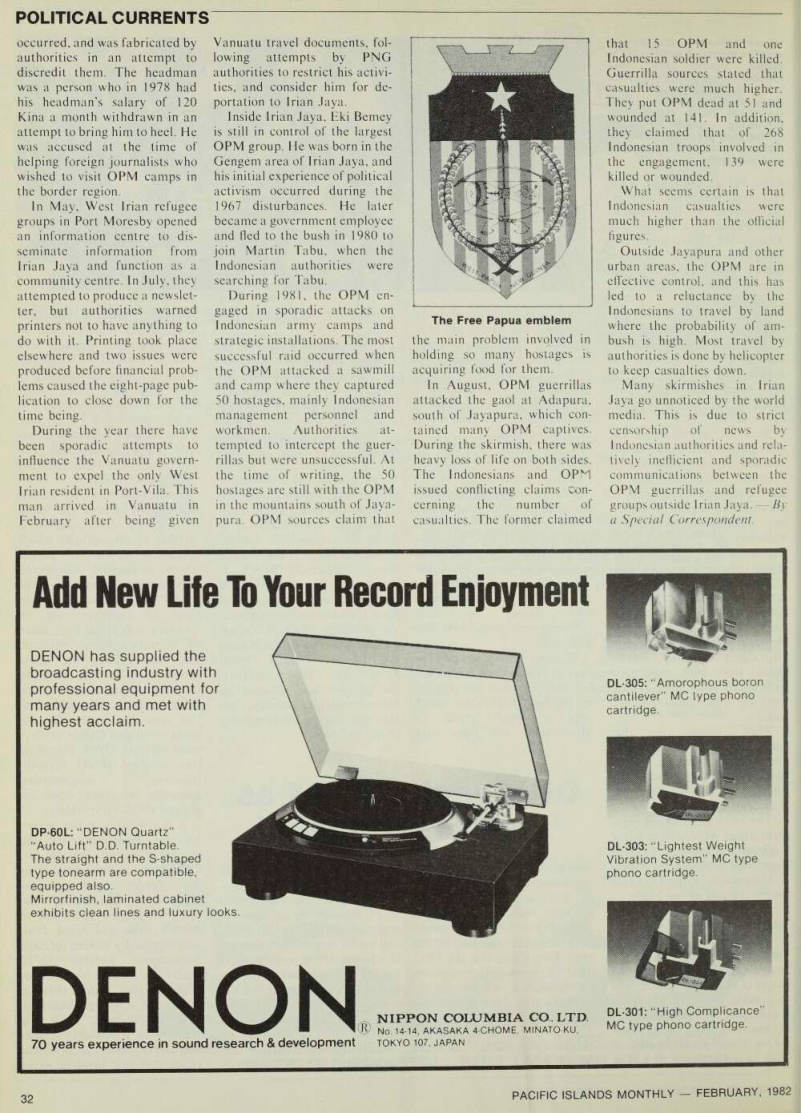
OPM reckons ’81 as ‘year of setbacks’
Sources in the Free West Papua movement (OPM) regard 1981 as a year of setbacks, and consider that the Indonesian and Papua New Guinean authorities came off best for the year. They allege that the PNG and Indonesian Governments co-ordinated a well-planned as sault against them in the two main centres of West Irian activism Jayapura and the refugee community in Port Moresby.
The PNG Government was the more succesful because it contributed to the suppression of an attempt by refugees to maintain an information office and issue a ncwletler. A number of alleged OPM sympathisers among the refugees were de ported to Irian Jaya, or had life made difficult for them. They were subject to house raids and dismissal from employment.
West Irianese maintain that such tactics by PNG security
personnel ‘transform moderates into radicals’. House raids in Port Moresby, Madang and Vanimo followed the seizure by police of a letter, purporting to have originated from OPM sources, which was addressed to an intermediary in Turkey and which requested Russian assist ance (PIM Sep ’Bl p 45). The letter had been returned Irom Turkey unclaimed.
House raids occurred in A pril and nothing of note was found by security. They seized a number of photographs which contained pictures of people whom authorities considered may be foreign sympathisers of the OPM. Those included group shots of Japanese and ni- Vanuatu, and Hilda Lini, sister of Vanuatu’s prime minister, was seen among the latter group. Legal aid was necessary to secure return of the photos.
Afterwards security leaked to the press the reason for the raids alleged Cuban involve ment with the OPM. Following this incident, PNG security requested neighbouring countries to crack down on alleged OPM sympathisers.
A few months earlier, secur ity was responsible for the leaking of information that two OPM factions in the PNG-Irian Jaya border region were at loggerheads. Eki Bemey, the newly appointed successor to Martin Tabu and Jacob Prai, was supposedly looking for Seth Rumkorem, another OPM leader. To achieve his purpose, PNG sources stated that he kidnapped a village headman who, he thought, knew the location of Rumkorem’s hide out. OPM officials in Jayapura claim that this incident never
occurred, and was fabricated by authorities in an attempt to discredit them. The headman was a person who in 1978 had his headman’s salary of 120 Kina a month withdrawn in an attempt to bring him to heel. He was accused at the time of helping foreign journalists who wished to visit OPM camps in the border region.
In May, West Irian refugee groups in Port Moresby opened an information centre to dis seminate information from Irian Jaya and function as a community centre. In July, they attempted to produce a newslet ter, but authorities warned printers not to have anything to do with it. Printing took place elsewhere and two issues were produced before financial prob lems caused the eight-page pub lication to close down for the time being.
During the year there have been sporadic attempts to influence the Vanuatu govern ment to expel the only West Irian resident in Porl-Vila. This man arrived in Vanuatu in February after being given
Vanuatu travel documents, fol lowing attempts by PNG authorities to restrict his activi ties, and consider him for de portation to Irian Jaya.
Inside Irian Jaya, Eki Bemey is still in control of the largest OPM group. He was born in the Gengem area of Irian Jaya, and his initial experience of political activism occurred during the 1967 disturbances. He later became a government employee and fled to the bush in 1980 to join Martin Tabu, when the Indonesian authorities were searching for Tabu.
During 1981, the OPM en gaged in sporadic attacks on Indonesian army camps and strategic installations. The most successful raid occurred when the OPM attacked a sawmill and camp where they captured 50 hostages, mainly Indonesian management personnel and workmen. Authorities at tempted to intercept the guer rillas but were unsuccessful. At the time of writing, the 50 hostages are still with the OPM in the mountains south of Jaya pura. OPM sources claim that
the main problem involved in holding so many hostages is acquiring food for them.
In August, OPM guerrillas attacked the gaol at Adapura, south of Jayapura, which con tained many OPM captives.
During the skirmish, there was heavy loss of life on both sides.
The Indonesians and OPM issued conflicting claims con cerning the number of casualties. The former claimed
that 15 OPM and one Indonesian soldier were killed.
Guerrilla sources stated that casualties were much higher.
They pul OPM dead at 51 and wounded at 141. In addition, they claimed that of 268 Indonesian troops involved in the engagement, 139 were killed or wounded.
What seems certain is that Indonesian casualties were much higher than the official figures.
Outside Jayapura and other urban areas, the OPM are in effective control, and this has led to a reluctance by the Indonesians to travel by land where the probability of am bush is high. Most travel by authorities is done by helicopter to keep casualties down.
Many skirmishes in Irian Jaya go unnoticed by the world media. This is due to strict censorship of news by Indonesian authorities and rela tively inefficient and sporadic communications between the OPM guerrillas and refugee groups outside Irian Jaya. By a Special Correspondent.
The Free Papua emblem
Advertisements & other items, p. 32 (1 item)
Demon
Add New Life To Your Record Enjoyment DEMON has supplied the broadcasting industry with professional equipment for many years and met with highest acclaim.
DP-60L: “DEMON Quartz”
“Auto Lift” D.D. Turntable.
The straight and the S-shaped type tonearm are compatible, equipped also.
Mirrorfinish, laminated cabinet exhibits clean lines and luxury looks.
DEMON
70 years experience in sound research & development
NIPPON COLUMBIA CO LTD
No. 14-14, AKASAKA 4-CHOME, MINATO-KU,
TOKYO 107, JAPAN
DL-305: “Amorophous boron cantilever” MC type phono cartridge.
DL-303; “Lightest Weight Vibration System” MC type phono cartridge.
DL-301: “High Complicance”
MC type phono cartridge.
Prisoners - and two
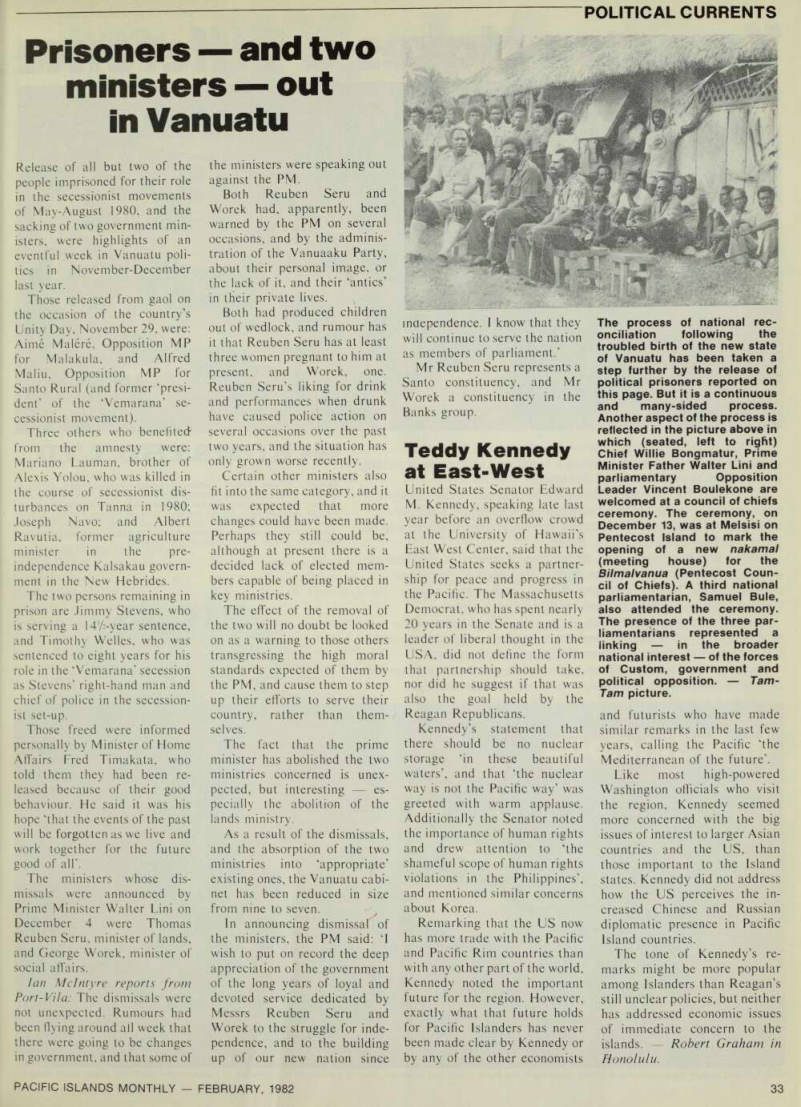
ministers - out in Vanuatu
Release of all but two of the people imprisoned for their role in the secessionist movements of May-August 1980, and the sacking of two government min isters, were highlights of an eventful week in Vanuatu poli tics in November-December last year.
Those released from gaol on the occasion of the country’s Unity Day, November 29, were: Aime Malere, Opposition MP for Malakula, and Alfred Maliu, Opposition MP for Santo Rural (and former ‘presi dent’ of the ‘Vemarana’ se cessionist movement).
Three others who benefited from the amnesty were: Mariano Lauman, brother of Alexis Yolou, who was killed in the course of secessionist dis turbances on Tanna in 1980; Joseph Navo; and Albert Ravutia, former agriculture minister in the pre independence Kalsakau govern ment in the New Hebrides.
The two persons remaining in prison are Jimmy Stevens, who is serving a !4‘/>year sentence, and Timothy Welles, who was sentenced to eight years for his role in the ‘Vemarana’ secession as Stevens’ right-hand man and chief of police in the secession ist set-up.
Those freed were informed personally by Minister of Home Affairs Fred Timakata, who told them they had been re leased because of their good behaviour. He said it was his hope ‘that the events of the past will be forgotten as we live and work together for the future good of all’.
The ministers whose dis missals were announced by Prime Minister Walter Lini on December 4 were Thomas Reuben Seru, minister of lands, and George Worek, minister of social affairs. lan Mclntyre reports from Port-Vila; The dismissals were not unexpected. Rumours had been flying around all week that there were going to be changes in government, and that some of
the ministers were speaking out against the PM.
Both Reuben Seru and Worek had, apparently, been warned by the PM on several occasions, and by the adminis tration of the Vanuaaku Party, about their personal image, or the lack of it, and their ‘antics’ in their private lives.
Both had produced children out of wedlock, and rumour has it that Reuben Seru has at least three women pregnant to him at present, and Worek, one.
Reuben Seru’s liking for drink and performances when drunk have caused police action on several occasions over the past two years, and the situation has only grown worse recently.
Certain other ministers also fit into the same category, and it was expected that more changes could have been made.
Perhaps they still could be, although at present there is a decided lack of elected mem bers capable of being placed in key ministries.
The effect of the removal of the two will no doubt be looked on as a warning to those others transgressing the high moral standards expected of them by the PM, and cause them to step up their efforts to serve their country, rather than them selves.
The fact that the prime minister has abolished the two ministries concerned is unex pected, but interesting es pecially the abolition of the lands ministry.
As a result of the dismissals, and the absorption of the two ministries into ‘appropriate’ existing ones, the Vanuatu cabi net has been reduced in size from nine to seven.
In announcing dismissal - of the ministers, the PM said: ‘I wish to pul on record the deep appreciation of the government of the long years of loyal and devoted service dedicated by Messrs Reuben Seru and Worek to the struggle for inde pendence, and to the building up of our new nation since
independence. I know that they will continue to serve the nation as members of parliament.’
Mr Reuben Seru represents a Santo constituency, and Mr Worek a constituency in the Banks group.
Teddy Kennedy
at East-West
United States Senator Edward M. Kennedy, speaking late last year before an overflow crowd at the University of Hawaii’s East West Center, said that the United States seeks a partner ship for peace and progress in the Pacific. The Massachusetts Democrat, who has spent nearly 20 years in the Senate and is a leader of liberal thought in the USA, did not define the form that partnership should lake, nor did he suggest if that was also the goal held by the Reagan Republicans.
Kennedy’s statement that there should be no nuclear storage ‘in these beautiful waters’, and that ‘the nuclear way is not the Pacific way’ was greeted with warm applause.
Additionally the Senator noted the importance of human rights and drew attention to ‘the shameful scope of human rights violations in the Philippines’, and mentioned similar concerns about Korea.
Remarking that the US now has more trade with the Pacific and Pacific Rim countries than with any other part of the world, Kennedy noted the important future for the region. However, exactly what that future holds for Pacific Islanders has never been made clear by Kennedy or by any of the other economists
and futurists who have made similar remarks in the last few years, calling the Pacific ‘the Mediterranean of the future’.
Like most high-powered Washington officials who visit the region, Kennedy seemed more concerned with the big issues of interest to larger Asian countries and the US, than those important to the Island states. Kennedy did not address how the US perceives the in creased Chinese and Russian diplomatic presence in Pacific Island countries.
The tone of Kennedy’s re marks might be more popular among Islanders than Reagan’s still unclear policies, but neither has addressed economic issues of immediate concern to the
islands.
- Robert Graham in
Honolulu.
The process of national rec onciliation following the troubled birth of the new state of Vanuatu has been taken a step further by the release of
political prisoners reported on
this page. But it is a continuous and many-sided process.
Another aspect of the process is reflected in the picture above in which (seated, left to right) Chief Willie Bongmatur, Prime Minister Father Walter Lini and
parliamentary Opposition
Leader Vincent Boulekone are welcomed at a council of chiefs ceremony. The ceremony, on December 13, was at Melsisi on Pentecost Island to mark the opening of a new nakamal (meeting house) for the Bilmalvanua (Pentecost Coun cil of Chiefs). A third national parliamentarian, Samuel Buie, also attended the ceremony.
The presence of the three par liamentarians represented a
linking - in the broader
national interest - of the forces of Custom, government and
political opposition. - Tam-
Tam picture.
Advertisements & other items, p. 34 (1 item)
Komatsu flakes a Difference
-KSfi
V u V -1c In critical areas like reliability and performance, Komatsu products and systems are making a significant difference at mining and construction sites around the world.
In the GSA, for example, Komatsu’s largest and most powerful work machine the D455A bulldozer is establishing a superior record of reliability and productivity at mining sites that virtually no other machine in its class can match.
And in another critical area, technology, Komatsu is also making a difference in responding to market demands for improved product quality, and for new and original product innovations.
Consider our new computerized seabed robot system: Operating on the ocean floor, it can relay TV pictures of the seabed to a mother ship, or perform man-like boring, drilling and piling operations down to planned depths of 500 meters.* Discover the Komatsu difference above sea level, or down to depths of 500 meters. Komatsu a name you can build on.
•H KOMATSU LTD
Tokyo, Japan Komatsu offices: Tokyo, Sydney, Singapore, Jakarta, Manila, Bangkok, Bangalore, Karachi, Beijing, Istanbul, Cairo, Alger, Dubai, Tehran, Baghdad, Jeddah, Riyadh, Damman, Nairobi, Abidjan, Lagos, Johannesburg, Moscow, Warsaw, Brussels, Paris, Madrid, Frankfurt, Stuttgart, London, Habana, Buenos Aires, Panama, Caracas, Sao Paulo, Bogota, Mexico City, San Francisco, Oakland, Philadelphia, Detroit, Dallas, Atlanta, Chicago, Toronto, Vancouver, and distributors in over 100 countries around the world.
IL-3 i system is currendy operating ,n me Japan In,and Sea a, depths down ,o a maximum of 70 meters, ,n a government-sponsored bridge works programn
People
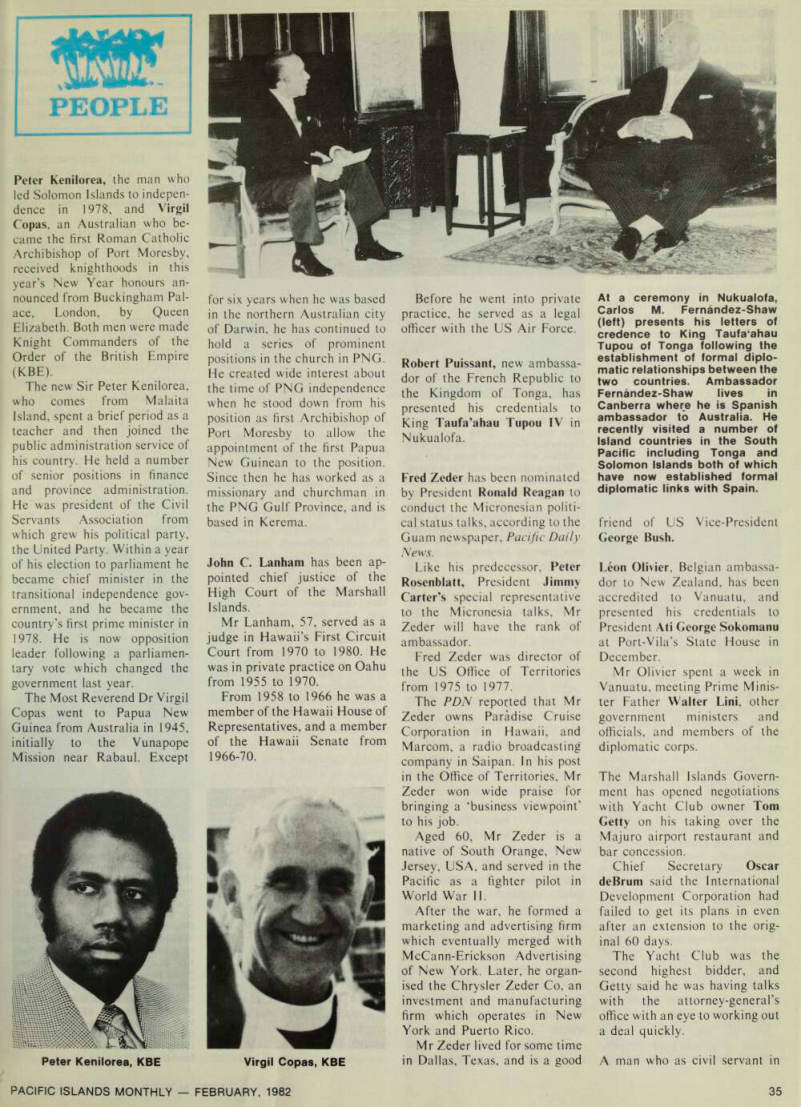
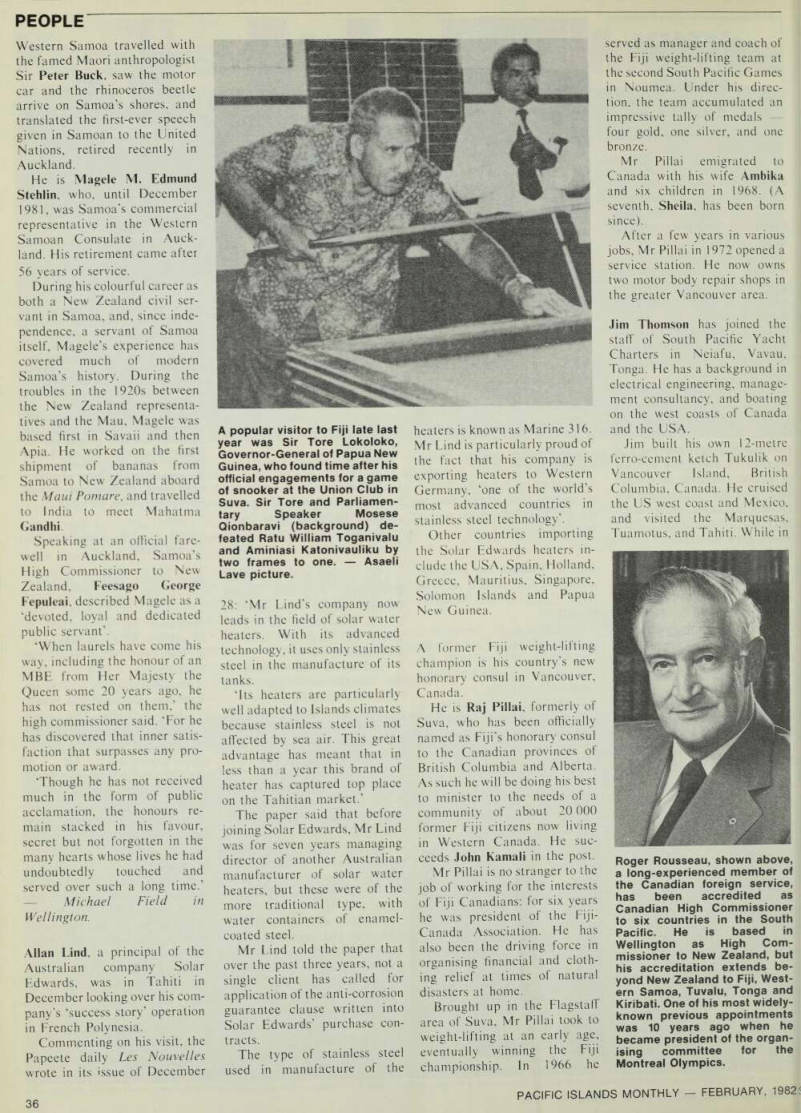
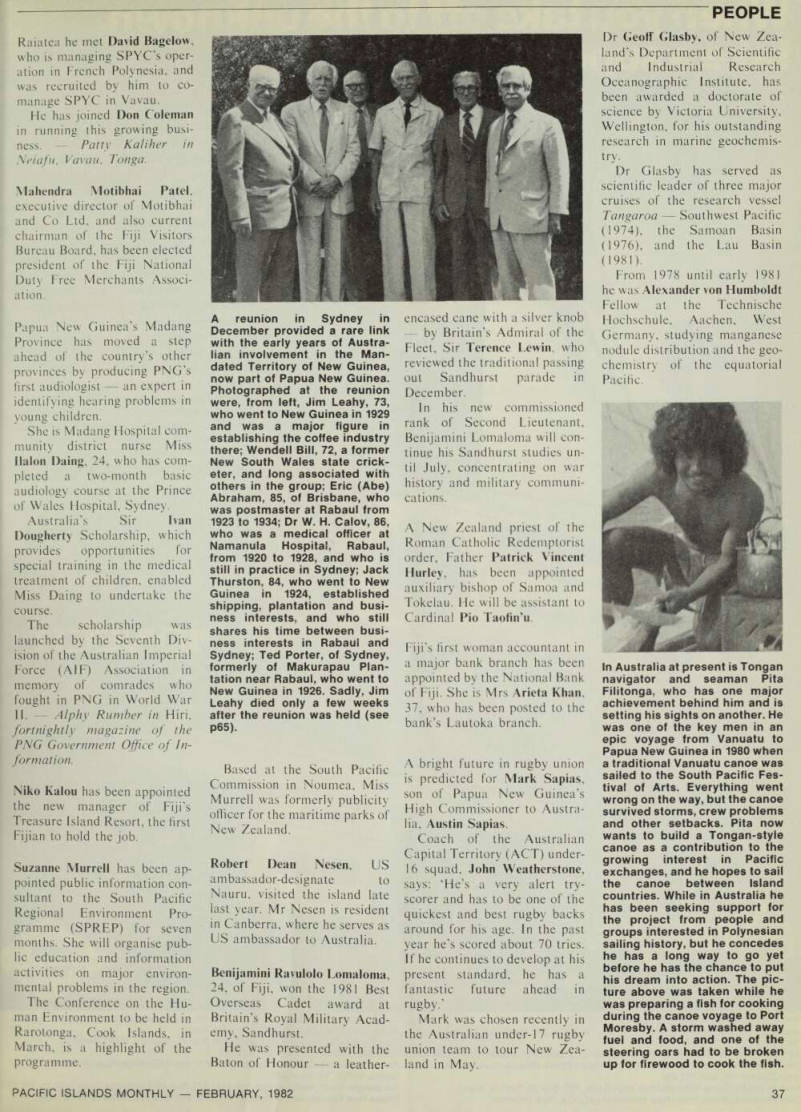
Peter Kenilorea, the man who led Solomon Islands to indepen dence in 1978, and Virgil Copas, an Australian who be came the first Roman Catholic Archibishop of Port Moresby, received knighthoods in this year’s New Year honours an nounced from Buckingham Pal ace, London, by Queen Elizabeth. Both men were made Knight Commanders of the Order of the British Empire
(Kbe).
The new Sir Peter Kenilorea, who comes from Malaita Island, spent a brief period as a teacher and then joined the public administration service of his country. He held a number of senior positions in finance and province administration.
He was president of the Civil Servants Association from which grew his political party, the United Party. Within a year of his election to parliament he became chief minister in the transitional independence gov ernment, and he became the country’s first prime minister in 1978. He is now opposition leader following a parliamen tary vote which changed the government last year.
The Most Reverend Dr Virgil Copas went to Papua New Guinea from Australia in 1945, initially to the Vunapope Mission near Rabaul. Except
for six years when he was based in the northern Australian city of Darwin, he has continued to hold a series of prominent positions in the church in PNG.
He created wide interest about the time of PNG independence when he stood down from his position as first Archibishop of Port Moresby to allow the appointment of the first Papua New Guinean to the position.
Since then he has worked as a missionary and churchman in the PNG Gulf Province, and is based in Kerema.
John C. Lanham has been ap pointed chief justice of the High Court of the Marshall Islands.
Mr Lanham, 57, served as a judge in Hawaii’s First Circuit Court from 1970 to 1980. He was in private practice on Oahu from 1955 to 1970.
From 1958 to 1966 he was a member of the Hawaii House of Representatives, and a member of the Hawaii Senate from 1966-70.
Before he went into private practice, he served as a legal officer with the US Air Force.
Robert Puissant, new ambassa dor of the French Republic to the Kingdom of Tonga, has presented his credentials to King Taufa’ahau Tupou IV in Nukualofa.
Fred Zeder has been nominated by President Ronald Reagan to conduct the Micronesian politi cal status talks, according to the Guam newspaper. Pacific Daily News.
Like his predecessor, Peter Rosenblatt, President Jimmy Carter’s special representative to the Micronesia talks, Mr Zeder will have the rank of ambassador.
Fred Zeder was director of the US Office of Territories from 1975 to 1977.
The PDN reported that Mr Zeder owns Paradise Cruise Corporation in Hawaii, and Marcom, a radio broadcasting company in Saipan. In his post in the Office of Territories, Mr Zeder won wide praise for bringing a ‘business viewpoint’ to his job.
Aged 60, Mr Zeder is a native of South Orange, New Jersey, USA, and served in the Pacific as a fighter pilot in World War 11.
After the war, he formed a marketing and advertising firm which eventually merged with McCann-Erickson Advertising of New York. Later, he organ ised the Chrysler Zeder Co, an investment and manufacturing firm which operates in New York and Puerto Rico.
Mr Zeder lived for some time in Dallas, Texas, and is a good
friend of US Vice-President George Bush.
Leon Olivier, Belgian ambassa dor to New Zealand, has been accredited to Vanuatu, and presented his credentials to President Ati George Sokomanu at Porl-Vila’s State House in December.
Mr Olivier spent a week in Vanuatu, meeting Prime Minis ter Father Walter Lini, other government ministers and officials, and members of the diplomatic corps.
The Marshall Islands Govern ment has opened negotiations with Yacht Club owner Tom Getty on his taking over the Majuro airport restaurant and bar concession.
Chief Secretary Oscar deßrum said the International Development Corporation had failed to gel its plans in even after an extension to the orig inal 60 days.
The Yacht Club was the second highest bidder, and Getty said he was having talks with the attorney-general’s office with an eye to working out a deal quickly.
A man who as civil servant in
Peter Kenilorea, KBE
Virgil Copas, KBE
At a ceremony in Nukualofa, Carlos M. Fernandez-Shaw (left) presents his letters of credence to King Taufa‘ahau Tupou of Tonga following the establishment of formal diplo matic relationships between the two countries. Ambassador Fernandez-Shaw lives in Canberra where he is Spanish ambassador to Australia. He recently visited a number of Island countries in the South Pacific including Tonga and Solomon Islands both of which have now established formal diplomatic links with Spain.
Western Samoa travelled with the famed Maori anthropologist Sir Peter Buck, saw the motor car and the rhinoceros beetle arrive on Samoa’s shores, and translated the first-ever speech given in Samoan to the United Nations, retired recently in Auckland.
He is Magele M. Edmund Stehlin, who, until December 1981, was Samoa’s commercial representative in the Western Samoan Consulate in Auck land. His retirement came after 56 years of service.
During his colourful career as both a New Zealand civil ser vant in Samoa, and, since inde pendence, a servant of Samoa itself, Magele’s experience has covered much of modern Samoa’s history. During the troubles in the 1920 s between the New Zealand representa tives and the Mau, Magele was based first in Savaii and then Apia. He worked on the first shipment of bananas from Samoa to New Zealand aboard the Maui Pomare, and travelled to India to meet Mahatma Gandhi.
Speaking at an official fare well in Auckland, Samoa’s High Commissioner to New Zealand, Feesago George Fepuleai, described Magele as a ‘devoted, loyal and dedicated public servant’. ‘When laurels have come his way, including the honour of an MBE from Her Majesty the Queen some 20 years ago, he has not rested on them,’ the high commissioner said. ‘For he has discovered that inner satis faction that surpasses any pro motion or award. ‘Though he has not received much in the form of public acclamation, the honours re main stacked in his favour, secret but not forgotten in the many hearts whose lives he had undoubtedly touched and served over such a long time.’
Michael Field in Wellington.
Allan Lind, a principal of the Australian company Solar Edwards, was in Tahiti in December looking over his com pany’s ‘success story’ operation in French Polynesia.
Commenting on his visit, the Papeete daily Les Nouvelles wrote in its Issue of December
28: ‘Mr Lind’s company now leads in the field of solar water heaters. With its advanced technology, it uses only stainless steel in the manufacture of its tanks. ‘lts heaters are particularly well adapted to Islands climates because stainless steel is not affected by sea air. This great advantage has meant that in less than a year this brand of heater has captured top place on the Tahitian market.’
The paper said that before joining Solar Edwards, Mr Lind was for seven years managing director of another Australian manufacturer of solar water heaters, but these were of the more traditional type, with water containers of enamel coated steel.
Mr Lind told the paper that over the past three years, not a single client has called for application of the anti-corrosion guarantee clause written into Solar Edwards’ purchase con tracts.
The type of stainless steel used in manufacture of the
heaters is known as Marine 316.
Mr Lind is particularly proud of the fact that his company is exporting heaters to Western Germany, ‘one of the world’s most advanced countries in stainless steel technology’.
Other countries importing the Solar Edwards heaters in clude the USA, Spain. Holland, Greece, Mauritius, Singapore, Solomon Islands and Papua New Guinea.
A former Fiji weight-lifting champion is his country’s new honorary consul in Vancouver, Canada.
He is Raj Pillai, formerly of Suva, who has been officially named as Fiji’s honorary consul to the Canadian provinces of British Columbia and Alberta.
As such he will be doing his best to minister to the needs of a community of about 20 000 former Fiji citizens now living in Western Canada. He suc ceeds John Kamali in the post.
Mr Pillai is no stranger to the job of working for the interests of Fiji Canadians: for six years he was president of the Fiji- Canada Association. He has also been the driving force in organising financial and cloth ing relief at times of natural disasters at home.
Brought up in the Flagstaff area of Suva, Mr Pillai look to weight-lifting at an early age, eventually winning the Fiji championship. In 1966 he
served as manager and coach of the Fiji weight-lifting team at the second South Pacific Games in Noumea. Under his direc tion, the team accumulated an impressive tally of medals four gold, one silver, and one bronze.
Mr Pillai emigrated to Canada with his wife Ambika and six children in 1968. (A seventh, Sheila, has been born since).
After a few years in various jobs, Mr Pillai in 1972 opened a service station. He now owns two motor body repair shops in the greater Vancouver area.
Jim Thomson has joined the staff of South Pacific Yacht Charters in Neiafu, Vavau, Tonga. He has a background in electrical engineering, manage ment consultancy, and boating on the west coasts of Canada and the USA.
Jim built his own 12-metre ferro-ccment ketch Tukulik on Vancouver Island, British Columbia, Canada. He cruised the US west coast and Mexico, and visited the Marquesas, Tuamolus, and Tahiti. While in
A popular visitor to Fiji late last year was Sir Tore Lokoloko, Governor-General of Papua New Guinea, who found time after his official engagements for a game of snooker at the Union Club in Suva. Sir Tore and Parliamen tary Speaker Mosese Qionbaravi (background) de feated Ratu William Toganivalu and Aminiasi Katonivauliku by two frames to one. - Asaeli Lave picture.
Roger Rousseau, shown above, a long-experienced member of the Canadian foreign service, has been accredited as Canadian High Commissioner to six countries in the South Pacific. He is based in Wellington as High Com missioner to New Zealand, but his accreditation extends be yond New Zealand to Fiji, West ern Samoa, Tuvalu, Tonga and Kiribati. One of his most widely
known previous appointments
was 10 years ago when he became president of the organ ising committee for the Montreal Olympics.
Raiatea he met Da\id Bagelow. who is managing SPYC’s oper ation in French Polynesia, and was recruited by him to co manage SPYC in Vavau.
He has joined Don Coleman in running this growing busi ness. Patty Kaliher in Neiafu, Vavau . Tonga.
Mahendra Motibhai Patel, executive director of Motibhai and Co Ltd, and also current chairman of the Fiji Visitors Bureau Board, has been elected president of the Fiji National Duty Free Merchants Associ ation.
Papua New Guinea’s Madang Province has moved a step ahead of the country’s other provinces by producing PNG’s first audiologist an expert in identifying hearing problems in young children.
She is Madang Hospital com munity district nurse Miss Ilalon Daing, 24, who has com pleted a two-month basic audiology course at the Prince of Wales Hospital, Sydney.
Australia’s Sir Ivan Dougherty Scholarship, which provides opportunities for special training in the medical treatment of children, enabled Miss Daing to undertake the course.
The scholarship was launched by the Seventh Div ision of the Australian Imperial Force (AIF) Association in memory of comrades who fought in PNG in World War IF Alphy Rumber in Hiri. fortnightly magazine of the PNG Government Office of In formation.
Niko Kalou has been appointed the new manager of Fiji’s Treasure Island Resort, the first Fijian to hold the job.
Suzanne Murrell has been ap pointed public information con sultant to the South Pacific Regional Environment Pro gramme (SPREP) for seven months. She will organise pub lic education and information activities on major environ mental problems in the region.
The Conference on the Hu man Environment to be held in Rarotonga, Cook Islands, in March, is a highlight of the programme.
Based at the South Pacific Commission in Noumea, Miss Murrell was formerly publicity officer for the maritime parks of New Zealand.
Robert Dean Nesen, US
ambassador-designate to
Nauru, visited the island late last year. Mr Nesen is resident in Canberra, where he serves as US ambassador to Australia.
Benijamini Ravulolo Lomaloma, 24, of Fiji, won the 1981 Best Overseas Cadet award at Britain’s Royal Military Acad emy, Sandhurst.
He was presented with the Baton of Honour a leather
encased cane with a silver knob by Britain’s Admiral of the Fleet, Sir Terence Lewin, who reviewed the traditional passing out Sandhurst parade in December.
In his new commissioned rank of Second Lieutenant, Benijamini Lomaloma will con tinue his Sandhurst studies un til July, concentrating on war history and military communi cations.
A New Zealand priest of the Roman Catholic Rcdemplorisl order. Father Patrick Vincent Hurley, has been appointed auxiliary bishop of Samoa and Tokelau. He will be assistant to Cardinal Pio Taofin'u Fiji's first woman accountant in a major bank branch has been appointed by the National Bank of Fiji. She is Mrs Arieta Khan. 37, who has been posted to the bank’s Lautoka branch.
A bright future in rugby union is predicted for Mark Sapias, son of Papua New Guinea’s High Commissioner to Austra lia, Austin Sapias.
Coach of the Australian Capital Territory (ACT) under -16 squad. John Weatherstone, says: ‘He’s a very alert try scorer and has to be one of the quickest and best rugby backs around for his age. In the past year he’s scored about 70 tries.
If he continues to develop at his present standard, he has a fantastic future ahead in rugby.’
Mark was chosen recently in the Australian under-17 rugby union team to tour New Zea land in May.
Dr Geoff Glasby, of New Zea land’s Department of Scientific and Industrial Research Oceanographic Institute, has been awarded a doctorate of science by Victoria University, Wellington, for his outstanding research in marine geochemis try.
Dr Glasby has served as scientific leader of three major cruises of the research vessel Tangaroa Southwest Pacific (1974), the Samoan Basin (1976), and the Lau Basin ( 1981 ).
From 1978 until early 1981 he was Alexander von Humboldt Fellow at the Technische Hochschule, Aachen, West Germany, studying manganese nodule distribution and the geo chemistry of the equatorial Pacific.
A reunion in Sydney in December provided a rare link with the early years of Austra lian involvement in the Man dated Territory of New Guinea, now part of Papua New Guinea.
Photographed at the reunion were, from left, Jim Leahy, 73, who went to New Guinea in 1929 and was a major figure in establishing the coffee industry there; Wendell Bill, 72, a former New South Wales state crick eter, and long associated with others in the group; Eric (Abe) Abraham, 85, of Brisbane, who was postmaster at Rabaul from 1923 to 1934; Dr W. H. Calov, 86, who was a medical officer at Namanula Hospital, Rabaul, from 1920 to 1928, and who is still in practice in Sydney; Jack Thurston, 84, who went to New Guinea in 1924, established shipping, plantation and busi ness interests, and who still shares his time between busi ness interests in Rabaul and Sydney; Ted Porter, of Sydney, formerly of Makurapau Plan tation near Rabaul, who went to New Guinea in 1926. Sadly, Jim Leahy died only a few weeks after the reunion was held (see p65).
In Australia at present is Tongan navigator and seaman Pita Filitonga, who has one major achievement behind him and is setting his sights on another. He was one of the key men in an epic voyage from Vanuatu to Papua New Guinea in 1980 when a traditional Vanuatu canoe was sailed to the South Pacific Fes tival of Arts. Everything went wrong on the way, but the canoe survived storms, crew problems and other setbacks. Pita now wants to build a Tongan-style canoe as a contribution to the growing interest in Pacific exchanges, and he hopes to sail the canoe between Island countries. While in Australia he has been seeking support for the project from people and groups interested in Polynesian sailing history, but he concedes he has a long way to go yet before he has the chance to put his dream into action. The pic ture above was taken while he was preparing a fish for cooking during the canoe voyage to Port Moresby. A storm washed away fuel and food, and one of the steering oars had to be broken up for firewood to cook the fish.
Advertisements & other items, p. 38 (1 item)
take a superstar along.
wnen you take off to the unknown,
Next time you take off for parts unknown, add another dimension to your ventures. The new Sound Trek™
dimension by Pioneer.
A galaxy of out-of-this-world multi-
band (FM/MW/SWVSW 2 ) radio-cassette
recorders designed to put great music
in your orbit.
Pioneer’s advanced hi-fi engineering
and solid audio craftsmanship make these stereo portables sound terrific.
There’s a galaJy of exciting sounds
out there. Go exploring with Sound Trek from-Pioneer. • * • SK-212F. Fashionable, Compact and Convenient.
Streamlined to go wherever you do. And so * light and compact you’ll want to take your Sound Trek everywhere. Loaded with atiigh sensitivity FM tuner, and features, like a handy carrying strap, a choice of 2 bands (FM/AM) and available in a variety of fashionable colors.
SK-404F. Convenient Features for Stereo Fun.
Sound Trek SK-404F gives you a wide choice of convenient features to boost your listening pleasure. Like Pioneer’s exclusive DSS (Direct Source Selector) for instant mode changes (from tape to radio and vice versa). Music Search to automatically find and play the next number on your tape. Also the SK-606F, with the added plus of a digital cfock/timer.
PIONEER
SK-212F
Hi-fi mobility through technology.
SK-404F
Sound Trek portables are displayed only at stores showing the emblem or further Information, please contact; ustralia: Pioneer Marketing Service Pty. Ltd., P.O. Box 317, Mordialloc, Victoria, 3195 51:90-9011 iji Islands: Brijlal & Company, G.P.O. Box No. 362, Suva, Fiji Islands Tel: 22258 ew Zealand; Monaco Distributors Ltd., 30 Pollen Street, Grey Lynn, Auckland, ew Zealand Tel: (09) 762 098 orfolk Island: Burns Philp (Norfolk Island) Ltd., P.O. Box 21, Norfolk Island, ew Hebrides: Burns Philp (New Hebrides) Ltd., Vila, New Hebrides Nauru Island: Jacob Enterprises, P.O. Box No. 4, Republic of Nauru Tahiti: Tahiti Hi-Fi, P.O. Box 848, Papeete, Tahiti New Caledonia; Menard Pacifique Sari, B.P. 3899, Noumea, New Caledonia Tel; 48-24.36 American Samoa: Transpac Corporation, P.O. Box 1477, Pago Pago, American Samoa 96799 Tel: 633-5224 Rarotonga: South Seas International Ltd., P.O. Box 49, Rarotonga, Cook Islands Tel: 2327 Papua New Guinea: Bali Merchants Pty. Ltd., P.O. Box 6103, Boroko Tel; 254887
Sox, surf and sand:
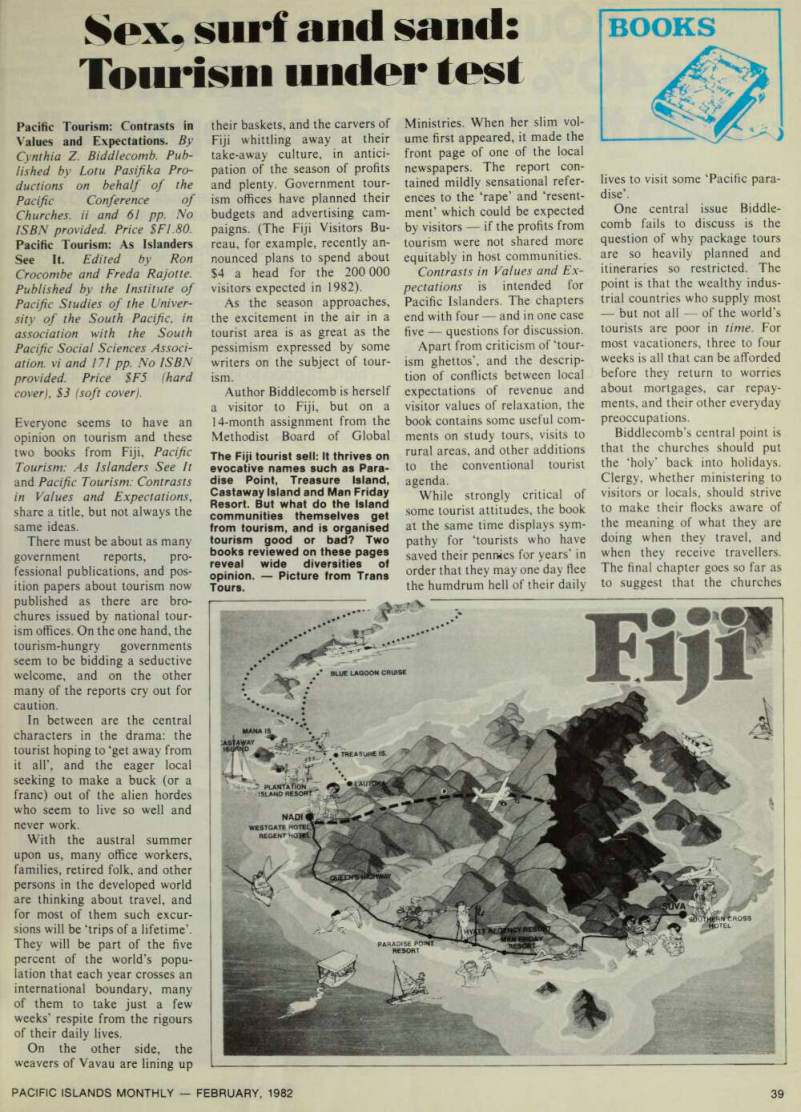
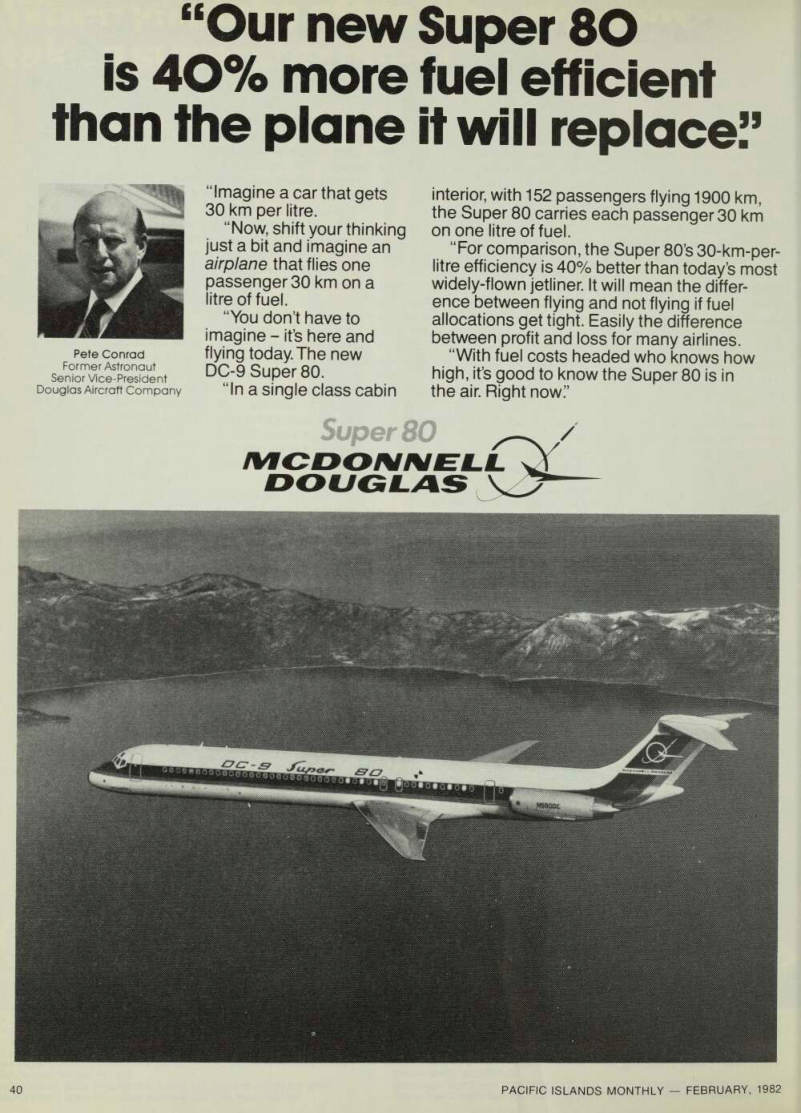
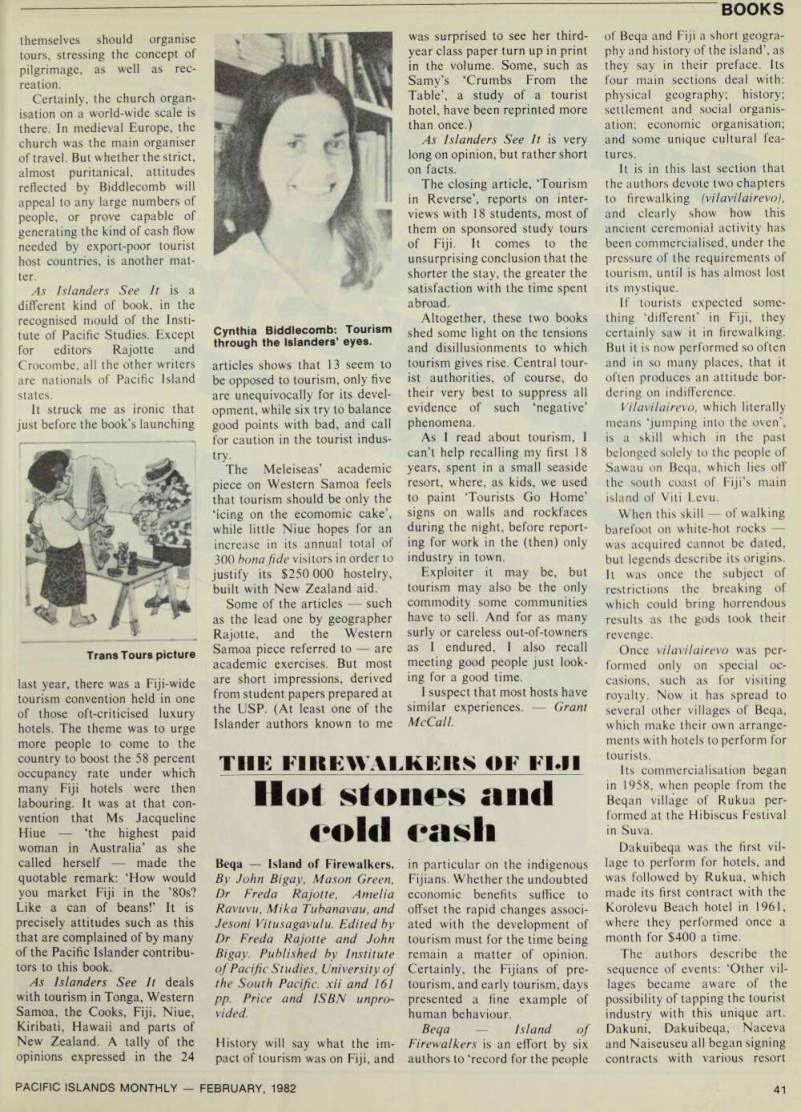
Books
Sox, surf and sand: Tourism under test
Pacific Tourism: Contrasts in Values and Expectations. By Cynthia Z. Biddlecomb. Pub lished by Lotu Pasifika Pro ductions on behalf of the Pacific Conference of Churches, ii and 61 pp. No ISBN provided. Price SFI.BO.
Pacific Tourism: As Islanders See It. Edited by Ron Crocombe and Freda Rajotte.
Published by the Institute of Pacific Studies of the Univer sity of the South Pacific, in association with the South Pacific Social Sciences Associ ation. vi and 171 pp. No ISBN provided. Price SFS (hard cover), $3 (soft cover).
Everyone seems to have an opinion on tourism and these two books from Fiji, Pacific Tourism: As Islanders See It and Pacific Tourism: Contrasts in Values and Expectations , share a title, but not always the same ideas.
There must be about as many government reports, pro fessional publications, and pos ition papers about tourism now published as there are bro chures issued by national tour ism offices. On the one hand, the tourism-hungry governments seem to be bidding a seductive welcome, and on the other many of the reports cry out for caution.
In between are the central characters in the drama: the tourist hoping to ‘get away from it all’, and the eager local seeking to make a buck (or a franc) out of the alien hordes who seem to live so well and never work.
With the austral summer upon us, many office workers, families, retired folk, and other persons in the developed world are thinking about travel, and for most of them such excur sions will be ‘trips of a lifetime’.
They will be part of the five percent of the world’s popu lation that each year crosses an international boundary, many of them to take just a few weeks’ respite from the rigours of their daily lives.
On the other side, the weavers of Vavau are lining up
their baskets, and the carvers of Fiji whittling away at their take-away culture, in antici pation of the season of profits and plenty. Government tour ism offices have planned their budgets and advertising cam paigns. (The Fiji Visitors Bu reau, for example, recently an nounced plans to spend about $4 a head for the 200 000 visitors expected in 1982).
As the season approaches, the excitement in the air in a tourist area is as great as the pessimism expressed by some writers on the subject of tour ism.
Author Biddlecomb is herself a visitor to Fiji, but on a 14-month assignment from the Methodist Board of Global
Ministries. When her slim vol ume first appeared, it made the front page of one of the local newspapers. The report con tained mildly sensational refer ences to the ‘rape’ and ‘resent ment’ which could be expected by visitors if the profits from tourism were not shared more equitably in host communities.
Contrasts in Values and Ex pectations is intended for Pacific Islanders. The chapters end with four and in one case five questions for discussion.
Apart from criticism of ‘tour ism ghettos’, and the descrip tion of conflicts between local expectations of revenue and visitor values of relaxation, the book contains some useful com ments on study tours, visits to rural areas, and other additions to the conventional tourist agenda.
While strongly critical of some tourist attitudes, the book at the same time displays sym pathy for ‘tourists who have saved their pennies for years’ in order that they may one day flee the humdrum hell of their daily
lives to visit some ‘Pacific para dise’.
One central issue Biddle comb fails to discuss is the question of why package tours are so heavily planned and itineraries so restricted. The point is that the wealthy indus trial countries who supply most but not all of the world’s tourists are poor in time. For most vacationers, three to four weeks is all that can be afforded before they return to worries about mortgages, car repay ments, and their other everyday preoccupations.
Biddlecomb’s central point is that the churches should put the ‘holy’ back into holidays.
Clergy, whether ministering to visitors or locals, should strive to make their flocks aware of the meaning of what they are doing when they travel, and when they receive travellers.
The final chapter goes so far as to suggest that the churches
The Fiji tourist sell: It thrives on evocative names such as Para dise Point, Treasure Island, Castaway Island and Man Friday Resort. But what do the Island communities themselves get from tourism, and is organised tourism good or bad? Two books reviewed on these pages reveal wide diversities of opinion. - Picture from Trans Tours.
themselves should organise tours, stressing the concept of pilgrimage, as well as rec reation.
Certainly, the church organ isation on a world-wide scale is there. In medieval Europe, the church was the main organiser of travel. But whether the strict, almost puritanical, attitudes reflected by Biddlecomb will appeal to any large numbers of people, or prove capable of generating the kind of cash flow needed by export-poor tourist host countries, is another mat ter.
As Islanders See It is a different kind of book, in the recognised mould of the Insti tute of Pacific Studies. Except for editors Rajotte and Crocombe, all the other writers are nationals of Pacific Island states.
It struck me as ironic that just before the book’s launching
last year, there was a Fiji-wide tourism convention held in one of those oft-criticised luxury hotels. The theme was to urge more people to come to the country to boost the 58 percent occupancy rate under which many Fiji hotels were then labouring. It was at that con vention that Ms Jacqueline Hiue ‘the highest paid woman in Australia’ as she called herself made the quotable remark: ‘How would you market Fiji in the ’80s?
Like a can of beans!’ It is precisely attitudes such as this that are complained of by many of the Pacific Islander contribu tors to this book.
As Islanders See It deals with tourism in Tonga, Western Samoa, the Cooks, Fiji, Niue, Kiribati, Hawaii and parts of New Zealand. A tally of the opinions expressed in the 24
articles shows that 13 seem to be opposed to tourism, only five are unequivocally for its devel opment, while six try to balance good points with bad, and call for caution in the tourist indus try.
The Meleiseas’ academic piece on Western Samoa feels that tourism should be only the ‘icing on the ecomomic cake’, while little Niue hopes for an increase in its annual total of 300 bona fide visitors in order to justify its $250 000 hostelry, built with New Zealand aid.
Some of the articles such as the lead one by geographer Rajotte, and the Western Samoa piece referred to are academic exercises. But most are short impressions, derived from student papers prepared at the USP. (At least one of the Islander authors known to me
was surprised to see her third year class paper turn up in print in the volume. Some, such as Sarny’s ‘Crumbs From the Table’, a study of a tourist hotel, have been reprinted more than once.) As Islanders See It is very long on opinion, but rather short on facts.
The closing article, ‘Tourism in Reverse’, reports on inter views with 18 students, most of them on sponsored study tours of Fiji. It comes to the unsurprising conclusion that the shorter the stay, the greater the satisfaction with the time spent abroad.
Altogether, these two books shed some light on the tensions and disillusionments to which tourism gives rise. Central tour ist authorities, of course, do their very best to suppress all evidence of such ‘negative’ phenomena.
As I read about tourism, I can’t help recalling my first 18 years, spent in a small seaside resort, where, as kids, we used to paint ‘Tourists Go Home’ signs on walls and rockfaces during the night, before report ing for work in the (then) only industry in town.
Exploiter it may be, but tourism may also be the only commodity some communities have to sell. And for as many surly or careless out-of-towners as I endured, I also recall meeting good people just look ing for a good time.
I suspect that most hosts have
similar experiences.
Grant
McCall.
Trans Tours picture
Cynthia Biddlecomb: Tourism through the Islanders’ eyes.
Advertisements & other items, p. 40 (1 item)
“Our new Super 80
is 40% more fuel efficient
than the plane it will replace.”
Pete Conrad Former Astronaut Senior Vice-President Douglas Aircraft Company “Imagine a car that gets 30 km per litre.
“Now, shift your thinking just a bit and imagine an airplane that flies one passenger 30 km on a litre of fuel.
“You don’t have to imagine - it’s here and flying today. The new DC-9 Super 80.
“In a single class cabin interior, with 152 passengers flying 1900 km, the Super 80 carries each passenger 30 km on one litre of fuel.
“For comparison, the Super 80’s 30-km-perlitre efficiency is 40% better than today’s most widely-flown jetliner. It will mean the difference between flying and not flying if fuel allocations get tight. Easily the difference between profit and loss for many airlines.
“With fuel costs headed who knows how high, it’s good to know the Super 80 is in the air. Right now.” /
/VICDO/V/VELL
DOUGLAS
■ : ; ■ -si m >1: Am m m & I :hhhi - \ <?' * ’
Hot stones and

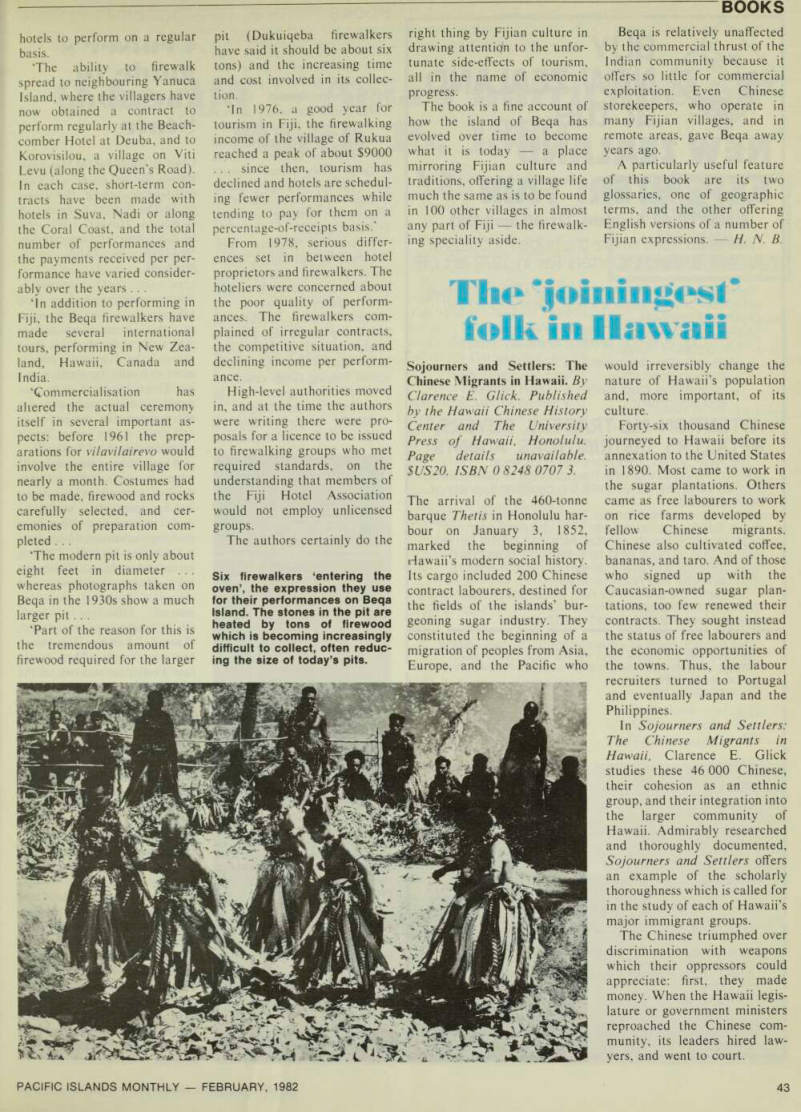
The Firevalkers Of Fiji
Hot stones and cold cash
Beqa Island of Firewalkers.
By John Bigay, Mason Green, Dr Freda Rajotte, Amelia Ravuvu, Mika Tubanavau, and Jesoni Vitusagavulu. Edited by Dr Freda Rajotte and John Bigay. Published by Institute of Pacific Studies, University of the South Pacific, xii and 161 pp. Price and ISBN unpro vided.
History will say what the im pact of tourism was on Fiji, and
in particular on the indigenous Fijians. Whether the undoubted economic benefits suffice to offset the rapid changes associ ated with the development of tourism must for the time being remain a matter of opinion.
Certainly, the Fijians of pre tourism, and early tourism, days presented a fine example of human behaviour.
Beqa Island of Firewalkers is an effort by six authors to ‘record for the people
of Beqa and Fiji a short geogra phy and history of the island’, as they say in their preface. Its four main sections deal with: physical geography; history; settlement and social organis ation; economic organisation; and some unique cultural fea tures.
It is in this last section that the authors devote two chapters to firewalking (vilavilairevo), and clearly show how this ancient ceremonial activity has been commercialised, under the pressure of the requirements of tourism, until is has almost lost its mystique.
If tourists expected some thing ‘different’ in Fiji, they certainly saw it in firewalking.
But it is now performed so often and in so many places, that it often produces an attitude bor dering on indifference.
Vilavilairevo, which literally means ‘jumping into the oven’, is a skill which in the past belonged solely to the people of Sawau on Beqa, which lies off the south coast of Fiji’s main island of Vili Levu.
When this skill of walking barefoot on white-hot rocks was acquired cannot be dated, but legends describe its origins.
It was once the subject of restrictions the breaking of which could bring horrendous results as the gods took their revenge.
Once vilavilairevo was per formed only on special oc casions, such as for visiting royalty. Now it has spread to several other villages of Beqa, which make their own arrange ments with hotels to perform for tourists.
Its commercialisation began in 1958, when people from the Beqan village of Rukua per formed at the Hibiscus Festival in Suva.
Dakuibeqa was the first vil lage to perform for hotels, and was followed by Rukua, which made its first contract with the Korolevu Beach hotel in 1961, where they performed once a month for $4OO a time.
The authors describe the sequence of events: ‘Other vil lages became aware of the possibility of tapping the tourist industry with this unique art.
Dakuni, Dakuibeqa, Naceva and Naiseuseu all began signing contracts with various resort
hotels to perform on a regular basis.
The ability to firewalk spread to neighbouring Yanuca Island, where the villagers have now obtained a contract to perform regularly at the Beach comber Hotel at Deuba, and to Korovisilou, a village on Viti Levu (along the Queen's Road).
In each case, short-term con tracts have been made with hotels in Suva, Nadi or along the Coral Coast, and the total number of performances and the payments received per per formance have varied consider ably over the years. . .
Tn addition to performing in Fiji, the Beqa firewalkers have made several international tours, performing in New Zea land, Hawaii, Canada and India. ‘Commercialisation has altered the actual ceremony itself in several important as pects; before 1961 the prep arations for vilavilairevo would involve the entire village for nearly a month. Costumes had to be made, firewood and rocks carefully selected, and cer emonies of preparation com pleted . . . ‘The modern pit is only about eight feet in diameter .. . whereas photographs taken on Beqa in the 1930 s show a much larger pit.. . ‘Part of the reason for this is the tremendous amount of firewood required for the larger
pit (Dukuiqeba firewalkers have said it should be about six tons) and the increasing time and cost involved in its collec tion. ‘ln 1976. a good year for tourism in Fiji, the firewalking income of the village of Rukua reached a peak of about $9OOO .. . since then, tourism has declined and hotels are schedul ing fewer performances while lending to pay for them on a
percenlage-of-receipts basis.’
From 1978, serious differ ences set in between hotel proprietors and firewalkers. The hoteliers were concerned about the poor quality of perform ances. The firewalkers com plained of irregular contracts, the competitive situation, and declining income per perform ance.
High-level authorities moved in, and at the time the authors were writing there were pro posals for a licence to be issued to firewalking groups who met required standards, on the understanding that members of the Fiji Hotel Association would not employ unlicensed groups.
The authors certainly do the
right thing by Fijian culture in drawing attention to the unfor tunate side-effects of tourism, all in the name of economic progress.
The book is a fine account of how the island of Beqa has evolved over time to become what it is today a place mirroring Fijian culture and traditions, offering a village life much the same as is to be found in 100 other villages in almost any part of Fiji the firewalk ing speciality aside.
Beqa is relatively unaffected by the commercial thrust of the Indian community because it offers so little for commercial exploitation. Even Chinese storekeepers, who operate in many Fijian villages, and in remote areas, gave Beqa away years ago.
A particularly useful feature of this book are its two glossaries, one of geographic terms, and the other offering English versions of a number of
Fijian expressions.
H. N. B.
Six firewalkers ‘entering the oven’, the expression they use for their performances on Beqa Island. The stones in the pit are heated by tons of firewood which is becoming increasingly difficult to collect, often reduc ing the size of today’s pits.
Advertisements & other items, p. 42 (1 item)
fig:! o . r
m n m lm 9H £ * .♦ zm. & $ , 0^ e o a^' s6 oo^ <**&s£s£&> ' e '' J,< T^ e ° va^^’ )O et
ISSif i^^^'^ p ' 0 ' p<c^|f^ ea „ — -^s°° s °° \^ 0^ a - cu ?.o :> 27 xooe- A^ e ' 9 C o^' v^eA® 0 ® tf\3* V.e'- P'0 0 -\9,t^® m
The 'Joiningest’

folk in Hawaii
Sojourners and Settlers: The Chinese Migrants in Hawaii. By Clarence E. Click. Published by the Hawaii Chinese History Center and The University Press of Hawaii, Honolulu.
Page details unavailable.
Sus2O. Isbn 0 8248 0707 3.
The arrival of the 460-tonne barque Thetis in Honolulu har bour on January 3, 1852, marked the beginning of Hawaii’s modern social history.
Its cargo included 200 Chinese contract labourers, destined for the fields of the islands’ bur geoning sugar industry. They constituted the beginning of a migration of peoples from Asia, Europe, and the Pacific who
would irreversibly change the nature of Hawaii’s population and, more important, of its culture.
Forty-six thousand Chinese journeyed to Hawaii before its annexation to the United States in 1890. Most came to work in the sugar plantations. Others came as free labourers to work on rice farms developed by fellow Chinese migrants.
Chinese also cultivated coffee, bananas, and taro. And of those who signed up with the Caucasian-owned sugar plan tations, too few renewed their contracts. They sought instead the status of free labourers and the economic opportunities of the towns. Thus, the labour recruiters turned to Portugal and eventually Japan and the Philippines.
In Sojourners and Settlers: The Chinese Migrants in Hawaii, Clarence E. Click studies these 46 000 Chinese, their cohesion as an ethnic group, and their integration into the larger community of Hawaii. Admirably researched and thoroughly documented, Sojourners and Settlers offers an example of the scholarly thoroughness which is called for in the study of each of Hawaii’s major immigrant groups.
The Chinese triumphed over discrimination with weapons which their oppressors could appreciate: first, they made money. When the Hawaii legis lature or government ministers reproached the Chinese com munity, its leaders hired law yers, and went to court.
Second, they organised.
Click portrays a people who may qualify as one of the ‘joiningest’ groups of people in modern immigrant history.
They joined cemetery associ ations, Hoong Moon societies, volunteer fire departments, and the umbrella United Chinese Society. They joined district associations, village clubs, lineage-village clubs, dialect as sociations, surname societies, and craft guilds.
When the Chinese com munity or an individual Chinese faced a crisis, there existed network upon network of per sonal alliances to meet it. An indigent Chinese could find bed, board (and a safe place to smoke opium) at his Hoong Moon club house. A Chinese school seeking funds could de pend on the support of the community’s organisations.
Click’s major failing is stylistic. He is a sociologist, and
too often writes like one. That is not a compliment. The language of social science may rival Haaka or Punti in difficulty, and is as thoroughly boring to the uninitiated. When Click abandons it for a more straightforward narrative style, Sojourners and Settlers makes
good reading.
Dan Boy I an.
Chinese store-front in Hawaii: Part of a pattern of commerce, guilds, clubs and societies. The photograph is a detail from Rick Golfs recently-published Hawai'i Hawai'i, from the Uni versity Press of Hawaii.
Advertisements & other items, p. 43 (1 item)
Books
guide to
Cruiser's guide to the 50th State
Cruising Guide for the Hawaiian Islands. Edited by Arlo W.Fast and George Seherg. Published by Pacific Writers C orporation Honolulu, Hawaii, 1981. 184 pp. US Library of Congress No. 80-84646. No ISBN, price, provided.
With a coastline of about 1200 kilometres or 750 miles as the metrication-resistant American authors of this book say the Hawaiian Islands must certainly be worth cruis ing. This work, for its part, must certainly make such a cruise more enjoyable entertaining, and easier on the nerves, and is an interesting book in itself.
A spiral-bound volume of 184 pages, it is a no-frills compen dium of information, directions, and snippets that would be useful to anyone but to a cruising yachtsman, invaluable.
Contents include: ‘Winds waves and currents’, ‘The cross ing’ (from California, of course), ‘Entering Hawaiian waters’. Boating facili ties', ‘Anchoring procedures’, ‘Charts’, Sailing directions’, and more besides. These are in fact 33 distinct sections, in the book and a number of excellent colour photographs of some of the scenic delights of the islands.
The book reveals the fact that there arc 13 695 registered vessels in Hawaii not bad for a population of 900 000. On the other hand, it’s rather sad to learn that of all the ethnic groups inhabiting Hawaii, pure Hawaiians account for only one percent. Indeed, there arc more Koreans.
The publishers, editors and their contributors have done a great job, and certainly this writer would find it hard to ask a question about Hawaiian cruising to which this book doesn’t provide a comprehen sive, detailed answer.
It is to be hoped the pub lishers go on to provide similar guides to other Pacific cruising
grounds.
John Collins.
Advertisements & other items, p. 44 (1 item)
Expshtteri* Fair
BUY
NEW ZEALAND
at the
NEW ZEALAND
EXPSHtTERI* FAIR
Princes Wharf, Auckland. 27t030 April 1982 (Taking up from where the hugely successful 2nd New Zealand Exporters Fair in 1978 left off) The New Zealand Exporters Fair 82 is a comprehensive exhibition of New Zealand's best manufactured and processed products. * over 200 New Zealand companies featured * over 10,000 individual product items on display Main industry categories: • Foodstuffs • Building Products • Consumer goods • Engineering machinery • Export Houses and equipment • Marine Products
ATTENTION ALL TRADERS, BUYERS,
RETAILERS, DISTRIBUTORS, AGENTS
The New Zealand Exporters Fair 82 is your one-stop-shop to examine the full range of New Zealand products and see for yourself the depth and variety of our industries.
The venue is the Overseas Terminal of Princes Wharf in the heart of Auckland city. This stunning seafront location which boasts spectacular views of the famous Hauraki Gulf, is right next to Auckland's Downtown retail complex and many other business, transport, entertainment and hotel facilities.
The fair is the third of its kind and is being organised by the Export Institute of New Zealand Inc., a non-profit society of over 2,500 export practitioners. □ Yes l wish to come as a buyer/visitor to the New Zealand Exporters' Fair 82. Please send me full registration details. □ Please send me more information and keep me informed of the progress of this fair. (Tick appropriate box) Name: Title: Company: Address: Country: Products you are particularly interested in: Phone: Telex: Will your partner be travelling with you?
His/Her name: Attach Business Card and send to: Export Institute of New Zealand, P.O. Box 17120, Auckland 5, New Zealand, Telex 21796, (Phone 540 188)
MAIL TODAY
Details also available from your nearest New Zealand Trade Commissioner.
INSTITUTE OF NEW ZEALAND
March 16, 1889
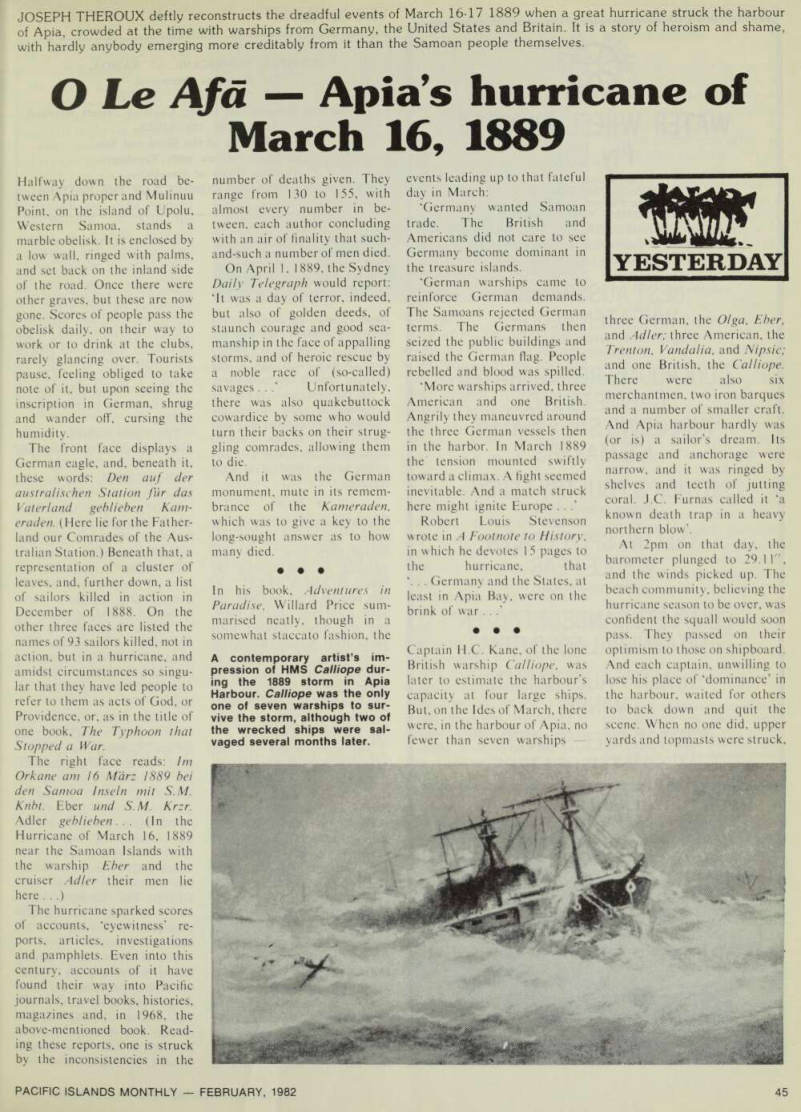

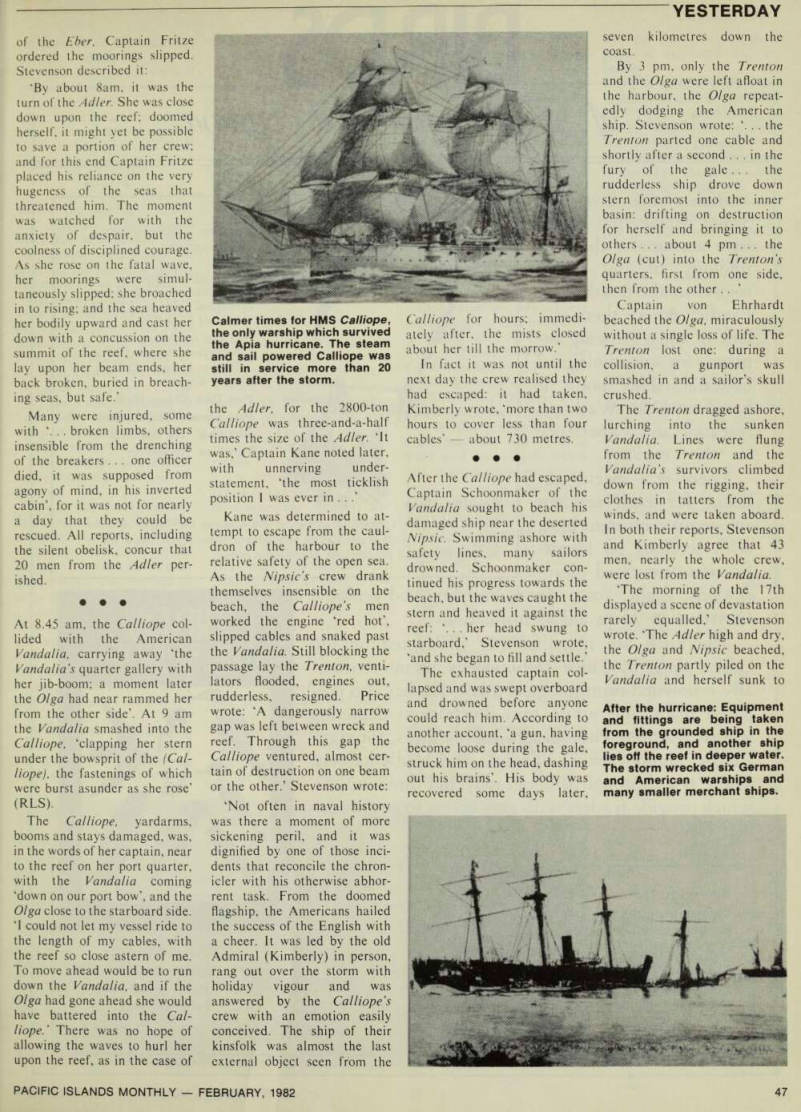
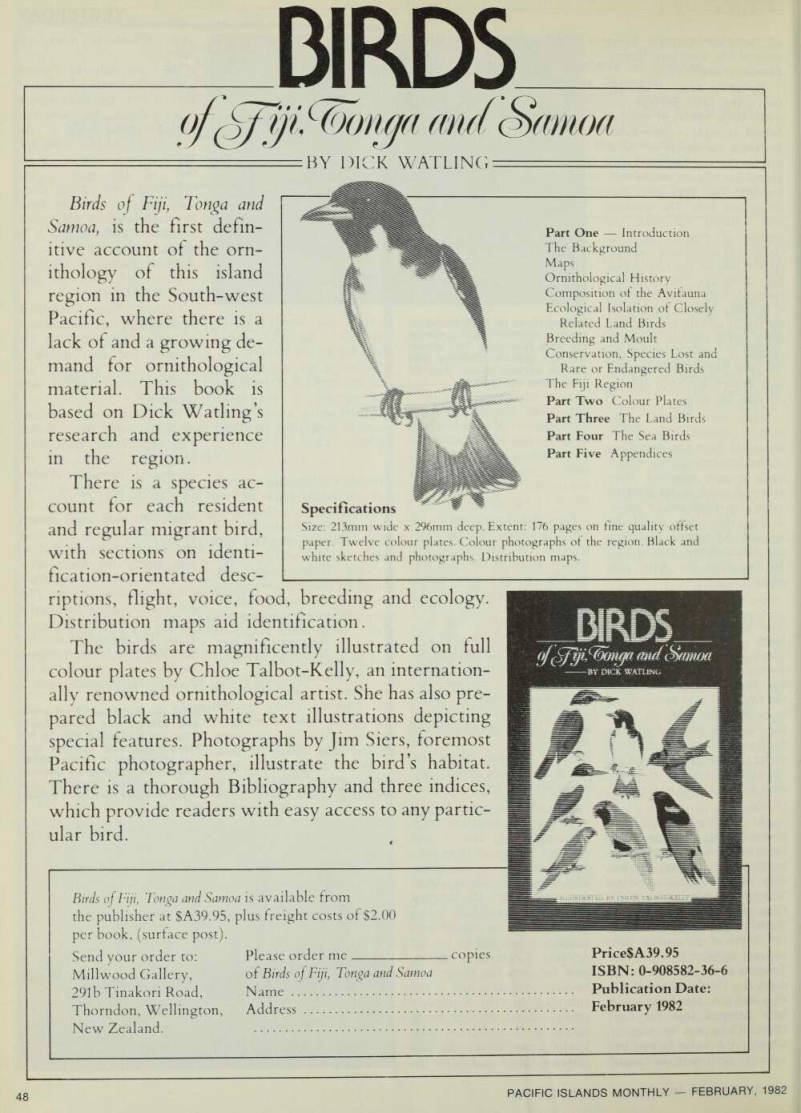
Yesterday
O Le Afā - Apia’s hurricane of March 16, 1889
JOSEPH THEROUX deftly reconstructs the dreadful events of March 16-17 1889 when a great hurricane struck the harbour of Apia, crowded at the time with warships from Germany, the United States and Britain. It is a story of heroism and shame, with hardly anybody emerging more creditably from it than the Samoan people themselves.
Halfway down the road be tween Apia proper and Mulinuu Point, on the island of Upolu, Western Samoa, stands a marble obelisk. It is enclosed by a low wall, ringed with palms, and set back on the inland side of the road. Once there were other graves, but these are now gone. Scores of people pass the obelisk daily, on their way to work or to drink at the clubs, rarely glancing over. Tourists pause, feeling obliged to take note of it, but upon seeing the inscription in German, shrug and wander off, cursing the humidity.
The front face displays a German eagle, and, beneath it, these words: Den auf der australischen Station fur das Vaterland geblieben Kam eraden. (Here lie for the Father land our Comrades of the Aus tralian Station.) Beneath that, a representation of a cluster of leaves, and, further down, a list of sailors killed in action in December of 1888. On the other three faces are listed the names of 93 sailors killed, not in action, but in a hurricane, and amidst circumstances so singu lar that they have led people to refer to them as acts of God, or Providence, or, as in the title of one book. The Typhoon that Stopped a War.
The right face reads: Im Orkane am 16 M'arz 1889 bei den Samoa Inseln mit S.M.
Knbt. Eber und S.M. Krzr.
Adler geblieben... (In the Hurricane of March 16, 1889 near the Samoan Islands with the warship Eber and the cruiser Adler their men lie here . . .) The hurricane sparked scores of accounts, ‘eyewitness’ re ports, articles, investigations and pamphlets. Even into this century, accounts of it have found their way into Pacific journals, travel books, histories, magazines and, in 1968, the above-mentioned book. Read ing these reports, one is struck by the inconsistencies in the
number of deaths given. They range from 130 to 155, with almost every number in be tween, each author concluding with an air of finality that such and-such a number of men died.
On April 1, 1889, the Sydney Daily Telegraph would report: ‘lt was a day of terror, indeed, but also of golden deeds, of staunch courage and good sea manship in the face of appalling storms, and of heroic rescue by a noble race of (so-called) savages . . .’ Unfortunately, there was also quakebuttock cowardice by some who would turn their backs on their strug gling comrades, allowing them to die.
And it was the German monument, mute in its remem brance of the Kameraden, which was to give a key to the long-sought answer as to how many died. • • • In his book. Adventures in Paradise, Willard Price sum marised neatly, though in a somewhat staccato fashion, the
events leading up to that fateful day in March; ‘Germany wanted Samoan trade. The British and Americans did not care to see Germany become dominant in the treasure islands. ‘German warships came to reinforce German demands.
The Samoans rejected German terms. The Germans then seized the public buildings and raised the German flag. People rebelled and blood was spilled. ‘More warships arrived, three American and one British.
Angrily they maneuvred around the three German vessels then in the harbor. In March 1889 the tension mounted swiftly toward a climax. A fight seemed inevitable. And a match struck here might ignite Europe . . .’
Robert Louis Stevenson wrote in A Footnote to History, in which he devotes 15 pages to the hurricane, that ‘. . . Germany and the States, at least in Apia Bay, were on the brink of war. ..’ • • • Captain H.C. Kane, of the lone British warship Calliope, was later to estimate the harbour’s capacity at four large ships.
But, on the Ides of March, there were, in the harbour of Apia, no fewer than seven warships -
three German, the Olga, Eber, and Adler; three American, the Trenton, Vandalia, and Nipsic; and one British, the Calliope.
There were also six merchantmen, two iron barques and a number of smaller craft.
And Apia harbour hardly was (or is) a sailor’s dream. Its passage and anchorage were narrow, and it was ringed by shelves and teeth of jutting coral. J.C. Furnas called it ‘a known death trap in a heavy northern blow’.
At 2pm on that day, the barometer plunged to 29.11", and the winds picked up. The beach community, believing the hurricane season to be over, was confident the squall would soon pass. They passed on their optimism to those on shipboard.
And each captain, unwilling to lose his place of ‘dominance’ in the harbour, waited for others to back down and quit the scene. When no one did, upper yards and topmasts were struck.
A contemporary artist’s im pression of HMS Calliope dur ing the 1889 storm in Apia Harbour. Calliope was the only one of seven warships to sur vive the storm, although two of the wrecked ships were sal vaged several months later.
The nine-decker headline which the Sydney Morning Herald used on March 16, 1889, to introduce the story of the Apia hurricane.
their bows kept into the northeast wind. ‘This was the moment,’ Stevenson wrote later, ‘when every sail in the harbour should have escaped.' But the captains were playing a dangerous game of gamble and bluff, fast approaching that point when ‘horrors (would) accumulate on horror’s head’, as the Sydney Daily Telegraph reported. • • • The ships sought to ride out the storm. They ‘were alternately buried from view ... or seen standing on end against the breast of billows’ (RLS). The rain poured down on them, the wind screamed around them, and the waves flooded their decks. Rear-Admiral Kimberly, commanding the American flagship Trenton, wrote in his report, Samoan Hurricane, that ‘two hundred men sang “knock a-man-down”, a shanty song, as they manned the pumps’.
The storm began with full force during the night of March 15 and the early hours of March 16. The Vaisigano River, usually a harmless trickle, swelled and rushed into the harbour, scouring, in Kimberly’s words, all the mud and sand out of the harbour.
The kedge anchors, with little to catch, dragged helplessly on the harbour floor. Though the winds were of hurricane force, at times exceeding 160 kilometres per hour, it was the action of the river and the harbour that would strangle the ships.
The two German ships, the Olga and the Adler, and the American Nipsic. cannoned into each other repeatedly in the darkness, hulls plunging
into beams, as the sailors franti cally tried to keep their ships afloat. In one collision, the Olga, after knocking off the Nipsic’s smokestack, span and struck the Calliope. Without a funnel, the Nipsic could not get up steam. Smoke and sparks flew around her decks, blinding and burning the crew. Low on coal, they tried to maintain the ship's fires ‘with barrels of pork'
(Res).
The Nipsic lowered a boat of five men, but the seas swamped it and the men drowned. Two others panicked, tried to swim ashore, and were also lost.
In a few hours the Nipsic would be beached and deserted by her crew. Instead of mount ing any rescue attempt, even for their fellow Americans, the Nipsic’s crew, known as wild throughout Pacific ports, wandered around, or, according to Edwin P. Hoyt, in The Typhoon that Stopped a War, ‘made for Mr Moors’ hotel and other saloons along the row’, in defiance of their captain’s or ders.
Before dawn, the German Eber was blown southwest onto the reef. Coming into the hurri cane with an injured propeller, she was unable to get steam up.
Stevenson wrote: ‘. . . she .. . struck the front of the coral . . . struck again, and (went) down stern foremost’, taking with her nearly the whole crew. Esti mates ranged from 71 to 76 men lost. Stevenson himself was unsure. The German monu ment, however, lists Captain- Lieutenant Wallis and 72 of his officers and crew.
The German Adler, having lost her bowsprit in the collision with the Olga, found her stern dangerously close to the reef.
The Trenton, having lost her rudder and become flooded, blocked the Adler’s way to open ocean. Unwilling to risk the fate
of the Eher, Captain Fritze ordered the moorings slipped.
Stevenson described it: ‘By about Sam, it was the turn of the Adler. She was close down upon the reef; doomed herself, it might yet be possible to save a portion of her crew; and for this end Captain Fritze placed his reliance on the very hugeness of the seas that threatened him. The moment was watched for with the anxiety of despair, but the coolness of disciplined courage.
As she rose on the fatal wave, her moorings were simul taneously slipped; she broached in to rising; and the sea heaved her bodily upward and cast her down with a concussion on the summit of the reef, where she lay upon her beam ends, her back broken, buried in breach ing seas, but safe.’
Many were injured, some with ‘. .. broken limbs, others insensible from the drenching of the breakers . . . one officer died, it was supposed from agony of mind, in his inverted cabin’, for it was not for nearly a day that they could be rescued. All reports, including the silent obelisk, concur that 20 men from the Adler per ished. • • • At 8.45 am, the Calliope col lided with the American Vandalia, carrying away ‘the Vandalia’s quarter gallery with her jib-boom; a moment later the Olga had near rammed her from the other side’. At 9 am the Vandalia smashed into the Calliope, ‘clapping her stern under the bowsprit of the (Cal liope), the fastenings of which were burst asunder as she rose’
(Res).
The Calliope, yardarms, booms and stays damaged, was, in the words of her captain, near to the reef on her port quarter, with the Vandalia coming ‘down on our port bow’, and the Olga close to the starboard side. ‘1 could not let my vessel ride to the length of my cables, with the reef so close astern of me.
To move ahead would be to run down the Vandalia, and if the Olga had gone ahead she would have battered into the Cal liope.’ There was no hope of allowing the waves to hurl her upon the reef, as in the case of
the Adler, for the 2800-ton Calliope was three-and-a-half times the size of the Adler. ‘lt was,’ Captain Kane noted later, with unnerving under statement, ‘the most ticklish position I was ever in . . .’
Kane was determined to at tempt to escape from the caul dron of the harbour to the relative safety of the open sea.
As the Nipsic's crew drank themselves insensible on the beach, the Calliope’s men worked the engine ‘red hot’, slipped cables and snaked past the Vandalia. Still blocking the passage lay the Trenton, venti lators flooded, engines out, rudderless, resigned. Price wrote: ‘A dangerously narrow gap was left between wreck and reef. Through this gap the Calliope ventured, almost cer tain of destruction on one beam or the other.’ Stevenson wrote: ‘Not often in naval history was there a moment of more sickening peril, and it was dignified by one of those inci dents that reconcile the chron icler with his otherwise abhor rent task. From the doomed flagship, the Americans hailed the success of the English with a cheer. It was led by the old Admiral (Kimberly) in person, rang out over the storm with holiday vigour and was answered by the Calliope’s crew with an emotion easily conceived. The ship of their kinsfolk was almost the last external object seen from the
Calliope for hours; immedi ately after, the mists closed about her till the morrow.’
In fact it was not until the next day the crew realised they had escaped: it had taken, Kimberly wrote, ‘more than two hours to cover less than four cables’ about 730 metres. • • • After the Calliope had escaped.
Captain Schoonmaker of the Vandalia sought to beach his damaged ship near the deserted Nipsic. Swimming ashore with safety lines, many sailors drowned. Schoonmaker con tinued his progress towards the beach, but the waves caught the stern and heaved it against the reef: ‘. . . her head swung to starboard,' Stevenson wrote, ‘and she began to fill and settle.’
The exhausted captain col lapsed and was swept overboard and drowned before anyone could reach him. According to another account, ‘a gun, having become loose during the gale, struck him on the head, dashing out his brains’. His body was recovered some days later,
seven kilometres down the coast.
By 3 pm, only the Trenton and the Olga were left afloat in the harbour, the Olga repeat edly dodging the American ship. Stevenson wrote: ‘. . . the Trenton parted one cable and shortly after a second ... in the fury of the gale.. . the rudderless ship drove down stern foremost into the inner basin: drifting on destruction for herself and bringing it to others . . . about 4 pm . . . the Olga (cut) into the Trenton’s quarters, first from one side, then from the other . .
Captain von Ehrhardt beached the Olga, miraculously without a single loss of life. The Trenton lost one: during a collision, a gunport was smashed in and a sailor’s skull crushed.
The Trenton dragged ashore, lurching into the sunken Vandalia. Lines were flung from the Trenton and the Vandalia’s survivors climbed down from the rigging, their clothes in tatters from the winds, and were taken aboard.
In both their reports, Stevenson and Kimberly agree that 43 men, nearly the whole crew, were lost from the Vandalia.
The morning of the 17th displayed a scene of devastation rarely equalled,’ Stevenson wrote. The Adler high and dry, the Olga and Nipsic beached, the Trenton partly piled on the Vandalia and herself sunk to
Calmer times for HMS Calliope, the only warship which survived the Apia hurricane. The steam and sail powered Calliope was still in service more than 20 years after the storm.
After the hurricane: Equipment and fittings are being taken from the grounded ship in the foreground, and another ship lies off the reef in deeper water.
The storm wrecked six German and American warships and many smaller merchant ships.
the gundeck: no sail afloat; and the beach heaped high with the debris of ships and the wreck of mountain forests.’
Stevenson added, along with other writers, that . . not the whole Samoan Archipelago was worth the loss in men and costly ships . . .' • • • Before the hurricane struck, one Samoan rebel leader, Mata’afa, had massed 6000 men behind Apia, intent on attacking the Germans, as they had the previous December.
But upon hearing the news of O le AJa, the hurricane, they put aside their guns and streamed into Apia. When the Nipsic was beached, they as sisted the crew to shore. When the Adler was thrown on the reef, ‘like a schoolboy’s cap’ in Stevenson’s phrase, another group of Mata’afa’s men tried to bring a safety line to the ship.
Fifty German shore guards, seeing this, held them away at gunpoint. ‘What was more natural,’
Stevenson asked, ‘to the mind of a European, than that the Mataafas should fall upon the Germans in this hour of their disadvantage? But they had no other thought than to assist.’
Later that morning, a group of Samoans did reach the Adler and returned with a safety line.
When it broke, they tried again and again without success, ‘the strongest adventurers being cast back again by the bursting seas’ (RLS).
Before dawn on March 17, the chief of Apia, Seumanutafa, commandeered a boat and ven tured out to the survivors who
had been clinging to the Adler since about 8 am the day before.
Afterwards his men attached safety lines and throughout the day the Adler’s crew was taken ashore. It was at this time that an unnamed Samoan the only native was killed: a cannon rolled and crushed him.
Samoans say that human chains were set up to pull in the drowning sailors, but I can find no record of this in the official histories.
Summing up the rescue effort, Stevenson observed; ‘. . . the Samoans earned the gratitude of friend and foe.’ • • • Many accounts reported the Calliope as the only surviving ship. This is not strictly true.
Some months after the hurri cane, both the German Olga and the American Nipsic were refloated. The Olga and the Calliope went to Sydney for repairs, the Nipsic to Honolulu.
The Eber, sucked down the throat of the harbour, was lost of course. But wreckers dis mantled the Adler, Vandalia, and Trenton, and ‘the ma terials,’ according to Captain Gray in his 1960 book Amerika Samoa, ‘were donated to the Samoans’. None of these appear to have remained. Nor, appar ently, had much else. Period ically divers come up with bones or revolvers, but spirit them away.
In 1953, the British Admir alty gave the steering wheel of the Calliope to the government of Western Samoa, and it was for a time on view at the courthouse. It was later moved to the Head of State’s house
(once Stevenson’s Vailima), but has since been given to a New Zealand museum.
The Adler, long a landmark of Apia’s waterfront, is seen no more. The United Nations, possibly thinking of Stevenson’s line, ‘the beautiful Adler, which lies there to this day, kanted on her beam, scarlet with rust, the day showing through her ribs’, urged that it remain a perma nent monument. It remained on view until 1956, when forward thinking rather than historically-minded politicians decided to extend Apia’s land over the reef. The ensuing landfill buried the Adler. Local legend suggests that this burial unleashed the hurricane of 1966, when the shrieks of the terrified sailors of 1889 were supposedly heard in the winds.
Seumanutafa, the Apia chief who directed rescue operations, was lavishly rewarded by the Americans. He was given a $250 gold coin, a gold watch and chain, a telescope, a ther mometer, and a whale boat. (The Germans gave out $3 for every German saved.) Now only the watch remains.
It was shown to me by Seumanutafa’s grandson, Seumanutafa Moepogai, along with a copy of the letter of appreciation from the American consul, William Churchill. Knowing that the only Samoan who died was never identified, I asked him who he was. ‘Tui,’ Seumanutafa replied simply. Like many
Samoan graves, Tui’s resting place is unmarked and un known.
Nor is there any monument to the Americans who perished, but they are remembered in another way. When the whale boat was presented to Seumanutafa, a song was composed for the occasion by a man named Fa’atui. For many years it has been sung in honour of departing Americans, though now it is performed for anyone who is leaving. It is probably the most famous song in the Samoan islands, Tofa Ma Feleni, ‘Farewell My Friend’. • • • In respect to those who died, it is the writer’s duty to account for their deaths as accurately as possible. It is dismaying to note that of all the writers who cast numbers about like playing cards, none has even admitted the disputed totals. When in doubt I have relied, for the American totals, on Rear- Admiral Kimberly’s report. He maintains that 51 Americans were killed or drowned: 43 from the Vandalia, seven from the Nipsic, and one from the Trenton.
Because the Germans are such notoriously efficient recordkeepers, 1 saw no reason to dispute the monument, es pecially since it was unknown to many of the writers, and un questioned by the others. It lists 93 German dead, 73 from the Eher, 20 from the Adler. This makes a total of 144 Germans and Americans. How many civilians? The Samoan, Tui, makes 145, but further investi gation turned up two more. ‘A visitor’, named Anthony Ormsby, and his ‘Hawaiian mate’, aboard the schooner Lily, possibly traders supplying one of Apia’s stores, also died, according to Hoyt. Thus, a total of 147. • • • So little remains in Samoa of the horror. Nothing, really, except that silent monument, its every face inscribed with men’s names, men who sought to impose their will on others, but who were themselves imposed on by a great and terrible storm - the Orkane, the Afd, the Typhoon, the Hurricane of 1889.
Wreck of the German warship Adler. It remained a landmark on the reef for 67 years until buried under a foreshore recla mation project.
Advertisements & other items, pp. 46-50 (1 item)
Pty. Ltd.
WATER WHEEL EXPORTS
493 Bourke Street, Melbourne, 3000, Australia Cables: Watermill-Melbourne.
Telex: AA 32165 Telephone: 602 1433
THE WATER WHEEL GROUP OF COMPANIES
Winners of Australia's Top Export Award and Flour Millers for over 100 years. (High Protein, Bakers, Stone ground Wholemeal, Donut).
COOLROOMS REFRIGERATED
CABINETS ETC.
INCLUDING SALT WATER
ICE MAKERS
STOCK & POULTRY FEEDS
YELLOW SPLIT PEAS &
WHOLE PEAS
COMPLETE RANGE OF FROZEN
AND GENERAL FOOD ITEMS
QUALITY AUSTRALIAN
WINES
WOOD FUEL STOVES
AND WATER HEATERS
FOR FURTHER INFORMATION
Return this coupon to:
WATER WHEEL EXPORTS PTY. LTD.
Please forward me: Name Address More information on your above products/ product
BEST AUSTRALIAN
WHEATEN FLOUR
(Pellets or Mash form) (Machine-Dressed) Phone: Export Manager Water Wheel Exports Pty. Ltd. 493 Bourke Street, Melbourne 3000.
Australia.
TERRIBLE HURRICANE AT SAMOA.
Six Warships Destroyed.
H.M.S. “CALLIOPE” SAVED.
Two Iron Barques and Eleven Coasting Vessels Wrecked.
LOSS OF 150 LIVES.
Fearful Violence of the Wind and Sea.
The Shore Strewn with Wreckage.
Terrible Scene of Desolation.
BRAVE AND UNSELFISH CONDUCT OF THE NATIVES.
CURDS
of(Sfi/o doi om/aSamoa
=== BY DICK WATLING ===
Birds of Fiji, Tonga and Samoa, is the first definitive account of the ornithology of this island region in the South-west Pacific, where there is a lack of and a growing demand for ornithological material. This book is based on Dick Wading’s research and experience in the region.
There is a species account for each resident and regular migrant bird, with sections on identification-orientated descriptions, flight, voice, food, breeding and ecology.
Distribution maps aid identification.
The birds are magnificently illustrated on full colour plates by Chloe Talbot-Kelly, an internationally renowned ornithological artist. She has also prepared black and white text illustrations depicting special features. Photographs by Jim Siers, foremost Pacific photographer, illustrate the bird’s habitat.
There is a thorough Bibliography and three indices, which provide readers with easy access to any particular bird.
Part One Introduction The Background Maps Ornithological History Composition of the Avifauna Ecological Isolation of Closely Related Land Birds Breeding and Moult Conservation, Species Lost and Rare or Endangered Birds The Fiji Region Part Two Colour Plates Part Three The Land Birds Part Four The Sea Birds Part Five Appendices Specifications Size: 213 mm wide x 296 mm deep. Extent: 176 pages on fine quality offset paper. Twelve colour plates. Colour photographs of the region. Black and white sketches and photographs. Distribution maps. ft (f(ffyiF(oonqa md c
—BY EMCR WATLING
P Birds of Fiji, Tonga and Samoa is available from illustrate - tai^t-reuy, the publisher at $A39.95, plus freight costs of $2.00 per book, (surface post).
Send your order to: Please order me copies PricesA39.9s Millwood Gallery, of Birds of Fiji, Tonga and Samoa ISBN: 0-908582-36-6 291 b Tinakori Road, Name Publication Date: Thorndon, Wellington, Address February 1982 New Zealand.
Expert
Insurance Service
throughout the islands
Queensland Insurance (Fiji) Limited
Head Office. 34 Usher St.. SUVA . General Manager: L. G. Liddell A.A.1.1, Assistant Managers: R, Jackson, Vijay Lai. Phone: 23851.
LAUTOKA OFFICE; Burns Philp Bldg., Naviti St. District Manager: J. Dalton. Phone: 60642.
Queensland Insurance (PNG) Limited
PAPUA NEW GUINEA
Head Office B N G Building, Musgrave St.PORT MORESBY. General Manager: J, M. Dawe.
Phone: 212144.
LAE: 4th St. & Coronation Drive. District Manager: C. D. Hillier Phone: 423873.
MOUNT HAGEN: Hagen Drive. District Manager: G. W. Jack Phone: 521002.
ARAWA: Chebu St. District Manager; J, Longbut. Phone: 951555.' MADANG: Kasagten St. District Manager: N. D. Ramage. Phone: 822020.
RABAUL: Wirraway St. District Manager: W. F Tinker. Phone; 921014.
QBE Insurance Limited
VANUATU, PORT VILA: Rue de Paris, .Suite 19, Oceania Bldg. Manager: I. R. Martin.
Phone; 2299.
SANTO: Burns Philp (Vanuatu) Ltd. Phone; 230.
PACIFIC AGENCIES
NEW CALEDONIA Ste. W. A. Johnston, S.A.R.L. 5 Rue Anatole France, NOUMEA Phone: 272083.
TAHITI Arthur Chung. Immeuble 8.1.5., Front de Mer, PAPEETE Phone: 2,86.19 NIUE: Burns Philp (South Sea) Company Ltd.
NORFOLK ISLAND: Burns Philp ('N I ) Company Ltd. Phone: 2191.
SAMOA: APIA, Burns Philp (South Sea) Company Ltd. Phone: 22611 .
TONGA Burns Philp (South Sea) Company Ltd. NUKUALOFA. Phone 21500 HAAPAI, VAVAU
MEMBERS OF THE:
INSURANCE GROUP UMITED
with Polynesian
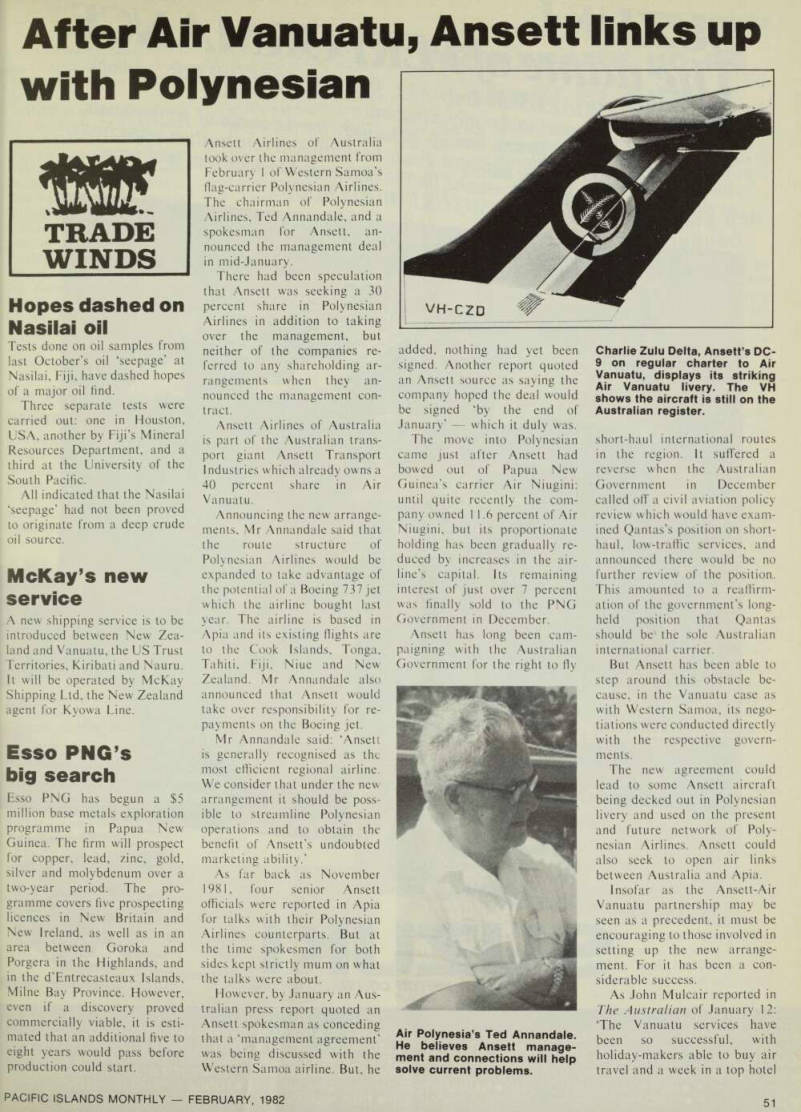
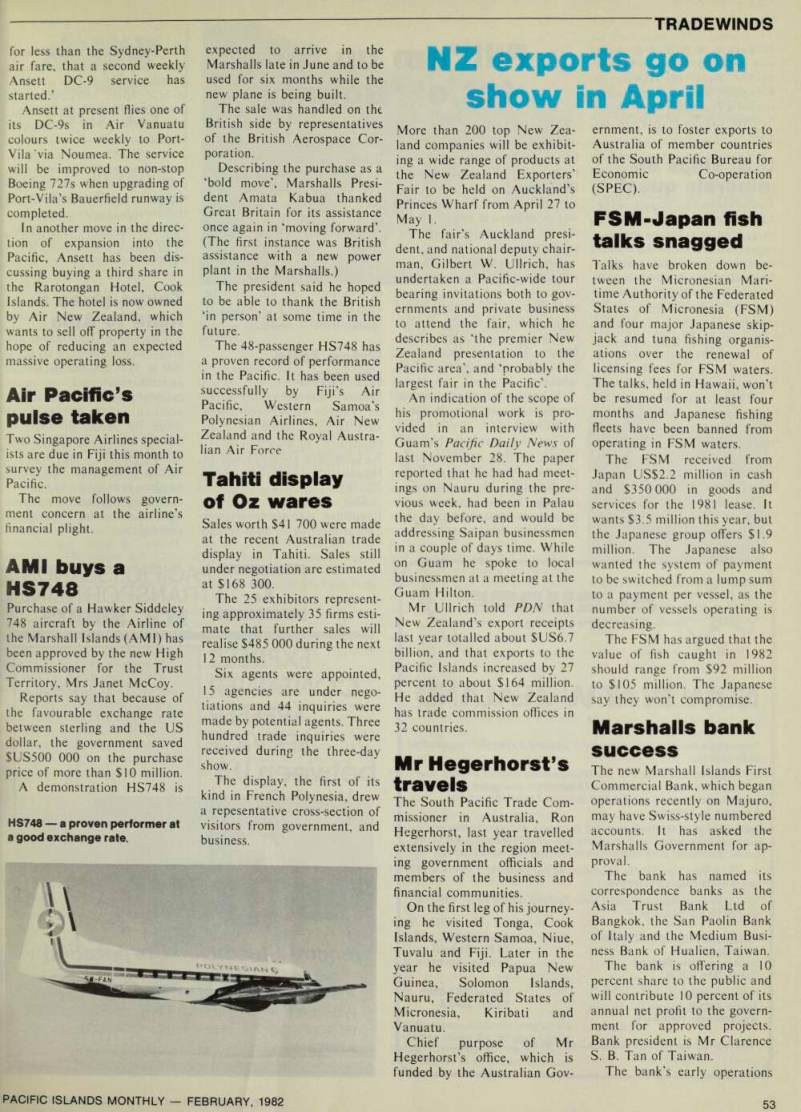
Trade
Winds
After Air Vanuatu, Ansett links up
with Polynesian
Hopes dashed on
Nasilai oil
Tests done on oil samples from last October’s oil ‘seepage’ at Nasilai, Fiji, have dashed hopes of a major oil find.
Three separate tests were carried out: one in Houston, USA, another by Fiji’s Mineral Resources Department, and a third at the University of the South Pacific.
All indicated that the Nasilai ‘seepage’ had not been proved to originate from a deep crude oil source.
McKay’s new
service
A new shipping service is to be introduced between New Zea land and Vanuatu, the US Trust Territories, Kiribati and Nauru.
It will be operated by McKay Shipping Ltd, the New Zealand agent for Kyowa Line.
Esso PNG’s
big search
Esso PNG has begun a $5 million base metals exploration programme in Papua New Guinea. The firm will prospect for copper, lead, zinc, gold, silver and molybdenum over a two-year period. The pro gramme covers five prospecting licences in New Britain and New Ireland, as well as in an area between Goroka and Porgera in the Highlands, and in the d’Entrecasteaux Islands, Milne Bay Province. However, even if a discovery proved commercially viable, it is esti mated that an additional five to eight years would pass before production could start.
Ansett Airlines of Australia took over the management from February 1 of Western Samoa’s flag-carrier Polynesian Airlines.
The chairman of Polynesian Airlines, Ted Annandale, and a spokesman for Ansett, an nounced the management deal in mid-January.
There had been speculation that Ansett was seeking a 30 percent share in Polynesian Airlines in addition to taking over the management, but neither of the companies re ferred to any shareholding ar rangements when they an nounced the management con tract.
Ansett Airlines of Australia is part of the Australian trans port giant Ansett Transport Industries which already owns a 40 percent share in Air Vanuatu.
Announcing the new arrange ments, Mr Annandale said that the route structure of Polynesian Airlines would be expanded to take advantage of the potential of a Boeing 737 jet which the airline bought last year. The airline is based in Apia and its existing flights are to the Cook Islands, Tonga, Tahiti, Fiji, Niue and New Zealand. Mr Annandale also announced that Ansett would take over responsibility for re payments on the Boeing jet.
Mr Annandale said: ‘Ansett is generally recognised as the most efficient regional airline.
We consider that under the new arrangement it should be poss ible to streamline Polynesian operations and to obtain the benefit of Ansett’s undoubted marketing ability.’
As far back as November 1981, four senior Ansett officials were reported in Apia for talks with their Polynesian Airlines counterparts. But at the lime spokesmen for both sides kept strictly mum on what the talks were about.
However, by January an Aus tralian press report quoted an Ansett spokesman as conceding that a ‘management agreement’ was being discussed with the Western Samoa airline. But, he
added, nothing had yet been signed. Another report quoted an Ansett source as saying the company hoped the deal would be signed ‘by the end of January’ which it duly was.
The move into Polynesian came just after Ansett had bowed out of Papua New Guinea’s carrier Air Niugini: until quite recently the com pany owned 1 1.6 percent of Air Niugini, but its proportionate holding has been gradually re duced by increases in the air line’s capital. Its remaining interest of just over 7 percent was finally sold to the PNG Government in December.
Ansett has long been cam paigning with the Australian Government for the right to fly
short-haul international routes in the region. It suffered a reverse when the Australian Government in December called off a civil aviation policy review which would have exam ined Qantas’s position on short haul, low-traffic services, and announced there would be no further review of the position.
This amounted to a reaffirm ation of the government’s long held position that Qantas should be the sole Australian international carrier.
But Ansett has been able to step around this obstacle be cause, in the Vanuatu case as with Western Samoa, its nego tiations were conducted directly with the respective govern ments.
The new agreement could lead to some Ansett aircraft being decked out in Polynesian livery and used on the present and future network of Poly nesian Airlines. Ansett could also seek to open air links between Australia and Apia.
Insofar as the Ansett-Air Vanuatu partnership may be seen as a precedent, it must be encouraging to those involved in setting up the new arrange ment. For it has been a con siderable success.
As John Mulcair reported in The Australian of January 12: ‘The Vanuatu services have been so successful, with holiday-makers able to buy air travel and a week in a top hotel
Air Polynesia’s Ted Annandale.
He believes Ansett manage ment and connections will help solve current problems.
Charlie Zulu Delta, Ansett’s DC 9 on regular charter to Air Vanuatu, displays its striking Air Vanuatu livery. The VH shows the aircraft is still on the Australian register.
for less than the Sydney-Perth air fare, that a second weekly Ansett DC-9 service has started.’
Ansett at present flies one of its DC-9s in Air Vanuatu colours twice weekly to Port- Vila'via Noumea. The service will be improved to non-stop
Boeing 727 s when upgrading of
Port-Vila’s Bauerfield runway is completed.
In another move in the direc tion of expansion into the Pacific, Ansett has been dis cussing buying a third share in the Rarotongan Hotel, Cook Islands. The hotel is now owned by Air New Zealand, which wants to sell off property in the hope of reducing an expected massive operating loss.
Air Pacific’s
pulse taken
Two Singapore Airlines special ists are due in Fiji this month to survey the management of Air Pacific.
The move follows govern ment concern at the airline’s financial plight.
AMI buys a
Hs74B
Purchase of a Hawker Siddeley 748 aircraft by the Airline of the Marshall Islands (AMI) has been approved by the new High Commissioner for the Trust Territory, Mrs Janet McCoy.
Reports say that because of the favourable exchange rate between sterling and the US dollar, the government saved SUSSOO 000 on the purchase price of more than $lO million.
A demonstration HS74B is
expected to arrive in the Marshalls late in June and to be used for six months while the new plane is being built.
The sale was handled on the British side by representatives of the British Aerospace Cor poration.
Describing the purchase as a ‘bold move’, Marshalls Presi dent Amata Kabua thanked Great Britain for its assistance once again in ‘moving forward’. (The first instance was British assistance with a new power plant in the Marshalls.) The president said he hoped to be able to thank the British ‘in person’ at some time in the future.
The 48-passenger HS74B has a proven record of performance in the Pacific. It has been used successfully by Fiji’s Air Pacific, Western Samoa’s Polynesian Airlines, Air New Zealand and the Royal Austra lian Air Force
Tahiti display
of Oz wares
Sales worth $4l 700 were made at the recent Australian trade display in Tahiti. Sales still under negotiation are estimated at $l6B 300.
The 25 exhibitors represent ing approximately 35 firms esti mate that further sales will realise $485 000 during the next 12 months.
Six agents were appointed, 15 agencies are under nego tiations and 44 inquiries were made by potential agents. Three hundred trade inquiries were received during the three-day show.
The display, the first of its kind in French Polynesia, drew a repesentative cross-section of visitors from government, and business.
HS748 - a proven performer at a good exchange rate.
Advertisements & other items, p. 52 (1 item)
Suzuki I
so
Get
■. >. \1
Waisuzu Kl
Jjo
Q
SUZUKI
% * 'W
SUZUKI I
SUZUKI MOTOR CO, LTD Hamamatsu, Japan SUZUKI GENERATOR SEIBE NEW ZEALAND SOUTH PACIFIC SUZUKI DISTRIBUTORS 58-599 « PAPUA I NEW GUIN« PHONE: 2-98- -R\/IPF PTY ITD PHONE* 42-2679 • FIJI NIRANJANS AUTOPORT LTD. PHONE. 381555 •TAHITI NIPPON AUl umu 070nRS YAP AMBROSE • KOROR BECHESRRAK T. COMPANY PHONE: 338 • TRUK KIOMASA STORE PHONE. 470
show in April
NZ exports go on show in April
More than 200 top New Zea land companies will be exhibit ing a wide range of products at the New Zealand Exporters’
Fair to be held on Auckland’s Princes Wharf from April 27 to May 1.
The fair’s Auckland presi dent, and national deputy chair man, Gilbert W. Ullrich, has undertaken a Pacific-wide tour bearing invitations both to gov ernments and private business to attend the fair, which he describes as ‘the premier New Zealand presentation to the Pacific area’, and ‘probably the largest fair in the Pacific’.
An indication of the scope of his promotional work is pro vided in an interview with Guam’s Pacific Daily News of last November 28. The paper reported that he had had meet ings on Nauru during the pre vious week, had been in Palau the day before, and would be addressing Saipan businessmen in a couple of days time. While on Guam he spoke to local businessmen at a meeting at the Guam Hilton.
Mr Ullrich told PDN that New Zealand’s export receipts last year totalled about SUS 6.7 billion, and that exports to the Pacific Islands increased by 27 percent to about $164 million.
He added that New Zealand has trade commission offices in 32 countries.
Mr Hegerhorst’s
travels
The South Pacific Trade Com missioner in Australia, Ron Hegerhorst, last year travelled extensively in the region meet ing government officials and members of the business and financial communities.
On the first leg of his journey ing he visited Tonga, Cook Islands, Western Samoa, Niue, Tuvalu and Fiji. Later in the year he visited Papua New Guinea, Solomon Islands, Nauru, Federated States of Micronesia, Kiribati and Vanuatu.
Chief purpose of Mr Hegerhorst’s office, which is funded by the Australian Gov
ernment, is to foster exports to Australia of member countries of the South Pacific Bureau for Economic Co-operation
(Spec).
FSM-Japan fish
talks snagged
Talks have broken down be tween the Micronesian Mari time Authority of the Federated States of Micronesia (FSM) and four major Japanese skip jack and tuna fishing organis ations over the renewal of licensing fees for FSM waters.
The talks, held in Hawaii, won’t be resumed for at least four months and Japanese fishing fleets have been banned from operating in FSM waters.
The FSM received from Japan US$2.2 million in cash and $350 000 in goods and services for the 1981 lease. It wants $3.5 million this year, but the Japanese group offers $1.9 million. The Japanese also wanted the system of payment to be switched from a lump sum to a payment per vessel, as the number of vessels operating is decreasing.
The FSM has argued that the value of fish caught in 1982 should range from $92 million to $lO5 million. The Japanese say they won’t compromise.
Marshalls bank
success The new Marshall Islands First Commercial Bank, which began operations recently on Majuro, may have Swiss-slyle numbered accounts. It has asked the Marshalls Government for ap proval.
The bank has named its correspondence banks as the Asia Trust Bank Ltd of Bangkok, the San Paolin Bank of Italy and the Medium Busi ness Bank of Hualien, Taiwan.
The bank is offering a 10 percent share to the public and will contribute 10 percent of its annual net profit to the govern ment for approved projects.
Bank president is Mr Clarence S. B. Tan of Taiwan.
The bank’s early operations
have been encouraging. It is now planning to open a branch of the Bank of Hawaii on Kwajalein islet. It is also work ing on a feasibility study for a floating casino in Majuro la goon.
U.S. ships on
minerals quest
Two US scientific vessels the Kanna Keoki and the Lee have been selected to make a number of cruises in the frame work of the joint United States- Australia-New Zealand project to help South Pacific countries discover undersea mineral re sources in their territorial waters (PIM Aug ‘Bl p 5).
Area of the initial search is bounded by Tonga, Fiji, Solomon Islands and Vanuatu.
Directly participating in the scheme are Fiji, Kiribati, Aus tralia, New Zealand, Japan, Western Samoa, Marshall Islands, Solomon Islands, Tonga, Cook Islands, Papua New Guinea, and Vanuatu.
The United States, the Soviet Union, Canada and France have observer status.
Fill ’em up for a tot o’ ‘Bounty’
tot o’ ‘Bounty’
‘Bounty’ brand rum is now being produced for the first time in Fiji by South Pacific Distilleries Ltd in Fiji’s sugar city of Lautoka. The distillery was established in 1980 to make use of by-products from the sugar mills.
The 5F3.5 million distillery, a subsidiary of Fiji Sugar Corpor ation, first began producing gin and then vodka under inter national brand names. Under licence, gin is bottled under Booths ‘High and Dry’ label, and vodka under the ‘Cossack’ label. ‘Bounty’ rum is the first spirit locally made and bottled under a Fiji label.
That the operation has not been a painless one was made clear by Prime Minister Ratu Sir Kamisese Mara when, dis cussing Fiji’s liquor-making project in a speech at the Commonwealth Heads of Gov
ernment meeting in Melbourne last October, he said (PIM Nov ’Bl pi 4): ‘But what do we find?
The multi-nationals who have been selling these commodities in our country chose to dump their products on to our market in order to strangle this new industry. This indicates that if we do not give protection to a new industry, we will never be able to establish any manufac turing industry at all.’
Price falls
hit WRC
Effects of low commodity prices on Pacific Island economies were largely blamed for a 26 percent fall in net profit of W.
R. Carpenter Holdings Ltd in the quarter ended September 30, 1981.
The chairman, C. H.
Carpenter, told the company’s annual meeting in Sydney late
last year that Papua New Guinea, in particular, had been seriously affected by the low price of copper, and its effect on consumer demand for general merchandise and automotive products.
In 1980-81, the company boosted net profit 17 percent to a record $15.42 million. A sharp improvement by its Aus tralian subsidiaries more than offset the sharp decline already underway in its Pacific oper ations.
Tokyo gives a
hand to Apia
The Japanese Government has given the equivalent of SNZS79 000 to Western Samoa for an agriculture-oriented edu cational project. The grant is in addition to the $ 1 052 000 grant made by Japan in 1980 to extend schools on Upolu and Savaii Islands. The Western Samoa Government has drawn up plans to expand and improve secondary education, stressing agricultural and vocational training.
Advertisements & other items, p. 54 (1 item)
Tahiti Samoa Sir-
PACIFIC ISLANDS
TRANSPORT LINE
M.V. SIRIUS
and AE
TAHITI SAMOA sir-
xcc Qeqeral Steamship Qorporatioq^m> General Agents 400 California Street, San Francisco, CA, USA PAPEETE: Agence Maritime Internationale, Tahiti PAGO PAGO: Polynesia Shipping Services, Inc.
APIA: Burns Philp (South Sea) Company, Ltd.
PTV LTMTT^B
NOW IN NEW ZEALAND
Announces the opening of our New Zealand Export Office situated in Auckland.
Mr. Athol Carr, formally of the New Zealand Export Import Corporation, will lead a small and efficient team giving the precise, prompt and personal service that won an Export Award for Ausmark in Australia.
We specialise in the financing and shipment of fresh, frozen and processed consumer food products and we will welcome enquiries for all manner of bulk commodities and manufactured goods.
We invite your request for quotation as our prices and terms will prove more than competitive.
For all of your Australian and New Zealand supply requirements, we can be contacted at: •Ausmark Trading (N.Z.) Ltd. 60 Queen Street, Auckland, New Zealand.
G.P.O. Box 2002.
Phone. 30796 Telex: 21886 Answerback: FBMAUK •Accredited Agent New Zealand Dairy Board Ausmark Pty. Ltd. 74 Pitt Street, Sydney, Australia Phone: 231 6866 Telex; 25458
Yachts
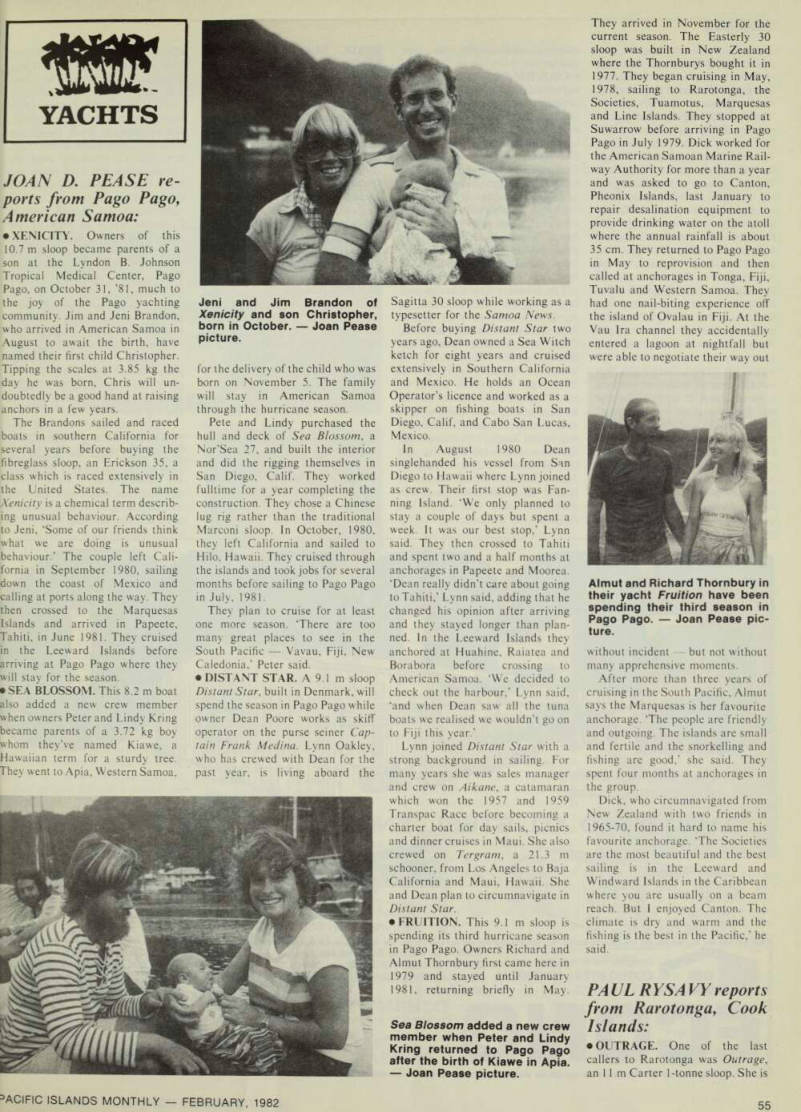
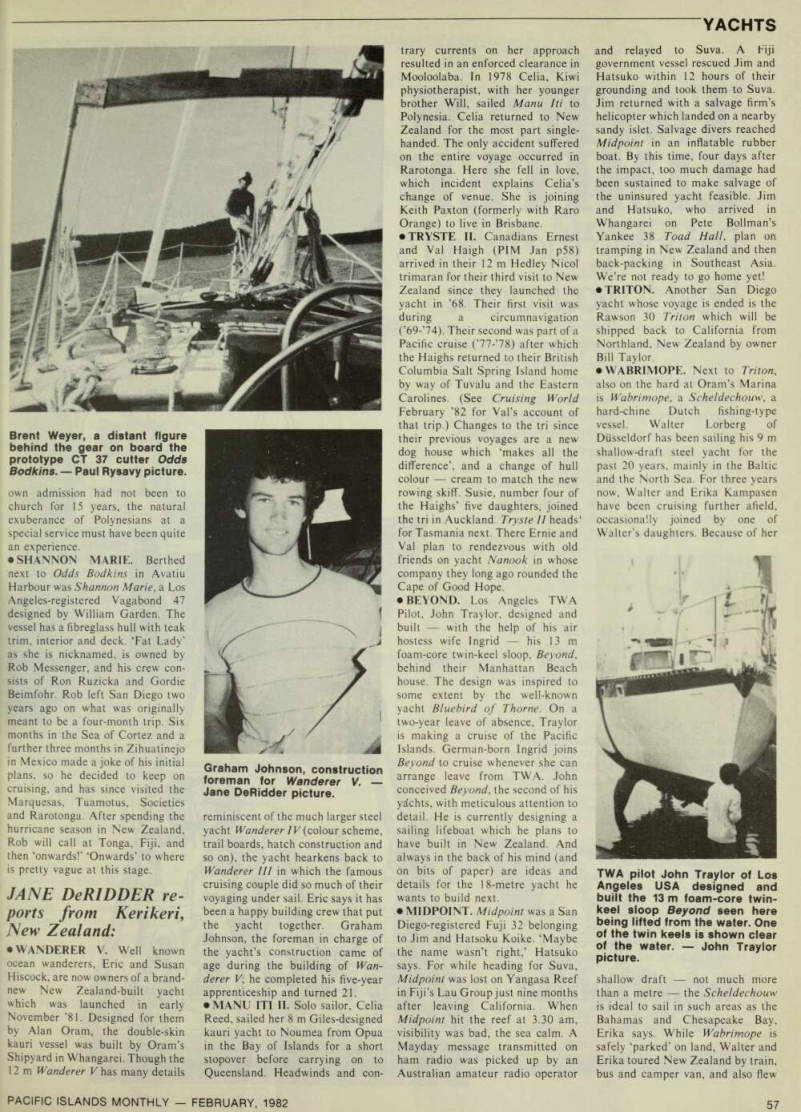
Joan D. Pease Re
ports from Pago Pago y
American Samoa:
• XENICITY. Owners of this 10.7 m sloop became parents of a son at the Lyndon B. Johnson Tropical Medical Center, Pago Pago, on October 31, ’Bl, much to the joy of the Pago yachting community. Jim and Jeni Brandon, who arrived in American Samoa in August to await the birth, have named their first child Christopher.
Tipping the scales at 3.85 kg the day he was born, Chris will un doubtedly be a good hand at raising anchors in a few years.
The Brandons sailed and raced boats in southern California for several years before buying the fibreglass sloop, an Erickson 35, a class which is raced extensively in the United States. The name Xenicity is a chemical term describ ing unusual behaviour. According to Jeni, ‘Some of our friends think what we are doing is unusual behaviour.’ The couple left Cali fornia in September 1980, sailing down the coast of Mexico and calling at ports along the way. They then crossed to the Marquesas Islands and arrived in Papeete, Tahiti, in June 1981. They cruised in the Leeward Islands before arriving at Pago Pago where they will stay for the season. • SEA BLOSSOM, This 8.2 m boat also added a new crew member when owners Peter and Lindy Kring became parents of a 3.72 kg boy whom they’ve named Kiawe, a Hawaiian term for a sturdy tree.
They went to Apia, Western Samoa,
for the delivery of the child who was born on November 5. The family will stay in American Samoa through the hurricane season.
Pete and Lindy purchased the hull and deck of Sea Blossom , a Nor’Sea 27, and built the interior and did the rigging themselves in San Diego, Calif. They worked fulltime for a year completing the construction. They chose a Chinese lug rig rather than the traditional Marconi sloop. In October, 1980, they left California and sailed to Hilo, Hawaii. They cruised through the islands and took jobs for several months before sailing to Pago Pago in July, 1981.
They plan to cruise for at least one more season. There are too many great places to see in the South Pacific Vavau, Fiji, New Caledonia,’ Peter said. • DISTANT STAR. A 9.1 m sloop Distant Star , built in Denmark, will spend the season in Pago Pago while owner Dean Poore works as skiff operator on the purse seiner Cap tain Frank Medina. Lynn Oakley, who has crewed with Dean for the past year, is living aboard the
Sagitta 30 sloop while working as a typesetter for the Samoa News.
Before buying Distant Star two years ago. Dean owned a Sea Witch ketch for eight years and cruised extensively in Southern California and Mexico. He holds an Ocean Operator’s licence and worked as a skipper on fishing boats in San Diego, Calif, and Cabo San Lucas, Mexico.
In August 1980 Dean singlehanded his vessel from San Diego to Hawaii where Lynn joined as crew. Their first stop was Fan ning Island. ‘We only planned to stay a couple of days but spent a week. It was our best stop,’ Lynn said. They then crossed to Tahiti and spent two and a half months at anchorages in Papeete and Moorea. ‘Dean really didn’t care about going to Tahiti,' Lynn said, adding that he changed his opinion after arriving and they stayed longer than plan ned. In the Leeward Islands they anchored at Huahine, Raiatea and Borabora before crossing to American Samoa. ‘We decided to check out the harbour,’ Lynn said, ‘and when Dean saw all the tuna boats we realised we wouldn’t go on to Fiji this year.’
Lynn joined Distant Star with a strong background in sailing. For many years she was sales manager and crew on Aikane, a catamaran which won the 1957 and 1959 Transpac Race before becoming a charter boat for day sails, picnics and dinner cruises in Maui. She also crewed on Tergram, a 21.3 m schooner, from Los Angeles to Baja California and Maui, Hawaii. She and Dean plan to circumnavigate in Distant Star. • FRUITION. This 9.1 m sloop is spending its third hurricane season in Pago Pago. Owners Richard and Almut Thornbury first came here in 1979 and stayed until January 1981, returning briefly in May.
They arrived in November for the current season. The Easterly 30 sloop was built in New Zealand where the Thornburys bought it in 1977. They began cruising in May, 1978, sailing to Rarotonga, the Societies, Tuamotus, Marquesas and Line Islands. They stopped at Suwarrow before arriving in Pago Pago in July 1979. Dick worked for the American Samoan Marine Rail way Authority for more than a year and was asked to go to Canton, Pheonix Islands, last January to repair desalination equipment to provide drinking water on the atoll where the annual rainfall is about 35 cm. They returned to Pago Pago in May to reprovision and then called at anchorages in Tonga, Fiji, Tuvalu and Western Samoa. They had one nail-biting experience off the island of Ovalau in Fiji. At the Vau Ira channel they accidentally entered a lagoon at nightfall but were able to negotiate their way out
without incident but not without many apprehensive moments.
After more than three years of cruising in the South Pacific, Almut says the Marquesas is her favourite anchorage. The people are friendly and outgoing. The islands are small and fertile and the snorkelling and fishing are good,’ she said. They spent four months at anchorages in the group.
Dick, who circumnavigated from New Zealand with two friends in 1965-70, found it hard to name his favourite anchorage. The Societies are the most beautiful and the best sailing is in the Leeward and Windward Islands in the Caribbean where you are usually on a beam reach. But 1 enjoyed Canton. The climate is dry and warm and the fishing is the best in the Pacific,’ he said.
PAUL RYSAVYreports
from Rarotonga , Cook
Islands:
• OUTRAGE. One of the last callers to Rarotonga was Outrage , an 11 m Carter 1-tonne sloop. She is
Jeni and Jim Brandon of Xenicity and son Christopher, born in October. - Joan Pease picture.
Sea Blossom added a new crew member when Peter and Lindy Kring returned to Pago Pago after the birth of Kiawe in Apia. - Joan Pease picture.
Almut and Richard Thornbury in their yacht Fruition have been spending their third season in
Pago Pago. - Joan Pease pic
ture.
owned and sailed by the Wunsch family: Philip and Anne, and their children Katherine and Stephanie.
Outrage is the sister ship to Opti mist, which won the ’67 and ’6B World 1-Ton Series, and conse quently, Philip says, she is a fast boat and a pleasure to sail. The Wunsches’ trip began in 1979 when they sold their yacht Tinka , and flew to Cyprus to pick up Outrage to sail her home to Wellington. Their travels so far have taken the family to every country in the Mediterranean area, the Canary Islands, Barbados, the Chain of Islands from St Lucia to the American Virgin Islands, Colombia, Galapagos, the Marquesas, the Tuamotus, the Societies and Rarotonga. The fam ily are pleased to be back in the Pacific where hordes of tourists have not yet drastically affected the way of life. ‘Tahiti,’ said Anne, ‘has no tourists at all when you compare it to the coast of Spain!’ Outrage left Rarotonga in mid-November for Nukualofa, and after that was to make direct for Wellington, where Peter was due to consider selling Outrage and building a yacht him self. Anne, however, has had enough of sailing for a while and is looking forward to living in a house and being a mother rather than a
mother, schoolteacher, navigator, and so on. • ENDURANCE. The Los Angeles registered Endurance , a cement schooner, visited Rarotonga in October, ’Bl. She was one of the last batch of yachts to visit Rarotonga before the hurricane season began.
The owner, Marvin Milke, built Endurance himself two years ago, following a Samson design. She has a Sealord hull, and is 16.5 m on deck and 21 m overall. Permanent crew are Chieko, Marvin’s wife, and Bruce Nicholson. Other crew are Mary Miller, Donna Fleming and John Reinke, who boarded in Borabora.
The schooner began her voyage from Long Beach in California in April ’Bl, and has since visited Baja, the Sea of Cortez, Acapulco, Costa Rica, Cocos Island, the Marquesas, the Tuamotus and the Societies before arriving at Rarotonga. Endurance sailed di rectly to the Bay of Islands in New Zealand after a week in Rarotonga, and, after the hurricane season, she will sail to Tonga, Fiji, Samoa, the Carolines, the Santa Cruz Islands, the Marshalls and eventually to Japan before cutting across to Alaska and back down the North American coast home to Los
Angeles.
• FAIR SEAS. Another Los Angeles-registered yacht that visited Rarotonga in October was Fair Seas , a three-year-old Transpac 49 ketch. She is owned and skippered by Charles Panter, and his crew consists of his wife Carol, his son Richard, and his nephew Brian. The Panters enjoyed their stay here because of the friendliness of the people, and because it was ‘nice to speak English again’. Fair Seas began this voyage in June 1980 from Ventura, California, by journeying up the coast as far as Juno, Alaska, and then travelling back down the coast to Mexico and the Sea of Cortez.
She then followed the traditional route by sailing to the Marquesas, the Tuamotus, the Societies and Rarotonga. However, unlike most yachts, she will probably berth in Tonga for the hurricane season, or, if red tape makes this difficult, Fiji.
After the hurricane season, the Panters expect to visit New Caledonia, Vanuatu, New Zealand and Australia, where they will spend the following hurricane season. Plans after that are vague, but it is likely they will continue sailing west around the world.
Apart from almost colliding with a killer whale in Alaska, it has been smooth sailing so far.
• ODDS BODKINS. Brent Weyer, from Seattle, Wahinglon, and Sue Bogaard from Hastings, New Zea land, are on board Odds Bodkins , a six-year-old CT 37 cutter. Odds Bodkins was built as a prototype, and, according to Brent, though she lacks some innovations later CT 37s have, she is a wonderful boat. He has owned her for three years, and began this voyage from Seattle two and a half years ago. He initially sailed down the Oregon coast to California where he blew up the cutter’s engine, and had to postpone his trip for nine months. Mexico was next, and then the Marquesas, Tuamotus, Societies and Rarotonga.
From here Odds Bodkins made directly for the Bay of Islands in New Zealand, where it will weather out the hurricane season. After that, it’s Tonga, Fiji, New Caledonia, Australia and then a big question mark. Brent says they’re definitely going around the world, but the route is still undecided.
When asked if he had any particularly exciting experiences or incidents to relate, Brent said that the highlight of his trip so far was the Easter Sunday Church service in Nukuhiva, which was ‘the most amazing thing 1 ever experienced in my life’. For someone who on his
own admission had not been to church for 15 years, the natural exuberance of Polynesians at a special service must have been quite an experience. • SHANNON MARIE. Berthed next to Odds Bodkins in Avatiu Harbour was Shannon Marie , a Los Angeles-registered Vagabond 47 designed by William Garden. The vessel has a fibreglass hull with teak trim, interior and deck. ‘Fat Lady’ as she is nicknamed, is owned by Rob Messenger, and his crew con sists of Ron Ruzicka and Gordie Beimfohr. Rob left San Diego two years ago on what was originally meant to be a four-month trip. Six months in the Sea of Cortez and a further three months in Zihuatinejo in Mexico made a joke of his initial plans, so he decided to keep on cruising, and has since visited the Marquesas, Tuamotus, Societies and Rarotonga. After spending the hurricane season in New Zealand, Rob will call at Tonga, Fiji, and then ‘onwards!’ ‘Onwards’ to where is pretty vague at this stage.
Jane Deridder Re
ports from Kerikeriy
New Zealand:
• WANDERER V. Well known ocean wanderers, Eric and Susan Hiscock, are now owners of a brand new New Zealand-built yacht which was launched in early November ’Bl. Designed for them by Alan Oram, the double-skin kauri vessel was built by Oram’s
Shipyard in Whangarei. Though the
12 m Wanderer V has many details
reminiscent of the much larger steel yacht Wanderer IV (colour scheme, trail boards, hatch construction and so on), the yacht hearkens back to Wanderer 111 in which the famous cruising couple did so much of their voyaging under sail. Eric says it has been a happy building crew that put the yacht together. Graham Johnson, the foreman in charge of the yacht’s construction came of age during the building of Wan derer V; he completed his five-year apprenticeship and turned 21. • MANU ITI 11. Solo sailor, Celia Reed, sailed her 8 m Giles-designed kauri yacht to Noumea from Opua in the Bay of Islands for a short stopover before carrying on to Queensland. Headwinds and con
trary currents on her approach resulted in an enforced clearance in Mooloolaba. In 1978 Celia, Kiwi physiotherapist, with her younger brother Will, sailed Manu hi to Polynesia. Celia returned to New Zealand for the most part single handed. The only accident suffered on the entire voyage occurred in Rarotonga. Here she fell in love, which incident explains Celia’s change of venue. She is joining Keith Paxton (formerly with Raro Orange) to live in Brisbane. • TRYSTE 11. Canadians Ernest and Val Haigh (PIM Jan p5B) arrived in their 12 m Hedley Nicol trimaran for their third visit to New Zealand since they launched the yacht in ’6B. Their first visit was during a circumnavigation (’69-’74). Their second was part of a Pacific cruise (’77-’7B) after which the Haighs returned to their British Columbia Salt Spring Island home by way of Tuvalu and the Eastern Carolines. (See Cruising World February ’B2 for Val’s account of that trip.) Changes to the tri since their previous voyages are a new dog house which ‘makes all the difference’, and a change of hull colour cream to match the new rowing skiff. Susie, number four of the Haighs’ five daughters, joined the tri in Auckland. Tryste II heads' for Tasmania next. There Ernie and Val plan to rendezvous with old friends on yacht Nanook in whose company they long ago rounded the Cape of Good Hope. • BEYOND. Los Angeles TWA Pilot, John Traylor, designed and built with the help of his air hostess wife Ingrid his 13 m foam-core twin-keel sloop. Beyond , behind their Manhattan Beach house. The design was inspired to some extent by the well-known yacht Bluebird of Thorne. On a two-year leave of absence, Traylor is making a cruise of the Pacific Islands. German-born Ingrid joins Beyond to cruise whenever she can arrange leave from TWA. John conceived Beyond , the second of his ydchls, with meticulous attention to detail. He is currently designing a sailing lifeboat which he plans to have built in New Zealand. And always in the back of his mind (and on bits of paper) are ideas and details for the 18-metre yacht he wants to build next. • MIDPOINT. Midpoint was a San Diego-registered Fuji 32 belonging to Jim and Hatsoku Koike. ‘Maybe the name wasn’t right,’ Hatsuko says. For while heading for Suva, Midpoint was lost on Yangasa Reef in Fiji’s Lau Group just nine months after leaving California. When Midpoint hit the reef at 3.30 am, visibility was bad, the sea calm. A Mayday message transmitted on ham radio was picked up by an Australian amateur radio operator
and relayed to Suva. A Fiji government vessel rescued Jim and Hatsuko within 12 hours of their grounding and took them to Suva.
Jim returned with a salvage firm’s helicopter which landed on a nearby sandy islet. Salvage divers reached Midpoint in an inflatable rubber boat. By this time, four days after the impact, too much damage had been sustained to make salvage of the uninsured yacht feasible. Jim and Hatsuko, who arrived in Whangarei on Pete Bollman’s Yankee 38 Toad Hall , plan on tramping in New Zealand and then back-packing in Southeast Asia.
We’re not ready to go home yet! • TRITON. Another San Diego yacht whose voyage is ended is the Rawson 30 Triton which will be shipped back to California from Northland, New Zealand by owner Bill Taylor. • WABRIMOPE. Next to Triton , also on the hard at Oram’s Marina is Wabrimope , a Scheldechouw, a hard-chine Dutch fishing-type vessel. Walter Lorberg of DUsseldorf has been sailing his 9 m shallow-draft steel yacht for the past 20 years, mainly in the Baltic and the North Sea. For three years now, Walter and Erika Kampasen have been cruising further afield, occasionally joined by one of Walter’s daughters. Because of her
shallow draft not much more than a metre the Scheldechouw is ideal to sail in such areas as the
Bahamas and Chesapeake Bay,
Erika says. While Wabrimope is safely ‘parked’ on land, Walter and Erika toured New Zealand by train, bus and camper van, and also flew
Brent Weyer, a distant figure behind the gear on board the prototype CT 37 cutter Odds Bodkins. - Paul Rysavy picture.
Graham Johnson, construction foreman for Wanderer V. - Jane DeRidder picture.
TWA pilot John Traylor of Los Angeles USA designed and built the 13 m foam-core twin keel sloop Beyond seen here being lifted from the water. One of the twin keels is shown clear
of the water. - John Traylor
picture.
back to Germany for a short visit.
Next Wabrimope will head for Australia, Africa and perhaps South America. • JONA. Eric Light, a tiny crew member for US yacht Jona (from Urica, New York) was safely de livered by Caesarean section in Whangarei Hospital on October 6, 1981. First mate and first-time mother, Nancy Light, who flew to New Zealand to have the baby, kept in touch by ham radio with her husband John during his stormy 18-day passage from Suva. On the 9.7-m Bristol sloop Jona , John and his crew member McKelden Smith, a doctor on a sailing ‘holiday’, battled against 25 to 45-knot southerlies and sou’westerlies to arrive in Whangarei on November 1. The 5-tonne sloop sustained no damage, unlike many of the larger vessels which made the voyage to New Zealand at the same time.
Jona bore storm sail only for a good part of the windward trip a 4-square-metre jib and tiny storm trisail. • KIM. Flying the yellow quaran tine and the Dutch red, white and blue flags, the 13 m steel ketch Kim tacked up the Whangarei River to the Whangarei town quay to clear customs a day later than Jona.
She’d had a rough 16-day passage from Suva. Kim was badly battered: the dinghy was torn off the deck and lost, sails were blown out, and the engine saltwater-damaged. While Fred Van der Hem practises medi cine for several months back in Holland, and while Merel aged six and Joris aged four attend school in Whangarei, first mate Olga (also a general practitioner) is seeing to the repairs, sandblasting, painting and refitting of their steel cruising home. • ALCESTE. Also in the Whangarei Town Basin for a short time was British yacht Alceste , a
Maldon-registered 10-m sloop. The
Buchanan 33 brought Dr Ronnie Andrews, Jill Bannerman and her 15-year-old son Matthew to New Zealand for a tour of the country.
They continued on to Sydney in December. Australian-born Jill said they have not been at all disap pointed with the Pacific where they have found each island surprisingly different from its predecessor. ‘Mind you, sometimes I just want to get home and sit down with a dog on my knee.’ (Jill had five dogs at one time . . .) ‘Other days I feel I could go on forever.’ The Bannermans kept a daily log of seabirds sighted.
The hobby of blue-water birding added tremendous additional inter est to their voyaging. Dr Andrews sailed around the world in his former yacht, Merlin between 1969 and 1972. His cruising articles appear in the British yachting magazine Yachting Monthly. • CERA, Cera is the beautifully built cruising home of Sydney physician Mike Henderson and his sailmaker wife Norma. After a voyage to Noumea and back per suaded them that the cruising life suited them, this enterprising couple completed plans, cut ties, and set forth on an open-ended cruise of the Pacific, beginning with New Zealand. • CALIFA. Rolf Gunter chose to sail his Westsail 32 from Whangarei to Tauranga for haulout. This German-born tool-maker who did his apprenticeship in the Dominican Republic, decided when he was on a camper van ‘land yachting’ tour of South America that he would like to join the cruising fraternity and travel by sea instead. During this Pacific voyage on Califa Rolf has discovered that he prefers solo voyaging to carrying a crew. After completing a two-year Pacific cruise, Rolf says he will probably return to Los Angeles to work in his trade as builder of prototype ma chinery, but with the eventual aim of returning to sailing as a way of life.
Alceste, the British-registered Buchanan sloop which has been cruising the Pacific with stops in Australia and New Zealand. - Jill Bannerman picture.
Advertisements & other items, pp. 55-60 (2 items)
55
’ACIFIC ISLANDS MONTHLY FEBRUARY, 1982
Econo
The Name Behind Australia's
Rural & Industrial Buildings
GALVANISED ALL
ENGINEERED FOR STRENGTH
General Purpose Hay Shed I Skillion
Machinery/Hay Shed
Warehouse I i i i i i i i L.
Designed and Manufactured by:
ECONO STEEL AUSTRALIA
PTY. LIMITED
NSW. 153 Darling St., Balmain /am interested in the Econo Building(s) as indicated (Please Tick) 2041. Ph: (02) 818 3133.
ECONO
Tlx: AA70826 steel Sydney.
Old. Unit 3/48 Bullockhead St, Sumner Park 4074.
Ph: (07) 376 5411.
Cable: Cono- Skillion p Hay Shed I am interested in the Econo Buildmg(s) as maicawo ( neaso / - General Purpose Hay Shed □ Machinery Shed; Gable □ Custom Design & Construct. □ Bulk Grain Shed □ Aircraft Hangar Warehouse □ Glasshouse □ Ma/7 Coupon or contact your Econo Distributor. □ Industrial Building [J' Please send me. obligation free, your brochure Name.
Vic: 282 Union Rd., Moonee Ponds, 3039.
Ph: (03) 370 9112 Address..
Postcode Phone.
TATIIAH
UNITE!
Bringing the world’s
best to your door.
Tatham Limited have a long history of dependable service to the islands. From all over the world we bring the goods and products you need, right to your door Full service and prompt documentation are assured. We can procure specific products to suit your special requirements and if urgently needed will air freight them to you without delay. For imports or exports, see us!
Tatham Limited are exclusive distnbutors of Mrs Brite household cleaners, in the Pacific Islands, USA Japan and Asia.
All 100% product - non-aerosol, pump packs available as economical refills too!
Mrs Brite Pre-Wash Stain Remover Mrs Bnte Toilet Bowl Cleanser Mrs Brite Spray ‘n’ Iron Mrs Bnte Household Deodorant Spray Mrs Brite Multi Purpose Cleaner plus 3 exciting Mrs Brite washday products!
Mrs Brite Laundry Powder Mrs Bnte Cold Water Wash Liquid Mrs Bnte Woolsoft Liquid Plus Mrs Bnte Insect Killer Tatham Limited brings you the world’s best... share in the profits, order Mrs Bnte now!
TATHAM LIMITED
176 Queen Street Melbourne Telephone 67 5601. Telex AA36992 (Tatham) A Subsidiary of H.C. Sleigh Industries Limited Melbourne T oft /
Enter
The Dragon
The New Guinea Pacific Line introduces its* new Dragon Boat service to Papua New Guinea and the Solomon Islands.
N.G.P.L.'s new fully containerised service, the first from the Far East to P.N.G. and the Solomons offers: - • Fast transit times to all ports. • A guaranteed schedule every 30 days thanks to berths in Papua New Guinea and Honiara reserved for N.G.P.L. use.. • Safe, secure transport of goods in containers, both L.C.L., and F.C.L. no more damage or pilferage of cargo. • A wide coverage of all ports with its monthly container service from Hong Kong, Singapore, Taiwan, the Philippines, and Malaysia to all Papua New Guinea ports and Honiara.
For further details on the new Dragon Boat service contact:
PAPUA NEW GUINEA
Steamship Trading Co., Ltd.
Port Moresby Telephone: 212000
HONG KONG
Swire Shipping (Agencies) Ltd.
Telephone: 5-264311
SINGAPORE
Straits Shipping Pte. Ltd.
Telephone: 436071
Bearing us in mind
will save you a lot
of trouble...
when it comes to those hard to get bearings and associated products you can rely on our expertise mm V or IMPORT and EXPORT enquiries to Head Office
DCnDIGO
BCARinCf
(AUST) PTY. LTD.
113 MITCHELL STREET,
BENDIGO, VICTORIA,
AUSTRALIA.
TELEX NO. 35105
with branches in
FIJI, SYDNEY, BALLARAT ,
MILDURA and SHEPPARTON
Services


Shipping
Should any shipping company wish to have its services cargo and passenger included in these list ings they should contact PIM.
Australia - Fiji
Karlander (Aust) Pty Ltd operates monthly cargo services from Sydney to Suva and Lautoka.
Details from Karlander (Aust) Pty Ltd, 19-31 Pitt Street, Sydney (232-1011), Dalgety Shipping, 461 Bourke Street, Melbourne (60-0731), Burns Philp (SS) Co Ltd, Suva and Lautoka.
Sofrana-Unilines (Fiji Express Line) operates to Suva and Lautoka every three weeks from the main ports on the east coast of Australia and monthly to Lautoka from Melbourne and Sydney.
Details from Sofrana-Unilines, 19 Pitt Street, Sydney, (27-2031), Trans- Austral Shipping Pty Ltd, 570 Bourke Street, Melbourne (67-9162); ACTA Pty Ltd, Brisbane (221-3116); Elders-ANL Pty Ltd, Port Adelaide (47-5688); ANL, Newcastle (049-24364); Clements & Marshall, Burnie, Tasmania (31-1833); Carpenters Shipping, 100 Thomson St, Suva, Fiji (312 244), Tlx 2199 FJ.
Australia - Fiji - Samoas -
Tonga
Warner Pacific Lines operates a regular cargo service from Sydney to Suva, Nukualofa, Pago Pago, Apia and Asau.
Details from Hetherington Kingsbury Pty Ltd, 37-49 Pitt Street, Sydney, (27-1671).
Australia - New Caledonia -
Fiji - Samoas - Tonga
Pacific Forum Line operates a fully containerised service (Gen/Reefer) from Sydney to Noumea, Lautoka, Suva, Apia, Pago Pago and Nuku’alofa.
Details from Pacific Forum Line, Syd ney; Union Bulkships, Sydney and Mel bourne; SATO, Noumea; Australian National Line, Brisbane; Burns Philp (SS) Co, Lautoka, Suva and Apia; Union Co, Nuku’alofa; Polynesia Shipping Services, Pago Pago or Pacific Forum Line Head Office, Apia.
Australia - Lord Howe Is -
Norfolk Is
Compagnie des Chargeurs Caledoniens operates four-weekly cargo service Sydney - Lord Howe Island and Norfolk Island.
Details; Hetherington Kingsbury Pty Ltd, 37-49 Pitt Street, Sydney (27-1671).
Australia - Kiribati
Karlander operates a 5/6 weekly ser vice from Melbourne and Sydney to Kiribati (Tarawa).
Details: Karlander (Aust) Pty Ltd, 19-31 Pitt Street, Sydney (232-1011).
Australia - Nauru -
Kiribati
Nauru Pacific Line operates regular cargo/passenger service from Mel bourne to Nauru and Tarawa.
Details: Nauru Corporation (Vic) Inc (Shipping Division), Nauru House, 80 Collins Street, Melbourne (653-5709), Nedlloyd Swire, 8 Spring Street, Sydney (2-0522).
Australia - New Caledonia
(And/Or) Vanuatu
Sofrana-Unilines ships serve
Noumea every three weeks from the main ports along the east Australian coast.
Details from Sofrana-Unilines, 19 Pitt Street, Sydney (27-2031), Trans- Austral Shipping Pty Ltd, 570 Bourke Street, Melbourne (67-9162), ACTA Pty Ltd, Brisbane (221-3116), Elders-ANL Pty Ltd, Port Adelaide (47-5688), ANL, Newcastle (049-24364), Clements & Marshall, Burnie, Tasmania (31-1833).
Compagnie des Chargeurs Cale donians operates a three-weekly con tainerised cargo service from Sydney to Noumea.
Details Hetherington Kingsbury Pty Ltd, 37-49 Pitt Street, Sydney (27-1671).
Compagnie Generate Maritime operates a monthly service from Syd ney to Noumea, Port Vila and Santo, for containerised and break bulk cargo.
Details Compagnie Generate Mari time, 12 Castlereagh Street, Sydney (231-3700).
Australia - Nz - Fiji -
Hawaii - Us
P & O liners call at Auckland, Suva, Pago Pago and Honolulu on eastbound and westbound voyages between Syd ney and the US.
Details from P & O Booking Centre, World Travel Headquarters Pty Ltd, 33 Bligh Street, Sydney (231-6655).
AUSTRALIA - NZ - FIJI - TONGA -
Vanuatu - Noumea-Solomons -
Samoas - Tahiti
Sitmar Cruises operates a year-round cruise programme to include most of the above countries.
Details from Sitmar Cruises, 47 Elizabeth Street, Sydney (232-7511).
AUSTRALIA - NZ - FIJI - TONGA
Vanuatu - Noumea-Solomons -
Samoas - Tahiti
P & O liners call at Auckland, Bay of Islands, Honiara, Lautoka, Noumea, Nukualofa, Pago Pago, Papeete, Port Moresby, Santo, Savusavu, Suva, Vavau and Vila on cruises from Aus tralia.
Details from P & O Booking Centre, World Travel Headquarters Pty Ltd, 33 Bligh Street, Sydney (231-6655).
Pacific Forum Line operates con tainerized and general cargo service from Australia and NZ to Fiji. Apia, Pago Pago, Tonga and other South Pacific ports.
Details from Polynesia Shipping Ser vices Inc, PC Box 1478, Pago Pago 96799.
Australia - New Zealand -
Pacific Islands - South East
Asia-China
Minghua Cruises operates regular cruise services from Sydney to most Pacific ports, with several cruises to South East Asia, Japan, China and Hong Kong, Details Minghua Cruises, 7 Bridge Street, Sydney, NSW 2000 and all Burns Philp Travel offices in Australia.
Australia - Tuvalu
Karlander operates a three monthly service from Sydney and Melbourne to Tuvalu (Funafuti).
Details from Karlander (Aust) Pty Ltd, 19-31 Pitt Street, Sydney (232-1011).
Australia - Png
Karlander New Guinea Line’s cargo vessels call at Melbourne, Sydney, Port Moresby, Lae, Madang, Wewak, Manus, Kimbe, Rabaul, Popondetta.
Details from Karlander (Aust) Pty Ltd, 19-31 Pitt Street, Sydney (232-1011), DALGETY Shipping, 461 Bourke Street, Melbourne (60-0731).
Australia - Png - Solomons
A consortium of Conpac, NGAL/PNGL have three container ves sels operating on a 28 day turn-around from Melbourne, Sydney and Brisbane to Port Moresby, Lae, Rabaul, Kavieng, Wewak, Madang, Kieta and Honiara.
Details from Burns, Philp & Co. Ltd. 51 Pitt Street, Sydney (2-0547) and
Interocean Swire, 8 Spring Street, Syd ney, (2-0522).
New Guinea Express Lines operates a fortnightly container service from Mel bourne, Sydney, Brisbane to Port Moresby, Lae, Alotau, Rabaul, Honiara.
Details from New Guinea Express Lines, PC Box R 73, Royal Exchange, Sydney (241-3991) MacArthur Ship ping Agency Co, 39 Creek Street, Bris bane (229-3777), New Guinea Express Lines, 327 Collins Street, Melbourne (61-3053), Niugini Express Lines, Port Moresby (21-4572), Lae (42-1536), Rabtrad Niugini Pty Ltd, Rabaul (92-2911), Alotau Stevedoring & Trans port, Alotau (61-1318) and Island Co operative Shipping Federation, Honiara (808).
Sofrana-Unilines (PNG Line) operates a monthly service to Port Moresby, Lae, Rabaul, Kieta, Honiara from main ports on the east coast of Australia.
Details from Sofrana-Unilines, 19 Pitt Street, Sydney (27-2031); Trans- Austral Shipping Pty Ltd, 570 Bourke Street, Melbourne (67-9162); ACTA Pty Ltd, Brisbane (221-3116); Elders ANL Pty Ltd, Port Adelaide (47-5688).
Australia - Tahiti
Compagnie Generate Maritime operates a monthly service from Syd ney to Papeete for containerised and break-bulk cargo.
Details Compagnie Generate Mari time, 12 Castlereagh Street, Sydney (231-3700).
Australia - Tahiti - Us
Karlander operates a monthly cargo service from Melbourne and Sydney to Papeete, US west coast Details: Karlander (Aust) Pty Ltd, 19-31 Pitt Street, Sydney (232-1011).
Australia - W. Samoa
Compagnie Generate Maritime operates a monthly service from Syd ney to Apia.
Details Compagnie Generate Mari time, 12 Castlereagh Street. Sydney (231-3700).
Far East - Fiji - New
Zealand
New Zealand Unit Express (NZUE) operates a monthly palletised cargo service from Manila, Keelung, Kaoshiung and Hong Kong to Lautoka, Suva and thence to NZ.
Details from Carpenters Shipping, 100 Thomson Street, Suva (312-244), Burns Philp, Suva (311-777), P & O S.N. Co, Wellington (736-477) or Nedlloyd Swire Pty Ltd. Sydney (20-522).
Nedlloyd operates bi-weekly cargo service with four ships from Sourabaya, Jakarta, Bangkok, Port Kelang and Singapore to Suva and NZ ports.
Details from Nedlloyd (Aust) Pty Ltd, 8 Spring St, Sydney (27 3801), Burns Philp (SS) Co Ltd, Suva and Lautoka.
Far East - Mid-S. Pacific
China Navigation’s New Guinea Pacific Line operates a regular con tainer service from Hong Kong, Taiwan, Manila, Port Kelang and Singapore to Port Moresby, Lae, Rabaul and Honiara monthly and to Wewak, Madang and Kieta every three months. Cargo from the same Far Eastern ports to the South Pacific ports of Noumea, Santo, Vila, Papeete, Pago Pago, Apia, Rarotonga and Tarawa will be shipped via Japan on the monthly Bali Hai service.
Details from Steamships Trading Co., Port Moresby (21-2000).
Kyowa Shipping Ltd, operates monthly services from Hong Kong, Taiwan, S. Korea and Japan, to Guam, Saipan, Solomons, New Caledonia, Fiji, Western and American Samoa, Tahiti, Cook Is., Tonga and Vanuatu.
Details: Hetherington Kingsbury Pty Ltd, 37-49 Pitt Street, Sydney (27-1671); Carpenters Shipping, Suva (312-244), Tlx FJ2199.
Japan - Fiji - New Zealand
Kyowa Shipping Co Ltd operates a monthly service from main ports Japan to Suva and Lautoka and thence island ports to NZ.
Details from Carpenters Shipping, 100 Thompson St, Suva (312-244), Tlx FJ2199.
Japan - Micronesia
The NYK Shipping Line operates a monthly cargo service from Japan to Micronesia, calling at Kobe, Nagoya, Yokohama, Saipan, Guam, Truk, Ponape and Majuro, returning via Kobe, Nagoya and Yokohama.
Details from Burns, Philp & Co Ltd, 7 Bridge Street, Sydney (2-0547).
Japan - Png
Mitsui O.S.K. Lines operates a monthly service from main ports Japan and Port Moresby, Rabaul, Lae, Madang, Kieta and Kimbe.
Details from Robert-Laurie (PNG) Pty Ltd, Port Moresby (21-2466/ 21-18981.
New Caledonia - Fiji - West
Coast North America
PAD Line operates an approx. 3weekly ro-ro service from Noumea and Suva to Honolulu and West Coast USA and Canadian ports.
Details from Sofrana-Unilines SA, BP 1602, Noumea (27-51 -91). Tlx NMO4B; Carpenters Shipping, 100 Thomson St., Suva (312-244), Tlx FJ2199.
Png - Inter - Mainport
Papua New Guinea Mainport Liner Services offer scheduled 10/20-day coastal liner services linking all PNG mainports with containerisation, reefer, heavy lift and transhipment facilities.
Details from PNG Mainport Liner Ser vices, Box 1448, Lae, PNG (42-3537), Tlx PNG 42465.
Png - North Australia
Papua New Guinea Line offers a 60-day service from Port Moresby, Lae and Vanimo to Darwin with through bills
of lading from West Coast North American ports. Inducement calls at Weipa and Gove.
Details from PNG Shipping Corpor ation, Box 543, Port Moresby, PNG (21-1174), Tlx PNG 22269.
Png • Kiribati - Solomons -
West Coast Usa
Papua New Guinea Line offers a 60-day service from Port Moresby, Lae, Rabaul and Kieta to San Francisco and Los Angeles with inducement at Van couver and stop-off calls at Tarawa and Honiara. Through bills from all PNG mainports and mini-bridge services to other US and Canadian destinations.
Details from PNG Shipping Corpor ation, Box 543, Port Moresby, PNG (21 -1174), Tlx PNG 22269; or from TFC Shipping, 100 California St, San Fran cisco, CA, USA (415 398-1604), Tlx
340958 Gts Ur Sfo,
Png - Uk/Continent
The Bank Line operates regular cargo service from Port Moresby, Oro Bay, Kieta, Rabaul, Kimbe, Madang and Lae to Hull, Hamburg. Rotterdam, Antwerp and Le Havre, Details from The Bank Line (A'asia) Pty Ltd, 51 Pitt Street, Sydney (27-2041); Burns Philp (PNG) Ltd, PNG ports.
Solomons - Uk/Continent
The Bank Line operates regular cargo service from Honiara to Hull, Hamburg, Rotterdam, Antwerp and Le Havre Details from The Bank Line (A’asia) Pty Ltd, 51 Pitt Street, Sydney (27-2041); Tradco Shipping (588).
NZ - COOK IS - NIUE -
Tahiti
Shipping Corporation of NZ Ltd operates cargo services based on pallets and similar units from Auckland to Niue, Cook Islands and Tahiti.
Details from the Shipping Corp of NZ Ltd, PC Box 3420, Auckland (797-210), Waterfront Commission, PC
Box 61, Rarotonga; Cook Islands; Niue Govt Offices, Niue Island Compagnie Maritime Polynesienne, B’P’ 368, Papeete, Tahiti.
Nz - Fiji
Reef operates a regular 18-day ser vice from Auckland to Suva and Lau toka.
Details from Reef Shipping Agencies, PO Box 3382, Auckland, NZ (77-1221-3); M.V. Fijian Shipping Agencies Ltd, Private Bag, Suva, Fiji (31 1056).
Pacific Line with one ship operates fortnightly ro-ro cargo service New Zealand, Lautoka, Suva.
Details: Sofrana Unilines, 18 Cus toms Street, Auckland (773-279) PO Box 3614, Telex: NZ2313; Carpenters Shipping, 100 Thomson Street, Suva (312244), Tlx, 2199 FJ.
NZ - FIJI - NORTH AMERICA (WC) Blue Star Line Ltd Pacific Coast con tainer services. Only direct service to and from New Zealand. Blue Star ves sels call at Suva and Honolulu on NZ US-West Coast voyages Details from Blueport ACT (NZ) Ltd, PO Box 192, Wellington (739-029) , Burns Philp (SS) Co Ltd, GPO Box 355, Suva, Fiji (311-777), Tlx. FJ2168 Burship.
NZ - FIJI - SAMOAS - TONGA Pacific Forum Line operates a fully containerised three-weekly service (Gen/Reefer) from Auckland to Lau toka, Suva, Apia, Pago Pago and Nuku’alofa.
Details from Pacific Forum Line, Auckland; Union Co, Auckland, Lau toka, Suva, Apia and Nuku’alofa; Polynesia Shipping Services, Pago Pago or Pacific Forum Line Head Office, Apia.
Nz - Tonga - Samoa
Warner Pacific Line operates a regular cargo service from Timaru, Onehunga and Westport to Nukualofa,
Vavau and Apia with regular calls to Haapai and Pago Pago.
Details from McKay Shipping Ltd, PO Box 1372, Auckland, NZ; Warner Paci fic Line, Box 93, Nukualofa, Tonga and Neiafu, Vavau, Tonga; Polynesian Ship ping Services, Box 1478, Pago Pago; and Molua Folau Shipping Co, Box 4171, Apia, W. Samoa.
NZ - N. CALEDONIA - FIJI -
Solomons - Png
Pacific Forum Line operates a fully containerised service (Gen/Reefer) from Lyttelton, Napier, Auckland to Suva, Lautoka, Honiara, Kieta, Lae and Port Moresby.
Details from Pacific Forum Line, Auckland; Shipping Corporation of NZ, Auckland, Lyttelton, Napier; Union Co, Auckland, Suva, Lautoka; Steamships Trading Co, Kieta, Lae, Port Moresby; Sullivans (SI) Ltd, Honiara or Pacific Forum Line Head Office, Apia.
NZ - N. CALEDONIA - VANUATU -
Png - Solomons
Sofrana Unilines with three ships operates to Vila and Santo, to Honiara and Papua New Guinea and to Norfolk Island and Noumea.
Details from Sofrana Unilines, 18 Customs Street, Auckland (773-279), PO Box 3614, Telex NZ2313.
Nz - Tahiti
Compagnie Tahitienne Maritime SA with one ship operates monthly service New Zealand - Papeete.
Details from Sofrana Unilines, PO Box 3614, 18 Customs St, Auckland (773-279), Tlx NZ2313
Nz- Tonga - Samoas
Warner Pacific Line services Auckland - Nuku'alofa/Vavau/Apia/ Pago Pago fortnightly carrying general and freezer cargoes Details from McKay Shipping Ltd, Downtown House, 21 Queen St, Auckland, PO Box 1372 (30-299), Cables MACSHIP. Telex NZ2554.
Nz - Central Pacific
Kyowa Shipping Ltd operates a monthly cargo service from Auckland to Noumea, Vila, Santo, Guam, Majuro and Tarawa.
Details from McKay Shipping Ltd, PC Box 1372, Auckland (9-30229); Tlx 2554 NZ.
Europe - Tahiti -
New Caledonia
Compagnie Generale Maritime operates services from Europe and Mediterranean ports to Papeete and Noumea using three ro-ro and multi purpose vessels thus ensuring a bi monthly sailing to and from.
Details Compagnie Generale Mari time, 12 Castlereagh Street, Sydney (231-3700),
Europe-Tahiti-New
Caledonia - New Zealand -
Solomons - Png - Europe
Polish Ocean Lines offers regular monthly sailings for containerised and breakbulk cargo from Hamburg, Ant werp, Dunkirk and Rouen to Papeete, Noumea, New Zealand, Honiara, Lae, returning to Europe via Suez. Other ports in the South Pacific can be served with inducement.
Details from Sotama, BP 9170, Papeete (27805), Tlx. 296; SATO, BP C 2, Noumea (272094), Tlx. 163 NM SATO; Union Steamship Co of NZ, PO Box 50, Apia, Tlx. 25; Williams and Gosling, PO Box 79. Suva (312633), Tlx. 2163; Warner Pacific Line, PO Box 93, Nukualofa (21089), Tlx. 66219; Universal Shipping Agencies, PO Box 2282, Auckland (30930), Tlx. 2151 7; H C. Sleigh, 6-10 O’Connell Street, Syd ney 2000 (923 9201), Tlx. 20428 EUROPE - TAHITI - W. SAMOA -
Fiji - N. Caledonia
Nedlloyd offers regular cargo ser vices from Northern Europe and UK to Papeete, Apia, Fiji and New Caledonia.
Details Nedlloyd (Aust) Pty Ltd, 8 Spring Street, Sydney (27-3801); Car penters Shipping, 100 Thomson St, Suva (312 244), Tlx 2199 FJ.
EUROPE - TAHITI - W. SAMOA - TONGA - FIJI - SOLOMONS - PNG -
Vanuatu
Columbus Line Reederei GMBH operates regular services from Ham burg, Hull, Rotterdam, Antwerp, Dunkirk, Le Havre, to Papeete, Apia, Suva, Lautoka, Noumea, Port Moresby, Lae, Honiara, Kieta, Rabaul, Lae, and return to Europe.
Details from Columbus Overseas Services Pty Ltd, 333 George Street, Sydney (290-2966), Columbus Mari time Services, 17 Albert Street, Auckland (77-3460); Carpenters Ship ping, 100 Thomson St, Suva (312 244), Tlx 2199 FJ.
Uk - N. Continent - Fiji
The Bank Line operates a regular cargo service from Hull, Hamburg, Bremen, Antwerp, Rotterdam and Le Havre to Suva and Lautoka.
Details from The Bank Line (A’asia) Pty Ltd, 51 Pitt Street, Sydney (27-2041); Burns Philp (South Sea) Co Ltd, Suva and Lautoka.
Uk/N. Continent - Png -
Solomons
The Bank Line operates a regular cargo service from Hull, Hamburg, Bremen, Antwerp, Rotterdam and Le Havre to Port Moresby, Lae, Madang, Kimbe, Rabaul, Kieta and Honiara and on inducement to Yandina.
Details from The Bank Line (A’asia) Pty Ltd, 51 Pitt Street, Sydney (27-2041); Burns Philp (PNG) Ltd, PNG ports; Tradco Shipping (588).
Uk/N. Continent - Tahiti -
N. Caledonia
The Bank Line operates a regular cargo service from Hull, Hamburg, Bremen, Antwerp, Rotterdam and Le Havre to Papeete and Noumea
Details from The Bank Line (A’asia) Pty Ltd, 51 Pitt Street, Sydney (27-2041); Ets A M Fare UTE, Papeete; Ets Ballande, Noumea.
US - FIJI - TAHITI - NZ -
Australia
The Bank Savill Line Ltd, operates regular cargo services from US Gulf ports to Australia and NZ. Calls at Suva, Lautoka and Papeete on demand Details from The Bank and Savill Line Ltd, 51 Pitt Street, Sydney (27-2041) or Orient Shipping Services, 32 Bridge Street, Sydney (241-2753).
Us - Hawaii - Kiribati -
Micronesia
Philippines, Micronesia & Orient Navigation Co (PM&O Lines) operates regular container service on self sustained ship with ro-ro capabilities from Oakland, Portland and Honolulu to Tarawa, Ebeye, Majuro, Kosrae.
Ponape, Truk, Saipan, Yap and Koror.
Details for Micronesia can be obtained from Larry Guerrero, PM&O Owners Rep, PO Box 803, Saipan. Ml 96950, Cable COMMONTIME, Tlx 783605; PM80; PM&O Lines, 181 Fremont St, San Francisco, California 94105, Cable PMONAV.
Us - Hawaii - Nauru -
Micronesia
Nauru Pacific Line operates regular conventional/container and passenger service from San Francisco and Honolulu to Majuro, Ponape, Truk and Saipan. Cargo is accepted for Nauru and Kosrai with transhipment at Majuro and Ponape.
Details from Nauru Corporation (Vic) Inc (Shipping Division), Nauru House, 80 Collins Street, Melbourne (653-5709); North American Maritime Agencies, 100 California St., San Fran cisco, California 9411.
Us - Noumea - Fiji
PAD Line operates an approx 3-weekly roro service from West Coast USA and Canada to Noumea and Suva.
Details from Sofrana-Unilines SA, BP 1602, Noumea (27-51-91), Tlx NMO4B; Carpenters Shipping, 100 Thomson St, Suva (31-2244), Tlx FJ2199; Trans- Austral Shipping, Box R 232 PC, Royal Exchange, NSW (27-2441), Tlx AA21204.
Us - Tahiti - Samoa
Pacific Islands Transport operates a five weekly cargo service from North America west coast ports to Papeete, Pago Pago, Apia.
Details from Polynesia Shipping Ser vices Inc, PC Box 1478 Pago Pago 96799.
Polynesia Line operates container and general cargo service from US west coast ports to Papeete and Pago Pago.
Details from Polynesia Shipping Ser vices Inc., PC Box 1478, Pago Pago 96799.
US - TAHITI - SAMOA - NZ - AUST Farrell Lines Inc, operate a fast regular lash/container cargo service from west coast ports Canada/USA to Papeete and Pago Pago thence to NZ and Australia.
Details Wilh Wilhelmson Agency.
Sydney, Melbourne and Brisbane, Tlx AA20136, Cable FARSHIPS Sydney; Dalgety (NZ) Ltd, Auckland and Wellington, Tlx NZ2445, Cable DALSHIP Auckland; Compagnie Mari time Polynesienne, Immeuble Franco Oceanienne, PC Box 368, Papeete, Tahiti, Tel 26393, Tlx 258. FP ANSB Taporo, Cable OCEAN Papeete; Kneubuhl Maritime Service, PO Box 39, Pago Pago, Telephone 633-5121; Tlx 782505.
Advertisements & other items, pp. 61-64 (1 item)
Forum Lime
PACIFIC
£ »* 4 Regular and Reliable Container and Roll - ON - OFF Services
MV FUA KAVENGA
MV FORUM SAMOA
MV FORUM NEW ZEALAND
With our head office in Apia, our regional offices in Suva, Auckland, and Sydney, and our network of agents, we cover the South Pacific to ensure your goods get to you or to your buyer on time.
We tranship also, to or from almost anywhere in the world.
owned by the people
of the Forum Nations
NOMINATE PERFORMANCE: NOMINATE PFL
Agents in: Australia, New Zealand, Fiji, Tonga, Western Samoa, American Samoa, New Caledonia, Papua New Guinea, Solomon Is, Kiribati, Tuvalu, Vanuatu.
4 O
GLOBAL SERVICE FOR SHIPPERS
THE BANK LINE
«5 /
Papua New Guinea & Solomon Islands
UK/Continent Service
Regular direct 28 day service
PAPUA NEW GUINEA and SOLOMON ISLANDS
to:
UNITED KINGDOM and CONTINENT
For particulars apply:
THE BANK LINE (AUSTRALASIA) PTY. LTD.
Suite 801, 51 Pitt St., Sydney, N.S.W. 2000. Australia.
Telephone: 272041 Telex: 24063
FORESTMIL
PORTABLE
SAWMILL
A Mini Self Contained Sawmill
complete with Diesel Engine or Electric Motor , Forestmil produces any size accurate timber ready to use up to 12" x 9" x 24' Purchase price and operating cost of Forestmil is less than other sawing equipment with similar production capacity.
Forestmil reduces timber waste and also reduces log transport cost. Timber is sawn direct from the log in the forest.
Forestmil can be moved to a new location in one hour.
Forestmil will saw hardwood or softwood from logs of any diameter.
Over 1000 Forestmils are sawing timber in 23 countries.
Forestmil has been manufactured for 18 years.
For literature and prices please contact the manufacturers.
MacQuarrie Industries Pty.Ltd.
P.O, Box 20, Coburg 3058, Victoria, Australia Phone: 350-3411 Telex: 33729. Cables: Macbound, Melbourne.
IF YOU MAKE IT WITH STEEL,
MAKE CONTACT WITH FLETCHER.
Fletcher Steel offers a total steel service a total product range tor builders, fabricators and structural engineers!
Fletcher Steel can supply structural steel, sheet and coil, plate, pipe and tube, rectangular hollow sections, alloy and bright steel, bolts and nuts, etc. for virtually every industrial application Contact Fletcher Steel and see what they mean by a total steel service o m c And match the Fletcher Steel product range with famous Duroid brand building membranes Malthoid roll roofing and dampcoursing and Durafoil' reflective foil insulation Here s a total service for building the future of the Pacific Contact Fletcher Steel now - use this handy coupon, or contact Ron Mair direct at 592-869 Auckland, New Zealand If you make it with steel, make contact with Fletcher Steel
Fletcher
Steel
Ron Mair Fletcher Steel Export Manager P 0 Box 303 Auckland New Zealand Name .
Company Address Please send me more information on the Fletcher Steel total steel service concept
o 'P In our 87th Year Selling ‘Service’ to the Pacific Islands
Nelson & Robertson
KIETA
z o rm 6/ G
RABAUL
MADANG
i.i .v/;
LAE
BRISBANE
SYDNEY
•*. •« • i;. •••
Pty. Ltd.
(Established 1895)
Plantation House, 197 Clarence Street, Sydney.
Cables: ‘IVAN’, Sydney, Brisbane.
Telex: AA22381, Sydney.
Phone: 29 2871 •• - •• ...» -•
LAUTOKA
.'.V, •• • **V, * « , J•V* J 5 • •*.*,* #* ••• •
For Indents
from Australia,
New Zealand and Overseas
Foodstuffs
Softgoods
Hardware
Machinery
Travel
Insurance
Canned Fish
Jute Goods
Real Estate
r SUVA
UC •/.v.-, .t ND
BRANCH OFFICES:
Nelson & Robertson Pty. Ltd., P.O. Box 575, Brisbane, Qld., Australia. 2216966 P.O. Box 2092, Govt. Bldg., Suva, Fiji. 22430 P.O. Box 258, Lautoka, Fiji. 62101 P.O. Box 2420, CPO Auckland 1, New Zealand. 774141
.•'v-fPAPUA NEW GUINEA REPRESENTATIVES:
ni Pty. Ltd., Rabaul, P.N.G. 922911 Box 1406, Lae, P.N.G. 422366 Box 711, Madang, P.N.G. 822066 P.O. Box 253, Kieta, P.N.G. 956185 Box
Deaths
of Islands People
Jim Leahy
In Sydney in December, of a heart attack, aged 72.
James Lube Leahy was an Australian who pioneered the coffee industry in Papua New Guinea. He had retired to live in Australia six years before after spending 46 years in PNG as a goldminer, farmer, planter and businessman.
Jim Leahy, whose Irish-born father came to Australia just before the turn of the century, was the seventh of nine children and was born into a family destined to take an important part in the history of PNG. Two of his brothers, Mick and Dan, were explorers who opened up parts of the New Guinea high lands, and nine of his nephews became associated with land, business and government in
Png.
He was 20 when he went to
what was then the Mandated Territory of New Guinea, fol lowing his older brother Mick who had been attracted to the newly-opened goldfields. The brothers worked claims at Edie Creek, but only just made ends meet, and they became increas ingly interested in agricultural development.
Jim became the business brains of the family, working from the north coast of the New Guinea mainland as a trader and labour agent. At the out break of the Pacific War he became one of the many Aus tralian settlers who saw service with the army in ANGAU, the Australian New Guinea Admin istrative Unit. His main task throughout the war was the organisation and control of Papua New Guinean workers who played a valuable part in backing up the supply and movement requirements of the troops.
After the war he settled in Goroka, which became the biggest inland settlement in PNG, but then was a remote patrol post linked to the coast only by air services. He estab lished the first sawmill in the
area, operated a trade store, and took up an agricultural lease.
He planted lea on his lease, raised livestock, and in the late 1940 s put in an experimental planting of coffee. It was the start of an outstanding success story which led to the develop ment of the coffee industry as PNG’s major agricultural ex port earner.
Jim Leahy extended his own coffee plantings but at the same time played a major role in interesting highland village communities in the establish ment of coffee as a cash crop.
The spread of coffee-growing in the highlands was helped by a scries of setbacks in other coffee-growing parts of the world. This raised prices for the PNG product, and led to the establishment of a strongly based agricultural economy.
Jim Leahy became a prominent member of the grow ing community in Goroka. He helped to found the Goroka Farmers and Settlers Club and the Highlands Show Society, and was an active supporter of rugby league football. After his retirement to Sydney in 1975, he continued to be a frequent visitor to PNG.
Tauaanae Tufuga Fatu In Apia on December 5, aged 67.
Tauaanae Tufuga Fatu was a veteran of Western Samoa’s politics, and was a member of the parliament which brought independence to Western Samoa in 1962. He was edu cated at his country’s Avele College, and like many of his contemporaries who received higher education became a school teacher. He was active in
community politics for many years, and had business inter ests. He entered national poli tics in 1954 when he became a member of parliament under his title of Tufuga.
Tauaanae was minister for health in 1962 and 1963, and his services to politics were recognised in 1981 when he was elected to the executive com mittee of the Commonwealth Parliamentary Association. He led the Western Samoa del egation to the association’s annual conference in Zambia in 1980.
He was a prominent member of the Methodist Church, and was chairman of the church’s lands development board, in addition to holding a number of trustee positions in the church administration. He was also a director of the Development Bank of Western Samoa.
Jane Milder In Currumbin, Queensland, in December.
Jane Hilder was born in Fiji as Jane Freeman, a member of a family well known in that country for many years as banana buyers and shippers.
After her father Arthur Free man retired from Fiji to grow bananas on the Tweed River, in far northern New South Wales, Jane for a number of years had charge of the property, and became an expert in this form of agriculture. Only weeks be fore her death she published an article on the subject in a specialist Australian banana growers’ magazine.
Jane Hilder survived her late husband Captain Brett Hilder by only eight months. (See obituary of Brett Hilder, PIM Jun ’Bl, p 56.) Ratu William McGregor Bose In Suva on November 9, aged 79.
Ratu Bose’s father, Ratu Ifereimi Qasevakatini, was one of the first Fijians to join the police force in the colonial era.
His mother, Adi Senimili Naulumatua of the Qaranivalu family of Naitasiri, was the first grand-daughter of the King of Fiji, Ratu Seru Cakobau.
After service with the police in Fiji and the Gilbert and Ellice Islands Colony (now Kiri bati and Tuvalu), Ratu Bose
joined the Fijian Infantry Regi ment on the outbreak of World War II in 1939. During his war service he was selected by the US forces to work in Solomon Islands as an adviser, due to his extensive knowledge of the South Pacific region.
He rejoined the police force after the war, staying with it until his retirement. He was at one point recalled from retire ment by the Public Service Board and was appointed Dis trict Officer in Rotuma.
R. E. Hodgson In a road accident in Victoria, Australia, on December 18, aged 57.
Mr Hodgson’s appointment as Australia’s High Com missioner to Nauru had shortly before been announced (PIM Jan p 7). His 21-year-old daugh ter died with him in the acci dent.
Joseph Flores
In California, USA, on December 19, aged 81.
Joseph Flores was appointed governor of Guam by US Presi dent Eisenhower in 1960. He was the first Guamanian to hold the office. Shortly before. Mr Flores had started the Guam Republican Parly. He served only one year, before President Kennedy appointed a Democrat to the job.
At one time he was publish ing five weekly newspapers in San Francisco, and in 1950 he started the Guam Daily News, which in 1970 became the Pacific Daily News. Present editor of PDN, Joe Murphy, was brought to Guam by Flores to edit GDN. Murphy remem bers Flores as a good publisher in terms of non-interference, but one who ran a ‘tight budget’.
As well as his activity in newspaper publishing, Flores founded a number of successful financial and real estate con cerns.
Major Jese Vetiduadua In Suva on December 12, aged 39.
Major Vetiduadua was one of the Royal Fiji Military Force’s few qualified bomb disposal experts. A career soldier since 1962, he was commissioned in 1974 and had three tours of duty in Lebabon.
Advertisements & other items, p. 65 (1 item)
Equipment
LOCAL AGENTS AND
REPRESENTATION
428 George St., Sydney.
Cables: Henco Sydney.
G.P.O. Box 3949.
Telephone: 232 5377.
PAPUA NEW GUINEA
RABAUL; M. & C. Seeto, P.O. Box 131, Rabaul.
Telephone 92 2919.
MADANG; W. Double, P.O. Box 22, Madang Telephone 82 2696.
FIJI
K. Withermgton Ltd., P.O. Box 293, Suva.
Telephone 22 356.
For specialised and
personalised buying
service throughout
the Pacific Islands
and the East.
Resident Agents in other Pacific Territories.
VANUATU
John Lum & Associates, P.O. Box 65, Santo.
Telephone 329.
SOLOMON ISLANDS
Mr. Tom Lo, P.O. Box 327, Honiara.
Telephone 399
BOTTLING
EQUIPMENT
SUPPLIERS
Manufacturers and suppliers of spare parts for the progressive range of bottling equipment.
Complete reconditioning or parts reconditioned.
Sale of reconditioned and second-hand machinery, also general bottling equipment.
Design and manufacture of bottle conveyor systems to suit your application.
Comprehensive service throughout Australia, New Zealand, New Guinea and South Pacific Islands
FOOD-TEX MACHINERY
SERVICE RTY. LTD.
1 1 MARSH ST., GRANVILLE 2142. PHONE 682 1488 (2 lines).
P.O. Box 146, Carlingford 2118.
Sydney, Australia.
Phone: 682 1488 (2 lines) South Pacific Agents: ALFRED LAWRENCE & CO., AUCKLAND, NEW ZEALAND Mail Address P.O. Box 732, Auckland, New Zealand
Advertisers Index
ABC Merchandising 15 Ausmark 54 Bendigo Bearings 60 Baukline 62 Cosby Exports 66 China Navigation Co. 59 Citizen Watches 22 Carptrac 20 Clark Bobcat 24 Econo Steel 56 Dept, of Trade 42 Dezurik of Aust. 7 Denon 32 Export Inst, of N.Z. 44 Fletcher Steel 63 Foodtex 65 General Steamship Corp. 54 Henry Cumines 65 Honda IFC
Ici 30
Komatsu 34 Millwood Press 48 MacQuarrie Industries 63 McDonnell Douglas 40 NZ Dairy Board IBC Nelson & Robertson 64 Nissan Motor Co. 8 Pioneer 4,38 Pacific Forum Line 61 QBE Insurance 50 Rheem Australia 28 Robert Bruderer 66 Suzuki 12,52 Sonar Ship Brokerage 66 SE Tatham 58 Toyota OBC Teac Corp. 16 Victor Co. of Japan 26 Waterwheel Exports 46
Advertisements & other items, pp. 66-68 (1 item)
For Sale'
BUYING OR SELLING
LIST WITH US FOR:
COMMERCIAL SHIPS
FISHING VESSELS
YACHTS
TRAWLERS
WORK BOATS
Sonar Ships Brokerage
BOX 1811 CAIRNS. OLD.
AUSTRALIA
PH: (070) 515371
WANTED
7 Waterfront Holiday Village fi J/
LAND SITES (
For approx. 30 Holiday Bungalows each. Only isolated areas in beautiful totally natural environment are of interest. No roads, no electricity required. Total value of project to the local tourist economy is in excess of $6,000,000 per annum.
All South Pacific areas are of y interest - except Vanuatu. For further details contact: Robert Bruderer, P.O. Box 149, Broad way, NSW. Australia, or phone Sydney 569 3500, Australia. r
For Sale'
BAKER PERKINS
KNEADING MACHINE
RVK2’/ 2
This Dough Mixer comes complete with 3 bowls each with a capacity of 5, 72 kilos bags per mix, bowl spinner, motor belt drive, switch board and case of spare parts.
Unused for over 5 years.
NZ$9OOO FOB
Please contact: Machinery P.O. Box 2044, Auckland.
91k519 fit* lSSffi'*
AMBMJULifi
4« a/ 01 * fat
I*** idriedmnw
' CDimni mK ,## * Q 1/jV.
Anchor
V
WJGUIi
ANCiIOJ
non f at Ir ted milk F% r ftncoOT A?; instant 11
Jo^i^ dwho,e
Ufll
If 1 / New • cre« 0) !■■ %f»L ,i instant ■ , .
J*i«dwhol« I
Anchor. fIjJA .Ulstan* 4 «CT 00 K, . New Zeala
bu cream©
' butter
P N "’“ f ~S \ A !C Wh m *s* 4
aikMiHip
i^ilk
&CLBU Q R
Anchor;
milk
U’.’j r liud/tcO * A*—-''' . 4 2h - o r V V^^‘7 * a
C vr?C ■
k v» * ■* *° cheese *SS r m •Tit v
i&^r ? s
rr ♦; • -I > ■■'>■'" <*■ •/ }> •: m V ■?»
on, Nev
lai
' siKs MW n«
n fv ■m r - , /ni
COROLLA
mm m • ■ ■
SSPHRR, '•¥*' , yj
msmn&M
NAURU:
nauru'ooCperative
SOCIETY. v '
KIRIBATI;
TARAWA MOTORS, Box 36,
Bairiki, Tarawa, Kiribati.
NORFOLK ISLAND:
BORRY’S RENTAL CARS,
MOUNT PITT
(ENTERPRISES) LTD.,
P.O. Box 169.
NEW CALEDONIA:
SERVICE IMPORTATION
AUTOMOBILE DU
PACIFIQUE, Rond-Point du Pacifique (Station Total) B.P. 438, Noumea.
TOYOTA
SERVICE
TOYOTA
he Toyota range includes: COROLLA, STARLET, CORONA, CRESSIDA, HI-LUX, STOUT, HI ACE, DYNA, COASTER and LAND CRUISER