Pacific
Islands
Monthly
June, 1980
American Samoa . US$l.25 Australia Asl.oo* Fiji Fsl.oo Hawaii A US mainland. ...US$l.5O Nauru $At .50 New Caledonia CFPI4O New Hebrides ... Asl.oo NZ, Cook Is. A Niue NZ$l.OO Norfolk Island ASt .OO Papua New Guinea ... Kl.OO Solomons ... Ssl.oo Tahiti CFPISO Tonga ... pi .00 USTT A Guam US$l.5O Western Samoa Tl.lO * Recommended retail price only.
Registered for posting as a publication Category B.
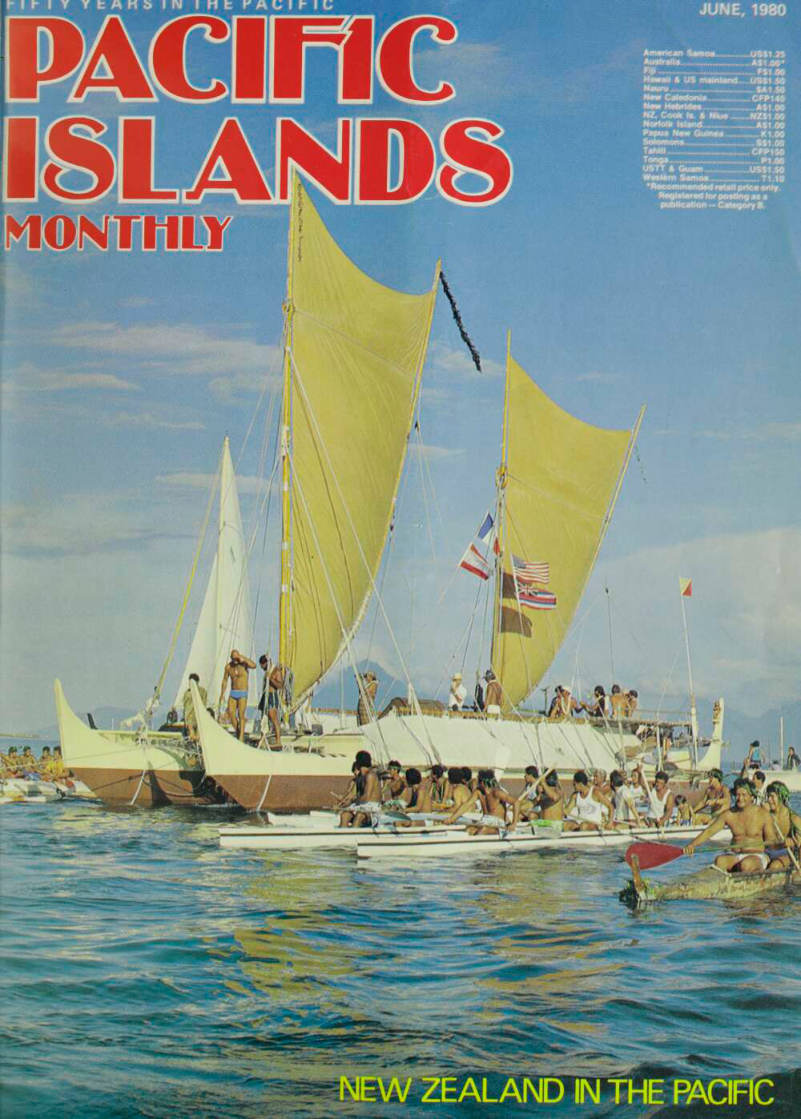
New Zealand In The Pacific
Advertisements & other items, p. 2 (1 item)
Toyota
How to find a REAL economy car.
When you look at a car billed as an economy
model, ask yourself a few questions.
What sort of fuel consumption can be expected?
Low? Good.
What about other operating costs? Oil, lubrication, that kind of thing. Low again? Great.
How about maintenance? The car has a low-breakdown record? You are definitely on the right track.
What is the average life of the car? Is it better than the average in your area? Super. That’s important in an economy car.
Now. How is the after service? Buying a car is not all in the price you know. Plenty of service outlets?
One economy car coming up. All you have to do is check the price. Then you can tell if you are really getting an economy car.
You will probably find, after asking these questions about town, that REAL economy cars come down to Toyota, the world’s economy car builder.
See Toyota first. Then you won’t have to shop around.
IHE HAPPY ECONOMIZER
TOYOTA STARLET
The car that says economy in every way And you will be happy for it. Big inside.
Small outside. Miserly with petrol.
Without sacrificing comfort. A good buy in an economy car even for Toyota.
L w i
PAPUA NEW GUINEA;
ELA MOTORS,
Scratchley Rd., Badili, P.O. Box 675, Port Moresby.
U.S. TRUST
TERRITORY: MICROL
CORPORATION,
P.O. Box 267, Saipan.
FIJI ISLANDS:
AUTOMOTIVE
SUPPLIES COMPANY,
P.O. Box 5177, Raiwaqa, Suva
AMERICAN SAMOA:
BURNS PHILP
(SOUTHSEA) CO., LTD.,
P.O. Box 129, Pago Pago.
WESTERN SAMOA:
BURNS PHILP
(SOUTHSEA) CO., LTD.,
P.O. Box 188, Apia.
TONGA: BURNS PHILP
(SOUTHSEA) CO., LTD.,
P.O. Box 55, Nukualofa.
GUAM: ATKINS, KROLL
(GUAM) LTD., P.O. Box
6428, Tamuning.
NEW HEBRIDES:
NEW HEBRIDES
MOTORS,
P.O. Box 18, Vila.
SOLOMON ISLANDS:
MENDANA
ENTERPRISES (5.1.)
LTD., P.O. Box 174,
Honiara.
TAHITI: NIPPON
AUTOMOTO, B.P. 342,
Papeete.
COOK ISLANDS:
COOK ISLANDS
TRADING
I I JYI J| / \ CORPORATION LTD., I I P.O. Box 92, Rarotonga.
TOYOTA
SERVICE
NAURU ISLAND:
NAURU COOPERATIVE
SOCIETY.
REPUBLIC OF KIRIBATI:
TARAWA MOTORS,
Box 36, Bairiki, Kiribati.
NORFOLK ISLAND:
MOUNT PITT
(ENTERPRISES) LTD..
P.O. Box 169.
NEW CALEDONIA:
SOCIETE IMPORTATION
AUTOMOBILE DU
PACIFIQUE, Rond-Point du Pacific (Station total) B.P. 438, Noumea.
The Toyota range includes: Toyota 1000, Toyota Starlet, Toyota Corolla, Toyota Celica, Toyota Corona, Toyota Cressida, Toyota Crown
Pacific Islands Monthly
Vtl. 51 No. 6
Juie 1980
Fusps 952480]
Representatives
AUSTRALIA: Distribution: NSW & ACT: Allan Rodney Wright (Circulation) Pty Ltd, PO Box 907, Darlinghurst, NSW 2010 Elsewhere: Gordon & Gotch (A/asia) Ltd Box 40 PO, Rosebery, NSW 2018. Advertising - Melbourne - Ray Brown Pty Ltd, 614 Queensberry St, North Melbourne 3051, telephone 329 8522, telex 31717, Brisbane - D Wood, Anday Agency, Box 1918, GPO, Brisbane 4001 tele phone 44 3485, 44 1546 Adelaide - Hastwell Media PO Box 30. Glen Osmond, SA 5064, 233 Glen Osmond Rd Frewville, SA 5063, telephone 79 1869 Perth - Adrep 62 Wickham St., East Perth, WA 6000, telephone 325 6395.
FUI: Distribution and subscriptions - Desai Bookshops PO Box 160, Suva, Fiji, telephone Suva 23036 Advertising Fiji Times & Herald Ltd, 20 Gordon St, Suva, telephone 312 111, telex FJ2124.
FRENCH POLYNESIA: Distribution - Hachette Pacifique 10 Ave Bruat, Papeete, telephone 25610.
HAWAII, UNITED STATES: Distribution PIM, Hawaii, PO Box 22250, Honolulu, Hawaii 96822.
JAPAN: Advertising and subscriptions - Universal Media CPO Box 46 ’ Tok yo, telephone 666 3036.
NEW CALEDONIA: Distribution Depot Centre de Presse 274729 ento cost • CBP2, Noumea, telephone 27 2434, NEW ZEALAND: Distribution - Gordon & Gotch, PO Box 584, 2 Carr Road, Mt. Roskill, Auckland 4 Advertising International Media Representatives Ltd, PO Box 2313 Auckland, telephone 795 487; 493 389, cables Intereps a " d Subscriptions - Ross Haines & Son Ltd, PO Box’ 1289, Auckland, telephone 769 042.
A ® U,NEA: Distribution - Gordon & Gotch, PO Box 3395, Port Moresby, telephone 254551, 254855 Advertising - PNG Post-Courier, PO Box 85, Port Moresby telephone 21 2577. y ' URTTED KINGDOM: The Herald & Weekly Times Ltd, 8-10 Lane ' London EC4A IBU, telephone 01 831 6041, telex London 21989 UNITED STATES MAINLAND: Advertising - Joshua B Powers Jr, Powers International Inc., 551 Fifth Ave New 100017 - telephone 867 9580. telex 2365 4 Subscriptions - PIM, Hawaii, 2812 Kahawai St Honolulu, Hawaii 96822.
Subscriptions
PIM is airfreighted to most subscribers and agents in the Pacific Islands and the United States, but not the UK or the Continent.
Elsewhere: SAI6 m zS|and Pe i r^ n a a nH C p eqUe iS acce P ted in Australian, US. ®w Zealand, UK and Fiji currency. For other remittances e 3 dank draft in Australian dollars made payable uSrate Z Bank " l9 Group ' 88 w entworth Avenue, Sydney, thly by Paci,ic Publications (Aust.) Ptv Ltd l«an n !I ted 10 Aus,ralia by Paramac, Alexandria, NSW *us ,he fi C pX e L pnce ,s recommended retail only Registered 2tSSv S R d !LS r ‘. ran p mission by post as a publication category B Second class postage paid at Honolulu •mill yngtlt @ 1978 Ltd C ' ,IC Publica,ions (Aust.) Pty
EfSl-lr Hono^: Send address changes Hawaii9&B2?" P ° Bo * 2225 °-
American Samoa Australia Aust, $13 $12 Other $US16 Canada Cook Islands $14 $13 $US18 Piji
;rench Polynesia
$12 $14 $F12
Cfp 1700
Cuam Hawaii Japan (iribati $13 $13 $16 $13 $US16 $US16 Y4500 Micronesia Hauru $13 $18 $US16 Hew Caledonia Hew Hebrides $14 $13
Cfp 1700
Jew Zealand Jiue $12 $13 $NZ13.50 Jorfolk Island $12 Jorlhern Marianas $13 $US16 K12 'apua New Guinea $13 olomon Islands $13 onga $13 uvalu $13
inited Kingdom
$15 10 $US18 S Mainland Western Samoa $14 $13
This Month’s Features
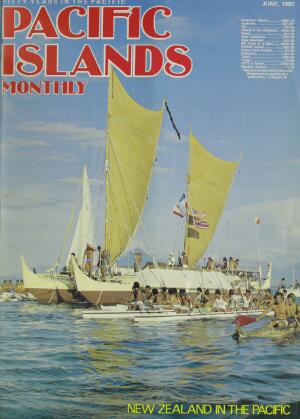
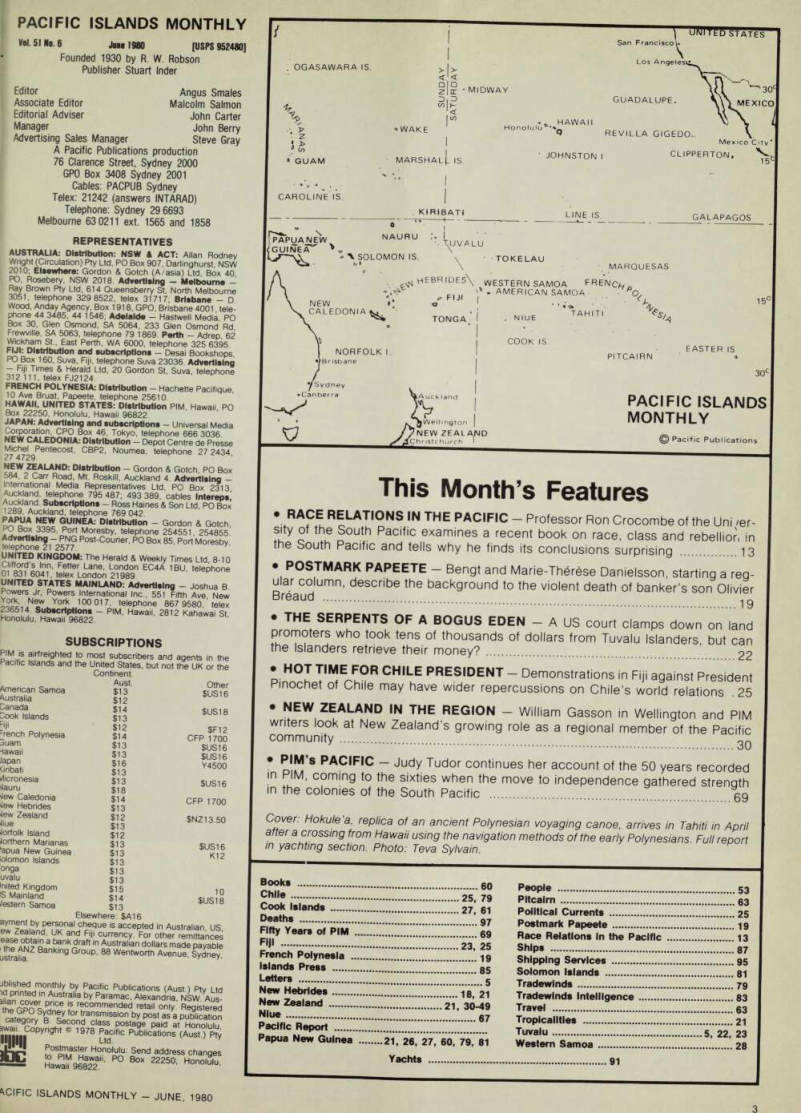
* + RA P u RELAT,ONS ,N THE PACIFIC Professor Ron Crocombe of the Uni /er sity of the South Pacific examines a recent book on race, class and rebellion in the South Pacific and tells why he finds its conclusions surprising 13 * POSTMARK PAPEETE - Bengt and Mane-Therese Danielsson, starting a reg ular column, describe the background to the violent death of banker's son Olivier Breaud 1 g • THE SERPENTS OF A BOGUS EDEN - A US court clamps down on land promoters who took tens of thousands of dollars from Tuvalu Islanders, but can the Islanders retrieve their money? 22 • H 0J h ™ E P ° R CHILE PRESIDENT - Demonstrations in Fiji against President nnocnet of Chile may have wider repercussions on Chile’s world relations 25 • NEW ZEALAND IN THE REGION - William Gasson in Wellington and PIM writers look at New Zealand’s growing role as a regional member of the Pacific community 3Q * dlm' 8 PAC,F,C Jud V Tudor continues her account of the 50 years recorded in PIM, coming to the sixties when the move to independence gathered strength in the colonies of the South Pacific 69 Cover: Hokule’a, replica of an ancient Polynesian voyaging canoe, arrives in Tahiti in April after a crossing from Hawaii using the navigation methods of the early Polynesians. Full report in yachting section. Photo: Teva Sylvain.
B <x>k» £ h,le 25, 79 Cook Islands 27, 61 Deaths Fifty Years of PIM 69 F, J' 23, 25 French Polynesia g Islands Press 8 5 Letters 5 New Hebrides ..."."..."..18, 21 New Zealand 21, 30-49 N, ue Pacific Report Papua New Guinea 21, 26, 27, 60, 79, 81
People Pitcairn 63 Political Currents 25 Postmark Papeete 19 Race Relations in the Pacific 13 Ships 87 Shipping Services 95 Solomon Islands 81 Tradewinds 79 Tradewlnds Intelligence 83 Travel 63 Tropicalities 21 Tuvalu 5, 22, 23 Western Samoa 28
Yachts
Advertisements & other items, pp. 3-4 (2 items)
3
‘VCIFIC ISLANDS MONTHLY JUNE, 1980
Founded 1930 by R. W. Robson Publisher Stuart Inder Editor Angus Smales Associate Editor Malcolm Salmon Editorial Adviser John Carter Manager John Berry Advertising Sales Manager Steve Gray A Pacific Publications production 76 Clarence Street, Sydney 2000 GPO Box 3408 Sydney 2001 Cables; PACPUB Sydney Telex: 21242 (answers INTARAD) Telephone. Sydney 29 6693 Melbourne 63 0211 ext. 1565 and 1858
o
C. mm SI 7~m n aas SWi>
SSSE
-- * ' rr^r^ IT=r a \€~m m p'r t.t ?
T p \ »T l> -60 C-90
TECHniCOL RECORD
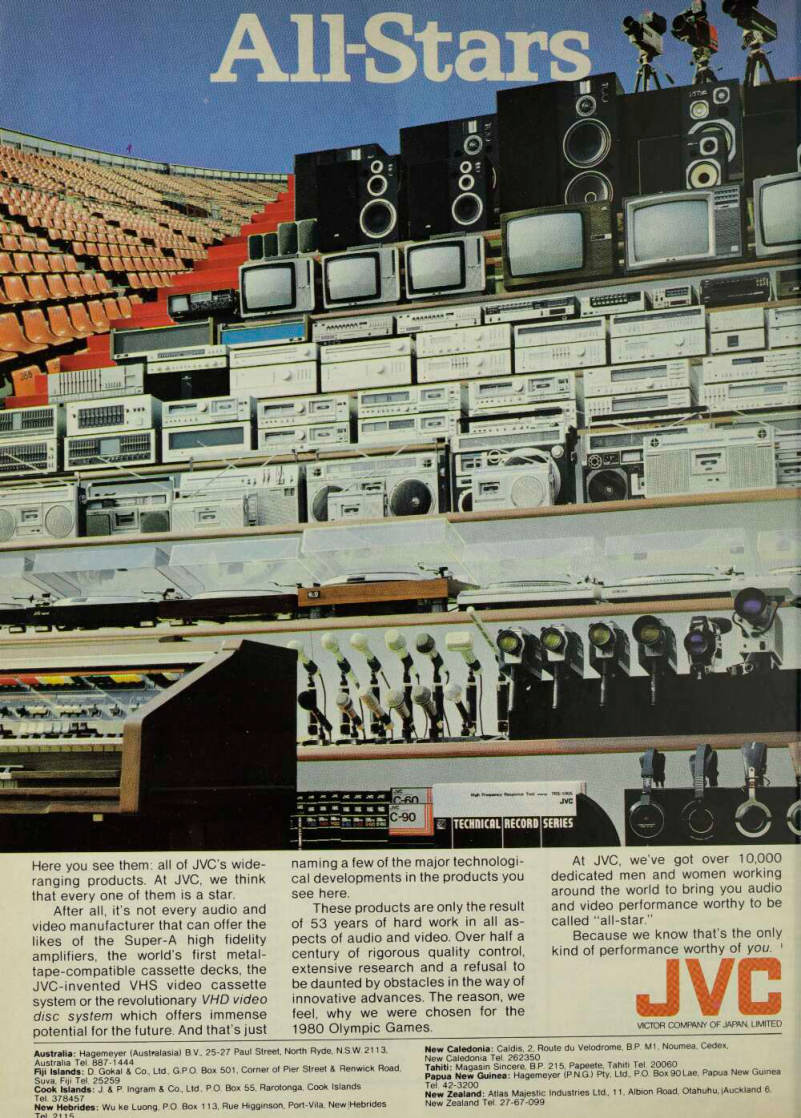
Here you see them: all of JVC’s wideranging products. At JVC, we think that every one of them is a star.
After all, it’s not every audio and video manufacturer that can offer the likes of the Super-A high fidelity amplifiers, the world’s first metaltape-compatible cassette decks, the JVC-invented VHS video cassette system or the revolutionary VHD video disc system which offers immense potential for the future. And that’s just naming a few of the major technological developments in the products you see here.
These products are only the result of 53 years of hard work in all aspects of audio and video. Over half a century of rigorous quality control, extensive research and a refusal to be daunted by obstacles in the way of innovative advances. The reason, we feel, why we were chosen for the 1980 Olympic Games.
At JVC, we’ve got over 10,000 dedicated men and women working around the world to bring you audio and video performance worthy to be called “all-star.”
Because we know that’s the only kind of performance worthy of you. '
JVC
VICTOR COMPANY OF JAPAN, LIMITED
Australia: Hagemeyer (Australasia) 8.V., 25-27 Paul Street, North Ryde, N S W. 2113, Australia Tel 887-1444 . _. .
Fiji Islands: D. Gokal & Co.. Ltd., G.P.O. Box 501, Corner of Pier Street & Renwick Road, Suva. Fiji Tel. 25259 , , , .
Cook Islands: J & P. Ingram & Co., Ltd., P.O. Box 55, Rarotonga, Cook Islands New 3 Hebrides : Wu ke Luong, P.O. Box 113, Rue Higginson, Port-Vila, New (Hebrides New Caledonia: Caldis, 2, Route du Velodrome, B.P. Ml, Noumea, Cedex, New Caledonia Tel. 262350 Tahiti: Magasin Sincere, B.P. 215, Papeete, Tahiti Tel. 20060 Papua New Guinea: Hagemeyer (PN G.) Pty, Ltd., P.O. Box9oLae. Papua New Guinea New 4 Zealand : Atlas Majestic Industries Ltd., 11, Albion Road, Otahuhu, (Auckland 6, New Zealand Tel. 27-67-099
Letters
Tuvalu’s PM off the hook
In your April issue (pps6-57) an item appeared about Tuvalu.
Your ‘dreamt-up creation’ that my statement to the Tuvalu people was an ad mission that I have been wrong in planning the deal is in fact incorrect.
The statement made by me was based on the reassessment of the joint venture in the light of great increases in world oil prices since the time of the negotiations for the venture, and the expert advice from my advisers in Tuvalu. The de cision was made from the re assessment of the project which showed that it would not be vi able.
The investment with Mr Gross has nothing to do with the payment for ships for the
fishing industry. The 15%
interest paid quarterly to
Tuvalu account has been received. This account is worked by the secretary for finance and the accountant, both Tuvalu Government officials, and Mr Gross not, as you stated, by Mr Gross alone.
Tuvalu’s share to the joint venture was to be paid from part of the profit of the catch of the ships and the rest to pay for the ships until the ships are paid off and the venture be
comes solely owned by
Tuvalu.
The question of the bank was and is one of the important matters Tuvalu pressed and is pressing for since its separation Tom the Gilbert and Ellice Islands Colony in 1976. On the irst round of negotiations, two )anks from the region were ap )roached and the result was legative. On Tuvalu’s second attempt three respected banks vere interested. Tuvalu’s hoice was made on the basis hat the bank will become the uvalu National Bank after a
period agreed to by both part ners. This will only happen when Tuvalu has the expertise and experience to run its bank.
The Barclays International Bank has offered to help put up the Tuvalu Bank and nego tiations are well on the way.
When this bank is established then all Tuvalu investments will be transferred to this, the only bank in Tuvalu.
Your statement that Tuvalu needs its investment from Mr Gross to buy the Barclays In ternational Bank is a very unkind one, especially when it is an offer from Barclays Inter national Bank to help put up the Tuvalu Bank and this offer was made after the two banks from the region had declined.
The Tuvalu investments made externally will be invested in the Tuvalu Bank once it is established.
The buying of lands with the
Green Valley Acres Corpora
tion is not a Government pro
ject.
I sincerely hope that I have updated and brought the qual ity of PIM to what it used to be several years ago.
T. Lauti
Prime Minister Funafuti Tuvalu • Our ‘dreamt-up creation ’ was designed in part to let the prime minister off the hook in view of the criticism voiced by many in Tuvalu of Mr Lauti’s associ ation with Sidney Gross. Our description of his radio address as an ‘ honest and dignified ad mission that he had been wrong in planning the deal’ was much gentler than statements made on the matter by others at various times. The prime minister appears to have misread our re ports. Our report that the $550 380 invested with Mr Gross was neededfor investment in the joint venture with Barclays Bank was taken from the Tuvalu Government's News Sheet of December 12, 1979. On page 3 it was reported (inter alia) ‘Parliament also learned that Government plans to with draw the half-a-million dollars which she invested in the Blue Chips Realty Investment Co in the United States. In reply to
supplementary questions asking
why, the Prime Minister told Parliament that Government
has officially accepted proposals from the Barclays Bank Inter national for a joint venture in establishing a bank here in Tuvalu; with Government own ing 75% and Barclays 25% of the capital share issued. It is for this venture that Government plans to withdraw the investment ’
PIM has never reported that the land deals with Green Valley Inco were a government project.
For more about that particular subject see Tropicalities. Edi tor.
More on Hawaii
and the Islands I read with much interest Dan Boylan’s article The Bishop as Symbol’ (PIM Mar p 35). Its general tone of consternation and muted optimism calls for some comment in rebuttal and clarification.
It cannot be disputed that Hawaii government has been slow to respond to develop ments within the Pacific island community. The East Asia orientation has been, among other things, the priority focus.
Professor Donald Topping remarked on other aspects which indicate a general lack of previous commitment to the Pacific island area. It is to such comments that some rejoinder must be made.
First, Topping’s criticism of the Hawaiian population is both unwarranted and unin formed. Unlike the genteel and white-dominated professional and social circles which Pro fessor Topping is accustomed to; Hawaiians are not as privi leged as Topping and his col
leagues are in taking day-trip
expeditions to the South Pa cific or to do demure research on the island areas, protected by the secure embrace of aca demic tenure.
The University of Hawaii Pacific Islands Studies
Program’s ‘lB7 faculty mem
bers’ are a white-dominated clique of continental emigres who have little empathy with the Hawaiian community.
They, moreover, have done little to substantively encourage Hawaiian students to pursue advanced degrees within and beyond the Program itself. Topping’s re marks are also uninformed in that Hawaiian contact with other Pacific islanders, par
ticularly in French Polynesia and in Kiribati, have been on human and cultural levels rather than in the ostentatious manner of academe. To be more accurate, Topping’s ignorance of Hawaiians is more appalling, though not
necessarily surprising, than his
observations on the Hawaiians themselves.
Second, Topping’s vexation concerning the evidently poor Hawaii resident response to the Polynesian Cultural Center is misplaced. The answer is pro vided in Boylan’s article.
Hawaii residents are not eager to see the tourist ‘dance in a grass skirt, sample coconut meat, or be frightened by the flapping tongue and spear of a Maori warrior’. To be fair, however, PCC (as well as BYU/Hawaii) is considerably more than a tourist-oriented destination.
It is a living repository of reconstructed Polynesian cul ture. Recently. BYU/Hawaii’s Institute for Polynesian Studies has been issuing a biannual publication. Pacific Studies, which has given a forum for serious research on the Pacific area, regardless of discipline.
Such gestures have outstripped the generally self-serving and parochial activities of the Pa cific Islands Studies Program. I disagree with the substance of Boylan’s conclusion. The ‘Hawaiian renaissance and Uncle Sam’s abundant dollars’ are not the proper vehicles for change. It would only serve to enhance the parasitic interests of the cloistered custodians of government grants.
William E. H. Tagupa
Graduate, Pacific Islands Studies
Kaui Community College,
University of Hawaii A word for some atolls Bengt Danielsson (PIM Mar p 22) writes ‘Commodore Byron was less lucky, since he sighted only a few worthless atolls’.
I am sure that your Tahiti correspondent would not de scribe his native Sweden as worthless, nor would he de scribe his adopted and beloved Tahiti as such. If Dr Danielsson opens his copy of Professor Maude’s book Of Islands and
Men and looks at chapter three he will see that Commodore Byron discovered the island of Nikunau, in the south-east of the Gilberts Group in Kiribati.
I do not think the people of Kiribati would agree that Nikunau is a worthless atoll, and I am certain the people of Nikunau would not agree.
I imagine that Dr Danielsson intended no offence but since he chose to bring up history perhaps he should read back
ground more carefully.
Furthermore, since he is also an experienced writer and cor
respondent for your magazine
I think that he might choose his words with care.
R. Overy
Librarian/Archivist Kiribati National Library Bairiki, Kiribati.
Correcting facts on
Hides and Cham
pion
I have hesitated to write to you, but now do so in a helpful, not critical way. No doubt you will have many letters on the points I am going to mention in the February PIM article, ‘When they began to roll back the frontiers’, by Judy Tudor, pp 43-45.
The late L. J. O’Malley did not resign from the Papuan Administration with the late J.
G. Flides, in July 1936. Jack Hides’ companion on the ill fated patrol was David Lyall, who died at Daru on Sep tember 16 1937. I served under Jim O’Malley in the Purari Delta in 1951-1952. He retired as a District Commissioner, in the normal course of his ser vice, and died in Sydney in 1975.
Mr Ivan Champion and the late C. J. ‘Bill’ Adamson (not Anderson) left Daru on the Vailala on April 25 1936. It was Anzac Day. They were ac
companied by the resident
Magistrate, Daru, Mr Wood ward.
The Vailala could go no further than about 160 miles above the junction of the Wawoi and Aworra Rivers. It was here Champion and Adamson disembarked with their carriers and stores, on April 30 1936.
I went to Papua New Guinea in 1946 and have been a keen reader of PIM over the years.
So I don’t like to see you pub lish mistakes.
H. E. (Lynn) Clark
Southport, Queensland
PNG vs. Tahiti
again
Please allow me to reply to two articles, both of which appeared in PIM of December 1979: the first, ‘A Tahitian takes on Mr Olewale’ (p 15), and the second ‘Free advice to PNG, Fiji’ (p4O). The first article was written by Ms de Montlue but for the second, the author remains anonymous.
My replies would be directed to the respective authors.
To Ms de Montlue; Unfor tunately, Ms de Montlue, your surname renders your argu ments invalid. I would respect the views of a true Polynesian, but from a disguised Polynesian as your surname in dicates, my respects fall short.
Your arguments are invalid be cause every logical person knows that those who ‘cry the loudest’ are the ones most dis turbed. They’re disturbed be cause their personal interests are in danger; in this case, it is France whose interests are in danger so that the de Montlues would have to raise their
voices. The de Montlues and others like them who benefit from French interests cannot entertain the idea of losing the
‘Polynesian paradise’, hence
they will go to all lengths to safeguard those interests.
I need not go any further to make my point. However, to be fair to Ms de Montlue (and the readers) I would reply to her arguments.
Ms de Montlue tells us that French Polynesia has the highest standard of living in the South Pacific apart from American Samoa. For those who can reason what is there to stop them from reasoning that this is just another form of blackmail? Can they not see that the so-called high standard of living is just one way of
keeping the Polynesians and
the Micronesians ‘cool’ while the French and the Americans carry on their nuclear tests?
Please Ms de Montlue, what is the highest standard of living today when in the future you know every living creature on the islands is bound to be dead
through nuclear poisoning?
The kind lady also referred to lawlessness in Papua New Guinea. At this point, I would refer her to the article ‘Big Terms for Papeete Eight’ (PIM,
July 1979 (pp 27-29). The sig
nificance of that article was the question ... ‘is it less criminal
to kill people slowly by
radioactive poison ...?’ If Ms de Montlue refuses to see radioactive poisoning as lawlessness, then I do not know what it is!
Finally, I give half a mark to Ms de Montlue for questioning the Honourable Minister (Mr Olewale) on the issue of Irian Jaya. However, the issue here is more historical rather than contemporary. It all goes back to the so-called ‘Act of Free Choice’ of 1969; masterminded and enforced by the colonising power, with the approval of the UN. But leaving this aside, the
question remains if people
like Ms de Montlue (or a country like France) whose interests are in danger in
Polynesia and consequently
‘raise hell’ at the slightest sound of the word ‘indepen dence’ then how would one suppose Indonesia would react to the call for freedom whether
it comes from the Irian Jayans themselves or PNG?
To Anonymous; .. the voice of the people is the voice of God.’ Please, why not admit that ‘the voice of the Polynesians is the voice of France’? I do not see why God has to come into this unless, of course, France is the equivalent of God.
.. real savages ..Well
now, are we not all products of
history? Please Anonymous,
refer to your history books.
Since you seem to favour France, perhaps you’d care to let us know just how many
French people (including kings
and queens) have had to say their last prayers before the guillotine was to do its job. Is the chopping of people’s necks any less savage than an arrow through the heart? Or is the killing of life (both human and animal) by French nuclear poison any less savage than a killing by a PNG arrow? ‘... international contami nation.’ What a word, contami nation! Even if the victims of PNG arrows are eaten there is reason to pardon our primi tiveness, but I fail to see why a highly civilised society like France has to eat away the liv ing cells of Polynesians and eventually the whole region of the South Pacific through its nuclear poison! If Anonymous; is so keen on a UN inquiry inU> the prevention of‘international contamination’ then it should! begin with a civilised society like France. After all, is eating a PNG arrow victim any more contaminated than living with a contaminated victim ofl French nuclear tests? Evidence suggests that ‘international contamination’ has occurred! and still continues without the contribution from PNG.
‘... liberating its racial
brothers from .. . Indonesians ...’ Please, Anonymous, can you not see that the barriers the Irian Jayans are facing from; Indonesia are the same kind ol barriers the Polynesians are facing from France? Currenj situations in the Polynesian islands suggest that if the islands had the jungles of Irian Jaya, they would have done what the Irian Jayans are attempting to do to the Indonesian authorities. How\
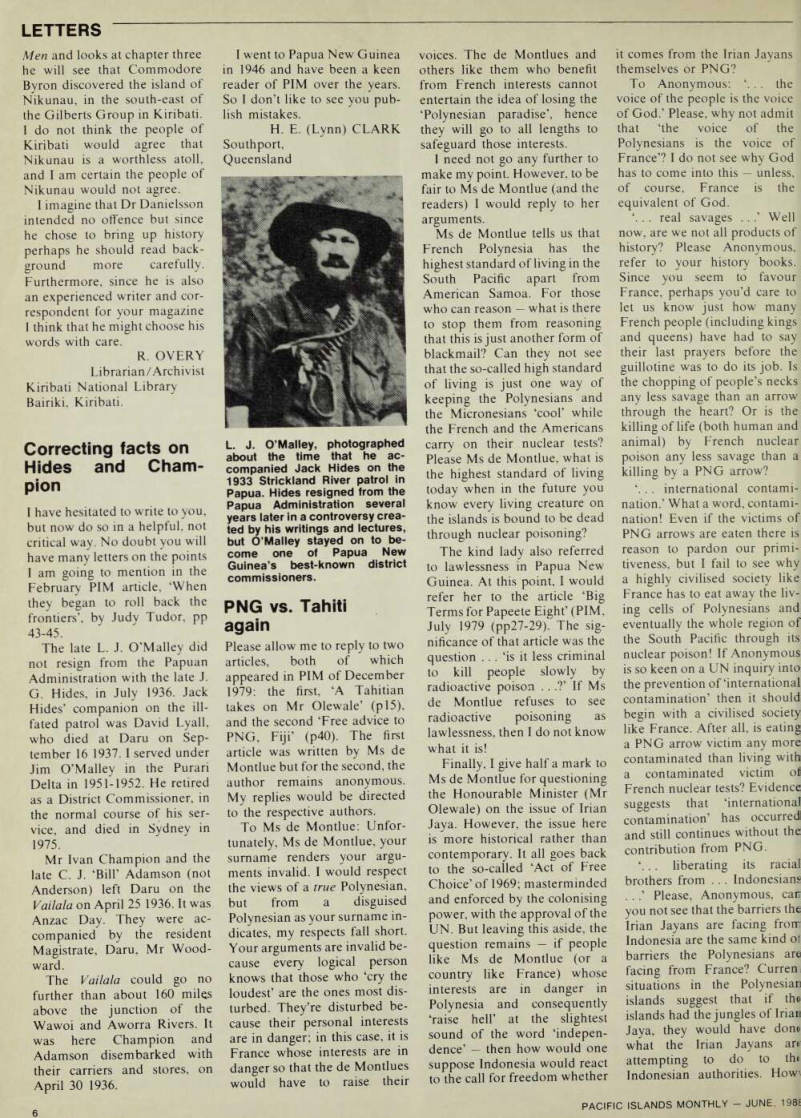
L. J. O’Malley, photographed about the time that he ac companied Jack Hides on the 1933 Strickland River patrol in Papua. Hides resigned from the Papua Administration several years later in a controversy crea ted by his writings and lectures, but O’Malley stayed on to be come one of Papua New Guinea’s best-known district commissioners.
ever small the group that fights for freedom, whether it be [ Polynesians or Melanesians, I only time will tell if that fight I is for real. The question I’d like I to leave with Anonymous (and I the readers) is —is there not an I easier way out for those seek ing their God-given right to j freedom than losing lives and [ spending years in prison?
I trust that these replies are [ adequate to the questions and arguments raised by the above mentioned authors. As is obvious from the above, I write here as a Papua New Guinean I (by blood) in defence of my country and the Honourable Minister, but my views may not necessarily be shared by all.
Thank you so kindly I re main a primitive Papua New Guinean.
Samson M. Polume
Victoria BC Canada
Researching
old money
I am researching the paper cur rency issued in the Solomon and Gilbert Islands early this century.
Does anyone remember or hold records relating to the notes used by Burn Philp in the Solomon and Gilbert Islands between 1909 and 1916? They were in the values of £1 and £5 and were probably similar to those issued by the same company in North Queens
land, Thursday Island,
Samarai, Port Moresby and
Tonga towards the end of the last century. The information is wanted for an on-going study dealing with the currency used in New Guinea and the South west Pacific.
Information on surviving specimens for any of the afore nentioned areas would be nvaluable. Any information
vould be acknowledged.
(Dr) J. W. Mira
15 Harrow Road Bexley NSW Australia 2207
More on Fanning’s
Villiam Greig
v PIM article (Aug 1958 pB4) ttempted to tell about the life T ‘the Ayrshire Scot’, William
jreig of Fanning and
Washington Islands. Having
ttle to go on, the author mixed
a bit of truth with a lot of myth.
It made exciting reading, but contained a paucity of facts.
Among other things, it
claimed that Greig had been
‘dumped’ alone on Fanning by
a whaler whose skipper he had
annoyed ‘beyond endurance’.
Nothing could have been far ther from the truth. To set the record straight, we would like to share with your readers what we have found out about William Greig from our re search.
Greig was born in Ayr, Scotland, on November 23, 1821, the youngest of six chil dren. Following the tradition of many before him, he went to sea before his teens, working his way from cabin boy to navi gator in a short span of years.
At the age of 23 he was master of a barque trading from Great Britain to ports in South America.
Fie first entered the Pacific as captain of a ship that he left in Valparaiso, and then made his way to Honolulu. Soon after, he and his good friend, Henry Christie, went to San Francisco together to try their luck in the
California gold mines. They
made their stake and used it to enter the Pacific maritime trade between Tahiti, New Zealand, and Australia.
In 1852, Greig became one of the original members of the Hawaiian Masonic Lodge No 21 in Honolulu. He held pos itions of junior and senior war den in the lodge over the years, and remained a mason in good
standing throughout his life.
In 1855, Greig left Honolulu, travelling to Arkansas to visit his brother, James Greig, and family. He continued on to the Continent where he purchased stock for a drygoods store that he opened in Honolulu in May 1856. An advertisement
announcing the opening of
Greig’s store was published in The Polynesian, a Honolulu newspaper.
By December that same year he put everything up for auc tion. For a while he remained in Honolulu, making one visit to the Island of Kaua’i in August 1857. Later that same year Greig went to Fanning to become assistant manager for
Captain Henry English’s coco
nut oil industry there. He prob
ably travelled on the brig Advance under Captain Miline, leaving Honolulu on Decem ber 22, 1857, for Fanning Island. Henry English owned the Advance, having acquired it at the time he purchased Fan ning and the coconut oil indus try from Charles B. Wilson in
September 1852.
In March 1859, a partnership was formed between Henry
English. William Greig and
George Bicknell. In January
1864, because of ill health, English sold his share in the island to Greig and Bicknell.
Meanwhile, the coconut business had changed from oil to copra, and prospered. Greig and Bicknell branched out into several sidelines, including guano, pearl shell, beche-de
mer, ship repairing, victualling,
and honey. Bicknell managed the Washington Island plan tation, and Greig lived on Fan ning. Each had a large two-storey frame house with commodious, well-furnished rooms. Cattle grazed on the lawn, providing milk, butter, and occasionally beef.
Greig and his wife, Teanau Atu of Penhryn Island, raised a family of four boys and five girls. In 1882, both the Bicknell and Greig families visited Honolulu and had their pic tures taken together by the
well-known photographer
A. A. Montano.
Bicknell died in 1884, leav ing his share of the business to his brother, missionary James Bicknell. William Greig died in San Francisco in 1892. After services at the Masonic Temple, his body was returned on the Douglas to Fanning Island for burial. Greig’s wife, Teanau, died in 1917 and was buried beside her husband.
Much more could be written about the adventures of William Greig and his family, but the above will serve to lay to rest the fallacious impli cations of the previous article.
Thelma Anderson
Marion Kelly
Honolulu Hawaii USA • Thelma Anderson is the widow of the late William Greig Anderson, grandson of William Greig, and Marion Kelly is their daughter. Mother and daughter have been researching the story
since 1973. They say in a cover ing letter that members of the Greig family have been "dis tressed'' for 20 years because of ‘misrepresentations’ in the 1958 PIM article. In an appendix to their letter they thank more than a dozen Pacific libraries, museums, and institutions for ‘generous assistance’ in their work. Since this is the first com plaint we’ve had about that 1958 article, we re only too pleased at the opportunity to put the record straight after 22 years. - Editor.
Appeal on PNG
music studies
I have come to the Music Ar chive at the Institute of Papua New Guinea Studies to reor ganise the cataloguing system so that it will be more useful.
While I am here I would like to develop the Archive into the resource centre for the study of PNG music.
This would be possible by obtaining 1) all commercial recordings; 2) copies of import ant historical recordings which are now scattered in archives throughout the world; 3) printed materials on PNG music.
By bringing these items
together in one location, any individual would be able to see what music research has been done from any particular area.
Efforts could then be made
toward augmenting an existing
collection or initiating work in an area previously undocu mented. The development of such a collection would enable PNG music to be adequately studied in PNG a nice
thought.
Don Niles
Box 1432 Boroko Papua New Guinea Can any one help?
Mr J. Newton Browne of 3/54 Barkly Street, St Kilda Vic, Australia 3182, is
preparing a display of
expired passports relating to
the Pacific region. In a letter to PIM he quotes approval for the project from the A us tralian Department of
Foreign Affairs, and asks for
donations of expired and
cancelled passports complete with visa entries and endorse ments.
Advertisements & other items, pp. 5-8 (3 items)
5
’ACIFIC ISLANDS MONTHLY JUNE, 1980
letters
7
ACIFIC ISLANDS MONTHLY JUNE, 1960
Advice.
CONSTRUCTIVE
Yf w * Swamp Bulldozers as well as Swamp Dozer Shovels. i * Radio-Controlled Bulldozers and Dozer Shovels.
Electric Powered Dozer Shovels.
A wide range of Pipelayers.
Amphibious Bulldozers. fZ Q 4T\ Wheel Loaders.
A wide selection of Off-Highway Dump Trucks. i V i 1 Slag Dump Trucks.
And offer Motor Graders.
As well as Motor Scrapers.
QBBl_
-/t Soil Compactors.
Trash Compactors.
Towing Tractors. i to M 'I J.
Vibratory Rollers. Diesel Generator Sets.
Portable Air Compressors.
A wide selection of Diesel Engines.
J 4 * Machine Tools. 0 0 Mechanical and Hydraulic Presses. A variety of Maypres Presses. OBS Power Presses. Tunnel-Boring Machines.
We're constructive in other ways. We offer castings, foundries, and important advice on construction and manufacturing projects.
•§• KOMATSU LTD
Tokyo, Japan Komatsu overseas offices: Sydney, Singapore, Jakarta, Manila, Seoul. Bangkok, Bangalore, Teheran, Dubai. Jeddah, Riyadh, Ad Dammam Baghdad Ankara Moscow, London, Brussels, Dusseldorf, Stuttgart, Warszawa, Paris, Madrid, Cairo, Alger, Abidjan, Lagos, Nairobi, Johannesburg Toronto, San Francisco Port Lee Arlington Atlanta Detroit. Mexico City, Habana, Panama, Sao Paulo, Caracas, Lima, Buenos Aires, and distributors in over 100 countries around the world.
Pacific Report
Coastal Surveillance Survey
f Australia and New Zealand have formed an assessment team to examine the coastal surveillance requirements of Island I nations of the South Pacific Forum. The assessment, which is I being carried out by arrangements with the countries con cerned, will deal with all civil surveillance requirements and in particular protection of fisheries and prevention and detection of smuggling and drug-running. The survey began in mid-April and will continue well into June, taking in Papua New Guinea, Solomon Islands, Nauru, Fiji, Tonga, Niue, Cook Islands, West ern Samoa, Tuvalu and Kiribati. Although civil surveillance re quirements are involved, military defence advisers are included in the operation for technical aid. Australia and New Zealand are carrying out the project as an aid gesture and without com mitment. Some of the countries being examined have already made tentative assessments of surveillance requirements but the new project is expected to enable the establishment of an integrated plan according to foreign affairs officials in Australia and New Zealand.
Pythons And Cats Against Rats
In the Tingwon Islands of northern Papua New Guinea govern ment officials have brought in pythons and cats - with the ap proval of local villagers - in an attempt to end a plague of rats.
Reports so far have not indicated how the pythons are perform ing, but the cats were said to be operating ‘superbly’. The cats came from Kavieng on nearby New Ireland. Meanwhile the New Ireland Provincial Government is providing rice for the Tingwon islanders to offset a food shortage caused by the rat plague.
Politician Calls For Socialism
An Alliance Party conference in Fiji was told that Fiji needed advice from the Cuban president, Fidel Castro, on government control of rural labour and development. The suggestion was made by an alliance backbencher in parliament, Mr Jone banuve, who said he believed it was time Fiji turned to a new orm of government embodying rigid socialism and compulsory labour on the land.
Storm Deaths In Kiribati
Three peopie were killed and seven others seriously injured in Kiribati in April in what is now known to have been an arm of the cyclonic disturbances which brought 16 deaths to Fiji (PIM May pi 7) The Kiribati deaths occurred at Autukia Village Nonouti. when a structure collapsed in heavy winds during a pubhc gathenng. Those killed were two children and a woman The Kiribati weather office has confirmed that southern Kiribati was partly hit by the cyclone, but there are no other reports of casualties or serious damage.
Kiribati Trade Fair For November
T° nd annua ' trade f air of the Republic of Kiribati will be viously an'noimcecl^ OVember 17 ‘ 18 ' a " d notin october as
Chinese Embassy In Png
govar nment p apua New Guinea has agreed to the establishment of a Chinese Embassy in its country, revers ■w.3 usa j giN f en b V the Previous Somare government. Mr iqqd US3 IS believed t 0 have be en based on fears that nn a h US SR n + va nes could be br °ught into the Pacific by allow ng a diplomatic presence, and Russia was also refused per rhllTw?h 0 th abllS t h M n h embaSSy ' Now however Ch 'na is going th *n 6 estab,ish ment of embassies in Fiji and Western * a ™ oa aa waH as In PNG although USSR has no diplomatic pres '■ ce ln the Pacific Islands. The Chinese Vice-premier Mr Li Xian l' an /® centl ’y visited PNG. He announced that his country would >end a survey team to PNG to examine possible economic co
°S® ra J'°" ln agricultural and forestry development and to pro hernmp a ' d ,O . PNG - However the team is likely to ed ln sensi,lve negotiations because of an in- Ik aid between ,he two countries. China aid hntPMr kJ d 1 31 ,he ,. nature and conditions of its foreign dSntn P s N a G nd ha conditon P s ol,Cy °' aCCePti " 9 aid °" ly ° n i,S ° Wn
Review Of Fiji Public Service
? a n ®' ° f Australia’s most distinguished public servants, Sir Arthur i ange who once headed the Department of Defence has been review systems" used by the pubNc serviceh ’ 65, ret,red only recent 'V- T he appointment at Fiji’s Minkw Mr p 0U^ Ced ln Canberra by the Australian Prime of F iii Rph Rir r r ’ dUri^ 9 f S .l ate visit by the Governor-General of Rj!, Ratu Sir George Cakobau and Adi Lady Cakobau. Ratu h nrhTon 6 ’ l a,d tr,bute t 0 aid to Fiji, told a state luncheon in Canberra that in 10 years of independence his “ u n f ry hadh e ,d 'ts head high, had maintained stable governreached out in Partnership to other Pacific
Eniwetak Atoll Handed Back
Eniwetak Atoll, site of US nuclear tests in the 1940 s and 50s kbfnH e f^n ned t 0 'll people at a recent ceremony on Eniwetak a th / ee ' year decontamination operation carried atln qq US milltary forces - The people were moved to another atoll 33 years ago when nuclear testing began. About 500 Eniwetak people attended the ceremony which handed back their island, but it is still not clear how many intend to settle again on Eniwetak. A gradual movement back to the island is ® x Pf ctad ° ver tde next two or three months. Many of the people at the handing back ceremony, although Eniwetak people had never before seen their traditional home because they had been born away from the island after the nuclear tests began Reo resentatives of the US Government and US military forces attended the ceremony in which the Director of the Defence Nu clear Agency, Vice-Admiral Robert Munroe, said the free world owed a great debt to the islanders.
Wartime Wrecks Protected
Solomon Islands has passed legislation declaring equipment and wrecks left over from World War II as protected cultural property because of the growing interest by collectors, historians and technicians in World War II remnants. The legislation follows the pattern of similar laws introduced in Papua New Guinea two years ago. Under the laws of both countries no war wreckage or remnants can be removed from the country without per mission, and anything of special historical value is banned from export. Provision is made for local communities to have a voice in the removal or preservation of war remnants in their area.
Pacific Super Power Threat
The Premier of the Australian state of New South Wales Mr Wran, told a conference of the Pacific Basin Economic Council in Sydney last month that the region was under threat because of super power rivalries. Mr Wran said that the rivalry of major powers posed a permanent threat to long-term peace and stab ility and it was the task of every nation in the Pacific Basin to do everything possible to form mutual bonds of understanding and trust. He said that the four greatest world powers three of them with nuclear strength, all had Pacific Ocean coastlines.
They were USSR, USA, Japan and China. Their presence in the region posed a task of particular delicacy to Pacific Ocean coun tries. The economic council which Mr Wran addressed is a grouping of business representatives from nations in the Pacific.
Antas Raises Charges For Air Niugini
Oantas, the airline which handles transit and turnaround require ments in Australia for the Papua New Guinea airline Air Niugini, has sharply increased its charges for the service. The increase is 38% in Brisbane and 180% in Sydney. Air Niugini reacted angrily to the Qantas move, claiming it had been'singled out among other airlines serviced by Qantas. Qantas said the in creases were made purely on economic grounds, but has entered into a series of talks with Air Niugini.
Navy Aircraft Hit Overhead Cable
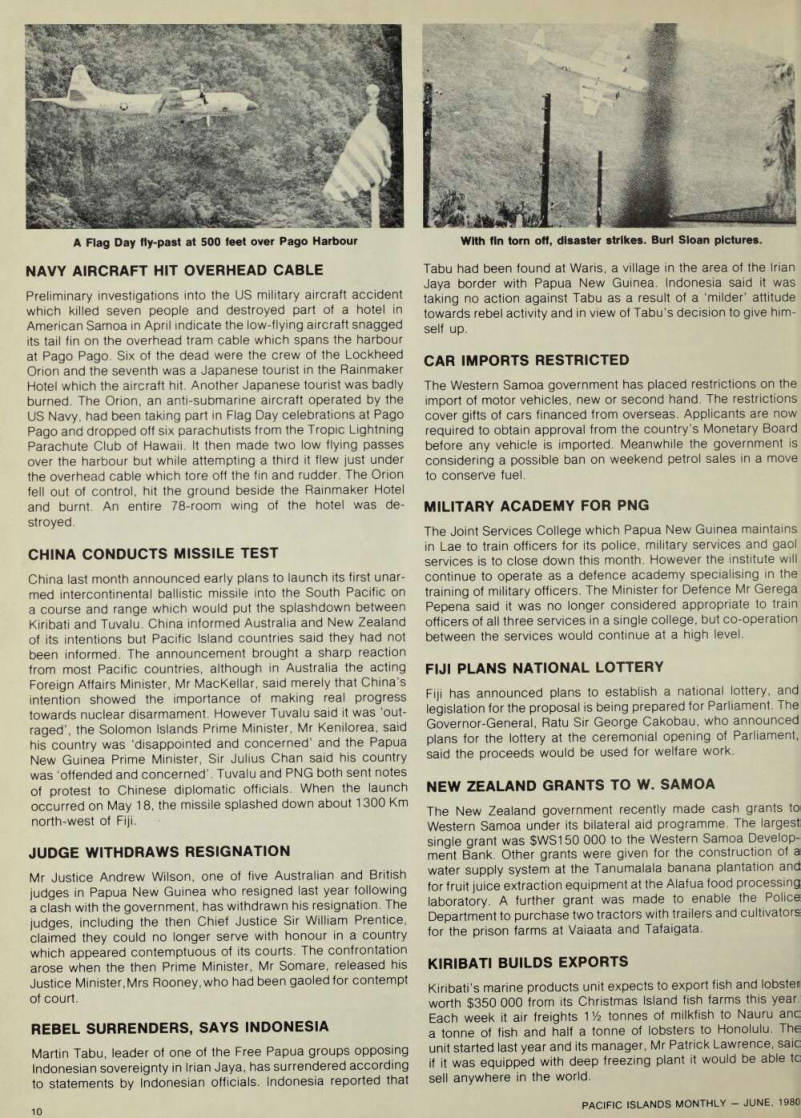
Preliminary investigations into the US military aircraft accident which killed seven people and destroyed part of a hotel in American Samoa in April indicate the low-flying aircraft snagged its tail fin on the overhead tram cable which spans the harbour at Pago Pago. Six of the dead were the crew of the Lockheed Orion and the seventh was a Japanese tourist in the Rainmaker Hotel which the aircraft hit. Another Japanese tourist was badly burned. The Orion, an anti-submarine aircraft operated by the US Navy, had been taking part in Flag Day celebrations at Pago Pago and dropped off six parachutists from the Tropic Lightning Parachute Club of Hawaii. It then made two low flying passes over the harbour but while attempting a third it flew just under the overhead cable which tore off the fin and rudder. The Orion fell out of control, hit the ground beside the Rainmaker Hotel and burnt. An entire 78-room wing of the hotel was de stroyed.
China Conducts Missile Test
China last month announced early plans to launch its first unar med intercontinental ballistic missile into the South Pacific on a course and range which would put the splashdown between Kiribati and Tuvalu. China informed Australia and New Zealand of its intentions but Pacific Island countries said they had not been informed. The announcement brought a sharp reaction from most Pacific countries, although in Australia the acting Foreign Affairs Minister, Mr MacKellar, said merely that China’s intention showed the importance of making real progress towards nuclear disarmament. However Tuvalu said it was ‘out raged’, the Solomon Islands Prime Minister, Mr Kenilorea, said his country was ‘disappointed and concerned’ and the Papua New Guinea Prime Minister, Sir Julius Chan said his country was ‘offended and concerned’. Tuvalu and PNG both sent notes of protest to Chinese diplomatic officials. When the launch occurred on May 18, the missile splashed down about 1300 Km north-west of Fiji.
Judge Withdraws Resignation
Mr Justice Andrew Wilson, one of five Australian and British judges in Papua New Guinea who resigned last year following a clash with the government, has withdrawn his resignation. The judges, including the then Chief Justice Sir William Prentice, claimed they could no longer serve with honour in a country which appeared contemptuous of its courts. The confrontation arose when the then Prime Minister, Mr Somare, released his Justice Minister, Mrs Rooney, who had been gaoled for contempt of court.
Rebel Surrenders, Says Indonesia
Martin Tabu, leader of one of the Free Papua groups opposing Indonesian sovereignty in Irian Jaya, has surrendered according to statements by Indonesian officials. Indonesia reported that
Tabu had been found at Waris, a village in the area of the Irian Jaya border with Papua New Guinea. Indonesia said it was taking no action against Tabu as a result of a ‘milder’ attitude towards rebel activity and in view of Tabu’s decision to give him self up.
Car Imports Restricted
The Western Samoa government has placed restrictions on the import of motor vehicles, new or second hand. The restrictions cover gifts of cars financed from overseas. Applicants are now required to obtain approval from the country’s Monetary Board before any vehicle is imported. Meanwhile the government is considering a possible ban on weekend petrol sales in a move to conserve fuel.
Military Academy For Png
The Joint Services College which Papua New Guinea maintains in Lae to train officers for its police, military services and gaol services is to close down this month. However the institute will continue to operate as a defence academy specialising in the training of military officers. The Minister for Defence Mr Gerega Pepena said it was no longer considered appropriate to train officers of all three services in a single college, but co-operation between the services would continue at a high level.
Fiji Plans National Lottery
Fiji has announced plans to establish a national lottery, and legislation for the proposal is being prepared for Parliament. The Governor-General, Ratu Sir George Cakobau, who announced plans for the lottery at the ceremonial opening of Parliament, said the proceeds would be used for welfare work.
New Zealand Grants To W. Samoa
The New Zealand government recently made cash grants td Western Samoa under its bilateral aid programme. The largest single grant was SWSISO 000 to the Western Samoa Develop ment Bank. Other grants were given for the construction of a: water supply system at the Tanumalala banana plantation and for fruit juice extraction equipment at the Alafua food processing laboratory. A further grant was made to enable the Police Department to purchase two tractors with trailers and cultivators for the prison farms at Vaiaata and Tafaigata.
Kiribati Builds Exports
Kiribati’s marine products unit expects to export fish and lobster worth $350 000 from its Christmas Island fish farms this year.
Each week it air freights 1 1 /2 tonnes of milkfish to Nauru anc a tonne of fish and half a tonne of lobsters to Honolulu. The unit started last year and its manager, Mr Patrick Lawrence, saic if it was equipped with deep freezing plant it would be able tc sell anywhere in the world.
A Flag Day fly-past at 500 feet over Pago Harbour
With fin torn off, disaster strikes. Burl Sloan pictures.
Advertisements & other items, pp. 11-12 (3 items)
Acific Islands Monthly June, 1960
Beehive Building
94 Elizabeth Street Melbourne, Victoria Australia 3000 G.P.O. Box 8 Melbourne, Victoria Australia 30!
Cables Telex; AA34552 Phone: 63 5094
Akai
OFFICIAL SUPPLIER OF
VIDEO HOME SYSTEMS
AKAI ELECTRIC CO., LTD.
> Tokyo, Japan Anytime, anywhere you go, take the ones that have what it takes. Akai radio cassette recorders. A good-looking great-sound lineup that makes the good times in life even better.
Easy to carry and easy to use, you'll find the best in features, power, quality and
cost / performance in every model.
So next time you're rock-and-rolling, make the sound choice—Akai.
imnn .
I ft f* U
(D ®a B 0 © rtfff n n n n n ff‘n AJ-490 4 Band Stereo Radio Cassette Recorder •3000mW Maximum Per Channel Output •2-Way 4-Speaker System •Automatic Level Control •Multi-Function 7 LED Indicators AJ-500 4 Band Stereo Radio Cassette Recorder •Instant Program Locating System •6000mW Maximum Per Channel Output •Large 2-Way 4-Speaker System •3-Position Tape Selector •Multi-Function 7 LED Indicators AJ-360 3 Band Radio Cassette Recorder •5000mW Maximum Power Output •Full-Range 16cm Speaker •Double-Switching Recording Button ►Record LED Indicator and Much More Approved by M.0.0.C.
PNG.
S.O. Svensson (N.G.) Ltd.
P.O. Box 705, Port Moresby Tel: 2275 Fiji Islands Motibhai & Company Ltd.
P.O. Box 9175, Nadi International Airport Tel: 72-165 New Caledonia Menard Pacitique s.a.r.l.
B.P. H 2, Noumea Tel: 275222 Tahiti Etablissements Comimpex P.O. Box 200, Papeete Tel: 20477 New Hebrides (Islands) v Burns Philp (New Hebrides) Co., Ltd P O Box 27, Port Vila, New Hebrides Islands Samoa Islands Burns Philp (South Sea) Co.. Ltd P O Box 129, Pago Pago, American Samoa Manana Islands J.C.Tenorio Enterprises P.O. Box 137, Saipan Tel 6444/8 Solomon Islands Security Electrical Co., Ltd.
P.O. Box 174, Honiara Tel: 881 Cook Islands For more information, please send this coupon to oui distributor in your country or to AKAI ELECTRIC CO 12-14, 2-Chome. Higashi-Kojiya, Ohta-ku. Tokyo, Japq
Race relations in the Pacific
under the microscope
A book recently published in Sydney Race, Class and Rebellion in the South Pacific * k QPiiinn , n ■ countries, and exerting some influence. Professor RON CROCOMBE of the University of the Ro h p nUm °' ' Sland at,on of the book and found, by and large, that its success is far from being fullyßeserved C made a " eVa ' U '
Race, Class and Rebellion in the South Pacific, is a short book, of only four chapters. It takes its title from the lead chapter written by Dr Alex Mamak.
This chapter tells somewhat more about Mamak than about race or class or rebellion or the South Pacific. To make his case sound plausible, he gives the key words new meanings.
I think any objective descrip tion of racial tensions in the Pa cific would show that the most serious are between Indonesians and Melanesians in Irian Jaya, the next most serious between Indians and Fijians, and the next between Melanesians and Europeans in New Caledonia. But facing facts seems not to be Dr Mamak’s purpose so he says that (p4l) ‘according to our usage of the race concept, re lations between members of a non-white population who come from distinct racial back rounc*s ( e S- Indo-Fijians and Fijians) are not race relations • Likewise (pi 4) ‘...the :oncept of race is solely used in he context of black-white reg ions.’
Class is defined as ‘relation ship to the means of pro luction and/or such factors as ncome level, education or oc upation, (p 14). This is reason
ed 6 enough, except that
/here, for example, this defl ation would place the Indian 'usiness and professional com lunity in Fiji, the equivalent hinese community in Tahiti, olomons or Papua New ruinea, or the Vietnamese in le New Hebrides, in the same
itegory as the European
usiness and professional corn ice, Class and Rebellion in ( e South Pacific. Edited by lex Mamak and Ahmed Ali.
Jblished by George Allen &
nwin, Sydney. Hardback
13.50, paperback $6.95.
munity, he later defines the
similarity away.
Rebellion, according to my dictionary and to my under standing, is ‘rising in arms against’ an established govern ment. There has been relatively little rebellion in the Pacific.
But rebellion can be manufac tured to suit the taste by redefining the term, which Or Mamak does (p 13) as the willingness of a group to use or threaten to use, force ‘ in the sense of political struggle, not necessarily armed struggle . . .’
According to this defini tion, opposing political parties of every independent democ racy in the world are in a con stant state of ‘rebellion’.
The chapter carries on to convey an impression of every one else in the Pacific in an almost constant state of re bellion against Europeans. I think Dr Mamak believes it.
A reader is left with the im pression that rebellion first entered the Pacific as a reaction against Europeans. A well documented article by Gunson in the Journal of Pacific History (vol 14, pp2B-49), taking the example of Tonga, shows that rebellion i.e., actual
overthrowing of the existing
government by physical viol ence - ‘was rather a natural se quence in the political life of Tonga’. Tracing the known his tory of the Tongan kings over 200 years before European contact, he shows that ‘in each case the hau or paramount ruler of Tonga was overthrown and replaced by another hau
■ ■ The overthrowing was
usually by warfare, assassina tion or exile. The last successful rebellion in Tonga was that by the man who, when his re bellion succeeded, called him
self King George Tupou.
Thereafter, with the use of
imported weapons, imported
organisational technology and
more effective means of com
munication, King George
Tupou was able to put down rebellions against him (with heavy loss of life), and to establish an effective cen tralised government which has lasted to this day. Opposition and ‘action in order to counter act the effects of domination and exploitation’ in the in terpretation of the persons taking the action (which is Dr Mamak’s definition) has con tinued in Tonga in the modern era as Dr Gunson’s article de scribes, though the opposition certainly does not meet my definition of rebellion.
The Tonga case is common.
In Fiji, classic rebellion fighting the rulers to the death was common. Any objective study of the history of the Pacific would show that the extent of rebellion against col onial governments was rela tively small. I do not think that this is due so much to the good ness or badness of the govern ments concerned, but to the effectiveness of their control.
We need serious study of the circumstances under which such populations showed evi dence of dissatisfaction, resist ance, rebellion or revolution.
Implications
Dr Mamak implies that the more there is ‘oppression’ (which he does not define but implies as differences in income, privilege, etc) the more the likelihood of re bellion. I would not have thought this was necessarily so.
To return to the Tonga.case, those who suffered most, the lowest class of society, were not those who rebelled it was people of the higher social strata who felt they were miss ing out. Likewise, in many parts of the world it is the upward aspiring sub-elite who rebel. There is no point in re belling unless you think you
have some chance of winning and feel a right to win.
In terms of gaps of income,
privilege and dignity. New
Hebrideans were vastly worse off than Samoans. But New Hebrideans were divided among themselves by language, culture and geogra phy. The so-called Mau Re bellion against New Zealand authority in Western Samoa this was really an attempted revolution which sought to do away with colonial govern ment, rather than a rebellion which simply seeks to replace the incumbent in the same form of government oc curred because of Samoa’s cul
tural and linguistic uniformity
and geographical compactness, and the incompetence of the New Zealand colonial admin istration.
Samoans, I would think, were by most criteria among the ‘best off Pacific people at that time. But they had good reason to revolt: they had the prerequisites to govern them
selves effectively (which highly
fragmented communities like the New Hebrides did not have at that time), and they were
understandably offended by a
third-rate administration. This administration was not gener ally oppressive in the usual sense it wasn’t competent enough to be so even if it had wanted to.
A similar New Zealand ad ministration in the Cook Islands did not meet that reac tion, not because it was vir tuous, but because the population was small and scat tered and in most of the islands tended to regard itself as rather lucky to be a colony. The short lived Returned Soldiers protest movement in Rarotonga in the 1920 s was action by those who were better off than most, but who had seen much better still overseas.
This tendency to express
gratitude towards or accept ance of the dominant power is common in small isolated com munities who have few material advantages whether Niuatoputapu in Tonga, or the isolated islands of any of the Pacific colonies or independent states.
Industrial relations in the South Pacific are described as ‘a long history of continuous reaction on the part of labour and the use of various forms of
protest’ (p 26). Australia and
New Zealand must have been in a constant state of civil war, with workers suffering from massive oppression, if we are to interpret the meaning of strikes the way Dr Mamak does.
The strikes quoted as
examples of oppression are
certainly not where wages and conditions were worst. They are just where we would expect them and where they are found in industrialised socie ties in those places where wages and conditions are best, and the pressure points where
opportunities to improve them
further are greatest the air lines, wharves, mines, etc.
We are told (p 32) that ‘in general, trade unions did not originate directly from outside pressures but emerged spon taneously out of the common needs and interests of South Pacific labour’. This is simply not true. Apart from influences from India in the case of Indian workers in Fiji, the Labour government in the United Kingdom in the immediate post-war period sent trade union specialists to Fiji. The unions in the Cook Island were
set up as the result of activity by New Zealand unions, which also attempted without success to establish unions in Western Samoa. Even today unionism hardly exists there or in Tonga and many of the smaller coun tries. In New Caledonia, the unions have close linkages both in origin and action with those in France. ‘Today there is little evi dence of ethnic exclusiveness
in Fiji’s trade unions’ (p 35),
and ‘the major occupational
categories are ethnically mixed
and the new work setting helps to make ethnicity irrelevant’
(p 27). The implications of such
a statement, without further explanation, are inexcusable.
Everybody knows that the Fiji
shipping industry, the water
side workers, the army, the Native Lands Trust Board and a variety of other fields are dominated by Fijians; and that the transport industry, small businesses and professions, the
Sugar Corporation and tertiary
education, are all dominated
by Indians. Fijian school
teachers and Indian school teachers actually have separate trade unions. One should not overstate differences, but Dr Mamak grossly understates them.
Carrying on his image, he
lumps ‘Fijians and Indo-
Fijians’ together in all cases and contrasts them with the ‘whites’ (p3O). This is really too simplistic; he is simply avoid ing the truth. The word ‘white’ is spelt with a small ‘w’ but islanders’ and any other non white category are spelt with capital letters. To bolster a
crease in the size of white workforce in some industries like mining. In Nauru, for example, over 60% of the work force in 1978 was expatriate’.
The clear implication is that it was white, but as Dr Mamak knows (but does not say), it is
mainly Micronesian, Poly
nesian and Chinese. Nor does he relate such things as, for example, that work undertaken by a Nauruan (in 1978 cer tainly) and paid for at $1.40 per hour, was paid for at only 42 cent per hour if done by a fellow Micronesian from neighbouring Kiribati. The whole subject merits honest analysis, rather than distor tion.
Dr Mamak quotes his own doctoral thesis as showing that
‘no outright opposition to
physical or cultural differences such as religion, language or
dietary habits were expressed
by either Indo-Fijians or
Fijians towards each other ...’
Not to Dr Mamak, understan dably. Given the differences of
language, culture, religion and
so on, relations between Fijian and Indian people have been much more cordial than for communities of equivalent de grees of difference in most other parts of the world. But the implications of closeness and harmony that Dr Mamak suggest are simply naive.
Extensive and widespread
exploitation of workers (paying
much below award wages, requiring extensive overtime without any payment, substan dard conditions and so on) are common in Fiji. But they are not generally associated with white employers. No mention of such realities is made.
Inaccurate generalisations;
abound. It is said, for example,, that ‘racial pervasiveness tends; to override ethnicity’ in the; South Pacific (p3B). Given hi& definition this means that the; gap between whites and non whites overrides differences between non-white workers.
This would be true in Fiji and Papua New Guinea (though much less true in relation tc
Koreans and Filipinos working
in those places than in relation] to different Melanesian ethnic groups), not true in the mining industry of West New Guinea/ substantially untrue for New Caledonia (where white French, Asians ano
weak case with loaded ter minology, he uses the term Indo-Fijian to refer to the Indian people of Fiji but does not use the equivalent term
Sino-Fijian, (though relations
between Chinese and Fijians have generally been more har monious than those between Indians and Fijians), or Euro- Fijian. The image is furthered
by quoting derogatory terms
such as ‘coon’, ‘nigger’, etc, which some whites used in re spect of non-whites, but not
quoting the equivalent equally
derogatory terms used, for
example, by Fijians and
Indians to describe each other, or by various islanders to de scribe Europeans, and so on.
Conveying the same image
(p 29) he says the Bougainville
Mungkas Association was founded on the ethnic distinc tiveness of Bougainvillean workers, in ‘contradistinction’ to other ethnic groups
employed by the company.
Most readers will interpret from his wording that it was vis-a-vis Europeans, though in fact it was vis-a-vis other Melanesians.
Wide differences existed be tween whites and islanders in pay and conditions. It is a very important topic, there is dis crimination, and it merits honest discussion and presen tation of facts. He presents some facts in relation to white and indigenous staff at Bougainville Copper, but then goes on to speak of ‘... the in-
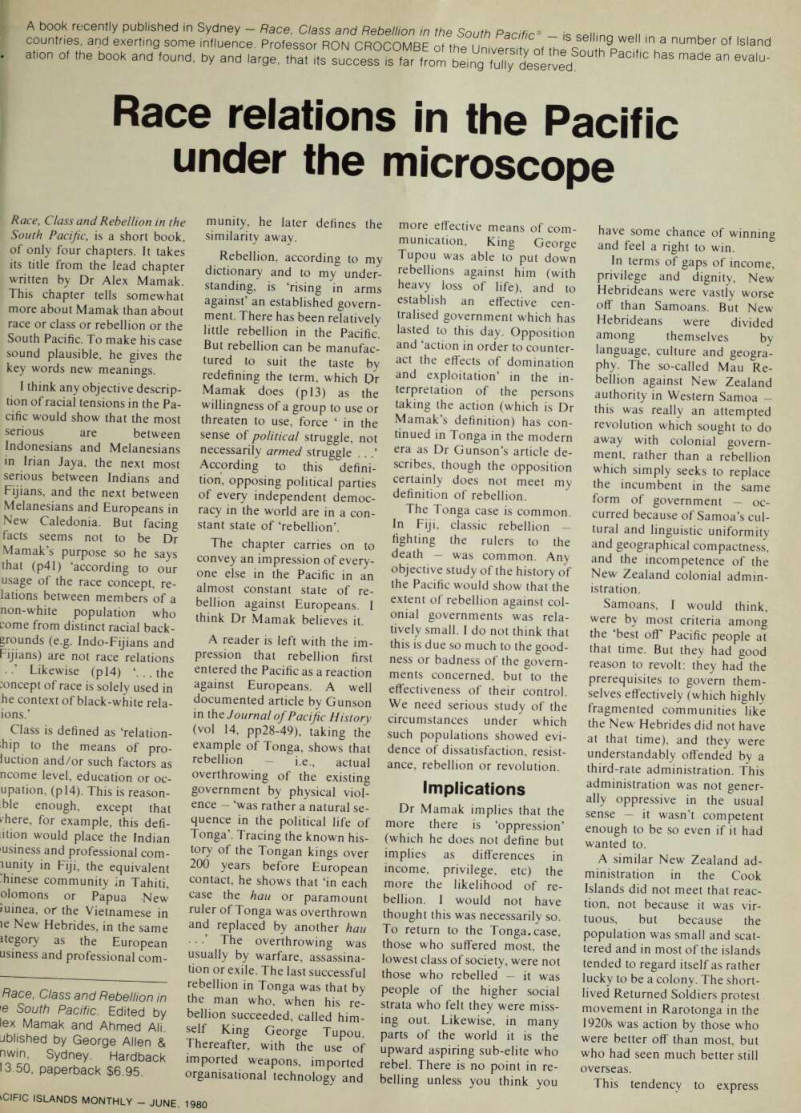
Wage protesters in Fiji - but is it necessarily those with the least who make the most noise?
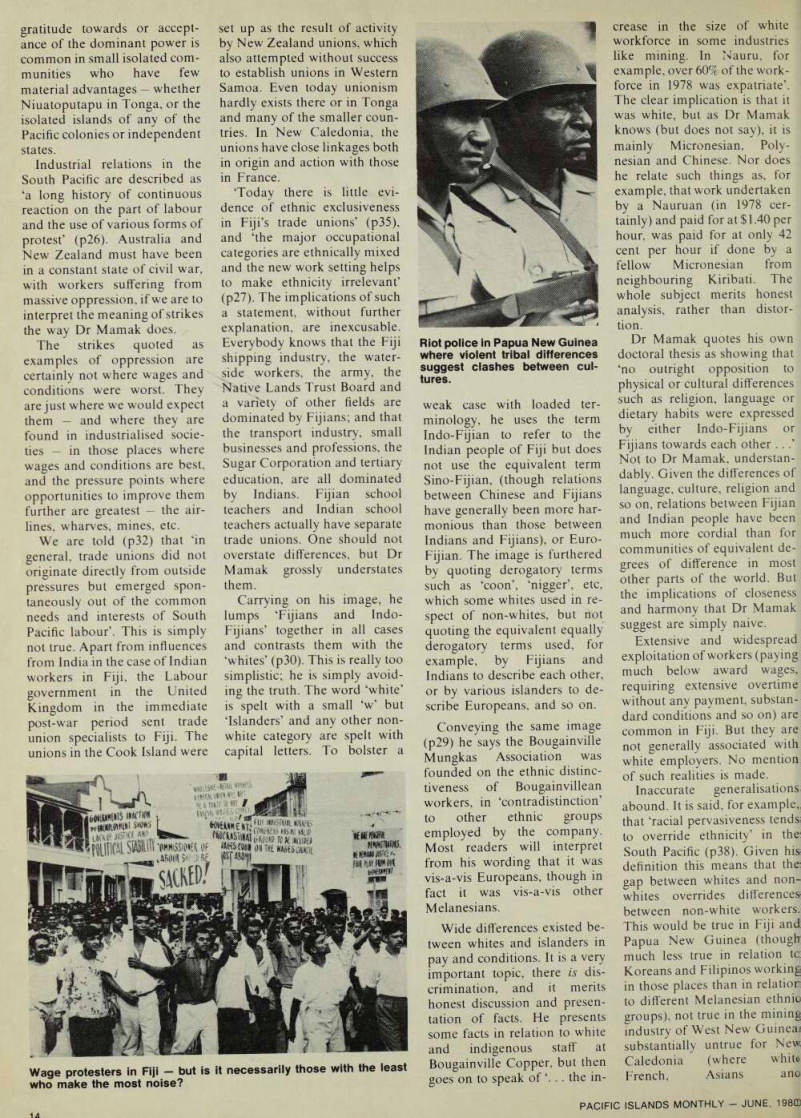
Riot police in Papua New Guinea where violent tribal differences suggest clashes between cul tures.
Polynesians are at times closer to each other than any of them are with Melanesians), partly true for Nauru (where the social gap between Nauruans and others is just as wide as that between Europeans and others I think Chinese would be at least as socially distinct not only from Nauruans but also from Gilbertese or Tuvaluans, as from Europeans or the Nauruans themselves). And re lations between Korean or Taiwanese workers in the fish ing industry in a number of Pa cific countries seem to me to do little to support his thesis.
There are just so many of these hack generalisations which do not bear serious examination.
His relationship between race, class and ethnicity is made easy (p 39) by having only two categories - ‘whites’ and ‘lslanders’. Fijians and Indians, Melanesian New Caledonians and Vietnamese, Chinese and Nauruans are all lumped together as ‘lslanders’. This may well be Dr Mamak’s per ception, but few Pacific islanders would see it that way.
There is an almost total ignor ing of the major cultural div isions between Asian and
indigenous people in Fiji,
Nauru, New Caledonia, American Samoa, Tahiti, Papua New Guinea, Solomons, Guam or elsewhere. ‘Ethnicity may be emphasised by whites as a diversionary tactic - that is, to prevent antagonism from being directed solely at them’ (p 43). He is right. But in this
case ethnicity is played down
by an Asian author as a diver sionary tactic to imply that there is not indigenous antag onism to his category.
By the end of the first chap ter, any dislike, discrimination )r social distance has come to
imply ‘rebellion’, though the
word itself has gone except in the title.
The next two chapters pre :ent five case studies. The cases ire very interesting and well
nerit study. The only gross
naccuracy is the title, ‘Re union in the South Pacific : ive case studies’. The studies re that of the Bougainville opper miners’ strike in 1975 y Alexander Mamak and dchard Bedford, the Indian workers’ strike in Fiji in 1920, ie Maasina Rule in Solomon
Islands by Hugh Laracy, the Parihaka movement in New Zealand from the late 1860 s to the 1880 s by Daniel Lyons, and the resistance of the Australian
Aboriginal Gurindji at Wattie
Creek by Hannah Middleton.
Alas, there is not a rebellion among them they are two strikes and three protest move ments. This is a pity, because there have been some real re bellions in the history of the Pacific, including its colonial history, which is what the authors wish to highlight.
The greatest rebellion in the Pacific in the last 100 years is the Free Papua Movement against Indonesian colonialism in Irian Jaya. It still leads to many deaths and much suffer ing. The Mau in Western Samoa against New Zealand, particularly in the 19305, and against Germany the gener ation before, was a strong and effective movement. The re bellion of the Leeward Islanders in French Polynesia in the 1880 s, the rebellion of Melanesians in New Caledonia against French colonial rule particularly in 1878 - and the New Zealand race wars in the 1860 s and 1870 s all merit examination. The case study they present of New Zealand is
particularly interesting, though
they were more a protest move ment than a rebellion.
Readers are told (p 44) that ‘rebellions occur because of basic social transformation such as the introduction of a capitalist economy and the breakdown of traditional socio-economic and political life’. The rebellions in Tonga, where they are best documented, had nothing to do with the capitalist economy, nor with the breakdown of tra ditional, socio-economic and political life they were an established part of it. Nor is the continuing rebellion in Irian Jaya caused by either ‘the introduction of capitalist econ omy’ or ‘the breakdown of tra ditional socio-economic and political life’. This is sociology at its sloppiest.
The case studies are gener ally excellent, but the one by Mamak and Bedford on the Bougainville strike does not reach the level of accuracy of the others. They rightly show the major differences in income levels between Papua
New Guineans and expatriates for the same work in Papua New Guinea, but imply that this is because of the wicked ness of the company. They need to add two riders (i) that the independent government of Papua New Guinea asked the company to hold down its local rates so as not to put pressure on the overall Papua New Guinea salary structure; and (ii) the Papua New Guinea Government will not allow ex patriates security of tenure,
equality of opportunity, the
right to buy land, right of em ployment for their children, or various other privileges which
Papua New Guineans enjoy.
What they are discussing is one of the most serious problems facing the Pacific today but distorting it does not help the search for a solution.
The final chapter, by Dr Ahmed Ali, is generally a good summary, though it too makes maximum mileage out of
European/non-European con
flict, clearly implying, for
example, that ‘greed for econ omic gain’ is something exclus ively associated with
Europeans. Not everybody in
Fiji would agree with that! And we are told (p 133) that most Pacific people ‘constitute a vi able group of wage earners, plantation workers, dock hands and communal land owners who at various times have made up a single revolutionary class’. Really? Or again (pi 34) ‘the dehumanising aspect of
colonial society oppression contrasts dramatically with the egalitarianism of traditional societies .. There were some very egalitarian societies in the Pacific, but they were the exception rather than the rule.
Likewise we are told that the Maoris are ‘engaged in a national liberation movement’ but no mention is made of the much more significant Fijian Nationalist Party, the Kanak Liberation Front, the Free Papuan Movement, and so on.
A much more accurate description of rebellions comes on the last page, where Dr Ali says *... rebellions must be viewed in the context of a struggle for power between various groups. This normally develops from a perceived sense of relative deprivation and frustration, and the belief that desired change can come about through collective effort’. This indeed is true.
But the final paragraph, say ing that ‘in the South Pacific re gion rebellion has been the major aspect of group relations ever since the beginning of contact with Western culture’ is not really accurate. If one de fines rebellion as broadly as that, it is true for everywhere in the world and for all phases of history. An accurate and objective study of race, class and rebellion in the Pacific
would be particularly timely,
but it has yet to be written.
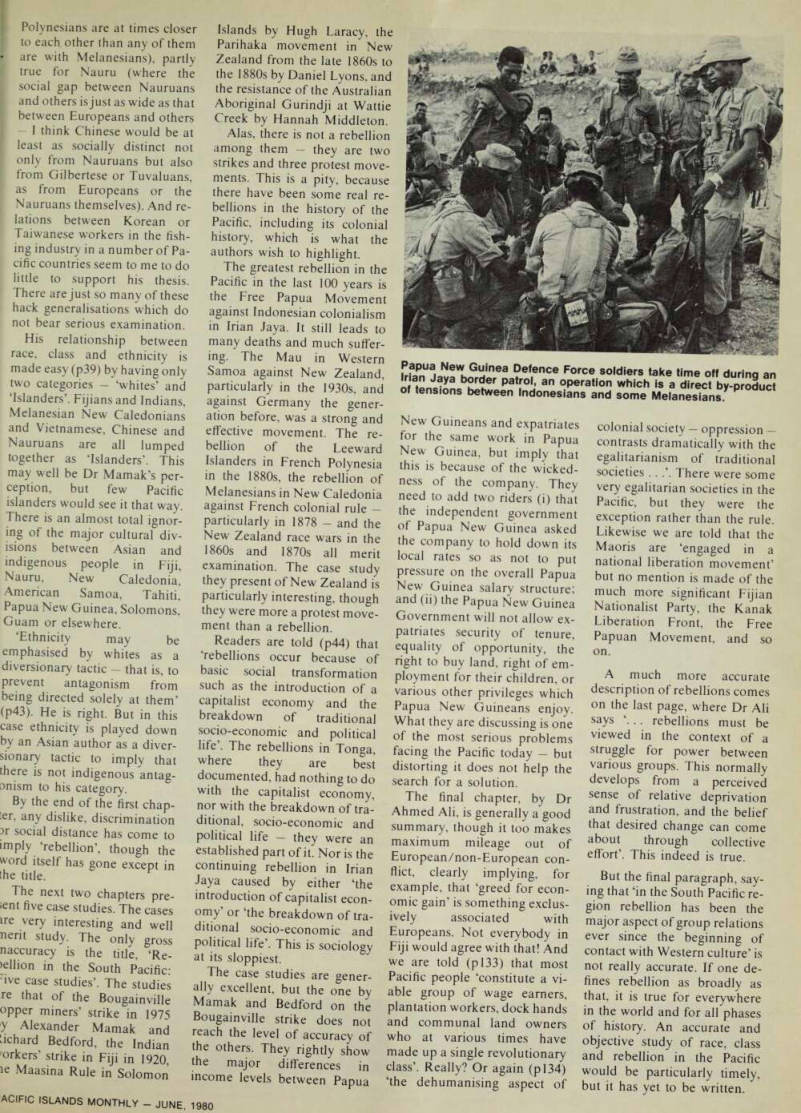
Papua New Guinea Defence Force soldiers take time off duaring an Irian Jaya border patrol, an operation which is a direct by-product of tensions between Indonesians and some Melanesians
Advertisements & other items, pp. 13-17 (4 items)
Islands Monthly - June, 1980
Acific Islands Monthly - June, 1980
Datsun Creates H/
For a world
that cant afford
to waste its energy
on thirsty cars.
Remember when gas was dirt cheap? There were no lines. And you could buy all you wanted.
Who cared about miles per gallon? When the tank got low, stop at the next station and fill it up. Big deal.
There were a lot of things we didn’t care much about in those days.
Like the height or strength of the bumper. The safety of the doors. The location of the gas tank. Much less how much pollution came out of the exhaust pipe.
As you know, things are much different today. Everyone cares about energy conservation and fuel
I ' Js
i * % * -jar-: X efficiency. In a world of rising petroleum prices and shrinking supplies, we have to.
So today’s order of business at Datsun goes something like this: Make it light, but make sure it’s just as strong. Make it with less air resistance, but make sure it’s roomy and comfortable. Make it safe and solid, but make sure it goes a long way on a gallon of gas. Make it look good, but make sure its good looks last.
Contradictions? To some, yes.
But not to our researchers, developers, designers and craftsmen.
There are essentially three basic factors which influence fuel efficiency.
And you’ll find them in the same places on every car. Under the hood.
Along the sheet metal. And beneath the floorboard.
The engine must be designed with less friction and more combustion efficiency. The exterior must be designed with less air resistance.
The drive train must be designed to maximize the efficiency of the transmission, differential and tires. And all of the above must be designed to save weight.
The trick is to upgrade the qual. of each element. Without harming tt performance of another element or overall quality of the completed can
DATSUN CREATES H/
American Samoa: B r. mncuduhl n'v, r ayw ■ —* —— . - - AT _. . A |, xr -, crrmpq Tarawa / Nauru SALES, Agana/ Hawaii; NISSAN MOTOR CORPORATION IN HAWAII LTD , Honolulu/ Kiribati: ATOLL AUTO STORES. Tarawa/ Naur F. KNEUBUHL INC. Pago lslands: COOK MOTOR CENTRE R^OR n ES 7 TaVaw^/ R Nau^J; E JACOBIN A
Mony By Design
j may call that a kind of balancing.
At Datsun, we call it “harmony.”
J it is by design.
Thinking and working in harmony mits us to resolve seemingly unre- /able problems.
For example, at highway speeds, less air resistance, the more fuel :iency. But, under city driving ditions, the less weight, the more efficiency.
Must we choose? Or can we offer both economies in one car?
According to U.S. Environmental ection Agency estimates, a 1980 ;un delivers the highest gasoline mileage of any car sold in America.
Both on the highway and in the city.
Datsun has also been the champion of many other fuel economy runs around the world. Problem-solving by design—resolving conflicting elements to improve the overall quality of the product-has helped Datsun to build cars that are strong and safe, yet light and fuel efficient.
There is one other important factor in fuel efficiency. You. The driver. Our figures show the skill of the driver can affect overall fuel efficiency 30~40%! So please, avoid rapid-fire speed-ups and slow-downs.
Obey speed limits. Keep your engine tuned and your tires properly inflated.
Increasing your fuel efficiency is money in the bank. Your money. At Datsun, we re working hard to design the kind of cars the world needs.
Without sacrificing the things you want in your car.
That’s harmony.
The model shown above is the Datsun 140 Y for the Middle East.
Specifications and equipment may vary accordina to market.
DATSUN
MONY BY DESIGN
mea 7 M ew Hebrides: PENTECOST S.A .
THE NAME OF QUALITY
NISSAN
NISSAN MOTOR CO. LTD
JOETEN MOTOR COMPANY .NC / Solomon .s.ands: UNITED New Guinea: BOROKO MOTORS LTD., R>rt Moresby/ 3/ ' amtl 'AHITIBULL S.A.R.L.. Papeete/ Western Samoa: MORRIS HEDSTROM LTD.. Apia
Whether Peacock or
New Hebrides: Whether Peacock or Phoenix, a bird of ill omen ...
‘The Vanuaaku Party calls for strong action against the American “mafia” business men who use violence to pro mote their interests in Vanuatu, especially on Santo and Tanna.’
So reads the final paragraph of a statement issued at the end of a meeting of the ‘political commissars’ of the New Hebrides’ ruling Vanuaaku Party held at Tagabe, Port- Vila, in April.
The reason for their concern was plain: on the eve of the
country’s independence
(scheduled for July 30) there are clear signs of a revival of interest in the New Hebrides by such figures as the Hawaii based real estate developer Eugene Peacock, who made a packet in the late ’6os out of buying land on Santo and sell ing it to Americans captivated by the idea of living on a Pa cific Island. Peacock’s scheme was finally squashed when the condominium government in 1971 made it illegal to sub divide land and profit from it.
Peacock, interviewed early
this year by English journalist
Christopher Dobson his articles were published in an
English weekly news magazine
and an Australian daily said he is ‘awaiting the opportuni ties of independence’. ‘At least, this year I shall know what I can do with the land. There is no doubt in my mind that San to’s future lies with tourism.’
Also showing renewed signs
of activity is the so-called Phoenix Foundation, an or
ganisation animated by
extreme private-enterprise
fundamentalism based on con cepts of ‘no government’, ‘voluntary taxes’, and untram melled free enterprise.
According to Dobson, the chief fount of its ideas is Dr John Hospers, a professor of philosophy at the University of South California. Dr Hospers stood for the presidency of the
United States in 1972, as a can didate of the Libertarian Party.
He won one vote from the
Electoral College.
The Phoenix Foundation was set up in the ’7os by Michael Oliver, who looks upon Hospers as his ‘guru’.
Oliver is of Lithuanian Jewish origin. For a while dur ing World War II he was an inmate of a Nazi concentration camp, but has since done hand somely as a real estate devel oper in Carson City, Nevada.
The foundation is well known in the Pacific for its 1972 ex ploits on Minerva Reef be tween Fiji and Tonga (the idea was to build a concrete city on stilts on the usually submerged reef)- The venture came to grief when Tonga’s king arrived in the royal yacht, tore down the Minerva ‘flag’, and claimed the reef for his kingdom. There was a later, similar attempt on Abaco, one of the major islands in the Bahamas. It too failed.
But Oliver sees new oppor tunities on Santo, where he once owned considerable real estate. Long a patron of Santo’s Jimmy Stevens, leader of the Na-Griamel movement on Santo (he admits paying the fares for Stevens’ visit to the US last year), Oliver told Dob
son; ‘I want Jimmy Stevens to become independent. I said to him that he must have real democracy on Santo.’
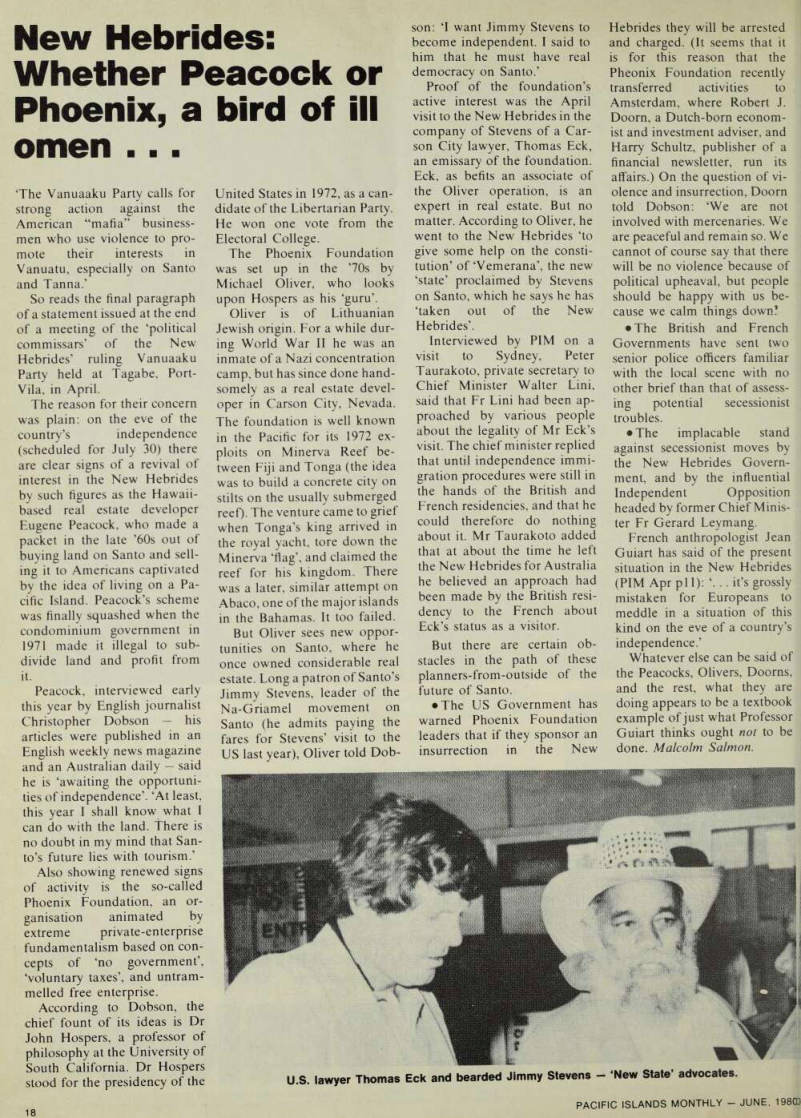
Proof of the foundation’s active interest was the April visit to the New Hebrides in the company of Stevens of a Car son City lawyer, Thomas Eck, an emissary of the foundation.
Eck, as befits an associate of the Oliver operation, is an expert in real estate. But no matter. According to Oliver, he went to the New Hebrides ‘to give some help on the consti tution’ of ‘Vemerana’, the new ‘state’ proclaimed by Stevens on Santo, which he says he has ‘taken out of the New Hebrides’.
Interviewed by PIM on a visit to Sydney, Peter Taurakoto, private secretary to Chief Minister Walter Lini, said that Fr Lini had been ap
proached by various people
about the legality of Mr Eck’s visit. The chief minister replied that until independence immi gration procedures were still in the hands of the British and French residencies, and that he could therefore do nothing about it. Mr Taurakoto added that at about the time he left the New Hebrides for Australia he believed an approach had been made by the British resi dency to the French about Eck’s status as a visitor.
But there are certain ob stacles in the path of these planners-from-outside of the future of Santo. • The US Government has warned Phoenix Foundation leaders that if they sponsor an insurrection in the New
Hebrides they will be arrested and charged. (It seems that it is for this reason that the Pheonix Foundation recently transferred activities to Amsterdam, where Robert J.
Doom, a Dutch-born econom ist and investment adviser, and Harry Schultz, publisher of a financial newsletter, run its affairs.) On the question of vi olence and insurrection, Doom told Dobson: ‘We are not involved with mercenaries. We are peaceful and remain so. We cannot of course say that there will be no violence because of
political upheaval, but people
should be happy with us be cause we calm things down? • The British and French Governments have sent two senior police officers familiar with the local scene with no other brief than that of assess
ing potential secessionist
troubles. • The implacable stand
against secessionist moves by
the New Hebrides Govern ment, and by the influential
Independent Opposition
headed by former Chief Minis ter Fr Gerard Leymang.
French anthropologist Jean Guiart has said of the present situation in the New Hebrides (PIM Apr pi 1): ‘... it’s grossly mistaken for Europeans to meddle in a situation of this kind on the eve of a country’s
independence.’
Whatever else can be said of the Peacocks, Olivers, Dooms, and the rest, what they are doing appears to be a textbook example of just what Professor Guiart thinks ought not to be done. Malcolm Salmon.
U.S. lawyer Thomas Eck and bearded Jimmy Stevens - ‘New State’ advocates.
Politics, Movies,
Mills And Money
The discovery on March 31 of the horribly mutilated body of kidnap victim Olivier Breaud, son of wealthy French banker Jean Breaud, made with the reluctant co-operation of the three murderers, answered a few questions which had puzzled every body up to that point (PIM May p 17). But at the same time it raised many more which will be with us for years to come.
Hitherto, the behaviour and motives of the kidnappers had definitely not made sense. Above all, if their aim had really been as reported to obtain a huge ransom why had they killed their victim, after only one lame attempt to contact the Breaud family? Once an autopsy had been performed, how ever, the whole look of the case changed. The most shocking revelation was that the Le Goff husband and wife team and their accomplice Daniel Chelle had literally beaten Olivier Breaud to death in slow stages, over a period of 24 hours, breaking practically all his bones in the process.
The only possible explanation for this monstrous cruelty in the worst Gestapo tradition is, of course, that the three sadists were not after money at all but were seeking revenge. What sort of grudge they may have had against the Breauds is far from clear, but it is a well-known fact that they were customers of long standing with the Banque de Tahiti, which belongs to this powerful family, and it seems that they personally knew Olivier.
By the time the funeral took place, in the presence of a wide cross-section of grim-faced political, religious and civic leaders, the two local newspapers were pouring out stories about the murderers’ lurid past and strange business activities.
Although one of them, Yves Le Goff, had already committed a murder in France in the 19605, and all of them had previous criminal records, in addition to having gone bankrupt after various shady dealings, they were warmly welcomed in Tahiti as bona fide investors.
Even more incredible is the fact that when, after a few years in Tahiti, they decided to go into the textile business (of which they had no previous experience) the local authorities not only encouraged them to do so but also assisted them financially.
Among other things they obtained a SUS4OO 000 loan at excep tionally low interest to build and equip a weaving mill, exemp tion from customs duties on raw materials, and, to top it all, a firm promise that the administration would pay the whole work force, 50 men strong, for the first six months of oper ations! During a post-murder inspection of the ‘textile factory’ it was discovered that only three looms out of 40 functioned, and that the supply of thread was barely enough to keep them
going for one day.
Why were these convicted criminals and crooked business men given such favoured treatment? The answer to this per tinent question was first whispered, then hinted at, and finally printed in big, bold type in the press, whereas the government TV and radio news broadcasters kept mum. Simply formu lated, the answer was that the politicians and officials who had gone out of their way to help the ‘investors’ had also spon sored another highly private enterprise sex orgies organised by the murderers in their swank villa on the West coast of Tahiti. The select party-goers must all have been incredibly gullible or terribly drunk or both at the same time since they had cheerfully allowed their hosts to take very colourful pictures of them in full action, thereby opening the door wide to blackmail.
Incidentally, the gendarmes found not only these incriminating still pictures in the villa, but also a movie of a do-it-yourself pornographic performance. According to per sistent press reports, this movie was produced with the gener ous assistance of some technicians from the local TV station.
Of course, this accusation was promptly denied (Take my word for it’) by the former director, Henri Sire, who was re cently packed off to Noumea.
One of the most frequently photographed visitors at Le Goff’ s porno-palace turned out to be Vice-President Francis Sanford’s principal secretary, Paul Bourgeois. Although no formal charges were, or could be, brought against him, the Autonomist party bosses held him mainly responsible for the many unwarranted favours bestowed on the phony indus trialists, and he was forced to resign. Many more heads will probably roll - both figuratively and literally - when the infernal killers are eventually brought to trial and start supply ing more details about their various activities and associates, as they are bound to do, since they have nothing more to lose, the penalty for a crime of this type being death by guillo tine.
The question most often heard in Tahiti these last weeks, however, is why metropolitan French crooks and criminals should be let in at all? From all quarters restrictive measures are being suggested, some of them very far-reaching indeed.
Strangely enough, the most ineffectual proposal was made by a group of close friends of Mrs Tila Breaud who began dis tributing a petition, addressed to President Giscard d’Estaing, and vaguely asking for stricter legislation and more rigorous justice. Droves of indignant citizens signed it nevertheless.
The Gaullist deputy Gaston Flosse, whose Tahoeraa Huiraatira party recently came out for full internal self government (PIM May p 27), squarely blamed the French im migration police for laxity and negligence, and tabled a bill which, if adopted, would make it compulsory for all resident Frenchmen with a criminal record to report to the police once a month. He was joined by the second deputy for French Polynesia, Jean Juventin, who was elected on an Autonomist ticket. Highly embarrassed, Minister for Overseas Territories Paul Dijoud had to veto the proposed measure which he did by branding it ‘discriminatory’ and an ‘infringement of civil liberties’.
As usual, the most radical solution was proposed by the mav erick president of the Polynesian Liberation Front, Oscar Temaru, who publicly chided all other political leaders for lacking the courage to face the problem squarely. Briefly his message was: ‘Our problem is not simply a matter of stopping French criminals and crooks from settling in our islands. They form only a small portion of the total number of French immigrants who, since the bomb tests began, have been pour ing into Tahiti at the rate of a thousand a year. ‘The French want to continue these deadly tests and they plan to grab all the wealth our ocean contains. This is why it is the deliberate policy of the Paris government to swamp the country with French settlers. ‘lf we don’t stop them now, we shall soon be a minority in our own country. This is what has already happened in New Caledonia. Our only salvation is therefore to achieve indepen dence as fast as possible.’
Advertisements & other items, p. 20 (1 item)
Test drive our high-performance
tone
VQI
PUSH
r AD|q
p, °Meen
AUTq
tun eject s>- Bal
KP-2500A
L ■
Test drive our high-performance
economy model.
Thinking about buying a car stereo?
Then maybe you should give our KP-2500A some thought. This DiN-size car stereo features an Auto-replay cassette deck for easy cassette handling along with locking fast forward and rewind with Auto-eject. For increased on-theroad durability and wider frequency response, the KP-2500A features a hard permalloy tape head. To keep you in touch with the best in FM stereo, the AM/FM tuner features 1.9juV FM sensitivity. There’s also an FM stereo/mono switch for optimum reception in remote areas.
Combine all this with a low sticker price and Pioneer reliability and there you have it.
So why not roll into your local Pioneer car stereo dealer and test drive the KP-2500A and see why it’s miles ahead of the others.
For further information, please contact: Australia: Pioneer Marketing Service Pty. Ltd., P.O. Box 317, Mordialloc, Victoria, 3195 Tel; 909011 Fiji islands: Brijlal & Company, G.P.O. Box No. 362, Suva, Fiji Islands Tel: 22258 New Zealand: Monaco Electronics Ltd., 30 Pollen Street, Grey Lynn, Auckland, New Zealand Tel: (09) 762 098 Norfolk Island: Bums Philp (Norfolk Island) Ltd., Norfolk Island. South Pacific New Hebrides: Burns Philp (New Hebrides) Ltd., Vila, New Hebrides Nauru Island: Jacob Enterprises, P.O. Box No. 4, Republic of Nauru Tahiti: Ets. PERFECT, B.P 594, Papeete. Tahiti Tel: 20 407 New Caledonia: Menard Freres Ville, B.P. H2 Cedex. Noumea, New Tel: 27.52.22 American Samoa: Transpac Corporation, P.O. Box 1477, Pago Pago, Samoa 96799 Tel: 633-5224 Rarotonga: South Seas International Ltd., P.O. Box 49, Ran Papua New Guinea: Bali Merchants Pty. Ltd., P.O. Box 6103, 2327
The world leaves
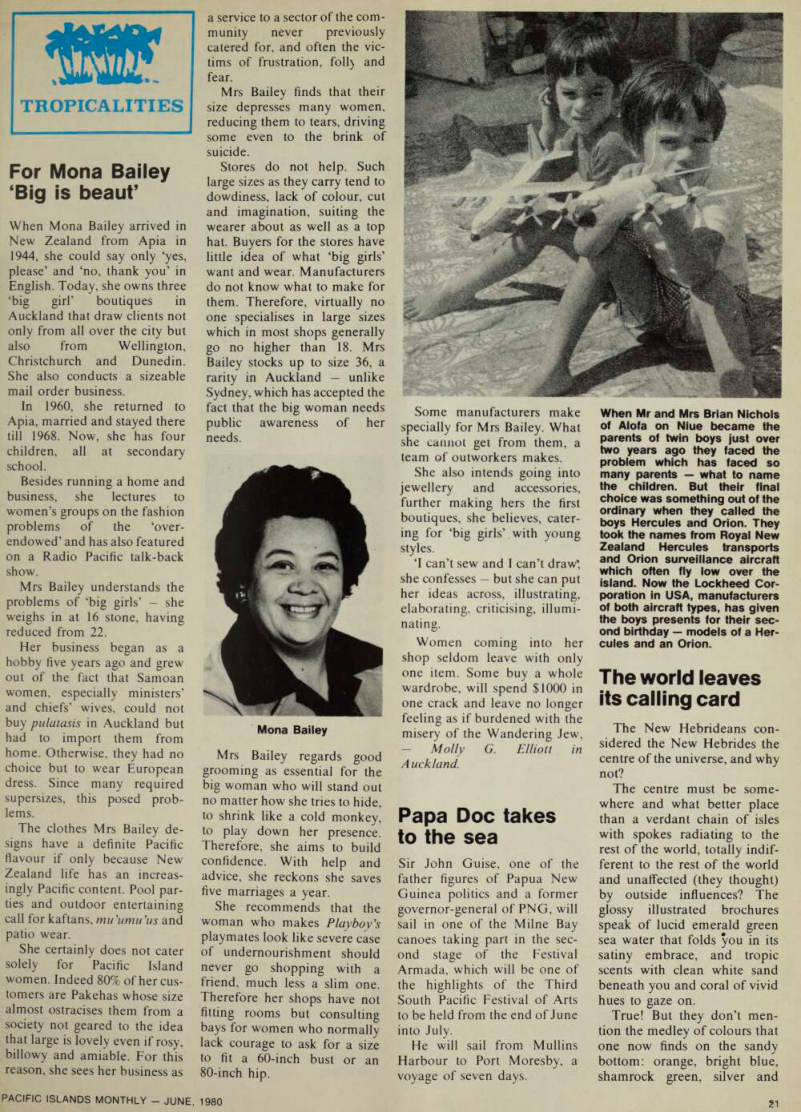
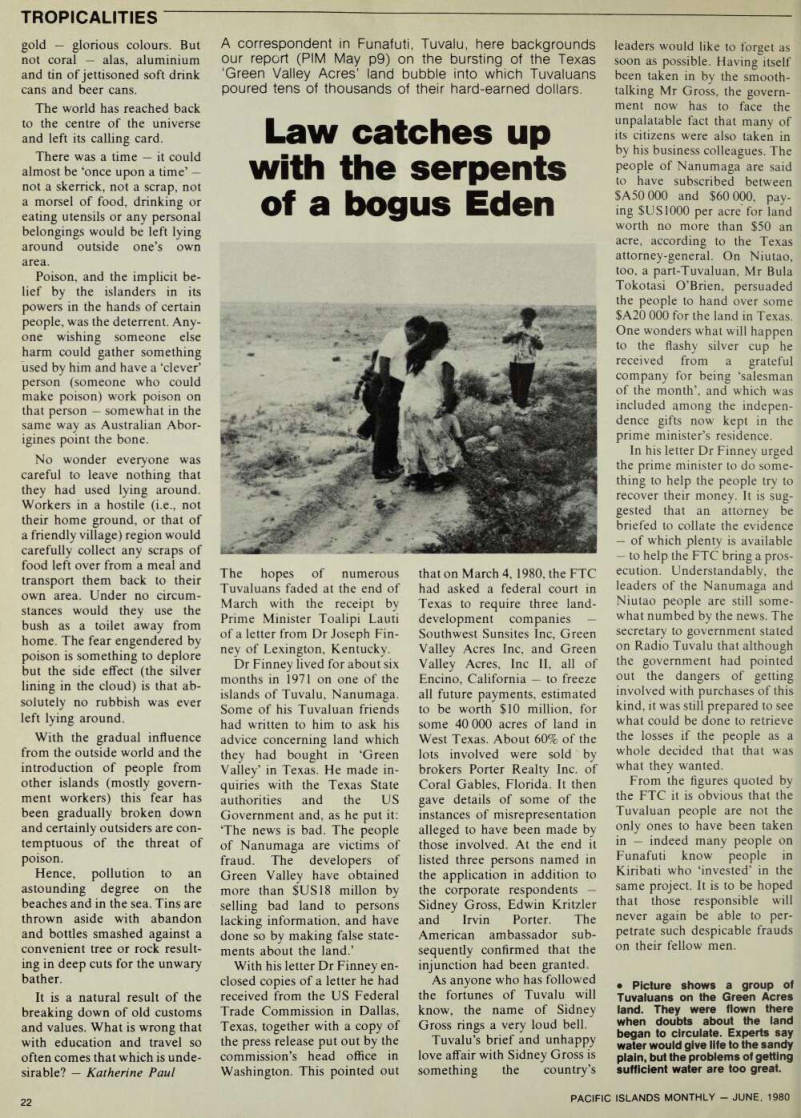
Tropicalities
For Mona Bailey
‘Big is beaut’
When Mona Bailey arrived in New Zealand from Apia in 1944, she could say only ‘yes, please’ and ‘no, thank you’ in English. Today, she owns three
‘big girl’ boutiques in
Auckland that draw clients not only from all over the city but also from Wellington, Christchurch and Dunedin.
She also conducts a sizeable mail order business.
In 1960, she returned to Apia, married and stayed there till 1968. Now, she has four children, all at secondary school.
Besides running a home and business, she lectures to women’s groups on the fashion problems of the ‘over endowed’ and has also featured on a Radio Pacific talk-back show.
Mrs Bailey understands the problems of ‘big girls’ she weighs in at 16 stone, having reduced from 22.
Her business began as a hobby five years ago and grew out of the fact that Samoan women, especially ministers’ and chiefs’ wives, could not buy pulatasis in Auckland but had to import them from home. Otherwise, they had no choice but to wear European dress. Since many required
supersizes, this posed prob
lems.
The clothes Mrs Bailey de signs have a definite Pacific flavour if only because New Zealand life has an increas ingly Pacific content. Pool par ties and outdoor entertaining call for kaftans, mu’umu’us and patio wear.
She certainly does not cater solely for Pacific Island women. Indeed 80% of her cus tomers are Pakehas whose size almost ostracises them from a society not geared to the idea that large is lovely even if rosy, billowy and amiable. For this reason, she sees her business as
a service to a sector of the com
munity never previously
catered for, and often the vic tims of frustration, foil) and fear.
Mrs Bailey finds that their size depresses many women, reducing them to tears, driving some even to the brink of suicide.
Stores do not help. Such large sizes as they carry tend to dowdiness, lack of colour, cut
and imagination, suiting the
wearer about as well as a top hat. Buyers for the stores have little idea of what ‘big girls’ want and wear. Manufacturers do not know what to make for them. Therefore, virtually no one specialises in large sizes which in most shops generally go no higher than 18. Mrs Bailey stocks up to size 36, a rarity in Auckland unlike Sydney, which has accepted the fact that the big woman needs public awareness of her needs.
Mrs Bailey regards good grooming as essential for the big woman who will stand out no matter how she tries to hide, to shrink like a cold monkey, to play down her presence.
Therefore, she aims to build confidence. With help and advice, she reckons she saves five marriages a year.
She recommends that the woman who makes Playboy’s playmates look like severe case of undernourishment should never go shopping with a friend, much less a slim one.
Therefore her shops have not
fitting rooms but consulting
bays for women who normally lack courage to ask for a size to fit a 60-inch bust or an 80-inch hip.
Some manufacturers make specially for Mrs Bailey. What she cannot get from them, a team of outworkers makes.
She also intends going into jewellery and accessories, further making hers the first boutiques, she believes, cater
ing for ‘big girls’ with young
styles.
T can’t sew and I can’t draw', she confesses but she can put her ideas across, illustrating,
elaborating, criticising, illumi
nating.
Women coming into her shop seldom leave with only one item. Some buy a whole wardrobe, will spend $lOOO in one crack and leave no longer feeling as if burdened with the misery of the Wandering Jew,
Molly G. Elliott in
Auckland.
Papa Doc takes
to the sea
Sir John Guise, one of the father figures of Papua New Guinea politics and a former governor-general of PNG, will sail in one of the Milne Bay canoes taking part in the sec ond stage of the Festival Armada, which will be one of the highlights of the Third South Pacific Festival of Arts to be held from the end of June
into July.
He will sail from Mullins Harbour to Port Moresby, a voyage of seven days.
The world leaves
its calling card
The New Hebrideans con sidered the New Hebrides the centre of the universe, and why not?
The centre must be some where and what better place than a verdant chain of isles with spokes radiating to the rest of the world, totally indif ferent to the rest of the world
and unaffected (they thought)
by outside influences? The glossy illustrated brochures speak of lucid emerald green sea water that folds you in its
satiny embrace, and tropic
scents with clean white sand beneath you and coral of vivid hues to gaze on.
True! But they don’t men tion the medley of colours that one now finds on the sandy bottom: orange, bright blue, shamrock green, silver and
Mona Bailey
When Mr and Mrs Brian Nichols of Alofa on Niue became the parents of twin boys just over two years ago they faced the problem which has faced so many parents what to name the children. But their final choice was something out of the ordinary when they called the boys Hercules and Orion. They took the names from Royal New Zealand Hercules transports and Orion surveillance aircraft which often fly low over the island. Now the Lockheed Cor poration in USA, manufacturers of both aircraft types, has given the boys presents for their sec ond birthday models of a Her cules and an Orion.
gold glorious colours. But
not coral alas, aluminium and tin of jettisoned soft drink cans and beer cans.
The world has reached back to the centre of the universe and left its calling card.
There was a time it could almost be ‘once upon a time’ not a skerrick, not a scrap, not a morsel of food, drinking or eating utensils or any personal belongings would be left lying around outside one’s own area.
Poison, and the implicit be lief by the islanders in its powers in the hands of certain people, was the deterrent. Any one wishing someone else
harm could gather something
used by him and have a ‘clever’ person (someone who could make poison) work poison on that person somewhat in the same way as Australian Abor
igines point the bone.
No wonder everyone was careful to leave nothing that they had used lying around.
Workers in a hostile (i.e., not their home ground, or that of
a friendly village) region would
carefully collect any scraps of food left over from a meal and transport them back to their own area. Under no circum stances would they use the bush as a toilet away from home. The fear engendered by
poison is something to deplore
but the side effect (the silver lining in the cloud) is that ab solutely no rubbish was ever left lying around.
With the gradual influence from the outside world and the introduction of people from other islands (mostly govern ment workers) this fear has been gradually broken down and certainly outsiders are con temptuous of the threat of
poison.
Hence, pollution to an
astounding degree on the
beaches and in the sea. Tins are thrown aside with abandon and bottles smashed against a convenient tree or rock result ing in deep cuts for the unwary bather.
It is a natural result of the breaking down of old customs and values. What is wrong that with education and travel so often comes that which is unde sirable? Katherine Paul
of a bogus Eden
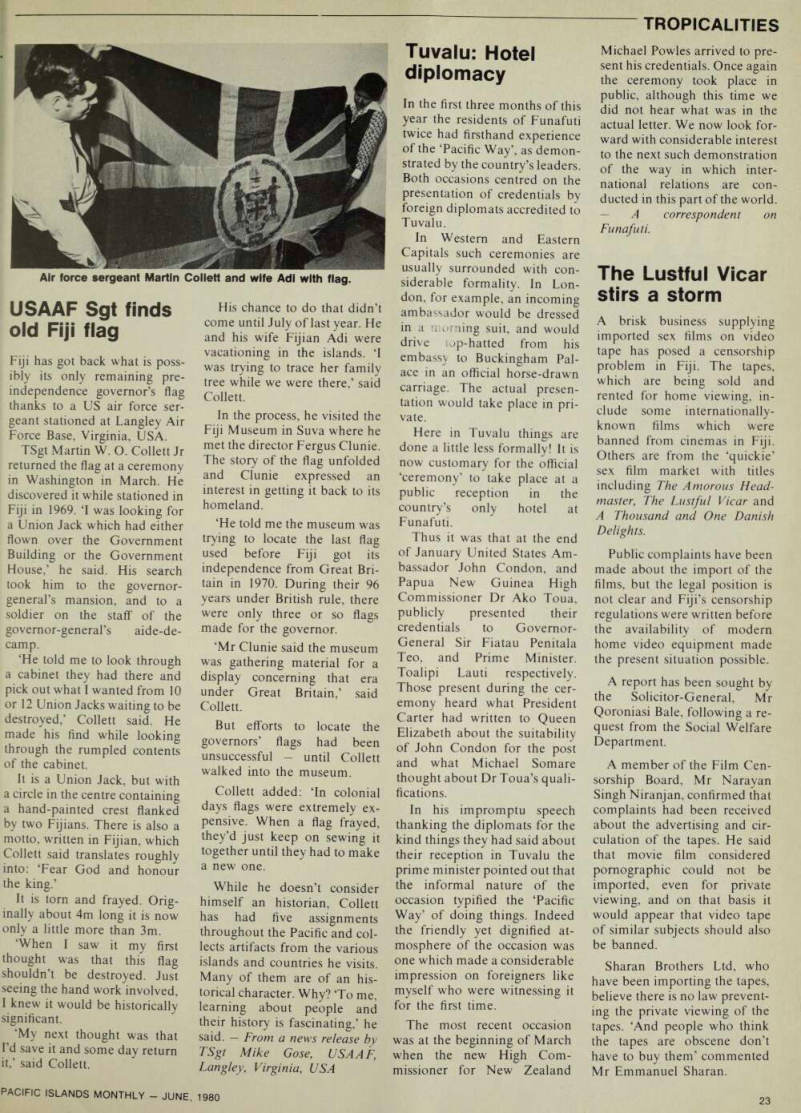
Law catches up with the serpents of a bogus Eden
A correspondent in Funafuti, Tuvalu, here backgrounds our report (RIM May p 9) on the bursting of the Texas ‘Green Valley Acres’ land bubble into which Tuvaluans poured tens of thousands of their hard-earned dollars.
The hopes of numerous Tuvaluans faded at the end of March with the receipt by Prime Minister Toalipi Lauti of a letter from Dr Joseph Fin
ney of Lexington, Kentucky.
Dr Finney lived for about six months in 1971 on one of the islands of Tuvalu, Nanumaga.
Some of his Tuvaluan friends had written to him to ask his advice concerning land which they had bought in ‘Green Valley’ in Texas. He made in quiries with the Texas State authorities and the US Government and, as he put it: ‘The news is bad. The people of Nanumaga are victims of fraud. The developers of Green Valley have obtained more than SUSIB millon by selling bad land to persons lacking information, and have done so by making false state ments about the land.’
With his letter Dr Finney en closed copies of a letter he had received from the US Federal Trade Commission in Dallas, Texas, together with a copy of the press release put out by the commission’s head office in
Washington. This pointed out
that on March 4, 1980, the FTC had asked a federal court in Texas to require three land
development companies
Southwest Sunsites Inc, Green Valley Acres Inc, and Green Valley Acres, Inc 11, all of Encino, California to freeze all future payments, estimated to be worth $lO million, for some 40 000 acres of land in West Texas. About 60% of the lots involved were sold by brokers Porter Realty Inc. of Coral Gables, Florida. It then gave details of some of the instances of misrepresentation alleged to have been made by those involved. At the end it listed three persons named in the application in addition to the corporate respondents Sidney Gross, Edwin Kritzler and Irvin Porter. The American ambassador sub sequently confirmed that the
injunction had been granted.
As anyone who has followed the fortunes of Tuvalu will know, the name of Sidney Gross rings a very loud bell.
Tuvalu’s brief and unhappy love affair with Sidney Gross is
something the country’s
leaders would like to forget as soon as possible. Having itself been taken in by the smooth talking Mr Gross, the govern ment now has to face the unpalatable fact that many of its citizens were also taken in by his business colleagues. The people of Nanumaga are said to have subscribed between SASO 000 and $6O 000, pay ing SUSIOOO per acre for land worth no more than $5O an acre, according to the Texas attorney-general. On Niutao, too, a part-Tuvaluan, Mr Bula Tokotasi O’Brien, persuaded the people to hand over some SA2O 000 for the land in Texas.
One wonders what will happen to the flashy silver cup he received from a grateful company for being ‘salesman of the month’, and which was included among the indepen dence gifts now kept in the prime minister’s residence.
In his letter Dr Finney urged the prime minister to do some thing to help the people try to recover their money. It is sug gested that an attorney be briefed to collate the evidence of which plenty is available to help the FTC bring a pros ecution. Understandably, the leaders of the Nanumaga and Niutao people are still some what numbed by the news. The secretary to government stated on Radio Tuvalu that although the government had pointed out the dangers of getting involved with purchases of this kind, it was still prepared to see what could be done to retrieve the losses if the people as a whole decided that that was what they wanted.
From the figures quoted by the FTC it is obvious that the Tuvaluan people are not the only ones to have been taken in indeed many people on Funafuti know people in Kiribati who ‘invested’ in the same project. It is to be hoped that those responsible will never again be able to per petrate such despicable frauds on their fellow men.
Picture shows a group of Tuvaluans on the Green Acres land. They were flown there when doubts about the land began to circulate. Experts say water would give life to the sandy plain, but the problems of getting sufficient water are too great.
USAAF Sgt finds
old Fiji flag
Fiji has got back what is poss
ibly its only remaining pre
independence governor’s flag
thanks to a US air force ser geant stationed at Langley Air Force Base, Virginia, USA.
TSgt Martin W. O. Collett Jr returned the flag at a ceremony in Washington in March. He discovered it while stationed in Fiji in 1969. ‘I was looking for a Union Jack which had either flown over the Government Building or the Government House,’ he said. His search took him to the governor general’s mansion, and to a soldier on the staff of the
governor-general’s aide-de
camp. ‘He told me to look through a cabinet they had there and pick out what I wanted from 10 or 12 Union Jacks waiting to be destroyed,’ Collett said. He made his find while looking
through the rumpled contents
of the cabinet.
It is a Union Jack, but with a circle in the centre containing a hand-painted crest flanked by two Fijians. There is also a motto, written in Fijian, which Collett said translates roughly into: ‘Fear God and honour
the king.’
It is tom and frayed. Orig inally about 4m long it is now only a little more than 3m. ‘When I saw it my first thought was that this flag shouldn’t be destroyed. Just seeing the hand work involved, I knew it would be historically
significant.
‘My next thought was that I’d save it and some day return it,’ said Collett.
His chance to do that didn’t come until July of last year. He and his wife Fijian Adi were vacationing in the islands, i was trying to trace her family tree while we were there,’ said Collett.
In the process, he visited the Fiji Museum in Suva where he met the director Fergus Clunie.
The story of the flag unfolded and Clunie expressed an interest in getting it back to its homeland. ‘He told me the museum was trying to locate the last flag used before Fiji got its independence from Great Bri tain in 1970. During their 96 years under British rule, there were only three or so flags made for the governor. ‘Mr Clunie said the museum was gathering material for a
display concerning that era
under Great Britain,’ said Collett.
But efforts to locate the governors’ flags had been unsuccessful - until Collett walked into the museum.
Collett added: ‘ln colonial
days flags were extremely ex
pensive. When a flag frayed,
they’d just keep on sewing it
together until they had to make a new one.
While he doesn’t consider himself an historian, Collett has had five assignments throughout the Pacific and col lects artifacts from the various islands and countries he visits.
Many of them are of an his torical character. Why? ‘To me,
learning about people and
their history is fascinating,’ he said. From a news release by TSgt Mike Gose, USAAF, Langley, Virginia, USA
Tuvalu: Hotel
diplomacy
In the first three months of this year the residents of Funafuti twice had firsthand experience of the ‘Pacific Way’, as demon strated by the country’s leaders.
Both occasions centred on the presentation of credentials by
foreign diplomats accredited to
Tuvalu.
In Western and Eastern Capitals such ceremonies are usually surrounded with con siderable formality. In Lon don, for example, an incoming ambassador would be dressed in a morning suit, and would drive lop-hatted from his
embassy to Buckingham Pal
ace in an official horse-drawn carriage. The actual presen tation would take place in pri vate.
Here in Tuvalu things are done a little less formally! It is now customary for the official ‘ceremony’ to take place at a
public reception in the
country’s only hotel at Funafuti.
Thus it was that at the end of January United States Am bassador John Condon, and
Papua New Guinea High
Commissioner Dr Ako Toua,
publicly presented their
credentials to Governor- General Sir Fiatau Penitala Teo, and Prime Minister.
Toalipi Lauti respectively.
Those present during the cer emony heard what President Carter had written to Queen Elizabeth about the suitability of John Condon for the post and what Michael Somare thought about Dr Toua’s quali fications.
In his impromptu speech thanking the diplomats for the kind things they had said about their reception in Tuvalu the prime minister pointed out that the informal nature of the occasion typified the ‘Pacific
Way’ of doing things. Indeed
the friendly yet dignified at mosphere of the occasion was one which made a considerable
impression on foreigners like
myself who were witnessing it for the first time.
The most recent occasion was at the beginning of March when the new High Com missioner for New Zealand
Michael Powles arrived to pre sent his credentials. Once again the ceremony took place in public, although this time we did not hear what was in the actual letter. We now look for ward with considerable interest to the next such demonstration of the way in which inter national relations are con ducted in this part of the world.
A correspondent on
Funafuti.
The Lustful Vicar
stirs a storm
A brisk business supplying imported sex films on video tape has posed a censorship problem in Fiji. The tapes, which are being sold and rented for home viewing, in clude some internationally known films which were banned from cinemas in Fiji.
Others are from the ‘quickie’ sex film market with titles including The Amorous Head master, The Lustful Vicar and A Thousand and One Danish
Delights.
Public complaints have been made about the import of the films, but the legal position is not clear and Fiji’s censorship regulations were written before the availability of modern home video equipment made the present situation possible.
A report has been sought by the Solicitor-General, Mr Qoroniasi Bale, following a re quest from the Social Welfare
Department.
A member of the Film Cen
sorship Board, Mr Narayan
Singh Niranjan, confirmed that
complaints had been received about the advertising and cir culation of the tapes. He said that movie film considered pornographic could not be
imported, even for private
viewing, and on that basis it would appear that video tape of similar subjects should also be banned.
Sharan Brothers Ltd, who have been importing the tapes, believe there is no law prevent
ing the private viewing of the
tapes. ‘And people who think the tapes are obscene don’t have to buy them’ commented Mr Emmanuel Sharan.
Air force sergeant Martin Collett and wife Adi with flag.
Advertisements & other items, p. 24 (1 item)
14
Mf ♦ * 9 *
V. O >V
v^. -- V* • ‘V * % , v vw x, «»’ y. / \ x * •- « m ,v,> .J&* ;"X:,.,,- ✓ • ij ✓ i|M|ifl||ii \ I |l
Chile: Pinochet’s hot
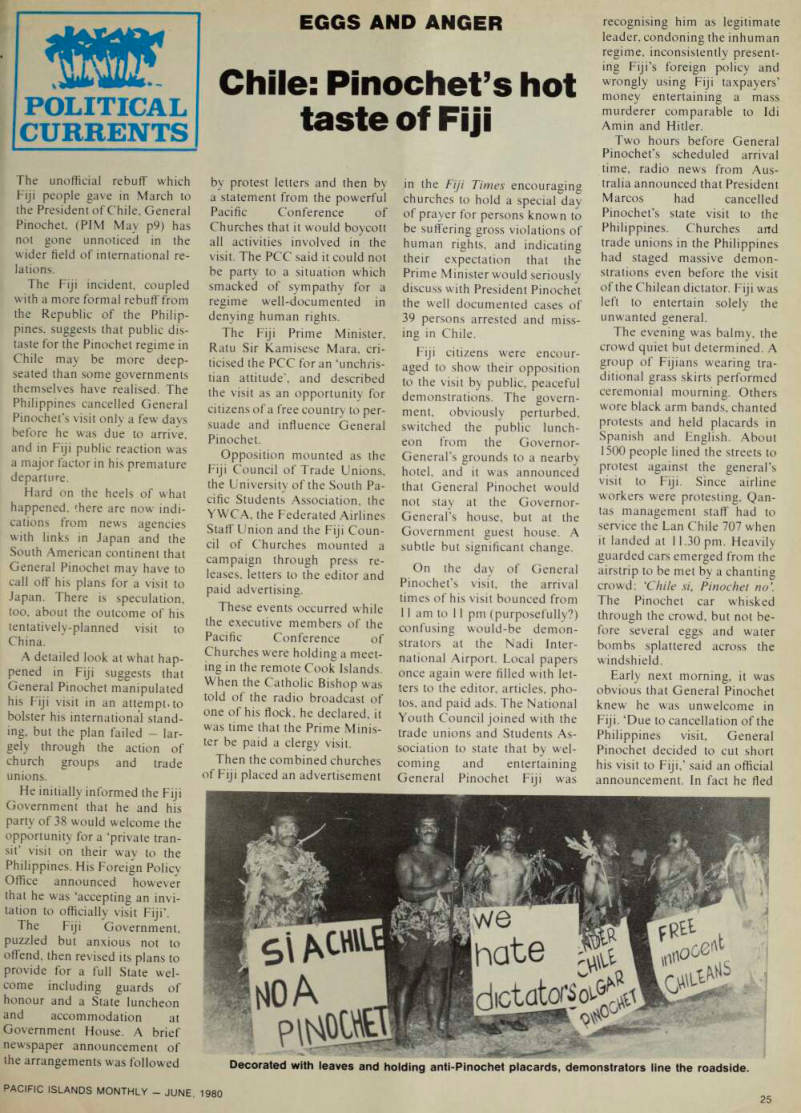
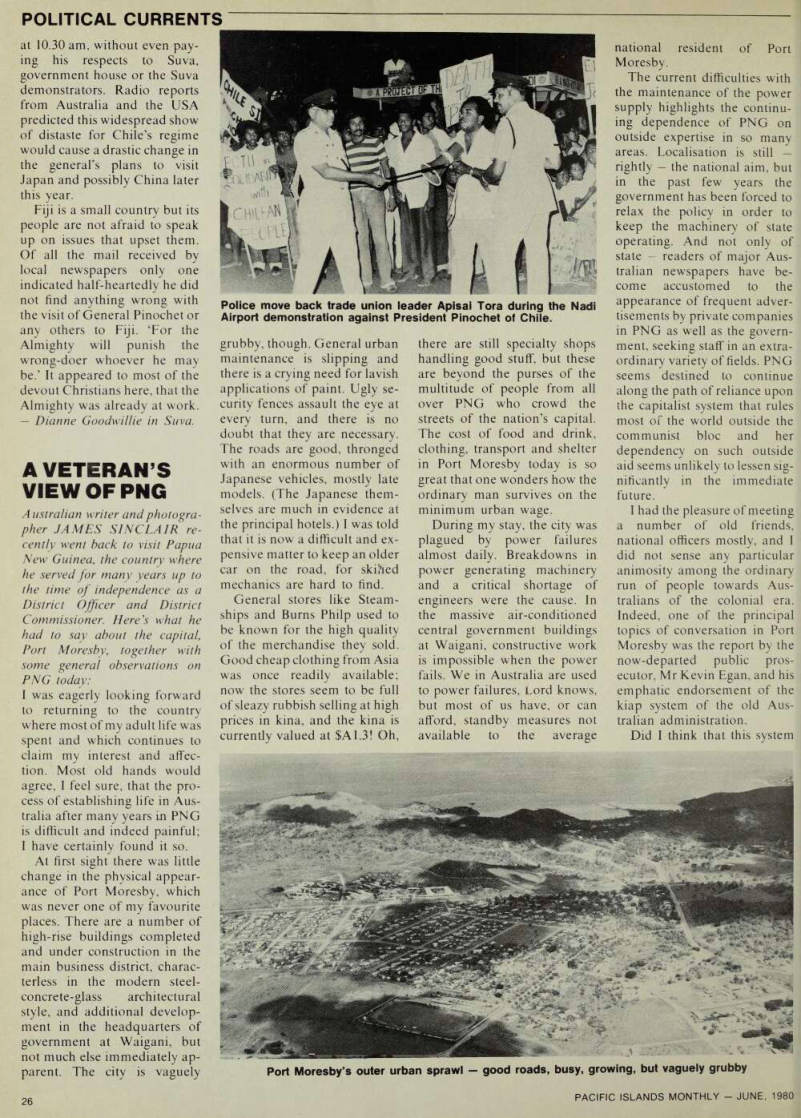
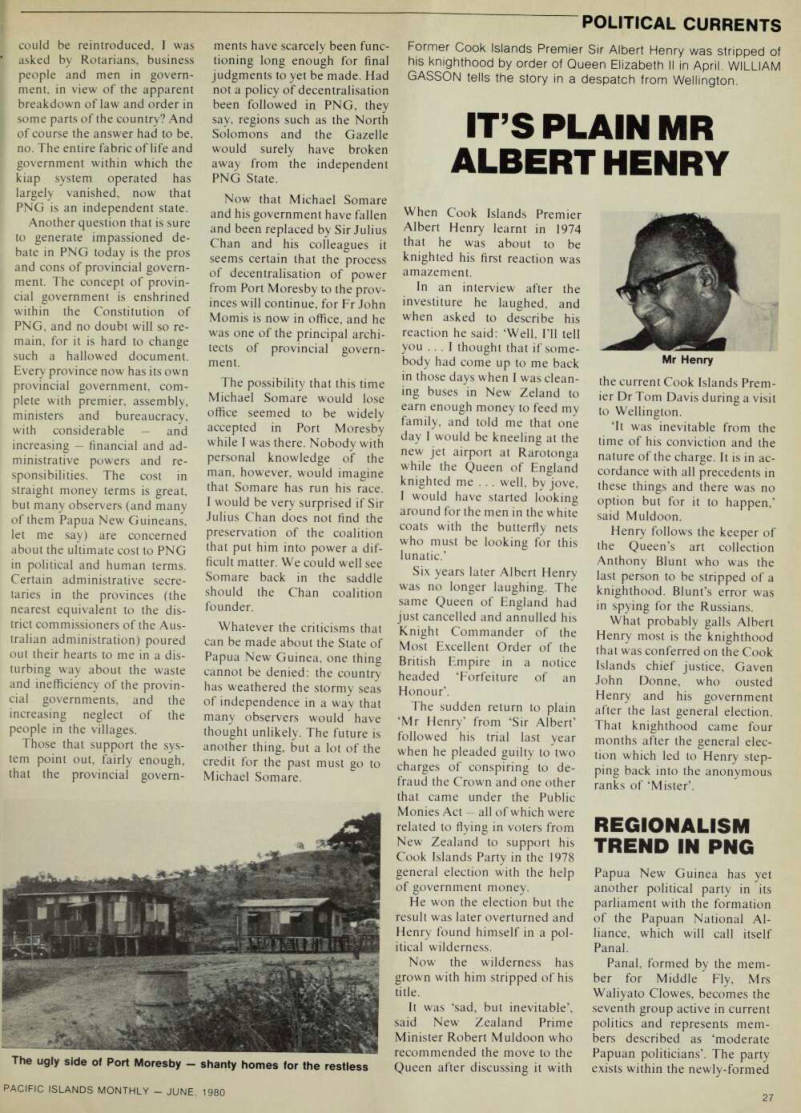
Political
Currents
Eggs And Anger
Chile: Pinochet’s hot taste of Fiji
The unofficial rebuff which Fiji people gave in March to the President of Chile, General Pinochet, (PIM May p 9) has not gone unnoticed in the wider field of international re lations.
The Fiji incident, coupled
with a more formal rebuff from the Republic of the Philip pines, suggests that public dis taste for the Pinochet regime in Chile may be more deep seated than some governments themselves have realised. The Philippines cancelled General Pinochet’s visit only a few days before he was due to arrive, and in Fiji public reaction was a major factor in his premature
departure.
Hard on the heels of what happened, there are now indi cations from news agencies with links in Japan and the South American continent that General Pinochet may have to call off his plans for a visit to Japan. There is speculation, too, about the outcome of his tentatively-planned visit to China.
A detailed look at what hap pened in Fiji suggests that General Pinochet manipulated his Fiji visit in an attempt, to bolster his international stand ing, but the plan failed lar gely through the action of church groups and trade unions.
He initially informed the Fiji Government that he and his party of 38 would welcome the opportunity for a ‘private tran sit’ visit on their way to the
Philippines. His Foreign Policy
Office announced however that he was ‘accepting an invi tation to officially visit Fiji’.
The Fiji Government, puzzled but anxious not to offend, then revised its plans to provide for a full State wel come including guards of honour and a State luncheon and accommodation at Government House. A brief newspaper announcement of the arrangements was followed
by protest letters and then by a statement from the powerful Pacific Conference of Churches that it would boycott all activities involved in the visit. The PCC said it could not be party to a situation which smacked of sympathy for a regime well-documented in denying human rights.
The Fiji Prime Minister, Ratu Sir Kamisese Mara, cri ticised the PCC for an ‘unchris tian attitude’, and described the visit as an opportunity for citizens of a free country to per suade and influence General Pinochet.
Opposition mounted as the Fiji Council of Trade Unions, the University of the South Pa cific Students Association, the YWCA, the Federated Airlines Staff Union and the Fiji Coun cil of Churches mounted a
campaign through press re
leases, letters to the editor and
paid advertising.
These events occurred while the executive members of the Pacific Conference of Churches were holding a meet ing in the remote Cook Islands.
When the Catholic Bishop was told of the radio broadcast of one of his flock, he declared, it was time that the Prime Minis ter be paid a clergy visit.
Then the combined churches of Fiji placed an advertisement
in the Fiji Times encouraging churches to hold a special day of prayer for persons known to be suffering gross violations of
human rights, and indicating
their expectation that the Prime Minister would seriously discuss with President Pinochet the well documented cases of 39 persons arrested and miss ing in Chile.
Fiji citizens were encour aged to show their opposition to the visit by public, peaceful demonstrations. The govern ment, obviously perturbed, switched the public lunch eon from the Governor- General’s grounds to a nearby hotel, and it was announced that General Pinochet would not stay at the Governor- General’s house, but at the Government guest house. A
subtle but significant change.
On the day of General Pinochet’s visit, the arrival times of his visit bounced from 11 am to 11 pm (purposefully?) confusing would-be demon strators at the Nadi Inter national Airport. Local papers once again were filled with let ters to the editor, articles, pho tos, and paid ads. The National Youth Council joined with the trade unions and Students As sociation to state that by wel
coming and entertaining
General Pinochet Fiji was
recognising him as legitimate
leader, condoning the inhuman
regime, inconsistently present
ing Fiji’s foreign policy and
wrongly using Fiji taxpayers’
money entertaining a mass murderer comparable to Idi Amin and Hitler.
Two hours before General Pinochet’s scheduled arrival time, radio news from Aus tralia announced that President Marcos had cancelled Pinochet’s state visit to the Philippines. Churches and trade unions in the Philippines had staged massive demon strations even before the visit of the Chilean dictator. Fiji was left to entertain solely the unwanted general.
The evening was balmy, the crowd quiet but determined. A group of Fijians wearing tra ditional grass skirts performed ceremonial mourning. Others wore black arm bands, chanted protests and held placards in
Spanish and English. About
1500 people lined the streets to
protest against the general’s
visit to Fiji. Since airline workers were protesting, Qan tas management staff had to service the Lan Chile 707 when it landed at 11.30 pm. Heavily guarded cars emerged from the airstrip to be met by a chanting crowd; ‘Chile si, Pinochet no’.
The Pinochet car whisked through the crowd, but not be fore several eggs and water bombs splattered across the windshield.
Early next morning, it was obvious that General Pinochet knew he was unwelcome in Fiji. ‘Due to cancellation of the Philippines visit, General Pinochet decided to cut short his visit to Fiji,’ said an official announcement. In fact he fled
Decorated with leaves and holding anti-Pinochet placards, demonstrators line the roadside.
at 10.30 am, without even pay ing his respects to Suva, government house or the Suva demonstrators. Radio reports from Australia and the USA
predicted this widespread show
of distaste for Chile’s regime would cause a drastic change in the general’s plans to visit Japan and possibly China later this year.
Fiji is a small country but its people are not afraid to speak up on issues that upset them.
Of all the mail received by local newspapers only one indicated half-heartedly he did not find anything wrong with the visit of General Pinochet or any others to Fiji. ‘For the
Almighty will punish the
wrong-doer whoever he may be.’ It appeared to most of the devout Christians here, that the Almighty was already at work.
Dianne Goodwillie in Suva.
A Veteran’S
View Of Png
A ustralian writer and photogra pher JAMES SINCLAIR re cently went back to visit Papua New Guinea, the country where he served for many years up to the time of independence as a District Officer and District Commissioner. Here's what he had to say about the capital.
Port Moresby, together with
some general observations on
PNG today:
I was eagerly looking forward to returning to the country where most of my adult life was spent and which continues to claim my interest and affec tion. Most old hands would agree, I feel sure, that the pro cess of establishing life in Aus tralia after many years in PNG is difficult and indeed painful; I have certainly found it so.
At first sight there was little change in the physical appear ance of Port Moresby, which was never one of my favourite places. There are a number of
high-rise buildings completed
and under construction in the main business district, charac terless in the modern steel
concrete-glass architectural
style, and additional develop
ment in the headquarters of government at Waigani, but not much else immediately ap parent. The city is vaguely
grubby, though. General urban
maintenance is slipping and there is a crying need for lavish
applications of paint. Ugly se
curity fences assault the eye at every turn, and there is no doubt that they are necessary.
The roads are good, thronged with an enormous number of
Japanese vehicles, mostly late
models. (The Japanese them selves are much in evidence at the principal hotels.) I was told that it is now a difficult and ex pensive matter to keep an older car on the road, for skihed mechanics are hard to find.
General stores like Steam ships and Burns Philp used to be known for the high quality of the merchandise they sold.
Good cheap clothing from Asia was once readily available; now the stores seem to be full
of sleazy rubbish selling at high
prices in kina, and the kina is currently valued at $A 1.3! Oh,
there are still specialty shops handling good stuff, but these are beyond the purses of the multitude of people from all over PNG who crowd the streets of the nation’s capital.
The cost of food and drink, clothing, transport and shelter in Port Moresby today is so great that one wonders how the ordinary man survives on the minimum urban wage.
During my stay, the city was
plagued by power failures
almost daily. Breakdowns in
power generating machinery
and a critical shortage of engineers were the cause. In the massive air-conditioned central government buildings at Waigani, constructive work is impossible when the power fails. We in Australia are used to power failures. Lord knows, but most of us have, or can afford, standby measures not available to the average
national resident of Port Moresby.
The current difficulties with the maintenance of the power supply highlights the continu ing dependence of PNG on outside expertise in so many areas. Localisation is still rightly the national aim, but in the past few years the government has been forced to relax the policy in order to keep the machinery of state operating. And not only of state readers of major Aus tralian newspapers have be come accustomed to the appearance of frequent adver tisements by private companies in PNG as well as the govern ment, seeking staff in an extra ordinary variety of fields. PNG seems destined to continue along the path of reliance upon the capitalist system that rules most of the world outside the communist bloc and her dependency on such outside aid seems unlikely to lessen sig nificantly in the immediate future.
I had the pleasure of meeting a number of old friends, national officers mostly, and I did not sense any particular
animosity among the ordinary
run of people towards Aus tralians of the colonial era.
Indeed, one of the principal topics of conversation in Port Moresby was the report by the
now-departed public pros
ecutor, Mr Kevin Egan, and his emphatic endorsement of the kiap system of the old Aus tralian administration.
Did I think that this system
Port Moresby’s outer urban sprawl-good roads, busy, growing, but vaguely grubby
Police move back trade union leader Apisai Tora during the Nadi Airport demonstration against President Pinochet of Chile.
could be reintroduced, I was asked by Rotarians, business people and men in govern ment, in view of the apparent breakdown of law and order in some parts of the country? And of course the answer had to be, no. The entire fabric of life and government within which the kiap system operated has largely vanished, now that PNG is an independent state.
Another question that is sure to generate impassioned de bate in PNG today is the pros and cons of provincial govern ment. The concept of provin cial government is enshrined within the Constitution of PNG, and no doubt will so re main, for it is hard to change such a hallowed document.
Every province now has its own provincial government, com
plete with premier, assembly,
ministers and bureaucracy, with considerable and increasing financial and ad ministrative powers and re sponsibilities. The cost in straight money terms is great, but many observers (and many of them Papua New Guineans, let me say) are concerned about the ultimate cost to PNG in political and human terms.
Certain administrative secre taries in the provinces (the nearest equivalent to the dis trict commissioners of the Aus tralian administration) poured out their hearts to me in a dis turbing way about the waste and inefficiency of the provin cial governments, and the
increasing neglect of the
people in the villages.
Those that support the sys
tem point out, fairly enough,
that the provincial govern
ments have scarcely been func
tioning long enough for final
judgments to yet be made. Had not a policy of decentralisation been followed in PNG, they say, regions such as the North Solomons and the Gazelle would surely have broken away from the independent PNG State.
Now that Michael Somare and his government have fallen and been replaced by Sir Julius Chan and his colleagues it seems certain that the process of decentralisation of power from Port Moresby to the prov inces will continue, for Fr John Momis is now in office, and he was one of the principal archi tects of provincial govern ment.
The possibility that this time Michael Somare would lose office seemed to be widely
accepted in Port Moresby
while I was there. Nobody with personal knowledge of the man, however, would imagine that Somare has run his race.
I would be very surprised if Sir Julius Chan does not find the preservation of the coalition that put him into power a dif ficult matter. We could well see Somare back in the saddle should the Chan coalition founder.
Whatever the criticisms that can be made about the State of Papua New Guinea, one thing cannot be denied: the country has weathered the stormy seas of independence in a way that many observers would have thought unlikely. The future is another thing, but a lot of the credit for the past must go to Michael Somare.
The ugly side of Port Moresby- shanty homes for the restless
Albert Henry
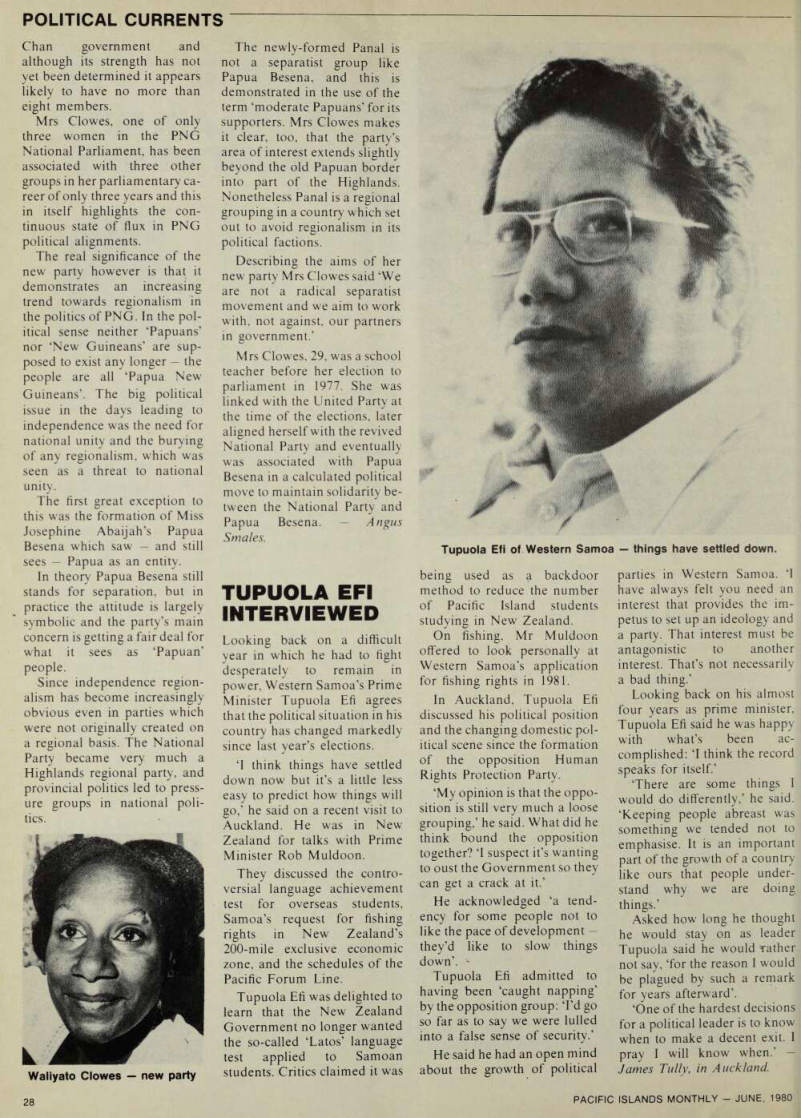

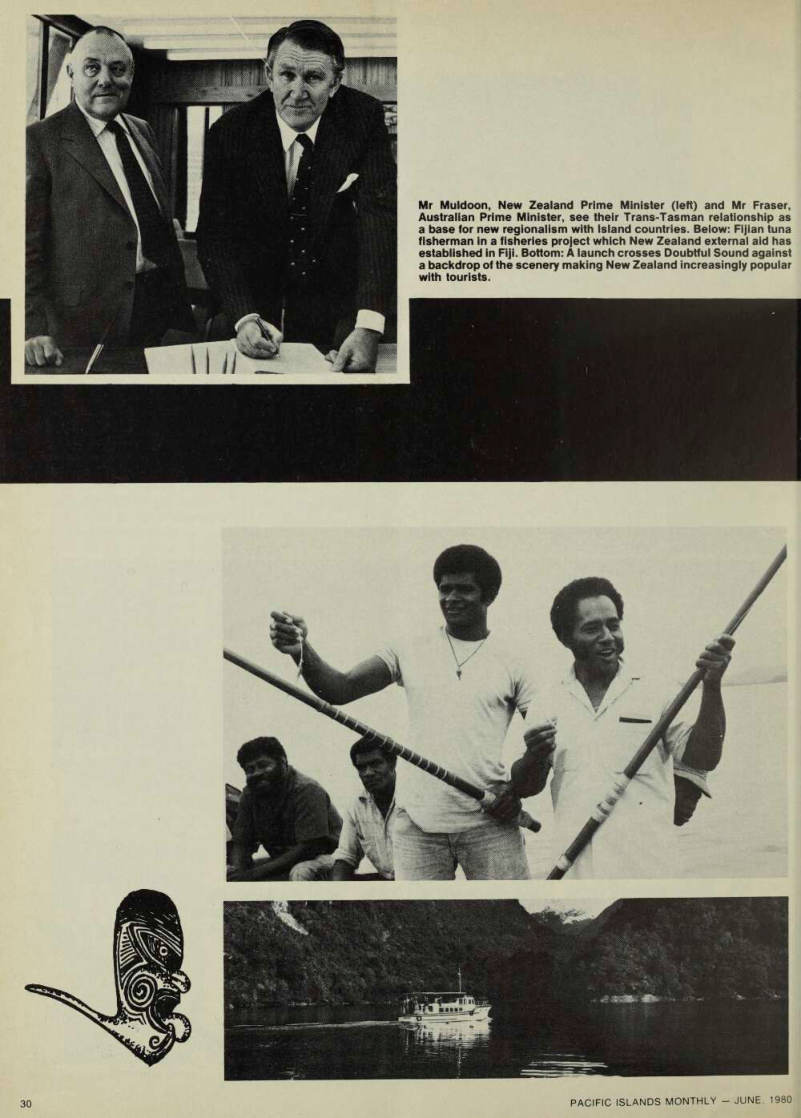
It’S Plain Mr
Former Cook Islands Premier Sir Albert Henry was stripped of his knighthood by order of Queen Elizabeth II in April. WILLIAM GASSON tells the story in a despatch from Wellington.
When Cook Islands Premier Albert Henry learnt in 1974 that he was about to be knighted his first reaction was amazement.
In an interview after the investiture he laughed, and when asked to describe his reaction he said: ‘Well, I’ll tell you ... I thought that if some body had come up to me back in those days when I was clean ing buses in New Zeland to earn enough money to feed my family, and told me that one day I would be kneeling at the
new jet airport at Rarotonga
while the Queen of England knighted me . . . well, by jove, I would have started looking around for the men in the white coats with the butterfly nets who must be looking for this lunatic.’
Six years later Albert Henry was no longer laughing. The same Queen of England had just cancelled and annulled his Knight Commander of the Most Excellent Order of the British Empire in a notice headed ‘Forfeiture of an Honour’.
The sudden return to plain ‘Mr Henry’ from ‘Sir Albert’ followed his trial last year when he pleaded guilty to two charges of conspiring to de fraud the Crown and one other that came under the Public Monies Act all of which were related to flying in voters from New Zealand to support his Cook Islands Party in the 1978 general election with the help of government money.
He won the election but the result was later overturned and Henry found himself in a pol itical wilderness.
Now the wilderness has grown with him stripped of his title.
It was ‘sad, but inevitable’, said New Zealand Prime Minister Robert Muldoon who recommended the move to the Queen after discussing it with
the current Cook Islands Prem ier Dr Tom Davis during a visit
to Wellington.
‘lt was inevitable from the time of his conviction and the nature of the charge. It is in ac cordance with all precedents in these things and there was no option but for it to happen,’ said Muldoon.
Henry follows the keeper of the Queen’s art collection Anthony Blunt who was the last person to be stripped of a knighthood. Blunt’s error was in spying for the Russians.
What probably galls Albert
Henry most is the knighthood that was conferred on the Cook Islands chief justice, Gaven John Donne, who ousted Henry and his government after the last general election.
That knighthood came four months after the general elec tion which led to Henry step ping back into the anonymous ranks of ‘Mister’.
Regionalism
Trend In Png
Papua New Guinea has yet another political party in its parliament with the formation of the Papuan National Al liance, which will call itself Panal.
Panal, formed by the mem ber for Middle Fly, Mrs Waliyato Clowes, becomes the seventh group active in current politics and represents mem bers described as ‘moderate
Papuan politicians’. The party
exists within the newly-formed
Mr Henry
Chan government and although its strength has not yet been determined it appears likely to have no more than
eight members.
Mrs Clowes, one of only three women in the PNG National Parliament, has been associated with three other groups in her parliamentary ca reer of only three years and this in itself highlights the con tinuous state of flux in PNG
political alignments.
The real significance of the new party however is that it demonstrates an increasing trend towards regionalism in the politics of PNG. In the pol itical sense neither ‘Papuans’ nor ‘New Guineans’ are sup posed to exist any longer the people are all ‘Papua New
Guineans’. The big political
issue in the days leading to independence was the need for national unity and the burying of any regionalism, which was seen as a threat to national
unity.
The first great exception to this was the formation of Miss
Josephine Abaijah’s Papua
Besena which saw and still sees Papua as an entity.
In theory Papua Besena still stands for separation, but in practice the attitude is largely symbolic and the party’s main concern is getting a fair deal for what it sees as ‘Papuan’
people.
Since independence region
alism has become increasingly obvious even in parties which were not originally created on a regional basis. The National Party became very much a
Highlands regional party, and
provincial politics led to press ure groups in national poli tics.
The newly-formed Panal is not a separatist group like Papua Besena, and this is demonstrated in the use of the term ‘moderate Papuans’ for its supporters. Mrs Clowes makes it clear, too, that the party’s area of interest extends slightly beyond the old Papuan border into part of the Highlands.
Nonetheless Panal is a regional grouping in a country which set out to avoid regionalism in its political factions.
Describing the aims of her new party Mrs Clowes said ‘We are not a radical separatist movement and we aim to work with, not against, our partners in government.’
Mrs Clowes, 29, was a school teacher before her election to parliament in 1977. She was linked with the United Party at the time of the elections, later aligned herself with the revived National Party and eventually was associated with Papua Besena in a calculated political move to maintain solidarity be tween the National Party and Papua Besena. Angus Smales.
Tupuola Efi
Interviewed
Looking back on a difficult year in which he had to fight desperately to remain in power. Western Samoa’s Prime Minister Tupuola Efi agrees that the political situation in his
country has changed markedly
since last year’s elections.
T think things have settled down now but it’s a little less easy to predict how things will go,’ he said on a recent visit to Auckland. He was in New Zealand for talks with Prime Minister Rob Muldoon.
They discussed the contro versial language achievement test for overseas students, Samoa’s request for fishing rights in New Zealand’s 200-mile exclusive economic zone, and the schedules of the Pacific Forum Line.
Tupuola Efi was delighted to learn that the New Zealand Government no longer wanted the so-called ‘Latos’ language test applied to Samoan students. Critics claimed it was
being used as a backdoor method to reduce the number of Pacific Island students studying in New Zealand.
On fishing, Mr Muldoon offered to look personally at Western Samoa’s application for fishing rights in 1981.
In Auckland, Tupuola Efi
discussed his political position
and the changing domestic pol itical scene since the formation of the opposition Human Rights Protection Party. ‘My opinion is that the oppo sition is still very much a loose grouping,’ he said. What did he think bound the opposition together? T suspect it’s wanting to oust the Government so they can get a crack at it.’
He acknowledged ‘a tend ency for some people not to like the pace of development they’d like to slow things down’. v Tupuola Efi admitted to
having been ‘caught napping’
by the opposition group: ‘l'd go so far as to say we were lulled into a false sense of security.’
He said he had an open mind about the growth of political
parties in Western Samoa. ‘I have always felt you need an interest that provides the im petus to set up an ideology and a party. That interest must be antagonistic to another interest. That’s not necessarily a bad thing.’
Looking back on his almost four years as prime minister, Tupuola Efi said he was happy with what’s been ac complished: ‘I think the record speaks for itself.’
There are some things I would do differently,’ he said.
‘Keeping people abreast was
something we tended not to emphasise. It is an important part of the growth of a country like ours that people under stand why we are doing
things.’
Asked how long he thought he would stay on as leader Tupuola said he would rather not say, ‘for the reason I would be plagued by such a remark for years afterward’. ‘One of the hardest decisions for a political leader is to know when to make a decent exit. I pray I will know when.’ -
James Tally, in Auckland.
Waliyato Clowes-new party
Tupuola Efl of Western Samoa-things have settled down.
Mr Muldoon, New Zealand Prime Minister (left) and Mr Fraser, Australian Prime Minister, see their Trans-Tasman relationship as a base for new regionalism with Island countries. Below: Fijian tuna fisherman in a fisheries project which New Zealand external aid has established in Fiji. Bottom: A launch crosses Doubtful Sound against a backdrop of the scenery making New Zealand increasingly popular with tourists.
Advertisements & other items, p. 29 (1 item)
by container
House kits (up to 150 square metres in size) fit a 6 metre container and are currently being exported to Pacific Islands. tirml 1 • - , xilf
It arrives
and you build it
with a Spanner in a
matter of weeks.
The “Logan Unit" kits consist of galvanised steel framed-insulated-asbestor cement sheeted modules 1 metre wide. Each kit contains all modules including windows and doors, roof members, roof sheets, ceilings and fixing to complete a lock-up unit.
Erection of a kit on an established floor is about 8 days for 2 men. ■r I t if A'
A Marlin Modular Home.
Marlin Modular Constructions supply (and construct where required) cyclone rated modular homes and buildings me system is adaptable for use as housing, schools, offices etc.
Marlin Modular Constructions Solomon Islands Representative: P.O. Box 149, Rocklea. 4106 Qld. Rolo Builders Ltd. P.O. Box 449, Australia, PH 345 4539 Honiara. Solomon Islands.
TRADE ENQUIRIES WELCOME.
Hz* * ♦
An Island Country In
A New Relationship
"More English than England’ was how a travel writer described the New Zealand of only 30 years ago. But the past 10 years have seen an almost revolutionary change in New Zealand at home and its links with the newly-emerged Island nations of the South Pacific. In the following pages PIM looks at the Pacific relationships and the regional role of the modern New Zealand.
new zealand
in the pacific
The last decade has seen extraordinary growth in the development of New Zealand as a Pacific identity rather than as a Pacific outpost of the Western World. Links with the Pacific have strengthened in politics, government to government co-operation, trade and cul ture. Here WILLIAM GASSON, long an observer of the New Zealand scene from Wellington, asks:
NZ influence

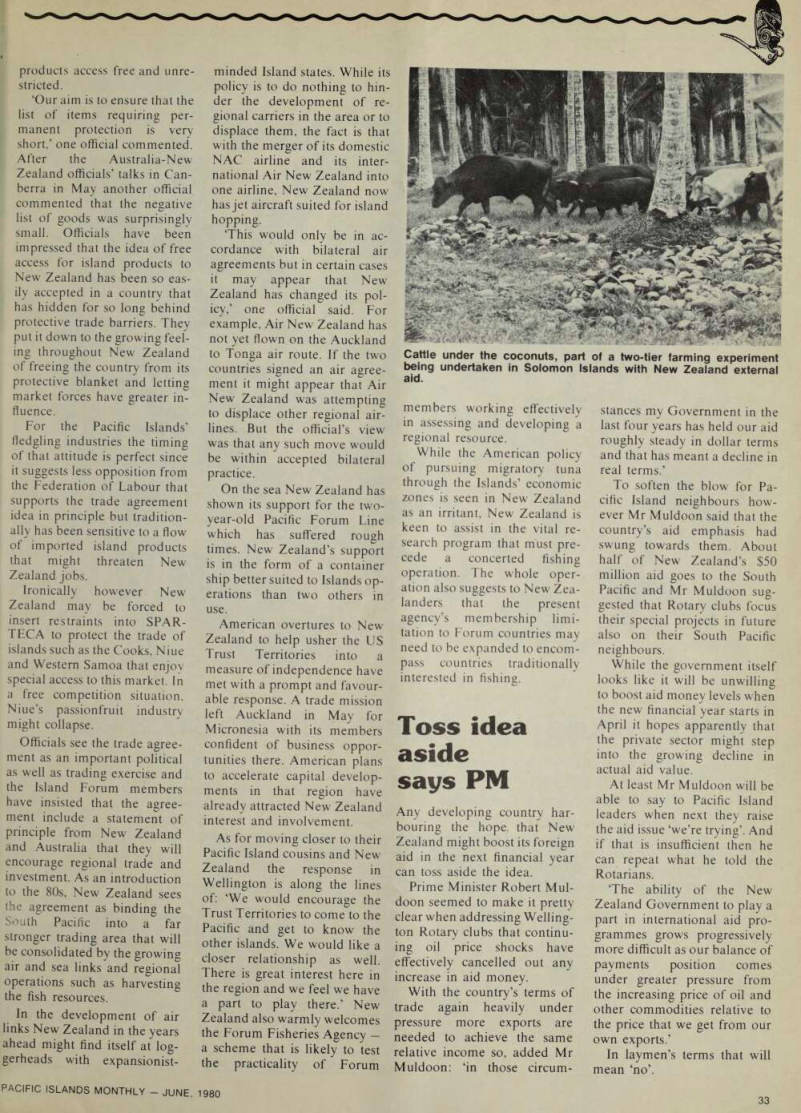
How to measure NZ influence in the Pacific?
Anyone using the level of aid to measure New Zealand’s interest in the Pacific Islands will be easily misled. The fact is that in real terms aid money slipped backwards in successive years but the interest taken by New Zealand in the Pacific continues to rise Prune Minister Robert Muldoon takes a personal interest m Pacific affairs as evidenced recently when Western Samoan Prime Minister Tupuola Efi arrived in New Zealand incensed by the
English language test imposed
on his country’s students studymg here.
Two days of talks and Efi was heading home full of praise for Muldoon, who‘when the chips are down never lets you down.’
After generations of looking beyond the Pacific Islands New Zealand now firmly ac knowledges the presence of its scattered neighbours and official policy is to adopt a high profile in the South Pacific which only makes it more frus trating for aid officials trying to make the diminishing New Zealand dollar go further While New Zealand’s econ omic future half way through the gQs looks promising, the
immediate years indicate a grim battle to control galloping inflation now at the 18.4% a year level to inject massive investments into energy and other industrial developments,
to overcome high unemploy
ment and to accelerate even more a growing range of exports to an equally growing range of markets. But that in cludes the Pacific Islands which overall now represent New Zealand’s sixth largest trading market. And that must grow in the years ahead as more islands gain their
independence and the region
inter-reacts as an economic unit.
While New Zealand uses the argument that the United States must open its trading doors to New Zealand’s pro ducts so that New Zealand can be strong economically and afford the kind of defence potential demanded of it by ANZUS membership, so too the Pacific Islands can use a similar argument on New Zealand for their products.
Economically weak communi ties are vulnerable communi ties.
That makes the present talks on the South Pacific Area of
Regional Trade and Econ omic Cooperation Agreement (SPARTECA) so important since its concept is to provide for the Pacific Forum islands free and unrestricted access to New Zealand and Australian markets. Related to that development is the New Zealand PUDS (Pacific Islands Industrial Scheme) which encourages businessmen to invest in the islands and de velop industries there, with the help of various incentives.
The main weakness is the lack of any guaranteed access to New Zealand’s market for island manufactured goods. In
fact eight applications for
access to New Zealand have been granted since the scheme began in 1976 and while many industries are aimed specifi cally at the island markets, New Zealand and Australia are looked on as the logical outlets
for goods. Wellington officials
are cautiously optimistic at the progress in putting together the text of the trade agreement that will be put before Forum members when they meet in July. While it seems inevitable that there will be a measure of protection built into the agree ment, the aim is to make island
products access free and unre stricted. ‘Our aim is to ensure that the list of items requiring per manent protection is very short,’ one official commented.
After the Australia-New Zealand officials’ talks in Can berra in May another official commented that the negative list of goods was surprisingly small. Officials have been impressed that the idea of free access for island products to New Zealand has been so eas ily accepted in a country that has hidden for so long behind protective trade barriers. They put it down to the growing feel
ing throughout New Zealand
of freeing the country from its protective blanket and letting market forces have greater in fluence.
For the Pacific Islands’
fledgling industries the timing
of that attitude is perfect since it suggests less opposition from the Federation of Labour that supports the trade agreement idea in principle but tradition ally has been sensitive to a flow of imported island products that might threaten New
Zealand jobs.
Ironically however New Zealand may be forced to insert restraints into SPAR TECA to protect the trade of islands such as the Cooks, Niue and Western Samoa that enjov special access to this market. In a free competition situation,
Niue’s passionfruit industry
might collapse.
Officials see the trade agree ment as an important political as well as trading exercise and the Island Forum members have insisted that the agree ment include a statement of principle from New Zealand and Australia that they will encourage regional trade and investment. As an introduction to the 80s, New Zealand sees the agreement as binding the South Pacific into a far stronger trading area that will be consolidated by the growing air and sea links and regional
operations such as harvesting
the fish resources.
In the development of air links New Zealand in the years ahead might find itself at log gerheads with expansionist
minded Island states. While its policy is to do nothing to hin der the development of re gional carriers in the area or to displace them, the fact is that with the merger of its domestic NAC airline and its inter national Air New Zealand into one airline, New Zealand now has jet aircraft suited for island
hopping.
‘This would only be in ac cordance with bilateral air agreements but in certain cases it may appear that New Zealand has changed its pol icy,’ one official said. For example. Air New Zealand has not yet flown on the Auckland to Tonga air route. If the two countries signed an air agree ment it might appear that Air New Zealand was attempting to displace other regional air lines. But the official’s view was that any such move would be within accepted bilateral practice.
On the sea New Zealand has shown its support for the two year-old Pacific Forum Line which has suffered rough times. New Zealand’s support is in the form of a container ship better suited to Islands op erations than two others in use.
American overtures to New Zealand to help usher the US Trust Territories into a measure of independence have met with a prompt and favour able response. A trade mission left Auckland in May for Micronesia with its members confident of business oppor tunities there. American plans
to accelerate capital develop
ments in that region have already attracted New Zealand interest and involvement.
As for moving closer to their Pacific Island cousins and New Zealand the response in Wellington is along the lines of: ‘We would encourage the Trust Territories to come to the Pacific and get to know the other islands. We would like a closer relationship as well.
There is great interest here in the region and we feel we have a part to play there.’ New Zealand also warmly welcomes the Forum Fisheries Agency a scheme that is likely to test the practicality of Forum
members working effectively
in assessing and developing a regional resource.
While the American policy of pursuing migratory tuna through the Islands’ economic zones is seen in New Zealand as an irritant. New Zealand is keen to assist in the vital re search program that must pre cede a concerted fishing operation. The whole oper ation also suggests to New Zea landers that the present agency’s membership limi tation to Forum countries may need to be expanded to encom pass countries traditionally interested in fishing.
Toss idea
aside
says PM
Any developing country har bouring the hope that New Zealand might boost its foreign aid in the next financial year can toss aside the idea.
Prime Minister Robert Mul doon seemed to make it pretty
clear when addressing Welling
ton Rotary clubs that continu ing oil price shocks have effectively cancelled out any increase in aid money.
With the country’s terms of
trade again heavily under
pressure more exports are needed to achieve the same relative income so, added Mr Muldoon: ‘in those circum
stances my Government in the last four years has held our aid roughly steady in dollar terms and that has meant a decline in real terms.’
To soften the blow for Pa cific Island neighbours how ever Mr Muldoon said that the
country’s aid emphasis had
swung towards them. About half of New Zealand’s $5O million aid goes to the South Pacific and Mr Muldoon sug gested that Rotary clubs focus their special projects in future also on their South Pacific
neighbours.
While the government itself looks like it will be unwilling to boost aid money levels when the new financial year starts in
April it hopes apparently that
the private sector might step into the growing decline in actual aid value.
At least Mr Muldoon will be able to say to Pacific Island leaders when next they raise the aid issue ‘we’re trying’. And if that is insufficient then he can repeat what he told the Rotarians. ‘The ability of the New Zealand Government to play a part in international aid pro grammes grows progressively more difficult as our balance of payments position comes under greater pressure from the increasing price of oil and other commodities relative to the price that we get from our
own exports.’
In laymen’s terms that will mean ‘no’.
Cattle under the coconuts, part of a two-tier farming experiment being undertaken in Solomon Islands with New Zealand external aid.
Advertisements & other items, pp. 32-34 (1 item)
Food products-jams, honey, honey
m a ; n T OK II ■ D 'S Glass containers to international standards to suit your packaging needs. At New Zealand Glass Manufacturers Company our Development team will work with you to design the best package for your product. We also have an
extensive range of stock containers available.
We also offer a range of top quality
Food products-jams, honey, honey
spreads and apple juice.
For further details,
contact our representative in your area.
NZOTC
P.O. Box 1095 Suva Fiji Mr. R.
Zullah Tel. 26131 Telex 2134 ACI Harv FJ Hornabook Agencies PO Box 412/ Noumea Mr A. J. Flornabrook tel 27-6366 Cable Importex Noumea.
New Zealand Glass Man. Co. c - Import Export Corporation PO Box 1081 Nth Sydney NSW 2060 Australia Mr P. Clark Telex Enzex AA21571 Mr E. Dillner Suite 2012 509 Madison Ave New York 10022 United States of America Telex AHI Fel 0668899 UN Telephone. or contact: mm New Zealand Glass Manufacturers Company Private Bag Auckland New Zealand Telex NZ 2222 Telephone. 599959
ns m B -ll pjifruv: nnnSCTE aLr
II,,— T
rfX&IU 43T- ' A\' •. helping build New Zealand’s future since 1864 Quarrying. Forestry. Refractories. Glass.
Plastics. Cement Building Products.
The Winstone Group of Companies.
As one of New Zealand’s major manufacturers and suppliers of raw materials and services to the building and construction industries, the Winstone Group has been successfully seeking and devebping new markets.
Through an appreciatbn of the importance and long-term potential of this country’s natural resources, the Winstone Group has established a strong base from which to further extend its commitment to devebpment and diversifbatbn throughout New Zealand.
lunsronE
Winstone Limited P.O. Box 395, Auckland, New Zealand.
Telephone 778-870 Telex No. 2563 855277
Radio Nz Plans
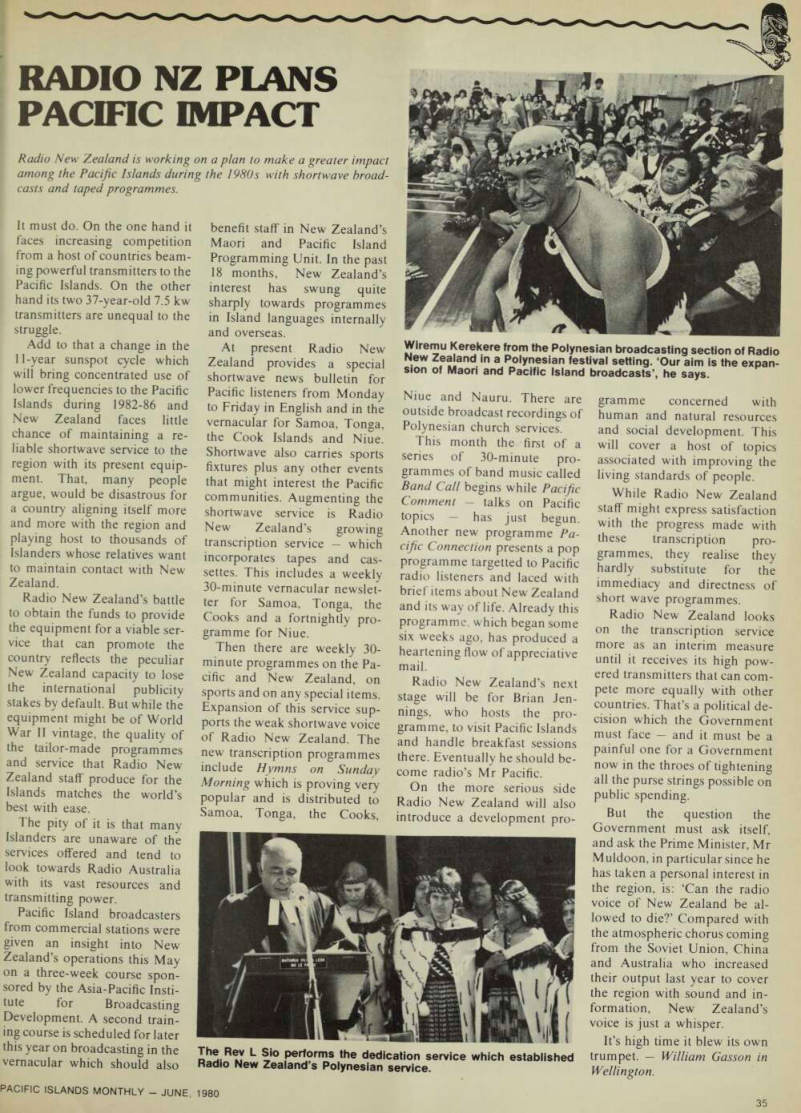
Pacific Impact
Radio New Zealand is working on a plan to make a greater impact among the Pacific Islands during the 1980 s with shortwave broad casts and taped programmes.
It must do. On the one hand it faces increasing competition from a host of countries beam ing powerful transmitters to the Pacific Islands. On the other hand its two 37-year-old 7.5 kw transmitters are unequal to the
struggle.
Add to that a change in the
11-year sunspot cycle which
will bring concentrated use of lower frequencies to the Pacific Islands during 1982-86 and New Zealand faces little chance of maintaining a re liable shortwave service to the region with its present equip ment. That, many people argue, would be disastrous for a country aligning itself more and more with the region and playing host to thousands of Islanders whose relatives want to maintain contact with New Zealand.
Radio New Zealand’s battle to obtain the funds to provide the equipment for a viable ser vice that can promote the country reflects the peculiar New Zealand capacity to lose the international publicity stakes by default. But while the equipment might be of World War II vintage, the quality of the tailor-made programmes and service that Radio New Zealand staff produce for the Islands matches the world’s best with ease.
The pity of it is that many Islanders are unaware of the services offered and tend to look towards Radio Australia with its vast resources and
transmitting power.
Pacific Island broadcasters from commercial stations were given an insight into New Zealand’s operations this May on a three-week course spon sored by the Asia-Pacific Insti tute for Broadcasting Development. A second train ing course is scheduled for later this year on broadcasting in the vernacular which should also
benefit staff in New Zealand’s Maori and Pacific Island Programming Unit. In the past 18 months, New Zealand’s interest has swung quite sharply towards programmes
in Island languages internally
and overseas.
At present Radio New Zealand provides a special shortwave news bulletin for Pacific listeners from Monday to Friday in English and in the vernacular for Samoa, Tonga, the Cook Islands and Niue.
Shortwave also carries sports fixtures plus any other events that might interest the Pacific communities. Augmenting the shortwave service is Radio New Zealand’s growing transcription service which incorporates tapes and cas settes. This includes a weekly 30-minute vernacular newslet ter for Samoa, Tonga, the Cooks and a fortnightly pro gramme for Niue.
Then there are weekly 30minute programmes on the Pa cific and New Zealand, on sports and on any special items.
Expansion of this service sup ports the weak shortwave voice of Radio New Zealand. The new transcription programmes include Hymns on Sunday Morning which is proving very popular and is distributed to Samoa, Tonga, the Cooks,
Niue and Nauru. There are outside broadcast recordings of Polynesian church services.
This month the first of a series of 30-minute pro grammes of band music called Band Call begins while Pacific Comment talks on Pacific
topics has just begun.
Another new programme Pa cific Connection presents a pop programme targetted to Pacific radio listeners and laced with brief items about New Zealand and its way of life. Already this programme, which began some six weeks ago, has produced a heartening flow of appreciative mail.
Radio New Zealand’s next stage will be for Brian Jen nings, who hosts the pro gramme, to visit Pacific Islands and handle breakfast sessions there. Eventually he should be come radio’s Mr Pacific.
On the more serious side Radio New Zealand will also introduce a development pro-
gramme concerned with human and natural resources and social development. This will cover a host of topics associated with improving the
living standards of people.
While Radio New Zealand staff might express satisfaction with the progress made with these transcription pro
grammes, they realise they
hardly substitute for the immediacy and directness of short wave programmes.
Radio New Zealand looks on the transcription service more as an interim measure until it receives its high pow ered transmitters that can com pete more equally with other countries. That’s a political de cision which the Government must face and it must be a painful one for a Government now in the throes of tightening all the purse strings possible on
public spending.
But the question the Government must ask itself, and ask the Prime Minister, Mr Muldoon, in particular since he has taken a personal interest in the region, is: ‘Can the radio voice of New Zealand be al lowed to die?’ Compared with
the atmospheric chorus coming
from the Soviet Union, China and Australia who increased their output last year to cover the region with sound and in formation, New Zealand’s voice is just a whisper.
It’s high time it blew its own
trumpet.
William Gasson in
Wellington.
The Rev L Sio performs the dedication service which established Radio New Zealand’s Polynesian service.
Wiremu Kerekere from the Polynesian broadcasting section of Radio Ne w Zealand in a Polynesian festival setting. Our aim is the expan sion of Maori and Pacific Island broadcasts’, he says
Advertisements & other items, p. 36 (1 item)
The Pacific
mm
AHI Aluminium Limited
Rylock
MARKET LEADERS IN ALUMINIUM WINDOWS & DOORS
(AFISHEr
itm
Designers and manufacturers marketing a complete range of extrusions and components for fabrication of aluminium joinery products.
AV 4p V I TT t
FOR FURTHER INFORMATION CONTACT
AHI ALUMINIUM FRANCHISING COMPANY
P O BOX 18299, AUCKLAND, NEW ZEALAND TELEPHONE 580 704 CABLES AHIAL TELEX: 2222
ART OF
THE PACIFIC
Photographs by Brian Brake, Conversations by James McNeish, Commentary by David Simmons A magnificent new book of special interest to PIM readers.
Beautifully printed and presented. ART OF THE PACIFIC contains 240 pages, and 175 superb photographs, half of which are in full colour, the balance being in duotone.
Published by Oxford University Press in association with the Queen Elizabeth II Arts Council of New Zealand.
Oxford University Press, P.O. Box 27-344.
Wellington, NZ.
G.P.O Box 2784 Y.
Melbourne. 3001, Australia. m From all good booksellers.
Relations With
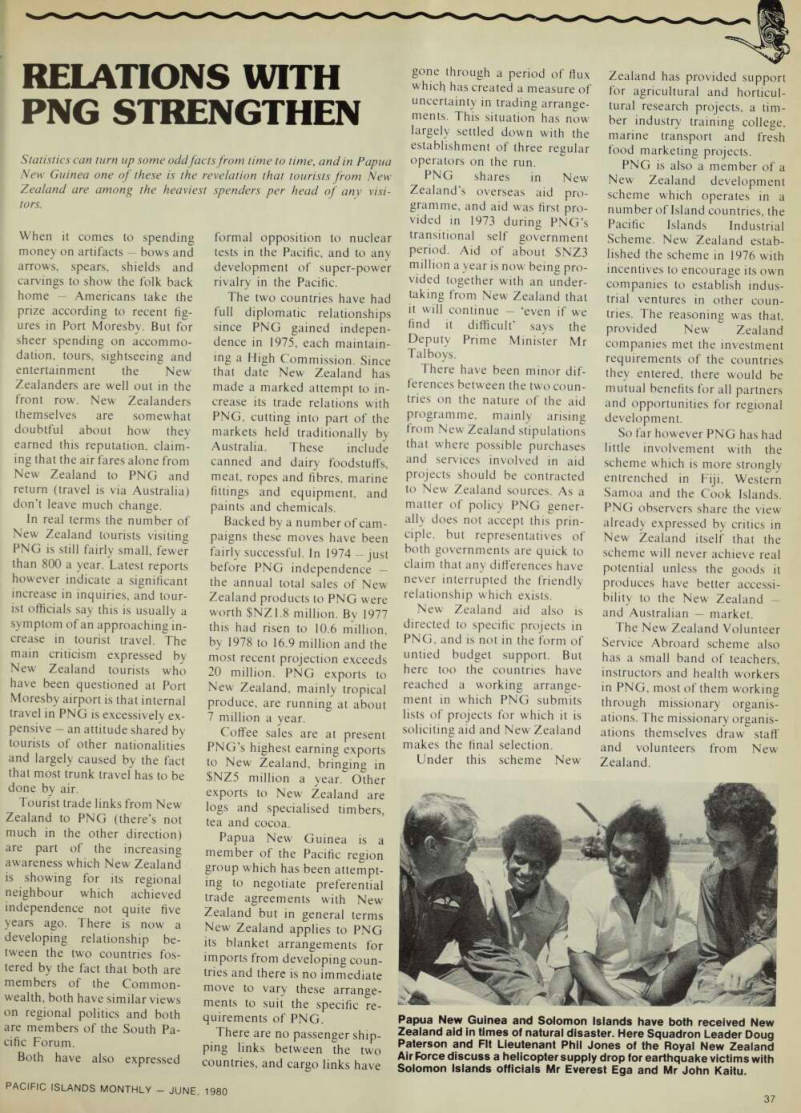
Png Strengthen
Statistics can turn up some oddfacts from time to time, and in Papua New Guinea one of these is the revelation that tourists from New Zealand are among the heaviest spenders per head of any visi tors.
When it comes to spending money on artifacts bows and arrows, spears, shields and carvings to show the folk back home Americans take the
prize according to recent fig
ures in Port Moresby. But for sheer spending on accommo dation, tours, sightseeing and entertainment the New Zealanders are well out in the front row. New Zealanders themselves are somewhat doubtful about how they earned this reputation, claim ing that the air fares alone from New Zealand to PNG and return (travel is via Australia) don’t leave much change.
In real terms the number of New Zealand tourists visiting PNG is still fairly small, fewer than 800 a year. Latest reports however indicate a significant increase in inquiries, and tour ist officials say this is usually a symptom of an approaching in crease in tourist travel. The main criticism expressed by New Zealand tourists who have been questioned at Port Moresby airport is that internal travel in PNG is excessively ex pensive - an attitude shared by tourists of other nationalities and largely caused by the fact that most trunk travel has to be done by air.
Tourist trade links from New Zealand to PNG (there’s not much in the other direction) are part of the increasing awareness which New Zealand is showing for its regional neighbour which achieved
independence not quite five
years ago. There is now a
developing relationship be
tween the two countries fos tered by the fact that both are members of the Common wealth, both have similar views on regional politics and both are members of the South Pa cific Forum.
Both have also expressed
formal opposition to nuclear tests in the Pacific, and to any development of super-power rivalry in the Pacific.
The two countries have had
full diplomatic relationships
since PNG gained indepen
dence in 1975, each maintain ing a High Commission. Since that date New Zealand has made a marked attempt to in crease its trade relations with PNG, cutting into part of the
markets held traditionally by
Australia. These include canned and dairy foodstuffs, meat, ropes and fibres, marine
fittings and equipment, and
paints and chemicals.
Backed by a number of cam paigns these moves have been fairly successful. In 1974 - just before PNG independence the annual total sales of New Zealand products to PNG were worth SNZI.B million. By 1977 this had risen to 10.6 million, by 1978 to 16.9 million and the most recent projection exceeds 20 million. PNG exports to
New Zealand, mainly tropical
produce, are running at about 7 million a year.
Coffee sales are at present
PNG’s highest earning exports
to New Zealand, bringing in SNZS million a year. Other exports to New Zealand are
logs and specialised timbers,
tea and cocoa.
Papua New Guinea is a member of the Pacific region group which has been attempt
ing to negotiate preferential
trade agreements with New Zealand but in general terms New Zealand applies to PNG its blanket arrangements for
imports from developing coun
tries and there is no immediate move to vary these arrange ments to suit the specific re quirements of PNG.
There are no passenger ship ping links between the two countries, and cargo links have
gone through a period of flux which has created a measure of
uncertainty in trading arrange
ments. This situation has now largely settled down with the establishment of three regular operators on the run.
PNG shares in New Zealand’s overseas aid pro gramme, and aid was first pro vided in 1973 during PNG’s transitional self government period. Aid of about SNZ3 million a year is now being pro vided together with an under taking from New Zealand that it will continue ‘even if we find it difficult’ says the Deputy Prime Minister Mr
Talboys.
There have been minor dif ferences between the two coun tries on the nature of the aid
programme, mainly arising
from New Zealand stipulations that where possible purchases and services involved in aid projects should be contracted to New Zealand sources. As a matter of policy PNG gener ally does not accept this prin ciple. but representatives of both governments are quick to claim that any differences have
never interrupted the friendly
relationship which exists.
New Zealand aid also is directed to specific projects in PNG, and is not in the form of untied budget support. But here too the countries have reached a working arrange ment in which PNG submits lists of projects for which it is soliciting aid and New Zealand makes the final selection.
Under this scheme New
Zealand has provided support for agricultural and horticul tural research projects, a tim
ber industry training college,
marine transport and fresh
food marketing projects.
PNG is also a member of a New Zealand development scheme which operates in a number of Island countries, the Pacific Islands Industrial Scheme. New Zealand estab lished the scheme in 1976 with incentives to encourage its own companies to establish indus trial ventures in other coun tries. The reasoning was that, provided New Zealand companies met the investment requirements of the countries they entered, there would be mutual benefits for all partners and opportunities for regional
development.
So far however PNG has had little involvement with the scheme which is more strongly entrenched in Fiji. Western Samoa and the Cook Islands.
PNG observers share the view already expressed by critics in New Zealand itself that the scheme will never achieve real potential unless the goods it produces have better accessi bility to the New Zealand and Australian - market.
The New Zealand Volunteer Service Abroard scheme also has a small band of teachers, instructors and health workers in PNG, most of them working
through missionary organis
ations. The missionary organis
ations themselves draw staff and volunteers from New Zealand.
Papua New Guinea and Solomon Islands have both received New Zealand aid in times of natural disaster. Here Squadron Leader Doug Paterson and Fit Lieutenant Phil Jones of the Royal New Zealand Air Force discuss a helicopter supply drop for earthquake victims with Solomon Islands officials Mr Everest Ega and Mr John Kaitu.
Advertisements & other items, p. 38 (1 item)
Excellent Opportunities
FOR AGENTS THROUGHOUT
THE SOUTH PACIFIC TO
REPRESENT A LEADING NEW
ZEALAND WHITE GOODS
MANUFACTURER
The Dunedin based company, Champion Appliances Limited, has decided to extend distribution of its products throughout the South Pacific basin.
Agents thoroughly capable of representing the Company in this important enterprise are invited to write for full information to: E m The General Manager Champion Appliances Limited PO Box 144 Dunedin New Zealand Yes, l am interested. Please send full details of your product range etc
NAME
COMPANY
ADDRESS
Poll Supports
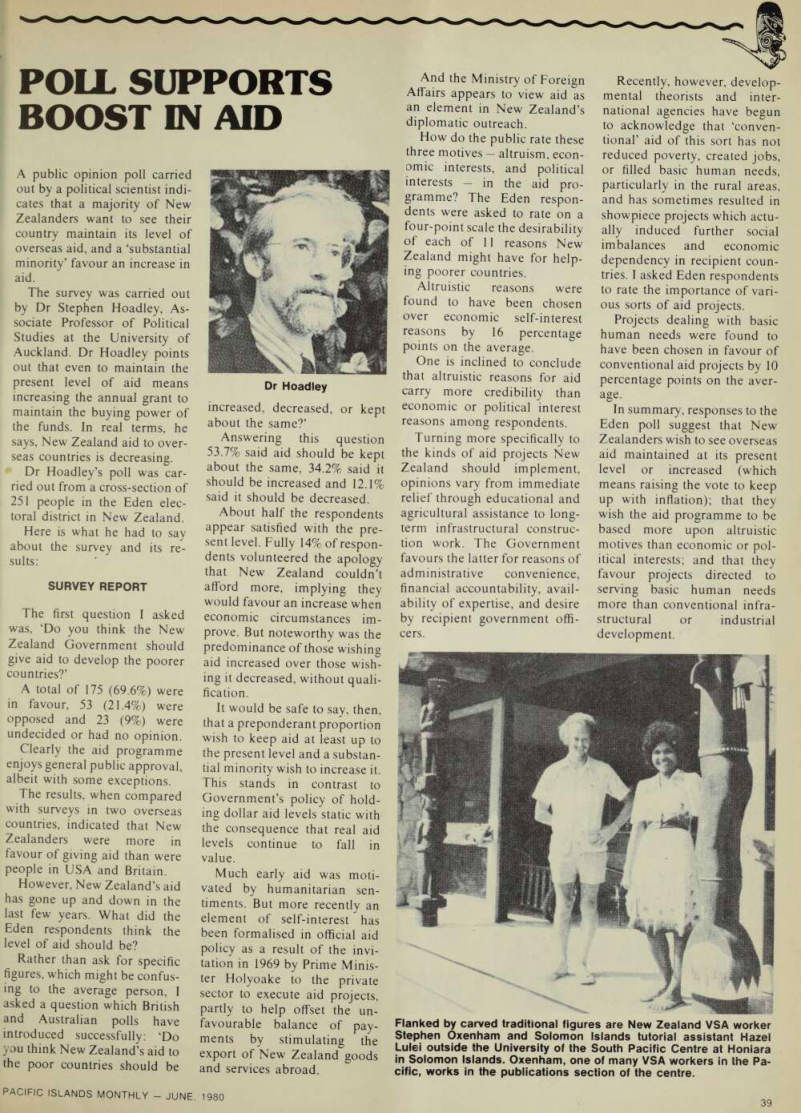
Boost In Aid
A public opinion poll carried
out by a political scientist indi cates that a majority of New Zealanders want to see their country maintain its level of overseas aid, and a ‘substantial minority’ favour an increase in aid.
The survey was carried out
by Dr Stephen Hoadley, As
sociate Professor of Political Studies at the University of
Auckland. Dr Hoadley points
out that even to maintain the present level of aid means increasing the annual grant to maintain the buying power of the funds. In real terms, he says, New Zealand aid to over seas countries is decreasing.
Dr Hoadley’s poll was car ried out from a cross-section of 251 people in the Eden elec toral district in New Zealand.
Here is what he had to say about the survey and its re sults:
Survey Report
The first question I asked was, ‘Do you think the New Zealand Government should give aid to develop the poorer countries?’
A total of 175 (69.6%) were in favour, 53 (21.4%) were opposed and 23 (9%) were undecided or had no opinion.
Clearly the aid programme
enjoys general public approval,
albeit with some exceptions.
The results, when compared with surveys in two overseas countries, indicated that New Zealanders were more in favour of giving aid than were people in USA and Britain.
However, New Zealand’s aid has gone up and down in the last few years. What did the Eden respondents think the level of aid should be?
Rather than ask for specific figures, which might be confus ing to the average person, I asked a question which British and Australian polls have introduced successfully: ‘Do you think New Zealand’s aid to the poor countries should be
increased, decreased, or kept about the same?’
Answering this question 53.7% said aid should be kept about the same, 34.2% said it should be increased and 12.1% said it should be decreased.
About half the respondents appear satisfied with the pre sent level. Fully 14% of respon dents volunteered the apology that New Zealand couldn’t
afford more, implying they
would favour an increase when economic circumstances im prove. But noteworthy was the predominance of those wishing aid increased over those wish ing it decreased, without quali fication.
It would be safe to say, then, that a preponderant proportion wish to keep aid at least up to the present level and a substan tial minority wish to increase it.
This stands in contrast to Government’s policy of hold ing dollar aid levels static with the consequence that real aid levels continue to fall in value.
Much early aid was moti vated by humanitarian sen timents. But more recently an element of self-interest has been formalised in official aid policy as a result of the invi tation in 1969 by Prime Minis ter Holyoake to the private sector to execute aid projects, partly to help offset the un favourable balance of pay
ments by stimulating the
export of New Zealand goods and services abroad.
And the Ministry of Foreign Affairs appears to view aid as an element in New Zealand’s
diplomatic outreach.
How do the public rate these three motives altruism, econ omic interests, and political interests - in the aid pro gramme? The Eden respon dents were asked to rate on a
four-point scale the desirability
of each of 11 reasons New Zealand might have for help ing poorer countries.
Altruistic reasons were found to have been chosen over economic self-interest reasons by 16 percentage points on the average.
One is inclined to conclude that altruistic reasons for aid carry more credibility than economic or political interest reasons among respondents.
Turning more specifically to
the kinds of aid projects New Zealand should implement, opinions vary from immediate relief through educational and agricultural assistance to long term infrastructural construc tion work. The Government favours the latter for reasons of administrative convenience, financial accountability, avail ability of expertise, and desire
by recipient government offi
cers.
Recently, however, develop mental theorists and inter national agencies have begun to acknowledge that ‘conven tional’ aid of this sort has not reduced poverty, created jobs, or filled basic human needs, particularly in the rural areas, and has sometimes resulted in showpiece projects which actu ally induced further social imbalances and economic dependency in recipient coun tries. I asked Eden respondents to rate the importance of vari ous sorts of aid projects.
Projects dealing with basic
human needs were found to have been chosen in favour of conventional aid projects by 10 percentage points on the aver age.
In summary, responses to the Eden poll suggest that New Zealanders wish to see overseas aid maintained at its present level or increased (which means raising the vote to keep up with inflation); that they wish the aid programme to be based more upon altruistic motives than economic or pol itical interests; and that they favour projects directed to serving basic human needs more than conventional infra structural or industrial
development.
Dr Hoadley
Flanked by carved traditional figures are New Zealand VSA worker Stephen Oxenham and Solomon Islands tutorial assistant Hazel Lulei outside the University of the South Pacific Centre at Honiara in Solomon Islands. Oxenham, one of many VSA workers in the Pa cific, works in the publications section of the centre.
Advertisements & other items, p. 40 (1 item)
Beware
General & Refrigerated
Cargo Service to
Cook Islands,
Niue, and Tahiti.
CONTACT YOUR LOCAL AREA AGENT FOR FULL DETAILS Niue: Government Shipping office, Alofi.
Cook Islands: Waterfront Commission, PO Box 61, Rarotonga.
Telex: Shipping RG 2002 Tahiti; Compagnie Maritime Polynesienne, PO Box 368 Papeete. Telex; Taporo FP2SB
The Shipping Corporation
of New Zealand Limited
Sea Carrier to the Nation AUCKLAND: PO Box 3420, Phone 797-210 Telex: NZ2822
BEWARE
OF WEEDS IN
YOUR GRASSLAND
AND VEGETABLE
CROPS
Beware of weeds in your grassland and vegetable crops. The only answer to keep weeds under control is to use new ROUNDUP herbicide, made by Monsanto.
ROUNDUP kills them all, roots and all, including Navua Sedge, Nut Grass, Couch, Guinea Grass, Johnson Grass, Para Grass, Blady Grass and “T” Grass, plus many other weeds and grasses.
When you buy ROUNDUP herbicide you get complete instructions on use, according to what weed is threatening your grassland and vegetable crops.
Roundup controls a wide range of weeds, Ideal for preplant clearing, No residual activity.
ASK FOR: ROUNDUP HERBICIDE
YOUR PACIFIC ISLANDS
DISTRIBUTOR IS
NEIL CROPPER & CO LTD
P.O. Box 9 AUCKLAND
TELEX No. 2521
Registered trade mark of Monsanto Company U S A. used under authorisation by Monsanto.
HAVE YOU TRIED
NEW ZEALAND?
We can quote and supply most New Zealand manufactured items and primary produce.
Full repair service available, marine engineer on our staff to discuss your problems.
Why not contact us when you have a problem, prompt action guaranteed, “same day” service if required.
ULLRICH
EXPORT LTD
TELEX NZ2572
CABLE ULLEXCO
Telephone Auckland 2763997 (3 lines) P.O. Box 22305 Otahuhu Auckland New Zealand.
Identity in
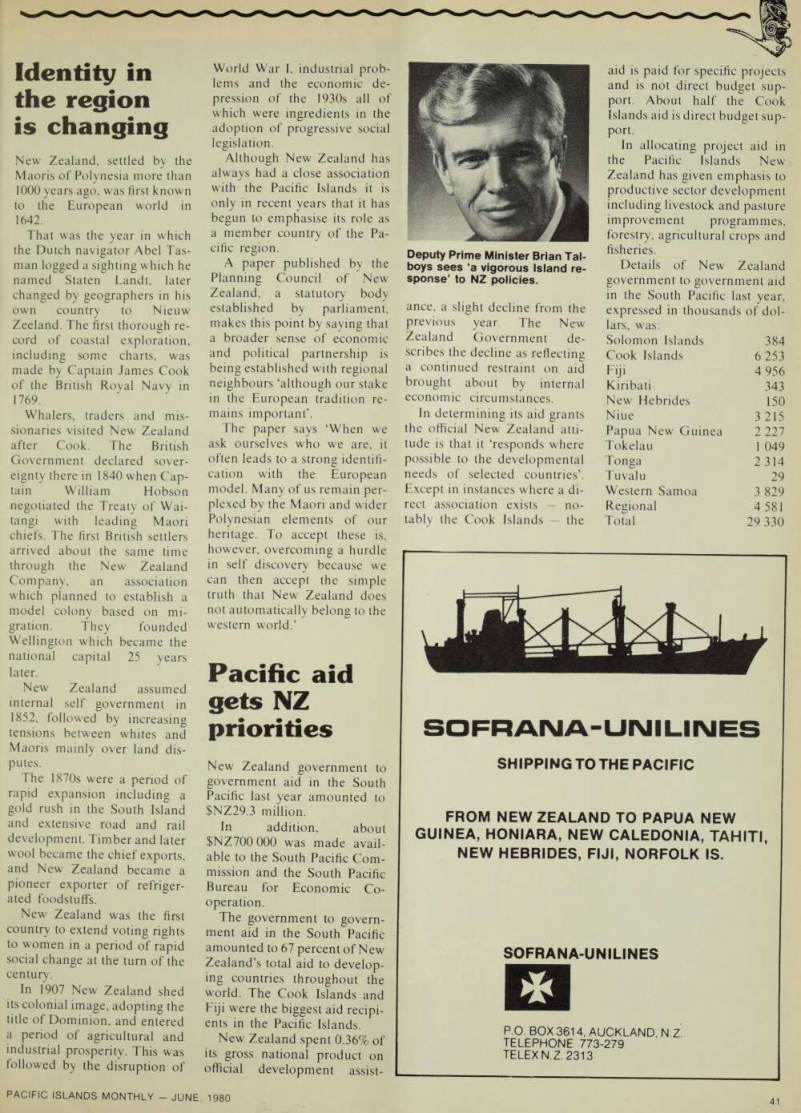
the region is changing
New Zealand, settled by the Maoris of Polynesia more than 1000 years ago, was first known to the European world in 1642.
That was the year in which the Dutch navigator Abel Tas man logged a sighting which he named Staten Landt. later
changed by geographers in his
own country to Nieuw Zeeland. The first thorough re cord of coastal exploration, including some charts, was made by Captain James Cook of the British Royal Navy in 1769.
Whalers, traders and mis sionaries visited New Zealand after Cook. The British Government declared sover eignty there in 1840 when Cap tain William Hobson negotiated the Treaty of Wai
tangi with leading Maori
chiefs. The first British settlers arrived about the same time through the New Zealand Company, an association which planned to establish a model colony based on mi
gration. They founded
Wellington which became the national capital 25 years later.
New Zealand assumed internal self government in
1852, followed by increasing
tensions between whites and Maoris mainly over land dis putes.
The 1870 s were a period of
rapid expansion including a
gold rush in the South Island and extensive road and rail development. Timber and later wool became the chief exports, and New Zealand became a pioneer exporter of refriger ated foodstuff's.
New Zealand was the first country to extend voting rights to women in a period of rapid social change at the turn of the century.
In 1907 New Zealand shed its colonial image, adopting the title of Dominion, and entered a period of agricultural and industrial prosperity. This was followed by the disruption of
World War I, industrial prob lems and the economic de pression of the 1930 s all of which were ingredients in the
adoption of progressive social
legislation.
Although New Zealand has always had a close association with the Pacific Islands it is only in recent years that it has begun to emphasise its role as a member country of the Pa cific region.
A paper published by the Planning Council of New Zealand, a statutory body
established by parliament,
makes this point by saying that
a broader sense of economic
and political partnership is
being established with regional
neighbours ‘although our stake
in the European tradition re
mains important’.
The paper says ‘When we ask ourselves who we are, it often leads to a strong identifi cation with the European model. Many of us remain per plexed by the Maori and wider Polynesian elements of our heritage. To accept these is. however, overcoming a hurdle in self discovery because we can then accept the simple truth that New Zealand does not automatically belong to the western world.'
priorities
Pacific aid gets NZ priorities
New Zealand government to government aid in the South Pacific last year amounted to 5NZ29.3 million.
In addition, about SNZ7OO 000 was made avail able to the South Pacific Com mission and the South Pacific Bureau for Economic Co
operation.
The government to govern ment aid in the South Pacific amounted to 67 percent of New Zealand’s total aid to develop
ing countries throughout the
world. The Cook Islands and
Fiji were the biggest aid recipi
ents in the Pacific Islands.
New Zealand spent 0.36% of its gross national product on official development assist-
ance, a slight decline from the previous year. The New Zealand Government de scribes the decline as reflecting a continued restraint on aid
brought about by internal
economic circumstances.
In determining its aid grants the official New Zealand atti tude is that it ‘responds where
possible to the developmental
needs of selected countries’.
Except in instances where a di rect association exists no tably the Cook Islands the
aid is paid for specific projects and is not direct budget sup port. About half the Cook Islands aid is direct budget sup port.
In allocating project aid in the Pacific Islands New Zealand has given emphasis to
productive sector development
including livestock and pasture
improvement programmes,
forestry, agricultural crops and
fisheries.
Details of New Zealand government to government aid in the South Pacific last year, expressed in thousands of dol lars, was; Solomon Islands 384 Cook Islands 6 253 Fiji 4 956 Kiribati 343 New Hebrides 150 Niue 3 215 Papua New Guinea 2 227 Tokelau 1 049 Tonga 2 314 Tuvalu 29 Western Samoa 3 829 Regional 4 581 Total 29 330
Deputy Prime Minister Brian Tal boys sees a vigorous Island re sponse’ to NZ policies.
Advertisements & other items, pp. 41-42 (1 item)
Sofrana-Uimiliimes
SHIPPING TO THE PACIFIC
FROM NEW ZEALAND TO PAPUA NEW
GUINEA, HONIARA, NEW CALEDONIA, TAHITI,
NEW HEBRIDES, FIJI, NORFOLK IS.
SOFRANA-UNILINES
P.O, BOX 3614, AUCKLAND, N.Z.
TELEPHONE 773-279
TELEX N.Z, 2313
The International Beer From New Zealand The Export Division of New Zealand Breweries Limited P.O. Box 23, Auckland, New Zealand.
Cables "Breweries" Auckland. Telex NZ 2980. Telephone 778-840.
Subsidy for VSAaid increased

VSAaid increased
The New Zealand Govern ment has agreed to meet 80% of the cost of sending 100 volunteers abroad under the New Zealand Volunteer Ser vice Abroad scheme.
The VSA scheme, which is privately administered but has widespread government and community support, sends New Zealanders to Pacific Island and other Third World countries to provide specialised skills in developing communi ties. The volunteers themselves are usually attached to govern ment staff, government agen cies, charitable or missionary
organisations. They are pro
vided with accommodation but are unpaid except for nominal
spending money.
Doctors, nurses, teachers and technical workers make up the bulk of New Zealand volun-
teers now serving in overseas
countries. Many are working
with other volunteers from Australia, Britain and USA.
The decision by the New Zealand Government to pay 80% of the cost of placing 100 volunteers in service overseas will initially apply for three years, and will be supple mented by grants already avail able under the New Zealand
government to government aid programmes.
Although the New Zealand Government is finding increas ing difficulty in maintaining its level of overseas aid, it agreed to pay the new grants following representations from the VSA.
This year’s allocation of funds will be SNZ222 000, an in crease of more than SNZ2O 000 over last year’s figure.
The government has also agreed to carry out an annual review of the work being undertaken by volunteers, and to consider whether financial support could be provided for a greater number of volun teers.
Some of the volunteers are assigned to projects which have direct New Zealand Govern ment support in overseas coun tries, and the government sees the VS A as an integral part of its overseas aid activities. One of these projects is the pro vision of teaching staff in the Cook Islands where six VSA
teachers are already working.
The VSA is represented on the New Zealand Advisory Committee on External Aid and Development, which chan nels recommendations through the Minister of Foreign Affairs and acts as an overseas aid liaison committee between the government and the com munity. It carries out regular reviews of New Zealand aid activities in developing coun tries.
Nursery manager Tuku Utalo tends young passlonfrult plants at Vaipapahi on Niue under an agricultural scheme sponsored by New Zealand aid.
Advertisements & other items, pp. 43-44 (1 item)
G.mco DOORS
New Zealand's largest selling
interior and
exterior doors.
Choose from the wide range of selected timber veneers that enhance the elegant interior doors. And there are also doors suitable for paint finish. Inside or out, specify Plyco doors. 0
o!imo
c p o 17 oni n © n Q uir| es to The Export Manager, Fletcher Wood Panels, box 1/-201. Greenlane. Auckland, New Zealand Telephone 591-259 Auckland Telex Fletply
HARDIES
ABOVE AND
BELOW
Hardies provide a range of fibre cement building products for cladding and roofing applications. Hardiflex building boards, Hardiplank weatherboards and Super Six corrugated roofing are equally useful for domestic and commercial use, being economical, fire resistant, and resistant to termite attack.
Hardie’s manufacture a wide range of pipes and fittings for pressure, sewer, and stormwater applications. Hardie’s pipes are recognised as the long-life pipes and have definite cost advantages. They are easy to handle, and the special “Supertite” ring joints save time in pipe laying.
Hardie’s Building Products are available from leading building material merchants throughout the Pacific Islands and enquiries for Hardie’s pipes should be directed to Hardie’s Auckland office in New Zealand.
hardie’s
HARDIER
pipelines
James Hardie & Coy. Pty. Ltd., Box 12-070, Penrose, Auckland, New Zealand. Cables and Telegrams “Fibrolite”, Auckland.
Telex: Hardest, N.Z. 2712. Phone: 599-919.
Milk And Honey
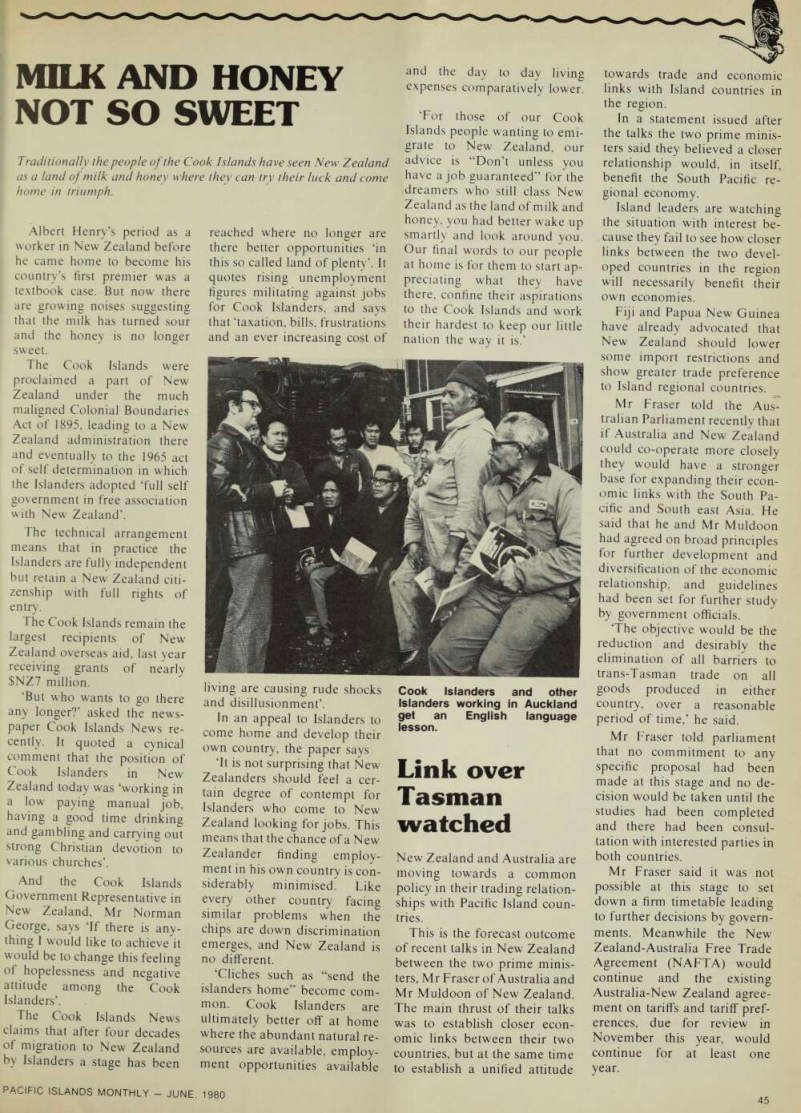
Not So Sweet
Traditionally the people of the Cook Islands have seen New Zealand as a land of milk and honey where they can try their luck and come home in triumph.
Albert Henry’s period as a worker in New Zealand before he came home to become his country’s first premier was a textbook case. But now there
are growing noises suggesting
that the milk has turned sour and the honey is no longer sweet.
The Cook Islands were proclaimed a part of New Zealand under the much maligned Colonial Boundaries Act of 1895, leading to a New Zealand administration there and eventually to the 1965 act of self determination in which the Islanders adopted ‘full self government in free association with New Zealand’.
The technical arrangement means that in practice the
Islanders are fully independent
but retain a New Zealand citi zenship with full rights of entry.
The Cook Islands remain the
largest recipients of New
Zealand overseas aid, last year
receiving grants of nearly
SNZ7 million. ‘But who wants to go there any longer?’ asked the news paper Cook Islands News re cently. It quoted a cynical comment that the position of Cook Islanders in New Zealand today was ‘working in a low paying manual job, having a good time drinking and gambling and carrying out strong Christian devotion to various churches’.
And the Cook Islands Government Representative in New Zealand, Mr Norman George, says ‘lf there is any thing I would like to achieve it would be to change this feeling
of hopelessness and negative
attitude among the Cook Islanders’.
The Cook Islands News claims that after four decades of migration to New Zealand by Islanders a stage has been
reached where no longer are there better opportunities ‘in this so called land of plenty’. It
quotes rising unemployment
figures militating against jobs
for Cook Islanders, and says that ‘taxation, bills, frustrations and an ever increasing cost of
living are causing rude shocks and disillusionment’.
In an appeal to Islanders to come home and develop their own country, the paper says ‘lt is not surprising that New Zealanders should feel a cer tain degree of contempt for Islanders who come to New Zealand looking for jobs. This means that the chance of a New
Zealander finding employ
ment in his own country is con siderably minimised. Like every other country facing similar problems when the chips are down discrimination emerges, and New Zealand is no different. ‘Cliches such as “send the islanders home” become com mon. Cook Islanders are ultimately better off at home where the abundant natural re sources are available, employ ment opportunities available
and the day to day living
expenses comparatively lower. ‘For those of our Cook Islands people wanting to emi grate to New Zealand, our advice is “Don’t unless you have a job guaranteed” for the dreamers who still class New Zealand as the land of milk and honey, you had better wake up smartly and look around you.
Our final words to our people at home is for them to start ap
preciating what they have
there, confine their aspirations to the Cook Islands and work their hardest to keep our little nation the way it is.’
Cook Islanders and other Islanders working in Auckland get an English language lesson.
watched
Link over Tasman watched
New Zealand and Australia are moving towards a common policy in their trading relation ships with Pacific Island coun tries.
This is the forecast outcome of recent talks in New Zealand between the two prime minis ters, Mr Fraser of Australia and Mr Muldoon of New Zealand.
The main thrust of their talks was to establish closer econ omic links between their two countries, but at the same time to establish a unified attitude
towards trade and economic links with Island countries in
the region.
In a statement issued after the talks the two prime minis ters said they believed a closer relationship would, in itself, benefit the South Pacific re
gional economy.
Island leaders are watching the situation with interest be cause they fail to see how closer links between the two devel oped countries in the region will necessarily benefit their own economies.
Fiji and Papua New Guinea have already advocated that New Zealand should lower some import restrictions and show greater trade preference to Island regional countries.
Mr Fraser told the Aus tralian Parliament recently that if Australia and New Zealand could co-operate more closely they would have a stronger base for expanding their econ omic links with the South Pa cific and South east Asia. He said that he and Mr Muldoon had agreed on broad principles for further development and diversification of the economic relationship, and guidelines had been set for further study by government officials.
The objective would be the reduction and desirably the elimination of all barriers to trans-Tasman trade on all
goods produced in either
country, over a reasonable period of time,’ he said.
Mr Fraser told parliament that no commitment to any specific proposal had been made at this stage and no de cision would be taken until the studies had been completed and there had been consul tation with interested parties in both countries.
Mr Fraser said it was not possible at this stage to set down a firm timetable leading to further decisions by govern ments. Meanwhile the New Zealand-Australia Free Trade Agreement (NAFTA) would continue and the existing Australia-New Zealand agree ment on tariffs and tariff pref erences, due for review in November this year, would continue for at least one year.
Advertisements & other items, p. 46 (1 item)
Join it
When you cant beat nature
Warmth No building material better reflects the new relaxed mood of living than the warmth of wood and no company knows more about building in this material than Lockwood. They have been a household word in New 'Zealand for over 25 years.
Natural Wood Lockwood use exotic pine as the main material in the construction of their quality homes, utilising the natural grain to its fullest extent. When enhanced with varnishes and timber stains, Lockwood create a low maintenance home. Natural wood combines so well with most interior decor scheme 3.
Instant beauty remaining at your finger tips for a lifetime.
Lifestyle
You can choose a beautiful Lockwood home in California Redwood, Radiata Pine or the low maintenance white aluminium exterior finish. Should none of the standard designs suit your needs then Lockwood can
Join it
The Lockwood 'X' profile, the reason for outstanding strength. provide a complete design service or will work with your own architect, to build the house to suit your lifestyle. Lockwood has developed a unique system for the construction of beautiful timber homes that cannot be faulted for style, strength and overall quality.
Strength
The solid wood wall construction of Lockwood has been successfully tested to withstand earthquakes to a force of 7.5 on the Richter Scale, making it the ideal choice for hurricane or
cyclone areas.
Not Modulated The unique Lockwood system has all the benefits of factory efficiency and quality control, but none of the restrictions of modular building, nor the appearance of 'pre-fab' construction. For example, windows and doors can be built anywhere in a wall - giving genuine flexibility. This decade will show people trying harder to 'be themselves' in their choice of a home living environment. So look to Lockwood, an
internaltionally famous building
system tailor-made for the 1980's . . . the age of individuality.
Lockwood export throughout the world.
For more information write to Lockwood Buildings Ltd:- P.O. Box 1349 or Telephone 85-184 Rotorua, New Zealand.
Telex: Lockwall NZ 21838.
[jnci
ESTABLISHED 1952
Simply nature reshaped
Big Increase In
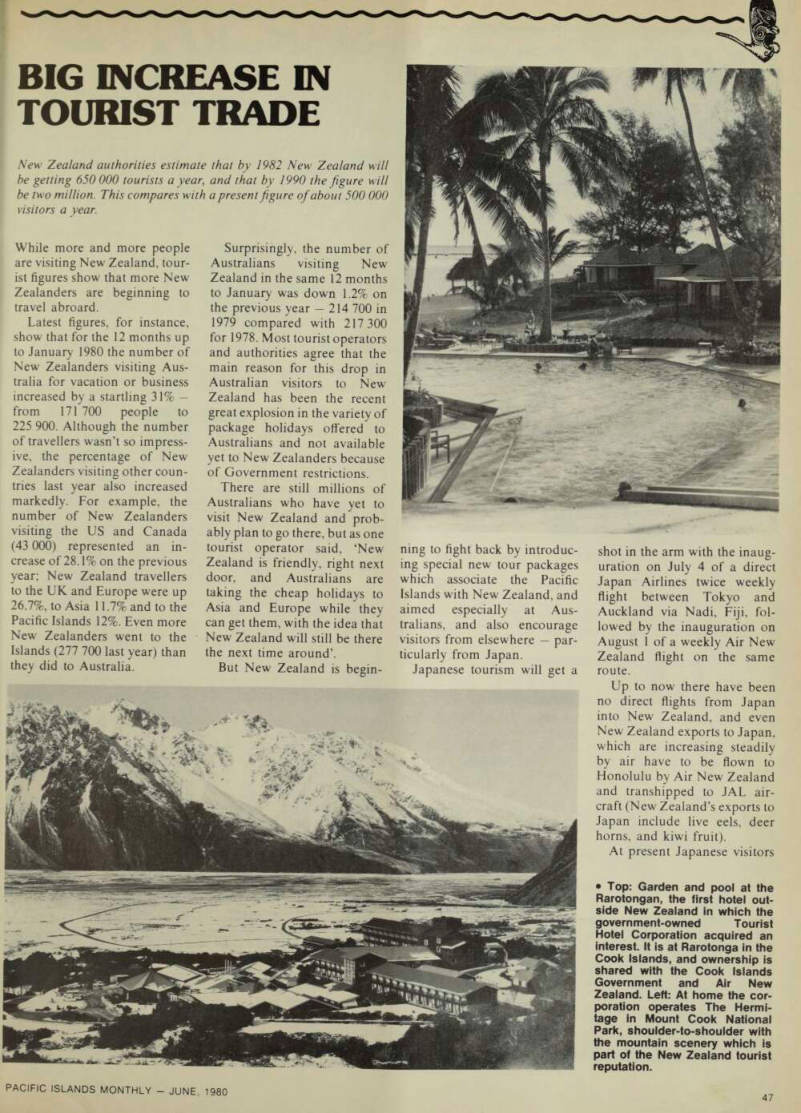

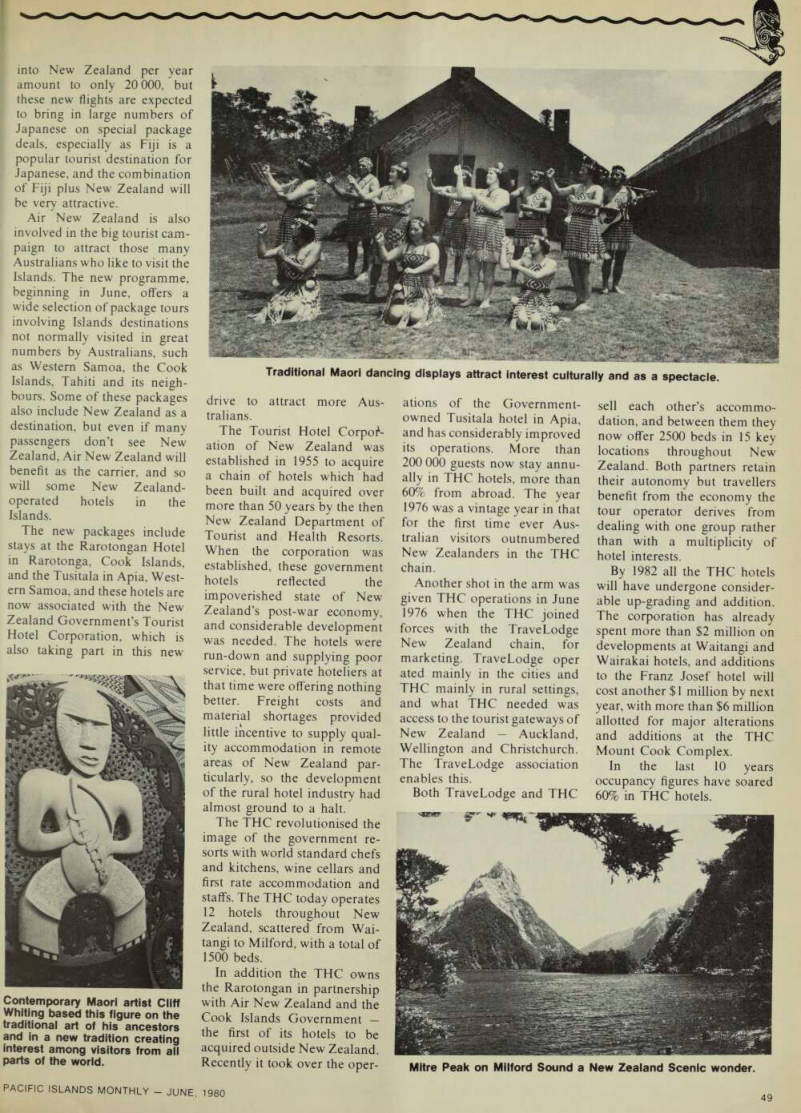
Tourist Trade
New Zealand authorities estimate that by 1982 New Zealand will be getting 650 000 tourists a year, and that by 1990 the figure will be two million. This compares with a present figure of about 500 000 visitors a year.
While more and more people are visiting New Zealand, tourist figures show that more New Zealanders are beginning to travel abroard.
Latest figures, for instance, show that for the 12 months up to January 1980 the number of New Zealanders visiting Australia for vacation or business increased by a startling 31% from 171 700 people to 225 900. Although the number of travellers wasn’t so impressive, the percentage of New Zealanders visiting other countries last year also increased
markedly. For example, the
number of New Zealanders visiting the US and Canada (43 000) represented an increase of 28.1% on the previous year; New Zealand travellers to the UK and Europe were up 26.7%, to Asia 11.7% and to the Pacific Islands 12%. Even more New Zealanders went to the Islands (277 700 last year) than they did to Australia.
Surprisingly, the number of Australians visiting New Zealand in the same 12 months to January was down 1.2% on the previous year 214 700 in 1979 compared with 217 300 for 1978. Most tourist operators and authorities agree that the main reason for this drop in Australian visitors to New Zealand has been the recent great explosion in the variety of
package holidays offered to
Australians and not available yet to New Zealanders because of Government restrictions.
There are still millions of Australians who have yet to visit New Zealand and prob ably plan to go there, but as one tourist operator said, ‘New Zealand is friendly, right next door, and Australians are
taking the cheap holidays to
Asia and Europe while they can get them, with the idea that New Zealand will still be there the next time around’.
But New Zealand is begin-
ning to fight back by introduc ing special new tour packages which associate the Pacific Islands with New Zealand, and aimed especially at Aus tralians, and also encourage visitors from elsewhere par ticularly from Japan.
Japanese tourism will get a
shot in the arm with the inaug uration on July 4 of a direct
Japan Airlines twice weekly
flight between Tokyo and
Auckland via Nadi, Fiji, fol lowed by the inauguration on August 1 of a weekly Air New Zealand flight on the same route.
Up to now there have been no direct flights from Japan into New Zealand, and even New Zealand exports to Japan,
which are increasing steadily
by air have to be flown to Honolulu by Air New Zealand and transhipped to JAL air craft (New Zealand’s exports to Japan include live eels, deer horns, and kiwi fruit).
At present Japanese visitors
Top: Garden and pool at the Rarotongan, the first hotel out side New Zealand in which the government-owned Tourist Hotel Corporation acquired an interest. It is at Rarotonga in the Cook Islands, and ownership is shared with the Cook Islands Government and Air New Zealand. Left: At home the cor poration operates The Hermi tage in Mount Cook National Park, shoulder-to-shoulder with the mountain scenery which is part of the New Zealand tourist reputation.
into New Zealand per year amount to only 20 000, but these new flights are expected to bring in large numbers of
Japanese on special package
deals, especially as Fiji is a popular tourist destination for Japanese, and the combination of Fiji plus New Zealand will be very attractive.
Air New Zealand is also involved in the big tourist cam paign to attract those many Australians who like to visit the Islands. The new programme, beginning in June, offers a wide selection of package tours involving Islands destinations not normally visited in great numbers by Australians, such as Western Samoa, the Cook Islands, Tahiti and its neigh bours. Some of these packages also include New Zealand as a destination, but even if many passengers don’t see New Zealand, Air New Zealand will benefit as the carrier, and so will some New Zealand operated hotels in the Islands.
The new packages include stays at the Rarotongan Hotel in Rarotonga, Cook Islands, and the Tusitala in Apia, West ern Samoa, and these hotels are now associated with the New Zealand Government’s Tourist Hotel Corporation, which is also taking part in this new
drive to attract more Aus tralians.
The Tourist Hotel Corpor ation of New Zealand was established in 1955 to acquire a chain of hotels which had been built and acquired over more than 50 years by the then New Zealand Department of Tourist and Health Resorts.
When the corporation was established, these government hotels reflected the impoverished state of New Zealand’s post-war economy, and considerable development was needed. The hotels were run-down and supplying poor service, but private hoteliers at that time were offering nothing better. Freight costs and material shortages provided little incentive to supply qual ity accommodation in remote areas of New Zealand par
ticularly, so the development
of the rural hotel industry had almost ground to a halt.
The THC revolutionised the image of the government re sorts with world standard chefs and kitchens, wine cellars and first rate accommodation and staffs. The THC today operates 12 hotels throughout New Zealand, scattered from Wai tangi to Milford, with a total of 1500 beds.
In addition the THC owns
the Rarotongan in partnership
with Air New Zealand and the Cook Islands Government the first of its hotels to be acquired outside New Zealand.
Recently it took over the oper
ations of the Governmentowned Tusitala hotel in Apia,
and has considerably improved
its operations. More than 200 000 guests now stay annually in THC hotels, more than 60% from abroad. The year 1976 was a vintage year in that for the first time ever Australian visitors outnumbered New Zealanders in the THC chain - Another shot in the arm was given THC operations in June 1976 when the THC joined forces with the TraveLodge New Zealand chain, for
marketing. TraveLodge oper
ated mainly in the cities and THC mainly in rural settings, and what THC needed was access to the tourist gateways of New Zealand - Auckland, Wellington and Christchurch.
The TraveLodge association enables this.
Both TraveLodge and THC
sell each other’s accommo dation, and between them they now offer 2500 beds in 15 key locations throughout New Zealand. Both partners retain their autonomy but travellers benefit from the economy the tour operator derives from dealing with one group rather than with a multiplicity of hotel interests.
By 1982 all the THC hotels will have undergone consider able up-grading and addition.
The corporation has already spent more than $2 million on
developments at Waitangi and
Wairakai hotels, and additions to the Franz Josef hotel will cost another $1 million by next year, with more than $6 million allotted for major alterations and additions at the THC Mount Cook Complex.
In the last 10 years occupancy figures have soared 60% in THC hotels.
Contemporary Maori artist Cliff Whiting based this figure on the traditional art of his ancestors and in a new tradition creating interest among visitors from all parts of the world.
Traditional Maori dancing displays attract interest culturally and as a spectacle.
Mitre Peak on Milford Sound a New Zealand Scenic wonder.
Advertisements & other items, pp. 48-52 (1 item)
Favourites
SIARCRAFT
ALUMINIUM
FISHMASTER WORK BOATS
TRIPLE-SEALED
CHINE -Special sealing compound is used to ensure the hull is completely watertight.
BIG PAYLOAD:
SIARCRAFT dinghies are specially designed to take a larger than average payload for boats their size. Longitudinal seating optional for passenger carrying.
LIGHTWEIGHT:
All SIARCRAFT
dinghies can be easily carried by four men, making them ideal for transportation by road.
There are special handles in the stern for ease of handling.
SIARCRAFT
aluminium boat construction.
BUILT-IN
FLOTATION:
Super-bouyant foam is used in the under-seat compartments to make the dinghy unsinkable.
HI-STRENGTH
MOTOR MOUNT:
A really solid mount is built in to take larger outboards if they are required.
AVAILABLE THROUGHOUT THE PACIFIC IN THE FOLLOWING
SIZES 7’6”, 10’, 12’. 14’, 16’.
AREA DISTRIBUTORS
P.N.G.: Kada Marine Pty Ltd, P.O. Box 5415, Boroko, Port Moresby. SOLOMON IS; Solomon Sheet Steel Ltd, P.O. Box 251, Honiara. NEW HEBRIDES: Transpac Marine, Port Vila. Le Roux Marine, Esp. Santo. NOUVELLE CALEDONIE: Enterprise Guy Limousin, B.P 701, Noumea. NAURU: Jacob Enterprises, Nauru. TAHITI: Tahiti Sport, B.P. 62, Papeete. COOK IS. Beco Ltd, P.O. Box 384, Rarotonga. FIJI: Carpenters Motor Division, Private Box, Suva, or through all Carpenters Motors branches.
OR CONTACT COMPONENT MANUFACTURES
SPEDDING LIMITED
AUCKLAND N.Z. TELEX N.Z. 2994 P.O. BOX 13-166
PACIFIC FOOD
FAVOURITES
FROM
NEW ZEALAND
The Sunshine name has proven popularity in New Zealand and throughout the Pacific. A fine range of foods made from the very best New Zealand has to offer.
PEANUT BUTTER, SANDWICH SPREADS, RICE
RISOTTO, MUSHROOMS,
CURRY POWDER, STUFFING, KRUMMIES,
GLUCOSE. JELLY, CORDIALS,
CORN FLOUR.
The world famous Betty Crocker products are made under license to General Mills (U.S.A.)
CAKE MIX, CHEESECAKES,
SPONGE PUDDING MIX, CANNED ROLLS.
si cumcnis
Quality products from New Zealand and around the world.
CUT PEEL, CANDIED PEEL, GINGER, GLACE
CHERRIES, COCKTAIL CHERRIES,
MIXED FRUIT.
mmm
Convenient liquid bars, ready for freezing and eating.
Trade enquiries to
W F. TUCKER & CO. LTD.
P.O. Box 14-449, Auckland, New Zealand.
Telephone 576-024,
Telex Tucker NZ21690 Cables: Sunshine
WHEN THE PUBLIC
At Yamaha, we keep an ear to the ground and an eye on the uture. Because listening to what people want and asking what /ve’ll all need tomorrow is the only way to make progress neaningful in a world where change has become commonplace.
This involves far more than collating research reports and jnalyzing computer projections. It requires an active, day-to-day nvolvement with the way people around the world live and work, t demands a real concern for improved living standards everyvhere. And there must be a real willingness to master technology o human needs, instead of vice versa. Some ways we’ve done his are more important than others. But all reflect Yamaha’s elentless commitment to giving the public what it needs at the )hce it wants to pay.
V < U
HARD-NOSED CYCLISTS ASKED FOR THE
HETURN OF THUMPER. WE BROUGHT IT
JACK FOR THEM.
“Thumper”, the affectionate nickname given to big 500 cc tingle which revolutionized motorcycling 50 years ago, disippeared from the roads several years ago. But it was always nissed. No other bike ever quite recaptured the same sense of irute power and awesome strength. Unfortunately, Thumper’s lisadvantages outweighed its advantages for modern motortycling. That is, they did until Yamaha engineers came up with a lew version of this old classic to the delight of thousands of lostalgic purists.
Yamaha’s version has the lightness and exhaust note of doesn’t do is even more impor to start, it doesn’t require daily enthusiast have his cake and ■ Thumper may never be ont has won us the undying gratiti individualists and the respect • community.
FARMERS IN DEVE
NEEDED A RELIABI
IRRIGATION PUMP.
THEM.
In many countries, it’s not: is getting the water where it’s Not the big kind used for mas economical ones that can be shared by many in the same tl world’s most experienced mall faced no technological problem pump needed. The YP2 and Y really quite simple. They’re ligl consume a minimum amount the world, not only for agricult stock raising and hundreds ofi represent only a tiny part of o> a real need, they’re as imports
TALKS, WE LISTEN.
i magnificant torque, handling, •edecessors. But what it It doesn’t leak oil, it isn’t hard itenance. In short, it lets the too.
'amaha’s best sellers. But it f a select band of whole motorcycling
ING COUNTRIES
'ORTABLE
BUILT ONE FOR
ch a shortage of water as it d most. This requires pumps igation schemes, but small, from place to place and village. As one of the small engines, Yamaha lesigning just the type of tps we came up with are erful, easy-to-maintain and Today, they’re used all over t for construction, fishing, jses. Like Thumper, these sales. But in terms of filling my product we’ve ever built.
AFRICAN NATIONS WANTED TO
MODERNIZE THEIR FISHING FLEETS.
YAMAHA HELPED THEM.
Although many people don’t realize it, Yamaha is one of the world’s largest builders of coastal fishing boats. So, when several African nations wanted help to modernize their fishing fleets, Yamaha was a natural choice. We did much more than just supply modern vessels, however. In cooperation with official government agencies, we evaluated requirements, conducted training programs and helped reorganize everything from choice of nets to maintenance programs. Today, our involvement in the fishing industry extends from the Japan Sea to Mexico, South America, Africa, the Middle East and back to Asia. We make more than 40 different commercial fishing boats ranging from small open-deck boats to huge 60-ton vessels for extended coastal fishing operations. All are made using advanced FRF techniques to provide a longer crusing radius and lower fuel consumption while extending hull life and reducing the need for maintenance. They’re also another significant example of how Yamaha engineering is making a real contribution to international development and individual progress.
YAMAHA LISTENS TO THE WORLD
Yamaha’s international sales and service network does far more than just sell and service Yamaha products. They’re an indispensible part of our total worldwide information gathering system. By living and working with the people they serve, listening to their problems and needs, understanding the particular problems of different nations and regions, the Yamaha engineers, technicians and salesmen in more than 120 countries keep the company abreast of changes so the company can keep abreast of progress.
YAMAHA
YAMAHA MOTOR CO., LTD. SHIZUOKA-KEN, JAPAN AND THE WORLD.
EXPORTS
to JAPAN
BOJAM provides you with latest information and statistics about the Japanese market for those who are interested in this market. Information and statistics come from hundreds of reliable information sources in Japan.
PLEASE SUBSCRIBE TO “BOJAM” NOW:
12 COPIES FOR ONLY As4oo AIR MAIL DELIVERY TO MOST TERRITORIES IN THE SOUTH PACIFIC Only the BOJAM SUBSCRIBERS can have Information and Research Services at reasonable prices with deliveries of 7 to 30 days, but subject to final estimates by BOJAM.
CONTENTS OF RECENT ISSUES
Marketing Reports: Japan’s processed products imports show 50% increase from last year/Department stores, large retail shops increase direct import remarkable Salaries expand only 5.9%/Expenditure of Japanese households/Balance sheet of Boatique America/lmports and Imported goods/An example of sales networks in Japan.
Information and Research Services
BOJAM IS YOUR OFFICE IN JAPAN
BOJAM C.P.O BOX 46 TOKYO, JAPAN
Please enclose payment with this card; we do not bill.
Please type or print all information Name Title/Firm Address.
City State Zip __Country
BOJAM
Subscription Form
Statistical Reports: Imports by commodity Daily inter-bank central exchange rate between Japanese Yen and international key currenices/Sales indices of large retail stores Indices of dealers’ inventories Petroleum indices/Wholesale price indices of petroleum products.
People
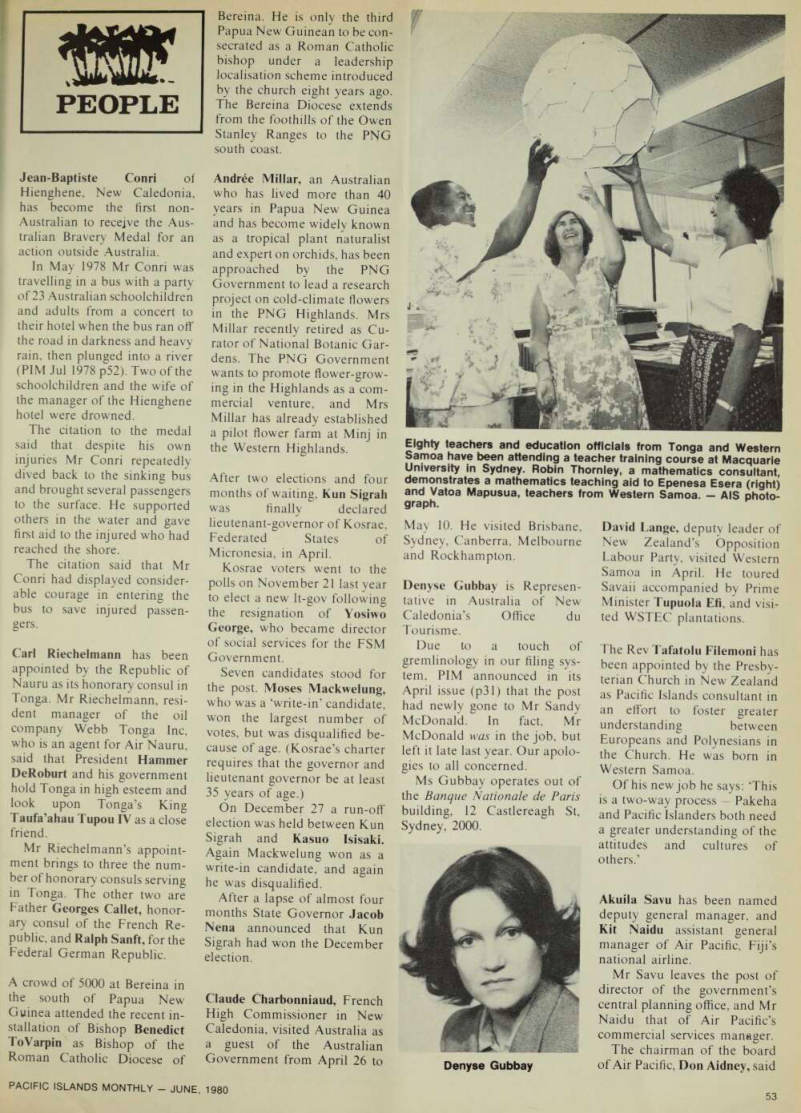
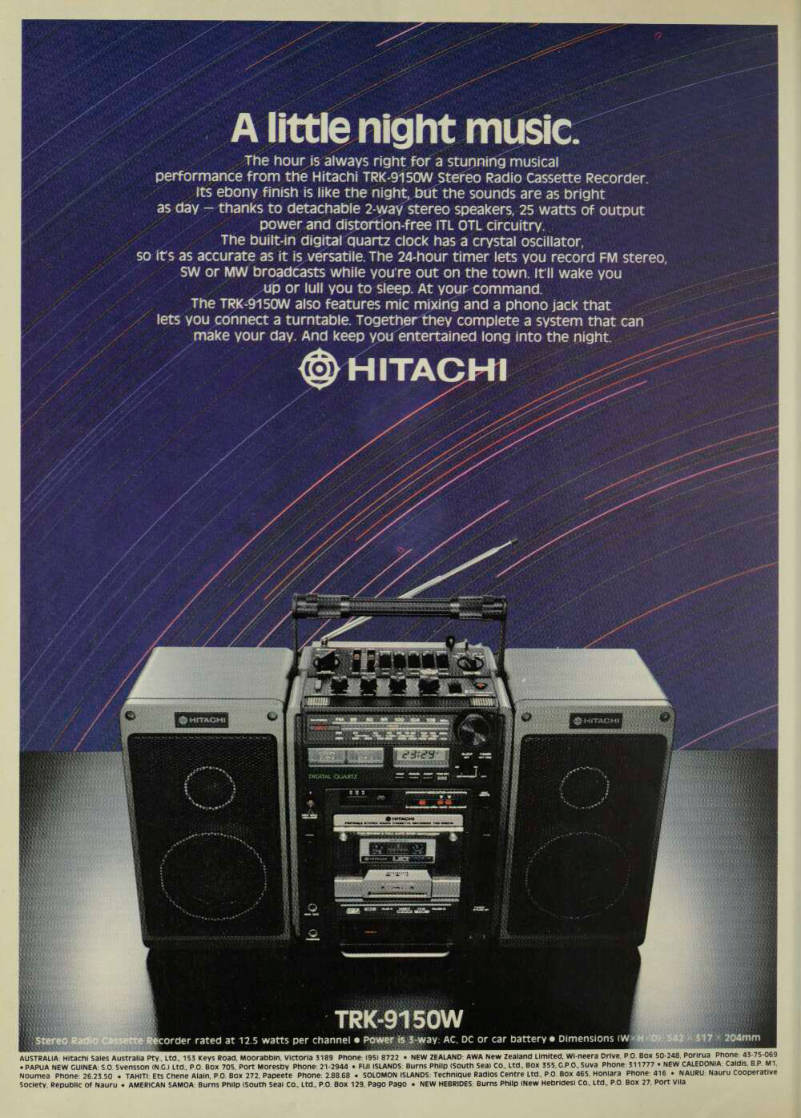
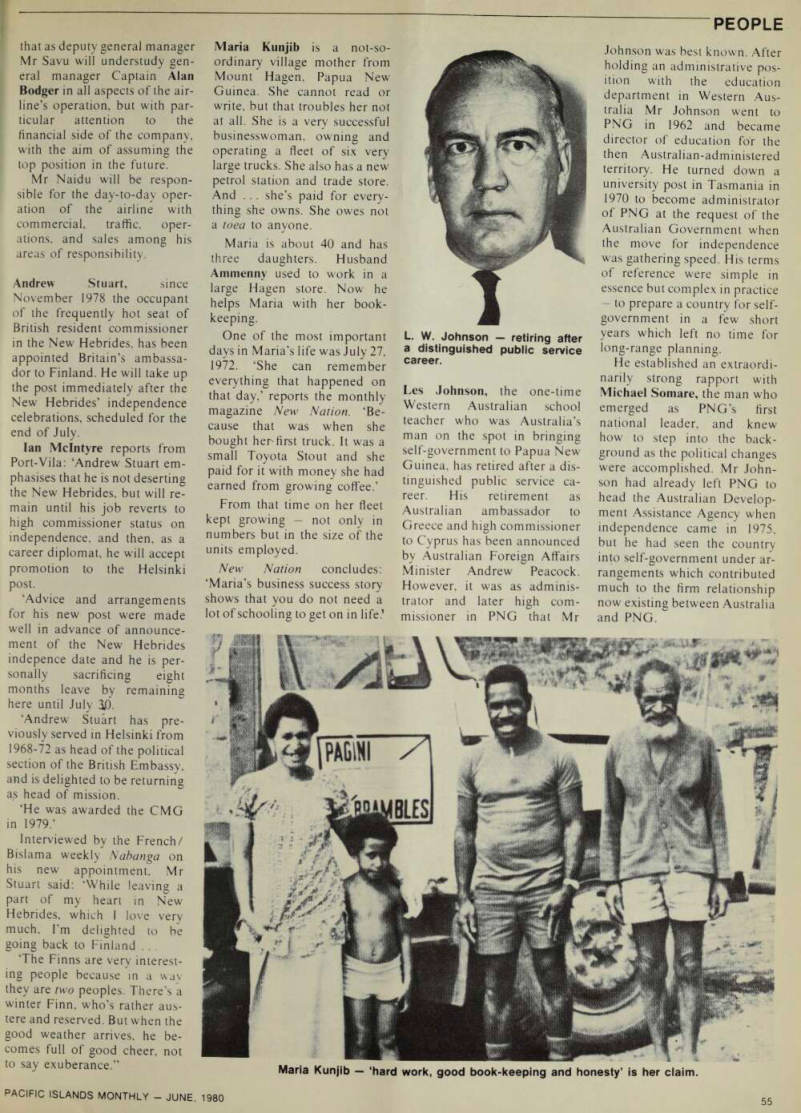
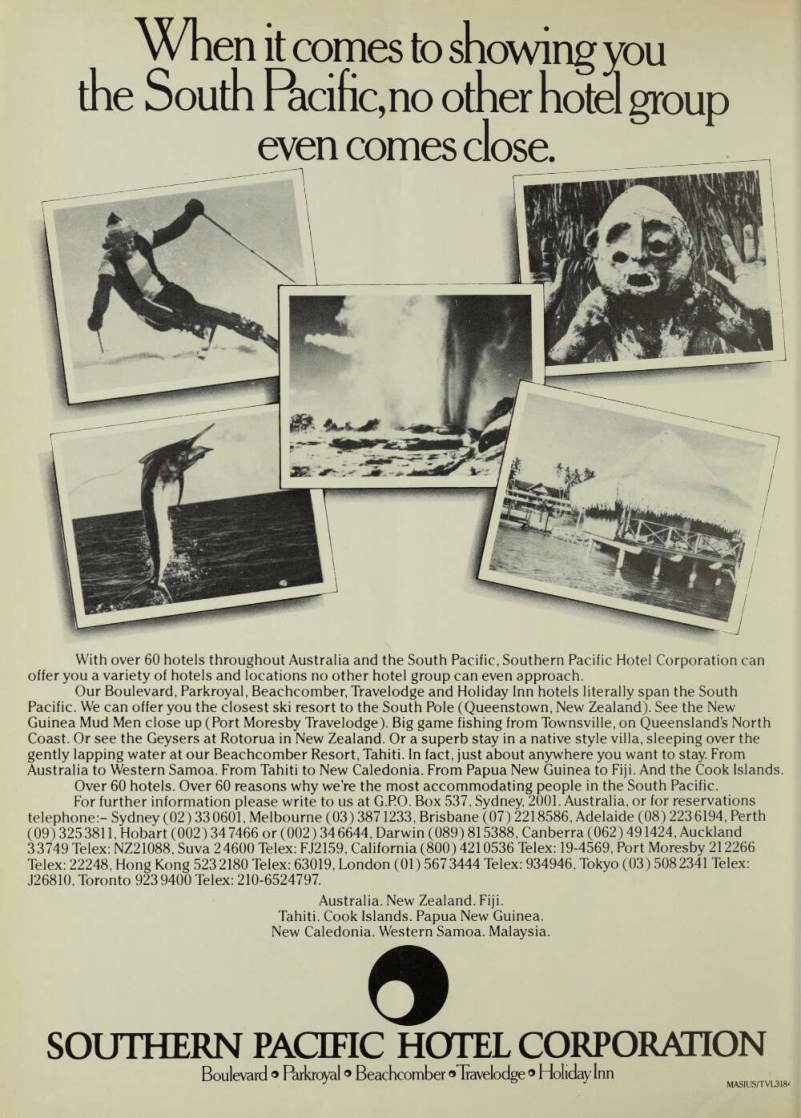
Bereina. He is only the third Papua New Guinean to be con secrated as a Roman Catholic
bishop under a leadership
localisation scheme introduced by the church eight years ago.
The Bereina Diocese extends from the foothills of the Owen Stanley Ranges to the PNG south coast.
Andree Millar, an Australian who has lived more than 40 years in Papua New Guinea and has become widely known as a tropical plant naturalist and expert on orchids, has been
approached by the PNG
Government to lead a research project on cold-climate flowers in the PNG Highlands. Mrs Millar recently retired as Cu rator of National Botanic Gar dens. The PNG Government wants to promote flower-grow ing in the Highlands as a com mercial venture, and Mrs Millar has already established a pilot flower farm at Minj in the Western Highlands.
After two elections and four months of waiting. Kun Sigrah was finally declared lieutenant-governor of Kosrae, Federated States of Micronesia, in April.
Kosrae voters went to the polls on November 21 last year to elect a new It-gov following the resignation of Yosiwo George, who became director of social services for the FSM Government.
Seven candidates stood for the post. Moses Mackwelung, who was a ‘write-in’ candidate, won the largest number of votes, but was disqualified be cause of age. (Kosrae’s charter requires that the governor and lieutenant governor be at least 35 years of age.) On December 27 a run-off election was held between Kun Sigrah and Kasuo Isisaki.
Again Mackwelung won as a write-in candidate, and again he was disqualified.
After a lapse of almost four months State Governor Jacob Nena announced that Kun Sigrah had won the December election.
Claude Charbonniaud, French High Commissioner in New Caledonia, visited Australia as a guest of the Australian Government from April 26 to
Jean-Baptiste Conri of Hienghene, New Caledonia, has become the first non- Australian to receive the Aus tralian Bravery Medal for an action outside Australia.
In May 1978 Mr Conri was travelling in a bus with a party of 23 Australian schoolchildren and adults from a concert to their hotel when the bus ran off the road in darkness and heavy rain, then plunged into a river (PIM Jul 1978 p 52). Two of the schoolchildren and the wife of the manager of the Hienghene hotel were drowned.
The citation to the medal said that despite his own
injuries Mr Conri repeatedly
dived back to the sinking bus and brought several passengers to the surface. He supported others in the water and gave first aid to the injured who had reached the shore.
The citation said that Mr Conri had displayed consider able courage in entering the bus to save injured passen gers.
Carl Riechelmann has been appointed by the Republic of Nauru as its honorary consul in Tonga. Mr Riechelmann, resi dent manager of the oil company Webb Tonga Inc, who is an agent for Air Nauru, said that President Hammer Deßoburt and his government hold Tonga in high esteem and
look upon Tonga’s King
Taufa’ahau Tupou IV as a close friend.
Mr Riechelmann’s appoint ment brings to three the num ber of honorary consuls serving in Tonga. The other two are Father Georges Callet, honor ary consul of the French Re public, and Ralph Sanft, for the Federal German Republic.
A crowd of 5000 at Bereina in the south of Papua New Guinea attended the recent in stallation of Bishop Benedict ToVarpin as Bishop of the Roman Catholic Diocese of
May 10. He visited Brisbane, Sydney, Canberra, Melbourne
and Rockhampton.
Denyse Gubbay is Represen tative in Australia of New Caledonia’s Office du Tourisme.
Due to a touch of gremlinology in our filing sys tem. PIM announced in its April issue (p3l) that the post had newly gone to Mr Sandy McDonald. In fact, Mr McDonald was in the job, but left it late last year. Our apolo gies to all concerned.
Ms Gubbay operates out of the Banque Rationale de Paris
building, 12 Castlereagh St,
Sydney, 2000.
David Lange, deputy leader of New Zealand’s Opposition Labour Party, visited Western Samoa in April. He toured
Savaii accompanied by Prime
Minister Tupuoia Efi, and visi ted WSTEC plantations.
The Rev Tafatolu Filemoni has
been appointed by the Presby
terian Church in New Zealand as Pacific Islands consultant in an effort to foster greater
understanding between
Europeans and Polynesians in
the Church. He was born in Western Samoa.
Of his new job he says; This is a two-way process Pakeha and Pacific Islanders both need a greater understanding of the attitudes and cultures of others.’
Akuila Savu has been named deputy general manager, and Kit Naidu assistant general manager of Air Pacific, Fiji’s national airline.
Mr Savu leaves the post of director of the government’s central planning office, and Mr Naidu that of Air Pacific’s commercial services manager.
The chairman of the board of Air Pacific, Don Aidney, said
Denyse Gubbay
Eighty teachers and education officials from Tonga and Western Samoa have been attending a teacher training course at Macquarie University in Sydney. Robin Thornley, a mathematics consultant, demonstrates a mathematics teaching aid to Epenesa Esera (right) and Vatoa Mapusua, teachers from Western Samoa. -AIS photo graph.
that as deputy general manager Mr Savu will understudy gen eral manager Captain Alan Bodger in all aspects of the air line’s operation, but with par ticular attention to the financial side of the company, with the aim of assuming the top position in the future.
Mr Naidu will be respon sible for the day-to-day oper ation of the airline with commercial. traffic, oper ations. and sales among his areas of responsibility.
Andrew Stuart, since November 1978 the occupant of the frequently hot seat of British resident commissioner in the New Hebrides, has been appointed Britain’s ambassa dor to Finland. He will take up the post immediately after the New Hebrides’ independence celebrations, scheduled for the end of July. lan Mclntyre reports from Port-Vila: ‘Andrew Stuart em phasises that he is not deserting the New Hebrides, but will re main until his job reverts to high commissioner status on independence, and then, as a career diplomat, he will accept promotion to the Helsinki post. ‘Advice and arrangements for his new post were made well in advance of announce ment of the New Hebrides indepence date and he is per
sonally sacrificing eight
months leave by remaining
here until July 3jo. ‘Andrew Stuart has pre viously served in Helsinki from 1968-72 as head of the political section of the British Embassy, and is delighted to be returning as head of mission. ‘He was awarded the CMG in 1979.’
Interviewed by the French/
Bislama weekly Nahanga on
his new appointment. Mr Stuart said: ‘While leaving a part of my heart in New Hebrides, which 1 love very much. I’m delighted to be
going back to Finland . .
‘The Finns are very interest ing people because in a wav they are two peoples. There’s a winter Finn, who’s rather aus tere and reserved. But when the good weather arrives, he be comes full of good cheer, not to say exuberance.”
Maria Kunjib is a not-so
ordinary village mother from
Mount Hagen. Papua New Guinea. She cannot read or write, but that troubles her not at all. She is a very successful businesswoman, owning and operating a fleet of six very large trucks. She also has a new petrol station and trade store.
And .. . she’s paid for every thing she owns. She owes not a toea to anyone.
Maria is about 40 and has three daughters. Husband Ammenny used to work in a large Hagen store. Now he helps Maria with her book
keeping.
One of the most important days in Maria’s life was July 27, 1972. ‘She can remember
everything that happened on
that day,’ reports the monthly magazine New Nation. ‘Be cause that was when she bought her first truck. It was a small Toyota Stout and she paid for it with money she had earned from growing coffee.’
From that time on her fleet
kept growing not only in
numbers but in the size of the
units employed.
New Nation concludes: ‘Maria’s business success story shows that you do not need a lot of schooling to get on in life.’
Les Johnson, the one-time Western Australian school teacher who was Australia’s man on the spot in bringing
self-government to Papua New
Guinea, has retired after a dis
tinguished public service ca
reer. His retirement as Australian ambassador to Greece and high commissioner to Cyprus has been announced
by Australian Foreign Affairs
Minister Andrew Peacock.
However, it was as adminis trator and later high com missioner in PNG that Mr
Johnson was best known. After holding an administrative pos ition with the education department in Western Aus tralia Mr Johnson went to PNG in 1962 and became director of education for the then Australian-administered territory. He turned down a university post in Tasmania in 1970 to become administrator of PNG at the request of the Australian Government when the move for independence was gathering speed. His terms of reference were simple in essence but complex in practice to prepare a country for self government in a few short years which left no time for
long-range planning.
He established an extraordi narily strong rapport with Michael Somare, the man who emerged as PNG’s first national leader, and knew how to step into the back ground as the political changes were accomplished. Mr John son had already left PNG to head the Australian Develop ment Assistance Agency when independence came in 1975, but he had seen the country into self-government under ar rangements which contributed much to the firm relationship now existing between Australia and PNG.
Maria Kunjib - ‘hard work, good book-keeping and honesty’ is her claim.
L. W. Johnson-retiring after a distinguished public service career.
A cheerful soul with an abiding interest in the Pacific Islands is Peter Kratzmann, a resident of West Germany who values PIM so much that he has each year’s 12 issues bound in leather.
Perhaps it was not entirely necessary that he should do so, but in a note about his visits he explains in pungent words that he ‘is not a Pacific beauty,
but only a bloody shipwrecked
Kraut stranded in Solomon Islands’.
Peter who comes to the Pa cific whenever he can, has long been looking for a ‘chiefs daughter’ to take as a bride.
The search appears to be taking a new direction following Peter’s perusal of PlM’s 1980 calendar, featuring some beautiful young women of
Polynesia.
Peter’s only objection to the tropics is ‘the bloody mos
quitoes’. But they evidently
won’t stop him from keeping
on coming.
Four-year-old Virgilio De Asa, who attends kindergarten at Suva’s YWCA, looks like being something of a chess prodigy.
Virgilio only started playing
in February, but by April had
already won two games while
attending the weekly chess
clinic where primary and secondary students attend to better their game.
Dr Virgilio De Asa, father of Virgilio Jr, has won the Suva chess championship for the past two years. He was a founder member of the Fiji Chess Federation.
He told the Fiji Times : ‘World champions like Bobby Fischer started learning the fundamentals at the age of five, while Junior has started at four.’
Chess runs in the family, which hails from the Philip pines. As well as Dad and Virgilio. brothers Ariel, who is six, and Alvin. 11, are also keen la s Buri Kidu, a 34-year-old Papua New Guinean lawyer, is to become his country’s new chief
justice. The appointment has
been announced by the PNG Prime Minister, Sir Julius Chan. Mr Kidu is a former Secretary for Justice, and more recently secretary of the prime minister’s department. He is the first PNG national to hold this position, following a suecession of Australian judges, and only the second PNG
national to become a judge, The present and former governments in PNG ap proached him on a number of occasions to accept an appoint ment to the bench, but he in itially refused. ‘I suppose I was not ready before,’ he said after the appointment was an nounced. The retiring chief jus tice is Sir William Prentice. A New South Wales judge, Mr Justice Hal Wootten, had earlier been engaged to be come chief justice this month, but he told the incoming Chan government that he was no
longer available.
A w T T ,n F ‘J‘’ M J Jus,,ce u TIm ° cl Ju-vaga lhe « rst Fijian to hold the post of his
country’s chief justice. Judge
Tuivaga, who was also the first Fijian to be made a judge, was sworn in recently as chief jus tice and installed at a colourful ceremony in the Supreme
Court, Suva. Judge Tuivaga,
48, was born in Suva and ser ved as a magistrate early in his career. He qualified in law in
England and gained experi
ence in Australia as a member of the New South Wales Bar.
Later he held senior legal pos itions in the public service, and was appointed a judge in 1972.
Virgilio de Asa, chess player from the kindergarten.
This year’s Moomba Festival In Melbourne brought visitors to Australia from all parts of the Pa cific Islands and south-east Asia. At Melbourne Zoo Kathy Delanty of Australia shows a koala to (from left) Vai’ufia
Afeaki, Tonga; Deborah Gurgiel,
New Zealand; Christine Van Der Ven , Singapore and Sinu Delailomaloma, Fiji.
Advertisements & other items, pp. 54-59 (1 item)
Ohitac
X
A little night music.
The hour Is always right for a stunning musical performance from the Hitachi TRK-9150W stereo Radio Cassette Recorder.
Its ebony finish is like the night, but the sounds are as bright as day - thanks to detachable 2-way stereo speakers, 25 watts of output power and distortion-free ITL OIL circuitry.
The built-in digital quartz clock has a crystal oscillator, so its as accurate as it is versatile. The 24-hour timer lets you record FM stereo, SW or MW broadcasts while you're out on the town, it'll wake you up or lull you to sleep. At your command.
The TRK-SHSOW also features mic mixing and a phono jack that lets you connect a turntable. Together they complete a system that can make your day. And keep you entertained long into the night.
OHITAC
f2SSr !! * m. m ■ 1111
HITACHI
IX .••scsi
TRK-91 SOW
order rated at 12.5 watts per channel • Power is 5-way. AC, DC or car battery# Dimensions (W 17 x 204 mm Australia Hitachi sales Australia Pty., Ltd.. 155 Keys Road, Moorabbin, Victoria 3189 Phone: (95) 8722 • NEW ZEALAND: AWA New Zealand Limited, Wi-neera Drive, PO Box 50-248. Porirua Phone_ 43-75-069 • papua new GUINEA: S O Svensson (N.c.) Ltd., p.o. Box 705, Port Moresby Phone; 21-2944 • FIJI ISLANDS: Burns Phllp (South Sea) Co., Ltd., Box 355, C.P.0., Suva Phone: 311777 • new CALEDONIA: Caldls, B.P mi, Noumea Phone: 26.23.50 • TAHITI: Ets Chene Alain, P.O. Box 272, Papeete Phone: 2.88.68 • SOLOMON ISLANDS. Technique Radios centre Ltd., P.O. Box 465, Honiara Phone: 416 • NAURU; Nauru cooperative Society, Republic of Nauru • American SAMOA: Burns Philp (South Sea) Co.. Ltd., P.O. Box 129, Pago Pago • NEW HEBRIDES: Burns Phllp (New Hebrides) Co.. Ltd., P.O. Box 27, Port Vila
When it comes to showing you
the South Fhcific,no other hotel group
even comes close.
r w
iSs*
With over 60 hotels throughout Australia and the South Pacific, Southern Pacific Hotel Corporation can offer you a variety of hotels and locations no other hotel group can even approach.
Our Boulevard, Parkroyal, Beachcomber, Travelodge and Holiday Inn hotels literally span the South Pacific. We can offer you the closest ski resort to the South Pole (Queenstown, New Zealand). See the New Guinea Mud Men close up (Port Moresby Travelodge). Big game fishing from Townsville, on Queensland’s North Coast. Or see the Geysers at Rotorua in New Zealand. Or a superb stay in a native style villa, sleeping over the gently lapping water at our Beachcomber Resort, Tahiti. In fact, just about anywhere you want to stay. From Australia to Western Samoa. From Tahiti to New Caledonia. From Papua New Guinea to Fiji. And the Cook Islands.
Over 60 hotels. Over 60 reasons why we’re the most accommodating people in the South Pacific.
For further information please write to us at G.RO. Box 537, Sydney, 2001. Australia, or for reservations telephone:- Sydney (02) 330601, Melbourne (03)3871233, Brisbane (07) 2218586, Adelaide (08) 2236194, Perth (09) 3253811, Hobart (002) 34 7466 or (002) 34 6644, Darwin (089) 815388, Canberra (062) 491424, Auckland 33749 Telex: NZ2IOBB, Suva 24600 Telex: FJ2159, California (800) 4210536 Telex: 19-4569, Port Moresby 212266 Telex: 22248, Hong Kong 5232180 Telex: 63019, London (01) 5673444 Telex: 934946, Tokyo (03) 5082341 Telex: J 26810, Toronto 9239400 Telex: 210-6524797.
Australia. New Zealand. Fiji.
Tahiti. Cook Islands. Papua New Guinea.
New Caledonia. Western Samoa. Malaysia.
SOUTHERN PACIFIC HOTEL CORPORATION
Boulevard ® Parkroyal ® Beachcomber 9 Holiday Inn
NAURU
HONIARA
In 1970, the world's smallest
international airline.
BRISBANE
In 1980, Air Nauru celebrates 1(
We ask you, is then
There was a time, if you wanted to fly on Air Nauru, you had to get yourself and your baggage to Brisbane, Australia, Or to our home island, located, you will recall, 26 miles south of that point on the Equator marked as 166° 55'. (We had a fuel stop at Honiara on the island of Guadalcanal in the Solomons.) Ten years ago, by any known standards of international aviation, we were a very esoteric airline.
Ten years ago, when we started to fly our Falcon fan jet, the Pacific never looked so big.
Fortunately, for us and for travelers who like their islands in all shapes and sizes, times have changed.
This year, Air Nauru will fly over 50,000 unduplicated route miles to 19 distinctive ports of call in Asia, the Pacific, Australia and New Zealand. We will link with our all-Boeing fleet vital places that 10 years ago had never been linkeo by jet aircraft, This year, we will fly to more Pacific islands than any other airline Not to mention some of the more hospitable and interesting destinations in Asia.
This year, because of our pioneering air routes, you can mow from one island to another easier
TAIPEI OKINAWA
KAGOSHIMA
HONG KONG
MAJURO
PONAPE
MANILA GUAM
NAURU
TARAWA
HONIARA
VILA
NADI SUVA
Today, a truly significant route
linking Asia with the distinctive
cultures of the Pacific.
APIA
NUKUALOFA
MELBOURNE
AUCKLAND
fears of flying from island to island,
mother way to fly?
nd faster than ever, and in consid-
rable comfort, too. The pleasures
f the Pacific are simply more
xessible on Air Nauru.
To sum it all up, we hope
du come island-hop with us this
sar. And help us celebrate.
In the style of Pacific island
jltures everywhere, we
Drtainly can promise you a big
elcome.
For ticketing, reservations and flight information, telephone: 740 in Apia, Western Samoa; 477-7106 in Guam; 595 or 727 in Honiara, Solomon Islands; 229 in Majuro, Marshall Islands; 312-377 in Suva, 72795 in Nandi, Fiji; 448 in Tarawa, Kiribati; and 653-5709 in Melbourne, Australia,
V flw
” AIRLINE OF THE CENTRAL PACIFIC
Papua New Guinea
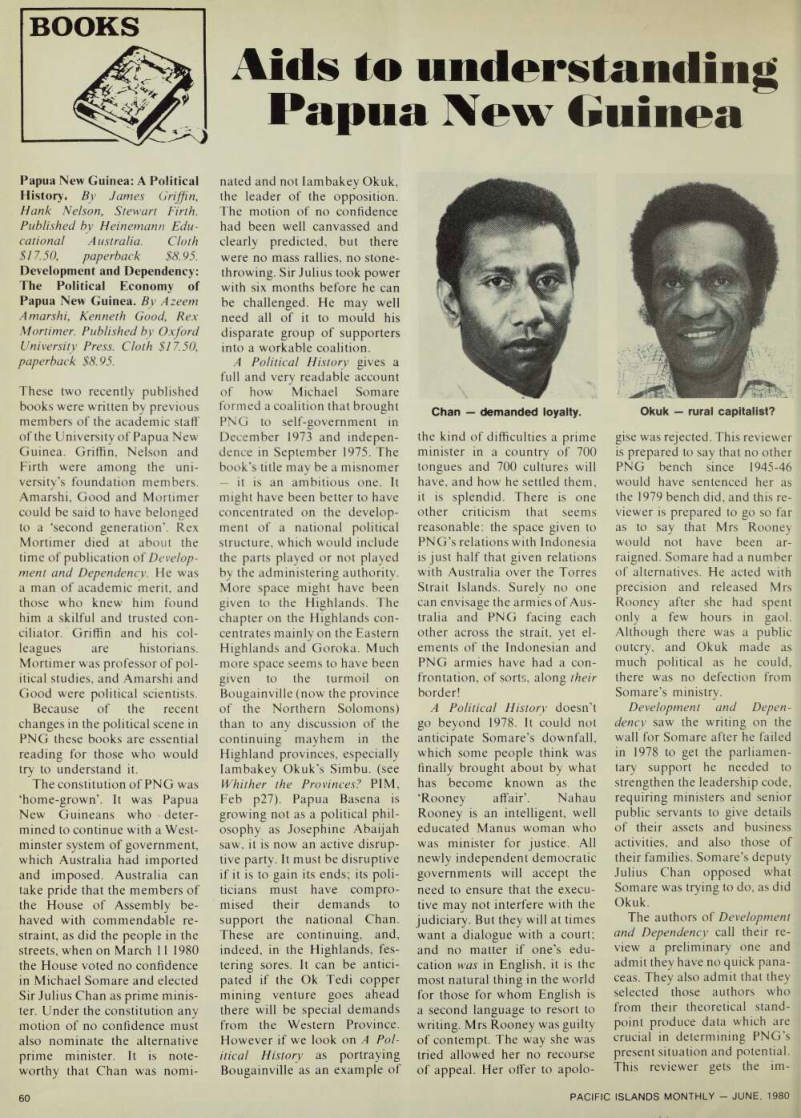
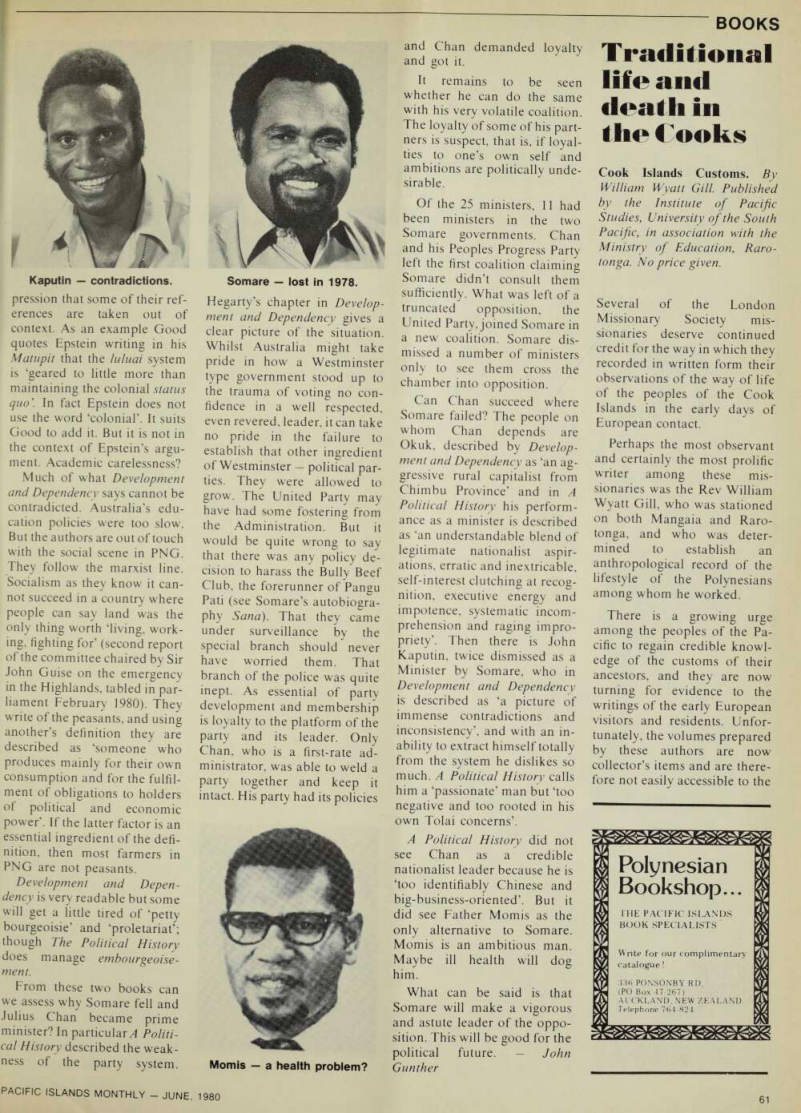
Books
Aids to understanding Papua New Guinea
Papua New Guinea: A Political History. By James Griffin, Hank Nelson, Stewart Firth.
Published by Heinemann Edu cational Australia. Cloth $17.50, paperback $8.95.
Development and Dependency: The Political Economy of Papua New Guinea. By Azeem Amarshi, Kenneth Good, Rex
Mortimer. Published by Oxford
University Press. Cloth $17.50,
paperback $8.95.
These two recently published
books were written by previous members of the academic staff of the University of Papua New Guinea. Griffin, Nelson and Firth were among the uni versity’s foundation members.
Amarshi, Good and Mortimer could be said to have belonged to a ‘second generation’. Rex Mortimer died at about the time of publication of Develop ment and Dependency. He was a man of academic merit, and those who knew him found him a skilful and trusted con ciliator. Griffin and his col leagues are historians.
Mortimer was professor of pol itical studies, and Amarshi and Good were political scientists.
Because of the recent changes in the political scene in PNG these books are essential reading for those who would try to understand it.
The constitution of PNG was
‘home-grown’. It was Papua
New Guineans who deter mined to continue with a West minster system of government, which Australia had imported and imposed. Australia can take pride that the members of the House of Assembly be haved with commendable re straint, as did the people in the streets, when on March 11 1980 the House voted no confidence in Michael Somare and elected Sir Julius Chan as prime minis ter. Under the constitution any motion of no confidence must also nominate the alternative prime minister. It is note worthy that Chan was nomi
nated and not lambakey Okuk, the leader of the opposition.
The motion of no confidence had been well canvassed and
clearly predicted, but there
were no mass rallies, no stone throwing. Sir Julius took power with six months before he can be challenged. He may well need all of it to mould his disparate group of supporters into a workable coalition.
A Political History gives a full and very readable account of how Michael Somare formed a coalition that brought PNG to self-government in December 1973 and indepen dence in September 1975. The book’s title may be a misnomer - it is an ambitious one. It might have been better to have concentrated on the develop ment of a national political structure, which would include the parts played or not played
by the administering authority.
More space might have been given to the Highlands. The chapter on the Highlands con centrates mainly on the Eastern Highlands and Goroka. Much more space seems to have been given to the turmoil on
Bougainville (now the province
of the Northern Solomons) than to any discussion of the
continuing mayhem in the
Highland provinces, especially
lambakey Okuk’s Simbu. (see Whither the Provinces? PIM, Feb p 27). Papua Basena is
growing not as a political phil
osophy as Josephine Abaijah
saw, it is now an active disrup tive party. It must be disruptive if it is to gain its ends; its poli ticians must have compro mised their demands to support the national Chan.
These are continuing, and, indeed, in the Highlands, fes tering sores. It can be antici pated if the Ok Tedi copper mining venture goes ahead there will be special demands from the Western Province.
However if we look on A Pol itical History as portraying Bougainville as an example of
the kind of difficulties a prime minister in a country of 700 tongues and 700 cultures will have, and how he settled them, it is splendid. There is one other criticism that seems reasonable: the space given to PNG’s relations with Indonesia is just half that given relations with Australia over the Torres Strait Islands. Surely no one can envisage the armies of Aus tralia and PNG facing each other across the strait, yet el ements of the Indonesian and PNG armies have had a con frontation, of sorts, along their border!
A Political History doesn’t go beyond 1978. It could not anticipate Somare’s downfall, which some people think was finally brought about by what has become known as the ‘Rooney affair’. Nahau Rooney is an intelligent, well educated Manus woman who was minister for justice. All
newly independent democratic
governments will accept the need to ensure that the execu tive may not interfere with the judiciary. But they will at times want a dialogue with a court; and no matter if one’s edu cation was in English, it is the most natural thing in the world for those for whom English is a second language to resort to writing. Mrs Rooney was guilty of contempt. The way she was tried allowed her no recourse of appeal. Her offer to apolo
gise was rejected. This reviewer is prepared to say that no other PNG bench since 1945-46 would have sentenced her as the 1979 bench did, and this re viewer is prepared to go so far as to say that Mrs Rooney would not have been ar raigned. Somare had a number of alternatives. He acted with precision and released Mrs Rooney after she had spent only a few hours in gaol.
Although there was a public outcry, and Okuk made as much political as he could, there was no defection from
Somare’s ministry.
Development and Depen
dency saw the writing on the wall for Somare after he failed in 1978 to get the parliamen tary support he needed to
strengthen the leadership code,
requiring ministers and senior public servants to give details of their assets and business activities, and also those of their families. Somare’s deputy Julius Chan opposed what Somare was trying to do, as did Okuk.
The authors of Development and Dependency call their re view a preliminary one and admit they have no quick pana ceas. They also admit that they selected those authors who from their theoretical stand point produce data which are crucial in determining PNG’s present situation and potential.
This reviewer gets the im-
Chan-demanded loyalty.
Okuk rural capitalist?
pression that some of their ref erences are taken out of context. As an example Good quotes Epstein writing in his Matupit that the luluai system is ‘geared to little more than maintaining the colonial status quo’. In fact Epstein does not use the word ‘colonial’. It suits Good to add it. But it is not in the context of Epstein’s argu ment. Academic carelessness?
Much of what Development and Dependency says cannot be contradicted. Australia’s edu cation policies were too slow.
But the authors are out of touch with the social scene in PNG.
They follow the marxist line.
Socialism as they know it can not succeed in a country where people can say land was the only thing worth ‘living, work ing. fighting for’ (second report of the committee chaired by Sir John Guise on the emergency in the Highlands, tabled in par
liament February 1980). They
write of the peasants, and using another’s definition they are described as ‘someone who produces mainly for their own consumption and for the fulfil ment of obligations to holders of political and economic power’. If the latter factor is an essential ingredient of the defi nition, then most farmers in PNG are not peasants.
Development and Depen dency is very readable but some will get a little tired of ‘petty bourgeoisie’ and ‘proletariat’;
though The Political History
does manage embourgeoise ment.
From these two books can we assess why Somare fell and Julius Chan became prime minister? In Politi cal History described the weak ness of the party system.
Hegarty’s chapter in Develop ment and Dependency gives a clear picture of the situation.
Whilst Australia might take pride in how a Westminster type government stood up to the trauma of voting no con fidence in a well respected, even revered, leader, it can take no pride in the failure to establish that other ingredient of Westminster - political par ties. They were allowed to grow. The United Party may have had some fostering from the Administration. But it would be quite wrong to say that there was any policy de cision to harass the Bully Beef Club, the forerunner of Pangu Pati (see Somare’s autobiogra phy Sana). That they came under surveillance by the special branch should never have worried them. That branch of the police was quite inept. As essential of party
development and membership
is loyalty to the platform of the party and its leader. Only Chan, who is a first-rate ad ministrator, was able to weld a party together and keep it intact. His party had its policies
and Chan demanded loyalty and got it.
It remains to be seen whether he can do the same with his very volatile coalition.
The loyalty of some of his part ners is suspect, that is, if loyal ties to one’s own self and ambitions are politically unde sirable.
Of the 25 ministers, 11 had been ministers in the two Somare governments. Chan
and his Peoples Progress Party
left the first coalition claiming Somare didn’t consult them sufficiently. What was left of a truncated opposition, the United Party, joined Somare in a new coalition. Somare dis missed a number of ministers only to see them cross the chamber into opposition.
Can Chan succeed where Somare failed? The people on whom Chan depends are
Okuk. described by Develop
ment and Dependency as ‘an ag
gressive rural capitalist from
Chimbu Province’ and in A Political History his perform ance as a minister is described as ‘an understandable blend of
legitimate nationalist aspir
ations, erratic and inextricable, self-interest clutching at recog nition, executive energy and impotence, systematic incom
prehension and raging impro
priety’. Then there is John Kaputin, twice dismissed as a Minister by Somare, who in
Development and Dependency
is described as ‘a picture of immense contradictions and inconsistency’, and with an in ability to extract himself totally from the system he dislikes so much. A Political History calls him a ‘passionate’ man but ‘too negative and too rooted in his own Tolai concerns’.
A Political History did not see Chan as a credible nationalist leader because he is ‘too identifiably Chinese and big-business-oriented’. But it did see Father Momis as the only alternative to Somare.
Momis is an ambitious man.
Maybe ill health will dog him.
What can be said is that Somare will make a vigorous and astute leader of the oppo sition. This will be good for the
political future.
John
Gunther
Kaputin-contradictions.
Somare-lost in 1978.
Momis - a health problem?
death in
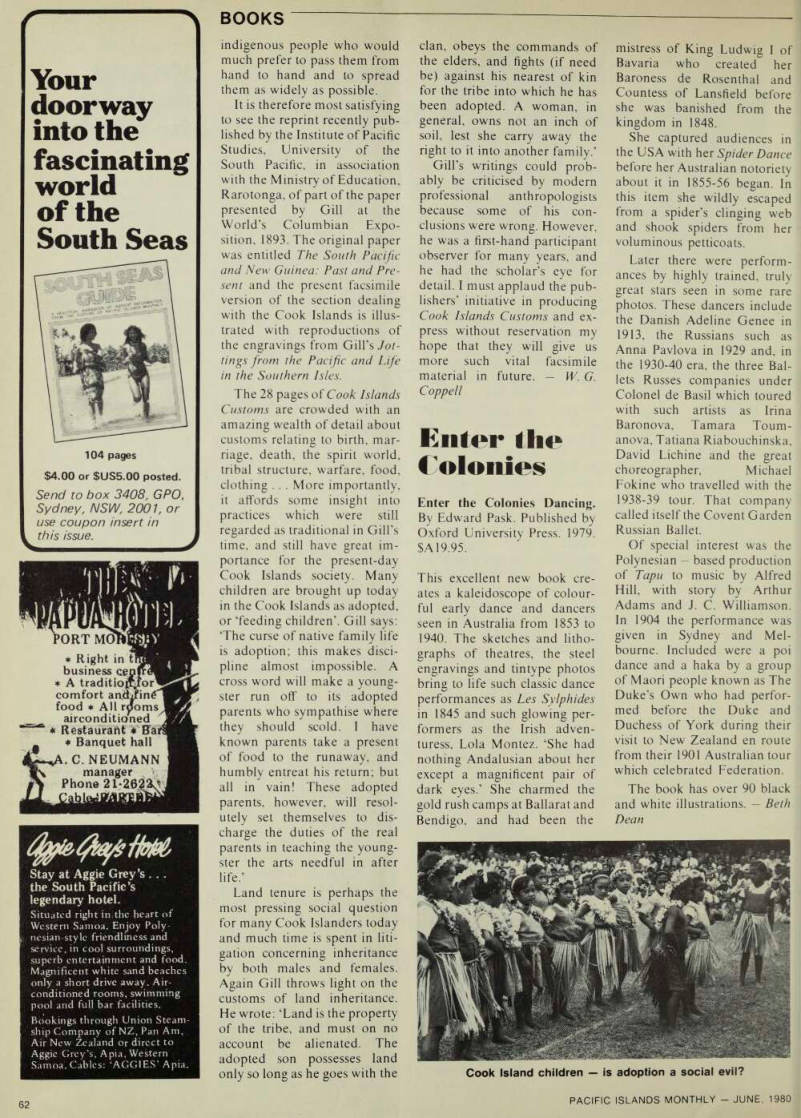
Traditional life and death in the Cooks
Cook Islands Customs. By William Wyatt Gill Published
by the Institute of Pacific
Studies, University of the South Pacific, in association with the Ministry of Education, Raro tonga. No price given.
Several of the London
Missionary Society mis
sionaries deserve continued credit for the way in which they recorded in written form their observations of the way of life of the peoples of the Cook Islands in the early days of
European contact.
Perhaps the most observant and certainly the most prolific writer among these mis sionaries was the Rev William Wyatt Gill, who was stationed on both Mangaia and Raro tonga, and who was deter mined to establish an anthropological record of the
lifestyle of the Polynesians
among whom he worked.
There is a growing urge among the peoples of the Pa cific to regain credible knowl edge of the customs of their ancestors, and they are now turning for evidence to the
writings of the early European
visitors and residents. Unfor
tunately, the volumes prepared
by these authors are now collector’s items and are there fore not easily accessible to the
indigenous people who would
much prefer to pass them from hand to hand and to spread them as widely as possible.
It is therefore most satisfying
to see the reprint recently pub
lished by the Institute of Pacific Studies, University of the South Pacific, in association with the Ministry of Education, Rarotonga, of part of the paper presented by Gill at the World’s Columbian Expo sition, 1893. The original paper was entitled The South Pacific and New Guinea: Past and Pre sent and the present facsimile version of the section dealing with the Cook Islands is illus trated with reproductions of the engravings from Gill’s Jot
tings from the Pacific and Life
in the Southern Isles.
The 28 pages of Cook Islands Customs are crowded with an amazing wealth of detail about customs relating to birth, mar riage, death, the spirit world, tribal structure, warfare, food,
clothing .. . More importantly,
it affords some insight into practices which were still regarded as traditional in Gill’s time, and still have great im portance for the present-day Cook Islands society. Many children are brought up today in the Cook Islands as adopted, or ‘feeding children’. Gill says: ‘The curse of native family life is adoption; this makes disci
pline almost impossible. A
cross word will make a young ster run off to its adopted parents who sympathise where they should scold. I have known parents take a present of food to the runaway, and humbly entreat his return; but all in vain! These adopted parents, however, will resol utely set themselves to dis charge the duties of the real parents in teaching the young ster the arts needful in after life.’
Land tenure is perhaps the
most pressing social question
for many Cook Islanders today and much time is spent in liti
gation concerning inheritance
by both males and females.
Again Gill throws light on the customs of land inheritance.
He wrote: ‘Land is the property of the tribe, and must on no account be alienated. The adopted son possesses land only so long as he goes with the
clan, obeys the commands of the elders, and fights (if need be) against his nearest of kin for the tribe into which he has been adopted. A woman, in general, owns not an inch of soil, lest she carry away the right to it into another family.’
Gill’s writings could prob ably be criticised by modern
professional anthropologists
because some of his con clusions were wrong. However, he was a first-hand participant observer for many years, and he had the scholar’s eye for detail. I must applaud the pub lishers’ initiative in producing Cook Islands Customs and ex press without reservation my hope that they will give us more such vital facsimile
material in future.
Coppell
W.G.
Advertisements & other items, pp. 61-62 (1 item)
Bookshop..
Polynesian
THE PACIFIC ISLANDS
BOOK SPECIALISTS
Write for our complimentary catalogue!
336 PONSONBY RI)
(PO Box 47 267)
AUCKLAND. NEW ZEALAND
Telephone 784-824.
Your doorway into the fascinating world of the South Seas 104 pages $4.00 or SUSS.OO posted.
Send to box 3408, GPO, Sydney, NSW, 2001, or use coupon insert in this issue.
/ J
ORT MO
♦ Right in t business ceo** ♦ A comfort andifine food ♦ All rpoms airconditioned k Restaurant * Ba. ♦ Banquet hall
.C. NEUMANN
manager Phone 21*2622vt ' Stay at Aggie Grey’s . . . the South Pacific’s legendary hotel.
Situated right in the heart of Western Samoa. Enjoy Polynesian-stylc friendliness and service, in cool surroundings, superb entertainment and food.
Magnificent white sand beaches only a short drive away. Airconditioned rooms, swimming pool and full bar facilities.
Bookings through Union Steamship Company of NZ, Pan Am, Air New Zealand or direct to Aggie Grey’s, Apia, Western Samoa. Cables: ‘AGGIES’ Apia.
Enter the Colonies
Colonies
Enter the Colonies Dancing.
By Edward Pask. Published by Oxford University Press. 1979. 5A19.95.
This excellent new book cre ates a kaleidoscope of colour ful early dance and dancers seen in Australia from 1853 to 1940. The sketches and litho graphs of theatres, the steel
engravings and tintype photos
bring to life such classic dance
performances as Les Sylphides
in 1845 and such glowing per formers as the Irish adven turess, Lola Montez. ‘She had nothing Andalusian about her except a magnificent pair of dark eyes.’ She charmed the gold rush camps at Ballarat and Bendigo, and had been the
mistress of King Ludwig I of Bavaria who created her Baroness de Rosenthal and Countess of Lansfield before she was banished from the kingdom in 1848.
She captured audiences in the USA with her Spider Dance before her Australian notoriety about it in 1855-56 began. In this item she wildly escaped from a spider’s clinging web and shook spiders from her voluminous petticoats.
Later there were perform
ances by highly trained, truly
great stars seen in some rare photos. These dancers include the Danish Adeline Genee in 1913, the Russians such as Anna Pavlova in 1929 and, in the 1930-40 era, the three Bal lets Russes companies under Colonel de Basil which toured with such artists as Irina Baronova, Tamara Toum anova, Tatiana Riabouchinska, David Lichine and the great
choreographer, Michael
Fokine who travelled with the 1938-39 tour. That company called itself the Covent Garden Russian Ballet.
Of special interest was the
Polynesian based production
of Tapu to music by Alfred Hill, with story by Arthur Adams and J. C. Williamson.
In 1904 the performance was given in Sydney and Mel bourne. Included were a poi dance and a haka by a group of Maori people known as The Duke’s Own who had perfor med before the Duke and Duchess of York during their visit to New Zealand en route from their 1901 Australian tour which celebrated Federation.
The book has over 90 black and white illustrations. Beth Dean
Cook Island children - is adoption a social evil?
Geographical isolation,
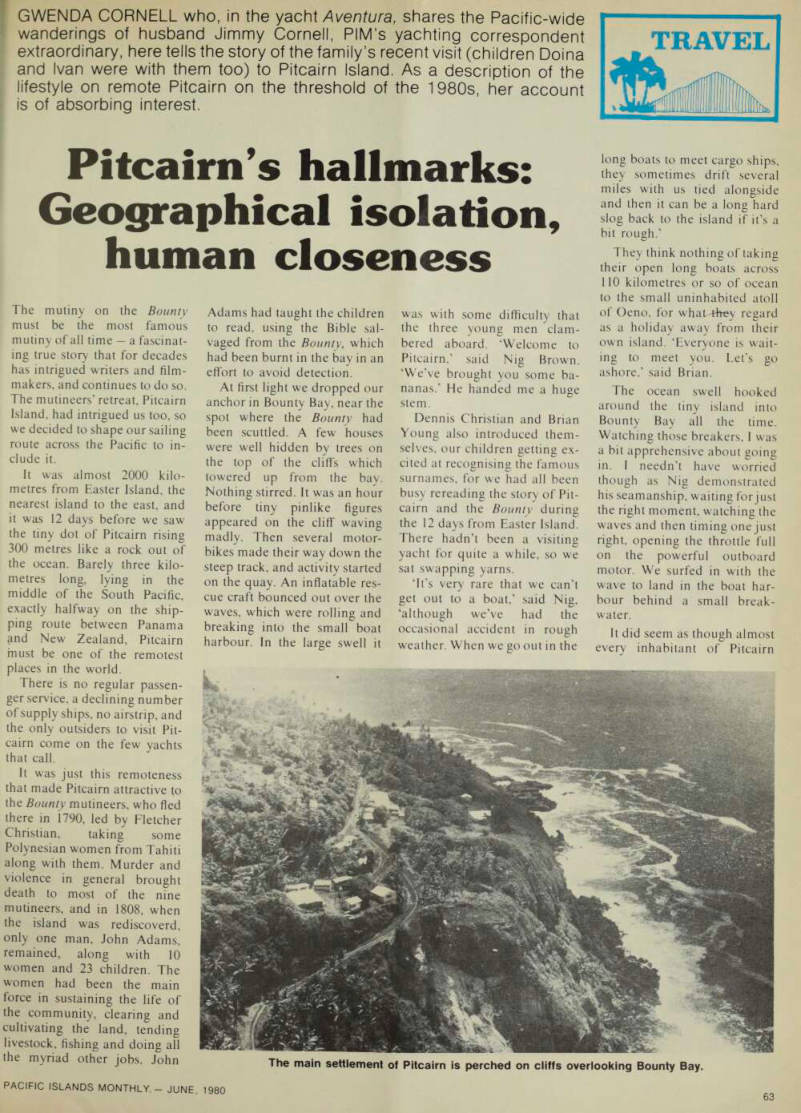

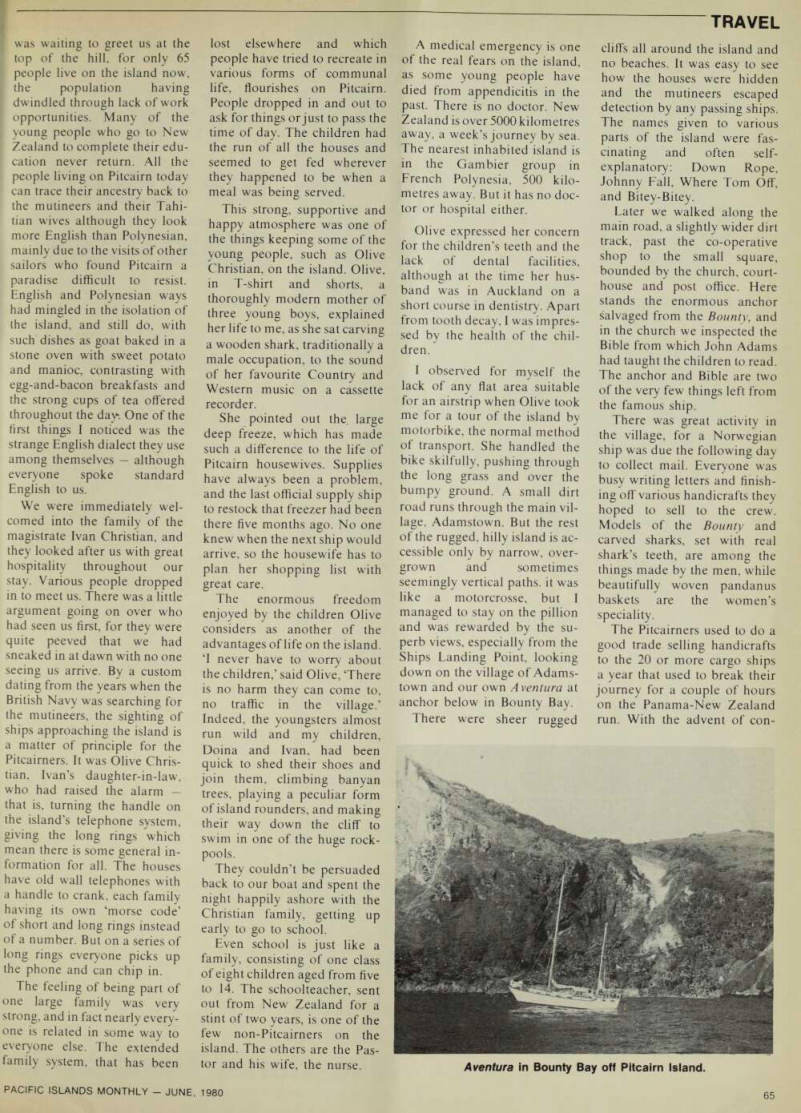

Pitcairn’s hallmarks: Geographical isolation, human closeness
Travel
GWENDA CORNELL who, in the yacht Aventura, shares the Pacific-wide wanderings of husband Jimmy Cornell, PlM’s yachting correspondent extraordinary, here tells the story of the family’s recent visit (children Doina and Ivan were with them too) to Pitcairn Island. As a description of the lifestyle on remote Pitcairn on the threshold of the 1980 s, her account is of absorbing interest.
The mutiny on the Bounty must be the most famous mutiny of all time a fascinat ing true story that for decades has intrigued writers and film makers, and continues to do so.
The mutineers’ retreat, Pitcairn Island, had intrigued us too, so we decided to shape our sailing route across the Pacific to in clude it.
It was almost 2000 kilo metres from Easter Island, the nearest island to the east, and it was 12 days before we saw the tiny dot of Pitcairn rising 300 metres like a rock out of the ocean. Barely three kilo metres long, lying in the middle of the South Pacific,
exactly halfway on the ship
ping route between Panama and New Zealand, Pitcairn must be one of the remotest places in the world.
There is no regular passen ger service, a declining number
of supply ships, no airstrip, and
the only outsiders to visit Pit cairn come on the few yachts that call.
It was just this remoteness that made Pitcairn attractive to the Bounty mutineers, who fled there in 1790, led by Fletcher Christian, taking some Polynesian women from Tahiti along with them. Murder and violence in general brought death to most of the nine mutineers, and in 1808, when the island was rediscoverd, only one man, John Adams, remained, along with 10 women and 23 children. The women had been the main force in sustaining the life of
the community, clearing and
cultivating the land, tending
livestock, fishing and doing all the myriad other jobs. John
Adams had taught the children to read, using the Bible sal vaged from the Bounty, which had been burnt in the bay in an effort to avoid detection.
At first light we dropped our anchor in Bounty Bay, near the spot where the Bounty had been scuttled. A few houses were well hidden by trees on the top of the cliffs which towered up from the bay.
Nothing stirred. It was an hour
before tiny pinlike figures
appeared on the cliff waving madly. Then several motor bikes made their way down the steep track, and activity started on the quay. An inflatable res cue craft bounced out over the waves, which were rolling and breaking into the small boat harbour. In the large swell it
was with some difficulty that the three young men clam bered aboard. ‘Welcome to Pitcairn,' said Nig Brown. ‘We’ve brought you some ba nanas.’ He handed me a huge stem.
Dennis Christian and Brian Young also introduced them selves, our children getting ex cited at recognising the famous surnames, for we had all been busy rereading the story of Pit cairn and the Bounty during the 12 days from Easter Island.
There hadn’t been a visiting yacht for quite a while, so we sat swapping yarns. ‘lt’s very rare that we can’t get out to a boat,’ said Nig, ‘although we’ve had the occasional accident in rough weather. When we go out in the
long boats to meet cargo ships, they sometimes drift several miles with us tied alongside and then it can be a long hard slog back to the island if it’s a bit rough.’
They think nothing of taking their open long boats across 110 kilometres or so of ocean to the small uninhabited atoll of Oeno, for wfiat-fhey regard as a holiday away from their own island. ‘Everyone is wait ing to meet you. Let’s go ashore,’ said Brian.
The ocean swell hooked around the tiny island into Bounty Bay all the time.
Watching those breakers, I was a bit apprehensive about going in. I needn’t have worried
though as Nig demonstrated
his seamanship, waiting for just
the right moment, watching the waves and then timing one just right, opening the throttle full on the powerful outboard motor. We surfed in with the wave to land in the boat har bour behind a small break water.
It did seem as though almost every inhabitant of Pitcairn
The main settlement of Pitcairn is perched on cliffs overlooking Bounty Bay.
[ was waiting to greet us at the f top of the hill, for only 65 \ people live on the island now,
the population having
dwindled through lack of work opportunities. Many of the young people who go to New Zealand to complete their edu ; cation never return. All the
people living on Pitcairn today
can trace their ancestry back to the mutineers and their Tahi tian wives although they look more English than Polynesian, mainly due to the visits of other sailors who found Pitcairn a paradise difficult to resist.
English and Polynesian ways had mingled in the isolation of the island, and still do, with such dishes as goat baked in a stone oven with sweet potato and manioc, contrasting with egg-and-bacon breakfasts and the strong cups of tea offered throughout the day*. One of the first things I noticed was the strange English dialect they use among themselves although everyone spoke standard English to us.
We were immediately wel comed into the family of the magistrate Ivan Christian, and they looked after us with great
hospitality throughout our
stay. Various people dropped in to meet us. There was a little argument going on over who had seen us first, for they were quite peeved that we had sneaked in at dawn with no one seeing us arrive. By a custom dating from the years when the British Navy was searching for the mutineers, the sighting of ships approaching the island is a matter of principle for the Pitcairners. It was Olive Chris tian, Ivan’s daughter-in-law, who had raised the alarm that is, turning the handle on the island’s telephone system,
giving the long rings which
mean there is some general in formation for all. The houses have old wall telephones with a handle to crank, each family having its own ‘morse code’ of short and long rings instead of a number. But on a series of
long rings everyone picks up
the phone and can chip in.
The feeling of being part of one large family was very strong, and in fact nearly every one is related in some way to everyone else. The extended family system, that has been
lost elsewhere and which people have tried to recreate in various forms of communal life, flourishes on Pitcairn.
People dropped in and out to ask for things or just to pass the time of day. The children had the run of all the houses and seemed to get fed wherever they happened to be when a meal was being served.
This strong, supportive and happy atmosphere was one of the things keeping some of the young people, such as Olive Christian, on the island. Olive, in T-shirt and shorts, a thoroughly modern mother of three young boys, explained her life to me, as she sat carving a wooden shark, traditionally a male occupation, to the sound of her favourite Country and Western music on a cassette recorder.
She pointed out the, large deep freeze, which has made such a difference to the life of Pitcairn housewives. Supplies have always been a problem, and the last official supply ship to restock that freezer had been there five months ago. No one knew when the next ship would arrive, so the housewife has to plan her shopping list with great care.
The enormous freedom enjoyed by the children Olive considers as another of the advantages of life on the island.
T never have to worry about the children,’ said Olive, There is no harm they can come to, no traffic in the village.’
Indeed, the youngsters almost run wild and my children, Doina and Ivan, had been quick to shed their shoes and
join them, climbing banyan
trees, playing a peculiar form of island rounders, and making their way down the cliff to swim in one of the huge rock
pools.
They couldn’t be persuaded back to our boat and spent the night happily ashore with the
Christian family, getting up
early to go to school.
Even school is just like a family, consisting of one class of eight children aged from five to 14. The schoolteacher, sent out from New Zealand for a stint of two years, is one of the few non-Pitcairners on the island. The others are the Pas tor and his wife, the nurse.
A medical emergency is one of the real fears on the island, as some young people have died from appendicitis in the past. There is no doctor. New Zealand is over 5000 kilometres away, a week’s journey by sea.
The nearest inhabited island is in the Gambier group in French Polynesia, 500 kilo metres away. But it has no doc tor or hospital either.
Olive expressed her concern for the children’s teeth and the lack of dental facilities, although at the time her hus band was in Auckland on a short course in dentistry. Apart from tooth decay, I was impres sed by the health of the chil dren.
I observed for myself the lack of any flat area suitable for an airstrip when Olive took me for a tour of the island by motorbike, the normal method of transport. She handled the
bike skilfully, pushing through
the long grass and over the bumpy ground. A small dirt road runs through the main vil lage, Adamstown. But the rest of the rugged, hilly island is ac cessible only by narrow, over grown and sometimes seemingly vertical paths, it was like a motorcrosse, but I managed to stay on the pillion and was rewarded by the su perb views, especially from the
Ships Landing Point, looking
down on the village of Adams town and our own A ventura at anchor below in Bounty Bay.
There were sheer rugged
cliffs all around the island and no beaches. It was easy to see how the houses were hidden and the mutineers escaped detection by any passing ships.
The names given to various parts of the island were fas cinating and often self
explanatory: Down Rope,
Johnny Fall, Where Tom Off,
and Bitey-Bitey.
Later we walked along the main road, a slightly wider dirt track, past the co-operative shop to the small square, bounded by the church, court house and post office. Here stands the enormous anchor salvaged from the Bounty, and in the church we inspected the Bible from which John Adams had taught the children to read.
The anchor and Bible are two of the very few things left from the famous ship.
There was great activity in the village, for a Norwegian
ship was due the following day
to collect mail. Everyone was busy writing letters and finish ing off various handicrafts they hoped to sell to the crew.
Models of the Bounty and carved sharks, set with real shark’s teeth, are among the things made by the men, while beautifully woven pandanus baskets are the women’s
speciality.
The Pitcairners used to do a
good trade selling handicrafts
to the 20 or more cargo ships a year that used to break their journey for a couple of hours on the Panama-New Zealand run. With the advent of con-
Aventura in Bounty Bay off Pitcairn Island.
1 tainer ships and fast schedules, these visits have dwindled to about eight a year, with sad I effects on the Pitcairners’ incomes.
Nevertheless, the island makes a fair income from the sale of postage stamps. This covers the costs of education, health, administration and
public works.
As a matter of policy all adult men have some kind of
a job paid by the administrat
ion running the generator, maintaining the road, the dock, the public buildings, etc. Men and women work together in their gardens and grow a wide range of produce.
We were lucky that our last evening coincided with Dennis
Christian’s birthday. Every
birthday and special occasion is celebrated by what is called a ‘Public Dinner’. Any quarrels are forgotten and everyone is invited. Dennis’ mother pro vided the setting, but each housewife brought her own contribution, a meat or veg etable dish, a cake or a pudding. Soon the table was laden with an amazing variety of appetising dishes.
It was difficult to believe that the last supply ship had been five months ago.
Notable was the absence of alcohol, for as Seventh-day Adventists the islanders neither drink nor smoke, but this doesn’t affect their great ca
pacity for enjoying themselves.
The younger generation soon had a record player organised and a disco going in one of the rooms, the children were play ing ghosts in the garden while the older people sat and chatted, the women’s hands never still as they wove pan danus or knitted while talk
ing.
Later, the Pitcairners sang for us in harmonious voices the
special goodbye songs they sing
as they pull away in their long boats from visiting ships. In the songs one could sense the iso lation and loneliness of the people, and a sadness that a contact with the outside world had come to an end. Our visit too had to end, and we sadly bade farewell to our new friends, for in our short visit, they had managed to make us too feel part of the Pitcairn
family.
Advertisements & other items, pp. 64-66 (1 item)
Cessna
V \ V v r V % % A V J A
8 EXCELLENT REASONS WHY
EVERY SECOND DAY CESSNA
DELIVERS ANOTHER CEMTON
Fuel Efficiency max. cruise 0.453 n. miles per pound fuel Simple to Operate no complex control or stability systems 340° horizon visibility from the cockpit new technology high aspect ratio wings Field Length - shortest take-off (balanced field length) 2990 ft.
Cabin Capacity - 2 pilots plus 11 pass, in normal corporate seating Quietness - recognised as the quietest jet in the world Speed cruise at 385 kts. with low stall at 80 kts. VMC below stall Flexibility certified for grass and gravel airports Range - 1750 n. miles with I.F.R. reserves
THERE ARE MANY SENSIBLE REASONS
Distributors
Cessna
REX AVIATION
I Rex Aviation Ltd.
P.O. Box 51, Bankstown 2200 Phone (02) 70 0661 - Telex AA20738 Please send me more on the Cessna Citation Name Position .
Company Address . .
Telephone P/code
19/PIM.AR
3- 31 j U The RX-5500F has 15 watts output power and 4 bands;
7TTTT
1“' «€<»€<*«< t *••• ::: iuuniuii mmmhmMMHHIM Ml'icu i<( t « ■
MMMfMMMOMMM »♦*»♦»«* ■
••• MM**..
I:;;;:::;:::;::: ' • •4t*«***ff*«**«t*Mff*M*ff*MMf I < )*«***M*M*MM*«« *l**f»f**«*M« > . < IfMHftfMIMHM *!**« ««»««*.*
.UMMf***! »M»M«*M«t**
♦t 1 ♦ ♦♦ l * •«*«••• ...
The RX-5300F has 12 watts output power and 4 bands: (FM/MW/SWI/SW2) The RX-5120F has 10 watts output power and 4 bands: (FM/MW/SWi /SW2)
We've got
the cassette
radio taped.
We've built more cassette radios than just about anybody. And, as you can see and hear, it shows.
Our sleek silvery portables pack powerful amplifiers. Multi-band tuner sections. Three-way meters for recording/playback, tuning and battery strength.
Many of them have a clever control to select your favorite tape selections automatically. And our classy RX-5500F has Dolby* (No hiss from the tape means no boos from the buyers).
Trust National's silvery sets to bring you sterling performance. At home and away. * Dolby and the double-D symbol are trademarks of Dolby Laboratories.
B National Panasonic
National and Panasonic are the brandnames of Matsushita Electric.
two wheels
Exploring Niue on two wheels
Yachtie P. BREMER KAMP was on Niue not long ago as part of the crew of Scheherazade. Following is his account of a day ashore exploring Niue by motor bike.
Captain Cook was the first European to discover Niue Island in 1774. His efforts to put ashore to explore and talk to the natives were repelled with such violence he withdrew and called the discovery ‘Sav age Island’. When we arrived off the town of Alofi, the cus toms and immigration officers were friendly and made us most welcome. I’m sure if the good captain were to return today he also would be made more welcome at Niue than at some other of the more demanding ports of the South Pacific.
Niue Island is 370 kilometres east of Vavau and 500-odd kilometres south of Samoa.
The inhabitants of the northern half generally are of Samoan ancestry, while those of the south are of Tongan origin. In the days of Cook there was no love lost between the two tribes and this, possibly, was the reason for his ferocious rebuff.
Today the population is a meld
of easy-going Polynesians, who
quickly dispel any unfavour
able impression that may linger from the ‘Savage Island’ incident.
Downtown Alofi has five or six buildings, built of corru gated iron and coral stone, while the government build ings are of more modern materials. A short strip of bitu men keeps the dust from set tling on the already faded paintwork, while the ever
encroaching vegetation hides
the plumbing defects and is pleasing to the eye.
Inquiring at the post office I found it was possible to hire motor bikes at the local garage.
Armed with cameras, costumes and sandwiches we chugged off on our motor bikes to where luck would lead us.
Niue lies in the earthquake belt between New Zealand and the Solomons and in past cen turies was subjected to con siderable elevating forces.
Originally a coral atoll about three to five metres above sea level with an enclosed lagoon, subterranean forces lifted the whole atoll out of the sea about 60 metres. Today the island is terraced in two levels. The coastal terrace is bordered by cliffs up to 21 metres high which have eroded into numer ous caves. The tropical rainfall has turned the decaying veg etation into a mild carbonic acid which has readily eaten into the coral stone to such an extent that the whole island is honeycombed with caves, chasms and spectacular land forms.
The first of the caves we visi ted was called Avaiki. The de scent from the road was quite steep and made with the assist ance of roots and vines from a nearby tree. Once inside the cathedral-like void, it was ironic to notice that it was being used for canoe stowage.
From time to time we could hear the ocean surging through the other entrances. I decided to follow one through and came upon a delightful grotto, where we cooled off with a swim.
Back on the road again, we putted off to Matapa Chasm, the bathing place of the ancient chiefs. This fault is almost two kilometres long and not more than 30 metres wide. It runs inland from a narrow entrance on the coast where it is 18 to 21 metres high. The water was so inviting it was impossible to pass by without having a swim.
We found the water pleasantly refreshing and cool, as only the midday sun ever reaches into the chasm. Reluctantly we wandered back to the motor bikes and drove off to the Arches of Talava.
We motored up to the top of the second terrace, past plan tations of limes, passion fruit, bananas and coconuts, stop ping for a sample at the invi tation of a gardener. The walk
out to the Arch is about a kilo metre and a half, over rela
tively easy ground. On
reaching the coast you can gaze upon what must be one of the seven wonders of the Pacific.
There was an unforgettable at mosphere about the Arch, bringing to mind the spirits of ancient chiefs, pagan sacrifices and Polynesian legends.
Earlier that morning at the post office, we were aware of a general air of excitement and found that this was due to the fact that the cinema would be
operating that night. My in
formant, however, was not sure what was showing. Eager to ex perience a movie in this island setting, we decided to go. The ticket collector could not say what was showing either, but for 50 cents this could hardly be considered cause for com
plaint.
The cinema was an old cor rugated iron structure that has somehow managed to survive the occasional cyclone. There was seating for about 100, and we were among the last to get seats. However, when all seats were filled, the audience just kept rolling in. I do not know whether the dogs had tickets or not, but they were certainly enjoying the occasion. When the walls were bulging with the size of the audience, the lights went out and the film started
backwards! Lights on again
for a quick rewind, and the as sembly settled down for an en
joyable evening, interrupted
only when the generator ran out of fuel and a couple of dogs started to fight in the side door.
If you find yourself in the Pacific and looking for an atoll with a difference, be sure to call at Niue, a real Pacific jewel. From Scheherazade in transit.
The chasm
Advertisements & other items, p. 68 (1 item)
Accord
em > n T M wm m isi MS & ■~ * ■ i u m a w ME t . /S 7 ' . •i m re \ Vi i ■■ '••• 3
U2UUi
Honda Accord... a natural choice
when quality is the criterion.
fhe Honda Accord is an amazing )lend of ingenious automotive and luman engineering. It’s compact, of :ourse, to suit today’s motoring condiions. Yet it’s so roomy inside and vhisper-quiet. In fact, the whole interior itmosphere tells you you’re in a superior type of car a car whose silent, smooth and pleasant ride may ;ven make BMW and Mercedes sit up md take notice.
And not forgetting the most funlamental part of the automobile: the quipment may vary in some countries. engine. The Accord’s is a flat-torque 1.6-liter type featuring transistorized ignition, meaning it’s great for city and highway duty as well as durable. And it’s not a thirsty brute, either, tending to be rather miserly in its consumption of fuel.
The Honda Accord comes superbly equipped—so many features are supplied as standard equipment that just about the only extras you would really like to have are the unique Honda power steering and Hondamatic transmission with overdrive.
So you see, if quality is your criterion in selecting a car, you’re in luck. Because there’s the Honda Accord. And it’s the natural choice.
A HONDA
Accord
/lHdl©©F In]@ts[htod}j
HONDA
3NDA MOTOR CO. LTD. TOKYO, JAPAN
PAPCIA NEW GUINEA: Steamships-Machinery P O. Box 1, Port Moresby/TAHITI: Honda Distribution S.A.R.L. B.P. 1665 Papeete/FIJI ISLANDS: Carpenters Motors 61-63 Foster Stt; Walu Bay, Suva/KIRIBATI: Atoll Auto Stores P.O. Box 71, Bairiki Tarawa/a.S. TRUST TERRITORY: United Micronesia Development Assn. P.O. Box 238, Saipan, Mariana Islands 96950< COOK ISLANDS: Cook Islands Motor Center Ltd. P.O. Box 74, Rarotonga/AMERICAN SAMOA: Holidy Motors, Parts and Service P.O. Box 968, Pago Pago Haleck’s Service Centre P.O Box 1138, Pago Pago/GUAM: Mark’s Motor Co„ Inc. P.O. Box DV, Agana/WESTERN SAMOA: Motor Distributors (Samoa) Ltd. P.O. Box 576, Apia/SOLOMON ISLANDS: Britsiz Solomons Trading Co., Ltd. P.O. Box 114, Honiara/NEW CALEDONIA: Establissements Ballande Boite Postale No. C 4. Noumea Cedex/NIUE ISLAND: Niue Island United Enterprises P.O. Box 4, Alofi/NAURU: Nauru Cooperative Society Republic of Nauru, Nauru Island, Central Pacific/NEW HEBRIDES: Yamathai (Melanesia) Kaihatsu Kaisha P.O. Box 194, Port Villi Santo Gas Centre Ltd. P.O. Box 45, Santo/TUVALU: Tuvalu Co-operative Wholesale Society P.O. Box Funafuti, Tuvalu/TONGA: Jones Holding P.O. Box 34, Nukualofa Tongst
independence and elections

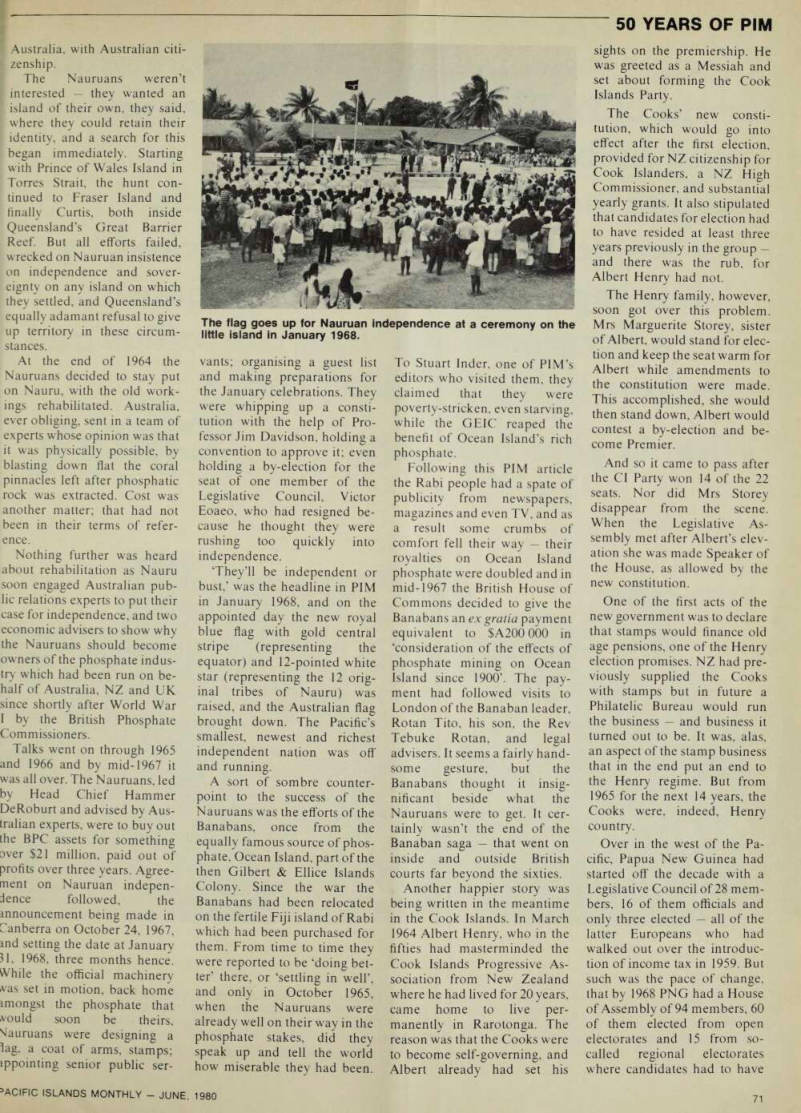

The ’60s: Tangled tales of independence and elections
JUDY TUDOR, nearing the end of her review of 50 years of Pacific Islands events as reported in the pages of PIM, here examines the politically-frantic sixties, when some of the metropolitan powers began to come to terms with the real state of the Brave New World. Next month she will wind up the series with a look at the seventies, and in August PIM will produce a fat issue to mark our 50th anniversary of publication.
In the Pacific Islands, the 1960 s were when the metaphorical chickens of the United Nations Committee of 24 anti colonialists and other theorists started to come home to roost.
The fifties had started out still making good the years of war, one foot in the past. But by the end of that decade, some administering powers were already beginning to see the light and the virtue of the brave new world of majority rule, one-man-one-vote and in dependence for all. The main reason for this was that colon ies, far from being valuable assets, were turning out, in the post-World War II era, to be more likely bottomless sinks for taxpayers’ money. Further, they were targets for mischief making Russians and Third World members of the United Nations.
Better by far to bring them quickly to some semblance of Western democratic govern ment, promise them continued financial support and get out.
Britain had already had a fill of colonial problems in Africa and South-east Asia. So why not make a virtue of leaving the Pacific by giving these islands up, as Prime Minister Menzies of Australia had said, too soon rather than too late?
If it was Britain which started the trend, Australia and New Zealand were quick to follow and had swifter success, as some of Britain’s bits and
pieces were exceedingly dif
ficult to move. But between the three of them in 1960 were div ided the administrations of Fiji, Gilbert and Ellice Islands, Western Samoa, Cook Islands, Niue, Papua-New Guinea, Nauru, the British Solomon Islands Protectorate, half of the New Hebrides, plus the over sight of Tonga and Norfolk
Island. What was left to the Netherlands, France and the United States was minor by
comparison.
The Netherlands, which had been reduced to West New Guinea, had even less to lose than the British and liquidated its liabilities in another way.
The French still had use for their Pacific territories, had
already given them universal
suffrage, representatives in the French Senate and Chamber of Deputies and managed to insist that that was enough.
The United States, theore tically the greatest anti colonialist of the lot, was still exploding H-bombs in the North Pacific in the early 1960 s and building an anti-missile base at Kwajalein, in the Marshalls. Independence for its territories was complicated anyway by the differing out looks of the scattered Micronesian groups and the desire of most to continue having US support, no matter what kind of independence
they ultimately achieved. The
setting up of the Congress of Micronesia in 1965 seemed to
do little to weld the disparate groups into one people. Guam had already settled its relation ship with the US and the American Samoans were still suffering from the withdrawal of the Pago Pago navy base.
Generally, however, the six ties saw much political ad
vancement everywhere.
Advisory Councils grew into Legislative Councils; those with Legislative Councils got Assemblies; a few achieved parliaments or Houses of Rep resentatives. Nominated mem bers gave way to elected members through electoral
colleges, then by straight-out
universal suffrage, while the elite became under-secretaries, ministerial members and, finally, full-blown ministers.
There were Leaders of Government Business who grew into Chief Ministers and finally into Premiers or Prime Ministers. By the end of the decade, two countries had be come independent states, one had self-government, one had been thrown to the wolves and many were on the brink of cut ting loose from colonial apron
strings.
In the race to nationhood it was fitting that the Western Samoans, who had known where they wanted to go for decades, should have been the first to hoist their own flag and sing their own anthem and, on January 1, 1962, experience the delicious joys of total indepen dence also, in due course, to
experience the problems that
went with it.
Also quick of solution was the West New Guinea situ ation. In May 1960 the Dutch announced a 10-year plan of building up the WNG Papuans
politically and economically
with the territory immediately
getting a New Guinea Council
with a Papuan majority.
This was followed by more
sabre-rattling by Indonesia’s
Soekarno and. later, visits to Australia by his General Nasu tion, who was told that Aus tralia could not take any initiative in a procedure de signed to hand over sover eignty and the right to self-determination in WNG. In spite of these fair words, by the time the Indonesians were
dropping parachute troops into
WNG in 1962, Australia had retreated into masterly silence.
The end came in August 1962 with a settlement that had the Netherlands handing over immediately to a temporary UN administration which would, in turn, hand over to Indonesia on May 1, 1963.
The only action on the Aus tralian side was the panic set ting up of patrol posts along the P-NG - West NG border which had never been the sub ject of proper survey or treaty.
The rest of the world looked on just as cynically, while the wishes of the WNG Papuans were ignored ‘sold like cattle’
as their leaders expressed it abandoned by the Dutch, suppressed by the UN tem porary public servants who were more interested in keep ing the lid on the situation until they could themselves get out than in assisting the unfor tunate victims of Dutch- Indonesian bitterness to further their aspirations.
The settlement, however, had two face-saving clauses: the Dutch undertook to pro vide something like $3O million over the first three years for
Papuan development, the
amount being paid into a special UN fund; and, by 1969, the Papuans were to be allowed an ‘act of free choice’ as to whether they would remain with Indonesia or not.
The first concession was hamstrung from the start, as at the successful conclusion of his WNG adventure, Soekarno began his confrontation with
Malaysia and eventually took
Indonesia out of the UN. By the time the Indonesians had got rid of him and were back in the UN, Indonesia was on the brink of economic and pol itical disaster and WNG, out at the end of the line, in parlous state.
The Dutch fund had been frozen by the UN and the thaw had scarcely begun in 1968 when an article by Peter Hast ings appeared in PIM, describ ing his visit to this forlorn place. It was without shipping, planes or cash; Papuans were
seen only in the background, disillusioned Indonesians were everywhere. Papuans who did manage to get near him told of
deprivation, harassment, gaol
and even executions.
Half the UN fund was at that time being used to try to get communications and some of the utilities restored; half was earmarked for small-scale
development mostly of agricul
ture a mere drop in the bucket of what was required.
There was then remaining the second face-saver, the act of free choice to be taken be fore the end of 1969.
The United Nations, which had insisted that Western Samoa, of one mind about independence and with New Zealand willing, must hold a plebiscite based on universal
suffrage before independence,
made no such stipulation in the case of WNG. Instead, the business was allowed to follow Indonesian custom under which a few thousand selected voters, by some mysterious means, arrived at a consensus on behalf of their million com
patriots.
It was no surprise that the vote was to remain with Indonesia. There was, in any event, nowhere else for them to go by that time. Virtually aban doned by the United Nations,
any pipedreams they might
once have had of joining PNG had long been exposed for the myths they were; to go it alone in an underdeveloped country that had been stripped down to bare bones, was clearly imposs ible. The Papuans, who were no longer permitted to call themselves that, were stuck with the Indonesians for the foreseeable future.
In contrast to the malign fate that overtook the WNG Papuans, the fewer than 3000 Nauruans from the valuable phosphate island got all they wanted in the 19605, pressed down and running over.
Australia brought up the future of these people in mid-1961 when it was believed
that the phosphate deposits
would run out in 30 years. It was announced then that Aus tralia, on behalf of NZ and UK, the other two partners in
the joint Trusteeship, was
offering Nauruans a home in
1961 guard of honour forms up outside the West New Guinea parliament which Holland established shortly before Indonesia gained international recognition of its rights to ad minister West New Guinea, now known as Irian Jaya and a prov ince of Indonesia.
: Australia, with Australian citi
f zenship.
The Nauruans weren’t interested they wanted an [ island of their own, they said, where they could retain their identity, and a search for this
began immediately. Starting
with Prince of Wales Island in Torres Strait, the hunt con tinued to Fraser Island and finally Curtis, both inside Queensland’s Great Barrier Reef. But all efforts failed, wrecked on Nauruan insistence on independence and sover eignty on any island on which they settled, and Queensland’s equally adamant refusal to give up territory in these circum stances.
At the end of 1964 the Nauruans decided to stay put on Nauru, with the old work ings rehabilitated. Australia, ever obliging, sent in a team of experts whose opinion was that
it was physically possible, by
blasting down flat the coral
pinnacles left after phosphatic
rock was extracted. Cost was another matter; that had not been in their terms of refer ence.
Nothing further was heard about rehabilitation as Nauru
soon engaged Australian pub
lic relations experts to put their case for independence, and two economic advisers to show why the Nauruans should become owners of the phosphate indus try which had been run on be half of Australia, NZ and UK since shortly after World War I by the British Phosphate Commissioners.
Talks went on through 1965 and 1966 and by mid-1967 it was all over. The Nauruans, led by Head Chief Hammer Deßoburt and advised by Aus tralian experts, were to buy out the BPC assets for something aver $2l million, paid out of profits over three years. Agree
ment on Nauruan indepen
dence followed, the
announcement being made in
Canberra on October 24, 1967,
and setting the date at January
H, 1968, three months hence.
While the official machinery
vas set in motion, back home
amongst the phosphate that
vould soon be theirs,
Nauruans were designing a
lag, a coat of arms, stamps; ippointing senior public ser-
vants; organising a guest list
and making preparations for
the January celebrations. They
were whipping up a consti tution with the help of Pro fessor Jim Davidson, holding a convention to approve it; even holding a by-election for the seat of one member of the Legislative Council, Victor Eoaeo, who had resigned be cause he thought they were
rushing too quickly into
independence.
They’ll be independent or
bust,’ was the headline in PIM in January 1968, and on the
appointed day the new royal
blue flag with gold central
stripe (representing the
equator) and 12-pointed white star (representing the 12 orig inal tribes of Nauru) was raised, and the Australian flag brought down. The Pacific’s smallest, newest and richest independent nation was off
and running.
A sort of sombre counter point to the success of the Nauruans was the efforts of the Banabans, once from the equally famous source of phos phate, Ocean Island, part of the then Gilbert & Ellice Islands Colony. Since the war the Banabans had been relocated on the fertile Fiji island of Rabi which had been purchased for them. From time to time they were reported to be ‘doing bet ter’ there, or ‘settling in well’, and only in October 1965, when the Nauruans were already well on their way in the
phosphate stakes, did they
speak up and tell the world how miserable they had been.
To Stuart Inder, one of PlM’s editors who visited them, they claimed that they were poverty-stricken, even starving, while the GEIC reaped the benefit of Ocean Island’s rich
phosphate.
Following this PIM article the Rabi people had a spate of publicity from newspapers, magazines and even TV, and as a result some crumbs of comfort fell their way their royalties on Ocean Island phosphate were doubled and in mid-1967 the British House of Commons decided to give the Banabans an ex gratia payment equivalent to SA2OO 000 in ‘consideration of the effects of
phosphate mining on Ocean
Island since 1900’. The pay ment had followed visits to London of the Banaban leader, Rotan Tito, his son, the Rev Tebuke Rotan, and legal advisers. It seems a fairly hand some gesture, but the
Banabans thought it insig
nificant beside what the Nauruans were to get. It cer tainly wasn’t the end of the Banaban saga that went on inside and outside British courts far beyond the sixties.
Another happier story was being written in the meantime in the Cook Islands. In March 1964 Albert Henry, who in the fifties had masterminded the Cook Islands Progressive As sociation from New Zealand where he had lived for 20 years, came home to live per
manently in Rarotonga. The
reason was that the Cooks were to become self-governing, and Albert already had set his
sights on the premiership. He was greeted as a Messiah and set about forming the Cook Islands Party.
The Cooks’ new consti tution, which would go into effect after the first election, provided for NZ citizenship for Cook Islanders, a NZ High Commissioner, and substantial yearly grants. It also stipulated that candidates for election had to have resided at least three years previously in the group and there was the rub, for Albert Henry had not.
The Henry family, however,
soon got over this problem.
Mrs Marguerite Storey, sister
of Albert, would stand for elec tion and keep the seat warm for Albert while amendments to the constitution were made.
This accomplished, she would then stand down, Albert would contest a by-election and be come Premier.
And so it came to pass after the Cl Party won 14 of the 22 seats. Nor did Mrs Storey disappear from the scene.
When the Legislative As sembly met after Albert’s elev ation she was made Speaker of the House, as allowed by the new constitution.
One of the first acts of the new government was to declare that stamps would finance old age pensions, one of the Henry election promises. NZ had pre
viously supplied the Cooks
with stamps but in future a Philatelic Bureau would run the business and business it turned out to be. It was, alas, an aspect of the stamp business that in the end put an end to the Henry regime. But from 1965 for the next 14 years, the Cooks were, indeed, Henry country.
Over in the west of the Pa cific, Papua New Guinea had started off the decade with a Legislative Council of 28 mem bers, 16 of them officials and only three elected all of the latter Europeans who had walked out over the introduc tion of income tax in 1959. But such was the pace of change, that by 1968 PNG had a House of Assembly of 94 members, 60 of them elected from open electorates and 15 from so called regional electorates where candidates had to have
The flag goes up for Nauruan independence at a ceremony on the little island in January 1968.
* had about four years pf second- I ary education. Although this I was a device for ensuring that
[ some Europeans (who paid all
the taxes) got back, four I indigenes won four of these educated seats, and Europeans won 10 of the open, unedu- I cated variety. In addition to all this a Ministerial Member sys tem was introduced, the chosen
elite sharing responsibility with
departmental heads.
Between the old Legislative Council of 1960 and the House of Assembly of 1968 some wonderful and weird things had happened, not the least of which was what PIM called the extravaganza of the 1964 elec tion for the first House and what preceded it the mam moth task of recording the names of about one million people on electoral rolls. This was achieved by Native Affairs officers visiting 12 000 villages scattered over about 177 000 square miles of rugged, gener
ally roadless, country, using
everything from helicopters to
their own two feet.
At this time PNG was about 60% illiterate, fewer than a third of the people had ever voted and then only at local councils, yet the authorities introduced ballot papers with names only, no symbols, and
modified preferential voting
after the style of the Australian system, where one lists all can didates in order of preference.
Where voters could not read or didn’t know what to do, they
could whisper their preferences
to officials stationed there for that purpose.
It was small wonder that the result was, as PIM said in one of the understatements of the age, ‘full of surprises’. Of the dozen native members who had sat in the last ‘Legco’ only two survived the cataclysm,
their places being taken by 35
new, unknown quantities.
Although for the first time official members were out numbered and therefore could technically be outvoted, 10 under-secretaries were chosen from elected members and paid £l3OO a year, in contrast to the £950 paid ordinary mem bers. It was believed that the £350 differential in salary would keep these honest and
toeing the official line. In any event Australia, through its Minister for Terrilories and the PNG Administrator, still had power to withhold assent to
any legislation.
There were about 40 000 Europeans in PNG at this time, a large proportion of them rug ged individualists whose out look on life still lagged about 50 years behind that of those who called the shots in the United Nations Trusteeship Council. The newly elected, indigenous members of the House assembled, clothed in identical outfits made from the same bolt of grey cloth. This garb sat uneasily on frames that a few weeks before had more usually worn a cotton lap-lap or even a few strings and bustle of leaves. The white cynics stood on the sidelines and said: ‘Poor, silly bug
gers’.
They didn’t realise that it was against them that the gun was loaded.
By the second House elec tion in 1968, there was no
doubt which way events were shaping. There were now pol itical parties, including the so called ‘radical’ Pangu Pati run by a triumvirate for whom the spokesman was someone PIM at first designated merely as M.
Somare.
Adherents of Pangu in the House varied in numbers from time to time, were regarded with hostility by other mem bers, and were given small chance of surviving by out siders — forecasts that history has shown were wide of the mark. Pangu, with changes of mood, aspirations and adher ents, survived, and Michael Somare was to become PNG’s first Prime Minister — though that was still seven years away.
In 1960 Fiji still awaited the result of an investigation by a team of experts headed by Sir Alan Burns which had been set up the previous year to inquire into Fiji’s economic situation and chart a course for orderly development in the future.
The 154-page report was re
leased in mid-March that year and PlM’s founder. R. W. Rob son, who reviewed it from Lon don, called it a thoroughly practical, down-to-earth diag nosis of Fiji’s embarrassments and a blueprint of measures that should be taken to over come them.
Others thought otherwise,
especially the Fijians who
resented the Burns recommen dation that something be done about the unequal distribution of land which was traditionally secured to them. Nor did they like the suggestion that the sys tem of Fijian administration which preserved communal or ganisation be modified or scrapped.
Local bureaucracy also found parts of the recommen dations difficult to put into effect or otherwise unpalatable and although many of the
minor changes were adopted,
many of the major ones were
delayed or shelved altogether.
Race relations were at a low ebb in the early 19605, which was another reason for the poor response to Burns’ recom mendations.
Of more immediate impact was the report and recommen dations of the Trustram Eve in quiry into the sugar industry which had followed years of wrangling between growers and millers, bringing this major Fiji export industry close to
anarchy.
Acting quickly on the Eve re port, a Sugar Industry Board, headed by a permanent chair man, was set up along with a Sugar Advisory Board of 18 members representing all fac tions in the industry. The re port also recommended that the CSR Cos, the only millers, set up a Fiji subsidiary in order that the company’s Fiji oper ations could be more readily available for examination by the Sugar Industry Board. CSR
complied, establishing South
Pacific Sugar Mills Ltd with a nominal capital of £ls million.
Thereafter things remained fairly tranquil on the sugar front until 1969 when the 10-year contract between millers and growers on the Eve formula for fixing an annual price for cane was coming to an
end. Arguments again arose
The Papua New Guinea common roll elections of the 1960's created history when patrols spent weeks in remote parts of the country collecting votes from isolated communities. Here a highland tribes man places his ballot paper in one of the lightweight fibre-glass ballot boxes.
and the UK sent a prominent jurist. Lord Denning, to ad
judicate.
His report was not issued until the end of January 1970 when he found for the growers as, in his opinion, the millers had had a good innings over the previous eight years. The new contract for the 1970 s would not be based on the Eve formula but on 65% of the pro ceeds of the cane going to growers and 35% to the millers.
It was a bombshell in Fiji, leading to the withdrawal of the CSR Cos which had been milling sugar in Fiji for 90 years, and a whole new ball game for Fiji’s sugar indus try.
Sugar squabbles notwith
standing, the British Colonial Office by 1965 was impatient at the country’s slow political ad vancement. In August that year, with a view to thrashing out something more acceptable in the world of the 19605, the whole 18 non-official members of the Legco were flown to London at great expense to get down to business with Colonial Office staff.
Acrimony and disharmony
were part of the proceedings, popularly blamed on the four Indian delegates led by Mr. A.
D. Patel; nonetheless the ma jority carried the day and took home a plan for an enlarged Legco with common rolls for three special electorates cover ing the whole country as well as the traditional communal rolls. A Ministerial Member system was also to be introduced.
Back home. Ratu K. K. T.
Mara was instrumental in
forming the Alliance Party
which aimed to be multi-racial, and A. D. Patel became leader of a largely Indian Federation Party. Elections at the end of 1966 resulted in the majority of seats going to the Alliance while the Federation got only nine.
Ratu Mara took the newly created post of Leader of Government Business heading an Executive Council, or Cabi net, of 10 chosen on party lines.
At the first meeting of the new Council, the nine Federation members walked out, their
seats ultimately being declared
vacant and by-elections held.
The same number of Feder ation members then romped back again.
A wave of anti-Indian feel ing swept the rest of the popu lace and then gradually subsided into unexpected calm.
By 1969 Lord Denning was engaged in a marathon hearing of new sugar disputes and poli tics were marking time. Never theless, Whitehall was again planning a constitutional con ference but expecting more preliminary agreement be tween the parties than had been manifest at the 1965 talks
something that was perhaps
made easier following the sud den death in 1969 of the Feder ation Party’s fiery leader, A. D.
Patel.
Political events were at last on the move in Fiji at the end of 1969, although few would have bet then that indepen dence and Dominion status were just a year away.
Politics were not the only activities in the Islands in the 19605. In other spheres there were equally notable advances.
In education, the South Pacific acquired two full-blown uni versities, the first in Port
Moresby followed closely by
one in Suva. Lower down the scale, Papua-New Guinea got a crash programme of primary
education guided by crash
trained teachers to try to make up for the generations of neglect. Even more innovative was the educational system introduced into American Samoa by Governor Rex Lee under which almost all instruc tion was through television.
Regarded as somthing of a mir acle early on, by the end of the decade experts and parents alike were to have serious reservations about the scheme.
Economically all islands made progress, one way or another. Prices for the old tra ditional export crops fluctu ated widely with more left to indigenous growers, for the big
European plantations were on
the way out or under challenge over land ownership or legality of titles. But other large-scale developments included the establishment of Bougainville
Copper Ltd, following five
years of intensive prospecting
and testing by the parent company, Conzinc Riotinto, at Panguna in the mountains be hind Kieta in Bougainville.
Final cost: S4OO million.
In Western Samoa, Potlatch Forests Inc, one of the largest timber producers in the US, obtained extensive leases on the island of Savaii where a new port and airstrip were built. By 1970 it was producing kiln-dried timber and veneer sheets for the US, although troubles were to come later.
Elsewhere, in P-NG and the Solomons, large-scale forest leases were being exploited for timber and timber-products,
mostly designed for Japan,
while in New Britain oil palm was being established in a big way, and was planned for the Solomons as well.
Mining on the South Pa cific’s third phosphate island, Makatea in French Polynesia, ceased in the 19605, but the French company responsible set up the large-scale manga nese mine at Forari in the New Hebrides which did well before
fading.
Tourism was an industry that bloomed universally, even in such places as the Cooks and Western Samoa, previously wary for fear it changed local ways or impinged on sacred Sundays.
In Fiji there was a great expansion in hotel building and by the end of the decade revenue from the visitor indus try was second only to sugar production.
As an accompaniment, com munications improved every where, in all departments, from
roads to jet airports, plus two
British round-the-world cables.
COMPAC, completed in 1963 at a cost of £Stg3o million, linked Australia, NZ, Fiji, Flawaii and Canada with the UK and Europe. The £Stg24 million SEACOM cable fol lowed, to open in 1967 linking
Singapore, Jesselton, Hong
Kong, Guam, Madang, Cairns
and thence by landline to Syd ney and COMPAC. The only non-British station in SEACOM is Guam, where per sonnel from OTC Australia
A development phase in the 1960s led to the establishment of the Bougainville copper mine - one of the world’s biggest open pit mines -on Bougainville in Papua New Guinea.
! continue to operate under licence.
Amongst happenings of the i sixties common to almost all South Pacific countries was the change-over to decimal cur rency Australia and its islands in 1966, New Zealand, its appendages and Tonga in 1967, and Fiji in 1969. In each £1 became equivalent of two dollars, each dollar worth 100 cents.
With the exception of West ern Samoa, which at the end of the decade was still insisting that residents and visitors alike obtain permits to imbibe alcohol from a local Liquor Board, most territories re moved existing restrictions on non-Europeans. In most islands there had been some sort of previous permit system, but Papua New Guineans
graduated overnight in
October 1962 from total pro hibition to an open go at any thing they fancied. It was soon obvious that there were going to be few conservative social drinkers amongst them they drank to get drunk and alcohol continued to be a problem.
Among the important
people who died during the period under review was Ton ga’s beloved Queen Salote - in December 1965, after a record reign of 47 years and eight months. She was succeeded by her eldest son, Prince Tungi, who became King Taufa’ahau Tupou IV.
He was crowned on July 4, 1967, in European style, with a
Tongan installation following.
For the European ceremony the King and his Queen Mata’aho wore scarlet velvet robes trimmed with ermine and with ermine capes. The
Royal Chaplain and the
President-General of the Methodist Church in Australia officiated at the proceedings which had a strong resem blance to the crowning of Queen Elizabeth II at West minister Abbey 15 years be
fore. The heavy gold Tongan
crown used had been made in Australia 100 years before for the new King’s great
grandfather.
Over 70 000 Tongans were in Nukualofa for the occasion, plus overseas guests and rep resentatives of the media, one of whom (according to a report in PIM) felt that the event did not need to be written so much as set to music. Stuart Inder, PIM editor, who was there disagreed. Tonga was a Chris tian country with a consti tutional monarchy, he said. It was therefore fitting that it should crown its King in a Christian ceremony.
An event of even more inter national significance was the announcement by France in 1963 that a base for nuclear ex periments would be built on five remote atolls of the Tuamotu-Gambier group of French Polynesia, the actual
test site being Moruroa.
Although both the UK and US had tested atomic bombs in the north Pacific unhindered, the French announcement
brought howls of displeasure
from all quarters. The French, nonetheless, went on with their plans and although the first so called nuclear device was not detonated until July 1966, preparations for it changed the life of Tahiti which became a forward base for the Centre
d'Experimentations du
Pacifique (CEP). New build ings, new houses sprang up. A vast new harbour and appro priate installations were built; the main airport was vastly extended, with similar airstrips built out in the atolls.
On the more entertaining side, there were no fewer than three South Pacific Games held in the sixties the first in Suva (1963), which PIM said ‘Went off with a bang’; the sec ond in Noumea (1966) which also ‘Went off with a bang’, although there were some com plaints about food and accom modation; and the third (1969) in Port Moresby where there were complaints about the dis
tance the Games villages were from the main Konedobu sports arena. However, having
apparently got its gramophone
needle stuck on this subject, PIM said that these again ‘Went off with a bang’.
PIM also started a few rab bits of its own running during the sixties items that went on from issue to issue gaining reader momentum. For example, there was the occasion when John F. Ken nedy became odds-on favour ite for the US Presidency in 1959-60, with considerable re newed interest in his war ser vice in the SW Pacific when as Lieutenant Kennedy he was in charge of PT boat 109. In 1943, the PT boat was cut in half by a Japanese destroyer and he and 10 survivors reached a small island near Gizo.
There he was rescued, alleg edly by a New Zealand coast watcher, and in 1960 PIM started looking for this mys terious person. Eventually, the real Whodunit stood up ex- Coastwatcher Reg Evans, an Australian and not a New Zealander and we were able to set the record straight. Mr
In 1963 Fiji produced this flag to mark its role as first host country for the South Pacific Games, establishing the games as a regular interchange of sport and culture between Pacific Island countries.
After reigning for nearly 48 years, Queen Salote of Tonga died in 1965. She was one of the most widely known and loved of Pacific Island traditional or political leaders and Is shown here with Tongan students in Sydney during a visit to Australia not long before her death.
Evans eventually visited the United States and met Ken nedy, by then installed as the 35th President.
Then, in January 1967, when a Mr Ted Hebblewhite accidentally discovered an old, overgrown stone wall in the bush at Big Bay, Santo, New Hebrides, controversy as to who built it went on for months. Robert Langdon, then on PIM staff and sort of resi dent historian, claimed that it could have been build by Pedro Fernandez de Quiros who had tried to build a settle ment on this spot as long before as 1606 and of which no traces had been found. If the wall was, indeed, his wall then it would be a major historical find.
Vociferous NH readers thereupon came to light with a dozen reasons why Bob Lang don was wrong. It was the re mains of a 19th century trade store, mission station, pigpen
or what-have-you, they said.
The arguments dragged on for months, the origin of Lang don’s Wall, as it came to be called in the New Hebrides, getting no closer to solution.
As for PIM itself during this
period the magazine reached
its largest size, it began to be distributed in the Pacific Islands by air, and it burst forth into covers in full colour.
We lost to the Grim Reaper our long-time columnist and friend, Gordon Thomas, whose Talk-Talk column commented on current events in PNG and was a wonderful source of hap penings in the Territory away back to 1911 when Gordon had first gone there, during the German era.
His place was taken by Percy Chatterton with his individual column while at about the same time we introduced a sec tion called ‘Practical Planter’.
Stuart Inder, too, was ‘Up Front with the Editor’, being his usual cheerful and ever optimistic self as far as Islands and Islanders were concerned, while the other editor, writing
as ‘Sydneysider’, indulged in
her natural cynicism as often as she saw fit. The Inder-Tudor partnership of those busy years on PIM was a productive and
agreeable one.
Advertisements & other items, pp. 70-78 (6 items)
50 Years Of Rim
Conference(Ptc 81)
ELECTRIC MOTORS & MACHINERY LTD
POWERHOWSE ELECTRIC LTD.
Switch Board Meter Panels Electric Motors - Drip Proof
IE FC
Type “N”
F L P
Starters Slide Rails Pulley Belts
AC & DC
Alternators Generators Bf Motor Control Centres Cable Reels Cable Handling Gear Contractors Hardware
ELECTRIC MOTORS MACHINERY LTD.
POWER HOWSE ELECTRIC LTD.
164 Khyber Pass Rd, Newmarket. Auckland. New Zealand. Ph 371-643 or 374-487
third annual
PACIFIC
TELECOMMUNICATIONS
CONFERENCE(PTC 81)
January 12-14, 1981 Honolulu. Hawaii A forum for the discussion of technical, economic, regulatory and social aspects of communication throughout the Pacific. Limited travel support is available for Pacific Island participants.
"PTC ’BO was as varied as the vast area whose concerns it expressed... It was the kind of forum at which creative ideas can and did flourish" (Del Myers® Telephony, 2-25-80) PTC 'BO Proceedings (1,260 pp softcover) now available. For your copy send $45 to the PTC address.
For further information contact Richard J. Barber 2424 Maiie Way *704 PTC Director Honolulu. HI 96822 Telephone (808) 941-3789 or 948-8019 Telex 634134
Clarion welcomes you to the wonderful world of Hi-Fi car audio. A never-ending quest for better sound quality assures the ultimate performance.
Our wealth of experience is backed by a global reputation for superior quality.
We've car stereo systems, car radios and speakers to please everyone. (I In Car Entertainment Company
C Clarion
Clarion Co., Ltd. Tokyo, Japan N r i Australia: Amalgamated Wireless (Australasia) Ltd. 554 Parramatta Road, Ashfield N.S.W., 2131/New Zealand: AWA New Zealand Limited P.O. Box 50-248 Porirua/ Fiji Islands: Brijlal & Co., Ltd. G.P.O. Box 362 Suva/Tahiti: HI-FI Shangrila B.P. 200 Papeete/New Caledonia: Caldis B.P. M 1 Noumea Cedex/Guam: Guam Radio & TV Shop P.O. Box 1939 Agana, Guam 96910/New Hebrides: The Sound Centre P.O. Box 434, Vi1a/Cook Islands: South Seas International Ltd. P.O. Box 49 Rarotonga/Papua New Guinea: Hagemeyer (P.N.G.) Pty. Ltd. P.O. Box 1428, Boroko, Port Moresby. * Dolby and the double-D symbol are trademarks of Dolby Laboratories.
WeVe made the
world of difference
to Tonga’s communications.
With the opening of the Cable & Wireless earth station, the people of Tonga can enjoy the benefits of the fastest, most efficient and reliable telephone, telex and telegraph links to the rest of the world. Via satellite.
At Cable & Wireless we have over a century of experience in the design, installation and maintenance of communications systems throughout the world. To date we have been involved with over 30 earth stations, each designed to meet their individual climatic and geographic conditions.
So, for more information, do a little communicating yourself. Contact us.
' - V ' % , HeadO Comer of Queen!
Isi oftoday’s communications. ; Tonga.
Ids Road, London’ . Tel: 01-242 4433 Telex 23181 >: .
■ n i % * 03 p.t-
developing the
wheel loaders
Throughout the Pacific Islands you will find CATERPILLAR working to develop the land.
Caterpillar wheel loaders are among those machines. They are dependable, with the adjustment-free Cat diesel engine, rugged planetary power shift transmission and long-life sealed hydraulic system to keep you working.
Caterpillar wheel loaders give you 4-wheel drive, articulated steering and caliper disc brakes to get you in, out and around, fast. You can rely on Caterpillar to get the job done economically and efficiently.
HASTINGS DEERING
BA 10451
LAE :
Milford Haven Road, Telephone 42 2355
PORT MORESBY :
Telephone 256650
BOUGAINVILLE :
Itakara Industrial Park, Arawa. Telephone 959077
PLUS
All CATERPILLAR equipment is backed by CAT PLUS service. CAT PLUS is a package of programmes designed to help you protect your investments and get the maximum return on your machines. CAT PLUS is the most comprehensive service programme available... .anytime, anywhere.
When you invest in CATERPILLAR equipment you have the full backing of your CAT Dealer and
CAT PLUS.
0 SUVA : Carpenter Street, Raiwai.
Private Mail Bag, GPO Suva. Fiji. Ph. 381622, Telex FJ2190 Cables CARPTRAC LAUTOKA : Veitari. Telephone 61877 LABASA : Vulovi, Telephone 81888
YOUR
CATBRPILLAR
DEALER
Caterpillar, Cal and CB are Trademarks of Caterpillar Tractor Co
Meet the
3M Compact
Copier
i i I could revolutionize the way you run your business, whether you already have a copier or not. Compact is the name; fibre optics is the game. New technology keeps my size way down and my speed and productivity way up, matching machines up to five times my price. I automatically cut roll paper to the size of your originals, regardless of length, and the beaut black copies are stacked in sequence to save collating. Fewer working parts mean lower service calls and trained operators are a thing of the past. You'll just have to see me to believe me. 77 Telephone now, for a demonstration From the 3M series of Convenience Copiers Port Moresby Suva Noumea Apia lan Menzies Harry Singh Marian Zitkovic Marshall Key 25 6246 31 1677 28 3070 2 3434
50 Years Of Rim
71
ACIFIC ISLANDS MONTHLY - JUNE, 1980
50 Years Of Pim
73
PACIFIC ISLANDS MONTHLY - JUNE, 1980
50 Years Of Rim
77
ACIFIC ISLANDS MONTHLY - JUNE, 1980
50 Years Of Rim
78
PACIFIC ISLANDS MONTHLY - JUNE, 1980
foreign
Trade
Winds
PNG seeking foreign cocoa loan
The Papua New Guinea Government is negotiating .an overseas loan of SA2O million from low interest aid sources to redevelop privately-owned cocoa plantations.
Funds from the loan will be allocated only to Papua New Guineans, many of whom are now operating small plan tations which were split up
from larger estates previously
owned by Australians and other foreign interests.
The changeover from foreign-owned to local-owned properties has created prob lems in the industry because of the lack of management and planting skills, together with economic changes created by the splitting of large proper ties.
The PNG Cocoa Industry Board has made several approaches to the PNG Development Bank for aid in
reviving the cocoa growing
industry. However the approaches were not com pletely successful because guarantees of land tenure were not always available as loan securities and there was a lack of skilled staff to supervise the application of loans made to smallholders.
The funds will now come from the overseas loan which the government is negotiating.
The Cocoa Industry Board is now preparing recommenda tions on how the money should be applied and supervised.
Cocoa exports from PNG have been falling off for sev eral years, but industry advisers say the potential for export earnings is still high provided the home industry can get aid funds to redevelop and replant properties.
Fiji, PNG look at alternative fuel
alternative fuel
Papua New Guinea and Fiji are becoming increasingly concerned at the rising price of petrol and other fuel oils, major import items for both countries. In a series of separate studies the two countries are looking at the possibility ofproducing substitute fuels from cas sava and sugar cane.
While petrol prices continue to soar in Fiji, the government and an independent consultant are examining a new proposal to pro duce ethanol motor fuel from cassava.
In Papua New Guinea, where petrol prices so far have remained comparatively low, the government is awaiting a report from a study mission which has been examining ethanol pro duction from sugar cane and cassava in Brazil.
Fuel oil purchases provide one of the greatest drains of foreign reserves for Fiji and PNG, and both countries are anxious to insure themselves against the world-wide upward trend in oil
prices.
British Petroleum and the Fiji Sugar Corporation have already carried out a study in Fiji on the possibility of using sugar cane for ethanol. The newest study, for producing ethanol from cas sava, was carried out by Mobil and a government team. The re sults of the study went to cabinet for consideration last month, ironically only a few days before the retail price of petrol went up another three cents a litre. In terms of the old measure, motor ists in Fiji are now paying $1.96 a gallon for petrol, and the oil companies claim the price should be even higher.
The ethanol-from-cassava study now before cabinet does not hold out any promise of providing ethanol at a lower price than petrol. However the price would not be subject to outside influ ences and would be more likely to remain static. The cassava pro posal would also reduce the drain on foreign funds, possibly up by 20%. v Other advantages from the proposal are the creation of a new Fiji industry, employing up to 500 people.
Although the study claims that a cassava project would be vi able and advantageous to the national economy, it warns that flood damage to crops would be an ever-present problem in the areas considered generally suitable for production. The suggested areas are in the Korotolutolu Basin in the north-west of Vanua Levu and in the Rewa Basin at Natewa Bay.
Fiji is at present importing about 60 000 kilolitres of petrol a year, apart from other fuel oils and by-products, and the imports are increasing by about 3% a year. The present annual bill for petrol is about SF62 million annually, and the cassava study suggests that this could be reduced by 20% within five years.
Ethanol can be used as a motor fuel in two ways according to technical reports now before PNG and Fiji study teams. If it is used straight, engine modifications have to be made and the modified engines are no longer suitable for petrol fuel.
The alternative method is to mix up to one part of ethanol with four parts of petrol. This requires no engine modification and allows engines to run on pure petrol or on the mixed fuel.
The mixed fuel is known as gasohol.
Plantation company, too . . .
Dylup Plantations Limited, an Australian-listed company with plantation operations in Papua New Guinea, announced last month that it had undertaken an extensive project to study and develop substitute fuels.
In its annual report to directors the company said it had entered a joint arrangement with the government in the fuel study because of the government’s own concern at the rising cost of fuel.
Dylup Plantations is initially orientating the study to its own requirements, examining materials already available on the plan tation with a view to using them to reduce fast-rising costs.
Air Service
From Chile
Coinciding with the start of the lobster catch season in October-May on the islands of Juan Fernandez, Chile’s dom estic airline Taxpa begins com mercial passenger flights to the islands. These go on through out the season.
The Juan Fernandez Islands are a district of the continental Chilean province of Val
paraiso. They comprise three
islands: Robinson Crusoe’s, Alexander Selkirk and Santa Clara. Capital of the district is St John the Baptist on Robin son Crusoe’s Island.
The group’s population is
about 700.
There is a 25-bed hotel in the capital. Most of its guests are tourists, lured by the excellent
scuba diving possibilities, or
the attractions of ‘Bear Island’, inhabited by large numbers of bears living in natural con ditions. The island is also the home of a large colony of seals.
Fishermen are frequent visi tors to the Juan Fernandez group, whose surrounding waters are rich in tuna, rock salmon and, of course, lobster.
Frangipani perfume from the tropics has long been a popular line in the Australian perfume business, but Mr George Penglis (above) is turning the trade round the other way. Mr Penglis, export division manager for the South Australian firm of Simes, recently announced a campaign marketing Australian boronia perfume in the Pacific Islands.
The perfume, made from the Western Australia boronia flower, is being sold in Papua New Guinea, Fiji, New Hebrides, Marshall Islands and Kiribati.
Advertisements & other items, p. 80 (1 item)
Speed-E-Gas
In the home
is fast, efficient
and reliable.
SPEED-E-GAS
Terminals throughout the Pacific.
For more information write
Boral Gas Limited, 221 Miller Street,
North Sydney 2060
*Speed-E-Gas is known
in Papua New Guinea, as
Guinea Gas. In Tonga
as Tonga Speed-E-Gas,
and in Fiji as Fiji Gas.
BORAL
The Speed-E-Gas stove is available from Speed-E-Gas dealers throughout the Pacific.
HOLT T8L363
Sup
enar
FROM .
WE COVER YOUR SLASHING
REQUIREMENTS
QUALITY RIGHT - PRICE RIGHT
CHECK OUR RANGE OF MACHINES
FOR THE ONE TO SUIT YOUR NEEDS EXTRA BOTTOM SEAL PROTECTION IN EVERY MODEL * SLASHER MOWERS to suit Kubota/Mitsubishi □ 36" L 36 T.P.L. □ 42"L42T.P.L ECONOMY SLASHERS 75 h.p Box 2 1/16 Shaft
□ 48" LL4 □ 54" LL4.5
□ 60" LLS □ 72" LL6
MULTI PURPOSE SLASHERS
□ 10' LX 10 □ 10' TX 10 □ 12' TXI2 □ 20 TX2O □ 24' TX24
GRASS SLASHERS
□ 42" L 42 □ 48" L4B TO A IL 3 w 24 36'
SUPPLIERS TO: GOVT. DEPTS, LOCAL AUTHORITIES,
CONTRACTORS and the MAN on the LAND
HEAVY DUTY SLASHERS SlOO Gear Box
□ 60" LXS □ 72" LX6
□ 84" LX7 □ 15' Trail TXIS PRICES INCLUDE CLUTCH I CRIVESHAFT ON ALL MODEIS ALL UNITS SOLD WITH FULL FACTORY WARRANTY SUPERIOR S EXTRA SEAL
PROTECTION ON EVERY SLASHER
Tick 0 the machine you are interested in and send this advert for FREE brochure to;
SUPERIOR FARM EQUIPMENT PTY. LTD.,
782 Fairfield Road, Veerongpilly, Brisbane, Old. 4105 Phone; (07( 392 2788,
NAME
ADDRESS.
.POSTCODE
Air Niugini flies
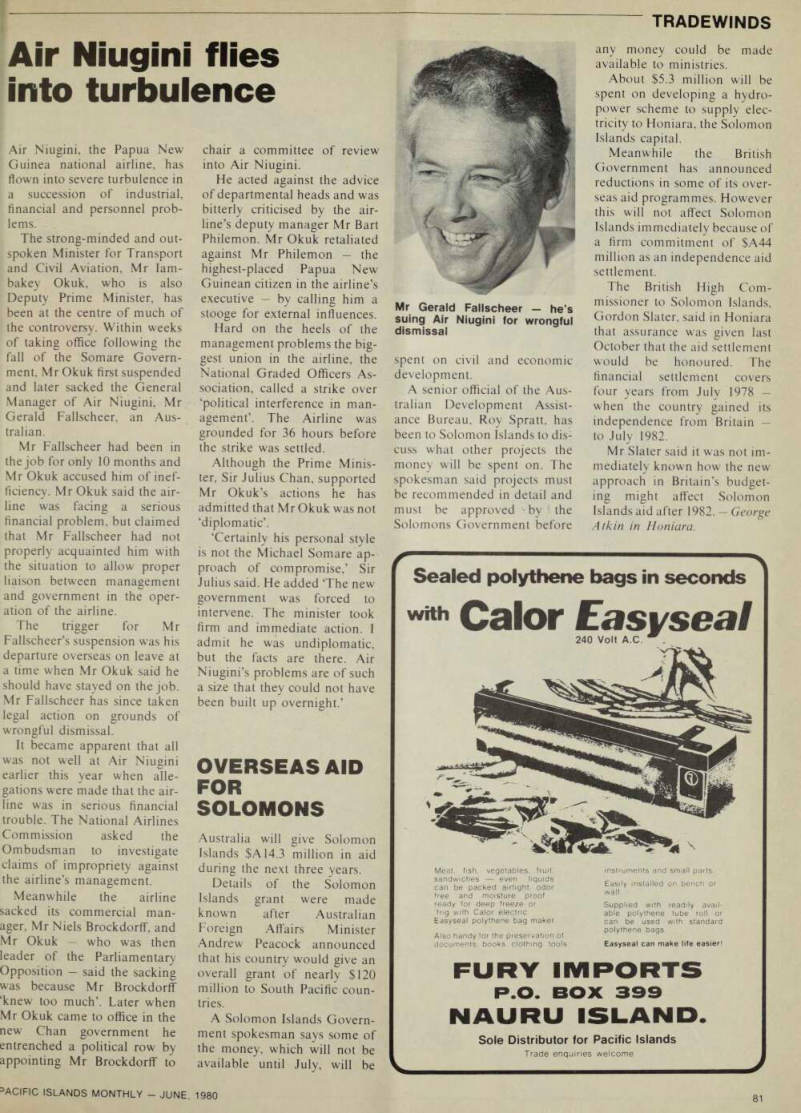
into turbulence
Air Niugini, the Papua New Guinea national airline, has flown into severe turbulence in a succession of industrial, financial and personnel prob lems.
The strong-minded and out
spoken Minister for Transport
and Civil Aviation, Mr lam bakey Okuk, who is also Deputy Prime Minister, has been at the centre of much of the controversy. Within weeks of taking office following the fall of the Somare Govern ment, Mr Okuk first suspended and later sacked the General Manager of Air Niugini, Mr Gerald Fallscheer, an Aus tralian.
Mr Fallscheer had been in the job for only 10 months and Mr Okuk accused him of inef ficiency. Mr Okuk said the air line was facing a serious financial problem, but claimed that Mr Fallscheer had not
properly acquainted him with
the situation to allow proper liaison between management and government in the oper ation of the airline.
The trigger for Mr Fallscheer’s suspension was his departure overseas on leave at a time when Mr Okuk said he should have stayed on the job.
Mr Fallscheer has since taken legal action on grounds of
wrongful dismissal.
It became apparent that all was not well at Air Niugini earlier this year when alle gations were made that the air line was in serious financial trouble. The National Airlines Commission asked the Ombudsman to investigate
claims of impropriety against
the airline’s management.
Meanwhile the airline sacked its commercial man ager, Mr Niels Brockdorff, and Mr Okuk who was then
leader of the Parliamentary
Opposition - said the sacking was because Mr Brockdorff ‘knew too much’. Later when Mr Okuk came to office in the new Chan government he
entrenched a political row by
appointing Mr Brockdorff to
chair a committee of review into Air Niugini.
He acted against the advice of departmental heads and was bitterly criticised by the air line’s deputy manager Mr Bart Philemon. Mr Okuk retaliated against Mr Philemon the
highest-placed Papua New
Guinean citizen in the airline’s executive by calling him a stooge for external influences.
Hard on the heels of the
management problems the big
gest union in the airline, the National Graded Officers As sociation, called a strike over ‘political interference in man agement’. The Airline was grounded for 36 hours before the strike was settled.
Although the Prime Minis ter, Sir Julius Chan, supported Mr Okuk’s actions he has admitted that Mr Okuk was not
‘diplomatic’.
‘Certainly his personal style
is not the Michael Somare ap
proach of compromise,’ Sir
Julius said. He added ‘The new government was forced to intervene. The minister took firm and immediate action. I admit he was undiplomatic, but the facts are there. Air Niugini’s problems are of such a size that they could not have been built up overnight.’
Overseas Aid
For
Solomons
Australia will give Solomon Islands $A14.3 million in aid during the next three years.
Details of the Solomon Islands grant were made known after Australian Foreign Affairs Minister Andrew Peacock announced that his country would give an overall grant of nearly $l2O million to South Pacific coun tries.
A Solomon Islands Govern ment spokesman says some of the money, which will not be available until July, will be
spent on civil and economic
development.
A senior official of the Aus tralian Development Assist ance Bureau, Roy Spratt, has been to Solomon Islands to dis cuss what other projects the money will be spent on. The
spokesman said projects must
be recommended in detail and must be approved by the Solomons Government before
any money could be made available to ministries.
About $5.3 million will be spent on developing a hydro power scheme to supply elec tricity to Honiara, the Solomon Islands capital.
Meanwhile the British Government has announced reductions in some of its over seas aid programmes. However this will not affect Solomon Islands immediately because of a firm commitment of SA44 million as an independence aid settlement.
The British High Com missioner to Solomon Islands, Gordon Slater, said in Honiara that assurance was given last October that the aid settlement would be honoured. The financial settlement covers four years from July 1978 when the country gained its independence from Britain to July 1982.
Mr Slater said it was not im mediately known how the new
approach in Britain’s budget
ing might affect Solomon
Islands aid after 1982.
George
Atkin in Honiara.
Mr Gerald Fallscheer-he’s suing Air Niugini for wrongful dismissal
Advertisements & other items, pp. 81-84 (2 items)
Tradewinds
81
'ACIFIC ISLANDS MONTHLY JUNE, 1980
wtth Calor E
Sealed polythene bags in seconds
rt 240 Volt A.C. u V. <*; 41 Meat. fish, vegetables, fruit, sandwiches even liquids can be packed airtight, odor free and moisture proof ready for deep freeze or frig with Calor electric Easyseal polythene bag maker. instruments and small parts.
Easily installed on bench or wall.
Also handy for the preservation of documents, books, clothing, tools.
Supplied with readily available polythene tube roll or can be used with standard polythene bags.
Easyseal can make life easier!
FURY IMPORTS
P.O. BOX 399
NAURU ISLAND.
Sole Distributor for Pacific Islands Trade enquiries welcome
V tJ V9t OSB &» W
S^JKggS
* fi ■ a
iPS
3fl £ a* 3T % h 9 0^ (N' s ® X a\s c ° Ae ""C* aX we t^°' p
V e r V<^ ea -
*£&***» V^ e -
eol °'rts
o,oo° ~000 ea' 100
n ONN
00° , s^\a ca ° 0^ S V> t*"
jjS^
cc#
nfS^
ftf'
IRADEWINDS INTELLIGENCE...TRADEWINDS INTELLIGENCE...TRA
THE PAPUA New Guinea Government has accepted a determination from its minimum wages board which will mean the granting of full wages indexation up to 8% cost of living increases.
The increases will be measured every three months and the arrangement will apply at least for three years. The Labor and Employment Minister, Mr Jacob Lemeki, who announced the arrangements, said the government planned to reduce its role as an arbitrator. If the cost of living rises more than 8% in a threemonth period there will be partial indexation. PNG generally has been keeping down its inflation to 5% annually, although recent figures showed a higher trend.
NAURU has formally expressed its disappointment to the Asian Development Bank for continuing not to recognise Nauru as a developing member nation under the terms of the bank’s constitution. The Asian Development Bank is an organisation which makes soft loans available to developing nations. At present however it considers Nauru ineligible because of the high income relative to population which is earned from phosphate exports. Nauru believes it should be eligible today for development aid and should not have to wait 10 or 20 years until its income slumped as phosphate deposits became exhausted. Mr K. Clodumar, who represented Nauru at the recent session of the Economic Commission for Asia in Thailand, said there was an urgent need to immediately draw up resources for Nauru’s future if longstanding dependence on foreign aid was to be avoided.
FOLLOWING the storms which brought severe flooding to the Central Division of Fiji earlier this month concern has been caused by sickness in cattle herds in the area. The Ministry of Agriculture says much of the trouble can be attributed to semistarvation because of the loss of normal pasture in the floods.
The Ministry has mounted a special relief campaign, and has been making free issues of molasses, coconut meal and wheat bran as cattle fodder. At the height of the flooding more than 2000 cattle were swept away and drowned.
A STERLING loan of £1 million which Britain had agreed to make to Tonga has been increased by nearly half to enable a greater degree of roadwork and electricity development to be carried out. The amended agreement was signed in Tonga recently.
The loan is interest free and repayable in 25 years.
TOURISM to the Marianas increased by 26% for the month in March according to figures released by the Marianas Visitors Bureau. The bulk of the visitors came from USA and Japan.
NEW Hebrides, due to become independent on July 30 with the national name of Vanuatu, is to follow the pattern set by most other Pacific countries by declaring an exclusive economic zone of 200 nautical miles from its shoreline. The intention was announced by the Finance Minister, Mr Kalpokor Kalsakau.
THE NEW Zealand company Winstone Ltd has won contracts worth SNZ7 million for realigning, surfacing and sealing 52 km of the Papua New Guinea Highlands Highway. The highway links the port of Lae with Goroka in the inland mountains. The newlylet contracts go to two subsidiaries of Winstones Winstone Quarries and Kubor Earthmovers (PNG). Kubor is a PNG-based company.
A CONTROVERSY has arisen over arrangements for shipping bananas from Western Samoa and Tonga to New Zealand following a SNZSO,OOO loss when more than 4000 cases went bad in the cargo ship Forum New Zealand. The bananas were packed in shipping containers equipped with electrically-powered chillers which obviously did not work or were not connected during the voyage. The controversy concerns the suitability of the equipment and the industrial responsibility to connect and monitor the
equipment during voyages.
AN AUSTRALIAN partnership formed by Wood Hall Ltd, Thiess Holdings Ltd and Leighton Holdings Ltd has begun preliminary work on the sAustsl million Nadi-Lautoka water supply scheme in Fiji. The project is due for completion in 1983.
It will include the construction of an earth and rockfill dam, a water treatment plant and about 60 km of supply piping.
THE ASIAN Development Bank, already heavily involved in hydro-power development in Western Samoa, is to extend its services there by undertaking a feasibility study for a hydro scheme in the Vaipu and Afulio Basins 30 km outside Apia. The team of consultants to be provided under the technical assistance will include a geologist, a hydrologist, a surveyor and specialist engineers experienced in dam design and construction, electromechanical designs of hydro plants and the design of transmission facilities. The consultants’ field work is expected to begin in August.
A GROUP of businessmen from northern Queensland in Australia want to promote trade and tourism between their part of the State and Papua New Guinea. Traditionally the trade and tourist links have been from Australian east coast ports further south, but business interests in the north of Queensland now want to promote the ports of Cairns and Townsville for links with PNG.
A ship owned by the Dillingham Corporation has already begun a regular service between northern Queensland and PNG.
THE BANK of NSW (Papua New Guinea) Ltd has sold 450 000 shares, a little more than 10% of its paid-up capital, to the Investment Corporation of PNG, the Public Service Association and the Public Service Association’s Savings and Loan Society. The placements, worth K 450 000 are to provide additional capital to meet continuing growth, and are in line with the PNG Government policy of local equity in overseas owned companies.
THE FIJI economy will continue to face strong inflationary pressures in the immediate future, according to the government statistician in Suva, Mr Ratilal Lodhia. Mr Lodhia was commenting on the latest cost of living figures which showed that the consumer price index in March was 12.6% higher than it had been in March last year. Mr Lodhia said that despite Fiji’s attempts to keep down its own prices spiral, it faced the common problem of Pacific Island countries in ‘importing’ inflation from its trading partners.
A PROGRAMMING mission established under the Lome Convention will begin touring South Pacific countries this month to discuss the incoming aid budget for expenditure in the South Pacific. Lome is a link between the European Economic Community, Pacific Island countries and Caribbean countries. It provides concessional access for tropical products to Europe, a measure of stabilisation in the produce market, and also a channel for aid from the EEC to the Pacific and Caribbean.
THE FIJI Government has asked Air New Zealand and Qantas to sell it their shares in the Fiji national airline, Air Pacific. Air New Zealand and Qantas each holds 9.15 % of the issued capital in Air Pacific and the Fiji Government already holds 73%. In Papua New Guinea the Transport Minister, Mr Okuk, has confirmed in principle that his government wants to buy out an 11% holding by the Australian Ansett group in the PNG national airline, Air Niugini. Mr Okuk concedes however that his government cannot immediately finance such a purchase.
THE FEDERATED States of Micronesia have adopted new laws to regulate banking business, including the terms of ownership of banks. Local banks will require a minimum capital of a million dollars, of which Micronesian citizens must own two-thirds.
Foreign banks trading locally will need capital of up to $2O million. The new laws set up a banking board.
LICENCE.
.TRADEWINDS INTELLIGENCE...TRADEWINDS INTELLIGE
INTEGRATED TECHNICAL SERVICES
• SALES
• ON SITE INSTALLATION
• FIELD SERVICE
• HF.VHF, UHF LINK AND MOBILE SYSTEMS
• GROUND AIR COMMUNICATIONS
• MARINE NAVIGATION AND COMMUNICATIONS
• AIRCRAFT ELECTRONIC SYSTEMS
FIELD ENGINEERING INTEGRATED TECHNICAL SERVICES
P. 0. Box 350, Cairns 4870, Queensland. Australia.
Phone: (070) 51 1616.51 4826,53 1356.51 3052. Telex: AA 48085
DISTRIBUTORS OF:
MANUFACTURERS OF;
• CODANHFSSB SYSTEMS
• PHILIPS VHF/UHFFM MOBILE SYSTEMS
• JRC MARINE RADAR, SOUNDERS, SATTELITE
NAVIGATORS
• MAGNAVOX SATTELITE NAVIGATORS
• DECCA MARINE RADAR
• KING, MARCO, SUNAIR, COLLINS AIRCRAFT
RADIO SYSTEMS
• PORTABLE DEPTH FINDERS
• HF RADIO SCANNERS
• VOICE SCRAMBLERS
• MICROPROCESSOR BASED CONTROL SYSTEMS
• RADIO LOCATED TRANQUILIZING DARTS
FOR WILDLIFE MANAGEMENT
* o 'T 2r -o o in &
FOR:
IN OUR 86th YEAR SELLING ‘SERVICE’
TO THE PACIFIC ISLANDS
Nelson &Robertson
PTY. LTD. (Established 1895)
Plantation House, 197 Clarence Street, Sydney.
Cables: ‘IVAN’, Sydney, Brisbane. Telex: AA22381, Sydney.
INDENTS - FROM AUSTRALIA, NEW ZEALAND and OVERSEAS.
FOODSTUFFS • SOFTGOODS • HARDWARE • MACHINERY TRAVEL • INSURANCE • CANNED FISH • JUTE GOODS
• REAL ESTATE •
BRANCH OFFICES:
Nelson & Robertson Pty. Ltd.,
PAPUA NEW GUINEA
REPRESENTATIVES:
Rabtrad Nuigini Pty. Ltd., P.O. Box 575, Brisbane, Qld., Australia.
P.O. Box 2092, Govt. Bldg., Suva, Fiji.
P.O. Box 258, Lautoka, Fiji, P.O. Box 2420, CPO Auckland 1, New Zealand.
P.O. Box 219, Rabaul, P.N.G.
P.O. Box 1406, Lae, P.N.G, P.O. Box 711, Madang, P.N.G P.O. Box 253, Kieta, P.N.G. n a ■ W-V-.. v in V V A I V
Islands
From the
Press
From the Papua New Guinea Post-Courier, Port
Moresby
The Police Force is ineffective, the Police Commissioner, Mr Philip Bouraga, said yesterday. Mr Bouraga said the force was lacking responsible and effective manpower in all areas of its operations ‘Policemen at all ranks are working under continuous public criticism,’ he said. ‘There is, however, some truth in suggestions of police brutality when arresting people and misuse of police cars,’ Mr Bouraga said ‘There is also evidence of uniformed policemen acting irresponsibly but I have no time or resources to investigate’...
From an editorial in the Micronesian Independent It is with some degree of expectation and hope that we regard the completion of lengthy status negotiations betwen the peoples of the United States and the Marshall Islands. The fact that the Marshalls has again proven itself more organised and more apt to negotiate a sophisticated and far-reaching compact surely gives observers the impression that, as a group, the inhabitants of these central Pacific atolls still have a cohesiveness and communal strength, despite more than 30 years of unchannelled and often disruptive administration by a second power.
From a speech by Fiji Minister of Education Semesa Sikivou, reported in The Fiji Times, Suva ‘Far too often evidence of our failure in citizenship training is clearly seen,’ he said. ‘And it is increasingly and alarmingly becoming a pattern in our daily lives. I appeal to you all, as you look for new directions and new emphasis in the next 50 years to regard getting rid of this growing cancer of anti-social, anti-government behaviour and lawlessness from our society’s
body as topmost priority.’
From an interview with Fijian singer Sakiusa Bulicokocoko reported in the News Drum, Honiara ‘Musically, I prefer Japan to the States, Japanese singers are so versatile. They can copy the styles of songs so accurately, they even copy the scratches on the record,’ he said.
From a letter in the Arawa Bulletin, North Solomon Province, Papua New Guinea Arawa is becoming a dangerous place to live in and enjoy her image. Crimes such as paybacks between groups of wantoks, break and enters to people’s homes, attacks on persons by drunken mobs and fighting are emerging here and there on a considerable scale. One could risk his or her life to take a walk alone to enjoy the cool of the evening in the town . . . Another factor eroding the images of the towns of Arawa, Kieta and Toniva is prostitution or the so-called Five Kinas. There is a grave rise in the rate of prostitution which is clearly shown in the increased intake of patients receiving treatment as a consequence.
Letter from reader in New Nation, Port Moresby, Papua New Guinea I was travelling to Wewak town on a bus when I caught one beautiful girl sitting beside me. She took out a comb from her basket and started combing her hair ... If she was my sister I would have kicked her out of the bus . . . My sisters, stop combing your hair in public places because you’ll never marry me or my good friends. I reckon you’re going to marry an alcoholic.
From the Nauru Post, Nauru A well known doctor in Kiribati occupied a double nakatari with a Nauruan of some affluence. The doctor was absolutely amazed to notice that the Nauruan, for want of something better, had used a $2O note as toilet paper.
From a News Drum report of a debate in the Solomons Parliament on new regulations for voting in elections Mr Hilly (Simbo and Ranonga) wanted the voting age to be lowered to 16 . . . and Mr Tepaika (Minister) wanted the people aged 60 and over to be excluded from voting.
From a letter in the Arawa Bulletin, North Solomon Province, PNG I would like to get it across and especially to immature brother of Camp 6 at Loloho about throwing stones during movies. Whoever you are, please leave us alone with respect. Most of us come to watch movies in peace without any disturbance but when movies do not suit you, please move out in a good manner. I myself and many others get very cross when you throw stones on the roof, wall and even at the screen while the movie is on.
From the Cook Islands News, Rarotonga It took a Nikao resident several attempts in the course of half an hour on Saturday night to get through to the telephone exchange to ask them to put her through to the fire emergency station. Meanwhile, a five-room house across the road was
burning merrily away.
From The Fiji Times, Suva The proprietor of a sauna bath at Lautoka has landed in hot water with the city council over the absence of toilet facilities in an adjoining cafe. The council says it approved the bath plans on condition the owner, Mr M. Khalil, provided a toilet in the cafe located in the same building. The original toilet for the cafe was closed off in the sauna bath section, leaving no convenience for the cafe as required by law. And as tempers heat up over this issue the council says Mr Khalil will have to close down his cafe unless he provides the facility .. .
From the Cricket section Arawa Bulletin, North Solomon Province, PNG Congratulations to these ranunculaceous adonic youths from Panguna with the bloom of innocence yet upon their cheeks racing across the dampened verdant field to glory.
From a leter in the News Drum, Honiara, protesting at a rise in shipping fares according to public opinion, it is to a great extent unfair, not appropriate, unprofaned and unweening. The question is, will the services improve then because the fares have gone up? Certainly not. It will only bring nothing but more coffee for the concerned Board of Directors.
Advertisements & other items, p. 86 (1 item)
Export
Insurance Service
throughout the islands
I i
Queensland Insurance (Fiji) Limited
Head Office, 34 Usher St SUVA. General Manager: L. G. Liddell A.A.1.1. Assistant Managers- Vijay Lai and J. I Laidlaw. Phone: 23851.
LAUTOKA OFFICE; Burns Philp Bldg., Naviti St. District Manager: J. Dalton. Phone: 60642.
Queensland Insurance (PNG) Limited
. PAPUA NEW GUINEA
Head Office, B.N.G. Building, Musgrave St.,PORT MORESBY. General Manager J M Assistant Manager; R. V. Maskell. Phone; 212144. 2A^5l? r ?. natlon rP rive - District Manager; I. R. Martin. Phone; 423873, MOUNT HAGEN; Hagen Drive. District Manager: D. F. Carroll. Phone; 521002. An^ AWA: Chebu St. District Manager; J. Longbut. Phone: 951555.
MADANG; Kasagten St. District Manager: N. D. Ramage. Phone' 822020 RABAUL; Wirraway St. District Manager; W. F. Tinker. Phone; 921014.
Dawe,
QBE Insurance Limited
NEW HEBRIDES, PORT VILA: Rue de Paris, Suite 19, Oceania Bldg. Manager: G. F. Donnelly.
Phone: 2299.
SANTO: Burns Philp (New Hebrides) Ltd. Phone' 230
Mru(^Al PACIFIC AGENCIES
NEW CALEDONIA: T. A. Hagen, Ste. W. A. Johnston, S.A.R.L. 5 Rue Anatole France NOUMEA Phone: 272083.
TAHITI: Arthur Chung, Immeuble 8.1.5., Front deMer, PAPEETE. Phone: 2.86.19 NIUE: Burns Philp (South Sea) Company Ltd N 9PfS LK ISLAND; Bums Philp (South Sea) Company Ltd. Phone; 2191.
TnMO A SA^9, A: APIA - Burns Philp (South Sea) Company Ltd. Phone: 22611 TONGA; Burns Philp (South Sea) Company Ltd. NUKUALOFA. Phone 21500 HAAPAI, VAVAU.
MEMBERS OF THE:
QBE INSURANCE GROUP UMITED
Ships
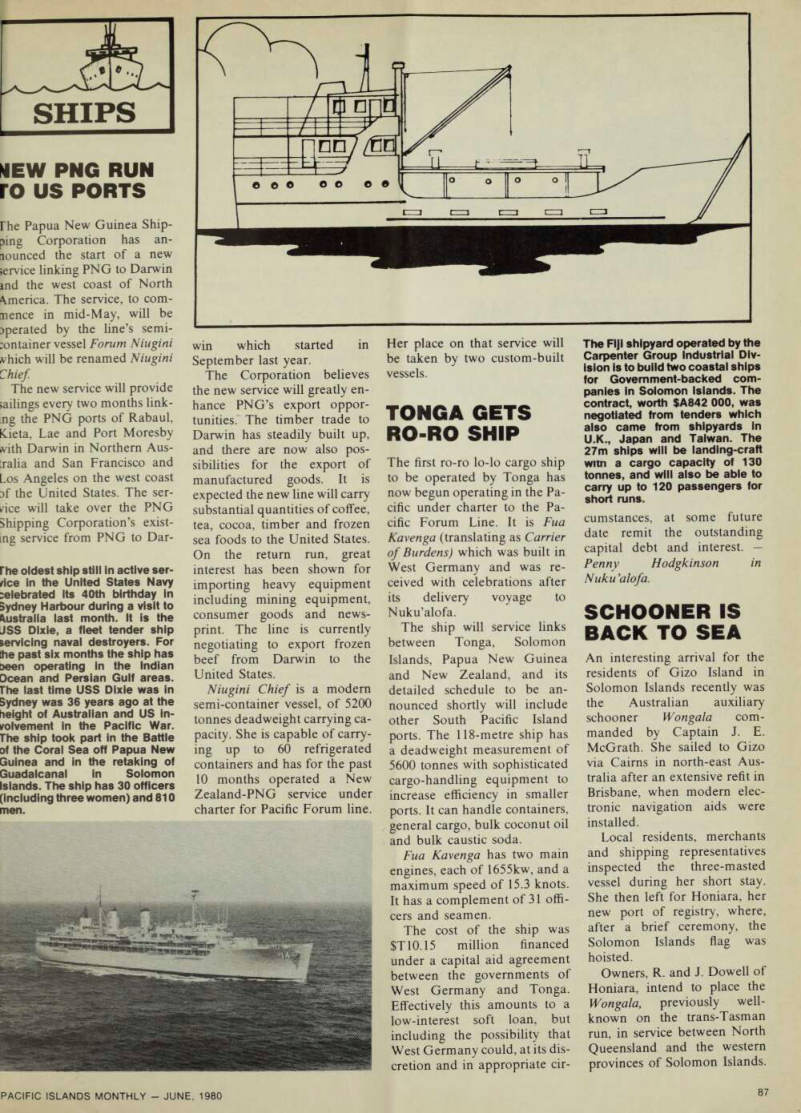
Mew Png Run
Ro Us Ports
fhe Papua New Guinea Ship
ping Corporation has an
nounced the start of a new service linking PNG to Darwin ind the west coast of North America. The service, to com mence in mid-May, will be operated by the line’s semi :ontainer vessel Forum Niugini vhich will be renamed Niugini
Chief
The new service will provide sailings every two months link ng the PNG ports of Rabaul, Kdeta, Lae and Port Moresby ivith Darwin in Northern Aus :ralia and San Francisco and Los Angeles on the west coast nf the United States. The ser vice will take over the PNG Shipping Corporation’s exist ing service from PNG to Dar-
win which started in September last year.
The Corporation believes the new service will greatly en hance PNG’s export oppor tunities. The timber trade to Darwin has steadily built up, and there are now also pos sibilities for the export of manufactured goods. It is expected the new line will carry substantial quantities of coffee, tea, cocoa, timber and frozen sea foods to the United States.
On the return run, great interest has been shown for
importing heavy equipment
including mining equipment,
consumer goods and news print. The line is currently negotiating to export frozen beef from Darwin to the United States.
Niugini Chief is a modem semi-container vessel, of 5200
tonnes deadweight carrying ca
pacity. She is capable of carry ing up to 60 refrigerated containers and has for the past 10 months operated a New Zealand-PNG service under charter for Pacific Forum line.
Her place on that service will be taken by two custom-built vessels.
Tonga Gets
Ro-Ro Ship
The first ro-ro 10-lo cargo ship
to be operated by Tonga has
now begun operating in the Pa cific under charter to the Pa cific Forum Line. It is Fua Kavenga (translating as Carrier of Burdens) which was built in West Germany and was re ceived with celebrations after its delivery voyage to Nukualofa.
The ship will service links between Tonga, Solomon Islands, Papua New Guinea and New Zealand, and its detailed schedule to be an nounced shortly will include other South Pacific Island ports. The 118-metre ship has a deadweight measurement of 5600 tonnes with sophisticated
cargo-handling equipment to
increase efficiency in smaller ports. It can handle containers, general cargo, bulk coconut oil and bulk caustic soda.
Fua Kavenga has two main engines, each of 1655 kw, and a maximum speed of 15.3 knots.
It has a complement of 31 offi cers and seamen.
The cost of the ship was 5T10.15 million financed under a capital aid agreement between the governments of West Germany and Tonga.
Effectively this amounts to a low-interest soft loan, but
including the possibility that
West Germany could, at its dis cretion and in appropriate dr
cumstances, at some future date remit the outstanding capital debt and interest.
Penny Hodgkinson in
Nuku ’alofa.
Schooner Is
Back To Sea
An interesting arrival for the residents of Gizo Island in Solomon Islands recently was the Australian auxiliary schooner Wongala com manded by Captain J. E.
McGrath. She sailed to Gizo via Cairns in north-east Aus tralia after an extensive refit in Brisbane, when modern elec tronic navigation aids were installed.
Local residents, merchants
and shipping representatives
inspected the three-masted vessel during her short stay.
She then left for Honiara, her new port of registry, where, after a brief ceremony, the Solomon Islands flag was hoisted.
Owners, R. and J. Dowell of Honiara, intend to place the
Wongala, previously well
known on the trans-Tasman run, in service between North Queensland and the western provinces of Solomon Islands.
The oldest ship still in active ser vice in the United States Navy Celebrated its 40th birthday in Sydney Harbour during a visit to Australia last month, it is the USS Dixie, a fleet tender ship servicing naval destroyers. For the past six months the ship has been operating in the Indian Ocean and Persian Gulf areas, The last time USS Dixie was in Sydney was 36 years ago at the height of Australian and US in volvement in the Pacific War.
The ship took part in the Battle of the Coral Sea off Papua New Guinea and in the retaking of Guadalcanal in Solomon Islands. The ship has 30 officers (including three women) and 810 men.
The Fiji shipyard operated by the Carpenter Group Industrial Div ision is to build two coastal ships for Government-backed com panies in Solomon Islands. The contract, worth SA842 000, was negotiated from tenders which also came from shipyards in U.K., Japan and Taiwan. The 27m ships will be landing-craft with a cargo capacity of 130 tonnes, and will also be able to carry up to 120 passengers for short runs.
Wind Power
Experiment
A world-wide trend to recon sider the possibilities of wind power for working ships has led to the construction of a new type of sailing schooner in New Zealand. The schooner is the 146-ton Manutea, built by Kumeu Engineering Ltd in Auckland, and soon to go into service between New Zealand and Pacific Island ports.
The schooner was ordered by a newly-formed company known as South Pacific Wind power, backed by a group of US technicians now based in New Zealand’s Bay of Islands.
The company is designing,
manufacturing and marketing
pumps and electrical gener
ators driven by wind-power
and has committed itself to its
own principles by deciding to
use a sailing ship for exporting the equipment. The company also makes solar panels for generating power from sun
light.
Manutea is more than a modern copy of an old design.
Most of its power supplies for navigation equipment, deck equipment and other auxiliary use will come from wind and solar sources. The rigging has
also been specially designed sc that a crew of up to eight wil be able to handle the 550 C square feet of sail. The schooner is 112 ft overall, ha; a beam of 25 ft and a 500( cubic-ft cargo capacity.
If the experiment is success ful, the owners plan to com mission a bigger schooner buili on similar lines.
China Links
In Agency
A joint Pacific shipping ven ture is to be established be tween the Australian firm Bums Philp and Company Ltd and the Chinese company COSCO (China Ocean Ship
ping). COSCO vessels already
operate from China to Aus tralian and Pacific Island ports but the new combined venture will create a specialised South Pacific joint agency. It is the first venture to be established in partnership for South Pacific shipping operations between an Australian company and a Chinese State-owned organis ation.
Executives of Bums Philp visited China over a period of three months to negotiate the arrangements, and the final agreement was signed in Syd ney recently between the
Deputy General Manager of
COSCO, Mr Zhou Qiuyan and the Chairman of Bums Philp, Mr J. D. O. Bums.
The agreement will come into force in July, and will take over from existing COSCO ar rangements in the South Pa cific.
COSCO ships which already visit Australia and the Pacific Islands include a big pro-
Blsh Limited of Fiji, general and
marine engineers, have begun a drive to develop ship repair and survey work in Fiji rather than see the work going to Australian and New Zealand workshops.
Members of a new top manage ment team to achieve this are (left) Mr Colin Wieff who was re cruited from Australia as engin eering manager and Mr John Watson who was recruited from New Zealand as general man ager.
portion of bulk carriers hand ling sugar, wheat and iron ore.
The company operates nearly 500 ships on its world routes, and had 300 movements in and out of Australia last year.
Capital for the new venture will be contributed equally be tween COSCO and Burns Philp.
Tuna Survey
Goesahead
A South Pacific Commission
research project into skipjack
tuna resources is now well ad vanced following the continu ing operations of the chartered research ship Hatsutori Maru.
Since late in 1977 the ship has
caught, tagged and released
114 000 tuna. About 4000 of the tagged fish have since been caught in countries over a wide region of the South Pacific, and the date and location advised to the research project.
The operation is part of a wide-ranging survey which will provide information about the migratory habits of tuna, and will assist in arrangements for the planned South Pacific fish ing agency, as well as providing international scientific infor mation.
Hatsutori Maru, which has
recently been operating in
Fijian waters and carries a number of Fijian crewmen, has operated in the waters of 19 Pa cific Island countries and terri tories during the present programme.
One of the research scientists involved in the project, Mr Robert Gillett, reported that a considerable amount of im portant information had been gained. He said that islander fishermen had generally been
co-operative in returning
details of tagged fish they had
caught.
He said it was interesting to note that of 9000 skipjack and
yellowfin tuna tagged in Fiji
waters early in 1978, 950 had since been caught by fishermen as far apart as Fiji, Tonga, Tahiti, Samoa, Tuvalu and New Zealand.
The ship will shortly begin a
tagging programme in waters of Wallis Island and Solomon Islands. Before the end of the year taggings will also be extended to the Philippines
and Japan to determine mi gration movements towards the South Pacific.
The migration habits of tuna are one of the principal issues
causing disagreement between
South Pacific countries and USA towards the proposed fisheries agencies involving South Pacific governments.
The South Pacific governments claim absolute right to all tuna in their marine resource limits,
but the general principle
adopted by USA is that tuna should be considered a ‘free’ resource because of their extensive migration move ments.
. . . Butthese
Tuna Escape
In Western Samoa a commis sioning exercise for a new tuna fishing ship was a failure when
handling equipment did not
operate correctly. The ship
Austin Bernicke is one of two
purse-seiners bought by the
local Nauru Local Govern ment Council for a tuna fishing project in Nauru. Officials from the council were on board for the commissioning exercise which was operated out of the port of Apia.
About a mile of nets had been laid in a circle and the lower rim at 500 metres was being tightened when a steel cable broke. What appeared to have been a heavy catch then escaped, and the net brought to the surface only seven tuna and one other fish which was not identified. The ship returned to Apia where new and heavier
equipment is being installed.
Austin Bernicke and a sister ship Victor Eoaeo were built for a French company which encountered financial difficult ies, and were recently acquired from a shipyard in Peru for the
Nauru project.
Yap Service
Philippines, Micronesia &
Orient Navigation Company
(PM and O Line) has an nounced the addition of Yap as a port of call in its Micronesian service. PM and O vessels are now calling on a regular basis at Majuro, Kosrae, Ponape, Truk, Saipan and Koror.
Advertisements & other items, pp. 88-90 (2 items)
Bounty Hunter
AND
RELICS
iy:n >
OUR AUSTRALIAN EXPERIENCE SINCE 1974
INDICATES TO US THAT THESE ARE MOST
ASSUREDLY FOR AUSTRALIAN CONDITIONS
THE VERY LATEST LIGHTWEIGHT MACHINES
FOR THE GREATEST
DEPTH PENETRA TION
IN
MAGNETIC GROUND CONDITIONS
(WHERE THE GOLD IS USUALLY LOCATED.)
BOUNTY HUNTER
"THE ONE THAT GETS THE GOLD"
MADE IN U.S.A.
25 MODELS - LIFETIME WARRANTY
-ALL PRICES
SEE THE RANGE - TEST THEM YOURSELF
AT ALL QUALITY DETECTOR STOCKISTS
AND DON'T SETTLE FOR ANYTHING LESS!
BOUNTY HUNTER HAS MORE VALUE PACKED
FEATURES. SOME MODELS ARE STANDARD
WITH 3 SEARCH COILS!
PHONE OR WRITE FOR FREE DATA PACKAGE
AND NEAREST DEALER LOCATION.
Sole S.W. Pacific Distributors & Factory-Approved Service Centre
HENDON DETECTOR COMPANY
An Associate of Southern Patagonian Holdings Pty Limited Office: 121 Plateau Rd. Telephone: (STD 02) 918 6288, 918 6667 (24 Hrs.) AH Mai! to: P.O. BOX 11. V,, AVALON BEACH, NSW, 2107, AUSTRALIA Telex: 70560 Telegrams: "HEN DON AERO SYDNEY"
REPUTABLE NEW DEALERS ARE WELCOME -
NEVER SAY NO TO A CUSTOMER - WE CAN
PUT BOUNTY HUNTER GOLD DETECTORS ON
YOUR SHELVES IN 24 HOURS!
FORESTMIL
PORTABLE
SAWMILL
Recent release new models are heavier duty with additional features. Powered by diesel engine or electric motor.
Forestmil Portable Sawm Forestmil produces any size accurate timber ready to use up to 12" x 9" x 24'.
Purchase price and operating cost of Forestmil is less than other sawing equipment with similar production capacity.
Forestmil reduces timber waste and also reduces log transport cost. Timber is sawn direct from the log in the forest.
Forestmil can be moved to a new location in one hour.
Forestmil will saw hardwood or softwood from logs of any diameter.
Over 1000 Forestmilsare sawing timber in 23 countries.
Forestmil has been manufactured for 18 years.
For literature and prices please contact the manufacturers.
MacQuarrie Industries Pty.Ltd.
P.O. Box 20, Coburg 3058, Victoria, Australia.
Phone: 350-3411. Telex: 33729. Cables: Macbound, Melbourne.
Ist
plumbing supplies Fast
Total service 0n ...
You can get all your needs from one supply source; water taps, valves, copper tube, tools and a host of other fittings and related plumbing equipment for domestic, industrial and multi-storey buildings.
Watson & Crane Pty Ltd have over 20,000 plumbing items in stock at their central warehouse located at Waterloo, NSW, Australia.
Years of experience in handling and shipping right throughout the South Pacific add up to another big reason for you to deal with Watson & Crane Pty Ltd.
Representatives call regularly at Papua New Guinea, the Solomons, New Hebrides and Fiji Islands to personally discuss your requirements and appropriate credit arrangements.
Write, cable or telephone today for complete plumbers' supplies service. « * V Watson & Crane Pty. Ltd. 1037 Bourke Street, Waterloo,
NSW 2017.
Phone: Sydney 699-1333.
Telex: AA 25548.
Cables; "Watcrane" Sydney.
G. E.
CRANE
GROUP
Pacific Island distributors of Crano Enfield copper tube for water, sanitation, engineering, refrigeration and air conditioning.
WATSON & CRANE
are organised to fulfil your needs
wherever yen are in the South Pacific
Hokule’a
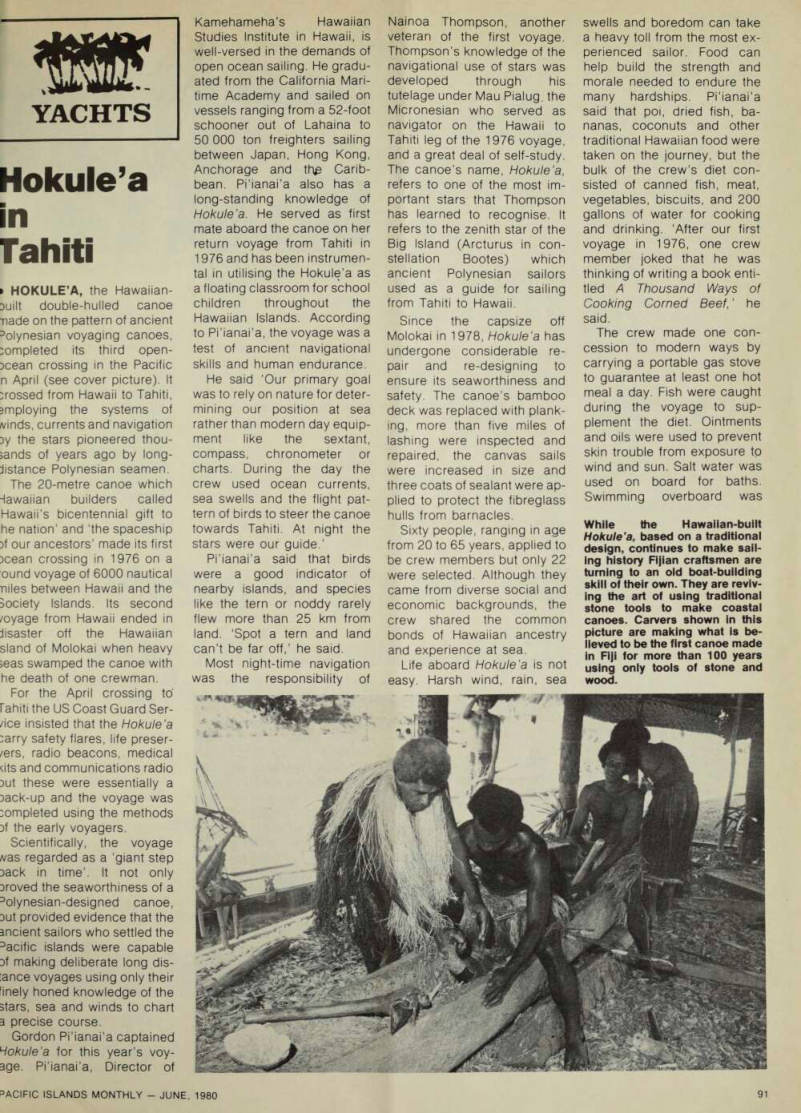
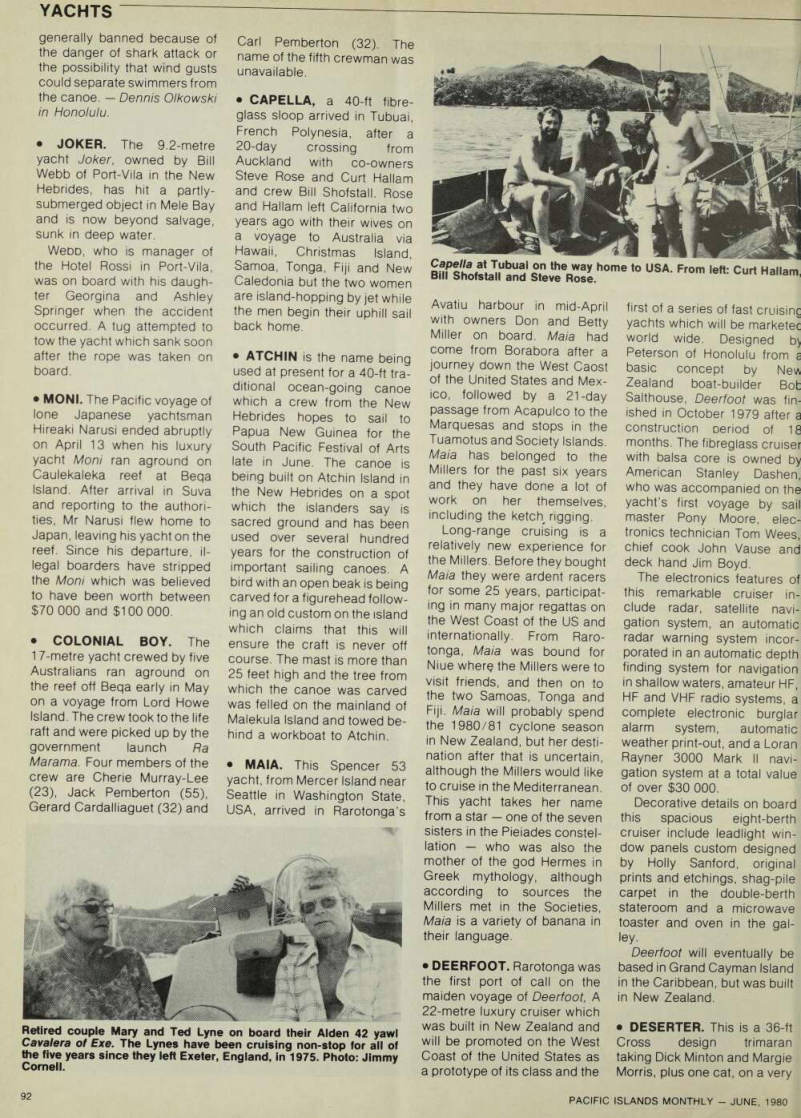
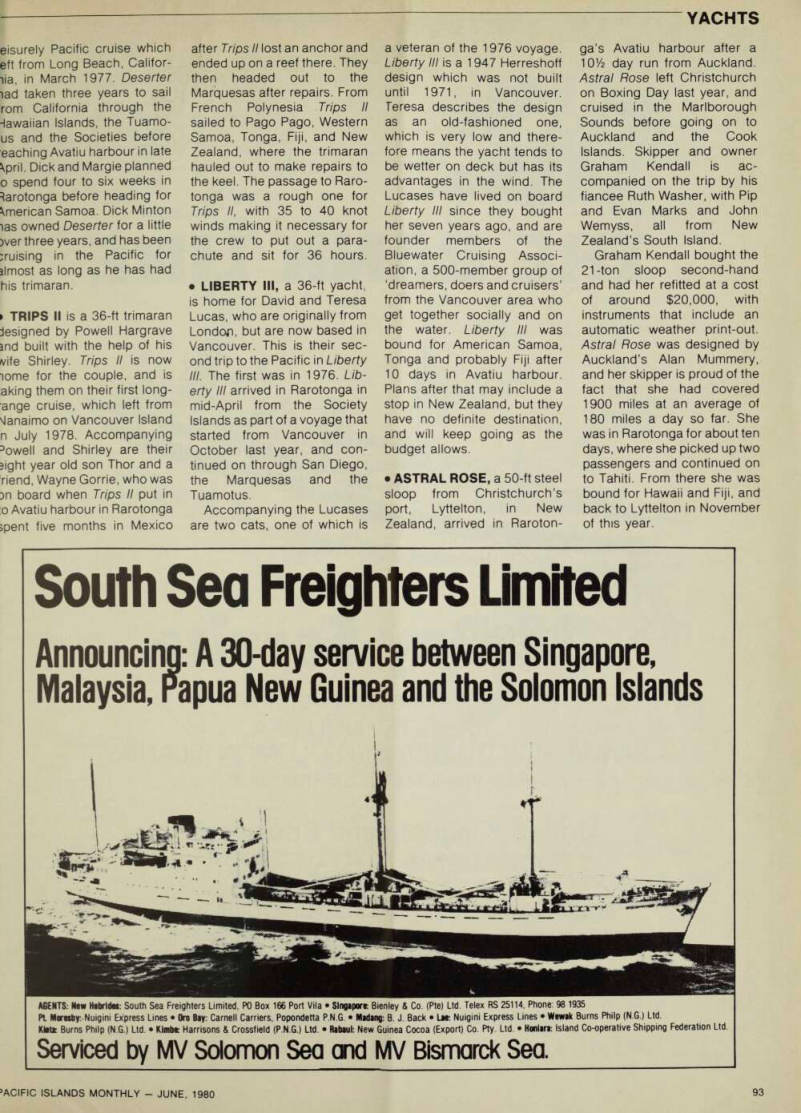
Yachts
Hokule’a in Tahiti
Kamehameha’s Hawaiian Studies Institute in Hawaii, is well-versed in the demands of open ocean sailing. He gradu ated from the California Mari time Academy and sailed on vessels ranging from a 52-foot schooner out of Lahaina to 50 000 ton freighters sailing between Japan, Hong Kong, Anchorage and th£ Carib bean. Pi’ianai’a also has a long-standing knowledge of Hokule’a. He served as first mate aboard the canoe on her return voyage from Tahiti in 1976 and has been instrumen tal in utilising the Hokule’a as a floating classroom for school children throughout the Hawaiian Islands. According to Pi’ianai’a, the voyage was a test of ancient navigational skills and human endurance.
He said ‘Our primary goal was to rely on nature for deter mining our position at sea rather than modern day equip ment like the sextant, compass, chronometer or charts. During the day the crew used ocean currents, sea swells and the flight pat tern of birds to steer the canoe towards Tahiti. At night the stars were our guide.’
Pi’ianai’a said that birds were a good indicator of nearby islands, and species like the tern or noddy rarely flew more than 25 km from land. ‘Spot a tern and land can’t be far off,’ he said.
Most night-time navigation was the responsibility of
Nainoa Thompson, another veteran of the first voyage.
Thompson’s knowledge of the navigational use of stars was developed through his tutelage under Mau Pialug, the Micronesian who served as navigator on the Hawaii to Tahiti leg of the 1976 voyage, and a great deal of self-study.
The canoe’s name, Hokule'a, refers to one of the most im portant stars that Thompson has learned to recognise. It refers to the zenith star of the Big Island (Arcturus in con stellation Bootes) which ancient Polynesian sailors used as a guide for sailing from Tahiti to Hawaii.
Since the capsize off Molokai in 1978, Hokule’a has undergone considerable re pair and re-designing to ensure its seaworthiness and safety. The canoe’s bamboo deck was replaced with plank ing, more than five miles of lashing were inspected and repaired, the canvas sails were increased in size and three coats of sealant were ap plied to protect the fibreglass hulls from barnacles.
Sixty people, ranging in age from 20 to 65 years, applied to be crew members but only 22 were selected. Although they came from diverse social and economic backgrounds, the crew shared the common bonds of Hawaiian ancestry and experience at sea.
Life aboard Hokule'a is not easy. Harsh wind, rain, sea
» HOKULE’A, the Hawaiian- Duilt double-hulled canoe nade on the pattern of ancient 3 olynesian voyaging canoes, :ompleted its third open- Dcean crossing in the Pacific n April (see cover picture). It crossed from Hawaii to Tahiti, employing the systems of /vinds, currents and navigation Dy the stars pioneered thou sands of years ago by long distance Polynesian seamen.
The 20-metre canoe which Hawaiian builders called Hawaii’s bicentennial gift to he nation’ and ‘the spaceship Df our ancestors’ made its first Dcean crossing in 1976 on a ound voyage of 6000 nautical niles between Hawaii and the Society Islands. Its second /oyage from Hawaii ended in disaster off the Hawaiian sland of Molokai when heavy seas swamped the canoe with he death of one crewman.
For the April crossing to' Fahiti the US Coast Guard Ser /ice insisted that the Hokule’a :arry safety flares, life preser vers, radio beacons, medical <its and communications radio Dut these were essentially a Dack-up and the voyage was sompleted using the methods Df the early voyagers.
Scientifically, the voyage /vas regarded as a ‘giant step jack in time’. It not only Droved the seaworthiness of a 3 olynesian-designed canoe, Dut provided evidence that the ancient sailors who settled the 3 acific islands were capable Df making deliberate long dis :ance voyages using only their finely honed knowledge of the stars, sea and winds to chart a precise course.
Gordon Pi’ianai’a captained Hokule’a for this year’s voy age. Pi’ianai’a, Director of
swells and boredom can take a heavy toll from the most ex perienced sailor. Food can help build the strength and morale needed to endure the many hardships. Pi’ianai’a said that poi, dried fish, ba nanas, coconuts and other traditional Hawaiian food were taken on the journey, but the bulk of the crew’s diet con sisted of canned fish, meat, vegetables, biscuits, and 200 gallons of water for cooking and drinking. ‘After our first voyage in 1976, one crew member joked that he was thinking of writing a book enti tled A Thousand Ways of Cooking Corned Beef,' he said.
The crew made one con cession to modern ways by carrying a portable gas stove to guarantee at least one hot meal a day. Fish were caught during the voyage to sup plement the diet. Ointments and oils were used to prevent skin trouble from exposure to wind and sun. Salt water was used on board for baths.
Swimming overboard was
While the Hawaiian-built Hokule’a, based on a traditional design, continues to make sail ing history Fijian craftsmen are turning to an old boat-building skill of their own. They are reviv ing the art of using traditional stone tools to make coastal canoes. Carvers shown In this picture are making what is be lieved to be the first canoe made in Fiji for more than 100 years using only tools of stone and wood.
generally banned because of the danger of shark attack or the possibility that wind gusts could separate swimmers from the canoe. Dennis Olkowski in Honolulu. • JOKER. The 9.2-metre yacht Joker, owned by Bill Webb of Port-Vila in the New Hebrides, has hit a partly submerged object in Mele Bay and is now beyond salvage, sunk in deep water.
Weoo, who is manager of the Hotel Rossi in Port-Vila, was on board with his daugh ter Georgina and Ashley Springer when the accident occurred. A tug attempted to tow the yacht which sank soon after the rope was taken on board. • MONI. The Pacific voyage of lone Japanese yachtsman Hireaki Narusi ended abruptly on April 13 when his luxury yacht Moni ran aground on Caulekaleka reef at Beqa Island. After arrival in Suva and reporting to the authori ties, Mr Narusi flew home to Japan, leaving his yacht on the reef. Since his departure, il legal boarders have stripped the Moni which was believed to have been worth between $7O 000 and $lOO 000.
• Colonial Boy. The
17-metre yacht crewed by five Australians ran aground on the reef off Beqa early in May on a voyage from Lord Howe Island. The crew took to the life raft and were picked up by the government launch Ra Marama. Four members of the crew are Cherie Murray-Lee (23), Jack Pemberton (55), Gerard Cardalliaguet (32) and
Carl Pemberton (32). The name of the fifth crewman was unavailable. • CAPELLA, a 40-ft fibre glass sloop arrived in Tubuai, French Polynesia, after a 20-day crossing from Auckland with co-owners Steve Rose and Curt Hallam and crew Bill Shofstall. Rose and Hallam left California two years ago with their wives on a voyage to Australia via Hawaii, Christmas Island, Samoa, Tonga, Fiji and New Caledonia but the two women are island-hopping by jet while the men begin their uphill sail back home. • ATCHIN is the name being used at present for a 40-ft tra ditional ocean-going canoe which a crew from the New Hebrides hopes to sail to Papua New Guinea for the South Pacific Festival of Arts late in June. The canoe is being built on Atchin Island in the New Hebrides on a spot which the islanders say is sacred ground and has been used over several hundred years for the construction of important sailing canoes. A bird with an open beak is being carved for a figurehead follow ing an old custom on the island which claims that this will ensure the craft is never off course. The mast is more than 25 feet high and the tree from which the canoe was carved was felled on the mainland of Malekula Island and towed be hind a workboat to Atchin. • MAIA. This Spencer 53 yacht, from Mercer Island near Seattle in Washington State, USA, arrived in Rarotonga’s
Avatiu harbour in mid-April with owners Don and Betty Miller on board. Maia had come from Borabora after a journey down the West Caost of the United States and Mex ico, followed by a 21-day passage from Acapulco to the Marquesas and stops in the Tuamotus and Society Islands.
Maia has belonged to the Millers for the past six years and they have done a lot of work on her themselves, including the ketch rigging.
Long-range cruising is a relatively new experience for the Millers. Before they bought Maia they were ardent racers for some 25 years, participat ing in many major regattas on the West Coast of the US and internationally. From Raro tonga, Maia was bound for Niue where the Millers were to visit friends, and then on to the two Samoas, Tonga and Fiji. Maia will probably spend the 1980/81 cyclone season in New Zealand, but her desti nation after that is uncertain, although the Millers would like to cruise in the Mediterranean.
This yacht takes her name from a star one of the seven sisters in the Pieiades constel lation who was also the mother of the god Hermes in Greek mythology, although according to sources the Millers met in the Societies, Maia is a variety of banana in their language. • DEERFOOT. Rarotonga was the first port of call on the maiden voyage of Deerfoot, A 22-metre luxury cruiser which was built in New Zealand and will be promoted on the West Coast of the United States as a prototype of its class and the
first of a series of fast cruising yachts which will be marketer: world wide. Designed b> Peterson of Honolulu from s basic concept by New Zealand boat-builder Bob Salthouse, Deerfoot was fin ished in October 1979 after a construction period of 18 months. The fibreglass cruiser with balsa core is owned by American Stanley Dashen,, who was accompanied on the yacht’s first voyage by saill master Pony Moore, elec tronics technician Tom Wees,, chief cook John Vause and! deck hand Jim Boyd.
The electronics features of this remarkable cruiser in clude radar, satellite navi gation system, an automatic radar warning system incor porated in an automatic depth finding system for navigation in shallow waters, amateur HP, HP and VHP radio systems, a complete electronic burglar alarm system, automatic weather print-out, and a Loran Rayner 3000 Mark II navi gation system at a total value of over $3O 000.
Decorative details on board this spacious eight-berth cruiser include leadlight win dow panels custom designed by Holly Sanford, original prints and etchings, shag-pile carpet in the double-berth stateroom and a microwave toaster and oven in the gal ley.
Deerfoot will eventually be based in Grand Cayman Island in the Caribbean, but was built in New Zealand. • DESERTER. This is a 36-ft Cross design trimaran taking Dick Minton and Margie Morris, plus one cat, on a very
Retired couple Mary and Ted Lyne on board their Alden 42 yawl Cavalera of Exe. The Lynes have been cruising non-stop for all of the five years since they left Exeter, England, in 1975. Photo: Jimmy Cornell.
Cape lla at Tubuai on the way home to USA. From left: Curt Hallam, Bill Shorfstall and Steve Rose.
eisurely Pacific cruise which eft from Long Beach, Califor lia, in March 1977. Deserter lad taken three years to sail rom California through the Hawaiian Islands, the Tuamo us and the Societies before caching Avatiu harbour in late \pril. Dick and Margie planned o spend four to six weeks in Harotonga before heading for \merican Samoa. Dick Minton las owned Deserter for a little )ver three years, and has been cruising in the Pacific for almost as long as he has had his trimaran. » TRIPS II is a 36-ft trimaran jesigned by Powell Hargrave and built with the help of his vife Shirley. Trips II is now iome for the couple, and is aking them on their first long ange cruise, which left from slanaimo on Vancouver Island n July 1978. Accompanying 3 owell and Shirley are their sight year old son Thor and a riend, Wayne Gorrie, who was Dn board when Trips II put in o Avatiu harbour in Rarotonga spent five months in Mexico
after Trips II lost an anchor and ended up on a reef there. They then headed out to the Marquesas after repairs. From French Polynesia Trips II sailed to Pago Pago, Western Samoa, Tonga, Fiji, and New Zealand, where the trimaran hauled out to make repairs to the keel. The passage to Raro tonga was a rough one for Trips 11, with 35 to 40 knot winds making it necessary for the crew to put out a para chute and sit for 36 hours. • LIBERTY 111, a 36-ft yacht, is home for David and Teresa Lucas, who are originally from London, but are now based in Vancouver. This is their sec ond trip to the Pacific in Liberty 111. The first was in 1976. Lib erty 111 arrived in Rarotonga in mid-April from the Society Islands as part of a voyage that started from Vancouver in October last year, and con tinued on through San Diego, the Marquesas and the Tuamotus.
Accompanying the Lucases are two cats, one of which is
a veteran of the 1976 voyage.
Liberty 111 is a 1947 Herreshoff design which was not built until 1971, in Vancouver.
Teresa describes the design as an old-fashioned one, which is very low and there fore means the yacht tends to be wetter on deck but has its advantages in the wind. The Lucases have lived on board Liberty 111 since they bought her seven years ago, and are founder members of the Bluewater Cruising Associ ation, a 500-member group of ‘dreamers, doers and cruisers’ from the Vancouver area who get together socially and on the water. Liberty 111 was bound for American Samoa, Tonga and probably Fiji after 10 days in Avatiu harbour.
Plans after that may include a stop in New Zealand, but they have no definite destination, and will keep going as the budget allows. • ASTRAL ROSE, a 50-ft steel sloop from Christchurch’s port, Lyttelton, in New Zealand, arrived in Raroton
ga’s Avatiu harbour after a lOV2 day run from Auckland.
Astral Rose left Christchurch on Boxing Day last year, and cruised in the Marlborough Sounds before going on to Auckland and the Cook Islands. Skipper and owner Graham Kendall is ac companied on the trip by his fiancee Ruth Washer, with Pip and Evan Marks and John Wemyss, all from New Zealand’s South Island.
Graham Kendall bought the 21-ton sloop second-hand and had her refitted at a cost of around $20,000, with instruments that include an automatic weather print-out.
Astral Rose was designed by Auckland’s Alan Mummery, and her skipper is proud of the fact that she had covered 1900 miles at an average of 180 miles a day so far. She was in Rarotonga for about ten days, where she picked up two passengers and continued on to Tahiti. From there she was bound for Hawaii and Fiji, and back to Lyttelton in November of this year.
Advertisements & other items, pp. 91-94 (3 items)
91
3 ACIFIC ISLANDS MONTHLY - JUNE, 1980
Yachts
93
>ACIFIC ISLANDS MONTHLY - JUNE, 1980
South Sea Freighters Limited
Announcing: A 30-day service between Singapore,
Malaysia, Papua New Guinea and the Solomon Islands . ?! rr'i is* m % & AGENTS: New Hebrides: South Sea Freighters Limited, PO Box 166 Port Vila • Singapore: Bienley & Co. (Pte) Ltd. Telex RS 25114, Phone: 98 1935 Pi Moresby:' Nuigini Express Lines • Oro Bay: Carnell Carriers, Popondetta P.N.G. • Madang: B J. Back • Lar Nuigini Express Lines • Wewak Burns Philp (N. 6.) Ltd Kioto Burns Philp (N.G.) Ltd. • Klmbe: Harrisons & Crossfield (P.N.G.) Ltd. • Rabaul: New Guinea Cocoa (Export) Co. Pty. Ltd. • Honiara: Island Co-operative Shipping Federation Ltd.
Serviced by MV Solomon Sea and MV Bismarck Sea.
THE BANK LINE
4Z- *
28 Day Service
United Kingdom and Continent to:
PAPEETE • NOUMEA
PAPUA NEW GUINEA and SOLOMON ISLANDS
PORT VILA & SANTO BY TRANSHIPMENT
United Kingdom and Continent to: SUVA AND LAUTOKA (FCL LCL & UNITISED ONLY) •& Papua New Guinea and Solomon Islands to:
UNITED KINGDOM and CONTINENT
For particulars apply:
THE BANK LINE (AUSTRALASIA) PTY. LTD.
18th Floor 1 Yoifc Street SYDNEY NSW 2000 Australia Tel: 272041 Telex: 24063
Shipping
Services
Should any shipping company wish to have its services cargo and passenger included in these list ings they should contact PIM.
Australia - Fiji
Karlander (Aust) Pty Ltd operates nonthly cargo services from Sydney to Suva and Lautoka.
Details from Karlander (Aust) Pty Ltd, 19-31 Pitt Street, Sydney (27-6301), Dalgety Shipping, 461 Bourke Street, Melbourne (60-0731), Burns Philp (SS) Do Ltd, Suva and Lautoka.
Sofrana-Unilines (Fiji Express Line) >perates to Suva and Lautoka every hree weeks from the main ports on the jast coast of Australia and monthly to .autoka from Melbourne and Sydney.
Details from Sofrana-Unilines, 19 Pitt Street, Sydney, (27-2031), Trans- Vustral Shipping Pty Ltd, 570 Bourke Street, Melbourne (67-9162), ACTA Pty _td, Brisbane (221-3116), Elder-ANL >ty Ltd, Port Adelaide (47-5688), ANL, Newcastle (049-24364), Clements & Marshall, Burnie, Tasmania 31-1833).
Australia - Fiji - Samoas -
Tonga
Pacific Forum Line operates a fully :ontainerised service (Gen/Reefer) rom Brisbane and Sydney to Lautoka, Suva, Nukualofa, Apia and Pago >ago.
Funafuti cargo transhipped at Suva.
Details from Pacific Forum Line, Syd ley; Union Bulkships, Sydney; ANL, Brisbane; Burns Philp (SS) Co, Lau oka, Suva and Apia; Union Co, vluku’alofa; Polynesia Shipping Ser vices, Pago Pago or Pacific Forum Line Head Office, Apia.
Australia - Lord Howe Is -
Norfolk Is
Compagnie des Chargeurs Daledoniens operates four-weekly :argo service Sydney - Lord Howe sland and Norfolk Island.
Details Hetherington Kingsbury Pty _td, 37-49 Pitt Street, Sydney 27-1671).
Australia - Nauru -
Kiribati
Nauru Pacific Line operates regular :argo/passenger service from Mel xiurne to Nauru and Tarawa.
Details: Nauru Pacific Line, Nauru House, 80 Collins Street, Melbourne 653-5709), Nedlloyd Swire, 8 Spring Street, Sydney (2-0522).
Australia - New Caledonia
(And/Or) New Hebrides
Karlander operates a monthly service rom Sydney to Noumea.
Details; Karlander (Aust) Pty Ltd, 9-31 Pitt Street, Sydney (27-6301).
Sofrana-Unilines ships serve Joumea every three weeks from the nain ports along the east Australian ;oast.
Details from Sofrana-Unilines, 19 Pitt Street, Sydney (27-2031), Trans- Shipping Pty Ltd, 570 Bourke Street, Melbourne (67-9162), ACTA Pty -td, Brisbane (221-3116), Elders-ANL >ty Ltd, Port Adelaide (47-5688), ANL, Newcastle (049-24364), Clements & Marshall, Burnie, Tasmania 31-1833).
Compagnie des Chargeurs Cale- Joniens operates a three-weekly con ainerised cargo service from Sydney to Houmea.
Details Hetherington Kingsbury Pty Ltd, 37-49 Pitt Street, Sydney (27-1671).
Compagnie Generale Maritime oper ates a monthly service from Sydney to Noumea, Port Vila and Santo, using a self-sustained fully containerised vessel.
Details Compagnie Generale Mari time, 12 Castlereagh Street, Sydney (231-3700).
Daiwa Line operates 30 day service from Sydney to Vila and Santo.
Details Meridian Shipping & Trans port Agencies Pty Ltd, Box 3410 GPO Sydney 2001 (290-1633), Tlx; AA25970.
Australia - Nz - Fiji -
Hawaii - Us
P & O liners call at Auckland, Suva, Honolulu and Vancouver on eastbound and westbound voyages between Syd ney and the US.
Details from P & O Booking Centre, World Travel Headquarters Pty Ltd. 33 Btigh Street, Sydney (231-6655).
AUSTRALIA - NZ - FIJI - TONGA - N. HEBRIDES - NOUMEA - PNG -
Solomons - Samoas - Tahiti
Sitmar Cruises operates a year-round cruise programme to include most of the above countries.
Details from Sitmar Cruises, 47 Elizabeth Street, Sydney (232-7511).
P & O liners call at Auckland, Bay of Islands, Honiara, Lautoka, Noumea, Nukualofa, Pago Pago, Papeete, Port Moresby, Santo, Savusavu, Suva, Vavau and Vila on cruises from Aus tralia.
Details from P & O Booking Centre, World Travel Headquarters Pty Ltd, 33 Bligh Street, Sydney (231-6655).
Australia - Micronesia
Nauru Pacific Line operates a regular container service from Melbourne to Majuro, Kosrae. Ponape, Truk, Guam and Saipan.
Details Nauru Pacific Line, Nauru House, 80 Collins Street, Melbourne, (653-5709), Nedlloyd Swire, 8 Spring Street, Sydney (2-0522).
Australia - Png
New Guinea Express Lines operates three-weekly conventional and con tainer services Melbourne, Sydney, Brisbane, Port Moresby, Lae, Rabaul, Alotau.
Details from New Guinea Express Lines, PO Box R 73, Royal Exchange PC, Sydney (241-3991) MacArthur Shipping Agency Co, 82-92 Eagle Street, Brisbane (229-3777), New Guinea Express Lines, 327 Collins Street. Melbourne (61-3053), Niugini Express Lines in Port Moresby (21-4572), Lae (42-1536), Rabtrad Niugini Pty Ltd, Rabaul (92-2911), Alotau Stevedoring & T’sport (61-1318).
Karlander New Guinea Line's cargo vessels call at Melbourne, Sydney, Port Moresby, Lae, Madang, Wewak, Manus, Kimbe, Rabaul, Popondetta.
Details from Karlander (Aust) Pty Ltd, 19-31 Pitt Street, Sydney (27-6301), Dalgety Shipping, 461 Bourke Street, Melbourne (60-0731).
Austral! A-Png-Solomons
A consortium of Conpac, NGAL/PNGL have three container vessels operating on a 28 day turn around from Melbourne, Sydney and Brisbane to Port Moresby, Lae, Rabaul, Kavieng, Wewak, Madang, Kieta and Honiara supplemented by Daiwa vessels, Pacific Princess and Fiji Maru extending from Sydney to Lae on a monthly basis.
Details from Burns, Philp & Co. Ltd. 51 Pitt Street, Sydney (2-0547) and Interocean Swire, 8 Spring Street, Syd ney. (2-0522).
Australia - Solomons -
Kiribati - Micronesia
Daiwa Line operates a container ser vice every 30 days from Sydney to Honiara, Kieta, Tarawa and Guam. Gizo cargoes transhipped at Honiara,
Saipan, cargoes transhipped at Kobe.
Details Meridian Shipping & Trans port Agencies Pty Ltd. Box 3410 GPO Sydney 2001 (290-1633), Tlx AA25970.
Australia - Solomons -
Northern Marianas-Taiwan
Japan
Daiwa Line offers a four-weekly ser vice Sydney-Honiara-Guam-Taiwan- Japan with transhipment at Kobe for Saipan, Details Meridian Shipping & Trans port Agencies Pty Ltd, Box 3410 GPO Sydney 2001 (290-1633). Tlx’
AA25970.
Australia - Tahiti
Compagnie Generate Maritime oper ates a monthly service from Sydney to Papeete using a self-sustained fully containerised vessel.
Details Compagnie Generate Mari time, 12 Castlereagh Street, Sydney (231-3700).
Australia - Tonga -
Samoas - Tahiti
Karlander operates a monthly cargo service from Melbourne and Sydney to Nukualofa, Apia, Papeete, US west coast.
Details: Karlander (Aust) Pty Ltd, 19-31 Pitt Street, Sydney (27-6301)
Australia - W. Samoa
Compagnie Generate Maritime oper ates a monthly service from Sydney to Apia, using a self-sustained fully con tainerised vessel.
Details Compagnie Generate Mari time, 12 Castlereagh Street, Sydney (231-3700).
Far East - Fiji - New
Zealand
New Zealand Unit Express (NZUE) operates a fortnightly palletised cargo service from Manila, Keelung, Kaoshiung and Hong Kong to Lautoka!
Suva and thence to NZ.
Details from Carpenters Shipping,
S uv f (312-244), Burns Philp, Suva rv-a P 0 S N ' Co ’ Well 'ngton (736-477) or Nedlloyd Swire Pty Ltd Sydney (20-522). y Nedlloyd operates bi-weekly cargo service with four ships from Sourabaya Jakarta, Bangkok, Port Kelang and Singapore to Suva and NZ ports Details from Nedlloyd (Aust) Pty Ltd Sydney < 27 3801 )■ Burns Philp (SS) Co Ltd, Suva and Lautoka.
Far East - Mid-S. Pacific
China Navigation’s New Guinea Pa cific Line (NGPL) operates a regular cargo service from Hong Kong, Taiwan, Manila, Port Kelang and Singapore to Wewak, Madang, Kimbe, Rabaul, Kieta, Lae, Port Moresby, Honiara, Santo Vila, Noumea, Papeete, Pago Pago!
Apia, Tarawa and Nauru.
Details from Steamships Trading Co Port Moresby (21-2000).
Kyowa Shipping Ltd, operates monthly services from Hong Kong, Taiwan, S. Korea and Japan, to Guam, Saipan, Solomons, New Caledonia, Fiji, Western and American Samoa, Tahiti!
Cook Is., Tonga and New Hebrides.
Details: Hetherington Kingsbury Pty Ltd, 37-49 Pitt Street, Sydney (27-1671). X y Daiwa Line operates 30-day service from Moji, Kobe, Nagoya and Yokohama to Papeete, Pago Pago, Apia, Suva, Lautoka, Noumea, Sydney, Honiara, Kieta, Tarawa and Guam.
Details: Meridian Shipping & Trans port Agencies Pty Ltd, Box 3410 GPO Sydney 2001 (290-1633) Tlx AA25970.
Japan - Fiji - New Zealand
China Navigation, operates a monthly service from main ports Japan to Suva and Lautoka and thence Noumea and NZ.
Details from Carpenters Shipping Suva (312-244).
Mjtqiij n J^k AN ,' PNG 0 S K , Lines operates a monthly service from main ports Japan and Port Moresby, Rabaul, Lae, M rStano K f 6ta an< ?
Details from J. C. Waller, Port Moresby (21 -2919/21-1898).
Japan - Guam Fi Ii Tawm
SAMOA Trai innli! 1 ' ' n aiu S J , . OMONS - KIRIBATI Daiwa Lines runs a monthly cargo service from Japan via Guam to Lautoka, Suva, Papeete, Pago Pago. Apia, Sydney, Noumea, Honiara, Tarawa, Gua ™ .. . Details from Burns Philp (SS) Co Ltd, Suva - Wamei^Pa'rmr M |?n^ S ' T °? GA tized/nallPtS a nl operates unid i d ree L er cargo service Honolulu/Pago Pago-Apia- Nukualofa. Line Islands and Suva by inducement.
Details from Hawaii-Pacific Maritime 1 Honolulu, Hi 96801. Tel. (808) 521-9806 Freight Dept. Tlx (RCA): 723-8330 ITT 743-0040 Cables ' oral ' NPU , rili:nAlll . NE ™ C a^ E S2£!* ’ FIJI ‘ WEST
£® Ast North America
PAD Line operates an approx. 3weekly ro-ro service from Noumea and Suva to Honolulu and West Coast USA and Canadian ports.
Details from Sofrana-Unilines SA BP 1602, Noumea (27-51-91), Tlx NMO4B; W. R. Carpenter, 100 Thomson St Suva (31-11-22), Tlx FJ2199; Trans- Austral Shipping. Box R 232 PO, Royal Exchange, NSW (27-2441), Tlx AA21204.
Ra Ntinent
Bank Line operates regular cargo service from Kieta, Rabaul, Kimbe, RntSrH 9 a and h 3 a Cardlff ’ Hamburg , Rottercfam and Antwerp.
Details from Bank Line (A’asia) Pty
Ltd, 1 York street - Sydney (27-2041 Burns Philp (PNG) Ltd ports ’ P
Png - Us
Bank Lin e operates regular carg service from Kieta, Rabaul, Kimbe Madang and Lae direct to New Orleans £ alls at other US and Gulf an d Eas Coast ports on inducement Details from Bank Line ( A ' asia ) Pt Ltd, 1 York Street, Sydney (27-2041 Burns Philp (PNG) Ltd PNG ports ; P
Solomons - Usa -
Uk/Continent
Bank Line operates regular carg service from Honiara to New Orleans Cardiff, Hamburg, Rotterdam and Am wero Details from Bank Line (A'asia) PI Ltd, 1 York Street, Sydney (27-2041 Trad| ng Co, Honiara (389) NZ - COOK IS - NIUE -
Tahiti
Shipping Corporation of NZ Ltd oper ates cargo services based on pallets and similar units from Auckland to Niue Cook Islands and Tahiti.
Details from the Shipping Corp of N 2 Ltd. PC Box 3420, Aucklanc (797-210), Waterfront Commission, PC Box 61, Rarotonga; Lighterage anc Stevedoring Co, Aitutaki; Niue Gov- Offices, Niue Island Compagnie Mari time Polynesienne, B'P’ 368 Papeete Tahiti.
Nz - Fiji
Reef operates a regular 18-day ser vice from Auckland to Suva and Lau toka.
Details from Reef Shipping Agencies PO Box 3382, Auckland, NZ (77-1221-3) Pacific Line with one ship operates fortnightly roro cargo service New Zealand, Lautoka, Suva.
Details: Sofrana Unilines, 18 Cus toms Street, Auckland (773-279) PO Box 3614, Telex: NZ2313 ;
NZ - FIJI - NORTH AMERICA (WC) Blue Star Line Ltd Pacific Coast con amer services. Only direct service to and from New Zealand. Blue Star vessels call at Suva and Honolulu on NJZ-US-West Coast voyages Details from Blueport ACT (NZ) Ltd, 3 0 Box 192, Wellington (739-029) .
Burns Philp (SS) Co Ltd, GPO Box 355, Suva, Fiji (311-777).
NZ - FIJI - SAMOAS - TONGA Pacific Forum Line operates a fully :ontainerised two-weekly service Gen/Reefer) from Auckland to Lau oka, Suva. Apia, Pago Pago and Huku'alofa.
Details from Pacific Forum Line, A/ellington; Union Co, Auckland, Lau oka, Suva, Apia and Nukualofa; Polynesia Shipping Services, Pago 3 ago or Pacific Forum Line Head Office, Apia.
Nz-N. Caledonia-Fiji
Solomons-Png
Pacific Forum Line operates a fully jontainerised service (Gen/Reefer) rom Lyttelton, Napier, Tauranga, to Suva, Lautoka, Noumea, Honiara, Kieta, Lae and Port Moresby.
Details from Pacific Forum Line, A/ellington; Shipping Corporation of HZ, Lyttelton, Napier; Union Co, fauranga, Auckland, Suva, Lautoka; Bofrana, Noumea; Steamships Trading Do, Kieta, Lae. Port Moresby; Sullivans SI) Ltd, Honiara or Pacific Forum Line Head Office, Apia.
Nz-N. Caledonia-N. Hebrides
Png-Solomons
Sofrana Unilines with three ships op erates to Vila and Santo, to Honiara and 3 apua New Guinea and to Norfolk sland and Noumea.
Details from Sofrana Unilines, 18 Dustoms Street, Auckland (773-279), 3 0 Box 3614, Telex NZ2313.
Nz - Tahiti
Compagnie Tahitienne Maritime SA vith one ship operates monthly service Hew Zealand - Papeete.
Details from Sofrana Unilines, PO Box 3614, 18 Customs St, Auckland 773-279), Tlx NZ2313.
Nz - Tonga - Samoas
Pacific Navigation of Tonga operates a four-weekly cargo service, Auckland - Nukualofa - Pago Pago - Apia - Auckland.
Details from McKay Shipping Ltd, Downtown House, Queen Street, Auckland (30-229).
Warner Pacific Line services Auckland - Nukualofa/Vavau/ Apia /Pago Pago fortnightly carrying general and freezer cargoes. Also Timaru - Nuku'alofa/Vavau/Apia every 21 days carrying freezer cargo.
Details from Air Marine Services (NZ) Ltd, PO Box 2505, Auckland (796-841), Telex NZ21555.
Europe - Tahiti -
New Caledonia
Compagnie Generate Maritime oper ates services from Europe and Mediter ranean ports to Papeete and Noumea using three roro and two multi-purpose vessels thus ensuring a bi-monthly sail ing to and from.
Details Compagnie Generate Mari time, 1? Castlereagh Street, Sydney (231 -3700).
Hamburg-Sued operates monthly cargo services from Hamburg, Dunkiri< and Le Havre to Papeete, Noumea, via Panama.
Details from Columbus Overseas Services Pty Ltd, 333 George Street, Sydney (290-2966), Columbus Mari time Services, 17 Albert Street, Auckland (77-3460).
EUROPE - TAHITI - W. SAMOA -
Fiji - N. Caledonia
Nedlloyd offers regular cargo ser vices from Northern Europe and UK to Papeete, Apia, Fiji and New Caledonia.
Details Nedlloyd (Aust) Pty Ltd, 8 Spring Street, Sydney (27-3801).
Uk - N Continent - Fiji
The Bank Line operates a regular 28 day cargo service from Hull, Hamburg, Bremen, Antwerp and Rotterdam to Suva and Lautoka.
Details from The Bank Line (Aus tralasia) Pty Ltd, 1 York St, Sydney (27-2041); Burns Philp (South Sea) Co Ltd, Suva and Lautoka.
Uk/N. Continent - Png -
Solomons
The Bank Line operates a regular 28 day cargo service from Hull, Hamburg, Bremen, Antwerp and Rotterdam to Port Moresby, Lae, Madang, Kimbe, Rabaul, Kieta and Honiara and on inducement to Yandina.
Details from The Bank Line (A'asia) Pty Ltd, 1 York Street, Sydney (27-2041); Burns Philp (PNG) Ltd, PNG ports; Trading Co Honiara.
Uk/N. Continent - Tahiti -
N. Caledonia - N. Hebrides
The Bank Line operates a regular 28 day cargo service from Hull, Hamburg, Bremen, Antwerp and Rotterdam to Papeete and Noumea.
Details from The Bank Line (A'asia) Pty Ltd, 1 York Street, Sydney (27-2041); Ets A M Fare UTE, Papeete; Ets Ballande, Noumea.
US - FIJI - TAHITI - NZ -
Australia
The Bank and Savill Line Ltd, oper ates regular cargo services from US Gulf ports to Australia and NZ. Calls at Suva, Lautoka and Papeete on de mand.
Details from The Bank Line (A’asia) Pty Ltd, 1 York Street, Sydney (27-2041) or Howard Smith Industries Pty Ltd, 1 York Street, Sydney (27-5611).
Us - Hawaii - Micronesia
Philippines, Micronesia & Orient Navigation Co (PM&O Lines) operates regular container service on self sustained ship with ro-ro capabilities from Oakland, Portland and Honolulu to Majuro, Kosrae, Ponape, Truk, Saipan, Yap and Koror.
Details for Micronesia can be obtained from Larry Guerrero, PM&O Owners Rep, PO Box 803, Saipan, Ml
96950, Cable Commontime; Pm&O
Lines, 181 Fremont St, San Francisco, California 94105, Cable PMONAV.
Us - Hawaii - Nauru -
Micronesia
Nauru Pacific Line operates regular conventional/container and passenger service from San Francisco and Honolulu to Majuro, Ponape, Truk and Saipan. Cargo is accepted for Nauru and Kosrai with transhipment at Majuro and Ponape.
Details from Nauru Pacific Line, Nauru House, 80 Collins Street, Mel bourne (653-5709); North American Maritime Agencies, PO Box 7302, San Francisco, California 94120 (981-0343),
Us - Noumea - Fiji
PAD Line operates an approx 3-weekly roro service from West Coast USA and Canada to Noumea and Suva.
Details from Sofrana-Unilines SA, BP 1602, Noumea (27-51 -91), Tlx NMO4B; W. R. Carpenter, 100 Thomson St, Suva (31-11-22), Tlx FJ2199; Trans-Austral Shipping, Box R 232 PO. Royal Exchange, NSW (27-2441), Tlx AA21204.
Us - Tahiti - Samoa
Pacific Islands Transport operates a five weekly cargo service from North America west coast ports to Papeete, Pago Pago, Apia.
Details from Polynesia Shipping Ser vices Inc, PO Box 1478 Pago Pago (9-6799).
Polynesia Line operates container and general cargo service from US west
coast ports to Papeete and Pago Pago.
Details from Polynesia Shipping Ser vices Inc., PO Box 1478, Pago Pago (9-6799).
US - TAHITI - SAMOA - NZ - AUST Farrell Lines Inc. operate a fast reg ular lash/container cargo service from west coast ports Canada/USA to Papeete and Pago Pago thence to NZ and Australia.
Details Wilh Wilhelmson Agency, Sydney, Melbourne and Brisbane, Tlx AA20136, Cable FARSHIPS Sydney; Dalgety (NZ) Ltd, Auckland and Wellington, Tlx NZ2445, Cable DALSHIP Auckland; Compagnie Mari time Polynesienne, Immeuble Franco Oceanienne, PO Box 368, Papeete, Tahiti, Tel 26393, Tlx 258. FP ANSB Taporo, Cable OCEAN Papeete; Kneubuhl Maritime Service. PO Box 39, Pago Pago, Telephone 633-5121; Tlx 782505.
Advertisements & other items, pp. 95-96 (1 item)
Henry Cuminis
PTY.LTD.
EXPORTERS o GENERAL MERCHANTS
428 GEORGE ST., SYDNEY
CABLES: HENCO SYDNEY. G.P.O. Box 3949. PHONE; 232-5377 •-
For specialised and personalised buying service
throughout the Pacific Islands and the East.
LOCAL AGENTS AND REPRESENTATION; e-
PAPUA NEW GUINEA:
RABAUL: M. & C. Seeto, P.O. Box 131, Rabaul.
Telephone 92-2919.
FIJI:
K. Witherington Ltd,, P.O. Box 293, Suva.
Telephone 22-356.
MADANG; W. Double.
P.O. Box 22, Madang.
Telephone 82-2696.
NEW HEBRIDES:
John Lum & Associates, P.O. Box 65, Santo.
Telephone 329.
SOLOMON ISLANDS;
Mr. Tom Lo, P.O. Box 327, Honiara.
Telephone 399.
Resident Agents in other Pacific Territories.
PACIFIC
i FORUm
Line
OWNED BY THE PEOPLE
OF THE PACIFIC ISLANDS
Regular Monthly Liner Services
from Australia and New Zealand
to the South and Central Pacific
FOR INFORMATION CONTACT AGENTS:
AMERICAN SAMOA;
Polynesian Shipping Services Inc. P.O. Box 1478, Pago Pago.
AUSTRALIA;
The Australian National Line, 50 Queen Street. Melbourne.
Union Bulkships Pty.Ltd., 333-339 George Street, Sydney.
GILBERT ISLANDS;
Gilbert Islands Shipping Corp. P.O. Box 495. Tarawa.
Bums Philp South Sea Co. Ltd. GPO Box 355, Suva.
NEW CALEDONIA:
ETS Ballande, BP. C 4, Noumea.
NEW HEBRIDES:
Burns Philp New Hebrides Limited, Vila.
NEW ZEALAND:
Tho Shipping Corp. of N.Z. Ltd. P.O. Box 3344, Wellington
PAPUA NEW GUINEA; „
Steamships Trading Co. Ltd. P.O. Box 1. Port Moresby.
SOLOMON ISLANDS;
Sullivans S.l. Ltd. GPO Box 3, Honiara.
TONGA:
Union Steam Ship Co. P.O. Box 4. Nukualofa.
KYOWA
YOUR BUSINESS PARTNER
KYOWA LINE
Kon gTaiwanßS. Korea
£ New aledon ' a F| I'- W Samoa. A Samoa. Tahiti, Cook Is.. Tonga. New Hebrides. Ellice Is,. Nauru To. Guam, Saipan, Truk, Ponape, Majuro, Yap, Koror To: Papua New Guinea, Other Pacific Islands.
Philippine
AGENTS
Taiwan; Royal Steamship Corp, Ltd , Taipei S. Korea; Dong Sue Shipping Co.. Ltd , Seoul Hong Kong; Dahzun Enterprises Ltd Singapore; Ocean Shipping & Enterprises Pte. Ltd Guam: Maritime Agencies of The, Pacific Ltd , Guam Saipan; Saipan Shipping Co, Inc. Saipan Solomon; Solomon Taiyo Ltd, Honiara Tahiti: J A Cowan & Fils, Papeete Cooks; Eastern Associates Ltd , Rarotonga Tonga: EM. Jones Ltd, Nukualofa New Hebrides: Pentecost Pacific S.A., Port Vila Phillippines: Sky International Inc,, Manila Ponape: United Micronesia Development Association, Ponape A.Samoa: Island Pacific Agencies Inc., Pago Pago W. Samoa: Morris Hedstrom Ltd Apia Fiji: Carpenter Shipping, Suva & Lautoka Nauru: Nauru phosphate Corp.
PNG; Carpenter Shipping Agencies. Port Moresby. Rabaul New Caledonia: Agence Maritime Du Rond Point Du Pacific. Noumea Indonesia; P T Porodisa Raya Shipping Lines. Jakarta Sabah: KOH Han Ming Shipping & Forwarding Agent , Kotakmabalu Sarawak: Pan Sarawak Agencies Sdn. Bhd.. Sibu & Kuching Australia: Hethenngton Kingsbury Pty. Ltd, Sydney, NSW Newzealand: Russell & Summers Ltd., Aukland
KYOWA SHIPPING CO., LTD.
HEAD OFFICE
sth FI., Suzumaru Bldg. 39-8, 2-chome, Nishi-Shinbashi. Minato-ku, Tokyo. Japan.
Phone : 03(437)2885(Rep.) Cables : “MARIQUEEN” Tokyo. Tele* : 242-4651 Kyowa J.
OSAKA OFFICE
Frontier Bldg., 3-13 Hirano-cho, Higashi-ku, Osaka, Japan.
Phone : 06(227) 0422(Rep.) Cables : “MARIQUEEN" Osaka. Tele* : 522-3896 Kyowa 0.
Deaths
of Islands People
J. L. Chipper
John Lester Chipper, the Englishman who became a Papua New Guinean and a
symbol of urban development
in Rabaul, died on April 28 just short of his 70th birthday. He suffered a heart attack while making one of the dawn patrols for which he had become
widely known his early
morning tour of the streets and parks of Rabaul to make sure
everything was shipshape.
Jack Chipper was a business man, politician, land and prop erty developer and planner who became one of the main stays of commercial and civic development in Rabaul. In his final years he phased himself out of much of his active in volvement in business interests,
devoting an increasing amount
of time to the civic affairs of Rabaul.
He was born in England in 1910, spent a brief period as a young man in Australia, and in 1932 became one of the many who tried their luck on the New Guinea goldfields. He worked at jobs in Wau, Bulolo and Maprik and at the outbreak of war in the Pacific he became a member of the Allied Special Z Force. He served in small ships with Z Force and saw action in Timor and the South west Pacific.
His extensive business interests began in Rabaul after
the war, and were based on the salvage of wartime materials.
His later interests included tim ber logging and milling, build ing and property development,
plantations, light engineering,
civil engineering, automotive sales and service, trucking and
financing.
Mr Chipper’s politics began
when the then Australian ad ministration of Papua New Guinea appointed him to the Rabaul Town Advisory Coun cil in 1951, and he fast became one of the most controversial figures in PNG public life. He was elected to the Legislative Council and was one of a group of members who resigned in a controversy over the introduc tion of income tax.
He spent 29 years as a civic affairs representative in Rabaul, first in the town advis ory council and then in the bodies which superseded it, the Rabaul Town Council and the Rabaul Community Govern ment. He was president of the town council for eight years and was president of the com munity government at the time of his death.
Mr Chipper became a naturalised PNG citizen at
independence.
L. G. Matthews
In Kempsey NSW, Australia, on April 16, Leonard George Matthews CBE, a former arbi tration commissioner in Aus tralia and Papua New Guinea, at the age of 65.
In 1966 Mr Matthews handed down the historically important decision in Port Moresby which meant that PNG public servants then being phased into the Aus tralian administration of their country could not expect to get the same wages as Australians in the same service. His de cision was based on evidence from a hearing spread over 17 months, and precipitated pro tests and political activism which were an ingredient of the ultimate movement towards
self-government and indepen
dence. Michael Somare, the man who became PNG’s first prime minister, was a promi nent figure in the protests but after independence he appointed Mr Matthews as Chairman of the PNG Wages
Board. He referred to Mr Matthews as a man of ‘ability and integrity whose earlier de cision, although unpopular, was based on the evidence presented’.
Mr Matthews was an arbi trator for 18 years in Australia and PNG and was made a CBE in 1977 in recognition of his service to industrial relations.
He lived in Melbourne, Vic toria, and retired only this year.
He was holidaying with rela tives in NSW when he col lapsed and died.
Bwebwetake Areieta
At Ambo, Kiribati, on March 8, aged 37, after the motorcycle he was riding hit a coconut tree.
Bwebwetake joined the civil service in 1963, and rose to senior posts including officer
in-charge of broadcasting. He
entered politics when he was appointed to the then Execu tive Council in 1971 as member for social services. In 1974 he was elected to the House of As sembly as member for Maiana, and at various times was minis ter for works and communi
cations and acting Speaker.
The defeat of the former government cost him his minis
terial post, but he remained member for Maiana until his death.
Dr Theodore Braun
In Hastings Nebraska, USA, on March 20 at the age of 76 and after 40 years of service as a Lutheran missionary doctor in Papua New Guinea.
Dr Braun, who was born in Nebraska, studied at Rush
Medical College in Chicago
and later in Germany. In the
1930 s he established hospitals
at Finschhafen and Madang in PNG. Both were destroyed during World War 11, and Dr Braun and his wife she was a missionary nurse were held
captive by the Japanese for two
years. The Brauns survived the strafing of a ship in which the
Japanese were carrying 150
Lutheran and Catholic mis sionaries, and later Dr Braun saved the life of an injured
priest by amputating his leg
with a carpenter’s saw.
Dr and Mrs Braun were freed at the end of the war but went back to PNG and con tinued their medical work there until retiring five years ago. Mrs Braun survives her husband.
Advertisements & other items, p. 97 (1 item)
97
’ACIFIC ISLANDS MONTHLY - JUNE, 1980
Advertisers
Ahi Glass 32
Ahi Aluminium 36
Air Nauru 58.59
Amatil 24
Aggie Grey 62
Akai 12
Bankline 94
Boral Go
Champion
Cable & Wireless 74
Clarion Shoji 72
Caterpillar 76
Cropper 40
Davey, J.A. 83
Davidson, C. G 8
Dept. Overseas Trade 82
Electric Motors Machinery 70
Fleets G 8
Fisher Gs
Hardies Pipes 44
Hitachi 54
Honda 68
Henry Cumines 95
Hendon Detector Co 88
Integrated Tech. Service 84
Kyowa Shipping 96
Komatsu 8
Lockwood Homes 46
Morehart, M, 98
Magistrates Court, Hamilton 98
Macquarrie Industries 89
Matsushita Electric 66
Nz Shipping Corp. 40
Nissan 16 . 17
Nelson & Robertson 84
Nz Dairy Board 99
Oxford University Press 36
Plyco 43
Polynesian Bookshop 61
Pacific Telephone Conference 70
Pacific Forum 95
Papua Hotel 62
Pioneer 20
Qbe Insurance 86
Rex Aviation 64
Rice, Fb Ga
Sofrana 41
Speddings 48
Steinlager 42
Superior Farm Equipment 80
Sony 100
South Pacific Hotels 56
South Sea Freighters 93
Three M (Smi Aust. 78
Toyota 2
Tatham.Se 11
Ullrich Exports 40
Tucker 32
Victor 4
Video Recorder Centre 98
Winstones 34
Watson 81 Crane 90
Yamaha 50-51
Advertisements & other items, pp. 98-100 (3 items)
Pty Ltd
WANTED TO PURCHASE
Traditional money items. Collect requires Yap stone money, mull grooved shell armrings, Fiji whal tooth, Kina, Toea, Kula trade shellstrings, all others.
Davidson, 3 Mathoura Place, Orange 2800, Australia.
FOR SALE
76 ft. cruising ketch 14.6 ft. bean 10 ft. draft, teak hull and deck, copper sheathed —bronze fastenet New rig and sails, 10 new winche Gardiner 5 cyl., feathering prop,, 2700 sq. ft. sail.
Excellent condition. Ideal family cruising boat. Price $A275,000.
Write: Captain Mike Morehart, Box 94, Russell, N.Z. Ph.: 694,
FLEETS
60 ft. ketch workboat, prof, bit. 1957, major re-fit 1976. 100 h.p. diesel. In survey, 8 berths, radar, pilot, raft etc. $52,500. 36 ft. sloop motor sailer, ideal world cruise $52,500.
FLEETS
221 Esplanade, Wynnum Central, Brisbane.
Cable FLEETS BRISBANE.
F3
IN THE MAGISTRATE'S COURT
HELD AT HAMILTON IN ITS
DOMESTIC JURISDICTION
D.P. 79/79 TO: DAVID MUNCASTER of parts unknown, Engineer.
TAKE NOTICE that an application has been made for orders against you pursuant to the Domestic Proceedings Act 1968.
A copy of the application and state ment of steps that can be taken in regard to it may be obtained from the Registrar, Magistrate's Court, Private Bag J, Hamilton, New Zealand. Any defence to the application is to be filed within thirty days (30) of the date of publication of this notice failing which the application can be determined without further notice.
Any person knowing the whereabouts of the abovenamed DAVID MUNCASTER is asked to bring the matter to his attention.
C. T. Greaney, Deputy Registrar
Sony
VIDEO RECORDERS
Blank Beta & VHS Tapes Pre Recorded Movie Tapes
ALL AT EXPOR T PRICES
AII enquiries welcomed Contact:
INTERCAPE AUSTRALIA
19—21 Lonsdale Street., Melbourne 3000, Aust.
PETER FISHER
TRADING
Pty Ltd
321 PITT St., SYDNEY, AUSTRALIA 2000
Telephone: 212 1475 Cables: "FISHERION" Sydney
EXPORTERS TO THE
PACIFIC ISLANDS
Aiwa
NOTICE TRADE MARK:
Notice is hereby given that Aiwa Co., Ltd., a corporation duly organised and existing under the laws of Japan of 2-3, 5-chrome, Sotokanda, Chiyodaku, Tokyo, Japan, is the sole proprietor in Papua New Guinea and Nauru and elsewhere of the following Trade Mark:
Used in respect of the following: Radio and television equipments; sound amplifying apparatus and instruments and parts thereof; microphones, loud-speakers, tuners, record players, turntables, pickups, tape recorders, video recorders, phonograph records, tapes and other sound and/or image recording and/or reproducing apparatus, articles and implements; cassette tape recorders, combined radio receivers and cassette tape recorders, phonometers; parts and accessories of foregoing goods.
The Proprietor claims all rights in respect of the above Trade Mark and will take all necessary legal steps against any person or company infringing those rights.
F. B. RICE & CO.
Patent Attorneys, Sydney, Australia.
ANiJilOllifiSS
■-* m m.
« PBS
Bu*r«i4 » i "J®*7 s iii fllifor
AWC jiUi
U V 1 H n pn fat
fried milk
jgl *• ‘ <»MPUI| Mil* *° 0 ®
\)'JUfjiL
ANiJilOllifiSS
>'■ nonfat Ir ted milk rV !jMl' IkvJlf I f l A ncnor
ii i *'i 1 .s??"
/ /r /*
rill (Ip:
idr ,
c7 tt
butter ffigS
f'* ■v \ 3Jr to 4
MKS?
V ■■■ A i instant 9
Jffcd whol« I -^Hqr.
Anchor £Uh Jl, l^stan* Sx
L.CMNJC
m 'kmavi o
'I M C H u
Anchors
milk
Utraftstaj&ed & <$ . v» —«... . t J
XX fXACE
CHECK STOCK
» N»J »l» mi*«*
CHEESE
///• - V* *l*l*llo W> or V li\>. c* Si * f. f 1 a SB/* •IS iiin vi »!• •I#
m s§ ... \
Spontable
Stereo
Have you heard about Sony's sensational new stereo cassette player called Soundabout? It's the free-spirited portable with a big stereo sound that's styled for sport, work and leisure,
for Anybody
Soundabout loves different life styles and guys and girls of any age.
Detachable, featherlight headphones surround you and a friend with stunning stereo sound.
And an exciting Hot Line button lets you talk to each other.
Anywhere
m ■ Soundabout is the stereo-to-go that straps to your belt or swings from your shoulder on its own carrying strap.
It's so stylish and lightweight you'll want to take it shopping, traveling, funning and sunning.
Anytime.
Anytime you want to hear pure, intimate stereo sound, just turn on your Soundabout.
The sound is so sensational, you have to hear it to believe it.
The name is Soundabout. pill m -L2 T