Pacific

Island
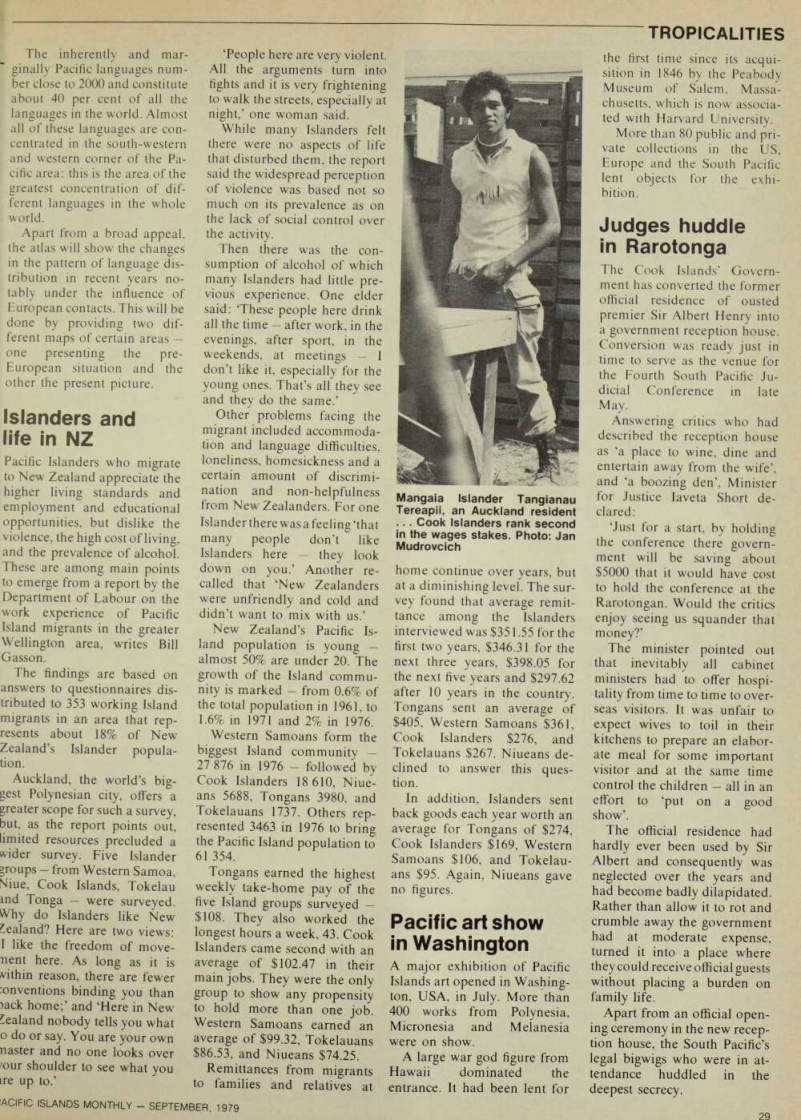
Monthly
Pim
September 1979
ip BniGING lljOiAM PARIS
Mpwpficific
American Samoa US$l.25 Australia Asl.oo*
Fiji .^jfejTSI.OO
Hawaii .^USM-SO
Nauru 5A1.50 New Caledonia CFPfts New Hebrides Asl.oo NZ. Cook Is. ft Niue NZSI.OO Jlortolk Island ASI.OO Papua New Guinea „...Kl.OO Solomons ...Je.. SSI.OO Tahiti.. JET.. CFPISO Tonga PI.OO USTT a Guam US$l.25 Western Samoa... Tl.OO ‘Recommended retail price only.
Registered for posting as a publication Category B.
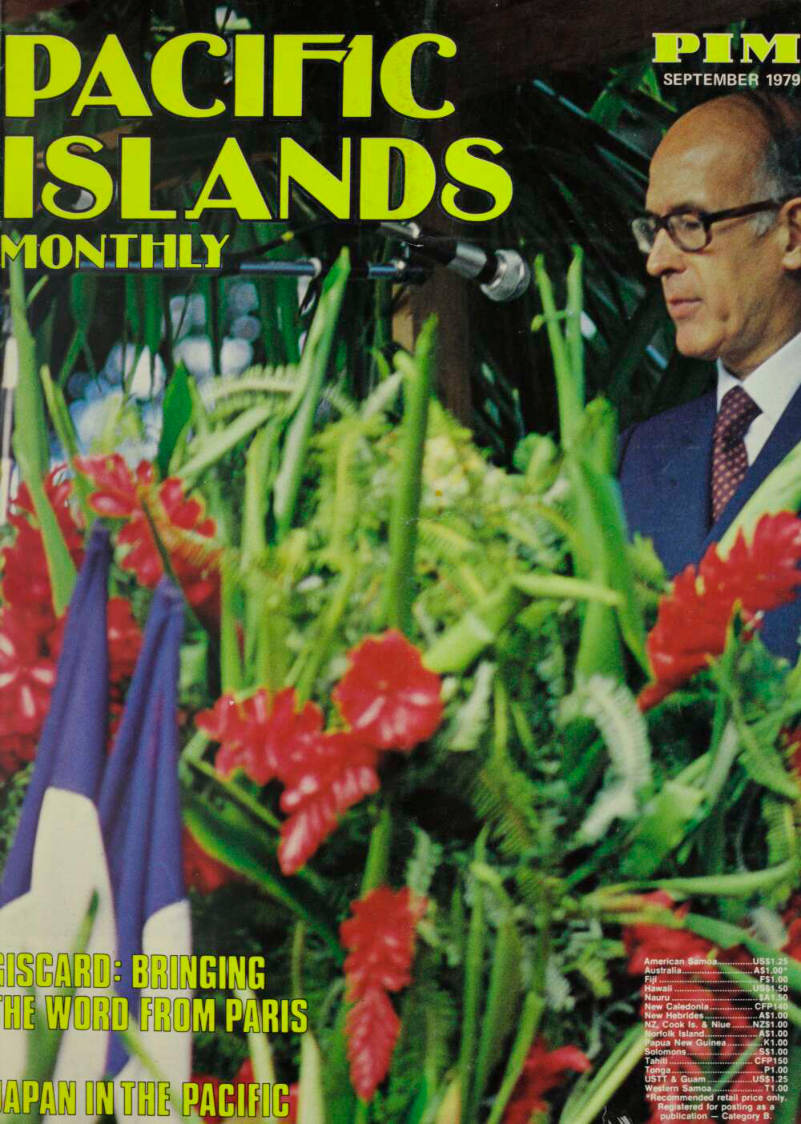
Cover: French President Valery Giscard d'Estaing tells a Papeete audience about his country’s 'lasting' relationship with French Polynesia (Political Cur rents).
Advertisements & other items, p. 2 (1 item)
Akai
Altai Technology Takes Off
Flic Age Of Super Electronics
IliL
'..i *■* » m
MHS
mri
PS-200T FM/AM Digital Quartz Synthesizer Tuner
PS-200C DC Pre Amplifier
fM
PS-200M DC Power Amplifier
Video
AKAI
iKAI ELECTRIC CO., LTD.
bkyo, Japan
P.N.G.
S.O. Svensson (N.G.) Ltd.
P.O. Box 705, Pori Moresby Tel: 2275 Fiji Islands Motibhai &Company Ltd.
P.0.80x 9175, Nadi International Airport Tel: 72-165 New Zealand Pye Ltd., Consumer Products Sector 110 Mt. Eden Rd.. Mt. Eden, Auckland Tel: 686-437 New Caledonia Menard Pacifique s.a.r.l.
B.P. H 2, Noumea Tel: 275222 Tahiti Etablissements Comimpex New Hebrides (Islands) Burns Philp (New Hebrides) Co., Ltd.
P.O. Box 27, Pori Vila, New Hebrides Islands Norfolk Island Burns Philp (Norfolk Island) Co., Ltd.
P.O. Box 21, Norfolk Island Samoa Islands Burns Philp (South Sea) Co., Ltd.
P.O. Box 129, Pago Pago, American Samoa Mariana Islands J.C. Tenorio Enterprises P.O. Box 137, Saipan Tel; 6444/8 Solomon Islands Security Electrical Co., Ltd.
P.O. Box 174, Honiara Tel: 881 Cook Islands JPS Enterprises Ltd.
For more information, please send th distributor in your country or to AKAI 12-14, 2-Chome, Higashi-Kojiya, Ohta is coupon to our
ELECTRIC CO., LTD.
,-ku, Tokyo, Japan
Pacific Islands Monthly
Pim
Vol 50 No. 9 September 1979 (USPS 952480) Founded 1930 by R. W. Robson Publisher Stuart Inder Editor Bob Hawkins Editorial Adviser John Carter Manager John Berry Advertising Steve Gray, Peter Bedwell A Pacific Publications production 76 Clarence Street, Sydney 2000 GPO Box 3408 Sydney 2001 Cables; PACPUB Sydney Telex: Pacpub 21242 Telephone; Sydney 29 6693
Subscriptions
PIM is airfreighted to most subscribers and agents in the Pacific Islands and the United States.
Payment by personal cheque is accepted in Australian, US, New Zealand, UK and Fiji currency. For other remit tances please obtain a bank draft in Australian dollars made payable to the ANZ Banking Group, 88 Wentworth Avenue, Sydney, Australia.
Representatives
AUSTRALIA: Distribution: NSW & ACT: Allan Rodney Wright (Circulation) Pty Ltd. PO Box 907, Darlinghurst NSW 2010, Elsewhere: Gordon & Gotch (A/asia) Ltd Box 40, PO, Rosebery, NSW 2018 Advertising - Melbourne - Pacific Publications (Aust.) Pty Ltd, sth Floor. Alley Building, 75-77 Flinders Lane. Melbourne 3000, tele phone 63»0211, ext. 1565 Jeff Gates, ext 1858 Ida Pad gett, Brisbane D. Wood. Anday Agency, Box 1918, GPO, Brisbane 4001. telephone 44 3485 44 1546 Adelaide - Hastwell Media, PO Box 30, Glen Osmond' SA. 5064, 233 Glen Osmond Rd, Frewville, SA 5063. tele- F. h » n^. 79 1869 ’ 79 5956; cables Hastmedia, Adelaide FIJI: Distribution and subscriptions - Desai Bookshops PO Box 160, Suva. Fiji, telephone Suva 23036 Advertis ing - Fiji Times & Herald Ltd, 20 Gordon St Suva tele phone 312 111, telex FJ2124 FRENCH POLYNESIA: Distribution - Hachette u*^i f '« q .V e ..J.?^ e^ Bruat ' Pa P eete . telephone 25610 HAWAII, UNITED STATES: Distribution PIM, Hawaii PO Box 22250, Honolulu, Hawaii 96822.
JAPAN; Advertising and subscriptions - Universal 666 3 a o36° rPOratiOn ' CP ° B ° X 46 ’ TOky °' ,ele P hone d EW C f, LEDONIA: Distribution - Depot Centre de 27 6 2 5 434 27 4729 enteC ° St ' CBP2 ' Noumea ’
NEW ZEALAND: Distribution - Gordon &-Gotch PO Box 584, 2 Carr Road, Mt, Roskill. Auckland 4 Advertising 7 International Media Representatives Ltd, PO Box 2313 Auckland, telephone 795 487; 493 389, cables Intereps, Auckland Subscriptions - Ross Haines & Son Ltd PO Box 1289, Auckland, telephone 769 042 PAPUA NEW GUINEA: Distribution Robert Brown & Assoc PO Box 3395, Port Moresby, telephone 25855 Advertising PNG Post-Courier, PO Box 85 Port Moresby, telephone 21 2577 KINGDOM: The Herald & Weekly Times Ltd 8-10 Lane ' London EC4A IBU. telephone 01 831 6041, telex London 21989 UNITED STATES MAINLAND: Advertising Joshua B Powers Jr, Powers International Inc , 551 Fifth Ave New 9-?cc'i^ N W w Yoi i k 100 017 ' telephone 867 9580, telex 236514 Subscriptions - PIM, Hawaii. 2812 Kahawai St Honolulu, Hawaii 96822 Published monthly by Pacific Publications (Aust.) Pty Ltd and printed in Australia by Paramac, Alexandria NSW Australian cover price is recommended retail onlv. Reois iered at the GPO Sydney for transmission by post as a a '°u~ category B Second class postage paid at HonoJulu, Hawaii Copyright c i 978 Pacific Pub jcatjons
(Aust.) Pty Ltd.
Postmaster Honolulu: Send address changes to PIM Hawaii. PO Box 22250 Honolulu. Hawaii 96822
Aust.
Other American Samoa $13 $US16 Australia $12 Canada $14 $US18 Cook Islands $13 Rjj $12 $F12 French Polynesia $14
Cfp 1700
Guam $13 $US16 Gilbert Islands $13 Hawaii $13 $US16 Japan $16 Y4500 Micronesia $13 $US16 Nauru $18 New Caledonia $14
Cfp 1700
New Hebrides $13 New Zealand $12 $NZ13.50 Niue $13 Norfolk Island $12 Northern Marianas $13 $US16 Papua New Guinea $13 K12 Solomon Islands $13 Tonga $13 Tuvalu $13 United Kingdom $15 £io US Mainland $14 $US18 Western Samoa $13 Elsewhere: $A16
This Month
• The Region How the forces lined up at a meeting of-the South Pacific Forum in Honiara on the delicate question of framing a resolution on France’s Pacific ter ritories 10 • President Giscard’s Pacific visit One word for New Caledonians, another for Polynesians 17 • Kiribati - Independent yes but still hogtied by some aid arrangements with Britain 23 • Japan in the Pacific A round-up of the present state of play in Japan’s varied and dynamic contri butions to the lives and development of Pacific Island nations 37 • Tuvalu - Prime Minister Toalipi Lauti talks frankly with PIM Editor Bob Hawkins about his country’s prob lems with fund-raising and development 18 • New Hebrides - Chief Minister Gerard Leymang and Deputy Chief Minister Walter Lini met French Presi dent Giscard d’Estaing in Noumea and gave him some ideas on their country’s future relationships with France 13 • Kwajalein - Occupation of parts of an important US missile testing range by protesting Marshallese land owners could have an impact on ratification by the US Senate of the SALT II agreement with the Soviet Union 19 • Nutrition The ‘winged bean’, native to Papua New Guinea’s Highlands and some Southeast Asian coun tries, could soar to stardom in the world fight against hunger 89
Afterthoughts 87 Australia 13,14,15,25,34 Banaba Books go Cook Islands 5,10,13,14,15,29,33,34,72 F, i i 13,15,32,34,37,41 French Polynesia 14,17,18,65 Guam Irian Jaya Islands Press Japan in the Pacific 37-72 Kiribatl 15,23,37,80 Letters Micronesia 19,40,75 Nau ™ 6,15
New Ca1ed0nia.6,10,11,13,14,15,17,18,22,32,67
New Hebrides 10,15,17,18,25,27,69 New Zealand 10,11,14,15,25,29,34 Niue 15,29,77 Norfolk Island 21,69 Northern Marianas 75
Pacific Report 7 p NG 5,10,11,13,14,15,20 22,27,28,32,33,34,37,47,83,89,91 People Political Currents... 17
Shipping 101
Solomon Islands 10,25,27,37,41,56,81,91 South Pacific Forum 10,25
Spc 6
Spe C 33,40
Tahiti 14,18 Tokelau Islands 6,29 Tonga 15,28,29,32,37,80,93 Tradewinds 89 Tradewinds Intelligence 92 Travel 75 Tropicalities 25 Tuvalu 10,15,18,32 Wallis and Futuna 18 Western Samoa 10,11,15,29 Yachts 93
Yesterday.. 83
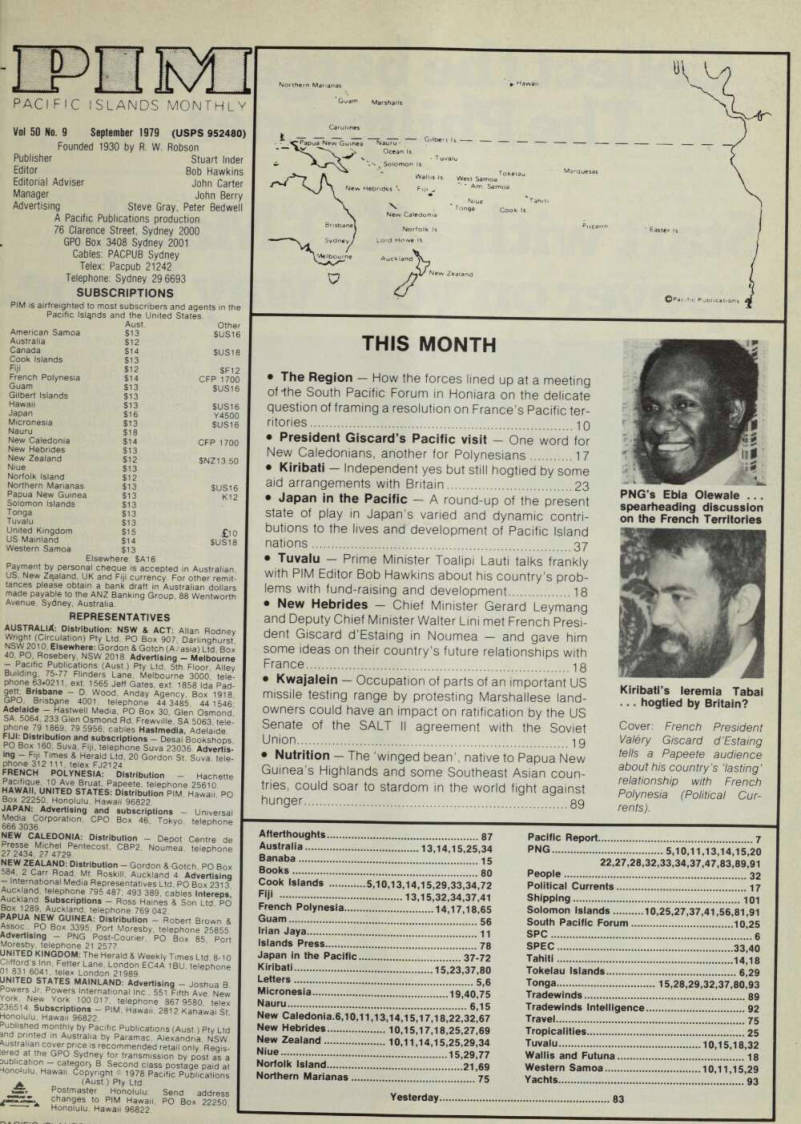
PNG’s Ebia Olewale ...
spearheading discussion
on the French Territories
Kiribati’s leremia Tabai ... hogtied by Britain?
Advertisements & other items, p. 4 (1 item)
The Philippines.
Collect the bargains of
Start with a Klo* Manila
Stopover on your way home.
1 mm K K V Welcome to The Philippines. An incredibly different Asia, where shoppers come from Hong Kong and Singapore to hunt bargains in the exotic markets by day and enjoy the international atmosphere by night.
Welcome to Philippine Airlines, where the bargains start with the incredible value of the ‘Stopover Manila’ package for as little as Klo* a night in a luxury hotel (or only K 7 for a share twin).
The Manila Stopover, with Philippine Airlines, one of the great bargains you shouldn’t miss on your way to the rest of the world. fc-, v . m
JO M
MANILA 1979
Not including airfare.
Philippine Airlines, Burns House, Champion Parade.
Port Moresby, Phone: 211108 Please send me details of Philippine Airlines’ STOPOVER MANILA.
Post coupon to: Philippine Airlines, P.O. Box 3271,
PORT MORESBY
Name Address
® Philippine Airlines
Letters
A word to Ms James I offer some comments on Ms Lois James’ letter published in the May edition of PIM, and the role of the United States in Pacific affairs.
Ms James’ letter referred to some remarks made by a mem ber of a Papua New Guinean dance group with whom she spoke in the United States. In the interest of consistency, Ms James should not have viewed so critically a quality which she herself demonstrates in her let ter national pride. The value judgement ‘America is not good ... our place is good’ also conveys an opinion which is at odds with Ms James’ represen tation of the US as a ‘saviour’ of the world.
The naive nature of US national policy and under standing of the Pacific is neatly pointed up in your article in the US in the Pacific which appeared in the same issue.
Moreover, Ms James’ personal perspective on the cure for ‘hunger and thirst’ begs ques tions on other important human and social needs which it seems neither the US nor PNG has solutions to.
Deane Fergie
Mapua Tabar Islands New Ireland Province Papua New Guinea
More fruit trees
for Rarotonga
Our laws to this day work against our islands becoming once again a Garden of Eden, against the existence of many more permanent trees bearing luscious fruit mango, avo cado, custard apple, grapefruit, mandarine, lemon, lychee, pis tachio, macadamia, chestnut, coconut (the Islander’s best friend), even banana, breadfruit and guava. The great obstacle to their increase is that our land ownership is not based on the good Aus tralian Torrens titles, so that, alongside those with rights to land ‘and everything attached thereon’, there are now as many or more people hungry to grow such fruits but without the right to do so.
A coconut palm takes up to 14 years to come into full pro duction. So do other fruit trees.
A person will not plant and make the sustained effort to see a young tree carefully nursed past the red danger point of its life without some proprietary rights to its fruit.
Through the looking glass,
we see much unused land on our main island, Rarotonga.
The 1975 agricultural census described as such 1255 ha out of 2226 ha of good ‘foothill’ land, with another 4453 ha of not so good ‘foothill’ land. But many permanent trees will grow be yond that level. The palm will also grow near the beach areas - conservation-wise, such a planting is a 60-year invest
ment, a gift to future gener ations.
Further, the 1976 population census gave 2552 non-Raro tonga-born Cook Islanders on Rarotonga, in addition to 1298 non-Cook Islands-born Euro peans, etc, a total of nearly 40% of the population.
More recently still, the 1977 import figures showed that we import $4.5 million worth of foodstuffs - that is the CIF price, and represents more than $7 million at the retail price paid by housewives. Is this reasonable when most of us squatters are keen to feed and water ourselves, given the right and the chance?
Our government should take a new look at the land laws.
Not only outer islanders but the many Raro-born non
landowners, particularly
teenagers, should by law be al lowed to own their own fruit and other trees. Those they plant when young they would treat with proper husbandry.
They would indeed grow together, and in time they would reap the fruit of their own efforts. Government should ensure that every household is helped to have one good breeding sow, at least 30 laying hens, and at least enough land available to it for permanent tree planting. Just for a moment visualise Raro tonga 25 years ahead if, say,
today, 1000 teenagers planted
and began caring for four good mango trees each. With good luck and enough care there would be 4000 hefty, heavy bearing mango trees, 20 boxes or so per tree, good enough to sustain many a person on Rarotonga, be they natives of it or of an outer island. In this connection, other Common wealth countries have laws well worth the effort of study.
Some people criticise our statistical service saying it is high time it got out of its nap pies. It is a fact that there is no where in the 1976 population census a clear figure giving the number of actual landowners
on each island. For Rarotonga, a figure exists showing that 990 heads of households live on their own land, the rest renting or otherwise being ceded ac commodation. This is a sig nificant figure in view of the other figures of 8503 for the total Cook Islands-born popu lation (of whom 2552 were not born on Rarotonga).
Instead of pontificating off a desk crystal ball on what the population will be some day, our stats should cast quick and
fairly inexpensive glances, at
frequent intervals, out their office windows. By annual quick counts they should be able to give the country true, factual and clear-cut facts.
C. G. Joannides
Arorangi Rarotonga Cook Islands
New Bounty Mark
111 at least
Your report of the building of another Bounty (PIM March).
The Whangarei one is not ‘Mark IT but Mark 111 at least as one was built in the Canadian Maritimes for the Mutiny on the Bounty film with Marlon Brando. I remember going aboard the Canadian Bounty during my first visit to Tahiti in 1961.
University of GEORGE L. PICKARD British Columbia, Canada
At the fag end of
the French empire
I am surprised that you should publish a letter (PIM June) like that from D. A. Tardieu where he tries to portray the fag end of French empire the Pacific Islands it still clutches - as a ‘Quebec’ in an English Pa cific.
Surely the Pacific Islands are getting more Oceanian or Polynesian rather than
‘English’, with the rapid
decolonisation that so far as England goes, is almost com
plete.
Yet France hangs on in there, right to the point where
the peace-loving Polynesian
people are having to make their feelings known
European-style, with political
terror.
No, Mr Tardieu, you can’t get away with dragging in the nice clean ‘democratic’ image of a struggling Quebec amidst
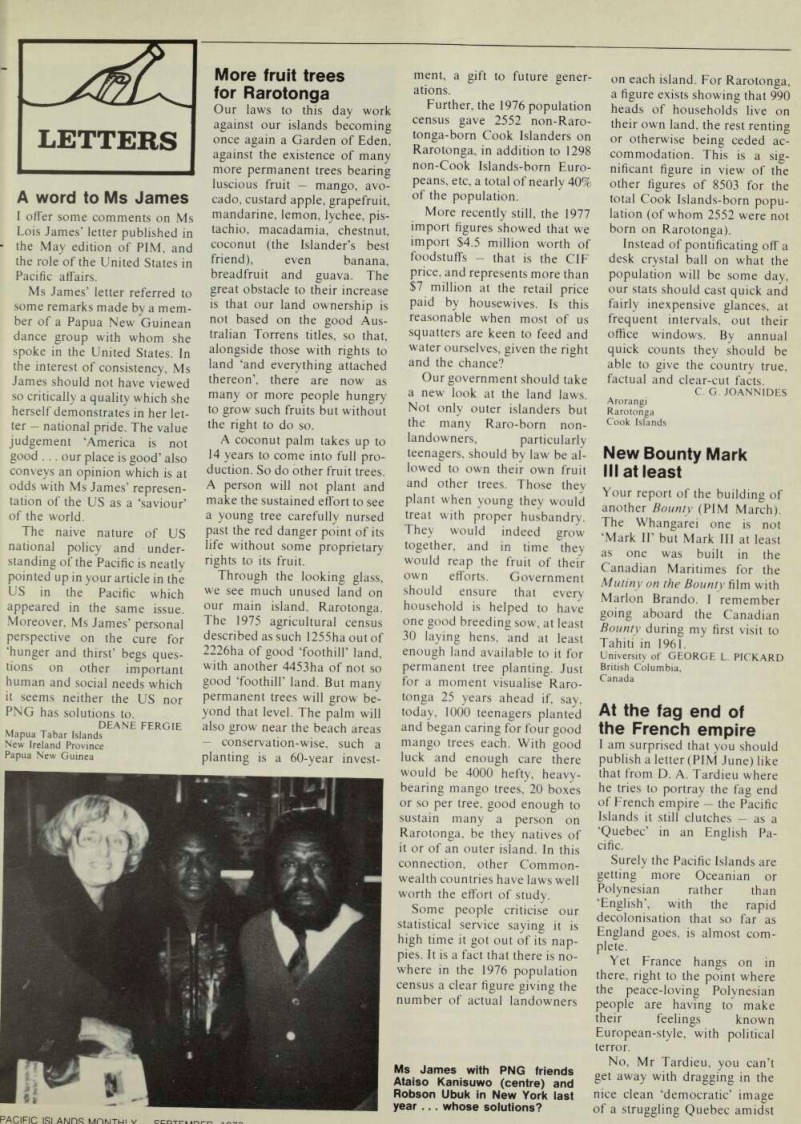
Ms James with PNG friends Ataiso Kanisuwo (centre) and Robson Ubuk in New York last year ... whose solutions?
hostile ‘English’ Canadians.
Why not take a look in your very own country, France, where the Breton people are intensifying their own struggle in a sea of uncaring F rench?
As a well-known Brezhoneg (Breton) separatist remarked not long ago; ‘Between the retreats from Moscow and
Algiers nothing has changed,
apart from the capacity, in
French empire-building.’
Presumably the denial of democratic liberty to a far, small, easily-exploited Pacific Islands people will be the very last instalment in that story, and echo the truth of my Bre ton nationalist colleague’s re mark.
Andrew Mackillop
Konedobu Papua New Guinea
PNG—conservation
problems?
Recently I had the opportunity to view a film made in Papua New Guinea. There were beautiful flowers, birds, but terflies, and some traditional dances. The film showed also the cutting of trees. The com mentator said that local people were unable to cut down the larger and more beautiful trees, but that outside firms with ma chinery now can. The commen tator tried to find out whether anything was done about replacing the trees and said that the lumber people were very vague about it and did not seem to care. He said that if this goes on unchecked the PNG people will some day have little left but sawdust.
The film also pictured mountaineers with feathered head-dresses going into little stores to purchase things which are really not good for them.
Andre Gschaedler
Salem, W.Va
Usa
Cell 4 strikes a
chord in PNG
As a New Hebridean I was really interested in the letter ‘From Cell 4, French Prison, Vila’ (PIM June). At last a French citizen is brave enough to admit facts about the French administration in the New Hebrides.
Mr Tarii’s illustrations of how the French administration in the New Hebrides is trying to monopolise both air trans
port and the press are facts that in many respects even govern ment ministers in the New Hebrides cannot deny. This sort of policy can be found in all walks of life, ranging from schools to shipping lines and even the House of Assembly.
Nabanga is also a one-sided paper. Many news items are printed in it either to promote the colonial masters or to give a bad face to opponents of the French in the group. It is a mouthpiece of French propa ganda in the New Hebrides.
The experiences related by
Mr Tarii could happen to any body at all who tried to spread the truth about the political situation, and other matters of major importance in the New
Hebrides. Many people,
including Americans, Aus tralians, French, English and Africans have been treated in this way in the past.
That’s the way it is in the New Hebrides. If it hadn’t been for the British and the Aus tralians, things would be worse still.
C. M. Lawrence
University of Papua New Guinea Port Moresby
Tribute to Salato
The commendable offer in People (PIM June) to publish Dr Macu Salato’s memoirs if he will but use some of his time in retirement from the South Pacific Commission (SPC) to write them deserves underscor ing. Dr Salato has had a long and distinguished career in Fijian and Pacific affairs. His assessment of the region’s pol itical development would
make fascinating reading
indeed.
One of the most interesting chapters in this book would have to be Dr Salato’s 3*/2-year tenure as secretary-general of the SPC. As PIM will no doubt recall, the SPC was at a crisis point when Dr Salato was appointed at the Nauru Con ference in 1975. Stuart Inder made the comment then that the SPC was in need of a ‘heart transplant’ and therefore the appointment of a doctor might be just the medicine the SPC required. His words were pro
phetic.
Dr Salato’s ability, energy and personality have helped to
resuscitate the organisation. He took charge from the outset to make use of the opportunity afforded him by the major re view of the SPC in 1976.
Rather than waiting passively
to receive whatever result the review committee chose to give, Dr Salato encouraged the secretariat to review itself and to put forward a secretariat position on needed changes. In this way he materially helped to design the ship at whose helm he stood.
Having secured from the 1976 review an organisation which he felt had a genuine role to play. Dr Salato began a daunting schedule of intra- and extra-regional visits to cement these gains. He was undoubt
edly the most widely-travelled
secretary-general in the organ isation’s history. To further the communication function of the SPC, Dr Salato visited virtually every one of its 20 member countries, including the isola ted Tokelaus. He also per sonally represented the SPC at numerous international and national meetings concerned with matters of interest to the SPC. These visits have helped both to achieve a more effec
live liaison with these govern ments and international bodies and to restore some of the SPC’s tarnished image.
In Noumea, Dr Salato’s dip lomacy was instrumental in
securing French co-operation
in repairing and modernising
the aging ‘Pentagon’ and other
headquarter buildings. His
firm hand and keen eye for detail enabled him to ensure his staff functioned effectively as a team. The ‘old man’, as he was affectionately known, had the respect of his staff and with this he was able to make the best of a very difficult time financially for the SPC.
Perhaps the greatest disap pointment for Dr Salato over the past 3 Vi years must be that he had to spend so much of his time dealing with criticism of the SPC. His term of office will certainly serve to dispel some of the more exaggerated com plaints and this may be suf ficient recompense for him.
Young Vivian, Dr Salato’s suc cessor at the SPC helm, must be personally grateful to have had such an able predecessor.
Although it will be a tough act to follow, Young Vivian will have a sound stage on which to
perform.
R. A. Herr
Hobart, Tasmania
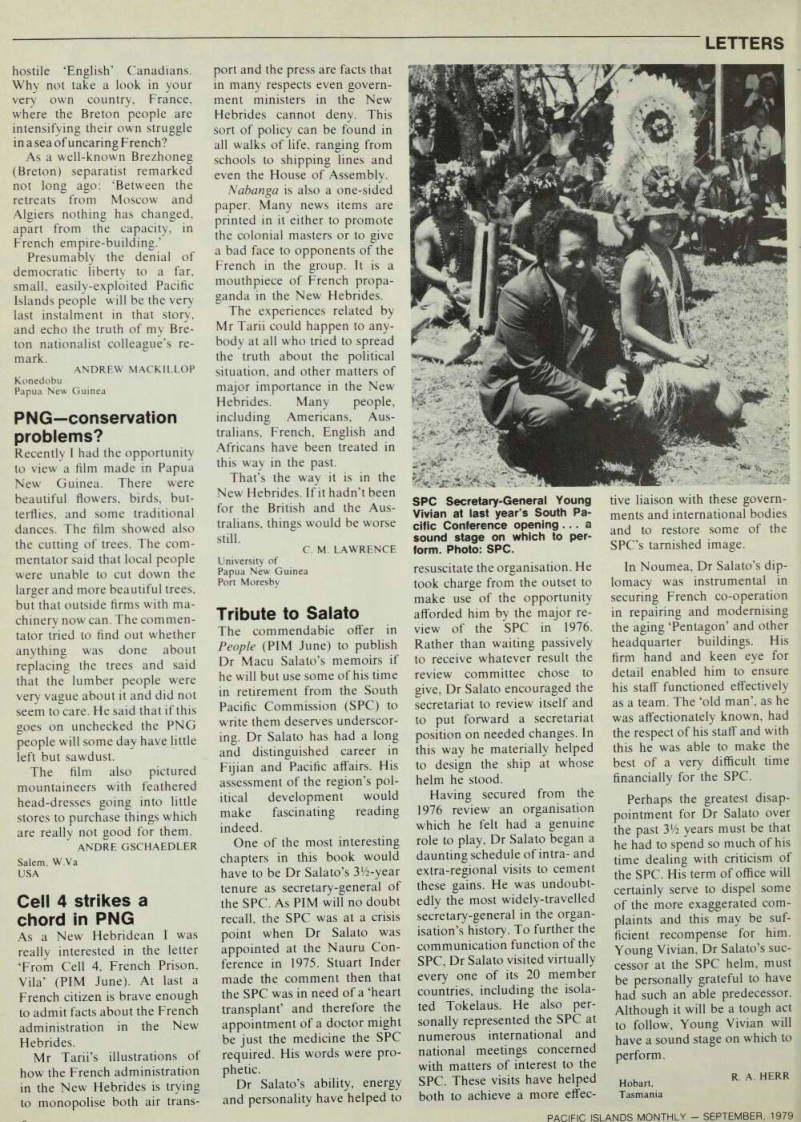
SPC Secretary-General Young Vivian at last year’s South Pacific Conference opening ... a sound stage on which to perform. Photo: SPC.
Advertisements & other items, p. 5 (1 item)
Pacific Isi Amds Momtui V Ccdtmnrn
Pacific Report
President Giscard In The Pacific
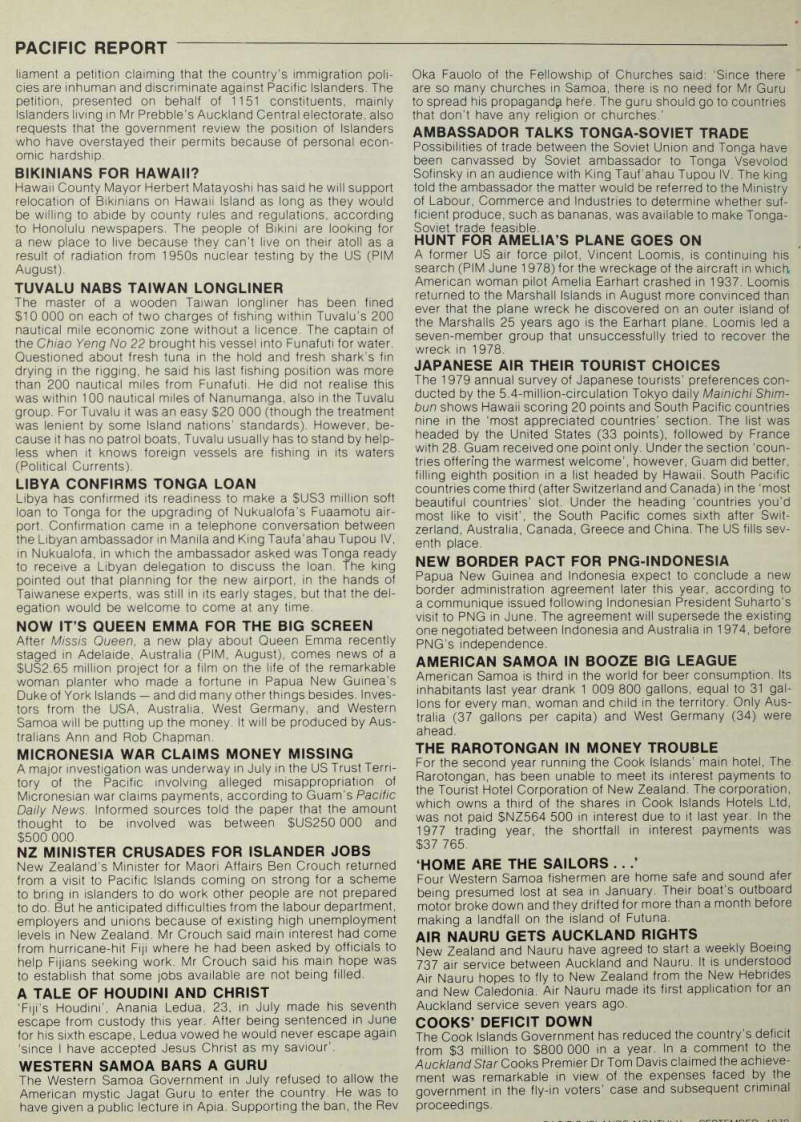
The July visit to the Pacific by French President Valery Gis card d’Estaing, only the second ever made by a French head of state in office, revealed a clear distinction between French policies towards the two main territories of New Caledonia and French Polynesia. France’s relations with the latter the president described as ‘lasting’. But his statements in New Caledonia - made it clear that future relations with that territory are con ditional on a number of factors (Political Currents).
After D’Estaing, A Mighty Big Baing
Only four days after French President Valery Giscard d’Estaing ended his July official visit to the Pacific, France conducted what is described as its biggest-yet underwater nuclear explosion’ at Moruroa Atoll. An explosion equal to an earthquake registering 6.3 on the Richter scale was recorded on seis mographs at Wellington Observatory at 1800 GMT on July 25.
Scientists said the blast was probably in the range of half a meg aton. A tidal wave struck the atoll on the day of the explosion, injuring two people. French Atomic Energy Commission officials in Paris strongly denied that the wave had been caused by the explosion. They dismissed as ‘fantastic’ a press report that the wave followed the emergency triggering of a nuclear bomb after ‘it became wedged halfway down its detonation shaft under the ocean bed’. The French socialist daily Le Matin claimed in August that on July 6, a fortnight before President Giscard’s visit to French Polynesia, two men were killed and six seriously injured during a decontamination operation in a bunker on Moruroa. The paper said acetone vapour in the bunker ex ploded, killing one immediately and injuring others, one of whom later died, and released a cloud of plutonium vapour over the atoll. The paper said the affair had been shrouded in secrecy in an attempt not to mar preparations for the presidential visit.
Nz Milk Less Radio-Active
Radio-active contamination of New Zealand milk is at its low est level since records started in the early sixties according to a statement by the country’s National Radiation Laboratory. The laboratory said the drop in concentrations of strontium-90 and caesium-137 apparently reflected the French move to under ground testing.
Us Court Fines Finbar Kenny
In the first criminal prosecution under the US Foreign Corrupt Practices Act, Finbar Kenny was fined SUSSO 000 in August for using the proceeds of the sale of Cook Islands stamps to fly in voters from New Zealand in the Cook’s March 1978 elections.
The new law was enacted by Congress in the wake of big business scandals involving such companies as Lockheed and International Telephone and Telegraph. The hearing of the case against Mr Kenny caused him to reverse his earlier decision to go to Rarotonga to face trial (PIM August). He planned to have a lawyer explain his non-appearance to the court, and to indicate that he will elect trial by judge alone.
Abbey Service For Kiribati
Princess Margaret represented the Queen at a thanksgiving service in London s Westminster Abbey in July to mark the independence of Kiribati. The Kiribati flag flew from the Abbey Nagstaff as a lesson was read in the language of Kiribati by Edwin Baraniko (page 23).
Apology, Compensation, For Stinson
■iji s former finance minister, Sir Charles Stinson, has received an undisclosed sum of money and a public apology from the \tew Zealand magazine The Listener. The magazine admitted hat there was no truth in inferences in a May 1977 article sug gesting that Sir Charles, as a minister, had used his political nfluence for the benefit of the Stinson Pearce group of companies. The apology was read in the Auckland Supreme in the presence of Sir Charles and his son Peter Sir Charles had sued the magazine for SNZI million damages.
112 596 People In New Hebrides
The population of the New Hebrides at 15-16 January, 1979, was 112 596. Announcement of the figure in late July followed more than a year of preparation, canvassing and counting. The census, a vital part of preparations for elections and indepen dence, showed that the country’s population has grown by more than 36 000 since the last census in 1967 which yielded a popu lation figure of 76 582.
Sir Vijay Singh Bows Out
Sir Vijay Singh has been dismissed from his post as attorney general and economic planning minister in the Fiji cabinet. The dismissal followed strong expressions of cabinet disapproval of his role in the so-called Flour Mills case (RIM August). Sir Vijay later severed his connection with parliament by resigning from the Senate, to which he had been appointed by Prime Minister Ratu Sir Kamisese Mara.
Norfolk: Legislative Assembly Opens
With a clutch of Australian dignitaries on hand, Norfolk Island’s first legislative assembly was ceremoniously inaugura ted in August. But due to continuing doubts about its real powers, reaction to the event on the island was less than joyful
(Political Currents).
69% Of Nz Aid For Pacific
New Zealand’s overseas aid would remain at last year’s level of SNZSS million, according to Foreign Minister Brian Talboys.
Assistance to the Pacific would total $29 765 000, up $1.5 million on last year and 69% of total bilateral government-to government assistance. Assistance to ASEAN countries would be almost $lO million. Contributions to multilateral bodies such as United Nations and Commonwealth development agencies, and regional institutions in the South Pacific, would drop from $8 985 000 last year to $8 208 000.
Png Says No’ To Indochina Refugees
Papua New Guinea has ‘reluctantly, but definitely’ decided that it cannot accept any Indochinese refugees for settlement according to a July statement by Acting Prime Minister and Foreign Minister Ebia Olewale.
SIX MONTHS GAOL, FINE, FOR DAVID NEAVE David Neave, Australian lawnmower importer of Vila, New Hebrides, who faced charges of illegal importation of munitions (PIM August), has been sentenced to six months imprisonment (less 29 days detention already served), and fined FNH29O 977 ($A3779), to be deducted from the sum of sls 000 bail already deposited.
Fiji Sets Up Prisons Probe
Fiji has appointed a seven-member royal commission to review all aspects of treatment of inmates of the country’s prisons. The commission, made up entirely of Fiji residents, follows com plaints by dockworkers and others of ill-treatment by prison offi cers while they were held in Naboro Maximum Security Prison in early 1978. The ombudsman, Judge Moti Tikaram, sub sequently investigated the complaints and reported to parlia ment. Judge Tikaram will preside over the newly appointed royal commission.
ONE FOR THE GUINNESS BOOK OF RECORDS?
A British-born mother of five children is seeking $A2.2 billion from Saudi Arabian financier Adnan Khashoggi in what her law yer calls one of the largest claims ever filed in a martial dispute.
Mr Khashoggi is the financial power behind a number of South Pacific resort and hotel operations, including the Pacific Harbour complex at Deuba, Fiji. Soraya Khashoggi, in a suit filed in Los Angeles Superior Court in August, sought about half the $3.5 billion she maintains she helped Adnan Khashoggi accumulate during their marriage. She is also seeking $445 million in punitive damages. Mrs Khashoggi says her husband obtained a divorce in an Islamic religious court in 1974 and failed to support her afterwards. She maintains the divorce is not valid in the USA.
Family Reunion For Jacob Prai
The two wives and the children of Irian Jaya rebel leader Jacob Prai flew from Papua New Guinea in July to join him in exile in Sweden.
Petition Against Nz Immigration Laws
New Zealand Labour MP Richard Prebble has presented to par
liament a petition claiming that the country’s immigration poli cies are inhuman and discriminate against Pacific Islanders. The petition, presented on behalf of 1151 constituents, mainly Islanders living in Mr Prebble’s Auckland Central electorate, also requests that the government review the position of Islanders who have overstayed their permits because of personal econ omic hardship.
Bikinians For Hawaii?
Hawaii County Mayor Herbert Matayoshi has said he will support relocation of Bikinians on Hawaii Island as long as they would be willing to abide by county rules and regulations, according to Honolulu newspapers. The people of Bikini are looking for a new place to live because they can’t live on their atoll as a result of radiation from 1950 s nuclear testing by the US (PIM August).
Tuvalu Nabs Taiwan Longliner
The master of a wooden Taiwan longliner has been fined $lO 000 on each of two charges of fishing within Tuvalu’s 200 nautical mile economic zone without a licence. The captain of the Chiao Yeng No 22 brought his vessel into Funafuti for water.
Ouestioned about fresh tuna in the hold and fresh shark's fin drying in the rigging, he said his last fishing position was more than 200 nautical miles from Funafuti. He did not realise this was within 100 nautical miles of Nanumanga, also in the Tuvalu group. For Tuvalu it was an easy S2O 000 (though the treatment was lenient by some Island nations’ standards). However, be cause it has no patrol boats, Tuvalu usually has to stand by help less when it knows foreign vessels are fishing in its waters (Political Currents).
Libya Confirms Tonga Loan
Libya has confirmed its readiness to make a SUS 3 million soft loan to Tonga for the upgrading of Nukualofa’s Fuaamotu air port. Confirmation came in a telephone conversation between the Libyan ambassador in Manila and King Taufa’ahau Tupou IV, in Nukualofa, in which the ambassador asked was Tonga ready to receive a Libyan delegation to discuss the loan. The king pointed out that planning for the new airport, in the hands of Taiwanese experts, was still in its early stages, but that the del egation would be welcome to come at any time.
NOW IT’S QUEEN EMMA FOR THE BIG SCREEN After Missis Queen, a new play about Queen Emma recently staged in Adelaide, Australia (PIM, August), comes news of a $U52.65 million project for a film on the life of the remarkable woman planter who made a fortune in Papua New Guinea’s Duke of York Islands and did many other things besides. Inves tors from the USA, Australia, West Germany, and Western Samoa will be putting up the money. It will be produced by Aus tralians Ann and Rob Chapman.
Micronesia War Claims Money Missing
A major investigation was underway in July in the US Trust Terri tory of the Pacific involving alleged misappropriation of Micronesian war claims payments, according to Guam’s Pacific Daily News. Informed sources told the paper that the amount thought to be involved was between SUS2SO 000 and
Ssoo 000.
Nz Minister Crusades For Islander Jobs
New Zealand’s Minister for Maori Affairs Ben Crouch returned from a visit to Pacific Islands coming on strong for a scheme to bring in islanders to do work other people are not prepared to do. But he anticipated difficulties from the labour department, employers and unions because of existing high unemployment levels in New Zealand. Mr Crouch said main interest had come from hurricane-hit Fiji where he had been asked by officials to help Fijians seeking work. Mr Crouch said his main hope was to establish that some jobs available are not being filled.
A Tale Of Houdini And Christ
‘Fiji’s Houdini’, Anania Ledua, 23, in July made his seventh escape from custody this year. After being sentenced in June for his sixth escape, Ledua vowed he would never escape again ‘since I have accepted Jesus Christ as my saviour’.
Western Samoa Bars A Guru
The Western Samoa Government in July refused to allow the American mystic Jagat Guru to enter the country. He was to have given a public lecture in Apia. Supporting the ban, the Rev
Oka Fauolo of the Fellowship of Churches said; ‘Since there are so many churches in Samoa, there is no need for Mr Guru to spread his propaganda here. The guru should go to countries that don’t have any religion or churches.’
Ambassador Talks Tonga-Soviet Trade
Possibilities of trade between the Soviet Union and Tonga have been canvassed by Soviet ambassador to Tonga Vsevolod Sofinsky in an audience with King Tauf’ahau Tupou IV. The king told the ambassador the matter would be referred to the Ministry of Labour, Commerce and Industries to determine whether suf ficient produce, such as bananas, was available to make Tonga- Soviet trade feasible.
Hunt For Amelia’S Plane Goes On
A former US air force pilot, Vincent Loomis, is continuing his search (PIM June 1978) for the wreckage of the aircraft in which.
American woman pilot Amelia Earhart crashed in 1937. Loomis returned to the Marshall Islands in August more convinced than ever that the plane wreck he discovered on an outer island of the Marshalls 25 years ago is the Earhart plane. Loomis led a seven-member group that unsuccessfully tried to recover the wreck in 1978.
Japanese Air Their Tourist Choices
The 1979 annual survey of Japanese tourists’ preferences con ducted by the 5.4-million-circulation Tokyo daily Mainichi Shim bun shows Hawaii scoring 20 points and South Pacific countries nine in the ‘most appreciated countries’ section. The list was headed by the United States (33 points), followed by France with 28. Guam received one point only. Under the section ‘coun tries offering the warmest welcome’, however, Guam did better, filling eighth position in a list headed by Hawaii. South Pacific countries come third (after Switzerland and Canada) in the ‘most beautiful countries’ slot. Under the heading ‘countries you’d most like to visit’, the South Pacific comes sixth after Swit zerland, Australia, Canada, Greece and China. The US fills sev enth place.
New Border Pact For Png-Indonesia
Papua New Guinea and Indonesia expect to conclude a new border administration agreement later this year, according to a communique issued following Indonesian President Suharto’s visit to PNG in June. The agreement will supersede the existing one negotiated between Indonesia and Australia in 1974, before PNG’s independence.
American Samoa In Booze Big League
American Samoa is third in the world for beer consumption. Its inhabitants last year drank 1 009 800 gallons, equal to 31 gal lons for every man, woman and child in the territory. Only Aus tralia (37 gallons per capita) and West Germany (34) were ahead.
The Rarotongan In Money Trouble
For the second year running the Cook Islands' main hotel, The Rarotongan, has been unable to meet its interest payments to the Tourist Hotel Corporation of New Zealand. The corporation, which owns a third of the shares in Cook Islands Hotels Ltd, was not paid SNZS64 500 in interest due to it last year. In the 1977 trading year, the shortfall in interest payments was $37 765.
‘Home Are The Sailors . .
Four Western Samoa fishermen are home safe and_ sound afer being presumed lost at sea in January. Their boat’s outboard motor broke down and they drifted for more than a month before making a landfall on the island of Futuna.
Air Nauru Gets Auckland Rights
New Zealand and Nauru have agreed to start a weekly Boeing 737 air service between Auckland and Nauru. It is understood Air Nauru hopes to fly to New Zealand from the New Hebrides and New Caledonia. Air Nauru made its first application for an Auckland service seven years ago.
Cooks’ Deficit Down
The Cook Islands Government has reduced the country’s deficit from $3 million to SBOO 000 in a year. In a comment to the Auckland Star Cooks Premier Dr Tom Davis claimed the achieve ment was remarkable in view of the expenses faced by the government in the fly-in voters’ case and subsequent criminal proceedings.
Advertisements & other items, pp. 8-9 (2 items)
Pacific Report
I 5 Parker
tv % ‘«*.X
More of an asset
than just a pen.
Parker 75.
It takes four precious metals to make a Parker 75 pen like this. Sterling silver for the case, 14ct gold for the beautifully responsive nib, and a wear-resistant alloy of platinum and ruthenium for the tip. \ It's even more exceptional. The nib can turn 360° to write at the angle most natural to you.
A lifetime investment.
Also in 22ct gold and stainless steel.
Pehcils, ball pens to match. 5-
I 5 PARKER
World's most wanted pens
The Forum ‘Interferes’

South Pacific Forum
French Territories
No one invited them to come officially. But there was no way Solomon Islands was going to prevent them. And almost everybody made them welcome, even if New Zealand Prime Minister Robert Mul doon said he didn’t think the South Pacific Forum was the place for it.
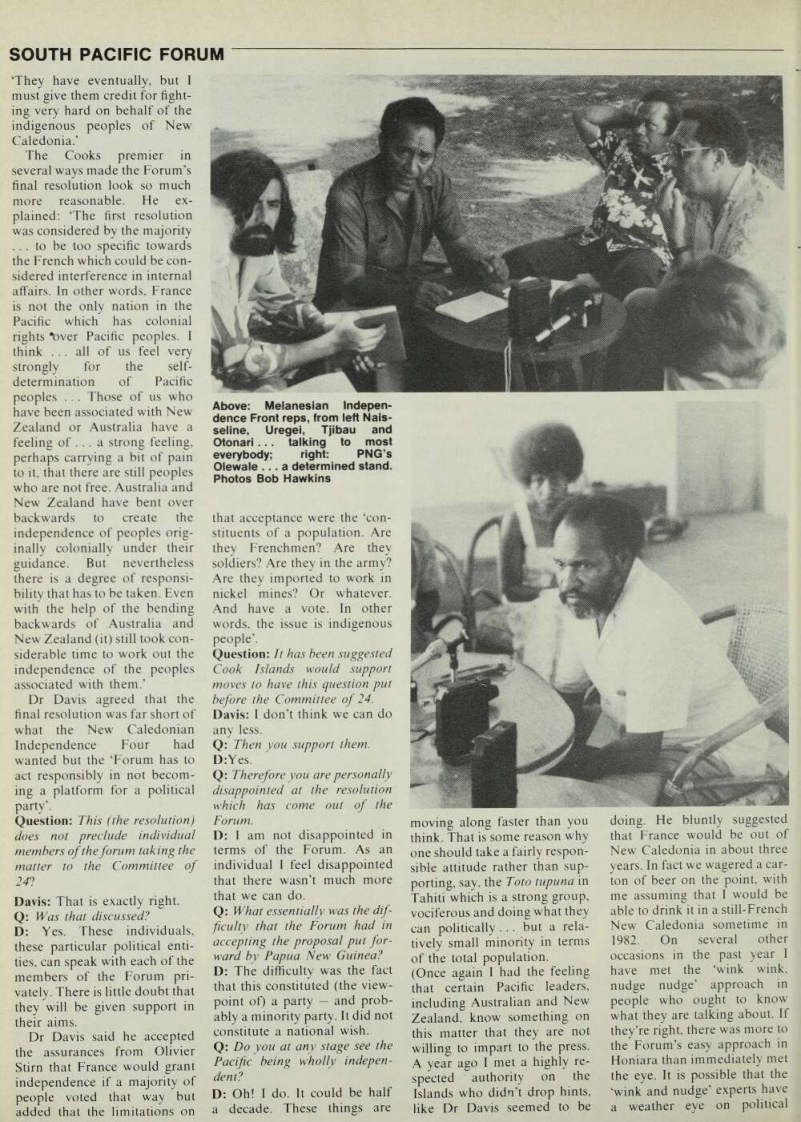
Early in the piece, as Pacific heads were arriving in Honiara for the Forum gathering, Yann Celene Uregei, Nidoishe Nais seline, Franqois Otonari and Jean-Marie Tjibaou, repre
senting the five parties
comprising New Caledonia’s Kanak ‘lndependence Front’, were on deck at the Point Cruz Mendana Hotel, ready to talk to anyone willing to give an ear to their cause.
With them they had brought a letter from the Prime Minis ter’s Department in Western Samoa which, they said, had promised support for them at the Forum. They had also been assured, they said, of Papua New Guinea’s backing which, as it turned out, they got wholeheartedly, but only to limited avail.
Forum delegations all 12 of them - had earlier received
a petition, signed by leaders of
South Pacific Forum discussion of the French presence in the Islands has been muted since Paris decided in 1975 to go underground with its nuclear testing programme on Mururoa Atoll in French Polynesia. But the presence of four New Caledonian Melanesian independence campaigners in Honiara for July's heads of government meeting changed all that, writes PIM Editor Bob Hawkins.
the five parties making up the Independence Front Union Caledonienne (UC), Parti de Liberation Kanak (Palika), Parti Socialiste Caledonien (PSC), Front Uni de Liberation Kanak (FULK) and Union Progressiste Melanesienne
(UPM). Basically, the petition
wanted the Forum to ask the United Nations Committee of 24 on decolonisation to have New Caledonia listed as a
‘non-autonomous’ territory
and, therefore, eligible ulti mately to be ‘decolonised’. (See petition extracts in box page 13.) ‘Champion’ of the moment of the Melanesians’ self determination campaign was Papua New Guinea’s Deputy Prime Minister and Foreign Minister Ebia Olewale who still shows some of the grit and fire which earned him the tag ‘rebel’ in pre-self-government
Png.
Mr Olewale arrived on
Saturday night, July 7, two
days before the heads of government deliberations were
to begin. The following morn ing he had a short but obviously amicable session with his four Melanesian friends from New Caledonia at the water’s edge in the grounds of the hotel. No furtive hotel room lobbying here. (As days went by, Mr Uregei and company were to be seen talk ing freely with most, but not all, heads of delegations.) In quick succession followed press conferences with the four
independence campaigners
and Mr Olewale.
Francois Otonari of Union Caledonienne was interpreter for his group, the other three having some understanding of English but little or no spoken command. Because an interpreter was necessary, the New Caledonian Melanesian case came out a little ragged: ‘We represent the Front for Independence. We represent five parties in New Caledonia ... On the agenda of the Forum there is the question of the French territories of the Pa cific so we want a question to be put forward at the Com mittee of 24 at the United Nations. That’s why we came . . . We contacted Mr Olewale this morning to push our
motion . . . We got a letter from Western Samoa and assurance from PNG that they would give us full support at the Forum 9 Asked what they thought of Mr Muldoon’s indication that he would not support the PNG motion, Mr Otonari continued: ‘Our motion is to inform every
body, including New Zealand,
about the internal problems in New Caledonia . . . Two other countries .. . they said we would get their support but they did not write . . . This was February .. . Cooks and Tuvalu gave us verbal support this morning .. . Australia does not want to be in front of this problem of French territories but they are in favour of de colonisation. They are sym pathetic. The men who saw us today from Australia said they feel the same as Papua New Guinea ... but I think Aus tralia’s position is different.
They would rather see the small countries of the Pa cific . . .’
Tell them the percentages,’
New Hebridean journalist Hilda Uni suggested. Mr Otonari continued: The 14 seats (won by the Indepen dence Front in the recent New
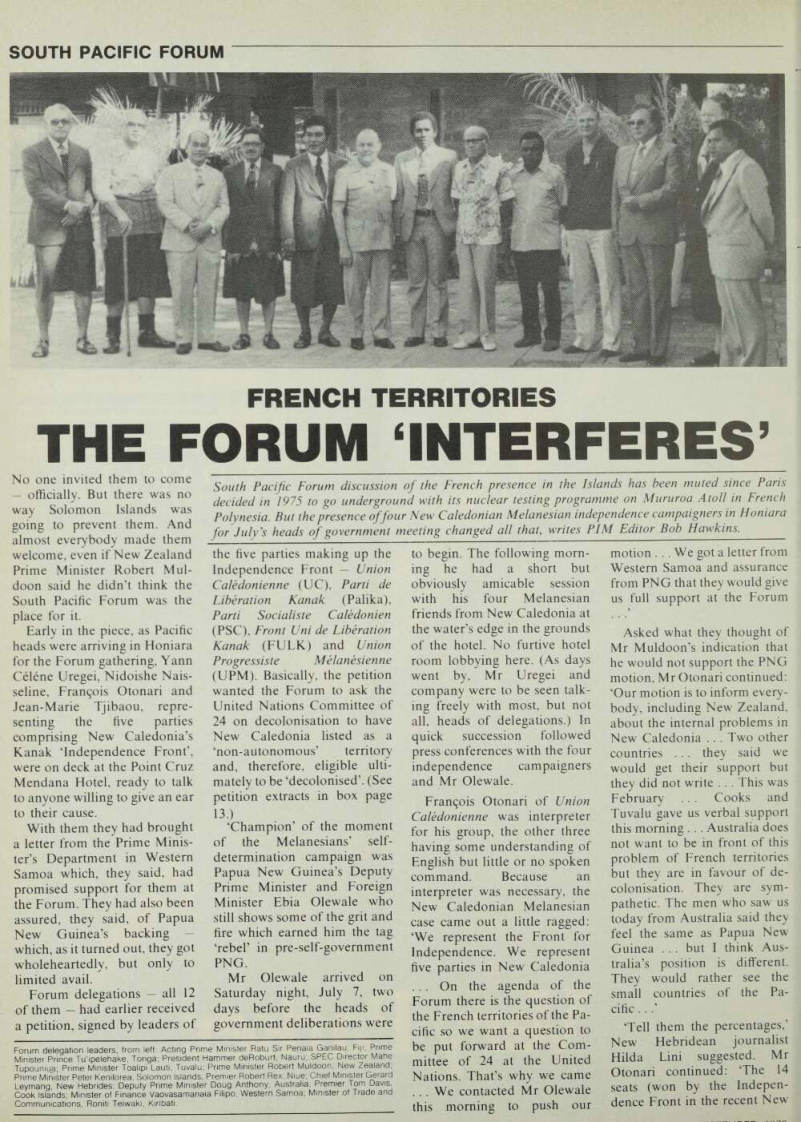
Forum delegation leaders, from left. Acting Prime Minister Ratu Sir Penaia Ganilau, Fiji, Prime Minister Prince Tu[?]pelehake, Tonga; President Hammer deRoburt, Nauru; SPEC Director Mahe Tupouniua; Prime Minister Toalipi Lauti, Tuvalu; Prime Minister Robert Muldoon, New Zealand; Prime Minister Peter Kenilorea, Solomon Islands; Premier Robert Rex, Niue; Chief Minister Gerard Leymang, New Hebrides; Deputy Prime Minister Doug Anthony, Australia; Premier Tom Davis, Cook Islands; Minister of Finance Vaovasamanaia Filipo, Western Samoa; Minister of Trade and Communications, Roniti Teiwaki, Kiribati.
Caledonia elections see box page 15) represent the Melan esians. We know now where everyone stands. From 1969 to 1976 there have been 15 000 newcomers, more than 11 000 Europeans, principally from France. There are 135 000 people in New Caledonia and 55 000 Melanesians .. . You have heard about Mr Dijoud. • He has got a plan. That ma jority [in the recent election] is in favour of that plan. He says that in 10 years from now there will be 400 000 people in New Caledonia .. . And in 10 years from now Melanesians will be only 30% of the total popu
lation ... [The projected
400 000 figure for New Caledonia’s population within 10 years seemed to have be come something of an ob session with the Independent Front representative even though, in all printed accounts PIM has read of the ‘Dijoud Plan’ there is nothing to sup port it. However it is under standable that, if Melanesians of New Caledonia have got this idea into their heads, they are even more anxious than before to rally help from around the Pacific. Even without the Dijoud Plan their position is already precarious.] Melan esians who voted for indepen dence? 82.5% of all Melanesians voted for
independence.’
Question: How did you ac
quire that figure?
Answer: ‘Because we know all of these people, or groups of people, who work with us, who are either European or Melanesian. We have been in politics for 25 years.’
End of press conference. On to another with Mr Olewale: Q: A French official has said a
discussion of independence for
'he French territories at the Forum meeting would be ' egarded by France as an un-
Yiendly act.
Dlewale: I think all human beings are entitled to self
ietermination ... and if they
lave friends who want to help hem I think the act by those
fiends towards helping them
hould not be regarded as an
mfriendly act.
f. New Zealand's position is hat the matter doesn I belong at he Forum level.
O: I believe the Forum has every right to discuss the matter because the Forum happens to be the organisation of sover eign independent states in the Pacific and if there are other Pacific people who want decolonisation, rightly it should be the concern of the Forum.
Q: How many other members of
the Forum would support your attitude on that?
O: I know for a fact that West ern Samoa would support this idea. There are others I have
heard through the grapevine
that would also support us Q: Have you had any formal French Government approach ... to try to persuade you to drop this issue?
O: When was it? Friday. Some junior officer from the French Government went to Port
Moresby and he wanted to see either the prime minister or myself but we thought he was such a.. .just a civil servant. . . that it was not proper for civil servants to see heads of govern ments so we referred him to our Department of Foreign Affairs. He presented a written message from the president of France which in fact said the same sort of thing which Olivier Stirn has preached lately in his travels to the Pa cific ...
Q: Did Mr Stirn at any stage suggest he should go to Port
Moresby himself?
O: Yes. He made a request but his time did not fit in with our prime minister’s time table or my time table. I was away in Southeast Asia and the prime minister was attending the provincial premiers’ con ference ... and I think he had such a short time to stay in the Pacific that he decided not to come to Port Moresby.
Q: Had it fitted in with your time table would you have been prepared to meet him?
O: Oh yes. Sure.
Q: What would you like the Forum to do on this question?
Would you like it to come up with a formal resolution to refer it to the Committee of 24?
O: That is what Papua New Guinea would like to see hap pen. A general resolution on decolonisation in the Pacific, and finally for it to find its way to the UN Committee of 24.
Q: How do you see your motion to raise the issue of French terri tories as a contrast to your foreign policy ... Do you see it as antagonising France?
O: I don’t think it is antagonis ing France. I think I am sure it is very clear to you that there are countries in the South Pacific like a . . . Where are you from? ... Yes, like Solomons, and you are happy that you are independent now. Like me. I am happy Papua New Guinea is now an independent country.
And how would you feel about other Pacific Islanders being ruled from Europe? Europe is very far away from the Pacific.
Q: You say you cannot do any thing about Irian Jaya because it is part of Indonesia. The French claim New Caledonia is part of France. So how is it that
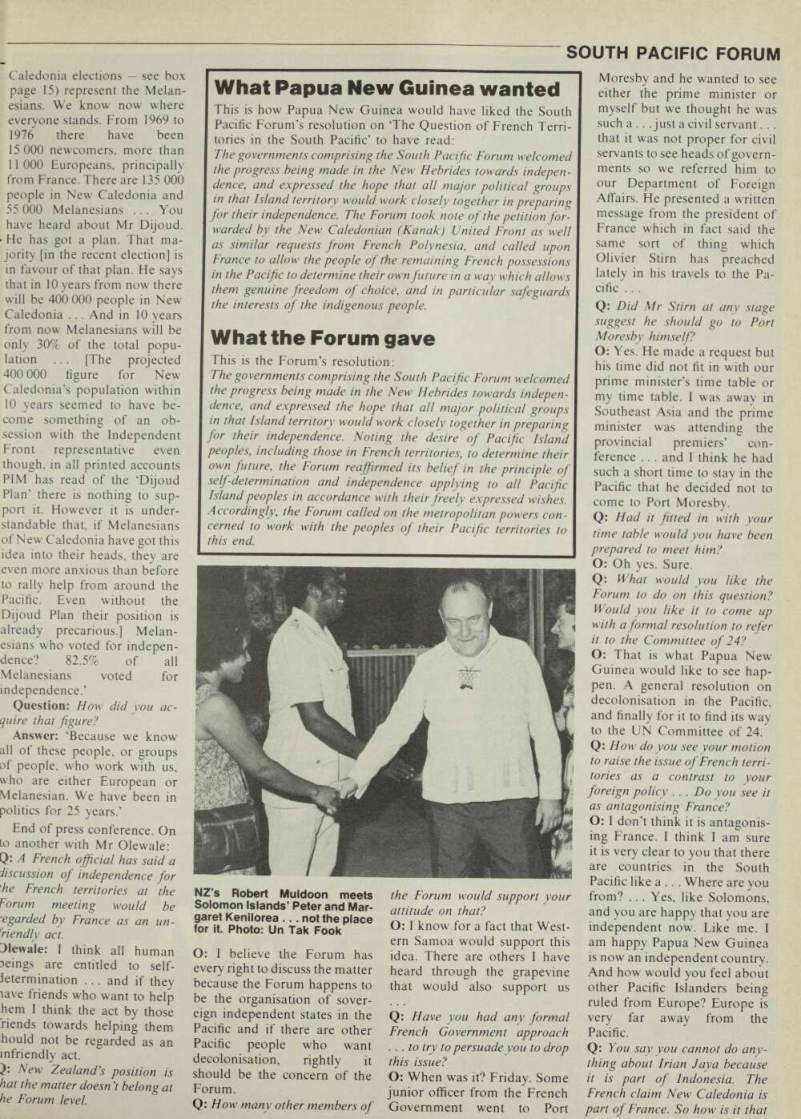
NZ’s Robert Muldoon meets Solomon Islands’ Peter and Mar garet Kenilorea ... not the place for It. Photo: Un Tak Fook
you come to support the New Caledonia issue but not West Papua?
O: The difference is that in West Papua the United Nations, the world organis ation, carried out a plebiscite.
No such thing has happened in New Caledonia yet.
So, with Papua New Gui nea’s cards on the table, New Caledonia’s Melanesians got on with their lobbying until heads of delegation headed off to Tambea, up the coast of Guadalcanal, for their now tra ditional ‘informal’ talks about the Forum agenda. When they returned in the evening word was, according to one delegate, that they had had ‘the best informal session ever’.
But, next day, it was clear that the New Caledonia issue was not one which had gone well at Tambea. By lunchtime almost all other agenda busi ness, in formal session, had been disposed of and national leaders and deputies were ‘five minutes’ into the French terri tories debate.
At the afternoon teabreak it seemed some progress had been achieved and a drafting
committee comprising
Papua New Guinea, Australia and Fiji - was working on a watered-down form of the PNG resolution. Australian
Foreign Minister Andrew Peakcock seemed confident that an acceptable formula was imminent but he obviously still felt it necessary to put an arm around his old friend, Ebia Olewale, and guide him away to a waterside seat where earn est discussion followed.
Though out of earshot, it cer tainly didn’t look as if Mr Pea cock was finding the going easy in his attempts to persuade Mr Olewale to accept anything less than PNG’s original proposal.
Back into session and a
long one. Finally delegates re
emerged to an eager press
corps. Dr Tom Davis, premier of the Cook Islands, elected spokesman for the Forum, did a smooth job of rationalising what at first appeared to be almost an act of appeasement of the French.
In Dr Davis’ lunchtime briefing on the morning session there had been an interesting
exchange:
Question: Will you discuss the matter of the French territories
this afternoon?
Davis: It could be held over.
Q: Until tomorrow?
D: Until later.
It seems at that stage that there was some doubt as to whether the French territories would appear in the final com munique, even as an agenda
item which delegations had chosen not to discuss.
But the Papua New Guinea delegation had no intention of
letting the issue disappear.
While not doubting the ability of both Melanesian and Polynesian to put up a good
fight when they really decide to
dig their heels in, of the nations which have emerged in a decolonising Pacific, none can match Papua New Guinea in the way it casts caution and economic considerations to the wind in pursuit of what it considers ‘moral’ goals. (Irian Jaya, of course, is more than a simple economic risk for
Png.)
Dr Davis recorded later, when asked if PNG had accepted the will of the Forum:
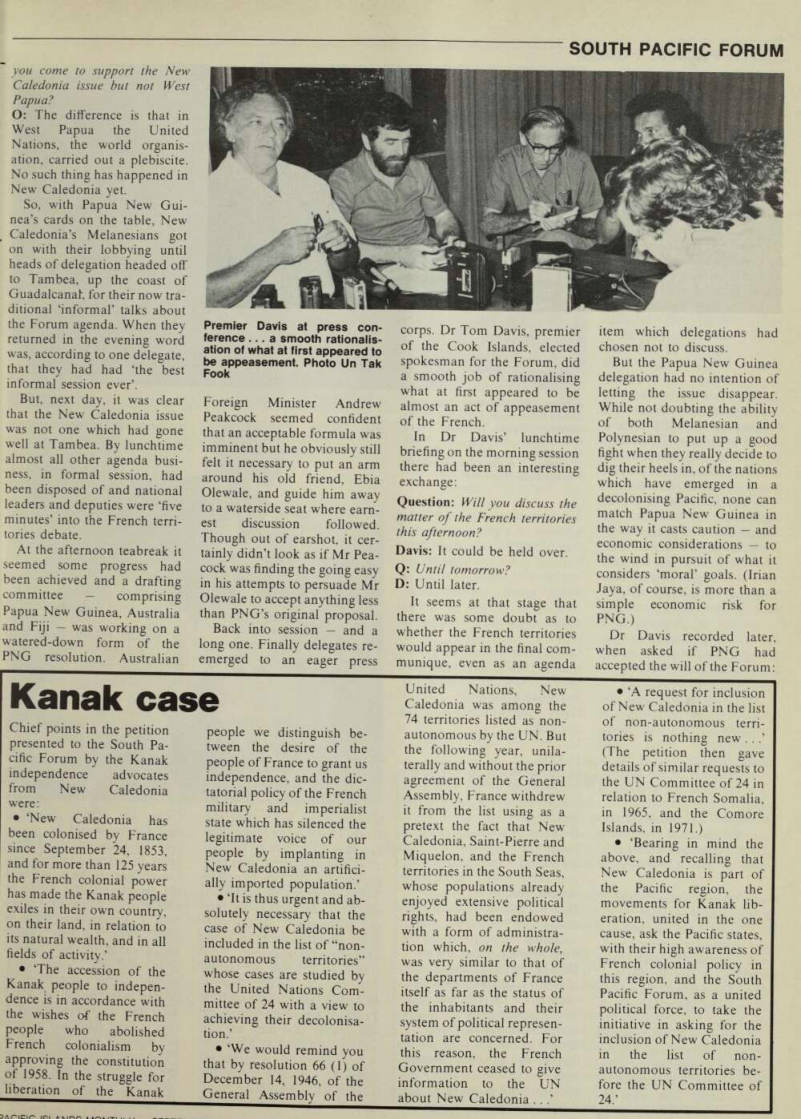
Premier Davis at press con ference ... a smooth rationalis ation of what at first appeared to be appeasement. Photo Un Tak Fook
‘They have eventually, but I must give them credit for fight ing very hard on behalf of the
indigenous peoples of New
Caledonia.’
The Cooks premier in several ways made the Forum’s final resolution look so much more reasonable. He ex plained; ‘The first resolution was considered by the majority ... to be too specific towards the French which could be con sidered interference in internal affairs. In other words, France is not the only nation in the Pacific which has colonial rights *Over Pacific peoples. I think ... all of us feel very strongly for the self determination of Pacific peoples .. . Those of us who have been associated with New Zealand or Australia have a feeling of ... a strong feeling,
perhaps carrying a bit of pain
to it, that there are still peoples who are not free. Australia and New Zealand have bent over backwards to create the
independence of peoples orig
inally colonially under their
guidance. But nevertheless there is a degree of responsi bility that has to be taken. Even with the help of the bending backwards of Australia and New Zealand (it) still took con siderable time to work out the
independence of the peoples
associated with them.’
Dr Davis agreed that the final resolution was far short of what the New Caledonian Independence Four had wanted but the ‘Forum has to act responsibly in not becom
ing a platform for a political
party’.
Question: This (the resolution) does not preclude individual members of the forum taking the matter to the Committee of 242 Davis: That is exactly right.
Q: Was that discussed?
D: Yes. These individuals,
these particular political enti
ties, can speak with each of the members of the Forum pri vately. There is little doubt that they will be given support in their aims.
Dr Davis said he accepted the assurances from Olivier Stirn that France would grant independence if a majority of people voted that way but added that the limitations on
that acceptance were the ‘con stituents of a population. Are
they Frenchmen? Are they
soldiers? Are they in the army?
Are they imported to work in nickel mines? Or whatever.
And have a vote. In other words, the issue is indigenous
people’.
Question: It has been suggested Cook Islands would support moves to have this question put before the Committee of 24.
Davis: I don’t think we can do any less.
Q: Then you support them.
D:Yes.
Q: Therefore you are personally disappointed at the resolution which has come out of the Forum.
D: I am not disappointed in terms of the Forum. As an individual I feel disappointed that there wasn’t much more that we can do.
Q: What essentially was the dif ficulty that the Forum had in accepting the proposal put for ward by Papua New Guinea?
D: The difficulty was the fact that this constituted (the view point of) a party and prob ably a minority party. It did not constitute a national wish.
Q: Do vou at any stage see the
Pacific being wholly indepen
dent?
D: Oh! I do. It could be half a decade. These things are
moving along faster than you think. That is some reason why one should take a fairly responsible attitude rather than supporting, say, the Toto tupuna in Tahiti which is a strong group, vociferous and doing what they can politically ... but a relalively small minority in terms of the total population. (Once again I had the feeling that certain Pacific leaders, including Australian and New Zealand, know something on this matter that they are not willing to impart to the press.
A year ago I met a highly respected authority on the Islands who didn’t drop hints, like Dr Davis seemed to be
doing. He bluntly suggested
that France would be out of New Caledonia in about three years. In fact we wagered a car ton of beer on the point, with me assuming that I would be able to drink it in a still-French New Caledonia sometime in 1982. On several other occasions in the past year I have met the ‘wink wink,
nudge nudge’ approach in
people who ought to know what they are talking about. If they’re right, there was more to the Forum’s easy approach in Honiara than immediately met the eye. It is possible that the ‘wink and nudge’ experts have a weather eye on political
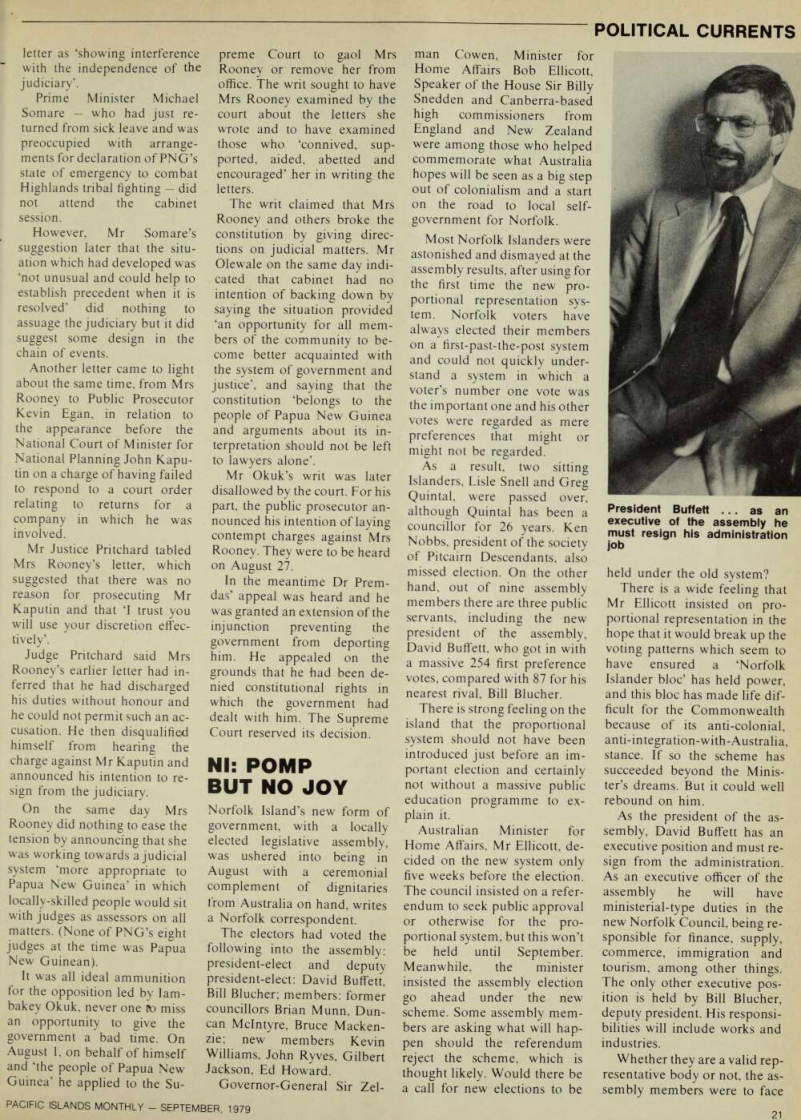
Above: Melanesian Indepen dence Front reps, from left Nais seline, Uregei, Tjlbau and Otonari ... talking to most everybody; right: PNG’s Olewale ... a determined stand.
Photos Bob Hawkins
developments in France, where combined Leftist forces such as the Socialist and Communist parties are usually only a few percentage points off achieving power in Presidential and national elections. If they suc ceed in bridging this gap at any time, French policy in the Pa cific could undergo dramatic changes in favour of indepen dence for the indigenous peoples of the Pacific terri tories.) Talking around delegation members afterwards it was ap parent that though the Forum had acted in ‘statesmanlike’ manner, sympathies generally lay with New Caledonia’s min ority Melanesian community.
Most important, even
though some delegates seemed
unaware of the breakdown of New Caledonia’s population (and the implications of the Melanesians’ now precarious position within their home land), their major concern was the protection of the rights of the ‘indigenous’ peoples.
One delegate’s eyes opened in surprise (only the cynical would have said mock surprise) when the various components of the New Caledonian popu lation (and their percentages) were detailed to him. ‘Why didn’t the Forum know these facts?’ he asked.
The two New Hebridean ob servers, Chief Minister Father
Gerard Leymang, and Minister
for Public Administration George Kalkoa (of the Vanu
aaku Part y)’ were sported to ave been biting their lips as the y listened ’ unable to con tribute to the French territories debate in the formal Forum sessions, Afterwards, Father Ley mang told me: did not understand the Australian and New Zealand reas °ning in the Forum. It ™ ust have *? een economic con- Sld w atl £ n ?i Ka koa told me New Caledonia would be a priority foreign affairs matter after New Hebrides gains its dependence next year. He adm *“ ed «■»« his party had been helping the Kanak move ment ‘" New Caledon.a for <• , , . quite a while and it was a , continuing process. r .
On the question of whites in x Ta „, n i a .
New Caledonia, he com t , tI r . mented; I am afraid it is very hard to give any clear intention as to how the New Caledonians can * sort this out. If New Caledonia achieves mdepen dence they (the whites) will be given the option of choosing whether they want to stay and become citizens.’ He was quite cynical about many of the Europeans who stood in the re cent New Caledonian elec tions: ‘They could only stand because someone is dishing out money somewhere.’ He be
lieved that only in electorates where Melanesians were out numbered had anti-independ ence candidates been elected.
One source suggested the Forum breakdown on the French territories question was roughly as follows: For the PNG resolution PNG, West ern Samoa, Fiji and Tuvalu; highly sympathetic Cook Islands, Kiribati, Tonga, Niue; against the PNG resolution Australia, New Zealand and Nauru, the latter, as one voice put it, being ‘caught in an econ omic vice’ (President Hammer de Roburt recently visited Paris); would have preferred no record at all in the final com munique Australia and New Zealand.
Fiji is understood to have indicated some preference for the Banaba (Ocean) Island issue to have been included in the resolution, but this was settled separately with a mild resolution congratulating the Banabans and Kiribatians on their willingness to keep talk ing about the Banabans’ desire to get out of the Republic of Kiribati, and Tarawa’s deter mination to keep them in.
The final resolution was drafted by a committee
comprising Australia, Papua
New Guinea and Fiji. One wonders how long Andrew
Peacock’s ‘special’ relationship
with certain of PNG’s leaders will survive.
Post-Forum, it was revealed that New Zealand’s Prime Minister Muldoon had tried to compare a New Zealand South Island secessionist movement with the New Caledonian situ ation. He was not the only red herring specialist. It was also suggested that Mr Peacock had expressed the view that Papua New Guinea’s own Bougain ville and Papua Besena prob lems were analogous.
Obviously, both Australia and NZ were desperate for par allels. In the Pacific there is no analogy to the position of the Melanesians in New Caledonia
an indigenous population in
the minority. Unless one looks to Australia and New Zealand.
God forbid that should happen
again in this ‘enlightened’
age.
New Hebrides Kalkoa and Leymang ... puzzled at the Aus tralasian attitude. Photo: Bob Hawkins
What Papua New Guinea wanted
This is how Papua New Guinea would have liked the South Pacific Forum’s resolution on The Question of French Terri tories in the South Pacific’ to have read: The governments comprising the South Pacific Forum welcomed the progress being made in the New Hebrides towards indepen dence, and expressed the hope that all major political groups in that Island territory would work closely together in preparing for their independence. The Forum took note of the petition for warded by the New Caledonian (Kanak) United Front as well as similar requests from French Polynesia, and called upon France to allow the people of the remaining French possessions in the Pacific to determine their own future in a way which allows them genuine freedom of choice, and in particular safeguards the interests of the indigenous people.
What the Forum gave
This is the Forum’s resolution: The governments comprising the South Pacific Forum welcomed the progress being made in the New Hebrides towards indepen dence, and expressed the hope that all major political groups in that Island territory would work closely together in preparing for their independence. Noting the desire of Pacific Island peoples, including those in French territories, to determine their own future, the Forum reaffirmed its belief in the principle of self-determination and independence applying to all Pacific Island peoples in accordance with their freely expressed wishes.
Accordingly, the Forum called on the metropolitan powers con cerned to work with the peoples of their Pacific territories to this end.
Advertisements & other items, pp. 11-12 (2 items)
South Pacific Forum
What do you really see
when you watch TV?
¥ w SS'#/ % \
:.v A l ,
■$ '• **, ■ «j 2.-
i H\. ... >V\ V v
ii\ I nr rr cr rr cr or cr nr /j ' m i-’
linnn
teSWSr ; . I
V & 'I sror PUkY A sssiH. =
VK 'W
b™ ■ -7 a I MMn I ' I j■' l r 1 § ~i> i* j| —-- t " at
W-i i -■ /
V"-'” 1 \i\- • ■ft «u,«.'.>M. " I*IUU MI44AISA MECMA COM AM V * *IP ~=r Do you see what you want to see? Has television lived up to its promise? Is it a medium of entertainment and enlightenment, or one of enslavement?
These are the serious questions. The answers lie in your ability to shape your own video environment.
To choose programs you want to view, when you want to view them.
The video tape recorder is by far one of the best tools yet devised to expand the creative process of television.
We know. We re JVC, the innovative audio/video electronics company with 50 years plus one of experience.
TO* For more than 20 years, JVC has been committed to the development of VTR. This experience plus JVC’s miniaturization technology has now led to the development of the compact, lightweight and easy-to-operate VHS video cassette recorder, the HR-3300 (pictured here). It’s the world’s first VHS model, and offers a host of JVC-developed technical advantages.
The way we see TV, JVC video systems are the key to freedom and rewarding leisure.
Our hope, of course, is that in the television of tomorrow you’ll see things our way.
JVC
Australia: Hagemeyer(Australasia)B.V.. 57/69 Anzac Parade, Kensington, N.5.W.2033 Australia Te 1.662-1222 FIJI Islands: D. Gokal & Co., Ltd., G.P.O. Box 501, Corner of Pier Street & Renwick Road, Suva, Fiji Te 1.25259 Cook Islands: J & P. Ingram & Co., Ltd., P.0.80x 55, Rarotonga, Cook Islands Te 1.378457 New Hebrides: Wu ke Luong, P.0.80x 113, Rue Higginson, Port-Vila, New Hebrides Te 1.2115 New Caledonia: Caldis, 2, Route du Velodrome, B.P. Ml. Noumea, Cedex, New Caledonia Te 1.262350 Tahiti: Magasin Sincere. B.P. 215, Papeete, Tahiti Te 1.20060 Papua New Guinea: Hagemeyer(P.N.G.)Ptu, Ltd,, P.0.80x 90 Lae, Papua New Guinea Te 1.42-3200 New Zealand: Atlas Majestic Industries Ltd., 11, Albion Road, Otahuhu, Auckland, New Zealand Te 1.27-67-099
Kanak case
Chief points in the petition presented to the South Pa cific Forum by the Kanak
independence advocates
from New Caledonia were; • ‘New Caledonia has been colonised by France since September 24, 1853, and for more than 125 years the French colonial power has made the Kanak people exiles in their own country, on their land, in relation to its natural wealth, and in all fields of activity.’ • ‘The accession of the Kanak people to indepen dence is in accordance with the wishes of the French people who abolished French colonialism by approving the constitution of 1958. In the struggle for liberation of the Kanak
people we distinguish be
tween the desire of the people of France to grant us independence, and the dic tatorial policy of the French military and imperialist state which has silenced the legitimate voice of our
people by implanting in
New Caledonia an artifici ally imported population.’ • Tt is thus urgent and ab solutely necessary that the case of New Caledonia be included in the list of “non autonomous territories” whose cases are studied by the United Nations Com mittee of 24 with a view to achieving their decolonisa tion.’ • ‘We would remind you that by resolution 66 (1) of December 14, 1946, of the General Assembly of the
United Nations, New Caledonia was among the 74 territories listed as non autonomous by the UN. But the following year, unila terally and without the prior agreement of the General Assembly, France withdrew it from the list using as a pretext the fact that New Caledonia, Saint-Pierre and Miquelon, and the French territories in the South Seas, whose populations already enjoyed extensive political rights, had been endowed with a form of administra tion which, on the whole, was very similar to that of the departments of France itself as far as the status of the inhabitants and their system of political represen tation are concerned. For this reason, the French Government ceased to give information to the UN about New Caledonia .. .’
• ‘A request for inclusion of New Caledonia in the list of non-autonomous terri
tories is nothing new . .
(The petition then gave details of similar requests to the UN Committee of 24 in relation to French Somalia, in 1965, and the Comore Islands, in 1971.) • ‘Bearing in mind the above, and recalling that New Caledonia is part of the Pacific region, the movements for Kanak lib eration, united in the one cause, ask the Pacific states, with their high awareness of French colonial policy in this region, and the South Pacific Forum, as a united political force, to take the initiative in asking for the inclusion of New Caledonia in the list of non autonomous territories be fore the UN Committee of 24.’
Advertisements & other items, pp. 13-14 (2 items)
South Pacific Forum
South Pacific Forum
The faces have it
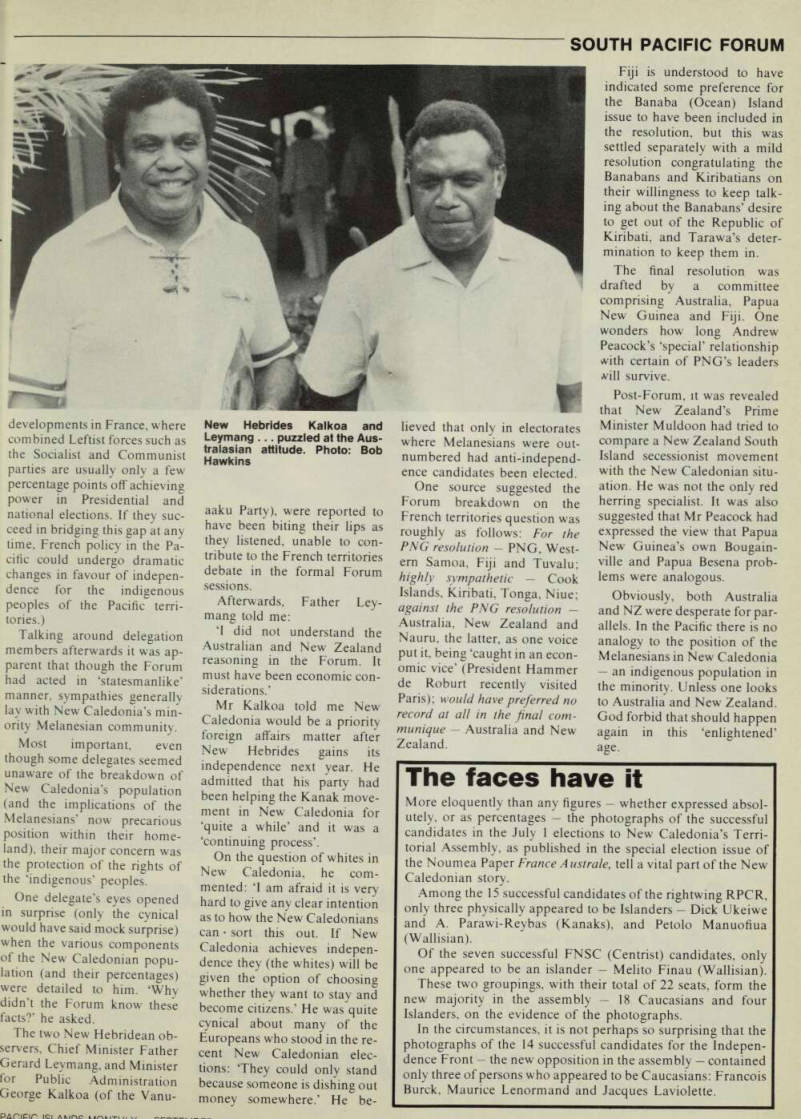
More eloquently than any figures whether expressed absol utely, or as percentages - the photographs of the successful candidates in the July 1 elections to New Caledonia’s Terri torial Assembly, as published in the special election issue of the Noumea Paper France Australe, tell a vital part of the New Caledonian story.
Among the 15 successful candidates of the rightwing RPCR, only three physically appeared to be Islanders - Dick Ukeiwe and A. Parawi-Reybas (Kanaks), and Petolo Manuofiua (Wallisian).
Of the seven successful FNSC (Centrist) candidates, only one appeared to be an islander Melito Finau (Wallisian).
These two groupings, with their total of 22 seats, form the new majority in the assembly - 18 Caucasians and four Islanders, on the evidence of the photographs.
In the circumstances, it is not perhaps so surprising that the photographs of the 14 successful candidates for the Indepen dence Front the new opposition in the assembly contained only three of persons who appeared to be Caucasians: Francois Burck, Maurice Lenormand and Jacques Laviolette.
Advertisements & other items, pp. 15-16 (2 items)
South Pacific Forum
PAP.IPIP ICI AMPIO UAmti n \/
See the world with Air New Zealand
r p . ■ - %■ w k- - \ V See the world with Air New Zealand If your journey is to take you far or near, first see Air New Zealand or your travel agent to discuss the flights and fares that suit you best.
In the Pacific we fly to New Zealand, Australia, Fiji, Honolulu, Tahiti, Samoa, New Caledonia and Rarotonga. If you’re travelling farther, let us fly you to our Gateway cities to the world - Los Angeles, Hong Kong and Singapore, where you can connect with the airline of your choice.
And best of all, you’ll start by enjoying the special attentive service Air New Zealand is famous for.
Begin your trip with Air New Zealand
air new z
We fly the Pacific.
ANZ 79/12C
Two territories,
Political
Currents
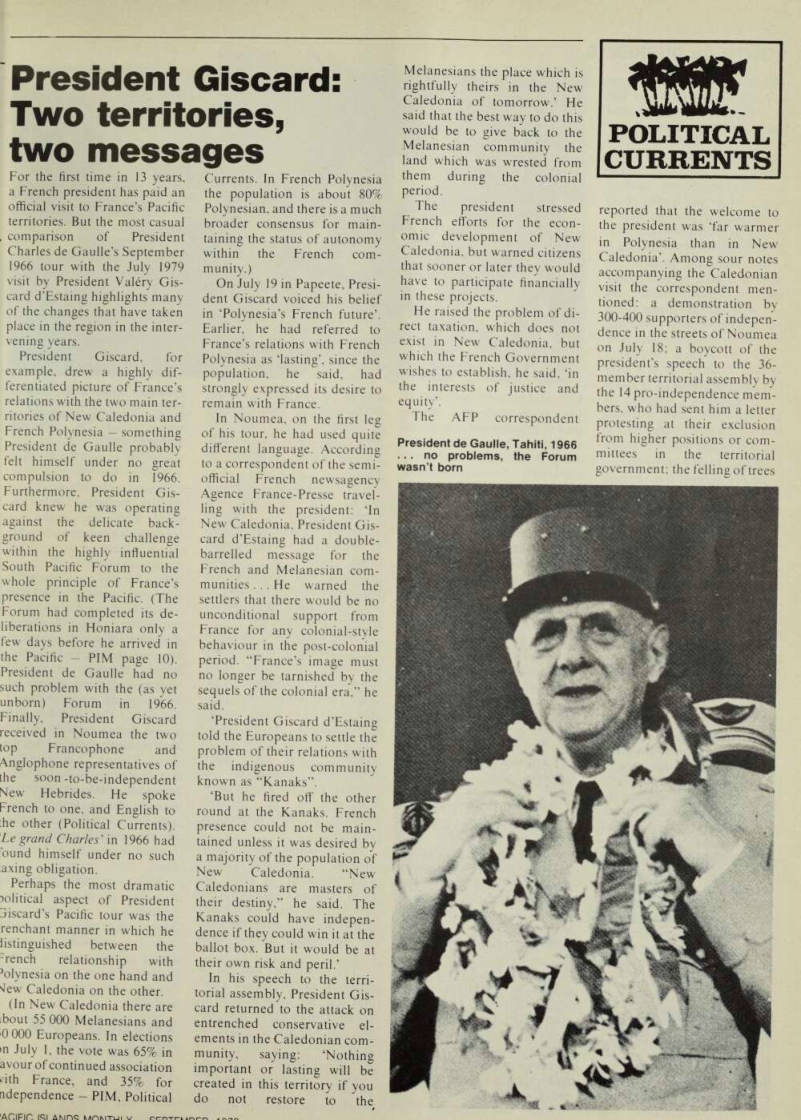
President Giscard: Two territories, two messages
For the first time in 13 years, a French president has paid an official visit to France’s Pacific territories. But the most casual
. comparison of President
Charles de Gaulle’s September 1966 tour with the July 1979 visit by President Valery Gis
card d’Estaing highlights many
of the changes that have taken place in the region in the inter
vening years.
President Giscard, for example, drew a highly dif ferentiated picture of France’s relations with the two main ter ritories of New Caledonia and
French Polynesia something
President de Gaulle probably felt himself under no great compulsion to do in 1966.
Furthermore, President Gis card knew he was operating against the delicate back ground of keen challenge within the highly influential South Pacific Forum to the whole principle of France’s presence in the Pacific. (The Forum had completed its de liberations in Honiara only a few days before he arrived in the Pacific - PIM page 10).
President de Gaulle had no such problem with the (as yet unborn) Forum in 1966.
Finally, President Giscard received in Noumea the two
top Francophone and
Anglophone representatives of
the soon -to-be-independent
New Hebrides. He spoke
French to one, and English to fie other (Political Currents).
Le grand Charles' in 1966 had 'ound himself under no such
axing obligation.
Perhaps the most dramatic political aspect of President discard’s Pacific tour was the renchant manner in which he listinguished between the
-rench relationship with
J olynesia on the one hand and <ew Caledonia on the other. (In New Caledonia there are ibout 55 000 Melanesians and 0 000 Europeans. In elections •n July 1, the vote was 65% in avour of continued association fith France, and 35% for tidependence - PIM, Political
Currents. In French Polynesia the population is about 80% Polynesian, and there is a much broader consensus for main taining the status of autonomy within the French com
munity.)
On July 19 in Papeete, Presi dent Giscard voiced his belief in ‘Polynesia’s French future’.
Earlier, he had referred to France’s relations with French Polynesia as ‘lasting’, since the population, he said, had strongly expressed its desire to remain with France.
In Noumea, on the first leg of his tour, he had used quite
different language. According
to a correspondent of the semi official French newsagency Agence France-Presse travel ling with the president: in New Caledonia, President Gis card d’Estaing had a double barrelled message for the French and Melanesian com munities ... He warned the settlers that there would be no unconditional support from France for any colonial-style behaviour in the post-colonial
period. “France’s image must
no longer be tarnished by the sequels of the colonial era,” he said. ‘President Giscard d’Estaing told the Europeans to settle the problem of their relations with
the indigenous community
known as “Kanaks”. ‘But he fired off the other round at the Kanaks. French presence could not be main tained unless it was desired by a majority of the population of New Caledonia. “New Caledonians are masters of their destiny,” he said. The Kanaks could have indepen dence if they could win it at the ballot box. But it would be at their own risk and peril.’
In his speech to the terri torial assembly. President Gis card returned to the attack on entrenched conservative el ements in the Caledonian com
munity, saying: ‘Nothing
important or lasting will be created in this territory if you do not restore to the
Melanesians the place which is rightfully theirs in the New Caledonia of tomorrow.’ He said that the best way to do this would be to give back to the Melanesian community the land which was wrested from them during the colonial period.
The president stressed French efforts for the econ omic development of New Caledonia, but warned citizens that sooner or later they would
have to participate financially
in these projects.
He raised the problem of di rect taxation, which does not exist in New Caledonia, but which the French Government wishes to establish, he said, ‘in the interests of justice and
equity’.
The AFP correspondent
reported that the welcome to the president was ‘far warmer in Po ynesia lhan in New Caledonia'. Among sour notes accompanying the Caledonian visit the correspondent men tioned; a dem F onstratlon b 300.400 supporters of indepen dence in the streets of NoU m ea 0 n July 18: a boycott of the president’s speech to the 36member territorial assembly by the 14 pro-independence mem bers' who had sent him a letter protesting at their exclusion rom positions or com mittees in the territorial government; the felling of trees
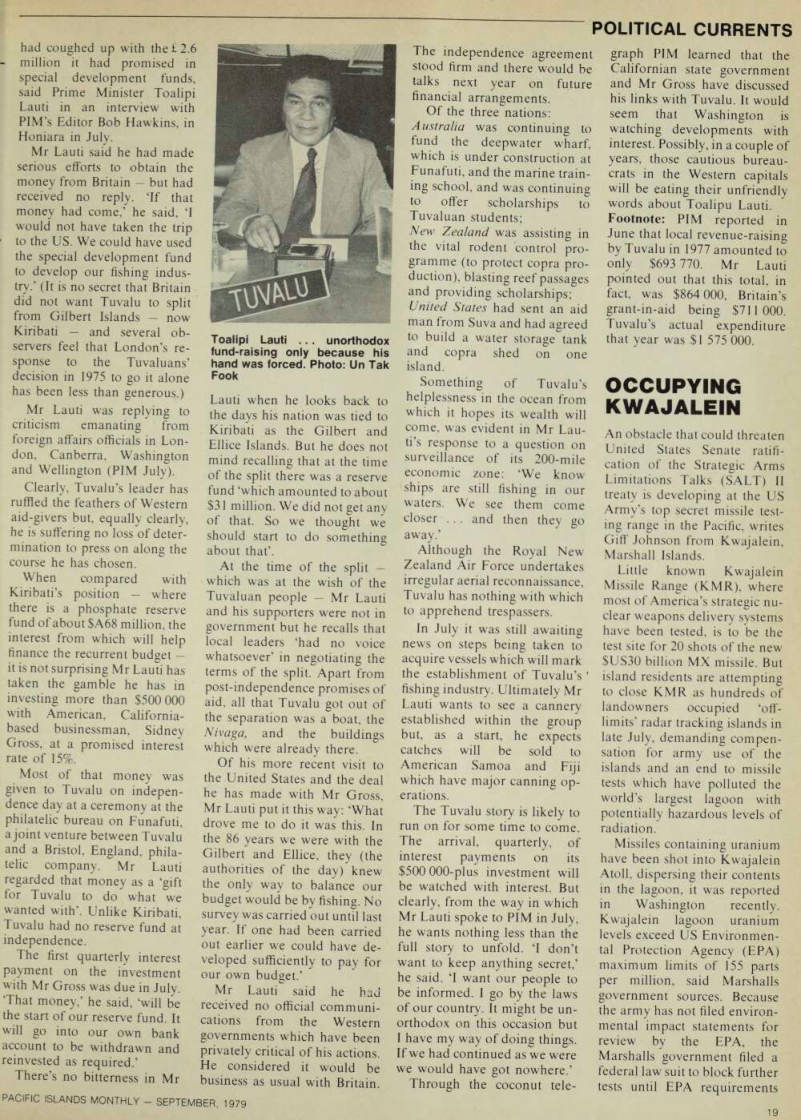
President de Gaulle, Tahiti, 1966 ... no problems, the Forum wasn’t born
on the island of Touho in an attempt to stop a large turn-out to welcome the president; and the presence of pro independence banners on the island of Lifou, Loyalty Islands. (President Giscard be came the first French head of state ever to visit Kanak tribal areas, and the Loyalty Islands, where pro-independence sen timent is traditionally strong.) But, according to news re ports available to PIM at the time of going to press, the visit to French Polynesia was marred by no such incidents; President Giscard was wel
comed by French Polynesia’s
Deputy Premier Francis San ford, accompanied by a group of Polynesian dancers in national costume. Nothing seems to have happened during the visit to mar the lei- laden at
mosphere of its beginning.
In his speeches in French
Polynesia, the president vowed
that France would not be sparing in support and soli
darity for the Polynesians,
since, he claimed, they had freely chosen to remain within the French community.
Measures he announced in cluded steps to reduce the dif ference in living standards between Tahiti and the terri
tory’s other archipelagoes, and
plans to deal with social prob
lems and reducing unemploy
ment.
The president made two other sorties on his Pacific tour: he paid a three-hour visit to the French territory of Wallis and Futuna, where he met the three ruling kings and took part in a traditional drink ing ceremony; then, as his final stop, he chose the Moruroa nu clear testing range. The AFP correspondent had the follow ing comment: ‘For all the dis cretion surrounding that visit, the stopover marked the re lationship between France’s position as a ranking nuclear power and the French presence in the Pacific.’
Nh Leaders
See Giscard
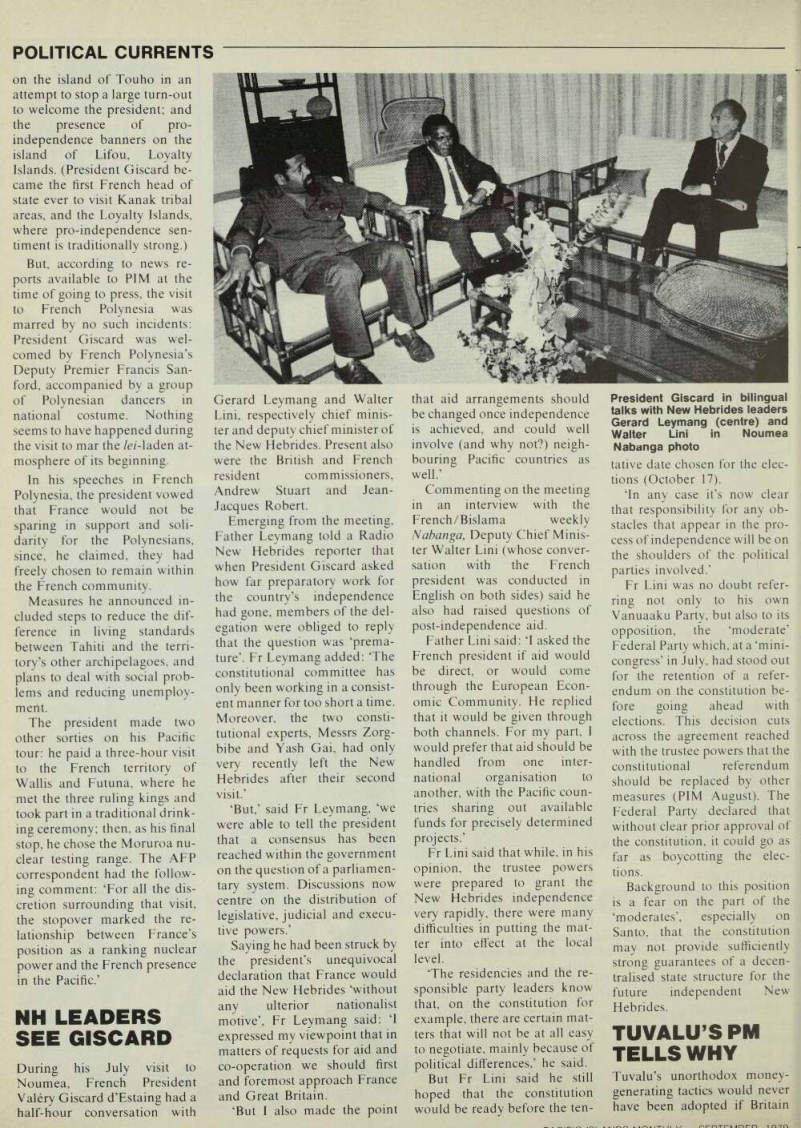
During his July visit to Noumea, French President Valery Giscard d’Estaing had a half-hour conversation with
Gerard Leymang and Walter Lini, respectively chief minis ter and deputy chief minister of the New Hebrides. Present also were the British and French resident commissioners, Andrew Stuart and Jean-
Jacques Robert.
Emerging from the meeting.
Father Leymang told a Radio New Hebrides reporter that when President Giscard asked how far preparatory work for
the country’s independence
had gone, members of the del
egation were obliged to reply
that the question was ‘prema ture’. Fr Leymang added; ‘The constitutional committee has only been working in a consist ent manner for too short a time.
Moreover, the two consti tutional experts, Messrs Zorg bibe and Yash Gai, had only very recently left the New Hebrides after their second visit.’ ‘But,’ said Fr Leymang, ‘we were able to tell the president that a consensus has been reached within the government on the question of a parliamen tary system. Discussions now centre on the distribution of
legislative, judicial and execu
tive powers.’
Saying he had been struck by
the president’s unequivocal
declaration that France would aid the New Hebrides ‘without any ulterior nationalist motive’, Fr Leymang said: T expressed my viewpoint that in matters of requests for aid and co-operation we should first and foremost approach France and Great Britain. ‘But I also made the point
that aid arrangements should
be changed once independence
is achieved, and could well involve (and why not?) neigh bouring Pacific countries as well.’
Commenting on the meeting
in an interview with the
French/Bislama weekly
Nabanga, Deputy Chief Minis
ter Walter Lini (whose conver sation with the French president was conducted in English on both sides) said he also had raised questions of
post-independence aid.
Father Lini said: i asked the French president if aid would be direct, or would come through the European Econ
omic Community. He replied
that it would be given through both channels. For my part. 1 would prefer that aid should be handled from one inter national organisation to another, with the Pacific coun tries sharing out available funds for precisely determined
projects.’
Fr Lini said that while, in his opinion, the trustee powers were prepared to grant the New Hebrides independence very rapidly, there were many difficulties in putting the mat ter into effect at the local level. ‘The residencies and the re sponsible party leaders know that, on the constitution for example, there are certain mat ters that will not be at all easy to negotiate, mainly because of political differences,’ he said.
But Fr Lini said he still hoped that the constitution would be ready before the ten
tative date chosen for the elec tions (October 17). ‘ln any case it’s now clear that responsibility for any ob stacles that appear in the pro cess of independence will be on the shoulders of the political
parties involved.’
Fr Lini was no doubt refer ring not only to his own Vanuaaku Party, but also to its opposition, the ‘moderate’
Federal Party which, at a ‘mini congress’ in July, had stood out for the retention of a refer endum on the constitution be fore going ahead with elections. This decision cuts across the agreement reached with the trustee powers that the constitutional referendum should be replaced by other measures (PIM August). The Federal Party declared that without clear prior approval of the constitution, it could go as far as boycotting the elec tions.
Background to this position
is a fear on the part of the ‘moderates’, especially on Santo, that the constitution
may not provide sufficiently
strong guarantees of a decen tralised state structure for the future independent New Hebrides.
Tuvalu’S Pm
Tells Why
Tuvalu’s unorthodox money generating tactics would never have been adopted if Britain
President Giscard in bilingual talks with New Hebrides leaders Gerard Leymang (centre) and Walter Uni in Noumea Nabanga photo
had coughed up with the £2.6 - million it had promised in special development funds, said Prime Minister Toalipi Lauti in an interview with PlM’s Editor Bob Hawkins, in Honiara in July.
Mr Lauti said he had made serious efforts to obtain the money from Britain but had received no reply. ‘lf that money had come,’ he said, ‘I would not have taken the trip to the US. We could have used
the special development fund
to develop our fishing indus try.’ (It is no secret that Britain did not want Tuvalu to split from Gilbert Islands now Kiribati and several ob servers feel that London’s re sponse to the Tuvaluans’ decision in 1975 to go it alone has been less than generous.) Mr Lauti was replying to criticism emanating from foreign affairs officials in Lon don, Canberra, Washington
and Wellington (PIM July).
Clearly, Tuvalu’s leader has ruffled the feathers of Western
aid-givers but, equally clearly,
he is suffering no loss of deter mination to press on along the course he has chosen.
When compared with Kiribati’s position where there is a phosphate reserve fund of about SA6B million, the interest from which will help finance the recurrent budget it is not surprising Mr Lauti has taken the gamble he has in investing more than $5OO 000 with American, California based businessman, Sidney Gross, at a promised interest rate of 15%.
Most of that money was given to Tuvalu on indepen dence day at a ceremony at the philatelic bureau on Funafuti, a joint venture between Tuvalu and a Bristol, England, phila telic company. Mr Lauti regarded that money as a ‘gift for Tuvalu to do what we wanted with’. Unlike Kiribati, Tuvalu had no reserve fund at
independence.
The first quarterly interest payment on the investment with Mr Gross was due in July. ‘That money,’ he said, ‘will be the start of our reserve fund. It will go into our own bank account to be withdrawn and reinvested as required.’
There’s no bitterness in Mr
Lauti when he looks back to the days his nation was tied to Kiribati as the Gilbert and Ellice Islands. But he does not mind recalling that at the time of the split there was a reserve fund ‘which amounted to about $3l million. We did not get any of that. So we thought we should start to do something about that’.
At the time of the split which was at the wish of the Tuvaluan people - Mr Lauti and his supporters were not in government but he recalls that local leaders ‘had no voice whatsoever’ in negotiating the terms of the split. Apart from post-independence promises of aid, all that Tuvalu got out of the separation was a boat, the
Nivaga, and the buildings
which were already there.
Of his more recent visit to the United States and the deal he has made with Mr Gross, Mr Lauti put it this way: ‘What drove me to do it was this. In the 86 years we were with the Gilbert and Ellice, they (the authorities of the day) knew the only way to balance our
budget would be by fishing. No
survey was carried out until last year. If one had been carried out earlier we could have de veloped sufficiently to pay for our own budget.’
Mr Lauti said he had received no official communi cations from the Western governments which have been privately critical of his actions.
He considered it would be business as usual with Britain.
The independence agreement stood firm and there would be talks next year on future financial arrangements.
Of the three nations: Australia was continuing to fund the deepwater wharf, which is under construction at Funafuti, and the marine train ing school, and was continuing to offer scholarships to Tuvaluan students; New Zealand was assisting in the vital rodent control pro gramme (to protect copra pro duction), blasting reef passages
and providing scholarships;
United States had sent an aid man from Suva and had agreed to build a water storage tank and copra shed on one island.
Something of Tuvalu’s helplessness in the ocean from which it hopes its wealth will come, was evident in Mr Lau d’s response to a question on surveillance of its 200-mile economic zone: ‘We know ships are still fishing in our waters. We see them come closer .. . and then they go
away.’
Although the Royal New
Zealand Air Force undertakes irregular aerial reconnaissance, Tuvalu has nothing with which to apprehend trespassers.
In July it was still awaiting news on steps being taken to acquire vessels which will mark the establishment of Tuvalu’s ’
fishing industry. Ultimately Mr
Lauti wants to see a cannery established within the group but, as a start, he expects catches will be sold to American Samoa and Fiji which have major canning op erations.
The Tuvalu story is likely to run on for some time to come.
The arrival, quarterly, of interest payments on its $5OO 000-plus investment will be watched with interest. But clearly, from the way in which Mr Lauti spoke to PIM in July, he wants nothing less than the full story to unfold. ‘I don’t want to keep anything secret,’ he said. ‘I want our people to be informed. I go by the laws of our country. It might be un orthodox on this occasion but I have my way of doing things.
If we had continued as we were we would have got nowhere.’
Through the coconut tele
graph PIM learned that the Californian state government and Mr Gross have discussed his links with Tuvalu. It would seem that Washington is watching developments with interest. Possibly, in a couple of years, those cautious bureau crats in the Western capitals will be eating their unfriendly words about Toalipu Lauti.
Footnote: PIM reported in June that local revenue-raising by Tuvalu in 1977 amounted to only $693 770. Mr Lauti pointed out that this total, in fact, was $864 000, Britain’s grant-in-aid being $7llOOO.
Tuvalu’s actual expenditure that year was $1 575 000.
Occupying
Kwajalein
An obstacle that could threaten United States Senate ratifi cation of the Strategic Arms Limitations Talks (SALT) II treaty is developing at the US Army’s top secret missile test ing range in the Pacific, writes Gilf Johnson from Kwajalein, Marshall Islands.
Little known Kwajalein Missile Range (KMR), where most of America’s strategic nu clear weapons delivery systems have been tested, is to be the test site for 20 shots of the new SUS3O billion MX missile. But island residents are attempting to close KMR as hundreds of landowners occupied ‘off limits’ radar tracking islands in
late July, demanding compen
sation for army use of the islands and an end to missile tests which have polluted the world’s largest lagoon with potentially hazardous levels of radiation.
Missiles containing uranium have been shot into Kwajalein Atoll, dispersing their contents in the lagoon, it was reported in Washington recently.
Kwajalein lagoon uranium levels exceed US Environmen tal Protection Agency (EPA) maximum limits of 155 parts per million, said Marshalls government sources. Because the army has not filed environ mental impact statements for review by the EPA, the Marshalls government filed a federal law suit to block further tests until EPA requirements
Toalipi Lauti ... unorthodox fund-raising only because his hand was forced. Photo: Un Tak Fook
for tests are met. ‘We have closed it (the base) before and we will close it again,’ Marshallese leading the
Kwajalein occupation said.
Although US State Depart ment spokesmen have down
played the importance of
KMR, army representatives say there is ‘no comparable range anywhere else for testing the MX, and a great deal of time and money would be necessary to relocate the
Kwajalein base’. Any appreci
able delay in MX missile development could hurt pass age of the SALT treaty in the US Senate, said a State Depart
ment spokesman recently.
Imada Kabua, a local legis lature member, was clubbed with a nightstick by the American security manager as he led 25 unarmed men, women and children onto the beach at Roi Namur, a tiny island on the north tip of Kwajalein dotted with missile
tracking equipment.
‘Maybe he thought he would scare us off the island by doing that,’ said Kabua, who sus tained a five-inch bruise on his ribs. But, he added: ‘We are here to stay.’ Kabua immedi ately filed an assault and bat tery law suit against the security manager and the army seeking $5 million in damages.
Within a day there were close to 100 landowners occupying Roi Namur.
At the same time, hundreds of Marshallese landowners set up camp on Kwajalein Island, headquarters of KMR. There were no incidents. Spokes people for the landowners said
they are demanding renegotia
tion of a lease signed in 1964 in which the US paid $750 000 for 99 years use of Kwajalein - about $lO an acre per year and agreed to ‘improve the economic and social conditions of the Marshallese people, par
ticularly at Ebeye ...’
In 1964, hundreds of Marshallese were moved to Ebeye from over a dozen islands in Kwajalein to make way for the army’s missile test ing.
Now, critical health and liv ing conditions on Ebeye, where more than 8000 Marshallese live on only 60 acres, have prompted the current protests.
While the US administers the island as part of the United Nations Trust Territory of the Pacific, little has been done to
upgrade the festering health
and sanitation problems on Ebeye, described recently as ‘a
biological time bomb waiting
to go off. Every year dozens of children die from the massive influenza and diarrhoea epi demics that sweep the tiny island, where the lagoon bac teria has been 25 000 times the safe level set by the World
Health Organisation.
About 800 Marshallese work at service and maintenance jobs for KMR and are ferried to and from Kwajalein daily, as
regulations require Marsh
allese to be off Kwajalein by
night.
‘We can ? t continue to live on an unhealthy island like Ebeye,’ say landowners who have returned to their islands.
A scheduled Roi Namur miss ile test on July 21 was repor tedly cancelled because of the occupation. But during smaller-scale protests in 1978,
army’s ‘danger zone’.
American negotiators re cently offered the Marshalls government $9 million a year for use of Kwajalein as a test site, attempting to halt further protests which have repeatedly
delayed KMR operations dur
ing the past two years.
But Marshallese landowners want retroactive compensation for their years of suffering on Ebeye, and upwards of $l5 million a year for future use of the atoll, stated Marshallese leaders, adding that the US does not presently agree with these terms. ‘We intend to stay on our islands until we get a fair agree ment with the US,’ said legis lature member Kabua.
If not quickly resolved, the
Kwajalein occupation and fed
eral law suit to block further missile tests could have a
serious impact on upcoming
MX missile development. With
SALT II in the bargain, it appears the US will have to negotiate for the first time on Marshallese terms.
Whither Png
Justice?
The fate of British justice, whatever its merits and defects in a Melanesian society, appeare.d in the balance in Papua New Guinea in early August.
A sequence of events begin
ning in mid-July centring
around letters from Justice Minister Nahau Rooney to the
PNG judiciary brought an
eyeball-to-eyeball confron
tation between government and Chief Justice Sir William Prentice.
At stake was the principle of
a totally independent judiciary,
completely free of any influ ence in its task of interpreting the nation’s laws within the terms of the constitution.
What Mrs Rooney seemed to be suggesting was that, at times matters arose which were the ‘sole prerogative of govern ment’ and that judges should ‘make a greater effort to use their discretion ... in the con text of a proud and growing national consciousness’.
In a letter to the chief justice, Mrs Rooney referred to the case of Dr Ralph Premdas a political scientist the govern ment had decided should be deported (PIM August) and to whom the National Court, with Mr Justice Pritchard on the bench, had given leave to
appeal against deportation.
Mrs Rooney argued that nothing should stand in the way of the government’s right to deport whom it wished and neither justice nor injustice was involved .. .
The chief justice said Mrs Rooney had improperly and
unconstitutionally brought
pressures on the judiciary and invited ‘the government to act in the appropriate manner in defence of the constitution and of the courts’.
The national cabinet met under the chairmanship of Deputy Prime Minister Ebia Olewale and ‘reaffirmed the
independence of the judiciary’
but did not see Mrs Rooney’s
Ebeye Island, with Kwajalein atoll in the far background
letter as ‘showing interference with the independence of the
judiciary’.
Prime Minister Michael Somare who had just re turned from sick leave and was preoccupied with arrange ments for declaration of PNG’s state of emergency to combat
Highlands tribal fighting did
not attend the cabinet session.
However, Mr Somare’s suggestion later that the situ ation which had developed was ‘not unusual and could help to establish precedent when it is resolved’ did nothing to assuage the judiciary but it did suggest some design in the chain of events.
Another letter came to light about the same time, from Mrs Rooney to Public Prosecutor Kevin Egan, in relation to the appearance before the National Court of Minister for National Planning John Kapu tin on a charge of having failed to respond to a court order relating to returns for a company in which he was involved.
Mr Justice Pritchard tabled Mrs Rooney’s letter, which suggested that there was no reason for prosecuting Mr Kaputin and that ‘I trust you will use your discretion effec
tively’.
Judge Pritchard said Mrs Rooney’s earlier letter had in ferred that he had discharged his duties without honour and he could not permit such an ac cusation. He then disqualified himself from hearing the charge against Mr Kaputin and announced his intention to re
sign from the judiciary.
On the same day Mrs Rooney did nothing to ease the tension by announcing that she was working towards a judicial system ‘more appropriate to Papua New Guinea’ in which locally-skilled people would sit with judges as assessors on all matters. (None of PNG’s eight judges at the time was Papua New Guinean).
It was all ideal ammunition for the opposition led by lam bakey Okuk, never one to miss an opportunity to give the government a bad time. On August 1, on behalf of himself and ‘the people of Papua New Guinea’ he applied to the Su
preme Court to gaol Mrs Rooney or remove her from office. The writ sought to have Mrs Rooney examined by the court about the letters she wrote and to have examined those who ‘connived, sup ported, aided, abetted and encouraged’ her in writing the letters.
The writ claimed that Mrs Rooney and others broke the
constitution by giving direc
tions on judicial matters. Mr Olewale on the same day indi cated that cabinet had no intention of backing down by
saying the situation provided
‘an opportunity for all mem bers of the community to be come better acquainted with the system of government and justice’, and saying that the constitution ‘belongs to the people of Papua New Guinea and arguments about its in terpretation should not be left to lawyers alone’.
Mr Okuk’s writ was later disallowed by the court. For his part, the public prosecutor an nounced his intention of laying
contempt charges against Mrs
Rooney. They were to be heard on August 27.
In the meantime Dr Prem das’ appeal was heard and he was granted an extension of the
injunction preventing the
government from deporting him. He appealed on the grounds that he had been de nied constitutional rights in which the government had dealt with him. The Supreme Court reserved its decision.
Nl: Pomp
But No Joy
Norfolk Island’s new form of government, with a locally
elected legislative assembly,
was ushered into being in August with a ceremonial
complement of dignitaries
trom Australia on hand, writes a Norfolk correspondent.
The electors had voted the
following into the assembly;
president-elect and deputy president-elect: David Buffett, Bill Blucher; members: former councillors Brian Munn, Dun can Mclntyre, Bruce Macken zie; new members Kevin Williams, John Ryves, Gilbert Jackson, Ed Howard.
Governor-General Sir Zel
man Cowen, Minister for Home Affairs Bob Ellicott, Speaker of the House Sir Billy Snedden and Canberra-based high commissioners from England and New Zealand were among those who helped commemorate what Australia hopes will be seen as a big step out of colonialism and a start on the road to local self government for Norfolk.
Most Norfolk Islanders were astonished and dismayed at the assembly results, after using for the first time the new pro portional representation sys tem. Norfolk voters have always elected their members on a first-past-the-post system and could not quickly under stand a system in which a voter’s number one vote was the important one and his other votes were regarded as mere
preferences that might or
might not be regarded.
As a result, two sitting Islanders, Lisle Snell and Greg Quintal, were passed over, although Quintal has been a councillor for 26 years. Ken Nobbs, president of the society of Pitcairn Descendants, also missed election. On the other hand, out of nine assembly members there are three public servants, including the new
president of the assembly,
David Buffett, who got in with a massive 254 first preference votes, compared with 87 for his nearest rival, Bill Blucher.
There is strong feeling on the island that the proportional system should not have been introduced just before an im portant election and certainly not without a massive public education programme to ex
plain it.
Australian Minister for Home Affairs, Mr Ellicott, de cided on the new system only five weeks before the election.
The council insisted on a refer endum to seek public approval or otherwise for the pro portional system, but this won’t be held until September.
Meanwhile, the minister insisted the assembly election go ahead under the new scheme. Some assembly mem bers are asking what will hap pen should the referendum reject the scheme, which is thought likely. Would there be a call for new elections to be
held under the old system?
There is a wide feeling that Mr Ellicott insisted on pro portional representation in the hope that it would break up the voting patterns which seem to have ensured a ‘Norfolk Islander bloc’ has held power, and this bloc has made life dif ficult for the Commonwealth because of its anti-colonial,
anti-integration-with-Australia,
stance. If so the scheme has succeeded beyond the Minis ter’s dreams. But it could well rebound on him.
As the president of the as sembly, David Buffett has an executive position and must re sign from the administration.
As an executive officer of the assembly he will have ministerial-type duties in the new Norfolk Council, being re sponsible for finance, supply, commerce, immigration and tourism, among other things.
The only other executive pos ition is held by Bill Blucher, deputy president. His responsi bilities will include works and industries.
Whether they are a valid rep resentative body or not, the as sembly members were to face
President Buffett ... as an executive of the assembly he must resign his administration job
a small mountain of legislative and policy decisions as they took up office.
Under the recently passed
Norfolk Island Act which crea ted the assembly, they will be subject to Australian vetoes or disallowance for as long as six
months after they’ve approved
any Norfolk act. At the same time, they have been given at least the formal right of initiat ing laws on any Norfolk subject except raising armed forces,
taking property unjustly, or
coining money.
Among issues that will come before them in the early months of their existence are a new social welfare scheme, amended immigration restric tions, new public service laws, quite possibly new taxes, and the island’s first official zoning and conservation codes. Some of these bills may be drafted in Australia and introduced into the assembly in the name of the
governor-general. Whether
that is the case, or whether a bill originates on the island, the key questions on Norfolk will be how the assembly amends or passes them and whether the Australian Government then lets local wisdom prevail or exercises its superior powers to dictate the final laws.
The word ‘independence’ was heard publicly in July for
the first time in any modern Norfolk election, with can didate Ken Nobbs, president of the Society of Descendants of the Pitcairn Settlers, saying he thought Norfolk should be come free-standing and associated with Australia only on terms acceptable to the island. Most other candidates were cautious about commit ting themselves on the subject, and seemed to hope that Aus tralia would treat the as
sembly’s proposals with some
deference. If that proves to be the case, ‘independence’ talk can be expected to subside.
The island is still smarting from Mr Ellicott’s now notorious comment to the old council in negotiations last March: ‘You are under the complete bondage of the Aus tralian Parliament. You are not free.’ If Australia presses that view, arguments in favour of
independence will inevitably
increase.
After The
Nc Poll
If the members of the French Government were seeking a clearer picture of the political scene in New Caledonia they should now be happy, writes Andr'e Chaville from Noumea.
The July 1 elections were held under new rules which re stricted the number of compet ing parties. As a result, three main federations fought a battle which, for the first time, was broadcast and televised.
Official reason for the elec tion was renewal of territorial assembly. But the dominant issue in the election immedi ately became apparent: it was independence. For the first time the word was officially used, and those in favour of it were able to speak openly.
Thus, a state-owned television station carried interviews with candidates who were openly
and sometimes quite violently
critical of French domination.
For electors opposed to independence, there was some confusion. The Rightwing RPCR (Rally for Caledonia and the Republic) and the lib eral FNSC (Federation for a New Society in Caledonia) both claimed to be ‘national’
parties, and both boasted the full support either of the presi dent, the prime minister, or of Madame Veil, official leader of the National list for the European elections held three weeks before. Perhaps the great difference between the two was the amount of money they had available to spend on propaganda the financial
backing enjoyed by the RPCR
was probably influential in the final results: it got 20 253 votes, and won 15 seats.
For those who were a little
more discerning, the picture
was pretty clear. The RPCR was obviously related to the RPR, the unenthusiastic part ner in the present governing coalition in Paris. The FNSC was supporting the plan of Overseas Territories Minister Paul Dijoud of reform, which includes a redistribution of land. With two representatives of large landholders on the RPCR list, there could be little doubt about their real feelings about at least this aspect of the
Dijoud plan.
It is interesting that the FNSC received the support it did 8927 votes and seven seats in view of the fact that it stood candidates in only two of the four electoral districts.
An important aspect of the election was the geographical breakdown of results: the par
ties favouring independence
obtained 62% of the votes on the East Coast and 64% in the Loyalty Islands. The two par ties in favour of French auth ority both obtained their best results in Noumea: 81%, or even 90% if votes for the other small anti-independence par ties are included in the count.
Comparing the results with the demographic situation in the territory shows that the unofficial issue, /or or against independence, has divided the
population once again black
versus white, or even Noumea versus the bush. Electors were scared of a ‘Pacific Rhodesia’ on the one hand, or ‘Black Power’ on the other when in fact neither of these outcomes was likely or even possible.
Composed as it is of 22
assemblymen opposed to
independence and 14 favour
ing independence (pro
independence candidates
secured 16 883 votes), and the vital issue of ‘independence or not’ settled for the immediate future, doubtless the old feuds will soon reappear.
The FNSC will naturally expect to obtain seats in the future government council, while the opposition parties will rarely be united on all issues.
Png Extends
Emergency
Emergency regulations,
introduced on July 23 by the government to deal with con
tinuing tribal fighting in Papua
New Guinea’s Highlands prov inces, were approved and extended by the National Par liament on August 10.
Approval came despite op
position charges that the
government had acted in a dic tatorial and oppressive man
ner, unnecessarily curbing
freedoms and undermining trade and commerce in the
Highlands.
The August meeting of par liament was a constitutional re quirement to approve or reject the government’s decision to introduce the emergency regu lations.
The August 10 vote in parlia ment allows the government to extend the emergency by 60
days.
In the week the question was debated an opposition official claimed that reports were coming in from Simbu Prov ince, which lies between the Eastern and Western High lands Provinces, of assault, theft and rape by Royal Papua New Guinea Constabulary
policemen exceeding authority
extended to them under the
emergency regulations.
The government’s July dec
laration came after many months of tribal clashes, mainly in the Enga Province to the west of the Western High lands.
One European resident in Enga Province, who emphasised that he did not feel personally threatened by the fighting, said press reports had come ‘nowhere near’ describ ing the seriousness of the situ ation. More than 50 deaths have occurred so far this year and damage to stock, crops and houses is incalculable.
Greg Quintal ... an Islander passed over by the new-fangled voting system
Advertisements & other items, pp. 17-18 (2 items)
AClFin A M HC MHMTU I \s prnrrunrn
Political Currents
To Britain
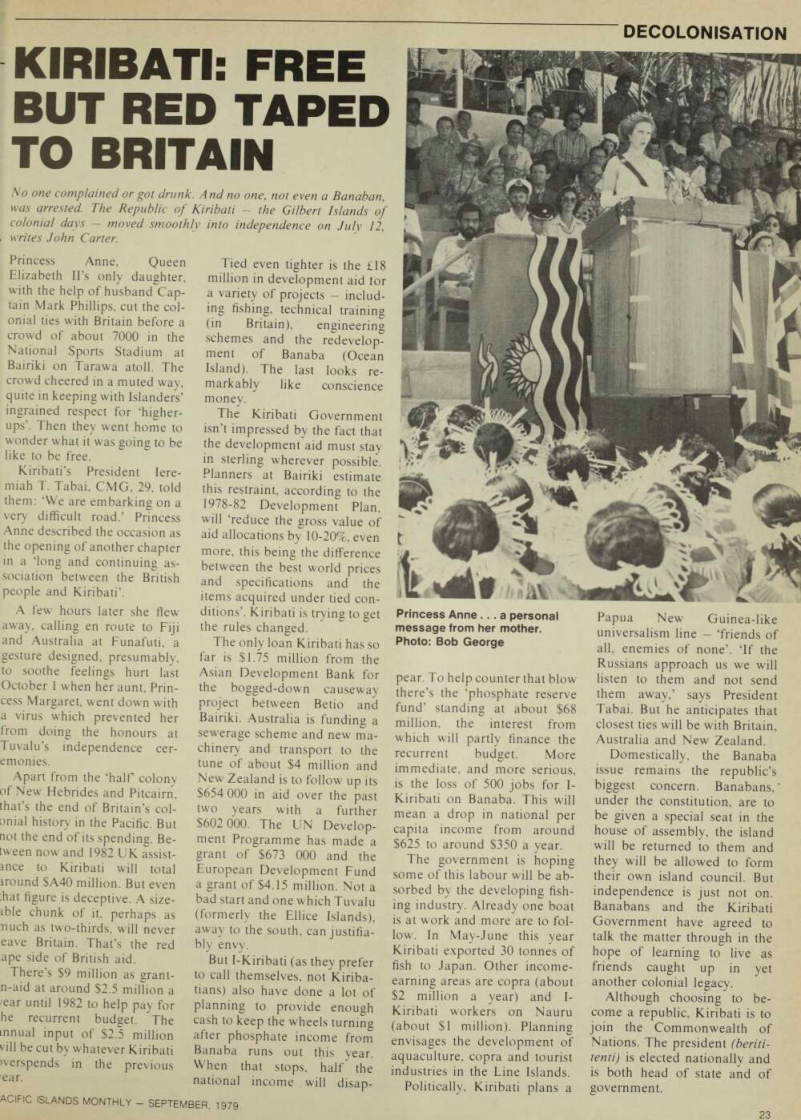
Decolonisation
Kiribati: Free
But Red Taped
To Britain
No one complained or got drunk. And no one, not even a Banaban, was arrested. The Republic of Kiribati - the Gilbert Islands of colonial days moved smoothly into independence on July 12, writes John Carter.
Princess Anne, Queen
Elizabeth IPs only daughter,
with the help of husband Cap tain Mark Phillips, cut the col onial ties with Britain before a crowd of about 7000 in the National Sports Stadium at Bairiki on Tarawa atoll. The crowd cheered in a muted way, quite in keeping with Islanders’
ingrained respect for ‘higher
ups’. Then they went home to wonder what it was going to be like to be free.
Kiribati’s President Jere miah T. Tabai, CMG, 29, told them: ‘We are embarking on a very difficult road.’ Princess Anne described the occasion as the opening of another chapter in a ‘long and continuing as sociation between the British people and Kiribati’.
A few hours later she flew away, calling en route to Fiji and Australia at Funafuti, a
gesture designed, presumably,
to soothe feelings hurt last October 1 when her aunt. Prin cess Margaret, went down with a virus which prevented her from doing the honours at
Tuvalu’s independence cer
emonies.
Apart from the ‘half colony of New Hebrides and Pitcairn, that’s the end of Britain’s col onial history in the Pacific. But not the end of its spending. Be tween now and 1982 UK assist ance to Kiribati will total around SA4O million. But even
fiat figure is deceptive. A size
able chunk of it, perhaps as nuch as two-thirds, will never cave Britain. That’s the red ape side of British aid.
There’s $9 million as grant n-aid at around $2.5 million a 'ear until 1982 to help pay for he recurrent budget. The innual input of $2.5 million vill be cut by whatever Kiribati werspends in the previous ear.
Tied even tighter is the £lB million in development aid tor a variety of projects - includ
ing fishing, technical training
(in Britain), engineering schemes and the redevelop ment of Banaba (Ocean Island). The last looks re markably like conscience money.
The Kiribati Government isn’t impressed by the fact that the development aid must stay in sterling wherever possible.
Planners at Bairiki estimate this restraint, according to the 1978-82 Development Plan, will ‘reduce the gross value of aid allocations by 10-20%, even more, this being the difference between the best world prices and specifications and the items acquired under tied con ditions’. Kiribati is trying to get the rules changed.
The only loan Kiribati has so far is $1.75 million from the Asian Development Bank for the bogged-down causeway project between Betio and Bairiki. Australia is funding a sewerage scheme and new ma chinery and transport to the tune of about $4 million and New Zealand is to follow up its $654 000 in aid over the past two years with a further $602 000. The UN Develop ment Programme has made a grant of $673 000 and the
European Development Fund
a grant of $4.15 million. Not a bad start and one which Tuvalu (formerly the Ellice Islands), away to the south, can justifia
bly envy.
But I-Kiribati (as they prefer to call themselves, not Kiriba tians) also have done a lot of
planning to provide enough
cash to keep the wheels turning after phosphate income from Banaba runs out this year.
When that stops, half the national income will disap-
pear. To help counter that blow there’s the ‘phosphate reserve fund’ standing at about $6B million, the interest from which will partly finance the recurrent budget. More immediate, and more serious, is the loss of 500 jobs for I- Kiribati on Banaba. This will mean a drop in national per capita income from around $625 to around $350 a year.
The government is hoping some of this labour will be ab sorbed by the developing fish
ing industry. Already one boat
is at work and more are to fol low. In May-June this year Kiribati exported 30 tonnes of fish to Japan. Other income earning areas are copra (about $2 million a year) and I- Kiribati workers on Nauru (about $1 million). Planning envisages the development of aquaculture, copra and tourist industries in the Line Islands.
Politically, Kiribati plans a
Papua New Guinea-like universalism line - ‘friends of all, enemies of none’. ‘lf the Russians approach us we will listen to them and not send them away,’ says President Tabai. But he anticipates that closest ties will be with Britain, Australia and New Zealand.
Domestically, the Banaba issue remains the republic’s biggest concern. Banabans, * under the constitution, are to be given a special seat in the house of assembly, the island will be returned to them and they will be allowed to form their own island council. But independence is just not on.
Banabans and the Kiribati Government have agreed to talk the matter through in the hope of learning to live as friends caught up in yet another colonial legacy.
Although choosing to be
come a republic, Kiribati is to join the Commonwealth of Nations. The president (beriti tenti) is elected nationally and is both head of state and of government.
Princess Anne ... a personal message from her mother.
Photo: Bob George
Advertisements & other items, pp. 23-24 (2 items)
23
ACIFIC ISLANDS MONTHLY - SEPTEMBER, 1979
carptrac
IS
V*Wg,
& lbs
■u ♦
art
** «r.
X. rz*k
K .. *&£tsC\ ■'{'■'!
CATERPILLAR SKIDDERS ARE BUILT TOUGH
TO STAY ON THE JOB.
MUFFLER
Cat-built Skidders have protection all
round. You get protection for man and
machine with the roll-over canopy and
other machine guarding. And you get
protection against excessive downtime with
dependable CAT construction, CAT dealer
backup and easy on the job maintenance.
THE CATERPILLAR 518 SKIDDER
features 120 flywheel
horsepower @ 2200 rpm,
powered by the Cat 3304
turbocharged engine, with an
operating weight of 20,400 lbs,
turning diameter of 34' 8" and
utilises a Gearmatic 119 winch
with a linepull (max.) of 32,000 lbs.
QUIET OPERATION
You get low noise levels from the 4-stroke cycle diesel, muffler and low-speed fan. You'll hear the difference in Cat-built Skidders.
STRONG DOZER BLADES
deck and bunch logs, clear brush, protect the radiator. The blades are high-strength steel with trunnions that never need greasing. Dozer blades are box-sectioned for greater strength and durability.
LOW RATED RPM
4-STROKE CYCLE DIESEL
MUFFLER LOW-SPEED
FAN RUGGED ARCH AND
FAIRLEAD
stand up under heavy loads.
The main roller is a Lifetime Lubricated hardened casting to reduce scarring that tears up cables. Side rollers are heat-treated for long life.
LOW RATED RPM
FAN
HASTINGS DEERING
LAE :
Milford Haven Road, Telephone 42 2355
PORT MORESBY :
Telephone 256650
BOUGAINVILLE :
Itakara Industrial Park, €
carptrac
SUVA : Carpenter Street, Raiwai.
Private Mail Bag, GPOSuva. Fiji. Ph. 381622, Telex FJ2190 Cables CARPTRAC LAUTOKA : Veitari. Telephone 61877 LABASA : Vulovi, Telephone 81888 Arawa. Telephone 959077 Caterpillar, Cat and □ are Trademarks of Caterpillar Tractor Co
YOUR
CATERPILLAR
DEALER
BA 10441
of identity
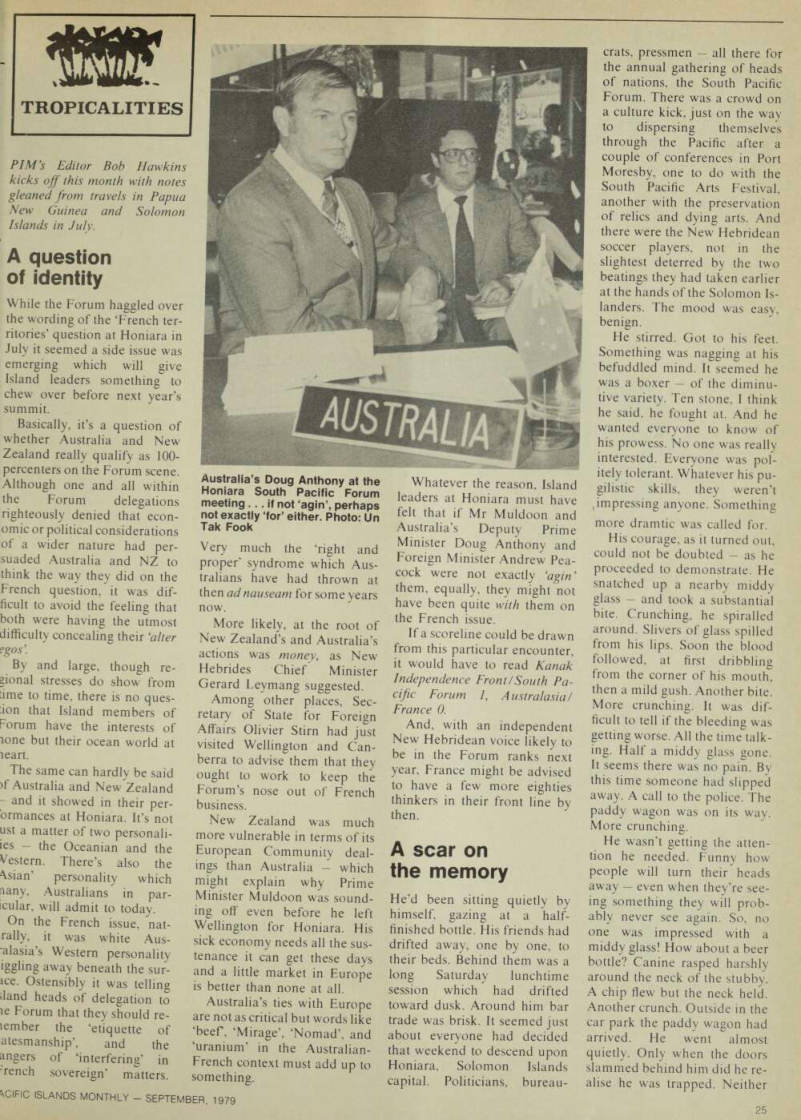

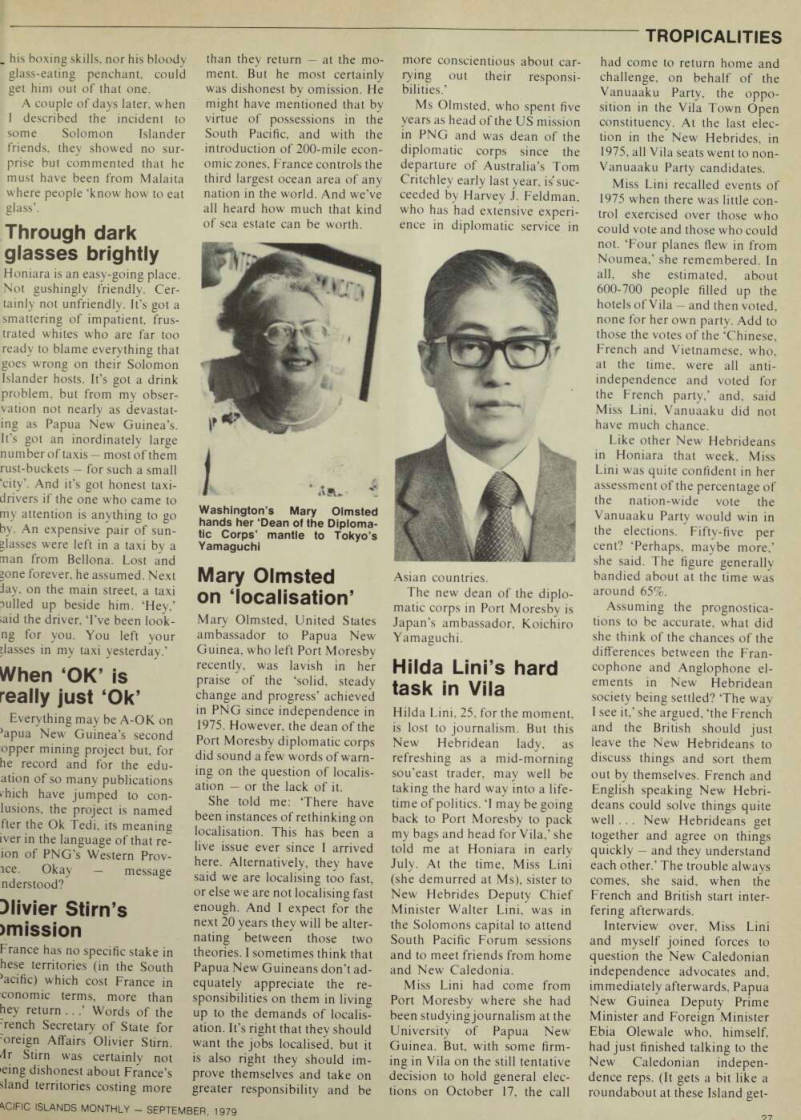
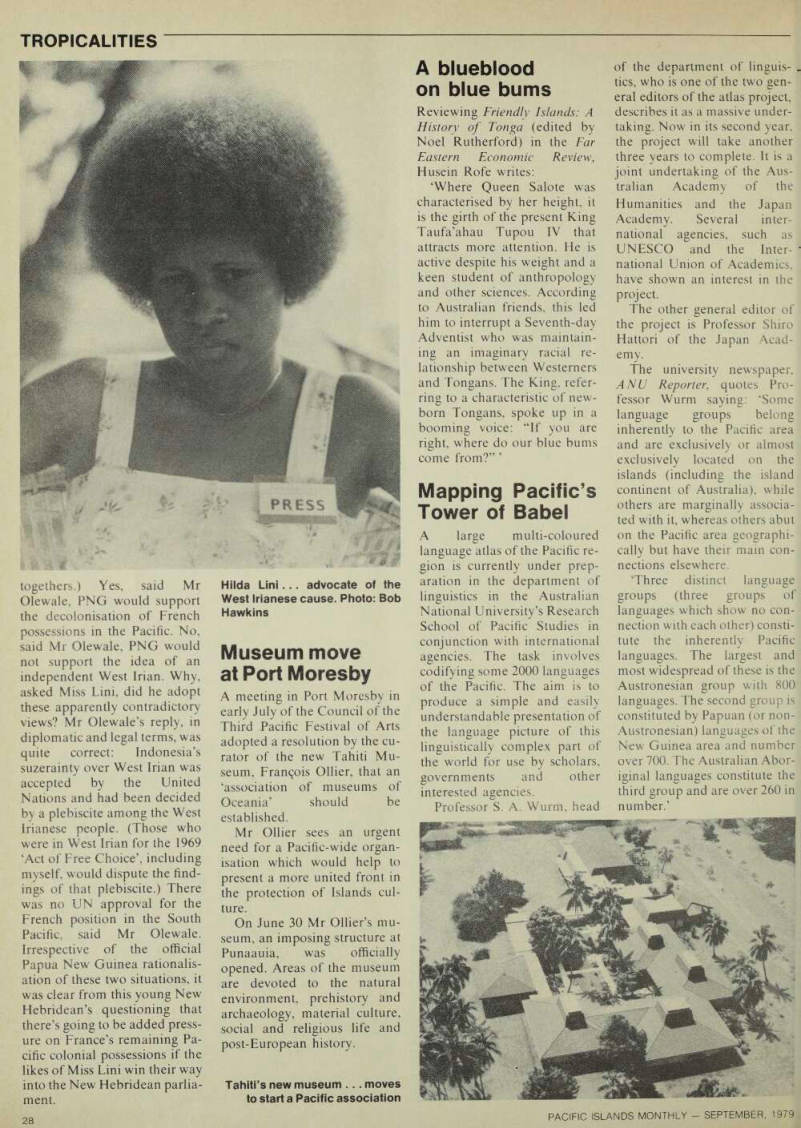
Tropicalities
PI M's Editor Bob Hawkins kicks off this month with notes gleaned from travels in Papua New Guinea and Solomon Islands in July.
A question
of identity
While the Forum haggled over the wording of the ‘French ter ritories’ question at Honiara in July it seemed a side issue was
emerging which will give
Island leaders something to chew over before next year’s summit.
Basically, it’s a question of whether Australia and New Zealand really qualify as 100percenters on the Forum scene.
Although one and all within the Forum delegations righteously denied that econ omic or political considerations of a wider nature had per suaded Australia and NZ to think the way they did on the French question, it was dif ficult to avoid the feeling that both were having the utmost
difficulty concealing their ‘ alter
?gos\
By and large, though re
gional stresses do show from lime to time, there is no ques tion that Island members of Forum have the interests of tone but their ocean world at leart.
The same can hardly be said )f Australia and New Zealand - and it showed in their per ormances at Honiara. It’s not ust a matter of two personali ies the Oceanian and the Vestern. There’s also the \sian’ personality which nany, Australians in par cular, will admit to today.
On the French issue, nat rally, it was white Aus •alasia’s Western personality iggling away beneath the sur
ice. Ostensibly it was telling
Jand heads of delegation to ie Forum that they should re icmber the ‘etiquette of atesmanship’, and the
angers of ‘interfering’ in
Tench sovereign’ matters.
Very much the ‘right and proper’ syndrome which Aus tralians have had thrown at then ad nauseam for some years now.
More likely, at the root of New Zealand’s and Australia’s actions was money, as New Hebrides Chief Minister Gerard Leymang suggested.
Among other places, Sec retary of State for Foreign Affairs Olivier Stirn had just visited Wellington and Can berra to advise them that they ought to work to keep the Forum’s nose out of French business.
New Zealand was much more vulnerable in terms of its
European Community deal
ings than Australia - which might explain why Prime Minister Muldoon was sound ing off even before he left Wellington for Honiara. His sick economy needs all the sus tenance it can get these days and a little market in Europe is better than none at all.
Australia’s ties with Europe are not as critical but words like ‘beef, ‘Mirage’, ‘Nomad’, and ‘uranium’ in the Australian- French context must add up to
something.
Whatever the reason. Island leaders at Honiara must have felt that if Mr Muldoon and Australia s Deputy Prime
Minister Doug Anthony and
Foreign Minister Andrew Pea cock were not exactly ‘ agin ’
them, equally, they might not
have been quite with them on the French issue.
If a scoreline could be drawn from this particular encounter, it would have to read Kanak Independence Front/South Pa cific Forum I, Australasia/ France 0.
And, with an independent New Hebridean voice likely to be in the Forum ranks next year, France might be advised to have a few more eighties thinkers in their front line by then.
A scar on
the memory
He’d been sitting quietly by himself, gazing at a half finished bottle. His friends had drifted away, one by one, to their beds. Behind them was a
long Saturday lunchtime
session which had drifted toward dusk. Around him bar trade was brisk. It seemed just about everyone had decided that weekend to descend upon Honiara, Solomon Islands capital. Politicians, bureau-
I crats, pressmen - all there for the annual gathering of heads of nations, the South Pacific Forum. There was a crowd on a culture kick, just on the way to dispersing themselves through the Pacific after a couple of conferences in Port Moresby, one to do with the South Pacific Arts Festival, another with the preservation of relics and dying arts. And there were the New Hebridean soccer players, not in the slightest deterred by the two beatings they had taken earlier at the hands of the Solomon Is landers. The mood was easy,
benign.
He stirred. Got to his feet.
Something was nagging at his befuddled mind. It seemed he was a boxer - of the diminu tive variety. Ten stone, I think he said, he fought at. And he wanted everyone to know of his prowess. No one was really interested. Everyone was pol itely tolerant. Whatever his pu
gilistic skills, they weren’t
impressing anyone. Something
more dramtic was called for.
His courage, as it turned out, could not be doubted as he proceeded to demonstrate. He snatched up a nearby middy glass and took a substantial
bite. Crunching, he spiralled
around. Slivers of glass spilled from his lips. Soon the blood followed, at first dribbling from the corner of his mouth, then a mild gush. Another bite.
More crunching. It was dif ficult to tell if the bleeding was getting worse. All the time talk
ing. Half a middy glass gone.
It seems there was no pain. By this time someone had slipped away. A call to the police. The paddy wagon was on its way.
More crunching.
He wasn’t getting the atten tion he needed. Funny how people will turn their heads away even when they’re see
ing something they will prob
ably never see again. So, no one was impressed with a middy glass! How about a beer
bottle? Canine rasped harshly
around the neck of the stubby.
A chip flew but the neck held.
Another crunch. Outside in the car park the paddy wagon had arrived. He went almost quietly. Only when the doors slammed behind him did he re alise he was trapped. Neither
Australia’s Doug Anthony at the Honiara South Pacific Forum meeting ... if not ‘agin’, perhaps not exactly ‘for’ either. Photo: Un Tak Fook
„ his boxing skills, nor his bloody glass-eating penchant, could get him out of that one.
A couple of days later, when I described the incident to some Solomon Islander friends, they showed no sur prise but commented that he must have been from Malaita where people ‘know how to eat glass’.
Through dark
glasses brightly
Honiara is an easy-going place.
Not gushingly friendly. Cer tainly not unfriendly. It’s got a smattering of impatient, frus trated whites who are far too ready to blame everything that goes wrong on their Solomon Islander hosts. It’s got a drink problem, but from my obser vation not nearly as devastat ing as Papua New Guinea’s.
It’s got an inordinately large number of taxis most of them rust-buckets - for such a small ‘city’. And it’s got honest taxi drivers if the one who came to my attention is anything to go by. An expensive pair of sun glasses were left in a taxi by a man from Bellona. Lost and forever, he assumed. Next Jay, on the main street, a taxi milled up beside him. ‘Hey,’ ;aid the driver, ‘l’ve been look ng for you. You left your passes in my taxi yesterday.’
When ‘OK’ is
really just ‘Ok’
Everything may be A-OK on apua New Guinea’s second opper mining project but, for he record and for the edu ation of so many publications have jumped to con lusions, the project is named fter the Ok Tedi, its meaning iver in the language of that re ion of PNG’s Western Prov
ice. Okay message
nderstood?
Olivier Stirn’s
>mission
France has no specific stake in hese territories (in the South ’acific) which cost France in conomic terms, more than hey return .. .’ Words of the Tench Secretary of State for : oreign Affairs Olivier Stirn.
At Stirn was certainly not 'eing dishonest about France’s
dand territories costing more
than they return at the mo ment. But he most certainly was dishonest by omission. He might have mentioned that by virtue of possessions in the South Pacific, and with the introduction of 200-mile econ omic zones, France controls the third largest ocean area of any nation in the world. And we’ve all heard how much that kind of sea estate can be worth.
Mary Olmsted
on ‘localisation’
Mary Olmsted, United States ambassador to Papua New Guinea, who left Port Moresby recently, was lavish in her praise of the ‘solid, steady change and progress’ achieved in PNG since independence in 1975. However, the dean of the Port Moresby diplomatic corps did sound a few words of warn ing on the question of localis ation or the lack of it.
She told me: ‘There have been instances of rethinking on localisation. This has been a live issue ever since I arrived
here. Alternatively, they have
said we are localising too fast, or else we are not localising fast enough. And I expect for the next 20 years they will be alter nating between those two theories. I sometimes think that Papua New Guineans don’t ad equately appreciate the re sponsibilities on them in living up to the demands of localis ation. It’s right that they should want the jobs localised, but it is also right they should im prove themselves and take on greater responsibility and be
more conscientious about car rying out their responsi bilities.’
Ms Olmsted, who spent five years as head of the US mission in PNG and was dean of the diplomatic corps since the departure of Australia’s Tom Critchley early last year, is'suc ceeded by Harvey J. Feldman, who has had extensive experi ence in diplomatic service in
Hilda Lini’s hard
task in Vila
Hilda Lini, 25, for the moment, is lost to journalism. But this New Hebridean lady, as
refreshing as a mid-morning
sou’east trader, may well be taking the hard way into a life time of politics. T may be going back to Port Moresby to pack my bags and head for Vila,’ she told me at Honiara in early July. At the time. Miss Lini (she demurred at Ms), sister to New Hebrides Deputy Chief Minister Walter Lini, was in the Solomons capital to attend South Pacific Forum sessions and to meet friends from home and New Caledonia.
Miss Lini had come from Port Moresby where she had been studying journalism at the
University of Papua New
Guinea. But, with some firm ing in Vila on the still tentative decision to hold general elec tions on October 17, the call
had come to return home and challenge, on behalf of the Vanuaaku Party, the oppo sition in the Vila Town Open constituency. At the last elec tion in the New Hebrides, in 1975, all Vila seats went to non- Vanuaaku Party candidates.
Miss Lini recalled events of 1975 when there was little con trol exercised over those who could vote and those who could not. ‘Four planes flew in from Noumea,’ she remembered. In all, she estimated, about 600-700 people filled up the hotels of Vila and then voted, none for her own party. Add to those the votes of the ‘Chinese, French and Vietnamese, who, at the time, were all anti independence and voted for the French party,’ and, said Miss Lini, Vanuaaku did not have much chance.
Like other New Hebrideans in Honiara that week. Miss Lini was quite confident in her assessment of the percentage of the nation-wide vote the Vanuaaku Party would win in the elections. Fifty-five per cent? ‘Perhaps, maybe more,’ she said. The figure generally bandied about at the time was around 65%.
Assuming the prognostica tions to be accurate, what did she think of the chances of the differences between the Fran cophone and Anglophone el ements in New Hebridean society being settled? ‘The way I see it,’ she argued, ‘the French and the British should just leave the New Hebrideans to discuss things and sort them out by themselves. French and
English speaking New Hebri
deans could solve things quite well.. . New Hebrideans get together and agree on things
quickly and they understand
each other.’ The trouble always comes, she said, when the French and British start inter
fering afterwards.
Interview over. Miss Lini and myself joined forces to question the New Caledonian independence advocates and, immediately afterwards, Papua New Guinea Deputy Prime Minister and Foreign Minister Ebia Olewale who, himself, had just finished talking to the New Caledonian indepen dence reps. (It gets a bit like a roundabout at these Island get-
Washingtons Mary Olmsted hands her ‘Dean of the Diploma tic Corps’ mantle to Tokyo’s Yamaguchi
Asian countries.
The new dean of the diplo matic corps in Port Moresby is Japan’s ambassador, Koichiro
Yamaguchi.
togethers.) Yes, said Mr Olewale, PNG would support the decolonisation of French possessions in the Pacific. No, said Mr Olewale, PNG would not support the idea of an
independent West Irian. Why,
asked Miss Lini, did he adopt these apparently contradictory views? Mr Olewale’s reply, in diplomatic and legal terms, was quite correct: Indonesia’s suzerainty over West Irian was
accepted by the United
Nations and had been decided by a plebiscite among the West Irianese people. (Those who were in West Irian for the 1969 ‘Act of Free Choice’, including myself, w'ould dispute the find ings of that plebiscite.) There was no UN approval for the French position in the South Pacific, said Mr Olewale.
Irrespective of the official Papua New Guinea rationalis ation of these two situations, it was clear from this young New Hebridean’s questioning that there’s going to be added press ure on France’s remaining Pa cific colonial possessions if the likes of Miss Lini win their way into the New Hebridean parlia ment.
M US eUm move “ ia
dt Port MOfOSDy
meeting in Port Moresby in ear iy July of the Council of the Third Pacific Festival of Arts a dopted a resolution by the cu rator of the new Tahiti Mu seum Franqois oilier, that an ‘ a ssociation of museums of Oceania’ should be established ]vir Ollier sees an urgent need for a Pacific-wide organ isation which would help to present a more united front in t^e protection of Islands cul ture 0 n June 30 Mr Ollier’s mu- S eum, an imposing structure at Pima auia, was officially ope ned. Areas of the museum are devoted to the natural environment, prehistory and arc haeology, material culture, social and religious life and pos t-European history,
A blueblood
on blue bums
Reviewing Friendly Islands: A
History of Tonga (edited by Noel Rutherford) in the Far Eastern Economic Review, Husein Rofe writes; ‘Where Queen Salote was characterised by her height, it is the girth of the present King Taufa’ahau Tupou IV that attracts more attention. He is active despite his weight and a keen student of anthropology and other sciences. According to Australian friends, this led him to interrupt a Seventh-day Adventist who was maintain ing an imaginary racial re lationship between Westerners and Tongans. The King, refer ring to a characteristic of new born Tongans, spoke up in a booming voice: “If you are right, where do our blue bums come from?” ’
Mapping Pacific’s
Tower of Babel
A large multi-coloured language atlas of the Pacific re gion is currently under prep aration in the department of linguistics in the Australian National University’s Research School of Pacific Studies in conjunction with international agencies. The task involves
codifying some 2000 languages
of the Pacific. The aim is to
produce a simple and easily
understandable presentation of the language picture of this
linguistically complex part of
the world for use by scholars, governments and other
interested agencies.
Professor S. A. Wurm, head
of the department of linguis tics, who is one of the two gen eral editors of the atlas project, describes it as a massive under taking. Now in its second year, the project will take another three years to complete. It is a joint undertaking of the Aus tralian Academy of the Humanities and the Japan Academy. Several inter national agencies, such as UNESCO and the Inter national Union of Academics, have shown an interest in the
project.
The other general editor of the project is Professor Shiro Hattori of the Japan Acad emy.
The university newspaper, ANU Reporter, quotes Pro fessor Wurm saying: ‘Some language groups belong inherently to the Pacific area and are exclusively or almost exclusively located on the islands (including the island continent of Australia), while others are marginally associa ted with it, whereas others abut on the Pacific area geographi cally but have their main con nections elsewhere. ‘Three distinct language groups (three groups of languages which show no con nection with each other) consti tute the inherently Pacific languages. The largest and most widespread of these is the Austronesian group with 800 languages. The second group is constituted by Papuan (or non- Austronesian) languages of the New Guinea area and number over 700. The Australian Abor
iginal languages constitute the
third group and are over 260 in number.’
Hilda Lini ... advocate of the West Irianese cause. Photo: Bob Hawkins
Tahiti’s new museum ... moves to start a Pacific association
The inherently and mar
ginally Pacific languages num
ber close to 2000 and constitute about 40 per cent of all the languages in the world. Almost all of these languages are con centrated in the south-western and western corner of the Pa cific area: this is the area of the greatest concentration of dif ferent languages in the whole world.
Apart from a broad appeal, the atlas will show the changes in the pattern of language dis tribution in recent years no tably under the influence of European contacts. This will be done by providing two dif ferent maps of certain areas one presenting the pre- European situation and the other the present picture.
Islanders and
life in NZ
Pacific Islanders who migrate to New Zealand appreciate the higher living standards and employment and educational opportunities, but dislike the violence, the high cost of living, and the prevalence of alcohol.
These are among main points to emerge from a report by the Department of Labour on the work experience of Pacific Island migrants in the greater Wellington area, writes Bill Gasson.
The findings are based on answers to questionnaires dis tributed to 353 working Island migrants in an area that rep resents about 18% of New Zealand’s Islander popula tion.
Auckland, the world’s big
gest Polynesian city, offers a
greater scope for such a survey, but, as the report points out, limited resources precluded a wider survey. Five Islander groups from Western Samoa, Niue, Cook Islands, Tokelau
md Tonga were surveyed.
Why do Islanders like New Zealand? Here are two views: I like the freedom of move ment here. As long as it is vithin reason, there are fewer
inventions binding you than
)ack home;’ and ‘Here in New Zealand nobody tells you what o do or say. You are your own naster and no one looks over iur shoulder to see what you ire up to.’
‘People here are very violent.
All the arguments turn into fights and it is very frightening to walk the streets, especially at night,’ one woman said.
While many Islanders felt there were no aspects of life that disturbed them, the report
said the widespread perception
of violence was based not so much on its prevalence as on the lack of social control over
the activity.
Then there was the con sumption of alcohol of which many Islanders had little pre vious experience. One elder said; ‘These people here drink all the time after work, in the evenings, after sport, in the weekends, at meetings - I don’t like it, especially for the young ones. That’s all they see and they do the same.’
Other problems facing the
migrant included accommoda tion and language difficulties, loneliness, homesickness and a certain amount of discrimi nation and non-helpfulness from New Zealanders. For one Islander there was a feeling ‘that many people don’t like Islanders here - they look down on you.’ Another re called that ‘New Zealanders were unfriendly and cold and didn’t want to mix with us.’
New Zealand’s Pacific Is land population is young almost 50% are under 20. The growth of the Island commu nity is marked - from 0.6% of the total population in 1961, to 1.6% in 1971 and 2% in 1976.
Western Samoans form the
biggest Island community
27 876 in 1976 followed by Cook Islanders 18 610, Niue ans 5688, Tongans 3980, and Tokelauans 1737. Others rep resented 3463 in 1976 to bring the Pacific Island population to 61 354.
Tongans earned the highest
weekly take-home pay of the five Island groups surveyed $lOB. They also worked the longest hours a week, 43. Cook Islanders came second with an average of $102.47 in their
main jobs. They were the only
group to show any propensity to hold more than one job.
Western Samoans earned an average of $99.32, Tokelauans $86.53, and Niueans $74.25.
Remittances from migrants to families and relatives at
home continue over years, but at a diminishing level. The sur vey found that average remit tance among the Islanders interviewed was $351.55 for the first two years, $346.31 for the next three years, $398.05 for the next five years and $297.62 after 10 years in the country.
Tongans sent an average of $405, Western Samoans $361, Cook Islanders $276, and Tokelauans $267. Niueans de clined to answer this ques tion.
In addition, Islanders sent back goods each year worth an average for Tongans of $274, Cook Islanders $169, Western Samoans $lO6, and Tokelau ans $95. Again, Niueans gave no figures.
Pacific art show
in Washington
A major exhibition of Pacific Islands art opened in Washing ton, USA, in July. More than 400 works from Polynesia, Micronesia and Melanesia were on show.
A large war god figure from
Hawaii dominated the entrance. It had been lent for
the first time since its acqui sition in 1846 by the Peabody Museum of Salem, Massa chusetts, which is now associa ted with Harvard University.
More than 80 public and pri vate collections in the US, Europe and the South Pacific lent objects for the exhi bition.
Judges huddle
in Rarotonga
The Cook Islands’ Govern ment has converted the former official residence of ousted premier Sir Albert Henry into a government reception house.
Conversion was ready just in time to serve as the venue for the Fourth South Pacific Ju dicial Conference in late
May.
Answering critics who had described the reception house as ‘a place to wine, dine and entertain away from the wife’, and ‘a boozing den’, Minister for Justice laveta Short de clared: ‘Just for a start, by holding the conference there govern ment will be saving about $5OOO that it would have cost to hold the conference at the Rarotongan. Would the critics enjoy seeing us squander that
money?’
The minister pointed out that inevitably all cabinet ministers had to offer hospi tality from time to time to over seas visitors. It was unfair to expect wives to toil in their kitchens to prepare an elabor ate meal for some important visitor and at the same time control the children all in an effort to ‘put on a good show’.
The official residence had hardly ever been used by Sir Albert and consequently was neglected over the years and
had become badly dilapidated.
Rather than allow it to rot and crumble away the government had at moderate expense, turned it into a place where they could receive official guests without placing a burden on
family life.
Apart from an official open ing ceremony in the new recep tion house, the South Pacific’s legal bigwigs who were in at tendance huddled in the
deepest secrecy.
Mangaia Islander Tangianau Tereapii, an Auckland resident ... Cook Islanders rank second in the wages stakes. Photo: Jan Mudrovcich
Advertisements & other items, pp. 25-31 (4 items)
Islands Monthly September, 1979
Earth stations.
Just a beginning for us.
m *»■« % A & Ml For Cable & Wireless, providing an earth station is not an end in itself. We don’t install the station and walk away, leaving you to your own devices.
For us it’s just a beginning, a means to an end, part of a total package, part of using our total telecommunications expertise and experience to provide you with a total telecommunications capability.
First, we plan, design and engineer the complete system: earth station, backhaul links into the terrestrial network, national and international telephone and telex circuits.
Then we select the best available earth station for the particular application - engineered to meet your individual needs.
We will install, operate, manage and maintain the system and provide training for your technicians, engineers, managers and operators.
Cable & Wireless and its associate companies operate more earth stations in the INTELSAT system than any other single operator, and are the third largest users. We have already been involved in the design or construction of over thirty earth stations - an unrivalled wealth of skill and knowledge to add to over a century of expertise and experience in world-wide telecommunications.
helps the world conmnunbate
Vice President, ETP Inc., PO Box 126 MCC, Makati, Metro-Mamla. Tel: 856011 Head Office, Cable & Wireless Ltd, Mercury House, Theobalds Road, London WCIXBRX. Tel: 01-242 4433 Telex. 2318
TOKYO
JAPAN f /
o
CHINA
OKINAWA
TAIPEI
HONG KONG
TAIWAN
PALAU
MANILA
SINGAPORE
• SAIPAN
ROTA • TINIAN
• GUAM
• TRUK
YAP Sb
KWAJALEIN
• JOHNSTON
ISLAND
MAJURO
PONAPE • TARAWA
NAURU • GILBERT ISLANDS
AUSTRALIA
SYDNEY
TUVALU*
ELLICE ISLANDS
•AMERIC,
SAMOA
•FIJI ISLANDS
AUCKLAND
TS
NEW ZEALA
If you cant fly Continental
A quick glance at our route map and you'll soon realise why we're one of the fastest
growing American airlines. ...
We've been flying for almost half a century. And now our services connect the islands of the South Pacific with Australia and New Zealand as well as with Hawaii, the USA and the
Orient.
We know America and the Pacific like the back of our hand.
And we'd like you to experience the Continental style of warm, friendly and efficient
service.
If you can't fly with us, we hope you have a nice trip anyway.
SERVICE AUTHORIZED, BUT NOT YET OPERATED
CONTINENTAL HOTELS
OAHU
Oi
HONOLULU
HILO
HAWAII
SAN FRANCISCO
SAN JOSE
CALGARY •
SEATTLE
TACOMA
PORTLAND
CHICAGO
PEORIA*
WASHINGTON D C.
DENVER
• KANSAS CITY
• WICHITA
• TULSA
• OKLAHOMA CITY
COLORADO
LAS VEGAS
SPRINGS
ALBUQUERQUE
PHOENIX
LUBBOCK
DALLAS
TUCSON
FORT WORTH
EL PASO MIDLAND •
N ODESSA AUSTIN
NEW ORLEANS
HOUSTON
TAMPA
ST. PETERSBURG
CLEARWATER
ANTONIO
SAN
• MEXICO CITY
LOS
BURBANK
ONTARIO SAN DIEGO
FT. LAUDER
MIAMI
LAPA2
LOS
CABOS
PUERTO VALLARTA
MANZANILLO
ACAPULCO
AUSTRALIA
FIJI
Four daylight departures weekly from Sydney to Los Angeles: Saturdays: C02 dep. SYD 0915 for PPG, HNL, LAX.
Mondays: C02 dep. SYD 0915 for PPG, HNL, LAX.
Wednesdays: C02 dep. SYD 0915 for NAN, HNL, LAX.
Fridays: C02 dep. SYD 0915 for NAN, HNL, LAX.
Reservations: Sydney (02) 6690066
Two departures weekly to Los Angeles:
Wednesdays: C02 dep. NAN 1600 for HNL, LAX.
Fridays: C02 dep. NAN 1600 for HNL, LAX.
Two departures weekly to Sydney:
Tuesdays: COl dep. NAN 1845 for SYD.
Thursdays: COl dep. NAN 1845 for SYD.
NEW ZEALAND
Three daylight departures weekly to Los Angeles; Sundays: C02 dep. AKL 1230 for PPG, HNL, LAX.
Tuesdays: C02 dep. AKL 1230 for PPG, HNL, LAX.
Thursdays: C02 dep. AKL 1230 for PPG, HNL, LAX.
Reservations: Auckland 795680 Reservations: Suva 313088 Reservations: Nadi 72788
AMERICAN SAMOA
Five departures weekly to Los Angeles:
Sundays: C02 dep. PPG 1805 for HNL, LAX.
Mondays: C02 dep. PPG 1805 for HNL, LAX.
Wednesdays: C02 dep. PPG 1805 for HNL, LAX.
Fridays: C02 dep. PPG 1805 for HNL, LAX.
Saturdays: C02 dep. PPG 1805 for HNL, LAX.
Three departures weekly to Auckland: Sundays: C0603 dep. PPG 1920 for AKL.
Tuesdays: C0603 dep. PPG 1920 for AKL.
Fridays: CO603 dep. PPG 1920 for AKL.
Two departures weekly to Sydney:
Saturdays: COl dep. PPG 1640 for SYD.
Thursdays: COl dep. PPG 1640 for SYD.
Reservations: Pago Pago 6334222
ry to have a nice trip anyway.
Jr. i - - ■v" w " [| y The Proud Bird with the Golden Tail.
CONTINENTAL AIRLINES •
U.S.A./Canada/Mexico/Hawaii/Micronesia/Australia/New Zealand/Fiji/Samoa/and the Orient.
Tropicalities
ISLANDS MONTHLY - SEPTEMBER, 1979
Tropicalities
29
ACIFIC ISLANDS MONTHLY SEPTEMBER, 1979
People
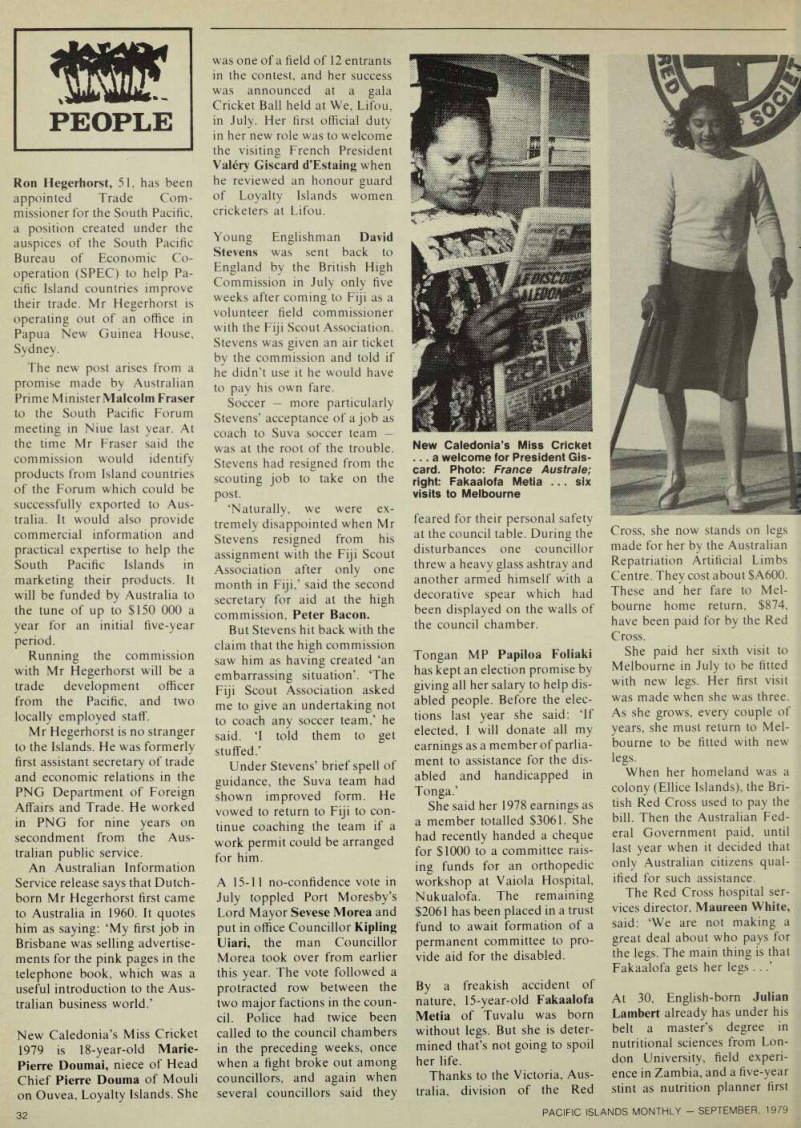
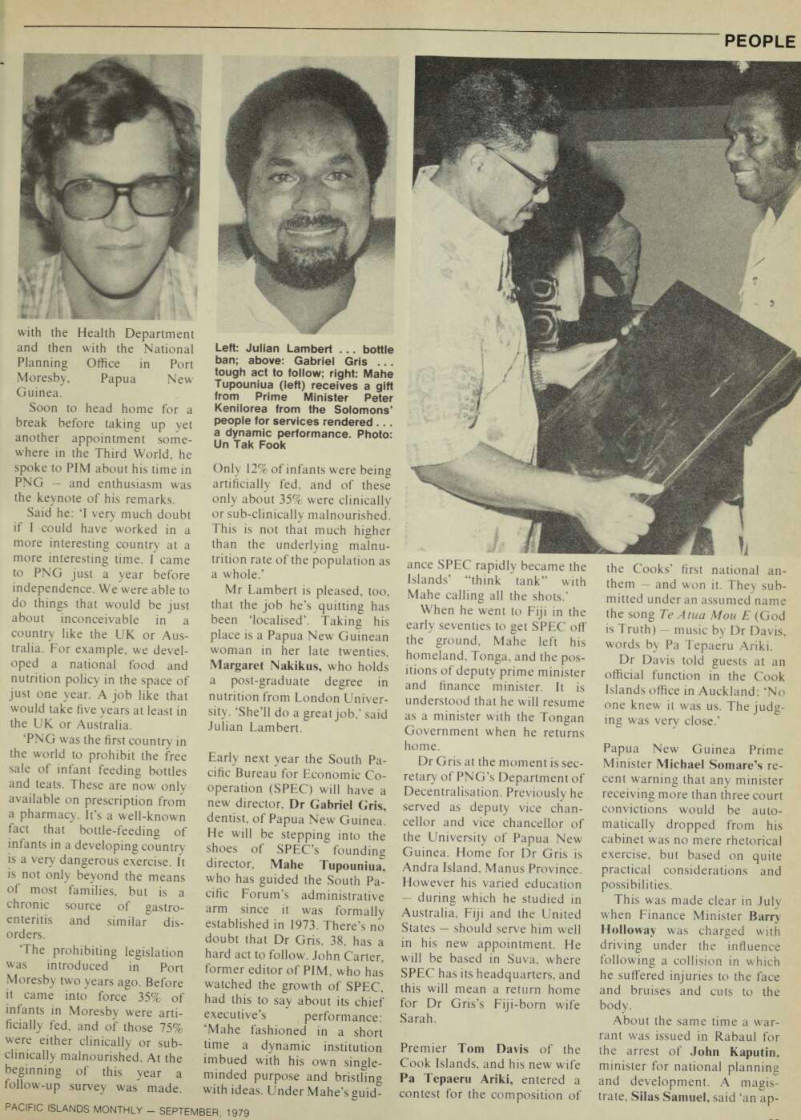

Ron Hegerhorst, 51, has been appointed Trade Com missioner for the South Pacific, a position created under the auspices of the South Pacific Bureau of Economic Co operation (SPEC) to help Pa cific Island countries improve their trade. Mr Hegerhorst is operating out of an office in Papua New Guinea House,
Sydney.
The new post arises from a
promise made by Australian
Prime Minister Malcolm Fraser to the South Pacific Forum meeting in Niue last year. At the time Mr Fraser said the commission would identify products from Island countries of the Forum which could be
successfully exported to Aus
tralia. It would also provide commercial information and
practical expertise to help the
South Pacific Islands in
marketing their products. It
will be funded by Australia to the tune of up to $l5O 000 a year for an initial five-year
period.
Running the commission with Mr Hegerhorst will be a trade development officer from the Pacific, and two
locally employed staff.
Mr Hegerhorst is no stranger to the Islands. He was formerly first assistant secretary of trade and economic relations in the PNG Department of Foreign Affairs and Trade. He worked in PNG for nine years on secondment from the Aus tralian public service.
An Australian Information Service release says that Dutch born Mr Hegerhorst first came to Australia in 1960. It quotes him as saying; ‘My first job in Brisbane was selling advertise ments for the pink pages in the telephone book, which was a useful introduction to the Aus tralian business world.’
New Caledonia’s Miss Cricket 1979 is 18-year-old Marie- Pierre Doumai, niece of Head Chief Pierre Douma of Mouli on Ouvea, Loyalty Islands. She
was one of a field of 12 entrants in the contest, and her success was announced at a gala Cricket Ball held at We, Lifou, in July. Her first official duty in her new role was to welcome the visiting French President Valery Giscard d’Estaing when he reviewed an honour guard of Loyalty Islands women cricketers at Lifou.
Young Englishman David Stevens was sent back to
England by the British High
Commission in July only five weeks after coming to Fiji as a volunteer field commissioner with the Fiji Scout Association.
Stevens was given an air ticket by the commission and told if he didn’t use it he would have to pay his own fare.
Soccer more particularly Stevens’ acceptance of a job as coach to Suva soccer team was at the root of the trouble.
Stevens had resigned from the scouting job to take on the post. ‘Naturally, we were ex
tremely disappointed when Mr
Stevens resigned from his assignment with the Fiji Scout Association after only one month in Fiji,’ said the second secretary for aid at the high commission. Peter Bacon.
But Stevens hit back with the claim that the high commission saw him as having created ‘an embarrassing situation’. ‘The Fiji Scout Association asked me to give an undertaking not to coach any soccer team,’ he said. T told them to get stuffed.’
Under Stevens’ brief spell of guidance, the Suva team had shown improved form. He vowed to return to Fiji to con tinue coaching the team if a work permit could be arranged for him.
A 15-11 no-confidence vote in
July toppled Port Moresby’s
Lord Mayor Sevese Morea and put in office Councillor Kipling Uiari, the man Councillor Morea took over from earlier this year. The vote followed a protracted row between the two major factions in the coun cil. Police had twice been called to the council chambers in the preceding weeks, once when a fight broke out among councillors, and again when several councillors said they
feared for their personal safety at the council table. During the disturbances one councillor
threw a heavy glass ashtray and
another armed himself with a decorative spear which had been displayed on the walls of the council chamber.
Tongan MP Papiloa Foliaki has kept an election promise by giving all her salary to help dis abled people. Before the elec tions last year she said; Tf elected, I will donate all my earnings as a member of parlia ment to assistance for the dis abled and handicapped in
Tonga.’
She said her 1978 earnings as a member totalled $3061. She had recently handed a cheque for $lOOO to a committee rais ing funds for an orthopedic
workshop at Vaiola Hospital,
Nukualofa. The remaining $2061 has been placed in a trust fund to await formation of a permanent committee to pro vide aid for the disabled.
By a freakish accident of nature, 15-year-old Fakaalofa Metia of Tuvalu was born without legs. But she is deter mined that’s not going to spoil her life.
Thanks to the Victoria, Aus tralia, division of the Red
Cross, she now stands on legs made for her by the Australian Repatriation Artificial Limbs Centre. They cost about SA6OO.
These and her fare to Mel bourne home return, $874, have been paid for by the Red Cross.
She paid her sixth visit to Melbourne in July to be fitted with new legs. Her first visit was made when she was three.
As she grows, every couple of years, she must return to Mel bourne to be fitted with new
legs.
When her homeland was a colony (Ellice Islands), the Bri tish Red Cross used to pay the bill. Then the Australian Fed eral Government paid, until last year when it decided that
only Australian citizens qual
ified for such assistance.
The Red Cross hospital ser vices director, Maureen White, said: ‘We are not making a great deal about who pays for the legs. The main thing is that Fakaalofa gets her legs...’
At 30, English-born Julian Lambert already has under his belt a master’s degree in nutritional sciences from Lon
don University, field experi
ence in Zambia, and a five-year stint as nutrition planner first
New Caledonia’s Miss Cricket ... a welcome for President Gis card. Photo: France Australe; right: Fakaalofa Metia ... six visits to Melbourne
with the Health Department and then with the National Planning Office in Port
Moresby, Papua New
Guinea.
Soon to head home for a break before taking up yet another appointment some where in the Third World, he spoke to PIM about his time in PNG and enthusiasm was the keynote of his remarks.
Said he: T very much doubt if I could have worked in a more interesting country at a more interesting time. I came to PNG just a year before independence. We were able to do things that would be just about inconceivable in a country like the UK or Aus tralia. For example, we devel oped a national food and nutrition policy in the space of just one year. A job like that would take five years at least in the UK or Australia. ‘PNG was the first country in the world to prohibit the free sale of infant feeding bottles and teats. These are now only available on prescription from a pharmacy. It’s a well-known fact that bottle-feeding of infants in a developing country is a very dangerous exercise. It is not only beyond the means of most families, but is a chronic source of gastro enteritis and similar dis orders.
‘The prohibiting legislation
was introduced in Port Moresby two years ago. Before it came into force 35% of infants in Moresby were arti ficially fed, and of those 75% were either clinically or sub clinically malnourished. At the beginning of this year a follow-up survey was made.
Only 12% of infants were being artificially fed, and of these only about 35% were clinically or sub-clinically malnourished.
This is not that much higher than the underlying malnu trition rate of the population as a whole.’
Mr Lambert is pleased, too, that the job he’s quitting has been ‘localised’. Taking his place is a Papua New Guinean woman in her late twenties, Margaret Nakikus, who holds a post-graduate degree in nutrition from London Univer sity. ‘She’ll do a great job,’ said Julian Lambert.
Early next year the South Pa cific Bureau for Economic Co operation (SPEC) will have a new director. Dr Gabriel Gris, dentist, of Papua New Guinea.
He will be stepping into the shoes of SPEC’s founding director, Mahe Tupouniua, who has guided the South Pa cific Forum’s administrative arm since it was formally established in 1973. There’s no doubt that Dr Gris, 38, has a hard act to follow. John Carter, former editor of PIM, who has watched the growth of SPEC, had this to say about its chief executive’s performance: ‘Mahe fashioned in a short time a dynamic institution imbued with his own single minded purpose and bristling with ideas. Under Mahe’s guid-
ance SPEC rapidly became the Islands’ “think tank” with Mahe calling all the shots.’
When he went to Fiji in the early seventies to get SPEC off the ground, Mahe left his homeland, Tonga, and the pos itions of deputy prime minister and finance minister. It is understood that he will resume as a minister with the Tongan Government when he returns home.
Dr Gris at the moment is sec retary of PNG’s Department of Decentralisation. Previously he served as deputy vice chan cellor and vice chancellor of the University of Papua New Guinea. Home for Dr Gris is Andra Island, Manus Province.
However his varied education - during which he studied in Australia, Fiji and the United States should serve him well in his new appointment. He will be based in Suva, where SPEC has its headquarters, and this will mean a return home for Dr Gris’s Fiji-born wife Sarah.
Premier Tom Davis of the Cook Islands, and his new wife Pa Tepaeru Ariki, entered a contest for the composition of
the Cooks’ first national an them and won it. They sub mitted under an assumed name the song Te Atua Mou E (God is Truth) - music by Dr Davis, words by Pa Tepaeru Ariki.
Dr Davis told guests at an official function in the Cook Islands office in Auckland: ‘No one knew it was us. The judg ing was very close.’
Papua New Guinea Prime Minister Michael Somare’s re cent warning that any minister receiving more than three court convictions would be auto
matically dropped from his
cabinet was no mere rhetorical exercise, but based on quite practical considerations and possibilities.
This was made clear in July when Finance Minister Barry Holloway was charged with driving under the influence following a collision in which he suffered injuries to the face and bruises and cuts to the
body.
About the same time a war rant was issued in Rabaul for the arrest of John Kaputin. minister for national planning
and development. A magis
trate. Silas Samuel, said ‘an ap
Left: Julian Lambert ... bottle ban; above: Gabriel Gris ... tough act to follow; right: Mahe Tupouniua (left) receives a gift from Prime Minister Peter Kenilorea from the Solomons’ people for services rendered ... a dynamic performance. Photo: Un Tak Fook
parent mix-up’ had caused the issue of the arrest warrant. But he ordered Mr Kaputin to appear on August 8 to face charges of assault and having used insulting words in an incident at Kulau Lodge, a beachside restaurant in Rabaul.
PNG’s leader Somare flew to Honolulu in July to recuper ate from an illness which had affected him for the previous six weeks. He had been suffer
ing from crippling inflam
mation of the joints of both legs, and his general health was affected. Deputy PM and Foreign Minister Ebia Olewale was acting prime minister in his absence.
Fiji trade unionist Apisai Tora has failed in a bid to get com
pensation amounting to
SF69 500 for the losses he suf fered through a trial and 159
days of imprisonment in
1977-78 following his convic tion under the Sugar Industry Act. He was later cleared on appeal. Mr Tora’s claim was debated in parliament on the motion of Ratu Osea Gavidi, who said that in the absence of
a comprehensive scheme of compensation Mr Tora’s case should be regarded as ‘excep tional’. He had lost three stone in weight while in custody and at the time of the trial he was ‘extremely ill’ and his wife was left at home alone to look after two young children. During his imprisonment she gave birth to their third child. Opposing the motion, the attorney-general, Sir John Faivey, said that Mr Tora had never been convicted ‘other than by the due process of law’. ‘He did what he was charged with. He was acquitted on a matter of law, not on a matter of fact.’ Ratu Osea called for a division in which 23 government members voted against the motion, four oppo sition members voted for, and
12 MPs, mostly opposition
members, abstained.
Dr Ankin Swamy has taken up duties as director of the Centre for Applied Studies in Development at the University of the South Pacific, Suva.
After completing his doctorate on ‘transmission of noise characteristics into aircraft structures’ in 1973, Dr Swamy
returned from the United Kingdom in 1973 to become chief education officer (tech nical) with the Fiji ministry of education. The following year he became principal of the Derrick Technical Institute and deputy secretary (technical), posts he held until his new appointment.
Des Clifton Bassett, who left Papua New Guinea in 1974 after spending more than 30 years in the country, has started the Niugini Advisory and Ser vice Centre in Sydney to assist Australians with business links in Papua New Guinea. Mr Clifton Bassett joined the PNG administration after serving with Australian defence forces
during the war, eventually
being replaced, on his
retirement, as district com missioner in Madang by Ben son Gegeyo.
The new chairman of the Maori and South Pacific Arts Council in New Zealand is Archdeacon King! Ihaka of Auckland. Archdeacon Ihaka is also chairman of the New
Zealand Polynesian Festival Committee. The council, which is a result of legislation passed last year, will assist Maori and South Pacific arts with grants and subsidies and will work with educational institutions and broadcasting bodies to promote Maori and Island cul ture.
After eight years ?n the Cook Islands Premier’s Department, Gordon Sawtell has moved into Internal Affairs to establish and head a Protocol Depart ment.
Australian diplomat Greg Urwin has been appointed act ing secretary of foreign affairs in Western Samoa. He had pre viously been acting Australian high commissioner in Apia.
Another Australian, Terry Goggin, has left Apia to take up a senior post with the Aus tralian embassy in Peking. Mr Goggin was for two years act ing secretary to the Western Samoa Government. He has been succeeded in this post by Vitolio Lui, until recently head of the foreign aid division.
Advertisements & other items, pp. 34-40 (4 items)
frig
INTRODUCING FRIGID’S New Range of Assemble-Yourself
Walk-In Aluminium Freezer & Cooler Storage Rooms Hundreds already installed. Now with attractive timber grain aluminium exterior finish, (rust-proof) with white vinyl interior finish.
Frigid Foam Polyurethane insulation. in cooler storage rooms is equal to 5" polystyrene foam. 3" in freezer storage rooms is equal to 8" polystyrene foam. Lower running costs. Best insulation available. Thin wall construction. Save in freight costs. Room sizes from 90 cubic feet (2V2 m 3) to 930 cubic feet (25 1 /2 m 3).
Supplied in easy-to-erect, do-it-yourself form Assemble, plug it in, and have it in operation in under eight hours!
rTgld toolrooms
frig
Manufactured by:
FRIGID CABINETS PTY. LTD.
14a Duffy Ave., Thornleigh, N.S.W. Aust. 2120. Ph. 848 8292.
AVAILABLE FROM:
AUSTRALIA NEW CALEDONIA EXPORTS, 363 George St.. Sydney 200 E r % K^ F ° L ° y & H u? HES^CQ 0 * 5027 Sydney 2001. HAGEMEYER (A'ASIA), 59 Anzac Pde., Kensington 2033. G E° F F R |Y H UGHES & CO 167 Macquane St Sydney 2000. NELSON & ROBERTSON PTY. LTD., 197 Clarence St ! Sydney 2000 . E RA B° T (EXPORTS) PTY.'LTD.,67 Castlereagh St., Sydney 2000, RABTRAD N lUC IN I PTY -LTD ..P.O. Box 1406 Lae_ A RIETTE (PACIFIC) PTY. LTD., 20 Loftus St., Sydney 2000 C SULLIVAN (EXPORT) PTY, LTD., G.P.O Box 3373 Sydney 2001 W.S. TA IT & CO. PTY. LTD., 31 Macquarie Place, Sydney 2000.
TheVicta Professional 460
built to tough
jobs with ease.
PROFESSIONAL 460 FEATURES
Vlcta Hi-Torque 6 two-stroke 160 cc engine.
Larger fuel tank 2.3 litres as against 1 litre Heavy duty wheels.
Easy pull zip starter Safety blade disc 46 cm (18") cut Concealed throttle cable LM carburettor Folding handle 8 position height adjuster Noise reducing muffler Side chute with safety cover Lightweight (weighs only 54 lb) Rugged 14-gauge steel baseplate Specifications and models subject to alteration without notice or obligation
ICTA
TURNS GRASS INTO LAWN
Beehive Building 94 Elizabeth Street Melbourne, Victoria Australia 3000 G.P.O. Box 8 Melbourne, Victoria Australia 30 Cables Telex: AA34552 Phone: 63 5094
in the
PIM
papan in the Pacific
TAKING A LONG NEW
LOOK AT OCEANIA
Wayne Brittenden, of the New Zealand Broadcasting Corporation in Tokyo, talked to Junichi Nakamura, director of the Oceania department in the Japanese Foreign Ministry, about Japan's chang ing perceptions of Pacific Island countries. He found quickening interest in the region, a desire to play a more active role in terms of both aid and political influence, along with a thoughtful and sometimes critical attitude to aspects of the Japanese performance so far.
While the rest of the world probably thinks of‘Oceania’as one of the world’s three states described by George Orwell in his chilling 1984, Japan’s Ministry of Foreign Affairs has another and quite clear idea about the meaning of the word: in the seemingly interminable corridors of the ministry’s huge building, with their equidistant
doorways departmentalising
the world, there is one door carrying the word ‘Oceania’.
For Tokyo officials it simply means the non-Asian Pacific Islands and Australia and New Zealand.
The region represents an increasingly important source of resources to Japan especially in fishing, since the creation of 200-mile zones in traditional key northern waters has threatened the welfare of world giants like the Taiyo company. Officials in the foreign ministry say that the growing number of independent Pacific nations offers new opportunities for having a hand in ‘stability and development’. (There are offices for firms like Marubeni and Nissho Iwai in such foreign colonies as New Caledonia, but they keep a low profile.) Prune Minister Masayoshi
Ohira’s still somewhat vague concept of a Pan-Pacific Co operative Community is gener ally seen in Japan as an indication of the country’s new maturity and a step toward the exercise of greater political muscle which is considered to be seriously lacking in view of the nation’s economic influ ence in today’s world. The Japanese Left often claims feelings of deja vu over the Ohira programme saying it has too many parallels with the Greater East Asia Co-
Prosperity Sphere of the
immediate pre-World War II y ears - But while few would
seriously suggest Japanese
milltar y ambitions in the Pa cific, there is certainly pressure from the Penta g on on Japan to P^ a greater role in the de fence of the re g ion m viol ' ation, incidentally, of the US-imposed postwar consti tution‘ Re P orts of an increased Soviet naval presence in the re
?ion taring China’s February
mvasion of Vietnam, and per- P etual nerv °usness about the Russi ans, obviously help the Japanese to see the Pacific as Vltal to its own security, as well as economi c, interests, Unlike Southeast Asia, the cultures and political structures of the Pacific Island countries
are comparatively unknown in Tokyo, and New Zealand and Australia have apparently been
providing Japanese foreign
affairs officials with some insights. These officials talk of aid programmes on a ‘request basis’, and the foreign ministry last year held talks with Pacific Islands officials, largely on problems of aid. Aid was also the main purpose of a project finding mission last year to Papua New Guinea and Solomon Islands. This year Tonga, Fiji and Kiribati (Gil bert Islands at the time) received similar visits.
The foreign ministry’s
Oceania director, Junichi Nakamura, takes the view that ‘there is no significant dif ference in the way of thinking’ between the peoples of Micronesia, Melanesia and
Polynesia although some
speak French and others have been under British or American influence. Their basic behaviour is pretty much the same, according to Mr Nakamura.
New Zealand’s allocation of fishing rights to the Soviets (Pacific Report) affected Japanese opportunities in the same waters, and the general presence of Russian commer
cial vessels in the South Pacific has increased the sense of urgency felt by the Japanese for a hand in the region. The official view seems to be that Moscow aims for a base and a refuelling port. Nor has China’s recent establishment of embassies in Fiji and Western Samoa gone unnoticed. The
Japanese perhaps sense in
these developments the possi bility of eventual conflict in the Pacific between the two com
munist giants.
The foreign ministry is sensi tive to the tourist industry’s tendency to overkill, with its dumping of masses of short stay, trend-crazy tourists and honeymooners at some new exotic spot without any regard to their impact on the local social and physical environ
ment. The Japanese honey
moon paradises of Micronesia (more than half a million honeymooners annu
ally) have been particularly
scrutinised, and, with the Fiji stopover for Japan’s direct air services due to start next March, there is bound to be more sensitivity. ‘As far as the tourist industry is concerned,
Students at Madang High School, Papua New Guinea, spell out welcome' to a band of Japanese tourists
it’s a very delicate situation. It can cause disturbances if it’s not done very carefully,’ says Mr Nakamura, who sees opportunities for more har monious co-operation in other directions.
Kenichi Takami, a public re lations executive of Japan Air Lines, says that the less sophisticated tourist facilities of the Pacific Islands will attract more educated and sen sitive tourists than those often
beating well-worn paths to
other tourist meccas.
Reflecting the character istically broad approach of the
foreign affairs ministry, which
is in contrast to the narrowness of vision to be observed in some other Japanese minis tries, Mr Nakamura says he wants some sort of restraint on
Japanese business activity in
the region a personal view that is nevertheless shared by a number of his colleagues. He favours participation in pro jects like the University of the
South Pacific in Suva: ‘At this point we’re starting to think, but the thoughts haven’t yet
crystallised.’
Japan’s awareness of the Pa cific Islands, and its anxiety to protect its interests in the re gion, is demonstrated by the establishment this year of an
embassy in Suva, headquarters
of the South Pacific Bureau for
Economic Co-operation
(SPEC). The ambassador is Hiroshi Otaka, former
director-general of Japan’s
Economic Co-operation Bu reau and a respected figure in
developing countries.
At present the only other Japanese embassy in the South Pacific is in Port Moresby. But in a continuing bid to counter Soviet and Chinese influence in the region, it’s a safe bet that there will be others before
long. In playing one against the
other. Pacific Island states may be in a better bargaining pos ition than ever before.
’Acific Islands Monthly September, 1979
■ '
m
I- m& I
wm
THE AUDIBLE EDGE
WtM m ■ B "
I <| ffS9 ( 5hC r >j
tjk
m SANSUI ELECTRIC CO., LTD. 14-1 Izumi 2-chome, Suginami-ku, Tokyo 168. Japan • Australia VAN FI (Aust.) Pty. Ltd. 162. Albert Road, South Melbourne. Victoria 3205. Australia Phone 699-5473/283 Alfred Street. North Sydney. tTS.W. Australia Phone; 929-0293 • Fiji Prabhu Brothers Ltd. P.O. Box 183. Nadi Phone: 70183/4 • Papua New Guinea Oceania Indent Agency (P.N.Q.) Pty. Ltd. Box 5518 Boroko.
Port Moresby Phone; PM 256406 • New Zealand David Reid Electronics Ltd. C.P.O. Box 2630 Auckland, i Phone: 492—189 • New Caledonia £ts Michel MERCIER B.P. 1123, Noumea Phone: 27.59.11 • South Pacific Miltons Department Stores Limited P O Box 146, Norfolk Island 2899 • Central Pac;T/c Nauru Co-operative cThoCnunHi'aniKiPn Rav aza Pnrt Villa • Cnnk Island United Island Traders Ltd. P.O, Box 1 &2. Rarotonga • Tahiti SIMELP.O. Box 336»
The secret behind SUPER COMPO quality Is
“in-depth matching”!
With SUPER COMPO, Sansui the hi-fi specialist now makes its professional expertise available to all music lovers. All seven systems feature “in-depth matching” for exceptional purity of sound. Easy operation also received high priority. Equally nice, there’s just the right quality system for every budget.
New SUPER COMPO offers the best values in stereo systems of outstanding musicality. Listen and believe! dm The most practical receiver system with a low distortion of 0.09% (40W x 2, IHF Music Power).
The same cassette deck as used in the most expensive system is included.
This receiver system features higher power (70W x 2, IHF Music Power), Peak Power Level Displays and precision auto-return direct drive turntable.
The top- of-the-line DC- Servo receiver system with reserves of clean power (100 W x 2, IHF Music Power), Peak Power Level Displays with 12x2 LED indicators, and the best fully automatic DD turntable incorporating D-O-B tonearm and computerized operation.
yptß cowpo yptucoMPo^QQ
1 A fine system which incorporates Sansui’s DC-Servo amplifier (70W x 2, IHF Music Power) with Peak Power level Displays and a matching FM/ AM tuner with LED signal/tune displays.
The most
powerful amplifier (100 W x 2,
IHF Music Power) and the Digitally Quartz-Locked tuner with a computerized directdrive turntable and D-O-B tonearm make this system hinhlw This is the top-of-the-line system even the internal illuminated cabinet has its own deluxe touches. DC-Servo amplifier (100 W x 2, IHF Music Power), Digitally Quartz-Locked tuner anrl Fnll.Autn nnart?.
An excellent choice in a complete system with low distortion integrated amplifier (40W x 2, IHF Music Power), quality FM/AM stereo tuner, precision-made tape deck and precision auto-return turntable.
Matching speakers. Widerange quality speakers systems are available to fully realize the fine features of SUPER COMPO systems.
Audio Cabinets. Each SUPER COMPO system comes with its own audio cabinet specially designed to accommodate the system’s components.
Also available in silver finish.
SojvsuL
Japanese fishermen
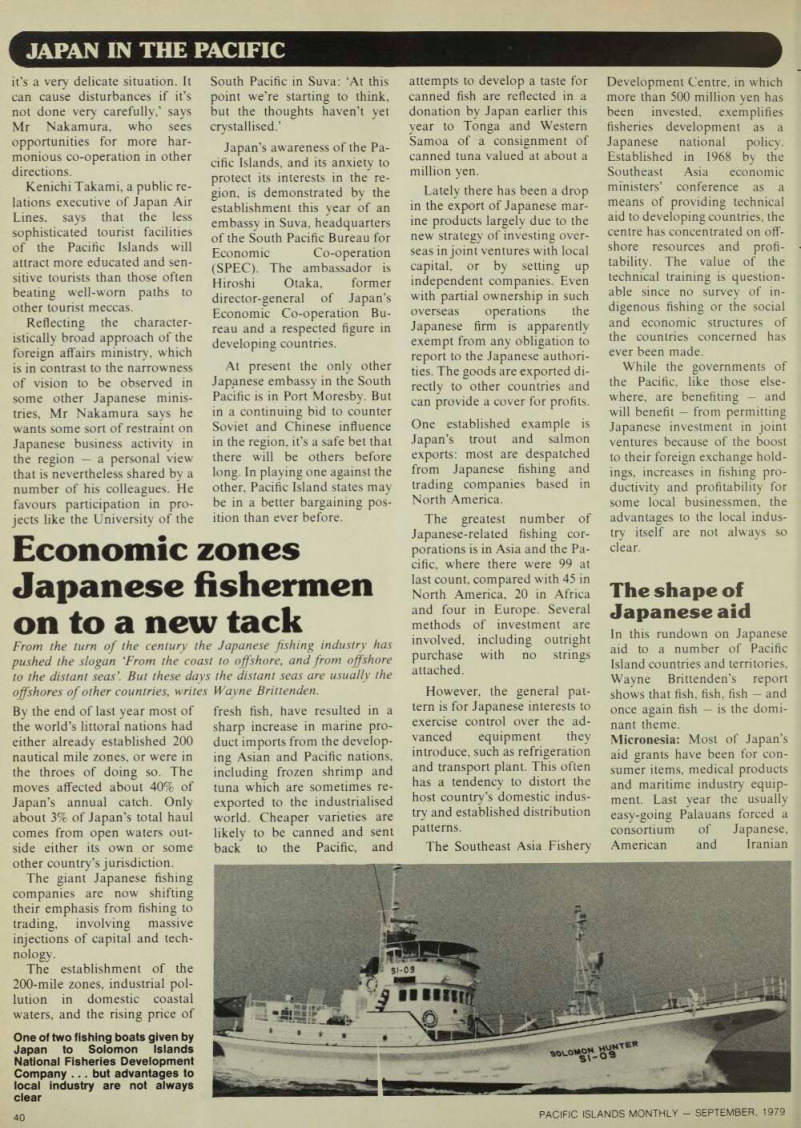
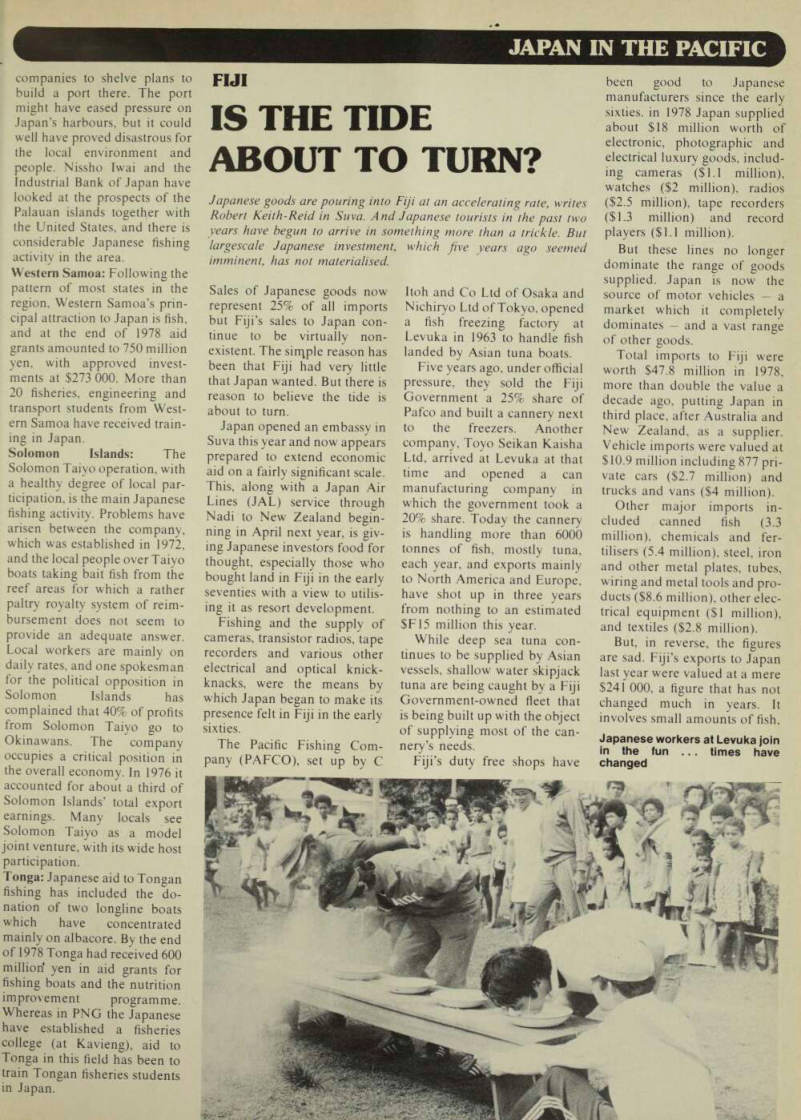
Economic zones Japanese fishermen on to a new tack
From the turn of the century the Japanese fishing industry has pushed the slogan ‘From the coast to offshore, and from offshore to the distant seas\ But these days the distant seas are usually the offshores of other countries, writes Wayne Brittenden.
By the end of last year most of the world’s littoral nations had either already established 200 nautical mile zones, or were in the throes of doing so. The moves affected about 40% of
Japan’s annual catch. Only
about 3% of Japan’s total haul comes from open waters out side either its own or some
other country’s jurisdiction.
The giant Japanese fishing
companies are now shifting
their emphasis from fishing to
trading, involving massive
injections of capital and tech
nology.
The establishment of the 200-mile zones, industrial pol lution in domestic coastal waters, and the rising price of
fresh fish, have resulted in a sharp increase in marine pro duct imports from the develop ing Asian and Pacific nations, including frozen shrimp and tuna which are sometimes re exported to the industrialised world. Cheaper varieties are likely to be canned and sent back to the Pacific, and
attempts to develop a taste for canned fish are reflected in a donation by Japan earlier this year to Tonga and Western Samoa of a consignment of canned tuna valued at about a million yen.
Lately there has been a drop in the export of Japanese mar ine products largely due to the new strategy of investing over seas in joint ventures with local
capital, or by setting up
independent companies. Even
with partial ownership in such overseas operations the
Japanese firm is apparently
exempt from any obligation to report to the Japanese authori ties. The goods are exported di rectly to other countries and can provide a cover for profits.
One established example is Japan’s trout and salmon exports: most are despatched from Japanese fishing and
trading companies based in
North America.
The greatest number of
Japanese-related fishing cor
porations is in Asia and the Pa cific, where there were 99 at last count, compared with 45 in North America, 20 in Africa and four in Europe. Several methods of investment are
involved, including outright
purchase with no strings
attached.
However, the general pat tern is for Japanese interests to exercise control over the ad
vanced equipment they
introduce, such as refrigeration and transport plant. This often has a tendency to distort the host country’s domestic indus try and established distribution patterns.
The Southeast Asia Fishery
Development Centre, in which more than 500 million yen has been invested, exemplifies fisheries development as a
Japanese national policy.
Established in 1968 by the Southeast Asia economic ministers’ conference as a means of providing technical aid to developing countries, the centre has concentrated on off shore resources and profi tability. The value of the
technical training is question
able since no survey of in digenous fishing or the social and economic structures of the countries concerned has ever been made.
While the governments of the Pacific, like those else where, are benefiting and will benefit from permitting
Japanese investment in joint
ventures because of the boost to their foreign exchange hold ings, increases in fishing pro
ductivity and profitability for
some local businessmen, the advantages to the local indus try itself are not always so clear.
The shape of
Japanese aid
In this rundown on Japanese aid to a number of Pacific Island countries and territories, Wayne Brittenden’s report shows that fish, fish, fish and once again fish is the domi nant theme.
Micronesia: Most of Japan’s aid grants have been for con sumer items, medical products
and maritime industry equip
ment. Last year the usually easy-going Palauans forced a consortium of Japanese, American and Iranian
One of two fishing boats given by Japan to Solomon Islands National Fisheries Development Company ... but advantages to local industry are not always clear
companies to shelve plans to build a port there. The port might have eased pressure on Japan’s harbours, but it could well have proved disastrous for the local environment and people. Nissho Iwai and the Industrial Bank of Japan have looked at the prospects of the Palauan islands together with the United States, and there is
considerable Japanese fishing
activity in the area.
Western Samoa: Following the pattern of most states in the
region. Western Samoa’s prin
cipal attraction to Japan is fish, and at the end of 1978 aid grants amounted to 750 million yen. with approved invest ments at $273 000. More than 20 fisheries, engineering and transport students from West ern Samoa have received train
ing in Japan.
Solomon Islands: The
Solomon Taiyo operation, with
a healthy degree of local par ticipation, is the main Japanese
fishing activity. Problems have
arisen between the company, which was established in 1972, and the local people over Taiyo boats taking bait fish from the reef areas for which a rather paltry royalty system of reim bursement does not seem to
provide an adequate answer.
Local workers are mainly on daily rates, and one spokesman for the political opposition in Solomon Islands has complained that 40% of profits from Solomon Taiyo go to Okinawans. The company occupies a critical position in the overall economy. In 1976 it accounted for about a third of Solomon Islands’ total export
earnings. Many locals see
Solomon Taiyo as a model joint venture, with its wide host
participation.
Tonga: Japanese aid to Tongan fishing has included the do nation of two longline boats which have concentrated mainly on albacore. By the end of 1978 Tonga had received 600 million* yen in aid grants for fishing boats and the nutrition
improvement programme.
Whereas in PNG the Japanese have established a fisheries college (at Kavieng), aid to Tonga in this field has been to train Tongan fisheries students in Japan.
Advertisements & other items, p. 40 (1 item)
Japan In The Pacific
40
PACIFIC ISLANDS MONTHLY - SEPTEMBER, 1979
About To Turn?

Fiji
Is The Tide
Japanese goods are pouring into Fiji at an accelerating rate, writes Robert Keith-Reid in Suva. And Japanese tourists in the past two years have begun to arrive in something more than a trickle. But largescale Japanese investment, which five years ago seemed imminent, has not materialised.
Sales of Japanese goods now represent 25% of all imports but Fiji’s sales to Japan con tinue to be virtually non existent. The sirqple reason has been that Fiji had very little that Japan wanted. But there is reason to believe the tide is about to turn.
Japan opened an embassy in Suva this year and now appears prepared to extend economic aid on a fairly significant scale.
This, along with a Japan Air Lines (JAL) service through Nadi to New Zealand begin ning in April next year, is giv ing Japanese investors food for
thought, especially those who
bought land in Fiji in the early seventies with a view to utilis ing it as resort development.
Fishing and the supply of cameras, transistor radios, tape recorders and various other electrical and optical knick knacks, were the means by which Japan began to make its presence felt in Fiji in the early sixties.
The Pacific Fishing Com pany (PAFCO), set up by C
Itoh and Co Ltd of Osaka and Nichiryo Ltd of Tokyo, opened a fish freezing factory at Levuka in 1963 to handle fish landed by Asian tuna boats.
Five years ago, under official pressure, they sold the Fiji Government a 25% share of Pafco and built a cannery next to the freezers. Another company, Toyo Seikan Kaisha Ltd, arrived at Levuka at that time and opened a can manufacturing company in which the government took a 20% share. Today the cannery is handling more than 6000 tonnes of fish, mostly tuna, each year, and exports mainly to North America and Europe, have shot up in three years from nothing to an estimated $F 15 million this year.
While deep sea tuna con tinues to be supplied by Asian vessels, shallow water skipjack tuna are being caught by a Fiji Government-owned fleet that is being built up with the object of supplying most of the can
nery’s needs.
Fiji’s duty free shops have
been good to Japanese manufacturers since the early sixties, in 1978 Japan supplied about $lB million worth of electronic, photographic and
electrical luxury goods, includ
ing cameras ($l.l million), watches ($2 million), radios ($2.5 million), tape recorders ($1.3 million) and record players ($l.l million).
But these lines no longer dominate the range of goods supplied. Japan is now the source of motor vehicles a market which it completely dominates and a vast range of other goods.
Total imports to Fiji were worth $47.8 million in 1978, more than double the value a decade ago, putting Japan in third place, after Australia and New Zealand, as a supplier.
Vehicle imports were valued at $10.9 million including 877 pri vate cars ($2.7 million) and trucks and vans ($4 million).
Other major imports in
cluded canned fish (3.3 million), chemicals and fer tilisers (5.4 million), steel, iron and other metal plates, tubes, wiring and metal tools and pro ducts ($8.6 million), other elec trical equipment ($1 million), and textiles ($2.8 million).
But, in reverse, the figures are sad. Fiji’s exports to Japan last year were valued at a mere $241 000, a figure that has not changed much in years. It involves small amounts of fish,
Japanese workers at Levuka join in the fun ... times have changed
fish meal, pearl, trochus and turtle shell, and a small amount of timber.
Japan has been an occasional customer for sugar but it has been years since the Fiji industry has had any to spare after meeting contracts with regular customers. In any
case, Japanese refineries prefer
to buy more cheaply else where.
The government has not complained about the trade gap because Fiji just hasn’t got much to offer. But, in the eight ies, it hopes the picture will
change quite dramatically.
Since the late sixties the government has been busy planting more than 50 000 hec tares of Caribbean pine forest.
A source of logs, pulp, and chip already, these forests will start to mature early in the eighties at a time when a shortage of softwoods is forecast in Asian
countries, particularly Japan.
Japanese timber companies
already are showing interest.
Official hopes are that with
Japan’s help, pine will rapidly
evolve into a trade worth almost as much as Fiji’s $lOO million a year sugar industry.
Fiji’s attitude to the
Japanese is friendly nowadays.
In World War II Fijian soldiers fought Japanese troops in the Solomon Islands and war bit terness lasted until the late fif ties. In those days Japanese fishermen were liable to be beaten up if caught alone in Suva at night.
That has all changed.
Japanese fishing boats are wel come as a source of business worth several million dollars a year for local ship repair yards and provisioning merchants.
Crewmen are now offered a beer in a pub instead of a clenched fist.
In Levuka, Japanese chil dren school with local children and local men have been to sea in Japanese fishing boats or on courses with the cannery’s
parent companies in Japan.
Judo is a local craze initiated
by Japanese fishermen. Fam
iliarity with Japanese brand
names and the advertising
material accompanying them
has done much to help the
people of Fiji satisfy their curi
osity about the people from the
islands 10 000 km to the north.
Hearing of massive Japanese investment in Hawaii and of the thousands of free-spending Japanese tourists visiting there, Fiji’s mood was of happy an ticipation when several Japanese companies moved to establish themselves in the Fiji tourist resort scene in the early and mid-seventies.
Sixty Japanese companies,
most of them big names, set up Todeco (Fiji) Ltd for invest ment in a wide field of activi ties in Fiji and the South Pacific. Todeco talked of re sorts, shipbuilding, agriculture,
forestry, fishing and manufac
turing.
But, so far, all that it has done is to buy the 120-room Mana Island Resort hotel just off Nadi airport. Much of Mana’s business now involves Japanese tourists who come in on charter flights which JAL started experimentally, for short seasons, two years ago.
Three years ago, Taisei, one
of Japan’s biggest construction
companies, paid about $5 million for a half-share of Pacific Harbour, a 7000-acre section of freehold land, mostly
swamp, at Deuba, 50 km from Suva. An 1100-acre first phase was completed at Pacific Har bour by Southern Pacific Properties Ltd (SPP), a company which since 1978 has been controlled by Saudi Arabian tycoon Adnan Kahshoggi. SPP and Taisei have set up SPP-Taisei Ltd to
develop the remaining 6000
acres but have not taken this
plan beyond the drawing board
stage.
At about the time of Taisei’s arrival, Fuji Kon Fiji Ltd, con
trolled by another Japanese
consortium, signed up with the American promoters of the Denarau Island resort project near Nadi airport for partici pation in a $2O million hotel as a neighbour to a 300-room re sort opened in 1976. But, again, nothing has eventuated.
One reason is difficulty about fresh water supplies, a problem which won’t be solved until a government water reser voir scheme is completed three or four years from now. But the main reason is that, like Taisei and Todeco, Fuji Kon has had second thoughts about the timing of major involvement in Fiji. It wants to be sure of trans port between Tokyo and Nadi in the shape of Japan Air Lines before it puts the big money down. JAL’s firm decision to
start flying to Nadi as a sched uled operator from April next year was announced only in July this year.
Taisei’s resident manager at Pacific Harbour, Tak Hasegawa, commented: ‘Now that they are coming here there could be a change in tourism.
It has been growing, but slowly, and so far we have not been
doing much. Just marking
time.’ JAL was the key which would turn and get things mov ing, he said.
It wasn’t until JAL began charter flights to Nadi in 1976 that the presence of Japanese tourists became noticeable at all. DCBs, carrying about 140 passengers, flew in for ‘seasons’ of about 10-15 flights. The number grew steadily and about 6000 Japanese each spent an average of a week in
Fiji last year, mostly taking in
Mana Island and a couple of other resorts, including Pacific Harbour.
Makoto Ikeda, resident in Fiji for nine years as a tour business representative, says the JAL charters have worked up repeat custom already. ‘About 40 people from each series come back the following year. It’s a good sign,’ he said. ‘Most of the traffic is young
couples and young single
women who want beaches, a good hotel, and sightseeing and not much more. Some com plain that there’s nothing to buy here. They don’t want Japanese stuff. They want ex
pensive foreign brands that
they can’t get at home.
JAL’s decision to open a reg ular all-year-round service has prompted one Japanese com pany to inquire about opening a Japanese restaurant at Pacific Harbour. That, says Mr Ikeda, is a small hint of the shape of things to come.
Outside of trade and fishing,
Fiji’s dealing with Japan
amounted to next to nothing in any other area until the open ing of an embassy in
January.
In Fiji’s view, Japan’s motive in opening the embassy is chiefly to preserve the right of its fishing fleets to work in re
gions they had fished freely
until the declaration of 200-mile economic zones, now
Judo enthusiasts Tek Hasegawa (left) and Viliame Takayawa with new judo mat... a present from Mr Hasegawa’s company, SPP- Taisei
claimed by all South Pacific Island states.
But the embassy’s presence should also be a means of per suading Japan to increase aid which, so far, has been meagre and amounting to nothing at all until about three years ago. In some instances it has been offered with strings attached a form of aid which Fiji’s Prime Minister Ratu Sir Kamisese Mara refuses.
There have been offers of technical assistance for fisheries development but this tended to be directed at pro jects that would be of as much benefit to Japanese fishermen as they would to Fiji.
Radio Fiji received some handouts of equipment and some Japanese technicians installed it. A minor involve ment in some agricultural schemes has started and a Japanese team has pho tographed coconut plantation areas for a survey to help copra
development planning.
A Japanese mission was in Suva recently to ask the goven ment what more could be done.
But, so far, said Masayaki Iguchi, first secretary at the
new embassy, nothing had
been agreed on: ‘We are wait ing for a list of priority projects with which we could help but nothing has been decided yet.’
He said the embassy would be keeping an eye on fishing rights, ‘but economic and tech nical co-operation will be the embassy’s most important work’.
When he passed through Tokyo last year, Ratu Mara gave the Japanese one idea to think through. He pointed out that top quality it might be, but
Japanese equipment, like
equipment from any other country, broke down or wore
out. Repairs were usually
cheaper than buying a replace ment he said, and added that
while it might mean slightly re
duced sales for Japanese sup pliers, it would be a big saving for their Fiji customers if schools were opened in Suva to train local tradesmen and tech nicians to service and repair equipment appearing in the near $5O million import list of items bearing the Made in Japan mark.
Advertisements & other items, pp. 41-46 (3 items)
Japan In The Pacific
You haven't tasted
best-known brand
if you haven't tasted...
i i 'Sk Si ■i m V suns o WWami
iLzTTIM
■ % -x; ■
J^acker^
lN TOMATO SA
NACKER^
r...
PACKED BY:
NIPPON SUISAN KAISHA, LTD.
EXPORTED BY:
UNITRADE COMPANY, LIMITED
11-12 3-chome Hachobori Chuo-ku Tokyo TELEX NO.; “252-4665 KANDK J” CABLE ADDRESS: KAYANDKAY TOKYO
4-Clarion 88 ■ 93 • 98 ■ 104 " 5B !JO 700 1000 1300 1600 o* I n»v Wrtf/MJTI uccx mucr avtotv* I \ ■ /A*, ... m 0 OS - T? - V- I, » WtS ii 11 sss sssaa mm a*
Stop Wishing.
Start Thrilling To Clarion
■ V"B# .
C Clarion
In Car Entertainment Company
Clarion Co., Ltd. Tokyo, Japan
Australia: Amalgamated Wireless (Australasia) Ltd. 554 Parramatta Road. Ashfield N.S.W.. 2131/ New Zealand: AWA New DD a oAn Limited P ° B ° X 50248 P° rirua Fiji Islands: Brijlal & Co.. Ltd. G.P.O. Box 362 Suva/ Tahiti: ETS Comimpex B.P. 200 Papeete New Caledonia: Caldis B.P Ml Noumea Cedex/Guam: Guam Radio &TV Shop P.O. Box 1939 Agana Guam 96910 New Hebrides: The Sound Centre P.O. Box 434 Vila Cook Islands: South Seas International Ltd. P.O. Box 4J Rarotonga Papua New Guinea: Hagemeyer (P N G.) Pty. Ltd. P.O. Box 1428, Boroko. Port Moresby.
The Pleasure Principle
All the complex electronics in Onkyo stereo components are dedicated to a very simple principle: music is a pleasure and hi-fi should be fun. Our License-15 stereo component system puts this pleasure principle in action.
The heart of the system is a stereo receiver —20 W 20W (IkHz, B£2, 0.3% THD) —with an advanced Servo-locked mechanism that eliminates tuning hassles and FM drift. Just rough-tune to the station of your choice, release the dial, and the servo mechanism locks in on the precise frequency for optimum reception. Touch the dial again, and "Human Touch Sensors" release the lock, leaving you free to roam the airwaves to your heart's content. It's the easygoing way to FM enjoyment.
The License-15 system comes complete with a quality turntable, featuring automatic return and cut-off, plus a low-mass tone arm that preserves your discs while faithfully tracking every undulation in their grooves. And for sheer sound satisfaction, it's hard to beat the 2-way bass reflex speakers that round out the system.
Amplify the pleasure principle in your life with the License-15 stereo component system. It's easy to use, attractively styled and eminently affordable. fiscs while faithfully tracking every undula-
license-15
STEREO COMPONENT SYSTEM
RECEIVER: TXISOOMKII
TURNTABLE: CP-1005A
Artistry in Sound
RACK: SR-20
OPTIONAL
CASSETTE DECK: TA-2010, TA-600D
ONKYO CORPORATION
International Division: No. 24 Mori Bldg., 23-5. 3-chome, Nishi-shinbashi, Minato-ku, Tokyo. Japan. Telex 242-3551 ONKYO J Tel, 03-432-6981
Let “TEN” take you
to a new world
of sound
With perfect “TEN” auto sound in your car. you’ll tune in on whole new worlds of listening enjoyment.
These “TEN” winners are packed with outstanding features that assure you of better, richer sound, plus the kind of effortless operation that can never interfere with your driving. And they're meticulously designed and tested to make certain they will stand up under the toughest service conditions.
So for your companion on the road, select a superb “TEN” sound system and discover for yourself a new world of listening pleasure. r Ws' ns?
TOME*-arsf-VQL .. »■
CASSETTE STEREO
MONO QST
■ 780 SP-770 Auto Eject Cassette Car Stere ■ ■: ■. : ■ • - ... ; ■ . . .
Car Stereo Auto Reverse Cassette
FUJITSU TEN
JAPAN
Design and specifications subject to change without prior notice Head Office: 2-28. Gosho-don 1-chome Hyogo-ku. Kobe, Japan Tokyo Office. Shuwa Onanmon Bldg . 2nd FI.. 1-1, Shimbashi 6-chome, Mmato-ku. Tokyo, Japan (Export Section)Tel (03)438-1611 Cable TENFUJITSU TOKYO Telex; 2425101 TENTOKJ Papua New Guinea. CHIN H MEEN N SONS PTY LTD, RO Box 1106. Boroko. Port Moresby Papua New Guinea French Polynesia: FARE HI-FI STEREO P O Box 269. Rue du Marechal Foch Papeete. Tahichi French Polynesia Fiji; D. GOKAL & CO. LTD. G P.O. Box 501. Suva Fiji
Japan In The Pacific
’ACIFIC ISLANDS MONTHLY SEPTEMBER, 1979
Just A Decade
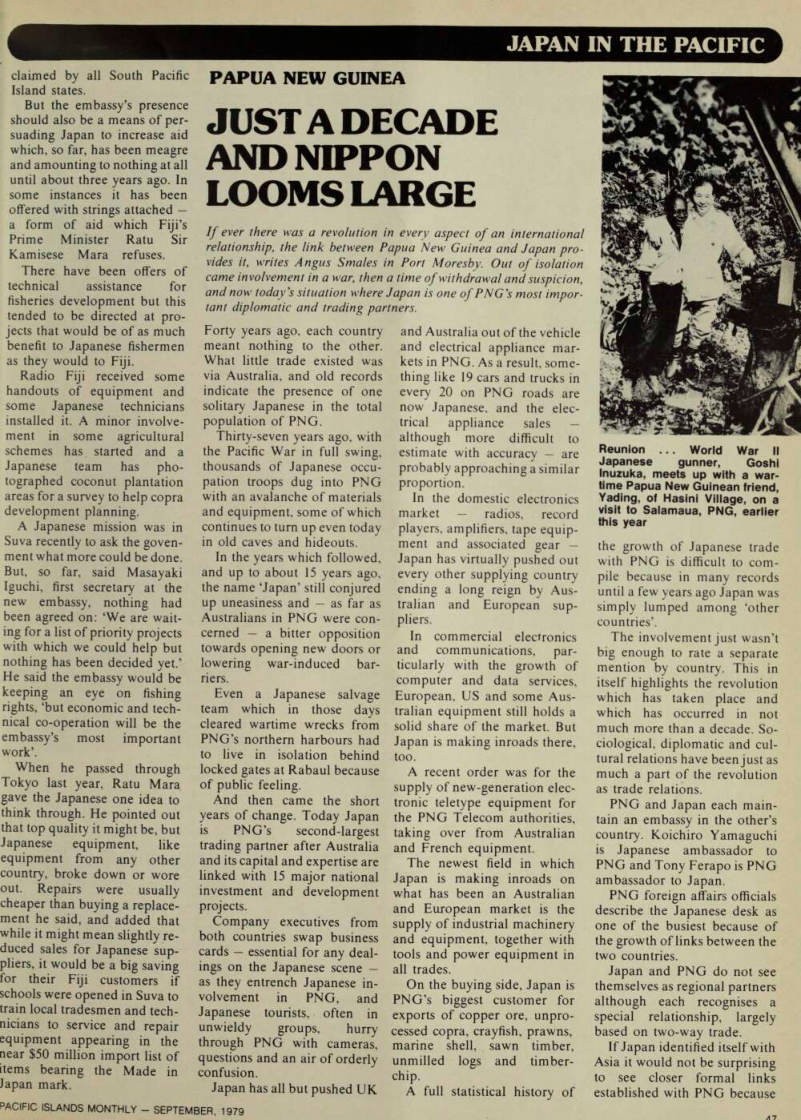

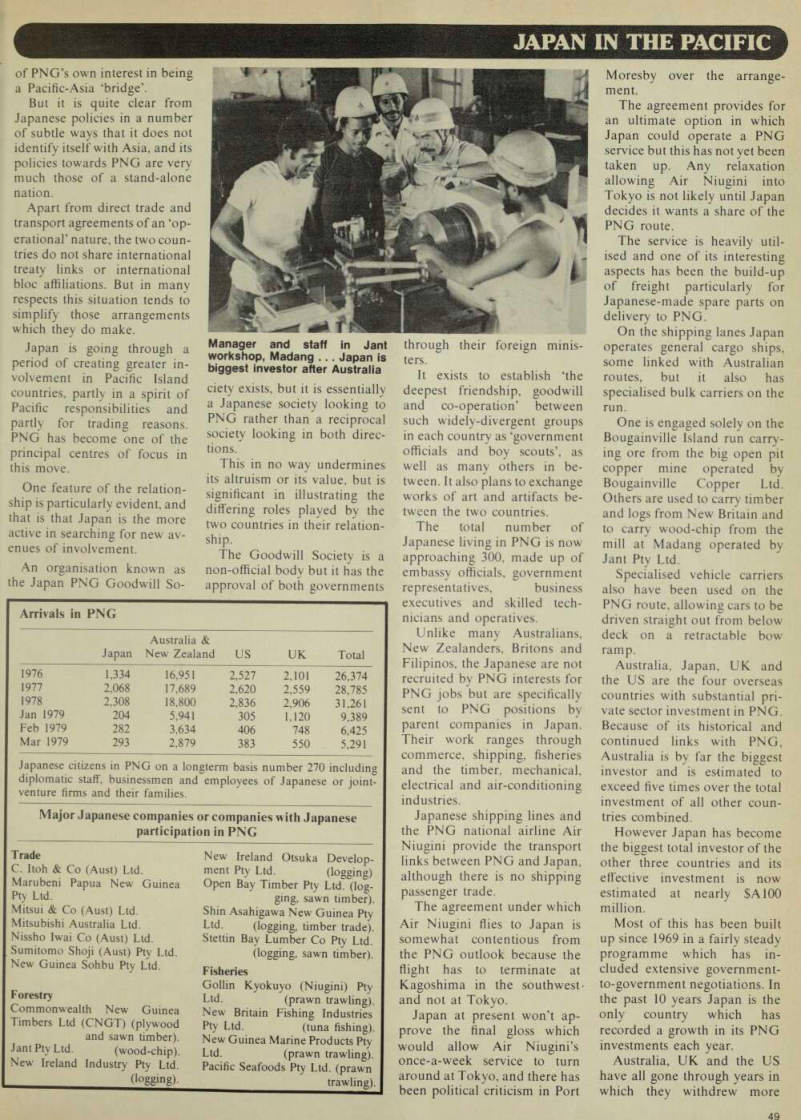

Papua New Guinea
And Nippon
Looms Large
If ever there was a revolution in every aspect of an international relationship, the link between Papua New Guinea and Japan pro vides it, writes Angus Smales in Port Moresby. Out of isolation came involvement in a war, then a time of withdrawal and suspicion, and now today's situation where Japan is one of PNG's most impor tant diplomatic and trading partners.
Forty years ago, each country meant nothing to the other.
What little trade existed was via Australia, and old records indicate the presence of one solitary Japanese in the total population of PNG.
Thirty-seven years ago, with the Pacific War in full swing, thousands of Japanese occu pation troops dug into PNG with an avalanche of materials and equipment, some of which continues to turn up even today in old caves and hideouts.
In the years which followed, and up to about 15 years ago, the name ‘Japan’ still conjured up uneasiness and as far as Australians in PNG were con cerned a bitter opposition towards opening new doors or lowering war-induced bar riers.
Even a Japanese salvage
team which in those days cleared wartime wrecks from PNG’s northern harbours had to live in isolation behind locked gates at Rabaul because
of public feeling.
And then came the short
years of change. Today Japan
is PNG’s second-largest trading partner after Australia and its capital and expertise are linked with 15 major national investment and development
projects.
Company executives from both countries swap business cards essential for any deal ings on the Japanese scene as they entrench Japanese in volvement in PNG, and Japanese tourists, often in
unwieldy groups, hurry
through PNG with cameras, questions and an air of orderly confusion.
Japan has all but pushed UK
and Australia out of the vehicle and electrical appliance mar kets in PNG. As a result, some thing like 19 cars and trucks in every 20 on PNG roads are now Japanese, and the elec trical appliance sales although more difficult to estimate with accuracy are
probably approaching a similar
proportion.
In the domestic electronics market radios, record players, amplifiers, tape equip ment and associated gear Japan has virtually pushed out every other supplying country
ending a long reign by Aus
tralian and European sup
pliers.
In commercial electronics and communications, par ticularly with the growth of computer and data services, European, US and some Aus tralian equipment still holds a solid share of the market. But Japan is making inroads there, too.
A recent order was for the supply of new-generation elec tronic teletype equipment for the PNG Telecom authorities, taking over from Australian and French equipment.
The newest field in which Japan is making inroads on what has been an Australian and European market is the supply of industrial machinery
and equipment, together with
tools and power equipment in all trades.
On the buying side, Japan is PNG’s biggest customer for exports of copper ore, unpro cessed copra, crayfish, prawns, marine shell, sawn timber, unmilled logs and timber
chip.
A full statistical history of
the growth of Japanese trade with PNG is difficult to com pile because in many records until a few years ago Japan was
simply lumped among ‘other
countries’.
The involvement just wasn’t big enough to rate a separate mention by country. This in itself highlights the revolution which has taken place and which has occurred in not much more than a decade. So
ciological, diplomatic and cul
tural relations have been just as much a part of the revolution as trade relations.
PNG and Japan each main tain an embassy in the other’s country. Koichiro Yamaguchi is Japanese ambassador to PNG and Tony Ferapo is PNG ambassador to Japan.
PNG foreign affairs officials describe the Japanese desk as one of the busiest because of the growth of links between the two countries.
Japan and PNG do not see themselves as regional partners although each recognises a
special relationship, largely
based on two-way trade.
If Japan identified itself with Asia it would not be surprising to see closer formal links established with PNG because
Reunion ... World War II Japanese gunner, Goshi Inuzuka, meets up with a war time Papua New Guinean friend, Yading, of Hasini Village, on a visit to Salamaua, PNG, earlier this year
of PNG’s own interest in being a Pacific-Asia ‘bridge’.
But it is quite clear from Japanese policies in a number of subtle ways that it does not identify itself with Asia, and its policies towards PNG are very much those of a stand-alone nation.
Apart from direct trade and transport agreements of an ‘op erational’ nature, the two coun tries do not share international treaty links or international bloc affiliations. But in many respects this situation tends to simplify those arrangements which they do make.
Japan is going through a
period of creating greater in volvement in Pacific Island countries, partly in a spirit of Pacific responsibilities and
partly for trading reasons.
PNG has become one of the principal centres of focus in this move.
One feature of the relation ship is particularly evident, and that is that Japan is the more active in searching for new av enues of involvement.
An organisation known as the Japan PNG Goodwill So-
Arrivals in PNG
Japanese citizens in PNG on a longterm basis number 270 including diplomatic staff, businessmen and employees of Japanese or joint venture firms and their families.
ciety exists, but it is essentially
a Japanese society looking to
PNG rather than a reciprocal society looking in both direc tions.
This in no way undermines its altruism or its value, but is
significant in illustrating the
differing roles played by the two countries in their relation
ship.
The Goodwill Society is a non-official body but it has the approval of both governments
through their foreign minis
ters.
It exists to establish ‘the
deepest friendship, goodwill
and co-operation’ between such widely-divergent groups in each country as ‘government officials and boy scouts’, as well as many others in be tween. It also plans to exchange works of art and artifacts be tween the two countries.
The total number of Japanese living in PNG is now approaching 300, made up of embassy officials, government
representatives, business
executives and skilled tech nicians and operatives.
Unlike many Australians, New Zealanders, Britons and Filipinos, the Japanese are not recruited by PNG interests for PNG jobs but are specifically sent to PNG positions by
parent companies in Japan.
Their work ranges through commerce, shipping, fisheries and the timber, mechanical, electrical and air-conditioning industries.
Japanese shipping lines and
the PNG national airline Air
Niugini provide the transport
links between PNG and Japan, although there is no shipping passenger trade.
The agreement under which Air Niugini flies to Japan is somewhat contentious from the PNG outlook because the flight has to terminate at Kagoshima in the southwest and not at Tokyo.
Japan at present won’t ap prove the final gloss which would allow Air Niugini’s once-a-week service to turn around at Tokyo, and there has been political criticism in Port
Moresby over the arrange ment.
The agreement provides for an ultimate option in which Japan could operate a PNG service but this has not yet been taken up. Any relaxation
allowing Air Niugini into
Tokyo is not likely until Japan decides it wants a share of the PNG route.
The service is heavily util ised and one of its interesting aspects has been the build-up
of freight particularly for
Japanese-made spare parts on delivery to PNG.
On the shipping lanes Japan operates general cargo ships, some linked with Australian routes, but it also has specialised bulk carriers on the run.
One is engaged solely on the Bougainville Island run carry ing ore from the big open pit
copper mine operated by
Bougainville Copper Ltd.
Others are used to carry timber and logs from New Britain and to carry wood-chip from the
mill at Madang operated by
Jant Pty Ltd.
Specialised vehicle carriers also have been used on the PNG route, allowing cars to be driven straight out from below deck on a retractable bow ramp.
Australia, Japan, UK and the US are the four overseas countries with substantial pri vate sector investment in PNG.
Because of its historical and continued links with PNG, Australia is by far the biggest investor and is estimated to exceed five times over the total investment of all other coun tries combined.
However Japan has become the biggest total investor of the other three countries and its effective investment is now estimated at nearly SAIOO million.
Most of this has been built up since 1969 in a fairly steady programme which has in cluded extensive government to-government negotiations. In the past 10 years Japan is the only country which has recorded a growth in its PNG investments each year.
Australia, UK and the US have all gone through years in which they withdrew more
Manager and staff In Jant workshop, Madang ... Japan is biggest investor after Australia
Japan Australia & New Zealand US UK Total 1976 1,334 16,951 2,527 2,101 26,374 1977 2,068 17,689 2,620 2,559 28,785 1978 2,308 18,800 2,836 2,906 31,261 Jan 1979 204 5,941 305 1,120 9,389 Feb 1979 282 3,634 406 748 6,425 Mar 1979 293 2,879 383 550 5,291
Major Japanese companies or companies with Japanese participation in PNG Trade New Ireland Otsuka Develop- C. Itoh & Co (Aust) Ltd. ment Pty Ltd. (logging) Marubeni Papua New Guinea Open Bay Timber Pty Ltd. (log- Pty Ltd. ging, sawn timber).
Mitsui & Co (Aust) Ltd.
Shin Asahigawa New Guinea Pty Mitsubishi Australia Ltd.
Ltd. (logging, timber trade).
Nissho Iwai Co (Aust) Ltd.
Stettin Bay Lumber Co Pty Ltd.
Sumitomo Shoji (Aust) Pty Ltd. (logging, sawn timber).
New Guinea Sohbu Pty Ltd.
Fisheries Forestry Commonwealth New Guinea Gollin Kyokuyo (Niugini) Pty Ltd. (prawn trawling).
New Britain Fishing Industries Timbers Ltd (CNGT) (plywood Pty Ltd. (tuna fishing). and sawn timber).
New Guinea Marine Products Pty Jant Pty Ltd. (wood-chip).
Ltd. (prawn trawling).
New Ireland Industry Pty Ltd.
Pacific Seafoods Pty Ltd. (prawn (logging). trawling).
capital than they invested
(although over the 10-year
period they each showed a sub stantial net growth).
In 1975, the year that PNG became independent, there was an overall reduction of $25 million in overseas capital invested in PNG, largely
through withdrawals by Aus
tralian and US interests. In the same year however Japan increased its investment by about $7 million.
Investment income payable out of PNG to Japanese interests is now estimated to be running at $5 million a year. (The estimate for Australian
Investment in PNG
From Private Overseas Investment issued August 3, 1978, by Bureau of Statistics of PNG.
interests is $6O million.) Japanese capital in PNG tends to be more ‘formal’ than
longstanding Australian capi
tal. A big proportion of Japanese funds is invested in
major lately-approved ven
tures in which the government itself is a shareholder, thus exposing the capital to govern ment scrutiny, approval and in volvement.
Under PNG’s investment structure this difference has no
practical significance or not
today, anyway but the
Japanese themselves regard
this as an added measure of se
curity.
Japan shares exactly the
same conditions, controls and guarantees as other countries with regard to capital invested in PNG it has neither con cessions nor discriminatory re strictions.
Although Japanese invest
ment is extensive and is increasing it is not spread widely and is generally con
fined to major developmental
spheres where Japan has
proven specialised skills.
All aspects of the timber
industry are major investment
areas for Japan, and there is Japanese timber money on the south coast of the PNG main land, inland at Bulolo, at sev eral points on the north coast and on New Britain and New Ireland.
The investment covers the whole range of the timber
industry in general logging
and reafforestation, in milling for export and local markets, in
wood-chip production and in
veneer and plywood manufac ture.
There’s even a chopsticks
export industry using offcuts
from Klinkii pine plywood timber at the Japanese controlled Commonwealth New Guinea Timbers plant at Bulolo.
Fisheries is another major Japanese investment area in PNG, but a firm distinction is drawn between two completely
differing types of operation.
One is the high-intensity fishing of PNG waters under licence, mainly for tuna, in which PNG has the potential to earn revenue from Japan in lic ence fees and royalties. Last year alone through an arrange ment of this nature Japan paid PNG $1.25 million in licences plus royalties on the catch.
But government-to-govern
ment negotiations bogged
down over a renewal of the ar rangement, with Japan want ing a lower access price because of a claimed recession in the fisheries product mar ket.
The situation remains stalemated, and PNG sends out periodic Defence Force patrols to ensure that Japanese fleets are not poaching. So far the Japanese behaviour has been
exemplary.
PNG deliberately wants to keep the conditions tough be cause it is looking to the day when it can operate its own tuna catch fleet.
The second type of fisheries
operation is where Japanese
investment and expertise is used to establish a local indus try with PNG equity involve ment. Pilot schemes have
already been operated, some
including fish canning, and the PNG Government expects a big expansion in the next four years.
The major problem facing
PNG is to assure its own coastal village communities that their traditional fishing rights will not be infringed or coastal waters denuded.
The big Sohbu Trading Cor poration of Japan is a major investor in PNG with interests in timber and fisheries, mainly in partnership with the govern ment. Its big automated timber mill at Open Bay in New Bri tain was burnt down in July, and about $4 million will be spent in a rebuilding pro gramme.
Japan is involved in light
industry through an air
conditioning venture in a part nership between Daikin and the locally-owned PNG Associated Industries of Port Moresby.
Although Japan dominates PNG sales of automotive, elec tronic, time-keeping and cam era industry products its local investment in these areas is not significant except for some light industrial services. This is because of a deliberate policy of non-involvement in market ing and servicing where local franchises can handle the re
quirements.
Where major Japanese inter national product names are concerned this has tended to keep Japanese investment to liaison-type activities, backed
up by sponsored training pro
grammes for PNG technicians and officials.
Japan invested a one-third share in a major feasibility
study into the hydro-electric
potential of the Purari River in southern PNG. Any eventual development of the scheme is almost certain to include
Japanese participation, and
there is a possibility that Japan could be an industrial customer for the available power if the scheme is implemented.
Japan attempted to gain a foothold in the palm oil indus try in PNG but its expertise proved insufficient and the PNG Government cancelled an agreement under which Japanese interests were to establish an expressing mill and palm oil estate.
Japan provides two types of direct aid to PNG as part of an established policy of assistance to developing countries. One is the provision of concessional
loans for development projects
where the projects themselves require approval but the direc tion of expenditure is generally untied. The other is a pro gramme of technical assistance which can involve training or financial aid, but which is gen erally tied to Japanese involve ment in the approved schemes.
Under the loan programme, PNG recently received a $17.5 million soft loan from Japan to be spent over this year and the next five years. The loan itself
Klinkii pine ready for shipment from Bulolo ... now a Japanese operation
Japan
Australia UK
Usa
Others Total Year
ending
June 30 1971 43 821 106 374 4040 34 290 (’000s PNG Kina) 4114 192 639 1972 2821 81 486 65 736 17 491 2295 169 829 1973 6631 4358 19 876 5451 1654 29 254 1974 1983 80 758 60 935 51 987 526 74 314 1975 5595 18 028 10 298 8082 1211 27 050 1976 1752 29 586 4286 12 501 1645 24 768 1977 1887 5387 1608 6696 21 234 22 822
will operate over 30 years at only 3% annual interest and with a 10-year grace period be fore repayments begin. It is being co-financed by the Asian
Development Bank.
It was approved through the PNG budget and will be used
for an important hydro-electric
project on the Warangoi River just outside Rabaul in East New Britain Province.
All procurement arrange ments in applying the money are untied, except that the expenditure cannot be in socialist countries.
Japanese and PNG officials
are already investigating
another loan under similar concessional terms, and poss
ibly slightly larger.
In accepting Japanese tech
nical aid as distinct from development loans PNG has found some difficulty in find ing projects which are suited to its own requirements while also filling the need for Japanese in volvement.
However about 30 Papua New Guineans are undergoing.
or about to undergo, technical training courses in Japan and two Japanese experts are invol ved in fisheries training aid in
Png.
PNG has found language difficulties create problems for some trainees going to Japan, but in general the foreign office and the government regard the scheme as valuable and work
ing satisfactorily.
Japan is also about to involve PNG in its Overseas
Co-operation Volunteers
(OCV) scheme, a similar oper ation to Australian Volunteers Abroad and the US Peace
Corps.
In total trade figures, Japan is now PNG’s second trading partner after Australia. But in terms of exports Japan is PNG’s best customer by far, and the value of what PNG sells to Japan is three times greater "than what it buys.
This point is often overlooked by critics who claim that aggressive Japanese marketing has been allowed to encroach excessively on the
‘traditional’ PNG market.
One product alone has cre ated PNG’s favourable trade balance with Japan, and that is copper ore from the Bougain ville Copper Ltd mine.
At the moment PNG sales to Japan are running at about $l9O million and Japan’s sales to PNG at $65 million.
Japanese sales to PNG are rising at a fairly steady 3% a year. The trend of values in PNG sales to Japan is harder to define because it relies to such a big extent on the often variable international copper market. The present value of PNG copper ore sales to Japan is running at $l4O million a year.
PNG’s second-biggest ex port to Japan is a wide range of products from the timber industry from raw logs to veneer - worth about $25 million.
The remaining major export
earnings are from copra, coffee beans, crayfish, prawns and fish. There are minor earnings from crocodile skins, car
damon seeds, cocoa beans, palm oil and marine shell.
More than half of PNG’s $65-million-dollar annual pur chases from Japan is made up of motor vehicles and some machinery. The total amount involved in these purchases on the most recent annual figures was $37 million. PNG’s roads are now almost completely taken over by Japanese ve hicles.
The second big area of Japanese sales is in manufac
tured goods amounting to just
over $l2 million. The principal goods in this category are radio and audio equipment, watches and clocks, cameras, electronic equipment and some electrical
appliances.
PNG also buys from Japan foodstuffs valued at $lO million.
Port Moresby foreign affairs
officials say that Japan is obviously seeing PNG as an
increasingly important Pacific
market, and that the volume of inquiries at the PNG embassy
in Japan is steadily increasing.
Advertisements & other items, pp. 48-55 (4 items)
“My Yanmar diesel engine!”
Hey, world, what’s all the smiling about?
I 5o \ gofr— % 4 4* f u w w
It’s the same the world over.
Yanmar diesel engine owners are happy owners.
Because we spend a lot of time and trouble developing ana producing diesel engines that they don’t have to spend a lot of time and trouble looking after. That are veritable misers in operation. And that just seem to go on running forever.
Marine engines. Industrial engines. Engines for generators, pumps, ships, boats, yachts, farm equipment and construction machinery.
Some 400,000 diesel engines every year. From 4 to 3,960 horsepower.
That’s a lot of engines.
And a lot of smiles.
TS(C) series 4-22 HP Industrial diesel engine QM series 14-33 HP Marine diesel engine The Power Pacing Progress ,
YANMAR
DIESEL ENGINE
Industrial use 4—3960 HP Marine propulsion use 5—1980 HP Marine auxiliary use 4—3190 HP
YAM MAR DIESEL ENGINE CD.,LTD.
ECI 96942 WESTERN SAMOA MOTOR DISTRIBUTORS (SAMOA) LTD : Tel: 825.
Honda is where fun
living begins and never ends.
■ ■ % n m mi 'f / 4 i*year old Billy likes nothing better than to explore the lily farm on his Honda minibike. Especially when his father ?s along. Billy is an American schoolboy with a goal. He its to someday tour the entire country on a Honda CBX his father’s. No doubt he will one day. Because Honda cipates the needs of millions of people, including Billy. ?r 2,000 Research and Development staff members, operating on a $l4O million annual R&D budget, work full time to answer the aspirations of people around the globe.
The Honda R&D effort to create a happier future is quite sizable. So are the outstanding results: innovative ideas.
Original technology. A wide range of quality products.
Today’s Honda—determined to keep the good times rolling.
JA NEW GUINEA: Stcamships-Machinery P.O. Box 1, Port Moresby /TAHITI: Societc Tahitienne dlmportation dcs Produits Honda B.P.
Papeete /FIJI ISLANDS: Carpenters Motors 61-63 Foster St., Walu Bay, Suva / KIRIBATI: Atoll Auto Stores P.O. Box 71, Bairiki Tarawa /U.S. >T TERRITORY: United Micronesia Development Assn. P.O. Box 238, Saipan, Mariana Islands 96950 / COOK ISLANDS: Cook Islands Motor »r Ltd. P.O Box 74, Rarotonga AMERICAN SAMOA: Holiday Motors, Parts and Service P.O Box 968, Pago Pago Haleck’s Service Centre .ox 1138, Pago Pago /GUAM: Mark’s Motor Co.. Inc. P.O. Box DV, Agana /WESTERN SAMOA: Motor Distributors (Samoa) Ltd. P.O. Box 576, SOLOMON ISLANDS: British Solomons Trading Co., Ltd. P.O. Box 114, Honiara /NEW CALEDONIA: Establissements Ballande Boite le No. C 4, Noumea Cedex / NIUE ISLAND: Niue Island United Enterprises P.O. Box 4, Alofi / NAURU: Nauru Cooperative Society Republic of . Nauru Island, Central Pacific / NEW HEBRIDES: Yamathai (Melanesia) Kaihatsu Kaisha P.O. Box 194, Port Vila Santo Gas Centre Ltd. P.O. Box anto /TUVALU: Tuvalu Co-operative Wholesale Society P.O. Box Funafuti, Tuvalu /TONGA: Jones Holding P.O. Box 34, Nukualofa Tonga.
G he .
pbd
Fcmty
SI D O 0 £ I u * *
The
new rood
experience
(9 f i a 'O I I e u 7 The CSK-550 stereo cassette player, with micro-processor radio.
Because of its advanced micro-processor memory, the CSK-550 allows virtually instant, feather-touch electronic pre-set tuning of up to five AM and five FM stereo stations. You'll also like the road safety convenience of other features, like LED digital read-out for station frequency, and automatic FM noise cancellatlon/sound control.
Then take a closer look at Its cassette player and other features. The Hitachi CSK-550 a new road winner.
CSK-550
• Electronic pre-set tuning (10 stations) • LED digital read-out «Auto FM noise cancellation/sound control • Full Auto Stop type cassette player
OHITA
DAIWA LINE
JAPAN-SOUTH PACIFIC REGULAR SERVICE
AUSTRALIA-SOUTH PACIFIC CONTAINER SERVICE
JAPAN TAIWAN-GUAM-SAIPAN REGULAR SERVICE
DAIWA LINE BRIDGES SOUTH PACIFIC
WITH RO/RO CAR & CONTAINER CARRIER
JAPAN—GUAM —LAUTOKA—SUVA—PAPEETE—PAGO PAGO—APIA—NOUMEA—
SYDNEY—HONIARA—KIETA—TARAWA—GUAM—TAIWAN—JAPAN
JAPAN —MAJURO—RAROTONGA—VILA—SANTO—NAURU—JAPAN
JAPAN—TAIWAN—GUAM —SAIPAN—JAPAN
V s ste
THE DAIWA MATIGATIOM CO., LTD.
OSAKA: “DAILINE” TOKYO: “FUNEDAILINE”
HEAD OFFICE TOKYO OFFICE
DAIICHI KYOGVO BLDG., SHIN-DAIICHI BLDG.,
45,2-CHOME, AWAZAMINAMi-DORI. 4-13, NIHONBASHI 3-CHOME, CHUO-KU
NISHi-KU. OSAKA, JAPAN TOKYO, JAPAN
TELEPHONE (06) 531 0471 '9 TELEPHONE; (03) 274-3251 '8 TELEX: 525-6324 & 525-6325 TELEX: 222-3343, J 23559
H .a - J i i .. » *4 I 4 ' A * •\ Jr & m ♦
Mr wyw&istjL.
U £ ¥ a
TOYOTA
The Toyota truck range. Built to be unbeatable.
Bad weather conditions, no problem.
Bad roads and driving surfaces, eaten up.
Difficult loads, no contest. Built tough. Built to take it.
There's a Toyota truck built for you. * --3 TOYOTA Land Cruiser Pickup
TOYOTA Dyna
TOYOTA Stout TOYOTA Toyo-Ace • JQ Lux mm
TOYOTA H
TOYOTA Truck For unbeatable after service:
TOYOTA
q GUi n » A .„. E - A MOTORS < Scratchley Rd„ Badili, P.O. Box 675, Port Moresby. U.S. TRUST TERRITORY: MICROL CORPORATION P.O. irn P d J ** LANDS: AUTOMOTIVE SUPPLIES CO., LTD., G.P.O. Box 355, Suva. AMERICAN SAMOA: BURNS PHILP (SOUTHSEA) CO rn k !°. , TE ? N SAMOA: BURNS PHILP (SOUTHSEA) CO., LTD., P.O. Box 188, Apia. TONGA: BURNS PHILP (SOUTHSEA) PS' r o ,'ir °u•f.° X c2! , n^w* ATKINS ' KROLL (GUAM) LTD., P.O. Box 6248, Tamuning. NEW HEBRIDES: NEW HEBRIDES MOTORS, Papeete COOK i'.SifSs am™ NA ENTERPR 'SES (5.1.) LTD., P.O. Box 174, Honiara, TAHITI: NIPPON AUTOMOTO, B.P. 342, SOCIETY^GILBERT f J™' NG CORPORATION LTD,, P.O. Box 92. Rarotonga. NAURU ISLAND: NAURU COOPERATIVE r J!:^ RT „!^ LA^P S ..I A ? AWA MOTORS > Box 36, Bairiki Tarawa. NORFOLK ISLAND: MOUNT PITT (ENTERPRISES) LTD. P.O. Box 169
49
JAPAN IN THE PACIFIC
Japan In The Pacific
52
PACIFIC ISLANDS MONTHLY - SEPTEMBER, 1979
Japan In The Pacific
53
PACIFIC ISLANDS MONTHLY - SEPTEMBER, 1979
Co-Operation
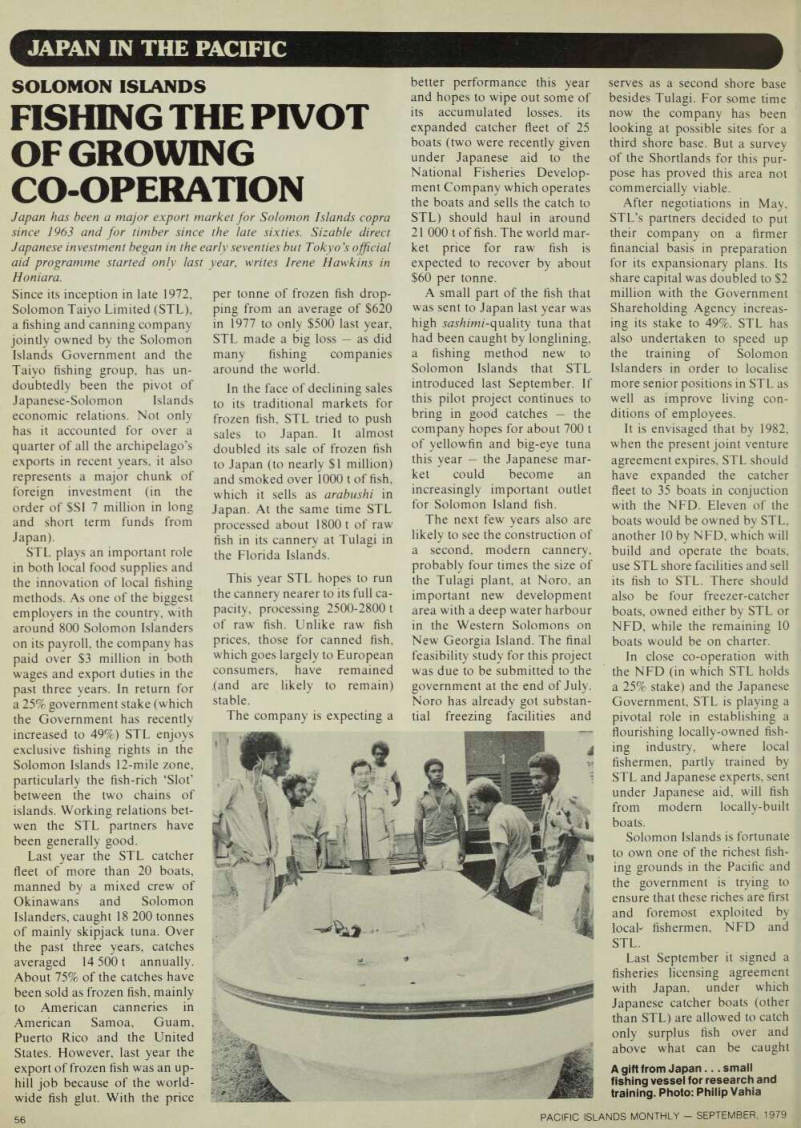
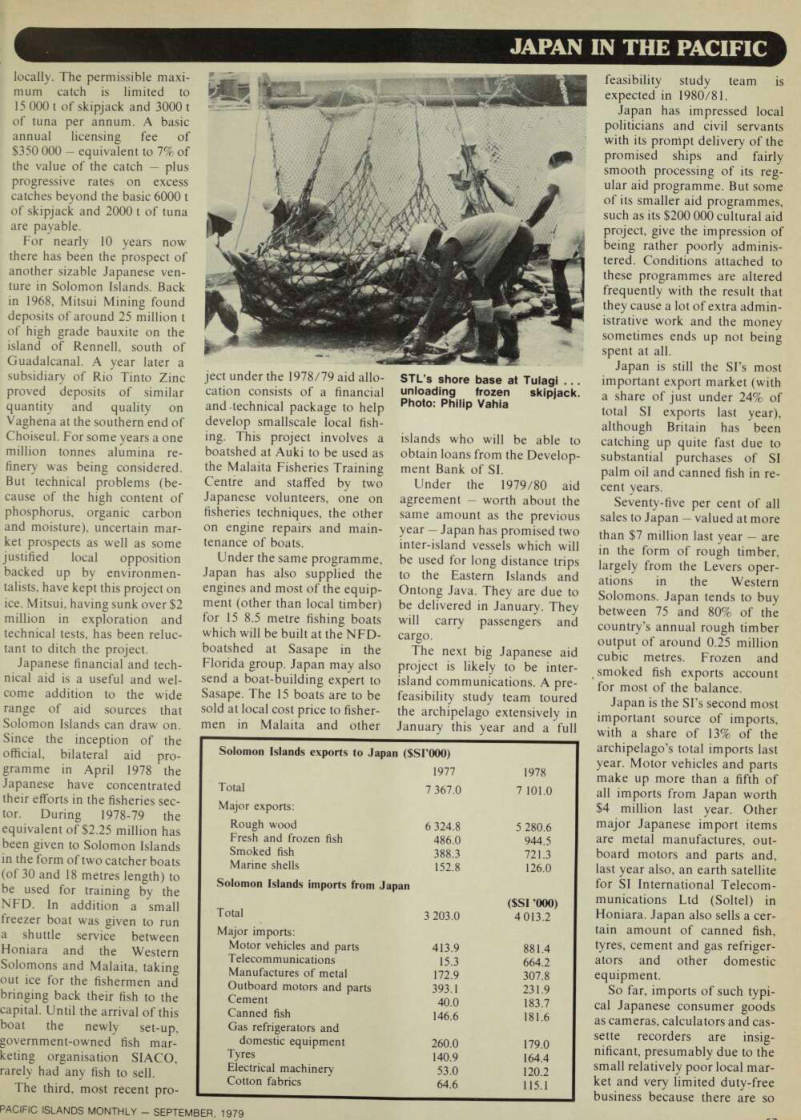

Solomon Islands
Fishing The Pivot
Of Growing
Co-Operation
Japan has been a major export market for Solomon Islands copra since 1963 and for timber since the late sixties. Sizable direct Japanese investment began in the early seventies but Tokyo's official aid programme started only last year, writes Irene Hawkins in Honiara.
Since its inception in late 1972, Solomon Taiyo Limited (STL), a fishing and canning company jointly owned by the Solomon Islands Government and the Taiyo fishing group, has un doubtedly been the pivot of
Japanese-Solomon Islands
economic relations. Not only has it accounted for over a quarter of all the archipelago’s exports in recent years, it also represents a major chunk of foreign investment (in the order of SSI 7 million in long and short term funds from
Japan).
STL plays an important role in both local food supplies and the innovation of local fishing methods. As one of the biggest employers in the country, with around 800 Solomon Islanders on its payroll, the company has paid over $3 million in both wages and export duties in the past three years. In return for a 25% government stake (which the Government has recently increased to 49%) STL enjoys exclusive fishing rights in the Solomon Islands 12-mile zone, particularly the fish-rich ‘Slot’ between the two chains of islands. Working relations bet wen the STL partners have
been generally good.
Last year the STL catcher fleet of more than 20 boats, manned by a mixed crew of Okinawans and Solomon Islanders, caught 18 200 tonnes of mainly skipjack tuna. Over the past three years, catches
averaged 14 5001 annually.
About 75% of the catches have been sold as frozen fish, mainly to American canneries in American Samoa, Guam, Puerto Rico and the United States. However, last year the export of frozen fish was an up hill job because of the world wide fish glut. With the price
per tonne of frozen fish drop ping from an average of $620 in 1977 to only $5OO last year, STL made a big loss as did
many fishing companies
around the world.
In the face of declining sales to its traditional markets for frozen fish, STL tried to push sales to Japan. It almost doubled its sale of frozen fish to Japan (to nearly $1 million) and smoked over 1000 t of fish, which it sells as arabushi in Japan. At the same time STL processed about 1800 t of raw fish in its cannery at Tulagi in the Florida Islands.
This year STL hopes to run the cannery nearer to its full ca
pacity, processing 2500-2800 t
of raw fish. Unlike raw fish prices, those for canned fish, which goes largely to European consumers, have remained .(and are likely to remain) stable.
The company is expecting a
better performance this year and hopes to wipe out some of its accumulated losses, its expanded catcher fleet of 25 boats (two were recently given under Japanese aid to the National Fisheries Develop ment Company which operates the boats and sells the catch to STL) should haul in around 21 000 t of fish. The world mar ket price for raw fish is expected to recover by about $6O per tonne.
A small part of the fish that was sent to Japan last year was
high ms7?/m/-quality tuna that
had been caught by longlining,
a fishing method new to Solomon Islands that STL introduced last September. If this pilot project continues to bring in good catches the company hopes for about 700 t of yellowfin and big-eye tuna this year the Japanese mar ket could become an
increasingly important outlet
for Solomon Island fish.
The next few years also are likely to see the construction of a second, modern cannery, probably four times the size of the Tulagi plant, at Noro, an
important new development
area with a deep water harbour in the Western Solomons on New Georgia Island. The final
feasibility study for this project
was due to be submitted to the government at the end of July.
Noro has already got substan tial freezing facilities and
serves as a second shore base besides Tulagi. For some time now the company has been looking at possible sites for a third shore base. But a survey of the Shortlands for this pur pose has proved this area not
commercially viable.
After negotiations in May, STL’s partners decided to put their company on a firmer financial basis in preparation for its expansionary plans. Its share capital was doubled to $2 million with the Government
Shareholding Agency increas
ing its stake to 49%. STL has also undertaken to speed up the training of Solomon Islanders in order to localise more senior positions in STL as well as improve living con ditions of employees.
It is envisaged that by 1982, when the present joint venture agreement expires, STL should have expanded the catcher fleet to 35 boats in conjuction with the NFD. Eleven of the boats would be owned by STL, another 10 by NFD, which will build and operate the boats, use STL shore facilities and sell its fish to STL. There should also be four freezer-catcher boats, owned either by STL or NFD, while the remaining 10 boats would be on charter.
In close co-operation with the NFD (in which STL holds a 25% stake) and the Japanese Government, STL is playing a pivotal role in establishing a
flourishing locally-owned fish
ing industry, where local
fishermen, partly trained by
STL and Japanese experts, sent under Japanese aid, will fish from modern locally-built boats.
Solomon Islands is fortunate to own one of the richest fish ing grounds in the Pacific and the government is trying to ensure that these riches are first
and foremost exploited by
locaL fishermen, NFD and
Stl.
Last September it signed a fisheries licensing agreement with Japan, under which Japanese catcher boats (other than STL) are allowed to catch only surplus fish over and above what can be caught
A gift from Japan...small fishing vessel for research and training. Photo: Philip Vahia
locally. The permissible maxi
mum catch is limited to 15 000 t of skipjack and 3000 t of tuna per annum. A basic annual licensing fee of $350 000 equivalent to 7% of the value of the catch plus progressive rates on excess catches beyond the basic 6000 t of skipjack and 2000 t of tuna are payable.
For nearly 10 years now there has been the prospect of another sizable Japanese ven ture in Solomon Islands. Back in 1968, Mitsui Mining found deposits of around 25 million t of high grade bauxite on the island of Rennell, south of Guadalcanal. A year later a subsidiary of Rio Tinto Zinc
proved deposits of similar
quantity and quality on
Vaghena at the southern end of Choiseul. For some years a one million tonnes alumina re
finery was being considered.
But technical problems (be cause of the high content of
phosphorus, organic carbon
and moisture), uncertain mar ket prospects as well as some
justified local opposition
backed up by environmen talists, have kept this project on ice. Mitsui, having sunk over $2 million in exploration and technical tests, has been reluc tant to ditch the project.
Japanese financial and tech nical aid is a useful and wel come addition to the wide range of aid sources that Solomon Islands can draw on.
Since the inception of the official, bilateral aid pro gramme in April 1978 the Japanese have concentrated their efforts in the fisheries sec tor. During 1978-79 the equivalent of $2.25 million has been given to Solomon Islands in the form of two catcher boats (of 30 and 18 metres length) to be used for training by the NFD. In addition a small freezer boat was given to run a shuttle service between Honiara and the Western Solomons and Malaita, taking out ice for the fishermen and bringing back their fish to the capital. Until the arrival of this boat the newly set-up, government-owned fish mar
keting organisation SIACO,
rarely had any fish to sell.
The third, most recent pro-
ject under the 1978/79 aid allo cation consists of a financial and technical package to help develop smallscale local fish ing. This project involves a boatshed at Auki to be used as the Malaita Fisheries Training Centre and staffed by two Japanese volunteers, one on fisheries techniques, the other on engine repairs and main tenance of boats.
Under the same programme, Japan has also supplied the engines and most of the equip ment (other than local timber) for 15 8.5 metre fishing boats which will be built at the NFD boatshed at Sasape in the Florida group. Japan may also send a boat-building expert to Sasape. The 15 boats are to be sold at local cost price to fisher men in Malaita and other
islands who will be able to obtain loans from the Develop ment Bank of SI.
Under the 1979/80 aid agreement worth about the same amount as the previous year Japan has promised two inter-island vessels which will be used for long distance trips to the Eastern Islands and Ontong Java. They are due to be delivered in January. They will carry passengers and cargo.
The next big Japanese aid project is likely to be inter island communications. A pre
feasibility study team toured
the archipelago extensively in
January this year and a full
Solomon Islands exports to Japan (SSI’OOO)
Solomon Islands imports from Japan
feasibility study team is
expected in 1980/81.
Japan has impressed local
politicians and civil servants with its prompt delivery of the
promised ships and fairly
smooth processing of its reg ular aid programme. But some of its smaller aid programmes, such as its $2OO 000 cultural aid
project, give the impression of
being rather poorly adminis
tered. Conditions attached to these programmes are altered frequently with the result that they cause a lot of extra admin istrative work and the money sometimes ends up not being spent at all.
Japan is still the Si’s most important export market (with a share of just under 24% of total SI exports last year), although Britain has been catching up quite fast due to substantial purchases of SI palm oil and canned fish in re cent years.
Seventy-five per cent of all sales to Japan valued at more than $7 million last year are in the form of rough timber, largely from the Levers oper ations in the Western Solomons. Japan tends to buy between 75 and 80% of the country’s annual rough timber output of around 0.25 million cubic metres. Frozen and , smoked fish exports account for most of the balance.
Japan is the Si’s second most
important source of imports,
with a share of 13% of the
archipelago’s total imports last
year. Motor vehicles and parts make up more than a fifth of all imports from Japan worth $4 million last year. Other
major Japanese import items
are metal manufactures, out board motors and parts and, last year also, an earth satellite for SI International Telecom munications Ltd (Soltel) in Honiara. Japan also sells a cer tain amount of canned fish, tyres, cement and gas refriger ators and other domestic
equipment.
So far, imports of such typi
cal Japanese consumer goods
as cameras, calculators and cas sette recorders are insig nificant, presumably due to the small relatively poor local mar ket and very limited duty-free business because there are so
STL’s shore base at Tulagi ... unloading frozen skipjack.
Photo: Philip Vahia
1977 1978 Total 7 367.0 7 101.0
Major exports:
Rough wood
6 324.8 5 280.6 Fresh and frozen fish 486.0 944.5 Smoked fish 388.3 721.3 Marine shells 152.8 126.0
Total 3 203.0
(Ssi ’000)
4 013.2
Major imports:
Motor vehicles and parts 413.9 881.4 Telecommunications 15.3 664.2 Manufactures of metal 172.9 307.8 Outboard motors and parts 393.1 231.9 Cement 40.0 183.7 Canned fish 146.6 181.6 Gas refrigerators and
domestic equipment
260.0 179.0
Tyres
140.9 164.4
Electrical machinery
53.0 120.2 Cotton fabrics 64.6 115.1
few tourists. Last year only 2374 Japanese radios were sold in the SI valued at $72 000.
After a jump from 4% in 1965 to 13% in 1975, the Japanese seem to have been unable to penetrate the Solomons market any further in the years since.
Unless something un
foreseen happens, Japan’s
hunger for food and raw materials in the form of fish, timber and possibly minerals, will increase its economic in volvement in Soloman Islands.
But while official and big business contacts with Japan are bound to increase, the aver age Solomon Islander will con tinue to know little about Japan and come into contact
with few things Japanese.
Non-economic relations, in particular close cultural con tacts (be it through the
exchange of students, sporting
events, visits of parliamen tarians and businessmen), are likely to remain very limited in the foreseeable future. There have, however, been quite a few visits by Japanese aid teams to SI and by SI poli ticians and top civil servants to Japan in the past few years.
Each year small groups of Japanese visit Solomon Islands, mainly in search of relics of their countrymen who fell in the Pacific War. About 180 Okinawan fishermen work with SI crews on the STL catcher boats, some of the Solomons crewmen picking up
a smattering of Japanese. A
handful of Japanese business
men with Taiyo and Mitsui and representing one or two other Japanese interests, are resident
in Honiara. Through Air
Nauru, there is a direct link be tween Honiara and southern
Japan.
However, all this does not
institute anything like the
dose, longstanding cultural
contact SI has had with
English-speaking countries,
language and alien social and cultural patterns will continue o prove a barrier for some ime to come, even if a few Jolomon Islanders were to re
vive technical training in
apan after, of course, having
nastered the Japanese
anguage.
Advertisements & other items, pp. 56-60 (2 items)
Japan In The Pacific
56
PACIFIC ISLANDS MONTHLY - SEPTEMBER, 1979
Advice.
CONSTRUCTIVE
Komatsu makes 76-ton Bulldozers.
Small 2-ton Bulldozers. w i * rn FM Swamp Bulldozers as well as Swamp Dozer Shovels.
Dozer Shovels.
Radio-Controlled Bulldozers and Dozer Shovels.
Electric Powered A wide range of Pipelayers.
Dozer Shovels.
Amphibious Bulldozers.
Wheel Loaders.
A wide selection of Off-Highway Slag Dump Trucks.
Dump Trucks.
And offer Motor Graders.
I a
OPEL-
-- 1_ As well as Motor Scrapers.
Soil Compactors.
Trash Compactors.
Towing Tractors.
V 5 '
JLJt.
I **—* J. v.
Vibratory Rollers. Diesel Generator Sets. v' ’ ' — W Portable Air Compressors.
A wide selection of Diesel Engines.
Si- Machine Tools. £ <G Mechanical and Hydraulic Presses. A variety of Maypres Presses. OBS Power Presses. Tunnel-Boring Machines.
We're constructive in other ways. We offer castings, foundries, and important advice on construction and manufacturing projects.
•H KOMATSU LTD
Tokyo, Japan Komatsu overseas offices: Sydney, Singapore, Jakarta, Manila, Seoul, Bangkok, Bangalore, Teheran, Dubai, Jeddah, Riyadh, Ad Dammam, Baghdad, Ankara, Moscow, London, Brussels, Dusseldorf, Stuttgart, Warszawa, Paris, Madrid, Cairo, Alger, Abidjan, Lagos, Nairobi. Johannesburg, Toronto, San Francisco, Fort Lee, Arlington, Atlanta, Detroit, Mexico City, Habana, Panama, Sao Paulo, Caracas, Lima, Buenos Aires, and distributors in over 100 countries around the world.
PENTAX
Travel light. Pentax ME Designed for travelling light and shooting easy. It's the most compact 35mm SLR, With fast and simple automatic exposure. And proven, solid state reliability. The ME captures every memorable image. Beautifully.
I^NTAX
11 Tha niff
120 130 140 C. Itoh has been contributing to Australia's economic growth for over 20 years since our door first opened in Sydney in 1957.
I I
General Importer Exporter Project Developer
150
C. ITOH
C. ITOH & CO. (AUST.) LTD. Sydney Office: Gold Fields House, 1 Alfred Street, Sydney, N.S.W. 2000 G.P.O. Box 4271, Sydney, N.S.W. 2001 Phone: 27-7611 Telex: 20205 CITOH BMP House, 36th Floor, 140 William Street, Melbourne 3000, P.O. Box 4706, Melbourne, Viet.
Phone (03)-67-8633 Telex: 30313 CITOH B isbane: Phone: 221-9738 Telex; CITOH AA 41419 Fremantle: Phone: 335-3048 Telex: 92058 CITOH Adelaide: Phone: 08-47-1647 Telex: 82015 Perth: Phone: 325-7177 Telex: 92213C1T0H Port Moresby: Phone: 211668 Telex: CITOH NE 22174 C. ITOH & CO., LTD.: Founded in 1858 Capital: V 37,251 Million Tokyo Office: C.P.O. Box 136, Tokyo Telex: J 22295 (ITOHCHU) Osaka Office: C.P.O. Box 117, Osaka Telex: J 63335 (ITOHCHU) London, New York, Hong Kong, Singapore 10 10 r o C 5 o < Prawn Industry (N.T.) 20 t 30
p e rtl x
4.;
rnan tle
Fre Tuna Fish Industry (Papua New Guinea) 40 160 150 140 40 110 120
been better
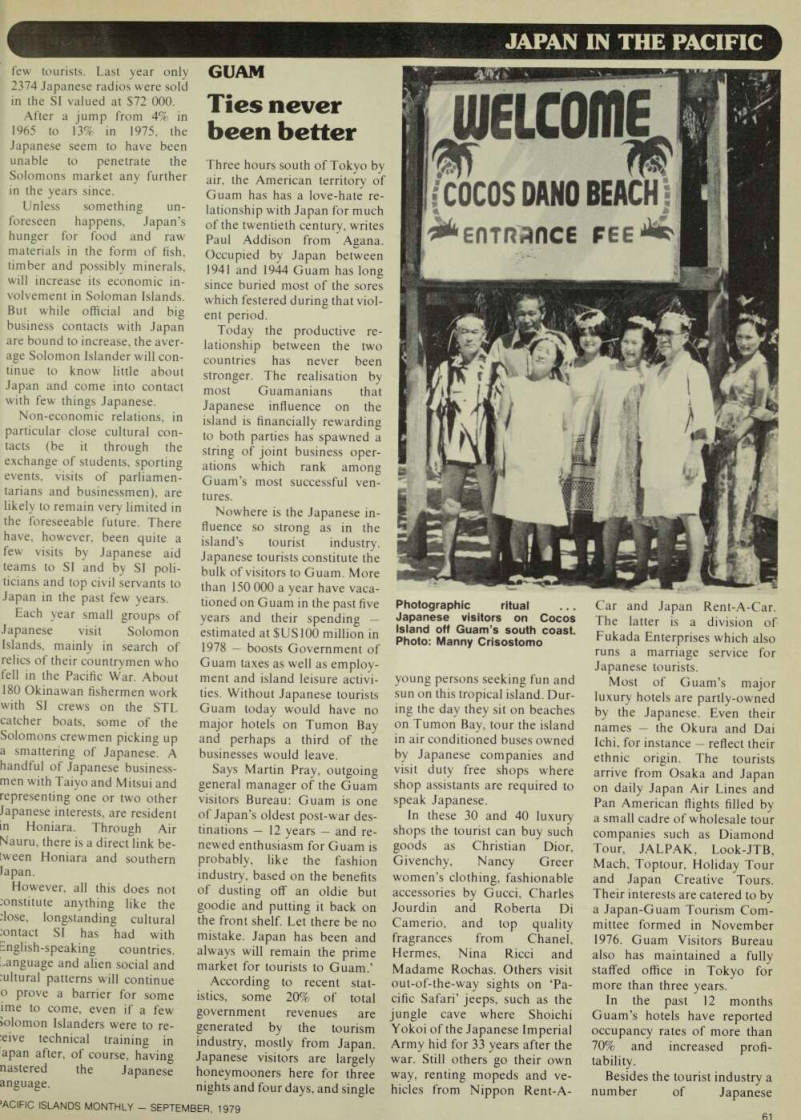


Guam
Ties never been better
Three hours south of Tokyo by air, the American territory of Guam has has a love-hate re lationship with Japan for much of the twentieth century, writes Paul Addison from Agana.
Occupied by Japan between
1941 and 1944 Guam has long since buried most of the sores which festered during that viol
ent period.
Today the productive re
lationship between the two countries has never been stronger. The realisation by most Guamanians that Japanese influence on the
island is financially rewarding
to both parties has spawned a string of joint business oper ations which rank among Guam’s most successful ven tures.
Nowhere is the Japanese in fluence so strong as in the island’s tourist industry.
Japanese tourists constitute the bulk of visitors to Guam. More than 150 000 a year have vaca tioned on Guam in the past five years and their spending estimated at SUSIOO million in 1978 boosts Government of Guam taxes as well as employ ment and island leisure activi ties. Without Japanese tourists Guam today would have no major hotels on Turnon Bay and perhaps a third of the businesses would leave.
Says Martin Pray, outgoing
general manager of the Guam visitors Bureau: Guam is one of Japan’s oldest post-war des tinations 12 years and re newed enthusiasm for Guam is probably, like the fashion industry, based on the benefits of dusting off an oldie but goodie and putting it back on the front shelf. Let there be no mistake. Japan has been and always will remain the prime market for tourists to Guam.’
According to recent stat istics, some 20% of total government revenues are generated by the tourism
industry, mostly from Japan.
Japanese visitors are largely
honeymooners here for three
nights and four days, and single
young persons seeking fun and sun on this tropical island. Dur ing the day they sit on beaches on Turnon Bay, tour the island in air conditioned buses owned by Japanese companies and visit duty free shops where shop assistants are required to speak Japanese.
In these 30 and 40 luxury shops the tourist can buy such goods as Christian Dior,
Givenchy, Nancy Greer
women’s clothing, fashionable accessories by Gucci, Charles Jourdin and Roberta Di Camerio, and top quality fragrances from Chanel, Hermes, Nina Ricci and Madame Rochas. Others visit
out-of-the-way sights on ‘Pa
cific Safari’ jeeps, such as the jungle cave where Shoichi Yokoi of the Japanese Imperial Army hid for 33 years after the war. Still others go their own way, renting mopeds and ve hicles from Nippon Rent-A-
Car and Japan Rent-A-Car.
The latter is a division of Fukada Enterprises which also runs a marriage service for Japanese tourists.
Most of Guam’s major luxury hotels are partly-owned by the Japanese. Even their names the Okura and Dai Ichi, for instance reflect their ethnic origin. The tourists arrive from Osaka and Japan on daily Japan Air Lines and Pan American flights filled by a small cadre of wholesale tour companies such as Diamond Tour, JALPAK, Look-JTB,
Mach, Toptour, Holiday Tour
and Japan Creative Tours.
Their interests are catered to by a Japan-Guam Tourism Com mittee formed in November 1976. Guam Visitors Bureau also has maintained a fully staffed office in Tokyo for more than three years.
In the past 12 months Guam’s hotels have reported occupancy rates of more than 70% and increased profi
tability.
Besides the tourist industry a number of Japanese
Photographic ritual Japanese visitors on Cocos Island off Guam’s south coast.
Photo: Manny Crisostomo
companies operate on Guam although a Japan-Guam Econ omic Council, once lauded as the perfect non-political entity to boost co-operation, has vir tually petered out.
Some major possibilities re main. On Guam’s southern coast aquaculture companies raise eels and shrimps which are sent to Japan. Another
growth industry is hydroponic
farming, where such delicacies as large Japanese apples and melons are grown in perfect simulated conditions. Another
recently-introduced scheme
has been a carry-on beef pro gramme where tourists can buy up to 23 kg of American beef and take it back to Japan where beef costs up to $ll5 a kg.
As an indication of the priority with which the admin istration views Guam’s rela tionship with Japan, Governor Paul Calvo’s first off-island trip in February took him to Japan to meet with government and business leaders to discuss investment, agriculture and airlines problems. One well discussed areas has been the possibility of locating a tuna fish cannery on the island.
Negotiations have already been conducted between the Port Authority of Guam and Suzue Co of Japan that could result in as many as 300 Japanese vessels docking at Guam’s port each year.
For the newly emergent nations in Micronesia the Federated States of Micro nesia, Palau and the Marshall Islands the fishing nego tiations with Japan possibly contain the key to future econ omic prosperity in the region.
Although statistics are not
current, the most recently pub lished show that Japanese imports to Guam totalled about $l3 million in 1976 about 5% of Guam’s annual $260 million import total.
However, calling tourism an invisible import, that figure is boosted by $lOO million.
Of the imports, most are luxury electronic goods bought by the local and military popu lation. Japanese cars and pick-up trucks also are big sellers, outselling American cars by at least four to one, with especially large sales of Toyota, Honda and Datsun cars.
Other Japanese-related activities abound. There are tour ships which stop over for one night to the filming of scores of Japanese television commercials; visits, complete with fan clubs, of Japanese pop stars; and visits of special edu cational groups and bone hunters. Sporting contacts are also strong. The biggest sport ing event for baseball fans is the annual visit of the Seibu Lions, which this year played a series of games with Guam teams. Guam also sends teams to Japan for the Far East Basketball and Volleyball championships and the Asian Little League tournament.
With the growth of business here, a small but vocal Japanese community has formed. A Japanese consulate general was established four years ago. But Guam’s future with Japan depends largely on the nature of the Japanese and American economies. If either country has a recession, trade and tourism could be badly hurt. Furthermore, the recent crackdown on fuel supplies has caused some cancellations of flights to Guam and Osaka and Tokyo.. This has made the island a more difficult place to get to. Another factor which spurs or mars development is the movement of the Japanese yen against the American dollar.
At present, however, opti mism abounds and the business-minded administra tion and the fifteenth Guam
Legislature are confident they
can both promote tourism from Japan and start to export more goods there.
Memorial to war dead, Saipan ... the future lies with the econ omies of Japan and the US
Advertisements & other items, pp. 61-64 (2 items)
Japan In The Pacific
61
’ACIFIC ISLANDS MONTHLY SEPTEMBER, 1979
MOpi
A Y,
sun
LY-ENGMERED.
U WE
R POWER
% ■»- ?•> Spending a lot of time on cross-country travel or errands?
Seeking something with dependable power, yet economical?
Make it in good time with one of our "get-about" machines.
Go with a Suzuki! choose one of our performance-proven motorcycles,
just answering your travel needs.
pOJ/Vg?
MOpi
for
and
DTBS
Look further into Suzuki's traditional excellence and discover the results in our 4-wheel drive vehicles and fleet of outboard motors - something to satisfy your every motoring need.
Going by land or by sea . . . go with a Suzuki.
SUZUKI MOTOR CO., LTD.
Hamamatsu, Japan
SUZUKI 4 WHEEL
DRIVE VEHICLE
SUZUKI
SOLOMON ISLANDS SOLOMON ISLAND SERVICE STATION LTD. • NEW CALEDONIA STE. SUPERCAL • PAPUA NEW GUINEA TUTT BRYANT PACIFIC LTD. • NEW HEBRIDES HENRI LEROUX • NIUE ISLAND BURNS PHILP (SOUTH SEA) CO., LTD. • PONAPE LEO ETSCHEIT • TAHITI NIPPON AUTOMOTO • ELLICE ISLAND TUVALU COOPERATIVE WHOLESALE SOCIETY LTD. • GUAM & SAIPAN ISLAND CYCLERY, INC. • NORFOLK MARTIN'S AGENCIES LTD. • SAMOA PACIFIC PRODUCTS, INC. • TARAWA GILBERT ISLANDS COOPERATIVE FEDERATION LIMITED • TONGA MORRIS HEDSTROM LTD. • WESTERN CAROLINES BECHESRRAK T. COMPANY • AMBROSE D. MINGINFEL'S WHOLESALER • EASTERN CAROLINES KIOMASA STORE
Fill your leisure hours with the fresh sound of Sony's CFM-31S cassetterecorder with FM/MW/SWI/SW2 radio.
The 2-way speaker produces three watts of incredibly sharp sound through a 12cm woofer and a scm tweeter. A fine tuning knob gives precise SW reception indoors or out.
At a touch of a button, you can record simply and conveniently. There is also a built-in electret condenser microphone, a pause button, a 3-digit tape counter, plus cue and review. This model also shuts itself off automatically after playback.
The CFM-31S is lightweight and travels with ease. Anywhere you go, it s the portable with the fresh sound. (CFM-31L with fm/mw/sw/lw is also available.)
Sony’s portable
with the fresh sound
WORLD’S
GREATEST STOCK
OF LENSES
■IS Topcon AM Bayonet Mount The new AM bayonet mount (* ) is compatible with one of the most extensive ranges of lenses available on the market. It's backed up by more than 100 fixed-focal length lenses (from 15mm wide angle to 500 mm telephoto) and more than 50 zoom lenses (from 24-48 mm to 120-300 mm), all with automatic diaphragm action, as well as with preset and manual diaphragm lenses, going up to the I,ooomm telephoto. (* The new AM bayonet mount is identical to the "K" bayonet mount.) Topcon Auto Winder-II Auto-Winding is an original Topcon idea, developed to let the photographer keep his eye glued to the finder eyepiece, even while following fastbreaking actions. The new Auto Winder-II is just the right size and correct weight for hand-holding, as well as being perfectly balanced for handling-ease, and makes an ideal combination with the RM 300 for shooting fast actions. With a 2 frames per second shooting speed, at all shutter speeds up to the fastest 1/1,000 second, no picture will ever get away from the Auto Winder-11.
TOPCON
TOKYO KOGAKU KIKAI K.K.
(TOKYO OPTICAL CO.,LTD.)
75-1, Hasunuma-cho, Itabashi-ku, Tokyo 174/)apan Telex: 0272-2384 TOPCON Phone: Tokyo 967-1101 Cable: TOPTCO TOKYO
The Japanese
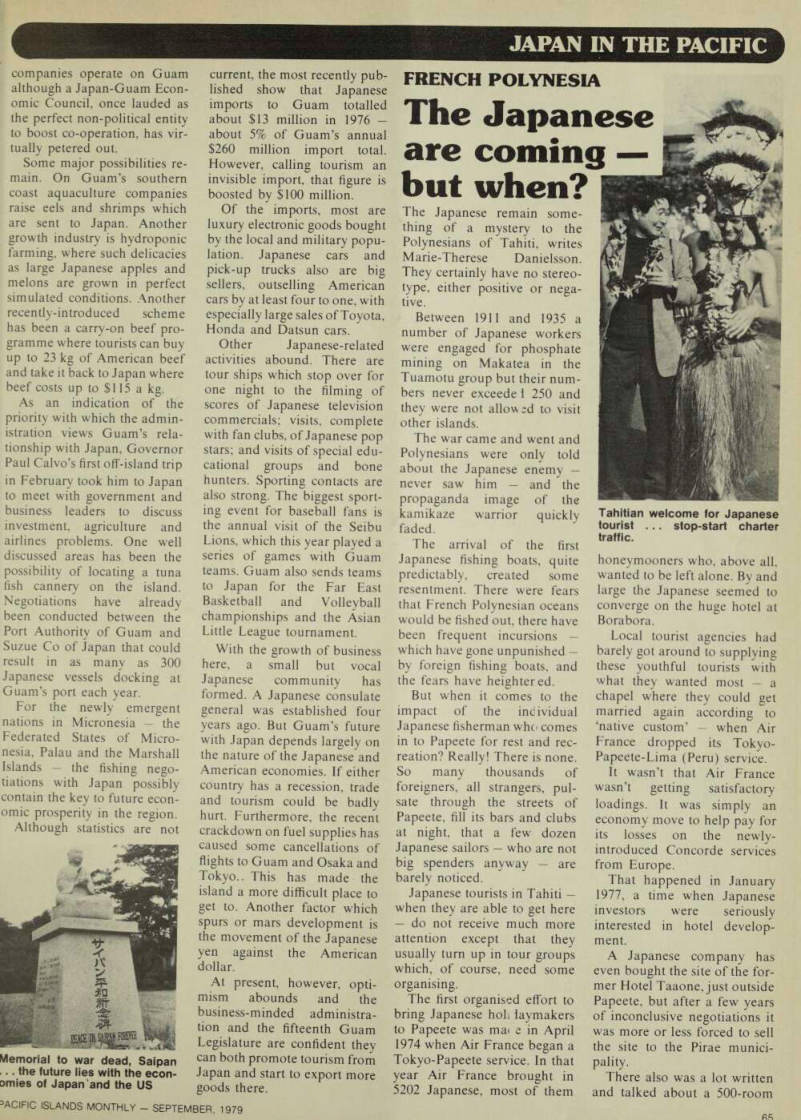
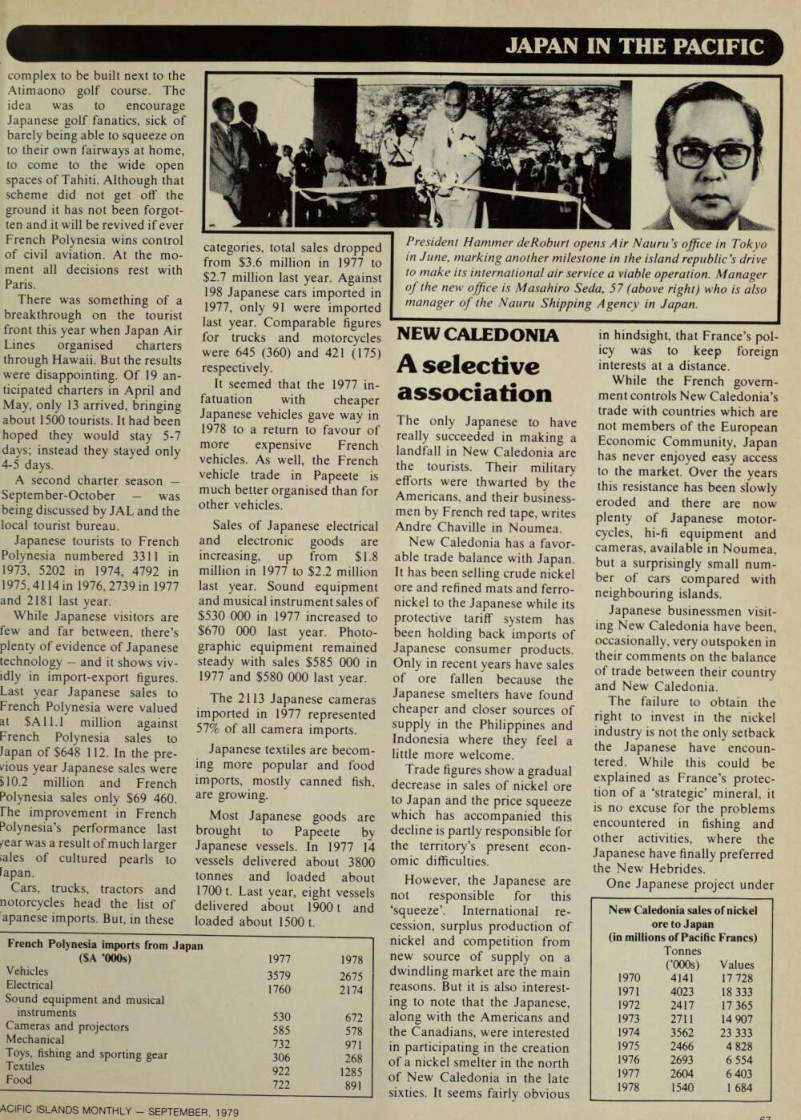
French Polynesia
The Japanese are comingbut when?
The Japanese remain some thing of a mystery to the Polynesians of Tahiti, writes Marie-Therese Danielsson.
They certainly have no stereo type, either positive or nega tive.
Between 1911 and 1935 a number of Japanese workers
were engaged for phosphate
mining on Makatea in the Tuamotu group but their num bers never exceede i 250 and they were not allowed to visit other islands.
The war came and went and
Polynesians were only told
about the Japanese enemy never saw him and the propaganda image of the kamikaze warrior quickly faded.
The arrival of the first
Japanese fishing boats, quite
predictably, created some resentment. There were fears that French Polynesian oceans would be fished out, there have been frequent incursions which have gone unpunished
by foreign fishing boats, and
the fears have heightered.
But when it comes to the impact of the individual Japanese fisherman who comes in to Papeete for rest and rec reation? Really! There is none.
So many thousands of
foreigners, all strangers, pul
sate through the streets of Papeete, fill its bars and clubs at night, that a few dozen Japanese sailors who are not
big spenders anyway are
barely noticed.
Japanese tourists in Tahiti when they are able to get here do not receive much more attention except that they usually turn up in tour groups which, of course, need some
organising.
The first organised effort to
bring Japanese hoh iaymakers
to Papeete was ma< e in April 1974 when Air France began a Tokyo-Papeete service. In that year Air France brought in 5202 Japanese, most of them
honeymooners who, above all, wanted to be left alone. By and large the Japanese seemed to converge on the huge hotel at Borabora.
Local tourist agencies had barely got around to supplying these youthful tourists with what they wanted most a chapel where they could get married again according to ‘native custom’ when Air
France dropped its Tokyo-
Papeete-Lima (Peru) service.
It wasn’t that Air France
wasn’t getting satisfactory
loadings. It was simply an economy move to help pay for its losses on the newly introduced Concorde services from Europe.
That happened in January 1977, a time when Japanese investors were seriously interested in hotel develop ment.
A Japanese company has even bought the site of the for mer Hotel Taaone, just outside Papeete, but after a few years of inconclusive negotiations it was more or less forced to sell the site to the Pirae munici pality.
There also was a lot written and talked about a 500-room
Tahitian welcome for Japanese tourist ... stop-start charter traffic.
complex to be built next to the Atimaono golf course. The idea was to encourage Japanese golf fanatics, sick of barely being able to squeeze on to their own fairways at home, to come to the wide open spaces of Tahiti. Although that scheme did not get off the ground it has not been forgot ten and it will be revived if ever French Polynesia wins control of civil aviation. At the mo ment all decisions rest with Paris.
There was something of a breakthrough on the tourist front this year when Japan Air Lines organised charters through Hawaii. But the results were disappointing. Of 19 an ticipated charters in April and
May, only 13 arrived, bringing
about 1500 tourists. It had been hoped they would stay 5-7
days; instead they stayed only
4-5 days.
A second charter season
September-October was
being discussed by JAL and the local tourist bureau.
Japanese tourists to French Polynesia numbered 3311 in 1973, 5202 in 1974, 4792 in 1975,4114 in 1976,2739 in 1977 and 2181 last year.
While Japanese visitors are few and far between, there’s plenty of evidence of Japanese technology and it shows viv
idly in import-export figures.
Last year Japanese sales to
French Polynesia were valued
at SAII.I million against
French Polynesia sales to
lapan of $648 112. In the pre vious year Japanese sales were 510.2 million and French Polynesia sales only $69 460.
Lhe improvement in French
Polynesia’s performance last
was a result of much larger ;ales of cultured pearls to
lapan.
Cars, trucks, tractors and notorcycles head the list of apanese imports. But, in these
French Polynesia imports from Japan
categories, total sales dropped from $3.6 million in 1977 to $2.7 million last year. Against 198 Japanese cars imported in 1977, only 91 were imported last year. Comparable figures for trucks and motorcycles were 645 (360) and 421 (175)
respectively.
It seemed that the 1977 in fatuation with cheaper Japanese vehicles gave way in 1978 to a return to favour of more expensive French vehicles. As well, the French vehicle trade in Papeete is much better organised than for other vehicles.
Sales of Japanese electrical and electronic goods are increasing, up from $l.B million in 1977 to $2.2 million last year. Sound equipment and musical instrument sales of $530 000 in 1977 increased to $670 000 last year. Photo graphic equipment remained steady with sales $585 000 in 1977 and $5BO 000 last year.
The 2113 Japanese cameras imported in 1977 represented 57% of all camera imports.
Japanese textiles are becom ing more popular and food
imports, mostly canned fish,
are growing.
Most Japanese goods are
brought to Papeete by
Japanese vessels. In 1977 14 vessels delivered about 3800 tonnes and loaded about 1700 t. Last year, eight vessels delivered about 19001 and loaded about 1500 t.
President Hammer deßoburt opens Air Nauru’s office in Tokyo in June, marking another milestone in the island republic’s drive to make its international air service a viable operation. Manager of the new office is Masahiro Seda, 57 (above right) who is also manager of the Nauru Shipping Agency in Japan.
($A ’Ooos)
1977 1978 Vehicles 3579 2675 Electrical 1760 2174 Sound equipment and musical instruments 530 672 Cameras and projectors 585 578 Mechanical 732 971
Toys, fishing and sporting gear
306 268 Textiles 922 1285 Food 722 891
Advertisements & other items, pp. 65-66 (2 items)
Japan In The Pacific
’ACIFIC ISLANDS MONTHLY - SEPTEMBER, 1979
I
• !
W MU mi .Al r e nc® □ ■PI m m i * M <sS I \ * Behind the striking contrast of the CX-210’s standard VU meters and the CX-270’s exciting new fluorescent bar-graph peak meters lie a pair of fine cassette decks that are equal on all counts. Both feature super-stable transports, long-life Permalloy heads and advanced electronics assuring stunning sound fidelity year after year. And you get all this for surprisingly little cash outlay. That’s because at TEAC, we’re determined to offer the best possible performance in every model we produce —from the most sophisticated to the most economical. The CX-210 and CX-270 are excellent examples. The difference between them is only looks.
The rest is all the same leading TEAC tape technology. The choice is yours; standard VU meters or ultra-fast fluorescent bar-graph meters. Either way, you’re getting a best buy.
EAC
Art and Technolonv Mnpt TEAC CORPORATION: 3-7-3, NaKa-cho, Musashino, Tokyo, Japan
A selective
New Caledonia
A selective association
The only Japanese to have really succeeded in making a landfall in New Caledonia are the tourists. Their military efforts were thwarted by the Americans, and their business men by French red tape, writes Andre Chaville in Noumea.
New Caledonia has a favor able trade balance with Japan.
It has been selling crude nickel ore and refined mats and ferro nickel to the Japanese while its protective tariff system has been holding back imports of Japanese consumer products.
Only in recent years have sales of ore fallen because the Japanese smelters have found cheaper and closer sources of supply in the Philippines and Indonesia where they feel a little more welcome.
Trade figures show a gradual decrease in sales of nickel ore to Japan and the price squeeze which has accompanied this decline is partly responsible for the territory’s present econ omic difficulties.
However, the Japanese are not responsible for this ‘squeeze’. International re
cession, surplus production of
nickel and competition from new source of supply on a dwindling market are the main reasons. But it is also interest ing to note that the Japanese, along with the Americans and the Canadians, were interested in participating in the creation of a nickel smelter in the north of New Caledonia in the late sixties. It seems fairly obvious
in hindsight, that France’s pol
icy was to keep foreign
interests at a distance.
While the French govern ment controls New Caledonia’s trade with countries which are not members of the European
Economic Community, Japan
has never enjoyed easy access to the market. Over the years this resistance has been slowly eroded and there are now plenty of Japanese motor cycles, hi-fi equipment and cameras, available in Noumea, but a surprisingly small num ber of cars compared with
neighbouring islands.
Japanese businessmen visit ing New Caledonia have been, occasionally, very outspoken in their comments on the balance of trade between their country and New Caledonia.
The failure to obtain the right to invest in the nickel industry is not the only setback the Japanese have encoun tered. While this could be explained as France’s protec tion of a ‘strategic’ mineral, it is no excuse for the problems encountered in fishing and other activities, where the Japanese have finally preferred the New Hebrides.
One Japanese project under
New Caledonia sales of nickel ore to Japan (in millions of Pacific Francs)
Tonnes (’000s) Values 1970 4141 17 728 1971 4023 18 333 1972 2417 17 365 1973 2711 14 907 1974 3562 23 333 1975 2466 4 828 1976 2693 6 554 1977 2604 6 403 1978 1540 1 684
way in New Caledonia, Mitsu bishi’s eucalyptus oil pro duction, has been set back by a bush-fire which wiped out a large part of the plantation.
As a French territory, New Caledonia’s economy is in fact an element of the total national resources. When the trading balance is unfavourable, France pays the bill; when exports go up, France collects
the foreign exchange. Thus,
from France’s point of view.
New Caledonia is just a small part of total trade with
Japan.
For the same reasons. New Caledonia does not seek Japanese investments. The French authorities, without
openly discouraging foreign
investment, prefer to see their own companies active in the
territory.
Meanwhile, the Japanese are
becoming an important el
ement in the territory’s tourist trade. The weekly flight be tween Tokyo and Noumea was paying dividends until the DC 10 problems, and the French Bureau of Tourism’s agency in Toyko was working on selling the territory. Because of the costly ceremonies of a Japanese wedding, many have been flying to Noumea for a
wedding and honeymoon.
New Caledonia has also been favoured, because of its lagoons and blue skies, for
shots for Japanese fashion
magazines and leaflets for Japanese cosmetic manufac turers.
The casino is also a popular
attraction and Japanese players
gamble heavily. Miss New
Caledonia 1978 received, as part of her prize, a trip to
Tokyo.
The conclusion is obvious: in New Caledonia, the yen is very popular but under strict con trol.
New Caledonia’s Trade with Japan (in millions of Pacific Francs)
Imports Exports
1972 411 4070 1973 346 4946 1974 753 7854 1975 888 5378 1976 834 7654 1977 994 7505
Advertisements & other items, pp. 67-68 (2 items)
Japan In The Pacific
ACIFIC ISLANDS MONTHLY SEPTEMBER, 1979
Kyowa Line
KYOWA
YOUR TRADING PARTNER
CAR( ROLL-ON/ROLL-OFF)
& CONTAINER CARRIER “ASIAN ROSE”
The Asian Rose, the world s first container/ break bulk cargo/car roll-on and roll-off systems all in one, is in liner service from Japan to the South Pacific islands. The multi-mission carrier, the latest addition to our fleet, maintains a 45-day service, linking Japan, Guam, Fiji, New Caledonia and New Hebrides. 280 cars, 48 of break bulk and speeds in She is another with which we She is capable of carrying containers and 5,508 tonnes cargo, offering greater safety the delivery of merchandise, symbol of the quality service are already credited.
AGENTS
Taiwan: Royal Steamship Corp., Ltd., Taipei S. Korea: Dong Sue Shipping Co., Ltd., Seoul Hong Kong: Dahzun Enterprises Ltd.
Singapore: Ocean Shipping & Enterprses Pte, Ltd Manana Is.: Maritime Agencies of Pacific Ltd., Guam Solomon: Solomon Taiyo Ltd , Honiara Tahiti: J.A. Cowan & Fils, Papeete Cooks: Eastern Associates Ltd. Rarotonga Tonga: EM. Jones Ltd., Nukualofa New Hebrides: Agence Maritime Pentecost Pacific S. A, Port Vila A Samoa: Island Pacific Agencies Inc., Pago Pago W Samoa: Morris Hedstrom Ltrom Ltd., Apia Fiji: Carpenter Shipping, Suva & Lautoka PNG: Carpenter Shipping Agencies. Port Moresby, Rabaul New Caledonia: Agence Maritime Du Rond Point Du Pacific. Noumea Indonesia: P.T. Porodisa Raya Shipping Lines. Jakarta Sabah: KOH Han Ming Shipping & Forwarding Agent., Kotakinabalu Sarawak: Pan Sarawak Agencies Sdn. Bhd., Sibu & Kuching Australia: Hethenngton Kingsbury Pty, Ltd., Sydney. N.S.W.
Newzealand: Sofrana Unilines S.A. Auckland - . m rfaaa m ::
KYOWA SHIPPING CO..LTD
welcome
New Hebrides
Here to stay - and very welcome
‘The Japanese have well and truly arrived in the New Hebrides, and they’re welcome because they’re seen as
developing the place.’
In these terms Ken Hutton, dentist and cattleman of Santo, summed up the Japanese pres ence in the country which has been his home for the past 25 years.
Interviewed by PIM during a brief visit to Sydney in August, Mr Hutton admitted there had been some resentment of the
Japanese, especially among
Australians based on Santo, when they first arrived in 1957 to set up their big South Pacific
Fishing Company (SPFC) op
eration at Palekula on Santo. ‘But all that’s gone and forgot ten,’ he said. ‘They’re very much part of the scene on Santo now.’
There are about 30 Japanese stationed at Palekula and some wives and children are begin
ning to join them. Increasing
numbers of Melanesians are
being employed by SPFC,
including office staff. ‘Nobody else can fish like the Japanese with their
longline techniques,’ says Mr
Hutton. ‘They’re much admired locally for this.’
As well as taking fish to
Japan, the Taiwan ships fishing
out of Palekula are now taking manufacturing beef (for small goods) from the New Hebrides.
It is expected that they will begin taking frozen meats, es pecially as about six months ago Japan declared the New Hebrides a disease-free zone for beef.
Apart from Palekula, the Japanese presence in the New Hebrides is most visible at Le Lagon Hotel in Vila. Since the hotel came under the control of
Japan’s Tokyu hotel organis
ation, the number of Japanese tourists has jumped dramati
cally.
‘Engaged couples come in
droves to get married at the Presbyterian church on Fila Island in Vila harbour,’ says
Mr Hutton. ‘They fly from Tokyo by UTA DC 10s to Noumea, and then come on to Vila by UTA 737 s or F2Bs.’
Mr Hutton says there has been talk of Japan Air Lines
(JAL) securing Tokyo-
Noumea-Auckland rights. The tourists behave impeccably and are well regarded by residents. ‘There’s a cheerful cosmo politan atmosphere at Le Lagon,’ says Mr Hutton. ‘There are two or three Japanese executives, French chefs, and New Hebrideans and a sprink
ling of Fijians hold practically
all the office and service jobs.’
Apart from these two oper
ations, the biggest Japanese
project on the drawing boards for the New Hebrides is the Mitsubishi-Sumitomo wood chip mill on Santo. The project is planned to cover 29 000 ha and to cost about SA6 million.
There is a feeling locally that the promoters are waiting until the New Hebrides becomes
independent before getting the
project off the ground.
Ken Hutton sums up: ‘There’s no doubt whatsoever that the Japanese have come to the New Hebrides to stay, and that there’ll be still wider co operation when the country be
comes independent.’
Taking on

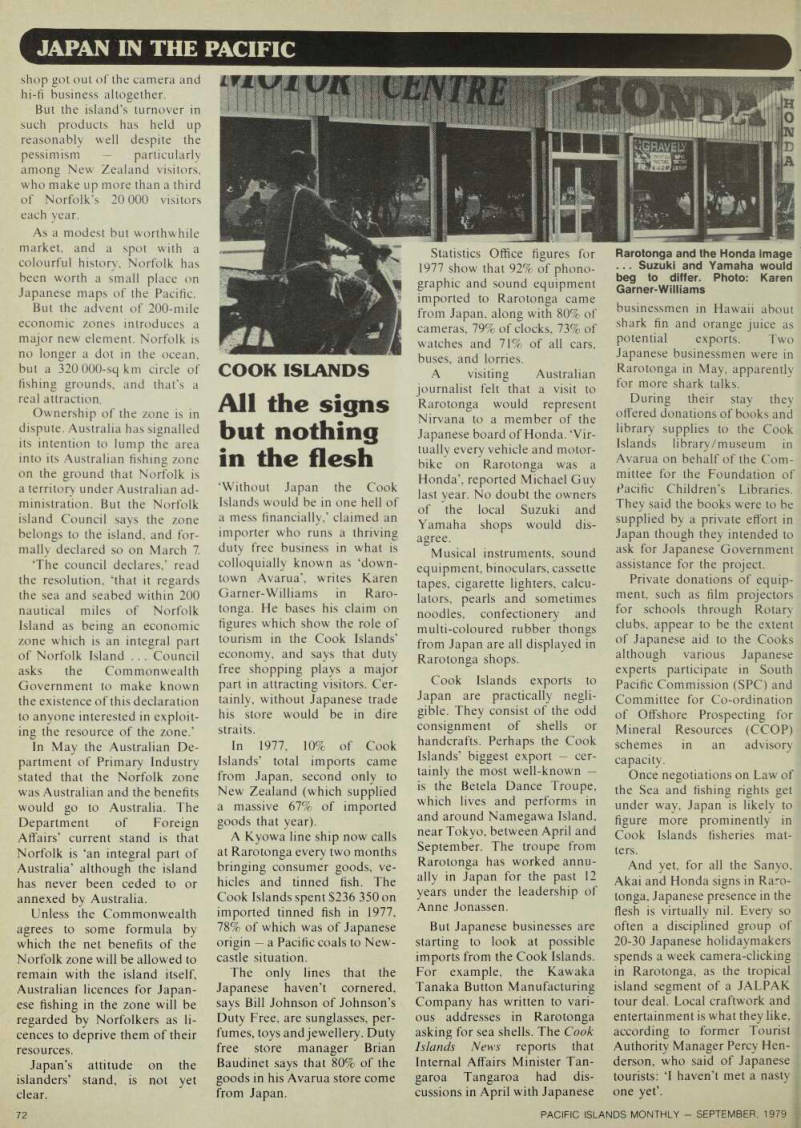
Norfolk Island
Taking on another dimension
On June 8 each year on Nor folk Island, throngs of tourists snap pictures as the Pitcairn people, dressed in nineteenth century clothes, re-enact the arrival of their forebears on their new island home in 1856, writes Ed Howard.
Among visitors this year was Hiroshi Aoki, Oceania rep resentative for the giant Japanese newspaper Asahi Shimbun. He was capturing Norfolk on film and in words for his newspaper’s 7.2 million subscribers.
He sampled Tahitian fish and kumera pie at the tra
ditional open-air picnic, He
toured low-duty shops where
tourists and locals spend well over SAI million a year on
Japanese photo equipment, watches, hi-fi and motor cars.
And he watched attentively as the Norfolk Island Council and Australia’s Minister for Home Affairs Bob Ellicott wrestled with the key political question on Norfolk these days: how much real authority would the Island’s forthcoming
Legislative Assembly be al
lowed to exercise? To what extent will Norfolk policies continue to be formed in Can berra?
One point in the meeting had direct significance for the readers of Asahi Shimbun. Mr Ellicott announced the planned visit of a first assistant secretary from Australia’s
Department of Primary Indus
try to begin discussions on how Norfolk’s 200-mile economic zone will be used, and who will get the net benefits.
Until now relations between Japan and Norfolk have been based on the island’s existence as a small but appreciated
‘duty-free’ market for luxury
tourist goods.
Relations between island
traders and Japanese suppliers
have been cordial and pro ductive. Japanese manufac turers supply around 80% of Norfolk’s motor cars; 85% of radio accessories including hi-fi components; 80% of watches; and well over half of
all photographic equipment.
The beauty of the Japanese product,’ says local business man Ken Nobbs, who runs the island’s main camera store, ‘is that they stand by it. Their guarantees begin not when we import the goods, but when our customers buy them and the guarantee is reliable.’
Fluctuations in the exchange value of the yen last year
brought some marketing prob
lems. The rate topped 300 yen to the dollar early in 1978 and later tightened to almost 200 to the dollar.
At the same time, Australia was cancelling its customs duties on cameras, watches and radios. Norfolk Island duty on these items remains at 8%, 17% and 8%, respectively. As a re sult, the saving Norfolk could offer visiting Australians dropped from about 50% down to 15%-25%. At least one large
shop got out of the camera and hi-fi business altogether.
But the island’s turnover in such products has held up reasonably well despite the
pessimism particularly
among New Zealand visitors, who make up more than a third of Norfolk’s 20 000 visitors each year.
As a modest but worthwhile market, and a spot with a colourful history, Norfolk has been worth a small place on Japanese maps of the Pacific.
But the advent of 200-mile economic zones introduces a major new element. Norfolk is no longer a dot in the ocean, but a 320 000-sqkm circle of fishing grounds, and that’s a real attraction.
Ownership of the zone is in
dispute. Australia has signalled
its intention to lump the area into its Australian fishing zone on the ground that Norfolk is a territory under Australian ad ministration. But the Norfolk island Council says the zone belongs to the island, and for mally declared so on March 7. ‘The council declares,’ read the resolution, ‘that it regards the sea and seabed within 200 nautical miles of Norfolk Island as being an economic zone which is an integral part of Norfolk Island . . . Council asks the Commonwealth Government to make known the existence of this declaration to anyone interested in exploit ing the resource of the zone.’
In May the Australian De
partment of Primary Industry
stated that the Norfolk zone was Australian and the benefits would go to Australia. The
Department of Foreign
Affairs’ current stand is that Norfolk is ‘an integral part of Australia’ although the island has never been ceded to or annexed by Australia.
Unless the Commonwealth agrees to some formula by which the net benefits of the Norfolk zone will be allowed to remain with the island itself, Australian licences for Japan ese fishing in the zone will be regarded by Norfolkers as li cences to deprive them of their resources.
Japan’s attitude on the islanders’ stand, is not yet clear.
Advertisements & other items, pp. 69-71 (2 items)
Japan In The Pacific
69
’ACIFIC ISLANDS MONTHLY - SEPTEMBER, 1979
and have their music, too.
i - 553
PIOMEEn
HfCiWIiC Wfl s 0 0
KE-2000 TS-107
For those who want to travel
and have their music, too.
You’re young and staying in one place too long KE-2000 cassette Tape Player with am/fm Tuner doesn't suit your style. Your car is an extension of this (max ’Dcfasvni -"ey allowable) mobility and the magic carpet that takes you where wow & flutter No more than 0.28% (wrms) you want to go. Your music, like your car, is an important Mo7e\te?4Mß' 3dß) part of your life.
Enter Pioneer's KE-2000/TS-107 car stereo Frequency range 88-1 osmhz system. Engineered with the precision of a Grand Prix usable sensitivity i2dßt (i.imv/75 ohms) racer. Specifically created to perform in the ambience selectivity 70dB (±4ookHz) of an automotive atmosphere. Built to withstand the am Tuner toughest punishment and tested in the laboratory and sensSy 7 ran9e .3oin ' z on the road. A skillful blend of advanced electronic T s-iot speakers engineering and a delicate sensitivity to the needs of speaker 102 mm (4 in.) high-compiiance the four-wheeled traveler. Such as in the KE-2000 with dual-cone with metallic center cap FM. You see, at Pioneer, we believe that when a man Frequencyrange". so-loooohz takes to the open road, he shouldn’t have to go it alone, weight eeog (1 ib. ?oz.)
CtO PIONEER
honeer products are available through: Lustralia: Pioneer Marketing Service Pty. Ltd., P.O. Box 317, Mordialloc, Victoria, 3195 el. 90-9011 : lji Islands: Brijlal & Company. G.P.O. Box No. 362, Suva. Fiji Islands Tel: 22258 lew Zealand: Fountain Marketing Ltd.. Maidstone Street. Auckland, New Zealand el: 763-064 Jorfolk island: Burns Philp (Norfolk Island) Ltd., Norfolk Island. South Pacific lew Hebrides: Burns Philp (New Hebrides) Ltd., Vila, New Hebrides Nauru Island: Jacob Enterprises. P.O. Box No. 4, Republic of Nauru Tahiti: Ets. PERFECT. B.P. 594, Papeete, Tahiti Tel: 20.407 New Caledonia; Menard Freres Ville, B.P. H 2 Cedex, Noumea, New Caledonia Tel: 27.52.22 American Samoa: Transpac Corporation. P.O. Box 1477, Pago Pago. American Samoa 96799 Tel: 633-5224 Rarotonga; South Seas International Ltd., P.O. Box 49, Rarotonga, Cook Islands Tel: 2327 Papua New Guinea: Bali Merchants Pty. Ltd., P.O. Box 6103, Boroko Tel: 254887
MAKE YOU NEXT "VOYAGE** MORE
"BON.. WITH YAMAHA'S GREAT
NEW 85.
& V 1 > ** A* V *1 Yamaha 85.
Three cylinders for triple excitement. mm a Tremendous range, smooth even at full throttle and powerful enough to slice through biggest waves. That’s the new Yamaha 85, one of the most mannerly big outboards ever built.
It’s 3-cylinder powerhead is inherently smooth. The virtually perfect firing geometry of the 3-cylinder configuration results in less vibration, more power and less wear. And combined with the Schnule scavenging system it reduces fuel consumption to a level almost unbelievable in an 85hp engine.
The 85 is also great at low rpm. A reed valve intake and CD Ignition prevent stalls while maintaining steady power at the slowest speed. So docking and navigating through narrow channels is easy and worry-free.
Other features crusing enthusiasts will appreciate include Dual Thrust exhaust, intake silencers and dependable generator.
Try one soon. And bon voyage.
Outboard
From 2 to 85. Power for any purpose.
with
YAMAHA
but nothing
Cook Islands
All the signs but nothing in the flesh
‘Without Japan the Cook Islands would be in one hell of a mess financially,’ claimed an importer who runs a thriving duty free business in what is colloquially known as ‘down town Avarua’, writes Karen Garner-Williams in Raro tonga. He bases his claim on figures which show the role of tourism in the Cook Islands’ economy, and says that duty
free shopping plays a major
part in attracting visitors. Cer
tainly, without Japanese trade
his store would be in dire straits.
In 1977, 10% of Cook Islands’ total imports came from Japan, second only to New Zealand (which supplied a massive 67% of imported goods that year).
A Kyowa line ship now calls at Rarotonga every two months
bringing consumer goods, ve
hicles and tinned fish. The Cook Islands spent $236 350 on imported tinned fish in 1977, 78% of which was of Japanese origin a Pacific coals to New castle situation.
The only lines that the Japanese haven’t cornered, says Bill Johnson of Johnson’s Duty Free, are sunglasses, per fumes, toys and jewellery. Duty free store manager Brian Baudinet says that 80% of the goods in his Avarua store come from Japan.
Statistics Office figures for 1977 show that 92% of phono
graphic and sound equipment
imported to Rarotonga came
from Japan, along with 80% of cameras, 79% of clocks, 73% of watches and 71% of all cars, buses, and lorries.
A visiting Australian journalist felt that a visit to Rarotonga would represent Nirvana to a member of the Japanese board of Honda. ‘Vir tually every vehicle and motor bike on Rarotonga was a
Honda’, reported Michael Guy
last year. No doubt the owners of the local Suzuki and Yamaha shops would dis agree.
Musical instruments, sound equipment, binoculars, cassette
tapes, cigarette lighters, calcu
lators, pearls and sometimes noodles, confectionery and multi-coloured rubber thongs from Japan are all displayed in
Rarotonga shops.
Cook Islands exports to
Japan are practically negli
gible. They consist of the odd consignment of shells or handcrafts. Perhaps the Cook Islands’ biggest export cer tainly the most well-known is the Betela Dance Troupe, which lives and performs in and around Namegawa Island, near Tokyo, between April and September. The troupe from Rarotonga has worked annu ally in Japan for the past 12 years under the leadership of Anne Jonassen.
But Japanese businesses are starting to look at possible imports from the Cook Islands.
For example, the Kawaka Tanaka Button Manufacturing Company has written to vari ous addresses in Rarotonga asking for sea shells. The Cook Islands News reports that Internal Affairs Minister Tan garoa Tangaroa had dis cussions in April with Japanese
businessmen in Hawaii about shark fin and orange juice as potential exports. Two Japanese businessmen were in Rarotonga in May, apparently for more shark talks.
During their stay they
offered donations of books and library supplies to the Cook Islands library/museum in Avarua on behalf of the Com mittee for the Foundation of Pacific Children’s Libraries.
They said the books were to be
supplied by a private effort in
Japan though they intended to ask for Japanese Government assistance for the project.
Private donations of equip ment, such as film projectors for schools through Rotary clubs, appear to be the extent of Japanese aid to the Cooks although various Japanese experts participate in South Pacific Commission (SPC) and Committee for Co-ordination of Offshore Prospecting for Mineral Resources (CCOP) schemes in an advisory
capacity.
Once negotiations on Law of the Sea and fishing rights get under way, Japan is likely to
figure more prominently in
Cook Islands fisheries mat ters.
And yet, for all the Sanyo, Akai and Honda signs in Raro tonga, Japanese presence in the flesh is virtually nil. Every so often a disciplined group of 20-30 Japanese holidaymakers
spends a week camera-clicking
in Rarotonga, as the tropical island segment of a JALPAK tour deal. Local craftwork and entertainment is what they like, according to former Tourist Authority Manager Percy Hen derson, who said of Japanese tourists: T haven’t met a nasty
one yet’.
Rarotonga and the Honda image ... Suzuki and Yamaha would beg to differ. Photo: Karen Garner-Williams
Advertisements & other items, pp. 72-74 (3 items)
Japan In The Pacific
72
PACIFIC ISLANDS MONTHLY - SEPTEMBER, 1979
73
ACIFIC ISLANDS MONTHLY SEPTEMBER, 1979
You name it, Mono pumps it
Tell us your needs, we’ll show you the pump. For over 30 years, we’ve been pumping liquids of every viscosity, under all kinds of conditions. Fresh water, sand and water, food ingredients, chemicals, acids, corrosives and abrasives, sludges and waste, effluent and sewage, even solids in suspension.
I f it can be conveyed through a pipeline, we can move it, meter it or mix it, as quickly or slowly as you wish.
And we can provide pumps that run on petrol, kerosene, diesel, electricity, or PTO tractor drive (in fact even bicycle drive).
If there’s anything you want to know about pumping, write to us at Mono, We’ve got the pumps and the experience.
Please send me details of your pumps for (describe purposes): Name: Address: Send coupon to Head Office & Works (address below).
MONO
PUMPS
AUSTRALIA PTY. LTD.
MOVE IT WITH MONO
Head Office & Works: “Mono House”, 338-348 Lower Dandenong Rd„ Mordialloc, Vic. 3195, Australi Agents in: Papua and New Guinea, Indonesia, Fiji, The Philippines. 344-P-7177
•i' Ik I 5K • > a m tx > '!* r> fVf 39 &K? •* 0 OS ■ .1
some ofourcl^ep
In Papua New Guinea there are 717 different cultures, each represented by its own language and its own "chief”. Few men know this country better than our chief pilot, Captain John Regan.
He's logged more than 16,000 hours flying, much of that in Papua New Guinea.
John Regan is one of ninety highly skilled Australian, New Zealand, British, and American pilots flying our aircraft to seventeen places in Papua New Guinea and eight destinations overseas.
oirniu&nA
THE NA T/ONAL AIRLINE OF PAPUA NEW GUINEA
S.P.S. 001
Before The
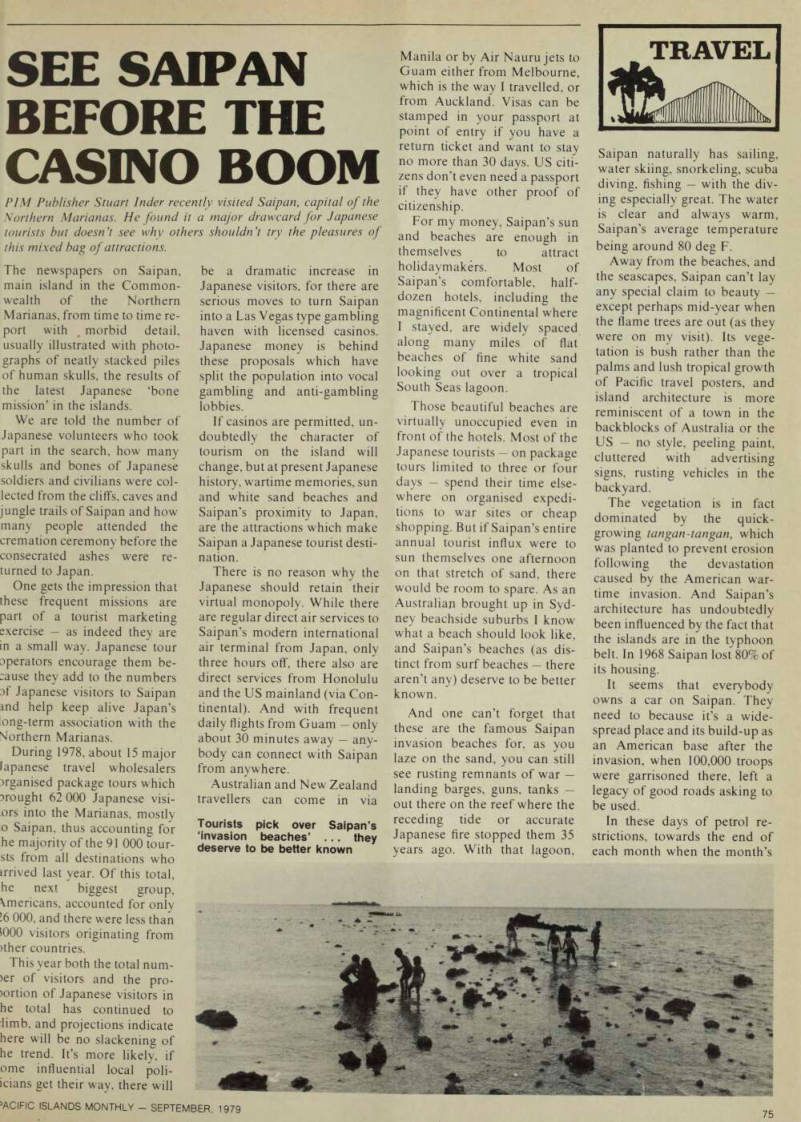
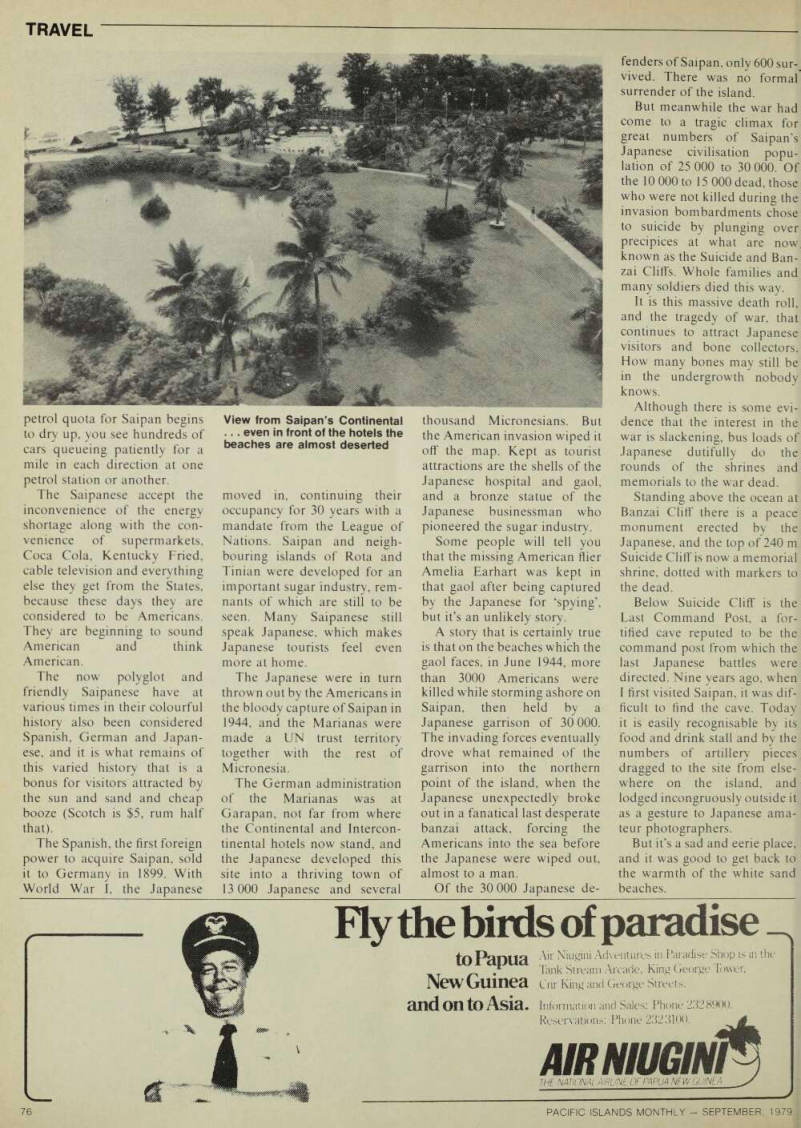
Travel
See Saipan
Casino Boom
PIM Publisher Stuart Inder recently visited Saipan, capital of the Northern Marianas. He found it a major drawcard for Japanese tourists but doesn’t see why others shouldn’t try the pleasures of this mixed bag of attractions.
The newspapers on Saipan, main island in the Common wealth of the Northern Marianas, from time to time re port with morbid detail, usually illustrated with photo graphs of neatly stacked piles of human skulls, the results of the latest Japanese ‘bone mission’ in the islands.
We are told the number of Japanese volunteers who took part in the search, how many skulls and bones of Japanese soldiers and civilians were col lected from the cliffs, caves and jungle trails of Saipan and how many people attended the cremation ceremony before the consecrated ashes were re turned to Japan.
One gets the impression that
these frequent missions are
part of a tourist marketing exercise as indeed they are in a small way. Japanese tour Dperators encourage them be :ause they add to the numbers 3f Japanese visitors to Saipan and help keep alive Japan’s ong-term association with the Northern Marianas.
During 1978, about 15 major lapanese travel wholesalers
organised package tours which
Drought 62 000 Japanese visi ors into the Marianas, mostly o Saipan, thus accounting for he majority of the 91 000 tour sts from all destinations who irrived last year. Of this total, he next biggest group,
Americans, accounted for only
16 000, and there were less than
(000 visitors originating from
fiber countries.
This year both the total num )er of visitors and the pro )ortion of Japanese visitors in he total has continued to limb, and projections indicate here will be no slackening of he trend. It’s more likely, if ome influential local poli icians get their way, there will
be a dramatic increase in Japanese visitors, for there are serious moves to turn Saipan into a Las Vegas type gambling haven with licensed casinos.
Japanese money is behind these proposals which have split the population into vocal
gambling and anti-gambling
lobbies.
If casinos are permitted, un doubtedly the character of tourism on the island will change, but at present Japanese history, wartime memories, sun and white sand beaches and
Saipan’s proximity to Japan,
are the attractions which make Saipan a Japanese tourist desti nation.
There is no reason why the Japanese should retain their virtual monopoly. While there are regular direct air services to Saipan’s modern international air terminal from Japan, only three hours off, there also are direct services from Honolulu and the US mainland (via Con tinental). And with frequent
daily flights from Guam only
about 30 minutes away any body can connect with Saipan
from anywhere.
Australian and New Zealand travellers can come in via
Manila or by Air Nauru jets to Guam either from Melbourne, which is the way I travelled, or from Auckland. Visas can be stamped in your passport at point of entry if you have a return ticket and want to stay no more than 30 days. US citi zens don’t even need a passport if they have other proof of
citizenship.
For my money, Saipan’s sun and beaches are enough in themselves to attract holidaymakers. Most of Saipan’s comfortable, half dozen hotels, including the magnificent Continental where
I stayed, are widely spaced
along many miles of flat beaches of fine white sand looking out over a tropical South Seas lagoon.
Those beautiful beaches are
virtually unoccupied even in
front of the hotels. Most of the
Japanese tourists on package
tours limited to three or four days spend their time else where on organised expedi tions to war sites or cheap shopping. But if Saipan’s entire annual tourist influx were to sun themselves one afternoon on that stretch of sand, there would be room to spare. As an Australian brought up in Syd ney beachside suburbs I know what a beach should look like, and Saipan’s beaches (as dis tinct from surf beaches there aren’t any) deserve to be better known.
And one can’t forget that these are the famous Saipan invasion beaches for, as you laze on the sand, you can still see rusting remnants of war
landing barges, guns, tanks
out there on the reef where the receding tide or accurate Japanese fire stopped them 35 years ago. With that lagoon,
Saipan naturally has sailing, water skiing, snorkeling, scuba diving, fishing with the div ing especially great. The water is clear and always warm, Saipan’s average temperature being around 80 deg F.
Away from the beaches, and the seascapes, Saipan can’t lay any special claim to beauty except perhaps mid-year when the flame trees are out (as they were on my visit). Its vege tation is bush rather than the palms and lush tropical growth of Pacific travel posters, and island architecture is more reminiscent of a town in the backblocks of Australia or the US no style, peeling paint, cluttered with advertising signs, rusting vehicles in the
backyard.
The vegetation is in fact dominated by the quick growing tangan-tangan, which was planted to prevent erosion following the devastation caused by the American war time invasion. And Saipan’s architecture has undoubtedly been influenced by the fact that the islands are in the typhoon belt. In 1968 Saipan lost 80% of
its housing.
It seems that everybody owns a car on Saipan. They need to because it’s a wide spread place and its build-up as an American base after the invasion, when 100,000 troops were garrisoned there, left a legacy of good roads asking to be used.
In these days of petrol re strictions, towards the end of each month when the month’s
Tourists pick over Saipan’s ‘invasion beaches’ ... they deserve to be better known
petrol quota for Saipan begins
to dry up, you see hundreds of cars queueing patiently for a mile in each direction at one petrol station or another.
The Saipanese accept the inconvenience of the energy shortage along with the con venience of supermarkets, Coca Cola, Kentucky Fried, cable television and everything else they get from the States, because these days they are considered to be Americans.
They are beginning to sound American and think American.
The now polyglot and
friendly Saipanese have at
various times in their colourful history also been considered
Spanish, German and Japan
ese, and it is what remains of this varied history that is a bonus for visitors attracted by the sun and sand and cheap booze (Scotch is $5, rum half that).
The Spanish, the first foreign power to acquire Saipan, sold it to Germany in 1899. With World War I, the Japanese
moved in, continuing their occupancy for 30 years with a mandate from the League of
Nations. Saipan and neigh
bouring islands of Rota and Tinian were developed for an
important sugar industry, rem
nants of which are still to be
seen. Many Saipanese still
speak Japanese, which makes Japanese tourists feel even more at home.
The Japanese were in turn thrown out by the Americans in the bloody capture of Saipan in 1944. and the Marianas were made a UN trust territory together with the rest of Micronesia.
The German administration of the Marianas was at Garapan, not far from where the Continental and Intercon tinental hotels now stand, and the Japanese developed this site into a thriving town of 13 000 Japanese and several
thousand Micronesians. But the American invasion wiped it off the map. Kept as tourist attractions are the shells of the
Japanese hospital and gaol,
and a bronze statue of the Japanese businessman who
pioneered the sugar industry.
Some people will tell you that the missing American flier Amelia Earhart was kept in
that gaol after being captured
by the Japanese for ‘spying’,
but it’s an unlikely story.
A story that is certainly true is that on the beaches which the gaol faces, in June 1944, more than 3000 Americans were killed while storming ashore on Saipan, then held by a Japanese garrison of 30 000.
The invading forces eventually
drove what remained of the garrison into the northern point of the island, when the
Japanese unexpectedly broke
out in a fanatical last desperate banzai attack, forcing the Americans into the sea before the Japanese were wiped out, almost to a man.
Of the 30 000 Japanese de
fenders of Saipan, only 600 sur vived. There was no formal surrender of the island.
But meanwhile the war had come to a tragic climax for great numbers of Saipan’s Japanese civilisation popu lation of 25 000 to 30 000. Of the 10 000 to 15 000 dead, those who were not killed during the invasion bombardments chose to suicide by plunging over precipices at what are now known as the Suicide and Ban zai Cliffs. Whole families and many soldiers died this way.
It is this massive death roll, and the tragedy of war, that continues to attract Japanese visitors and bone collectors.
How many bones may still be
in the undergrowth nobody
knows.
Although there is some evi dence that the interest in the war is slackening, bus loads of Japanese dutifully do the rounds of the shrines and memorials to the war dead.
Standing above the ocean at Banzai Cliff there is a peace monument erected by the Japanese, and the top of 240 m Suicide Cliff is now a memorial shrine, dotted with markers to the dead.
Below Suicide Cliff is the Last Command Post, a for tified cave reputed to be the command post from which the last Japanese battles were directed. Nine years ago, when I first visited Saipan, it was dif ficult to find the cave. Today
it is easily recognisable by its
food and drink stall and by the
numbers of artillery pieces
dragged to the site from else where on the island, and
lodged incongruously outside it
as a gesture to Japanese ama
teur photographers.
But it’s a sad and eerie place, and it was good to get back to the warmth of the white sand beaches.
View from Saipan’s Continental ... even in front of the hotels the beaches are almost deserted
Advertisements & other items, pp. 75-76 (2 items)
75
’ACIFIC ISLANDS MONTHLY SEPTEMBER, 1979
Fly the birds of paradise
tO PclOUcl ' vl! Niugini Adventures in Paradise Shop is in the , lank Stream Arcade, King George Tower.
New Guinea Cm- King and George Streets. and on to Asia. Information and Sales: Phone 232 8900.
trepidation
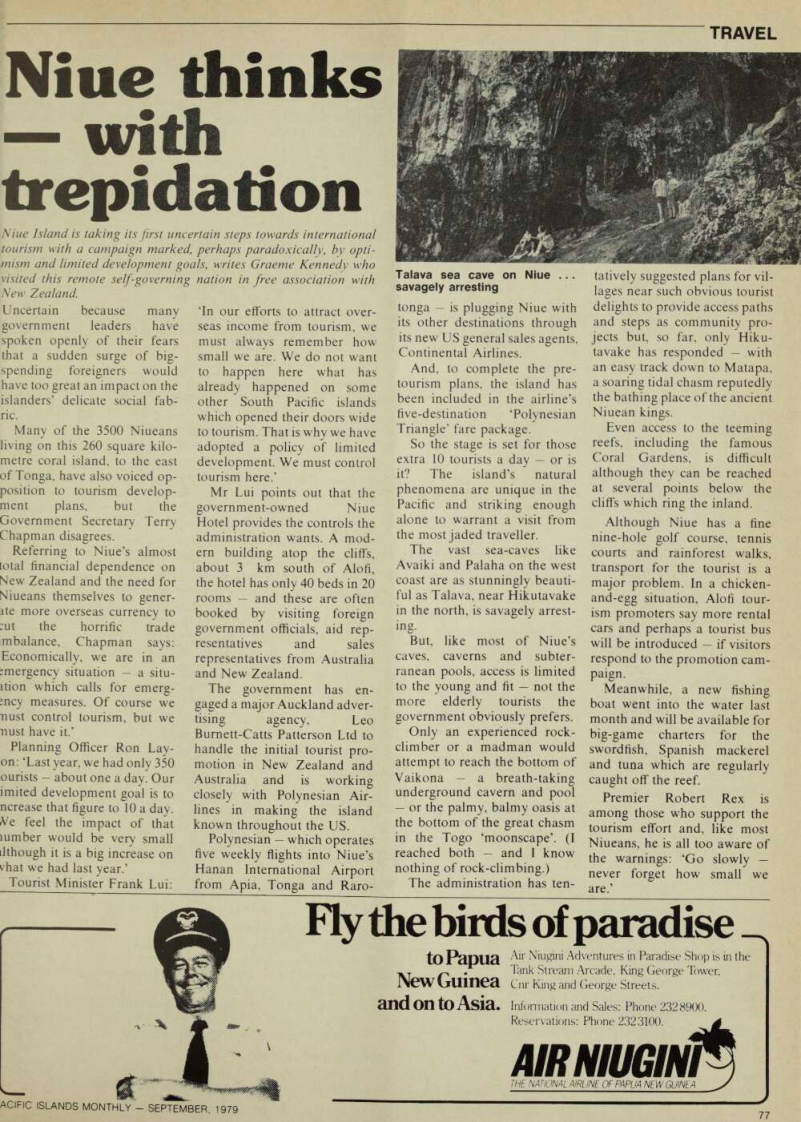
Niue thinks - with trepidation
Niue Island is taking its first uncertain steps towards international tourism with a campaign marked, perhaps paradoxically, by opti mism and limited development goals, writes Graeme Kennedy who visited this remote self-governing nation in free association with New Zealand.
Uncertain because many government leaders have spoken openly of their fears that a sudden surge of big
spending foreigners would
have too great an impact on the islanders’ delicate social fab ric.
Many of the 3500 Niueans living on this 260 square kilo metre coral island, to the east of Tonga, have also voiced op
position to tourism develop
ment plans, but the
Government Secretary Terry
Chapman disagrees.
Referring to Niue’s almost
total financial dependence on
New Zealand and the need for Niueans themselves to gener ate more overseas currency to :ut the horrific trade mbalance. Chapman says: Economically, we are in an emergency situation a situ ation which calls for emerg mcy measures. Of course we nust control tourism, but we nust have it.’
Planning Officer Ron Lay
on: ‘Last year, we had only 350 ourists about one a day. Our
imited development goal is to
ncrease that figure to 10 a day.
Ve feel the impact of that lumber would be very small ilthough it is a big increase on vhat we had last year.’
Tourist Minister Frank Lui:
in our efforts to attract over seas income from tourism, we must always remember how small we are. We do not want to happen here what has
already happened on some
other South Pacific islands which opened their doors wide to tourism. That is why we have adopted a policy of limited development. We must control tourism here.’
Mr Lui points out that the government-owned Niue Hotel provides the controls the administration wants. A mod ern building atop the cliffs, about 3 km south of Alofi, the hotel has only 40 beds in 20 rooms and these are often
booked by visiting foreign
government officials, aid rep resentatives and sales representatives from Australia and New Zealand.
The government has en gaged a major Auckland adver tising agency, Leo Burnett-Catts Patterson Ltd to handle the initial tourist pro motion in New Zealand and Australia and is working
closely with Polynesian Air
lines in making the island known throughout the US.
Polynesian which operates five weekly flights into Niue’s Hanan International Airport from Apia, Tonga and Raro-
tonga is plugging Niue with its other destinations through its new US general sales agents.
Continental Airlines.
And, to complete the pre tourism plans, the island has been included in the airline’s
five-destination ‘Polynesian
Triangle’ fare package.
So the stage is set for those extra 10 tourists a day or is it? The island’s natural phenomena are unique in the
Pacific and striking enough
alone to warrant a visit from the most jaded traveller.
The vast sea-caves like Avaiki and Palaha on the west coast are as stunningly beauti ful as Talava, near Hikutavake in the north, is savagely arrest
ing.
But, like most of Niue’s caves, caverns and subter ranean pools, access is limited to the young and fit not the more elderly tourists the
government obviously prefers.
Only an experienced rock
climber or a madman would attempt to reach the bottom of Vaikona a breath-taking
underground cavern and pool
or the palmy, balmy oasis at the bottom of the great chasm in the Togo ‘moonscape’. (I reached both and I know
nothing of rock-climbing.)
The administration has ten
tatively suggested plans for vil lages near such obvious tourist delights to provide access paths and steps as community pro jects but, so far, only Hiku tavake has responded with an easy track down to Matapa, a soaring tidal chasm reputedly the bathing place of the ancient Niuean kings.
Even access to the teeming reefs, including the famous Coral Gardens, is difficult although they can be reached at several points below the cliffs which ring the inland.
Although Niue has a fine nine-hole golf course, tennis courts and rainforest walks, transport for the tourist is a major problem. In a chicken and-egg situation, Alofi tour ism promoters say more rental cars and perhaps a tourist bus will be introduced if visitors respond to the promotion cam
paign.
Meanwhile, a new fishing boat went into the water last month and will be available for big-game charters for the swordfish, Spanish mackerel and tuna which are regularly caught off the reef.
Premier Robert Rex is among those who support the tourism effort and, like most Niueans, he is all too aware of the warnings: ‘Go slowly never forget how small we are.’
Talava sea cave on Niue ... savagely arresting
Advertisements & other items, p. 77 (2 items)
Travel
77
ACIFIC ISLANDS MONTHLY SEPTEMBER, 1979
Fly the birds of paradise
to Papua
New Guinea
and on to Asia.
Air Niugini Adventures in Paradise Shop is in the lank Stream Arcade, King George Tower, Cnr King and George Streets.
Information and Sales: Phone 2328900.
Reservations: Phone 2323100. £
AIRNIUGINr
-IE NATIONAL AIRLINE OF PAPUA NEW GUINEA y
Islands
From the
Press
Development News Digest (Pacific special)
The sentimental wish of so many visitors, well meant as it is, that the Islands and the people should be left just as they are, will not stand up to the political, social and economic realities of life today. It would be foolish to refuse all the advantages of other cultures because of pride, just as it would be mean to refuse to share the advantages of one’s own. Ratu Sir Kamisese Mara.
Norfolk Island News Norfolk Island is one of the few remaining colonies in the South Pacific. The people of the island are classified by Freedom House of New York as being only ‘partly free’ because Australia will not permit democratic government on the island. The fact was plainly put to Norfolk’s elected councillors by Australian Minister for Home Affairs R. J. Ellicott in March 1979. ‘You are under the complete bondage of the Australian Parliament,’ he told them. ‘You are not free.’
Letter by Masama Gene, PNG Post-Courier Please allow me space to air my criticism and concern about excessive demands for money and luxury items as bride price payments in this country ... In fact, in most societies the boy is regarded as more important than the girl. I sometimes think the bride’s people should pay the groom’s people, especially when the boy is more educated than the girl.
Fiji Times, Suva
As a measure to reduce the dog population Ba town council has raised the licence fee for bitches from $5 to $2O. At the same time the council raised fees for speyed bitches and dogs from $1 to $5.
Arawa Bulletin, PNG A group of three armed policemen left Arawa last Tuesday for Inus Plantation to help the people there hunt for a crocodile which was reported to have killed a ten year old girl in the area last week. Police Commander, Inspector Nessatt said that his men would set up camp at Inus and remain in the area until the crocodile has been hunted down and killed.
Marshall Islands Journal In one of the capital’s more popular restaurants this past week it was observed that a local character (known by most residents) was refused service by a waitress on grounds she had been ordered to do so by the owner. The person refused, commonly seen engaged in his favourite pastime of contacting citizens for donations to his basic needs of cigarettes or coffee, was clearly the victim of a plot to undermine the newly established constitution of the Marshall Islands in particular the section
guaranteeing all citizens equal rights.
PNG Post-Courier, Port Moresby
“I am part of PNG,” said Ratu Livai (Volavola), 65, the Vice-president of the Fijian Senate, whose grandfather was one of three Fijian missionaries killed and eaten by Tolais at Tungnabarau, about 15 kilometres south-west of Rabaul...
Reveille, New Zealand armed services magazine Feature writer Graeme Kennedy, of the Auckland StarS O'clock, reports from Niue: The next time any of you 5 or 40 Squadron blokes passes over tiny Niue, waggle a wingtip for a couple of very special twin boys down below. They’re the 16-month-old
Nichols kids and their names - wait for it - are Orion and Hercules . . Here’s how it happened. Their mother, Loisi, is a niece of Niue’s Minister for Tourism Frank Lui. When the twins were born, no one could think of a suitable pair of names. T was puzzling over this problem,’ Mr Lui explained, ‘and the solution came to me on the golf course one morning when one of your Orions flew over on patrol. “Orion”, I thought, what a nice name.
I went straight to the hospital and told Loisi and her husband Brian. After that, a name for the other little bloke just came naturally. Orion and Hercules, a good pair.’ Mr Lui has something of an empathy with young Orion and Hercules - he was christened Haile Selassie.
PNG Post-Courier, Port Moresby
Smoke but no fire! On two occasions one day this week a George Page staffer rang the Fire Brigade and passed on this message: “Today we will fumigate our showrooms at 10am and 4.30 pm.
There’ll be some fog, please don’t mistake it for smoke.” About 6 o’clock that night the sound of sirens was heard. Enthusiastic firemen smashed through the plateglass door of George Page’s Cuthbertson Street shop.
News Drum, Solomon Islands People in the Shortland Islands, in the Western Province, have reported that brightly lit flying objects have been making frequent visits over their islands.
From a letter to Arawa Bulletin, PNG Words are being spread that a few high pitched energetic men, inspired by spirit of rebellion and local fanaticism are engineering the prospect of establishing a Bougainville Copper Limited Staff Employees Union (Association). Such men are driven by mischievous ambitions, constantly in search for power to create destruction and disharmony among the working community we endeavour to unite ... Birds Eye View, Panguna.
Atoll Pioneer, Kiribati There was an incident late on May 8 when Air Tungaru’s Trislander was landing at Abemama with a full load ... A dog ran over the runway in front of the approaching aircraft which struck the animal resulting in the buckling of the nosewheel and the nose of the aircraft striking the ground ... No one was hurt. (Except probably the dog, but the paper is silent on its fate. PIM.) Tonga Chronicle, Nukualofa Never agree to carry a parcel or package overseas for a stranger.
It could easily be drugs, and if you are caught in possession of drugs in certain overseas countries, there could be a life sentence or even the death penalty awaiting you.
Coconut Telegraph, Savusavu, Fiji
Radio Fiji was 25 years old on July 2, 1979. Many happy returns of your birthday, Radio Fiji! ... As Mrs Grace Deoki said in her congratulatory message, ‘What would we do without Radio Fiji?’
Yes, indeed we should certainly be lost without those friendly voices to entertain, inform, exhort, advise, warn, educate and assist us, in three languages for most of the day and half the night. The voices of the men and women announcers are our friends though we may not know their faces. The distinctive human voice is an integral part of the continuing miracle of radio, each one different, some pleasing, some irritating!
News Drum, Solomon Islands Youths in Star Harbour on San Cristobal have found a way of getting “drunk” cheaply. They eat mushrooms growing on cow dung. The dark grey mushrooms, about one inch tall, grow in great numbers during the rainy seasons ... The effect is to leave the mushroom-eater paralysed and weak. Addicts find themselves unable to move for about 15 minutes during which time they have dreams and see images of objects and people ...
Hailans Nius, PNG Payback killings have frightened many Engan students in Western Highlands colleges, and they have left for home.
Advertisements & other items, p. 79 (1 item)
More than4,2oo employees.
Overs,ooo rooms.
2.1 million guests this year.
Three reasons why no
group can stay with us.
Over 5000 rooms. 61 hotels and resorts. 21 years of experience. That’s a lot of staying power.
But our contribution to the South Pacific goes far beyond simply being the biggest hotel and resort group in the region.
It’s what our size means that counts. It means we can provide best service for the more than two million people who stay with us annually.
And with 4200 people in our organisation to look after our guests, the word “service” really means something.
At the same time 4200 people employed is a lot of jobs. Again, a vital contribution to the economy of the South Pacific. And in the future, we’ll have an even bigger contribution to make.
Because we believe the South Pacific increasingly will become a centre for world tourism. Many thousands of tourists will pour millions of dollars into the South Pacific economy. Hundreds of businesses will benefit. Jobs will be assured, and many new jobs created.
We’re prepared for that right now. And our investment is on the line to prove it.
For reservations or further information regarding investment in the South Pacific please contact us at:- 110 Bayswater Road,Rushcutters BayN.S.W. 2011. Australia.
Telephone: 310388. Telex: 21365 Boulevard. Fkrk Royal.
Beachcomber. Travelodge.
Holiday Inn.
9
SOOTHERM EftOHC HOTEL CORPORATfOtX
® Australia 9 New Zealand 9 Fiji 9 Tahiti 9 Cook Islands 9 Papua New Guinea O f ew Caledonia 9 Western Samoa
MASIUS TVL26O9
O)
hotel
•us? ( m
Sailing through
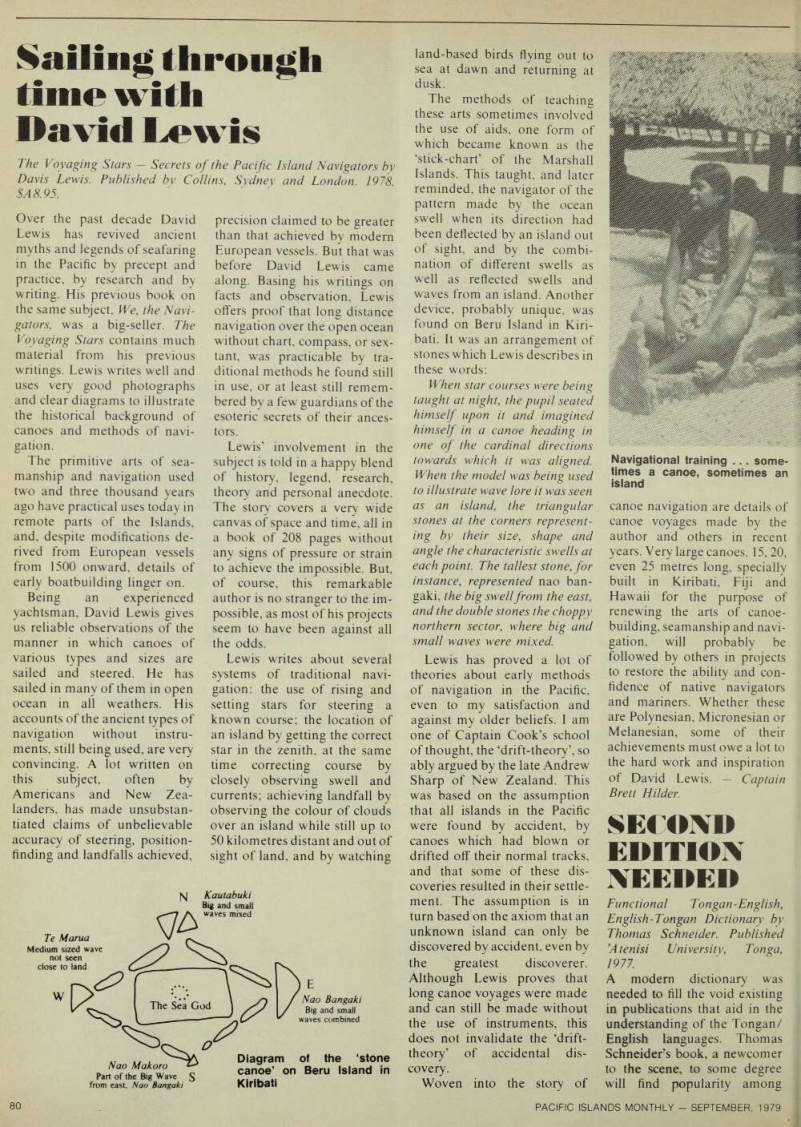
time with David Lewis
The Voyaging Stars - Secrets of the Pacific Island Navigators by Davis Lewis. Published by Collins, Sydney and London. 1978 $ A 8.95.
Over the past decade David Lewis has revived ancient
myths and legends of seafaring
in the Pacific by precept and
practice, by research and by
writing. His previous book on the same subject. We, the Navigators, was a big-seller. The Voyaging Stars contains much material from his previous writings. Lewis writes well and
uses very good photographs
and clear diagrams to illustrate the historical background of canoes and methods of navi-
gation.
The primitive arts of sea-
manship and navigation used
two and three thousand years ago have practical uses today in remote parts of the Islands, and, despite modifications derived from European vessels from 1500 onward, details of
early boatbuilding linger on.
Being an experienced
yachtsman, David Lewis gives
us reliable observations of the manner in which canoes of various types and sizes are sailed and steered. He has sailed in many of them in open ocean in all weathers. His accounts of the ancient types of navigation without instruments, still being used, are very convincing. A lot written on
this subject, often by
Americans and New Zealanders, has made unsubstandated claims of unbelievable
accuracy of steering, position-
finding and landfalls achieved,
precision claimed to be greater than that achieved by modern European vessels. But that was before David Lewis came
along. Basing his writings on
facts and observation. Lewis offers proof that long distance navigation over the open ocean without chart, compass, or sex tant, was practicable by tra ditional methods he found still in use, or at least still remem bered by a few guardians of the esoteric secrets of their ances tors.
Lewis’ involvement in the subject is told in a happy blend
of history, legend, research,
theory and personal anecdote, The story covers a very wide canvas of space and time, all in a book of 208 pages without any signs of pressure or strain to achieve the impossible. But, of course, this remarkable author is no stranger to the im possible, as most of his projects seem to have been against all the odds, Lewis writes about several systems of traditional navi gation: the use of rising and setting stars for steering a known course; the location of an island by getting the correct star in the zenith, at the same
time correcting course by
closely observing swell and
currents; achieving landfall by
observing the colour of clouds over an island while still up to 50 kilometres distant and out of sight of land, and by watching
land-based birds flying out to sea at dawn and returning at dusk.
The methods of teaching these arts sometimes involved the use of aids, one form of which became known as the ‘stick-chart’ of the Marshall Islands. This taught, and later reminded, the navigator of the pattern made by the ocean swell when its direction had been deflected by an island out of sight, and by the combi nation of different swells as well as reflected swells and waves from an island. Another
device, probably unique, was
found on Beru Island in Kiri bati. It was an arrangement of stones which Lewis describes in these words: When star courses were being taught at night, the pupil seated himself upon it and imagined himself in a canoe heading in one of the cardinal directions towards which it was aligned.
When the model was being used to illustrate wave lore it was seen as an island, the triangular stones at the corners represent ing by their size, shape and angle the characteristic swells at each point. The tallest stone, for instance, represented nao ban gaki, the big swell from the east, and the double stones the choppy northern sector, where big and small waves were mixed.
Lewis has proved a lot of theories about early methods of navigation in the Pacific, even to my satisfaction and against my older beliefs. I am one of Captain Cook’s school of thought, the ‘drift-theory’, so
ably argued by the late Andrew
Sharp of New Zealand. This was based on the assumption that all islands in the Pacific were found by accident, by canoes which had blown or drifted off their normal tracks, and that some of these dis coveries resulted in their settle ment. The assumption is in turn based on the axiom that an unknown island can only be discovered by accident, even by the greatest discoverer.
Although Lewis proves that long canoe voyages were made and can still be made without the use of instruments, this does not invalidate the ‘drift theory’ of accidental dis covery.
Woven into the story of
canoe navigation are details of canoe voyages made by the author and others in recent years. Very large canoes, 15,20, even 25 metres long, specially built in Kiribati, Fiji and Hawaii for the purpose of renewing the arts of canoe
building, seamanship and navi
gation, will probably be
followed by others in projects to restore the ability and con fidence of native navigators and mariners. Whether these are Polynesian, Micronesian or Melanesian, some of their achievements must owe a lot to the hard work and inspiration of David Lewis. Captain Brett Milder.
Second
Edition
Needed
Functional Tongan- English, English-Tongan Dictionary by Thomas Schneider. Published *A tenisi University, Tonga, 1977.
A modem dictionary was needed to fill the void existing in publications that aid in the
understanding of the Tongan/
English languages. Thomas
Schneider’s book, a newcomer to the scene, to some degree will find popularity among
Navigational training ... some
times a canoe, sometimes an island
those wishing to expand their knowledge of either language, although I doubt if it fills that void in its present form.
The dictionary is divided into three sections: Ton
gan/English, English/Tongan
and a specialised vocabulary
with 25 sub-sections under headings such as, medicine, bi
ology, engineering, electronics,
fishing, law, etc. Indeed a great deal of thought and consider ation have gone into the publi cation and the reader will find it an easy reference.
As mentioned in the fore word, 2000 most frequent Ton gan words are used, yet in the English/Tongan section, half of the months of the year, and a couple of days of the week, are not listed at all. Schneider goes on to say that the dic
tionary was compiled under
extreme time pressure and financial strain, and it is quite probable that it contains many errors. A dictionary would be better not published if pre pared under these conditions.
The production of the dic tionary is quite poor, with the printing the main offender.
Schneider’s dictionary is cer tainly no ‘Oxford’, yet it is an honest attempt to satisfy a real need. Hopefully a second edition will tidy up the errors and omissions, do away with the excuses, and improve on
the printing quality. Then
Schneider will have a first class
publication.
With all its faults, it is still a worthwhile publication, and due credit should be given to Thomas Schneider for doing something constructive in this neglected area. - Fatal Moun
gaafi Slender.
whom:
For The
Ke4 Oku
Record collectors of South Pa cific music will find Polynesian Dances of Bel lona (Mungiki) Solomon Islands a valuable ad dition to their disc racks. An eight page folder with the disc gives adequate details of the re lated geographical, historical and musical background to the songs.
The record highlights a pocket of Polynesian culture in
Books
Melanesian surrounds where the singers have the gift of maintaining a high level of vocal presentation while danc ing. Reproduction of the music of such a mobile team of artists in stereo has been admirably achieved by Jane Mink Rossen and Hugo Zemp without any loss of song quality as the per formers move to and from the
microphones.
Sea sagas predominate in the collection which can reach back 600 years and rhythmic accompaniment comes mainly from hand clapping or a sound ing board (papa) beaten by an alternate two-handed drum
ming action.
The collectors of these dance songs have generously, but cor rectly, recorded the names of the Bellonese people who gave a range of assistance to making such a project possible. How ever, credit is primarily due to the elders of not only these Bellonese, but all Pacific Islanders who have tenaciously preserved their traditional music against a host of introduced prohibitions and detractions. National indepen dence has also been a great incentive for Pacific Islanders wishing to preserve their
soundways.
Support for the production and distribution of the disc has come from well-established folk music institutes in Europe and America and it is presented for sale as number FE 4274 by Ethnic Folkways Records. —
Ray Sheridan.
Advertisements & other items, pp. 81-82 (1 item)
Kiribati
f Henry Lawson’s
- Bookshop
127 York Street, Sydney 2000 A (half a block from Town Hall) Phone 29 7799 is famous for Australian Books, but please remember, WE ALSO SELL BOOKS ON THE PACIFIC.
We carry a full range of titles issued by Australian National University Press, including the important new work “THE SPANISH LAKE" by O.H.K. Spate $35.00.
This is the first volume in a comprehensive history of the Pacific since Magellan. It is also available in a boxed signed edition limited to 500 copies at $90.00.
SOME OTHER TITLES AVAILABLE ARE:
Hempenstall: PACIFIC ISLANDERS UNDER GERMAN RULE
A study in the meaning of colonial resistance $19.50
Laracy; MARISTS AND MELANESIANS
History of Catholic Missions in the Solomons $12.95
Winslow (ed): THE MELANESIAN ENVIRONMENT
Papers arising from the 9th Waigani Seminar May 1975 . . $12.50
Ralston: GRASS HUTS AND WAREHOUSES
Pacific Beach Communities of the 19th Century $10.95
Trumbull: TIN ROOFS & PALM TREES
A report on the New South Seas $16.95 Davidson & Scarr (ed): PACIFIC ISLANDS PORTRAITS . . $5.95 Scarr (ed): MORE PACIFIC ISLANDS PORTRAITS $9.95 Griffin (ed): PAPUA NEW GUINEA PORTRAITS $9.95 Millar: ORCHIDS OF PAPUA NEW GUINEA $10.95
Nelson: BLACK W IITE & GOLD
A lively history of arly gold mining in New Guinea $16.95
Oram; COLONIAL TOWN TO MELANESIAN CITY
Port Moresby 1884 1974 $10.95
Hope: LONG AGO IS FAR AWAY
Accounts of the early exploration of the Papuan Gulf ... $14.50 Rubel & Rosman: YOUR OWN PIGS YOU MAY NOT EAT Comparative study of New Guinea Societies $24.00 Sack & Clark (ed & trans): GERMAN NEW GUINEA Annual Reports of N.G.Campagnie important historical source material just available $29.00 Oliver: ANCIENT TAHITIAN SOCIETY 3 vols boxed set . $50.00 Plus numerous monographs in the Development Studies Centre series
KIRIBATI
Books about Kiribati are available from The National Library,
P.O. Box 6, Bairiki, Tarawa, Kiribati.
KIRIBATI: ASPECTS OF HISTORY $3.00
TARAAN KARAKIN KIRIBATI $3.00
NAREAU'S NATION Tony Whincup $15.00 CHRISTMAS ISLAND STORY - Eric Bailey . . . $5.00 STRUCTURE OF GILBERTESE - R. Cowell. . . $1.50
EVOLUTION OF THE
GILBERTESE BOTI-Maude $2.00
ABEMAMA REPORT - R.F. Watters $lO.OO
TAMANA REF IRT R. Lawrence $lO.OO - POSTAGE ON OVERSEAS ORDERS IS EXTRA -
Polynesian
Bookshop...
THE PACIFIC ISLANDS
BOOK SPECIALISTS'
Write for our complimentary catalogue!
336 PONSONBY RD
(PO Box 47-267)
AUCKLAND, NEW ZEALAND.
Telephone 764-824.
. 21 € j m #! * m ■ % m * m r.
'JRk*
■ £>» T 311 ipl * ** V \ ' • 4 Hi ‘ 4P*. - % ■ ft M \ V - *■ wT Cathay Pacific. From the heart of Asia.
Cathay Pacific now flies every Sunday at 6.05 p.m. from Port Moresby to Hong Kong, rom Hong Kong, Cathay Pacific flies North, South, East and West serving all the major ities in South-East Asia, Australia and the Middle East. On board you will be cared for »y charming Oriental flight-hostesses specially chosen from the countries we serve and •y highly experienced British and Australian pilots and flight engineers.
Cathay Pacific. Direct from the heart of Asia to the heart of Papua New Guinea.
Hong Kong% discovery airline
CATHAY PACIFIC
The Swire Group
The ‘Malays’
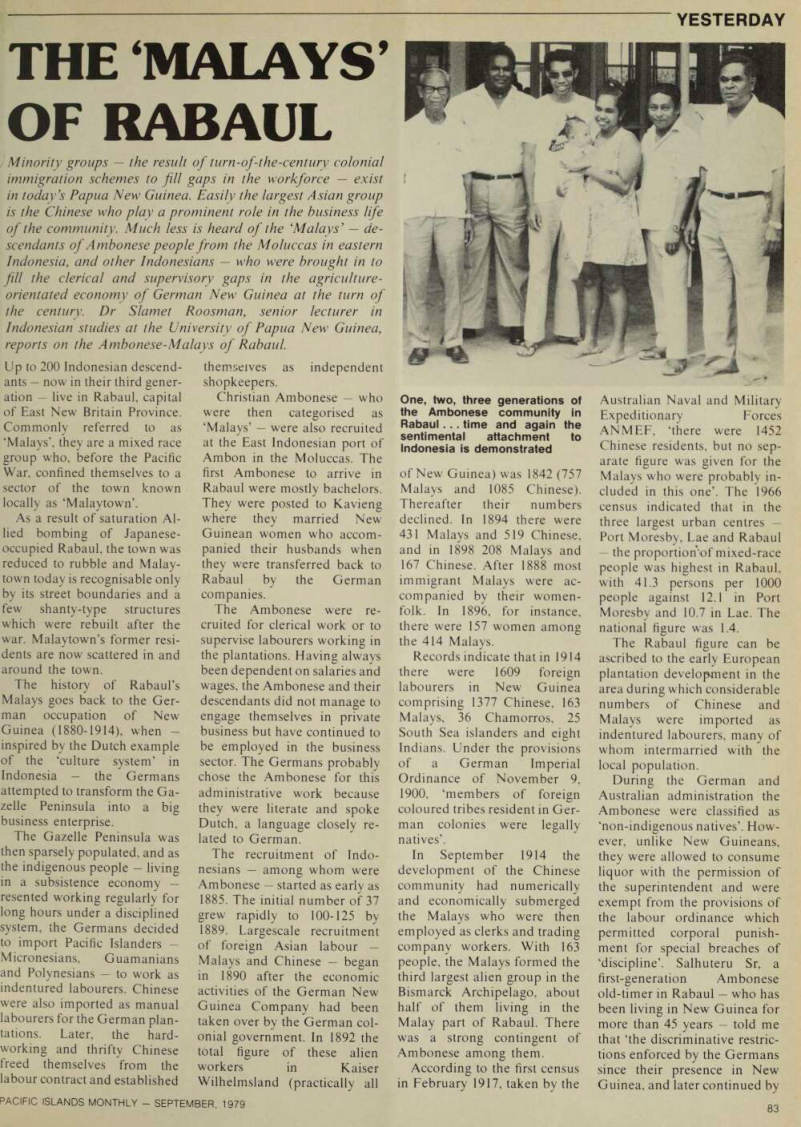
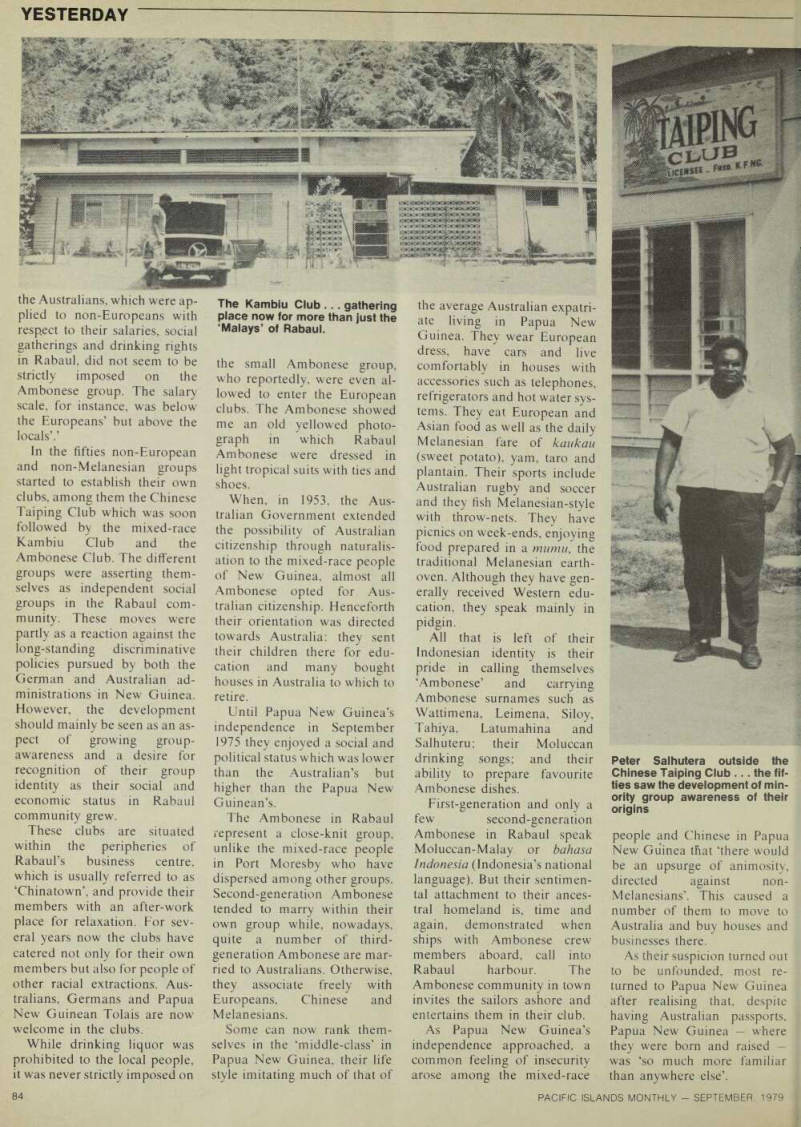
Yesterday
Of Rabaul
Minority groups the result of turn-of-the-century colonial immigration schemes to fill gaps in the workforce exist in today’s Papua New Guinea. Easily the largest Asian group is the Chinese who play a prominent role in the business life of the community. Much less is heard of the ‘ Malays’ de scendants of Ambonese people from the Moluccas in eastern Indonesia, and other Indonesians who were brought in to fill the clerical and supervisory gaps in the agriculture orientated economy of German New Guinea at the turn of the century. Dr Slamet Roosman, senior lecturer in Indonesian studies at the University of Papua New Guinea, reports on the Ambonese-Malays of Rabaul.
Up to 200 Indonesian descend ants now in their third gener ation live in Rabaul, capital of East New Britain Province.
Commonly referred to as ‘Malays’, they are a mixed race group who, before the Pacific War, confined themselves to a sector of the town known locally as ‘Malaytown’.
As a result of saturation Al lied bombing of Japanese occupied Rabaul, the town was reduced to rubble and Malay town today is recognisable only by its street boundaries and a few shanty-type structures which were rebuilt after the war. Malaytown’s former resi dents are now scattered in and around the town.
The history of Rabaul’s Malays goes back to the Ger man occupation of New Guinea (1880-1914), when inspired by the Dutch example of the ‘culture system’ in Indonesia the Germans attempted to transform the Ga zelle Peninsula into a big business enterprise.
The Gazelle Peninsula was then sparsely populated, and as
the indigenous people living
in a subsistence economy
resented working regularly for
long hours under a disciplined system, the Germans decided to import Pacific Islanders Micronesians, Guamanians and Polynesians to work as indentured labourers. Chinese were also imported as manual labourers for the German plan tations. Later, the hard
working and thrifty Chinese
freed themselves from the labour contract and established
themselves as independent
shopkeepers.
Christian Ambonese who were then categorised as ‘Malays’ were also recruited at the East Indonesian port of Ambon in the Moluccas. The first Ambonese to arrive in Rabaul were mostly bachelors.
They were posted to Kavieng where they married New Guinean women who accom panied their husbands when they were transferred back to Rabaul by the German companies.
The Ambonese were re cruited for clerical work or to supervise labourers working in
the plantations. Having always
been dependent on salaries and wages, the Ambonese and their descendants did not manage to engage themselves in private business but have continued to be employed in the business sector. The Germans probably chose the Ambonese for this administrative work because they were literate and spoke Dutch, a language closely re lated to German.
The recruitment of Indo nesians among whom were Ambonese started as early as 1885. The initial number of 37 grew rapidly to 100-125 by 1889. Largescale recruitment of foreign Asian labour Malays and Chinese began in 1890 after the economic activities of the German New Guinea Company had been taken over by the German col onial government. In 1892 the total figure of these alien workers in Kaiser Wilhelmsland (practically all
Australian Naval and Military
Expeditionary Forces
ANMEF, ‘there were 1452 Chinese residents, but no sep arate figure was given for the Malays who were probably in cluded in this one’. The 1966 census indicated that in the three largest urban centres Port Moresby, Lae and Rabaul the proportion'of mixed-race people was highest in Rabaul, with 41.3 persons per 1000 people against 12.1 in Port Moresby and 10.7 in Lae. The national figure was 1.4.
The Rabaul figure can be ascribed to the early European
plantation development in the
area during which considerable numbers of Chinese and
Malays were imported as
indentured labourers, many of whom intermarried with the
local population.
During the German and Australian administration the Ambonese were classified as ‘non-indigenous natives’. How ever, unlike New Guineans, they were allowed to consume liquor with the permission of the superintendent and were exempt from the provisions of the labour ordinance which
permitted corporal punish
ment for special breaches of ‘discipline’. Salhuteru Sr, a
first-generation Ambonese
old-timer in Rabaul who has been living in New Guinea for more than 45 years told me that ‘the discriminative restric tions enforced by the Germans since their presence in New Guinea, and later continued by
of New Guinea) was 1842 (757 Malays and 1085 Chinese).
Thereafter their numbers declined. In 1894 there were 431 Malays and 519 Chinese, and in 1898 208 Malays and 167 Chinese. After 1888 most immigrant Malays were ac
companied by their women
folk. In 1896, for instance, there were 157 women among the 414 Malays.
Records indicate that in 1914 there were 1609 foreign labourers in New Guinea comprising 1377 Chinese, 163 Malays, 36 Chamorros, 25 South Sea islanders and eight Indians. Under the provisions of a German Imperial Ordinance of November 9, 1900, ‘members of foreign coloured tribes resident in Ger man colonies were legally natives’.
In September 1914 the development of the Chinese
community had numerically
and economically submerged
the Malays who were then employed as clerks and trading company workers. With 163 people, the Malays formed the third largest alien group in the Bismarck Archipelago, about half of them living in the Malay part of Rabaul. There was a strong contingent of Ambonese among them.
According to the first census in February 1917, taken by the
One, two, three generations of the Ambonese community in Rabaul ... time and again the sentimental attachment to Indonesia is demonstrated
the Australians, which were ap
plied to non-Europeans with
respect to their salaries, social
gatherings and drinking rights
in Rabaul, did not seem to be
strictly imposed on the
Ambonese group. The salary scale, for instance, was below the Europeans’ but above the locals’.’
In the fifties non-European and non-Melanesian groups started to establish their own clubs, among them the Chinese Taiping Club which was soon followed by the mixed-race Kambiu Club and the Ambonese Club. The different groups were asserting them selves as independent social groups in the Rabaul com munity. These moves were partly as a reaction against the
long-standing discriminative
policies pursued by both the German and Australian ad ministrations in New Guinea.
However, the development should mainly be seen as an as pect of growing group awareness and a desire for recognition of their group identity as their social and economic status in Rabaul
community grew.
These clubs are situated within the peripheries of Rabaul’s business centre, which is usually referred to as ‘Chinatown’, and provide their members with an after-work place for relaxation. For sev eral years now the clubs have catered not only for their own members but also for people of other racial extractions. Aus tralians, Germans and Papua New Guinean Tolais are now welcome in the clubs.
While drinking liquor was
prohibited to the local people, it was never strictly imposed on
the small Ambonese group, who reportedly, were even al lowed to enter the European clubs. The Ambonese showed me an old yellowed photo graph in which Rabaul Ambonese were dressed in light tropical suits with ties and shoes.
When, in 1953, the Aus tralian Government extended the possibility of Australian
citizenship through naturalis
ation to the mixed-race people of New Guinea, almost all Ambonese opted for Aus tralian citizenship. Henceforth their orientation was directed towards Australia: they sent their children there for edu cation and many bought houses in Australia to which to retire.
Until Papua New Guinea’s
independence in September
1975 they enjoyed a social and political status which was lower than the Australian’s but higher than the Papua New Guinean’s.
The Ambonese in Rabaul represent a close-knit group, unlike the mixed-race people in Port Moresby who have dispersed among other groups.
Second-generation Ambonese
tended to marry within their own group while, nowadays, quite a number of third generation Ambonese are mar ried to Australians. Otherwise, they associate freely with Europeans, Chinese and Melanesians.
Some can now rank them selves in the ‘middle-class’ in Papua New Guinea, their life style imitating much of that of
the average Australian expatri ate living in Papua New
Guinea. They wear European
dress, have cars and live comfortably in houses with accessories such as telephones, refrigerators and hot water sys tems. They eat European and Asian food as well as the daily Melanesian fare of kaukau (sweet potato), yam, taro and plantain. Their sports include Australian rugby and soccer
and they fish Melanesian-style
with throw-nets. They have
picnics on week-ends, enjoying
food prepared in a mumu, the traditional Melanesian earth oven. Although they have gen erally received Western edu
cation, they speak mainly in
pidgin.
All that is left of their Indonesian identity is their
pride in calling themselves
‘Ambonese’ and carrying Ambonese surnames such as Wattimena, Leimena, Siloy, Tahiya, Latumahina and Salhuteru; their Moluccan drinking songs; and their ability to prepare favourite Ambonese dishes.
First-generation and only a
few second-generation
Ambonese in Rabaul speak Moluccan-Malay or bahasa Indonesia (Indonesia’s national language). But their sentimen tal attachment to their ances tral homeland is, time and again, demonstrated when ships with Ambonese crew members aboard, call into Rabaul harbour. The Ambonese community in town invites the sailors ashore and entertains them in their club.
As Papua New Guinea’s independence approached, a
common feeling of insecurity
arose among the mixed-race
people and Chinese in Papua New Guinea that ‘there would be an upsurge of animosity, directed against non- Melanesians’. This caused a number of them to move to Australia and buy houses and businesses there.
As their suspicion turned out to be unfounded, most re turned to Papua New Guinea
after realising that, despite
having Australian passports, Papua New Guinea where they were born and raised was ‘so much more familiar than anywhere else’.
The Kambiu Club ... gathering place now for more than just the Malays’ of Rabaul.
Peter Salhutera outside the Chinese Taiping Club ... the fif ties saw the development of min ority group awareness of their
origins
Advertisements & other items, pp. 84-86 (3 items)
Yesterday
85
’ACIFIC ISLANDS MONTHLY SEPTEMBER, 1979
Polynesian/Airlines
& m
AIV
S When the time next comes for you to fly out to do business fly Polynesian Airlines. Polynesian really understands the businessman’s requirements for a quick and efficient service between all Polynesian countries.
In fact, part of the reason we established our first service (Apia Pago Pago) back in 1959 was to meet the business sector’s demand for a fast and frequent service between the Samoas.
Since then Polynesian Airlines has spread its wings. Today our extensive route network covers the whole of Polynesia east of Fiji and now extends down to Auckland, New Zealand. And, as in ‘59 a lot of the people we’re carrying today are professional people. People who know that when it comes to flying anywhere in Polynesia on business there is only one airline. Polynesian Airlines, Fly Polynesian. It’s a pleasure doing business with us.
Offices in: Auckland, Tonga, Niue, Rarotonga.
Box 599 Apia, Western Samoa, Ph 21261.
WESTERN SAMOA
AMERICAN
SAMOA
NIUE
POLYNESIAN/AIRLINES
Nandi Airport, Nandi Ph 72733.
TONGA
We are Polynesia.
Export
Coke
■ m m 031 lllawarra Coke Company Pty Limited A subsidiary of Kembla Coal & Coke For small or large consumers to standard specifications. Bulk, bagged or containerised. Fast delivery, reliable supply and consistent quality. Stable price structure. Enquiries to Paul Abrahams, lllawarra Coke Company Pty Limited, PO Box Clifton, NSW2SIO.
Tel (042)94 1444. Telex 21818.
IQ B E
offers expert insurance service
throughout the Islands.
QBE INSURANCE LIMITED
Central Office: 82 Pitt Street, Sydney.
NEW CALEDONIA - T.A. Hagen, Ste. W.A. Johnston, S.A.R.L. - Noumea.
NEW HEBRIDES Manager: G.F. Donnelly, Vila; Santo Santr: Burns Phi Ip (New Hebrides) Ltd.
TAHITI Arthur Chung: Immeuble 8.1., Front de Mer, Papeete.
NIUE, NORFOLK ISLAND, SAMOA, TONGA and other South Sea Islands Burns Phi/p (South Sea) Company Ltd.
QUEENSLAND INSURANCE (FIJI) LIMITED
Head Office, 34 Usher St., SUVA. General Manager: L.G. Liddell. A.A.1.1.
Assistant Managers: Vijay Lai and J.T. Laidlaw. LAUTOKA Office, Burns Philp Bldg. District Manager: J. Dalton.
QUEENSLAND INSURANCE (P.N.C.) LIMITED
PAPUA NEW GUINEA -
Head Office, PORT MORESBY. General Manager; J.M. Dawe. Assistant Manager: R.V. Maskell.
District Managers at; LAE; I.R. Martin. MOUNT HAGEN: D.F. Carroll. ARAWA: J Longbut. MADANG; R.W.V. Ceilings. RABAUL: W.F. Tinker.
are rearing Papua
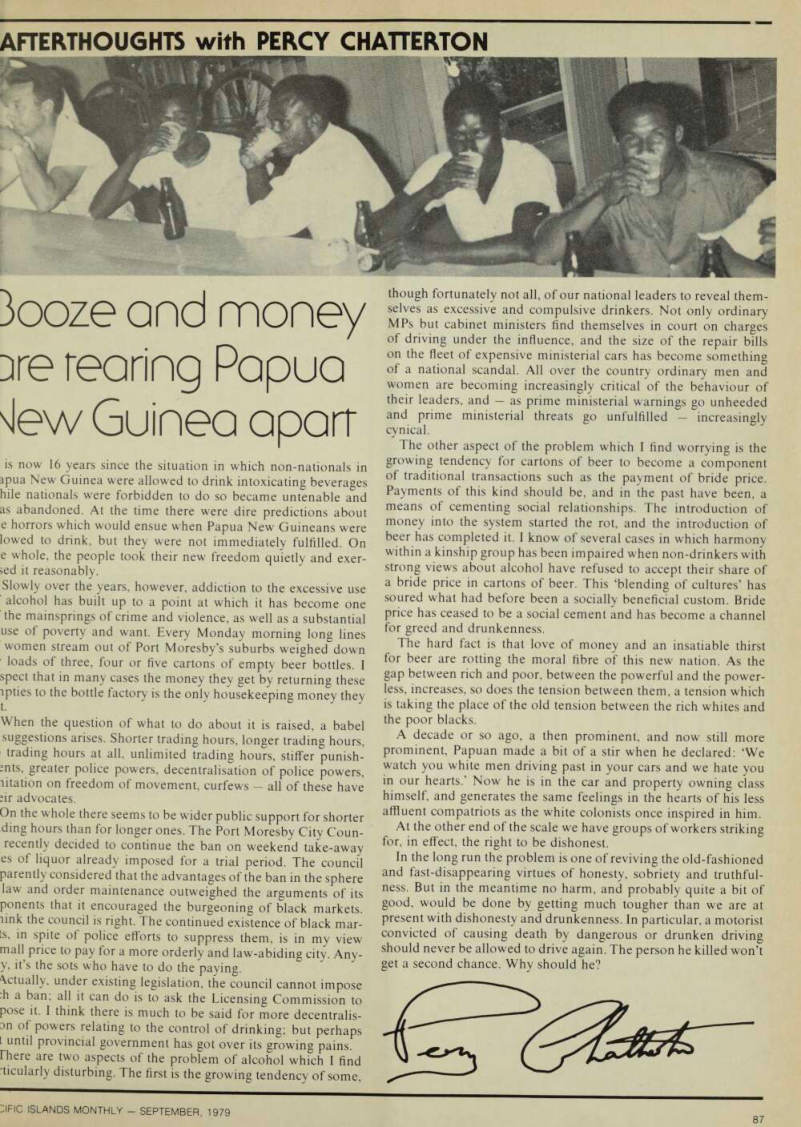
Afterthoughts With Percy Chatterton
[?]ooze and money are rearing Papua New Guinea opart
is now 16 years since the situation in which non-nationals in apua New Guinea were allowed to drink intoxicating beverages hile nationals were forbidden to do so became untenable and as abandoned. At the time there were dire predictions about e horrors which would ensue when Papua New Guineans were lowed to drink, but they were not immediately fulfilled. On e whole, the people took their new freedom quietly and exer
ted it reasonably.
Slowly over the years, however, addiction to the excessive use alcohol has built up to a point at which it has become one the mainsprings of crime and violence, as well as a substantial use of poverty and want. Every Monday morning long lines women stream out of Port Moresby’s suburbs weighed down loads of three, four or five cartons of empty beer bottles. I sped that in many cases the money they get by returning these ipties to the bottle factory is the only housekeeping money they When the question of what to do about it is raised, a babel suggestions arises. Shorter trading hours, longer trading hours, trading hours at all, unlimited trading hours, stiffer punish ;nts, greater police powers, decentralisation of police powers, litation on freedom of movement, curfews all of these have fir advocates.
On the whole there seems to be wider public support for shorter ding hours than for longer ones. The Port Moresby City Coun recently decided to continue the ban on weekend take-away es of liquor already imposed for a trial period. The council parently considered that the advantages of the ban in the sphere law and order maintenance outweighed the arguments of its ponents that it encouraged the burgeoning of black markets, link the council is right. The continued existence of black mar ts, m spite of police efforts to suppress them, is in my view mall price to pay for a more orderly and law-abiding city. Any y, it s the sots who have to do the paying.
Actually, under existing legislation, the council cannot impose h a ban; all it can do is to ask the Licensing Commission to pose it. I think there is much to be said for more decentralis -3n of powers relating to the control of drinking; but perhaps t until provincial government has got over its growing pains, fhere are two aspects of the problem of alcohol which I find licularly disturbing. The first is the growing tendency of some,
though fortunately not all, of our national leaders to reveal them selves as excessive and compulsive drinkers. Not only ordinary MPs but cabinet ministers find themselves in court on charges of driving under the influence, and the size of the repair bills on the fleet of expensive ministerial cars has become something of a national scandal. All over the country ordinary men and women are becoming increasingly critical of the behaviour of their leaders, and as prime ministerial warnings go unheeded and prime ministerial threats go unfulfilled - increasingly
cynical.
The other aspect of the problem which I find worrying is the growing tendency for cartons of beer to become a component of traditional transactions such as the payment of bride price.
Payments of this kind should be, and in the past have been, a means of cementing social relationships. The introduction of money into the system started the rot, and the introduction of beer has completed it. I know of several cases in which harmony within a kinship group has been impaired when non-drinkers with strong views about alcohol have refused to accept their share of a bride price in cartons of beer. This ‘blending of cultures’ has soured what had before been a socially beneficial custom. Bride price has ceased to be a social cement and has become a channel for greed and drunkenness.
The hard fact is that love of money and an insatiable thirst for beer are rotting the moral fibre of this new nation. As the gap between rich and poor, between the powerful and the power less, increases, so does the tension between them, a tension which is taking the place of the old tension between the rich whites and the poor blacks.
A decade or so ago, a then prominent, and now still more prominent, Papuan made a bit of a stir when he declared: ‘We watch you white men driving past in your cars and we hate you in our hearts.’ Now he is in the car and property owning class himself, and generates the same feelings in the hearts of his less affluent compatriots as the white colonists once inspired in him.
At the other end of the scale we have groups of workers striking for, in effect, the right to be dishonest.
In the long run the problem is one of reviving the old-fashioned and fast-disappearing virtues of honesty, sobriety and truthful ness. But in the meantime no harm, and probably quite a bit of good, would be done by getting much tougher than we are at present with dishonesty and drunkenness. In particular, a motorist convicted of causing death by dangerous or drunken driving should never be allowed to drive again. The person he killed won’t get a second chance. Why should he?
Advertisements & other items, pp. 87-88 (2 items)
87
3IFIC ISLANDS MONTHLY SEPTEMBER, 1979
Fastair Spares
' We Find- Buyand get parts to you
FAST
i AND WE SEND ALL YOUR DOCUMENTS /
Fastair Spares
P.O. Box 54, Lutwyche, Brisbane, Queensland, Australia, 4030.
Phone: 57 7600 (3 Lines) Telex: AA 41239
HEAT
SEALING.
SlllUi\K
PACKAGING.
CONTACT A USTRA LIA'S
FOREMOST MANUFACTURERS
OF HE A T SEALING EQUIPMENT
SERVING INDUSTRY
IN AUSTRALIA & THE PACIFIC ISLANDS
FOR OVER 25 YEARS.
HELIX ELECTRICAL PRODUCTS PTY. LTD.
27 Rosebery Avenue, Rosebery, NSW 2018, Australia. 663 0487.
J Since 1947 . . . . sth year in Australia
GOLD
DETECTORS
with enviable history of
AUSTRALIAN GOLD NUGGET FINDS
"The Professionals' Choice . .
GET YOUR
FREE INFORMATION PACKAGE - NOW!
Write or phone the Australian importers:
HENDON DETECTOR COMPANY
TEL: 24 hours 7 DA YS A WEEK- (02) 918-6667 Box 155. V. (121 Plateau Rd.), Avalon Beach,
N.S.W. 2107. /
\ DEALER INQUIRIES WELCOMED f
Service?
-count on it!
De Havilland Electronics provides service you can count on for: Aircraft instruments, gyros, electronic and i ■ communications equipment Marine S.G. Brown gyro compasses and steering systems, Magnavox satnav systems.
To: The Manager
De Havilland Electronics
division of Hawker de Havilland Australia Pty Limited P.O. Box 30 Bankstown NSW 2200 Australia Please send details of your service capabilities.
Name: Address: Area of interest:
- ‘supermarket
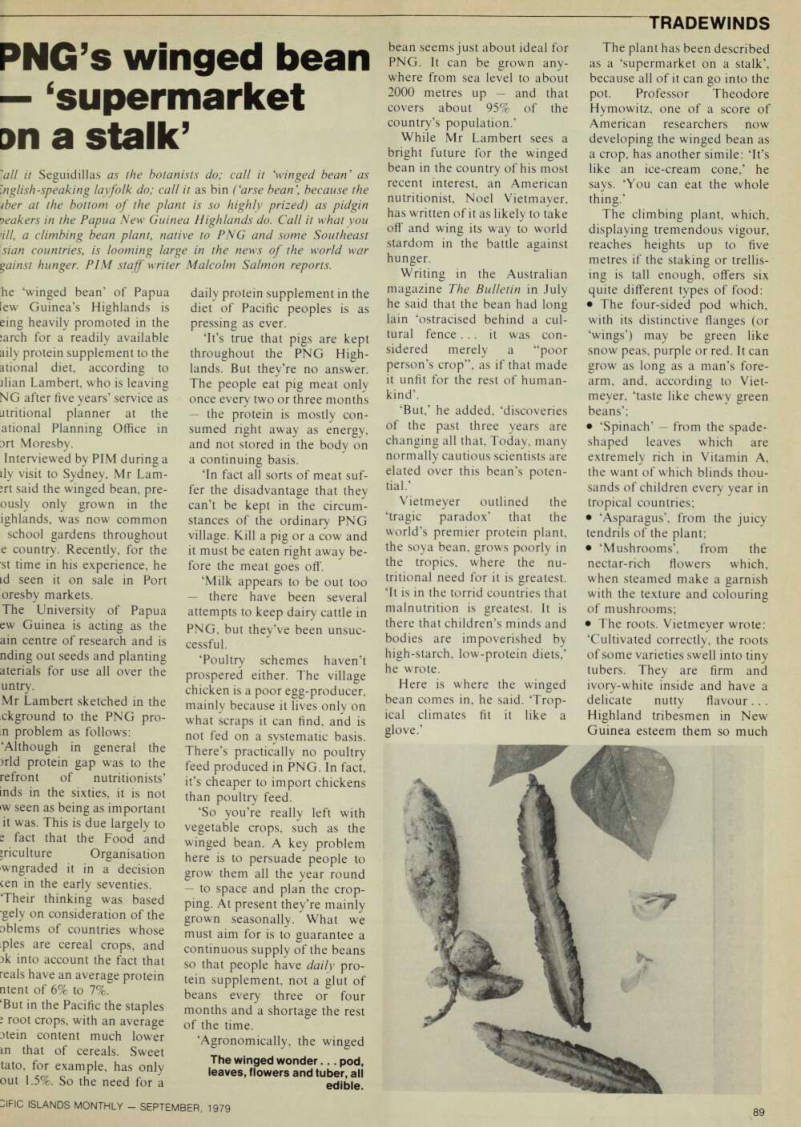

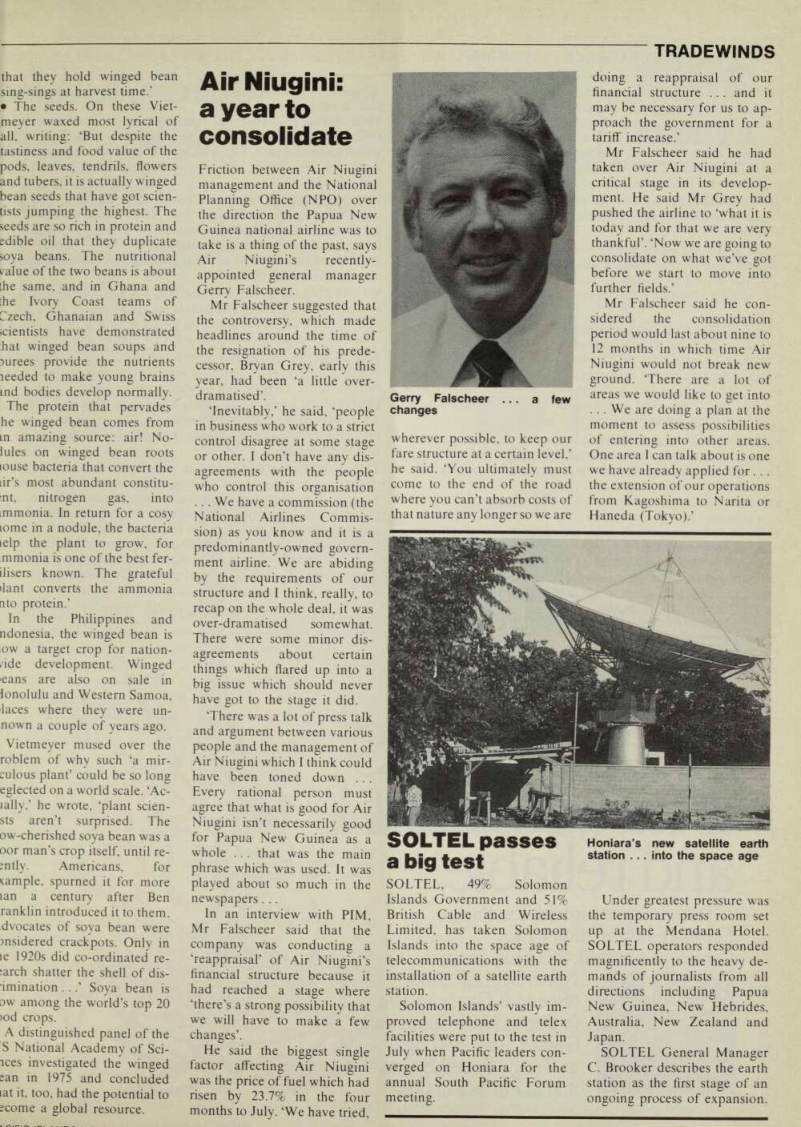
Tradewinds
PNG’s winged bean - ‘supermarket on a stalk’
".all it Seguidillas as the botanists do; call it *winged bean ’ as English-speaking layfolk do; call it as bin (‘arse bean \ because the iber at the bottom of the plant is so highly prized) as pidgin leakers in the Papua New Guinea Highlands do. Call it what you ill, a climbing bean plant, native to PNG and some Southeast sian countries, is looming large in the news of the world war gainst hunger. PIM staff writer Malcolm Salmon reports.
he ‘winged bean’ of Papua lew Guinea’s Highlands is eing heavily promoted in the ;arch for a readily available aily protein supplement to the ational diet, according to ilian Lambert, who is leaving NG after five years’ service as atritional planner at the ational Planning Office in art Moresby.
Interviewed by PIM during a ily visit to Sydney, Mr Lam jrt said the winged bean, pre ously only grown in the ighlands, was now common
school gardens throughout
e country. Recently, for the st time in his experience, he id seen it on sale in Port
oresby markets.
The University of Papua ew Guinea is acting as the ain centre of research and is nding out seeds and planting aterials for use all over the untry.
Mr Lambert sketched in the ckground to the PNG pro in problem as follows: ‘Although in general the arid protein gap was to the refront of nutritionists’ inds in the sixties, it is not
•w seen as being as important
it was. This is due largely to s fact that the Food and
piculture Organisation
wngraded it in a decision ten in the early seventies. ‘Their thinking was based gely on consideration of the ablems of countries whose pies are cereal crops, and )k into account the fact that reals have an average protein ntent of 6% to 7%. ‘But in the Pacific the staples j root crops, with an average 3tein content much lower m that of cereals. Sweet tato, for example, has only out 1.5%. So the need for a
daily protein supplement in the diet of Pacific peoples is as pressing as ever. ‘lt’s true that pigs are kept
throughout the PNG High
lands. But they’re no answer.
The people eat pig meat only
once every two or three months the protein is mostly con sumed .right away as energy, and not stored in the body on a continuing basis. ‘ln fact all sorts of meat suf fer the disadvantage that they can’t be kept in the circum stances of the ordinary PNG village. Kill a pig or a cow and it must be eaten right away be fore the meat goes off. ‘Milk appears to be out too there have been several attempts to keep dairy cattle in PNG, but they’ve been unsuc cessful. ‘Poultry schemes haven’t
prospered either. The village
chicken is a poor egg-producer, mainly because it lives only on what scraps it can find, and is not fed on a systematic basis.
There’s practically no poultry
feed produced in PNG. In fact, it’s cheaper to import chickens than poultry feed. ‘So you’re really left with vegetable crops, such as the
winged bean. A key problem
here is to persuade people to grow them all the year round to space and plan the crop
ping. At present they’re mainly
grown seasonally. What we must aim for is to guarantee a continuous supply of the beans so that people have daily pro tein supplement, not a glut of beans every three or four months and a shortage the rest of the time.
‘Agronomically, the winged
bean seems just about ideal for PNG. It can be grown any where from sea level to about 2000 metres up and that covers about 95% of the country’s population.’
While Mr Lambert sees a bright future for the winged bean in the country of his most recent interest, an American nutritionist, Noel Vietmayer, has written of it as likely to take off and wing its way to world stardom in the battle against
hunger.
Writing in the Australian magazine The Bulletin in July he said that the bean had long lain ‘ostracised behind a cul tural fence... it was con
sidered merely a “poor
person’s crop”, as if that made it unfit for the rest of human kind’. ‘But,’ he added, ‘discoveries of the past three years are changing all that. Today, many normally cautious scientists are elated over this bean’s poten tial.’
Vietmeyer outlined the
‘tragic paradox’ that the
world’s premier protein plant,
the soya bean, grows poorly in the tropics, where the nu tritional need for it is greatest. ‘lt is in the torrid countries that malnutrition is greatest. It is there that children’s minds and
bodies are impoverished by
high-starch, low-protein diets,’
he wrote.
Here is where the winged bean comes in, he said. ‘Trop ical climates fit it like a glove.’
The plant has been described as a ‘supermarket on a stalk’, because all of it can go into the pot. Professor Theodore Hymowitz, one of a score of American researchers now developing the winged bean as a crop, has another simile: ‘lt’s like an ice-cream cone,’ he says. ‘You can eat the whole
thing.’
The climbing plant, which,
displaying tremendous vigour,
reaches heights up to five metres if the staking or trellis ing is tall enough, offers six quite different types of food: • The four-sided pod which, with its distinctive flanges (or ‘wings’) may be green like snow peas, purple or red. It can grow as long as a man’s fore arm, and, according to Viet meyer, ‘taste like chewy green beans’; • ‘Spinach’ from the spade shaped leaves which are extremely rich in Vitamin A, the want of which blinds thou sands of children every year in
tropical countries;
• ‘Asparagus’, from the juicy tendrils of the plant; • ‘Mushrooms’, from the nectar-rich flowers which, when steamed make a garnish with the texture and colouring of mushrooms; • The roots. Vietmeyer wrote: ‘Cultivated correctly, the roots of some varieties swell into tiny tubers. They are firm and ivory-white inside and have a delicate nutty flavour .. .
Highland tribesmen in New Guinea esteem them so much
The winged wonder ... pod, leaves, flowers and tuber, all edible.
that they hold winged bean sing-sings at harvest time.’ • The seeds. On these Viet meyer waxed most lyrical of all, writing: ‘But despite the tastiness and food value of the pods, leaves, tendrils, flowers and tubers, it is actually winged bean seeds that have got scien
tists jumping the highest. The
seeds are so rich in protein and
edible oil that they duplicate
soya beans. The nutritional yalue of the two beans is about the same, and in Ghana and the Ivory Coast teams of Czech, Ghanaian and Swiss icientists have demonstrated hat winged bean soups and
purees provide the nutrients
teeded to make young brains
md bodies develop normally.
The protein that pervades he winged bean comes from in amazing source: air! No lules on winged bean roots louse bacteria that convert the fir’s most abundant constitu
ent, nitrogen gas, into
immonia. In return for a cosy lome in a nodule, the bacteria idp the plant to grow, for mmonia is one of the best fer
ilisers known. The grateful
>lant converts the ammonia
ato protein.’
In the Philippines and ndonesia, the winged bean is ow a target crop for nation
ride development. Winged
cans are also on sale in lonolulu and Western Samoa, laces where they were un nown a couple of years ago.
Vietmeyer mused over the roblem of why such ‘a mir
culous plant’ could be so long
eglected on a world scale. ‘Ac ially,’ he wrote, ‘plant scien
sts aren’t surprised. The
ow-cherished soya bean was a oor man’s crop itself, until re ;ntly. Americans, for sample, spurned it for more lan a century after Ben ranklin introduced it to them, dvocates of soya bean were
msidered crackpots. Only in
le 1920 s did co-ordinated re gard! shatter the shell of dis imination . . .’ Soya bean is ow among the world’s top 20
>od crops.
A distinguished panel of the S National Academy of Sci
ices investigated the winged
-an in 1975 and concluded lat it, too, had the potential to jcome a global resource.
Advertisements & other items, pp. 89-91 (3 items)
89
IFIC ISLANDS MONTHLY SEPTEMBER, 1979
Good-Year
I f
GBOO+S
GBOO
Grand Rally
GBOO+S
Grand Prix7o
You can trust Goodyear technology
to give you grip. World champion
racing drivers do. So drive on steel
belted radial car tyres developed by
Goodyear. Built for grip in any
weather. Extra high mileage too.
GOOD-YEAR
The Choice of Champions
GOODYEAR DISTRIBUTORS IN S.E. ASIA AND PACIFIC BASIN Richard Pieris & Co., Ltd.
Colombo, Sri Lanka Nepal Motor Company (P) Ltd.
Biratnagar, Nepal Navana Ltd.
Dacca, Bangladesh Diethelm & Co., Ltd.
Bangkok, Thailand Landis Brothers & Co.. Ltd.
Hong Kong Guam Tire & Supply Co.
Agana. Guam Susupe Enterprises Saipan. Mariana Is Microl Corporation Saipan. Mariana Is Truk Trading Co.
TrukE . Caroline Is.
PA.MI.
Kolonia, Ponape Island Transport Service Co Majuro, Marshall Is Yap Cooperative Ass.
Yap, W Caroline Is Cook Islands Motor Centre Ltd.
Rarotonga, Cook Is Ngiratkel Etpison Co. Ltd.
Koror, Palau Boroko Motors Ltd Port Moresby, Papua New Guinea Solomon Motors Ltd.
Honiara. Solomon Is Santo Engineers Santo. New Hebrides Pacific Motors Vila, New Hebrides
S.G.A.
Noumea, New Caledonia Buncombe Bay Garage Norfolk Is Coral Island Motors Suva, Fiji Morris Hedstrom Lto.
Nukualofa. Tonga Morris Hedstrom Ltd.
Apia, Western Samoa Western Samoa Transport Cooperative Society Ltd Apia. Western Samoa ' Samoa Motors Inc Pago Pago. American Samoa Service Mobil Papeete, Tahiti
GOODYEAR SUBSIDIARIES
The Goodyear Tyre & Rubber Co. (Aust.) Ltd.
Sydney, AUSTRALIA Tel: 31-0311 Goodyear India Limited New Delhi 1. INDIA Tel: 46886/9 PT Goodyear Indonesia Bogor, Republic of Indonesia Tel: 3371/2 Nippon Goodyear Kabushiki Kaisha Tokyo. JAPAN Tel: 582-0481/8 Goodyear Malaysia Berhad Selangor. MALAYSIA Tel: 362501/5 The Goodyear Tyre & Rubber Co. of New Zealand. Limited Lower Hutt. NEW ZEALAND Tel 684-389 The Goodyear Tyre & Rubber Company of the Philippines. Limited Makati-Metro Manila Republic of the Philippines Tel: 89-20-41 Goodyear Singapore Pvt Limited Geylang SINGAPORE 14 Tel: 408281/3 Goodyear Taiwan Limited Taipei, TAIWAN, Tel: 5117135/8 Goodyear (Thailand) Limited Bangkok. THAILAND Tel: 252-6141/5
FOR FURTHER INFORMATION
PLEASE CONTACT
Goodyear International Corporation Room 1603, Wing On Center 111 Connaught Road Central
HONG KONG Tel; 5-433331
HRMEI7I 0252
AirNiugini:
a year to consolidate
Friction between Air Niugini management and the National Planning Office (NPO) over the direction the Papua New Guinea national airline was to take is a thing of the past, says
Air Niugini’s recently
appointed general manager
Gerry Falscheer.
Mr Falscheer suggested that the controversy, which made headlines around the time of the resignation of his prede cessor, Bryan Grey, early this year, had been ‘a little over dramatised’.
‘lnevitably,’ he said, ‘people
in business who work to a strict control disagree at some stage or other. I don’t have any dis agreements with the people who control this organisation ... We have a commission (the National Airlines Commis sion) as you know and it is a
predominantly-owned govern
ment airline. We are abiding by the requirements of our structure and I think, really, to recap on the whole deal, it was over-dramatised somewhat.
There were some minor dis agreements about certain things which flared up into a big issue which should never have got to the stage it did. ‘There was a lot of press talk and argument between various people and the management of Air Niugini which I think could have been toned down ...
Every rational person must agree that what is good for Air
Niugini isn’t necessarily good
for Papua New Guinea as a whole ... that was the main phrase which was used. It was played about so much in the newspapers ...
In an interview with PIM, Mr Falscheer said that the company was conducting a
‘reappraisal’ of Air Niugini’s
financial structure because it had reached a stage where ‘there’s a strong possibility that we will have to make a few
changes’.
He said the biggest single
factor affecting Air Niugini
was the price of fuel which had risen by 23.7% in the four months to July. ‘We have tried,
wherever possible, to keep our fare structure at a certain level,’ he said. ‘You ultimately must come to the end of the road where you can’t absorb costs of that nature any longer so we are
doing a reappraisal of our financial structure . . . and it may be necessary for us to ap proach the government for a tariff increase.’
Mr Falscheer said he had taken over Air Niugini at a critical stage in its develop ment. He said Mr Grey had pushed the airline to ‘what it is today and for that we are very thankful’. ‘Now we are going to consolidate on what we’ve got before we start to move into further fields.’
Mr Falscheer said he con sidered the consolidation period would last about nine to 12 months in which time Air Niugini would not break new ground. ‘There are a lot of areas we would like to get into ... We are doing a plan at the moment to assess possibilities of entering into other areas.
One area I can talk about is one we have already applied for . . . the extension of our operations from Kagoshima to Narita or Haneda (Tokyo).’
Gerry Falscheer ... a few changes
SOLTEL passes
a big test
SOLTEL, 49% Solomon Islands Government and 51% British Cable and Wireless Limited, has taken Solomon Islands into the space age of telecommunications with the installation of a satellite earth station.
Solomon Islands’ vastly im
proved telephone and telex
facilities were put to the test in July when Pacific leaders con verged on Honiara for the annual South Pacific Forum
meeting.
Under greatest pressure was the temporary press room set up at the Mendana Hotel.
SOLTEL operators responded magnificently to the heavy de mands of journalists from all
directions including Papua
New Guinea, New Hebrides, Australia, New Zealand and
Japan.
SOLTEL General Manager C. Brooker describes the earth station as the first stage of an ongoing process of expansion.
Honiara’s new satellite earth station ... into the space age
Advertisements & other items, pp. 91-92 (2 items)
Tradewinds
In cooking
DEWINDS INTELLIGENCE...TRADEWINDS INTELLIGENCE...TRADEWINDS INTELLIGENC
SEVERAL South Pacific governments are hopeful that the recent regional tour by an Asian Development Bank study team will result in improved access to development funds. Some are not eligible for aid because they are not fully independent or are not members of the Economic and Social Commission for Asia and the Pacific (ESCAP). The ADB has been seeking to discover ways to make itself more accessible to smaller Pacific countries.
AIR NIUGINI has opened an office at the Mendana Hotel, Honiara, employing five Solomon Islanders and an expatriate manager.
TONGA Air has taken delivery of a 10-seater Britten-Norman Islander. The company, which began operations just over a year ago, flies scheduled services to Haapai, Vavua and Eua Islands, also using a 17-seater Riley Heron and a six-seater Beach Bonanza.
THE FEDERATED States of Micronesia (FSM) has been invited by the South Pacific Forum to join the South Pacific Bureau for Economic Co-operation (SPEC) but it was not granted observer status at the July Forum gathering because the FSM ‘still formed part of the UN Trust Territory of the Pacific Islands administered by the United States and ... it was not expected that the trusteeship agreement would be terminated until 198 F.
PAPUA New Guinea’s first merchant bank is to be set up jointly by the Commonwealth Trading Bank of Australia. The Hongkong and Shanghai Banking Corporation and the PNG Banking Cor-
poration.
SOLAIR, Solomon Islands’ domestic airline, raised its fares 15% in late June.
THE EEC concluded two loan agreements with the Western Samoan Government in July; one for SWS9BO 000 as a line of credit for the Development Bank of Western Samoa for onlending to small and medium sized enterprises; and SWS2.S million for
installation of telephone equipment including an Intelsat standard B earth station.
THE SOVIET Union has been given permission for an experimental deep water trawling programme in New Zealand waters later this year. The trial will be conducted at depths of more than 600 metres with nets of a mesh size of at least 115 millimetres.
THE AUSTRALIA and New Zealand Banking Group Ltd has sold 15% of its wholly owned Papua New Guinea subsidiary to the PNG Public Officers’ Superannuation Fund. PNG Minister for Finance Barry Holloway, welcomed the move, saying it was the first instance of PNG national shareholders acquiring shares in a private bank.
WESTERN Samoa’s currency, the tala, was devalued by 15% late in June. A government statement said the main reason was a drastic drop in the country’s exports: at SWB.3 million in 1978, agricultural export earnings were down $W3.4 million from 1977.
THE EUROPEAN Development Fund has lent SF44 000 to the Pacific Forum Line to purchase insulated containers, including 86 suitable for carrying refrigerated goods.
LINDEMAN Aerial Services has brought its fleet to four with the acquisition of a Shrike Commander. The company provides regular services between Mackay in North Queensland and Lindeman Island resort.
THE JULY South Pacific Forum meeting in Honiara endorsed the recommendations of a meeting of Forum trade ministers in Tonga in June that ‘early negotiations should be commenced between Forum members to establish a comprehensive nonreciprocal trade agreement in favour of the Forum Island countries with the objective of achieving, progressively, duty free and unrestricted access to the markets of Australia and New Zealand over as wide a range of products as possible’.
EWINDS INTELLIGENCE...TRADEWINDS INTELLIGENCE...TRADEWINDS INTELLIGENCE
In cooking
SPEED-E-GAS
is fast, efficient
and reliable.
Terminals throughout the Pacific.
For more information write Boral Gas Limited, 221 Miller Street,
BORAL
North Sydney 2060 *Speed-E-Gas is known in Papua New Guinea, as Guinea Gas. In Tonga as Tonga Speed-E-Gas, and in Fiji as Fiji Gas.
Jf
SPEEDE-GAS
O
HOLT GS 13
Albert Steel - a
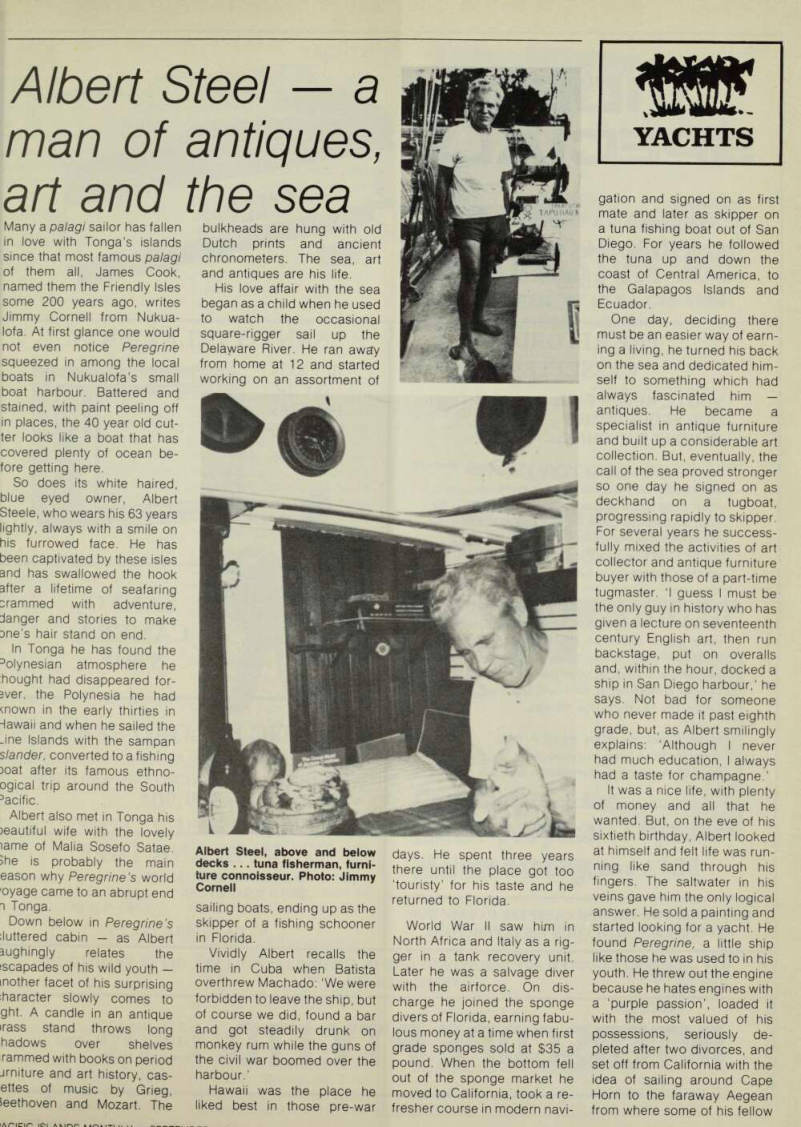

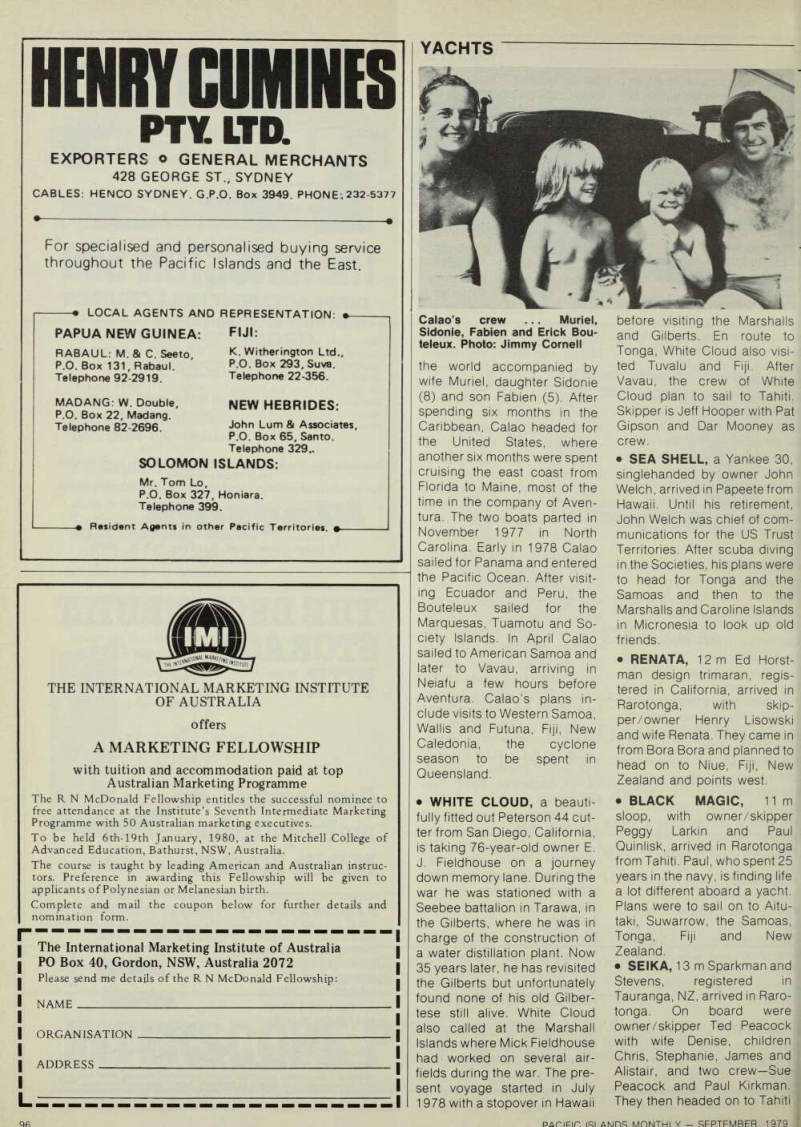
Yachts
Albert Steel - a man of antiques, art and the sea
Many a palagi sailor has fallen in love with Tonga’s islands since that most famous palagi of them all, James Cook, named them the Friendly Isles some 200 years ago, writes Jimmy Cornell from Nukua lofa. At first glance one would not even notice Peregrine squeezed in among the local boats in Nukualofa’s small boat harbour. Battered and stained, with paint peeling off in places, the 40 year old cut ter looks like a boat that has covered plenty of ocean be fore getting here.
So does its white haired, blue eyed owner, Albert Steele, who wears his 63 years lightly, always with a smile on his furrowed face. He has been captivated by these isles and has swallowed the hook after a lifetime of seafaring :rammed with adventure, danger and stories to make ane’s hair stand on end.
In Tonga he has found the Polynesian atmosphere he bought had disappeared for ever, the Polynesia he had mown in the early thirties in Hawaii and when he sailed the Jne Islands with the sampan slander, converted to a fishing )oat after its famous ethno ogical trip around the South 3 acific.
Albert also met in Tonga his )eautiful wife with the lovely lame of Malia Sosefo Satae. >he is probably the main eason why Peregrine’s world 'oyage came to an abrupt end n Tonga.
Down below in Peregrine’s buttered cabin - as Albert aughingly relates the (scapades of his wild youth mother facet of his surprising haracter slowly comes to ght. A candle in an antique •rass stand throws long hadows over shelves rammed with books on period Jrniture and art history, cas ettes of music by Grieg, leethoven and Mozart. The
bulkheads are hung with old Dutch prints and ancient chronometers. The sea, art and antiques are his life, His love affair with the sea began as a child when he used to watch the occasional square-rigger sail up the Delaware River. He ran away from home at 12 and started working on an assortment of
sailing boats, ending up as the skipper of a fishing schooner in Florida.
Vividly Albert recalls the time in Cuba when Batista overthrew Machado: ‘We were forbidden to leave the ship, but of course we did, found a bar and got steadily drunk on monkey rum while the guns of the civil war boomed over the harbour.’
Hawaii was the place he liked best in those pre-war
days. He spent three years there until the place got too ‘touristy’ for his taste and he returned to Florida.
World War II saw him in North Africa and Italy as a rig ger in a tank recovery unit.
Later he was a salvage diver with the airforce. On dis charge he joined the sponge divers of Florida, earning fabu lous money at a time when first grade sponges sold at $35 a pound. When the bottom fell out of the sponge market he moved to California, took a re fresher course in modern navi
gation and signed on as first mate and later as skipper on a tuna fishing boat out of San Diego. For years he followed the tuna up and down the coast of Central America, to the Galapagos Islands and Ecuador.
One day, deciding there must be an easier way of earn ing a living, he turned his back on the sea and dedicated him self to something which had always fascinated him antiques. He became a specialist in antique furniture and built up a considerable art collection. But, eventually, the call of the sea proved stronger so one day he signed on as deckhand on a tugboat, progressing rapidly to skipper.
For several years he success fully mixed the activities of art collector and antique furniture buyer with those of a part-time tugmaster. ‘I guess I must be the only guy in history who has given a lecture on seventeenth century English art, then run backstage, put on overalls and, within the hour, docked a ship in San Diego harbour,’ he says. Not bad for someone who never made it past eighth grade, but, as Albert smilingly explains: ‘Although I never had much education, I always had a taste for champagne.’
It was a nice life, with plenty of money and all that he wanted. But, on the eve of his sixtieth birthday, Albert looked at himself and felt life was run ning like sand through his fingers. The saltwater in his veins gave him the only logical answer. He sold a painting and started looking for a yacht. He found Peregrine, a little ship like those he was used to in his youth. He threw out the engine because he hates engines with a ‘purple passion’, loaded it with the most valued of his possessions, seriously de pleted after two divorces, and set off from California with the idea of sailing around Cape Horn to the faraway Aegean from where some of his fellow
Albert Steel, above and below decks ... tuna fisherman, furni ture connoisseur. Photo: Jimmy Cornell
tponge divers came. But a trip iround the Horn for a man on lis own became less appeal ng so Albert turned Per egrine's bows west, hoping to ind in the Pacific a trace of the itmosphere he had known lore than four decades ago. i 1976 he visited the Marquesas and Society >lands but life in French ’olynesia was not what he had oped to find. So, the following ear, he sailed to the Cooks nd finally Tonga.
As a ticketed captain he is ow much in demand and has Iready taken the Tofua, a 220 )nne Tongan ship, to New ealand for a refit. This is not le kind of life he has been »oking for though, so he plans ) refit Peregrine, sail a little nd possibly accept the offer > become the skipper of a ical fishing boat. And if this cesn’t work out, Peregrine is ill there to take Albert over ie horizons in pursuit of Dmething that perhaps does Dt even exist.
SILVERHEELS, 8 m sloop Yankee 26 type, arrived in pia at the end of May. merican couple David and at Mancini left San Diego, alifornia, in May 1978 bound r the Marquesas. They spent e cyclone season cruising e islands of French alynesia before heading west r Pago Pago. It took them 22 iys as winds were light and Iverheels has no engine, avid would like to continue liling around the world but s first mate (who has to man long oar when manoeuvring e boat in port) insists on an igine before carrying on. axt port of call: Suva.
MIKADO, 9 m Tirena de gn, registered in West Ger any, called in to Rarotonga Dm Bora Bora with vner/skipper Friedhelm achholz and wife Barbara, ans include American imoa, Tonga, Fiji and New jaland.
GAMBIT, 11 m sloop, from in Diego, California, arrived Rarotonga in early June >und for the Samoas, New jaland and Australia before lading on around the world.
Owner/skipper Buzz Hath away and wife Maureen left home early last year. • MANUITI II (‘little bird’ in Maori), 8 m sloop, arrived in Apia. The small yacht from Opua, NZ, a Laurent Giles designed version of the famous yacht TREKKA, is usually sailed singlehanded by Celia Reed, known in this part of the Pacific as ‘the lady with the funny dinghy’, the con traption in which she com mutes between ship and shore. It has the shape of an inverted Roman litter or a four poster baby coffin of classic design. Her uncle, the Rever end Rodney Murphy, joined Manuiti II in Rarotonga. Celia’s voyage started in April 1978 with a 28-day passage from New Zealand to Tahiti in the company of her brother Will Reed. After cruising for sev eral months in the Tuamotu and Society Islands, she sailed on to the Cooks. Future plans include Tonga and Fiji before returning home in November. • L’ORION, a Westsail 32 cutter from San Francisco, is taking the Lewis family on a scientific tour of the Pacific.
Nancy Lewis, a geographer specialising in medical ge ography, is studying ciguatera fish poisoning and its effects on Island populations. Nan cy’s research work is funded by a grant from the Fulbright Foundation. Don, a Vietnam veteran, worked for six years preparing the boat for the voy age, which started in Califor nia in December 1977. The Marquesas, Tuamotu and So ciety Islands were cruised for a year before sailing to the Cooks and the Samoas. The Lewises, who are ac companied by their eight year-old son Daren, plan to sail on to Fiji and New Zealand. • CALAO, 12.2 m yawl in the Finisterre class, registered in Toulon, France, sailed into Vavau for a Pacific rendez vous with AVENTURA, skip pered by PlM’s roving correspondent, Jimmy Cor nell. Calao left Le Havre in July 1976 with the Bouteleux family on board, 35-year-old Erick having given up his job as an insurance agent to sail around
before visiting the Marshalls and Gilberts. En route to Tonga, White Cloud also visi ted Tuvalu and Fiji. After Vavau, the crew of White Cloud plan to sail to Tahiti.
Skipper is Jeff Hooper with Pat Gipson and Dar Mooney as crew. • SEA SHELL, a Yankee 30, singlehanded by owner John Welch, arrived in Papeete from Hawaii. Until his retirement, John Welch was chief of com munications for the US Trust Territories. After scuba diving in the Societies, his plans were to head for Tonga and the Samoas and then to the Marshalls and Caroline Islands in Micronesia to look up old friends. • RENATA, 12 m Ed Horst man design trimaran, regis tered in California, arrived in Rarotonga, with skip per/owner Henry Lisowski and wife Renata. They came in from Bora Bora and planned to head on to Niue, Fiji, New Zealand and points west.
• Black Magic, 11 M
sloop, with owner/skipper Peggy Larkin and Paul Quinlisk, arrived in Rarotonga from Tahiti. Paul, who spent 25 years in the navy, is finding life a lot different aboard a yacht.
Plans were to sail on to Aitu taki, Suwarrow, the Samoas, Tonga, Fiji and New Zealand. • SEIKA, 13 m Sparkman and Stevens, registered in Tauranga, NZ, arrived in Raro tonga. On board were owner/skipper Ted Peacock with wife Denise, children Chris, Stephanie, James and Alistair, and two crew—Sue Peacock and Paul Kirkman.
They then headed on to Tahiti
the world accompanied by wife Muriel, daughter Sidonie (8) and son Fabien (5). After spending six months in the Caribbean, Calao headed for the United States, where another six months were spent cruising the east coast from Florida to Maine, most of the time in the company of Aven tura. The two boats parted in November 1977 in North Carolina. Early in 1978 Calao sailed for Panama and entered the Pacific Ocean. After visit ing Ecuador and Peru, the Bouteleux sailed for the Marquesas, Tuamotu and So ciety Islands. In April Calao sailed to American Samoa and later to Vavau, arriving in Neiafu a few hours before Aventura. Calao’s plans in clude visits to Western Samoa, Wallis and Futuna, Fiji, New Caledonia, the cyclone season to be spent in Queensland. • WHITE CLOUD, a beauti fully fitted out Peterson 44 cut ter from San Diego, California, is taking 76-year-old owner E.
J. Fieldhouse on a journey down memory lane. During the war he was stationed with a Seebee battalion in Tarawa, in the Gilberts, where he was in charge of the construction of a water distillation plant. Now 35 years later, he has revisited the Gilberts but unfortunately found none of his old Gilber tese still alive. White Cloud also called at the Marshall Islands where Mick Fieldhouse had worked on several air fields during the war. The pre sent voyage started in July 1978 with a stopover in Hawaii
Calao’s crew ... Muriel, Sidonie, Fabien and Erick Bou teleux. Photo: Jimmy Cornell
and the Marquesas. All new at oftshore sailing, they reported fair winds for their 19-day passage from Tauranga. • S’ECHAPPER (Escape), 12 m O’Kell design home-built ferro-cement hull, registered at the Royal Geelong Yacht Club, Victoria, Australia, arrived in Rarotonga with Roger French, Peter Jones and Alex Roper on board.
They planned to spend ‘sev eral weeks’ in Rarotonga be fore sailing on to Tahiti and other Islands. • ISLE OF FLIGHT, a 7 m Okomoto yawl, with owner/skipper Jon Powers and Constance Nypen as crew, arrived in Rarotonga from Bora Bora, bound for Aitutaki, Western Samoa, Tonga, Fiji and, finally, New Zealand. • JANDIRA, 11 m cutter, arrived at Tubuai in the Aus trals from Tahiti in May, with French couple Fabien and Michotte Poncet. Fabien has taken up a teaching position in
the secondary school which serves all of the Austral Islands. Jandira was built in France of balsa-core fibreglass construction with double centreboards, one fore and one aft. They left France in 1975 for French Guyana where they taught for two years, their two young chil dren joining them there. Then they all sailed to French Polynesia. The children have now returned temporarily to France to stay with their grandparents.
Fabien Poncett ... teaching in the Australs. Photo: Don Travers
Advertisements & other items, pp. 94-100 (5 items)
Interscope Rty.Ltd.
VIDEO
SPECIALS
SANYO BETA
VIDEO RECORDERS
sB99*
PRE RECORDED
CASSETTES
YOU'LL NEVER FIND
OUR PROGRAMMES
IN YOUR T.V. GUIDE...
A lot of people believe TV has a nine-yearold mentality. To them there is more to adult programming then "Charlie's Angels".
That's where we come in. Our range of films is a refreshing change from the TV networks roster. Don't be surprised if your TV grows up right before your eyes.
Video Classics are a unique collection of movies on video cassette. Movies you'll never see on television, each one a classic in its own right. Show them to your family and friends in your own home at your convenience. At a cost less than taking the family to the movies.
Video Classic cassettes are all in their original uncut form at broadcast quality. Available in formats to suit...
SANYO TELEVISION
10” $334
(AC/DC)
14” $343 18” $390 20” $506
SANYO
CAMERA
$294*
U-MATIC RELOAD SERVICE
WE WILL RELOAD YOUR OLD U-MATIC CASSETTES WITH NEW SCOTCH VIDEO TAPE AND HUBS $19.90*
U-MATIC $125.95
U-DO RELOAD KITS $17.00*
BETA and VHS $69.95
“ 1
SEND $l.OO FOR COLOUR CASSETTE CATALOGUE
3M BLANK TAPE
U-MATIC KCA 60 $26.00
BETA L5OO $17.56 L 750 $22.75
VHSEI2O $20.03 ElBO $24.06
REFUNDABLE WITH YOUR FIRST PURCHASE
WE HAVE BULK PRICES
* ALL PRICES QUOTED ARE FOB SYDNEY AND IN AUSTRALIAN DOLLARS. OFFER VALID UNTIL
SEPTEMBER 30th 1979
INTERSCOPE RTY.LTD.
G.P.0., Box 1757,
SYDNEY, N.S.W., 2001.
Phone: 92 1948
The KINGSTON 580
DISPLACEMENT HULL CRUISER
with built-in diesel power
Would you like to take six people out for a full day's cruising and fishing offshore and inshore for less than $5 of fuel 7 This fine economical and sate Kingston 580 can give you all that pi js a 12 month warranty • Fibreglass construction for economical maintenance • Does up to 14 knots with ease • Big selt-dramed cockpit • Choice of 12, 1 5,24 or 33 hp diesel engines • Lock Up cabin with 2 bunk • Plenty of room 5.80 metres long Available also Kingston Angler. Same hull, open boat version.
Ideal Mackerel boat For brochure and name of your nearest dealer phone or write.
•rDI lICCD CAI BC
CRUISER SALES PTY. LTD.
179 South Creek Road, Dee Why, N.S.W., 2099.
Teleohone; 981 3508
THE BROWNBUILT
STORAGE
WIZ
Compactus
multi-purpose
Mobile Storage
Accommodates contents of ten 4-drawer filing cabinets in about half the floor area . . . allowing more profitable use of the space saved. Cabinets roll smoothly apart for instant access. No permanent fixing of tracks to floor.
Ideal for use in multi-storey buildings because of low overall weight. All cabinets lock centrally.
For free expert advice and brochures contact: "Registered Trade Mark
Brownbuilt
BROWNBUILT L Cnr. Bath Rd. and Waratah St., Sutherland, N.S.W., Australia 2232.
AGENTS - SOLOMON ISLANDS: NCR Corporation, Honiara. NEW HEBR IDES: NCR Corporation, Vila NEW CALEDONIA: NCR Corporation. Noumea. PNG: Brownbuilt (PNG) Pty. Ltd., Port Moresby & Lae FIJI: Lysaght Brownbuilt Ind. (Fiji) Ltd., Suva. HAWAII: Records Management Services Inc., Honolulu.
PTY LTD.
EXPORTERS o GENERAL MERCHANTS
428 GEORGE ST., SYDNEY
CABLES: HENCO SYDNEY. G.P.O. Box 3949. PHONE; 232-5377 •
For specialised and personalised buying service
throughout the Pacific Islands and the East.
LOCAL AGENTS AND REPRESENTATION:
PAPUA NEW GUINEA:
RABAUL: M. & C. Seeto, P.O. Box 131, Rabaul.
Telephone 92-2919.
MADANG: W. Double, P.O. Box 22, Madang.
Telephone 82-2696.
SOLOMON
FIJI:
K. Witherington Ltd., P.O. Box 293, Suva.
Telephone 22-356.
NEW HEBRIDES:
John Lum & Associates, P.O. Box 65, Santo.
Telephone 329..
ISLANDS:
Mr. Tom Lo, P.O. Box 327, Honiara.
Telephone 399.
Resident Agents in other Pacific Territories. •-
THE INTERNATIONAL MARKETING INSTITUTE
OF AUSTRALIA
offers
A MARKETING FELLOWSHIP
with tuition and accommodation paid at top
Australian Marketing Programme
The R N McDonald Fellowship entitles the successful nominee to free attendance at the Institute’s Seventh Intermediate Marketing Programme with 50 Australian marketing executives.
To be held 6th-19th January, 1980, at the Mitchell College of Advanced Education, Bathurst, NSW, Australia.
The course is taught by leading American and Australian instructors. Preference in awarding this Fellowship will be given to applicants of Polynesian or Melanesian birth.
Complete and mail the coupon below for further details and nomination form.
The International Marketing Institute of Australia PO Box 40, Gordon, NSW, Australia 2072 Please send me details of the R N McDonald Fellowship:
NAME
ORGANISATION
ADDRESS
L
FORESTMIL
PORTABLE
SAWMILL
Latest design features mean - faster production - less maintenance • easier to operate and service.
Powered by diesel engine or electric motor. 5* 1 2S Forestmil Portable Sawmill : orestmil produces any size accurate timber ready to use ip to 12" x 9" x 24'. ’urchase price and operating cost of Forestmil is less than ither sawing equipment with similar production capacity, : orestmil reduces timber waste and also reduces log ransport cost. Timber is sawn direct from the log in the orest. : orestmil can be moved to a new location in one hour. orestmil will saw hardwood or softwood from logs of ny diameter.
Iver 1000 Forestmils are sawing timber in 23 countries, orestmil has been manufactured for 18 years. or literature and prices please contact the manufacturers.
IH
MacQuarrie Industries Pty.Ltd.
P.O. Box 20, Coburg 3058, Victoria, Australia.
Phone: 350-3411. Telex: 33729. Cables: Macbound. Melbourne.
PXPORISS
ISLAND
PA®?
THE
TO £
Breekwoldt & Co
P ij Ltd
Suite 1909, 19th Floor, King George Tower,
Corner King & George Streets, Sydney.
G.P.O. Box 5027, Sydney 2001.
i
CABLES; BREWO' SYDNEY TELEX: AA22890.
TELEPHONES; 233 2366, 232 2315, 233 1462.
PACIFIC ISLAM) Oi l ICES
BRECKWOLDT & CO (PNG) PTY LTD.
PO BOX 1549, BOROKO, PORT MORESBY.
PO BOX 222, RABAUL
PO BOX 72. KIETA
PO BOX 178, WEWAK
PO BOX 185, MAOANG
PO BOX 237, MT. HAGEN
PO BOX 1188, LAE
BRECKWOLDT & CO., PO BOX 47, APIA BRECKWOLDT & CO. (SI) LTD. PO BOX 140, HONIARA
BRECKWOLDT SARL BP 2369, NOUMEA
OFFICES IN:
HAMBURG
LONDON
MILAN
& WEST AFRICA
ALSO AT:
SINGAPORE
KUALA LUMPUR
BANGKOK
& HONG KONG
ENQUIRIES
FROM OVERSEAS MANUFACTURERS INVITED.
W/y £xpd*
THE WATER WHEEL GROUP OF COMPANIES,
Winners of Australia’s Top Export Award and Flour Millers for over 100 years,
OFFER THE PACIFIC ISLANDS
THE TOPS IN QUALITY
PRODUCTS & SERVICE
YY BEST AUSTRALIAN WHEATEN
FLOUR
(High Protein, Roller, Stone ground Wholemeal, Bakers, Cake etc)
YY COMPLETE RANGE OF FROZEN
AND GENERAL FOOD ITEMS
YY STOCK & POULTRY FEEDS
(Pellets or Mash form)
YY YELLOW SPLIT PEAS & WHOLE
PEAS
(Machine-Dressed)
YY REFRIGERATION EQUIPMENT
INCLUDING SALT WATER ICE
MAKERS
YY QUALITY AUSTRALIAN WINES
Papua New Guinea, Fiji, Tonga, Western Samoa, American Samoa, New Hebrides, New Caledonia, Solomon Islands and Micronesia.
All Enquiries Welcome To:
WATER WHEEL EXPORTS
Pty. Ltd.
493 Bourke Street, Melbourne, 3000, Australia Cables: Watermill-Melbourne.
Telex: AA 32165 Telephone: 602 1433
Express Freight Service between U S Pacific Coast Ports &
PAPEETE • APIA • PAGO PAGO
Full Container Service including Refrigeration
GENERAL AGENTS'
ft POLYNESIA LINE, LTD.
AGENTS
PAPEETE MORGAN; Vernex Boite Postale 449. Papeete Phone: 309 Cables: MOREX PAGO PAGO POLYNESIA SHIPPING SERVICES. INC . Pago Pago Phpne; 633-5169 Cables: POLYSHIP APIA - UNION S.S CO., of N.Z Ltd., P O Box 50. Apia, Western Samoa Phone; 570 Cables: UNION
fURNESS INTEROCE4N
CORPOR4HON
46S CALIFORNIA STREET SAN FRANCISCO CA 94104 Cable INTERCQ) • TWX 910372 73M) • RCA 278 207 TEL <4l Si 398 2000
GENERAL OR
we've got the Pacific covered
It’s never been easier to move general or refrigerated cargoes between New Zealand and the Islands of the Pacific. The Shipping Corporation of New Zealand offers shippers two regular services, at attractive freight rates, to and from a growing number of ports throughout the region.
Cook Islands, Niue, Tahiti
The Corporation operates two vessels “TIARE MOANA” and “FETU MOANA” to and from Niue, the Cook Islands and Tahiti. Both vessels are well matched to the specialised nature of this trade. Side doors allow easier pallet and unit load stowage. A variety of derricks and cranes assist general loadings.
REFRIGE
TED
I M 4> i »» u * TW*»r 2] 0 a
The Shipping Corporation
of New Zealand Limited \|*T
Sea Carrier to the Nation
AUCKLAND: PC Box 3420, Phone 797-210 Telex NZ2822 WELLINGTON: PC Box 3344, Phone 728-500 Telex NZ3495. CHRISTCHURCH: PC Box 777. Phone 795-760 Telex NZ4434 DUNEDIN; PC Box 904.
Phone 776-076 Telex NZ5228. NAPIER: PC Box 748. Phone 58-411 Telex 31047.
Area Agents: NIUE: Government Shipping Office. Alofi COOK ISLANDS: Waterfront Commission, PO Box 61, Rarotonga.
Telex: Shipping RG 2002. TAHITI; Compagnie Maritime Polynesienne. PO Box 368 Papeete, Telex; Taporo FP2SB
z S o ■A
GLOBAL SERVICE FOR SHIPPERS
V
THE BANK LINE
m.
Monthly Services
United Kingdom and Continent to:
PAPEETE • NOUMEA
PAPUA NEW GUINEA and SOLOMON ISLANDS
PORT VILA & SANTO BY TRANSHIPMENT
United Kingdom and Continent to: SUVA AND LAUTOKA (FCL LCL & UNITISED ONLY) * Papua New Guinea and Solomon Islands to:
UNITED KINGDOM and CONTINENT
For particulars apply:
THE BANK LINE (AUSTRALASIA) PTY. LTD.
18th Floor 1 York Street SYDNEY N.S.W 2000 Australia Tel: 272041 Telex; 24063
Yachts
Yachts
96
PAniPir. IRI AMDS MDNTHI Y SEPTEMBER 1979
Yachts
. i ii \/ orn-rrK ad crn 1
100
r-> A /-1 r-1 r' 101 AMPvC MfiKITUI V CCDTCMQCD 1 Q7Q
Services
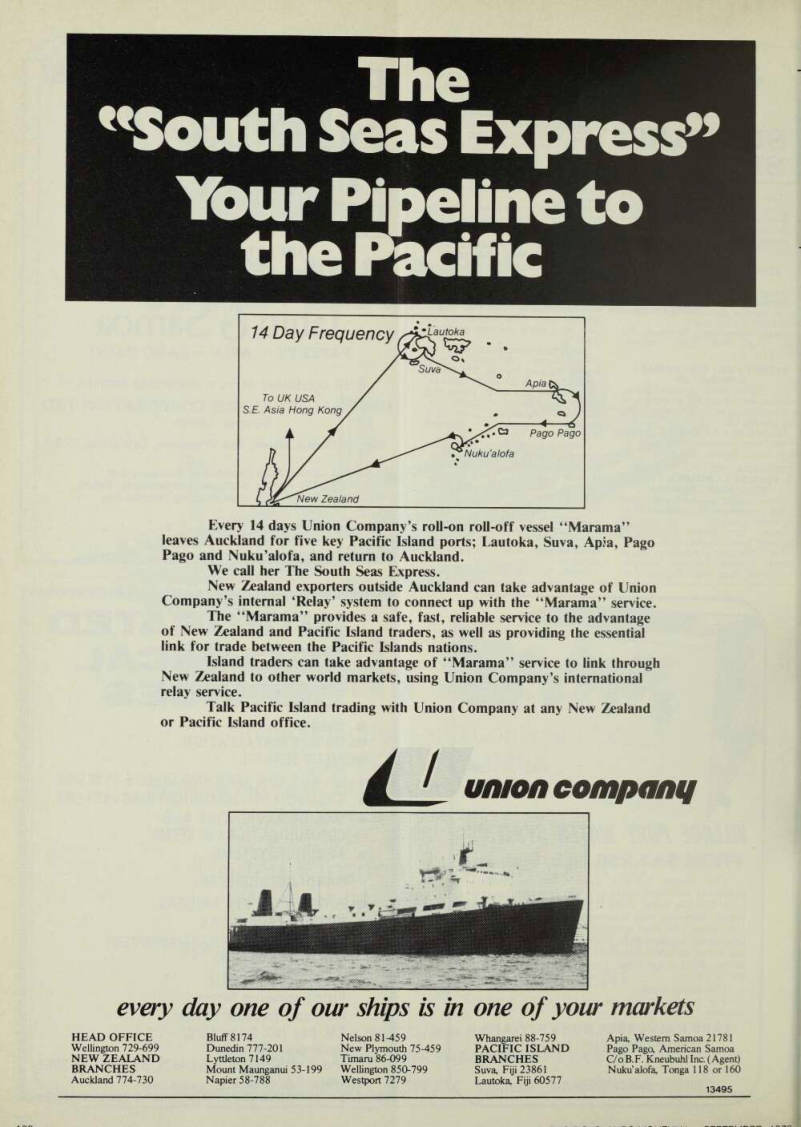
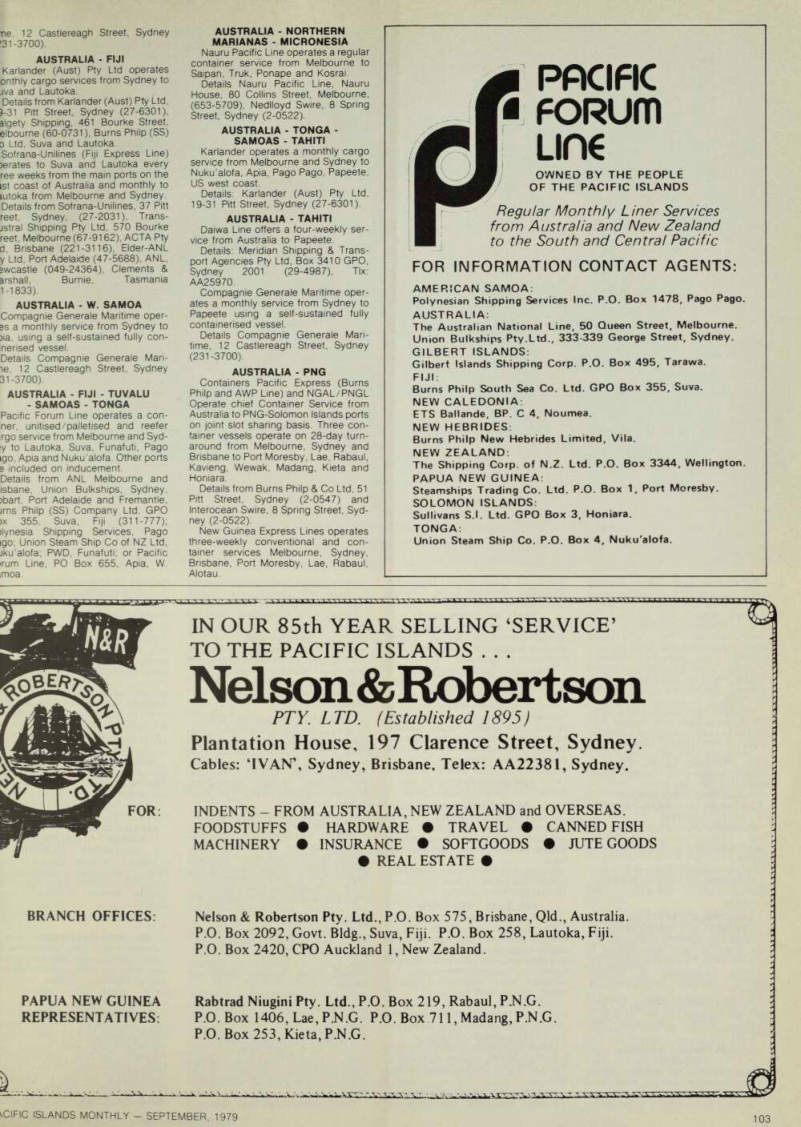
Shipping
These listings do not necessarily cover all services to Island ports.
Should any shipping company wish to have its services cargo and passenger included in these list ings they should contact PIM,
Sydney - Lord Howe Is -
Norolk Is
Compagnie des Chargeurs laledoniens operates four-weekly argo service Sydney - Lord Howe land and Norfolk Island.
Details Hetherington Kingsbury Pty td, 37-49 Pitt Street, Sydney >7-1671).
SYDNEY - NZ - FIJI - HAWAII -
Canada - Us
P & O liners call at Auckland, Suva, onolulu and Vancouver on eastbound nd westbound voyages between Syd ey and the US.
Details from P & O Booking Centre, forld Travel Headquarters Pty Ltd, 33 ligh Street, Sydney (231-6655).
AUSTRALIA - NZ - FIJI - TONGA - M. HEBRIDES - NOUMEA - PNG -
Solomons -Samoas
Sitmar Cruises operates a year-round ruise programme to include most of le above countries.
Details from Sitmar Cruises, 47 lizabeth Street, Sydney (232-7511).
P & O liners call at Auckland, Bay of lands, Honiara, Lautoka, Noumea, uku'alofa, Pago Pago, Papeete, Port
Moresby, Santo, Savusavu, Suva, Vavau and Vila on cruises from Aus tralia.
Details from P & 0 Booking Centre, World Travel Headquarters Pty Ltd, 33 Bligh Street, Sydney (231-6655).
Australia - Fiji - Samoas -
New Hebrides - Tonga -
Norfolk Island
Pacific Navigation of Tonga operates a five-weekly refrigerated general car go/container service from Sydney and Brisbane to Vila, Santo, Suva, Lautoka, Apia, Pago Pago, Nuku'alofa and Nor folk Island.
Details from Beaufort Shipping Agency Co, 2 Castlereagh Street, Syd ney (239-1022).
Australia - New Caledonia
(And/Or) New Hebrides
Karlander operates a monthly service from Sydney to Noumea.
Details: Karlander (Aust) Pty Ltd, 19-31 Pitt Street, Sydney (27-6301).
Sofrana-Unilines ships serve Noumea every three weeks from the main ports along the east Australian coast.
Details from Sofrana-Unilines, 37 Pitt Street, Sydney (27-2031), Trans- Austral Shipping Pty Ltd, 570 Bourke Street, Melbourne (67-9162), ACTA Pty Ltd, Brisbane (221-3116), Elders-ANL Pty Ltd, Port Adelaide (47-5688), ANL, Newcastle (049-24364), Clements & Marshall, Burnie, Tasmania (31-1833).
Compagnie des Chargeurs Cale donians operates a three-weekly con tainerised cargo service from Sydney to Noumea.
Details Hetherington Kingsbury Pty Ltd, 37-49 Pitt Street, Sydney (27-1671).
Compagnie Generale Maritime oper ates a monthly service from Sydney to Noumea, Port Vila and Santo, using a self-sustained fully containerised vessel.
Details Compagnie Generale Mari
ne, 12 Castlereagh Street, Sydney 131-3700).
Australia - Fiji
Karlander (Aust) Pty Ltd operates onthly cargo services from Sydney to jva and Lautoka.
Details from Karlander (Aust) Pty Ltd, )-31 Pitt Street, Sydney (27-6301), algety Shipping, 461 Bourke Street, elbourne (60-0731), Burns Philp (SS) o Ltd, Suva and Lautoka.
Sofrana-Unilines (Fiji Express Line) >erates to Suva and Lautoka every ree weeks from the main ports on the ist coast of Australia and monthly to lutoka from Melbourne and Sydney.
Details from Sofrana-Unilines, 37 Pitt reet, Sydney, (27-2031), Trans jstral Shipping Pty Ltd, 570 Bourke reet, Melbourne (67-9162), ACTA Pty d, Brisbane (221-3116), Elder-ANL y Ltd, Port Adelaide (47-5688), ANL, awcastle (049-24364), Clements & arshall, Burnie, Tasmania 1-1833).
Australia - W. Samoa
Compagnie Generale Maritime oper as a monthly service from Sydney to )ia, using a self-sustained fully con nerised vessel.
Details Compagnie Generale Mari ie, 12 Castlereagh Street. Sydney 31-3700).
Australia - Fiji - Tuvalu
- Samoas • Tonga
Pacific Forum Line operates a Con ner, unitised/palletised and reefer rgo service from Melbourne and Syd y to Lautoka, Suva, Funafuti, Pago igo, Apia and Nuku'alofa. Other ports a included on inducement.
Details from ANL Melbourne and isbane, Union Bulkships, Sydney, )bart, Port Adelaide and Fremantle, irns Philp (SS) Company Ltd, GPO >x 355, Suva, Fiji (311-777); ilynesia Shipping Services, Pago igo; Union Steam Ship Co of NZ Ltd, jku’alofa; PWD, Funafuti; or Pacific irum Line, PO Box 655, Apia, W, moa.
Australia - Northern
Marianas - Micronesia
Nauru Pacific Line operates a regular container service from Melbourne to Saipan, Truk, Ponape and Kosrai.
Details Nauru Pacific Line, Nauru House, 80 Collins Street, Melbourne, (653-5709), Nedlloyd Swire, 8 Spring Street, Sydney (2-0522).
Australia - Tonga -
Samoas - Tahiti
Karlander operates a monthly cargo service from Melbourne and Sydney to Nuku’alofa, Apia, Pago Pago, Papeete, US west coast.
Details: Karlander (Aust) Pty Ltd, 19-31 Pitt Street, Sydney (27-6301).
Australia - Tahiti
Daiwa Line offers a four-weekly ser vice from Australia to Papeete.
Details: Meridian Shipping & Trans port Agencies Pty Ltd, Box 3410 GPO, Sydney 2001 (29-4987), Tlx: AA25970.
Compagnie Generale Maritime oper ates a monthly service from Sydney to Papeete using a self-sustained fully containerised vessel.
Details Compagnie Generale Mari time, 12 Castlereagh Street, Sydney (231-3700).
Australia - Png
Containers Pacific Express (Burns Philp and AWP Line) and NGAL/PNGL Operate chief Container Service from Australia to PNG-Solomon Islands ports on joint slot sharing basis. Three con tainer vessels operate on 28-day turn around from Melbourne, Sydney and Brisbane to Port Moresby, Lae, Rabaul, Kavieng, Wewak, Madang, Kieta and Honiara.
Details from Burns Philp & Co Ltd, 51 Pitt Street, Sydney (2-0547) and Interocean Swire, 8 Spring Street, Syd ney (2-0522).
New Guinea Express Lines operates three-weekly conventional and con tainer services Melbourne, Sydney, Brisbane, Port Moresby, Lae, Rabaul, Alotau.
Details from New Guinea Express Lines, PO Box R 73, Royal Exchange PC, Sydney (241-3991) MacArthur Shipping Agency Co, 82-92 Eagle Street, Brisbane (229-3777), New Guinea Express Lines, 327 Collins Street, Melbourne (61-3053), Niugini Express Lines in Port Moresby (21-2466), Lae (42-1536), Rabtrad Niugini Pty Ltd, Rabaul (92-2911), Alotau Stevedoring & T'sport (61-1318).
Karlander New Guinea Line’s cargo vessels call at Melbourne, Sydney, Port Moresby, Lae, Madang, Wewak, Manus, Kimbe, Rabaul, Popondetta.
Details from Karlander (Aust) Pty Ltd, 19-31 Pitt Street, Sydney (27-6301), Dalgetty Shipping, 461 Bourke Street, Melbourne (60-0731).
Australia-Solomons
Northern Marianas-Taiwan
Japan
Daiwa Line offers a four-weekly ser vice Sydney-Honiara-Guam-Taiwan- Japan with transhipment at Guam for Saipan.
Details Meridian Shipping & Trans port Agencies Pty Ltd, Box 3410 GPO, Sydney 2001 (29-4987), Tlx, AA25970.
Australia - Solomons -
Gilbert Is - Micronesia
Daiwa Line operates a container ser vice every 30 days from Sydney to Honiara, Kieta, Tarawa and Guam. Gizo cargoes transhipped at Honiara, Saipan, cargoes transhipped at Guam.
Details Meridian Shipping & Trans port Agancies Pty Ltd, Box 3410 GPO Sydney 2001 (29-4987), Tlx.
AA25970
Australia - Nauru -
Majuro
Nauru Pacific Line operates regular cargo/passenger service from Mel bourne to Nauru and Majuro.
Details: Nauru Pacific Line, Nauru
House, 80 Collins Street, Melbourne (653-5709), Nedlloyd Swire, 8 Spring Street, Sydney (2-0522).
Png - Uk/Continent
Bank Line operates regular cargo service from Kieta, Rabaul, Kimbe, Madang and Lae to Cardiff, Hamburg, Rotterdam and Antwerp.
Details from Bank Line (A'asia) Pty Ltd, 1 York Street, Sydney (27-2041); Burns Philp (PNG) Ltd, ports.
Png - Us
Bank Line operates regular cargo service from Kieta, Rabaul, Kimbe, Madang and Lae direct to New Orleans; calls at other US and Gulf and East Coast ports on inducement.
Details from Bank Line (A’asia) Pty Ltd, 1 York Street, Sydney (27-2041); Burns Philp (PNG) Ltd, PNG ports.
Solomons - Usa -
Uk/Continent
Bank Line operates regular cargo service from Honiara to New Orleans, Cardiff, Hamburg, Rotterdam and Ant werp.
Details from Bank Line (A’asia) Pty Ltd, 1 York Street. Sydney (27-2041); Trading Co, Honiara (389).
Far East - Fiji - New
Zealand
New Zealand Unit Express (CNC.
MNOL, Nedlloyd) operates a three weekly cargo service from Hong Kong to Lautoka, Suva, NZ ports, Manila, Kaoshiung, Keelung, Hong Kong.
Details from Nedlloyd, 8 Spring Street, Sydney (2-0522), Nedlloyd operates monthly cargo service with three ships from Surabaya, Jakarta, Bangkok, Port Keland and Sin gapore to Suva and NZ ports.
Details from Nedlloyd (Aust) Pty Ltd, 8 Spring Street, Sydney (27-3801); Burns Philp (SS) Co Ltd, Suva and Lau toka.
Japan - Fiji - New Zealand
China Navigation, operates a
monthly service from main ports Japan to Suva and Lautoka and thence Noumea and NZ.
Details from Carpenters Shipping Suva (312-244).
Japan - Png
Mitsui O.S.K. Lines operates a monthly service from main ports Japan and Port Moresby, Rabaul, Lae, Madang, Kieta and Kimbe.
Details from J. C. Waller, Port Moresby (21-1755).
Far East - Mid-S. Pacific
New Guinea Pacific Line (NGPL) op erates a regular cargo service from Hong Kong, Taiwan, Manila, Port Kelang and Singapore to Wewak, Madang, Kimbe, Rabaul, Kieta, Lae, Port Moresby, Honiara, Santo, Vila, Noumea, Papeete, Pago Pago, Apia, Tarawa and Nauru.
Details from Steamships Trading Co., Port Moresby (21-2000).
Kyowa Shipping Ltd, operates monthly services from Hong Kong, Taiwan, S. Korea and Japan, to Guam, Saipan, Solomons, New Caledonia, Fiji, Western and American Samoa, Tahiti, Cook Is., Tonga and New Hebrides.
Details: Hetherington Kingsbury Pty Ltd, 37-49 Pitt Street, Sydney (27-1671).
Daiwa Line operates 30-day service from Moji, Kobe, Nagoya and Yokohama to Papeete, Pago Pago, Apia, Suva, Lautoka, Noumea, Sydney, Honiara, Kieta, Tarawa, Guam and Taiwan.
Details: Meridian Shipping & Trans port Agencies Pty Ltd, Box 3410 GPO Sydney 2001 (29-4987) Tlx: AA25970.
North Europe - Tahiti -
New Caledonia
Hamburg-Sued operates monthly cargo services from Hamburg, Dunkirk and Le Havre to Papeete, Noumea, via Panama.
Details from Columbus Overseas
Services Pty Ltd, 333 George Street, Sydney (290-2966), Columbus Mari time Services, 17 Albert Street, Auckland (77-3460).
Europe - Pacific Islands
Compagnie Generale Maritime oper ates services from Europe and Mediter ranean ports to Papeete and Noumea using three Ro-Ro and one multi purpose vessel thus ensuring a bi monthly sailing to and from.
Details Compagnie Generale Mari time, 12 Castlereagh Street, Sydney (231-3700).
EUROPE - TAHITI - W. SAMOA -
Fiji - N. Caledonia
Nedlloyd offers regular cargo ser vices from Northern Europe and UK to* Papeete, Apia, Fiji and New Caledonia.
Details Nedlloyd (Aust) Pty Ltd, 8 Spring Street, Sydney (27-3801).
JAPAN - GUAM - FIJI - TAHITI -
Samoa - N. Caledonia -
Solomons - Gilberts
Daiwa Lines runs a monthly cargo service from Japan via Guam to Lau toka, Suva, Papeete, Pago Pago, Apia, Sydney, Noumea, Honiara, Tarawa, Guam.
Details from Burns Philp (SS) Co Ltd, Suva.
Nz - New Caledonia - Fiji
Pacific Forum Line operates a uni-] tized/ palletized and reefer cargo ser-* vice from Lyttelton and Auckland to I Napier, Noumea, Lautoka and Suva.l Other ports are included on| inducement.
Details from Shipping Corporation of I NZ Ltd, Auckland, Christchurch,!
Wellington, Burns Philp (SS) Company!
Ltd, GPO Box 355, Suva, Fiji (311 -777); I Polynesia Shipping Services, Pago] Pago; Union Steam Ship Co of NZ Ltd, [ Nukualofa or Pacific Forum Line, POl Box 655, Apia, W. Samoa.
Nz-N. Caledonia-N. Hebrides
Png-Solomons
Sofrana Unilines with three ships opites to Vila and Santo, to Honiara and pua New Guinea and to Noumea.
Details from Sofrana Unilines, 18 stems Street, Auckland (773-279), i Box 3614, Telex NZ2313.
Nz - New Caledonia
- Solomons - Gilberts -
Micronesia
Jnion Co/Daiwa Line operates a itainer service from New Zealand ough Sydney to Guam.
Details; Union Steam Ship Co of NZ I, PO Box 12, Auckland.. ’ - FIJI - NORTH AMERICA tWCI
Jlue Star l"Tl™ PaafcCoastwn-
ler services. Only direct service to f from New Zealand Blue Star sels call at Suva and Honolulu on -US-West Coast voyages )etails from Blueport ACT (NZ) Ltd, Box 192, Wellington (739-029) , ■ns Philp (SS) Co Ltd, GPO Box 355, ra. Fiji (311-777). eill
leef operate"
a from Auckland to Suva and Lau- )etails from Reef Shipping Agencies , PO Box 3382, Auckland, NZ -1221-3). ’acific Line with one ship operates nightly roro cargo service New ‘land. Lautoka, Suva. letails; Sofrana Umlines, 18 Cusis Street, Auckland (773-279) PO ' 3614, Telex: NZ2313.
Nz - Fiji - Gilberts -
Solomons - Png
acific Forum Line operates a coner, umtised/palletised and reefer 3° ae ™ ,c ® r0 o Lyttelton and -kland to Suva, Port Moresby, Lae iiara, Tarawa, Madang, Lae and t Moresby. Other ports are included inducement etails from Shipping Corporation of
NZ Ltd, Auckland. Christchurch and Wellington. Burns Philp (SS) Company Ltd, GPO Box 355, Suva, Fiji (311-777) Sullivans, Honiara; Gilbert Islands Ship ping Corporation, Tarawa Steamships Trading in Port Moresby, Lae and Madang or Pacific Forum Line, PC Box 655 ' Apia. W Samoa.
Union Steam Ship Co of NZ operates a roll-on, roll-of, container/umtised ser vice from Auckland to Lautoka-Suva- Pa 9° Pago-Apia-Nuku-alofa on al4 day frequency Details from Union Steam Ship Co of Ltd, PO Box 12, Auckland or from 255. h f ces/a 9 ents in Tonga
Samoa
T^nofoDerates
a oo AuSnd Nukualofa Pann S - Ania Auckland 9 9 P Details from McKav Shiooino Ltd
DownSn Souse QueS
Auckland no 2291 Warner Parifir I in P cprvirp* Warner racmc Line services
Aofa tortniohtlv
frS^er<aKSesTso Tima u carrying freezer cargo.
Details from Air Marine Services (NZ) Ltd, PO Box 2505, Auckland (796-841), Telex NZ21555.
NZ - COOK IS - NIUE -
Tahiti
Shipping Corporation of NZ Ltd oper ates cargo services based on pallets and similar units from Auckland to Niue, Cook 'stands and Tahiti.
Details from the Shipping Corp of NZ L j d - PC J. 4 r 2 °- m^^ kla p nd Commission, PO QtoSforflrinor!? 0 A»’ n 2 btevedoring Co Aitutaki, Niue Govt N,ue s and o^?^?| g, l ie Man ’ time Polynesienne, B P 368, Papeete, a ti
Uk - N Continent - Fiji
The Bank Line operates a direct, fast monthly service from Hull, Hamburg, Bremen, Antwerp and Rotterdam to Suva and Lautoka.
Details from the Bank Line (Aus tralasia) Pty Ltd, 1 York St, Sydney (27-2041); Burns Philp (South Sea) Co Ltd, Suva and Lautoka.
Uk/N. Continent - Tahiti -
N Caledonia - N. Hebrides
Bank Line operates regular cargo service from Hull, Hamburg, Bremen, Antwerp and Rotterdam to Papeete and Noumea.
Details from Bank Line tA'asial Ptv r S „ M N Fare UTE ' PaPeotB; EtS Ballande ' Noumea
Uk/N. Continent - Png -
Solomons
Bank jne regular cargo service from Hull. Hamburg, Bremen, Antwerp and Rotterdam to Port Moresby, Lae, Madang, Kimbe, Rabaul, Kieta and Honiara and on inducement yandina Details from Bank Line (A’asia) Pty Ltd. 1 York Street, Sydney (27-2041); Burns Philp (PNG) ltd. PNG ports; Trading Co Honiara.
Honolulu - Samoas - Tonga
Warner Pacific Line operates unit ized/palletized and reefer cargo ser vice every 45 days Honolulu/Pago Pago-Apia-Nuku'alofa. Line Islands and Suva by inducement.
Details from Hawaii-Pacific Maritime Inc, Honolulu, H, 96801. Tel. (808)
(531-4841) Tlx (Rca): 723-8330 Itt
743-0040. Cables ‘Oral’
San Francisco - Honolulu -
Nauru - Micronesia
Nauru Pacific Line operates regular conventional/container service from San Francisco and Honolulu to Majuro, p o nape, Truk and Saipan. Cargo is accepted for Nauru and Kosrai with transhipment at Majuro and Ponape
Details from Nauru Pacific Line, Nauru House, 80 Collins Street, Mel bourne (653-5709); North American Maritime Agencies, 100 California Street, San Francisco, California 9411 (981-0343).
US - FIJI - TAHITI - NZ -
Australia
Bank and Savill Line Ltd, operates regular cargo services from US Gulf ports to Australia and NZ. Calls at Suva, Lautoka and Papeete on demand, Details from Bank Line (A’asia) Pty Ltd ' 1 York Street, Sydney (27-2041) or Howard Smith Industries Pty Ltd, 1 York Street, Sydney (27-5611)/
Us - Tahiti - Samoa
Pacific Islands Transport operates a five weekly cargo service from North America west coast ports to Papeete, Pa 9° Pago. Apia.
Details from Polynesia Shipping Ser "pes Inc. PO Box 1478 Pago Pago (9-6799).
Polynesia Line operates container and general cargo service from US west coast P orts t 0 P a Peete and Pago. . details from Polynesia Shipping Ser ™es Inc.. Box 1478, Pago Pago Tahiti cauha m? a,.ct ua- ami 11 -&amua - AUb I FarreH Lines |nc, operate a fast reg ular lash/container cargo service from ports Canada/ÜbA to Pa JJ ( a P 9 ° Pa9 ° thence t 0 NZ a °J/H® tra J!“: ...
Cw2nlw S M^h™irll2 a e 'j
£ f VnZI Ltd' Auckland and
WeHinoton Z W 2445 d Cable DALSHIP Auckland; Compagnie Mari time Polynesienne, Immeuble Franco Oceanienne, PO Box 368, Papeete, Tahiti, Tel 26393, Tlx 258. FP ANSB Taporo, Cable OCEAN Papeete Kneubuhl Maritime Service, PO Box 39,’
Pago Pago, Telephone 633-5121; Tlx 782505.
Advertisements & other items, pp. 101-108 (5 items)
CIFIC ISI AMDS MDMTHI V qpdtcmdcd 1070
Transport
ISLANDS
LINE
MS AFRICANSTARS
Express Freight Service between Pacific Coast Ports of U.S.A. and...
Tahiti 6 Samoa
PAPEETE - APIA - PAGO PAGO
Full container service including reefers.
GENERAL STEAMSHIP CORPORATION LTD.
General Agents 400 California Street, San Francisco, California, U.S.A.
APIA: Bums Philp (South Sea) Company Ltd.
PAPEETE: Agenoe Maritime Internationale, Tahiti.
PAGO PAGO; Polynesia Shipping Services Inc.
VILLAGE PURE WATER SYSTEMS
FROM $A3,250 f.o.b. Sydney
The reverse osmosis system which reclaims, processes and desalinates salt and brackish water at an affordable price. Fully self-contained and easy to install. Requires only a water source and 240 or 11 5 Volt power. No heat required. Seven models available producing from 100 to 2600 gallons per day from sea water or approximately double that from bore water. Sizes range from 27" x 24" x 16" to 54" x 24" x 16".
Dealers required.
For further details of the VILLAGE SYSTEM contact:
LARS HALVORSEN SONS PTY. LTD.
Waterview Street, Ryde, N.S.W. 211 2 Tel: (02) 80-2051 Australia. Telex:AA26472
.Recall Advtg
HALVORSEN
H Rl5
INTEGRATED
TECHNICAL
SERVICES
• SALES
• ON SITE INSTALLATION
• FIELD SERVICE
• HF, VHF, UHF LINK AND MOBILE SYSTEMS
• GROUND/AIR COMMUNICATIONS SYSTEMS
• MARINE NAVIGATION AND
COMMUNICATIONS SYSTEMS
• AVIONICS SYSTEMS
MANUFACTURERS OF:
• PORTABLE DEPTH FINDERS
• HF RADIO SCANNERS
• MICROPROCESSER BASED PROCESS
CONTROL SYSTEMS
Field Engineering Section, Integrated Technical Services, PO. Box 350, Cairns 4870, Queensland, Australia.
Phone: (070)51-1616,51-4826,53-1356, 51-3052 Telex: AA48085.
The
"South Seas Exprass-
Your Pipeline to
the Pacific
14 Day Frequency /^i au £SL
To UK USA
S.E. Asia Hong Kong Apia C 3 Pago Pago 7* Nukualofa New Zealand Every 14 days Union Company’s roll-on roll-off vessel “Marama” leaves Auckland for five key Pacific Island ports; Lautoka, Suva, Apia, Pago Pago and Nukualofa, and return to Auckland.
We call her The South Seas Express.
New Zealand exporters outside Auckland can take advantage of Union Company’s internal ‘Relay’ system to connect up with the “Marama” service.
The “Marama” provides a safe, fast, reliable service to the advantage of New Zealand and Pacific Island traders, as well as providing the essential link for trade between the Pacific Islands nations.
Island traders can take advantage of “Marama” service to link through New Zealand to other world markets, using Union Company’s international relay service.
Talk Pacific Island trading with Union Company at any New Zealand or Pacific Island office.
union company
r_ MM r r every day one of our ships is in one of your markets
HEAD OFFICE
Wellington 729-699
NEW ZEALAND
BRANCHES
Auckland 774-730 Bluff 8174 Dunedin 777-201 Lyttleton 7149 Mount Maunganui 53-199 Napier 58-788 Nelson 81-459 New Plymouth 75-459 Timaru 86-099 Wellington 850-799 Westport 7279 Whangarei 88-759
PACIFIC ISLAND
BRANCHES
Suva, Fiji 23861 Lautoka, Fiji 60577 Apia, Western Samoa 21781 Pago Pago, American Samoa C/oB.F. Kneubuhl Inc. (Agent) Nukualofa, Tonga 118 or 160 13495
PACIFIC
FORUm
Line
OWNED BY THE PEOPLE
OF THE PACIFIC ISLANDS
S Regular Monthly Liner Services
|g| from Australia and New Zealand
91 to the South and Central Pacific
FOR INFORMATION CONTACT AGENTS:
AMERICAN SAMOA:
Polynesian Shipping Services Inc. P.O. Box 1478, Pago Pago.
AUSTRALIA:
The Australian National Line, 50 Queen Street, Melbourne.
Union Bulkships Pty.Ltd., 333-339 George Street, Sydney.
GILBERT ISLANDS:
Gilbert Islands Shipping Corp. P.O. Box 495, Tarawa.
FIJI;
Burns Philp South Sea Co. Ltd. GPO Box 355, Suva.
NEW CALEDONIA:
ETS Ballande, BP. C 4, Noumea.
NEW HEBRIDES;
Burns Philp New Hebrides Limited, Vila.
NEW ZEALAND.
The Shipping Corp. of N.Z. Ltd. P.O. Box 3344, Wellington.
PAPUA NEW GUINEA:
Steamships Trading Co. Ltd. P.O. Box 1. Port Moresby.
SOLOMON ISLANDS:
Sullivans S.l. Ltd. GPO Box 3, Honiara.
TONGA:
Union Steam Ship Co. P.O. Box 4, Nukualofa.
OBE^t*
O 'T
FOR:
IN OUR 85th YEAR SELLING ‘SERVICE’
TO THE PACIFIC ISLANDS . . .
Nelson & Robertson
PTY. LTD. (Established 1895)
Plantation House, 197 Clarence Street, Sydney.
Cables: ‘IVAN’, Sydney, Brisbane. Telex: AA22381, Sydney.
INDENTS - FROM AUSTRALIA, NEW ZEALAND and OVERSEAS.
FOODSTUFFS • HARDWARE • TRAVEL • CANNED FISH MACHINERY • INSURANCE • SOFTGOODS • JUTE GOODS
• REAL ESTATE •
BRANCH OFFICES: Nelson & Robertson Pty. Ltd., P.O. Box 575, Brisbane, Qld., Australia.
P.O. Box 2092, Govt. Bldg., Suva, Fiji. P.O. Box 258, Lautoka, Fiji.
P.O. Box 2420, CPO Auckland 1, New Zealand.
PAPUA NEW GUINEA Rabtrad Niugini Pty. Ltd., P.O. Box 219, Rabaul, P.N.G.
REPRESENTATIVES: P.O. Box 1406, Lae, P.N.G. P.O. Box 711, Madang, P.N.G.
P.0.80x 253, Kieta, P.N.G.
X. f' y?
For more information contact: Limited . Adelaide, South Australia • Morris Hedstrom Limited... Suva, Fiji . Societe des Messag PaykelLtd. .. Panmure, New Zealand • Steamships Trading Co., Ltd. . Port Moresby, Papua New Guinea . Bums PhiiplS Ltd... Honiara, Solomon Islands • Ets. Jean Vognin ... Papeete, Tahiti • Morris Hedstrom Ltd... Nukualofa Tonga
vhen you own n Leonard
Refrigerators, Freezers, Gas and Electric Ranges, Air Conditioners, Automatic Washers and Dryers, Wringer Washers, Humidifiers, Dehumidifiers, Water Coolers, Commercial Air Conditioners and Refrigeration. &
LEONARD
obiles Neo-Caledoniennes ... Noumea, New Caledonia • New Hebrides Motors Ltd... Port-Vila, New Hebrides • Fisher & ompany ... Pago Pago, American Samoa • Morris Hedstrom Limited ... Apia, Western Samoa • Security Electrical Co.,
Office: Suite 2 Mac Donnell Lane 26 Abbott St Cairns Phone (070) 514039 Dlrec(of 48475 C * p “" D “» w 4 H °“»' Mail RO. Box 1871, Cairns 4870 T Eng iced
oueensiflnp mflßine brokerage
COMMERCIAL SHIPPING SALES & CHARTERS
We sell barges, ferries, refrigerated and general
cargo vessels, dredges, trawlers, yachts, charter
fishing vessels and landing craft. Listings wanted.
Servicing Australia and the South West Pacific.
cc i o £ High reliability, totally marinised SOMA Windmills charge batteries to run lights, tools, water pumps, etc. 200 watt 12 volt unit SNZBSO.
FOB Auckland. 500 watt 24 volt unit SNZIOOO.
FOB Auckland.
Send for free brochure and c.i.f. quotes or send $1\1Z3.50 for post-paid Installation Manual.
SOMA
WINDMILLS LTD.
P.O. Box 94, Russell, New Zealand.
Henry Lawson’s
Bookshop
127 York St., Sydney 2000 Just half a block from Town Hall. Phone 29 7799.
We stock ONLY
AUSTRALIAN BOOKS
and Books on the Pacific.
Frostpak.
m ir
wX m to
Portable Electronic
Solid State Refrigerators
For people on the move Ideal for Campers & Caravans Indispensable for Travellers and Holidaymakers A must for Truckdrivers Popular with Yachts.
Aircraft and Fishermen For Medical & Technical purposes & Food Samples ■ Big cooling performance ■ No Gas - No Compresso ■ Large 33 Litre capacity ■ Unaffected by motion or level ■ No noise or vibration ■ Low Battery Dram ■ Low Weight-7 KG ■ Virtually Indestructable ■ 2 Year Guarantee From 5199.00 incl. Sales Tax Connects to 12V Battery or Cigarette Lighter Operates on 240 V with Battery Charger Koolatron 297 Williamstown Road, Port Melbourne 3027 INDUSTRIES Phone 645 2068 Telex 32571
MAPS and PRINTS
of the OLD PACIFIC Regular catalogues issued listing a large stock of original antiquarian views and maps of Australia, New Zealand, Papua New Guinea and all the island groups of the Pacific. Write today for your free copy:
COLIN HINCHCLIFFE,
7 Royd Avenue, Heckmondwike, West Yorkshire, WFI6 9AL, UK.
CLASSIFIED
FOR SALE
FLEETS 49 ft 6 inch x 17 ft x 6 ft
PARTLY PLANKED HULL Timbers,
frames, stringers fitted. "AS IS", including balance planking timber, timber for decks, 3” Stainless Steel prop, shaft, stern tube, $42,000 FLEETS 221 Esplanade, Wynnum Central, Brisbane. Cable “FLEETS
BRISBANE".
®/ w
WHANGAREI ENGINEERING & CONSTRUCTION
LTD.
A. Dillingham Affiliate
SHIPBUILDERS & GENERAL ENGINEERS
Port Road, Whangarei, New Zealand- P.O. BOX 24
TELEPHONEB2-219-TELEX Ni. 21578.
SHIP DESIGN AND BUILD:
Complete Facility.
SHIP REPAIR:
Quick Turn-around. AH trades integrated. 1,700 t Slipway A vail able.
NEW
ZEALAND'S
LEADING
SHIPYARD
FOR MEN
ONtY I
magazines
Request Free Informaton From
ZEMPLIN P/L
SHOP 3
8-24 KIPPAX ST.
SURRY HILLS,N.S.W. 2010
AUSTRALIA.
I J
PURCHASE OR LEASE
Wanted purchase or lease business Pacific Islands.
Husband Butcher-Chef but all businesses considered Reply full details: 142 Woodland Street Balgowlah NSW 2093
Stay at Aggie Grey’s . . . the South Pacific’s
legendary hotel.
Situated right in the heart of Western Samoa. Enjoy Polynesian-stylc friendliness and service, in cool surroundings, superb entertainment and food.
Magnificent white sand beaches only a short drive away. Airconditioned rooms, swimming pool and full bar facilities.
Bookings through Union Steamship Company of NZ, Pan Am, Air New Zealand or direct to Aggie Grey’s, Apia, Western Samoa. Cables: ‘AGGIES’ Apia.
’ORT MOl
* Right in business ce] * A traditioj comfort an&fin< food * All rpoms airconditioned * Restaurant * Bai ♦ Banquet hall
.. C. NEUMANN
manager Phone 21-2622^
PETER FISHER
TRADING
Pty Ltd
321 PITT St., SYDNEY, AUSTRALIA 2000
Telephone: 212 1475 Cables: "FISHERIOIM" Sydney
EXPORTERS TO THE
PACIFIC ISLANDS
STATESMAN
T
STATESMAN
STATESMAN
STATESMAN
STATESMAN
STATESMAN
o
CORONA
LANCERS
HALF CORONA
5
PANAITLIA
STATESMAN
Smooth, mild cigars.
W. D. & H. 0. WILLS (AUSTRALIA) LIMITED
E6BO
This is no ordinary shower...
and neither is Datsun’s test
1 m.
K “Extra” effort is a tradition at Datsun... it should come as no surprise that it’s a major factor contributing to Datsun’s worldwide reputation for total quality. Sure, engineering excellence is important, in addition to high technology and mass production with tight quality control. But, Datsun goes a step further and that makes all the difference in the world.
For example, prior to mass production, Datsun conducts complete testing to ensure car body watertightness. A special Shower Test on a “white body” is designed to duplicate the many possible conditions of motoring in the rain. Precisely controlled amounts of water flow over the body. The routes they take are analyzed and the results fed back to the engineering and design department.
Datsun's special Shower Test on a white body."
In addition, a “twist” machine twists the entire body to simulate what actually happens when traveling over various road surfaces.
During the test, water constantly runs over the body to check for possible leaks. Testing extends to the actual production stage itself.
To be absolutely sure, newly painted cars are subjected to 8 hours of simulated rain as a final test for watertightness.
Seems like a lot of time and effort? Sure, but that’s all part of the Datsun tradition—the dedication to excellence.
tma
nmsn Datsun’s “extra” effort for total quality. DATSUN Datsun Distributors: Boroko Motors Ltd. PO. Box 1259, Boroko, Port Moresby. PN G / Carpenters Motors, Sales Division 61-63 Foster St. Walu Bay, Suva, Fiji Islands Private Mail Bag/ Morris Hedstrom Ltd. PO. Box 189, Apia, Western Samoa/ United Enterprises Ltd. PO. Box 262, Honiara, Solomon Islands/ Sirius Motors PO. Box 34, Norfolk Island, South Pacific/ Jacob Enterprises PO Box 4, Republic of Nauru/Cook Islands Motor Center Ltd. PO. Box 74, Rarotonga, Cook Islands, South Pacific/ Pentecost Pacific S.A. PO Box 119, Port Vila, New Hebrides/ Agence Alma S.A. B P. A 3. Noumea Cedex, New Caledonia/ Tahitibull S.A.R.L. B.P 359, Papeete, Tahiti / Gilbert Islands Government, Supply Division PO. Box 71, Bairiki, Tarawa, Gilbert Islands
102
t
103
CIFIC ISLANDS MONTHLY - SEPTEMBER, 1979
105
CIFIC ISLANDS MONTHLY - SEPTEMBER, 1979