Monthly


Pacific
Islands
Pim
h
American Samoa USSI.2S Australia ASI.OO Fiji FSI.OO Hawaii USSI.SO New Cal. & Fr. Pol. CFPI4O New Hebrides ASI.OO NZ, Cook Is. & Niue NZSI.OO Norfolk Island ASI.OO Papua new Guinea Kl.OO Solomons SSI.OO Tonga PI .00
Ustt & Guam Ussi.2S
Western Samoa Tl.OO "Recommended retail price only.
Registered for posting as a publication Category B.
BB BOfflMnffliini
[JUAIION ll^THlin
Cover: A Gilbertese lady with something to smile about independence for her nation on July 12, Photo: Brian Merrett
Advertisements & other items, p. 2 (1 item)
Akai
kai Technology Takes Off
«e Of Super Elect r
v*r Inti - 10d65 PS-200T FM/ AM Digital Quartz Synthesizer Tuner
PS-200C DCPre Amplifier
o
ft ft
PS-200M DC Power Amplifier
Audio & Video
AKAI
AKAI ELECTRIC
Tokyo, Japan
CO., LTD.
PNG.
S.O. Svensson (N.G.) Ltd.
P.O. Box 705, Pori Moresby Tel: 2275 Fiji Islands Motibhai &Company Ltd.
P.0.80x 9175, Nadi International Airport Tel: 72-165 New Zealand Pye Ltd., Consumer Products Sector 110 Ml. Eden Rd„ Ml. Eden, Auckland Tel: 686-437 New Caledonia Menard Pacifique s.a.r.l.
B.P. H 2, Noumea Tel: 275222 Tahiti Etablissements Comimpex P.0.80x 200, Papeete Tel: 20477 New Hebrides (Islands) Burns Philp (New Hebrides) Co., Ltd.
P.O. Box 27, Pori Vila, New Hebrides Islands Norfolk Island Burns Philp (Norfolk Island) Co., Ltd.
P.O. Box 21, Norfolk Island Samoa Islands Burns Philp (South Sea) Co., Ltd.
P.O. Box 129, Pago Pago, American Samoa Mariana Islands J.C. Tenorio Enterprises P.O. Box 137, Saipan Tel: 6444/8 Solomon Islands Security Electrical Co., Ltd.
P.O. Box 174, Honiara Tel; 881 Cook Islands JPS Enterprises Ltd.
P.O. Box 15, Rarotonga Tel: 2150, 2176 For more information, please send this coupon to our distributor in your country or to AKAI ELECTRIC CO., LTD 12-14, 2-Chome, Higashi-Kojiya, Ohta-ku, Tokyo, Japan
Pacific Islands Monthly
Pim
Vol 50 No. 7
July 1979
(Usps 952480)
Payment by personal cheque is accepted in Australian, US, New Zealand, UK and Fiji currency. For other remit tances please obtain a bank draft in Australian dollars made payable to the ANZ Banking Group, 88 Wentworth Avenue, Sydney, Australia.
Representatives
AUSTRALIA: Distribution: NSW & ACT: Allan Rodney Wright (Circulation) Pty Ltd, PO Box 907 Darlinghurst, NSW 2010 Elsewhere: Gordon & Gotch (A/asia) Ltd Box 40, PO, Rosebery, NSW 2018 Advertising Melbourne - Pacific Publications (Aust) Pty Ltd, sth Floor, Alley Building, 75-77 Flinders Lane, Melbourne 3000, tele phone 63-0211, ext 1565 Jeff Gates, ext. 1858 Ida Pad gett; Brisbane D. Wood, Anday Agency, Box 1918, GPO. Brisbane 4001, telephone 44 3485. 44 1546 Adelaide - Hastwell Media, 233 Glen Osmond Rd, Frew ville, SA 5063, telephone 79 1869, 79 5956; cables Hast medla, Adelaide FIJI: Distribution and subscriptions - Desai Bookshops, PO Box 160, Suva, Fiji, telephone Suva 23036 Advertis ing - Fiji Times & Herald Ltd, 20 Gordon St, Suva tele phone 312 111, telex FJ2124 FRENCH POLYNESIA: Distribution Hacnette Pacifique, 10 Ave Bruat, Papeete, telephone 2 5610 HAWAII, UNITED STATES: Distribution PIM Hawaii 2812 Kahawai St, Honolulu. Hawaii 96822 JAPAN: Advertising and subscriptions Universal Media Corporation, -CPO Box 46 Tokyo, telephone 666 3036, NEW CALEDONIA: Distribution Depot Centre de Presse Michel Pentecost, CBP2, Noumea, telephone 27 2434, 27 4729 NEW ZEALAND; Distribution - Gordon & Gotch. PO Box 584, 2 Carr Road, Mt Roskill, Auckland 4 Advertising - international Media Representatives Ltd, PO Box 2313 Auckland, telephone 795 487, 493 389, cables Intereps, Auckland Subscriptions - Ross Haines & Son Ltd, PO Box 1289, Auckland, telepnone 769 042 PAPUA NEW GUINEA: Distribution Robert Brown & Assoc , PO Box 3395, Port Moresby, telephone 2 5855 Advertising - PNG Post-Courier, PO Box 85 Port Moresby, telephone 212577 UNITED KINGDOM: The Herald & Weekly Times Ltd 8-10 Clifford's Inn, Fetter Lane. London EC4A IBU, telephone 01 831 6041, telex London 21989 UNITED STATES MAINLAND: Advertising Joshua B Powers Jr Powers International Inc , 551 Fifth Ave New York, New York 100 017, telephone 867 9580 telex 236514 Subscriptions - PIM, Hawaii, 2812 Kahawai St Honolulu, Hawaii 96822.
Published monthly by Pacific Publications (Aust.) Pty Ltd and printed in Australia by Paramac. Alexandria,’NSW Australian cover price is recommended retail only Regis tered at the GPO Sydney for transmission by post as a publication category B Second class postage paid at Honolulu, Hawaii Copyright ? 1978 Pacific Publications
(Aust) Pty Ltd Postmaster Honolulu: Send address changes to PIM Hawaii, 2812 Kahawai St, Honolulu, Hawaii 96822
Subscriptions
PIM is airfreighted to most subscribers and agents in the Pacific Islands and the United States Aust.
Other American Samoa $13 $US16 Australia $12 Canada $14 $US18 Cook Islands $13 Fiji $12 $F12 French Polynesia $14
Cfp 1700
Guam $13 $US16 Gilbert Islands $13 Hawaii $13 $US16 Japan $16 '4500 Micronesia $13 $US16 Nauru $13 New Caledonia $14
Cfp 1700
New Hebrides $13 New Zealand $12
Snz13.50
Niue $13 Norfolk Island $12 Northern Marianas $13 $US16 Papua New Guinea $13 K12 Solomon Islands $13 Tonga $13 Tuvalu $13 United Kingdom $15 £io US Mainland $14 $US18 Western Samoa $13 Elsewhere $A16
This Month
• Gilbert Islands For the last time will this be a RIM section head. From July 12 it is Kiribati (pronounced Kiri-bas except when followed by a consonant when a light ‘i’ may follow). The spirit of the new Kiribati is embodied in a true tale of human endurance from Philip Wilder on Tarawa 10 • The Region Tuvalu’s Prime Minister Toalipi Lauti is not the most popular person in diplomatic circles in London, Washington, Canberra and Wellington as a result of his free enterprise activities with Californian real estate man Sidney Gross 11 • SP Forum Intelligence suggests Australia is about to offer to substantially lower its tariff barriers against the Islands at this month’s heads of Pacific nations con ference in Honiara 11 • Fiji A Fijian academic suggests that if Ratu Mara’s concern is to adopt the common name ‘Fijian’ for all nationals of Fiji, the first move might be for those who aspire to being ‘Fijian’ to start acting like one 13 • Aviation A 32-page survey of what’s happening in Pacific aviation and what new equipment is on offer 35 • Tahiti A dramatic Papeete trial sees eight defen dants sentenced to various terms for the manslaughter of a prison warder 27 • Western Samoa After the legal invalidation of four election results, Tupuola Efi’s government is in crisis, and the rules of the Western Samoa election game are changed for good 32
Gendarmes, defendants, head for Papeete court room ... riot sequel
Tosiwo Nakayama, first president of the Federated States of Micronesia ... words of wisdom
Afterthoughts 24 American Samoa 48 Australia 53 Aviation 37 Books 77 Canada 64 Cook Islands 6, 19, 45 Deaths 99 Fanning Island 22 Fiji 13, 16, 46 French Polynesia 22, 27, 44, 67 Galapagos Islands 69 Gambler Islands 67 Guam 32 Islands Press 76 Letters 4 Micronesia 32, 52 Nauru 87 New Caledonia 51 New Hebrides 19, 30
New Zealand 52 Pacific Report 7
Png 4,6,16,19,24,33,41,64,65,77,78,79
People 74 Philately 97 Pitcairn Island 16 Political Currents 27 Shipping 101 Solomon Islands 16,29,34 South Pacific Forum 11,49,83
Spffa 4,83
Tahiti 22, 27 Tonga 89 Tradewinds 83 Tradewinds Intelligence 90 Travel 67 Tropicalities 16
Ttpi 32, 52
Tuvalu 4, 11, 33 Western Samoa 32, 48
Yachts 91
Advertisements & other items, p. 3 (1 item)
Founded 1930 by R. W. Robson
Publisher Stuart inder Editor Bob Hawkins Editorial Adviser John Carter Manager John Berry Advertising Steve Gray, Peter Bedwell A Pacific Publications production 76 Clarence Street, Sydney 2000 GPO Box 3408 Sydney 2001 Cables; PACPUB Sydney • Telex: Pacpub 21242 Telephone: Sydney 29 6693
Letters
Tuvalu: PM puts
the record straight
I wish to comment on the article ‘Tuvalu puts all its eggs in one basket’ (PIM May) and correct any misconceptions that may have arisen as a result of it.
The title of the article itself suggests that all of Tuvalu’s ready cash has been put into one investment. This is not so and sufficient cash is held else where to enable us to continue with the normal functioning of government and also the
development programme.
In the introduction to the article there is a suggestion that we have ‘fallen out of love’ but with whom is not clear. To the best of my knowledge all our friendships have remained intact over the years.
I must also point out that the main reason for my trip to the United States was to try to find sources of money to establish a fishing industry on a commer cial basis, an industry which, we hope, will after a few years become economically viable.
As minister of finance I also wished to explore the possi bility of investing cash which was a present during Indepen dence Day and which has a special meaning to us. It was also cash surplus to our immediate requirements. I consider that the opportunity arose which is both secure and offers a fair return at 15% per annum. From the outset my purpose has been well known to both the Tuvalu Parliament and people and both have been
kept fully in the picture since
the beginning. Like any invest ment only time will tell but as the person responsible for it I have every confidence.
My aim is to create a finan
cially independent nation and
to do so it is necessary to use our fishery resource which to date, apart from domestic use, has been exploited only by others with no return to
Tuvalu. As you correctly point out, surveys have indicated that there is every reason for opti mism although, of course, we are equally aware of the high costs of developing this re source and other difficulties surrounding such a venture.
My government is currently exploring several avenues for the development of the fishing industry and not with Mr Gross alone. All proposals will be studied before final decisions are made.
I might also point out that Mr Bula O’Brien (or Tokatasi) was born in Fiji of a full Tuvaluan mother and a full Gilbertese father.
Finally, on page 3, under my
photograph, the caption reads
‘. . . big spending in the United States’. I would like to point out that nothing was spent in the United States but was
invested.
Funafuti Tuvalu
T. Lauti
Prime Minister
Another angle on
‘another dominion’
As a Papuan New Guinean, I wish to say that L. F. James (PIM Letters April) omitted citing the fact that, like herself, many other ‘expat’ mis sionaries, most of whom came from Europe and America,
brought with them capitalism.
That America freed us from ‘another dominion’ (implying Japan) was simply to perpetu ate its predominance in world affairs.
The three Mekeo men, I be lieve, regarded ‘America as a bad place’ because of its vast ness. Naturally it would have been pretty difficult for the three rural Papua New Guineans to have been left in the heart of New York without wantoks to show the way.
Edmund Reynolds Kaba
Goroka Papua New Guinea
‘Fantastic’ welcome
for SPFFA boss Your ‘People’ section (PIM May) contains references to the South Pacific Fisheries Agency. While it is always pleasing to see one’s name in print, it is always distressing to see the article surrounding it contain errors which may mis lead the reader.
To start with, a personal
problem. My family has a
rather unusual custom: although my name is Bill and my father’s name is Bill our Christian names are actually Wilfred, not William as indi cated in your article.
Of more serious note are the following errors: the correct name of the agency is South Pacific Forum Fisheries Agency; New Caledonia is most definitely not a member of the agency, nor of the Forum; Nauru is a member of the agency and of the Forum.
Finally, although I have
been able to express my ap preciation to officials for their courteous reception in each of the 12 Forum countries whose capitals I have been able to visit since the beginning of February, I have no easy way of expressing my gratitude to the hundreds of individuals I met in my travels in the South Pacific Forum region and whose willingness to teach me in short order about the major features of the culture in each of the countries has been most
rewarding.
Not only rewarding, posi
tively heart-warming; never in
my experience in North or Central America, in the various countries of Western Europe, nor even in Japan have I been received and taken in to share the lives of so many people pre
viously complete strangers. It
has been a fantastic experience already; and I very much look forward to understanding every country in more detail as my work carries me again throughout the region.
Honiara Solomon Islands
W. E. Razzell
Director
‘Brainwashed’ says
a union man An article in PIM April had the startling headline ‘Petrol Bombs on Banaba’. We should probably thank the World Fed eration of Trade Unions, based in Czechoslovakia, for not supplying Russian-made nu clear weapons to the Banabans’ supreme commander, the Rev Kaitangare Kaburoro, and his general. Teem Takoto, when they staged their invasion of Banaba in February.
With their petrol bombs they
damaged mining machinery
and installations, and without doubt their actions were detri
mental to the peace and good order of the country at large.
Their actions, to my mind, showed that they had been
brainwashed by their lawyers
in Fiji.
My views are not associated with any government policies, but arise from my own under
standing of Gilbertese history,
of which the history of Banaba is an integral part.
Ocean Island (or Banaba as it is now called), according to our tradition and culture, is an island whose people for hun dreds of years have been Gil bertese in language, blood, flesh and bone. Before the arrival of I-Matang (white men) in the Gilberts, our people used to travel in their baurua, or big canoes, from island to island within the Gil berts, then known as Tungaru.
This brought intermarriage, in
which the Banabans were involved as much as anybody else. Sometimes there was fighting between inhabitants of the different islands, but for the most part the journeyings were to visit relatives who may have left their home islands to settle permanently on others.
Then came Great Britain with her Union Jack. The Bri tish visited all the islands of the Gilberts and the then Ellice Islands and, having obtained the consent of all concerned, made the the Gilbert and Ellice Islands Protectorate. Banaba was not affected in this colonial move for reasons I will men tion below. Only later, in 1916, was Banaba included in the protectorate.
In my view the British made two mistakes at the outset; they should not have included the Ellice Islands in the protec torate, and they should have in cluded Banaba.
The Ellice Islands were in cluded for administrative pur poses only. Their people had no cultural or traditional ties with the Gilbertese. Britain eventually realised this, as the Gilbertese and Ellice people had done all along. So when
the Ellice requested complee
separation from the Gilberts to form the new nation of Tuvalu there were no objections either from the Gilbertese or the Bri tish. The only people who shed any tears were those who had
formed close married and other relationships across the barriers, or who had worked for many years in one or the other island group.
Ten Tabaita Tawaka or Ten Taomati Teai would probably say ‘Banaba was not included in the protectorate because it is not an integral part of the Gil berts’. Mr Ramrakha, legal adviser to the Banabans in whom they have every con fidence, would say: ‘ln accord ance with my own statute law, enacted by me with Fred Caine, Banaba was incorpor ated later because of the phos phate and not because of any cultural or traditional ties with the Gilbertese.’
The most likely explanation is that the great power of the day. Great Britain, and Her Majesty Queen Victoria, knew not the first thing about the Banabans, or their culture and traditions. They had not the least idea that Banaba, before Captain Davies landed in the Gilberts in HMS Royalist, had been an integral part of the Gilbert Islands. Our unimane (old men), who accepted the annexation of our islands by Britain, had no understanding of modern administrative prac tices, and failed to inform Cap tain Davies of the existence of the Banabans, their brothers and sisters living on another island in the Gilberts.
Later, when phosphate was discovered on Banaba, and in view of the Banabans’ linguis tic, cultural and traditional ties with the Gilbertese, Britain realised that they belonged to the Gilbertese nation, and Banaba was accordingly brought into the protectorate.
From that time on the Banabans were no longer con stitutionally separate from the Gilberts. When this news reached the other islands all unimane thanked Nareau, the god of our ancestors, for the re union with our Banaban brothers and sisters.
A large number of the people now living on Rabi, and a number who recently trav elled to Banaba from Rabi, were born in the Gilberts on islands other than Banaba.
When Banabans visit Tarawa
they nearly always stay with
relatives, and are most wel
come to do so. Many of them also hold land on other islands in the Gilberts, and some land cases have actually been held up in the courts until the Rabian member of the family was consulted.
As to the part played by Apisai Tora, together with the World Federation of Trade Unions, I can only say, as one of the union leaders in this country, that they are appar ently being led by the nose by somebody, and that their actions cannot succeed. I would
be grateful if they would keep
out of the Banaba dispute from now on. It is an internal politi cal matter for the Gilbertese.
Any intervention by foreign
union experts in the issue is a pure waste of time and of the dues and resources of the mem bers of the unions concerned.
In conclusion I wish to thank men like James Raman and James V. Smith for keeping right out of this Gilbertese pol itical issue.
Ngutu T. Awira
Secretary/Organiser Line Island Workers’ Union Christmas Island Gilbert Islands
Challenge to
Kiribati leaders In the dispute between the government of the Gilbert Islands (Kiribati after indepen dence in July) and the Banabans, I wonder whether Tabai’s government or Tawaka’s administration de serves congratulation or sym pathy. 1 personally feel they have fallen victims of the so called ‘spoon-fed’ and ‘a piece of chocolate’ wavelength
thinking. Instead of looking
inwardly to basic compassion ate needs, they have adopted the coloniser’s image, the face of an oppressor whose blind selfishness is predictable and whose behaviour is unchang
ing.
The two parties have never realised the true value of Kiribati’s wise sayings and ways which would help them along the path to compromise.
Unnecessary side issues are hiding the main issue. The blindness caused by political games is as bad as using theor etical slogans. Be practical when dealing with the issue.
This cannot be done by relying
solely on foreign ideas. You must also use Kiribati and Banaban ideas. Outsiders’ views can be good but they have limi tations because they don’t take into consideration the customs and cultures of the people involved. For example, a wise man from Kiribati advised his young people that they could only get good solutions and answers from their boti in the maneaba.
Most forms of government which have viewed everything from a political standpoint
have always brought injustice
and unfair treatment to their
people.
I, therefore, challenge the two wise and capable Kiribati leaders to try and come to a better compromise rather than
just accusing one another.
Good terms cannot be achieved unless one voluntarily renounces exercising neo colonialist powers. I entreat them to freely, consciously and
humbly give up their legal right
to impose decisions on their people. I challenge them to
recognise their inability,
powerlessness and incapacity to decide what is ‘good’. May I remind them of three moving Kiribati words: Te Mauri, Te Raoi and Te Tabemoa.
Rev Dominico T. Tareka
Bishop Patteson Theological Centre Honiara Solomon Islands
‘The one day
of the year’
Anzac Day, April 25, is the day of the year when veterans of the 2nd Australian Mountain Battery reassemble at the For tune of War Hotel in The
Rocks, Sydney.
The unit was formed in Sep tember 1943. The Ist Aus tralian Mountain Battery had been formed earlier for service in New Guinea and it was de cided to convert A Field Bat tery into the 2nd Mountain Battery to serve in the same theatre. A Field Battery was the oldest artillery unit in the Australian Army, having seen service in the Boer War and World War I. The men of A Field Battery stationed at Hols worthy, NSW, were the nucleus of the 2nd Mountain Battery.
Where A Field Battery had used a great variety of artillery
pieces in its long history, the
2nd Mountain Battery was al lotted exclusively the US 75 mm pack howitzer, designed to be broken up and carried by mules in rugged terrain.
The 2nd Mountain Battery, of six officers and 140 men, fired its first shots in anger dur ing the assault on Satelberg in the Morobe district of New Guinea in late 1943. In the absence of mules, the howitzers were carried through the jungle by the troops and their New Guinean helpers. After Satel berg was taken by the Aus tralians, the battery saw further service on the Bogadjim road to Madang in the Finisterre
Ranges.
After six weeks break in Townsville, the battery headed north again, this time to Bougainville. At one stage, all the Australian forces were sur rounded by the Japanese but managed to fight their way clear.
The 2nd Mountain Battery supported the infantry in its advance up the west coast of Bougainville to drive the Japanese out of the north western part of the island.
Then it was back to Torokina and on to Pearl Ridge in the centre of the island where the battery took up a fixed position until the war ended.
During the New Guinea campaign the 2nd Mountain
Battery was commanded by
Major Bob Stevenson. Follow ing the cessation of hostilities the unit was posted to Japan with the British Common wealth Occupation Force, after which it became A Field Bat tery once again and served in Malaysia and Vietnam. It is still in service.
The Fortune of War Hotel was suggested as a reunion venue by the late Ray Har
dingham, a battery veteran,
who was employed by the Maritime Services Board, opposite the hotel. The first re union took place in 1948 and veterans still meet at the hotel after the ANZAC Day march.
Widows of men who served with the unit pop in during the afternoon. Last year about 40 veterans took part in the re union, coming from all walks
of life. Generally speaking.
their paths cross only on ‘the one day of the year’.
Fortune of War Hotel The Rocks
Sydney
John Hook
Licensee
Dead but they
won’t lie down
It is indeed a very sad thing to notice the ‘won’t have anything to do with it’ attitude of the Papua New Guinea Govern ment in matters relating to those wartime hangings (PIM July 1978). This attitude was clearly revealed in that issue where it was said: ‘PNG has decided not to make any official comment. . and ‘PNG sees the issue ... as a purely Australian domestic matter. . .’
The Australian daily, news paper The Australian in May 1978 claimed that the PNG Government had castigated Barry Jones, Federal Labor Party MP from Victoria, for attempting to embarrass Australia-PNG relations or for
trying to gain personal glory.
This is a typical example of a government which opted out of protecting the interest of its people in favour of protecting its relations with foreign powers and benefactors.
But the question is: Why should an Australian parliamentarian, who wants to uncover the injustices in the darkest-kept secret of the Aus tralian military tribunal, be accused by PNG people’s rep resentatives of trying to gain personal glory? There is a cer tain amount of fear involved in this. Here we have a group of PNG parliamentarians who, for sheer personal reasons or for the sake of party and government status quo, would sell PNG to foreigners, even Indonesia for that matter.
The executions are said to be historically documented. But where are they? What has hap pened to them? Even if the documents are available, it cannot be true that all those 30 or more of our relatives were hanged for raping and murder ing the missionaries. No one will persuade us to believe that.
We believe most of them were executed for collaborating with the Japanese. However, whether the executions were for rape and murder or for
treason by collaborating with invading forces, we still de mand answers to the basic questions asked by Barry Jones in PIM; • Were the trials military or civil and under what law were the Papua New Guineans
charged?
• Who defended them or were
they undefended?
• Did they understand the nature of the offences with
which they were charged?
• Who received the sen tences? • Was there right of appeal? • Why were the sentences not referred to Canberra? • Was the Australian law of
treason regarded as appropri
ate for unsophisticated
indigenes?
• Why have virtually all the re
cords disappeared?
• Why has the incident gone unrecorded by historians and other writers of that period?
We do not regard this darkest-kept secret as dead and lost. It took us time to be born, bred and educated. Now the time is ripe for us to demand
explanations to that injustice.
When we hear of those war time happenings they seem to be unbearable legend. It is premature for us to say what we want to do or for what reason but this decision will be taken in the not very distant
future.
Walter Ataembo
(For Northern Province people) Port Moresby Papua New Guinea
One man’s view
is another man’s ...
It is unfortunate that so many authors rush into print without getting their ‘facts’ straight. Bill Coppell (PIM Travel May) gets ‘off the beaten track’ on Aitu taki, Cook Islands (he would no doubt call Caloundra ‘off the beaten track’). Aitutaki (where I recently lived for 2Vi years) has piped water. 240 volt power and a daily air service (he gets that one right).
I presume that ‘a beautiful lagoon’ would have crystal clear water, masses of spec tacular coral, and numerous
brilliantly-coloured tropical
fish. Aitutaki’s lagoon has none of these things. It is very shal low, turbid (average visibility two metres), contains almost
no living coral, and the fish are very few, very small and very
frightened, having been hunted
for 3000 years. The lagoon at Lord Howe Island (only 650 km from Sydney) is infinitely more beautiful. Underwater photography is just a waste of film at Aitutaki.
Robert Stuart (PIM Books May) abuses a ‘very gallant gentleman’ who died a year or two ago. The only correct state ment about Paul Mason was his shortsightedness. He was the close friend of an equally famous coastwatcher, my brother. Commander ‘Snowy’
Rhoades, and I knew him well.
On the same page, Wade Doak goes off the track a bit.
Dr Walter Stark himself stated
that his black and white striped ‘wet suit’ repelled sharks at Lord Howe Island but attracted them in the Solomon Islands.
And any giant clam would have to be nearly dead to gape wide enough for the insertion of a human foot, and the owner of the foot would have to be mentally retarded. Any diver who has watched a fish trying to remove the white, thread like ‘guts’ of a ‘sea-cucumber’ from its face, or has tried to re move these incredibly sticky innards from his fingers, will know that they are expelled as a very effective defensive measure, not as a decoy.
Caloundra Qld. Australia
E. Rhoades
In search of the
Western Islands
First, I would like to thank you and your staff for the excellence of PIM which I enjoy very much.
Since 1972 I have been con ducting an extensive research
project which includes compil
ing and assembling from
throughout the world any and all information of any kind or nature concerning the follow
ing areas:
The Western Islands of the
Bismarck Archipelago, Papua
New Guinea, which include Wuvulu, Aua, Manu, Ninigo Group, Liot, Hermit, Anchorites (Kaniet) and Sae Islands, located between longitudes 142°45’ East and 145°35’ East, and latitudes o°4o’ South and I°46’ South, north of Papua New Guinea, south of the equator and west of the Admiralty (Manus) Islands.
I am researching all aspects in the life, social, physical and earth sciences, including, but not limited to, history, geogra
phy, geology, ethnology, eth
nography, ethnobotany,
anthropology, archeology,
entomology, medicine, car
tography. navigation, linguis
tics, religion, covering the
period from 1545 to the pre sent.
The results of this research will be the publication of an
‘encyclopedic’ history of these
islands, including the complete
and annotated bibliography of the area, as well as a linguistic record and study of the language of Wuvulu and Aua Islands which does not exist.
I am interested in books, re
ports, travel logs, ships logs,
notes, diaries, government or other official documents, cor respondence, charts, maps,
plans, studies, photographs, ar
tifacts, artworks, biblio graphies, which deal or mention these islands in any way.
I would be extremely grate ful if you would bring this re search project to the attention of your readers through the magazine as I am sure that a number of them may be able to assist.
Francois R Brenot
8400 De Longpre Avenue No. 102 Los Angeles, 90069 US
Paul Mason in military days ... shortsighted yes, but none of the rest
Pacific Report
Court Ruling Brings Apia Political Crisis
i Invalidation by court ruling of the election of four members [ of the Western Samoa parliament has posed a new threat to I the government led by Tupuola Efi. (Political Currents.)
President Suharto In Papua New Guinea
Indonesian President Suharto paid a State visit to Papua New Guinea in June, becoming the first Asian head of State to do so. He was returning a 1977 visit to Indonesia by PNG Prime Minister Michael Somare.
’ Kiribati’S Causeway Headaches
Well-wishers of the new State of Kiribati (formerly Gilbert Islands), which comes into being this month, will hope its political progress is smoother than that of its Betio-Bairiki causeway (PIM July 1977). Due to be completed in June in time for this month’s independence celebrations, the large-scale causeway project is in deep trouble, Some estimates are that it won’t be finished by June 1980. Main problem appears to be that of the consist ency of the sand and coral particles material which was to be used as the filling for the 3 1 /2-kilometre structure. The dredge has been unable to move anything like the planned quantity of material as the pump impellers have constantly been clogged by chunks of coral. One local observer writes: ‘The ratio of sand to coral in the designated dredge area was very poor. The coral was in the form of pinnacles just below the sand flats and the sand thickness was much less than a metre in places.' So far, only about 4% of the required material has been moved. Mean while, the project, financed by an Asian Development Bank loan, has ground to a halt. The busiest people concerned with the causeway are the lawyers retained by the various contracting parties, and those taking part in Kiribati’s independence festivi ties will still be using the old, familiar ferries to travel between Betio and Bairiki.
Bumpy Paris Passage For Caledonia Law
Dissolution of New Caledonia’s government council (PIM May) struck unexpected trouble when the measure was debated by the French Parliament. Although approved over Leftwing oppo sition by the national assembly, the measure was later rejected by the senate. But after a long series of round-table meetings between representatives of the two houses, agreement was reached, with some slight modifications being made to the orig inal decision. Early elections are now on the agenda for the territory.
Un Council Looks At Trust Territory
The 1979 annual hearings of the United Nations Trusteeship Council on conditions in the US Trust Territory of the Pacific Islands got under way in New York on May 21. (Political Cur rents.)
Nauru Makes Some Points In Paris
President Hammer Deßoburt of Nauru, on a state visit to France, said he had been approached by Kanak pro-independence forces from New Caledonia seeking permission to set up a New Caledonian provisional government-in-exile in Nauru. The presi dent said he had not wanted to answer their request. While not disguising his own sympathies for such independence move ments, he made it clear he did not wish to interfere in France’s internal affairs. Another matter raised by the president was the desire of Air Nauru for passenger landing rights in Noumea as opposed to its existing refuelling stops.
Remembering Those Who Perished At Sea
A mission sponsored by the Japanese Government has been in Papua New Guinea studying the possibility of retrieving the bones of World War II Japanese sailors and soldiers from wrecked ships lying off Madang, Rabaul and the island of Bougainville. The mission was despatched following strong pub lic reaction to the screening on Japanese television of the documentary Rasmussen’s Charts, which contained film of the skeletons. The documentary resulted from the work of Arne Ras mussen, Air Niugini pilot and voluntary museum worker, who has long campaigned for the preservation of important war relics.
Vanuaaku Says No Boycott Of Talks’
The Vanuaaku Party in the New Hebrides has denied that it has ‘boycotted’ the work of the national constitutional planning com mittee. The party, it says, has 'suspended participation’ in the work of the committee until ‘certain technical disagreements regarding the status and powers of the committee have been sorted out’. An editorial in the party newspaper, Vanuaaku View points. concludes: ‘Our Melanesian leaders are perfectly capably of reaching common agreements under adverse cir cumstances. This ability was clearly demonstrated in the events of negotiations leading to the establishment of the present tran sitional government not forgetting that this was during a period when many outside observers were predicting civil war.’
Vila Prisoner Out On Huge Bail
Australian businessman David Neave has been released from prison in Vila, New Hebrides (PIM June) on bail of SAIS 000 (FNHI 200 000). Mr Neave faces charges of illegal possession of munitions, firearms and cannabis. (Political Currents.)
Two Johns Carry The Us Word
John Griffin and John C. Dorrance recently toured main Aus tralian centres offering ‘Two Perspectives on US Pacific Policy’.
Mr Griffin is editorial page editor of the Honolulu Advertiser, a post he has held for 14 years. Mr Dorrance is a US foreign ser vice officer who conducts seminars on security issues in the Southwest Pacific and Southeast Asia at the US National Defense University in Washington, DC. The tour was part of a series of programmes to run through 1979 under the title, 'The United States Presence in the Pacific’.
A Comeback For Julius Chan?
Papua New Guinea’s opposition People’s Progress Party an nounced its intention to push for the election of its leader, former Deputy Prime Minister Julius Chan, as leader of the opposition in the PNG Parliament in place of lambakey Okuk, head of a grouping of opposition members.
Franco-Australian Courtesies (I)
An article on the New Hebrides by Australian journalist Mark Baker has raised French hackles with a vengeance. Baker, Port Moresby correspondent of the Sydney Morning Herald, visited the New Hebrides earlier this year and later wrote of the French inhabitants of Vila as living in a colonial fool’s paradise while at the top the representatives of Paris in the condominium intrigued to delay the advent of independence. Vila’s official French weekly Nabanga reacted angrily, printing, as well as a long and negative summary of the article, an open letter signed by 12 French planters from the island of Efate. Among points raised by the planters: the first people to acquire land in the New Hebrides (‘often without opening their pursestrings’) were practically all Australians; it was mainly Australians who had depopulated New Hebridean villages in ‘blackbirding’ operations to secure labour for their Queensland plantations: the Australian possessors of New Hebridean land had then sold it for hard cash to Frenchmen, who had arrived later; every Australian journalist who visits the New Hebrides goes away with a small parcel of prejudices prepared and wrapped by the Presbyterian missions. The planters concluded: ‘As a whole, the Sydney Morning Herald article exudes francophobia, and the wish to see France disappear from the Pacific. Has France really been guilty of so many sins there? Has it massacred natives in the way others have done elsewhere in the region? The French terri tories in the Pacific are way ahead in the matter of income per head of population. The French have set up schools and hospi tals, and wherever they have established themselves the local population has grown. Who else can say as much, Mr Baker?
Must we go to leave the ground to others, and if there are “others”, who will they be?’
Franco-Australian Courtesies (Ii)
As reported in the Papeete daily Les Nouvelles, High Com missioner Paul Cousseran said of Australia after his recent visit (PIM June): ‘lt’s a marvellous country, very easy-going, very hospitable, a real paradise for its ordinary folk, who are perhaps still a little puritan and Victorian in their outlook but are keenly devoted to sport, vigorous, and with no false airs and graces a really good place to live.’ Mr Cousseran’s press conference on his Australian visit filled two pages of the newspaper.
Us South Pacific Centre Folds
The Center for South Pacific Studies, University of California, Santa Cruz, has closed its doors due to ‘statewide budgetary troubles’. The Center, which has played host to many prominent citizens of Pacific countries, held annual conferences and work shops, and published a widely read bulletin, Center SPacificS. will be sadly missed. Center SPacificS said in its final issue: ‘At a time when new US embassies and consular offices are being opened throughout the Pacific area, it seems ironic that the Center for South Pacific Studies - the only establishment of its kind on continental America should be closing down.’ PIM joins sincerely in the condolences which have come to the Center from all over the world.
Fiji’S Two Voices On Tourism
Fiji’s Prime Minister Ratu Sir Kamisese Mara told a tourism con vention that the growth of tourism in the country 'must be lim ited’, and that Fiji didn’t want to be ‘swamped by rich visitors’.
Replying obliquely to his PM, Minister for Tourism Tomasi Vaka tora stressed the government's full commitment to the develop ment of tourism. One of the men in the middle, John Hulbert, representing American interests behind the Hyatt Regency Hotel being finished on Fiji’s Coral Coast, said he and others had been ‘puzzled’ by the PM’s remarks.
ALIGN WITH OUR FRIENDS’ - PNG DIPLOMAT Vincent Eri, Papua New Guinea’s former high commissioner in Australia, has firmly entered the lists of the current debate about his country’s foreign policy saying PNG should align itself with its friends and forget the sham of its ‘universalism’ foreign policy.
Mr Eri’s views are contained in a formal submission to the government from a conference of heads of PNG diplomatic missions. He cautioned that PNG should be wary in its dealings with Indonesia ‘a country controlled by military groups and with a history of instability’. Even PNG’s membership of the Commonwealth was a direct contradiction of ‘universalism’ he said. Mr Eri made no clear-cut recommendations as to how he believed PNG should align itself, but he claimed that ethnic and religious groupings had emerged as a source of great inter national solidarity. The manner in which PNG had already ad vanced to leadership among the South Pacific Forum nations was significant, he said.
Big Boxing Date For Port Moresby
World Boxing Association featherweight champion Eusevio Pedrozo of Panama will be offered SUSISO 000 to defend his title against Papua New Guinea’s John Aba in Port Moresby in July. Aba is ranked eighth in the World Boxing Council’s junior lightweight division. The PNG Government has given K 36 000 to Aba Promotions to help finance the event.
Blank Pages Tell A Story
Under the front page headline ‘Ex-MP Fined $1550 in Bribery Case' the June 5 issue of Savali, published by the Western Samoa Prime Minister’s Department, carried a blank column.
Page 2 was also blank. An editor’s note said simply; 'The report on Magistrate Court proceedings was ordered removed by the government only a few hours before it was due to be printed.
Lack of time has meant that this page and the following will be left blank.’
Sabihon Sentenced In California
Stanley M. Sabihon, the ‘mystery man’ who offered SUS 3 billion at 4% interest to a number of Samoans earlier in the year (PIM April), has been sentenced to 90 days gaol by a California court on a charge of fraud involving cheques.
Usp To Honour Indian Communities
In honour of the ‘Girmit Centenary’ anniversary of the arrival 100 years ago of the first indentured Indian labourers in Fiji the University of the South Pacific is sponsoring publication of a book on Indian communities throughout the Pacific area. As well as a chapter on the largest Indian community, that in Fiji, there will be studies of the smaller Indian communities in Solomon Islands, Nauru, Gilbert Islands, Western Samoa, Tonga, New Hebrides, New Caledonia, Papua New Guinea and French Polynesia.
Spanish Tv Men On Quiros Trail
Spanish television film producer, Miguel de la Quadra-Salcedo, and cameraman Anastasio de la Calle, have visited the New Hebrides to make a film retracing the 1606 journey of Pedro
Fernandez de Quires, first European discoverer of the archipel ago, and also to show something of modern developments in the condominium. The film will form part of a series now running on Spanish national television, ‘World in Action the Great Ex plorers’.
French Polynesia’S Good Life’
The Papeete newspaper Les Nouvelles has reported that con sumption of whisky in French Polynesia has trebled in two years, and that the adult population is now smoking an average of 22 packets of cigarettes a month.
Brucellosis Hits Hebrides Herds
More than 1000 cattle have been destroyed in the New Hebrides in recent years after becoming infected with the disease brucellosis, which causes sterility in infected animals. The dis ease is passed on by contact, and can be carried from one herd to another by such agents as birds, dogs and wild pigs.
Apia Editor Fined For Contempt
Porotesamo Malifa, editor of the Apia, Western Samoa, weekly The Observer , has been fined SWS3SO plus $5O costs for con tempt of court. The charge arose from publication of an article claiming that a decision in a court case had been delayed until after the recent prime ministerial election because the judgment would be ‘devastatingly critical of the government’. The case was between government and the Apia Bottling Co.
SUPERIOR’ WHITES CAN GET OUT - PNG MP Whites who won’t change their ways to accept Papua New Guineans as equals have been told to pack up and get out by Tony Bais, member for Wewak in the PNG National Parliament.
Mr Bais, fast becoming one of parliament’s most outspoken critics of PNG’s multi-racial society, said in a national radio broadcast: ‘Foreigners and private enterprise groups run by foreigners seem to believe our laws are inferior. They believe that anything black men do is inferior and anything whites do is superior.’
Games And Hibiscus Entwined
Suva’s annual Hibiscus Festival starting on August 25 will partly overlap with the South Pacific Games to be held on August 27- September 8.
Radio A Wallisian First
For the first time in history, the island of Wallis in the Wallis and Futuna group has a radio station. The station broadcasts in Wallisian and French for two hours a day.
Kalia Successor Soon?
Beaufort Shipping of Sydney, agents for the Kalia which has been taken off the Pacific run, to the despair of Norfolk Islanders, is searching for a replacement vessel. When asked last month if a replacement vessel would be in service within two or three months, Beaufort’s Brian Rowland, said he hoped it would be sooner than that. But the next one will be cargo only. One of the attractions of the Kalla was its passenger capacity.
Adb To Help Lae Port Growth
Papua New Guinea’s plan to expand the port of Lae to meet overseas and coastal traffic demand up to 1990 will be helped by a technical assistance grant from the Asian Development Bank. Lae is the biggest commercial port in PNG. With a hin terland containing about 40% of the country’s population, it plays a key role in the PNG economy.
Big Usp-Hawaii Farm School Plan
A multi-million dollar Regional Agricultural Education Program is to be launched by the University of the South Pacific in con junction with the University of Hawaii. The scheme is designed to upgrade facilities at the USP’s agricultural school at Alafua in Western Samoa. It will provide an information and education system for school students in South Pacific countries which are members of the USP network. The US Agency for International Development (AID) has asked the US Congress for SUSI million to begin the project, and the University of Hawaii’s college of tropical agriculture has been requested to collaborate with the USP on it. The project is part of a package of activities being developed since establishment last August of a regional American foreign aid office in the US embassy in Suva.
Advertisements & other items, p. 9 (1 item)
0 Hitachi
The Hitachi D-5500
Microcomputer-Controlled
Cassette Deck
way out front in tape technology.
At Hitachi, we set the standards. Our extensive experience and expertise in virtually all forms of technology help us bring you products of the highest quality. Each part of every Hitachi product is Hitachi-made. We believe that's the only way to fully guarantee the utmost in durability, reliability and performance.
Our D-5500 microcomputer-controlled cassette deck is a perfect example, it combines the best of our tape reproduction techniques with our vast background in the computer industry. You load a cassette into the tape compartment - any type tape you choose - and push the TEST button. The D-5500 then automatically aligns the deck's electrical characteristics precisely to the tape. And it’s all done In only 20 seconds! There's even an advanced electronic memory that "remembers" the exact settings for your three favorite tapes.
For added convenience, we've designed the D-5500 so you can remove the transport control panel and use it as a wireless remote control.
Relax in the comfort of your favorite easy chair and enjoy the finest in cassette reproduction.
The Hitachi D-5500. We made it just right for you.
0 HITACHI
I
HITACHI
Q - 9 9 9 • o
STOP PAUSE REC MUTE
JJJJ J ] ]
ATRS/Close gap R&P head/Unitorque/Remote control/Dolby* NR D-5500
The Spirit Of Kiribati
Gilbert Islands
It was just another day on
Abaiang. At about eight
o’clock Teng Kuri of Tabon tebike village, on the southern
extremity of Abaiang, decided
to go net fishing. With him went his three children Bureka, her brother Tonga (both teenagers), and Biaua.
The tide, which had been full some 3½ hours earlier, was now more than half way out.
They decided to try their luck on a large reef to the south of the village. They left Biaua in the canoe, anchored to the reef, while they went off net ting. After a while, probably
becoming bored from waiting
all alone, Biaua tried to swim ashore. However, in the pass age between reef and shore, the
falling lagoon tidewater was
rushing out to sea. Biaua was no match for it and. becoming tired, she was swept out to sea.
When the family returned and saw that Biaua was not on the canoe they assumed some one must have given her a lift back to the village. When they discovered she was not ashore, three teams went out again in canoes to search the area.
Unsuccessful, they returned with the sad news.
On the afternoon of the same day John Thurston, aboard his 14 metre catamaran Erena Roe, was bound for Marakei island via Abaiang. where he intended to drop off some cargo at Kuria
village.
Originally from Laguna Beach, California. John, being a keen surfer, had moved to Hawaii some 20 years ago.
Then after joining the Baha’i World faith, he had volun teered to work in the Gilberts.
Now. seven years later, his visa having expired, he had decided to go to the Marshall islands in the Erena Roe which he had built almost singlehanded on a beach at Betio Tarawa. He should have left the Gilberts the previous day but a last min ute charter job delayed his departure to take care of this work.
At one in the afternoon, when they were about 2½ km from Abaiang’s main entrance.
KIRIBATI the Gilbert Islands barring last minute hitches will become independent on July 12. There’s a little girl on Abaiang Island, about 50 km north of Tarawa, the capital, who really should not be alive to join in the cel ebrations. But, miraculously, she is and if her composure, good sense and resilience are indicative of the spirit of Kiribati, the future augurs well for this far flung atoll nation.
Philip Wilder, in Tarawa, tells the story of seven-year-old Nei Biaua.
Bingham Passage, a crew member, Beiatake, shouted that he had spotted something on the port side ahead which looked like a human body. Bin oculars seemed to confirm it
was the body of a young girl.
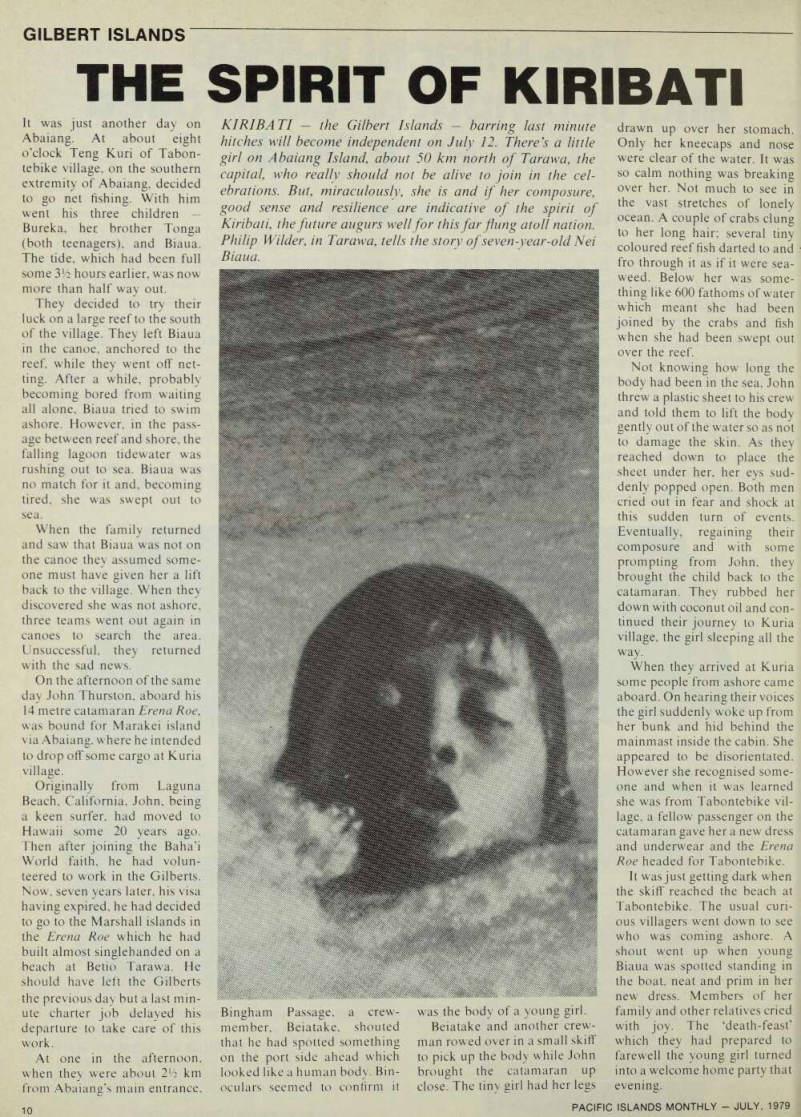
Beiatake and another crew man rowed over in a small skiff to pick up the body while John brought the catamaran up close. The tiny girl had her legs
drawn up over her stomach.
Only her kneecaps and nose were clear of the water. It was so calm nothing was breaking over her. Not much to see in the vast stretches of lonely ocean. A couple of crabs clung to her long hair; several tiny coloured reef fish darted to and fro through it as if it were sea weed. Below her was some thing like 600 fathoms of water which meant she had been joined by the crabs and fish when she had been swept out over the reef.
Not knowing how long the body had been in the sea, John threw a plastic sheet to his crew and told them to lift the body gently out of the water so as not to damage the skin. As they reached down to place the sheet under her, her eys sud denly popped open. Both men cried out in fear and shock at this sudden turn of events.
Eventually, regaining their
composure and with some prompting from John, they brought the child back to the catamaran. They rubbed her down with coconut oil and con tinued their journey to Kuria
village, the girl sleeping all the
way.
When they arrived at Kuria some people from ashore came aboard. On hearing their voices the girl suddenly woke up from her bunk and hid behind the mainmast inside the cabin. She appeared to be disorientated.
However she recognised some one and when it was learned she was from Tabontebike vil lage, a fellow passenger on the catamaran gave her a new dress and underwear and the Erena Roe headed for Tabontebike.
It was just getting dark when the skiff reached the beach at Tabontebike. The usual curi ous villagers went down to see who was coming ashore. A shout went up when young Biaua was spotted standing in the boat, neat and prim in her new dress. Members of her family and other relatives cried with joy. The ‘death-feast’ which they had prepared to farewell the young girl turned into a welcome home party that evening.
Tuvalu’S Pm
Has The ‘Big
Four’ Worried
Tuvalu Prime Minister Toalipi Lauti’s investment of more than SA 500 000 of his country's reserve funds with American business man Sidney Gross has hurt the newly-independent country's credi bility with several big Western nations. The damage could turn out to be serious because Tuvalu depends on some of them for continued 'financial support mainly in the form of aid.
The Right Honourable Toalipi Lauti (he was recently created a privy counsellor by Britain, entitling him to that form of address on formal occasions) invested the money with a Texas real estate man who promised 15 per cent interest, payable quarterly, and under took to try to raise a SUSS million loan to establish a fish ing industry in Tuvalu (PIM
May).
Mr Lauti’s deal in the United States has sparked strong reac tion in Canberra. Wellington.
London and Washington,
which obviously has developed
as a result of reports from the coterie of diplomats of these major nations which use Suva as their Pacific Islands listening post. Undoubtedly, there has been much note-swapping The general view is that in his actions to invest the reserve funds Mr Lauti was impulsive and took insufficient care to check beforehand the likely re percussions. While there is no doubt among the diplomats about Mr Lauti’s honesty and integrity, their view is that his attitude was too naive for a man in charge of a government and that the future for Tuvalu may not be very encourag
ing.
The concern is that Tuvalu’s prime minister, a man of strong determination, may have embarked on a highly personal style of government, insisting upon taking action despite the views of his advisers.
Some confidence has been lost in him also because he attempted to overcome one of the possible legal difficulties in the way of investing the money in the way he did by suggesting rewording of documents to make his actions suit the cir cumstances. Even then. Prime Minister Lauti struck difficult
ies with the transaction.
To his embarrassment, it was discovered that the cheque he handed to Mr Gross for $A544 000. drawn on a Sydney bank, could not have been met if Mr Gross had attempted to cash it because there were insufficient funds in the
account to meet it. More money had to be transferred to Sydney from government accounts and this transaction resulted in severe cash flow problems for Tavalu and brought criticism on the prime minister’s head from worried officials.
There were even rumours in Funafuti at the time that there was not enough cash left to en able the public servants to be paid, which was untrue, but it is an indication of the upset caused by the prime minister’s methods.
Even further strains were created on Mr Lauti’s return because he felt there may have been deliberate obstruction by some of his officials.
Although Prime Minister
The Region
Lauti has made a full statement to parliament and there is no suggestion of any cover-up, his government officials and ministers are reported to be still very uneasy about their re cent experiences. There is every possibility that the ‘big four’ will be wary before they commit any further funds,
hoping to satisfy themselves
that the prime minister has learned to better evaluate financial deals and take specialist economic advice.
The prime minister himself has defended his action on investment in a letter to PIM: ‘Like any investment, only time will tell, but as the person responsible for it I have every confidence,’ he says. Mr Lauti’s letter is published on page 4.
Canberra plans
South Pacific Forum
Canberra plans a tariff trump
Each year, Australia and New Zealand, the 'outsiders' in the South Pacific Forum of Nations (and some near-nations), without saving so, try to outdo each other in their generosity toward Islander members.
Last year there wasn’t much to choose between them. New Zealand around the time of the September Niue Forum made clear its intention to keep the South Pacific Forum Line afloat with Australia not too
enthusiastically agreeing. Aus
tralia’s offering at that session was to offer to send an invest ment team to the Pacific and to
organise a trade promotion centre in Australia to serve the Pacific Islands.
This year for the Honiara Forum on July 9-10 Australia's trump which will be hard to beat if it is as promising as it appears is to offer to down trade barriers to Islands pro ducts something Islanders have been asking it to do for
years. It seems Australia intends to offer on a more gen eral basis terms it has so far re served for its own ‘most favoured’ nation in the Pacific, Papua New Guinea.
Sources in Port Moresby, Suva and Canberra also suggest that, much to Paris’s annoyance. Forum members (or at least some of them) once again will be poking their nose into French affairs in the South Pacific by giving the ‘self deter mination' line an airing.
Economic zones and fish eries are likely to be two other
major talking points at
Honiara (see Tradewinds).
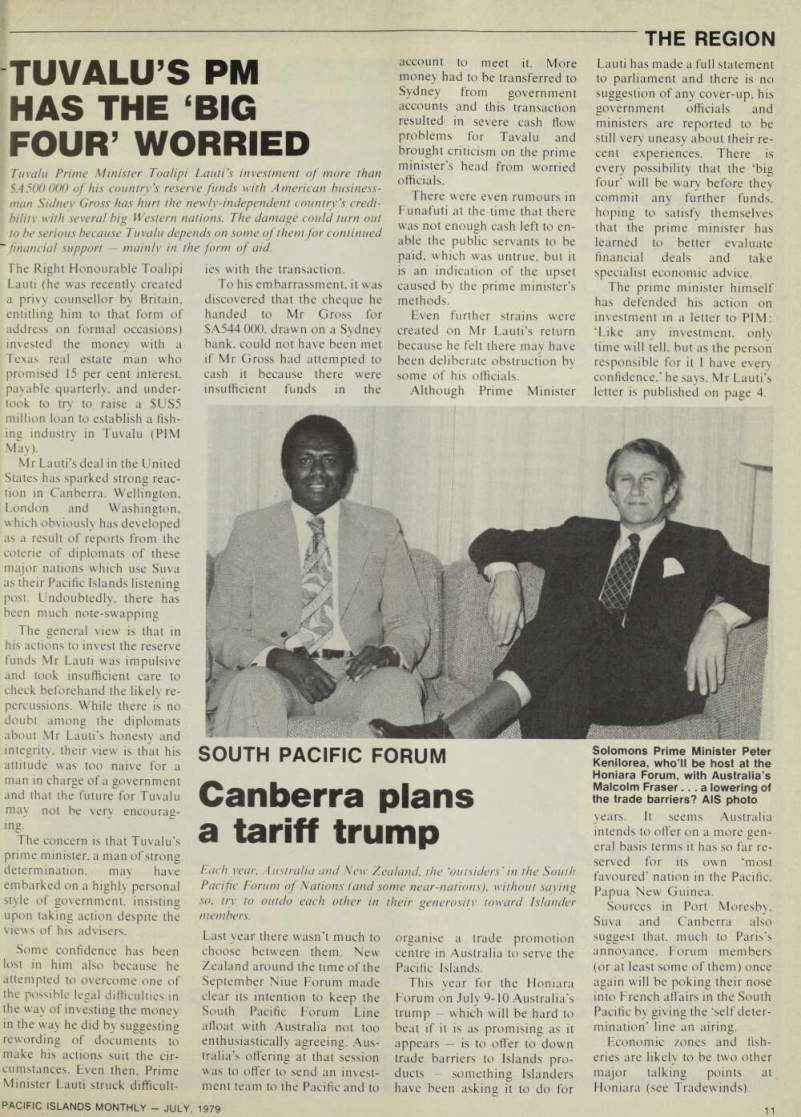
Solomons Prime Minister Peter Kenilorea, who’ll be host at the Honiara Forum, with Australia's Malcolm Fraser...a lowering of the trade barriers? AIS photo
Advertisements & other items, p. 12 (1 item)
Dili Solarex
PHOTOVOLTAIC
SOLAR POWER
SYSTEMS
made in australia for australian conditions
replaces
• Primary batteries • Fuel type generators • Power lines
features
• Non polluting • Continuous power • Low maintenance • Fuel free • Low operating cost • Noiseless
facilities
• Solarex offers engineering design, manufacture, installation and service for svstems from Milliwatts to Megawatts; microgenerators to high power concentrators. • For prompt and efficient service call Solarex the Australian specialists.
Dili SOLAREX
FO/?.'•COMMUNICATIONS •TELEMETRY •RURAL POWER
• IRRIGATION • MARINE •DOMESTIC USE
•NAVIGATION •CATHODIC PROTECTION
Contact our Pacific Islands distributor
Solar Transmission (Australia) Pty. Ltd.
791 PRINCES HIGHWAY, TEMPE, N.S.W. 2044 AUSTRALIA.
Telephone (02 ) 559-2000 Telex AA21337 Cables "GINSENG" Sydney <»• \ ■ .4 1
Becoming

That Word ‘Fijian’
What About
One First?
Fijian specialist in human communication, Laz Vusoniwailala, writes from Seattle, USA, where he is continuing his studies. His subject: the vexed question of a common name for the members of the multi-racial society of Fiji.
The subject of a ‘common name' for the people of Fiji (PIM February) has been a
touchy topic in Fiji whenever
it has cropped up in recent years. It arose out of the appar ent need of some people,
mostly non-indigenous. to
identify themselves with Fiji.
The most attractive possibility has been ‘Fijian’. The problem was aptly expressed by the pre sent attorney-general. Sir Vijay R. Singh, who, a few years ago, was reported as saying that when abroad he was referred to as a Fijian, but that when he got back home he was called an Indian. ‘Why,’ Sir Vijay asked ‘can’t we all be known as
Fijians?’
The problem, as I see it, lies in the different views held of what the name ‘Fijian’ rep resents. In particular, there is divergence in the understand ing of the meaning of the name between those who already bear it. the native race, and others who feel qualified for one reason or another also to use it to describe themselves.
But let us ask the question; What is a name for?
Let me suggest that its main purpose is to identify. When we classify we group things that share a common feature or some common characteristics.
The planet we live on we have called ‘earth’ to differen tiate it from others if and when we talk of parts of the universe.
On our planet are numerous species. Some we call animals which, the biologists tell us, share certain attributes. Then there is the specimen called human which is two-legged, walks, thinks and talks. But
there are various groups of men who look and behave dif ferently, and so we have learnt to classify them according to their ethnicity, culture or geo graphic areas. What we find, therefore, is that the changing of names we use to refer to
people or things depends upon
the level of differentiation we need, either between species, cultures, races, or whatever it is that we need to classify.
Sir Vijay isn’t the only one who changes identity when his environment of classification changes. I am a Fijian here in the US. Back home I am much more likely to be referred to by the island I come from, and when I get there, to Kadavu. I am classified by my village.
There I am further differentia ted by my tribe and then my clan. This goes on down to my
family where I have a name given to me to identify me from my brothers and sisters.
When I tell you that here in Seattle I miss the drink from green coconuts and fried fish in coconut milk, or 1010, those who share my experience and have the same images in their minds know what 1 mean.
Therefore, in order for people to understand each other, they must first share the ‘images’ associated with the words and names they use. And this
largely comes about through
shared experience.
The communication prob lem among the multi-ethnic citizenry of Fiji has been com plicated by the fact that the name suggested for general adoption is ‘Fijian’. Some non natives see Fijian as represent
ing only someone who
identifies with Fiji. To the indigenes of Fiji the name rep resents more. It represents who they are and what they stand for. It expresses the fact that they are the native ‘owners' of
Fiji.
Through rugby, cricket, and.
in the past 20 years, the Fiji Visitors Bureau, the ‘image’ of Fijians as being the natives of Fiji has been portrayed over seas. But this is perhaps of sec
ondary importance since the
Human Relations
FVB can be relied upon to draw up new posters to diffuse anew image of the new Fijian.
The inter-racial composition of the Fijian cricket teams of the past decade has helped to show that there are other types of Fijians besides the smiling faces in tourist brochures.
But what is really difficult to erase is the ‘image’ of what a Fijian represents in the minds of those who today call them selves Fijians.
To them, ‘Fijian’ represents more than a class of people. It is a way of life -one can be a Fijian by being and not merely by name. They there fore feel offended by sugges tions of generalising their name of reference to take in the other races of Fiji. To do this would for them entail a loss of identity. This is almost the opposite situation to that in which non-indigenes find themselves. Their need in seek ing a common name is to gain
an identity.
A major criterion of who is a Fijian in the classification of the native people is the ‘owner ship of the land’ that is Fiji.
They feel that the sharing of the name Fijian would be a threat to their land security.
Whether this feeling is soundly based is beside the point. The point is that the feeling exists.
The suggestion to generalise use of the name Fijian fails to take account of the complexi ties of inter-racial communi cation. Pride is a common characteristic of the natives of multi-ethnic societies. I noticed it with Hawaiians in my three years in Honolulu, and with the native Indians here in Washing ton. Social history is not merely a blackboard from which one name can be erased and another at once put in its
place.
For this reason, the common name issue, particularly the suggestion that the common name should be ‘Fijian’, is for
the moment politically dicey.
In a way it is a case of putting the cart before the horse. While a common name may be handy in social chitchat while Fiji citi zens are abroad, it is far from resolving the need for inter racial understanding at home.
Instead of asking what name
Laz Vusoniwailala
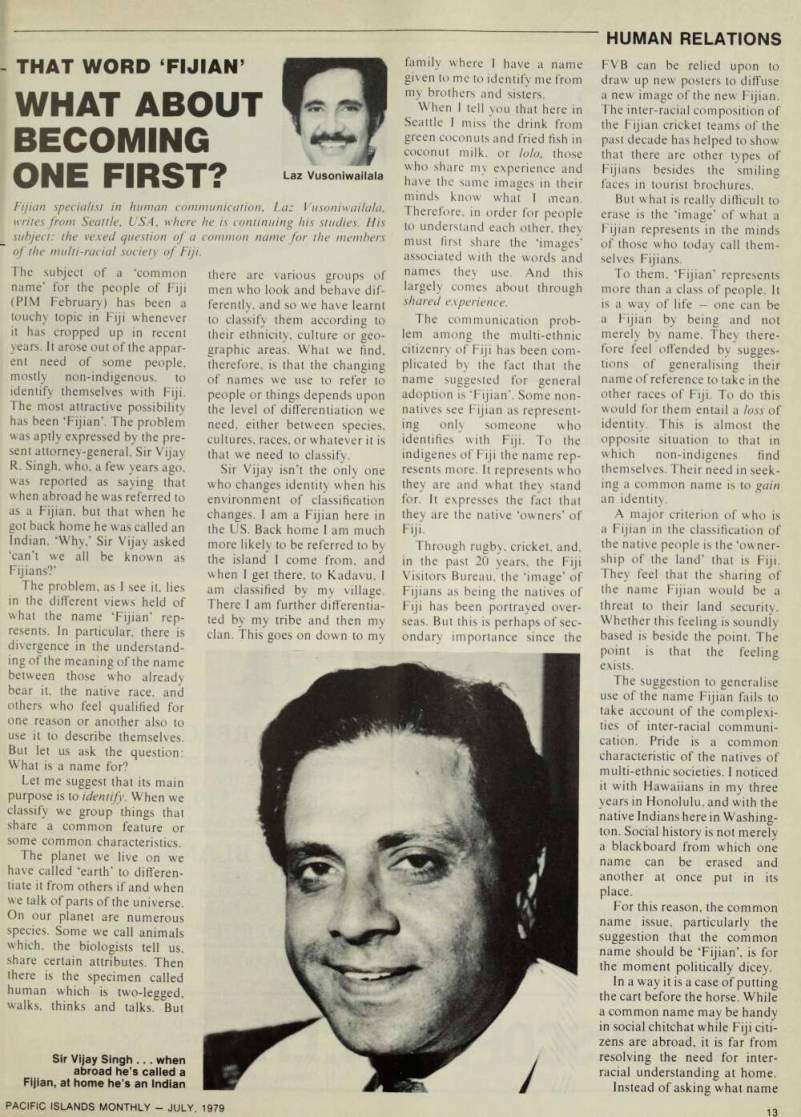
Sir Vijay Singh ... when abroad he’s called a Fijian, at home he’s an Indian
would best describe them all. the country’s main ethnic groups should be seeking ways
whereby they will begin to feel
and think as one people. The fact that there is not yet any agreement over a common name simply indicates that there is not yet a common Fiji consciousness, the thoughts of Prime Minister Ratu Kamisese Mara on a coalition govern ment for Fiji (PIM May) merit serious consideration by those who wish well for the country’s multi-racial future.
It is important that moves in this direction be made now, while Fiji is still governed by a political party whose policy during the past 10 years has in cluded the building of Fiji into a model plural society. This policy has not been pursued without political risks, as the shock outcome of the April 1977 election indicated.
My subjective analysis is that
the average Fijian is not fully committed to multi-racialism.
He entertains the belief that his quality of life would be better if he did not have to compete so hard with people he sees as
‘intruders’ in order to survive in his own country. I expect this sentiment to intensify over the next quarter-century as more and more educated Fijians find fewer and fewer job opportuni ties, with a rising population and a job market that is grow
ing only slowly. Matters will
become even more crucial with the inevitable passing from the national stage of the present leadership of the paramount chieftainships of Ratu Mara, Ratu Sir Penaia Ganilau and Ratu Sir George Cakobau.
They have been a vital stabilis ing force over the past 25 years.
Racial integration has grea tly improved since Fiji became independent nine years ago.
However, more can be
achieved through existing insti
tutions such as the education system and the media, to name two important avenues. Pro grammes of social integration should aim for effective and af fective inter-racial communi cation. The rationale of such a plan is that by walking the same road people of diverse backgrounds may evolve a set
of shared values and shared perceptions of the meaning of life.
This goal can certainly not be achieved overnight, but the rewards of a diligent questing for it will be more positive for the country than continuing along the old paths of different races going their own ways and with some now seeking to take upon themselves the label ‘Fijian’.
The advance towards one
Fiji, populated by different
peoples but who are all re ferred to as Fijians, requires tact and patience, if it is not to remain a mere idle dream. It may also require some sacrifice on the part of those who want to become ‘Fijians’; sacrifices of non-Fijian aspirations, and the throwing in of their lot with the culture into which they wish to be initiated.
May I suggest that those who wish to be called Fijians con sider first of all becoming
Fijian by culture, and give up their premature preoccupation with the name they will bear.
A start would be in the sharing
of the life concerns of the
Fijians.
For those who show them selves to be sincere in such an enterprise, the chances of suc cess are high. The Fijians are an appreciative and accom
modating people. They will
embrace those of their kind when they find them. Yes, even if they don’t bear a particular name.
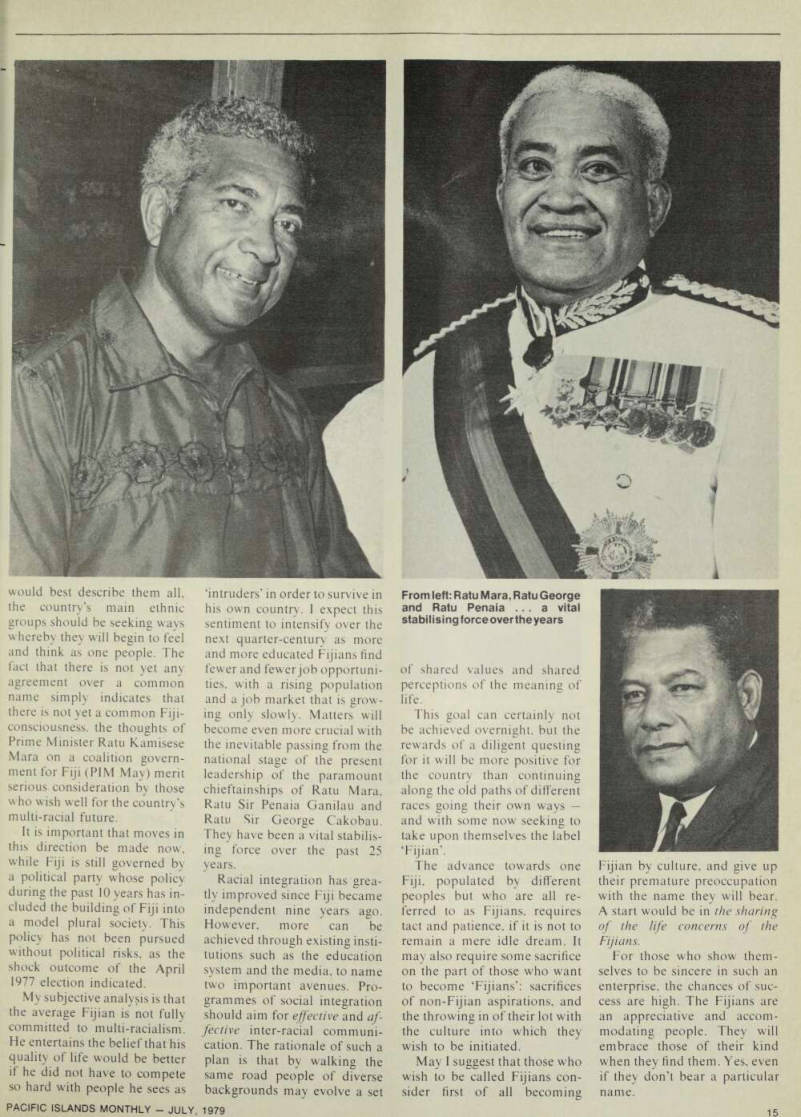
From left: Ratu Mara, Ratu George and Ratu Penaia ... a vital stabilising force over the years
Advertisements & other items, p. 14 (1 item)
Sanyo Beta
VIDEO RECORDERS
sB99*
PRE RECORDED
CASSETTES
YOU'LL NEVER FIND
OUR PROGRAMMES
IN YOUR T.V. GUIDE...
A lot of people believe TV has a nine-yearold mentality. To them there is more to adult programming then "Charlie's Angels".
That's where we come in. Our range of films is a refreshing change from the TV networks roster. Don't be surprised if your TV grows up right before your eyes.
Video Classics are a unique collection of movies on video cassette. Movies you'll never see on television, each one a classic in its own right. Show them to your family and friends in your own home at your convenience. At a cost less than taking the family to the movies.
Video Classic cassettes are all in their original uncut form at broadcast quality. Available in formats to suit...
U-MATIC $125.95
BETA and VHS $69.95
SEND $l.OO FOR COLOUR CASSETTE CATALOGUE
REFUNDABLE WITH YOUR FIRST PURCHASE
SANYO TELEVISION
10” $334
(AC/DC)
14” $343 18” $390 20” $506 T
SANYO
CAMERA
$294*
U-MATIC RELOAD SERVICE
WE WILL RELOAD YOUR OLD U-MATIC CASSETTES WITH NEW SCOTCH VIDEO TAPE AND HUBS $19.90*
U-DO RELOAD KITS $17.00*
3M BLANK TAPE
U-MATIC KCA 60 $26.00
BETA L5OO $17.56 L 750 $22.75
VHS El2o $20.03 ElBO $24.06
WE HAVE BULK PRICES
for ‘Tulagi’


Tropicalities
High seas trial
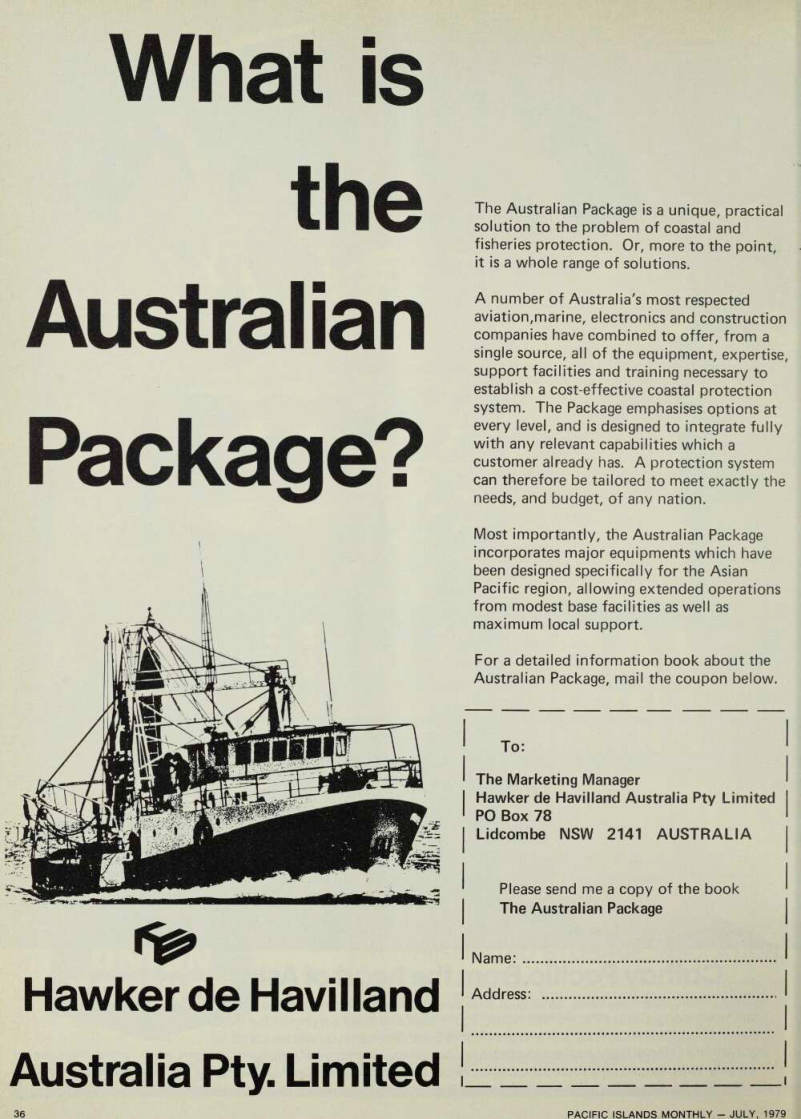
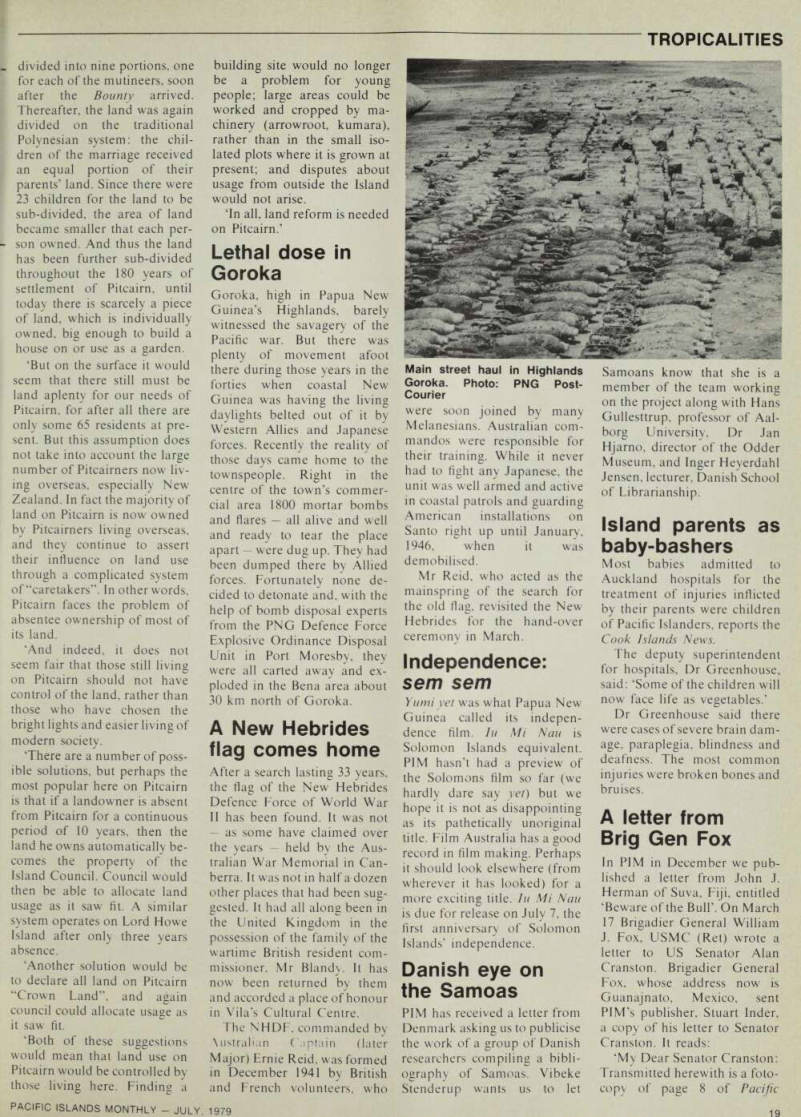
The patrol craft Tulagi , presented by the Australian Government to the govern ment of Solomon Islands as an independence gift and in the framework of Australia’s de fence co-operation programme with the South Pacific, began its new life in high adven ture.
Due to the lack of a crane on Honiara’s wharf strong enough to lift the 46-tonne craft off the deck of a freighter, this pre ferred method of getting it to its new home had to be passed up and the Tulagi made the 3400 nautical mile Sydney- Honiara trip under its own power.
The trip included a tough bout with Cycline Stan in the region of Thursday Island, a three-day stay in Port Moresby (during which the de Havilland Marine-built Tulagi was put through its paces for the ben efit of watching Papua New Guinea officials), and a tri umphal arrival right on time at Honiara.
Crew for the delivery voyage included two Solomon Islanders, Metcalfe Pitiposa and Joshua Kalevalka. who ex perienced a dose of on-the-job training that will no doubt stand them in good stead for years to come.
The Tulagi will be used by Solomon Islands police for fisheries protection and mari time surveillance patrols in coastal and inter-island waters in the Solomons. The vessel will be crewed by experienced mariners who have been re cruited into the police force for the purpose.
In addition to the patrol boat. Australia is supplying enough spare parts for the boat for two years, training in Aus tralia for five Solomon Islands maintenance personnel, and expert advice during the first three months of the boat’s op erations.
A thousand people turned
up to watch the hand-over cer emony conducted by Aus tralian High Commissioner John Melhuish.
Some back, but
more to come
Responding to an appeal by
the Papua New Guinea Government, museums and collectors in Australia and the United States have returned thousands of dollars worth of tribal artifacts to PNG.
Ceremonial masks, weapons, carvings and re ligious figures in stone and wood are among items re turned. Some were found in Adelaide. South Australia, under an old house which had
once been occupied by a family
with business connections in PNG. Others were returned by descendants of an early
missionary.
But PNG authorities believe
there are still scores of valuable items which represent missing examples of PNG culture which should be in PNG.
Some of the biggest collec tions are known to be in Ger many because of the intense scientific and anthropological
interest shown by Germany
when it became the first coloniser of the northern sec tion of PNG nearly a century ago.
The PNG plea for return of artifacts was repeated at the 1978 general conference of the United Nations Scientific and
Cultural Organisation
(UNESCO) in Paris in November. The PNG del egates also presented a list of
projects for possible UNESCO
assistance.
The country has already received nearly K.l million from UNESCO and related
agencies for cultural projects.
The 1978 PNG submissions
placed greater emphasis than
in the past on science and tech
nology.
Whoppers which
didn’t get away
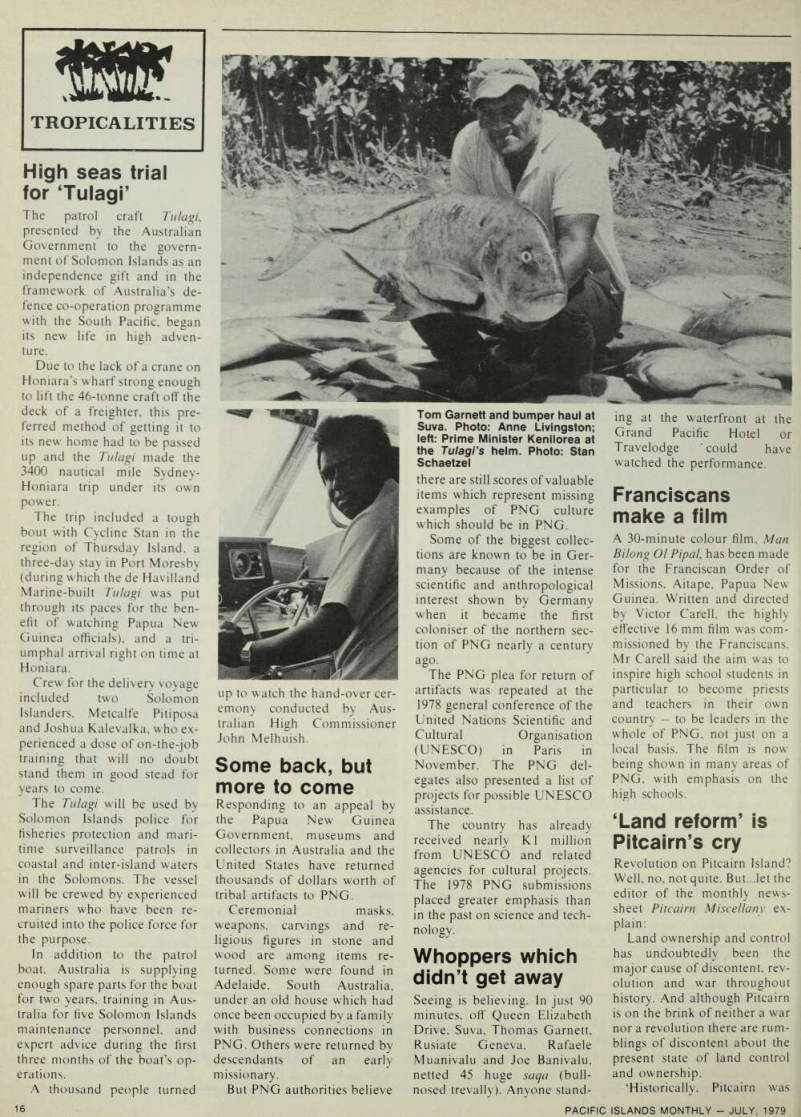
Seeing is believing. In just 90
minutes, off Queen Elizabeth Drive. Suva, Thomas Garnett.
Rusiate Geneva. Rafaele Muanivalu and Joe Banivalu. netted 45 huge saqa (bull nosed trevally). Anyone stand
ing at the waterfront at the Grand Pacific Hotel or Travelodge could have watched the performance.
Franciscans
make a film
A 30-minute colour film, Man Bilong Ol Pipal , has been made for the Franciscan Order of
Missions, Aitape, Papua New
Guinea. Written and directed by Victor Carell, the highly effective 16 mm film was com missioned by the Franciscans.
Mr Carell said the aim was to inspire high school students in
particular to become priests
and teachers in their own country to be leaders in the whole of PNG, not just on a local basis. The film is now being shown in many areas of PNG. with emphasis on the high schools.
‘Land reform’ is
Pitcairn’s cry
Revolution on Pitcairn Island?
Well, no, not quite. But...let the editor of the monthly news sheet Pitcairn Miscellany ex
plain:
Land ownership and control has undoubtedly been the major cause of discontent, rev olution and war throughout
history. And although Pitcairn
is on the brink of neither a war nor a revolution there are rum blings of discontent about the present state of land control
and ownership.
‘Historically, Pitcairn was
Tom Garnett and bumper haul at Suva. Photo: Anne Livingston; left: Prime Minister Kenilorea at the Tulagi’s helm. Photo: Stan Schaetzel
divided into nine portions, one for each of the mutineers, soon after the Bounty arrived.
Thereafter, the land was again divided on the traditional Polynesian system: the chil dren of the marriage received an equal portion of their parents’ land. Since there were 23 children for the land to be sub-divided, the area of land became smaller that each per son owned. And thus the land has been further sub-divided throughout the 180 years of settlement of Pitcairn, until
today there is scarcely a piece
of land, which is individually owned, big enough to build a house on or use as a garden. ‘But on the surface it would seem that there still must be land aplenty for our needs of Pitcairn, for after all there are only some 65 residents at pre sent. But this assumption does not take into account the large number of Pitcairners now liv
ing overseas, especially New
Zealand. In fact the majority of land on Pitcairn is now owned
by Pitcairners living overseas,
and they continue to assert their influence on land use
through a complicated system
of “caretakers”. In other words, Pitcairn faces the problem of absentee ownership of most of its land. ‘And indeed, it does not seem fair that those still living on Pitcairn should not have control of the land, rather than those who have chosen the
bright lights and easier living of
modern society.
‘There are a number of poss ible solutions, but perhaps the most popular here on Pitcairn is that if a landowner is absent from Pitcairn for a continuous period of 10 years, then the land he owns automatically be comes the property of the Island Council. Council would then be able to allocate land usage as it saw fit. A similar system operates on Lord Howe Island after only three years absence. ‘Another solution would be to declare all land on Pitcairn “Crown Land”, and again council could allocate usage as it saw fit. ‘Both of these suggestions would mean that land use on Pitcairn would be controlled by those living here. Finding a
building site would no longer be a problem for young people; large areas could be worked and cropped by ma chinery (arrowroot, kumara), rather than in the small iso lated plots where it is grown at present; and disputes about usage from outside the Island would not arise. ‘ln all, land reform is needed on Pitcairn.’
Lethal dose in
Goroka
Goroka, high in Papua New Guinea’s Highlands, barely witnessed the savagery of the Pacific war. But there was plenty of movement afoot there during those years in the forties when coastal New Guinea was having the living daylights belted out of it by Western Allies and Japanese forces. Recently the reality of those days came home to the
townspeople. Right in the
centre of the town’s commer cial area 1800 mortar bombs and flares all alive and well and ready to tear the place apart were dug up. They had been dumped there by Allied forces. Fortunately none de cided to detonate and, with the help of bomb disposal experts from the PNG Defence Force
Explosive Ordinance Disposal
Unit in Port Moresby, they were all carted away and ex ploded in the Bena area about 30 km north of Goroka.
A New Hebrides
flag comes home
After a search lasting 33 years, the flag of the New Hebrides Defence Force of World War 11 has been found. It was not as some have claimed over the years held by the Aus tralian War Memorial in Can berra. It was not in half a dozen other places that had been sug gested. It had all along been in the United Kingdom in the possession of the family of the wartime British resident com missioner. Mr Blandy. It has now been returned by them and accorded a place of honour in Vila’s Cultural Centre.
The NHDF, commanded by Australian Captain (later Major) Ernie Reid, was formed in December 1941 by British and French volunteers, who
Samoans know that she is a member of the team working on the project along with Hans
Gullesttrup, professor of Aal
borg University, Dr Jan
Hjarno, director of the Odder
Museum, and Inger Heyerdahl
Jensen, lecturer, Danish School
of Librarianship.
Island parents as
baby-bashers
Most babies admitted to Auckland hospitals for the treatment of injuries inflicted by their parents were children of Pacific Islanders, reports the Cook Islands News.
The deputy superintendent
for hospitals. Dr Greenhouse, said: ‘Some of the children will now face life as vegetables.’
Dr Greenhouse said there were cases of severe brain dam age, paraplegia, blindness and deafness. The most common injuries were broken bones and bruises.
A letter from
Brig Gen Fox
In PIM in December we pub lished a letter from John J.
Herman of Suva, Fiji, entitled ‘Beware of the Bull’. On March 17 Brigadier General William J. Fox, USMC (Ret) wrote a letter to US Senator Alan Cranston. Brigadier General Fox, whose address now is Guanajnato, Mexico, sent PlM’s publisher. Stuart Inder, a copy of his letter to Senator Cranston. It reads: ‘My Dear Senator Cranston: Transmitted herewith is a foto copy of page 8 of Pacific
were soon joined by many Melanesians. Australian com mandos were responsible for their training. While it never had to fight any Japanese, the unit was well armed and active in coastal patrols and guarding American installations on Santo right up until January, 1946, when it was demobilised.
Mr Reid, who acted as the mainspring of the search for the old flag, revisited the New Hebrides for the hand-over ceremony in March.
Independence:
sem sem Yumi yet was what Papua New Guinea called its indepen dence film, hi Mi Nan is Solomon Islands equivalent.
PIM hasn’t had a preview of the Solomons film so far (we hardly dare say yet) but we hope it is not as disappointing
as its pathetically unoriginal
title. Film Australia has a good record in film making. Perhaps it should look elsewhere (from wherever it has looked) for a more exciting title. In Mi Nan is due for release on July 7, the first anniversary of Solomon
Islands’ independence.
Danish eye on
the Samoas
PIM has received a letter from Denmark asking us to publicise the work of a group of Danish researchers compiling a bibli ography of Samoas. Vibeke Stenderup wants us to let
Main street haul in Highlands Goroka. Photo: PNG Post- Courier
Islands Monthly of December 1978. I wish to invite your attention to the article entitled ‘Beware of the Bull' by a John L. Herman of Suva, Fiji Islands. I am unaware of Mr Herman’s status in relation to the Fijian Government, but I think your office should ascer tain if he represents the views and attitude of that govern ment in the matter of ‘foreign aid'. If he does I can see how the United States Government can save millions of dollars for the tax payers of our country of which I am one. Will you please keep me advised or your findings and action taken? ‘PS: I served with the US Marines on the islands of the Pacific in 1942-43 and I happen to know that those islands were mighty happy to get all the foreign aid possible on any terms and it was expensive aid as many a wounded Marine can tell. They may have forgot ten but many of us have not.’
The Cockney
of Fanning
Does anyone remember ‘Cock ney’ Chandler, the Fanning Island cable hand who was handyman out there about 50 years ago? The one who had an ‘ell of a time with his h’s and a’s? True to his London upbringing, he had a ready wit, and succeeded in placing his h’s and a’s in the wrong place, writes Sherman Lee Pompey.
Cockney at one time said in London he had been a ‘heggler’. When asked what a heggler was, he replied it was a man who ’awked heggs from door to door. He stated that Hyde Park in London was full of hashes and helms.
Once when the cable station superintendent had trouble with his septic tank, he called Cockney to fix it. His diagnosis was that it was due to ‘hair in the pipe and not ’air on your ’ead but the hatmosphere’.
While on Fanning, there was a man there named Munn and somehow a feud had devel oped between him and Cock ney Chandler. Once Munn chased Chandler and threat ened to kill him. Cockney escaped into Robert Bruce Scott’s room. It became such a well established feud that they
had to transfer Munn off the island.
Cockney made his own out rigger canoe, which was quite a feat, and it was all bound up. without using a nail in the con struction. They had a launch ing ceremony and as the craft slipped into the still waters of the lagoon, he remarked: ‘There she goes, and she won’t leak a “heggup” full.’ Cockney added a bit of humour to life on the island, and with his one solitary tooth looked a fear some customer. In fact he was a very human and kindly man.
Life was never the same on
Fanning after Cockney left.
Blowing cold
on ‘Hurricane’
The US magazine Newsweek was not over-impressed with Dino de Laurentiis’ SUS 22 million extravaganza. Hur ricane. Set in Pago Pago (but actually filmed in Borabora) the film is a substantially revamped version of John Ford’s 1937 epic of the same name.
Newsweek critic David Ansen writes: ‘There is one tor rid love affair and one bang-up hurricane in Hurricane and it would have helped the film plenty if one had anything to do with the other. As things stand or topple the climac
tic storm serves not so much to resolve the tempestuous affair between a hot-blooded Bos tonian (Mia Farrow) and a hot blooded Samoan (Dayton Ka’Ne) as to bail out of it. . . ‘On a purely sensuous level.
Hurricane is frequently arrest ing and sometimes down right sexy. Director Jan Troell (The Emigrants) has a pleasing eye, and with the natural beauty of the island and the
wizardry of production de
signer Danilo Donati and cine
matographer Sven Nykvist to
aid him, the movie is con sistently handsome. But it’s a humourless, bubble-headed affair, as dramatically under fed as it is visually over-ripe.
"In the tropics,” warns Trevor Howard, as a tippling Irish priest, “take passion in small doses and always with a grain of salt.” One doesn’t expect the lovers to heed his advice, but Troell and Semple have ignored him at their own peril.
At the end. Hurricane is simply washed away in a high tide of
romantic inanity.’
The gentle art of
donning pareu
‘Just imagine she is wearing nothing on top.’ There is dead silence as everyone concen trates on imagining, writes Helen Rousseau in Sydney. ‘Then you just pull the material this way,’ the male Tahitian voice continues, to a gasp from
onlookers as he passes the cloth between the girl’s legs. ‘And finally you tie it this way.’ The surprised model wonders: ‘Are you sure it will really stay up?’ as the colourful piece of pareu is tied across her hips. A smile of delighted confidence beams from the face of Sacha as he stands aside to receive the en thusiastic praise of his audi ence.
Sacha had come all the way from Ouvea, in New Caledonia’s Loyalty Islands, to show Sydney-siders how to dress in relaxed, yet imaginat ive styles, to really catch the mood for enjoying his special piece of paradise the 25 km of white sand and ever changing blues of the lagoon on Ouvea, Caledonia’s only coral atoll.
An expensive Chinese- Tahitian, Sacha describes him self as the entertainer cum-cook-cum-decorator at the only visitor accomodation on the island the 15 thatched bungalows of the Relais d’Ouvea. In response to a ques tion, he solemnly promises that yes, upon request, he is ready to tie the pareu for any lady guests at the resort, any time.
Using just a straight piece of
fabric, and taking only a couple on minutes each time, Sacha demonstrates half a dozen dif ferent ways of wearing the in
credibly versatile Polynesian
pareu.
The men are not forgotten, either. On Sydney television Sacha expertly ties a brief pareu on well-known football star Russell Fairfax. Sporting fans are promised a sight to look forward to when, after a bit of coaxing, the Australian football hero promises: if we make the grand final I’ll run out in one.’
Radio Australia
boosts output
Radio Australia has boosted its output to the Islands through two new 100 kW transmitters at Shepparton, Victoria which began work in early May. The ABC’s acting director of over seas services, Errol Hodge, said that changes would enable the transmission of a clearer, strong signal, less susceptible to interference.
‘Cockney’ Chandler of Fanning ... the heggler’s son
Advertisements & other items, pp. 17-26 (2 items)
For performing everyday tasks?
I * / I I / I * i V IK SU^ 1 1111111 l dp Looking for handy, reliable transport from home to town?
Go with a Suzuki! choose one of our rugged,
high-performing 4-wheel drive vehicles,
just meeting your transport needs.
|IM W Look into the traditional excellence of Suzuki's performanceproven motorcycles and fleet of outboard motors something to satisfy your every motoring need. Going by land or by sea . . . 9° with a Suzuki.
DTBS
o
SUZUKI
SUZUKI TS 125
SUZUKI MOTOR CO, LTD
Hamamatsu, Japan SOLOMON ISLANDS SOLOMON ISLAND SERVICE STATION LTD. • NEW CALEDONIA STE. SUPERCAL • PAPUA NEW GUINEA TUTT BRYANT PACIFIC LTD. • NEW HEBRIDES HENRI LEROUX • NIUE ISLAND BURNS PHILP (SOUTH SEA) CO., LTD. • PONAPE LEO ETSCHEIT • TAHITI NIPPON AUTOMOTO • ELLICE ISLAND TUVALU COOPERATIVE WHOLESALE SOCIETY LTD. • GUAM & SAIPAN ISLAND CYCLERY, INC. • NORFOLK MARTIN'S AGENCIES LTD. • SAMOA PACIFIC PRODUCTS, INC. • TARAWA GILBERT ISLANDS COOPERATIVE FEDERATION LIMITED • TONGA MORRIS HEDSTROM LTD. • WESTERN CAROLINES BECHESRRAK T. COMPANY • AMBROSE D. MINGINFEL'S WHOLESALER • EASTERN CAROLINES KIOMASA STORE
We’ve made the
world of difference
to Tonga’s communications.
With the opening of the Cable & Wireless earth station, the people of Tonga can enjoy the benefits of the fastest, most efficient and reliable telephone, telex and telegraph links to the rest of the world. Via satellite.
At Cable & Wireless we have over a century of experience in the design, installation and maintenance of communications systems throughout the world. To date we have been involved with over 30 earth stations, each designed to meet their individual climatic and geographic conditions.
So, for more information, do a little communicating yourself. Contact us.
L L 11. ■ - -,i Hi HP*' /ays arsfqMinead oftoday’s communications. i 1 f ■>' Comer of Queen SjrfcrteteSfl'S Takaiw&c J&pad, Jgongoloa, Tonga.
Head Office; Mercury House.TTteobaids Road, London wofll Tel: 01-242 4433 Telex 23181
m * g r J s K I IF?
H S-X2 m
The world’s other
great mini.
Never has anything so small produced an Technically advanced, but not so complicated impact so big. Not until now, that is. that you need a license to turn it on.
Pioneer’s new Mini Hi-fi System attracts And unlike some other makers, Pioneer’s the eyes as well as the ears. We’ve taken the best Mini Hi-fi System is really complete. Turntable, advantages of compact size and successfully Amp, FM/AM Tuner, a choice of Speaker Systems, blended them with over 40 years of audio ex- plus a matching Cassette Deck. And only Pioneer pertise. Like the car you drive and the home you maintains strict uniformity of design. Every live in, the Mini Hi-fi System is sensitive to human component is a standard 38cm wide. No audible needs. The result—a quality design for today’s distortion to your music. No visual distortion to sophisticated life-styles and quality engineered your room. for today’s demanding sound-styles. Pioneer’s new Mini Hi-fi System. Hi-fi realism Small, but not too small. That would only at a realistic price. The only “mini” thing about it, make it tough to operate. is the space it’ll take.
Mini Hi-fi System
lr) .it r
» 5 r ,<’S-X2
fliD PIONEER
For further information, please contact; - Te| S 9O-9bl 5 1 Oneer Marketin9 Service Pty. Ltd P.O. Box 317, Mordialloc, Victoria, 3195 Nauru Island; Jacob Enterprises, P.O. Box No. 4, Republic of Nauru Fiji Islands; Brijlal & Company, G.P.O. Box No. 362, Suva, Fiji Islands Tel: 22258 Fountain Market ' n 9 Ltd., Maidstone Street, Auckland, New Zealand Tahiti: Efs. PERFECT, B.P. 594, Papeete, Tahiti Tel: 20 407 Now Caledonia: Menard Freres Ville, B.P H 2 Cedex, Noumea, New Caledonia Tel: 27.52.22 Norfolk Island: Burns Philp (Norfolk Island) Ltd., Norfolk Island, South Pacific New Hebrides; Burns Philp (New Hebrides) Ltd., Vila, New Hebrides American Samoa; Transpac Corporation, P.O. Box 1477, Pago Pago, American Samoa 96799 Tel: 633-5224 Rarotonga: South Seas International Ltd., P.O. Box 49, Rarotonga, Cook Islands Tel; 2327 Papua Now Guinea; Bali Marchants Pty. Ltd., P.O. Box 6103, Boroko Tel: 254887
m - X K r» H ■ i «> 2«B * '■3.
' B -■ - * ', *>» 7-S, I'* ■■' ■*"•■ i<* >■• ' ■ / '^iJb
tr* r 4’, S
- I* rf* * m i -. ■» • S ... t - - ■X" .
Come uptokool
The cool refreshing taste of menthol.
AFTERTHOUGHTS with PERCY CHATTERTON
PURARI'S FUTURE: THE
POWER PLAY IS IN
SOAAARE'S HANDS
In one of last year’s ‘Afterthoughts’ I had something to say about the Purari maxi hydroelectric plus industrial complex scheme first planned back in colonial times for the Gulf of Papua, and about the group of people from the locality calling itself the Purari Action Group (PAG) which opposes the scheme.
Since that time PAG has enlisted the help of an Australiabased group called International Development Action to produce a detailed and thoroughly researched study of the scheme and its implications for the people of the Purari Delta and for Papua New Guinea in general. The result is a volume called Purari: Overpowering Papua New Guinea? which reports the findings of a group of four researchers.
This solid tome more than 200 pages substantiates in detail the doubts and criticisms of the Papua Action Group.
It questions whether the scheme would really bring benefit to Papua New Guinea as a whole, and cites a wealth of comparisons with similar schemes in other parts of the world to suggest that it probably would not.
The researchers point out that the scheme is completely inconsistent with the much publicised ‘eight aims’ of the Somare Government and that it would have the effect, by its very cost, of delivering Papua New Guinea into the hands of a junta
of international (mainly Japanese) economic imperialists.
Another count against it is that, in its original form, it proposes the setting up of a large industrial complex to utilise the excess power which would be produced: The industries attracted would probably be ‘dirty’. But. more seriously, the establishment of such a complex, whatever the nature of the industries attracted, would add yet another problem of urbanisation to those which already bedevil the Papua New Guinean scene, and with which the government has so far shown itself unable to cope.
It is true that an alternative plan has now been broached that of ‘exporting’ the surplus power to northern Australia by submarine cable. Minister for Energy Karl Kitchens has been exploring this possibility but has not yet shared with us the results of his explorations.
This, of course, if it came to anything, would be a vast improvement on the original plan. But the environmental problems remain and these are formidable.
When I wrote about this aspect of the scheme last year I was thinking mainly of its effects on the lives and homeland of a fairly small number of people who live in the immediate area of the proposed dam and artificial lake. But the authors of Purari show that, in the long run, the result could be a complete change in the ecology, and even the physiography, of the whole of the Gulf of Papua and its bordering lands.
This would come about as a result of the retention in the artificial lake above the dam of most of the sediment which is now brought down to the delta and which spreads itself out into the Gulf of Papua. The effect would almost certainly be that the loss of sediment and consequent scouring would cause the shore line to recede, while loss of nutrients at present carried into the sea would seriously affect, and perhaps destroy, not only the traditional and still-existing lifestyle of the people.
"WHAT WILL HAPPEN
TO US WHEN THE
CLEVER MEN CLOSE
THE RIVER?"
but also the existing and growing cash-producing fishing industries in the area, and particularly the thriving crayfish industry based on Yule Island in Hall Sound.
This, say the authors of Purari, is not just theorising. It has already happened in the Nile Delta since the construction of the Aswan Dam. Coastal retreat is taking place there at a rate of several metres a year, while a once flourishing sardine industry in the southeastern corner of the Mediterranean Sea is declining and approaching extinction.
Will the establishment of an industrial complex in the vicinity of Hall Sound compensate the people there for the destruction of their crayfish industry? Will they get wage-earning jobs in the urban complex, or will most of the jobs be snapped up by eager and aggressive migrants streaming down from the
Highlands?
And all to what end? What net benefit will accrue either to the people of the Delta and Gulf or to Papua New Guinea as a whole? Whatever these benefits may be they will be obtained at the cost of delivering this newly independent country into the bondage of economic colonialism.
As the Purari Action Group has cynically but truly observed; ‘These giant foreign firms are not investing their capital in our country because they love us.’
In 1973. Prime Minister Michael Somare had this to say: ‘Do we want to become a country of big cities? In all the 700 languages of our country, we have never needed words for air pollution, for slum, or for unemployment. Do we wish to build the kind of country that needs these words? We are not a city people, but a people of mountains, fields and sea and this we should remain.’
These are just a few of the brave and wise words which Michael Somare will have to eat if the Purari scheme goes ahead.
m ■ U r *
GBOO+S
GBOO
Grand Rally
GBOO+S
Grand Prix7o
You can trust Goodyear technology
to give you grip. World champion
racing drivers do. So drive on steel
belted radial car tyres developed by
Goodyear. Built for grip in any
weather. Extra high mileage too.
GOOD-YEAR
The Choice of Champions
GOODYEAR DISTRIBUTORS IN S.E. ASIA AND PACIFIC BASIN Richard Pieris & Co., Ltd.
Colombo. Sn Lanka Nepal Motor Company (P) Ltd.
Biratnagar. Nepal
Navana Ltd.
Dacca. Bangladesh Oiethelm & Co., Ltd.
Bangkok. Thailand Landis Brothers & Co., Ltd Hong Kong Guam Tire & Supply Co.
Agana, Guam Susupe Enterprises Saipan, Mariana Is Microl Corporation Saipan. Manana Is Truk Trading Co.
Truk E , Caroline Is
P.A.M.I.
Kolonia, Ponape Island Transport Service Co Majuro Marshall Is Yap Cooperative Ass.
Yap. W Caroline Is Cook Islands Motor Centre Ltd.
Rarotonga, Cook Is Ngiratkel Etpison Co. Ltd.
Koror. Palau Boroko Motors Ltd.
Port Moresby, Papua New Guinea Salomon Motors Ltd Honiara. Solomon Is Santo Engineers Santo New Hebrides Pacific Motors Vila. New Hebrides
S.G.A
Noumea New Caledonia Buncombe Bay Garage Norfolk Is Coral Island Motors Suva. Fiji Morris Hedstrom Ltd.
Nukualofa. Tonga Morris Hedstrom Ltd Apia, Western Samoa Western Samoa Transport Cooperative Society Ltd.
Apia Western Samoa Samoa Motors Inc Pago Pago American Samoa Service Mobil Papeete Tahiti
GOODYEAR SUBSIDIARIES
The Goodyear Tyre & Rubber Co (Aust.) Ltd.
Sydney. AUSTRALIA Tel 31-0311 Goodyear India Limited New Delhi 1 INDIA Tel 46886/9 PT Goodyear Indonesia Bogor Republic of Indonesia Tel 3371/2 Nippon Goodyear Kabushiki Kaisha Tokyo, JAPAN Tel 582-0481/8 Goodyear Malaysia Berhad Selangor, MALAYSIA Tel 362501/5 The Goodyear Tyre & Rubber Co of New Zealand. Limited Lower Hutt, NEW ZEALAND Tel 684-389 The Goodyear Tyre & Rubber Company of the Philippines. Limited Makati-Metro Manila Republic of the Philippines Tel 89-20-41 Goodyear Singapore Pvt Limited Geylang SINGAPORE 14 Tel 408281/3 Goodyear Taiwan Limited Taipei, TAIWAN Tel: 5117135/8 Goodyear (Thailand) Limited Bangkok, THAILAND Tel 252-6141/5
FOR FURTHER INFORMATION
PLEASE CONTACT
Goodyear International Corporation Room 1603. Wing On Center 111 Connaught Road Central
HONGKONG Tel: 5-433331
HRMEI7I 0252
IHEN YOU’RE AFTER A FIGHTER,
YOU NEED A FIGHTING OUTBOARD
mm 4 * i ii K ■1 m \ -X k amaha 85. hree
ylinders
>r triple
xcitement.
tec
YAMAHA
Sports fishermen have found a powerful new ally in the Yamaha 85, one of the most remarkably different big outboards ever built. From powerhead to prop, it’s packed with more of the features serious anglers have always wanted.
To begin with, it combines trememdous full-throttle power with great slow-speed performance. This means that you get to your fishing grounds faster, and when you arrive there’s no need for an auxiliary trolling motor. The inherent smoothness of the 3-cylinder design combined with Yamaha’s exclusive reed-valve intake provide steady, stall-free power at any speed.
Fuel economy is also surprising for an 85hp engine.
Schnule scavenging and a special fuel recirculation system eliminate fuel wastage while providing a virtually pollutionfree exhaust.
Other great features include CD Ignition, Dual-Thrust exhaust and dependable cooling. And like all Yamaha outboards, the 85 is built for rugged, reliable service.
Fast, clean and efficient. It has everything you need for a great catch except for luck.
Outboard
with
O QR D
r r i / i i r* r-N /
YAMAHA
25
PACIFIC ISLANDS MDNTHI Y II II V IQ7Q
Big Terms For
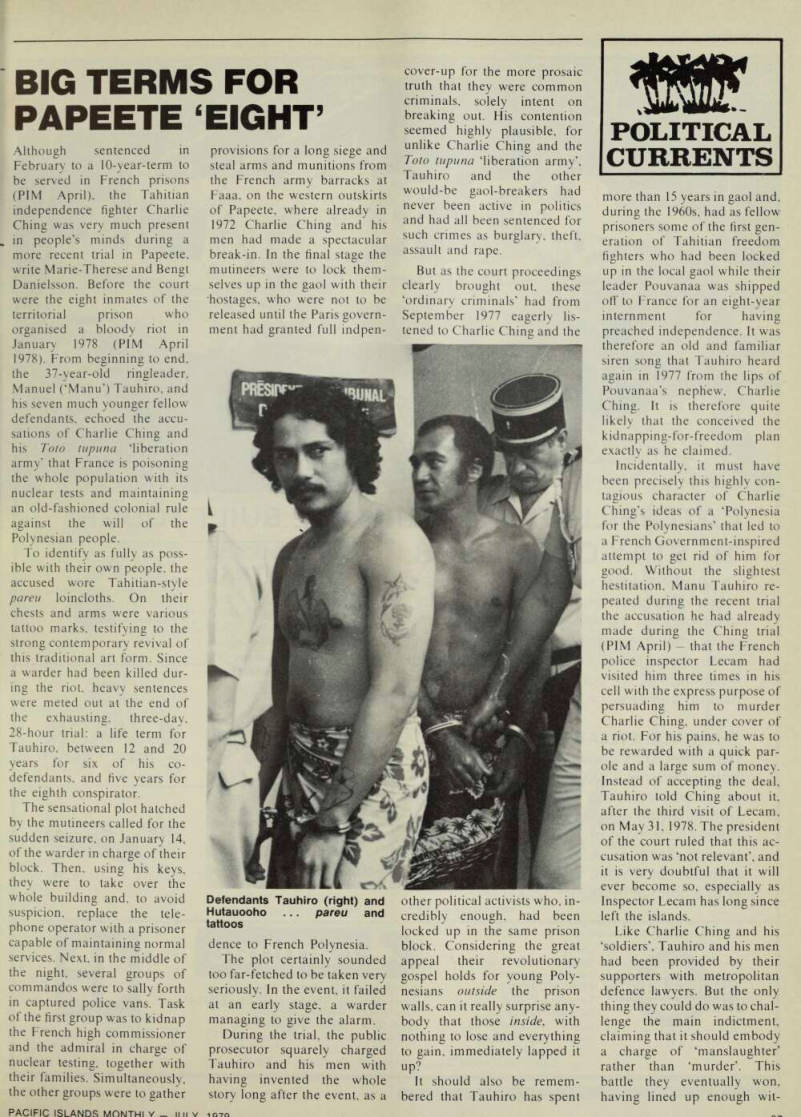


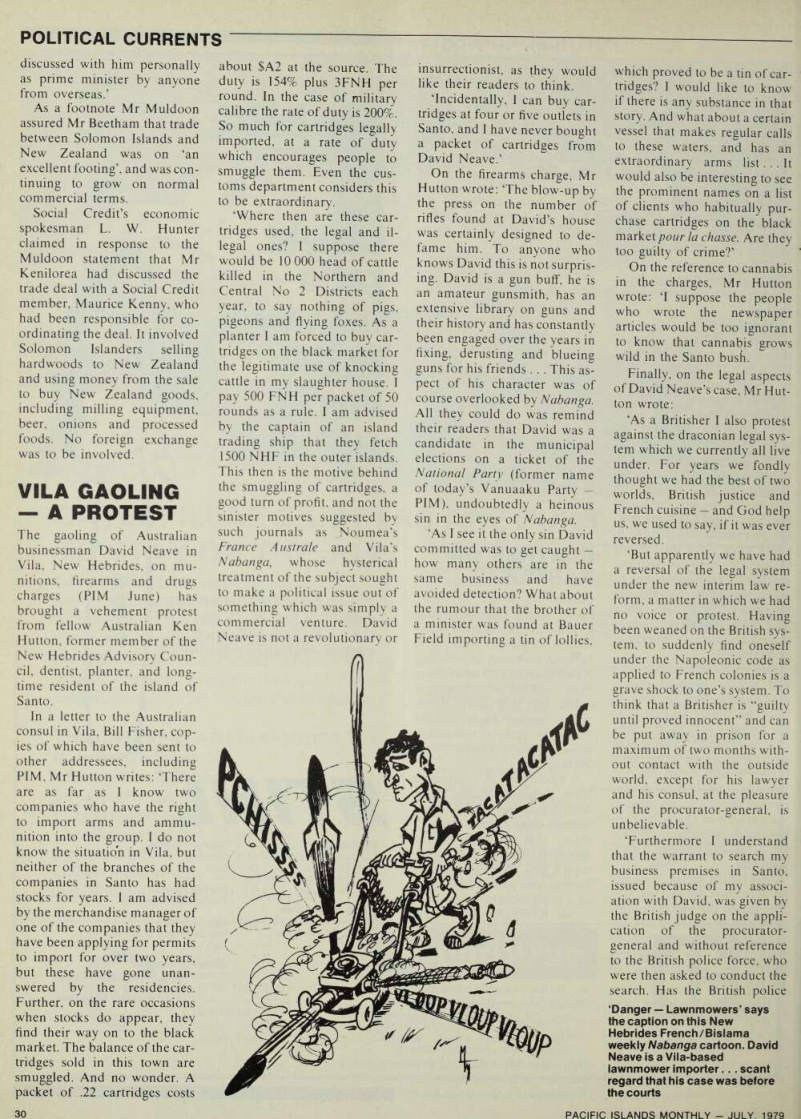
Political
Currents
Papeete ‘Eight’
Although sentenced in February to a 10-year-term to be served in French prisons (PIM April), the Tahitian independence fighter Charlie Ching was very much present in people’s minds during a more recent trial in Papeete, write Marie-Therese and Bengt Danielsson. Before the court were the eight inmates of the territorial prison who organised a bloody riot in January 1978 (PIM April 1978). From beginning to end, the 37-year-old ringleader.
Manuel (‘Manu’) Tauhiro. and his seven much younger fellow defendants, echoed the accu sations of Charlie Ching and his Toto tupuna ‘liberation army’ that France is poisoning the whole population with its nuclear tests and maintaining an old-fashioned colonial rule against the will of the
Polynesian people.
To identify as fully as poss ible with their own people, the accused wore Tahitian-style pareu loincloths. On their chests and arms were various tattoo marks, testifying to the strong contemporary revival of this traditional art form. Since a warder had been killed dur ing the riot, heavy sentences were meted out at the end of
the exhausting, three-day,
28-hour trial: a life term for Tauhiro, between 12 and 20 years for six of his co defendants, and five years for
the eighth conspirator.
The sensational plot hatched by the mutineers called for the sudden seizure, on January 14. of the warder in charge of their block. Then, using his keys, they were to take over the whole building and, to avoid suspicion, replace the tele phone operator with a prisoner capable of maintaining normal services. Next, in the middle of the night, several groups of commandos were to sally forth in captured police vans. Task of the first group was to kidnap the French high commissioner and the admiral in charge of
nuclear testing, together with
their families. Simultaneously, the other groups were to gather
provisions for a long siege and
steal arms and munitions from the French army barracks at Faaa, on the western outskirts of Papeete, where already in 1972 Charlie Ching and his men had made a spectacular break-in. In the final stage the mutineers were to lock them selves up in the gaol with their hostages, who were not to be released until the Paris govern ment had granted full indpen-
dence to French Polynesia.
The plot certainly sounded too far-fetched to be taken very seriously. In the event, it failed at an early stage, a warder managing to give the alarm.
During the trial, the public prosecutor squarely charged Tauhiro and his men with having invented the whole story long after the event, as a
cover-up for the more prosaic truth that they were common criminals, solely intent on breaking out. His contention
seemed highly plausible, for
unlike Charlie Ching and the Toto tupuna ‘liberation army’, Tauhiro and the other would-be gaol-breakers had never been active in politics and had all been sentenced for such crimes as burglary, theft, assault and rape.
But as the court proceedings
clearly brought out, these
‘ordinary criminals’ had from
September 1977 eagerly lis
tened to Charlie Ching and the
other political activists who, in credibly enough, had been locked up in the same prison block. Considering the great appeal their revolutionary gospel holds for young Poly nesians outside the prison walls, can it really surprise any body that those inside , with nothing to lose and everything to gain, immediately lapped it up?
It should also be remem bered that Tauhiro has spent
more than 15 years in gaol and, during the 19605, had as fellow prisoners some of the first gen eration of Tahitian freedom fighters who had been locked up in the local gaol while their leader Pouvanaa was shipped off to France for an eight-year internment for having
preached independence. It was
therefore an old and familiar siren song that Tauhiro heard again in 1977 from the lips of Pouvanaa’s nephew, Charlie Ching. It is therefore quite likely that the conceived the
kidnapping-for-freedom plan
exactly as he claimed.
Incidentally, it must have been precisely this highly con tagious character of Charlie Ching’s ideas of a ‘Polynesia for the Polynesians’ that led to a French Government-inspired attempt to get rid of him for
good. Without the slightest
hestitation. Manu Tauhiro re peated during the recent trial the accusation he had already made during the Ching trial (PIM April) that the French
police inspector Lecam had
visited him three times in his cell with the express purpose of persuading him to murder Charlie Ching, under cover of a riot. For his pains, he was to be rewarded with a quick par ole and a large sum of money.
Instead of accepting the deal, Tauhiro told Ching about it, after the third visit of Lecam, on May 31, 1978. The president of the court ruled that this ac cusation was ‘not relevant’, and it is very doubtful that it will ever become so, especially as Inspector Lecam has long since left the islands.
Like Charlie Ching and his ‘soldiers’, Tauhiro and his men had been provided by their supporters with metropolitan defence lawyers. But the only thing they could do was to chal lenge the main indictment, claiming that it should embody
a charge of ‘manslaughter’
rather than ‘murder’. This battle they eventually won, having lined up enough wit
Defendants Tauhiro (right) and Hutauooho ... pareu and tattoos
- nesses to prove that the original intent of the mutineers was simply to overpower the first warder who came into their block in the afternoon of the fateful day, January 14, 1978.
Unfortunately, this happened to be Pau Hoatua, a real giant, who resisted so forcefully that they felt obliged to beat him unconscious with their trun cheons, which consisted of wooden table legs. Eventually Pau, who, ironically, was the kindest and best liked of all the warders, died from the savage beating.
During the trial, the mutineers all expressed great regret at having ‘accidentally’ killed Pau. This of course could be interpreted as merely an attempt to get off with lighter sentences. However, the mov ing appeals they made in the courtroom to Pau’s widow,
imploring her forgiveness, cer
tainly had the ring of sincerity.
In their final statements, made just before the jury began its
five-hour-long deliberations,
the defendants also seemed to speak more from their hearts than during their previous de
positions. The question they all
asked was whether it was less criminal to kill people slowly with radioactive poison than to
despatch somebody quickly in
an ambush.
One of the defendants, who had refused legal assistance, read a very well chosen passage from the Bible, the Epistle to the Romans VII: 15-25. In the end, however, he too agreed to sign the common appeal to a higher French court, on the grounds that the sentences handed down corresponded to the abandoned charge of mur der and were thus too heavy for the actual indictment of man
slaughter.
Just for the record, it should be noted that the defence law yers had at the outset strongly protested, in what has now be come standard procedure at all trials, at the very strange way justice is administered in
French Polynesia.
Not only are the jurors fewer in number than in France three instead of nine but they are drawn exclusively from the ranks of French and part- French businessmen and government officials, who con
stitute only a small minority of the population, which is 75% Polynesian. To top it all, if a juror is too busy or too scared to do his duty, all he incurs is a fine of a few dollars. At the recent trial, for example, no fewer than nine of the 36 jurors on the panel decided to stay at home, thus restricting the choice available to the pros ecutor and the defence law yers.
The present writers are grati fied that following the recent case, their repeated criticisms of this anachronistic, colonial type justice have at last achieved some result. The local news media recently an nounced that French
Polynesia’s deputies to the
National Assembly in Paris, and a delegation of the terri torial assembly, have taken the matter up with the French minister of justice. The minis ter, much surprised that the century-old system is no longer
acceptable, has promised to
give it the attention it de serves.
Blather On
Barter?
Claims by Bruce Beetham, leader of New Zealand’s Social Credit League, about con clusion of a trade barter deal between Solomon Islands and New Zealand (PIM June) have been branded as ‘transparent politicking of a rather feeble nature’ by New Zealand Prime Minister Robert Muldoon, writes William Gasson from
Wellington.
‘I have received a statement from Solomon Islands Prime Minister Peter Kenilorea
strongly denying Mr Beetham’s
claim that a shipment of Solomon Islands timber consti tutes a new form of trade on a barter basis,’ said Mr Muldoon in a press statement. ‘Mr Kenilorea says the an nouncement by Mr Beetham of the supposed trade deal is “a disturbing state of affairs”, be cause as far as he is concerned, as leader of the Solomon Islands Government, he was never aware of any such trade. ‘Despite the Social Credit claim that Mr Kenilorea sup ported this form of trade. Mr Kenilorea says that it was never
discussed with him personally as prime minister by anyone from overseas.’
As a footnote Mr Muldoon assured Mr Beetham that trade between Solomon Islands and New Zealand was on ‘an excellent footing’, and was con tinuing to grow on normal commercial terms.
Social Credit’s economic spokesman L. W. Hunter claimed in response to the Muldoon statement that Mr Kenilorea had discussed the trade deal with a Social Credit member, Maurice Kenny, who had been responsible for co ordinating the deal. It involved Solomon Islanders selling hardwoods to New Zealand and using money from the sale to buy New Zealand goods,
including milling equipment,
beer, onions and processed
foods. No foreign exchange
was to be involved.
Vila Gaoling
A Protest
The gaoling of Australian businessman David Neave in Vila, New Hebrides, on mu nitions, firearms and drugs charges (PIM June) has brought a vehement protest from fellow Australian Ken Hutton, former member of the New Hebrides Advisory Coun cil, dentist, planter, and long time resident of the island of Santo.
In a letter to the Australian consul in Vila, Bill Fisher, cop ies of which have been sent to other addressees, including PIM, Mr Hutton writes: ‘There are as far as I know two companies who have the right to import arms and ammu nition into the group. I do not know the situation in Vila, but neither of the branches of the companies in Santo has had stocks for years. I am advised by the merchandise manager of one of the companies that they have been applying for permits to import for over two years, but these have gone unan swered by the residencies.
Further, on the rare occasions when stocks do appear, they find their way on to the black market. The balance of the car tridges sold in this town are smuggled. And no wonder. A packet of .22 cartridges costs
about SA2 at the source. The duty is 154% plus 3FNH per round. In the case of military calibre the rate of duty is 200%.
So much for cartridges legally imported, at a rate of duty which encourages people to smuggle them. Even the cus toms department considers this to be extraordinary. ‘Where then are these car tridges used, the legal and il legal ones? I suppose there would be 10 000 head of cattle killed in the Northern and Central No 2 Districts each year, to say nothing of pigs, pigeons and flying foxes. As a planter I am forced to buy car tridges on the black market for the legitimate use of knocking cattle in my slaughter house. I pay 500 FNH per packet of 50 rounds as a rule. I am advised by the captain of an island
trading ship that they fetch
1500 NHF in the outer islands.
This then is the motive behind the smuggling of cartridges, a good turn of profit, and not the
sinister motives suggested by
such journals as Noumea’s France Australe and Vila’s
Nabanga, whose hysterical
treatment of the subject sought to make a political issue out of something which was simply a commercial venture. David Neave is not a revolutionary or
insurrectionist, as they would like their readers to think. ‘lncidentally, I can buy car tridges at four or five outlets in Santo, and I have never bought a packet of cartridges from David Neave.’
On the firearms charge, Mr Hutton wrote: ‘The blow-up by the press on the number of rifles found at David’s house was certainly designed to de fame him. To anyone who knows David this is not surpris ing. David is a gun buff, he is an amateur gunsmith, has an extensive library on guns and their history and has constantly been engaged over the years in
fixing, derusting and blueing
guns for his friends . . . This as pect of his character was of
course overlooked by Nabanga.
All they could do was remind their readers that David was a candidate in the municipal elections on a ticket of the National Party (former name
of today’s Vanuaaku Party
PIM), undoubtedly a heinous sin in the eyes of Nabanga. ‘As I see it the only sin David committed was to get caught how many others are in the same business and have avoided detection? What about the rumour that the brother of a minister was found at Bauer Field importing a tin of lollies.
which proved to be a tin of car tridges? I would like to know if there is any substance in that story. And what about a certain vessel that makes regular calls to these waters, and has an extraordinary arms list... It would also be interesting to see the prominent names on a list of clients who habitually pur chase cartridges on the black market pour la chasse. Are they too guilty of crime?’
On the reference to cannabis in the charges, Mr Hutton wrote: T suppose the people who wrote the newspaper articles would be too ignorant to know that cannabis grows wild in the Santo bush.
Finally, on the legal aspects of David Neave’s case, Mr Hut ton wrote: ‘As a Britisher I also protest against the draconian legal sys tem which we currently all live under. For years we fondly thought we had the best of two worlds, British justice and French cuisine and God help us, we used to say, if it was ever reversed. ‘But apparently we have had a reversal of the legal system under the new interim law re form, a matter in which we had no voice or protest. Having been weaned on the British sys tem, to suddenly find oneself under the Napoleonic code as applied to French colonies is a grave shock to one’s system. To think that a Britisher is “guilty until proved innocent” and can be put away in prison for a maximum of two months with out contact with the outside world, except for his lawyer and his consul, at the pleasure of the procurator-general, is unbelievable. ‘Furthermore I understand that the warrant to search my business premises in Santo, issued because of my associ ation with David, was given by the British judge on the appli cation of the procurator general and without reference to the British police force, who were then asked to conduct the search. Has the British police
'Danger-Lawnmowers’ says the caption on this New Hebrides French/Bislama weekly Nabanga cartoon. David Neave is a Vila-based lawnmower importer ... scant regard that his case was before the courts
force been completely emas culated? ‘I have the uneasy feeling that anyone politically motiva ted could “salt” anyone’s home with a few rounds of ammu nition and a handful of canna bis seeds, then stir up sufficient
hysteria through the gutter
press, so that any one of us could find himself in prison at the pleasure of the procurator general for a period of two months. In my view a trial by the media is nauseating and alien to British justice.’
Heroin War
On Guam
News that Guam’s heroin kings have drawn up a ‘hit list’ to murder top government officials is the latest in a long series of events here which have highlighted the power
and danger of drug trafficking
in the Pacific, writes Paul Addison from Agana.
Last year on Guam, drug related murders claimed the lives of more than 15 persons, including two Japanese tour ists. This year, with many top heroin dealers behind bars, Guam’s overcrowded prison has seen the brunt of the action
and the virtually bankrupt
government has provided few remedies to quell the exposive situation.
In a May 7 letter to A 1 Pan gelinan, director of Guam’s bureau of the budget, Attorney-General Kenneth North made an almost desper ate plea for money to hire prison guards. ‘At the present time I am fighting a war,’ Mr North wrote. ‘The major heroin traf fickers are on the defensive and are planning to kill several
high-ranking government
officials in retaliation. There is a battle raging for control of the department of corrections prisoners or guards.’ He added: ‘Time is of the essence.
Heroin dealers do not deal through a myriad of bureau
cratic steps. They merely
obtain a weapon and kill some body. I am not overly dramatis ing. The situation is critical
today.’
In the past six months the prison dangers have been illus trated by a continuing saga of
murders, beatings, escapes and arrests.
For the small group of prison officials, life has been a con stant battle to man the prison and keep the inmates in line. In February, Governor Paul M.
Calvo appointed hard-liner James Miles as director of the department of corrections, an appointment which brought applause from some quarters and fear of further troubles from others.
Mr Miles, 43. an army vet eran, has planned no-nonsense stances on discipline, parole and prison gangs. Of the more than 120 inmates, he said re cently, he thought it would be possible to rehabilitate 75% if conditions could be improved.
His planned disciplines include
military crewcuts, roll-calls and
platoon drills.
To many, the problems that now exist within the prison are testimony that many of the top drug traffickers are in fact be hind bars. They point out that
so far this year there have been few drug-related murders on the island and that robberies and violent crimes have fallen
dramatically.
However, optimistic con clusions that trafficking has dried up were temporarily muted with the May 16 arrest of a family of four, including a 51-year-old woman, for pos
sessing heroin. When police
raided the Dededo store and home of the Shimizu family they found five bundles of her oin. SUS3OO worth of mari juana, numerous barbiturates
and amphetamines, three fully
loaded unregistered rifles and more than $6OOO in cash.
Although police officers say they think they have captured one of the few remaining high level dealers on the island, they cautiously acknowledge that the heroin scene is far from dead on once idyllic Guam.
Governor Paul M. Calvo ... put ting a hard-liner in charge of the gaol
Advertisements & other items, pp. 27-31 (2 items)
27
PACIFIC ISLANDS MONTHI Y ll li v -10-m
carptrac
' -t .1 J * *1
I rATESP^*!!
% m •*»»»«* / *»*%*■ ,v X *IS ..Sr * i*- : ‘
CATERPILLAR SKIDDERS ARE BUILT TOUGH
TO STAY ON THE JOB.
MUFFLER
Cat-built Skidders have protection all
round. You get protection for man and
machine with the roll-over canopy and
other machine guarding. And you get
protection against excessive downtime with
dependable CAT construction, CAT dealer
backup and easy on the job maintenance.
THE CATERPILLAR 518 SKIDDER
features 120 flywheel
horsepower @ 2200 rpm,
powered by the Cat 3304
turbocharged engine, with an
operating weight of 20,400 lbs,
turning diameter of 34' 8" and
utilises a Gearmatic 119 winch
with a linepull (max.) of 32,000 lbs.
QUIET OPERATION
You get low noise levels from the 4-stroke cycle diesel, muffler and low-speed fan. You'll hear the difference in Cat-built Skidders.
STRONG DOZER BLADES
deck and bunch logs, clear brush, protect the radiator. The blades are high-strength steel with trunnions that never need greasing. Dozer blades are box-sectioned for greater strength and durability.
LOW RATED RPM
4-STROKE CYCLE DIESEL
MUFFLER LOW-SPEED
FAN RUGGED ARCH AND
FAIRLEAD
stand up under heavy loads.
The main roller is a Lifetime Lubricated hardened casting to reduce scarring that tears up cables. Side rollers are heat-treated for long life.
LOW RATED RPM
FAN
£
HASTINGS PEERING
LAE ;
Milford Haven Road, Telephone 42 2355
PORT MORESBY :
Telephone 256650
BOUGAINVILLE .
Itakara Industrial Park, Arawa. Telephone 959077 c
carptrac
SUVA : Carpenter Street, Raiwai.
Private Mail Bag, GPOSuva. Fiji. Ph. 381622, Telex FJ2190 Cables CARPTRAC LAUTOKA : Veitari. Telephone 61877 LABASA : Vulovi, Telephone 81888
YOUR
CATERPILLAR
DEALER
Caterpillar Cat and 33 are Trademarks of Caterpillar Tractor Co BA 10441
The best
power-
to-
weight
ratio
big saw
in the
world.
075 AVE
111 cc power with an all-up weight of just 25.75 lbs.
(11.7 kg). Anti-Vibration
system standard equipment
m a * r-
ST/HL
Fiji Islands Carpenters Motors-Sales Walu Bay, Suva.
Carpenters Motors-Parts, Walu Bay, Suva.
Papua New Guinea Morgan Equipment Pty. Ltd.
Arawa, Bougainville.
Rabaul, Boroko, Lae Western Samoa Carptrac, Apia Norfolk Island Cameralines Limited New Hebrides Roy Gallimore & Associates, Port Vila.
Solomon Islands Foxwood (S.l. Timbers) Ltd
The High Speed DC integrated
amplifier has arrived!
(It's fast. It's accurate.lt's three-dimensional)
Think of the most soul-stirring musical passage you know, with the whole orchestra playing a full crescendo.
The Kenwood High Speed DC integrated amplifier can reproduce it, with the consummate ease of a seasoned pro.
Or get down to more personal music where what you really want to hear is those sensitive fingers caressing the guitar strings. Or the lips of your favorite singer articulating each w ? ord.
The Kemvood High Speed DC integrated amplifier gives it to you, all the way.
What w r e’re talking about is not just a package of circuitry made-up with some front-panel cosmetics. You can get that anyw r here.
Were talking about quality in reproduced sound.
And authenticity.
We can tell you about the astonishing transient response of these integrated amplifiers. About their beautifully clean low-end response without phase distortion.
About their remarkable clarity throughout the audible frequency range.
Or about their state-of-the-art circuitry.
Yet it won’t mean much unless you can hear for yourself just how much,space and depth these amplifiers can offer you, fresh from your speakers.
The KA-907, KA-801 and KA-701 are part of the Kemvood ideal that goes back to the beginnings of audio.
And that ideal is: authentic music reproduction at a price you can afford.
You can see full range of Kenwood new High-Speed Amplifier at 79 Australian CES
n hi-speed
KA-907
Court ruling puts
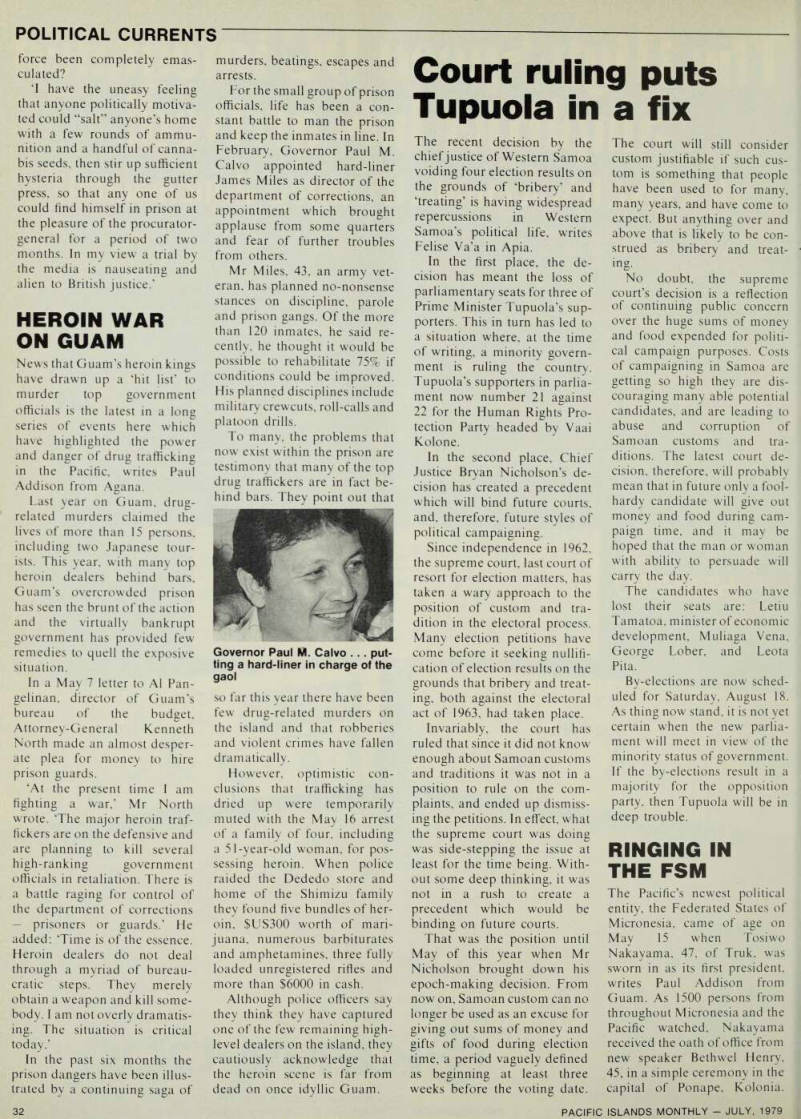
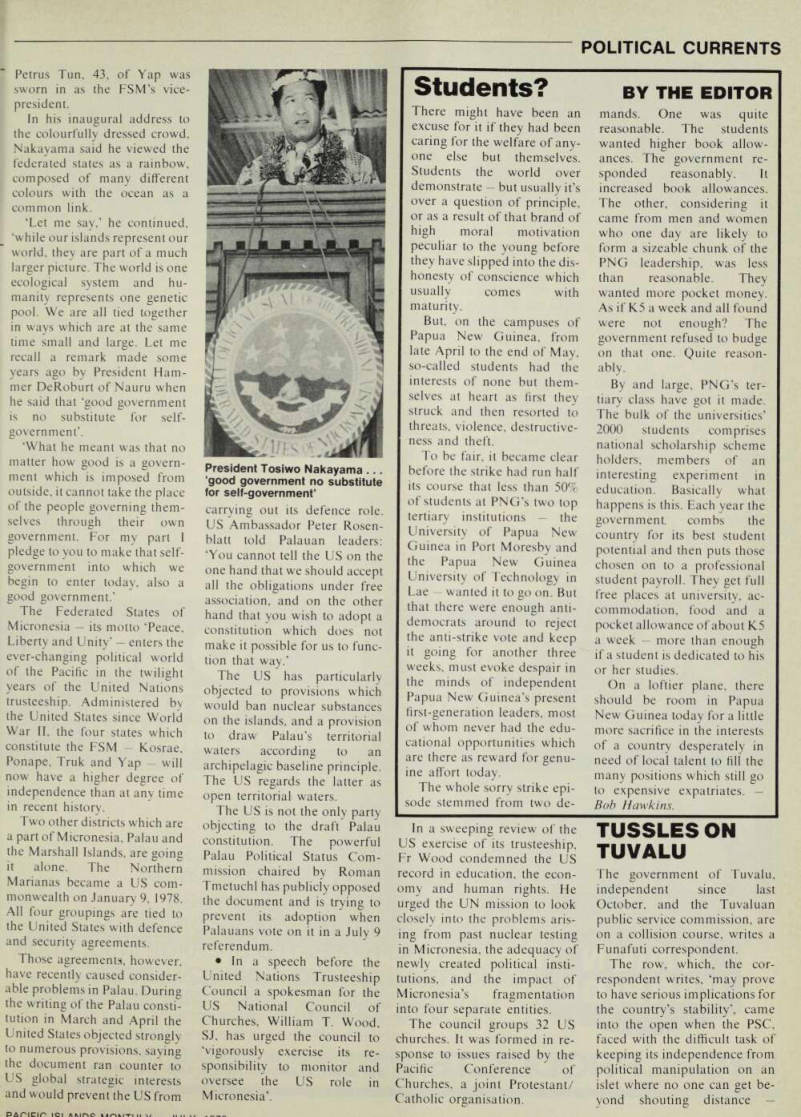

Tupuola in a fix
The recent decision by the chief justice of Western Samoa voiding four election results on the grounds of ‘bribery’ and
‘treating’ is having widespread
repercussions in Western Samoa’s political life, writes Felise Va’a in Apia.
In the first place, the de cision has meant the loss of parliamentary seats for three of Prime Minister Tupuola’s sup porters. This in turn has led to a situation where, at the time of writing, a minority govern ment is ruling the country.
Tupuola’s supporters in parlia ment now number 21 against 22 for the Human Rights Pro tection Party headed by Vaai Kolone.
In the second place, Chief Justice Bryan Nicholson’s de cision has created a precedent which will bind future courts, and. therefore, future styles of
political campaigning.
Since independence in 1962, the supreme court, last court of resort for election matters, has taken a wary approach to the position of custom and tra dition in the electoral process.
Many election petitions have
come before it seeking nullifi cation of election results on the grounds that bribery and treat ing, both against the electoral act of 1963, had taken place.
Invariably, the court has ruled that since it did not know enough about Samoan customs and traditions it was not in a position to rule on the com plaints, and ended up dismiss ing the petitions. In effect, what the supreme court was doing was side-stepping the issue at least for the time being. With out some deep thinking, it was not in a rush to create a precedent which would be binding on future courts.
That was the position until May of this year when Mr Nicholson brought down his epoch-making decision. From now on, Samoan custom can no longer be used as an excuse for giving out sums of money and gifts of food during election time, a period vaguely defined as beginning at least three weeks before the voting date.
The court will still consider custom justifiable if such cus tom is something that people have been used to for many, many years, and have come to expect. But anything over and above that is likely to be con strued as bribery and treat
ing.
No doubt, the supreme court’s decision is a reflection of continuing public concern over the huge sums of money and food expended for politi cal campaign purposes. Costs of campaigning in Samoa are getting so high they are dis couraging many able potential candidates, and are leading to abuse and corruption of Samoan customs and tra ditions. The latest court de cision, therefore, will probably mean that in future only a fool hardy candidate will give out money and food during cam paign time, and it may be hoped that the man or woman with ability to persuade will carry the day.
The candidates who have lost their seats are: Letiu Tamatoa, minister of economic development, Muliaga Vena, George Lober. and Leota Pita.
By-elections are now sched uled for Saturday, August 18.
As thing now stand, it is not yet certain when the new parlia ment will meet in view of the minority status of government.
If the by-elections result in a majority for the opposition party, then Tupuola will be in deep trouble.
Ringing In
The Fsm
The Pacific’s newest political entity, the Federated States of Micronesia, came of age on May 15 when Tosiwo Nakayama, 47, of Truk, was sworn in as its first president, writes Paul Addison from Guam. As 1500 persons from throughout Micronesia and the Pacific watched, Nakayama received the oath of office from new speaker Bethwel Henry, 45, in a simple ceremony in the capital of Ponape, Kolonia.
Petrus Tun, 43, of Yap was sworn in as the FSM’s vice president.
In his inaugural address to the colourfully dressed crowd, Nakayama said he viewed the federated states as a rainbow, composed of many different colours with the ocean as a common link. ‘Let me say,’ he continued, ‘while our islands represent our world, they are part of a much larger picture. The world is one ecological system and hu manity represents one genetic pool. We are all tied together in ways which are at the same time small and large. Let me recall a remark made some years ago by President Ham mer Deßoburt of Nauru when he said that ‘good government is no substitute for self government’. ‘What he meant was that no matter how good is a govern ment which is imposed from outside, it cannot take the place of the people governing them selves through their own government. For my part I pledge to you to make that self government into which we begin to enter today, also a good government.’
The Federated States of Micronesia - its motto ‘Peace, Liberty and Unity’ - enters the ever-changing political world of the Pacific in the twilight years of the United Nations
trusteeship. Administered by
the United States since World War 11. the four states which constitute the FSM - Kosrae, Ponape, Truk and Yap - will now have a higher degree of independence than at any time in recent history.
Two other districts which are a part of Micronesia, Palau and the Marshall Islands, are going it alone. The Northern Marianas became a US com monwealth on January 9, 1978.
All four groupings are tied to the United States with defence and security agreements.
Those agreements, however, have recently caused consider able problems in Palau. During the writing of the Palau consti tution in March and April the
United States objected strongly
to numerous provisions, saying the document ran counter to
US global strategic interests
and would prevent the US from
carrying out its defence role.
US Ambassador Peter Rosen blatt told Palauan leaders: ‘You cannot tell the US on the one hand that we should accept all the obligations under free association, and on the other hand that you wish to adopt a constitution which does not make it possible for us to func tion that way.’
The US has particularly objected to provisions which would ban nuclear substances on the islands, and a provision to draw Palau’s territorial waters according to an
archipelagic baseline principle.
The US regards the latter as open territorial waters.
The US is not the only party objecting to the draft Palau constitution. The powerful Palau Political Status Com mission chaired by Roman Tmetuchl has publicly opposed the document and is trying to prevent its adoption when Palauans vote on it in a July 9 referendum. • In a speech before the United Nations Trusteeship Council a spokesman for the US National Council of Churches, William T. Wood, SJ, has urged the council to ‘vigorously exercise its re sponsibility to monitor and oversee the US role in Micronesia’.
In a sweeping review of the US exercise of its trusteeship, Fr Wood condemned the US record in education, the econ omy and human rights. He urged the UN mission to look closely into the problems aris ing from past nuclear testing in Micronesia, the adequacy of
newly created political insti
tutions, and the impact of
Micronesia’s fragmentation
into four separate entities.
The council groups 32 US churches. It was formed in re sponse to issues raised by the Pacific Conference of Churches, a joint Protestant/
Catholic organisation.
Tussles On
Tuvalu
The government of Tuvalu, independent since last October, and the Tuvaluan public service commission, are on a collision course, writes a Funafuti correspondent.
The row, which, the cor respondent writes, ‘may prove to have serious implications for the country’s stability’, came into the open when the PSC, faced with the difficult task of keeping its independence from political manipulation on an islet where no one can get be yond shouting distance
President Tosiwo Nakayama ...
'good government no substitute for self-government'
unless he leaves rejected government recommendations to sack an agricultural assistant and to make an appointment to a new post of senior education officer.
Secretary to Government lonatana lonatana, an ex police officer, insisted that the PSC should support govern ment recommendations and followed up that unconven tional stand with a request for the resignation of the members of the commission.
The commission members
didn’t budge even though they
endured a humiliating face-to face confrontation with the cabinet, which was meeting the commissioners for the first time as the PSC. Cabinet voiced its stern disapproval of the PSC’s decisions but kept off the business of resignation.
There the matter rests for the time being. Governor- General F. Penitala Teo is rumoured to be upset over the whole thing and is thinking of
resigning.
The question on everyone’s
lips is ‘Who controls whom?’
The PSC will possibly face criticism, probably justified, of
paying too much attention to such trivialities as the dismissal of a junior public servant. It might reverse its decision on this without losing too much face or undermining the PSC’s role.
There should be a breathing space for all those involved, and spectators too, to consider the implications of a govern ment-ridden commission and resultant possibilities. There are not many people around with the experience needed to do a PSC job, but the feeling’s there that the government, the governor-general and the cabi net, not to mention the sec retary to government, should maintain the independence and integrity of the com mission. Failing that, the com mission will become a rubber stamp and the public service will be left wide open to abuse of all kinds ‘jobs for the boys’, and what have you.
Though the governor general is not compelled by the terms of the constitution to up hold the accepted principle of acting in accordance with the advice rendered by the PSC, he is expected to uphold its de
cisions, as he is to assent to
parliamentary legislation.
There’s one piquant aspect to the whole thing. Whether or not he knows it, the career of the secretary to government is at the whim, not of the cabinet or of the governor-general, but of the PSC. This is a point some people believe the PSC has just woken up to.
Si: Caring
For An Image
Solomon Islands MPs are cast ing around for ways of ensur ing that an independent outside body determines their working conditions, and at the same time takes care of the problem of their public ‘image’, writes George Atkin from Honiara.
Prime Minister Peter Kenilorea late in May piloted through the house a Parliamentary (Conditions of Service) Commission Bill which will set up a body of three members, none a poli tician, who will be appointed by Governor-General Bad deley Devesi. Its main task will be to look into parliamen
tarians’ salaries, allowances
during parliamentary sittings,
accommodation for their fam ilies while parliament is in session, and general conditions of service.
Arguing against the bill. Op position Leader Batholomew Ulufa’alu said it would lead to duplication and waste of scarce resources. He said parliamen tarians could best deal with their own affairs because they understood their situation best.
It was Willie Betu, leader of the independent group, who showed most sensitivity to the ‘image’ problem of MPs. Sup porting the bill, he said he
hoped that an independent
body dealing with MPs’ con ditions of service ‘would stop people calling us all sorts of names and accusing us of only doing things for our own ends’.
Then, setting his sights higher still, he voiced the hope that the commission would see that
‘proper publicity’ is given
about parliamentarians. ‘All the publicity we get from the press is the kind that disap points our families,’ said Mr Betu.
Students?
There might have been an excuse for it if they had been caring for the welfare of any one else but themselves.
Students the world over demonstrate - but usually it’s over a question of principle, or as a result of that brand of high moral motivation peculiar to the young before they have slipped into the dis honesty of conscience which usually comes with
maturity.
But, on the campuses of Papua New Guinea, from late April to the end of May, so-called students had the interests of none but them selves at heart as first they struck and then resorted to threats, violence, destructive ness and theft.
To be fair, it became clear before the strike had run half its course that less than 50% of students at PNG’s two top tertiary institutions - the
University of Papua New
Guinea in Port Moresby and the Papua New Guinea
University of Technology in
Lae wanted it to go on. But that there were enough anti democrats around to reject the anti-strike vote and keep it going for another three weeks, must evoke despair in the minds of independent Papua New Guinea’s present first-generation leaders, most of whom never had the edu cational opportunities which are there as reward for genu ine affort today.
The whole sorry strike epi sode stemmed from two de-
By The Editor
mands. One was quite reasonable. The students wanted higher book allow ances. The government re sponded reasonably. It increased book allowances.
The other, considering it came from men and women who one day are likely to form a sizeable chunk of the PNG leadership, was less than reasonable. They wanted more pocket money.
As if K 5 a week and all found were not enough? The government refused to budge on that one. Quite reason
ably.
By and large, PNG’s ter tiary class have got it made.
The bulk of the universities’ 2000 students comprises national scholarship scheme holders, members of an
interesting experiment in
education. Basically what happens is this. Each year the government. combs the country for its best student potential and then puts those chosen on to a professional student payroll. They get full free places at university, ac commodation, food and a pocket allowance of about K 5 a week more than enough if a student is dedicated to his or her studies.
On a loftier plane, there should be room in Papua New Guinea today for a little more sacrifice in the interests of a country desperately in need of local talent to fill the many positions which still go to expensive expatriates. -
Bob Hawkins.
Advertisements & other items, pp. 33-36 (3 items)
Political Currents
Political Currents
34
PAniPir. i.9i ANn.9 mdmthi y july 1979
Urethane Foams
RIGID AND FLEXIBLE SYSTEMS
TO SUIT YOUR REQUIREMENTS
DO
UNION
CARBIDE
EFFECTIVE IN . ..
• INSULATED BUILDING PANELS
• FLOATATION APPLICATIONS
• INDUSTRIAL INSULATION
• FURNITURE MANUFACTURE
• REFRIGERATED STORAGE INSULATION
Rigid Polyurethane Foam made from Hycel Activators and Hycel Resins have proved their worth in the above situations, due to their superior physical properties, including extremely low thermal conductivity factor. Hycel Rigid, Flexible, and Semi-Rigid foams may be adapted to suit your individual needs.
For free technical information write or phone:
HYCEL PRODUCTS
UNION CARBIDE NEW ZEALAND LTD
P.O. Box 33-228, TAKAPUNA, AUCKLAND. TELEPHONE: 449-166
V * * 1 ) ■ H ! \ r A V. m - * ■ Cathay Pacific. From the heart of Asia.
Cathay Pacific now flies every Sunday at 6.05 p.m. from Port Moresby to Hong Kong. rom Hong Kong, Cathay Pacific flies North, South, East and West serving all the major cities in South-East Asia, Australia and the Middle East. On board you will be cared for y charming Oriental flight-hostesses specially chosen from the countries we serve and V iQhly experienced British and Australian pilots and flight engineers. Hong Kong's discovery airline v Cathay Pacific. Direct from the heart of Asia to the heart of Papua New Guinea. CATHAY
What is
the
Australian
Package?
The Australian Package is a unique, practical solution to the problem of coastal and fisheries protection. Or, more to the point, it is a whole range of solutions.
A number of Australia's most respected aviation,marine, electronics and construction companies have combined to offer, from a single source, all of the equipment, expertise support facilities and training necessary to establish a cost-effective coastal protection system. The Package emphasises options at every level, and is designed to integrate fully with any relevant capabilities which a customer already has. A protection system can therefore be tailored to meet exactly the needs, and budget, of any nation. *
Hawker de Havilland
Most importantly, the Australian Package incorporates major equipments which have been designed specifically for the Asian Pacific region, allowing extended operations from modest base facilities as well as maximum local support.
For a detailed information book about the Australian Package, mail the coupon below.
To: The Marketing Manager Hawker de Havilland Australia Pty Limited PO Box 78 Lidcombe NSW 2141 AUSTRALIA Please send me a copy of the book The Australian Package Name: Address:
Australia Pty. Limited
Pacific
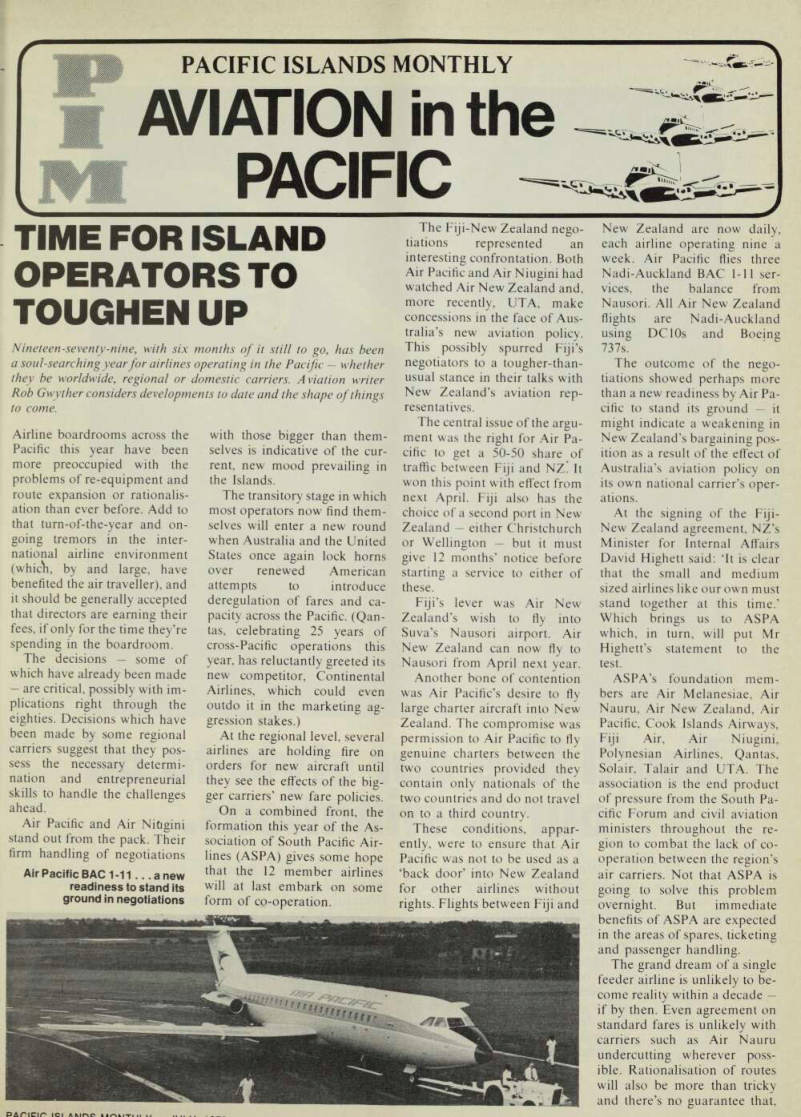

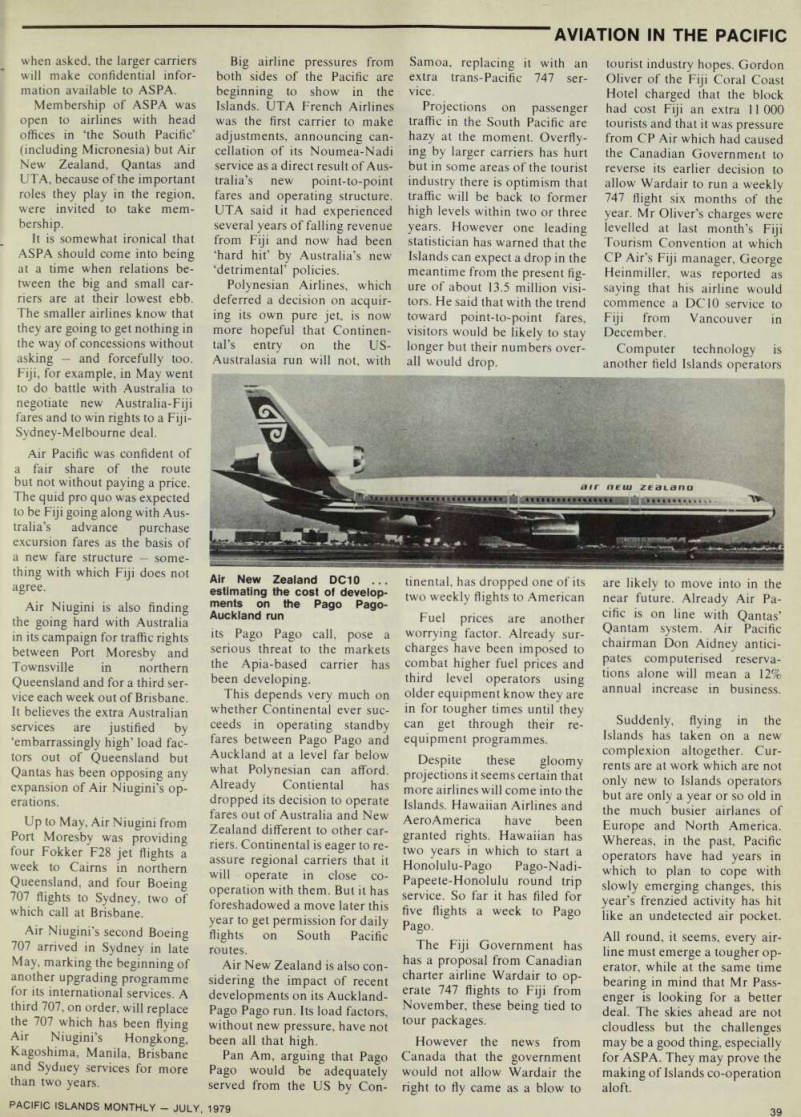
Pim Pacific Islands Monthly
AVIATION in the
Time For Island
Operators To
Toughen Up
Nineteen-seventy-nine, with six months of it still to go, has been a soul-searching year for airlines operating in the Pacific whether they be worldwide, regional or domestic carriers. Aviation writer Rob Gwyther considers developments to date and the shape of things to come.
Airline boardrooms across the Pacific this year have been more preoccupied with the
problems of re-equipment and
route expansion or rationalis ation than ever before. Add to that turn-of-the-year and on going tremors in the inter national airline environment
(which, by and large, have
benefited the air traveller), and it should be generally accepted that directors are earning their fees, if only for the time they’re spending in the boardroom.
The decisions some of which have already been made are critical, possibly with im
plications right through the
eighties. Decisions which have been made by some regional carriers suggest that they pos sess the necessary determi nation and entrepreneurial skills to handle the challenges ahead.
Air Pacific and Air Nifigini stand out from the pack. Their firm handling of negotiations
with those bigger than them selves is indicative of the cur rent, new mood prevailing in the Islands.
The transitory stage in which most operators now find them selves will enter a new round when Australia and the United States once again lock horns over renewed American attempts to introduce deregulation of fares and ca pacity across the Pacific. (Qan tas, celebrating 25 years of cross-Pacific operations this year, has reluctantly greeted its new competitor. Continental Airlines, which could even outdo it in the marketing ag
gression stakes.)
At the regional level, several airlines are holding fire on orders for new aircraft until they see the effects of the big ger carriers’ new fare policies.
On a combined front, the formation this year of the As sociation of South Pacific Air lines (ASPA) gives some hope that the 12 member airlines will at last embark on some form of co-operation.
The Fiji-New Zealand nego tiations represented an interesting confrontation. Both Air Pacific and Air Niugini had watched Air New Zealand and, more recently, UTA, make concessions in the face of Aus tralia’s new aviation policy.
This possibly spurred Fiji’s
negotiators to a tougher-than usual stance in their talks with New Zealand’s aviation rep resentatives.
The central issue of the argu ment was the right for Air Pa cific to get a 50-50 share of traffic between Fiji and NZ. It won this point with effect from next April. Fiji also has the choice of a second port in New Zealand - either Christchurch or Wellington but it must give 12 months’ notice before starting a service to either of these.
Fiji’s lever was Air New Zealand’s wish to fly into Suva’s Nausori airport. Air New Zealand can now fly to Nausori from April next year.
Another bone of contention was Air Pacific’s desire to fly large charter aircraft into New Zealand. The compromise was permission to Air Pacific to fly genuine charters between the two countries provided they contain only nationals of the two countries and do not travel on to a third country.
These conditions, appar ently, were to ensure that Air Pacific was not to be used as a ‘back door’ into New Zealand for other airlines without
rights. Flights between Fiji and
New Zealand are now daily, each airline operating nine a week. Air Pacific flies three Nadi-Auckland BAC 1-11 ser vices, the balance from Nausori. All Air New Zealand flights are Nadi-Auckland using DC 10s and Boeing 7375.
The outcome of the nego tiations showed perhaps more than a new readiness by Air Pa cific to stand its ground it might indicate a weakening in New Zealand’s bargaining pos ition as a result of the effect of Australia’s aviation policy on its own national carrier’s oper ations.
At the signing of the Fiji- New Zealand agreement, NZ’s Minister for Internal Affairs David Highett said; ‘lt is clear that the small and medium sized airlines like our own must stand together at this time.’
Which brings us to ASPA which, in turn, will put Mr Highett’s statement to the test.
ASPA's foundation mem bers are Air Melanesiae, Air Nauru, Air New Zealand, Air Pacific, Cook Islands Airways, Fiji Air, Air Niugini, Polynesian Airlines, Qantas, Solair, Talair and UTA. The association is the end product of pressure from the South Pa cific Forum and civil aviation ministers throughout the re gion to combat the lack of co operation between the region’s air carriers. Not that ASPA is going to solve this problem overnight. But immediate benefits of ASPA are expected in the areas of spares, ticketing and passenger handling.
The grand dream of a single feeder airline is unlikely to be come reality within a decade if by then. Even agreement on standard fares is unlikely with carriers such as Air Nauru undercutting wherever poss ible. Rationalisation of routes will also be more than tricky and there’s no guarantee that,
Air Pacific BAC 1 -11 ... a new readiness to stand its ground in negotiations
when asked, the larger carriers will make confidential infor mation available to ASPA.
Membership of ASPA was open to airlines with head offices in ‘the South Pacific’ (including Micronesia) but Air New Zealand, Qantas and UTA, because of the important
roles they play in the region,
were invited to take mem
bership.
It is somewhat ironical that ASPA should come into being at a time when relations be tween the big and small car riers are at their lowest ebb.
The smaller airlines know that they are going to get nothing in the way of concessions without
asking and forcefully too.
Fiji, for example, in May went
to do battle with Australia to
negotiate new Australia-Fiji
fares and to win rights to a Fiji-
Sydney-Melbourne deal.
Air Pacific was confident of a fair share of the route but not without paying a price.
The quid pro quo was expected to be Fiji going along with Aus tralia’s advance purchase excursion fares as the basis of a new fare structure some thing with which Fiji does not agree.
Air Niugini is also finding the going hard with Australia in its campaign for traffic rights between Port Moresby and Townsville in northern Queensland and for a third ser vice each week out of Brisbane.
It believes the extra Australian
services are justified by
‘embarrassingly high’ load fac
tors out of Queensland but Qantas has been opposing any expansion of Air Niugini’s op erations.
Up to May, Air Niugini from
Port Moresby was providing
four Fokker F2B jet flights a week to Cairns in northern Queensland, and four Boeing 707 flights to Sydney, two of which call at Brisbane.
Air Niugini’s second Boeing
707 arrived in Sydney in late
May, marking the beginning of
another upgrading programme for its international services. A third 707, on order, will replace the 707 which has been flying
Air Niugini’s Hongkong,
Kagoshima, Manila, Brisbane and Sydney services for more than two years.
Big airline pressures from both sides of the Pacific are beginning to show in the Islands. UTA French Airlines was the first carrier to make adjustments, announcing can cellation of its Noumea-Nadi service as a direct result of Aus tralia’s new point-to-point fares and operating structure.
UTA said it had experienced several years of falling revenue from Fiji and now had been ‘hard hit’ by Australia’s new
‘detrimental’ policies.
Polynesian Airlines, which deferred a decision on acquir ing its own pure jet, is now more hopeful that Continen tal’s entry on the US- Australasia run will not, with
Samoa, replacing it with an extra trans-Pacific 747 ser vice.
Projections on passenger traffic in the South Pacific are hazy at the moment. Overfly ing by larger carriers has hurt but in some areas of the tourist industry there is optimism that traffic will be back to former high levels within two or three years. However one leading statistician has warned that the Islands can expect a drop in the meantime from the present fig ure of about 13.5 million visi tors. He said that with the trend toward point-to-point fares, visitors would be likely to stay longer but their numbers over all would drop.
tourist industry hopes. Gordon
Oliver of the Fiji Coral Coast Hotel charged that the block had cost Fiji an extra 11 000 tourists and that it was pressure from CP Air which had caused the Canadian Government to reverse its earlier decision to allow Wardair to run a weekly 747 flight six months of the year. Mr Oliver’s charges were levelled at last month’s Fiji Tourism Convention at which CP Air’s Fiji manager, George Heinmiller, was reported as saying that his airline would commence a DC 10 service to Fiji from Vancouver in December.
Computer technology is
another field Islands operators
its Pago Pago call, pose a serious threat to the markets the Apia-based carrier has
been developing.
This depends very much on whether Continental ever suc
ceeds in operating standby
fares between Pago Pago and Auckland at a level far below what Polynesian can afford.
Already Contiental has dropped its decision to operate fares out of Australia and New Zealand different to other car riers. Continental is eager to re assure regional carriers that it will operate in close co operation with them. But it has foreshadowed a move later this year to get permission for daily flights on South Pacific routes.
Air New Zealand is also con sidering the impact of recent developments on its Auckland- Pago Pago run. Its load factors, without new pressure, have not been all that high.
Pan Am, arguing that Pago
Pago would be adequately
served from the US by Con
tinental, has dropped one of its two weekly flights to American Fuel prices are another worrying factor. Already sur charges have been imposed to combat higher fuel prices and third level operators using older equipment know they are in for tougher times until they can get through their re
equipment programmes.
Despite these gloomy projections it seems certain that more airlines will come into the Islands. Hawaiian Airlines and AeroAmerica have been granted rights. Hawaiian has two years in which to start a
Honolulu-Pago Pago-Nadi-
Papeete-Honolulu round trip service. So far it has filed for five flights a week to Pago Pago.
The Fiji Government has has a proposal from Canadian charter airline Wardair to op erate 747 flights to Fiji from November, these being tied to
tour packages.
However the news from Canada that the government would not allow Wardair the right to fly came as a blow to
are likely to move into in the near future. Already Air Pa *s on ** ne Qantas’
Q antam system. Air Pacific chairman Don Aidney antici- P ates computerised reserva tlons alone will mean a 12% annua l increase in business.
Suddenly, flying in the
Islands has taken on a new
complexion altogether. Cur
rents are at wor j c which are not
only new t 0 Islands operators
but are only a year or so old in t h e muc h busier airlanes of Europe and North America, Whereas, in the past, Pacific operators have had years in which to plan to cope with
slowly emerging changes, this
year’s frenzied activity has hit b ke an undetected air pocket.
All round, it seems, every air iine must emerge a tougher op erat while a f the e beari . mjnd , h Mr Pass . • , , • r . „ enger is looking for a better de f,_ The skjes B ahead are not cloudless but the challenges
may be a good thing, especially
for ASPA. They may prove the
making of Islands co-operation
aloft.
Air New Zealand DCIO ... estimating the cost of develop ments on the Pago Pago- Auckland run
Advertisements & other items, pp. 37-40 (3 items)
DAnci/-' ICI iiaiiti ii w
our destinations.
■ iW I ■ \ v " " ■ - ■si I 2 w ■ ■ m w m ¥ : isSHi : .
You’ll like our style to all
We have many flights to many destinations, but on each and every one you can be sure of one thing: attentive and friendly service. Plus of course good food and fine wines served in big jet comfort.
Today this special style of Air New Zealand is yours to enjoy on direct flights to New Zealand, or on your way around the Pacific; even to the East now that the fast, friendly way there is first to fly south with us! And of course to Honolulu, Los Angeles and on to Canada, London or Europe.
Your travel agent or Air New Zealand is ready now to help you plan the trip and the fares that suit you best wherever you want to fly.
air new
We fly the Pacific.
ANZ7B/3
HOW TO TAP THE
LOW FARE
TOURIST BOOM
There's no let down in standards on comfort and quietness when international tourists board the 146, the world's first true fan-jet regional airliner available to fly Pacific routes early 1982, They relax in a spacious wide-body cabin with seating for up to 80 passengers as four Avco-Lycoming fan-jets even quieter than turbo-props give fast effortless take-offs and high transit speeds.
They land closer fo where the sights are because the 146 can handle unpaved runways as short as 1200 metres. It can also fly over stages up to 2400 km with full payload.
And because the 146 needs only minimum investment in airport infrastructure costs, there's more money left to spend on facilities to attract more tourists.
But the savings don't end there. With high efficiency airframe and low fuel burn per passenger the 146 ensures profitability on all route sectors.
The British Aerospace 146... an all-new aircraft with today's technology to take it through to the next century and open up the tourist potential of the Pacific.
BAI3
Represented in Australia by: BRITISH AEROSPACE AUSTRALIA LIMITED 61-69 MACQUARIE STREET, SYDNEY, N SW. TELEPHONE: 27 4622.
Aviation In The Pacific
39
PACIFIC ISLANDS MONTHLY - JULY, 1979
Political problems
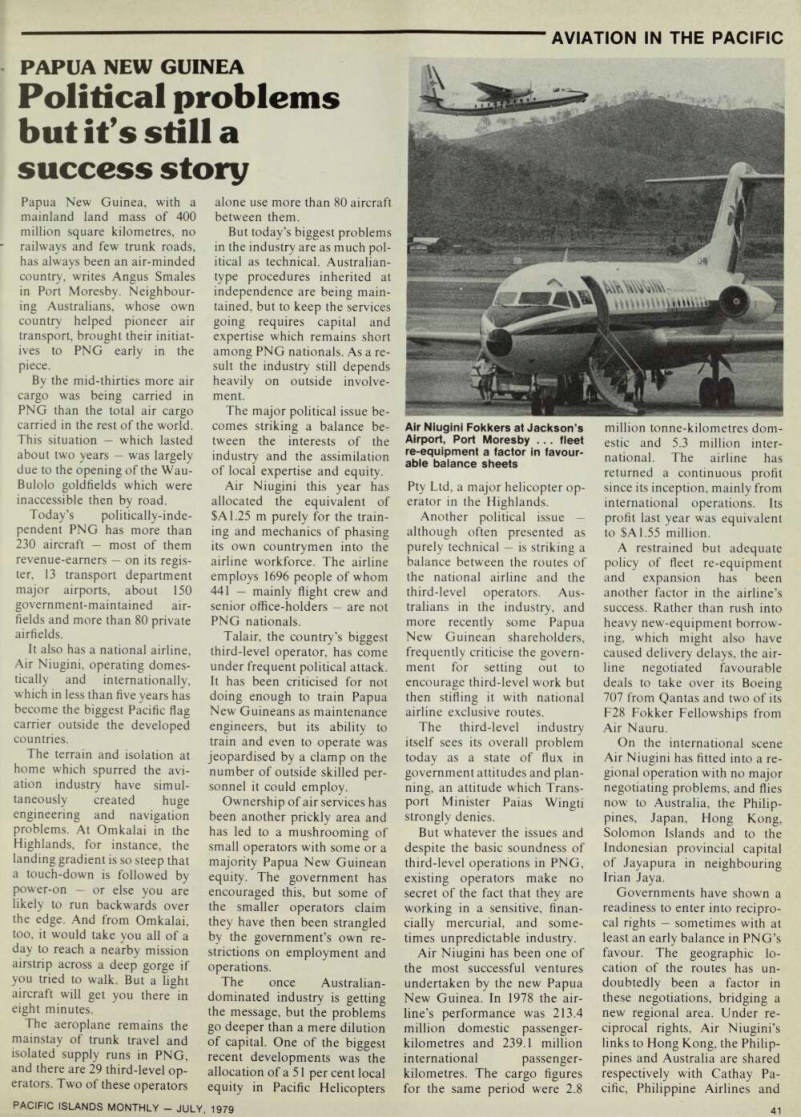
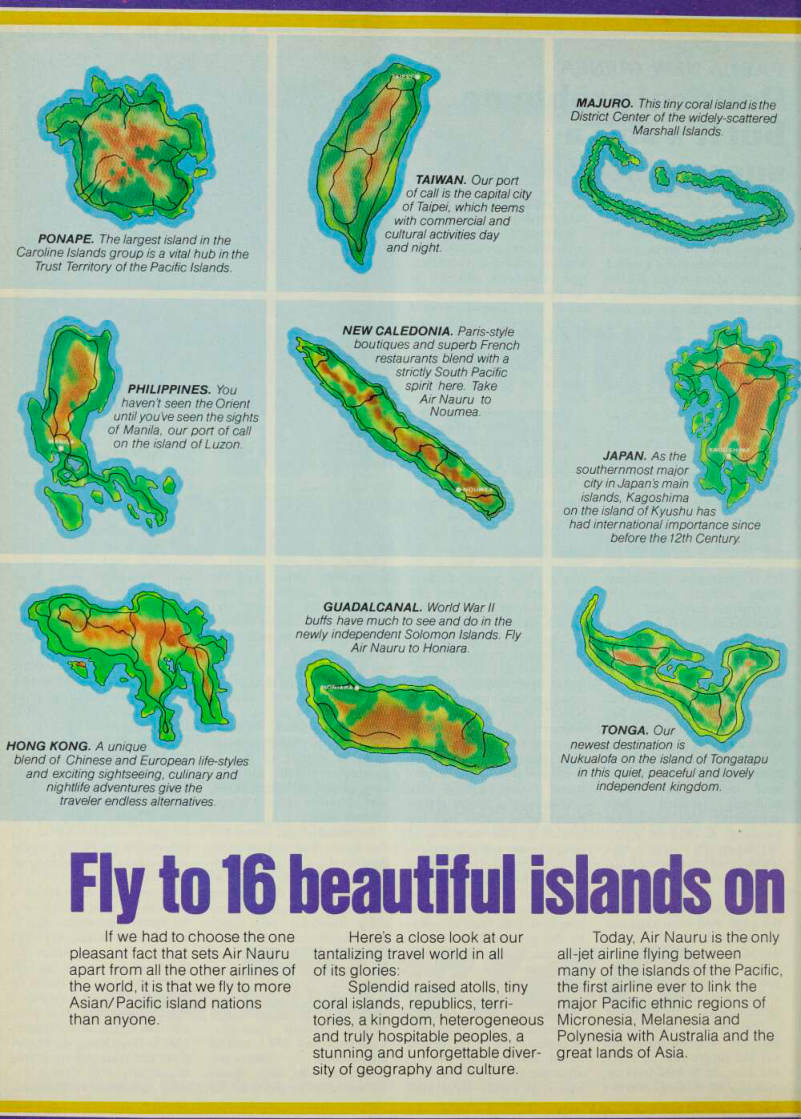
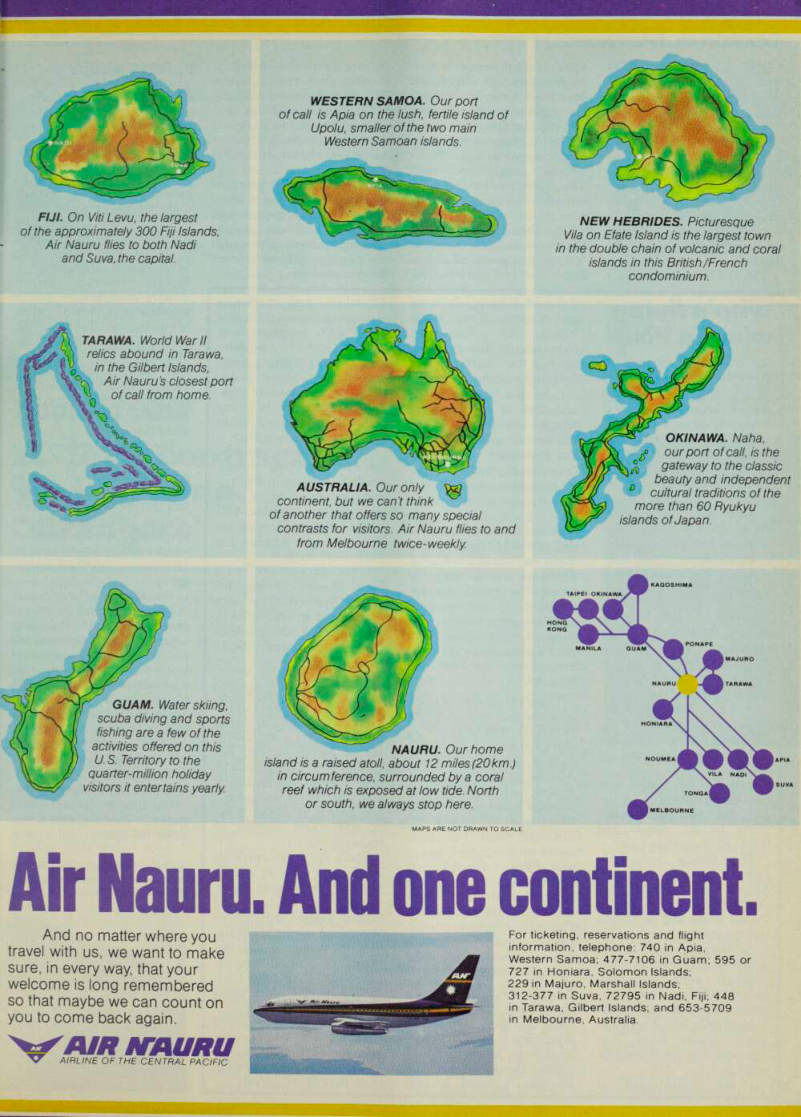
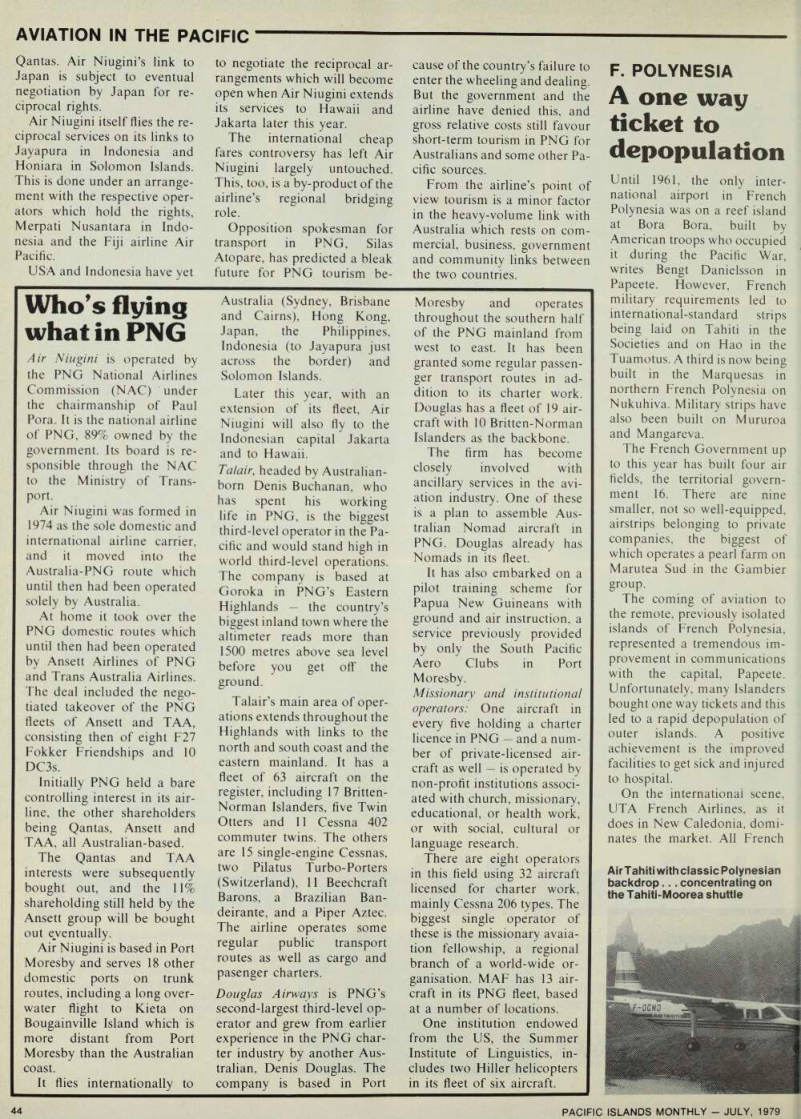
Papua New Guinea
Political problems but it’s still a success story
Papua New Guinea, with a mainland land mass of 400 million square kilometres, no railways and few trunk roads, has always been an air-minded country, writes Angus Smales in Port Moresby. Neighbour ing Australians, whose own country helped pioneer air transport, brought their initiat ives to PNG early in the piece.
By the mid-thirties more air cargo was being carried in PNG than the total air cargo carried in the rest of the world.
This situation which lasted about two years was largely due to the opening of the Wau- Bulolo goldfields which were inaccessible then by road.
Today’s politically-inde pendent PNG has more than 230 aircraft most of them revenue-earners on its regis ter, 13 transport department major airports, about 150 government-maintained air fields and more than 80 private airfields.
It also has a national airline, Air Niugini, operating domes tically and internationally, which in less than five years has become the biggest Pacific flag carrier outside the developed countries.
The terrain and isolation at home which spurred the avi ation industry have simul taneously created huge engineering and navigation problems. At Omkalai in the Highlands, for instance, the landing gradient is so steep that a touch-down is followed by power-on or else you are likely to run backwards over the edge. And from Omkalai, too, it would take you all of a day to reach a nearby mission airstrip across a deep gorge if you tried to walk. But a light aircraft will get you there in eight minutes.
The aeroplane remains the mainstay of trunk travel and isolated supply runs in PNG, and there are 29 third-level op erators. Two of these operators
alone use more than 80 aircraft between them.
But today’s biggest problems in the industry are as much pol itical as technical. Australian type procedures inherited at independence are being main tained, but to keep the services going requires capital and expertise which remains short among PNG nationals. As a re sult the industry still depends heavily on outside involve ment.
The major political issue be comes striking a balance be tween the interests of the industry and the assimilation of local expertise and equity.
Air Niugini this year has allocated the equivalent of $A1.25 m purely for the train ing and mechanics of phasing its own countrymen into the airline workforce. The airline employs 1696 people of whom 441 mainly flight crew and senior office-holders are not PNG nationals.
Talair, the country’s biggest third-level operator, has come under frequent political attack.
It has been criticised for not doing enough to train Papua New Guineans as maintenance engineers, but its ability to train and even to operate was jeopardised by a clamp on the number of outside skilled per sonnel it could employ.
Ownership of air services has been another prickly area and has led to a mushrooming of small operators with some or a majority Papua New Guinean equity. The government has encouraged this, but some of the smaller operators claim they have then been strangled by the government’s own re strictions on employment and operations.
The once Australian dominated industry is getting the message, but the problems go deeper than a mere dilution of capital. One of the biggest recent developments was the allocation of a5l per cent local equity in Pacific Helicopters
Pty Ltd, a major helicopter op erator in the Highlands.
Another political issue although often presented as purely technical is striking a balance between the routes of the national airline and the third-level operators. Aus tralians in the industry, and more recently some Papua New Guinean shareholders, frequently criticise the govern ment for setting out to encourage third-level work but then stifling it with national airline exclusive routes.
The third-level industry itself sees its overall problem today as a state of flux in government attitudes and plan ning, an attitude which Trans port Minister Paias Wingti
strongly denies.
But whatever the issues and despite the basic soundness of third-level operations in PNG, existing operators make no secret of the fact that they are working in a sensitive, finan cially mercurial, and some
times unpredictable industry.
Air Niugini has been one of the most successful ventures undertaken by the new Papua New Guinea. In 1978 the air line’s performance was 213.4 million domestic passenger kilometres and 239.1 million international passenger kilometres. The cargo figures for the same period were 2.8
million tonne-kilometres dom estic and 5.3 million inter national. The airline has returned a continuous profit since its inception, mainly from international operations. Its profit last year was equivalent to $A1.55 million.
A restrained but adequate
policy of fleet re-equipment
and expansion has been another factor in the airline’s success. Rather than rush into
heavy new-equipment borrow
ing, which might also have caused delivery delays, the air line negotiated favourable deals to take over its Boeing 707 from Qantas and two of its F2B Fokker Fellowships from Air Nauru.
On the international scene Air Niugini has fitted into a re gional operation with no major negotiating problems, and flies now to Australia, the Philip
pines, Japan, Hong Kong,
Solomon Islands and to the Indonesian provincial capital
of Jayapura in neighbouring
Irian Jaya.
Governments have shown a readiness to enter into recipro cal rights sometimes with at least an early balance in PNG’s favour. The geographic lo cation of the routes has un doubtedly been a factor in
these negotiations, bridging a
new regional area. Under re
ciprocal rights, Air Niugini’s
links to Hong Kong, the Philip
pines and Australia are shared
respectively with Cathay Pa
cific, Philippine Airlines and
Air Niugini Fokkers at Jackson’s Airport, Port Moresby ... fleet re-equipment a factor in favour able balance sheets
Qantas. Air Niugini’s link to Japan is subject to eventual
negotiation by Japan for re
ciprocal rights.
Air Niugini itself flies the re ciprocal services on its links to Jayapura in Indonesia and Honiara in Solomon Islands.
This is done under an arrange ment with the respective oper ators which hold the rights, Merpati Nusantara in Indo nesia and the Fiji airline Air Pacific.
USA and Indonesia have yet
to negotiate the reciprocal ar rangements which will become open when Air Niugini extends its services to Hawaii and Jakarta later this year, The international cheap fares controversy has left Air
Niugini largely untouched.
This, too, is a by-product of the airline’s regional bridging role.
Opposition spokesman for transport in PNG, Silas Atopare, has predicted a bleak future for PNG tourism be
cause of the country’s failure to enter the wheeling and dealing.
But the government and the airline have denied this, and gross relative costs still favour short-term tourism in PNG for Australians and some other Pa cific sources.
From the airline’s point of view tourism is a minor factor in the heavy-volume link with Australia which rests on com mercial, business, government and community links between the two countries.
Advertisements & other items, pp. 41-43 (2 items)
Aviation In The Pacific
41
PACIFIC ISLANDS MONTHLY - JULY, 1979
Fly to 16 beautiful islands on
& PON APE. The largest island in the Caroline Islands group is a vital hub in the Trust Territory of the Pacific Islands.
TAIWAN. Our port of call is the capital city of Taipei, which teems with commercial and cultural activities day and night.
MAJURO. This tiny coral island is the District Center of the widely-scattered Marshall Islands.
PHILIPPINES. You
haven’t seen the Orient until you've seen the sights of Manila, our port of call on the island of Luzon.
NEW CALEDONIA. Paris-style boutiques and superb French restaurants blend with a strictly South Pacific spirit here. Take Air Nauru to Noumea.
JAPAN. As the southernmost major city in Japan’s main islands, Kagoshima on the island of Kyushu has had international importance since before the 12th Century.
HONG KONG. A unique blend of Chinese and European life-styles and exciting sightseeing, culinary and nightlife adventures give the traveler endless alternatives.
GUADALCANAL. World War II
buffs have much to see and do in the newly independent Solomon Islands. Fly Air Nauru to Honiara.
TONGA. Our
newest destination is Nukualofa on the island of Tongatapu in this quiet, peaceful and lovely independent kingdom.
Fly to 16 beautiful islands on
If we had to choose the one pleasant fact that sets Air Nauru apart from all the other airlines of the world, it is that we fly to more Asian/Pacific island nations than anyone.
Here’s a close look at our tantalizing travel world in all of its glories: Splendid raised atolls, tiny coral islands, republics, territories, a kingdom, heterogeneous and truly hospitable peoples, a stunning and unforgettable diversity of geography and culture.
Today, Air Nauru is the only all-jet airline flying between many of the islands of the Pacific, the first airline ever to link the major Pacific ethnic regions of Micronesia, Melanesia and Polynesia with Australia and the great lands of Asia.
FIJI. On Viti Leva, the largest of the approximately 300 Fiji Islands, Air Nauru flies to both Nadi and Suva, the capital.
WESTERN SAMOA. Our port of call is Apia on the lush, fertile island of Upolu, smaller of the two main Western Samoan islands.
NEW HEBRIDES. Picturesque Vila on Efate Island is the largest town in the double chain of volcanic and coral islands in this British/French condominium.
TARAWA. World War II relics abound in Tarawa, in the Gilbert Islands, Air Nauru's closest port of call from home. ■% GUAM. Water skiing, scuba diving and sports fishing are a few of the activities offered on this U. S. Territory to the quarter-million holiday visitors it entertains yearly.
AUSTRALIA. Our only continent, but we can’t think of another that offers so many special contrasts for visitors. Air Nauru flies to and from Melbourne twice-weekly NAURU. Our home island is a raised atoll, about 12 miles(2okm.) in circumference, surrounded by a coral reef which is exposed at low tide. North or south, we always stop here. co
OKINAWA. Naha,
our port of call, is the gateway to the classic beauty and independent cultural traditions of the more than 60 Ryukyu islands of Japan.
KONG
GUAM
MAJURO
NAURU
HONIARA
NOUMEA
MELBOURNE
MAPS ARE NOT DRAWN TO SCALE
Air Nauru. And one continent.
And no matter where you travel with us, we want to make sure, in every way, that your welcome is long remembered so that maybe we can count on you to come back again.
AIRLINE OF THE CENTRAL PACIFIC
For ticketing, reservations and flight information, telephone: 740 in Apia, Western Samoa; 477-7106 in Guam; 595 or 727 in Honiara, Solomon Islands; 229 in Majuro, Marshall Islands; 312-377 in Suva, 72795 in Nadi. Fiji; 448 in Tarawa, Gilbert Islands; and 653-5709 in Melbourne, Australia.
Who’s flying
what in PNG
Air Niugini is operated by the PNG National Airlines Commission (NAC) under the chairmanship of Paul Pora. It is the national airline of PNG, 89% owned by the government. Its board is re sponsible through the NAC to the Ministry of Trans port.
Air Niugini was formed in 1974 as the sole domestic and international airline carrier, and it moved into the Australia-PNG route which until then had been operated
solely by Australia.
At home it took over the PNG domestic routes which until then had been operated by Ansett Airlines of PNG and Trans Australia Airlines.
The deal included the nego tiated takeover of the PNG fleets of Ansett and TAA, consisting then of eight F 27 Fokker Friendships and 10 DC3s.
Initially PNG held a bare controlling interest in its air line, the other shareholders being Qantas, Ansett and TAA, all Australian-based.
The Qantas and TAA interests were subsequently bought out, and the 11% shareholding still held by the Ansett group will be bought
out eventually.
Air Niugini is based in Port Moresby and serves 18 other domestic ports on trunk routes, including a long over water flight to Kieta on Bougainville Island which is more distant from Port Moresby than the Australian coast.
It flies internationally to
Australia (Sydney, Brisbane
and Cairns), Hong Kong,
Japan, the Philippines,
Indonesia (to Jayapura just across the border) and Solomon Islands.
Later this year, with an extension of its fleet. Air Niugini will also fly to the Indonesian capital Jakarta and to Hawaii.
Talair, headed by Australian born Denis Buchanan, who has spent his working life in PNG, is the biggest third-level operator in the Pa cific and would stand high in world third-level operations.
The company is based at Goroka in PNG’s Eastern
Highlands the country’s
biggest inland town where the altimeter reads more than 1500 metres above sea level before you get off the ground.
Talair’s main area of oper ations extends throughout the Highlands with links to the north and south coast and the eastern mainland. It has a fleet of 63 aircraft on the
register, including 17 Britten-
Norman Islanders, five Twin Otters and 11 Cessna 402 commuter twins. The others are 15 single-engine Cessnas, two Pilatus Turbo-Porters (Switzerland), 11 Beechcraft Barons, a Brazilian Ban deirante, and a Piper Aztec.
The airline operates some
regular public transport
routes as well as cargo and pasenger charters.
Douglas Airways is PNG’s second-largest third-level op erator and grew from earlier experience in the PNG char ter industry by another Aus tralian, Denis Douglas. The company is based in Port
Moresby and operates throughout the southern half of the PNG mainland from west to east. It has been granted some regular passen ger transport routes in ad dition to its charter work.
Douglas has a fleet of 19 air craft with 10 Britten-Norman Islanders as the backbone.
The firm has become closely involved with ancillary services in the avi ation industry. One of these is a plan to assemble Aus tralian Nomad aircraft in
PNG. Douglas already has
Nomads in its fleet.
It has also embarked on a pilot training scheme for Papua New Guineans with ground and air instruction, a
service previously provided
by only the South Pacific Aero Clubs in Port
Moresby.
Missionary and institutional operators: One aircraft in every five holding a charter licence in PNG and a num ber of private-licensed air craft as well is operated by non-profit institutions associ ated with church, missionary, educational, or health work, or with social, cultural or
language research.
There are eight operators in this field using 32 aircraft licensed for charter work, mainly Cessna 206 types. The
biggest single operator of
these is the missionary avaia
tion fellowship, a regional
branch of a world-wide or ganisation. MAF has 13 air craft in its PNG fleet, based at a number of locations.
One institution endowed from the US, the Summer Institute of Linguistics, in cludes two Hiller helicopters in its fleet of six aircraft.
depopulation
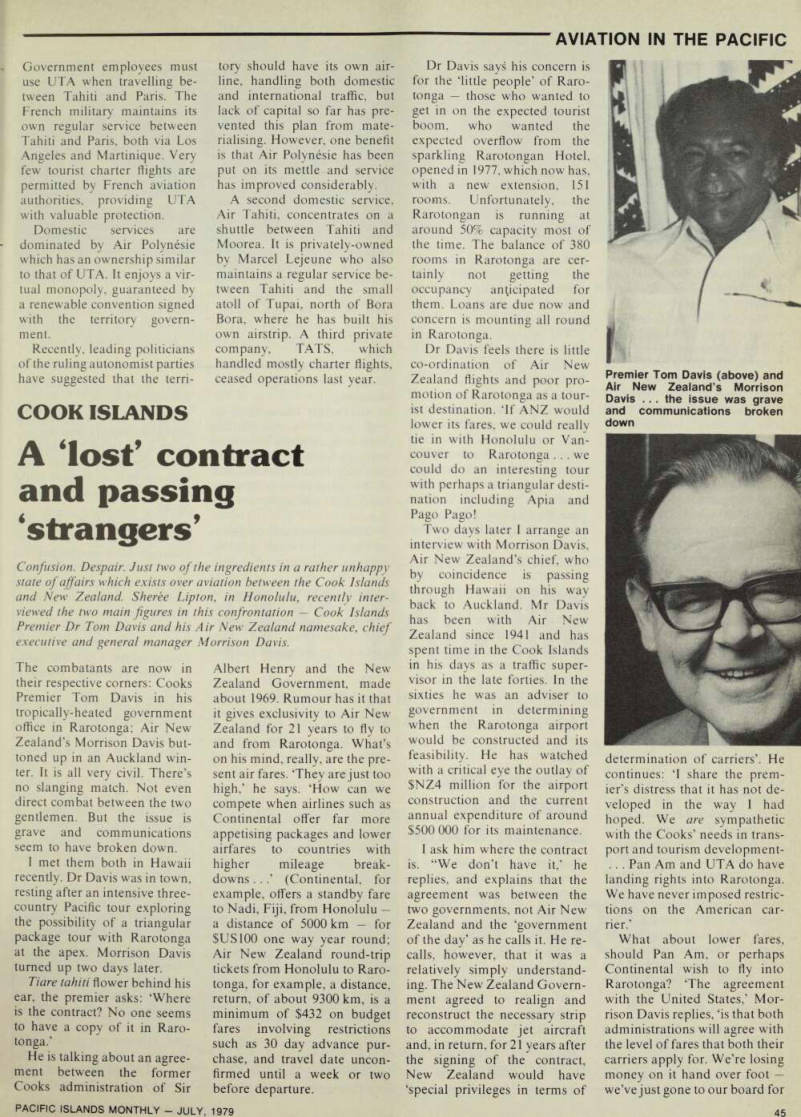
F. Polynesia
A one way ticket to depopulation
Until 1961, the only inter national airport in French Polynesia was on a reef island at Bora Bora, built by American troops who occupied it during the Pacific War, writes Bengt Danielsson in Papeete. However, French military requirements led to international-standard strips being laid on Tahiti in the Societies and on Hao in the Tuamotus. A third is now being built in the Marquesas in northern French Polynesia on
Nukuhiva. Military strips have
also been built on Mururoa and Mangareva.
The French Government up to this year has built four air fields, the territorial govern ment 16. There are nine smaller, not so well-equipped,
airstrips belonging to private
companies, the biggest of which operates a pearl farm on Marutea Sud in the Gambier group.
The coming of aviation to the remote, previously isolated islands of French Polynesia, represented a tremendous im provement in communications with the capital, Papeete.
Unfortunately, many Islanders bought one way tickets and this led to a rapid depopulation of outer islands. A positive achievement is the improved facilities to get sick and injured
to hospital.
On the international scene, UTA French Airlines, as it does in New Caledonia, domi nates the market. All French
Air Tahiti with classic Polynesian backdrop... concentrating on the Tahiti-Moorea shuttle
Government employees must use UTA when travelling be tween Tahiti and Paris. The French military maintains its own regular service between Tahiti and Paris, both via Los
Angeles and Martinique. Very
few tourist charter flights are permitted by French aviation authorities, providing UTA with valuable protection.
Domestic services are
dominated by Air Polynesie
which has an ownership similar to that of UTA. It enjoys a vir
tual monopoly, guaranteed by
a renewable convention signed with the territory govern ment.
Recently, leading politicians
of the ruling autonomist parties have suggested that the terri
tory should have its own air line, handling both domestic and international traffic, but lack of capital so far has pre vented this plan from mate rialising. However, one benefit is that Air Polynesie has been put on its mettle and service
has improved considerably.
A second domestic service.
Air Tahiti, concentrates on a shuttle between Tahiti and Moorea. It is privately-owned by Marcel Lejeune who also maintains a regular service be tween Tahiti and the small atoll of Tupai, north of Bora Bora, where he has built his own airstrip. A third private company, TATS, which handled mostly charter flights, ceased operations last year.
Advertisements & other items, p. 44 (1 item)
Aviation In The Pacific
44
PACIFIC ISLANDS MONTHLY - JULY, 1979
'strangers’
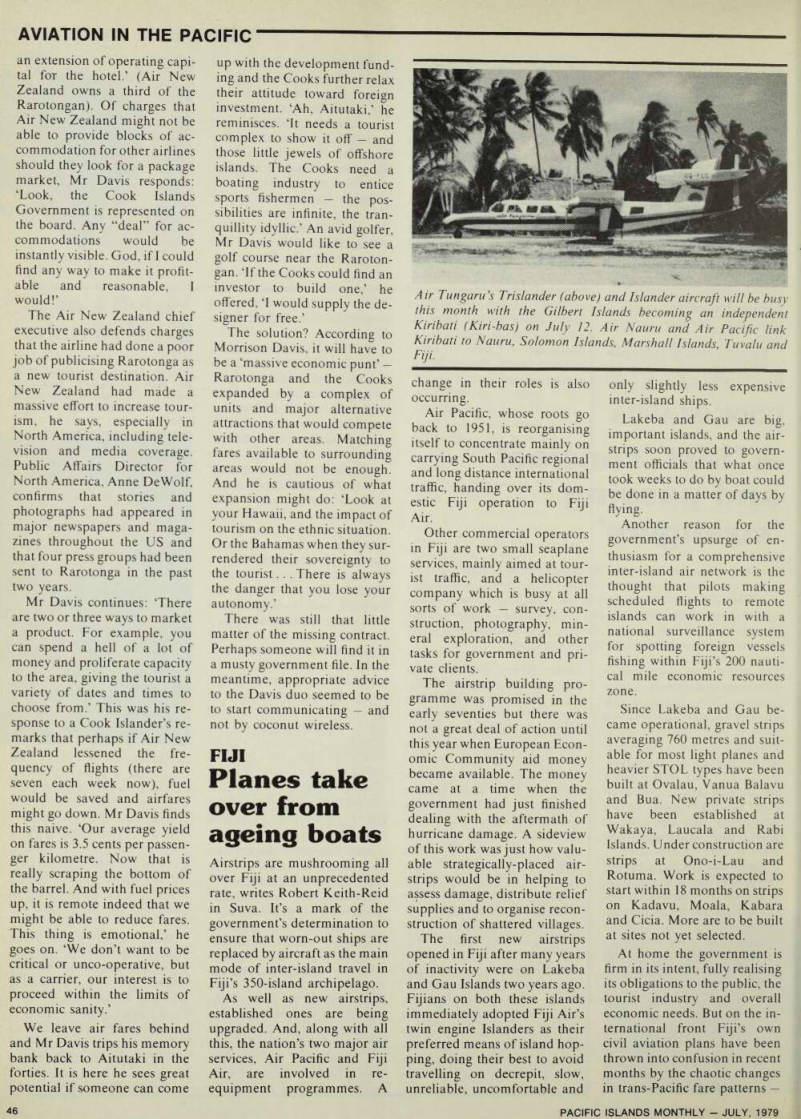
Cook Islands
A 'lost’ contract and passing 'strangers’
Confusion. Despair. Just two of the ingredients in a rather unhappy state of affairs which exists oxer aviation between the Cook Islands and New Zealand. Sheree Lipton, in Honolulu, recently inter viewed the two main figures in this confrontation Cook Islands Premier Dr Tom Davis and his Air New Zealand namesake, chief executive and general manager Morrison Davis.
The combatants are now in their respective corners: Cooks Premier Tom Davis in his
tropically-heated government
office in Rarotonga; Air New Zealand’s Morrison Davis but toned up in an Auckland win ter. It is all very civil. There’s no slanging match. Not even direct combat between the two gentlemen. But the issue is grave and communications seem to have broken down.
I met them both in Hawaii recently. Dr Davis was in town, resting after an intensive three country Pacific tour exploring the possibility of a triangular
package tour with Rarotonga
at the apex. Morrison Davis turned up two days later.
Tiare tahiti flower behind his ear, the premier asks: ‘Where is the contract? No one seems to have a copy of it in Raro
tonga.’
He is talking about an agree ment between the former Cooks administration of Sir
Albert Henry and the New Zealand Government, made about 1969. Rumour has it that it gives exclusivity to Air New Zealand for 21 years to fly to and from Rarotonga. What’s on his mind, really, are the pre sent air fares. ‘They are just too high,’ he says. ‘How can we compete when airlines such as Continental offer far more
appetising packages and lower
airfares to countries with
higher mileage break
downs ...’ (Continental, for example, offers a standby fare to Nadi, Fiji, from Honolulu a distance of 5000 km for SUSIOO one way year round; Air New Zealand round-trip tickets from Honolulu to Raro tonga, for example, a distance, return, of about 9300 km, is a minimum of $432 on budget fares involving restrictions such as 30 day advance pur chase, and travel date uncon firmed until a week or two
before departure.
Dr Davis says his concern is for the ‘little people’ of Raro tonga those who wanted to get in on the expected tourist boom, who wanted the expected overflow from the
sparkling Rarotongan Hotel,
opened in 1977, which now has, with a new extension, 151 rooms. Unfortunately, the Rarotongan is running at around 50% capacity most of the time. The balance of 380 rooms in Rarotonga are cer
tainly not getting the
occupancy anticipated for them. Loans are due now and concern is mounting all round
in Rarotonga.
Dr Davis feels there is little co-ordination of Air New Zealand flights and poor pro motion of Rarotonga as a tour ist destination. ‘lf ANZ would lower its fares, we could really tie in with Honolulu or Van couver to Rarotonga ... we could do an interesting tour with perhaps a triangular desti
nation including Apia and
Pago Pago!
Two days later I arrange an interview with Morrison Davis, Air New Zealand’s chief, who
by coincidence is passing
through Hawaii on his way back to Auckland. Mr Davis has been with Air New Zealand since 1941 and has spent time in the Cook Islands in his days as a traffic super visor in the late forties. In the sixties he was an adviser to government in determining when the Rarotonga airport would be constructed and its feasibility. He has watched with a critical eye the outlay of SNZ4 million for the airport construction and the current annual expenditure of around $5OO 000 for its maintenance.
I ask him where the contract is. “We don’t have it,’ he replies, and explains that the agreement was between the two governments, not Air New Zealand and the ‘government of the day’ as he calls it. He re calls, however, that it was a
relatively simply understand
ing. The New Zealand Govern ment agreed to realign and reconstruct the necessary strip to accommodate jet aircraft and, in return, for 21 years after the signing of the contract, New Zealand would have ‘special privileges in terms of
determination of carriers’. He continues: i share the prem ier’s distress that it has not de veloped in the way I had
hoped. We are sympathetic
with the Cooks’ needs in trans port and tourism development ... Pan Am and UTA do have landing rights into Rarotonga.
We have never imposed restric tions on the American car rier.’
What about lower fares, should Pan Am, or perhaps Continental wish to fly into Rarotonga? ‘The agreement with the United States,’ Mor rison Davis replies, ‘is that both administrations will agree with the level of fares that both their carriers apply for. We’re losing money on it hand over foot we’ve just gone to our board for
Premier Tom Davis (above) and Air New Zealand’s Morrison Davis ... the issue was grave and communications broken down
an extension of operating capi tal for the hotel.’ (Air New Zealand owns a third of the
Rarotongan). Of charges that
Air New Zealand might not be able to provide blocks of ac commodation for other airlines should they look for a package market, Mr Davis responds; ‘Look, the Cook Islands Government is represented on the board. Any “deal” for ac commodations would be instantly visible. God, if I could find any way to make it profit able and reasonable, I would!’
The Air New Zealand chief executive also defends charges that the airline had done a poor
job of publicising Rarotonga as
a new tourist destination. Air New Zealand had made a massive effort to increase tour ism, he says, especially in North America, including tele vision and media coverage.
Public Affairs Director for North America, Anne DeWolf, confirms that stories and photographs had appeared in major newspapers and maga zines throughout the US and that four press groups had been sent to Rarotonga in the past two years.
Mr Davis continues: ‘There are two or three ways to market a product. For example, you can spend a hell of a lot of money and proliferate capacity to the area, giving the tourist a variety of dates and times to choose from.’ This was his re sponse to a Cook Islander’s re marks that perhaps if Air New Zealand lessened the fre quency of flights (there are seven each week now), fuel would be saved and airfares might go down. Mr Davis finds this naive. ‘Our average yield on fares is 3.5 cents per passen ger kilometre. Now that is really scraping the bottom of the barrel. And with fuel prices up, it is remote indeed that we might be able to reduce fares.
This thing is emotional,’ he goes on. ‘We don’t want to be critical or unco-operative, but as a carrier, our interest is to proceed within the limits of
economic sanity.’
We leave air fares behind and Mr Davis trips his memory bank back to Aitutaki in the forties. It is here he sees great potential if someone can come
up with the development fund ing and the Cooks further relax their attitude toward foreign investment. ‘Ah, Aitutaki,’ he reminisces. ‘lt needs a tourist complex to show it off - and those little jewels of offshore islands. The Cooks need a
boating industry to entice
sports fishermen the pos sibilities are infinite, the tran quillity idyllic.’ An avid golfer, Mr Davis would like to see a golf course near the Raroton gan. ‘lf the Cooks could find an investor to build one,’ he offered, i would supply the de signer for free.’
The solution? According to Morrison Davis, it will have to be a ‘massive economic punt’
Rarotonga and the Cooks expanded by a complex of units and major alternative attractions that would compete with other areas. Matching fares available to surrounding areas would not be enough.
And he is cautious of what expansion might do: ‘Look at your Hawaii, and the impact of tourism on the ethnic situation.
Or the Bahamas when they sur rendered their sovereignty to the tourist... There is always the danger that you lose your
autonomy.’
There was still that little matter of the missing contract.
Perhaps someone will find it in a musty government file. In the meantime, appropriate advice to the Davis duo seemed to be to start communicating and not by coconut wireless.
ageing boats
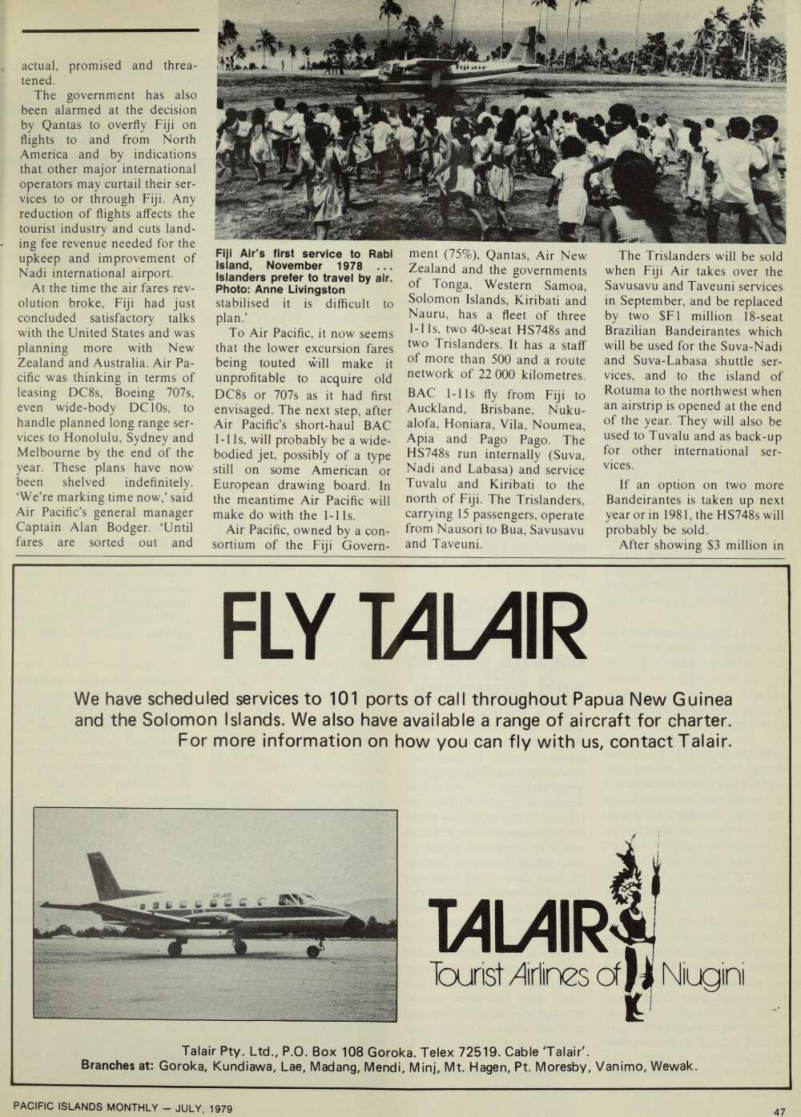
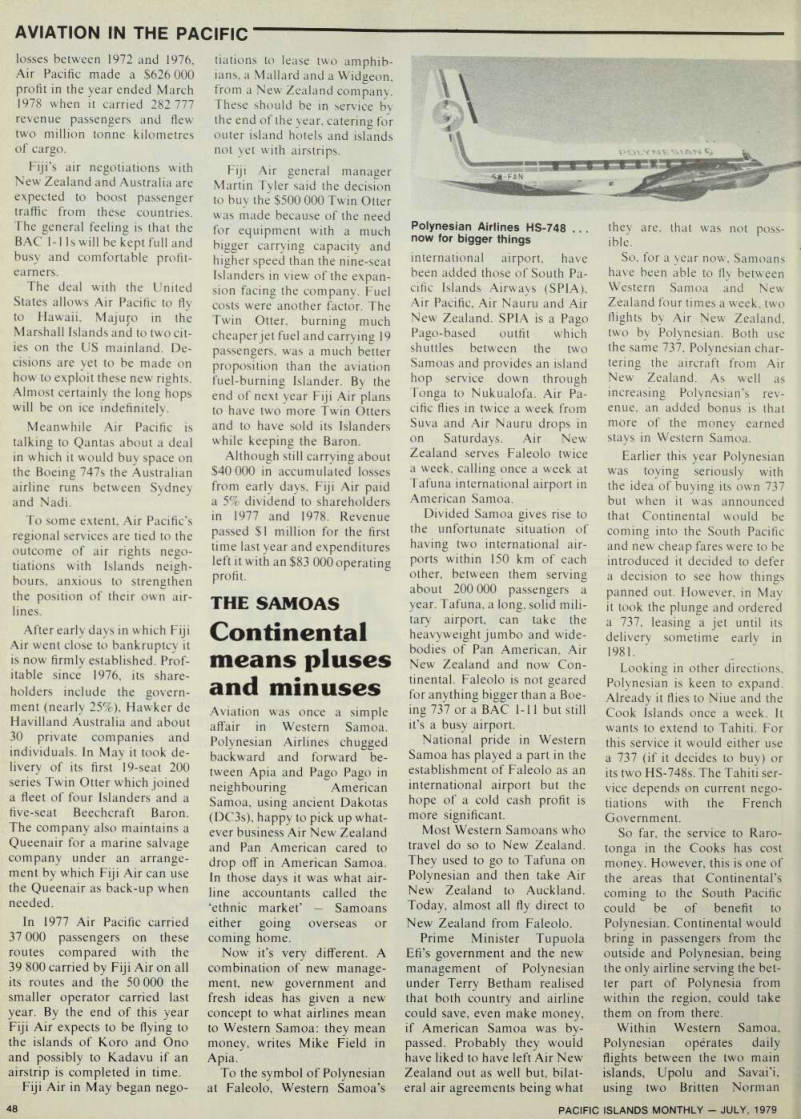
Fiji
Planes take over from ageing boats
Airstrips are mushrooming all
over Fiji at an unprecedented rate, writes Robert Keith-Reid in Suva. It’s a mark of the government’s determination to ensure that worn-out ships are replaced by aircraft as the main mode of inter-island travel in
Fiji’s 350-island archipelago.
As well as new airstrips, established ones are being upgraded. And, along with all this, the nation’s two major air services, Air Pacific and Fiji Air, are involved in re equipment programmes. A
change in their roles is also
occurring.
Air Pacific, whose roots go back to 1951, is reorganising itself to concentrate mainly on
carrying South Pacific regional
and long distance international traffic, handing over its dom
estic Fiji operation to Fiji
Air.
Other commercial operators in Fiji are two small seaplane services, mainly aimed at tour ist traffic, and a helicopter company which is busy at all sorts of work survey, con struction, photography, min eral exploration, and other tasks for government and pri vate clients.
The airstrip building pro
gramme was promised in the early seventies but there was not a great deal of action until this year when European Econ omic Community aid money became available. The money came at a time when the government had just finished dealing with the aftermath of hurricane damage. A sideview of this work was just how valu able strategically-placed air strips would be in helping to assess damage, distribute relief supplies and to organise recon struction of shattered villages.
The first new airstrips opened in Fiji after many years of inactivity were on Lakeba and Gau Islands two years ago.
Fijians on both these islands
immediately adopted Fiji Air’s
twin engine Islanders as their preferred means of island hop ping, doing their best to avoid
travelling on decrepit, slow,
unreliable, uncomfortable and
only slightly less expensive
inter-island ships.
Lakeba and Gau are big, important islands, and the air strips soon proved to govern ment officials that what once took weeks to do by boat could be done in a matter of days by
flying.
Another reason for the government’s upsurge of en thusiasm for a comprehensive inter-island air network is the
thought that pilots making
scheduled flights to remote islands can work in with a national surveillance system for spotting foreign vessels fishing within Fiji’s 200 nauti cal mile economic resources zone.
Since Lakeba and Gau be
came operational, gravel strips
averaging 760 metres and suit able for most light planes and heavier STOL types have been built at Ovalau, Vanua Balavu and Bua. New private strips have been established at Wakaya, Laucala and Rabi Islands. Under construction are strips at Ono-i-Lau and Rotuma. Work is expected to start within 18 months on strips on Kadavu, Moala, Kabara and Cicia. More are to be built at sites not yet selected.
At home the government is firm in its intent, fully realising its obligations to the public, the tourist industry and overall economic needs. But on the in ternational front Fiji’s own civil aviation plans have been thrown into confusion in recent months by the chaotic changes in trans-Pacific fare patterns
Air Tungaru’s Trislander (above) and Islander aircraft will be busy this month with the Gilbert Islands becoming an independent Kiribati (Kiri-bas) on July 12. Air Nauru and Air Pacific link Kiribati to Nauru, Solomon Islands, Marshall Islands, Tuvalu and Fiji.
actual, promised and threa tened.
The government has also been alarmed at the decision by Qantas to overfly Fiji on flights to and from North America and by indications that other major international operators may curtail their ser vices to or through Fiji. Any reduction of flights affects the tourist industry and cuts land ing fee revenue needed for the upkeep and improvement of Nadi international airport.
At the time the air fares rev olution broke, Fiji had just concluded satisfactory talks with the United States and was planning more with New Zealand and Australia. Air Pa cific was thinking in terms of
leasing DCBs, Boeing 7075,
even wide-body DC 10s, to handle planned long range ser vices to Honolulu, Sydney and Melbourne by the end of the year. These plans have now been shelved indefinitely. ‘We’re marking time now,’ said Air Pacific’s general manager
Captain Alan Bodger. ‘Until
fares are sorted out and
stabilised it is difficult to
plan.’
To Air Pacific, it now seems that the lower excursion fares being touted will make it unprofitable to acquire old DCBs or 707 s as it had first envisaged. The next step, after Air Pacific’s short-haul BAG 1-1 Is, will probably be a wide bodied jet, possibly of a type still on some American or
European drawing board. In
the meantime Air Pacific will make do with the 1-1 Is.
Air Pacific, owned by a con sortium of the Fiji Govern
ment (75%), Qantas, Air New Zealand and the governments of Tonga, Western Samoa, Solomon Islands, Kiribati and Nauru, has a fleet of three 1-1 Is, two 40-seat HS74Bs and two Trislanders. It has a staff of more than 500 and a route network of 22 000 kilometres.
BAG 1-1 Is fly from Fiji to Auckland, Brisbane, Nuku alofa, Honiara, Vila, Noumea, Apia and Pago Pago. The HS74Bs run internally (Suva, Nadi and Labasa) and service Tuvalu and Kiribati to the north of Fiji. The Trislanders, carrying 15 passengers, operate from Nausori to Bua, Savusavu and Taveuni.
The Trislanders will be sold when Fiji Air takes over the Savusavu and Taveuni services in September, and be replaced by two SFI million 18-seat Brazilian Bandeirantes which will be used for the Suva-Nadi and Suva-Labasa shuttle ser vices, and to the island of Rotuma to the northwest when an airstrip is opened at the end of the year. They will also be used to Tuvalu and as back-up for other international ser vices.
If an option on two more Bandeirantes is taken up next year or in 1981, the HS74Bs will probably be sold.
After showing $3 million in
Fiji Air’s first service to Rabi Island, November 1978 ...
Islanders prefer to travel by air.
Photo: Anne Livingston
losses between 1972 and 1976, Air Pacific made a $626 000 profit in the year ended March 1978 when it carried 282 777 revenue passengers and flew two million tonne kilometres of cargo.
Fiji’s air negotiations with New Zealand and Australia are expected to boost passenger traffic from these countries.
The general feeling is that the BAC 1-1 Is will be kept full and busy and comfortable profit earners.
The deal with the United States allows Air Pacific to fly to Hawaii, Majuro in the Marshall Islands and to two cit ies on the US mainland. De cisions are yet to be made on how to exploit these new rights.
Almost certainly the long hops
will be on ice indefinitely.
Meanwhile Air Pacific is talking to Qantas about a deal in which it would buy space on
the Boeing 747 s the Australian
airline runs between Sydney and Nadi.
To some extent. Air Pacific’s regional services are tied to the outcome of air rights nego tiations with Islands neigh bours, anxious to strengthen the position of their own air lines.
After early days in which Fiji Air went close to bankruptcy it is now firmly established. Prof itable since 1976, its share holders include the govern ment (nearly 25%). Hawker de Havilland Australia and about
30 private companies and
individuals. In May it took de livery of its first 19-seat 200 series Twin Otter which joined a fleet of four Islanders and a five-seat Beechcraft Baron.
The company also maintains a Queenair for a marine salvage company under an arrange ment by which Fiji Air can use the Queenair as back-up when needed.
In 1977 Air Pacific carried 37 000 passengers on these routes compared with the 39 800 carried by Fiji Air on all its routes and the 50 000 the smaller operator carried last year. By the end of this year Fiji Air expects to be flying to the islands of Koro and Ono and possibly to Kadavu if an airstrip is completed in time.
Fiji Air in May began nego
tiations to lease two amphib ians, a Mallard and a Widgeon, from a New Zealand company.
These should be in service by the end of the year, catering for outer island hotels and islands not yet with airstrips.
Fiji Air general manager Martin Tyler said the decision to buy the $5OO 000 Twin Otter was made because of the need for equipment with a much
bigger carrying capacity and
higher speed than the nine-seat Islanders in view of the expan sion facing the company. Fuel costs were another factor. The Twin Otter, burning much
cheaper jet fuel and carrying 19
passengers, was a much better proposition than the aviation fuel-burning Islander. By the end of next year Fiji Air plans to have two more Twin Otters and to have sold its Islanders while keeping the Baron.
Although still carrying about
$4O 000 in accumulated losses
from early days, Fiji Air paid
a 5% dividend to shareholders in 1977 and 1978. Revenue passed $1 million for the first time last year and expenditures left it with an $B3 000 operating profit.
Advertisements & other items, pp. 46-47 (2 items)
Aviation In The Pacific
46
PACIFIC ISLANDS MONTHLY - JULY, 1979
X4L4Ir,
FLY 14MIR
We have scheduled services to 101 ports of call throughout Papua New Guinea and the Solomon Islands. We also have available a range of aircraft for charter.
For more information on how you can fly with us, contact Talair. k
X4L4IR,
Tourist Airlines ofM Niugni
Talair Pty. Ltd., P.O. Box 108 Goroka. Telex 72519. Cable Talair'.
Branches at: Goroka, Kundiawa, Lae, Madang, Mendi, Minj, Mt. Hagen, Pt. Moresby, Vanimo, Wewak.
means pluses
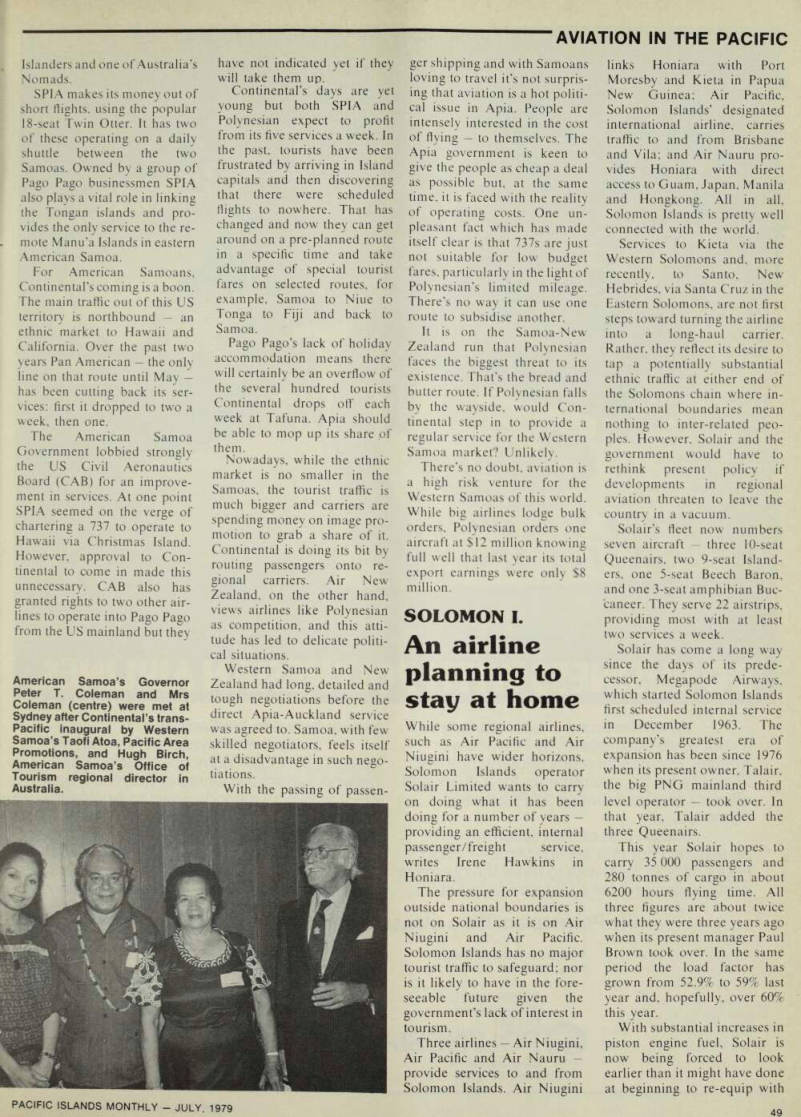
The Samoas
Continental means pluses and minuses
Aviation was once a simple affair in Western Samoa.
Polynesian Airlines chugged
backward and forward be tween Apia and Pago Pago in
neighbouring American
Samoa, using ancient Dakotas (DC3s), happy to pick up what ever business Air New Zealand and Pan American cared to drop off in American Samoa.
In those days it was what air line accountants called the ‘ethnic market’ Samoans either going overseas or
coming home.
Now it’s very different. A combination of new manage ment, new government and fresh ideas has given a new concept to what airlines mean to Western Samoa: they mean money, writes Mike Field in
Apia.
To the symbol of Polynesian at Faleolo, Western Samoa’s
international airport, have been added those of South Pa cific Islands Airways (SPIA), Air Pacific, Air Nauru and Air New Zealand. SPIA is a Pago Pago-based outfit which shuttles between the two Samoas and provides an island
hop service down through
Tonga to Nukualofa. Air Pa cific flies in twice a week from Suva and Air Nauru drops in on Saturdays. Air New Zealand serves Faleolo twice a week, calling once a week at Tafuna international airport in American Samoa.
Divided Samoa gives rise to the unfortunate situation of having two international air ports within 150 km of each other, between them serving about 200 000 passengers a year. Tafuna, a long, solid mili tary airport, can take the
heavyweight jumbo and wide
bodies of Pan American, Air New Zealand and now Con tinental. Faleolo is not geared for anything bigger than a Boe ing 737 or a BAC 1-11 but still it’s a busy airport.
National pride in Western Samoa has played a part in the establishment of Faleolo as an international airport but the hope of a cold cash profit is
more significant.
Most Western Samoans who travel do so to New Zealand.
They used to go to Tafuna on Polynesian and then take Air New Zealand to Auckland.
Today, almost all fly direct to New Zealand from Faleolo.
Prime Minister Tupuola Efi’s government and the new management of Polynesian under Terry Betham realised that both country and airline could save, even make money, if American Samoa was by passed. Probably they would have liked to have left Air New Zealand out as well but, bilat eral air agreements being what
they are. that was not poss ible.
So. for a year now, Samoans have been able to fly between Western Samoa and New Zealand four times a week, two flights by Air New Zealand, two by Polynesian. Both use the same 737, Polynesian char tering the aircraft from Air New Zealand. As well as
increasing Polynesian’s rev
enue, an added bonus is that more of the money earned stays in Western Samoa.
Earlier this year Polynesian was toying seriously with the idea of buying its own 737 but when it was announced that Continental would be coming into the South Pacific and new cheap fares were to be introduced it decided to defer a decision to see how things panned out. However, in May it took the plunge and ordered a 737, leasing a jet until its
delivery sometime early in
1981.
Looking in other directions, Polynesian is keen to expand.
Already it flies to Niue and the Cook Islands once a week. It wants to extend to Tahiti. For this service it would either use a 737 (if it decides to buy) or its two HS-7485. The Tahiti ser vice depends on current nego tiations with the French Government.
So far, the service to Raro tonga in the Cooks has cost money. However, this is one of the areas that Continental’s coming to the South Pacific could be of benefit to Polynesian. Continental would bring in passengers from the outside and Polynesian, being the only airline serving the bet ter part of Polynesia from within the region, could take them on from there.
Within Western Samoa, Polynesian operates daily flights between the two main islands, Upolu and Savai'i, using two Britten Norman
Polynesian Airlines HS-748 ... now for bigger things
Islanders and one of Australia’s Nomads.
SPIA makes its money out of short flights, using the popular 18-seat Twin Otter. It has two of these operating on a daily shuttle between the two Samoas. Owned by a group of Pago Pago businessmen SPIA also plays a vital role in linking the Tongan islands and pro vides the only service to the re mote Manu’a Islands in eastern American Samoa.
For American Samoans, Continental’s coming is a boon.
The main traffic out of this US territory is northbound an ethnic market to Hawaii and California. Over the past two years Pan American the only line on that route until May has been cutting back its ser vices: first it dropped to two a week, then one.
The American Samoa Government lobbied strongly the US Civil Aeronautics Board (CAB) for an improve ment in services. At one point SPIA seemed on the verge of chartering a 737 to operate to Hawaii via Christmas Island.
However, approval to Con tinental to come in made this unnecessary. CAB also has granted rights to two other air lines to operate into Pago Pago from the US mainland but they
have not indicated yet if they will take them up.
Continental’s days are yet young but both SPIA and
Polynesian expect to profit
from its five services a week. In the past, tourists have been frustrated by arriving in Island capitals and then discovering that there were scheduled flights to nowhere. That has changed and now they can get around on a pre-planned route in a specific time and take advantage of special tourist fares on selected routes, for example, Samoa to Niue to Tonga to Fiji and back to Samoa.
Pago Pago’s lack of holiday accommodation means there will certainly be an overflow of the several hundred tourists Continental drops off each week at Tafuna. Apia should be able to mop up its share of them.
Nowadays, while the ethnic market is no smaller in the Samoas, the tourist traffic is much bigger and carriers are spending money on image pro motion to grab a share of it.
Continental is doing its bit by routing passengers onto re gional carriers. Air New Zealand, on the other hand, views airlines like Polynesian as competition, and this atti tude has led to delicate politi cal situations.
Western Samoa and New Zealand had long, detailed and tough negotiations before the direct Apia-Auckland service was agreed to. Samoa, with few skilled negotiators, feels itself at a disadvantage in such nego tiations.
With the passing of passen-
ger shipping and with Samoans loving to travel it’s not surpris ing that aviation is a hot politi cal issue in Apia. People are intensely interested in the cost of flying to themselves. The Apia government is keen to give the people as cheap a deal as possible but, at the same time, it is faced with the reality of operating costs. One un pleasant fact which has made itself clear is that 737 s are just not suitable for low budget fares, particularly in the light of Polynesian’s limited mileage.
There’s no way it can use one route to subsidise another.
It is on the Samoa-New Zealand run that Polynesian faces the biggest threat to its existence. That’s the bread and butter route. If Polynesian falls by the wayside, would Con tinental step in to provide a regular service for the Western Samoa market? Unlikely.
There’s no doubt, aviation is a high risk venture for the Western Samoas of this world.
While big airlines lodge bulk orders, Polynesian orders one aircraft at $l2 million knowing full well that last year its total export earnings were only $8 million.
American Samoa’s Governor Peter T. Coleman and Mrs Coleman (centre) were met at Sydney after Continental’s trans pacific inaugural by Western Samoa’s Taofi Atoa, Pacific Area Promotions, and Hugh Birch, American Samoa’s Office of Tourism regional director in Australia.
Advertisements & other items, p. 48 (1 item)
Aviation In The Pacific
48
PACIFIC ISLANDS MONTHLY - JULY, 1979
planning to
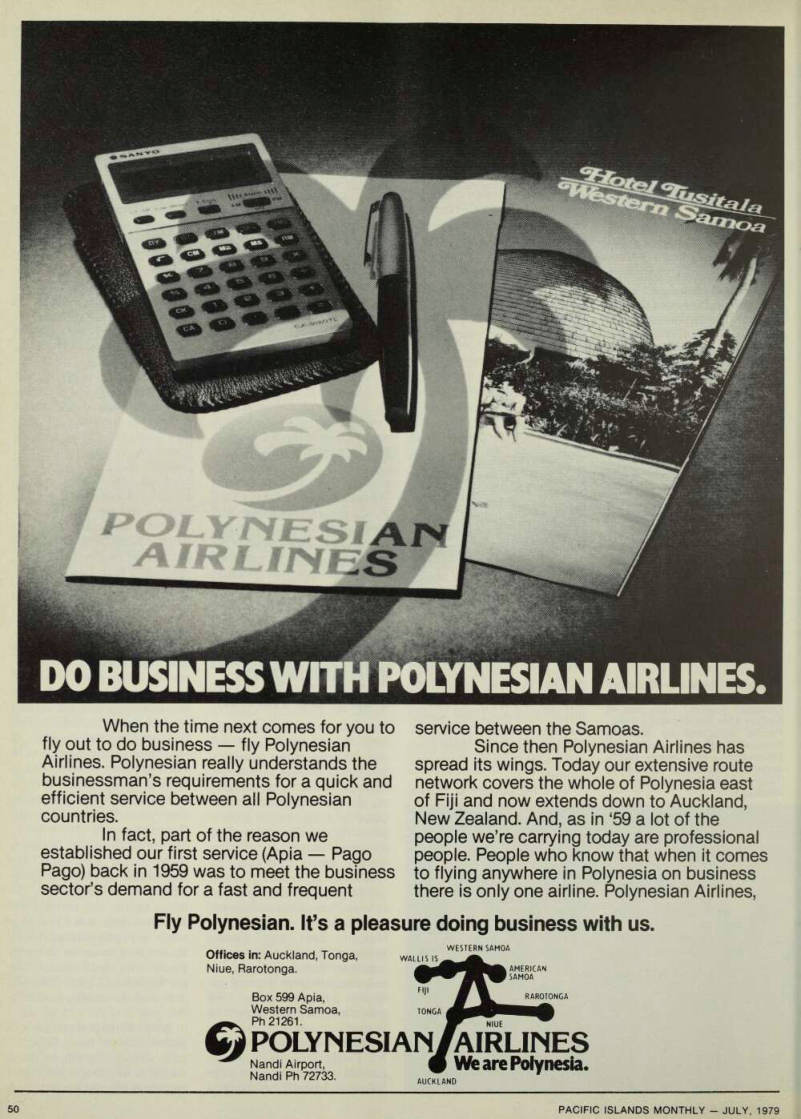
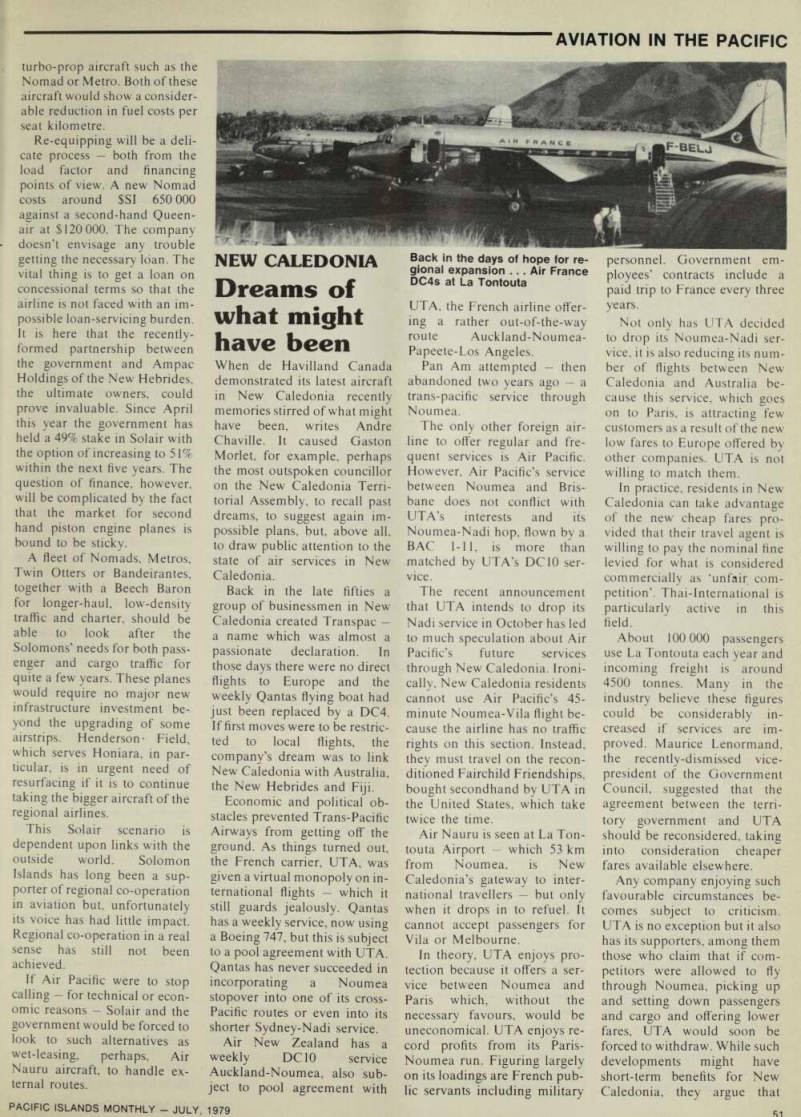
Solomon I.
An airline planning to stay at home
While some regional airlines, such as Air Pacific and Air Niugini have wider horizons, Solomon Islands operator Solair Limited wants to carry on doing what it has been doing for a number of years providing an efficient, internal
passenger/freight service,
writes Irene Hawkins in Honiara.
The pressure for expansion outside national boundaries is not on Solair as it is on Air Niugini and Air Pacific.
Solomon Islands has no major tourist traffic to safeguard; nor is it likely to have in the fore seeable future given the government’s lack of interest in tourism.
Three airlines Air Niugini, Air Pacific and Air Nauru provide services to and from Solomon Islands. Air Niugini
links Honiara with Port Moresby and Kieta in Papua New Guinea; Air Pacific, Solomon Islands’ designated international airline, carries traffic to and from Brisbane and Vila; and Air Nauru pro vides Honiara with direct access to Guam, Japan, Manila and Hongkong. All in all, Solomon Islands is pretty well connected with the world.
Services to Kieta via the Western Solomons and, more recently, to Santo, New Hebrides, via Santa Cruz in the Eastern Solomons, are not first steps toward turning the airline into a long-haul carrier.
Rather, they reflect its desire to tap a potentially substantial ethnic traffic at either end of the Solomons chain where in ternational boundaries mean nothing to inter-related peo ples. However, Solair and the government would have to rethink present policy if
developments in regional
aviation threaten to leave the country in a vacuum.
Solair’s fleet now numbers seven aircraft three 10-seat Queenairs, two 9-seat Island ers, one 5-seat Beech Baron, and one 3-seat amphibian Buc caneer. They serve 22 airstrips, providing most with at least two services a week.
Solair has come a long way since the days of its prede
cessor, Megapode Airways,
which started Solomon Islands first scheduled internal service in December 1963. The company’s greatest era of expansion has been since 1976 when its present owner, Talair, the big PNG mainland third level operator took over. In that year, Talair added the three Queenairs.
This year Solair hopes to carry 35 000 passengers and 280 tonnes of cargo in about 6200 hours flying time. All three figures are about twice what they were three years ago when its present manager Paul Brown took over. In the same period the load factor has grown from 52.9% to 59% last year and, hopefully, over 60% this year.
With substantial increases in piston engine fuel, Solair is now being forced to look earlier than it might have done at beginning to re-equip with
turbo-prop aircraft such as the Nomad or Metro. Both of these aircraft would show a consider able reduction in fuel costs per seat kilometre.
Re-equipping will be a deli cate process both from the load factor and financing points of view. A new Nomad costs around SSI 650 000 against a second-hand Queen air at $l2O 000. The company doesn’t envisage any trouble getting the necessary loan. The vital thing is to get a loan on concessional terms so that the airline is not faced with an im possible loan-servicing burden.
It is here that the recently formed partnership between the government and Ampac Holdings of the New Hebrides, the ultimate owners, could prove invaluable. Since April this year the government has held a 49% stake in Solair with the option of increasing to 51% within the next five years. The question of finance, however, will be complicated by the fact that the market for second hand piston engine planes is bound to be sticky.
A fleet of Nomads, Metros, Twin Otters or Bandeirantes, together with a Beech Baron
for longer-haul, low-density
traffic and charter, should be able to look after the Solomons’ needs for both pass enger and cargo traffic for quite a few years. These planes would require no major new infrastructure investment be yond the upgrading of some airstrips. Henderson* Field, which serves Honiara, in par ticular, is in urgent need of resurfacing if it is to continue taking the bigger aircraft of the regional airlines.
This Solair scenario is dependent upon links with the outside world. Solomon Islands has long been a sup porter of regional co-operation in aviation but, unfortunately its voice has had little impact.
Regional co-operation in a real sense has still not been achieved.
If Air Pacific were to stop calling for technical or econ omic reasons - Solair and the government would be forced to look to such alternatives as
wet-leasing, perhaps, Air
Nauru aircraft, to handle ex ternal routes.
Advertisements & other items, pp. 49-50 (2 items)
Aviation In The Pacific
49
PACIFIC ISLANDS MONTHLY - JULY, 1979
Ci Polynesian/Airlines
a *
ssw
When the time next comes for you to fly out to do business fly Polynesian Airlines. Polynesian really understands the businessman’s requirements for a quick and efficient service between all Polynesian countries.
In fact, part of the reason we established our first service (Apia Pago Pago) back in 1959 was to meet the business sector’s demand for a fast and frequent service between the Samoas.
Since then Polynesian Airlines has spread its wings. Today our extensive route network covers the whole of Polynesia east of Fiji and now extends down to Auckland, New Zealand. And, as in ‘59 a lot of the people we’re carrying today are professional people. People who know that when it comes to flying anywhere in Polynesia on business there is only one airline. Polynesian Airlines, Fly Polynesian. It’s a pleasure doing business with us.
Offices in: Auckland, Tonga, Niue, Rarotonga.
Box 599 Apia, Western Samoa, Ph 21261.
WESTERN SAMOA
AMERICAN
SAMOA
RAROTONGA
Ci POLYNESIAN/AIRLINES
M We are Polynesia.
Nandi Airport, Nandi Ph 72733.
AUCKLAND
what might
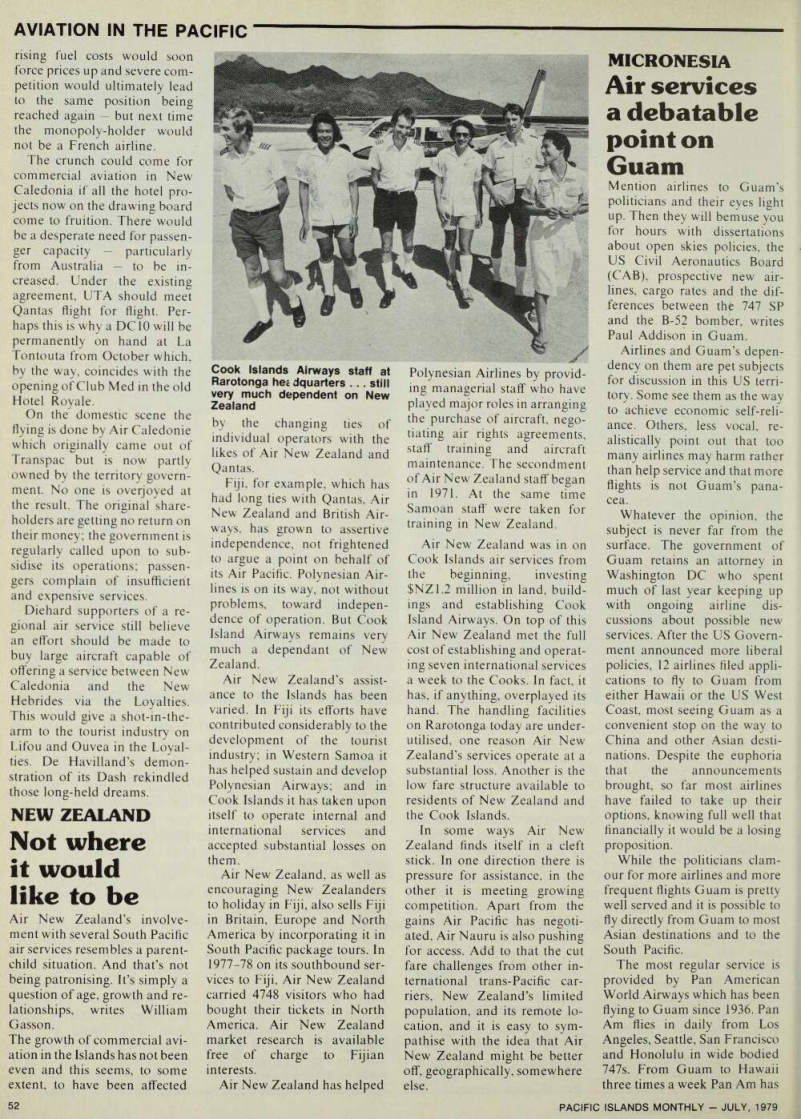
New Caledonia
Dreams of what might have been
When de Havilland Canada demonstrated its latest aircraft in New Caledonia recently memories stirred of what might have been, writes Andre Chaville. It caused Gaston
Morlet, for example, perhaps
the most outspoken councillor on the New Caledonia Terri torial Assembly, to recall past dreams, to suggest again im possible plans, but, above all, to draw public attention to the state of air services in New Caledonia.
Back in the late fifties a group of businessmen in New Caledonia created Transpac a name which was almost a passionate declaration. In those days there were no direct flights to Europe and the weekly Qantas flying boat had just been replaced by a DC4.
If first moves were to be restric ted to local flights, the company’s dream was to link New Caledonia with Australia, the New Hebrides and Fiji.
Economic and political ob stacles prevented Trans-Pacific Airways from getting off the ground. As things turned out, the French carrier, UTA, was given a virtual monopoly on in ternational flights which it still guards jealously. Qantas has a weekly service, now using a Boeing 747, but this is subject to a pool agreement with UTA.
Qantas has never succeeded in incorporating a Noumea stopover into one of its cross- Pacific routes or even into its shorter Sydney-Nadi service.
Air New Zealand has a weekly DC 10 service Auckland-Noumea, also sub ject to pool agreement with
UTA. the French airline offer
ing a rather out-of-the-way
route Auckland-Noumea-
Papeete-Los Angeles.
Pan Am attempted then abandoned two years ago a trans-pacific service through Noumea.
The only other foreign air line to offer regular and fre quent services is Air Pacific.
However, Air Pacific’s service between Noumea and Bris bane does not conflict with UTA’s interests and its Noumea-Nadi hop, flown by a BAC 1-11, is more than matched by UTA’s DC 10 ser vice.
The recent announcement that UTA intends to drop its Nadi service in October has led to much speculation about Air Pacific’s future services through New Caledonia. Ironi cally, New Caledonia residents cannot use Air Pacific’s 45minute Noumea-Vila flight be cause the airline has no traffic rights on this section. Instead, they must travel on the recon ditioned Fairchild Friendships, bought secondhand by UTA in the United States, which take twice the time.
Air Nauru is seen at La Ton touta Airport which 53 km from Noumea, is New Caledonia’s gateway to inter national travellers but only when it drops in to refuel. It cannot accept passengers for Vila or Melbourne.
In theory, UTA enjoys pro tection because it offers a ser vice between Noumea and Paris which, without the necessary favours, would be uneconomical. UTA enjoys re cord profits from its Paris-
Noumea run. Figuring largely
on its loadings are French pub
lic servants including military
personnel. Government em ployees’ contracts include a paid trip to France every three years.
Not only has UTA decided to drop its Noumea-Nadi ser vice, it is also reducing its num ber of flights between New Caledonia and Australia be cause this service, which goes on to Paris, is attracting few customers as a result of the new low fares to Europe offered by other companies. UTA is not willing to match them.
In practice, residents in New Caledonia can take advantage of the new cheap fares pro vided that their travel agent is willing to pay the nominal fine levied for what is considered commercially as ‘unfair com petition’. Thai-International is particularly active in this field.
About 100 000 passengers use La Tontouta each year and
incoming freight is around
4500 tonnes. Many in the
industry believe these figures
could be considerably in creased if services are im proved. Maurice Lenormand, the recently-dismissed vice president of the Government Council, suggested that the agreement between the terri tory government and UTA should be reconsidered, taking into consideration cheaper fares available elsewhere.
Any company enjoying such favourable circumstances be comes subject to criticism.
UTA is no exception but it also has its supporters, among them those who claim that if com petitors were allowed to fly
through Noumea, picking up
and setting down passengers and cargo and offering lower fares, UTA would soon be forced to withdraw. While such
developments might have
short-term benefits for New Caledonia, they argue that
Back in the days of hope for re gional expansion ... Air France DC4s at La Tontouta
rising fuel costs would soon force prices up and severe com petition would ultimately lead to the same position being reached again but next time the monopoly-holder would not be a French airline.
The crunch could come for commercial aviation in New Caledonia if all the hotel pro jects now on the drawing board come to fruition. There would be a desperate need for passen
ger capacity particularly
from Australia to be in creased. Under the existing agreement, UTA should meet Qantas flight for flight. Per haps this is why a DC 10 will be permanently on hand at La Tontouta from October which, by the way, coincides with the opening of Club Med in the old
Hotel Royale.
On the domestic scene the flying is done by Air Caledonie which originally came out of Transpac but is now partly owned by the territory govern ment. No one is overjoyed at the result. The original share holders are getting no return on their money; the government is regularly called upon to sub sidise its operations; passen gers complain of insufficient and expensive services.
Diehard supporters of a re gional air service still believe an effort should be made to
buy large aircraft capable of
offering a service between New Caledonia and the New Hebrides via the Loyalties.
This would give a shot-in-the arm to the tourist industry on Lifou and Ouvea in the Loyal ties. De Havilland’s demon stration of its Dash rekindled those long-held dreams.
Advertisements & other items, p. 51 (1 item)
Aviation In The Pacific
51
PACIFIC ISLANDS MONTHLY - JULY, 1979
Not where
New Zealand
Not where it would like to be
Air New Zealand’s involve ment with several South Pacific air services resembles a parent child situation. And that’s not
being patronising. It’s simply a
question of age, growth and re lationships, writes William Gasson.
The growth of commercial avi ation in the Islands has not been even and this seems, to some extent, to have been affected
by the changing ties of individual operators with the likes of Air New Zealand and Qantas.
Fiji, for example, which has had long ties with Qantas, Air New Zealand and British Air ways, has grown to assertive
independence, not frightened
to argue a point on behalf of its Air Pacific. Polynesian Air lines is on its way, not without problems, toward indepen dence of operation. But Cook Island Airways remains very much a dependant of New Zealand.
Air New Zealand’s assist ance to the Islands has been varied. In Fiji its efforts have contributed considerably to the development of the tourist industry; in Western Samoa it has helped sustain and develop
Polynesian Airways; and in
Cook Islands it has taken upon itself to operate internal and international services and accepted substantial losses on them.
Air New Zealand, as well as encouraging New Zealanders to holiday in Fiji, also sells Fiji in Britain, Europe and North America by incorporating it in South Pacific package tours. In 1977-78 on its southbound ser vices to Fiji, Air New Zealand carried 4748 visitors who had bought their tickets in North America. Air New Zealand market research is available free of charge to Fijian interests.
Air New Zealand has helped
Polynesian Airlines by provid
ing managerial staff who have played major roles in arranging the purchase of aircraft, nego
tiating air rights agreements,
staff training and aircraft maintenance. The secondment of Air New Zealand staff began in 1971. At the same time Samoan staff were taken for training in New Zealand.
Air New Zealand was in on Cook Islands air services from
the beginning, investing
SNZI.2 million in land, build
ings and establishing Cook
Island Airways. On top of this Air New Zealand met the full cost of establishing and operat ing seven international services a week to the Cooks. In fact, it has, if anything, overplayed its hand. The handling facilities on Rarotonga today are under utilised, one reason Air New Zealand’s services operate at a substantial loss. Another is the low fare structure available to residents of New Zealand and the Cook Islands.
In some ways Air New Zealand finds itself in a cleft stick. In one direction there is pressure for assistance, in the other it is meeting growing competition. Apart from the gains Air Pacific has negoti ated, Air Nauru is also pushing for access. Add to that the cut fare challenges from other in ternational trans-Pacific car riers, New Zealand’s limited population, and its remote lo cation, and it is easy to sym pathise with the idea that Air New Zealand might be better off, geographically, somewhere else.
Cook Islands Airways staff at Rarotonga hes dquarters ... still very much dependent on New Zealand
point on
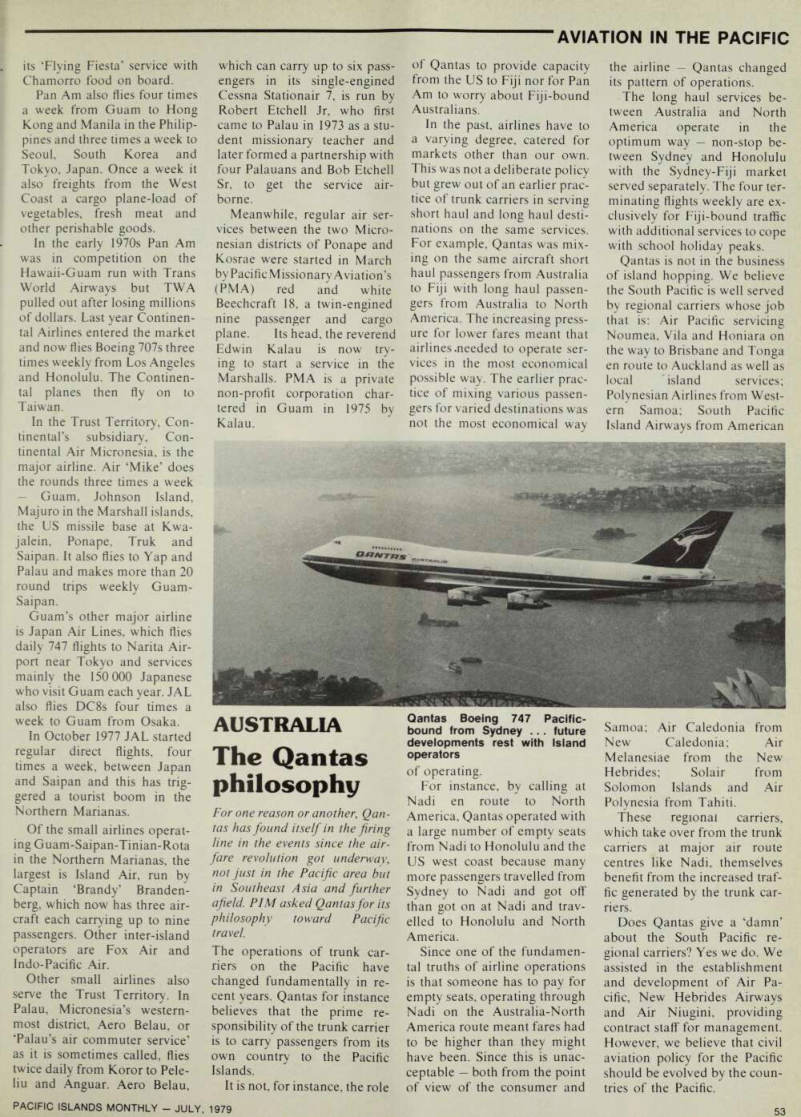
Micronesia
Air services a debatable point on Guam
Mention airlines to Guam’s politicians and their eyes light up. Then they will bemuse you for hours with dissertations about open skies policies, the US Civil Aeronautics Board (CAB), prospective new air lines, cargo rates and the dif ferences between th£ 747 SP and the B-52 bomber, writes Paul Addison in Guam.
Airlines and Guam’s depen dency on them are pet subjects for discussion in this US terri tory. Some see them as the way to achieve economic self-reli ance. Others, less vocal, re alistically point out that too many airlines may harm rather than help service and that more flights is not Guam’s pana cea.
Whatever the opinion, the subject is never far from the surface. The government of Guam retains an attorney in Washington DC who spent much of last year keeping up with ongoing airline dis cussions about possible new services. After the US Govern ment announced more liberal policies, 12 airlines filed appli cations to fly to Guam from either Hawaii or the US West Coast, most seeing Guam as a convenient stop on the way to China and other Asian desti nations. Despite the euphoria that the announcements brought, so far most airlines have failed to take up their options, knowing full well that financially it would be a losing
proposition.
While the politicians clam our for more airlines and more frequent flights Guam is pretty well served and it is possible to fly directly from Guam to most Asian destinations and to the South Pacific.
The most regular service is
provided by Pan American
World Airways which has been flying to Guam since 1936. Pan Am flies in daily from Los Angeles, Seattle, San Francisco and Honolulu in wide bodied 7475. From Guam to Hawaii three times a week Pan Am has
its ‘Flying Fiesta’ service with Chamorro food on board.
Pan Am also flies four times a week from Guam to Hong Kong and Manila in the Philip pines and three times a week to Seoul, South Korea and Tokyo, Japan. Once a week it also freights from the West Coast a cargo plane-load of vegetables, fresh meat and
other perishable goods.
In the early 1970 s Pan Am was in competition on the Hawaii-Guam run with Trans World Airways but TWA pulled out after losing millions of dollars. Last year Continen tal Airlines entered the market and now flies Boeing 707 s three times weekly from Los Angeles and Honolulu. The Continen tal planes then fly on to Taiwan.
In the Trust Territory, Con tinental’s subsidiary, Con tinental Air Micronesia, is the major airline. Air ‘Mike’ does the rounds three times a week - Guam, Johnson Island, Majuro in the Marshall islands, the US missile base at Kwa
jalein, Ponape, Truk and
Saipan. It also flies to Yap and Palau and makes more than 20
round trips weekly Guam-
Saipan.
Guam’s other major airline is Japan Air Lines, which flies daily 747 flights to Narita Air port near Tokyo and services mainly the 150 000 Japanese who visit Guam each year. JAL also flies DCBs four times a week to Guam from Osaka.
In October 1977 JAL started
regular direct flights, four
times a week, between Japan and Saipan and this has trig gered a tourist boom in the Northern Marianas.
Of the small airlines operat
ing Guam-Saipan-Tinian-Rota
in the Northern Marianas, the largest is Island Air, run by
Captain ‘Brandy’ Branden
berg, which now has three air craft each carrying up to nine passengers. Other inter-island operators are Fox Air and Indo-Pacific Air.
Other small airlines also serve the Trust Territory. In Palau, Micronesia’s western most district, Aero Belau, or ‘Palau’s air commuter service’ as it is sometimes called, flies twice daily from Koror to Pele liu and Anguar. Aero Belau,
which can carry up to six pass engers in its single-engined Cessna Stationair 7, is run by Robert Etchell Jr, who first came to Palau in 1973 as a stu dent missionary teacher and later formed a partnership with four Palauans and Bob Etchell Sr, to get the service air borne.
Meanwhile, regular air ser vices between the two Micro nesian districts of Ponape and Kosrae were started in March
by Pacific Missionary Aviation’s
(PMA) red and white Beechcraft 18, a twin-engined nine passenger and cargo plane. Its head, the reverend Edwin Kalau is now try ing to start a service in the Marshalls. PMA is a private non-profit corporation char tered in Guam in 1975 by Kalau.
Advertisements & other items, p. 52 (1 item)
Aviation In The Pacific
52
PACIFIC ISLANDS MONTHLY - JULY, 1979
philosophy
Australia
The Qantas philosophy
For one reason or another, Qan tas has found itself in the firing line in the events since the air
fare revolution got underway,
not just in the Pacific area but in Southeast Asia and further afield. PIM asked Qantas for its
philosophy toward Pacific
travel.
The operations of trunk car riers on the Pacific have
changed fundamentally in re
cent years. Qantas for instance believes that the prime re sponsibility of the trunk carrier is to carry passengers from its own country to the Pacific Islands.
It is not, for instance, the role
of Qantas to provide capacity from the US to Fiji nor for Pan Am to worry about Fiji-bound Australians, In the past, airlines have to a varying degree, catered for markets other than our own.
This was not a deliberate policy but grew out of an earlier practice of trunk carriers in serving short haul and long haul destinations on the same services.
For example, Qantas was mixing on the same aircraft short haul passengers from Australia to Fiji with long haul passengers from Australia to North America. The increasing pressure for lower fares meant that airlines .needed to operate services in the most economical possible way. The earlier practice of mixing various passengers for varied destinations was not the most economical way
of operating.
For instance, by calling at Nadi en route to North America, Qantas operated with a large number of empty seats from Nadi to Honolulu and the US west coast because many more passengers travelled from Sydney to Nadi and got off than got on at Nadi and trav elled to Honolulu and North America.
Since one of the fundamen tal truths of airline operations is that someone has to pay for
empty seats, operating through
Nadi on the Australia-North America route meant fares had
to be higher than they might
have been. Since this is unac ceptable both from the point of view of the consumer and
the airline - Qantas changed its pattern of operations.
The long haul services be tween Australia and North America operate in the optimum way non-stop be tween Sydney and Honolulu with the Sydney-Fiji market served separately. The four ter
minating flights weekly are ex
clusively for Fiji-bound traffic
with additional services to cope with school holiday peaks, Qantas is not in the business of island hopping. We believe the South Pacific is well served by regional carriers whose job that is: Air Pacific servicing Noumea, Vila and Honiara on the way to Brisbane and Tonga en route to Auckland as well as local 'island services; Polynesian Airlines from West ern Samoa; South Pacific Island Airways from American
Samoa; Air Caledonia from New Caledonia; Air Melanesiae from the New Hebrides; Solair from Solomon Islands and Air Polynesia from Tahiti.
These regional carriers, which take over from the trunk carriers at major air route centres like Nadi, themselves benefit from the increased traf fic generated by the trunk car riers.
Does Qantas give a ‘damn’ about the South Pacific re gional carriers? Yes we do. We assisted in the establishment and development of Air Pa cific, New Hebrides Airways
and Air Niugini, providing
contract staff for management.
However, we believe that civil aviation policy for the Pacific should be evolved by the coun tries of the Pacific.
Qantas Boeing 747 Pacific bound from Sydney ... future developments rest with Island operators
Advertisements & other items, pp. 53-57 (3 items)
Aviation In The Pacific
53
PACIFIC ISLANDS MONTHLY - JULY, 1979
I l®A*i f
JSi
■ i c ; s B WW M •i 4 *
Wzw
i 3P* 't 0m
A Jbt
• IffT- 4l“- • A
I l®A*i f
- V.& i *• Jn ♦ - “'
The Toyota truck range. Built to be unbeatable.
Bad weather conditions, no problem.
Bad roads and driving surfaces, eaten up.
Difficult loads, no contest. Built tough. Built to take it.
There's a Toyota truck built for you. * 7 «■ r* TOYOTA Land Cruiser Pickup J.
TOYOTA Stout
TOYOTA Hi-Lux
ra i
TOYOTA Dyna
TOYOTA Toyo-Ace TOYOTA Truck For unbeatable after service:
TOYOTA
PAPUA NEW GUINEA: ELA MOTORS LIMITEb, Scratchley Rd„ Badili, P.O. Box 75, Port Moresby. U.S. TRUST TERRITORY: MICROL CORPORATION, P.O. Box 267. Saipan. FIJI ISLANDS: AUTOMOTIVE SUPPLIES CO., LTD., G.P.O. Box 355, Suva. AMERICAN SAMOA; BURNS PHILP (SOUTH SEA) CO., LTD., P.O. 1057, Pago Pago. WESTERN SAMOA: BURNS PHILP (SOUTH SEA) LTD., P.O. Box 188, Apia. GUAM: ATKINS, KROLL (GUAM) LTD., P.O. Box 6428, Tamuning. NEW HEBRIDES; NEW HEBRIDES MOTORS LTD., P.O. Box 18, Vila. SOLOMON ISLANDS; MENDANA ENTERPRISES (5.1.), LTD., P.O. Box 174, Honiara. TAHITI: NIPPON AUTOMOTO, B.P. 342, Papeete. COOK ISLANDS: COOK ISLANDS TRADING CORPORATION LTD., P.O. Box 92, Rarotonga. NAURU ISLAND: NAURU COOPERATIVE SOCIETY. GILBERT & ELLICE ISLANDS COLONY: TARAWA MOTORS, Box 36, Bairiki Tarawa, NORFOLK ISLAND: MARIE'S NORFOLK TOURS, LTD., P.O. Box 276. NEW CALEDONIA: SOCIETE IMPORTATION AUTOMOBILE DU PACIFIQUE, Rond-Point du Pacific (Station Total) B.P. 438. Noumea,
Foxiet
ir ■ ill I «
FOR $795,000 WE CAN OFFER YOU
A full IFR JET that seats six in executive comfort.
A JET that operates for 11c per nautical fuel mile, cruises above the weather at 40,000 feet at speeds in excess of 420 mph.
A JET with a range in excess of 1000 nm.
A JET that flies in and out of airstrips the others are forced to overfly.
CALL
Foxjet Australasia Pty Limited, 167 Parramatta Road, Haberfield, NSW 2045 Northern States Tel. (02) 799 1318 Telex AA25488 (070) 54 2476
On The
EAGER SALESMEN ON
ISLANDS ROUNDABOUT
The proliferation of small, localised Island airlines in re cent years has made the South Pacific an attractive stamping ground for aircraft salesmen, writes Rob Gwyther. More so because most of today’s commuter and island-hopping carriers
began their days with piston
engine aircraft which are now either in the process of being replaced or are in need of re placement with more efficient
and commercially acceptable
turbo-prop planes.
Barely a month passes without one manufacturer or another demonstrating new aircraft or equipment. Aus tralia’s versatile Nomad is now being pushed in the Pa cific and de Havilland Canada has just done a sweep with its ‘super quiet’ four engine Dash 7 and is talk ing optimistically of sales prospects.
The first 12-passenger Nomad N 228 to operate in the Pacific has gone to Polynesian Airlines of West
ern Samoa (purchased with Australian aid) for use on the 40-minute Apia-Pago Pago shuttle. This was followed with two of the same model purchased by Guam’s Trans- Micronesian Airways. An Australian Government Air craft Factories (GAF) spokesman, which makes the Nomad, says ‘quite a few sales’ are expected in the Pa cific region before the year is out.
GAF regards the Nomad as ‘a logical replacement’ for the old prop aircraft still being used on island shuttle and cargo services, pointing to its high uplift, ability to land on confined airstrips and its short take-off and landing (STOL) capability. A Nomad recently was demonstrated in the New Hebrides and New Caledonia. Fiji was next on the list.
Among airlines working on
re-equipping are:
Solair, national carrier of Solomon Islands, which has
just acquired a third
Queenair and a second Brit ten Norman Islander, bring ing its total fleet to seven. In addition to improving internal services it will now
make flights possible be
tween Ballalae Island, in the extreme northwest of the country, and Kieta on the neighbouring Papua New Guinea island of Bougain ville. This service was agreed to in recent PNG-Solomons talks. Solair is also evaluating turbine aircraft to replace its old Queenair and Islanders and, in May, was awaiting demonstrations of the Nomad, the United States’
Swearingen Metroliner and Brazil’s Bandeirante.
Fiji Air, Fiji’s domestic ser vice, has at last taken delivery of its long-awaited 18passenger de Havilland Twin Otter.
Air Pacific, Fiji’s inter
national carrier, is looking at five aircraft Short Brothers Skyvan, the Metroliner, the Twin Otter, Spain’s CSA 212 and the Bandeirante. Air Pa-
WINGS
ON THE
MARKET
cific does not anticipate replacing its three BAG 1-11 jets until 1985 because of the worldwide shortage of large aircraft.
Turtle Island Airways, Fiji’s Nadi-based seaplane service, has decided to buy two Cessna floatplanes to join its
original seaplane on its
expanding service between Nadi airport and Nadi Bay tourist resorts. The Cessnas will also be used for joy flights and charter work.
Cook Islands Airways is plan
ning to buy longer range air
craft to service the more distant islands in the northern Cooks. It recently acquired a second Islander to replace a leased Piper Aztec which was brought in to cope with grow ing demand for domestic travel within the group.
Commuter
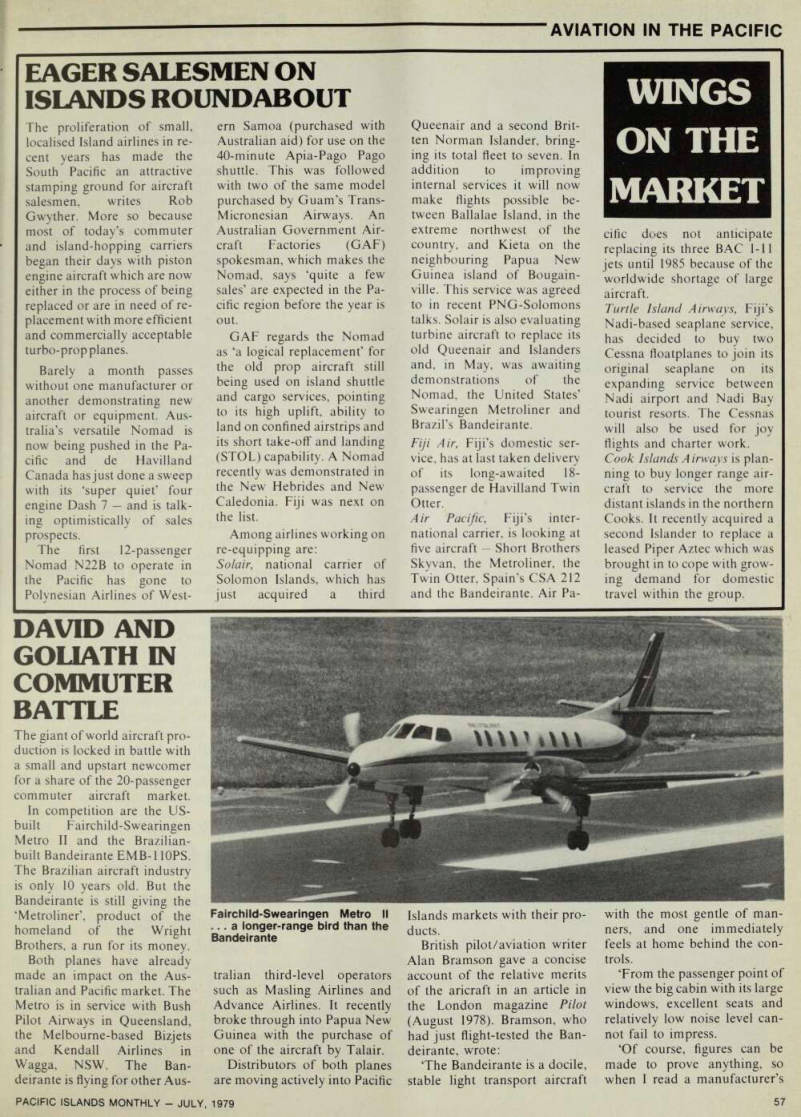
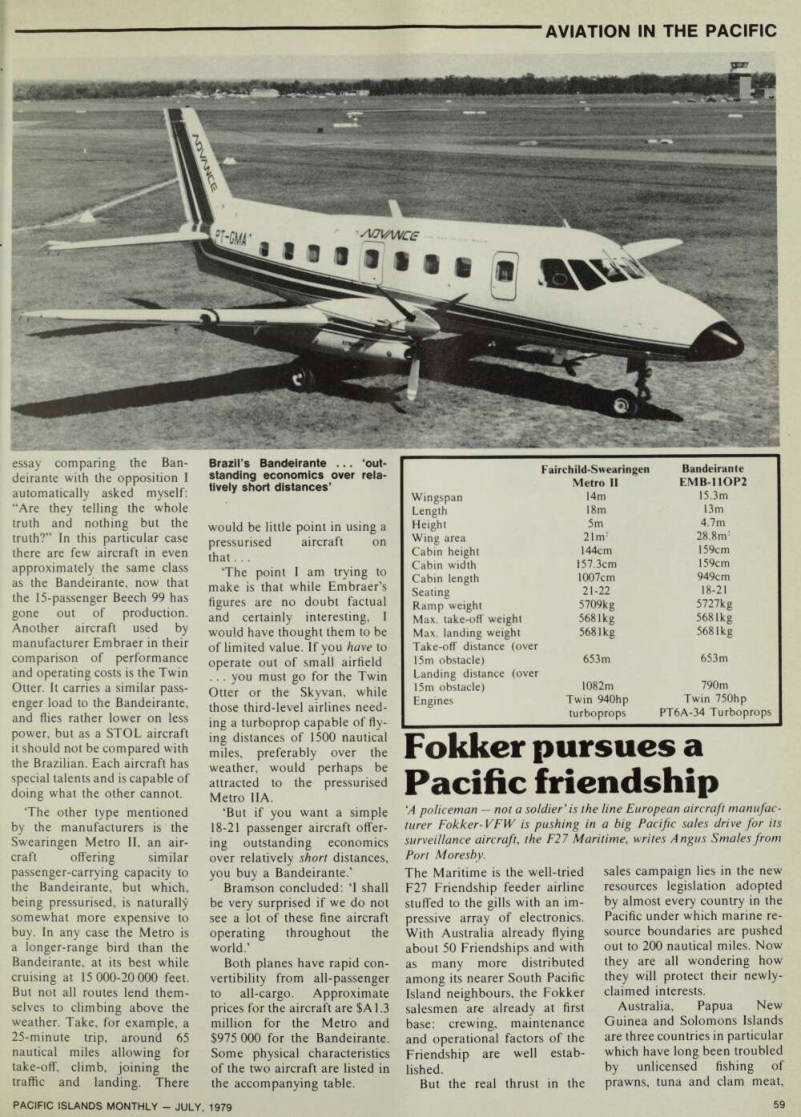
David And
Goliath In
Battle
The giant of world aircraft pro duction is locked in battle with a small and upstart newcomer for a share of the 20-passenger commuter aircraft market.
In competition are the US
built Fairchild-Swearingen
Metro II and the Brazilian built Bandeirante EMB-110PS.
The Brazilian aircraft industry is only 10 years old. But the Bandeirante is still giving the ‘Metroliner’, product of the homeland of the Wright Brothers, a run for its money.
Both planes have already made an impact on the Aus tralian and Pacific market. The Metro is in service with Bush Pilot Airways in Queensland, the Melbourne-based Bizjets and Kendall Airlines in Wagga, NSW. The Ban deirante is flying for other Aus-
tralian third-level operators such as Masling Airlines and Advance Airlines. It recently broke through into Papua New Guinea with the purchase of one of the aircraft by Talair.
Distributors of both planes are moving actively into Pacific
Islands markets with their pro ducts.
British pilot/aviation writer Alan Bramson gave a concise account of the relative merits of the aricraft in an article in the London magazine Pilot (August 1978). Bramson, who had just flight-tested the Ban deirante, wrote; ‘The Bandeirante is a docile, stable light transport aircraft
with the most gentle of man ners, and one immediately feels at home behind the con trols. ‘From the passenger point of view the big cabin with its large windows, excellent seats and relatively low noise level can not fail to impress. ‘Of course, figures can be made to prove anything, so when I read a manufacturer’s
Fairchild-Swearingen Metro II ... a longer-range bird than the Bandeirante
essay comparing the Ban deirante with the opposition I automatically asked myself: “Are they telling the whole truth and nothing but the truth?” In this particular case there are few aircraft in even approximately the same class as the Bandeirante, now that the 15-passenger Beech 99 has gone out of production.
Another aircraft used by manufacturer Embraer in their
comparison of performance
and operating costs is the Twin Otter. It carries a similar pass enger load to the Bandeirante, and flies rather lower on less power, but as a STOL aircraft it should not be compared with the Brazilian. Each aircraft has special talents and is capable of doing what the other cannot. ‘The other type mentioned by the manufacturers is the Swearingen Metro 11, an air craft offering similar
passenger-carrying capacity to
the Bandeirante, but which,
being pressurised, is naturally
somewhat more expensive to buy. In any case the Metro is a longer-range bird than the Bandeirante, at its best while cruising at 15 000-20 000 feet.
But not all routes lend them selves to climbing above the weather. Take, for example, a 25-minute trip, around 65 nautical miles allowing for take-off, climb, joining the traffic and landing. There
would be little point in using a pressurised aircraft on that... ‘The point I am trying to make is that while Embraer’s figures are no doubt factual
and certainly interesting, I
would have thought them to be of limited value. If you have to operate out of small airfield ... you must go for the Twin Otter or the Skyvan, while those third-level airlines need
ing a turboprop capable of fly
ing distances of 1500 nautical miles, preferably over the weather, would perhaps be attracted to the pressurised Metro lIA. ‘But if you want a simple 18-21 passenger aircraft offer ing outstanding economics over relatively short distances, you buy a Bandeirante.’
Bramson concluded; ‘I shall be very surprised if we do not see a lot of these fine aircraft
operating throughout the
world.’
Both planes have rapid con vertibility from all-passenger
to all-cargo. Approximate
prices for the aircraft are SAI.3 million for the Metro and $975 000 for the Bandeirante.
Some physical characteristics of the two aircraft are listed in the accompanying table.
Brazil’s Bandeirante ... ‘out standing economics over rela tively short distances’
F airchild-Swearingen Bandeirante Metro II
Emb-Hop2
Wingspan 14m 15.3m Length 18m 13m Height 5m 4.7m Wing area 21nv 28.8m : Cabin height 144cm 159cm Cabin width 157.3cm 159cm Cabin length 1007cm 949cm Seating 21-22 18-21 Ramp weight 5709kg 5727kg Max. take-off weight 5681kg 5681kg Max. landing weight 5681kg 5681kg Take-off distance (over 15m obstacle) 653m 653m Landing distance (over 15m obstacle) 1082m 790m Engines Twin 940hp Twin 750hp turboprops PT6A-34 Turboprops
Advertisements & other items, pp. 57-58 (2 items)
Aviation In The Pacific
57
PACIFIC ISLANDS MONTHLY - JULY, 1979
toughest
■ i. - K P *
lafcs.
-Mi t .
JLk«*
G-RBLA
LOG AN AIR
, -4k % V Xj % Hi Ifei. m m m $ x % v «*«*«** V • Y ~T V 1 i- * ■
How IWin Otter
tackles the
toughest
resource jobs.
Loganair, the Scottish Airline, relies on de Havilland Twin Otters to provide rapid transit to the North Sea oil reserves. Six times a day, Loganair flies oil rig crews to and from the far north. Through some of the worst weather in the world. They keep a tight schedule.
Twin Otter handles the most rigorous conditions better than any other aircraft. STOL performance is a must on rugged, makeshift runways.
Reliability has been proven in more than 70 countries around the world.
Under high, hot and even subzero conditions. Airframe construction is simple. And solid. Landing gear changes from wheels to wheel-skis, floats, or high-flotation tires. And the resource industries benefit from advantages crucial to the commuter airlines: Twin Otter economy, low maintenance costs and high dispatch
reliability.
Geodetic and photo surveys.
Supplying seismic drill sites, wellheads
and pipelines. Moving personnel,
equipment and provisions. All have become familiar jobs to Twin Otter.
Quiet turboprops are welcomed by noise-burdened airports and remote communities alike. And Twin Otter speed and comfort satisfy 20
passengers on hour-long flights.
Loganair’s demanding operations
made them choose Twin Otter. And they’re not alone. More than 100 Twin Otters are hard at work serving the resource industries all over the world.
Under the toughest conditions.
Of HA y/LLA/WD
IWin Otter
The standard of dependability
and versatility around
the world.
The de Havilland Aircraft of Canada, Ltd.
Downsview, Ontario M3K IYS Telephone: (416)633-7310 Telex: 0622128 Cable: MOTHTOR, Toronto.
Twin Otter service and spares support also available through de Havilland Canada Inc., 5321 North Pearl Street, Roscmont, Illinois 60018. Telephone (312) 678-8380. Telex 00726409.
Pacific friendship


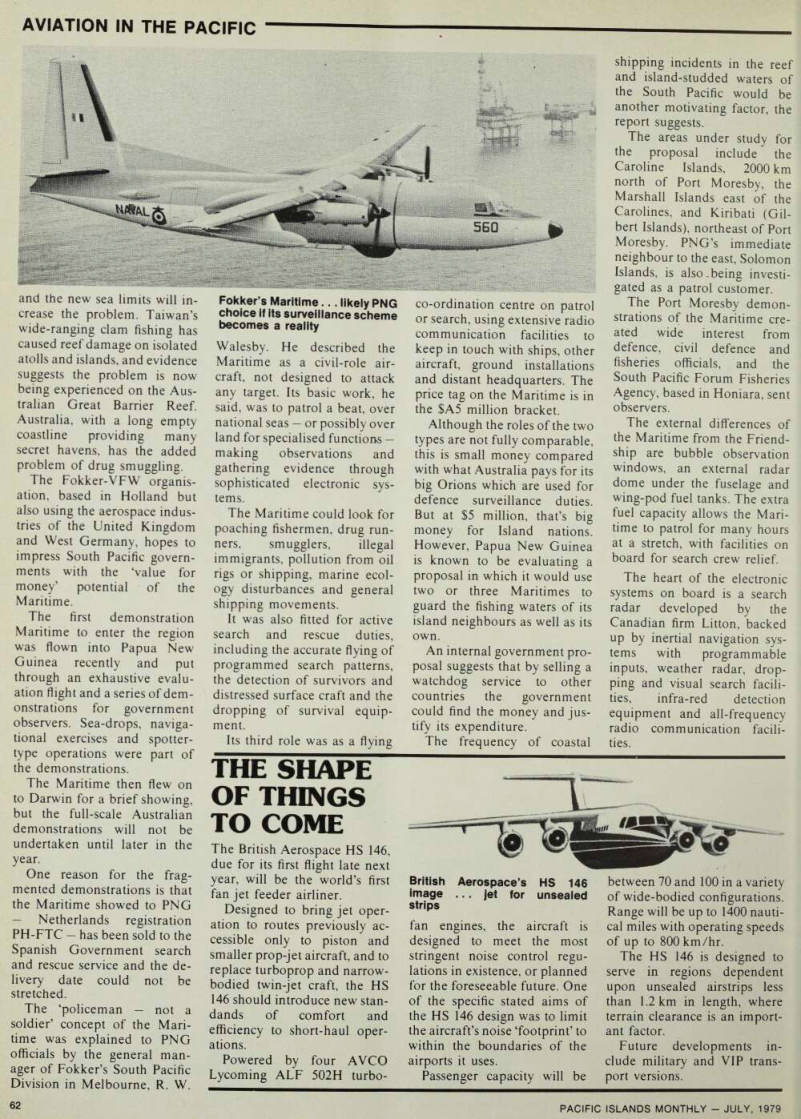
Fokker pursues a Pacific friendship
‘A policeman - not a soldier'is the line European aircraft manufac turer Fokker-VFW is pushing in a big Pacific sales drive for its surveillance aircraft, the F 27 Maritime, writes Angus Smales from Port Moresby.
The Maritime is the well-tried F 27 Friendship feeder airline stuffed to the gills with an im pressive array of electronics.
With Australia already flying about 50 Friendships and with as many more distributed among its nearer South Pacific Island neighbours, the Fokker salesmen are already at first base: crewing, maintenance and operational factors of the Friendship are well estab lished.
But the real thrust in the
sales campaign lies in the new resources legislation adopted by almost every country in the Pacific under which marine re source boundaries are pushed out to 200 nautical miles. Now they are all wondering how they will protect their newly claimed interests.
Australia, Papua New Guinea and Solomons Islands are three countries in particular which have long been troubled by unlicensed fishing of prawns, tuna and clam meat.
and the new sea limits will in crease the problem. Taiwan’s
wide-ranging clam fishing has
caused reef damage on isolated atolls and islands, and evidence suggests the problem is now being experienced on the Aus tralian Great Barrier Reef.
Australia, with a long empty coastline providing many secret havens, has the added
problem of drug smuggling.
The Fokker-VFW organis ation, based in Holland but also using the aerospace indus tries of the United Kingdom and West Germany, hopes to impress South Pacific govern ments with the ‘value for money’ potential of the Maritime.
The first demonstration Maritime to enter the region was flown into Papua New Guinea recently and put through an exhaustive evalu ation flight and a series of dem onstrations for government observers. Sea-drops, naviga tional exercises and spotter type operations were part of the demonstrations.
The Maritime then flew on to Darwin for a brief showing, but the full-scale Australian demonstrations will not be undertaken until later in the year.
One reason for the frag mented demonstrations is that the Maritime showed to PNG Netherlands registration PH-FTC has been sold to the Spanish Government search and rescue service and the de livery date could not be stretched.
The ‘policeman not a soldier’ concept of the Mari time was explained to PNG officials by the general man ager of Fokker’s South Pacific Division in Melbourne, R. W.
Walesby. He described the Maritime as a civil-role air craft, not designed to attack any target. Its basic work, he said, was to patrol a beat, over national seas or possibly over land for specialised functions making observations and
gathering evidence through
sophisticated electronic sys tems.
The Maritime could look for
poaching fishermen, drug run
ners, smugglers, illegal
immigrants, pollution from oil rigs or shipping, marine ecol ogy disturbances and general
shipping movements.
It was also fitted for active search and rescue duties, including the accurate flying of programmed search patterns, the detection of survivors and distressed surface craft and the
dropping of survival equip
ment.
Its third role was as a flying
co-ordination centre on patrol or search, using extensive radio communication facilities to keep in touch with ships, other aircraft, ground installations and distant headquarters. The price tag on the Maritime is in the SAS million bracket.
Although the roles of the two types are not fully comparable, this is small money compared with what Australia pays for its big Orions which are used for defence surveillance duties.
But at $5 million, that’s big money for Island nations.
However, Papua New Guinea is known to be evaluating a proposal in which it would use two or three Maritimes to guard the fishing waters of its island neighbours as well as its own.
An internal government pro posal suggests that by selling a watchdog service to other countries the government could find the money and jus tify its expenditure.
The frequency of coastal
shipping incidents in the reef and island-studded waters of the South Pacific would be another motivating factor, the report suggests.
The areas under study for the proposal include the Caroline Islands, 2000 km north of Port Moresby, the Marshall Islands east of the Carolines, and Kiribati (Gil bert Islands), northeast of Port Moresby. PNG’s immediate neighbour to the east, Solomon Islands, is also .being investi gated as a patrol customer.
The Port Moresby demon strations of the Maritime cre ated wide interest from defence, civil defence and fisheries officials, and the South Pacific Forum Fisheries Agency, based in Honiara, sent observers.
The external differences of the Maritime from the Friend ship are bubble observation windows, an external radar dome under the fuselage and wing-pod fuel tanks. The extra fuel capacity allows the Mari time to patrol for many hours at a stretch, with facilities on board for search crew relief.
The heart of the electronic systems on board is a search radar developed by the Canadian firm Litton, backed up by inertial navigation sys tems with programmable
inputs, weather radar, drop
ping and visual search facili ties, infra-red detection equipment and all-frequency radio communication facili ties.
Fokker’s Maritime...likely PNG choice if its surveillance scheme becomes a reality
Advertisements & other items, pp. 59-61 (2 items)
Aviation In The Pacific
59
PACIFIC ISLANDS MONTHLY - JULY, 1979
The new Fokker H
There is only one i
that can fly
your short hops m
The new Fokker H
Great where others are too big
The new Fokker F 2 w
something no other jet can; Profitability on the short and medium haul, low to medium density routes. Where you need jet speed and comfort to meet passenger demand. Where you need seating "□pacifies exactly matched ,o traffic you Because the new Fokker F2l flying short sectors.
Although the also can ex e other jets ...
e city-hopping
used efficiently on routes with stage network of NLM City Hopper. lengths up to 1200 nautical miles. Thanks to its 80/85 passenger In other words; Where you need the new Fokker F2B. routes. capacity which is just right for these
lodern jet
rfitably:
Thanks to its low weight which will save you money on navigation and landing fees. Thanks to its fuel economy which is the best of any commercial jetliner in production.
And thanks to Its fatigueresistant airframe and low-noise Rolls-Royce RB 183 engines optimized for short cycles and long service life.
If you want to know more about the new Fokker F2B please contact us at our address below.
And who knows - maybe you will be the next to order this exciting new aircraft:
The new Fokker F2B.
Fokker-VFW International, Schiphol-Oost, Netherlands, Telephone: 20-5449111, Telex PINT 11526.
Of Things
The Shape
To Come
The British Aerospace HS 146, due for its first flight late next year, will be the world’s first fan jet feeder airliner.
Designed to bring jet oper
ation to routes previously ac cessible only to piston and smaller prop-jet aircraft, and to replace turboprop and narrow bodied twin-jet craft, the HS 146 should introduce new stan dands of comfort and efficiency to short-haul oper ations.
Powered by four AVCO Lycoming ALF 502 H turbo-
fan engines, the aircraft is designed to meet the most stringent noise control regu lations in existence, or planned for the foreseeable future. One of the specific stated aims of the HS 146 design was to limit the aircraft’s noise ‘footprint’ to within the boundaries of the airports it uses.
Passenger capacity will be
between 70 and 100 in a variety of wide-bodied configurations.
Range will be up to 1400 nauti cal miles with operating speeds of up to 800 km/hr.
The HS 146 is designed to
serve in regions dependent
upon unsealed airstrips less than 1.2 km in length, where terrain clearance is an import ant factor.
Future developments in clude military and VIP trans port versions.
British Aerospace’s HS 146 image ... jet for unsealed strips
Advertisements & other items, p. 62 (1 item)
Aviation In The Pacific
62
PACIFIC ISLANDS MONTHLY - JULY, 1979
Quietly
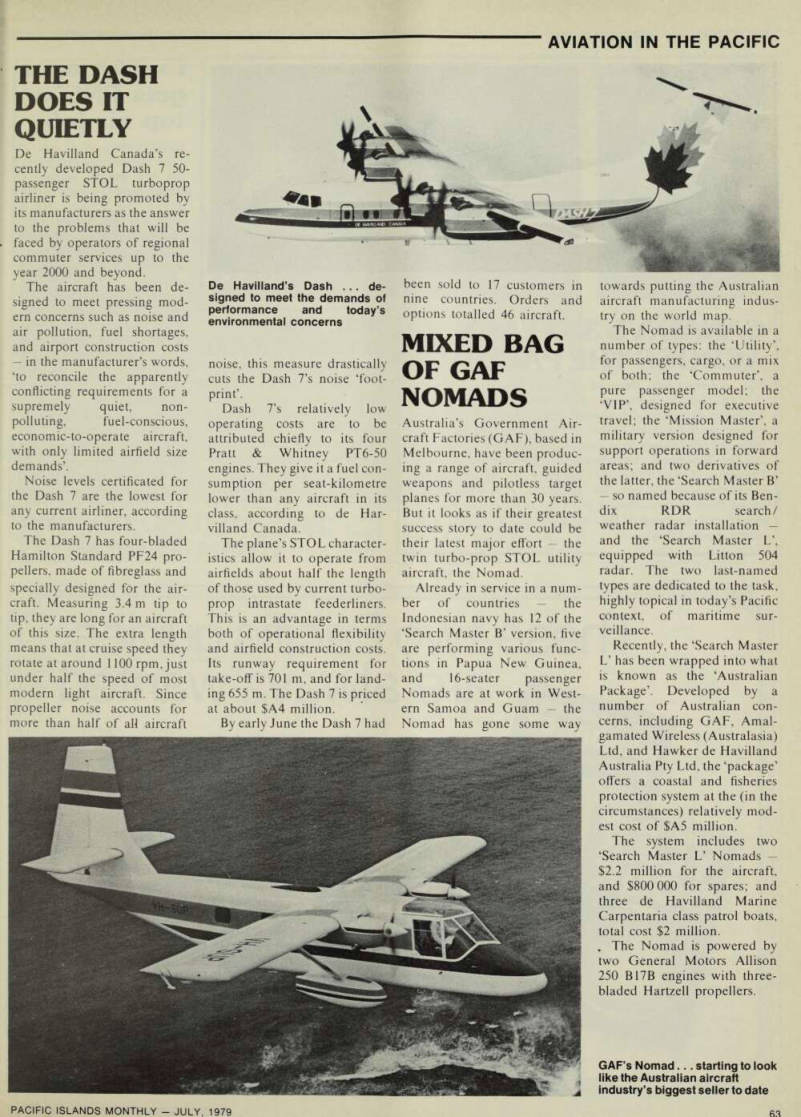
The Dash
Does It
De Havilland Canada’s re cently developed Dash 7 50passenger STOL turboprop airliner is being promoted by its manufacturers as the answer to the problems that will be faced by operators of regional commuter services up to the year 2000 and beyond.
The aircraft has been de signed to meet pressing mod ern concerns such as noise and air pollution, fuel shortages, and airport construction costs in the manufacturer’s words, ‘to reconcile the apparently
conflicting requirements for a
supremely quiet, non
polluting, fuel-conscious,
economic-to-operate aircraft,
with only limited airfield size demands’.
Noise levels certificated for the Dash 7 are the lowest for any current airliner, according to the manufacturers.
The Dash 7 has four-bladed Hamilton Standard PF24 pro pellers, made of fibreglass and specially designed for the air craft. Measuring 3.4 m tip to tip, they are long for an aircraft of this size. The extra length means that at cruise speed they rotate at around 1100 rpm, just under half the speed of most modern light aircraft. Since propeller noise accounts for more than half of all aircraft
noise, this measure drastically cuts the Dash 7’s noise ‘foot
print’.
Dash 7’s relatively low operating costs are to be attributed chiefly to its four Pratt & Whitney PT6-50 engines. They give it a fuel con sumption per seat-kilometre lower than any aircraft in its class, according to de Har villand Canada.
The plane’s STOL character istics allow it to operate from airfields about half the length of those used by current turbo prop intrastate feederliners.
This is an advantage in terms
both of operational flexibility
and airfield construction costs.
Its runway requirement for take-off is 701 m, and for land ing 655 m. The Dash 7 is priced at about SA4 million.
By early June the Dash 7 had
been sold to 17 customers in nine countries. Orders and options totalled 46 aircraft.
GAF’s Nomad...starting to look like the Australian aircraft industry’s biggest seller to date
De Havilland’s Dash ... de signed to meet the demands of performance and today’s environmental concerns
Nomads
Mixed Bag
Of Gaf
Australia’s Government Air craft Factories (GAP), based in Melbourne, have been produc ing a range of aircraft, guided weapons and pilotless target planes for more than 30 years.
But it looks as if their greatest success story to date could be their latest major effort the
twin turbo-prop STOL utility
aircraft, the Nomad.
Already in service in a num ber of countries the Indonesian navy has 12 of the ‘Search Master B’ version, five are performing various func tions in Papua New Guinea, and 16-seater passenger Nomads are at work in West ern Samoa and Guam the Nomad has gone some way
towards putting the Australian aircraft manufacturing indus try on the world map.
The Nomad is available in a number of types: the ‘Utility’, for passengers, cargo, or a mix of both; the ‘Commuter’, a pure passenger model; the ‘VIP’, designed for executive travel; the ‘Mission Master’, a military version designed for support operations in forward areas; and two derivatives of the latter, the ‘Search Master B’ so named because of its Ben dix RDR search/ weather radar installation and the ‘Search Master L’, equipped with Litton 504 radar. The two last-named types are dedicated to the task,
highly topical in today’s Pacific
context, of maritime sur veillance.
Recently, the ‘Search Master L’ has been wrapped into what is known as the ‘Australian
Package’. Developed by a
number of Australian con cerns, including GAP, Amal gamated Wireless (Australasia) Ltd, and Hawker de Havilland Australia Pty Ltd, the ‘package’ offers a coastal and fisheries protection system at the (in the circumstances) relatively mod est cost of SAS million.
The system includes two ‘Search Master L’ Nomads $2.2 million for the aircraft, and $BOO 000 for spares; and three de Havilland Marine
Carpentaria class patrol boats,
total cost $2 million. , The Nomad is powered by two General Motors Allison 250 8178 engines with three bladed Hartzell propellers.
Advertisements & other items, p. 63 (1 item)
Aviation In The Pacific
63
PACIFIC ISLANDS MONTHLY - JULY, 1979
Across The Pacific
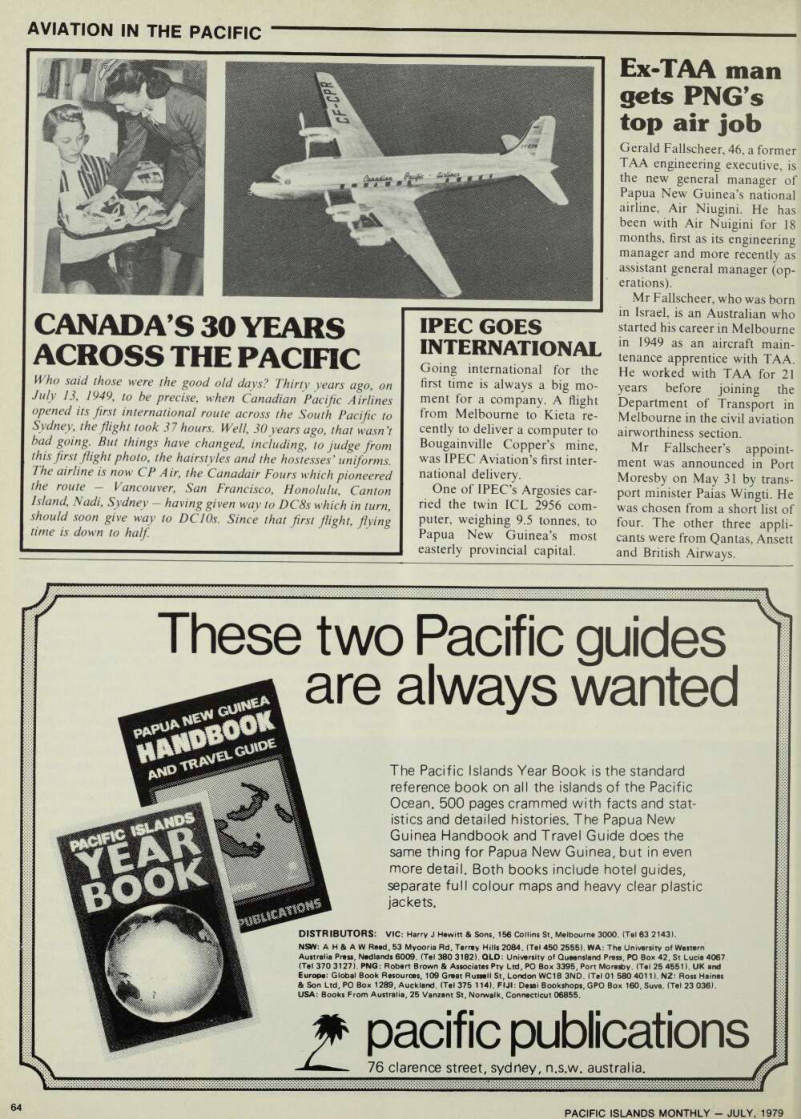
Canada’S 30 Years
Who said those were the good old days? Thirty years ago, on July 13, 1949, to be precise, when Canadian Pacific Airlines opened its first international route across the South Pacific to Sydney, the flight took 37 hours. Well, 30 years ago, that wasn’t bad going. But things have changed, including, to judge from this first flight photo, the hairstyles and the hostesses’ uniforms.
The airline is now CP Air, the Canadair Fours which pioneered the route - Vancouver, San Francisco, Honolulu, Canton Island, Nadi, Sydney - having given way to DCBs which in turn, should soon give way to DCWs. Since that first flight, flying time is down to half.
International
Ipec Goes
Going international for the first time is always a big mo ment for a company. A flight from Melbourne to Kieta re cently to deliver a computer to
Bougainville Copper’s mine,
was IPEC Aviation’s first inter
national delivery.
One of IPEC’s Argosies car ried the twin ICE 2956 com puter, weighing 9.5 tonnes, to Papua New Guinea’s most easterly provincial capital.
top air job
Ex-TAA man gets PNG’s top air job
Gerald Fallscheer, 46, a former TAA engineering executive, is the new general manager of Papua New Guinea’s national airline, Air Niugini. He has been with Air Nuigini for 18 months, first as its engineering manager and more recently as assistant general manager (op erations).
Mr Fallscheer, who was born in Israel, is an Australian who started his career in Melbourne in 1949 as an aircraft main tenance apprentice with TAA.
He worked with TAA for 21 years before joining the
Department of Transport in
Melbourne in the civil aviation airworthiness section.
Mr Fallscheer’s appoint ment was announced in Port
Moresby on May 31 by trans
port minister Paias Wingti. He was chosen from a short list of four. The other three appli cants were from Qantas, Ansett and British Airways.
Advertisements & other items, p. 64 (2 items)
Aviation In The Pacific
64
PACIFIC ISLANDS MONTHLY - JULY. 1979
p pacific publications
These two Pacific guides
are always wanted
The Pacific Islands Year Book is the standard reference book on all the islands of the Pacific Ocean. 500 pages crammed with facts and statistics and detailed histories. The Papua New Guinea Handbook and Travel Guide does the same thing for Papua New Guinea, but in even more detail. Both books include hotel guides, separate full colour maps and heavy clear plastic jackets.
DISTRIBUTORS: VIC: Harry J Hewitt & Sons, 156 Collins St, Melbourne 3000. (Tel 63 2143).
NSW: A H & A W Reed, 53 Myooria Rd, Terrey Hills 2084. (Tel 450 2555). WA: The University of Western Australia Press, Nedlands 6009. (Tel 380 3182). OLD: University of Queensland Press, PO Box 42, St Lucia 4067 (Tel 370 3127). PNG: Robert Brown & Associates Pty Ltd, PO Box 3395, Port Moresby. (Tel 25 4551). UK and Europe; Global Book Resources, 109 Great Russell St, London WCIB 3ND. (Tel 01 580 4011). NZ: Ross Haines & Son Ltd, PO Box 1289, Auckland. (Tel 375 114). FIJI: Desai Bookshops, GPO Box 160, Suva. (Tel 23 036).
USA; Books From Australia, 25 Vanzant St, Norwalk, Connecticut 06855.
p pacific publications
76 clarence street, svdnev, n.s.w. australia.
Png’S Register-233
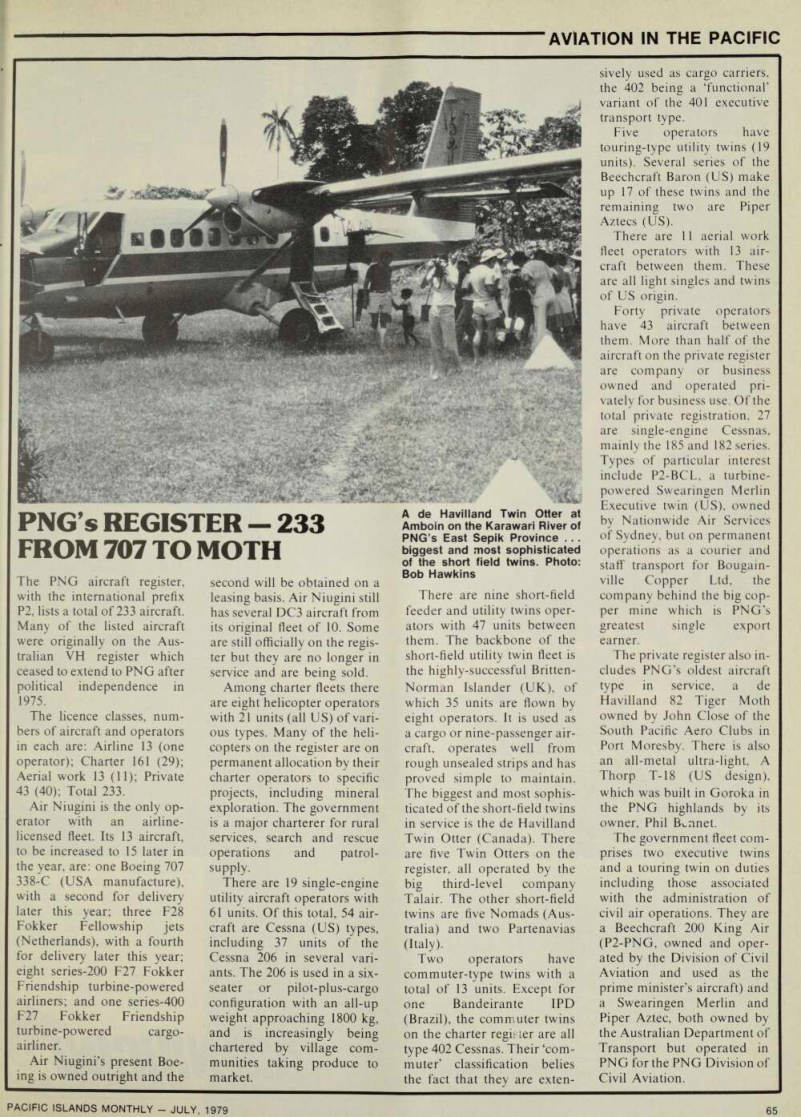
From 707 To Moth
The PNG aircraft register, with the international prefix P 2, lists a total of 233 aircraft.
Many of the listed aircraft were originally on the Aus tralian VH register which ceased to extend to PNG after
political independence in
1975.
The licence classes, num bers of aircraft and operators in each are: Airline 13 (one operator); Charter 161 (29); Aerial work 13 (11); Private 43 (40); Total 233.
Air Niugini is the only op erator with an airline licensed fleet. Its 13 aircraft, to be increased to 15 later in the year, are: one Boeing 707 338-C (USA manufacture), with a second for delivery later this year; three F2B Fokker Fellowship jets (Netherlands), with a fourth for delivery later this year; eight series-200 F 27 Fokker
Friendship turbine-powered
airliners; and one series-400 F 27 Fokker Friendship
turbine-powered cargo
airliner.
Air Niugini’s present Boe ing is owned outright and the
second will be obtained on a leasing basis. Air Niugini still has several DC3 aircraft from its original fleet of 10. Some are still officially on the regis ter but they are no longer in service and are being sold.
Among charter fleets there are eight helicopter operators with 21 units (all US) of vari ous types. Many of the heli copters on the register are on permanent allocation by their charter operators to specific projects, including mineral exploration. The government is a major charterer for rural services, search and rescue operations and patrol supply.
There are 19 single-engine utility aircraft operators with 61 units. Of this total, 54 air craft are Cessna (US) types, including 37 units of the Cessna 206 in several vari ants. The 206 is used in a six seater or pilot-plus-cargo configuration with an all-up
weight approaching 1800 kg,
and is increasingly being
chartered by village com munities taking produce to market.
There are nine short-field feeder and utility twins oper ators with 47 units between them. The backbone of the short-field utility twin fleet is the highly-successful Britten- Norman Islander (UK), of which 35 units are flown by eight operators. It is used as a cargo or nine-passenger air craft, operates well from rough unsealed strips and has proved simple to maintain.
The biggest and most sophis ticated of the short-field twins in service is the de Havilland Twin Otter (Canada). There are five Twin Otters on the register, all operated by the big third-level company Talair. The other short-field twins are five Nomads (Aus tralia) and two Partenavias
(Italy).
Two operators have commuter-type twins with a total of 13 units. Except for one Bandeirante IPD (Brazil), the commuter twins on the charter regit ter are all type 402 Cessnas. Their ‘com muter’ classification belies the fact that they are exten
sively used as cargo carriers, the 402 being a ‘functional’ variant of the 401 executive transport type.
Five operators have touring-type utility twins (19 units). Several series of the Beechcraft Baron (US) make up 17 of these twins and the remaining two are Piper Aztecs (US).
There are 11 aerial work fleet operators with 13 air craft between them. These are all light singles and twins of US origin.
Forty private operators have 43 aircraft between them. More than half of the aircraft on the private register are company or business
owned and operated pri
vately for business use. Of the
total private registration, 27
are single-engine Cessnas, mainly the 185 and 182 series.
Types of particular interest
include P2-BCL, a turbine
powered Swearingen Merlin
Executive twin (US), owned by Nationwide Air Services of Sydney, but on permanent operations as a courier and staff transport for Bougain ville Copper Ltd, the company behind the big cop per mine which is PNG’s greatest single export earner.
The private register also in cludes PNG’s oldest aircraft type in service, a de Havilland 82 Tiger Moth owned by John Close of the South Pacific Aero Clubs in Port Moresby. There is also an all-metal ultra-light, A
Thorp T-18 (US design),
which was built in Goroka in the PNG highlands by its owner, Phil Bonnet.
The government fleet com prises two executive twins and a touring twin on duties including those associated with the administration of civil air operations. They are a Beechcraft 200 King Air (P2-PNG, owned and oper ated by the Division of Civil Aviation and used as the prime minister’s aircraft) and a Swearingen Merlin and Piper Aztec, both owned by the Australian Department of
Transport but operated in
PNG for the PNG Division of Civil Aviation.
A de Havilland Twin Otter at Amboin on the Karawari River of PNG’s East Sepik Province ... biggest and most sophisticated of the short field twins. Photo: Bob Hawkins
Advertisements & other items, pp. 65-66 (2 items)
Aviation In The Pacific
65
PACIFIC ISLANDS MONTHLY - JULY, 1979
some ofourcfaefs
% r
■WSP
US '<*A *■ >- ■->: *■>? it * ■s % J
sec
ms m
Vsa hi? ISL{- h
m f m '‘.Sm.*!*
some ofourcfaefs
In Papua New Guinea there are 717 different cultures, each represented by its own language and its own "chief". Few men know this country better than our chief pilot, Captain John Regan.
He's logged more than 16,000 hours flying, much of that in Papua New Guinea.
John Regan is one of ninety highly skilled Australian, New Zealand, British, and American pilots flying our aircraft to seventeen places in Papua New Guinea and eight destinations overseas.
AIRNIUGINI
THE NA T/ONAL AIRLINE OF PAPUA NEW GUINEaM
And Go?
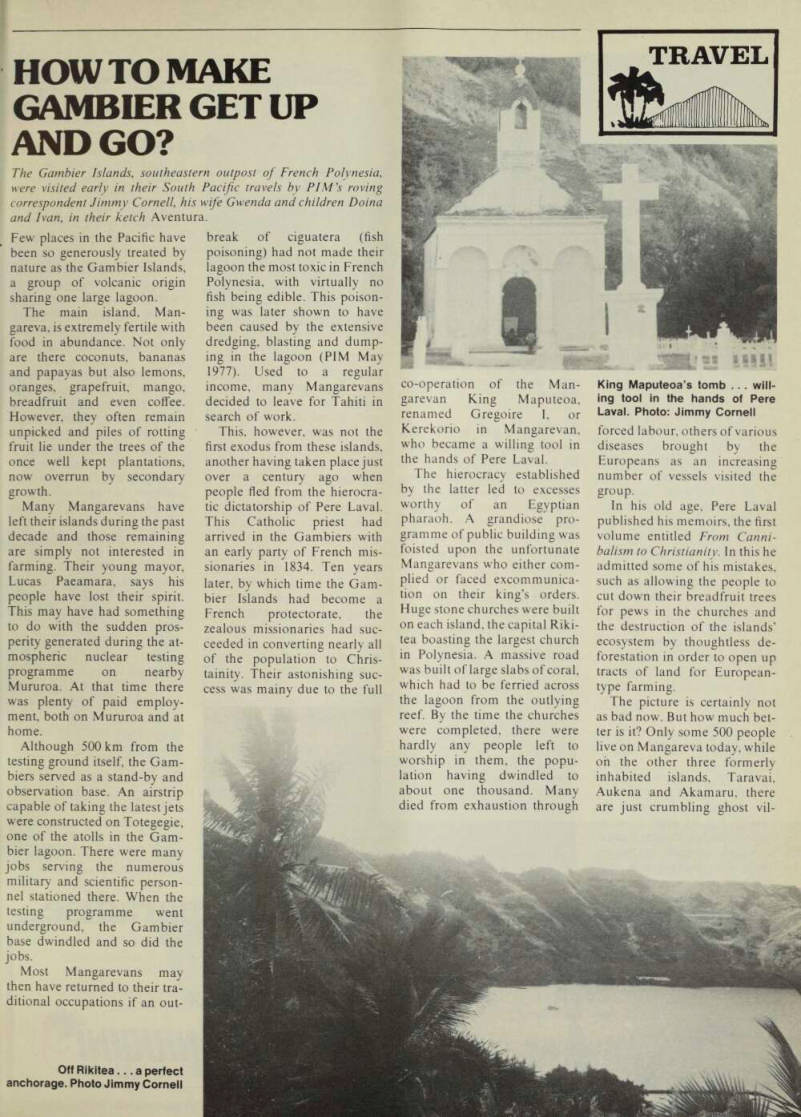
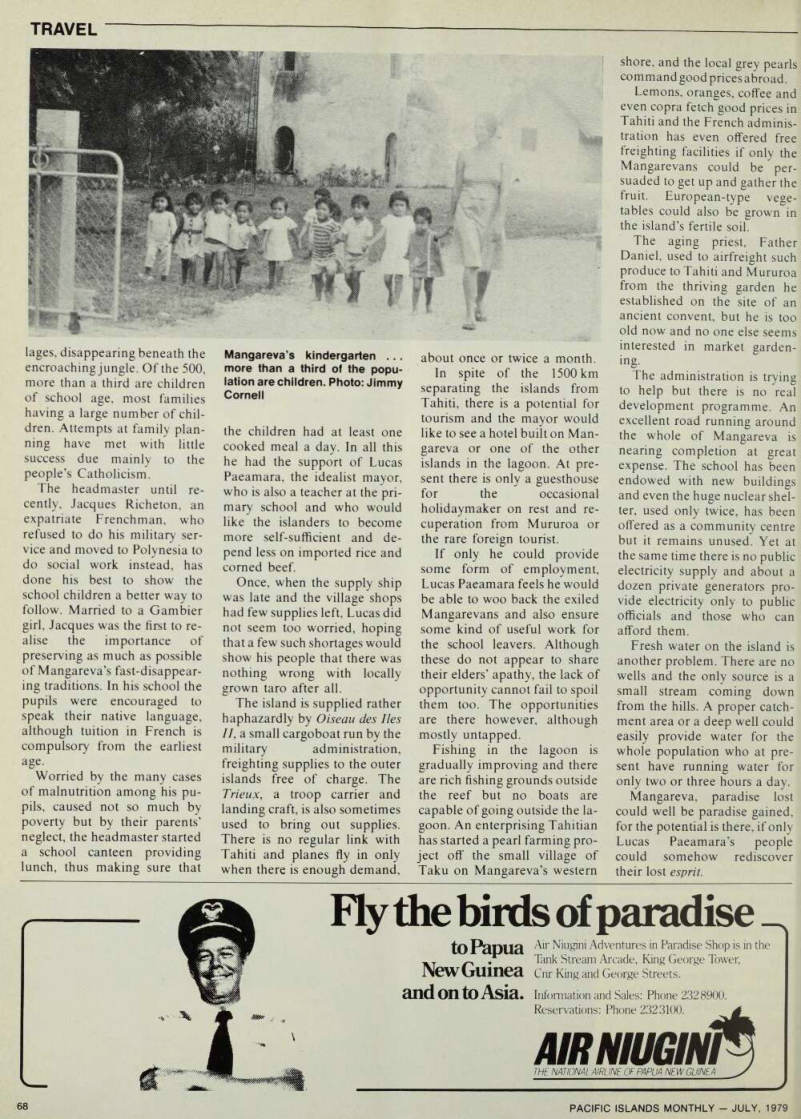
Travel
Howto Make
Gambier Get Up
And Go?
The Gambier Islands, southeastern outpost of French Polynesia, were visited early in their South Pacific travels by PI M's roving correspondent Jimmy Cornell, his wife Gwenda and children Doina and Ivan, in their ketch Aventura.
Few places in the Pacific have been so generously treated by nature as the Gambier Islands, a group of volcanic origin
sharing one large lagoon.
The main island, Man gareva, is extremely fertile with food in abundance. Not only are there coconuts, bananas and papayas but also lemons, oranges, grapefruit, mango, breadfruit and even coffee.
However, they often remain unpicked and piles of rotting fruit lie under the trees of the once well kept plantations,
now overrun by secondary
growth.
Many Mangarevans have left their islands during the past decade and those remaining are simply not interested in farming. Their young mayor, Lucas Paeamara, says his people have lost their spirit.
This may have had something to do with the sudden pros perity generated during the at mospheric nuclear testing programme on nearby Mururoa. At that time there
was plenty of paid employ
ment, both on Mururoa and at home.
Although 500 km from the testing ground itself, the Gam biers served as a stand-by and observation base. An airstrip capable of taking the latest jets were constructed on Totegegie, one of the atolls in the Gam bier lagoon. There were many jobs serving the numerous military and scientific person nel stationed there. When the testing programme went underground, the Gambier base dwindled and so did the
jobs.
Most Mangarevans may then have returned to their tra ditional occupations if an out
break of ciguatera (fish poisoning) had not made their lagoon the most toxic in French
Polynesia, with virtually no
fish being edible. This poison ing was later shown to have been caused by the extensive
dredging, blasting and dump
ing in the lagoon (PIM May
1977). Used to a regular income, many Mangarevans decided to leave for Tahiti in search of work.
This, however, was not the first exodus from these islands,
another having taken place just
over a century ago when people fled from the hierocra tic dictatorship of Pere Laval.
This Catholic priest had arrived in the Gambiers with an early party of French mis sionaries in 1834. Ten years later, by which time the Gam bier Islands had become a French protectorate, the zealous missionaries had suc ceeded in converting nearly all of the population to Chris
tainity. Their astonishing suc
cess was mainy due to the full
co-operation of the Man
garevan King Maputeoa,
renamed Gregoire I, or Kerekorio in Mangarevan, who became a willing tool in the hands of Pere Laval.
The hierocracy established by the latter led to excesses
worthy of an Egyptian
pharaoh. A grandiose pro gramme of public building was foisted upon the unfortunate Mangarevans who either com plied or faced excommunica tion on their king’s orders.
Huge stone churches were built on each island, the capital Riki tea boasting the largest church in Polynesia. A massive road was built of large slabs of coral, which had to be ferried across the lagoon from the outlying reef. By the time the churches were completed, there were hardly any people left to worship in them, the popu lation having dwindled to about one thousand. Many died from exhaustion through
forced labour, others of various
diseases brought by the
Europeans as an increasing
number of vessels visited the group.
In his old age, Pere Laval published his memoirs, the first volume entitled From Canni balism to Christianity. In this he admitted some of his mistakes, such as allowing the people to cut down their breadfruit trees for pews in the churches and the destruction of the islands’
ecosystem by thoughtless de
forestation in order to open up tracts of land for European
type farming.
The picture is certainly not as bad now. But how much bet ter is it? Only some 500 people live on Mangareva today, while oh the other three formerly inhabited islands, Taravai, Aukena and Akamaru, there
are just crumbling ghost vil-
King Maputeoa’s tomb ... will ing tool in the hands of Pere Laval. Photo: Jimmy Cornell
Off Rikitea ... a perfect anchorage. Photo Jimmy Cornell
lages, disappearing beneath the
encroaching jungle. Of the 500, more than a third are children of school age, most families having a large number of chil
dren. Attempts at family plan
ning have met with little success due mainly to the
people’s Catholicism.
The headmaster until re
cently, Jacques Richeton, an
expatriate Frenchman, who refused to do his military ser vice and moved to Polynesia to do social work instead, has done his best to show the school children a better way to follow. Married to a Gambier girl, Jacques was the first to re alise the importance of preserving as much as possible
of Mangareva’s fast-disappear
ing traditions. In his school the
pupils were encouraged to
speak their native language,
although tuition in French is compulsory from the earliest age.
Worried by the many cases of malnutrition among his pu pils, caused not so much by poverty but by their parents’ neglect, the headmaster started a school canteen providing lunch, thus making sure that
the children had at least one cooked meal a day. In all this he had the support of Lucas Paeamara, the idealist mayor, who is also a teacher at the pri mary school and who would like the islanders to become more self-sufficient and de pend less on imported rice and corned beef.
Once, when the supply ship was late and the village shops had few supplies left, Lucas did not seem too worried, hoping that a few such shortages would show his people that there was
nothing wrong with locally
grown taro after all.
The island is supplied rather haphazardly by Oiseau des lies 11, a small cargoboat run by the
military administration,
freighting supplies to the outer islands free of charge. The Trieux, a troop carrier and landing craft, is also sometimes used to bring out supplies.
There is no regular link with
Tahiti and planes fly in only
when there is enough demand,
about once or twice a month.
In spite of the 1500 km separating the islands from Tahiti, there is a potential for tourism and the mayor would like to see a hotel built on Man gareva or one of the other islands in the lagoon. At pre sent there is only a guesthouse for the occasional holidaymaker on rest and re cuperation from Mururoa or the rare foreign tourist.
If only he could provide some form of employment, Lucas Paeamara feels he would be able to woo back the exiled Mangarevans and also ensure some kind of useful work for the school leavers. Although these do not appear to share their elders’ apathy, the lack of opportunity cannot fail to spoil them too. The opportunities are there however, although
mostly untapped.
Fishing in the lagoon is
gradually improving and there
are rich fishing grounds outside the reef but no boats are capable of going outside the la goon. An enterprising Tahitian has started a pearl farming pro ject off the small village of Taku on Mangareva’s western
shore, and the local grey pearls command good prices abroad.
Lemons, oranges, coffee and even copra fetch good prices in Tahiti and the French adminis tration has even offered free freighting facilities if only the Mangarevans could be per suaded to get up and gather the fruit. European-type vege tables could also be grown in the island’s fertile soil.
The aging priest, Father
Daniel, used to airfreight such produce to Tahiti and Mururoa from the thriving garden he established on the site of an ancient convent, but he is too old now and no one else seems interested in market garden
ing.
The administration is trying to help but there is no real development programme. An excellent road running around the whole of Mangareva is
nearing completion at great
expense. The school has been endowed with new buildings and even the huge nuclear shel ter, used only twice, has been offered as a community centre but it remains unused. Yet at the same time there is no public electricity supply and about a dozen private generators pro
vide electricity only to public
officials and those who can afford them.
Fresh water on the island is another problem. There are no wells and the only source is a small stream coming down from the hills. A proper catch ment area or a deep well could easily provide water for the whole population who at pre sent have running water for only two or three hours a day.
Mangareva, paradise lost
could well be paradise gained, for the potential is there, if only Lucas Paeamara’s people could somehow rediscover their lost esprit.
Mangareva’s kindergarten ... more than a third of the popu lation are children. Photo: Jimmy Cornell
Advertisements & other items, p. 68 (1 item)
mmucmm
Fly the birds of paradise
tO PcIDU3, Niugini Adventures in Paradise Shop is in the " Tank Stream Arcade, King George Tower,
New Guinea
Cnr King and George Streets. and on to Asia. Information and Sales: Phone 2328900.
Reservations: Phone 2323100, Reservations: Phone 2323100.
mmucmm
THE NATIONAL AIRLINE OF PAPUA NEW GUINEA
Galapagos-a place
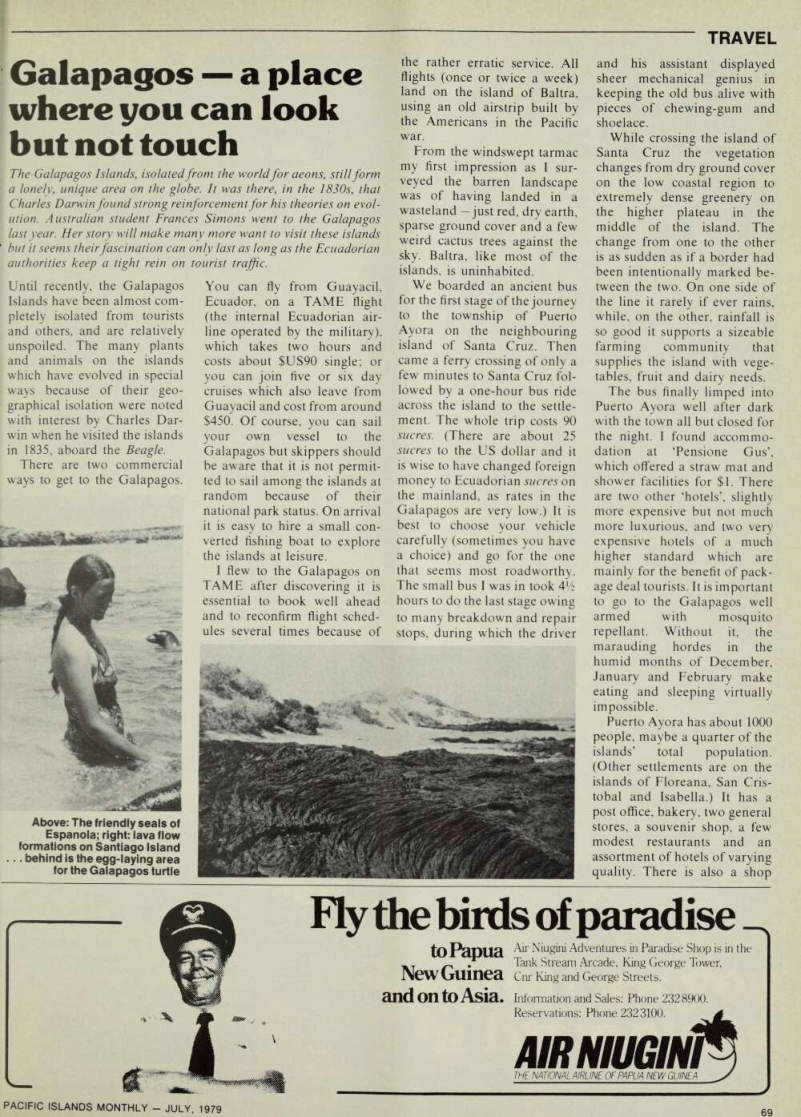
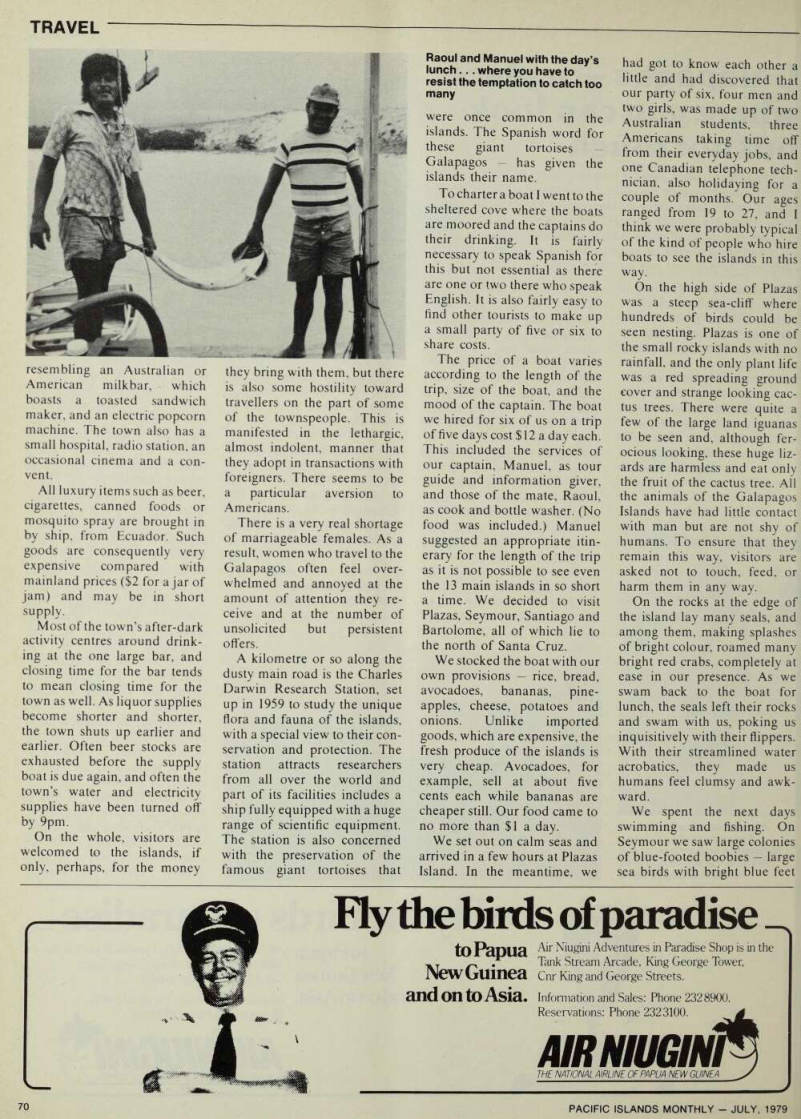

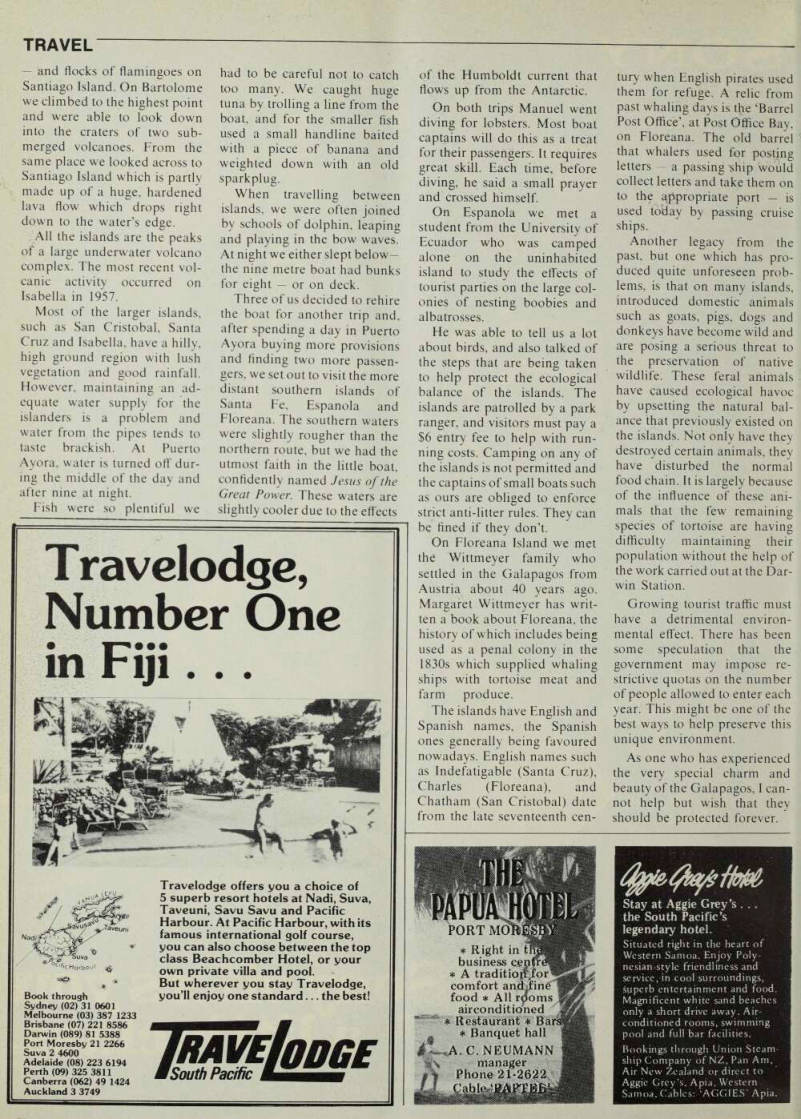
where you can look but not touch
The Galapagos Islands, isolated from the world for aeons, still form a lonely, unique area on the globe. It was there, in the 1830 s, that Charles Darwin found strong reinforcement for his theories on evol ution. Australian student Frances Simons went to the Galapagos last year. Her story will make many more want to visit these islands but it seems their fascination can only last as long as the Ecuadorian authorities keep a tight rein on tourist traffic.
Until recently, the Galapagos Islands have been almost completely isolated from tourists and others, and are relatively unspoiled. The many plants and animals on the islands which have evolved in special ways because of their geographical isolation were noted with interest by Charles Darwin when he visited the islands in 1835, aboard the Beagle.
There are two commercial ways to get to the Galapagos.
You can fly from Guayacil, Ecuador, on a TAME flight (the internal Ecuadorian air
line operated by the military),
which takes two hours and costs about SUS9O single; or you can join five or six day cruises which also leave from Guayacil and cost from around $450. Of course, you can sail your own vessel to the
Galapagos but skippers should
be aware that it is not permit ted to sail among the islands at random because of their national park status. On arrival it is easy to hire a small con verted fishing boat to explore the islands at leisure.
I flew to the Galapagos on TAME after discovering it is essential to book well ahead and to reconfirm flight sched ules several times because of
the rather erratic service. All flights (once or twice a week) land on the island of Baltra, using an old airstrip built by the Americans in the Pacific war.
From the windswept tarmac my first impression as I sur
veyed the barren landscape
was of having landed in a wasteland just red, dry earth, sparse ground cover and a few weird cactus trees against the sky. Baltra, like most of the islands, is uninhabited.
We boarded an ancient bus for the first stage of the journey to the township of Puerto Ayora on the neighbouring island of Santa Cruz. Then came a ferry crossing of only a few minutes to Santa Cruz fol lowed by a one-hour bus ride across the island to the settle ment. The whole trip costs 90 sucres. (There are about 25 sucres to the US dollar and it is wise to have changed foreign money to Ecuadorian sucres on the mainland, as rates in the Galapagos are very low.) It is best to choose your vehicle carefully (sometimes you have a choice) and go for the one that seems most roadworthy.
The small bus I was in took 4Vi hours to do the last stage owing to many breakdown and repair stops, during which the driver
and his assistant displayed sheer mechanical genius in keeping the old bus alive with
pieces of chewing-gum and
shoelace.
While crossing the island of Santa Cruz the vegetation changes from dry ground cover on the low coastal region to extremely dense greenery on the higher plateau in the middle of the island. The change from one to the other is as sudden as if a border had been intentionally marked be tween the two. On one side of the line it rarely if ever rains, while, on the other, rainfall is so good it supports a sizeable
farming community that
supplies the island with vege tables, fruit and dairy needs.
The bus finally limped into Puerto Ayora well after dark with the town all but closed for the night. I found accommo dation at ‘Pensione Gus’, which offered a straw mat and shower facilities for $l. There are two other ‘hotels’, slightly more expensive but not much more luxurious, and two very expensive hotels of a much higher standard which are mainly for the benefit of pack age deal tourists. It is important to go to the Galapagos well armed with mosquito repellant. Without it, the marauding hordes in the humid months of December,
January and February make
eating and sleeping virtually
impossible.
Puerto Ayora has about 1000 people, maybe a quarter of the islands’ total population. (Other settlements are on the islands of Floreana, San Cris tobal and Isabella.) It has a post office, bakery, two general stores, a souvenir shop, a few modest restaurants and an assortment of hotels of varying quality. There is also a shop
Above: The friendly seals of Espanola; right: lava flow formations on Santiago Island ...behind is the egg-laying area for the Galapagos turtle
resembling an Australian or American milkbar, which boasts a toasted sandwich maker, and an electric popcorn machine. The town also has a small hospital, radio station, an occasional cinema and a con vent.
All luxury items such as beer, cigarettes, canned foods or mosquito spray are brought in by ship, from Ecuador. Such goods are consequently very expensive compared with mainland prices ($2 for a Jar of jam) and may be in short
supply.
Most of the town’s after-dark activity centres around drink ing at the one large bar, and closing time for the bar tends to mean closing time for the town as well. As liquor supplies become shorter and shorter, the town shuts up earlier and earlier. Often beer stocks are exhausted before the supply boat is due again, and often the town’s water and electricity supplies have been turned off
by 9pm.
On the whole, visitors are welcomed to the islands, if only, perhaps, for the money
they bring with them, but there is also some hostility toward travellers on the part of some of the townspeople. This is manifested in the lethargic, almost indolent, manner that they adopt in transactions with foreigners. There seems to be a particular aversion to Americans.
There is a very real shortage of marriageable females. As a result, women who travel to the Galapagos often feel over whelmed and annoyed at the amount of attention they re ceive and at the number of unsolicited but persistent offers.
A kilometre or so along the dusty main road is the Charles Darwin Research Station, set up in 1959 to study the unique flora and fauna of the islands, with a special view to their con servation and protection. The station attracts researchers from all over the world and part of its facilities includes a
ship fully equipped with a huge
range of scientific equipment.
The station is also concerned with the preservation of the famous giant tortoises that
were once common in the islands. The Spanish word for these giant tortoises
Galapagos has given the
islands their name.
To charter a boat I went to the sheltered cove where the boats are moored and the captains do their drinking. It is fairly necessary to speak Spanish for this but not essential as there are one or two there who speak English. It is also fairly easy to find other tourists to make up a small party of five or six to share costs.
The price of a boat varies according to the length of the trip, size of the boat, and the mood of the captain. The boat we hired for six of us on a trip of five days cost $ 12 a day each.
This included the services of our captain, Manuel, as tour
guide and information giver,
and those of the mate, Raoul, as cook and bottle washer. (No food was included.) Manuel
suggested an appropriate itin
erary for the length of the trip as it is not possible to see even the 13 main islands in so short a time. We decided to visit
Plazas, Seymour, Santiago and
Bartolome, all of which lie to the north of Santa Cruz.
We stocked the boat with our own provisions rice, bread, avocadoes, bananas, pine apples, cheese, potatoes and onions. Unlike imported goods, which are expensive, the fresh produce of the islands is very cheap. Avocadoes, for example, sell at about five cents each while bananas are cheaper still. Our food came to no more than $1 a day.
We set out on calm seas and arrived in a few hours at Plazas Island. In the meantime, we
had got to know each other a little and had discovered that our party of six, four men and two girls, was made up of two Australian students, three Americans taking time off from their everyday jobs, and one Canadian telephone tech nician, also holidaying for a couple of months. Our ages ranged from 19 to 27, and I think we were probably typical of the kind of people who hire boats to see the islands in this way.
On the high side of Plazas was a steep sea-cliff where hundreds of birds could be seen nesting. Plazas is one of the small rocky islands with no rainfall, and the only plant life was a red spreading ground cover and strange looking cac tus trees. There were quite a few of the large land iguanas to be seen and, although fer ocious looking, these huge liz ards are harmless and eat only the fruit of the cactus tree. All the animals of the Galapagos Islands have had little contact with man but are not shy of humans. To ensure that they remain this way, visitors are asked not to touch, feed, or harm them in any way.
On the rocks at the edge of the island lay many seals, and
among them, making splashes
of bright colour, roamed many bright red crabs, completely at ease in our presence. As we swam back to the boat for lunch, the seals left their rocks and swam with us, poking us
inquisitively with their flippers.
With their streamlined water acrobatics, they made us humans feel clumsy and awk ward.
We spent the next days
swimming and fishing. On
Seymour we saw large colonies of blue-footed boobies large sea birds with bright blue feet
Raoul and Manuel with the day’s lunch...where you have to resist the temptation to catch 100 many
and flocks of flamingoes on Santiago Island. On Bartolome we climbed to the highest point and were able to look down into the craters of two sub merged volcanoes. From the same place we looked across to Santiago Island which is partly made up of a huge, hardened lava flow which drops right down to the water’s edge.
All the islands are the peaks of a large underwater volcano complex. The most recent vol canic activity occurred on Isabella in 1957.
Most of the larger islands, such as San Cristobal, Santa Cruz and Isabella, have a hilly, high ground region with lush vegetation and good rainfall.
However, maintaining an ad equate water supply for the islanders is a problem and water from the pipes tends to taste brackish. At Puerto Ayora, water is turned off dur ing the middle of the day and after nine at night.
Fish were so plentiful we
had to be careful not to catch too many. We caught huge tuna by trolling a line from the boat, and for the smaller fish used a small handline baited with a piece of banana and weighted down with an old
sparkplug.
When travelling between islands, we were often joined by schools of dolphin, leaping and playing in the bow waves.
At night we either slept below— the nine metre boat had bunks for eight or on deck.
Three of us decided to rehire the boat for another trip and, after spending a day in Puerto Ayora buying more provisions and finding two more passen gers, we set out to visit the more distant southern islands of Santa Fe, Espanola and Floreana. The southern waters were slightly rougher than the northern route, but we had the utmost faith in the little boat, confidently named Jesus of the Great Power. These waters are slightly cooler due to the effects
of the Humboldt current that flows up from the Antarctic.
On both trips Manuel went diving for lobsters. Most boat captains will do this as a treat for their passengers. It requires great skill. Each time, before diving, he said a small prayer and crossed himself.
On Espanola we met a student from the University of Ecuador who was camped alone on the uninhabited island to study the effects of tourist parties on the large col onies of nesting boobies and albatrosses.
He was able to tell us a lot about birds, and also talked of the steps that are being taken to help protect the ecological balance of the islands. The islands are patrolled by a park ranger, and visitors must pay a $6 entry fee to help with run ning costs. Camping on any of the islands is not permitted and the captains of small boats such as ours are obliged to enforce strict anti-litter rules. They can be fined if they don’t.
On Floreana Island we met
the Wittmeyer family who
settled in the Galapagos from Austria about 40 years ago.
Margaret Wittmeyer has writ ten a book about Floreana, the history of which includes being used as a penal colony in the
1830 s which supplied whaling
ships with tortoise meat and
farm produce.
The islands have English and Spanish names, the Spanish
ones generally being favoured
nowadays. English names such
as Indefatigable (Santa Cruz), Charles (Floreana), and Chatham (San Cristobal) date from the late seventeenth cen
tury when English pirates used them for refuge. A relic from past whaling days is tjie ‘Barrel Post Office’, at Post Office Bay, on Floreana. The old barrel that whalers used for posting letters a passing ship would collect letters and take them on to the appropriate port - is
used to'day by passing cruise
ships.
Another legacy from the past, but one which has pro duced quite unforeseen prob lems, is that on many islands, introduced domestic animals such as goats, pigs, dogs and donkeys have become wild and are posing a serious threat to the preservation of native wildlife. These feral animals have caused ecological havoc by upsetting the natural bal ance that previously existed on the islands. Not only have they
destroyed certain animals, they
have disturbed the normal food chain. It is largely because of the influence of these ani mals that the few remaining species of tortoise are having
difficulty maintaining their
population without the help of the work carried out at the Dar win Station.
Growing tourist traffic must have a detrimental environ mental effect. There has been some speculation that the government may impose re strictive quotas on the number of people allowed to enter each year. This might be one of the best ways to help preserve this
unique environment.
As one who has experienced the very special charm and beauty of the Galapagos, I can not help but wish that they should be protected forever.
Advertisements & other items, pp. 69-73 (2 items)
Fly the birds of paradise
r %
to Papua
New Guinea
and on to Asia.
Air Niugini Adventures in Paradise Shop is in the Tank Stream Arcade, King George Tower, Cnr King and George Streets.
Information and Sales: Phone 2328900.
Reservations: Phone 2323100.
AIRNIUGINr
-/£ NATIONAL AIRLINE OF PAPUA NEW GUINEA /
Fly the birds of paradise
to Papua
New Guinea
and on to Asia.
Air Niugini Adventures in Paradise Shop is in the Tank Stream Arcade, King George Tower, Cnr King and George Streets.
Information and Sales: Phone 2328900.
Reservations: Phone 2323100.
AIRNIUGINr
THE NATIONAL AIRLINE OF PAPUA NEW GUINEA
SONY
Optional wireless microphone with remote control available for M-301. 59 1 IP
SONY
T CM'6OO
KSm ;■ /// 1
«XJV7E,
fIW i 0 o d u s Oft 3 'o EO ®/ ' v •4’ V ♦ A micro-cassette recorder with FM/AM on the side. A recorder for standard size cassettes not much bigger than the cassette itself. And our "super FM/AM radio so lustrous you can almost see yourself in its satin finish. The new class of Sony portables. w w wmm Making them small was one thing. It took all the electronic finesse Sony has been able to develop and improve upon over the last three decades.
But making them beautiful was another matter. nrorl facto
Sony offers you
a liHlpplacc
€jL iiltiv l/idod*
u„ o.
Travclodge,
Number One
in Fiji . . .
A n os» ° c 'fic Horboof Book through Sydney (02) 31 0601 Melbourne (03) 387 1233 Brisbane (07) 221 8586 Darwin (089) 81 5388 Port Moresby 21 2266 Suva 2 4600 Adelaide (08) 223 6194 Perth (09) 325 3811 Canberra (062) 49 1424 Auckland 3 3749 Travelodge offers you a choice of 5 superb resort hotels at Nadi, Suva, Tavcuni, Savu Savu and Pacific Harbour. At Pacific Harbour, with its famous international golf course, you can also choose between the top class Beachcomber Hotel, or your own private villa and pool.
But wherever you stay Travelodge, you’ll enjoy one standard... the best!
WAVE/odcE
f South Pacific
PORT
MO * Right in tnpH business * A comfort food ♦ All rpoms airconditioned Restaurant * Bai * Banquet hall
.. C. NEUMANN
manager Phone 21-2622
Stay at Aggie Grey’s . . . the South Pacific’s
legendary hotel.
Situated right in the heart of Western Samoa. Enjoy Polynesian-stylc friendliness and service, in cool surroundings, superb entertainment and food.
Magnificent white sand beaches only a short drive away. Airconditioned rooms, swimming pool and full bar facilities.
Bookings through Union Steamship Company of NZ, Pan Am, Air New Zealand or direct to Aggie Grey’s, Apia, Western Samoa. Cables: ‘AGGIES'Apia.
Simple and speedy
TOPCON Auto Winder + RE 300
asT Re 300 S'lS,' - I V W ) * ’ Cm' 3
AUTO
rJt5- ■> ■■* *> f*Sk su 3d * Auto Winder, an original TOPCON idea, provides fast, continuous shooting at 2 fps. (RE 300) * LED exposure readout, for fast, correct exposure control. * Backed up by a full range of TOPCOR interchangeable lenses.
Simple and steady
TOPCON RE 200
75-1, Hasunuma-cho, Itabashi-ku, Tokyo 174, Japan Telex: 0272-2384 Phone: Tokyo 03-967-1101 AUSTRALIA Wagner Wholesale Photographies, 524 Flinders Street, Melbourne, Victoria 3000 / NEW ZEALAND Thames Camera Centre Limited, P.O. Box 345, 712 Pollen Street, North. Thames / NORFOLK ISLAND Miltons Department Stores Limited, P.O. Box 146, Norfolk Island 2899 / NEW HEBRIDES The Sound Centre, P.O. Box 434, Port-Vila / NEW CALEDONIA Magenta Photo BP 1723, Noumea / FIJI D. Gokal & Co. Ltd., CNR Pier Straat and Renwick Road, Suva, PAPUA NEW GUINEA Hagemeyer (PNG) Pty. Ltd., Lae, Rabaul, Port Moresby, Madang, Mt. Hagen, Wewak.
Travel
People
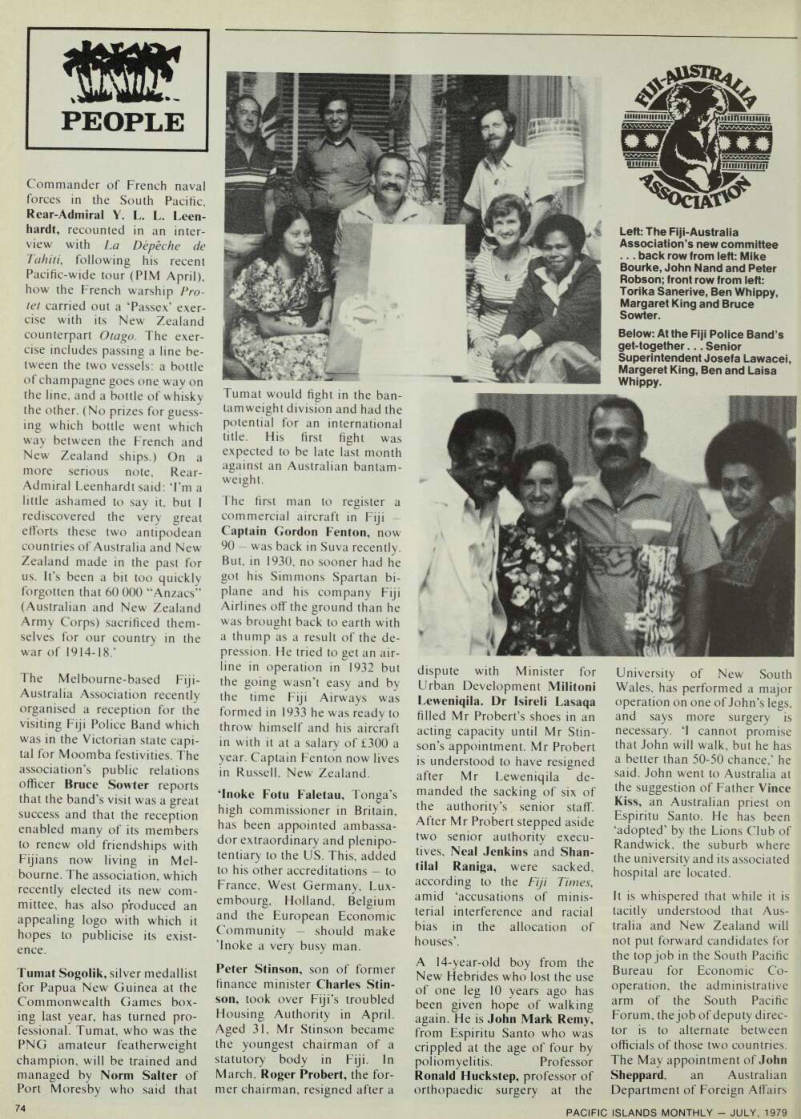
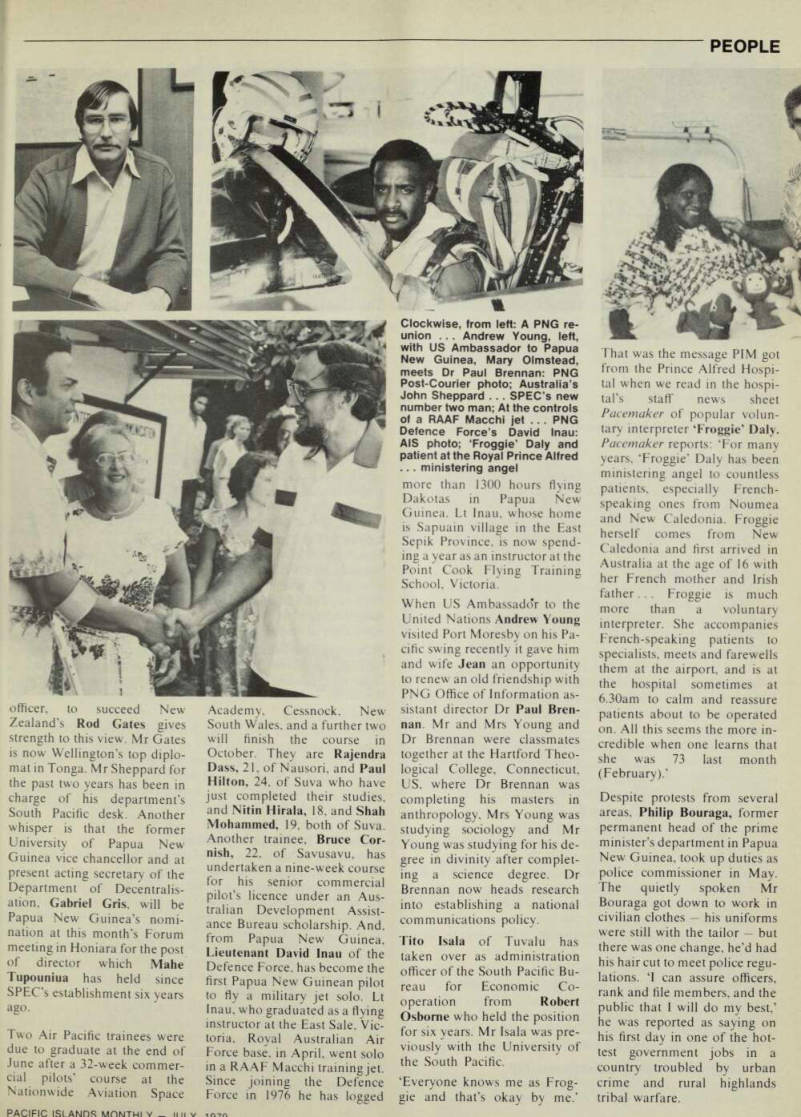
Commander of French naval forces in the South Pacific, Rear-Admiral Y. L. L. Leen hardt, recounted in an inter view with La Depeche de Tahiti, following his recent Pacific-wide tour (PIM April), how the French warship Pro tet carried out a ‘Passex’ exer cise with its New Zealand counterpart Otago. The exer cise includes passing a line be tween the two vessels: a bottle of champagne goes one way on the line, and a bottle of whisky the other. (No prizes for guess ing which bottle went which way between the French and New Zealand ships.) On a more serious note, Rear- Admiral Leenhardt said; ‘l'm a little ashamed to say it, but I rediscovered the very great efforts these two antipodean countries of Australia and New Zealand made in the past for us. It’s been a bit too quickly forgotten that 60 000 “Anzacs” (Australian and New Zealand
Army Corps) sacrificed them
selves for our country in the war of 1914-18.’
The Melbourne-based Fiji- Australia Association recently organised a reception for the visiting Fiji Police Band which was in the Victorian state capi tal for Moomba festivities. The association’s public relations officer Bruce Sowter reports that the band’s visit was a great success and that the reception enabled many of its members to renew old friendships with Fijians now living in Mel bourne. The association, which recently elected its new com mittee, has also produced an appealing logo with which it hopes to publicise its exist ence.
Tumat Sogolik, silver medallist for Papua New Guinea at the Commonwealth Games box ing last year, has turned pro fessional. Tumat, who was the PNG amateur featherweight champion, will be trained and managed by Norm Salter of Port Moresby who said that
Tumat would fight in the ban tamweight division and had the potential for an international title. His first fight was expected to be late last month against an Australian bantam
weight.
The first man to register a commercial aircraft in Fiji - Captain Gordon Fenton, now 90 was back in Suva recently.
But. in 1930, no sooner had he got his Simmons Spartan bi plane and his company Fiji Airlines off the ground than he was brought back to earth with a thump as a result of the de pression. He tried to get an air line in operation in 1932 but the going wasn’t easy and by the time Fiji Airways was formed in 1933 he was ready to throw himself and his aircraft in with it at a salary of £3OO a year. Captain Fenton now lives in Russell. New Zealand. ‘lnoke Fotu Faletau, Tonga’s high commissioner in Britain, has been appointed ambassa
dor extraordinary and plenipo
tentiary to the US. This, added to his other accreditations to France, West Germany, Lux
embourg, Holland, Belgium
and the European Economic Community should make ’lnoke a very busy man.
Peter Stinson, son of former finance minister Charles Stin son, took over Fiji’s troubled
Housing Authority in April.
Aged 31, Mr Stinson became the youngest chairman of a statutory body in Fiji. In March, Roger Probert, the for mer chairman, resigned after a
dispute with Minister for Urban Development Militoni Leweniqila. Dr Isireli Lasaqa filled Mr Probert’s shoes in an acting capacity until Mr Stin son’s appointment. Mr Probert is understood to have resigned after Mr Leweniqila de manded the sacking of six of the authority’s senior staff.
After Mr Probert stepped aside two senior authority execu tives, Neal Jenkins and Shan tilal Raniga, were sacked, according to the Fiji Times, amid ‘accusations of minis terial interference and racial bias in the allocation of houses’.
A 14-year-old boy from the New Hebrides who lost the use of one leg 10 years ago has
been given hope of walking
again. He is John Mark Remy, from Espiritu Santo who was crippled at the age of four by
poliomyelitis. Professor
Ronald Huckstep, professor of orthopaedic surgery at the
University of New South Wales, has performed a major operation on one of John’s legs, and says more surgery is necessary. ‘I cannot promise that John will walk, but he has a better than 50-50 chance,’ he said. John went to Australia at the suggestion of Father Vince Kiss, an Australian priest on Espiritu Santo. He has been ‘adopted’ by the Lions Club of Randwick, the suburb where the university and its associated hospital are located.
It is whispered that while it is tacitly understood that Aus tralia and New Zealand will not put forward candidates for the top job in the South Pacific Bureau for Economic Co operation, the administrative arm of the South Pacific Forum, the job of deputy direc tor is to alternate between officials of those two countries.
The May appointment of John Sheppard, an Australian Department of Foreign Affairs
Left: The Fiji-Australia Association’s new committee ... back row from left: Mike Bourke, John Nand and Peter Robson; front row from left: Torika Sanerive, Ben Whippy, Margaret King and Bruce Sowter.
Below: At the Fiji Police Band’s get-together...Senior Superintendent Josefa Lawacei, Margeret King, Ben and Laisa Whippy.
officer, to succeed New Zealand’s Rod Gates gives strength to this view. Mr Gates is now Wellington’s top diplo mat in Tonga. Mr Sheppard for the past two years has been in
charge of his department’s
South Pacific desk. Another whisper is that the former
University of Papua New
Guinea vice chancellor and at present acting secretary of the Department of Decentralis ation, Gabriel Gris, will be Papua New Guinea’s nomi nation at this month’s Forum meeting in Honiara for the post of director which Mahe Tupouniua has held since SPEC’s establishment six years ago.
Two Air Pacific trainees were due to graduate at the end of June after a 32-week commer cial pilots’ course at the Nationwide Aviation Space
Academy, Cessnock, New South Wales, and a further two will finish the course in October. They are Rajendra Dass, 21, of Nausori, and Paul Hilton, 24. of Suva who have just completed their studies, and Nitin Hirala, 18. and Shah Mohammed, 19. both of Suva.
Another trainee, Bruce Cor nish, 22, of Savusavu, has undertaken a nine-week course for his senior commercial pilot’s licence under an Aus tralian Development Assist ance Bureau scholarship. And, from Papua New Guinea, Lieutenant David Inau of the Defence Force, has become the first Papua New Guinean pilot to fly a military jet solo. Lt Inau, who graduated as a flying instructor at the East Sale. Vic toria. Royal Australian Air Force base, in April, went solo in a RAAF Macchi training jet.
Since joining the Defence Force in 1976 he has logged
more than 1300 hours flying Dakotas in Papua New Guinea. Lt Inau, whose home is Sapuain village in the East Sepik Province, is now spend ing a year as an instructor at the
Point Cook Flying Training
School, Victoria.
When US Ambassador to the United Nations Andrew Young visited Port Moresby on his Pa cific swing recently it gave him and wife Jean an opportunity to renew an old friendship with PNG Office of Information as sistant director Dr Paul Bren nan. Mr and Mrs Young and Dr Brennan were classmates together at the Hartford Theo
logical College, Connecticut,
US, where Dr Brennan was completing his masters in
anthropology, Mrs Young was
studying sociology and Mr
Young was studying for his de gree in divinity after complet ing a science degree. Dr Brennan now heads research into establishing a national
communications policy.
Tito Isala of Tuvalu has taken over as administration officer of the South Pacific Bu reau for Economic Co operation from Robert Osborne who held the position for six years. Mr Isala was pre viously with the University of the South Pacific. ‘Everyone knows me as Frog
gie and that’s okay by me.’
That was the message PIM got from the Prince Alfred Hospi tal when we read in the hospi tal’s staff news sheet Pacemaker of popular volun tary interpreter ‘Froggie’ Daly.
Pacemaker reports: ‘For many years, ‘Froggie’ Daly has been
ministering angel to countless
patients, especially French speaking ones from Noumea and New Caledonia. Froggie herself comes from New Caledonia and first arrived in Australia at the age of 16 with her French mother and Irish
father. . . Froggie is much
more than a voluntary interpreter. She accompanies French-speaking patients to specialists, meets and farewells them at the airport, and is at the hospital sometimes at 6.30 am to calm and reassure patients about to be operated on. All this seems the more in credible when one learns that she was 73 last month
(February).’
Despite protests from several areas, Philip Bouraga, former permanent head of the prime
minister’s department in Papua
New Guinea, took up duties as police commissioner in May.
The quietly spoken Mr
Bouraga got down to work in civilian clothes his uniforms were still with the tailor but there was one change, he’d had his hair cut to meet police regu lations. i can assure officers, rank and file members, and the public that I will do my best,’ he was reported as saying on his first day in one of the hot test government jobs in a country troubled by urban crime and rural highlands tribal warfare.
Clockwise, from left: A PNG re union ... Andrew Young, left, with US Ambassador to Papua New Guinea, Mary Olmstead, meets Dr Paul Brennan: PNG Post-Courier photo; Australia’s John Sheppard ... SPEC’s new number two man; At the controls of a RAAF Macchi jet ... PNG Defence Force’s David Inau: AIS photo; ‘Froggie’ Daly and patient at the Royal Prince Alfred
... ministering angel
Advertisements & other items, p. 75 (1 item)
People
PACIFIC ISLANDS MDNITHI V n n v 1070
Islands
From the
Press
PNG Post-Courier It’s comforting to know that we live in a country where violent crime is practically unknown. That is, of course, unknown to the police so they say but not the chap next door.
Fiji Times, Suva A prisoner told Suva Court yesterday he escaped from the Naboro Prison Minimum Security Prison . .. after he ‘wandered to eat bananas’.
Hailans Nius, PNG The Western Highlands Interim Premier Mr Nambuga Mara warned members of the Mt Hagen Local Government Council not to come to meetings drunk.
Savali, Western Samoa Hearty congratulations to the Post Office for producing a local aerogramme. Now they might like to put some gum on the tabs so that people can stick them closed without having to buy additional glue or tape. And another problem; how many years back was the town clock blue? These days it’s a fairly uniform white.
Cook Islands News “Expatriate”, the current ‘in-jargon’ used to describe the non-Maori is, I suppose, preferable to the ‘Poms’, ‘Pakkies’, ‘Wogs’, ‘Wops’ and ‘Honkies’ used elsewhere to describe residents with an alternative skin-colour.
PNG Post-Courier When two of the nation’s leaders, the Commanderof the PNG Defence, Brigadier-General Ted Diro, and the former Police Commissioner Mr Pious Kerepia, say that there is a general lack of discipline in society today, we should all sit up and take notice.
Tohi Tala Niue A Household Survey (Mini Census 1979) carried out earlier this month confirmed the island “lowest ever level” recorded in any census on Niue from a report issued by the Census Office this week. The total population of 3578 is not healthy.
The Samoa Times, Western Samoa The recent outbreaks of violence involving young people is no laughing matter. Assault with intent to rob is on the rise whether we like it or not as witness the recent wave of assaults against innocent people. It appears that the assaults are mostly restricted to the urban area of Apia and occurs in isolated streets late at night. It further appears that these assaults are pre-planned by hooligans who do not care whether they cause irreparable injury or not, not to mention the psychological harm they do to victims.
Lae Nius, PNG People in the Tigili area in the Baiyer River area of the Western Highlands are saying that a python (snake) wants to marry a young woman from that area . . . Village elders and her husband are planning to kill a pig and conduct a ‘pretend’ marriage. They say the woman will be the snake’s wife when she dies but during her life on earth she will be the wife of her present husband.
The Coconut Telegraph, Savusavu, Fiji
Once again a national disaster has highlighted the need for some very urgent priorities in Fiji. We need a permanent National
Disaster Fund, financed by every man, woman and child. An insignificant tax of only 50 cents per person per year would bring in at least $3OO 000 annually. Properly administered by a board of competent people, representing all divisions, and regardless of political affiliations, a sound National Disaster Fund would go a long way towards meeting our needs in times of emergency.
PNG Post-Courier The idea that the National Tourism Plan is really the National Tourism Plan is gaining force. The Minister’s office appears to be laboring under the impression that the 10-volumes of detailed plan don’t exist. Which is surprising considering the Minister wrote a full page foreword to the summary of the plan. Even allowing for the ability of politicians to say a lot about nothing, it is nothing short of miraculous that a 47-page document can summarise a plan that isn’t there. More tomorrow.
The Observer, Western Samoa It is interesting to see that in the middle of the heightening political unrest in the New Hebrides, a Pacific country dying to come out from under the stern colonial rule of France, France having arrogantly tightened all the knots is proposing sending an “aid mission’’ to Western Samoa ... It should be made quite clear in the discussions that the proposed aid mission be called off. The French Ambassador must be politely informed; “Non Merci Monsieur Gueery.”
New Nation, PNG Donovanosis is a venereal disease which causes ulcers to appear on the outside of the sexual organs. They will not heal by themselves, and pencillin will not cure them. It is found more commonly in men and women, and it is believed that poor hygiene is often the cause of the spread of the disease.
Letter to Fiji Times Last Friday, May 5, around about midday, I was passing through the outskirts of Nausori Town when I came across a most odd situation. Parked outside the Visama Feed Mills was a Police Highway Parol car in its bright colours ... This patrol car seemed to be loading a bag of chicken feed. I wonder why the Police need a bag of chicken food?
Advert in The Reporter, PNG Lost: Appetite for avocados due to excess consumption thereof.
Tree still producing abundantly, but most fruits going rotten.
Amateurs welcome to help themselves.
Tohi Tala Niue Niue Island United Enterprises, Niue’s only service station stopped retailing petrol this week in protest against the Niue Government’s inconsequent maintenance of Shell’s petrol bowser down Tagavaka. Niue Manager, Mr Brian Nichols said . . . making a profit had been losing battle. Through level tests carried out last year, it had been noticed that the station had been losing a pint to every gallon.
Letter to The Norfolk Islander As a regular visitor to this island I deplore the lack of courage shown in the weather “forecasts’’ emanating from the local meteorological station ... I do not need to be told that yesterday we had 4'/2-hours of sunshine and that the maximum temperature was 22°C. Nor do I need to be told that the temperature at the moment is 20°C and light showers are expected this morning.
What I would like to be told is should I plan to go fishing on Thursday and am I likely to get soaked to the skin on the golf course on Sunday? Come on boys give it a go!
Letter to Lae Nius, PNG My concern is that a few years ago, from 1972 to 1976, the city of Lae was very clean and tidy. I have seen that during the period of 3 years 1977 to 1979 the whole town area is full of rubbish.
I say that the city council is not doing its job. If you want to keep our city clean you can learn from Goroka town council or Port Moresby City Council. You are just getting the government money without doing the work.
Long Ago When
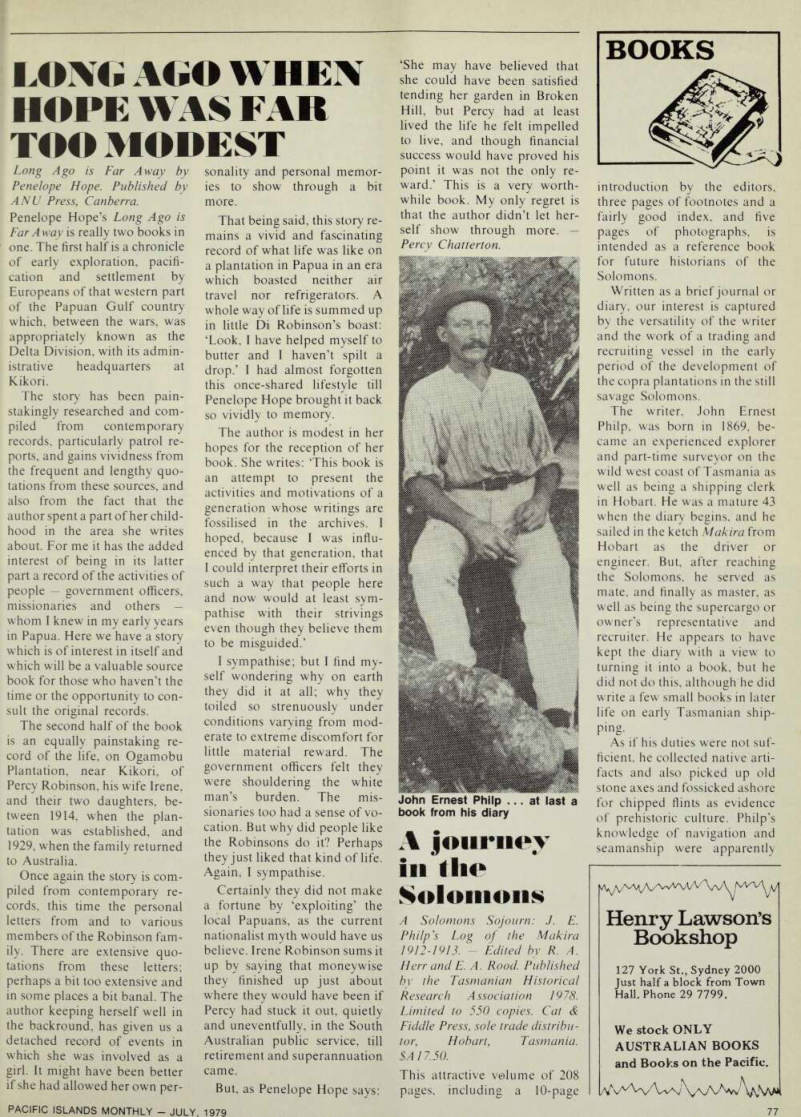

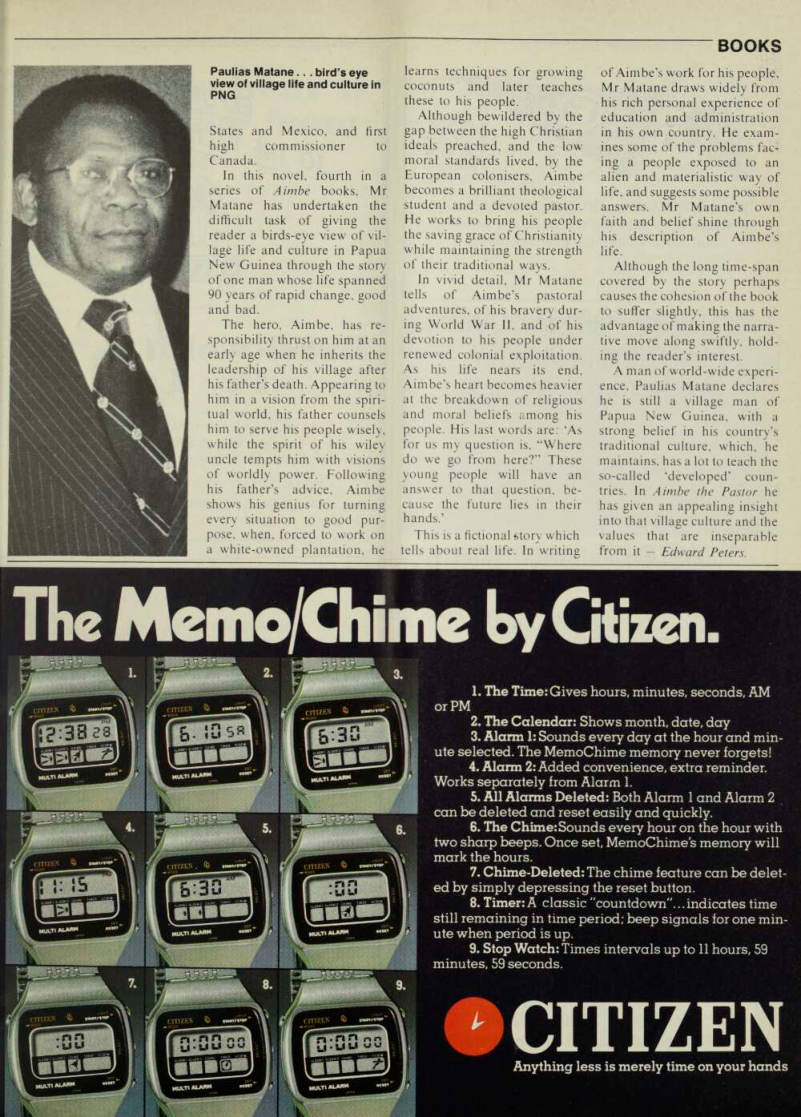
Books
Hope Was Far
Too Modest
Long Ago is Far A way by Penelope Hope. Published by ANU Press, Canberra.
Penelope Hope’s Long Ago is Far A way is really two books in one. The first half is a chronicle
of early exploration, pacifi
cation and settlement by Europeans of that western part of the Papuan Gulf country which, between the wars, was appropriately known as the Delta Division, with its admin istrative headquarters at Kikori.
The story has been pain stakingly researched and com piled from contemporary
records, particularly patrol re
ports, and gains vividness from the frequent and lengthy quo tations from these sources, and also from the fact that the author spent a part of her child hood in the area she writes about. For me it has the added interest of being in its latter part a record of the activities of people government officers, missionaries and others whom I knew in my early years in Papua. Here we have a story which is of interest in itself and which will be a valuable source book for those who haven’t the time or the opportunity to con sult the original records.
The second half of the book is an equally painstaking re cord of the life, on Ogamobu Plantation, near Kikori, of Percy Robinson, his wife Irene, and their two daughters, be tween 1914, when the plan tation was established, and 1929, when the family returned to Australia.
Once again the story is com piled from contemporary re cords, this time the personal letters from and to various members of the Robinson fam ily. There are extensive quo tations from these letters; perhaps a bit too extensive and in some places a bit banal. The author keeping herself well in the backround, has given us a detached record of events in which she was involved as a girl. It might have been better if she had allowed her own per
sonality and personal memor ies to show through a bit more.
That being said, this story re mains a vivid and fascinating record of what life was like on a plantation in Papua in an era which boasted neither air travel nor refrigerators. A whole way of life is summed up in little Di Robinson’s boast: ‘Look, I have helped myself to butter and I haven’t spilt a drop.’ I had almost forgotten this once-shared lifestyle till
Penelope Hope brought it back
so vividly to memory.
The author is modest in her hopes for the reception of her book. She writes: ‘This book is an attempt to present the activities and motivations of a
generation whose writings are
fossilised in the archives. I hoped, because I was influ enced by that generation, that I could interpret their efforts in such a way that people here and now would at least sym pathise with their strivings even though they believe them to be misguided.’
I sympathise; but I find my self wondering why on earth they did it at all; why they toiled so strenuously under conditions varying from mod erate to extreme discomfort for little material reward. The government officers felt they were shouldering the white man’s burden. The mis sionaries too had a sense of vo cation. But why did people like the Robinsons do it? Perhaps they just liked that kind of life.
Again, I sympathise.
Certainly they did not make a fortune by ‘exploiting’ the local Papuans, as the current nationalist myth would have us believe. Irene Robinson sums it up by saying that moneywise they finished up just about where they would have been if Percy had stuck it out, quietly and uneventfully, in the South Australian public service, till retirement and superannuation came.
But, as Penelope Hope says:
‘She may have believed that she could have been satisfied tending her garden in Broken Hill, but Percy had at least lived the life he felt impelled to live, and though financial success would have proved his point it was not the only re ward.’ This is a very worth while book. My only regret is that the author didn’t let her self show through more. - Percy Chatterton.
A Journey
in flie
Solomons
A Solomons Sojourn: J. E.
Philp's Log of the Makira 1912-1913. - Edited by R. A.
Herr and E. A. Rood. Published by the Tasmanian Historical Research Association 1978.
Limited to 550 copies. Cat & Fiddle Press, sole trade distribu tor, Hobart, Tasmania. $A 17.50.
This attractive volume of 208
pages, including a 10-page
introduction by the editors, three pages of footnotes and a fairly good index, and five pages of photographs, is intended as a reference book for future historians of the Solomons.
Written as a brief journal or diary, our interest is captured by the versatility of the writer and the work of a trading and recruiting vessel in the early period of the development of the copra plantations in the still savage Solomons.
The writer, John Ernest Philp, was born in 1869, be
came an experienced explorer
and part-time surveyor on the wild west coast of Tasmania as well as being a shipping clerk in Hobart. He was a mature 43 when the diary begins, and he sailed in the ketch Makira from Hobart as the driver or
engineer. But, after reaching
the Solomons, he served as mate, and finally as master, as well as being the supercargo or owner’s representative and recruiter. He appears to have kept the diary with a view to turning it into a book, but he did not do this, although he did write a few small books in later life on early Tasmanian ship
ping.
As if his duties were not suf ficient, he collected native arti facts and also picked up old stone axes and fossicked ashore for chipped flints as evidence
of prehistoric culture. Philp’s
knowledge of navigation and
seamanship were apparently
John Ernest Philp ... at last a book from his diary
sufficient to save the ship from mishaps in the badly charted waters of the islands, and he appears to have got along well with the native crew-members and recruits, as well as the chiefs and native traders.
The purpose of the ketch was to engage in both trading and
recruiting, and carrying cargo
for the owner. F. B. Kirby, who was establishing a plantation at Boroni on San Cristobal or Makira island. The book con tains very clear little charts of the islands of the southern Solomons where the ketch made all its voyages, with the names of the anchorages or ‘passages’ visited. Native traders were agents for the owner, and the produce col lected in return for trade goods included copra in half shells, ivory nuts, trochus and green snail shell, and a little coconut oil. which was the early pro duct before the universal use of copra.
The recruits were signed on for the Kirby plantation or for
working the ketch, generally
for one year at a wage of six
pounds, which remained the standard figure for many years.
The recruiting system was of course well known to the natives, many of whom had worked in Queensland or in Fiji, but both these trades had ceased by 1910, and only local work was available.
The log gives names of traders, planters and recruiters, government officials, mis sionaries and natives, some of whom were important then or since. Names of the schooners and other vessels which worked in the group are given, though no overall picture is painted of the lines of sea-communi cation.
The Burns, Philp steamer Mindini is often mentioned as it was the main connection with Australian ports. Some of the more famous characters men tioned are C. M. Woodford, the first resident commissioner: Harold Markham of the Lily, famous as ‘Marko’, who died about 1950; C. E. Fox of the Melanesian Mission, who died recently in New Zealand, aged 99; Captain Hamilton of the
Manila (was this ‘Squeaker’
Hamilton of Manning Strait?); Charlie Cooper, a trader (one of the ex-German family of
Kuper?); Captain Svensen of
the Mission schooner Se/wyn, and Cliff of Bugota (one of the Clift brothers of Aruligo plan tation?).
One of the photographs shows a memo from the inspec tor of labour, signed W. R. Bell, who was presumably the man who was killed on Malaita as district officer in 1927.
Philp mentions the use of a small cannon to notify the natives of a recruiter’s arrival at a ‘passage’. This was generally fired on the vessel’s arrival at dusk, so that recruiting could start next morning. The pre vious practice had been to fire sticks of dynamite, but the im portation and use of this ex
plosive had been prohibited
after many accidents through careless use.
One rare visit by the Makira was to Gower Island, better known now as Ndai, which had been resettled after the pre vious inhabitants had died out.
It is a tiny island, and Philp de scribes the large lagoon full of crocodiles and the absence of
dogs, pigs and fowls. Perhaps
due to the crocodiles? The log is often rather boring but there are little items of interest of many kinds for future his
torians.
Brett Hilder.
.\«VV It’s
Aimho -
pastor
Aimbe the Pastor, a novel by Paulias Matane. Published by Exposition Press, Hicksville,
Ny, Us. Pp. 328. $Us 12.50.
Papua New Guinea’s ambassa dor to the United Nations, Paulias Matane, is a man of great energy. His latest book.
Aimbe the Pastor, published in America early in 1979, has been written in the midst of re sponsibilities that would fully occupy most people - as well as representing Papua New Guinea at the United Nations, Mr Matane is his country’s first ambassador to the United
States and Mexico, and first high commissioner to Canada.
In this novel, fourth in a series of Aimbe books, Mr Matane has undertaken the difficult task of giving the reader a birds-eye view of vil lage life and culture in Papua New Guinea through the story of one man whose life spanned
90 years of rapid change, good
and bad.
The hero, Aimbe, has re sponsibility thrust on him at an early age when he inherits the leadership of his village after his father’s death. Appearing to him in a vision from the spiri tual world, his father counsels him to serve his people wisely, while the spirit of his wiley uncle tempts him with visions
of worldly power. Following
his father’s advice, Aimbe shows his genius for turning every situation to good pur pose, when, forced to work on a white-owned plantation, he
learns techniques for growing
coconuts and later teaches these to his people.
Although bewildered by the gap between the high Christian ideals preached, and the low moral standards lived, by the European colonisers, Aimbe becomes a brilliant theological student and a devoted pastor.
He works to bring his people the saving grace of Christianity
while maintaining the strength
of their traditional ways.
In vivid detail, Mr Matane tells of Aimbe’s pastoral adventures, of his bravery dur ing World War 11, and of his devotion to his people under renewed colonial exploitation.
As his life nears its end, Aimbe’s heart becomes heavier at the breakdown of religious and moral beliefs among his people. His last words are: ‘As for us my question is, “Where do we go from here?” These young people will have an answer to that question, be cause the future lies in their hands.’
This is a fictional story which tells about real life. In writing
of Aimbe’s work for his people, Mr Matane draws widely from his rich personal experience of education and administration in his own country. He exam ines some of the problems ing a people exposed to an alien and materialistic way of life, and suggests some possible answers. Mr Matane’s own faith and belief shine through his description of Aimbe’s life.
Although the long time-span
covered by the story perhaps causes the cohesion of the book to suffer slightly, this has the advantage of making the narra tive move along swiftly, hold ing the reader’s interest.
A man of world-wide experi ence, Paulias Matane declares he is still a village man of Papua New Guinea, with a strong belief in his country’s traditional culture, which, he maintains, has a lot to teach the so-called ‘developed’ coun tries. In Aimhe the Pastor he
has given an appealing insight
into that village culture and the values that are inseparable from it Edward Peters.
Paulias Matane ... bird’s eye view of village life and culture in
Png
Advertisements & other items, pp. 77-80 (3 items)
Henry Lawson’s
Bookshop
127 York St,, Sydney 2000 Just half a block from Town Hall. Phone 29 7799.
We stock ONLY
AUSTRALIAN BOOKS
and Books on the Pacific.
The Supreme Status Watch!
ftwrr/* 70 *
CITIZt
ft=*'
MULTI
mm
The onlyTimcpicce of its kind
in the world.
No other timepiece comes close! Because here is a completely-new kind of time system. Incredibly complex.
Yet marvelously simple to own and use.
Only the Citizen heritage of superb craftsmanship could achieve this multi-feature instrument. It can outperform every other watch in the world.
To own it is to know instant response.. .and supreme versatility.
Here is the Status Watch supreme.. .as unique as the exciting life style it was bom to serve.
MEMO/CHIME Model #4O-1030-50
When you forget... Citizen remembers
Alarm 1 Alarm 2 Chime Timer Stop Watch 13351 WB\
The Memo/Chime by Citizen.
mmvm -w -AV huctiala"* multi al*"" s
mmm
MULTI
MUtTt AJLAAI*
MULTI ALAAM
■a
MULTI
MULTI
MULTI
1. The Time: Gives hours, minutes, seconds, AM or PM 2. The Calendar: Shows month, date, day 3. Alarm 1: Sounds every day at the hour and minute selected. The Memo Chime memory never forgets! 4. Alarm 2: Added convenience, extra reminder.
Works separately from Alarm 1. 5. All Alarms Deleted: Both Alarm 1 and Alarm 2 can be deleted and reset easily and quickly. 6. The Chime: Sounds every hour on the hour with two sharp beeps. Once set. Memo Chime's memory will mark the hours. 7. Chime-Deleted: The chime feature can be deleted by simply depressing the reset button. 8. Timer: A classic "countdown"... indicates time still remaining in time period; beep signals for one minute when period is up. 9. Stop Watch: Times intervals up to 11 hours, 59 minutes, 59 seconds.
•CITIZEN
Anything less is merely time on your hands
W/y
THE WATER WHEEL GROUP OF COMPANIES
Winners of Australia’s Top Export Award and Flour Millers for over 100 years, ' V
OFFER THE PACIFIC ISLANDS
THE TOPS IN QUALITY
PRODUCTS & SERVICE
☆ BEST AUSTRALIAN WHEATEN
FLOUR
(Roller, Wholemeal, High Protein, Cake, etc.)
☆ COMPLETE RANGE OF FROZEN
AND GENERAL FOOD ITEMS
STOCK & POULTRY FEEDS
(Pellets or Mash form)
☆ YELLOW SPLIT PEAS & WHOLE
PEAS
(Machined-Dressed) Areas Serviceable are: Papua New Guinea, Fiji, Tonga, Western Samoa, American Samoa, New Hebrides, New Caledonia and Micronesia.
All Enquiries Welcome To:
WATER WHEEL EXPORTS
Pty. Ltd.
493 Bourke Street, Melbourne, 3000, Australia Cables: Watermill-Melbourne.
Telex: AA 32165 Telephone: 602 1433
gXpO{l§!s
FACIfIS
THE
TO A
Qaivi«y
Breekwoldt & Co
P ij Ltd
Suite 1909, 19th Floor, King George Tower,
Corner King & George Streets, Sydney.
G.P.O. Box 5027, Sydney 2001.
CABLES: 'BREWO' SYDNEY. TELEX: AA22890.
TELEPHONES: 233 2366, 232 2315, 233 1462.
PACIFIC ISLAND OFFICES
BRECKWOLDT & CO (PNG) PTY. LTD.
PO BOX 1549, BOROKO, PORT MORESBY.
PO BOX 222, RABAUL
PO BOX 72, KIETA
PO BOX 178, WEWAK
PO BOX 185, MADANG
PO BOX 237, MT. HAGEN
PO BOX 1188. LAE
BRECKWOLDT & CO.. PO BOX 47, APIA BRECKWOLDT & CO. (SI) LTD. PO BOX 140, HONIARA
BRECKWOLDT SARL BP 2369, NOUMEA
OFFICES IN:
HAMBURG
LONDON
MILAN
& WEST AFRICA
ALSO AT:
SINGAPORE
KUALA LUMPUR
BANGKOK
& HONG KONG
ENQUIRIES
FROM OVERSEAS MANUFACTURERS INVITED.
Books
Books
poetic voice from
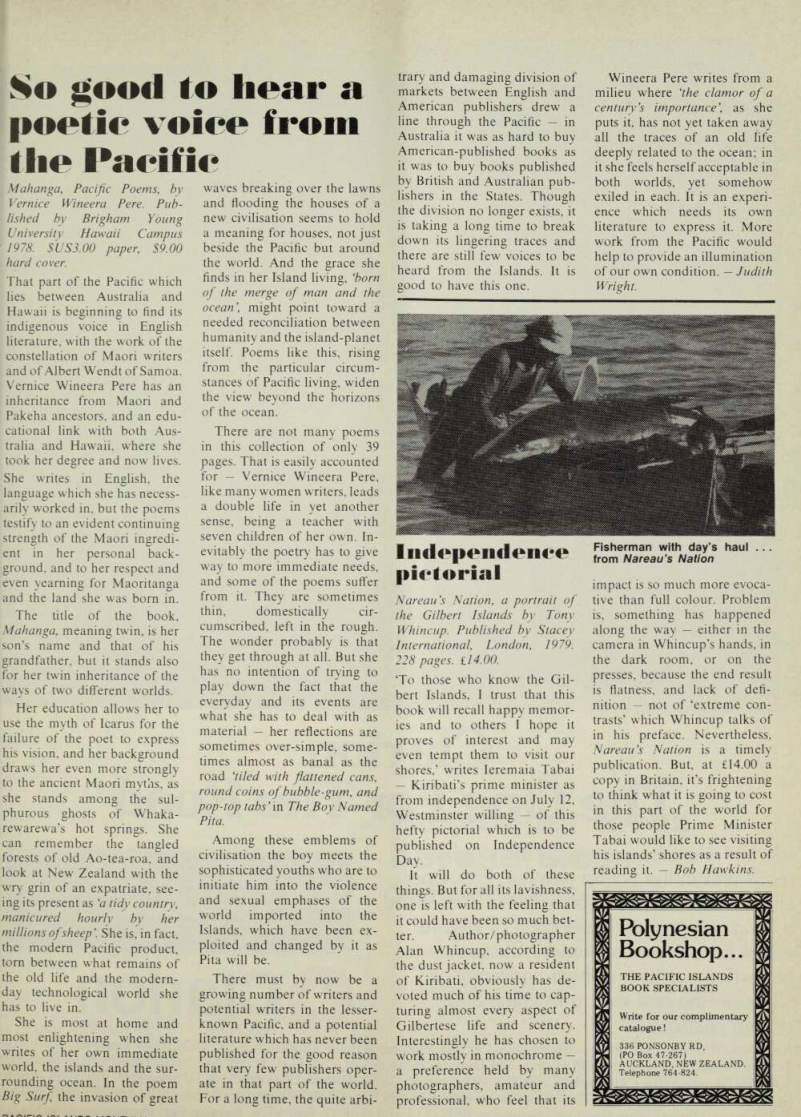
So good to hear a poetic voice from the Pacific
Mahanga, Pacific Poems, by
Vernice Wineera Pere. Pub
lished by Brigham Young
University Hawaii Campus
1978. SUSS.OO paper, $9.00 hard cover.
That part of the Pacific which lies between Australia and Hawaii is beginning to find its
indigenous voice in English
literature, with the work of the constellation of Maori writers and of Albert Wendt of Samoa.
Vernice Wineera Pere has an inheritance from Maori and Pakeha ancestors, and an edu cational link with both Aus tralia and Hawaii, where she took her degree and now lives.
She writes in English, the language which she has necess arily worked in, but the poems testify to an evident continuing strength of the Maori ingredi ent in her personal back ground, and to her respect and
even yearning for Maoritanga
and the land she was born in.
The title of the book, Mahanga, meaning twin, is her son’s name and that of his grandfather, but it stands also for her twin inheritance of the ways of two different worlds.
Her education allows her to use the myth of Icarus for the failure of the poet to express his vision, and her background draws her even more strongly to the ancient Maori myths, as she stands among the sul
phurous ghosts of Whaka
rewarewa’s hot springs. She can remember the tangled forests of old Ao-tea-roa, and look at New Zealand with the wry grin of an expatriate, see ing its present as ‘a tidy country,
manicured hourly by her
millions of sheep’. She is, in fact, the modern Pacific product, torn between what remains of the old life and the modern
day technological world she
has to live in.
She is most at home and most enlightening when she writes of her own immediate world, the islands and the sur rounding ocean. In the poem Big Surf the invasion of great
waves breaking over the lawns and flooding the houses of a new civilisation seems to hold a meaning for houses, not just beside the Pacific but around the world. And the grace she finds in her Island living, ‘born of the merge of man and the ocean\ might point toward a needed reconciliation between
humanity and the island-planet
itself. Poems like this, rising from the particular circum stances of Pacific living, widen the view beyond the horizons of the ocean.
There are not many poems in this collection of only 39 pages. That is easily accounted for Vernice Wineera Pere, like many women writers, leads a double life in yet another sense, being a teacher with seven children of her own. In evitably the poetry has to give way to more immediate needs, and some of the poems suffer from it. They are sometimes thin, domestically cir cumscribed, left in the rough.
The wonder probably is that they get through at all. But she has no intention of trying to play down the fact that the everyday and its events are what she has to deal with as material her reflections are sometimes over-simple, some times almost as banal as the road ‘tiled with flattened cans, round coins of bubble-gum, and pop-top tabs’ in The Boy Named Pita.
Among these emblems of civilisation the boy meets the sophisticated youths who are to initiate him into the violence and sexual emphases of the world imported into the Islands, which have been ex
ploited and changed by it as
Pita will be.
There must by now be a growing number of writers and potential writers in the lesser known Pacific, and a potential literature which has never been published for the good reason that very few publishers oper ate in that part of the world.
For a long time, the quite arbi
trary and damaging division of markets between English and American publishers drew a line through the Pacific in Australia it was as hard to buy American-published books as it was to buy books published by British and Australian pub lishers in the States. Though the division no longer exists, it is taking a long time to break down its lingering traces and there are still few voices to be heard from the Islands. It is good to have this one.
Wineera Pere writes from a milieu where ‘the clamor of a century’s importance’, as she puts it, has not yet taken away all the traces of an old life deeply related to the ocean; in it she feels herself acceptable in both worlds, yet somehow exiled in each. It is an experi ence which needs its own literature to express it. More work from the Pacific would help to provide an illumination of our own condition. Judith
Wright.
Inodependence
pictorial
Nareau’s Nation, a portrait of the Gilbert Islands by Tony
Whincup. Published by Stacey
International, London, 1979. 228 pages. £ 14.00. ‘To those who know the Gil bert Islands, I trust that this book will recall happy memor ies and to others I hope it proves of interest and may even tempt them to visit our shores,’ writes leremaia Tabai Kiribati’s prime minister as from independence on July 12, Westminster willing of this hefty pictorial which is to be
published on Independence
Day.
It will do both of these things. But for all its lavishness, one is left with the feeling that it could have been so much bet
ter. Author/photographer
Alan Whincup, according to
the dust Jacket, now a resident of Kiribati, obviously has de voted much of his time to cap turing almost every aspect of Gilbertese life and scenery.
Interestingly he has chosen to work mostly in monochrome a preference held by many photographers, amateur and professional, who feel that its
impact is so much more evoca tive than full colour. Problem
is, something has happened
along the way either in the camera in Whincup’s hands, in the dark room, or on the presses, because the end result is flatness, and lack of defi nition not of ‘extreme con trasts’ which Whincup talks of in his preface. Nevertheless, Nareau’s Nation is a timely publication. But, at £14.00 a copy in Britain, it’s frightening to think what it is going to cost in this part of the world for those people Prime Minister Tabai would like to see visiting his islands’ shores as a result of
reading it.
Bob Hawkins.
Fisherman with day’s haul ... from Nareau’s Nation
Advertisements & other items, pp. 81-82 (1 item)
Bookshop..
Polynesian
THE PACIFIC ISLANDS
BOOK SPECIALISTS
Write for our complimentary catalogue!
336 PONSONBY RD,
(PO Box 47-267)
AUCKLAND, NEW ZEALAND.
Telephone 764-824.
■ ■■ mm I ■ wsmm Wm : ‘ ' m ’.., ,V ■?.■■. * > -<?y« wmmm
Clarion
The One For The Road
PE-758
Clarion reliability, proven on the toughest
roads and in the hottest weather. Easy-operation design, for your convenience and added driving safely. A wide selection of easy-to-
install car stereos, backed by Clarion’s
renowned quality and high performance.
Clarion—the best way to listening and
driving pleasure.
Australia: Amalgamated Wireless (Australasia) Ltd. 554 Parramatta Road, Ashfield N.S.W., 2131/New Zealand: AWA New Zealand Limited P.O. Box 50-248 Porirua/Fiji Islands: Brijlal & Co., Ltd. G.P.O. Box 362 Suva/Tahiti: HI-FI Shangrila B.P. 200 Papeete/New Caledonia: Caldis B.P. Ml Noumea Cedex/ Guam: Guam Radio &TV Shop P.O. Box 1939 Agana, Guam 96910/New Hebrides: The Sound Centre P.O. Box 434 Vila/Cook Islands: South Seas International Ltd. P.O. Box 49 Rarntnnna/Panna Now Oninoa* fP N C l Ptu Ltd P.O. Box 1428. Boroko. Port Moresby.
FM FM AM
0 Clarion Co., Ltd. Tokyo, Japan
for everybody
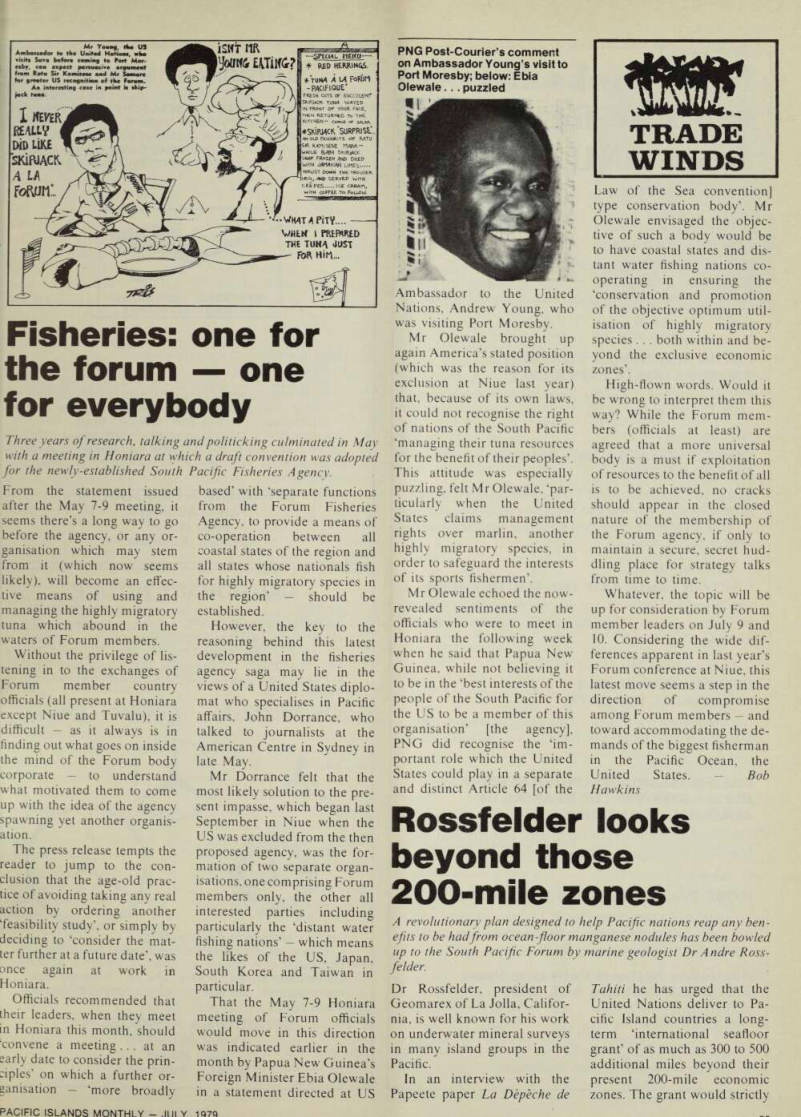
Trade
Winds
Fisheries: one for the forum-one for everybody
Three years of research, talking and politicking culminated in May with a meeting in Honiara at which a draft convention was adopted for the newly-established South Pacific Fisheries Agency.
From the statement issued after the May 7-9 meeting, it seems there’s a long way to go before the agency, or any or ganisation which may stem from it (which now seems likely), will become an effec tive means of using and
managing the highly migratory
tuna which abound in the waters of Forum members.
Without the privilege of lis tening in to the exchanges of Forum member country officials (all present at Honiara except Niue and Tuvalu), it is difficult as it always is in finding out what goes on inside the mind of the Forum body corporate - to understand what motivated them to come up with the idea of the agency
spawning yet another organis
ation.
The press release tempts the reader to jump to the con clusion that the age-old prac
tice of avoiding taking any real
action by ordering another
‘feasibility study’, or simply by
deciding to ‘consider the mat ter further at a future date’, was □nee again at work in Honiara.
Officials recommended that their leaders, when they meet in Honiara this month, should ‘convene a meeting ... at an early date to consider the prin ciples’ on which a further or
ganisation - ‘more broadly
based’ with ‘separate functions from the Forum Fisheries Agency, to provide a means of co-operation between all coastal states of the region and all states whose nationals fish
for highly migratory species in
the region’ should be established.
However, the key to the reasoning behind this latest development in the fisheries agency saga may lie in the views of a United States diplo mat who specialises in Pacific affairs, John Dorrance, who talked to journalists at the American Centre in Sydney in
late May.
Mr Dorrance felt that the most likely solution to the pre sent impasse, which began last September in Niue when the US was excluded from the then proposed agency, was the for mation of two separate organ isations, one comprising Forum members only, the other all
interested parties including
particularly the ‘distant water fishing nations’ which means the likes of the US, Japan, South Korea and Taiwan in
particular.
That the May 7-9 Honiara meeting of Forum officials would move in this direction was indicated earlier in the month by Papua New Guinea’s Foreign Minister Ebia Olewale in a statement directed at US
Ambassador to the United Nations, Andrew Young, who
was visiting Port Moresby.
Mr Olewale brought up again America’s stated position (which was the reason for its exclusion at Niue last year) that, because of its own laws, it could not recognise the right of nations of the South Pacific ‘managing their tuna resources for the benefit of their peoples’.
This attitude was especially puzzling, felt Mr Olewale, ‘par ticularly when the United States claims management rights over marlin, another
highly migratory species, in
order to safeguard the interests of its sports fishermen’.
Mr Olewale echoed the now revealed sentiments of the officials who were to meet in Honiara the following week when he said that Papua New Guinea, while not believing it to be in the ‘best interests of the people of the South Pacific for the US to be a member of this organisation’ [the agency], PNG did recognise the ‘im portant role which the United States could play in a separate and distinct Article 64 [of the
Law of the Sea convention] type conservation body’. Mr Olewale envisaged the objec tive of such a body would be to have coastal states and dis tant water fishing nations co
operating in ensuring the
‘conservation and promotion of the objective optimum util
isation of highly migratory
species . . . both within and be yond the exclusive economic zones’.
High-flown words. Would it be wrong to interpret them this way? While the Forum mem bers (officials at least) are agreed that a more universal body is a must if exploitation of resources to the benefit of all is to be achieved, no cracks should appear in the closed nature of the membership of the Forum agency, if only to maintain a secure, secret hud dling place for strategy talks from time to time.
Whatever, the topic will be up for consideration by Forum member leaders on July 9 and 10. Considering the wide dif ferences apparent in last year’s Forum conference at Niue, this latest move seems a step in the direction of compromise among Forum members and toward accommodating the de mands of the biggest fisherman in the Pacific Ocean, the United States. Bob Hawkins
PNG Post-Courier’s comment on Ambassador Young’s visit to Port Moresby; below: Ebia Olewale ... puzzled
beyond those
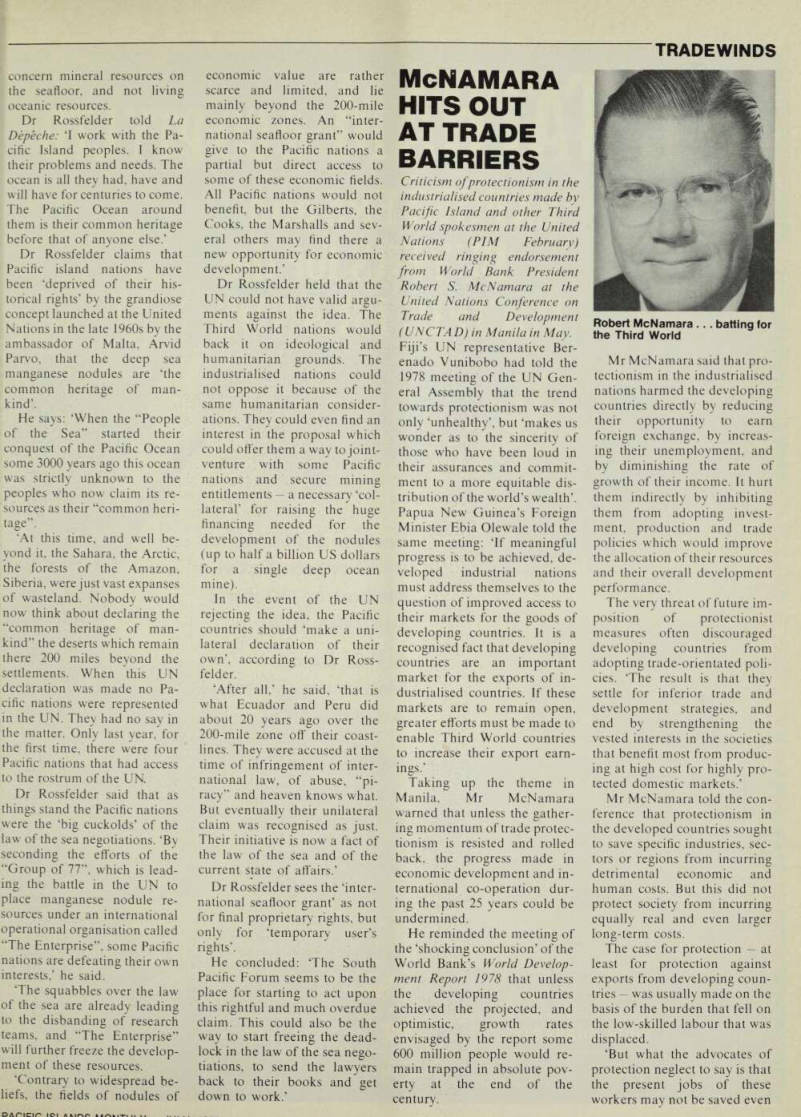
Rossfelder looks beyond those 200-mile zones
A revolutionary plan designed to help Pacific nations reap any ben efits to be hadfrom ocean-floor manganese nodules has been bowled up to the South Pacific Forum by marine geologist Dr Andre Ross felder.
Dr Rossfelder, president of Geomarex of La Jolla, California, is well known for his work on underwater mineral surveys in many island groups in the Pacific.
In an interview with the Papeete paper La Depeche de
Tahiti he has urged that the United Nations deliver to Pa cific Island countries a long term ‘international seafloor grant’ of as much as 300 to 500 additional miles beyond their present 200-mile economic zones. The grant would strictly
concern mineral resources on the seafloor, and not living oceanic resources.
Dr Rossfelder told La Depeche: ‘I work with the Pa cific Island peoples. I know their problems and needs. The ocean is all they had, have and will have for centuries to come.
The Pacific Ocean around them is their common heritage before that of anyone else.’
Dr Rossfelder claims that Pacific island nations have been ‘deprived of their his torical rights’ by the grandiose concept launched at the United Nations in the late 1960 s by the ambassador of Malta, Arvid Parvo, that the deep sea manganese nodules are ‘the common heritage of man kind’.
He says: ‘When the “People of the Sea” started their conquest of the Pacific Ocean some 3000 years ago this ocean was strictly unknown to the peoples who now claim its re sources as their “common heri
tage”.
‘At this time, and well be yond it, the Sahara, the Arctic, the forests of the Amazon, Siberia, were just vast expanses of wasteland. Nobody would now think about declaring the “common heritage of man kind” the deserts which remain there 200 miles beyond the settlements. When this UN declaration was made no Pa cific nations were represented in the UN. They had no say in the matter. Only last year, for the first time, there were four Pacific nations that had access to the rostrum of the UN.
Dr Rossfelder said that as things stand the Pacific nations were the ‘big cuckolds’ of the law of the sea negotiations. ‘By seconding the efforts of the “Group of 77”, which is lead ing the battle in the UN to place manganese nodule re sources under an international operational organisation called “The Enterprise”, some Pacific nations are defeating their own interests,’ he said. ‘The squabbles over the law of the sea are already leading to the disbanding of research teams, and “The Enterprise” will further freeze the develop ment of these resources.
‘Contrary to widespread be
liefs, the fields of nodules of
economic value are rather scarce and limited, and lie
mainly beyond the 200-mile
economic zones. An “inter national seafloor grant’’ would give to the Pacific nations a partial but direct access to some of these economic fields.
All Pacific nations would not benefit, but the Gilberts, the Cooks, the Marshalls and sev eral others may find there a new opportunity for economic
development.’
Dr Rossfelder held that the UN could not have valid argu ments against the idea. The Third World nations would back it on ideological and humanitarian grounds. The industrialised nations could not oppose it because of the same humanitarian consider ations. They could even find an interest in the proposal which could offer them a way to joint venture with some Pacific nations and secure mining entitlements a necessary ‘col lateral’ for raising the huge financing needed for the development of the nodules (up to half a billion US dollars for a single deep ocean mine).
In the event of the UN rejecting the idea, the Pacific countries should ‘make a uni lateral declaration of their own’, according to Dr Ross felder. ‘After all,' he said, ‘that is what Ecuador and Peru did about 20 years ago over the 200-mile zone off their coast lines. They were accused at the time of infringement of inter national law, of abuse, “pi racy” and heaven knows what.
But eventually their unilateral claim was recognised as just.
Their initiative is now a fact of the law of the sea and of the current state of affairs.’
Dr Rossfelder sees the ‘inter national seafloor grant’ as not for final proprietary rights, but
only for ‘temporary user’s
rights’.
He concluded: ‘The South Pacific Forum seems to be the place for starting to act upon this rightful and much overdue claim. This could also be the way to start freeing the dead lock in the law of the sea nego tiations, to send the lawyers back to their books and get down to work.’
Advertisements & other items, pp. 83-84 (2 items)
Pacific Islands Monthl Y _ .Ini Y Iq7Q
PACIFIC ISLANDS MONTHL Y .INI Y IQ7Q
from ANU
New Books for
the Pacific
0. H. K. Spate
THE SPANISH LAKE
The story of the early discoveries in the Pacific by Europeans. Destined to become a classic. In two editions. Limited 500 copies, boxed, signed $90.00, standard cloth $35.00.
J. Griflfin (ed.)
PAPUA NEW GUINEA PORTRAITS:
THE EXPATRIATE EXPERIENCE
Stories of pioneers and their exploits in the unknown Cloth $18.50, paper $9.95.
H. Cobbe (ed.)
COOK’S VOYAGES AND PEOPLE
OF THE PACIFIC
Describes the impact which Cook made on some of the people he encountered and the impression they made on him. Copiously illustrated in colour and black and white. Cloth $12.50.
T. C. Mitchell (ed.)
CAPTAIN COOK AND THE SOUTH PACIFIC
Five important papers illustrating the impact that Cook’s discoveries made on the 18th century. 158 illustrations, 4 maps. Cloth $29.50.
P. Sack and D. Clark (eds.)
GERMAN NEW GUINEA:
THE ANNUAL REPORTS
A translation of the reports of the administration during German sovereignty (1886-1913). Cloth $29.50.
P. J. Hempenstall
PACIFIC ISLANDERS UNDER GERMAN
RULE: A STUDY IN THE MEANING OF
COLONIAL RESISTANCE
The German approach to her Pacific colonies and the Islanders’ response. A detailed study. Cloth $19.50.
D. Scarr (ed.)
MORE PACIFIC ISLANDS PORTRAITS
This worthy successor to ‘Pacific Islands Portraits’ tells the stories of more of the colourful characters of the Pacific. Cloth $18.50, paper $9.95.
Australian National University Press P.O. Box 4 Canberra ACT. 2600 Representatives Papua New Guinea: Robert Brown .. Associates P.O. Box 3395 Port Moresby Fiji: Desai Book Shops, Box 160, Suva.
CAUTIONARY NOTICE
NOTICE is hereby given that DEUTSCHE
LUFTHANSA AKTIENGESELLSCHAFT (a joint
Stock Company organised under the laws of Germany), of 1 Claudiusstrasse, Cologne, Federal Republic of Germany, is the sole proprietor in Papua New Guinea and elsewhere of the following trade mark:
DEUTSCHE LUFTHANSA
AKTIENGES ELLSCHAFT
Used in respect of the following: • Aircraft, parachutes, motor land vehicles, dinghies, rafts, motor boats and launches and parts and fittings for the aforesaid goods, printed matter, maps, plans, timetables, fare-tables and photographs, trunks and travelling bags.
The proprietor claims all rights in respect of the above trade mark and will take all necessary legal steps against any person or company infringing those rights.
SPRUSON & FERGUSON,
Patent Attorneys,
Esso House,
Sydney, Australia.
CAUTIONARY NOTICE
NOTICE is hereby given that DAIMLER-BENZ AKTIENGESELLSCHAFT, a Company incorporated under the laws of the Federal Republic of Germany, of 136-137 Mercedes Strasse, 7000 Stuttgart 60, Federal Republic of Germany, is the sole proprietor in Papua New Guinea and elsewhere of the following trade marks;
1. MERCEDES BENZ 2. UNIMOG 3.M8-trac
Used in respect of the following; • Motor vehicles and various related products.
The proprietor claims all rights in respect of the above trade marks and will take all necessary legal steps against any person or company infringing those rights.
SPRUSON & FERGUSON,
Patent Attorneys,
Esso House,
Sydney, Australia.
Barriers
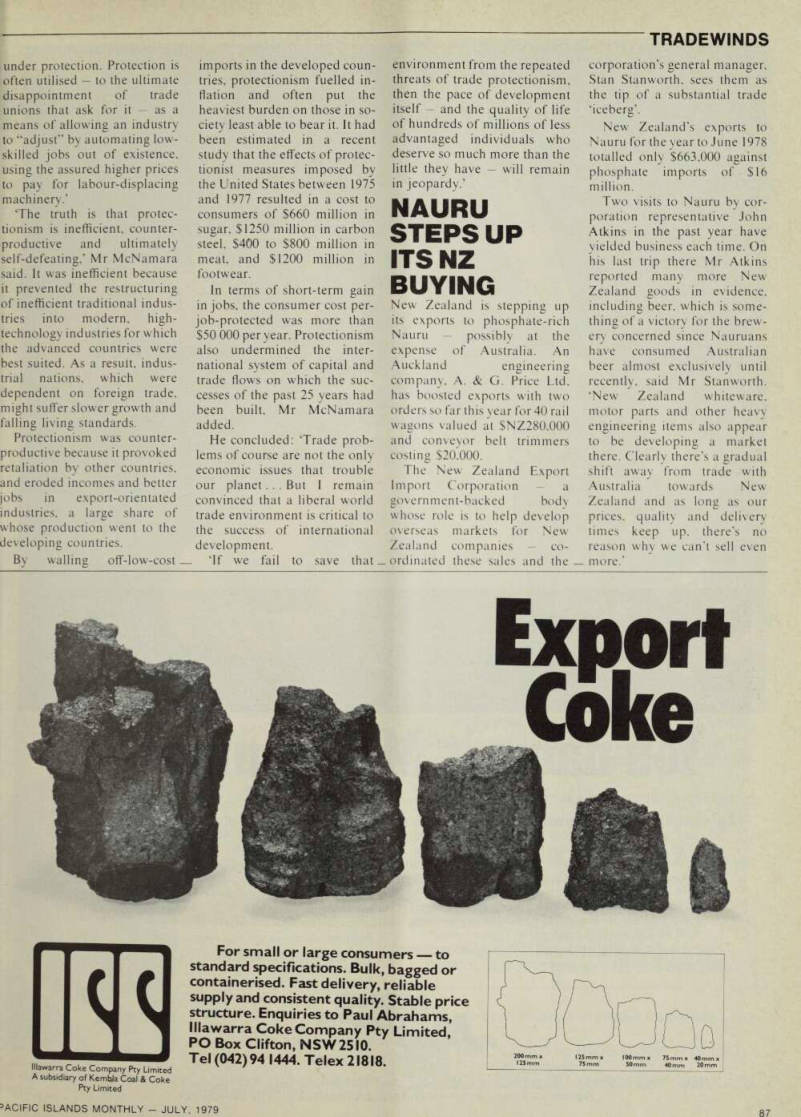
McNamara hits OUT
At Trade
Criticism of protectionism in the industrialised countries made by Pacific Island and other Third World spokesmen at the United Nations (PIM February) received ringing endorsement from World Bank President Robert S. McNamara at the United Nations Conference on Trade and Development (UNCTAD) in Manila in May.
Fiji’s UN representative Ber
enado Vunibobo had told the 1978 meeting of the UN Gen eral Assembly that the trend towards protectionism was not only ‘unhealthy’, but ‘makes us wonder as to the sincerity of those who have been loud in their assurances and commit ment to a more equitable dis tribution of the world’s wealth’.
Papua New Guinea’s Foreign
Minister Ebia Olewale told the
same meeting: if meaningful
progress is to be achieved, de veloped industrial nations must address themselves to the question of improved access to their markets for the goods of developing countries. It is a
recognised fact that developing
countries are an important market for the exports of in dustrialised countries. If these markets are to remain open, greater efforts must be made to enable Third World countries to increase their export earn
ings.’
Taking up the theme in Manila, Mr McNamara warned that unless the gather ing momentum of trade protec tionism is resisted and rolled back, the progress made in economic development and in ternational co-operation dur ing the past 25 years could be undermined.
He reminded the meeting of the ‘shocking conclusion’ of the World Bank’s World Develop ment Report 1978 that unless the developing countries achieved the projected, and optimistic, growth rates envisaged by the report some 600 million people would re main trapped in absolute pov erty at the end of the century.
Mr McNamara said that pro tectionism in the industrialised nations harmed the developing
countries directly by reducing
their opportunity to earn
foreign exchange, by increas
ing their unemployment, and by diminishing the rate of growth of their income. It hurt
them indirectly by inhibiting
them from adopting invest ment, production and trade policies which would improve the allocation of their resources and their overall development performance.
The very threat of future im position of protectionist measures often discouraged developing countries from adopting trade-orientated poli cies. ‘The result is that they settle for inferior trade and
development strategies, and
end by strengthening the vested interests in the societies that benefit most from produc ing at high cost for highly pro tected domestic markets.’
Mr McNamara told the con ference that protectionism in
the developed countries sought
to save specific industries, sec tors or regions from incurring detrimental economic and human costs. But this did not
protect society from incurring
equally real and even larger long-term costs.
The case for protection at least for protection against exports from developing coun tries was usually made on the basis of the burden that fell on the low-skilled labour that was
displaced.
‘But what the advocates of protection neglect to say is that the present jobs of these workers may not be saved even
Robert McNamara ... batting for the Third World
under protection. Protection is often utilised — to the ultimate disappointment of trade unions that ask for it — as a means of allowing an industry to “adjust” by automating low skilled jobs out of existence, using the assured higher prices to pay for labour-displacing
machinery.’
‘The truth is that protec tionism is inefficient, counter
productive and ultimately
self-defeating,’ Mr McNamara said. It was inefficient because it prevented the restructuring of inefficient traditional indus tries into modern. high technology industries for which the advanced countries were best suited. As a result, indus trial nations, which were
dependent on foreign trade,
might suffer slower growth and
falling living standards.
Protectionism was counter
productive because it provoked
retaliation by other countries,
and eroded incomes and better jobs in export-orientated industries, a large share of whose production went to the
developing countries.
By walling off-low-cost.
imports in the developed coun tries, protectionism fuelled in flation and often put the heaviest burden on those in so ciety least able to bear it. It had been estimated in a recent study that the effects of protec tionist measures imposed by the United States between 1975 and 1977 resulted in a cost to consumers of $660 million in sugar, $1250 million in carbon steel, $400 to $800 million in meat, and $1200 million in footwear.
In terms of short-term gain in jobs, the consumer cost per job-protected was more than $50 000 per year. Protectionism also undermined the inter national system of capital and trade flows on which the suc cesses of the past 25 years had been built. Mr McNamara added.
He concluded: Trade prob lems of course are not the only economic issues that trouble our planet. . . But I remain convinced that a liberal world trade environment is critical to the success of international
development.
‘If we fail to save that -
environment from the repeated threats of trade protectionism, then the pace of development itself and the quality of life of hundreds of millions of less advantaged individuals who deserve so much more than the little they have will remain
in jeopardy.’
Advertisements & other items, pp. 85-86 (3 items)
Tradewinds
DAPICIP IO I A MfNO ki/Nfcifi V#
86
h
Beehive Building
94 Elizabeth Street fv Melbourne, Victoria Australia 3000 G.P.O. Box 8 Melbourne, Victoria Australia 3001*,, i» Telex: AA34552 Phone: 63 5094
Steps Up
Nauru
Its Nz
Buying
New Zealand is stepping up its exports to phosphate-rich Nauru - possibly at the expense of Australia. An
Auckland engineering
company. A. & G. Price Ltd. has boosted exports with two orders so far this year for 40 rail wagons valued at $NZ280.000 and conveyor belt trimmers
costing $20,000.
The New Zealand Export
Import Corporation - a
government-backed body
whose role is to help develop overseas markets for New Zealand companies — co ordinated these sales and the
corporation’s general manager.
Stan Stanworth. sees them as the tip of a substantial trade
‘iceberg’.
New Zealand’s exports to Nauru for the year to June 1978 totalled only $663,000 against
phosphate imports of $16
million.
Two visits to Nauru by cor poration representative John Atkins in the past year have yielded business each time. On his last trip there Mr Atkins reported many more New Zealand goods in evidence, including beer, which is some thing of a victory for the brew ery concerned since Nauruans have consumed Australian beer almost exclusively until recently, said Mr Stanworth. ‘New Zealand whiteware. motor parts and other heavy engineering items also appear to be developing a market there. Clearly there’s a gradual shift away from trade with Australia towards New Zealand and as long as our
prices, quality and delivery
times keep up. there’s no reason why we can’t sell even more.'
Advertisements & other items, pp. 87-88 (1 item)
Export
Coke
m lllawarra Coke Company Pty Limited A subsidiary of KembJa Coal & Coke Pty Limited For small or large consumers to standard specifications. Bulk, bagged or containerised. Fast delivery, reliable supply and consistent quality. Stable price structure. Enquiries to Paul Abrahams, lllawarra Coke Company Pty Limited, PO Box Clifton, NSW2SIO.
Tel (042)94 1444. Telex 21818. 200 mm x 100 mm x 75mm x 40mm x 50mm 40mm 20mm
You name it, Mono pumps it.
Tell us your needs, we’ll show you the pump. For over 30 years, we’ve been pumping liquids of every viscosity, under all kinds of conditions. Fresh water, sand and water, food ingredients, chemicals, acids, corrosives and abrasives, sludges and waste, effluent and sewage, even solids in suspension.
If it can be conveyed through a pipeline, wecan move it, meter it or mix it, as quickly or slowly as you wish.
And we can provide pumps that run on petrol, kerosene, diesel, electricity, or PTO tractor drive (in fact even bicycle drive).
If there’s anything you want to know about pumping, write to us at Mono. We’ve got the pumps and the experience.
Please send me details of your pumps for (describe purposes): Name: Address: Send coupon to Head Office & Works (address below).
MONO
JAPUMPS
AUSTRALIA PTY. LTD.
MOVE IT WITH MONO
Head Office & Works: “Mono House”. 338-348 Lower Dandenong Kd.. Mordialloc. Vic. 3195, Australia.
Agents in: Papua and New Guinea, Indonesia, Fiji, The Philippines. 344-p-7i?7c
sounds
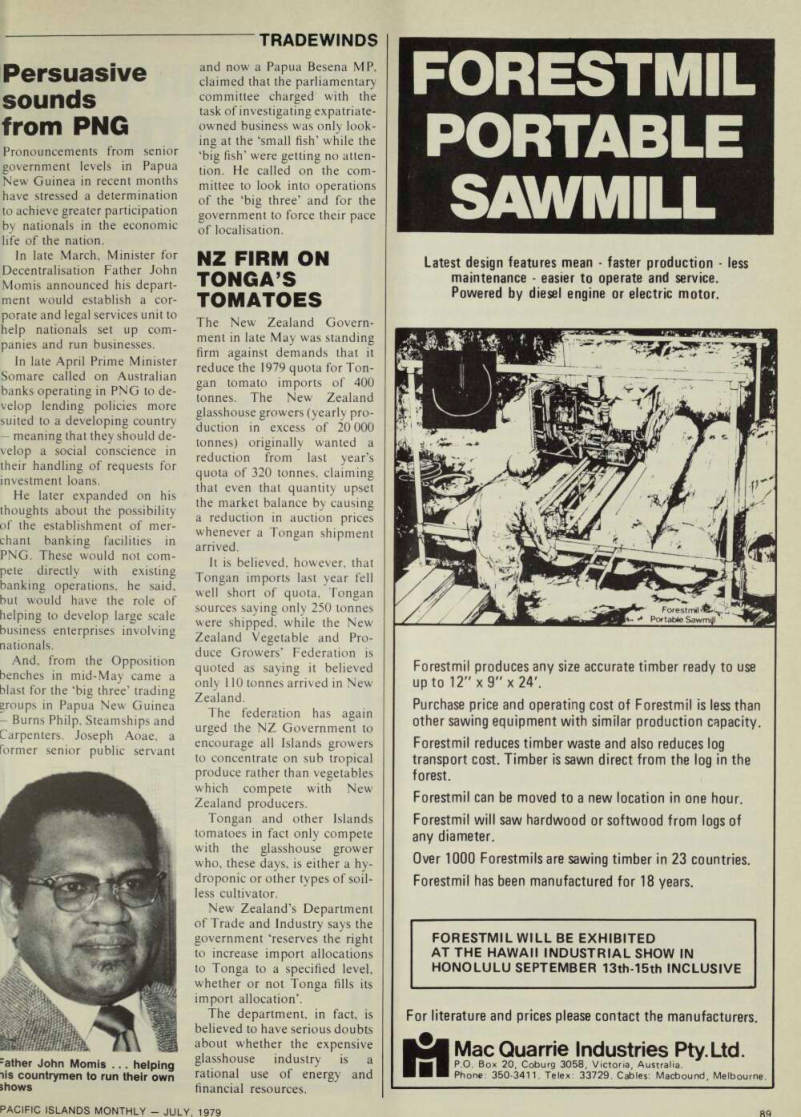
Persuasive sounds from PNG
Pronouncements from senior government levels in Papua New Guinea in recent months have stressed a determination to achieve greater participation by nationals in the economic life of the nation.
In late March, Minister for Decentralisation Father John Momis announced his depart ment would establish a cor porate and legal services unit to help nationals set up com panies and run businesses.
In late April Prime Minister Somare called on Australian banks operating in PNG to de
velop lending policies more
suited to a developing country meaning that they should de velop a social conscience in their handling of requests for investment loans.
He later expanded on his
thoughts about the possibility
of the establishment of mer
chant banking facilities in
PNG. These would not com
pete directly with existing
banking operations, he said,
but would have the role of
helping to develop large scale
business enterprises involving
nationals.
And, from the Opposition benches in mid-May came a
blast for the ‘big three’ trading
groups in Papua New Guinea
- Burns Philp, Steamships and
Carpenters. Joseph Aoae, a
former senior public servant
and now a Papua Besena MP, claimed that the parliamentary committee charged with the
task of investigating expatriate
owned business was only look ing at the ‘small fish’ while the ‘big fish’ were getting no atten tion. He called on the com mittee to look into operations of the ‘big three’ and for the government to force their pace of localisation.
father John Momis ... helping
[?]nis countrymen to run their own shows
Tonga’S
Nz Firm On
Tomatoes
The New Zealand Govern ment in late May was standing firm against demands that it reduce the 1979 quota for Ton gan tomato imports of 400 tonnes. The New Zealand
glasshouse growers (yearly pro
duction in excess of 20 000 tonnes) originally wanted a reduction from last year’s quota of 320 tonnes, claiming that even that quantity upset the market balance by causing a reduction in auction prices
whenever a Tongan shipment
arrived.
It is believed, however, that Tongan imports last year fell well short of quota, Tongan sources saying only 250 tonnes were shipped, while the New Zealand Vegetable and Pro duce Growers’ Federation is quoted as saying it believed only 110 tonnes arrived in New Zealand.
The federation has again urged the NZ Government to encourage all Islands growers to concentrate on sub tropical produce rather than vegetables which compete with New
Zealand producers.
Tongan and other Islands tomatoes in fact only compete with the glasshouse grower who, these days, is either a hy droponic or other types of soil less cultivator.
New Zealand’s Department of Trade and Industry says the government ‘reserves the right to increase import allocations to Tonga to a specified level, whether or not Tonga fills its
import allocation’.
The department, in fact, is believed to have serious doubts about whether the expensive
glasshouse industry is a
rational use of energy and financial resources.
Advertisements & other items, pp. 89-90 (1 item)
Forestmil
PORTABLE
SAWMILL
Latest design features mean • faster production - less maintenance • easier to operate and service.
Powered by diesel engine or electric motor. / v 3 Forestrml’ft- Poftable SawmiJl Forestmil produces any size accurate timber ready to use up to 12" x 9" x 24'.
Purchase price and operating cost of Forestmil is less than other sawing equipment with similar production capacity.
Forestmil reduces timber waste and also reduces log transport cost. Timber is sawn direct from the log in the forest.
Forestmil can be moved to a new location in one hour.
Forestmil will saw hardwood or softwood from logs of any diameter.
Over 1000 Forestmils are sawing timber in 23 countries.
Forestmil has been manufactured for 18 years.
FORESTMIL WILL BE EXHIBITED
AT THE HAWAII INDUSTRIAL SHOW IN
HONOLULU SEPTEMBER 13th-15th INCLUSIVE
For literature and prices please contact the manufacturers.
IH
MacQuarrie Industries Pty.Ltd.
P.O. Box 20, Coburg 3058, Victoria, Australia.
Phone: 350-3411. Telex: 33729. Cables: Macbound, Melbourne.
RADEWINDS INTELLIGENCE...TRAD
TONGA’S Development Bank, which opened in September 1977, reports that in its first year of operation it approved 1844 loans totalling $71,235 million. Loans to the bank include SUSI.S million from the Asian Development Bank and $3OO 000 from the UK.
AUSTRALIA’S new commercial attache at its trade commission in Suva is Gary Unsworth-Smith.
THREE new vessels have arrived in Solomon Islands from Japan.
They are the Solomon Hunter and Solomon Fisher, skipjack catcher boats, and the Vfi na Tasi (Abundance of the Sea), a refrigerated vessel. They have been supplied under a Japanese aid programme.
ALFRED Powell of Levuka has taken over customer services with Blue Lagoon Cruises. Fiji, which operates cruises to the Yasawas to the northeast of Viti Levu and to the second largest island, Vanua Levu.
GUY Agniel. from Houailou on New Caledonia’s east coast, is the new director of the Office du Tourisme in Noumea, in succession to Bruno Tabuteau. Mr Agniel spent 12 years in France where he attended Montpellier University studving law and soci-
ology.
PAUL Bolger. a longtime Ansett man in Papua New Guinea and in charge of Ansett operations since Air Niugini took over from TAA and Ansett in middle seventies, is now with Ansett in Brisbane. He is succeeded in Port Moresby by Graham Hawthorne.
VISITORS to Tonga in 1978 numbered a record 12 090, a 10% improvement on 1977’s figures. They spent an estimated $3.9 million against $3.3 million in 1977.
PRELIMINARY research suggests potential for the export of 12 000 to 22 000 kg of freshwater yabbies from Daru in Papua New Guinea’s Western Province.
SOLOMON Islands Government is to raise its holdings in the Taiyo fisheries operation from 25 to 49%.
A SHIPMENT of 400 New Zealand heifers for the Uluisaivou Corporation’s farm in Fiji arrived in Suva in April.
LEGISLATION to give exclusive rights to Papua New Guineans to mine for gold has been indicated by Minister for Minerals and Energy Karl Kitchens.
NIUE, already producing its own ‘Sport Softdrinks’ is about to launch its newest product, ‘Canned Coconut Cream’.
FIJI’S economic growth performed ‘reasonably well’ last year even though it slowed to 2% in real terms, according to the Central
Monetary Authority.
WESTERN Samoa’s Rothman’s cigarette factory at Vaitele will produce an average of 10 million cigarettes a month, according to its general manager, Alistair Irving.
FONG Hoon Ltd has won the Nausori Airport duty free consession for five years according to the Fiji Ministry of Tourism.
PACIFIC Islands Tourism Development Council was reported in May to be looking for a SUS3O 000 a year executive director based in Honolulu.
ATHERTON Antimony NL has raised its holding in Goldfield Mines Ltd. Fiji, to 50% with the purchase of 22.5% of shares for $A 165 095.
BOUGAINVILLE Development Corporation Ltd has appointed Paul Nerau as joint managing director with Gary Grey, it was announced by its chairman, Leo Hannett.
ALABA Lodge on Wuvulu Island in northwestern Papua New Guinea is due to open this month. Wuvulu is about 45 minutes light twin flying from Wewak in the East Sepik Province.
EWINDS INTELLIGENCE...TRADEWI
DISTRIBUTORS
WANTED
STP, the world's leading marketer of Automotive additives and car products, invites applications for distributor/s throughout the Pacific Islands.
Interested parties should have established contacts in the automotive field, be financially sound to import products direct from the USA, and have ability to position products as market leaders.
Replies should contain brief information on company, products currently handled, etc.
Regional Manager 10 David Place, Seaforth NSW, Australia 2092
MODULOCK MANUFACTURED
BUILDING SYSTEM DESIGNED FOR
TROPICAL CONDITIONS
BUILDING INDUSTRY OPPORTUNITY IN
THE PACIFIC
An opportunity exists for an experienced and establisheo Builder or Building Company operating in island area to join the MODULOCK Franchised Builder Network.
We see a Principal or Principals who are well-motivated, adaptable, and are prepared to promote, sell and build under the MODULOCK banner in these areas, with the assistance from our Company that is to be expected from a leader in the home-building field with a high quality product, international reputation and progressive marketing system. The successful applicant will enjoy an increasing market share and many additional business benefits.
If you would like to discuss the opportunities available please telephone or forward a brief resume to: The Marketing Manager Modulock (NZ) Lt ' P.O. Box 51099 Pakuranga, Auckland. Tel. POP 47-069 Telex: NZ 2290
. Tf*-' ‘fov r* I
A • 1 \ fi- L- I i \
H lv i
r t .. ! / ( 4 v /T HrY'
Yachts
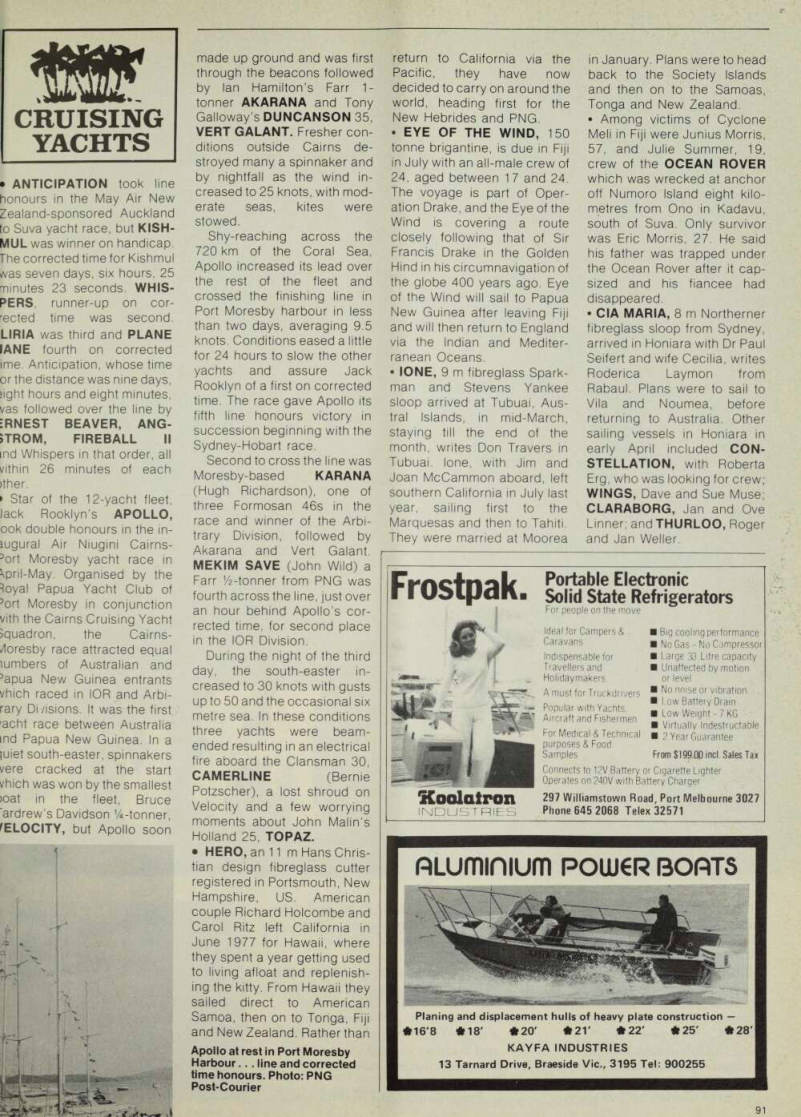
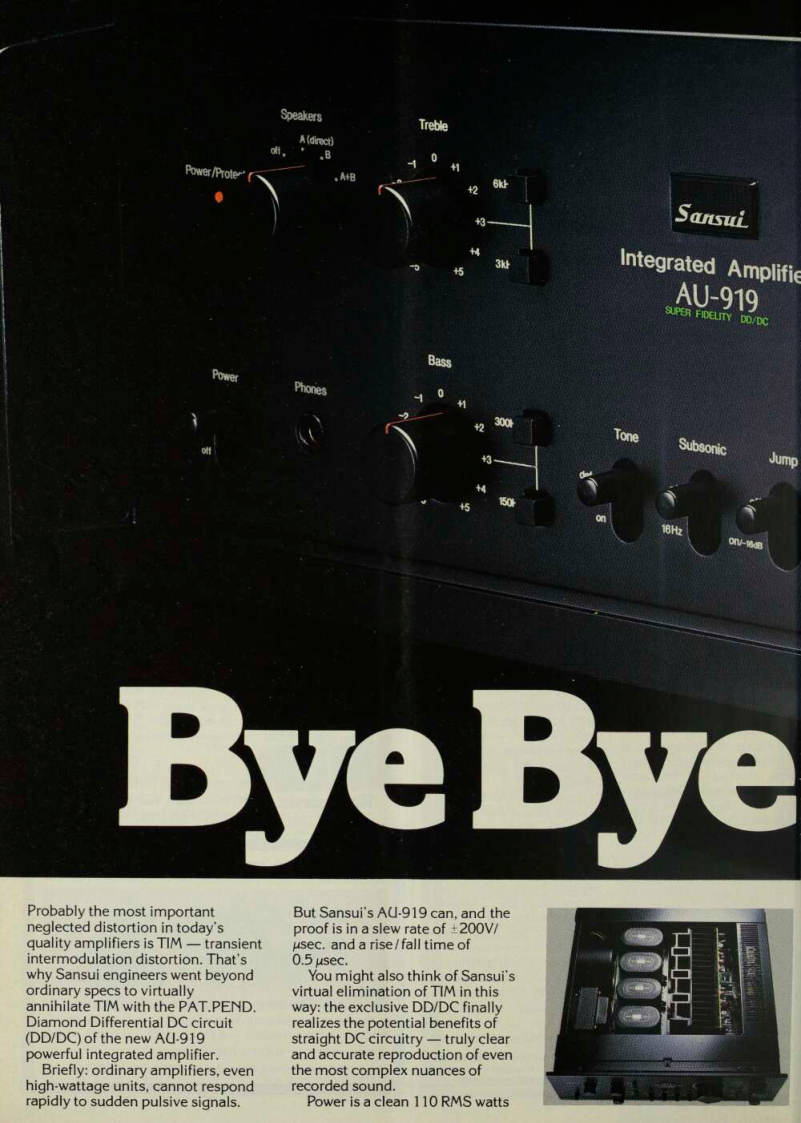
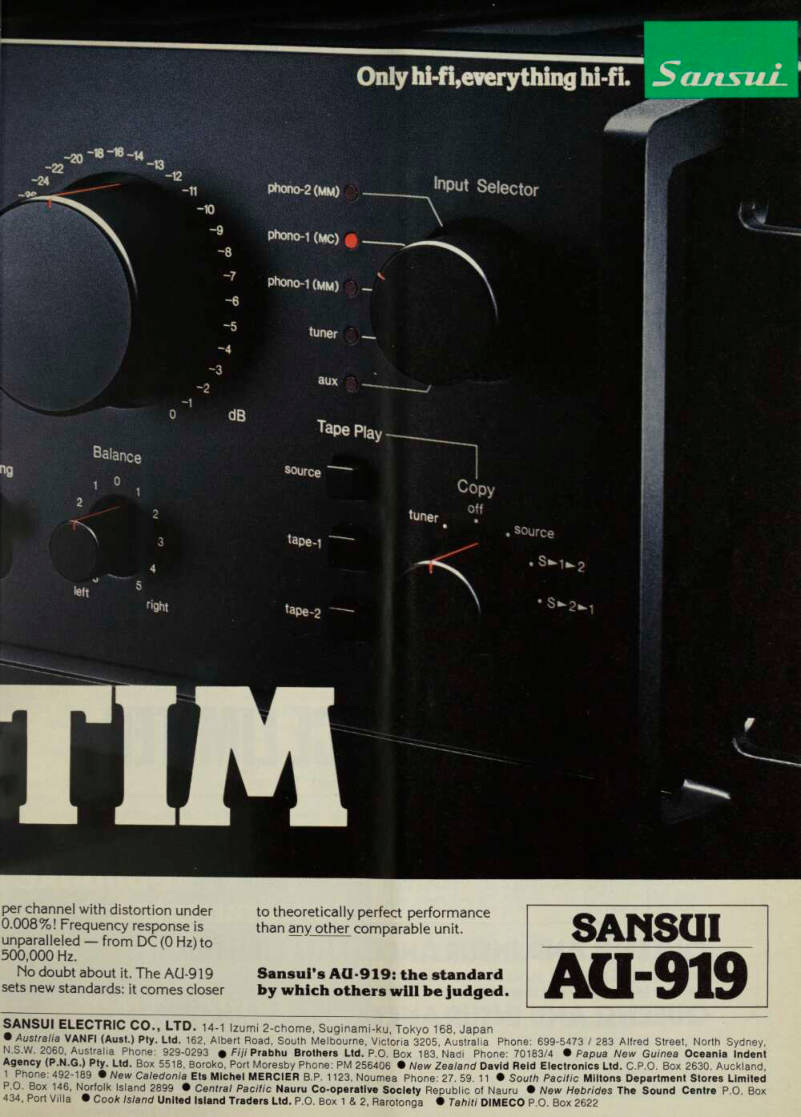

Cruising
• ANTICIPATION took line honours in the May Air New Zealand-sponsored Auckland to Suva yacht race, but KISH MUL was winner on handicap.
The corrected time for Kishmul was seven days, six hours, 25 minutes 23 seconds. WHIS PERS, runner-up on cor rected time was second.
LIRIA was third and PLANE lANE fourth on corrected ime. Anticipation, whose time or the distance was nine days, jight hours and eight minutes, vas followed over the line by
■Rnest Beaver, Ang
Strom, Fireball Ii
md Whispers in that order, all vithin 26 minutes of each >ther. * Star of the 12-yacht fleet, Jack Rooklyn’s APOLLO, ook double honours in the in augural Air Niugini Cairns 3ort Moresby yacht race in \pril-May. Organised by the toyal Papua Yacht Club of 3 ort Moresby in conjunction vith the Cairns Cruising Yacht Squadron, the Cairns /loresby race attracted equal lumbers of Australian and 3 apua New Guinea entrants vhich raced in lOR and Arbi rary Di/isions. It was the first r acht race between Australia md Papua New Guinea. In a luiet south-easter, spinnakers vere cracked at the start vhich was won by the smallest >oat in the fleet, Bruce ardrew’s Davidson Vi-tonner, VELOCITY, but Apollo soon
made up ground and was first through the beacons followed by lan Hamilton’s Farr 1tonner AKARANA and Tony Galloway’s DUNCANSON 35, VERT GALANT. Fresher con ditions outside Cairns de stroyed many a spinnaker and by nightfall as the wind in creased to 25 knots, with mod erate seas, kites were stowed.
Shy-reaching across the 720 km of the Coral Sea, Apollo increased its lead over the rest of the fleet and crossed the finishing line in Port Moresby harbour in less than two days, averaging 9.5 knots. Conditions eased a little for 24 hours to slow the other yachts and assure Jack Rooklyn of a first on corrected time. The race gave Apollo its fifth line honours victory in succession beginning with the Sydney-Hobart race.
Second to cross the line was Moresby-based KARANA (Hugh Richardson), one of three Formosan 46s in the race and winner of the Arbi trary Division, followed by Akarana and Vert Galant.
MEKIM SAVE (John Wild) a Farr Vfc-tonner from PNG was fourth across the line, just over an hour behind Apollo’s cor rected time, for second place in the lOR Division.
During the night of the third day, the south-easter in creased to 30 knots with gusts up to 50 and the occasional six metre sea. In these conditions three yachts were beam ended resulting in an electrical fire aboard the Clansman 30, CAMERLINE (Bernie Potzscher), a lost shroud on Velocity and a few worrying moments about John Malin’s Holland 25, TOPAZ. • HERO, an 11 m Hans Chris tian design fibreglass cutter registered in Portsmouth, New Hampshire, US. American couple Richard Holcombe and Carol Ritz left California in June 1977 for Hawaii, where they spent a year getting used to living afloat and replenish ing the kitty. From Hawaii they sailed direct to American Samoa, then on to Tonga, Fiji and New Zealand. Rather than
return to California via the Pacific, they have now decided to carry on around the world, heading first for the New Hebrides and PNG.
• Eye Of The Wind, 150
tonne brigantine, is due in Fiji in July with an all-male crew of 24, aged between 17 and 24.
The voyage is part of Oper ation Drake, and the Eye of the Wind is covering a route closely following that of Sir Francis Drake in the Golden Hind in his circumnavigation of the globe 400 years ago. Eye of the Wind will sail to Papua New Guinea after leaving Fiji and will then return to England via the Indian and Mediter ranean Oceans. • lONE, 9 m fibreglass Spark man and Stevens Yankee sloop arrived at Tubuai, Aus tral Islands, in mid-March, staying till the end of the month, writes Don Travers in Tubuai. lone, with Jim and Joan McCammon aboard, left southern California in July last year, sailing first to the Marquesas and then to Tahiti.
They were married at Moorea
in January. Plans were to head back to the Society Islands and then on to the Samoas, Tonga and New Zealand. • Among victims of Cyclone Meli in Fiji were Junius Morris, 57, and Julie Summer, 19, crew of the OCEAN ROVER which was wrecked at anchor off Numoro Island eight kilo metres from Ono in Kadavu, south of Suva. Only survivor was Eric Morris, 27. He said his father was trapped under the Ocean Rover after it cap sized and his fiancee had disappeared. • CIA MARIA, 8 m Northerner fibreglass sloop from Sydney, arrived in Honiara with Dr Paul Seifert and wife Cecilia, writes Roderica Laymon from Rabaul. Plans were to sail to Vila and Noumea, before returning to Australia. Other sailing vessels in Honiara in early April included CON STELLATION, with Roberta Erg, who was looking for crew; WINGS, Dave and Sue Muse; CLARABORG, Jan and Ove Linner; and THURLOO, Roger and Jan Weller.
Apollo at rest in Port Moresby Harbour ... line and corrected time honours. Photo: PNG Post-Courier
• ALLEZ CAT, 10 m cata maran, motored into Rabaul and motored out again after a few days spent provisioning and replenishing the fuel tanks. ‘I would never go cruis ing on a sailing yacht,’ said Allez Cat’s owner/captain, Peter Spurdle. ‘I dislike every aspect of moving under sail.
Give me a good sturdy diesel and I’m happy.’ Peter is author of Into The Rising Sun, an account of a previously owned catamaran, the WHAI, in which he motored from NZ to Japan and back. Peter is accompanied by crew mem bers Paul Falconer, Robyn Marsten and Neil Ward, all div ing enthusiasts. • KRISTILLA, 9 m cutter-rig CT made in Taiwan, arrived in Rabaul with Richard Flavell and Chrystine Cypros, and children Kristin, 7, and Camilla, 6. Richard sailed the boat from Taiwan three years ago to Hong Kong, the Philip pines, Sulawesi, Papua New Guinea, to Cairns. He proceeded down the Great Barrier Reef into Southport for a layover period. The next part cf the journey took Kristilla to New Caledonia, Solomon slands and back to Papua New Guinea. ► AMBRYM, (previously MORNING SUN), 10 m ketch designed by the Australian architect Cecil Bowden, lomeported in Port Vila, New Hebrides, was acquired by Nicolas and Christel Gerardin n Santo. They completely efurbished the craft in prep aration for a homeward voy age to France. Their route rom Rabaul was to be through he Torres Straights to
Indonesia, Singapore, Sri Lanka, the Red Sea, and into the Mediterranean. • BACCHUS, a Peterson 44 cutter from California. Harry Disharoon and Donna Osborn left San Diego in April 1978 on this immaculate yacht. After a stopover in the Marquesas they sailed through the Tuamotus to Tahiti and the rest of the Society Islands. Head ing west, Bachus called at the Cooks and Tonga before mak ing for New Zealand. Harry and Donna plan to sail to Fiji, the New Hebrides, and Aus tralia in time for the next cyc lone season. Additional crew on the leg to Fiji were to be Larry Disharoon and Karen Nelson.
• Albatross, An 11.60 M
staysail schooner from Honolulu, Hawaii, skippered by Rob Jordan has been sail ing the South Pacific for the past three years, taking on crew for the longer passages.
So far, Albatross has visited French Polynesia, Cook Islands, Niue, Tonga and Fiji.
Albatross left Tonga for American Samoa in May. • BULAWAYO, 15 m ferro cement ketch registered in Liverpool, England, but sailed from Seattle on the west coast of the US. Owner, lan Ablett, a Briton, spent nearly seven years building his dreamboat near Seattle. Accompanied by his wife-cum-navigator Sue, they finally set sail last year for Hawaii, then to Samoa, Tonga, Fiji and New Zealand.
Bulawayo means ‘home of the elephant’ in Zulu. The Abletts hope eventually to reach Africa.
Advertisements & other items, pp. 91-97 (3 items)
Frostpak
>, 4
Koolatron
INDUSTRIES
Portable Electronic
Solid State Refrigerators
For people on the move Ideal for Campers & Caravans Indispensable for Travellers and Holidaymakers A must for Truckdrivers Popular with Yachts.
Aircraft and Fishermen For Medical & Technical purposes & Food Samples ■ Big cooling performance ■ No Gas - No Compressor ■ Large 33 Litre capacity ■ Unaffected by motion or level ■ No noise or vibration ■ Low Battery Dram ■ Low Weight - 7 KG ■ Virtually Indestructable ■ 2 Year Guarantee From 5199.00 incl. Sales Tax Connects to 12V Battery or Cigarette Lighter Operates on 240 V with Battery Charger 297 Williamstown Road, Port Melbourne 3027 Phone 645 2068 Telex 32571
Aluminium pow€r boats
Planing and displacement hulls of heavy plate construction ♦ 16'8 #lB' #2o' #2l' #22' #2s' #2B'
KAYFA INDUSTRIES
13 Tarnard Drive, Braeside Vic., 3195 Tel: 900255
Probably the most important neglected distortion in today’s quality amplifiers is TIM transient intermodulation distortion. That’s why Sansui engineers went beyond ordinary specs to virtually annihilate TIM with the PAT.PEND.
Diamond Differential DC circuit (DD/DC) of the new AG-919 powerful integrated amplifier.
Briefly: ordinary amplifiers, even high-wattage units, cannot respond rapidly to sudden pulsive signals.
But Sansui’s AG-919 can, and the proof is in a slew rate of ±2OOV/ lusec. and a rise/fall time of 0.5 jisec.
You might also think of Sansui’s virtual elimination of TIM in this way: the exclusive DD/DC finally realizes the potential benefits of straight DC circuitry truly clear and accurate reproduction of even the most complex nuances of recorded sound.
Power is a clean 110 RMS watts
Only hi-fi, every thing hi-fi.
-20~ 18 “ 18 -14 "9
input Selector
-22 Phono-2 (MM) -11 -10 -9 Phono-1 (MC) -8 -7 Phono-1 (MM) - -6 ~5 tuner -4 -3 aux
Ray
Baianc
Copy
off left hght source •ape-t tape-2 tuner source •S*-2 M i i 4 V*. per channel with distortion under 0.008%! Frequency response is unparalleled from DC (0 Hz) to 500,000 Hz.
No doubt about it. The AG-919 sets new standards: it comes closer to theoretically perfect performance than any other comparable unit.
Sansui*s AU-919: the standard by which others will be judged.
SANSUI ELECTRIC CO., LTD. 14-1 Izumi 2-chome, Suginami-ku, Tokyo 168, Japan • Australia VANFI (Aust.) Pty. Ltd. 162. Albert Road. South Melbourne, Victoria 3205, Australia Phone: 699-5473 / 283 Alfred Street, North Sydney.
N.S.W. 2060, Australia Phone: 929-0293 sF//7Prabhu Brothers Ltd. P.O. Box 183, Nadi Phone: 70183/4 • Papua New Guinea Oceania Indent Agency (P.N.G.) Pty. Ltd. Box 5518, Boroko, Port Moresby Phone: PM 256406 • New Zealand David Reid Electronics Ltd. C.P.O. Box 2630, Auckland, 1 Phone: 492-189 • New Caledonia Ets Michel MERCIER B.P. 1123. Noumea Phone: 27. 59. 11 • South Pacific Miltons Department Stores Limited RO. Box 146, Norfolk Island 2899 • Central Pacific Nauru Co-operative Society Republic of Nauru • New Hebrides The Sound Centre P.O. Box 434, Port Villa • Cook Island United Island Traders Ltd. P.O. Box 1& 2, Rarotonga • Tahiti DIMECO P.O. Box 2622
Since 1947 it . . . sth year in Australia
GOLD
DETECTORS
with enviable history of
AUSTRALIAN GOLD NUGGET FINDS
'The Professionals' Choice . .
GET YOUR
FREE INFORMATION PACKAGE - NOW!
Write or phone the Australian importers:
HENDON DETECTOR COMPANY
TEL: 24 hours - 7 DAYS A WEEK - (02)918-6667 Box 155. V. (121 Plateau Rd.), Avalon Beach,
N.S.W. 2107.
DEALER INQUIRIES WELCOMED
r
THE BROWNBUILT
STORAGE
WIZ
Compactus
multi-purpose
Mobile Storage
Accommodates contents of ten 4-drawer filing cabinets in about half the floor area . . . allowing more profitable use of the space saved. Cabinets roll smoothly apart for instant access. No permanent fixing of tracks to floor.
Ideal for use in multi-storey buildings because of low overall weight. All cabinets lock centrally.
For free expert advice and brochures contact: “Registered Trade Mark BROWNBUILT LTD., Cnr. Bath Rd. and Waratah St., Sutherland, N.S.W., Australia 2232.
AGENTS - SOLOMON ISLANDS: NCR Corporation, Honiara. NEW HEBRIDES: NCR Corporation, Vila. NEW CALEDONIA: NCR Corporation, Noumea. PNG: Brownbuilt (PNG) Pty. Ltd., Port Moresby & Lae. FIJI; Lysaght Brownbuilt Ind. (Fiji) Ltd , Suva. HAWAII: Records Management Services Inc., Honolulu.
Brownbuilt
offers expert insurance service
throughout the Islands.
QBE INSURANCE LIMITED
Central Office; 82 Pitt Street, Sydney.
NEW CALEDONIA - T.A. Hagen , Ste. I/V.A. Johnston, S.A.R.L. ■ Noumea.
NEW HEBRIDES Manager: G.F. Donnelly, Vila; Santo Santr: Burns Phi Ip (New Hebrides) Ltd.
TAHITI - Arthur Chung: Immeuble B.L, Front de Mer, Papeete.
NIUE, NORFOLK ISLAND, SAMOA, TONGA and other South Sea Islands Burns Phi/p (South Sea) Company Ltd.
QUEENSLAND INSURANCE (FIJI) LIMITED
Head Office, 34 Usher St., SUVA. General Manager: L.G. Liddell. A.A.1.1.
Assistant Managers: Vijay Lai and J.T. Laidlaw. LAUTOKA Office, Burns Philp Bldg. District Manager: J. Dalton.
QUEENSLAND INSURANCE (RN.C.) LIMITED
PAPUA NEW GUINEA -
Head Office, PORT MORESBY. General Manager; J.M. Dawe. Assistant Manager; R.V. Maskell.
District Managers at; LAE: I.R. Martin. MOUNT HAGEN: D.F. Carroll. ARAWA: J Longbut. MADANG. R.W.V. Ceilings. RABAUL: W.F. Tinker.
QBE
ri
The KINGSTON 580
DISPLACEMENT HULL CRUISER
with built-in diesel power
• Fibreglass construction for economical maintenance • Does up to 14 knots with ease • Big self-drained cockpit • Choice of 12, 15, 24 or 33 hp diesel engines • Lock up cabin with 2 bunks • Plenty of room - 5.80 metres long Available also Kingston Angler. Same hull, open boat version.
Ideal Mackerel boat For brochure and name of your nearest dealer phone or write.
Would you like to take six people out for a full day's cruising and fishing offshore and inshore for less than $5 of fuel? This fine economical and safe Kingston 580 can give you all that plus a 12 month warranty. ’
lIOETD QAI CC
CRUISER SALES PTY. LTD.
179 South Creek Road, Dee Why, N.S.W., 2099.
Teleohone: 981 3508
HENRY GUMINES
PTY LTD.
EXPORTERS o GENERAL MERCHANTS
428 GEORGE ST., SYDNEY
CABLES: HENCO SYDNEY. G.P.O. Box 3949. PHONE; 232-5377
For specialised and personalised buying service
throughout the Pacific Islands and the East.
* LOCAL AGENTS AND REPRESENTATION:
PAPUA NEW GUINEA: FIJI:
RABAUL; M. & C. Seeto, P.O. Box 131, Rabaul.
Telephone 92-2919.
K. Witherington Ltd., P.O. Box 293, Suva.
Telephone 22-356.
NEW HEBRIDES:
John Lum & Associates, P.O. Box 65, Santo.
Telephone 329..
SOLOMON ISLANDS:
Mr, Tom Lo, P.O. Box 327, Honiara.
Telephone 399.
Resident Aoents in other Pacific Territories. • MADANG: W. Double, P.O. Box 22, Madang.
Telephone 82-2696.
GlrntiAHAll MULLUMBIMBY, N.S.W.,
AUSTRALIA 2482.
International
We offer a personal mail-order service to island folk and yachties looking for hard-to-find items
ANYTHING - ANYWHERE
World-wide Contacts, Imports, Exports, Mail Orders, Unusual Commissions —anywhere in the world!
S. W. Pacific distributor for Europe’s finest Musical strings, Dr, Thomastik of Vienna. Guitar, classical, Hawaiian, etc.
TheVkcta Professional 460
built to handle the tough
jobs with ease
PROFESSIONAL 460 FEATURES
Viet a Hi-Torque 6 two-stroke 160 cc engine.
Larger fuel tank 2.3 litres as against 1 litre Heavy duty wheels.
Easy pull zip starter Safety blade disc 46 cm (18”) cut Concealed throttle cable LM carburettor Folding handle 8 position height adjuster Noise reducing muffler Side chute with safety cover Lightweight (weighs only 54 lb) Rugged 14-gauge steel baseplate Specifications and models subject to alteration without notice or obligation
ICTA
TURNS GRASS INTO LAWN
Yachts
95
3 ACIFIC ISLANDS MONTHLY - JULY, 1979
Philately
nation’s future
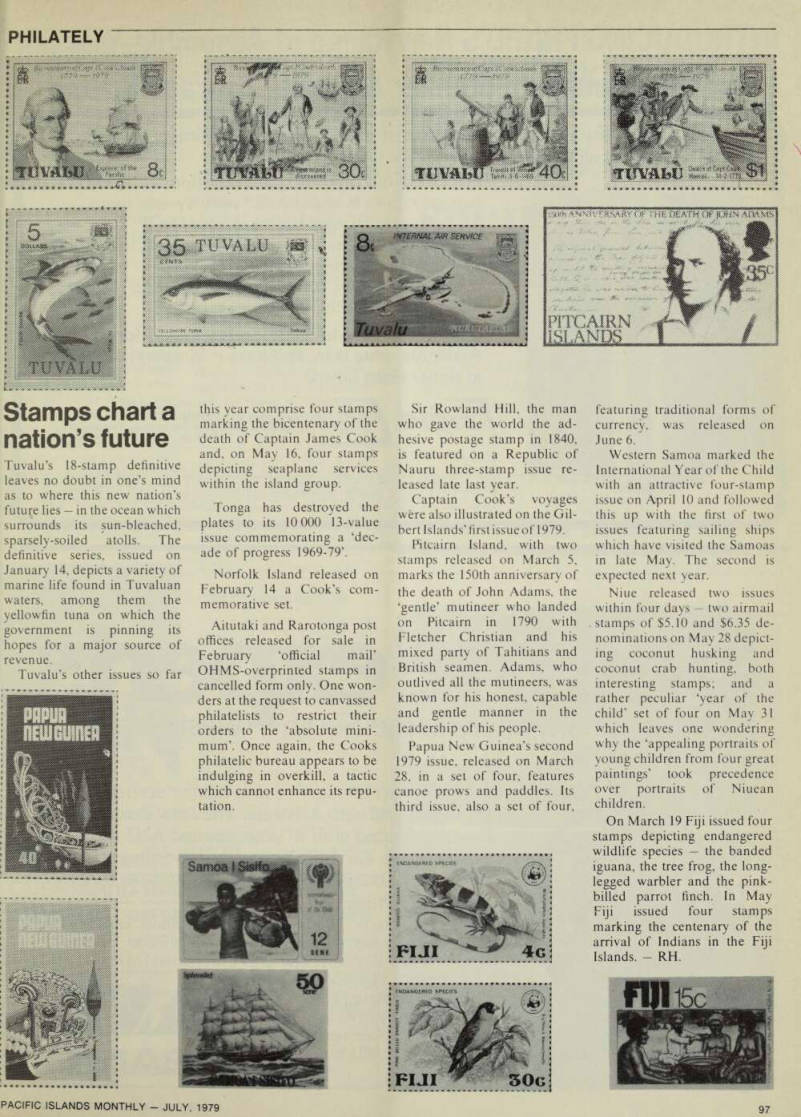
Stamps chart a nation’s future
Tuvalu’s 18-stamp definitive leaves no doubt in one’s mind as to where this new nation’s future lies in the ocean which surrounds its sun-bleached, sparsely-soiled atolls. The definitive series, issued on
January 14, depicts a variety of
marine life found in Tuvaluan waters, among them the yellowfin tuna on which the government is pinning its hopes for a major source of revenue.
Tuvalu’s other issues so far
this year comprise four stamps marking the bicentenary of the death of Captain James Cook and, on May 16, four stamps
depicting seaplane services
within the island group.
Tonga has destroyed the
plates to its 10 000 13-value issue commemorating a ‘dec ade of progress 1969-79’.
Norfolk Island released on February 14 a Cook’s com memorative set.
Aitutaki and Rarotonga post offices released for sale in February ‘official mail’
OHMS-overprinted stamps in cancelled form only. One won ders at the request to canvassed philatelists to restrict their orders to the ‘absolute mini mum’. Once again, the Cooks philatelic bureau appears to be indulging in overkill, a tactic which cannot enhance its repu tation.
Sir Rowland Hill, the man who gave the world the ad hesive postage stamp in 1840, is featured on a Republic of Nauru three-stamp issue re leased late last year.
Captain Cook’s voyages wfere also illustrated on the Gil bert Islands’ firstissueof 1979.
Pitcairn Island, with two stamps released on March 5, marks the 150th anniversary of the death of John Adams, the ‘gentle’ mutineer who landed on Pitcairn in 1790 with Fletcher Christian and his mixed party of Tahitians and British seamen. Adams, who outlived all the mutineers, was known for his honest, capable and gentle manner in the
leadership of his people.
Papua New Guinea’s second 1979 issue, released on March 28, in a set of four, features canoe prows and paddles. Its third issue, also a set of four,
featuring traditional forms of currency, was released on June 6.
Western Samoa marked the International Year of the Child with an attractive four-stamp issue on April 10 and followed this up with the first of two
issues featuring sailing ships
which have visited the Samoas in late May. The second is expected next year.
Niue released two issues within four days two airmail . stamps of $5.10 and $6.35 de nominations on May 28 depict
ing coconut husking and
coconut crab hunting, both interesting stamps; and a rather peculiar ‘year of the child’ set of four on May 31 which leaves one wondering
why the ‘appealing portraits of
young children from four great
paintings’ took precedence
over portraits of Niuean children.
On March 19 Fiji issued four
stamps depicting endangered
wildlife species the banded
iguana, the tree frog, the long
legged warbler and the pink billed parrot finch. In May Fiji issued four stamps marking the centenary of the arrival of Indians in the Fiji
Islands.
RH.
Advertisements & other items, pp. 97-98 (2 items)
97
'ACIFIC ISLANDS MONTHLY - JULY, 1979
See the experts
INTRODUCING FRIGID’S New Range of Assemble-Yourself
Freezer & Cooler Storage Rooms
Hundreds already installed. Now with attractive timber grain aluminium exterior finish, (rust-proof) with white vinyl interior finish.
Frigid Foam Polyurethane insulation. 2" in cooler storage rooms is equal to 5" polystyrene foam. 3" in freezer storage rooms is equal to 8" polystyrene foam. Lower running costs. Best insulation available. Thin wall construction. Save in freight costs. Room sizes from 90 cubic feet (2'A m 3) to 930 cubic feet (25 1 /2 m 3).
Supplied in easy-to-erect, do-it-yourself form Assemble, plug it in, and have it in operation in under eight hours! 77 * * Manufactured by:
FRIGID CABINETS PTY. LTD.
14a Duffy Ave., Thornleigh, N.S.W. Aust. 2120. Ph. 848 8292.
AVAILABLE FROM:
AUSTRALIA NEW CALEDONIA EXPORTS, 363 George St., Sydney 2000. BRECKWOLDT & CO G P O Box 5027, Sydney 2001. HAGEMEYER (A'ASIA), 59 Anzac Pde , Kensington 2033 GEOFFREY HUGHES & CO , I |3o^ a o^- U c. a , r o T St ■ Svdnev 2000 NELSON & ROBERTSON PTY. LTD., 197 Clarence St. Sydney 2000 E RABC a E> L P ?t TS PT Y LTD - 67 Castlereagh St., Sydney 2000. RABTRAD NIUGIN I PTY. LTD., P.O. Box 1406 Lae R IETTE (p ACIFIC) PTY LTD., 20 Loftus St., Sydney 2000. C. SULLIVAN (EXPORT) PTY. LTD. G.P O Be 3373, Sydney 2001 W.S. TAIT & CO. PTY, LTD., 31 Macquarie Place, Sydney 2000.
See the experts
for business anywhere in the South* West Pacific For comprehensive service and advice on trade, both inter-island and with Australia and New Zealand, see the experienced staff at your nearest ANZ branch or agency. We can help you with importing and exporting, business transactions and personal banking. Offices are located at: Suva 128 Victoria Parade and Waimanu Road. Lautoka Naviti Street. Nadi Queen s Road. Nausori Kings Road. Boroko Hubert Murray Highway. Lae Cnr. Coronation Drive and 7th Street. Madang Lightfoot Arcade, Kasagten Road. Mount Hagen Hagen ▲mm Drive. Port Moresby AING House, Hunter Street. Rabaul Mango Avenue. Waigani.
Honiara Mendana Avenue. Vila Rue Higginson.
BAIMK
Deaths
of Islands People
Flora Stewart
Flora Stewart, an almost legendary figure in the history of Papua New Guinea for most of this century, at Lae in May.
Mrs Stewart, 93, universally known as ‘Ma’ Stewart, was born in Scotland and arrived in Papua New Guinea in 1906 when she was 20 years old. She became widely known in the gold rush days of the twenties and thirties, and was a pioneer in some of the inland areas where gold was found, par ticularly in Wau. She was in volved in many business ventures and many miners were able to carry on only be cause of the help and credit which she gave them. More re cently Mrs Stewart was invol ved in ventures which helped
in community development of
Png.
Unni Sirdar
One of two surviving founding members of Then India San
marga Ikya Sangam in Fiji, in
February, aged 97. Born in Kerala, India, Unni Sirdar ser ved his indentures at Lovu, near Lautoka, and set up as a cane farmer near Nadi. He helped found TISI Sangam in 1926 and was instrumental in
building several Sangam insti
tutions in and around Nadi, including the Nadi Subramani
Swamy Temple, Nadi Sangam
School and Shri Vivekananda
High School.
Howard
Farnsworth
Personal bodyguard to Sir Robert Menzies in 1954-55, and to Prince Charles while he was schooling in Australia, in hospital on Norfolk Island after a long period of ill-health.
Aged 74, Howard Farnsworth, first went to Norfolk in 1957 after 25 years in the British police force and service in Aus tralia. Later he served at the Australian Embassy in Mos cow and on Christmas Island before returning to settle with wife Kay on Norfolk in 1970.
Grace Nicholson
Mrs Grace Frances Nicholson, who lived in Fiji for more than 40 years, in Sydney in April, aged 84. She went to Fiji from Australia in 1920 to marry W.
T. A. Nicholson, an electrical engineer in Suva. She and her husband, who died about 17 years ago, left Fiji in the mid 19505. During World War II Mrs Nicholson was an active worker for the Red Cross in
Fiji.
Flora Stewart ... at her Lae home 1976
Advertisements & other items, pp. 99-100 (1 item)
JtjbJjLX—
HEAT
SEALING.
SHRINK
PACKAGING.
CONTACT A USTRA L /A'S
FOREMOST MANUFACTURERS
OF HEA T SEAL INC EQUIPMENT
SERVING INDUSTRY
IN AUSTRALIA & THE PACIFIC ISLANDS
FOR OVER 25 YEARS.
HELIX ELECTRICAL PRODUCTS PTY. LTD.
27 Rosebery Avenue, Rosebery, NSW 2018, Australia. 663 0487.
Express Freight Service between U S Pacific Coast Ports &
PAPEETE • APIA PAGO PAGO
Full Container Service including Refrigeration
GENERAL AGENTS
fURNESS INTEROCE4N
CORPORATION
46S CALIFORNIA STREET SAN FRANCISCO CA 94104 Cable INTERCQ) • TWX 910372 73*0 • RCA 278 207
• TEL (4151 398 2000
A POLYNESIA LINE, LTD.
AGENTS
PAPEETE MORGAN, Vernex Boite Postale 449. Papeete Phone; 309 Cables: MORj^C PAGO PAGO POLYNESIA SHIPPING SERVICES. INC . Pago Pago Phpne; 633-5169 Cables POLYSHIP APIA • UNION S S CO., of N.Z Ltd.. P O Box 50. Apia, Western Samoa Phone; 570 Cables UNION
Office: Suite 2 Mac Donnell Lane 26 Abbott St Cairns (070)514039 A/Hrs: 93 7268 Telex QUMAR AA 48475 Mail RO. Box 1871, Cairns 4870 Director Captain Donald A. Hopper
T. Eng.(CEO
QUEensLflnD moßine brokerage
COMMERCIAL SHIPPING SALES & CHARTERS
We sell barges, ferries, refrigerated and general
cargo vessels, dredges, trawlers, yachts, charter
fishing vessels and landing craft. Listings wanted.
Servicing Australia and the South West Pacific.
KYOWA LINE
YOUR TRADING PARTNER
Monthly Services
Hong Kong, Taiwan, S. Korea, Japan
To. Solomon, New Caledonia, Fiji, W Samoa, A. Samoa.
Tahiti, Cook Is., Tonga, New Hebrides. Ellice Is.,
Taiwan, Hong Kong, Singapore,
Philippine
To: Australia, Papua New Guinea
Hong Kong, Taiwan, S. Korea, Japan
To: Guam, Saipan, Truk. Ponape, Majuro, Yap, Koror, Other Pacific Islands.
AGENTS
Taiwan: Royal Steamship Corp., Ltd., Taipei S. Korea; Dong Sue Shipping Co., Ltd , Seoul Hong Kong; Dahzun Enterprises Ltd.
Singapore: Ocean Shipping & Enterprises Pte, Ltd.
Guam: Maritime Agencies of The Pacific Ltd., Guam Saipan; Saipan Shipping Co, Inc.. Saipan 8.5.1. P.: Solomon Taiyo Ltd.. Honiara Tahiti: J.A. Cowan & Fils, Papeete Cooks: Eastern Associates Ltd , Rarotonga Tonga: EM. Jones Ltd., Nukualofa New Hebrides: Pentecost Pacific S.A., Port Vila A.Samoa: Island Pacific Agencies Inc.. Pago Pago W. Samoa: Morris Hedstrom Ltd , Apia Fiji: Carpenter Shipping, Suva & Lautoka PNG: Carpenter Shipping Agencies, Port Moresby. Raoaul New Caledonia: Agence Maritime Du Rond Point Du Pacific.
Noumea Indonesia; P.T Porodisa Raya Shipping Lines, Jakarta Sabah; KOH Han Ming Shipping & Forwarding Agent , Kotakmabalu Sarawak: Pan Sarawak Agencies Sdn. Bhd., Sibu & Kuching Australia: Hethenngton Kingsbury Pty. Ltd , Sydney, NSW Newzealand; Sofrana Umlmes S.A, Auckland
KYOWA SHIPPING CO., LTD.
HEAD OFFICE
sth Fl„ Suzumaru Bldg. 39-8, 2-chome, Nishi-Shinbashi. Minato-ku, Tokyo, Japan.
Phone : 03(437)2885(Rep.) Cables “MARIQUEEN” Tokyo. Telex : 242-4651 Kyowa J.
OSAKA OFFICE
Frontier Bldg., 3-13 Hirano-cho, Higashi-ku, Osaka, Japan.
Phone : 06(227)0422(Rep.) Cables : “MARIQUEEN” Osaka. Telex : 522-3896 Kyov
DAIWA
JAPAN-SOUTH PACIFIC REGULAR SERVICE
AUSTRALIA-SOUTH PACIFIC CONTAINER SERVICE
JAPAN-TAIWAN-GUAM-SAIPAN REGULAR SERVICE
DAIWA LINE BRIDGES SOUTH PACIFIC
WITH RO/RO CAR & CONTAINER CARRIER
JAPAN—GUAM—LAUTOKA—SUVA— PAPEETE—PAGO PAGO—APIA— NOUMEA—
SYDNEY—HONIARA—KIETA—TARAWA—GUAM—TAIWAN—JAPAN
JAPAN —MAJURO—RAROTONGA—VILA—SANTO—NAURU—JAPAN
JAPAN—TAIWAN—GUAM—SAIPAN—JAPAN
V
THE DAIWA MITIGATION CO., LTD.
OSAKA: “DAILINE” TOKYO; “FUNEDAILINE”
HEAD OFFICE
DAIICHI KYOGYO BLDG.,
45,2-CHOME, AWAZAMINAMi-DORI,
NISHi-KU, OSAKA, JAPAN
TELEPHONE: (06) 531-0471-9
TELEX: 525-6324 & 525-6325
TOKYO OFFICE
SHIN-DAIICHI BLDG.,
4-13, NIHONBASHI 3-CHOME, CHUO-KU.
TOKYO, JAPAN
TELEPHONE: (03) 274-3251~8
TELEX: 222-3343, J 23559
Shipping
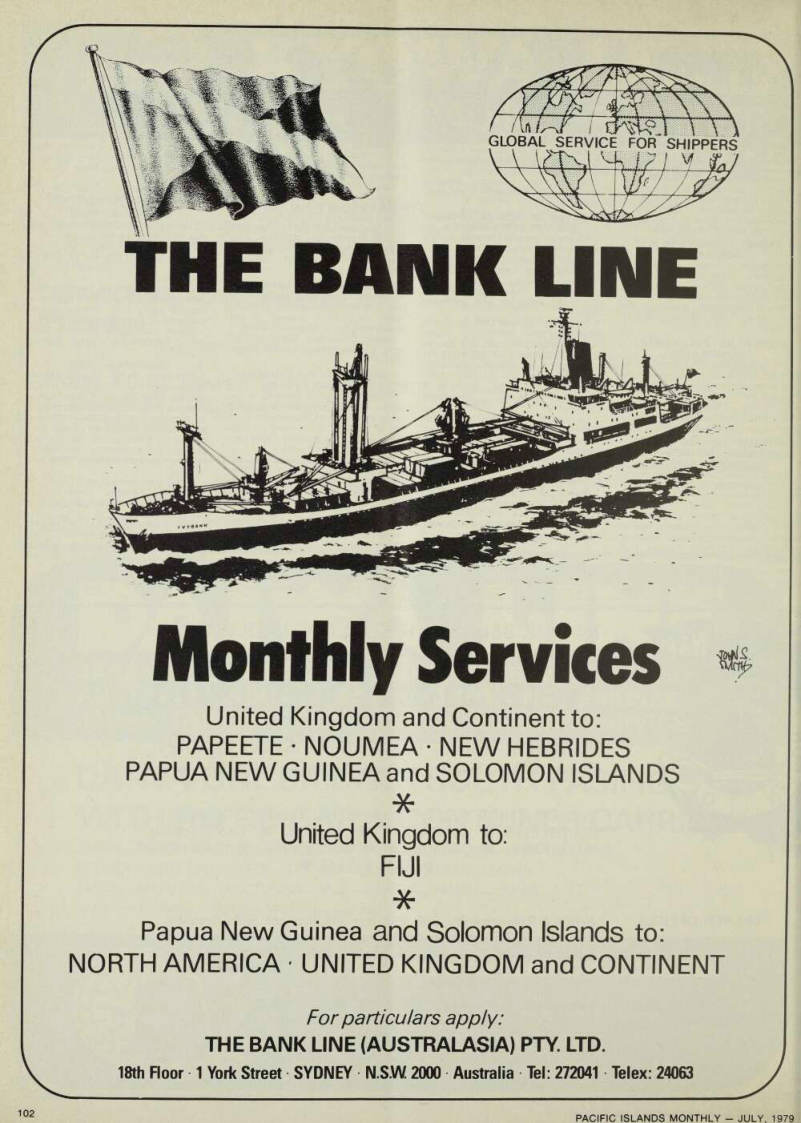
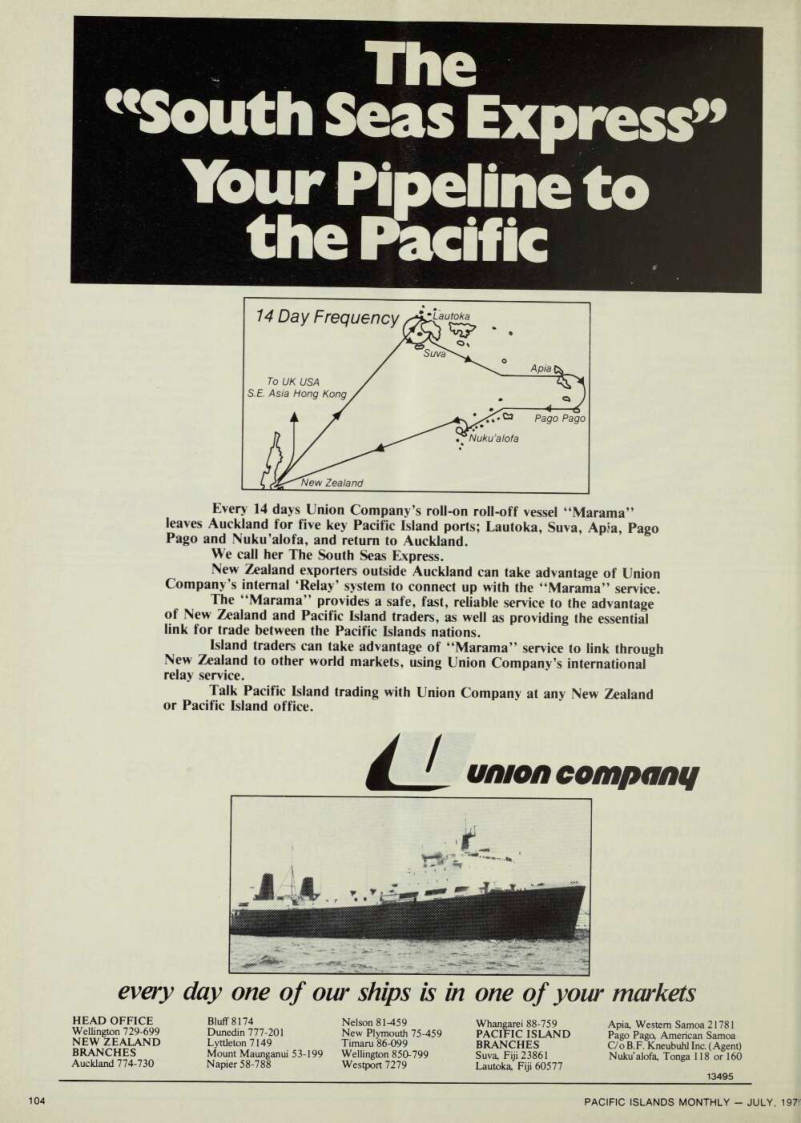
Services
These listings do not necessarily cover all services to Island ports.
Should any shipping company wish to have its services cargo and passenger included in these list ings they should contact PIM.
Sydney - Lord Howe Is -
Norolk Is
Compagnie des Chargeurs Caledoniens operates four-weekly cargo service Sydney - Lord Howe Island and Norfolk Island.
Details Hetherington Kingsbury Pty Ltd, 37-49 Pitt Street, Sydney (27-1671).
SYDNEY - NZ - FIJI - HAWAII -
Canada - Us
P & O liners call at Auckland, Suva, Honolulu and Vancouver on eastbound and westbound voyages between Syd ney and the US.
Details from P & O Booking Centre, World Travel Headquarters Pty Ltd, 33 Bligh Street, Sydney (231-6655).
AUSTRALIA - NZ - FIJI - TONGA - N. HEBRIDES - NOUMEA - PNG -
Solomons - Samoas
Sitmar Cruises operates a year-round cruise programme to include most of the above countries.
Details from Sitmar Cruises, 47 Elizabeth Street, Sydney (232-7511).
P & O liners call at Auckland, Bay of Islands, Honiara, Lautoka, Noumea, Nuku’alofa, Pago Pago, Papeete, Port Moresby, Santo, Savusavu, Suva, Vavau and Vila on cruises from Aus tralia.
Details from P & O Booking Centre,
World Travel Headquarters Pty Ltd, 33 Bligh Street, Sydney (231-6655).
Australia - Fiji - Samoas -
New Hebrides - Tonga -
Norfolk Island
Pacific Navigation of Tonga operates a five-weekly refrigerated general car go/container service from Sydney and Brisbane to Vila, Santo, Suva, Lautoka, Apia, Pago Pago, Nuku’alofa and Nor folk Island.
Details from Beaufort Shipping Agency Co, 2 Castlereagh Street, Syd ney (239-1022).
Australia - New Caledonia
(And/Or) New Hebrides
Karlander operates a monthly service from Sydney to Noumea.
Details: Karlander (Aust) Pty Ltd, 19-31 Pitt Street, Sydney (27-6301).
Sofrana-Unilines ships serve Noumea every three weeks from the main ports along the east Australian coast.
Details from Sofrana-Unilines, 37 Pitt Street, Sydney (27-2031), Trans- Austral Shipping Pty Ltd, 570 Bourke Street, Melbourne (67-9162), ACTA Pty Ltd, Brisbane (221-3116), Elders-ANL Pty Ltd, Port Adelaide (47-5688), ANL, Newcastle (049-24364), Clements & Marshall, Burnie, Tasmania (31-1833).
Campagnie des Chargeurs Cale domens operates a three-weekly con tainerised cargo service from Sydney to Noumea.
Details Hetherington Kingsbury Pty Ltd, 37-49 Pitt Street, Sydney (27-1671).
Compagnie Generale Maritime oper ates a monthly service from Sydney to Noumea, Port Vila and Santo, using M/V ‘Ymnos’ a self-sustained fully con tainerised vessel.
Details Compagnie Generale Mari time, 12 Castlereagh Street, Sydney (231-3700).
Australia - Fiji
Karlander (Aust) Pty Ltd operates
monthly cargo services from Sydney to Suva and Lautoka.
Details from Karlander (Aust) Pty Ltd, 19-31 Pitt Street, Sydney (27-6301), Dalgety Shipping, 461 Bourke Street, Melbourne (60-0731), Burns Philp (SS) Co Ltd, Suva and Lautoka.
Sofrana-Unilines (Fiji Express Line) operates to Suva and Lautoka every three weeks from the main ports on the east coast of Australia and monthly to Lautoka from Melbourne and Sydney.
Details from Sofrana-Unilines, 37 Pitt Street, Sydney, (27-2031), Trans- Austral Shipping Pty Ltd, 570 Bourke Street, Melbourne (67-9162), ACTA Pty Ltd, Brisbane (221-3116), Elder-ANL Pty Ltd, Port Adelaide (47-5688), ANL, Newcastle (049-24364), Clements & Marshall, Burnie, Tasmania (31-1833).
Australia - W. Samoa
Compagnie Generale Maritime oper ates a monthly service from Sydney to Apia, using M/V 'Ymnos' a self sustained fully containerised vessel.
Details Compagnie Generale Mari time, 12 Castlereagh Street, Sydney (231-3700).
Australia - Fiji - Tuvalu
- Samoas- Tonga
Pacific Forum Line operates a con tainer, unitised/palletised and reefer cargo service from Melbourne and Syd ney to Lautoka, Suva, Funafuti, Pago Pago, Apia and Nuku'alofa. Other ports are included on inducement.
Details from ANL Melbourne and Brisbane, Union Bulkships, Sydney, Hobart, Port Adelaide and Fremantle, Burns Philp (SS) Company Ltd, GPO Box 355, Suva. Fiji (311-777); Polynesia Shipping Services, Pago Pago: Union Steam Ship Co of NZ Ltd, Nuku’alofa; PWD, Funafuti; or Pacific Forum Line, PO Box 655, Apia, W.
Samoa.
Australia - Northern
Marianas - Micronesia
Nauru Pacific Line operates a regular
container service from Melbourne to Saipan, Truk, Ponape and Kosrai.
Details Nauru Pacific Line, Nauru House, 80 Collins Street, Melbourne, (653-5709), Nedlloyd Swire, 8 Spring Street, Sydney (2-0522).
Australia - Tonga -
Samoas - Tahiti
Karlander operates a monthly cargo service from Melbourne and Sydney to Nukualofa, Apia, Pago Pago, Papeete, US west coast.
Details: Karlander (Aust) Pty Ltd, 19-31 Pitt Street, Sydney (27-6301).
Australia - Tahiti
Daiwa Line offers a four-weekly ser vice from Australia to Papeete.
Details: Meridian Shipping & Trans port Agencies Pty Ltd, Box 3410 GPO, Sydney 2001 (29-4987), Tlx; AA25970.
Compagnie Generale Maritime oper ates a monthly service from Sydney to Papeete using M/V ‘Ymnos' a self sustained fully containerised vessel.
Details Compagnie Generale Mari time, 12 Castlereagh Street, Sydney (231-3700).
Australia - Png
Containers Pacific Express (Burns Philp and AWP Line) and NGAL/PNGL Operate chief Container Service from Australia to PNG-Solomon Islands ports on joint slot sharing basis. Three con tainer vessels operate on 28-day turn around from Melbourne, Sydney and Brisbane to Port Moresby, Lae, Rabaul, Kavieng, Wewak, Madang, Kieta and Honiara.
Details from Burns Philp & Co Ltd, 51 Pitt Street, Sydney (2-0547) and Interocean Swire, 8 Spring Street, Syd ney (2-0522).
New Guinea Express Lines operates three-weekly conventional and con tainer services Melbourne, Sydney, Brisbane, Port Moresby, Lae, Rabaul, Alotau.
Details from New Guinea Express Lines, PC Box R 73, Royal Exchange
’O, Sydney (241-3991) MacArthur ihipping Agency Co, 82-92 Eagle itreet, Brisbane (229-3777), New sumea Express Lines, 327 Collins itreet, Melbourne (61-3053), Niugini Express Lines in Port Moresby 21-2466), Lae (42-1536), Rabtrad liugmi Pty Ltd, Rabaul (92-2911), Jotau Stevedoring & T’sport 31-1318).
Karlander New Guinea Line’s cargo essels call at Melbourne, Sydney, Port loresby, Lae, Madang, Wewak, lanus, Kimbe, Rabaul, Popondetta.
Details from Karlander (Aust) Pty Ltd, 9-31 Pitt Street, Sydney (27-6301), lalgetty Shipping, 461 Bourke Street, lelbourne (60-0731).
Australia-Solomons
Northern Marianas-Taiwan
Japan
Daiwa Line offers a four-weekly ser ce Sydney-Honiara-Guam-Taiwan apan with transhipment at Guam for aipan.
Details Meridian Shipping & Trans ort Agencies Pty Ltd. Box 3410 GPO, ydney 2001 (29-4987). Tlx.
A 25970.
Australia - Solomons -
Gilbert Is - Micronesia
Daiwa Line operates a container ser ce every 30 days from Sydney to oniara, Kieta, Tarawa and Guam, Gizo argoes transhipped at Honiara, aipan, cargoes transhipped at uam.
Details Meridian Shipping & Trans art Agancies Pty Ltd, Box 3410 GPO /dney 2001 (29-4987), Tlx.
A 25970.
Australia - Nauru -
Majuro
Nauru Pacific Line operates regular argo/passenger service from Mel aurne to Nauru and Majuro.
Details: Nauru Pacific Line, Nauru ouse, 80 Collins Street, Melbourne
(6s3-5709), Nedlloyd Swire, 8 Spring Street, Sydney (2-0522).
Png - Uk/Continent
Bank Line operates regular cargo service from Kieta, Rabaul, Kimbe, Madang and Lae to Cardiff, Hamburg, Rotterdam and Antwerp.
Details from Bank Line (A'asia) Pty Ltd, 1 York Street, Sydney (27-2041); Burns Philp (PNG) Ltd, ports.
Png - Us
Bank Line operates regular cargo service from Kieta, Rabaul, Kimbe, Madang and Lae direct to New Orleans; calls at other US and Gulf and East Coast ports on inducement.
Details from Bank Line (A’asia) Pty Ltd, 1 York Street, Sydney (27-2041); Burns Philp (PNG) Ltd, PNG ports.
Solomons - Usa -
Uk/Continent
Bank Line operates regular cargo service from Honiara to New Orleans, Cardiff, Hamburg, Rotterdam and Ant werp.
Details from Bank Line (A'asia) Pty Ltd, 1 York Street, Sydney (27-2041); Trading Co, Honiara (389).
Far East - Fiji - New
Zealand
New Zealand Unit Express (CNC.
MNOL, Nedlloyd) operates a three weekly cargo service from Hong Kong to Lautoka, Suva, NZ ports, Manila, Kaoshiung, Keelung, Hong Kong.
Details from Nedlloyd, 8 Spring Street, Sydney (2-0522).
Nedlloyd operates monthly cargo service with three ships from Surabaya, Jakarta, Bangkok, Port Keland and Sin gapore to Suva and NZ ports.
Details from Nedlloyd (Aust) Pty Ltd, 8 Spring Street, Sydney (27-3801); Burns Philp (SS) Co Ltd, Suva and Lau toka.
Japan - Nz - Png
China Navigation Co, with three
ships operates a monthly cargo service from Japan to New Zealand calling at Lae on return journey.
Details Nedlloyd, 8 Spring Street, Sydney (2-0522).
Far East - Mid-S. Pacific
China Navigation Co's vessels oper ate a regular cargo service from Hong Kong, Taiwan and Singapore to Rabaul, Wewak, Madang, Lae, Port Moresby, Honiara, New Hebrides, Noumea, Papeete and Samoa.
Details from Nedlloyd, 8 Spring Street, Sydney (2-0522).
Kyowa Shipping Co Ltd, operates monthly services from Hong Kong, Taiwan, S. Korea and Japan, to Guam, Saipan, Solomons, New Caledonia, Fiji, Western and American Samoa, Tahiti, Cook Is., Tonga and New Hebrides.
Details: Hetherington Kingsbury Pty Ltd, 37-49 Pitt Street, Sydney (27-1671).
Daiwa Line operates 30-day service from Moji, Kobe, Nagoya and Yokohama to Papeete, Pago Pago, Apia, Suva, Lautoka, Noumea, Sydney, Honiara, Kieta, Tarawa, Guam and Taiwan.
Details: Meridian Shipping & Trans port Agencies Pty Ltd, Box 3410 GPO Sydney 2001 (29-4987) Tlx: AA25970.
North Europe - Tahiti -
New Caledonia
Hamburg-Sued operates monthly cargo services from Hamburg, Dunkirk and Le Havre to Papeete, Noumea, via Panama.
Details from Columbus Overseas Services Pty Ltd, 333 George Street, Sydney (290-2966), Columbus Mari time Services, 17 Albert Street, Auckland (77-3460),
Europe - Pacific Islands
Compagnie Generate Maritime oper ates services from Europe and Mediter
ranean ports to Papeete and Noumea using three Ro-Ro and one multi purpose vessel thus ensuring a bi monthly sailing to and from.
Details Compagnie Generate Mari time, 12 Castlereagh Street, Sydney (231-3700).
EUROPE - TAHITI - W. SAMOA -
Fiji - N. Caledonia
Nedlloyd offers regular cargo ser vices from Northern Europe and UK to Papeete, Apia, Fiji and New Caledonia.
Details Nedlloyd (Aust) Pty Ltd, 8 Spring Street, Sydney (27-3801).
JAPAN - GUAM - FIJI - TAHITI -
Samoa - N. Caledonia -
Solomons - Gilberts
Daiwa Lines runs a monthly cargo service from Japan via Guam to Lau toka, Suva, Papeete, Pago Pago, Apia.
Sydney, Noumea, Honiara, Tarawa, Guam.
Details from Burns Philp (SS) Co Ltd, Suva.
Nz - New Caledonia - Fiji
Pacific Forum Line operates a uni tized /palletized and reefer cargo ser vice from Lyttelton and Auckland to Napier, Noumea, Lautoka and Suva.
Other ports are included on inducement.
Details from Shipping Corporation of NZ Ltd, Auckland, Christchurch, Wellington, Burns Philp (SS) Company Ltd, GPO Box 355, Suva, Fiji (311 -777); Polynesia Shipping Services, Pago Pago; Union Steam Ship Co of NZ Ltd, Nukualofa or Pacific Forum Line, PO Box 655, Apia, W. Samoa.
Nz-N. Caledonia-N. Hebrides
Png-Solomons
Sofrana Unilines with three ships op erates to Vila and Santo, to Honiara and Papua New Guinea and to Noumea.
Details from Sofrana Unilines, 18
>stoms Street, Auckland (773-279), ) Box 3614, Telex NZ2313.
Nz - New Caledonia
- Solomons - Gilberts -
Micronesia
Jnion Co/Daiwa Line operates a ntainer service from New Zealand ough Sydney to Guam.
Details: Union Steam Ship Co of NZ J, PO Box 12, Auckland..
I - FIJI - NORTH AMERICA (WC) Blue Star Line Ltd Pacific Coast Con ner services. Only direct service to d from New Zealand. Blue Star ssels call at Suva and Honolulu on :-US-West Coast voyages.
Details from Blueport ACT (NZ) Ltd, I Box 192, Wellington (739-029) , rns Philp (SS) Co Ltd, GPO Box 355, va, Fiji (311-777).
Nz - Fiji
Reef operates a regular 18-day ser e from Auckland to Suva and Lau ;a.
Details from Reef Shipping Agencies I, PO Box 3382, Auckland, NZ r -1221 -3). 3 acific Line with one ship operates (nightly roro cargo service New aland, Lautoka, Suva.
Details: Sofrana Unilines, 18 Cus ns Street, Auckland (773-279) PO x 3614, Telex: NZ2313.
Nz - Fiji - Gilberts -
Solomons - Png
3 acific Forum Line operates a Con ner, unitised/palletised and reefer ■go service from Lyttelton and ckland to Suva, Port Moresby, Lae niara, Tarawa, Madang, Lae and rt Moresby. Other ports are included inducement.
Details from Shipping Corporation of Ltd, Auckland, Christchurch and tllington. Burns Philp (SS) Company I, GPO Box 355. Suva. Fiji (311 -777) livans, Honiara; Gilbert Islands Ship g Corporation, Tarawa; Steamships iding in Port Moresby, Lae and dang or Pacific Forum Line, PO Box 5, Apia, W. Samoa.
Jnion Steam Ship Co of NZ operates )11-on, roll-of, container/unitised ser b from Auckland to Lautoka-Suva -30 Pago-Apia-Nuku-alofa on a 14 ! frequency.
Details from Union Steam Ship Co of Ltd, PO Box 12, Auckland or from inch offices/agents in Fiji, Tonga d the Samoas.
Nz - Samoa - Tonga
Pacific Navigation of Tonga operates our-weekly cargo service, Auckland vluku’alofa - Pago Pago - Apia ckland.
Details from McKay Shipping Ltd, wntown House, Queen Street, ckland (33-656). /Varner Pacific Line services ehunga (Auck)- Nuku'alofa/Vavau/ ia fortnightly carrying general and szer cargoes. Also Timaru ku’alofa/Vavau/Apia every 21 days rying freezer cargo.
Details from Air Marine Services (NZ) I, PO Box 2505, Auckland 16-841), Telex NZ21555, NZ - COOK IS - NIUE -
Tahiti
Shipping Corporation of NZ Ltd oper is cargo services based on pallets J similar units from Auckland to Niue, ok Islands and Tahiti.
Details from the Shipping Corp of NZ I, PO Box 3420, Auckland J 7-210); Waterfront Commission, PO x 61, Rarotonga, Lighterage and jvedoring Co, Aitutaki, Niue Govt fices, Niue Island Compagnie Mari le Polynesienne, B’P’ 368, Papeete, hiti.
Uk - N Continent - Fiji
Fhe Bank Line operates a direct, fast mthly service from Hull, Hamburg, Bmen, Antwerp and Rotterdam to va and Lautoka.
Details from the Bank Line (Aus tralasia) Pty Ltd, 1 York St, Sydney (27-2041); Burns Philp (South Sea) Co Ltd, Suva and Lautoka.
Uk/N. Continent - Tahiti -
N. Caledonia - N. Hebrides
Bank Line operates regular cargo service from Hull, Hamburg, Bremen, Antwerp and Rotterdam to Papeete and Noumea, Details from Bank Line (A’asia) Pty Ltd, 1 York Street, Sydney (27-2041); Ets A M Fare UTE, Papeete; Ets Ballande, Noumea.
Uk/N. Continent - Png -
Solomons
Bank Line operates regular cargo service from Hull, Hamburg, Bremen, Antwerp and Rotterdam to Port Moresby, Lae, Madang, Kimbe, Rabaul, Kieta and Honiara and on inducement to Yandina.
Details from Bank Line (A’asia) Pty Ltd, 1 York Street, Sydney (27-2041); Burns Philp (PNG) Ltd, PNG ports; Trading Co Honiara.
Honolulu - Samoas - Tonga
Warner Pacific Line operates unit ized/palletized and reefer cargo ser vice every 45 days Honolulu/Pago Pago-Apia-Nuku'alofa. Line Islands and Suva by inducement.
Details from Hawaii-Pacific Maritime Inc, Honolulu, Hi 96801. Tel. (808)
(531-4841) Tlx (Rca): 723-8330 Itt
743-0040. Cables ‘Opal’
San Francisco - Honolulu -
Nauru - Micronesia
Nauru Pacific Line operates regular conventional/container service from San Francisco and Honolulu to Majuro, Ponape, Truk and Saipan. Cargo is accepted for Nauru and Kosrai with transhipment at Majuro and Ponape.
Details from Nauru Pacific Line, Nauru House, 80 Collins Street, Mel bourne (653-5709); North American Maritime Agencies, 100 California Street, San Francisco, California 9411 (981-0343).
US - FIJI - TAHITI - NZ -
Australia
Bank and Savill Line Ltd, operates regular cargo services from US Gulf ports to Australia and NZ. Calls at Suva, Lautoka and Papeete on demand.
Details from Bank Line (A'asia) Pty Ltd, 1 York Street, Sydney (27-2041) or Howard Smith Industries Pty Ltd, 1 York Street, Sydney (27-5611).
Us - Tahiti - Samoa
Pacific Islands Transport operates a five weekly cargo service from North America west coast ports to Papeete, Pago Pago, Apia.
Details from Polynesia Shipping Ser vices Inc, PC Box 1478 Pago Pago (9-6799).
Polynesia Line operates container and general cargo service from US west coast ports to Papeete and Pago
Pago.
Details from Polynesia Shipping Ser vices Inc., PO Box 1478, Pago Pago (9-6799).
US - TAHITI - SAMOA - NZ - AUST Farrell Lines Inc, operate a fast reg ular lash/container cargo service from west coast ports Canada/USA to Papeete and Pago Pago thence to NZ and Australia.
Details With Wilhelmson Agency, Sydney, Melbourne and Brisbane, Tlx AA20136, Cable FARSHIPS Sydney; Dalgety (NZ) Ltd, Auckland and Wellington, Tlx NZ2445, Cable DALSHIP Auckland; Compagnie Mari time Polynesienne, Immeuble Franco Oceanienne, PO Box 368, Papeete, Tahiti, Tel 26393, Tlx 258. FP ANSB Taporo, Cable OCEAN Papeete; Kneubuhl Maritime Service, PO Box 39, Pago Pago, Telephone 633-5121; Tlx 782505.
Advertisements & other items, pp. 101-106 (4 items)
101
’ACIFIC ISLANDS MONTHLY JULY, 1979
Nelson&Robertson
r>6Eff/- O & -0 ft 't'
FOR
IN OUR 85th YEAR SELLING ‘SERVICE’
TO THE PACIFIC ISLANDS . . .
Nelson&Robertson
PTY. LTD. (Established 1895)
Plantation House, 197 Clarence Street, Sydney.
Cables: ‘IVAN’, Sydney, Brisbane. Telex: AA22381, Sydney.
INDENTS - FROM AUSTRALIA, NEW ZEALAND and OVERSEAS.
FOODSTUFFS • HARDWARE • TRAVEL • CANNED FISH MACHINERY • INSURANCE • SOFTGOODS • JUTE GOODS
• REAL ESTATE •
BRANCH OFFICES: Nelson & Robertson Pty, Ltd., P.O. Box 575, Brisbane, Qld., Australia, P.O. Box 2092, Govt. Bldg., Suva, Fiji. P.O. Box 258, Lautoka, Fiji.
P.O. Box 2420, CPO Auckland 1, New Zealand.
PAPUA NEW GUINEA Rabtrad Niugini Pty. Ltd., P.O. Box 219, Rabaul, P.N.G.
REPRESENTATIVES: P.O. Box 1406, Lae, P.N.G. P.O. Box 711, Madang, P.N.G.
P.0.80x 253, Kieta, P.N.G. 1
i n 5
GLOBAL SERVICE FOR SHIPPERS
THE BANK LINE
Monthly Services <
United Kingdom and Continent to:
PAPEETE • NOUMEA • NEW HEBRIDES
PAPUA NEW GUINEA and SOLOMON ISLANDS
United Kingdom to;
FIJI
* Papua New Guinea and Solomon Islands to: NORTH AMERICA • UNITED KINGDOM and CONTINENT For particulars apply:
THE BANK LINE (AUSTRALASIA) PTY. LTD.
18th Floor 1 York Street SYDNEY N.S.W 2000 Australia Tel: 272041 Telex: 24063
p X T ♦ *
Pacific Navigation of Tonga Limited
SERVING THE PACIFIC FROM AUSTRALIA AND NEW' ZEALAND
NUKUALOFA:
PACIFIC NAVIGATION
OF TONGA LTD.
THE ADMINISTRATOR
NORFOLK ISLAND
SUVA, LAUTOKA, APIA,
PAGO PAGO AGENTS:
BURNS PHILP (S.S.) CO. LTD
VILA, SANTO AGENT:
BURNS PHILP
(NEW HEBRIDES) LIMITED
BEAUFORT SHIPPING
G.P.O. Box 3988, Sydney N.S.W.
Australia
McKAY SHIPPING LIMITED
P.O. Box 1372, Auckland New Zealand
REGULAR SAILINGS
OWNED TONNAGE
CONTAINERS
FREEZER
DEEP TANKS
CONTINUOUS PECEII TNG
HE A VY LIFTS
The
"South Seas Express"
Your Pipeline to
the Pacific
Every 14 days Union Company’s roll-on roll-off vessel “Marama” leaves Auckland for five key Pacific Island ports; Lautoka, Suva, Apia, Pago Pago and Nukualofa, and return to Auckland.
We call her The South Seas Express.
New Zealand exporters outside Auckland can take advantage of Union Company’s internal ‘Relay’ system to connect up with the “Marama” service.
The “Marama” provides a safe, fast, reliable service to the advantage of New Zealand and Pacific Island traders, as well as providing the essential link for trade between the Pacific Islands nations.
Island traders can take advantage of “Marama” service to link through New Zealand to other world markets, using Union Company’s international relay service.
Talk Pacific Island trading with Union Company at any New Zealand or Pacific Island office. /
union company
lit
-ljL
T V every day one of our ships is in one of your markets
HEAD OFFICE
Wellington 729-699
NEW ZEALAND
BRANCHES
Auckland 774-730 Bluff 8174 Dunedin 777-201 Lyttleton 7149 Mount Maunganui 53-199 Napier 58-788 Nelson 81-459 New Plymouth 75-459 Timaru 86-099 Wellington 850-799 Westport 7279 Whangarei 88-759
PACIFIC ISLAND
BRANCHES
Suva, Fiji 23861 Lautoka, Fiji 60577 Apia, Western Samoa 21781 Pago Pago, American Samoa C/o B.F. Kneubuhl Inc. (Agent) Nukualofa, Tonga 118 or 160 13495
PACIFIC
ISLANDS
TRANSPORT
LINE
MS AFRICANSTARS
Express Freight Service between Pacific Coast Ports of U.S.A. and...
Tahiti 6 Samoa
PAPEETE - APIA - PAGO PAGO
Full container service including reefers.
GENERAL STEAMSHIP CORPORATION LTD.
General Agents 400 California Street, San Francisco, California, U.S.A.
APIA: Bums Philp (South Sea) Company Ltd.
PAPEETE: Agence Maritime Internationale, Tahiti PAGO PAGO; Polynesia Shipping Services Inc.
■ PACIFIC
i FORUm
Lira
OWNED BY THE PEOPLE
OF THE PACIFIC ISLANDS
Regular Monthly Liner Services
from Australia and New Zealand
to the South and Central Pacific
FOR INFORMATION CONTACT AGENTS:
AMERICAN SAMOA:
Polynesian Shipping Services Inc. P.O. Box 1478, Pago Pago
AUSTRALIA:
The Australian National Line, 50 Queen Street, Melbourne.
Union Bulkships Pty.Ltd., 333-339 George Street, Sydney.
GILBERT ISLANDS:
Gilbert Islands Shipping Corp. P.O. Box 495, Tarawa.
FIJI:
Burns Philp South Sea Co. Ltd. GPO Box 355, Suva.
NEW CALEDONIA:
ETS Ballande, BP. C 4, Noumea.
NEW HEBRIDES:
Burns Philp New Hebrides Limited, Vila.
NEW ZEALAND:
The Shipping Corp. of N.Z. Ltd. P.O. Box 3344, Wellington
PAPUA NEW GUINEA;
Steamships Trading Co. Ltd. P.O. Box 1, Port Moresby.
SOLOMON ISLANDS.
Sullivans S.l. Ltd. GPO Box 3, Honiara.
TONGA:
Union Steam Ship Co. P.O. Box 4, Nuku'alofa.
PETER FISHER
TRADING
Pty Ltd
321 PITT St., SYDNEY, AUSTRALIA 2000
Telephone: 26 1109 Cables: "FISHE R ION" SYDNEY
EXPORTERS TO THE
PACIFIC ISLANDS
MAPS and PRINTS
of the OLD PACIFIC Regular catalogues issued listing a large stock of original antiquarian views and maps of Australia, New Zealand, Papua New Guinea and all the island groups of the Pacific. Write today for your free copy:
COLIN HINCHCLIFFE,
7 Royd Avenue, Heckmondwike, West Yorkshire, WFI6 9AL, UK.
§ o £ High reliability, totally marinised SOMA Windmills charge batteries to run lights, tools, water pumps, etc. 200 watt 12 volt unit SNZ850.
FOB Auckland. 500 watt 24 volt unit $NZ1000.
FOB Auckland.
Send for free brochure and c.i.f. quotes or send SNZ3.50 for post-paid Installation Manual.
SOMA
WINDMILLS LTD.
P.O. Box 94, Russell, New Zealand.
BEREAVEMENT
NOTICE
Charles Churchill Evans Late of 12 Darley St.,
Toowong, Queensland.
The family of Charlie Evans wishes to advise all his friends in Papua New Guinea Fiji and elsewhere in the Pacific Islands of his death in Brisbane on the 31st. March, 1979.
FOR MEN
onjv
magazines
Request Free Informaton From
ZEMPLIN P/L
SHOP 3
8-24 KIPPAX ST.
SURRY HILLS,N.S.W. 2010
AUSTRALIA.
SAILING SHIP FLEET
IN A SHOW-CASE
UNIQUE Wonderful Shipmodels in the international scale 1:1200/1250 of the Albert-Serie “Historical Shipmodels of 1750-1820” for example “Bounty", “Endeavour", “Victory", “Constitution”, “Shannon”. “Prince George”, “Ocean” and 40 others.
Ask for the prospectus by Alfred Albert, model-miniatures, Lippestrasse 16, 6200 Wiesbaden 13, Germany.
AGENT WANTED
We require an agent selling to Civil Builders, Hardware Stores and Government Councils. Our lines consist of Cast Iron Grates, Manholes and Pipe Fittings, Tape Measures, Pot Belly.
Stoves and Hammers. Our prices are most competitive. Contact Denis Parham, 23 Station Road, Seven Hills NSW 2147, Phone 624-5324.
POSITION WANTED
Electronic Technician, Electrician Broadcast Engineer, Fully Experiencec and licensed in all three fields. Younc American available for short or lone term employment anywhere.
Reply: John Gilchrist, Route 3, Lot 166 Urban Village, Kingsport, Tennessee
U.S.A. 37664
AGRICULTURAL AND INDUSTRIAL
DIESEL ENGINE
3 B.H.P AT
2000 P.P.M
★3,5, 6 and 12 B.H.P. ★ SINGLE CYLINDER
★ ECONOMICAL POWER
FOR ALL STATIONARY, AGRICULTURAL
AND INDUSTRIAL USES
FOR EXPORT PRICE LISTS CONTACT
MR. G. WATSON
SALES SPARES SERVICE
DIVISION OF
IXJLNISO
AUSTRALIA PTY LTD
12 RAGLAN ROAD. AUBURN. N SW.
(02)644 4711
FOR SALE
FLEETS 49 ft 6 inch x 17 ft x 6 fl
PARTLY PLANKED HULL, Timbers
frames, stringers fitted “AS IS ', including balance planking timber, timber tor decks, 3" Stainless Steel prop shaft, stern tube, $42,000 FLEETS 221 Esplanade, Wynnum Central, Brisbane. Cable “FLEETS
BRISBANE
penfriends New Caledonian lady wants penpak from the Pacific Islands. Exchange o sea-shells and visits are welcome Speaks also French and Germar Brunhilde Smerling, YATE, Nev\ Caledonia.
Shipping
103
<\CIFIC ISLANDS MONTHLY - JULY, 1979
Shipping
105
kCIFIC ISLANDS MONTHLY - JULY, 1979
Advertisers’ Index

Akai 2 Amatil 23 Air NZ 38 Air Nauru 42, 43 Air Niugini 66 Aggie Grey 72 Abbey Books 81 Aust Univeristy 84 ANZ Bank 98 British Aero 40 Breckwoldt 90 Brownbuilt 94 Beaufort Shipping 103 Bankline 102 Cable & Wireless 18
Caterpillar 28
Cathay Pacific 35 Citizen 78, 79 Clarion 82
Cumings 95
Daiwa Navigation 100 Foxjet 36 Fokker 60, 61 Furness 99 Frigid Cabinets 98 Goodyear 25 Hitachi 9 Hawker De Havilland 56 Hendon Detector 94 Helix 99
interscope i 4 lllawarra Coke 87 Kingston Cruiser 95 Kyowa Shipping 100 Macquarie 89 Modulock 90 Nelson & Robertson 101 Nissan 108 Pioneer 20, 21 Polynesian Air 50 Papua Hotel 72 Polynesian Books 77
Qbe 94
Suzuki 17 Sony 71 Sprusson & Fergusson 84
Sip. 90
Sansui 92, 93 Trio Kenwood 31 Telair 47 Toyota 54, 55 TraveLodge 72 Tokyo Kogaku 73 Tatham 86 Union Carbide 34 Union Steam 104 Victor JVC 107 Waterwheel 80 Yachting Partners 91
Advertisements & other items, pp. 107-108 (1 item)
What do you really see
when you watch TV?
t Hifi
PLkV
r. 1 IB » * * % a *r I s&A I Ml"!' Sjf r L rs& . * .1.
U *U *U lu *U lu 'U H mu \m u J
■W .. -. >\\ * qk
rrtr cr cr_gr <r cr nr 3| \
mn»n B
* VV.- ■•.-*. *i V r V* ' a t t t -v- “■ ‘ ” ft •r ■ fV" *\r t ■■* • •■■■• • i Do you see what you want to see? Has television lived up to its promise? Is it a medium of entertainment and enlightenment, or one of enslavement?
These are the serious questions. The answers lie in your ability to shape your own video environment.
To choose programs you want to view, when you want to view them.
The video tape recorder is by far one of the best tools yet devised to expand the creative process of television.
We know. We’re JVC, the innovative audio/video electronics company with 50 years plus one of experience. \m £ *- Australia: Hagemeyer(Australasia)B.V., 57/69 Anzac Parade, Kensington, N.5.W.2033 Australia Te 1.662-1222 FIJI Islands; D. Gokal & Co., Ltd., G.P.O. Box 501, Corner of Pier Street & Renwick Road, Suva. Fiji Te 1.25259 Cook Islands: J. & P. Ingram & Co., Ltd., P.0.80x 55, Rarotonga, Cook Islands Te 1.378457 New Hebrides: Wu ke Luong, P.0.80x 113, Rue Higginson, Port-Vila, New Hebrides Te 1.2115 For more than 20 years, JVC has been committed to the development of VTR. This experience plus JVC’s miniaturization technology has now led to the development of the compact, lightweight and easy-to-operate VHS video cassette recorder, the HR-3300 (pictured here). It’s the world’s first VHS model, and offers a host of JVC-developed technical advantages.
The way we see TV, JVC video systems are the key to freedom and rewarding leisure.
Our hope, of course, is that in the television of tomorrow you’ll see things our way.
JVC
New Caledonia: Caldis, 2, Route du Velodrome, B.P. Ml, Noumea. Cedex, New Caledonia Te 1.262350 Tahiti: Magasin Sincere. B.P. 215, Papeete, Tahiti Te 1.20060 Papua New Guinea: Hagemeyer(P.N.G.)Ptu, Ltd., P.0.80x 90 Lae, Papua New Guinea Te 1.42-3200 New Zealand; Atlas Majestic Industries Ltd., 11, Albion Road, Otahuhu, Auckland, New Zealand Te 1.27-67-099
This is no ordinary shower...
and neither is Datsun’s test
m pm m Extra” effort is a tradition at Datsun... it should come as no surprise that it’s a major factor contributing to Datsun’s worldwide reputation for total quality. Sure, engineering excellence is important, in addition to high technology and mass production with tight quality control. But, Datsun goes a step further and that makes all the difference in the world.
For example, prior to mass production, Datsun conducts complete testing to ensure car body watertightness. A special Shower Test on a ‘‘white body” is designed to duplicate the many possible conditions of motoring in the rain. Precisely controlled amounts of water flow over the body. The routes they take are analyzed and the results fed back to the engineering and design department.
Datsun’s special Shower Test on a “white body.’
In addition, a “twist” machine twists the entire body to simulate what actually happens when traveling over various road surfaces.
During the test, water constantly runs over the body to check for possible leaks. Testing extends to the actual production stage itself.
To be absolutely sure, newly painted cars are subjected to 8 hours of simulated rain as a final test for watertightness.
Seems like a lot of time and effort? Sure, but that’s all part of the Datsun tradition—the dedication to excellence. m
THE NAME OF QUALITY
Datsun’s “extra”effort for total quality. DATSUN ♦ Datsun Distributors: Boroko Motors Ltd. P.O. Box 1259, Boroko, Port Moresby, PN G /Carpenters Motors, Sales Division 61-63 Foster St. Walu Bay, Suva, Fiji Islands Private Mail Bag/ Morris Hedstrom Ltd. PO. Box 189, Apia, Western Samoa/ United Enterprises Ltd. P.O. Box 262, Honiara, Solomon Islands/ Sirius Motors PO. Box 34. Norfolk Island. South Pacific/ Jacob Enterprises P.O. Box 4, Republic of Nauru/ Cook Islands Motor Center Ltd. P.O. Box 74, Rarotonga, Cook Islands. South Pacific/ Pentecost Pacific S.A. P.O. Box 119, Port Vila, New Hebrides/ Agence Alma S.A. B P. A 3, Noumea Cedex, New Caledonia/ Tahitibull S.A.R.L. B.P 359, Papeete, Tahiti /Gilbert Islands Government, Supply Division PO. Box 71, Bairiki, Tarawa, Gilbert Islands