Pacific Islands Monthly

Pim
May 1979
American Samoa USSI.2S Australia AS I.oo*
Fiji FSI.OO
Hawaii USSI.SO Hew Cal. & Fr. PoI.CFP 140 New Hebrides ASI.OO HZ. Cook Is. & NiueNZSI.OO Norfolk Island ASI.OO Papua New Guinea Kl.OO Solomons SSI.OO Tonga Pl.OO USTT & Guam US$l.25 Western Samoa 11.00 • Recommended retail price only.
Rgmrjd fx>r posting as a publication
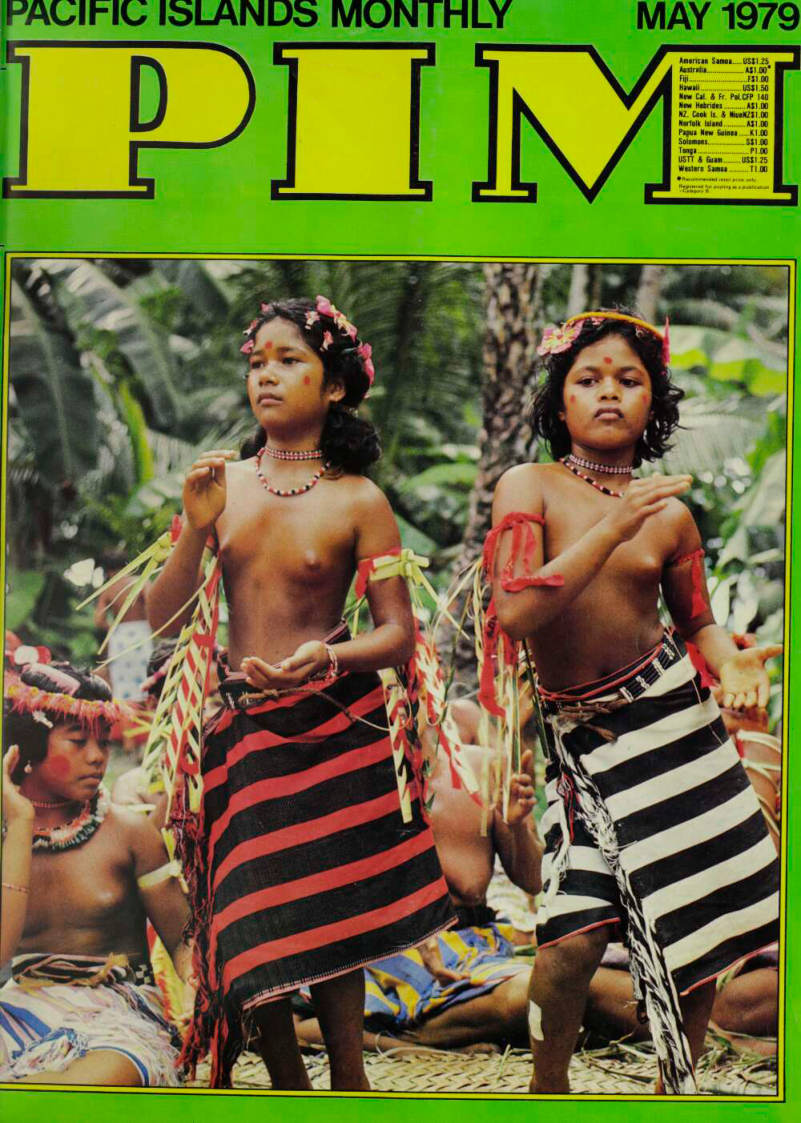
COVER: Youngsters, from
Puluwat in the Truk Islands
of Micronesia, in festival
mood. Photo: Charles M.
Sicard.
Advertisements & other items, p. 2 (1 item)
Akai
Aka i
r m \ r m^ er *■> S M SH
Fm/o£6smh, 7
g-ri-i? WijlPil
PS-200T FM/AM Digital Quartz Synthesizer Tuner
PS-200C DCPre Amplifier
PS-200M DC Power Amplifier
Audio & Video
AKAI
PNG.
S.O. Svensson (N.G.) Ltd.
P.O. Box 705, Port Moresby Tel: 2275 Fiji Islands Motibhai &Company Ltd.
P.0.80x 9175, Nadi International Airport Tel: 72-165
AKAI ELECTRIC CO., LTD.
Tokyo, Japan
New Zealand Pye Ltd., Consumer Products Sector 110 Mt. Eden Rd., Mt. Eden. Auckland Tel: 686-437 New Caledonia Menard Pacifique s.a.r.l.
B.P. H 2, Noumea Tel: 275222 Tahiti Etablissements Comimpex P.0.80x 200, Papeete Tel: 20477 New Hebrides (Islands) Burns Philp (New Hebrides) Co., Ltd.
P.O. Box 27, Port Vila, New Hebrides Islands Norfolk Island Burns Philp (Norfolk Island) Co., Ltd.
P.O. Box 21, Norfolk Island Samoa Islands Burns Philp (South Sea) Co., Ltd.
P.O. Box 129, Pago Pago, American Samoa Mariana Islands J.C. Tenorio Enterprises P.O. Box 137, Saipan Tel; 6444/8 Solomon Islands Security Electrical Co., Ltd.
P.O. Box 174, Honiara Tel: 881 Cook Islands JPS Enterprises Ltd.
P.O. Box 15, Rarotonga Tel: 2150, 2176 For more information, please send this coupon to our distributor in your country or to AKAI ELECTRIC CO., LIE 12-14, 2-Chome, Higashi-Kojiya, Ohta-ku, Tokyo, Japan
Pacific Islands Monthly
Pim
Vol. 50 No. 5
May 1979
(Usps 952480)
Elsewhere: SAI6 Payment by personal cheque is accepted in Australian.
US, New Zealand, UK and Fiji currency. For other remit tances please obtain a bank draft in Australian dollars made payable to the ANZ Banking Group, 88 Wentworth Avenue, Sydney, Australia
Representatives
AUSTRALIA: Distribution: NSW & ACT: Allan Rodney Wright (Circulation) Pty Ltd, PO Box 907, Darlinghurst, NSW 2010, Elsewhere: Gordon & Gotch (A/asia) Ltd, Box 40, PO, Rosebery, NSW 2018 Advertising - Melbourne - Pacific Publications (Aust.) Pty Ltd, sth Floor, Alley Building, 75-77 Flinders Lane, Melbourne 3000, tele phone 63-0211, ext. 1565 Jeff Gates, ext. 1858 Ida Pad gett; Brisbane D. Wood, Anday Agency, Box 1918 GPO, Brisbane 4001, telephone 44 3485, 44 1546: Adelaide - Hastwell Media, 233 Glen Osmond Rd, Frew ville, SA 5063, telephone 79 1869, 79 5956; cables Hast medla, Adelaide FIJI: Distribution and subscriptions - Desai Bookshops, PO Box 160, Suva, Fiji, telephone Suva 23036 Advertis ing Fiji Times & Herald Ltd. 20 Gordon St, Suva tele phone 312 111, telex FJ2124.
FRENCH POLYNESIA: Distribution Hachette Pacifique, 10 Ave Bruat, Papeete, telephone 2 5610.
HAWAII, UNITED STATES: Distribution PIM, Hawaii 2812 Kahawai St, Honolulu, Hawaii 96822 JAPAN: Advertising and subscriptions - Universal Media Corporation, -CPO Box 46, Tokyo telephone 666 3036.
NEW CALEDONIA: Distribution - Depot Centre de Presse Michel Pentecost, CBP2, Noumea, telephone 27 2434, 27 4729.
NEW ZEALAND; Distribution - Gordon & Gotch, PO Box 584, 2 Carr Road, Mt Roskill, Auckland 4 Advertising - International Media Representatives Ltd, PO Box 2313 Auckland, telephone 795 487; 493 389, cables Intereps, Auckland Subscriptions - Ross Haines & Son Ltd PO Box 1289, Auckland, telephone 769 042.
PAPUA NEW GUINEA; Distribution Robert Brown & Assoc., PO Box 3395, Port Moresby, telephone 2 5855 Advertising - PNG Post-Courier, PO Box 85 Port Moresby, telephone 212577.
UNITED KINGDOM: The Herald & Weekly Times Ltd, 8-10 Clifford s Inn, Fetter Lane, London EC4A IBU, telephone 01 831 6041, telex London 21989.
UNITED STATES MAINLAND: Advertising - Joshua B Powers Jr, Powers International Inc., 551 Fifth Ave New York, New York 100 017, telephone 867 9580, telex 236514 Subscriptions - PIM, Hawaii, 2812 Kahawai St Honolulu, Hawaii 96822.
Published monthly by Pacific Publications (Aust.) Pty Ltd and printed in Australia by Paramac, Alexandria, NSW.
Australian cover price is recommended retail only. Regis tered at the GPO Sydney for transmission by post as a publication category B. Second class postage paid at Honolulu, Hawaii. Copyright ? 1978 Pacific Publications
(Aust.) Pty Ltd.
Postmaster Honolulu: Send address changes to PIM Hawaii, 2812 Kahawai St Honolulu, Hawaii 96822
Aust.
Other American Samoa $13 $US16 Australia $12 Canada $14 $US18 Cook Islands $13 Fiji $12 $F12 French Polynesia $14
Cfp 1700
Guam $13 $US16 Gilbert Islands $13 Hawaii $13 $US16 Japan $16 Y4500 Micronesia $13 $US16 Nauru $13 New Caledonia $14
Cfp 1700
New Hebrides $13 New Zealand $12 $NZ13.50 Niue $13 Norfolk Island $12 Northern Marianas $13 $US16 Papua New Guinea $13 K12 Solomon Islands $13 Tonga $13 Tuvalu $13 United Kingdom $15 £10 US Mainland $14 $US18 Western Samoa $13
This Month
• Tuvalu Prime Minister Toalipi Lauti has staked his country’s all with Blue Chip Realty Investments of California 42 • Health Specialists examine three aspects of health in the Pacific 9 • France in the Pacific Le Monde takes a studied look at Paris’s plans for France’s Pacific future.
It looks like the French intend to hang on to their colonies 19 • Travel In Papeete, when the tourism ‘experts’ got together, they forgot about the tourists and the Islanders 25 • Tonga Libya’s Colonel Gaddafi and Tonga’s king have done a deal 33 • New Caledonia Paris has sacked the local government council and put its own man in full control 37 . Fiji Ratu Mara wants to retire but not before he can leave a tidy ship of state 37 • Western Samoa Tupuola Efi has scraped back into power. His road ahead will be trodden more cautiously than before 41 • Pacific War Tonga’s Crown Prince reviews the latest history of the war in the Pacific 63 • Solomon Islands The agriculture scene looks promising but there are pitfalls to be watched 73
Advertisers' index 90 Afterthoughts 23 American Samoa 9 Aviation 79, 80 Books 61 Cook Islands 5,9, 11, 28 Deaths 68 Fiji 9, 37, 54, 75 French Polynesia 4,5, 19, 25, 33, 58 Gilbert Islands 9 Guam 9 Hawaii 33 Health 9 Islands Press 49 Letters 4 Micronesia 9 New Caledonia 4,9, 19, 37, 79 New Hebrides 19, 35, 41, 78 New Zealand 11 Niue 11, 31
Norfolk Island 45 Pacific Report 7 PNG 10, 23, 57, 58, 60, 63 People 50 Political currents 33 Shipping services 85 Solomon Islands 54, 64, 70, 73
Spc 38
The Region 9, 26, 61, 63, 79 Tokelau 11, 58 Tonga 11,33 Tradewinds 73 Tradewinds Intelligence 79 Travel 25 Tropicalities 54
Ttpi 7
Tuvalu 42 Western Samoa 33, 41, 57, 60. 79 Yachts 81 Yesterday 70
Tuvalu’s Toalipi Lauti... big spending In the United States.
Libya’s Gaddafi... a deal with Tonga’s King Taufa’ahau Tupou IV.
Advertisements & other items, p. 3 (1 item)
3
PACIFIC ISLANDS MONTHLY MAY, 1979
Founded 1930 by R. W. Robson Publisher Stuart Inder Editor Bob Hawkins Editorial Adviser John Carter Manager John Berry Advertising Steve Gray, Peter Bedwell A Pacific Publications production 76 Clarence Street, Sydney 2000 GPO Box 3408 Sydney 2001 Cables; PACPUB Sydney Telex: Pacpub 21242 Telephone; Sydney 29 6693
SUBSCRIPTIONS
PIM is airfreighted to most subscribers and agents in the Pacific Islands and the United States.
Letters
A kind call from
Captain Withers
Would you please note that I no longer reside at Dick’s Place, on Malolo Lailai Island, (via Nadi Airport), Fiji . . . and that my new, current and prob ably final address is Trevor Withers, MBE, KCMC, The Defence Club, Suva, Fiji.
Thank you very much.
And, while on the subject of requests, would you please be good enough to forward to your founder the rightly revered Mr R.W. Robson my
respectful but quite affection
ate regards? Dear old Robbie!
I’m getting a little old myself .. . but my memories of that human dynamo and brilliant
journalist known far beyond
Australia as ‘Robbie’ remain, thank God, undimmed by the passing of the years.
I chuckled myself to sleep
last night when having happily
waded through many volumes of PIM during the past week, I came across and read for the umpteenth time ‘Lautoka’s Case of the Shrouded Corpse’ in PIM of July 1966.
What a man! That quite
intriguing story factually
true in every detail had its
birth when, on the day follow ing the event. I’d had the privi lege of buying Robbie an evening drink in Lautoka’s Northern Club. He was politely interested but only in a cursory' way. As I was subsequently to discover from PIM, he had a
photographic memory!
Stuart Inder and John Carter may well say, ‘Hell! When did Trevor Withers receive a knighthood? Since when has he been KCMC?’ A fair enough
question! It’s a long
story ... but KCMC - not to be confused with KCMG merely means ‘Kindly Call Me
Captain’. My quite miniature
award of the MBE is a more re cent, realistic and genuine one.
But I’ve had so much fun and games out of my KCMC. ‘nighthood’ that I refuse to sur render this!
Suva Fiji
Trevor S. Withers
Aborted take-off
from Papeete
I read with great interest in your January issue that Con tinental Airlines is shortly to be given permission to fly to New Zealand and Australia. It should be a great boon to trav ellers. I have flown many miles, in the USA and overseas, on Continental and have found their service efficient, comfort able and friendly. The same cannot be said of some of the present monopoly air carriers.
My wife and I recently bought full fare tickets we hoped would take us on a leisurely trip to Tahiti, the Cook Islands, Western Samoa, Tonga, New Zealand, New Caledonia, Fiji, Honolulu, and back to California.
After a week in Tahiti, where the weather was bad and the French unfriendly, we decided to continue our journey, per haps returning to Tahiti when the weather improved (our ex pensive tickets would have per mitted that). But neither UTA nor Air New Zealand would honour our onward tickets.
UTA said they might be able to take us at the end of March.
An Air New Zealand official suggested we stay in Tahiti and that he would sell us a building lot so that we could do so.
I don’t suppose that this kind
of airline arrogance will seriously hurt the economy of the South Pacific. We had
budgeted only SUS6OOO (with
American Express back-up) for
our trip. In any case, we were forced to return to California and will probably spend our money later in Hawaii. Or, if Continental gets permission to fly where we want to go, we might try again. In sorrow.
Frederic C. Coonradt
Pasadena California An unsigned copy of Mr Coonradt's letter was sent to both Air New Zealand and UTA for comment. Air New
Zealand's public affairs man
ager, Gordon Stepto, replied as follows: ‘You will apprec iate . . . that it is difficult for us to comment on a letter. . . which has been sent to a third party and not to us directly... we would expect that he would have dealt with us directly had he wished to take issue over any as pect of Air New Zealand's ser vice or operation ... I find it impossible to answer criticism levied by your reader. We have no idea of his identity or the dates and flights on which he travelled. With this information at hand, I can assure you that we would, as a matter of course, have investigated the incident fully and whatever action necessary would have been taken... Air New Zealand takes seriously any cri ticism . . . be it in standard of service or conduct of ground per sonnel and the airline is well able to investigate the veracity of such complaints ... Air New Zealand's reputation is well known in the South Pacific and we will go to whatever length necessary to protect that PIM had not heard from UTA at press time.
1878 Revolt: Latham
answers Guiart
I refer to Jean Guiart’s com ments on my thesis The 1878 Revolt on New Caledonia (PIM
Yesterday April).
I think much of the bitter ness of Professor Guiart’s re view comes from my having pointed out that his calcu lations of how many rebels were killed in 1878 use the 1954 census as an approximation of
pre-1878 population figures.
This leaves one of the leading tribes of the revolt with 17 men, women and children.
Professor Guiart raises the
age-old fear of anthropologists
that historians believe every thing they see on paper. Far from doing this, I showed in the book that our present picture of the revolt is the result of
wholesale manipulation by the
French administration in 1878.
The report of the official in quiry into the revolt has been
accepted completely as an
impartial examination of the revolt’s causes, but the inquiry included officials whose actions largely caused the re bellion and who were accused of gross cowardice during the outbreak. More than this, orders were given at the begin ning of the revolt which sent 80 Europeans, New Hebrideans and Indians to their death. The administration used its enor mous powers of censorship and coercion to make its version of why the revolt broke out and what happened on the first two days the only one transmitted to Paris, and so, ultimately, to us.
The official story was that most tribes on New Caledonia had been plotting a gigantic re volt for months when unim portant events touched it off prematurely in June 1878. This version, which ironically appeals to modern New Caledonian nationalists, obviously diverts attention from the circumstances of the first outbreaks.
Professor Guiart accuses me of crying over European deaths and ignoring the army’s shoot ing of innocent Melanesians.
The book’s purpose in the sec tions on the revolt was not to detail atrocities by either side but to explain what the admin istration had to cover up.
More generally, the book attempts to shift the French ad ministration and settlers from the central position they be lieved they occupied to a more realistic spot on the stage. This involves showing the adminis tration as. at times, for instance on the land issue, a fairly tooth less organisation which may have wanted to oppress but was
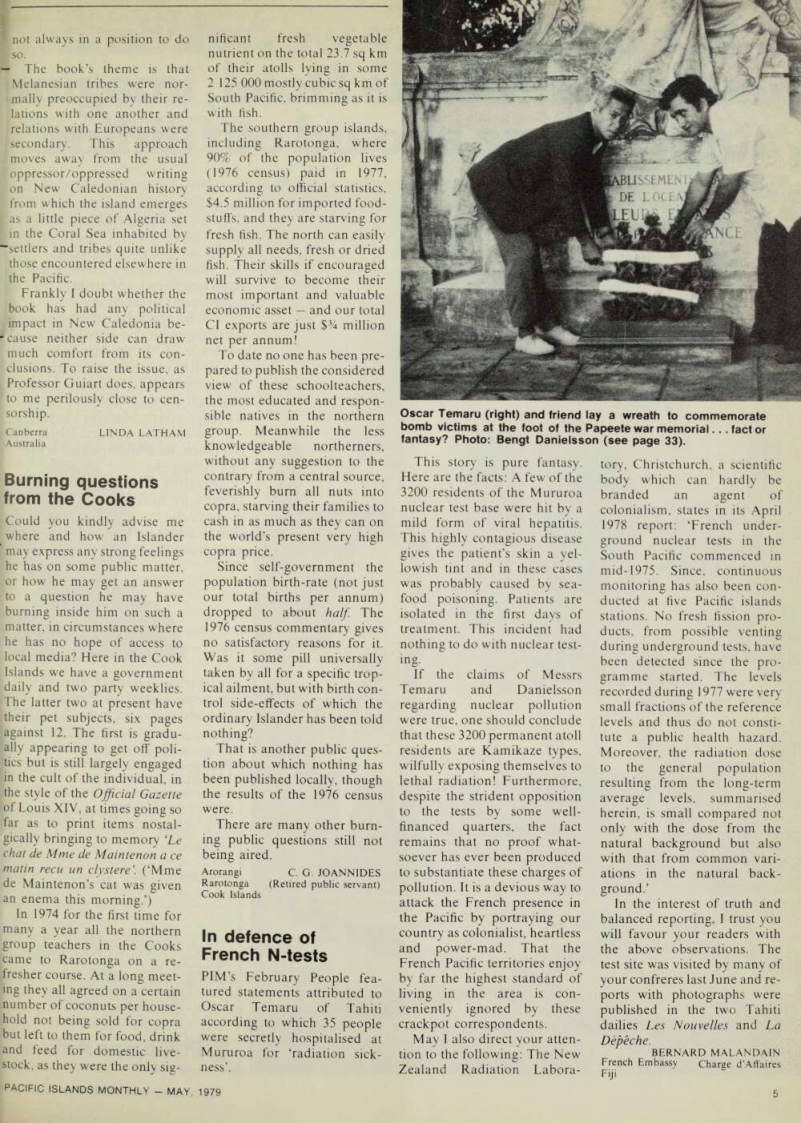
Captain Withers, KCMC, in the sixties... something he won’t surrender
I not always in a position to do
I so.
The book’s theme is that Melanesian tribes were nor
mally preoccupied by their re
lations with one another and relations with Europeans were
secondary. This approach
moves away from the usual I oppressor/oppressed writing
|on New Caledonian history
from which the island emerges I as a little piece of Algeria set ■ in the Coral Sea inhabited by ““settlers and tribes quite unlike those encountered elsewhere in the Pacific.
Frankly I doubt whether the book has had any political impact in New Caledonia be ’cause neither side can draw much comfort from its con clusions. To raise the issue, as Professor Guiart does, appears 'to me perilously close to cen
sorship.
Canberra Australia
Linda Latham
Burning questions
from the Cooks
Could you kindly advise me where and how an Islander may express any strong feelings he has on some public matter, or how he may get an answer to a question he may have burning inside him on such a matter, in circumstances where he has no hope of access to local media? Here in the Cook Islands we have a government daily and two party weeklies.
The latter two at present have their pet subjects, six pages against 12. The first is gradu ally appearing to get off poli tics but is still largely engaged in the cult of the individual, in the style of the Official Gazette of Louis XIV, at times going so far as to print items nostal gically bringing to memory ‘Le chat de Mme de Maintenon a ce matin recu un clystere’. (‘Mme de Maintenon’s cat was given an enema this morning.’) In 1974 for the first time for many a year all the northern group teachers in the Cooks came to Rarotonga on a re fresher course. At a long meet ing they all agreed on a certain number of coconuts per house hold not being sold for copra but left to them for food, drink and feed for domestic live stock, as they were the only sig
nificant fresh vegetable nutrient on the total 23.7 sq km of their atolls lying in some 2 125 000 mostly cubic sq km of South Pacific, brimming as it is with fish.
The southern group islands, including Rarotonga, where 90% of the population lives (1976 census) paid in 1977, according to official statistics, $4.5 million for imported food stuffs, and they are starving for fresh fish. The north can easily supply all needs, fresh or dried fish. Their skills if encouraged will survive to become their most important and valuable economic asset and our total Cl exports are just $% million net per annum!
To date no one has been pre pared to publish the considered view of these schoolteachers, the most educated and respon sible natives in the northern group. Meanwhile the less
knowledgeable northerners,
without any suggestion to the contrary from a central source, feverishly burn all nuts into copra, starving their families to cash in as much as they can on the world’s present very high
copra price.
Since self-government the
population birth-rate (not just
our total births per annum) dropped to about half. The 1976 census commentary gives no satisfactory reasons for it.
Was it some pill universally taken by all for a specific trop ical ailment, but with birth con trol side-effects of which the ordinary Islander has been told
nothing?
That is another public ques tion about which nothing has
been published locally, though
the results of the 1976 census were.
There are many other burn
ing public questions still not
being aired.
Arorangi Rarotonga Cook Islands
C. G. Joannides
(Retired public servant)
In defence of
French N-tests
PlM’s February People fea tured statements attributed to Oscar Temaru of Tahiti according to which 35 people were secretly hospitalised at Mururoa for ‘radiation sick ness’.
This story is pure fantasy.
Here are the facts: A few of the 3200 residents of the Mururoa nuclear test base were hit by a mild form of viral hepatitis.
This highly contagious disease
gives the patient’s skin a yel
lowish tint and in these cases was probably caused by sea food poisoning. Patients are isolated in the first days of treatment. This incident had nothing to do with nuclear test
ing.
If the claims of Messrs Temaru and Danielsson
regarding nuclear pollution
were true, one should conclude that these 3200 permanent atoll residents are Kamikaze types,
wilfully exposing themselves to
lethal radiation! Furthermore,
despite the strident opposition
to the tests by some well financed quarters, the fact remains that no proof what soever has ever been produced to substantiate these charges of pollution. It is a devious way to attack the French presence in the Pacific by portraying our country as colonialist, heartless and power-mad. That the French Pacific territories enjoy by far the highest standard of living in the area is con
veniently ignored by these
crackpot correspondents.
May I also direct your atten tion to the following: The New Zealand Radiation Labora
tory, Christchurch, a scientific body which can hardly be branded an agent of colonialism, states in its April 1978 report: ‘French under ground nuclear tests in the South Pacific commenced in mid-1975. Since, continuous monitoring has also been con ducted at five Pacific islands stations. No fresh fission pro
ducts, from possible venting
during underground tests, have
been detected since the pro gramme started. The levels recorded during 1977 were very small fractions of the reference levels and thus do not consti tute a public health hazard.
Moreover, the radiation dose
to the general population
resulting from the long-term
average levels, summarised herein, is small compared not only with the dose from the natural background but also with that from common vari ations in the natural back
ground.’
In the interest of truth and balanced reporting, I trust you will favour your readers with the above observations. The test site was visited by many of your confreres last June and re ports with photographs were published in the two Tahiti dailies Les Nouvelles and La
Depeche.
Bernard Malandain
French Embassy Charge d’Affaires Fiji
Oscar Temaru (right) and friend lay a wreath to commemorate bomb victims at the foot of the Papeete war memorial...factor fantasy? Photo: Bengt Danielsson (see page 33).
Advertisements & other items, p. 6 (1 item)
your welcome aboard our airline.
If this is the way we welcome
you to your Manila Hotel, imaging
? " ? \ t From Port Moresby to the bargain-rate magnificence of the new hotels of Manila. And all on your way to wherever els in the world you’re going.
Every Friday Philippine Airlines flies to Manila, and a different kind of Asia.
A bargain hunter’s paradis starting with the value-packed package of “Stopover Manila’’ for as little as KI(T a night (or K share twin). Or, for a little extra you can stay at this very hotel, the legendary Manila Hotel.
Welcome aboard Philippir Airlines, and the special style of Philippine hospitality. The great way to from New Guinea to a new world! fly Philippine Airlines, Burns House, Champion Parade, Port Moresby, Phone: 211108 *Not including airfare Please send me details of Philippine Airlines' STOPOVER
MANILA.
Post coupon to: Philippine Airlines
P.O. Box 3271 PORT MORESBY.
Name Address
ilippineAirli
Pacific Report
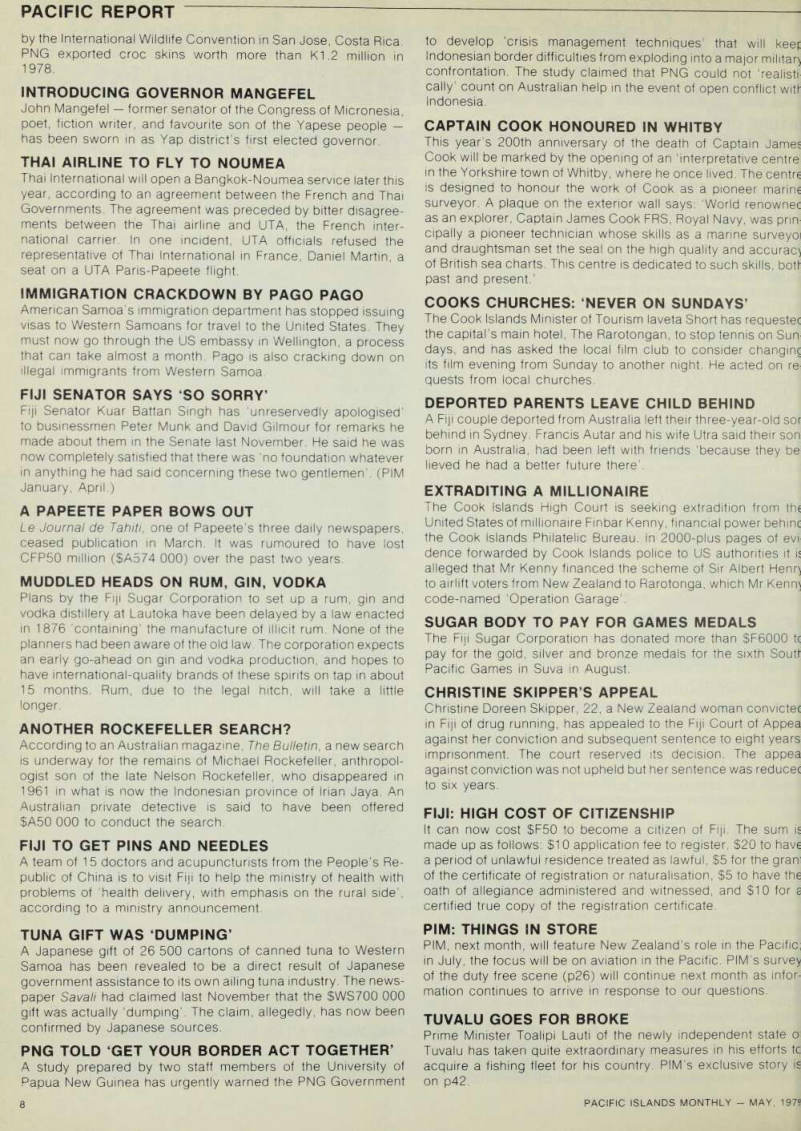
Nature Grabs The Headlines
Natural forces were the top Pacific Islands newsmakers over the March-April period. Fiji’s Cyclone Meli (Tropicalities) was certainly the most destructive of life and treasure. But Meli was far from alone in manifesting natural furies. Rob Cooke, senior vulcanologist with the Papua New Guinea Government, and his assistant Elia Ravan were killed in March by a ‘fireball’ from the volcano on Karkar Island, north of Madang. The men were at Jheir observation post on the rim of the caldera, about 800 m from the killer vent, when the tragedy occurred. In an editorial tribute, the PNG Post-Courier said: ‘Both men were aware of the risks involved but put duty before their own safety.’ British and French authorities were meanwhile rushing aid to stricken villagers in the Sesivi region of central Ambrym, New Hebrides, .whose plantations and homes were devastated by burning ashes from Benbow volcano during an eruption. In the Papua New Guinea capital, Port Moresby, panic-stricken office-workers rushed to the streets as the city was rocked by an earth tremor the most severe for years in the Papuan region which measured almost six on the Richter scale. Most buildings were without electricity for about two hours.
Paris Sacks Noumea Government
The French Government in March dissolved the government council of New Caledonia, vesting direct control of the territory in High Commissioner Claude Charbonniaud. (Political Cur rents.)
Tupuola Efi Swallows The Pill
Back in office by the narrowest possible margin, Western Samoa’s Prime Minister Tupuola Efi has heeded the warning served on him by parliamentary colleagues by carrying out a drastic cabinet reshuffle. (Political Currents.)
Libya To Aid Tonga
Following a visit to Libya by Tonga's King Taufa’ahau Tupou IV, Islands politics takes on a new dimension with the imminent appearance of this Arab republic as an aid donor to the region.
(Political Currents.)
NEW HEBRIDES: BIRTH OF THE FEDERAL PARTY Political opponents of the Vanuaaku Party in the New Hebrides have pulled themselves together in a new political party, the New Hebrides Federal Party. (Political Currents.) The VP, meanwhile, announced plans for a ‘test election programme’ extending through April-June, designed to measure the party’s public sup port in preparation for the elections expected later in the /ear.
Death Of Minerva Hero Tevita Fifita
Moted Tongan sea captain, Tevita Fifita, 59, died of a heart attack in Apia in March. Captain Fifita achieved Pacific-wide f ame in 1962 when he engineered the rescue of 12 of the 17 nen stranded for 102 days after shipwreck on remote Minerva southwest of Tonga. The epic ordeal demanded the sacri ice of his son Sateki. Three other survivors his elder son Talo, Feiapa a Bloomfield, and Soakai Pulu attended the traditional xjrial rites for Captain Fifita in Nukualofa.
Banabans Lose Their Marbles
Police on Ocean Island (Banaba) seized a large cache of marbles in March to forestall their use as ammunition for sling shots. The marbles were evidently stored for use in the Banabans’ campaign against the operations of the British Phos phate Commission, and for separation of the island from the new independent Kiribati (former Gilbert Islands) due to come into
being in July. In Australia, the Banabans’ campaign got a shot in the arm with the screening in mid-April by Australian Broad casting Commission television channels of the much acclaimed British documentary Go Tell it to the Judge. The film tells the story of the mammoth 1977 legal action brought by the Banabans against the British Government.
Micronesians To The Polls
Elections to the first congress of the Federated States of Micronesia were held on March 27 in the district of Ponape, Kosrae, Truk and Yap.
Canton Will Join Kiribati
Canton Island in the Phoenix Group, half-way between Honolulu and Noumea, which has been under joint Anglo-American ad ministration since 1939, will become part of the Gilbert Islands (new name Kiribati) in 1980. A spokesman at the US embassy in Suva told PIM the United States, with the consent of Britain, the other signatory to the agreement, has decided to surrender its claim to the island.
Solomon Islands-France Tie Knot
Solomon Islands has established diplomatic relations with France, bringing to 10 the number of countries with which Honiara has diplomatic links.
Salato In Micronesia
The outgoing secretary-general of the South Pacific Com mission, Dr Macu Salato, has paid his first visit to the US Trust Territory of the Pacific Islands, visiting all district centres includ ing Saipan and Guam. Dr Salato's term as secretary-general expires in June. He will be succeeded by M. Young Vivian, a minister in Niue’s government.
Paris Takes Over Clipperton
Clipperton Island, an uninhabited French dependency 2900 km due west of the Panama Canal, has been switched from the auth ority of the governor of French Polynesia to that of the govern ment in Paris. With the application of a 200-rnile economic zone, Clipperton would have a zone of economic interest of 324 000 sq km.
New Hebrides Franc Gets The Nod
The currency of the independent New Hebrides should be based on the New Hebrides franc, according to recommendations put by visiting British and French monetary experts at a press con ference in Vila in March. They said the NHF had been ‘healthier’ in recent years than the Australian dollar, the other currency now in use in the country.
Png: A Costly Parliament House
Estimated cost of Papua New Guinea’s new parliament house has soared to Kina 11 million from the original 1976 figure of K 7 million.
Nabanga’ Goes Weekly
The official French/Bislama newspaper in the New Hebrides, Nabanga, went over from fortnightly to weekly publication in March as part of plans for a high-profile cultural and diplomatic role for the French in the New Hebrides after independence.
100 Years Of Indians In Fiji
Fiji is to pay tribute to the centenary of the arrival in the country of Indians as indentured labourers. A SF2 million centre for multi cultural studies will be set up at Lautoka. The centre, apart from being a tribute to the first 1879 arrivals, will also symbolise the vision and goodwill of Fiji’s contemporary leaders and citizens, said Ram Vilash, secretary of the celebrations committee.
PNG WINS BY THE SKIN OF A CROC TOOTH Papua New Guinea won a major diplomatic battle when it nar rowly succeeded in winning exemption of salt water crocodiles from a proposed international ban on trade in crocodile skins
by the International Wildlife Convention in San Jose, Costa Rica.
PNG exported croc skins worth more than K 1.2 million in 1978.
Introducing Governor Mangefel
John Mangefel former senator of the Congress of Micronesia, poet, fiction writer, and favourite son of the Yapese people has been sworn in as Yap district’s first elected governor.
Thai Airline To Fly To Noumea
Thai International will open a Bangkok-Noumea service later this year, according to an agreement between the French and Thai Governments. The agreement was preceded by bitter disagree ments between the Thai airline and UTA, the French inter national carrier In one incident, UTA officials refused the representative of Thai International in France, Daniel Martin, a seat on a UTA Paris-Papeete flight.
Immigration Crackdown By Pago Pago
American Samoa’s immigration department has stopped issuing visas to Western Samoans for travel to the United States. They must now go through the US embassy in Wellington, a process that can take almost a month. Pago is also cracking down on illegal immigrants from Western Samoa.
Fiji Senator Says So Sorry’
Fiji Senator Kuar Battan Singh has 'unreservedly apologised’ to businessmen Peter Munk and David Gilmour for remarks he made about them in the Senate last November. He said he was now completely satisfied that there was ‘no foundation whatever in anything he had said concerning these two gentlemen’. (PIM January, April.)
A Papeete Paper Bows Out
Le Journal de Tahiti, one of Papeete’s three daily newspapers, ceased publication in March. It was rumoured to have lost CFPSO million ($A574 000) over the past two years.
Muddled Heads On Rum, Gin, Vodka
Plans by the Fiji Sugar Corporation to set up a rum, gin and vodka distillery at Lautoka have been delayed by a law enacted in 1876 ‘containing’ the manufacture of illicit rum. None of the planners had been aware of the old law. The corporation expects an early go-ahead on gin and vodka production, and hopes to have international-quality brands of these spirits on tap in about 15 months. Rum, due to the legal hitch, will take a little longer.
Another Rockefeller Search?
According to an Australian magazine, The Bulletin, a new search is underway for the remains of Michael Rockefeller, anthropol ogist son of the late Nelson Rockefeller, who disappeared in 1961 in what is now the Indonesian province of Irian Jaya. An Australian private detective is said to have been offered SASO 000 to conduct the search.
Fiji To Get Pins And Needles
A team of 15 doctors and acupuncturists from the People’s Re public of China is to visit Fiji to help the ministry of health with problems of ‘health delivery, with emphasis on the rural side’, according to a ministry announcement.
Tuna Gift Was Dumping’
A Japanese gift of 26 500 cartons of canned tuna to Western Samoa has been revealed to be a direct result of Japanese government assistance to its own ailing tuna industry. The news paper Savali had claimed last November that the SWS7OO 000 gift was actually ‘dumping’. The claim, allegedly, has now been confirmed by Japanese sources.
PNG TOLD GET YOUR BORDER ACT TOGETHER’
A study prepared by two staff members of the University of Papua New Guinea has urgently warned the PNG Government
to develop ‘crisis management techniques’ that will keej; Indonesian border difficulties from exploding into a major military confrontation. The study claimed that PNG could not ‘realisti cally’ count on Australian help in the event of open conflict with Indonesia.
Captain Cook Honoured In Whitby
This year’s 200th anniversary of the death of Captain James Cook will be marked by the opening of an ‘interpretative centre in the Yorkshire town of Whitby, where he once lived. The centre is designed to honour the work of Cook as a pioneer marine surveyor. A plaque on the exterior wall says: World renownec as an explorer, Captain James Cook FRS, Royal Navy, was prin cipally a pioneer technician whose skills as a marine surveyoi and draughtsman set the seal on the high quality and accuracy of British sea charts. This centre is dedicated to such skills, both past and present.’
Cooks Churches: Never On Sundays’
The Cook Islands Minister of Tourism laveta Short has requestec the capital’s main hotel, The Rarotongan, to stop tennis on Sun days, and has asked the local film club to consider changinc its film evening from Sunday to another night. He acted on re quests from local churches.
Deported Parents Leave Child Behind
A Fiji couple deported from Australia left their three-year-old sor behind in Sydney. Francis Autar and his wife Utra said their son born in Australia, had been left with friends ‘because they be lieved he had a better future there’.
Extraditing A Millionaire
The Cook Islands High Court is seeking extradition from the United States of millionaire Finbar Kenny, financial power behinc the Cook islands Philatelic Bureau. In 2000-plus pages of evi dence forwarded by Cook Islands police to US authorities it is alleged that Mr Kenny financed the scheme of Sir Albert to airlift voters from New Zealand to Rarotonga, which Mr code-named ‘Operation Garage’.
SUGAR BODY TO PAY FOR GAMES MEDALS The Fiji Sugar Corporation has donated more than SF6OOO tc pay for the gold, silver and bronze medals for the sixth South Pacific Games in Suva in August.
Christine Skipper’S Appeal
Christine Doreen Skipper, 22, a New Zealand woman convictec in Fiji of drug running, has appealed to the Fiji Court of Appea against her conviction and subsequent sentence to eight years imprisonment. The court reserved its decision. The appea against conviction was not upheld but her sentence was reducec to six years.
Fiji: High Cost Of Citizenship
It can now cost SFSO to become a citizen of Fiji. The sum is made up as follows: $lO application fee to register, S2O to have a period of unlawful residence treated as lawful, $5 for the granl of the certificate of registration or naturalisation, $5 to have the oath of allegiance administered and witnessed, and $lO for a certified true copy of the registration certificate.
Pim: Things In Store
PIM, next month, will feature New Zealand’s role in the Pacific; in July, the focus will be on aviation in the Pacific. PlM’s survey of the duty free scene (p 26) will continue next month as infor mation continues to arrive in response to our questions.
Tuvalu Goes For Broke
Prime Minister Toalipi Lauti of the newly independent state o - Tuvalu has taken quite extraordinary measures in his efforts tc acquire a fishing fleet for his country, PlM’s exclusive story is on p 42.
Advertisements & other items, p. 7 (1 item)
3 Acific Islands Monthly - May, 1979
The Storm?

Health
Calm Before
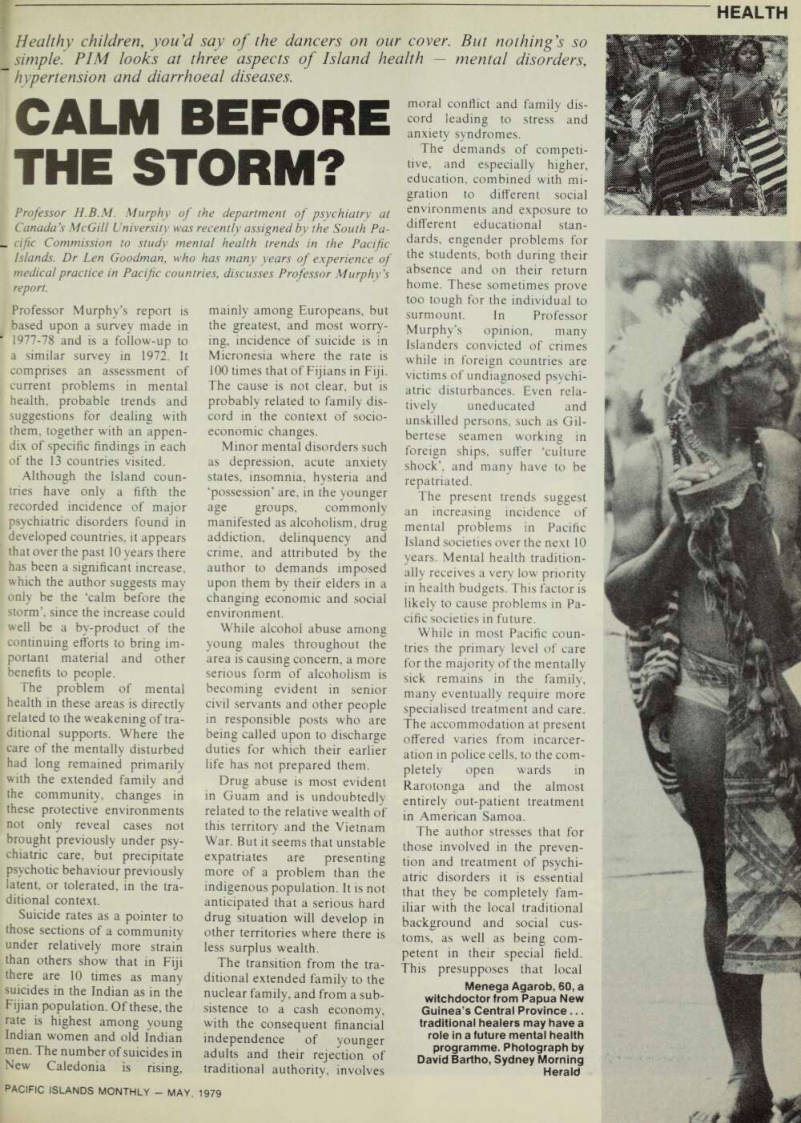
Healthy children, you'd say of the dancers on our cover. But nothing's so simple. PIM looks at three aspects of Island health mental disorders, hypertension and diarrhoeal diseases.
Professor H.B.M. Murphy of the department of psychiatry at Canada’s McGill University was recently assigned by the South Pa cific Commission to study mental health trends in the Pacific Islands. Dr Len Goodman, who has many years of experience of medical practice in Pacific countries, discusses Professor Murphy’s report.
Professor Murphy’s report is based upon a survey made in 1977-78 and is a follow-up to a similar survey in 1972. It comprises an assessment of current problems in mental health, probable trends and suggestions for dealing with them, together with an appen dix of specific findings in each of the 13 countries visited.
Although the Island coun tries have only a fifth the recorded incidence of major psychiatric disorders found in developed countries, it appears that over the past 10 years there has been a significant increase, which the author suggests may only be the ‘calm before the storm’, since the increase could well be a by-product of the continuing efforts to bring im portant material and other benefits to people.
The problem of mental health in these areas is directly related to the weakening of tra ditional supports. Where the care of the mentally disturbed
had long remained primarily
with the extended family and
the community, changes in
these protective environments not only reveal cases not
brought previously under psy
chiatric care, but precipitate psychotic behaviour previously latent, or tolerated, in the tra ditional context.
Suicide rates as a pointer to those sections of a community under relatively more strain than others show that in Fiji there are 10 times as many suicides in the Indian as in the Fijian population. Of these, the rate is highest among young Indian women and old Indian men. The number of suicides in New Caledonia is rising,
mainly among Europeans, but
the greatest, and most worry ing, incidence of suicide is in Micronesia where the rate is 100 times that of Fijians in Fiji.
The cause is not clear, but is probably related to family dis cord in the context of socio
economic changes.
Minor mental disorders such
as depression, acute anxiety
states, insomnia, hysteria and ‘possession’ are, in the younger age groups, commonly manifested as alcoholism, drug addiction, delinquency and crime, and attributed by the author to demands imposed upon them by their elders in a changing economic and social environment.
While alcohol abuse among young males throughout the area is causing concern, a more serious form of alcoholism is becoming evident in senior civil servants and other people in responsible posts who are being called upon to discharge duties for which their earlier life has not prepared them.
Drug abuse is most evident in Guam and is undoubtedly related to the relative wealth of this territory and the Vietnam War. But it seems that unstable
expatriates are presenting
more of a problem than the indigenous population. It is not anticipated that a serious hard drug situation will develop in other territories where there is less surplus wealth.
The transition from the tra ditional extended family to the nuclear family, and from a sub sistence to a cash economy, with the consequent financial independence of younger adults and their rejection of traditional authority, involves
moral conflict and family dis cord leading to stress and
anxiety syndromes.
The demands of competi
tive, and especially higher,
education, combined with mi gration to different social environments and exposure to different educational stan
dards, engender problems for
the students, both during their absence and on their return home. These sometimes prove too tough for the individual to surmount. In Professor
Murphy’s opinion, many
Islanders convicted of crimes while in foreign countries are
victims of undiagnosed psychi
atric disturbances. Even rela tively uneducated and unskilled persons, such as Gil bertese seamen working in
foreign ships, suffer ‘culture
shock’, and many have to be
repatriated.
The present trends suggest an increasing incidence of mental problems in Pacific Island societies over the next 10 years. Mental health tradition ally receives a very low priority in health budgets. This factor is likely to cause problems in Pa cific societies in future.
While in most Pacific coun tries the primary level of care for the majority of the mentally sick remains in the family,
many eventually require more
specialised treatment and care.
The accommodation at present offered varies from incarcer ation in police cells, to the com pletely open wards in Rarotonga and the almost
entirely out-patient treatment
in American Samoa.
The author stresses that for those involved in the preven tion and treatment of psychi atric disorders it is essential that they be completely fam iliar with the local traditional background and social cus toms, as well as being com petent in their special field.
This presupposes that local
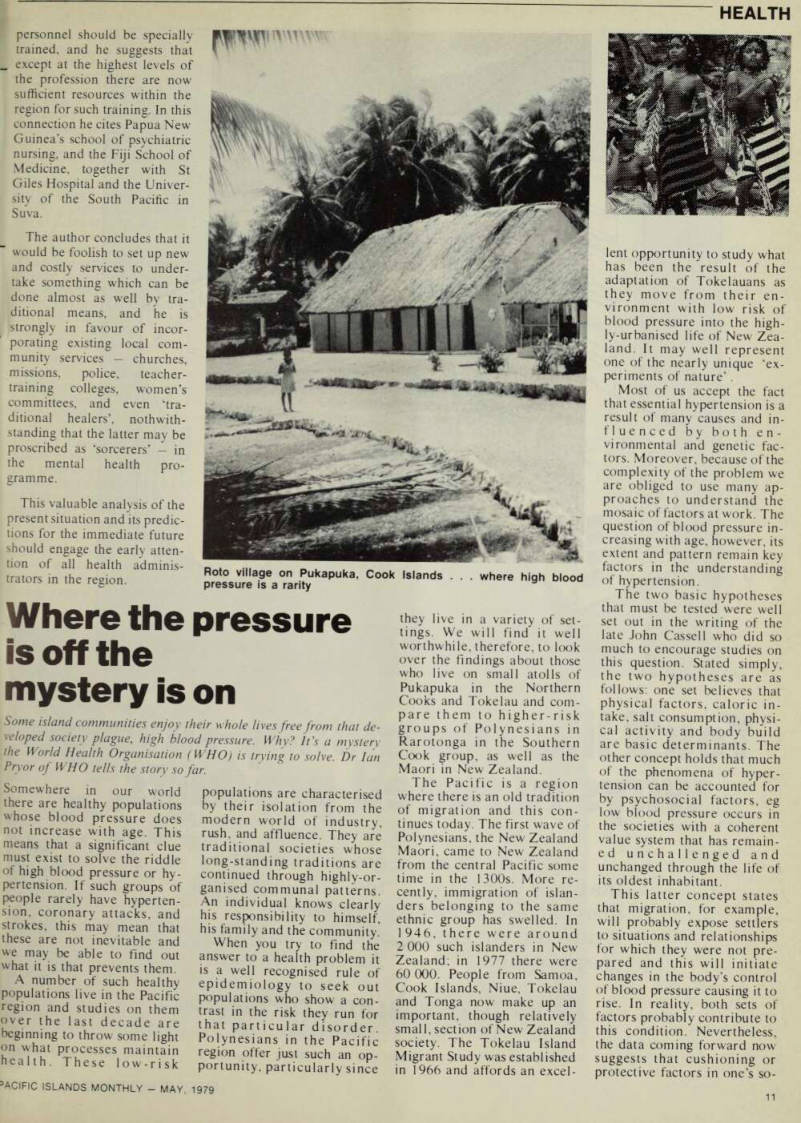
Menega Agarob, 60, a witchdoctor from Papua New Guinea’s Central Province... traditional healers may have a role in a future mental health programme. Photograph by David Bartho, Sydney Morning Herald
personnel should be specially trained, and he suggests that except at the highest levels of the profession there are now sufficient resources within the region for such training. In this connection he cites Papua New Guinea’s school of psychiatric nursing, and the Fiji School of Medicine, together with St Giles Hospital and the Univer sity of the South Pacific in Suva.
The author concludes that it would be foolish to set up new and costly services to under take something which can be done almost as well by tra ditional means, and he is strongly in favour of incor
porating existing local com
munity services - churches, missions, police, teacher
training colleges, women’s
committees, and even ‘tra ditional healers’, notwith standing that the latter may be proscribed as ‘sorcerers’ - in the mental health pro gramme.
This valuable analysis of the present situation and its predic tions for the immediate future should engage the early atten tion of all health adminis trators in the region.
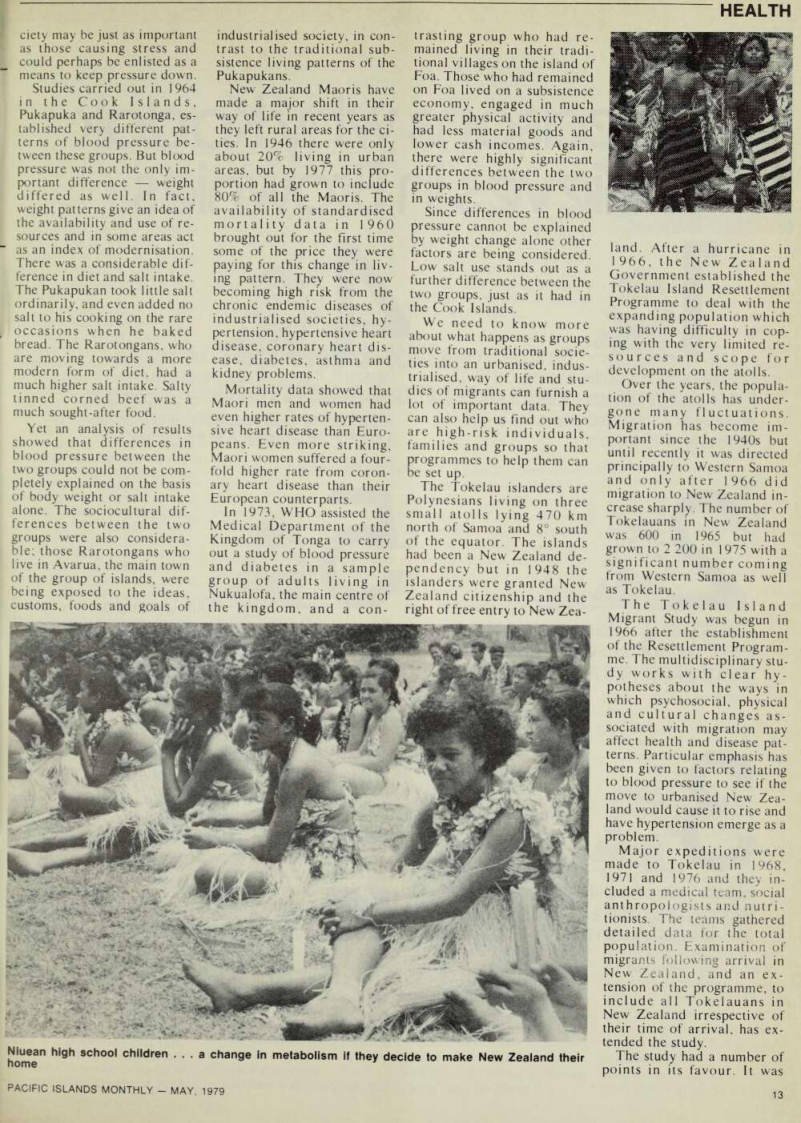
Roto village on Pukapuka, Cook Islands... where high blood pressure is a rarity a
Advertisements & other items, p. 10 (1 item)
Simple and steady
Simple and speedy
TOPCON Auto Winder + RE 300
m I w Re * V 300 N auto w "A * Auto Winder, an original TOPCON idea, provides fast, continuous shooting at 2 fps. (RE 300) * LED exposure readout, for fast, correct exposure control. * Backed up by a full range of TOPCOR interchangeable lenses.
Simple and steady
TOPCON RE 200
for beautiful pictures TOKYO KOGAKU KIKAI K.K. (TOKYO OPTICAL CO., LTD.) 75-1, Hasunuma-cho, Itabashi-ku, Tokyo 174, Japan Telex: 0272-2384 Phone: Tokyo 03-967-1101 AUSTRALIA Wagner Wholesale Photographies, 524 Flinders Street, Melbourne, Victoria 3000 / NEW ZEALAND Thames Camera Centre Limited, P.O. Box 345, 712 Pollen Street, North, Thames / NORFOLK ISLAND Miltons Department Stores Limited, P.O. Box 146, Norfolk Island 2899 / NEW HEBRIDES The Sound Centre, P.O. Box 434, Port-Vi la / NEW CALEDONIA Magenta Photo BP 1723, Noumea / FIJI D. Gokal & Co. Ltd., CNR Pier Straat and Renwick Road, Suva, PAPUA NEW GUINEA Hagemeyer (PNG) Pty. Ltd., Lae, Rabaul, Port Moresby, Madang, Mt. Hagen, Wewak.
Where the pressure

is off the mystery is on
Some island communities enjoy their whole lives free from that de veloped society plague, high blood pressure. Why? It's a mystery the World Health Organisation (WHO) is trying to solve. Dr lan Pryor of WHO tells the story so far.
Somewhere in our world there are healthy populations whose blood pressure does not increase with age. This means that a significant clue must exist to solve the riddle of high blood pressure or hy pertension. If such groups of people rarely have hyperten sion, coronary attacks, and strokes, this may mean that these are not inevitable and we may be able to find out what it is that prevents them.
A number of such healthy populations live in the Pacific region and studies on them over the last decade are beginning to throw some light on what processes maintain health. These low-risk
populations are characterised by their isolation from the modern world of industry, rush, and affluence. They are traditional societies whose long-standing traditions are continued through highly-or ganised communal patterns.
An individual knows clearly his responsibility to himself, his family and the community.
When you try to find the answer to a health problem it is a well recognised rule of epidemiology to seek out populations who show a con trast in the risk they run for that particular disorder.
Polynesians in the Pacific region offer just such an op portunity, particularly since
they live in a variety of set tings. We will find it well worthwhile, therefore, to look over the findings about those who live on small atolls of Pukapuka in the Northern Cooks and Tokelau and com pare them to higher-risk groups of Polynesians in Rarotonga in the Southern Cook group, as well as the Maori in New Zealand.
The Pacific is a region where there is an old tradition of migration and this con tinues today. The first wave of Polynesians, the New Zealand Maori, came to New Zealand from the central Pacific some time in the 1300 s. More re cently, immigration of islan ders belonging to the same ethnic group has swelled. In 1946, there were around 2 000 such islanders in New Zealand: in 1977 there were 60 000. People from Samoa, Cook Islands, Niue, Tokelau and Tonga now make up an important, though relatively small, section of New Zealand society. The Tokelau Island Migrant Study was established in 1966 and affords an excel-
lent opportunity to study what has been the result of the adaptation of Tokelauans as they move from their en vironment with low risk of blood pressure into the high ly-urbanised life of New Zea land. It may well represent one of the nearly unique ‘ex periments of nature’.
Most of us accept the fact that essential hypertension is a result of many causes and in flue nc e d by both en vironmental and genetic fac tors. Moreover, because of the complexity of the problem we are obliged to use many ap proaches to understand the mosaic of factors at work. The question of blood pressure in creasing with age, however, its extent and pattern remain key factors in the understanding
of hypertension.
The two basic hypotheses that must be tested were well set out in the writing of the late John Cassell who did so much to encourage studies on this question. Stated simply, the two hypotheses are as follows: one set believes that physical factors, caloric in
take, sail consumption, physi
cal activity and body build are basic determinants. The other concept holds that much of the phenomena of hyper tension can be accounted for by psychosocial factors, eg low blood pressure occurs in the societies with a coherent value system that has remain ed unchallenged and unchanged through the life of its oldest inhabitant.
This latter concept states that migration, for example, will probably expose settlers to situations and relationships for which they were not pre pared and this will initiate changes in the body’s control of blood pressure causing it to rise. In reality, both sets of factors probably contribute to this condition. Nevertheless, the data coming forward now suggests that cushioning or protective factors in one’s so
ciety may be just as important as those causing stress and could perhaps be enlisted as a means to keep pressure down.
Studies carried out in 1964 in the Cook Islands, Pukapuka and Rarotonga, established very different patterns of blood pressure between these groups. But blood pressure was not the only important difference weight differed as well. In fact. weight patterns give an idea of the availability and use of resources and in some areas act as an index of modernisation.
There was a considerable difference in diet and salt intake.
The Pukapukan took little salt ordinarily, and even added no salt to his cooking on the rare occasions when he baked bread. The Rarotongans, who are moving towards a more modern form of diet, had a much higher salt intake. Salty tinned corned beef was a much sought-after food.
Yet an analysis of results showed that differences in blood pressure between the two groups could not be completely explained on the basis of body weight or salt intake alone. The sociocultural differences between the two groups were also considerable; those Rarotongans who live in Avarua, the main town of the group of islands, were being exposed to the ideas, customs, foods and goals of
industrialised society, in con trast to the traditional sub sistence living patterns of the Pukapukans.
New Zealand Maoris have made a major shift in their way of life in recent years as they left rural areas for the ci ties. In 1946 there were only about 20% living in urban areas, but by 1977 this pro portion had grown to include 80% of all the Maoris. The availability of standardised mortality data in 1960 brought out for the first time some of the price they were paying for this change in In ing pattern. They were now becoming high risk from the chronic endemic diseases of industrialised societies, hy pertension, hypertensive heart disease, coronary heart dis ease, diabetes, asthma and
kidney problems,
Mortality data showed that Maori men and women had even higher rates of hyperten sive heart disease than Euro peans. Even more striking, Maori women suffered a four fold higher rate from coron ary heart disease than their European counterparts, In 1973, WHO assisted the Medical Department of the Kingdom of Tonga to carry out a study of blood pressure and diabetes in a sample group of adults living in Nukualofa, the main centre of the kingdom, and a con
trasting group who had re mained living in their tradi tional villages on the island of Foa. Those who had remained on Foa lived on a subsistence economy, engaged in much greater physical activity and had less material goods and lower cash incomes. Again, there were highly significant differences between the two groups in blood pressure and in weights.
Since differences in blood pressure cannot be explained by weight change alone other factors are being considered.
Low salt use stands out as a further difference between the two groups, just as it had in the Cook Islands.
We need to know more about what happens as groups move from traditional socie ties into an urbanised, indus trialised, way of life and stu dies of migrants can furnish a lot of important data. They can also help us find out who are high-risk individuals, families and groups so that programmes to help them can be set up.
The Tokelau islanders are Polynesians living on three small atolls lying 470 km north of Samoa and 8° south of the equator. The islands had been a New Zealand de pendency but in 1948 the islanders were granted New Zealand citizenship and the right of free entry to New Zea-
land. After a hurricane in 1 966, the New Zealand Government established the Tokelau Island Resettlement Programme to deal with the expanding population which was having difficulty in cop ing with the very limited re sources and scope for development on the atolls.
Over the years, the popula tion of the atolls has under gone many fluctuations.
Migration has become im portant since the 1940 s but until recently it was directed principally to Western Samoa and only after 1 966 did migration to New Zealand in crease sharply. The number of Tokelauans in New Zealand was 600 in 1965 but had grown to 2 200 in 1975 with a significant number coming from Western Samoa as well as Tokelau.
The Tokelau Island Migrant Study was begun in 1966 after the establishment of the Resettlement Program me. The multidisciplinary stu dy works with clear hy potheses about the ways in which psychosocial, physical and cultural changes as sociated with migration may affect health and disease pat terns. Particular emphasis has been given to factors relating to blood pressure to see if the move to urbanised New Zea land would cause it to rise and have hypertension emerge as a problem.
Major expeditions were made to Tokelau in 1968, 1971 and 1976 and they in cluded a medical team, social anthropologists and nutri tionists. The teams gathered detailed data for the total population. Examination of migrants following arrival in New Zealand, and an ex tension of the programme, to include all Tokelauans in New Zealand irrespective of their time of arrival, has ex tended the study.
The study had a number of points in its favour. It was
Niuea n hi gh children... a change in metabolism if they decide to make New Zealand their
able to draw upon material - that included the examination of many of the migrants before they emigrated. The fact that groups of the same genetic makeup are being followed in two environments will allow a critical assessment of what is genetic and what is en vironmental in nature of the interaction of these two areas.
The number participating in the study includes the 2 200 Tokelauans in New Zealand . and 1 560 in Tokelau. Par ticipation in the examinations has been excellent, about 98% in Tokelau and 96% in New Zealand.
Comparing adults in both places it was found that adults in New Zealand have sig nificantly higher blood pressures. Also, adults who live in New Zealand tend to be heavier in weight. One of the most interesting points is the degree to which inte gration in a new way of life is correlated to a rise in blood pressure. Taking into account how the migrant lived, his work and his leisure, his club, church and personal ac tivities, it was found that those who were the most cushioned by, or restricted themselves to, Tokelauan societies and activities were less subject to high blood pressure than those who were more inte grated into a European way of life. In other words, there seems to be a basis for believ ing that those who were more involved in the European way of life were paying for it in higher blood pressure.
There is increasing emphasis on study of children to find precursors of hyper tension in adults. Results are now beginning to come in.
Data on children up to the age of 14 show that systolic pressure in both girls and boys in New Zealand was higher than those who had remained in Tokelau. The fact that these differences have now been shown to occur both in children and adults strongly suggests the role of en vironmental factors in blood pressure.
Since higher blood pressures in New Zealand cannot be explained solely on the basis of weight, other fac tors are now being closely examined. For one thing, salt intake is higher in New Zea land than the islands and there is a possibility that rais ing salt intake above a certain level sets in motion a series of changes that result in high
blood pressure. It has not yet been demonstrated, however, that there is a direct relation ship between blood pressure and salt intake. Nevertheless there is so much evidence, from so many places, that a change in salt-use is one of the things that go with migration and urbanisation that it can not be ignored.
We feel that studies with controlled tests on the effect of an habitual low salt-intake are needed. They should be given a high priority and WHO should play an active
coordinating role.
A task force on car diovascular disease preven
tion has been established in the Western Pacific region.
This part of the world offers a wide range of opportunities to document present patterns and test out ways of prevent ing cardiovascular disease at the earliest stages.
Clear evidence that hyper tension is not an inevitable part of the ageing process challenges us to do something about it. Environmental changes play a key role in determining its occurrence.
Traditional societies with their support for the indi vidual and the community may show the way to helping many who need it.
Advertisements & other items, pp. 11-14 (2 items)
Health
3 ACIFIC ISLANDS MONTHLY - MAY, 1979
ways to speed products.
I -1- 1 I-I_l
Qi 1 1 <S) <f)
You’ll like our money-saving
ways to speed products.
Import or export, quicker, but safer the faster you move too. Talk Air Cargo merchandise, the less convenience it can cost. Air Cargo and savings with does it not only Air New Zealand. air neui zeaiano carao The economic move.
ANZ 78/6
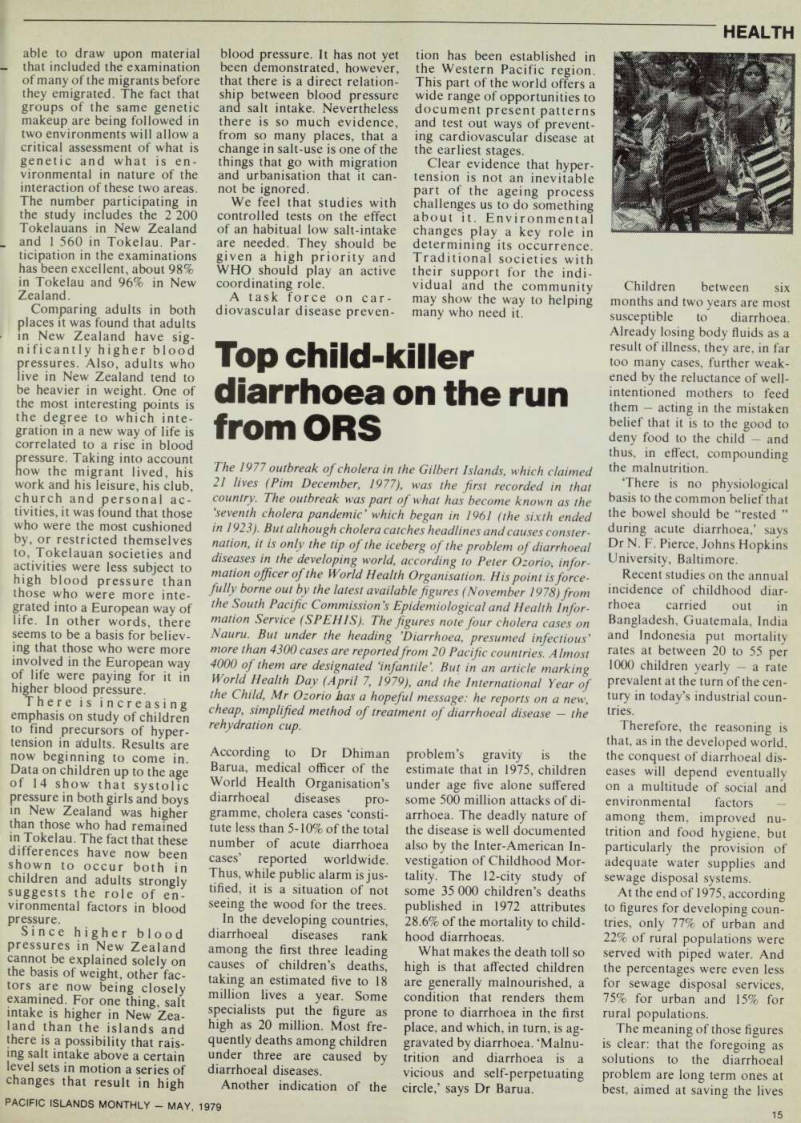
Five reasons why Kodak
believes in Brownies
The Kodak Brownie Camera Outfit. It includes camera, CllO-12 film, wrist strap, instructions and a 3 year Kodak warranty. At a suggested retail price of $19.50, we’re sure of its success.
The Kodak Brownie Camera Case. It’s made of moulded black plastic, carries picture-taking instructions, and has a suggested retail price of just $1.99.
The Kodak Brownie Rogues Gallery. A wall-hanger for all the kids favourite photos. With a suggested retail price of only 45 cents, you can count on it selling well.
Our Consumer Research. It confirms the interest in a low-priced, easy-to-use camera, supports the appeal of the “Brownie” name, and indicates a very positive response to the camera and accessories.
Our Advertising Campaign. The Brownie Camera Outfit will be promoted nationally on prime-time television.
More than 8 out of 10 Australians will see the commercial, an average of 7 times each.
You can order 12 Kodak Brownie Outfits, 8 camera cases, 10 Rogues Galleries and a point-of-sale window streamer in a reliable starter pack now.
Believe us, the Brownie camera will be selling fast!
KODAK (Australasia) PTY. LTD.
KO/5969
Top child-killer

diarrhoea on the run from ORS
The 1977 outbreak of cholera in the Gilbert Islands, which claimed 21 lives (Pim December, 1977), was the first recorded in that country. The outbreak was part of what has become known as the • seventh cholera pandemic ’ which began in 1961 (the sixth ended in 1923). But although cholera catches headlines and causes conster nation, it is only the tip of the iceberg of the problem of diarrhoeal diseases in the developing world, according to Peter Ozorio-, infor mation officer of the World Health Organisation. His point is force fully borne out by the latest available figures (November 1978) from the South Pacific Commission’s Epidemiological and Health Infor mation Service (SPEHIS). The figures note four cholera cases on Nauru. But under the heading Diarrhoea, presumed infectious ’ more than 4300 cases are reportedfrom 20 Pacific countries. A Imost 4000 of them are designated ‘infantile ’. But in an article marking World Health Day (April 7, 1979), and the International Year of the Child, Mr Ozorio has a hopeful message: he reports on a new, cheap, simplified method of treatment of diarrhoeal disease the rehydration cup.
According to Dr Dhiman Barua, medical officer of the World Health Organisation’s diarrhoeal diseases pro gramme, cholera cases ‘consti tute less than 5-10% of the total number of acute diarrhoea cases’ reported worldwide.
Thus, while public alarm is jus tified, it is a situation of not seeing the wood for the trees.
In the developing countries, diarrhoeal diseases rank among the first three leading causes of children’s deaths, taking an estimated five to 18 million lives a year. Some specialists put the figure as high as 20 million. Most fre quently deaths among children under three are caused by diarrhoeal diseases.
Another indication of the
problem’s gravity is the estimate that in 1975, children under age five alone suffered some 500 million attacks of di arrhoea. The deadly nature of the disease is well documented also by the Inter-American In vestigation of Childhood Mor
tality. The 12-city study of
some 35 000 children’s deaths published in 1972 attributes 28.6% of the mortality to child hood diarrhoeas.
What makes the death toll so high is that affected children are generally malnourished, a condition that renders them prone to diarrhoea in the first place, and which, in turn, is ag gravated by diarrhoea. ‘Malnu trition and diarrhoea is a vicious and self-perpetuating circle,’ says Dr Barua.
Children between six months and two years are most susceptible to diarrhoea.
Already losing body fluids as a result of illness, they are, in far too many cases, further weak ened by the reluctance of well intentioned mothers to feed them acting in the mistaken belief that it is to the good to deny food to the child - and thus, in effect, compounding the malnutrition. ‘There is no physiological basis to the common belief that the bowel should be “rested ” during acute diarrhoea,’ says Dr N. F. Pierce, Johns Hopkins
University, Baltimore.
Recent studies on the annual incidence of childhood diar rhoea carried out in Bangladesh, Guatemala, India and Indonesia put mortality rates at between 20 to 55 per 1000 children yearly a rate prevalent at the turn of the cen tury in today’s industrial coun tries.
Therefore, the reasoning is that, as in the developed world, the conquest of diarrhoeal dis
eases will depend eventually
on a multitude of social and environmental factors among them, improved nu trition and food hygiene, but particularly the provision of adequate water supplies and sewage disposal systems.
At the end of 1975, according to figures for developing coun tries, only 77% of urban and 22% of rural populations were served with piped water. And the percentages were even less for sewage disposal services, 75% for urban and 15% for rural populations.
The meaning of those figures is clear: that the foregoing as solutions to the diarrhoeal problem are long term ones at best, aimed at saving the lives
of future young generations. . The question of stemming the drain on life the immediate question however, is not being deferred thanks to the re cent development of a new method of rehydration. Mor tality from diarrhoea is due to dehydration. If dehydration is prevented, most deaths can be averted. Death comes when the body loses life-sustaining fluids and salts. In cholera, for . instance, fluid losses can reduce weight by 10% in from five to six hours. Lives are saved through rehydration fluids, administered intra venously by trained health workers stationed in clinics of hospitals where indeed the only places - the fluid is stocked and can be adminis tered.
All is changing now, mainly because of the work of scien tists at the Calcutta Infectious Hospital, India, and the Dacca Research Cholera Labora
tories, Bangladesh. Working
with visiting colleagues, in par ticular those from Johns Hopkins, and the United States Center for Disease Control, Atlanta, the scientists devel oped a rehydration fluid based on some salts and sugar. In ad dition to being inexpensive to produce, its chief advantage is that the fluid is not adminis tered intravenously but by mouth, thus making possible treatment at home.
The fluid comprises these four components; 3.5 g of so dium chloride (table salt), 2.5 g of bicarbonate (baking soda) and 1.5 g of potassium chlor ide. The basic ingredients are mixed in with 20 g of glucose, to facilitate absorption by the intestine, and dissolved in a litre (about four measuring cups) of drinking water.
In an early test of effec tiveness, under ‘worst possible conditions’, says Dr Barua, oral rehydration quelled an out break of cholera and other acute diarrhoeal diseases among Bangladesh refugees streaming across India’s east ern border in 1971. In one refugee camp, with some 4000 suffering from dirrahoeal dis eases, including 1600 children under five, only 3% died, a very low rate in comparison to the 30% mortality estimated for the
entire refugee influx. Further more, of the 3% deaths, half oc curred before treatment
began.
What made the vital dif ference was the decision of the camp’s health officials to treat with the rehydration cup rather than with the intravenous
drip.
Trials in the Philippines for seven months, and in Turkey for 16, monitoring the recovery rate of two groups of children, those on and those not on a regime of oral rehydration therapy, point up another im pressive advantage in the use of fluids against diarrhoea monthly weight gains. In both countries, children who were fed the fluids outgained others who were not. As put by Dr L.
J. Mata, University of Costa Rica, San Jose: ‘The mean weight gain of non-treated children was significantly below that of the growth aver age curve.’
The trials that have been car ried out have surpassed expec tations, leading to a UNICEF decision to promote pro duction in developing coun tries, and also to distribute it
themselves packaged simply as
ORS (oral rehydration salts).
While such steps are long overdue, required and wel come, much more needs to be done and, according to a recent meeting of the WHO advisory group of experts on diarrhoeal diseases, done without delay.
Naturally enough, it is the mother who is vital in any cam paign to prevent childhood diarrhoeal deaths, but mothers, taking into account household chores, need all the help practical and educational they can get. Ideally, the for mula should be made available to them pre-packaged. If this is not possible, then dehydration can be prevented by giving a child, on the onset of diar rhoea, a simpler, home-made preparation.
That was well understood in Indonesia. A four cent plastic scoop was developed to make easier the mother’s task of
measuring ingredients. The
scoop was designed double headed to hold five grams of sugar at one end and one gram of salt at the other the recom mended amount of the two basic components in case four are not available. The ingredi ents are dissolved in 200 cc
(one cup) of potable water.
Furthermore, says Jon E.
Rohde, of the Rockefeller Foundation’s mission in Indonesia, efforts were made to persuade mothers that a ‘sick intestine needs food to re cover’, and to continue to breastfeed, or to supplement diets of sick children, in Java, for instance, with egg and
honey.
Whether simple or sophis ticated methods are used in
packaging, depends on both
the extent of the problem and the budget. But calculations by Norbert Hirshhorn, Manage ment Sciences for Health,
Cambridge, Massachusetts,
showed that: ‘One person can manually measure out salts and sugar by spoon measures to make up to 100 to 300 packets per day. A SUSSOOO to $lO 000 machine can dispense thou sands of packets a day auto
matically.’
However produced, there is no question but that oral rehydration fluids make good economic sense. Use of the more costly intravenous fluids now can be reduced by about 75% and confined to treatment of severe cases, where the patient, after losing in fluids the equivalent of 10% in weight, is in shock. The use of oral therapy will also ease the pressure on hospital beds.
In short, oral therapy is already proven effective.
Experts hail the rehydration
fluids as ‘the single most effec tive therapeutic tool in the treatment of acute diarrhoeal disease’. It is inexpensive to produce. All that remains is to put the fluids into the hands of families. When that is done, ‘very few should die if treat ment can start early and, pref erably, at home,’ says Dr Barua.
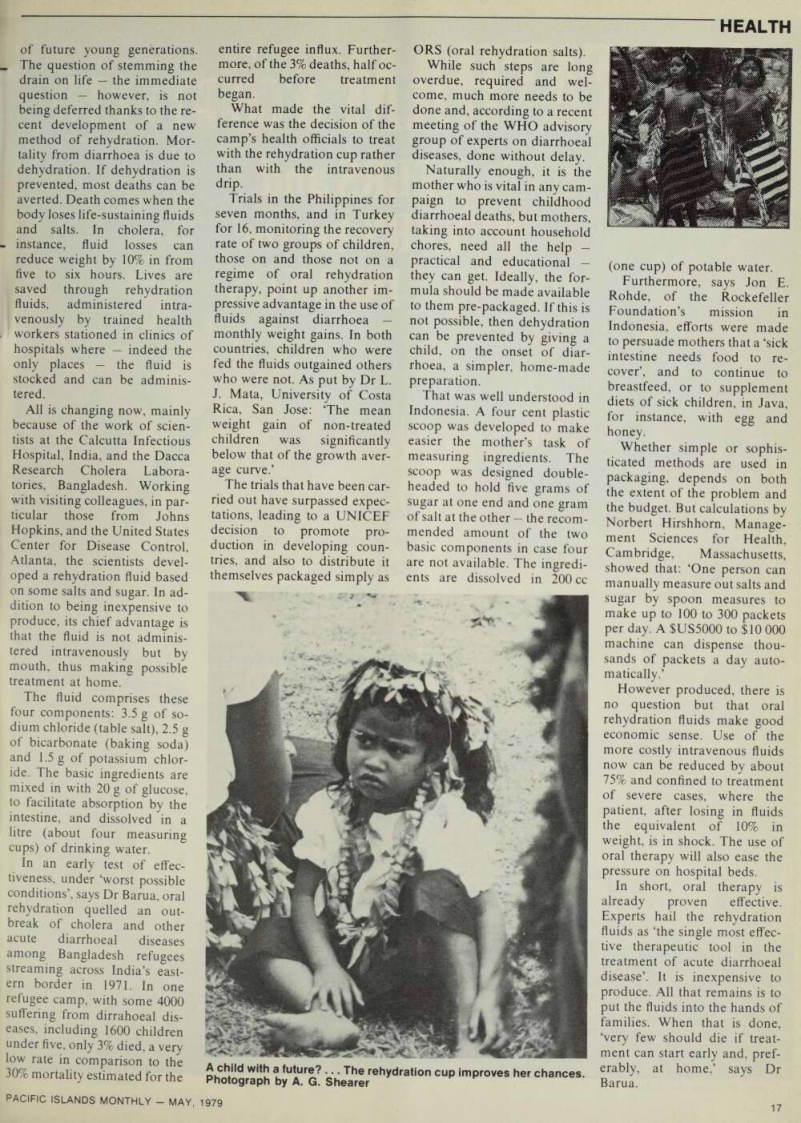
A child with a future?... The rehydration cup improves her chances.
Photograph by A. G. Shearer
Advertisements & other items, pp. 15-18 (2 items)
Health
and have their music, too.
tawpKff - • '■ ‘■mmm ... . ,‘;i, vV'-c''^- 1 ;;'^--^'^'';, - V *L . mmm m mm t* pioiveen ■ ;' s] n :
IBKFR
9 r
KIS
KE-2000 TS-107
For those who want to travel
and have their music, too.
You’re young and staying in one place too long KE-2000 cassette Tape Player with am/fm Tuner doesn't suit your style. Your car is an extension of this gjSoe (max 1 ;DcfsavTi'i -"w allowable) mobility and the magic carpet that takes you where wow & flutter No more than 0.28% (wrms) you want to go. Your music, like your car, is an important ::: : : : mb’ 3 ® part of your life.
Enter Pioneer’s KE-2000/TS-107 car stereo Frequency range 88-1 osmhz system. Engineered with the precision of a Grand Prix usable sensitivity i2dßf (i.i/iV/75 ohms) racer. Specifically created to perform in the ambience selectivity 70dB (±4ookHz) of an automotive atmosphere. Built to withstand the am Tuner toughest punishment and tested in the laboratory and sensSy V range !;;; ;;; 30%/ 1 Z on the road. A skillful blend of advanced electronic T s-107 speakers engineering and a delicate sensitivity to the needs of speaker P 102 mm (4 in ) high-compiiance the four-wheeled traveler. Such as in the KE-2000 with dual-cone with metallic center cap FM. You see, at Pioneer, we believe that when a man F n requency e rarSe X so-lo.ooohz takes to the open road, he shouldn’t have to go it alone, weight eeog (1 ib. 70z.)
Ofi PIONEER
honeer products are available through: Lustralia: Pioneer Marketing Service Pty. Ltd., P.O. Box 317, Mordialloc, Victoria, 3195 el. 90-9011 iji Islands; Brijlal & Company, G.P.O. Box No. 362, Suva, Fiji Islands Tel: 22258 lew Zealand; Fountain Marketing Ltd., Maidstone Street, Auckland, New Zealand el: 763-064 lorfotk Island: Burns Philp (Norfolk Island) Ltd., Norfolk Island, South Pacific lew Hebrides; Burns Philp (New Hebrides) Ltd., Vila, New Hebrides Nauru Island: Jacob Enterprises, P.O. Box No. 4. Republic of Nauru Tahiti: Ets. PERFECT, B.P. 594, Papeete. Tahiti Tel: 20>407 New Caledonia: Menard Freres Ville, B.P. H 2 Cedex, Noumea, New Caledonia Tel: 27.52.22 American Samoa: Transpac Corporation, P.O. Box 1477, Pago Pago, American Samoa 96799 Tel: 633-5224 Rarotonga: South Seas International Ltd., P.O. Box 49, Rarotonga, Cook Islands Tel: 2327 Papua New Guinea: Bali Merchants Pty. Ltd., P.O. Box 6103, Boroko Tel: 254887
i Beehive Building 94 Elizabeth Street Melbourne, Victoria Australia 3000 G.P.O. Box 8 Melbourne, Victoria Australia les: Telex: AA34552 Phone: 63 5094
FOR SERVICE
YOUR GUARAMTEE
SINCE 1924
stayput policy stick?

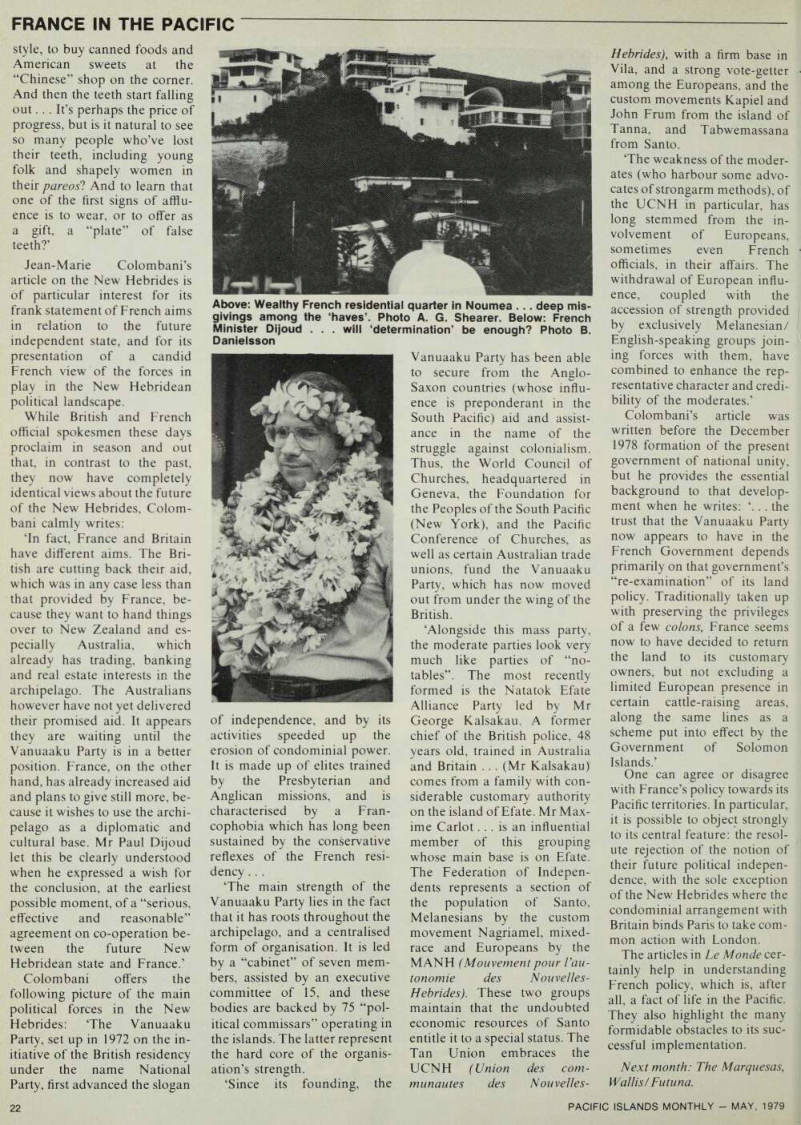
France In The Pacific
Paris Planning:
Practical Or
Pipedream?
Can it make its stayput policy stick?
France's most influential daily newspaper, Le Monde, recently car ried a series of seven major articles from staff correspondents review ing the situation in France's Pacific territories. New Caledonia and the Marquesas merited two articles each, and the New Hebrides, Tahiti, and Wallis/Futuna one apiece. PIM staff writer Malcolm Salmon has read the Le Monde series, and, in the first of two articles, reviews those dealing with New Caledonia, Tahiti and the New Hebrides. He will review the articles on the Marquesas and Wallis/Futuna in the June issue of PIM.
Publication of the articles on France’s Pacific territories in Le Monde began just before a top-level review of France’s Pacific policy in Paris in October (with the then foreign minister Louis de Guiringaud presiding) and continued over a period of several months.
Journalist Jean-Marie Colombani summed up the objects and outcome of the meeting in the following terms in Le Monde: ‘All the French Pacific territories are actually in an Anglo-Saxon zone of in fluence, dominated to the east by the United States and to the west by Australia and New Zealand, all powers which have traditionally been hostile to any French presence in the re gion. By at last presenting to these countries, and especially to the many newly indepen dent states in the region, the image of a liberal France, it will be possible, the govern ment believes, to conduct an active policy in this part of the world. This policy... will involve a new distribution of power and wealth in the over
seas territories to counter the challenge from advocates of
independence...
‘Procedures for the establish ment of 200-mile economic zones, which, thanks to its Pa cific territories, will put France in third place in the world in terms of area of ocean covered, were discussed at the meeting, as were questions associated with the organisation of fisheries in the region (nego tiations on this matter are under way at present with Japan and South Korea). ‘ln this zone where the wealth of the seas and the min eral riches of New Caledonia arouse the appetites of multi nationals and the covetousness of great powers, the govern ment believes it is important to develop France’s cultural and technical activities. Such activi ties, in the government’s view, must involve the territories themselves, and call for co operation between the respon sible people on the spot in the territories and the respresenta tives of France in the states of the region. Thus, a programme
of co-ordination with the University of the South Pacific in Suva, Fiji, will be set up. The future embassy of France in the New Hebrides will be called upon to play an import ant regional role in this field. ‘The course to be taken by France over the next decade has thus been set.’
While generally endorsing
the lines of this policy, the Le
Monde journalists frequently
point to serious obstacles to its realisation, often embedded in the social structure of the terri tories themselves. For
example, writing on New
Caledonia, where the respon sible minister Paul Dijoud seeks to build ‘a new, generous, more united, more brotherly society, where everyone will have his place’, Jean-Marie Colombani notes: ‘How can New Caledonia start again (after the collapse of the nickel boom)? Nobody on the spot can reply to this question or even wants to, because the mis givings of the “haves” about their own future is one of the basic elements of the Caledonian problem. These “haves”, most of whom have lived a long time in the terri tory, are Europeans. They hold the controlling levers of the economy (in commerce as in the exploitation of mineral re sources) and the biggest landed estates. This concentration of wealth permits its owners to make abundant savings. But these are not invested in New Caledonia, but go to swell the volume of capital flowing out of New Caledonia to its Anglo-
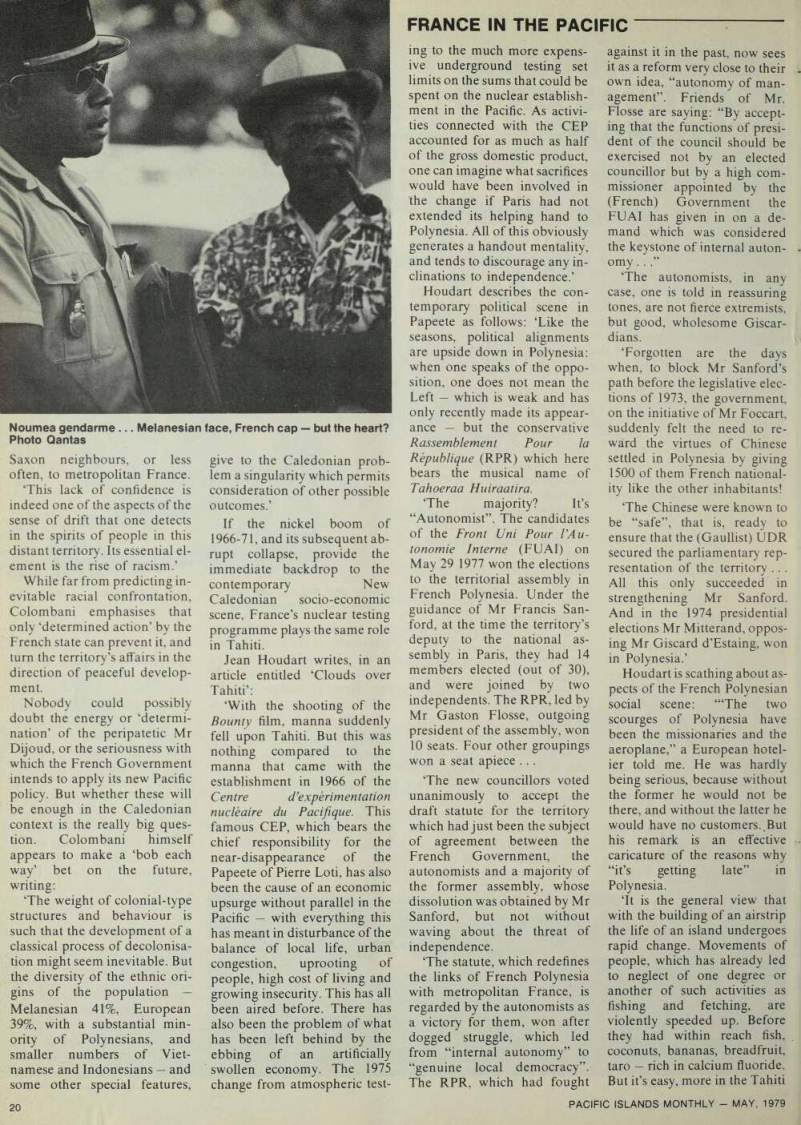
Smoke bel ches fro m Noumea's nicke l sme lter... collapse of the boom In 1971 left many questions
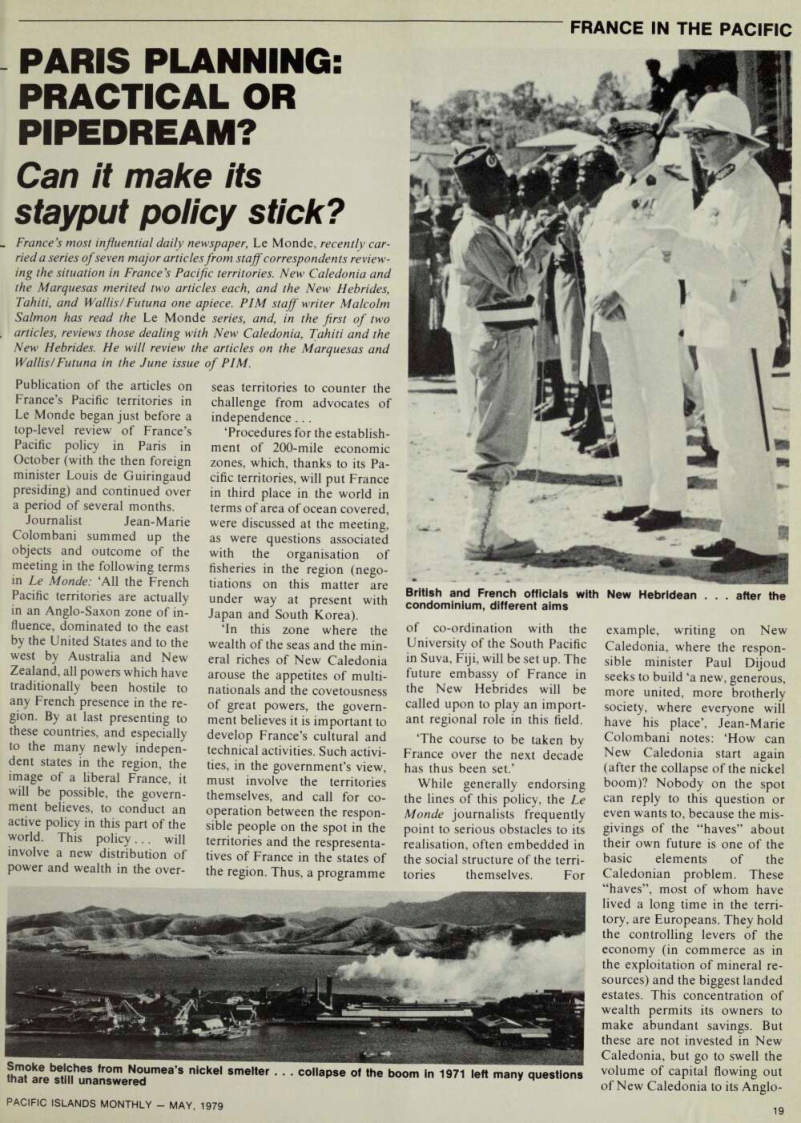
British and French officials with New Hebridean... after the condominium, different aims
Saxon neighbours, or less often, to metropolitan France. ‘This lack of confidence is indeed one of the aspects of the sense of drift that one detects in the spirits of people in this distant territory. Its essential el ement is the rise of racism.’
While far from predicting in evitable racial confrontation, Colombani emphasises that only ‘determined action’ by the French state can prevent it, and turn the territory’s affairs in the
direction of peaceful develop
ment.
Nobody could possibly
doubt the energy or ‘determi nation’ of the peripatetic Mr Dijoud, or the seriousness with which the French Government intends to apply its new Pacific policy. But whether these will be enough in the Caledonian context is the really big ques tion. Colombani himself appears to make a ‘bob each way’ bet on the future,
writing:
‘The weight of colonial-type
structures and behaviour is such that the development of a classical process of decolonisa tion might seem inevitable. But the diversity of the ethnic ori
gins of the population
Melanesian 41%, European 39%, with a substantial min
ority of Polynesians, and
smaller numbers of Viet namese and Indonesians and some other special features,
give to the Caledonian prob lem a singularity which permits consideration of other possible outcomes.’
If the nickel boom of 1966-71, and its subsequent ab
rupt collapse, provide the
immediate backdrop to the contemporary New Caledonian socio-economic scene, France’s nuclear testing programme plays the same role in Tahiti.
Jean Houdart writes, in an article entitled ‘Clouds over Tahiti’: ‘With the shooting of the Bounty film, manna suddenly fell upon Tahiti. But this was
nothing compared to the
manna that came with the establishment in 1966 of the
Centre d’experimentation
nucleaire du Pacifique. This famous CEP, which bears the chief responsibility for the near-disappearance of the Papeete of Pierre Loti, has also been the cause of an economic upsurge without parallel in the Pacific with everything this has meant in disturbance of the balance of local life, urban
congestion, uprooting of
people, high cost of living and
growing insecurity. This has all been aired before. There has also been the problem of what has been left behind by the
ebbing of an artificially
swollen economy. The 1975
change from atmospheric test
ing to the much more expens
ive underground testing set
limits on the sums that could be spent on the nuclear establish ment in the Pacific. As activi ties connected with the CEP accounted for as much as half of the gross domestic product, one can imagine what sacrifices would have been involved in the change if Paris had not extended its helping hand to Polynesia. All of this obviously generates a handout mentality, and tends to discourage any in clinations to independence.’
Houdart describes the con temporary political scene in Papeete as follows: ‘Like the
seasons, political alignments
are upside down in Polynesia: when one speaks of the oppo sition, one does not mean the Left which is weak and has only recently made its appear ance but the conservative Rassemblement Pour la Republique (RPR) which here bears the musical name of Tahoeraa Huiraatira. ‘The majority? It’s “Autonomist”. The candidates of the Front Uni Pour VAu tonomie Interne (FUAI) on May 29 1977 won the elections to the territorial assembly in French Polynesia. Under the guidance of Mr Francis San ford, at the time the territory’s deputy to the national as sembly in Paris, they had 14 members elected (out of 30), and were joined by two independents. The RPR, led by Mr Gaston Flosse, outgoing president of the assembly, won 10 seats. Four other groupings won a seat apiece ... ‘The new councillors voted unanimously to accept the draft statute for the territory which had just been the subject of agreement between the French Government, the autonomists and a majority of the former assembly, whose dissolution was obtained by Mr Sanford, but not without waving about the threat of
independence.
‘The statute, which redefines the links of French Polynesia with metropolitan France, is regarded by the autonomists as a victory for them, won after
dogged struggle, which led
from “internal autonomy” to
“genuine local democracy”.
The RPR, which had fought
against it in the past, now sees it as a reform very close to their own idea, “autonomy of man agement”. Friends of Mr.
Flosse are saying: “By accept ing that the functions of presi dent of the council should be exercised not by an elected councillor but by a high com
missioner appointed by the
(French) Government the FUAI has given in on a de mand which was considered the keystone of internal auton omy .. ‘The autonomists, in any case, one is told in reassuring tones, are not fierce extremists, but good, wholesome Giscar dians.
‘Forgotten are the days
when, to block Mr Sanford’s path before the legislative elec tions of 1973, the government, on the initiative of Mr Foccart, suddenly felt the need to re ward the virtues of Chinese
settled in Polynesia by giving
1500 of them French national ity like the other inhabitants! ‘The Chinese were known to be “safe”, that is, ready to ensure that the (Gaullist) UDR secured the parliamentary rep resentation of the territory ...
All this only succeeded in strengthening Mr Sanford.
And in the 1974 presidential elections Mr Mitterand, oppos ing Mr Giscard d’Estaing, won
in Polynesia.’
Houdart is scathing about as pects of the French Polynesian social scene: “The two scourges of Polynesia have been the missionaries and the aeroplane,” a European hotel ier told me. He was hardly being serious, because without the former he would not be there, and without the latter he would have no customers. But his remark is an effective caricature of the reasons why “it’s getting late” in
Polynesia.
‘lt is the general view that with the building of an airstrip the life of an island undergoes
rapid change. Movements of
people, which has already led to neglect of one degree or another of such activities as
fishing and fetching, are
violently speeded up. Before
they had within reach fish, coconuts, bananas, breadfruit, taro rich in calcium fluoride.
But it’s easy, more in the Tahiti
Noumea gendarme... Melanesian face, French cap but the heart?
Photo Qantas
style, to buy canned foods and American sweets at the “Chinese” shop on the comer.
And then the teeth start falling
out... It’s perhaps the price of
progress, but is it natural to see so many people who’ve lost their teeth, including young folk and shapely women in their pareosl And to learn that one of the first signs of afflu ence is to wear, or to offer as a gift, a “plate” of false teeth?’
Jean-Marie Colombani’s article on the New Hebrides is of particular interest for its frank statement of French aims in relation to the future independent state, and for its presentation of a candid French view of the forces in play in the New Hebridean
political landscape.
While British and French
official spokesmen these days
proclaim in season and out that, in contrast to the past,
they now have completely
identical views about the future of the New Hebrides, Colom bani calmly writes: in fact, France and Britain have different aims. The Bri tish are cutting back their aid, which was in any case less than that provided by France, be cause they want to hand things over to New Zealand and es pecially Australia, which
already has trading, banking
and real estate interests in the archipelago. The Australians however have not yet delivered their promised aid. It appears they are waiting until the Vanuaaku Party is in a better position. France, on the other hand, has already increased aid and plans to give still more, be cause it wishes to use the archi pelago as a diplomatic and cultural base. Mr Paul Dijoud let this be clearly understood when he expressed a wish for the conclusion, at the earliest possible moment, of a “serious, effective and reasonable” agreement on co-operation be tween the future New Hebridean state and France.’
Colombani offers the following picture of the main political forces in the New Hebrides: ‘The Vanuaaku Party, set up in 1972 on the in itiative of the British residency under the name National Party, first advanced the slogan
of independence, and by its activities speeded up the erosion of condominial power.
It is made up of elites trained
by the Presbyterian and
Anglican missions, and is characterised by a Fran cophobia which has long been sustained by the conservative reflexes of the French resi
dency ...
‘The main strength of the Vanuaaku Party lies in the fact that it has roots throughout the archipelago, and a centralised form of organisation. It is led by a “cabinet” of seven mem bers, assisted by an executive committee of 15, and these bodies are backed by 75 “pol itical commissars” operating in the islands. The latter represent the hard core of the organis ation’s strength. ‘Since its founding, the
Vanuaaku Party has been able to secure from the Anglo- Saxon countries (whose influ ence is preponderant in the South Pacific) aid and assist ance in the name of the
struggle against colonialism.
Thus, the World Council of Churches, headquartered in Geneva, the Foundation for the Peoples of the South Pacific (New York), and the Pacific Conference of Churches, as well as certain Australian trade unions, fund the Vanuaaku Party, which has now moved out from under the wing of the British. ‘Alongside this mass party, the moderate parties look very much like parties of “no tables”. The most recently formed is the Natatok Efate Alliance Party led by Mr George Kalsakau. A former chief of the British police, 48 years old, trained in Australia and Britain ... (Mr Kalsakau) comes from a family with con siderable customary authority on the island of Efate. Mr Max ime Carlot... is an influential member of this grouping whose main base is on Efate.
The Federation of Indepen dents represents a section of the population of Santo, Melanesians by the custom movement Nagriamel, mixed race and Europeans by the MANH (Mouvement pour Tau tonomie des Nouvelles- Hebrides). These two groups maintain that the undoubted economic resources of Santo entitle it to a special status. The Tan Union embraces the UCNH (Union des com munautes des Nouvelles-
Hebrides), with a firm base in Vila, and a strong vote-getter among the Europeans, and the custom movements Kapiel and John Frum from the island of Tanna, and Tabwemassana from Santo.
The weakness of the moder ates (who harbour some advo cates of strongarm methods), of the UCNH in particular, has long stemmed from the in volvement of Europeans, sometimes even French officials, in their affairs. The withdrawal of European influ ence, coupled with the
accession of strength provided
by exclusively Melanesian/
English-speaking groups join
ing forces with them, have combined to enhance the rep resentative character and credi bility of the moderates.’
Colombani’s article was written before the December 1978 formation of the present government of national unity, but he provides the essential
background to that develop
ment when he writes; ‘... the trust that the Vanuaaku Party now appears to have in the French Government depends primarily on that government’s “re-examination” of its land
policy. Traditionally taken up
with preserving the privileges
of a few colons, France seems now to have decided to return the land to its customary owners, but not excluding a limited European presence in certain cattle-raising areas, along the same lines as a scheme put into effect by the Government of Solomon Islands.’
One can agree or disagree with France’s policy towards its Pacific territories. In particular,
it is possible to object strongly
to its central feature; the resol ute rejection of the notion of
their future political indepen
dence, with the sole exception of the New Hebrides where the condominial arrangement with Britain binds Paris to take com mon action with London.
The articles in Le Monde cer
tainly help in understanding
French policy, which is, after all, a fact of life in the Pacific.
They also highlight the many formidable obstacles to its suc
cessful implementation.
Next month: The Marquesas, Wallis/Futuna.
Above: Wealthy French residential quarter In Noumea... deep mis givings among the ‘haves’. Photo A. G. Shearer. Below: French Minister Dijoud... will ‘determination’ be enough? Photo B.
Danielsson
Advertisements & other items, pp. 20-22 (3 items)
France In The Pacific
20
PACIFIC ISLANDS MONTHLY - MAY, 1979
Seiko LC Digital Quartz Alarm Chronograph
As Seiko enters its second decade of world leadership in quartz technolosy:
Its a precision watch, a stopwatch, a wrist alarm.
And it’s water-tested to 30 meters.
S TOP-
Sfr lap
STOP
1/10 * alarm- APh ** *
igXi ®eS^aa t
T Sf T
r Now you can own a remarkably accurate quartz watch that displays the time, day, date and month; instantly converts to a stopwatch, and gives you the convenience of a wrist alarm. It can also alert you to the passing of every hour on the hour with a short signal.
Yet it's amazingly compact and simple to operate.
It's what you'd expect from Seiko, the company that sold the world's first quartz watch and that never ends its quest for quality and dedication to technology. Seiko Quartz.^^
SEIKO
Someday all watches will be made this way.
France In The Pacific
22
PACIFIC ISLANDS MONTHLY - MAY, 1979
Lofty Roads-And
Low —In Png’S
Highways
AFTERTHOUGHTS with Percy Chatterton in Port Moresby.
In March, the Papua New Guinea Ministry of Transport turned on a ‘Transport Week’, with long, perhaps too long and inevi tably, in the circumstances, self-congratulatory articles in the local press. And there is no doubt that it has a lot to congratulate itself about. It is true that spectacular advances have been made in transport by land, sea and air during the past decade.
Most of my early visits to the villages of the Central Province, or the Central Division as it was then called, were done on foot or by sailing canoe or motor launch. Nowadays most of the vil lages I used to visit can be reached by road, in some cases by conventional and in others by four-wheel drive vehicles.
It’s undoubtedly a gain, but perhaps not all gain. I learned a tremendous lot about this country and its people while perched precariously on an outrigger canoe, listening to the talk of the Papuan crew and sometimes joining in, as a fitful breeze wafted us slowly to our destination; and at other times tramping along bush tracks, learning from my Papuan companions about the sights and sounds of the bush. When we did reach our destination we were sufficiently tired not to want to hurry on to the next
village.
Nowadays people dash in and out of villages with little time to look, listen and learn. This is one of the prices of what we used to call progress and now refer to as development. I some times ask myself, ‘Progress Towards What’? and ‘Development for What’?
In recent years the development of the PNG road system has been spectacular, and has been carried out over terrain as daunt ing as any anywhere in the world. The Highlands Highway has been a fantastic achievement, though one geologist has suggested that the formations it crosses really need another million years or so to settle down. On the Papuan coast, the Hiritano and Magi Highways are steadily reaching further and further westwards and eastwards respectively from Port Moresby; and similar develop ments are taking place all over the country.
Again, this is gain but not all gain, and perhaps more thought needs to be given to the social implications of road development as distinct from the economic ones. ‘No,’ said a Papuan friend who had just revisited the once isolated home of her childhood
by passenger truck, ‘there’s not much fish about now. The young men are too busy riding the trucks in and out of Moresby to build canoes and go out fishing’. This particular road was a new one, and hopefully the novelty will wear off and things will settle down.
But in the Highlands it’s a more serious matter. The Highway has facilitated the transport of coffee and other cash crops to the coast and of consumer goods from the coast to the Highlands.
But such a large proportion of Highlands-bound cargo consists of beer that when one of the Highlands provinces recently imposed a liquor embargo in an attempt to solve its law and order problems, the Highway truckers protested that their businesses were being ruined.
Moreover, the Highlands Highway, with its steep gradients and consequent slow-moving traffic, has produced a breed of high waymen worthy of comparison with the English highwaymen of the eighteenth century, though without the latters’ legendary gallantry. These gentlemen leap on to the backs of slow-moving trucks, rip open the tarpaulin covers and pillage the cargo, while displaying a streak of ferocity which keeps the drivers cowering in their cabins in fear for their lives. I understand, too, that the trak meoi sorority find the highway a convenient means for pur suing over expanding areas the world’s oldest profession, and so boosting the spread of venereal disease.
This is all part of the price of progress.
Of the three modes of transport land, sea and air coastal sea transport has probably changed the least during the past 50 years. There has no doubt been some improvement in cargo hand ling, especially at the main ports; but aside from that the coastal trading vessels remain what they always were small, dirty craft depending for profitability on cargo and giving passengers little consideration. These latter travel as deck passengers, squatting on the hatches and getting off-loaded at each of the many ports of call while the hatches are removed for the unloading and load ing of cargo; or, if they are ‘lucky’, in small, cockroach-infested cabins. Indeed, they are lucky to get on at all, because if the ship is carrying petrol or other flammable material, passengers are not carried. Such journeys have in the past been not only uncomfort able but also intolerably slow, due to the many ports of call.
Just this year there has been a bit of a breakthrough with Steam ships Trading Company putting on an exclusively passenger ship, the MV Kris, to give a fast and reasonably confortable weekly service east and west out of Port Moresby along the south Papuan coast. This is a very welcome development after half a century of virtual stagnation, and one hopes that it will turn out to be a commercial success. I must leave air travel over for another occasion.
Advertisements & other items, p. 24 (1 item)
some ofowcljiejs
Mh C f 0* -r - / •%, ■” ' ■ a£i 5» $ 05 i *** |p
MKseai
i $ • v -' .4*
some ofowcljiejs
In Papua New Guinea there are 717 different cultures, each represented by its own language and its own "chief". Few men know this country better than our chief pilot, Captain John Regan.
He's logged more than 16,000 hours flying, much of that in Papua New Guinea.
John Regan is one of ninety highly skilled Australian, New Zealand, British, and American pilots flying our aircraft to seventeen places in Papua New Guinea and eight destinations overseas.
jußNiuem
THE NA TIONAL AIRLINE OF PAPUA NEW GUINEA
forgotten people
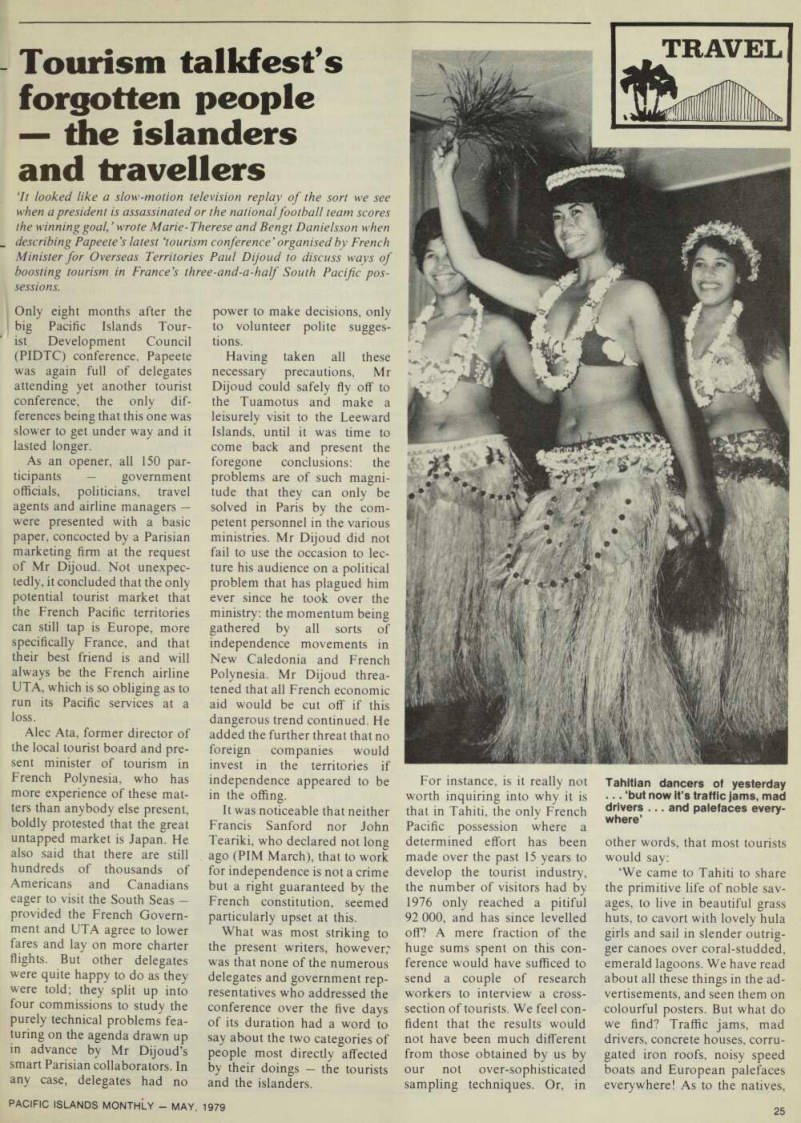
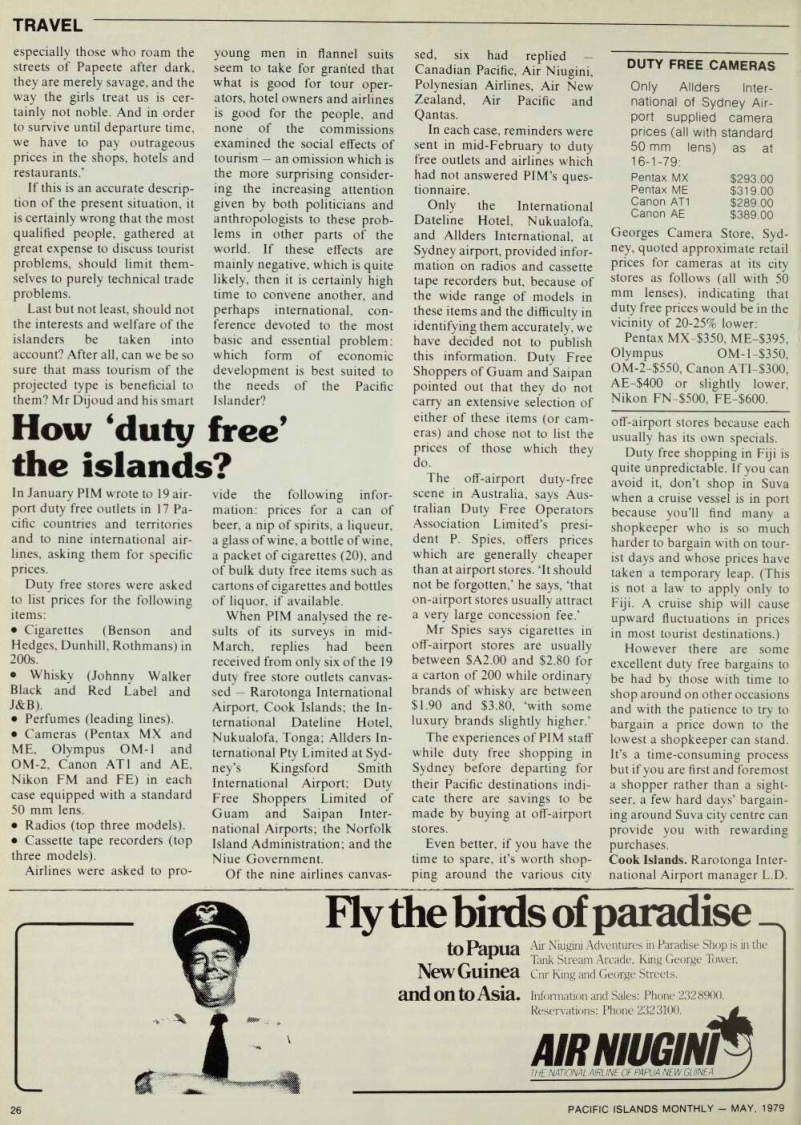
Tourism talkfest’s forgotten people - the islanders and travellers
Travel
‘lt looked like a slow-motion television replay of the sort we see when a president is assassinated or the national football team scores the winning goal, ' wrote Marie-Therese and Bengt Danielsson when describing Papeete's latest ‘tourism conference' organised by French Minister for Overseas Territories Paul Dijoud to discuss ways of boosting tourism in France's three-and-a-half South Pacific pos sessions.
Only eight months after the big Pacific Islands Tour ist Development Council (PIDTC) conference, Papeete was again full of delegates attending yet another tourist conference, the only dif ferences being that this one was slower to get under way and it lasted longer.
As an opener, all 150 par
ticipants government
officials, politicians, travel agents and airline managers were presented with a basic paper, concocted by a Parisian marketing firm at the request of Mr Dijoud. Not unexpec tedly, it concluded that the only potential tourist market that the French Pacific territories can still tap is Europe, more specifically France, and that their best friend is and will always be the French airline UTA, which is so obliging as to run its Pacific services at a loss.
Alec Ata, former director of the local tourist board and pre sent minister of tourism in French Polynesia, who has more experience of these mat ters than anybody else present, boldly protested that the great untapped market is Japan. He also said that there are still hundreds of thousands of Americans and Canadians eager to visit the South Seas provided the French Govern ment and UTA agree to lower fares and lay on more charter
flights. But other delegates
were quite happy to do as they were told; they split up into four commissions to study the purely technical problems fea turing on the agenda drawn up in advance by Mr Dijoud’s smart Parisian collaborators. In any case, delegates had no
power to make decisions, only to volunteer polite sugges tions.
Having taken all these necessary precautions, Mr
Dijoud could safely fly off to
the Tuamotus and make a leisurely visit to the Leeward Islands, until it was time to come back and present the foregone conclusions; the problems are of such magni tude that they can only be solved in Paris by the com petent personnel in the various ministries. Mr Dijoud did not fail to use the occasion to lec ture his audience on a political problem that has plagued him ever since he took over the
ministry: the momentum being
gathered by all sorts of independence movements in New Caledonia and French
Polynesia. Mr Dijoud threa
tened that all French economic aid would be cut off if this dangerous trend continued. He added the further threat that no
foreign companies would
invest in the territories if independence appeared to be in the offing.
It was noticeable that neither Francis Sanford nor John Teariki, who declared not long ago (PIM March), that to work for independence is not a crime but a right guaranteed by the French constitution, seemed particularly upset at this.
What was most striking to the present writers, however,' was that none of the numerous delegates and government rep resentatives who addressed the conference over the five days of its duration had a word to say about the two categories of
people most directly affected
by their doings the tourists and the islanders.
For instance, is it really not worth inquiring into why it is that in Tahiti, the only French Pacific possession where a determined effort has been made over the past 15 years to
develop the tourist industry,
the number of visitors had by 1976 only reached a pitiful 92 000, and has since levelled off? A mere fraction of the huge sums spent on this con ference would have sufficed to send a couple of research workers to interview a cross section of tourists. We feel con fident that the results would not have been much different from those obtained by us by our not over-sophisticated
sampling techniques. Or, in
other words, that most tourists would say: ‘We came to Tahiti to share the primitive life of noble sav ages, to live in beautiful grass huts, to cavort with lovely hula girls and sail in slender outrig ger canoes over coral-studded, emerald lagoons. We have read about all these things in the ad vertisements, and seen them on colourful posters. But what do we find? Traffic jams, mad drivers, concrete houses, corru
gated iron roofs, noisy speed
boats and European palefaces
everywhere! As to the natives,
Tahitian dancers of yesterday ...‘but now it’s traffic jams, mad drivers... and palefaces every where’
especially those who roam the streets of Papeete after dark, they are merely savage, and the way the girls treat us is cer tainly not noble. And in order to survive until departure time, we have to pay outrageous prices in the shops, hotels and restaurants.’
If this is an accurate descrip tion of the present situation, it is certainly wrong that the most
qualified people, gathered at
great expense to discuss tourist problems, should limit them selves to purely technical trade
problems.
Last but not least, should not the interests and welfare of the islanders be taken into account? After all, can we be so sure that mass tourism of the projected type is beneficial to them? Mr Dijoud and his smart
young men in flannel suits seem to take for granted that what is good for tour oper ators, hotel owners and airlines is good for the people, and none of the commissions examined the social effects of tourism an omission which is the more surprising consider
ing the increasing attention
given by both politicians and
anthropologists to these prob
lems in other parts of the world. If these effects are mainly negative, which is quite
likely, then it is certainly high
time to convene another, and perhaps international, con ference devoted to the most basic and essential problem: which form of economic development is best suited to the needs of the Pacific Islander?
the islands?
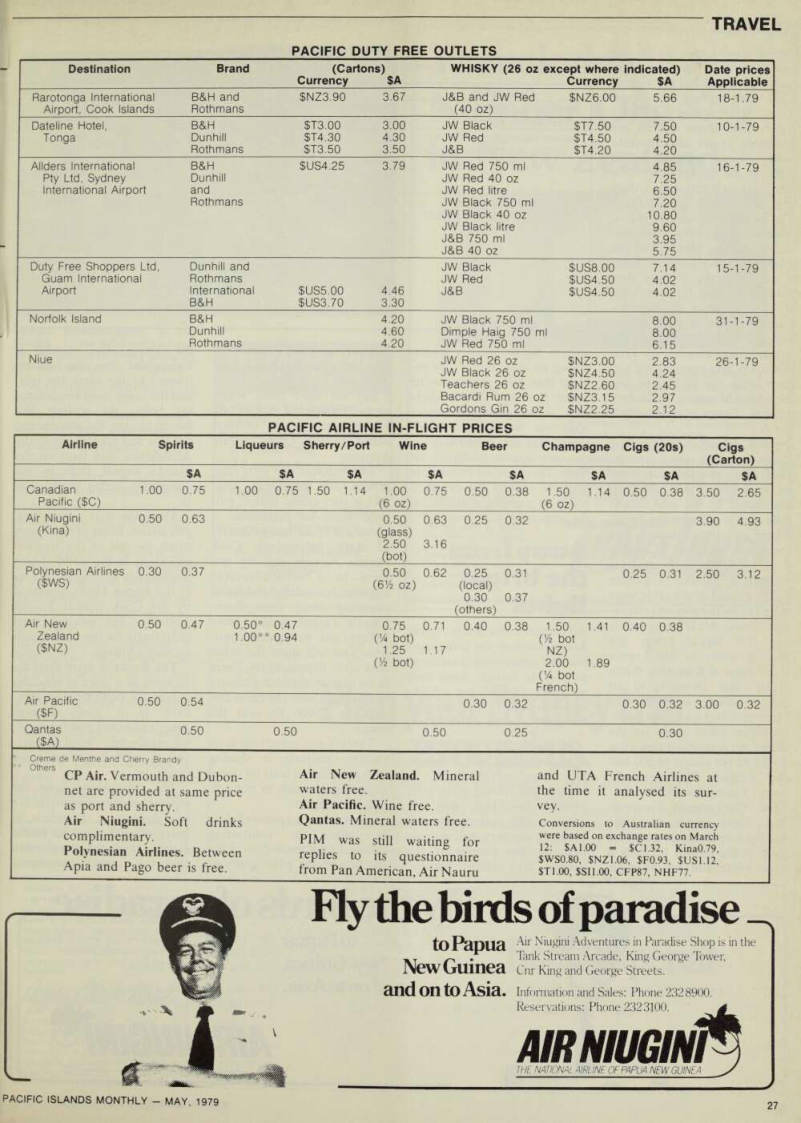
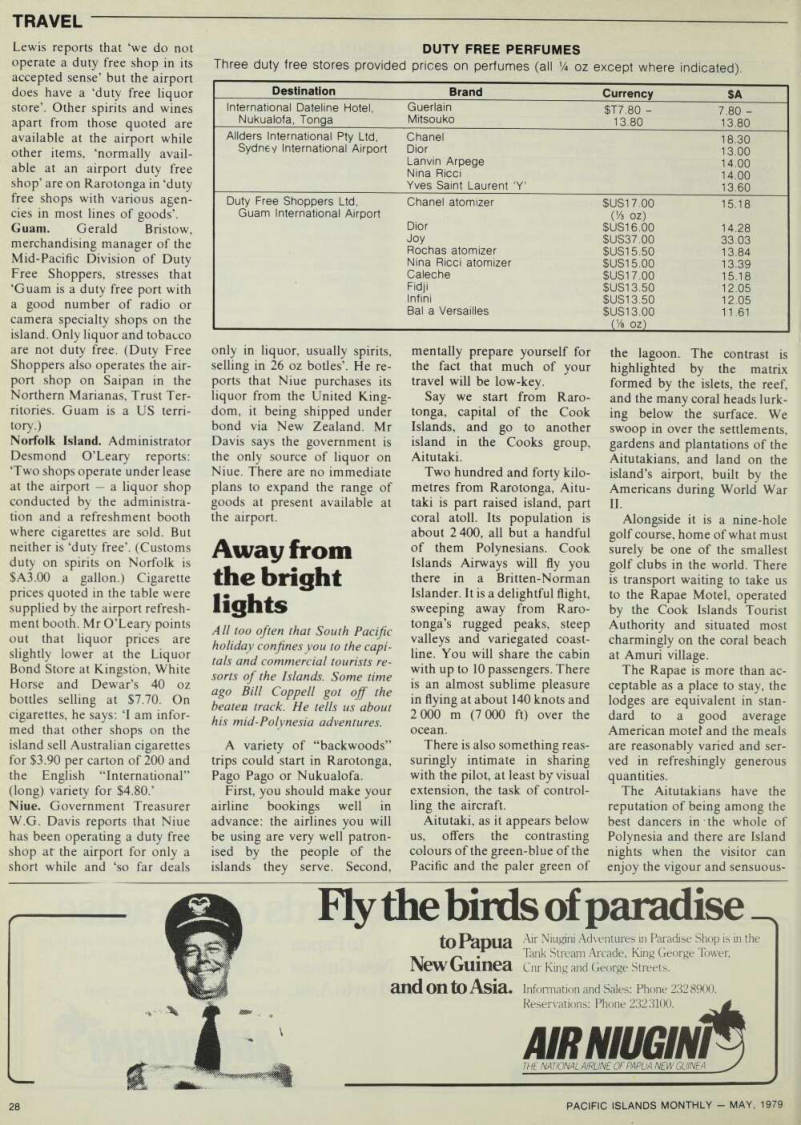
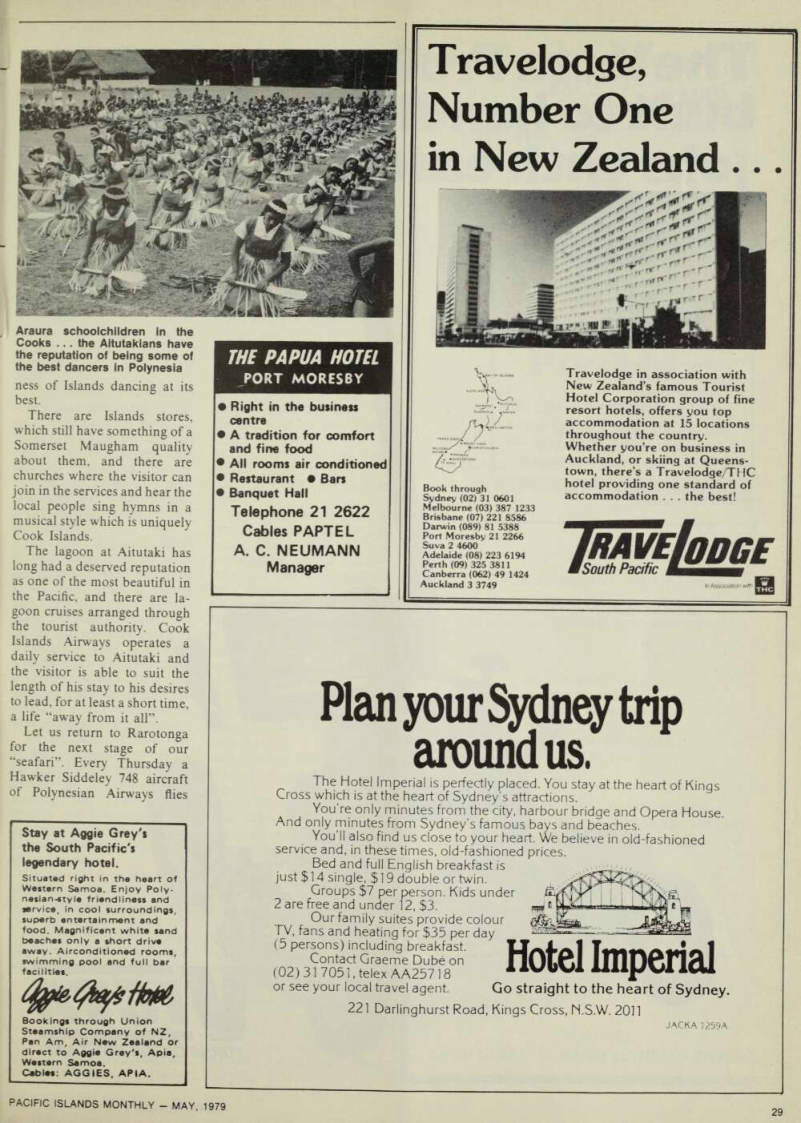
How ‘duty free’ the islands?
In January PIM wrote to 19 air port duty free outlets in 17 Pa cific countries and territories and to nine international air lines, asking them for specific
prices.
Duty free stores were asked to list prices for the following items: • Cigarettes (Benson and Hedges, Dunhill, Rothmans) in 200 s.
• Whisky (Johnny Walker
Black and Red Label and J&B). • Perfumes (leading lines). • Cameras (Pentax MX and ME, Olympus OM-1 and OM-2, Canon ATI and AE, Nikon FM and FE) in each case equipped with a standard 50 mm lens. • Radios (top three models). • Cassette tape recorders (top three models).
Airlines were asked to pro
vide the following infor mation: prices for a can of beer, a nip of spirits, a liqueur, a glass of wine, a bottle of wine, a packet of cigarettes (20), and of bulk duty free items such as cartons of cigarettes and bottles of liquor, if available.
When PIM analysed the re sults of its surveys in mid- March, replies had been received from only six of the 19 duty free store outlets canvas sed Rarotonga International Airport, Cook Islands; the In ternational Dateline Hotel, Nukualofa, Tonga; Allders In ternational Pty Limited at Syd
ney’s Kingsford Smith
International Airport; Duty Free Shoppers Limited of Guam and Saipan Inter national Airports; the Norfolk Island Administration; and the Niue Government.
Of the nine airlines canvas
sed, six had replied Canadian Pacific, Air Niugini, Polynesian Airlines, Air New Zealand, Air Pacific and Qantas.
In each case, reminders were sent in mid-February to duty free outlets and airlines which had not answered PlM’s ques tionnaire.
Only the International Dateline Hotel, Nukualofa, and Allders International, at
Sydney airport, provided infor
mation on radios and cassette tape recorders but, because of the wide range of models in these items and the difficulty in
identifying them accurately, we
have decided not to publish this information. Duty Free Shoppers of Guam and Saipan pointed out that they do not carry an extensive selection of either of these items (or cam eras) and chose not to list the prices of those which they do.
The off-airport duty-free
scene in Australia, says Aus
tralian Duty Free Operators
Association Limited’s presi dent P. Spies, offers prices
which are generally cheaper
than at airport stores. Tt should not be forgotten,’ he says, ‘that
on-airport stores usually attract
a very large concession fee.’
Mr Spies says cigarettes in
off-airport stores are usually
between $A2.00 and $2.80 for a carton of 200 while ordinary brands of whisky are between $1.90 and $3.80, ‘with some
luxury brands slightly higher.’
The experiences of PIM staff while duty free shopping in
Sydney before departing for
their Pacific destinations indi cate there are savings to be
made by buying at off-airport
stores.
Even better, if you have the time to spare, it’s worth shop ping around the various city
off-airport stores because each usually has its own specials.
Duty free shopping in Fiji is
quite unpredictable. If you can avoid it, don’t shop in Suva when a cruise vessel is in port because you’ll find many a shopkeeper who is so much harder to bargain with on tour ist days and whose prices have taken a temporary leap. (This is not a law to apply only to Fiji. A cruise ship will cause
upward fluctuations in prices
in most tourist destinations.) However there are some excellent duty free bargains to be had by those with time to shop around on other occasions and with the patience to try to bargain a price down to the lowest a shopkeeper can stand.
It's a time-consuming process but if you are first and foremost a shopper rather than a sight seer, a few hard days’ bargain ing around Suva city centre can
provide you with rewarding
purchases.
Cook Islands. Rarotonga Inter national Airport manager L.D.
Pacific Duty Free Outlets
Pacific Airline In-Flight Prices
Creme de Menthe and Cherry Brandy Others CP Air. Vermouth and Dubon net are provided at same price as port and sherry.
Air Niugini. Soft drinks
complimentary.
Polynesian Airlines. Between Apia and Pago beer is free.
Air New Zealand. Mineral waters free.
Air Pacific. Wine free.
Qantas. Mineral waters free.
PIM was still waiting for replies to its questionnaire from Pan American, Air Nauru
and UTA French Airlines at the time it analysed its sur vey.
Conversions to Australian currency were based on exchange rates on March 12: SAI.OO = 5C1.32, Kinao.79,
Swso.Bo, Snzi.O6, 5F0.93, Susi.I2,
$71.00, $Bll.Oo, Cfpb7, Nhf77.
Destination Brand (Cartons) WHISKY (26 oz except where indicated) Date prices Currency $A
Currency
$A Applicable Rarotonga International B&H and
Snz3.90
3.67 J&B and JW Red $NZ6.00 5.66 18-1.79 Airport, Cook Islands Rothmans (40 oz) Dateline Hotel, B&H $13.00 3.00 JW Black $T7.50 7.50 10-1-79 Tonga Dunhill $14.30 4.30 JW Red $T4.50 4.50 Rothmans $13.50 3.50 J&B $T4.20 4.20 Allders International B&H $US4.25 3.79 JW Red 750 ml 4.85 16-1-79 Pty Ltd, Sydney Dunhill JW Red 40 oz 7.25 International Airport and JW Red litre 6.50 Rothmans JW Black 750 ml 7.20 JW Black 40 oz 10.80 JW Black litre 9.60 J&B 750 ml 3.95 J&B 40 oz 5.75 Duty Free Shoppers Ltd, Dunhill and JW Black $US8.00 7.14 15-1-79 Guam International Rothmans JW Red $US4.50 4.02 Airport International $US5.00 4.46 J&B $US4.50 4.02 B&H $US3.70 3.30 Norfolk Island B&H 4.20 JW Black 750 ml 8.00 31-1-79 Dunhill 4.60 Dimple Haig 750 ml 8.00 Rothmans 4.20 JW Red 750 ml 6.15 Niue JW Red 26 oz $NZ3.00 2.83 26-1-79 JW Black 26 oz $NZ4.50 4.24 Teachers 26 oz $NZ2.60 2.45 Bacardi Rum 26 oz $NZ3.15 2.97 Gordons Gin 26 oz $NZ2.25 2.12
Airline Spirits Liqueurs Sherry/Port Wine Beer
Champagne
Cigs (20s) Cigs (Carton) $A $A $A $A $A $A $A $A Canadian Pacific ($C) 1.00 0.75 1.00 0.75 1.50 1.14 1.00 (6 oz) 0.75 0.50 0.38 1.50 (6 oz) 1.14 0.50 0.38 3.50 2.65 Air Niugini (Kina) 0.50 0.63 0.50 (glass) 2.50 (bot) 0.63 3.16 0.25 0.32 3.90 4.93 Polynesian Airlines ($WS) 0.30 0.37 0.50 (6I/2 oz) 0.62 0.25 (local) 0.30 (others) 0.31 0.37 0.25 0.31 2.50 3.12 Air New Zealand ($NZ) 0.50 0.47 0.50* 0.47 1.00** 0.94 0.75 (% bot) 1.25 (Vfc bot) 0.71 1.17 0.40 0.38 1.50 (l/ 2 bot NZ) 2.00 ( 1 A bot French) 1.41 1.89 0.40 0.38 Air Pacific (SF) 0.50 0.54 0,30 0.32 0.30 0.32 3.00 0.32 Qantas 0.50 0.50 0.50 0.25 0.30
Lewis reports that ‘we do not operate a duty free shop in its accepted sense’ but the airport does have a ‘duty free liquor store’. Other spirits and wines apart from those quoted are available at the airport while other items, ‘normally avail able at an airport duty free
shop’ are on Rarotonga in ‘duty
free shops with various agen cies in most lines of goods’.
Guam. Gerald Bristow, merchandising manager of the Mid-Pacific Division of Duty Free Shoppers, stresses that ‘Guam is a duty free port with a good number of radio or camera specialty shops on the island. Only liquor and tobacco are not duty free. (Duty Free Shoppers also operates the air port shop on Saipan in the Northern Marianas, Trust Ter ritories. Guam is a US terri
tory.)
Norfolk Island. Administrator Desmond O’Leary reports: ‘Two shops operate under lease
at the airport a liquor shop
conducted by the administra tion and a refreshment booth where cigarettes are sold. But neither is ‘duty free’. (Customs duty on spirits on Norfolk is
$A3.00 a gallon.) Cigarette
prices quoted in the table were
supplied by the airport refresh
ment booth. Mr O’Leary points out that liquor prices are slightly lower at the Liquor Bond Store at Kingston, White Horse and Dewar’s 40 oz bottles selling at $7.70. On cigarettes, he says: ‘I am infor med that other shops on the island sell Australian cigarettes for $3.90 per carton of 200 and the English “International”
(long) variety for $4.80.’
Niue. Government Treasurer W.G. Davis reports that Niue has been operating a duty free shop at the airport for only a short while and ‘so far deals
Duty Free Perfumes
Three duty free stores provided prices on perfumes (all 1 / 4 oz except where indicated).
only in liquor, usually spirits,
selling in 26 oz bodes’. He re ports that Niue purchases its liquor from the United King dom, it being shipped under bond via New Zealand. Mr Davis says the government is the only source of liquor on Niue. There are no immediate plans to expand the range of goods at present available at
the airport.
Away from
the bright
lights
A ll too often that South Pacific holiday confines you to the capi tals and commercial tourists re sorts of the Islands. Some time ago Bill Coppell got off the beaten track. He tells us about his mid-Polynesia adventures.
A variety of “backwoods” trips could start in Rarotonga,
Pago Pago or Nukualofa.
First, you should make your airline bookings well in advance: the airlines you will be using are very well patron ised by the people of the islands they serve. Second,
mentally prepare yourself for the fact that much of your travel will be low-key.
Say we start from Raro tonga, capital of the Cook Islands, and go to another island in the Cooks group, Aitutaki.
Two hundred and forty kilo metres from Rarotonga, Aitu taki is part raised island, part coral atoll. Its population is about 2 400, all but a handful of them Polynesians. Cook Islands Airways will fly you there in a Britten-Norman Islander. It is a delightful flight, sweeping away from Raro tonga’s rugged peaks, steep valleys and variegated coast line. You will share the cabin with up to 10 passengers. There is an almost sublime pleasure in flying at about 140 knots and 2 000 m (7 000 ft) over the ocean.
There is also something reas suringly intimate in sharing with the pilot, at least by visual extension, the task of control ling the aircraft.
Aitutaki, as it appears below us, offers the contrasting colours of the green-blue of the Pacific and the paler green of
the lagoon. The contrast is
highlighted by the matrix
formed by the islets, the reef, and the many coral heads lurk ing below the surface. We swoop in over the settlements, gardens and plantations of the Aitutakians, and land on the island’s airport, built by the Americans during World War 11.
Alongside it is a nine-hole golf course, home of what must surely be one of the smallest golf clubs in the world. There is transport waiting to take us to the Rapae Motel, operated by the Cook Islands Tourist Authority and situated most charmingly on the coral beach at Amuri village.
The Rapae is more than ac ceptable as a place to stay, the lodges are equivalent in stan dard to a good average American motel and the meals are reasonably varied and ser ved in refreshingly generous
quantities.
The Aitutakians have the reputation of being among the best dancers in the whole of Polynesia and there are Island nights when the visitor can enjoy the vigour and sensuous-
Destination Brand Currency $A International Dateline Hotel, Guerlain c cc rh- 7.80 - Nukualofa, Tonga Mitsouko 13.80 13.80 Allders International Pty Ltd, Chanel 18.30 Sydney International Airport Dior 13.00 Lanvin Arpege 14.00 Nina Ricci 14.00 Yves Saint Laurent ‘Y’ 13.60 Duty Free Shoppers Ltd, Chanel atomizer $US17.00 15.18 Guam International Airport (Vs oz) Dior $US16.00 14.28 Joy
Sus37.00
33.03 Rochas atomizer $L)S15.50 13.84 Nina Ricci atomizer $US15.00 13.39 Caleche $US17.00 15.18 Fidji $US13.50 12.05 Infini
Sus13.50
12.05 Bal a Versailles
Sus13.00
11.61
(Vs Oz)
ness of Islands dancing at its best.
There are Islands stores, which still have something of a
Somerset Maugham quality
about them, and there are churches where the visitor can join in the services and hear the
local people sing hymns in a
musical style which is uniquely Cook Islands.
The lagoon at Aitutaki has long had a deserved reputation as one of the most beautiful in the Pacific, and there are la goon cruises arranged through the tourist authority. Cook Islands Airways operates a daily service to Aitutaki and the visitor is able to suit the length of his stay to his desires to lead, for at least a short time, a life “away from it all”.
Let us return to Rarotonga for the next stage of our
“seafari”. Every Thursday a
Hawker Siddeley 748 aircraft
of Polynesian Airways flies
Araura schoolchildren in the Cooks ... the Aitutakians have the reputation of being some of the best dancers in Polynesia
from Rarotonga to Niue, a self
governing Polynesian island to
the west of Rarotonga. Niue has a population of about 4 000.
Again the flight is leisurely, the aircraft carries about 40 people, and the service from the Samoan hostesses is friendly, extremely helpful and informal.
Again the flight allows us to feel at peace with the ocean and the clouds that seem to march across the world below in step with us.
Niue, when it appears in sight, offers a complete con trast with most other Pacific Islands. The fringing reef is close to the shore, which is
dominated by high coral
cliffs.
The island, considerably larger than Rarotonga, is cir cular in shape and from the air looks to be almost flat. The ter rain is dotted with jagged coral outcrops that thrust through the coconuts, forests and plan tations of the Niuean people, which are spread over much of the island.
We land at Hanan inter national airport and the wait ing transport takes us to the Hotel Niue, which is owned and operated by the govern ment. The hotel is situated high on the cliff and look-outs give a panorama of sea, surf, beach and cliffs. The accommodation is very comfortable, the service pleasant and helpful, and the meals, if a little monotonous, well prepared and presented.
As the hotel has the best stocked and appointed bar on the island the evenings often
provide an opportunity for
meeting the local people,
Niuean and European, in an informal face-to-face way, and to find out some of the back ground to Niue.
For the sport-minded visitor, who wants to add to his score of unusual sporting venues the Niue Sports Club has a nine hole golf course, there are reg ular darts matches, and there are tennis courts. For the visi tor whose interests are aquatic it is possible to skin-dive and snorkel throughout the year.
However, it is Niue’s scenic attractions that hold out the greatest appeal. The coasts are bounded by coral cliffs, any
thing up to 70 m (200 ft) in height and there are gaps in these which give access to deep swimming pools, chasms, caves, grottoes and blow-holes.
In some places the water is still, translucent and deep. In others it gurgles and swishes, and in others again it thunders down upon the shore. To reach these water wonderlands one wanders along narrow tracks,
through coconut palms and
forest, and often scrambles down natural stairways. But there are no hordes of tourists
rushing to gain vantage points,
Niuean guides are not given to haste, and even the most sedate visitor can enjoy the stroll down to the coast.
The main township of Niue is Alofi. The street through the settlement has now been tar sealed. Alofi has one res taurant, a set of government offices, a church or two, an educational centre and three general stores. It is both a
capital city and a sleepy little
village.
If you want to see Niue at your own pace, perhaps you would like to hire a small motor-scooter as I did, and pot ter round the island through
the villages, stopping to
wander down to the coast as the fancy takes you. A driver’s li cence on Niue costs $l, and all that happens is that a rubber stamp is affixed to your own li cence.
The Niueans have estab lished a reputation for handi crafts, and in Alofi there is a shop run by a co-operative society, which sells woven bas kets, purses and wooden carv
ings.
Now whaf to do when the time comes to leave Niue?
There are several possibilities, depending on how you want to go on with your Polynesian odyssey. Perhaps, like me, you might like to fly on to Pago Pago and Apia in a Cessna Utililiner of South Pacific
Island Airways, or, having
learnt to admire the services of Polynesian Airlines, fly on to Apia or seize the chance to go on to Nukualofa, capital of
Tonga.
I made for Apia to stay a night or two at one of my favourite Pacific hotels, Aggie
Grey’s.
Duty Free Cameras
Only Allders Inter national of Sydney Air port supplied camera prices (all with standard 50 mm lens) as at 16-1-79: Pentax MX $293.00 Pentax ME $319.00 Canon ATI $289.00 Canon AE $389.00 Georges Camera Store, Syd ney, quoted approximate retail prices for cameras at its city stores as follows (all with 50 mm lenses), indicating that duty free prices would be in the vicinity of 20-25% lower: Pentax MX-$350, ME-$395,
Olympus OM-1-$350,
OM-2-$550, Canon ATI-$3OO, AE-$4OO or slightly lower, Nikon FN-$5OO, FE-$6OO.
Advertisements & other items, pp. 26-32 (2 items)
Fly the birds of paradise
<*' X
to Papua
Air Niugini Adventures in Paradise Shop is in the . Tank Stream Arcade, King George Tower, JNCW Guinea Cnr King and George Streets. and On to Asia. Information and Sales: Phone 2328900.
Fly the birds of paradise
toP&pua
New Guinea
and on to Asia.
Air Niugini Adventures in Paradise Shop is in the Tank Stream Arcade, King George Tower, Cnr King and George Streets.
Information and Sales: Phone 2328900.
Reservations: Phone 2323100. A
AIRNIUGINr
THE NATIONAL AIRLINE OF PAPUA NEW GUINEA y /
X.
Fly the birds of paradise
to Papua
New Guinea
and on to Asia.
Air Niugini Adventures in Paradise Shop is in the Tank Stream Arcade, King George Tower, Cnr King and George Streets.
Information and Sales: Phone 2328900.
Travelodgc,
Number One
in New Zealand
¥ rtf Book through Sydney (02) 31 0601 Melbourne (03) 387 1233 Brisbane (07) 221 8586 Darwin (089) 81 5388 Port Moresby 21 2266 Suva 2 4600 Adelaide (08) 223 6194 Perth (09) 325 3811 Canberra (062) 49 1424 Auckland 3 3749 Travelodge in association with New Zealand’s famous Tourist Hotel Corporation group of fine resort hotels, offers you top accommodation at 15 locations throughout the country.
Whether you’re on business in Auckland, or skiing at Queenstown, there’s a Travclodgc/THC hotel providing one standard of accommodation . . . the best!
rave/odce
'South Pacific
In Association with I
THE PAPUA HOTEL
PORT MORESBY
• Right in the business centre • A tradition for comfort and fine food • All rooms air conditioned • Restaurant • Bars • Banquet Hall Telephone 21 2622 Cables PARTEL
A. C. NEUMANN
Manager
Plan your Sydney trip
around us.
The Hotel Imperial is perfectly placed. You stay at the heart of Kings Cross which is at the heart of Sydney’s attractions.
You're only minutes from the city, harbour bridge and Opera House.
And only minutes from Sydney’s famous, bays and beaches.
You’ll also find us close to your heart. We believe in old-fashioned service and, in these times, old-fashioned prices.
Bed and full English breakfast is just $l4 single, $l9 double or twin.
Groups $7 per person. Kids under 2 are free and under 12, $3.
Our family suites provide colour TV, fans and heating for $35 per day (5 persons) including breakfast.
Contact Graeme Dube on (02) 31 7051, telex AA25718 or see your local travel agent. Go straight to the heart of Sydney
Hotel Imperial
221 Darlinghurst Road, Kings Cross, H.S.W. 2011
JACKA 1259 A
Stay at Aggie Grey's
tha South Pacific's
legendary hotel.
Situated right in the heart of Western Samoa. Enjoy Polyneslan-style friendliness and service, in cool surroundings, superb entertainment and food. Magnificent white sand beaches only a short drive away. Airconditioned rooms, swimming pool and full bar facilities.
Bookings through Union Steamship Company of N 2, Pan Am, Air New Zealand or direct to Aggie Grey's, Apia, Western Samoa.
Cables: AGGIES, APIA.
The Vfecta Professional 460
built to tough
jobs with ease
PROFESSIONAL 460 FEATURES
Victa Hi-Torque 6 two-stroke 160 cc engine.
Larger fuel tank 2.3 litres as against 1 litre Heavy duty wheels.
Easy pull zip starter Safety blade disc 46 cm (18") cut Concealed throttle cable LM carburettor Folding handle 8 position height adjuster Noise reducing muffler Side chute with safety cover Lightweight (weighs only 54 lb) Rugged 14-gauge steel baseplate Specifications and models subject to alteration without notice or obligation
ICTA
TURNS GRASS INTO LAWN
e xpoßlo£
pACIft
THE
TO 4 034V1«F "^7
Breekwoldt & Co
Pty Ltd
Suite 1909, 19th Floor, King George Tower,
Corner King & George Streets, Sydney.
G.P.O. Box 5027, Sydney 2001.
CABLES; 'BREWO' SYDNEY. TELEX; AA22890.
TELEPHONES: 233 2366, 232 2315, 233 1462.
PACIFIC ISLAND OFFICES
BRECKWOLDT & CO (PNG) PTY. LTD.
PO BOX 1549, BOROKO, PORT MORESBY.
PO BOX 222, RABAUL
PO BOX 72. KIETA
PO BOX 178, WEWAK
PO BOX 185, MADANG
PO BOX 237, MT. HAGEN
PO BOX 1188, LAE
BRECKWOLDT & CO., PO BOX 47, APIA BRECKWOLDT & CO. (SI) LTD. PO BOX 140, HONIARA
BRECKWOLDT SARL BP 2369, NOUMEA
OFFICES IN:
HAMBURG
LONDON
MILAN
& WEST AFRICA
ALSO AT:
SINGAPORE
KUALA LUMPUR
BANGKOK
& HONG KONG
ENQUIRIES
FROM OVERSEAS MANUFACTURERS INVITED.
We build grip
into all our
car tyres
* You can trust Goodyear technology to give you grip. World champion racing drivers do. So drive on steel belted radial car tyres developed by Goodyear. Built for grip in any weather. Extra high mileage too.
H s a 5 I u i m K 111
GOOD? YEAR
The Choice of Champions
GBOO+S
Grand Prix 70
GBOO+S
GBOO
Grand Rally
GOODYEAR DISTRIBUTORS IN S.E. ASIA AND PACIFIC BASIN Richard Pieris & Co.. Ltd.
Colombo, Sri Lanka Nepal Motor Company (P) Ltd.
Biratnagar, Nepal Navana Ltd.
Dacca. Bangladesh Diethelm &Co Ltd.
Bangkok, Thailand Landis Brothers & Co.. Ltd Hong Kong Guam Tire & Supply Co.
Agana, Guam Susupe Enterprises Saipan. Mariana Is Microl Corporation Saipan. Mariana Is Truk Trading Co.
Truk E , Caroline Is
PA.MI.
Kolonia, Ponape Island Transport Service Co.
Majuro, Marshall Is Yap Cooperative Ass.
Yap, W Caroline Is Cook Islands Motor Centre Ltd.
Rarotonga, Cook Is Ngiratkel Etpison Co. Ltd.
Koror, Palau Boroko Motors Ltd Port Moresby. Papua New Guinea Solomon Motors Ltd.
Honiara, Solomon Is.
Santo Engineers Santo. New Hebrides Pacific Motors Vila. New Hebrides
S.G.A.
Noumea. New Caledonia Duncombe Bay Garage Norfolk Is Coral Island Motors Suva, Fiji Morris Hedslrom Ltd.
Nukualofa, Tonga Morris Hedstrom Ltd.
Apia, Western Samoa Western Samoa Transport Cooperative Society Ltd.
Apia, Western Samoa Samoa Motors Inc Pago Pago. American Samoa Service Mobil Papeete. Tahiti
GOODYEAR SUBSIDIARIES
The Goodyear Tyre & Rubber Co (Aust.) Ltd.
Sydney. AUSTRALIA Tel: 31-0311 Goodyear India Limited New Delhi 1, INDIA Tel 46886/9 PT Goodyear Indonesia Bogor, Republic of Indonesia Tel: 3371/2 Nippon Goodyear Kabushiki Kaisha Tokyo. JAPAN Tel: 582-0481/8 Goodyear Malaysia Berhad Selangor, MALAYSIA Tel: 362501/5 The Goodyear Tyre & Rubber Co. ol New Zealand. Limited Lower Hutt, NEW ZEALAND Tel; 684-389 The Goodyear Tyre & Rubber Company of the Philippines. Limited Makatl-Metro Manila Republic of the Philippines Tel: 89-20-41 Goodyear Singapore Pvt Limited Geylang SINGAPORE 14 Tel: 408281/3 Goodyear Taiwan Limited Taipei. TAIWAN Tel: 5117135/8 Goodyear (Thailand) Limited Bangkok. THAILAND. Tel: 252-6141/5
FOR FURTHER INFORMATION
PLEASE CONTACT
Goodyear International Corporation Room 1603. Wing On Center 111 Connaught Road Central
HONGKONG Tel: 5-433331
HRMEI7I 0252
Currents
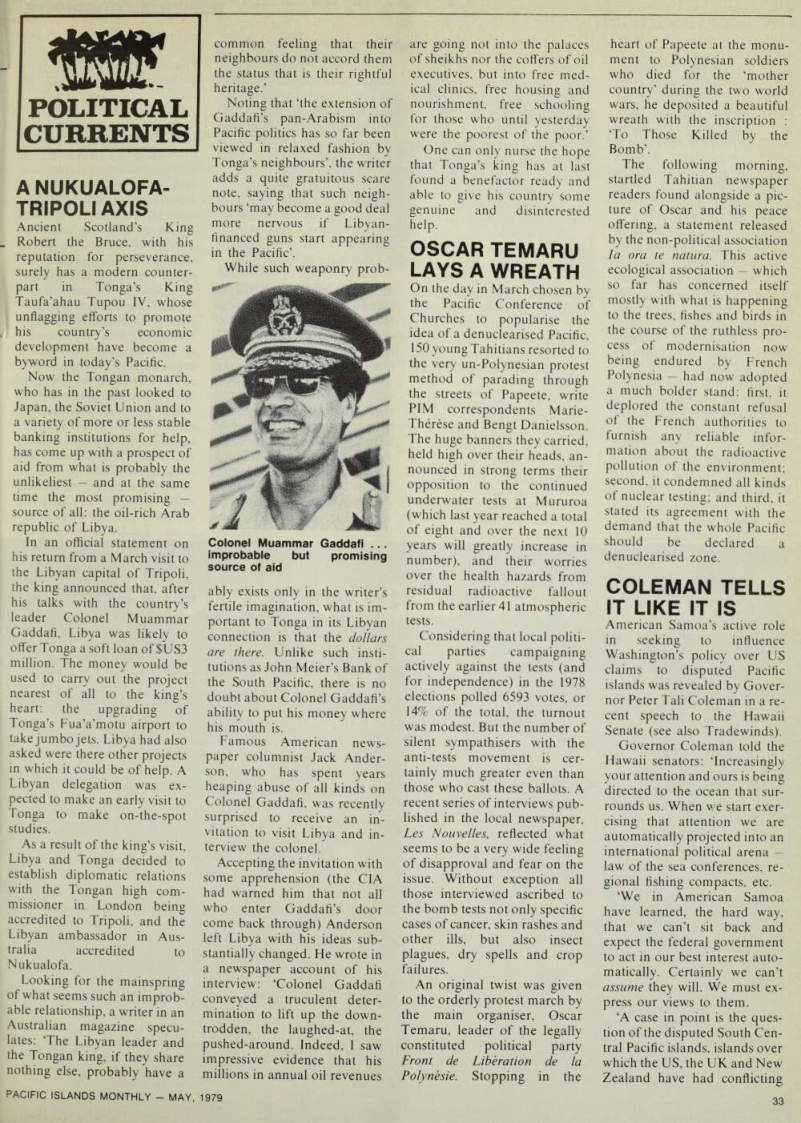

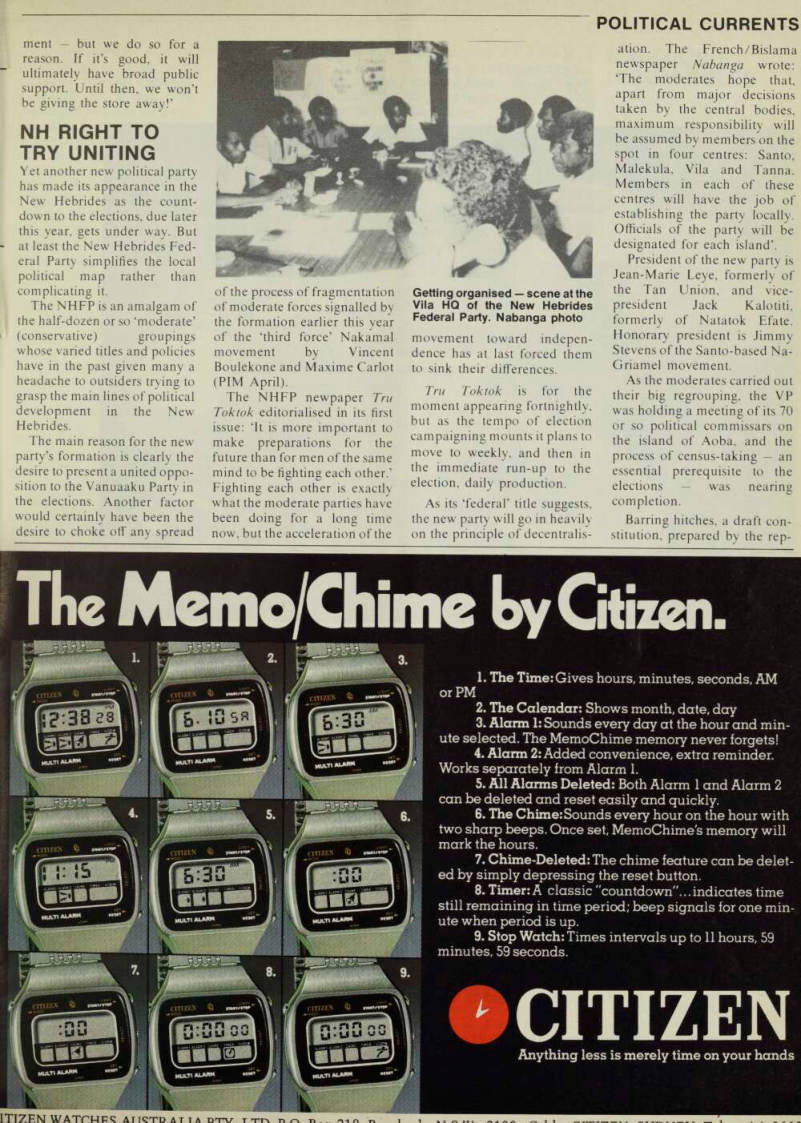

Political
A Nukualofa
Tripoli Axis
Ancient Scotland’s King Robert the Bruce, with his reputation for perseverance, surely has a modern counter part in Tonga’s King Taufa’ahau Tupou IV, whose unflagging efforts to promote his country’s economic development have become a
byword in today’s Pacific.
Now the Tongan monarch, who has in the past looked to Japan, the Soviet Union and to a variety of more or less stable banking institutions for help, has come up with a prospect of aid from what is probably the unlikeliest and at the same time the most promising source of all: the oil-rich Arab republic of Libya.
In an official statement on his return from a March visit to the Libyan capital of Tripoli, the king announced that, after his talks with the country’s leader Colonel Muammar Gaddafi, Libya was likely to offer Tonga a soft loan of SUS 3 million. The money would be used to carry out the project nearest of all to the king’s heart: the upgrading of Tonga’s Fua’a’motu airport to take jumbo jets. Libya had also asked were there other projects in which it could be of help. A Libyan delegation was ex pected to make an early visit to
Tonga to make on-the-spot
studies.
As a result of the king’s visit, Libya and Tonga decided to establish diplomatic relations with the Tongan high com missioner in London being accredited to Tripoli, and the Libyan ambassador in Aus tralia accredited to Nukualofa.
Looking for the mainspring
of what seems such an improb able relationship, a writer in an Australian magazine specu lates; ‘The Libyan leader and
the Tongan king, if they share
nothing else, probably have a
common feeling that their neighbours do not accord them the status that is their rightful
heritage.’
Noting that ‘the extension of Gaddafi’s pan-Arabism into Pacific politics has so far been viewed in relaxed fashion by
Tonga’s neighbours’, the writer
adds a quite gratuitous scare note, saying that such neigh bours ‘may become a good deal more nervous if Libyan financed guns start appearing in the Pacific’.
While such weaponry prob-
ably exists only in the writer’s fertile imagination, what is im portant to Tonga in its Libyan connection is that the dollars are there. Unlike such insti tutions as John Meier’s Bank of the South Pacific, there is no doubt about Colonel Gaddafi’s ability to put his money where his mouth is.
Famous American news paper columnist Jack Ander son, who has spent years heaping abuse of all kinds on Colonel Gaddafi, was recently surprised to receive an in vitation to visit Libya and in terview the colonel.
Accepting the invitation with some apprehension (the CIA had warned him that not all who enter Gaddafi’s door come back through) Anderson left Libya with his ideas sub stantially changed. He wrote in a newspaper account of his interview: ‘Colonel Gaddafi conveyed a truculent deter mination to lift up the down trodden, the laughed-at, the pushed-around. Indeed, I saw impressive evidence that his millions in annual oil revenues
are going not into the palaces of sheikhs nor the coffers of oil executives, but into free med ical clinics, free housing and nourishment, free schooling for those who until yesterday were the poorest of the poor.’
One can only nurse the hope that Tonga’s king has at last found a benefactor ready and able to give his country some genuine and disinterested
help.
Oscar Temaru
Lays A Wreath
On the day in March chosen by the Pacific Conference of Churches to popularise the idea of a denuclearised Pacific, 150 young Tahitians resorted to the very un-Polynesian protest
method of parading through
the streets of Papeete, write PIM correspondents Marie- Therese and Bengt Danielsson.
The huge banners they carried, held high over their heads, an nounced in strong terms their opposition to the continued underwater tests at Mururoa (which last year reached a total of eight and over the next 10 years will greatly increase in number), and their worries over the health hazards from residual radioactive fallout from the earlier 41 atmospheric tests.
Considering that local politi
cal parties campaigning
actively against the tests (and for independence) in the 1978 elections polled 6593 votes, or 14% of the total, the turnout was modest. But the number of silent sympathisers with the anti-tests movement is cer tainly much greater even than those who cast these ballots. A recent series of interviews pub lished in the local newspaper, Les Nouvelles, reflected what seems to be a very wide feeling of disapproval and fear on the issue. Without exception all those interviewed ascribed to the bomb tests not only specific cases of cancer, skin rashes and other ills, but also insect
plagues, dry spells and crop
failures.
An original twist was given to the orderly protest march by the main organiser, Oscar Temaru, leader of the legally constituted political party Front de Liberation de la
Polynesie. Stopping in the
heart of Papeete at the monu ment to Polynesian soldiers who died for the ‘mother country’ during the two world wars, he deposited a beautiful wreath with the inscription : ‘To Those Killed by the Bomb’.
The following morning,
startled Tahitian newspaper readers found alongside a pic ture of Oscar and his peace offering, a statement released by the non-political association la orate natura. This active ecological association which so far has concerned itself mostly with what is happening to the trees, fishes and birds in the course of the ruthless pro cess of modernisation now
being endured by French
Polynesia had now adopted
a much bolder stand: first, it deplored the constant refusal of the French authorities to furnish any reliable infor mation about the radioactive pollution of the environment; second, it condemned all kinds of nuclear testing; and third, it stated its agreement with the demand that the whole Pacific should be declared a denuclearised zone.
Coleman Tells
It Like It Is
American Samoa’s active role in seeking to influence
Washington’s policy over US
claims to disputed Pacific islands was revealed by Gover nor Peter Tali Coleman in a re cent speech to the Hawaii Senate (see also Tradewinds).
Governor Coleman told the Hawaii senators: ‘lncreasingly your attention and ours is being directed to the ocean that sur rounds us. When we start exer cising that attention we are
automatically projected into an
international political arena law of the sea conferences, re
gional fishing compacts, etc.
‘We in American Samoa have learned, the hard way, that we can’t sit back and expect the federal government to act in our best interest auto
matically. Certainly we can’t
assume they will. We must ex press our views to them. ‘A case in point is the ques tion of the disputed South Cen tral Pacific islands, islands over which the US, the UK and New Zealand have had conflicting
Colonel Muammar Gaddafi .. . improbable but promising source of aid
claims for more than 100 years.
Just last Thursday and Friday State Department represen tatives met with a joint dele gation from the UK and the
soon-to-be-independent Gil
bert Islands. Some 14 disputed islands of the Line and Phoenix group are involved. Without going into great detail, the US based most of its claims on the guano mining of the 1800 s (the Guano Act of 1856). ‘But in the case of islands like Canton and Enderbury we have had a settled presence since the islands became im portant for civil aviation and defence activities. Little weight was given (strangely) to the fact that Polynesians had occupied these islands for centuries while travelling to and from Hawaii and the south. To us the islands are important. For every island there is a 200-mile fishing economic radius around it. As I said earlier, we in Samoa are dependent for our survival on the continued health of our fish canneries. ‘When we learned, through a published statement in the Pa
cific Islands Monthly (the governor is referring to PIM December 1977 Ed), of the
State Department’s alleged
willingness to give up all US claims we went to “battle stations”. ‘We made a strong represen tation of our case in Washing ton to the State Department.
You in Hawaii are also deeply affected by these events since you are also trying to develop your long-range fishing fleet. It is a “natural” for that fleet to operate up north out of Mid way during summer months and off the Line Islands to the south during winter months. ‘lf the Gilberts assert their 200-mile economic zone and li cense another nation’s boats exclusively we both have a real
problem.
‘I am happy to say that your state administration joined American Samoa’s rejection of any outright give-away as of last Wednesday, and as of
today, through our involve
ment, we have achieved a posi
tive working relationship with
the Gilbertese. So again we see
how our interests are interlinked.’
Governor Coleman made an oblique plea for Hawaiians to become more involved in Pa
cific regional affairs, saying:
‘Neither Hawaii nor American Samoa can escape the fact that we are oceanic states, unique in the American Constellation. ‘While science has produced new technologies, governments are notoriously snail-like in their reactions. This is par ticularly so in the field of
oceanic technology.
‘The problems of new indus tries that might be based in Hawaii and/or American Samoa cannot be handled except at the international level, or at least the regional in ternational level. This is why we in American Samoa empha sise our participation in all South Pacific and Pacific-wide institutions, such as the Pacific Islands Development Com mission (PIDC) and the South Pacific Commission, and send observers to South Pacific Forum meetings. ‘Hawaii, as such, I might
add, has been largely absent from these forums, though Hawaiian residents have rep resented the US from time to time.’
He also had a word for Hawaii’s senators about the delicate question, especially for Hawaiians. of preserving a
Polynesian cultural identity.
Said he: ‘We have one other important common politico social element, our mutual de sire to preserve as much as possible of our unique Island cultures. As with Hawaii in the past 20 years since statehood, we in Samoa are faced with the inevitability of our greater inte gration into the world at large.
We welcome the opportunity
to participate actively in
improving the lives of our own
and other peoples through
modern technologies.
‘But we in Samoa are also deepy committed to the preser vation of the true and abiding values of fa’a Samoa, the Samoan culture. ‘To some we may seem slow in building hotels or adapting our land policies to develop
ment but we do so for a reason. If it’s good, it will ultimately have broad public support. Until then, we won’t be giving the store away!’
Nh Right To
Try Uniting
Yet another new political party has made its appearance in the New Hebrides as the count down to the elections, due later this year, gets under way. But at least the New Hebrides Fed eral Party simplifies the local political map rather than
complicating it.
The NHFP is an amalgam of the half-dozen or so ‘moderate’
(conservative) groupings
whose varied titles and policies have in the past given many a headache to outsiders trying to grasp the main lines of political development in the New Hebrides.
The main reason for the new party’s formation is clearly the desire to present a united oppo sition to the Vanuaaku Party in the elections. Another factor would certainly have been the desire to choke off any spread
of the process of fragmentation of moderate forces signalled by the formation earlier this year of the ‘third force’ Nakamal movement by Vincent Boulekone and Maxime Carlot
(PIM April).
The NHFP newpaper Tru Toktok editorialised in its first issue: it is more important to make preparations for the future than for men of the same mind to be fighting each other.’
Fighting each other is exactly what the moderate parties have been doing for a long time now, but the acceleration of the
movement toward indepen dence has at last forced them to sink their differences.
Tru Toktok is for the moment appearing fortnightly, but as the tempo of election campaigning mounts it plans to move to weekly, and then in the immediate run-up to the
election, daily production.
As its ‘federal’ title suggests, the new party will go in heavily on the principle of decentralis
ation. The French/Bislama newspaper Nabanga wrote: ‘The moderates hope that, apart from major decisions taken by the central bodies, maximum responsibility will be assumed by members on the spot in four centres; Santo, Malekula, Vila and Tanna.
Members in each of these centres will have the job of
establishing the party locally.
Officials of the party will be designated for each island’.
President of the new party is Jean-Marie Leye, formerly of the Tan Union, and vice president Jack Kalotiti, formerly of Natatok Efate.
Honorary president is Jimmy
Stevens of the Santo-based Na- Griamel movement.
As the moderates carried out their big regrouping, the VP was holding a meeting of its 70 or so political commissars on the island of Aoba, and the process of census-taking - an essential prerequisite to the elections was nearing
completion.
Barring hitches, a draft con stitution, prepared by the rep
Getting organised scene at the Vila HQ of the New Hebrides
Federal Party. Nabanga photo
resentative assembly with the . help of British and French con stitutional lawyers, will be presented this month. The population will then be asked to vote on the constitution and independence. Elections will then be held for a new assembly which will in turn elect a leader who will have the
responsibility of forming a
government. This government will have charge of the New
Hebrides following indepen
dence, which is expected either late this year or early next year.
Recent New Hebrides his tory, however, shows that hitches are by no means to be ruled out. Writing in the Papua New Guinea Post-Courier in March, journalist Hilda Lini, sister of Vanuaaku Party presi dent and Deputy Chief Minis ter Walter Lini, said: ‘Vanuaaku Party members still talk about delaying tactics by the British and French to slow the elections. They warn that if there are too many of these tricks, too many broken prom ises, they will leave the tran sitional government and again work outside the system.
‘This might well delay
independence. But the end re sult true independence, rather than a deal handed to us from London and Paris is worth a few delays.’
Fiji’S Elusive
Coalition
The mainly Fijian-backed
Alliance Party controls 36 of the 52 seats in Fiji’s House of Representatives, writes Robert Keith-Reid in Suva. There are V/2 years to go to the next elec tion, which the Alliance Party is reasonably sure of winning.
Why then is the Alliance’s leader. Prime Minister Ratu Sir Kamisese Mara, talking of
sharing power (PIM April)
with the strife-torn India dominated National Feder
ation Party (NFP) by forming
a coalition government?
Because, he complains, the Indian arm of his own party, the Indian Alliance, is also torn by rivalries, so much so that he’s lost contact with the Indian people who form half of Fiji’s 600 000 population.
Ratu Mara exaggerates
when he says he has no contact with the Indians. There are many situations when the Fijian leader is obviously in close contact with them. But he has ground for serious concern about a corrosive battle going on inside the Indian Alliance, a separate party in its own right, but one of three which, with the Fijian Association and the General Electors’ Associ ation (the ‘Generals’ are neither Fijians or Indians), form what is already a coalition, the Al liance Party itself, which has run Fiji since 1968.
Ratu Mara has mentioned coalition several times in recent
years, without really going into the nitty-gritty of what kind of co-operative government he envisaged. He floated it again in a radio interview last year.
His attitude is generally interpreted as: If Fiji is to pre serve political stability it must have an evenly balanced multi racial government backed and trusted by a majority that represents a fair cross-section of its multi-racial society. If this can’t be done with the help of the Indian Alliance, can it be done by forming a national government with the NFP?
Response has so far been cool in almost all quarters.
Cabinet ministers say privately that they see no reason what soever to share power with the NFP. After all. hadn’t the Al liance crushed the NFP in the last election, and wasn’t the NFP split into two apparently irreconcilable factions?
The dominant NFP faction is led by the new leader of the
opposition, Jai Ram Reddy, a
cool, highly intelligent, elegant
and moderate lawyer who shows every sign of greatly
enchancing Fiji’s political
scene. But while some senior members of his faction have shown interest in being coalition cabinet ministers, Reddy has refused to say pub licly what he thinks one way or the other and has not, he says, even discussed the proposition privately with Ratu Mara. A possible reason for this attitude is that he is still consolidating his place as opposition leader, and fears that any sign of a deal with the Alliance could be
interpreted by his NFP
enemies as weakness they call him ‘Mara’s stooge’
already and exploited as
such.
The fight in the Indian Al liance shows no signs of end ing. It is primarily between its president. James Shankar Singh, and a faction he claims is led by his nephew and a former Indian Alliance presi dent, Attorney-General Sir
Vijay Singh. In January Mr J.
S. Singh resigned from cabinet, alleging he had been forced to do so because of false stories whispered in Ratu Mara’s ear by his opponents.
Veteran Alliance leader Doug Brown, a retired MP and former cabinet minister, seemed to sum up things when he told a February meeting of the national council of the Al liance Party: “I wonder whether we non-Indians in the
Alliance really and truly
understand the people with whom we work. I am at a loss to understand this personal animosity which crops up at almost every meeting we have.’
Ratu Mara is promising that he will keep plugging at the coalition idea, hoping that it will take root and then burst into flower in the Alliance and on Mr Reddy’s side of the
Nfp.
Mara, aged 59, wants to retire. ‘lf I can see the possi bility of a coalition at least a government that succeeds me that will be more represen tative of the people of Fiji than 1 have been able to achieve - I'll walk out tomorrow,’ he says.
Caledonia:
Hicom Rules
The French Government in March dismissed New Caledonia’s government coun cil and placed the territory under the direct authority of High Commissioner Claude Charbonniaud. Under existing
legislation the high com
missioner may act as adminis trator for up to two months.
Any new elections for the 35member territorial assembly called by the high com missioner after that period would be under new rules which, on the recommendation of France’s Minister for Over seas Departments and Terri tories Paul Dijoud, came into force in March.
A feature of the new rules is that for the first time parties must obtain at least 10% of the total vote before they can have a member elected. This effec tively disfranchises voters for the minor parties in the New Caledonian context, primarily
Melanesian-supported and
advocating independence. (It is
noteworthy that in the New Hebrides Mr Dijoud is
advocating an exactly opposite
electoral practice - a form of
proportional representation
‘which does not exclude min
ority parties from political life’
Le Monde , March 1. But in the New Hebrides the minority
parties are those supporting
close and continuing links with France.) Andre Chaville, writing from Noumea, backgrounds the crisis: Mr Dijoud came back to Noumea in February for a reply to his proposal for a 10-year contract between France and the territory.
The Union Caledonienne, led by Maurice Lenormand, which at the time controlled the government council, after many meetings with the minis ter, still could not agree to vote in favour of the plan because it failed to acknowledge the possibility of New Caledonian
independence in the long
term. ‘ln view of the UC control of the government council, Mr
Dijoud suggested that the
council should be dissolved.
But vice-president Lenormand (the high commissioner is
Jamus Shankar Singh ... eye of the storm
president) refused, insisting
that the councillors had been
democratically elected.’
In a statement in early
March, clearly foreshadowing
dismissal of the government council, Mr Dijoud said on the Noumea television station, FR3; ‘For the moment, the situation is blocked. Is it pos sible to have any real collabor ation between on the one hand a government council, a majority of whom have chosen the path of independence and a split with the mother country, and on the other, a territorial assembly with a majority in favour of progress together with France? ‘We are going to find a way to make the wishes of the terri torial assembly coincide with the objectives of the govern ment of New Caledonia . ..’
To this end, ‘. . . the terri torial councillors will, from now on. have to be elected more scrupulously and in
better organised conditions ...
Thus only representatives of
major parties may be elected ... This implies that small political factions will have to
be grafted on to the larger ones.’
Sanford Hits
At Wcc
The March conference in Noumea sponsored by the South Pacific Commission on the subject ‘An Oceanian Ap
proach to Rural Development’
saw stiff resistance by New Caledonian representatives to a motion calling for ‘suitable training’ of church ministers working in rural areas. They succeeded in having the motion amended.
Explaining the New Caledonian stand, the Noumea newspaper France Australe said the ‘original motion almost opened the door to the financing of churches by the
Spc.
The conference adopted a number of resolutions, stress ing the importance of work among young people and proposing a plan of action to benefit young folk working on
rural development projects.
Differences between spokes men of French territories and the predominantly Protestant
churches active in the Pacific also surfaced in French Polynesia, where Vice- President Francis Sanford delivered himself of a sharp criticism of the World Council of Churches. He was comment ing on a WCC decision
adopted in January in Jamaica on independence and self determination of Pacific
peoples.
Mr Sanford said: ‘The World Council of Churches should explain what it means
by “supporting the Pacific
peoples in their struggle for independence and self determination”. Is it a matter of supporting the majority in each country concerned, or rather does it mean supporting minorities in order to help them to become majorities, indeed, to impose their pro grammes on the majority?
There’s much more than a shade of difference between the two ideas. For my part, I think the idea of the World Council is a democratic one only if it is directed to helping
majorities achieve what they
desire. Any other attitude would unquestionably repre sent interference, the exercise of unjustified pressure in the affairs of peoples who alone have the right to choose their future.’
On the question of the denuclearisation of the Pacific, another demand raised at the Jamaica meeting, Mr Sanford found more common ground with the WCC, saying: ‘Given the undeniably harmful character of radioactive pol lution, the gravest of all forms
Francis Sanford ... demanding an explanation
of pollution, the denuclearisa * tion of the Pacific is fully justi fied. It is a matter of putting an end to a physical aggression whose consequences will affect many generations to come. It is quite simply a matter of pro tecting the life or our region
against all polluters, whatever
their nationality.’
World Junket
For A Mod
A notable visitor to Australia in March was Moli Jimmy Tubou Putuntun Stevens, chief presi dent of Na-Griamel. the cus tom political movement based on the island of Santo in the New Hebrides.
Variously regarded as
brazen opportunist or Melanesian-style saint, Mr Stevens was on a double mission: to push his idea of having some 3000 Vietnamese refugees settle in the New Hebrides, and to stake claims for land he maintains has been illegally taken from his people
by various foreign elements.
On the issue of Vietnamese refugees he wants them partly because in the past earlier Vietnamese residents had taught New Hebrideans valuable techniques such as basket-making, and how to smoke fish to ensure a food
supply during cyclone periods
he seemed to be getting no where; Australian Foreign Minister Andrew Peacock refused to see him on the ground that the New Hebrides Government is strongly opposed to the scheme.
On the land question. Mr Stevens had some of his most important business in Washington and Paris, the two capitals he was headed for after his Australian visit. In Washington he hoped to dis cuss land title matters arising from the US naval presence on Santo during World War Two.
In Paris, he would be meeting old friends (he’s been there be fore) and trying to untangle land matters left over from French planter operations in the New Hebrides.
Who was paying the fares of Mr Stevens and Susan, one of his nine wives, who was accom-
panying him on the worldwide junket? The people,’ was the reply from Mr Stevens’ Aus
tralian companion in Sydney,
Richard King. But some knowledgeable residents of the New Hebrides who happened to be in Sydney at the same time did not hesitate to drop the name of the Phoenix Cor poration in this connection.
The US-based Phoenix group was implicated in some of the most bizarre ‘development’ schemes known to the recent history of the New Hebrides,
including the so-called Minerva Reef Scheme. (Mr
King, incidentally, was closely
involved in Minerva.) When PIM talked to him in
Sydney, Mr Stevens apparently
did not wish to discuss the overall political scene in his country. But that his influence there remains considerable is shown by the fact that he has
been named honorary presi
dent of the newly formed New Hebrides Federal Party, set up by the various ‘moderate’ groupings to present a united front against the Vanuaaku
Party in the forthcoming
elections.
Jimmy Stevens in Melbourne park ... a long road ahead.
Photo Geoff Ampt, The Age
Advertisements & other items, pp. 34-40 (3 items)
Political Currents
The Supreme Status Watch!
K-
-UITI ALARM
\ - 'S’V • r smSsm m : ■ S H
The only Timepiece of its kind
in the world.
No other timepiece comes close! Because here is a completely-new kind of time system. Incredibly complex.
Yet marvelously simple to own and use.
Only the Citizen heritage of superb craftsmanship could achieve this multi-feature instrument. It can outperform every other watch in the world.
To own it is to know instant response.. .and supreme versatility.
Here is the Status Watch supreme.. .as unique as the exciting life style it was born to serve.
MEMO/CHIME Model #4O-1030-50
When you forget... Citizen remembers
Alarm 1 Alarm 2 Chime Timer Stop Watch 13 3 B 3
The Memo/Chime by Citizen.
MAW*
MULTI
MULTI
MULTI MAHM
3
MULTI
multi mam*
MULTI MAM*
MULTI MAM*
MULTI
1. The Time: Gives hours, minutes, seconds, AM or PM 2. The Calendar: Shows month, date, day 3. Alarm 1: Sounds every day at the hour and minute selected. The Memo Chime memory never forgets! 4. Alarm 2: Added convenience, extra reminder.
Works separately from Alarm 1. 5. All Alarms Deleted: Both Alarm 1 and Alarm 2 can be deleted and reset easily and quickly. 6. The Chime: Sounds every hour on the hour with two sharp beeps. Once set, Memo Chime's memory will mark the hours. 7. Chime-Deleted: The chime feature can be deleted by simply depressing the reset button. 8. Timer: A classic "countdown"... indicates time still remaining in time period; beep signals for one minute when period is up. 9. Stop Watch: Times intervals up to 11 hours, 59 minutes, 59 seconds.
CITIZEN
Anything less is merely time on your hands ITIZEN WATPHF9 AT TQTD A T I A DTV TTn r> r\ n
I 00!
' M
You name it, Mono pumps it
Tell us your needs, we’ll show you the pump. For over 30 years, we’ve been pumping liquids of every viscosity, under all kinds of conditions. Fresh water, sand and water, food ingredients, chemicals, acids, corrosives and abrasives, sludges and waste, effluent and sewage, even solids in suspension.
If it can be conveyed through a pipeline, we can move it, meter it or mix it, as quickly or slowly as you wish.
And we can provide pumps that run on petrol, kerosene, diesel, electricity, or PTO tractor drive (in fact even bicycle drive).
If there’s anything you want to know about pumping, write to us at Mono. We’ve got the pumps and the experience.
Please send me details of your pumps for (describe purposes): Name: Address: Send coupon to Head Office & Works (address below).
MONO
JAPUNPS
AUSTRALIA PTY. LTD.
MOVE IT WITH MONO
Head Office & Works: “Mono House”, 338-348 Lower Dandenong Rd., Mordialloc, Vic. 3195, Australia.
Agents in: Papua and New Guinea, Indonesia, Fiji, The Philippines. 344-P-7177
In the home
SPEED-E-GAS
is fast, efficient
and reliable.
Terminals throughout the Pacific.
For more information write Boral Gas Limited, 221 Miller Street, p/%p Jk North Sydney 2060 DUKML *Speed-E-Gas is known in Papua New Guinea, as Guinea Gas. In Tonga as Tonga Speed-E-Gas, and in Fiji as Fiji Gas.
SPEED-EGAS
V ss
(Till
'J f M D
HOLT GS 14
PACIFIC ISLANDS MONTHLY - MAY, 1979
ARE YOU GOOD ENOUGH FO
YAMAHA'S NEW 85?
V 1 € Yamaha 85.
Three
cylinders
for triple
excitement.
At
YAMAHA
© At full throttle, the Yamaha 85 is definitely not for beginners.
There’s enough power in its three cylinders to test the most accomplished slalom artist. At 85hp, it pulls three with ease < never falters, not even in the tightest turn.
Despite its awesome power, the new king of the Yamaha line runs silky smooth at low rpm. The three-cylinder designs pro vides an inherent balance to eliminate vibration and stalling.
Schnule scavenging, specially-tuned carburetion and Yamaha famous reed valve intake do the rest, while reducing fuel con sumption to a level almost unbelievable in a 1140 cc outboarc Other sophisticated features, like CD Ignition, Dual-Thrust- Exhaust and oversize mufflers, are designed to strike a perfec balance between performance and reliability. In short, the 85 always ready to go when you are.
But don’t get the idea that this is a single-purpose outboard.
Any big boat runs better when you hitch an 85 on the transom. Try one soon. If you’re good enough.
Outboan
From 2 to 85. Power for any purpose.
with
m
This Carpentaria class Patrol Boat is now entering service in the Solomon Islands. Like the many other de Havilland Marine designs operating through the Pacific and Asia, this vessel has been designed in detail, manufactured and equipped to exactly reflect the user's requirements.
That's the difference! When you deal with de Havilland Marine, your requirements will dictate our solution, not the other way round.
So whether you want to talk Patrol Boats, Work Boats, Protection Vessels, or any utility or coastal craft talk to de Havilland Marine. Designers and manufacturers of marine craft, to your exact specifications.
de Havilland Marine
A Division of Hawker de Havilland Australia Pty. Limited Burroway Road, Homebush Bay, N.S.W. Australia P.O. Box 43, Homebush 2140, N.S.W. Australia Telephone 6471922 Telex PTBOAT AA23938
Political Currents
Tupuola Heeds
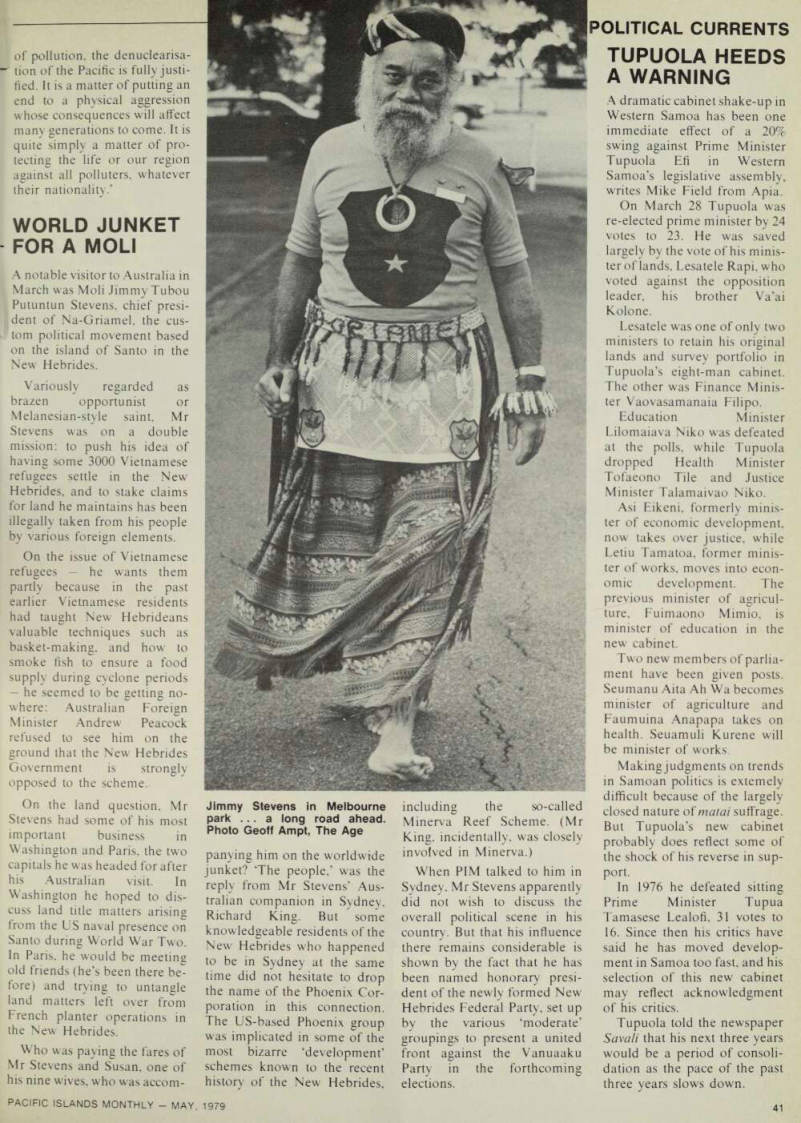
Political Currents
A Warning
A dramatic cabinet shake-up in Western Samoa has been one immediate effect of a 20%
swing against Prime Minister
Tupuola Efi in Western
Samoa’s legislative assembly,
writes Mike Field from Apia.
On March 28 Tupuola was re-elected prime minister by 24 votes to 23. He was saved largely by the vote of his minis ter of lands, Lesatele Rapi, who
voted against the opposition
leader, his brother Va’ai Kolone.
Lesatele was one of only two ministers to retain his original lands and survey portfolio in
Tupuola’s eight-man cabinet.
The other was Finance Minis ter Vaovasamanaia Filipo.
Education Minister Lilomaiava Niko was defeated at the polls, while Tupuola dropped Health Minister Tofaeono Tile and Justice Minister Talamaivao Niko.
Asi Eikeni, formerly minis ter of economic development, now takes over justice, while Letiu Tamatoa, former minis ter of works, moves into econ omic development. The previous minister of agricul ture. Fuimaono Mimio, is minister of education in the new cabinet.
Two new members of parlia ment have been given posts.
Seumanu Aita Ah Wa becomes minister of agriculture and Faumuina Anapapa takes on health. Seuamuli Kurene will be minister of works
Making judgments on trends
in Samoan politics is extemely difficult because of the largely closed nature of matai suffrage.
But Tupuola’s new cabinet probably does reflect some of the shock of his reverse in sup port.
In 1976 he defeated sitting Prime Minister Tupua Tamasese Lealofi, 31 votes to 16. Since then his critics have said he has moved develop ment in Samoa too fast, and his selection of this new cabinet may reflect acknowledgment of his critics.
Tupuola told the newspaper Savali that his next three years would be a period of consoli dation as the pace of the past three years slows down.
Tuvalu Puts All
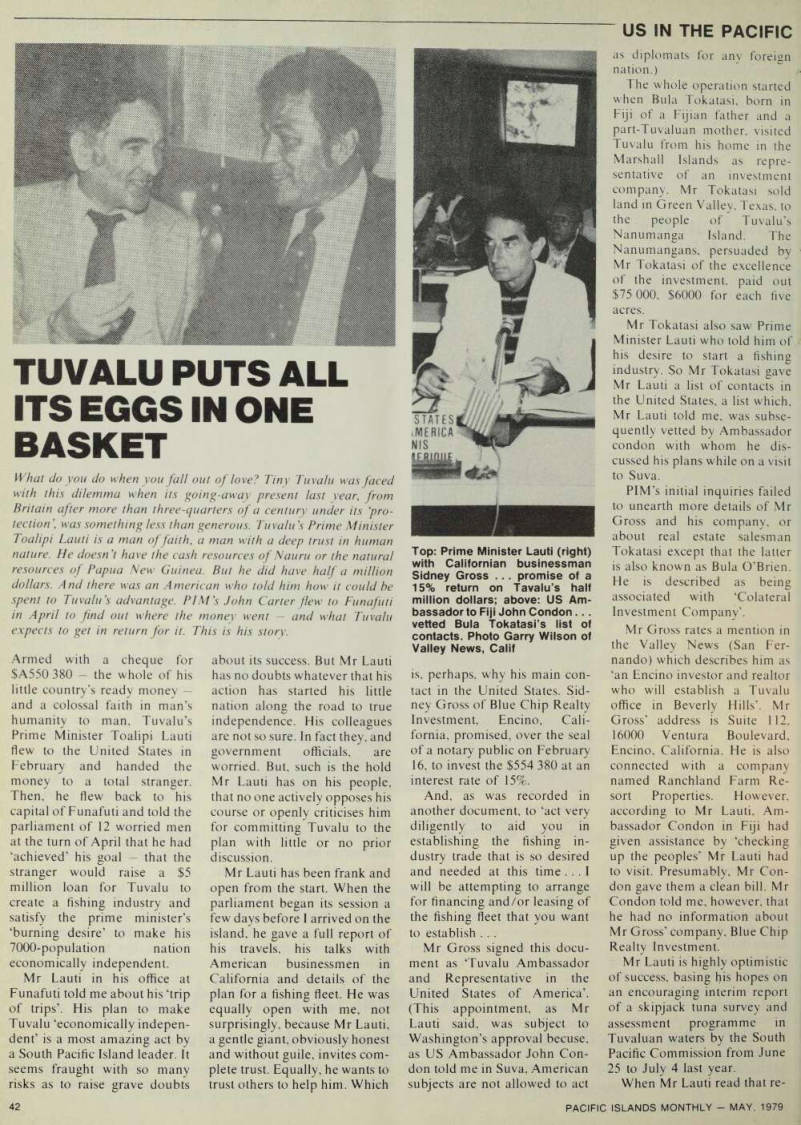


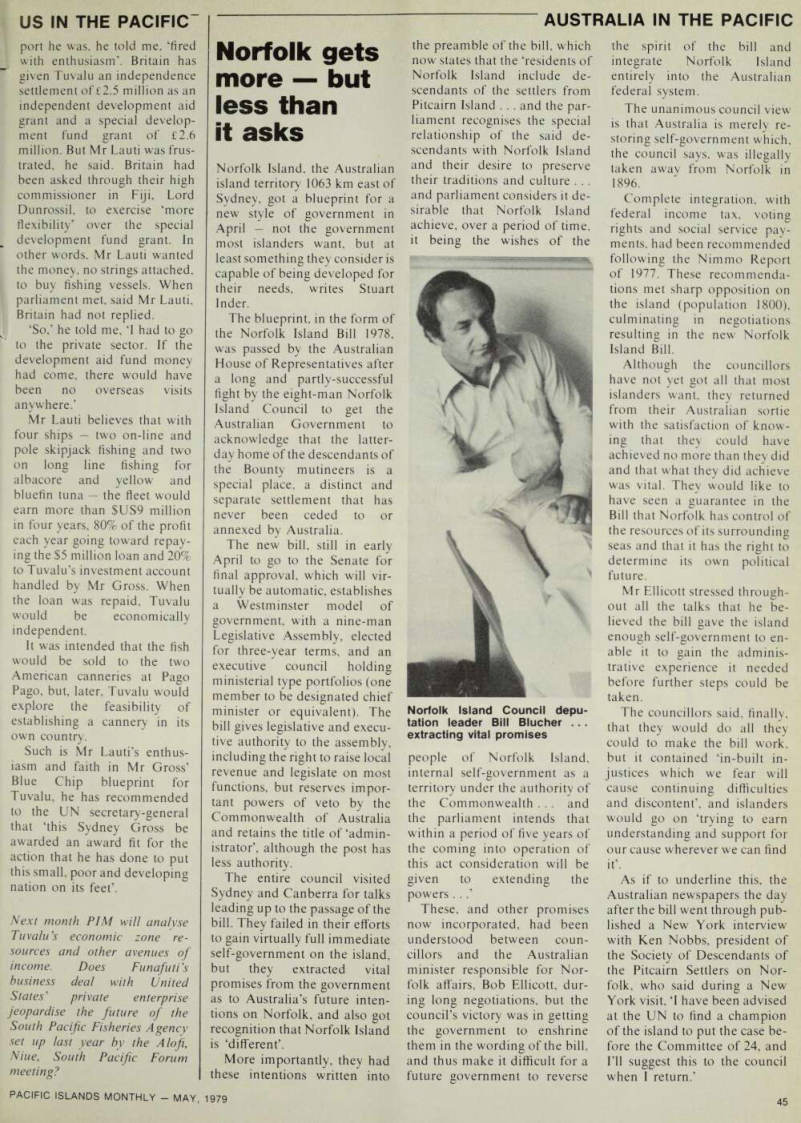
Us In The Pacific
Its Eggs In One
Basket
What do you do when you fall out of love? Tiny Tuvalu was faced with this dilemma when its going-away present last year , from Britain after more than three-quarters of a century under its ‘pro tection ’ was something less than generous. Tuvalu's Prime Minister Toalipi Lauti is a man of faith, a man with a deep trust in human nature. He doesn't have the cash resources of Nauru or the natural resources of Papua New Guinea. But he did have half a million dollars. And there was an American who told him how it could be spent to Tuvalu's advantage. PI M's John Carter flew to Funafuti in April to find out where the money went and what Tuvalu expects to get in return for it. This is his story.
Armed with a cheque for SASSO 380 the whole of his
little country’s ready money
and a colossal faith in man’s humanity to man, Tuvalu’s Prime Minister Toalipi Lauti flew to the United States in February and handed the money to a total stranger.
Then, he flew back to his capital of Funafuti and told the parliament of 12 worried men at the turn of April that he had ‘achieved’ his goal that the stranger would raise a $5 million loan for Tuvalu to create a fishing industry and
satisfy the prime minister’s
‘burning desire’ to make his
7000-population nation
economically independent.
Mr Lauti in his office at Funafuti told me about his ‘trip of trips’. His plan to make
Tuvalu ‘economically indepen-
dent’ is a most amazing act by a South Pacific Island leader. It seems fraught with so many risks as to raise grave doubts
about its success. But Mr Lauti has no doubts whatever that his action has started his little nation along the road to true
independence. His colleagues
are not so sure. In fact they, and government officials, are worried. But, such is the hold Mr Lauti has on his people. that no one actively opposes his course or openly criticises him for committing Tuvalu to the plan with little or no prior discussion, Mr Lauti has been frank and open from the start. When the parliament began its session a few days before I arrived on the island, he gave a full report of his travels, his talks with American businessmen in California and details of the plan for a fishing fleet. He was equally open with me, not surprisingly, because Mr Lauti,
a gentle giant, obviously honest
and without guile, invites com plete trust. Equally, he wants to trust others to help him. Which
is, perhaps, why his main con tact in the United States. Sid ney Gross of Blue Chip Realty Investment, Encino, Cali fornia, promised, over the seal of a notary public on February 16, to invest the $554 380 at an interest rate of 15%.
And, as was recorded in another document, to ‘act very diligently to aid you in
establishing the fishing in
dustry trade that is so desired and needed at this time ... I will be attempting to arrange for financing and/or leasing of the fishing fleet that you want to establish ...
Mr Gross signed this docu ment as ‘Tuvalu Ambassador and Representative in the United States of America’. (This appointment, as Mr Lauti said, was subject to Washington’s approval becuse, as US Ambassador John Con don told me in Suva, American subjects are not allowed to act
as diplomats for any foreign nation.) The whole operation started when Bula Tokatasi. born in Fiji of a Fijian father and a part-Tuvaluan mother, visited Tuvalu from his home in the Marshall Islands as repre sentative of an investment company. Mr Tokatasi sold land in Green Valley, Texas, to the people of Tuvalu's Nanumanga Island. The Nanumangans. persuaded by Mr Tokatasi of the excellence of the investment, paid out $75 000. $6OOO for each five acres.
Mr Tokatasi also saw Prime Minister Lauti who told him of his desire to start a fishing industry. So Mr Tokatasi gave Mr Lauti a list of contacts in the United States, a list which, Mr Lauti told me. was subse
quently vetted by Ambassador
condon with whom he dis cussed his plans while on a visit to Suva.
PlM’s initial inquiries failed to unearth more details of Mr Gross and his company, or about real estate salesman Tokatasi except that the latter is also known as Bula O’Brien.
He is described as being associated with ‘Colateral
Investment Company’.
Mr Gross rates a mention in the Valley News (San Fer nando) which describes him as ‘an Encino investor and realtor who will establish a Tuvalu office in Beverly Hills’. Mr Gross’ address is Suite 112. 16000 Ventura Boulevard.
Encino, California. He is also connected with a company named Ranchland Farm Re sort Properties. However, according to Mr Lauti, Am bassador Condon in Fiji had given assistance by ‘checking up the peoples’ Mr Lauti had to visit. Presumably, Mr Con don gave them a clean bill. Mr Condon told me, however, that he had no information about Mr Gross’ company. Blue Chip
Realty Investment.
Mr Lauti is highly optimistic of success, basing his hopes on an encouraging interim report of a skipjack tuna survey and assessment programme in Tuvaluan waters by the South Pacific Commission from June 25 to July 4 last year.
When Mr Lauti read that re
Top: Prime Minister Lauti (right) with Californian businessman Sidney Gross ... promise of a 15% return on Tavalu’s half million dollars; above: US Am bassador to Fiji John Condon ... vetted Bula Tokatasi’s list of contacts. Photo Garry Wilson of Valley News, Calif
port he was, he told me. ‘fired with enthusiasm’. Britain has
given Tuvalu an independence
settlement of £2.5 million as an independent development aid grant and a special develop ment fund grant of £2.6 million. But Mr Lauti was frus trated, he said. Britain had been asked through their high commissioner in Fiji, Lord Dunrossil. to exercise ‘more flexibility’ over the special development fund grant. In other words, Mr Lauti wanted the money, no strings attached, to buy fishing vessels. When parliament met, said Mr Lauti, Britain had not replied. ‘So.’ he told me, ‘I had to go to the private sector. If the development aid fund money had come, there would have been no overseas visits anywhere.' Mr Lauti believes that with four ships two on-line and
pole skipjack fishing and two
on long line fishing for albacore and yellow and bluefin tuna - the fleet would earn more than SUS 9 million in four years, 80% of the profit each year going toward repay ing the $5 million loan and 20% to Tuvalu’s investment account handled by Mr Gross. When the loan was repaid, Tuvalu would be economically
independent.
It was intended that the fish would be sold to the two American canneries at Pago Pago, but, later, Tuvalu would
explore the feasibility of
establishing a cannery in its own country.
Such is Mr Lauti’s enthus iasm and faith in Mr Gross’
Blue Chip blueprint for
Tuvalu, he has recommended to the UN secretary-general that ‘this Sydney Gross be awarded an award fit for the action that he has done to put this small, poor and developing nation on its feet’.
Next month PIM will analyse Tuvalu's economic zone re sources and other avenues of income. Does Funafuti's business deal with United States' private enterprise
jeopardise the future of the
South Pacific Fisheries Agency
set up last year by the Alofi, Niue, South Pacific Forum meeting?
Advertisements & other items, pp. 43-44 (1 item)
Stop Wishing.
f Clarion 88 • 93 • 98 • 108 o . . Vi O a* r a*- % i V-» "< J , m ■- . ... •v as
Start Thrilling To Clarion
Hi-Fi Component
S I SNil
* i d Now, you can experience component stereo system sound quality on the road. The Clarion G-Series transforms any car into a concert hall by filling it to overflowing with rich, natural hi-fidelity stereo music. Superb G-Series system features include Dolby* noise reduction, Clarion’s renowned cassette mechanism, twin monaural power amps for greater channel separation, 25W + 25W power output and 3-way speakers.
Move up to Clarion hi-fi component car stereo. ■
C Clarion
In Car Entertainment Company
Clarion Co,, Ltd. Tokyo, Japan
Australia: Amalgamated Wireless (Australasia) Ltd. 554 Parramatta Road. Ashfield N.S.W., 2131/New Zealand: AWA New Zealand Limited P.O. Box 50-248 Porirua/Fiji Islands: Brijlal & Co.. Ltd. G.P.O. Box 362 Suva/Tahiti: ETS Comimpex B.P. 200 Papeete/ New Caledonia: Caldis B.P. Ml Noumea Cedex/Guam: Guam Radio & TV Shop P.O. Box 1939 Agana, Guam 96910/New Hebrides: The Sound Centre P.O. Box 434 Vila/Cook Islands: South Seas International Ltd. P.O. Box 49 Rarotonga Papua New Guinea: Hagemeyer (P N G.) Pty. Ltd. P.O. Box 1428. Boroko. Port Moresby.
3S&P.
CAT£«fili£s
'‘Will Si *r .r. . v. <s^. » Us •*- .r /*
CATERPILLAR SKIDDERS ARE BUILT TOUGH
TO STAY ON THE JOB.
MUFFLER
Cat-built Skidders have protection all
round. You get protection for man and
machine with the roll-over canopy and
other machine guarding. And you get
protection against excessive downtime with
dependable CAT construction, CAT dealer
backup and easy on the job maintenance.
THE CATERPILLAR 518 SKIDDER
features 120 flywheel
horsepower @ 2200 rpm,
powered by the Cat 3304
turbocharged engine, with an
operating weight of 20,400 lbs,
turning diameter of 34' 8" and
utilises a Gearmatic 119 winch
with a linepull (max.) of 32,000 lbs.
QUIET OPERATION
You get low noise levels from the 4-stroke cycle diesel, muffler and low-speed fan. You'll hear the difference in Cat-built Skidders.
STRONG DOZER BLADES
deck and bunch logs, clear brush, protect the radiator. The blades are high-strength steel with trunnions that never need greasing. Dozer blades are box-sectioned for greater strength and durability.
LOW RATED RPM
4 STROKE CYCLE DIESEL
MUFFLER LOW-SPEED
FAN RUGGED ARCH AND
FAIRLEAD
stand up under heavy loads.
The main roller is a Lifetime Lubricated hardened casting to reduce scarring that tears up cables. Side rollers are heat-treated for long life.
LOW RATED RPM
nr
LOW-SPEED
FAN
LAE :
Milford Haven Road, Telephone 42 2355
PORT MORESBY :
Telephone 256650
BOUGAINVILLE :
Itakara Industrial Park, C
carptrac
SUVA : Carpenter Street, Raiwai.
Private Mail Bag, GPO Suva. Fiji. Ph. 381622, Telex FJ2190 Cables CARPTRAC LAUTOKA : Veitari. Telephone 61877 LABASA : Vulovi, Telephone 81888 Arawa. Telephone 959077 Caterpillar, Cat and 23 are Trademarks of Caterpillar Tractor Co
YOUR
CATEPPILLAP
DEALER
BA 10441
Norfolk gets
Australia In The Pacific
Norfolk gets more but less than it asks
Norfolk Island, the Australian island territory 1063 km east of Sydney, got a blueprint for a new style of government in April not the government most islanders want, but at least something they consider is
capable of being developed for
their needs, writes Stuart Inder.
The blueprint, in the form of the Norfolk Island Bill 1978, was passed by the Australian House of Representatives after
a long and partly-successful
fight by the eight-man Norfolk
Island Council to get the Australian Government to acknowledge that the latter day home of the descendants of the Bounty mutineers is a special place, a distinct and separate settlement that has never been ceded to or annexed by Australia.
The new bill, still in early April to go to the Senate for final approval, which will vir tually be automatic, establishes a Westminster model of government, with a nine-man
Legislative Assembly, elected
for three-year terms, and an executive council holding ministerial type portfolios (one member to be designated chief minister or equivalent). The bill gives legislative and execu tive authority to the assembly, including the right to raise local revenue and legislate on most functions, but reserves impor tant powers of veto by the Commonwealth of Australia and retains the title of‘admin istrator’, although the post has
less authority.
The entire council visited Sydney and Canberra for talks leading up to the passage of the bill. They failed in their efforts to gain virtually full immediate self-government on the island, but they extracted vital promises from the government as to Australia’s future inten tions on Norfolk, and also got recognition that Norfolk Island is ‘different’.
More importantly, they had
these intentions written into
the preamble of the bill, which now states that the ‘residents of Norfolk Island include de scendants of the settlers from Pitcairn Island . . . and the par liament recognises the special relationship of the said de scendants with Norfolk Island and their desire to preserve their traditions and culture . . . and parliament considers it de sirable that Norfolk Island achieve, over a period of time, it being the wishes of the
people of Norfolk Island, internal self-government as a territory under the authority of the Commonwealth .. . and the parliament intends that within a period of five years of the coming into operation of this act consideration will be
given to extending the
powers. ..’
These, and other promises now incorporated, had been understood between coun cillors and the Australian minister responsible for Nor folk affairs. Bob Ellicott, dur
ing long negotiations, but the
council’s victory was in getting the government to enshrine them in the wording of the bill, and thus make it difficult for a future government to reverse
the spirit of the bill and integrate Norfolk Island entirely into the Australian federal system.
The unanimous council view is that Australia is merely re storing self-government which, the council says, was illegally taken away from Norfolk in 1896.
Complete integration, with federal income tax, voting rights and social service pay ments, had been recommended following the Nimmo Report of 1977. These recommenda tions met sharp opposition on the island (population 1800), culminating in negotiations resulting in the new Norfolk Island Bill.
Although the councillors have not yet got all that most islanders want, they returned from their Australian sortie with the satisfaction of know ing that they could have achieved no more than they did and that what they did achieve was vital. They would like to have seen a guarantee in the Bill that Norfolk has control of the resources of its surrounding seas and that it has the right to determine its own political future.
Mr Ellicott stressed through out all the talks that he be lieved the bill gave the island
enough self-government to en
able it to gain the adminis trative experience it needed before further steps could be taken.
The councillors said, finally, that they would do all they could to make the bill work, but it contained ‘in-built in justices which we fear will cause continuing difficulties and discontent’, and islanders would go on ‘trying to earn understanding and support for our cause wherever we can find it’.
As if to underline this, the Australian newspapers the day after the bill went through pub lished a New York interview with Ken Nobbs, president of the Society of Descendants of the Pitcairn Settlers on Nor folk, who said during a New York visit, ‘1 have been advised at the UN to find a champion of the island to put the case be fore the Committee of 24, and I’ll suggest this to the council when I return.’
Norfolk Island Council depu tation leader Bill Blucher ... extracting vital promises
Advertisements & other items, pp. 46-48 (1 item)
'
WHM
m • I ■ rm * m Mi i * s* i \\ 1 .
A U
mfM
* * MB »#*#* -*■ ■mmmmm- m if * j| * ' : I * ■
The Toyota truck range. Built to be unbeatable.
Bad weather conditions, no problem.
Bad roads and driving surfaces, eaten up.
Difficult loads, no contest. Built tough. Built to take it.
There's a Toyota truck built for you. m TOYOTA Land Cruiser Pickup J.
TOYOTA Stout
TOYOTA Hi-Lux
TOYOTA Dyna
TOYOTA Toyo-Ace TOYOTA Truck
TOYOTA
For unbeatable after service: P o PU Box N 2r7 G^alDa n A FUM«li'Alin« S Scratchley Rd - Badl,i ' P 0 Box 75 - Port Moresby U.S. TRUST TERRITORY: MICROL CORPORATION CO LTD PO 1057 P 1 SUPPUES C ° • LTD ' G P 0 Box 355 > Suva AMERICAN SAMOA: BURNS PH.LP (SOUTH SEA) P o' Box 6428 Tamunina^FW^F V^mncQ N xf c A A M ° A: BURNS PHILP <SOUTH SEA) LTD., P.O. Box 188, Apia. GUAM: ATKINS, KROLL (GUAM) LTD., LTD PO Box 174 Hnn HEBRIDES MOTORS LTD - P °- Box 18 < Vila SOLOMON ISLANDS; MENDANA EM TERpR ISES (5..1.) POBo, 92 R„oNAURUTs JLTZ^y.ITr.° TO ‘ 8 P 342 - P "’~" COOK ,SLANDS: Cool< 'BLANDS TRADING CORPORATION LTD b£»lT.™w.™ TIVE SOCIETY GILBERT & ELLICE ISLANDS COLONY: TARAWA MOTORS, Bo« Se!
DU PACIFIOUE, Rond-Point d u ” ° CALEDON,A: SOCIETE IMPORTATION AUTOMOBILE
ABTEC TRADE VISITORS
will have a very special purpose
...to chart a profitable course through the 80’s —You should be one! *
ABTEC
EXHIBITION
ABTEC
Virtually the whole of the Australasian boating industry will be gathered at the Sydney Showground for ABTEC Australasia's first ever Boating Trade Exhibition and Conference, June 12 15, 1979.
AND YOU SHOULD BE THERE!
Admission to the ABTEC Exhibition is FREE and OPEN to accredited trade visitors only. Talk to the exhibitors, compare deals, plan your buying for the 80's without the distractions of the public.
MAKE IT EASY!
Accredited trade visitors can view ABTEC just by turning up at the Showground.
But you can avoid queues and delays by obtaining a trade visitor accreditation form from the organisers. We'll then have name tags and other material ready and waiting for you.
EXHIBITION SPACE
Some exhibition space is still available but you had better move quickly. Contact Greg Dixon NOW (02) 92 5901.
MAIL YOUR SPACE APPLICATION TODAY
"ABTEC" P.O. Box 574 Crows Nest, NSW 2065 Australia.
EXHIBITION ENQUIRIES:
Ist Floor 220 Pacific Highway Crows Nest, Sydney.
Telex: AA27045
Cable: "BOATING CROWS NEST"
Telephone (02) 92 5901
SEE YOU AT ARTEC
Sponsored by B in conjunction with A
ANSETT
The Convention Specialists ammi
Islands
From the
Press
News Drum, Solomon Islands - Honiara Town council has warned that it will take legal action against people who build monuments over the graves of their relatives buried at the town cemeteries ...
PNG Post-Courier, Port Moresby
One of the first casualties of the National Works Authority decision to strike yesterday was none other than the Prime Minister, Mr Somare. The PM’s driver joined the strike leaving Mr Somare to take the wheel. Mr Somare was seen yesterday driving around in Wewak . . .
Micronesian News Service A total of 89 active leprosy cases have been identified on several islands in the Truk lagoon .. . Fifty-eight per cent of the active cases were not taking their medicine when questioned. They said they stopped taking medication because they ‘ran out of medicine and that ‘the medicine makes them impotent’.
From a letter in the Tonga Chronicle The following is no hearsay account. Rather. I have been eyewitness on many occasions where persons in authority in government offices and other places - try to get people to hand over sums of money or other valuables before being served. Note of course that such persons in authority are holding offices of emolument. I am therefore making representations herein on behalf of all of the ‘victims’ that such malpractices be terminated at once. It is also a curse to the nation. Indeed ‘Whosoever plays with fire is liable to be burnt thereby’. So many have been suffering this malady and it has grown worse resulting in even the most unthinkable of acts. What of the future? There may only be a cyclone named ‘Doom’ coming to get us!
News Drum, Solomon Islands Auki sub-treasury has received a big demand from business owners and farmers on Malaita for paper notes in exchange for one dollar coins. A spokesman said Auki people prefer the paper money because it is easier to carry around. The sub-treasury is continually being asked to exchange bags of coins for paper money.
Arawa Bulletin, PNG Motorists around Toniva would be well advised to be wary of two Asian gentlemen seen leaping from behind bushes, running the centre line and generally acting recklessly with their own health. These two intrepid butterfly collectors armed with long handled nets have forced many drivers to sudden stops of late.
Headline in Atoll Pioneer, Gilbert islands Life was better today than yesterday.
Marianas Variety
It s been said that you can tune a piano, but you can’t tuna fish.
Norfolk Islander At the Randwick Horse Sales in 1977, Mrs Jean Mawson purchased a stallion which, when raced around the Sydney circuit seemed to take more interest in the fillies than in winning the race. Anson Bay, as Jean named the horse, was sent to the country where he was ‘doctored’ and given a chance to do better than
he did in Sydney. He apparently now has his mind on his work and so far has run in four races, winning the four of them. Jean says that if Anson Bay continues as he is going now, he will be putting Norfolk Island on the map.
Fiji Times
Wanted: A hangman. Remuneration $3O a head. Apply Controller of Prisons, Suva Gaol, Suva. This could be an advertisement you might read in your morning paper one day as parliament votes this month to reintroduce hanging as the only appropriate punishment for convicted murderers. It’s an advertisement the Controller of Prisons, Mr Wally Smith, is not particularly looking forward to placing in the papers.
From a letter to Lae Nius, PNG How come I heard of five elected City Councillors booking themselves in at one of the best hotels in Manila for two whole weeksjust for a two or three day conference? ... Remember us back here in our squatter settlements, our stinking toilets and our pot-hole roads ... we will remember you, don't worry.
Taraka-man Letter to Cook Islands News I feel I must complain to you about the Women’s Hour programme. Just who does Mrs Keenan think she is. Instead of her programme being a proper women’s hour it is just a lecture programme and when did she become an authority, to preach to other women about the upbringing of children. Another maddening thing was at Christmas time, she had the cheek to tell all young girls to keep their clothes on while tourists are here.
Does she think that tourists are all sex crazy?
Cook Island News From Tuesday of next week the Cook Islands News will be available with fresh bread in the morning from your local store.
For the first time since the Cook Islands News came into existence it will be published as a morning newspaper which will enable Cook Islanders to enjoy a custom of many other parts of the world, that of reading the morning paper with their breakfast.
Savali, Western Samoa In all the comings and goings lately among the politicians trying to figure out who should be prime minister, there is one section of the community who are not being consulted. Journalists. Our plight is acute. Can you imagine trying to get a Prime Minister Laufaleaigalelauvaelenoatia Sefo opens factory into a two column headline? .. . Fortunately the good people of Gaigaifomauga Number One saw our problem and Laufaleaigalelauvaelenoatia Sefo is not even in the Fono.
The Fiji Times Ratu Sir Kamisese Mara, Prime Minister, when told during an interview that on May 13 he would be 59: That’s correct.. . one more year to the compulsory retirement year, according to government. I can tell you this: If I can see the possibilities of a coalition - at least a government that succeeds me will be more representative of the people of Fiji than I have been able to achieve PH walk out tomorrow. My primary concern is to leave behind a stable government.
Letter to New Nation, PNG I would like to make a few points about those ‘town birds’ those ladies who roam about the town, stirring up trouble between married couples. Ever since I arrived in Wewak Tve heard and seen many couples reporting these problems to the police.
Sometimes they even appear in court over these troubles. The wives are the ones who always complain about their husbands going around with these ladies. So, you big boys, think twice before taking any action to upset your wives. And you big, effective ladies, watch your movement and actions. There are many single and good looking men about, so why not start picking on them?
People
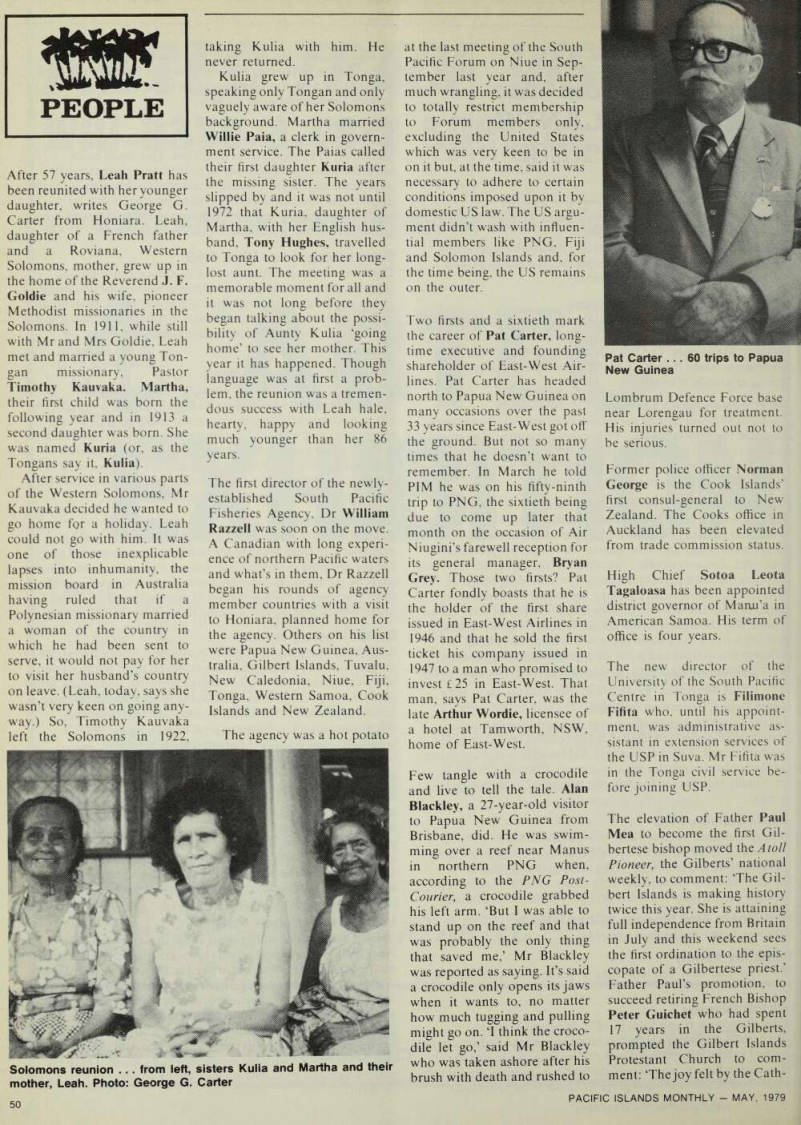

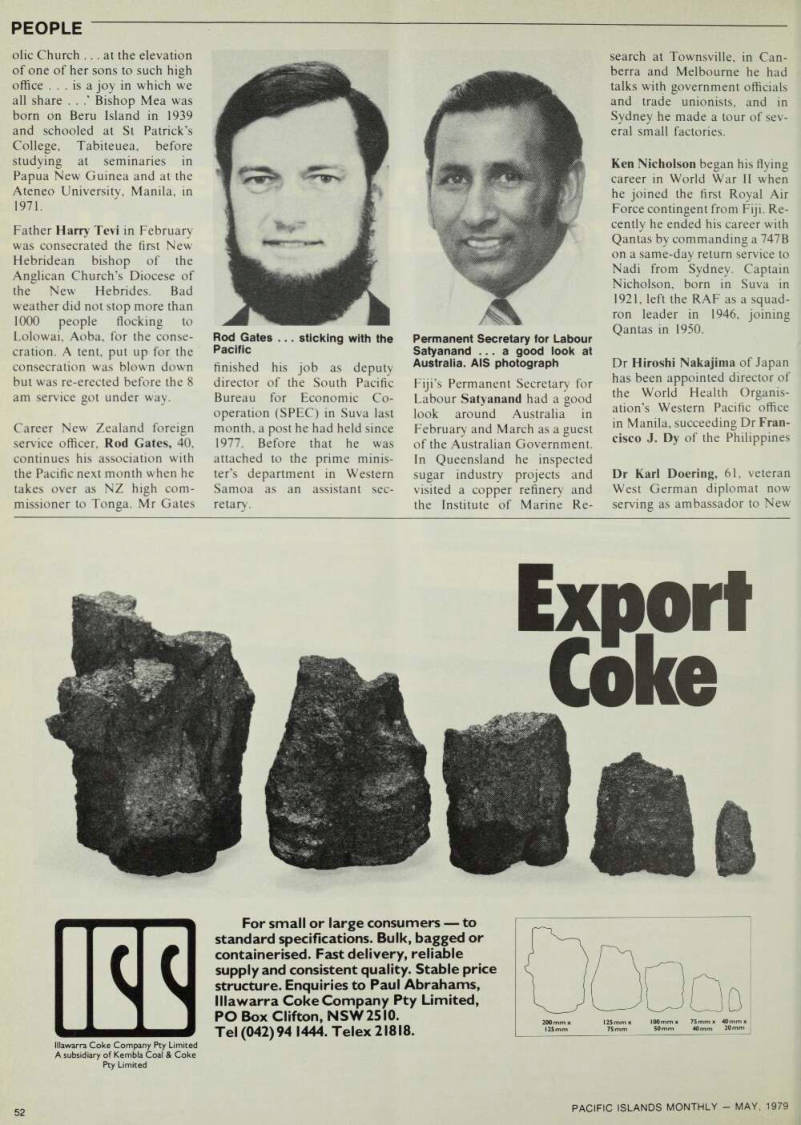
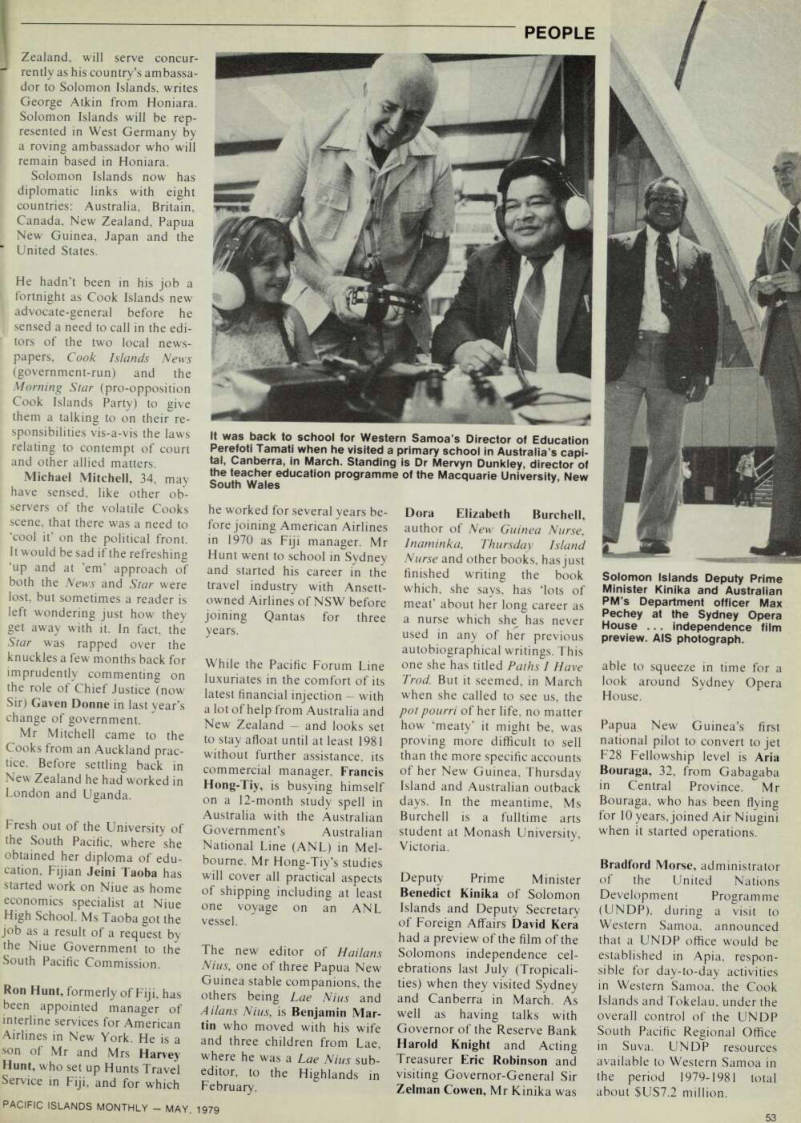
After 57 years, Leah Pratt has been reunited with her younger
daughter, writes George G.
Carter from Honiara. Leah, daughter of a French father and a Roviana, Western Solomons, mother, grew up in the home of the Reverend J. F.
Goldie and his wife, pioneer Methodist missionaries in the Solomons. In 1911, while still with Mr and Mrs Goldie, Leah met and married a young Ton gan missionary. Pastor Timothy Kauvaka. Martha, their first child was born the following year and in 1913 a second daughter was born. She was named Kuria (or, as the Tongans say it, Kulia).
After service in various parts of the Western Solomons, Mr Kauvaka decided he wanted to go home fgr a holiday. Leah could not go with him. It was one of those inexplicable
lapses into inhumanity, the
mission board in Australia having ruled that if a
Polynesian missionary married
a woman of the country in which he had been sent to serve, it would not pay for her to visit her husband’s country on leave. (Leah, today, says she wasn’t very keen on going any way.) So, Timothy Kauvaka left the Solomons in 1922,
taking Kulia with him. He never returned.
Kulia grew up in Tonga, speaking only Tongan and only vaguely aware of her Solomons background. Martha married Willie Paia, a clerk in govern ment service. The Paias called their first daughter Kuria after the missing sister. The years slipped by and it was not until 1972 that Kuria, daughter of Martha, with her English hus band, Tony Hughes, travelled to Tonga to look for her long lost aunt. The meeting was a memorable moment for all and it was not long before they
began talking about the possi
bility of Aunty Kulia ‘going home’ to see her mother. This year it has happened. Though language was at first a prob lem, the reunion was a tremen dous success with Leah hale,
hearty, happy and looking
much younger than her 86 years.
The first director of the newly established South Pacific Fisheries Agency, Dr William Razzell was soon on the move.
A Canadian with long experi ence of northern Pacific waters and what’s in them. Dr Razzell began his rounds of agency member countries with a visit to Honiara, planned home for the agency. Others on his list were Papua New Guinea, Aus tralia, Gilbert Islands, Tuvalu, New Caledonia, Niue, Fiji, Tonga, Western Samoa, Cook Islands and New Zealand.
The agency was a hot potato
at the last meeting of the South Pacific Forum on Niue in Sep tember last year and. after much wrangling, it was decided
to totally restrict membership
to Forum members only, excluding the United States which was very keen to be in on it but, at the time, said it was necessary to adhere to certain conditions imposed upon it by domestic US law. The US argu ment didn’t wash with influen tial members like PNG. Fiji and Solomon Islands and, for the time being, the US remains on the outer.
Two firsts and a sixtieth mark the career of Pat Carter, long time executive and founding shareholder of East-West Air lines. Pat Carter has headed north to Papua New Guinea on many occasions over the past 33 years since East-West got off the ground. But not so many times that he doesn’t want to remember. In March he told PIM he was on his fifty-ninth trip to PNG, the sixtieth being due to come up later that month on the occasion of Air
Niugini’s farewell reception for
its general manager, Bryan Grey. Those two firsts? Pat Carter fondly boasts that he is the holder of the first share issued in East-West Airlines in 1946 and that he sold the first ticket his company issued in 1947 to a man who promised to invest £25 in East-West. That man, says Pat Carter, was the late Arthur Wordie, licensee of a hotel at Tamworth, NSW, home of East-West.
Few tangle with a crocodile and live to tell the tale. Alan Blackley, a 27-year-old visitor to Papua New Guinea from Brisbane, did. He was swim ming over a reef near Manus in northern PNG when, according to the PNG Post- Courier, a crocodile grabbed his left arm. ‘But I was able to stand up on the reef and that was probably the only thing that saved me,’ Mr Blackley was reported as saying. It’s said a crocodile only opens its jaws when it wants to, no matter how much tugging and pulling might go on. T think the croco dile let go,’ said Mr Blackley who was taken ashore after his brush with death and rushed to
Lombrum Defence Force base near Lorengau for treatment.
His injuries turned out not to be serious.
Former police officer Norman George is the Cook Islands’ first consul-general to New Zealand. The Cooks office in Auckland has been elevated from trade commission status.
High Chief Sotoa Leota Tagaloasa has been appointed district governor of Maau’a in American Samoa. His term of office is four years.
The new director of the University of the South Pacific Centre in Tonga is Filimone Fifita who, until his appoint ment. was administrative as sistant in extension services of the USP in Suva. Mr Fifita was in the Tonga civil service be fore joining USP.
The elevation of Father Paul Mea to become the first Gil bertese bishop moved the Atoll Pioneer, the Gilberts’ national weekly, to comment: The Gil bert Islands is making history twice this year. She is attaining full independence from Britain in July and this weekend sees the first ordination to the epis copate of a Gilbertese priest.’
Father Paul’s promotion, to
succeed retiring French Bishop
Peter Guichet who had spent 17 years in the Gilberts, prompted the Gilbert Islands Protestant Church to com ment: The joy felt by the Cath
Solomons reunion ... from left, sisters Kulia and Martha and their mother, Leah. Photo: George G. Carter
Pat Carter ... 60 trips to Papua New Guinea
olic Church ... at the elevation of one of her sons to such high office ... is a joy in which we all share . . .’ Bishop Mea was bom on Beru Island in 1939 and schooled at St Patrick’s College, Tabiteuea, before studying at seminaries in Papua New Guinea and at the Ateneo University, Manila, in 1971.
Father Harry Tevi in February was consecrated the first New Hebridean bishop of the Anglican Church’s Diocese of the New Hebrides. Bad weather did not stop more than
1000 people flocking to
Lolowai, Aoba, for the conse cration. A tent, put up for the consecration was blown down but was re-erected before the 8 am service got under way.
Career New Zealand foreign service officer. Rod Gates, 40, continues his association with the Pacific next month when he takes over as NZ high com missioner to Tonga. Mr Gates
finished his job as deputy director of the South Pacific Bureau for Economic Co operation (SPEC) in Suva last month, a post he had held since 1977. Before that he was attached to the prime minis ter’s department in Western Samoa as an assistant sec retary.
Fiji’s Permanent Secretary for Labour Satyanand had a good look around Australia in February and March as a guest of the Australian Government.
In Queensland he inspected
sugar industry projects and
visited a copper refinery and the Institute of Marine Re
search at Townsville, in Can berra and Melbourne he had talks with government officials and trade unionists, and in Sydney he made a tour of sev eral small factories.
Ken Nicholson began his flying career in World War II when he joined the first Royal Air Force contingent from Fiji. Re cently he ended his career with Qantas by commanding a 7478 on a same-day return service to
Nadi from Sydney. Captain
Nicholson, born in Suva in 1921, left the RAF as a squad ron leader in 1946, joining Qantas in 1950.
Dr Hiroshi Nakajima of Japan has been appointed director of the World Health Organis ation’s Western Pacific office in Manila, succeeding Dr Fran cisco J. Dy of the Philippines Dr Karl Doering, 61, veteran West German diplomat now serving as ambassador to New
Rod Gates ... sticking with the Pacific
Permanent Secretary for Labour Satyanand ... a good look at Australia. AIS photograph
I Zealand, will serve concur rently as his country’s ambassa dor to Solomon Islands, writes George Atkin from Honiara.
Solomon Islands will be rep resented in West Germany by a roving ambassador who will remain based in Honiara.
Solomon Islands now has
diplomatic links with eight
countries: Australia, Britain, Canada, New Zealand, Papua New Guinea, Japan and the United States.
He hadn’t been in his job a \ fortnight as Cook Islands new
■ advocate-general before he
sensed a need to call in the edi tors of the two local news papers, Cook Islands News (government-run) and the Morning Star (pro-opposition Cook Islands Party) to give them a talking to on their re [ sponsibilities vis-a-vis the laws relating to contempt of court and other allied matters.
Michael Mitchell, 34, may have sensed, like other ob servers of the volatile Cooks scene, that there was a need to ‘cool it’ on the political front.
It would be sad if the refreshing ‘up and at ’em’ approach of both the News and Star were lost, but sometimes a reader is
left wondering just how they
get away with it. In fact, the Star was rapped over the knuckles a few months back for
imprudently commenting on
the role of Chief Justice (now Sir) Gaven Donne in last year’s change of government.
Mr Mitchell came to the Cooks from an Auckland prac tice. Before settling back in New Zealand he had worked in London and Uganda.
Fresh out of the University of the South Pacific, where she obtained her diploma of edu cation, Fijian Jeini Taoba has started work on Niue as home economics specialist at Niue High School. Ms Taoba got the job as a result of a request by the Niue Government to the South Pacific Commission.
Ron Hunt, formerly of Fiji, has been appointed manager of interline services for American Airlines in New York. He is a son of Mr and Mrs Harvey Hunt, who set up Hunts Travel Service in Fiji, and for which
he worked for several years be fore joining American Airlines in 1970 as Fiji manager. Mr Hunt went to school in Sydney and started his career in the travel industry with Ansett owned Airlines of NSW before joining Qantas for three years.
While the Pacific Forum Line luxuriates in the comfort of its latest financial injection with a lot of help from Australia and New Zealand and looks set to stay afloat until at least 1981 without further assistance, its commercial manager. Francis Hong-Tiy, is busying himself on a 12-month study spell in Australia with the Australian Government’s Australian National Line (ANL) in Mel bourne. Mr Hong-Tiy’s studies will cover all practical aspects of shipping including at least one voyage on an ANL vessel.
The new editor of Hailans Nius, one of three Papua New Guinea stable companions, the others being Lae Nius and A Hans Nius, is Benjamin Mar tin who moved with his wife and three children from Lae, where he was a Lae Nius sub editor, to the Highlands in
February.
Dora Elizabeth Burchell, author of New Guinea Nurse, Inaminka, Thursday Island Nurse and other books, has just finished writing the book which, she says, has ‘lots of meat’ about her long career as a nurse which she has never used in any of her previous
autobiographical writings. This
one she has titled Paths I Have Trod. But it seemed, in March when she called to see us, the pot pourri of her life, no matter how ‘meaty’ it might be, was proving more difficult to sell than the more specific accounts of her New Guinea, Thursday Island and Australian outback days. In the meantime, Ms Burchell is a fulltime arts student at Monash University, Victoria.
Deputy Prime Minister Benedict Kinika of Solomon
Islands and Deputy Secretary
of Foreign Affairs David Kera had a preview of the film of the Solomons independence cel
ebrations last July (Tropicali
ties) when they visited Sydney and Canberra in March. As well as having talks with Governor of the Reserve Bank Harold Knight and Acting Treasurer Eric Robinson and visiting Governor-General Sir Zelman Cowen, Mr Kinika was
able to squeeze in time for a look around Sydney Opera House.
Papua New Guinea’s first national pilot to convert to jet F2B Fellowship level is Aria Bouraga, 32, from Gabagaba in Central Province. Mr Bouraga, who has been flying for 10 years, joined Air Niugini when it started operations.
Bradford Morse, administrator of the United Nations
Development Programme
(UNDP), during a visit to Western Samoa, announced that a UNDP office would be established in Apia, respon sible for day-to-day activities in Western Samoa, the Cook Islands and Tokelau, under the overall control of the UNDP South Pacific Regional Office in Suva. UNDP resources available to Western Samoa in the period 1979-1981 total about SUS 7.2 million.
It was back to school for Western Samoa’s Director of Education Perefoti Tamati when he visited a primary school in Australia’s capi tal, Canberra, in March. Standing is Dr Mervyn Dunkley, director of the teacher education programme of the Macquarie University New South Wales
Solomon Islands Deputy Prime Minister Kinika and Australian PM’s Department officer Max Pechey at the Sydney Opera House ... independence film preview. AIS photograph.
Advertisements & other items, pp. 51-52 (1 item)
it’s hard to call this deck No. i
With so many No.l features
it’s hard to call this deck No. i mWT ■an*
SsTDK
SA C6O <§) m 1 m turn
CASSETTE TAf=E DECK
PNXMEER ste
CT-F 8(
Pioneer doesn’t stop with just giving you great sound; even coming from the middle of our new line, the new CT-FBOO cassette deck features an exclusive electronic microprocessor that provides recording/playback level accuracy that (up til now) was only available on our more expensive model.
Home or studio. This complex, yet amazingly compact computer takes the incoming signal and instantly feeds the information to a fluorescent display.
Divided into left and right channels, the full range is covered.
In this way, critical level adjustments can be made by monitoring the display and controlling the input, so that the peak signal levels never oversaturate the recording tape.
Tape travel during recording/playback has nothing to do with rewind/fastforward. That’s why the CT-FBOO employs two separate motors. In addition, the closed-loop dual capstan drive system utilizes two separate sets of capstans/ pinch rollers on either side of the heads.
Combined with the three-head, fully monitorable RECORD/PLAYBACK/ ERASE configuration using our newly developed Sendust head material, the resulting increase in performance can aptly described by the incredibly low wow & flutter of no more than 0.045% (WRMS). A figure unattainable except in decks which cost hundreds of dollars more.
Pioneer’s new CT-FBOO. Number 3 our wide range of stereo cassette decl it was created to satisfy an equally wic range of listening requirements and budgets. But, coming from the leading audio maker, you can be sure the sour is Number 1 all the way. * Dolby is a trademark of Dolby Laboratories. Inc.
fliD PIONEER
Pioneer products are available through: f“| S 9i Oneer Marke,i " 9 Service Ply, Ltd,, PO, Box 317. Mordlalloc. Victoria. 3196 Brijlal S Company, G.P.O. Box No. 362. Suva, Fiji islands Tel: 22258 "eSSS?- Un,ain Markelin9 L,d ■ Maidstone Street, Auckland. New Zealand p UrnS SSf < K, orfo "‘ lSland> LM ' Nortolk lsland - Soe" 1 Peci'ic New Hebrides. Bums Philo (New Hebrides! Ltd.. Vila, New Hebrides Nauru Island: Jacob Enterprises, P.O. Box No. 4, Republic of Nauru Tahiti: Ets. PERFECT. B.P. 594, Papeete, Tahiti Tel: 20 407 New Caledonia: Menard Freres Ville, B.P, H 2 Cedex, Noumea, New Caledonia Tel: 27 JeT^Sr 9 - Transpac Corporation. P.O. Box 1477, Pago Pago, American Same: Rarotonga: South Seas International Ltd., P.O. Box 49. Rarotonga, Cook Islands Tel Papua New Guinea: Bali Marchants Pty. Ltd., P.O. Box 6103, Boroko Tel: 254887
Export
v*, x -
Coke
w lllawarra Coke Company Pty Limited A subsidiary of Kembla Coal & Coke Pty Limited For small or large consumers to standard specifications. Bulk, bagged or containerised. Fast delivery, reliable supply and consistent quality. Stable price structure. Enquiries to Paul Abrahams, lllawarra Coke Company Pty Limited, PO Box Clifton, NSW2SIO.
Tel (042)94 1444. Telex 21818.
JOoqo
200 mm x 125 mm x 100 mm x 75mm x 40mm x 125 mm 75mm 50mm 40mm 20mm
duty free
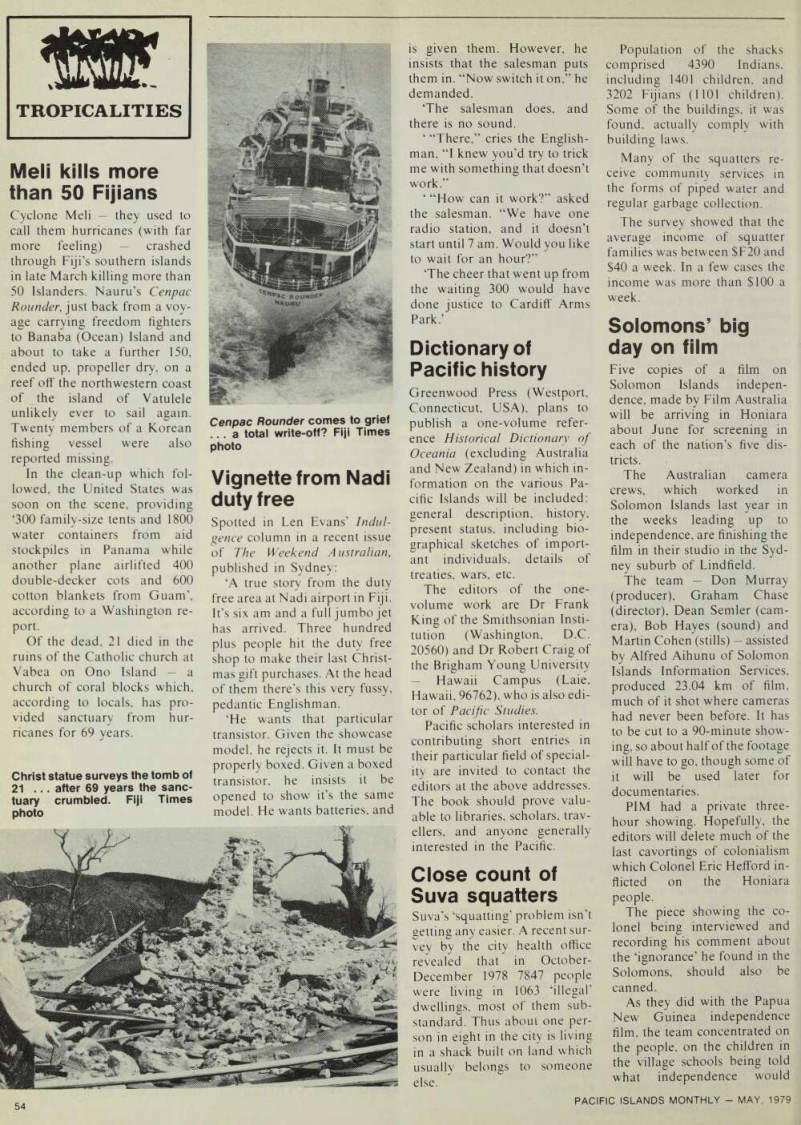

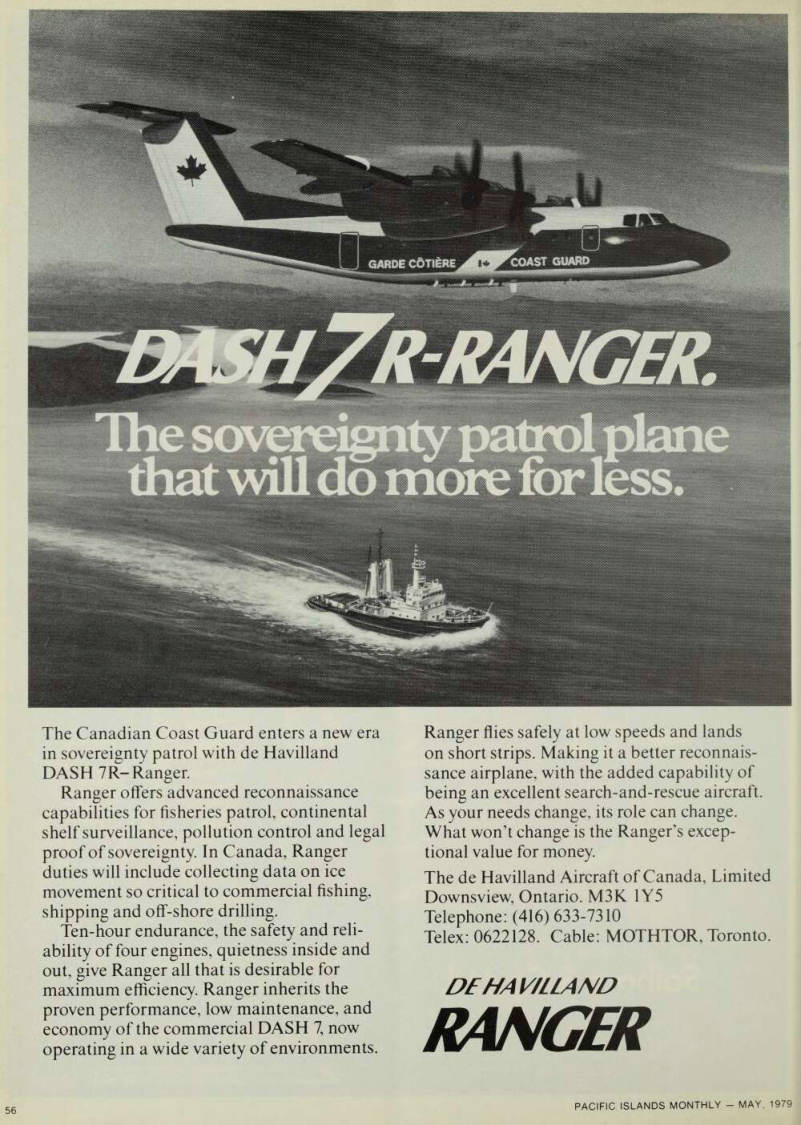
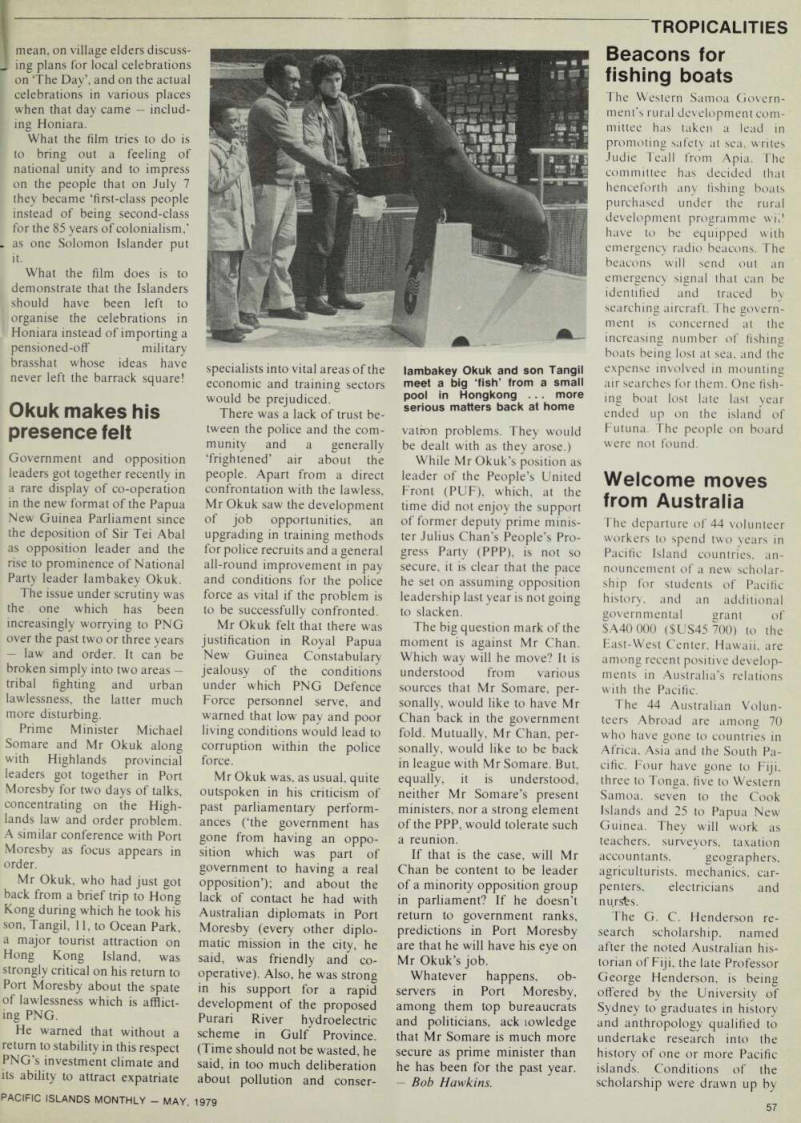
Tropicalities
Meli kills more
than 50 Fijians
Cyclone Meli they used to call them hurricanes (with far more feeling) crashed
through Fiji’s southern islands
in late March killing more than 50 Islanders. Nauru’s Cenpac Rounder, just back from a voy
age carrying freedom fighters
to Banaba (Ocean) Island and about to take a further 150, ended up, propeller dry, on a reef off the northwestern coast of the island of Vatulele unlikely ever to sail again.
Twenty members of a Korean fishing vessel were also
reported missing.
In the clean-up which fol lowed, the United States was soon on the scene, providing ‘3OO family-size tents and 1800 water containers from aid stockpiles in Panama while another plane airlifted 400 double-decker cots and 600 cotton blankets from Guam’, according to a Washington re port.
Of the dead, 21 died in the ruins of the Catholic church at Vabea on Ono Island a church of coral blocks which, according to locals, has pro vided sanctuary from hur ricanes for 69 years.
Vignette from Nadi
duty free
Spotted in Ten Evans’ Indul gence column in a recent issue of The Weekend Australian,
published in Sydney:
‘A true story from the duty free area at Nadi airport in Fiji.
It’s six am and a full jumbo jet has arrived. Three hundred plus people hit the duty free shop to make their last Christ mas gift purchases. At the head of them there’s this very fussy,
pedantic Englishman.
‘He wants that particular transistor. Given the showcase model, he rejects it. It must be properly boxed. Given a boxed transistor, he insists it be opened to show it’s the same model. He wants batteries, and
is given them. However, he insists that the salesman puts them in. “Now switch it on,” he demanded. ‘The salesman does, and there is no sound. ‘ “There,” cries the English man, “I knew you’d try to trick me with something that doesn’t work.” ‘“How can it work?” asked the salesman. “We have one radio station, and it doesn’t start until 7 am. Would you like to wait for an hour?” ‘The cheer that went up from the waiting 300 would have done justice to Cardiff Arms Park.’
Dictionary of
Pacific history
Greenwood Press (Westport, Connecticut, USA), plans to publish a one-volume refer ence Historical Dictionary of Oceania (excluding Australia and New Zealand) in which in formation on the various Pa cific Islands will be included:
general description, history,
present status, including bio
graphical sketches of import
ant individuals, details of treaties, wars, etc.
The editors of the one volume work are Dr Frank King of the Smithsonian Insti tution (Washington, D.C. 20560) and Dr Robert Craig of
the Brigham Young University
Hawaii Campus (Laie, Hawaii, 96762), who is also edi tor of Pacific Studies.
Pacific scholars interested in contributing short entries in their particular field of special ity are invited to contact the editors at the above addresses.
The book should prove valu able to libraries, scholars, trav ellers, and anyone generally interested in the Pacific.
Close count of
Suva squatters
Suva’s ‘squatting’ problem isn’t
getting any easier. A recent sur vey by the city health office revealed that in October- December 1978 7847 people were living in 1063 ‘illegal’ dwellings, most of them sub standard. Thus about one per son in eight in the city is living in a shack built on land which usually belongs to someone else.
Population of the shacks comprised 4390 Indians, including 1401 children, and 3202 Fijians (1101 children).
Some of the buildings, it was
found, actually comply with
building laws.
Many of the squatters re ceive community services in the forms of piped water and
regular garbage collection.
The survey showed that the average income of squatter families was between SF2O and $4O a week. In a few cases the income was more than $lOO a week.
Solomons’ big
day on film
Five copies of a film on Solomon Islands indepen dence, made by Film Australia will be arriving in Honiara about June for screening in each of the nation’s five dis tricts.
The Australian camera crews, which worked in Solomon Islands last year in the weeks leading up to
independence, are finishing the
film in their studio in the Syd ney suburb of Lindfield.
The team Don Murray (producer), Graham Chase (director). Dean Semler (cam era), Bob Hayes (sound) and Martin Cohen (stills) assisted by Alfred Aihunu of Solomon Islands Information Services, produced 23.04 km of film, much of it shot where cameras had never been before. It has to be cut to a 90-minute show ing, so about half of the footage will have to go, though some of it will be used later for documentaries.
PIM had a private three hour showing. Hopefully, the editors will delete much of the last cavortings of colonialism which Colonel Eric Hefford in flicted on the Honiara
people.
The piece showing the co lonel being interviewed and recording his comment about the ‘ignorance’ he found in the Solomons, should also be canned.
As they did with the Papua New Guinea independence film, the team concentrated on the people, on the children in the village schools being told what independence would
Christ statue surveys the tomb of 21 ... after 69 years the sanc tuary crumbled. Fiji Times photo
Cenpac Rounder comes to grief ... a total write-off? Fiji Times photo
I mean, on village elders discuss ing plans for local celebrations [ on The Day’, and on the actual i celebrations in various places when that day came includ
[ ing Honiara.
What the film tries to do is to bring out a feeling of national unity and to impress f on the people that on July 7 they became ‘first-class people instead of being second-class for the 85 years of colonialism,’ , as one Solomon Islander put it.
What the film does is to demonstrate that the Islanders should have been left to I organise the celebrations in Honiara instead of importing a
pensioned-off military
brasshat whose ideas have never left the barrack square!
Okuk makes his
presence felt
Government and opposition leaders got together recently in a rare display of co-operation in the new format of the Papua New Guinea Parliament since the deposition of Sir Tei Abal as opposition leader and the rise to prominence of National
Party leader lambakey Okuk.
The issue under scrutiny was the one which has been
increasingly worrying to PNG
over the past two or three years law and order. It can be broken simply into two areas tribal fighting and urban lawlessness, the latter much
more disturbing.
Prime Minister Michael Somare and Mr Okuk along
with Highlands provincial
leaders got together in Port Moresby for two days of talks,
concentrating on the High
lands law and order problem.
A similar conference with Port Moresby as focus appears in order.
Mr Okuk, who had just got back from a brief trip to Hong Kong during which he took his son, Tangil, 11, to Ocean Park, a major tourist attraction on
Hong Kong Island, was
strongly critical on his return to Port Moresby about the spate of lawlessness which is afflict
ing PNG.
He warned that without a return to stability in this respect PNG’s investment climate and its ability to attract expatriate
specialists into vital areas of the economic and training sectors would be prejudiced.
There was a lack of trust be tween the police and the com munity and a generally ‘frightened’ air about the people. Apart from a direct confrontation with the lawless, Mr Okuk saw the development of job opportunities, an
upgrading in training methods
for police recruits and a general all-round improvement in pay and conditions for the police force as vital if the problem is to be successfully confronted.
Mr Okuk felt that there was justification in Royal Papua New Guinea Constabulary jealousy of the conditions under which PNG Defence Force personnel serve, and warned that low pay and poor living conditions would lead to corruption within the police force.
Mr Okuk was, as usual, quite outspoken in his criticism of past parliamentary perform ances (‘the government has gone from having an oppo sition which was part of government to having a real opposition’); and about the lack of contact he had with Australian diplomats in Port
Moresby (every other diplo
matic mission in the city, he said, was friendly and co operative). Also, he was strong in his support for a rapid development of the proposed Purari River hydroelectric scheme in Gulf Province. (Time should not be wasted, he said, in too much deliberation about pollution and conser
vatron problems. They would
be dealt with as they arose.) While Mr Okuk’s position as leader of the People’s United Front (PUF), which, at the time did not enjoy the support of former deputy prime minis ter Julius Chan’s People’s Pro gress Party (PPP), is not so secure, it is clear that the pace he set on assuming opposition leadership last year is not going to slacken.
The big question mark of the moment is against Mr Chan.
Which way will he move? It is understood from various sources that Mr Somare, per sonally, would like to have Mr Chan back in the government fold. Mutually, Mr Chan, per sonally, would like to be back in league with Mr Somare. But, equally, it is understood, neither Mr Somare’s present ministers, nor a strong element of the PPP, would tolerate such a reunion.
If that is the case, will Mr Chan be content to be leader of a minority opposition group in parliament? If he doesn’t return to government ranks,
predictions in Port Moresby
are that he will have his eye on Mr Okuk’s job.
Whatever happens, ob servers in Port Moresby, among them top bureaucrats
and politicians, ack lowledge
that Mr Somare is much more secure as prime minister than he has been for the past year.
Bob Hawkins.
Beacons for
fishing boats
The Western Samoa Govern ment’s rural development com mittee has taken a lead in promoting safety at sea. writes Judie Teall from Apia. The committee has decided that henceforth any fishing boats purchased under the rural development programme wii! have to be equipped with emergency radio beacons. The beacons will send out an emergency signal that can be identified and traced by searching aircraft. The govern ment is concerned at the
increasing number of fishing
boats being lost at sea, and the expense involved in mounting air searches for them. One fish ing boat lost late last year ended up on the island of Futuna. The people on board were not found.
Welcome moves
from Australia
The departure of 44 volunteer workers to spend two years in Pacific Island countries, an nouncement of a new scholar ship for students of Pacific history, and an additional governmental grant of SA4O 000 (SUS4S 700) to the East-West Center. Hawaii, are among recent positive develop ments in Australia’s relations with the Pacific.
The 44 Australian Volun teers Abroad are among 70 who have gone to countries in Africa, Asia and the South Pa cific. Four have gone to Fiji, three to Tonga, five to Western Samoa, seven to the Cook Islands and 25 to Papua New Guinea. They will work as teachers, surveyors, taxation
accountants, geographers,
agriculturists, mechanics, car penters, electricians and nursbs.
The G. C. Henderson re search scholarship, named after the noted Australian his torian of Fiji, the late Professor
George Henderson, is being
offered by the University of Sydney to graduates in history and anthropology qualified to undertake research into the history of one or more Pacific islands. Conditions of the scholarship were drawn up by
lambakey Okuk and son Tangil meet a big ‘fish’ from a small pool in Hongkong ... more serious matters back at home
Professor Henderson, who died in 1944. Financed by a bequest he made to the University of Sydney, it is worth 5A4500 a year for two. possibly three years. Details are available from the registrar of the
university.
The Australian Government announced the additional grant to the East-West Center to provide fellowships for men and women from Asian and Pacific countries to take part in East-West Center pro grammes. The cheque was handed over to East-West Center president Dr Everett
Kleinjans by Australian Sena
tor John Knight, an East-West Centre alumnus, and W. C.
Rowe, Australian consul general in Honolulu.
Happy day for
all in Tahiti
Such a huge, gay and colourful crowd as gathered on Point Venus, Tahiti, on March 5 has probably not been seen since the first Protestant missionaries disembarked there in 1797, write Marie-Therese and Bengt Danielsson from Papeete. It was precisely this historical event that was commemorated by this great pageant, 182 years later. About 3000 members of the local Protestant church took part, and there were as many onlookers.
Favoured by perfect sunny
weather, the celebration bore
eloquent testimony to the
vitality of the Evangelical
Church of French Polynesia which, since 1963, has been
completely self-governing and
which now has its own body of Polynesian pastors. Even if
most of the parishioners who made the pilgrimage to this holy spot were middle-aged or older, there was a surprisingly large number of young men and women among them, bely ing the widespread notion that the local churches are fighting a losing battle against the attractions of the bars, night clubs, movie theatres, res taurants and sports clubs.
The lapse of time between the first arrival of the gospel and its 1979 re-enactment could be measured in two ways. First, the present-day church leaders are much less doctrinaire than their prede cessors. The new ecumenical spirit that has swept the world since World War II has taken firm hold on the minds of local Protestant church leaders.
Guess who was sitting there in the front row at the celebration
with Evangelical Church Presi dent Marurai? None other than the Catholic Bishop Michel Coppenrath who, moreover, in a speech, saluted the Protestant achievement. However, while
Bishop Coppenrath was there.
Adventist and Mormon church leaders, persisting in their ada mant exclusivist stand, were not.
The second way of measur ing the time lapse was to observe the general mood of the celebration the whole day was one of gaiety, a radical change from the austerity and gloom that characterised the Calvanistic missionaries sent out from Europe in the past.
Incidentally, the church mem bers who enacted the disem barkation on the black sand of Matavai were all Polynesians!
They were dressed in perfect
eighteenth-century British
style, coats, wigs. Mother Hub bard dresses and all. When they met the Pomare chiefs there was an amusing little scene with everybody
unabashedly cracking jokes in
Tahitian and English. Another
example of the light-hearted
spirit of the day occurred when one of the organisers suddenly shouted over the loudspeaker
to a European photographer,
who was wearing only a swim suit: ‘Hi, you there, your ances tors taught us to dress properly.
So don’t come here naked like
a savage!’
It is to be hoped that this church pageant will become an annual event. If it is as well done as it was this year, it will undoubtedly not only serve to bolster the faith and further the ecumenical movement, but will also serve as a tourist attrac tion. perhaps even taking the place of the July 14 festival
which is sadly degenerating
into a purely commercial show,
completely lacking the spon
taneity of the re-enactment we witnessed this year.
A close look at
PNG high schools
A study recently completed by
the Educational Research Unit,
University of Papua New
Guinea, examines four factors which have often been suspected to give students an
advantage in high schools.
Students from church agency schools are thought to get bet ter grade 10 results than those from government schools, boys are thought to do better than girls, boarders better than day students, and urban students better than rural students.
The grade 10 mid-year rating examination results for nearly 1800 students were examined to see whether these expec tations were true. It was found that boys are better at math ematical and scientific thinking than girls but not at English, that boarders do better at all these tests than day students, that urban students are only
better at English language
skills, and that church schools do significantly better at all three.
Combinations of these four factors taken together advan tage or handicap students in unexpected ways. Best of all are day girls at urban church schools, and worst are day girls at rural church schools. These results could not be accounted for by differences among the schools studied in terms of class
size, proportion of expatriate
staff, or the experience of the staff. The ability of the students selected into high school could not be examined, but if it is assumed that this does not dif fer too widely, it appears that the schools themselves are re sponsible for the quality of the results they achieve.
New school ferry
for Tokelau
An aluminium ferry for Tokelau is being built in West ern Samoa, writes Judie Teall from Apia. More than eight metres long, it will be used to carry school children between two islets of Fakaofe.
It replaces a New Zealand built craft which was found un suitable for work among the atolls. The new ferry, designed
by United Nations Develop
ment Programme expert Arild Overa, will have shallow draft and an inboard motor. It will also have protection from coral heads. It can carry 45 children. 35 adults, or five tonnes of copra, according to need.
The original ferry, built in 1975. has never been used. A familiar sight riding at anchor
Above: Well-dressed ‘mis sionaries’ meet ‘King Pomare’ and ‘aides’ ... fun-filled Point Venus re-enactment. Bengt Danielsson photo
in Apia harbour, she has be come affectionately known to locals as ‘The African Queen’.
A mini-boom in
feature films
While the project for a new Bounty mutiny film still foun ders (PIM April), hopes are high for new feature film pro jects under way in Papua New Guinea and Western Samoa.
The PNG Office of Infor mation is now in the editing stages of a feature tentatively titled Maribe. It will not be the first made in the country this was Wokabout Bilong Tonten but no PNG nationals were involved in its production.
With Maribe it is different.
The script was written by John Himugo, an economics student at the University of PNG. Star ring in it are nationals Anton Sil, Anita Toro and Gundu
Raka-Kagl.
The two-hour film, spon sored by the Office of Environ ment and Conservation, sets out to dramatise the effect of
faulty family planning and the
results of people moving from villages to big towns. It was shot mainly at Karida in the
Southern Highlands.
Producer-director is Alan Harkness. Cameramen are
Roger Palai and Philip
Uram.
Philip Julius, production as sistant, reports that most of the wardrobe for the actors came off the backs of local sightseers, of whom there were many.
Philip says: ‘One of the spots a shirt or a dress suitable for one of the characters and suddenly the owner is bereft.
But no one is unhappy because the owner soon receives new items of clothing to replace the old.’
Maribe is expected to be fin
ished by July.
In Western Samoa, New Zealand movie-makers have been out in force auditioning local people for roles in a SNZ23O 000-budget colour film version of Albert Wendt’s novel, Sons for the Return Home.
Interviewed by the Samoa
Times, director Paul Maunder said that Wendt’s powerful novel would not be undergoing any bowdlerisation or ‘Hollywoodisation’. Its anti establishment attitudes to racism, church, family and so ciety in general would not be mellowed out or sweetened.
Maunder said he hoped the social commentary in Sons would have an effect on the social context of modern Polynesia. He said an honest and intelligent analysis of the
racial and cultural clashes in the Islands would lead to greater understanding between the various ethnic groups.
Footnote: The same issue of the Samoa Times reported that an Australian company is plan ning a film on the legendary ‘Queen Emma’.
The film will be based on a book by Australian author
Geoffrey Dutton.
Above: Noah Giali (camera), Rober Palai (boom) and Alan Harkness on location at Pari; right: Anita Toro as Maribe’s wife Sulabaia ... a comment on PNG’s problems
Advertisements & other items, pp. 55-60 (1 item)
•jiLtiffs air*
*\ <?4 ®
BRAND
X y*
WORLD WIDE NETWORK
Saihara & Co., Ltd.
Sumitomo Seimei Kawaramachi Building. 37-5 Chome, Kawaramachi. Higashi-ku. Osaka. Japan Telephone; Osaka (06)202-2171. Telex: 5224820 HINODE J Cable Address; HERMES OSAKA
I‘SCWFUWB*
J ? "■
- VEGETABLES
IISONfLC^.
MEajTUN*
Ison pubwbk,
L|GHT MEAT
SDNPtjOWffl
FfllTS Distributors in Papua New Guinea
BNG Trading Co., Ltd.
P.O. BOX 86 POM, TEL 212933
A member of the
Bums Phi/n
GROUP OF COMPANIES"
Resident agents in other Pacific territories.
• ' Wmm i m ■■ * * : .W:- W t A 0 9 i V ' It m £ ■ ■ 3 The Canadian Coast Guard enters a new era in sovereignty patrol with de Havilland
DASH 7R-Ranger.
Ranger offers advanced reconnaissance capabilities for fisheries patrol, continental shelf surveillance, pollution control and legal
proof of sovereignty. In Canada, Ranger
duties will include collecting data on ice movement so critical to commercial fishing,
shipping and off-shore drilling.
Ten-hour endurance, the safety and reliability of four engines, quietness inside and out, give Ranger all that is desirable for maximum efficiency. Ranger inherits the proven performance, low maintenance, and economy of the commercial DASH 7, now operating in a wide variety of environments.
Ranger flies safely at low speeds and lands on short strips. Making it a better reconnaissance airplane, with the added capability of being an excellent search-and-rescue aircraft.
As your needs change, its role can change.
What won’t change is the Ranger’s exceptional value for money.
The de Havilland Aircraft of Canada, Limited Downsview, Ontario. M3K IYS Telephone: (416) 633-7310 Telex: 0622128. Cable: MOTHTOR, Toronto.
DfHAV/LLAND
RANGER
SONY
Optional wireless microphone with remote control available for M-301. i* SOhj v
s OiVy
iff
£5 'Willi
*** AM/ 10 »<# □ ■) / 'n <?Sp£ 5® ra A micro-cassette recorder with FM/AM on the side. A recorder for standard size cassettes not much bigger than the cassette itself. And our super llU u FM/AM radio so lustrous you can almost see yourself in its satin finish. The new class of Sony portables.
Malang them small was one thing. It took all the electronic finesse Sony has been able to develop and improve upon over the last three decades. but making them beautiful was another matter.
That required taste. So think of them as gems by Sony. In a class by themselves.
Sony offers you
uperthin
a little class.
■ S-.Z ir^. ■V. •• SflWw ... &**»* •>;•:•- : -x. ™ *4&**S3£i -■*> yf^c. ••■:■. ..vio.;.*.- •• .-...:.^» w 2 v QfcvXww.* • ■.•••.v*.v.• •.*.■ w.. v^^,vw w7*, .w ,.w
mgton,Suvato
g-yq&tyyfrC?'. tensive service and advice on trade, both infer-island and with Australia and Mew Zealand, see the experienced staff at your nearest AM2 branch or agency. We can help you with importing and exporting, business transactions
and personal banking services.
Offices located at: Fi|i: 69 Victoria Parade, Suva.
Waimanu Road, Suva. Maviti Street, Lautoka.
Queens Road, Madi. Kings Road, Mausori.
Mew Hebrides: Rue Higginson, Vita, Solomon Islands: Mendana Avenue, Honiara.
New Guinea: AMQ House, Hunter Street, Port Moresby.
Hubert Murray Highway, Boroko.
Elizabeth Street, Goroka.
Cnr. Coronation Drive & 7th Street, Lae.
Lightfoot Arcade, Kasagten Road, Madang
Hagen Drive, Mount Hagen.
Mango Avenue, Rabaut. Waigani. an:i
Journey With
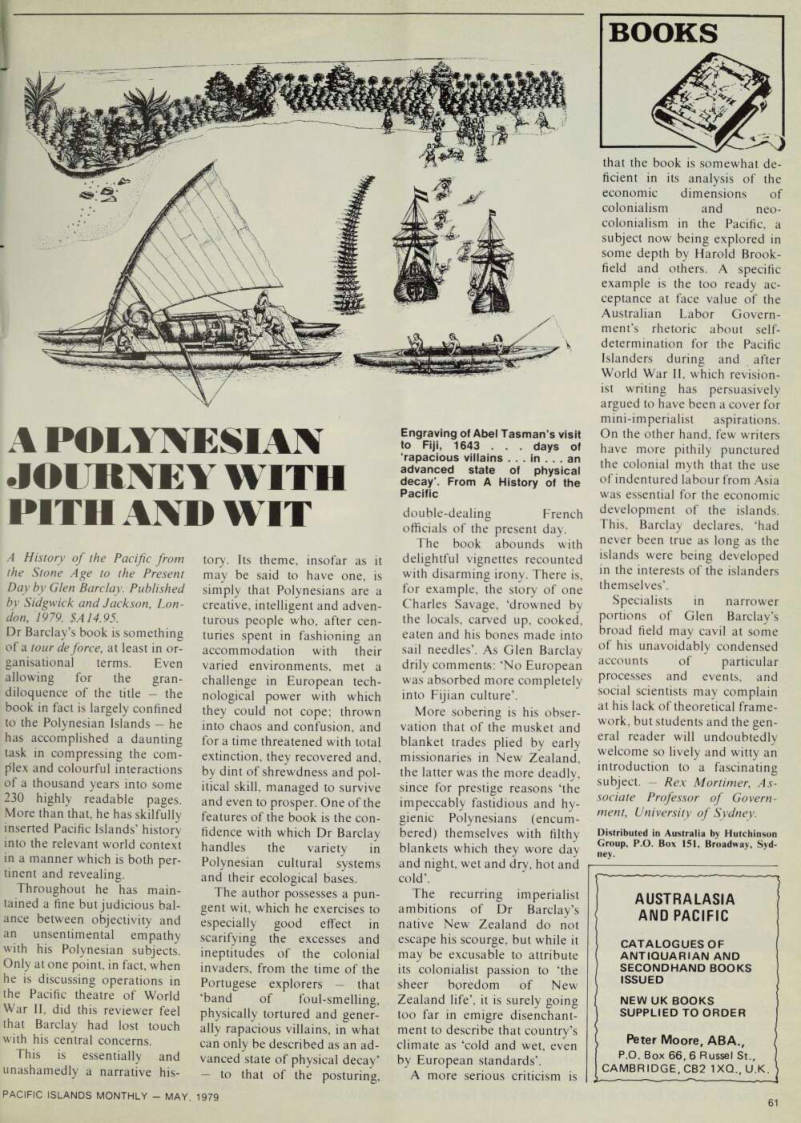
Books
A Polynesian
Pith And Wit
A History of the Pacific from
the Stone Age to the Present
Day by Glen Barclay. Published
by Sidgwick and Jackson, Lon don, 1979. $A 14.95.
Dr Barclay’s book is something of a tour de force, at least in or ganisational terms. Even allowing for the gran diloquence of the title the book in fact is largely confined to the Polynesian Islands he
has accomplished a daunting
task in compressing the com plex and colourful interactions of a thousand years into some 230 highly readable pages.
More than that, he has skilfully inserted Pacific Islands’ history into the relevant world context in a manner which is both per tinent and revealing.
Throughout he has main tained a fine but judicious bal ance between objectivity and an unsentimental empathy
with his Polynesian subjects.
Only at one point, in fact, when he is discussing operations in the Pacific theatre of World War 11, did this reviewer feel that Barclay had lost touch with his central concerns.
This is essentially and unashamedly a narrative his
tory. Its theme, insofar as it may be said to have one, is simply that Polynesians are a creative, intelligent and adven turous people who, after cen turies spent in fashioning an accommodation with their varied environments, met a challenge in European tech nological power with which they could not cope; thrown into chaos and confusion, and for a time threatened with total extinction, they recovered and, by dint of shrewdness and pol itical skill, managed to survive and even to prosper. One of the features of the book is the con fidence with which Dr Barclay handles the variety in Polynesian cultural systems and their ecological bases.
The author possesses a pun gent wit, which he exercises to especially good effect in scarifying the excesses and ineptitudes of the colonial invaders, from the time of the Portugese explorers that ‘band of foul-smelling, physically tortured and gener ally rapacious villains, in what can only be described as an ad vanced state of physical decay’ - to that of the posturing,
double-dealing French
officials of the present day.
The book abounds with
delightful vignettes recounted
with disarming irony. There is, for example, the story of one Charles Savage, ‘drowned by the locals, carved up, cooked, eaten and his bones made into sail needles’. As Glen Barclay
drily comments: ‘No European
was absorbed more completely into Fijian culture’.
More sobering is his obser vation that of the musket and blanket trades plied by early missionaries in New Zealand, the latter was the more deadly, since for prestige reasons ‘the impeccably fastidious and hy gienic Polynesians (encum bered) themselves with filthy blankets which they wore day and night, wet and dry, hot and cold’.
The recurring imperialist
ambitions of Dr Barclay’s native New Zealand do not escape his scourge, but while it may be excusable to attribute its colonialist passion to ‘the sheer boredom of New Zealand life’, it is surely going too far in emigre disenchant ment to describe that country’s climate as ‘cold and wet, even by European standards’.
A more serious criticism is
that the book is somewhat de ficient in its analysis of the economic dimensions of colonialism and neo colonialism in the Pacific, a subject now being explored in some depth by Harold Brook field and others. A specific example is the too ready ac ceptance at face value of the Australian Labor Govern ment’s rhetoric about self determination for the Pacific Islanders during and after World War 11, which revision
ist writing has persuasively
argued to have been a cover for
mini-imperialist aspirations.
On the other hand, few writers have more pithily punctured the colonial myth that the use of indentured labour from Asia was essential for the economic development of the islands.
This, Barclay declares, ‘had never been true as long as the
islands were being developed
in the interests of the islanders themselves’.
Specialists in narrower
portions of Glen Barclay’s
broad field may cavil at some of his unavoidably condensed accounts of particular processes and events, and social scientists may complain at his lack of theoretical frame work, but students and the gen eral reader will undoubtedly welcome so lively and witty an introduction to a fascinating subject. - Rex Mortimer, As
sociate Professor of Govern
ment, University of Sydney.
Distributed in Australia by Hutchinson Group, P.O. Box 151, Broadway, Syd ney.
Engraving of Abel Tasman’s visit to Fiji, 1643 ... days of rapacious villains ... in ... an advanced state of physical decay’. From A History of the Pacific
Advertisements & other items, pp. 61-62 (1 item)
Australasia
AND PACIFIC
CATALOGUES OF
ANTIQUARIAN AND
SECONDHAND BOOKS
ISSUED
NEW UK BOOKS
SUPPLIED TO ORDER
Peter Moore, ABA.,
P.O. Box 66, 6 Russel St.,
CAMBRIDGE, CB2 IXQ., U.K.
r m -rf IH ,-• i « % RjQtaa « C*" «%
~*L zM
•£^- ■ ** «S
««5JKk,f»
KM . 4 // t. m - :Ji ...
USS
r...
V m warn Cathay Pacific. From the heart of Asia. ithay Pacific now flies every Sunday at 7.05 p.m. from Port Moresby to Hong Kong, om Hong Kong, Cathay Pacific flies North, South, East and West serving all the major ies in South-East Asia, Australia and the Middle East. On board you will be red for by charming Oriental flight-hostesses specially chosen from the countries 5 serve and by highly experienced British and Australian pilots and flight engineers. ithay Pacific. Direct from the heart of Asia to the heart of Papua New Guinea. The Swire Group
Take one large
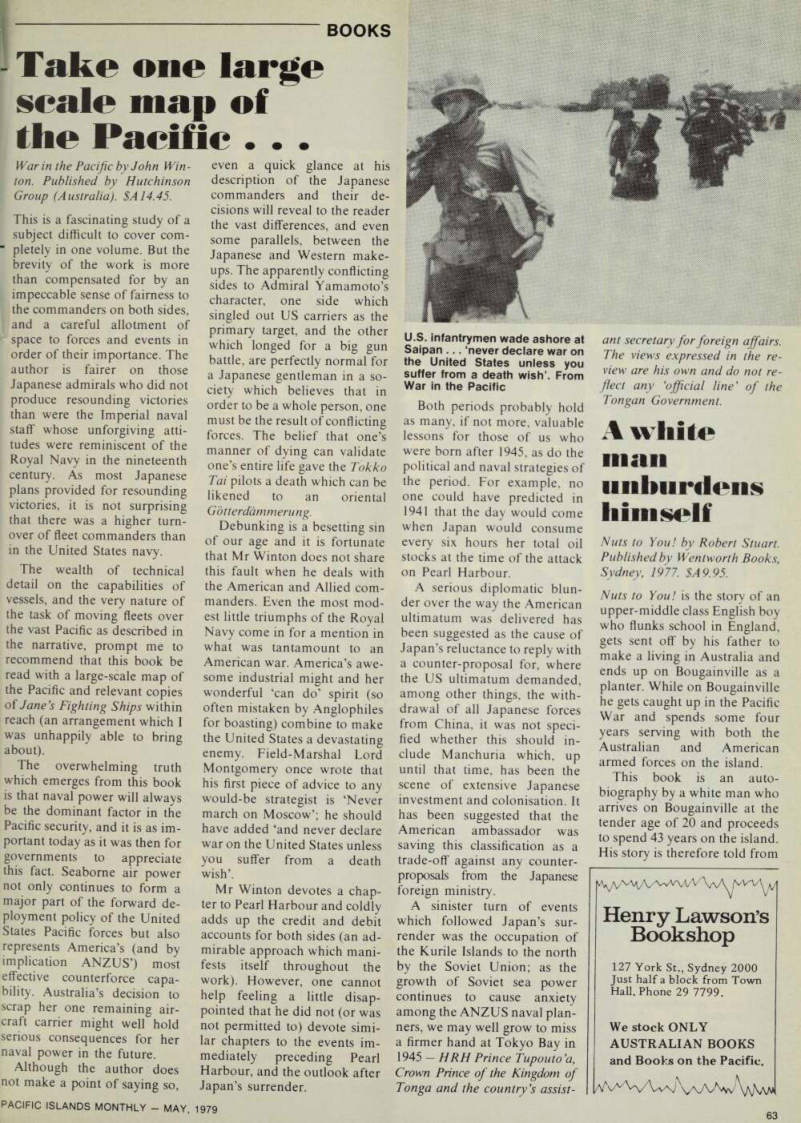
scale map of the Pacific...
War in the Pacific by John Win ton. Published by Hutchinson Group (Australia). $A 14.45.
This is a fascinating study of a subject difficult to cover com " pletely in one volume. But the brevity of the work is more than compensated for by an impeccable sense of fairness to the commanders on both sides, and a careful allotment of space to forces and events in order of their importance. The author is fairer on those Japanese admirals who did not
produce resounding victories
than were the Imperial naval staff whose unforgiving atti tudes were reminiscent of the Royal Navy in the nineteenth century. As most Japanese
plans provided for resounding
victories, it is not surprising that there was a higher turn over of fleet commanders than in the United States navy.
The wealth of technical detail on the capabilities of vessels, and the very nature of the task of moving fleets over the vast Pacific as described in the narrative, prompt me to recommend that this book be read with a large-scale map of the Pacific and relevant copies of Jane’s Fighting Ships within reach (an arrangement which I was unhappily able to bring about).
The overwhelming truth which emerges from this book is that naval power will always be the dominant factor in the Pacific security, and it is as im portant today as it was then for governments to appreciate this fact. Seaborne air power not only continues to form a major part of the forward de ployment policy of the United States Pacific forces but also represents America’s (and by implication ANZUS’) most effective counterforce capa bility. Australia’s decision to scrap her one remaining air craft carrier might well hold serious consequences for her naval power in the future.
Although the author does not make a point of saying so,
even a quick glance at his description of the Japanese commanders and their de cisions will reveal to the reader the vast differences, and even some parallels, between the Japanese and Western make ups. The apparently conflicting sides to Admiral Yamamoto’s character, one side which singled out US carriers as the primary target, and the other which longed for a big gun battle, are perfectly normal for a Japanese gentleman in a so ciety which believes that in order to be a whole person, one must be the result of conflicting forces. The belief that one’s manner of dying can validate one’s entire life gave the Tokko Tai pilots a death which can be likened to an oriental
Gotterdammerung.
Debunking is a besetting sin of our age and it is fortunate that Mr Winton does not share this fault when he deals with the American and Allied com manders. Even the most mod est little triumphs of the Royal Navy come in for a mention in what was tantamount to an American war. America’s awe some industrial might and her wonderful ‘can do’ spirit (so
often mistaken by Anglophiles
for boasting) combine to make the United States a devastating enemy. Field-Marshal Lord Montgomery once wrote that his first piece of advice to any would-be strategist is ‘Never march on Moscow’; he should have added ‘and never declare war on the United States unless you suffer from a death wish’.
Mr Winton devotes a chap ter to Pearl Harbour and coldly adds up the credit and debit accounts for both sides (an ad mirable approach which mani fests itself throughout the work). However, one cannot
help feeling a little disap
pointed that he did not (or was not permitted to) devote simi lar chapters to the events im
mediately preceding Pearl
Harbour, and the outlook after
Japan’s surrender.
Both periods probably hold
as many, if not more, valuable lessons for those of us who were born after 1945, as do the political and naval strategies of the period. For example, no one could have predicted in 1941 that the day would come when Japan would consume every six hours her total oil stocks at the time of the attack on Pearl Harbour.
A serious diplomatic blun der over the way the American ultimatum was delivered has been suggested as the cause of Japan’s reluctance to reply with a counter-proposal for, where the US ultimatum demanded, among other things, the with drawal of all Japanese forces from China, it was not speci fied whether this should in clude Manchuria which, up until that time, has been the scene of extensive Japanese investment and colonisation. It has been suggested that the American ambassador was saving this classification as a trade-off against any counter
proposals from the Japanese
foreign ministry.
A sinister turn of events which followed Japan’s sur render was the occupation of the Kurile Islands to the north by the Soviet Union; as the growth of Soviet sea power continues to cause anxiety among the ANZUS naval plan ners, we may well grow to miss a firmer hand at Tokyo Bay in 1945 HRH Prince Tupouto’a,
Crown Prince of the Kingdom of
Tonga and the country’s assist
ant secretary for foreign affairs.
The views expressed in the re view are his own and do not re flect any ‘official line ’ of the Tongan Government.
U.S. infantrymen wade ashore at Saipan ... ‘never declare war on the United States unless you suffer from a death wish'. From War in the Pacific
unburdens
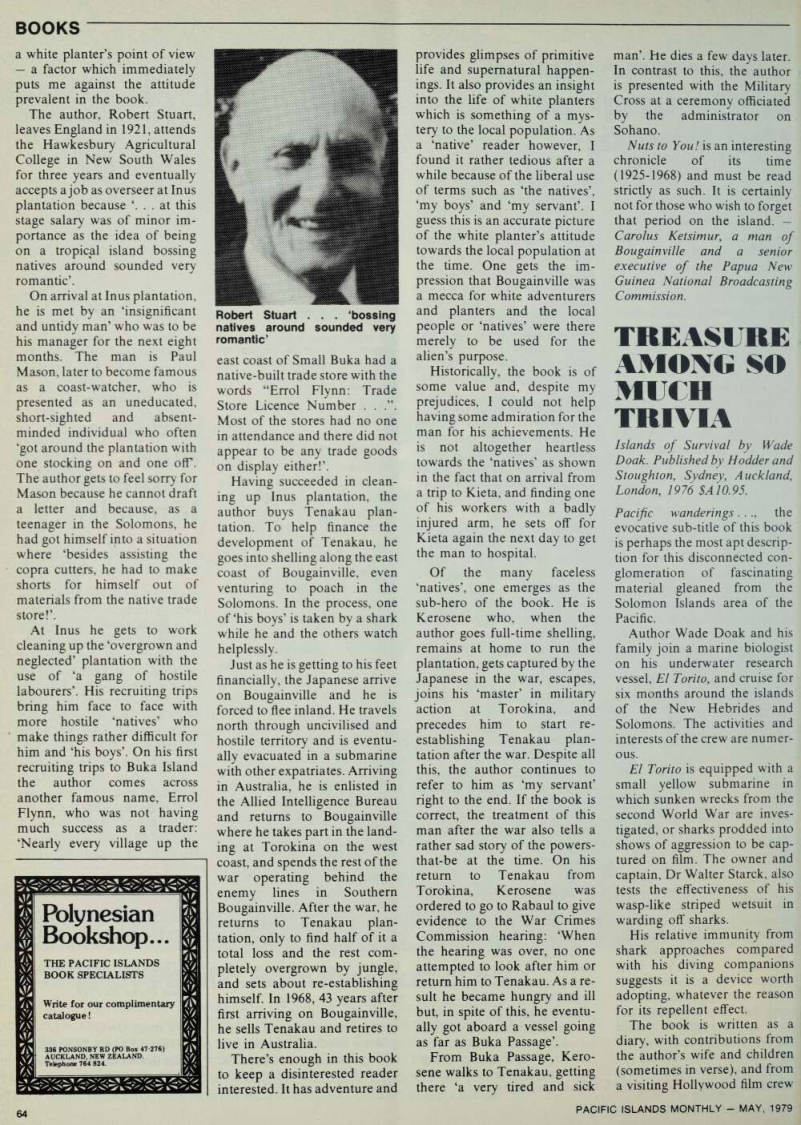
A white man unburdens himself
Nuts to You! by Robert Stuart.
Published by Wentworth Books, Sydney, 1977. $ A 9.9 5.
Nuts to You! is the story of an
upper-middle class English boy
who flunks school in England, gets sent off by his father to make a living in Australia and ends up on Bougainville as a
planter. While on Bougainville
he gets caught up in the Pacific War and spends some four years serving with both the Australian and American armed forces on the island.
This book is an auto biography by a white man who arrives on Bougainville at the tender age of 20 and proceeds to spend 43 years on the island.
His story is therefore told from
a white planter’s point of view a factor which immediately puts me against the attitude prevalent in the book.
The author, Robert Stuart, leaves England in 1921, attends
the Hawkesbury Agricultural
College in New South Wales for three years and eventually accepts a job as overseer at Inus plantation because ‘. . . at this stage salary was of minor im portance as the idea of being on a tropical island bossing natives around sounded very romantic’.
On arrival at Inus plantation, he is met by an ‘insignificant and untidy man’ who was to be his manager for the next eight months. The man is Paul Mason, later to become famous as a coast-watcher, who is presented as an uneducated, short-sighted and absent minded individual who often ‘got around the plantation with one stocking on and one off.
The author gets to feel sorry for Mason because he cannot draft a letter and because, as a teenager in the Solomons, he had got himself into a situation where ‘besides assisting the copra cutters, he had to make shorts for himself out of materials from the native trade store!’.
At Inus he gets to work cleaning up the ‘overgrown and
neglected’ plantation with the
use of ‘a gang of hostile
labourers’. His recruiting trips
bring him face to face with more hostile ‘natives’ who make things rather difficult for him and ‘his boys’. On his first recruiting trips to Buka Island the author comes across another famous name, Errol Flynn, who was not having much success as a trader: ‘Nearly every village up the
east coast of Small Buka had a native-built trade store with the words “Errol Flynn: Trade Store Licence Number . . .”.
Most of the stores had no one in attendance and there did not appear to be any trade goods on display either!’.
Having succeeded in clean ing up Inus plantation, the
author buys Tenakau plan
tation. To help finance the development of Tenakau, he goes into shelling along the east coast of Bougainville, even venturing to poach in the Solomons. In the process, one of ‘his boys’ is taken by a shark while he and the others watch
helplessly.
Just as he is getting to his feet financially, the Japanese arrive on Bougainville and he is forced to flee inland. He travels north through uncivilised and hostile territory and is eventu ally evacuated in a submarine
with other expatriates. Arriving
in Australia, he is enlisted in the Allied Intelligence Bureau and returns to Bougainville where he takes part in the land ing at Torokina on the west coast, and spends the rest of the war operating behind the enemy lines in Southern Bougainville. After the war, he returns to Tenakau plan tation, only to find half of it a total loss and the rest com
pletely overgrown by jungle,
and sets about re-establishing himself. In 1968, 43 years after
first arriving on Bougainville,
he sells Tenakau and retires to live in Australia.
There’s enough in this book to keep a disinterested reader interested. It has adventure and
provides glimpses of primitive
life and supernatural happen
ings. It also provides an insight
into the life of white planters which is something of a mys tery to the local population. As a ‘native’ reader however, I found it rather tedious after a while because of the liberal use of terms such as ‘the natives’,
‘my boys’ and ‘my servant’. I
guess this is an accurate picture of the white planter’s attitude towards the local population at the time. One gets the im
pression that Bougainville was
a mecca for white adventurers and planters and the local people or ‘natives’ were there merely to be used for the alien’s purpose.
Historically, the book is of some value and, despite my prejudices, I could not help having some admiration for the man for his achievements. He is not altogether heartless towards the ‘natives’ as shown in the fact that on arrival from a trip to Kieta, and finding one of his workers with a badly injured arm, he sets off for Kieta again the next day to get the man to hospital.
Of the many faceless ‘natives’, one emerges as the sub-hero of the book. He is Kerosene who, when the author goes full-time shelling, remains at home to run the
plantation, gets captured by the
Japanese in the war, escapes, joins his ‘master’ in military action at Torokina, and precedes him to start re
establishing Tenakau plan
tation after the war. Despite all this, the author continues to refer to him as ‘my servant’ right to the end. If the book is correct, the treatment of this man after the war also tells a rather sad story of the powers that-be at the time. On his return to Tenakau from Torokina, Kerosene was ordered to go to Rabaul to give evidence to the War Crimes Commission hearing: ‘When the hearing was over, no one attempted to look after him or return him to Tenakau. As a re sult he became hungry and ill but, in spite of this, he eventu ally got aboard a vessel going as far as Buka Passage’.
From Buka Passage, Kero sene walks to Tenakau, getting there ‘a very tired and sick
man’. He dies a few days later.
In contrast to this, the author is presented with the Military Cross at a ceremony officiated by the administrator on Sohano.
Nuts to You! is an interesting chronicle of its time (1925-1968) and must be read strictly as such. It is certainly not for those who wish to forget that period on the island.
Carolus Ketsimur, a man of Bougainville and a senior executive of the Papua New Guinea National Broadcasting Commission.
Robert Stuart ... ‘bossing
natives around sounded very romantic’
Advertisements & other items, pp. 63-64 (1 item)
Henry Lawson’s
Bookshop
127 York St., Sydney 2000 Just half a block from Town Hall. Phone 29 7799.
We stock ONLY
AUSTRALIAN BOOKS
and Books on the Pacific.
Polynesian
Bookshop...
THE PACIFIC ISLANDS
BOOK SPECIALISTS
Write for our complimentary catalogue!
336 PONSONBY RD (PO Box 47-276)
AUCKLAND. NEW ZEALAND,
Telephone 764 824.
Treasure


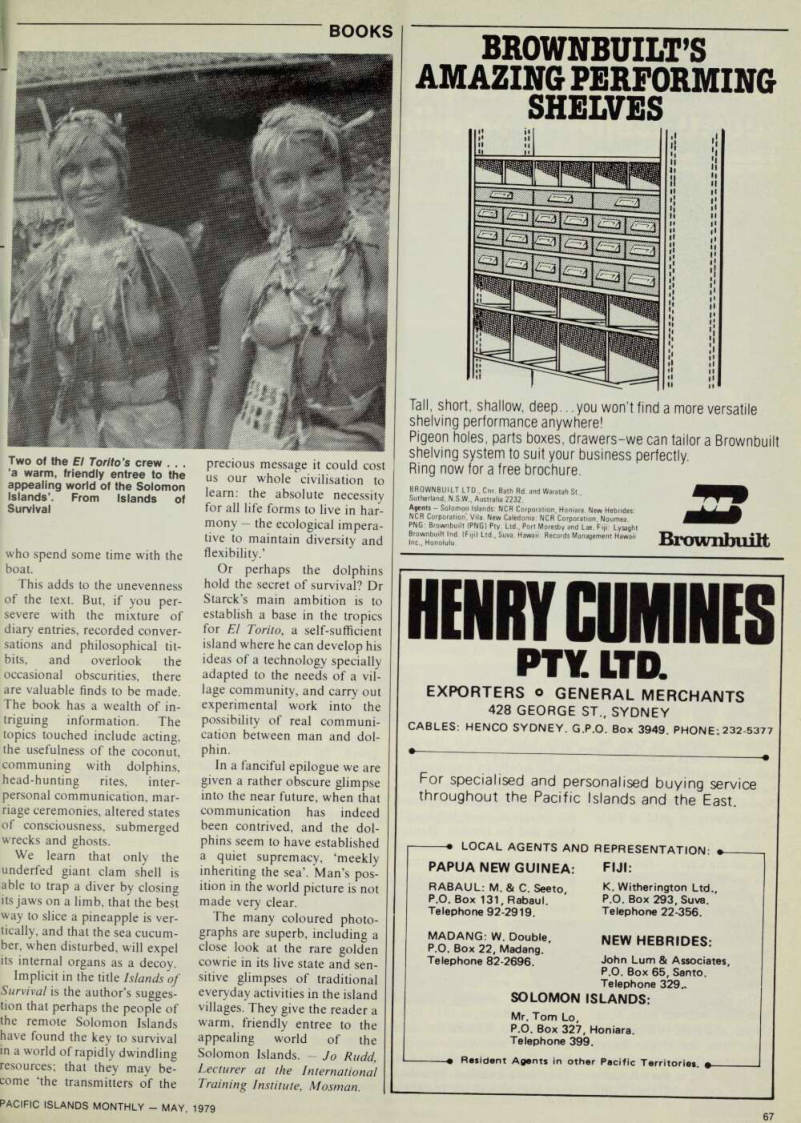
Among So
Much
Trivia
Islands of Survival by Wade Doak. Published by Hodder and
Stoughton, Sydney, Auckland,
London, 1976 $A 10.95.
Pacific wanderings .. the evocative sub-title of this book is perhaps the most apt descrip tion for this disconnected con
glomeration of fascinating
material gleaned from the Solomon Islands area of the Pacific.
Author Wade Doak and his
family join a marine biologist
on his underwater research vessel, El Torito, and cruise for six months around the islands of the New Hebrides and Solomons. The activities and interests of the crew are numer ous.
El Torito is equipped with a small yellow submarine in which sunken wrecks from the second World War are inves tigated, or sharks prodded into shows of aggression to be cap tured on film. The owner and captain. Dr Walter Starck, also tests the effectiveness of his
wasp-like striped wetsuit in
warding off sharks.
His relative immunity from
shark approaches compared
with his diving companions
suggests it is a device worth adopting, whatever the reason for its repellent effect.
The book is written as a diary, with contributions from the author’s wife and children (sometimes in verse), and from a visiting Hollywood film crew
who spend some time with the boat.
This adds to the unevenness of the text. But, if you per severe with the mixture of diary entries, recorded conver sations and philosophical tit bits, and overlook the occasional obscurities, there are valuable finds to be made.
The book has a wealth of in triguing information. The topics touched include acting, the usefulness of the coconut,
communing with dolphins,
head-hunting rites, inter personal communication, mar riage ceremonies, altered states of consciousness, submerged wrecks and ghosts.
We learn that only the underfed giant clam shell is able to trap a diver by closing its jaws on a limb, that the best way to slice a pineapple is ver tically, and that the sea cucum ber, when disturbed, will expel its internal organs as a decoy.
Implicit in the title Islands of Survival is the author’s sugges tion that perhaps the people of the remote Solomon Islands have found the key to survival in a world of rapidly dwindling resources; that they may be come ‘the transmitters of the
precious message it could cost us our whole civilisation to learn: the absolute necessity for all life forms to live in har mony the ecological impera tive to maintain diversity and
flexibility.’
Or perhaps the dolphins hold the secret of survival? Dr Starch’s main ambition is to establish a base in the tropics for El Torito, a self-sufficient island where he can develop his ideas of a technology specially adapted to the needs of a vil lage community, and carry out experimental work into the possibility of real communi cation between man and dol phin.
In a fanciful epilogue we are given a rather obscure glimpse into the near future, when that communication has indeed been contrived, and the dol phins seem to have established a quiet supremacy, ‘meekly inheriting the sea’. Man’s pos ition in the world picture is not made very clear.
The many coloured photo graphs are superb, including a close look at the rare golden cowrie in its live state and sen sitive glimpses of traditional everyday activities in the island villages. They give the reader a warm, friendly entree to the appealing world of the Solomon Islands. - Jo Rudd, Lecturer at the International Training Institute, Mosman.
Two of the El Torito’s crew ... ‘a warm, friendly entree to the appealing world of the Solomon Islands’. From Islands of Survival
Advertisements & other items, pp. 65-67 (1 item)
Bookshop
I I I I I I I I I I I I I I I I I I I I I I I I I I I I I I I I I I I I I I
Trawl the
islands
with PIM’S
rder
TROPICAL PACIFIC
MARINE SHELLS
Bookshop
Pim knows the South Seas.
If you’d like us to introduce you to some of the people and places we know,
clip the coupon overleaf...
i i i \ ii 3Rft^ t R °SOU> MONS Jgj 11%
PACIFIC
ISLANDS
YEAR
BOOK
PtejUZ rar PllCtf*
Select your books from
this great list of South
Sea titles
□ WINGS OF GOLD. James Sinclair s acclaimed book on how the aero- Q PAPUA NEW GUINEA HANDBOOK AND TRAVEL GUIDE. 9th edition plane developed New Guinea. The true story of frontier pioneering. For businessmen, schools, libraries, travellers, this guide covers More than 220,000 words, 150 historic photographs. 334 big pages everything you want to know about PNG today Includes fold-out map 533, or SUS4O posted 280 pages $8.50, or SUSIO.OO posted □ THE TONGANS. Writer Olaf Ruhen and photographer Jozef Vissel □ COLONIAL ERA CEMETERY OF NORFOLK ISLAND. Ft N Dalkin gives capture the Tongan life style in brilliant prose and 96 sparkling full- a fascinating account of many of the people buried in historic Kingston colour pictures. $9.00, SUSIO.SO posted cemetery. Invaluable history and guide. 92 pages. $4.00, or SUSS.SO posted □ IMAGES AND ISLANDS: GRASS ROOTS ART OF THE SOLOMONS.
Traditional Solomon Islands designs and art forms, edited by John □ STORY OF THE SOLOMONS. The late Dr, C.E. Fox’s simple, lucid and Sue Chick. 96 pages $4.50 or SUSS.SO posted outline of the history of the Solomon Islands. Frank and affectionate 88 pages. $3.00, or $U53.75 posted FI GRASS ROOTS ART OF NEW GUINEA. Traditional designs from the north coast of the main island of Papua New Guinea, collected by □ MARINE SHELLS OF THE PACIFIC, Vol 11. Walter Cernohorsky carries E F. Hannemann $3.50, or SUS4.SO posted. on where his first book leaves off, with a further 600 species. Only limited stocks of this one. 412 pages $17.00, or $U525.00 posted. □ THE LOST CARAVEL. Robert Langdon shatters traditional views in this historical whodunnit on early Pacific exploration and its con- □ TROPICAL PACIFIC MARINE SHELLS. Walter Cernohorsky’s longsequences. 368 pages. $lB.OO, or $U526.00 posted awaited third volume in a notable series describes in detail an additional 600-odd species not previously covered. There are 36 shells LJ SUVA: A HISTORY AND GUIDE. Albert Schutz, with L. G. Usher, look shown in precise colour and a further 587 shells in black and white, at the colourful personalities who lent their names to Suva. An historic 352 pages $27.50, or $U532.00 posted browse around Suva Streets. 52 pages. $3.25 or SUS4.OO posted □ PERCY CHATTERTON’S PAPUA: DAY THAT I HAVE LOVED. Charm- LJ PACIFIC ISLAND COOKBOOK. Hundreds of practical recipes using jng, evocative account of a changing Papua as Rev. Percy Chatterton ingredients found in most parts of the South Pacific, including a big knew it over 50 years 144 pages. $6.00, or SUS6.SO posted section on fish. Susan Parkinson and Peggy Stacy also give practical m ® a * planning and kitchen budgeting. 120 pages. $7.00 or Q LANGUAGE SERIES. Simple introductions to Pacific Island SUSB 50 posted languages. SAY IT IN FIJIAN, SAY IT IN FIJI HINDI, SAY IT IN TAHIn D*r. C ir.c.*uncv C » Dß i,.k h * h ♦ TIAN. all $2.50, or $U53.25 posted. SAY IT IN MOTU, $2.00, or SUS3.OO □ PACIFIC ISLANDS YEAR BOOK. 13th edition of the standard refer- posted Mihalic s INTRODUCTION TO NEW GUINEA PIDGIN $2 50 ence book on all the islands of the Pacific their government, popu- or SUS3.OO. lation, statistics, etc. Scores of maps. Information for tourists, including hotels and tariffs. 512 pages $22.50 or $U527.00 posted. □ SOUTH PACIFIC DANCE. The quality of life of the South Pacific □ peoples is reflected in their dance, and here Beth Dean introduces FOLD-OUT MAPS OF PACIFIC ISLANDS AND OF PAPUA NEW the Islanders and their colourful dances Micronesian, Melanesian, GUINEA. Large and clear, up-to-date, in colour. In plastic envelopes. Polynesian. Illustrated in full colour and black and white. 108 pages $2.50, or SUS3.OO posted $8.50, or SUSIO.OO posted
PACIFIC PUBLICATIONS’
Mail Order Bookshop
76 Clarence St., Sydney, 2000, or G.P.O. Box 3408, Sydney, Australia 2001.
I'm enclosing my payment for the following title/s from PIM s one-stop Mail Order Bookshop: Vfllf PA|\| A| Ql"l lIQP (If you prefer, you can tick the books you want, and clip out this ■ UU unl\l MLdtl Uot
whoie page) THIS COUPON TO
3 SUBSCRIBE TO PIM...
$ Then you'll be sure to
$ travel the Islands all
Please also send me a subscription to PIM for 12 months $ year POURCI.
TOTAL $
Name For subscription rates in your
Address area, refer to the list on the
'Contents' page of this issue.
city/state/country/postcode
BROWNBUILT’S
AMAZING PERFORMING
SHELVES
S 3 & c 3 S 3 Si S 3 S 3 S 3 a & ss Tall, short, shallow, deep... you won’t find a more versatile shelving performance anywhere!
Pigeon holes, parts boxes, drawers-we can tailor a Brownbuilt shelving system to suit your business perfectly.
Ring now for a free brochure.
BROWNBUILT LTD., Cnr. Bath Rd. and Waratah St Sutherland, N.S.W., Australia 2232, Agents - Solomon Islands: NCR Corporation, Honiara. New Hebrides: NCR Corporation, Vila. New Caledonia: NCR Corporation, Noumea.
PNG: Brownbuilt (PNG) Pty. Ltd., Port Moresby and Lae. Fiji: Lysaght Brownbuilt Ind. (Fiji) Ltd., Suva. Hawaii: Records Management Hawaii Inc., Honolulu.
Brownbuilt
HENRY CUMINES
PTY. LTD.
EXPORTERS o GENERAL MERCHANTS
428 GEORGE ST., SYDNEY
CABLES: HENCO SYDNEY. G.P.O. Box 3949. PHONE; 232-5377 For specialised and personalised buying service throughout the Pacific Islands and the East.
LOCAL AGENTS AND REPRESENTATION
PAPUA NEW GUINEA:
RABAUL: M. & C. Seeto, P.O. Box 131, Rabaul.
Telephone 92-2919.
MADANG: W. Double, P.O. Box 22, Madang.
Telephone 82-2696.
SOLOMON
FIJI:
K. Witherington Ltd., P.O. Box 293, Suva.
Telephone 22-356.
NEW HEBRIDES:
John Lum & Associates, P.O. Box 65, Santo.
Telephone 329
ISLANDS:
Mr. Tom Lo, P.O. Box 327, Honiara.
Telephone 399.
Resident Agents in other Pacific Territories.
Mick Leahy
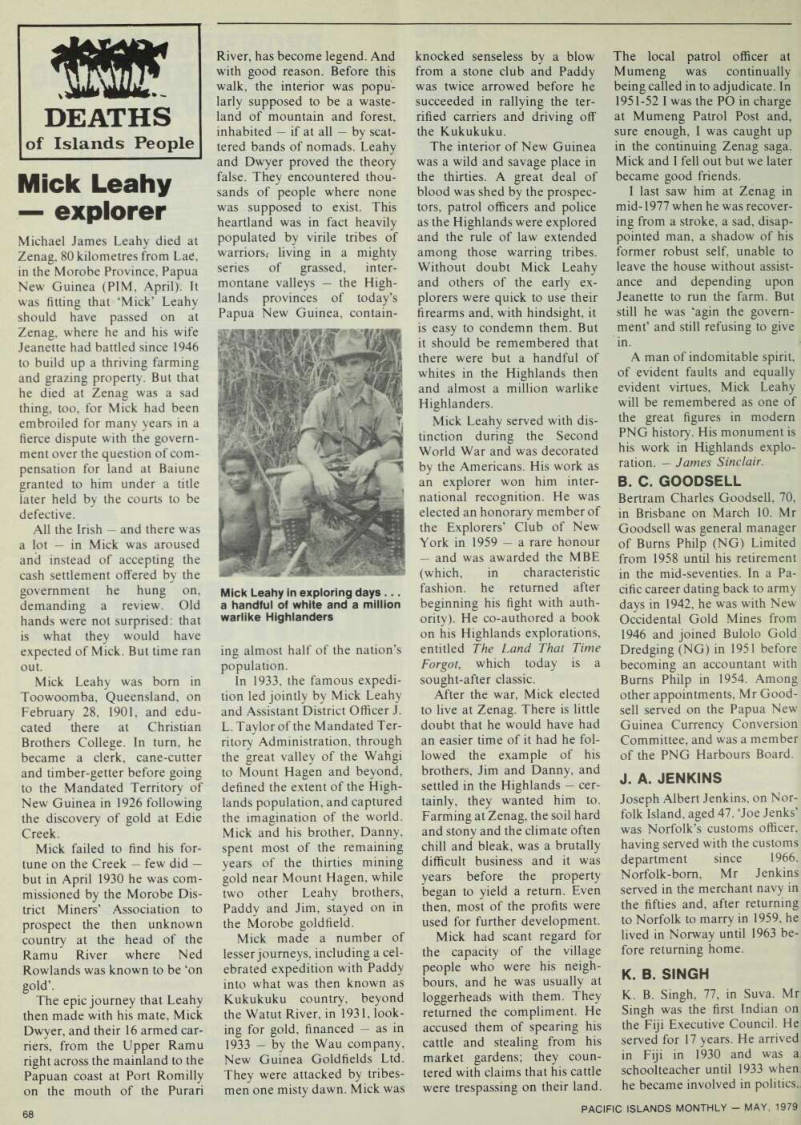
Deaths
of Islands People
explorer
Michael James Leahy died at Zenag, 80 kilometres from Lad, in the Morobe Province, Papua New Guinea (PIM, April). It was fitting that ‘Mick’ Leahy should have passed on at Zenag, where he and his wife Jeanette had battled since 1946 to build up a thriving farming and grazing property. But that he died at Zenag was a sad thing, too, for Mick had been embroiled for many years in a fierce dispute with the govern ment over the question of com pensation for land at Baiune granted to him under a title later held by the courts to be defective.
All the Irish and there was a lot in Mick was aroused and instead of accepting the cash settlement offered by the government he hung on, demanding a review. Old hands were not surprised: that is what they would have expected of Mick. But time ran out.
Mick Leahy was born in Toowoomba, Queensland, on February 28, 1901, and edu cated there at Christian Brothers College. In turn, he became a clerk, cane-cutter
and timber-getter before going
to the Mandated Territory of New Guinea in 1926 following the discovery of gold at Edie Creek.
Mick failed to find his for tune on the Creek few did but in April 1930 he was com missioned by the Morobe Dis trict Miners’ Association to prospect the then unknown country at the head of the Ramu River where Ned Rowlands was known to be ‘on
gold’.
The epic journey that Leahy
then made with his mate, Mick Dwyer, and their 16 armed car riers, from the Upper Ramu right across the mainland to the Papuan coast at Port Romilly on the mouth of the Purari
River, has become legend. And with good reason. Before this walk, the interior was popu larly supposed to be a waste land of mountain and forest, inhabited if at all by scat tered bands of nomads. Leahy
and Dwyer proved the theory
false. They encountered thou sands of people where none was supposed to exist. This heartland was in fact heavily populated by virile tribes of warriors,- living in a mighty series of grassed, inter
montane valleys the High
lands provinces of today’s
Papua New Guinea, contain-
ing almost half of the nation’s
population.
In 1933, the famous expedi
tion led jointly by Mick Leahy
and Assistant District Officer J.
L. Taylor of the Mandated Ter
ritory Administration, through
the great valley of the Wahgi to Mount Hagen and beyond, defined the extent of the High
lands population, and captured
the imagination of the world.
Mick and his brother, Danny, spent most of the remaining years of the thirties mining gold near Mount Hagen, while two other Leahy brothers, Paddy and Jim, stayed on in the Morobe goldfield.
Mick made a number of lesser journeys, including a cel
ebrated expedition with Paddy
into what was then known as Kukukuku country, beyond the Watut River, in 1931, look ing for gold, financed as in 1933 by the Wau company, New Guinea Goldfields Ltd.
They were attacked by tribes men one misty dawn. Mick was
knocked senseless by a blow from a stone club and Paddy was twice arrowed before he succeeded in rallying the ter rified carriers and driving off the Kukukuku.
The interior of New Guinea was a wild and savage place in the thirties. A great deal of blood was shed by the prospec tors, patrol officers and police as the Highlands were explored and the rule of law extended among those warring tribes.
Without doubt Mick Leahy and others of the early ex plorers were quick to use their firearms and, with hindsight, it is easy to condemn them. But it should be remembered that there were but a handful of whites in the Highlands then and almost a million warlike
Highlanders.
Mick Leahy served with dis tinction during the Second World War and was decorated by the Americans. His work as an explorer won him inter national recognition. He was elected an honorary member of the Explorers’ Club of New York in 1959 a rare honour and was awarded the MBE (which, in characteristic fashion, he returned after beginning his fight with auth ority). He co-authored a book
on his Highlands explorations,
entitled The Land That Time Forgot, which today is a
sought-after classic.
After the war, Mick elected to live at Zenag. There is little doubt that he would have had an easier time of it had he fol lowed the example of his brothers, Jim and Danny, and settled in the Highlands cer tainly, they wanted him to.
Farming at Zenag, the soil hard and stony and the climate often chill and bleak, was a brutally difficult business and it was years before the property began to yield a return. Even then, most of the profits were used for further development.
Mick had scant regard for the capacity of the village people who were his neigh bours, and he was usually at
loggerheads with them. They
returned the compliment. He accused them of spearing his cattle and stealing from his
market gardens; they coun
tered with claims that his cattle were trespassing on their land.
The local patrol officer at
Mumeng was continually
being called in to adjudicate. In 1951-52 I was the PO in charge at Mumeng Patrol Post and, sure enough, I was caught up in the continuing Zenag saga.
Mick and I fell out but we later became good friends.
I last saw him at Zenag in mid-1977 when he was recover ing from a stroke, a sad, disap pointed man, a shadow of his former robust self, unable to leave the house without assist ance and depending upon Jeanette to run the farm. But still he was ‘agin the govern ment’ and still refusing to give in.
A man of indomitable spirit, of evident faults and equally evident virtues, Mick Leahy will be remembered as one of the great figures in modern PNG history. His monument is his work in Highlands explo ration. James Sinclair.
B. C. Goodsell
Bertram Charles Goodsell, 70, in Brisbane on March 10. Mr Goodsell was general manager of Burns Philp (NG) Limited from 1958 until his retirement in the mid-seventies. In a Pa cific career dating back to army days in 1942, he was with New Occidental Gold Mines from 1946 and joined Bulolo Gold Dredging (NG) in 1951 before becoming an accountant with Burns Philp in 1954. Among other appointments, Mr Good sell served on the Papua New Guinea Currency Conversion Committee, and was a member of the PNG Harbours Board.
J. A. Jenkins
Joseph Albert Jenkins, on Nor folk Island, aged 47. ‘Joe Jenks’ was Norfolk’s customs officer, having served with the customs department since 1966.
Norfolk-born, Mr Jenkins served in the merchant navy in the fifties and, after returning to Norfolk to marry in 1959, he lived in Norway until 1963 be fore returning home.
K. B. Singh
K. B. Singh, 77, in Suva. Mr Singh was the first Indian on the Fiji Executive Council. He served for 17 years. He arrived in Fiji in 1930 and was aj schoolteacher until 1933 whem he became involved in politics-
Mick Leahy in exploring days ... a handful of white and a million warlike Highlanders
Advertisements & other items, p. 69 (1 item)
Wheel Drive
- S) m qaihatvu I & if f W,. £ *. <*- -
DAIHATSU
• For farming, for ranching, to carry people and things, for construction work...for a wide range of off-the-road and recreation uses. A multi-purpose vehicle to better meet a variety of needs. • The diesel engine is now also available.
Because ignition is no longer complex for a diesel engine, there is less occurrence of engine trouble in bad driving conditions. i csr-a grj ■■ 71
DAIHATSU CHARADE
DAIHATSU LIGHT BUS : 15 SEATS
DAIHATSU TRUCK
ETS ROBERT R P N^ GU,NEA ' P - Box 1121 « Rabaul/FIJI: PRAKASH MOTORS LIMITED, P.O, Box 370, Suva/TAHITI: 45 Santo GARACF RamtvT^i N^7izc ALEDON,A: S I DA ' BP ‘ 2548 ' Noumea/NEW HEBRIDES: SANTO BUS COMPANY, P.O. Box Homara/REPUBLIC OF ' BP ’ ' POrt Vi,a/SOLOMON ISLANDS: HERTZ CAR RENTALS LIMITED, P.O. Box 333,
watering party
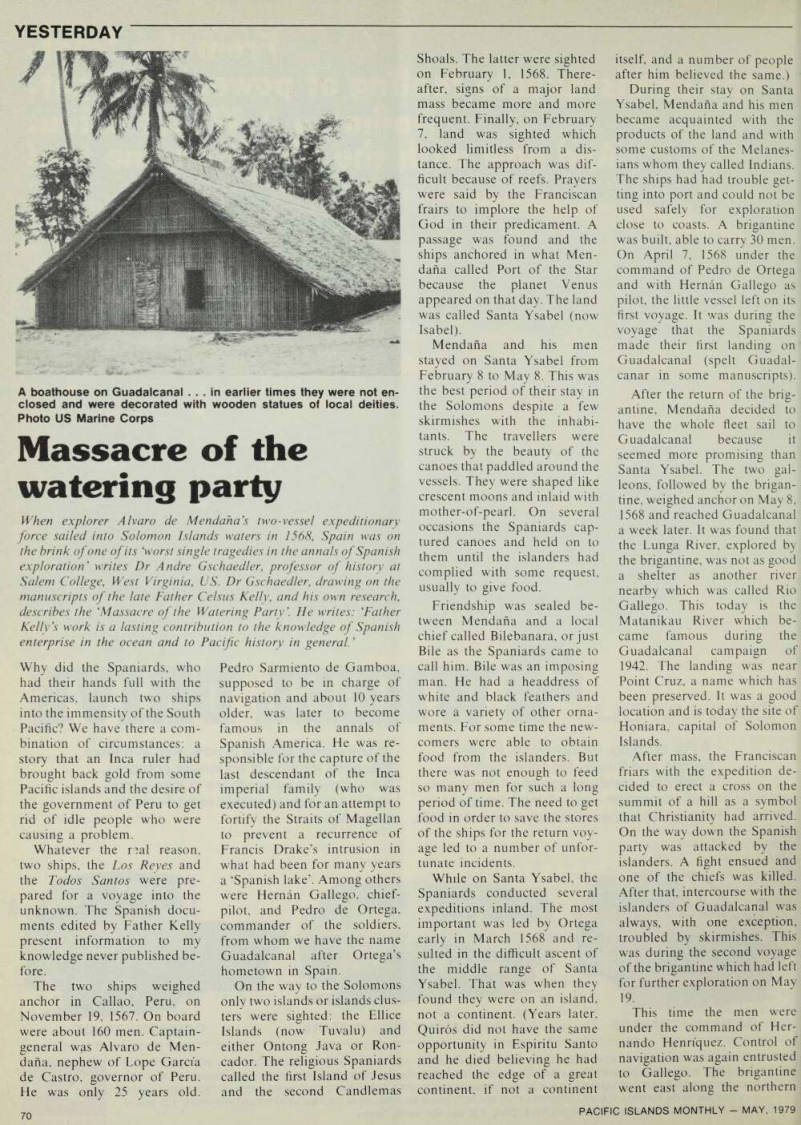
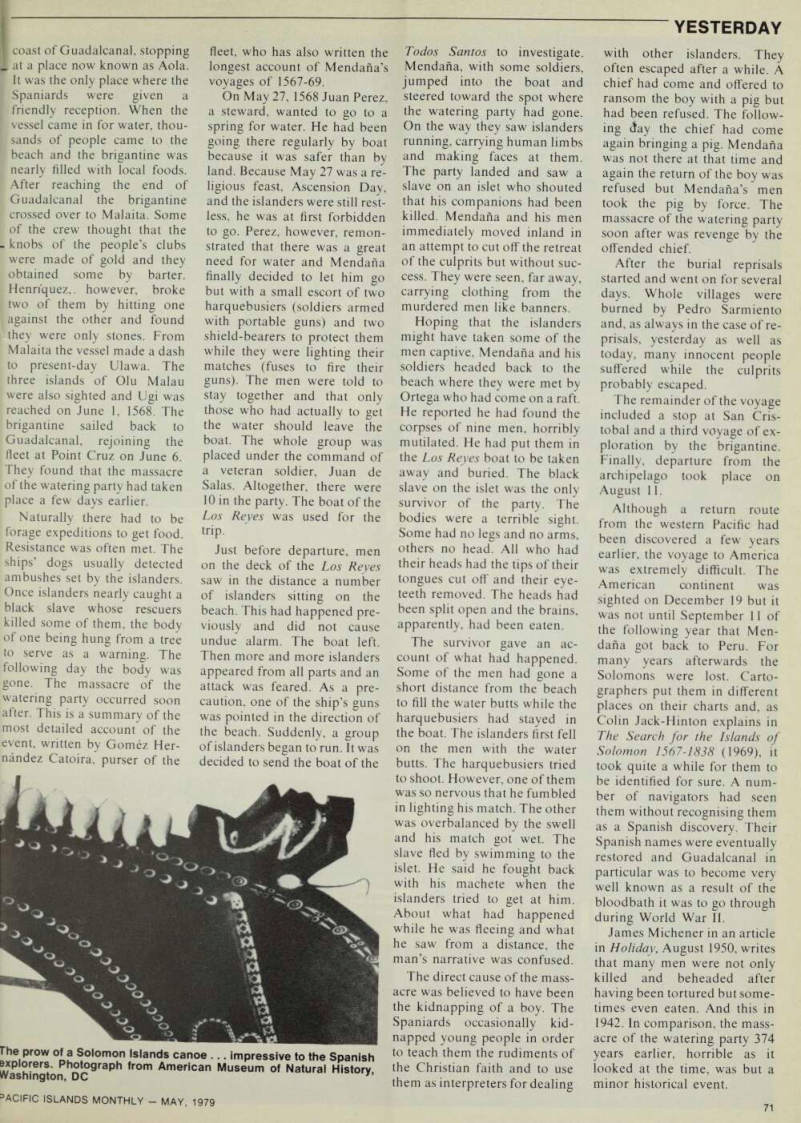
Yesterday
Massacre of the watering party
When explorer Alvaro de Mendaha’s two-vessel expeditionary force sailed into Solomon Islands waters in 1568, Spain was on the brink of one of its ‘worst single tragedies in the annals of Spanish exploration ’ writes Dr Andre Gschaedler, professor of history at Salem College, West Virginia, US. Dr Gschaedler, drawing on the manuscripts of the late Father Celsus Kelly, and his own research, describes the ‘ Massacre of the Watering Party’. He writes: ‘Father Kelly’s work is a lasting contribution to the knowledge of Spanish enterprise in the ocean and to Pacific history in general. ’
Why did the Spaniards, who had their hands full with the Americas, launch two ships into the immensity of the South Pacific? We have there a com bination of circumstances: a story that an Inca ruler had brought back gold from some Pacific islands and the desire of the government of Peru to get rid of idle people who were
causing a problem.
Whatever the reason, two ships, the Los Reyes and the Todos Santos were pre pared for a voyage into the unknown. The Spanish docu ments edited by Father Kelly present information to my
knowledge never published be
fore.
The two ships weighed anchor in Callao, Peru, on November 19, 1567. On board were about 160 men. Captain general was Alvaro de Men dana, nephew of Lope Garcia de Castro, governor of Peru.
He was only 25 years old.
Pedro Sarmiento de Gamboa, supposed to be in charge of navigation and about 10 years older, was later to become famous in the annals of Spanish America. He was re sponsible for the capture of the last descendant of the Inca
imperial family (who was
executed) and for an attempt to fortify the Straits of Magellan to prevent a recurrence of Francis Drake’s intrusion in what had been for many years a ‘Spanish lake’. Among others were Hernan Gallego, chief pilot, and Pedro de Ortega, commander of the soldiers, from whom we have the name Guadalcanal after Ortega’s hometown in Spain.
On the way to the Solomons only two islands or islands clus ters were sighted; the Ellice Islands (now Tuvalu) and either Ontong Java or Ron
cador. The religious Spaniards
called the first Island of Jesus and the second Candlemas
Shoals. The latter were sighted on February 1, 1568. There after, signs of a major land mass became more and more
frequent. Finally, on February
7, land was sighted which looked limitless from a dis tance. The approach was dif ficult because of reefs. Prayers were said by the Franciscan frairs to implore the help of God in their predicament. A passage was found and the ships anchored in what Men dana called Port of the Star because the planet Venus appeared on that day. The land was called Santa Ysabel (now Isabel).
Mendana and his men stayed on Santa Ysabel from February 8 to May 8. This was the best period of their stay in the Solomons despite a few skirmishes with the inhabi tants. The travellers were struck by the beauty of the canoes that paddled around the vessels. They were shaped like crescent moons and inlaid with mother-of-pearl. On several occasions the Spaniards cap tured canoes and held on to them until the islanders had complied with some request, usually to give food.
Friendship was sealed be tween Mendana and a local chief called Bilebanara, or just Bile as the Spaniards came to call him. Bile was an imposing man. He had a headdress of white and black feathers and wore a variety of other orna ments. For some time the new comers were able to obtain food from the islanders. But there was not enough to feed so many men for such a long period of time. The need to get food in order to save the stores of the ships for the return voy age led to a number of unfor tunate incidents.
While on Santa Ysabel, the Spaniards conducted several expeditions inland. The most important was led by Ortega early in March 1568 and re sulted in the difficult ascent of the middle range of Santa Ysabel. That was when they found they were on an island, not a continent. (Years later, Quiros did not have the same
opportunity in Espiritu Santo
and he died believing he had reached the edge of a great continent, if not a continent
itself, and a number of people after him believed the same.) During their stay on Santa Ysabel, Mendaha and his men became acquainted with the products of the land and with some customs of the Melanes ians whom they called Indians.
The ships had had trouble get ting into port and could not be
used safely for exploration
close to coasts. A brigantine was built, able to carry 30 men.
On April 7, 1568 under the command of Pedro de Ortega and with Hernan Gallego as pilot, the little vessel left on its first voyage. It was during the voyage that the Spaniards made their first landing on Guadalcanal (spelt Guadal canar in some manuscripts).
After the return of the brig antine, Mendana decided to have the whole fleet sail to Guadalcanal because it seemed more promising than Santa Ysabel. The two gal leons, followed by the brigan tine, weighed anchor on May 8, 1568 and reached Guadalcanal a week later. It was found that the Lunga River, explored by the brigantine, was not as good a shelter as another river nearby which was called Rio Gallego. This today is the Matanikau River which be came famous during the Guadalcanal campaign of 1942. The landing was near Point Cruz, a name which has been preserved. It was a good location and is today the site of Honiara, capital of Solomon Islands.
After mass, the Franciscan friars with the expedition de cided to erect a cross on the summit of a hill as a symbol that Christianity had arrived.
On the way down the Spanish party was attacked by the islanders. A fight ensued and one of the chiefs was killed.
After that, intercourse with the islanders of Guadalcanal was
always, with one exception,
troubled by skirmishes. This was during the second voyage of the brigantine which had left for further exploration on May 19.
This time the men were under the command of Her nando Henriquez. Control of
navigation was again entrusted
to Gallego. The brigantine went east along the northern
A boathouse on Guadalcanal ... In earlier times they were not en closed and were decorated with wooden statues of local deities.
Photo US Marine Corps
I coast of Guadalcanal, stopping X at a place now known as Aola.
It was the only place where the
• Spaniards were given a
[ friendly reception. When the I vessel came in for water, thou sands of people came to the beach and the brigantine was nearly filled with local foods.
After reaching the end of Guadalcanal the brigantine crossed over to Malaita. Some ! of the crew thought that the - knobs of the people’s clubs were made of gold and they obtained some by barter.
Henriquez,. however, broke two of them by hitting one against the other and found they were only stones. From Malaita the vessel made a dash to present-day Ulawa. The three islands of Olu Malau were also sighted and Ugi was reached on June 1, 1568. The brigantine sailed back to Guadalcanal, rejoining the fleet at Point Cruz on June 6.
They found that the massacre of the watering party had taken place a few days earlier.
Naturally there had to be forage expeditions to get food.
Resistance was often met. The
ships’ dogs usually detected
ambushes set by the islanders.
Once islanders nearly caught a black slave whose rescuers killed some of them, the body of one being hung from a tree to serve as a warning. The
following day the body was
gone. The massacre of the watering party occurred soon after. This is a summary of the most detailed account of the event, written by Gomez Her nandez Catoira, purser of the
fleet, who has also written the longest account of Mendana’s voyages of 1567-69.
On May 27, 1568 Juan Perez, a steward, wanted to go to a spring for water. He had been
going there regularly by boat
because it was safer than by land. Because May 27 was a re ligious feast, Ascension Day, and the islanders were still rest less, he was at first forbidden to go. Perez, however, remon strated that there was a great need for water and Mendana finally decided to let him go but with a small escort of two harquebusiers (soldiers armed with portable guns) and two shield-bearers to protect them while they were lighting their matches (fuses to fire their guns). The men were told to stay together and that only those who had actually to get the water should leave the boat. The whole group was placed under the command of a veteran soldier, Juan de Salas. Altogether, there were 10 in the party. The boat of the Los Reyes was used for the
trip.
Just before departure, men on the deck of the Los Reyes saw in the distance a number of islanders sitting on the beach. This had happened pre viously and did not cause undue alarm. The boat left.
Then more and more islanders appeared from all parts and an attack was feared. As a pre caution. one of the ship’s guns was pointed in the direction of the beach. Suddenly, a group of islanders began to run. It was decided to send the boat of the
Todos Santos to investigate.
Mendana, with some soldiers, jumped into the boat and steered toward the spot where the watering party had gone.
On the way they saw islanders
running, carrying human limbs
and making faces at them.
The party landed and saw a slave on an islet who shouted that his companions had been killed. Mendana and his men immediately moved inland in an attempt to cut off the retreat of the culprits but without suc cess. They were seen, far away,
carrying clothing from the
murdered men like banners.
Hoping that the islanders might have taken some of the men captive, Mendana and his soldiers headed back to the beach where they were met by Ortega who had come on a raft.
He reported he had found the corpses of nine men, horribly mutilated. He had put them in the Los Reyes boat to be taken away and buried. The black slave on the islet was the only survivor of the party. The bodies were a terrible sight.
Some had no legs and no arms, others no head. All who had their heads had the tips of their tongues cut off and their eye teeth removed. The heads had been split open and the brains, apparently, had been eaten.
The survivor gave an ac count of what had happened.
Some of the men had gone a short distance from the beach to fill the water butts while the
harquebusiers had stayed in
the boat. The islanders first fell on the men with the water butts. The harquebusiers tried to shoot. However, one of them was so nervous that he fumbled in lighting his match. The other was overbalanced by the swell and his match got wet. The slave fled by swimming to the islet. He said he fought back with his machete when the islanders tried to get at him.
About what had happened while he was fleeing and what he saw from a distance, the man’s narrative was confused.
The direct cause of the mass acre was believed to have been the kidnapping of a boy. The
Spaniards occasionally kid
napped young people in order to teach them the rudiments of the Christian faith and to use them as interpreters for dealing
with other islanders. They often escaped after a while. A chief had come and offered to ransom the boy with a pig but had been refused. The follow ing day the chief had come
again bringing a pig. Mendana
was not there at that time and again the return of the boy was refused but Mendana’s men took the pig by force. The massacre of the watering party soon after was revenge by the offended chief.
After the burial reprisals started and went on for several
days. Whole villages were
burned by Pedro Sarmiento and, as always in the case of re prisals, yesterday as well as
today, many innocent people
suffered while the culprits
probably escaped.
The remainder of the voyage included a stop at San Cris tobal and a third voyage of ex
ploration by the brigantine.
Finally, departure from the
archipelago took place on
August 11.
Although a return route from the western Pacific had been discovered a few years earlier, the voyage to America was extremely difficult. The American continent was sighted on December 19 but it was not until September 11 of the following year that Men dana got back to Peru. For many years afterwards the Solomons were lost. Carto graphers put them in different places on their charts and, as Colin Jack-Hinton explains in The Search for the Islands of Solomon 1567-1838 (1969), it took quite a while for them to be identified for sure. A num ber of navigators had seen them without recognising them as a Spanish discovery. Their
Spanish names were eventually
restored and Guadalcanal in particular was to become very well known as a result of the bloodbath it was to go through during World War 11.
James Michener in an article in Holiday, August 1950, writes that many men were not only killed and beheaded after having been tortured but some times even eaten. And this in 1942. In comparison, the mass acre of the watering party 374 years earlier, horrible as it looked at the time, was but a minor historical event.
The prow of a Solomon Islands canoe ... impressive to the Spanish explorers. Photograph from American Museum of Natural History, Washington, DC
Advertisements & other items, p. 72 (1 item)
when you watch TV?
What do you really see
V i •ii A' m
V -W« %MHU • IbM
I', in JJJ J J . ': * U ' U *U $ U * U 1 U * U * U •t & HV . . . . . V V\ \ •• \ j \ \ * (T*fz'(3'fs'(s'TS'fT^C»' 1 si ■P as nnnn «# ■V & - Ntc MW
S ME
ft . - HB w a - T-'v v; :vr Do you see what you want to see? Has television lived up to its promise? Is it a medium of entertainment and enlightenment, or one of enslavement?
These are the serious questions. The answers lie in your ability to shape your own video environment.
To choose programs you want to view, when you want to view them.
The video tape recorder is by far one of the best tools yet devised to expand the creative process of television.
We know. We’re JVC, the innovative audio/video electronics company f*' with 50 years plus one of experience.
S \m m For more than 20 years, JVC has been committed to the development of VTR. This experience plus JVC’s miniaturization technology has now led to the development of the compact, lightweight and easy-to-operate VHS video cassette recorder, the HR-3300 (pictured here). It’s the world’s first VHS model, and offers a host of JVC-developed technical advantages.
The way we see TV, JVC video systems are the key to freedom and rewarding leisure.
Our hope, of course, is that in the television of tomorrow you’ll see things our way. 30 «-
JVC
Australia: Hagemeyer(Australasia)B.V., 57/69 Anzac Parade, Kensington, N.5.W.2033 Australia Te 1.662-1222 FIJI Islands: D. Gokal & Co., Ltd., G.P.O. Box 501, Corner of Pier Street & Renwick Road, Suva, Fiji Te 1.25259 Cook Islands: J. & P. Ingram & Co., Ltd., P.0.80x 55, Rarotonga, Cook Islands Te 1.378457 New Hebrides: Wu ke Luong, P.0.80x 113, Rue Higginson, Port-Vila, New '(Hebrides Te 1.2115 New Caledonia: Caldis, 2, Route du Velodrome, B.P. Ml. Noumea. Cedex, New Caledonia Te 1.262350 Tahiti: Magasin Sincere, B.P. 215, Papeete, Tahiti Te 1.20060 Papua New Guinea: Hagemeyer(P.N.G.)Ptu, Ltd., P.0.80x 90 Lae, Papua New Guinea Te 1.42-3200 New Zealand: Atlas Majestic Industries Ltd., 11, Albion Road, Otahuhu, Auckland. New Zealand Te 1.27-67-099
Promising
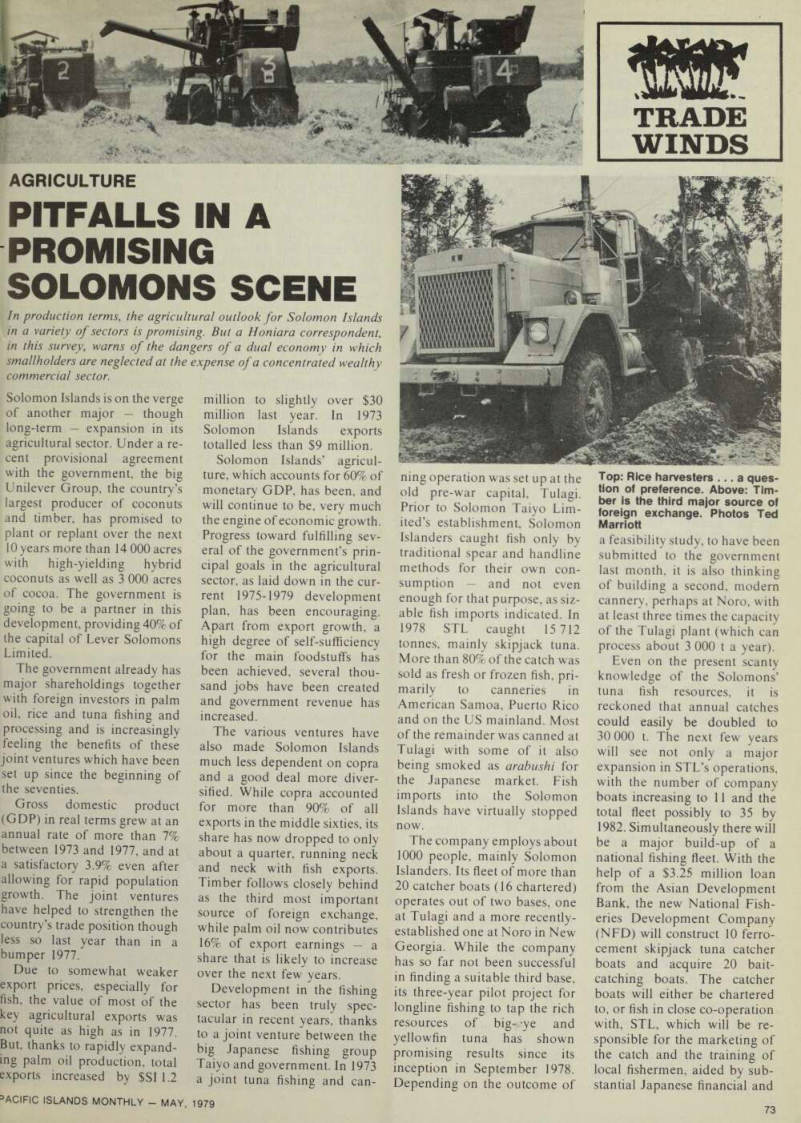
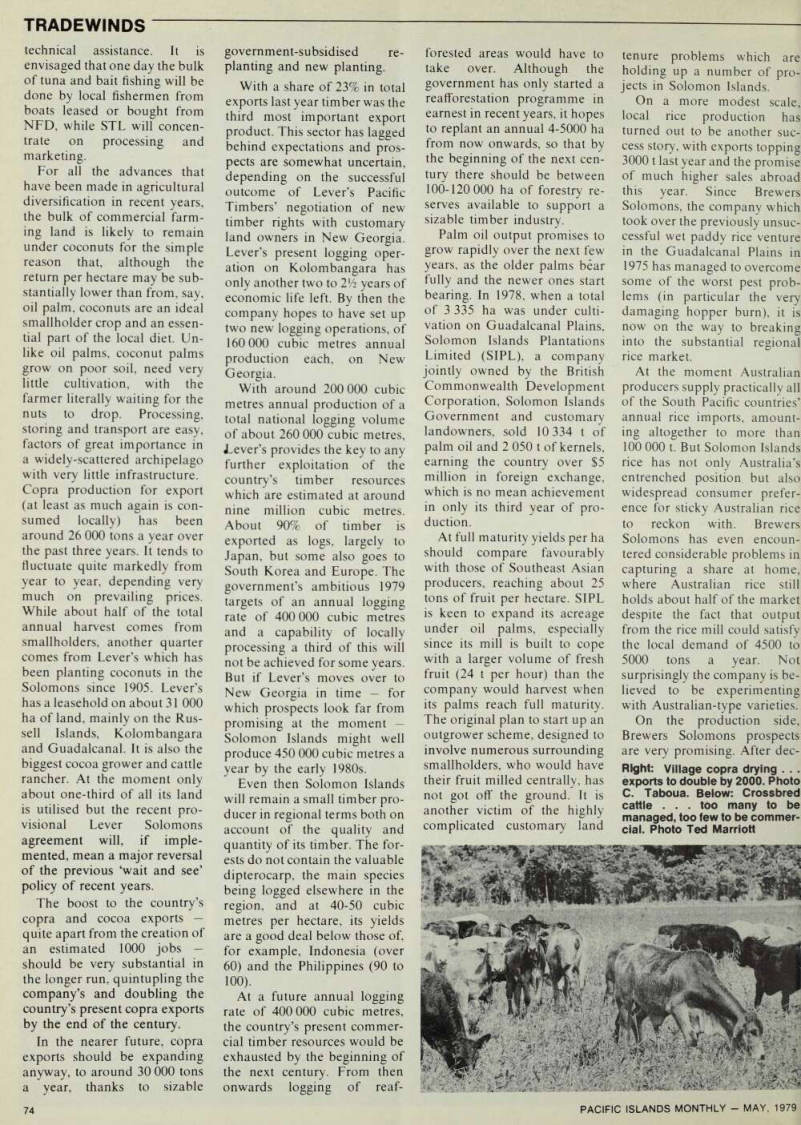
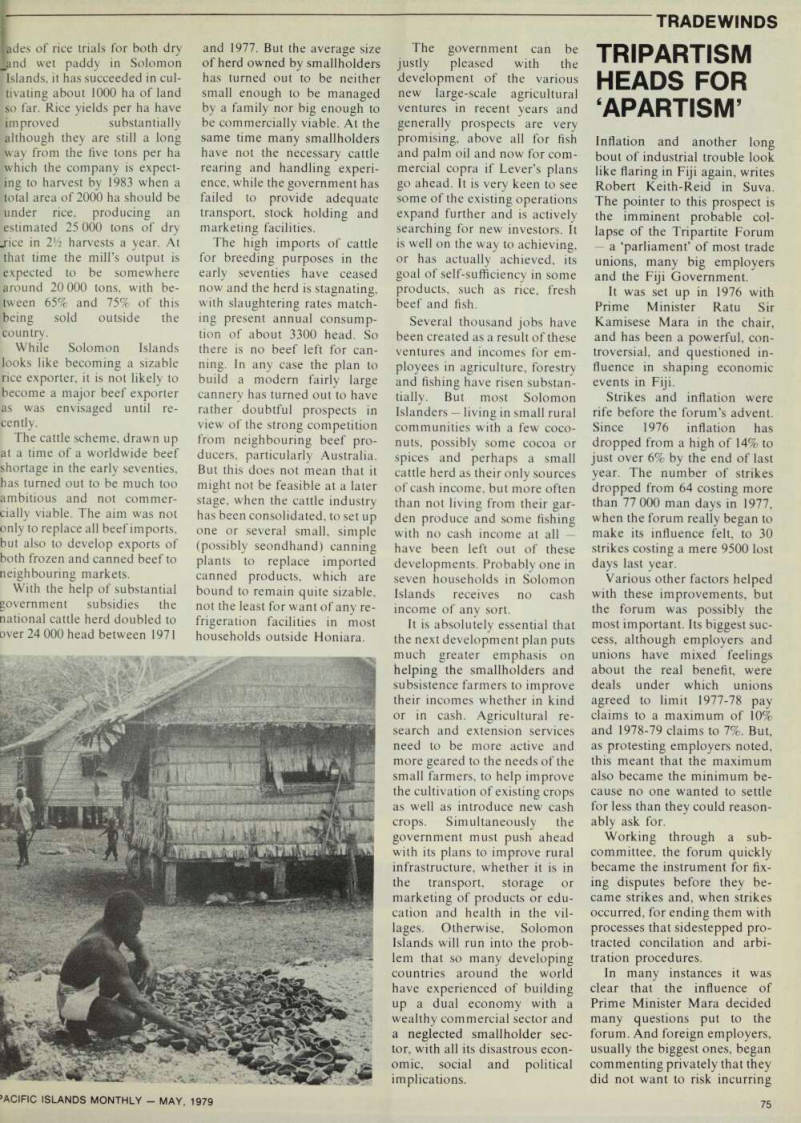
Trade
Winds
Agriculture
Pitfalls In A
Promising
Solomons Scene
In production terms, the agricultural outlook for Solomon Islands in a variety of sectors is promising. But a Honiara correspondent, in this survey, warns of the dangers of a dual economy in which smallholders are neglected at the expense of a concentrated wealthy commercial sector.
Solomon Islands is on the verge of another major though long-term expansion in its agricultural sector. Under a re cent provisional agreement with the government, the big Unilever Group, the country’s largest producer of coconuts and timber, has promised to plant or replant over the next 10 years more than 14 000 acres with high-yielding hybrid coconuts as well as 3 000 acres of cocoa. The government is going to be a partner in this
development, providing 40% of
the capital of Lever Solomons Limited.
The government already has major shareholdings together with foreign investors in palm oil, rice and tuna fishing and
processing and is increasingly
feeling the benefits of these joint ventures which have been set up since the beginning of the seventies.
Gross domestic product (GDP) in real terms grew at an annual rate of more than 7% between 1973 and 1977, and at a satisfactory 3.9% even after allowing for rapid population growth. The joint ventures have helped to strengthen the country’s trade position though less so last year than in a
bumper 1977.
Due to somewhat weaker
export prices, especially for
fish, the value of most of the key agricultural exports was not quite as high as in 1977.
But, thanks to rapidly expand ing palm oil production, total exports increased by SSI 1.2
million to slightly over $3O million last year. In 1973 Solomon Islands exports totalled less than $9 million.
Solomon Islands’ agricul ture, which accounts for 60% of monetary GDP, has been, and will continue to be, very much the engine of economic growth.
Progress toward fulfilling sev
eral of the government’s prin cipal goals in the agricultural sector, as laid down in the cur rent 1975-1979 development plan, has been encouraging.
Apart from export growth, a
high degree of self-sufficiency
for the main foodstuffs has been achieved, several thou sand jobs have been created and government revenue has increased.
The various ventures have also made Solomon Islands much less dependent on copra and a good deal more diver sified. While copra accounted for more than 90% of all exports in the middle sixties, its share has now dropped to only about a quarter, running neck and neck with fish exports.
Timber follows closely behind as the third most important
source of foreign exchange,
while palm oil now contributes 16% of export earnings a share that is likely to increase over the next few years.
Development in the fishing
sector has been truly spec tacular in recent years, thanks to a joint venture between the
big Japanese fishing group
Taiyo and government. In 1973 a joint tuna fishing and can-
ning operation was set up at the old pre-war capital, Tulagi. p r ; rtr p i -r , • Prior to Solomon Taiyo Limited s establishment, Solomon
Islanders caught fish only by
traditional spear and handline methods for their own consumption and not even enough for that purpose, as sizable fish imports indicated. In 1978 STL caught 15 712
tonnes, mainly skipjack tuna,
More than 80% of the catch was sold as fresh or frozen fish, primarily to canneries in American Samoa, Puerto Rico and on the US mainland. Most of the remainder was canned at Tulagi with some of it also being smoked as arabushi for the Japanese market. Fish imports into the Solomon
Islands have virtually stopped
now - The company employs about
1000 people, mainly Solomon
Islanders. Its fleet of more than 20 catcher boats (16 chartered) operates out of two bases, one at Tulagi and a more recentlyestablished one at Noro in New Georgia. While the company has so far not been successful in finding a suitable third base,
its three-year pilot project for
longline fishing to tap the rich resources of big- ‘ye and yellowfin tuna has shown promising results since its
inception in September 1978.
Depending on the outcome of
a feasibility study, to have been submitted to the government last month, it is also thinking of building a second, modern cannery, perhaps at Noro, with at least three times the capacity of the Tulagi plant (which can process about 3 000 t a year).
Even on the present scanty knowledge of the Solomons’ tuna fish resources, it is reckoned that annual catches could easily be doubled to 30 000 t. The next few years will see not only a major
expansion in STL’s operations,
with the number of company boats increasing to 11 and the total fleet possibly to 35 by 1982. Simultaneously there will be a major build-up of a national fishing fleet. With the help of a $3.25 million loan from the Asian Development Bank, the new National Fish
eries Development Company
(NFD) will construct 10 ferro cement skipjack tuna catcher boats and acquire 20 bait catching boats. The catcher boats will either be chartered to, or fish in close co-operation with, STL, which will be re sponsible for the marketing of the catch and the training of local fishermen, aided by sub stantial Japanese financial and
Top: Rice harvesters ... a ques tion of preference. Above: Tim ber is the third major source of foreign exchange. Photos Ted Marriott
technical assistance. It is envisaged that one day the bulk of tuna and bait fishing will be done by local fishermen from boats leased or bought from NFD, while STL will concen trate on processing and
marketing.
For all the advances that have been made in agricultural diversification in recent years, the bulk of commercial farm ing land is likely to remain under coconuts for the simple reason that, although the return per hectare may be sub stantially lower than from, say, oil palm, coconuts are an ideal smallholder crop and an essen tial part of the local diet. Un like oil palms, coconut palms grow on poor soil, need very little cultivation, with the farmer literally waiting for the
nuts to drop. Processing,
storing and transport are easy, factors of great importance in
a widely-scattered archipelago
with very little infrastructure.
Copra production for export
(at least as much again is con sumed locally) has been around 26 000 tons a year over the past three years. It tends to
fluctuate quite markedly from
year to year, depending very
much on prevailing prices.
While about half of the total annual harvest comes from smallholders, another quarter comes from Lever’s which has been planting coconuts in the Solomons since 1905. Lever’s has a leasehold on about 31 000 ha of land, mainly on the Rus sell Islands, Kolombangara and Guadalcanal. It is also the biggest cocoa grower and cattle rancher. At the moment only about one-third of all its land is utilised but the recent pro visional Lever Solomons agreement will, if imple mented, mean a major reversal of the previous ‘wait and see’ policy of recent years.
The boost to the country’s copra and cocoa exports quite apart from the creation of an estimated 1000 jobs should be very substantial in the longer run, quintupling the
company’s and doubling the
country’s present copra exports by the end of the century.
In the nearer future, copra exports should be expanding anyway, to around 30 000 tons a year, thanks to sizable
government-subsidised re
planting and new planting.
With a share of 23% in total exports last year timber was the third most important export product. This sector has lagged behind expectations and pros pects are somewhat uncertain, depending on the successful outcome of Lever’s Pacific Timbers’ negotiation of new timber rights with customary land owners in New Georgia.
Lever’s present logging oper ation on Kolombangara has only another two to 2Vi years of economic life left. By then the company hopes to have set up two new logging operations, of 160 000 cubic metres annual production each, on New
Georgia.
With around 200 000 cubic metres annual production of a total national logging volume of about 260 000 cubic metres, fever’s provides the key to any further exploitation of the country’s timber resources which are estimated at around nine million cubic metres.
About 90% of timber is
exported as logs, largely to
Japan, but some also goes to South Korea and Europe. The government’s ambitious 1979 targets of an annual logging rate of 400 000 cubic metres and a capability of locally processing a third of this will not be achieved for some years.
But if Lever’s moves over to New Georgia in time for which prospects look far from promising at the moment Solomon Islands might well produce 450 000 cubic metres a year by the early 1980 s.
Even then Solomon Islands will remain a small timber pro ducer in regional terms both on account of the quality and quantity of its timber. The for ests do not contain the valuable
dipterocarp, the main species
being logged elsewhere in the region, and at 40-50 cubic metres per hectare, its yields are a good deal below those of, for example, Indonesia (over 60) and the Philippines (90 to 100).
At a future annual logging rate of 400 000 cubic metres, the country’s present commer cial timber resources would be exhausted by the beginning of the next century. From then onwards logging of reaf
forested areas would have to take over. Although the government has only started a reafforestation programme in earnest in recent years, it hopes to replant an annual 4-5000 ha from now onwards, so that by the beginning of the next cen tury there should be between 100-120 000 ha of forestry re serves available to support a sizable timber industry.
Palm oil output promises to grow rapidly over the next few years, as the older palms bear fully and the newer ones start bearing. In 1978, when a total of 3 335 ha was under culti vation on Guadalcanal Plains, Solomon Islands Plantations Limited (SIPL), a company jointly owned by the British
Commonwealth Development
Corporation, Solomon Islands Government and customary landowners, sold 10 334 t of palm oil and 2 050 t of kernels, earning the country over $5
million in foreign exchange,
which is no mean achievement in only its third year of pro duction.
At full maturity yields per ha should compare favourably with those of Southeast Asian
producers, reaching about 25
tons of fruit per hectare. SIPL is keen to expand its acreage
under oil palms, especially
since its mill is built to cope with a larger volume of fresh fruit (24 t per hour) than the company would harvest when its palms reach full maturity.
The original plan to start up an outgrower scheme, designed to involve numerous surrounding smallholders, who would have their fruit milled centrally, has not got off the ground. It is another victim of the highly complicated customary land
tenure problems which are holding up a number of pro jects in Solomon Islands.
On a more modest scale, local rice production has turned out to be another suc cess story, with exports topping 3000 t last year and the promise of much higher sales abroad this year. Since Brewers Solomons, the company which took over the previously unsuc cessful wet paddy rice venture in the Guadalcanal Plains in 1975 has managed to overcome some of the worst pest prob lems (in particular the very damaging hopper burn), it is now on the way to breaking into the substantial regional rice market.
At the moment Australian
producers supply practically all
of the South Pacific countries’ annual rice imports, amount ing altogether to more than 100 000 t. But Solomon Islands rice has not only Australia’s entrenched position, but also widespread consumer prefer ence for sticky Australian rice to reckon with. Brewers Solomons has even encoun tered considerable problems in capturing a share at home, where Australian rice still holds about half of the market despite the fact that output from the rice mill could satisfy the local demand of 4500 to 5000 tons a year. Not surprisingly the company is be lieved to be experimenting with Australian-type varieties.
On the production side, Brewers Solomons prospects are very promising. After dec-
Right: Village copra drying ...
exports to double by 2000. Photo C. Taboua. Below: Crossbred cattle ... too many to be managed, too few to be commer cial. Photo Ted Marriott
lades of rice trials for both dry jand wet paddy in Solomon Islands, it has succeeded in cul tivating about 1000 ha of land so far. Rice yields per ha have
improved substantially
although they are still a long way from the five tons per ha which the company is expect ing to harvest by 1983 when a total area of 2000 ha should be under rice, producing an estimated 25 000 tons of dry jice in 2Vi harvests a year. At that time the mill’s output is expected to be somewhere around 20 000 tons, with be tween 65% and 75% of this being sold outside the country.
While Solomon Islands looks like becoming a sizable rice exporter, it is not likely to become a major beef exporter as was envisaged until re
cently.
The cattle scheme, drawn up at a time of a worldwide beef shortage in the early seventies, has turned out to be much too ambitious and not commer cially viable. The aim was not
only to replace all beef imports,
but also to develop exports of both frozen and canned beef to
neighbouring markets.
With the help of substantial government subsidies the national cattle herd doubled to over 24 000 head between 1971
and 1977. But the average size of herd owned by smallholders has turned out to be neither small enough to be managed by a family nor big enough to be commercially viable. At the same time many smallholders have not the necessary cattle
rearing and handling experi
ence, while the government has failed to provide adequate transport, stock holding and
marketing facilities,
The high imports of cattle for breeding purposes in the early seventies have ceased now and the herd is stagnating, with slaughtering rates match ing present annual consump tion of about 3300 head. So there is no beef left for can ning. In any case the plan to build a modern fairly large cannery has turned out to have rather doubtful prospects in view of the strong competition from neighbouring beef pro ducers, particularly Australia, But this does not mean that it might not be feasible at a later stage, when the cattle industry has been consolidated, to set up one or several small, simple
(possibly seondhand) canning
plants to replace imported
canned products, which are bound to remain quite sizable, not the least for want of any re frigeration facilities in most households outside Honiara.
The government can be
justly pleased with the
development of the various
new large-scale agricultural
ventures in recent years and generally prospects are very promising, above all for fish and palm oil and now for com mercial copra if Lever’s plans go ahead. It is very keen to see some of the existing operations expand further and is actively searching for new investors. It is well on the way to achieving, or has actually achieved, its goal of self-sufficiency in some products, such as rice, fresh beef and fish.
Several thousand jobs have been created as a result of these ventures and incomes for em
ployees in agriculture, forestry
and fishing have risen substan tially. But most Solomon Islanders living in small rural communities with a few coco nuts, possibly some cocoa or spices and perhaps a small cattle herd as their only sources of cash income, but more often than not living from their gar den produce and some fishing with no cash income at all have been left out of these
developments. Probably one in
seven households in Solomon Islands receives no cash income of any sort.
It is absolutely essential that the next development plan puts much greater emphasis on helping the smallholders and subsistence farmers to improve their incomes whether in kind or in cash. Agricultural re search and extension services need to be more active and more geared to the needs of the small farmers, to help improve the cultivation of existing crops as well as introduce new cash crops. Simultaneously the government must push ahead with its plans to improve rural infrastructure, whether it is in the transport, storage or marketing of products or edu cation and health in the vil lages. Otherwise, Solomon Islands will run into the prob lem that so many developing countries around the world
have experienced of building
up a dual economy with a wealthy commercial sector and a neglected smallholder sec tor, with all its disastrous econ omic, social and political
implications.
Advertisements & other items, p. 73 (1 item)
73
3 ACIFIC ISLANDS MONTHLY - MAY, 1979
Tripartism
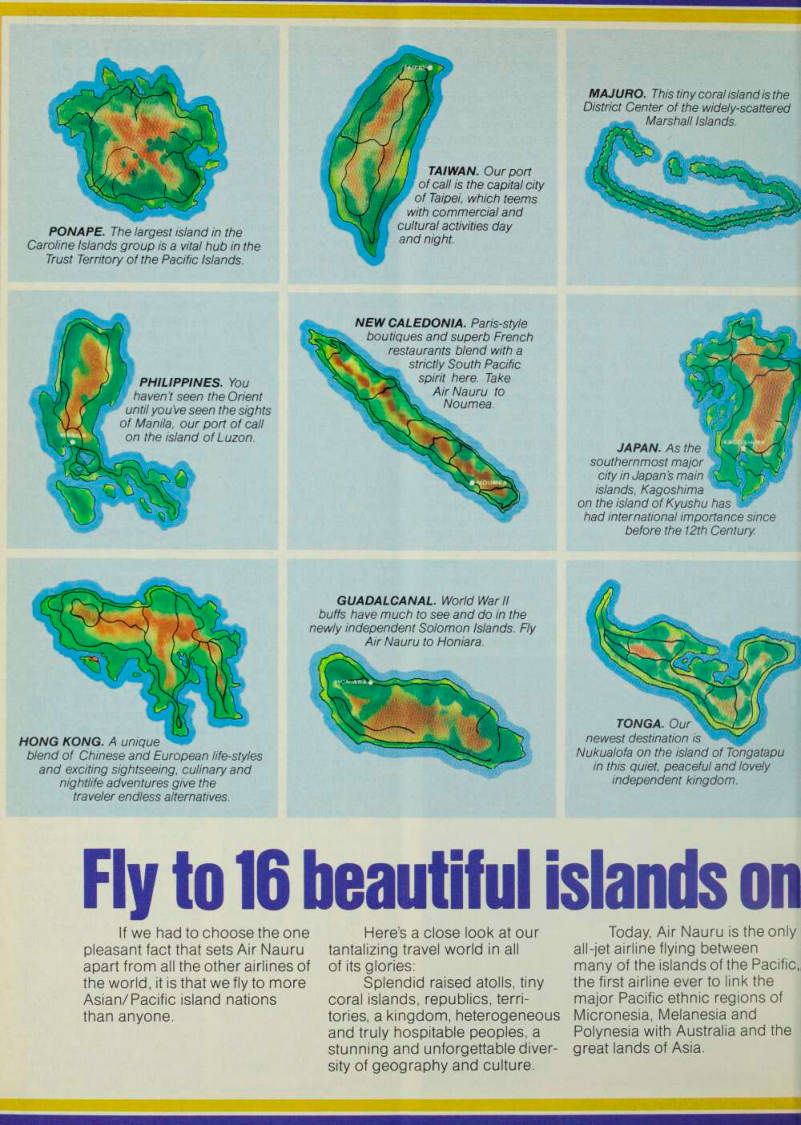
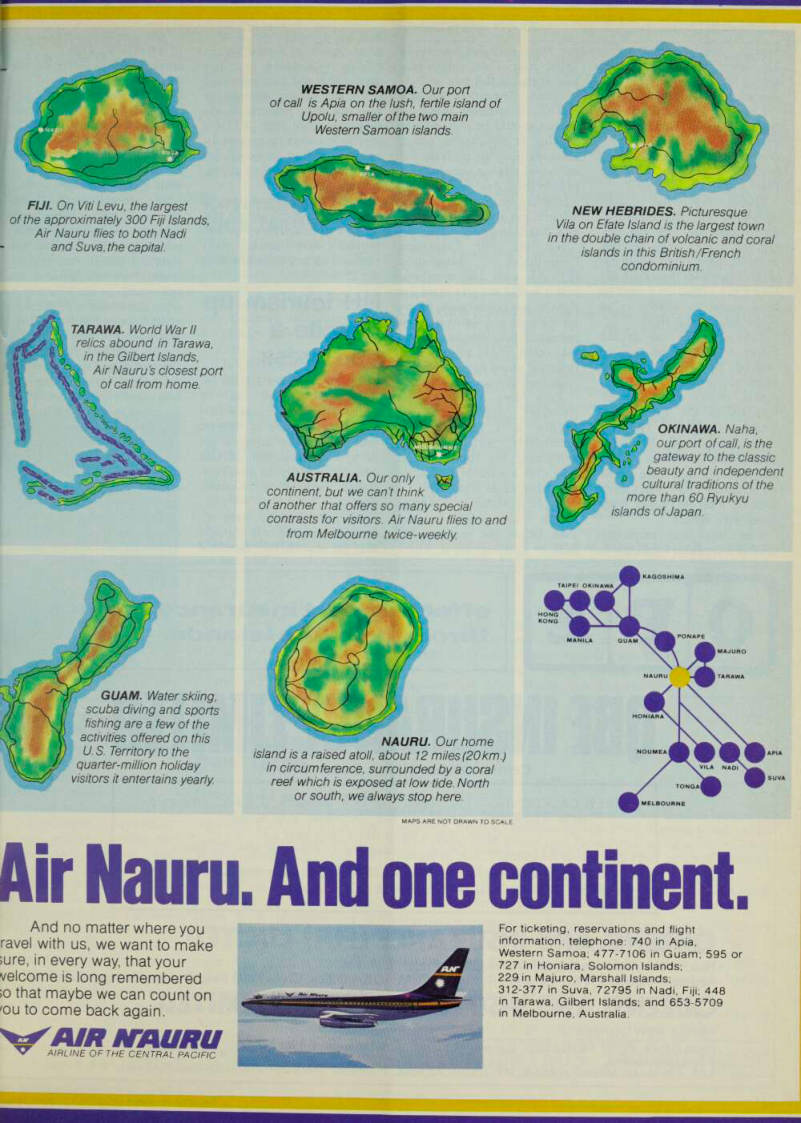

Heads For
‘Apartism’
Inflation and another long bout of industrial trouble look
like flaring in Fiji again, writes
Robert Keith-Reid in Suva.
The pointer to this prospect is the imminent probable col lapse of the Tripartite Forum a ‘parliament’ of most trade
unions, many big employers
and the Fiji Government.
It was set up in 1976 with Prime Minister Ratu Sir Kamisese Mara in the chair, and has been a powerful, con troversial, and questioned in fluence in shaping economic events in Fiji.
Strikes and inflation were rife before the forum’s advent.
Since 1976 inflation has dropped from a high of 14% to just over 6% by the end of last year. The number of strikes dropped from 64 costing more than 77 000 man days in 1977, when the forum really began to make its influence felt, to 30 strikes costing a mere 9500 lost days last year.
Various other factors helped with these improvements, but the forum was possibly the most important. Its biggest suc
cess, although employers and
unions have mixed feelings about the real benefit, were deals under which unions agreed to limit 1977-78 pay claims to a maximum of 10% and 1978-79 claims to 7%. But,
as protesting employers noted,
this meant that the maximum also became the minimum be cause no one wanted to settle for less than they could reason ably ask for.
Working through a sub
committee, the forum quickly became the instrument for fix
ing disputes before they be
came strikes and, when strikes occurred, for ending them with processes that sidestepped pro tracted concilation and arbi
tration procedures.
In many instances it was clear that the influence of Prime Minister Mara decided many questions put to the
forum. And foreign employers,
usually the biggest ones, began
commenting privately that they
did not want to risk incurring
Mara’s wrath by challenging
his views in situations when
they really thought that the
unions deserved a firm ‘no’.
Late last year the forum began to falter. Dissension in employers’ circles began to in crease. At the same time unions began to buck at the idea of a third pay restraint deal.
Since the pay limit ‘guideline’ was fixed on the in flation rate, and this was fall ing, the unions could see that 1979-80 curbs could mean far smaller pay rises than the hefty hike Fiji’s urban area workers have learnt to expect as an automatic annual right.
February was the crunch month, when a forum meeting chaired by Prime Minister Mara at his official Suva resi dence ended in deadlock.
Officials of the Fiji Trades Union Congress (FTUC), representing about 30 unions and 35,000 workers, walked out, warning that there would be no debate on 1979 pay limits until at least two other ques tions were settled.
One was that employers should accept that workers who
got trips overseas for trade union courses should under take them on full pay' and al lowances. The other was the FTUC’s contention that em ployers should be barred from
arriving at negotiating tables
accompanied by professional
industrial relations consultants to help them deal with unions.
According to the FTUC, con sultants put union negotiators at a disadvantage.
But the Fiji Employers
Consultative Association (FECA), with 130 members, said it would not give in on the right to use consultants. Many bosses were not well versed in industrial relations and found that often highly trained pro fessional union negotiators ran
rings around them, itexplained.
Ratu Mara adjourned the frustrated forum meeting angrily, it is reported, and
indefinitely, with the only
agreement for future action being for a seminar to discuss tripartism’s role after 1979.
By early March it looked as if the forum might founder even before the seminar was held as a liferaft for it. There
were reports of a rebellion in FECA, with some members saying that the executive had not been strong enough in resisting union pressure. It was suggested that the FTUC’s motive in objecting to consult ants was to find an excuse for avoiding the renewal of pay re straints.
With no restraint on pay to bolster the gasping private sec tor of Fiji business, some em
ployers were saying, why
bother with any form of forum at all?
NH tourism up
despite a
bad press
The New Hebrides Tourist In formation Bureau, in its January newsletter, says 1978 is expected to prove its ‘biggest year so far’ even though it got off to a bad start with adverse editorial articles in the Aus tralian and New Zealand press.
Accurate statistics were not available but it was thought that air arrivals had exceeded
27 000. The number of visiting cruise vessels had steadily in-, creased.
During the year the Depart ment of Trade, Industry and Tourism produced a report on tourism in Santo in the north ern islands which, said the TIB newsletter, ‘was received ... with mixed feelings’.
The British and French diplomatic offices came in for a serve for badly informing intending visitors to the New Hebrides about visa require ments. ‘We saw quite a few ugly scenes at the Vila airport when these visitors . .. were lit
erally deported as not having a
visa,’ said the TIB.
The TIB also lashed local businessmen for activities
prejudicial to winning the
hearts and minds of visitors. An exchange rate of FNH7O to the Australian dollar was a ‘rip off, said the newsletter, when the recommended rate of exchange was FNHBO to the dollar. And, ‘to charge the equivalent of $A 1.20 for a beer, sometimes warm, or a lemon ade, is not going to endear us to our Aussie or Kiwi clients’.
Pacific airlines
.get together
The Association of South Pa cific Airlines, formed under the [auspices of the South Pacific Bureau for Economic Co operation in Suva in March is ■to hold its inaugural meeting ion May 30-31.
The March meeting was attended by 16 executives from [l2 regional carriers Air Melanesiae. Air Nauru. Air ■New Zealand, Air Niugini, Air Pacific. Cook Islands Airways, Fiji Air, Polynesian Airlines, Quantas, Solair, Talair and UTA French Airlines.
Terry Betham. general man ager of Polynesian Airlines was elected chairman pro tern with Bart Philemon, assistant to the general manager of Air Niugini, as vice-chairman, and
'larend Menon of Air Pacific ecretary-treasurer.
Permanent officers will be ilected this month.
Formed with the object of bstering ‘closer co-operation imongst...airlines serving the louth Pacific Region’, full nembership is available to ‘all irlines having their head •ffice in the South Pacific’. (As isual, ‘South Pacific’ includes juam, the Northern Marianas nd the Trust Territories’ but ot the Australian mainland).
It was decided in March that irlines with headquarters out ide the region which play a art in transport within the re ion would be eligible for lembership at the invitation f the association.
If the past is anything to go on, the association’s future will not be one of sweetness and light. But airline executives re gard it as a major step in the direction of regional co
operation and a strengthening
of the region’s voice against the heftier forces in international air travel.
November for
Club Med N C
Club Mediterranee plans to open the doors on its New Caledonian operation on November 2 after a 5A2.9 million modification of the for mer Chateau Royal hotel in Noumea’s Anse Vata resort suburb.
Club Med managing direc tor, John Youngman, talking of
all-inclusive 8-day/7-night
holidays at around $450, claimed Club Med would ‘match or beat’ Australia’s major Barrier Reef resorts and. ‘taking meals into account, we’re far less expensive than a comparable holiday at one of the major Fijian resorts’. Other Club Med plans for New Caledonia include a resort on the He des Pins with a concen tration on marine and water sport activities.
The old Chateau Royal de spite its modern elegance was badly in need of an injection of life right up to the time its doors closed on February 16.
Its re-opening at Club Med New Caledonia in November will be watched with interest.
Polynesian seek
new fares
Polynesian Airlines and Air New Zealand have filed appli cations for new fares between
Apia and Auckland. Proposals
include a December-January Apia-Auckland-Apia fare of SWS27O for a maximum of 30
days.
In the opposite direction there is a proposal for a SNZ3OS fare from September 1 to November 15 with a mini mum of six days and maximum of 30 days travel.
No changes are proposed in
the regular 30-day excursion
Apia-Auckland fare of SWS3SB but an 8% increase to SNZ43O is proposed for the
Auckland-Apia run.
Polynesian Airlines Terry Betham ... interim chairman
Advertisements & other items, pp. 75-80 (3 items)
Tradewinds
75
‘ACIFIC ISLANDS MONTHLY - MAY, 1979
Fly to 16 beautiful islands on
» PON APE. The largest island in the Caroline Islands group is a vital hub in the Trust Territory of the Pacific Islands.
TAIWAN. Our port of call is the capital city of Taipei, which teems with commercial and cultural activities day and night.
MAJURO. This tiny coral island is the District Center of the widely-scattered Marshall Islands.
PHILIPPINES. You
haven’t seen the Orient until you've seen the sights of Manila, our port of call on the island of Luzon.
NEW CALEDONIA. Paris-style boutiques and superb French restaurants blend with a „ strictly South Pacific spirit here. Take Air Nauru to Noumea.
JAPAN. As the southernmost major city in Japan s main islands, Kagoshima on the island of Kyushu has had international importance since before the 12th Century.
HONG KONG. A unique blend of Chinese and European life-styles and exciting sightseeing, culinary and nightlife adventures give the traveler endless alternatives.
GUADALCANAL. World War II
buffs have much to see and do in the newly independent Solomon Islands. Fly Air Nauru to Honiara.
E
TONGA. Our
newest destination is Nukualofa on the island of Tongatapu in this quiet, peaceful and lovely independent kingdom.
Fly to 16 beautiful islands on
If we had to choose the one pleasant fact that sets Air Nauru apart from all the other airlines of the world, it is that we fly to more Asian/Pacific island nations than anyone.
Here’s a close look at our tantalizing travel world in all of its glories:
Splendid raised atolls, tiny
coral islands, republics, terri-
tories, a kingdom, heterogeneous
and truly hospitable peoples, a
stunning and unforgettable diver-
sity of geography and culture.
Today, Air Nauru is the only
all-jet airline flying between
many of the islands of the Pacific,, the first airline ever to link the major Pacific ethnic regions of Micronesia, Melanesia and Polynesia with Australia and the great lands of Asia.
FIJI. On Viti Levu, the largest of the approximately 300 Fiji Islands, Air Nauru flies to both Nadi and Suva, the capital.
WESTERN SAMOA. Our port of call is Apia on the lush, fertile island of Upolu, smaller of the two main Western Samoan islands.
NEW HEBRIDES. Picturesque Vila on Efate Island is the largest town in the double chain of volcanic and coral islands in this British /French condominium.
TARAWA. World War II relics abound in Tarawa, in the Gilbert Islands, Air Nauru's closest port of call from home.
GUAM. Water skiing, scuba diving and sports fishing are a few of the activities offered on this U. S. Territory to the quarter-million holiday visitors it entertains yearly. : •s+» AUSTRALIA. Our only continent, but we can’t think of another that offers so many special contrasts for visitors. Air Nauru flies to and from Melbourne twice-weekly.
NAURU. Our home island is a raised atoll, about 12 miles(2okm.) in circumference, surrounded by a coral reef which is exposed at low tide. North or south, we always stop here.
OKINAWA. Naha,
our port of call, is the gateway to the classic beauty and independent * cultural traditions of the more than 60 Ryukyu islands of Japan.
KAGOSHIMA
PONAPE
MANILA GUAM
HONIARA
VILA NADI
f TONGA
MELBOURNE
MAPS ARE NOT DRAWN TO SCALE
Air Nauru. And one continent.
And no matter where you ravel with us, we want to make ;ure, in every way, that your
velcome is long remembered
;o that maybe we can count on 'ou to come back again.
mum
V AIRLINE OF THE CENTRAL PACIFIC
For ticketing, reservations and flight information, telephone: 740 in Apia.
Western Samoa; 477-7106 in Guam; 595 or 727 in Honiara, Solomon Islands; 229 in Majuro, Marshall Islands; 312-377 in Suva, 72795 in Nadi, Fiji; 448 in Tarawa, Gilbert Islands; and 653-5709 in Melbourne, Australia.
offers expert insurance service
throughout the Islands.
QBE INSURANCE LIMITED
Central Office: 82 Pitt Street, Sydney.
NEW CALEDONIA T.A. Hagen, Ste. W.A. Johnston, S.A.R.L. - Noumea.
NEW HEBRIDES - Manager: G.F. Donnelly, Vila; Santo Santc: Burns Phi Ip (New Hebrides) Ltd.
TAHITI - Arthur Chung: Immeuble 8.1., Front de Mer, Papeete.
NIUE, NORFOLK ISLAND, SAMOA, TONGA and other South Sea Islands - Burns Phi/p (South Sea) Company L td.
QUEENSLAND INSURANCE (FIJI) LIMITED
Head Office, 34 Usher St., SUVA. General Manager: L.G. Liddell. A.A.1.1.
Assistant Managers: Vijay Lai and J.T. Laidlaw. LAUTOKA Office, Burns Philp Bldg. District Manager: J. Dalton.
QUEENSLAND INSURANCE (P.N.C.) LIMITED
PAPUA NEW GUINEA -
Head Office, PORT MORESBY. General Manager; J.M. Dawe. Assistant Manager; R.V. Maskell.
District Managers at; LAE; I.R. Martin. MOUNT HAGEN: D.F, Carroll. ARAWA: J. Longbut. MADANG; R.W.V. Ceilings. RABAUL W.F. Tinker.
QBE
.TRADEWINDS INTELLIGENCE.
POLYNESIAN Airlines and UTA have been discussing the possibility of a weekly air service from Apia to Wallis Island. The plan is for Polynesia’s Thursday service to Nadi to stop at Wallis with UTA chartering part of the aircraft to carry passengers from Wallis to Nadi.
ONOTOA in the southern Gilbert Islands is now on Air Tungaru’s network as a result of the opening of Bebeku airstrip on the strip on the island.
POLYNESIAN Airlines and Japan Airlines have signed a reciprocal general sales agency agreement. Apia-based Polynesian Airlines is also general sales agent in Western Samoa for CP Air.
Air India and Qantas.
HAWAIIAN Airlines, recording a net loss of nearly SUS7OO 000 last year, anticipates a profit of around $3OO 000 this year. Start-up costs last year for Hawaiian’s Mainland Air Cargo Divison, including the purchase of eight Lockheed Electras, bit deep into revenue.
A RECORD 145 000 tonnes of copra was produced in Papua New Guinea in 1978, a year in which prices for copra and coconut oil were the highest since 1974.
THE FIRST roll-on roll-off freight service involving road and ferry transport of cargo between Suva, Fiji’s capital and Vanau Levu was scheduled to go into operation at the end of April.
HUGH Thomson Rogers has been appointed commissioner of the Australian Shipping Commission for five years.
HENRY' Bryce is heading up the Pacific Forum Line’s own agency in Apia, Western Samoa. Previously the Union Steamship Company was the PFL’s agent.
STARKIST, an American canning company with operations in Pago Pago, has asked for permission for five purse seiner vessels to have access to the New Caledonian 200-mile economic zone.
SOUTH Pacific Island Airways of Pago Pago has withdrawn its application to fly to Honolulu because it feels Contintental Airlines will fill the gap with the service it plans to introduce this month.
FIRST opticians ever established in the New Hebrides are Messrs J. P. Rivier and V. Rosselot who are offering a full range of optical services from premises in Vila’s Vate complex.
TALAIR has based its new 18-seat Twin Otter at Rabaul, East New Britain Province, PNG, to service Namatanai, Open Bay, Jacquinot Bay, Uvol, Bialia, Sule and Hoskins.
W. R. CARPENTER Holdings, South Pacific traders, reported a $A5.08 million net profit in the half year to December 31, a 76% lift on the previous half-year’s profit.
BOUGAINVILLE Air Services is awaiting delivery of a fifth aircraft, a Twin Otter.
PAPUA New Guinea’s public servants received a 3% salary increase on March 1.
KOITAKI, an Australian-owned Papua New Guinea commodities group, has been negotiating with PNG interests to sell its two coffee plantations, Kimel and Tremearne, which total 263 ha of productive land. The move is in-line with PNG policy of assuming local control of the country’s resources.
AIR TUNGARU, the Gilbert Islands’ national airline, has taken delivery of a Britten Norman Islander, its second aircraft.
MERIDIAN Shipping and Transport Agencies of Sydney have been appointed agents for the Daiwa Navigation Company.
VAILIMA beer, Western Samoa’s own brew, is now available in American Samoa. Meanwhile, in Apia, it is reported that Vailima sales now exceed half the national intake.
WESTERN Samoa is looking to Australia for aid to carry out a feasibility study on the upgrading of Faleolo Airport.
. . .TRADEWINDS INTELLIGENCE
-h-E-LLX—
HEAT
SMMIi.
SHRINK
hick aging.
CONTACT A USTRA LIA'S
FOREMOST MANUFACTURERS
OF HEAT SEALING EQUIPMENT
SERVING INDUSTRY
IN AUSTRALIA & THE PACIFIC ISLANDS
FOR OVER 25 YEARS.
HELIX ELECTRICAL PRODUCTS PTY. LTD.
27 Rosebery Avenue, Rosebery, NSW 2018, Australia. 663 0487.
..TRADEWINDS INTELLIGENCE
POLYNESIAN Airlines had an operating loss of SWS34B 909 and a net loss of $169 531 in the year ended March 31. 1978.
MANAGEMENT of the day-to-day operations of the Namosi porphyry copper prospect in Fiji has passed from RST (Fiji), a wholly owned subsidiary of Amax. to Copper Resources (Fiji), a wholly owned subsidiary of Conzinc Riotinto of Australia.
THE BANK of New South Wales (PNG) showed a profit of K 956 000 in 1977-78, down from K 1.31 million the previous year.
Operating 31 branches and agencies, the Bank of NSW. in its report, said it undertook 22% of the nation’s banking business.
A 36-PASSENGER glass-bottomed vessel, the Reef Explorer, owned by the PNG Travel Service. Port Moresby, went into service in February.
MOBIL Oil New Guinea has appointed Colin Newham (below left) formerly manager in Tasmania for Mobil, general manager of its PNG and Solomon Islands activities. He succeeds Leo Bowman who has returned to Australia after nearly 30 years with Mobil at Lae. x DAVID Jury (above right) has been appointed deputy general manager of Union Steam Ship Company. Mr Jury, who joined the company in 1942, served in New Plymouth, Auckland and Suva before moving to the company’s head office in Wellington.
POLYNESIAN Airlines has decided to delay ordering a Boeing 737 for service between Western Samoa and New Zealand pending the outcome of an application by Continental Airlines for a $5l one-way service between Pago Pago and NZ.
IMPORT restrictions left in force too long have meant that potatoes have been a luxury in Santo, New Hebrides, over the past eight months. While bureaucrats try to sort the matter out, Aii Melanesiae is offering attractive rates to fly potatoes into Santo from Tanna.
THE PAPUA New Guinea Government has decided to accelerate its acquisition of expatriate-owned plantations, by compulsion where considered necessary. The decision follows a court ruling upholding the government’s right to acquire the expatriate-owned
Upego plantation in the Eastern Highlands.
NEW HEBRIDES tourism will be promoted at two seminars in Japan in May, and functions in Melbourne, Hobart, Adelaide and Perth in July. Co-operating with the New Hebrides tourist authority for the Japanese seminars will be the Tokyo Corporation and the French airline UTA. The Australian affairs will be backed by local chapters of the Pacific Area Travel Association
(PATA).
AN AVERAGE March in Suva, Fiji’s capital, produces 380 mrr (15 in.) of rain, so it was not surprising that government minister: and dignitaries were out in strength at the recent launch there of a new product claimed to increase greatly the rust resistance of sheet steel roofing and walling. The product, Zincalume. i: an alloy of 45% zinc and 55% aluminium, used as a coating: Australian-based manufacturers John Lysaght say a given thick ness of the new product will last twice as long as the old pure
zinc coating.
TtieKINGSTON 580
DISPLACEMENT HULL CRUISER
with built-in diesel power
Would you like to take six people out for a full day's cruising and fishing offshore and inshore for less than $5 of fuel? This fine economical and safe Kingston 580 can give you all that plus a 12 month warranty. • Fibreglass construction for economical maintenance • Does up to 14 knots with ease • Big self-drained cockpit • Choice of 12, 15, 24 or 33 hp diesel engines • Lock up cabin with 2 bunks • Plenty of room 5.80 metres long Available also Kingston Angler. Same hull, open boat version.
Ideal Mackerel boat For brochure and name of your nearest dealer phone or write.
Mntinstnn
•rPI lIQPD QAI pc
CRUISER SALES PTY. LTD.
179 South Creek Road, Dee Why, N.S.W., 2099.
Teleohone: 981 3508
RADEWINDS INTELLIGENCE...
Tradewinds
79
ACIFIC ISLANDS MONTHLY MAY, 1979
Yachts


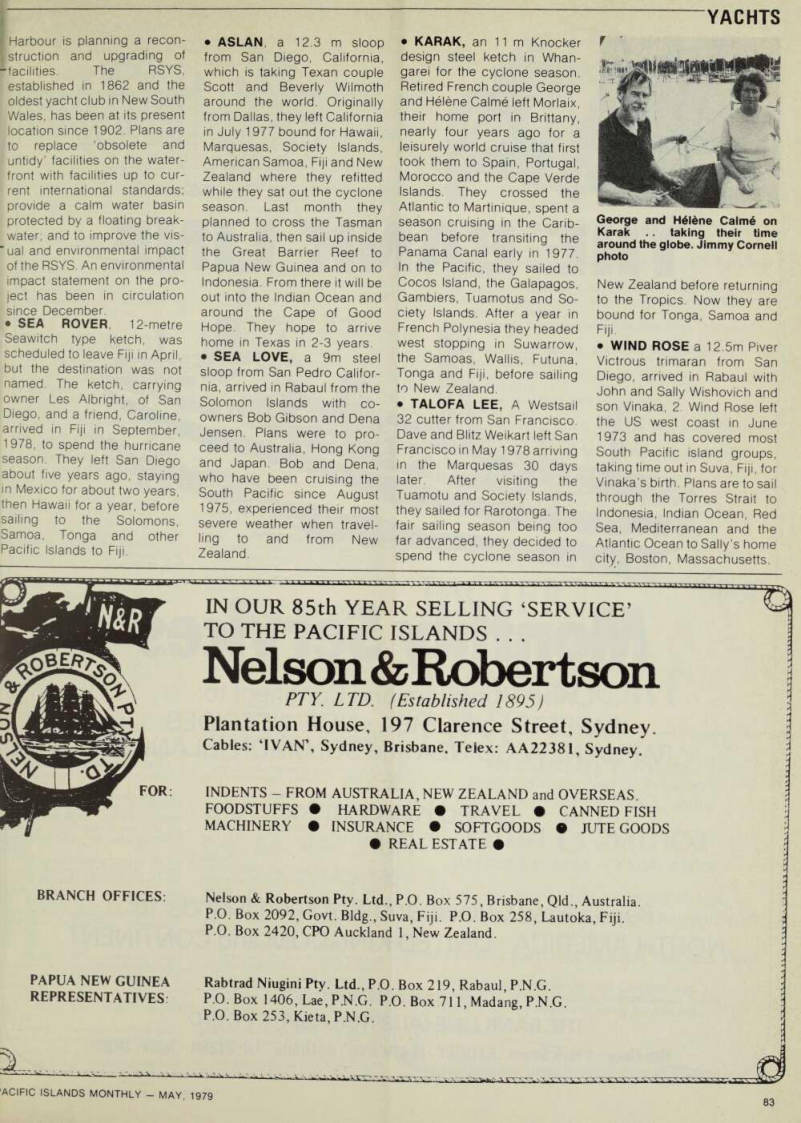
The Slocum Society formed in 1955 to promote, record and support long distance passages in small boats has moved its headquarters from New York to Bellflower in California and Neal T. Walker ■has returned as secretary of the society.
The inspiration for the Slocum Society was Captain Joshua Slocum, the first per son to singlehandedly circum navigate the world. His voyage took from 1895-98.
Founder of the society was Richard G. McCloskey who also published the journal The Spray, named after Slocum’s vessel.
The new Slocum Society contact address is; PO Box 1164, Bellflower, Calif 90706.
• Korong 11, A 13 M
fibreglass ketch from Brisbane which is taking the Holmes
family on a two year cruise around the Pacific. John and Vicky are accompanied by young daughters Kirsty and Denby. Next port of call: Tahiti. • KAWANEE an American yacht, in February paid a brief call at Tubuai in the Austral Islands on its way to Raro tonga, to drop off a passenger from Raivavae. Don Travers reports that another February visitor to Tubuai was a West German yacht, the MORITZ B with Harald and Hedvig Voss aboard. They brought two people from Raivavae who were immediately flown to Papeete for medical treat ment. Moritz B left within a day-and-a-half for Papeete.
• Three-and-a-half years after sailing from Cammeray out of Sydney Harbour on their honeymoon, Adrian and Anne Hickey were back at Cam meray, with Father George Kester of Cook Islands yacht watching fame, for the baptism of their son Alistair James Bede. The ceremony took place aboard the Hickeys’ 15-metre ferro-cement yacht ARWEN. Father Kester, who has played host to thousands of yachties over the past 15 years at Avarua on Rarotonga, was in Sydney for talks with PlM’s publisher, Pacific Publi cations, about his planned book, Father George's Book of Yachts. The Hickeys were at Avarua some years ago and,
like others who dropped anchor there, they recorded their visit and impressions in Father George’s guest book.
Material for the book will come from his collection of guest books which contain the sig natures, poems, comments and graffiti of hundreds of callers to Avarua. Anne and Adrian have ‘swallowed’ the anchor for the moment and are living in Sydney. • The Royal Sydney Yacht Squadron at Kirribilli in Sydney
Adrian, Anne and Alistair Hickey and Father George Kester ... baptism afloat
I Harbour is planning a recon- Istruction and upgrading of
The Rsys,
established in 1862 and the oldest yacht club in New South Wales, has been at its present location since 1902. Plans are to replace ‘obsolete and untidy’ facilities on the water front with facilities up to cur rent international standards: provide a calm water basin protected by a floating break water; and to improve the vis “ual and environmental impact of the RSYS. An environmental impact statement on the pro ject has been in circulation since December. • SEA ROVER 12-metre Seawitch type ketch, was scheduled to leave Fiji in April, but the destination was not named. The ketch, carrying owner Les Albright, of San Diego, and a friend, Caroline, arrived in Fiji in September, 1978, to spend the hurricane season. They left San Diego about five years ago, staying in Mexico for about two years, then Hawaii for a year, before sailing to the Solomons, Samoa, Tonga and other Pacific Islands to Fiji.
• ASLAN, a 12.3 m sloop from San Diego, California, which is taking Texan couple Scott and Beverly Wilmoth around the world. Originally from Dallas, they left California in July 1977 bound for Hawaii, Marquesas, Society Islands, American Samoa, Fiji and New Zealand where they refitted while they sat out the cyclone season. Last month they planned to cross the Tasman to Australia, then sail up inside the Great Barrier Reef to Papua New Guinea and on to Indonesia. From there it will be out into the Indian Ocean and around the Cape of Good Hope. They hope to arrive home in Texas in 2-3 years. • SEA LOVE, a 9m steel sloop from San Pedro Califor nia, arrived in Rabaul from the Solomon Islands with co owners Bob Gibson and Dena Jensen. Plans were to pro ceed to Australia, Hong Kong and Japan. Bob and Dena, who have been cruising the South Pacific since August 1975, experienced their most severe weather when travel ling to and from New Zealand.
• KARAK, an 11 m Knocker design steel ketch in Whan garei for the cyclone season.
Retired French couple George and Helene Calme left Morlaix, their home port in Brittany, nearly four years ago for a leisurely world cruise that first took them to Spain, Portugal, Morocco and the Cape Verde Islands. They crossed the Atlantic to Martinique, spent a season cruising in the Carib bean before transiting the Panama Canal early in 1977.
In the Pacific, they sailed to Cocos Island, the Galapagos, Gamblers, Tuamotus and So ciety Islands. After a year in French Polynesia they headed west stopping in Suwarrow, the Samoas, Wallis, Futuna, Tonga and Fiji, before sailing to New Zealand. • TALOFA LEE, A Westsail 32 cutter from San Francisco.
Dave and Blitz Weikart left San Francisco in May 1978 arriving in the Marquesas 30 days later. After visiting the Tuamotu and Society Islands, they sailed for Rarotonga. The fair sailing season being too far advanced, they decided to spend the cyclone season in
New Zealand before returning to the Tropics. Now they are bound for Tonga, Samoa and Fiji. • WIND ROSE a 12.5 m River Victrous trimaran from San Diego, arrived in Rabaul with John and Sally Wishovich and son Vinaka, 2. Wind Rose left the US west coast in June 1973 and has covered most South Pacific island groups, taking time out in Suva, Fiji, for Vinaka's birth. Plans are to sail through the Torres Strait to Indonesia, Indian Ocean, Red Sea, Mediterranean and the Atlantic Ocean to Sally’s home city, Boston, Massachusetts.
George and Helene Calme on Karak .. taking their lime around the globe. Jimmy Cornell photo
Advertisements & other items, pp. 81-84 (3 items)
81
ACIFIC ISLANDS MONTHLY MAY, 1979
INTRODUCING FRIGID’S New Range of Assemble-Yourself
Where are you
PIM is broadening its coverage of yachting movements in the Pacific and, as well as having correspondents in the Islands, is appointing correspondents at yachting destinations down the Australian east coast. If you
yachtie?
don’t happen to run into one of our writers, please don’t hesitate to drop us a line if you would like your friends to know where you have been, where you are going and what you have been doing. Write to PIM, GPO Box 3408, Sydney.
INTRODUCING FRIGID’S New Range of Assemble-Yourself
Walk-In Aluminium Freezer & Cooler Storage Rooms Hundreds already installed. Now with attractive timber grain aluminium exterior finish, (rust-proof) with white vinyl interior finish.
Frigid Foam Polyurethane insulation. 2" in cooler storage rooms is equal to 5” polystyrene foam. 3" in freezer storage rooms is equal to 8” polystyrene foam. Lower running costs. Best insulation available. Thin wall construction. Save in freight costs. Room sizes from 90 cubic feet (2’/2 m 3) to 930 cubic feet (25y 2 m 3 ).
Supplied in easy-to-erect, do-it-yourself form Assemble, plug it in, and have it in operation in under eight hours!
T 1 Manufactured by:
FRIGID CABINETS PTY. LTD.
14a Duffy Ave., Thornleigh, N.S.W. Aust. 2120. Ph. 848 8292.
AVAILABLE FROM;
AUSTRALIA NEW CALEDONIA EXPORTS, 363 George St., Sydney 2000. BRECKWOLDT & CO. G.P.O. Box 5027, Sydney 2001. HAGEMEVER (A'ASIA), 59 Anzac Pde., Kensington 2033. GEOFFREY HUGHES & CO. 167 Macquarie St., Sydney 2000, NE LSON & ROBERTSON PTY. LTD. 197 Clarence St. Sydney 2000 E RABOT (EXPORTS) PTY. LTD., 67 Castlereagh St., Sydney 2000, RABTRAD NIUGINI PTY. LTD., P.O. Box 1406 Lae, A. RIETTE (PACIFIC) PTY. LTD., 20 Loftus St , Sydney 2000. C. SULLIVAN (EXPORT) PTY LTD GP O Box 3373, Sydney 2001. W.S, TA IT & CO. PTY. LTD., 31 Macquarie Place Sydney 2000
We’ve made the
world of difference
to Tonga’s communications.
With the opening of the Cable & Wireless earth station, the people ofTonga can enjoy the benefits of the fastest, most efficient and reliable telephone, telex and telegraph links to the rest of the world. Via satellite.
At Cable & Wireless we have over a century of experience in the design, installation and maintenance of communications systems throughout the world. To date we have been involved with over 30 earth stations, each designed to meet their individual climatic and geographic conditions.
So, for more information, do a little communicating yourself. Contact us. j— " ' \
& Wireless
:ad communications. >mer of Queen Tonga. - HouseJHSeojbsalds Road, London WCm BRX. Tel: 01-242 4433 Telex 23181
oSEf?;'
O -t) H iP & >v
FOR
BRANCH OFFICES:
PAPUA NEW GUINEA
REPRESENTATIVES:
1, 1 L-J-IW 1 Hl-ll \ .V ■ \ V-1 1 i :■ WA.' 1 1 t. -^T-n-nTTTT
IN OUR 85th YEAR SELLING ‘SERVICE’
TO THE PACIFIC ISLANDS . . .
Nelson&Robertson
PTY. LTD. (Established 1895)
Plantation House, 197 Clarence Street, Sydney.
Cables: ‘IVAN% Sydney, Brisbane. Telex: AA22381, Sydney.
INDENTS - FROM AUSTRALIA, NEW ZEALAND and OVERSEAS.
FOODSTUFFS • HARDWARE • TRAVEL • CANNED FISH MACHINERY • INSURANCE • SOFTGOODS © JUTE GOODS
• REAL ESTATE •
Nelson & Robertson Pty. Ltd., P.O. Box 575, Brisbane, Qld., Australia.
P.O. Box 2092, Govt. Bldg., Suva, Fiji. P.O. Box 258, Lautoka, Fiji.
P.O. Box 2420, CPO Auckland 1, New Zealand.
Rabtrad Niugini Pty. Ltd., P.O. Box 219, Rabaul, P.N.G.
P.O. Box 1406, Lae, P.N.G. P.O. Box 711, Madang, P.N.G.
P.0.80x 253, Kieta, P.N.G. .u.,,:. l.
i a
GLOBAL SERVICE FOR SHIPPERS
V
THE
LINE
Monthly Services «
United Kingdom and Continent to:
PAPEETE • NOUMEA • NEW HEBRIDES
PAPUA NEW GUINEA and SOLOMON ISLANDS
United Kingdom to:
FIJI
■& Papua New Guinea and Solomon Islands to: NORTH AMERICA • UNITED KINGDOM and CONTINENT For particulars apply:
THE BANK LINE (AUSTRALASIA) PTY. LTD.
18th Floor 1 York Street SYDNEY N.S.W 2000 Australia Tel: 272041 Telex; 24063
Yachts
83
ACIFIC ISLANDS MONTHLY - MAY, 1979
Shipping
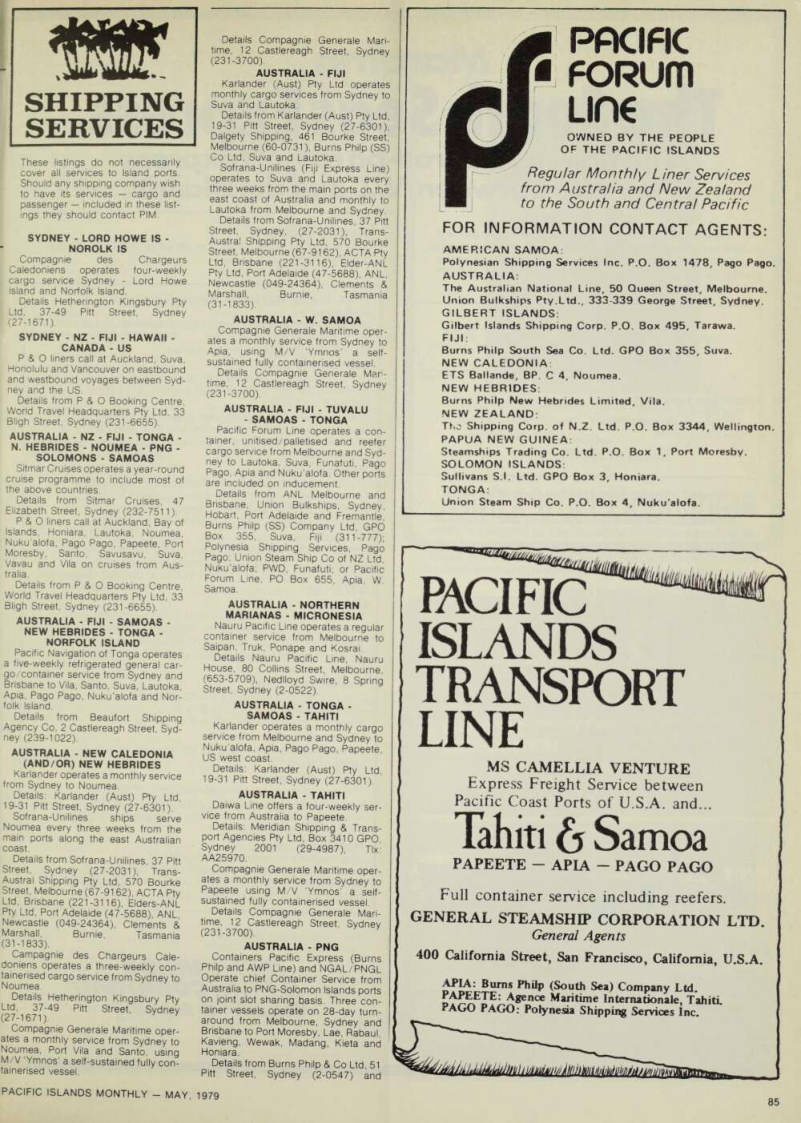
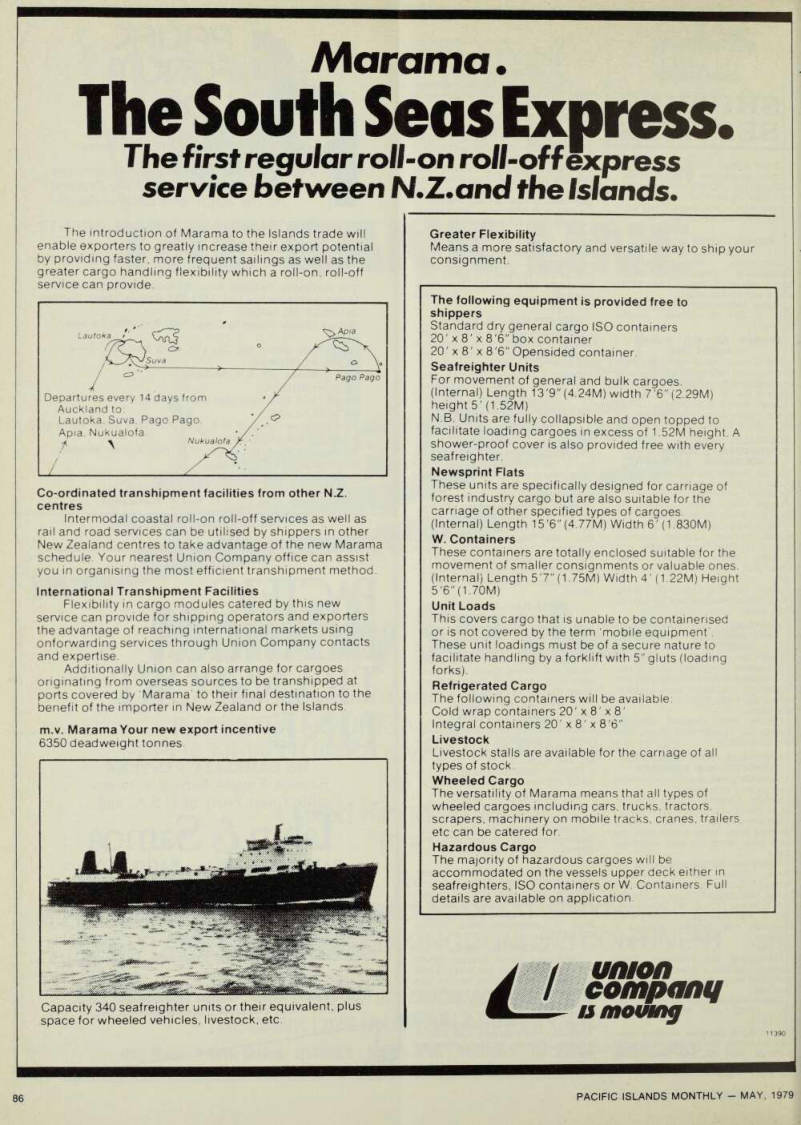
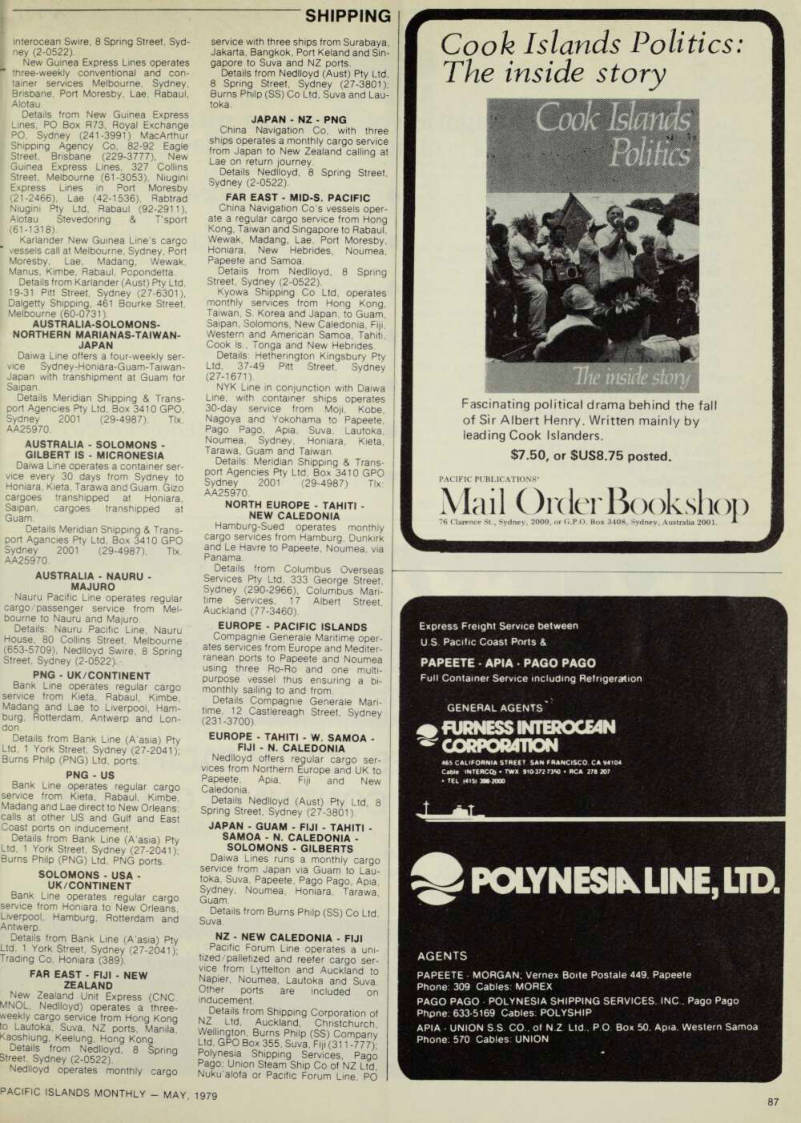
Services
These listings do not necessarily cover all services to Island ports.
Should any shipping company wish to have its services cargo and passenger included in these list ings they should contact PIM.
Sydney - Lord Howe Is -
Norolk Is
Compagnie des Chargeurs Caledoniens operates four-weekly cargo service Sydney - Lord Howe Island and Norfolk Island.
Details Hetherington Kingsbury Pty Ltd, 37-49 Pitt Street, Sydney ( (27-1671).
SYDNEY - NZ - FIJI - HAWAII -
Canada - Us
P & O liners call at Auckland, Suva, Honolulu and Vancouver on eastbound and westbound voyages between Syd ney and the US.
Details from P & O Booking Centre, World Travel Headquarters Pty Ltd, 33 Bligh Street, Sydney (231-6655).
AUSTRALIA - NZ - FIJI - TONGA - N. HEBRIDES - NOUMEA - PNG -
Solomons - Samoas
Sitmar Cruises operates a year-round cruise programme to include most of the above countries.
Details from Sitmar Cruises, 47 Elizabeth Street, Sydney (232-7511).
P & O liners call at Auckland, Bay of Islands, Honiara, Lautoka, Noumea, Nukualofa, Pago Pago, Papeete. Port Moresby, Santo, Savusavu, Suva.
Vavau and Vila on cruises from Aus tralia.
Details from P & O Booking Centre, World Travel Headquarters Pty Ltd, 33 Bligh Street, Sydney (231-6655).
Australia - Fiji - Samoas -
New Hebrides - Tonga -
Norfolk Island
Pacific Navigation of Tonga operates a five-weekly refrigerated general car go /container service from Sydney and Brisbane to Vila, Santo, Suva, Lautoka, Apia, Pago Pago, Nukualofa and Nor folk Island.
Details from Beaufort Shipping Agency Co, 2 Castlereagh Street, Syd ney (239-1022).
Australia - New Caledonia
(And/Or) New Hebrides
Karlander operates a monthly service from Sydney to Noumea.
Details: Karlander (Aust) Pty Ltd 19-31 Pitt Street, Sydney (27-6301).
Sofrana-Unilines ships serve Noumea every three weeks from the main ports along the east Australian coast.
Details from Sofrana-Unilines, 37 Pitt Street, Sydney (27-2031), Trans- Austral Shipping Pty Ltd, 570 Bourke Street, Melbourne (67-9162), ACTA Pty Ltd, Brisbane (221-3116), Elders-ANL Pty Ltd, Port Adelaide (47-5688), ANL Newcastle (049-24364), Clements & Marshall, Burnie, Tasmania (31-1833).
Campagnie des Chargeurs Cale doniens operates a three-weekly con tainerised cargo service from Sydney to Noumea.
Details Hetherington Kingsbury Pty Ltd, 37-49 Pitt Street, Sydney (27-1671). 1 Compagnie Generate Maritime oper ates a monthly service from Sydney to Noumea, Port Vila and Santo, using M/V ‘Ymnos’ a self-sustained fully con tainerised vessel.
Details Compagnie Generate Mari time, 12 Castlereagh Street, Sydney (231-3700).
Australia - Fiji
Karlander (Aust) Pty Ltd operates monthly cargo services from Sydney to Suva and Lautoka.
Details from Karlander (Aust) Pty Ltd, 19-31 Pitt Street, Sydney (27-6301), Dalgety Shipping, 461 Bourke Street, Melbourne (60-0731), Burns Philp (SS) Co Ltd. Suva and Lautoka.
Sofrana-Unilines (Fiji Express Line) operates to Suva and Lautoka every three weeks from the main ports on the east coast of Australia and monthly to Lautoka from Melbourne and Sydney.
Details from Sofrana-Unilines, 37 Pitt Street, Sydney, (27-2031). Trans- Austral Shipping Pty Ltd, 570 Bourke Street, Melbourne (67-9162), ACTA Pty Ltd, Brisbane (221-3116), Elder-ANL Pty Ltd, Port Adelaide (47-5688), ANL, Newcastle (049-24364), Clements & Marshall, Burnie, Tasmania (31-1833).
Australia - W. Samoa
Compagnie Generate Maritime oper ates a monthly service from Sydney to Apia, using M/V 'Ymnos' a self sustained fully containerised vessel.
Details Compagnie Generate Mari time, 12 Castlereagh Street, Sydney (231-3700).
Australia - Fiji - Tuvalu
- Samoas - Tonga
Pacific Forum Line operates a con tainer, unitised/palletised and reefer cargo service from Melbourne and Syd ney to Lautoka, Suva, Funafuti, Pago Pago, Apia and Nukualofa. Other ports are included on inducement.
Details from ANL Melbourne and Brisbane, Union Bulkships, Sydney, Hobart, Port Adelaide and Fremantle, Burns Philp (SS) Company Ltd, GPO Box 355, Suva, Fiji (311-777); Polynesia Shipping Services, Pago Pago, Union Steam Ship Co of NZ Ltd, Nukualofa; PWD, Funafuti; or Pacific Forum Line. PO Box 655, Apia, W.
Samoa.
Australia - Northern
Marianas - Micronesia
Nauru Pacific Line operates a regular container service from Melbourne to Saipan, Truk, Ponape and Kosrai.
Details Nauru Pacific Line, Nauru House, 80 Collins Street, Melbourne, (653-5709), Nedlloyd Swire, 8 Spring Street, Sydney (2-0522)
Australia - Tonga -
Samoas - Tahiti
Karlander operates a monthly cargo service from Melbourne and Sydney to Nukualofa, Apia, Pago Pago, Papeete, US west coast.
Details: Karlander (Aust) Pty Ltd 19-31 Pitt Street, Sydney (27-6301).
Australia - Tahiti
Daiwa Line offers a four-weekly ser vice from Australia to Papeete.
Details: Meridian Shipping & Trans port Agencies Pty Ltd, Box 3410 GPO Sydney 2001 (29-4987), Tlx AA25970.
Compagnie Generate Maritime oper ates a monthly service from Sydney to Papeete using M/V ‘Ymnos’ a self sustained fully containerised vessel.
Details Compagnie Generate Mari time, 12 Castlereagh Street, Sydney (231-3700).
Australia - Png
Containers Pacific Express (Burns Philp and AWP Line) and NGAL/PNGL Operate chief Container Service from Australia to PNG-Solomon Islands ports on joint slot sharing basis. Three con tainer vessels operate on 28-day turn around from Melbourne, Sydney and Brisbane to Port Moresby, Lae, Rabaul, Kavieng, Wewak, Madang, Kieta and Honiara.
Details from Burns Philp & Co Ltd, 51 Pitt Street, Sydney (2-0547) and
I Interocean Swire, 8 Spring Street, Syd- I ney (2-0522).
New Guinea Express Lines operates " three-weekly conventional and con tainer services Melbourne, Sydney, Brisbane, Port Moresby, Lae, Rabaul, Alotau.
Details from New Guinea Express Lines, PO Box R 73, Royal Exchange PO, Sydney (241-3991) MacArthur Shipping Agency Co, 82-92 Eagle f Street, Brisbane (229-3777), New Guinea Express Lines, 327 Collins Street, Melbourne (61-3053), Niugmi : Express Lines in Port Moresby (21-2466), Lae (42-1536), Rabtrad Niugini Pty Ltd, Rabaul (92-2911), Alotau Stevedoring & T'sport (61-1318).
Karlander New Guinea Line’s cargo vessels call at Melbourne, Sydney, Port Moresby, Lae, Madang, Wewak, Manus, Kimbe, Rabaul, Popondetta.
Details from Karlander (Aust) Pty Ltd, 19-31 Pitt Street, Sydney (27-6301), Dalgetty Shipping, 461 Bourke Street, Melbourne (60-0731).
Austral) A-Solomons
Northern Marianas-Taiwan
Japan
Daiwa Line offers a four-weekly ser vice Sydney-Honiara-Guam-Taiwan- Japan with transhipment at Guam for Saipan.
Details Meridian Shipping & Trans port Agencies Pty Ltd, Box 3410 GPO, Sydney 2001 (29-4987). Tlx.
AA25970.
Australia - Solomons -
Gilbert Is - Micronesia
Daiwa Line operates a container ser vice every 30 days from Sydney to Honiara, Kieta, Tarawa and Guam. Gizo cargoes transhipped at Honiara, Saipan, cargoes transhipped at Guam.
Details Meridian Shipping & Trans port Agancies Pty Ltd, Box 3410 GPO Sydney 2001 (29-4987). Tlx.
AA25970.
Australia - Nauru -
Majuro
Nauru Pacific Line operates regular cargo/passenger service from Mel bourne to Nauru and Majuro.
Details: Nauru Pacific Line, Nauru House, 80 Collins Street, Melbourne (653-5709), Nedlloyd Swire, 8 Spring Street, Sydney (2-0522).
Png - Uk/Continent
Bank Line operates regular cargo service from Kieta, Rabaul, Kimbe, Madang and Lae to Liverpool, Ham burg, Rotterdam, Antwerp and Lon don.
Details from Bank Line (A’asia) Pty Ltd. 1 York Street, Sydney (27-2041); Burns Philp (PNG) Ltd, ports.
Png - Us
Bank Line operates regular cargo service from Kieta, Rabaul. Kimbe, Madang and Lae direct to New Orleans: calls at other US and Gulf and East Coast ports on inducement.
Details from Bank Line (A’asia) Pty Ltd, 1 York Street, Sydney (27-2041)- Burns Philp (PNG) Ltd, PNG ports,
Solomons - Usa -
Uk/Continent
Bank Line operates regular cargo service from Honiara to New Orleans, Liverpool, Hamburg, Rotterdam and Antwerp.
Details from Bank Line (A’asia) Pty Ltd, 1 York Street, Sydney (27-2041)- Trading Co, Honiara (389).
Far East - Fiji - New
Zealand
New Zealand Unit Express (CNC.
MNOL, Nedlloyd) operates a three weekly cargo service from Hong Kong to Lautoka, Suva, NZ ports, Manila, Kaoshiung, Keelung, Hong Kong.
Details from Nedlloyd, 8 Spring Street, Sydney (2-0522).
Nedlloyd operates monthly cargo
service with three ships from Surabaya, Jakarta, Bangkok, Port Keland and Sin gapore to Suva and NZ ports.
Details from Nedlloyd (Aust) Pty Ltd, 8 Spring Street, Sydney (27-3801); Burns Philp (SS) Co Ltd, Suva and Lau toka.
Japan - Nz - Png
China Navigation Co, with three ships operates a monthly cargo service from Japan to New Zealand calling at Lae on return journey.
Details Nedlloyd, 8 Spring Street, Sydney (2-0522).
Far East - Mid-S. Pacific
China Navigation Co's vessels oper ate a regular cargo service from Hong Kong, Taiwan and Singapore to Rabaul, Wewak, Madang, Lae, Port Moresby, Honiara, New Hebrides, Noumea, Papeete and Samoa.
Details from Nedlloyd, 8 Spring Street, Sydney (2-0522).
Kyowa Shipping Co Ltd, operates monthly services from Hong Kong, Taiwan, S. Korea and Japan, to Guam, Saipan, Solomons, New Caledonia, Fiji, Western and American Samoa, Tahiti, Cook Is., Tonga and New Hebrides Details: Hetherington Kingsbury Pty Ltd, 37-49 Pitt Street, Sydney (27-1671).
NYK Line in conjunction with Daiwa Line, with container ships operates 30-day service from Moji, Kobe, Nagoya and Yokohama to Papeete, Pago Pago, Apia. Suva, Lautoka, Noumea, Sydney, Honiara, Kieta, Tarawa, Guam and Taiwan Details: Meridian Shipping & Trans port Agencies Pty Ltd, Box 3410 GPO Sydney 2001 (29-4987) Tlx: AA25970.
North Europe - Tahiti -
New Caledonia
Hamburg-Sued operates monthly cargo services from Hamburg, Dunkirk and Le Havre to Papeete, Noumea, via Panama.
Details from Columbus Overseas Services Pty Ltd, 333 George Street, Sydney (290-2966), Columbus Mari time Services, 17 Albert Street.
Auckland (77-3460).
Europe - Pacific Islands
Compagnie Generate Maritime oper ates services from Europe and Mediter ranean ports to Papeete and Noumea using three Ro-Ro and one multi purpose vessel thus ensuring a bi monthly sailing to and from.
Details Compagnie Generate Mari time, 12 Castlereagh Street, Sydney (231-3700).
EUROPE - TAHITI - W. SAMOA -
Fiji - N. Caledonia
Nedlloyd offers regular cargo ser vices from Northern Europe and UK to Papeete, Apia, Fiji and New Caledonia.
Details Nedlloyd (Aust) Pty Ltd 8 Spring Street, Sydney (27-3801).
JAPAN - GUAM - FIJI - TAHITI -
Samoa - N. Caledonia -
Solomons - Gilberts
Daiwa Lines runs a monthly cargo service from Japan via Guam to Lau toka, Suva, Papeete, Pago Pago, Apia, Sydney, Noumea, Honiara, Tarawa, Guam.
Details from Burns Philp (SS) Co Ltd, Suva.
Nz - New Caledonia - Fiji
Pacific Forum Line operates a uni tized/palletized and reefer cargo ser vice from Lyttelton and Auckland to Napier, Noumea, Lautoka and Suva.
Other ports are included on inducement.
Details from Shipping Corporation of NZ Ltd, Auckland, Christchurch Wellington, Burns Philp (SS) Company Ltd, GPO Box 355, Suva, Fiji (31 1 -777); Polynesia Shipping Services, Pago Pago; Union Steam Ship Co of NZ Ltd, Nukualofa or Pacific Forum Line, PO
Box 655, Apia, W. Samoa.
Nz-N. Caledonia-N. Hebrides
Png-Solo Mon S
Sofrana Unilines with three ships op erates to Vila and Santo, to Honiara and Papua New Guinea and to Noumea.
Details from Sofrana Unilines, 18 Customs Street, Auckland (773-279), fPO Box 3614, Telex NZ2313.
Nz - New Caledonia
- Solomons - Gilberts -
Micronesia
Union Co/Daiwa Line operates a container service from New Zealand i through Sydney to Guam, Details: Union Steam Ship Co of NZ Ltd, PO Box 12, Auckland, or Union Bulkships Pty Ltd 333-339 George .Street, Sydney, (2-0238).
NZ - FIJI - NORTH AMERICA (WC) Blue Star Line Crusader service to West Coast North America, Only direct service to and from New Zealand. Blue Star vessels call at Suva and Honolulu ‘ on NZ-US-West Coast voyages.
Details from Blueport ACT (NZ) Ltd, PO Box 192, Wellington (739-029) Burns Philp (SS) Co Ltd, GPO Box 355,’
Suva, Fiji (311-777).
Nz - Fiji
Reef operates a regular 18-day ser vice from Auckland to Suva and Lau toka.
Details from Reef Shipping Agencies Ltd, PO Box 3382, Auckland, NZ (77-1221-3).
Pacific Line with one ship operates fortnightly roro cargo service New Zealand, Lautoka, Suva.
Details: Sofrana Unilines, 18 Cus toms Street, Auckland (773-279) PO Box 3614, Telex: NZ2313.
Nz - Fiji - Gilberts -
Solomons - Png
Pacific Forum Line operates a con tainer, unitised/palletised and reefer cargo service from Lyttelton and Auckland to Suva, Port Moresby, Lae n 0 !] 1 ?! 3 ' T? 1^ 3 / Madan 9. Lae and ° od Moresby. Other ports are included on J n , ~c ® m ent - . .
Details from Shipping Corporation of NZ Ltd ’ Auckland, Christchurch and Wellington. Burns Philp (SS) Company Ltd, GPO Box 355, Suva, Fiji (311 -777) Sullivans, Honiara; Gilbert Islands Ship ping Corporation, Tarawa; Steamships Trading in Port Moresby, Lae and Madang or Pacific Forum Line, PO Box 655, Apia, W. Samoa.
Union Steam Ship Co of NZ operates a roll-on, roll-of, container/unitised ser vice from Auckland to Lautoka-Suva- Pago Pago-Apia-Nuku-alofa on a 14 Details frorn Union Steam Ship Co of NZ Ltdi P 0 Box 12, Auckland or from Branch offices/agents in Fiji, Tonga and the Samoas.
Hz * Samoa - Tonga
Pacific Navigation of Tonga operates a four-weekly cargo service, Auckland ’ Nukualofa - Pago Pago - Apia - Auckland.
Details from McKay Shipping Ltd, Downtown House, Queen Street, Auckland (33-656) Warner Pacific Line services Onehunga (Auck) - Nuku’alofa/Vavau/ eVery 21 Ltd De,a po ,rom ßox rMa 2so\ Se "; C uc\ll Z d (796-841) Telex NZ21555 U « 5 NZ “ Co^f H| y|‘ N,UE * Shipping Corporation of NZ Ltd oper ates cargo services based on pallets
and similar units from Auckland to Niue, Cook Islands and Tahiti Details from the Shipping Corp of NZ Ltd, PO Box 3420, Auckland (797-210); Waterfront Commission, PO Box 61, Rarotonga, Lighterage and Stevedoring Co, Aitutaki, Niue Govt Offices, Niue Island Compagnie Mari time Polynesienne, B’P’ 368, Papeete, Tahiti,
Uk - Fiji
The Bank Line operates a direct, fast monthly service from Hull to Suva and Lautoka.
Details from the Bank Line (Aus tralasia) Pty Ltd, 1 York St, Sydney (27-2041); Burns Philp (South Sea) Co Ltd, Suva and Lautoka.
Uk/N. Continent - Tahiti -
N. Caledonia - N. Hebrides
Bank Line operates regular cargo service from Hull. Hamburg, Bremen, Antwerp and Rotterdam to Papeete and Noumea.
Details from Bank Line (A'asia) Pty Ltd, 1 York Street, Sydney (27-2041); Ets A M Fare UTE, Papeete: Ets Ballande, Noumea.
Uk/N. Continent - Png -
Solomons
Bank Line operates regular cargo service from Hull, Hamburg, Bremen, Antwerp and Rotterdam to Port Moresby, Lae, Madang, Kimbe, Rabaul, Kieta and Honiara and on inducement to Yandina.
Details from Bank Line (A'asia) Pty Ltd, 1 York Street, Sydney (27-2041) Burns Philp (PNG) Ltd, PNG ports: Trading Co Honiara.
Honolulu - Samoas - Tonga
Warner Pacific Line operates a unit ized/palletized and reefer cargo ser
vice Honolulu/Pago Pago-Apia- Nuku’alofa. Line Islands and Suva are included on inducement Details from Hawaii-Pacific Maritime Inc, PO Box 3264 Honolulu, HI 96801 (808) (531-4841) Tlx 723-8330 & 743-0040.
San Francisco - Honolulu -
Nauru - Micronesia
Nauru Pacific Line operates regular conventional/container service from San Francisco and Honolulu to Majuro, Nauru, Ponape, Truk and Saipan.
Details from Nauru Pacific Line, Nauru House, 80 Collins Street, Mel bourne (653-5709): North American Maritime Agencies, 100 California Street, San Francisco, California 9411 (981-0343).
US - FIJI - TAHITI - NZ -
Australia
Bank and Savill Line Ltd, operates regular cargo services from US Gulf ports to Australia and NZ. Calls at Suva, Lautoka and Papeete on demand.
Details from Bank Line (A'asia) Pty Ltd, 1 York Street, Sydney (27-2041) or Howard Smith Industries Pty Ltd, 1 York Street, Sydney (27-5611).
Us - Tahiti ■ Samoa
Pacific Islands Transport operates a five/six weekly cargo service from North America west coast ports to Papeete, Pago Pago, Apia Details from Trans-Austral Shipping Pty Ltd, 19 Pitt Street, Sydney (27-2441), Polynesia Line operates container and general cargo service from US west coast ports to Papeete and Pago Pago.
Details from Polynesia Shipping Ser vices Inc., PO Box 1478, Pago Pago (9-6799).
Advertisements & other items, pp. 85-90 (2 items)
fi FORUfTI
M PACIFIC
I uric
Regular Monthly Liner Services
from Australia and New Zealand
to the South and Central Pacific
OWNED BY THE PEOPLE
OF THE PACIFIC ISLANDS
FOR INFORMATION CONTACT AGENTS:
AMERICAN SAMOA
Polynesian Shipping Services Inc. P.O. Box 1478, Pago Pago.
AUSTRALIA:
The Australian National Line, 50 Queen Street, Melbourne.
Union Bulkships Pty.Ltd., 333-339 George Street, Sydney.
GILBERT ISLANDS;
Gilbert Islands Shipping Corp. P.O. Box 495. Tarawa.
FIJI;
Burns Philp South Sea Co. Ltd. GPO Box 355, Suva.
NEW CALEDONIA
ETS Ballande, BP. C 4, Noumea.
NEW HEBRIDES:
Burns Philp New Hebrides Limited, Vila.
NEW ZEALAND:
The Shipping Corp. of N.Z. Ltd. P.O. Box 3344, Wellington.
PAPUA NEW GUINEA
Steamships Trading Co. Ltd. P.O. Box 1, Port Moresby.
SOLOMON ISLANDS:
Sullivans S.l. Ltd. GPO Box 3, Honiara.
TONGA:
Union Steam Ship Co. P.O. Box 4, Nuku'alofa.
PACIFIC
ISLANDS
TRANSPORT
LINE
MS CAMELLIA VENTURE
Express Freight Service between Pacific Coast Ports of U.S.A. and...
Tahiti 6 Samoa
PAPEETE APIA PAGO PAGO
Full container service including reefers.
GENERAL STEAMSHIP CORPORATION LTD.
General Agents 400 California Street, San Francisco, California, U.S.A.
APIA: Burns Philp (South Sea) Company Ltd.
A * ence Maritime Internationale, Tahiti.
PAGO PAGO; Polynesia Shipping Services Inc.
Marama.
The South Seas Express.
The first regular roll-on
service between N.Z.and the
The introduction of Manama to the Islands trade will enable exporters to greatly increase their export potential by providing faster, more frequent sailings as well as the greater cargo handling flexibility which a roll-on, roll-off service can provide.
Co-ordinated transhipment facilities from other N.Z. centres Intermodal coastal roll-on roll-off services as well as rail and road services can be utilised by shippers in other New Zealand centres to take advantage of the new Marama schedule. Your nearest Union Company office can assist you in organising the most efficient transhipment method.
International Transhipment Facilities Flexibility in cargo modules catered by this new service can provide for shipping operators and exporters the advantage of reaching international markets using onforwarding services through Union Company contacts and expertise.
Additionally Union can also arrange for cargoes originating from overseas sources to be transhipped at ports covered by Marama' to their final destination to the benefit of the importer in New Zealand or the Islands. m.v. Marama Your new export incentive 6350 deadweight tonnes .Sfr...* Capacity 340 seafreighter units or their equivalent, plus space for wheeled vehicles, livestock, etc.
Greater Flexibility Means a more satisfactory and versatile way to ship your consignment.
The following equipment is provided free to shippers Standard dry general cargo ISO containers 20' x 8' x B'6" box container 20' x 8' x B'6" Opensided container.
Seafreighter Units For movement of general and bulk cargoes. (Internal) Length 13'9"(4.24M) width 7'6"(2.29M) heights' (1.52 M) N.B, Units are fully collapsible and open topped to facilitate loading cargoes in excess of 1.52 M height. A shower-proof cover is also provided free with every seafreighter.
Newsprint Flats These units are specifically designed for carriage of forest industry cargo but are also suitable for the carriage of other specified types of cargoes. (Internal) Length 15'6"(4.77M) Width 6' (1.830 M) W. Containers These containers are totally enclosed suitable for the movement of smaller consignments or valuable ones. (Internal) Length 5'7"(1.75M) Width 4' (1.22 M) Height 5'6"(1.70M) Unit Loads This covers cargo that is unable to be containerised or is not covered by the term mobile equipment'.
These unit loadings must be of a secure nature to facilitate handling by a forklift with 5" gluts (loading forks).
Refrigerated Cargo The following containers will be available: Cold wrap containers 20' x 8' x 8' Integral containers 20' x 8' x B'6"
Livestock Livestock stalls are available for the carriage of all types of stock.
Wheeled Cargo The versatility of Marama means that all types of wheeled cargoes including cars, trucks, tractors, scrapers, machinery on mobile tracks, cranes, trailers etc can be catered for.
Hazardous Cargo The majority of hazardous cargoes will be accommodated on the vessels upper deck either in seafreighters, ISO containers or W. Containers. Full details are available on application.
company
is moumg
Cook Islands Politics:
The inside story
* |9l ■■■ Fascinating political drama behind the fall of Sir Albert Henry. Written mainly by leading Cook Islanders. $7.50, or SUSB.7S posted.
PACIFIC PUBLICATIONS’
Ma i 1 Ore ler Be x )ksl ie >i) 76 Clarence St., Sydney, 2000, or G.P.O. Box 3408, Sydney, Australia 2001.
Express Freight Service between U S. Pacific Coast Ports &
PAPEETE • APIA - PAGO PAGO
Full Container Service including Refrigeration
GENERAL AGENTS
* fURN€SS INTEROCE4N
465 CALIFORNIA STREET SAN FRANCISCO CA 54104 Cable INTERCQ) • TWX 910372 7350 • RCA 27S 207
• TEL 14151 390 2000
POLYNESIA LINE, LID.
AGENTS
PAPEETE - MORGAN; Vernex Boite Postale 449. Papeete Phone; 309 Cables: MOREX PAGO PAGO POLYNESIA SHIPPING SERVICES. INC , Pago Pago Phpne: 633-5169 Cables: POLYSHIP APIA - UNION S.S. CO., of N. 2. Ltd.. P O Box 50. Apia. Western Samoa Phone; 570 Cables: UNION
K * * ♦
Pacific Navigation of Tonga Limited
SERVING THE PACIFIC FROM AUSTRALIA AND NEW ZEALAND
r BAIWA LINE
JAPAN-SOUTH PACIFIC REGULAR SERVICE
AUSTRALIA-SOUTH PACIFIC CONTAINER SERVICE
JAPAN-TAIWAN-GUAM-SAIPAN REGULAR SERVICE
DAIWA LINE BRIDGES SOUTH PACIFIC
WITH RO/RO CAR & CONTAINER CARRIER
JAPAN—GUAM —LAUTOKA—SUVA—PAPEETE—PAGO PAGO—APIA—NOUMEA—
SYDNEY—HONIARA— KIETA—TARAWA—GUAM—TAIWAN—JAPAN
JAPAN —MAJURO—RAROTONGA—VILA—SANTO—NAURU—JAPAN
JAPAN—TAIWAN—GUAM—SAIPAN—JAPAN
THE DAIWA NAVIGATION CO., LTD.
OSAKA: “DAILINE”
HEAD OFFICE
DAIICHI KYOGYO BLDG..
45,2-CHOME, AWAZAMINAMi-DORI,
NISHi-KU, OSAKA, JAPAN
TELEPHONE: (06) 531-0471 ~9
TELEX: 525-6324 & 525-6325
TOKYO: “FUNEDAILINE”
TOKYO OFFICE
SHIN-OAIICHI BLDG.,
4-13, NIHONBASHI 3-CHOME. CHUO-KU,
TOKYO, JAPAN
TELEPHONE: (03) 274-3251 ~8
TELEX: 222-3343, J 23559
1
KYOWA
KYOWA LINE
YOUR TRADING PARTNER
Monthly Services
Hong Kong, Taiwan, S. Korea, Japan
To. Solomon, New Caledonia, Fiji, W Samoa, A. Samoa.
Tahiti, Cook Is., Tonga, New Hebrides. Ellice Is.,
Taiwan, Hong Kong, Singapore,
Philippine
To: Australia, Papua New Guinea
Hong Kong, Taiwan, S. Korea, Japan
To: Guam, Saipan, Truk, Ponape, Majuro, Yap, Koror,
Other Pacific Islands.
Taiwan; Royal Steamship Corp , Ltd , Taipei S. Korea; Dong Sue Shipping Co. Ltd , Seoul Hong Kong: Dahzun Enterprises Ltd Singapore: Ocean Shipping & Enterprises Pte, Ltd.
Guam: Maritime Agencies of The Pacific Ltd.. Guam Saipan; Saipan Shipping Co, Inc, Saipan 8.5.1. P.: Solomon Taiyo Ltd, Honiara Tahiti: J.A Cowan & Fils, Papeete Cooks; Eastern Associates Ltd , Rarotonga Tonga; E M. Jones Ltd , Nukualofa New Hebrides: Pentecost Pacific S.A., Port Vila A.Samoa: Island Pacific Agencies Inc., Pago Pago W. Samoa: Morris Hedstrom Ltd , Apia Fiji: C arpenter Shipping, Suva & Lautoka PNG: Carpenter Shipping Agencies, Port Moresby, Raoaul New Caledonia; Agence Maritime Du Rond Point Du Pacific, Noumea Indonesia: P T Porodisa Raya Shipping Lines, Jakarta Sabah; KOH Han Ming Shipping & Forwarding Agent., Kotakmabalu Sarawak: Pan Sarawak Agencies Sdn. Bhd , Sibu & Kuching Australia: Hethenngton Kingsbury Pty. Ltd.. Sydney, N SW Newzealand; Sofrana Umlmes S.A , Auckland
HEAD OFFICE
sth FI.. Suzumaru Bldg. 39-8, 2-chome. Nishi-Sh.nbashi. Minato-ku, Tokyo. Japan.
Phone : 03(437)2885(Rep.) Cables : “MARIQUEEN” Tokyo. Telex : 242-4651 Kyowa J
KYOWA SHIPPING CO., LTD.
OSAKA OFFICE
Frontier Bldg., 3-13 Hirano-cho, Higashi-ku, Osaka, Japan.
Phone : 06(227)0422(Rep.) Cables : “MARIQUEEN" Osaka. Telex : 522-3896 Kyowa 0
dral I Afl Atl MULLUMBIMBY, N.S.W.,
VjIVUIIUIIUII AUSTRALIA 2482.
International
We offer a personal mail-order service to island folk and yachties looking for hard-to-find items
ANYTHING - ANYWHERE
World wide Contacts, Imports, Exports, Mail Orders, Unusual Commissions —anywhere in the world!
S. W. Pacific distributor for Europe’s finest Musical strings, Dr. Thomastik of Vienna. Guitar, classical, Hawaiian, etc.
Polynesian
INTRODUCTION
SERVICE
has been established to introduce lonely men and women from all walks of life and cultures to one another. If you are interested in a pen-pal, friendship, companionship or marriage, please fill in the coupon below and post to: Polynesian Introduction Service Rm 4, 5 Wilson Street Newtown, Sydney, N.S.W.
Australia 2042
NOTICE - TRADE MARK
Dynamit Nobel Aktiengesellschaft of P.O. Box 1209, 521, Troisdorf, West Germany wish it to be known that they are the owners of the Trade Mark; and that this Trade Mark is used by Dynamit Nobel Aktiengesellschaft on or in connection with ammunition and firearms for hunting and sporting purposes: telescopic sights and prism binoculars for hunting and sporting purposes.
Proceedings will be taken against any third party found to be using the above Trade Mark on or in connection with ammunition and firearms for hunting and sporting purposes; telescopic sights and prism binoculars for hunting and sporting purposes.
McCUBBERY TRAIN LOVE &
THOMAS
Barristers and Solicitors, Agents for Davies and Collison, Trade Mark Agents for the Proprietors.
Frostpak
I
Xoolatron
INDUSTRIES
Portable Electronic
Solid State Refrigerators
For people on the move Ideal for Campers & Caravans Indispensable for Travellers and Holidaymakers A must for Truckdrivers Popular with Yachts.
Aircraft and Fishermen ■ Big cooling performance ■ No Gas - No Compressor ■ Large 33 Litre capacity ■ Unaffected by motion or level ■ No noise or vibration ■ Low Battery Drain ■ Low Weight -7 KG ■ Virtually Indestructable ■ 2 Year Guarantee From 5199.00 incl. Sales Tax For Medical & Technical purposes & Food Samples Connects to 12V Battery or Cigarette Lighter Operates on 240 V with Battery Charger 297 Williamstown Road, Port Melbourne 3027 Phone 645 2068 Telex 32571
Name ...
Address Nationality Age Occupation
FOR PEOPLE ON THE MOVE
The only newsletter that lists professional vacancies throughout Pacific and Middle East.
Reply Box 150, Canberra City, Australia.
FOR SALE OR HIRE
Two Tugs, Inspection Lae Harbour.
JASHILL 375 kW (500 hp) Vl6 G.M.
DIMENSIONS 18.28 m x 4.87 m (60 ft x 16 ft 6 ins). BOLLARD PULL 5.58 tonnes (5 1 / 2 tons). PRICE K 60.000 0.n.0.
MERWEDE 225 kW (300 hp) V 8 G M DIMENSIONS 14 01 m x 3.80 m (46 ft x 12 ft 6 ins) BOLLARD PULL 3.04 tonnes (3 tons) PRICE K 40.000 0.n.0.
ENQUIRIES: Robert Laurie N.G. Pty Ltd, Lae, P.N.G., Ph. 42-3811 or Korevaar & Sons Pty Ltd, Melbourne.
Ph: (03) 397-6678
HAWAIIAN REAL ESTATE
Member of multiple listing handling: Commercial, Industrial, Vacant land, Condominiums, Residential. Phone or write: Mason Seibel R.A., Sewell Associates, Inc. 4747 Kilauea Avenue, Honolulu, Hawaii 9681 6 Bus. 735-1600, 395-7408.
FLEETS 49 ft 9 inch Planked Ketch Rig Motor Sailer, profess, bit. 1966, 6LX Gardner, 4 cyl diesel aux, Master’s Cabin, 2 toilets & showers, deep freeze and refrig , Auto Pilot, S.S.B. radio etc.
Ready for World Cruise $127,000.
FLEETS 221 Esplanade, Wynnum Central, Brisbane. Cable ‘FLEETS
BRISBANE”.
FOR SALE
22500 fully paid $1 Shares in Solomon Islands Investments Limited Apply to: Jocmac Pty Limited, P.O Box 268, Mermaid Beach, Queensland 4218
GOT A BOAT FOR SALE?
If you are selling a boat in the biggest ocean in the world, why not advertise it in the biggest magazine in that ocean
PIM?
We're read by seafarers from Sydney to the Societies, from New Zealand to the Northern Marianas. And that’s only our Pacific Island readers. You’d be surprised how many yachting enthusiasts, professional fishermen and sea cargo operators from around the rim of the Pacific Basin look to PIM to keep them informed of what’s going on inside the Basirr
PETER FISHER
TRADING
Pty Ltd
321 PITT St., SYDNEY, AUSTRALIA 2000
Telephone: 26 1109 Cables: "FISHERION" SYDNEY
EXPORTERS TO THE
PACIFIC ISLANDS
Shipping
89
ACIFIC ISLANDS MONTHLY MAY. 1979
Advertisers Index

Abbey Books 64
Aggies Hotel 29
Air Nauru 76, 77
Air New Zealand 12
Air Niugini 24, 26
Akai Electric Ifc
Amatil 91
Anz Bank 60
Bankline 84
Beaufort Shipping 88
Boral Gas 38
Breckwoldt 32
Brownbuilt 67
Bia 48
Cable & Wireless 82
Caterpillar 44
Cathay Pacific 62
Citizen Watches 34, 35
Clarion 43
Cosmo Trading 69
Cumines 67
De Havilland Air 56
Daiwa Line 88
Fisher Trading 90
Frigid Cabinets 81
Furness 85
General Steamship 87
Goodyear 32
Hawker De Havilland 40
Helix 80
Hotel Imperial 29
Illawarra Coke 52
Kingston Cruiser 79
Kodak 14
Kyowa Line 89
Mono Pump 36
Moore Books 61
Nelson & Robertson 83
Nissan Datsun Obc
Pacific Forum Line 85
Pacific Publications6S66
Papua Hotel 29
Philippines Airline 6
Pioneer 16,51
Polynesian Books 63
Qbe Insurance 78
Saihara 55
Seiko 21
Skoloidon 90
Sony 59
Tatham 18
Tokyo Kogaku 10'
Toyota 46, 47
Travelodge 29'
Union Steam Ship 86*
Victa 30I
Victor Jvc 72
Yachting Partners 901
Yamaha 391
Advertisements & other items, pp. 91-92 (1 item)
r*
o • \S * , »!&s< S® o ;- A.
I V \ 4 A 'SS3?
Y“ > * V Vi' IV. %5* »> % .. 1 *• / \ X * - -“•*«- ->, §11; m :■■ >rA & S*s « X ✓ '<t 'jm s % *' :Y'- < *< '■ * & -■/ -* sz : o r r / ,^5 ?Vc :'- :v >
This“dummy”ls no fool!!
■ I*l Have you ever wondered if the first vehicle off the assembly line is as good as the 10,000 th?
Well, you need never wonder again...
Datsun makes sure they’re identical in quality and assembly perfection. The total complement of high " 4 technology, mass pro-1 duction techniques, and something special .. .“extra” effort by Datsun’s conscientious production workers are combined to give you total quality with every vehicle.
Prior to actually starting the full production run of next year’s models, a “dummy” body is inserted into the current model production line.
The workers are able to concentrate on the major changes and practice the assembly procedure. And, practice leads to perfection... in fact, every worker involved in chassis assembly, Dummy components for assembly practice. trim assembly, and body mounting receives extra training which may be started up to six months before full production. Practice.
Practice. Practice. After assembly, the body is disassembled and made ready for reassembly again.
Is all that “extra” effort necessary? After all, these men are experienced professionals.
The answer is yes...for at Datsun, quality is their solitary goal. That’s how you build a reputation ... the Datsun way. - Datsun’s “extra” effort for total quality. datsun ♦ Datsun Distributors: Boroko Motors Ltd. P.O. Box 1259, Boroko, Port Moresby, PN G /Carpenters Motors, Sales Division 61-63 Foster St. Walu Bay. Suva Fiji Islands P" va * e Ma '' Ba 9/ Hedstrom Ltd. PO. Box 189, Apia, Western Samoa/ United Enterprises Ltd. P.O. Box 262, Honiara, Solomon Islands/ Sirius Motors PO. Box 34, Norfolk Island, South racific/ Jacob Enterprises PO Box 4 Republic of Nauru/ Cook Islands Motor Center Ltd. P.O. Box 74, Rarotonga, Cook Islands, South Pacific/ Pentecost Pacific S.A. PO. Box 119, Port Vila, New Hebrides/ Agence Alma S.A. B P A 3 Noumea Cedex New Caledonia/ Tahitibull S.A.R.L. B.P 359, Papeete, Tahiti /Gilbert Islands Government, Supply Division PO. Box 71, Bainki, Tarawa, Gilbert Islands