Wbul Df!

Pacific Islands Monthly
Pim
September. 1978
American Samoa USS1.25 i Australia AS I. OO* Fiji FX1.0C Hawaii US$1.50 New Cal. & Fr. Pol.CFP 140 New Hebrides AS 1.00 N2. Cook Is. & NiunNZSI.OO Norfolk Island AS 1 .00 Papua New Guinea K1.00 Solomons SSI .00 Tonga PI. 00
Ustt & Guam Uss1.Z5
Western Samoa 11.00 I tRKommended retail pnea only.
Registered for posftng as a puolicaiioo I -Category B * , * ■
Ml (If Me
Bias w saw
Wbul Df!
■HI Jlffi*
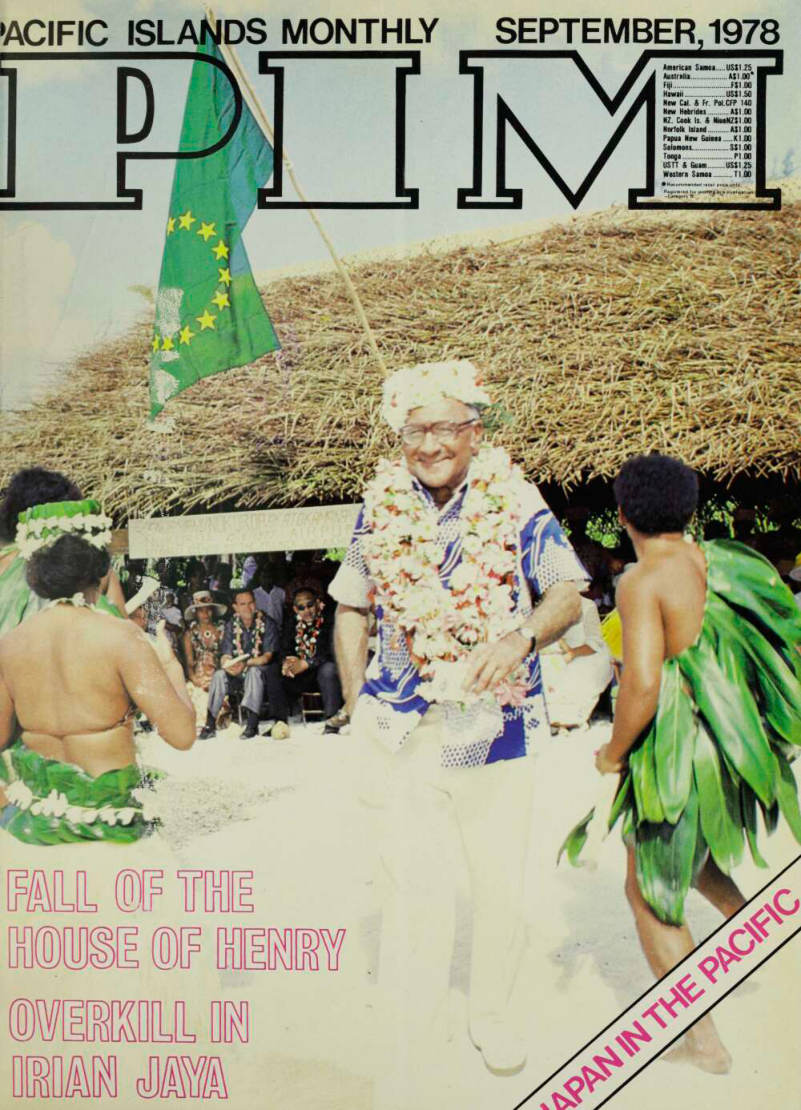
COVER; Sheree Upton’s photograph captures Sir Albert Henry, sacked premier of the Cook Islands, in a characteristic pose a jaunty, con fident, fun-loving man.
Advertisements & other items, pp. 2-4 (1 item)
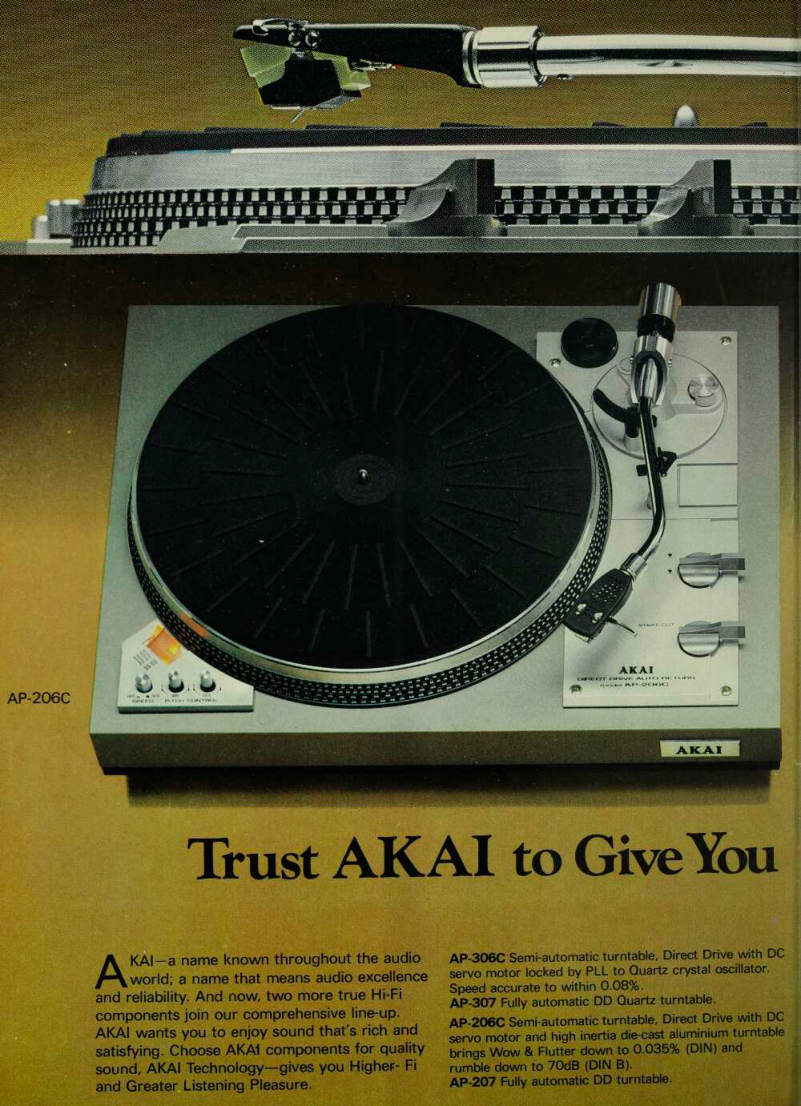
Trust AKAI to Give You
r* 7
AK A I
w» m AP 206 C
AKAI
Trust AKAI to Give You
AKAI— a name known throughout the audio world; a name that means audio excellence and reliability. And now, two more true Hi-Fi components join our comprehensive line-up.
AKAI wants you to enjoy sound that's rich and satisfying. Choose AKAI components for quality sound, AKAI Technology—gives you Higher- Fi and Greater Listening Pleasure.
AP-306C Semi-automatic turntable. Direct Drive with DC servo motor locked by PLL to Quartz crystal oscillator.
Speed accurate to within 0.08%.
AP-307 Fully automatic DD Quartz turntable.
AP-206C Semi-automatic turntable. Direct Drive with DC servo motor and high inertia die-cast aluminium turntable brings Wow & Flutter down to 0.035% (DIN) and rumble down to 70dB (DIN B).
AP-207 Fullv automatic DD turntable.
y \K M W V
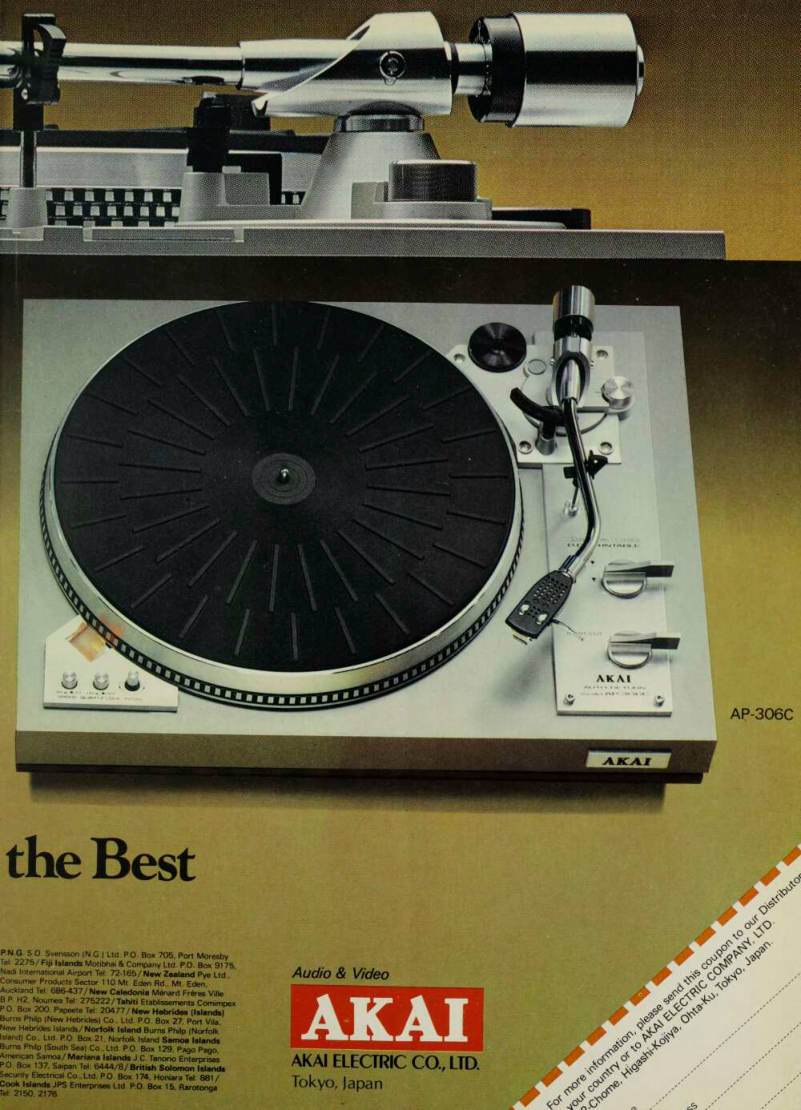
AP-306C
the Best
P.N.G. S O Svensson (N.G ) Ltd. P.O. Box 705, Port Moresby Tel 2275/ Fiji Islands Motibhai & Company Ltd. P.O. Box 9175 Nadi International Airport Tel: 72-165/ New Zealand Pye Ltd Consumer Products Sector 110 Mt Eden Rd., Mt. Eden.
Auckland Tel: 686-437/New Caledonia Menard Freres Ville B P H 2, Noumea Tel: 275222/Tahiti Etablissements Comimpex P O Box 200, Papeete Tel: 20477/New Hebrides (Islands) Burns Philp (New Hebrides) Co., Ltd. P.O. Box 27, Port Vila New Hebrides Islands/ Norfolk Island Burns PWlp (Norfolk Island) Co , Ltd P O Box 21, Norfolk Island Samoa Islands Burns Philp (South Sea) Co.. Ltd PO. Box 129. Pago Pago Amencan Samoa/ Mariana Islands J C. Tenorio Enterprises PO Box 137, Saipan Tel: 6444/8/British Solomon Islands Secunty Electrical Co., Ltd. P.O Box 174, Honiara Tel 881 / Cook Islands JPS Enterprises Ltd. P.O. Box 15. Rarotonga Fel: 2150, 2176
Audio & Video
AKAI
AKAI ELECTRIC CQ,LTD.
Tokyo, Japan
o v crX) v°. v
d&lf 1
w At*
r cSj & rf- *»<>>■ <<°'
Jr ■sc W, * f.
J 3 v / 5x
rfS
(-; PS : K* ii A M % 71 *« ;■ ' Sr & ' l *»
ZTV>
Shell helps sweeten the profits
Shell has played a vital role in the Pacific for 50 years now. And part of that role has been in assisting, aiding and developing the local sugar cane industry.
Helping increase and expedite the harvest for greater earnings.
Shell has also aided development in mining, aviation, fishing, tourism, ships’ bunkering and other vital areas.
It’s development that has benefited the Pacific region and its people as a whole.
Shell Papua New Guinea Pty. Limited, P.O. Box 169, Port Moresby, Papua New Guinea.
Shell Company (Pacific Islands) Limited, Box 168, Suva, Fiji.
Societe des Petroles Shell des lies Frangaises du Pacifique Boite postale L 2, Noumea, New Caledonia.
II 5H1778
A11Ctda1 Representatives
Pim
Pacific Islands Monthly
Vol. 49 No. 9
September 1978
Elsewhere. $A16 Payment b y personal cheque is accepted in Australian, US, New Zealand, UK and Fiji currency For other remit tences please obtain a bank draft in Australian dollars Avp d m.» ay cf h® t0 *a® ANZ Bankin 9 Group. 88 Wentworth Avenue, Sydney, Australia
A11Ctda1 Representatives
R RAL in : °i? ,r ' bution - Gordon & Gotch (A asia) Ltd, Sox 40, PO, Rosebery, NSW 2018 Advertising - Melbourne - Pacific Publications (Aust) Pty Ltd 2nd Floor, Herald and Weekly Times Building, 61 Flinders n a wn^ e A°H rne A 3000, telephone 652 1565; Brisbane - ' 9ency ’ Box 1918 ’ Gp O. Brisbane 4001 t 4 3485 ’ 44 1546 Ad elaide - Harry Hastweli AH ed .' a ’^S !)X 301 399 Glen Osmond Rd, Glen Osmond mSia Adeltide elePh ° ne ™ 1869 ' 79 5956: Cables Has *‘ PO t |£!r?2f ,t ? n an c 8ubscri P‘ions - Desai Bookshops, PO Box 160, Suva, Fiji, telephone Suva 23036 Advertis- X 1 20 Goraon st - s - a ' > eie - FRENCH POLYNESIA: Distribution - Hachette HAWAH e ii^rp V n CTAT=o apee,e ' telephone 2 5610 ?,™ TES: Distribution - PIM, Hawaii I»n 2 .^ ahawai st ’ H °nolulu, Hawaii 96822 , APAN: Advef1isin 9 and subscriptions - Universal 5^3036° rPOratiOn ' CP ° B ° X 46 ' T ° kyo ’ telephone CALEDONIA; Distribution — Depot Centre dp ?7^S4.^4 e 729 PenteCOSt ' BPC2 ’ N ° Umea ’ telephone ' ls * rib Jf ,ion Gordon & Gotch, PO Box )84 ;f R ?f. d ' Mt Rosk| H. Auckland 4 Advertising - International Media Representatives Ltd, PO Box 3880° Auckland telephone 73 880, telex NZ21157 (Auck 40) tuSd 0 ™ - PaCi " C Publicati °"s. SPO £,« 22m': •APUA NEW GUINEA: Distribution — Robert Brown & dtertWna B ° X Sir- 5 ' o°1 telephone 2 5855 SS" n 5,eph„ P „?2, P 2 0 5 S 7 , ) P ° B ° X 85 ' P °"
The Herald and We ekly Times Ltd -10 Clifford s Inn, Fetter Lane, London EC4A 1BU tp|p iwiTcn CT*rr^ 41 ' telex London 21989 ' n!!/e E ° , STATES MAINL AND; Advertising - Joshua B owers Jr, Powers International Inc, 551 Fifth Ave New A N W »J r0^ k , ° 17 ’ telephone 867 9580 telex ?n 5 lV^ a r%8*2 2 - PIM Hawa "' 2812 Kahawai Sb monthly by Pacific Publications (Aust) Ptv Ltd nctrai ' nted 10 Australia by Kralco, Flemington NSW Sd a thp°rPn P Q C H iS retail only. Regis red at the GPO Sydney for transmission by post as a J a on -category B. Second class postage paid al onolulu, Hawaii, Pub * 952480. Copyright c P 197 q Pacific Publications (Aust) Pty Ltd.
Subscriptions
him is airfreighted to most subscribers and agents in the Pacific Islands and the United States American Samoa Australia Aust. $13 $12 Other $US16 Canada Cook Islands $14 $13 $US18 Fiji French Polynesia Guam Gilbert Islands $12 $14 $13 $13 $F12
Cfp 1700
$US16 Hawaii Japan Micronesia Nauru $13 $16 $13 $13 $US16 Y4500 $US16 New Caledonia $14
Cfp 1700
New Hebrides $13 New Zealand Niue $12 $13 $NZ13.50 Norfolk Island $12 Northern Marianas $13 $US16 Papua New Guinea $13 K12 Solomon Islands $13 Tonga $13 Tuvalu $13 United Kingdom 15 1 n US Mainland Western Samoa $14 $13 $US18
Advertisements & other items, pp. 5-6 (2 items)
5
ACIFIC ISLANDS MONTHLY SEPTEMBER, 1978
Founded 1930 by R. W. Robson Publisher Stuart Inder itor Bob Hawkins Editorial Adviser John Carter Manager John Berry Advertising Manager Steve Gray A Pacific Publications production 76 Clarence Street, Sydney 2000 GP0 Box 3408 Sydney 2001 Cables; PACPUB Sydney Telex; 21242 Telephone: Sydney 29 6693
<v. V^.-^
w 6 o* e
AUGUST, IS7B
n:<> *>
i PIM SUBSCRIPTIONS
See the lefthand column for the cost of a 12-month subscription to PIM mailed direct to your home.
PACIFIC ISLANDS COOKBOOK
Hundreds of practical recipes using ingredients found in most parts of the South Pacific, including a big section on fish, and fish selection. Interesting recipes with taro, yams, kumala, breadfruit, cassava, tropical fruit, coconut, ferns, shellfish and raw fish, as well as rice, meat, poultry, breadmaking, etc.
Nutritionists Susan Parkinson and Peggy Stacy, provide practical advice on meal planning, kitchen budgeting. 120 pages, with colour illustrations. 5A7.00 (SUSS.SO) Posted anywhere
THE TONGANS
Leading South Pacific writer Olaf Ruhen and photographer Jozef Vissel capture the lifestyle of the people of the last Polynesian kingdom.
Brilliant prose and 96 sparkling full-colour photographs depict today’s fongans at work, in church, at play. 5A9.00 (SUSIO.SO) Posted anywhere
PNG HANDBOOK & TRAVEL GUIDE
For businessmen, schools, libraries and local residents, this up-to-the-minute handbook covers everything!
Includes an accommodation tariff guide and useful maps, including a large coloured fold-out map of Papua New Guinea. 5A8.50 (SUS 10.00) Posted anywhere * also ask us for our full mail order book list of great Pacific titles. pr ss • - WO. m ;'Ol m
a m m n mn
seand
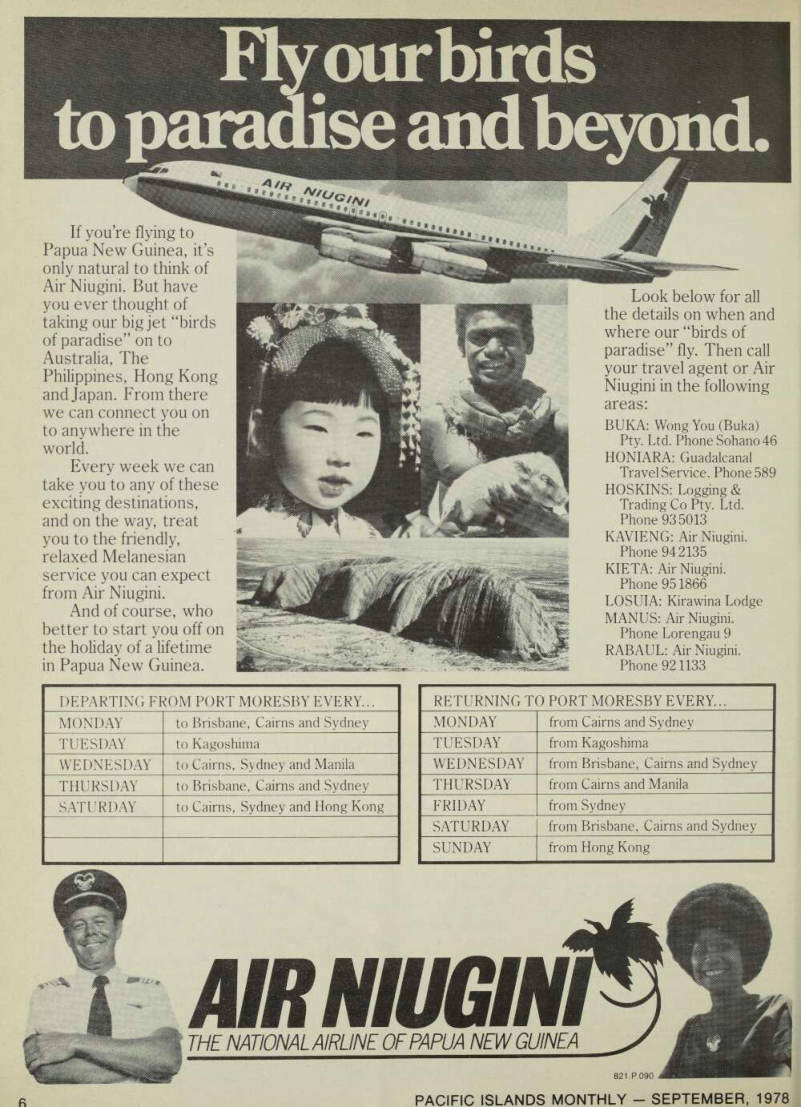
§ */u If you’re flying to Papua New Guinea, it’s only natural to think of Air Niugini. But have you ever thought of taking our big jet “birds of paradise” on to Australia, The Philippines, Hong Kong and Japan. From there we can connect you on to anywhere in the world.
Every week we can take you to any of these exciting destinations, and on the way, treat you to the friendly, relaxed Melanesian service you can expect from Air Niugini.
And of course, who better to start you off on the holiday of a lifetime in Papua New Guinea.
Look below for all the details on when and where our “birds of paradise” fly. Then call your travel agent or Air Niugini in the following areas: BUKA: Wong You (Buka) Pty. Ltd. Phone Sohano 46 HONIARA: Guadalcanal Travel Service. Phone 589 HOSKINS: Logging & Trading Co Pty. Ltd.
Phone 935013 KAVIENG: Air Niugini.
Phone 942135 KIETA: Air Niugini.
Phone 951866 LOSUIA: Kirawina Lodge MANUS: Air Niugini.
Phone Lorengau 9 RABAUL: Air Niugini.
Phone 921133
AIR NIUGINI
THE NATIONAL AIRLINE OF PAPUA NEW GUINEA 821, P. 090
Publisher
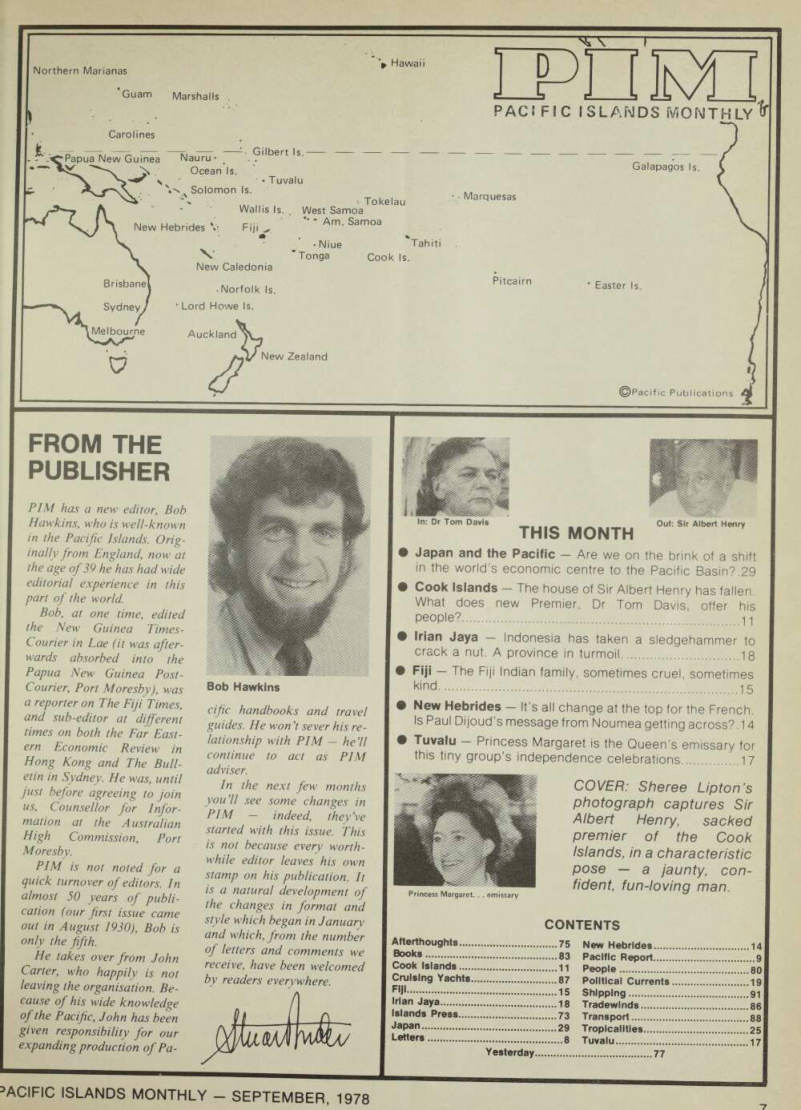
From The
PIM has a new editor, Bob Hawkins, who is well-known in the Pacific Islands. Orig inally from England, now at the age of 39 he has had wide editorial experience in this part of the world.
Bob, at one time, edited the New Guinea Times- Courier in Lae (it was after wards absorbed into the Papua New Guinea Post- Courier, Port Moresby), was a reporter on The Fiji Times, and sub-editor at dijferent times on both the Far East ern Economic Review in Hong Kong and The Bull etin in Sydney. He was, until just before agreeing to join us, Counsellor for Infor mation at the Australian High Commission, Port
Moresby.
PIM is not noted for a quick turnover of editors. In almost 50 years of publi cation (our first issue came out in August 1930), Bob is only the fifth.
He takes over from John Carter, who happily is not leaving the organisation. Be cause of his wide knowledge of the Pacific, John has been given responsibility for our expanding production of Pa-
cific handbooks and travel guides. He won 7 sever his re lationship with PIM he’ll continue to act as PIM adviser.
In the next few months you’ll see some changes in PIM indeed, they’ve started with this issue. This is not because every worth while editor leaves his own stamp on his publication. It is a natural development of the changes in format and style which began in January and which, from the number of letters and comments we receive, have been welcomed by readers everywhere.
Bob Hawkins
This Month
• Japan and the Pacific Are we on the brink of a shift in the world’s economic centre to the Pacific Basin?.29 • Cook Islands The house of Sir Albert Henry has fallen.
What does new Premier, Dr Tom Davis, offer his people? -| • Irian Jaya - Indonesia has taken a sledgehammer to crack a nut. A province in turmoil 18 • Fiji The Fiji Indian family, sometimes cruel, sometimes kind 15 • New Hebrides It’s all change at the top for the French.
Is Paul Dijoud’s message from Noumea getting across?. 14 • Tuvalu Princess Margaret is the Queen’s emissary for this tiny group’s independence celebrations 17
In: Dr Tom Davis
Out: Sir Albert Henry
Princess Margaret. . . emissary
Contents
Afterthoughts 75
Books 83 Cook Islands n Cruising Yachts 87
Fiji 15
Irian Jaya 13 Islands Press 73 Japan 29 Letters g
New Hebrides 14 Pacific Report 9 People 80 Political Currents 19 Shipping 91 Tradewinds 86 Transport 88 Tropicalities 25 Tuvalu 17
Yesterday 77
Advertisements & other items, p. 7 (1 item)
7
ACIFIC ISLANDS MONTHLY SEPTEMBER, 1978
Letters
Co-Ops In
Pacific
I recently received the February, 1978, PIM and was
perplexed by Harry Jackman’s
review of “Co-operative Move ments in the Pacific: The Tubiana Workshop” (p 47).
While he focuses on the Roch dale Principles and scores the report’s lack of concentration
on co-operative principles, he
misses the point of emphasis which was to bring together a group of Melanesians who are involved in a variety of co
operative “movements”.
Rather than being “elitist” in nature, the group represented a cross section of men and women struggling with various alternatives currently existing in Melanesia along with those involved in co-operatives following Rochdale Prin
ciples.
Another uniqueness was the input from Dr Alexis Sarei, Father Momis, and inciden
tally, Bishop Gregory Singkai
and the leadership of the Buin Co-operative. A very inten tional reason for holding the meeting at Tubiana on
Bougainville was to experience
the pros and cons of the struggle of the North Solomons Province which at the time of the meeting (June, 1976) was a very real microcosm of the Melanesian development di lemma.
Mr Jackman’s assumption “that North Solomon’s clergy,
inexperienced in co-operatives,
carried the day” is totally inac curate and distracts from the essence of the report. The report highlights the many
different co-operative experi
ments going on in Melanesian countries, pointing to their strengths as well as weaknesses as seen by the men and women involved in them.
Contrary to Mr Jackman’s conclusion that this report is of little help as a contribution to
the developments of co operatives in the Pacific, I would commend it to your readers as a fair assessment of the struggle of Melanesians to
develop appropriate models
for indigenous development.
In reports from New Hebrideans, we see the pitfalls of European top-heavy man agement which nearly de
stroyed the co-operative
movement in Vanuaaku (New Hebrides). From the Solomons, we gain insight into the frustrations caused by the lack of marketing channels within the Pacific. We also are made aware of co-operative
agricultural experiments such
as Youngpela Didiman in the Highlands of Papua New Guinea. Finally, I would com mend the Co-operative Move ments in the Pacific: The Tubiana Workshop for the very reason that Mr Jackman criti cises it; because it affords us the chance to hear from Melanesian leaders regarding their dreams and struggles.
The report is NOT by Father Pat Murphy. It is the work of the participants with extensive notes of their presentations, discussions, and observations.
The inclusion of remarks by Father Momis, Dr Sarei, Bishop Gregory and notes on the field trips to Buin in south
Bougainville and the Bougain
ville Copper Mine was on the insistance of the workshop par ticipants. They are well worth reading for anyone who would like first-hand reflection on
those confusing days when
Bougainville was viewed as se cessionist upon the advent of
independence in Papua New
Guinea.
William L. Coop
(formerly Co-ordinator of Inservice Training Programme, Pacific Conference of Churches Rabaul Recorder at the Tubiana Workshop) Valley Cottage, NY
Png’S Wartime
Hangings
Your paragraph headed The ‘Darkest-Kept Secret ’ (Pacific Report, June), is somewhat misleading because it does not refer to the issue I raised in my speech in the House of Rep
resentatives on May 5, namely the disappearance of all rele vant trial records. I did not pre tend to have uncovered the story of the wartime hangings, which I have known about since 1960 and first wrote about in 1968 in my book The Penalty is Death.
However, the destruction of the records was only confirmed by Mr Ellicott’s answer to a question on notice.
I was well aware of Tom Grahamslaw’s articles in PIM during 1971 but they do not answer the basic questions which need to be examined; • Were the trials military or civil and under what law were the Papuan New Guineans
charged?
• Who defended them or were they undefended? • Did they understand the nature of the offences they were charged with? • How was the prosecution’s evidence evaluated or cor roborated? • Who reviewed the sen tences? • Was there a right of
appeal?
• Why were the sentences not referred to Canberra? • Was the Australian law of
treason regarded as appropri
ate for unsophisticated indi
genes?
• Why have virtually all the
records disappeared?
• Why has the incident gone unrecorded by historians and other writers of the period?
Barry O. Jones
House of Representatives, Canberra.
When Smithy
Was Sighted
I received my June copy of PIM, this morning and as I sat and read the Yesterday section (p 83) featuring the Pacific
flight of Kingsford-Smith, Ulm
and crew in the Southern Cross the radio announced the land ing in Brisbane of Smithy’s son on completion of his commem orative flight across the same ocean.
My thoughts went back 50 years to June 9, 1928, on which date I was a passenger aboard the Bums Philp steamer Mon toro heading for New Guinea.
A little before 10 o’clock that morning the old 10-knotter was abreast of Ballina on the NSW north coast steering from head land to headland to dodge the
prevailing southerly current
when the drone of aircraft motors came from seaward.
This was an unusual sound in those days before air services existed in Australia and cer tainly of no aircraft arrivals from overseas and it was an
unforgettable sight when a
Fokker trimotor monoplane burst out of a cloudbank, passed low over the ship, and crossed the coast prior to head ing north for its historic land ing at Brisbane.
We of the ship’s company were certainly the first to make an Australian sighting of the Southern Cross’ landfall. To New Guinea old-timers and B4s it could be mentioned that on that particular voyage Mon toro was skippered by “Jazz”
Williams with Bertie Walford as chief engineer, Ben Allen as purser and Bob Pollard on radio watch. The passenger list included two of New Guinea
goldfields pioneer pilots in Les
Trist and Bill Wiltshire.
After the sighting most of us trooped into the ship’s bar and kept drink steward Harry Stone busy until lunchtime as we toasted the event.
Bert E. Weston,
Wollstonecraft, NSW
A Rare Can
Wanted
I am seeking what must be a rare item, but perhaps a souvenir-hunting reader may be able to help me. I am attempting to locate one or more of the olive-drab tinted beer cans issued to US troops during the war.
These were supposed to pre vent the reflection of sunlight off* the can from giving the drinker’s location to snipers, etc. If any reader would con sider parting with any of these I would be happy to purchase or trade some other military item. Thank you.
David Stegman
Apt. 114, 4730 Bradley Blvd.
Chevy Chase, MD20015,
U.S.A.
Pacific Report
Japan And The Pacific
The spread of Japanese influence in the Pacific, the subject of special investigations in this issue of PIM (see Japan and the Pacific, beginning on p 29), has gone a stage further with the recent signing of a fisheries agreement between the Gil bert Islands and Japan. The agreement was signed for the Gilberts by Mr Taimati luta, Minister for Natural Resource Development, and for Japan by Mr Shintaro Abe, Acting Foreign Minister. Mr Abe said later his country hoped to “contribute generously” to the economic development of the Gilberts.
Cooks’ Unhappy Historic “First”
Commonwealth constitutional history was made when the Chief Justice of the Cook Islands in July unseated the govern ment of Sir Albert Henry for what he termed “corruption of a magnitude unknown in the electoral history of New Zealand, Australia or Britain”. (Full report, p 11.)
Go-Ahead For Micronesian Constitution
Four of the six districts of Micronesia voted strongly in the July 12 referendum in favour of the proposed constitution of the Federated States of Micronesia. They were Kosrae, Ponape, Truk and Yap. The vote on Yap was 95% in favour “No” votes were recorded by the Marshalls and Palau, both of which are already involved in negotiations with the United States for separate status. The way is now clear for the forma tion of the FSM. Article 16 of the constitution provides that it will take effect a year after ratification unless the Congress of Micronesia “by joint resolution specifies an earlier date”.
Margaret For Tuvalu, Fiji
Princess Margaret, Countess of Snowdon, will represent the Queen at Tuvalu’s independence celebrations on October 1. (Full report, p 17.) She will later pay a two-day official visit to Fiji.
Jakarta’S Border Raids Worry Usa
Concern at Indonesia’s overkill tactics on the Irian Jaya- Papua New Guinea border rur\s all the way to Washington.
US Senator John Glenn, in Honiara for Solomon Islands independence celebrations in July, indicated that use by Indonesia of US-supplied OVFIO turbo-prop aircraft in border bombing raids could possibly lead to a congressional veto on the promised supply of FSE and Skyhawk aircraft to Indonesia. The OVFIOs were incorrectly described as jets in a report in PIM, August. (See p 18.)
Somare Survives Opposition Challenge
PNG Prime Minister Michael Somare, according to Opposition leader lambakey Okuk, could ‘resign with honour’ or meet defeat on the floor of the Parliament. That was before the August sitting.
Minutes after the new session began on August 7, Mr Okuk tested his numbers by moving that business on the agenda be set aside. When Speaker Kingsford Dibela ruled the motion had been defeated on the voices Mr Okuk protested. Mr Dibela asked those supporting the Opposition to stand. Mr Somare was still in control.
Tonga’S ‘South Sea Bubble’ Bursts
Tonga s Bank of the South Pacific, in so many ways reminiscent Df the eighteenth century’s South Sea Bubble, finally went bust n July. The ordinance for its establishment was first withdrawn
by ruling of the country’s Chief Justice, then revoked by Parlia ment. The defunct bank’s controversial American governor, Mr John Meier, was, meanwhile, having personal problems. He was arrested in Sydney on July 28 at the request of the US Embassy which sought his extradition to the USA to face tax evasion charges. Triumphantly producing a Tongan diplomatic passport, Meier succeeded in beating the rap, and the presiding magis trate ordered his release. But this handy “diplomatic immunity” was short-lived; word from Tonga is that Meier’s passport has been withdrawn. The problem of what the kingdom will do about a contractor’s claim for SA6OO 000 for work done, at Meier’s instigation, on Nukualofa’s international airport will take longer to solve.
Links Grow With North Korea
Western Samoa has established diplomatic relations with North Korea, following the example of Papua New Guinea and Fiji. The North Korean Government, for its part, in a message to Solomon Islands Prime Minister, Mr Peter Kenilorea, has announced its decision to recognise his newly independent nation.
Short Stint For Hebrides’ Pottier
After only six months in the post, the French Resident Com missioner in the New Hebrides, Mr Bernard Pottier, has been recalled to France. (See p 14.)
Hope High On Atea Kanada
Hopes remained high in early August that the cavers explor ing Papua New Guinea’s Atea Kanada cave system (PIM July) would achieve their goal of proving it to be the world’s deepest.
Petro-Dollars For Tonga?
Arab investment in Tonga was discussed in Wellington in July when the kingdom’s Minister of Labour, Baron Vaea, met the Egyptian Ambassador, Dr I. Z. Sorour. They talked about co operation between Tonga and the Arab countries as a whole, and Egypt, Saudi Arabia and the Gulf states in particular. Pro jects discussed included a bulk oil depot in Tonga to enable Saudi Arabia to deliver refined oil direct to its customers.
BAD NEWS FROM FIJI FOR BART, FRANCIS The Fiji Court of Appeal has dismissed appeals by Bartholomew Ulufa’alu, Leader of the Opposition in Solomon Islands, and Francis Saemala, special secretary to Solomon Islands Prime Minister Mr Peter Kenilorea. The men were convicted in Honiara earlier this year on charges of disorderly behaviour and sentenced to two months gaol. The Fiji court has been empowered to hear appeals from court rulings made in Solomon Islands and a number of other territories since the days of the British High Commission for the Western Pacific.
Sports Glory For American Samoans
American Samoan sports personalities are hitting the high spots: 14-year-old Angie Langkilde won the world and inter national titles in the world and international junior golf cham pionship in San Diego, California she clinched the title by sinking a snaky 7 m putt to birdie the last hole; and American Samoan-born sportsman, Jim Kneubuhl, who went to Hawaii when he was nine, has been voted Hawaii’s greatest track and field athlete by the selection board of the Hawaii Sports Hall of Fame and Museum.
Nauru Blots Its Philatelic Copybook
“Nauru’s previously unblemished philatelic reputation is now in tatters,” according to a stamp expert writing in an Aus tralian newspaper. The writer posed a number of pointed questions about a Nauru set of overprinted stamps issued in late March. With a face value of 27C, some sets were selling for up to $4O just three months after issue.
Somare Shops For Low Technology Funds
Papua New Guinea’s Prime Minister, Mr Michael Somare, had a new industrial strategy well in mind during his July visit to Singapore. Noting that Singapore was moving out of some low technology areas into more sophisticated types of pro duction, Mr Somare was looking around Singapore for low technology investment in his country simple textile pro duction for instance that could provide high degrees of employment.
Air Niugini’S Underwater Plan
Air Niugini plans to be the world’s first airline to operate a submarine. The 40-passenger, $2 million undersea craft will be capable of diving to 50 m. Through its large circular win dows tourists will gaze at coral reefs, tropical fish and historic wrecks. Political opposition to the project was soon evi dent. (See p 88.)
Spc Focus On Pacific Education
Two main themes for discussion have been chosen for the eighteenth South Pacific Conference in Noumea in October; “Education for what? Preparation for real life are com munity high schools the answer?” and “The special problems of small Island countries”.
Un Women’S Meeting In Suva
The Pacific Women’s Resource Centre, Suva, hosted a meet ing in July of the United Nations Asian and Pacific Centre for Women and Development (APCWD). The centre seeks to identify the critical needs of women and ways of increasing their integration into the development process. $5O MILLION PLAN FOR VITI LEVU WATER The Fiji Government will spend more than SFSO million over the next five years to get water to the north and west of Viti Levu, the country’s main island. The drought-prone area is heavily populated, embracing Lautoka, Nadi and nearby Nadi international airport.
Shipping Take-Over In Png
Two Papua New Guinea statutory authorities the PNG Investment and Shipping Corporations have taken up a 76% interest in a major coastal shipping operation serving the country’s main ports. Mainport Cargoes Pty Ltd will lift 100 000 tonnes of cargo a year. The operation will also train Papua New Guineans as ships’ officers. The original private owners of Mainport, including Mr John Edwards of Port Moresby and a group headed by Mr Harry Brutnall of Rabaul, will hold the remaining 24% interest.
Suva Just Misses A Big Bang
A July fire in a tanker, the R. A. Emerson, which was discharg ing oil for the Shell Co in Suva, could have blown up the ship and destroyed the wharf, according to chief fire officer Harold Henderson. He repeated earlier pleas for a separate berth for oil tankers. On this occasion, prompt action by the Suva fire brigade and the Emerson’s crew prevented the blaze spreading.
Mr Gill On Polynesian Telltales’
New Zealand’s Immigration Minister, Mr Frank Gill, has told parliament that many prosecutions of Island overstayers
arose from the tendency of Polynesians “to tell tales on each other’’. It might be a Niuean “putting up the weights’’ of a Samoan, or a Tongan putting up the weights of a Fijian, he said. Most such information was passed to his department by telephone.
NO GRASS SKIRTS ON FIJI’S LEBANON MEN Fiji’s soldiers had impressed other army units in the United Nations peace-keeping force in Lebanon, according to their commander, Colonel Paul Manieli. Commenting on reports that some UN officials regarded the Fijians as “grass-skirted spearthrowers’’, he said; “You don’t want to believe all you see or hear.”
Solomons Chalks Up Un’S 150
Attainment of independence by Solomon Islands, and its ad mission as the 150th member of the United Nations, have been hailed by UN secretary-general Kurt Waldheim as yet another milestone on the road to decolonisation. A question; If Solomon Islands has brought the UN three-quarters of the way to a membership of 200, which country, if any, will turn out to be the 200th? And when?
Vanuaaku Party’S Hilda Lini In Usa
Miss Hilda Lini, prominent activist of the Vanuaaku Party in the New Hebrides, attended the recent United Methodist Women’s Assembly in Kentucky, US. She also attended a consultation on women political prisoners in New York, and visited Washington where she discussed the situation in her country with prominent American political figures.
Png, Aboriginal Youths Dance Together
Papua New Guinean and Australian Aboriginal youth dance groups were among participants in an arts festival in Adelaide, South Australia, in August.
New Zealand: The Bugs Are Biting
Tiny unwanted Pacific Island immigrants are still “bugging”
New Zealand. The latest picked up by officials include kumera weevils from Fiji and Samoa, and Mediterranean fruit fly from Noumea.
Australia To Use Png Hydro-Power?
Papua New Guinea wants to sell hydro-electricity from its planned giant Purari River scheme to Australia. Envisaged is the supply of power by undersea cable to the aluminium towns of Weipa and Gove, and perhaps even Darwin. All three centres now use expensive oil-fuelled turbines to generate power.
Hebrides To Have Its Eez
A 200-mile exclusive economic zone is to be set up around the New Hebrides, according to an agreement reached in Paris between the responsible ministers, Mr Paul Dijoud of France and Lord Goronwy-Roberts, Britain.
Sydney Honours Solomons’ Big Day
Solomon Islands independence was feted in July in Sydney, Australia’s major city, with an Inevana (traditonal Island feast) attended by 200 people.
Tanuli’S Last Fling
Samoan boxer Tanuli Mose finished his televised light heavyweight fight with New Zealander Lance Revill in Auckland in spectacular style. The July bout ended when Mose aimed a kick at Revill’s groin, then thumped the referee a couple of times before seconds and managers hauled the contestants apart. The melee brought a ruling from the South Pacific Boxing Association banning Mose from its rings in future.
Advertisements & other items, p. 10 (1 item)
. . .I/Mitui V/ Ocdtcmrpr Iq7Ft
House Of
Fall Of The
Henry
From STUART INDER, in Rarotonga
The atmosphere in these islands following the dramatic change of government is a mix of relief, shock, puzzlement, joy and bitter ness. But what proportions of each of those varied ingredients make up the final recipe, I don’t know not even after a week in the Cook Islands.
I suspect it is too early for anybody to really know. Sir Albert ‘Papa’ Henry’s Cook Islands Party (CIP) government, in absolute power for 13 years, disappeared in a puff of smoke on July 24.
It was replaced, almost magically, by a government of the oppo sition Democratic Party led by Dr Tom Davis.
Sir Albert’s party had got back into power at the general elec tions of March 30, the party’s fifth election win in a row. In the 22-member Legislative Assembly the victorious CIP got 15 seats to the Democrats’ seven, against 14 seats for the CIP at the 1974 election. But the real interest was in the personal defeat at the March poll of Dr Tom Davis.
Dr Davis, 61 (his degree is in medicine), is a Cook Islander who spent 20 years as an expatriate, mostly in America, before returning home in 1972 to enter politics. He wanted to change the direction in which he believed the country was headed under Sir Albert. As Opposition leader he was the only real thorn in Sir Albert’s side. He rejected several overtures from the wily Sir Albert aimed at getting him to join forces with the CIP and thus shut him up.
Suddenly, Tom Davis was gone. But, although down, he wasn’t out. His supporters launched actions in the Cook Islands High Court under the Electoral Act, alleging electoral corruption against Sir Albert and seven of his fellow party politicians in the vital Rarotonga constituencies which provide nine of the assembly seats. The hearing in the electoral court under Chief Justice Gaven Donne lasted 18 sitting days in May and June five in Auckland, three in Wellington, the balance in Rarotonga.
The Rarotonga sittings provided a sensation as star witness. Sir Albert, unfolded to the court, under examination, an extraordi nary tale of do-or-die electoral compaigning and international finance. A key figure, who to popular regret never appeared in person, was Finbar Kenny, the New Yorker boss of the contro versial Cook Islands Philatelic and Numismatic Bureau which, for years, has made a mint out of its government-supported mon opoly on Cooks’ stamps.
The petitioners claimed that eight CIP politicians bribed elec tors to vote for them, particularly by giving voters free or sub sidised air travel from New Zealand to the Cook Islands, and that they were also guilty of “general corruption of a widespread and general nature, including the corrupt use of public
money”.
Much of the evidence concentrated on one particularly large sum of money 5337,000 advanced by Kenny and $290,000 of it used by Sir Albert for six Ansett charter flights stuffed with selected CIP supporters who were told ftow to vote. Apart from paying S2O each for food en route from NZ to the Cooks and return, they got the flight free. The Democrats also flew in voters, hopefully their own supporters, who had to pay full charter rates for their seats and were given no voting instructions.
The flying voter is peculiar to the Cook Islands which has more of its population out of the country than in it. An estimated 20,000 Cook Islanders live in New Zealand, only about 19,000 at home.
They retain their voting rights but must cast their vote in the Cooks, because there is no absentee ballot.
Was Sir Albert’s $337,000 cheque government money used for illegal party-political purposes? Sir Albert said the money was a personal loan from his good friend Finbar who knew what he needed it for. Sir Albert had merely “laundered” it through a new Cook Islands Government agency set up for the exercise to protect Kenny from the Foreign Corrupt Practices Act. introduced in the US in 1977 following the Lockheed scandals, which precludes Americans from advancing money to political parties. Finbar Kenny, in a message to the inquiry, violently disagreed.
Chief Justice Gaven Donne held that Kenny’s cash was paid and was meant to be paid as an advance from the Philatelic Bu reau to the government against 1978 stamp revenue, and thus Sir Albert had illegally used public money for the charter.
Mr Justice Donne said it wasn’t for him to decide whether or not there had also been a breach of US Federal law. He was not obliged to rule upon the validity “of self-serving explanations given by Sir Albert Henry or Mr Kenny after the event”. The fact was that in his use of the money the Cook Islands premier was guilty of unlawful conduct “of monumental dimensions”. (See separate report on the judgment.) If Mr Justice Donne’s decision was a shock, what followed it was nothing less than stunning.
At the instant the chief justice completed reading his lengthy judgment to a packed Rarotongan court room shortly before 12.30 pm on July 24, the Cook Islands was without a government. What the judgment did was to declare void all the votes cast by the illegal CIP fly-in voters. With these removed. Sir Albert and his seven cohorts immediately lost their seats to the next highest vote getters, who were Dr Davis and seven others.
In addition, the chief justice removed from his seat the member for the island of Mitiaro, David Tetava, over other allegations of corruption, and ordered a by-election.
The cabinet ceased to exist once the premier was unseated but the judgments reversed power in the assembly from 15-7 for the CIP to 15-6 for the Democrats. Democratic Party leader Dr Davis had to be invited to form a new government.
The machinery to make this possible began operating with
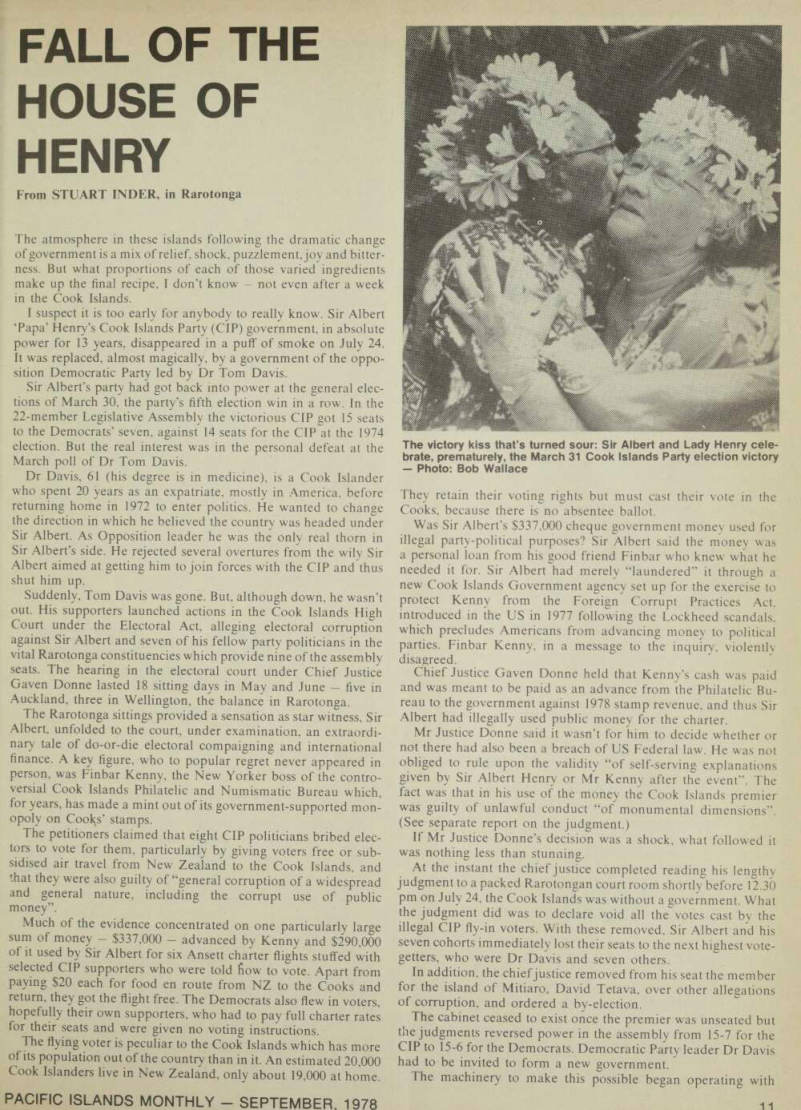
The victory kiss that’s turned sour: Sir Albert and Lady Henry cele brate, prematurely, the March 31 Cook Islands Party election victory - Photo: Bob Wallace
extraordinary swiftness, thanks to the fact that Mr Justice Donne wears two hats.
The Cook Islands since 1975 has had no high commissioner representing the Queen as head of state. But a post called Queen’s Representative was established and is held by the chief justice who exercises the function of high commissioner under the consti tution. So the moment he finished his judgment he put on his Queen’s representative hat, taking charge of the islands as tem porary head of state.
Mr Justice Donne, 64, with 40 years of law behind him, 20 at the New Zealand Bar, and with extensive judicial experience in the South Seas (he’s a former West Samoa chief justice) is a quiet, considerate personality who wouldn’t relish the responsi bility in finding himself a national dictator.
Examination of events after 12.30 pm on July 24 indicate he handed back power to a new government so swiftly that he prob ably created some sort of constitutional record. Chief Justice Donne legally held the reins for less than an hour-and-a half.
But, because of the nature of the operation, his brief authority had dramatic repercussions lasting for several days and brought some public mumblings about overkill.
Certainly the detailed planning would have done credit to any African power broker mounting a sudden palace coup. Here is the order of events; • As Mr Justice Donne began reading his determination, six senior New Zealand police were already on the way from Auckland by Air New Zealand in case of violence. (They arrived later that day and, as it happened, had a pleasant few days in the sun.) • When he completed reading his Mitiaro judgment at mid morning, court officers accompanied by police rushed a legal notice revoking the election to the Government Printer with instructions to stay there until it was printed in the Government Gazette. (Two printers walked out.) • As he completed reading his main Rarotonga judgment, ad ditional legal notices of revocation were also raced off for gazettal, together with a vital proclamation by Mr Justice Donne pro roguing the Legislative Assembly pending appointment of a new premier and cabinet. • Officials rushed copies of the proclamation to the assembly which had been due to open a new session at 1 pm, that is, within minutes, they gave a copy to the speaker, posted others on the notice board and another on the main door after having locked it. A police guard was placed on the building to prevent anybody
entering.
• A legal associate of Mr Justice Donne handed to Dr Davis a note asking him to go immediately to a room of The Rarotongan Hotel, alone. • The manager and all board members of the government-owned Cook Islands Broadcasting and Newspaper Corporation were
handed letters directing that no one except the chief electoral offi cer was now permitted access to the radio station without auth ority of the Queen’s representative; that at 2.30 the Queen’s representative and a new premier would tape messages to the people that were to be played every hour on the hour up to 8 pm and in place of all local news broadcasts the next day. Only regular overseas news broadcasts were to be relayed, together with music and weather and shipping information, or police messages.
These instructions were to remain until countermanded by the relevant minister in the new cabinet, and anybody who disobeyed them would be dismissed on the spot. • By this time Mr Justice Donne was also at The Rarotongan, where copies of the Government Gazette, rushed straight from the printer, were handed to him. Now with legal requirements met, and Dr Davis only too willing, he swore him in as premier in Room 208. Within half an hour the new premier had gathered his fore-warned cabinet, who were also sworn in. (Dr Davis says he had chosen his cabinet many weeks earlier when it had become obvious to him from the court evidence that Sir Albert was in trouble.) • Chief Justice Donne and Premier Davis now went off to the studio to broadcast messages. The chief justice explained the cir cumstances of the change of government. The new premier, nam ing his cabinet, said it was time to look to the future; “The time for rebirth and renewal that I spoke of on New Year’s Day has arrived ... I promise you that I will lead your new government to work towards the welfare of all the people and not just a chosen few . . . The time for dependency on others is finished.”
This was a reference to Sir Albert’s style of leadership in which party supporters are promised the good life if they follow him.
Under Sir Albert, government was a one-man band, with ‘Papa’ involving himself in every level of decision-making, sometimes reversing decisions of cabinet, which one former cabinet minister says he attended infrequently. There was also widespread criti cism of his nepotism, with the ‘Henry clan’ filling key positions, which had caused resentment, particularly in the public service. (Sir Albert’s answer to the nepotism charge is that he picked the best people for the job often with the best education, irrespective
of family relationships.)
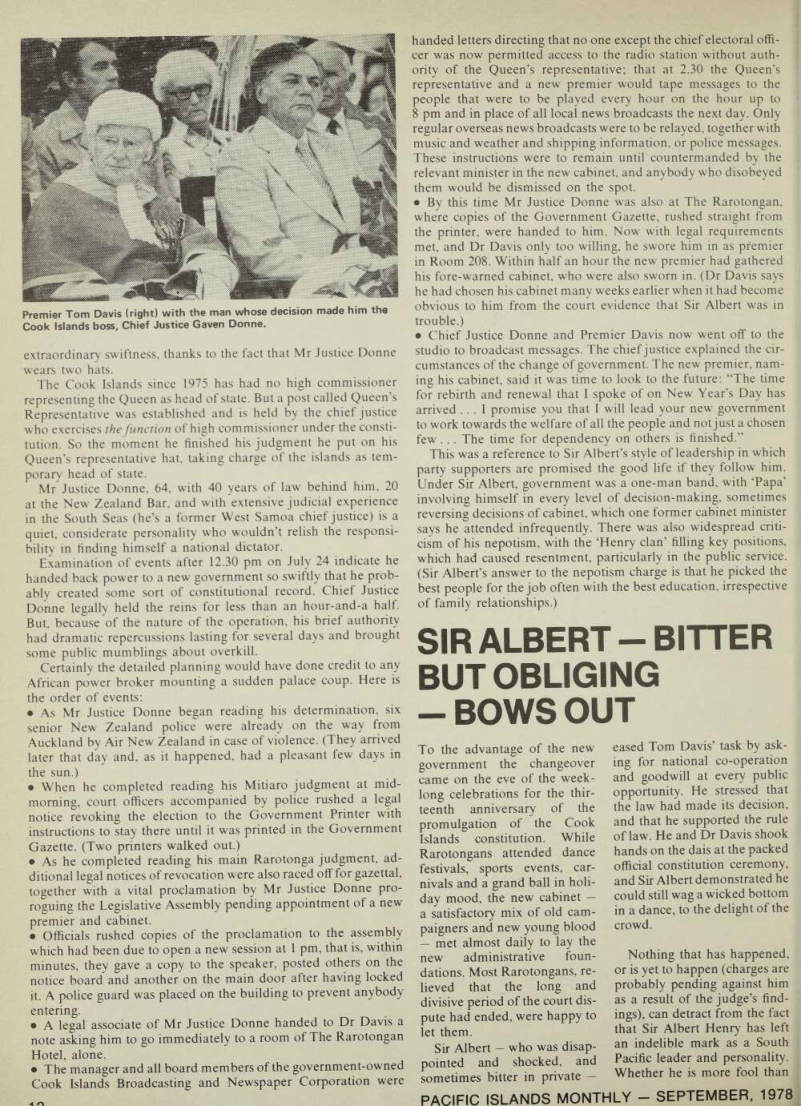
Premier Tom Davis (right) with the man whose decision made him the Cook Islands boss, Chief Justice Gaven Donne.
Sir Albert-Bitter
But Obliging
-Bows Out
To the advantage of the new govemment the changeover came on the eve of the weeklong celebrations for the thirteenth anniversary of the promulgation of the Cook Islands constitution. While Rarotongans attended dance festivals, sports events, carnivals and a grand ball in holiday mood, the new cabinet a satisfactory mix of old campaigners and new young blood - met almost daily to lay the new administrative foundations. Most Rarotongans, relieved that the long and divisive period of the court dispute had ended, were happy to let them.
Sir Albert - who was disappointed and shocked, and sometimes bitter in private -
eased Tom Davis’ task by ask
ing for national co-operation
and goodwill at every public opportunity. He stressed that the law had made its decision, and that he supported the rule of law. He and Dr Davis shook hands on the dais at the packed official constitution ceremony, and Sir Albert demonstrated he could still wag a wicked bottom in a dance, to the delight of the crowd.
Nothing that has happened,
or is yet to happen (charges are
probably pending against him
as a result of the judge’s find ings), can detract from the fact that Sir Albert Henry has left an indelible mark as a South Pacific leader and personality.
Whether he is more fool than
knave, or something else again, history will decide.
Hundreds of people waited outside his house on the night of the court decision, in a spon taneous gesture of condolence and support. He plans to get back into the assembly at the Mitiara by-election within a few months, and meantime may make a direct appeal to the UN to decide whether Mr Justice Donne was acting in the best interests of justice in a de cision which replaced a whole government, giving the new administration almost a full term in power. Sir Albert told me that in settling “such a ten der matter, in such a small
country”, justice, as distinct
from the letter of the law, would have been better served by installation of a caretaker
government pending new by
elections “to give the people a chance to say what they think about it”.
He is also bitter about what he thinks might have been New Zealand government influence on the events that followed the general elections, and a belief that some of the Democrat fly-in voters also arrived for free (which Dr Davis firmly re jects).
There is no legal appeal to Mr Justice Donne’s decisions, and in any case his lengthy judgment quotes legal
precedents for all the various alternatives that were open to him, including the calling of by-elections. He appears to have been strongly influenced against this alternative on the basis that new elections would cause hardship to honest can didates, party workers and gen eral voters, especially those who came from New Zealand at their own expense, and that the principle is “he who breaks the rules should bear the brunt”.
He said the time period be fore the elections would also mean a continuing atmosphere
of uncertainty and apprehen
sion in the islands. The alle gations were serious, as the amount involved in the bribery was equivalent to 2.8% of the
total Cooks budget expendi
ture and involved 9.3% of the total votes cast in the three Rarotongan constituencies involved, so he held that “it is better that there be an un equivocal denunciation of the misdeeds of the offending can didates and their agents than that by-elections be ordered which may allow the trans
gressors indirectly to profit
from their misconduct which, especially in the case of the main perpetrators of the whole scheme, was of vast pro portions”.
Meanwhile Premier Davis is
showing the much-needed ad ministrative experience that even his detractors acknowl edge he has, and has said that the new government’s most urgent task is to bring to life again island exports, and re verse the present trend of an import bill seven times higher than exports. He also plans to change the constitution to make it unneccessary to fly in voters, and has the two-thirds
parliamentary majority to do
it.
Apprehension in Rarotonga that great numbers of public servants would be sacked by the new administration turned
out to be unfounded, as minis ters told their departments that people who were efficient had no fears irrespective of their
politics.
The new parliamentary Op position leader is Sir Albert’s cousin, Geoffrey Henry, and Sir Albert’s son, Tupui, is
deputy leader.
“As Her Majesty’s loyal Op
position, we certainly intend to do a better job in opposition than the opposition of yes teryear,” commented the
quick-witted Geoffrey Henry
in the assembly. “Then you will be doing well!” replied the new
premier, with equal goodwill.
Advertisements & other items, p. 12 (1 item)
12
ACIFIC ISLANDS MONTHLY SEPTEMBER, 1978
Cooks cabinet
Who’s who in the Cooks cabinet
Premier (and Minister of Finance and Economic Development) Dr Tom Davis had his seven-man cabinet ready and waiting when Mr Justice Donne delivered his
judgement. W. G. Coppell
gives these biographical
notes: Dr Pupuke Robati (53), Deputy Premier, Health Minister Native and representative of Rakahanga in northern Cooks.
Trained at Fiji School of Medicme - Tangata Simiona (57), Minis-
ter of Education and party
president —High-ranking chief
on Atiu. Head teacher of Nikao Maori school before joining Department of Education as chief inspector of schools, Henry demoted him to assist ant government anthropol
ogist.
Papainama ( ‘ Pa ’) Pokino (4 1), Minister for Supportive Ser vices - Son of former assembly member Pokino Aberarama.
Represents Mangaia. Gained BE in New Zealand. Was Cooks project engineer and re
cently has been concerned with outer island airport construc tion. laveta Short (34), Minister of Agriculture and Tourism Represented Takitumu on Rarotonga since December.
New Zealand trained lawyer; practises on Rarotonga.
Vincent Ingram (31), Minister of Justice and Police New
Zealand-trained lawyer. Prac tises in the Cooks and manages family business interests on Rarotonga.
Tangaroa Tangaroa (57), Minister for Internal Affairs Represented Penrhyn since be fore 1965 self-determination election. Shadow minister of education before Cook Islands Party took power.
Justice Is Donne
Ordering the unseating of the government of Sir Albert Henry, the Chief Justice of the Cook Islands, Mr Justice Donne, accused it of corruption of a magnitude unknown in the electoral history of New Zealand, Australia,or Britain.
In a 70-page decision handed down in July he ruled that Sir Albert and other members of his Cook Islands Party had bribed voters by providing virtually free flights to Rarotonga for the gen eral election of March 31 in return for electoral support.
He concluded that the flights had been unlawfully paid for out of public funds “a clear breach or breaches of the Public Moneys Act”. “I can imagine no greater perversion of represen tative democracy,” said Mr Justice Donne, “than that huge sums of public money be secretly used by candidates to facilitate bribery of hundreds of voters and thereby secure their re election.”
In a separate judgment on allegations of the “corrupt practice of treating” by the successful Cook Islands Party candidate on the island of Mitiaro, Mr Justice Donne found a case had been established and ordered a by-election.
On the main charges Mr Justice Donne found that on January 12 Sir Albert wrote to Mr Finbar Kenny, an American with a major interest in the Cook Islands Philatelic Bureau, seeking financial help for his election campaign. His letter advised Mr Kenny that he intended chartering aircraft to carry party supporters to Raro tonga to vote. As a result, Mr Kenny’s representative in Raro
tonga, Mr J. W. Little, was told to make an advance available against stamp bureau revenue.
With this assurance of finance, Sir Albert went to New Zealand later in the month and spoke about free flights for voters at meetings of Cook Islanders in Tokoroa, Wellington and Auckland.
In February, Sir Albert visited Melbourne, where he arranged the charter of three aircraft from Ansett Airlines, before flying to Hololulu to report the result of his negotiations to Mr
Kenny.
On March 13 he wrote to the director of the stamp bureau in Rarotonga to say the Cook Islands Government New Projects Co Ltd a company incorporated a week earlier “wishes to assist in the financing of a major project in the Cook Islands”.
“Substantial finance will be required and I would be pleased if you would forward to me a cheque in external funds for SNZ327 000 made out to the above company,” wrote Sir Albert.
The letter said the sum was to be regarded as an advance to the Cook Islands Government against future stamp bureau rev enue.
Sir Albert received a cheque from the bureau for $337 000 not $327 000 as mentioned in the letter and it was paid into the company account in New Zealand. On March 17, the sum of $335 000 was transferred from the account of the Cook Islands Government New Projects Co to another account in the name of the Ipukarea Development Co Ltd. It was from this account that Ansett Airlines was paid $290 000 for six return flights to
Rarotonga.
Batting
Brych
Average
Advent of the Davis govern ment will hasten the end for the Cook Islands practice of con troversial cancer therapist
Milan Brych.
He is likely to be forbidden the use of the Rarotonga Hospital, thus reversing the de cision of the Henry govern ment which allowed Brych to practise in the hospital but for bade it to the only three fully
qualified medical practitioners
in private practice, Drs Davis, Joe Williams and Archie Guinea.
Milan Brych’s cancer prac tice is already running into serious trouble from an Aus tralian Government decision to cease paying medical fund benefits to Brych patients from October 1. Most of the patients are from Australia.
They get refunds of from 70% to 80% of their medical bills, plus all their hospital bills. The average bill for
Brych’s medical and hospital
treatment is $l2 000, of which $7OOO to $BOOO is paid back to the patient by Australia.
In August there were 25
people being treated on the island, with two more awaiting treatment (Brych was absent in Los Angeles). The number of new arrivals is expected to be reduced as a result of the Aus tralian decision.
Brych’s first patient was
admitted to the Rarotonga hospital on April 3, 1977.
By August this year, 249
patients had completed treat
ment or were still being treated. Of these, total number of deaths on the island was 57, with scores more having died on returning home. The island deaths do not include those who arrived so ill as to be vir tually dead before Brych saw them.
Brych aims to set up clinics in Los Angeles and Brisbane, to work in association with his main Rarotongan clinic. He is not registered to practise in the US or Australia. He is regis tered to practise in the Cooks, where he has a government house and car.
Brych has announced that he will reveal details of his treat ment methods for the first time in October, in Honolulu, when he is scheduled to present a series of papers at a seminar
arranged by the Northwest
Academy of Preventive Medi cine, Washington. The seminar is at the Intercontinental Hotel, from October 16-20.
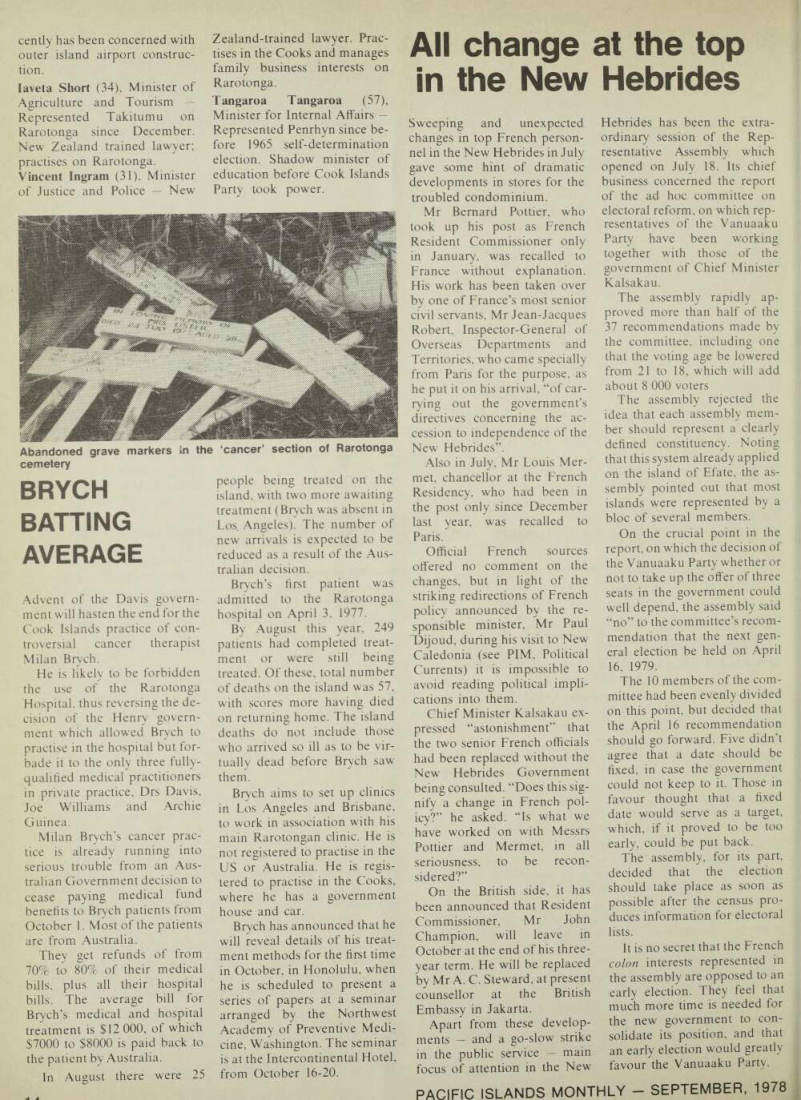
Abandoned grave markers in the ‘cancer’ section of Rarotonga cemetery
in the New Hebrides
All change at the top in the New Hebrides
Sweeping and unexpected
changes in top French person nel in the New Hebrides in July gave some hint of dramatic developments in stores for the troubled condominium.
Mr Bernard Pettier, who took up his post as French Resident Commissioner only in January, was recalled to France without explanation.
His work has been taken over by one of France’s most senior civil servants, Mr Jean-Jacques Robert, Inspector-General of Overseas Departments and Territories, who came specially from Paris for the purpose, as he put it on his arrival, “of car
rying out the government’s
directives concerning the ac cession to independence of the New Hebrides”.
Also in July, Mr Louis Mer met, chancellor at the French Residency, who had been in the post only since December last year, was recalled to Paris.
Official French sources offered no comment on the changes, but in light of the striking redirections of French policy announced by the re sponsible minister, Mr Paul "Dijoud, during his visit to New Caledonia (see PIM, Political Currents) it is impossible to
avoid reading political impli
cations into them.
Chief Minister Kalsakau ex pressed “astonishment” that the two senior French officials had been replaced without the New Hebrides Government being consulted. “Does this sig nify a change in French pol icy?” he asked. “Is what we have worked on with Messrs Pettier and Mermet, in all seriousness, to be recon sidered?”
On the British side, it has been announced that Resident Commissioner, Mr John Champion, will leave in October at the end of his three year term. He will be replaced by Mr A. C. Steward, at present counsellor at the British Embassy in Jakarta.
Apart from these develop ments - and a go-slow strike in the public service - main focus of attention in the New
Hebrides has been the extra ordinary session of the Rep resentative Assembly which opened on July 18. Its chief business concerned the report of the ad hoc committee on electoral reform, on which rep resentatives of the Vanuaaku Party have been working together with those of the government of Chief Minister Kalsakau.
The assembly rapidly ap proved more than half of the 37 recommendations made by the committee, including one that the voting age be lowered from 21 to 18, which will add about 8 000 voters The assembly rejected the idea that each assembly mem ber should represent a clearly defined constituency. Noting that this system already applied on the island of Efate, the as sembly pointed out that most islands were represented by a bloc of several members.
On the crucial point in the report, on which the decision of the Vanuaaku Party whether or not to take up the offer of three seats in the government could well depend, the assembly said “no” to the committee’s recom mendation that the next gen eral election be held on April 16, 1979.
The 10 members of the com mittee had been evenly divided on this point, but decided that the April 16 recommendation should go forward. Five didn’t agree that a date should be fixed, in case the government could not keep to it. Those in favour thought that a fixed date would serve as a target, which, if it proved to be too early, could be put back.
The assembly, for its part, decided that the election should take place as soon as possible after the census pro duces information for electoral lists.
It is no secret that the French colon interests represented in the assembly are opposed to an early election. They feel that much more time is needed for the new government to con solidate its position, and that an early election would greatly favour the Vanuaaku Party.
Looking at the family institution
among Fiji Indians
SOCIETY —The lot of Fiji Indian children, especially girls, is not always a happy one. A RIM correspondent in Suva, herself of Fiji Indian origin, examines the present state of Fiji Indian family life.
The empty whisky bottle miraculously missed his head and shattered on the concrete floor in countless tiny pieces.
Enraged by her failure, she advanced towards him menacingly, grabbing the nearest thing to hand, an old wooden rolling pin. While the boy recoiled in fear and covered his face with his hands in the universally-pro tective gesture of children, she lunged with her first blow.
He cried out in pain. As the child’s screams increased so did the blows. She seemed like a woman possessed.
To Kamla Reddy, seven year-old Raj for a while was no longer her son. In him she found an outlet for all her pent-up emotions, her frustra tions, failures and unhappi ness. After beating him up to her heart s content she locked him in a room without giving him dinner. Her two other children, mere toddlers, scared by what they had just witnessed and fighting back tears under their mother’s threats, gulped down a few bits of food and went to bed.
As Kamla sat on the doorstep of her house fanning herself with her dingy veil, did she feel guilt about what she had just done? Was she wondering what imprint she was leaving on her children, and how these experiences would affect them when they grew up?
Far from it. Kamla felt a strange sort of satisfaction. As a result of beating up her son she had simmered down. All afternoon her thoughts had aeen centred on Wahab, her over with whom she had been supposed to go on a secret pic aic. Wahab had forgotten heir date again. At first as he seconds ticked away on he kitchen-wall clock, she >ecame impatient, worried, ealous, then angry.
When the phone finally ang she was jittery and rush d to answer it, thinking it was Vahab at last. But the call was rom Sami, her husband, who drunk as usual. He or ered Kamla to prepare some
hot chicken curry and put beer in the fridge. He an nounced he was going to bring home some friends for a booz ing party. When Kamla re plied there was no chicken or beer in the house he shouted “Get it from somewhere’’ swore at her and slammed the receiver down in her ear.
Torn between hatred for Sami, who had been chosen as her husband by her parents, and anger at Wahab, Kamla did not need much of an ex cuse to vent her wrath. A minor squabble among her children in which Raj ap peared the culprit provided the catalyst.
Kamla, like thousands of Indian parents in Fiji, uses her children as “emotional beds”.
Cruelty to children is a com mon thing among the Indian community, although a small section of educated and il literates are among the most wonderful parents any child could have anywhere in the world.
All Indian parents rejoice when a child is born. The
celebrations are more marked when the baby is a boy. He is considered a “gain”, while the girls continue to be looked upon as “burdens”.
It is not that the structure of Indian society, its culture or religion, advocates ill-treat ment of children. The child has indeed been idolised by Hindu saints, philosphers and leaders.
But once a child reaches the age of seven he or she is ex pected to act, think and, par ticularly in rural areas, work like an adult. This means wak ing up with parents at sunrise, toiling on the farm, tending goats, cattle, chickens, look ing after vegetable gardens and selling produce.
But not every child is sub missive. They try to support rebellious arguments with what they learn at school (most of them spend at least some years in high schools), from what they have read in books, or seen in movies. But most often rebellion is no use as the parent has the money and disobedience means being
booted out of the home.
Most of the younger genera tion do not believe in religious differences or in the caste system. But Hindu parents continue to oppose marriage to Muslims and vice-versa, and the caste system is still practised.
For example northern In dians are expected to marry northern Indians, similarly Punjabis, Gujeratis and southern Indians must all marry within their castes.
There are many young people who defy this and marry out side. Often this means total banishment by the girl’s parents, but most such mar riages are quite happy.
Cruelty also extends into later stages of a child’s life.
One of the most glaring exam ples of this is Indian marriges.
Many Indian parents, in cluding so-called “educated" ones, choose their sons’ and daughters’ wives and hus bands. To qualify, a girl has to good at housework. Sewing is an advantage. She must not be too fat or too thin, or have any
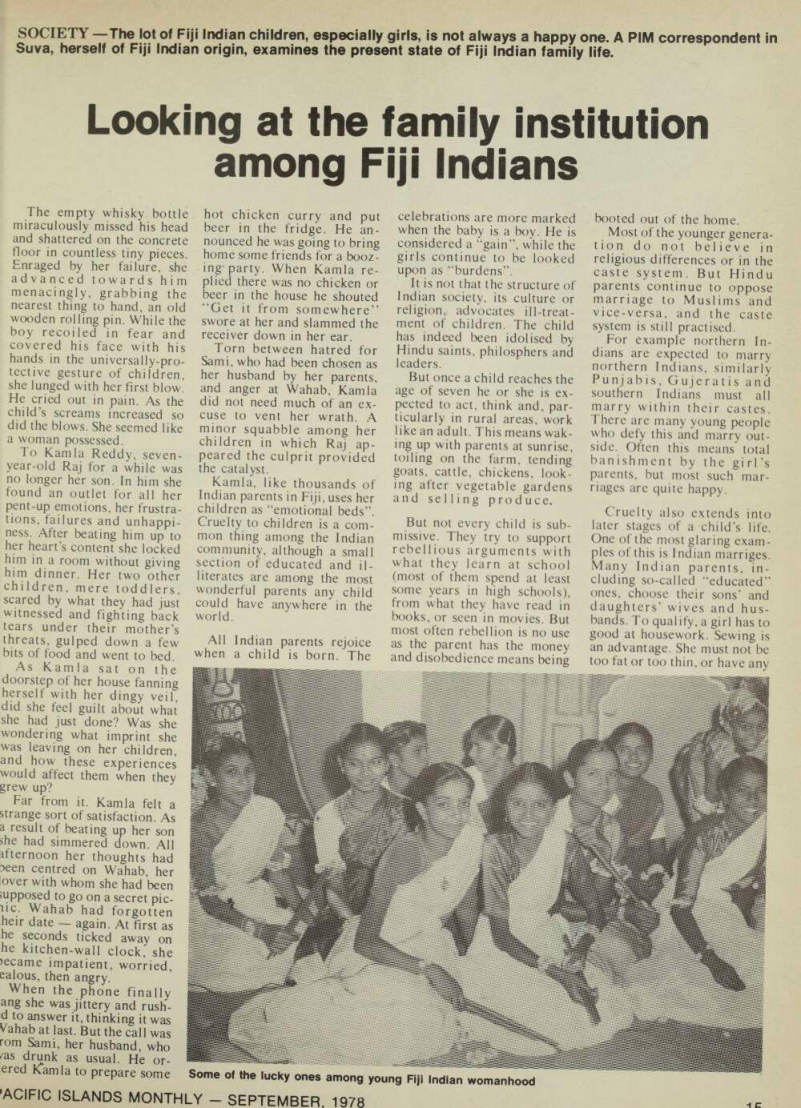
Some of the lucky ones among young Fiji Indian womanhood
abnormalities such as a miss ing finger, and she must not be Westernised. A well-off family and fair skin are
definitely advantages.
Before agreeing to mar riage, her prospective mother in-law samples her work and cooking. Cruelty to teenage daughters-in-law is worst among Fiji’s affluent Gujerati community, although they will furiously and firmly deny this. The Gujerati mother-in law more than any other tries to wield power in the house hold and hold first place in her married son’s affections.
The daughter-in-law usually assumes the role of a “house girl”.
The mother-in-law buys her clothes and underwear and even chooses the colour of things the girl should wear. If the son wants to take his wife out for a social occasion she must get her mother-in-law’s permission first. In most cases this is refused, but the daughter-in-law is not allow ed to tell her husband that. In stead she must plead a headache or some such ex cuse. Often the young woman becomes fanatically involved with religion for consolation.
Daughters who live with fathers who have de-facto wives end up leading Cin derella-like lives. Unfor tunately there are no fairy godmothers or Prince Charm ings to come to their rescue.
Daughters whose mothers have de-facto husbands often end up having to put up with sexual advances from them. In Suva recently a teenage girl, who was adopted by a man as his daughter, was forced to have sex with him. The father was goaled for 10 years. In mitigation he said shamelessly that he had sex with his adopted daughter because he knew other men had already had her.
There are institutions in Fiji where a child in distress can go for help. But not many turn to them. Most children are unaware that the law and these institutions can helo them. F Ironically, the very parents >vho ill-treat their children ire usually the first to expect iternal gratitude from them.
Phis means the children are expected to care for them for he rest of their lives. In most 'ases this is what happens, -laving been subject to blind )bedience for so long, the hildren generally accept the
esponsibility without
[uestion.
Advertisements & other items, pp. 15-16 (2 items)
15
ACIFIC ISLANDS MONTHLY SEPTEMBER 1978
Hood
m
0 rHePACIFIC
HOOD RACING and CRUISING SAILS
In World Famous Hood Sailcloth Hood Service. We regularly service the Pacific.
Hood Managing Director Tony Bouzaid calls freguently through the area; sailing seminars for clubs and associations by arrangement.
Deliveries. Improved air services bring New Zealand closer to you we can offer speedy deliveries at short notice. / Hoods have representatives in Noumea, / Papeete, Port Moresby, Rabaul Suva, Singapore.
Write to Hood Sail Consultants in New Zealand for guotes, advice and for prompt answers to your sails gueries.
OD H 5) <C O’ 0 <o 0 S' v- <o 0 fb 0 0 0 * 2? 0 V 0 <o S' o 0 S' S'' 0 S' s> 0 S'' 0 0 0 $ 0 S; Hood Racing Sails have the top international race-winning record. Recent successes include: Half Ton Cup, One Ton Cup, Southern Cross Cup, Whitbread Round-the-World Race, World Ocean Racing Championship, Sydney- Hobart Race, N.Z. to Vila / Ocean Race, Single-handed Transtasman, / & etc., etc. / Hood Cruising Sails in Hood Wide / Panel Sailcloth are soft, easy to handle and stow, and longer lasting.
SPAR
and
RIGGIN
HOOD
NEW ZEALAND
LIMITED
23 Poore St., St. Marys Bay, Phone 794-060, P.O. Box 415 Auckland, / A New Zealand. / Q Cables:Hoodsai y Telex: NZ21200
HOODNZ
Whether you have a racing or cruising yacht and require full new rigs or replacements, contact us for prompt and efficient service. We offer Spars, Rigging, Halyards, Accessories from Quarter Ton to Maxis. For immediate service, write, phone or telex giving fullest details includng sketches for replacements, and sail plans with yacht’s leading dimensions, including displacements and ballast, for new rigs.
Write for our very comprehensive catalogue.
YACHTSR4RS
NEW ZEALAND LIMITED
P.O. Box 1492, Auckland. Phone 485-955, 485-536 Telex: Hood 21200. Cables: Yachts Auckland.
Standing Alone!
Now It’S Eight
Tuvalu, nine islands with a total land area of 25.9 square kilometres scattered over 1.3 million square kilometres of the Pacific Ocean, and 9 000 people, will go independent on October 1 after three days of celebrations, writes John Carter.
And the Queen’s sister. Prin cess Margaret, back in circu lation after illness will be there to hand over the documents establishing Tuvalu as a sover eign, independent country. To date there is no news of the programme for the junket but the islet of Fongafale, adminis trative centre of the capital, Funafuti, will be crowded. It’s only the size of two or three football fields and canoe-loads of Tuvaluans will be making for the spot. There’ll also be the VIPs from the South Pacific countries and further afield.
As accommodation is lim ited and there’s nothing on Funafuti of Buckingham Pal ace standard to house the prin cess and her party of five, she will be the guest of the Royal New Zealand Navy on a war ship which will grace the cel ebrations.
There may be fireworks like
the ones which gave the Solomon Islanders a big thrill at their independence cel ebrations in July. There’s sure to be dancing but the big thrill for the Tuvaluans will be Prin cess Margaret. Even in faraway Funafuti, 400 miles south of the equator, they’ll have heard
of her Royal Highness’s
headline-making divorce from Lord Snowdon and her friend
ship with Roddy Llewellyn, a
pop singer.
The princess will leave Lon don on September 24 and arrive at Funafuti, via Fiji, early in the afternoon of Sep tember 29. She will return to Fiji after the celebrations end around noon on October 1 and is expected to spend a few days
in Fiji.
Independence comes to the former Ellice Islands exactly three years after separation from the Gilberts, with whom they formed a crown colony, and only four months after
becoming self-governing the
shortest term of self government in the history of the Commonwealth.
Fearing domination by the
Gilbertese, who outnumbered them seven to one, the
Tuvaluans opted for separation even though they had been warned they’d get nothing out of the partnership assets except one small ship. The one thou sand Tuvaluans working in the Gilberts were told they might have to look elsewhere for jobs but they still decided to go it alone hopefully with help from Britain.
Now Tuvalu - which means ‘eight standing together’ - will paddle its own canoe from October 1 with some financial help from Britain, around $8.2 million of it, for a special development fund, for con
tinuing developmental aid, the
budget and technical aid. This will foot bills until 1980.
No one knows what Britain will hand over after that, but the Asian Development Bank, United Nations agencies and other agencies are expected to come to the party.
Without aid, Tuvalu would find the going very rough. It has 300 well-trained seamen working all over the seven seas and it contributes to the work forces in the phosphate indus try on Ocean Island and Nauru. There’s a little subsist ence farming but there’s no future in scratching a living from the meagre soil which barely covers the coral.
Fishing has great promise.
Tuvalu, as a sovereign state, will now declare its 200-mile economic and fisheries zone.
An agreement has been signed with mineral prospecting firms but the prospects of finding mineral wealth in Tuvaluan waters is remote.
The new nation is also nego tiating for its own airline with a Wellington (NZ) firm and Britain has been asked to fund this service to the tune of $B6 135.
There’s every indication that New Zealand and Tuvalu will move to form a special re
lationship involving aid.
Which is only to be expected, perhaps. New Zealand’s Prime Minister, Rob Muldoon, is making amends for his crack a year or so ago. Someone men tioned Tuvalu and Mr Mul doon remarked that Tuvalu was only a group of a few islands with coconuts that no one wanted. But Australia and New Zealand will help Tuvalu.
If they don’t, maybe Russia and China will.
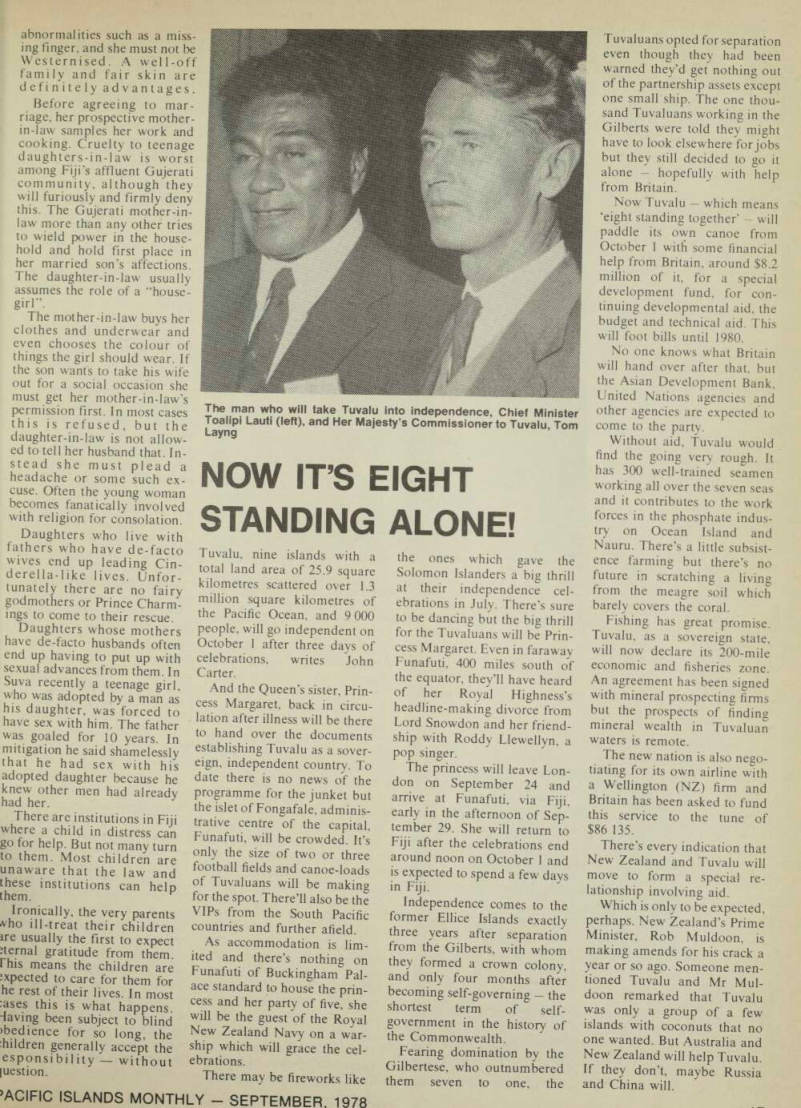
The man who will take Tuvalu into independence, Chief Minister Toalipi Lauti (left), and Her Majesty’s Commissioner to Tuvalu, Tom Layng
Advertisements & other items, p. 17 (1 item)
’Acific Islands Monthly ~ September 1978
17
’ACIFIC ISLANDS MONTHLY SEPTEMBER 1978
Indonesian
Overkill In
Irian Jaya
May to July saw another peak in Indonesian military activity to counter rebel operations in
the republic’s most easterly
province, Irian Jaya. PIM edi tor, Bob Hawkins, who has twice visited the province, once for the ‘Act of Free Choice ’ in 1969, and again in 1971, con siders the implications of recent events.
Money couldn’t buy the pub licity Indonesia’s heavyhan dedness has presented to Irian Jaya’s rebel movement in the past two months. Despite all protestations that dissidents in Indonesia’s most easterly pos session number only 2-300, sledgehammer tactics have left more than just the cynical won dering how big a thorn in Jakarta’s scheme of things are
Irian Jaya’s jungle freedom
fighters.
Bombing sorties by Indo nesian counter-insurgency, US-supplied OVIO Bronco air craft; the burning of villages on both sides of the Irian Jaya- Papua New Guinea border; Irianese refugees fleeing to the sanctuary of PNG’s West Sepik Province; and, belatedly, ex pression of Australian and US concern at Jakarta’s tactics, have brought the cause of the ‘de facto government of West- Papua New Guinea’ back to the headlines in a manner not matched since the ‘Act of Free Choice’ days of 1969.
The latest bout of hostilities in Irian Jaya was sparked in mid-May when rebels, in
advisedly many guerrilla tac
ticians would suggest, ambushed an Indonesian heli copter carrying top military and civilian officials, and kid napped seven of them.
In the weeks that followed, Jakarta flew in hundreds of troops who embarked on a land, sea and air manhunt which brought fear and con fusion to villagers along the northern areas of the PNG
border. Throughout July,
Jacob Prai, president of the ‘De Facto Revolutionary Govern ment of West Papua’ and his men, apparently evaded their pursuers with ease, spiritedly
maintaining their demand for a round table international conference to discuss an
independent ‘West Papua’.
Whatever the fate of Prai and his men, whatever the con sequences a break by Irian Jaya from Indonesia would have for the largest Moslem nation in the world, the aspirations of the movement, as stated by the ‘Foreign Affairs Minister’ in exile of the ‘de facto govern ment of West-Papua New Guinea’, Nicolaas Jouwe, have a strong moral flavour to them, if not, within United Nations
terms, legal.
Jouwe sees his fellow Melanesians of Irian Jaya as much ‘colonised’ as Jomo Kenyatta saw his people in Kenya, as Ho Chi Minh saw his people in Vietnam in his long war against the French. What ever merit the Indonesian stage managed Act of Free Choice may have had in terms of Southeast Asian stability, enough foreign observers came
away from the 1969 Act con vinced that the ‘unanimous’ vote for union with Indonesia did not fairly reflect the wishes of the Irianese people.
My own most vivid memory of the Act was of an Indonesian military man prodding the bared buttocks of a delegate at the Wamena vote with a slen der cane. And then, in Merauke, the merry-makers in the streets of the town, celebrating the ‘unanimous’ vote to join Indonesia, were almost entirely of Malay stock while Irianese looked on, either sullenly or in simple
puzzlement.
In the years since 1969,
Indonesia’s ‘transmigration’
program has had a profound effect on both the population make-up of Irian Jaya and on the ability of the Irianese to partake in their own econ omy.
A sideline development to the Irian Jaya turmoil has been a marked groundswell of sup
port for the rebels from neigh bouring Papua New Guinean letter-writers to the PNG Post- Courier , the national daily.
Letters of sympathy and sometimes anger at the PNG government’s apparent willing ness to go along meekly with Indonesia on the Irian Jaya
question have heavily out
weighed those from readers who feel ‘appeasement’ toward Jakarta is the best line to take.
Irianese hostility toward Jakarta has been apparent since 1962 when former Indonesian President Sukarno wrested control of Dutch West New Guinea, first by the tactic of blackmail by threat of mili tary invasion, and then by agreeing to a demand by United States diplomat Ells worth Bunker that Indonesia should only be given control on the condition that by 1969, at the latest, the people of the province should be allowed to decide by plebiscite with whom their future should lie.
Australia, the United States and the Afro-Asian bloc of the United Nations, refusing to recognise that they were agree ing to the substitution of one form of colonialism for another, went along with the
Bunker plan.
The Irianese rebels, despite the risk they took in the kid
napping episode and the
consequences they and thou sands of uninvolved border dwellers have suffered are now talking more confidently of the possibility of consider able foreign finance to help them pursue their dream.
Nicolaas Jouwe in exile and Jacob Prai in the jungle have no illusions about the future: their struggle will be no easier than that of the many se cessionist movements which ebb and flow across the
Indonesian archipelago.
What they feel in their own minds must be something akin to the determination with which the French underground resisted Nazi domination. They see themselves as the liberators of their conquered nation; as the victims of a people whose destiny was determined for them by alien opinions. The hopelessness of their situation must make the hearts of the Melanesians of the Pacific grieve for them.
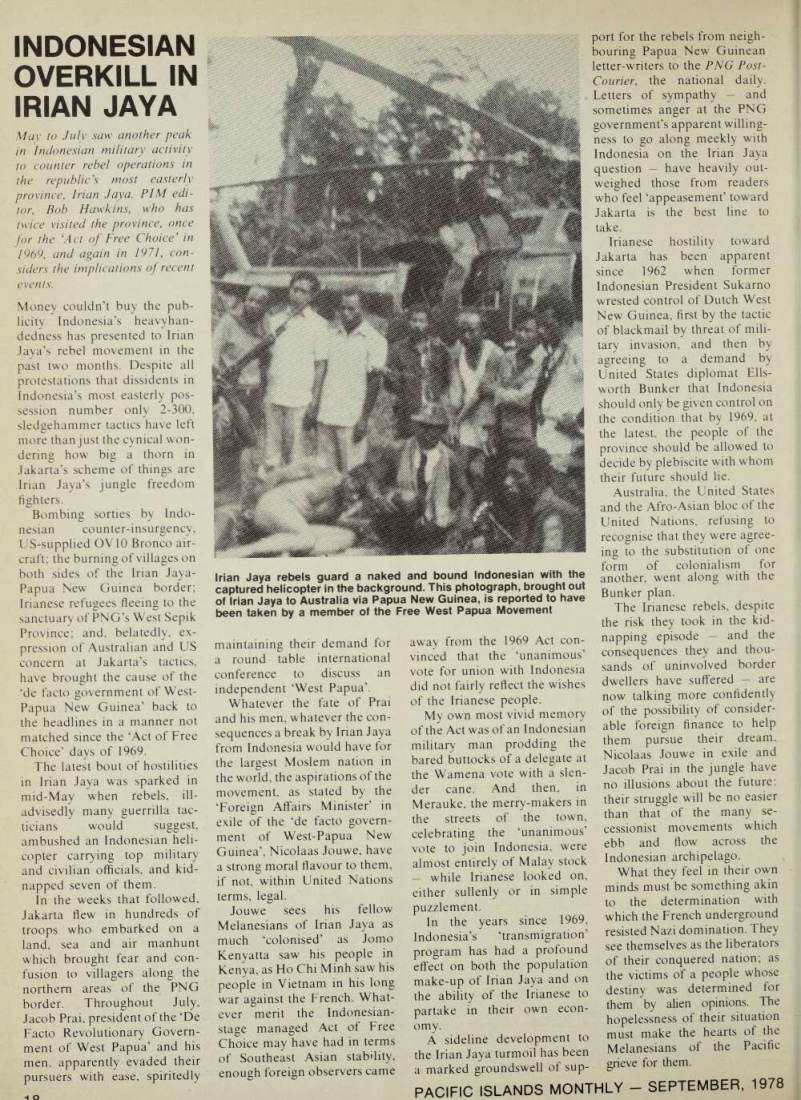
Irian Jaya rebels guard a naked and bound Indonesian with the captured helicopter in the background. This photograph, brought out of Irian Jaya to Australia via Papua New Guinea, is reported to have been taken by a member of the Free West Papua Movement
Political


Currents
Noiseless
N-Tests
France resumed its contro versial nuclear testing at Mururoa Atoll, French Polynesia, in July, but readers of the printed media in Aus tralia would hardly have known. Although the news was featured in some radio reports, the country’s major news papers showed remarkable reticence on the tests, which in the past have caused big head lines and thrown heavy strain on relations between the French and Australian Governments.
A possible clue to this strange reserve on the part of the press lies in the fact that in the same month a visit was made to Australia by the French Delegate-General for Energy, Mr Paul Mentre. His mission was to discuss with Australian authorities the French interest in buying Aus tralian uranium and additional steaming coal, and in supplying mining equipment for Aus tralia’s Northwest Shelf oil and natural gas exploration pro jects.
Mr Doug Anthony, Aus
tralia’s Deputy Prime Minister and Minister for Trade and Re sources, in a statement on Mr Mentre’s visit, said that despite its energy conservation pro gramme France would still be importing 60% of its energy needs by 1985. In the same year France would be producing half of its electricity in nuclear power stations.
Mr Anthony went even closer to the bone when he added: “It is clear that France’s commitment to nuclear power is such that Electricite de France the French electricity authority will be a major and perhaps the single most im portant user of uranium in the world. The indications are that France is looking to buy be-
tween 10% and 15% of her uranium needs from Australia involving something like 1000 tonnes a year in the second half of the 1980 s.” (Canadian and African suppliers are France’s other main sources.) That Mr Anthony’s com plaisant approach to this pros pect is not shared by all Australians was clearly shown by a brief letter from a reader
appearing in a Sydney daily
newspaper. The letter said, in full; “If the federal govern ment is planning to sell uranium to the french, the first condition of sale should be an immediate stop to their nuclear testing in the Pacific regions.”
Solomons’
West Issue
The Moderator of the United Church in Papua New Guinea and Solomon Islands, Bishop Leslie Boseto, has spoken out on the political issues affecting the Western Solomons, writes Peter L. Young from Honiara.
Bishop Boseto is from the Western Solomons. His public standing is such that his name was widely canvassed earlier this year as a candidate for Governor-General of Solomon Islands.
Separatist sentiment in Western Solomons led to incidents during the new nation’s independence cele
brations in July. Two men were taken to hospital and 43 arrested at Gizo, the main town in Western Province, following a brawl in which people from the Western Solomons tried to prevent the raising of the new Solomon Islands flag.
In a long letter to the Solomons government news paper. News Drum, Bishop Boseto called for responsible action and sympathetic con sideration concerning the call for state government by the Western Province. In par ticular. he called for greater communication with the people of the province so that they may understand the issues involved. He urged “unity first, and negotiations second”.
He said that if the Honiara central government proved un
able to accommodate the con cerns of the Westerners then the province might be excused
for considering breaking away
from the Solomons nation. But, he added, “now is not the time”.
In an interview on Papua New Guinea’s National Broad casting Commission, Bishop Boseto also commented on the future relationship between PNG and Solomon Islands, saying; “One of the things I think the two governments should look more closely into is free access between Bougain ville and the Western Solomons because most of the people who are from the Shortlands. Fauro Island and Mono on the Solomon Islands side, and those inside Bougain ville, are related. They belong to the same tribe, some of them, and it will be very im portant for the two govern ments to recognise these ties.”
Speaking to overseas journalists after the indepen dence celebrations in July, Solomon Islands Prime Minis ter Peter Kenilorea gave the impression that Western Prov ince people should have little to fear on this score. Mr Kenilorea said his government had already held talks with the PNG Government about it, and that it was his govern ment’s policy to encourage free travel between groups with tra ditional ties on either side of
Mr Jacques Chirac, Mayor of Paris (in glasses, looking over shoulder) at breakfast in Papeete in July: a man who says bravo lor big bangs, when they are French ones
Prime Minister Kenilorea: Westerners should not worry
the border. This would be the principle on which his govern ment would operate.
Mr Kenilorea also said that health administrators from both sides had been in consul tation on the problem of cer
tain “illegal immigrants” into
PNG malaria-bearing mos quitoes from Western Solomons.
Mothballs
For Diors
The forecast in these columns (PIM July) that France’s new Secretary for Overseas Terri tories, Mr Paul Dijoud, would spring some surprises on New
Caledonians during his July
visit to the territory was amply borne out by events, writes Andre Chaville from Noumea.
Most people had expected the usual cocktail party, a trip to the Isle of Pines and the fare well dinner party at which the Minister would hand over the
badly needed cheque.
In fact, there never was a cocktail party with Rotary, the Lions or any of the other ex
pensive charitable organis
ations favoured by the local
aristocracy. Instead, Mr Dijoud
had a drink with Polynesian
immigrants who were building
their own social and cultural centre. He visited the technical school and sat down to a tray lunch in the cafeteria with students. He even walked
through the Department of
Labour, shook hands with un
employed workers queueing
for jobs, and talked to them about their problems.
Watching all this with
mounting dismay, the sup
porters of Rightwing leaders such as Lafleur put dinner jackets back in their ward robes, while their wives packed away their Dior dresses for a hoped-for “next time”.
Dijoud’s speech to the Terri torial Assembly was a master piece a 90-minute ad lib delivery of the sweetest pack age of home truths members had ever heard, with the Minis ter aided only by a few statistics jotted down on a piece of paper.
He announced that France would plough FF4,GOO million into the Caledonian economy during the next 18 months, pro vided the territory itself made some efforts at improving its own revenues. The money would be spent in such a way as to benefit the under privileged, first of all.
Wealthy businessmen, land holders and miners would not be forgotten, he said. Indeed, they would be expected to make the biggest contribution to territorial revenues. He sug gested that instead of transfer ring their money to discreet overseas investments which weakened the territory’s econ
omy, the wealthy minority
should contribute to the development of the island
itself, creating jobs, and
improving communications.
The motto should be; Courage,
Solidarity, Fraternity, he said.
Dijoud also spoke of the Melanesians, and the difficul ties he encountered in visiting some of the reserves. “These people feel deserted.” he said.
“They are abandoned, ignored,
or forgotten by the central ad ministration in Noumea.”
When rumours began to cir culate of the displeasure of cer tain political leaders at Mr Dijoud’s line of argument, he
responded by visiting the Loy
alty Islands in the company of two representatives of the Union Caledonienne, the party which is promoting Mel anesian emancipation and had
recently stated that indepen
dence was inevitable in the long term. Mr Dijoud point edly observed that when some people speak of independence
they might not necessarily
mean independence from France, but from certain cus toms and traditions. He ex pressed the view that most Melanesians did not want independence, but respect for their traditions and their cus toms, and true equality of rights and opportunities.
Mr Dijoud has not yet solved any problems. But he has declared a radical change in the
policy of the Metropolitan
government which will meet stubborn resistance from the
Rightwing parties, jealous of
their privileges, and the Left
wing parties, whose thunder he has largely stolen.
Insult was added to injury for the Rightwing when, two weeks after the Dijoud visit the specially invited guest of Mr Lafleur, Mr Jacques Chirac, Mayor of Paris, af firmed his unqualified support for Mr Dijoud’s ideas.
Norfolk’S
Clear Vote
Norfolk Island voters have so far been denied a referendum on their future form of govern ment, but the biennial council election in July was almost as good as one, writes Ed Howard.
The six councillors who led an 18-month fight against Aus-
tralia’s proposed take-over of Norfolk were swept back into office. President of Com mittees Bill Blucher, and Cr Duncan Mclntyre, who drew up a draft constitution for a dis tinct territorial government earlier this year, romped back in with 69% and 62% of the
votes respectively. Along with
them went the other four incumbents who had voted to resist any forced integration of the island into Australia, Bruce Mackenzie, Greg Quintal, Geoff Bennett and Lisle Snell.
The two councillors who had abstained from voting on the council’s key “resistance” res olution in April, John Ryves and Roy Smith, were displaced by two first-time candidates, David Buffett and Bryan Nunn. Smith was tenth in the
voting for eight councillors.
Former councillor Ryves tied
for eighth position with Lisle Snell and lost on the tie breaking draw of lots. Can didates who had agitated for Norfolk’s integration into Aus tralia and for the acceptance of Commonwealth social service payments and taxes were thrashed at the polls, none gaining more than 15% of the vote.
New councillor David Buf fett is the top-ranking Pitcairn descendant in the Norfolk Island administration, con ducted by Australia’s Depart ment of Home Affairs. Mr R.
J. Ellicott, the reponsible feder al minister, made a surprise
ruling in May allowing all reg
ular residents employed by the administration to run for office. Three offered for elec tion, but only Buffett won a seat, dispelling an island con cern that administration em ployees and their families would vote as a bloc for fellow public servants.
Bryan Nunn, the other new face on council, is a former Bri tish supermarket mogul who retired to Norfolk seven years ago at the age of 51. He holds a master’s degree in economics from Cambridge, and will give council a level of financial skill it has lacked in the past.
The new council is to be Norfolk’s last, with a Legislat ive Assembly planned to begin making local laws and taking over the Island’s budget in July next year. Council has begun negotiating the details of this future system of government with Mr Ellicott, who an nounced in May that Australia had decided not to take over the island.
Pacific Press:
How Free?
The Fiji Government re
cently used a piece of legis
lation the Press Correction Act for the first time in the 30 years it has been on the country’s statute books.
At the order of the Minister of Information, the Fiji Sun, one of the country’s two daily newspapers, published word for-word a statement in which the government denied a Sun report claiming that there had
Norfolk’s Cr Bill Blucher: almost a referendum
been a meeting between government officials and rep resentatives of a company whose affairs were under
official investigation.
The newspaper had pub lished a previous government denial, as an ordinary news story, a few days earlier. The act compelled it to print another.
In an article in Pacific Islands Communication News letter, Robert Keith-Reid, chief reporter of the Fiji Times, who is now on a Pacific Islands News Association Fulbright Fellowship at the University of Hawaii, describes the incident as “a definite milestone in the
development of journalism in
Fiji”.
He writes: “It is far too early to see the government’s action as the writing on the wall for a free press.
“But it is evidence of grow ing government irritation with the Fiji press and is cause for the country’s journalists to start asking whether this irritation is justified and whether, in the long term, there is any threat to press freedom in the Pacific Islands in general and Fiji in
particular.”
Noting that the Fiji press is probably more free than in any other third-world country, and that journalists there need really consider little more than the confines of British libel law, he adds: “But as they be come more venturesome, they are finding out that, like small town journalism, small country journalism has its
pitfalls.”
He goes on: “In Fiji, a country which has been
independent for eight years,
local journalists are now
becoming used to being told by
indignant politicians and
government officials that it is their ‘duty’ to assist national
development.
“There is a distinct im pression that this means ‘don’t criticise’ or ‘only report what makes us look good’.
“There’s no doubt that many Island politicians are nervous, distrustful and unsure of them selves in dealing with reporters, and have not yet woken up to the realisation that they can use the press in furthering their
own affairs by working up a little coziness with its represen tatives.”
Exceptions to this negative approach to the press cited by Keith-Reid include Fiji’s Prime Minister Ratu Sir Kamisese Mara, Western Samoa’s PM Tupuola Efi, the young leaders of the Gilbert and Solomon Islands, and fig ures like Mahe Tupouniua, director of the South Pacific Bureau for Economic Co
operation.
Keith-Reid concludes: “Island governments seeking to curb or control the press would not have to resort to
naked censorship. Newspapers
could be easily brought to heel by the suggestion, for instance, that there might be difficulty in
importing newsprint; that
government advertisements might stop finding their way to a paper’s columns; that there might not be an immigration work permit coming for that
temporarily but badly needed
overseas journalist. These forms of retaliation have not been used in Fiji yet, but there have been suggestions that they could be ...
“In coming years, Pacific Island journalists, native and
expatriate, without being sub
servient, will have to develop a style of operation that sees all the news, good and bad, gets into print, yet making some al lowances for Pacific Island sen sibilities.
“They will have to learn how to get local leaders to accept criticism coolly and with the re alisation that a free press must often be cruel to be kind.”
Blunt Talk
From Japan
Pointed comments on the
Japan-New Zealand-Australia
relationship have been made
by the leading Japanese daily
newspaper, Asahi Shimbun.
The paper was editorialising on the repairing of Japan’s trade relations with New Zealand, and a recent broad statement made by the Japanese in con junction with Australia and New Zealand.
“Relations between Japan
and New Zealand have not matured as much as relations between Japan and Australia.” the paper said. “This is due in part to the fact that New Zealand, after it lost a stable market when Britain joined the European Economic Com
munity, has only let its living
standards gradually drop and
has not searched out a new way of life.
“Australia established both its position as a member of the Asia-Pacific region and a
mutually complementary re
lationship with Japan. But New Zealand does not have mineral resources like Australia. Also, Japan’s eating habits are basi cally different from those of Britain, and Japan cannot re place Britain as a market for foodstuffs,” it said.
“But despite such difficult
ies, Japan is sincerely searching
for a way to establish a long term situation of mutual dependence between the two countries. As in the case of the Asian countries, constant dia logue is necessary with Aus tralia and New Zealand.”
Australia’s new relationship with Japan was vividly con firmed by the special visit to Australia made in July/August by Japan’s Minister of State for External Economic Affairs. Mr Nobuhio Ushiba. His mission was to report to Australian Prime Minister Malcolm Fraser on the recently concluded summit meeting of the leaders of the United States, the major West European countries, Canada and Japan held in Bonn.
Following his talks with Mr Ushiba, Mr Fraser said; “It is
significant that of all the coun tries at the Bonn summit it is Japan that takes the trouble to come here to discuss it. Going back in the past one might have expected that the UK might have played this role. But it is a sign of 1978 that it was not the UK that saw fit to do this, but the government of
Japan.”
Spy Ring
At Ewc?
Honolulu’s East-West Center would hardly rank as a hotbed of student protest activity, but the month of June saw a student rally, a picket line and a small-scale student invasion of a meeting of the EWC Board of Governors. The issue was al
leged Kuomintang (Taiwan
Government) spying on cam pus, and student demands that the board take strong action to put an end to it. Existence of the KMT spy ring was first de nounced by Chen Yu-hsi, a Taiwanese student.
Following the rally and
picket line, which involved about 100 EWC students, rep resentatives converged on the governors’ meeting to present their protest. The meeting was
hastily adjourned, but by dint
of blocking most entrances to the meeting room demon strators obliged a number of the governers to hear their pro test.
It was eventually agreed that the board would set up an
“information-receiving mech
anism” to hear complaints and advise any victims of their legal
rights.
Honolulu’s East-West Center: “spy ring” charges
Advertisements & other items, pp. 20-26 (3 items)
Colorburst
NOW!
New Kodak
cameras.
At last a camera to capture the fun times instantly with rich and vibrant color by Kodak.
With the Colorburst cameras instant color picture fun has never been so easy indoors or out, with flash or natural light, you just aim, frame, focus and shoot, and the new Colorburst instant camera automatically produces clean, dry prints that develop right before your very eyes. Within minutes you have a superb color picture with beautiful Satinluxe finish from Kodak PR 10 Instant Print Film.
Kodak Colorburst cameras feature: • Adjustable focus control with special ‘zooming circle’, focusing symbols, and distance scale • Electronic shutter 1/3000 sec. to 1/20 sec. • Eyecup on viewfinder • Flash socket • Tripod socket • Automatic motor-driven print ejection • Red low-light signal warns you when to use flash • Lighten/darken print control • Exposure counter • Neckstrap and monograms • Kodak 3 year warranty.
See your photo dealer for a free demonstration. ’Suggested retail price. m °rbur 10A E 9
New Kodak Instant Cameras and Film.
Kodak (Australasia) Pty. Ltd. ‘Kodak’, ‘Colorburst’ and ‘Satinluxe’ are trademarks 345 0091
£ a
Ltd.
GOOD-YEAR
TRACTION HI-MILER HI-MILER G 8
For rugged ‘stop-go’ de-
livery work. Gives long-
er mileage and easier
steering.
Round shoulder tyre
for highway trucks.
Assures extra trac-
tion on all surfaces,
wet and dry.
CUSTOM XTRA
GRIP HI-MILER
To give trucks extra
grip in mud, snow, or
over slippery high-
ways. Built with ex-
clusive 3T processed
cord, triple-tempered
to make the tyre body
extra strong.
SUPER ROAD LUG
Abrasion resistant ex-
tra-thick tread and deep-
grooved, sharp angle lugs
assure positive traction
on all types of road
surfaces.
GlOO
An over-the-road
Cross Rib tyre de-
signed for rear and
drive axle application.
Deep Tracsyn tread
assures maximum
tread life and lowest
cost per kilometer.
a %*
THE RIGHT TYRE FOR EVERY JOB
HIGHWAY - ON/OFF THE ROAD - CROSS COUNTRY GOODYEAR DISTRIBUTORS IN S.E. ASIA AND PACIFIC BASIN Richard Pieris & Co.. Ltd.
Colombo, Sri Lanka Nepal Motor Company (P) Ltd.
Biratnagar, Nepal Havana Ltd.
Dacca. Bangladesh Diethelm & Co„ Ltd.
Bangkok, Thailand Landis Brothers & Co.. Ltd.
Hong Kong Guam Tire & Supply Co.
Agana, Guam Susupe Enterprises Saipan. Manana Is.
Microl Corporation Saipan, Manana Is.
Truk Trading Co.
Truk E., Caroline Is.
P.A.M.I.
Kolonia. Ponape Island Transport Service Co.
Majuro. Marshall Is.
Yap Cooperative Ass.
Yap. W Caroline Is.
Cook Islands Motor Centre Ltd.
Rarotonga. Cook Is.
Ngiratkel Etplson Co., Ltd.
Koror, Palau Boroko Motors Ltd.
Port Moresby. Papua New Guinea Solomon Motors Ltd.
Honiara. Solomon Is Santo Engineers Santo. New Hebrides Pacific Motors Vila. New Hebndes Duncombe Bay Garage Norfolk Is.
Coral Island Motors Suva, Fiji Morris Hedstrom Ltd.
Nukualofa, Tonga Morris Hedstrom Ltd.
Apia, Western Samoa Western Samoa Transport Cooperative Society Ltd.
Apia, Western Samoa Samoa Motors Inc.
Pago Pago. American Samoa Service Mobil Papeete. Tahiti
GOODYEAR SUBSIDIARIES
The Goodyear Tyre & Rubber Co (Aust) Ltd.
Sydney. AUSTRALIA Tel; 31-0311 Goodyear India Limited New Delhi 1. INDIA Tel; 46886/9 PT Goodyear Indonesia Bogor, Republic of Indonesia Tel; 3371/2 Nippon Goodyear KabushiVl Kalsha Tokyo.. JAPAN Tel: 582-0481/8 Goodyear Malaysia Berhad Selangor. MALAYSIA Tel: 362501/5 The Goodyear Tyre & Rubber Co. of New Zealand, Limited Lower Hutt, NEW ZEALAND Tel: 684-389 The Goodyear Tyre & Rubber Company of the Philippines, Limited Makati-Metro Manila.
Repubic of the Philippines Tel: 89-20-41 Geylang SINGAPORE 14 Tel: 408281/3 Goodyear Taiwan Limited Taipei. TAIWAN Tel: 5117135/8 Goodyear (Thailand) Limited Bangkok. THAILAND Tel: 252-6141/5
FOR FURTHER INFORMATION,
PLEASE CONTACT
Goodyear International Corporation ' Room 1603. Wing On Center. 1 11 Connaught Road Central
HONG KONG Tel: 5 433331
HRME 171*0205
~A J^S^S
Discover the grace of old Spain
in the Philippines.
Sense it first
on Philippine Airlines.
The subtle blend of Spain and Asia is our heritage, in delightful harmony with the 20th century Four centuries of Spanish culture lends a very special beauty to The Philippines.
Like the special smile found only on Philippine Airlines.
Where our flight attendants hospitality is a 1,000 year-old Philippine tradition. /a
AMSTERDAM
Cr( On Philippine Airlines’ wide-bodied jets, you 11 get centuries-old charm, the latest movies, the tastiest international menus.
Flights depart for Manila each Friday from Port Moresby. Also three times each
.ROME
.TOKYO jan Francisco wee k f rom Sydney; Monday, Thursday or KAR hong Friday, or twice each week from Melbourne; t Manila. Monday or Friday
IMPORT MORESBY J
'“''KUALA LUMPUR*
SINGAPORE
JAKARTA <^i SYpNE y
,* MELBOURNE
So when you’re flying to Europe or the Orient, fly to The Philippines first.
lilippine Airlin
Welcome aboard the Philippines.
Fly the world's largest fleet...
Pan Am 747'5.
747 AM v" 747
F¥W/WI
AO
RAN /MVt
747 9K 747 747 AM
RAIVAM
747 If you're like us, you know a great thing when you see it.
Wide-bodied 747's are the fastest and most comfortable passenger planes available. And we fly nonstop to more U.S. cities than any other airline in the world including record-setting long range flights. No other airline can match our daily nonstop round trips between Tokyo and New York. We fly the world's longest commercial nonstops from Sydney to San Francisco. Building an entire fleet of 747's just made
good sense.
Our inflight service crews try very hard to meet your every need in the warmest, most personal
manner possible. Wide, spacious
cabins give you living room comfort as the world slips by.
Our 7475 P "Super Performer"
has lower fuel consumption, higher flying altitudes and faster speeds, making even the longest trip a little shorter. Pan Am's 7475 P is Experience in tangible form.
You'll find Upper Deck Dining in the First Class lounge at the top of the spiral staircase. Enjoy a gourmet experience from a choice of four select entrees.
No matter where you fly m the world, you're always at home with Pan Am. We assembled the largest fleet of Pan Am 747's just for you.
Experience makes the difference. 065.P.285
P A ICI r' IC I AMPv O KAf\ K IT 111 \/ r~ tr— 1 1 » ■—v j
POLITICAL CURRENTS
24
PAriPir i.Qi ANin.9 MONTHLY SEPTEMBER. 1978
history
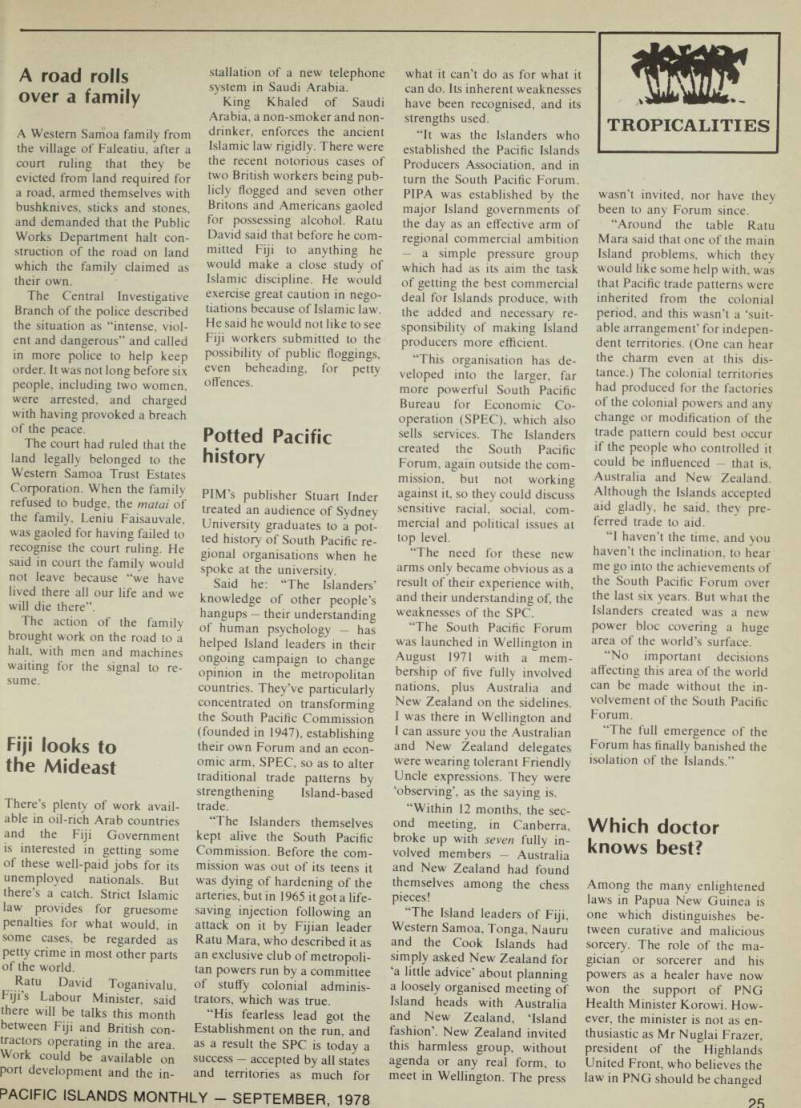
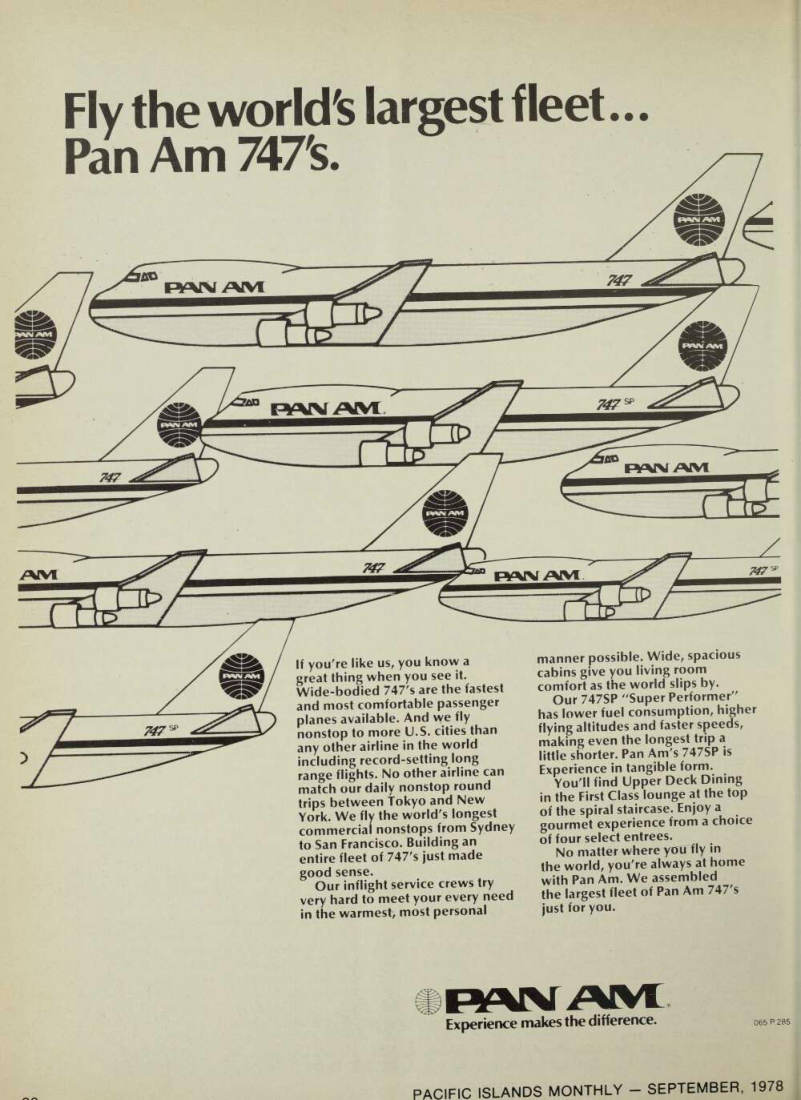
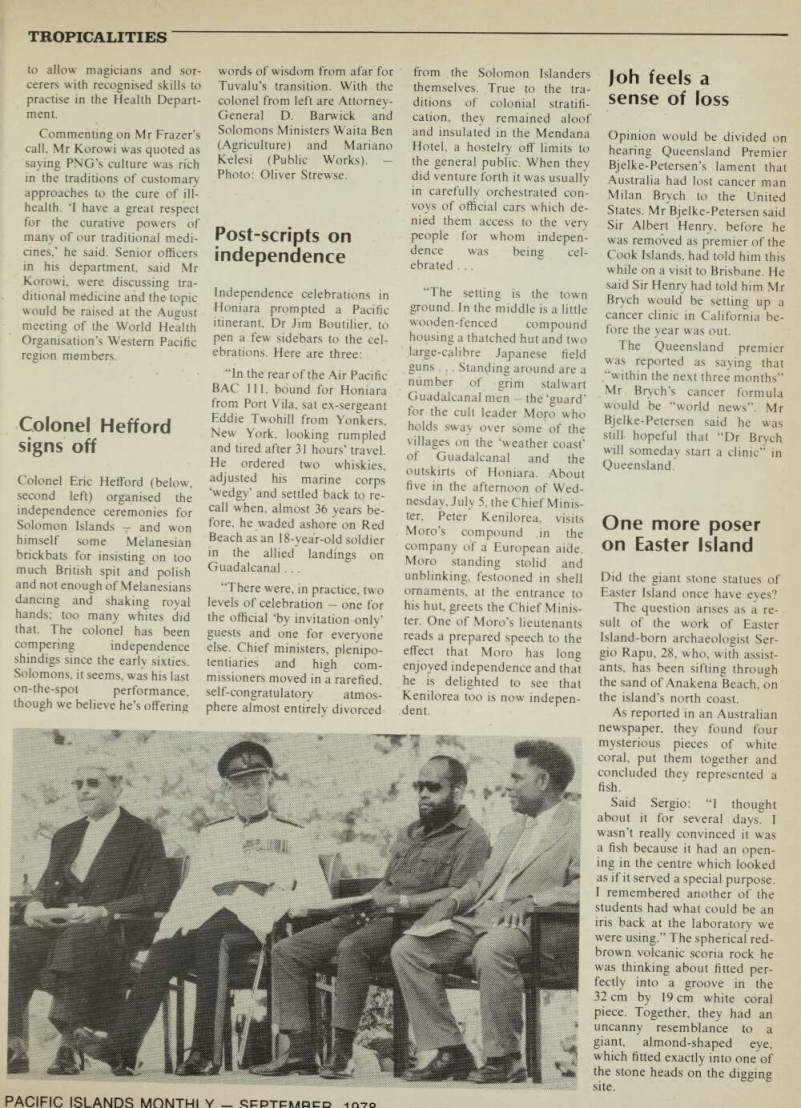
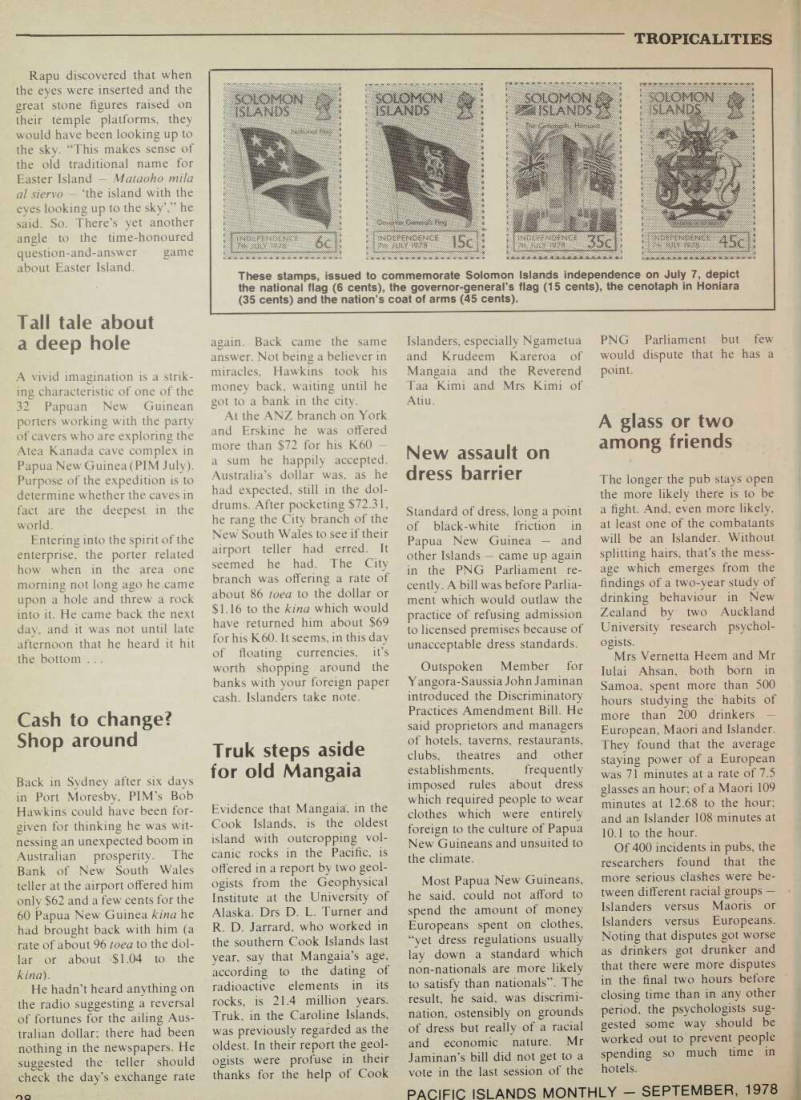
Tropicalities
A road rolls
over a family A Western Samoa family from the village of Faleatiu, after a court ruling that they be evicted from land required for a road, armed themselves with bushknives, sticks and stones, and demanded that the Public Works Department halt con struction of the road on land which the family claimed as their own.
The Central Investigative Branch of the police described the situation as “intense, viol ent and dangerous” and called in more police to help keep order. It was not long before six
people, including two women,
were arrested, and charged with having provoked a breach of the peace.
The court had ruled that the land legally belonged to the Western Samoa Trust Estates
Corporation. When the family
refused to budge, the matai of the family, Leniu Faisauvale, was gaoled for having failed to recognise the court ruling. He said in court the family would not leave because “we have lived there all our life and we will die there”.
The action of the family brought work on the road to a halt, with men and machines waiting for the signal to re sume.
Fiji looks to
the Mideast
There’s plenty of work avail able in oil-rich Arab countries and the Fiji Government is interested in getting some of these well-paid jobs for its unemployed nationals. But there’s a catch. Strict Islamic law provides for gruesome penalties for what would, in some cases, be regarded as petty crime in most other parts of the world.
Ratu David Toganivalu, Fiji s Labour Minister, said there will be talks this month between Fiji and British con tractors operating in the area.
Work could be available on port development and the in
stallation of a new telephone system in Saudi Arabia.
King Khaled of Saudi Arabia, a non-smoker and non drinker, enforces the ancient Islamic law rigidly. There were the recent notorious cases of two British workers being pub licly flogged and seven other Britons and Americans gaoled for possessing alcohol. Ratu David said that before he com mitted Fiji to anything he would make a close study of Islamic discipline. He would exercise great caution in nego tiations because of Islamic law.
He said he would not like to see Fiji workers submitted to the
possibility of public floggings,
even beheading, for petty offences.
Potted Pacific
history
PlM’s publisher Stuart Inder treated an audience of Sydney University graduates to a pot ted history of South Pacific re gional organisations when he
spoke at the university.
Said he: “The Islanders’ knowledge of other people’s
hangups their understanding
of human psychology has helped Island leaders in their
ongoing campaign to change
opinion in the metropolitan
countries. They’ve particularly
concentrated on transforming the South Pacific Commission (founded in 1947), establishing their own Forum and an econ omic arm, SPEC, so as to alter traditional trade patterns by
strengthening Island-based
trade.
“The Islanders themselves kept alive the South Pacific Commission. Before the com mission was out of its teens it was dying of hardening of the arteries, but in 1965 it got a life
saving injection following an
attack on it by Fijian leader Ratu Mara, who described it as an exclusive club of metropoli tan powers run by a committee of stuffy colonial adminis trators, which was true.
“His fearless lead got the Establishment on the run, and as a result the SPC is today a success accepted by all states
what it can’t do as for what it can do. Its inherent weaknesses have been recognised, and its
strengths used.
“It was the Islanders who established the Pacific Islands Producers Association, and in turn the South Pacific Forum.
PIPA was established by the major Island governments of the day as an effective arm of regional commercial ambition a simple pressure group which had as its aim the task of getting the best commercial deal for Islands produce, with the added and necessary re
sponsibility of making Island
producers more efficient.
“This organisation has de veloped into the larger, far more powerful South Pacific Bureau for Economic Co operation (SPEC), which also sells services. The Islanders created the South Pacific Forum, again outside the com mission, but not working against it, so they could discuss sensitive racial, social, com mercial and political issues at top level.
“The need for these new arms only became obvious as a result of their experience with, and their understanding of, the weaknesses of the SPC.
“The South Pacific Forum was launched in Wellington in August 1971 with a mem bership of five fully involved nations, plus Australia and New Zealand on the sidelines.
I was there in Wellington and I can assure you the Australian and New Zealand delegates
were wearing tolerant Friendly
Uncle expressions. They were
‘observing’, as the saying is.
“Within 12 months, the sec ond meeting, in Canberra, broke up with seven fully in volved members Australia and New Zealand had found themselves among the chess
pieces!
“The Island leaders of Fiji, Western Samoa, Tonga, Nauru and the Cook Islands had simply asked New Zealand for ‘a little advice’ about planning a loosely organised meeting of Island heads with Australia and New Zealand, ‘lsland fashion’. New Zealand invited this harmless group, without agenda or any real form, to meet in Wellington. The press
wasn’t invited, nor have they been to any Forum since.
“Around the table Ratu Mara said that one of the main
Island problems, which they
would like some help with, was that Pacific trade patterns were inherited from the colonial period, and this wasn’t a ‘suit able arrangement’ for indepen dent territories. (One can hear the charm even at this dis tance.) The colonial territories had produced for the factories of the colonial powers and any change or modification of the trade pattern could best occur if the people who controlled it could be influenced that is, Australia and New Zealand.
Although the Islands accepted aid gladly, he said, they pre ferred trade to aid.
“I haven’t the time, and you haven’t the inclination, to hear me go into the achievements of the South Pacific Forum over the last six years. But what the Islanders created was a new power bloc covering a huge area of the world’s surface.
“No important decisions affecting this area of the world can be made without the in volvement of the South Pacific Forum.
“The full emergence of the Forum has finally banished the isolation of the Islands.’’
Which doctor
knows best?
Among the many enlightened
laws in Papua New Guinea is one which distinguishes be tween curative and malicious sorcery. The role of the ma gician or sorcerer and his powers as a healer have now won the support of PNG Health Minister Korowi. How ever, the minister is not as en thusiastic as Mr Nuglai Frazer, president of the Highlands United Front, who believes the law in PNG should be changed
to allow magicians and sor cerers with recognised skills to practise in the Health Depart ment.
Commenting on Mr Frazer’s call, Mr Korowi was quoted as saying PNG’s culture was rich in the traditions of customary approaches to the cure of ill health. ‘I have a great respect for the curative powers of many of our traditional medi cines,’ he said. Senior officers in his department, said Mr Korowi, were discussing tra ditional medicine and the topic would be raised at the August meeting of the World Health Organisation’s Western Pacific
region members.
Colonel Hefford
signs off
Colonel Eric Hefford (below, second left) organised the independence ceremonies for Solomon Islands and won himself some Melanesian brickbats for insisting on too much British spit and polish and not enough of Melanesians
dancing and shaking royal
hands; too many whites did that. The colonel has been
compering independence
shindigs since the early sixties.
Solomons, it seems, was his last
on-the-spot performance,
though we believe he’s offering
words of wisdom from afar for Tuvalu’s transition. With the colonel from left are Attorney- General D. Barwick and Solomons Ministers Waita Ben (Agriculture) and Mariano Kelesi (Public Works).
Photo: Oliver Strewse.
Post-scripts on
independence
Independence celebrations in Honiara prompted a Pacific itinerant. Dr Jim Boutilier, to pen a few sidebars to the cel ebrations. Here are three: “In the rear of the Air Pacific BAC 111, bound for Honiara from Port Vila, sat ex-sergeant Eddie Twohill from Yonkers, New York, looking rumpled and tired after 31 hours’ travel.
He ordered two whiskies, adjusted his marine corps ‘wedgy’ and settled back to re call when, almost 36 years be fore. he waded ashore on Red Beach as an 18-yea‘r-old soldier in the allied landings on Guadalcanal...
“There were, in practice, two levels of celebration one for the official ‘by invitation only’ guests and one for everyone else. Chief ministers, plenipo tentiaries and high com missioners moved in a rarefied,
self-congratulatory atmos
phere almost entirely divorced
from the Solomon Islanders themselves. True to the tra ditions of colonial stratifi cation, they remained aloof and insulated in the Mendana Hotel, a hostelry off limits to the general public. When they did venture forth it was usually in carefully orchestrated con voys of official cars which de nied them access to the very people for whom indepen dence was being cel ebrated . . .
“The setting is the town ground. In the middle is a little wooden-fenced compound housing a thatched hut and two
large-calibre Japanese field
guns . . . Standing around are a number of grim stalwart Guadalcanal men - the ‘guard’ for the cult leader Moro who holds sway over some of the villages on the ‘weather coast’ of Guadalcanal and the outskirts of Honiara. About five in the afternoon of Wed nesday, July 5. the Chief Minis ter, Peter Kenilorea, visits Moro’s compound in the company of a European aide.
Moro standing stolid and unblinking, festooned in shell ornaments, at the entrance to his hut, greets the Chief Minis ter. One of Moro’s lieutenants reads a prepared speech to the effect that Moro has long
enjoyed independence and that
he is delighted to see that Kenilorea too is now indepen dent.
Joh feels a
sense of loss
Opinion would be divided on hearing Queensland Premier Bjelke-Petersen’s lament that Australia had lost cancer man Milan Brych to the United States. Mr Bjelke-Petersen said Sir Albert Henry, before he was removed as premier of the Cook Islands, had told him this while on a visit to Brisbane. He said Sir Henry had told him Mr Brych would be setting up a cancer clinic in California be fore the year was out.
The Queensland premier was reported as saying that “within the next three months”
Mr Brych’s cancer formula would be “world news”. Mr Bjelke-Petersen said he was still hopeful that “Dr Brych will someday start a clinic” in Queensland.
One more poser
on Easter Island
Did the giant stone statues of Easter Island once have eyes?
The question arises as a re sult of the work of Easter Island-bom archaeologist Ser gio Rapu, 28, who, with assist ants, has been sifting through the sand of Anakena Beach, on the island’s north coast.
As reported in an Australian newspaper, they found four mysterious pieces of white coral, put them together and concluded they represented a fish.
Said Sergio: “I thought
about it for several days. I wasn’t really convinced it was a fish because it had an open ing in the centre which looked as if it served a special purpose.
I remembered another of the students had what could be an iris back at the laboratory we were using.” The spherical red brown volcanic scoria rock he was thinking about fitted per fectly into a groove in the 32 cm by 19 cm white coral
piece. Together, they had an
uncanny resemblance to a
giant, almond-shaped eye,
which fitted exactly into one of the stone heads on the digging site.
Rapu discovered that when the eyes were inserted and the great stone figures raised on
their temple platforms, they
would have been looking up to the sky. “This makes sense of the old traditional name for Easter Island Mataoho mila al siervo ‘the island with the eyes looking up to the sky’,” he said. So. There’s yet another angle to the time-honoured
question-and-answer game
about Easter Island.
Tall tale about
a deep hole
A vivid imagination is a strik ing characteristic of one of the 32 Papuan New Guinean porters working with the party of cavers who are exploring the Atea Kanada cave complex in Papua New' Guinea (PIM July).
Purpose of the expedition is to determine whether the caves in fact are the deepest in the world.
Entering into the spirit of the enterprise, the porter related how when in the area one morning not long ago he came upon a hole and threw a rock into it. He came back the next day, and it was not until late afternoon that he heard it hit the bottom ...
Cash to change?
Shop around
Back in Sydney after six days in Port Moresby, PI M’s Bob Hawkins could have been for given for thinking he was wit nessing an unexpected boom in Australian prosperity. The Bank of New South Wales teller at the airport offered him only $62 and a few cents for the 60 Papua New Guinea kina he had brought back with him (a rate of about 96 toea to the dol lar or about $1.04 to the kina).
He hadn’t heard anything on the radio suggesting a reversal of fortunes for the ailing Aus tralian dollar; there had been nothing in the newspapers. He suggested the teller should check the day’s exchange rate
again. Back came the same answer. Not being a believer in miracles, Hawkins took his money back, waiting until he got to a bank in the city.
At the ANZ branch on York and Erskine he was offered more than $72 for his K6O a sum he happily accepted.
Australia’s dollar was, as he had expected, still in the dol drums. After pocketing $72.31, he rang the City branch of the New South Wales to see if their airport teller had erred. It seemed he had. The City branch was offering a rate of about 86 toea to the dollar or $1.16 to the kina which would have returned him about $69 for his K6O. It seems, in this day of floating currencies, it’s worth shopping around the banks with your foreign paper cash. Islanders take note.
Truk steps aside
for old Mangaia
Evidence that Mangaia, in the Cook Islands, is the oldest island with outcropping vol canic rocks in the Pacific, is offered in a report by two geol
ogists from the Geophysical
Institute at the University of Alaska. Drs D. L. Turner and R. D. Jarrard, who worked in the southern Cook Islands last year, say that Mangaia’s age, according to the dating of radioactive elements in its rocks, is 21.4 million years.
Truk, in the Caroline Islands, was previously regarded as the oldest. In their report the geol ogists were profuse in their thanks for the help of Cook
Islanders, especially Ngametua
and Krudeem Kareroa of Mangaia and the Reverend Taa Kimi and Mrs Kimi of Atiu.
New assault on
dress barrier
Standard of dress, long a point of black-white friction in Papua New Guinea and other Islands came up again in the PNG Parliament re cently. A bill was before Parlia ment which would outlaw the
practice of refusing admission
to licensed premises because of unacceptable dress standards.
Outspoken Member for Y angora-Saussia John Jaminan introduced the Discriminatory Practices Amendment Bill. He said proprietors and managers of hotels, taverns, restaurants, clubs, theatres and other
establishments, frequently
imposed rules about dress which required people to wear clothes which were entirely foreign to the culture of Papua New Guineans and unsuited to the climate.
Most Papua New Guineans, he said, could not afford to spend the amount of money Europeans spent on clothes,
“yet dress regulations usually
lay down a standard which non-nationals are more likely to satisfy than nationals”. The result, he said, was discrimi
nation, ostensibly on grounds
of dress but really of a racial and economic nature. Mr Jaminan’s bill did not get to a vote in the last session of the
PNG Parliament but few would dispute that he has a
point.
A glass or two
among friends
The longer the pub stays open the more likely there is to be a fight. And, even more likely, at least one of the combatants will be an Islander. Without splitting hairs, that’s the mess age which emerges from the findings of a two-year study of drinking behaviour in New Zealand by two Auckland
University research psychol
ogists.
Mrs Vernetta Heem and Mr lulai Ahsan, both born in Samoa, spent more than 500 hours studying the habits of more than 200 drinkers European, Maori and Islander.
They found that the average staying power of a European was 71 minutes at a rate of 7.5 glasses an hour; of a Maori 109 minutes at 12.68 to the hour; and an Islander 108 minutes at 10.1 to the hour.
Of 400 incidents in pubs, the researchers found that the more serious clashes were be tween different racial groups Islanders versus Maoris or Islanders versus Europeans.
Noting that disputes got worse as drinkers got drunker and that there were more disputes in the final two hours before closing time than in any other
period, the psychologists sug
gested some way should be worked out to prevent people spending so much time in hotels.
These stamps, issued to commemorate Solomon Islands independence on July 7, depict the national flag (6 cents), the governor-general’s flag (15 cents), the cenotaph in Honiara (35 cents) and the nation’s coat of arms (45 cents).
Advertisements & other items, pp. 25-27 (2 items)
25
ACIFIC ISLANDS MONTHLY SEPTEMBER, 1978
PACIFIC ISLANDS MONTH! Y _ spptcmocd m-70
PACIFIC ISLANDS MONTH! Y spptcmocd m-70
TROPICALITIES
Pacific
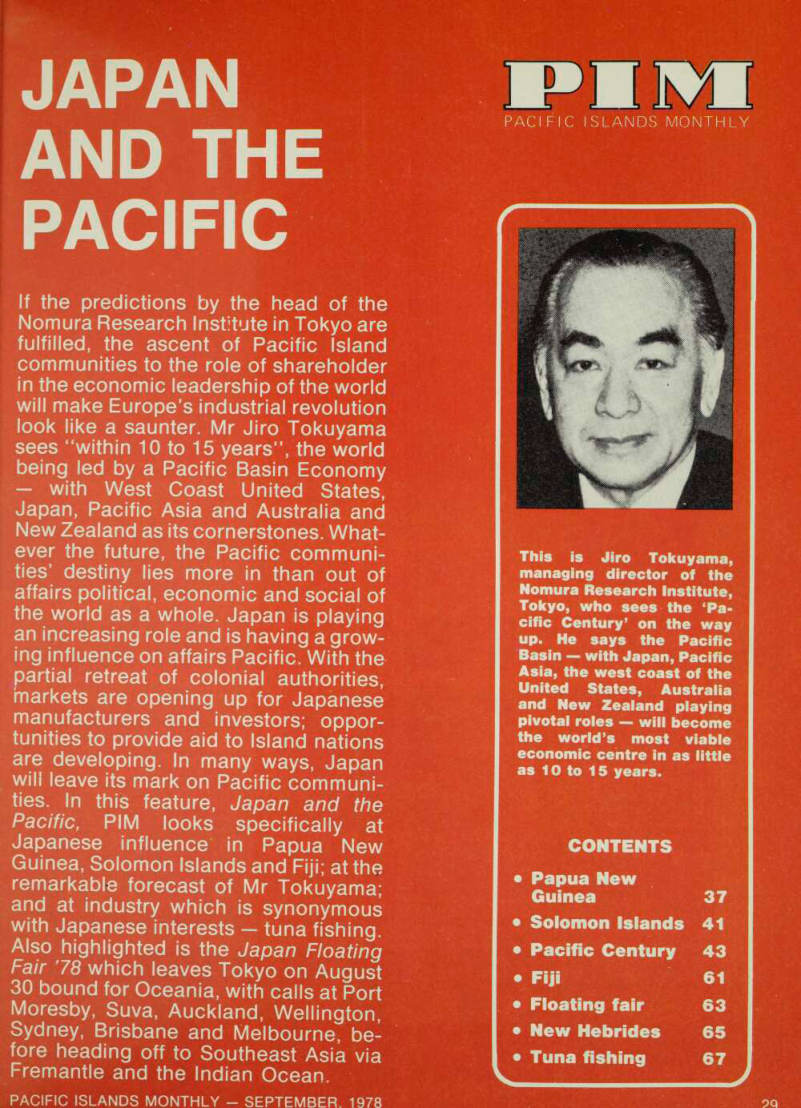
Pim
Pacific Islands Monthly
Japan
And The
Pacific
If the predictions by the head of the Nomura Research Institute in Tokyo are fulfilled, the ascent of Pacific Island communities to the role of shareholder in the economic leadership of the world will make Europe’s industrial revolution look like a saunter. Mr Jiro Tokuyama sees “within 10 to 15 years”, the world being led by a Pacific Basin Economy — with West Coast United States, Japan, Pacific Asia and Australia and New Zealand as its cornerstones. What ever the future, the Pacific communi ties’ destiny lies more in than out of affairs political, economic and social of the world as a whole. Japan is playing an increasing role and is having a grow ing influence on affairs Pacific. With the partial retreat of colonial authorities, markets are opening up for Japanese manufacturers and investors; oppor tunities to provide aid to Island nations are developing. In many ways, Japan will leave its mark on Pacific communi ties. In this feature, Japan and the Pacific, PIM looks specifically at Japanese influence in Papua New Guinea, Solomon Islands and Fiji; at the remarkable forecast of Mr Tokuyama; and at industry which is synonymous with Japanese interests — tuna fishing.
Also highlighted is the Japan Floating Fair ’78 which leaves Tokyo on August 30 bound for Oceania, with calls at Port Moresby, Suva, Auckland, Wellington, Sydney, Brisbane and Melbourne, be fore heading off to Southeast Asia via Fremantle and the Indian Ocean.
Contents
This is Jiro Tokuyama, managing director of the Nomura Research Institute, Tokyo, who sees the ‘Pa cific Century’ on the way up. He says the Pacific Basin — with Japan, Pacific Asia, the west coast of the United States, Australia and New Zealand playing pivotal roles — will become the world’s most viable economic centre in as little as 10 to 15 years.
• Papua New Guinea 37 • Solomon Islands 41 • Pacific Century 43 • Fiji 61 • Floating fair 63 • New Hebrides 65 • Tuna fishing 67
Advertisements & other items, pp. 29-36 (2 items)
29
dfsdfd
Cid Pioneer
Now, the other 3/4 of the world can be covered with great stereo music On the land or on the sea you will never be far away from great stereo music with Pioneer’s new stereo radio cassette recorder. The 3-way power source lets you use internal batteries, house current or your car’s power supply (with adaptor).
Pioneer created to sound as great as it looks, the SK-1 delivers a hefty 3,000mW (Music Power). More than enough to handle the “heavy” sounds, yet designed compact for those who like to travel light.
Radio fans will have a ball with 2 shortwave bands, plus MW and FM. Naturally, the tuner section uses advanced Pioneer Integrated Circuitry for stable reception even in out-of-theway places.
Of course, the cassette recorder is what you would expect from Pioneer. A wide-range Permalloy record/playback head, pause, cue and review functions. Variable Monitor switch, Loudness Contour switch and fully-automatic Stop. And for easy recording, left and rightchannel microphones. Or plug in a turntable and build an entire stereo system around the SK-1.
And on the output side, a pair of 12cm (4% inch) hi-fi speakers. Perfectly balanced for exciting stereo reproduction.
Pioneer’s new SK-1 stereo radio cassette recorder. Component-like performance plus the go-anywhere convenience of portability. And, for those who want big Pioneer performance on a smaller budget, we’re pleased to offer the RK-305 and RK-355. They’re not stereo, but they are Pioneer. And that means a lot, no matter where your music takes you.
Portable hi-fi... from the audio company.
CiD PIONEER
Australia Pioneer Electronics Australia Pty.Ltd., 178-184 Boundary Road, Braeside, Victoria 3195, Tel: 90-9011, Sydney 93-0246, Brisbane 59-7457, Adelaide 433379, Perth 24-9899 FIJI Islands Brijlal & Company, G.P.O. Box New Zealand Fountain Marketing Ltd., Maidstone Street, Auckland, New Zealand Tel: 763-064 Norfolk Island Burns Philp (Norfolk Island) Ltd., Norfolk Island, South Pacific New Hebrides Burns Philp (New Hebrides) Ltd., Nauru Island Jacob Enterprises, P.O. Box No. 4 Republic of Nauru Tahiti Est. PERFECT. B.P. 594. Papeete, Tahiti Tel: 20 407 New Caledonia Menard Freres Ville, B.P. H 2 Cedex, Noumea.
American Samoa Traspac Corporation. P.O. Box 1477, Pago Pago, American Samoa 96799 Tel: 633-5224 Rarotonga South Seas International Ltd., P.O. Box 49, Rarotonga Cook Islands Tel: 2327 Papua New Guinea Bali Merchants Pty. Ltd., □ n Qnrrtkn Tol*
It’s
the crews that make the cruise fun.
The nice thing about cruising is that the destination isn’t really important. For all it matters, you can be following the sun, since getting there is half the fun and the crew’s the other half.
Cruising has few peers when it comes to sheer relaxation. Whether it’s a week’s voyage along a coastal waterway or a day long jaunt around an inland lake, the mix of sun, speed and sense of adventure is a sure cure for your everyday worries. It’s also one of today’s fastest growing sports. Almost anywhere you find water, you’ll find yacht clubs and marinas full of people who share the same interests and who like to share their good times with fellow enthusiasts.
To make your outings as carefree as possible, you want to make sure you have full confidence in your boat and motor.
Nothing can spoil a cruise faster than engine trouble or less than peak performance. So make sure you choose your engine as carefully as you do your crew.
One good place to make that choice is at your nearby Yamaha dealership. He has a line of outboards which are almost legen-
dary for reliability, smooth performance and
advanced engineering details. Plus the knowledge to help you choose just the right engine for your boat and your kind of
boating.
Sophisticated features such as capacitor discharge ignition, aluminum cylinders, fuel recirculation systems and Dual Thrust Exhaust are standard on many models. And there’s a power rating for everything from dinghies to cabin cruisers with a range of options that will stretch your imagination
without stretching your budget.
Yamaha outboards. Since most of the world is water.
From 2 to 60.
Power for
any purpose.
YAMAHA
YAMAHA
28 1 25/20 T *
Outboard
with
YAMAHA
YAMAHA MOTOR CO.. LTD.
2500 SHINGAI IWATASHI SHIZUOKA.KEN JAPAN
»o much about the elegant Honda Accord* is unexpected.
'he compact styling hides a spacious passenger area. Everyone eated in the well-appointed, quiet interior enjoys kilometer fter relaxing kilometer. A versatile, full-width hatchback makes ruling extra luggage easy. he economical 1,600 cc (80hp DIN) OHC engine pours out nappy acceleration. Superb reliability, a sporty 5-speed floor hift or optional Hondamatic* rack-and-pinion steering, 4-wheel "dependent suspension and numerous safety features create mooth riding comfort and satisfying performance. As expected, le Honda Accord has been selected “Car of the Year” by najor U.S., Australian and Japanese automotive magazines. )rive the value leader. Honda Accord.
Honda Accord
The biggest value
on the road today
i: v o m rV ■ ’‘ ; : ; : ' - ■ ■ - , .
A MOTOR CO., LTD. TOKYO, JAPAN
rd and Hondamatic are Honda trademarks PAPUA NEW GUINEA: S.eamxhlps-Machinerv PO Box 1. Poo Soclo.o Papeete /FIJI ISLANDS: Coral Island Motors PO. Box 48, Suva / U.S. TRUST United SAMOA: Samoan Holiday and Trave Mariana Islands 96950/COOK ISLANDS: Cook Islands Motor Center Ltd. PO. Box 74, • /GUAM: Mark’s Motor Co.. Inc. PO Bo Center PO. Box 968, Pago Pago /AMERICAN SAMOA: Ha f t Y p O C RoxS76 ADa /SOLOMON British Solomons Trading Co.. Ltd. PO Bo is Sa»sstt£"Sl nd. PO Bex .39. Pori Villi
From conquering new peaks fro sailing windy seas, there’s a rugged companion for your adventurous life:
Seiko Quartz
SPORTS 100
«4J» \ v ■s. * 7* Designed for today's men of action by the world leader in quartz technology. Sailing, swimming or mountain climbing, these watches are rugged enough to meet their active lifestyles, handsome enough to reflect their good taste, accurate enough to meet their high standards.
Every Seiko Quartz SPORTS 100 is water-tested 100 meters, and so efficiently designed that it can run five years on a single ordinary battery. All are shock resistant and feature day/date calendars.
Hard lex scratch-protected crystal, stainless steel cases and bracelets. Seiko Quartz.
SEIKO
V ' 1 •
WED 2
SO oc P—-4
SEIKO
Someday all watches will be made this way.
se could present such an
rra
'ho else but the hi-fi specialist
you of outstanding and reliable
for every model on this page!
V. 700 xm *£33o
m £JSO
m
•SUJP
■* I mm -1m 1 : 5
SANSUI ELECTRIC CO., LTD.
l4-1 Izumi 2-chome, Suginami-ku, Tokyo 168, Japan • Australia VANFi (Aust.) Pty. Ltd. 162, Albert Road, South Melbourne, Victoria 3205 Australia Phone: 699-5473/Suite 5, Uniline House, 5 Northcliff Street. Milson Point, N.S.W. 1 . . . . . r-k HOO Dhnno- 701 Q.'llA ohch A notrolio Dhnno* Q9Q-fl9Q!^
Sansul means sound that's clean and ereo ven tt crisp. a Here is proof that Sansui is dedicated to Sansui all the way mr ©Q Q 1 S-< i Cl m ' A I ft V s \m\ *» w \ \ K vs \\\ \N\ I MU t
Sli ♦
,>■ JO* lipi: r . sa Sansui.
Only hi-fi, everything hi-fi
Ltd S C p a O W T O x G 2Mn a A, Ce u" i „ a H ln , de pl Agen .‘; y o (P ' N 'i' ) P,y - Ud ' Box 5518 ’ Boroko ' Port Moresb y Phone: PM 256406#David Reid Electronic
Only Pioneer could call its
lowest priced cassette deck
"high performance’.’
INPUT
C 60 ©TDK
SA
EI-FSII
POWER
tape deck pioiveen
DO. 0V SYSTEM
CT-F5OO
Our new CT-F5OO stereo cassette deck is not the best model we make.
It’s not our second best, either. But, even coming from the bottom of our line, Pioneer’s CT-F5OO offers some of the same features that are found on our more costlier models. So, whether you’re starting from scratch or as an addition to your present stereo system, the CT-F5OO is perfect as the basic stereo cassette deck.
Basically outstanding in tonal quality and basically designed for mechanical precision.
With the tape compartment in the front, loading a cassette is as easy as slipping your hand in your pocket.
While front access design makes it easy to use, advanced Pioneer features make it great to listen to. A longlife permalloy-solid head and built-in Dolby-B* noise reduction system join to increase the S/N ratio to a hushed 68.5d8 (chrome tape over skHz). An electronically controlled DC motor with independent drive system reduces wow and flutter to no more than 0.05% (WRMS). And separate BIAS and EQ selection enables you to obtain maximum frequency response and lowest distortion from virtually any type of tape.
Pioneer’s CT-F5OO helps you stretch your stereo budget. And to protect your valuable tapes, the fully automatic Stop Mechanism functions in all modes disengaging the tape transport mechanism and returning all levers to neutral.
Pioneer’s new CT-F5OO stereo cassette deck. The added enjoyment of cassette tape versatility via access to the front and at a rock-bottom price. ‘Dolby is a trademark of Dolby Laboratories, Inc.
(Dpioimeer
Australia Pioneer Electronics Australia Pty.Ltd. 178-184 Boundary Road, Braeside, Victoria 3195, Tel: 90-9011, Sydney 93-0246, Brisbane 59-7457, Adelaide 433379, Perth 24-9899 Fiji Islands Brijlal & Company, G.P.O. Box No. 362, Suva. Fiji Islands Tel: 22258 New Zealand Fountain Marketing Ltd., Maidstone Street, Auckland, New Zealand Tel: 763-064 Norfolk Island B6rns Philp (Norfolk Island) Ltd., Norfolk Island, South Pacific New Hebrides Burns Philp (New Hebrides) Ltd.
Vila, New Hebrides Nauru Island Jacob Enterprises, P.O. Box No. 4 Republic of Nauru Tahiti Est. PERFECT, B.P. 594, Papeete, Tahiti Tel: 20 407 New Caledonia Menard Freres Ville, B.P. H 2 Cedex, Noumea, New Caledonia Tel: 27.52.22 American Samoa Traspac Corporation, P.O. Box 1477, Pago Pago, American Samoa 96799 Tel: 633-5224 Rarotonga South Seas International Ltd., P.O. Box 49. Rarotonga Cook Islands Tel: 2327 Papua New Guinea Bali Merchants Pty. Ltd., P.O. Box 6103 Boroko Tel: 254887
Png Cautious To
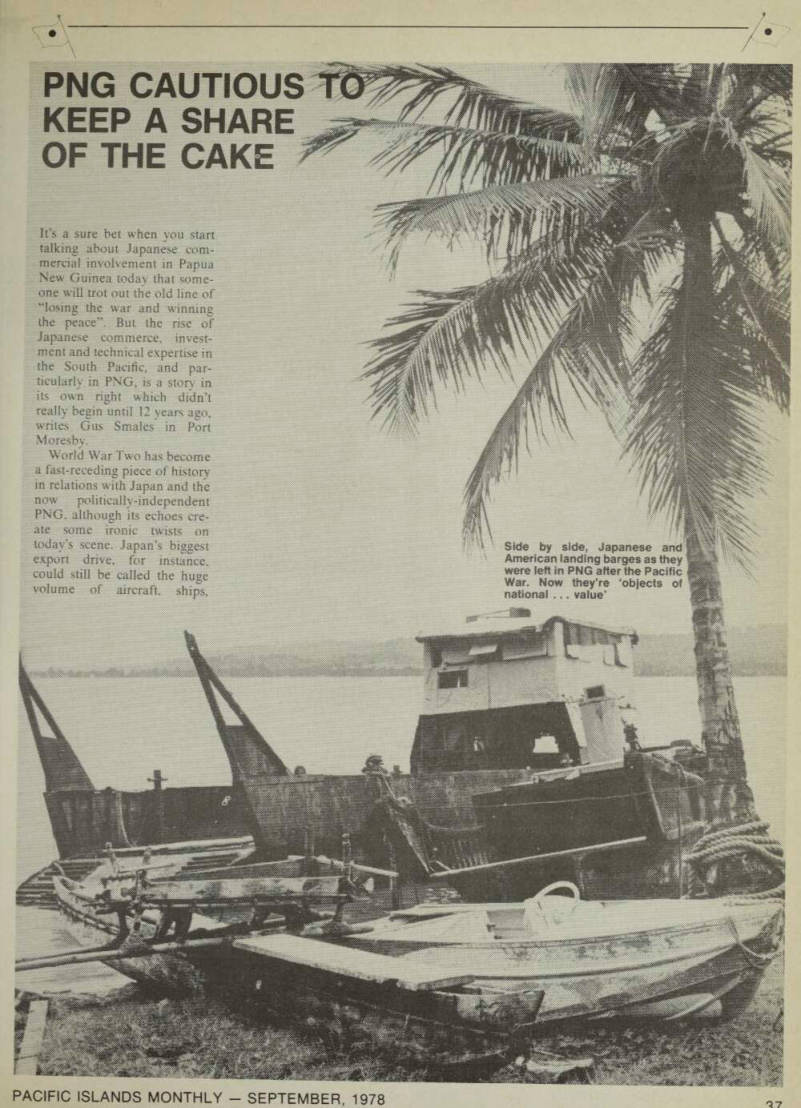
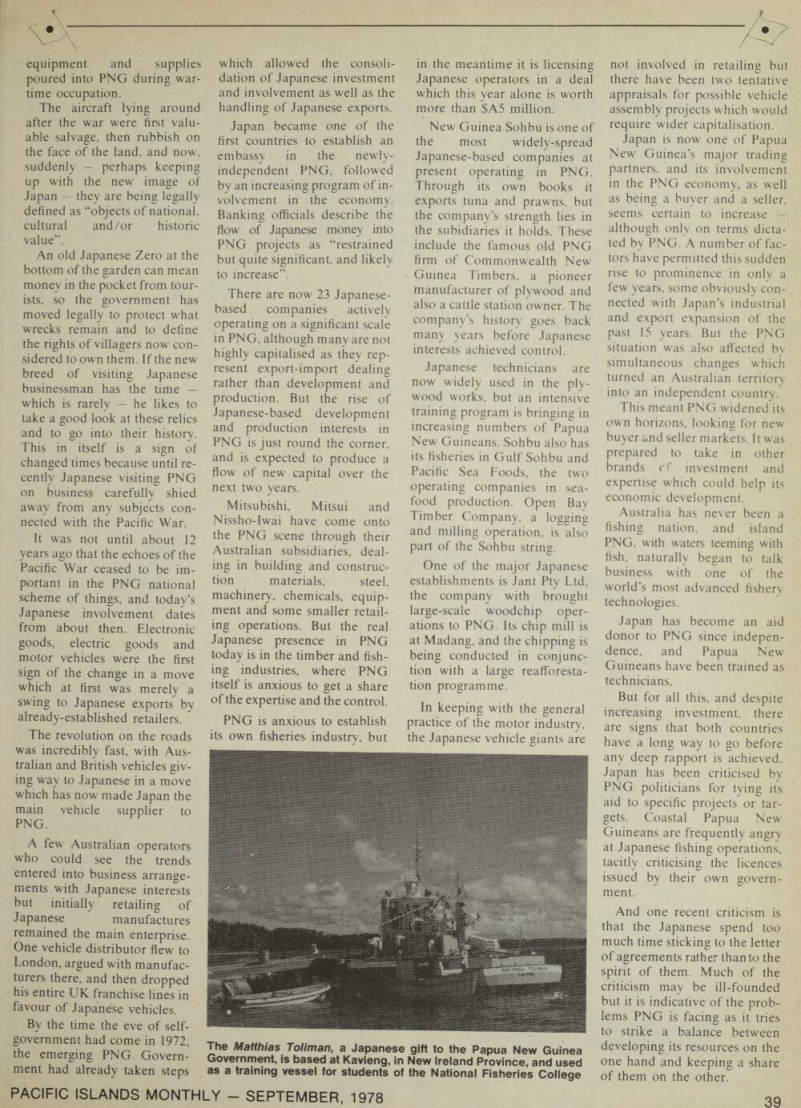
Keep A Share
Of The Cake
It’s a sure bet when you start talking about Japanese com mercial involvement in Papua New Guinea today that some one will trot out the old line of ‘‘losing the war and winning the peace”* But the rise of Japanese commerce, invest ment and technical expertise in the South Pacific, and par ticularly in PNG, is a story in its own right which didn’t really begin until 12 years ago, writes Gus Smales in Port
Moresby.
World War Two has become a fast-receding piece of history in relations with Japan and the
now politicaliy-independent
PNG, although its echoes cre ate some ironic twists on
today’s scene. Japan's biggest
export drive, for instance, could still be called the huge volume of aircraft, ships,
Side by side, Japanese and American landing barges as they were left In PNG after the Pacific War. Now they’re ‘objects of national ... value’
equipment and supplies poured into PNG during war
time occupation.
The aircraft lying around after the war were first valu able salvage, then rubbish on the face of the land, and now,
suddenly perhaps keeping
up with the new image of
Japan they are being legally
defined as “objects of national, cultural and/or historic value”.
An old Japanese Zero at the bottom of the garden can mean money in the pocket from tour ists, so the government has moved legally to protect what wrecks remain and to define the rights of villagers now con sidered to own them. If the new
breed of visiting Japanese
businessman has the time which is rarely he likes to take a good look at these relics and to go into their history.
This in itself is a sign of changed times because until re
cently Japanese visiting PNG
on business carefully shied away from any subjects con nected with the Pacific War.
It was not until about 12 years ago that the echoes of the Pacific War ceased to be im portant in the PNG national scheme of things, and today’s Japanese involvement dates from about then. Electronic goods, electric goods and motor vehicles were the first sign of the change in a move which at first was merely a
swing to Japanese exports by
already-established retailers.
The revolution on the roads was incredibly fast, with Aus tralian and British vehicles giv ing way to Japanese in a move which has now made Japan the main vehicle supplier to
Png.
A few Australian operators who could see the trends entered into business arrange ments with Japanese interests
but initially retailing of
Japanese manufactures
remained the main enterprise.
One vehicle distributor flew to London, argued with manufac turers there, and then dropped his entire UK franchise lines in favour of Japanese vehicles.
By the time the eve of self government had come in 1972, the emerging PNG Govern ment had already taken steps
which allowed the consoli dation of Japanese investment and involvement as well as the handling of Japanese exports.
Japan became one of the first countries to establish an
embassy in the newly
independent PNG, followed by an increasing program of in volvement in the economy.
Banking officials describe the flow of Japanese money into PNG projects as “restrained but quite significant, and likely to increase”.
There are now 23 Japanese
based companies actively
operating on a significant scale in PNG, although many are not
highly capitalised as they rep
resent export-import dealing
rather than development and production. But the rise of
Japanese-based development
and production interests in PNG is just round the corner, and is expected to produce a flow of new capital over the next two years.
Mitsubishi, Mitsui and Nissho-Iwai have come onto the PNG scene through their Australian subsidiaries, deal ing in building and construc tion materials, steel,
machinery, chemicals, equip
ment and some smaller retail ing operations. But the real Japanese presence in PNG today is in the timber and fish ing industries, where PNG itself is anxious to get a share of the expertise and the control.
PNG is anxious to establish its own fisheries industry, but
in the meantime it is licensing Japanese operators in a deal which this year alone is worth more than SAS million.
New Guinea Sohbu is one of the most widely-spread Japanese-based companies at present operating in PNG.
Through its own books it exports tuna and prawns, but the company’s strength lies in the subidiaries it holds. These include the famous old PNG firm of Commonwealth New Guinea Timbers, a pioneer manufacturer of plywood and also a cattle station owner. The
company’s history goes back
many years before Japanese interests achieved control.
Japanese technicians are now widely used in the ply wood works, but an intensive training program is bringing in
increasing numbers of Papua
New Guineans. Sohbu also has its fisheries in Gulf Sohbu and Pacific Sea Foods, the two
operating companies in sea
food production. Open Bay
Timber Company, a logging
and milling operation, is also part of the Sohbu string.
One of the major Japanese establishments is Jant Pty Ltd, the company with brought
large-scale woodchip oper
ations to PNG. Its chip mill is at Madang, and the chipping is
being conducted in conjunc
tion with a large reafforesta tion programme.
In keeping with the general practice of the motor industry, the Japanese vehicle giants are
not involved in retailing but there have been two tentative
appraisals for possible vehicle
assembly projects which would
require wider capitalisation.
Japan is now one of Papua
New Guinea’s major trading
partners, and its involvement in the PNG economy, as well as being a buyer and a seller, seems certain to increase although only on terms dicta ted by PNG. A number of fac tors have permitted this sudden rise to prominence in only a few years, some obviously con nected with Japan’s industrial and export expansion of the past 15 years. But the PNG situation was also affected by simultaneous changes which turned an Australian territory into an independent country.
This meant PNG widened its own horizons, looking for new buyer and seller markets. It was prepared to take in other brands rf investment and expertise which could help its
economic development.
Australia has never been a fishing nation, and island PNG. with waters teeming with fish, naturally began to talk business with one of the world’s most advanced fishery
technologies.
Japan has become an aid donor to PNG since indepen dence, and Papua New Guineans have been trained as technicians.
But for all this, and despite increasing investment, there are signs that both countries have a long way to go before any deep rapport is achieved.
Japan has been criticised by PNG politicians for tying its aid to specific projects or tar gets. Coastal Papua New Guineans are frequently angry
at Japanese fishing operations,
tacitly criticising the licences
issued by their own govern ment.
And one recent criticism is that the Japanese spend too much time sticking to the letter of agreements rather than to the spirit of them. Much of the criticism may be ill-founded but it is indicative of the prob lems PNG is facing as it tries to strike a balance between developing its resources on the one hand and keeping a share of them on the other.
The Matthias Toliman, a Japanese gift to the Papua New Guinea Government, is based at Kavieng, in New Ireland Province, and used as a training vessel for students of the National Fisheries College
Advertisements & other items, pp. 38-40 (1 item)
The World
V i It 1 f: V
Listens to Clarion
On the Go.
* The reason? Clarion offers so much more.
Superb entertainment created by advanced, highly reliable electronics. Easy, custom-fit dash installation. A super-wide selection of car radios and stereo units. Professional servicing by local dealers. An international . reputation for superior quality and perforrnance. Clarion —another word for the best. The very best. \ v i •OH-VOt/PfiO Auto reverse cassette Menu) *6 M 88
EJECT
-4, PROGRAM
> II * 10 ..’...HJS Qciaritw A ► 93 r5i8 .103.108
™ AU-FU-S1
( T vv PE-663 Clarion Co., Ltd. Tokyo, Japan lustralla: Amalgamated Wireless (Australasia) Ltd. 554 Parramatta Road Ashf ield NS W 2131 / New:Raoeete/ New imitpd po Box 50-248 Porirua/Fiji Islands: Brijlal & Co., Ltd. G.P.O. Box 362 Suva/Tahiti. ETS. Comimpex. B.P. 200 Papeete ialedonia: Caldis. 8.P.M1 Noumea Cedex I Guam: Guam Radio &TV Shop. P.O. Box 1939 Agana, Guam 96910 /New Hebrides: e oun Centre P.O. Box 434 Vila I Cook Islands: South Seas International Ltd. P.O. Box 49 Rarotonga.
C. Itoh has been contributing to Oceania's economic growth for over 20 years since our door first opened in Sydney in 1957. 130 120 Tokyo 10 General Importer Exporter Project Developer
C. ITOH
C. ITOH & CO., (AUST.) LTD. Sydney Office: Gold Fields House, 1 Alfred Street, Sydney, N.S.W. 2000 G.P.O. Box 4271, Sydney, N.S.W. 2001 Phone:27-7611 Telex; 20205 CITOH Brisbane: Phone: 221-9738 Telex; AA 41419 Fremantle: Phone: 3353048 Telex. 92058 CITOH Melbourne: Phone: (03) 67-8633 Telex: 30313 CITOH Port Moresby: Phone: 25-9224 Telex: CITOH NE 22174 C. ITOH & CO., (N.Z.) LTD. Auckland: Phone; 798-480 (5 lines) Telex; NZ2504 CITOH Wellington: Phone; 722-288 Telex: NZ 3574 (CITOH NZ 3574) Other Offices in Oceania: Adelaide, Noumea, Perth C. ITOH & CO., LTD. Founded in 1858 Capital: ¥37,251 Million Office; C.P.O. Box 136, Tokyo Telex; J 22295 (ITOHCHU) Osaka Office: C.P.O. Box 117, Osaka Telex; J 63335 (ITOHCHU) London, New York, Hong Kong, Singapore 150 140 /c o Cp > o < o ■> /y Qfie Adelaide tn per tie an yd n Velb ourti no You are cordially invited to Japan Floating Fair ’7B, “NFS. Shin Sakura Maru Booth No. H 22-26. I Items on display ; a) Marine Diesel Engines / 1 b) In-line Proof System (Computerized) j 130 140 i-150 150 160
Tokyo-Honiara Ties
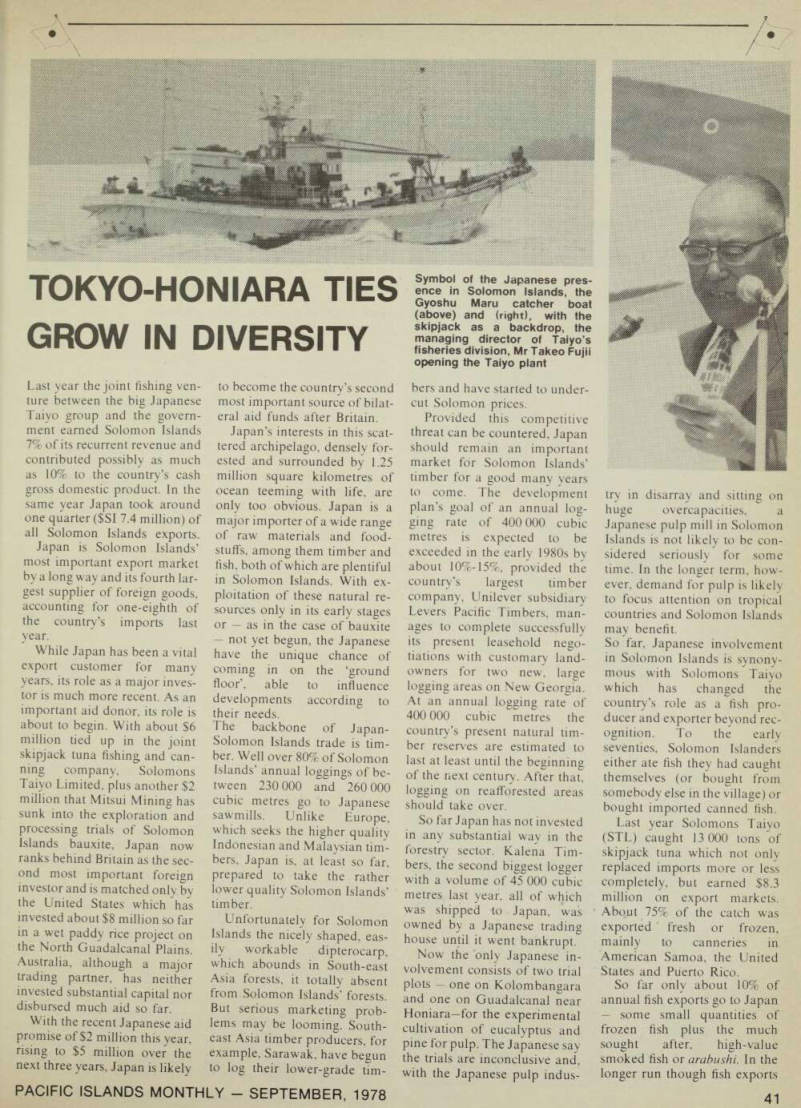
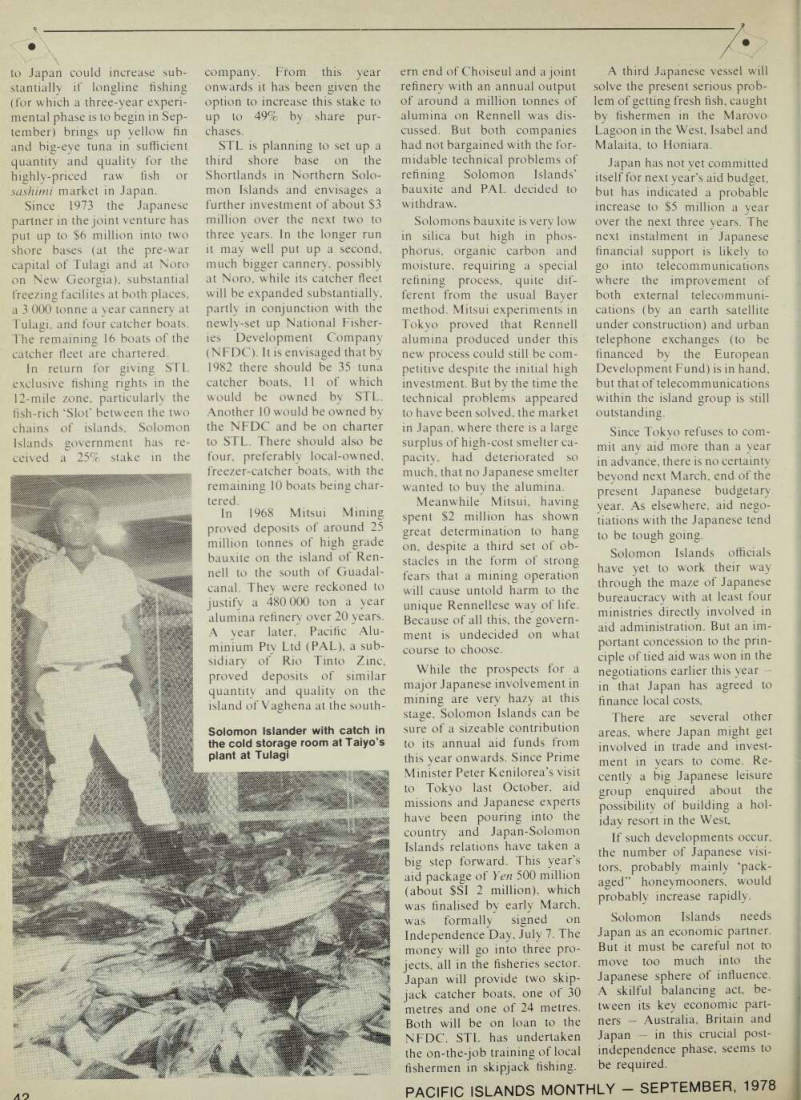
Grow In Diversity
Last year the joint fishing ven ture between the big Japanese Taiyo group and the govern ment earned Solomon Islands 7% of its recurrent revenue and contributed possibly as much as 10% to the country’s cash gross domestic product. In the same year Japan took around one quarter (SSI 7.4 million) of all Solomon Islands exports.
Japan is Solomon Islands’ most important export market by a long way and its fourth lar gest supplier of foreign goods, accounting for one-eighth of the country’s imports last year.
While Japan has been a vital export customer for many years, its role as a major inves tor is much more recent. As an important aid donor, its role is about to begin. With about $6 million tied up in the joint skipjack tuna fishing, and can ning company, Solomons Taiyo Limited, plus another $2 million that Mitsui Mining has sunk into the exploration and processing trials of Solomon Islands bauxite, Japan now ranks behind Britain as the sec
ond most important foreign
investor and is matched only by the United States which has invested about $8 million so far in a wet paddy rice project on the North Guadalcanal Plains.
Australia, although a major trading partner, has neither invested substantial capital nor disbursed much aid so far.
With the recent Japanese aid promise of $2 million this year, rising to $5 million over the next three years, Japan is likely
to become the country’s second most important source of bilat eral aid funds after Britain.
Japan’s interests in this scat
tered archipelago, densely for
ested and surrounded by 1.25 million square kilometres of ocean teeming with life, are only too obvious. Japan is a major importer of a wide range of raw materials and food stuffs, among them timber and fish, both of which are plentiful in Solomon Islands. With ex ploitation of these natural re sources only in its early stages or — as in the case of bauxite — not yet begun, the Japanese have the unique chance of coming in on the ‘ground floor’, able to influence
developments according to
their needs.
The backbone of Japan- Solomon Islands trade is tim ber. Well over 80% of Solomon Islands’ annual loggings of be tween 230 000 and 260 000 cubic metres go to Japanese sawmills. Unlike Europe, which seeks the higher quality Indonesian and Malaysian tim bers, Japan is, at least so far, prepared to take the rather lower quality Solomon Islands’ timber.
Unfortunately for Solomon Islands the nicely shaped, eas
ily workable dipterocarp,
which abounds in South-east Asia forests, it totally absent from Solomon Islands’ forests.
But serious marketing prob lems may be looming. South east Asia timber producers, for example, Sarawak, have begun to log their lower-grade tim
bers and have started to under cut Solomon prices.
Provided this competitive threat can be countered, Japan should remain an important market for Solomon Islands’ timber for a good many years to come. The development plan’s goal of an annual log ging rate of 400 000 cubic metres is expected to be exceeded in the early 1980 s by about 10%-15%, provided the country’s largest timber company, Unilever subsidiary Levers Pacific Timbers, man
ages to complete successfully
its present leasehold nego tiations with customary land owners for two new, large logging areas on New Georgia.
At an annual logging rate of 400 000 cubic metres the country’s present natural tim ber reserves are estimated to last at least until the beginning of the next century. After that, logging on reafforested areas should take over.
So far Japan has not invested in any substantial way in the forestry sector. Kalena Tim bers, the second biggest logger with a volume of 45 000 cubic metres last year, all of which was shipped to Japan, was owned by a Japanese trading house until it went bankrupt.
Now the only Japanese in volvement consists of two trial plots one on Kolombangara and one on Guadalcanal near Honiara—for the experimental cultivation of eucalyptus and pine for pulp. The Japanese say the trials are inconclusive and, with the Japanese pulp indus-
try in disarray and sitting on
huge overcapacities, a
Japanese pulp mill in Solomon Islands is not likely to be con sidered seriously for some time. In the longer term, how ever, demand for pulp is likely to focus attention on tropical countries and Solomon Islands may benefit.
So far, Japanese involvement in Solomon Islands is synony mous with Solomons Taiyo which has changed the country’s role as a fish pro ducer and exporter beyond rec
ognition. To the early
seventies, Solomon Islanders either ate fish they had caught themselves (or bought from somebody else in the village) or
bought imported canned fish.
Last year Solomons Taiyo (STL) caught 13 000 tons of skipjack tuna which not only replaced imports more or less completely, but earned $8.3 million on export markets.
About 75% of the catch was exported fresh or frozen, mainly to canneries in American Samoa, the United States and Puerto Rico.
So far only about 10% of annual fish exports go to Japan some small quantities of frozen fish plus the much
sought after, high-value
smoked fish or arabushi. In the longer run though fish exports
Symbol of the Japanese pres ence in Solomon Islands, the Gyoshu Maru catcher boat (above) and (right), with the skipjack as a backdrop, the managing director of Taiyo’s fisheries division, Mr Takeo Fujii opening the Taiyo plant
to Japan could increase sub
stantially if longline fishing
(for which a three-year experi mental phase is to begin in Sep tember) brings up yellow fin and big-eye tuna in sufficient quantity and quality for the highly-priced raw fish or sashimi market in Japan.
Since 1973 the Japanese partner in the joint venture has put up to $6 million into two shore bases (at the pre-war capital of Tulagi and at Noro on New Georgia), substantial freezing facilites at both places, a 3 000 tonne a year cannery at Tulagi. and four catcher boats.
The remaining 16 boats of the catcher fleet are chartered.
In return for giving STL exclusive fishing rights in the 12-mile zone, particularly the fish-rich ‘Slot’ between the two chains of islands, Solomon Islands government has re ceived a 25% stake in the
company. From this year onwards it has been given the option to increase this stake to up to 49% by share pur chases.
STL is planning to set up a third shore base on the Shortlands in Northern Solo mon Islands and envisages a further investment of about $3 million over the next two to three years. In the longer run it may well put up a second,
much bigger cannery, possibly
at Noro, while its catcher fleet
will be expanded substantially,
partly in conjunction with the newly-set up National Fisher
ies Development Company
(NFDC). It is envisaged that by 1982 there should be 35 tuna catcher boats, 11 of which would be owned by STL.
Another 10 would be owned by the NFDC and be on charter to STL. There should also be four, preferably local-owned, freezer-catcher boats, with the remaining 10 boats being char tered.
In 1968 Mitsui Mining proved deposits of around 25 million tonnes of high grade bauxite on the island of Ren nell to the south of Guadal canal. They were reckoned to justify a 480 000 ton a year alumina refinery over 20 years.
A year later. Pacific Alu minium Pty Ltd (PAL), a sub sidiary of Rio Tinto Zinc, proved deposits of similar quantity and quality on the island of Vaghena at the south-
ern end of Choiseul and a joint refinery with an annual output of around a million tonnes of alumina on Rennell was dis cussed. But both companies had not bargained with the for midable technical problems of refining Solomon Islands’ bauxite and PAL decided to withdraw.
Solomons bauxite is very low in silica but high in phos phorus, organic carbon and
moisture, requiring a special
refining process, quite dif ferent from the usual Bayer method. Mitsui experiments in
Tokyo proved that Rennell
alumina produced under this new process could still be com
petitive despite the initial high
investment. But by the time the technical problems appeared to have been solved, the market in Japan, where there is a large surplus of high-cost smelter ca pacity, had deteriorated so much, that no Japanese smelter wanted to buy the alumina.
Meanwhile Mitsui, having spent $2 million has shown great determination to hang on. despite a third set of ob stacles in the form of strong fears that a mining operation will cause untold harm to the unique Rennellese way of life.
Because of all this, the govern ment is undecided on what course to choose.
While the prospects for a major Japanese involvement in mining are very hazy at this stage, Solomon Islands can be sure of a sizeable contribution to its annual aid funds from this year onwards. Since Prime Minister Peter Kenilorea’s visit to Tokyo last October, aid missions and Japanese experts have been pouring into the country and Japan-Solomon Islands relations have taken a big step forward. This year’s aid package of Yen 500 million (about SSI 2 million), which was finalised by early March,
was formally signed on
Independence Day, July 7. The money will go into three pro jects, all in the fisheries sector.
Japan will provide two skip jack catcher boats, one of 30 metres and one of 24 metres.
Both will be on loan to the NFDC. STL has undertaken the on-the-job training of local fishermen in skipjack fishing.
A third Japanese vessel will solve the present serious prob lem of getting fresh fish, caught by fishermen in the Marovo Lagoon in the West, Isabel and Malaita, to Honiara.
Japan has not yet committed itself for next year’s aid budget, but has indicated a probable increase to $5 million a year over the next three years. The next instalment in Japanese financial support is likely to go into telecommunications where the improvement of both external telecommuni cations (by an earth satellite under construction) and urban
telephone exchanges (to be
financed by the European Development Fund) is in hand, but that of telecommunications within the island group is still
outstanding.
Since Tokyo refuses to com mit any aid more than a year in advance, there is no certainty beyond next March, end of the
present Japanese budgetary
year. As elsewhere, aid nego tiations with the Japanese tend
to be tough going.
Solomon Islands officials have yet to work their way through the maze of Japanese bureaucracy with at least four ministries directly involved in aid administration. But an im portant concession to the prin ciple of tied aid was won in the negotiations earlier this year in that Japan has agreed to finance local costs.
There are several other areas, where Japan might get involved in trade and invest ment in years to come. Re cently a big Japanese leisure group enquired about the possibility of building a hol iday resort in the West.
If such developments occur, the number of Japanese visi
tors, probably mainly ‘pack
aged” honeymooners, would probably increase rapidly.
Solomon Islands needs Japan as an economic partner.
But it must be careful not to move too much into the Japanese sphere of influence.
A skilful balancing act, be tween its key economic part ners - Australia, Britain and Japan - in this crucial post independence phase, seems to
be required.
Solomon Islander with catch in the cold storage room at Taiyo’s plant at Tulagi
Pacific Century
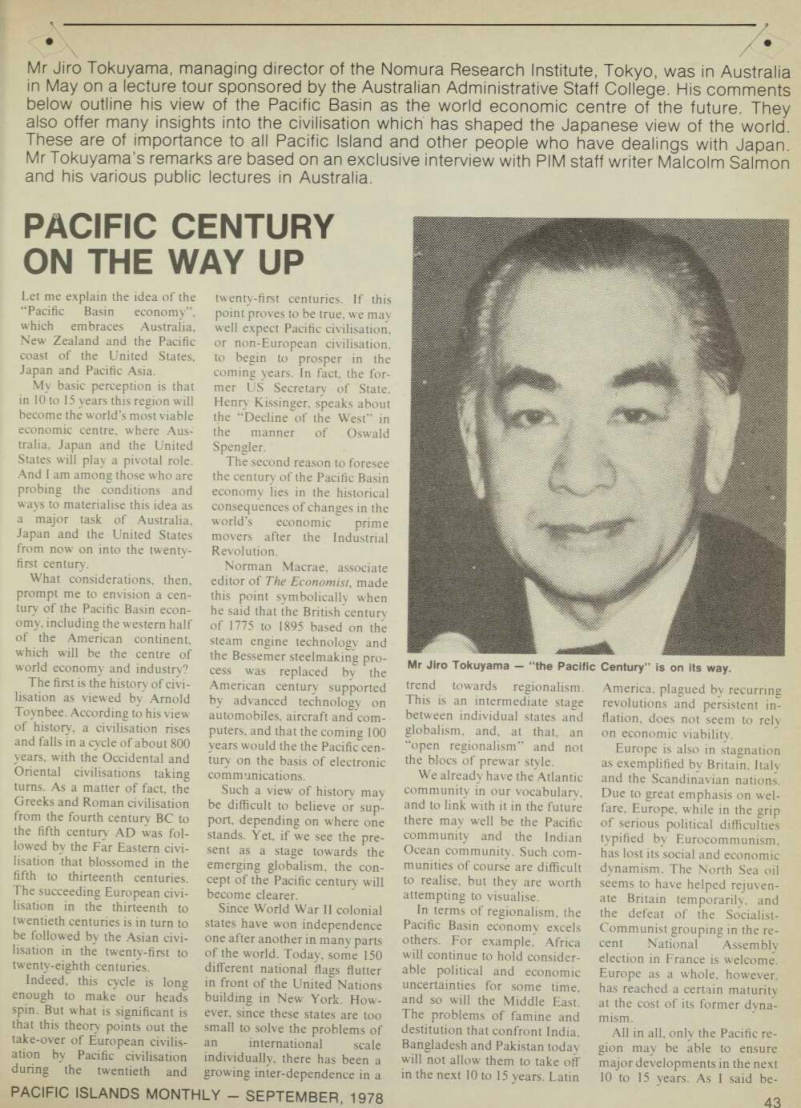
On The Way Up
Mr Jiro Tokuyama, managing director of the Nomura Research Institute, Tokyo, was in Australia in May on a lecture tour sponsored by the Australian Administrative Staff College. His comments below outline his view of the Pacific Basin as the world economic centre of the future. They also offer many insights into the civilisation which has shaped the Japanese view of the world.
These are of importance to all Pacific Island and other people who have dealings with Japan.
Mr Tokuyama’s remarks are based on an exclusive interview with PIM staff writer Malcolm Salmon and his various public lectures in Australia.
Let me explain the idea of the “Pacific Basin economy”, which embraces Australia, New Zealand and the Pacific coast of the United States, Japan and Pacific Asia.
My basic perception is that in 10 to 15 years this region will become the world’s most viable economic centre, where Australia. Japan and the United States will play a pivotal role.
And I am among those who are probing the conditions and ways to materialise this idea as a major task of Australia, Japan and the United States from now on into the twentyfirst century.
What considerations, then, prompt me to envision a century of the Pacific Basin economy, including the western half of the American continent, which will be the centre of world economy and industry?
The first is the history of civilisation as viewed by Arnold Toynbee. According to his view of history, a civilisation rises and falls in a cycle of about 800 years, with the Occidental and Oriental civilisations taking turns. As a matter of fact, the Greeks and Roman civilisation from the fourth century BC to the fifth century AD was followed by the Far Eastern civilisation that blossomed in the fifth to thirteenth centuries,
The succeeding European civi-
lisation in the thirteenth to twentieth centuries is in turn to be followed by the Asian civilisation in the twenty-first to
twenty-eighth centuries.
Indeed, this cycle is long enough to make our heads spin. But what is significant is that this theory points out the take-over of European civilisation by Pacific civilisation during the twentieth and
twenty-first centuries. If this point proves to be true, we may well expect Pacific civilisation. or non-European civilisation, to begin to prosper in the coming years. In fact, the for mer US Secretary of State, Henry Kissinger, speaks about the “beeline of the West” in the manner of Oswald
Spengler.
The second reason to foresee the century of the Pacific Basin economy lies in the historical consequences of changes in the world’s economic prime movers after the Industrial Revolution, Norman Macrae, associate editor of The Economist, made this point symbolically when he said that the British century of 1775 to 1895 based on the steam engine technology and the Bessemer steelmaking pro cess was replaced by the American century supported
by advanced technology on
automobiles, aircraft and com puters, and that the coming 100 years would the the Pacific cen tury on the basis of electronic communications, Such a view of history may be difficult to believe or sup port, depending on where one stands. Yet, if we see the pre sent as a stage towards the emerging globalism, the con cept of the Pacific century will become clearer, Since World War II colonial states have won independence one after another in many parts of the world. Today, some 150 different national flags flutter in front of the United Nations building in New York. How ever, since these states are too small to solve the problems of an international scale individually, there has been a
growing inter-dependence in a
trend towards regionalism.
This is an intermediate stage between individual states and globalism, and. at that, an
“open regionalism” and not
the blocs of prewar style.
We already have the Atlantic
community in our vocabulary.
and to link with it in the future there may well be the Pacific community and the Indian Ocean community. Such communities of course are difficult to realise, but they are worth attempting to visualise.
In terms of regionalism, the Pacific Basin economy excels others. For example. Africa will continue to hold considerable political and economic uncertainties for some time. and so will the Middle East, The problems of famine and destitution that confront India,
Bangladesh and Pakistan today
will not allow them to take off m the next 10 to 15 years. Latin
America, plagued by recurring
revolutions and persistent in flation, does not seem to rely on economic viability.
Europe is also in stagnation as exemplified by Britain. Italy and the Scandinavian nations, Due to great emphasis on wel fare, Europe, while in the grip of serious political difficulties
typified by Eurocommunism.
has lost its social and economic dynamism. The North Sea oil seems to have helped rejuven ate Britain temporarily, and the defeat of the Socialist- Communist grouping in the re cent National Assembly election in France is welcome, Europe as a whole, however, has reached a certain maturity at the cost of its former dyna mism.
All in all. only the Pacific re gion may be able to ensure major developments in the next 10 to 15 years. As I said be
Mr Jiro Tokuyama - “the Pacific Century” is on its way.
fore, this region should include the western part of the United States because, in postwar years, there has been an unmis takable westward movement of American major industries.
As a matter of fact, 72% of American industrial pro duction came from the tra ditional industrial areas in the northeast of the country in the late 19405. In the 19705, the percentage declined to 46-47%, giving way to what is called the “sun belt” in the south, south west and west of the country.
Leading aircraft manufac turers have set up their head quarters on the Pacific coast, Boeing in Seattle and Lockheed in Burbank near Los Angeles. California is also the site for many computer and electronics manufacturers.
Texas is a huge production base for oil and natural gas, encompassing Houston, the centre of the space industry.
This westward movement of American industrial pro duction bases is significant when we look over the future
of the Pacific Basin econ omy ...
I understand that the establishment of a joint assist ance committee by the govern ments of Australia and Japan has been proposed to facilitate a joint approach to the development of, and assistance to, Asia and Oceania.
Advertisements & other items, p. 44 (1 item)
Japan Machinery Exporters’ Association
JAPAN FLOATING FAIR 78
IS MARKING A BIG STEP TOWARD:
Establishing fair trade practice; Facilitating economic cooperation with foreign nations to the advantage of the growing world trade; Deepening mutual understanding on the world machinery industry through inviting government or business leaders from, and sending mission to, overseas countries.
President: Ichiro Terao Vice President: Kiichi Ishiguro, Kazuo Iwafa Toiichiro Matsuo, Masafumi Misu Arataro Tokahashi, Seiki Tozaki Executive Director: Shigeru Otsuka Kikai Shinko Bldg. Telex:J24744 MACHINEX Branches: Osaka, Nagoya 5-8, Shibakoen 3-chome Cable: JAPMACHINEX Brussels, New York Minato-ku, Tokyo 105 Phone:o3-434-6801 Japan
The Japanese

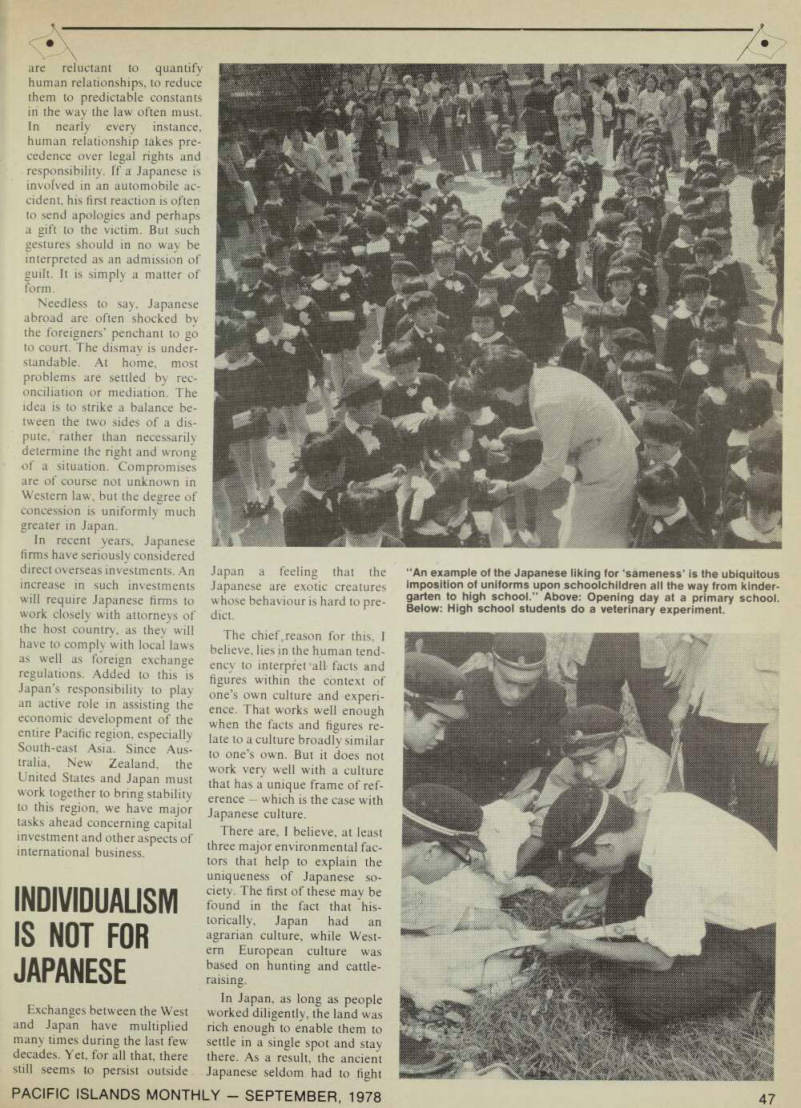
And The Role
Of Law
There is a fundamental dif ference between the role of law in Japanese society and in the West. As in many other areas of Japanese culture, the un derlying principles of the con tractual relationship and the legal system are flexibility and
carefully nurtured ambiguity.
In other words, rather than set tling matters in black-and white terms, the Japanese prefer to leave some areas
intentionally grey so that there will be room for modifications and adaptations later on. As a result, despite a comprehensive
legal code, the Japanese
people’s daily lives, both public
and private, are still largely governed not by laws but by non-legal, social norms. For evidence one need only look at the small number of lawyers in Japan. Whereas the United States has nearly 400 000 lawyers, Japan, with half the population of the US, has fewer than 15 000.
According to the Western way of thinking, the law represents the world as it should be, with the aim being to close the gap between the law and
the reality of daily life by
changing or refining one or the other. By contrast, the Japanese view the law as something to be revered but not invoked except in the most extreme instances. It is something like a treasured family sword handed down from generation to generation. The sword is not for killing; rather
it serves as a symbol of the fam
ily’s unity and social standing,
For a member of the family to use the sword in anger is a clear sign that he has exhausted all other means to solve his prob lem and has failed. Likewise, the Japanese even look with disfavour on reminders of the law’s presence. In contrast to the US, Europe. Australia, and even many parts of Asia, one seldom sees signs in Japan
reminding the citizenry what
fines will be levied for littering or jaywalking or other legal in f ract ions.
The Japanese feel that the application of an identical norm to all is not fair. People and cases simply vary too much from one to another for that, On the surface, the result of that approach might seem to be lawlessness. But the fact is. of course, that Japan’s crime rate is one of the lowest in the world, and Japan has far fewer labour disputes than most other industrialised nations, The very precision of the law is alien to the Japanese. They
are reluctant to quantify human relationships, to reduce them to predictable constants in the way the law often must.
In nearly every instance, human relationship takes pre cedence over legal rights and responsibility. If a Japanese is involved in an automobile ac cident, his first reaction is often to send apologies and perhaps a gift to the victim. But such gestures should in no way be interpreted as an admission of guilt. It is simply a matter of form.
Needless to say, Japanese abroad are often shocked by the foreigners’ penchant to go to court. The dismay is under standable. At home, most problems are settled by rec onciliation or mediation. The idea is to strike a balance be tween the two sides of a dis pute, rather than necessarily determine the right and wrong of a situation. Compromises are of course not unknown in Western law, but the degree of concession is uniformly much greater in Japan.
In recent years, Japanese firms have seriously considered direct overseas investments. An increase in such investments will require Japanese firms to work closely with attorneys of the host country, as they will have to comply with local laws as well as foreign exchange regulations. Added to this is
Japan’s responsibility to play
an active role in assisting the economic development of the
entire Pacific region, especially
South-east Asia. Since Aus tralia, New Zealand, the United States and Japan must work together to bring stability to this region, we have major
tasks ahead concerning capital
investment and other aspects of international business.
Advertisements & other items, pp. 45-46 (1 item)
Daiwa Line
JAPAN-SOUTH PACIFIC REGULAR SERVICE
AUSTRALIA-SOUTH PACIFIC CONTAINER SERVICE
JAPAN-TAIWAN-GUAM-SAIPAN REGULAR SERVICE
DAIWA LINE BRIDGES SOUTH PACIFIC
WITH RO/RO CAR & CONTAINER CARRIER
JAPAN-GUAM-LAUTOKA-SUVA-PAPEETE-PAGO PAGO-APIA-NOUMEA
SYDNEY-HONIARA-TARAWA-GUAM-TAIWAN-JAPAN
JAPAN- MAJURO -RAROTONGA- VILA-SANTO -NAURU -JAPAN
JAPAN-TAIWAN-GUAM-SAIPAN-JAPAN
ME V.
THE DAIWA NAVIGATION CO.,LTD.
OSAKA: “DAILINE” TOKYO: “FUNEDAILINE”
HEAD OFFICE
DAIICHI KYOGYO BLDG
45,2-CHOME. AWAZAMINAMI-DORI,
NISHI-KU, OSAKA, JAPAN
TELEPHONE: 'O6; 531-0471
TELEX: 525-6324 & 525-6325
TOKYO OFFICE
SHIN-DAIICHI BLDG.,
4-13. NIHONBASHI 3-CHOME, CHUO-KU
TOKYO, JAPAN
TELEPHONE: (03; 274-3251'8
TELEX: 222-3343. J 23559
SAFE ON ANY ROAD
K ■ at 6# <g ■ . i ■ sb ira* gs® V:;.
MS —. X X 8«? ? s I# a*u \, i * #« : m
<£> YOKOHAMA
DISTRIBUTED BY:
AUSTRALIA
NEW ZEALAND
FIJI
WESTERN SAMOA
NEW HEBRIDES
NEW CALEDONIA
Quality engineered tyres since 1917 NEW SOUTH WALES: YOKOHAMA TYRE AUSTRALIA (N.S.W.) PTYLTD VICTORIA: BANDAG COLD TREAD PROCESS (VIC.) PTY., LTD.
QUEENSLAND: YOKOHAMA TYRE OLD. PTY., LTD.
WESTERN AUSTRALIA: lAN DIFFEN TYRE SERVICE PTY., LTD.
SOUTH AUSTRALIA: M. S. MCLEOD LTD.
TASMANIA: ROBERTS, STEWART & CO., LTD.
MOTOR SPECIALITIES (MERCHANTS) LTD.
SUMMIT RETREADING CO., LTD.
H. J. KEIL&CO., LTD.
NEW HEBRIDES MOTORS LTD.
SOCIETE IMPORTATION AUTOMOBILE DU PACIFIQUE
<S>THE YOKOHAMA RUBBER CO.,LTD.
HEAD OFFICE: 36-11 Shimbashi 5-chome, Minato-ku, Tokyo, Japan.
TELEPHONE: Tokyo 432-7111
TELEX: J 24673, J 24196 YOKORUCO
Individualism
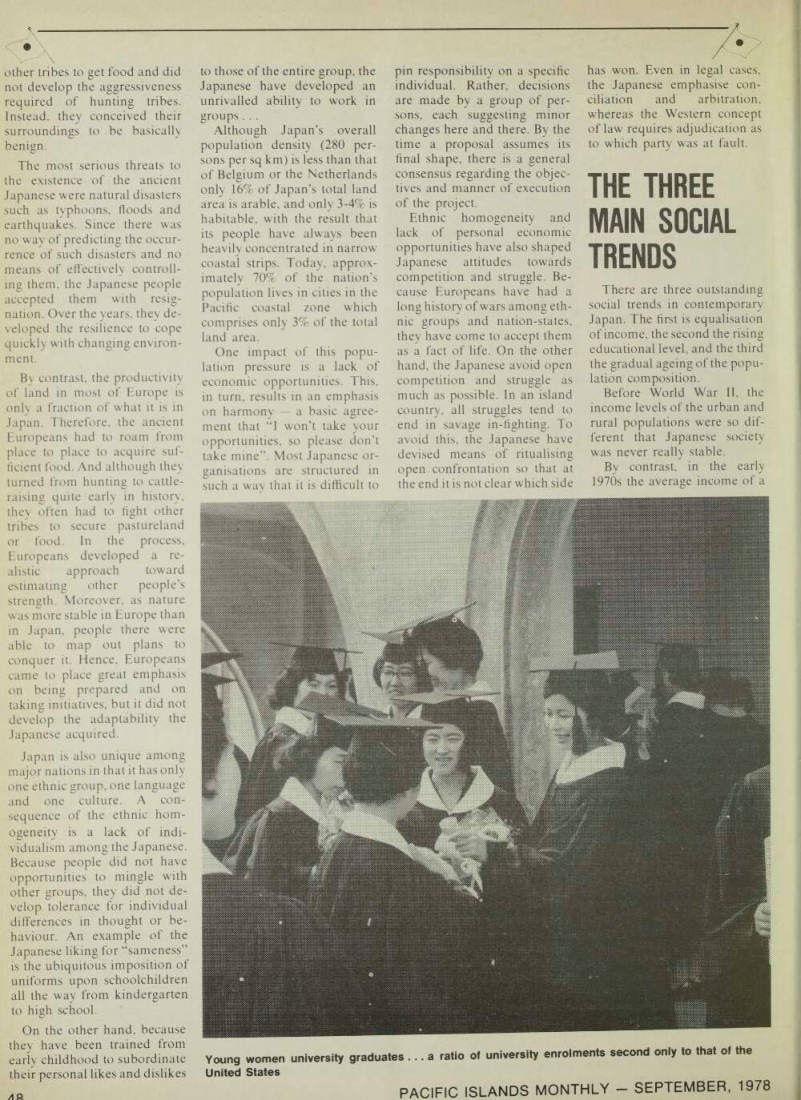
Is Not For
Japanese
Exchanges between the West and Japan have multiplied many times during the last few decades. Yet, for all that, there still seems to persist outside
Japan a feeling that the Japanese are exotic creatures whose behaviour is hard to pre dict.
The chief, reason for this. I believe, lies in the human tend ency to interpret all facts and figures within the context of one’s own culture and experi ence. That works well enough when the facts and figures re late to a culture broadly similar to one’s own. But it does not work very well with a culture that has a unique frame of ref erence which is the case with
Japanese culture.
There are, I believe, at least three major environmental fac tors that help to explain the
uniqueness of Japanese so
ciety. The first of these may be found in the fact that his
torically, Japan had an
agrarian culture, while West ern European culture was based on hunting and cattle
raising.
In Japan, as long as people
worked diligently, the land was rich enough to enable them to settle in a single spot and stay there. As a result, the ancient Japanese seldom had to fight
“An example of the Japanese liking for ‘sameness’ is the übiquitous imposition of uniforms upon schoolchildren all the way from kinder garten to high school.’’ Above: Opening day at a primary school.
Below: High school students do a veterinary experiment.
other tribes to get food and did
not develop the aggressiveness
required of hunting tribes.
Instead, they conceived their
surroundings to be basically
benign.
The most serious threats to the existence of the ancient Japanese were natural disasters such as typhoons, floods and earthquakes. Since there was no way of predicting the occur rence of such disasters and no means of effectively controll ing them, the Japanese people
accepted them with resig
nation. Over the years, they de veloped the resilience to cope
quickly with changing environ
ment.
By contrast, the productivity of land in most of Europe is only a fraction of what it is in Japan. Therefore, the ancient Europeans had to roam from
place to place to acquire suf
ficient food. And although they turned from hunting to cattle
raising quite early in history,
they often had to fight other tribes to secure pastureland or food. In the process,
Europeans developed a re
alistic approach toward estimating other people’s strength. Moreover, as nature was more stable in Europe than in Japan, people there were able to map out plans to conquer it. Hence, Europeans came to place great emphasis on being prepared and on taking initiatives, but it did not develop the adaptability the
Japanese acquired.
Japan is also unique among major nations in that it has only one ethnic group, one language and one culture. A con sequence of the ethnic hom ogeneity is a lack of indi vidualism among the Japanese.
Because people did not have
opportunities to mingle with
other groups, they did not de velop tolerance for individual differences in thought or be haviour. An example of the Japanese liking for “sameness” is the übiquitous imposition of uniforms upon schoolchildren all the way from kindergarten to high school.
On the other hand, because they have been trained from early childhood to subordinate their personal likes and dislikes
to those of the entire group, the Japanese have developed an unrivalled ability to work in groups . . .
Although Japan’s overall
population density (280 per
sons per sq km) is less than that of Belgium or the Netherlands only 16% of Japan’s total land area is arable, and only 3-4% is habitable, with the result that its people have always been heavily concentrated in narrow coastal strips. Today, approx imately 70% of the nation’s population lives in cities in the Pacific coastal zone which comprises only 3% of the total land area.
One impact of this popu lation pressure is a lack of economic opportunities. This, in turn, results in an emphasis on harmony a basic agree ment that “I won’t take your
opportunities, so please don’t
take mine”. Most Japanese or ganisations are structured in such a way that it is difficult to
pin responsibility on a specific
individual. Rather, decisions are made by a group of per sons, each suggesting minor changes here and there. By the time a proposal assumes its final shape, there is a general consensus regarding the objec tives and manner of execution of the project.
Ethnic homogeneity and lack of personal economic opportunities have also shaped Japanese attitudes towards
competition and struggle. Be
cause Europeans have had a long history of wars among eth nic groups and nation-states, they have come to accept them as a fact of life. On the other hand, the Japanese avoid open
competition and struggle as
much as possible. In an island country, all struggles tend to end in savage in-fighting. To avoid this, the Japanese have devised means of ritualising open confrontation so that at the end it is not clear which side
has won. Even in legal cases, the Japanese emphasise con ciliation and arbitration, whereas the Western concept of law requires adjudication as to which party was at fault.
Main Social
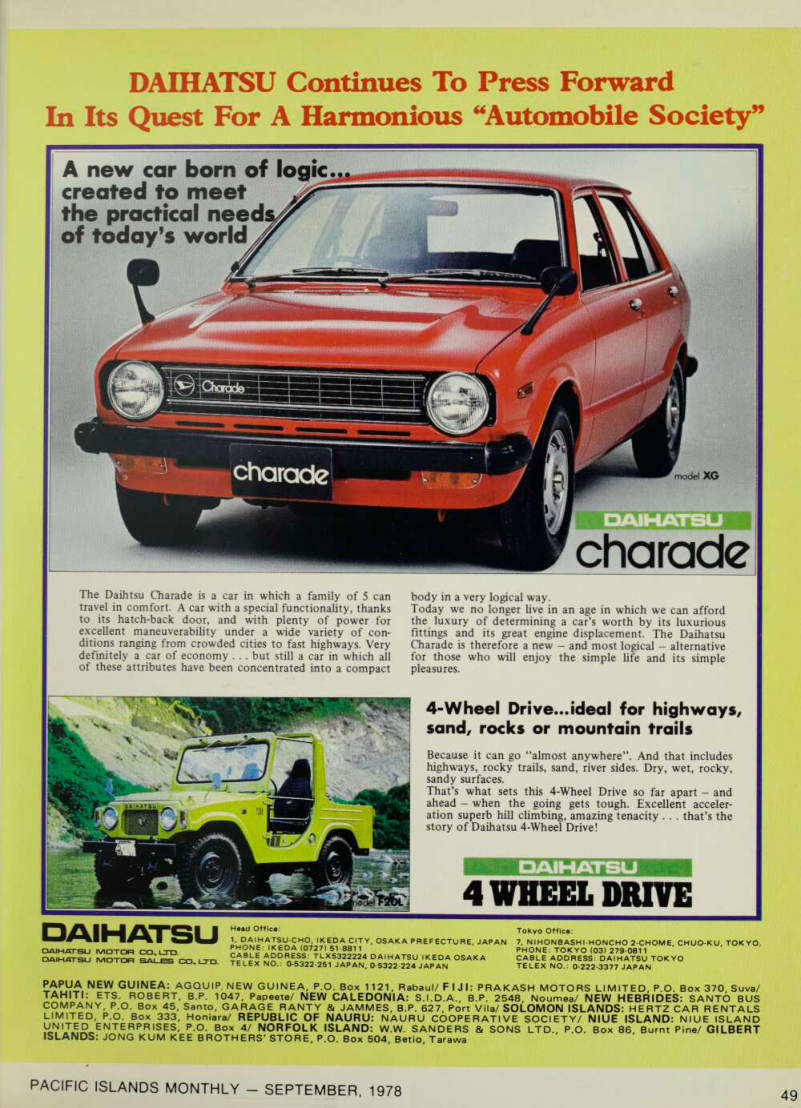
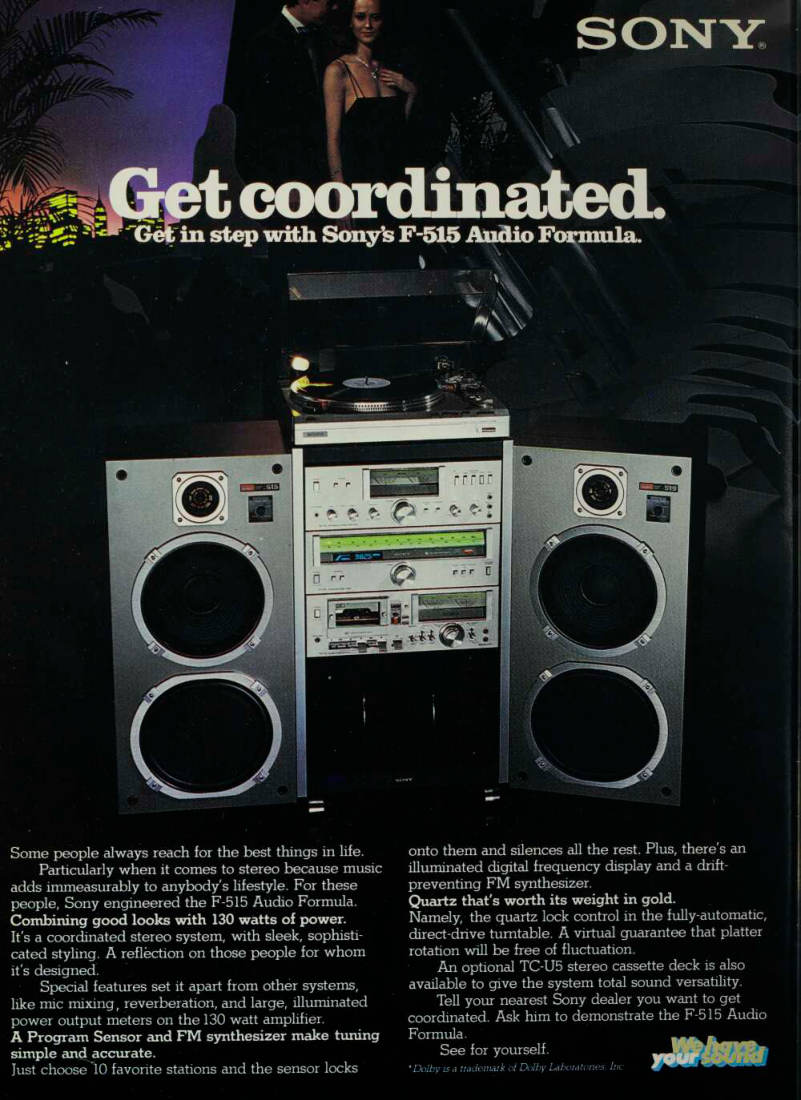

The Three
Trends
There are three outstanding social trends in contemporary Japan. The first is equalisation of income, the second the rising educational level, and the third the gradual ageing of the popu
lation composition.
Before World War 11, the income levels of the urban and rural populations were so dif ferent that Japanese society was never really stable.
By contrast, in the early 1970 s the average income of a
Young women university graduates ... a ratio of university enrolments second only to that of the United States
rural household exceeded that of an urban household for the first time in history. The dif fusion rates of such consumer durables as automobiles, colour television sets and re frigerators are higher in the countryside than in large cities, although even on a nation wide basis almost all Japanese homes possess a washing ma chine, a refrigerator, a colour television and a vacuum cleaner (the ownership ratios of these products are well over 90%). Nearly half of the country’s households have an automobile.
The increased income of the farming household can be attributed partly to the rice price-support system and
partly to growing employment
opportunities at automobile parts, electronics and other plants built near farming com
munities. Subway and sky
scraper construction in large cities absorbs a great number of farmers during the winter.
Consequently, today only 27%
of the agrarian household income is derived from farm
ing activity.
City dwellers have not fared badly, either. The living stan dards of industrial workers
have improved substantially
during the last 15 years. For example, in 1960 they had to work 63 minutes to earn the price of a bottle of beer. In 1975 that time was reduced to 10 minutes. The amount of labour
required to buy a refrigerator
was reduced from 37 days and four hours in 1960 to five days and four hours. For a colour television, the cut was from 94 days in 1960 to 18 days in 1975.
The dramatic improvement of the Japanese living stan dards since the war is attribu ted to rapid development of her industries. In Europe and
the United States, such mass production industries as automobiles and home electrical
appliances developed before
World war 11. In Japan, prewar
production was geared almost
entirely for military use and development of consumer industries had been suppressed. As a result, when reconstruction began after the war, the Japanese economy benefited from the simultaneous
development of these products
and those that were newly brought to the market by the “ g ' Cal breakthroughs of the 19505, such as electronics chemicals and petrochemical , v P ro uc s ‘ Despite the fact that the country was very poor then due to wartime destruction, Japan was able to absorb and develop new technology as its workers were highly educated and welldisciplined. The domestic mar-
ket expanded rapidly, helped
by a large population of 110
million and the robust appetite of consumers for new conveniences. Since Japan had renounced war as a sovereign right of the nation, the
Japanese focussed their aspir
ation on economic develop ment. Their efforts were helped to a great extent by the spirit of free trade that prevailed among the advanced industrialised nations. By the mid-19605, Japan emerged as a nation with a vast middle class.
A recent report by the organis ation for Economic Co
operation and Development
(OECD) asserted that Japan, along with Sweden and Aus tralia. had the smallest income gap between rich and poor.
A , with income- (he levd of educ tion has risen sharpl „ Tf r J In 1960, 60% of young persons
newly entering the job market
had only nine years of school
ing. Today they account for less
than one of every 10 job "seekers. The proportion of
senior high school graduates
rose from 30% to nearly 60%, while that of graduates from tertiary institutions rose from a mere 8% to 33%. Japan’s ratio for attendance at tertiary insti tutions is second only to that in the United States. The rapid
expansion of higher education
can be attributed to the
The traditional Japanese game of go helps pass the time in a home for senior citizens ... the marked ageing in Japan’s population com position is expected to increase the need for better social security provisions.
One way of coping with the housing shortage the Takashimadaira apartment complex, built on a former rice paddy area in northern Tokyo, consists of 10 170 apartments.
absence of a rigid social class system in Japan and reflects
large inter-generational social
mobility. In this sense, along with the United States. Japan can be called the most demo cratic society in the world.
The proportion of older people has been rising due to increased life span and a sharp drop in birth rates since the mid-19505. During the next 10 years, people between the ages of 50 and 60 are expected to in
crease by approximately 50%,
while the proportion of those over 65 is expected to increase from 7.9% of the population in 1975 to 9.6%,
Advertisements & other items, pp. 49-56 (1 item)
charade
DAIHATSU Continues To Press Forward
In Its Quest For A Harmonious “Automobile Society”
A new car born of logic
created to meet
the practical need
of today’s world
model XG
charade
The Daihtsu Charade is a car in which a family of 5 can travel in comfort. A car with a special functionality, thanks to its hatch-back door, and with plenty of power for excellent maneuverability under a wide variety of conditions ranging from crowded cities to fast highways. Very definitely a car of economy . . . but still a car in which all of these attributes have been concentrated into a compact X aasf; x
ft'V
. r y body in a very logical way.
Today we no longer live in an age in which we can afford the luxury of determining a car’s worth by its luxurious fittings and its great engine displacement. The Daihatsu Charade is therefore a new - and most logical - alternative for those who will enjoy the simple life and its simple pleasures.
4-Wheel Drive...ideal for highways,
sand, rocks or mountain trails
Because it can go “almost anywhere”. And that includes highways, rocky trails, sand, river sides. Dry, wet, rocky, sandy surfaces.
That’s what sets this 4-Wheel Drive so far apart and ahead - when the going gets tough. Excellent acceleration superb hill climbing, amazing tenacity . . . that’s the story of Daihatsu 4-Wheel Drive!
DAIHATSU
4 WHEEL DRIVE
DAIHATSU
DAIHATSU (VICTOR CO, LTD.
DAIHATSU MOTOR SALES CO, LTD.
Head Office: 1, DAIHATSU-CHO, IKEDA CITY, OSAKA PREFECTURE JAPAN
PHONE: IKEDA (0727) 51-8811
CABLE ADDRESS. TLX5322224 DAIHATSU IKEDA OSAKA
TELEX NO.: 0-5322-251 JAPAN, 0-5322-224 JAPAN
Tokyo Office:
7, NIHONBASHI-HONCHO 2-CHOME, CHUO-KU, TOKYO.
PHONE: TOKYO (03) 279-0811
CABLE ADDRESS: DAIHATSU TOKYO
TELEX NO.: 0-222-3377 JAPAN
NEW GUINEA: AGQUIP. NEW GUINEA, P.O. Box 1121, Rabaul/ FIJI: PRAKASH MOTORS LIMITED, P.O. Box 370, Suva/ TAHITI: ETS. ROBERT, B.P. 1047, Papeete/ NEW CALEDONIA: 5.1.D.A., B.P. 2548, Noumea/ NEW HEBRIDES: SANTO BUS COMPANY, P.O. Box 45, Santo, GARAGE RANTV & JAMMES, B.P. 627, Port Vila/ SOLOMON ISLANDS: HERTZ CAR RENTALS LIMITED, P.O. Box 333, Honiara/ REPUBLIC OF NAURU: NAURU COOPERATIVE SOCIETY/ NIUE ISLAND: NIUE ISLAND I 7JP« ENTERPRISES - P °- Box 4/ NORFOLK ISLAND: W.W. SANDERS & SONS LTD., P.O. Box 86 Burnt Pine/ GILBERT ISLANDS: JONG KUM KEE BROTHERS' STORE, P.O. Box 504 Betio Tarawa
V ■ - W :i ‘ a 'r *• in step with Sony’s F-515 Audio Formula. \V ■« ; r ga.’i Some people always reach for the best things in life.
Particularly when it comes to stereo because music adds immeasurably to anybody's lifestyle. For these people, Sony engineered the F-515 Audio Formula.
Combining good looks with 130 watts of power.
It's a coordinated stereo system, with sleek, sophisticated styling. A reflection on those people for whom it's designed.
Special features set it apart from other systems, like mic mixing, reverberation, and large, illuminated power output meters on the 130 watt amplifier.
A Program Sensor and FM synthesizer make tuning simple and accurate.
Just choose 10 favorite stations and the sensor locks onto them and silences all the rest. Plus, there's an illuminated digital frequency display and a driftpreventing FM synthesizer.
Quartz that's worth its weight in gold.
Namely, the quartz lock control in the fully-automatic, direct-drive turntable. A virtual guarantee that platter rotation will be free of fluctuation.
An optional TC-U 5 stereo cassette deck is also available to give the system total sound versatility.
Tell your nearest Sony dealer you want to get coordinated. Ask him to demonstrate the F-515 Audio Formula.
See for yourself. * Dolby is a trademark oi Dolby Laboratories, Inc.
THE SMALL CAR
FULL OF
Lhm
: /T ">■ . - ..
ISUZU
. wksm*
ISUZU GEMINI
The rugged little Isuzu Gemini! All the style, features and comfort you expect from the Japanese plus General Motors parts, service and unbeatable 12 months or 20,000 km warranty.
Its got the looks, the style, the performance and handling ... the reliability to set it way ahead of its competitors. Check out Gemini now!
O Four-on-the-floor O 1600 cc engine O Flow-through ventilation O Power assisted disc brakes O Hazard warning light O Radio O Bucket seats O 2-speed wipers O Electric clock O Headlight flasher O Anti-theft steering lock O Cigar lighter O Optional air conditioning available a Solomons "-.Ellice Is won.
Coledonio Tongo- ' Lord How* Papua New Guinea Wamp Nga Motors, Mt. Hagen Dawapia Motors, Rabaul
Fiji
Burns Philp (South Sea) Co. Ltd, General Motors Serving you in the South Pacific Western Samoa O. F. Nelson and Co. Ltd.
G 149 m
- f * * i *l* * * *m i/* Ti iSih XI V ** ,* I » ■ v 4 % a liilif * lA *F"' - .?. - * f , •-» ■• 'ft*
m * iKSwsnai. r ¥ -4
TOYOTA
The Toyota truck range. Built to be unbeatable.
Bad weather conditions, no problem.
Bad roads and driving surfaces, eaten up.
Difficult loads, no contest. Built tough. Built to take it.
There's a Toyota truck built for you.
TOYOTA Land Cruiser Pickup TOYOTA Stout
TOYOTA Dyna
TOYOTA Toyo-Ace
TOYOTA Hi-Lux
TOYOTA Truck For unbeatable after service:
TOYOTA
APUA NEW GUINEA: ELA MOTORS LIMITED, Scratchley Rd„ Badili, P.O. Box 75, Port Moresby. U.S. TRUST TERRITORY: MICROL CORPORATION, ?™ 2 "\ Sa r" FUI ISLANDS: AUTOMOTIVE SUPPLIES CO., LTD., G.P.O. Box 355, Suva AMERICAN SAMOA: BURNS PHILP (SOUTH SEA) q T ° c ' F ° T IOS7 ' Pa9 ° Pa9 ° WESTERN SAMOA: BURNS PHILP (SOUTH SEA) LTD., P.O. Box 188, Apia GUAM: ATKINS, KROLL (GUAM) LTD,, , rn B °^ 64 8 ' T^ unin 9 NEW HEBRIDES: NEW HEBRIDES MOTORS LTD., P.O. Box 18, Vila, SOLOMON ISLANDS: MENDANA ENTERPRISES (5.1.), Dno PO n n ß °n 174, Hon,ara TAHITI: NIPPON AUTOMOTO, B.P. 342, Papeete. COOK ISLANDS: COOK ISLANDS TRADING CORPORATION LTD., O. Box 92, Ra rotonga NAURU ISLAND: NAURU COOPERATIVE SOCIETY, GILBERT & ELLICE ISLANDS COLONY; TARAWA MOTORS Box 36 Bainki Tarawa NORFOLK ISLAND: MARIE'S NORFOLK TOURS, LTD DU PACIFIQUE, Rond-Point du Pacific (Station Total) B.P. 438 Noumea P.O. Box 276 NEW CALEDONIA: SOCIETE IMPORTATION AUTOMOBILE
mSßrnSiMmmfiM-
Kenwood’s specialist-designed separ:
ximponents are for people who want
/ery best that modem life can offer. i 9 * « •
onal quality in reproduced music.
roof in the performance
your Kenwood dealer
test listening. And discover
sound quality really means!
Stereo integrated
• ■ wlth 1 KD-2000 LS-770mk11 KX-520 KA-5700 •■' - . w ?:: TRIO-KENWOOD CORPORATION 6-17, 3-chome, Aobadai, Meguro-ku, Tokyo 153, Japan NORFOLK ISLAND BURNS PHILP (NORFOLK ISLAND) LTD SOLOMON ISLANDS TECHNIQUE RADIOS CENTRE LTD. Honiara 1 NEW CALEDONIA HI-FI VOX Noumea Tel 27-2466 TAHITI MAI SON AURORE Papeete Tel 29703 AMERICAN SAMOA ISLAND PACIFIC AGENCIES. INC Pago Pago Tel. 633-
REPUBLIC OF NAURU NAURU CO-OPERATIVE SOCIETY
MARIANA ISLANDS J C TENORIO ENTERPRISES Saipan Tel 6445
NGINEERED,
FOR POWER
T M C E O n * \ r 3 * f / ! -1 ■ J'V' i't -*r ' i.
Spending a lot of time on cross-country travel or errands?
Seeking something with dependable power, yet economical?
Make it in good time with one of our “get-about” machines.
Go with a Suzuki! choose one of our performanceproven motorcycles, just answering your travel needs.
and... FOR MORE MOTORING POWER
Look further into Suzuki’s traditional excellence 9 and discover the results in our 4-wheel drive vehicles and fleet of outboard motors something to satisfy your every motoring need.
Going by land or by sea ...go with a Suzuki.
SJZUK
SUZUKI 4 WHEEL
DRIVE VEHICLE
DT6S
SUZUKI
SUZUKI MOTOR CO., LTD.
Hamamatsu, Japan NEW°GUINEA L TUTT fRYMiiVAnr! 0 STATION LTD. • FIJI M.H. MOTORS • NEW CALEDONIA STE. SUPERCAL* PAPUA l rn G p^a A PAC F C LTD ' * NEW HEBRIDES HENRI LEROUX • NIUE ISLAND BURNS PHILP (SOUTH SEA) CO., LTD ! AMn T rSn. E iLv TI NIPPON AUTOM OTO • ELLICE ISLAND TUVALU COOPERATIVE WHOLESALE SOCIETY . TARAWJA A n i RPRT ?c| C A Y MncAnn! NC ' * NORFOLK MARTIN'S AGENCIES LTD. . AMERICAN SAMOA PACIFIC PRODUCTS, INC.
BECHESRRAK L T v a' VE FEDERATION LIMITED • TONGA MORRIS HEDSTROM LTD. • WESTERN CAROLINES BECHESRRAK T. COMPANY • AMBROSE D. MINGINFEL'S WHOLESALER • EASTERN CAROLINES KIOMASA STORE
A THE WILL
MITSUBISHI
MOTORS
The will to participate. . . like in the world's toughest rallies such as the Southern Cross, the Safari or the Bandama is not only for the glory of the victory but to utilize the "rally experience" in production of cars meeting the public's total needs.
The will to offer the best. . . like a really quiet, energy-saving, 4-cylinder car having the outstanding Mitsubishi "80" engine: Its two Silent Shafts make a big reduction in noise and vibration without sacrificing performance or economy.
Take the time and see these examples of our will on the Sakura-maru ship soon to visit your port. . .
We've got the results if you've got the will! —m * mo i u , @(U)lo@ikio w“f Riiiinrgyiiw
GALANTL ■ LANCER
A
MITSUBISHI
MOTORS CORPORATION
TOKYO. JAPAN
Politics Of
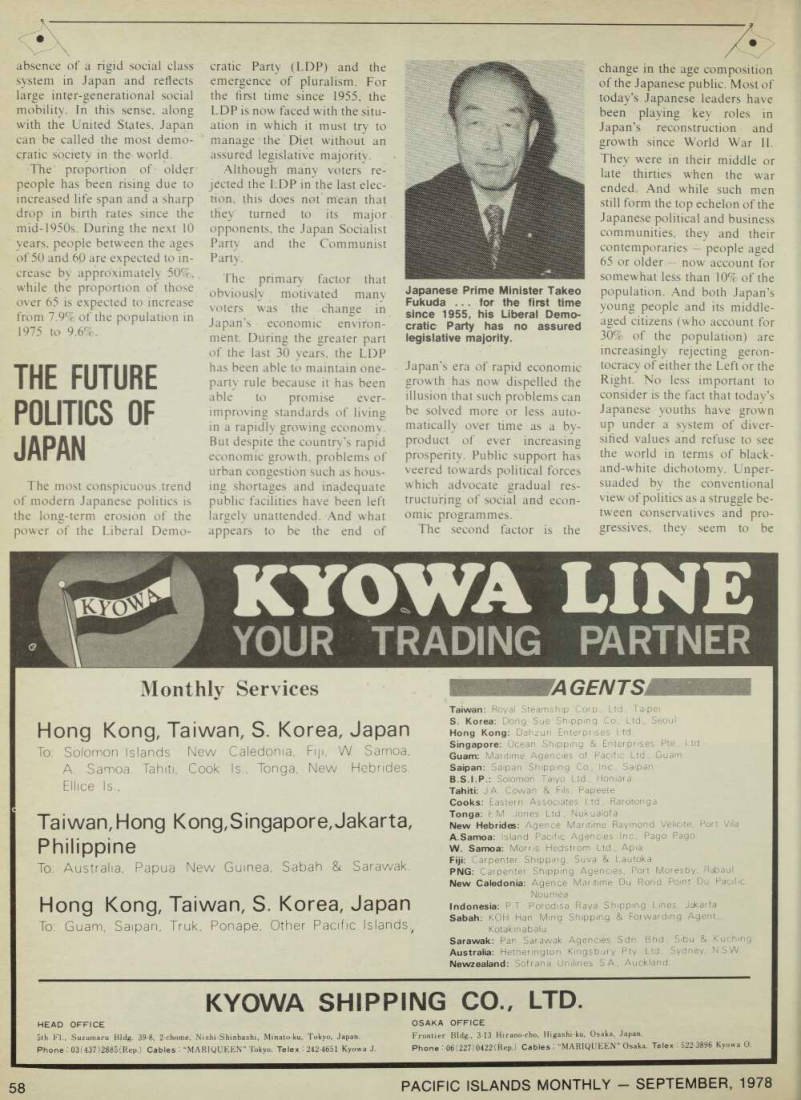
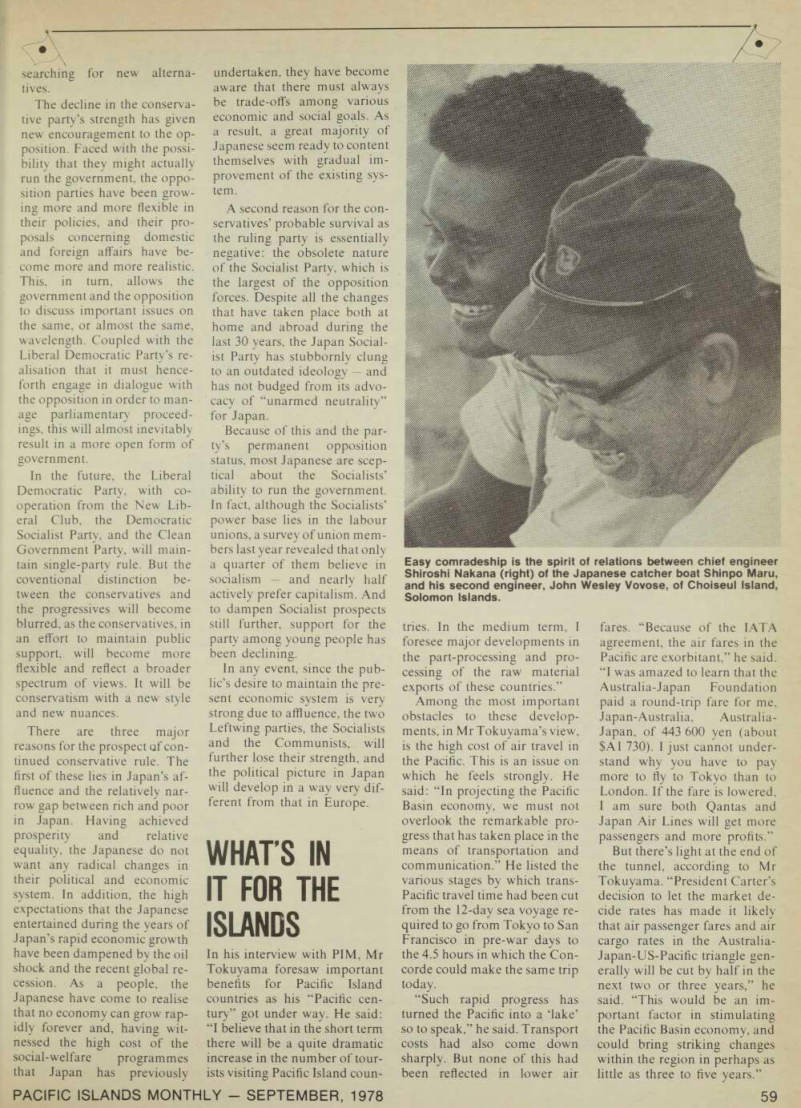
The Future
Japan
The most conspicuous trend of modern Japanese politics is the long-term erosion of the power of the Liberal Demo
cratic Party (LDP) and the emergence of pluralism. For the first time since 1955, the LDP is now faced with the situ ation in which it must try to manage the Diet without an
assured legislative majority.
Although many voters re jected the LDP in the last elec tion, this does not mean that they' turned to its major opponents, the Japan Socialist Party and the Communist
Party.
The primary factor that obviously motivated many voters was the change in Japan’s economic environ ment. During the greater part of the last 30 years, the LDP has been able to maintain one party rule because it has been able to promise ever
improving standards of living
in a rapidly growing economy.
But despite the country’s rapid economic growth, problems of urban congestion such as hous
ing shortages and inadequate
public facilities have been left largely unattended. And what appears to be the end of
Japan’s era of rapid economic growth has now dispelled the illusion that such problems can be solved more or less auto matically over time as a by
product of ever increasing
prosperity. Public support has veered towards political forces which advocate gradual res tructuring of social and econ omic programmes.
The second factor is the
change in the age composition of the Japanese public. Most of today’s Japanese leaders have been playing key roles in Japan’s reconstruction and growth since World War 11.
They were in their middle or late thirties when the war ended. And while such men still form the top echelon of the Japanese political and business communities, they and their contemporaries people aged 65 or older now account for somewhat less than 10% of the population. And both Japan’s young people and its middle aged citizens (who account for 30% of the population) are
increasingly rejecting geron
tocracy of either the Left or the Right. No less important to consider is the fact that today’s Japanese youths have grown up under a system of diver sified values and refuse to see the world in terms of black
and-white dichotomy. Unper
suaded by the conventional view of politics as a struggle be tween conservatives and pro gressives, they seem to be
Japanese Prime Minister Takeo Fukuda ... for the first time since 1955, his Liberal Demo cratic Party has no assured
legislative majority.
searching for new alterna tives.
The decline in the conserva tive party’s strength has given new encouragement to the op position. Faced with the possi
bility that they might actually
run the government, the oppo sition parties have been grow ing more and more flexible in their policies, and their pro posals concerning domestic and foreign affairs have be come more and more realistic.
This, in turn, allows the government and the opposition to discuss important issues on the same, or almost the same,
wavelength. Coupled with the
Liberal Democratic Party’s re alisation that it must hence forth engage in dialogue with the opposition in order to man
age parliamentary proceed
ings, this will almost inevitably result in a more open form of government.
In the future, the Liberal Democratic Party, with co operation from the New Lib eral Club, the Democratic Socialist Party, and the Clean Government Party, will main tain single-party rule. But the coventional distinction be tween the conservatives and the progressives will become blurred, as the conservatives, in an effort to maintain public support, will become more flexible and reflect a broader spectrum of views. It will be conservatism with a new style and new nuances.
There are three major reasons for the prospect of con tinued conservative rule. The first of these lies in Japan’s af fluence and the relatively nar row gap between rich and poor
in Japan. Having achieved
prosperity and relative equality, the Japanese do not want any radical changes in their political and economic system. In addition, the high expectations that the Japanese entertained during the years of
Japan’s rapid economic growth
have been dampened by the oil shock and the recent global re cession. As a people, the Japanese have come to realise that no economy can grow rap idly forever and, having wit nessed the high cost of the social-welfare programmes that Japan has previously
undertaken, they have become aware that there must always be trade-off's among various economic and social goals. As a result, a great majority of Japanese seem ready to content themselves with gradual im provement of the existing sys tem.
A second reason for the con servatives’ probable survival as the ruling party is essentially negative: the obsolete nature of the Socialist Party, which is the largest of the opposition forces. Despite all the changes that have taken place both at home and abroad during the last 30 years, the Japan Social ist Party has stubbornly clung to an outdated ideology and has not budged from its advo cacy of “unarmed neutrality” for Japan.
Because of this and the par
ty’s permanent opposition
status, most Japanese are scep tical about the Socialists’ ability to run the government.
In fact, although the Socialists’ power base lies in the labour unions, a survey of union mem bers last year revealed that only a quarter of them believe in socialism and nearly half
actively prefer capitalism. And
to dampen Socialist prospects still further, support for the party among young people has
been declining.
In any event, since the pub lic’s desire to maintain the pre sent economic system is very strong due to affluence, the two Leftwing parties, the Socialists and the Communists, will further lose their strength, and the political picture in Japan will develop in a way very dif ferent from that in Europe.
Advertisements & other items, p. 58 (1 item)
Kyowa Line
YOUR TRADING PARTNER
Monthly Services
Hong Kong, Taiwan, S. Korea, Japan
To; Solomon Islands New Caledonia, Fiji, W Samoa, A. Samoa. Tahiti, Cook Is., Tonga, New Hebrides.
Ellice is.,
Taiwan,Hong Kong,Singapore,Jakarta,
Philippine
To: Australia, Papua New Guinea, Sabah & Sarawak.
Hong Kong, Taiwan, S. Korea, Japan
To; Guam, Saipan, Truk, Ponape, Other Pacific Islands.,
AGENTS
Taiwan: Royal Steamship Corp,. Ltd., Taipei S. Korea: Dong Sue Shipping Co., Ltd., Seoul Hong Kong: Dahzun Enterprises Ltd.
Singapore: Ocean Shipping & Enterprises Pte, Ltd Guam: Maritime Agencies of Pacific Ltd , Guam Saipan: Saipan Shipping Co., Inc., Saipan 8.5.1. P.: Solomon Taiyo Ltd., Honiara Tahiti: J.A. Cowan & Fils, Papeete Cooks: Eastern Associates Ltd , Rarotonga Tonga: E M. Jones Ltd , Nukualofa New Hebrides: Agence Maritime Raymond Velicite, Port Vila A.Samoa: Island Pacific Agencies Inc, Pago Pago W. Samoa: Morris Hedstrom Ltd., Apia Fiji: C arpenter Shipping, Suva & Lautoka PNG: Carpenter Shipping Agencies. Port Moresby, Rabaul New Caledonia: Agence Maritime Du Rond Point Du Pacific, Noumea Indonesia: PT Porodisa Raya Shipping Lines. Jakarta Sabah: KOH Han Ming Shipping & Forwarding Agent.
Kotakmabalu Sarawak: Pan Sarawak Agencies Sdn Bhd , Sibu & Kuching Australia: Hethenngton Kingsbury Pty, Ltd, Sydney, NSW Newzealand: Sofrana Umlmes S A., Auckland
KYOWA SHIPPING CO., LTD.
HEAD OFFICE
sth FI., Suzumaru Bldg. 39-8, 2-chome, Nishi-Shinbashi, Minato-ku, Tokyo, Japan.
Phone : 031437)2885(Rep.) Cables : “MARIQUEEN” Tokyo. Telex : 242-4651 Kyowa J.
OSAKA OFFICE
Frontier Bldg., 3-13 Hirano-cho, Higashi-ku, Osaka, Japan.
Phone : 06(227)0422(Rep.) Cables : "MARIQUEEN” Osaka. Telex : 522-3896 Kyowa 0.
Islands
What's In
It For The
In his interview with PIM, Mr
Tokuyama foresaw important
benefits for Pacific Island countries as his “Pacific cen tury” got under way. He said: “I believe that in the short term there will be a quite dramatic increase in the number of tour ists visiting Pacific Island coun-
tries. In the medium term, I
foresee major developments in
the part-processing and processing of the raw material exports of these countries.”
Among the most important obstacles to these developments, in MrTokuyama’s view, is the high cost of air travel in lie Pacific. This is an issue on which he feels strongly. He said: “In projecting the Pacific Basin economy, we must not overlook the remarkable progress that has taken place in the means of transportation and communication.” He listed the various stages by which trans- Pacific travel time had been cut from the 12-day sea voyage required to go from Tokyo to San Francisco in pre-war days to the 4.5 hours in which the Concorde could make the same trip
today.
“Such rapid progress has turned the Pacific into a ‘lake’ so to speak,” he said. Transport costs had also come down sharply. But none of this had been reflected in lower air
fares. “Because of the IATA agreement, the air fares in the Pacific are exorbitant,” he said, “I was amazed to learn that the
Australia-Japan Foundation
paid a round-trip fare for me,
Japan-Australia, Australia-
Japan, of 443 600 yen (about SAI 730). I just cannot under stand why you have to pay more to fly to Tokyo than to London. If the fare is lowered.
I am sure both Qantas and Japan Air Lines will get more passengers and more profits.”
But there’s light at the end of the tunnel, according to Mr Tokuyama. “President Carter’s decision to let the market de cide rates has made it likely that air passenger fares and air cargo rates in the Australia-
Japan-US-Pacific triangle gen
erally will be cut by half in the next two or three years,” he said. “This would be an im portant factor in stimulating the Pacific Basin economy, and
could bring striking changes
within the region in perhaps as little as three to five years.”
Easy comradeship is the spirit of relations between chief engineer Shiroshi Nakana (right) of the Japanese catcher boat Shinpo Maru, and his second engineer, John Wesley Vovose, of Choiseul Island, Solomon Islands.
Advertisements & other items, p. 60 (1 item)
Hands Across The Sea
A message to the people of Micronesia
from the fishermen of Japan.
ar '<? ci> oo d. d & o r?
The world has entered an era of 200 mile fishery zones, and it is only a matter of time perhaps within this year or the next before the nations of the South Pacific will have established their own 200 mile zones. The Micronesian islands also may be expected to declare in the near future the establishment of a 200 mile zone wherein they will have the jurisdiction to manage the marine resources for their effective and rational utilization.
The fishermen of Japan have for many years traditionally fished in the waters surrounding the Micronesian islands. But if and when the Micronesian islands do establish their own 200 mile fishery zone, we are ready and willing to recognize your rights on conservation and management authority in such waters. We will respect the conditions for fishing that will have been agreed upon between you and us and hope that we will be able to continue fishing in these waters.
The clear, blue waters of Micronesia are a treasure trove of marine resources that differ from other natural resources in that they are renewable and can be utilized forever .given proper management. On the other hand, if they are not properly utilized, large amounts of vital food resources will go to waste.
The nations which establish a 200 mile zone, therefore, must bear the responsibility for the conservation, management and optimum utilization of such fishery resources.
We are ready to cooperate wholeheartedly with the people of Micronesia in conducting research for the scientific assessment of fish stocks. We would also like to contribute to the development of the Micronesian fishing industry by extending economic and technical assistance.
The Micronesian fishing industry, which employs many people who depend on it for their livelihood, is fulfilling its role of supplying fish to the people of Micronesia. But if the present basis of the Micronesian fishing industry could be promoted and the scale of its operations expanded, the people of Micronesia could have one of the best fishing industries in the South Pacific which, in turn, would contribute to Micronesia’s economic development.
We Japanese have inherited from our forebears much knowledge and skill in fishing, and we wish to have the opportunity to provide you with this know-how in addition to valuable economic assistance for the promotion of the fishing industry of Micronesia and for the people of Micronesia.
This strong cooperative relationship between you and us, we feel sure, will contribute greatly to attaining the true objective of the new oceanic era for the rational management and effective utilization of fishery resources in your 200 mile zone.
For information on the fishing industry in Japan, please contact us at the address below. Also we would like to hear your opinions on the above.
JAPAN FISHERIES ASSOCIATION
9-13, Akasaka 1, Tokyo, Japan
Fiji: More
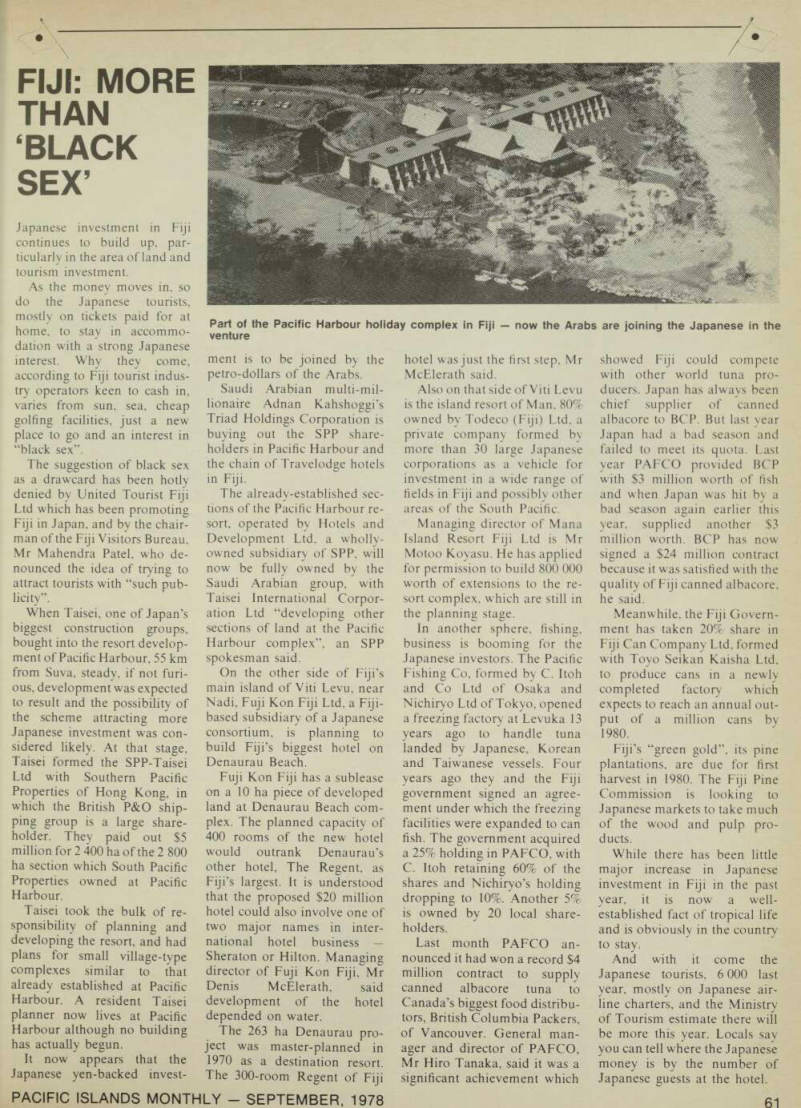
Than
‘Black
Sex’
Japanese investment in Fiji
continues to build up, par ticularly in the area of land and tourism investment.
As the money moves in, so do the Japanese tourists, mostly on tickets paid for at home, to stay in accommo dation with a strong Japanese
interest. Why they come,
according to Fiji tourist indus try operators keen to cash in, varies from sun, sea, cheap golfing facilities, just a new place to go and an interest in “black sex”.
The suggestion of black sex as a drawcard has been hotly denied by United Tourist Fiji Ltd which has been promoting Fiji in Japan, and by the chair man of the Fiji Visitors Bureau, Mr Mahendra Patel, who de nounced the idea of trying to attract tourists with “such pub
licity”.
When Taisei, one of Japan’s biggest construction groups, bought into the resort develop ment of Pacific Harbour, 55 km from Suva, steady, if not furi ous, development was expected to result and the possibility of the scheme attracting more Japanese investment was con sidered likely. At that stage, Taisei formed the SPP-Taisei Ltd with Southern Pacific
Properties of Hong Kong, in
which the British P&O ship ping group is a large share holder. They paid out $5 million for 2 400 ha of the 2 800 ha section which South Pacific Properties owned at Pacific Harbour.
Taisei took the bulk of re
sponsibility of planning and
developing the resort, and had
plans for small village-type
complexes similar to that already established at Pacific Harbour. A resident Taisei planner now lives at Pacific
Harbour although no building
has actually begun.
It now appears that the
Japanese yen-backed invest-
ment is to be joined by the petro-dollars of the Arabs.
Saudi Arabian multi-mil lionaire Adnan Kahshoggi’s
Triad Holdings Corporation is
buying out the SPP share holders in Pacific Harbour and the chain of Travelodge hotels
in Fiji.
The already-established sec tions of the Pacific Harbour re sort, operated by Hotels and
Development Ltd, a wholly
owned subsidiary of SPP, will now be fully owned by the Saudi Arabian group, with Taisei International Corpor ation Ltd “developing other sections of land at the Pacific Harbour complex”, an SPP spokesman said.
On the other side of Fiji’s main island of Viti Levu, near Nadi, Fuji Kon Fiji Ltd. a Fiji based subsidiary of a Japanese consortium, is planning to build Fiji’s biggest hotel on Denaurau Beach.
Fuji Kon Fiji has a sublease on a 10 ha piece of developed land at Denaurau Beach com
plex. The planned capacity of
400 rooms of the new hotel would outrank Denaurau’s other hotel. The Regent, as Fiji’s largest. It is understood that the proposed $2O million hotel could also involve one of two major names in inter national hotel business Sheraton or Hilton. Managing director of Fuji Kon Fiji, Mr Denis McElerath. said development of the hotel depended on water.
The 263 ha Denaurau pro
ject was master-planned in
1970 as a destination resort.
The 300-room Regent of Fiji
hotel was just the first step. Mr McElerath said.
Also on that side of Viti Levu is the island resort of Man, 80% owned by Todeco (Fiji) Ltd, a
private company formed by
more than 30 large Japanese corporations as a vehicle for investment in a wide range of fields in Fiji and possibly other areas of the South Pacific.
Managing director of Mana Island Resort Fiji Ltd is Mr Motoo Koyasu. He has applied for permission to build 800 000 worth of extensions to the re sort complex, which are still in the planning stage.
In another sphere, fishing, business is booming for the Japanese investors. The Pacific Fishing Co, formed by C. Itoh and Co Ltd of Osaka and
Nichiryo Ltd of Tokyo, opened
a freezing factory at Levuka 13 years ago to handle tuna
landed by Japanese, Korean
and Taiwanese vessels. Four years ago they and the Fiji government signed an agree ment under which the freezing facilities were expanded to can fish. The government acquired a 25% holding in PAFCO, with C. Itoh retaining 60% of the
shares and Nichiryo’s holding
dropping to 10%. Another 5% is owned by 20 local share holders.
Last month PAFCO an nounced it had won a record $4 million contract to supply canned albacore tuna to Canada’s biggest food distribu tors, British Columbia Packers, of Vancouver. General man ager and director of PAFCO, Mr Hiro Tanaka, said it was a significant achievement which
showed Fiji could compete with other world tuna pro ducers. Japan has always been chief supplier of canned albacore to BCP. But last year Japan had a bad season and failed to meet its quota. Last year PAFCO provided BCP with $3 million worth of fish and when Japan was hit by a bad season again earlier this year, supplied another $3 million worth. BCP has now signed a $24 million contract because it was satisfied with the quality of Fiji canned albacore. he said.
Meanwhile, the Fiji Govern ment has taken 20% share in Fiji Can Company Ltd, formed with Toyo Seikan Kaisha Ltd. to produce cans in a newly
completed factory which
expects to reach an annual out put of a million cans by 1980.
Fiji’s “green gold”, its pine
plantations, are due for first harvest in 1980. The Fiji Pine Commission is looking to Japanese markets to take much of the wood and pulp pro ducts.
While there has been little
major increase in Japanese
investment in Fiji in the past year, it is now a well established fact of tropical life and is obviously in the country to stay.
And with it come the Japanese tourists, 6 000 last year, mostly on Japanese air line charters, and the Ministry of Tourism estimate there will be more this year. Locals say you can tell where the Japanese money is by the number of Japanese guests at the hotel.
Part of the Pacific Harbour holiday complex in Fiji - now the Arabs are joining the Japanese in the venture
A Message
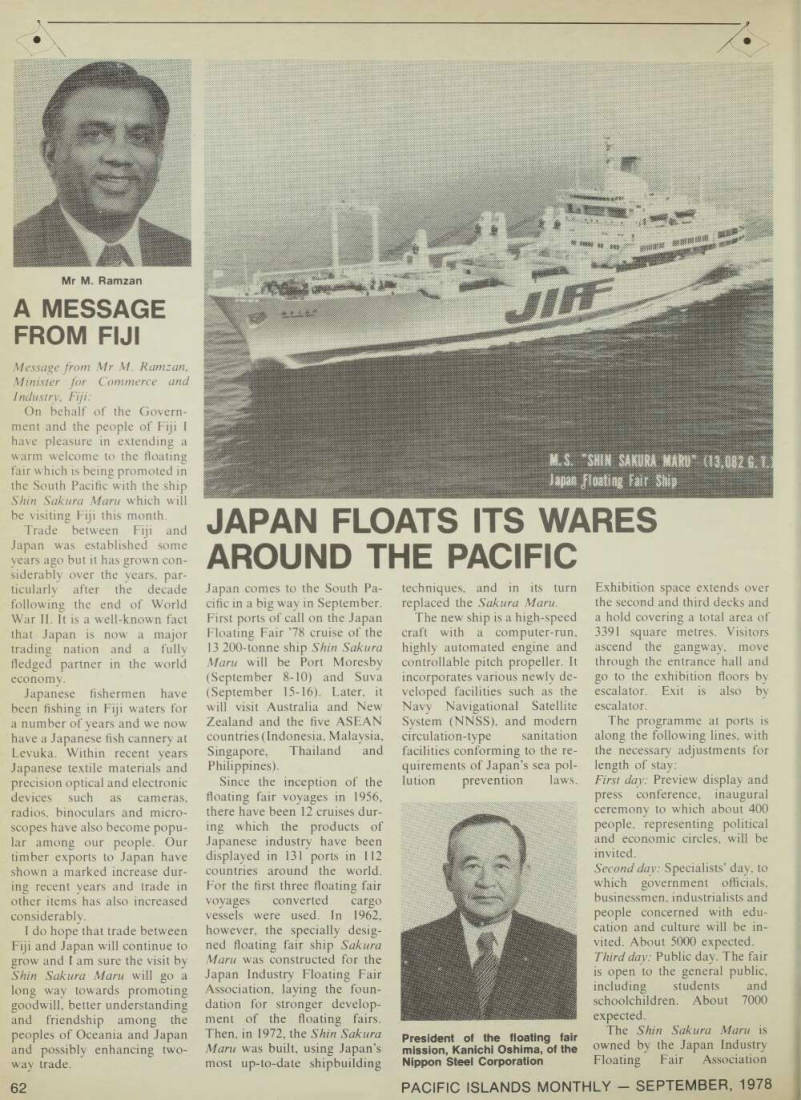
From Fiji
Message from Mr M. Ramzan , Minister for Commerce and
Industry, Fiji:
On behalf of the Govern ment and the people of Fiji I have pleasure in extending a warm welcome to the floating fair which is being promoted in the South Pacific with the ship Shin Sahara Mara which will be visiting Fiji this month.
Trade between Fiji and Japan was established some years ago but it has grown con siderably over the years, par ticularly after the decade following the end of World War 11. It is a well-known fact that Japan is now a major trading nation and a fully fledged partner in the world economy.
Japanese fishermen have been fishing in Fiji waters for a number of years and we now have a Japanese fish cannery at Levuka. Within recent years Japanese textile materials and
precision optical and electronic
devices such as cameras, radios, binoculars and micro scopes have also become popu lar among our people. Our timber exports to Japan have shown a marked increase dur ing recent years and trade in other items has also increased
considerably.
I do hope that trade between Fiji and Japan will continue to grow and I am sure the visit by Shin Sahara Mara will go a
long way towards promoting
goodwill, better understanding
and friendship among the peoples of Oceania and Japan
and possibly enhancing two
way trade.
Mr M. Ramzan
Japan Floats Its Wares
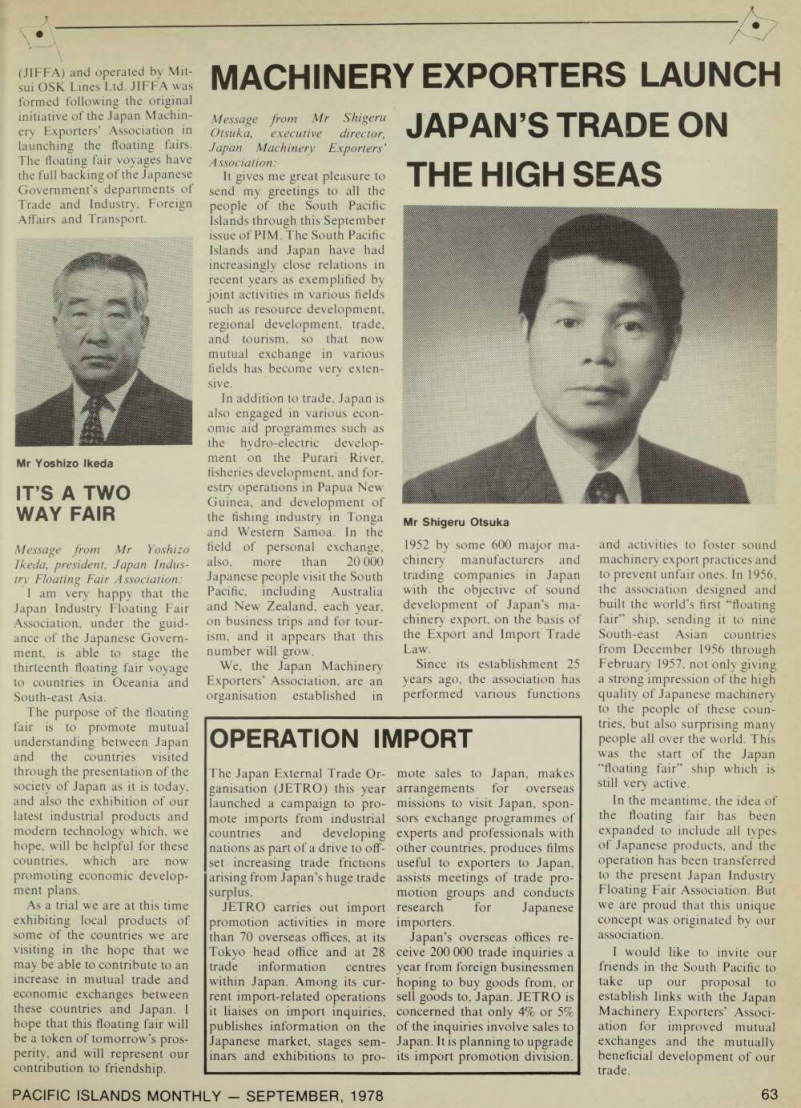
Around The Pacific
Japan comes to the South Pa cific in a big way in September.
First ports of call on the Japan Floating Fair ’7B cruise of the 13 200-tonne ship Shin Sahara Mara will be Port Moresby (September 8-10) and Suva (September 15-16). Later, it will visit Australia and New Zealand and the five ASEAN countries (Indonesia, Malaysia, Singapore, Thailand and
Philippines).
Since the inception of the floating fair voyages in 1956, there have been 12 cruises dur ing which the products of
Japanese industry have been
displayed in 131 ports in 112 countries around the world.
For the first three floating fair voyages converted cargo vessels were used. In 1962,
however, the specially desig
ned floating fair ship Sahara Mara was constructed for the
Japan Industry Floating Fair
Association, laying the foun dation for stronger develop ment of the floating fairs.
Then, in 1972, the Shin Sahara Mara was built, using Japan’s most up-to-date shipbuilding
techniques, and in its turn replaced the Sahara Mara.
The new ship is a high-speed craft with a computer-run, highly automated engine and controllable pitch propeller. It incorporates various newly de veloped facilities such as the Navy Navigational Satellite System (NNSS), and modem circulation-type sanitation facilities conforming to the re quirements of Japan’s sea pol lution prevention laws.
Exhibition space extends over the second and third decks and a hold covering a total area of 3391 square metres. Visitors ascend the gangway, move through the entrance hall and go to the exhibition floors by escalator. Exit is also by escalator.
The programme at ports is along the following lines, with the necessary adjustments for length of stay: First day: Preview display and press conference, inaugural ceremony to which about 400
people, representing political
and economic circles, will be invited.
Second day: Specialists’ day, to which government officials, businessmen, industrialists and people concerned with edu cation and culture will be in vited. About 5000 expected.
Third day: Public day. The fair is open to the general public, including students and schoolchildren. About 7000
expected.
The Shin Sahara Mara is owned by the Japan Industry Floating Fair Association
President of the floating fair mission, Kanichi Oshima, of the Nippon Steel Corporation
M.S. "SHIN SAKURA MARU" (13,082 6. T[?] Japan floating Fair Ship
(JIFFA) and operated by Mit sui OSK Lines Ltd. JIFFA was formed following the original initiative of the Japan Machin ery Exporters’ Association in launching the floating fairs.
The floating fair voyages have the full backing of the Japanese Government’s departments of Trade and Industry, Foreign Affairs and Transport.
It’S A Two
Way Fair
Message from Mr Yoshizo Ikeda, president, Japan Indus try Floating Fair Association: I am very happy that the
Japan Industry Floating Fair
Association, under the guid ance of the Japanese Govern ment, is able to stage the thirteenth floating fair voyage to countries in Oceania and South-east Asia.
The purpose of the floating fair is to promote mutual understanding between Japan and the countries visited through the presentation of the society of Japan as it is today, and also the exhibition of our latest industrial products and modem technology which, we hope, will be helpful for these countries, which are now
promoting economic develop
ment plans.
As a trial we are at this time exhibiting local products of some of the countries we are visiting in the hope that we may be able to contribute to an increase in mutual trade and economic exchanges between these countries and Japan. I hope that this floating fair will be a token of tomorrow’s pros perity, and will represent our contribution to friendship.
Mr Yoshizo Ikeda
Machinery Exporters Launch
Japan’S Trade On
The High Seas
Message from Mr Shigeru Otsuka, executive director,
Japan Machinery Exporters'
Association: It gives me great pleasure to send my greetings to all the people of the South Pacific Islands through this September issue of PIM. The South Pacific Islands and Japan have had increasingly close relations in recent years as exemplified by joint activities in various fields such as resource development,
regional development, trade,
and tourism, so that now mutual exchange in various fields has become very exten sive.
In addition to trade, Japan is also engaged in various econ omic aid programmes such as
the hydro-electric develop
ment on the Purari River, fisheries development, and for estry operations in Papua New Guinea, and development of the fishing industry in Tonga and Western Samoa. In the
field of personal exchange,
also, more than 20 000 Japanese people visit the South Pacific, including Australia and New Zealand, each year, on business trips and for tour ism, and it appears that this number will grow.
We, the Japan Machinery
Exporters’ Association, are an organisation established in
1952 by some 600 major ma chinery manufacturers and
trading companies in Japan
with the objective of sound
development of Japan’s ma
chinery export, on the basis of the Export and Import Trade Law.
Since its establishment 25 years ago, the association has performed various functions
and activities to foster sound
machinery export practices and
to prevent unfair ones. In 1956, the association designed and built the world’s first “floating fair” ship, sending it to nine South-east Asian countries from December 1956 through
February 1957. not only giving
a strong impression of the high
quality of Japanese machinery
to the people of these coun tries, but also surprising many people all over the world. This was the start of the Japan “floating fair” ship which is still very active.
In the meantime, the idea of the floating fair has been expanded to include all types of Japanese products, and the operation has been transferred to the present Japan Industry Floating Fair Association. But we are proud that this unique concept was originated by our association.
I would like to invite our friends in the South Pacific to take up our proposal to establish links with the Japan Machinery Exporters’ Associ ation for improved mutual
exchanges and the mutually
beneficial development of our trade.
Mr Shigeru Otsuka
Operation Import
The Japan External Trade Or ganisation (JETRO) this year launched a campaign to pro mote imports from industrial countries and developing nations as part of a drive to off set increasing trade frictions arising from Japan’s huge trade
surplus.
JETRO carries out import promotion activities in more than 70 overseas offices, at its Tokyo head office and at 28 trade information centres within Japan. Among its cur rent import-related operations it liaises on import inquiries, publishes information on the Japanese market, stages sem inars and exhibitions to pro
mote sales to Japan, makes arrangements for overseas missions to visit Japan, spon sors exchange programmes of experts and professionals with other countries, produces films useful to exporters to Japan, assists meetings of trade pro motion groups and conducts research for Japanese importers.
Japan’s overseas offices re ceive 200 000 trade inquiries a year from foreign businessmen hoping to buy goods from, or sell goods to, Japan. JETRO is concerned that only 4% or 5% of the inquiries involve sales to Japan. It is planning to upgrade its import promotion division.
Advertisements & other items, p. 64 (1 item)
Kyowa Line
KYOWA
YOUR TRADING PARTNER
CAR (ROLL-ON/ROLL-OFF)
& CONTAINER CARRIER “ASIAN ROSE”
The Asian Rose, the world's first container/ break bulk cargo/car roll-on and roll-off systems all in one, is in liner service from Japan to the South Pacific islands. The multi-mission carrier, the latest addition to our fleet, maintains a 45-day service, linking Japan, Guam, Fiji, New Caledonia and New Hebrides. She is capable of carrying 280 cars, 48 containers and 5,508 tonnes of break bulk cargo, offering greater safety and speeds in the delivery of merchandise.
She is another symbol of the quality service with which we are already credited.
AGENTS
Taiwan: Royal Steamship Corp., Ltd., Taipei S. Korea: Dong Sue Shipping Co._ Ltd., Seoul Hong Kong: Dahzun Enterprises- Ltd.
Singapore: Ocean Shipping & Enterprses Pte., Ltd Mariana Is.: Maritime Agencies of Pacific Ltd., Guam Solomon; Solomon Taiyo Ltd., Honiara Tahiti: J.A, Cowan & Fils, Papeete Cooks: Eastern Associates Ltd. Rarotonga Tonga: E.M. Jones Ltd , Nukualofa New Hebrides: Agence Maritime Pentecost Pacific S. A. Port Vila A. Samoa; Island Pacific Agencies Inc., Pago Pago W. Samoa: Morris Hedstrom Ltrom Ltd., Apia Fiji; Carpenter Shipping, Suva & Lautoka PNG: Carpenter Shipping Agencies. Port Moresby, Rabaul New Caledonia: Agence Maritime Du Rond Point Du Pacific. Noumea Indonesia: P.T. Porodisa Raya Shipping Lines. Jakarta Sabah: KOH Han Ming Shipping & Forwarding Agent., Kotakinabalu Sarawak: Pan Sarawak Agencies Sdn. Bhd., Sibu & Kuching Australia: Hethenngton Kingsbury Pty. Ltd., Sydney. N.S.W.
Newzealand: Sofrana Unilines S.A. Auckland A ■Vr- - Jm W-1 * A *U, *-
M IBS
s
KYOWA SHIPPING CO., LTD.
HEAD OFFICE
sth FI., Suzumaru Bldg. 39-8, 2-chome, NishiShinbashi, Minato-ku, Tokyo, Japan.
Phone :03(437)2885( Rep.) Cables: “MARIQUEEN” Tokyo. Telex : 242 4651 Kyowa J.
OSAKA OFFICE
Frontier Bldg., 3-13 Hirano-cho, Higashi-ku, Osaka, Japan.
Phone: 06 (227) 0422 (Rep.) Cables: “MARIQUEEN" Osaka. rPex ; 522-3896 Kyowa 0.
Yen Gathers Pace
In New Hebrides
Japanese involvement in the New Hebrides is officially regarded as ‘considerable’, writes lan Mclntyre in Vila.
And it is increasing monthly as new areas of commerce are
explored, existing production
facilities are expanded and more yen investment flows in.
The most tangible evidence of a Japanese presence can be seen at Palekula on Espiritu Santo, where there is a large, self-contained fishing base, and at the Le Lagon Country Club and Hotel on the shores of Erakor Lagoon near Vila.
But there are many less obvious signs of Japanese interest. Strong Japanese ties can be found in ‘offshore’
companies registered under
both the British and French tax haven legislation. These companies are involved in
shipping, mineral exploration,
copra production and process
ing, timber, beef and some small scale manufacturing.
The fishing base at Palekula has been in operation since 1957 when the South Pacific
Fishing Company (SPFC) took
over the wartime US Marine base. The Japanese have modi fied and extended it and are now using it to process fish, caught in the Coral and Solomon Seas and destined for American markets.
Using longline fishing boats
from Taiwan and South Korea plus their own catchers, the Japanese land and process around 10000 tonnes annually.
The export tax contributes sub stantially to the con
dominium’s budget.
Recently the New Hebrides Government took a 10% interest in SPFC and a seat on its board. Shares were acquired under an agreement whereby export duties payable by SPFC
were reduced and the Minister of Finance became the govern ment’s ex officio board mem ber.
The value of fish exported in 1977 was FNH 1056.9 million, making the industry the New Hebrides’ second biggest after copra. Last year FNH 1107.3 million worth of copra was exported, FNH 63.7 million worth to Japan.
In February the green light was given to Mitsubishi- Sumitomo to set up a SA6-
million-plus woodchip mill in
Santo. Native limbers and specially-grown stands will be used. This decision, one of the first major decisions by Chief Minister George Kalsakau. came after several years of study sponsored by the Japanese Government.
Mitsubishi-Sumitomo is in terested in timber stands on other islands but so far no firm agreements have been reached with land owners, villagers and custom chiefs on a formula for removing timber and trans porting it to the Santo mill.
Japan has agreed to buy around 1000 tonnes of locally produced beef over the next year. The meat will be frozen at the SPFC base and shipped to Japan. Freezing facilities at SPFC are to be expanded to enable it to hold up to 900 tonnes of beef. Indications are that Japan will be increasing its order in years to come.
Last year 2700 Japanese tourists visited the New Hebrides out of a total tourist turnover of 24 545. This was an increase of 187% on the num ber of Japanese visitors in 1976.
The stimulus for this jump has been Japanese control of Le Lagon Hotel, owned by the
Tokyu hotel organisation.
More than SASOO 000 was spent on a facelift and reorgan isation of management and ser vices.
Nowadays, in a package
deal, engaged Japanese
couples jet in, celebrate an
Island-style marriage in a
Melanesian Christian church and then stay on for the honey moon.
Advertisements & other items, pp. 65-66 (1 item)
Security
To Future Generations,
V' Horyuji japan's 7th century temple links the past to the present with the solemn beauty.
Social welfare is a subject of serious consideration in most modern societies. Man in the twentieth century accepts his responsibility to bequeath to the next generation a society better than his own.
Daiwa Bank is not unique in accepting this responsibility, but Daiwa is unique in making acceptance of this role in society an integral part of their banking service.
Daiwa is the only Japanese city bank to combine banking and trust business. Daiwa is thus a fully integrated banking institution, comprising banking, international financing, trust, pension trust, and real estate business. This integration is part of our effort to fulfil our social responsibility consistent with society's needs in a contemporary environment. a fully integrated banking service
DAIWA BANK
Head Office; Osaka, Japan London and Frankfurt Branches New York and Los Angeles Agencies Singapore, Sydney, Sao Paulo, Hong Kong and Houston Representative Offices Subsidiary: Daiwa Bank Trust Company, New York Joint Venture Banks: P.T. Bank Perdania, Jakarta, International Credit Alliance, Ltd., Hong Kong
Exporting the Know-How and Technology
Embodied in the Shinkansen
m||| tm 7110 EC P mi
iiiilli
mu The Shinkansen. With technology like the CTC (Centralised Traffic Control) System, and the MARS (Magnetic Automatic Reservation) System, the Shinkansen transportation network keeps things moving. For the 14 years it has operated, the Shinkansen service has never been interrupted with an accident. Moving people at a speed of 210 km/h. Millions of people a year. Quickly and comfortably.
And safely.
Many of Japan's private railways and underground systems have incorporated this modern technology and know-how into their own. The result is that Japan's rolling stock industry is rated one of the most advanced anywhere. Worldwide, some 71 countries are benefitting from Japan.
Japan Rolling Stock Exporters' Association is comprised of major Japanese rolling stock manufacturers, related parts manufacturers and trading firms. All backed by years of hard-earned experience. Your inquiries are welcome.
Japan Rolling Stock Exporters' Association No. 1, Tekko Bldg., 8-2 Marunouchi 1-chome, Chiyoda-ku, Tokyo, Japan Telephone: (03) 278-0360
four-letter word
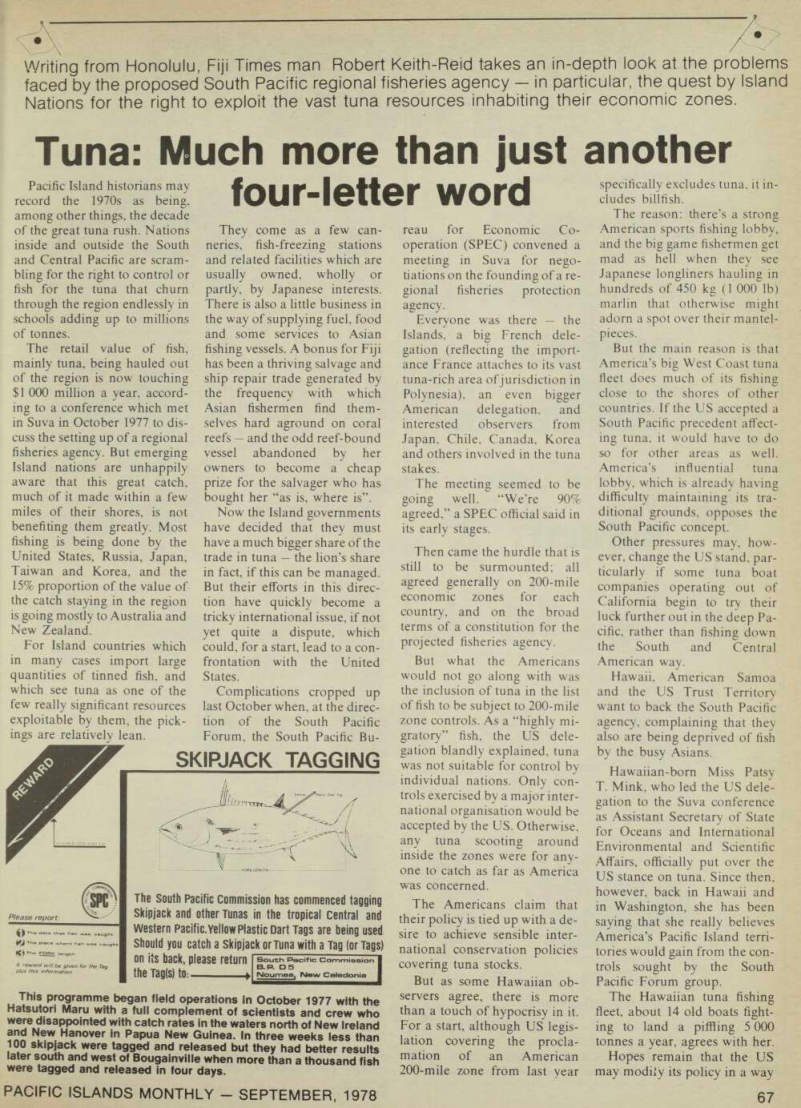
Tuna: Much more than just another
Writing from Honolulu, Fiji Times man Robert Keith-Reid takes an in-depth look at the problems faced by the proposed South Pacific regional fisheries agency in particular, the quest by Island Nations for the right to exploit the vast tuna resources inhabiting their economic zones.
Pacific Island historians may
record the 1970 s as being,
among other things, the decade of the great tuna rush. Nations inside and outside the South and Central Pacific are scram bling for the right to control or fish for the tuna that chum
through the region endlessly in
schools adding up to millions of tonnes.
The retail value of fish, mainly tuna, being hauled out of the region is now touching $1 000 million a year, accord ing to a conference which met in Suva in October 1977 to dis cuss the setting up of a regional fisheries agency. But emerging Island nations are unhappily aware that this great catch, much of it made within a few miles of their shores, is not
benefiting them greatly. Most
fishing is being done by the
United States, Russia, Japan, Taiwan and Korea, and the 15% proportion of the value of the catch staying in the region is going mostly to Australia and New Zealand.
For Island countries which in many cases import large quantities of tinned fish, and which see tuna as one of the
few really significant resources
exploitable by them, the pick
ings are relatively lean.
They come as a few can neries, fish-freezing stations and related facilities which are
usually owned, wholly or
partly, by Japanese interests.
There is also a little business in the way of supplying fuel, food and some services to Asian fishing vessels. A bonus for Fiji has been a thriving salvage and
ship repair trade generated by
the frequency with which Asian fishermen find them selves hard aground on coral reefs and the odd reef-bound vessel abandoned by her owners to become a cheap prize for the salvager who has bought her “as is, where is”.
Now the Island governments have decided that they must have a much bigger share of the trade in tuna the lion’s share in fact, if this can be managed.
But their efforts in this direc tion have quickly become a tricky international issue, if not yet quite a dispute, which could, for a start, lead to a con frontation with the United States.
Complications cropped up
last October when, at the direc tion of the South Pacific Forum, the South Pacific Bu
reau for Economic Co operation (SPEC) convened a meeting in Suva for nego tiations on the founding of a re gional fisheries protection agency.
Everyone was there the Islands, a big French dele
gation (reflecting the import
ance France attaches to its vast tuna-rich area of jurisdiction in Polynesia), an even bigger American delegation, and interested observers from Japan, Chile, Canada, Korea and others involved in the tuna stakes.
The meeting seemed to be going well. “We’re 90% agreed,” a SPEC official said in its early stages.
Then came the hurdle that is still to be surmounted: all agreed generally on 200-mile economic zones for each country, and on the broad terms of a constitution for the projected fisheries agency.
But what the Americans would not go along with was the inclusion of tuna in the list of fish to be subject to 200-mile zone controls. As a “highly mi gratory” fish, the US dele
gation blandly explained, tuna
was not suitable for control by individual nations. Only con trols exercised by a major inter national organisation would be accepted by the US. Otherwise, any tuna scooting around inside the zones were for any one to catch as far as America was concerned.
The Americans claim that their policy is tied up with a de sire to achieve sensible inter national conservation policies covering tuna stocks.
But as some Hawaiian ob servers agree, there is more than a touch of hypocrisy in it.
For a start, although US legis
lation covering the procla
mation of an American 200-mile zone from last year
specifically excludes tuna, it in cludes billfish.
The reason: there’s a strong
American sports fishing lobby,
and the big game fishermen get mad as hell when they see
Japanese longliners hauling in
hundreds of 450 kg (1 000 lb) marlin that otherwise might adorn a spot over their mantel
pieces.
But the main reason is that America’s big West Coast tuna fleet does much of its fishing close to the shores of other countries. If the US accepted a South Pacific precedent affect ing tuna, it would have to do so for other areas as well.
America’s influential tuna lobby, which is already having
difficulty maintaining its tra
ditional grounds, opposes the South Pacific concept.
Other pressures may, how ever, change the US stand, par ticularly if some tuna boat
companies operating out of
California begin to try their luck further out in the deep Pa cific, rather than fishing down the South and Central American way.
Hawaii, American Samoa and the US Trust Territory want to back the South Pacific
agency, complaining that they
also are being deprived of fish
by the busy Asians.
Hawaiian-bom Miss Patsy T. Mink, who led the US dele gation to the Suva conference as Assistant Secretary of State for Oceans and International Environmental and Scientific Affairs, officially put over the US stance on tuna. Since then, however, back in Hawaii and in Washington, she has been saying that she really believes America’s Pacific Island terri tories would gain from the con trols sought by the South Pacific Forum group.
The Hawaiian tuna fishing fleet, about 14 old boats fight ing to land a piffling 5 000 tonnes a year, agrees with her.
Hopes remain that the US may modify its policy in a way
that will allow the proposed agency to get cracking in the knowledge that it won’t have problems from America’s direction, at least.
“I think we’re prepared to try to manage tuna,” said Mr Doyle Gates, an official of the National Marine Fisheries Ser vice in Honolulu who was on the US delegation to Suva.
Figures from a yearbook
issued by the United Nations’
Food and Agriculture Organis
ation give some idea of what is at stake as the South Pacific Forum and the Japanese, Americans and others manoeuvre for a secure tuna stakeout. In 1974, the region yielded 979 000 tonnes, includ ing 481 000 tonnes of skipjack, 247 000 of yellowfin, 140 000 tonnes of albacore, 82 000 tonnes of bigeye and 29 000 tonnes of bluefin.
Perhaps about half of this catch was taken in and around Micronesia, which is most eas ily accessible to the most active tuna fishers, the Japanese fleets.
For skipjack, which are much smaller than the other species and tend to frequent shallower areas, the harvest is considered to be well below a sustainable annual yield of be tween 800 000 and 1 000 000 tonnes.
About 30 000 skipjack are being caught each year, tagged and released, and those caught
again are yielding data of help
in planning the launching of
embryo fishing fleets.
If and when the South Pa cific Fisheries Agency gets off the ground a number of Island countries hope to make money
by licensing foreigners to fish
for tuna in their economic zones.
They would also boost local economies by requiring li cences to build, say, a cannery employing so many local
people, processing so much
fish, and probably having a minimum of local equity.
The New Hebrides, the Solomons, Fiji and American Samoa already have canneries or freezing plants in operation, with Fiji and the Solomons
having finally managed to per
suade Japanese companies to accept joint venture deals.
American Samoa has two US owned canneries served by chartered Korean ships.
Papua New Guinea, which has particularly rich tuna grounds to its north, is nego tiating with American and Japanese interests on the pre cise form to be taken by their
future exploitation.
Meanwhile, Fiji seems to have grabbed a lead in max imising the value of skipjack fishing for its own economy. A
cannery, jointly owned by
Japanese interests and the Fiji Government, opened last year at Levuka and the government is building up a fishing fleet.
Last year the government
owned Ika Corporation caught
1 700 tonnes of fish with four boats, and in the first three months of this year, with a fleet of six, landed 978 tonnes.
The Fiji blueprint is one which other Pacific Island governments will want to match.
Some have already taken steps to do so, with Japanese help. Japan has recently sup plied Western Samoa with $550 000 in fishing aid, includ ing a skipjack catcher; Tonga is receiving a $ 1 500 000 grant from the same source; Saipan is yet another recipient of Japanese fishing aid; and the Japanese International Co
operation Agency has been
engaged in a tuna baitfish sur vey for the Gilbertese Govern ment.
The Americans, for all their coyness about tuna, are taking steps to make sure they have a leg in also. They have created the Western Pacific Fisheries Commission, based in Honolulu, to prepare fisheries management plans for billfish, precious corals and lobster; bottom fishing; and fishing on the small but quite rich grounds centred on seamounts the tops of submerged mountains, of which there are many near Hawaii.
Then there is the Pacific Tuna Development Foun dation, launched in 1976 to promote fisheries develop ment, and particularly tuna fishing, for the benefit of Hawaii, Guam, American Samoa, the Trust Territory and the Northern Marianas.
Advertisements & other items, pp. 67-72 (1 item)
Skipjack Tagging
Please report.
Car
o Th. p>.
E£ /I reward will be given for the Tag plus this information The South Pacific Commission has commenced tagging Skipjack and other Tunas in the tropical central and Western Pacific. Yellow Plastic Dart Tags are being used Should you catch a skipjack orTuna with a Tag (or Tags) on its back, please return south Pacific commission i the Tag(s) to : —Noumea, Mew Caledonia j This programme began field operations in October 1977 with the Hatsutori Maru with a full complement of scientists and crew who were disappointed with catch rates in the waters north of New Ireland New Hanover Papua New Guinea. In three weeks less than 100 skipjack were tagged and released but they had better results later south and west of Bougainville when more than a thousand fish were tagged and released in four days.
Why doesn’t baby cry any more?
Because baby is happy
with PIGEON high quality products.
*€ p
I IMPORTER %
I and
SOLE DISTRIBUTOR »
4 %
Wanted!
VJL/
Why not join us in furthering the distribution of PIGEON products in the following area?
Papua New Guinea New Zealand New Hebrides Solomon Islands A & W Samoa Cook Islands Kingdom of Tonga Republic of Nauru French Polynesia, including Tahiti New Caledonia If you are interested in this offer, please contact us at the following address.
Detailed information will be happily and quickly provided.
A complete line of baby products including nursing bottles, nursery equipment and toys, childcare toiletries, others,
©PIGEON CO.,LTD.
International Department m. 5-1, Kanda Tomiyama-cho, Chiyoda-ku, Tokyo 101, Japan Telephone: 03-252-4111 Cable Address: PIGEQNBABY TOKYO Telex: J 26569
CONSTRUCTIVE
ADVICE.
■ -iv Komatsu makes 76-ton Bulldozers ; W I Swamp Bulldozers as well as Swamp Dozer Shovels.
Radio-Controlled Bulldozers and Dozer Shovels.
Electric Powered Dozer Shovels.
A wide range of Pipelayers. 7 Amphibious Bulldozers a .m Wheel Loaders. m y As well as Motor Scrapers.
A wide selection of Off-Highway Dump Trucks.
Slag Dump Trucks.
'LL.
And offer Motor Graders. ry Towing Tractors. 5? 5 ‘ “S * -* 18 sa A wide selection of Diesel Engines.
Machine Tools. 3
t z.jn*
* e Mechanical and Hydraulic Presses. A variety of Maypres Presses. OBS Power Presses. Tunnel-Boring Machines.
We re constructive in other ways. We offer castings, foundries, and important advice on construction and manufacturing projects.
•§• KOMATSU LTD
Tokyo, Japan Komatsu overseas offices: Sydney, Singapore, Jakarta, Manila, Seoul, Bangkok, Bangalore. Teheran, Dubai, Jeddah, Riyadh, Ad Dammam, Baghdad, Ankara, Moscow, London, Brussels. Dusseldorf, Stuttgart, Warszawa, Paris, Madrid, Cairo, Alger, Abidjan, Lagos, Nairobi, Johannesburg, Toronto, San Francisco, Fort Lee Arlington, Atlanta, Detroit, Mexico City, Habana, Panama, Sao Paulo, Caracas, Lima, Buenos Aires, and distributors in over 100 countries around the world.
This page tells a lot about
Mazda technology.
Just a few of the searching tests a Mazda has to pass before it ever goes into production. Many more follow, both during manufacture and after. The result. Superior, highquality products. Cars like the Mazda 323. A car everyone’s talking about because of its versatile, economical
performance and stylish good looks.
And like all Mazdas, a car that you can own and drive with confidence.
Because Mazdas are made right.
Right from the beginning.
Sound Testing Laboratories Nobody likes noise. Least of all Mazda. That’s why we are working hard to make our cars quieter —from the outside and the inside. The car (right) is in our anechoic test chamber. Here the whole car is subjected to vibration through a machine that creates a variety of different shakes and thumps. Ultra-sensitive microphones pick up every sound made, then amplifies it for thorough analysis. This way we can get rid of excessive noise and vibration before they annoy you and your passengers.
The Climatic Testing Laboratories (top, far right) Here a range of driving conditions can be simulated, from stop-start city driving to sustained high-speed highway running.
The tests are conducted in a wide range of temperatures and under different atmospheric conditions. So you can be sure your Mazda will be expertly tuned to run smoothly in the country where you live.
Body Testing Laboratories(bottom.farright)
This is one of the facilities that crash tests our car bodies. Impact and torsional effects can be accurately measured by computers simulating collisions at 30-60 m.p.h. Dummies electronically wired tell us what happens to passengers —and as a result —provide our design engineers with valuable information about the safest interiors and bodies. Tests such as these helped us to design the light, crash resistant, semi-monocoque body found on all Mazda passenger cars.
mazoa
Quality through superior technology
■: \ FIJI ISLS. Niranjans Autoport Ltd. G.P.O. Box 450, Suva TEL: 381555 NAURLITim John P.O. Box 101, Rep. of Nauru TEL: 471 NEW CALEDONIA Joseph Cheval & Cie 3, Rue Jean-Jaures, Noumea TEL: 731-01 NEW ZEALAND Mazda Motors of New Zealand Ltd. Otahuhu, Auckland P.O. Box 22-472 TEL: 69-099 NORFOLK ISL. Duncombe Bay Garage. P.O. Box 220, Norfork Isl. TEL: 2097 PAPUA NEW GUINEAP.N.G. Associated Industries Ltd. P.O. Box 1394, BorokoTEL; 255788 SAIPAN Latte Motors Inc. P.O. Box 206, Saipan, Mariana Isl. TEL: 6142 SOLOMON ISLS. Solomon Motors Ltd. P.O, Box 20, Honiara TEL: 313 TAHITI Comploir Polynesien B.P. 628, Papeete TEL: 2. 80. 27 TONGA Prema & Sons P.O. Box 20, Nukualofa WESTERN SAMOAMazda Services (Samoa) Ltd. P.O. Box 576, Apia TEL: 825 The trademark MAZDA in this advertisement stands for AUTOMOBILES MAZDA.as far as France and her territories are concerned.
Goorf
V .
O Sv a A> s/>*° f f v* smi *DOf°
PACKED BY:
NIPPON SUISAN KAISHA, LTD.
TOKYO,JAPAN
EXPORTED BY :
UNITRADE COMPANY, LIMITED.
•Sanritsu Building 1112 3-chome Hachobori Chuo-ku Tokyo (104)
TELEX NO. : "252-4665 KANDK J"
CABLE ADDRESS : "KAYANDKAY TOKYO"
TELEPHONE NO. : 03-553-9520
■ ■ ' ' ■ ' ■ ' P :r f ■ SI w t
ISI
dSv ■ •* • « **#* • * ■ „. v wse
You’ll like our style to all
our destinations.
We have many flights to many destinations, but on each and every one you can be sure of one thing: attentive and friendly service. Plus of course good food and fine wines served in big jet comfort.
Today this special style of Air New Zealand is yours to enjoy on direct flights to New Zealand, or on your way around the Pacific; even to the East now that the fast, friendly way there is first to fly south with us! And of course to Honolulu, Los Angeles and on to Canada, London or Europe.
Your travel agent or Air New Zealand is ready now to help you plan the trip and the fares that suit you best wherever you want to fly.
(£= air new
™ We fly the Pacific.
ANZ7B/3
Press
From the
Islands
From an offering entitled Polynesian Time by Taha Talagi in Tohi Tala Niue What can we do? Either be a Polynesian or a citizen of New Zealand to keep up what is called a Palagi time which is 7.30 meaning 7.30 and not 8.30 Niue time. What is time to a Niuean?
Time is not important as far as we exist, but spoilt by so-called
timepieces.. .
From the Fiji Times A devout Muslim civil servant who regularly goes to pray at lunchtime at the Toorak Mosque found to his dismay yesterday that the day’s prayer had cost him $ 16.25. A new pair of shoes which he had taken off outside the mosque had disappeared by the time he had completed his prayer. The man had to go out and buy a pair of flipflops for 75<f to wear back to work, in place of the shoes which had cost him $ 15.50.
From an editorial in Tohi Tala Niue Annual licensing of firearms on Niue sounds a bit out of place even though it is a requirement by law. Firearms on Niue meant to be shotguns but what is the use of paying for the annual licence when guns are hardly used. Last year people who own guns only use them for three months, therefore the payment is warranted, but this year guns were never used because there were no ammunitions available at the Treasury bond store . . .
From Arawa Bulletin, Papua New Guinea Are we really interested? Apparently not, if the number of votes cast in the recent Arawa Town Council is any criterion. Just on 10% of those entitled to vote made use of their power. A sad reflection when one considers the amount of criticism that is heard of the council and its activities . . . Still, council elections throughout the world are notorious for the apathy of voters, and Arawa is not alone . . . Three councillors polled 22 votes or less and were successful. . .
Cook Islands News didn’t say who they were or where they came from but insisted that Ernie, Frank and Jean had a ‘new life ahead' One Saturday was a day to remember for years to come for some more of Dr Milan Brych’s cancer patients. On that lovely sunny morning an almost unprecedented number of oncology patients and their relatives were at the airport to farewell three more patients who had successfully completed their course of treatment. Mingling in the crowd at the airport no one would have known that Ernie, and Frank . . . had only a few months ago been seriously ill. There was also Jean from Tasmania, who only some six months ago had come over for treatment as a last resort never expecting to return home . . .
From a profile of Lae businessman Mr Muttu Gware in Lae Nius, Papua New Guinea Mr Gware recalls ‘way back in his childhood in 1945 or 46 that his father took the whole family to Voco Point soon after the war broke out. The family sat on the beach watching planes
bombing the ships. In return the ships fired their giant guns at the planes. The smoke of the machine-guns covered the face of the sun, they couldn’t see at all and the whole place was very dark. They were all very frightened.
From New Hebrides News A black object believed to be a meteorite, fell between Merelava and Gaua on Saturday morning June 17. Merelava people reported seeing the flying object with a tail of fire falling from the sky at a great speed. When it hit the water there was a huge explosion which snook the islands. The people thought it was either a bomb explosion or the Gaua volcano erupting.
Meteorological Department officers are certain it was a meteorite. . .
From the Papua New Guinea Post-Courier Rabaul police are investigating reports that some village court magistrates are using money from fines for their own use. East New Britain Provincial Government’s Minister for Justice, Mr Anton Bos, said yesterday an investigation on one court area had shown thefts of this kind.
From the government publication News Bulletin, American Samoa The 15.0% unemployment rate in American Samoa for the calendaryear 1977 was 4.4% below that of 1976 and 3.0% below that of 1975. The significant reduction has been attributed largely to the outmigration of young American Samoans for economic opportunities and to further their education. The figures were released by the ASG’s Development Planning Office in its recently published Statistical Bulletin, a semi-annual report on economic indicators.
The Bulletin states that there exists some controversy over the interpretation of employment/unemployment figures. “Some (people) are of the opinion that although the Territory records high unemployment figures, it does not carry with it the same connotation as in the Mainland, USA. The rationale behind this thought is based on the fact that although many Samoans are able to work, they are contented staying home and working off the plantation to provide staple food for the family. The other membersof the family working in paid employment help to support them. It is also their contention that culture demands that the wives stay home and look after the children. These persons, accordingly, should not be counted in the labour force.”
From the Atoll Pioneer, Gilbert Islands (reporting an exhibition of Australian Aboriginal art arranged by the Australian High Commission) There are three “nos” to this show: there are no boomerangs, there are no spears, and unfortunately none of the exhibits are for sale .. .
From a letter in the Arawa Bulletin, Papua New Guinea ... lam an ex-member of the police force stationed here in Arawa and I am not at all pleased with the help the Premier, community leaders and peace officers are offering to curb crimes committed in both urban and rural areas throughout this province of North Solomons. We seem to be disgraced by the Bougainvillean politicians in the Bulletin saying police are not working properly to fight crimes committed in the North Solomons Province, if we delay investigation due to other serious crimes being committed which require more investigation. We are not gods.
We make reports on crimes or offences committed and investigations are carried out soon after. Offenders may be arrested and detained with the help of the public giving information to us . . . Most of these crimes are done by community and high school dropouts . . . Highlanders are not to be blamed all the time . . .
Advertisements & other items, p. 74 (1 item)
In catering
HEAT
SEALING.
SHRINK
PACKAGING.
CONTACT A USTRA LI A'S
FOREMOST MANUFACTURERS
OF HEAT SEALING EQUIPMENT
SERVING INDUSTRY
IN AUSTRALIA & THE PACIFIC ISLANDS
FOR OVER 25 YEARS
HELIX ELECTRICAL PRODUCTS PTY. LTD.
27 Rosebery Avenue, Rosebery, NSW 2018, Australia. 663 0487.
HENRY CUMINES
PTY. LTD.
EXPORTERS o GENERAL MERCHANTS
428 GEORGE ST., SYDNEY
CABLES: HENCO SYDNEY. G.P.O. Box 3949. PHONE: 25-3383. • •
For specialised and personalised buying service
throughout the Pacific Islands and the East.
-• LOCAL AGENTS AND REPRESENTATION;
PAPUA NEW GUINEA.
PORT MORESBY: Mr. Tan,
P.O. Box 5445, Boroko.
Telephone 25 2542.
RABAUL: M. & C. Seeto, P.O. Box 131, Rabaul.
Telephone 92 2902.
MADANG: W. Double, P.O. Box 22, Madang.
Telephone 82 2696.
FIJI.
K. Witherington Ltd., P.O. Box 293, Suva.
Telephone 22 356.
NEW HEBRIDES.
John Lum & Associates, P.O. 65, Santo.
Telephone 329.
SOLOMON ISLANDS.
Lo See War Ltd., P.O, Box 327, Honiara.
Telephone 399. -• Resident Agents in other Pacific Territories. •-
In catering
SPEED-E-GAS
is fast, efficient
and reliable.
Terminals throughout the Pacific.
For more information write Boral Gas Limited, 221 Miller Street, North Sydney 2060 *Speed-E-Gas is known in Papua New Guinea, as Guinea Gas. In Tonga as Tonga Speed-E-Gas, and in Fiji as Fiji Gas.
BORAL
SPEED-E-GAS
HOLT GS 15
Afterthoughts
with Percy Chatterton
in Port Moresby
One of Papua New Guinea’s most popular vogue words at present is ‘decentralisation’. Along with John (now Sir John) Guise I was one of the early advocates of decentralisation at a time when such ideas were regarded as highly heretical by the colonial establishment, and in 1969 I read a paper at the PNG University’s Waigani Seminar on the subject. It was called The Possible Role of Regional Assemblies in Papua New Guinea.
Of course we have always had decentralisation of a kind in PNG, that is, decentralisation of administration. Colonial Papua New Guinea was divided into four administrative ‘regions’, and each region into a number of‘districts’. The number of these districts rose from 15 in the immediate post-war years to the present tally of 19, some districts having been split into two. The demand for further sub-division is still being heard, sometimes
clamorously.
The four regions Papua, Highlands, New Guinea Mainland and New Guinea Islands had a kind of rationale. The districts might be described as kiap- sized bites, in other words, areas of a size which a kiap (district commissioner) could effectively administer.
The function of district administration, in theory at any rate, was the implementation of centrally enacted laws and regulations by means of an administrative hierarchy ranging from the prestigious district commissioner down to the humble patrol officer. These gentlemen were supposed to work by the book, but some of them showed considerable ingenuity in devising rules and even punishments which were not in the book but which they regarded as suitable for the local situation ‘ kiap law’ it was sometimes called. As the governed didn’t know what was or was not in the book, the kiaps generally got away with it.
But what Sir John and 1 were after in the late sixties was not decentralisation of administration, which we already had, but decentralisation of decision-making. My 1969 paper envisaged that the regional assemblies would be decision-making and law-making bodies. I adopted Guise’s suggestion that the units of decentralisation should be called ‘provinces’, and tentatively suggested that the number of these provinces should be somewhere between the four of the administrative regions and the (at that time) 18 of the administrative districts. In a PIM article in the same year I suggested a split up into seven or eight provinces. And five years later, in a submission to the Constitutional Planning Committee (CPC), I proposed five the four traditional regions, but with Bougainville as a separate province from the rest of the New Guinea Islands.
What finally came out of the CPC cooking pot was a proposal that the, by then, 19 districts should be re-named ‘provinces’, and that each should have its own provincial assembly. I have no doubt at all that this proposal accurately reflected the public sentiment of the time.
Now, in 1978, the formation of the 19 provincial governments is proceeding apace, and national government has got to learn to live with it. The Public Service has got to learn to live with it too, and that may be harder.
Whether it is really a good thing to have so many provinces is a matter of opinion. I think it isn’t. But for the moment it’s the ‘will of the people’, and we’re stuck with it. Somehow or other it must be made to work; its breakdown on any widespread scale could have serious consequences.
First, there seems to be a widespread lack of understanding of the fact that the power to make decisions is of little use without the expertise to implement them. Is there enough expertise available to be spread over 19 provinces? And will the experts
we have got go mad trying to serve two masters the provincial and national governments respectively? Yet a failure in implementation will generate a lot of discontent, some of which will rub off on the national government, which will be accused of having let the provinces down.
In the second place, with common roll provincial and national elections held separately, the chances of jealousy, tension and even confrontation developing between provincial and national legislatures and politicians are considerable. Already ill-feeling has surfaced between the interim (ad hoc) provincial assemblies and the national parliamentarians who represent those provinces.
These tensions may well increase when fully elected provincial governments replace the present ad hoc bodies.
Next, if so many provincial governments were necessary, one wonders whether it would not have been a good idea to structure them more simply. In 1964 the colonial power established the House of Assembly as an embryo national government, importing to it all the panoply and complexity of Westminster.
Now our national parliament has established provincial government on the pattern of the Australian state governments, with premiers, deputy premiers, speakers, deputy speakers, and all the other trimmings. Maybe this has given some of the participants delusions of grandeur; certainly it has led some of them to place a high monetary value on their services to their
province.
Anyway, six state premiers in Australia is one thing; 19 provincial premiers in PNG is another. It seems a pity that a more Melanesian pattern could not have been worked out.
I have on several occasions suggested that if and when provincial governments become well established and take over a substantial part of the legislative work load, a national legislature of the size of our present national parliament will become an unnecessary burden to the governmental structure. A smaller body might be more suitable, and would certainly be cheaper. Moreover, if the members of this body were chosen by the provincial assemblies instead of by direct election, the chances of friction between provincial and national governments would be lessened.
But it’s probably too late now for such a change. There are too many people around with a vested interest in maintaining the status quo. So it looks like we are stuck with a very expensive system of government.
Perhaps the saddest part of the whole thing is that fewer and fewer people seem to be willing to do anything for nothing. At all levels people want to be paid for service to their community, their province or their country. They even want to be paid attendance money (far in excess of genuine out-of-pocket expenses) for turning up at meetings which their election to office places an obligation on them to attend anyway.
It wasn’t always so. In Sir Hubert Murray’s Papua we had a Village Council at Hanuabada. It was one of the many forward-looking experiments of that now much rubbished era.
The councillors were not remunerated for their services, nor were they paid for attending council meetings. They were quite happy with the opportunities the job gave them for improving the life of their community.
It’s all very different now. And in the long run it’s the wage earners and villagers who, through direct and indirect taxation, will foot the bill.
Advertisements & other items, p. 76 (1 item)
<¥ Parker
V TO*. % •». w '%f/l mv NW< V ?ms •mi 'IM •». 1K& v V & as / 3
More of an asset
than just a pen.
Parker 75.
It takes four precious metals to make a Parker 75 pen like this. Sterling silver for the case, 14ct gold for the beautifully responsive nib, and a wear-resistant alloy of platinum and ruthenium for the tip.
It’s even more exceptional. The nib can turn 360° to write at the angle most natural to you.
A lifetime investment.
Also in 22ct gold; Vermeil, which is gold on silver; and stainless steel.
Pencils, ball pens and nylon nib versions to match.
<¥ PARKER
tfi
V World's most wanted pens Ww
’mmt
-> N ft; *„ 066. P. 490
Island governments
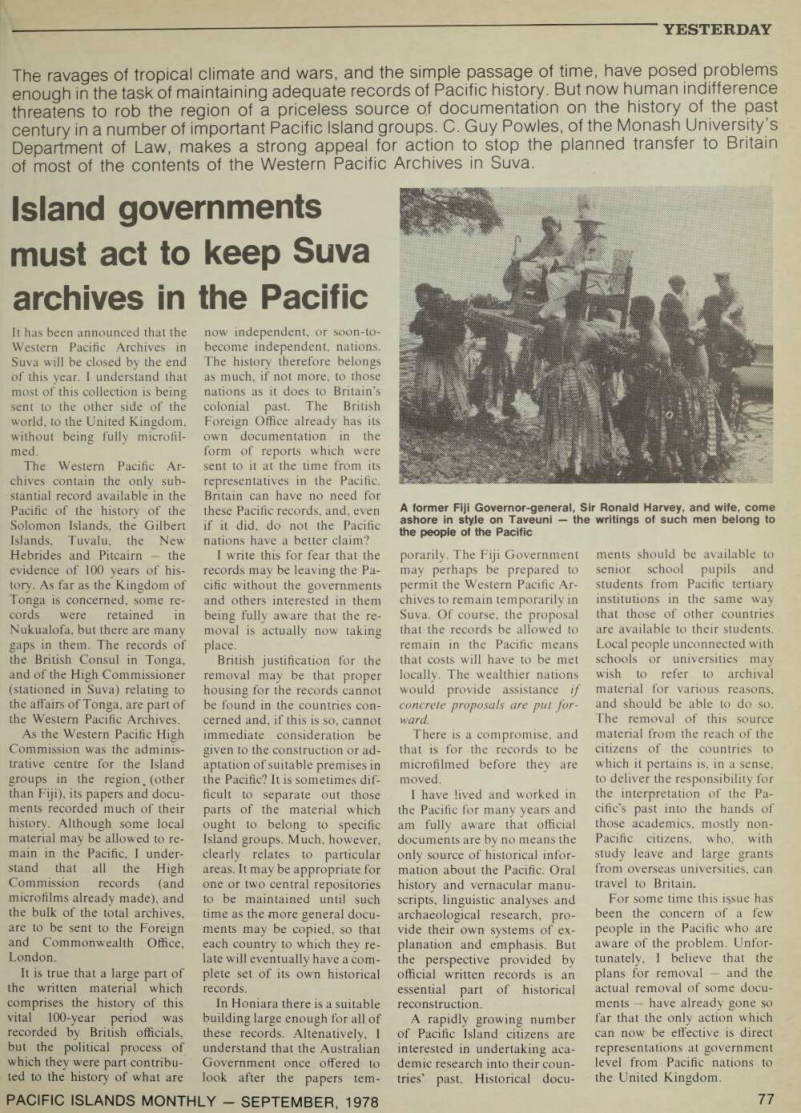
must act to keep Suva archives in the Pacific
The ravages of tropical climate and wars, and the simple passage of time, have posed problems enough in the task of maintaining adequate records of Pacific history. But now human indifference threatens to rob the region of a priceless source of documentation on the history of the past century in a number of important Pacific Island groups. C. Guy Powles, of the Monash University’s Department of Law, makes a strong appeal for action to stop the planned transfer to Britain of most of the contents of the Western Pacific Archives in Suva.
It has been announced that the Western Pacific Archives in Suva will be closed by the end of this year. I understand that most of this collection is being sent to the other side of the world, to the United Kingdom, without being fully microfil med.
The Western Pacific Ar chives contain the only sub stantial record available in the Pacific of the history of the Solomon Islands, the Gilbert Islands, Tuvalu, the New Hebrides and Pitcairn the evidence of 100 years of his tory. As far as the Kingdom of Tonga is concerned, some re cords were retained in Nukualofa, but there are many gaps in them. The records of the British Consul in Tonga, and of the High Commissioner (stationed in Suva) relating to the affairs of Tonga, are part of the Western Pacific Archives.
As the Western Pacific High Commission was the adminis trative centre for the Island groups in the region, (other than Fiji), its papers and docu ments recorded much of their
history. Although some local
material may be allowed to re main in the Pacific, I under stand that all the High Commission records (and microfilms already made), and the bulk of the total archives, are to be sent to the Foreign and Commonwealth Office, London.
It is true that a large part of the written material which comprises the history of this
vital 100-year period was
recorded by British officials, but the political process of which they were part contribu ted to the history of what are
now independent, or soon-to become independent, nations.
The history therefore belongs
as much, if not more, to those nations as it does to Britain’s colonial past. The British Foreign Office already has its own documentation in the form of reports which were sent to it at the time from its representatives in the Pacific.
Britain can have no need for these Pacific records, and, even if it did, do not the Pacific nations have a better claim?
I write this for fear that the records may be leaving the Pa cific without the governments and others interested in them being fully aware that the re moval is actually now taking place.
British justification for the removal may be that proper housing for the records cannot be found in the countries con cerned and, if this is so, cannot immediate consideration be given to the construction or ad aptation of suitable premises in the Pacific? It is sometimes dif ficult to separate out those parts of the material which ought to belong to specific Island groups. Much, however,
clearly relates to particular
areas. It may be appropriate for one or two central repositories to be maintained until such time as the more general docu ments may be copied, so that each country to which they re late will eventually have a com plete set of its own historical records.
In Honiara there is a suitable building large enough for all of these records. Altenatively, I understand that the Australian Government once offered to look after the papers tem-
porarily. The Fiji Government
may perhaps be prepared to permit the Western Pacific Ar chives to remain temporarily in Suva. Of course, the proposal that the records be allowed to remain in the Pacific means that costs will have to be met locally. The wealthier nations
would provide assistance if
concrete proposals are put for ward.
There is a compromise, and that is for the records to be microfilmed before they are moved.
I have lived and worked in the Pacific for many years and am fully aware that official documents are by no means the only source of historical infor mation about the Pacific. Oral history and vernacular manu
scripts, linguistic analyses and
archaeological research, pro vide their own systems of ex
planation and emphasis. But
the perspective provided by
official written records is an essential part of historical reconstruction.
A rapidly growing number
of Pacific Island citizens are interested in undertaking aca demic research into their coun tries’ past. Historical docu
ments should be available to senior school pupils and students from Pacific tertiary institutions in the same way that those of other countries are available to their students.
Local people unconnected with schools or universities may wish to refer to archival material for various reasons, and should be able to do so.
The removal of this source material from the reach of the citizens of the countries to which it pertains is, in a sense, to deliver the responsibility for the interpretation of the Pa cific’s past into the hands of those academics, mostly non- Pacific citizens, who, with study leave and large grants from overseas universities, can travel to Britain.
For some time this issue has been the concern of a few people in the Pacific who are aware of the problem. Unfor tunately, I believe that the plans for removal and the actual removal of some docu ments have already gone so far that the only action which can now be effective is direct representations at government level from Pacific nations to the United Kingdom.
A former Fiji Governor-general, Sir Ronald Harvey, and wife, come ashore in style on Taveuni - the writings of such men belong to the people of the Pacific
bridging Fiji’s Rewa River
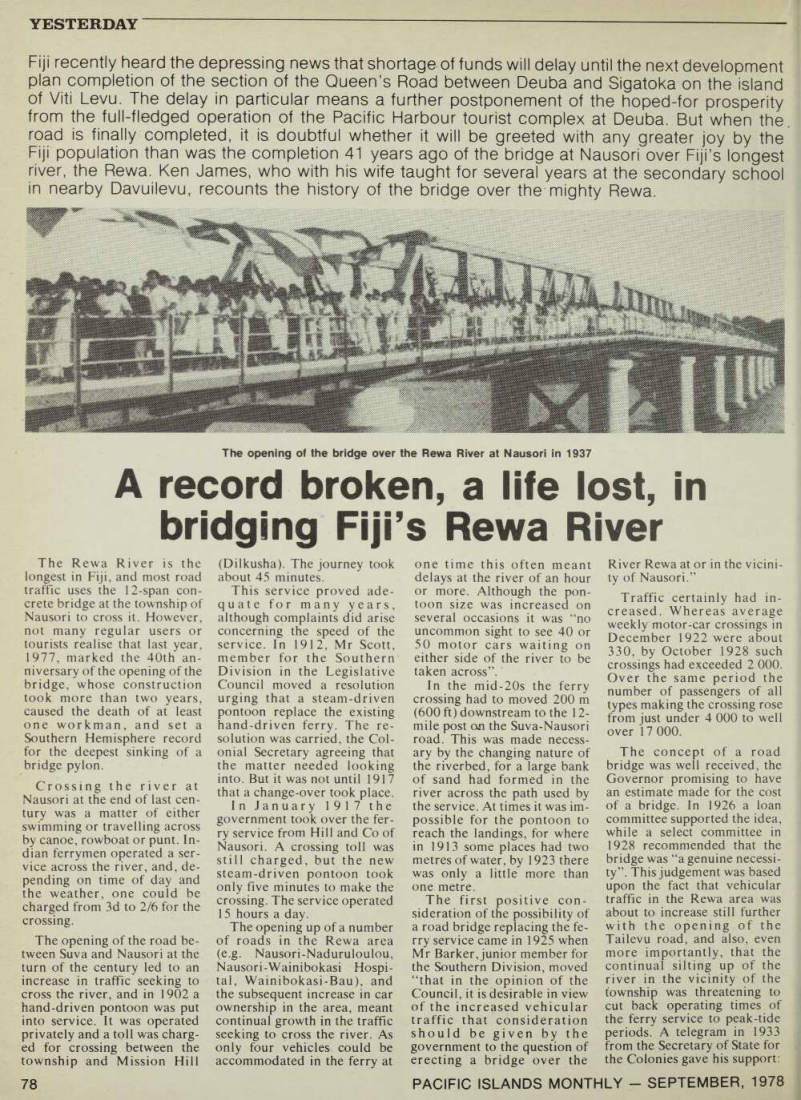
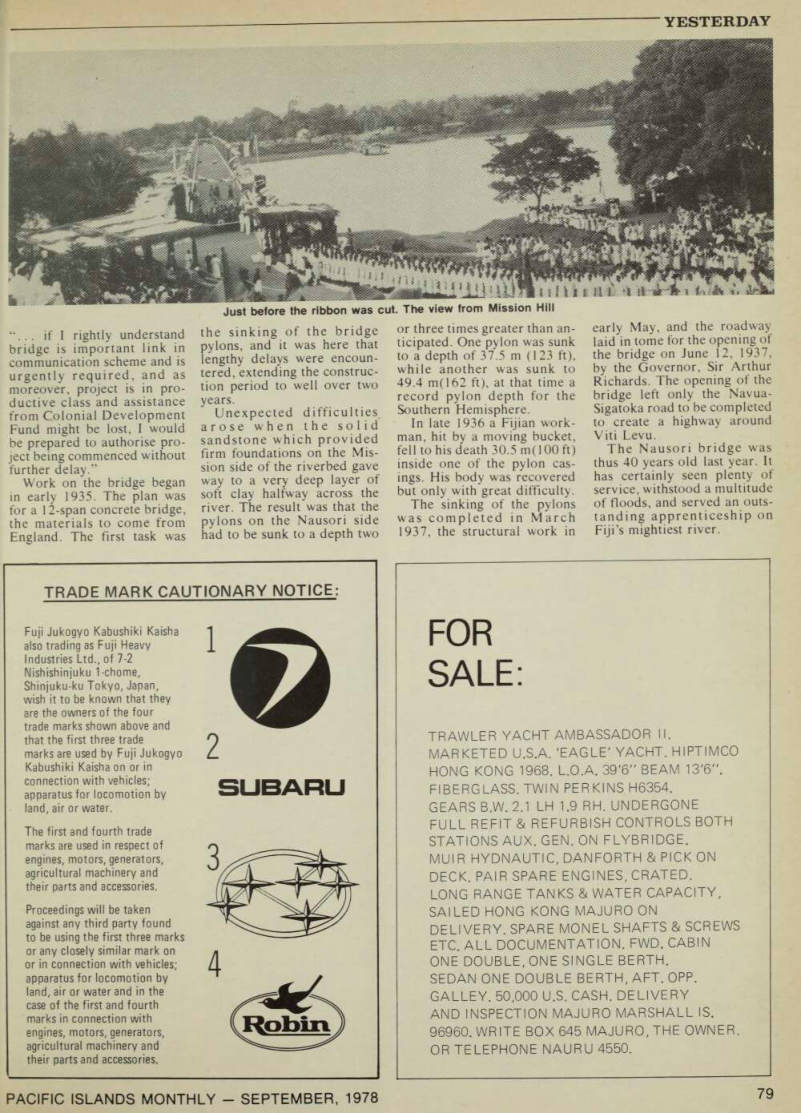
A record broken, a life lost, in bridging Fiji’s Rewa River
Fiji recently heard the depressing news that shortage of funds will delay until the next development plan completion of the section of the Queen’s Road between Deuba and Sigatoka on the island of Viti Levu. The delay in particular means a further postponement of the hoped-for prosperity from the full-fledged operation of the Pacific Harbour tourist complex at Deuba. But when the road is finally completed, it is doubtful whether it will be greeted with any greater joy by the Fiji population than was the completion 41 years ago of the bridge at Nausori over Fiji’s longest river, the Rewa. Ken James, who with his wife taught for several years at the secondary school in nearby Davuilevu, recounts the history of the bridge over the mighty Rewa.
The Rewa River is the longest in Fiji, and most road traffic uses the 12-span concrete bridge at the township of Nausori to cross it. However, not many regular users or tourists realise that last year, 1977, marked the 40th anniversary of the opening of the bridge, whose construction took more than two years, caused the death of at least one workman, and set a Southern Hemisphere record for the deepest sinking of a bridge pylon. . * Crossing the river at Nausor, at the end of last century was a matter of either swimmmg or travelling across by canoe, rowboat or punt. Indian ferrymen operated a service across the river, and, depending on time of day and the weather, one could be charged from 3d to 2/6 for the crossing. b The opening of the road between Suva and Nausori at the turn of the century led to an increase in traffic seeking to cross the river, and in 1902 a hand-driven pontoon was put into service. It was operated privately and a toll was charged for crossing between the township and Mission Hill
(Dilkusha). The journey took about 45 minutes, This service proved ade quate for many years, although complaints did arise concerning the speed of the service. In 1912, Mr Scott, member for the Southern Division in the Legislative Council moved a resolution urging that a steam-driven pontoon replace the existing hand-driven ferry. The re solution was carried, the Col onial Secretary agreeing that the matter needed looking into. But it was not until 1917 that a change . o ver took place. i n Janu a r y I 9 I 7 th e government took over the fer * scrvice from Hill and Co of J : A crossing toll was ... . . . ® . 1,1 charged, but the new steam-driven pontoon took only five minutes to make the ‘ r , oasraB ’ Th . e servlce °P erated 15 hours a day.
The opening up of a number of roads in the Rewa area (e.g. Nausori-Naduruloulou, Nausori-Wainibokasi Hospi tal, Wainibokasi-Bau), and the subsequent increase in car ownership in the area, meant continual growth in the traffic seeking to cross the river. As only four vehicles could be accommodated in the ferry at
one time this often meant delays at the river of an hour or more. Although the pon toon size was increased on several occasions it was “no uncommon sight to see 40 or 50 motor cars waiting on either side of the river to be taken across”.
In the mid-20s the ferry crossing had to moved 200 m (600 ft) downstream to the 12mile post cm the Suva-Nausori road. This was made necess ary by the changing nature of the riverbed, for a large bank of sand had formed in the river across the path used by the service. At times it was im possible for the pontoon to reach the landings, for where in 1913 some places had two metres of water, by 1923 there was only a little more than one metre.
The first positive con sideration of the possibility of a road bridge replacing the fe rry service came in 1925 when Mr Barker, junior member for the Southern Division, moved “that in the opinion of the Council, it is desirable in view of the increased vehicular traffic that consideration should be given by the government to the question of erecting a bridge over the
River Rewa at or in the vicini ty of Nausori.”
Traffic certainly had in creased. Whereas average weekly motor-car crossings in December 1922 were about 330, by October 1928 such crossings had exceeded 2 000.
Over the same period the number of passengers of all types making the crossing rose from just under 4 000 to well over 17 000.
The concept of a road bridge was well received, the Governor promising to have an estimate made for the cost of a bridge. In 1926 a loan committee supported the idea, while a select committee in 1928 recommended that the bridge was “a genuine necessi ty”. This judgement was based upon the fact that vehicular traffic in the Rewa area was about to increase still further with the opening of the Tailevu road, and also, even more importantly, that the continual silting up of the river in the vicinity of the township was threatening to cut back operating times of the ferry service to peak-tide periods. A telegram in 1933 from the Secretary of State for the Colonies gave his support:
The opening of the bridge over the Rewa River at Nausori in 1937
if 1 rightly understand bridge is important link in communication scheme and is urgently required, and as moreover, project is in productive class and assistance from Colonial Development Fund might be lost, I would be prepared to authorise project being commenced without further delay.”
Work on the bridge began in early 1935. The plan was for a 12-span concrete bridge, the materials to come from England. The first task was
the sinking of the bridge pylons, and it was here that lengthy delays were encoun tered, extending the construc tion period to well over two years.
Unexpected difficulties
arose when the solid sandstone which provided firm foundations on the Mis sion side of the riverbed gave way to a very deep layer of soft clay halfway across the river. The result was that the pylons on the Nausori side had to be sunk to a depth two
or three times greater than an ticipated. One pylon was sunk to a depth of 37.5 m (123 ft), while another was sunk to 49.4 m(162 ft), at that time a record pylon depth for the Southern Hemisphere.
In late 1936 a Fijian work man, hit by a moving bucket, fell to his death 30.5 m( 100 ft) inside one of the pylon cas ings. His body was recovered but only with great difficulty.
The sinking of the pylons was completed in March 1937, the structural work in
early May, and the roadway laid in tome for the opening of the bridge on June 12, 1937, by the Governor, Sir Arthur Richards. The opening of the bridge left only the Navua- Sigatoka road to be completed to create a highway around Viti Levu.
The Nausori bridge was thus 40 years old last year. It has certainly seen plenty of service, withstood a multitude of floods, and served an outs tanding apprenticeship on Fiji’s mightiest river.
Just before the ribbon was cut. The view from Mission Hill
Advertisements & other items, p. 79 (1 item)
Sale:
TRADE MARK CAUTIONARY NOTICE:
Fuji Jukogyo Kabushiki Kaisha also trading as Fuji Heavy Industries Ltd., of 7-2 Nishishinju ku 1-chome, Shinjuku-ku Tokyo, Japan, wish it to be known that they are the owners of the four trade marks shown above and that the first three trade marks are used by Fuji Jukogyo Kabushiki Kaisha on or in connection with vehicles; apparatus for locomotion by land, air or water.
The first and fourth trade marks are used in respect of engines, motors, generators, agricultural machinery and their parts and accessories.
Proceedings will be taken against any third party found to be using the first three marks or any closely similar mark on or in connection with vehicles; apparatus for locomotion by land, air or water and in the case of the first and fourth marks in connection with engines, motors, generators, agricultural machinery and their parts and accessories. © 2
SUBARU
4
FOR
SALE:
TRAWLER YACHT AMBASSADOR 11.
MARKETED U.S.A. 'EAGLE' YACHT. HIPTIMCO
HONG KONG 1968. L.O.A. 39'6" BEAM 13'6".
FIBERGLASS. TWIN PERKINS H 6354.
GEARS B.W. 2.1 LH 1.9 RH. UNDERGONE
FULL REFIT & REFURBISH CONTROLS BOTH
STATIONS AUX. GEN. ON FLYBRIDGE.
MUIR HYDNAUTIC, DANFORTH & PICK ON
DECK. PAIR SPARE ENGINES, CRATED.
LONG RANGE TANKS & WATER CAPACITY,
SAILED HONG KONG MAJURO ON
DELIVERY. SPARE MONEL SHAFTS & SCREWS
ETC. ALL DOCUMENTATION. FWD. CABIN
ONE DOUBLE, ONE SINGLE BERTH.
SEDAN ONE DOUBLE BERTH, AFT. OPP.
GALLEY. 50,000 U.S. CASH. DELIVERY
AND INSPECTION MAJURO MARSHALL IS.
96960. WRITE BOX 645 MAJURO, THE OWNER.
OR TELEPHONE NAURU 4550.
People
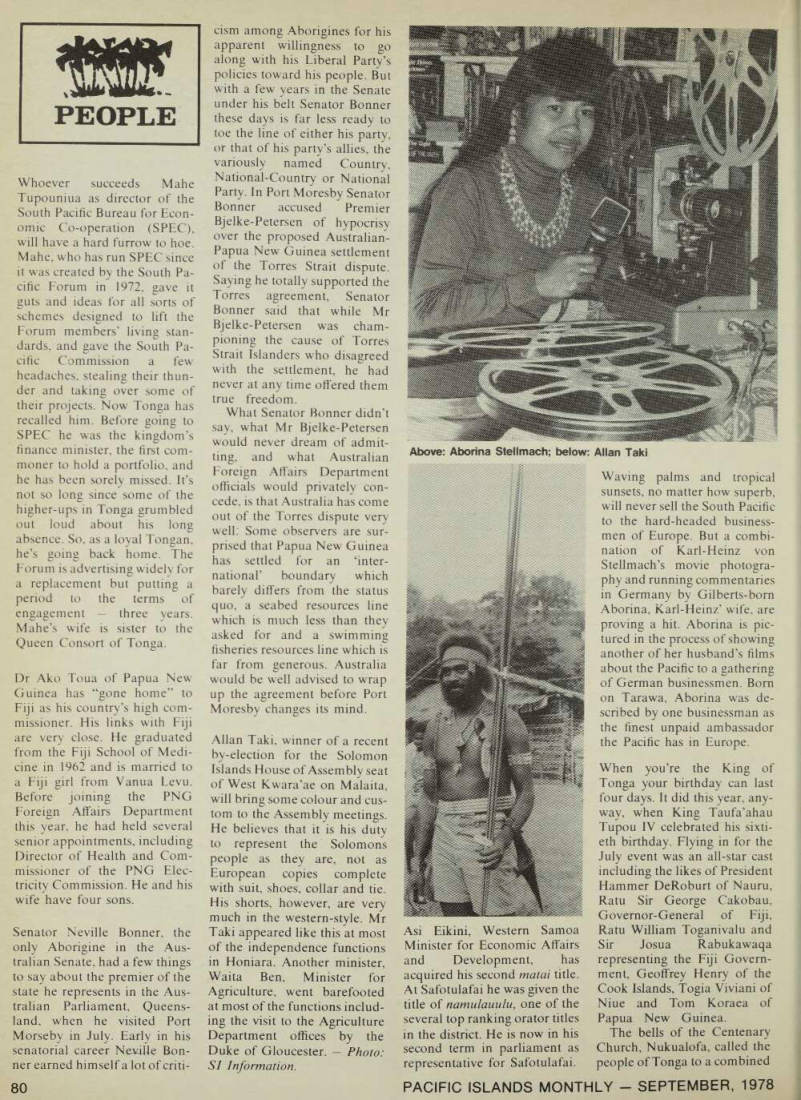
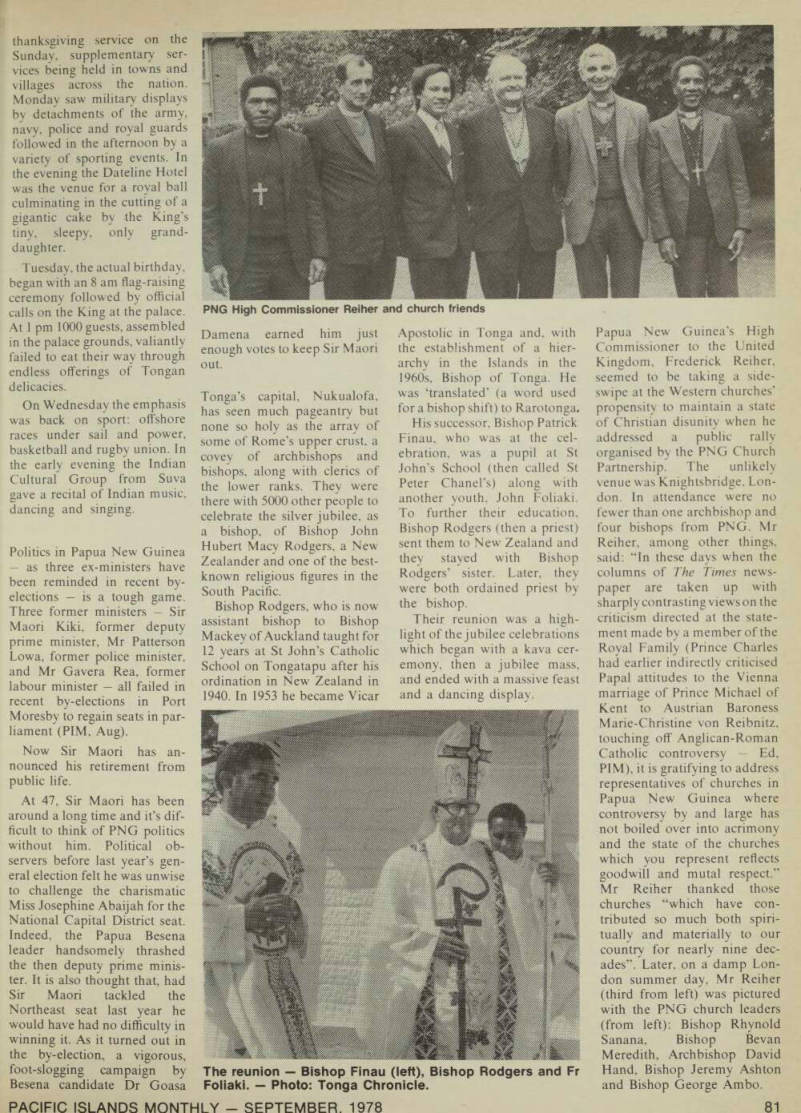

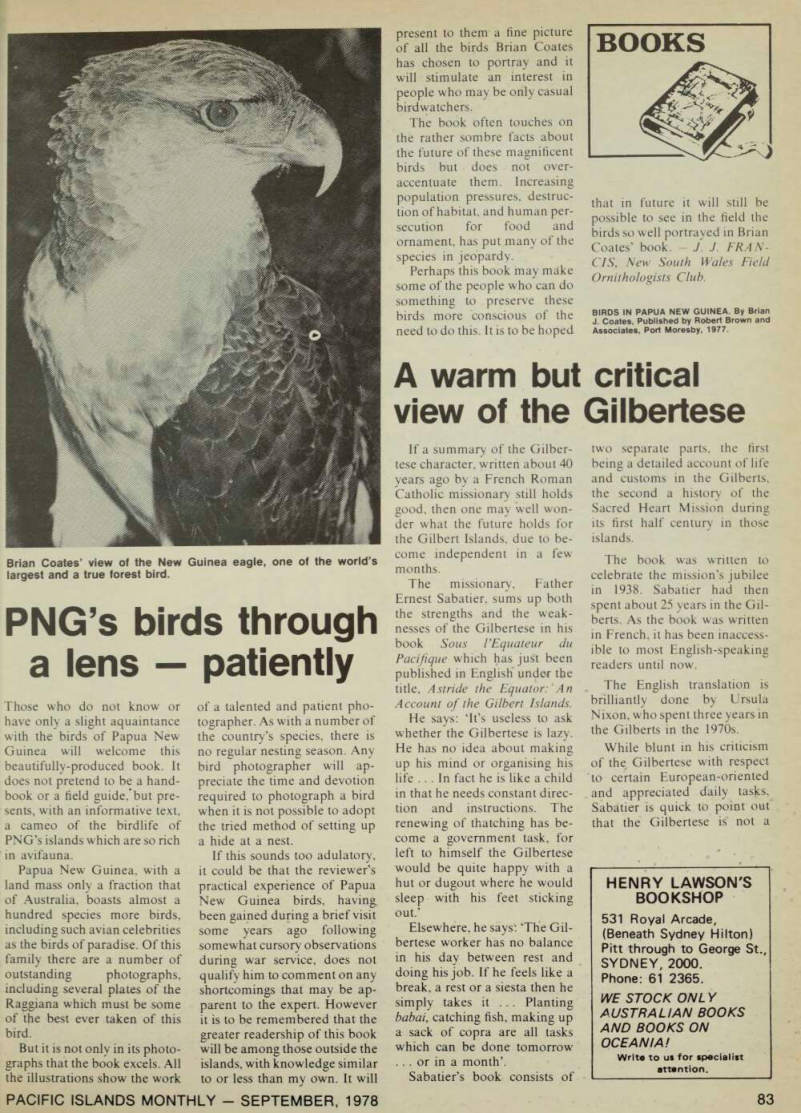
Whoever succeeds Mahe Tupouniua as director of the South Pacific Bureau for Econ omic Co-operation (SPEC), will have a hard furrow to hoe.
Mahe, who has run SPEC since it was created by the South Pa cific Forum in 1972, gave it guts and ideas for all sorts of schemes designed to lift the Forum members’ living stan dards, and gave the South Pa cific Commission a few headaches, stealing their thun der and taking over some of their projects. Now Tonga has recalled him. Before going to SPEC he was the kingdom’s finance minister, the first com moner to hold a portfolio, and he has been sorely missed. It’s not so long since some of the higher-ups in Tonga grumbled out loud about his long absence. So, as a loyal Tongan, he’s going back home. The Forum is advertising widely for a replacement but putting a period to the terms of engagement three years.
Mahe’s wife is sister to the Queen Consort of Tonga.
Dr Ako Toua of Papua New Guinea has “gone home” to Fiji as his country’s high com missioner. His links with Fiji are very close. He graduated from the Fiji School of Medi cine in 1962 and is married to a Fiji girl from Vanua Levu.
Before joining the PNG Foreign Affairs Department this year, he had held several
senior appointments, including
Director of Health and Com missioner of the PNG Elec tricity Commission. He and his wife have four sons.
Senator Neville Bonner, the only Aborigine in the Aus tralian Senate, had a few things to say about the premier of the state he represents in the Aus tralian Parliament, Queens land, when he visited Port Morseby in July. Early in his senatorial career Neville Bon ner earned himself a lot of criti
cism among Aborigines for his apparent willingness to go along with his Liberal Party’s policies toward his people. But with a few years in the Senate under his belt Senator Bonner these days is far less ready to toe the line of either his party, or that of his party’s allies, the
variously named Country,
National-Country or National Party. In Port Moresby Senator Bonner accused Premier
Bjelke-Petersen of hypocrisy
over the proposed Australian- Papua New Guinea settlement of the Torres Strait dispute.
Saying he totally supported the Torres agreement. Senator Bonner said that while Mr Bjelke-Petersen was cham pioning the cause of Torres Strait Islanders who disagreed with the settlement, he had never at any time offered them true freedom.
What Senator Bonner didn’t say, what Mr Bjelke-Petersen would never dream of admit ting, and what Australian
Foreign Affairs Department
officials would privately con cede, is that Australia has come out of the Torres dispute very well; Some observers are sur prised that Papua New Guinea has settled for an ‘inter national’ boundary which barely differs from the status quo, a seabed resources line which is much less than they asked for and a swimming fisheries resources line which is far from generous. Australia would be well advised to wrap up the agreement before Port
Moresby changes its mind.
Allan Taki, winner of a recent by-election for the Solomon Islands House of Assembly seat of West Kwara’ae on Malaita, will bring some colour and cus tom to the Assembly meetings.
He believes that it is his duty to represent the Solomons people as they are, not as
European copies complete
with suit, shoes, collar and tie.
His shorts, however, are very much in the western-style. Mr Taki appeared like this at most of the independence functions in Honiara. Another minister, Waita Ben, Minister for Agriculture, went barefooted at most of the functions includ ing the visit to the Agriculture
Department offices by the
Duke of Gloucester. Photo: SI Information.
Waving palms and tropical sunsets, no matter how superb, will never sell the South Pacific to the hard-headed business men of Europe. But a combi nation of Karl-Heinz von Stellmach’s movie photogra
phy and running commentaries
in Germany by Gilberts-bom
Aborina, Karl-Heinz’ wife, are proving a hit. Aborina is pic tured in the process of showing another of her husband’s films about the Pacific to a gathering of German businessmen. Bom on Tarawa, Aborina was de scribed by one businessman as the finest unpaid ambassador the Pacific has in Europe.
When you’re the King of Tonga your birthday can last four days. It did this year, any way, when King Taufa’ahau Tupou IV celebrated his sixti eth birthday. Flying in for the July event was an all-star cast including the likes of President Hammer Deßoburt of Nauru, Ratu Sir George Cakobau, Governor-General of Fiji, Ratu William Toganivalu and Sir Josua Rabukawaqa
representing the Fiji Govern
ment, Geoffrey Henry of the Cook Islands, Togia Viviani of Niue and Tom Koraea of Papua New Guinea.
The bells of the Centenary Church, Nukualofa, called the people of Tonga to a combined
Asi Eikini, Western Samoa Minister for Economic Affairs and Development, has acquired his second matai title.
At Safotulafai he was given the title of namulauulu, one of the several top ranking orator titles in the district. He is now in his second term in parliament as representative for Safotulafai.
Above; Aborina Stellmach; below: Allan Taki
thanksgiving service on the Sunday, supplementary ser vices being held in towns and villages across the nation.
Monday saw military displays by detachments of the army,
navy, police and royal guards
followed in the afternoon by a variety of sporting events. In the evening the Dateline Hotel was the venue for a royal ball culminating in the cutting of a
gigantic cake by the King’s
tiny, sleepy, only grand
daughter.
Tuesday, the actual birthday, began with an 8 am flag-raising ceremony followed by official calls on the King at the palace.
At 1 pm 1000 guests, assembled
in the palace grounds, valiantly
failed to eat their way through endless offerings of Tongan delicacies.
On Wednesday the emphasis was back on sport: offshore races under sail and power, basketball and rugby union. In the early evening the Indian Cultural Group from Suva gave a recital of Indian music, dancing and singing.
Politics in Papua New Guinea as three ex-ministers have been reminded in recent by elections is a tough game.
Three former ministers Sir Maori Kiki, former deputy prime minister, Mr Patterson Lowa, former police minister, and Mr Gavera Rea, former labour minister all failed in recent by-elections in Port Moresby to regain seats in par liament (PIM, Aug).
Now Sir Maori has an nounced his retirement from
public life.
At 47, Sir Maori has been around a long time and it’s dif ficult to think of PNG politics without him. Political ob servers before last year’s gen eral election felt he was unwise to challenge the charismatic Miss Josephine Abaijah for the National Capital District seat.
Indeed, the Papua Besena leader handsomely thrashed the then deputy prime minis ter. It is also thought that, had Sir Maori tackled the Northeast seat last year he would have had no difficulty in winning it. As it turned out in
the by-election, a vigorous,
foot-slogging campaign by
Besena candidate Dr Goasa
Damena earned him just enough votes to keep Sir Maori out.
Tonga’s capital, Nukualofa,
has seen much pageantry but none so holy as the array of some of Rome’s upper crust, a covey of archbishops and bishops, along with clerics of the lower ranks. They were there with 5000 other people to celebrate the silver jubilee, as a bishop, of Bishop John Hubert Macy Rodgers, a New Zealander and one of the best known religious figures in the South Pacific.
Bishop Rodgers, who is now
assistant bishop to Bishop
Mackey of Auckland taught for 12 years at St John’s Catholic School on Tongatapu after his ordination in New Zealand in 1940. In 1953 he became Vicar
Apostolic in Tonga and, with the establishment of a hier archy in the Islands in the 19605, Bishop of Tonga. He was ‘translated’ (a word used for a bishop shift) to Rarotonga.
His successor. Bishop Patrick Finau, who was at the cel ebration, was a pupil at St John’s School (then called St Peter Chanel’s) along with another youth. John Foliaki.
To further their education.
Bishop Rodgers (then a priest)
sent them to New Zealand and
they stayed with Bishop
Rodgers’ sister. Later, they
were both ordained priest by
the bishop.
Their reunion was a high light of the jubilee celebrations which began with a kava cer emony, then a jubilee mass, and ended with a massive feast and a dancing display.
Papua New Guinea’s High Commissioner to the United Kingdom, Frederick Reiher, seemed to be taking a side swipe at the Western churches’ propensity to maintain a state of Christian disunity when he
addressed a public rally
organised by the PNG Church
Partnership. The unlikely
venue was Knightsbridge, Lon don. In attendance were no fewer than one archbishop and four bishops from PNG. Mr Reiher, among other things, said: “In these days when the columns of The Times news paper are taken up with sharply contrasting views on the criticism directed at the state ment made by a member of the
Royal Family (Prince Charles
had earlier indirectly criticised Papal attitudes to the Vienna marriage of Prince Michael of Kent to Austrian Baroness Marie-Christine von Reibnitz,
touching off Anglican-Roman
Catholic controversy Ed, PIM), it is gratifying to address representatives of churches in Papua New Guinea where controversy by and large has not boiled over into acrimony and the state of the churches which you represent reflects
goodwill and mutal respect.”
Mr Reiher thanked those churches “which have con tributed so much both spiri tually and materially to our country for nearly nine dec ades”. Later, on a damp Lon don summer day, Mr Reiher (third from left) was pictured with the PNG church leaders
(from left); Bishop Rhynold
Sanana, Bishop Bevan Meredith, Archbishop David
Hand, Bishop Jeremy Ashton
and Bishop George Ambo.
The reunion - Bishop Finau (left), Bishop Rodgers and Fr Foliaki. - Photo: Tonga Chronicle.
PNG High Commissioner Reiher and church friends
Brian Coates’ view of the New Guinea eagle, one of the world’s largest and a true forest bird.
Advertisements & other items, p. 82 (1 item)
Qbe Insurance Limited
offers expert insurance service
throughout the Islands.
Central Office: 82 Pitt Street, Sydney.
NEW CALEDONIA T.A. Hagen, Ste. I/V.A. Johnston, S.A.R.L. - Noumea.
NEW HEBRIDES District Manager: G.F. Donnelly, Vila; Santo Santo: Burns Phi/p (New Hebrides) Ltd.
TAHITI - Arthur Chung: Immeuble 8.1., Front de Mer, Papeete.
NIUE, NORFOLK ISLAND, SAMOA, TONGA and other South Sea Islands Burns Phi Ip (South Sea) Company L td.
QUEENSLAND INSURANCE (FIJI) LIMITED
Head Office, 34 Usher St., SUVA. General Manager; L.G. Liddell. A.A.1.1.
Assistant Managers: V .J. Lai and J.T. Laidlaw. LAUTOKA Office, Burns Philp Bldg. District Manager: J. Dalton.
QUEENSLAND INSURANCE (RN.C.) LIMITED
PAPUA NEW GUINEA -
Head Office, PORT MORESBY. General Manager; J.M. Dawe. Assistant Manager: R.V. Maskell.
District Managers at: LAE; I.R. Martin. MOUNT HAGEN: D.F. Carroll. ARAWA; J. Longbut. MADANG: R.W.V. CoMings. RABAUL: W.F. Tinker.
QBE
IS
i^norirarp
[JmUIAIUD
UPRIGHT DISPLAY
REFRIGERATORS
«IC(0 COIO DRINKS
* LOW COST
* LARGE CAPACITY
BOTTLE & FOOD DISPLAY
2 & 3 DOOR MODELS AVAILABLE
Large capacity small floor space Maximum visual display Gleaming white, vinyl coated aluminium interior for better reflection of light within cabinet Fluorescent lighting 2" Frigidfoam insulation (equivalent to 4" Polystyrene or 6" cork!) Powered by heavy-duty Kelvinator sealed unit warranteed for 5 years
AVAILABLE FROM:
AUSTRALIAN NEW CALEDONIA EXPORTS, 363 George St, Sydney, 2000 BRECKWOLDT & CO., 276 Pitt St., Sydney, 2000.
HAGEMEYER (A'SIA), 59 Anzac Pde, Kensington, 2033.
GEOFFREY HUGHES & CO, 167 Macquarie St, Sydney, 2000 NELSON & ROBERTSON PTY. LTD, 197 Clarence St, Sydney, 2000.
PETER FISHER TRADING PTY.LTD, 321 Pitt St, Sydney 2000, E. RABOT (EXPORTS) PTY. LTD, 67 Castlereagh St, Sydney. 2000.
RABTRAD NIUGINI PTY. LTD., PO Box 1406, Lae.
A, RIETTE (PACIFIC) PTY. LTD., 300 George St., Sydney 2000 H. Y. KWAN (AUST) PTY. LTD, Box 2713, GPO Sydney 2001 C. SULLIVAN (EXPORT) PTY. LTD., GPO Box 3373, Sydney, 2001.
W.S. TAIT & CO, PTY. LTD, 31 Macquarie Place, Sydney, 2000. i Attractive timber grain Marviplate exterior • Automatic frost-free, fan-assisted cooling gives even and faster cooling of stored products I 4 rows adjustable plastic-coated, hygenic, white shelves and floor tray ) LOW MAINTENANCE, the only maintenance required being periodic cleaning of condenser ) Illuminated sign in top panel optional extra.
Manufactured by: > Tl
FRIGID CABINETS PTY. LTD.,
14A Puffy Ave., Thornleigh, N.S.W. 2120 Aust. Ph. 848 8292. FC2.
a lens - patiently
PNG’s birds through a lens - patiently
Those who do not know or have only a slight aquaintance with the birds of Papua New Guinea will welcome this beautifully-produced book. It does not pretend to be a handbook or a field guide/but presents, with an informative text, a cameo of the birdlife of PNG’s islands which are so rich in avifauna.
Papua New Guinea, with a land mass only a fraction that of Australia, boasts almost a hundred species more birds, including such avian celebrities as the birds of paradise. Of this family there are a number of
outstanding photographs,
including several plates of the Raggiana which must be some of the best ever taken of this bird.
But it is not only in its photographs that the book excels. All the illustrations show the work
of a talented and patient pho tographer. As with a number of the country’s species, there is no regular nesting season. Any bird photographer will ap predate the time and devotion required to photograph a bird when it is not possible to adopt the tried method of setting up a hide at a nest, If this sounds too adulatory, it could be that the reviewer’s
practical experience of Papua
New Guinea birds, having, been gained during a brief visit some years ago following somewhat cursory observations during war service, does not qualify him to comment on any shortcomings that may be ap parent to the expert. However it is to be remembered that the greater readership of this book will be among those outside the islands, with knowledge similar to or less than my own. It will
present to them a fine picture of all the birds Brian Coates has chosen to portray and it will stimulate an interest in people who may be only casual birdwatchers.
The book often touches on the rather sombre facts about the future of these magnificent birds but does not over accentuate them. Increasing population pressures, destruc tion of habitat, and human per secution for food and ornament, has put many of the
species in jeopardy.
Perhaps this book may make some of the people who can do something to preserve these birds more conscious of the need to do this. It is to be hoped
Books
that in future it will still be possible to see in the field the birds so well portrayed in Brian Coates’ book. — J. J. FRAN CIS, New South Wales Field
Ornithologists Club.
BIRDS IN PAPUA NEW GUINEA. By Brian J. Coates, Published by Robert Brown and Associates, Port Moresby, 1977.
A warm but critical
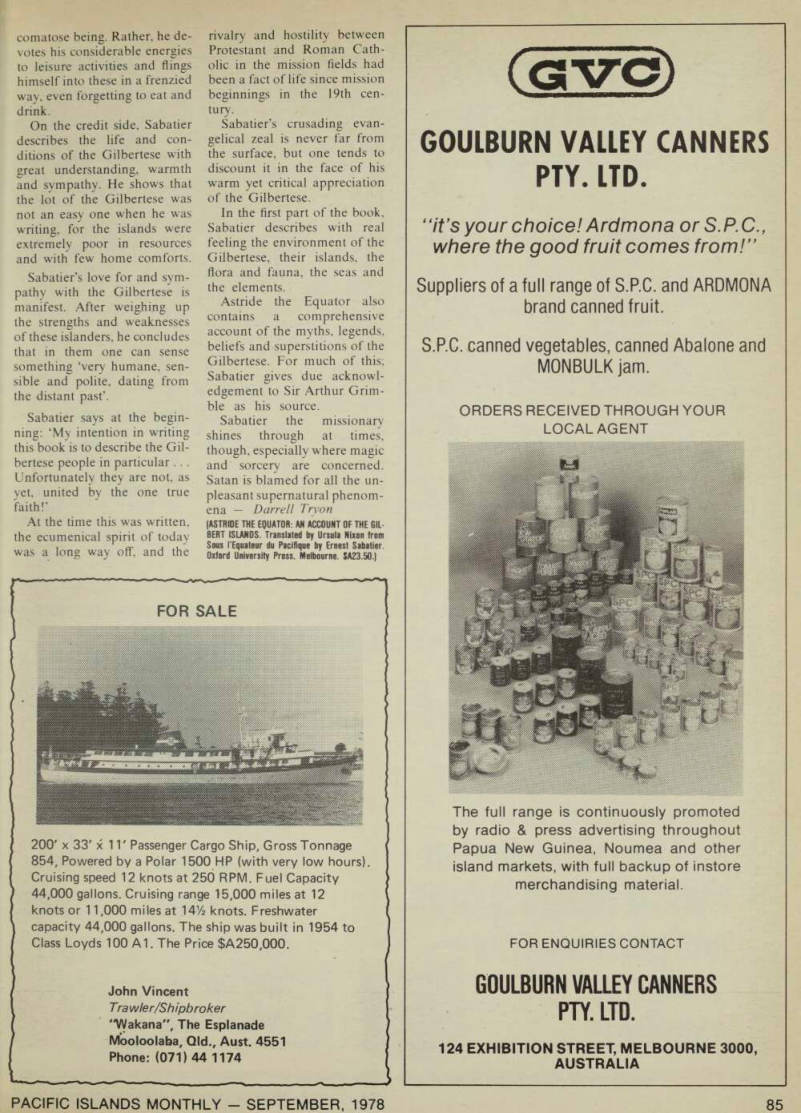
view of the Gilbertese
If a summary of the Gilber tese character, written about 40 years ago by a French Roman Catholic missionary still holds good, then one may well won der what the future holds for the Gilbert Islands, due to be come independent in a few months.
The missionary, Father Ernest Sabatier, sums up both the strengths and the weak nesses of the Gilbertese in his book Sous VEquateur du Pacifique which has just been published in English under the title. Astride the Equator: An Account of the Gilbert Islands.
He says; ‘lt’s useless to ask whether the Gilbertese is lazy.
He has no idea about making up his mind or organising his life ... In fact he is like a child in that he needs constant direc tion and instructions. The renewing of thatching has be come a government task, for left to himself the Gilbertese would be quite happy with a hut or dugout where he would sleep with his feet sticking out.’
Elsewhere, he says: The Gil bertese worker has no balance in his day between rest and doing his job. If he feels like a break, a rest or a siesta then he simply takes it ... Planting babai, catching fish, making up a sack of copra are all tasks which can be done tomorrow ... or in a month’.
Sabatier’s book consists of
two separate parts, the first being a detailed account of life and customs in the Gilberts, the second a history of the Sacred Heart Mission during its first half century in those islands.
The book was written to celebrate the mission’s jubilee in 1938. Sabatier had then spent about 25 years in the Gil berts. As the book was written in French, it has been inaccess ible to most English-speaking readers until now.
The English translation is
brilliantly done by Ursula
Nixon, who spent three years in the Gilberts in the 1970s.
While blunt in his criticism of the Gilbertese with respect to certain European-oriented
and appreciated daily tasks,
Sabatier is quick to point out that the Gilbertese is not a
comatose being. Rather, he de votes his considerable energies to leisure activities and flings himself into these in a frenzied way, even forgetting to eat and drink.
On the credit side, Sabatier describes the life and con ditions of the Gilbertese with great understanding, warmth and sympathy. He shows that the lot of the Gilbertese was not an easy one when he was writing, for the islands were extremely poor in resources and with few home comforts.
Sabatier’s love for and sym pathy with the Gilbertese is manifest. After weighing up the strengths and weaknesses of these islanders, he concludes that in them one can sense something ‘very humane, sen sible and polite, dating from the distant past’.
Sabatier says at the begin ning: ‘My intention in writing this book is to describe the Gil bertese people in particular . . .
Unfortunately they are not, as yet, united by the one true faith!’
At the time this was written, the ecumenical spirit of today was a long way off, and the
rivalry and hostility between Protestant and Roman Cath olic in the mission fields had been a fact of life since mission beginnings in the 19th cen tury.
Sabatier’s crusading evan gelical zeal is never far from the surface, but one tends to discount it in the face of his warm yet critical appreciation of the Gilbertese.
In the first part of the book, Sabatier describes with real feeling the environment of the Gilbertese, their islands, the flora and fauna, the seas and the elements.
Astride the Equator also contains a comprehensive account of the myths, legends, beliefs and superstitions of the Gilbertese. For much of this; Sabatier gives due acknowl edgement to Sir Arthur Grim ble as his source.
Sabatier the missionary shines through at times,
though, especially where magic
and sorcery are concerned.
Satan is blamed for all the un
pleasant supernatural phenom
ena — Darrell Tryon (ASTRIDE THE EQUATOR: AN ACCOUNT OF THE GIL BERT ISLANDS. Translated by Ursula Nixon from Sous I’Equaleur du Pacifique by Ernest Sabatier.
Oxford University Press. Melbourne. SA23.50.)
Advertisements & other items, pp. 83-85 (1 item)
Henry Lawson's
BOOKSHOP
531 Royal Arcade, (Beneath Sydney Hilton) Pitt through to George St.
SYDNEY, 2000.
Phone: 61 2365.
WE STOCK ONLY
AUSTRALIAN BOOKS
AND BOOKS ON
OCEANIA!
Write to us for specialist
S.E. TATH AM & CO. PTY. LTD
BEEHIVE BUILDING,
94 ELIZABETH STREET.
G.P.O. BOX 8,
MELBOURNE 3001,
AUSTRALIA
CABLES: “SET”
TELEX: AA34552.
TELEPHONE: 63 5094
r
...BUYERS for the
PACIFIC ISLANDS.
PAPUA NEW GUINEA:
S. E. TATHAM (P N G.) PTY. LTD
LAE: MALAITA ST. (P.O. BOX 1562).
PORT MORESBY: Cm. GOROA & MANAHU Sts.,
GORDON (P.O. BOX 6733, BOROKO).
TELEGRAMS: ALL OFFICES “SET’.
YOUR GUARANTEE
FOR SERVICE
SINCE 1924
(GVC)
GOULBURN VALLEY CANNERS
PTY. LTD.
“it’s your choice! ArdmonaorS.P.C., where the good fruit comes from!”
Suppliers of a full range of S.P.C. and ARDMONA brand canned fruit.
S.P.C. canned vegetables, canned Abalone and
MONBULK jam.
ORDERS RECEIVED THROUGH YOUR
LOCAL AGENT
The full range is continuously promoted by radio & press advertising throughout Papua New Guinea, Noumea and other island markets, with full backup of instore merchandising material.
FOR ENQUIRIES CONTACT
GOULBURN VALLEY CANNERS
PR LTD.
124 EXHIBITION STREET, MELBOURNE 3000,
AUSTRALIA
FOR SALE
u 200' x 33' x 11' Passenger Cargo Ship, Gross Tonnage 854, Powered by a Polar 1500 HP (with very low hours).
Cruising speed 12 knots at 250 RPM. Fuel Capacity 44,000 gallons. Cruising range 15,000 miles at 12 knots or 11,000 miles at 14 1 /2 knots. Freshwater capacity 44,000 gallons. The ship was built in 1954 to Class Loyds 100 Al. The Price $A250,000.
John Vincent Tra wler/Shipbroker "Wakana", The Esplanade Mooloolaba, Old., Aust. 4551 Phone: (071) 44 1174
The Party’S Over
Trade Winds
- Tighten Your
Belt Says Mara
A tough November budget
seems likely in Fiji. Prime Minister Ratu Sir Kamisese Mara has warned that slow growth in government revenue
will certainly mean tighter
government spending and perhaps increased taxation.
Ratu Sir Kamisese said that in the years since indepen dence the government had been very gentle on the tax ation front. However, in the past four or five years during which Fiji had gone through a difficult time, direct taxes had grown at a slower than antici
pated rate, job opportunities
were less and private invest ment had fallen.
To counter these trends, the government, since 1974, had
deliberately expanded its
investment programme to fill
the gaps left by private invest ment, said Ratu Sir Kamisese.
This policy had enabled Fiji to weather the economic storm with little discomfort.
Large sums had been invested in rural development.
Good progress had been achieved in some areas of agriculture and sugar, and pine forests had become a large
industry. Expansion was
planned for the fishing indus try. Other large government projects included the Suva- Nadi highway and the Nadrau
hydro-electricity project. This
kind of government investment had helped counter the drop in the private sector labour mar ket.
An area in which Ratu Sir Kamisese would like to see more development is rice
growing. It was important, he said as he has so often done in the past for Fiji to increase local food output and cut back on imports. Fiji had the climate and resources to grow most of its own food, he said.
What Fiji needed, said Ratu Sir Kamisese, was “reawaken ing because toil, goodwill, hard work and perseverance are essential ingredients of nation
building”.
A day or two later came another warning to expect some belt-tightening. The Finance Minister, Mr Charles Stinson, said there would have to be a “breathing space” in the government’s social service budgets for the next two years.
Government departments
would have to contribute to moves to tighten expenditure and the people would have to decide how much they were prepared to contribute toward the services they demanded, said Mr Stinson.
Fiji, he said, was “extremely well-off’ by world standards but greater productivity was needed for the country to hold its ground.
Briefly
• Fiji has reached agreement with a number J Pacific , slands , them with ~J t , ™gar. but the new quotas and P nces have not been an nounced. The previous agree ment entered into for the su PPty of su § ar has been extended to 1982. • Levers Pacific Timbers Ltd 0 f Ringi Cove, Kolombangara marked independence for the Solomon Islands by the do nation of $5 worth of equipment and books to Honiara Technical Institute . •,.. , , t
The gift included a heavy duty
floor crane from ran ? e °, f eqittpment for the institute s diesel fuel injection re P a * r workshop and a comprehensive collection of text books on building, elec trical, commercial and engin
eering subjects.
Advertisements & other items, p. 86 (1 item)
Epiglass Everdure
Timber preservative and sealer.
Hardens, protects and densities timber.
Kills all mould spores and permanently seals out moisture.
LA Epiglass 90 Epoxy Resin and glass cloth.
Easy to apply.
Strengthens hulls, eliminates water absorption and rot and increases the value and life of your boat. i
Cruising
Yachts
• SOLO, the 17.3 metre steel yawl, which took yachtsman, navigator and author David Lewis to the Antarctic at the end of 1977, is up for sale. At present, it’s on research and survey work in Torres Strait skippered by Dr Lewis’ son Barry, but by September it will be at the Neutral Bay marina, Sydney. Solo was acquired by the Lewis team 18 months ago for $6O 000, having been sur veyed only a short time before.
Any takers? • FRUITION, 9.1 m sloop registered in Auckland, arrived at Rarotonga from Auckland on June 14 with skipper R. G.
Thornbury and one crew member. They left for Papeete via Aitutaki on June 21.
• Mandolin Wind Owned
by Canadian Fred Lanauze, went aground on Namalata Reef, Kadavu, late in June.
Lanauze with his crew, Aus tralian Paul Burns, 25, and American Don Cole, 24, managed to refloat the yacht and, with the help of villagers from nearby Driu, get it on to the beach. As the propeller was damaged they considered it would be necessary to have the Mandolin Wind towed to Suva for repairs. • MORSKOUL II sailed from Norfolk Island in early July bound for Auckland, then France. Calling into Norfolk from New Caledonia, Morskoul II had rudder dam age which was repaired before it continued. • ULYSSES, 26.3 m motor yacht was a July visitor to Suva. Owned by Keith Williams, managing director of Seaworld, of Surfers Paradise, Queensland, it is equipped with a wide variety of navi gation aids. On board were three qualified masters, including the owner. Apart from cruising, the Ulysses is used for research and collect
ing specimens for a marine park owned by Mr Williams. • NIHO, 8 metre Canadian sloop arrived at Rarotonga on June 17 from Raiatea with Gary and Kay Urwin. Their voyage started from Montreal in August 1976 and took them down the eastern seaboard of the US, then to the Bahamas and Caribbean Islands. After spending the hurricane season in Puerto Rico they passed through the Panama Canal and called at the Galapagos and French Polynesian islands. They left Rarotonga on June 25 for Niue, Tonga, Fiji and New Zealand.
• Passing Cloud. 20.1 M
schooner-rigged timber fish ing vessel registered in Vic toria, BC, arrived at Rarotonga from Papeete on June 18 bound for Hawaii. On board were owner-captain Brian Walker, his wife Dora, and daughter Tara. Their cruise started from Victoria, BC, on December 4, and they spent two months in San Diego and Mexican ports.
• Aquilon 11, 9 4 M
Canadian sloop registered in Montreal, arrived at Rarotonga on June 23 from Tubuai with single-hander D. Trickey.
• Odyssey, A New
Zealand-owned trimaran, was wrecked in Cakaulevu Reef, about 50 km east of Kabara in Fiji’s Lau Islands. The Fiji Government ship, Kaunitoni, rescued the captain and crew, and salvaged the engine. The captain, Craig Hunter, of Auckland, said he had no intention of salvaging the Odyssey, worth about $2O 000. The Odyssey had set out from Auckland two weeks earlier and had run into bad weather all the way. For more than a week the crew worked in shifts to bail water out of one of the cracked pontoons. The Odyssey was 255 km off course when it struck the reef.
After grounding, the crew sent out a distress call which was picked by an Air Pacific air craft which directed the Kauni toni to the scene. With Hunter as crew were Richard Taylor, David Ward, Raymond Keys, Keith and Morris Johnston and Barbara Balderstone.
Advertisements & other items, p. 87 (1 item)
Racing Red,
PACIFIC AREA STOCKISTS
COOK ISLANDS: Cook Island Trading Corporation Ltd FIJIAN ISLANDS: Burns Philp (SS) Co. Ltd NEW HEBRIDES: Burns Philp (NH) Ltd NOUMEA: Guy Limousin. Pacific Yachting NUIE ISLAND: Nuie Island United PAGO PAGO: Max Haleck Inc, Burns Philp (SS) Ltd PAPUA NEW GUINEA: KIETA; Nikana Wholesalers, LAE: Faulkner-Tait (NG) Pty Ltd, MADANG: Burns Philp (NG) Co.
Ltd. PORT MORESBY; S.A. Heath Co. Ltd. RABAUL; Elvee Trading Pty Ltd, WEWAK: Burns Philp (P N G ).
SOLOMON ISLANDS: P.K.R. Pacific Sales Ltd TAHITI: Marine Corail, Tahiti Sport.
TONGA: Burns Philp (SS) Co Ltd WESTERN SAMOA: Burns Philp (SS) Co. Ltd. E. A. Coxon Ltd, Gold Star Transport Co. Ltd, Morris Hedstrom Ltd. 290
Epiglass E-Type Antifouling.
Gives up to 12 months growth-free performance.
Racing Red, Blue, Green and Gold.
Pacific Bullies
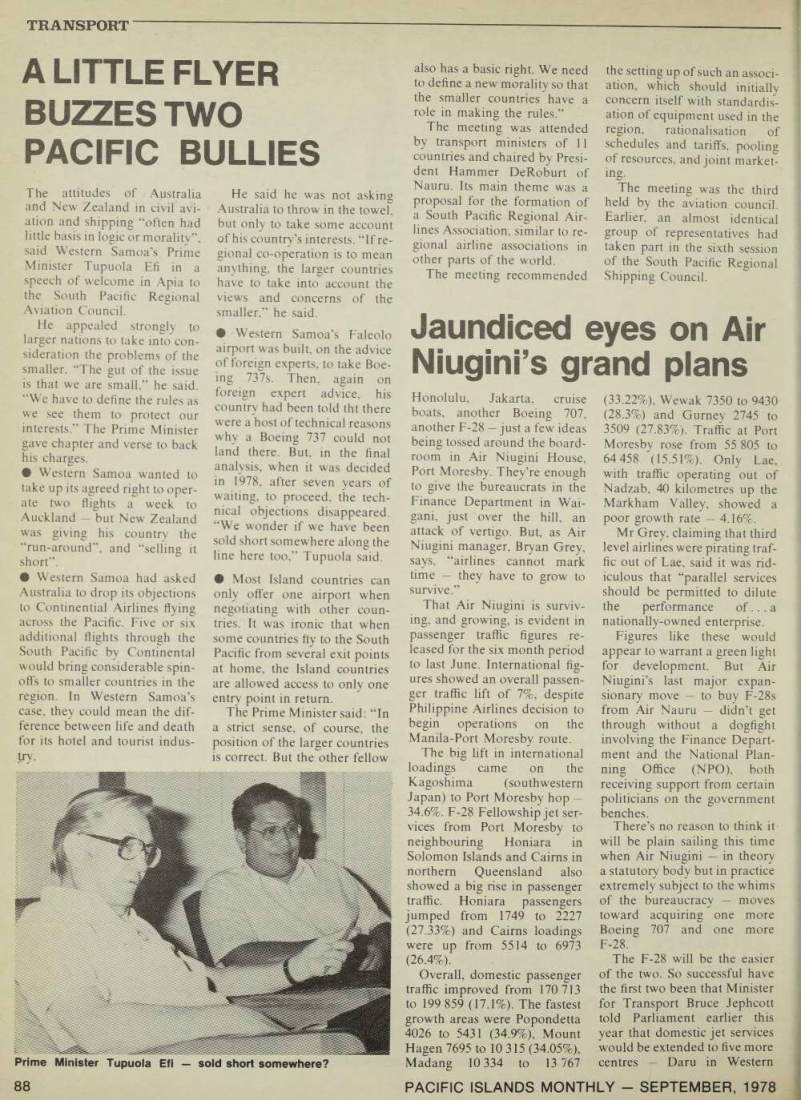
A Little Flyer
Buzzes Two
The attitudes of Australia and New Zealand in civil avi ation and shipping “often had little basis in logic or morality”, said Western Samoa’s Prime Minister Tupuola Efi in a speech of welcome in Apia to the South Pacific Regional Aviation Council.
He appealed strongly to
larger nations to take into con sideration the problems of the smaller. “The gut of the issue is that we are small,” he said.
“We have to define the rules as we see them to protect our interests.” The Prime Minister gave chapter and verse to back
his charges.
• Western Samoa wanted to take up its agreed right to oper ate two flights a week to Auckland but New Zealand was giving his country the “run-around”, and “selling it short”. • Western Samoa had asked Australia to drop its objections to Continential Airlines flving across the Pacific. Five or six
additional flights through the
South Pacific by Continental
would bring considerable spin
offs to smaller countries in the region. In Western Samoa’s case, they could mean the dif ference between life and death for its hotel and tourist indus try-
He said he was not asking Australia to throw in the towel, but only to take some account of his country’s interests. “If re gional co-operation is to mean
anything, the larger countries
have to take into account the views and concerns of the smaller,” he said. • Western Samoa’s Faleolo airport was built, on the advice of foreign experts, to take Boe ing 7375. Then, again on foreign expert advice, his country had been told tht there were a host of technical reasons why a Boeing 737 could not land there. But, in the final analysis, when it was decided in 1978, after seven years of waiting, to proceed, the tech
nical objections disappeared.
“We wonder if we have been sold short somewhere along the line here too,” Tupuola said. • Most Island countries can only offer one airport when negotiating with other coun tries. It was ironic that when some countries fly to the South Pacific from several exit points at home, the Island countries are allowed access to only one entry point in return.
The Prime Minister said: “In a strict sense, of course, the position of the larger countries is correct. But the other fellow
also has a basic right. We need to define a new morality so that the smaller countries have a role in making the rules.”
The meeting was attended by transport ministers of 11 countries and chaired by President Hammer Deßoburt of Nauru. Its main theme was a proposal for the formation of a South Pacific Regional Airlines Association, similar to regional airline associations in other parts of the world.
The meeting recommended
the setting up of such an associ ation, which should initially concern itself with standardis ation of equipment used in the region, rationalisation of schedules and tariffs, pooling of resources, and joint market
ing.
The meeting was the third held by the aviation council, Earlier, an almost identical group of representatives had taken part in the sixth session of the South Pacific Regional
Shipping Council.
Prime Minister Tupuola Efi - sold short somewhere?
Niugini’s grand plans
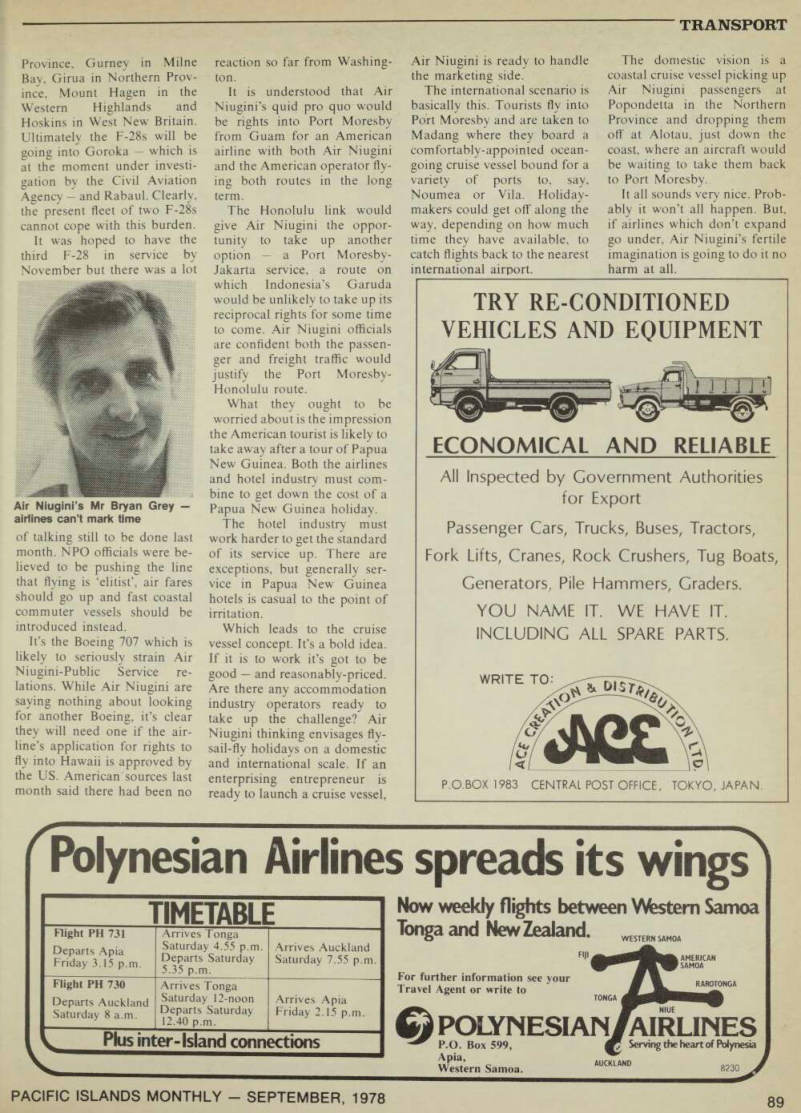
Jaundiced eyes on Air Niugini’s grand plans
Honolulu, Jakarta, cruise boats, another Boeing 707, another F-28 just a few ideas being tossed around the board room in Air Niugini House,
Port Moresby. They’re enough
to give the bureaucrats in the Finance Department in Wai gani, just over the hill, an attack of vertigo. But, as Air
Niugini manager, Bryan Grey,
says, “airlines cannot mark time they have to grow to survive.”
That Air Niugini is surviv ing, and growing, is evident in passenger traffic figures re leased for the six month period to last June. International fig ures showed an overall passen ger traffic lift of 7%, despite Philippine Airlines decision to
begin operations on the
Manila-Port Moresby route.
The big lift in international loadings came on the
Kagoshima (southwestern
Japan) to Port Moresby hop
34.6%. F-28 Fellowship jet ser vices from Port Moresby to neighbouring Honiara in Solomon Islands and Caims in northern Queensland also showed a big rise in passenger traffic. Honiara passengers jumped from 1749 to 2227 (27.33%) and Cairns loadings were up from 5514 to 6973 (26.4%).
Overall, domestic passenger traffic improved from 170 713 to 199 859 (17.1%). The fastest
growth areas were Popondetta
4026 to 5431 (34.9%), Mount Hagen 7695 to 10 315 (34.05%), Madang 10 334 to 13 767
(33.22%), Wewak 7350 to 9430 (28.3%) and Gurney 2745 to 3509 (27.83%). Traffic at Port Moresby rose from 55 805 to 64 458 (15.51%). Only Lae, with traffic operating out of Nadzab, 40 kilometres up the Markham Valley, showed a poor growth rate 4.16%.
Mr Grey, claiming that third level airlines were pirating traf fic out of Lae, said it was rid iculous that “parallel services should be permitted to dilute the performance 0f... a
nationally-owned enterprise.
Figures like these would appear to warrant a green light for development. But Air
Niugini’s last major expan
sionary move to buy F-28s from Air Nauru didn’t get
through without a dogfight
involving the Finance Depart
ment and the National Plan ning Office (NPO), both receiving support from certain politicians on the government benches.
There’s no reason to think it will be plain sailing this time when Air Niugini in theory a statutory body but in practice extremely subject to the whims of the bureaucracy moves toward acquiring one more Boeing 707 and one more F-28.
The F-28 will be the easier of the two. So successful have the first two been that Minister for Transport Bruce Jephcott told Parliament earlier this year that domestic jet services would be extended to five more centres Dam in Western
Province, Gurney in Milne Bay, Girua in Northern Prov ince. Mount Hagen in the Western Highlands and Hoskins in West New Britain.
Ultimately the F-28s will be going into Goroka which is at the moment under investi gation by the Civil Aviation Agency and Rabaul. Clearly, the present fleet of two F-28s cannot cope with this burden.
It was hoped to have the third F-28 in service by November but there was a lot
of talking still to be done last month. NPO officials were be lieved to be pushing the line that flying is ‘elitist’, air fares should go up and fast coastal commuter vessels should be introduced instead.
It’s the Boeing 707 which is likely to seriously strain Air Niugini-Public Service re lations. While Air Niugini are
saying nothing about looking
for another Boeing, it’s clear they will need one if the air line’s application for rights to
fly into Hawaii is approved by
the US. American sources last month said there had been no
reaction so far from Washing ton.
It is understood that Air Niugini’s quid pro quo would be rights into Port Moresby from Guam for an American airline with both Air Niugini and the American operator fly ing both routes in the long term.
The Honolulu link would give Air Niugini the oppor tunity to take up another option a Port Moresby- Jakarta service, a route on which Indonesia’s Garuda would be unlikely to take up its reciprocal rights for some time to come. Air Niugini officials are confident both the passen ger and freight traffic would
justify the Port Moresby-
Honolulu route.
What they ought to be worried about is the impression the American tourist is likely to take away after a tour of Papua New Guinea. Both the airlines and hotel industry must com bine to get down the cost of a
Papua New Guinea holiday.
The hotel industry must work harder to get the standard of its service up. There are
exceptions, but generally ser
vice in Papua New Guinea hotels is casual to the point of irritation.
Which leads to the cruise vessel concept. It’s a bold idea.
If it is to work it’s got to be
good and reasonably-priced.
Are there any accommodation
industry operators ready to
take up the challenge? Air
Niugini thinking envisages fly
sail-fly holidays on a domestic and international scale. If an enterprising entrepreneur is ready to launch a cruise vessel,
Air Niugini is ready to handle the marketing side.
The international scenario is basically this. Tourists fly into Port Moresby and are taken to Madang where they board a
comfortably-appointed ocean
going cruise vessel bound for a variety of ports to, say, Noumea or Vila. Holiday makers could get off along the way, depending on how much time they have available, to catch flights back to the nearest international airport.
The domestic vision is a coastal cruise vessel picking up Air Niugini passengers at Popondetta in the Northern Province and dropping them off at Alotau, just down the coast, where an aircraft would be waiting to take them back to Port Moresby.
It all sounds very nice. Prob ably it won’t all happen. But, if airlines which don’t expand go under. Air Niugini’s fertile imagination is going to do it no harm at all.
Air Niugini’s Mr Bryan Grey airlines can’t mark time
Advertisements & other items, pp. 89-90 (1 item)
Polynesian Airlines spreads its wings
TRY RE-CONDITIONED
VEHICLES AND EQUIPMENT
0
ECONOMICAL AND RELIABLE
All Inspected by Government Authorities for Export Passenger Cars, Trucks, Buses, Tractors, Fork Lifts, Cranes, Rock Crushers, Tug Boats, Generators, Pile Hammers, Graders.
YOU NAME IT. WE HAVE IT.
INCLUDING ALL SPARE PARTS.
WRITE TO-
kO P.0.80X 1983 CENTRAL POST OFFICE, TOKYO, JAPAN.
Polynesian Airlines spreads its wings
"N
Now weekly flights between Western Samoa
Tonga and New Zealand WESTERNS#MOJ
Fl )' AMERICAN
SAMOA
For further information see your MW DlD . miir< Travel Agent or write to W^IRAROTONGA tohga
Cj Polynesian Airlines
P.O. Box 599, Serving the heart of Polynesia c AUCKLAND ooon Western Samoa. 8230
Total service 0n...
plumbing supplies fast
WATSON & CRANE
are organised to fulfil your needs
wherever you are in the South Pacific You can get all you need from one supply source: water taps, valves, copper tube, tools and a host of other fittings and related plumbing equipment for domestic, industrial and multistorey buildings.
Watson & Crane Pty Ltd have over 20,000 plumbing items in stock at their central warehouse located at Waterloo, NSW, Australia.
Years of experience in handling and shipping right throughout the South Pacific add up to another big reason for you to deal with Watson & Crane Pty Ltd.
Representatives call regularly at Papua New Guinea, the Solomons, New Hebrides and Frji Islands to personally discuss your requirements and appropriate credit arrangements.
Write, cable or telephone today for complete plumbers' supplies service.
Watson & Crane Pty. Ltd. 1037 Bourke Street, Waterloo,
NSW 2017.
Phone: Sydney 699-1333.
Telex: AA 25548.
Cables: "Watcrane" Sydney.
Pacific Island distributors of Crane Enfield copper tube for water, sanitation, engineering, refrigeration and air conditioning.
Shipping

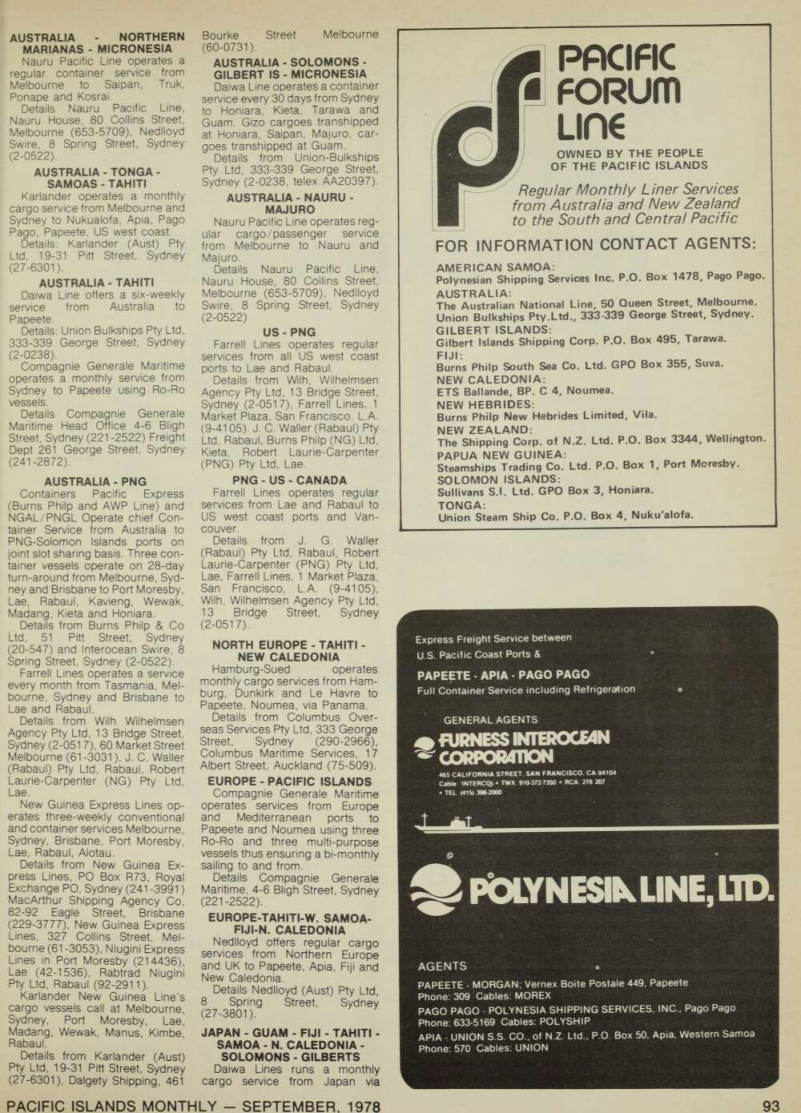
Services
Sydney - Lord Howe Is -
Norfolk Is
Compagnie des Chargeurs Caledoniens operates four-weekly cargo service Sydney - Lord Howe Island and Norfolk Island.
Details Hetherington Kingsbury Pty Ltd, 37-49 Pitt Street, Sydney (27-1671).
SYDNEY - NZ - FIJI - HAWAII -
Canada - Us
P & O liners call at Auckland, Suva, Honolulu and Vancouver on eastbound and westbound voy ages between Sydney and the US.
Details from P & O Booking Centre, World Travel Head quarters Pty Ltd, 33 Bligh Street, Sydney (231 -6655).
AUSTRALIA - NZ - FIJI - TONGA
N. Hebrides - Noumea - Png
Solomons-Samoas
Sitmar Cruises operates a year round cruise programme to in clude most of the above countries.
Details from Sitmar Cruises, 47 Elizabeth Street, Sydney (232-7511).
Royal Viking Line, with first-class cruise ships Royal Viking Star, Royal Viking Sky and Royal Viking Sea, cruises the Pacific from Syd ney and Cairns calling at a variety of Pacific and Asian ports.
Details from Wilh, Wilhelmsen Agency Pty Ltd, 13-15 Bridge Street, Sydney (2-0517).
P & O liners call at Apia, Auckland, Bay of Islands, Honiara, Lautoka, Noumea, Nukualofa, Pago Pago, Papeete, Port Moresby, Santo, Savusavu, Suva, Vavau and Vila on cruises from Australia.
Details from P & O Booking Centre World Travel Headquarters Pty Ltd, 33 Bligh Street,-Sydney (231-6655).
Australia - Fiji - Samoas -
Tonga - Norfolk Island
Pacific Navigation of Tonga op erates a five-weekly refrigerated general cargo/container service from Sydney and Brisbane, to Suva, Lautoka, Apia, Pago Pago, Nukualofa and Norfolk Island.
Details from Beaufort Shipping Agency Co, 2 Castlereagh Street, Sydney (221-2388).
Australia-Newcaledonia
(And/Or) New Hebrides
Daiwa Line operates a container service from Sydney to the New Hebrides.
Details: Union Bulkships Pty Ltd, 333-339 George Street, Sydney (2-0238).
Karlander operates a monthly service from Sydney to Noumea.
Details from Karlander (Aust) Pty Ltd, 19-31 Pitt Street, Sydney (27-6301).
Sofrana-Unilines ships serve Noumea every three weeks from the main ports along the east Aus tralian coast.
Details from Sofrana-Unilines, 37 Pitt Street, Sydney (27-2031), Trans-Austral Shipping Pty Ltd, 570 Bourke Street, Melbourne (67-9162), ACTA Pty Ltd, Bris bane (221-3116), Elders-ANL Pty Ltd, Port Adelaide (47-5688), ANL, Newcastle (049-24364), Clements & Marshall, Burnie, Tas mania (31-1833).
Compagnie des Chargeurs Caledoniens operates a three weekly containerised cargo ser vice from Sydney to Noumea.
Details Hetherington Kingsbury Pty Ltd, 37-49 Pitt Street, Sydney (27-1671).
Compagnie Generate Maritime operates a monthly service from Sydney to Noumea, Port Vila and Santo, using Ro-Ro vessels.
Details Compagnie Generate Maritime Head Office 4-6 Bligh Street, Sydney (221 -2522), Freight Dept, 261 George Street, Sydney (241-2872).
Australia - Fiji
Karlander (Aust) Pty Ltd oper ates monthly cargo services from Sydney to Suva and Lautoka.
Details from Karlander (Aust) Pty Ltd, 19-31 Pitt Street, Sydney (27-6301), Dalgety Shipping, 461 Bourke Street. Melbourne (60-0731), Burns Philp (SS) Co Ltd, Suva and Lautoka.
Sofrana-Unilines (Fiji Express Line) operates to Suva and Lau toka every three weeks from the main ports on the east coast of Australia and monthly to Lautoka from Melbourne and Sydney.
Details from Sofrana-Unilines, 37 Pitt Street, Sydney (27-2031), Trans-Austral Shipping Pty Ltd, 570 Bourke Street, Melbourne (67-9162), ACTA Pty Ltd, Bris bane (221-3116), Elder-ANL Pty Ltd, Port Adelaide (47-5688), ANL, Newcastle (049-24364), Clements & Marshall, Burnie, Tas mania (31-1833).
Australia - W Samoa
Compagnie Generate Maritime operates a monthly service from Sydney to Apia, using Ro-Ro vessels.
Details Compagnie Generate Maritime Head Office 4-6 Bligh Street, Sydney (221-2522) Freight Dept 261 George Street, Sydney (241-2872).
Australia - Fiji -
Samoas- Tonga
Pacific Forum Line operates a container, unitised/palletised and reefer cargo service from Mel bourne and Sydney to Lautoka, Suva, Pago Pago, Apia and Nukualofa. Other ports are in cluded on inducement.
Details from ANL Melbourne and Brisbane, Union Bulkships, Sydney, Hobart, Port Adelaide and Fremantle, Burns Philp (SS) Company Ltd, GPO Box 355, Suva, Fiji (311-777) or Pacific Forum Line, PO Box 655, Apia, W Samoa.
Australia - Northern
Marianas - Micronesia
Nauru Pacific Line operates a regular container service from Melbourne to Saipan, Truk, Ponape and Kosrai.
Details Nauru Pacific Line, Nauru House, 80 Collins Street, Melbourne (653-5709), Nedlloyd Swire, 8 Spring Street, Sydney (2-0522).
Australia - Tonga -
Samoas - Tahiti
Karlander operates a monthly cargo service from Melbourne and Sydney to Nukualofa, Apia, Pago Pago, Papeete, US west coast.
Details: Karlander (Aust) Pty Ltd, 19-31 Pitt Street, Sydney (27-6301).
Australia - Tahiti
Daiwa Line offers a six-weekly service from Australia to Papeete.
Details: Union Bulkships Pty Ltd, 333-339 George Street, Sydney (2-0238).
Compagnie Generale Maritime operates a monthly service from Sydney to Papeete using Ro-Ro vessels.
Details Compagnie Generale Maritime Head Office 4-6 Bligh Street, Sydney (221-2522) Freight Dept 261 George Street, Sydney (241 -2872).
Australia - Png
Containers Pacific Express (Burns Philp and AWP Line) and NGAL/PNGL Operate chief Con tainer Service from Australia to PNG-Solomon Islands ports on joint slot sharing basis. Three con tainer vessels operate on 28-day turn-around from Melbourne, Syd ney and Brisbane to Port Moresby, Lae, Rabaul, Kavieng, Wewak, Madang, Kieta and Honiara.
Details from Burns Philp & Co Ltd, 51 Pitt Street, Sydney (20-547) and Interocean Swire, 8 Spring Street, Sydney (2-0522).
Farrell Lines operates a service every month from Tasmania, Mel bourne, Sydney and Brisbane to Lae and Rabaul.
Details from Wilh Wilhelmsen Agency Pty Ltd, 13 Bridge Street, Sydney (2-0517), 60 Market Street Melbourne (61-3031), J. C. Waller (Rabaul) Pty Ltd, Rabaul, Robert Laurie-Carpenter (NG) Pty Ltd, Lae.
New Guinea Express Lines op erates three-weekly conventional and container services Melbourne, Sydney, Brisbane, Port Moresby, Lae, Rabaul, Alotau.
Details from New Guinea Ex press Lines, PC Box R 73, Royal Exchange PC, Sydney (241 -3991) MacArthur Shipping Agency Co, 82-92 Eagle Street, Brisbane (229-3777), New Guinea Express Lines, 327 Collins Street, Mel bourne (61 -3053), Niugini Express Lines in Port Moresby (214436), Lae (42-1536), Rabtrad Niugini
Pty Ltd. Rabaul (92-2911).
Karlander New Guinea Line’s cargo vessels call at Melbourne,
Sydney, Port Moresby, Lae,
Madang, Wewak, Manus, Kimbe, Rabaul.
Details from Karlander (Aust) Pty Ltd, 19-31 Pitt Street, Sydney
(27-6301), Dalgety Shipping, 461
Bourke Street Melbourne (60-0731).
Australia - Solomons -
Gilbert Is - Micronesia
Daiwa Line operates a container service every 30 days from Sydney to Honiara, Kieta, Tarawa and Guam. Gizo cargoes transhipped at Honiara, Saipan, Majuro, car goes transhipped at Guam.
Details from Union-Bulkships Pty Ltd, 333-339 George Street, Sydney (2-0238, telex AA20397).
Australia - Nauru -
Majuro
Nauru Pacific Line operates reg ular cargo/passenger service from Melbourne to Nauru and Majuro.
Details Nauru Pacific Line, Nauru House, 80 Collins Street, Melbourne (653-5709), Nedlloyd Swire, 8 Spring Street, Sydney (2-0522)
Us - Png
Farrell Lines operates regular services from all US west coast ports to Lae and Rabaul.
Details from Wilh, Wilhelmsen Agency Pty Ltd, 13 Bridge Street, Sydney (2-0517), Farrell Lines, 1 Market Plaza, San Francisco. L.A. (9-4105). J. C. Waller (Rabaul) Pty Ltd, Rabaul, Burns Philp (NG) Ltd, Kieta, Robert Laurie-Carpenter (PNG) Pty Ltd. Lae.
Png - Us - Canada
Farrell Lines operates regular services from Lae and Rabaul to US west coast ports and Van couver.
Details from J. G. Waller (Rabaul) Pty Ltd, Rabaul, Robert Laurie-Carpenter (PNG) Pty Ltd, Lae, Farrell Lines, 1 Market Plaza, San Francisco, L.A. (9-4105), Wilh, Wilhelmsen Agency Pty Ltd, 13 Bridge Street, Sydney (2-0517).
North Europe - Tahiti -
New Caledonia
Hamburg-Sued operates
monthly cargo services from Ham burg, Dunkirk and Le Havre to Papeete, Noumea, via Panama.
Details from Columbus Over seas Services Pty Ltd, 333 George Street, Sydney (290-2966), Columbus Maritime Services, 17 Albert Street, Auckland (75-509).
Europe - Pacific Islands
Compagnie Generale Maritime operates services from Europe and Mediterranean ports to Papeete and Noumea using three Ro-Ro and three multi-purpose vessels thus ensuring a bi-monthly sailing to and from.
Details Compagnie Generale Maritime, 4-6 Bligh Street, Sydney (221-2522).
Europe-Tahiti-W. Samoa
Fiji-N. Caledonia
Nedlloyd offers regular cargo services from Northern Europe and UK to Papeete, Apia, Fiji and New Caledonia.
Details Nedlloyd (Aust) Pty Ltd, 8 Spring Street, Sydney (27-3801).
JAPAN - GUAM - FIJI - TAHITI -
Samoa-N. Caledonia
Solomons - Gilberts
Daiwa Lines runs a monthly cargo service from Japan via
Guam to Lautoka, Suva, Papeete, Pago Pago, Apia, Sydney, Noumea, Honiara, Tarawa, Guam.
Details from Burns Philp (SS) Co Ltd, Suva.
NZ - FIJI - TONGA - SAMOAS Union Steam Ship Co of NZ op erates a roll-on, roll-off, unitised service from Auckland to Lautoka-
Suva-Pago Pago-Apia-Nuku’alofa
on a 14 day frequency.
Details from Union Steam Ship Co of NZ Ltd, PO Box 12, Auckland or from Branch offices/agents in Fiji, Tonga and the Samoas.
Nz - N. Caledonia -
N. Hebrides - Png -
Solomons
Sofrana Unilines with three ships operates to Vila and Santo, to Honiara and Papua New Guinea and to Noumea.
Details from Sofrana Unilines, 18 Customs Street, Auckland (773-279), PO Box 3614, Telex NZ2313.
Nz - Australia -
New Caledonia -
Solomons - Gilberts -
Micronesia
Union Co/Daiwa Line operate a container service from New Zealand through Sydney to Noumea, Honiara, Tarawa and Guam, Transhipment to Saipan, Majuro and Gizo.
Details; Union Steam Ship Co of NZ Ltd, PO Box 12, Auckland, or Union Bulkships Pty Ltd, 333-339 George Street, Sydney, (2-0238).
Nz- Png
Farrell Lines operates regular service every 30 days from Auckland to Lae and Rabaul.
Details from Dalgety NZ Ltd, 41-45 Albert Street, Auckland (7-1859) J. C. Waller (Rabaul) Pty Ltd, Rabaul, Robert Laurie (NG) Pty Ltd, Lae.
Nz - Fiji - North America
(WC) Blue Star Line Crusader service to West Coast North America. Only direct service to and from New Zealand. Blue Star vessels call at Suva and Honolulu on NZ-US- West Coast voyage,s.
Details from Blueport ACT (NZ) Ltd, PO Box 192, Wellington (739-029), Burns Philp (SS) Co Ltd, GPO Box 355, Suva, Fiji (311-777).
Nz - Fiji
Reef operates a regular 18-day service from Auckland to Suva and Lautoka.
Details from Reef Shipping Agencies Ltd, PO Box 3382, Auckland. NZ (7-1221-3).
Pacific Line with one ship oper ates monthly cargo service New Zealand, Lautoka, Suva.
Details: Sofrana Unilines, 18 Customs Street, Auckland (773-279) PO Box 3614, Telex; NZ2313.
Nz - Fiji - Gilberts -
Solomons - Png
Pacific Forum Line operates a
container, unitised/palletised and reefer cargo service from Lyttelton and Auckland to Lautoka, Suva, Tarawa, Honiara, Madang, Lae and Moresby. Other ports are in cluded on inducement.
Details from Shipping Corpor ation of NZ Ltd, Auckland, Christchurch, Lyttelton, Welling ton. Burns Philp (SS) Company Ltd, GPO Box 355, Suva, Fiji (311-777) or Pacific Forum Line, PC Box 655, Apia, W. Samoa
Nz - Fiji - Samoas -
Tonga - Australia
Pacific Forum Line operates a container, unitised /palletised and reefer cargo service from Timaru and Auckland to Lautoka, Suva, Pago Pago, Apia, Nukualofa and Melbourne. Other ports are in cluded on inducement.
Details from Shipping Corpor ation of NZ Ltd, Auckland, Christchurch, Lyttelton, Welling ton, Burns Philp (SS) Company Ltd, GPO Box 355, Suva, Fiji (311-777) or Pacific Forum Line, PO Box 655, Apia, W. Samoa.
Nz- Samoa - Tonga
Pacific Navigation of Tonga op erates a four-weekly cargo ser vice, Auckland - Nukualofa - Pago Pago - Apia - Auckland.
Details from McKay Shipping Ltd, Downtown House, Queen Street, Auckland (33-656).
Warner Pacific Line services Onehunga - Nukualofa - Vavau fortnightly, and Timaru - Nukualofa - Vavau monthly and Onehunga - Apia and Pago Pago every 21 days carrying general and freezer car goes and Timaru - Apia every 21 days carrying freezer cargo.
Details from Air Marine Services (NZ) Ltd, PO Box 2505, Auckland (796-841).
Png - Uk/Continent
Bank Line operates regular cargo service from Kieta, Rabaul, Kimbe, Madang and Lae to Liver pool, Hamburg, Rotterdam, Ant werp and London.
Details from Bank Line (A’asia) Pty Ltd, 1 York Street, Sydney (27-2041), Burns Philp (PNG) Ltd, PNG ports.
Png - Us
Bank Line operates regular cargo service from Kieta, Rabaul, Kimbe, Madang and Lae direct to San Francisco: calls at US Gulf and East Coast ports on inducement.
Details from Bank Line (A’asia) Pty Ltd, 1 York Street, Sydney (27-2041); Burns Philp (PNG) Ltd, PNG ports.
Solomons - Fiji - Tonga -
W. Samoa - Uk/Continent
Bank Line operates regular cargo service from Honiara, Suva, Nukualofa and Apia to Liverpool, Hamburg, Rotterdam and Ant werp.
Details from Bank Line (A’asia) Pty Ltd, 1 York Street, Sydney (27-2041); Burns Philp (SS) Co Ltd, Fiji, Tonga, W Samoa; Trading Co Honiara.
Far East - Fiji - New
Zealand
New Zealand Unit Express (CNC, MNOL, RIL) operates a three-weekly cargo service from Hong Kong to Lautoka, Suva, NZ ports, Manila. Kaoshiung, Keelung, Hong Kong.
Details from Nedlloyd, 8 Spring Street, Sydney (2-0522).
Nedlloyd operates monthly cargo service with three ships from Surabaya, Jakarta, Bangkok, Port Kelang and Singapore to Suva and NZ ports.
Details from Nedlloyd (Aust) Pty Ltd, 8 Spring Street, Sydney (27-3801); Burns Philp (SS) Co Ltd, Suva and Lautoka.
Japan - Nz - Png
China Navigation Co, with three ships operates a monthly cargo service from Japan to New Zealand calling at Lae on return journey.
Details Nedlloyd, 8 Spring Street, Sydney (2-0522).
Far East - Mid-S. Pacific
China Navigation Co’s vessels operate a regular cargo service from Hong Kong, Taiwan and Sin gapore to Rabaul, Wewak, Madang, Lae, Port Moresby, Honiara, New Hebrides, Noumea, Papeete and Samoa.
Details from Nedlloyd, 8 Spring Street, Sydney (2-0522).
Kyowa Shipping Co. Ltd, oper ates monthly services from Hong Kong, Taiwan, S. Korea and Japan, to Guam, Siapan,
Solomons, New Caledonia, Fiji, Western and American Samoa, Tahiti, Cook Is., Tonga and New Hebrides and 45-day con tainer/ break bulk cargo service from Kobe, Nagoya and Yokohama to Guam, Suva, Lau toka and Noumea.
Details; Hetherington Kingsbury Pty Ltd. 37-49 Pitt Street, Sydney (27-1671).
NYK Line, in conjunction with Daiwa Line, with container ships operates 30-day service from Moji, Kobe, Nagoya and Yokohama to Papeete, Pago Pago, Apia, Suva, Lautoka, Noumea, Sydney, Honiara, Kieta, Tarawa, Guam and Taiwan.
Details: Union Bulkships Pty Ltd, 333-339 George Street, Sydney (2-0238).
NZ - COOK IS - NIUE -
Tahiti
Shipping Corporation of NZ Ltd operates cargo services based on pallets and similar units from Auckland to Niue, Cook Islands and Tahiti.
Details from the Shipping Corp of NZ Ltd, PO Box 3420, Auckland (797-210); Waterfront Com mission, PO Box 61, Rarotonga, Lighterage and Stevedoring Co, Aitutaki, Niue Govt Offices, Niue Island Compagnie Maritime Polynesienne, B’P’ 368, Papeete.
Uk/N. Continent - Tahiti -
N. Caledonia - N. Hebrides
Bank Line operates regular
cargo service from Hull, Hamburg, Bremen, Antwerp and Rotterdam to Papeete, Noumea and Vila.
Details from Bank Line (A’asia) Pty Ltd, 1 York Street, Sydney (27-2041); Ets A M Fare UTE, Papeete: Ets Ballande, Noumea, Burns Philp (NH) Ltd, Vila.
Uk/N. Continent - Png -
Solomons
Bank Line operates regular cargo service from Hull, Hamburg, Bremen, Antwerp and Rotterdam to Port Moresby, Lae, Madang, Kimbe, Rabaul, Kieta and Honiara and on inducement to Yandina, Tarawa and Nauru.
Details from Bank Line (A’asia) Pty Ltd, 1 York Street, Sydney (27-2041); Burns Philp (PNG) Ltd, PNG ports; Trading Co Honiara.
San Francisco - Honolulu -
Nauru-Micronesia
Nauru Pacific Line operates reg ular conventional/container ser vice from San Francisco and Honolulu to Majuro, Nauru, Ponape, Truk and Saipan.
Details from Nauru Pacific Line, Nauru House, 80 Collins Street, Melbourne (653-5709); North American Maritime Agencies, 100 California Street, San Francisco, California 9411 (981-0343).
US - FIJI - TAHITI - NZ -
Australia
Bank and Savill Line Ltd, oper ates regular cargo services from
US Gulf ports to Australia and NZ.
Calls at Suva, Lautoka and Papeete on demand.
Details from Bank Line (A’asia) Pty Ltd, 1 York Street, Sydney (27-2041) or Howard Smith Indus tries Pty Ltd, 1 York Street, Sydney (27-5611).
US - A. SAMOA - NZ -
Aust
Farrell Lines LASH ships operate regularly from US to Australia, via Pago Pago and Auckland and Canada.
Details from Wilh, Wilhelmsen Agency Pty Ltd, 13 Bridge St., Syd ney (2-0517); 60 Market Street, Melbourne (61-0301); Farrell Lines, 1 Market Plaza, San Fran cisco, L.A. (415-777-3300); Dal gety NZ Ltd, Auckland (7-1859); Kneubuhl Maritime Services, Pago Pago (633-5121).
Us - Tahiti - Samoa
Pacific Islands Transport oper ates a five/six weekly cargo ser vice from North America west coast ports to Papeete, Pago Pago, Apia.
Details from Trans-Austral Ship ping Pty Ltd, 19 Pitt Street, Sydney (27-2441).
Polynesia Line operates con tainer and general cargo service from US west coast ports to Papeete and Pago Pago.
Details from Polynesia Shipping Services Inc,. PO Box 1478, Pago Pago (9-6799).
Advertisements & other items, pp. 91-104 (1 item)
Stewart
Our Kitset Houses manufactured to your design or requirements are available for
delivery and local assembly competitively
anywhere in the Pacific. Units can come complete with plumbing and electrical wiring and be manpacked into the most inaccessible areas if required. • We can also cater for classrooms, hospital wards, dispensaries, etc. Our precut colour coded and numbered framing units means less skilled labour on site as initial cutting, fitting, etc., has been done in our factory.
We will design and/or help you to set up your own manufacturing facilities utilising local labour and resources on a joint venture basis.
FOR FURTHER INFORMATION WRITE TO:—
STEWART
TIMBER & HARDWARE LTD.
EXPORT DIVISION
P.O. BOX 488, WHANGAREI. NEW ZEALAND.
ISLANDS
TRANSPORT
LINE
MS CAMELLIA VENTURE
Express Freight Service between Pacific Coast Ports of U.S.A. and...
Tahiti 6 Samoa
PAPEETE - APIA - PAGO PAGO
Full container service including reefers.
GENERAL STEAMSHIP CORPORATION LTD.
General Agents 400 California Street, San Francisco, California, U.S.A.
APIA: Bums Philp (South Sea) Company Ltd.
PAPEETE: Agence Maritime Internationale, Tahiti PAGO PAGO: Polynesia Shipping Services Inc.
NIUE
COOK ISLANDS
TAHITI
to and from
NEW ZEALAND
Regular service using pallet load ships TIARE MOANA and FETU MOANA. Refrigerated and general cargo between Auckland and Niue, Rarotonga, Aitutaki, Papeete. Other nearby ports by inducement.
AREA AGENTS
Niue: Government Shipping Office, Alofi.
Cook Islands: Waterfront Commission, PO Box 61, Rarotonga.
Telex Shipping RG 2002 Tahiti: Agence Maritime et de Voyage, B P 131, Papeete.
Telex AMAV 251 FP
The Shipping Corporation
of New Zealand Limited
Sea carrier to the nation AUCKLAND: Phone 379-430. PO Box 3420. Telex: NZ2822 WELLINGTON; Phone 728-500. PO Box 3344. Telex; NZ3495 CHRISTCHURCH: Phone 795-760. PO Box 777. Telex: 4434 DUNEDIN: Phone 76-076. PO Box 904 Telex; 5228. 1436
jJlsu
Tliv
Pacific Navigation of Tonga Limited
SERVING THE PACIFIC FROM AUSTRALIA AND NEW ZEALAND
NUKUALOFA:
PACIFIC NAVIGATION •
OF TONGA LTD.
THE ADMINISTRATOR •
NORFOLK ISLAND
SUVA, LAUTOKA, APIA,
PAGO PAGO AGENTS: •
BURNS PHILP
(S.S.) CO. LTD. f
BEAUFORT SHIPPING
G.P.O. Box 3988, - Sydney, N.S.W. • Australia.
McKAY SHIPPING LIMITED •
P.O. Box 1372, Auckland, New Zealand.
REGULAR SAILINGS
OWNED TONNAGE
CONTAINERS
FREEZER
DEEP TANKS
CONTINUOUS PRE-RECEIVING
HEA VY LIFTS
PACIFIC
FORUm
Line
OWNED BY THE PEOPLE
OF THE PACIFIC ISLANDS
j/ar Monthly Liner Services
from Australia and New Zealand
to the South and Central Pacific
FOR INFORMATION CONTACT AGENTS:
AMERICAN SAMOA:
Polynesian Shipping Services Inc. P.O. Box 1478, Pago Pago
AUSTRALIA:
The Australian National Line, 50 Queen Street, Melbourne.
Union Bulkships Pty.Ltd., 333-339 George Street, Sydney.
GILBERT ISLANDS:
Gilbert Islands Shipping Corp. P.O. Box 495, Tarawa.
FIJI;
Burns Philp South Sea Co. Ltd. GPO Box 355, Suva.
NEW CALEDONIA:
ETS Ballande, BP. C 4, Noumea.
NEW HEBRIDES:
Burns Philp New Hebrides Limited, Vila.
NEW ZEALAND:
The Shipping Corp. of N.Z. Ltd. P.O. Box 3344, Wellington
PAPUA NEW GUINEA:
Steamships Trading Co. Ltd. P.O. Box 1, Port Moresby.
SOLOMON ISLANDS:
Sullivans S.l. Ltd. GPO Box 3, Honiara.
TONGA:
Union Steam Ship Co. P.O. Box 4, Nukualofa.
Rem
Express Freight Service between U S. Pacific Coast Ports &
PAPEETE - APIA - PAGO PAGO
Full Container Service including Refrigeration
GENERAL AGENTS
fURNESS INTEROCE4N
465 CALIFORNIA STREET SAN FRANCISCO CA 94104 Cable INTERCQ) • TV9X 7350 • RCA 27S 207
• TEL (415) 398 2000
O
POLYNESIA LINE, LID.
AGENTS
PAPEETE - MORGAN; Vernex Boite Postale 449, Papeete Phone: 309 Cables; MOREX PAGO PAGO ■ POLYNESIA SHIPPING SERVICES. INC.. Pago Pago Phone: 633-5169 Cables. POLYSHIP APIA - UNION S.S. CO., of N.Z. Ltd.. P.O. Box 50. Apia, Western Samoa Phone: 570 Cables. UNION
o O
GLOBAL SERVICE FOR SHIPPERS
THE
LINE
i •
Monthly Services
United Kingdom and Continent to:
PAPEETE • NOUMEA • NEW HEBRIDES
PAPAU NEW GUINEA and SOLOMON ISLANDS
■* Papua New Guinea to: NORTH AMERICA • UNITED KINGDOM and CONTINENT Solomons - Fiji • Tonga • Samoa and Tarawa to:
UNITED KINGDOM and CONTINENT
For particulars apply:
THE BANK LINE (AUSTRALASIA) PTY. LTD.
18th Floor 1 York Street SYDNEY NSW 2000 Australia Tel: 272041 Telex: 24063
EX poßllM
PACIO?
THE
TO
Breekwoldt & Co
Pty Ltd
Suite 1909, 19th Floor, King George Tower,
Corner King & George Streets, Sydney.
G.P.O. Box 5027, Sydney 2001.
CABLES; 'BREWO' SYDNEY. TELEX: AA22890.
TELEPHONES: 233 2366, 232 2315, 233 1462.
PACIFIC ISLAND OFFICES'
BRECKWOLDT & CO (PNG) PTY. LTD.
PO BOX 1549, BOROKO, PORT MORESBY.
PO BOX 222, RABAUL
PO BOX 72, KIETA
PO BOX 178, WEWAK
PO BOX 185, MADANG
PO BOX 237, MT. HAGEN
PO BOX 1188, LAE
BRECKWOLDT & CO., PO BOX 47, APIA BRECKWOLDT & CO. (SI) LTD. PO BOX 140, HONIARA
BRECKWOLDT SARL BP 2369, NOUMEA
OFFICES IN:
HAMBURG
LONDON
MILAN
& WEST AFRICA
ALSO AT:
SINGAPORE
KUALA LUMPUR
BANGKOK
& HONG KONG
ENQUIRIES
FROM OVERSEAS MANUFACTURERS INVITED.
Mamma .
The South Seas Express.
The first regular roll-on roll-off express
service between N.Z.and the .
The introduction of Marama to the Islands trade will enable exporters to greatly increase their export potential by providing faster, more frequent sailings as well as the greater cargo handling flexibility which a roll-on roll-off service can provide.
Departures every 14 days from Auckland to: Lautoka. Suva. Pago Pago Apia. Nukualofa 4 Nukualofa / X Co-ordinated transhipment facilities from other N.Z. centres Intermodal coastal roll-on roll-off services as well as rail and road services can be utilised by shippers in other New Zealand centres to take advantage of the new Marama schedule. Your nearest Union Company office can assist you in organising the most efficient transhipment method.
International Transhipment Facilities Flexibility in cargo modules catered by this new service can provide for shipping operators and exporters the advantage of reaching international markets using onforwarding services through Union Company contacts and expertise.
Additionally Union can also arrange for cargoes originating from overseas sources to be transhipped at ports covered by Marama' to their final destination to the benefit of the importer in New Zealand or the Islands. m.v. Marama Your new export incentive 6350 deadweight tonnes.
Mi JAle.
f Capacity 340 seafreighter units or their equivalent, plus space for wheeled vehicles, livestock, etc.
Greater Flexibility
Means a more satisfactory and versatile way to ship your
consignment.
The following equipment is provided free to shippers Standard dry general cargo ISO containers 20' xB' x B'6" box container 20' x 8' x B'6''Opensided container.
Seafreighter Units
For movement of general and bulk cargoes. (Internal) Length 13'9"(4.24M) width 7*6"(2 29M) height 5' (1.52 M) N B. Units are fully collapsible and open topped to facilitate loading cargoes in excess of 1.52 M height. A shower-proof cover is also provided free with every
seafreighter.
Newsprint Flats These units are specifically designed for carriage of forest industry cargo but are also suitable for the carriage of other specified types of cargoes. (Internal) Length 15'6"(4.77M) Width 6' (1.830 M) W. Containers These containers are totally enclosed suitable for the movement of smaller consignments or valuable ones. (Internal) Length 5'7"(1.75M) Width 4' (1.22 M) Height 5'6"(1.70M) Unit Loads This covers cargo that is unable to be containerised or is not covered by the term mobile equipment .
These unit loadings must be of a secure nature to facilitate handling by a forklift with 5" gluts (loading forks).
Refrigerated Cargo
The following containers will be available: Cold wrap containers 20' x 8' x 8' Integral containers 20' x 8' x B'6"
Livestock Livestock stalls are available for the carriage of all types of stock.
Wheeled Cargo
The versatility of Marama means that all types of wheeled cargoes including cars, trucks, tractors, scrapers, machinery on mobile tracks, cranes, trailers etc can be catered for.
Hazardous Cargo
The majority of hazardous cargoes will be accommodated on the vessels upper deck either in seafreighters, ISO containers or W. Containers. Full details are available on application.
union
compnnq
n moving
o H V A/ o
IN OUR 84th YEAR SELLING ‘SERVICE’
TO THE PACIFIC ISLANDS...
Nelson &Robert son
PTY. LTD. (Established 1895) Plantation House, 197 Clarence Street, Sydney.
Cables: ‘IVAN 5 , Sydney, Brisbane. Telex: AA22381, Sydney.
FOR:
INDENTS
FOODSTUFFS
SOFTGOODS
HARDWARE
MACHINERY
SHIPPING
TRAVEL
INSURANCE
REAL ESTATE
...FROM AUSTRALIA & OVERSEAS.
BRANCH OFFICES:
Nelson & Robertson Pty. Ltd., 303 Adelaide Street, Brisbane, Qld.
Nelson & Robertson Pty. Ltd., P.O. Box 2092, Gout. Bldg., Suva, Fiji.
Nelson & Robertson Pty. Ltd., P. O. Box 258, Lautoka, Fiji,
PAPUA NEW GUINEA
REPRESENTATIVES:
Rabtrad Niugini Pty. Ltd.
RABAUL
LAE
MADANG
KIETA
Q
The Australian
Trade Commissioner
can open doors
to greater profits
Do you wish to boost business by adding new products to your range? Are you seeking new sources of supply for the products you already handle? Or is it new plant and equipment that you’re after? Then most likely the Australian Trade Commissioner can help you. Australia’s industries make a great variety of quality goods.
Machinery, agricultural equipment, electrical goods, automotive equipment and accessories, chemicals, sporting goods, scientific equipment, materials handling equipment. These and many more have proved successful in international markets. They can prove successful in your own.
Find out what Australia has to offer you.
Quality and value that’s only hours away The Australian Trade Commissioner can give you details of suppliers. He can also advise Pacific Islands exporters on ways to research or develop markets in Australia. You can contact him at:— FIJI: 7th Floor, Dominion House, Thomson Street, Suva. (Post Office Box 1252.) Telephone: 312844.
PAPUA NEW GUINEA: Australian High Commission, P.O. Box 9129, Hohola. Telephone: 259333.
T m
Ask the Australian Trade Commissioner
The Wild System
has everything.
I * Li
HEERBRUGG
For solving your survey problems
Special tasks need special approaches. So we've developed an instrument system: it's a range of basic theodolites and levels plus a variety of interchangeable accessories for solving your problems economically and without having to buy special instruments.
GLO Laser Eyepiece for laser alignment: Distomats for infra-red electronic distance measurement; GAKI North-Seeking Gyro for orientation anywhere and anytime; Parallel Plate Micrometer for precise levelling and optical tooling; GOA Eyepiece for autocollimation; Pentaprism for plumbing; Diagonal Eyepieces, Filters and Solar Prism for astronomy; Optional Eyepieces for different telescope magnifications. These are some of the accessories for standard Wild theodolites; a few of the aids we provide for solving your problems in a practical and economic way.
Please write for further details.
WILD (Australia) PTY. LIMITED
Ss P.N.G. BRIAN BELL & COMPANY PTY. LIMITED, BOROKO, NSW: 45 Epping Road, North Ryde. Telephone 888 7122 VIC: 83-85 Palmerston Crescent, South Melbourne. 69 2263 OLD: 212 Boundary Street, Spring Hill. Telephone 229 6744 S.A.: Trevor Ley, 28 Gertrude Street, Glandore. 293 6454 Agents in all states.
CLASSIFIED ADVERTISEMENTS
Per Line $5.00 Aust. Minimum 4 tines.
MARINE
MOTORS
MARINE SURVEYED
RECONDITIONED
100 to 300 h.p. mostly General Motors
PRICES
EXTREMELY
COMPETITIVE
Inquiries to:
EUROSPARES
NEW ZEALAND LIMITED
P.O. BOX 116
WAITARA,
NEW ZEALAND
TELEX
EUROSPARES
NUPUBTX 31383
FOR SALE BY
TENDER
R 822 RB3O
GRABBING CRANES
The Nauru Phosphate Corporation offers for sale by Tender the following redundant Phosphate Mining Equipment. 1. 2 only Ruston Bucyrus R 822 Series I Grabbing Cranes (1962) Island Nos. 1 and 2. 2. 2 only Ruston Bucyrus R 822 Series II Grabbing Cranes (1964, 1965) Island Nos. 3 and 6. 3. 5 only Ruston Bucyrus RB3O Series I Grabbing Cranes (1958, 1962) Island Nos. 21, 24, 26, 28 and 29. 4 4 only Ruston Bucyrus RB3O Series II Grabbing Cranes (1962, 1963) Island Nos. 30, 31, 32 and 33.
The machines are offered F.O.W.
Nauru and are available for inspection by prior arrangement. All machines are offered in their present condition and no guarantee is given or implied in their sale.
Tenders clearly stating plant description are to be marked “Tender" and addressed to: Operations Manager, Nauru Phosphate Corporation, Head Office, Aiwo, Republic of Nauru, Central Pacific.
Tenders will be received up to 4.00 p.m Friday, 29th September, 1978.
The Corporation reserves the right not to accept the highest or any tender.
“WAIKIKI”
Vacation Apartments, 2 bedroom, clean, air-conditioned, near beach, bus, zoo, and entertainment.
For more information write to:
LEALEA HALE HOTEL
2423 Cleghorn Street
HONOLULU,
HAWAII 96815
We are Exporters of Original Handmade
CARVINGS
Please ask for leaflets photos & price-list.
BLUE LAGOON
ARTIFACTS
Munda/New Georgia, Solomon Islands
PETER FISHER
TRADING
Pty Ltd
321 PITT St., SYDNEY, AUSTRALIA 2000
Telephone: 261109 Cables; "FISHERION" SYDNEY
EXPORTERS TO THE
PACIFIC ISLANDS
THE PAPUA HOTEL
PORT MORESBY
o • Right in the business centre • A tradition for comfort and fine food • All rooms air conditioned • Restaurant • Bars • Banquet Hall Telephone 21 2622 Cables PARTEL
A. C. NEUMANN
Manager
COINS
WANTED
Pays twice to 8 times face value for pre-decimal coins.
Also wanted English, American, Chinese and other coins.
NUMIPHIL
1 Ellerslie Place Toorak, Vic, 3142, Aust.
Stay at Aggie Grey's
the South Pacific's
legendary hotel.
Situated right in the heart of Western Samoa. Enjoy Polynesian-style friendliness and service, in cool surroundings, superb entertainment and food. Magnificent white sand beaches only a short drive away. Airconditioned rooms, swimming pool and full bar facilities.
Bookings through Union Steamship Company of NZ, Pan Am, Air New Zealand or direct to Aggie Grey's, Apia, Western Samoa.
Cables: AGGIES. APIA.
FOR SALE
Diesel engines, brand new 2 complete units Lees Marine Four/75 (Ford 2712 E) 75 bhp at 2100 rpm C/W fresh water Longlife, heat exchanges, separate sea water pump, wet sump engine oil cooler, 12 volt generator and starter. Twin Disc gear box also propeller, tail shaft, coupling, controls, etc.
In original packing cases, genuine sale, good price.
Enquiries: A.T.A.S.I. P.O. Box 101, Honiara, Solomons Islands.
Enquiries are invited from agents servicing high quality giftware and decorator shops throughout the Pacific, including P.N.G. and N.Z., by a small countrybased Australian Importer, established since 1970.
Items include wooden kitchenware and utensils from W. Germany, pine lighting from Finland, kitchen cannisters from U.K. and a small range of our own manufactured goods.
Stock will be dispatched through Sydney or Brisbane.
Enquiries in writing quoting reference should be sent to:
Hon ima Imports
P.O. Box 200, BOWRAL, N.S.W., Australia 2576.
JOIN THE CLUB
Send today for our magazine containing descriptions and pictures of lonely and sincere lad ies and gentlemen wishing companionship and marriage. Order Now! Send $2.00 to Civic Center Services, 205 South Broadway, Room 100, Los Angeles, CA 90012.
POSITION WANTED
Qualified teacher (English) High School experience Australia and U.K. Write to David Cowen, 12/27 Arcadia St, Coogee NSW 2034 Australia.
FOR SALE
FLEETS 36ft steel ketch bit. 1973. MD3 diesel, s.s. rigging Dacron sails, 6 berths, toilet.
Good anchor gear. $27,300.
FLEETS, 221 Esplanade, Wynnum, Central Brisbane.
Cable: FLEETS BRISBANE.
rf
New Cats2B
winch,,
* ? r**&nif- . **»• -
■" ,| *': ** i- - * ° *>. ■ > *
New Cat 528
log-skidder
7 *>■ ** wm It's another step ahead towards more profitable, more efficient logging operations: Cat 528 Skidder with major improvements.
Now rear wheel caliper disc brakes increase service braking pad contact surface by 78%, thereby extending brake life. There are three master cylinders, one each for front, rear and driveline systems. All four wheel brakes engage first; additional pedal depression engages driveline brake.
Caterpillar 528 Winch has power control design to allow "winching on-the-go". Winch and skidder can be operated simultaneously.
Other features include oil disc clutch and brake to extend service life; complete sealing maintains rated capacity; winch brake accumulator allows load release from dead engine; adjustable free spool drag lets operator pull line uphill or down without cable balling. Other helpful features too!
Send for literature or talk to your Caterpillar representative.
Caterpillar Dealers in South-West Pacific.
HASTIMES DEEDING
Lae: Milford Haven Rd.
Phone 42 2355.
Port Moresby: Phone 21 2122.
Bougainville: Itakara Industrial Park, Arawa. Phone 95 9077.
C
carptrac
Lautoka: Labasa: Veitari Lautoka Vulovi Labasa Phone 61877 Phone 81888 Suva: Carptrac Carpenter Street Raiwai Suva Phone 381622 Telex FJ2190 Cables CARPTRAC HD 657
I
STATESMAN
STATESMAN
CORONA
FANATELIA
5
LONG
PANATEOA
STATESMAN
Smooth, mild cigars.
© W. D. & H. 0. WILLS (AUSTRALIA) LIMITED
E6BO
Wot just a pretty face
i * The high performance section of the Bridgestone circuit.
Sure Bridgestone tyres look good, but that’s not he only advantage they have on their side, n fact, every Bridgestone tyre is the product of in extensive development and testing )rogramme. And Bridgestone place so much mportance on tyre development they invested >5 million in the construction of one of the world’s most advanced tyre proving grounds, ‘his means that when you fit Bridgestone tyres o your car, you have the assurance of intensive levelopment and research. Mileage, )erformance, wet weather handling, noise svels and riding comfort are all subjected to lemanding test conditions.
So next time you are attracted by the wide, low, porty look of a Bridgestone tyre ... remember, t is not just a pretty face. m ■ I *
TOKYO, JAPAN
Bridgestone Distributors in the Pacific Area ( n W An aerial shot of the Bridgestone tyre proving ground, just north of Tokyo. ustralia: Marubeni-Bndgestone Tyres (NSW) Pty Ltd /Kingstone Tire Agency Pty. Ltd./Bridgestone Tyres (W A ) Pty. Ltd./Bridgestone Tyres (OLD ) ty Ltd./Marubeni-Bridgestone Tyres (S.A) Pty Ltd. Papua New Guinea: N.G.G. Trading Company/Lae Tyre Service/Madang Tyre Service/Moresby yre Service/Rabaul Tyre Service/Kieta Tyre Service New Zealand: Bridgestone Tyres (N.Z.) Ltd Fiji; Caines Tire Ltd Western Samoa: Gold Star ransport Co , Ltd New Hebrides: Fung Kuei New Caledonia: Pacific Import Export Co., Ltd Solomon Islands; Lee Kwok Kuen & Co., Ltd Guam: ujan Tire Shop American Samoa: G.H.C. Reid & Co, Ltd /Haleck’s Service Center. Tahiti: Tahiti Automoto. Norfolk Islands: Martins Agencies Ltd
All roads lead to
Datsun’s destination.
m A 3 r - L i - Z3C A ' r*.
How many kilometers does your car do to the liter? However long you’ve owned it, that’s always a tricky question to answer. Because it depends on so many factors; wind conditions, your speed, whether you’re carrying a load, and—very important, this one—what kind of road you’re travelling on.
Datsun’s fuel economy tests are designed to take all those different factors into account. Hot only is consumption measured during idling, acceleration and cruising, but the same tests are repeated on level highways, narrow, winding lanes, long uphill and downhill runs and some very rough roads as well. The result is Datsun’s top-class ranking in the U.S. Environmental Protection Agency’s fuel tests and Ist position in all five classes of Australia’s 1978 Total Oil Economy Run—truly consistent performance under all road and traffic conditions. - /6 That’s why, when you ride with Datsun, you’ll always findyoyrself heading for the very best in fuel economy. Which is a welcome destination, wherever you may be going, in! iihii, 111 Jii uiiui iiiiiiii linn ini—— And all roads lead to it.
Tough tests: the Datsun way to total economy.
nATCIII
DATSUN
NISSAN
NISSAN MOTOR CO LTD
Datsun Distributors: Boroko Motors Ltd. P.O. Box 1259, Boroko, Port Moresby. P.H.G./Suva Motors Ltd. G.P.O. Box 34. Suva, Fiji/Morris Hedstrom Ltd. P.O. Box 189, Apia, Western Samoa/Cinited Enterprises Ltd. P.O. Box 262, Honiara, British Solomon Islands/Sirius Motors P.O. Box 34, Norfolk Island, South Pacific/Jacob Enterprises P.O. Box 4 Republic of Hauru/Cook Islands Motor Center Ltd. P.O. Box 74, Rarotonga. Cook Islands, South Pacific/Pentecost Pacific S.A. P.O. Box 119, Port Vila, New Hebrides/Agence Alma S.A.
B.P. A 3, Noumea Cedex, New Caledonia/TAHITIBGLL S.A.R.L. B.P. 359, Papeete, Tahiti/Gilbert Islands Government, Supply Division P.O. Box 71, Bainki, Tarawa, Gilbert Islands