Whither The S.R C ?

Pacific Islands Monthly
Ws Magazine Of The South Pacific
Australia 85*
Whither The S.R C ?
: .-X. ‘ ~-A:- •' *Jt
Our Cover
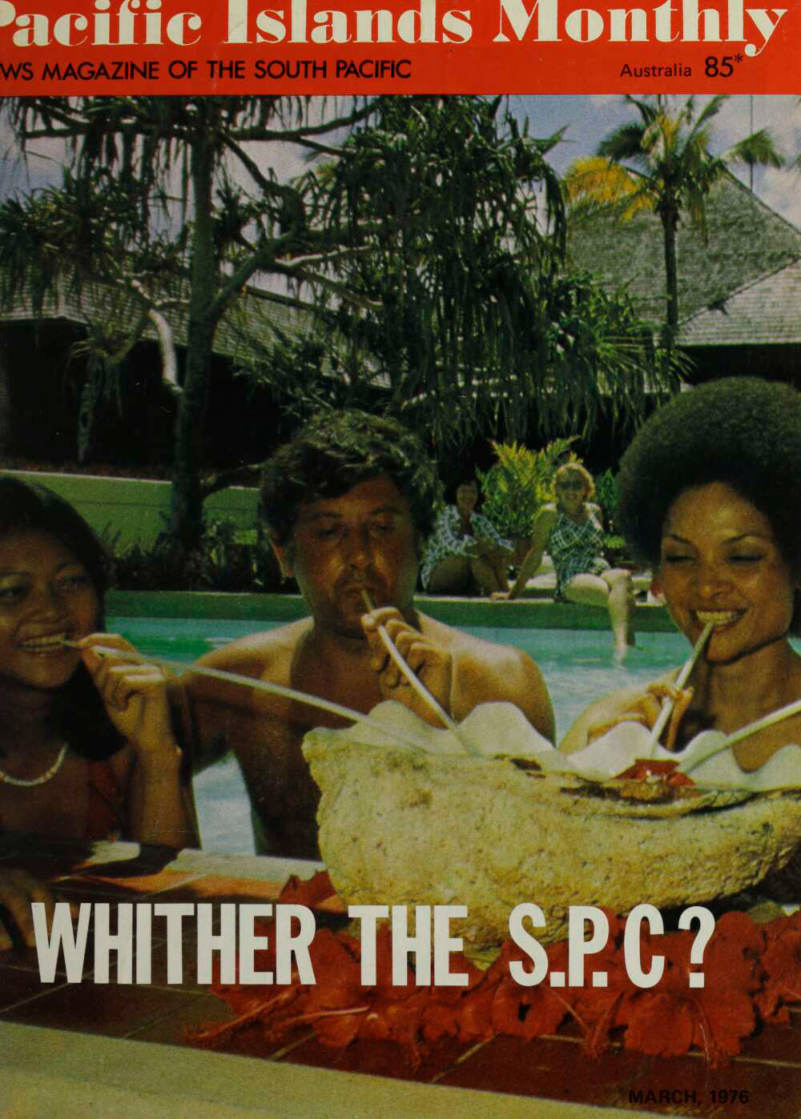
Sipping cider through a straw — it’s enough to make anyone go green with envy at this trio, two beauties, Meliki Kaumai totoya (left) and Irene Fong helping a guest to empty a clam shell of a delicious draught. The picture was taken by David Eastman, of Arrow Films, Syd ney, at the Regent of Fiji, one of Fiji’s newest hotels, which opened its doors a few months ago on Denarau Island in Nadi Bay and has been swinging ever since. The extra-long straws, a Regent idea, help the drinker to carry out doctor’s orders to keep away from drink!
Advertisements & other items, pp. 2-4 (2 items)
Ours and Suzuki s together.
■ fc- - . a ■rv .4 v ft * > - ■ *>#*» * *&K / ' lr s *'• K f *
■flf
< >■ « ■sr * J*
rfc
-v n **■ '> w #* \§l a*- N 4 I V r»W rx 1 jr >p- : . ,*r i ih i 3b R 4 /
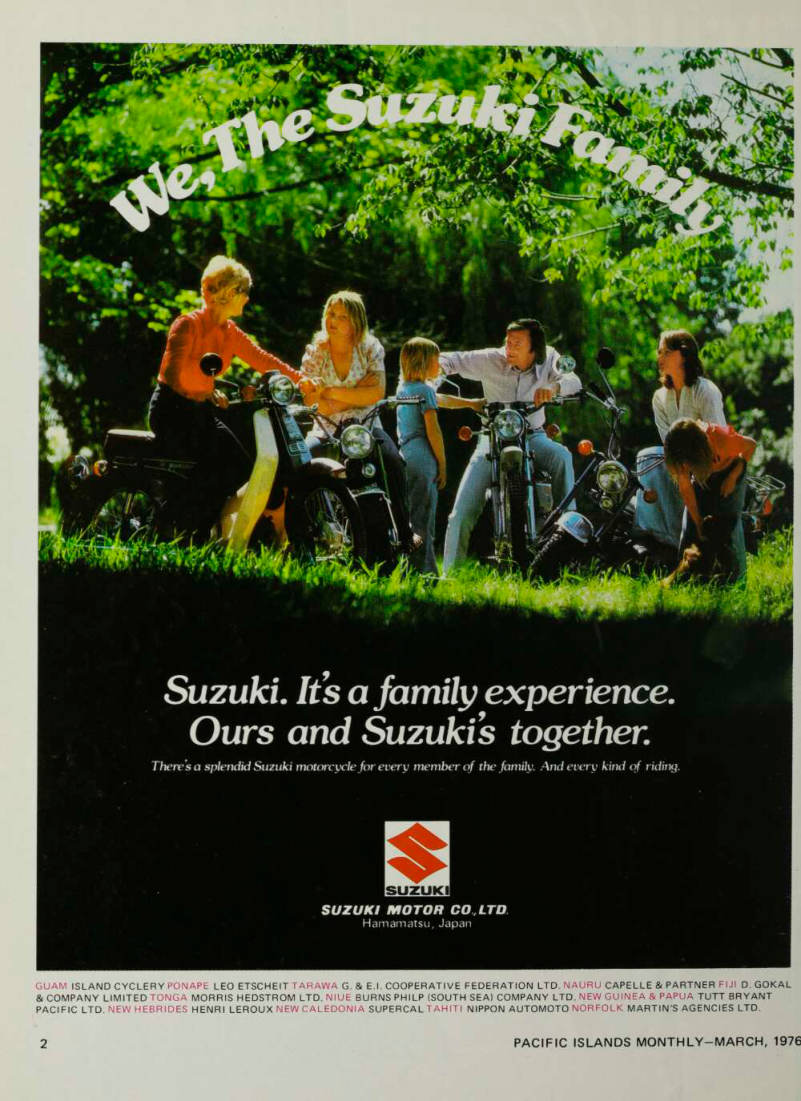
Suzuki. Its a family experience.
Ours and Suzuki s together.
Theresa splendid Suzuki motorcycle for every member of the family. And every kind of riding.
SUZUKI MOTOR CO, LTD
Hamamatsu, Japan GUAM ISLAND CYCLER Y PON APE LEO ETSCHEIT TARAWA G. & E.l. COOPERATIVE FEDERATION LTD. NAURU CAPELLE & PARTNER FIJI D. GOKAL & COMPANY LIMITED TONGA MORRIS HEDSTROM LTD. NIUE BURNS PHILP (SOUTH SEA) COMPANY LTD. NEW GUINEA & PAPUA TUTT BRYANT PACIFIC LTD. NEW HEBRIDES HENRI LEROUX NEW CALEDONIA SUPERCAL TAHITI NIPPON AUTOMOTO NORFOLK MARTIN'S AGENCIES LTD.
Arnott’s! The taste of Australia
Sao. A light crisp cracker biscuit... delicious with butter and cheese, ham, or anything savoury or sweet.
Jatz. A cracker biscuit with a tangy flavour. Enjoy them just as they are—or with any savoury spread.
Saltine. Light, tangy and crispteam perfecdy with salads, cheese or soups.
Shapes. Great for parties or just nibbling. In delicious Barbecue and Savoury flavours.
Top them. Dip them. Dress them up.
Or eat them plain. However you choose to enjoy your Amott’s cracker and savoury biscuits you’ll know right away that you are getting the special taste of Australia’s favourite biscuits.
<tESID>
d* JATZ •
CRACKER BISCUITS
■ w •« • \ v '
SA 1 ,ISE
gi 0* / * \ r "
C «AC Sfe 'rs- , j °f ? m
Qrnott's/" Biscuits
There is no Substitute for Quality
W 637
Sony presents more power,
more tonal quality than you ever
dreamed was possible.
The Sony CF-480S cassette-corder/radio sounds as big and real as life itself.
Its powerful, specially-designed amplifier delivers 4 watts of power —enough to fill even the largest room with clear, distortion-free sound.
What’s more, it has a unique 2-way speaker system. One big 6 1/2-inch woofer for the lows and a separate 2-inch tweeter for the highs.
Result: Supfrk} reo roquet iOßaoig&Mprograms and cassette recordings, with audibly superior shortwave and medium wave sound, too.
In fact, the great-sounding CF-480S represents Sony cassette-corder technology at its finest; there is a DC servo-controlled tape drive motor, sensitive electret condenser microphone, tape selector for normal and Cro2 cassettes, mic mixing controls, and much more. It’s a dream of versatility.
But you shouldn’t just take our word for it.
Visit the nearest Sony-dealer and audition the Sony CF-480S for yourself.
You’d never dream that a cassene-cordefrfi'd'ro' could sound so good. € + ill
3
GIF 1C ISLANDS MONTHLY-MARCH, 1976
Pacific Islands
Monthly
FOUNDED BY R. W. ROBSON IN 1930
Published Monthly By
Pacific Publications (Aust.) Pty. Ltd.,
76 Clarence Street, Sydney 2000.
Postal Address: G.P.O. BOX 3408, SYDNEY,
N.S.W. 2001.
Telegraphic Address: PACPUB, Sydney.
Telex: 21242.
Telephone: 296693.
Publisher: Stuart Inder.
Business Manager: John Berry.
Pacific Islands Monthly
Editor: John Carter.
Advertising Manager: Alan Batt.
Subscription Rates:
"Pacific Islands Monthly" is airfreighted to the majority of subscribers and agents in the Pacific Islands and the U.S.A.
Australia (including Lord Howe and Thursday Islands), New Zealand, Papua New Guinea, Fiji, New Hebrides, Tonga, Cook Islands, Western Samoa, Gilberts and Tuvalu, Norfolk Island, Niue and Nauru: $9.00 (local currency); Solomon Islands: $lO.OO Aust.; American Samoa, Micronesia and Guam: $12.00 U.S.; Hawaii and U.S. Mainland: $15.00 U.S.; New Caledonia and French Polynesia: 1,500 C.F.P.; United Kingdom: £6.50; Japan: 4,000 Yen; Elsewhere: $11.50 Aust.
Representatives
Fiji: Advertising and Distribution —Fiji Times & Herald Ltd., 20 Gordon Street, Suva. Telephone: 25-601. Telex: FJ 2124.
Papua New Guinea: Advertising and Distribution —PNG Post-Courier, P.O. Box 85, Port Moresby.
Telephone: 25-9899. Enquiries: Post News agency, Telephone 24-2148. : rench Polynesia: Distribution —Hachette Paci- Hque, 10 Ave Bruat, Papeete.
'Jew Zealand: Pacific Publications, C.P.O. 3ox 2229, Auckland.
Jnited Kingdom: The Herald and Weekly Times Jmited, 8-10 Clifford's Inn, Fetter Lane, London EC4A IBU. Telephone: 01-8316041. Telex: .ondon 21989. lapan: Advertising—Universal Media Corpora ion, C.P.O. Box 46, Tokyo. Telephone: 666-3036. /ictoria: Advertising Pacific Publications Aust.) Pty. Ltd., Herald and Weekly Times luilding, 2nd Floor, 61 Flinders Lane, Mel lourne, 3000. Telephone: 652-1565.
Brisbane: D. Wood, Anday Agency, Box 1918 j.P.0., Brisbane 4001. Telephone: 44-3485; 14-1546.
Hawaii and U.S. Mainland only: N. Grogan.
Send change of address notices. Form 3579 nd new subscriptions to P.O. Box 2193, lonolulu, Hawaii, U.S.A. 96805.) econd class postage paid at Honolulu, Hawaii.
Copyright ©, 1976,
Pacific Publications (Aust.) Pty. Ltd.
'rinted by The Harbour Press, Chalmers Street, Sydney. legistered at the G.P.O. Sydney for trans tission by post as a newspaper—category B.
Recommended retail price only.
Vol. 47, No. 3 March, 1976
Up Front
with the Publisher
JUDY Tudor, former New Guinea gold-miner and planter, turned journalist, author and publisher (she was both editor and publisher of PIM for many years) pretends these days that she is retired. But as pre tence is about the only thing she doesn’t do well, nobody will be sur prised to see her name in its usual place on the title page of the new edition of the Papua New Guinea Handbook when PIM brings it out at the end of this month.
She has compiled every edition since the first in 1954, and if my luck holds out and she doesn’t take off on an extended tour of Africa or Alaska—for travel and writing are her two loves—she may agree to produce the next issue and even one or two after that. (Judy is 65, but the kind of person who will never be convinced she’s even got started in life).
The 7th edition of the Papua New Guinea Handbook came out in 1974, but from this issue, the Bth, the handbook is an annual publication.
Important changes in PNG policy are now happening with such regu larity that you can’t record all the information at any greater interval than 12 months and hope to keep it useful.
This fact has been made clearer to me in the last few months as I have listened to Judy’s heavy breath ing and sudden releases of breath while the concentrated job of re search and compilation has gone on.
The monologue goes something like this, “We got the list of Minis terial responsibilities finally right, and they changed them again today! . . . Who the heck really knows about these Court procedures; I have four different versions ... I know that Provincial Government was supposed to be finished, but it isn’t finished . . . The National Capital Province still hasn’t got a commis sioner . . . They’ve decided to close some overseas consular offices and it has taken us weeks to get the full details of the ones they’ve got . . .”
You can only stick with it. From my own observations, at least Judy still has a better overall picture than most PNG public servants about
what’s happening in PNG. Many of those are still struggling to keep up with their own problems arising from the changes. They have the added burden of getting policy car ried out by a public service under going its own severe internal pressures I can understand Chris Ashton’s fear, expressed in his long article in this issue, that PNG is in danger of splitting into parts, with some of the less-developed provinces returning to their traditional ways, and the influence of the central government not extending very far from Port Moresby.
Myself, I should imagine that it depends on just how separate the development is, because separate de velopment under general guidelines laid down by central government is not a bad thing.
For the last 20 years in PNG we’ve somehow been given the im pression that unless every part of the country continues to bound for ward every year, the place is going backwards. Good enough while the money was pouring in from Austra lia and every little township scrambled for its share of develop ment money, but those days are gone, for ever.
Fiji is more uniformly developed than PNG, but there are many parts of that dominion today that have not got out of a subsistence pattern, and nobody in government in Suva believes that the coutry is about to fall apart as a result. Life goes on in the Fiji provinces as it always did.
And the same may be said about Western Samoa, and Tonga, and many other scattered Island nations.
The pressures, and the influence of government, decrease in proportion to the distance you get from the capital. And nobody wrings his hands about it.
Stuart Inder
Advertisements & other items, pp. 5-6 (2 items)
5
>ACIFIC ISLANDS MONTHLY— MARCH, 1976
Recommended Pim
BOOKSTALL PRICES
Australia 85c NZ and Pacific Islands 85c Local currency, 130 CFP or SUSI.2S
These IMF distributors
PAPUA NEW GUINEA
Ela Motors Limited, P.O. Box 75.
PORT MORESBY
Branches and Dealers throughout Papua New Guinea
FIJI. TONGA. WESTERN
SAMOA AND OTHER SOUTH
PACIFIC TERRITORIES
Motor Division, Burns Philp (South Sea) Co. Ltd., P.O. Box 355,
SUVA. FIJI
Branches throughout the region
NEW CALEDONIA
Pacific Motors S.A.,
B P H 5
n'oumea'cedex
BRITISH SOLOMON ISLANDS
R. C. Symes Pty. Ltd.,
HONIARA, GUADALCANAL
TAHITI
Ets, Donald,
P.O. Box 131, PAPEETE
NEW HEBRIDES
CONDOMINIUM
Pentecost Pacific S.A., Santo and Port Vila
can show you the
greater the load on an MF2I Trailer
the better the grin!
The all-steel hydraulic-tipping MF2I is a “goanywhere” unit with large section tyres to give good flotation on wet ground and MF’s famous rear axle design which puts 25% of the load on the tractor’s rear wheels. The bigger the load, the betterthe grip!
Capacity is 3 1 /2. tons, tray area 60 square feet. A powerful hydraulic ram tips the tray to 56 degrees for fast, clean unloading. Everything about this trailer is planned for one-man operation. What’s more, it’s built for years of tough work in the field or on the road. / a ■ /
MFE 74041
MF
Tgsm p
MASSEY-FERGUSON ...WINNER OFTWO EXPORT AWARDS
[?] This Issue
Neral
urches condemn condominium ... 15 jrches demand nuclear-free zone 15 w Hebrides gives up 1978 Games 15 nee's military showcase 15 tival of arts 19 ipe for new SP Commission ... 27 iflc churches bridge gap 31 airlines streamline operations hrough islands 55
Erican Samoa
vn death—a matter of etiquette 14 ididate for SP Games venue ... 15 iflc churches bridge gap 31 airlines streamline operations 55
Dk Islands
iflc churches bridge gap 31 > Korean ships aground 59 come to first DCIO 59 nee to stage 1978 Games 15 commission reports 16 flc churches bridge gap 31 airlines streamline operations 55 Nauru undercuts Air Pacific 56 builder for the Islands 56 litoni troubles 57 / to tourism 66
Jch Polynesia
tish relics discovery 19
Ic churches bridge gap 31 airlines streamline operations 55
Gilbert Islands
Pacific churches bridge gap 31 Fast disappearing outpost of empire 46 Air Nauru undercuts Air Pacific 56
Nauru
Air Nauru undercuts Air Pacific 56
New Caledonia
Communications improved 18 Pacific churches bridge gap 31 Independence movement 35
New Hebrides
Churches condemn condominium 15 Pacific churches bridge gap 31 Call for justice at church conference 35
Papua New Guinea
Bleak unstable future forecast 8 Warning from World Bank 12 Bougainville talks 13 Kokoda Trail 37 Coastal shipping 57 Minister cuts costs 57 Soap factory at Lae 67
Solomon Islands
Economic pinch 63 Workers flex muscles 64 Creating new markets 64
Tonga
Pacific churches bridge gap 31 Economy takes beating 67 Diplomat named 68
Tuvalu
Speaker appointed 68
Us Trust Territory
Pokies outlawed 18 Doubt about Saipan-Japan air route 59 Super port for Palau 61
Wallis & Futuna
Pacific churches bridge gap 31
Western Samoa
Dawn death—a matter of etiquette 14 Active council of women in NZ 19 Pacific churches bridge gap 31 Campaigning at bar 75 Move for brewery ... 75
RTMENTS: Up Front w.th t he Publisher, 5; Tropicalities, 18; Editor's Mailbag, 21; SuWnnV 36 ht *o aZl D ne Section ' 37; Yesterday, 44; Books, 49; Pacific Transport, Cruising Yachts, 59; Business and Development, 61; Produce Prices, 68; Shipping Airways Information, 69; Deaths of Islands People, 74 9
Advertisements & other items, p. 7 (1 item)
Fic Islands Monthly—March, 1976
A Bleak, Unstable Future'
Papua New Guinea: 'Heading For
By Chris Ashton
To many Australians with strong attachments to Papua New Guinea, and who were spec tators to the finale played out in Port Moresby last September, the single most striking symbolical act was the lowering of the Australian flag. Not a joyous occasion; nor was this intended. Above a tense, packed , silent stadium lowering clouds threatened a deluge that never came. Platoons of soldiers gave a dazzling exhibition of firing by column that excited awe, but not applause. A thin, reedy bugle blew as the ensign came down. It was the kind of theatre which the military does so well, heightened in retrospect by that large, ruddy presence in morning suit, the man who was so soon to make an in delible mark on Australian history, Australian Governor-General Sir John Kerr.
Among the PNG Government’s official guests were numbers of weatherbeaten Australian faces, men and women with much of their adult lives behind them as missionaries, government officers or businessmen in a country adopted as their own.
These were grave faces, some chok ing back tears, moved by the sense of occasion, by feelings of pride and loss, and regret for things left un done. It was all the more moving because Australians have a sense of themselves as earthbound people, not given to shows of feeling.
But in the wanton way that journalists have, my magpie mind was distracted from this by the terri torial struggle to the side of the official dais, by police against cameramen and photographers, who were cordoned off in a small corral.
It was an unequal struggle, which proved the truncheon far mightier than the camera lens. And for me, the most striking symbol of the tran sition had happened four days earlier, unexpected and unrehearsed.
The peace of Port Moresby, that dusty, sprawling and most improb able of capitals, was shattered by the roar of five Machi jets, the RAAF aerobatic team, streaking overhead in tight formation, turning and re grouping to criss-cross the city again.
Inexplicably, it was this display of mechanical and human precision, its speed and grace and power, a spec tacle unique to Port Moresby in the years I had lived there, that brought home the finality of what was hap
pening.
1 had shared, with the politicians, lawyers and fellow journalists who watched the bitter, elephantine pro gress of the constitutional debate, a feeling of jadedness, a cynicism born of watching for too long the political processes at play. It had soured the euphoria that indepen
dence deserved. And yet I was pro foundly moved.
I talked at length of the impression PNG’s independence made upon me because with many others, Papua New Guineans and expatriate, it was a psychological watershed, a realis ation of an end, and of something about to begin. For four years there had been speeches, reports, decisions and press releases; lobbying and politicking of public servants, poli ticians and their advisers in Canberra and Port Moresby.
But it wasn’t that independence would serve to dilute the overwhelm ing Australian presence—its political and cultural pressures, its psycho logical weight and commercial domi nance: a force for stability and a standing mockery of the boast of independence. Independence was im portant because it marked for me the time to go. 1 had been in and out of the coun try since 1960; had settled in Port Moresby before Somare came to power; had experienced the euphoria of the coalition’s early days in office when everything and anything seemed possible; and the challenges, mounted with increasing shrillness by the Papuan separatist movement and the radical bloc routed. I saw Bougain ville’s threat to secede, growing from strength to strength. 1 watched the constitutional debate as the same issues were argued time and again inside and outside parliament until one had the nightmare sense of being aboard the Flying Dutchman, doomed to sail on for ever without hope of reaching port.
Independence came at last —subdued, polite, well-orchestrated — with none of the atmosphere of Mardi Gras that foreign journalists had come to record for a waiting world.
No dancing in the streets, no singing, no raised fists, no latent fear of vio lence. Few people ventured into the streets at midnight to see the fire works or the 101-gun salute that ushered in the new nation.
By the end of the week the coun try had returned to work as if the celebrations had never been, and the
foreign media departed, exasperated.
The rugby league grand final at Port Moresby’s Hubert Murray stadium the following Saturday was far more frenzied than anything we had seen the previous week.
The one unscheduled event that gave independence flair was the
Christopher Ashton spent several years in PNG as a broadcaster, film-maker and as a journalist representing a number of leading overseas newspapers. He is currently headed for South Africa to write a series for the Melbourne Herald group. Before he left, PIM asked him to distil his PNG experience in a special article and to say how he felt PNG would develop. This is the article.
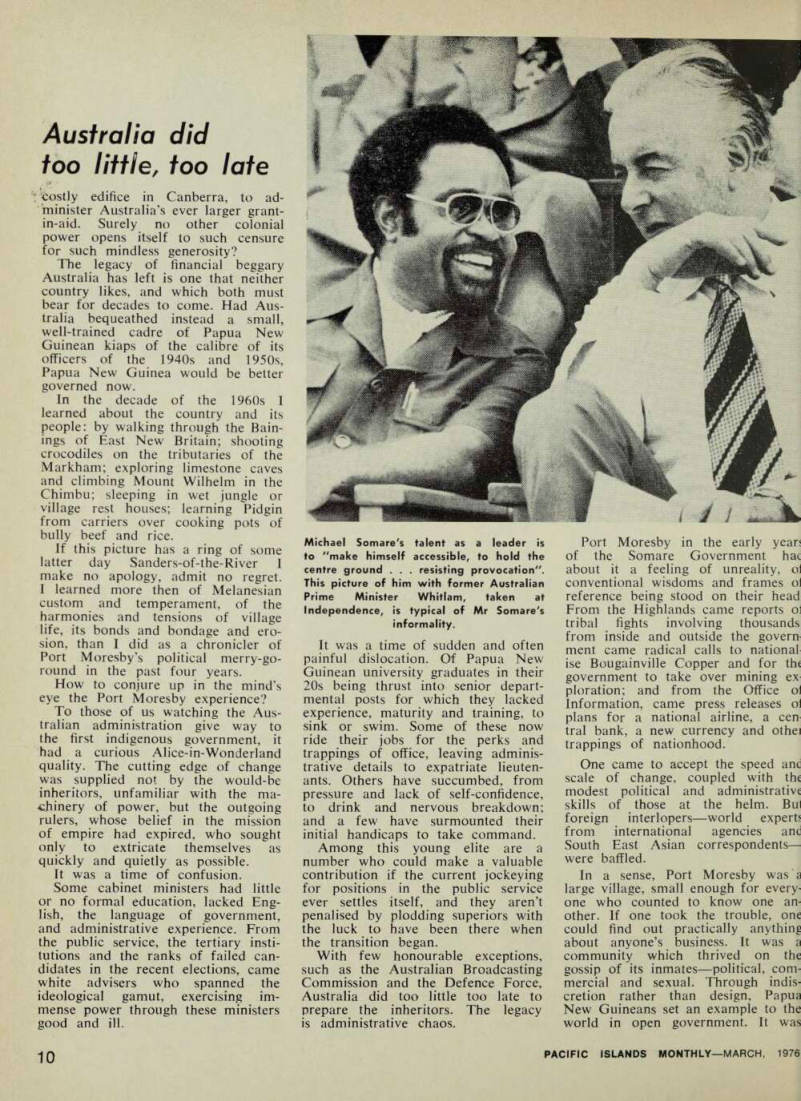
rrival of the First Lady of the f hilippines, Imelda Marcos. She ame on an unscheduled flight in a rivate aircraft too heavy for Port Moresby’s runway on the morning f the great day. She brought 40 etainers for whom there was no ope of accommodation; she jumped le protocol queue in the presenta on of credentials to the new Jovernor-General; tried to enter arliament as Prince Charles was pening it, and dispensed lavish gifts trough her entourage wherever she ent—imperial, diaphanous and par enu. Australia’s interest in PNG’s idependence was enshrined by the age one picture in the Sydney Morn ig Herald: Gough embracing nelda.
It was time to go. I had come for le first time in 1960, the year when 7 African colonies won indepen ;nce, the year of the Congo, the :ar of Harold Macmillan’s Winds : Change address to the South frican parliament.
But in Papua New Guinea the ilf between white and black, ruler id ruled, was at that time complete id inviolable. I was told that the mntry was neither willing nor able accept independence this century.
Perhaps it would in the 21st, or ternatively, be absorbed into Aus alia as another state.
I remember the Highlands High ay, a rutted, four wheel-drive track; e seemingly tens of thousands of
Highlanders along the road, all in traditional costume and headdress and carrying weapons, waving and cheering to the occasional passing truck.
I remember an expatriate Old Timer, a remnant of the Edie Creek goldrush, explaining that Papua New Guineans were the sons of Ham, to be hewers of wood and drawers of water.
I saw “boys” being thrashed by their “masters” for cheekiness;
plantations paying labourers thirty
shillings a month and keep; and I remember the kiaps—the officers of the Department of Native Affairs— administering small kingdoms with no more than the white man’s mys tique and an arbitrary code of laws which at least had the virtue of being intelligible to the subject people.
Though I single out the planters and the kiaps, they are, with the missionaries, much maligned by the new nationalism. Their contribution to nation-building, their hardships and meagre rewards, go unrecognised by the army of short-term expatriate (public servants, academics and white advisers) who have been lured with fat salaries and leafy bunga lows, to serve the new government and foster nationalist ideals in its student elite.
During the development decade, the 19605, I came and went at inter vals. I saw the ban on alcohol sales to Papua New Guineans lifted in 1964. Politically, it was imperative that this should be done, but in im plementation—the wholesale adop tion of Australian drinking habits and trading hours without thought of modification for black and white alike—it was the most socially destructive blessing of our rule.
The 1960 s also saw the beginning of a crash education programme the goal of universal primary education, a system geared to training clerks before tradesmen (who are still re cruited abroad).
And the 19605, the development decade, saw the growth across the country of factories and air-condi tioned motels, of large-scale resource industries, of urban drift and urban unemployment.
It was the decade which saw the sudden burgeoning of the public ser vice, modelling itself on the vast and
[?]nscheduled... the arrival of the First Lady of the Philippines, who jumped the [?]tocol queue, and dispensed lavish gifts". Here she's seen with PNG Governor- General Sir John Guise.
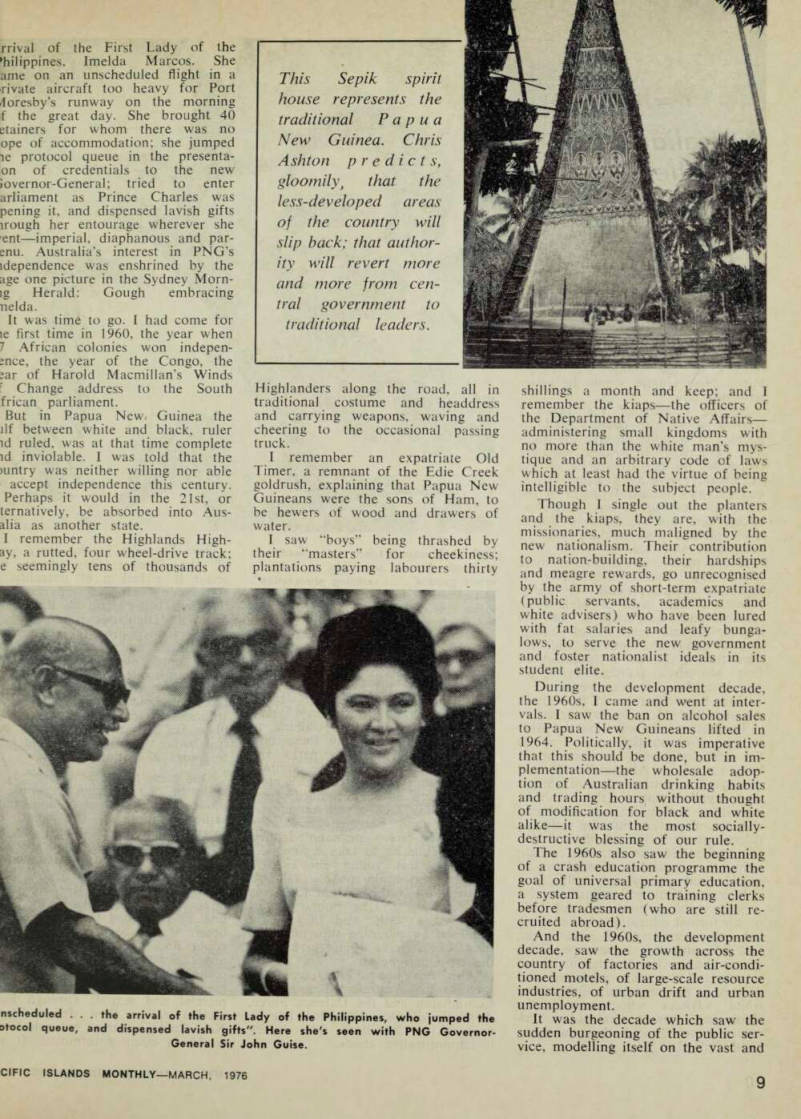
This Sepik spirit house represents the traditional Papua New Guinea. Chris Ashton predicts, gloomily, that the less-developed areas of the country will slip back; that author ity will revert more and more from cen tral government to traditional leaders.
Australia did too little, too late
costly edifice in Canberra, to ad minister Australia’s ever larger grant in-aid. Surely no other colonial power opens itself to such censure for such mindless generosity?
The legacy of financial beggary Australia has left is one that neither country likes, and which both must bear for decades to come. Had Aus tralia bequeathed instead a small, well-trained cadre of Papua New Guinean kiaps of the calibre of its officers of the 1940s and 1950s, Papua New Guinea would be belter governed now.
In the decade of the 1960s I learned about the country and its people: by walking through the Bain ings of East New Britain; shooting crocodiles on the tributaries of the Markham; exploring limestone caves and climbing Mount Wilhelm in the Chimbu; sleeping in wet jungle or village rest houses; learning Pidgin from carriers over cooking pots of bully beef and rice.
If this picture has a ring of some latter day Sanders-of-the-River I make no apology, admit no regret.
I learned more then of Melanesian custom and temperament, of the harmonies and tensions of village life, its bonds and bondage and ero sion, than I did as a chronicler of Port Moresby’s political merry-go round in the past four years.
How to conjure up in the mind’s eye the Port Moresby experience?
To those of us watching the Aus tralian administration give way to the first indigenous government, it had a curious Alice-in-Wonderland quality. The cutting edge of change was supplied not by the would-be inheritors, unfamiliar with the ma chinery of power, but the outgoing rulers, whose belief in the mission of empire had expired, who sought only to extricate themselves as quickly and quietly as possible.
It was a time of confusion.
Some cabinet ministers had little or no formal education, lacked Eng lish, the language of government, and administrative experience. From the public service, the tertiary insti tutions and the ranks of failed can didates in the recent elections, came white advisers who spanned the ideological gamut, exercising im mense power through these ministers good and ill.
It was a time of sudden and often painful dislocation. Of Papua New Guinean university graduates in their 20s being thrust into senior depart mental posts for which they lacked experience, maturity and training, to sink or swim. Some of these now ride their jobs for the perks and trappings of office, leaving adminis trative details to expatriate lieuten ants. Others have succumbed, from pressure and lack of self-confidence, to drink and nervous breakdown; and a few have surmounted their initial handicaps to take command.
Among this young elite are a number who could make a valuable contribution if the current jockeying for positions in the public service ever settles itself, and they aren’t penalised by plodding superiors with the luck to have been there when the transition began.
With few honourable exceptions, such as the Australian Broadcasting Commission and the Defence Force, Australia did too little too late to prepare the inheritors. The legacy is administrative chaos.
Port Moresby in the early year; of the Somare Government hac about it a feeling of unreality, oJ conventional wisdoms and frames ol reference being stood on their head From the Highlands came reports oi tribal fights involving thousands from inside and outside the govern ment came radical calls to national ise Bougainville Copper and for the government to take over mining ex ploration; and from the Office oi Information, came press releases oi plans for a national airline, a cen tral bank, a new currency and othei trappings of nationhood.
One came to accept the speed and scale of change, coupled with the modest political and administrative skills of those at the helm. Bui foreign interlopers—world experts from international agencies and South East Asian correspondents— were baffled.
In a sense, Port Moresby was a large village, small enough for every one who counted to know one an other. If one took the trouble, one could find out practically anything about anyone’s business. It was a community which thrived on the gossip of its inmates —political, com mercial and sexual. TTirough indis cretion rather than design, Papua New Guineans set an example to the world in open government. It was
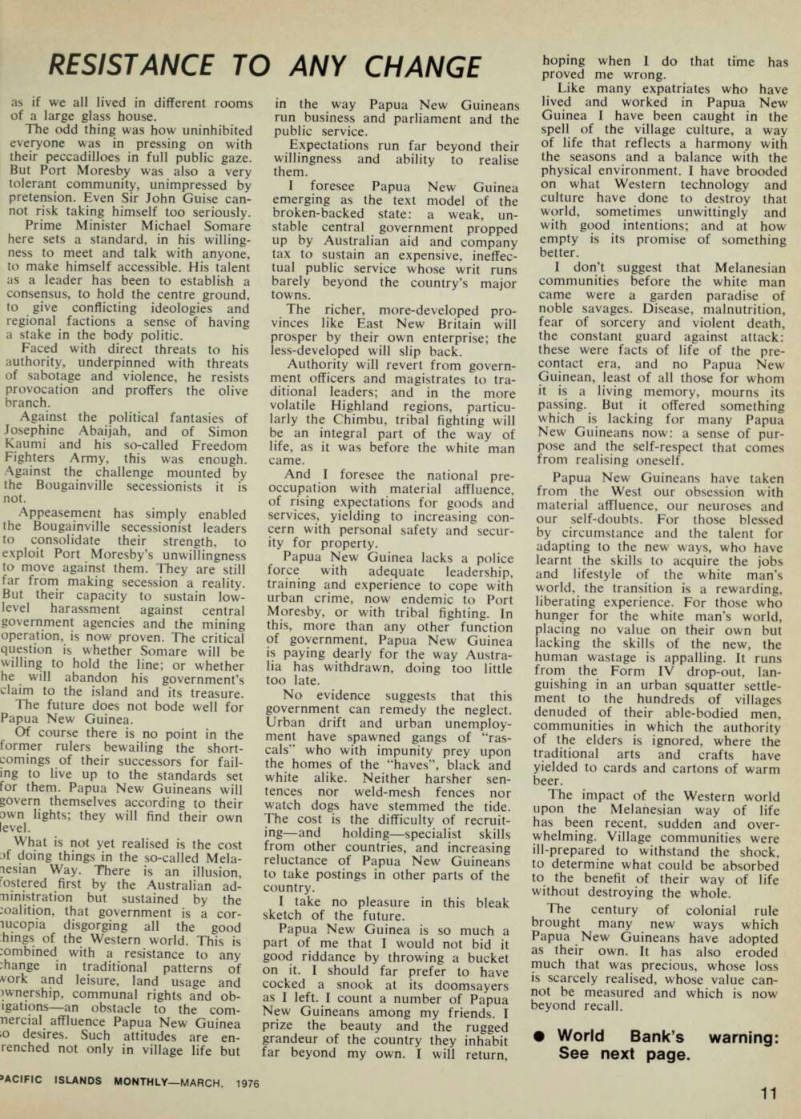
Michael Somare's talent as a leader is to "make himself accessible, to hold the centre ground . . . resisting provocation".
This picture of him with former Australian Prime Minister Whitlam, taken at Independence, is typical of Mr Somare's informality.
Resistance To Any Change
as if we all lived in different rooms of a large glass house.
The odd thing was how uninhibited everyone was in pressing on with their peccadilloes in full public gaze.
But Port Moresby was also a very tolerant community, unimpressed by pretension. Even Sir John Guise can not risk taking himself too seriously.
Prime Minister Michael Somare here sets a standard, in his willing ness to meet and talk with anyone, to make himself accessible. His talent as a leader has been to establish a consensus, to hold the centre ground, to give conflicting ideologies and regional factions a sense of having a stake in the body politic.
Faced with direct threats to his authority, underpinned with threats of sabotage and violence, he resists provocation and proffers the olive branch.
Against the political fantasies of Josephine Abaijah, and of Simon Kaumi and his so-called Freedom Fighters Army, this was enough.
Against the challenge mounted by the Bougainville secessionists it is not.
Appeasement has simply enabled the Bougainville secessionist leaders to consolidate their strength, to exploit Port Moresby’s unwillingness to move against them. They are still far from making secession a reality.
But their capacity to sustain low level harassment against central government agencies and the mining operation, is now proven. The critical question is whether Somare will be willing to hold the line; or whether he will abandon his government’s claim to the island and its treasure.
The future does not bode well for Papua New Guinea.
Of course there is no point in the former rulers bewailing the short comings of their successors for fail ing to live up to the standards set for them. Papua New Guineans will govern themselves according to their awn lights; they will find their own level.
What is not yet realised is the cost af doing things in the so-called Mela riesian Way. There is an illusion, fostered first by the Australian ad ministration but sustained by the :oalition, that government is a cor lucopia disgorging all the good hings of the Western world. This is :ombined with a resistance to any :hange in traditional patterns of vork and leisure, land usage and ownership, communal rights and ob igations—an obstacle to the com mercial affluence Papua New Guinea ;o desires. Such attitudes are en renched not only in village life but
in the way Papua New Guineans run business and parliament and the public service.
Expectations run far beyond their willingness and ability to realise them.
I foresee Papua New Guinea emerging as the text model of the broken-backed state: a weak, un stable central government propped up by Australian aid and company tax to sustain an expensive, ineffec tual public service whose writ runs barely beyond the country’s major towns.
The richer, more-developed pro vinces like East New Britain will prosper by their own enterprise; the less-developed will slip back.
Authority will revert from govern ment officers and magistrates to tra ditional leaders; and in the more volatile Highland regions, particu larly the Chimbu, tribal fighting will be an integral part of the way of life, as it was before the white man came.
And I foresee the national pre occupation with material affluence, of rising expectations for goods and services, yielding to increasing con cern with personal safety and secur ity for property.
Papua New Guinea lacks a police force with adequate leadership, training and experience to cope with urban crime, now endemic to Port Moresby, or with tribal fighting. In this, more than any other function of government, Papua New Guinea is paying dearly for the way Austra lia has withdrawn, doing too little too late.
No evidence suggests that this government can remedy the neglect.
Urban drift and urban unemploy ment have spawned gangs of “ras cals” who with impunity prey upon the homes of the “haves”, black and white alike. Neither harsher sen tences nor weld-mesh fences nor watch dogs have stemmed the tide.
The cost is the difficulty of recruit ing—and holding—specialist skills from other countries, and increasing reluctance of Papua New Guineans to take postings in other parts of the country.
I take no pleasure in this bleak sketch of the future.
Papua New Guinea is so much a part of me that I would not bid it good riddance by throwing a bucket on it. I should far prefer to have cocked a snook at its doomsayers as I left. I count a number of Papua New Guineans among my friends. I prize the beauty and the rugged grandeur of the country they inhabit far beyond my own. I will return,
hoping when I do that time has proved me wrong.
Like many expatriates who have lived and worked in Papua New Guinea I have been caught in the spell of the village culture, a way of life that reflects a harmony with the seasons and a balance with the physical environment. I have brooded on what Western technology and culture have done to destroy that world, sometimes unwittingly and with good intentions; and at how empty is its promise of something better.
I don’t suggest that Melanesian communities before the white man came were a garden paradise of noble savages. Disease, malnutrition, fear of sorcery and violent death, the constant guard against attack: these were facts of life of the pre contact era, and no Papua New Guinean, least of all those for whom it is a living memory, mourns its passing. But it offered something which is lacking for many Papua New Guineans now: a sense of pur pose and the self-respect that comes from realising oneself.
Papua New Guineans have taken from the West our obsession with material affluence, our neuroses and our self-doubts. For those blessed by circumstance and the talent for adapting to the new ways, who have learnt the skills to acquire the jobs and lifestyle of the white man’s world, the transition is a rewarding, liberating experience. For those who hunger for the white man’s world, placing no value on their own but lacking the skills of the new, the human wastage is appalling. It runs from the Form IV drop-out, lan guishing in an urban squatter settle ment to the hundreds of villages denuded of their able-bodied men, communities in which the authority of the elders is ignored, where the traditional arts and crafts have yielded to cards and cartons of warm beer.
The impact of the Western world upon the Melanesian way of life has been recent, sudden and over whelming. Village communities were ill-prepared to withstand the shock, to determine what could be absorbed to the benefit of their way of life without destroying the whole.
The century of colonial rule brought many new ways which Papua New Guineans have adopted as their own. It has also eroded much that was precious, whose loss is scarcely realised, whose value can not be measured and which is now beyond recall. • World Bank’s warning: See next page.
Advertisements & other items, pp. 9-11 (2 items)
9
CIFIC ISLANDS MONTHLY—MARCH, 1976
11
>ACIFIC ISLANDS MONTHLY— MARCH, 1976
Papua New Guineans get
the financial message
From a Port Moresby correspondent
PORT Moresby has been given the
financial message—get rid of the Australian economic system and find one of your own that you can pay for.
That basically is the message of the leader of the World Bank mission team, George Baldwin, at the end of the mission’s three-week survey of Papua New Guinea.
“Papua New Guinea can never hope to achieve economic indepen dence so long as its expectations and standards are geared to what Aus tralia can afford instead of what the PNG economy can afford”, he said.
Present preoccupation with falling produce prices and a disastrous
balance of payments he dismissed as a passing problem. He spoke of being favourably impressed by government efforts to face up to the financial problems—mentioning budget cuts and public service restructuring.
But he also said he was off to Canberra—no doubt to find out just how far Australia is prepared to underwrite the Somare government
—Australian aid would be important in the World Bank’s judgment on PNG, he told Post-Courier reporter Peter Jackson. He went on to say that five unspecified projects were in
the pipeline.
And for once PNG politicians are starting to make mileage out of the Australian aid before the event.
Opposition leader Tei Abal called in February for Prime Minister Somare and Finance Minister Chan to go to Australia before the money men decide aid levels for PNG. It could be election year. It’s also a bad time to talk to Somare who is try ing to squelch the secession move ment on Bougainville, site of the mine that provides more than half the country’s revenue.
Not that the secessionists seem to worry the World Bank. Other coun tries had similar internal problems but these had not prevented the bank from making loans, Mr Baldwin said.
This must be a relief to Papua New Guineans who are, at present, rather doubtful on the point.
Meanwhile, in spite of Mr Bald win’s somewhat off-hand dismissal of the current recession, the PNG economic position is grey indeed.
The “tighten your belts” warnings that have peppered statements by Prime Minister Somare and Finance Minister Chan in recent months are finally reaching their marks.
But it has taken last February’s gloomy facts to press home to the public sliding trade statistics, alarm ing drops in copra production, a K7O million fall in Bougainville’s copper profit.
The first impact of hard times ahead came with the 1975/76 budget tax rises which cut wages back when they came into effect as a pre- Christmas gift to the government.
But now individuals are fully realising that money is not going to be around for a while, and that everyone, both the low and high income earners, are going to have to keep trimming budgets as prices
spiral.
Latest trade figures from the Bureau of Statistics show a K 8.14 million trade deficit for November. 1975, compared with a K 11.15 mil lion surplus in November, 1974.
And the finance experts forecast continuing grim prospects for the next two years.
For the first five months of the 1975/76 year, the overall deficit was
K 24.4 million, compared with a sur plus of K 45.6 million in the same period of the previous year. Copper, coffee, copra, tea and timber—the main exports—earned barely Kl4O million, a drop of K7O million on similar figures for 1974/75, At the same time costs of major imports—vehicles, food, petrol and oil —were about the same as last year, about K 64 million.
The main factor influencing trade figures was, of course, the poor world price for copper, which usually jams well over half the country’s overseas revenue.
Total copper earnings during the first five months of this financial /ear were K 60.4 million compared vith last year’s K 102.8 million.
Bougainville Copper’s annual pro fit, announced the day after the rade figures, reiterated the unpalat tble news. TTie company’s profit fell >y almost K7O million, giving the -overnment a meagre KlB million n royalties and tax, compared with C 69.96 million in 1974/75.
On the primary produce side, the Minister for Primary Industry, Mr loyamo Sali, announced that the "opra Marketing Board had not been ble to fulfil its February contracts, hortages had also forced the closure f the Coconut Products mill. Mr ali said the board was worried that le losses would penalise the board nd ultimately growers would miss ut. He urged them to continue pro uction in spite of low returns.
The Port Moresby Chamber of ‘ommerce said it thought the Dlution lay in a review of the □vernment policy on plantations so lat production levels could be laintained. Present policy encour ges the handover of expatriate wned plantations to local owners, sually village groups.
Another gloomy aspect of the ;onomic situation is the possibility f France, Belgium and Italy trying > block Papua New Guinea’s mem ;rship of the Lome Convention, lembership of the convention, link 's 46 former colonial possessions i Africa, the Caribbean and the acific is vital to PNG trade pre sences in European Economic ommunity countries.
Yet at the same time as the de essing news built up, and the 'orld Bank mission called for a langed system (sentiments ap auded by Somare and Chan) the ustralian-oriented arbitration sys m granted public servants a K6O year pay rise based on wage in jxation.
One of the brighter spots amid e grey has been the price of )ffee. Growers are getting their :st price for years and the Coffee
Marketing Board and the Primary Industry Minister are urging them to make the most of it.
Frosts in Brazil, rain in Columbia, the Guatemala earthquake and the Angolan war have all contributed to the price rise, exporters say.
There are indications of steady to firm markets for a few months still to come.
The other cheering prospect, but one that is not going to help relieve the immediate economic problems is the apparent success of the recent overseas mission on the National Investment and Development Authority. Labour and Industry Minister Gavera Rea says that European businessmen are interested in forestry, fisheries and agriculture and in setting up processing plants. r> . , . , ... . t .. • ® ut . tbe s are stl at the . ta Hi n iL S agC t a ? d th ? B° v^ rnment will have to set to and work out specific projects and requirements for potential investors.
Advertisements & other items, pp. 12-13 (2 items)
W.P.M. (N.Z.) Ltd.
Machinery and Equipment suppliers
to the Pacific Islands since 1969.
Now offer new and reconditioned • Woodworking machinery • Sawmilling equipment • Machine tools • Engineering and printing machinery • TIMAC' sanding and Dust extracting equipment.
Specialist technical advice for turn-key projects in timber industry available.
Bandsaw with Resaw attachment Contact
WORLD PRODUCT MARKETING (N.Z.) LTD.
P.O. BOX 14-174 PANMURE, AUCKLAND 6, N.Z.
Phone 57 4983 57 8886. Cables: JUSURU
The Solomons
Next Month: The Solomons
Next month Denis Fisk takes a backward and forward look at the Solomon Islands. Don’t miss his long, informa tive article.
Bougainville
Gets Back
To Talking
From a Port Moresby correspondent It is seven months now since Bougainville declared independence from Papua New Guinea. Three months before that, the first round of talks between the government and the secessionists in Port Moresby broke down when the government did not accept, as a pre-condition, that two ministers, Sir Paul Lapun and Mr Donatus Mola, who are Bougainvilleans, should not attend.
The secessionist group had passed a vote of no confidence in the two ministers.
At the height of pillage and destruction in Bougainville in Janu ary, the chance of a resumption of talks seemed inconceivable. At the last minute, however, commonsense prevailed and, with the wave of violence still sweeping across the island, both sides agreed to meet.
Ironically, the Prime Minister, Mr Somare, decided the govern ment’s stand during a quiet after noon’s golfing with his top advisers in Port Moresby.
Later, he announced that the government would be prepared to talk with the secessionists anywhere in Papua New Guinea. Previously,
Continued on p 73
he would not talk outside Port Moresby.
On February 11, Mr Somare and the chairman of secessionist govern ment, Father John Momis, issued a joint statement announcing that the first round of talks would be held in Bougainville on February 16.
Fearing that speculation in the press could jeopardise the negotia tions, both men asked reporters to exercise restraint while covering the talks held behind closed doors on Arovo Island off Kieta.
The government team, led by Mr Somare, did not include Sir Paul and Mr Mola.
The Bougainville team, led by Fr Momis, did not include the executive secretary of the secessionist govern ment, Dr Alexis Sarei, who has been a prominent advocate of the seces sionist cause.
Mr Somare’s surprising lack of concern in the past quickly vanished when the secessionists went on the warpath and took control of the island.
Patrol posts, sub-district offices, and prisons were burnt or torn down and records destroyed. Airstrips were damaged.
The talks began in a much more favourable atmosphere than has existed for some time, Mr Somare and Fr Momis declaring in a joint statement that, despite differences, there was considerable goodwill on both sides.
They felt it was imperative that talks should not be allowed to break down again.
Hie Prime Minister said that, where there were obvious major differences in approach for a settle ment, these had been noted and would be further discussed after each side had further considered its position in relation to these matters.
Where there was broad agreement these areas would be noted and action initiated to firm up the under standing to the satisfaction of both teams.
Mr Somare and Fr Momis said they did not expect a full settlement for some time as there were bound to be many areas of contention. It would only be through continuing talks that a meaningful settlement could be reached for the benefit of all people in Papua New Guinea.
Both sides were pleasantly relaxed at the end of the first day’s talk and took things in the right spirit at a cocktail party hosted by the Prime Minister at the Davara Motel, Kieta.
Advertisements & other items, p. 13 (2 items)
13
tCIFIC ISLANDS MONTHLY— MARCH, 1976
Kingstonsbo(I9’)Diesel Cruiser
DESIGNED FOR COMFORT AND SAFETY AT SEA ■ % ms
ENQUIRIES TO
PACIFIC AGENCIES AVAILABLE
Western Fuel pump and «v7st- Injector Services Pty. Ltd.
OOC or? n j n. * 225-227 Victoria Road, Rydalmere, 2116 NSW, Australia Telephone: 638 6100
a matter of etiquette?
Death in a Samoan dawn— a matter of etiquette?
Luaiemaga raonu
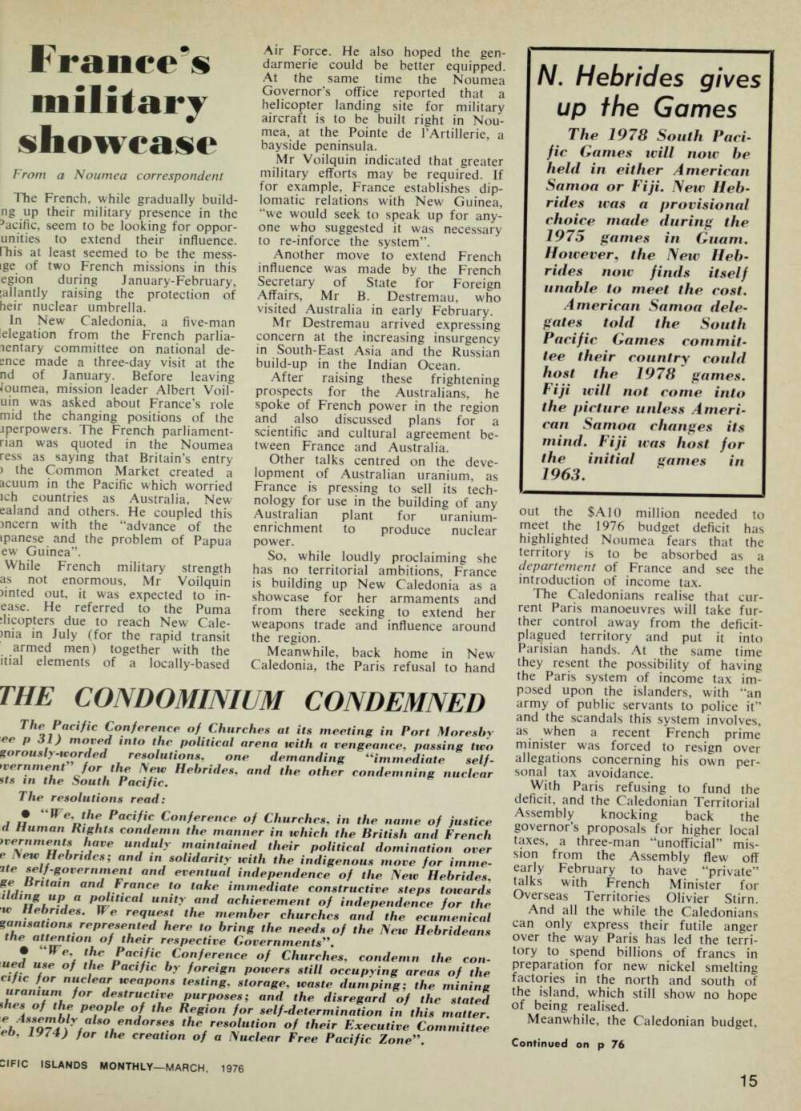
IT seems such a silly thing that a petty argument over a matter of Samoan etiquette should be the cause of the death of a prominent Ameri can Samoan senator. Yet, this was not the first time a Samoan has lost his life over a matter of etiquette.
Samoans take their etiquette seri ously. To follow it strictly is the aim of every Samoan matai (chief). To know it is the sign of wisdom. To be ignorant of it is a sign of stupid ity. Hence, in every Samoan cere mony, much time is spent on debat ing matters of hierarchy, the form and content of ceremony. Often, harsh words are spoken between the debaters. Often, the debates end happily. Debates are to be expected in Samoan custom. It is not for nothing that Samoans are known as the finest orators in the Pacific. But once in a while the debates end at the point of a bush knife or the blast of a shotgun.
On Thursday, December 19, Senator Lualemaga Faoliu, a very high chief from the village of Aoloau, American Samoa, was sleeping with his wife at Satuiatua village, Upolu, Western Samoa. The chief had earlier been in high spirits: he had just completed the building of what is considered to be the biggest, tradi tional meeting-house in American Samoa. Tragedy had struck. At the very time of the dedication of the new building, his head tufuga (car penter) had died, presumably of heart attack. So he, his wife, and a few orators had travelled to Western Samoa to accompany the dead body of his tufuga.
Now, at 5 am, an assailant went to the house where Lualemaga and his wife were asleep and shot the senator in the stomach at close range.
The senator died in hospital. The police were alerted but the man, who was alleged to have shot the senator, had taken a bus and turned himself in at Tuasivi police station.
The man was Alainuuese Liu, 38, also a matai.
Telephone calls flew back and forth between American Samoa Governor Ruth, Senate President Salanoa and other American Samoan leaders, Western Samoa Prime Minister Tupua Tamasese and Wes tern Samoan leaders. Final arrange ments were made to return the sen ator’s body to the territory as soon as possible.
At first, the Western Samoa government authorities planned to have several cabinet ministers and members of parliament accompany Lualemaga’s body to American Samoa. But Governor Ruth appar ently prevented the ministers’ coming for fear of reprisals against them from members of Lualemaga’s aiga.
Under the circumstances, it was better to take precautions. However, Cardinal Pio Taofinuu, Bishop of Apia, accompanied the senator’s body the next day.
It is not absolutely certain whether the Western Samoa Government asked him to do this risky task, or that he intervened in what could well have been the start of a bloody feud between members of Luale maga’s aiga and those of his alleged assassin.
In the old days, a murder of a high chief would have resulted in the instant extermination of the offen der and his aiga and probably a war. The higher the chief the more widespread the war would be.
But this is modern Samoa. The law now takes precedence in the lives of most Samoans. Governor Ruth acted wisely in preventing the visit of the Western Samoan govern ment dignitaries. Cardinal Pio exer cised great heroism and accepted much personal humiliation by ac companying Lualemaga’‘s body.
Thousands of American Samoans were at the airport to honour the dead Lualemaga. The body was im mediately brought to the Senate where after a brief one-hour cere mony, it was taken to Aoloau for burial. Lualemaga’s seat in the Senate has now been taken by former Delegate-at-Large, Fuimaono Asuemu.
When Cardinal Pio returned to Apia he described his reception by
the American Samoans to the Samoan Times.
“I could feel the anger and hatred in the hundreds of people that awaited us at Tafuna Airport”, his Eminence said. “But I felt a great sense of peace because I knew I was with God”.
He said the tension eased con siderably and was replaced by the spirit of peace after he had appealed to them for forgiveness in Jesus Christ’s name in a service at the Fono House at Fagatogo.
“The armed police escort that met me at the airport took me to the village of the dead senator, and the villagers were all prepared for trouble”, he said.
“But a matai came out and said that even though they had felt the sting of what had happened and that they wanted an eye for an eye and a tooth for a tooth, it was hard for them because Christ had come through the messenger of peace and that it was time for them to drop their guns.
“And those that had guns dropped them”.
The forthcoming trial is creating wide interest. What was the reason for the killing? According to one story, Lualemaga was shot because of Alainuuese’s anger at the way Lualemaga had disgraced him in front of other chiefs at the kava ceremony following the reception of the tufuga’s body at his village on Savaii.
In a Samoan kava ceremony, authorities say that the two most important persons (according to the traditional hierarchy) in the cere mony are given the first, or the last cup of kava to be offered at the ceremony. Lualemaga was not given either the first or the last cup and became indignant at this. He there upon scolded the master-of ceremonies, Alainuuese Liu.
Apparently, Lualemaga used some strong words and made a fool of Alainuuese. For a Samoan orator to be made a fool of is considered the highest of indignities. It means he does not know his Samoan etiquette and that he is not fitted to express any opinion on such mat ters in future.
From FELISE VA’A in Pago Pago
showcase
France's military showcase
From a Noumea correspondent The French, while gradually build ng up their military presence in the 3 acific, seem to be looking for oppor unities to extend their influence.
Phis at least seemed to be the mess age of two French missions in this egion during January-February, jallantly raising the protection of heir nuclear umbrella.
In New Caledonia, a five-man lelegation from the French parlia lentary committee on national de snce made a three-day visit at the nd of January. Before leaving loumea, mission leader Albert Voil uin was asked about France’s role mid the changing positions of the jperpowers. The French parliament rian was quoted in the Noumea ress as saying that Britain’s entry ) the Common Market created a acuum in the Pacific which worried ich countries as Australia, New ealand and others. He coupled this ancern with the “advance of the ipanese and the problem of Papua ew Guinea”.
While French military strength as not enormous, Mr Voilquin )inted out, it was expected to in ease. He referred to the Puma :licopters due to reach New Cale )nia in July (for the rapid transit armed men) together with the itial elements of a locally-based
Air Force. He also hoped the gen darmerie could be better equipped.
At the same time the Noumea Governor’s office reported that a helicopter landing site for military aircraft is to be built right in Nou mea, at the Pointe de I’Artillerie, a bayside peninsula.
Mr Voilquin indicated that greater military efforts may be required. If for example, France establishes dip lomatic relations with New Guinea, “we would seek to speak up for any one who suggested it was necessary to re-inforce the system”.
Another move to extend French influence was made by the French Secretary of State for Foreign Affairs, Mr B. Destremau, who visited Australia in early February.
Mr Destremau arrived expressing concern at the increasing insurgency in South-East Asia and the Russian build-up in the Indian Ocean.
After raising these frightening prospects for the Australians, he spoke of French power in the region and also discussed plans for a scientific and cultural agreement be tween France and Australia.
Other talks centred on the deve lopment of Australian uranium, as France is pressing to sell its tech nology for use in the building of any Australian plant for uranium enrichment to produce nuclear power.
So, while loudly proclaiming she has no territorial ambitions, France is building up New Caledonia as a showcase for her armaments and from there seeking to extend her weapons trade and influence around the region.
Meanwhile, back home in New Caledonia, the Paris refusal to hand
out the SAIO million needed to meet the 1976 budget deficit has highlighted Noumea fears that the territory is to be absorbed as a departement of France and see the introduction of income tax.
The Caledonians realise that cur rent Paris manoeuvres will take fur ther control away from the deficit plagued territory and put it into Parisian hands. At the same time they resent the possibility of having the Paris system of income tax im posed upon the islanders, with “an army of public servants to police it” and the scandals this system involves, as when a recent French prime minister was forced to resign over allegations concerning his own per sonal tax avoidance.
With Paris refusing to fund the deficit, and the Caledonian Territorial Assembly knocking back the governor’s proposals for higher local taxes, a three-man “unofficial” mis sion from the Assembly flew off early February to have “private” talks with French Minister for Overseas Territories Olivier Stirn.
And all the while the Caledonians can only express their futile anger over the way Paris has led the terri tory to spend billions of francs in preparation for new nickel smelting factories in the north and south of the island, which still show no hope of being realised.
Meanwhile, the Caledonian budget.
Continued on p 76
From p 15
which must balance each year, had still not been voted for 1976 in Feb ruary, and the administration con
tinued on provisional monthly
estimates.
The Paris government’s refusal to pay the 1,000 million CFP subsidy sought by the Territorial Assembly was announced by Governor Eriau on January 26, after his return from Paris. The governor said, however, that the state would be prepared to take over the departments of health and education in the territory and thus relieve local expenditure. The Caledonians fear such a move as an encroachment upon local control over this important area.
Referring to this concern, Governor Eriau was quoted in the local press as mentioning the word
“departmentalisation” (note, not
simply “department”) and saying
“This word does not exist in the dic tionary ... I met the Prime Minis ter .. . and not for a moment was this barbaric expression on his lips”.
Whatever the Governor and Prime Minister may or may not say, talk of New Caledonia being drawn closer into France as a “department” rather than continuing as a “territory” is certainly the subject on everyone’s lips in Noumea.
In a lengthy condemnation of Paris policy, a letter from the anti autonomist parties was sent to the French Government on January 21.
The letter blamed the Paris govern ment for building up the territory’s debts and public service with a pro mise of increasing nickel metal pro duction up to 200,000 tonnes in 1975, whereas the output would still only be about 65,000 tonnes in 1976.
In the meantime, the territorial budget had been increased from 2,300 million CFP in 1968 to 12,000 million CFP (SAI2O million) in 1976. To match this expenditure, the territory had provided for 5,117 mil lion CFP taxes in 1974 and 8,833 million in 1976, despite the economic crisis. (Most of these taxes are on imports and exports, and other in direct taxes). This is for a popu lation of about 130,000 of whom 40 per cent are Melanesians.
The Noumea Chamber of Com merce has added its protest to the growth of the public service and local expenditure by pointing out that from 1968 to 1976, the value of the territory’s exports (nickel) has increased 2.8 times, whereas the territorial budget has increased 5.7 times.
Among the solutions proposed by all political parties is that France should take over the expense—about SAS million annually—of the metro politan French public servants sent out to the territory.
But despite all the protests, the strategy remains the same. The French bureaucracy will have their way and New Caledonia will grad ually find itself directed more and more by public servants from Paris —which will always make Noumea
watching a fascinating pastime.
The Condominium Condemned
T he Pacific Conference of Churches at its meeting in Port Moresby ee p 61) moved into the political arena with a vengeance . passing two gorously-worded resolutions , one demanding “immediate self nernment for *be New Hebrides , and the other condemning nuclear sis in the South Pacific.
The resolutions read: . u We ’J. h f Paci/l ’f Conference of Churches , in the name of justice d Human Rights condemn the manner in which the British and French jrernmcjils have unduly maintained their political domination over ew Hebrides; and in solidarity with the indigenous move for imme ite self-government and eventual independence of the ISew Hebrides , ge Britam and France to take immediate constructive steps towards a pp} ltical unity and achievement of independence for the u: Hebrides. We request the member churches and the ecumenical represented here to bring the needs of the New Hebrideans the attention of their respective Governments ued n £ a °y iC Conference of Churches , condemn the con ued use of the Pacific by foreign powers still occupying areas of the uranhL ni i S ” ea P° n * testing, storage , waste dumping; the mining J Z* nfZ, f ° r de . Stru . ct ™ e Purposes; and the disregard of the stated J People of the Region for self-determination in this matter. eb A 1974) B °ih endorBeS thC t res °lution of their Executive Committee eb, 1974 ) for the creation of a Nuclear Free Pacific Zone".
N. Hebrides gives
up the Games
The 1978 South Paci fic Games will now be held in either American Samoa or Fiji. New Heb rides was a provisional choice made during the 1975 games in Guam.
However , the New Heb rides now finds itself unable to meet the cost.
American Samoa dele gates told the South Pacific Games commit tee their country could host the 1978 games.
Fiji will not come into the picture unless Ameri can Samoa changes its mind. Fiji was host for the initial games in 1963.
Advertisements & other items, p. 15 (1 item)
15
IFIC ISLANDS MONTHLY— MARCH, 1976
Fiji's political blue-print
Prime Minister blackens Fiji's political blue-print
From Robert Keith-Reid
in Suva
A chilly silence, broken only by one scornful remark from the Prime Minister, greeted the publication in early February of what is probably the most significant political docu ment concerning Fiji since the coun try won independence from Britain nearly six years ago.
It was the report by a Royal Commission of three British lawyers on how the Fiji system of political representation had worked since In dependence Day in 1970, and how it should be changed.
“I thought that they (the com missioners) tried to please every body, and reports that try to please everybody generally don’t please anybody”, was the immediate brief public reaction of Prime Minister Ratu Sir Kamisese Mara.
And then he clammed up on the subject and the rest of the members of his Alliance Party took the hint.
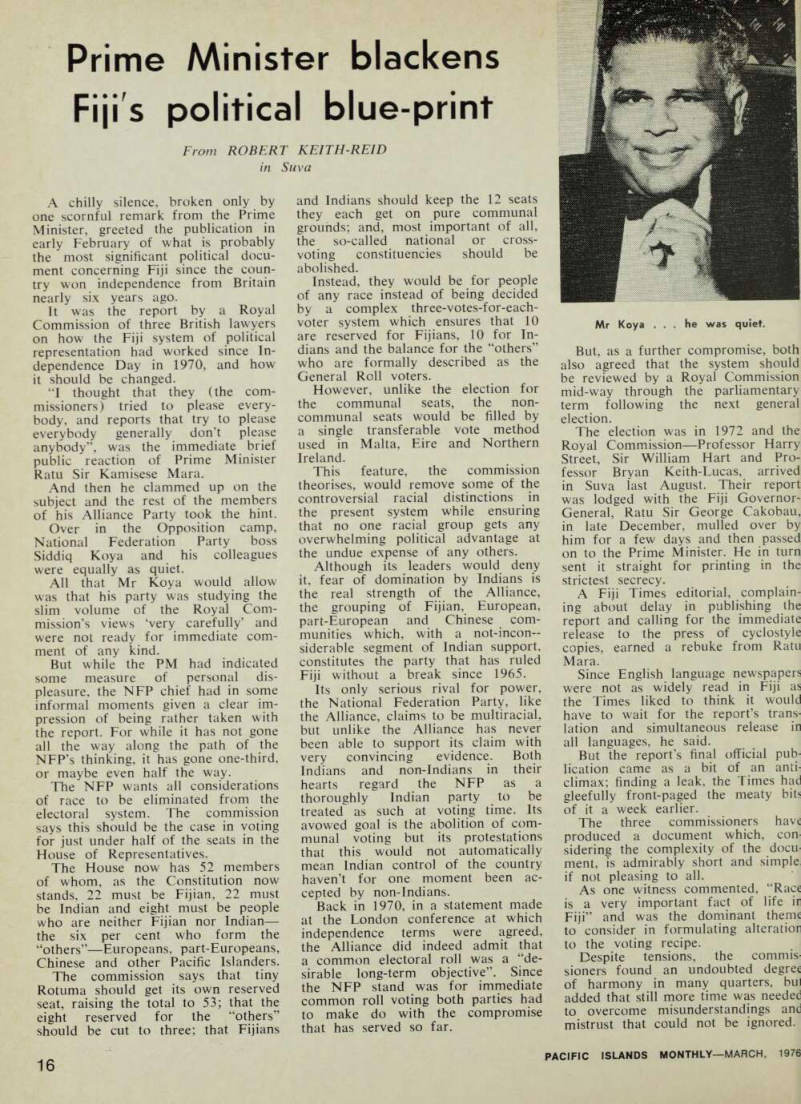
Over in the Opposition camp, National Federation Party boss Siddiq Koya and his colleagues were equally as quiet.
All that Mr Koya would allow was that his party was studying the slim volume of the Royal Com mission’s views ‘very carefully’ and were not ready for immediate com ment of any kind.
But while the PM had indicated some measure of personal dis pleasure, the NFP chief had in some informal moments given a clear im pression of being rather taken with the report. For while it has not gone all the way along the path of the NFP’s thinking, it has gone one-third, or maybe even half the way.
The NFP wants all considerations of race to be eliminated from the electoral system. The commission says this should be the case in voting for just under half of the seats in the House of Representatives.
The House now has 52 members of whom, as the Constitution now stands, 22 must be Fijian, 22 must be Indian and eight must be people who are neither Fijian nor Indian— the six per cent who form the “others” —Europeans, part-Europeans, Chinese and other Pacific Islanders.
The commission says that tiny Rotuma should get its own reserved seat, raising the total to 53; that the eight reserved for the “others” should be cut to three; that Fijians
and Indians should keep the 12 seats they each get on pure communal grounds; and, most important of all, the so-called national or cross voting constituencies should be abolished.
Instead, they would be for people of any race instead of being decided by a complex three-votes-for-each voter system which ensures that 10 are reserved for Fijians, 10 for In dians and the balance for the “others” who are formally described as the General Roll voters.
However, unlike the election for the communal seats, the non communal seats would be filled by a single transferable vote method used in Malta, Eire and Northern Ireland.
This feature, the commission theorises, would remove some of the controversial racial distinctions in the present system while ensuring that no one racial group gets any overwhelming political advantage at the undue expense of any others.
Although its leaders would deny it, fear of domination by Indians is the real strength of the Alliance, the grouping of Fijian, European, part-European and Chinese com munities which, with a not-incon siderable segment of Indian support, constitutes the party that has ruled Fiji without a break since 1965.
Its only serious rival for power, the National Federation Party, like the Alliance, claims to be multiracial, but unlike the Alliance has never been able to support its claim with very convincing evidence. Both Indians and non-Indians in their hearts regard the NFP as a thoroughly Indian party to be treated as such at voting time. Its avowed goal is the abolition of com munal voting but its protestations that this would not automatically mean Indian control of the country haven’t for one moment been ac cepted by non-Indians.
Back in 1970, in a statement made at the London conference at which independence terms were agreed, the Alliance did indeed admit that a common electoral roll was a “de sirable long-term objective”. Since the NFP stand was for immediate common roll voting both parties had to make do with the compromise that has served so far.
But, as a further compromise, both also agreed that the system should be reviewed by a Royal Commission mid-way through the parliamentary term following the next general election.
The election was in 1972 and the Royal Commission—Professor Harry Street, Sir William Hart and Pro fessor Bryan Keith-Lucas, arrived in Suva last August. Their report was lodged with the Fiji Governor- General, Ratu Sir George Cakobau, in late December, mulled over by him for a few days and then passed on to the Prime Minister. He in turn sent it straight for printing in the strictest secrecy.
A Fiji Times editorial, complain ing about delay in publishing the report and calling for the immediate release to the press of cyclostyle copies, earned a rebuke from Ratu Mara.
Since English language newspapers were not as widely read in Fiji as the Times liked to think it would have to wait for the report’s trans lation and simultaneous release in all languages, he said.
But the report’s final official pub lication came as a bit of an anti climax; finding a leak, the Times had gleefully front-paged the meaty bits of it a week earlier.
The three commissioners have produced a document which, con sidering the complexity of the docu ment, is admirably short and simple, if not pleasing to all.
As one witness commented, “Race is a very important fact of life in Fiji” and was the dominant theme to consider in formulating alteration to the voting recipe.
Despite tensions, the commis sioners found an undoubted degree of harmony in many quarters, bul added that still more time was needed to overcome misunderstandings and mistrust that could not be ignored.
Mr Koya ... he was quiet.
“For the moment the electoral system must in our judgment retain a considerable racial element” they said. “The question is what steps can be taken now to start moving towards a more truly democratic system, a process which may well not be completed until programmes of race relations and education have shown their effect. But it is not now possible to forecast politically when that can be”.
The commission rejected claims for separate Muslim and immigrant Pacific Islanders political represent ation as being something which would be a mistake to meet since only further racial elements would be brought into the voting mixture.
But Rotuma, the little island 350 miles north of the main Fiji group, and populated by 3,000 Rotumans should get its own reserved seat purely on the grounds of remoteness From the rest of the country.
The communal element still aeeded would be preserved by the etention of the 12 Fijian and 12 Indian communal seats, the com missioners said. They recommended he reduction in the number of ‘general” communal seats because hey didn’t think the number of general voters’ seats could be justi ied by their numbers.
What general electors would lose
would be balanced, the commissioners maintained, by the chance to win some of the 25 non-communal seats.
The change could be achieved, the three commissioners said, by creating five constituencies, each returning five members without regard to race or religion.
However, some “rather surprising” information disclosed that there was only a difference of 10 in the estimated number of Indians eligible to vote in the 1972 election (111,860) and the number of Fijians (111,870), while the figure for General voters was 11,270.
Furthermore, while Indians still outnumber Fijians, the Indian population is increasing less rapidly than the Fijian. If present population trends continued Fijian numerical superiority could be restored in a few years time.
Questioned after the report’s publication, Ratu Sir Kamisese refused to be drawn except to clear up one very vital point.
The report has quoted extracts from the NFP’s submissions, and these quoted extracts from a statement the PM had made at the 1970 London conference. The statement, the NFP submitted, amounted to an Alliance undertaking to write the report into the Constitution.
The quotation, Ratu Sir Kamisese
stressed, was “out of contex”. He had made it very clear in London that it was for parliament to take anything out of the report for writ ing into the constitution, In Fiji, the will of Parliament does not necessarily reflect the wishes of the party forming the govern ment.
Any change to the Constitution needs not only the backing of three quarters of the members of the House of Representatives, but also threequarters of the members of the Senate. Any vote for change must include at least six of the eight senators nominated by the Great Council of Fijian chiefs, Opposition from only three chiefs would amount to a complete veto of an amending bill that might have the unanimous support of the House of Representatives and the rest of the Senate.
Such a veto is quite possible since some chiefs would buck the party line to prevent what they might re gard as a weakening of the Fijian position.
A House of Representatives meet ing was due to start on February 16 and the report was expected to be tabled formally to Parliament then. Then, it has to lie before the House for three months before it can be debated.
Advertisements & other items, p. 17 (2 items)
17
ACIFIC ISLANDS MONTHLY—MARCH, 1976
the Regent of Fiji
BOOK SFWCE IN PARADISE
Wf *** »* **• »»»« I I #*=' a a •ft in a a
i;v.p
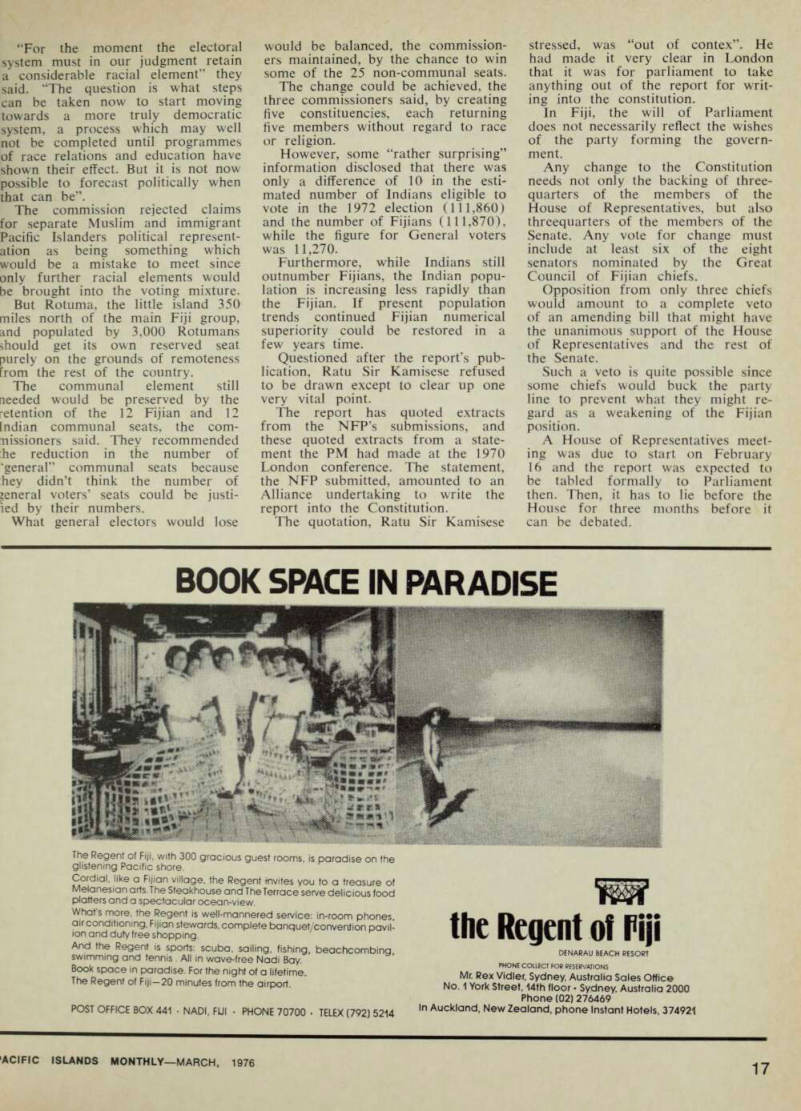
??»* ■ \ - \ The Regent of Fiji, with 300 gracious guest rooms, is paradise on the glistening Pacific shore.
Cordial, like a Fijian village, the Regent invites you to a treasure of Melanesian arts. The Sfeakhouse and The Terrace serve delicious food platters and a spectacular ocean-view.
What’s more, the Regent is well-mannered service; in-room phones, airconditioning, Fijian stewards, complete banquet/convention pavilion and duty free shopping.
And the Regent is sports; scuba, sailing, fishing, beachcombing swimming and tennis . All in wave-free Nadi Bay.
Book space in paradise. For the night of a lifetime.
The Regent of Fiji—2o minutes from the airport.
POST OFFICE BOX 441 • NADI, FUI • PHONE 70700 ■ TELEX (792) 5214
the Regent of Fiji
DENARAU BEACH RESORT
PHONE COLLECT FOR RESERVATIONS
Mr. Rex Vidler, Sydney. Australia Sales Office No. 1 York Street, 14th floor • Sydney, Australia 2000 Phone (02) 276469 In Auckland, New Zealand, phone Instant Hotels, 374921
Tropicalities
Wliat’s in a name V
In sophisticated western societies, writes a special correspondent, parents have the frustrating task of choosing from a relatively-limited range the Christian names to bestow upon their unprotected offspring.
Think of all the mutilations of that grand old name Mary—Marie, Maree, Mary-Ann, Mary-Jo, Mary Joan and all the variations on the theme of Linda—Lynne, Lynn, Lin, Lynda, Lyndal, Lindie-Lou . . .
The Cook Islander, in his wisdom, has found an answer to the problem of human nomenclature, which must, when one considers the almost unlimited hours spent by peoples of advanced nations in choosing names for their children, rank with many of man’s brilliant solutions to great and fundamental problems.
Cook Islands names, if in the vernacular, often have meanings, which, if literally translated into English, seem bizarre to the Euro pean. These names are often based upon the belief that names linked to unpleasant experiences or to undesirable physical characteristics will serve as a protection against the same evils befalling the bearer of the name.
Hugh Hickling, who for a time was headteacher and resident agent on Mangaia, recorded some exam ples in an article published in the Journal of the Polynesian Society.
Included were Matamaki—sick face; Akaeakofe—breathless; Vaevae kino—bad legs; Tangatakino—bad man; Aungakino—bad smell; Tanga tatutai—worthless; Matemutukore— dead without end, and Makikino— bad sickness.
In more recent times, the choice of names, if in English, also seems to fall into habit patterns which are unusual by European standards.
Occasionally some prominent Euro pean resident found that his surname had been given to some child (as a first name), even although the child’s existence was previously unknown to him.
In other instances, events of note, the more desirable occupations or
just mere whimsy seem to dictate the choice of names. Fiji, Wellington College, Middlemore, Fly River and Kaingaroa Forest are names which tell their own story when one knows that relations of those particular children were, respectively, trained at the Fiji School of Medicine; at tended Wellington College on scholarship; served as a Polynesian missionary in Papua New Guinea and worked in the pine forest in New Zealand, all sending remittances home to the family in the Cooks.
Social aspirations are reflected in names such as Wireless, Sergeant, Skipper, Clerk, First Assistant, Major and Constable. One can visualise the happy moments which lead to names like Boys’ Brigade Picnic; Merry Christmas, New Home, Morning Star Hotel, Party and Lucky Trip.
However, one wonders about the derivation of the names of a pair of Mangaia twins—Lucky and Un lucky, of Startnow and New World, of Timesup, Bagsashore, Early to Start, Wake Up and Just Alive. Fin ally, as I never saw firm evidence of their existence, I regard as apo cryphal those two characters who were often spoken about in Raro tonga a decade or more ago, namely, Louse and Behind the Empire Theatre.
Paris on
the doorstep
A new communications antenna installed at Nouville, across the har bour from Noumea, will have sig nificant benefits for the transmission of telex, radio, TV and telephone links through New Caledonia and the New Hebrides.
The new antenna measures 32.5 metres in diameter and was installed in December at a cost of about SAS million. The “Telspace” antenna has been provided by the French Depart ment of Posts and Telecommunica tions. Apart from the speeding up of telex messages, the new antenna will open up telephone links to any part of the world, 24 hours a day.
Communications will be consider ably improved by travelling via satel lite rather than short wave. In view of the 20,000 kilometre distance be tween Paris and Noumea, sound and visual images transmitted from
metropolitan France will need to pass via two satellites above the Indian and Pacific Oceans relaying, no doubt, through the ground station in Hong Kong on the way.
Allowing this speedy and perma nent contact between Paris and Nou mea, however, the new Telspace an tenna at Nouville will obviously bring metropolitan France into much closer contact with her Pacific pos sessions. As predicted a few months ago, the Caledonians will soon be living “Paris time” with television by satellite enabling them to shiver in the snowy French alps all through the hottest months in the tropics.
In the end the Caledonians may even be brought to forget that they ever lived surrounded by English speaking neighbours in the South Pacific!
The DA outlaws
the ‘pokies’
The outlawing of poker machines by Marianas District Administrator, Mr Francisco C. Ada, was received with mixed feelings. Hotel managers in Saipan found their revenue suf fered considerably. But the DA’s de cision was no doubt welcomed by crime fighters, who had seen crime figures rise spectacularly since the machines were introduced in June. 1974.
In Saipan, burglaries increased by 132 per cent, grand larceny by 84 per cent, and forgery, robbery, attempted burglary, attempted grand larceny and petty larceny by 400 per cent. Apart from any moral issue which might have been raised against the machines, those crime figures were convincing.
Mr Robert Maloney, manager of the Royal Taga Hotel (72 rooms) put the decline of revenue in his hotel at 30 per cent, but would not quote a dollar figure. His hotel had lost business since 1971 when other hotels started to open, and the “pokies”, “like a shot in the arm”, closed the gap a little, he said.
The Saipan Continental Hotel, 184 rooms, the biggest in Saipan, said outlawing of the machines had not adversely affected business to a great extent.
Mr Ada, announcing his decision to outlaw the machines, said the 277 machines in the Marianas were “detrimental to Marianas society”.
A local public opinion survey, which covered 350 adults, showed that 84 per cent believed poker ma chines should not be allowed on Saipan. High school students were against them to the tune of 78.5 per cent. About 25 per cent of 532 high school students admitted their families were having money prob lems because of the machines, while a local banker attributed 25 per cent of late payments to them.
Around 14 years ago, Fiji saw the red light when poker machines were making their presence felt in the clubs and banned them. New South Wales is stuck with them as the government has grown to rely on the income from taxing the machines.
Relics of
history
Skeletons and weapons which might have belonged to 17th century Spanish sailors have been discovered in the Paea district of west coast Tahiti—an amazing coincidence one might think with Pacific Publications’ latest book, Robert Langdon’s Lost Caravel, only a few months old.
The relics were found some months ago along a cliff face, a suitably accessible yet hidden spot for the landing of either an official expedition or shipwrecked men.
Among the first objects found by the Tahitians was an axe, described as Spanish in style and a gun. There was also a helmet, which seemed to :orrespond with the description of hose worn by 17th century Spanish ioldiers.
The skull of someone who might aave worn the helmet was also ound. It had obviously been pierced )y a heavy-calibre bullet. This will
>ose an interesting riddle.
Big show
it Rotorua
The South Pacific Festival of Arts, it Rotorua, NZ, from March 6 to 3, will be possibly the biggest issembly yet of Islands talent, wenty-one countries and territories re represented in the programme of ong, dance, drama and music.
There will be about 200 individual iems as well as composite pro rammes which will enable audiences 3 see Melanesian and Polynesian erformances, combined with Micro esian, Indian, European, Aborigine r Chinese performances.
‘Hello’ say
, the Samoans x the Samoan Council of Women in New Zealand is looking for a year of achievement this year—the year after IWY (International Womens Year). With 87 members— there were only five at the inaugural meeting in 1973 it is aiming at setting up a community centre in south Auckland, which will be the nerve centre for good work for Samoan women in NZ. the council aims at encouraging members to play an effective role in the community, promoting under-
standing among women of all races, encouraging education and preserv ing the Samoan culture.
A friendly “hello” is the theme of the council, according to the sec retary, Mrs Odille Maea. The Samoan people are very shy they want to mix, but they are worried about saying or doing the wrong thing. She hopes that New Zealanders will help the council to achieve its aims Mrs Maea regards education as particularly important to Samoans, It had been found that children born in Samoa who went to NZ did much better in education than Samoan children born in NZ.
Advertisements & other items, pp. 19-21 (2 items)
Acific Islands Monthly— March, 1976
fete label
i\
Scotch Whis^ Sons : H scoti** v J lUfi"
For people who value
tradition.
Dewar's “White Label”-it never varies.
WE'RE NO FURTHER AWAY THAN YOUR 'PHONE N\edc' C-'>'
TELEX : AA23181
CABLES: CAREFULNESS
G.P.O BOX 3838
SYDNEY
N.S.W. 2001.
BUILT TO EARN A LIVING
SHIPS AND WORKBOATS BY CARPENTERS INDUSTRIAL
T& From a village fishing boat to an inter-island trader. A tugboat to a 100 foot barge. We design and build them all, in wood or steel up to 120 feet in length.
If you trust your living to the sea. trust your shipbuilding to Carpenters Industrial.
CARPENTERS INDUSTRIAL
BOX 296 SUVA FIJI. PHONE 23031. Cable MILLERS SUVA Telex 2195FJ
Become a part of PlM’s Pacific and subscribe now % s_b o Oh C O /.O ®8 as £ T 3 CO bJj a Jh K O *3 o- -0 CL ct 0 o CO Oh <D a?
Fi7/ in jfte details on the attached order forms
The Mailbag

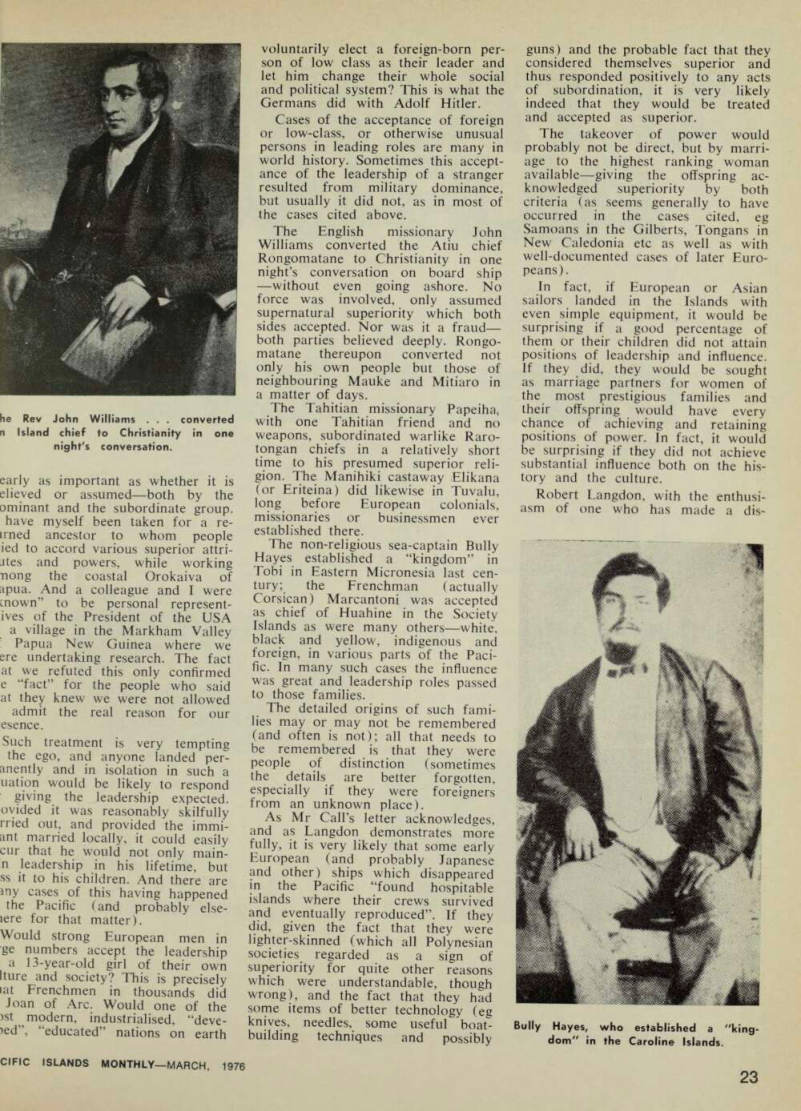

Church's Role In New Hebrides
I was saddened and dismayed when I read in your January issue (p 21) the letter from my friend David Burt on the Church’s role in the New Hebrides. Saddened because I believe he mistakes the involve ment of individual Christians in New Hebrides politics for the Church itself supporting a particular political party. Dismayed that he appears to give such a blanket endorsement to the remarks of Messrs Joffick and Curtis, whom he admits he has never met. The thought of such men having political power in the New Hebrides makes me shudder.
Last September I concluded 10 wonderful years of life in the New Hebrides. 1 am grateful that during those years many New Hebrideans extended their friendship to me, and I think I have come to some under standing of their hopes, their fears, their desires and their needs. For nearly six years I was an elder in the Presbyterian Church—active in wor ship, work, and the discussions and planning of church committees.
Pastors and elders earned my con stant respect for their readiness to keep politics out of church services and meetings, despite their natural keen interest in the rapid develop ment of political life in the country.
I agree with David that the Church as such should not be permanently allied with any political party, though it might support a party on particular issues. But I strongly favour the participation of individual Christians in political parties, and believe that many pastors and elders are very able to make a major con tribution in the New Hebrides.
During His earthly ministry Christ showed His concern for the total well-being of men and women. He fed the hungry and healed the sick; He denounced wealthy and politic ally-powerful men who treated the poor unjustly and misled their fol lowers. I believe the Christians who are involved in New Hebrides poli tics are following His example. They are not (in general) seeking earthly power, but are expressing their con cern for their fellow men and women and are working to help them. Many are dedicated men already making significant sacrifices for their people.
I thank God that pastors, priests, elders and other Christians have been called to serve in the new Territorial Assembly.
Bob Hindle
Oakleigh, Vic.
The Lost Caravel
The letter by David Call in the December 1975 PIM (p 21) claims that Langdon’s hypothesis about the influence of a lost Spanish caravel is “psychologically unsound” because “castaways simply do not found dy nasties, no matter how ‘culturally superior’ they may assume their civilisation to be”. This seems not to accord with historical facts in the Pacific or elsewhere.
H. E. Maude’s Evolution of the Gilbertese Boti (Polynesian Society, Wellington) shows how a small group of Samoan castaways and their descendants established the major dynasty of the southern Gil bert Islands. Peter France’s Charter of the Land (Oxford University Press, Melbourne) quotes an instance of a strange castaway being found by a Fijian tribe whose chieftaincy was vacant and chose this person on the spot as their chief, as they assumed he was supernaturally superior.
Jean Guiart (Structure de la Chefferie en Melanesie du Sud, Paris) shows how many New Cale donia tribes are headed by immi grant Tongans, at least some of whom were castaways. Rarotongan (Cook Islands) tradition tells of the immi grant Tangiia having become domi nant over the island, sending for a higher-ranking person from another island (Pa Ariki ) to be brought as high chief over them all because Tangiia himself was not of suffic iently high birth. All these examples were long before European times.
Cases of this kind are numerous in the Pacific, some involving people of the same ethnic or “racial” type, some not. They seem to be dependent on several factors—perhaps the main three are technical superiority, or ganisational superiority and super natural superiority. Whether the superiority is real seems not to be
early as important as whether it is elieyed or assumed—both by the ominant and the subordinate group, have myself been taken for a re irned ancestor to whom people ied to accord various superior attri- Jtes and powers, while working nong the coastal Orokaiva of apua. And a colleague and I were mown” to be personal represent ives of the President of the USA a village in the Markham Valley Papua New Guinea where we ere undertaking research. The fact at we refuted this only confirmed e “fact” for the people who said at they knew we were not allowed admit the real reason for our esence.
Such treatment is very tempting the ego, and anyone landed per anently and in isolation in such a nation would be likely to respond giving the leadership expected, ovided it was reasonably skilfully rried out, and provided the immi ant married locally, it could easily cur that he would not only main n leadership in his lifetime, but ss it to his children. And there are my cases of this having happened the Pacific (and probably else icre for that matter).
Would strong European men in ge numbers accept the leadership a 13-year-old girl of their own Iture and society? This is precisely iat Frenchmen in thousands did Joan of Arc. Would one of the
)st modern, industrialised, “deve
ied”, “educated” nations on earth
voluntarily elect a foreign-born per son of low class as their leader and let him change their whole social and political system? This is what the Germans did with Adolf Hitler.
Cases of the acceptance of foreign or low-class, or otherwise unusual persons in leading roles are many in world history. Sometimes this accept ance of the leadership of a stranger resulted from military dominance, but usually it did not, as in most of the cases cited above.
The English missionary John Williams converted the Atiu chief Rongomatane to Christianity in one night’s conversation on board ship —without even going ashore. No force was involved, only assumed supernatural superiority which both sides accepted. Nor was it a fraud— both parties believed deeply. Rongo matane thereupon converted not only his own people but those of neighbouring Mauke and Mitiaro in a matter of days.
The Tahitian missionary Papeiha, with one Tahitian friend and no weapons, subordinated warlike Raro tongan chiefs in a relatively short time to his presumed superior reli gion. The Manihiki castaway Elikana (or Eriteina) did likewise in Tuvalu, long before European colonials, missionaries or businessmen ever established there.
The non-religious sea-captain Bully Hayes established a “kingdom” in Tobi in Eastern Micronesia last cen tury; the Frenchman (actually Corsican) Marcantoni was accepted as chief of Huahine in the Society Islands as were many others—white, black and yellow, indigenous and foreign, in various parts of the Paci fic. In many such cases the influence was great and leadership roles passed to those families.
The detailed origins of such fami lies may or may not be remembered (and often is not); all that needs to be remembered is that they were people of distinction (sometimes the details are better forgotten, especially if they were foreigners from an unknown place).
As Mr Call’s letter acknowledges, and as Langdon demonstrates more fully, it is very likely that some early European (and probably Japanese and other) ships which disappeared in the Pacific “found hospitable islands where their crews survived and eventually reproduced”. If they did, given the fact that they were lighter-skinned (which all Polynesian societies regarded as a sign of superiority for quite other reasons which were understandable, though wrong), and the fact that they had some items of better technology (eg knives, needles, some useful boat building techniques and possibly
guns) and the probable fact that they considered themselves superior and thus responded positively to any acts of subordination, it is very likely indeed that they would be treated and accepted as superior.
The takeover of power would probably not be direct, but by marri age to the highest ranking woman available—giving the offspring ac knowledged superiority by both criteria (as seems generally to have occurred in the cases cited, eg Samoans in the Gilberts, Tongans in New Caledonia etc as well as with well-documented cases of later Euro peans).
In fact, if European or Asian sailors landed in the Islands with even simple equipment, it would be surprising if a good percentage of them or their children did not attain positions of leadership and influence.
If they did, they would be sought as marriage partners for women of the most prestigious families and their offspring would have every chance of achieving and retaining positions of power. In fact, it would be surprising if they did not achieve substantial influence both on the his tory and the culture.
Robert Langdon, with the enthusi asm of one who has made a dis-
The Rev John Williams . . . converted [?]n Island chief to Christianity in one
night's conversation.
Bully Hayes, who established a "king dom" in the Caroline Islands.
covery, may well have overstated his case and represented some possi bilities as probabilities or certainties.
Each of the possibilities he has raised low needs detailed checking and one lopes it will get it.
Personally I’d be surprised if the inclusion doesn’t show that, despite some undoubted exaggerations and ;ome wrong guesses, Langdon has nade a tremendous contribution to he history of the Pacific.
R. G. Crocombe
Professor of Pacific Studies Jniversity of the South Pacific, iuva, Fiji.
Wanted!
Would anyone having any know edge (a) of the Allied International ?opra Pool, operated during a part >f World War II and headquartered n San Francisco in 1943 and (b) 4ajor A. D. Sinclair, formerly of he New Zealand Army, former District Officer at Christmas Island n the Central Pacific, known to lave lived in Vancouver; dead or live, please communicate with the ndersigned.
Lester Gaynor
-52 Burgess Avenue, Vestwood, Mass 02090
Jsa.
Bougainville
Dispute
Your story on Bougainville (PIM, >ec, p 9) sounded like a cricket latch report. The headline, “Mr omare ahead on points in the Bou ainville contest” set the tone of the ory which continued to tell us that le so-called “secessionist leaders” ere being so badly beaten by Mr omare on points that they “seemed Imost pathetically eager to accept le promise of another round of dis issions . .
Some people might regard a game cricket as a matter of life and jath but I don’t think the people volved in the Bougainville dispute id it as amusing as a game of icket.
Even if your correspondent is ght in saying that Mr Somare is lead on points, what is that going prove? Is it going to end the dis ite? I think not. Instead I think s going to prolong it. After all, uch of the Bougainville issue is ised on pride and dignity, especially i the part of the Bougainvillians. hey are not just about to come awling back to the government to
say that they give up. A story like yours is going to make them react otherwise.
I think your correspondent will be doing Mr Somare and everybody else a lot more service if he refrains from dishing out point-by-point ac counts of how the Prime Minister is winning and how badly the other side is losing and simply reports the facts. Everybody wants to see the dispute ended and THAT will be the real victory for the Prime Minister and his government. If the issue is taken merely as a point-scoring exercise, I think we can settle down to a long drawn-out affair.
The Bougainville situation may well be a “contest” but if such in
sensitive media treatment prevails, there will be no winner.
Carolus Ketsimur
Boroko, PNG.
A New Inder
Tell Stuart Inder, Up Front, he should do himself and us a favour and get a new sketch at the top of his column; does nothing for him.
Something a bit more pacific.
Father Matthew Kelty.
Bogia, Madang, PNG. • Stuart Inder admits he's getting older and that it’s time he updated his image. It won’t however, make him look, or feel, any more pacific.
Advertisements & other items, pp. 22-26 (3 items)
Good? Year
TRACTION HI-MILER HI MILERGB
TRACTION TOO
SUPER ROAD LUG
ALL SERVICE
For rugged 'stop-go' de-
livery work. Gives long-
er mileage and easier
steering.
Round shoulder tire With 3-T cord. Abrasion for highway trucks, stronger than steel, tra-thick Assures extra trac- developed for bus deep-grooved, sharp an tion on all surfaces, and highway trucks, gle lugs assure positive and weaving, wet and dry. traction on all types of resistant ex- A non-directional tread and mud and snow tire.
Reduces skidding
road surfaces. 2b £if S m V W w
THE RIGHT TIRE FOR EVERY JOB
HIGHWAY - ON/OFF THE ROAD - CROSS COUNTRY GOODYEAR DISTRIBUTORS IN S.E. ASIA AND PACIFIC BASIN Boroko Motors Ltd.
Port Moresby, PNG.
Guam Tire & Supply Co.
Agana, Guam Coral Island Motors Suva, Fiji Landis Brothers & Co. Ltd.
Hong Kong Solomon Motors Ltd.
Honiara, 8.5.1. P.
Susupe Enterprises Saipan, Mariana Is.
Societe General Automobile Noumea, New Caledonia Service Mobil Papeete, Tahiti Santo Engineers Santo, New Hebrides Microl Corporation Saipan, Mariana Is.
W.S.T.C.S.
Western Samoa Samoa Motors Inc.
American Samoa Pacific Motors Vila, New Hebrides Yap Cooperative Ass.
Yap, W. Caroline Is.
Morris Hedstrom Ltd.
Apia, Western Samoa Buncombe Bay Garage Norfolk Is.
Truk Trading Co.
Truk, E. Caroline Is.
P.A.M.I.
Kolonia, Ponape Morris Hedstrom Tonga Cook Island Motors Cook Is.
Island Construction Co.
Majuro, Marshall Is.
Ngiratkel Etpison Co. Ltd.
Koror, Palau Yung Wei Tung Trading Co. Ltd.
Taipei, Taiwan
What Hakes it
an Alfa Romeo
Front wheel drive and McPherson suspension make it handle like an Alfa. / A The four cylinder, horizontally opposed motor and four speed gearbox make it perform like one, too.
And disc brakes all round guarantee it stops the way an Alfa Romeo should.
The only un-Alfa thing about the Alfasud is its price.
What Nates it
a Family Car
It’s big on the inside, so there’s room inside for the whole family.
But it’s quite compact on the outside.
So it doesn’t need much room to park.
The space inside the boot is about the same as the space in the average family refrigerator.
The front seats adjust up and down as well as backwards and forwards. And the steeringcolumn alsoadjusts upand down.
So you can adjust your Alfasud to suit you and your family. Which is better than adjusting your family to suit the car.
alfa
romeo
AN INVESTMENT IN SAFETY
f For information contact Alfa Romeo Pty. Ltd.
Cnr. Beauchamp & Botany Rds., Botany, N.S.W., Australia.
Trade enquiries welcome.
pBW,
to the Pacific islands
In our 81st year
Selling
"SERVICE"
NELSON & ROBERTSON
PLANTATION HOUSE, 197 CLARENCE STREET, SYDNEY
CABLES: "IVAN", SYDNEY, BRISBANE. TELEX: AA22381, SYDNEY.
FOR:
INDENTS
COMMODITIES
SHIPPING
TRAVEL
INSURANCE
REAL ESTATE
Branch Office; Nelson & Robertson Pty. Ltd., 303 Adelaide St., Brisbane, Old New Guinea Representatives: Rabtrad Niugini Pty. Ltd., Rabaul Lae Madang Kieta.
PTY. LIMITED
(Established 1895)
% 7a S. E. TATHAM & CO. PTY. LTD.
BEEHIVE BLDG., 94 ELIZABETH STREET
G.P.O. BOX 8 CABLES “SET"
MELBOURNE, 3001, AUSTRALIA
TELEX: AA34293 TELEPHONE 63-5094
Buyers for the Pacific
AND IN
Popup New Guinea:
S. E. TATHAM (P.N.G.) PTY. LTD.
LAE: MALAITA ST. (P.O. BOX 1562)
PORT MORESBY: Cnr. GOROA & MUNAHU Sts., GORDON
(P.O. BOX 6733, B0R0K0).
Fiji: S. E. TATHAM (FIJI) LTD.,
LAUTOKA P.O. BOX 366
SUVA G.P.O. BOX 671,
TELEGRAMS: ALL OFFICES “SET”
YOUR GUARANTEE
SINCE 1924
1
FOR SERVICE
23
CIFIC ISLANDS MONTHLY— MARCH, 1976
Acific Islands Monthly—March, 1976
An 'Old Chef's' Recipe For A New
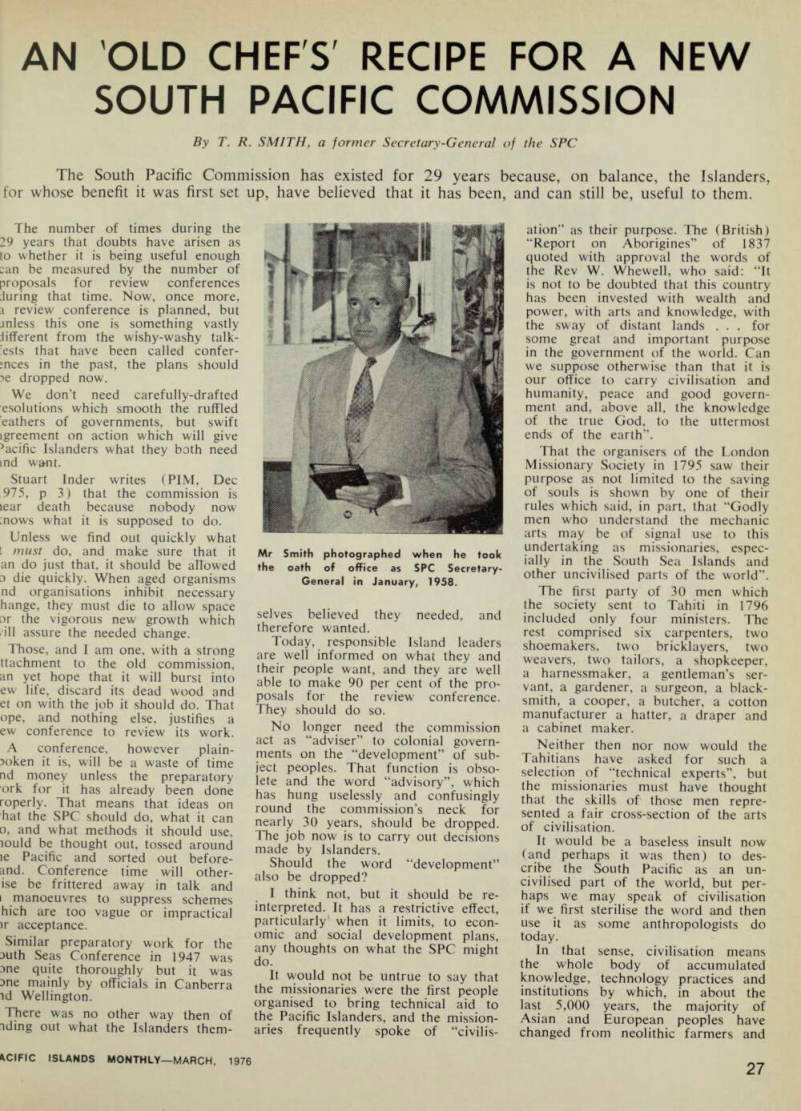
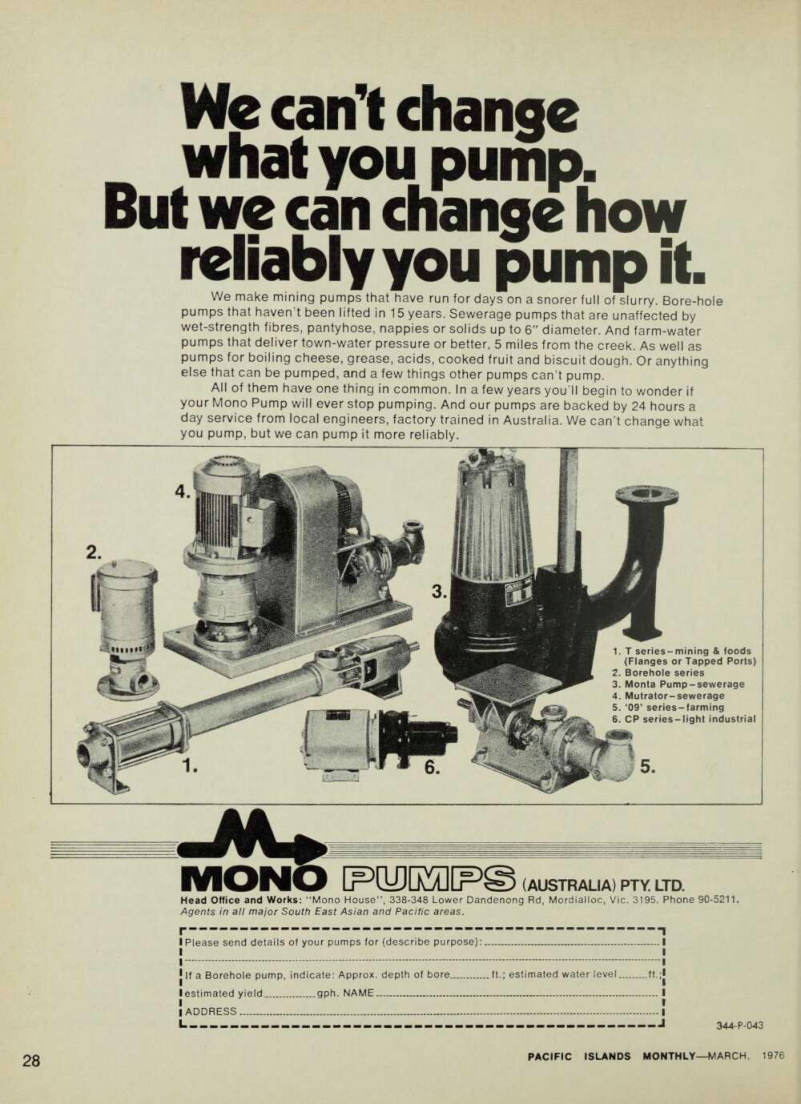

South Pacific Commission
By T. R. SMITH, a former Secretary-General of the SPC
The South Pacific Commission has existed for 29 years because, on balance, the Islanders, for whose benefit it was first set up, have believed that it has been, and can still be, useful to them.
The number of times during the 29 years that doubts have arisen as to whether it is being useful enough :an be measured by the number of proposals for review conferences during that time. Now, once more, a review conference is planned, but inless this one is something vastly different from the wishy-washy talk :ests that have been called confer ences in the past, the plans should 3e dropped now.
We don’t need carefully-drafted esolutions which smooth the ruffled eathers of governments, but swift igreement on action which will give s acific Islanders what they both need md wa-nt.
Stuart Inder writes (PIM, Dec 975, p 3) that the commission is tear death because nobody now mows what it is supposed to do.
Unless we find out quickly what t must do, and make sure that it an do just that, it should be allowed 0 die quickly. When aged organisms nd organisations inhibit necessary hange, they must die to allow space or the vigorous new growth which /ill assure the needed change.
Those, and I am one, with a strong ttachment to the old commission, an yet hope that it will burst into ew life, discard its dead wood and et on with the job it should do. That ope, and nothing else, justifies a ew conference to review its work.
A conference, however plain- Doken it is, will be a waste of time nd money unless the preparatory ork for it has already been done roperly. That means that ideas on hat the SPC should do, what it can o, and what methods it should use, lould be thought out, tossed around le Pacific and sorted out before and. Conference time will ether ise be frittered away in talk and 1 manoeuvres to suppress schemes hich are too vague or impractical >r acceptance.
Similar preparatory work for the Duth Seas Conference in 1947 was ane quite thoroughly but it was ane mainly by officials in Canberra id Wellington.
There was no other way then of iding out what the Islanders them-
selves believed they needed, and therefore wanted.
Today, responsible Island leaders are well informed on what they and their people want, and they are well able to make 90 per cent of the pro posals for the review conference.
They should do so.
No longer need the commission act as “adviser” to colonial govern ments on the “development” of sub ject peoples. That function is obso lete and the word “advisory”, which has hung uselessly and confusingly round the commission’s neck for nearly 30 years, should be dropped.
The job now is to carry out decisions made by Islanders.
Should the word “development” also be dropped?
I think not, but it should be re interpreted. It has a restrictive effect, particularly when it limits, to econ omic and social development plans, any thoughts on what the SPC might do.
It would not be untrue to say that the missionaries were the first people organised to bring technical aid to the Pacific Islanders, and the mission aries frequently spoke of “civilis
ation” as their purpose. The (British) “Report on Aborigines’’ of 1837 quoted with approval the words of the Rev W. Whewell, who said: “It is not to be doubted that this country has been invested with wealth and power, with arts and knowledge, with the sway of distant lands . . . for some great and important purpose in the government of the world. Can we suppose otherwise than that it is our office to carry civilisation and humanity, peace and good govern ment and, above all, the knowledge of the true God, to the uttermost ends of the earth”.
That the organisers of the London Missionary Society in 1795 saw their purpose as not limited to the saving of souls is shown by one of their rules which said, in part, that “Godly men who understand the mechanic arts may be of signal use to this undertaking as missionaries, espec ially in the South Sea Islands and other uncivilised parts of the world”.
The first party of 30 men which the society sent to Tahiti in 1796 included only four ministers. The rest comprised six carpenters, two shoemakers, two bricklayers, two weavers, two tailors, a shopkeeper, a harnessmaker, a gentleman’s ser vant, a gardener, a surgeon, a black smith, a cooper, a butcher, a cotton manufacturer a hatter, a draper and a cabinet maker.
Neither then nor now would the Tahitians have asked for such a selection of “technical experts”, but the missionaries must have thought that the skills of those men repre sented a fair cross-section of the arts of civilisation.
It would be a baseless insult now (and perhaps it was then) to des cribe the South Pacific as an un civilised part of the world, but per haps we may speak of civilisation if we first sterilise the word and then use it as some anthropologists do today.
In that sense, civilisation means the whole body of accumulated knowledge, technology practices and institutions by which, in about the last 5,000 years, the majority of Asian and European peoples have changed from neolithic farmers and
Mr Smith photographed when he took the oath of office as SPC Secretary- General in January, 1958.
nomads to members of the modern, compartmented and specialised, but integrated and balanced society.
Without entering the discussion on how long people have lived in the Pacific, we can say that during most of the 5,000 years the develop ment of Western civilisation has taken, Pacific Islanders were isolated and quite unaware of what was hap pening on the European-Asian mainland. Though they developed their own agricultural, navigational and other technologies, as well as their own social systems, they knew nothing of Western civilisation.
As Europeans used the term, they were uncivilised. They had a lot to learn from the newcomers and, of course, they quickly learned a great deal. Establishment of the South Pacific Commission in 1947 was in part a recognition that they could be helped to learn more, and in part an acceptance by Western peoples of an obligation to help more effectively.
But, as Fiji’s Prime Minister, Sir Kamisese Mara, has said, the SPC was a child of its era—the colonial era. Its constitution and its methods were devised with the intention that it would advise and help the adminis tering governments in the discharge of the responsibility which they accepted. It was, as was said, auxiliary. Limitations were therefore imposed on .its scope, and appointees to its governing body were never the men who made policy for their governments.
The South Pacific Forum was founded partly to get away from those limitations. It has the right freely to discuss political questions, and its members are political leaders with authority to decide policies binding on their governments.
The South Pacific Commission still has the weakness of an auxiliary md advisory body when the authori ses it was established to advise have already shed most of their responsi ailities.
There is considerable truth in the charge that colonialism implied ex iloitation and repression, but those vho stress that aspect tend to forget hat it also implied help, instruction ind protection. Within the area bounded by its limitations, the South Pacific Commission has given a ;olid measure of help and instruction, >ut it has not been concerned with irotection.
The word protection, as I use it lere, has nothing to do with defence n military terms. It is a necessity n our divided and specialised com nercial community in which men ire organised into interest groups o protect interests common to their
members. From trade unions to farmers’ federations and manufac turers’ associations, innumerable such groups protect the interests of their members with little or no con cern about the consequent injury to the members of other groups.
To preserve equilibrium and peace in the modem state, a government regulates trade practices, controls prices and wage rates, guards human rights and provides the complicated administrative machinery necessary to preserve law and order. In the colonial era, the colonial govern ments accepted the obligation to protect the interests of their Island subjects. A century ago planters in Queensland and Fiji exercised their undisputed right to exploit the labour of unprotected Islanders. The Western Pacific High Commission and the British Navy were marshalled to pro tect the naive and unorganised Mela nesians.
For most Pacific Islanders the colonial era has ended, but can they, with their new governments, yet fully protect their own interests? The South Pacific Forum stands as proof that leading men among them are convinced that some additional power is needed.
Conflicts between shipowners and trade unions in New Zealand or Australia have at times left some Islanders critically short of food and other supplies, and have caused economic loss when produce decayed because the ships needed for convey ing it to market were laid up. Steps to protect metropolitan interests restrict opportunities for Islanders to migrate in search of work or to run their own ships.
No one is likely to dispute the right to come into the South Pacific of those concerns which are spending billions of dollars on development of the technology for taking mineral nodules from the sea floor. In our society they have the right to reap the profits of their enterprise.
But how far do we recognise the right of the inhabitants to benefit from the natural resources of their region? The Law of the Sea Con ference has noticed the right. Will it, in the end, be able to provide effective protection?
Western peoples have brought much of their developed technology to the South Pacific and applied it in the solution of oceanic problems. But there has been insufficient recog nition of the need for new techniques specially adapted to solve Island problems.
We still want an adequate and cheap source of energy for Island
• Continued on p 75
dustries, a reliable and economical ethod of distilling sea water and II exploration of the problem of productive Island soils. The Cook anders tried to adapt techniques vised for producing food crops and eet water in the Arabian desert to i needs of their atolls. Expert ad :e and more applied research could rhaps have helped them to success d could certainly have saved them >m expensive failure.
Somebody should make these >blems known and perhaps should ange for specialised work directed their solution. The SPC has anged expert enquiries into de opment bank facilities and the irist industry. The scope for more rk is immense. in this article I have tried to sug t the scope for possible aid in South Pacific. In outline it covers: I. Material aid for economic de opment. Island leaders know their :ds and, to a considerable extent, re defined them in development ns. The need is to co-ordinate se plans and to supply the supple ntary money, material and skills ded for their realisation. !. Further education and train , particularly in the fields of com nications, transport, management, mce, administration and manufac '• A means of defining and mak known the legitimate interests 1 rights of South Pacific peoples I perhaps ensuring that those rights interests are safeguarded. . The channelling of developed miques and research facilities into k for the solution of problems :ific to Pacific Islands. Health and ial problems, often made apparent he adjustment to a Western way life, should be included here, f we take the wider view which iggest, a conference to review the k of the South Pacific Commis i will appear as not worth the . But if the conference can come *vith a statement of what Islanders lire and expect from their own misation, worthwhile progress be seen. . additionally, an organisation be planned with the resources, will and the working methods it to do what it should, the con nce will have done its job. ut, perhaps in the process, the th Pacific Forum, the South fic Bureau for Economic Co ation and the South Pacific imission will all have been
Advertisements & other items, pp. 27-30 (3 items)
27
ACIFIC ISLANDS MONTHLY— MARCH, 1976
We can't change
what you pump.
But we can change how
reliably you pump it.
We make mining pumps that have run for days on a snorer full of slurry. Bore-hole pumps that haven’t been lifted in 15 years. Sewerage pumps that are unaffected by wet-strength fibres, pantyhose, nappies or solids up to 6" diameter. And farm-water pumps that deliver town-water pressure or better, 5 miles from the creek. As well as pumps for boiling cheese, grease, acids, cooked fruit and biscuit dough. Or anything else that can be pumped, and a few things other pumps can’t pump.
All of them have one thing in common. In a few years you’ll begin to wonder if your Mono Pump will ever stop pumping. And our pumps are backed by 24 hours a day service from local engineers, factory trained in Australia. We can’t change what you pump, but we can pump it more reliably. 2. tmitt fci M 5. 6, 1. T series-mining & foods (Flanges or Tapped Ports) 2. Borehole series 3. Monta Pump-sewerage 4. Mutrator-sewerage 5. ‘o9’ series-farming 6. CP series-light industrial
mono
(AUSTRALIA) PTY. LTD.
Head Office and Works: “Mono House’’, 338-348 Lower Dandenong Rd, Mordialloc, Vic. 3195. Phone 90-5211.
Agents in all major South East Asian and Pacific areas.
I 1 Please send details of your pumps for (describe purpose): I 1 j If a Borehole pump, indicate: Approx, depth of bore. lestimated yield gph. NAME
ADDRESS
I ft.; estimated water level n .ft.; J 344-P-043
THE PAPUA HOTEL
PORT MORESBY
• Right in the business centre • A tradition for comfort and fine food ® All rooms air conditioned • Restaurant • Bars • Banquet Hall "Friendly Hotel" of the "Friendly Islands"
Situated along the Nuku'alofa waterfront. Only five minutes walk from town. Single, double, family suites, airconditioning, and hot and cold water showers. Pool, bar, restaurant, duty-free shop, tour desk and boutique.
Book through your travel agent or write to International Dateline Hotel, P.O. Box 62, Nuku'alofa Tonga.
Cable Address: "DATELINE".
Represented Overseas by: Charles J. Henry and Associates Pty. Ltd.
Sydney and Melbourne. y^y.
Telephone 24 2121 Cables PAPTEL
A. C. NEUMANN
Manager
INTERNATIONA
DATELINE HOT
TONGA
Primitive luxury
1 ihm.iii style) Nestled away in the untouched Kingdom of Tonga is new, luxurious "Port of Refuge" International resort. Here is a unique opportunity for your clients to experience the tranquil and relaxed Tongan atmosphere while they enjoy the picturesque surroundings of the new "Port of Refuge". And only a short flight from Fiji, Reasonable tariffs from $17.50 with special concessions for children. Agents commission 10 per cent.
Tonga's
Port of Refuge
INTERNATIONAL RESORT °
M- Uava’u Tonga Cables: "Refuge" Tonga or "Tengateurs"
Sydney. Phone: Sydney 85-1603 or 852162
m
This little flower is your key
to the safe insect killer
One of the safest and most potent insect-killers known to contemporary science is derived from an innocentlooking small white flower, the African Pyrethrum daisy. Pure pyrethrins, as chemists call this substance, is the active ingredient in Pea-Beu insect spray, and the key to its concentrated killing power. Continuing research by the chemists in the laboratories of A.N.I. Chemical Research and by health and environmental authorities throughout the world, confirms that insects do not become immune to pyrethrum. Pea- Beu contains a high concentration of pyrethrins which means that short bursts only are needed to kill flies, mosquitoes and every type of insect pest.
The mosquito—a deadly
trafficker of disease The mosquito’s record as a killer is world recognised. Beside wrecking ItlUfi
STSDRr
mTM
m so pure it’s safe to spray anywhere your night’s sleep with its irritating whine and inflicting its painful toxic bites, the mosquito passes on many serious diseases, including malaria, hepatitis, dengue and yellow fever, disfiguring elephantiasis and encephalitis. Pea-Beu is recommended to kill every mosquito that enters your home, because it is guaranteed completely effective, yet absolutely safe.
No fears near food Your kitchen and food-cupboards are the favourite places for houseflies, especially when attracted by exposed food as you cook or serve.
Of course you’re reluctant to use pungent insecticides, and fear toxic effects. But never hesitate to use Pea-Beu.
Its active ingredient guarantees it harmless to humans and pets, and thanks to the purity of all its ingredients, it is completely safe to spray anywhere in the home.
Pea-Beu the safe, powerful insecticide
29
S ACIFIC ISLANDS MONTHLY— MARCH, 1976
Churches bridged the gap
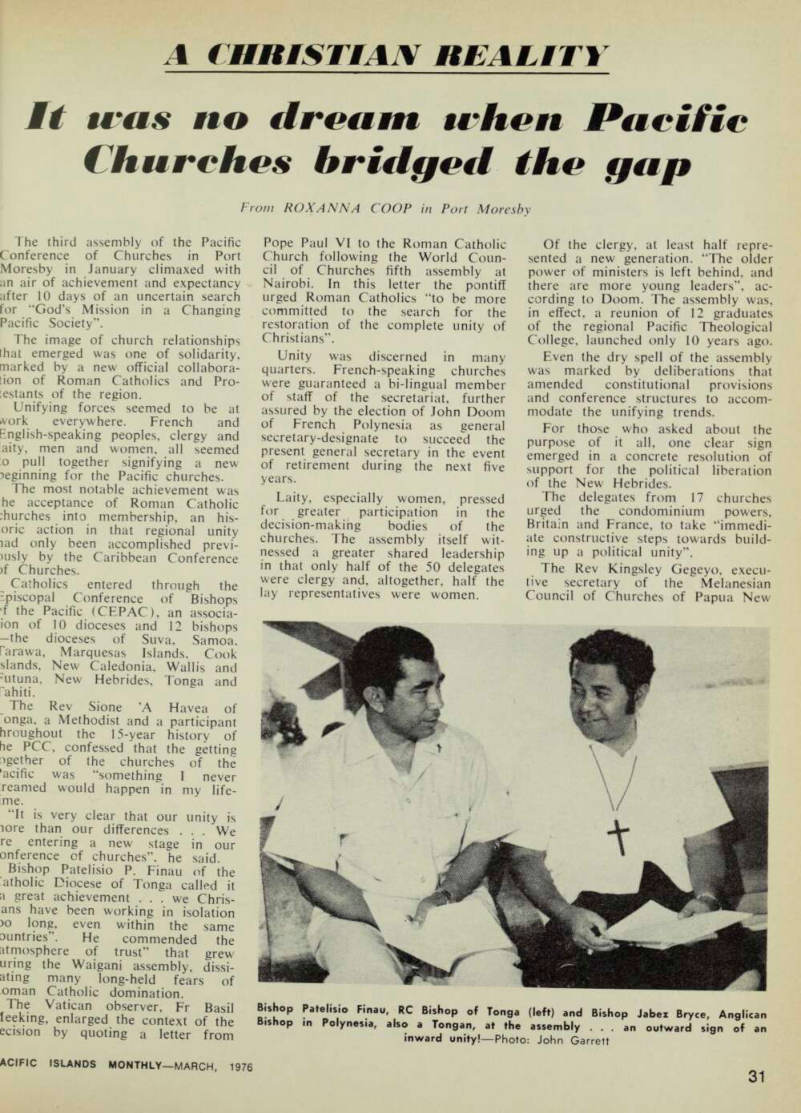

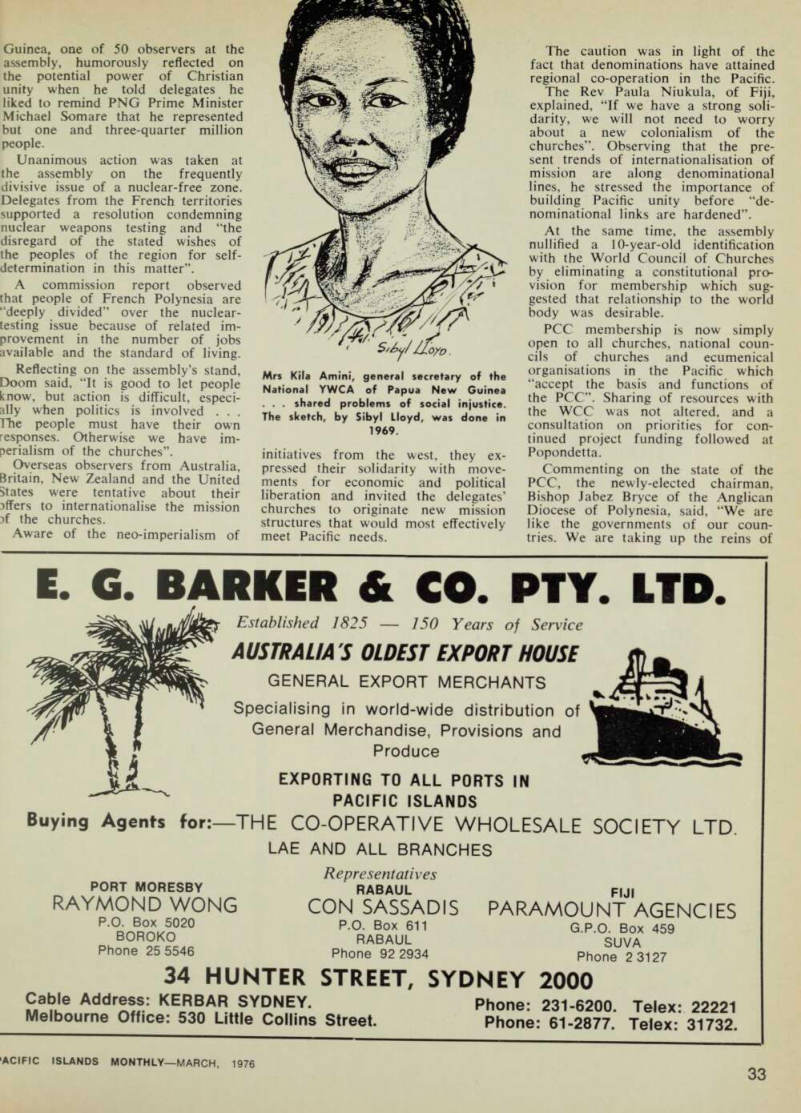
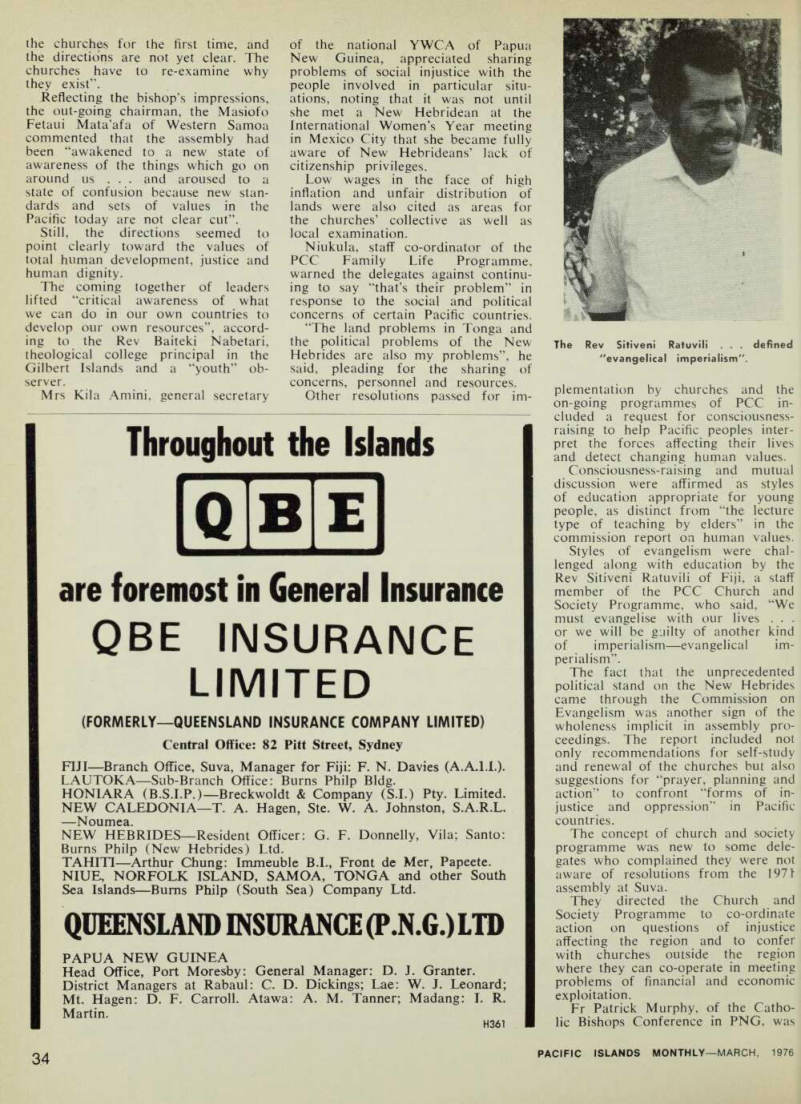
A Christian Reality
It was no dream when Pacific Churches bridged the gap
From ROXANNA COOP in Port Moresby
The third assembly of the Pacific Conference of Churches in Port Moresby in January climaxed with an air of achievement and expectancy after 10 days of an uncertain search for “God’s Mission in a Changing Pacific Society”.
The image of church relationships that emerged was one of solidarity, marked by a new official collabora tion of Roman Catholics and Pro testants of the region.
Unifying forces seemed to be at work everywhere. French and English-speaking peoples, clergy and aity, men and women, all seemed o pull together signifying a new beginning for the Pacific churches.
The most notable achievement was he acceptance of Roman Catholic :hurches into membership, an his oric action in that regional unity lad only been accomplished previ )usly by the Caribbean Conference )f Churches.
Catholics entered through the ■piscopal Conference of Bishops f the Pacific (CEPAC), an associa ion of 10 dioceses and 12 bishops -the dioceses of Suva, Samoa, Parawa, Marquesas Islands. Cook slands. New Caledonia, Wallis and ■utuna, New Hebrides, Tonga and "ahiti.
The Rev Sione ’A Havea of onga, a Methodist and a participant hroughout the 15-year history of he PCC, confessed that the getting agether of the churches of the ’acific was “something I never reamed would happen in my life me.
“It is very clear that our unity is lore than our differences ... We re entering a new stage in our onference of churches”, he said.
Bishop Patelisio P. Finau of the atholic Diocese of Tonga called it a great achievement ... we Chris ans have been working in isolation )o long, even within the same auntries”. He commended the atmosphere of trust” that grew uring the Waigani assembly, dissi ating many long-held fears of oman Catholic domination.
The Vatican observer, Fr Basil leeking, enlarged the context of the ecision by quoting a letter from
Pope Paul VI to the Roman Catholic Church following the World Coun cil of Churches fifth assembly at Nairobi. In this letter the pontiff urged Roman Catholics “to be more committed to the search for the restoration of the complete unity of Christians”.
Unity was discerned in many quarters. French-speaking churches were guaranteed a bi-lingual member of staff of the secretariat, further assured by the election of John Doom of French Polynesia as general secretary-designate to succeed the present general secretary in the event of retirement during the next five years.
Laity, especially women, pressed for greater participation in the decision-making bodies of the churches. The assembly itself wit nessed a greater shared leadership in that only half of the 50 delegates were clergy and, altogether, half the lay representatives were women.
Of the clergy, at least half repre sented a new generation. “The older power of ministers is left behind, and there are more young leaders”, ac cording to Doom. The assembly was, in effect, a reunion of 12 graduates of the regional Pacific Theological College, launched only 10 years ago.
Even the dry spell of the assembly was marked by deliberations that amended constitutional provisions and conference structures to accom modate the unifying trends.
For those who asked about the purpose of it all, one clear sign emerged in a concrete resolution of support for the political liberation of the New Hebrides.
The delegates from 17 churches urged the condominium powers, Britain and France, to take “immedi ate constructive steps towards build ing up a political unity”.
The Rev Kingsley Gegeyo, execu tive secretary of the Melanesian Council of Churches of Papua New
Bishop Patelisio Finau, RC Bishop of Tonga (left) and Bishop Jabez Bryce, Anglican Bishop m Polynesia, also a Tongan, at the assembly ... an outward sign of an inward unity!— Photo: John Garrett
Guinea, one of 50 observers at the assembly, humorously reflected on the potential power of Christian unity when he told delegates he liked to remind PNG Prime Minister Michael Somare that he represented but one and three-quarter million people.
Unanimous action was taken at the assembly on the frequently divisive issue of a nuclear-free zone.
Delegates from the French territories supported a resolution condemning nuclear weapons testing and “the disregard of the stated wishes of the peoples of the region for self determination in this matter”.
A commission report observed that people of French Polynesia are “deeply divided” over the nuclear testing issue because of related im provement in the number of jobs available and the standard of living.
Reflecting on the assembly’s stand, Doom said, “It is good to let people know, but action is difficult, especi ally when politics is involved . . .
Fhe people must have their own responses. Otherwise we have im perialism of the churches”.
Overseas observers from Australia, Britain, New Zealand and the United States were tentative about their offers to internationalise the mission 3f the churches.
Aware of the neo-imperialism of
initiatives from the west, they ex pressed their solidarity with move ments for economic and political liberation and invited the delegates’ churches to originate new mission structures that would most effectively meet Pacific needs.
The caution was in light of the fact that denominations have attained regional co-operation in the Pacific.
The Rev Paula Niukula, of Fiji, explained, “If we have a strong soli darity, we will not need to worry about a new colonialism of the churches”. Observing that the pre sent trends of internationalisation of mission are along denominational lines, he stressed the importance of building Pacific unity before “de nominational links are hardened”.
At the same time, the assembly nullified a 10-year-old identification with the World Council of Churches by eliminating a constitutional pro vision for membership which sug gested that relationship to the world body was desirable.
PCC membership is now simply open to all churches, national coun cils of churches and ecumenical organisations in the Pacific which “accept the basis and functions of the PCC”. Sharing of resources with the WCC was not altered, and a consultation on priorities for con tinued project funding followed at Popondetta.
Commenting on the state of the PCC, the newly-elected chairman, Bishop Jabez Bryce of the Anglican Diocese of Polynesia, said, “We are like the governments of our coun tries. We are taking up the reins of
Mrs Kila Amini, general secretary of the National YWCA of Papua New Guinea . . . shared problems of social injustice.
The sketch, by Sibyl Lloyd, was done in 1969.
the churches for the first time, and the directions are not yet clear. The churches have to re-examine why they exist”.
Reflecting the bishop’s impressions, the out-going chairman, the Masiofo Fetaui Mata’afa of Western Samoa commented that the assembly had been “awakened to a new state of awareness of the things which go on around us ... and aroused to a state of confusion because new stan dards and sets of values in the Pacific today are not clear cut”.
Still, the directions seemed to point clearly toward the values of total human development, justice and
human dignity.
The coming together of leaders lifted “critical awareness of what we can do in our own countries to develop our own resources”, accord ing to the Rev Baiteki Nabetari, theological college principal in the Gilbert Islands and a “youth” ob server.
Mrs Kila Amini, general secretary
of the national YWCA of Papua New Guinea, appreciated sharing problems of social injustice with the people involved in particular situ ations, noting that it was not until she met a New Hebridean at the International Women’s Year meeting in Mexico City that she became fully aware of New Hebrideans’ lack of
citizenship privileges.
Low wages in the face of high inflation and unfair distribution of lands were also cited as areas for the churches’ collective as well as local examination.
Niukula, staff co-ordinator of the PCC Family Life Programme, warned the delegates against continu ing to say “that’s their problem” in response to the social and political concerns of certain Pacific countries.
“The land problems in Tonga and the political problems of the New Hebrides are also my problems”, he said, pleading for the sharing of concerns, personnel and resources.
Other resolutions passed for im-
plementation by churches and the on-going programmes of PCC in cluded a request for consciousness raising to help Pacific peoples inter pret the forces affecting their lives and detect changing human values.
Consciousness-raising and mutual discussion were affirmed as styles of education appropriate for young people, as distinct from “the lecture type of teaching by elders” in the commission report on human values.
Styles of evangelism were chal lenged along with education by the Rev Sitiveni Ratuvili of Fiji, a staff member of the PCC Church and Society Programme, who said, “We must evangelise with our lives . . . or we will be guilty of another kind of imperialism—evangelical im
perialism”.
The fact that the unprecedented political stand on the New Hebrides came through the Commission on Evangelism was another sign of the wholeness implicit in assembly pro ceedings. The report included not only recommendations for self-study and renewal of the churches but also suggestions for “prayer, planning and action” to confront “forms of in justice and oppression” in Pacific countries.
The concept of church and society programme was new to some dele gates who complained they were not aware of resolutions from the 197 f assembly at Suva.
They directed the Church and Society Programme to co-ordinate action on questions of injustice affecting the region and to confer with churches outside the region where they can co-operate in meeting problems of financial and economic
exploitation.
Fr Patrick Murphy, of the Catho lic Bishops Conference in PNG, was
The Rev Sitiveni Ratuvili . . . defined "evangelical imperialism".
named co-ordinator of the Church and Society Programme with Mrs Amini as chairman for the next five years in a move to strengthen its objectives.
Bishop Finau contended that the assembly had discerned “the aspira tions of people”, and it was now the churches’ job to put them into action.
Bishop Finau’s statements on de velopment and human values early in the assembly called for sweeping changes in church and society.
“Discussing the problems of the Pacific means looking at the root problem of justice because to deve lop people without justice is hope less”, he said.
“TTie emerging Pacific countries have to be wary of still being ■colonial’ in mentality—of blindly and docilely accepting all the worst features of western materialism”, he argued.
The Catholic leader told delegates to “beware of the new and the old local oppressors whose oppressive roles are camouflaged because they are local people”.
“These oppressors are worse than the western oppressors”, he declared, "and here we have to look at the matais, the chiefs and nobles in our island societies”.
He emphasised that in the Pacific “we have to preserve our person centredness and community-centred ness as against individualism”, but he urged delegates to go beyond— “to feel compassion and become contemporary critics”.
The membership application of CEPAC was accepted after being de ferred at the Suva assembly. At the same time—and for the first time— two national councils of churches were received into membership, both including Roman Catholics. These are the Solomon Islands Christian Association and the Fellowship of Christian Churches in Samoa.
Church of Christ of the New Hebrides was also accepted, bringing the total member bodies of PCC to 21.
The Rev Posenai L. Musu, of Western Samoa, who has served as general secretary for the past year, was confirmed in his post.
Members of the new executive committee, in addition to Bishop Bryce, are Fr Brian McDonald-Milne of the Anglican Church of Melanesia, Revs losia Taomia of Tuvalu, Lalo milo Kamu of Western Samoa, Fred Karlo Timakata of the New Heb rides, Pasteur Waimo Passil of New Caledonia and Mrs Kila Amini of Papua New Guinea.
The United Church of Papua New Guinea and the Solomon Islands hosted the assembly.
Advertisements & other items, pp. 31-34 (3 items)
31
ACIFIC ISLANDS MONTHLY— MARCH, 1976
I her a
TURNS GRASS INTO LAWN
\ Zrr^llX
UTILITY 160
THE “WORK HORSE” OF THE
VICTA RANGE
SUPER 24
THE BIG MOWER FOR
BIG AREAS
The big mower from Victa. It takes a full 61 cm wide bite into and cuts a smooth swath over large expanses of grass. It is the mower for municipal parks and gardens, sports grounds, road-side growth control as well as home owners with large areas of land. The lightweight construction of the mower makes it easy to manoeuvre and the giant rear wheels ride rough ground effortlessly. Two freeswinging blades cn the cutting disc absorb shock when hard objects are encountered.
A tough but lightweight mower without grasscatcher, a model designed to do a superb grasscutting job—on meadows full of weeds or on a fine lawn. It cuts up to trees and fences and is the lightest Victa mower of all to use. Available with either a 125 c.c. Victa 2-stroke engine or with the Victa 160 c.c. 2-stroke engine— Folding handle and single-lever simultaneous height adjustment are other features that make this lowest priced VICTA a popular mower.
lip up & away
with ...MisS
E. G. BARKER & CO. PTY. LTD Established 1825 150 Years of Service
AUSTRALIA ’S OLDEST EXPORT HOUSE
GENERAL EXPORT MERCHANTS
Specialising in world-wide distribution of General Merchandise, Provisions and Produce
EXPORTING TO ALL PORTS IN
PACIFIC ISLANDS
Buying Agents for: —THE CO-OPERATIVE WHOLESALE SOCIETY LTD
LAE AND ALL BRANCHES
i
PORT MORESBY
RAYMOND WONG
P.O. Box 5020
BOROKO
Phone 25 5546 Representatives
RABAUL
CON SASSADIS
P.O. Box 611
RABAUL
Phone 92 2934
FIJI
PARAMOUNT AGENCIES
G.P.O. Box 459
SUVA
Phone 2 3127
34 HUNTER STREET, SYDNEY 2000
Cable Address: KERBAR SYDNEY. Phone: 231-6200.
Melbourne Office: 530 Little Collins Street. Phone; 61-2877.
Telex: 22221 Telex: 31732.
Throughout the Islands
Q E
are foremost in General Insurance
QBE INSURANCE
LIMITED
(FORMERLY—QUEENSLAND INSURANCE COMPANY LIMITED)
Central Office: 82 Pitt Street, Sydney FlJl—Branch Office, Suva, Manager for Fiji: F. N. Davies (A.A.1.1.).
LAUTOKA—Sub-Branch Office: Burns Philp Bldg.
HONIARA (8.5.1. P.) —Breckwoldt & Company (5.1.) Pty. Limited.
NEW CALEDONIA—T. A. Hagen, Ste. W. A. Johnston, S.A.R.L. —Noumea.
NEW HEBRlDES—Resident Officer: G. F. Donnelly, Vila; Santo: Burns Philp (New Hebrides) Ltd.
TAHlTl—Arthur Chung: Immeuble 8.1., Front de Mer, Papeete.
NIUE, NORFOLK ISLAND, SAMOA, TONGA and other South Sea Islands—Bums Philp (South Sea) Company Ltd.
QUEENSLAND INSURANCE (P.N.G.) LTD
PAPUA NEW GUINEA
Head Office, Port Moresby: General Manager: D. J. Granter.
District Managers at Rabaul: C. D. Dickings; Lae: W. J. Leonard; Mt. Hagen: D. F. Carroll. Atawa: A. M. Tanner; Madang: I. R.
Martin.
H 361
33
•ACIFIC ISLANDS MONTHLY— MARCH, 1976
for justice in N. Hebrides
Church in politics: a call for justice in N. Hebrides
From NUMA ALU of Port Moresby
Churchmen attending the Paci fic Conference of Churches plunged into political affairs in an unprecedented move, calling on the French and British govern ments in the New Hebrides for immediate constructive steps to wards giving the condominium self-government.
The assembly also directed action on injustices in the region and to meet problems of financial and economic exploitation.
The tone of Pacific political involvement was set by Papua New Guinea’s Governor-General, Sir John Guise, when he opened the conference.
Sir John said the Christian Church must become part of the village people if it was to hold its own in the Pacific against other Eastern religions such as Islam, Hindu, Buddhist or even a national religious movement.
He said that, while he res pected the western Christian idea of keeping the Church separate from politics, it was difficult at times for leaders to succeed in separating the national Christian churches from everyday village politics as well as national politics.
Temporal and spiritual matters had been interwoven in the vill age community and were not separated, he said.
Throughout the conference, there were pointed references to the plight of Island people under the inflexible French in the Pacific —particularly in the New Heb rides and New Caledonia.
Behind the scenes too, there was some lobbying among host groups, and French territory dele gates were obviously keen to get publicity overseas for views that couldn’t be aired so easily at home, and to garner support for the anti-French cause.
The delegate from New Cale donia was outspoken to local newsmen in support of the nationalist cause, but refused to allow his name to be used.
He said it was for political rea sons, which pulled some sym pathy, but it was a slender excuse.
The French administration wouldn’t have to do much detec tive work to put a name to the quotes when they knew there was
only one New Caledonian at the conference.
He confirmed that an indepen dence movement against the French administration was gaining strength in New Caledonia. The New Caledonian Kanak people, now a 60,000 minority in a popu lation of 150,000 were battling the French Government plan to make New Caledonia another “department” or district of France.
“The French have not prepared us for independence”, he said.
“But we want independence sooner or later and the French know that”.
He said there were not enough local people trained to take up top positions now being held by the French.
“We have no doctors, no archi tects, no economists and no engineers to run the country”, he said. “They use us mostly for communication between offices”.
A New Hebridean delegate to the conference was also out spoken on the French Govern ment’s attitude in the area.
The General Secretary of the Presbyterian Church of the New Hebrides and vice-president of the New Hebrides National Party, the Rev Fred Timakata, said his people were facing similar prob lems to those faced by the New Caledonians. The colonial rule in New Hebrides had caused a division between the whites and the blacks.
He said the whites had the privilege of citizenship while the blacks, who were the people of the land, were denied the right to citizenship.
Mr Timakata criticised the French as being dominant in his people’s homeland.
“If my party gets into power, our first move will be to rational ise the two governments into one and move towards independence from there”, he said.
The party would also see that the New Hebrideans’ identity and citizenship were recognised, once it got in.
At present, all governmental affairs were decided by the French and the New Hebrideans were just ignored.
Advertisements & other items, p. 36 (1 item)
From the
Islands Press
A letter by S. Kulu, in the Tonga Chronicle: / firmly disagree with the recent motion submitted in the Legislative Assembly that divorce be prohibited in the Kingdom. If this be the case, living in sin should also be prohibited and the cost of damages awarded should be even made higher.
From a letter by A. S. Tranter, in the Gilbert Atoll Pioneer: I am compelled to write this letter out of sheer disgust and revulsion at the calibre of “karate” motion picture that is being flooded into the cinemas of our Colony. They appear to represent not only blood-gushing violence bom of hate and revenge, but pornography at its most disgusting.
From an editorial in the PNG Post-Courier: Papua New Guinea waters abound in riches, especially tuna, yet the nation has no tuna industry. It's incongruous.
Even more so when you consider the fact that during the past five years other countries have dragged millions of pounds of tuna out of PNG waters and this nation has received minimal returns. This absurdity is further compounded by the fact that the nations who fish here send tuna back to PNG—in cans. And it doesn't finish there. Prawns caught in PNG waters are processed in Australia and sent back here for sale. The same applies to desiccated coconut.
Extract from a New Year message by the Cook Islands Opposition leader, Dr Tom Davis, as reported in the Cook Islands News: The promises of wealth from manganese nodules and other imaginary sources of wealth have come to nothing. I will offer one of these nodules to the Museum where you may go and view it as useless piece of rubbish. In viewing it you might think of how we were fooled into believing that this was going to give us great wealth. Let us ask for protection from such foolishness in the future.
From a letter in the Cook Islands News from Miss Venetia K. Lowinski, of Thames Valley, New Zealand, complaining that her Maori girl companion on a visit to Rarotonga was subjected to abuse; . . . All I can say is that I am bitterly disappointed by this racial attitude shown towards my girl friend by a number of your people . . . You are no longer humble like the Maori people that I know in New Zealand, nor are you even anywhere as advanced both socially and economically. Instead, you have developed this loud-mouthed attitude that you are something extra special . . .
Philip Wage Kakamo of Mount Hagen
complains in the PNG Our News about the rising cost of brides: . . . Where I come from, Okapa sub-province, married men beat their wives after arguments over domestic matters.
They think they have the right to treat their wives the way they want. This way of thinking stems from the fact that men spend a lot of money on bride prices. A wife is made to do big and heavy jobs while the husband sits around doing nothing. He becomes the boss instead of both sharing together.
A tribute to Tongan workers from the
personnel manager of Cadbury Schweppes
Hudson Ltd, of New Zealand as reported in the Tonga Chronicle: Mr Brown said he would like to employ more Tongan workers if he could. He still maintained the description of Tongan workers in his firm as “worth their weight in gold”. They worked hard and the men are very good in their different jobs.
From a report in the Samoa Times of a prison escape by four inmates of Tafaigata
prison:
One source said it was a sight to see overweight warders trying to catch up with much fitter prisoners as they dodged and
sidestepped through the prison’s new
banana plantation.
From the PNG Post-Courier: The Public Service Association general secretary, Mr Jacob Lemeki, has said national businessmen should be wary of going into partnership with expatriates. Mr Lemeki said expatriate businessmen had caused an economic crisis by exploiting nationals to qualify for the tax holiday. He was supporting comments by the East Sepik Provincial Commissioner, Mr Tony Bais. Mr Bais said last week that expatriates were using nationals as "window dressing".
What the Prime Minister of Fiji, Ratu Sir Kamisese Mara, thinks about sport, as reported in The Fiji Times: . . . Sport was a great meeting ground of different races. Fellowship also on the sports field gave a unique opportunity for people to get together in pursuit of a common aim. People learned to appreciate each other’s good qualities and perhaps to understand, if necessary to make allowances for, and even to influence, attitudes with which they were not in sympathy, he said. Tolerance was another important aspect of sports . . . “But, in addition to all this, sports need active encouragement from all of us”, he said.
One of the points made by the Norfolk Island Council to the Royal Commission on the
island’s constitutional future, as reported by
The Norfolk Islander: Norfolk Island's legal position as a territory of Australia is a matter of law on which the Council does not comment.
While appreciating that a finding on the law in this regard is of great importance. Council holds the view that this relationship should be established, not by any accident or design to be found in legal history, but by operation of the will of the people of Norfolk Island.
Magazine Section
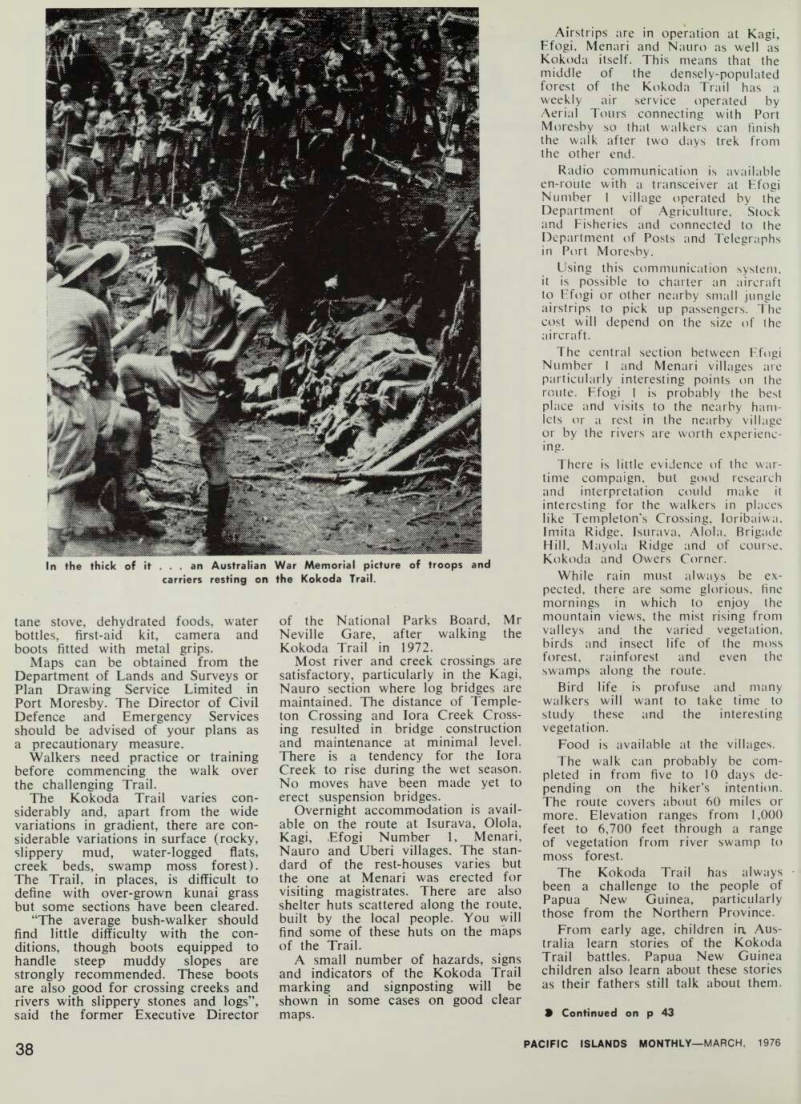

The Kokoda Trail, A Great Track
To Take-If You Don't Weaken!
Kokoda is a pleasant community in a delightful mountain valley, worth a visit for its scenery alone even if it were not the scene of some of the most gallant actions in World War 11.
Some mornings when you wake up the forest is wet and dripping with rain and the ground is muddy underfoot.
Sometimes the sun is fiercely hot as soon as it rises and, by eight o’clock, dust and heat are pressing around you.
On the wet days leeches and in sects hiding in the long grass wriggle through the eyelets of your boots and bite into your flesh.
On the hot days the sun burns your nose bright red.
Kokoda has no public accommo dation or facilities for tourists. How ever, it has a weekly air service from Port Moresby and air charters can be arranged.
One way to see the Kokoda Trail is to fly to Kokoda and walk to Port Moresby over the unbelievably im possible terrain, slippery mud, water logged flats, creek beds and swamp moss forest where the 39th Battalion earned fame. Should you respond to this challenge, remember that many people have tried and failed.
Kokoda means, for most people in Papua New Guinea, an heroic jungle campaign of World War 11, when Australian and other Allied troops succeeded in turning back a Japanese advance only 40 miles from Port Moresby.
But the Japanese attack had been going on for more than two months then. It started 33 years ago on July 21, 1942, with a landing at Basabua, a beach near Gona on the north coast of the Northern Province.
The first group of invaders con sisted of about 3,000 Japanese troops with more than 1,000 native carriers and some horses. Lightly equipped for quick progress, they set off im mediately for Kokoda where the mountain pack-track started. Some rode bicycles. Soon after, the main Japanese force followed.
The Kokoda Trail , a pleasant track meander ing over Papua I\ew Guinea’s Owen Stanley Range or a blood-soaked battlefield writ large in Australian military his tory, Maclaren Hiari , a Papua ISew Guinea jour nalist, in this keenly researched article , takes PlM’s readers , tourists or pilgrims , along the trail , supplies history and hints on how to make the journey with the least possible discomfort.
The attacking enemy force drove back a platoon of the 39th Battalion in a series of skirmishes, and occu pied Kokoda on July 29, after a fierce battle.
The 39th Battalion consisted of only 480 officers and men who, nevertheless, succeeded in recaptur ing Kokoda on August 8.
Within days, they were again driven out, having, for the second time, waited in vain for reinforce ments to be flown in.
Meanwhile, an AIF infantry bri gade had arrived at Port Moresby and was sent to help the forward troops. But it was unable to advance as a whole and, attacking in small units, was overrun and thrown back.
The Japanese pushed on towards Port Moresby.
Then Lt-General Rowell took over command of the New Guinea Force and improved organisation of sup plies, reserves and transport.
Throughout August and Septem ber, the Japanese continued to pour into the bases which they had now established on the north coast. By September 12, they had 5,000 men in the forward zone. Yet, only four days later, their advance on Port Moresby was halted and turned into a retreat.
They had just forced the Austra lians back from loribaiwa Ridge to Imita Ridge, within a long day’s march from Port Moresby.
Then reinforcements arrived from a second AIF brigade. The enemy was ambushed and turned back. On November 2, the Australians, led by Major-General G. Vasey, recaptured Kokoda.
By January 23, 1943, Japanese resistance in Papua was at an end.
That’s what the history books say about the Kokoda Trail.
But, in the memory of those who lived through those dark days, the Kokoda campaign was more than a near-suicidal retreat under a vacil lating command, which somehow turned into victory.
The men who fought in Papua New Guinea look back on a time of greatness. They remember the unbelievable speed of the Japanese advance into Papua New Guinea and the way the enemy made light of the allegedly “impassable barrier” of the Owen Stanley Range.
They remember the physical misery of struggling and fighting along a steep, slippery, malarial jungle track which seemed never ending to soldiers fighting against impossible odds.
They remember the wounded who were agonisingly carried on stretchers along this track.
But most of all they remember the cheerfulness of their comrades— and their incredible courage in battle.
Today, the Returned Servicemen’s League has built a war museum at the southern end of the Kokoda Trail which was turned into a national walking track in 1972, to give pleasure to tourists and the people of this country.
But the name Kokoda will always spell courage and heroism to those who remember.
Today, trail walkers are required to carry a load-weight of no more than 17 kilograms. This includes a lightweight sleeping bag or blanket, waterproof ground sheet, small bu-
tane stove, dehydrated foods, water bottles, first-aid kit, camera and boots fitted with metal grips.
Maps can be obtained from the Department of Lands and Surveys or Plan Drawing Service Limited in Port Moresby. The Director of Civil Defence and Emergency Services should be advised of your plans as a precautionary measure.
Walkers need practice or training before commencing the walk over the challenging Trail.
The Kokoda Trail varies considerably and, apart from the wide variations in gradient, there are considerable variations in surface (rocky, slippery mud, water-logged flats, creek beds, swamp moss forest).
The Trail, in places, is difficult to define with over-grown kunai grass but some sections have been cleared.
“The average bush-walker should find little difficulty with the conditions, though boots equipped to handle steep muddy slopes are strongly recommended. These boots are also good for crossing creeks and rivers with slippery stones and logs”, said the former Executive Director
of the National Parks Board, Mr Neville Gare, after walking the Kokoda Trail in 1972.
Most river and creek crossings are satisfactory, particularly in the Kagi, Nauro section where log bridges are maintained. The distance of Temple ton Crossing and lora Creek Crqss ing resulted in bridge construction and maintenance at minimal level.
There is a tendency for the lora Creek to rise during the wet season, No moves have been made yet to erect suspension bridges, Overnight accommodation is avail able on the route at Isurava, Olola, Kagi, .Efogi Number 1, Menari, Nauro and Überi villages. The stan dard of the rest-houses varies but the one at Menari was erected for visiting magistrates. There are also shelter huts scattered along the route, built by the local people. You will find some of these huts on the maps of the Trail.
A small number of hazards, signs and indicators of the Kokoda Trail marking and signposting will be shown in some cases on good clear maps.
Airstrips are in operation at Kagi, Efogi, Menari and Nauro as well as Kokoda itself. This means that the middle of the densely-populated forest of the Kokoda Trail has a weekly air service operated by Aerial Tours connecting with Port Moresby so that walkers can finish the walk after two days trek from the other end.
Radio communication is available en-rolite with a transceiver at Efogi Number 1 village operated by the Department of Agriculture, Stock and Fisheries and connected to the Department of Posts and Telegraphs in Port Moresby.
Using this communication system, it is possible to charter an aircraft to Efogi or other nearby small jungle airstrips to pick up passengers. The cost will depend on the size of the aircraft.
The central section between Efogi Number 1 and Menari villages are particularly interesting points on the route. Efogi 1 is probably the best place and visits to the nearby ham lets or a rest in the nearby village or by the rivers are worth experienc ing.
There is little evidence of the war time compaign, but good research and interpretation could make it interesting for the walkers in places like Templeton’s Crossing, loribaiwa, Imita Ridge, Isurava, Alola, Brigade Hill, Mayola Ridge and of course, Kokoda and Owers Corner.
While rain must always be ex pected, there are some glorious, fine mornings in which to enjoy the mountain views, the mist rising from valleys and the varied vegetation, birds and insect life of the moss forest, rainforest and even the swamps along the route.
Bird life is profuse and many walkers will want to take time to study these and the interesting vegetation.
Food is available at the villages.
The walk can probably be com pleted in from five to 10 days de pending on the hiker’s intention.
The route covers about 60 miles or more. Elevation ranges from 1,000 feet to 6,700 feet through a range of vegetation from river swamp to moss forest.
The Kokoda Trail has always been a challenge to the people of Papua New Guinea, particularly those from the Northern Province.
From early age, children ia Aus tralia learn stories of the Kokoda Trail battles. Papua New Guinea children also learn about these stories as their fathers still talk about them.
Continued on p 43
In the thick of it ... an Australian War Memorial picture of troops and carriers resting on the Kokoda Trail.
The Ilimo Local Government Council of Kokoda Sub-Province, is vitally interested in this history.
The council president, Mr Dick son Hango, believes the history of the trail should be preserved as a memorial to the men from Papua New Guinea who lost their lives on it.
One month before the Indepen dence celebrations last September, the Ilimo councillors were celebrat ing the completion of another suc cessful trail walk, the third annual Kokoda Trail walk which attracted 50 contestants from the Northern Province.
Prizes of KlOO each for the fastest man and woman and K5O for the second fastest were the attraction.
Last year’s winner, Mr Lancelott Angita, of Kanga Village near Ko koda, broke his previous record by walking from Owers Corner to Kokoda in 31 hours five minutes.
His old record was 52 hours five minutes.
The winner of the women’s prize was Vera Ilua of Kokoda Plantation, in 53 hours 15 minutes.
Anyone who has slogged through these mountains will know how good these times are.
Mr Hango believes the preservation t)f the Kokoda Trail should go hand
in hand with the continued economic development of the Kokoda Sub- Province area.
Interest in walking the Trail began after the bishops’ walk in May, 1972.
Bishop Ravu Henao, of the United Church, who walked the Trail with the head of the Anglican Church in Papua New Guinea, Bishop David Hand, and the Anglican Archbishop of Sydney, Archbishop Marcus Loane, described the walk as “a big event tying together the people of all churches”.
Archbishop Loane said he regarded the walk as a move to focus the
eyes of Australians and Papua New Guineans on the emerging native leadership in Papua New Guinea.
Meanwhile, an appeal to raise funds for the protection and pre servation of the Kokoda Trail is gaining strong support from council individuals, social organisations and private firms throughout Papua New Guinea.
The appeal was launched by the Ilimo Council after last year’s walk.
So far, the Ilimo Council has received K5OO towards the appeal.
The council will also be sending out letters to the Returned Service men’s League and overseas organis ations for donations.
The council, which has already donated K2OO, will make arrange ments with the Hiri Council in Port Moresby to build a shelter at Owers Corner.
Donations will be used to protect and preserve the Kokoda Trail in cluding the building of shelter huts and signposts along the route for hikers.
The Kokoda Trail is now becom ing world-renowned as a route over which both Papua New Guineans and overseas visitors could test their fitness, their determination and their ability to walk together as a team in difficult conditions.
One of the bronze plaques on the Kokoda monument, which honours the native carriers who made a large con tribution to the success of the campaign.
Advertisements & other items, pp. 39-43 (2 items)
Statesman
simai
'W
smoothest cigars on
the international scene
1801 ns ■■ B&-
STATESMAN
CORONA
5
Corona
X554-10/75
w u Km ■ * n » * V * »* •<
Mi it
£ m * % ✓ <jp« - The Toyota truck range.
Built to be unbeatable.
Bad weather conditions, no problem.
Bad roads and driving surfaces, eaten up.
Difficult loads, no contest.
Built tough. Built to take it.
There's a Toyota truck built for you. f TOYOTA Land Cruiser Pickup
TOYOTA Hi-Ace
TOYOTA Stout
TOYOTA Hi-Lux
TOYOTA Dyna
r- TOYOTA Toyo-Ace TOYOTA Truck For unbeatable after service:
TOYOTA
ELA MOTORS LIMITED, Scratchley Rd., Badili, P.O. Box 75, Port Moresby. U.S. TRUST TERRITORY: MICROL CORPORATION, •°’ ®°l 26 „ 7^ Sa . IR f"' f IJI [SLANDS: AUTOMOTIVE SUPPLIES CO., LTD., G.P.O. Box 355, Suva. AMERICAN SAMOA: BURNS PHILP (SOUTH SEA) pn" 1057'I 057 ' Pa9 ° WESTBHM SAMOA: BURNS PHILP (SOUTH SEA) LTD., P.O. Box 188, Apia. GUAM: ATKINS. KROLL (GUAM) LTD., /c i i ß .°xn 4 i B A T o mUn NEW HEBR,DES: NEW HEBRIDES MOTORS LTD., P.O. Box 18, Vila. SOLOMON ISLANDS: MENDANA ENTERPRISES xr, ' 1?4, Honiara - TAH,TI: NIPPON AUTOMOTO, B.P. 342, Papeete. COOK ISLANDS: COOK ISLANDS TRADING CORPORATION o o* o x ’ Raroton 9 a - NAURU ISLAND: NAURU COOPERATIVE SOCIETY. GILBERT & ELLICE ISLANDS COLONY: TARAWA MOTORS Ba .' r ' kRI E S NORFOLK TOURS, LTD., P.O. Box 276. TIMOR: SANG TAI HOO. Sang Tai Building. Dili. NEW CALEDONIA: SOCIETE IMPORTATION AUTOMOBILE DU PACIFIQUE. Rond-Point du Pacific (Station Total) B.P. 438, Noumea.
Fast...efficient...reliable...
SPEED-E-GAS
* A
SPEEDE6AS
w * • * n 3 9 9 The Gas Supply Company Limited, a member of the major Australian Boral Group of Companies is associated with a network of bulk storage terminals distributing SPEED-E-GAS throughout the Pacific region.
Terminals at Port Moresby, Lae, Rabaul, Kieta,Wewak, Honiara, Santo, Suva, Lautoka, Nukualofa and Rarotonga now supply fast efficient SPEED-E-GAS for industrial, commercial and domestic requirements in these areas.
SPEED-E-GAS is completely dependable and highly efficient fuel, so vital to the development of modern living.
SPEEDEGAS
The Gas Supply Company Limited Head Office, 221 Miller Street North Sydney 2060 Phone 92-0951 A member of the IBDRALI Group * SPEED-E-GAS is known in Papua New Guinea as GUINEA GAS, in Tonga as TONGA SPEED-E-GAS and in Fiji as FIJI-GAS
1
TII4VI.F
T3 7 "
EXPORTERS TO THE PACIFIC ISLANDS
Breckwoldt & Co Pty Ltd
276 Pitt Street, Box 5027, G.P.O. Sydney 2001
CABLE ADDRESS; BREWO SYDNEY TELEX AA22890.
TELEPHONES: 61-7110 61-8674 26-6893
Pacific Island Branches:
P.O. BOX 1549, BOROKO, PORT MORESBY.
P.O. BOX 222, RABAUL P.O. BOX 185, MADANG.
P.O. BOX 72, KIETA. P.O. BOX 237, MT. HAGEN P.O. BOX 178, WEWAK. P.O. BOX 1188, LAE.
BRECKWOLDT & CO., P.O. BOX 47, APIA.
BRECKWOLDT & CO. (5.1.) LTD., P.O. BOX 140, HONIARA.
BRECKWOLDT S.A.R.L. B.P. 2369, NOUMEA.
Offices in Europe: Hamburg, London, Milan and West Africa as well as Singapore, Kuala Lumpur.
Bangkok and Hong Kong.
Enquiries from Australian Manufacturers invited.
43
»ACIFIC ISLANDS MONTHLY—MARCH. 1976
Yesterday
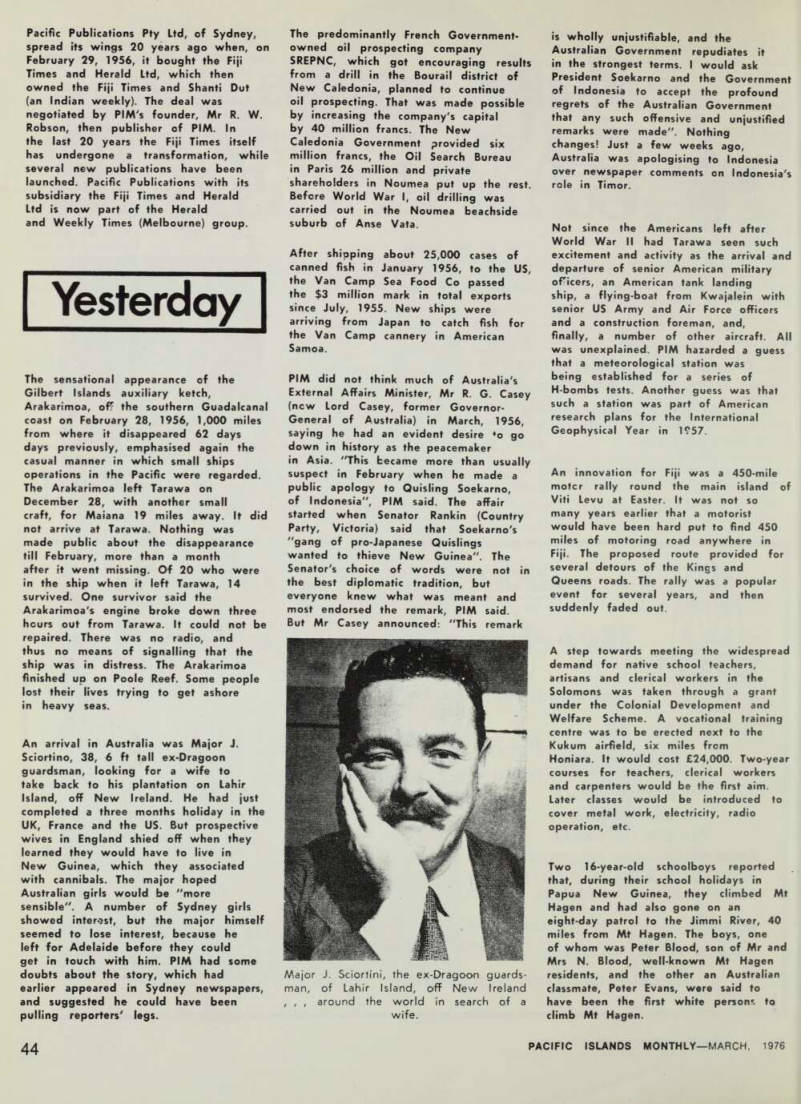
Pacific Publications Pty Ltd, of Sydney, spread its wings 20 years ago when, on February 29, 1956, it bought the Fiji Times and Herald Ltd, which then owned the Fiji Times and Shanti Out (an Indian weekly). The deal was negotiated by PlM's founder, Mr R. W.
Robson, then publisher of PIM. In the last 20 years the Fiji Times itself has undergone a transformation, while several new publications have been launched. Pacific Publications with its subsidiary the Fiji Times and Herald Ltd is now part of the Herald and Weekly Times (Melbourne) group.
The sensational appearance of the Gilbert Islands auxiliary ketch, Arakarimoa, off the southern Guadalcanal coast on February 28, 1956, 1,000 miles from where it disappeared 62 days days previously, emphasised again the casual manner in which small ships operations in the Pacific were regarded.
The Arakarimoa left Tarawa on December 28, with another small craft, for Maiana 19 miles away. It did not arrive at Tarawa. Nothing was made public about the disappearance till February, more than a month after it went missing. Of 20 who were in the ship when it left Tarawa, 14 survived. One survivor said the Arakarimoa's engine broke down three hours out from Tarawa. It could not be repaired. There was no radio, and thus no means of signalling that the ship was in distress. The Arakarimoa finished up on Poole Reef. Some people lost their lives trying to get ashore in heavy seas.
An arrival in Australia was Major J.
Sciortino, 38, 6 ft tall ex-Dragoon guardsman, looking for a wife to take back to his plantation on Lahir Island, off New Ireland. He had just completed a three months holiday in the UK, France and the US. But prospective wives in England shied off when they learned they would have to live in New Guinea, which they associated with cannibals. The major hoped Australian girls would be "more sensible". A number of Sydney girls showed interest, but the major himself seemed to lose interest, because he left for Adelaide before they could get in touch with him. PIM had some doubts about the story, which had earlier appeared in Sydney newspapers, and suggested he could have been pulling reporters' legs.
The predominantly French Government owned oil prospecting company SREPNC, which got encouraging results from a drill in the Bourail district of New Caledonia, planned to continue oil prospecting. That was made possible by increasing the company's capital by 40 million francs. The New Caledonia Government provided six million francs, the Oil Search Bureau in Paris 26 million and private shareholders in Noumea put up the rest.
Before World War I, oil drilling was carried out in the Noumea beachside suburb of Anse Vata.
After shipping about 25,000 cases of canned fish in January 1956, to the US, the Van Camp Sea Food Co passed the $3 million mark in total exports since July, 1955. New ships were arriving from Japan to catch fish for the Van Camp cannery in American Samoa.
PIM did not think much of Australia's External Affairs Minister, Mr R. G. Casey (new Lord Casey, former Governor- General of Australia) in March, 1956, saying he had an evident desire *o go down in history as the peacemaker in Asia. 'This became more than usually suspect in February when he made a public apology to Quisling Soekarno, of Indonesia", PIM said. The affair started when Senator Rankin (Country Party, Victoria) said that Soekarno's "gang of pro-Japanese Quislings wanted to thieve New Guinea". The Senator's choice of words were not in the best diplomatic tradition, but everyone knew what was meant and most endorsed the remark, PIM said.
But Mr Casey announced: "This remark
is wholly unjustifiable, and the Australian Government repudiates it in the strongest terms. I would ask President Soekarno and the Government of Indonesia to accept the profound regrets of the Australian Government that any such offensive and unjustified remarks were made". Nothing changes! Just a few weeks ago, Australia was apologising to Indonesia over newspaper comments on Indonesia's role in Timor.
Not since the Americans left after World War II had Tarawa seen such excitement and activity as the arrival and departure of senior American military officers, an American tank landing ship, a flying-boat from Kwajalein with senior US Army and Air Force officers and a construction foreman, and, finally, a number of other aircraft. All was unexplained. PIM hazarded a guess that a meteorological station was being established for a series of H-bombs tests. Another guess was that such a station was part of American research plans for the International Geophysical Year in 1957.
An innovation for Fiji was a 450-mile motcr rally round the main island of Viti Levu at Easter. It was not so many years earlier that a motorist would have been hard put to find 450 miles of motoring road anywhere in Fiji. The proposed route provided for several detours of the Kings and Queens roads. The rally was a popular event for several years, and then suddenly faded out.
A step towards meeting the widespread demand for native school teachers, artisans and clerical workers in the Solomons was taken through a grant under the Colonial Development and Welfare Scheme. A vocational training centre was to be erected next to the Kukum airfield, six miles from Honiara. It would cost £24,000. Two-year courses for teachers, clerical workers and carpenters would be the first aim.
Later classes would be introduced to cover metal work, electricity, radio operation, etc.
Two 16-year-old schoolboys reported that, during their school holidays in Papua New Guinea, they climbed Mt Hagen and had also gone on an eight-day patrol to the Jimmi River, 40 miles from Mt Hagen. The boys, one of whom was Peter Blood, son of Mr and Mrs N. Blood, well-known Mt Hagen residents, and the other an Australian classmate, Peter Evans, were said to have been the first white persons to climb Mt Hagen.
Major J. Sciortini, the ex-Dragoon guards man, of Lahir Island, off New Ireland ... around the world in search of a wife.
Advertisements & other items, p. 45 (1 item)
No matter which
way you look at it. . . you’ll find. . .
KLEVKII
is the finest allpurpose ply for building in hot and humid conditions.
Made by Commonwealth N.G.
Timbers Ltd and available from leading plywood suppliers.
Outpost of Empire—a vanishing
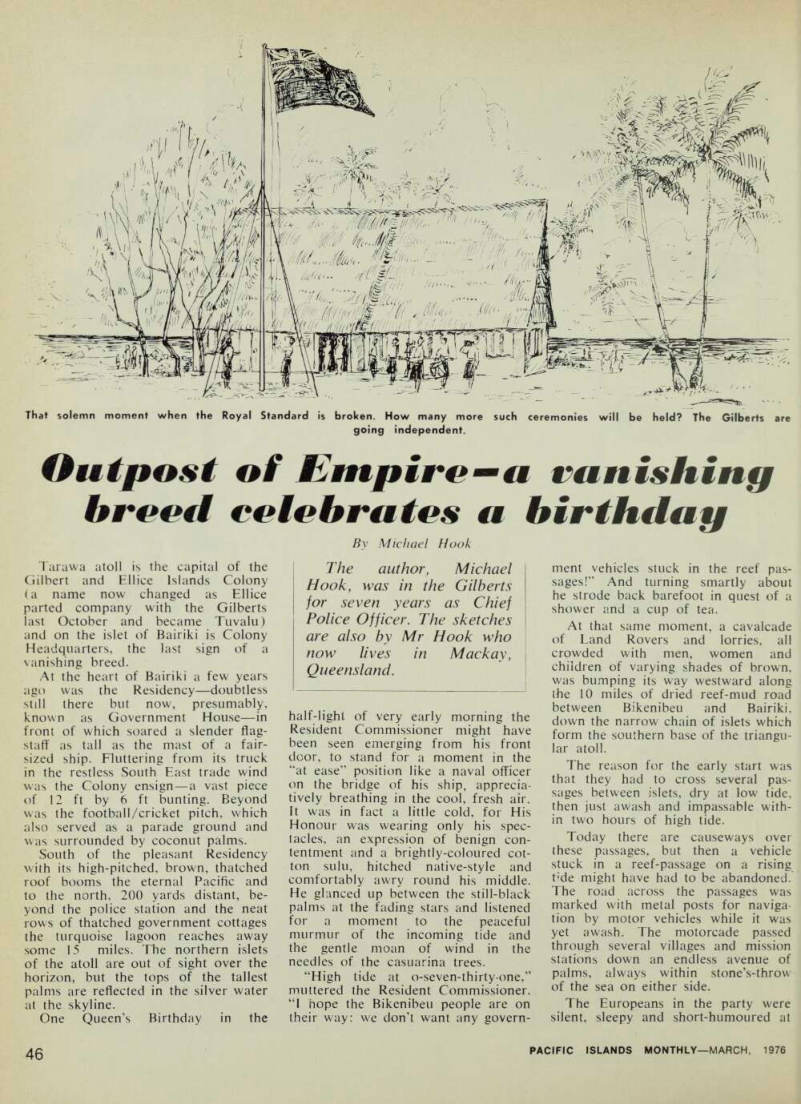
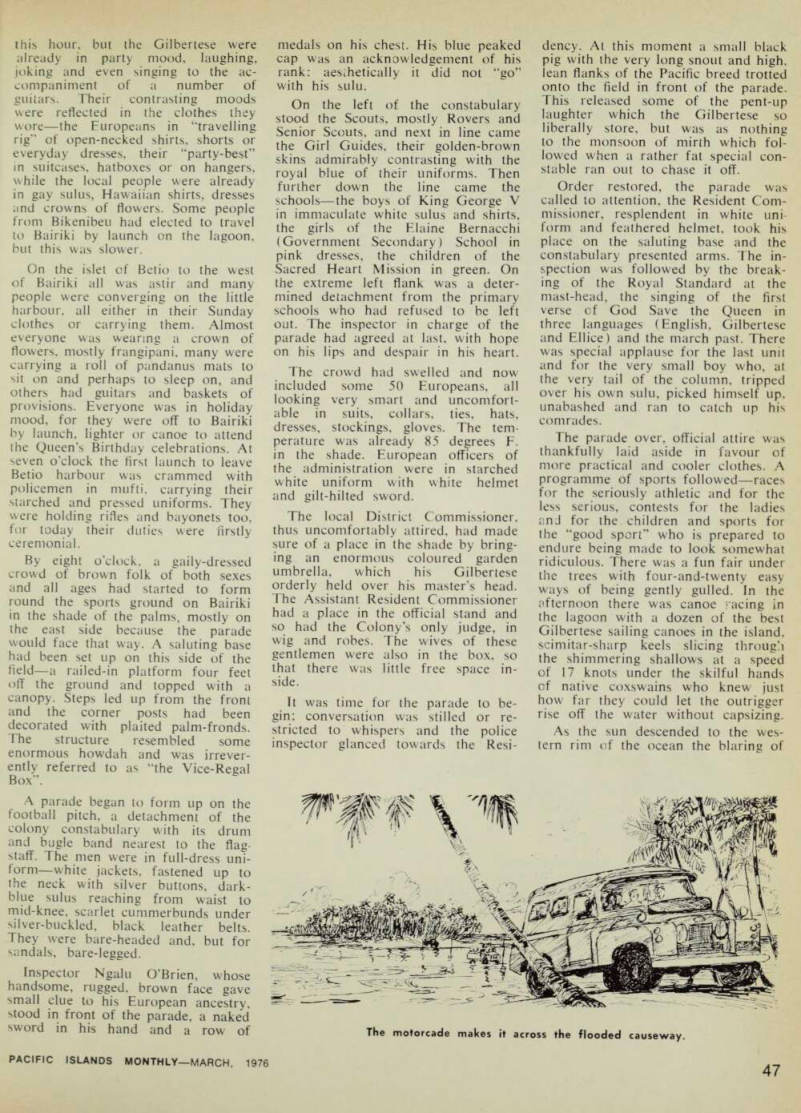
hree celebrates a birthday
By Michael Hook
Tarawa atoll is the capital of the Gilbert and Ellice Islands Colony (a name now changed as Ellice parted company with the Gilberts last October and became Tuvalu) and on the islet of Bairiki is Colony Headquarters, the last sign of a vanishing breed.
At the heart of Bairiki a few years ago was the Residency—doubtless still there but now, presumably, known as Government House—in front of which soared a slender flag staff as tall as the mast of a fair sized ship. Fluttering from its truck in the restless South East trade wind was the Colony ensign—a vast piece of 12 ft by 6 ft bunting. Beyond was the football/cricket pitch, which also served as a parade ground and was surrounded by coconut palms.
South of the pleasant Residency with its high-pitched, brown, thatched roof booms the eternal Pacific and to the north, 200 yards distant, be yond the police station and the neat rows of thatched government cottages the turquoise lagoon reaches away some 15 miles. The northern islets of the atoll are out of sight over the horizon, but the tops of the tallest palms are reflected in the silver water at the skyline.
One Queen’s Birthday in the
The author, Michael Hook, was in the Gilberts for seven years as Chief Police Officer. The sketches are also by Mr Hook who now lives in Mackay, Queensland.
half-light of very early morning the
Resident Commissioner might have been seen emerging from his front door, to stand for a moment in the “at ease” position like a naval officer on the bridge of his ship, apprecia tively breathing in the cool, fresh air.
It was in fact a little cold, for His Honour was wearing only his spec tacles, an expression of benign con tentment and a brightly-coloured cot ton sulu, hitched native-style and comfortably awry round his middle.
He glanced up between the still-black palms at the fading stars and listened for a moment to the peaceful murmur of the incoming tide and the gentle moan of wind in the needles of the casuarina trees.
“High tide at o-seven-thirty-one,” muttered the Resident Commissioner.
“1 hope the Bikenibeu people are on their way: we don't want any govern
ment vehicles stuck in the reef pas sages!” And turning smartly about he strode back barefoot in quest of a shower and a cup of tea.
At that same moment, a cavalcade of Land Rovers and lorries, all crowded with men, women and children of varying shades of brown, was bumping its way westward along the 10 miles of dried reef-mud road between Bikenibeu and Bairiki. down the narrow chain of islets which form the southern base of the triangu lar atoll.
The reason for the early start was that they had to cross several pas sages between islets, dry at low tide, then just awash and impassable with in two hours of high tide.
Today there are causeways over these passages, but then a vehicle stuck in a reef-passage on a rising t : de might have had to be abandoned.
The road across the passages was marked with metal posts for naviga tion by motor vehicles while it was yet awash. The motorcade passed through several villages and mission stations down an endless avenue of palms, always within stone’s-throw of the sea on either side.
The Europeans in the party were silent, sleepy and short-humoured at
That solemn moment when the Royal Standard is broken. How many more such ceremonies will be held? The Gilberts are going independent.
this hour, but the Gilbertese were already in party mood, laughing, joking and even singing to the ac companiment of a number of guitars. Their contrasting moods were reflected in the clothes they wore—the Europeans in “travelling rig” of open-necked shirts, shorts or everyday dresses, their “party-best” in suitcases, hatboxes or on hangers, while the local people were already in gay sulus, Hawaiian shirts, dresses and crowns of flowers. Some people from Bikenibeu had elected to travel to Bairiki by launch on the lagoon, but this was slower.
On the islet of Betio to the west of Bairiki all was astir and many people were converging on the little harbour, all either in their Sunday clothes or carrying them. Almost everyone was wearing a crown of flowers, mostly frangipani, many were carrying a roll of pandanus mats to sit on and perhaps to sleep on, and others had guitars and baskets of provisions. Everyone was in holiday mood, for they were off to Bairiki by launch, lighter or canoe to attend the Queen’s Birthday celebrations. At seven o’clock the first launch to leave Betio harbour was crammed with policemen in mufti, carrying their starched and pressed uniforms. They were holding rifles and bayonets too, for today their duties were firstly ceremonial.
By eight o'clock, a gaily-dressed crowd of brown folk of both sexes and all ages had started to form round the sports ground on Bairiki in the shade of the palms, mostly on the east side because the parade would face that way. A saluting base had been set up on this side of the field—a railed-in platform four feet off the ground and topped with a canopy. Steps led up from the front and the corner posts had been decorated with plaited palm-fronds.
The structure resembled some enormous howdah and was irrever ently referred to as “the Vice-Regal Box”.
A parade began to form up on the football pitch, a detachment of the colony constabulary with its drum and bugle band nearest to the flag staff. The men were in full-dress uni form—white jackets, fastened up to the neck with silver buttons, dark blue sulus reaching from waist to mid-knee, scarlet cummerbunds under silver-buckled, black leather belts.
They were bare-headed and, but for sandals, bare-legged.
Inspector Ngalu O’Brien, whose handsome, rugged, brown face gave small clue to his European ancestry, stood in front of the parade, a naked sword in his hand and a row of
medals on his chest. His blue peaked cap was an acknowledgement of his rank: aesthetically it did not “go” with his sulu.
On the left of the constabulary stood the Scouts, mostly Rovers and Senior Scouts, and next in line came the Girl Guides, their golden-brown skins admirably contrasting with the royal blue of their uniforms. Then further down the line came the schools—the boys of King George V in immaculate white sulus and shirts, the girls of the Elaine Bernacchi (Government Secondary) School in pink dresses, the children of the Sacred Heart Mission in green. On the extreme left flank was a deter mined detachment from the primary schools who had refused to be left out. The inspector in charge of the parade had agreed at last, with hope on his lips and despair in his heart.
The crowd had swelled and now included some 50 Europeans, all looking very smart and uncomfort able in suits, collars, ties, hats, dresses, stockings, gloves. The tem perature was already 85 degrees F. in the shade. European officers of the administration were in starched white uniform with white helmet and gilt-hilted sword.
The local District Commissioner, thus uncomfortably attired, had made sure of a place in the shade by bring ing an enormous coloured garden umbrella, which his Gilbertese orderly held over his master’s head.
The Assistant Resident Commissioner had a place in the official stand and so had the Colony’s only judge, in wig and robes. The wives of these gentlemen were also in the box, so that there was little free space in side.
It was time for the parade to be gin; conversation was stilled or re stricted to whispers and the police inspector glanced towards the Resi
dency. At this moment a small black pig with the very long snout and high, lean flanks of the Pacific breed trotted onto the field in front of the parade.
This released some of the pent-up laughter which the Gilbertese so liberally store, but was as nothing to the monsoon of mirth which fol lowed when a rather fat special con stable ran out to chase it off.
Order restored, the parade was called to attention, the Resident Com missioner, resplendent in white uni form and feathered helmet, took his place on the saluting base and the constabulary presented arms. The in spection was followed by the break ing of the Royal Standard at the mast-head, the singing of the first verse of God Save the Queen in three languages (English, Gilbertese and Ellice) and the march past. There was special applause for the last unit and for the very small boy who, at the very tail of the column, tripped over his own sulu, picked himself up, unabashed and ran to catch up his comrades.
The parade over, official attire was thankfully laid aside in favour of more practical and cooler clothes. A programme of sports followed—races for the seriously athletic and for the less serious, contests for the ladies and for the children and sports for the “good sport” who is prepared to endure being made to look somewhat ridiculous. There was a fun fair under the trees with four-and-twenty easy ways of being gently gulled. In the afternoon there was canoe racing in the lagoon with a dozen of the best Gilbertese sailing canoes in the island,
scimitar-sharp keels slicing through
the shimmering shallows at a speed of 17 knots under the skilful hands of native coxswains who knew just how far they could let the outrigger rise off the water without capsizing.
As the sun descended to the wes tern rim of the ocean the blaring of
The motorcade makes it across the flooded causeway.
bugles and the drubbing of drums were heard from the direction of Bairiki Police Station as a contingent of the constabulary marched smartly across the football field towards the Residency. As they halted at the foot of the flagstaff, two men moved for ward and uncleated the halyard. The onlookers fell silent and, to the stir ring notes of “Sunset” from the buglers and a roll from the drum mers, the sun and the flag sank together.
Presently, from the Residency came the pleasant buzz of conver sation and soda syphon, the tinkle of ice and laughter and the sane silence of contented thoughts and good cigars. The pleasant, spacious living-room and the patio outside, close above the ocean reef and under coloured lights strung between the tall palms, were astir with guests both brown and white.
By mid-evening the large open sided maneaba on the west boundary of the football ground was so full of people that scarcely enough room had been left for the performers at the bat ere (the island night’s enter tainment which always rounds off any day of festivity). The Resident Commissioner and his party sat in chairs on one side: they were in evening dress and wore crowns of flowers which had been cere moniously placed upon their heads by a swirling chorus of Ellice Island girls.
Here on Tarawa, where civil ser vants were drawn from every part of the Colony, space on the programme was shared between the groups from different islands. This made for great variety—from the formal ruoia (a rhythmic graceful movement of the arms and body while seated cross legged) of the Gilbertese to the tempestuous, rollicking, gayer and (perhaps to Westerners) more typi cally “South Sea” songs and dances of the Polynesians from the Ellice Islands. In all these the well-thumped drum, quickening to a crescendo, played a big part. Some of the songs were sad, some gay, most old, some new, and all required a “chorus” of young men and women to sing and sway and clap and swirl from an otherwise stationary line behind the principal performers.
Until late, the melodies and clap ping and thumping continued, long after the visitors from Bikenibeu had left on their long trek homeward and those from Betio had set their course westward over the dark-bright waters of the lagoon and down that magic path of silver moonlight, lulled by the lilt of the waves and the quiet crooning of a guitar.
Advertisements & other items, p. 48 (1 item)
Ikavelodge offers
■ you a whole
sight more in
Australia and
the South Pacific
i J 3 1 a J. £ v Right around the South Pacific you’ll find international standard Travelodge where the sights are ...where the action is.
And that’s where you’ll want to stay-to see the things, do the things you wish without moving too far from your room.
Friendly Travelodge offers the best in accommodation, service, food and value for money.
So book Travelodge. You’ll get a whole sight more. • Australia • New Zealand
• Fiji
• Tahiti • New Caledonia • Papua New Guinea • Indonesia
'RAVE/ODCE CARE
RESERVATIONS; for any one of 7O Travelodges in Australia, Fiji, New Zealand, Papua New Guinea, Tahiti, Japan & Indonesia:-. Australia: Sydney (02) 31.0601: Adelaide (08) 223.6194: Melbourne (03) 387.1233: Perth (092) 25.3811: Brisbane (072) 21.8586: Hobart (002) 34.2911: Canberra (062) 49.1424: Darwin 81.5388. U.K. (London): Trust Houses Forte (01) 567.3444. Japan (Tokyo); Travelodge Branch Office (03) 214.0961. Fiji: Travelodge Reservations, Suva 2.4600. Hong Kong: Travelodge Reservations 522.2251. U.S.A. (Toll Free): Travelodge International Inc. (800) 255.3050.
N.Z. (Auckland): Travelodge Reservations 374.108.
OR YOUR TRAVEL AGENT
TR99/75
Books, Reviews, writers
Putting The Papua New Guinean
Businessman Under A Microscope
Many adult Papua New Guineans have been or are involved in one or more commercial ventures, usually as shareholders.
Since World War 11, about 200,000 people have joined co-operatives and tens of thousands have invested in companies, partnerships and other forms of business enterprise.
Some of the organisers and parti cipants have followed the advice of government officers or expatriate entrepreneurs, but many have tried to operate in a traditional way or by seeking a compromise of the two.
Almost invariably, the people expected far more than any type and form of business enterprise could provide, and they often lost interest and withdrew their support when their expectations were not fulfilled.
Many ventures failed because of inadequate budgeting, undercapitalis ation and lack of trained personnel.
Too many were started without reasonable market prospects and/or the capacity and management to fight expatriate competitors. And prestige, not service or profit, was often the main objective.
Many Papua New Guineans and some foreign observers see the total ity of past indigenous business development as one of failure. They overlook that the mere existence of indigenous enterprises has been a brake on exploitation, especially of primary producers, and that very many Papua New Guineans have gained much of the commercial knowledge and experience necessary if their country is to achieve a fair degree of economic autarky and to compete with other nations.
They also overlook that similar enterprises in other countries have a fairly high failure rate, too.
As there is not enough inform ation, eg statistics of the financial results of sole traders, partnerships and unregistered companies, to compare the overall effectiveness of businesses owned and operated by Papua New Guineans with that of like businesses in other countries, in-depth studies of individual enter prises are badly needed.
Between September, 1970, and April, 1972, Miss Andrews, an anthropologist, studied 30 non traditional commercial ventures wholly or jointly owned and operated by Papua New Guineans in Port Moresby.
In Business and Bureaucracy, she sets out “to describe firstly, the nature and extent of Papua New Guinean participation in business in Port Moresby and, secondly, its relation to the processes of official policy formulation and implement ation”.
Her case studies deal with the social environment in which the entrepreneurs operated and with their relationship with the main government agencies of relevance, the Department of Business Develop
ment and the PNG Development Bank.
This is a sociological study. It contains almost nothing concerning the business environment, let alone the financing, management and economic results of the enterprises.
The author deals with a situation which, in regard to government sponsorship, advice and assistance, commercial legislation and other relevant matters, does no longer pre vail.
Not only the Department of Busi ness Development and PNG Develop ment Bank, but the whole of the Public Service and statutory bodies are now in the hands of Papua New Guineans, and there is a national policy to give them control over their country’s economy—including, of course, internal commerce.
Neither those involved in the businesses reported on, eg Mr Gau Pako of Mirikuro Transport or Mr Francis Ovu of Allied Enterprises, nor any business development officer or bank official with whom they dealt, will learn anything new from reading that “to belong to an alien business culture is a complex process (for Papua New Guineans)”.
And they will not be surprised to read that “the theme of wantok (traditional socio-economic obliga tions) pervades much of immigrant Papua New Guinea thinking and social action ... in Port Moresby” and enmeshes Motu, Koita and other ‘original’ entrepreneurs alike.
The author states that the colonial government’s business development policy was based on an Australian model, and that many Papua New Guinean businessmen felt their pro gress hampered by certain aspects of that policy.
She recommends that the govern ment issue “flexible policy directives . . . to allow the emergence of a truly indigenous business culture”.
Like some other foreign academics, most of them without training and experience in business, the author makes this recommendation without explaining what kind of “truly in
digenous business culture” she has in mind.
The rapid improvement in their material standard of living wanted by just about every man and woman in Papua New Guinea requires greater productivity, more industrial isation and better management throughout the nation. The only non-Western people who have achieved this without forfeiting their personal freedom, the Japanese, have organised their commercial and industrial enterprises very much along Western lines, at a consider able social cost. Understandably, Papua New Guinea’s policy makers and planners want to avoid the errors made by their counterparts in other nations.
Business and Bureaucracy is the second last of 60 research bulletins published by the New Guinea Re search Unit of the Australian National University. Commenced in 1963, the series has been one of the many fine achievements of the NGRU. Papua New Guinea’s new Institute of Applied Social and Economic Research, established by statute, has taken over the functions of the NGRU and will, no doubt, play an even greater role. —Harry Jackman
(Business And Bureaucracy. By C.
L. Andrews. Published by Australian National University, Canberra, 1975. $2.00).
A Back-Number!
There must be an extraordinary number of university students in need of a basic introductory survey of the South Pacific. Further, the University of Hawaii Press must be anticipating that stocks of the Doubleday Anchor printing of Douglas Oliver’s The Pacific Islands are nearly exhausted. Why else would another printing of this book be offered at a three dollars increase in price when copies of the 1961 printing are still available?
Oliver has not revised his work in over 14 years and in view of the enormous changes which have occurred since 1961 the re-issuing of his book without amendment appears completely unjustified.
It is to be hoped that an inexpen sive textbook, more comprehensive and systematic than Ron Cro combe’s The New South Pacific and more up-to-date than Oliver’s work, will soon be available for those students who may shortly be forced to accept a “classic” because there
is no alternative.
R. Herr.
(Douglas L. Oliver, THE PACIFIC ISLANDS (rev ed; Honolulu: University of Hawaii Press, 1961), $4.95).
Advertisements & other items, p. 50 (1 item)
Peter Fisher Trading
PTY. LTD.
321 PITT ST , SYDNEY, 2000, AUST.
PHONE 26-1109 CABLES: FISHERION", SYDNEY
EXPORTERS TO THE PACIFIC ISLANDS
Some of the firms and products we represent: GEORGE PAYNE chocolates KEIDON corned beef FAB waffles PRUE ACTON fragrances DROSTE chocolates
ALUMINIUM FOIL
GREENLITES waterproof matches MAURI BROS, yeast TOOHEYS beer
CLUB RUM
ROGOVI VODKA
FRENCH KNIT car seat covers CRAVEN confectionery ADVANCE containers HARDIE’S building products SEBEL furniture BEARD beds and mattresses KLINKII plywood STERLING bakery machinery OLD PROVOST Scotch whisky SPC tinned fruit LIFESAVERS confectionery
MACHETTES
ATLAS plastic ware LUCKY STAR tinned fish BOND’S underwear BOND’S outerwear ANDY spotlights COUNTRY CLUB shirts PAULCALL tools ASTRA razor blades WENGER quality knives DEROPA gift paper BRONTE tinned meat
SHEATH & POCKET KNIVES
SMALL’S chocolate GOLDSTEIN-Food equipment SHELLEY’S soft drinks TWISTIES rice snacks ERN MACKIE bakery equipment CHEEZELS cheese flavoured snacks HOECHST AUST. LTD. walk-in freezers HOECHST AUST. LTD. walk-in coolers DIALENE plastics CITADEL corned beef AMSTEL beer MILLAC milk powder
HARDBOARD
POLARIS stainless steel GLOBE corned beef PRUE ACTON cosmetics PRODUCE frozen meat
ICECREAM
CSR sugar
RICE
FLOUR
SPAM
BISCUITS AND CAKES
HAMILTON wines COCA-COLA products LETONA fruit juices OSCAR MAYER corned beef
AND MANY MORE
The Expectant Author
Well-known American author Walter Lord, who was in the South Pacific 12 months ago collecting in formation on wartime Coastwatching n the Solomons, is happy with pro gress on his manuscript, From his home in New York City recently Mr Lord wrote: “Gestation : or an elephant is 21 months .. . a rhinoceros, 15 months ... a pig, : our months ... a kangaroo, only M days; but giving birth to my book about the Coastwatchers in the Solo nons is a slower process.
“It has taken so long because I aave always wanted the book to be wen more than a record of the Coastwatchers themselves. They are he ‘stars’, but I also wanted to tell ibout the natives who helped them, he missionaries they worked with, he downed flyers and castaways they escued, the Marine patrols they guided, the pilots and submariners vho serviced them, even the Japan ese who chased them.
“To me, it’s this whole cast of
intriguing characters that gives the saga of the Coastwatchers its special appeal, that makes it almost an anachronism in modern war—a story where individual human beings are still important.
“This has meant a lot of digging. (How do you find a flyer who spent a few days on Vella Lavella 33 years ago?) It has also meant a lot of tra velling—37,ooo miles at last count.
And it has meant a lot of correspon dence. I’m in touch with 176 people in five different continents!
“Now the job is almost done. I’ve finished 11 of 12 chapters—about 105,000 words. There remain the problems of maps, illustrations, edit
ing, and especially checking. Many
Islands people will be hearing from me in the next month or so, as I try to get straight some point that I’ve missed.
“When the book comes out during 1976, I only hope they feel it does justice to all the time and trouble they’ve taken to help me”.
Flight to the towns

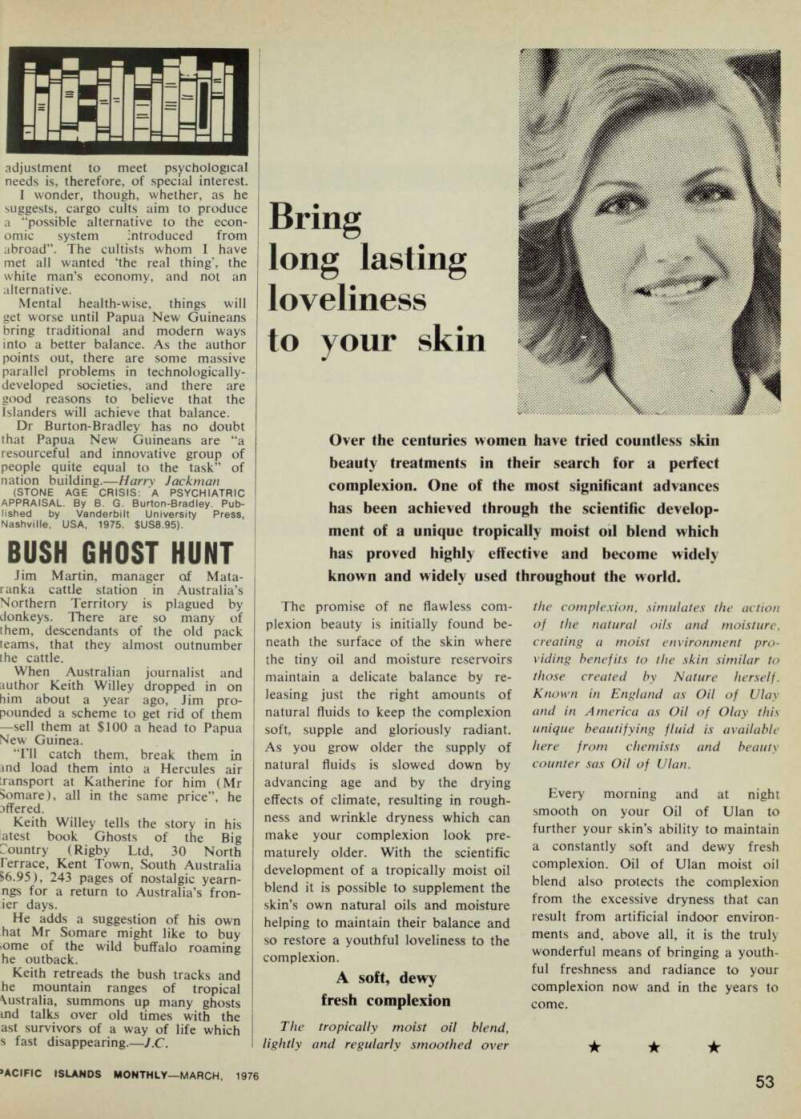
creates a health crisis
The first thing that struck me when, as newly-appointed official (non-medical) visitor, I walked around Laloki Psychiatric Centre in 1968, was that most of the patients were villagers.
Was rapid, poorly-planned urban isation not a mental health hazard, after all?
Well. Papua New Guinea’s National Health Plan 1974-78 indi cates a different situation today.
An increase in the number of mentally-ill persons, of men and women unable to conform to accepted community behaviour standards, is reflected in the more than doubling of admissions to government hospitals between 1968 and 1972.
And the Plan mentions marital discord, child neglect, juvenile de-
linquency, prostitution, alcoholism, crime, frequent changes of employ ment, and cargo cults—all but the last being prominent concomitants of urbanisation.
The burden on government mental health services is becoming heavier as people in the towns are finding it more difficult to manage mentally disturbed persons at home and are seeking medical help more often.
In countries with little industrial isation, mental health services in variably have a low priority and there is usually a dearth of qualified personnel. In Papua New Guinea, there were 102 persons with training and experience in psychiatry for a population of 2.2 million in 1973, and Dr Wilfred Moi, one of his country’s first medical graduates, and Dr Burton-Bradley, author of this book, were the only two psychiatrists.
Because he saw the need for a transcultural approach. Dr Burton- Bradley studied anthropology. In this small book, consisting of six lectures given in 1973, he looks at some of the causes and manifestations of mental disorders among the Islanders.
He stresses that an in-depth understanding of the Islanders' socio economic values and of the inter woven spiritual and temporal beliefs underlying those values is a sine-qua non for the practice of psychiatry.
It follows that Papua New Guinea must, first and foremost, look to the graduates of its universities and para medical institutions to undertake the urgently-needed expansion of mental health services.
Much of the writing about cargo cults has dealt with their societal aspects. Some scholars, eg Professor Lawrence and Dr Morauta, have considered the cults in the context of politics, and a few have looked at them as mechanisms to meet the people’s psychological needs.
It is highly indicative of the rapid changes in Papua New Guinea that church workers now refer to cults as ‘adjustment movements’ and recog nise them as facts of daily life.
To give but one example of this: the whole of the first issue in 1974 of Point, bi-annual magazine of the Melanesian Institute for Pastoral and Socio-Fconomic Service, a Roman Catholic organisation at Goroka. was given un to ‘The Church and Adjustment Movements’.
The author’s view of cults as an
adjustment to meet psychological needs is, therefore, of special interest.
I wonder, though, whether, as he suggests, cargo cults aim to produce a “possible alternative to the econ omic system introduced from abroad”. The cultists whom I have met all wanted ‘the real thing', the white man’s economy, and not an alternative.
Mental health-wise, things will get worse until Papua New Guineans bring traditional and modern ways into a better balance. As the author points out, there are some massive parallel problems in technologically developed societies, and there are good reasons to believe that the Islanders will achieve that balance.
Dr Burton-Bradley has no doubt that Papua New Guineans are “a resourceful and innovative group of people quite equal to the task” of nation building. —Harry Jackman
(Stone Age Crisis; 'A Psychiatric
APPRAISAL. By B. G. Burton-Bradley. Pub lished by Vanderbilt University Press, Nashville, USA, 1975. SUSB.9S).
Bush Ghost Hunt
Jim Martin, manager of Mata ranka cattle station in Australia’s Northern Territory is plagued by donkeys. There are so many of them, descendants of the old pack teams, that they almost outnumber the cattle.
When Australian journalist and author Keith Willey dropped in on him about a year ago, Jim pro pounded a scheme to get rid of them —sell them at $lOO a head to Papua New Guinea.
“I’ll catch them, break them In and load them into a Hercules air transport at Katherine for him (Mr Somare), all in the same price”, he affered.
Keith Willey tells the story in his atest book Ghosts of the Big Country (Rigby Ltd, 30 North Ferrace, Kent Town, South Australia 56.95), 243 pages of nostalgic yearn ngs for a return to Australia’s fron ier days.
He adds a suggestion of his own hat Mr Somare might like to buy some of the wild buffalo roaming he outback.
Keith retreads the bush tracks and he mountain ranges of tropical \ustralia, summons up many ghosts md talks over old times with the ast survivors of a way of life which
s fast disappearing.
j.c.
Advertisements & other items, p. 52 (1 item)
tiSi
Better Business
starts with
Australian Products.
Australian products have proven themselves the world over and can benefit you and your customers. The range of Australian products is wide and varied . . . from Agricultural Equipment, Pharmaceuticals, Telecommunications Equipment, Chemicals, Food and Wines to Building Materials, Motor Vehicles, Electrical and Hardware Goods, Automotive Accessories, Engineering and Mining Equipment, Fashions and Fabrics. Delivery times are sensible and prices are competitive, so when you think of development and expansion remember Australian products can assist you.
Quality and value that's only hours away.
The Australian Trade Commissioner can give you details of suppliers. You can contact him at: FIJI -7th Floor, Dominion House, Thomson St., Suva. (P.O. Box 1252). Phone: 312844.
P.N.G.-P.O. Box 9129, Hohola, Port Moresby.
Phone: 25 9333.
Australian Department of Overseas Trade. 6
tiSi
Bring
long lasting loveliness to your skin
Over the centuries women have tried countless skin beauty treatments in their search for a perfect complexion. One of the most significant advances has been achieved through the scientific develop ment of a unique tropically moist oil blend which has proved highly effective and become widely known and widely used throughout the world.
The promise of ne flawless com plexion beauty is initially found be neath the surface of the skin where the tiny oil and moisture reservoirs maintain a delicate balance by re leasing just the right amounts of natural fluids to keep the complexion soft, supple and gloriously radiant.
As you grow older the supply of natural fluids is slowed down by advancing age and by the drying effects of climate, resulting in rough ness and wrinkle dryness which can make your complexion look pre maturely older. With the scientific development of a tropically moist oil blend it is possible to supplement the skin’s own natural oils and moisture helping to maintain their balance and so restore a youthful loveliness to the complexion.
A soft, dewy
fresh complexion
The tropically moist oil blend, lightly and regularly smoothed over
the complexion, simulates the action of the natural oils and moisture, creating a moist environment pro viding benefits to the skin similar to those created by Nature herself.
Known in England as Oil of Ulay and in America as Oil of Olay this unique beautifying fluid is available here from chemists and beauty counter sas Oil of Ulan.
Every morning and at night smooth on your Oil of Ulan to further your skin’s ability to maintain a constantly soft and dewy fresh complexion. Oil of Ulan moist oil blend also protects the complexion from the excessive dryness that can result from artificial indoor environ ments and, above all, it is the truly wonderful means of bringing a youth ful freshness and radiance to your complexion now and in the years to come.
Advertisements & other items, pp. 53-54 (2 items)
53
»ACIFIC ISLANDS MONTHLY— MARCH, 1976
nedlloyd
REGULAR SAILINGS BY FAST, MODERN CARGO VESSELS from EUROPE via PANAMA to:
PAPEETE, NOUMEA,
APIA, SUVA, LAUTOKA,
NEW ZEALAND.
from NEW ZEALAND via PANAMA ta:
EUROPE
(MEDITERRANEAN Cr NORTH CONTINENT)
and from AUSTRALIA to:
CENTRAL AMERICA & CARIBBEAN
heavy-lift facilities—refrigerated space—cargo deeptanks
Ets. Donald Tahiti Papeete.
For further particulars apply to Agents: / / Agence Maritime Aerienne Caledonienne O. F. Nelson & Co. Ltd. Carpenters Shipping S.A. A.M.A.C., Noumea. Apia. Suva, Lautoka.
Interocean Australia Services Pty. Ltd.
Sydney.
Joint Shipping Management Ltd.
P.O. Box 890, Wellington, N.Z. & % IX m Mu Hand Planer 19238 B f i W
EJ-e^lnJrC-PoweJiTtyoiA
NOW CELEBRATING
60
YEARS OF LEADERSHIP IN INDUSTRY.
OVER 130 MODELS FOR EVERY PURPOSE.
m) ItLOJCitiL
4" Belt Sander 9401
REPRESENTATIVE: DEMKA (AUSTRALIA)
PTY. LIMITED. 184 Sussex Street (Third Floor), Sydney, N.S.W. 2000, Australia.
DISTRIBUTORS: Papua New Guinea; BURNS
PHILP (NEW GUINEA) LTD., TUTT BRYANT
PACIFIC LTD., NEW GUINEA COMPANY
LIMITED. TERRITORIAL PLUMBING SUP-
PLIES & SERVICES PTY. LTD., British Solo-
mon Islands, CONCRETE INDUSTRIES LTD ,
New Hebrides; BURNS PHILP (NEW HEBRI- DES) LTD., New Caledonia; CALEDONIENNE
DTMPORT ATI ON DE MATERIEL AUTOMO-
BILE ET CONSTRUCTION, ETS. CHU VAN
FRERES Norfolk Island; IRVINE'S BUILD-
ING SUPPLY CENTRE, Fiji; CORAL ISLAND
MOTORS, Tahiti; SIN TUNG RING MATERI-
AUX DE CONSTRUCTION.
Pacific Transport
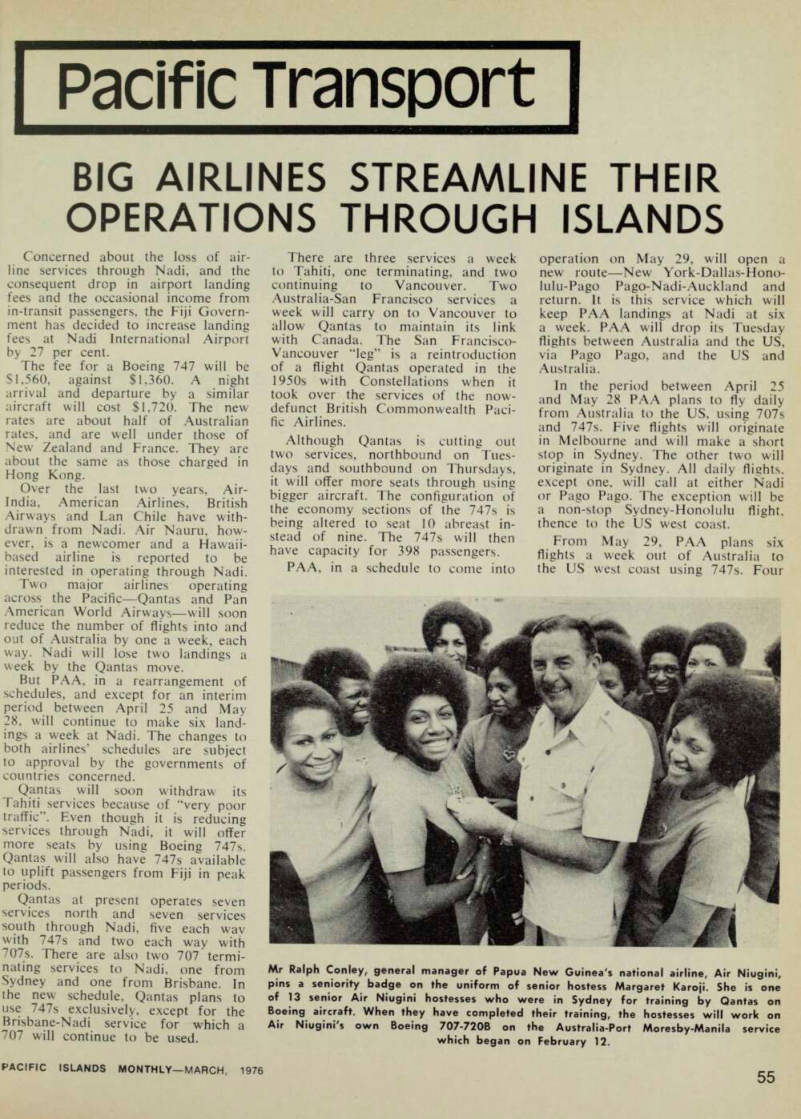
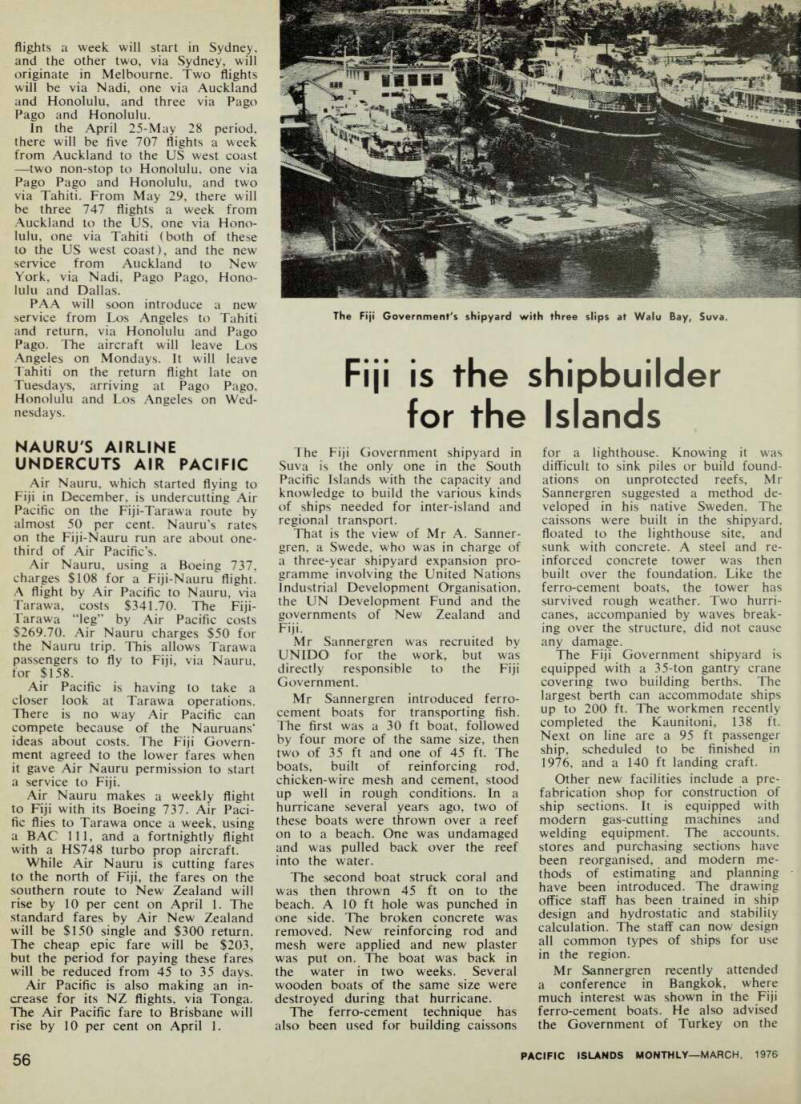
Big Airlines Streamline Their
Operations Through Islands
Concerned about the loss of air line services through Nadi, and the consequent drop in airport landing fees and the occasional income from in-transit passengers, the Fiji Govern ment has decided to increase landing fees at Nadi International Airport by 27 per cent.
The fee for a Boeing 747 will be 51,560, against $1,360. A night arrival and departure by a similar aircraft will cost $1,720. The new rates are about half of Australian rates, and are well under those of New Zealand and France. They are about the same as those charged in Hong Kong.
Over the last two years, Air- India, American Airlines, British Airways and Lan Chile have with drawn from Nadi. Air Nauru, how ever, is a newcomer and a Hawaii based airline is reported to be interested in operating through Nadi.
Two major airlines operating across the Pacific—Qantas and Pan American World Airways—will soon reduce the number of flights into and out of Australia by one a week, each way. Nadi will lose two landings a week by the Qantas move.
But PAA, in a rearrangement of schedules, and except for an interim period between April 25 and May 28, will continue to make six land ings a week at Nadi. The changes to both airlines’ schedules are subject to approval by the governments of countries concerned.
Qantas will soon withdraw its Tahiti services because of “very poor traffic”. Even though it is reducing services through Nadi, it will offer more seats by using Boeing 7475.
Qantas will also have 747 s available to uplift passengers from Fiji in peak periods.
Qantas at present operates seven services north and seven services south through Nadi, five each way with 747 s and two each way with 7075. There are also two 707 termi nating services to Nadi, one from Sydney and one from Brisbane. In the new schedule, Qantas plans to use 747 s exclusively, except for the Brisbane-Nadi service for which a 707 will continue to be used.
There are three services a week to Tahiti, one terminating, and two continuing to Vancouver. Two Australia-San Francisco services a week will carry on to Vancouver to allow Qantas to maintain its link with Canada. The San Francisco- Vancouver “leg” is a reintroduction of a flight Qantas operated in the 1950 s with Constellations when it took over the services of the now defunct British Commonwealth Paci fic Airlines.
Although Qantas is cutting out two services, northbound on Tues days and southbound on Thursdays, it will offer more seats through using bigger aircraft. The configuration of the economy sections of the 747 s is being altered to seat 10 abreast in stead of nine. The 747 s will then have capacity for 398 passengers.
PAA, in a schedule to come into
operation on May 29, will open a new route—New York-Dallas-Hono lulu-Pago Pago-Nadi-Auckland and return. It is this service which will keep PAA landings at Nadi at six a week. PAA will drop its Tuesday flights between Australia and the US, via Pago Pago, and the US and Australia.
In the period between April 25 and May 28 PAA plans to fly daily from Australia to the US, using 707 s and 7475. Five flights will originate in Melbourne and will make a short stop in Sydney. The other two will originate in Sydney. All daily flights, except one, will call at either Nadi or Pago Pago. The exception will be a non-stop Sydney-Honolulu flight, thence to the US west coast.
From May 29, PAA plans six flights a week out of Australia to the US west coast using 7475. Four
Mr Ralph Conley, general manager of Papua New Guinea's national airline, Air Niugini, pins a seniority badge on the uniform of senior hostess Margaret Karoji. She is one of 13 senior Air Niugini hostesses who were in Sydney for training by Qantas on Boeing aircraft. When they have completed their training, the hostesses will work on Air Niugini's own Boeing 707-720B on the Australia-Port Moresby-Manila service which began on February 12.
flights a week will start in Sydney, and the other two, via Sydney, will originate in Melbourne. Two flights will be via Nadi, one via Auckland and Honolulu, and three via Pago Pago and Honolulu.
In the April 25-May 28 period, there will be five 707 flights a week from Auckland to the US west coast —two non-stop to Honolulu, one via Pago Pago and Honolulu, and two via Tahiti. From May 29, there will be three 747 flights a week from Auckland to the US, one via Hono lulu, one via Tahiti (both of these to the US west coast), and the new service from Auckland to New York, via Nadi, Pago Pago, Hono lulu and Dallas.
PAA will soon introduce a new service from Los Angeles to Tahiti and return, via Honolulu and Pago Pago. The aircraft will leave Los Angeles on Mondays. It will leave Tahiti on the return flight late on Tuesdays, arriving at Pago Pago.
Honolulu and Los Angeles on Wed nesdays.
Nauru's Airline
Undercuts Air Pacific
Air Nauru, which started flying to Fiji in December, is undercutting Air Pacific on the Fiji-Tarawa route by almost 50 per cent. Nauru’s rates on the Fiji-Nauru run are about one third of Air Pacific’s.
Air Nauru, using a Boeing 737, charges $lOB for a Fiji-Nauru flight.
A flight by Air Pacific to Nauru, via Tarawa, costs $341.70. The Fiji- Tarawa “leg” by Air Pacific costs $269.70. Air Nauru charges $5O for the Nauru trip. This allows Tarawa passengers to fly to Fiji, via Nauru, for SisB.
Air Pacific is having to take a closer look at Tarawa operations.
There is no way Air Pacific can compete because of the Nauruans’ ideas about costs. The Fiji Govern ment agreed to the lower fares when it gave Air Nauru permission to start a service to Fiji.
Air Nauru makes a weekly flight to Fiji with its Boeing 737. Air Paci fic flies to Tarawa once a week, using a BAG 111, and a fortnightly flight with a HS74B turbo prop aircraft.
While Alt Nauru is cutting fares to the north of Fiji, the fares on the southern route to New Zealand will rise by 10 per cent on April 1. The standard fares by Air New Zealand will be $l5O single and $3OO return.
The cheap epic fare will be $203, but the period for paying these fares will be reduced from 45 to 35 days.
Air Pacific is also making an in crease for its NZ flights, via Tonga.
The Air Pacific fare to Brisbane will rise by 10 per cent on April 1.
Fiji is the shipbuilder

for the Islands
The Fiji Government shipyard in Suva is the only one in the South Pacific Islands with the capacity and knowledge to build the various kinds of ships needed for inter-island and
regional transport.
That is the view of Mr A. Sannergren, a Swede, who was in charge of a three-year shipyard expansion programme involving the United Nations Industrial Development Organisation, the UN Development Fund and the governments of New Zealand and Fiji.
Mr Sannergren was recruited by UNIDO for the work, but was directly responsible to the Fiji Government.
Mr Sannergren introduced ferrocement boats for transporting fish.
The first was a 30 ft boat, followed by four more of the same size, then two of 35 ft and one of 45 ft. The boats, built of reinforcing rod, chicken-wire mesh and cement, stood up well in rough conditions. In a hurricane several years ago, two of these boats were thrown over a reef on to a beach. One was undamaged and was pulled back over the reef into the water.
The second boat struck coral and was then thrown 45 ft on to the beach. A 10 ft hole was punched in one side. The broken concrete was removed. New reinforcing rod and mesh were applied and new plaster was put on. The boat was back in the water in two weeks. Several wooden boats of the same size were destroyed during that hurricane.
The ferro-cement technique has also been used for building caissons
for a lighthouse. Knowing it was difficult to sink piles or build found ations on unprotected reefs, Mr Sannergren suggested a method de veloped in his native Sweden. The caissons were built in the shipyard. floated to the lighthouse site, and sunk with concrete. A steel and re inforced concrete tower was then built over the foundation. Like the ferro-cement boats, the tower has survived rough weather. Two hurri canes, accompanied by waves break ing over the structure, did not cause any damage.
The Fiji Government shipyard is equipped with a 35-ton gantry crane covering two building berths. The largest berth can accommodate ships U P to 200 ft. The workmen recently completed the Kaumtom, 138 ft.
Next on line are a 95 ft passenger ship, scheduled to be finished in 1976, and a 140 ft landing craft, Other new facilities include a pre fabrication shop for construction of ship sections. It is equipped with modern gas-cutting machines and welding equipment. The accounts, stores and purchasing sections have been reorganised, and modern me thods of estimating and planning h|Y e introduced. The drawing office staff has been trained in ship design and hydrostatic and stability calculation. The staff can now design common types of ships for use m region.
Mr Sannergren recently attended a conference in Bangkok, where much interest was shown in the Fiji ferro-cement boats. He also advised the Government of Turkey on the
The Fiji Government's shipyard with three slips at Walu Bay, Suva
design and construction of such boats. During a short assignment in Ankara he supervised the building of a 30 ft ferro-cement boat at the Middle East Technical University.
That was the start of a more exten sive programme of ferro-cement construction in the Middle East, The Fiji Government will build a 125 ft passenger/cargo ship for Blue Lagoon Cruises. The ship, which will cost more than $500,000, will be built in the government shipyard and will be the fourth ship built by the government for Blue Lagoon Cruises.
Captain Claude Miller, a director of Blue Lagoon Cruises, said he was satisfied with the excellent perform ance of the other three ships. The new ship is intended to pioneer a six-day tourist cruise from Lautoka, along the north coast of Viti Levu, and the Vanua Levu coastline to Labasa.
The ship will be powered by twin 350 hp General Motors diesel engines. It will have accommodation for 28 passengers in two-berth, air conditioned cabins, with private facilities.
The Ips And Buts Of
Png Coastal Shipping
Rationalisation of coastal shipping in Papua New Guinea is essential if an efficient service is to be provided, but it could come only through a well-organised shipowners’ association in conjunction with user associations.
That is the view of the PNG Transport Department whose spokes man was replying to a complaint by Mr John Edwards, president of the PNG Shipowners’ Association.
Mr Edwards had claimed there was too much shipping for the cargo available. The department agreed there was shipping space available on some PNG routes, because of the general world recession, and the PNG Government's reduced expen diture through budgetary restraints.
There was a general reduction on a world-wide basis of about 15 per cent in cargo movement, which was reflected in PNG coastal and over seas shipping. World trade indicators pointed to an improvement in most maritime nations’ economics, though it was too early to label that indica tion as a trend. If it continued, PNG’s cargo shipments should increase steadily.
The department’s spokesman said that at present no new vessels, other than those considered suitable both in age and efficiency, were being licensed to operate on the PNG coast.
Two days later it was announced
that the Wewak-But Local Govern ment Council had decided to set up a shipping service known as Wewak Islands Shipping Co, to bring a bet ter service to the offshore islands people, who had faced transport diffi culties for some time.
The first boat, the Christopher, had already arrived and was operating between Wewak and outlying islands.
The council planned to buy more boats for the company.
The total coastal shipping cargo capacity of the PNG coastal fleet is about 25,000 revenue tons a month, but the actual carriage rate recently has been only 16,500 tons a month.
There are 10 main shipping com panies, with about 50 ships, operat ing through the 13 main ports of the country. There are also about 200 “feeder” ships, which carry planta tion produce and other raw materials to the main ports.
Mr Jephcott
Cuts The Costs
Mr Bruce Jephcott, the Papua New Guinea Transport, Works and Supply Minister, has embarked on a cost cutting programme. He intends to close unnecessary airstrips and prune maintenance grants for private strips.
Where communities are within 30-45 km by all-weather road of a major airstrip, minor strips will be closed.
The standard of roads would have to be lowered as some projects were beyond PNG’s means. However, the lowering of standards should not affect safety or access. Mr Jephcott has other ideas of saving money, so that works programmes are tailored to the amount the country can afford.
By eliminating overlapping of the functions of departments such as Civil Aviation and Works and Transport, up to KlO million could
be saved. In brief, Mr Jephcott gave warning that the country had to live within its means and get away from the idea that the relatively affluent past was still with it.
Two Korean
Ships On Reef
Two Korean fishing ships, the Tong Wha No 1 and the 209, ended on reefs in the Cook Islands recently.
The Tong Wha No 1 was on the way back to Korea when it caught fire in the kitchen. The fire spread quickly to the engine room. With the power gone, the shop drifted helplessly on to the reef off Raka hanga. Captain Choi Han Tae, the master, and his crew of 17 got ashore safely.
The 209, Captain Kim Joone, de veloped engine trouble near Palmers ton Island. Spare parts were trans ferred to it by another fishing ship.
The 209, after repairs, continued its trip, but it did not get far. It finished on the reef off Palmerston Island.
The ship carried a crew of 22.
New Shipping
Service For Tonga
Warner Pacific Lines, of Tonga, a shipping line, will introduce a new service in May, between Brisbane and Tonga, via Noumea. The line re cently bought the West German-built Kempharn, 540 tons, from an Aust ralian shipping company.
Mr Peter Warner, principal of Warner Pacific Lines, said he hoped to use ships to carry vegetables and other produce to Noumea on the Nukualofa - Noumea “leg”. Mr Warner will be master of the ship.
Siona Fangatua, master of the Ata, will be chief officer. Ten Tongans will make up the crew.
No Money In New
Saipan-Tokyo Route
The chances of either Continental Airlines or Pan American World Airways being granted the Saipan- Tokyo route took a nosedive when the US Department of Transportation opposed it, saying it would be un profitable.
The US Civil Aeronautics Board had recommended that the route be awarded to Continental, but last November President Gerald Ford told the CAB to have another look at it.
President Ford said he wanted more information about the viability of the service. He directed the Trans portation Department to prepare a report for the CAB.
The board said, in effect, that the good old days of rapid transport
growth and general airline profitabil ity were gone. In the past new air line routes were often awarded merely on the ground that air service would be increased and the carriers were willing to service the route.
Current conditions, however, in cluding high cost fuel, inflationary pressures, traffic declines and prob ably slower growth required a change in the justification for new route awards. Instead of seeking new routes, air carriers should improve the present Japan-Guam-Saipan ser vice.
PAA operates the Guam leg, and Continental Air Micronesia flies Guam-Saipan.
“Any realistic level of service operated before the end of fiscal year 1977 at the earliest will not, in our estimate, produce sufficient return to justify its operation and will result in losses for US flag service as a whole”, the Transportation Depart ment reported.
Cooks Welcomes
Its First Dcio
About 6,000 of Rarotonga’s 10,000 population turned out on January 12 to welcome the first Air New Zea land DCIO to land in the Cook Islands. The wide-bodied tri-jet car ried 92 people to the Cook 1,700 miles north-east of New Zealand, and brought back 228.
Air New Zealand substituted a DC 10 for the usual 130-seat DCS on the run to meet the peak demand of islanders returning to New Zea land after Christmas holidays with their families. A DC 10 can carry 247 passengers.
Air New Zealand says there are no immediate plans to replace the DCBs with DC 10s on the route, but this could happen as passenger and cargo demand grows.
The flight was made under the command of Air New Zealand’s Chief Pilot, Captain lan Gemmell. and was given an official welcome by the Premier of the Cook Islands, Sir Albert Henry, and Lady Henry and several government ministers.
Captain Gemmell presented Sir Albert with a model of a DC 10 mounted on a wooden base cut to the shape of the island of Rarotonga and Sir Albert gave Captain Gem mell a tangaroa, a wooden carving of the group’s fertility god.
The trip was a special event for Captain Gemmell. In earlier days he flew flying boats to Aitutaki in the Cooks on the airlines famed Coral Route to Tahiti, and when Sir Albert was living in Auckland, they were friends, playing in the Browns Bay Tennis Club.
Biggest ship a jinx, say Fijians
It did not take long for stories of a jinx to get around when the Fiji Government’s new ship, the Kaunitoni, 580 tons, had propeller trouble on the maiden voyage from Suva to Lau in January and had to turn back. The Kaunitoni was launched with a flourish in November, 1975. It is the biggest ship built in Fiji.
Rumours were that the Kaunitoni was unlucky because it was not sent to sea for the first time with proper Fijian ceremonies. The Fiji Prime Minister, Ratu Sir Kamisese Mara, was unmoved. He believed there were strictly scientific explanations for the trouble, such as ill-fitting valves in the hydraulic system.
The trouble convinced Captain Arthur Evans, a well-known figure in Fiji shipping circles, that he should retire as managing director of the Princess Shipping Co, which he founded in 1961, and devote all his energies to the Kaunitoni. At the time the Kaunitoni was launched, it was announced that it would be operated on a commercial basis under the management of Captain Evans, who continued as chief executive of Princess Shipping.
It must have been a wrench for Captain Evans to sever his connection with Princess Shipping, which he has seen through good times and bad. He started Princess Shipping with the wooden-hulled Fijian Princess, operating over all routes in Fiji.
The demand for service saw him add three wooden-hulled ships to his fleet.
These were the Dobin', later renamed Viani Princess, the Asha,
renamed the Gau Princess and the Taivalevadra. The Viani Princess sank off Lekube Point, Bua, and the Gau Princess was wrecked on a reef off Cikobia.
In the 19605, Captain Evans de cided to convert to steel-hulled ships, starting off with a fishing vessel, named Fijian Princess 11. Two other steel-hulled ships were bought, the Labasa Princess and the Tovata. The Labasa Princess was wrecked on a ree f off Vatoa.
His Fijian Princess II was a Japanese fish-catcher, new out of the shipyard, which ran on a reef off Nairai island in Fiji on December 23, 1974.
Captain Evans bought it, as is. where is, for a few hundred pounds.
Then, in March, 1965, in a do-it yourself salvage job, he dived to inspect the hull and to see how firmly she was held by the reef. Using his own ships and the government-owned Degei 11, he pulled his prize off the reef with his first attempt, The operation cost him around £5,000. His shipping line, which he operated in partnership with a Fiji- Indian merchant, got an almost-new ship valued at between £60,000 and
£Bo,Ooo.
At the time of Captain Evans’ retirement, the Princess Shipping Co was operating the Tovata and the Fijian Princess 11. The Kaunitoni was to replace the Tovata on the Lau service, while the Tovata was used elsewhere. This policy may still be followed when the troubles with the Kaunitoni are overcome and it is able to go into a regular service.
Advertisements & other items, p. 58 (1 item)
the most important ingredient
* 1 m m s* « ■. ■ ■M r m m m
JwNEY N.S.W.
OF AUSTRALIA
25 KG NET
m
the most important ingredient
BREAD FLOURS:
CAKE FLOURS:
BISCUIT FLOURS:
SPECIALITY FLOURS:
• MAINTOP—high protein bread flour • ANCHOR—bakers flour • 50/50 MEAL—brown bread • MEDIUM —cake and pastry • SPONGE—sponge cakes • SPECIAL CAKE—madeira and cup cakes • STRONG—cracker biscuits • MEDIUM —Shortbreads • SOFT—sweet biscuits • RYE flour • RYE meal • KIBBLED RYE • SHARPS—roti and chapati flour • 100% STONE GROUND
WHOLEMEAL
GILLESPIE BROS. PTY. LTD.
HEAD OFFICE: BRISBANE OFFICE:
52 UNION ST., PYRMONT, SYDNEY, N.S.W. CABLE ADDRESS: ALBION, BRISBANE, QUEENSLAND. (G.P.O, BOX 2518, SYDNEY, 2001.) "GILLESPIE", (P.O. BOX 8, ALBION. BRISBANE, 4010.) PHONE: 660-4933. SYDNEY AND BRISBANE. PHONE: 6-1121.
Cruising
Yachts
• WESTWARD, 87 ft motor yaq'nt built in 1924 in Seattle and owned by Don and Ann Gumpertz of Toluca Lake, Cali fornia, visited Tahiti between December 15 and January 5, then left for Raiatea, Bora Bora, Hawaii and Los Angeles. This 100-ton vessel is equipped with a wheel house complete with Loran and Omega,
a recording fathometer, hydraulically
operated stabiliser fins, huge galley with two electric ovens, a walk-in freezer,
wood-burning fireplace, king-sized cap
tain's cabin and two guest staterooms, water-making equipment, two launches and a 12 ft sailing boat, a giant-sized freezer and crew quarters to sleep six, complete with a commercial washing machine and dryer. They carried a crew of three, and were just finishing a round the-world trip that took them to every continent and innumerable islands, where they travelled inland by land and air. • Z. RENE, 30 ft trimaran owned by Frank Cline, 30, of San Leandro, Cali fornia, went on a reef in the Austral Islands in October and Cline spent 40 days alone on the uninhabited island called Maria or Hull island. He lived on coconuts and rock scallops and the few stores he had on his boat until the copra workers arrived. Unable to salvage the boat, Frank burned it and left with the copra boat, arriving in Tahiti in Decem ber. His future plans include building another trimaran just like Z. Rene. • ISLAND HUNTER, 38 ft gaff-rigged ketch from Ventura, California, was wel comed into Tahiti in late January. Built in their backyard by owners Paul and Karin Stead, Island Hunter was launched in March, 1975, and the Steads sailed away in November, accompanied by daughter Tove (10), son Hans (5) and Annelin Hammer of California. Their plans were to remain in French Polynesia until May, visiting the Marquesas, Tuamotus and Society islands extensively, before sailing to Hawaii. • JELLICLE 11, 25 ft folkboat sloop, owned by well-known Pacific navigator, Mike Bailes, arrived in Tahiti in January for her second visit. Sailing with Mike is 22-year-old Bill Fehoko of Tonga, who did all the navigating from Auckland in 33 days with a stop in Raivavae, with no engine and light winds. Mike, an Englishman, spent some time in Tahiti in 1967 when he first brought Jeliicle II to French Polynesia. Their plans were to
spend about three months in the area before sailing to Rarotonga and bade to New Zealand. • CANDIDE, 84 ft two-masted gaff rigged schooner from El Dorado, Cali fornia left Tahiti late December for Seattle, after spending many months in French Polynesia. Owners Jon and Penny Stegenga and son Will, planned to remain in Tahaa while crew members Neil Alexander and Phillip LaFrance of the US, Nigel Adams of England, Brian Wylie of Scotland and Girard Bargel of France sailed Candide to the US West Coast, where Jon plans to sell the boat he built and that carried him and his family to many islands in the South Pacific over a period of 3i years. • CAPRICORN, CAL 234 sloop from Seattle, arrived in Tahiti in December, after cruising from the US West Coast to the Marquesas and Tuamotus. Owner Ted Culp and his son Robert made the trip together to Tahiti, where Robert joined BORN FREE for a late December de parture to Hawaii. Ted was awaiting the arrival of girl-friend Voncile Scifers in early January. Their plans included a Tahitian wedding before sailing to the other islands in the Societies and on to Fiji and New Zealand in April. • DESTINY 11, Santana 37 ft sloop from Hawaii, arrived in Tahiti in Decem ber for a five-month visit to French Poly nesia before returning home. Aboard were Marshall and Missy Saunders, their eight-year-old daughter Tiffany, and Bob Branch and Cynthia Nakai, all of Hawaii. • FANTASIA, 32 ft cutter built by Jim Slatt in San Francisco and owned by Win Charlebois, 33, and Linda Hoppel, 29, is spending the hurricane season in Tahiti. They left San Francisco in October, 1974 and spent nine months in Hawaii before cruising to Tahiti. Their plans in cluded going to the Australs in Feb ruary, then to the Cooks and New Zea
land, where they hope to be by No vember, 1976. Also aboard were Scupper and Boomkin, the ship's cats. • LUTETIA, 37 ft Carol ketch from Charlotte Amalie, owned by the Alexan der du Prel du Chapois family, prepared to leave Tahiti mid-January for Bora Bora, where they will be living for at least two years, while Alexander works at the Hotel Bora Bora. • MATRIX, custom-built 26 ft fibre glass sloop owned by Andy Butler, 20, of San Francisco, sailed into Tahiti in No vember from Hawaii, where Andy had been living for a year. Andy started building Matrix himself at the age of 15 and left home when he was 18i for Japan. He got to Hawaii and heard stories about Tahiti; so he and his "crew mate", a kitten named Fur set out to discover "Paradise" for themselves. In raging seas between Hawaii and Tahiti the forestay broke and Andy had to go to the top of the mast to repair it, where, he claims, he saw a mermaid in the dark and misty night. Andy's plans may take him to Saudi Arabia where his father lives. • NAIK, one of a kind 35 ft steel ketch built in Belgium and registered in Guadalupe, left Guadalupe in May, 1975 and arrived in Tahiti in November with the Mancini family on board. Jean- Claude, Dominique and sons Stephane, three, and Thomas, 20 months planned to be in Tahiti for a year and then sail to New Caledonia and, maybe, to Australia.
• Two girls with experience in ocean racing and sailing duties seek crewing on a yacht sailing Pacific or anywhere. A note to Miss Z. Wilson of 80 Wolseley Road, Point Piper, N.S.W. would be welcomed.
Niue Yacht Club Log On A Shirt
Most yacht clubs keep a log of all the visiting yachts, but how many list them on a souvenir shirt, which is what the Niue Island and Blue Water Yacht Club has done? At the same time, the club has given PIM a "slap on the back".
The club's commodore, Peter Ell, has listed on the souvenir tee shirts the names of the 22 yachts which dropped anchor at Niue in 1975 and an advertisement for PIM as the magazine which caters, like no other, for cruise yachtees.
Mr Ell, who sent two of the shirts as gifts for PlM's cruising yaoht section staff, writes, "If you think the shirts are good, then you should see the NIBWYC log book. It is becoming, after two seasons only, a very interesting record of our visitors and a reflection of their happy times on Niue.
"We hope the 1976 season will be
another record breaker. There is talk of an Auckland-Niue race next year but no definite plans have come to light. As it is, we seem to attract people because they are assured of a welcome and a pleasant stay.
"The club tee shirt is in demand by our visitors. The new price is SNZ7.SO and we have many requests from over seas. Shirts are mailed out regularly.".
The visitors were well looked after, Mr Ells added. There were film shows and dinner parties and tours of the island which took in the caves, forest and the Japanese wreck.
The club also provides facilities for laundering, showers, engine repairs and
air-tank filling.
The big event was the first annual banquet but there wasn't a yacht any where in sight at the time.
Advertisements & other items, p. 60 (1 item)
Lost
Public
acclaim
for
THE
LOST
CARAVEL
by Robert Langdon Was a group of 16th century shipwrecked Spanish sailors responsible for the legendary Polynesian canoe-building and navigation skills?
This startling question is answered in Robert Langdon’s important new book, THE LOST CARAVEL, which shatters many traditionally-held views on the origin of the Polynesians. Mr Langdon contends that the crew of the Spanish caravel San Lesmes, shipwrecked east of Tahiti in 1526 en route for the East Indies, survived and established themselves in Polynesian society, forming dynasties that lasted down to Captain Cook’s time.
BUT READ IT
FOR YOURSELF!
Fill in the details
on the attached
order form
Business and Development
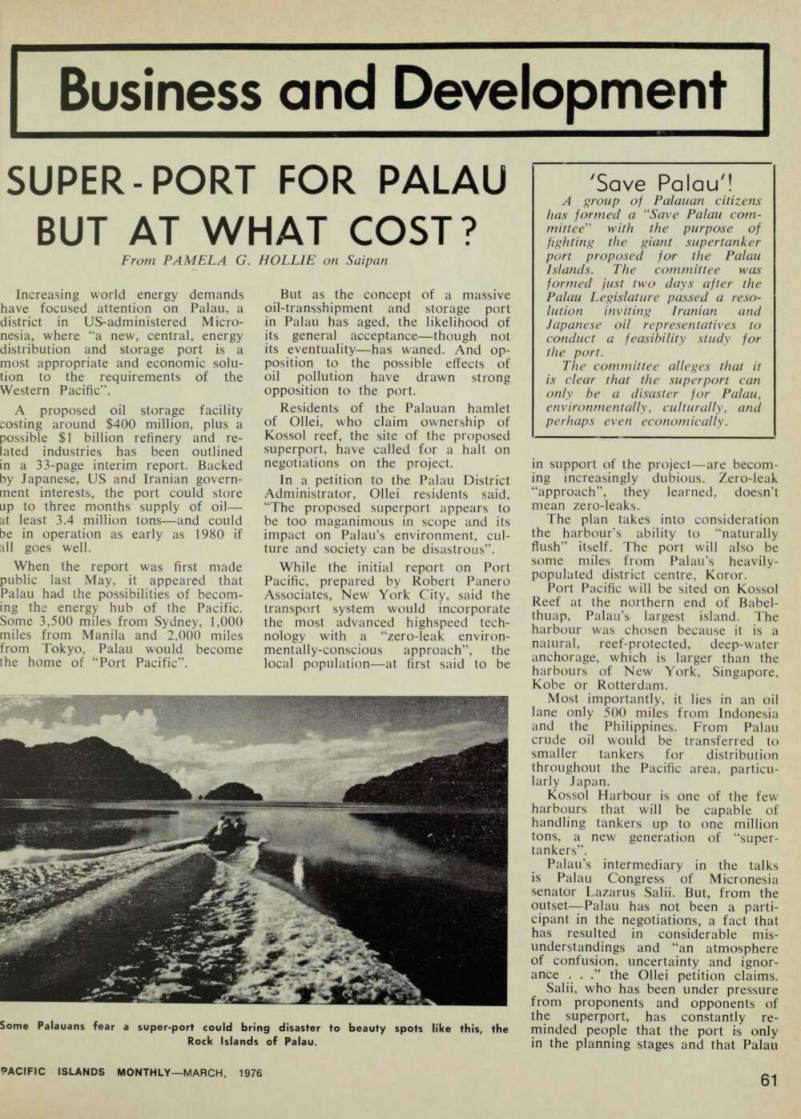
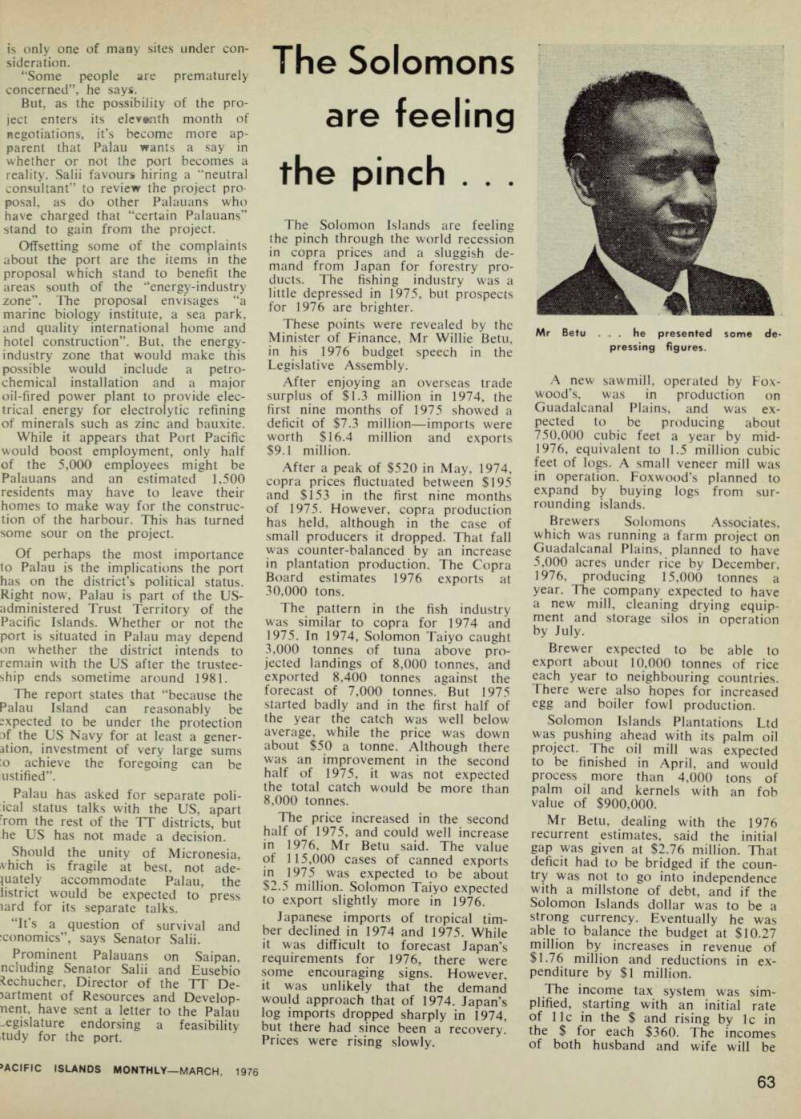
Super-Port For Palau
But At What Cost?
From PAMELA G. HOLLIE on Saipan
Increasing world energy demands have focused attention on Palau, a district in US-administered Micro nesia, where “a new, central, energy distribution and storage port is a most appropriate and economic solu tion to the requirements of the Western Pacific”.
A proposed oil storage facility costing around S4OO million, plus a possible SI billion refinery and re lated industries has been outlined in a 33-page interim report. Backed by Japanese, US and Iranian govern ment interests, the port could store up to three months supply of oil— at least 3.4 million tons—and could be in operation as early as 1980 if all goes well.
When the report was first made public last May, it appeared that Palau had the possibilities of becom ing the energy hub of the Pacific.
Some 3,500 miles from Sydney, 1,000 miles from Manila and 2,000 miles from Tokyo, Palau would become the home of “Port Pacific”.
But as the concept of a massive oil-transshipment and storage port in Palau has aged, the likelihood of its general acceptance—though not its eventuality—has waned. And op position to the possible effects of oil pollution have drawn strong opposition to the port.
Residents of the Palauan hamlet of Ollei, who claim ownership of Kossol reef, the site of the proposed superport, have called for a halt on negotiations on the project.
In a petition to the Palau District Administrator, Ollei residents said, “The proposed superport appears to be too maganimous in scope and its impact on Palau’s environment, cul ture and society can be disastrous”.
While the initial report on Port Pacific, prepared by Robert Panero Associates, New York City, said the transport system would incorporate the most advanced highspeed tech nology with a “zero-leak environ mentally-conscious approach”, the local population— at first said to be
in support of the project—are becom ing increasingly dubious. Zero-leak “approach”, they learned, doesn’t mean zero-leaks.
The plan takes into consideration the harbour’s ability to “naturally flush” itself. The port will also be some miles from Palau’s heavily populated district centre, Koror.
Port Pacific will be sited on Kossol Reef at the northern end of Babel thuap, Palau’s largest island. The harbour was chosen because it is a natural, reef-protected, deep-water anchorage, which is larger than the harbours of New York, Singapore, Kobe or Rotterdam.
Most importantly, it lies in an oil lane only 500 miles from Indonesia and the Philippines. From Palau crude oil would be transferred to smaller tankers for distribution throughout the Pacific area, particu larly Japan.
Kossol Harbour is one of the few harbours that will be capable of handling tankers up to one million tons, a new generation of “super tankers”.
Palau’s intermediary in the talks is Palau Congress of Micronesia senator Lazarus Salii. But, from the outset —Palau has not been a parti cipant in the negotiations, a fact that has resulted in considerable mis understandings and “an atmosphere of confusion, uncertainty and ignor ance . . .” the Ollei petition claims.
Salii, who has been under pressure from proponents and opponents of the superport, has constantly re minded people that the port is only in the planning stages and that Palau
Some Palauans fear a super-port could bring disaster to beauty spots like this, the Rock Islands of Palau.
is only one of many sites under con sideration.
“Some people are prematurely concerned”, he says.
But, as the possibility of the pro ject enters its eleventh month of negotiations, it’s become more ap parent that Palau wants a say in whether or not the port becomes a reality. Salii favours hiring a “neutral consultant” to review the project pro posal, as do other Palauans who have charged that “certain Palauans” stand to gain from the project.
Offsetting some of the complaints about the port are the items in the proposal which stand to benefit the areas south of the “energy-industry zone”. The proposal envisages “a marine biology institute, a sea park, and quality international home and hotel construction”. But, the energy industry zone that would make this possible would include a petro chemical installation and a major oil-fired power plant to provide elec trical energy for electrolytic refining of minerals such as zinc and bauxite.
While it appears that Port Pacific would boost employment, only half of the 5,000 employees might be Palauans and an estimated 1,500 residents may have to leave their homes to make way for the construc tion of the harbour. This has turned some sour on the project.
Of perhaps the most importance to Palau is the implications the port has on the district’s political status.
Right now, Palau is part of the US administered Trust Territory of the Pacific Islands. Whether or not the port is situated in Palau may depend on whether the district intends to remain with the US after the trustee ship ends sometime around 1981.
The report states that “because the Palau Island can reasonably be expected to be under the protection 3f the US Navy for at least a gener ation, investment of very large sums ;o achieve the foregoing can be ustified”.
Palau has asked for separate poli ical status talks with the US, apart Torn the rest of the TT districts, but he US has not made a decision.
Should the unity of Micronesia, vhich is fragile at best, not ade tuately accommodate Palau, the iistrict would be expected to press lard for its separate talks.
“It’s a question of survival and :conomics”, says Senator Salii.
Prominent Palauans on Saipan, ncluding Senator Salii and Eusebio *echucher, Director of the TT De partment of Resources and Develop ment, have sent a letter to the Palau legislature endorsing a feasibility tudy for the port.
The Solomons are feeling the pinch . . .
The Solomon Islands are feeling the pinch through the world recession in copra prices and a sluggish de mand from Japan for forestry pro ducts. The fishing industry was a little depressed in 1975, but prospects for 1976 are brighter.
These points were revealed by the Minister of Finance, Mr Willie Betu, in his 1976 budget speech in the Legislative Assembly.
After enjoying an overseas trade surplus of $1.3 million in 1974, the first nine months of 1975 showed a deficit of $7.3 million—imports were worth $16.4 million and exports $9.1 million.
After a peak of $520 in May, 1974, copra prices fluctuated between $195 and $153 in the first nine months of 1975. However, copra production has held, although in the case of small producers it dropped. That fall was counter-balanced by an increase in plantation production. The Copra Board estimates 1976 exports at 30.000 tons.
The pattern in the fish industry was similar to copra for 1974 and 1975. In 1974, Solomon Taiyo caught 3.000 tonnes of tuna above pro jected landings of 8,000 tonnes, and exported 8,400 tonnes against the forecast of 7,000 tonnes. But 1975 started badly and in the first half of the year the catch was well below average, while the price was down about $5O a tonne. Although there was an improvement in the second half of 1975, it was not expected the total catch would be more than 8.000 tonnes.
The price increased in the second half of 1975, and could well increase in 1976, Mr Betu said. The value of 115,000 cases of canned exports in 1975 was expected to be about $2.5 million. Solomon Taiyo expected to export slightly more in 1976.
Japanese imports of tropical tim ber declined in 1974 and 1975. While it was difficult to forecast Japan’s requirements for 1976, there were some encouraging signs. However, it was unlikely that the demand would approach that of 1974. Japan’s log imports dropped sharply in 1974, but there had since been a recovery.
Prices were rising slowly.
A new sawmill, operated by Fox wood’s, was in production on Guadalcanal Plains, and was ex pected to be producing about 750.000 cubic feet a year by mid -1976, equivalent to 1.5 million cubic feet of logs. A small veneer mill was in operation. Foxwood’s planned to expand by buying logs from sur rounding islands.
Brewers Solomons Associates, which was running a farm project on Guadalcanal Plains, planned to have 5.000 acres under rice by December, 1976, producing 15,000 tonnes a year. The company expected to have a new mill, cleaning drying equip ment and storage silos in operation by July.
Brewer expected to be able to export about 10,000 tonnes of rice each year to neighbouring countries.
There were also hopes for increased egg and boiler fowl production.
Solomon Islands Plantations Ltd was pushing ahead with its palm oil project. The oil mill was expected to be finished in April, and would process more than 4,000 tons of palm oil and kernels with an fob value of $900,000.
Mr Betu, dealing with the 1976 recurrent estimates, said the initial gap was given at $2.76 million. That deficit had to be bridged if the coun try was not to go into independence with a millstone of debt, and if the Solomon Islands dollar was to be a strong currency. Eventually he was able to balance the budget at $10.27 million by increases in revenue of $1.76 million and reductions in ex penditure by $1 million.
The income tax system was sim plified, starting with an initial rate of 11c in the $ and rising by 1c in the $ for each $360. The incomes of both husband and wife will be
Mr Betu ... he presented some de pressing figures.
aggregated for tax purposes, there will be a combined basic and depen dent allowance of $6OO and an in crease in wife allowance from $4BO to $6OO.
Company tax would be increased from 25 per cent to 30 per cent. . . . While the
workers flex
their muscles
The Solomon Islands are growing up, industrially. Many workers re sorted to industrial muscle to start a rash of strikes soon after the coun try achieved internal self-government.
Businesses caught up in the trouble included a bakery, a tobacco factory, a plantation, an investment company and the Port Authority.
The watersiders went out for 27 days, starting on January 1, in sup port of the Solomon Islands General Workers’ Union and the Government Non-Established Workers’ Union.
They achieved nothing. Port opera tions continued.
In the end, the wharfies, who are also members of the SI General Workers’ Union, were able to return to work, after accepting six condi tions laid down by the Ports Author ity. Two were that they make a pub lic apology to the authority for joining the strike and that a demand for the sacking of three senior staff be withdrawn.
The union president, Mr Bartho lomew Ulufa’alu, wrote that the stevedores regretted any disruption they may have caused. The union acknowledged it did not take more positive steps to dissuade the wharfies from joining the strike.
In other industries, the strikers started to drift back to work while the unions and employers were in negotiation. Mr Ulufa’alu, in a pub lic statement, claimed that through strike action in Honiara most claims had been achieved.
That stung the SI Federation of Employers into a public reply, set ting out in detail just what had not been achieved.
These were some of the adverse results: Loss of wages, holiday pay and, in some cases, jobs; no overall increase in wages as most companies had already given rises; loss of faith by the SI General Workers’ Union as a responsible body acting for the good of employees and development; workers and families went short of bread and money; in nearly all cases there was a return to work on
original terms; loss of production which, in many cases, could not be made up; loss of revenue to the government in export duties and in come tax; loss of foreign confidence in the country; the possibility of local companies closing or reducing activities; and the introduction of fear and uncertainty into the way of life of many Solomon Islanders through the January 2 disturbances and threats and intimidation during the strike.
All that had been achieved was union recognition by some companies, a recognition which would readily have been given without a strike had there been a sensible, responsible approach from the union; refusal by other companies to recognise the unions because of irresponsible action by union leaders; agreement by com panies to negotiate, but only on claims relevant to their businesses and refusal by companies to nego tiate on general claims by the union as many of them were political, and bore no relevance to relationship between employer and employee.
In short, the whole thing seemed to have been a fiasco though the unions deny they made an apology.
Creating markets
for the Solomons
A new shipping company, Oceania Lines, will give the Solomon Islands access to markets in Micronesia for rice and other agricultural products.
Oceania, based at Saipan, will link the Marianas with the Solomons and Australia. The shipping line is owned by five Saipan residents, and is headed by lawyer Edward Pange linan, who is also chairman of the Marianas Status Commission.
The company is aiming at launch ing the service in March or April.
Apart from rice, meat and vegetables, the company’s ships would pick up copra for processing in the new mill at Palau. The only shipping line at present servicing Micronesia from the south is Nauru Pacific.
About the same time as the an nouncement was made about the new shipping line, a mission from the US Trust Territory and Guam was in the Solomons inspecting com mercial developments and looking at what could be bought. The tour was arranged by Brewer Associates, which operates in several areas of agriculture and has its parent com pany in Hawaii.
Members of the mission said the Solomons had a high potential for overseas markets. They were particu larly impressed with the rice poten tial. Brewer Solomons Associates is making quick changes in the deve lopment and improvement of rice
on the Guadalcanal Plains. Once the company is in full production and can meet local demands, rice will be exported to neighbouring Pacific territories.
Mr H. Bowie, of Mariau’s Enter prises, a members of the mission, said his company would buy what ever the Solomons produced—rice, copra, timber, and eventually meat.
With a reliable shipping link, the Solomons export trade could soon “take off”, in spite of the rather de pressing picture painted by the Minister of Finance, Mr Willie Betu, in his 1976 budget speech (see sepa rate report).
PNG biggest loser
over copper slump
The Papua New Guinea Govern ment is the biggest loser in the sharp downturn of the profit of Bougain ville Copper Ltd in 1975. The PNG revenue losses to the extent of K 66 million, compared with 1974, accord ing to the Finance Minister, Mr Julius Chan. In 1974, the govern ment received K 93 million in dividends, taxation and royalties. It was a substantial item on the revenue side of the budget.
For 1975, the PNG Government will get about K 27 million. The re duced revenue from Bougainville, although expected, is a tremendous
blow to the economy of the country when money is desperately needed.
The Bougainville Copper profit for 1975 was $46.1 million, compared with $114.5 million in 1974. A sharp drop in world copper prices, plus reduced sales to Japan, were major factors in the lower profit. The com pany was forced to make sales on world market at low prices when Japanese smelters reduced their orders by 15 per cent.
The company’s sales revenue dropped about $lOO million.
Fiji sugar could
be in trouble
Sugar may not be so sweet for Fiji in 1976. Earnings could drop by about 50 per cent from the 1975 figure of about $lOO million. The independent chairman of the Fiji sugar industry, Mr lan Thomson, in February, warned that the industry was in danger of pricing itself out of the highly-competitive world market.
The return to farmers from the 1975 crop was expected to be about $3O a ton. A big drop could be expected in the price for the 1976 crop. About half the sugar from the 1976 crop would go to Britain, but the price would depend on the Euro
pean Economic Community price.
That price had still to be negotiated between the EEC and countries, in cluding Fiji, which supplied it with sugar.
Mr Thomson said Fiji’s nego tiators would have a tough task get ting an increase on the $449 a ton Britain paid in 1975, That price was agreed to by Britain when a world sugar shortage drove the London daily price up to $692 a ton. The London price had since dropped to as low as $2BB a ton, Britain paid about $77 million to Fiji for sugar in 1975 because of the
Mr W. Marston, who has retired as general manager of the British Phosphate Commission after more than 40 years' service. He has been appointed a mem ber of the Phosphate Commission.
record price negotiated by the EEC and African, Caribbean and Pacific sugar producers. With the sugar shortage overcome, all the EEC, so far, is prepared to pay is a basic mimmum of 5303, which is eight per cent above the current minimum guaranteed price. , Closer to home, the South Pacific Bureau for Economic Co-operation (SPEC) wants Fiji to enter into longterm contracts to sell sugar to other South Pacific Countries. SPEC was P ac *fi c Forum m 1975 to look into the feasibility of the idea. Fiji could be in some
difficulty in a South Pacific market because of commitments elsewhere, Official figures showed that Fiji sugar sales to the end of August, 1975, were worth a little more than 533.5 million, when 149,206 tons of 1975 sugar were sold The UK bought 67,453 tons for about $3O million. NZ bought 11,943 tons for $3,694,621. Sales to South Pacific Island groups were worth- Western Samoa, $359,515; American Samoa $2,498; Solomon Islands, $l5 804 : GEIC, $136,773; Tonga, $67,964.
The sugar harvesting season still had about three months to run when the figures were taken out.
Sharp jolt
tor Fiji tourism
The Fiji tourist industry took a sharp jolt in February when the Skylodge Hotel, at Nadi Airport, closed temporarily for lack of busi ness. The few guests were trans ferred to the nearby Tanoa Hotel.
The hotel needed a 60 per cent occu pancy rate to return a profit. The rate early in February was only 10 per cent, and in January, usually a peak month, it was a mere 40 per cent.
The Skylodge was launched in buildings used in the reconstruction of Nadi Airport in 1959 and 1960.
Its only nearby competitors then were the old Mocambo Hotel and the Nadi Hotel. The mushrooming tourist industry led to the construc tion of many more hotels and guest houses in the area.
About 50 employees were dis missed when the hotel closed. A skeleton staff was retained to reopen the hotel when, and if, business im proves. The hotel has 98 rooms. It charged $l2 to $l5 a room, which makes it one of the cheaper hotels in the Nadi area.
Coincident with the closure of the hotel, the Fiji Visitors Bureau board announced a drastic reorganisation to cope with the big drop in the number of tourists. A new move was to set up a committee of prominent businessmen, all connected with the tourist industry, to advise on market ing and promotion policies.
The committee comprises Messrs Dan Costello, Lautoka, Lyle Cupit, Suva (head of the Carpenter group in Fiji), David Wilson, Suva, Mahen dra Patel, Nadi, and Mr Stanley Quigg, general manager of Air Pacific, or alternatively, the airline’s marketing manager, Mr Ross Keenan.
The board accepted a report by Professor George Hines, of Massey University School of Business, NZ, on the tourist industry. Professor Hines warned that Fiji would lose millions of dollars more in the tour ist trade unless drastic changes were made in the way its holiday attrac tions were sold.
Even with a crash promotion pro gramme, it seemed likely that some hotels in Fiji might have severe financial difficulties in 1976, with the possible loss of employment, overseas earnings and investment.
The board has accepted most of Professor Hines’ recommendations.
Tourism promotion will be the FVB’s primary objective. It has stopped all its local education activi ties. It will appoint a full-time mar keting manager, full-time research officer and an accountant. The
'overnment would be asked to imend the FVB Ordinance to allow or very wide representation on the : VB board.
Professor Hines attended a Feb uary meeting of the board, and mphasised how serious the position /as.
fongo's economy
s taking a beating
The economy of Tonga is not in ood shape. Low prices for copra nd bananas, and fewer Tongans oing to work in New Zealand have reated a situation likely to lead ) severe difficulties later this year, ►n top of that, the Pacific Navi ation is reported to be about SI lillion in debt.
In 1975, Tonga had to export more lan twice as much copra as in 1974 ) lift copra earnings by a mere 12,496 8,107 tons worth 3,180,494 in 1974 and 18,407 tons orth $3,192,990 in 1975. Banana cports also rose in 1975, but the irnings were only fractionally igher than in the previous year.
The Tongan banana industry, ong with that in other Islands, has ken severe knocks recently. One as a report in a New Zealand jwspaper that human faeces were »und in the hold of the Luhesand i arrival in Auckland carrying manas from the islands. While ame was not sheeted home to any mntry, the report was damaging.
Apart from that incident, banana owers, and that includes Tonga, :ed to lift the quality of their pro icts to regain substantial NZ cus m against the competition from :uador. Mr Adolf Johansen, man ner of the Tonga Produce Board, id that unless quality was im oved, Tonga’s allocation for every ipment would be reduced.
Added to the problems of the ipra and banana industries, the lue of desiccated coconut exports 1975 was $83,015 lower than in '74. The value of all exports for •75 was $58,973 lower than the '74 value.
The tourism and handicraft indus es do not expect to do particularly :11 in 1976, with an expected drop 50 per cent in the number of iiise ship visitors.
In the first six months of 1975, ere was a drop of about $250,000 Dm Tongan workers in New Zea id, compared with the first six anths of 1974. In 1975, 3,722 mgans returned home after work ? in New Zealand. New Zealand eruited only 266 new workers in e same year.
In merchant shipping, in spite of
colossal losses incurred in the charter of the Tauloto 11, the Pacific Navigation Co recently took over the running of the Fijian Swift, 2,000 tons, on a bare boat charter for two years. The boat has been renamed Ha’amotaha. It is servicing Nukualofa, Apia, Neiafu and Auckland.
A number of informed people in Tonga are said to be concerned over the charter deal as Pacific Navigation Co is heavily in debt. If the report of the $1 million debt is true then the charter is, according to one comment in Nukualofa, “a foolish one or a courageous one, depending on one’s point of view”.
firm nnonc r r,VJ rirm °P ens
n6W focforv Of Lae
. , 7 n t T airy Products Pty Ltd h . as u, lt a new factory at Lae *° f 9 r the areas requirements for milk, ice cream and ice cream confections. The factory cost more than K 1 million. The company has a similar factory at Port Moresby, Some Lae products are air freighted to Mt Hagen, Goroka and Bulolo. When suitable freezing and refrigeration facilities are available some of the factory’s output will be shipped to Rabaul, Madang, Wewak and Kimbe.
'Save Palau'!
A group of Palauan citizens has formed a “Save Palau com mittee” with the purpose of fighting the giant supertanker port proposed for the Palau Islands. The committee was formed just two days after the Palau Legislature passed a reso lution inviting Iranian and Japanese oil representatives to conduct a feasibility study for the port.
The committee alleges that it is clear that the super port can only be a disaster for Palau, environmentally, culturally, and perhaps even economically.
Advertisements & other items, pp. 62-67 (3 items)
Let Lane
lend a hand
These are some of the products which are keeping our customers prosperous. From this range, you can obtain a really effective herbicide such as M.S.M.A., which controls persistent grasses and sedges in coconuts and bananas, or a short, residual, quick-acting insecticide like DIBROM, which controls fruit and vegetable insects and mosquitoes, sandflies and midges.
Also, our research facilities and advisory services in the field are among the best available, so drop us a line and let us help you.
Lane Ltd., Export Division, P-O. Box 59, Bankstown, N.S.W. 2200 Lane (Fiji) Ltd., P.O. Box 89, Suva, Fiji t e Insecticide e Fungici f Weedkiller §■ . Feed Supplement f e *u Animal Health *9* umigants f ms Home Garde^ \ \ 4 * Don’t forget—Amalgamated Chemicals is now Lane
To Future Generations,
Security
Custodian of the past Social welfare is a subject of serious consideration in most modern societies. Man in the twentieth century accepts his responsibility to bequeath to the next generation a society better than his own.
Daiwa Bank is not unique in accepting this responsibility, but Daiwa is unique in making acceptance of this role in society an integral part of their banking service.
Daiwa is the only Japanese city bank to combine banking and trust business. Daiwa is thus a fully integrated banking institution, comprising banking, international financing, trust, pension trust, and real estate business. This integration is part of our effort to fulfil our social responsibility consistent with society's needs in a contemporary environment. a fully integrated banking service
daiWa bank
Head Office; Osaka, Japan London and Frankfurt Branches New York and Los Angeles Agencies Singapore, Sydney and Sao Paulo Representative Offices Joint Venture Banks: P.T. Bank Perdania, Jakarta, International Credit Alliance, Ltd., Hong Kong
DELFI
ARMCO
V
DELFIN-ARMCO
FINANCIAL
SERVICES
Major equipment financiers ($U5250,000 plus) in Australia, the Pacific and South-East Asia. •
SPECIALISING IN
Long Term Leases and Chattel Mortgages (3-15 years) Ship, Earthmoving, Aircraft etc., Financing.
Financing existing Plant and Equipment.
For further information either telephone Phillip Cave or Michael Ivkovic, Sydney, Australia 233-5733, write to Delfin-Armco at 16 O'Connell Street, Sydney, N.S.W. 2000 telex AA20371 Sydney or contact Stuart Tatham of Armco Pacific Financial Services Ltd c/- New Hebrides Trust Co., Oceania Building, Rue de Paris, Vila. Telephone 2271 Cables Hebtrust
Do you want to do business in New Zealand?
Ask the bank which has
40% of the banking business
in New Zealand
The BNZ can give you full information on buying or selling in New Zealand and overseas. Full information on investment, movement of money, transfers of dividends etc., is also readily available.
There are offices everywhere, more than 400 in fact.
Whatever your financial or trade needs, the BNZ can help you.
Wellington-Head Office, International Division, Box 2392.
Sydney-GPO Box 507, Sydney, N.S.W. 2001 Melbourne-GPO Box 528 E, Melbourne, Vic. 3001.
Tokyo-Mr E. L. Banks, Bank of New Zealand Representative Office, Japan. Suite 240,!Shin,Tokyo Bldg, 3-1,3-Chrome, Marunouchi, Chiyoda-ku,'Tokyo 100.
Singapore-Mr R. F. Warren, Bank of New Zealand Representative Office, South East Asia. Suite 230,23 rd Floor, Ocean Bldg, CollyerQuay, Singapore 1.
London-PO Box 402, LondonEC4P,4.H.E.
Fiji, Suva-25 Victoria Parade. Also at Labasa, Lautoka, NadijSigatoka, Ba
5S Bank of New Zealand
G.E.C. have more than 100 models to choose from. World famous names like Boudouin, Dorman, Kelvin, Paxman and Ruston. Coupled with the know-how of G.E.C.
Diesels. From 6 to 4,950H.P. there's a model to suit your needs for Generating, Marine & Pumping.
GEC Diesels Australia Ltd.
1 WINTERTON RD„ CLAYTON, VICTORIA, AUTRALIA. PHONE; 544 8344 TELEX: 30994. SOLOMONS AGENT: HONIARA MARINA & SHIPYARD.
D pua new guinea
printing co. pty. ltd.
Serving the Country from Aitape to Alotau, Manus to Moresby Leaders in Commercial Offset and Letterpress Printing. • Stationery • Office Supplies • Office Equipment • Rubber Stamps • Self-Adhesive Labels • In Fact:— Everything For The Office.
P.O. Box 633, Port Moresby P.O. Box 759, Lae P.O. Box 1239, Rabaul
HENRY CUMiNES PTY. LTD.
EXPORTERS • GENERAL MERCHANTS
428 GEORGE ST., SYDNEY
CABLES: HENCO SYDNEY. G.P.O. Box 3949. PHONE: 25-3383.
For specialised and personalised buying service throughout the Pacific Islands and the East.
Local enquiries to our agents: PORT MORESBY: Agencies Pacific Pty Ltd, Box 5044, P. 0., Boroko, Port Moresby. Telephone 55261.
MADANG: W. Double, P.O. Box 22.
Madang. Telephone 2696.
FIJI: K. Witherington Ltd, P.O. 293, Suva. Telephone 22-356.
NEW HEBRIDES: John Lum 4 Associates, Box 65, P. 0., Santo. Telephone 329 LAE: Osborne Agencies, P.O. Box 8, Lae.
Resident Agents in other Pacific Territories.
POLYNESIA LINE, LTD.
Containers, General and Refrigerated Cargo
Express service between US West Coast
and
TAHITI and SAMOA
GENERAL AGENTS:
FURNESS INTEROCEAN CORPORATION
465 California Street, Suite 1001, San Francisco, Ca. 94104 Telephone TWX 910-372-7350 RCA 278-207 CABLE
(415)398-2000 INTEROCEAN INTER UR "INTERCO"—SF
PORT AGENTS
TAHITI
AAORGAN-VERNEX AMERICAN SAMOA
Boite Postale 449 POLYNESIA SHIPPING SERVICES, INC.
Papeete Pa 9° Pa 9°- Telephone: 309 Telephone: 633-5169 Cables: MOREX Cables: POLYSHIP
63
>ACIFIC ISLANDS MONTHLY—MARCH, 1976
67
CIFIC ISLANDS MONTHLY-MARCH, 1976
Produce Prices
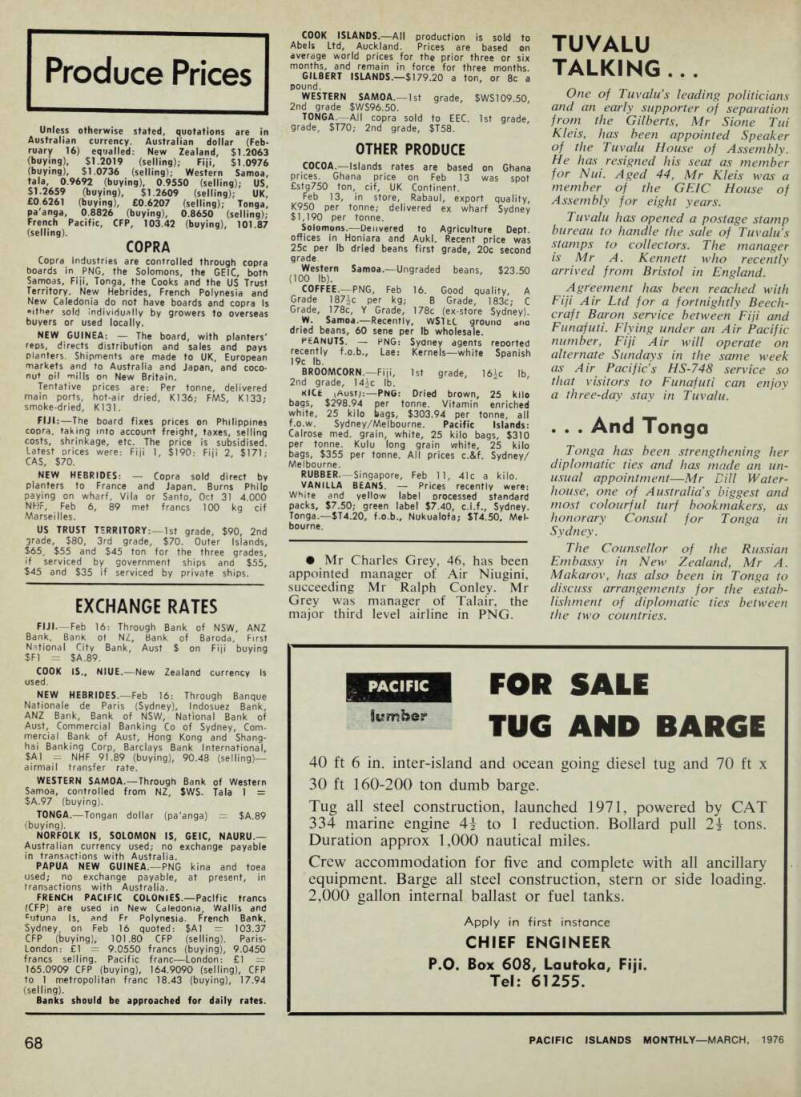
Unless otherwise stated, quotations are in Australian currency. Australian dollar (Feb ruary 16) equalled: New Zealand, $1.2063 (buying), $1.2019 (selling); Fiji, $1.0976 (buying), 51. 0736 (selling); Western Samoa, tala, 0.9692 (buying), 0.9550 (selling); US, $1.2659 (buying), $1.2609 (selling); UK, £06261 (buying), £0.6207 (selling); Tonga, pa'anga, 0.8826 (buying), 0.8650 (selling); French Pacific, CFP, 103.42 (buying), 101.87 (selling).
Copra
Copra industries are controlled through copra boards in PNG, the Solomons, the GEIC, both Samoas, Fiji, Tonga, the Cooks and the US Trust Territory. New Hebrides, French Polynesia and New Caledonia do not have boards and copra Is either sold individually by growers to overseas buyers or used locally.
NEW GUINEA; The board, with planters' reps, directs distribution and sales and pays planters. Shipments are made to UK, European markets and to Australia and Japan, and coco nut oil mills on New Britain.
Tentative prices are: Per tonne, delivered main ports, hot-air dried, K 136; FMS, K 133; smoke-dried, Kl3l.
FIJI: —The board fixes prices on Philippines copra, taking into account freight, taxes, selling costs, shrinkage, etc. The price is subsidised.
Latest prices were.- Fiji 1, $190; Fiji 2, $171;
Cas, $7O.
NEW HEBRIDES: Copra sold direct by planters to France and Japan. Burns Philp paying on wharf, Vila or Santo, Oct 31 4.000 NK'F, Feb 6, 89 met francs 100 kg cif Marseilles.
US TRUST TERRITORY: —Ist grade, $9O, 2nd grade, $BO, 3rd grade, $7O. Outer Islands, $65, $55 and $45 ton for the three grades, if serviced by government ships and $55, $45 and $35 if serviced by private ships.
Exchange Rates
FIJI. —Feb 16: Through Bank of NSW, ANZ Bank, Bank of NZ, Bank of Baroda, First National City Bank, Aust $ on Fiji buying
Sfi = Sa.B9.
COOK IS., NIUE. —New Zealand currency Is used.
NEW HEBRIDES.— Feb 16: Through Banque Nationale de Paris (Sydney), Indosuez Bank, ANZ Bank, Bank of NSW, National Bank of Aust, Commercial Banking Co of Sydney, Com mercial Bank of Aust, Hong Kong and Shang hai Banking Corp, Barclays Bank International, SAI = NHF 91.89 (buying), 90.48 (selling)— airmail transfer rate.
WESTERN SAMOA. —Through Bank of Western Samoa, controlled from NZ, SWS. Tala 1 =
$A.97 (buying).
TONGA. —Tongan dollar (pa'anga) = SA.B9 (buying).
Norfolk Is, Solomon Is, Geic, Nauru.—
Australian currency used; no exchange payable in transactions with Australia.
PAPUA NEW GUINEA.— PNG kina and toea used; no exchange payable, at present, in transactions with Australia.
FRENCH PACIFIC COLONIES.— Pacific francs (CFP) are used in New Caledonia, Wallis and c utuna Is, and Fr Polynesia. French Bank, Sydney, on Feb 16 quoted: SAI = 103.37 CFP (buying), 101.80 CFP (selling). Paris- London: £1 = 9.0550 francs (buying), 9.0450 francs selling. Pacific franc—London: £1 = 165.0909 CFP (buying), 164.9090 (selling), CFP to 1 metropolitan franc 18.43 (buying), 17.94 (selling).
Banks should be approached for daily rates.
COOK ISLANDS.—AII production is sold to Abels Ltd, Auckland. Prices are based on average world prices for the prior three or six months, and remain in force for three months.
GILBERT ISLANDS.—SI79.2O a ton, or 8c a pound.
WESTERN SAMOA.—Ist grade, $W5109.50, 2nd grade $W596.50.
TONGA.—AII copra sold to EEC. Ist grade, grade, ST7O; 2nd grade, STSB.
Other Produce
COCOA.—lslands rates are based on Ghana prices. Ghana price on Feb 13 was spot £stg7so ton, cif, UK Continent.
Feb 13, in store, Rabaul, export quality, K 950 per tonne; delivered ex wharf Sydney $1,190 per tonne.
Solomons.—Delivered to Agriculture Dept, offices in Honiara and Aukl. Recent price was 25c per lb dried beans first grade, 20c second grade Western Samoa—Ungraded beans, $23.50 (100 lb).
COFFEE.—PNG, Feb 16. Good quality, A Grade 187£c per kg ; B Grade, 183 c; C Grade, 178 c, Y Grade, 178 c (ex-store Sydney).
W. Samoa. — Recently, WSItC ground ano dried beans, 60 sene per lb wholesale.
PEANUTS. PNG: Sydney agents reoorted recently f.0.b., Lae: Kernels—white Spanish 19c lb.
BROOMCORN.—Fiji, Ist grade, 16ic lb, 2nd grade, 14£c lb.
KlCfc lAustj:—PNG: Dried brown, 25 kilo bags, $298.94 per tonne. Vitamin enriched white, 25 kilo bags, $303.94 per tonne, all f.o.w. Sydney/Melbourne. Pacific Islands: Calrose med. grain, white, 25 kilo bags, $3lO per tonne. Kulu long grain white, 25 kilo bags, $355 per tonne. All prices c.&f. Sydney/ Melbourne.
RUBBER.—Singapore, Feb 11, 41c a kilo.
VANILLA BEANS. Prices recently were: White and yellow label processed standard packs, $7.50; green label $7.40, c.i.f., Sydney.
Tonga.—sT4.2o, f.0.b., Nukualofa; $T4.50, Mel bourne.
• Mr Charles Grey, 46, has been appointed manager of Air Niugini, succeeding Mr Ralph Conley. Mr Grey was manager of Talair, the major third level airline in PNG.
Talking...
Tuvalu
One of Tuvalu’s leading politicians and an early supporter of separation from the Gilberts, Mr Sione Tui Kleis, has been appointed Speaker of the Tuvalu House of Assembly.
He has resigned his seat as member for Nui. Aged 44, Mr Kleis was a member of the GEIC House of Assembly for eight years.
Tuvalu has opened a postage stamp bureau to handle the sale of Tuvalu’s stamps to collectors. The manager is Mr A. Kennett who recently arrived from Bristol in England.
Agreement has been reached with Fiji Air Ltd for a fortnightly Beech craft Baron service between Fiji and Funafuti. Flying under an Air Pacific number, Fiji Air will operate on alternate Sundays in the same week as Air Pacific’s HS-748 service so that visitors to Funafuti can enjoy a three-day stay in Tuvalu. . . . And Tonga Tonga has been strengthening her diplomatic ties and has made an un usual appointment—Mr Dill Water house, one of Australia’s biggest and most colourful turf bookmakers, as honorary Consul for Tonga in Sydney.
The Counsellor of the Russian Embassy in New Zealand, Mr A.
Makarov, has also been in Tonga to discuss arrangements for the estab lishment of diplomatic ties between the two countries.
Advertisements & other items, p. 68 (1 item)
For Sale
PACIFIC
lumber
TUG AND BARGE
40 ft 6 in. inter-island and ocean going diesel tug and 70 ft x 30 ft 160-200 ton dumb barge.
Tug all steel construction, launched 1971, powered by CAT 334 marine engine 41 to 1 reduction. Bollard pull 21 tons.
Duration approx 1,000 nautical miles.
Crew accommodation for five and complete with all ancillary equipment. Barge all steel construction, stern or side loading. 2,000 gallon internal ballast or fuel tanks.
Apply in first instance
CHIEF ENGINEER
P.O. Box 60S, Lautoka, Fiji.
Tel: 61255.
Shipping & Airways Information
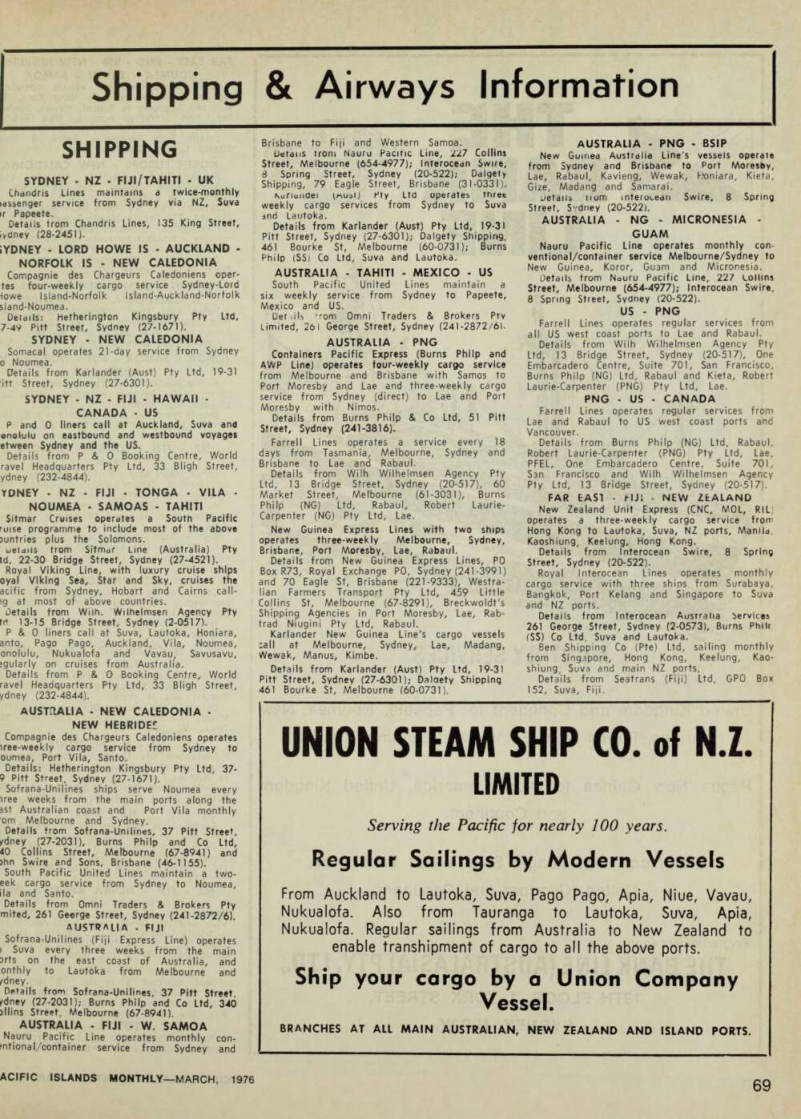
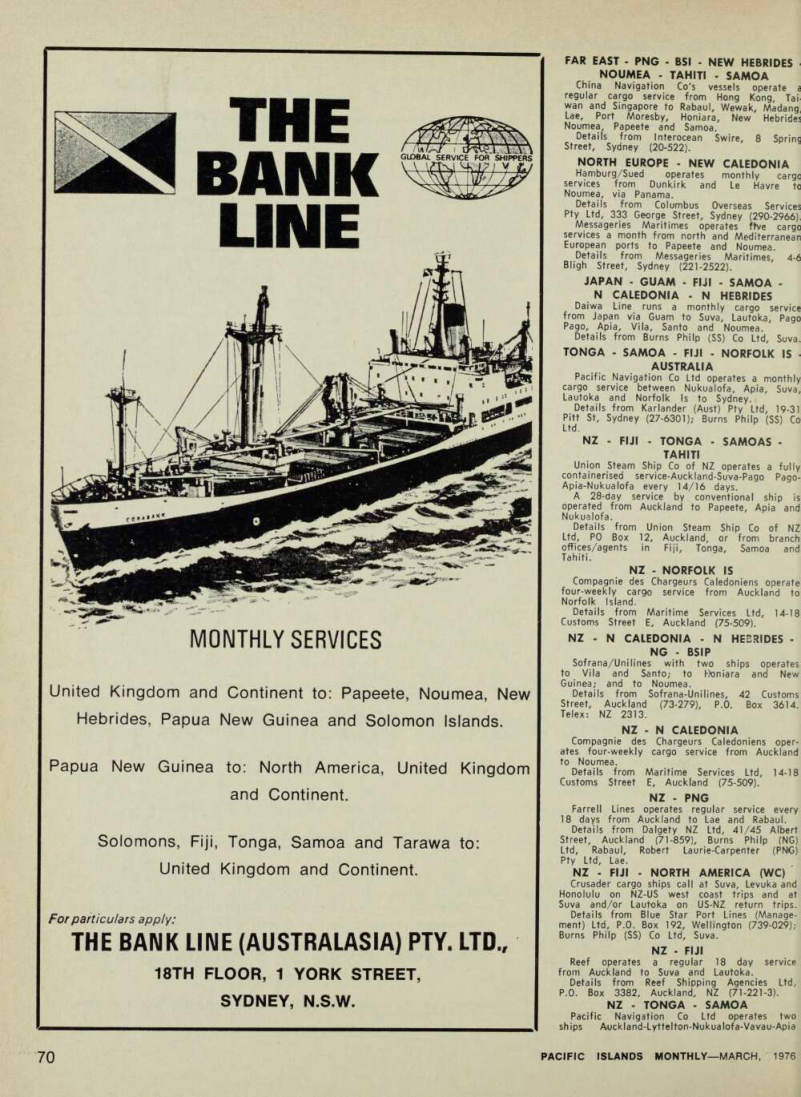
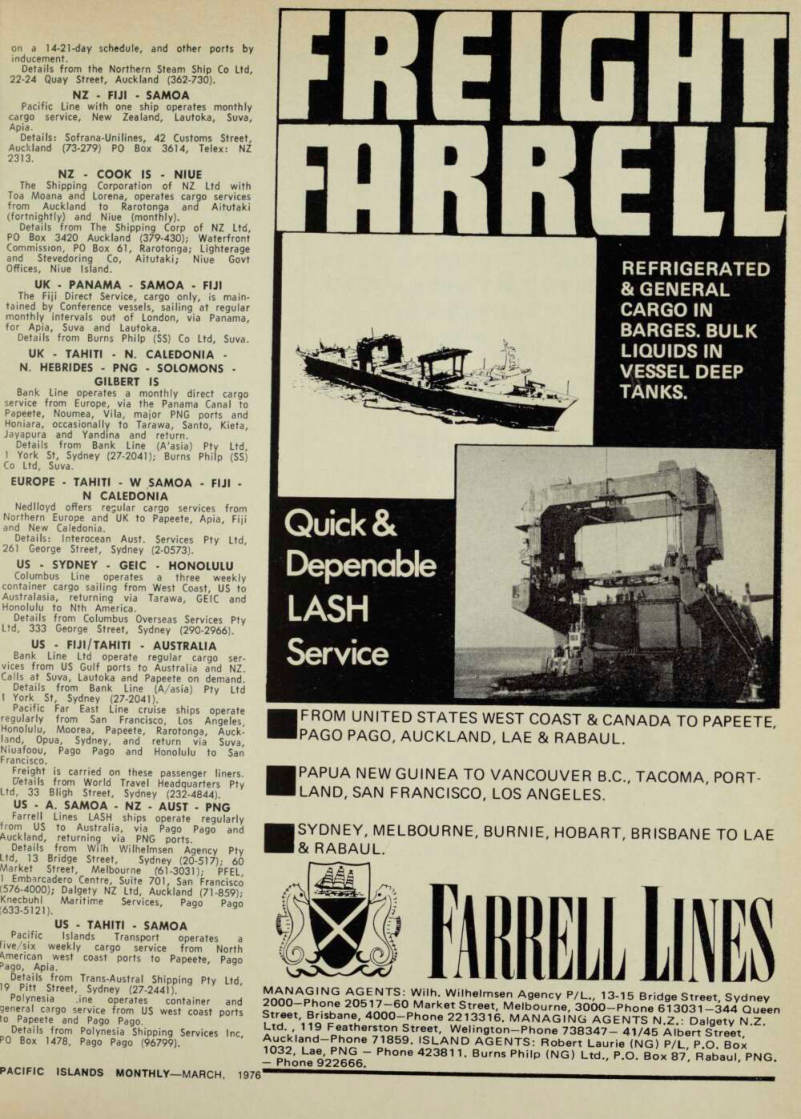
Shipping
SYDNEY - NZ - FUI/TAHITI - UK Chandris Lines maintains a twice-monthly lassenger service from Sydney via NZ, Suva ir Papeete.
Details from Chandris Lines, 135 King Street, iydnev (28-2451). iYDNEY - LORD HOWE IS - AUCKLAND -
Norfolk Is - New Caledonia
Compagnie des Chargeurs Caledoniens oper tes four-weekly cargo service Sydney-Lord fowe Island-Norfolk Island-Auckland-Norfolk sland-Noumea.
Details: Hetherington Kingsbury Pty Ltd, 7-49 Pitt Street, Sydney (27-1671).
Sydney - New Caledonia
Somacal operates 21-day service from Sydney o Noumea.
Details from Karlander (Aust) Pty Ltd, 19-31 iff Street, Sydney (27-6301).
SYDNEY - NZ - FIJI - HAWAII ■
Canada - Us
P and 0 liners call at Auckland, Suva and onolulu on eastbound and westbound voyages etween Sydney and the US.
Details from P & 0 Booking Centre, World ravel Headquarters Pty Ltd, 33 Bligh Street, ydney (232-4844).
TONEY ■ NZ ■ FIJI - TONGA - VILA ■
Noumea - Samoas ■ Tahiti
Sitmar Cruises operates a South Pacific ruise programme to include most of the above )untries plus the Solomons. uetails from Sitmar Line (Australia) Pty id, 22-30 Bridge Street, Sydney (27-4521).
Royal Viking Line, with luxury cruise ships oyal Viking Sea, Star and Sky, cruises the acific from Sydney, Hobart and Cairns call ig at most of above countries.
Details from Wilh. Wilhelmsen Agency Pty fd 13-15 Bridge Street, Sydney (2-0517).
P & 0 liners call at Suva, Lautoka, Honiara, anto, Pago Pago, Auckland, Vila, Noumea, onolulu, Nukualofa and Vavau, Savusavu, jgularly on cruises from Australia.
Details from P & 0 Booking Centre, World ravel Headquarters Pty Ltd, 33 Bligh Street, ydney (232-4844).
Australia • New Caledonia •
New Hebrides
Compagnie des Chargeurs Caledoniens operates iree-weekly cargo service from Sydney to oumea. Port Vila, Santo.
Details: Hetherington Kingsbury Pty Ltd, 37- 9 Pitt Street, Sydney (27-1671).
Sofrana-Unilines ships serve Noumea every iree weeks from the main ports along the ast Australian coast and Port Vila monthly om Melbourne and Sydney.
Details from Sofrana-Unilines, 37 Pitt Street, ydney (27-2031), Burns Philp and Co Ltd, 40 Collins Street, Melbourne (67-8941) and )hn Swire and Sons, Brisbane (46-1155).
South Pacific United Lines maintain a two eek cargo service from Sydney to Noumea, ila and Santo.
Details from Omni Traders & Brokers Pty mited, 261 George Street, Sydney (241-2872/6).
Australia - Fiji
Sofrana-Unilines (Fiji Express Line) operates » Suva every three weeks from the main Drts on the east coast of Australia, and onthly to Lautoka from Melbourne and ydney.
Details from Sofrana-Unilines, 37 Pitt Street ydney (27-2031); Burns Philp and Co Ltd, 340 allins Street, Melbourne (67-8941).
Australia - Fiji - W. Samoa
Nauru Pacific Line operates monthly con mtional/oontainer service from Sydney and
Brisbane to Fiji and Western Samoa.
Details trom Nauru Pacific Line, 227 Collins Street, Melbourne (654-4977); Interocean Swire, 8 Spring Street, Sydney (20-522); Dalgety Shipping, 79 Eagle Street, Brisbane (31-0331).
Nariaiidei (muslJ Pty Ltd operates three weekly cargo services from Sydney to Suva in Oetails°from Karland.r (Aust) Pty Ltd. 19-Jt Pitt Street, Sydney (27-6301); Dalgety Shipping, 461 Bourke St, Melbourne (60-0731); Burns Philp (SS) Co Ltd, Suva and Lautoka. aiictdaiia tauiti U r V im nc AUSTRALIA - TAHITI - MEXICO - US South Pacific United Lines maintain a six weekly service from Sydney to Papeete, Mexico and US.
Det tils *rom Omni Traders & Brokers Ptv Limited, 261 George Street, Sydney (241-2872/6).
Australia • Png
Containers Pacific Express (Burns Philp and AWP Line) operates tour-weekly cargo service from Melbourne and Brisbane with Samos to Port Moresby and Lae and three-weekly cargo service from Sydney (direct) to Lae and Port Moresby with Nimos. . .
Details from Burns Philp & Co Ltd, 51 Pitt Street, Sydney (241-3816).
Farrell Lines operates a service every 18 days from Tasmania, Melbourne, Sydney and Brisbane to Lae and Rabaul.
Details from Wilh Wilhelmsen Agency Pty Ltd, 13 Bridge Street, Sydney (20-517), 60 Market Street Melbourne (61-3031), Burns r hllp * (NG ,Lt Lt D d / .^ ba l jl ' R ° bert Laune ’
Carpenter (NO) Pty Ltd, Lae.
New Guinea Express Lines with two ships operates three-weekly Melbourne, Sydney, Brisbane, Port Moresby, Lae, Rabaul.
Details from New Guinea Express Lines, PO Box R 73, Royal Exchange PO, Sydney (241-3991) and 70 Eagle St, Brisbane (221-9333), Westralian Farmers Transport Pty Ltd, 459 Little Collins St, Melbourne (67-8291), Breckwoldt's Shipping Agencies in Port Moresby, Lae, Rabtrad Niugini Pty Ltd, Rabaul.
Karlander New Guinea Line's cargo vessels call at Melbourne, Sydney, Lae, Madang, Wewak, Manus, Kimbe.
Details from Karlander (Aust) Pty Ltd, 19-31 Pitt Street, Sydney (27-6301); Daloety Shipping 461 Bourke St, Melbourne (60-0731).
Australia - Png - Bsip
New Guinea Australia Line's vessels operate from Sydney and Brisbane to Port Moresby, Lae, Rabaul, Kavieng, Wewak, Ftoniara, Kieta, Gize, Madang and Samarai. uefails Hum interocean Swire, 8 Spring Street, Sydney (20-522).
Australia - Ng - Micronesia -
Guam
Nauru Pacific Line operates monthly con ventional/container service Melbourne/Sydney to New Guinea, Koror, Guam and Micronesia.
Details from Nauru Pacific Line, 227 Collins Street, Melbourne (654-4977); Interocean Swire, 8 Spring Street, Sydney (20-522).
Us - Png
Farrell Lines operates regular services from all US west coast ports to Lae and Rabaul.
Details from Wilh Wilhelmsen Agency Pty Ltd, 13 Bridge Street, Sydney (20-517), One Embarcadero Centre, Suite 701, San Francisco, Burns Philp (NG) Ltd, Rabaul and Kieta, Robert Laurie-Carpenter (PNG) Pty Ltd, Lae.
Png - Us - Canada
Farrell Lines operates regular services from Lae and Rabaul to US west coast ports and Vancouver.
Details from Burns Philp (NG) Ltd, Rabaul, Robert Laurie-Carpenter (PNG) Pty Ltd, Lae, PFEL, One Embarcadero Centre, Suite 701, San Francisco and Wilh Wilhelmsen Agency Pty Ltd, 13 Bridge Street, Sydney (20-517).
FAR EAST - FIJI - NEW ZEALAND New Zealand Unit Express (CNC, MOL, RIL, operates a three-weekly cargo service from Hong Kong to Lautoka, Suva, NZ ports, Manila, Kaoshiung, Keelung, Hong Kong.
Details from Interocean Swire, 8 Spring Street, Sydney (20-522).
Royal Interocean Lines operates monthly cargo service with three ships from Surabaya, Bangkok, Port Kelang and Singapore to Suva and NZ ports.
Details from Interocean Australia Services 261 George Street, Sydney (2-0573), Burns Philc (SS) Co Ltd, Suva and Lautoka.
Ben Shipping Co (Pte) Ltd, sailing monthly from Singapore, Hong Kong, Keelung, Kao shiung, Suva and main NZ ports.
Details from Seatrans (Fiji) Ltd, GPO Box 152, Suva, Fiji.
FAR EAST - PNG - BSI - NEW HEBRIDES
Noumea - Tahiti . Samoa
China Navigation Co's vessels operate a regular cargo service from Hong Kong, Tai wan and Singapore to Rabaul, Wewak, Madang, Lae, Port Moresby, Honiara, New Hebrides Noumea, Papeete and Samoa.
Details from Interocean Swire, 8 Spring Street, Sydney (20-522).
North Europe - New Caledonia
Hamburg/Sued operates monthly cargo services from Dunkirk and Le Havre to Noumea, via Panama.
Details from Columbus Overseas Services Pty Ltd, 333 George Street, Sydney (290-2966).
Messageries Maritimes operates ftve cargo services a month from north and Mediterranean European ports to Papeete and Noumea.
Details from Messageries Maritimes, 4-6 Bligh Street, Sydney (221-2522).
JAPAN - GUAM - FIJI - SAMOA -
N Caledonia - N Hebrides
Daiwa Line runs a monthly cargo service from Japan via Guam to Suva, Lautoka, Pago Pago, Apia, Vila, Santo and Noumea.
Details from Burns Phi Ip (SS) Co Ltd, Suva.
TONGA - SAMOA - FIJI - NORFOLK IS ■
Australia
Pacific Navigation Co Ltd operates a monthly cargo service between Nukualofa, Apia, Suva, Lautoka and Norfolk Is to Sydney.
Details from Karlander (Aust) Pty Ltd, 19-31 Pitt St, Sydney (27-6301); Burns Philp (SS) Co Ltd.
NZ - FIJI - TONGA - SAMOAS -
Tahiti
Union Steam Ship Co of NZ operates a fully containerised service-Auckland-Suva-Pago Pago- Apia-Nukualofa every 14/16 days.
A 28-day service by conventional ship is operated from Auckland to Papeete, Apia and Nukualofa.
Details from Union Steam Ship Co of NZ Ltd, PO Box 12, Auckland, or from branch offices/agents in Fiji, Tonga, Samoa and Tahiti.
Nz - Norfolk Is
Compagnie des Chargeurs Caledonians operate four-weekly cargo service from Auckland to Norfolk Island.
Details from Maritime Services Ltd, 14-18 Customs Street E, Auckland (75-509).
NZ - N CALEDONIA - N HEBRIDES -
Ng - Bsip
Sofrana/Unilines with two ships operates to Vila and Santo; to Honiara and New Guinea; and to Noumea.
Details from Sofrana-Unilines, 42 Customs Street, Auckland (73-279), P.O. Box 3614.
Telex: NZ 2313.
Nz ■ N Caledonia
Compagnie des Chargeurs Caledoniens oper ates four-weekly cargo service from Auckland to Noumea.
Details from Maritime Services Ltd, 14-18 Customs Street E, Auckland (75-509).
Nz • Png
Farrell Lines operates regular service every 18 days from Auckland to Lae and Rabaul.
Details from Dalgety NZ Ltd, 41/45 Albert Street, Auckland (71-859), Burns Philp (NG) Ltd, Rabaul, Robert Laurie-Carpenter (PNG) Pty Ltd, Lae.
NZ - FIJI - NORTH AMERICA (WC) Crusader cargo ships call at Suva, Levuka and Honolulu on NZ-US west coast trips and at Suva and/or Lautoka on US-NZ return trips.
Details from Blue Star Port Lines (Manage ment) Ltd, P.O. Box 192, Wellington (739-029); Burns Philp (SS) Co Ltd, Suva.
Nz - Fiji
Reef operates a regular 18 day service from Auckland to Suva and Lautoka.
Details from Reef Shipping Agencies Ltd, P.O. Box 3382, Auckland, NZ (71-221-3).
Nz - Tonga - Samoa
Pacific Navigation Co Ltd operates two ships Auckland-Lyttelton-Nukualofa-Vavau-Apia
on a 14-21-day schedule, and other ports by inducement.
Details from the Northern Steam Ship Co Ltd, 22-24 Quay Street, Auckland (362-730).
Nz - Fiji - Samoa
Pacific Line with one ship operates monthly cargo service. New Zealand, Lautoka, Suva, Apia.
Details: Sofrana-Unilines, 42 Customs Street, Auckland (73-279) PO Box 3614, Telex: NZ 2313.
Nz - Cook Is - Niue
The Shipping Corporation of NZ Ltd with Toa Moana and Lorena, operates cargo services from Auckland to Rarotonga and Aitutaki (fortnightly) and Niue (monthly).
Details from The Shipping Corp of NZ Ltd, PO Box 3420 Auckland (379-430); Waterfront Commission, PO Box 61, Rarotonga; Lighterage and Stevedoring Co, Aitutaki; Niue Govt Offices, Niue Island.
UK - PANAMA - SAMOA - FIJI The Fiji Direct Service, cargo only, is main tained by Conference vessels, sailing at regular monthly intervals out of London, via Panama, for Apia, Suva and Lautoka.
Details from Burns Philp (SS) Co Ltd, Suva.
UK - TAHITI - N. CALEDONIA - N. HEBRIDES - PNG - SOLOMONS -
Gilbert Is
Bank Line operates a monthly direct cargo service from Europe, via the Panama Canal to Papeete, Noumea, Vila, major PNG ports and Honiara, occasionally to Tarawa, Santo, Kieta, Jayapura and Yandina and return.
Details from Bank Line (A'asia) Pty Ltd, 1 York St, Sydney (27-2041); Burns Philp (SS) Co Ltd, Suva.
EUROPE - TAHITI - W SAMOA - FIJI -
N Caledonia
Nedlloyd offers regular cargo services from Northern Europe and UK to Papeete, Apia, Fiji and New Caledonia.
Details: Interocean Aust. Services Pty Ltd, 261 George Street, Sydney (2-0573).
US - SYDNEY - GEIC - HONOLULU Columbus Line operates a three weekly container cargo sailing from West Coast, US to Australasia, returning via Tarawa, GEIC and Honolulu to Nth America.
Details from Columbus Overseas Services Pty Ltd, 333 George Street, Sydney (290-2966).
Us - Fiji/Tahiti - Australia
Bank Line Ltd operate regular cargo ser vices from US Gulf ports to Australia and NZ.
Calls at Suva, Lautoka and Papeete on demand.
Details from Bank Line (A/asia) Pty Ltd 1 York St, Sydney (27-2041).
Pacific Far East Line cruise ships operate regularly from San Francisco, Los Angeles Honolulu, Moorea, Papeete, Rarotonga, Auck land, Opua, Sydney, and return via Suva, Niuafoou, Pago Pago and Honolulu to San Francisco.
Freight is carried on these passenger liners.
D'etails from World Travel Headquarters Pty Ltd, 33 Bligh Street, Sydney (232-4844).
US - A. SAMOA - NZ - AUST - PNG Farrell Lines LASH ships operate regularly from US to Australia, via Pago Pago and Auckland, returning via PNG ports.
Details from Wiih Wilhelmsen Agency Pty Ltd, 13 Bridge Street, Sydney (20-517); 60 Market Street, Melbourne (61-3031); PFEL 1 Embarcadero Centre, Suite 701, San Francisco (576-4000); Dalgety NZ Ltd, Auckland (71-859); (6335*121) ar ‘*' me Services, Pago Pago
Us - Tahiti - Samoa
Pacific Islands Transport operates a Five/six weekly cargo service from North American west coast ports to Papeete, Paao Pago, Apia.
Details from Trans-Austral Shipping Ptv Ltd 19 Pitt Street, Sydney (27-2441) Polynesia .ine operates container and general cargo service from US west coast ports fo Papeete and Pago Pago.
Details from Polynesia Shipping Services Inc, PO Box 1478, Pago Pago (96799).
Advertisements & other items, pp. 69-72 (2 items)
69
ACIFIC ISLANDS MONTHLY—MARCH, 1976
Union Steam Ship Co. Of N.Z.
LIMITED
Serving the Pacific for nearly 100 years.
Regular Sailings by Modern Vessels
From Auckland to Lautoka, Suva, Pago Pago, Apia, Niue, Vavau, Nukualofa. Also from Tauranga to Lautoka, Suva, Apia, Nukualofa. Regular sailings from Australia to New Zealand to enable transhipment of cargo to all the above ports.
Ship your cargo by a Union Company
Vessel.
BRANCHES AT ALL MAIN AUSTRALIAN, NEW ZEALAND AND ISLAND PORTS.
THE
I i znv? v i
GLOBAL SERVICE FOR SHIPPERS
UNE
A S 3
• «*SC*V- s>.
MONTHLY SERVICES
United Kingdom and Continent to: Papeete, Noumea, New Hebrides, Papua New Guinea and Solomon Islands.
Papua New Guinea to: North America, United Kingdom and Continent.
Solomons, Fiji, Tonga, Samoa and Tarawa to: United Kingdom and Continent.
For particulars apply:
THE BANK LINE (AUSTRALASIA) PTY. LTD.,
18TH FLOOR, 1 YORK STREET,
SYDNEY, N.S.W.
B I S B
REFRIGERATED
& GENERAL
CARGO IN
BARGES. BULK
LIQUIDS IN
VESSEL DEEP
TANKS.
lJ •L * I JFROM UNITED STATES WEST COAST & CANADA TO PAPEETE
IPAGO PAGO, AUCKLAND, LAE & RABAUL.
IPAPUA NEW GUINEA TO VANCOUVER 8.C., TACOMA, PORT-
LAND, SAN FRANCISCO, LOS ANGELES.
[SYDNEY, MELBOURNE, BURNIE, HOBART, BRISBANE TO LAE
1& RABAUL.
X 9 2000-PhonP 9 A n G ß E i7 T finM ilh : Wi i he,mS M Agency P/L., 13-15 Bridge Street, Sydney H°°° Ph ?" e 205^~ 60 Market Street, Melbourne, 3000-Phone 613031-344 Queer f!? e 'i?o? ane u' 400 °- ph o n e 2213316. MANAGING AGENTS N.Z.: Dalgety N.Z.
Ltd, , 119 Featherston Street, Welington—Phone 738347 41/45 Albert Street tol 2 k T a d »“pM°r ne Vk 859 - ' S , LAN , D AGENTS: Rob6rt Laurie (NG) “i -°Phone 922666~ Ph °" e 423811 ' Burns Philp (NG) Ltd - p -°- Box 87, Rabaul, PNG.
KYOWA SHIPPING LINES
Monthly Services
Hong Kong,Taiwan,S.Korea, Japan
To: Guam, Saipan, British Solomon, New Caledonia, Fiji, W. Samoa, A. Samoa. Tahiti, Cook Is., Tonga, New Hebrides.
Taiwan,Hong Kong, Singapore, Jakarta
To : Australia, Papua New Guinea
South Korea, Japan
To: Guam, Saipan, Papua New Guinea, Other Pacific Islands
AGENTS
Taiwan: Royal Steamship Corp., Ltd., Taipei S. Korea: Dong Sue Shipping Co., Ltd., Seoul Hong Kong: Dahzun Enterprises Ltd.
Singapore: Ocean Shipping & Enterprises Pte., Ltd. ' Mariana Is.: Island Navigation Co., Ltd., Guam 8.5.1. P.: British Solomon Trading Co., Ltd., Honiara Tahiti: J. A. Cowan & Fils, Papeete Tonga: E. M. Jones Ltd., Nukualofa New Hebrides: Agence Maritime Raymond Velicite, Port Vila A. Samoa: Toko Shimasaki Agencies Ltd., Pago Pago W. Samoa: Morris Hedstrom Ltd., Apia Fiji: Carpenter Shipping, Suva & Lautoka PNG: Carpenter Shipping Agencies, Port Moresby, Rabaul New Caledonia: Agence Maritime Du Rond Point Du Pacific, Noumea Indonesia: P.T. Porodisa Raya Shipping Lines, Jakarta Australia: Hetherington Kingsbury Pty. Ltd., Sydney, N.S.W.
KYOWA SHIPPING CO., LTD.
OJIMA BLDG., 22-8, 6-CHOME, SHINBASHI, MINATO-KU,
TOKYO. JAPAN
TELEPHONE: TOKYO 03 (437) 2885 (REP.)
CABLE ADDRESS: "MARIQUEEN” TOKYO
TELEX NO.: (0) 2424651 KYOWA J
Airways
From Australia
Qanlas (7075, 7475, DC4)—PNG, Norfolk Is, New Caledonia, Fiji, Tahiti, US, Canada.
PAA (707 s and 747 s) —Fiji, American Samoa, Hawaii, US.
CP Air (DCS) —Fiji, Hawaii, Canada.
UTA (DCSs and DClOs) —New Caledonia, Fiji, New Zealand, Tahiti, US.
Air-NZ (DClOs) —New Zealand, Fiji, Hawaii, US.
Air Nauru (F2B) —New Caledonia, Solomon Islands, Nauru, Tarawa, Majuro.
Air Niugini (720 s) —PNG.
Advance Aviation (from Sydney), North Coast Airlines (from Coffs Harbour) and Oxley Air lines (from Port Macquarie)—Lord Howe Is
From New Zealand
Air-NZ (DCSs, DClOs, F27)—Fiji, American Samoa, Cook Is, Tahiti, Hawaii, US, New Caledonia, Norfolk Is.
PAA (707 s) —American Samoa, Tahiti, Hawaii, US.
UTA (DCS)—Tahiti.
PACIFIC - FAR EAST - S. AMERICA Air Nauru (F2B or 737) —Nauru to Micro nesia, Okinawa, Japan, Taiwan, Hong Kong.
Air France (707 s) —Japan to Tahiti, Peiu Air Niugini (707 s) —to Manila.
Pacific Is - Aust
Air Pacific (SAC 111) —From Fiji, via New Hebrides or New Caledonia, to Brisbane.
Air Nauru (F2B or 737) flies to Melbourne.
Air Niugini (727 s and Fokker Friendships, to Cairns and Brisbane.
Norfolk Island Airlines (Beechcraft) to Brisbane.
Pacific Is - Nz
Air Pacific (BACIII) —Fiji-Tonga-NZ.
Inter-Territory
Lan-Chile (707 s) —Easter Is, Tahiti.
Air Pacific (BACIII and HS74Bs) —Fiji to GEIC, Nauru, Western Samoa, Tonga, New Heb rides, Solomon Islands, New Caledonia, PNG.
Fiji Air Services —Wallis and Futuna (charter).
Qantas (707 s) —PNG to Singapore.
PAA (707 s) —Hawaii to Am. Samoa and Tahiti, US.
UTA (7075, Caravelles) from New Caledonia to Fiji, New Hebrides, Wallis Is, Tahiti.
Continental-Air Micronesia (7275) from Hawaii to Micronesia.
Air Nauru from Nauru to Tarawa, Marshall Is, Wallis Is, Fiji and Western Samoa.
Polynesian Airlines from Apia to Tonga, Niue Is, Fiji, Am. Samoa.
South Pacific Island Airways flies between American and Western Samoa.
Air Tahiti from Tahiti to Cook Is.
Air Niugini to Irian/Jaya, Solomon Is, Philippines.
Norfolk Island Airlines (Beechcraft) to Noumea.
Internal
Fiji—Air Pacific (HS74Bs and Trislanders), Fiji Air Services (Beech Barons and Islanders).
French Polynesia—Air Polynesia (Fokker Friendships), Air Tahiti.
US Trust Territory and Guam—Continental- Air Micronesia (7275) and Air Pacific Interna tional Inc.
GEIC —Air Pacific.
PNG —Air Niugini, Aerial Tours, Talair, Melanesian Airlines, Crowley Airways.
Bougainville—Bougainville Air Services.
New Caledonia —Air Caledinie (Twin Otters).
New Hebrides—Air Melanesiae (Islanders).
Solomon Is —Solair (Beech Barons and Islanders).
Tonga—Tonga Internal Air Service (Islanders).
Cook Is —Cook Island Airways (Islander).
Norfolk Island Airlines (Beechcraft) —Norfolk Is-Lord Howe Is.
Western Samoa—Air Samoa Ltd, and Samoa Aviation Ltd.
Advertisements & other items, p. 73 (1 item)
Line
DIRECT REGULAR SERVICE
JAPAN-SOUTH PACIFIC
TARAWA-PAPEETE-PAGO PAGO-APIA
SUVA-LAUTOKA-NOUMEA-VILA
SANTO-HONIARA
JAPAN-TAIWAN-GUAM
JAPAN-KEELUNG-GUAM BY
EXCELLENT CAR/CONTAINER-CARRIER
JAPAN-WEST IRIAN-DILI
HONG KONG-TAIWAN-WEST IRIAN-DILI
mr
DAIWA
AGENTS:
GUAM: ATKINS, KROLL (GUAM) LTD.
TARAWA; G. & E. I. DEVELOPMENT AUTHORITY.
APIA: BURNS PHILP (SOUTH SEA) CO.. LTD.
PAGO PAGO: KNEUBUHL MARITIME SERVICES CORP,
NUKUALOFA: PACIFIC NAVIGATION CO.. LTD.
SUVA: BURNS PHILP (SOUTH SEA) CO.. LTD.
LAUTOKA: BURNS PHILP (SOUTH SEA) CO., LTD.
NOUMEA: AGENCE MARITIME ET AERIENNE
CALEDONIENNE.
SANTO: BURNS PHILP (NEW HEBRIDES) LTD.
VILA: BURNS PHILP (NEW HEBRIDES) LTD.
HONIARA; BRITISH SOLOMONS TRADING CO., LTD.
PAPEETE: AGENCE MARITIME DE FARA UTE.
HONG KONG: IKE MARITIME CO., LTD.
SINGAPORE: THE BORNEO CO., (SINGAPORE) LTD.
DJAJAPURA: P. N. PELAJARAN NASIONAL INDONESIA
DILI: SANG TAI HOO
TAIWAN: FOR CARGO BETWEEN JAPAN/GUAM/TAIWAN
FORMOSA SHIPPING & ENTERPRISE CORP.
TAIWAN; FOR CARGO BETWEEN JAPAN/SOUTH PACIFIC/
WEST IRIAN/DILI
MARITIME TRANSPORTATION AGENCIES, LTD
THE DAIWA NAVIGATION CO.*LTD.
OSAKA: “DAILINE”
HEAD OFFICE
DAIICHI KYOGYO BLDG.,
45, 2-CHOME, AWAZAMINAMI-DORI
NISHI-KU, OSAKA, JAPAN
TELEPHONE: (06) 531-0471 ~9
TELEX: 525-6324 & 525-6325
TOKYO; "FUNEDAILINE"
TOKYO OFFICE
SHIN-DAIICHI BLDG.,
4-13, NIHONBASHI 3-CHOME, CHUO-KU
TOKYO, JAPAN
TELEPHONE: (03) 274-3251 ~8
Islands People
Deaths of Islands People
Dr B. Duncan Dr Bryan Duncan, a well-known Suva doctor, died on January 25, aged 40. He went to Fiji about 14 years ago from England to work under the South Pacific Medical Service Scheme. He resigned in 1964 and set up his own practice in Suva.
He leaves a widow and four children.
Rev W. A. Walter, SJ The Rev Father William A.
Walter, a Jesuit missionary in the outer islands area of Yap District in Micronesia, died recently in New York, aged 69. His remains were flown to Ulithi Atoll for burial.
During World War 11, Father Walter
was a chaplain with US troops in Australia and the Philippines.
In 1947 he volunteered for mis sionary work when Pope Pius XII asked New York Jesuits to accept the mission in the Carolines and the Marshalls. The Congress of Micro nesia, in 1974, voted unanimously to make him an honorary citizen of Micronesia in recognition of his work in the territory.
Among his accomplishments were an appeal to the US Congress on behalf of outer islands people over fair compensation for death and des truction in World War II; creation of a construction fund to build typhon-proof concrete buildings in the outer islands; creation of an education fund for outer islands students attending schools outside Yap District; involvement in the pro motion of political education among his parishioners; and serving as an appraiser for outer islands chiefs.
Mr Choy Gopal
Mr Choy Gopal, the first Indian to become a mayor in Fiji, died at Lautoka on February 3, aged 57. He was elected Mayor of Lautoka in 1957 after being elected to the Lau toka Town Council in 1956.
On his retirement from the coun cil, Mr Gopal became secretary of the Lautoka Club, then joined Beach comber Cruises, of which he was genera] manager at his death. He was keenly interested in soccer and boxing, and refereed both sports. He also played cricket.
Mrs Zena Borron Mrs Zena Borron, a member of an old European family in Fiji, died on February 6 at Suva. She was born in Fiji just before the turn of the century, the daughter of Mr and Mrs John Rennie. Her grandparents arrived in Fiji in the 1860 s as cotton planters.
She married Mr James Borron, member of another old Fiji family, at San Francisco in 1927. With her husband she lived on Mago Island, Lau, and in Suva. Mago Island is managed by one of their sons, Jim.
Another son, Arthur, lives in north ern NSW.
Mrs Borron was active in com munity work in Suva. She was a member of the Fiji Women’s Club and the YWCA.
Advertisements & other items, p. 74 (1 item)
Pacific Islands Transport Line
Owners: Thor Dahls Hvalfangerselskap A/S—Sandefjord, Norway
MS CAMELLIA VENTURE
Express Freight Service between Pacific Coast Ports of
U.S.A.
and
TAHITI and SAMOA
Full container service including reefers.
GENERAL STEAMSHIP CORPORATION LTD.
General Agents 400 California Street, San Francisco, California, U.S.A.
APlA—Burns Philp (South Sea) Company, Ltd.
PAPEETE—Agence Maritime Internationale Tahiti.
PAGO PAGO—Polynesia Shipping Services Inc.
NOUMEA—Etablissements Ballande.
SYDNEY—Trans-Ausfral Shipping Pty. Ltd.
SUVA—Burns Philp (South Sea) Company, Ltd.
LAE/RABAUL—Burns Philp (New Guinea) Ltd.
PORT VILA —Comptoirs Francais de Nouvelles Hebrides.
GENERATING SETS
by BRAYBON
J Capacities available are: Petrol 2 kva • Diesel 2 kva-200 kva Write for brochure and prices:
BRAYBON BROS. PTY. LTD.,
2 ROTHWELL AVE., CONCORD WEST,
N.S.W., 2138. Phone: 73-3246,
SOUTHERN PACIFIC INSURANCE
COMPANY (PNG) LIMITED
(INCORPORATED IN PAPUA NEW GUINEA)
HEAD OFFICE: BANK HAUS, CHAMPION PDE. P.O. BOX 136 PORT MORESBY, PAPUA NEW GUINEA. PH. 2623 • FIRE • FIRE AND VOLCANIC ERUPTION • HOUSEHOLD COMPREHENSIVE • MOTOR VEHICLE • COMPULSORY THIRD PARTY • COMPULSORY WORKERS COMPENSATION
MARINE • PUBLIC LIABILITY • BURGLARY
Enquiries are invited for all classes of insurance from special representatives at: PORT MORESBY: H. A. McKEE, General Manager, Champion Pde., P.O. Box 136, Ph. 2623 or y'Vj. LAE: R. H. MYER, Manager for Lae, Central Ave., P.O. Box 758, Ph. 42-4590 or 42-4. : 6. . ACAUL: K. J. ARMSTRONG, Manager for Rabaul, Mango Ave., P.O. Box 123, Ph. 92-241/ or 92-2755. as
Campaigning
At The Bar
The new parliament in Western Samoa could be one of the most active the country has had if the vigour some candidates for election showed is a guide. Some of them travelled far and wide to woo the voters with promises, and it was even suggested that some broke the law by offering strong drink to the voters! There must have been some thing in it, for the Chief Returning Officer, Mr Feesago S. Fepuleai, warned of heavy penalties provided
by law for candidates who indulged in illegal practices.
But a number of candidates were apparently not sanguine about their chances of election. Twenty-one of them withdrew from the race early in February. It was then left to 165 candidates to fight for 43 seats; four seats were already filled as the can didates were elected unopposed.
Polling was scheduled for late in February. • The Western Samoa Govern ment has accepted an offer by a West German consortium to open a brewery in Apia. The West German interests are the firms of Brahasse.
Breckwoldt and DEG.
Advertisements & other items, pp. 75-80 (3 items)
I New Spc
75
FIC ISLANDS MONTHLY— MARCH, 1976
>m p 29
Pacsec 76
PACIFIC SECURITY SEMINAR AND EXHIBITION
MELBOURNE, 12-14 APRIL. 1976.
A unique opportunity to listen to and talk with the world's leaders in Security of all types.
A three day seminar program will cover many subjects including; Alarm Systems and Theft Prevention Locks, Keys and Safes The Impact of the Law on the Security Industry Introduction to Security The Protection of Computers Conducting Security Surveys Access Control Systems Insurance Requirements for Security Security A Vital Component of Effective Management Personal Security Inventory Control Commonsense Cures for Hold-Ups Fire Bomb and Disaster Proceedures for Large Buildings Currency Handling Top class speakers include high ranking police officers from Australia, New Zealand, and other overseas countries and security experts from U.S.A. and U.K. as well as experienced Australians.
A large exhibition will show the latest in security equip men t-from simple locking systems to closed circuit television, cash handling systems and electronic gadgetry of all types.
Attendance for the full three day seminar series is only $A 60.00. For further details contact'
PACSEC 76
11 Clarke Street, Crows Nest, N.S.W. Australia 2065.
DAN 1
Line Advertisements
Per line, $2.50 Anst.
Minimum rate, 4 lines.
PARK VIEW MOTEL—BRISBANE
Quiet location—opp. Botanic Gardens.
Single, double, family suites, all with refrig., air conditioning, phone, TV, radio, tea making facilities, from $l2. Pool and restaurant.
Phone 31-2695—Telex 40270.
Write for coloured brochure— Park View Motel, 128 Alice St, BRISBANE Qld., 4000.
WILL OPEN SOON!
In the centre of the European Common Market, A Trade, Social and Cultural Office for all PACIFIC
ISLANDS.
We are looking for contracts now.
Government contracts welcomed.
For more details, write to L. PHILIPS, Arawa, P.O. Box 794, Bougainville Island or call PNG 951134.
FOR SALE
40ft GLASS BOTTOM
CRUISER
Brand new 40 ft Glass Bottom Cruiser, seats up to 50 people.
Has toilet and washroom facilities, also bar, fridge and storage area. Ideal for reef viewing, island cruises or water taxi enterprise. Without engines but all fittings are in place to suit twin 6 cylinder Lee Marine Ford Diesels.
For further details contact:
OOLOOLOO CRUISES LTD.
P.O. Box 2034
SUVA, FIJI.
Phone: 26215.
WANTED STAMPS. From any of Pacific Islands, mint or used, on or off paper, any quantity, best prices paid. Contact: F. J. Trading, P.O. Box 20, Roselands, N.S.W. 2195, Aust.
FOR SALE
CONCRETE BLOCK MAKER. Makes
blocks, flags, edgings, screen-blocks, garden stools —up to 8 at once and 96 an hour. $215.00 c.i.f. main ports. Send for leaflets. Forest Farm Research, Londonderry, N.S.W., 2753.
BOATS— Easy build kits for dinghies, sailboats, canoes etc. Send for brochure, Blockey, the Boatbuilder 448 Chapel St, Sth. Yarra 3141 Australia.
If you have shells to sell—any quantity —contact Anisa Commodity Traders Pty.
Ltd., P.O. Box 1413, Lae, Papua New Guinea, Phone 424159. We are buyers of Trochus, Greensnail, Blacklip MOP. Goldlip MOP, and Marine Specimens Best prices paid. Rabaul agents; Gazelle Agencies Pty. Ltd., P.O. Box 262, Rabaul, P.N.G. Phone: 921397. Manus I>land Agents, R. L. & V. J. Knight, P.O. Box 108, Lorengau, Manus Island, P.N.G.
Phone: 38.
UNIVERSITY GRADUATE (28) in
English, Political Sc., Economics and deeply interested in the life of Pacific Islands seeks temporary or permanent job of any suitable nature on any island. Some experience in community service, office work and teaching.
Reply V. Kumar, P.O. Box 2437, Suva, Fiji.
CITIZEN BUSINESS MACHINES
• CASH REGISTERS • ADDING MACHINES
© TYPEWRITERS • ELECTRONIC CALCULATORS
Write for brochures and prices Maison Barrau, 8.P.A4 Cedex, Noumea 1 Iprotec, B.P. 366 Port Vila or direct to
GOODSON CALCULATORS PTY. LTD.
23/25 ABERCROMBIE STREET, CHIPPENDALE, SYDNEY 2008
Agency enquiries invited
MAPS AND PRINTS
OF THE OLD PACIFIC
Original antiquarian Pacific views and maps for sale. Enquiries invited stating areas of interest.
C. HINCHCLIFFE, 7 Royd Avenue, Heckmondwike, West Yorkshire, WFI6 9AL, United Kingdom.
Top performance takes the guesswork
out of going hi-fi.
'Jo imitations here. Every one of the
DNDO 2000 Stereo Sound Mates was
imponent created and Pioneer blended to a total system stereo package. And a price much lower than you think.
: irst, an advanced design AM/FM
sreo receiver produces a powerful 13
ms per channel virtually distortion-free
:curate tonal management is achieved th separate bass and treble controls d AM/FM reception is clean and clear. )n the input side of the RONDO 2000 is a professional type manual turntable.
The super-smooth belt-drive mechanism provides loving care for your records.
Auto-cut at the touch of a button plus the convenience of auto-return.
On the output side, beautifully balanced
two-way, two-speaker systems. Every
earthy note from the big 20cm. woofers is enriched by the solid bass-reflex
design cabinets.
And for your private listening pleasure,
RONDO 2000 Sound-Mates include
lightweight high-polymer headphones.
RONDO 2000 Stereo Sound Mates.
From stylus to speaker. . .the direct
approach to top performance.
Cd PIONEER
Pioneer Electronic Corporation
4-1, Meguro 1-chome, Meguro-ku, Tokyo 153, Japan stralia neer Electronics Australia Pty. Ltd , MB4 Boundary Road, Braeside. Victoria )5, Phone: 90-9011. Sydney 93-0246 sbane 52-8213, Adelaide 433379.
Th 76-7776 Islands Hal & Company, G.PO. Box No. 362 /a, Fiji Islands Tel: 22258 i jemeyer (Australasia) 8.V., PO. Box 90, Lae. Papua.New Guinea Tel: 42-32 ( Rabaul Hagemeyer (Australasia) 8.V., PO. Box No. 63. Rabaul, Papua«New Guinea Tel: 26 Port Moresby Hagemeyer (Australasia) B.V, PO. Box No. 1428, Boroko, Port Moresby, Papua»New Guinea Tel: 5 61 44 Madang Hagemeyer (Australasia) B.V, PO. Box No. 673, Madang, T.P.N.G Tel: 24 45 New Zealand Fountain Marketing Ltd., Maidstone Street Auckland. New Zealand Tel: 763-064 Norfolk Island Burns Philp (Norfolk Island) Ltd., Norfolk Island, South Pacific New Hebrides Burns Philp (New Hebrides) Ltd., Vila. New Hebrides Nauru Island Jacob Enterprises, PO, Box No. 4, Nauru Island Tahiti Ets. PERFECT, B.P. 594, Papeete, Tahiti Tel: 20 407 New Caledonia Menard Freres, B.P. 123, Noumea, New Caledonia Tel: 52-22 American Samoa Transpac Corporation, P.O. Box 1477, Pago Pago, American Samoa 96799 Tel: 633-5224 Rarotonga South Seas International Ltd., P.O. Box 49, Rarotonga Cook Islands Tel: 2327
T’S on€ STOP SHOPPinO AT
_/• Pim’S (TlfilL ORD€R BOOKSHOP
Ar I Tick the titles you want. Mail us the page with your remittance. We’ll despatch your books immediately. □ Percy Chatterton’s Papua: Day That I Have Loved. Charming evocative account of changing Papua as Rev. Percy Chatterton knew it for 50 years. 144 pp. Illustrated. 5A6.50 or SUSB.SO posted anywhere. □ The Story of The Solomons.
Simple, lucid outline of the history of the Solomon Islands, from a refreshingly frank and affectionate point of view, by Dr. C.E. Fox. 88 pp. SA3 or SUS 4, posted anywhere. □ The Lost CaraveL Robert Langdon shatters traditionally-held views on the Polynesians in this controversial, historical whodunnit described by Prof. Ron Crocombe as a “masterpiece ns fascinating as it is important”. Also invaluable as a record of early Pacific exploration. 368 pp. Profusely illustrated with maps and plates. SAIB or SUS 26, posted anywhere. □ Queen Emma. R.W. Robson presents drama, comedy, high adventure in this true story of “Queer Emma”, the Polynesian-American girl who met 19th century New Guinea on its own tough terms. 239 pp. illustrated. SA6 or SUSB, posted anywhere. □ Folkloric in Australia. Dance expert Beth Dean and photographer Stan Goik present the beauty and vitality of national folk dances brought to Australia from Europe and elsewhere in this superb book of colour photographs and brilliant text. Large format, 88 pp.
Illustrated. 5A3.50 or SUSS posted anywhere. □ Holy Torture in Fiji. Firewalking and other sacred, ancient rituals of Fiji’s Hindus described in text and colour photographs.
Large format, 64 pp. Illustrated. 5A4.50 or SUS6.SO, posted anywhere. □ Port Moresby, Yesterday and Today. In what is even more than a history of Papua New Guinea’s capital, Canon lan Stuart takes us on an entertaining, personalised tour of the city. Softcover, 368 pp. Maps illustrations. 5A3.50 or SUS4.SO, posted anywhere. □ Many a Green Isle. Judy Tudor’s best-selling classic of Pacific Islands life for armchair travellers. Diverting, packed with incident, embellished with dry humour. 256 pp.
Illustrated. SA6 or SUSB posted anywhere. □ New Hebrides. One of the superb Islands in the Sun colour series of brilliant full-colour plates, maps and text, this volume describes tne unique British-French Condominium of the New Hebrides.
A guide for travellers, or for collectors. 128 pp. Fully illustrated. SAIO or SUSI 3, posted anywhere. □ New Caledonia. French New Caledonia, superbly depicted in full colour photographs, with informative text and maps giving history, geography and daily life.
An Islands in the Sun guide. 128 pp. Fully Illustrated. SAIO or SUSI 3, posted anywhere. □ Bora Bora. One of the French Pacific’s fascinating, colourful higl islands, reached from Tahiti, here presented in sparkling full-colour pictures for visitors or mere armchair travellers. Another Islands in the Sun guide, with the same attention to detail, 128 pp.
Fully illustrated. SAIO or SUSI 3, posted anywhere. □ Fiji Fiji, The multi-racial dominion of friendly Fiji, crossroads of the Pacific, described in colour photographs, maps and text, uniform with the beautiful series listed above. Many people buy the whole set. More titles to be published. 128 pp. Fully illustrated. SAIO or SUSI 3 posted anywhere. □ Little Chimbu in Bougainville.
For the young and young-in-heart, lovable Little Chimbu and his friends visit Panguna, and get into awful trouble in what could be the biggest hole in the world, the Bougainville copper mine. Nancy Curtis, who used to live there, tells the story in full colour drawings which are also accurate and instructive, Also in the colourful Nancy Curtis series for children are □ Little Balus and □ Fiji Johnny.
About 48 pp. Illustrated. Each 5A3.50 or SUS4.SO posted anywhere. □ South Pacific Art & Dance.
Beth Dean and the late Bruce Palmer, two skilled guides, lead us in an excellent and colourful ocean voyage of discovery. 104 pp.
Illustrated. $A3.50 or SUS4.SO, posted anywhere. □ Colonial Era Cemetery of Norfolk Island. Former Administrator of the island, R. Nixon Dalkin, describes life and death in what was Britain’s harshest Pacific penal colony. There are illuminating, often moving stories in these photographs, charts and inscriptions that describe the historic cemetery. Large format, 92 pp.
Illustrated. SAS or SUS7.SO, posted anywhere. □ Marine Shells of the Pacific.
Walter Cernohorsky describes in detail with clear photographs 440 Pacific shells, and tells now to find, arrange and photograph a collection. 248 pp. Illustrated. SAIO or SUSIS, posted anywhere. □ Marine Shells of the Pacific Volume 11. Walter Cernohorsky carries on where his first book leaves off, with a further 600 species fully described and illustrated: Some of the 68 full-page plates are in colour. 412 pp. Illustrated. SAI7 or SUS2S, posted anywhere. □ Friendly Island. Warm account of life in Tonga, sunlit South Pacific island kingdom, by Patricia Ledyard, who has lived in a Tongan harbour side village for more than 20 years. Paperback, 215 pp.
SA3 or SUS4.SO, posted anywhere. □ Plants and Flowers of Tahiti.
Full colour photographs of the rich and beautiful Tahitian flora, classified by scientific names, and by French, English and Tahitian common names. 144 pp. Fully illustrated. SAS or SUS 7, posted anywhere. □ Birds of Tahiti. A companion volume to Plants and Flowers of Tahiti. Full colour photographs and descriptions, for collectors or for amateur birdwatchers, visitors and students needing easy identification. 112 pp. Fully illustrated.
SAS or SUS 7, posted anywhere.
PlM’s mail order bookshop prices include surface postage and charges anywhere in the world. There’s nothing extra to pay.
Sydney visitors may buy any title at slightly less cost across the counter at our office at 76 Clarence Street, Sydney.
Please mail to I I have ticked the books I want and have enclosed $ (cash with order) u In A D U U ) NAME (Block Letters) Mail Order Bookshop, < Pacific Publications, I ADDRESS Box 3408 GPO, Sydney, 20011
Performance
You Enjoy Living With.
Honda is a true life drama, performed on the world’s stage. By average folks, teenagers, men, and women everywhere. Your neighbors, maybe even you are playing a part. If so, you know Honda is more than great machines.
It’s people concerned with taking people where they want to go in life.
On two wheels, we’re the best selling motorcycle. The easy to operate hard workers who don’t demand much. Honda on four wheels. The precedent setting Honda Civic continues to receive international economy and performance awards. It’s the elegant compact car.
Sometimes, we have no wheels. Honda portable power operates machinery, generates electricity, pumps water and tills the soil.
Little wonder good things happen on Honda —we work harder to assure they do. is always ready and gets you there safely. We move
HONDA MOTOR CO., LTD. TOKYO, JAPAN
,h, P s 1 -? aC l , L2 ery P -9- Box 1, Port Moresby /TAHITI: Societe Tahitienne d’lmportation des Produits Honda B.P. 2n n u ISLANDS: C Motors P.O. Box 48, Suva U.S. TRUST TERRITORY: United Micronesia Development Assn P.O. Box SidaJanrf Trl ltr ls ' an< Jf S 6 ® so - 99 Q °* ISLANDS: Cook Islands Motor Centre Ltd. P.O. Box 74, Rarotonga AMERICAN SAMOA: Samoan Holiday and Travel Center P.O. Box 968. Pago Pago AMERICAN SAMOA: Haleck’s Service Center P.O. Box 1138. Pago Pago GUAM: Mark’s Solomons Tradino c** LtH A p*n SAMOA: Motor D'»tributors (Samoa! Ltd. P.O Box 576, Apia SOLOMON ISLANDS: British TONGA E M il. lwJ H J n \ M i T NEW CALEDON,A: Establissements Ballande Boite Postale No. C 4 Noumea Cedex ISLAND S ,C pn o « 34 ’7^ U J| U f e fa/TA 2* WA: Gl,bert & El,ice ,s ' an «ls Development Authority P.O. Box 488. Beito NIUE ISLAND. S. Jessop & Sons Ltd. P.O. Box 71, Alofi South NAURU: Nauru Cooperative Society, Republic of Nauru, Nauru Island Central Pacific
m
LthMaAA/rttiMcMad
uMMucali ivtik.io iMMik pimck?
H
Ahj_ VdtEbUA-it6phJM/l ~to
(milku^/ua^
Miss Diane Froeia. teacher.
If ■mmm.. ■< ->
UJt dmt&beLcuMt
l& umaaa hitkz SapiAi. M \A re T n \A/imor nr\i iCOiahtp H ’ m ■MM
IV > , *..L
i *S:#y w
Your Datsun. Your special island.
Once it has found you, it'll never let you go.
Where else can you find such
economical, worry-free
motoring? Little wonder Datsuns are enjoyed in Tahiti —and in 130 other nations! In a series of on-thespot global interviews, Nissan Motor representatives met many owners and asked them for a frank assessment of their Datsuns. Answers were surprisingly similar, despite the very different circumstances in which the Datsuns were used.
The Datsun, they told us. is economical, reliable, durable, comfortable.
Fun to own.
Again and again.
DATSUN
Product of NISSAN DATSUN distributor network covers the following areas; Fiji-T.P.N.G.-W. Samoa-New Caledonia-New Hebrides•B.S.lP. •Timor-Norfolk Is.' A. Samoa -Tahiti • Cook Is. • Nauru -Tonga - Saipan -Guam - Australia -New Zealand
77
ACIFIC ISLANDS MONTHLY-MARCH, 1976