Pacific Islands Monthly

News Magazine Of The South Pacific
February, 1975
AUSTRALIA, N.Z., P.N.G., FIJI, N. HEBRIDES, TONGA 75c W. SAMOA, G.E.1.C., COOKS, NORFOLK, NIUE, NAURU 75c
Solomons 85C
Am. Samoa, Hawaii, Micronesia, Guam $1.25
NEW CALEDONIA AND FRENCH POLYNESIA 125 CFP
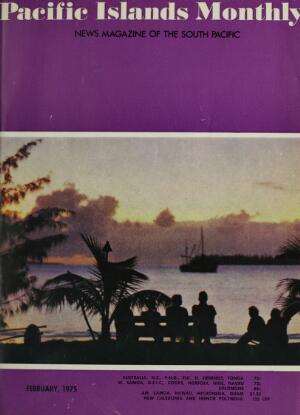
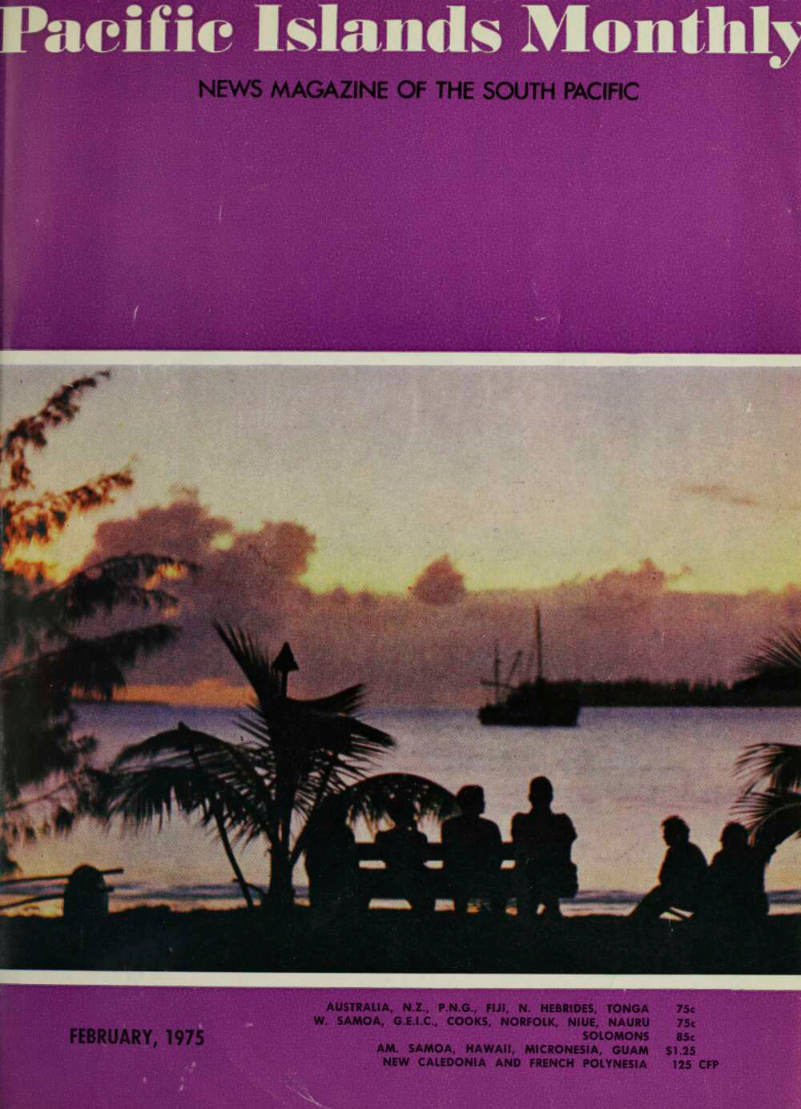
Our Cover
This being a busy time of the year in the Islands for tourists, we thought it might be a good idea to remind people of the kind of tranquil Islands’ scene that visitors dream about, and Islanders enjoy regularly. It’s taken at New Caledonia’s lovely Isle of Pines.
Advertisements & other items, p. 2 (1 item)
shouldn’t be cheap.
An economy car
'A 'A
TOYOTA COROLLA
We put more than economy into a Toyota.
We build them to be comfortable. We build them to be safe.
And we build them very carefully ... so that they’ll last.
Before you buy your next car, check with your Toyota dealer. He has a lot of economical models to choose from.
But no cheap ones.
I *
TOYOTA 1000 TOYOTA CORONA TOYOTA CELICA
TOYOTA MARK II
TOYOTA
PAPUA, NEW GUINEA: ELA MOTORS LIMITED. Scratch.ey Rd„ Bad,!,. Papua U.S. TRUST TERRITORY: MICROL CORPORATION P^ Box 26 A SUPPLIES CO LTD., GP O, Box 355, Suva AMERICAN SAMOA: BURNS PHILP (SOUTH SEA) CO., LTD., Pago Pago. WESTERN SAMOA: BURNS PHI LP’ <SOUTHI SEA' P.O_ Box 88, Apia GUAM: RICKY’S AUTO CO , P O. Box 1458, Agana. NEW HEBRIDES: NEW HEBRIDES MOTORS LTD.. P O. Box 18, Vila. SOLOMON ISLANDS. MENDANA ENTERPRISES (S I I Lm.
PO Box 174, Honiara. TAHITI: NIPPON AUTOMOTO, B.P. 545, Papeete COOK ISLANDS: COOK ISLANDS TRADING CORPORATION LTD . P O Box 92. NAURU NAURU COOPERATIVE SOCIETY GILBERT & ELLICE ISLANDS COLONY: TARAWA MOTORS, Box 36, Bainki Tarawa NORFOLK ISLAND: MARIE S NORFOLK TOURS LTtT, . 276 TIMOR: SANG TAI HOO, Sang Ta, Building, Dili NEW CALEDONIA: SOCIETE IMPORTATION AUTOMOBILE DU PACIFIQUE, Rond-Pomt du Pacific (Station Total) B.P 438. Noumea.
In This Issue
General
Guam Games problems 12 Islands' shipping pool 57
American Samoa
Attorney-General made judge 13 Restaurant name on ocean floor ... 14
Cook Islands
Fishing sampan adrift 61 Factory's poor year 67
Fiji
Press ministry 9 Guam Games problems 12 Hotel workers strike 13 "Witch" in court 13 Tongan Bishop in Polynesia 13 Squash record broken 15 Alcoholic problems 23 Banabans' claim 25 Islands shipping pool 57 Air Pacific control 57 Sugar report 66
French Polynesia
Mutiny reported 11 Guam Games problems 12
Gilbert & Ellice Islands
Banabans claim Ocean Is'and 25 Ellice people take new name 27 Budget tax proposals 31
Guam
Games difficulties over costs 12
Lord Howe Island
Air link to change 67
New Caledonia
Senator takes his seat 13 Seeds kill sea birds 15 Refusal to accept new tax 29
New Hebrides
London conference reviewed 4 Advisory Council and abortion 5 Kalkot-Matas gaoled 5 Volcano erupts 13
Niue
Self-government at work 35 Hotel near completion 66
Norfolk Island
Minister's letter on local government 37
Papua New Guinea
Bougainviile-Shortlands border prob lem 7 Cult exposed on Bougainville 8 New Year honours 9 Karkar volcano erupts 13 De Rays expedition relics 14 Rugby League teams named 14 Wild New Britain (review) 51 LASH ships boost trade 59
Bougainville buys airline 63 Copper royalties agreement 67 Currency smuggling 69 Wrong advice in business 70
Ralph Ormsby, Johnny Young die 75
Solomon Islands
Shortlands-Bougainville border prob
lem 7 Information officer clashes with Mamaloni 17
Budget tax proposals 29
Tonga
Unemployment in NZ 11 Labour drain to New Zealand 35 Hotel building costs 69
United States Trust Territory
Micronesia talks fail 12 Shell kills four men 13 Carl Heine on Micronesia 49
Western Samoa
Industrialisation plan 10 Contaminated water 14 Japanese investment row 65
DEPARTMENTS: Up front with the Editor, 3; In a Nutshell, 13; Tropicalities, 14; From the Islands Press, 39; Yesterday, 40; Magazine Section, 41; MANA, 44; Books 49; Pacific Transport, 57; Cruising Yachts, 63; Business and Development, 65; Editor's Mailbag, 71; Island Deaths, 75; Shipping Information, 78.
Advertisements & other items, p. 4 (1 item)
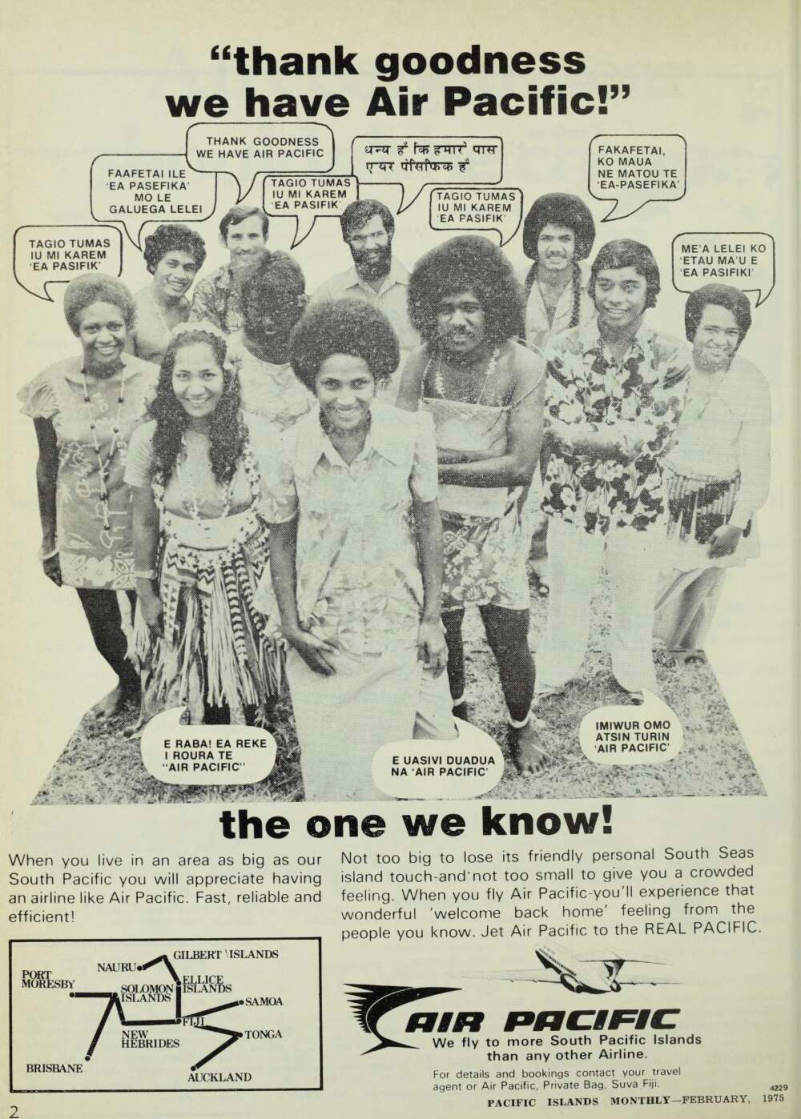
“thank goodness
we have Air Pacific!”
THANK GOODNESS
WE HAVE AIR PACIFIC
stftt f crnr
jT-qr t
FAKAFETAI,
KO MAUA
NE MATOU TE
EA-PASEFIKA
FAAFETAI ILE "
EA PASEFIKA’
MO LE
GALUEGA LELEI
TAGIO TUMAS
IU Ml KAREM
EA PASIFIK *
TAGIO TUMAS
IU Ml KAREM
EA PASIFIK
TAGIO TUMAS
ME A LELEI KO
ETAU MA’U E
EA PASIFIKI’
IU Ml KAREM
EA PASIFIK
-1 £ a.
If I a
E RABA! EA REKE
I ROURA TE
AIR PACIFIC”
E UASIVI DUADUA
NA AIR PACIFIC’
IMIWUROMO *
ATSIN TURIN
AIR PACIFIC ,
the one we know!
Vhen you live in an area as big as our
>outh Pacific you will appreciate having
in airline like Air Pacific. Fast, reliable and
•fficient!
GILBERT ' ISLANDS
MORESBY SOLOMON| ISLANDS
SAMOA
TONGA
BRISBANE
NEW
HEBRIDES
AUCKLAND
Not too big to lose its friendly personal South Seas island touch-and'not too small to give you a crowded feeling. When you fly Air Pacific-you'll experience that wonderful 'welcome back home' feeling from the people you know. Jet Air Pacific to the REAL PACIFIC * ir~
n#n pact
We fly to more South Pacific Islands than any other Airline.
For details and bookings contact your travel agent or Air Pacific, Private Bag, Suva Fiji.
Pacific Islands
Monthly
FOUNDED BY R. W. ROBSON IN 1930
Published Monthly By
Pacific Publications (Aust.) Pty. Ltd.,
29 Alberta St., Syoney, N.S.W., 2000.
Postal Address: G.P.O. BOX 3408, SYDNEY,
N.S.W., 2001.
Telegraphic Address; PACPUB, Sydney.
Telex 25168.
Telephones: 61-9197, 61-7101, 61-4369.
Consulting Directors: R. W. Robson, Judy Tudor.
Chief Executives: Manager: Selwyn Hughes.
Publisher; Stuart Inder.
Director of Advertising: W. A. Gasnier.
Pacific Islands Monthly
Editor: Stuart Inder.
Assistant Editor: John Carter.
Advertising Manager: W. A. Gasnier.
Circulation Manager: Jill Garland.
Subscription Rates:
"Pacific Islands Monthly" is airfreighted to the majority of subscribers and agents in the Pacific Islands and the U.S.A.; copies to the Cook Islands, Nauru, Niue, Micronesia and Guam go by surface mail.
Australia (including Lord Howe and Thursday Islands), New Zealand, Papua New Guinea, Fiji, New Hebrides, Tonga, Cook Islands, Western Samoa, Gilbert & Ellice Islands, Norfolk Island, Niue and Nauru: $9.00 (local currency); Solomon Islands: $lO.OO Aust., American Samoa, Micronesia and Guam: $12.00 US; Hawaii and US Mainland: $15.00 US; New Caledonia and French Polynesia: 1,500 CFP; United Kingdom: £6.50; Japan: 4,000 Yen.
Elsewhere $11.50 Aust.
Representatives
Fiji: Advertising and Distribution—Fiji Times & Herald Ltd., 20 Gordon St., Suva. Telephone -25-601. Telex.: FJ 2124.
Papua New Guinea; PORT MORESBY, PNG Print ing Co. Pty. Ltd., P.O. Box 633; LAE, P.O. Box 227; RABAUL, Mr. Oavid Simpson, P.O. Box 164 (c/- Rabaul Photographic. Tel.; 2677.) French Polynesia. Distribution—Hachette Pacl fique, 10 Ave Bruat, Papeete.
United Kingdom: Advertising—Overseas Publicity Ltd., 214 Oxford Street, London, WIN OEA.
Phone; 01-636 8296/7. Subscriptions—T. B.
Graham, Park House, 22 Park Street, Croydon,
Cr9 3Np. Tel.: 01-6884177.
Japan; Advertising—Universal Media Corpora tion, C.P.O. Box 46, Tokyo. Tel.: 666-3036.
Victoria: Advertising Pacific Publications (Aust.) Pty. Ltd., Herald & Weekly Times Building, 2nd Floor, 61 Flinders Lane, Mel bourne, 3000. Telephone: 652-1565.
Hawaii and U.S. Mainland only: N. Grogan, 3354 Hayden Street, Honolulu, 96815. (Send change of address notices, Form 3579 and new subscriptions to P.O. Box 2193, Honolulu, Hawaii, U.S.A. 96805).
Second class postage paid at Honolulu, Hawaii.
Copyright ©, 1975,
Pacific Publications (Aust) Pty. Ltd.
February, 1975 Vol. 46, No. 2
Up Front
with the Editor
You can’t win. I decided finally that this column gives overmuch attention to Papua New Guinea affairs, and I planned to talk this month on what I see as the begin nings of a true Islands cultural boom.
But that’s going to have to wait.
As soon as I sat down to write (about cultural developments), Miss Josephine Abaijah and Mr Simon Kaumi announced in Port Moresby that they were forming an indepen dent breakaway republican govern ment of Papua, claiming they had the support of half of Papua. Miss Abaijah said there would not be any political union between Papua and New Guinea. They had talked about “freedom” long enough, and this was the year of action for Papua.
The attractive Miss Abaijah is well known for her leadership of the separatist Papua Besena movement.
The good-looking Simon Kaumi has recently come into prominence out side of PNG for his leadership of something called the Papuan Re publican Fighters, and for having been dismissed from a high public service post because of some of his public utterances. A few years ago he made a fine Chief Electoral Officer. He’s a Papuan too, married to John Kaputin’s sister.
Anyway, with those ringing an nouncements of Miss Abaijah’s the hat was thrown into the ring, and this will be a difficult one for Chief Minister Somare and his cabinet (which includes a goodly number of Papuans).
One of the difficulties is that the Papuans have some sort of a case for wanting to do things their way; they’ve felt cast aside as a result of the decision by the Australian Gov ernment just after World War II to administer New Guinea and Papua together for the sake of administra tive expediency.
Papua had been separate, since Britain proclaimed a protectorate over it in 1884, and Australia made it an Australian territory in 1906.
New Guinea has had a more chequered career, once having been administered by Germany, but its
been a League of Nations or United Nations territory since 1920.
Peopling an Australian territory the Papuans have naturally felt them selves to be a more integral part of Australia than the New Guineans (even though their “citizenship” has never given them the right to auto matically enter Australia). With the move towards independence for a combined Papua New Guinea (ex pected either June or September this year), there has been growing re action by Papuans against the possi bility of domination by the New Guineans. It’s the same feeling the Ellice Islanders have in relation to their more numerous northern brothers, the Gilbertese.
But what to do about it? Chief Minister Michael Somare says that the Papuan independence leaders, in their latest announcement, are simply out of touch with reality, and there has to be a confrontation if they persist.
And what else could he say? The eggs appear to be scrambled, and it’s doubtful if Papua can now be un scrambled from the total dish, even if the majority of the Papuans could agree on it.
There has to be a much broader base of dissent before anybody can declare unilaterally a Papuan re public. Provincial government of some sort could be the answer—the sort that the House of Assembly will be discussing in February, which proposes to create provinces out of the present districts—each with their own legislature, premier, public ser vice and power to raise revenue.
But I like the idea put forward officially by Percy Chatterton a few years ago, where he advocated five provinces for all of PNG (Papua, the Highlands, the Islands, the Mainland and Bougainville). Each province would nominate five mem bers who would comprise a 25 mem ber national assembly to take the place of the present House. At once autonomy, without any area being dominated unfairly by any other.
It it too late to look at it again?
Stuart Inder
Pacific Islands Monthly
Independence? No Such Word In
French -English Dictionaries!
From Jean-Eudes Barrier ,
former editor of the New Hebrides newspaper Nakamal.
The results of the recent London Conference have not failed to arouse the most enlivened and the most diversified debate in the New Hebri des. Relief all around as far as the European community is concerned: the word independence does not appear in any of the communiques or reports issued at the end of the minis terial discussions.
Mr Olivier Stirn, French Minister for Overseas Territories, in an inter view published in the very conserva tive Bulletin of the French Residence, states quite unashamedly “that it is quite useless to envisage any new abstract systems for the future”. And even that it must be “left to experi ence to judge if the measures taken are useful ones”. Actually, it would appear that certain of the Minister’s remarks were purely and simply cen sored by Mr Fabre, Chancellor at the French Residency! Mr Stirn’s words actually vaguely evoked the possi bility of independence for the Heb ridean archipelago. But looking well ahead, obviously—about 30 years off when all the preparatory stages have been gradually worked through.
This extremely cautious attitude of the French Government towards the burning question of independence is obviously nothing new. Such an atti tude has continually dominated the political thinking of the French Re sidency over recent months. By an extreme, if not systematic, neutralis ing of news, the French Residency has perpetually sought as much as possible to minimise the influence of those clamouring for independence, whose numbers have increased throughout the territory over the past two years. And what is the result?
It is obvious that the thought of a “premature independence” had, until recently, considerably disturbed even the projects of European business operators. On this matter the Lon don Conference has helped to dispel much torment.
As far as the National Party is concerned, first reactions seem to indicate there are differences of opinion. The president, the Rev Walter Lini, did not hide his satis faction at the outcome of the London discussions. He said he was particu larly concerned about the strict and speedy execution of what is com monly known in Vila as “the pro gramme of democratising the poli tical institutions”. This attitude of Father Lini, reflected in a speech he made during a meeting specially organised by the National Party for public discussion on the democratis ation programme, was in striking contrast to the attitude later adopted by the fiery Kalkot-Matas Mele, a student at the University of Papua New Guinea in Port Moresby.
“The decisions made in London meet a large proportion of our major demands; let us get to work” say the
elders of the National Party. Kalkot- Matas does not seem to share their view: “There are 90,000 of us New Hebrideans. Not one of us was in vited to attend this conference. Is that the meaning of the highly vaunted white democracy?” was his message before an audience delighted with such impertinence.
According to observers, Walter Lini today leads the so-called moder ate faction of the National Party, anxious to maintain a continuing dialogue with the administration and, no doubt, gain a good number of seats in the future legislative assem bly through the system of universal suffrage which has just been outlined.
Kalkot-Matas is content, for the time being, to channel off and build up all the resentment of an ambitious younger generation which is frus trated, and muzzled by the powers of an “imported” society to which it does not happen to belong and which, henceforth, it rejects com
pletely.
As for the parties directed by a handful of Europeans, the UCNH and the MANH, are they going to exaggerate, on the eve of the first true elections, the internal conflicts in the National Party? Certainly such a strategy would not lead them very far. For after all, it is only a matter of a difference in approach, which should do nothing to alter the ulti mate objective always pursued by the National Party—the political in dependence of the archipelago. This independence should naturally lead to a decision over the economic op tions to be followed, as worked out by the New Hebrideans themselves.
The UCNH, the MANH and Jimmy Stevens’ Na Griamel have recently come to an agreement to co-operate to increase their strength against the National Party. But without the numerical support of the Na Griamel, the other two parties formed in Vila and Santo to oppose
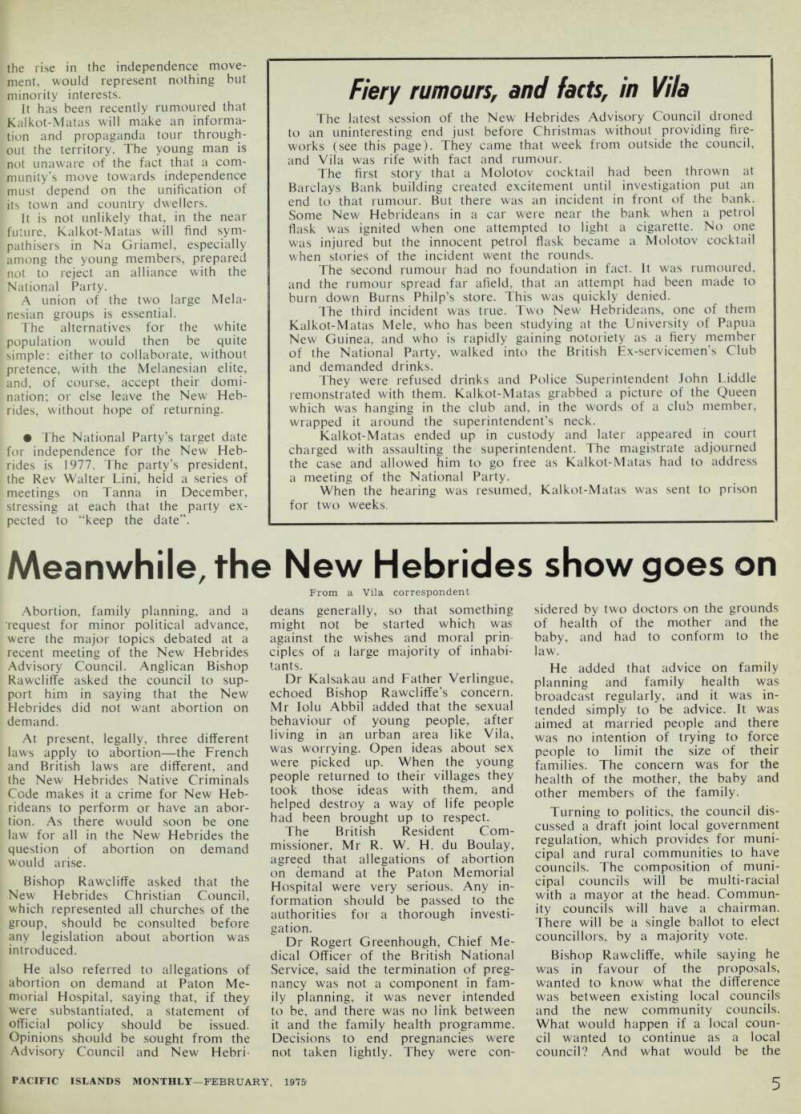
The Rev Walter Lini, president of the National Parly, who wants speedy execution of the "programme of demo
cratising the political institutions".
the rise in the independence move ment, would represent nothing but minority interests.
It has been recently rumoured that Kalkot-Matas will make an informa tion and propaganda tour through out the territory. The young man is not unaware of the fact that a com munity’s move towards independence must depend on the unification of its town and country dwellers.
It is not unlikely that, in the near future, Kalkot-Matas will find sym pathisers in Na Griamel, especially among the young members, prepared not to reject an alliance with the National Party.
A union of the two large Mela nesian groups is essential.
The alternatives for the white population would then be quite simple: either to collaborate, without pretence, with the Melanesian elite, and, of course, accept their domi nation; or else leave the New Heb rides, without hope of returning. • The National Party’s target date for independence for the New Heb rides is 1977. The party’s president, the Rev Walter Lini, held a series of meetings on Tanna in December, stressing at each that the party ex pected to “keep the date”.
Fiery rumours, and facts, in Vila
The latest session of the New Hebrides Advisory Council droned to an uninteresting end just before Christmas without providing fire works (see this page). They came that week from outside the council, and Vila was rife with fact and rumour.
The first story that a Molotov cocktail had been thrown at Barclays Bank building created excitement until investigation put an end to that rumour. But there was an incident in front of the bank.
Some New Hebrideans in a car were near the bank when a petrol flask was ignited when one attempted to light a cigarette. No one was injured but the innocent petrol flask became a Molotov cocktail when stories of the incident went the rounds.
The second rumour had no foundation in fact. It was rumoured, and the rumour spread far afield, that an attempt had been made to burn down Burns Philp’s store. This was quickly denied.
The third incident was true. Two New Hebrideans, one of them Kalkot-Matas Mele, who has been studying at the University of Papua New Guinea, and who is rapidly gaining notoriety as a fiery member of the National Party, walked into the British Ex-servicemen’s Club and demanded drinks.
They were refused drinks and Police Superintendent John Liddle remonstrated with them. Kalkot-Matas grabbed a picture of the Queen which was hanging in the club and, in the words of a club member, wrapped it around the superintendent’s neck.
Kalkot-Matas ended up in custody and later appeared in court charged with assaulting the superintendent. The magistrate adjourned the case and allowed him to go free as Kalkot-Matas had to address a meeting of the National Party.
When the hearing was resumed, Kalkot-Matas was sent to prison for two weeks.
Meanwhile, the New Hebrides show goes on
From a Vila correspondent
Abortion, family planning, and a request for minor political advance, were the major topics debated at a recent meeting of the New Hebrides
Advisory Council. Anglican Bishop
Rawcliffe asked the council to sup port him in saying that the New Hebrides did not want abortion on demand.
At present, legally, three different laws apply to abortion—the French and British laws are different, and the New Hebrides Native Criminals Code makes it a crime for New Heb rideans to perform or have an abor tion. As there would soon be one law for all in the New Hebrides the question of abortion on demand would arise.
Bishop Rawcliffe asked that the New Hebrides Christian Council, which represented all churches of the group, should be consulted before any legislation about abortion was introduced.
He also referred to allegations of abortion on demand at Paton Me morial Hospital, saying that, if they were substantiated, a statement of official policy should be issued.
Opinions should be sought from the Advisory Council and New Hebri
deans generally, so that something might not be started which was against the wishes and moral prin ciples of a large majority of inhabi tants.
Dr Kalsakau and Father Verlingue, echoed Bishop Rawcliffe’s concern.
Mr lolu Abbil added that the sexual behaviour of young people, after living in an urban area like Vila, was worrying. Open ideas about sex were picked up. When the young people returned to their villages they took those ideas with them, and helped destroy a way of life people had been brought up to respect.
The British Resident Com missioner, Mr R. W. H. du Boulay, agreed that allegations of abortion on demand at the Paton Memorial Hospital were very serious. Any in formation should be passed to the authorities for a thorough investi gation.
Dr Rogert Greenhough, Chief Me dical Officer of the British National Service, said the termination of preg nancy was not a component in fam ily planning, it was never intended to be, and there was no link between it and the family health programme.
Decisions to end pregnancies were not taken lightly. They were con
sidered by two doctors on the grounds of health of the mother and the baby, and had to conform to the law.
He added that advice on family planning and family health was broadcast regularly, and it was in tended simply to be advice. It was aimed at married people and there was no intention of trying to force people to limit the size of their families. The concern was for the health of the mother, the baby and other members of the family.
Turning to politics, the council dis cussed a draft joint local government regulation, which provides for muni cipal and rural communities to have councils. The composition of muni cipal councils will be multi-racial with a mayor at the head. Commun ity councils will have a chairman.
There will be a single ballot to elect councillors, by a majority vote.
Bishop Rawcliffe, while saying he was in favour of the proposals, wanted to know what the difference was between existing local councils and the new community councils.
What would happen if a local coun cil wanted to continue as a local council? And what would be the
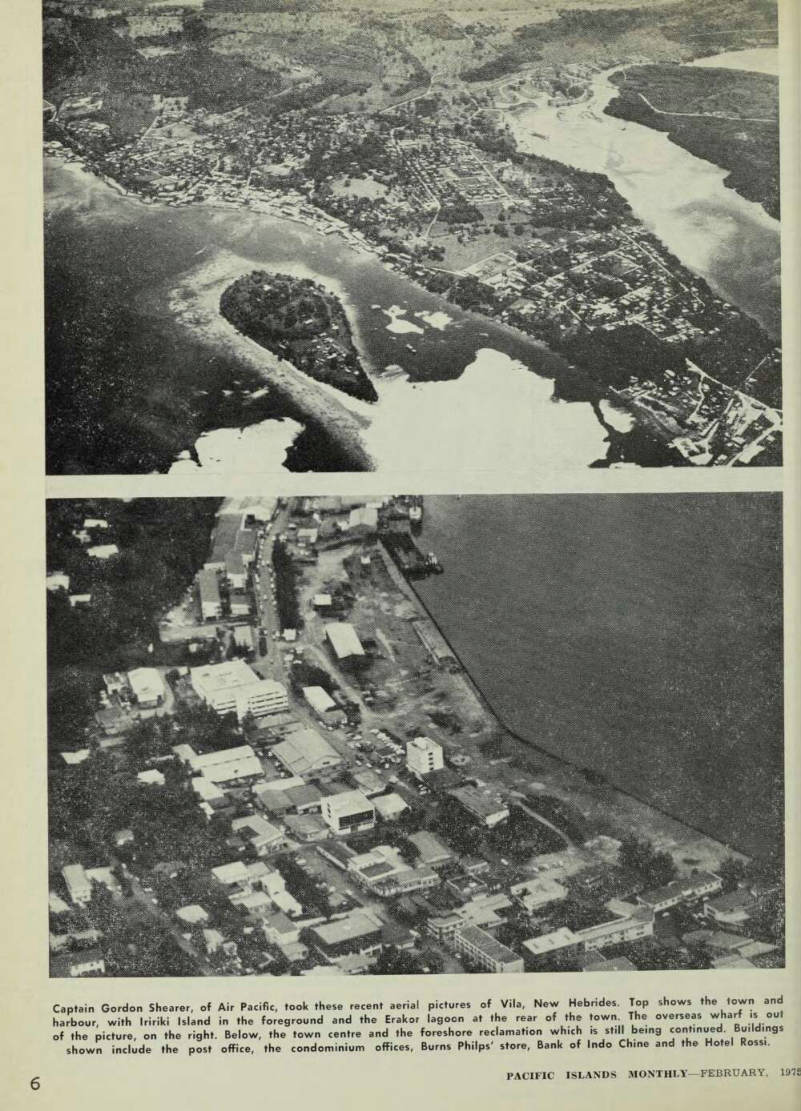
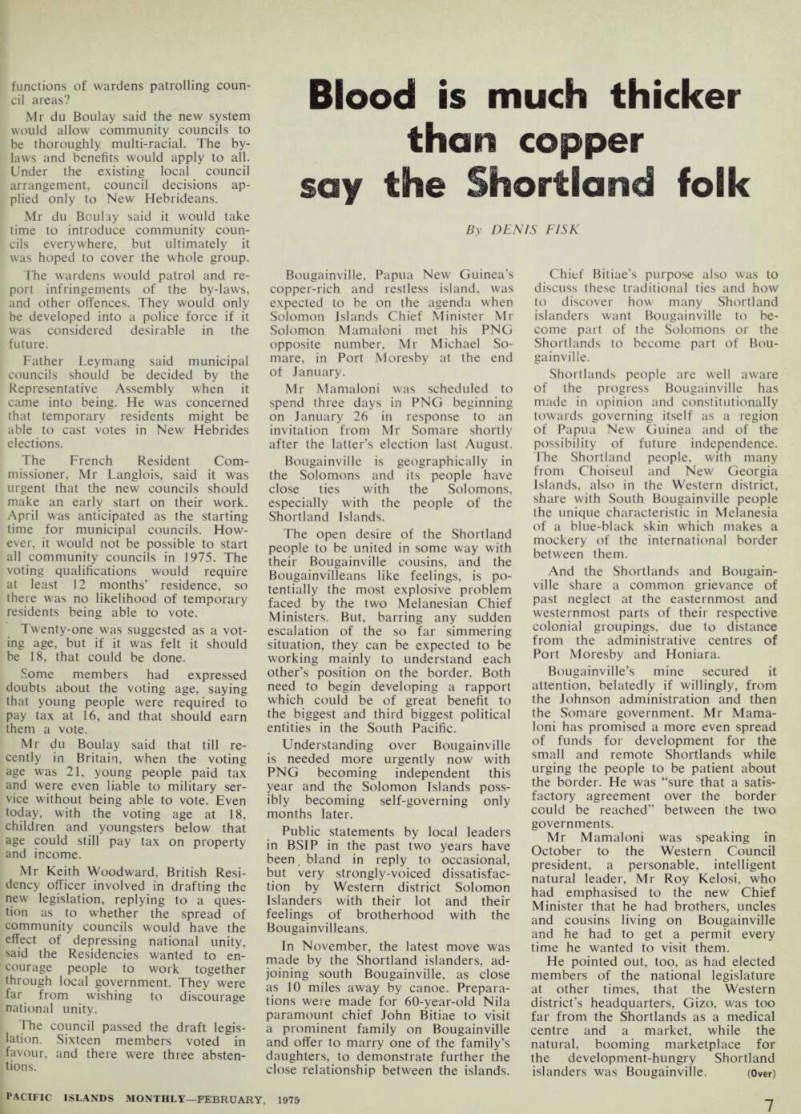
Captain Gordon Shearer, of Air Pacific, took these recent aerial pictures of Vila, New Hebrides. Top shows the town an harbour, with Iririki Island in the foreground and the Erakor lagoon at the rear of the town. The overseas wharf is out of the picture, on the right. Below, the town centre and the foreshore reclamation which is still being continued. Buildings shown include the post office, the condominium offices, Burns Philps' store, Bank of Indo Chine and the Hotel Rossi.
functions of wardens patrolling coun cil areas?
Mr du Boulay said the new system would allow community councils to be thoroughly multi-racial. The by laws and benefits would apply to all.
Under the existing local council arrangement, council decisions ap plied only to New Hebrideans.
Mr du Boulay said it would take time to introduce community coun cils everywhere, but ultimately it was hoped to cover the whole group.
The wardens would patrol and re port infringements of the by-laws, and other offences. They would only be developed into a police force if it was considered desirable in the future.
Father Leymang said municipal councils should be decided by the Representative Assembly when it came into being. He was concerned that temporary residents might be able to cast votes in New Hebrides elections.
The French Resident Com missioner, Mr Langlois, said it was urgent that the new councils should make an early start on their work.
April was anticipated as the starting time for municipal councils. How ever, it would not be possible to start all community councils in 1975. The voting qualifications would require at least 12 months’ residence, so there was no likelihood of temporary residents being able to vote.
Twenty-one was suggested as a vot ing age, but if it was felt it should be 18, that could be done.
Some members had expressed doubts about the voting age, saying that young people were required to pay tax at 16, and that should earn them a vote.
Mr du Boulay said that till re cently in Britain, when the voting age was 21, young people paid tax and were even liable to military ser vice without being able to vote. Even today, with the voting age at 18, children and youngsters below that age could still pay tax on property and income.
Mr Keith Woodward, British Resi dency officer involved in drafting the new legislation, replying to a ques tion as to whether the spread of community councils would have the effect of depressing national unity, said the Residencies wanted to en courage people to work together through local government. They were far from wishing to discourage national unity.
The council passed the draft legis lation. Sixteen members voted in favour, and there were three absten tions.
say the Shortland folk
Blood is much thicker than copper say the Shortland folk
By Denis Fisk
Bougainville, Papua New Guinea’s copper-rich and restless island, was expected to be on the agenda when Solomon Islands Chief Minister Mr Solomon Mamaloni met his PNG opposite number, Mr Michael So mare, in Port Moresby at the end of January.
Mr Mamaloni was scheduled to spend three days in PNG beginning on January 26 in response to an invitation from Mr Somare shortly after the latter’s election last August.
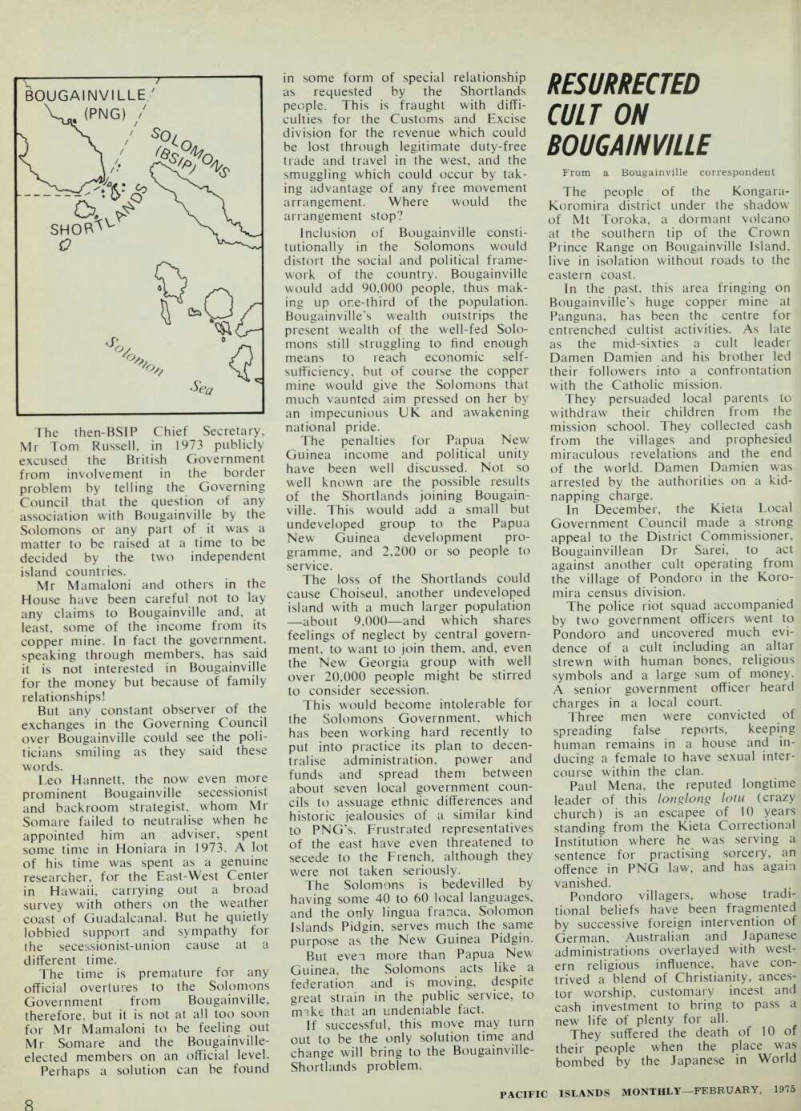
Bougainville is geographically in the Solomons and its people have close ties with the Solomons, especially with the people of the Shortland Islands.
The open desire of the Shortland people to be united in some way with their Bougainville cousins, and the Bougainvilleans like feelings, is po tentially the most explosive problem faced by the two Melanesian Chief Ministers. But, barring any sudden escalation of the so far simmering situation, they can be expected to be working mainly to understand each other’s position on the border. Both need to begin developing a rapport which could be of great benefit to the biggest and third biggest political entities in the South Pacific.
Understanding over Bougainville is needed more urgently now with PNG becoming independent this year and the Solomon Islands poss ibly becoming self-governing only months later.
Public statements by local leaders in BSIP in the past two years have been. bland in reply to occasional, but very strongly-voiced dissatisfac tion by Western district Solomon Islanders with their lot and their feelings of brotherhood with the Bougainvilleans.
In November, the latest move was made by the Shortland islanders, ad joining south Bougainville, as close as 10 miles away by canoe. Prepara tions were made for 60-year-old Nila paramount chief John Bitiae to visit a prominent family on Bougainville and offer to marry one of the family’s daughters, to demonstrate further the close relationship between the islands.
Chief Bitiae’s purpose also was to discuss these traditional ties and how to discover how many Shortland islanders want Bougainville to be come part of the Solomons or the Shortlands to become part of Bou gainville.
Shortlands people are well aware of the progress Bougainville has made in opinion and constitutionally towards governing itself as a region of Papua New Guinea and of the possibility of future independence.
The Shortland people, with many from Choiseul and New Georgia Islands, also in the Western district, share with South Bougainville people the unique characteristic in Melanesia of a blue-black skin which makes a mockery of the international border between them.
And the Shortlands and Bougain ville share a common grievance of past neglect at the easternmost and westernmost parts of their respective colonial groupings, due to distance from the administrative centres of Port Moresby and Honiara.
Bougainville’s mine secured it attention, belatedly if willingly, from the Johnson administration and then the Somare government. Mr Mama loni has promised a more even spread of funds for development for the small and remote Shortlands while urging the people to be patient about the border. He was “sure that a satis factory agreement over the border could be reached” between the two governments.
Mr Mamaloni was speaking in October to the Western Council president, a personable, intelligent natural leader, Mr Roy Kelosi, who had emphasised to the new Chief Minister that he had brothers, uncles and cousins living on Bougainville and he had to get a permit every time he wanted to visit them.
He pointed out, too, as had elected members of the national legislature at other times, that the Western district’s headquarters, Gizo, was too far from the Shortlands as a medical centre and a market, while the natural, booming marketplace for the development-hungry Shortland islanders was Bougainville. (Over)
The then-BSIP Chief Secretary, Mr Tom Russell, in 1973 publicly excused the British Government from involvement in the border problem by telling the Governing Council that the question of any association with Bougainville by the Solomons or any part of it was a matter to be raised at a time to be decided by the two independent island countries.
Mr Mamaloni and others in the House have been careful not to lay any claims to Bougainville and, at least, some of the income from its copper mine. In fact the government, speaking through members, has said it is not interested in Bougainville for the money but because of family
relationships!
But any constant observer of the exchanges in the Governing Council over Bougainville could see the poli ticians smiling as they said these words.
Leo Hannett, the now even more prominent Bougainville secessionist and backroom strategist, whom Mr Somare failed to neutralise when he appointed him an adviser, spent some time in Honiara in 1973. A lot of his time was spent as a genuine researcher, for the East-West Center in Hawaii, carrying out a broad survey with others on the weather coast of Guadalcanal. But he quietly lobbied support and sympathy for the secessionist-union cause at a different time.
The time is premature for any official overtures to the Solomons Government from Bougainville, therefore, but it is not at all too soon for Mr Mamaloni to be feeling out Mr Somare and the Bougainville elected members on an official level.
Perhaps a solution can be found
in some form of special relationship as requested by the Shortlands people. This is fraught with diffi culties for the Customs and Excise division for the revenue which could be lost through legitimate duty-free trade and travel in the west, and the smuggling which could occur by tak ing advantage of any free movement arrangement. Where would the arrangement stop?
Inclusion of Bougainville consti tutionally in the Solomons would distort the social and political frame work of the country. Bougainville would add 90,000 people, thus mak ing up one-third of the population.
Bougainville’s wealth outstrips the present wealth of the well-fed Solo mons still struggling to find enough means to reach economic self sufficiency, but of course the copper mine would give the Solomons that much vaunted aim pressed on her by an impecunious UK and awakening national pride.
The penalties for Papua New Guinea income and political unity have been well discussed. Not so well known are the possible results of the Shortlands joining Bougain ville. This would add a small but undeveloped group to the Papua New Guinea development pro gramme, and 2,200 or so people to service.
The loss of the Shortlands could cause Choiseul, another undeveloped island with a much larger population —about 9,000 —and which shares feelings of neglect by central govern ment, to want to join them, and, even the New Georgia group with well over 20,000 people might be stirred to consider secession.
This would become intolerable for the Solomons Government, which has been working hard recently to put into practice its plan to decen tralise administration, power and funds and spread them between about seven local government coun cils to assuage ethnic differences and historic jealousies of a similar kind to PNG’s. Frustrated representatives of the east have even threatened to secede to the French, although they were not taken seriously.
The Solomons is bedevilled by having some 40 to 60 local languages, and the only lingua franca, Solomon Islands Pidgin, serves much the same purpose as the New Guinea Pidgin.
But even more than Papua New Guinea, the Solomons acts like a federation and is moving, despite great strain in the public service, to rmke that an undeniable fact.
If successful, this move may turn out to be the only solution time and change will bring to the Bougainville-
Shortlands problem.
Resurrected
Cult On
Bougainville
From a Bougainville correspondent The people of the Kongara- Koromira district under the shadow of Mt Toroka, a dormant volcano at the southern tip of the Crown Prince Range on Bougainville Island, live in isolation without roads to the eastern coast.
In the past, this area fringing on Bougainville’s huge copper mine at Panguna, has been the centre for entrenched cultist activities. As late as the mid-sixties a cult leader Damen Damien and his brother led their followers into a confrontation with the Catholic mission.
They persuaded local parents to withdraw their children from the mission school. They collected cash from the villages and prophesied miraculous revelations and the end of the world. Damen Damien was arrested by the authorities on a kid napping charge.
In December, the Kieta Local Government Council made a strong appeal to the District Commissioner, Bougainvillean Dr Sarei, to act against another cult operating from the village of Pondoro in the Koro mira census division.
The police riot squad accompanied
by two government officers went to Pondoro and uncovered much evi dence of a cult including an altar strewn with human bones, religious symbols and a large sum of money.
A senior government officer heard charges in a local court.
Three men were convicted of
spreading false reports, keeping
human remains in a house and in ducing a female to have sexual inter course within the clan.
Paul Mena, the reputed longtime leader of this longlong lotu (crazy church) is an escapee of 10 years standing from the Kieta Correctional Institution where he was serving a sentence for practising sorcery, an offence in PNG law, and has again vanished.
Pondoro villagers, whose tradi tional beliefs have been fragmented by successive foreign intervention of German, Australian and Japanese administrations overlayed with west ern religious influence, have con trived a blend of Christianity, ances tor worship, customary incest and cash investment to bring to pass a new life of plenty for all.
They suffered the death of 10 of their people when the place was bombed by the Japanese in World
War Two. Their sense of frustration has grown with the difficulty of get ting their produce from the fertile soil out to market and with their envy of others who have received financial benefit from the Panguna mine and have set up businesses.
Although stories of their bizarre doings have filtered out for the past I 15 years and the present DC in his previous work as a Catholic priest in this area tried to stop their cult ism, the solution may be supplied by today’s Bougainvillean Provincial Government.
A firm response to the Pondoro affair indicates that the local leaders are determined to act against any such cargo cults.
The advent of an elected provincial government offering democratic representation will also bring mem bers who see as retrogressive any practices which inhibit the social and political development of their voters.
However, the few superstitious men in the hinterland of Bougainville, in common with the English soothsayer poring over his football pools and the Australian punter prophet laying his bet, may resist all efforts to make them forgo the dream of manna from heaven. Which is why so many worship the mighty Cargo God.
Fiji's Minister For
Information
-Fiji Minister Without Portfolio Ratu David Toganivalu, has now got a portfolio. It is the Ministry for Information, the first in Fiji. Ratu David, who has studied the news media and its functions for some time, said his appointment followed a study of the existing government in formation service and Cabinet's approval of a plan to expand and improve it. "It will be my ministry's atm to make information services an effective com ponent of the government's function to develop this country and advance the standard of living of the people", he said. The appointment could foreshadow the birth of a government radio station and newspaper.
knight for
A hard day's knight for Australia
From Gus Smales
in Port Moresby
A faintly-embarrassed Australian Government has once again found itself duty-bound to become involved on behalf of Papua New Guinea in the Queen’s Honours list.
A knighthood for the PNG Foreign Minister, Mr Albert Maori Kiki, and awards for 20 others in PNG are contained in the list. The awards are on an Australian list, re commended by the Australian Government despite its anti-honours policy.
The same situation occurred last year in the Queen’s Birthday awards when Sir Paul Lapun, the Mines Minister, became PNG’s first native
born knight.
Although the situation has its em barrassments for the present Aust ralian Government, there was little the government could do about it without committing a major blunder.
For 13 months now PNG has been self-governing. The government has operated under a blanket assur ance from Australia that there will be no Australian interference in mat ters which are morally construed as sovereign rights. One of the effective sovereign rights which the PNG Government has chosen to exercise is the recommendation of its resi dents for British Commonwealth honours.
But, because PNG has yet to achieve its formal independence the moral sovereign rights which Aust ralia recognises are not always the technical sovereign rights which pro tocol recognises. The Australian Government has been forced by its own promises to PNG to act as an intermediary in the honours list.
Technically the list has to be an Australian one because PNG cannot have one of its own until it is an independent member of the British Commonwealth.
If the Australian Government had refused to act as intermediary be cause of its own attitude towards the honours there could have been seri ous repercussions on relations be tween the two governments.
Any embarrassment the Australian Government may feel is clearly pre ferable to accusations that an agree ment was repudiated.
A member of the Chief Minister’s
office in Port Moresby said the situ ation was clear-cut and well under stood by both governments. He said there was no suggestion that the Australian Government was applying double standards over the honours list. Australia was merely carrying out its undertaking to treat PNG as a sovereign state in the closing months before formal independence.
Any attempts to go back on this undertaking would have been un welcome and reprehensible.
The new knight has asked to be known as Sir Maori Kiki. Other ministers honoured in the same list are Finance Minister Mr Julius Chan (CBE) and Communications Minis ter Mr Kaibelt Diria (OBE).
Honours also went to Mr Sere Pitoi, chairman of the PNG Public Service Board (CBE); Dr Blanche Biggs (CBE), who retired in 1974 after 25 years medical service with the Anglican Mission in the Northern District and is now living in Tas mania. MBEs went to Mrs Eileen Tom and Messrs Siwi Kurondo, Eric Pupu, Beibe Moha, Esau Lakman, Rupert Tabua, Timothy Mack and Herman fieri Miringi. BEMs were awarded to Miss V. B. Bignold, Messrs T. Toya, S. Kiha and Police Sergeants K. Nicodemus and S.
Buka. Three police officers awarded the Queen’s Police Medal were Senior Supts C. A. Parry, R. Robertson and M. Samo.
Those honoured in Fiji were: OBE, Ratu Senator Apakuki Tuisue Na novo, a retired roko, and Mrs Lavi nia Ah Koy, Clerk to Parliament.
MBE (military), WO Epeli Rayawa Ravovo, Royal Fiji Military Forces band drum major. MBEs, Messrs Abel Nagan, Taniela Kau Rauma kita, Mr Kupp Swami and Ratu Livai Tabucala. Queen’s Police Medal, Dep Commissioner Wallace Caldwell and Sen Supt lan Clow, Fiji Police Medal, Dep Supts Mam Raj and Nemani Raikuna.
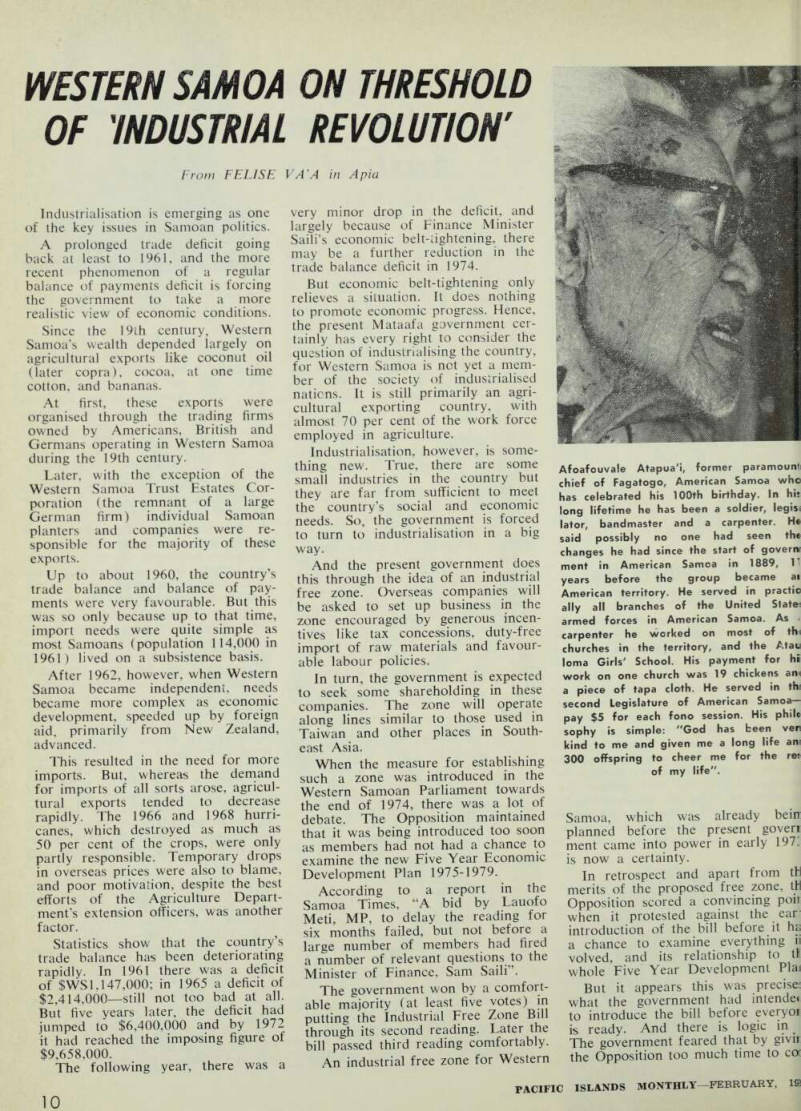
He is now (by protocol) known as Sir Maori Kiki, but where's the Albert gone?
Of 'Industrial Revolution’
Western Samoa On Threshold
From FELISE VA’A in Apia
Industrialisation is emerging as one of the key issues in Samoan politics.
A prolonged trade deficit going back at least to 1961, and the more recent phenomenon of a regular balance of payments deficit is forcing the government to take a more realistic view of economic conditions.
Since the 19th century. Western Samoa's wealth depended largely on agricultural exports like coconut oil (later copra), cocoa, at one time cotton, and bananas.
At first, these exports were organised through the trading firms owned by Americans, British and Germans operating in Western Samoa during the 19th century.
Later, with the exception of the Western Samoa Trust Estates Cor poration (the remnant of a large German firm) individual Samoan planters and companies were re sponsible for the majority of these exports.
Up to about 1960, the country’s trade balance and balance of pay ments were very favourable. But this was so only because up to that time, import needs were quite simple as most Samoans (population 114,000 in 1961) lived on a subsistence basis.
After 1962, however, when Western Samoa became independent, needs became more complex as economic development, speeded up by foreign aid, primarily from New Zealand, advanced.
This resulted in the need for more imports. But, whereas the demand for imports of all sorts arose, agricul tural exports tended to decrease rapidly. The 1966 and 1968 hurri canes, which destroyed as much as 50 per cent of the crops, were only partly responsible. Temporary drops in overseas prices were also to blame, and poor motivation, despite the best efforts of the Agriculture Depart ment’s extension officers, was another factor.
Statistics show that the country’s trade balance has been deteriorating rapidly. In 1961 there was a deficit of 5W51,147,000; in 1965 a deficit of $2,414,000—5ti1l not too bad at all.
But five years later, the deficit had jumped to $6,400,000 and by 1972 it had reached the imposing figure of $9,658,000.
The following year, there was a
very minor drop in the deficit, and largely because of Finance Minister Saili’s economic belt-tightening, there may be a further reduction in the trade balance deficit in 1974.
But economic belt-tightening only relieves a situation. It does nothing to promote economic progress. Hence, the present Mataafa government cer tainly has every right to consider the question of industrialising the country, for Western Samoa is not yet a mem ber of the society of industrialised nations. It is still primarily an agri cultural exporting country, with almost 70 per cent of the work force employed in agriculture.
Industrialisation, however, is some thing new. True, there are some small industries in the country but they are far from sufficient to meet the country’s social and economic needs. So, the government is forced to turn to industrialisation in a big way.
And the present government does this through the idea of an industrial free zone. Overseas companies will be asked to set up business in the zone encouraged by generous incen tives like tax concessions, duty-free import of raw materials and favour able labour policies.
In turn, the government is expected to seek some shareholding in these companies. The zone will operate along lines similar to those used in Taiwan and other places in South east Asia.
When the measure for establishing such a zone was introduced in the Western Samoan Parliament towards the end of 1974, there was a lot of debate. The Opposition maintained that it was being introduced too soon as members had not had a chance to examine the new Five Year Economic Development Plan 1975-1979.
According to a report in the Samoa Times, “A bid by Lauofo Meti, MP, to delay the reading for six months failed, but not before a large number of members had fired a number of relevant questions to the Minister of Finance, Sam Saili”.
The government won by a comfort able majority (at least five votes) in putting the Industrial Free Zone Bill through its second reading. Later the bill passed third reading comfortably.
An industrial free zone for Western
Samoa, which was already beirr planned before the present goveri ment came into power in early 197! is now a certainty.
In retrospect and apart from th merits of the proposed free zone, tH Opposition scored a convincing pon when it protested against the ear; introduction of the bill before it hs a chance to examine everything ii volved, and its relationship to tf whole Five Year Development Pla< But it appears this was precise; what the government had intended to introduce the bill before everyoi is ready. And there is logic in The government feared that by givu the Opposition too much time to coc
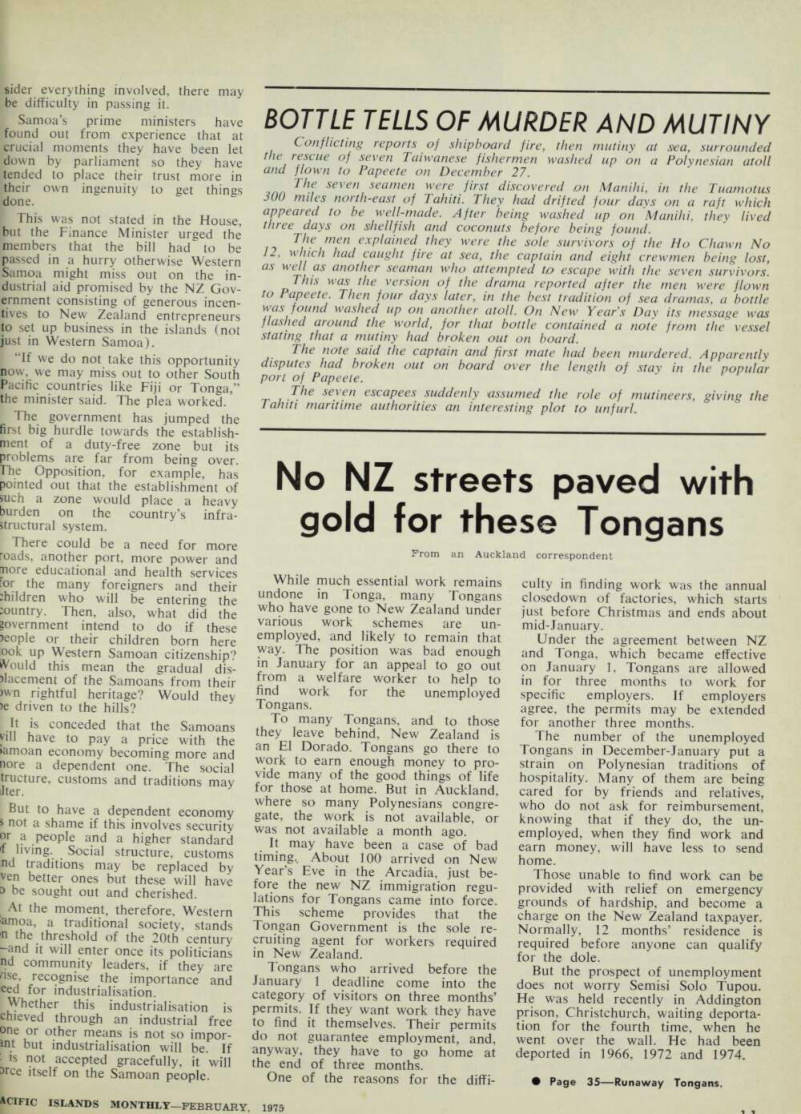
Afoafouvale Atapua'i, former paramount chief of Fagatogo, American Samoa who has celebrated his 100th birthday. In his long lifetime he has been a soldier, legist lator, bandmaster and a carpenter. He said possibly no one had seen the changes he had since the start of govern ment in American Samoa in 1889, 11 years before the group became a[?] American territory. He served in practio[?] ally all branches of the United States armed forces in American Samoa. As carpenter he worked on most of th[?] churches in the territory, and the Atau[?] loma Girls' School. His payment for hi work on one church was 19 chickens an[?] a piece of tapa cloth. He served in thr[?] second Legislature of American Samoa pay $5 for each fono session. His phil[?] sophy is simple: "God has been ve[?] kind to me and given me a long life an[?] 300 offspring to cheer me for the re[?] of my life".
sider everything involved, there may be difficulty in passing it.
Samoa’s prime ministers have found out from experience that at crucial moments they have been let down by parliament so they have tended to place their trust more in their own ingenuity to get things done.
This was not stated in the House, but the Finance Minister urged the members that the bill had to be passed in a hurry otherwise Western Samoa might miss out on the in dustrial aid promised by the NZ Gov ernment consisting of generous incen tives to New Zealand entrepreneurs to set up business in the islands (not just in Western Samoa).
“If we do not take this opportunity now, we may miss out to other South Pacific countries like Fiji or Tonga,” the minister said. The plea worked.
The government has jumped the first big hurdle towards the establish ment of a duty-free zone but its problems are far from being over.
The Opposition, for example, has pointed out that the establishment of such a zone would place a heavy burden on the country’s infra structural system.
There could be a need for more roads, another port, more power and more educational and health services for the many foreigners and their 'hildren who will be entering the country. Then, also, what did the government intend to do if these Jeople or their children born here ook up Western Samoan citizenship?
Would this mean the gradual dis >lacement of the Samoans from their >wn rightful heritage? Would they )e driven to the hills?
It is conceded that the Samoans vill have to pay a price with the ►amoan economy becoming more and nore a dependent one. The social tincture, customs and traditions may liter. J But to have a dependent economy s not a shame if this involves security or a people and a higher standard ® living. Social structure, customs nd traditions may be replaced by ven better ones but these will have o be sought out and cherished. , At the moment, therefore, Western amoa, a traditional society, stands >n the threshold of the 20th century -and it will enter once its politicians nd community leaders, if they are nse, recognise the importance and eed for industrialisation.
Whether this industrialisation is chieved through an industrial free one or other means is not so impor *nt but industrialisation will be. If ■ ls not accepted gracefully, it will M'ce itself on the Samoan people.
Bottle Tells Of Murder And Mutiny
Conflicting reports of shipboard fire, then mutiny at sea, surrounded the rescue of seven Taiwanese fishermen washed up on a Polynesian atoll and flown to Papeete on December 27.
The seven seamen were first discovered on Manihi, in the Tuamotus 300 mdes north-east of Tahiti. They had drifted four days on a raft which appeared to be well-made. After being washed up on Manihi . they lived three days on shellfish and coconuts before being found.
The men explained they were the sole survivors of the Ho Chawn No 12, which had caught fire at sea, the captain and eight crewmen being lost, as well as another seaman who attempted to escape with the seven survivors.
This was the version of the drama reported after the men were flown to Papeete. Then four days later, in the best tradition of sea dramas, a bottle was found washed up on another atoll. On New Year's Day its message was flashed around the world, for that bottle contained a note from the vessel stating that a mutiny had broken out on board.
The note said the captain and first mate had been murdered. Apparently disputes had broken out on board over the length of stay in the popular port of Papeete.
The seven escapees suddenly assumed the role of mutineers, giving the Tahiti maritime authorities an interesting plot to unfurl.
gold for these Tongans
No NZ streets paved with gold for these Tongans
From an Auckland correspondent
While much essential work remains undone in Tonga, many Tongans who have gone to New Zealand under various work schemes are unemployed, and likely to remain that way. The position was bad enough in January for an appeal to go out from a welfare worker to help to hnd work for the unemployed Tongans. 1 o many Tongans, and to those they leave behind. New Zealand is an El Dorado. Tongans go there to work to earn enough money to provide many of the good things of life for those at home. But in Auckland, where so many Polynesians congregate, the work is not available, or was not available a month ago.
It may have been a case of bad timing.. About 100 arrived on New Years Eve in the Arcadia, just betore the new NZ immigration regulations for Tongans came into force.
Ihis scheme provides that the Tongan Government is the sole recruitmg agent for workers required in New Zealand.
Tongans who arrived before the January 1 deadline come into the category of visitors on three months’ permits. If they want work they have to find it themselves. Their permits do not guarantee employment, and, anyway, they have to go home at the end of three months.
One Of the reasons for the diffi-
culty in finding work was the annual closedown of factories, which starts just before Christmas and ends about mid-January.
Under the agreement between NZ and Tonga, which became effective on January 1, Tongans are allowed in for three months to work for specific employers. If employers agree, the permits may be extended for another three months, The number of the unemployed Tongans in December-January put a strain on Polynesian traditions of hospitality. Many of them are being cared for by friends and relatives, who do not ask for reimbursement, knowing that if they do, the un employed, when they find work and earn money, will have less to send home.
Those unable to find work can be provided with relief on emergency grounds of hardship, and become a charge on the New Zealand taxpayer.
Normally, 12 months’ residence is required before anyone can qualify for the dole.
But the prospect of unemployment does not worry Semisi Solo Tupou.
He was held recently in Addington prison, Christchurch, waiting deporta tion for the fourth time, when he went over the wall. He had been deported in 1966, 1972 and 1974.
• Page 35—Runaway Tongans.
Advertisements & other items, p. 13 (1 item)
Acific Islands Monthly—February, 1975
talks fail
Micronesia talks fail over land
From a Saipan correspondent A spanner has been thrown into the works which seemed to be run ning smoothly for an agreement be tween the Congress of Micronesia’s Joint Committee on Future Political Status and the United States Govern ment. But, who’s to blame is a matter of opinion.
Senator Lazarus Salii announced in December that he had recommended termination of the talks between the joint committee and the US because the Americans had decided, unilater ally, on returning Micronesia’s public lands by executive order instead of under an agreement with the Congress of Micronesia.
The Micronesians have felt all along that under an executive order, instead of under an agreement be tween the US Congress and the Con gress of Micronesia, there would not be full legal protection for the Micro nesians; that an executive order could be varied without consultation and that this decision left the way open for the US military to ride roughshod over the Micronesians if, in the future, events in the Pacific required strong action by the US military forces.
If the Americans were perturbed by the joint committee chairman’s announcement, they didn’t show it.
Instead, they proceeded to widen the gulf between the two sides. US In terior Secretary Rogers C. B. Morton signed the order, effective on Decem ber 26, which transferred public lands to district control. The execu tive order became part of the Trust Territory Code and, presumably, is out of the hands of both congresses.
The new law, reports the Micro nesian News Service, authorises each of the Trust Territory district legis latures to “create or designate a legal entity within its jurisdiction to hold title to public lands in trust for the people of that district”.
The definition of public lands ex cludes “those lands designated as military retention lands held, used or occupied by the United States under use or occupancy agreements and not returned to the public domain .
Thus, the order cuts right across the Congress of Micronesia’s in tention that the lands should pass into the custody of the Congress with such legal safeguards as would give the Micronesians absolute control
over the lands and preclude American military action except with the agree ment of the Congress of Micronesia.
Senator Sal i i did a little back tracking, however, later in December, although he’s still adamant that the Joint Committee will do no more negotiating. He suggested that the Joint Committee might wait until the Micronesian Constitutional Conven tion establishes a new Government of Micronesia which the Congress of Micronesia would insist on even be fore the termination of the US trusteeship. The new government would then carry cut the negotiations with the Americans.
Another suggestion he made was that Micronesians might try direct contact with the US Congress. The final possibilitv was an indefinite continuation of the trusteeship with talks resumed at a later date.
Meanwhile, the separate negoti ations between the Marianas and the US for altered status for the Marianas are going well. Common wealth status has been agreed on.
According to the Micronesian News Service, Senator Pangelinan said the Marianas would have to be republican in form but it would not have to be modelled after the US Constitution.
Land would not become US pro perty as in Guam but would be leased to America from the Marianas Gov ernment which would hold the land in trust for the people. Ownership of land by people not of Marianas descent would be prohibited and they might be able to regulate immigration locally.
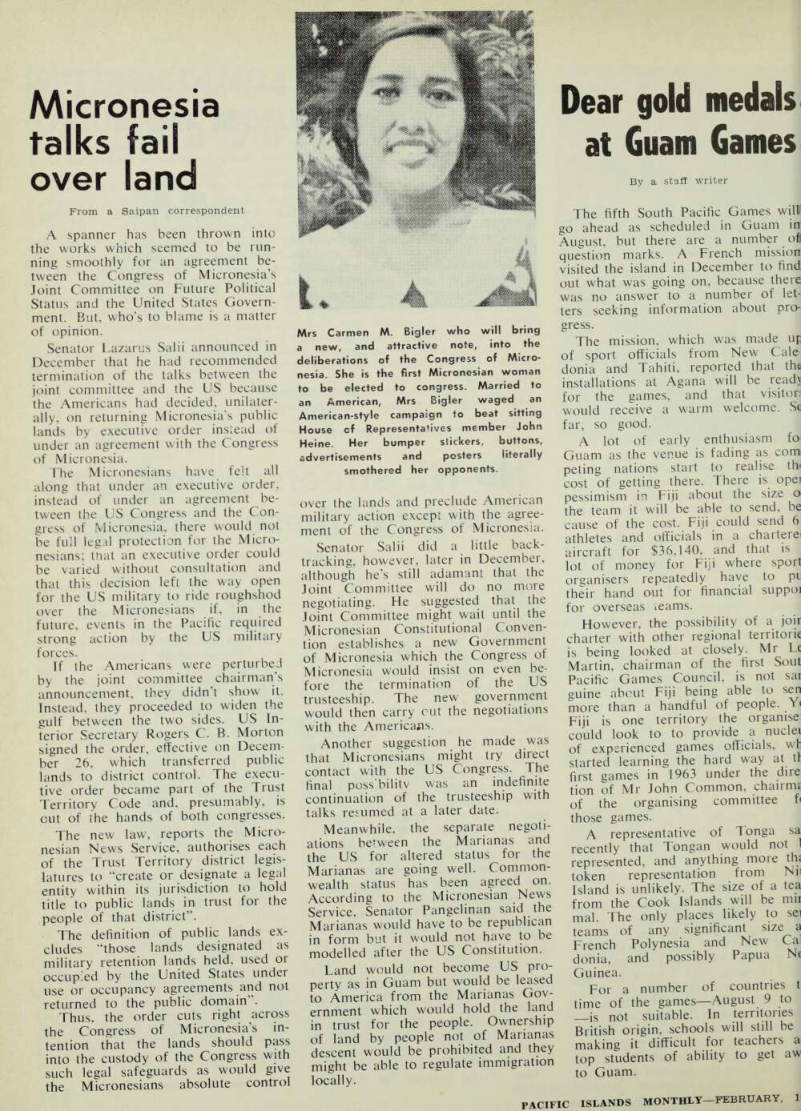
Mrs Carmen M. Bigler who will bring a new, and attractive note, into the deliberations of the Congress of Micro nesia. She is the first Micronesian woman to be elected to congress. Married to an American, Mrs Bigler waged an American-style campaign to beat sitting House of Representatives member John Heine. Her bumper slickers, buttons, advertisements and posters literally smothered her opponents.
Dear gold medals
at Guam Games
By a staff writer
The fifth South Pacific Games will! go ahead as scheduled in Guam in August, but there are a number ofl question marks. A French mission visited the island in December to find out what was going on, because there was no answer to a number of let ters seeking information about pro gress.
The mission, which was made up of sport officials from New Gale donia and Tahiti, reported that the installations at Agana will be read\ for the games, and that visitor; would receive a warm welcome. Sc far, so good.
A lot of early enthusiasm fi> Guam as the venue is fading as com peting nations start to realise th< cost of getting there. There is opei pessimism in Fiji about the size o the team it will be able to send, be cause of the cost. Fiji could send 6 athletes and officials in a charterei aircraft for $36,140, and that is lot of money for Fiji where sport organisers repeatedly have to pu their hand out for financial suppoi for overseas teams.
However, the possibility of a joir charter with other regional territorie is being looked at closely. Mr Le Martin, chairman of the first Sout Pacific Games Council, is not sai guine about Fiji being able to sen more than a handful of people. Y< Fiji is one territory the organise: could look to to provide a nuclei of experienced games officials, wh started learning the hard way at tr first games in 1963 under the dire tion of Mr John Common, chainru of the organising committee f< those games.
A representative of Tonga sa recently that Tongan would not 1 represented, and anything more ths token representation from Nu Island is unlikely. The size of a tea from the Cook Islands will be mu mal. The only places likely to sei teams of any significant size a French Polynesia and New Ca: donia, and possibly Papua Nf Guinea.
For a number of countries t time of the games—August 9 to —is not suitable. In territories British origin, schools will still be making it difficult for teachers a top students of ability to get aw to Guam.
Nutshell
In a Nutshell
New Senator
Senator Lionel Cherrier, 43, has taken his seat in the French Senate as the representative of New Cale donia. He is a New Caledonia-born industrial chemist. Senator Cherrier replaces Senator Henri Lafleur, who died suddenly in Paris in October, aged 72. Senator Lafleur represented the island in the senate from 1947 till his death. He had extensive interests in New Caledonia, where he was leader of the anti-autonomist EDS party.
Restless Volcanoes
Two volcanoes in the islands were restless in late December and January but at the time of writing there had been no disastrous lava flows. Huge clouds of dust were seen coming from Mt Yasua’s western crater on the New Hebrides island of Ambrym and there were minor eruptions in the eastern crater. Stones thrown from the crater were so hot cigarettes could be lit from them.
The French seismologist Dr Blot pre dicted three months ago Yasua would erupt in December. Karkar (Dam pier) Island’s volcano in New Guinea’s Madang District, which caused alarm last August, began erupting again in January. Smoke rose to 1,000 ft and stones were spewed 400 ft into the air. There was no lava flow and the eruption was on a much smaller scale than the one in August.
School For Press
A Diploma of Journalism course began at the University of Papua New Guinea in January. The one year course, the first of its kind in PNG, is attended by 30 journalists from the Office of Information and the National Broadcasting Commis sion. The New Zealand Government has transferred Foreign Aid funds committed for 1975-76 at Welling ton Polytechnical College to Port Moresby, following a request from the PNG Government. The NZ Government agreed as it felt it was appropriate for cadet journalists to be trained in their own country. NZ Commissioner. Mr Brian Poananga, presented SNZ6O,OOO from his gov ernment to the UPNG in December to establish the course for the next two years.
Teargas In Hospital
Teargas from a grenade thrown by a police officer at a crowd of New Year revellers seeped into the Port Moresby Hospital and caused “some discomfort” to patients, the police reported. A crowd, celebrating the New Year, set up a road block near the hospital early on New Year’s Day and, when confronted by police, invaded the hospital grounds.
Soldiers from the nearby Murray Barracks and hospital security guards helped the police to evict the revellers. It was reported that the New Year celebrations were one of the quietest and most trouble-free on record. This was attributed to the ban on liquor sales.
War 'Echo' Kills Four
A Japanese shell, left over from the Pacific War, and found by a group of men on Pata island in the Truk district of Micronesia, exploded on Christmas Eve, killing four of the men and injuring three others.
The men were trying to cut open the shell to use the explosive for fishing.
Demolition experts found 41 shells and a torpedo in three feet of water.
New Man In Nauru
Named in December as Australia’s new High Commissioner in Nauru, Mr A. L. Fogg has arrived in the republic. He succeeds Mr L. G.
Sellers, who has been there since 1972. A senior officer in the Aus tralian Foreign Affairs Department, Mr Fogg has served in Australian foreign mis-ions in Singapore, Cairo, Jakarta and Washington. His last job was with the Services Branch of Foreign Affairs. He is married and has two children.
Legal Switch
Mr D. C. Williams, until recently Attorney-General in American Samoa, has been appointed an asso ciate justice of the Micronesian High Court, succeeding Judge D. K.
Turner, who has retired. Judge Williams, aged 35, was in Samoa for five years, coming from Oregon in the USA where he had a law prac tice. He will be stationed in the Marshalls District.
Hotel Strike
More than 600 hotel workers were out on strike in Fiji in the middle of January. The strike began over a dispute about a social fund and then spread when 150 workers from the Tanoa, Skylodge and Rakiraki hotels, the first to be involved in the strike, were sacked. The hoteliers said they were prepared to reinstate only 80 to 90 per cent. Ten hotels, all in north-west Viti Levu, were affected.
Independent Anglicans
The Anglican Diocese of Mela nesia, up to this year a “subsidiary' of the Australian and New Zealanc Boards of Missions, was scheduler to go independent on January 26 anc will be split into four dioceses, those of Central Melanesia (Guadalcanal San Cristobal and the Eastern Outei Islands), the New Hebrides, Santa Ysabel and Malaita. The Rt Re\ John Chisholm will be created Arch bishop and he will be assisted in the ceremonies by three auxiliary bishops, the Rt Rev Derek Rawcliffe the Rt Rev Dudley Tuti and the R Rev Leonard Alufurai.
"Witch" In Court
Emele Marama, an 18-year-old gir from Delainabua village, near Suva who had a reputation as a witch was asked by a group of villagers tc identify the person whom they be lieved had caused the deaths of twc people by witchcraft. Emele, whc claimed she had powers given by th( shark god Dakuwaqa, performed t ceremony and named a man. Angr} villagers threatened the man, stonec his house, and he went to the police The witch was sentenced to a seven month gaol term suspended for three years. Her fee for exercising hei powers was 20c.
A Drum Beat
The BSI News Sheet, vehicle ol the Solomon Islands Information anc Broadcasting Services, ceased pub lication with the December 20 issue which was a pictorial issue recalling the main events of 1974. Its place is being taken by a government controlled newspaper called The Solo mons News Drum.
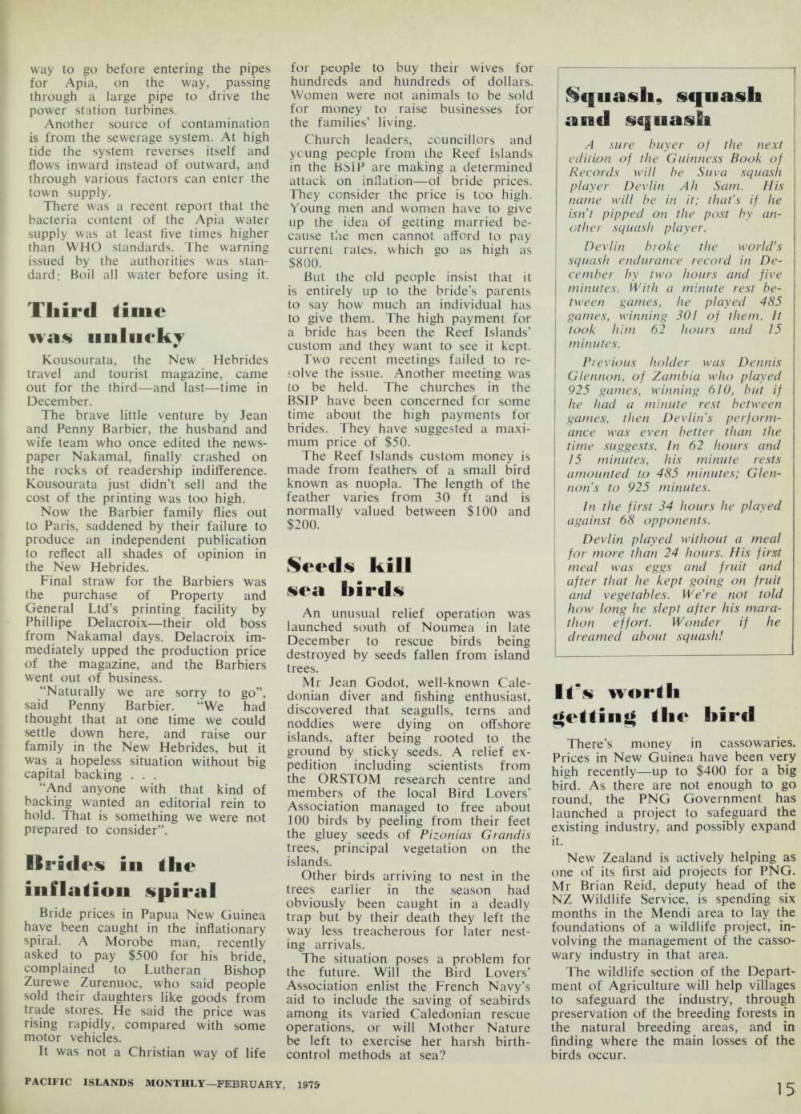
The Ven Archdeacon Jabez Leslie Bryce Tongan, who has been elected to succeed the Rt Rev J. T. Holland as Anglican Bishop in Polynesia. He is the first in digenous priest to be chosen as Bishop in Polynesia.
Tropicalities
A bit of
NG history
“Here’s an interesting bit of New Tuinea history”, said PlM’s founder Mr R. W. Robson in January, He was referring to a letter he has re vived from an “esteemed, old friend”, Mr V. T. Sanders of Port Moresby, who described a find he had made which, says Mr Robson, fills an im portant gap in his book Queen Emma.
“Having re-read your Book, Queen Emma of New Guinea, many times, I was out at Ralum the other day”, Mr Sanders wrote. “A friend of mine, while examining the remains of the steps which led to Queen Emma’s house (Gunantambu), pointed out that red bricks comprised part of the construction.
“We both presume that these bricks could have been part of the 180,000 mentioned on page 118 as from the de Rays expedition. They are prob ably the only bricks left today out of that shipment; but add a bit more colour to history. Little did the brickmakers in faraway France real ise that the results of their labours would end up half-way around the world in the land of the cannibals!”
Comments Mr Robson: “Mr San ders has filled in an important gap in my Queen Emma-Marquis de Rays history which I missed. Among the mass of stuff dumped on the beach at Port Breton from the Chandernagore or at Irish Cove from the India in 1880 were build ing material and equipment for the Roman Catholic cathedral which was part of the de Rays plan.
“Eventually, Emma bought all this stuff and stored it at Mioko (Duke of York Islands), and when, soon afterwards, she began construction of ‘Gunantambu’ (across the Strait, at Ralum) she used much of it.
“That, of course, is how the bricks got there; but I missed the point when compiling my history. I did, however, discover that Emma adapted the altar intended for the cathedral, so that it became part of the equipment of Gunantambu lounge and, incidentally, the first cocktail bar known in the South
Pacific Islands. Emma insisted that the altar had never been consecrated but there was much argument about that.
“I examined Gunantambu at Ko kopo in the ‘Thirties (before the famous bungalow was destroyed during the Japanese occupation) but there was no cocktail bar there then.
I think the equipment was removed to a more suitable place by the Catholic missionaries.
“I hope that those Gunantambu steps, with the bricks, are preserved as an interesting bit of New Guinea history. But, when last I saw them (1973) they were rapidly disappear ing, along with Ralum. Scarcely a trace of the once-famous little For sayth port now remains”.
The Is
are raining
Papua New Guinea Rugby League teams will play under the name of Kumuls, emulating the Australian Kangaroos, the New Zealand Kiwis and the British Lions. Kumul, derived from several Highland languages is the Melanesian pidgin word for the bird of paradise. The bird of para dise emblem appears on the country’s flag, the national air fleet and the coat of arms.
National teams will play in gold jumpers, with three-inch red vees and black collars. Socks will be of black and red hoops with gold tops.
The emblem will be in a white shield on the left breast of the jumper.
The code in PNG is now con trolled by a central body, the PNG Rugby League, which is mapping out a programme for the coming season. The Kumuls (will they ever become as famous as New Zealand’s All Blacks or South Africa’s Spring boks?) will make their first appear ance in May in the Pacific Cup com petition at Port Moresby. Other cup contenders will be a NZ Maori team, Victoria and Western Australia. In June there will be a match against a team from England (Yorkshire and Lancashire). A match against an Australian under-25 side in October is possible, and there are hopes of a tour of France in 1976.
A dragon on tilie
ocean door
The Golden Dragon, a restaurant in American Samoa, has given its name to a huge crack which has been discovered in the ocean floor west of American Samoa.
The crack was found by the re search vessel Thomas Washington belonging to the University of Cali fornia’s Scripps Institute of Oceano graphy in San Diego.
The crew, with memories of en joyable evenings spent at the Golden Dragon Restaurant, voted to name their discovery the Golden Dragon Fracture, a name which will appear on future charts of the ocean bed.
A piece of volcanic rock dredged up from the fracture has been sent to the restaurant owners, Dr and Mrs George Lee.
Good health
Samoan-style
Continual usage has immunised Western Samoans from disease through drinking Apia’s contamin ated water. Only visitors are liable to suffer from “Samoan Tummy”.
Dr Solia Tapeni Faaisaso revealed this recently following reports of dead animals being found in the re servoir, and a strong hint that it was filled with things unmentionable.
Lealiifano Filipo, whose job it is to keep the reservoir clean, strongly denied the suggestion that there was anything objectionable in the reser voir, saying that people would think he had been negligent in his work.
He had done his best to keep the water free of leaves, and “other dead things”, but on occasions he had to remove dead birds from the water.
As he had no boat he had to swim in the water to get the dead birds.
However, it was impossible to keep the water free of dirt. The dirt built up against the walls of the reservoir. Once every five years, Lealiifano is supposed to let the water out and clean the walls. But even if the reservoir is kept com pletely clean, the water has a long
way to go before entering the pipes for Apia, on the way, passing through a large pipe to drive the power station turbines.
Another source of contamination is from the sewerage system. At high tide the system reverses itself and flows inward instead of outward, and through various factors can enter the town supply.
There was a recent report that the bacteria content of the Apia water supply was at least five times higher than WHO standards. The warning issued by the authorities was stan dard; Boil all water before using it.
Tbird lime
was unlucky
Kousourata, the New Hebrides travel and tourist magazine, came out for the third—and last—time in December.
The brave little venture by Jean and Penny Barbier, the husband and wife team who once edited the news paper Nakamal, finally crashed on the rocks of readership indifference.
Kousourata just didn’t sell and the cost of the printing was too high.
Now the Barbier family flies out to Paris, saddened by their failure to produce an independent publication to reflect all shades of opinion in the New Hebrides.
Final straw for the Barbiers was the purchase of Property and General Ltd’s printing facility by Phillipe Delacroix—their old boss from Nakamal days. Delacroix im mediately upped the production price of the magazine, and the Barbiers went out of business.
“Naturally we are sorry to go”, said Penny Barbier. “We had thought that at one time we could settle down here, and raise our family in the New Hebrides, but it was a hopeless situation without big
capital backing . . .
“And anyone with that kind of backing wanted an editorial rein to hold. That is something we were not prepared to consider”.
Elrides in the
inflation spiral
Bride prices in Papua New Guinea have been caught in the inflationary spiral. A Morobe man, recently asked to pay $5OO for his bride, complained to Lutheran Bishop Zurewe Zurenuoc, who said people sold their daughters like goods from trade stores. He said the price was rising rapidly, compared with some motor vehicles.
It was not a Christian way of life
for people to buy their wives for hundreds and hundreds of dollars.
Women were not animals to be sold for money to raise businesses for the families’ living.
Church leaders, councillors and young people from the Reef Islands in the BMP are making a determined attack on inflation—of bride prices.
They consider the price is too high.
Young men and women have to give up the idea of getting married be cause the men cannot afford to pay current rates, which go as high as
$Boo.
But the old people insist that it is entirely up to the bride’s parents to say how much an individual has to give them. The high payment for a bride has been the Reef Islands’ custom and they want to see it kept.
Two recent meetings failed to re solve the issue. Another meeting was to be held. The churches in the BSIP have been concerned for some time about the high payments for brides. They have suggested a maxi mum price of $5O.
The Reef Islands custom money is made from feathers of a small bird known as nuopla. The length of the feather varies from 30 ft and is normally valued between $lOO and $2OO.
Seeds kill
sea birds
An unusual relief operation was launched south of Noumea in late December to rescue birds being destroyed by seeds fallen from island trees.
Mr Jean Godot, well-known Cale donian diver and fishing enthusiast, discovered that seagulls, terns and noddies were dying on offshore islands, after being rooted to the ground by sticky seeds. A relief ex pedition including scientists from the ORSTOM research centre and members of the local Bird Lovers’
Association managed to free about 100 birds by peeling from their feet the gluey seeds of Pizonias Grandis trees, principal vegetation on the islands.
Other birds arriving to nest in the trees earlier in the season had obviously been caught in a deadly trap but by their death they left the way less treacherous for later nest ing arrivals.
The situation poses a problem for the future. Will the Bird Lovers’
Association enlist the French Navy’s aid to include the saving of seabirds among its varied Caledonian rescue operations, or will Mother Nature be left to exercise her harsh birth control methods at sea?
Squash, squash
and squash
A sure buyer of the next edition of the Guinness Book of Records will be Suva squash player Devlin Ah Sam. His name will be in it; that’s if he isn’t pipped on the post by an other squash player.
Devlin broke the world’s squash endurance record in De cember by two hours and five minutes. With a minute rest be tween games, he played 485 games, winning 301 of them. It took him 62 hours and 15 minutes.
Previous holder was Dennis Glennon, of Zambia who played 925 games, winning 610, but if he had a minute rest between games, then Devlin’s perform ance was even better than the time suggests. In 62 hours and 15 minutes, his minute rests amounted to 485 minutes; Glen non’s to 925 minutes.
In the first 34 hours he played against 68 opponents.
Devlin played without a meal for more than 24 hours. His first meal was eggs and fruit and after that he kept going on fruit and vegetables. We’re not told how long he slept after his mara thon effort. Wonder if he dreamed about squash!
it ’s worth
getting the bird
There’s money in cassowaries.
Prices in New Guinea have been very high recently—up to $4OO for a big bird. As there are not enough to go round, the PNG Government has launched a project to safeguard the existing industry, and possibly expand it.
New Zealand is actively helping as one of its first aid projects for PNG.
Mr Brian Reid, deputy head of the NZ Wildlife Service, is spending six months in the Mendi area to lay the foundations of a wildlife project, in volving the management of the casso wary industry in that area.
The wildlife section of the Depart ment of Agriculture will help villages to safeguard the industry, through preservation of the breeding forests in the natural breeding areas, and in finding where the main losses of the birds occur.
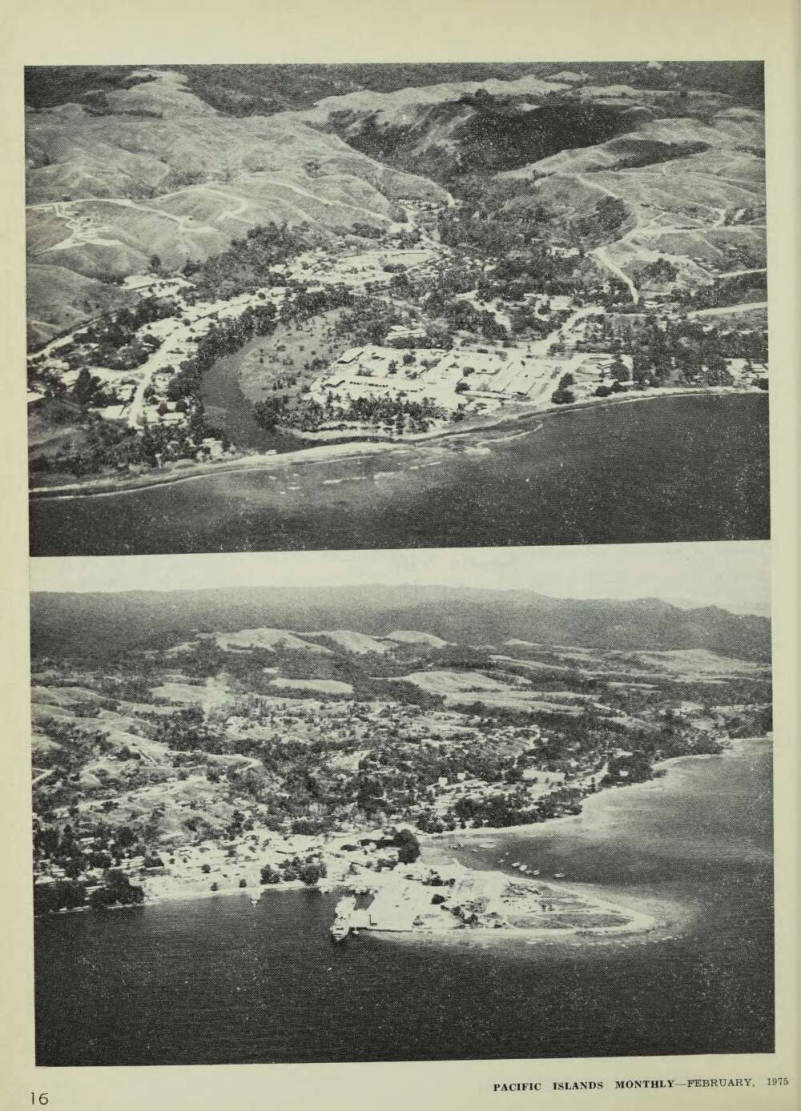
Opposite is Honiara where the action is.
The top picture shows, at left, the mouth of the Matanikau River with China Town on the left bank and the Public Works and stores compounds on the right. Be yond are the ancient coral reefs now forming Honiara's ridges with new local housing spreading along Kola'a Ridge.
Pictured below is Point Cruz with Honiara's main wharf. Behind is the township with mainly government hous ing spreading over the ridges further back.
What Has Gone Wrong, What May


Go Wrong In The Solomons
Elected the first Chief Minister of the Solomon Islands in August, 32-year-old Solomon Mamaloni has forced the resignation and departure of his Senior Information Officer, Australian journalist Denis Fisk. Mr Mamaloni accused him of political bias. Below, Mr Fisk, now in Sydney with what he says is the doubtful honour of being the first public servant to be run out of the Solomons by the new government, tells the story of his clash in November with the Chief Minister. He also fills in the background to give a dramatic picture of the Solomons political scene.
It is up to the Solomon Islanders now they are very close to self governing to determine their own way of running their country. It be comes increasingly presumptuous, after they have waited so long since the declaration of the British Solo mon Islands Protectorate in 1893, to tell them how they should do it.
Solomon Islander politicians have seen their own priorities more clearly in the past year or so. How ever, it is a simple matter of human rights to find unacceptable the denial of vital information to a people so that they may judge their new government elected by them and to find the government worthy or not of their support.
It has not taken long for the elected members of what was the Governing Council, which in August became the Legislative Assembly, to set their own national economic and social aims.
A controversial new education policy intended to fit local require ments more closely, to increase pride in custom, and to bring it more equally to all children, is close to being promulgated, and only awaits a courageous plan to finance it and a time-table to fit it.
Debate is well under way about the life-style the Solomons’ people should expect and can pay for. This
By Denis Fisk
has included the philosophy and wisdom of family planning and birth control in an emerging country which, for a change, is well fed but which is experiencing a birth-rate that could double its population in the next 30 years or less.
It has also included some deep thinking, not before time, about the increasingly disputed need for expen sive imports, especially food, and the inflation that comes with them, when it is plain that the Solomons can feed her own people more than ade quately already, with beef raising, fishing on a big commercial scale, rice-growing and other commercial cropping, all expanding rapidly.
The church’s position in what has been a thoroughly Christianised country is being examined by its leaders. These have come to defend with some vehemence, in a backlash movement, the practice of “pagan” religion and once-pagan ceremonies.
MLAs are even seriously question ing the relevancy of foreign tech nical, professional and social stan dards—inherited as part of three quarters of a century of colonialism —and their influence on local custom and traditions which are being re vived as self-government and unity are promoted.
The new Chief Minister has courageously led a movement since before he assumed his position in August radically to decentralise government to give more power, money and expertise to probably seven local government councils. Out of close to two dozen ineffectual councils (but for the Western Coun cil which was an amalgamation it self of four small councils) is being formed, in theory, a group of well staffed organisations to satisfy the need of the islanders to feel close contact with government, and to be involved in its decision-making pro cesses.
The new local politicians are prob
ably getting the reaction from years of centralised, remote and untouch able administration by benevolent foreigners whom they thanked in the main for the peace and beginnings of prosperity they brought but who nevertheless made them feel less than men.
Melanesians, no less than anybody else, like to run their own lives, and it becomes more and more obvious that their humble gratitude to the Queen and her representatives has been due more to conditioning than to a desire for it to be so.
The revival since the immediate post-war years of the Ma’asina, or Marching Rule, which was put down forcibly in the early 1950 s and its leaders jailed for a few years, is enough proof of desire for a local form of politics.
Elected MLAs have roared out in the House that this movement was the first anti-colonial expression and it should have been met then with concessions to help its initially posi tive, if confused, aims to develop Malaita and other islands and to join the rest of the world.
Too late, the MLAs cried, was the first local government council im posed on Malaita as a foreign and never popular answer to the ex pressed need because of the tight control kept over the council through its district administration advisers and the very system of an LGC.
During the first half of 1974, all the chiefs of the still deeply-tradi tional Are Are area of Malaita, from which the word Ma’asina (brother hood) comes, met in a new custom house built of sticks and leaf some 20 feet high. More than 90 chiefs met in the dark gathering place, with the seven most senior chiefs squat ting in a line between them as they sat and stood along its eaves.
They all issued a statement to the then new High Commissioner, Mr Donald Luddington (now Governor),
Mamaloni's ...
expressing support, even today for the principles of the old movement.
Are Are, of all places in the Solo mons, has had little development because of jts mountains and rela tively-infertile soil.
It also has a reputation for mys tery, for harbouring ill-will towards the colonial administration, and for having in its hinterland some of the most significant pockets of naked pagans still left.
But it is people like these whom Mr Mamaloni’s Government is try
ing to give expression to in its decen tralisation programme. It has been reasoned that if Malaita Council itself controls more funds, men and machines and makes more of its own decisions, then places like Are Are will stand a better chance of finding their own way to development and some contentment in the process.
The Solomons, after 100 years of partial and then complete foreign control, is by no means a unified group of islands.
It needs increased local control to satisfy people so that it will hang together under the general policies of its emerging central government.
Mr Mamaloni’s plan, despite des perate and sometimes bitter misgiv ings in much of the public service, is to create a federation in effect out of a, theoretically, already unified country.
This back-to-front thinking will either save the Solomons from inter nal destructive dissension, or cause it by failing to equip the new coun cils well enough to give the satisfac tion the government promises and hopes for.
It has, actually, set out more quickly and irreversibly to do what Papua New Guinea intended and failed to do in the past few years, and with a similar aim. In Papua New Guinea, the only region to achieve the same status has been Bougainville, and that by political and economic blackmail.
Britain has planned for the Solo mons a parliamentary democracy based on the undoubted freedoms of Westminster. But, as I started to say earlier, those freedoms have not been bequeathed by the British ad ministration in the field of access to information through the media.
The most dangerous aspect of the threat to this human right is that the strangling of information channels has been slow, subtle and uncodified.
It has been under cover of a free parliamentary system and a stated policy of using the government media to provide news and informa tion to spur debate on national poli cies and events.
One of the hopeful aspects of the current situation is that the Solomons has a governor under its new con stitution in Mr Donald Luddington with a far freer and informal ap proach than has been usual in its past colonial administrators, the High Commissioners. The last one, before Mr Luddington, was Sir Michael Gass, an unashamedly colonial ruler who gave few signs of liking his post but who determinedly carried out his duty of ruling on behalf of the Queen. He retired in 1973.
Mr Luddington has been equally determined to shed the aura of supreme official, using social in formality and an unending round of walking tours of the islands to tell people they must look now to their elected politicians for leadership and to get the feeling of the villagers for himself.
The Solomon Islands have a better chance than most of becoming econ omically self-sufficient and having a stable and free society. But events in the past two years and some tra ditions inherited by the close-to-self
... AND HIS ACCUSA TION OF BIAS
governing local politicians threaten the continuation of this undramatic progress to a developed economy and national unity. 1 believe this to be the essence of what has gone wrong and is going wrong in the Solomons. It is not a recent judgment, but one which 1 have had confirmed increasingly in the two years I have been there and have tried where possible to demon strate to those with power.
As anywhere, there are entrenched views and ill-based motivation within government and public services, but in a small and tightly-controlled colony of long standing these two can produce potentially disastrous effects due to the lesser risk of inter ference from community reaction than in larger countries with long tradi tions of government.
I tried for two years to ensure a free flow of news and information to the population through the govern ment-dominated media. As a result, I initially, and then during 1974 the Information and Broadcasting Ser vices as a whole were tainted by charges of political bias by Mr
Mamaloni, at first when he was Chairman of the Internal Affairs Committee of Governing Council and since August as Chief Minister.
The taint had grown over more than a year, during which Mr Mama loni’s mistrust of expatriate public servants around him grew to the point where one result was his out right refusal towards the end of 1974 to use the Information and Broad casting Services to keep his people informed.
It is part of an arrogant paternal ism by a new local elite which is succeeding the entrenched, defensive and reluctantly-departing establish ment of the British colonial adminis tration.
Heading a minority government has not helped his feelings of insecurity.
He acted secretively to spread his power base with the appointment in November of the leader of the main opposition group (the USIPA party) Philip Solodia Funifaka, to the Coun cil of Ministers, as Minister of Works and Public Utilities.
It was soon known in Honiara that some of the original five ministers
did not know of the appointment until after Mr Solodia was sworn in, or at least only hours before.
Four are from his own People’s Progress Party. The fifth—Dr Gideon Zoleveke, who had been deputy leader of USIPA, was given a new post of Home Affairs to allow Mr Solodia into Works and Public Utilities.
Some were angry at this appoint ment as Mr Solodia was one of their most bitter critics during the first Legislative Assembly meeting in Oc tober. And USIPA members were left confused for some days as to whether Mr Solodia was still their party leader.
Mr Mamaloni refused to explain the appointment when asked by his own Information and Broadcasting Services.
The government media—Solomons Radio which includes a Monday to Friday daily news service from the Information Service and a fortnightly newspaper—are virtually the only means of news communication in the Solomons.
The one exception is the weakening independent journal of comment and opinion, Kakamora Reporter, now ap pearing only every two months as its principals have become too involved
harvest of corruption
in commerce or compromising senior public service work.
In October while I was on leave, the Secretary of the PPP, Martin Wickham, told a staff member of the Information Service that I would not be coming back because Mr Mama loni did not want me back.
The same month in a personal comment over morning tea, Mr Mamaloni accused the Acting Senior Information Officer and other staff of biased reporting of the Legislative Assembly.
Mr Mamaloni also made it diffi cult to have his travels within the protectorate covered by Information Service news men, and was say ing virtually nothing of his aims or policies.
All this may sound like sour grapes. But it is the direct result of cynical or misguided seeds sown by some senior public servants in recent years.
In addition to there being in creasingly narrow-minded censorship of the government media these seeds have began to result in a harvest of corruption.
It was my aim, in the absence of any government policy when I was appointed in July, 1972, to try to establish freedom of speech and in formation in the Solomons media.
Eighteen months later a policy de claring this was issued but govern ment has not stuck to it.
Opposition to this ideal came from those who did not see it as gov ernment’s role to allow debate in depth or criticism of government policy in its own media. It also came from those who simply disliked ex posure of their decisions or decision making processes to the public.
In commerce, businessmen believed the government media was either not interested in them, was only interested in reporting what was in the govern ment’s interest or was biased against commerce generally.
This was despite the efforts of an information officer who was my im mediate predecessor and who had worked vigorously against the old sycophantic approach to news gathering which had established virtual censorship Censorship is now a definite thorn in the side of the Information and Broadcasting Services, and is of course slowly poisoning the initiative and relative fearlessness which had been encouraged in a still very young and now uncertain Solomon Islander staff.
Several ways of checking political
news were introduced in 1974, from approval of a news story by all five chairmen of the old Governing Coun cil Committees to the current vetting by senior civil servants. This does not refer to the natural checking of stories by junior reporters with rele vant officials.
News of politics and political parties virtually disappeared in 1974.
The makeup of the PPP and its executive, for example, has never been broadcast or published even though it is now the governing party.
Such results came from a colonial system where education was withheld from the local people for so long that an expatriate—white, if you like— “old boy” establishment became en trenched and corrupted; where the Melanesians were regarded, only very recently, as being, perhaps, capable of working out their own destiny or. anyway, of looking capable enough so they could be left to it; and where white men of good intent and some power in government had their in fluence nullified or were subverted or sent away by the foolish, the weak, the cunning and the selfish.
The colonial misdeeds of failing to deal according to law with oc casional errant prominent Solomon Islanders, of failing to treat all ex patriate transgressors equally with local people, of failing to apply pub lic service regulations equally where there was incapacity or breaking of rules have had considerable effect on
Solomon Islanders. In a small society of 180,000 people, anything like this becomes widely known.
Already there is corruption in the new government—a scramble by politicians to get some of the best government houses, by direct inter vention of the Chief Minister, regard less of need by public servants, is one example. Some politicians tra velling overseas have grossly misused public funds on entertaining them selves. There are numerous specific cases.
Unlike in more sophisticated countries, such acts are bitterly re sented by ordinary Solomon Islanders.
For myself, I am very sad to be forced to resign over charges of poli tical bias. My only aim was to try to be as unbiased as possible, but in Honiara’s splintered society, too few believe that can be. For what that means to the Solomons I am even sadder.
If I still could have the chance to go back for two more years until the local people were better trained, I’d take it, because the job still needs doing.
To the public servants I knew who worked hard and honestly for the Solomons’ good I apologise if they feel insulted, but I don’t think they will.
And to those who still don’t see what damage they have done stick ing to outmoded ideas, to the cynics who can only see that trouble and corruption must come to a colonial country, even one as blessed with a natural way of life as the Solomons, and to those who have fostered re ligious and political divisions for their own selfish ends, I hope for enlightenment to come. Sadly, as history shows, it’s usually a vain hope so late.
Mamaloni, courageously leading a move ment, but . . .
Advertisements & other items, pp. 20-22 (1 item)
Germs
500 MILLION
COMING YOUR WAY?
CONCENTRATED PEA-BEU
The strong one that cares for your world.
The common house fly is a notorious disease carrier. On average it brings in 500 million germs or more into your home. So it's worth getting rid of fast. Concentrated Pea-Beu contains one of the world's most powerful insecticides so it kills insects in seconds and it's rigidly tested through every stage of manufacture so you can spray it safely with confidence to protect the health and well-being of your family.
Concentrated fea-Beu kills flies, mosquitoes.oH disease carrying insects in seconds.
YOU GET A BETTER DEAL FROM
PA C/E/C MA CH/NERY
a«“
v -iS£
ff
CAT 3208
Marine Engine ft Horsepower.
Includes Twin Disc MGSO2 2:1 Marine Gear.
Several in stock. Other Ratios Available.
Parts Availability Throughout the Pacific Mi
PAriFir
MACHINERY, INC.
SUBSIDIARY OF
THEO. H. DAVIES & CO., LTD.
YOUR
CATERPILLAR
DEALER
HAWAII: 94-025 Farrington Hwy., Waipahu, Hawaii 96797. Phone: 677-9111. Cable: “PAMACAT.” TLX: 723397.
GUAM: Phone: 646-4479. Also U.S. Trust Territory and American Samoa.
Cdet'° >&<>* V'-!U» rt ’ <*>« « Manufactured by Commonwealth New Guinea Timbers Ltd. and available from leading suppliers throughout the Pacific.
Tedder Leaves
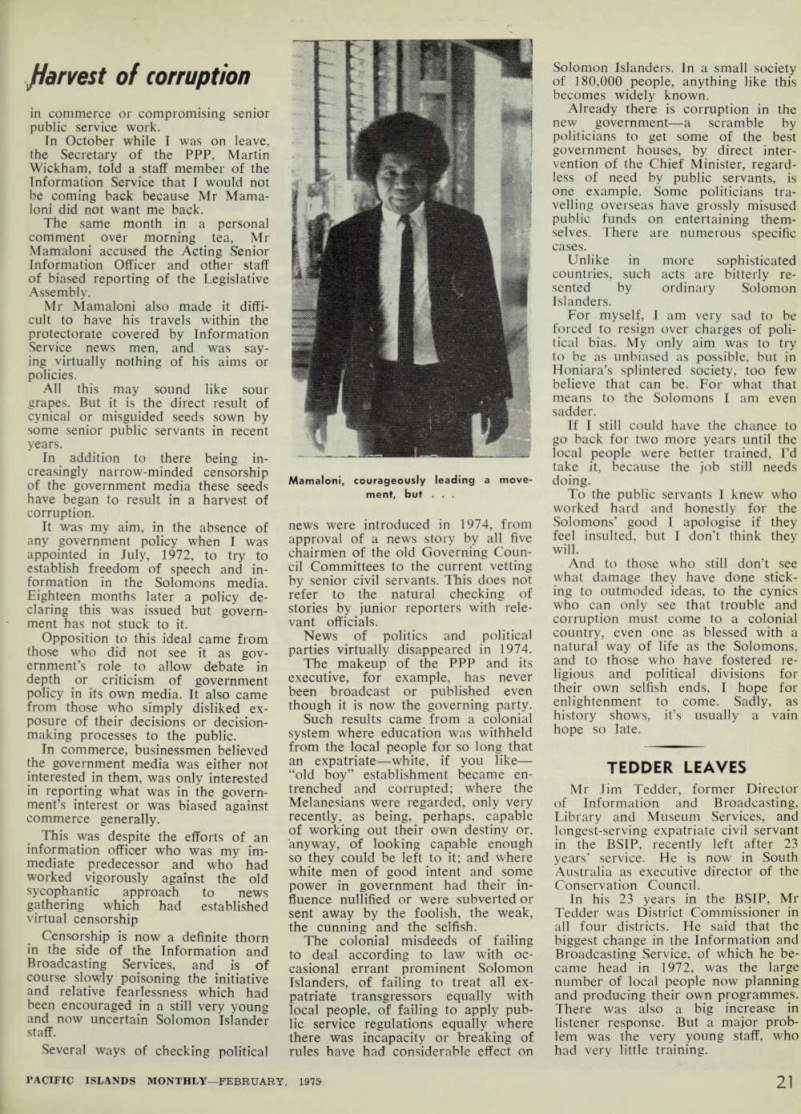
Mr Jim Tedder, former Director of Information and Broadcasting, Library and Museum Services, and longest-serving expatriate civil servant in the BSIP, recently left after 23 years’ service. He is now in South Australia as executive director of the Conservation Council.
In his 23 years in the BSIP, Mr Tedder was District Commissioner in all four districts. He said that the biggest change in the Information and Broadcasting Service, of which he be came head in 1972, was the large number of local people now planning and producing their own programmes.
There was also a big increase in listener response. But a major prob lem was the very young staff, who had very little training.
Advertisements & other items, p. 24 (1 item)
Career She
'Ki, y' SigmaSS
m : T I
BROUGHT MANY
A HOUSE DOWN.
On October 26th 1972 Hurricane Bebe struck Fiji. Huge areas were completely devastated. Houses were flattened, roofs were ripped off.
It was during this storm that a partially completed Harveytile roof met and weathered what was the toughest test any roof is likely to meet.
It took the full brunt of this ferocious storm without losing so much as one tile. Nor did days of driving torrential rain cause the roof to leak.
The larger, longer tiles of Harveytile
mean fewer joints. Thus providing complete weather protection for a lifetime and then some.
Harveytile roofs began with violent volcanic upheavals where rocks were born. The ceaseless march of ancient
glaciers, ground and splintered the rock
into particles which rivers then carried to line their banks.
It is these very same particles that form the protective surfacing of Harveytile roofs. Quarried stone silica and natural river pebble chips are selected from locations around New Zealand.
Harveytile roofs offer you eight beautiful roofing colours. Natural colours that are as old as the hills.
As Bebe demonstrated, even a hurricane can't budge the tiles of a roof that was a million years in the making.
Harveytile. Riverstone roofs.
The roof that's a million years in the
making.
Harveytile
Riverstone Roofs
Please send me your free Harveytile Brochure that will show me, in colour, the full range of textures available.
SOW
The Harvey Tile Company Limited
Name
I Address
j Please send to: Harvey Tile Company Ltd. 40 Mt. Wellington Highway, P.O. Box 62-019 Auckland, New Zealand.
PAPUA NEW
GUINEA
A.C.I. (New Guinea) Pty. Ltd.
P.O. Box 613, Lae.
NORFOLK
ISLAND
Irvine's Building Supply Centre, Box 117, .Norfolk Island.
WESTERN
SAMOA
H. & ). Retzlaff., P.O. Box 195, Apia, Western Samoa.
FIH
A.C.I. - Harvey (South Pacific) Ltd.,
TAHITI
Ets. Sin Tung Hing., B.P. 1605, Fare-Ute, Papeete, Tahiti.
The Tradewinds Convention Centre in Fiji that weathered the full force of Hurricane Bebe, without losing a tile.
Fiji —an independent state
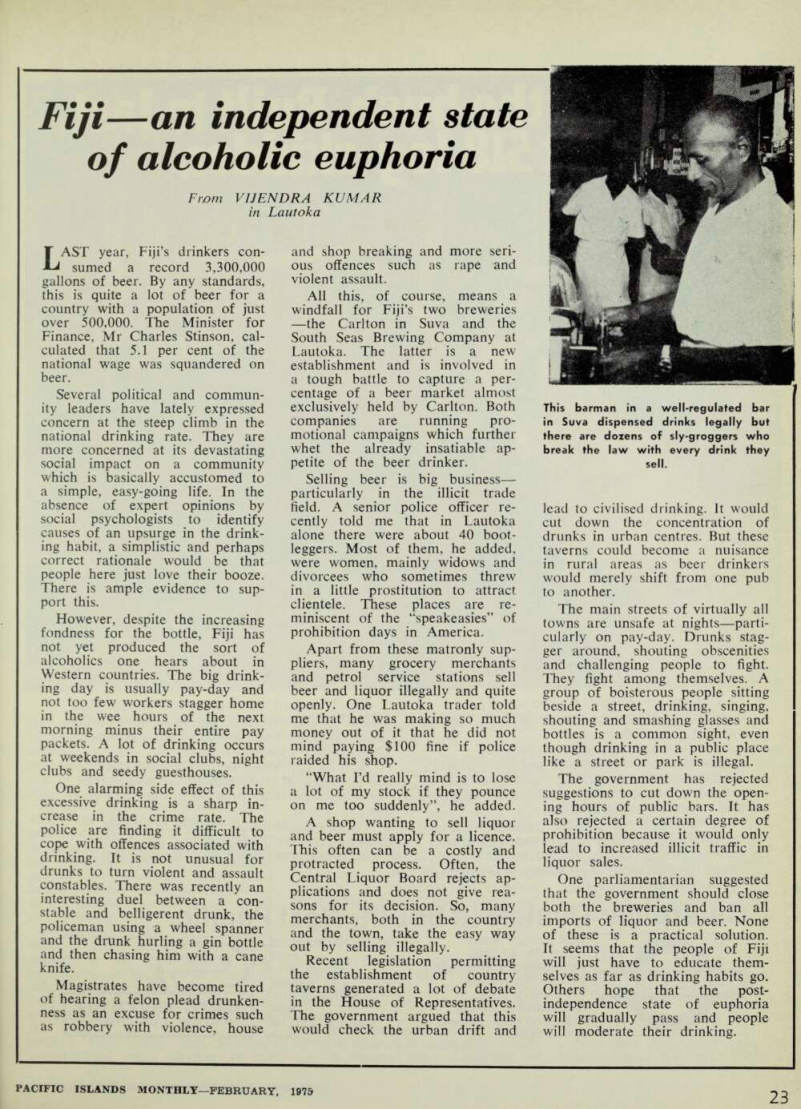
of alcoholic euphoria
From Vijendra Kumar
in Lautoka
LAST year, Fiji’s drinkers con sumed a record 3,300,000 gallons of beer. By any standards, this is quite a lot of beer for a country with a population of just over 500,000. The Minister for Finance, Mr Charles Stinson, cal culated that 5.1 per cent of the national wage was squandered on beer.
Several political and commun ity leaders have lately expressed concern at the steep climb in the national drinking rate. They are more concerned at its devastating social impact on a community which is basically accustomed to a simple, easy-going life. In the absence of expert opinions by social psychologists to identify causes of an upsurge in the drink ing habit, a simplistic and perhaps correct rationale would be that people here just love their booze.
There is ample evidence to sup port this.
However, despite the increasing fondness for the bottle, Fiji has not yet produced the sort of alcoholics one hears about in Western countries. The big drink ing day is usually pay-day and not too few workers stagger home in the wee hours of the next morning minus their entire pay packets. A lot of drinking occurs at weekends in social clubs, night clubs and seedy guesthouses.
One alarming side effect of this excessive drinking is a sharp in crease in the crime rate. The police are finding it difficult to cope with offences associated with drinking. It is not unusual for drunks to turn violent and assault constables. There was recently an interesting duel between a con stable and belligerent drunk, the policeman using a wheel spanner and the drunk hurling a gin bottle and then chasing him with a cane knife.
Magistrates have become tired of hearing a felon plead drunken ness as an excuse for crimes such as robbery with violence, house
and shop breaking and more seri ous offences such as rape and violent assault.
All this, of course, means a windfall for Fiji’s two breweries —the Carlton in Suva and the South Seas Brewing Company at Lautoka. The latter is a new establishment and is involved in a tough battle to capture a per centage of a beer market almost exclusively held by Carlton. Both companies are running pro motional campaigns which further whet the already insatiable ap petite of the beer drinker.
Selling beer is big business— particularly in the illicit trade field. A senior police officer re cently told me that in Lautoka alone there were about 40 boot leggers. Most of them, he added, were women, mainly widows and divorcees who sometimes threw in a little prostitution to attract clientele. These places are re miniscent of the “speakeasies” of prohibition days in America.
Apart from these matronly sup pliers, many grocery merchants and petrol service stations sell beer and liquor illegally and quite openly. One Lautoka trader told me that he was making so much money out of it that he did not mind paying $lOO fine if police raided his shop.
“What I’d really mind is to lose a lot of my stock if they pounce on me too suddenly”, he added.
A shop wanting to sell liquor and beer must apply for a licence.
This often can be a costly and protracted process. Often, the Central Liquor Board rejects ap plications and does not give rea sons for its decision. So, many merchants, both in the country and the town, take the easy way out by selling illegally.
Recent legislation permitting the establishment of country taverns generated a lot of debate in the House of Representatives.
The government argued that this would check the urban drift and
lead to civilised drinking. It would cut down the concentration of drunks in urban centres. But these taverns could become a nuisance in rural areas as beer drinkers would merely shift from one pub to another.
The main streets of virtually all towns are unsafe at nights—parti cularly on pay-day. Drunks stag ger around, shouting obscenities and challenging people to fight.
They fight among themselves. A group of boisterous people sitting beside a street, drinking, singing, shouting and smashing glasses and bottles is a common sight, even though drinking in a public place like a street or park is illegal.
The government has rejected suggestions to cut down the open ing hours of public bars. It has also rejected a certain degree of prohibition because it would only lead to increased illicit traffic in liquor sales.
One parliamentarian suggested that the government should close both the breweries and ban all imports of liquor and beer. None of these is a practical solution.
It seems that the people of Fiji will just have to educate them selves as far as drinking habits go.
Others hope that the post independence state of euphoria will gradually pass and people will moderate their drinking.
This barman in a well-regulated bar in Suva dispensed drinks legally but there are dozens of sly-groggers who break the law with every drink they sell.
Advertisements & other items, pp. 26-30 (1 item)
Caterpillar Dealers in South-West Pacific.
V.
Caterpillar reliability, productivity, availability. Now you can get it all in a wheel skidder. The 518.
A whole new standard in skidder engineering. 120 turbocharged horsepower, 20,400 pounds of working muscle with full articulation and frame oscillation for stability and minimum maintenance.
Single lever “on the go” powershift. Dual rate steering for controlled response at all speeds. An operator’s compartment engineered for efficiency with safety features built in for man and machine.
You’ll find all the best skidder ideas, plus added refinement and top quality manufacturing that can make the 518 the backbone of your logging operation.
And South-West Pacific Caterpillar dealers will ensure that your backbone stays in top condition no matter how far in the bush you are.
Parts, maintenance, repairs or simple information —we’ll see that you get it fast.
So tackle the jungle with the new Cat 518.
Caterpillar Dealers in South-West Pacific.
■ - a AA: IX “1 C/i nnccnc RnaH iWMuriitc
HASTINGS DIERING
Lae; Milford Haven Road, Ph: 42 2355 Port Moresby: Champion Parade, Knoedobu.
Ph: 3138 or 2098.
Bougainville: Itakara.
Industrial Park, Arawa.
Ph: 95 9004. 154 Queens Road, Suva.
Ph: 24 051-4 Cables: Carptrac Suva Telex: Carptrac FG2190 Suva
Please indicate books required.
□ PAPUA NEW GUINEA
HANDBOOK
□ HANDBOOK OF FIJI
□ LITTLE CHIMBU IN
BOUGAINVILLE
□ HOLY TORTURE IN FIJI
□ FOLKLORIC IN AUSTRALIA
□ FRIENDLY ISLAND
□ DAY THAT I HAVE LOVED
□ COLONIAL ERA CEMETERY
OF NORFOLK ISLAND
Fill in your name and address on the form provided overleaf.
to purchase
any of these
timely Pacific
titles , just
fill in the details on the attached order form See our announcement opposite.
ORDER FORM
I enclose my payment of for books ordered, as indicated, overleaf. address city/state/country/post code (please print)
Pacific Publications (Aust.) Pty. Ltd.
29 Alberta Street, Sydney, N.S.W. 2000, Australia (Postal Address; Box 3408, G.P.0., Sydney, N.S.W. 2001.)
* Pacific Publications hooks make the best gifts ★ When ordering ask for our Pacific book catalogue.
Pacific*
Islands
Monthly
NEWS MAGAZINE OF THE SOUTH PACIFIC
pacifi* Islands Monthly Overleaf is your order form for a 12 months subscription.
See our announcement opposite.
SUBSCRIPTION RATES (from January, 1975) Australia (including Lord Howe and Thursday One Year Islands), New Zealand, Papua New Guinea, Fiji, New Hebrides, Tonga, *Cook Islands, Western Samoa, Gilbert and Ellice Islands, Norfolk Island, *Niue and *Nauru $9.00 (local currency) Solomon Islands $lO.OO Aust American Samoa, *Micronesia and *Guam $12.00 US Hawaii and US Mainland $15.00 US New Caledonia and French Polynesia 1,500 CFP * United Kingdom £6.50 *Japan 4,000 Yen *Elsewhere $11.50 Aust * With asterisk, delivered surface mail. All other subscription rates listed include air
delivery.
SUBSCRIPTION FORM
name address
city/state/country/post code
Attached is my payment of (please print) for a 12 months' subscription.
New □ Renewal Q
Pacific Islands Monthly
29 Alberta Street, Sydney, N.S.W. 2000, Australia (Postal Address: Box 3408, G.P.0., Sydney, N.S.W. 2001.)
To become a regular reader , fill in the details on the attached order .
the Gilbertese horizon
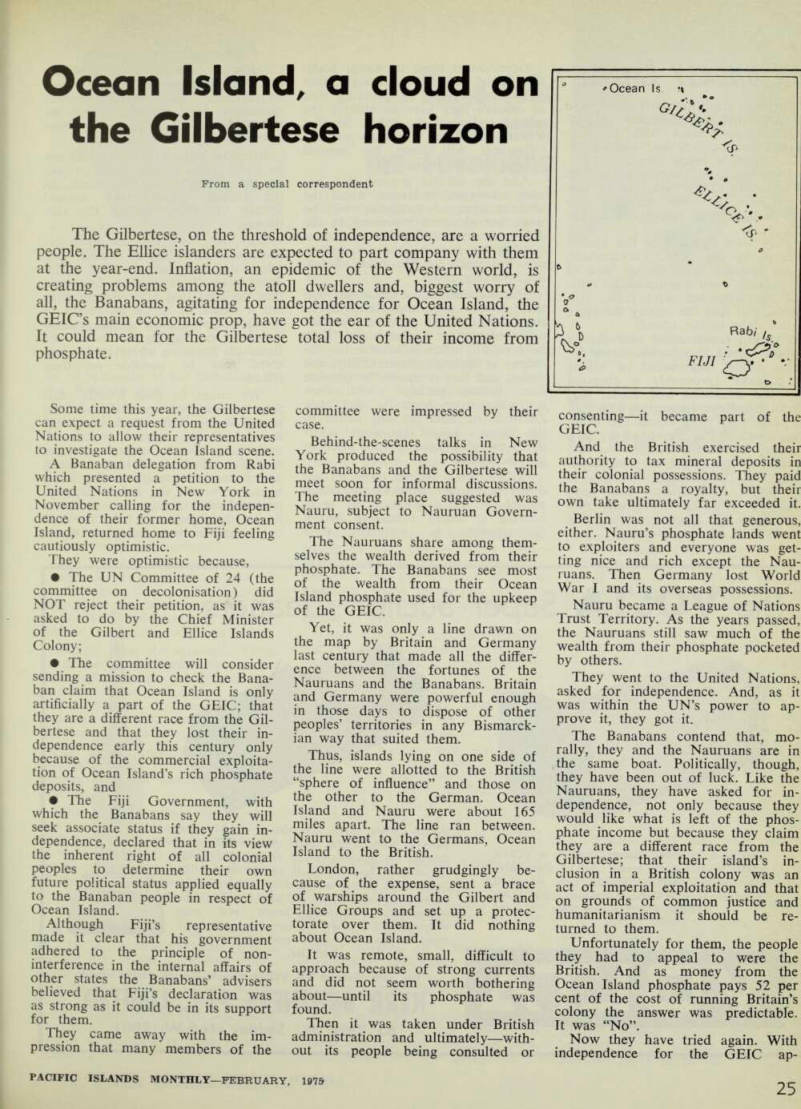

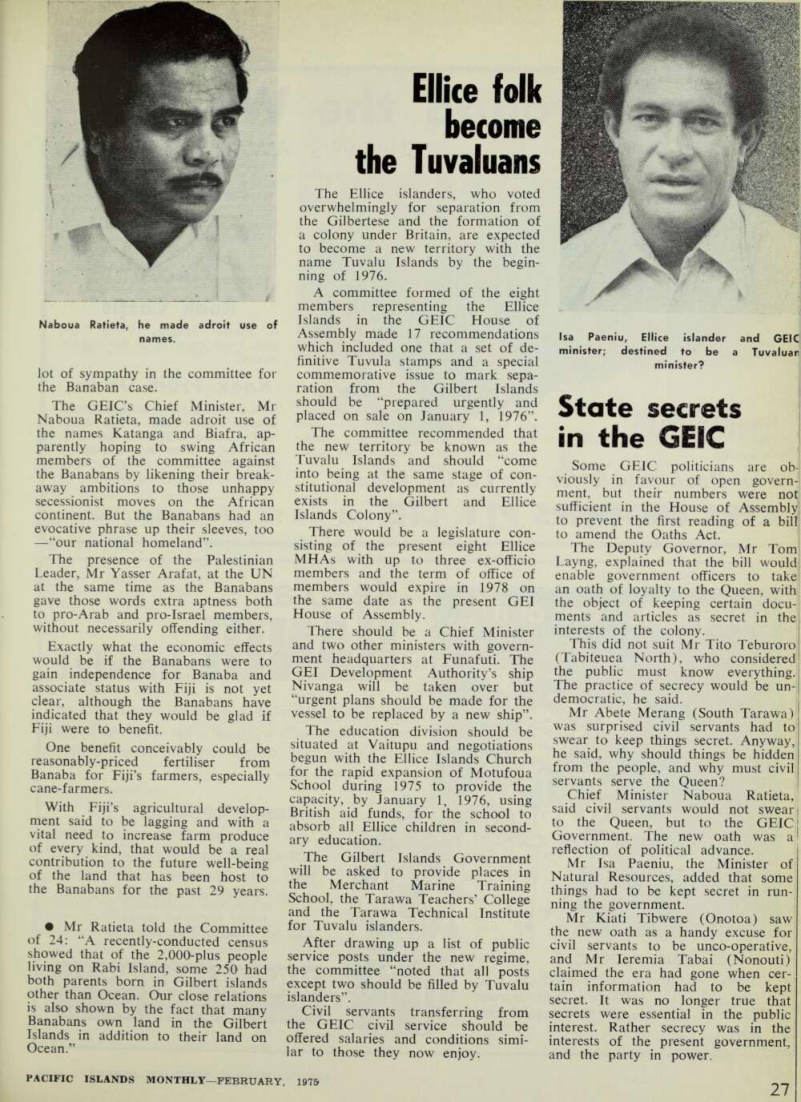
Ocean Island, a cloud on the Gilbertese horizon
From a special correspondent
The Gilbertese, on the threshold of independence, are a worried people. The Ellice islanders are expected to part company with them at the year-end. Inflation, an epidemic of the Western world, is creating problems among the atoll dwellers and, biggest worry of all, the Banabans, agitating for independence for Ocean Island, the GEICs main economic prop, have got the ear of the United Nations.
It could mean for the Gilbertese total loss of their income from phosphate.
Some time this year, the Gilbertese can expect a request from the United Nations to allow their representatives to investigate the Ocean Island scene.
A Banaban delegation from Rabi which presented a petition to the United Nations in New York in November calling for the indepen dence of their former home, Ocean Island, returned home to Fiji feeling cautiously optimistic.
They were optimistic because, • The UN Committee of 24 (the committee on decolonisation) did NOT reject their petition, as it was asked to do by the Chief Minister of the Gilbert and Ellice Islands Colony; • The committee will consider sending a mission to check the Bana ban claim that Ocean Island is only artificially a part of the GEIC; that they are a different race from the Gil bertese and that they lost their in dependence early this century only because of the commercial exploita tion of Ocean Island’s rich phosphate deposits, and • The Fiji Government, with which the Banabans say they will seek associate status if they gain in dependence, declared that in its view the inherent right of all colonial peoples to determine their own future political status applied equally to the Banaban people in respect of Ocean Island.
Although Fiji’s representative made it clear that his government adhered to the principle of non interference in the internal affairs of other states the Banabans’ advisers believed that Fiji’s declaration was as strong as it could be in its support for them.
They came away with the im pression that many members of the
committee were impressed by their case.
Behind-the-scenes talks in New York produced the possibility that the Banabans and the Gilbertese will meet soon for informal discussions.
The meeting place suggested was Nauru, subject to Nauruan Govern ment consent.
The Nauruans share among them selves the wealth derived from their phosphate. The Banabans see most of the wealth from their Ocean Island phosphate used for the upkeep of the GEIC.
Yet, it was only a line drawn on the map by Britain and Germany last century that made all the differ ence between the fortunes of the Nauruans and the Banabans. Britain and Germany were powerful enough in those days to dispose of other peoples’ territories in any Bismarck ian way that suited them.
Thus, islands lying on one side of the line were allotted to the British “sphere of influence” and those on the other to the German. Ocean Island and Nauru were about 165 miles apart. The line ran between.
Nauru went to the Germans, Ocean Island to the British.
London, rather grudgingly be cause of the expense, sent a brace of warships around the Gilbert and Ellice Groups and set up a protec torate over them. It did nothing about Ocean Island.
It was remote, small, difficult to approach because of strong currents and did not seem worth bothering about—until its phosphate was found.
Then it was taken under British administration and ultimately—with out its people being consulted or
consenting—it became part of the
Geic
And the British exercised their authority to tax mineral deposits in their colonial possessions. They paid the Banabans a royalty, but their own take ultimately far exceeded it.
Berlin was not all that generous, either. Nauru’s phosphate lands went to exploiters and everyone was get ting nice and rich except the Nau ruans. Then Germany lost World War I and its overseas possessions.
Nauru became a League of Nations Trust Territory. As the years passed, the Nauruans still saw much of the wealth from their phosphate pocketed by others.
They went to the United Nations, asked for independence. And, as it was within the UN’s power to ap prove it, they got it.
The Banabans contend that, mo rally, they and the Nauruans are in the same boat. Politically, though, they have been out of luck. Like the Nauruans, they have asked for in dependence, not only because they would like what is left of the phos phate income but because they claim they are a different race from the Gilbertese; that their island’s in clusion in a British colony was an act of imperial exploitation and that on grounds of common justice and humanitarianism it should be re turned to them.
Unfortunately for them, the people they had to appeal to were the British. And as money from the Ocean Island phosphate pays 52 per cent of the cost of running Britain’s colony the answer was predictable.
It was “No”.
Now they have tried again. With independence for the GEIC ap-
Ak! Iikjca Cv Cyriicp
/J/V Uhcaj T Laujjc
proaching the Ellice Islanders have declared their unwillingness to con tinue in association with the Gil bertese because they fear domination.
T hey want to break away.
The Banabans con meed a Ellice move is justified, believe that they have an even stronger case for taking Ocean Island out of the C °Thev were onnosed at the United Nations by the GEIC Government, u/hirh rpfprrpH to Orean as “one of our islands” and attempted to show that the Banabans were really Gil bertese and that the colony therefore had a right to the island.
The Fiji Government said that if Britain agreed to separate status for Ocean Island, Fiji would be willing to consider favourably a proposal that the Banabans had made, that Ocean Island be associated with Fiji.
Quite apart from ethnic and econ ornic matters, the Banabans say it is contrary to Pacific custom for the people of one island to take some thing that traditionally belongs to the people of another. They have talked to ordinary Gilbertese who tiave given the impression of being embarrassed by the situation.
Government men, in whom tradition might run just as strongly, find an uneasy excuse by pleading that as officials they have to observe the official code, not the tribal. So now ft looks as if the Banabans and the Gilbertese will meet on neutral ground to talk things over.
And the neutra i ground that has been nom i nated ls Nauru, where the obv j ous s i gns G f prosperity will be ute bm eloquent testimony to the difference that a line drawn almost °made to the lives of two ago nas . made 10 me lives or IWO neighbouring races, The Banabans have often said that they do not want the GEIC to be the l° ser through possible Banaban independence for Ocean Island. They have equally often reiterated that the colony is Britain s responsibility, not theirs; and that it should be possible for Britain—perhaps with cooperation from Australia and New Zealand—to make up any deficit m the colony s budget that would occur lf all the phosphate revenue went to the Banabans.
Britain, they reckon, was an indirect beneficiary from Ocean Island phosphate for a great many years because it helped successive British Governments to maintain their
cheap-food policies. And Australia and New Zealand were more direct beneficiaries, they argue, because farmers in both countries bought the phosphate at prices far below those obtaining in the world market.
Banaban logic is that it would not be amiss, then, for the three to take up the colony’s economic slack. In the United Nations they accused Britain of hiding behind the Gil bertese.
But that, as they see it, is an economic matter that should not affect the fundamental issue of in dependence. Privately, they have said they believed that after Britain pulls out it would be to the advantage of the Gilbertese to have an independent Banaba as neighbour, with the Banabans financing whatever develop ment may be possible on their island.
“We could be their friends. And they are going to need friends and somebody to help them when the British go”, they say.
Bertram Jones, now a senior executive of Matt Wilson Limited, and formerly secretary to the Bana bans, went with the Rabi delegation to the United Nations for the hear ing of their petition.
His opinion was that there was a
lot of sympathy in the committee for the Banaban case.
The GEIC’s Chief Minister, Mr Naboua Ratieta, made adroit use of the names Katanga and Biafra, ap parently hoping to swing African members of the committee against the Banabans by likening their break away ambitions to those unhappy secessionist moves on the African continent. But the Banabans had an evocative phrase up their sleeves, too —“our national homeland”.
The presence of the Palestinian Leader, Mr Yasser Arafat, at the UN at the same time as the Banabans gave those words extra aptness both to pro-Arab and pro-Israel members, without necessarily offending either.
Exactly what the economic effects would be if the Banabans were to gain independence for Banaba and associate status with Fiji is not yet clear, although the Banabans have indicated that they would be glad if Fiji were to benefit.
One benefit conceivably could be reasonably-priced fertiliser from Banaba for Fiji’s farmers, especially cane-farmers.
With Fiji’s agricultural develop ment said to be lagging and with a vital need to increase farm produce of every kind, that would be a real contribution to the future well-being of the land that has been host to the Banabans for the past 29 years. • Mr Ratieta told the Committee of 24: “A recently-conducted census showed that of the 2,000-plus people living on Rabi Island, some 250 had both parents bom in Gilbert islands other than Ocean. Our close relations is also shown by the fact that many Banabans own land in the Gilbert Islands in addition to their land on Ocean.”
Naboua Ratieta, he made adroit use of names.
Advertisements & other items, p. 32 (1 item)
Volta
The VOLTA Super Suction Cleaners
v °cr,
Upright or cylinder cleaner, there is a VOLTA model to suit every need. All of them with outstanding cleaning power and advanced features —at a realistic price—to make home cleaning easier and quicker.
VOLTA
VOLTA offers three magnificent models: The dashing BLUE VOLTA speed cleaner with super power, the economy-priced WHITE VOLTA for the smaller home. And if you prefer an upright, there is the outstanding performer, the superbly styled DUAL ACTION VOLTA combining the powered brush and easy manoeuvrability of an upright with the powerful suction and convenience of a cylinder.
For sale through The VOLTA people for the Pacific Islands:
KERR BROTHERS PTY. LIMITED
65 York St., Sydney, N.S.W. 2001
Ellice folk
become the Tuvaluans
The Ellice islanders, who voted overwhelmingly for separation from the Gilbertese and the formation of a colony under Britain, are expected to become a new territory with the name Tuvalu Islands by the begin ning of 1976.
A committee formed of the eight members representing the Ellice Islands in the GEIC House of Assembly made 17 recommendations which included one that a set of de finitive Tuvula stamps and a special commemorative issue to mark sepa ration from the Gilbert Islands should be “prepared urgently and placed on sale on January 1, 1976”.
The committee recommended that the new territory be known as the Tuvalu Islands and should “come into being at the same stage of con stitutional development as currently exists in the Gilbert and Ellice Islands Colony”.
There would be a legislature con sisting of the present eight Ellice MHAs with up to three ex-officio members and the term of office of members would expire in 1978 on the same date as the present GEI House of Assembly.
There should be a Chief Minister and two other ministers with govern ment headquarters at Funafuti. The GEI Development Authority’s ship Nivanga will be taken over but “urgent plans should be made for the vessel to be replaced by a new ship”.
The education division should be situated at Vaitupu and negotiations begun with the Ellice Islands Church for the rapid expansion of Motufoua School during 1975 to provide the capacity, by January 1, 1976, using British aid funds, for the school to absorb all Ellice children in second ary education.
The Gilbert Islands Government will be asked to provide places in the Merchant Marine Training School, the Tarawa Teachers’ College and the Tarawa Technical Institute for Tuvalu islanders.
After drawing up a list of public service posts under the new regime, the committee “noted that all posts except two should be filled by Tuvalu islanders”.
Civil servants transferring from the GEIC civil service should be offered salaries and conditions simi lar to those they now enjoy.
State secrets
in the GEIC
Some GEIC politicians are ob viously in favour of open govern-' ment, but their numbers were not sufficient in the House of Assembly to prevent the first reading of a bill to amend the Oaths Act.
The Deputy Governor, Mr Tom Layng, explained that the bill would enable government officers to take an oath of loyalty to the Queen, with the object of keeping certain docu ments and articles as secret in the interests of the colony.
This did not suit Mr Tito Teburoro (Tabiteuea North), who considered the public must know everything.
The practice of secrecy would be un democratic, he said.
Mr Abete Merang (South Tarawa) was surprised civil servants had to swear to keep things secret. Anyway, he said, why should things be hidden from the people, and why must civil servants serve the Queen?
Chief Minister Naboua Ratieta, said civil servants would not swear i to the Queen, but to the GEICj Government. The new oath was a' reflection of political advance.
Mr Isa Paeniu, the Minister of Natural Resources, added that some things had to be kept secret in run ning the government.
Mr Kiati Tibwere (Onotoa) saw the new oath as a handy excuse for civil servants to be unco-operative, and Mr leremia Tabai (Nonouti) claimed the era had gone when cer tain information had to be kept secret. It was no longer true that secrets were essential in the public interest. Rather secrecy was in the interests of the present government, and the party in power.
Isa Paeniu, Ellice islander and GEIC minister; destined to be a Tuvaluan minister?
Advertisements & other items, p. 34 (1 item)
HANDI handy!
Raak around the World!
* EUROPE'S
a*
Raak Cola
Young, lively, exciting always refreshing.
The Raak people for the Pacific Islands.
KERR BROTHERS PTY. LTD. 65 York St., Sydney, N.S.W., 2001.
AWARD WINNING
SOFT DRINKS
Raak Europe’s biggest soft drink factory situated at Europe’s gateway Holland supplies all over the world.
Raak soft drinks offer unique quality and true to label flavours.
Raak Cassis
A special flavour. Made from juicy black currants of the highest quality.
Raak Fruit Drinks
Real fruit taste and a fresh tingle!
Orange, lemon and citrus drink.
And famous LONDON DRINKS, with real fruit content; known all over the world (Orange Dry, Lemon Dry and Tonic Water).
OTHER HANOI PRODUCTS!
‘Handi’ range of quality products also includes: a portable Twin - Burner Stovette and ‘Handi’ Pumpless Petrol Iron.
Keep a
HANDI handy!
■ No need to fumble and fume! Throw light on the subject with a ‘Handi’. It’s twice as bright as electric light. Completely stormproof. Simple and safe to use.
PRESSURE OPERATED
One filling gives 12 hours of brilliant 300 candle-power lighting. Built to last, with chromed, rust - proofed finish. Petrol or Kerosene models.
Ask for Handi! Everywhere!
HANDI WORKS
Evans Rd., Salisbury North. Ph. 47 2122
BRISBANE, QUEENSLAND, AUSTRALIA
proposals.. .
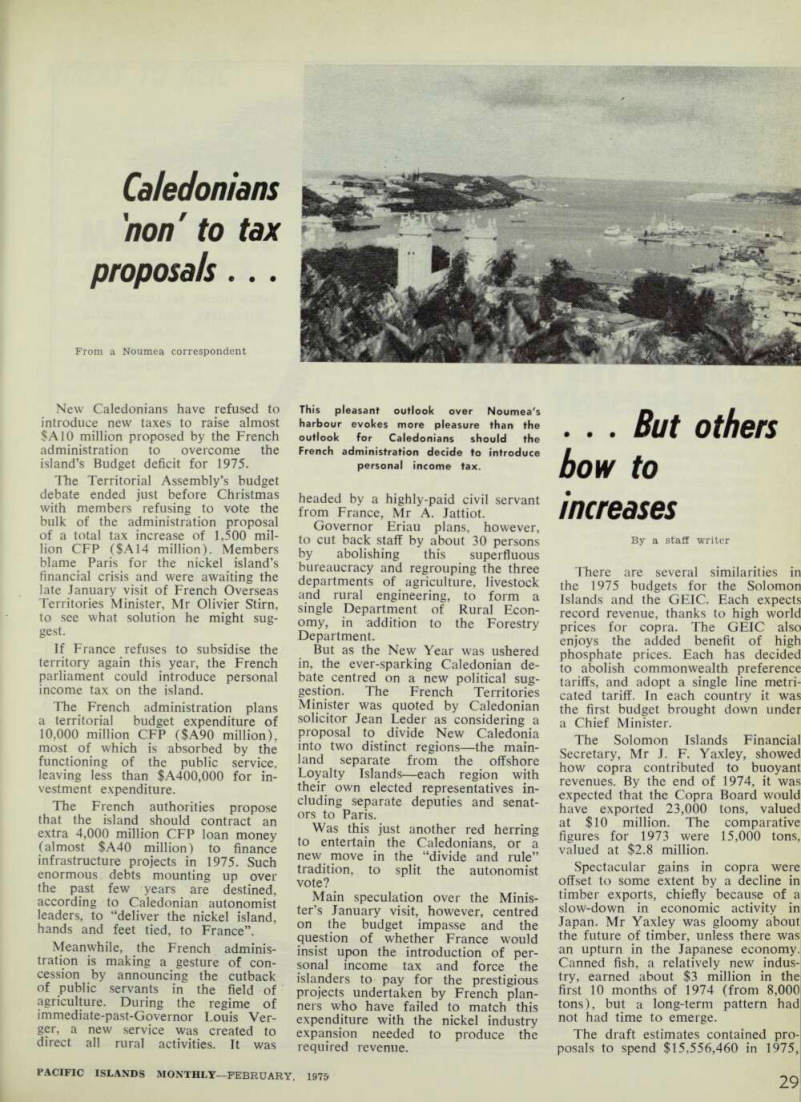
Caledonians 'non'to tax proposals.. .
... But others bow to increases
From a Noumea correspondent
New Caledonians have refused to introduce new taxes to raise almost SAIO million proposed by the French administration to overcome the island’s Budget deficit for 1975.
The Territorial Assembly’s budget debate ended just before Christmas with members refusing to vote the bulk of the administration proposal of a total tax increase of 1,500 mil lion CFP (SAI4 million). Members blame Paris for the nickel island’s financial crisis and were awaiting the late January visit of French Overseas Territories Minister, Mr Olivier Stirn, to see what solution he might sug gest.
If France refuses to subsidise the territory again this year, the French parliament could introduce personal income tax on the island.
The French administration plans a territorial budget expenditure of 10,000 million CFP (SA9O million), most of which is absorbed by the functioning of the public service, leaving less than $A400,000 for in vestment expenditure.
The French authorities propose that the island should contract an extra 4,000 million CFP loan money (almost SA4O million) to finance infrastructure projects in 1975. Such enormous debts mounting up over the past few years are destined, according to Caledonian autonomist leaders, to “deliver the nickel island, hands and feet tied, to France”.
Meanwhile, the French adminis tration is making a gesture of con cession by announcing the cutback of public servants in the field of agriculture. During the regime of immediate-past-Governor Louis Ver ger, a new service was created to direct all rural activities. It was
headed by a highly-paid civil servant from France, Mr A. Jattiot.
Governor Eriau plans, however, to cut back staff by about 30 persons by abolishing this superfluous bureaucracy and regrouping the three departments of agriculture, livestock and rural engineering, to form a single Department of Rural Econ omy, in addition to the Forestry Department.
But as the New Year was ushered in, the ever-sparking Caledonian de bate centred on a new political sug gestion. The French Territories Minister was quoted by Caledonian solicitor Jean Leder as considering a proposal to divide New Caledonia into two distinct regions—the main land separate from the offshore Loyalty Islands—each region with their own elected representatives in cluding separate deputies and senat ors to Paris.
Was this just another red herring to entertain the Caledonians, or a new move in the “divide and rule” tradition, to split the autonomist vote?
Main speculation over the Minis ter’s January visit, however, centred on the budget impasse and the question of whether France would insist upon the introduction of per sonal income tax and force the islanders to pay for the prestigious projects undertaken by French plan ners who have failed to match this expenditure with the nickel industry expansion needed to produce the required revenue.
By a staff writer
There are several similarities in the 1975 budgets for the Solomon Islands and the GEIC. Each expects record revenue, thanks to high world prices for copra. The GEIC also enjoys the added benefit of high phosphate prices. Each has decided to abolish commonwealth preference tariffs, and adopt a single line metri cated tariff. In each country it was the first budget brought down under a Chief Minister.
The Solomon Islands Financial Secretary, Mr J. F. Yaxley, showed how copra contributed to buoyant revenues. By the end of 1974, it was expected that the Copra Board would have exported 23,000 tons, valued at $lO million. The comparative figures for 1973 were 15,000 tons, valued at $2.8 million.
Spectacular gains in copra were offset to some extent by a decline in timber exports, chiefly because of a slow-down in economic activity in Japan. Mr Yaxley was gloomy about the future of timber, unless there was an upturn in the Japanese economy.
Canned fish, a relatively new indus try, earned about $3 million in the first 10 months of 1974 (from 8,000 tons), but a long-term pattern had not had time to emerge.
The draft estimates contained pro posals to spend $15,556,460 in 1975,
This pleasant outlook over Noumea's harbour evokes more pleasure than the outlook for Caledonians should the French administration decide to introduce personal income tax.
Threat To Geic
the biggest spending in the history of the Solomons, and $3 million more than in 1974. There was also $375,480 in statutory expenditure— spending authorised by laws other than the annual Appropriation Ordin ance. Only half the amount to be spent in 1975 will come from the Solomons’ own resources. The coun try looks to aid sources to meet the gap between revenue and expenditure, and in most cases that means the British taxpayer.
Expenditure in the capital budget for 1975 is put at $6l million, most of which will come from UK deve lopment aid grants. Although the UK provides a greater part of the money for development, and an increasing amount each year, the percentage of the total is declining. In 1975, about $1 million will come from sources outside the UK.
Mr Yaxley said the new customs tariff was designed, not so much to raise additional revenue, but to streamline the structure and prepare the country for a more independent role in managing its affairs. The in tention was that in fiscal terms the revenue from customs would be the same, assuming current trading pat terns continued. The duty on some basic foodstuffs was reduced or abolished altogether.
To offset loss of revenue, the duty on cigarettes was lifted about 3c on a packet of 20. The duty on im ported fresh meat was doubled and a 20 per cent duty was imposed on spices to protect local industries. A small duty was imposed on a number of food items which previously were allowed in free from Commonwealth sources. A wide variety of other goods is affected. On some duty is abolished, and on others imposed for the first time or increased.
Export duties have been increased —gold from five per cent to 10 per cent, frozen fish from seven per cent to nine per cent. For the first time a duty, 10 per cent ad valorem, is imposed on export of articles of wood, stone or other material, in tended for a gift or sale as a curio.
The copra tax, which was abolished in 1971, to give some relief when prices were low, was reintroduced, and fixed at a specific rate of $7.
A new scale of duty has been introduced to give more revenue when copra prices are high. The rates are—On the first $lOO of fob value, nil; first $4O above $lOO, 26 per cent; next $l6O, 13 per cent; above $3OO, 20 per cent.
Mr Pat Reardon, the GEIC Financial Secretary, although cauti ously optimistic about the immediate future, warned how dependent the GEIC was on revenue from copra and phosphate. If prices of those two commodities fell as quickly in the next 12 months as they had risen in the previous 12 months, the GEIC would be in serious economic trouble, he said.
He expects total revenue for 1975 to be $19,560,760, which is an in crease of 247 per cent over the revenue actually collected in 1973 (the final figures for 1974 would not have been available at the time he presented the budget in December), which was due almost entirely from the increased yield from phosphate.
Mr Reardon forecast expenditure at exactly the same as revenue, $19,560,760, which would give one of the most neatly-balanced budgets ever known.
After putting aside $14,067,128 as a contribution to the revenue equal isation reserve fund and the capital budget, the real operating cost of government will be $5,493,632, an increase of 18.77 per cent over the two years since 1973. Personal emoluments are expected to take 47.65 per cent of the operating cost, compared with 40.79 per cent in 1974.
Mr Reardon described this as an excessive rise in 12 months, and said steps would be taken in 1975 to rectify the position. He expected that health, education, welfare and train ing would take 38.7 per cent of the total ordinary expenditure, but natural resources would get only 5.82
per cent. Works services, which in cluded telecommunications, postal services, civil aviation, meteoro logical, marine division and recurrent works would absorb about 30 per cent of the budget.
Mr Reardon also announced that pay-as-you-earn taxation would be introduced. This would ensure the taxpayer was no longer faced with an annual tax bill, which often placed hardship on him and his family. As it would be the employ ers’ responsibility to deduct tax, many persons who had failed to sub mit returns would be caught in the overall tax net. Income tax was not changed for 1975.
The principles in the single line metricated tariff structure were simi lar to those presented with the Solomon Islands’ budget.
As a final warning, Mr Reardon said that as the House of Assembly had approved the separation of the Ellice Islands, it would be necessary to work out the effects that move would have on the economy and future budgets. He proposed to re view the revenue so that additional revenue raising measures could be introduced to meet the situation, and ensure that everybody contributed equitably towards the economy and the way of life in the islands. • Mr John Long, dismissed from his job as manager of Guadalcanal Plains Ltd when the company went into receivership, applied in the High Court at Honiara for a declaration that his dismissal was invalid. Chief Justice Sir Jocelyn Bodilly rejected his application.
Advertisements & other items, pp. 36-40 (1 item)
S. E. Tatham
SOME OF THE FIRMS
WE REPRESENT ARE:
Asia Rubber Works (Singapore Rubber Shoes) Frappier (French Brandy) Huvet (French Brandy) Indika (Belgium Dairy Produce) Durobor S.A. (Belgium Glassware) Miroiterie Gen. de Belgiqe S.A. (Louvre glass and mirrors) City Engineers (U.K. Bicycles) F.H.I. Japan (Subaru Cars) Kraggs (Wines, Spirits, Ciders) Sunshine Biscuits • Sunrise (Confectionery) Flamenco (Instant Coffee & Tea) Quaker Products (Oats, Jets) Hancocks (Spaghetti, Cereals) Melbourne Canning (Jams) Amatil (Twisties, Twirlies) Edward Zorn (Margarine, Cooking Fats) Allens (Confectionery) Red Tulip (Fine Chocolates) Robert Timms (New Guinea Gold Instant Coffees and Teas) S.P.C (Canned Fruit) S.P.C. (Abalone) Wing Lee (See You Sauce) Magnet (Mattresses) Essteel (Cookware) Warner-Drayton (Fans) Mitchell's (Abrasives) Tilbury & Lewis (Sports Trophies Silverplate) Regent (Swiss watches) Lega Marcasite (Jewellery) Austramax (Pressure Lanterns) Lawn Chair; Tubco (Garden Furniture) Electronic Industries (Electrical Household Appliances) Jex (Steelwool) Arnbro (Folding Beds) James Miller (Blankets) Elmaco (Plastics —Electrical Fittings) B.X. (Plastics) Stegbar (Wooden Louvres) Franklite (Light Fittings) J.J. Cash (Embroidered Labels) Disston (Saws)
S. E. TATHAM
& CO. PTY. LTD.
ASKEW HOUSE, 364 LONSDALE ST.,
MELBOURNE, 3001, AUSTRALIA.
G.P.O. BOX 8—
CABLES "SET",
TELEPHONE: 601125
BUYERS FOR THE
PACIFIC ISLANDS
32 % 52 % 52 St 1 \% 2
DIRECT ENQUIRIES WELCOMED
PAPUA NEW GUINEA; S. E. TATHAM (P.N.G.) PTY. LTD.,
LAE: MALAITA STREET (P.O. BOX 1562).
PORT MORESBY: CNR. GOROA AND MUNAHU STREETS,
(P.O. BOX 6733, BOROKO).
FIJI: S. E. TATHAM (FIJI) LTD.,
LAUTOKA: P.O. BOX 366.
SUVA; G.P.O. BOX 671.
YOUR GUARANTEE
i i i
GORDON
FOR SERVICE
T. 2
SINCE 1924
D pua new guinea
printing co. ply. ltd.
Serving the Country from Aitape to Alotau, Manus to Moresby Leaders in Commercial Offset and Letterpress Printing. • Stationery Office Supplies • Office Equipment • Rubber Stamps • Self-Adhesive Labels • In Fact:— Everything For The Office.
P.O. Box 633, Port Moresby P.O. Box 759, Loe P.O. Box 1239, Roboul
TIMELY PACIFIC READING!
Specially selected titles from Pacific Publications
PAPUA NEW GUINEA
HANDBOOK
7th edition This new edition of the Papua New Guinea Handbook —completely revised and reset —provides the first full upto-date details of the new self-governing nation.
For businessmen, travellers, schools, universities and libraries, government departments, tourists and Papua New Guinea residents, this timely, up-to-the-minute edition, is essential.
A large attractive fold-out map of Papua New Guinea is also included. 332 pages of text.
PRICE: Australia, $5.50 plus 85c posted, Pacific Islands and Overseas, $5.50 Aust., plus $l.lO posted; U.5.A., $9.80 U.S. posted.
HANDBOOK OF FIJI
4th edition In trade and as a magnet for tourists, Fiji is growing in importance. For businessmen, travellers, students and others who want to keep abreast of events, the fourth edition of the Handbook of Fiji is an essential guide.
As well as sections dealing exhaustively with history, geography, government and politics, finance, trade, education, social services, etc., there is a completely revised tourist section. This is in keeping with the growing importance to Fiji of this industry. An extensive accommodation guide and a folding road-map of Viti Levu are included. With 14 other maps and attractive full-colour cover, PRICE; Australia, Pacific Islands and Overseas, $3.95 Aust., plus 30c posted; U.S.A., $4.90 U.S. posted.
FOR CHILDREN
LITTLE CHIMBU IN
BOUGAINVILLE Nancy Curtis This is the story of lovable Little Chimbu, and his friends, who go off to see the biggest hole in the world . . . the Bougainville copper mine, at Panguna, in Ntew Guinea.
Adventures follow one after the other on their arrival at the mine, and young readers (and their parents) will be fascinated by Nancy Curtis' colourful, yet accurate and instructive account of the workings of the big Bougainville enterprise ... its giant trucks, its processing plant, its port and shipping.
Illustrated in full colour.
PRICE: Australia, Pacific Islands and Overseas, $3.25 Aust., plus 30c posted; U.5.A., $5.30 U.S. posted.
HOLY TORTURE IN FIJI
Written by a group of academic participants and observers.
Editing and commentary by Prof. Ron Crocombe.
This book describes sacred ancient rituals involving physical ordeals which are performed once a year at certain Hindu temples in Fiji. The rituals include walking on fire, dancing on upturned knife-blades, whipping, plunging the hands in burning fat and piercing the body with steel skewers and silver wires.
Yet those who go through the ordeals suffer no pain, burns or injuries.
The book is beautifully produced in full colour and black-and-white.
PRICE- Australia, Pacific Islands and Overseas, $3.95 Aust., plus 30c posted; U.S.A., $6.40 U.S. posted.
PRPUR
REUI OUinifl
HRRDBOOK
HOiy
TORTURE
i Wm ms
IN FIJI
HANDBOOK
OF FIJI fourth edition - P*
Percy Faptm
DAY THAT 1
HAVE LOVED
. m m i M ■■■ ’ " ... yc - " lr a H
FOLKLORIC IN AUSTRALIA
Text: Beth Dean Photographs: Stan Goik This attractive large format book illustrates the beauty and vitality of national folk dances brought to Australia by newcomers from Europe and elsewhere, and now a strongly growing cultural movement in our cities and towns. Performances of some of the leading folk dance groups in Australia have been captured on stage, in colour, and the better known dances described. Folk groups represented include those from Greece, the USSR, Croatia, Israel, Lebanon, Sweden, the United Kingdom, Armenia, Bulgaria, Latvia, Latin America, Australia and others. Surprisingly, this is the first book to illustrate the scope of the great folk dance cultural development in Australia. 88 pages in full colour.
PRICE: Australia, $6.95 plus 85c posted. Pacific Islands and Overseas, $6.95 Aust., plus $l.lO posted; U.S.A., $11.95 U S. posted.
Percy Chatterton's Papua
DAY THAT I HAVE LOVED
Percy Chatterton This is more than an autobiography by well-known Percy Chatterton, QBE, who has spent 50 years in Papua as missionary, teacher and outspoken politician fighting for the underdog. It is a colourful, and charming, account of the Papuan people, giving warm insight into their hopes, fears and changing way of life. Some Papuan leaders say they don't want Papua to be submerged by New Guinea in the move towards independence, and readers of Percy Chatterton's timely book will readily sympathise with their desire to retain their identity. The book is illustrated with evocative pen sketches by Percy Chatterton's longtime friend and neighbour in Port Moresby, Rev. Bert Brown. poire a * i- n J. 44 pa9es ' illustrated.
PRICE: Australia, Pacific islands and Overseas, $5.25 Aust., plus 30c posted; U.S.A., $8.30 U.S. posted. ' P
FRIENDLY ISLAND
Patricia Ledyard Tonga, sunlit South Pacific island kingdom, was described as a "Friendly Island" by Captain Cook, but nobody was ever more enchanted by its spell than a young Scottish doctor and a young American girl who fell in love with it and with one another more than 20 years ago. Here is the warming story of their life in Tonga, and of their Tongan friends and neighbours, told by the American girl.
Patricia Matheson, formerly Ledyard, still lives on the sandy point in the beautiful harbour of Vava'u. Her book, first published in 1956 and now updated with a new foreword by the author, has become a South Pacific classic. 256 pages, illustrated.
PRICE: Australia, Pacific Islands and Overseas, $3.00 Aust., plus 30c posted; U.S.A., $4.95 U.S. posted.
COLONIAL ERA CEMETERY
OF NORFOLK ISLAND
R. Nixon Dalkin An important addition to Australiana is this first detailed examination of the graves in the Norfolk Island cemetery.
The author is a former Administrator of Norfolk Island, now living in Canberra. The attractive book, well illustrated with early drawings and photographs, including close-ups of the major headstones, records all inscriptions in the colonial cemetery and relates many of the colourful stories of those buried there—convicts, soldiers and civilians.
Norfolk Island was settled within a few weeks of the arrival of the First Fleet in 1788, and the cemetery is thus of great historical interest and importance. The oldest extant grave in the historic cemetery, its headstone still intact, is that of a First Fleet convict who died on the island in 1789.
PRICE: Australia, $6.00 plus 85c posted. Pacific Islands and Overseas, $6.00 Aust., plus $l.lO posted; U.S.A., $10.60 U.S. posted.
To purchase any of these books, fill in the details on the attached form.
Pacific Publications (Aust.) Pty. Ltd.
29 Alberta Street, Sydney, N.S.W. 2000 (Postal Address: Box 3408, G.P.0., Sydney, N.S.W. 2001.)
Australian
Industrial
Equipment
made well
works well
sells well
□ © I O L 0 1 Quality in production, dependability in performance and value for money, that’s how Australian industrial equipment has gained increasing sales in the world’s toughest markets. The range is wide. From lathes, machine drills, box-banding and wire-tying machinery to electric motors and many kinds of wood working machinery. With Australian made products, importers get prompt deliveries and the customer gets better value. Look to Australia for your industrial equipment.
Quality and value that’s only hours away Ask the man who knows Australia. The Australian Trade Commissioner will be pleased to give you details of suppliers. You can contact him at:— PNG—P.O. Box 2123, Konedobu, Port Moresby.
FIJI —Cnr. Pratt and Joske Streets, Suva.
Tel: 25624. (P.O. Box 1252).
Australian Department of Overseas Trade ggffg
down

Niue gets down to business
From S. L. K. GUEST on Niue After four months of paddling their own canoe, the tiny, self governing nation of Niue, 300 miles north-east of Tonga, has shown its willingness to introduce and accept liberalised social policies which were noticeably lacking when the island was administered by the protective NZ Government Maori and Island Affairs Department.
Within hours of becoming self governing (the official takeover was on October 19) in free association with New Zealand, the Niue Govern ment announced a $2 per week pension scheme for those over 65 years of age. Two weeks later a bill introducing dramatic changes to the liquor laws was put before the Assembly and for the first time islanders could make submissions on a bill before it was made law.
The bill, generally, provides for the lowering of the legal drinking age from 21 to 18; eliminates restrictions on the sale of spirits and provides for a more even distribution of selling points for liquor. At present, the government bond store controls the sale of beer.
In the pipeline are plans to develop the Hanan International Airport so that pure jet aircraft can use the run way, the widening of access channels to the Alofi wharf, the development of tourism—a new 40-bed hotel is due to be opened later this year— and the reticulation of electric power around the 100 square mile island.
Under the leadership of “gentleman politician” Robert R. Rex, a local trader, the new government cabinet comprised of Mr F. F. Lui (Works and Police), Dr Enetama (Justice, Health and Telecommunications), and Mr Young Vivian (Education, Agriculture and Development) is welding itself into an active group keen to see plenty of practical de velopment before the next general election scheduled for early this year.
A major headache facing the young politicians is the dwindling popula tion (total 3,700) which has resulted in the lack of manpower and the slowing down of development within
Continued next page
the budding limes and passionfruit in dustry.
A pilot scheme set up last July to influence Niuean residents in Auck land to return has had little success.
It is obvious islanders living in New Zealand are not prepared to work for local wages here or live in village settings without power and commodities readily available in New Zealand.
While it certainly has its problems, Niue is in the envious position of having self-government, guaranteed financial and administrative assist ance from the “mother country” and right of free entry into New Zealand.
Last year New Zealand granted 52.3 million to Niue with additional massive grants for power reticulation and development. Many opponents of self-government who feel true self government is economic and financial independence, consider the island government will always be a puppet administration on the end of a very thick string.
Niue enjoys a special kind of re lationship with New Zealand that has resulted in one or two unique features in the island’s new Constitution, Mr Young Vivian told the United Nations Fourth Committee at a sitting in New York recently.
Reporting on the development of self-government in Niue, Mr Vivian said the NZ Government had placed itself under a legal obligation to con tinue to provide the Niuean people with economic support and with ad
ministrative and other forms of assistance.
“As far as I know this is probably the first time a country has under taken, in a Constitution, to give legal guarantees of this nature,” said Mr Vivian.
“I think you will agree that the NZ Government has been most con siderate in agreeing to the demands made by my people for such guaran tees and also for agreeing to allow my people to take complete charge of their own affairs while at the same time remaining New Zealand citizens,” the minister said.
Another distinct feature of Niue’s self-governing arrangements was that the control of government is now effectively in the hands of the islanders.
In some countries, Mr Vivian said, this is only a theory but “in my country it is a given fact that people not only have the control of the government but also maximum par ticipation in government.”
The government was told that Niue’s Constitution could not be changed in any way without the voting population’s participation in a referendum.
To ensure the independence of the Niue Public Service a commission has been established and located in New Zealand, the membership of which includes the chairman of the NZ State Services Commission.
Samoa Switch
Mr Paul Cotton, the New Zealand Consul-General in New York, has been appointed NZ High Com missioner in Western Samoa. He will have a concurrent accreditation to Tonga.
gone? To NZ everyone!
Where have the Tongans gone? To NZ everyone!
From A Tongan Correspondent
For almost six months, I had been away from Tonga on leave in Europe so it was with great anticipation that I came once more to the little village where I live. The trusted friend who had been "house-sitting" for me in my absence and a couple of the village girls met me and we all chatted happily as the boat neared my island.
By the time we reached our home beach, a wind had sprung up and the waves were breaking over the dinghy.
"We'd better pull the boat up," I said, so we got out and tugged away at it. When it stuck in the sand, I suggested we call my neighbour. Solo, to help, but the girls said, "No, Solo's in New Zealand," so the four of us pulled away and finally got the boat up on the grass.
When we got into the house, I asked what Solo was doing in New Zealand and was told that he had gone off on one of the labour schemes.
"And Sione's there . . . and Manu . . . and Ofa," and the girls poured out at me the names of most of the young men of the village. In the next breath, they were telling me excitedly how much money they were going to make and what wonderful things they would do with it when they came back.
After the girls had left, my friend settled down to tell me the inevitable bad news about everything that had fallen into disrepair while I'd been away.
Screens needed replacing, the square tank had developed a leak, the motor mower had collapsed.
"Never mind, "I said cheerily. "I'll soon get them fixed. I'll take the mower to town tomorrow and . . ."
"There's no place to take it," she said. "Semisi's gone up to New Zealand and he's the only mechanic that ever understood about the mower."
When 1 walked up into the village, I discovered it had turned into a ghost town. There wasn't a young man to be found. They were all in New Zealand; so I fixed the screens myself.
Happily, I reflected that the district's one skilled cement worker was still in Tonga. I knew because I'd seen
him the day I arrived back, but when I went to ask him to come and fix my tank, he shook his head.
"I can't possibly make it until the end of next month," he said.
When I protested that my leaking tank was an emergency, he smiled wryly, took a notebook out of his pocket and pointing to a long list of names, said, "I know. All these people have emergencies, too."
"Well then," I replied. "If you can't do it, tell me who can."
"Maybe you," he said. "All the men who used to do such things are . . ."
"In New Zealand," I finished and he nodded.
I fixed the tank myself.
If inconvenience to an elderly householder were the worst thing that could be blamed on the labour schemes, it wouldn't much matter, but it is not. The head of the Telephone and Telegraph Department comes on the radio to explain to the public why the service has been so poor lately.
It boils down to the fact that they no longer have an adequate number of operators.
Other government departments are similarly effected. The Ministry of Works has had to abandon some pro jects because of a labour shortage and an important drainage project is grind ing to a standstill for lack of workers.
Over two-thirds of the carpenters on building construction have gone.
The Water Board is having difficul ties because of the lack of skilled tradesmen, and the Power Board and the Government Printing Office both need more men if they are to main tain efficient operations.
Private businesses are also suffering from being short-handed . . . and what, for an agricultural country like Tonga, is worst of all, farmers com plain because they cannot get enough labour to help them maintain their crops.
Personal lives are being threatened.
I have learned recently of many broken marriages caused by the "wanderings" of husbands in New Zealand. Even the best of homes is affected as wives and husbands are separated and children grow up with-
Continued next page
out a father's guiding hand.
And what of the returnees?
Take the case of Lokivao, a robust young fellow in my village. Recently graduated from Hano Agricultural College, he returned to the village fired with ideas about improving his bush land, but before long, he, too, had gone off to New Zealand.
His mother said he went to make money to buy fertiliser for his crops.
It may have been true, but by the time he returned to this country, he had decided that a farmer's life was too hard for him. He built himself a store in his front yard, acquired a stock of corned beef, tobacco and such essentials and there he sits day after day, tending store, gossiping with all
comers while the weeds on his bush land grow even higher.
Or consider another village youth, Rite. He held on to his money long enough to replace his family's packing case house with a new cement brick structure. With its louvred windows hung with gingham curtains, it is the most impressive status symbol in the village. Indeed, Rite is so proud of it that he has forsworn all ordinary work and sits at home all day guzzling home-brew until he falls into a stupor.
Is the labour scheme benefiting New Zealand?
I hope so. It is certainly not help ing Tonga.
Advertisements & other items, p. 42 (1 item)
I Iicta
TURNS GRASS INTO LAWN
TY UT
UTILITY 160
THE “WORK HORSE” OF THE
VICTA RANGE
A tough but lightweight mower without grasscatcher, a model designed to do a superb grasscutting job—on meadows full of weeds or on a fine lawn. It cuts up to trees and fences and is the lightest Victa mower of all to use. Available with either a 125 c.c. Victa 2-stroke engine or with the Victa 160 c.c. 2-stroke engine— Folding handle and single-lever simultaneous height adjustment are other features that make this lowest priced VICTA a popular mower.
SUPER 24
THE BIG MOWER FOR
BIG AREAS
The big mower from Victa. It takes a full 61 cm wide bite into and cuts a smooth swath over large expanses of grass. It is the mower for municipal parks and gardens, sports grounds, road-side growth control as well as home owners with large areas of land. The lightweight construction of the mower makes it easy to manoeuvre and the giant rear wheels ride rough ground effortlessly. Two freeswinging blades on the cutting disc absorb shock when hard objects are encountered.
MW up & away
with... \fICTA
Minister puts
the 'hard word' on Norfolk
From a Norfolk Island correspondent Norfolk islanders can govern themselves—but only up to a point, the Australian Minister for the Capi tal Territories, Mr Gordon Bryant, has told the Norfolk Island Council.
Expressing his pleasure at the council’s favourable reaction to the idea of assuming “more executive power”, the minister added a cau tious note in the shape of “guide lines which might be helpful in considering proposals for the future government of Norfolk Island”.
That executive power, he pointed out in a letter in December, should concentrate on functions assumed by municipal government as outlined in an Australian ordinance.
“At the same time”, he wrote, “the Administration undertakes State-type and national government responsi bilities. Those State-type and national government responsibilities ought to remain the responsibility of the Australian Government which would not, I think, entertain alternative arrangements at this stage”.
The real sting came towards the end. As an authority confined to local government functions, the minister pointed out, any increase in its functions “would require a com mensurate increase in financial res ponsibilities . . . Much of the revenue at present raised by the Administra tion might not be available to a local authority when we come to look at the functions against which it is spent”.
Which was a sugar coating for his next suggestion—“ Certainly the Council may need also to cast around for possible new sources of income: one such source would be from land rating, about which Council will need to give close thought, “As is normal practice, in any consideration of a subsidy or sub vention to a local government authority to meet a shortfall between income and expenditure, the Govern ment would need first to be satisfied that the Council was taking all poss ible steps to obtain a satisfactory level of income”.
These “guidelines”, think some students of government behaviour, are really the first moves to limit Norfolk to the role of a shire coun cil and settle once and for all the argument whether Norfolk is a “colonial” territory or just another part of Australia.
Advertisements & other items, pp. 43-45 (3 items)
Those blownaway Tonga ns
Down to business Continued from p 35
Those blownaway Tonga ns Continued from p 35
Todays roofs
demand
new materials
mm m » * *
Dunlop Membranes
BUTYNOL' Based on Butyl Rubber
One-ply roofing has far less weight and bulk than built-up systems.
Therefore, the architect gains greater design freedom plus reduced loads on supporting Fcfr^the'owner, certain structural costs are lowered and maintenance problems minimised. The contractor benefits from reduced materials handling, lower shipping costs and a work day with more productive hours.
SHELTERLINE-Asbestos backed
-., -* DUNLINE-Unbacked
Both based on wel| -P roven H yP alon * Synthetic Rubber.
Hurricane 'Bebe October 1 972 and Cyclone ’Lottie’ December 1973 produced no problems for Dunlop Membranes and Adhesives.
Roman Catholic Seminary, Suva. q rv iri/nn membranes 3TQ widely used also for Water Pacific Fishing Company, Levuka. LJUI M The Fiji Times Extension Management - Ponds, neservoirs, Ee General Manager, _..elter Engineering Limited, P.O. Box 10-043, I Christchurch. New Zealand. I Please forward information on I CUCI □ BUTYNOL ROOFING MEMBRANE I .. V □ SHELTERLINE& DUNLINE ROOFING j ENGINEERING A DUNLOP COMPANY □Membranes for water ■ |MI ITCH
MANAGEMENT LIIVII ■ CU
NAME .
I ADDRESS I * HY PALON is a registered Du Pont trademark for chlorosulfonated polyethylene * I synthetic rubber.
From the
Islands Press
From Lae Nius: Mr Gwaju had asked why police in Lae were arresting people on the street and putting them in jail when they were not causing any trouble.
He said police got drunk too, but were never put in jail.
How's this for family planning as reported in the New Hebrides Group News?
Radio Vila has just received news from one of the smallest and the least-populated islands in the Group. It's from Kwakea island in the Banks Group with the population of 30 people . . . The people held a feast last Saturday to celebrate the baptismal service of a four-month-old baby . . . The population of Kwakea think this occasion is of great importance to them since another christening will not be expected until the next two years.
From the Atoll Pioneer, GEIC: Mr Tito Teburoro (North Tabiteua) regarded the Government side as incompetent because instead of finding solutions they wait for God to solve the problem for them.
Editor's note on letter in the Cook Islands News: You have your belief and I have mine. You have your job and I have mine. I have no right to probe into your affairs and neither have you into mine.
From a letter by L. S. Moala, in the Tonga Chronicle: A nurse's commencing salary of $270 pa is hard to compare with a probationer constable's commencing salary of $390 pa. From this point of view, the constable is more important than a nurse. Medical authority neglectfulness is quite obvious in this matter.
"Integrity" writing in the Cook Islands News on the rival claims of Premier Sir Albert Henry and Opposition Leader Dr Tom Davis in the elections: We Cook Islanders are like a big family and we are proud of our family relationships and don’t take lightly to the idea of changing our benevolent “father” for a “grousing uncle” who wants to have a turn as “leader”, but who has absolutely nothing to offer in place of the wonderful “father” we have!!!
From the American Samoa News Bulletin: Environmental Intern Pati Faial announced today that 1,650 barrels have been distributed to villages on Tutuila as
part of the programme to beautify American Samoa . . .
He also extended a "hearty thanks" to the Pan Pacific Southeast Asia Women's Association for its volunteer effort to paint the barrels in co-operation with the women of the individual villages . . .
From the Group News, New Hebrides: Following a recent discussion on ways to help the community, a class at Ulei School . . . decided to do something. Some of the children wrote letters to men they knew serving prison sentences.
From an article in the Arawa Bulletin on the Waste Digester planned "instead of the conventional sewage system" to convert waste products into "organic fertiliser, fodder and fuel". . . . Obviously, this new Waste Digester will bring community involvement to Arawa in a big way. In future this town will become a totally self-sufficient industrial complex turning our backs on the ships in port and the Loloho Power House and putting them to the WC to give generously for the benefit of all. Makes you feel wanted, doesn't it?
From a letter by Alifereti Braniaaloi in The Fiji Times: / earnestly request both the central postal authorities in Suva and our local post office to deliver mail promptly. Too much mail is received two weeks after posting at Suva.
A letter by Planter in the Tohi Tala Niue, in reply to complaints by resident Europeans
on a vegetable shortage:
If I had known that the palagis were short of food, I could have invited them all to my bush garden and tell them to help themselves to my cabbages, beans, tomatoes and onions. But then I thought, while I'm out in the hot sun planting my crop, the palagi is out at Fonuakula hitting a little white ball into a round hole.
From a report in the Samoa Times: The rumours that there was no doctor on duty at the Outpatients' Ward when the late Toomalatai Pekina MP was taken to hospital are malicious and utterly wrong.
This was the statement made this week by the Hospital Superintendent, Dr Tiumalu lakopo Esera. When the patient arrived at the ward Dr Amosa Sio was operating in a room next door. As soon as the nurse told him about the late parliamentarian's arrival and condition Dr Amosa dropped everything and attended to Toomalatai . . .
From the BSI News Sheet: The Shortlands people in the Western District are taking steps to strengthen their relationship with Bougainville. Preparations are being made for a Nila Paramount Chief, John Bitiae, aged 60, to visit Bougainville in New Guinea to have talks with a family. During the talks it is expected that Mr Bitiae will offer to marry one of the family’s single daughters, and he will also try to find out if the Bougainville people’s interest in being part of the Solomons still exists . . .
Yesterday
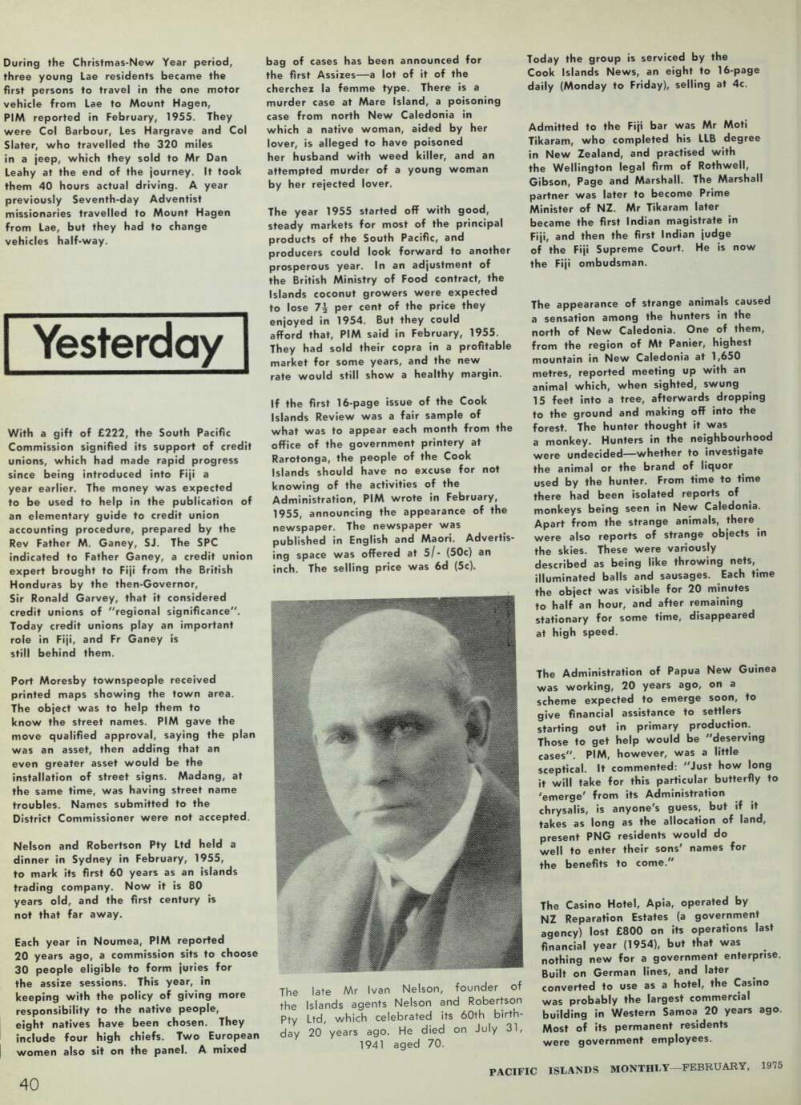
During the Christmas-New Year period, three young Lae residents became the first persons to travel in the one motor vehicle from Lae to Mount Hagen, PIM reported in February, 1955. They were Col Barbour, Les Hargrave and Col Slater, who travelled the 320 miles in a jeep, which they sold to Mr Dan Leahy at the end of the journey. It took them 40 hours actual driving. A year previously Seventh-day Adventist missionaries travelled to Mount Hagen from Lae, but they had to change vehicles half-way.
With a gift of £222, the South Pacific Commission signified its support of credit unions, which had made rapid progress since being introduced into Fiji a year earlier. The money was expected to be used to help in the publication of an elementary guide to credit union accounting procedure, prepared by the Rev Father M. Ganey, SJ. The SPC indicated to Father Ganey, a credit union expert brought to Fiji from the British Honduras by the then-Governor, Sir Ronald Garvey, that it considered credit unions of "regional significance".
Today credit unions play an important role In Fiji, and Fr Ganey is still behind them.
Port Moresby townspeople received printed maps showing the town area.
The object was to help them to know the street names. PIM gave the
move qualified approval, saying the plan
was an asset, then adding that an even greater asset would be the installation of street signs. Madang, at the same time, was having street name troubles. Names submitted to the District Commissioner were not accepted.
Nelson and Robertson Pty Ltd held a dinner in Sydney in February, 1955, to mark its first 60 years as an islands trading company. Now it is 80 years old, and the first century is not that far away.
Each year in Noumea, PIM reported 20 years ago, a commission sits to choose 30 people eligible to form juries for the assize sessions. This year, in keeping with the policy of giving more responsibility to the native people, eight natives have been chosen. They include four high chiefs. Two European women also sit on the panel, A mixed
bag of cases has been announced for the first Assizes —a lot of it of the cherchez la femme type. There is a murder case at Mare Island, a poisoning case from north New Caledonia in which a native woman, aided by her lover, is alleged to have poisoned her husband with weed killer, and an attempted murder of a young woman by her rejected lover.
The year 1955 started off with good, steady markets for most of the principal products of the South Pacific, and producers could look forward to another prosperous year. In an adjustment of the British Ministry of Food contract, the Islands coconut growers were expected to lose per cent of the price they enjoyed in 1954. But they could afford that, PIM said in February, 1955.
They had sold their copra in a profitable market for some years, and the new rate would still show a healthy margin.
If the first 16-page issue of the Cook Islands Review was a fair sample of what was to appear each month from the office of the government printery at Rarotonga, the people of the Cook Islands should have no excuse for not knowing of the activities of the Administration, PIM wrote in February, 1955, announcing the appearance of the newspaper. The newspaper was published in English and Maori. Advertis ing space was offered at 5/- (50c) an inch. The selling price was 6d (sc).
Today the group is serviced by the Cook Islands News, an eight to 16-page daily (Monday to Friday), selling at 4c.
Admitted to the Fiji bar was Mr Moti Tikaram, who completed his LLB degree in New Zealand, and practised with the Wellington legal firm of Rothwell, Gibson, Page and Marshall. The Marshall partner was later to become Prime Minister of NZ. Mr Tikaram later became the first Indian magistrate in Fiji, and then the first Indian judge of the Fiji Supreme Court. He is now the Fiji ombudsman.
The appearance of strange animals caused a sensation among the hunters in the north of New Caledonia. One of them, from the region of Mt Panier, highest mountain in New Caledonia at 1,650 metres, reported meeting up with an animal which, when sighted, swung 15 feet into a tree, afterwards dropping to the ground and making off into the forest. The hunter thought it was a monkey. Hunters in the neighbourhood were undecided —whether to investigate the animal or the brand of liquor used by the hunter. From time to time there had been isolated reports of monkeys being seen in New Caledonia.
Apart from the strange animals, there were also reports of strange objects in the skies. These were variously described as being like throwing nets, illuminated balls and sausages. Each time the object was visible for 20 minutes to half an hour, and after remaining stationary for some time, disappeared at high speed.
The Administration of Papua New Guinea was working, 20 years ago, on a scheme expected to emerge soon, to give financial assistance to settlers starting out in primary production.
Those to get help would be "deserving cases". PIM, however, was a little sceptical. It commented: "Just how long it will take for this particular butterfly to 'emerge' from its Administration chrysalis, is anyone's guess, but if it takes as long as the allocation of land, present PNG residents would do well to enter their sons' names for the benefits to come."
The Casino Hotel, Apia, operated by NZ Reparation Estates (a government agency) lost £BOO on its operations last financial year (1954), but that was nothing new for a government enterprise.
Built on German lines, and later converted to use as a hotel, the Casino was probably the largest commercial building in Western Samoa 20 years ago.
Most of its permanent residents were government employees.
The late Mr Ivan Nelson, founder of the Islands agents Nelson and Robertson Pty Ltd, which celebrated its 60th birth day 20 years ago. He died on July 31, 1941 aged 70.
Advertisements & other items, pp. 47-54 (1 item)
When only#
‘So this is a Lamborghini/ \ she breathed, as vve sped down the autostrada towards Turin. ‘Yes,” I said, offering her a Benson and Hedges. “Five forward gears and 170 in top.* ‘Can you prove that?” she demanded.
“Do I really have to? You did say you only wanted a little car to do the
shopping.”
•t- V •;* x ... -m y Benson & Hedj
When only#
« ill do \v ot6 5* y •"
Anew approach
to easier operation.
the front.
CT-F 7171
n 0000 fi
Now, a truly precision Dolby* cassette deck that fits n perfectly with the rest of your system. Your other components are accessible from the front, because ;helf mounted or stacked, that's the way you approach hem. With Pioneer's new CT-F 7171. loading a cassette s as easy as putting your hand in your pocket. No nore wasted space by providing vertical accessibility.
While front access design makes it easy to use, Pioneer’s “think ahead" engineering makes it easy to isten to. A long-life ferrite-solid head and built-in Dolby really reduce the noise (S/N ratio: 58dB).
\r\ electronically controlled DC motor guarantees
stable tape transport and a precision capstan all but eliminates vibration (wow and flutter: less than 0.10%
WRMS). A .
Making your own Dolbyized tapes is easy. An LED recording peak level indicator reacts within milliseconds to warn of excessive input signals. And for special chromium dioxide tapes, there is separate Bias and EQ selection.
But, no matter how you look at the CT-F 7171, you're bound to change your view about cassette decks. You see. it’s the one that offers truly top performance via access to the front. ustralia ioneer Electronics Australia Pty. Ltd 56-8, City Road. South Melbourne, ictoria 3205. Australia Tel: 696605 ; ranches in ail states iji Islands trijlal & Company, G.P O Box No. 362. >uva. Fi|i Islands Tel: 22-258 ae lagemeyer (Australasia) 8.V., P.O. Box Jo. 90, Lae, New Guinea Tel: 2718 iabaul lagemeyer (Australasia) 8.V., P.O. Box lo 63, Rabaul. New Guinea
fliD PIONEER
Port Moresby „ „ Haqemeyer (Australasia) 8.V., P.O. Box No. 1428. Boroko, Port Moresby.
New Guinea Madang Hagemeyer (Australasia) 8.V.. P.O Box No. 673, Madang.T PN G.
New Zealand Tee Vee Radio Ltd.. P.O Box No. 5029.
Auckland. New Zealand Tel: 763-064 Norfolk Island Burns Philp (South Sea) Co., Ltd , Norfolk Island. South Pacific Nauru island Jacob Enterprises. P.O Box No. 4.
Nauru Island Tahiti Ets PERFECT. B.P. 594. Papeete, Tahiti Tel: 20-407 New Caledonia Menard Freres, B.P, 123. Noumea.
New Caledonia Tel: 52-22 American Samoa Transpac Corporation, P.O. Box 1477.
Pago Pago, American Samoa 96799 Tel: 2227 Dolby" is a trademark oi Dolby Laboratories, Inc.
SPEED-E-GAS
Lae
Wewak
Rdbaul
Honiara
Port
Suva
Moresby
Kieta
Santo
0 u □ □
nev
lautoka
<^S) c
cCb
C.
ZI3 ne
Rarotonga
p' 3 New terminals...
*5?
Sydney
6EstablishecL.
r and more to come.
.. .to ensure regular supply of Speed-e-gas* in the Pacific region three new bulk storage terminals have been opened at Rarotonga, Nukualofa and Lautoka. These terminals join already established bulk storage facilities at Port Moresby, Lae, Wewak, Rabaul, Honiara and Kieta.
And to meet future needs bulk terminals are to be built at Santo and Suva.
These terminals will maintain supplies of clean efficient and safe Speed-e-gas all year round.
Speed-e-gas is the most dependable fuel...because it's here in bulk. Liquified Petroleum Gas has been proven to be ideal fuel for all cooking and water heating needs. ir The Gas Supply Company Limited, Head Office 221 Miller St., North Sydney, 2060.
Phone:92o-951 and available throughout the Pacific.
A member of the Boral group of companies.
Speed-e-gas is known in New Guinea as Guinea-Gas, in Tonga as Tonga Speed-e-gas and in Fiji as Fiji-Gas.
BLII2
YESTERDAY
ft THE ONE? MOTOR ROAD
sIaWHWHEiWW,
!c THE ISC’MERIDIAN
NEW OflY BISiMS '
to u n
rro
TOMORROW >
m THE
CROSSING THIS
WHERE EACH
SOUUem ENVELOPES AVAILABLE
SIOR£ WWW
E* AS Si 1 V,. -:v- -> M Burns Philp helps to achieve the good life From Papua New Guinea to the international date line and beyond, the Burns Philp Group of Companies is helping to add to the quality of life for everyone.
Staff training programmes, sports facilities, modern residential accommodation, scholarship assistance these and many other company efforts are aimed at assisting the greatest possible number of people to achieve the good life.
Each year more and more Pacific people enjoy better transport, better homes, better health and generally better lives through the direct and indirect influence of this wide ranging, highly diversified company. Buying and selling, creating, shipping and serving, the thousands of people who make up Burns Philp are engaged in a continuing effort to make every tomorrow better.
Burns
Philp
GROUP OF COMPANIES M
PRINCIPAL OFFICE—7 BRIDGE STREET SYDNEY NSW 2000 AUSTRALIA
/ A m !
Is UN B
SUN
- / Automatic self-winding,Water resistant Second setting device, Instant day and date setting Automatic self-winding,Water resistant^ Second setting device, Instant day and date setting
Technology of the future.
Dedication of the past.
Seiko, the quality watch of today.
Every Seiko watch is a triumphant merger of Seiko's unique microelectronic-technology and time-honored tradition of handcraftsmanship.
Add to all this Seiko’s insistence on making every part of every Seiko watch, thus quality-controlling every step.
This unique merging of future technology and past dedication creates the quality watch of today: Seiko.
SEIKO
K. Hattori & Co., Ltd., Tokyo, Japan.
Someday all watches will be made this way.
' - , y 31
I ill
Wunderflex gives
good design at low cost
You want modern design?
Then use modern material that won’t warp, shrink or rot You want least cost?
Then build with a board that can be worked with handyman’s tools.
Inside and out, your home will have the modern, simple lines of Wunderflex building board.
E324ED
kViunderlich
Wunderflex
Available from: Papua New Guinea: Steamships Trading Co. Ltd Norfolk Island: Irvine’s Building Supply Centre Made in Australia and marketed by CSR Building Materials Export Sales: 4 O’Connell Street, Sydney, Australia 2000
« • « • **-■■ i *♦:% imp f The flag we’ve flown for a hundred years.
Two paddle steamers on the Yangtse River in 1873 marked he beginning of the China Navigation Company. Today, the same lag flies above eighteen modern motor ships plying an extensive letwork of cargo routes between Papua New Guinea and Pacific sland ports (as far East as Tahiti) and Japan, New Zealand, Australia md Thailand. , For 100 years, the flag of the China Navigation Company has meant experience, reliability and speed across the sea. Today, it s lying as strong as ever. r furlher details and all enquiries there are Agents at the following ports, Papua t^^ n^ l ' d Ste g^g h, La)(ol^ m wii:te I rn Samoa: Morris Hedslrom Ltd . Apia than,. Kieta. Burns Philp (New Guinea, Ltd Wewak. F, Mo ns Heds ... Noun haul. Kieta. Burns Philp (New uuineal Lin.. vvewaK. Kavlen|Fiji: Mom.Hedslrom cakdmla*Elabiissemonts Ballande, Noumea.
SaKtJT" «-* Bu.ierf.eid Swire, 9 Connaught Rd., Central, Hong Kong.
JOHN SWIRE & SONS PTY. LTD. General Agents in Australia, 8 Spring Street, Sydney, Phone: 27 9351.
CN jUiin u m mu v%
THE CHINA NAVIGATION CO LTD
CO
MEMBER OF THE SWIRE GROUP.
IS 008
Magazine Section
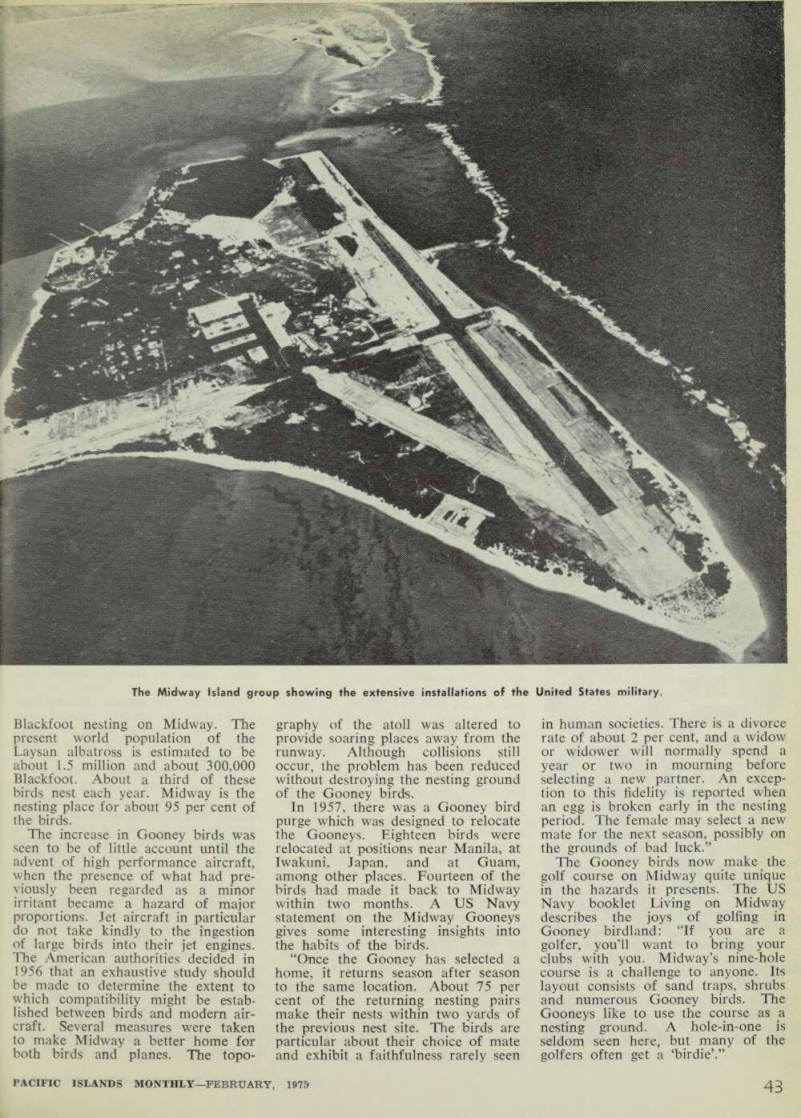
Midway's Tale Of Murder, Missiles,
Battles, Birds And Golf Courses
By W. G. Coppell
Today, Midway Island, an atoll of two islets. Eastern and Sand, is a US Navy facility concerned with oceano graphic research and is the base for a weather service detachment and the Pacific missile range facility. The latter unit locates the impact points of missiles and data capsules which fall within the area.
The US Navy describes Midway, with its lagoon 24 kilometres in cir cumference as “the navy’s beautiful isle”. Perhaps, Midway’s most recent claim to world attention was that it was there that presidents of the US and South Vietnam met on June 8, 1969, to discuss the withdrawal of American forces from South Viet nam.
The events of World War II and the screen heroics of armies of John Waynes are probably the basis for the view most people would have of Midway. The Japanese Navy first shelled the island on December 7, 1941. It was during this skirmish that Lieutenant George C. Cannon became the first US marine to win the Medal of Honour in World War 11. when he was killed manning a gun during the first attack.
However, Midway’s great moment in history came during the naval battle which bears its name, and which took place in the waters off the atoll. On June 3, 4 and 5, 1942, fighter aircraft based on Midway took a leading part in what was to become recognised as one of the most de cisive war encounters at sea.
Midway, which was first known as Middlebrook Island, was discovered by Captain N, C. Brooks, of the American ship Gambia in 1859, and was uninhabited. In the years im mediately after its discovery it was thought that the lagoon would make a suitable coaling station for ships on Pacific Ocean routes. Some work was carried out, but never completed.
For many years the atoll was only visited by vessels engaged in shark fishing or bird-catching and it was one of the former that brought high drama to Midway.
On November 16, 1886, the schooner General Siegel, of Hono lulu, went on the reef during a terrible gale and Captain Asberline decreed that the crew, all of whom survived the wreck, should stay on the island until the arrival of a rescue ship. The sailors took shelter in a small house which had been con structed during the abortive coaling station development, but tragedy struck almost immediately when Peter Larkin blew his right hand off while fishing with dynamite, and died 10 days later.
One of the men who survived the sojourn on Midway, .E. Olsen, was later to record the details of a sequence of horrific events.
A boat from the Dunottar Castle, which had been lost off Ocean Island, drifted ashore and the men began to repair it; but, as it was too small to accommodate all hands, they also worked on a Japanese sampan which had been left behind by the Hawaiian schooner Kaulilua. At this time Captain Asberline, Jorgensen, the mate, and Brown, a sailor, went on an exploration visit to Eastern Island.
The captain had a shotgun and ammunition and Jorgensen took a Winchester rifle. Jorgensen returned unaccompanied to Sand Island in the afternoon, stayed overnight and the next day returned alone to Eastern Island.
His was the only seaworthy boat, and although the others were con cerned because they could see no sign of Asberline or Brown, they could not make the crossing of the lagoon. When the party on Sand Island had finished work on the sam pan they tested its reliability and the
same night Jorgensen came across from Eastern Island.
Olsen indicates that his party may have had premonitions about Jorgen sen’s intentions as he wrote, “I think that his intention was to have killed the entire party for I found in his hammock a notebook in which was written, ‘Six men left for Marshall Islands at the beginning of June’. 1 also found a loaded revolver and a shotgun.”
The next day the whole party crossed to Eastern Island and, as the others had been, were now convinced that there had been foul play there.
Before they reached the shore Jorgensen said, “I tell you boys, the captain killed Brown and I have been keeping him company to prevent him from killing himself. I wouldn’t be surprised to find that he has made away with himself”. As soon as Jorgensen was on land the others beat a hasty retreat to Sand Island and prepared to quit Midway by packing everything they needed into the Japanese sampan.
The ship’s boy was deputed to keep a watch on the mate’s move ments, but the latter apparently tore his clothes to pieces and used the strips to lash together a raft on which he made the crossing of the lagoon and was able to hide himself in the head-high brush which grew behind the house.
Towards evening, two of the men went down to the lagoon to put out of action the Dunottar Castle ship’s boat. It was at this time that Jorgensen, naked and armed with a rifle, appeared at the door of the house and, pointing the weapon at Olsen, demanded to know why the others left him alone on the other island. A struggle ensued during which Olsen was able to wrest the rifle away from the mate, who then said “Now you can shoot me.” Olsen
Accidentally shot '
called to the other men but they were afraid to return to the house, and made for the sampan.
Olsen recounted the final stages in this part of the story, “I returned to the house and Jorgensen said, ‘Tie me up and take me with you’. I went down to the boat and told the others what he had said, but they were afraid for their lives and said he would be better off where he was, as they might all be drowned and never reach land.”
The small party set off for the Marshall Islands, which they reached in 20 days. They then moved from one island to another over a period of several months before they split up with two of them leaving in a canoe for an island 400 miles distant.
Olsen and the boy were eventually found by the New Zealand brig Ahukai, and taken to Jaluit. They were transferred to the Lilian, from Honolulu, which eventually returned them to their home port on Decem ber 6, 1887.
During their stay on Midway the survivors had not gone short of rations as Olsen said he would rather eat goonies (albatross) flesh than any meat obtainable in Honolulu, and that the eggs of the birds were so palatable that he used to eat them raw. were so thick on the island that it was impossible to walk a vard without breaking some.
Mullet was very plentiful and the castaways used to fry them in their own fat.
The next act in the drama was played when the ship Wandering Minstrel, under Captain Walker called at Midway. As it approached a man was seen waving a rag, which in fact was his shirt. Because of heavy weather it was three days be fore the Wandering Minstrel entered the lagoon. John Cameron recounts the meeting with Jorgensen in John Cameron’s Odyssey, “We found him in a small wooden building, the sole inhabitant of the island. To my astonishment he greeted me bv name. ‘How do you do Captain Cameron? My name is Jorgensen. I met you in Honolulu’.
“I had no recollection of him. ‘How did you come here?’ I asked. ‘On the General Siegel,’ he said. ‘We were bound from Honolulu on a sharking cruise. The vessel was wrecked, and my shipmates cleared out leaving me behind’.”
The erstwhile mate of the General Siegel gave Cameron his side of the
story. “One day he (Captain Asber line) and Brown went to Eastern Island; and the captain returned alone. To our questions he replied coolly that Brown had shot himself by accident and that he had buried the body where it fell. Of course I suspected murder, and I made up my mind to learn the truth. On the next day I went to Eastern Island with Jacobson and a German boy. The captain showed me the grave; I dug up the body, keeping a weather eye on the captain as I did so; pulled the corpse from the pit, scraped off the sand that stuck to it, and searched for a wound. It was a bullet hole— in the back of the head. No man can shoot himself from behind, Cameron.
The captain looked on indifferently Despite this macabre incident, ac cording to Jorgensen, he and the captain remained for several days on Eastern Island and he claimed that one day “I sauntered to the boat and sat waiting for the captain. He did not return; I searched for him; no trace could I find. I returned be wildered to Sand Island and reported his disappearance. To mv horror my shipmates accused me of murder. I protested my innocence; but they roared me down.”
He was probably much closer to the truth when he recounted his re turn to Sand Island, “My brain burned with hate of my shipmates.
At that time I had a mind to kill them all. This would have been no crime; only just punishment for their attempt to murder me with starvation and thirst”.
Cameron seems to have taken Jorgensen’s side as he wrote, “Three years afterwards, I met one of his shipmates in the Marshall group. He laid all the responsibility on Jorgen sen; yet closed like a clam when I asked him some pertinent questions.
I told him that Jorgensen was in the archipelago and would certainly kill him should they meet; for my part, I concluded, I would not blame the Dane in the least.” Jorgensen im pressed his story on the people of the Wandering Minstrel, so much so that he was made second mate of the ship, but this cannot be seen as a good omen for her, as shortly afterwards she also was wrecked on Midway.
The editor of Cameron’s biography sums up the evidence of the case: “We cannot even surmise what oc curred between Jorgensen and Asber line and Brown on Eastern Island; perhaps Jorgensen, at the worst, corn
mitted nothing more than man slaughter. I do not believe that he could justly have been found guilty of that much. That he was insane I cannot doubt . .
Midway Island is home to one of the world’s most intriguing bird populations. The Gooney bird is synonymous with Midway and its development by man. Olsen, in his account of the Jorgensen affair, makes reference to the presence of large numbers of albatrosses but it seems that the birds were only mak ing intermittent use of the island _as a breeding place until the Pacific Cable Company began operations there in 1903.
In 1905, the Director of the Ber nice P. Bishop Museum visited Eastern Island and he was able to report on the depredations wreaked on the birds by gangs of Japanese bird catchers.
“Everywhere great heaps, waist high, of dead albatrosses were found.
Thousands upon thousands of both species had been killed with clubs, the wing and breast feathers stripped off to be used as hat trimmings, or for other purposes, and the carcases thrown in heaps to rot.
“Two species of albatross make their home on Midway and their numbers have increased in very large proportions as man has cleared the atoll and created the runways, take off areas and landing places that the birds desired.
Australian ironwood trees were planted by the cable company and these provide ideal shelter for the birds and the long needles of the trees make ideal nesting material. As the numbers of birds increased so did the activities of the bird catchers.
David Heenan writing in the maga zine, Mid-Pacific, in 1922 said, “The raiders, composed mostly of Japanese, had landed on the island in May, 1909, and by the fall of that year had slaughtered upwards of 300.000 birds. Not content with securing the feathers, the hunters had adopted singularly cruel methods.
One practice was to throw the birds, after they were caught, into an old cistern and there let them slowly starve to death. In this way the fatty tissue next to the skin was used up and there was consequently little or no cleaning necessary when the skins were removed.
“In 1910, action was taken against the bird poachers and 23 were arrested and taken to Honolulu. The two species which are referred to as Gooney birds are the Laysan and Blackfoot albatross. In 1930 it was estimated that there were some 20.000 Laysan and 30,000 pairs of
Blackfoot nesting on Midway. The present world population of the Laysan albatross is estimated to be about 1.5 million and about 300,000 Blackfoot. About a third of these birds nest each year. Midway is the nesting place for about 95 per cent of the birds.
The increase in Gooney birds was seen to be of little account until the advent of high performance aircraft, when the presence of what had pre viously been regarded as a minor irritant became a hazard of major proportions. Jet aircraft in particular do not take kindly to the ingestion of large birds into their jet engines.
The American authorities decided in 1956 that an exhaustive study should be made to determine the extent to which compatibility might be estab lished between birds and modern air craft. Several measures were taken to make Midway a better home for both birds and planes. The topo
graphy of the atoll was altered to provide soaring places away from the runway. Although collisions still occur, the problem has been reduced without destroying the nesting ground of the Gooney birds.
In 1957, there was a Gooney bird purge which was designed to relocate the Gooneys. Eighteen birds were relocated at positions near Manila, at Iwakuni, Japan, and at Guam, among other places. Fourteen of the birds had made it back to Midway within two months. A US Navy statement on the Midway Gooneys gives some interesting insights into the habits of the birds.
“Once the Gooney has selected a home, it returns season after season to the same location. About 75 per cent of the returning nesting pairs make their nests within two yards of the previous nest site. The birds are particular about their choice of mate and exhibit a faithfulness rarely seen
in human societies. There is a divorce rate of about 2 per cent, and a widow or widower will normally spend a year or two in mourning before selecting a new partner. An excep tion to this fidelity is reported when an egg is broken early in the nesting period. The female may select a new mate for the next season, possibly on the grounds of bad luck.”
The Gooney birds now make the golf course on Midway quite unique in the hazards it presents. The US Navy booklet Living on Midway describes the joys of golfing in Gooney birdland: “If you are a golfer, you’ll want to bring your clubs with you. Midway’s nine-hole course is a challenge to anyone. Its layout consists of sand traps, shrubs and numerous Gooney birds. The Gooneys like to use the course as a nesting ground. A hole-in-one is seldom seen here, but many of the golfers often get a ‘birdie’.”
The Midway Island group showing the extensive installations of the United States military
mana
is a vehicle for Pacific Islands’ writers and artists to publish their work. It is an organ of the South Pacific Creative Arts Society and its editorial committee comprises writers from many islands.
Material for publication must be sent direct to MANA’s editor, Marjorie Crocombe, South Pacific Creative Arts Society, Box 5083, Suva Like all the Island territories Tonga has a rich store of legends and this section of MANA is devoted to the telling of three of them from the pen of Atunaisa Havea Katoa, a newcomer to MANA. Other contributors to this special Tongan issue are Konai Helu Thaman, a prolific writer of MANA poems, Meliana Puloka and Marjorie Crocombe, who interviews Tongan sculptor Aleki Prescott. Aleki, in the last few months, has done some outstanding work in Fiji and Papua New Guinea.
Turtle and the royal mats
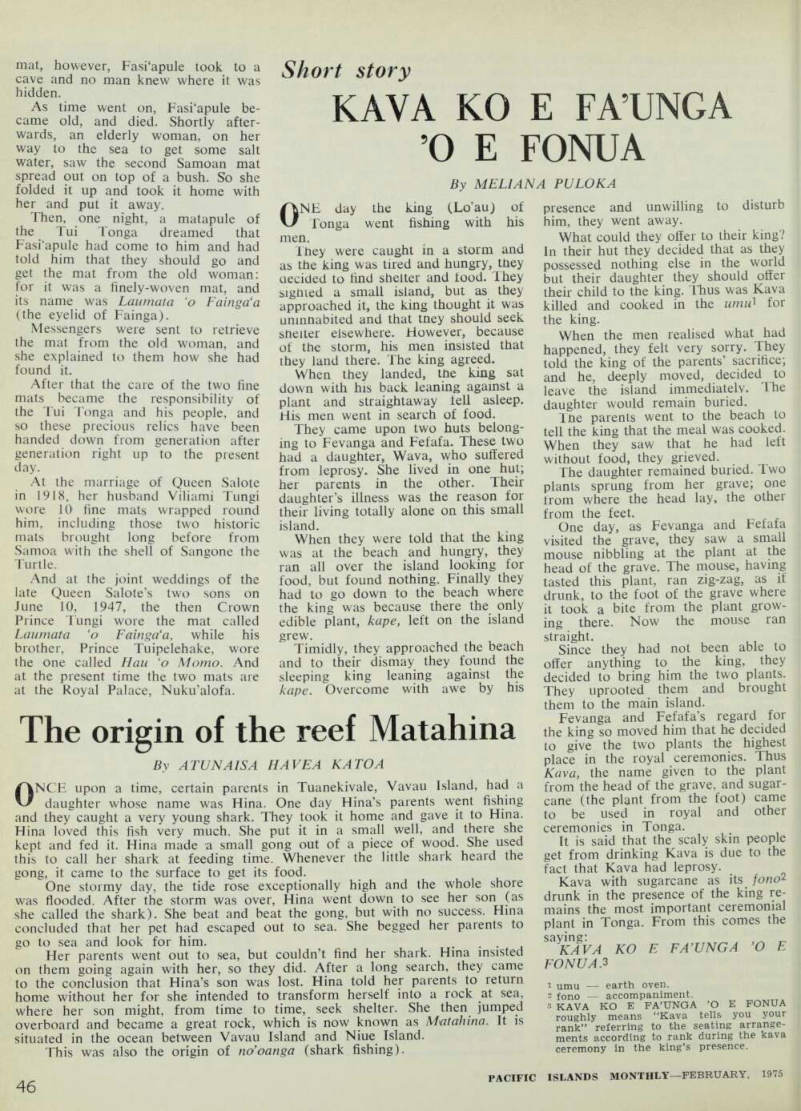
The legend of Sangone the Turtle and the royal mats
By Atunaisa Have A Katoa
Along time ago, a man called Lekapai lived in Samoa. In his garden he grew breadfruit, plantains, bananas, yam, taro and many other kinds of fruit and vegetables.
Then, as time went on, there was a great hurricane, and his plantation was almost ruined. After it was over, Lekapai set to work to replant his gardens. But alas, there was an other hurricane the next year, and the next, so that three food crops were destroyed one after the other.
Poor Lekapai became disheartened and, after pondering what he should do, said to his relatives: “I shall go and try to find out where the wind lives, and ask why he seeks out and destroys my plantation”.
So Lekapai launched his boat and sailed south towards Tonga to where the wind comes from. After he had journeyed for several days, he saw a big rock ahead of him. When he drew near to it, he could not find a landing place anywhere. So he sprang up, grasped the branch of a white-flowered pandanus tree, and managed to clamber ashore. He then saw a narrow pathway and followed it, down and down into the ground.
On and on he went, and presently, looking ahead, he saw a woman fac ing him. (They say that she was a very beautiful woman.) “Where do you come from?” she asked him, “and how did you find the way down here?”
“I have come”, answered Lekapai, “to try to find out where the wind lives—the wind that keeps destroy ing my garden”.
“You have come to the right place”, replied the woman. “The winds are my children. And if you wish to see them, come with me and I will call them”.
“Thank you”, said Lekapai, “for making my journey worthwhile”.
They went on a little further, and the woman called out: “Let the strong north wind blow this way!”
And immediately it blew, becoming stronger and stronger.
“Let the whirlwind come!” the woman commanded. And the whirl wind began to sweep round and round.
“Let the gale come!” the woman called. And the coconut palms began swaying and snapping, and all round them trees of all kinds came crash ing down.
“Let the hurricane come!” the woman called out. And at once the wind blew, and this time it was so strong that Lbkapai could no longer stand against it, and the earth began to split, and great rocks began to fly. Lekapai was afraid and begged the woman to tell the winds to for bear and rest. “I don’t want to see any more”, he said. “I am nearly dead with fear. I do not mind about my gardens. I only wish to return home safely to Samoa”.
So the woman spoke again. “Go away and rest”, she said. At once the strong wind eased off, the sun shone again, and the breeze that now blew was warm and pleasant.
They then came back and went to the woman’s home, and she told Lekapai that her name was Hina.
"And mine is Lekapai”, he said. Then Hina said, “Stay here for a while and when my mother goes, she will take you with her”.
A few days passed, and Lekapai asked again to go back to his own country. “Then go and get some co conuts to take with you”, said Hina.
So he went and picked them.
When Lekapai came, Hina was sitting there with a turtle beside her.
“This is my mother, who is now a turtle”, she said. “She will take you with her. If you want a drink while you are out on the ocean, do not break your coconut on the turtle’s head, but on its back. And when you reach Samoa”, she added, “go and bring a piece of tapa cloth, and a bottle of oil, and a large coconut leaf, and give them to the turtle to bring back to me. Her name is San gone, the sacred turtle. Do not be tray her or evil will surely befall you and your family”.
They then said goodbye, and Leka pai mounted on the turtle’s back, and Sangone swam with him out to sea.
Soon Lekapai became thirsty, and not believing the truth of Hina’s story or caring to obey her, he took a coconut and broke it on the turtle’s head. Whm they reached Samoa, he took the turtle ashore, killed it, cut it up and divided it out among his relatives; and the shell of the turtle they buried secretly beside a candle nut tree where no one could find it.
Then, noticing that a boy named Lafaipana had observed them, Leka pai called to him to come. When the boy came running across, Lekapai put out his hand and laid it on Lafaipana’s head, and said. “So that you may not reveal my secret, you will be Little Lafaipana: slow be your growth, and small your stature!
And on the day that Sangone, the Turtle, is found you will die!”
So Lafaipana grew very slowly; and he soon forgot the threat about his death. For he was but a boy and death has no meaning for children.
Many, many years passed and then the Tui Tonga, Tuitatui, heard a rumour about what had happened to Sangone the Turtle in Samoa, He gave orders for his brother, Fasi ‘apule, to go to Samoa and find, if possible, Sangone’s shell, and return it to Tonga. So Fasi‘apule set out.
When he reached Samoa, however, he could not find anyone who seemed old enough to remember where Sangone was buried. So after drinking with the Samoan people in accordance with the custom of that land, he gave them a riddle to solve.
“Guess this one”, he said. “O that I might drink a clap-it-and-it-smokes”.
So they all began asking one an other what he had meant. Then
finally, Lafaipana, now a very old man, told them to go and bring some tiny pieces of dried kava root which sent up dust like smoke when they were clapped between the hands. So they brought some and gave them to Fasi‘apule; and at once he began to wonder whether there was an old person still living who had solved the answer to the riddle and who might know the secret of Sangone’s burial place.
The pieces of kava root were then pounded and mixed with water. They drank this and Fasi'apule gave them another riddle. “Guess this one”, he said. “A stalk fainting in the forest”.
So the people ran to Lafaipana and asked him what it meant. “Go and find a bunch of plantains that has fallen and has ripened lying on the ground out in the forest”, he said.
So they searched and found one, and gave it to FasLapule. He was delighted, and gave them yet a third riddle to solve. “Guess this one! A leaf that sings. Guess that! A leaf that cries and makes a noise like a parrot”.
They asked Lafaipana again, and he told them to bake a fowl and wrap it in young taro leaves, which made a faint singing sound when they are stripped. This they prepared and brought to Fasi'apule, and he gave them still another riddle. “Guess this one. Grunting and lying down”.
They ran and asked Lafaipana,
and he told them to bake a huge pig that was no longer able to stand, but which just lay there grunting all the time. So they killed a big pig and baked it, and took it along to Fasi‘apule. Then he knew that there was an old and wise person who could answer the riddle of Sangone’s hiding place.
So he asked the people who it was that had enabled them to solve his riddles. “It was Lafaipana”, they con fessed. So he ordered them to bring Lafaipana to him. When Lafaipana sat before him, Fasi'apule asked him whether he knew where Sangone the Turtle was buried. “I know the place”, he replied, “and I will lead you to it”.
So off they went, and Lafaipana directed them to the candlenut tree, where he had gone so many years before. They dug down, and found that he was right. And it is said that when Sangone’s shell was brought from the ground, it shone almost like a flame. As soon as it appeared —Lafaipana cried out and fell dead, and they buried him with fine mats in the grave of Sangone.
Fasi‘apule and his attendants then prepared to return to Tonga. The Samoan chiefs gave him two finely woven mats to accompany the shell of Sangone to Nuku’alofa.
As soon as Fasi‘apule arrived in Tonga, he took the shell, as the cus tom required, to give to his brother, the Tui Tonga. And the Samoan mat, which he had been presented with, was called Hau ‘o Momo (the honour shown to Momo). The other
The late Queen Salote of Tonga and her consort, Prince Tungi. At their marriage in 1918 Prince Tungi wore the two legendary mats.
mat, however, Fasi‘apule took to a cave and no man knew where it was hidden.
As time went on, Faskapule be came old, and died. Shortly after wards, an elderly woman, on her way to the sea to get some salt water, saw the second Samoan mat spread out on top of a bush. So she folded it up and took it home with her and put it away.
Then, one night, a matapule of the Tui Tonga dreamed that Faskapule had come to him and had told him that they should go and get the mat from the old woman: for it was a finely-woven mat, and its name was Laumata ‘o Fainga‘a (the eyelid of Fainga).
Messengers were sent to retrieve the mat from the old woman, and she explained to them how she had found it.
After that the care of the two fine mats became the responsibility of the Tui Tonga and his people, and so these precious relics have been handed down from generation after generation right up to the present day.
At the marriage of Queen Salote in 1918, her husband Viliami Tungi wore 10 fine mats wrapped round him, including those two historic mats brought long before from Samoa with the shell of Sangone the Turtle.
And at the joint weddings of the late Queen Salote’s two sons on June 10, 1947, the then Crown Prince Tungi wore the mat called Laumata ‘o Fainga'a, while his brother, Prince Tuipelehake, wore the one called Hau ‘o Momo. And at the present time the two mats are at the Royal Palace, Nuku’alofa.
Sunday sadness
By Konai Helu Thaman
Smell the odour Of the Sunday ’umu Empty, the coals smoking From killer waters.
The day’s haunting eerie idleness Envelops papa’s heap Of breadfruit crusts Scarred remains of futile attempts Of teethless gums; Pieces of Kiwi mutton flaps Flavour market-grown taro leaves, Welcoming change to Tinned ‘Ocean’ fish Saviour of now dormant fishermen And statistical farmers.
Cold manioc, once famine famed Now daily bread, Stares from mama's shrunken dish At tearless people with velvet shoes Who have ceased to walk The good rich island earth Of yam harvests And plentiful Sundays . . .
Come, look through the smoke Of the dying fire At grandpa’s ghost weeping And quietly cursing The forbidding sultry silence!
The origin of the reef Matahina
By Atunaisa Have A Katoa
ONCE upon a time, certain parents in Tuanekivale, Vavau Island, had a daughter whose name was Hina. One day Hina’s parents went fishing and they caught a very young shark. They took it home and gave it to Hina.
Hina loved this fish very much. She put it in a small well, and there she kept and fed it. Hina made a small gong out of a piece of wood. She used this to call her shark at feeding time. Whenever the little shark heard the gong, it came to the surface to get its food.
One stormy day, the tide rose exceptionally high and the whole shore was flooded. After the storm was over, Hina went down to see her son (as she called the shark). She beat and beat the gong, but with no success. Hina concluded that her pet had escaped out to sea. She begged her parents to go to sea and look for him. . . .
Her parents went out to sea, but couldn’t find her shark. Hina insisted on them going again with her, so they did. After a long search, they came to the conclusion that Hina’s son was lost. Hina told her parents to return home without her for she intended to transform herself into a rock at sea, where her son might, from time to time, seek shelter. She then jumped overboard and became a great rock, which is now known as Matahina. It is situated in the ocean between Vavau Island and Niue Island.
This was also the origin of no’oanga (shark fishing).
Kava Ko E Fa’Unga
Short story
’O E Fonua
By Meliana Puloka
ONE day the king (Lo’au) of Tonga went fishing with his men.
They were caught in a storm and as the king was tired and hungry, tney decided to find shelter and food. They sigtued a small island, but as they approached it, the king thought it was umnnabited and that tney should seek sneiter elsewhere. However, because of the storm, his men insisted that they land there. The king agreed.
When they landed, the king sat down with his back leaning agamst a plant and straightaway fell asleep.
His men went in search of food.
They came upon two huts belong ing to Fevanga and Fefafa. These two had a daughter, Wava, who suffered from leprosy. She lived in one hut; her parents in the other. Their daughter’s illness was the reason for their living totally alone on this small island.
When they were told that the king was at the beach and hungry, they ran all over the island looking for food, but found nothing. Finally they had to go down to the beach where the king was because there the only edible plant, kape, left on the island grew.
Timidly, they approached the beach and to their dismay they found the sleeping king leaning against the kape. Overcome with awe by his
presence and unwilling to disturb him, they went away.
What could they offer to their king?
In their hut they decided that as they possessed nothing else in the world but their daughter they should offer their child to the king. Thus was Kava killed and cooked in the umu' for the king.
When the men realised what had happened, they felt very sorry. They told the king of the parents’ sacrifice; and he, deeply moved, decided to leave the island immediatelv. The daughter would remain buried.
Ine parents went to the beach to tell the king that the meal was cooked.
When they saw that he had left without food, they grieved.
The daughter remained buried. Two plants sprung from her grave; one from where the head lay, the other from the feet.
One day, as Fevanga and Fefafa visited the grave, they saw a small mouse nibbling at the plant at the head of the grave. The mouse, having tasted this plant, ran zig-zag, as if drunk, to the foot of the grave where it took a bite from the plant grow ing there. Now the mouse ran straight.
Since they had not been able to offer anything to the king, they decided to bring him the two plants.
They uprooted them and brought them to the main island.
Fevanga and Fefafa’s regard for the king so moved him that he decided to give the two plants the highest place in the royal ceremonies. Thus Kava, the name given to the plant from the head of the grave, and sugar cane (the plant from the foot) came to be used in royal and other ceremonies in Tonga.
It is said that the scaly skin people get from drinking Kava is due to the fact that Kava had leprosy.
Kava with sugarcane as its fono 2 drunk in the presence of the king re mains the most important ceremonial plant in Tonga. From this comes the saying:
Kava Ko E Fa’Unga ’O E
Fonuaa
1 umu earth oven. 2 fono accompaniment. 2 KAVA KO E FA’UNGA ’O E FONUA roughly means “Kava tells you your rank” referring to the seating arrange ments according to rank during the kava ceremony in the king’s presence.
Aleki Prescott, Tonga’s leading
wood sculptor
Interviewed by MARJORIE CROCOMBE
M.C.: How did you get started as a professional wood sculptor?
A.P.: One day I was sitting on the wharf and I saw a ship sailing in from Haapai with an angel carved on the front. I thought I’d like to carve one like that. I had been teaching carving at Tupou College, but not very well, and that angel gave me new ideas.
When I left Tupou College I worked for the Tonga Produce Board and sometimes I didn’t like the way I was treated and I hated to work like that. So I left the job and when I came home I asked God to give me a talent that I could use all by myself to make me free.
Then I went and worked at the government market.
The manager, an American, went to Hawaii and a Tongan man took charge of the market. He told me to leave the work and let his son do it. I was very sad because I did no wrong.
I came home, held the Bible in my hands, and asked God, “Can you help me? Give me a real talent I can use and you can make me free.”
The day after that prayer I sat on my bed and I heard someone knocking on the door. A lady came and said she had been thinking about who could do the carving and handicrafts that Queen Salote had ordered the whole of Tonga to revive—the art that was destroyed in the 1830 s.
I told the lady, “All right, I’m going to carve what you want”. So I started to carve the dove, the bird sent from the Ark of Noah in the Bible to bring the leaves of peace. And the next carving was the Red Indian Chief Makua.
M.C.: Why did you choose a Red Indian?
A.P.: I saw it in the picture show, at the films. I remembered his face. It was an easy face to remem ber. I didn’t have a photo. 1 just remembered his face but when I carved it, it looked like that. The children said, “Look, look at Makua, the chief of the Red Indians”.
The first prize went to the Dove and the second to Makua. The Queen put them in the palace and then she sent them to her Tongan home called Atalanga in Auckland.
After that a lady from Australia wanted me to carve a hula girl. I did it and that lady put my name in the Weekly Times and I got a thousand letters from people asking me to send price lists, dolls and so on. But I hated to carve to sell at that time because I wanted to study for a few more years more about sculpture.
I wanted to study by myself, M.C.: How do you get ideas of what to carve?
A.P.: I sit and think for a long time. I belong to a group teaching dance, lakalaka. I’m one of the teachers of dance. That’s why I’ve got a home, a piece of land given by the chief of Kolomotu’a because I’m the youngest dancer. When I carve I like to use the move ments from the dance. But since my accident I hurt my left arm. That spoilt my dance.
M.C.; Before your accident you used both hands for carving, but now you can only use one. It must be harder to carve with one hand.
A.P.: Well I don’t like to say I have any problem because I know now I’m coming to another step in my sculpture. Now 1 know 1 can work with one arm and I have to do better with one arm.
M.C.: How did you come to be carving at the Uni versity of the South Pacific?
A.P.: I was on my way to Australia. I told the King of Tonga 1 was going to Australia to look for ancient Tongan carvings we lost between 1830 and 1895. Some of them are in museums there. Sione Tupouniua came to me twice, and asked if I would come and do some carvings at USP just as Pilioko did with his paintings.
M.C.: Aleki, how did you come to choose this living tree which was blown over by Hurricane Bebe?
A.P.: I really like the natural art of this tree. I never worked on such deep roots before. I’ve tried small roots before, but I know that natural art is a modem art, yet its from the beginning of the world.
And I believe that up to the end of the world the natural art must be the modem art.
M.C.: What is this carving all about?
A.P.; When I first started here I thought about this tree in the middle of the University of the South Pacific.
The university must be like the people so I’m going to start mixing people here. I don’t know how many different kinds of people there are but these different figures are like the university, different people from all the islands of the Pacific. I am pleased to get the idea from the natural shape of the tree.
Then I put down there, “the light of the world”.
I mean everybody and the whole world needs to turn and this root must have light on it to prove the light is a wonderful thing and accept Jesus as Saviour of the world. So this part with just the arm and the hand with a nail through it is a modern crucifixion.
Down the bottom there on those roots I put two Fijian people, a man and a woman. They’re lifting, that represents Fiji supporting the USP.
M.C.: What about this big projection with the croco dile?
A.P.; That’s a crocodile with a man’s leg sticking out of his mouth. People doing bad things don’t know they are in the favour of Satan. That’s Satan’s big mouth swallowing them. But I put down there the strong fingers, it may be the last of Satan in the world, trying to smash sinners to take them with him.
I put down there the foot print. The clay cannot mix with iron, that’s why today we know some people in the world are of plain colour. I put two colours there. The natural art of the tree has got the white part and the dark part. That means today some people prove the dream of Nebuchadnezar that one day, that’s the last day, the clay can’t mix with the iron. This one here is a baby angel—he’s got a trumpet to warn every body to prepare. Maybe soon will be the time for the end of the world when Jesus will come again.
M.C.: What’s the meaning of the skull there?
A.P.; People have sex, may be some mixing like that happens in all universities in the world. The teenagers, that’s the time they like to be like that. But they can’t keep doing it because sinners are going to suffer death.
This means the skull of death. Everybody is going to die. That’s why I put the skull.
M.C.: What’s all that on top of the skull?
A.P.: That’s the scorpion, that’s a deceiver of the people. Everybody wants to sit on top of everybody.
So people talk friendly to you, but when you go they talk to the others differently, like a scorpion poisoning people. Today nearly everybody is like that.
M.C.; Where did you get the idea of a scorpion?
A.P.: I don’t know, but when 1 put the skull, I wanted to carve the scorpion next to it, near the modern crucifixion. Christ was like this, they put a crown on him, not a real crown, but the bad crown of thorns, like a scorpion.
M.C.: So you get a lot of ideas from the Bible.
A.P.: Yes. That big root there, the biggest root of
the tree, 1 think that root’s duty is to bring more strength to the whole tree, so I have carved all the prime ministers of the South Pacific along it, Ratu Mara of Fiji, Tu’ipelehake of Tonga, Sir Albert Henry of the Cooks, Mata’afa of Western Samoa, the President of Nauru, Hammer Deßoburt, and Michael Somare of New Guinea.
M.C.: Have you done anything as big as this before?
A.P.; No. This is the biggest thing I ever did and I love the natural art. There must be millions of trees all over the world but only this one is like this, that’s why I love this tree. I want to take it to my bedroom and sleep with it. A lot of artists in the world, if they write a poem it is very hard for other people to know the depth of the artists’ words. I’ll put the meaning in the carving.
The Origin Of Taovala’
By Atunaisa Havea Katoa
ONCE upon a time, there was a ‘Tui Tonga ’ who was a cannibal. His usual practice was to have a male a day cooked for his meals. Each day he ordered a male from any family around the village of Mu‘a, the former capital of Tonga, and each family or household knew that one day they would have a turn. In the village there lived a couple who had just got married; they had no children but the wife was pregnant. One day the Tui Tonga sent a message to this man to be prepared for the next day. This couple didn’t know what to do, and they finally decided to run away. That night they fled to a place called Pelehake, and hid in a very deep cave there. No one knew about this cave except Ala’s father (Ala was the wife, and her husband was Fonua) who told them about the cave before he died.
Soon after, Ala gave birth to their first baby boy.
The boy was very well-built and strong. The couple used to sleep in the day time and did their work at night. The boy grew up with no name; and he wanted to explore and play around in the cave. He picked stones from the wall and roof of the cave and threw them around. Then his parents decided to name him Teputepui-maka meaning ‘stones-sticking-out-from-the stem’—{Maka means stone, and Teputepui means sticking out from something). They gave him such a name because of his type of play, picking stones stick ing out from hard rocks.
At this time, Teputepui-maka had never seen the environment outside the cave. Through his exploration, however, he found the passage out of the cave. On top of the cave he found a big ‘ifi’ tree and a pig tied to it. He returned and found his parents still asleep and unaware that he had discovered the way out of the cave.
THAT night, his parents told him to have his sleep while they went fishing. When Ala and Fonua reached the beach, they heard some people talking.
They found a big boat anchored near the shore. They immediately returned to the cave and talked about the
thing they had seen, unaware that the boy was still awake. He stood up and asked them who the people on board the boat were. His parents told him that they were the Tui Tonga’s fishermen. He was very curious about the boat. He decided to go and have a look at it.
When he arrived there, he found the crew asleep.
He lifted up the boat to his shoulder and put it under the ‘ifi’ tree, with the people on board still asleep. At dawn, a rooster crowed from the ifi tree; this woke up the fishermen. In utter surprise, they found out they were on land, under a ifi tree which they had never seen before. They also saw a big, tall man approaching them from the cave. The man asked them, “Who are you?” They replied, “We are Tonga’s fishermen, but who are you?” he replied, “I am Tepu tepui-maka.” .
They went and reported this to the Tui Tonga. The Tui Tonga knew that this boy was the son of the couple who had run away. He sent his men to kill those three in the cave, but Teputepui-maka killed most of the Tui Tonga’s men.
The rest returned and told the Tui Tonga about the bravery of this youth. The Tui Tonga was very angry and said, “You will go with me to fight this man”.
Off they went, and most of his men suffered the same fate as before. The Tui Tonga knew that Teputepui maka was a really brave man, so he surrendered. The Tui Tonga then ordered his men to tear down the sail of their boat which was made of woven mats. They tore the sail into pieces, and put them around their waists; then they also picked leaves of the ifi tree and hung them around their necks in a token of surrender.
After that, the Tui Tonga said to Teputepui-maka, “From now on you will be the Tui of Pelehake but I’ll still be the Tui of my people in my place”. Since then the title Tui Pelehake (King of Pelehake) has been handed down from generation to generation — our Prime Minister is now the ‘Tui Pelehake’.
Since then also the Taovala is worn by Tongans.
Beside Pelehake is a small village called Ala-ki-Fonua, named after Teputepui-maka’s parents Ala and Fonua.
Book Reviews

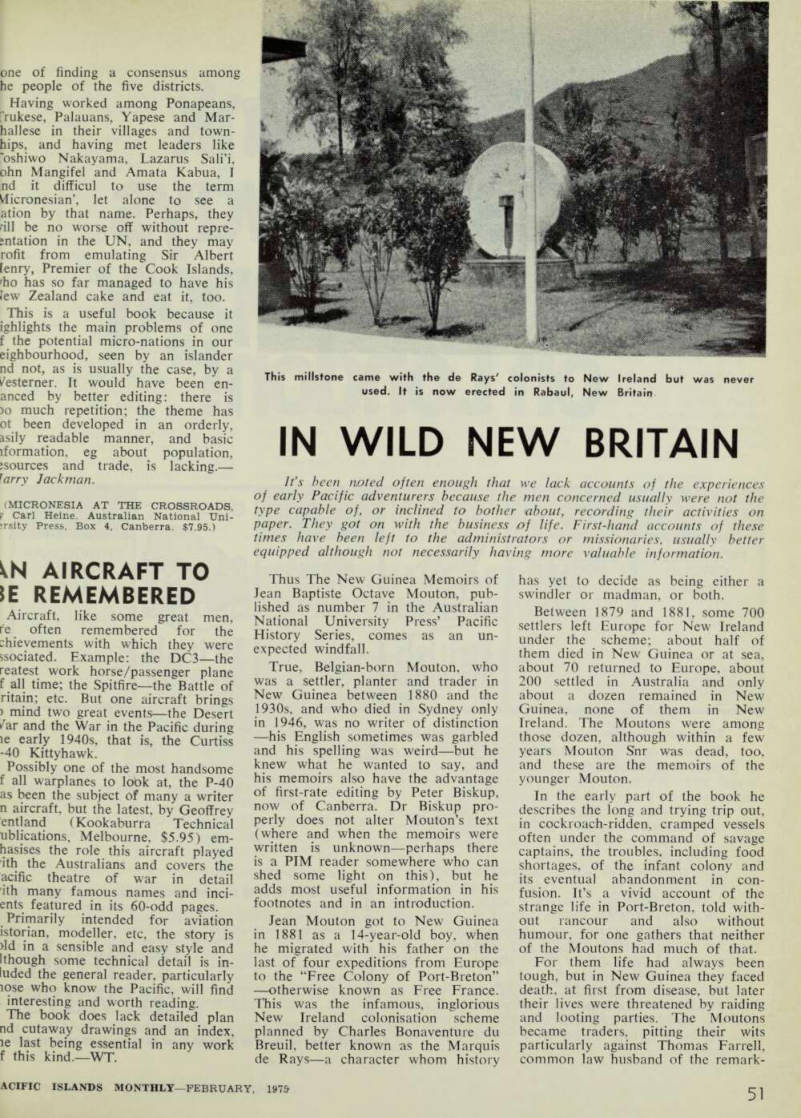
Does independence matter for the Micronesians?
At San Francisco in 1945, Dr Evatt’s determination and skill greatly contributed to the success of efforts to widen the scope of the UN General Assembly, including the setting up of the Trusteeship Council.
But even The Doc could not bring about that all member nations had equal voting strength.
The Big Five were given extra muscle through the composition and voting procedure of the Security Council, and this has been a subject of argument ever since. Micronesia at the Crossroads, written by a Mar shallese who, among other things, has been Deputy District Adminis trator in the Western Carolines, con tains much that is germane.
Do mini-states help or hinder world peace? How many people make a nation, and is political in dependence really the foremost ‘good’ of all, worth any price? De colonisation in the Pacific has so far produced a political situation re miniscent of pre-Napoleonic Central Europe.
About 120,000 people live on 100 of the 2,141 small islands, separated by vast ocean distances, known as the Trust Territory of the Pacific Islands, between Japan and New Guinea Nine different languages are spoken and there are a number of distinctive social structures and prac tices between, and in some cases also within, the districts.
The people on the outlying islands are living very much as their fore fathers have done, but those on the ’.arger islands, particularly in the townships, have been strongly influ enced by 30 years of Japanese ad ministration (1915-1945) and the US presence since then.
The population is increasing at a rate of more than 3 per cent a year, doubling within 20 years, and many islanders do not have enough land for subsistence and/or cash farming.
The author claims that the island ers are being ‘colonised on two fronts’, by their chiefs and by the
US military. ‘The realities of Micro nesian politics are that if you are a commoner and don’t vote . . . for a chief . . . you stand a very good chance of losing the rights to your land”.
Tradition is at loggerheads with democracy, which Heine sees as one of the creditable imports from the US. And Washington certainly does not look like giving up its strategic interests in the area.
The Enola Gay took off from Tinian in the Marianas to make that gigantic mushroom over Hiroshima; early Anglo-American atomic tests were conducted in Bikini Atoll (with some of the Rongelap islanders still suffering after-effects), and the missile base on Kwajalein continues to be operated.
The author does not have to spell out that military considerations have caused the US Congress to provide the highest per capita aid received by any ‘developing’ people, and that they are the joker in the pack held by his people.
For Heine and many of the islanders, the foremost problem right now is to choose between indepen dent nationhood and some form of association with the US. The largest district, the Marianas, has already opted for territorial status, similar to that of Guam and Puerto Rico.
And two district legislatures, in the Marshalls and Ponape districts, want to conduct their own negotia tions.
As Heine rightly points out, the economic realities preclude indepen dence: the people need free access to iobs in the US and continuing large scale aid, with as few strings as possible, is needed if they are not to be reduced to a penurious subsistence level. The only other likely donor, Japan, would demand a heavy econ omic quid pro quo.
The islanders’ problem is, how ever, not merely one of securing a form of political association allow ing them some compromise between coconut and Coca-Cola: it is also
one of finding a consensus among he people of the five districts.
Having worked among Ponapeans, frukese, Palauans, Yapese and Mar hallese in their villages and town hips, and having met leaders like 'oshiwo Nakayama, Lazarus Sali’i, ohn Mangifel and Amata Kabua, I nd it difficul to use the term Vlicronesian’, let alone to see a ation by that name. Perhaps, they dll be no worse off without repre mtation in the UN, and they may rofit from emulating Sir Albert lenry, Premier of the Cook Islands, dio has so far managed to have his lew Zealand cake and eat it, too.
This is a useful book because it ighlights the main problems of one f the potential micro-nations in our eighbourhood, seen by an islander nd not, as is usually the case, by a /esterner. It would have been en anced by better editing: there is )o much repetition; the theme has ot been developed in an orderly, asily readable manner, and basic iformation, eg about population, sources and trade, is lacking.—
tarry Jackman.
(Micronesia At The Crossroads,
7 Carl Heine. Australian National Uni ;rsity Press, Box 4, Canberra. $7.95.)
Aircraft To
Ie Remembered
Aircraft, like some great men, re often remembered for the zhieyements with which they were ssociated. Example: the DC3—the reatest work horse/passenger plane f all time; the Spitfire—the Battle of ritain; etc. But one aircraft brings ) mind two great events—the Desert /ar and the War in the Pacific during ic early 19405, that is, the Curtiss -40 Kittyhawk.
Possibly one of the most handsome f all warplanes to look at, the P-40 as been the subject of many a writer n aircraft, but the latest, by Geoffrey entland (Kookaburra Technical üblications, Melbourne, 55.95) em hasises the role this aircraft played ith the Australians and covers the acific theatre of war in detail ith many famous names and ind ents featured in its 60-odd pages.
Primarily intended for aviation istorian, modeller, etc, the story is )ld in a sensible and easy style and Ithough some technical detail is in luded the general reader, particularly lose who know the Pacific, will find interesting and worth reading.
The book does lack detailed plan nd cutaway drawings and an index, le last being essential in any work
f this kind.-
WT.
Advertisements & other items, pp. 63-64 (2 items)
Become a part
of PIM’s Pacific and subscribe now $ A* ■a m a> OP c» CL O S3 P o O . - . cr c MM P H- 5 5 g S P 3 5 ft a Fi// in the details on the attached order form.
irrigation problem,the
Whatever your
answer is in here!
There are two ways you can get the benefit of Dunlop/IBC’s 86 years of experience in irrigation for all types of country: send for this free booklet, prepared by our irrigation experts; or call your local Dunlop/IBC branch, and speak to the experts yourself!
Either way you’ll benefit from the advice and assistance of a company that’s long been leader in irrigation. With Australia’s largest range of pumping, water handling, and water conditioning equipment.
Post the coupon now. Or call'.
The sooner you do, the quicker you’ll reap the benefit.
I 1
ion
r FREE 12 page booklet from:
H send me free Irrigation Booklet (5 i
DUNLOP
NAME;
ADDRESS:
I OLD.: Dunlop/IBC Ltd., Station Road, Yeerongpilly, 4105. Phone 40 9011.
VIC.: 795 Springvale Road, Mulgrave, 3170. Phone 560 6222.
S.A.: 98 Churchill Road, Prospect, 5082. Phone 44 6944.
Indicate if for school project □ N.S.W. Distributors: Flexhide TAS.: J.S.W. Products, Pty. Ltd., 536 Botany Road, Alexandria, 2015. Phone 699 8444. 990-994 Hunter Street, Newcastle, 2302. Phone 69 1688. 186 Charles Street, Launceston, 7250. Phone 25 312.
W.A.: Westralian Farmers Co-Op. Ltd., Railway Parade, Bassendean, 6054. Phone 79 1671.
LBQ 1717
In Wild New Britain

It’s been noted often enough that we lack accounts of the experiences of early Pacific adventurers because the men concerned usually were not the type capable of, or inclined to bother about, recording their activities on paper. They got on with the business of life. First-hand accounts of these times have been left to the administrators or missionaries, usually better equipped although not necessarily having more valuable information.
Thus The New Guinea Memoirs of Jean Baptiste Octave Mouton, published as number 7 in the Australian National University Press Pacific History Senes, comes as an unexpected windfall.
True, Belgian-born Mouton, who was a settler, planter and trader in New Guinea between 1880 and the 19305, and who died in Sydney only in 1946, was no writer of distinction —his English sometimes was garbled and his spelling was weird—but he knew what he wanted to say, and his memoirs also have the advantage of first-rate editing by Peter Biskup, now of Canberra. Dr Biskup properly does not alter Mouton s text (where and when the memoirs were wntten !s unknown perhaps there is a PIM reader somewhere who can shed some light on this), but he adds most useful information in his footnotes and in an introduction.
Jean Mouton got to New Guinea in 1881 as a 14-year-old boy, when he migrated with his father on the last of four expeditions from Europe to the “Free Colony of Port-Breton” —otherwise known as Free France.
This was the infamous, inglorious New Ireland colonisation scheme planned by Charles Bonaventure du Breuil, better known as the Marquis de Rays—a character whom history
has yet to decide as being either a swindler or madman, or both, Between 1879 and 1881, some 700 sett ers , eft Europe for New , reland under the scheme; about half of them died in New Guinea or at sea, about 70 returned to Europe, about 200 settled in Australia and only about a dozen remained in New Guinea, none of them in New Ireland. The Moutons were among those dozen, although within a few years Mouton Snr was dead, too, and these are the memoirs of the younger Mouton.
In the early part of the book he describes the long and trying trip out, j n cockroach-ridden, cramped vessels often un der the command of savage captains, the troubles, including food shortages, of the infant colony and its eventual abandonment in con fusion. It’s a vivid account of the strange life in Port-Breton, told with out rancour and also without humour, for one gathers that neither of the Moutons had much of that, For them life had always been tough, but in New Guinea they faced death, at first from disease, but later their lives were threatened by raiding and looting parties. The Moutons became traders, pitting their wits particularly against Thomas Farrell, common law husband of the remark
This millstone came with the de Rays' colonists to New Ireland but was never used. It is now erected in Rabaul, New Britain
ible “Queen Emma”, then on New Britain building his own empire, Ithough he didn’t live to enjoy its ull fruits. Emma later carried on nd expanded.
Farrell is painted by young Mou jn as a particularly nasty character, billing to stop at nothing to advance is own interests ahead of others, /hite or black.
When Mouton senior died, young louton was one of that small num er of settlers and traders who perated in that rich area around the of today, where Emma held tvay—so much early settler history f the Gazelle Peninsula is in this ook —including accounts of land jquisitions which were as loose and robably as illegal as those con ucted by the notorious Higginson i the New Hebrides last century.
Often in those early days of trad ig Mouton escaped death narrowly 5 his store was raided or ambush ;tempts were made. His knowledge f local languages and customs, and is physical fitness and his fearless to survive, rather than is possession of firearms, enabled m to keep going.
On one occasion one is reminded ; the experience of J. K. McCarthy
among the Kukukuku of the NG mainland in the 19305, when Mc- Carthy narrowly missed death from large boulders deliberately run down a hill at him—only a few minutes later to be greeted happily by his antagonists and congratulated on his escape, everything forgotten. Mouton tells how in Bougainville in 1900 he was recruiting when he noticed some natives making a “very funny move ment” when coming towards his boat, and another man who kept his arms close to his body. When he chal lenged them he found one man was concealing a hatchet and the others were dragging spears beneath the water with their toes, attempting to get close enough to use them.
“However”, he says, “having dis covered their deceitful plan and see ing it was a failure they acted as if nothing had occurred and I recruited them just as if nothing had hap
pened ... in fact when I told them in a laughing manner, turning the whole matter as a joke, just what their plan and action was they laughed, and they say I know too much, that day I did a good recruit ing day, though they were prepared to kill me and the crews”.
On another occasion in New Ireland he had to stand by while raiders killed, cooked and ate a five year-old boy they had captured (“later presenting me with a piece ol the child which looked like pork, I told them white men were not eat ing each other like them”). Mouton had earlier contemplated putting a bullet into the head of the child to put him out of his misery, but thought better of it through reasons of his own safety.
He tells these stories with a matter-of-factness which lends cre dence to his narrative, and as Harry Maude, general editor of the Pacific series, says in a foreword, one can be elated at “a fortuitous discovery of the calibre of the Mouton
memoirs”.-
Stuart Inder.
(The New Guinea Memoirs Of
Jean Baptiste Octave Mouton.
Edited by Peter Biskup. Published by Aus tralian National University Press, Box 4, Canberra. $8.95.)
Advertisements & other items, pp. 65-68 (3 items)
51
ACIFIC ISLANDS MONTHLY—FEBRUARY, 197&
British Airways
"Ybutl think
hadamonopoly
on London!"
2 Fabulous weeks in London for SlOl (plus air fare) If you've ever played Monopoly, you've heard of places like Piccadilly, Leicester Square, Oxford Street and Trafalgar Square. Now's the time to come and see them, with British Airways.
Our fantastic "London for You'' holiday gives you two weeks in London for an amazingly low price, $101! And there's a lot of extras thrown in for good measure.
SlOl buys you 13 nights' accommodation in a modern hotel room with private bath and full English breakfast daily. Plus you'll have a self drive Avis car for three days. Rental is paid, you only pay mileage at 6 cents a mile. You receive tickets to six popular London stage shows, a Countdown card entitles you to discounts at many shops, stores and restaurants. There's more yet!
Admission to Madame Tussaud's and Regent's Park Zoo. A welcome to London tea party, Scottish evening dinner dance and cabaret, evening pub tour, sightseeing tour of the West End and the City, Plus you'll be made a member of one of London's leading casinos while you're here. You may even win back your SlOl!
All of these items (except your casino winnings, naturally) are included in the price. London for you. It's fantastic value. Jo look at it, you'd think we had a monopoly on all the best places in London.
For full details, see your British Airways travel agent or send this coupon.
NOTE: Tour details and price vary after March 31st, 1975.
20 MINUTES FROM THE AIRPORT;
CENTURIES APART FROM THE WORLD.
wiiaßiO
I "□L2E T
r ' ' rrr T__ 11 m c r n [H| aa a ■ sa ■■ :j> b
TT - w
I I .Pin...
T-T Pacific passengers can step into one of the world’s most legendary experiences.
The Regent of Fiji is a beach-front paradise. 300 gracious rooms clustered among towering palms and dazzling orchids. With two enchanted dining rooms. The rousing Meke Lounge. Complete banquet/convention pavilion and duty free shopping.
Outside, the gleaming Vuda—white shore—slopes into wavefree Nadi Bay. Experience our realm of ocean sports. Beachcombing, tennis, or golf. And our own fresh-water pool.
Book space in paradise now. For the night of a lifetime.
The Regent of Fiji—2o minutes from the airport.
Paradise opens early 1975.
POST OFFICE BOX 441 • NADI, FUI • TELEPHONE 70466 • TELEX 5180 ONE Of the many worlds Of REGENT INTERNATIONAL HOTELS
the Regent of Fiji
Sydney, Australia Sales Office No. 1 York Street, 14th floor Sydney, Australia 2000 Phone 276-469
These MF distributors
PAPUA NEW GUINEA I FIJI. TONGA. WESTERN I NEW CALEDONIA I TAHITI Pacific Motors S.A.,
NOUMEACEDEX
BRITISH SOLOMON ISLANDS
Ets. Donald,
P.O. Box 131, PAPEETE
NEW HEBRIDES
CONDOMINIUM
Pentecost Pacific S.A., Santo and Port Vila
can show you the
greater the load on an MF2I Trailer
the better the grip!
The all-steel hydraulic-tipping MF2I is a “goanywhere” unit with large section tyres to give good flotation on wet ground and MF’s famous rear axlo design which puts 25% of the load on the tractor’s rear wheels. The bigger the load, thebetterthegrip!
Capacity is 3Vz. tons, tray area 60 square feet. A powerful hydraulic ram tips the tray to 56 degrees for fast, clean unloading. Everything about this trailer is planned for one-man operation. What’s more, it’s built for years of tough work in the field or on the road. / /
MFE 74041
MF
MASSEY-FERGUSON. OFTWO EXPORT AWARDS
53
CIFIC ISLANDS MONTHLY— FEBRUARY, 1975
Practical
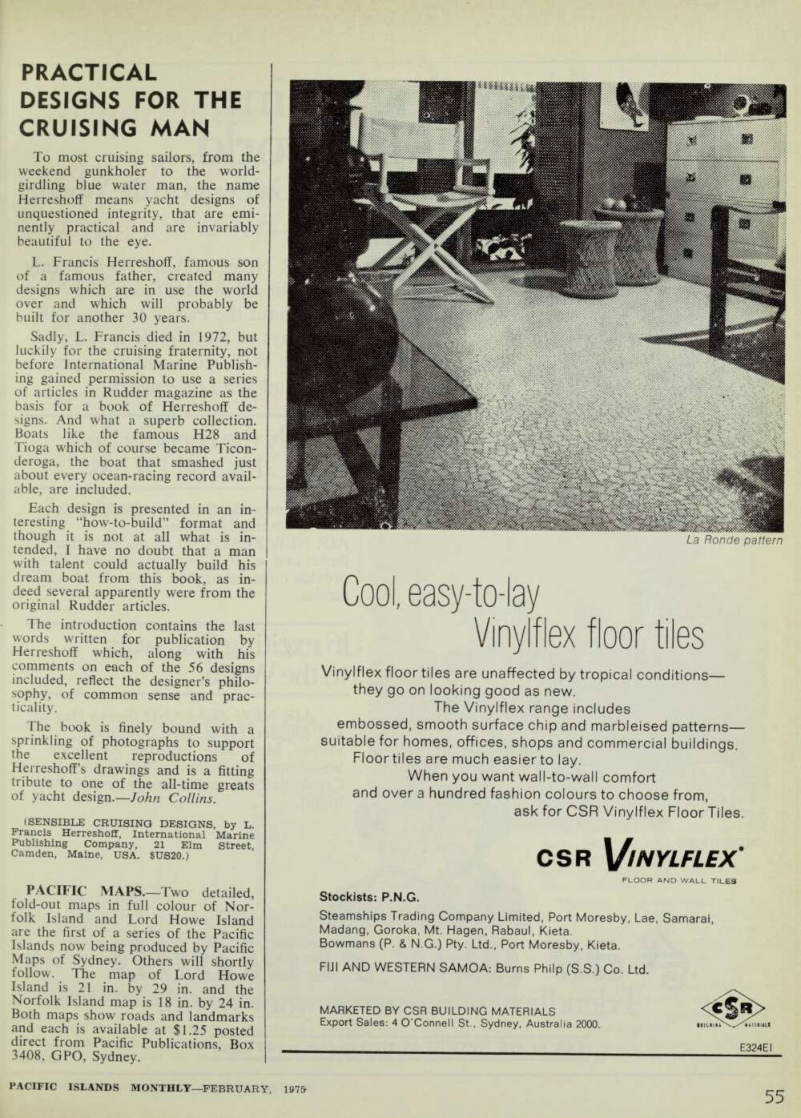
Designs For The
Cruising Man
To most cruising sailors, from the weekend gunkholer to the world girdling blue water man, the name Herreshoff means yacht designs of unquestioned integrity, that are emi nently practical and are invariably beautiful to the eye.
L. Francis Herreshoff, famous son of a famous father, created many designs which are in use the world over and which will probably be built for another 30 years.
Sadly, L. Francis died in 1972, but luckily for the cruising fraternity, not before International Marine Publish ing gained permission to use a series of articles in Rudder magazine as the basis for a book of Herreshoff de signs. And what a superb collection.
Boats like the famous H2B and Tioga which of course became Ticon deroga, the boat that smashed just about every ocean-racing record avail able, are included.
Each design is presented in an in teresting “how-to-build” format and though it is not at all what is in tended, I have no doubt that a man with talent could actually build his dream boat from this book, as in deed several apparently were from the original Rudder articles.
The introduction contains the last words written for publication by Herreshoff which, along with his comments on each of the 56 designs included, reflect the designer’s philo sophy, of common sense and prac ticality.
The book is finely bound with a sprinkling of photographs to support the excellent reproductions of Herreshoff’s drawings and is a fitting tribute to one of the all-time greats
of yacht design.-
John Collins.
(Sensible Cruising Designs, By L.
Francis Herreshoff, International Marine Publishing Company, 21 Elm Street, Camden, Maine, USA. SUS2O.) PACIFIC MAPS.— Two detailed, fold-out maps in full colour of Nor folk Island and Lord Howe Island are the first of a series of the Pacific Islands now being produced by Pacific Maps of Sydney. Others will shortly follow. The map of Lord Howe Island is 21 in. by 29 in. and the Norfolk Island map is 18 in. by 24 in.
Both maps show roads and landmarks and each is available at $1.25 posted direct from Pacific Publications, Box 3408, GPO, Sydney.
Advertisements & other items, pp. 69-70 (1 item)
Cool, easy-to-lay
La Ronde pattern
Vinylflex floor tiles
Vinylflex floor tiles are unaffected by tropical conditions — they go on looking good as new.
The Vinylflex range includes embossed, smooth surface chip and marbleised patterns— suitable for homes, offices, shops and commercial buildings.
Floortiles are much easierto lay.
When you want wall-to-wall comfort and over a hundred fashion colours to choose from, ask for CSR Vinylflex Floor Tiles.
csr *
FLOOR AND WALL TILES
Stockists: P.N.G.
Steamships Trading Company Limited, Port Moresby, Lae, Samarai, Madang, Goroka, Mt. Hagen, Rabaul, Kieta.
Bowmans (P. & N.G.) Pty. Ltd., Port Moresby, Kieta.
FIJI AND WESTERN SAMOA: Burns Philp (S.S.) Co. Ltd.
MARKETED BY CSR BUILDING MATERIALS
Export Sales: 4 O’Connell St., Sydney, Australia 2000. <*S">
lIIIIIIS V^X «1UIIUI
E324E1
A growing airline
in a shrinking world...
Fly to any of 16 AIR NEW ZEALAN D Gateways to the World. -9 ft
mvme>
.os Angeles
6= .A.. « m IR
Singapore
AIR NEW ZEALAND is a truly international airline, flying you throughout the Pacific to any of 16 Gateways to the World, as far apart as Wellington and Singapore, Auckland and Los Angeles.
You fly the friendly fleet
of DCTOs and DC Bs.
Our magnificent wide-bodied DC-10s now fly on most international AIR NEW ZEALAND routes. On other flights and services, our personalised DC-8s provide outstanding AIR NEW ZEALAND service.
16 exciting Gateways
to the World.
AIR NEW ZEALAND flies to Hawaii Los Angeles, Hong Kong, Singapore, Sydney, Melbourne, Brisbane, Auckland, Wellington, Christchurch, Fiji, Tahiti, New Caledonia, Samoa, Rarotonga and Norfolk Island.
air new zEaiann
Friendliest wings across your world.
Talk to AIR NEW ZEALAND or your travel agent
ANZ 233
Pacific Transport
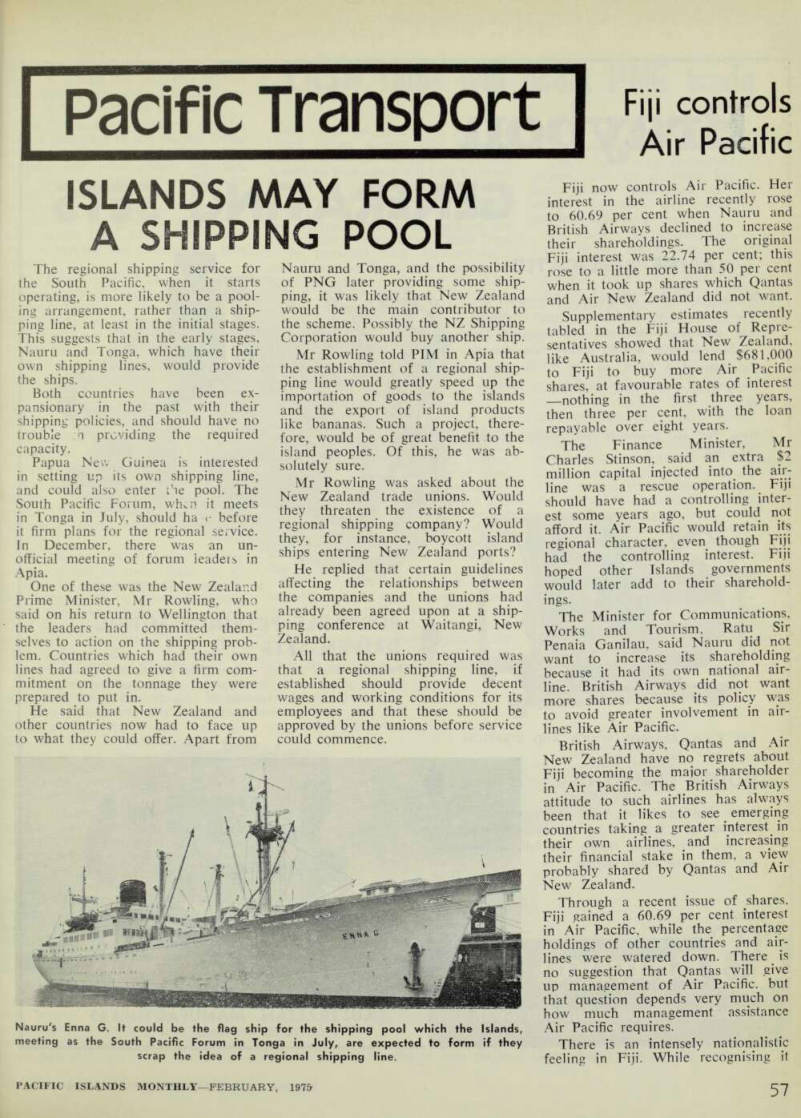
Islands May Form
A Shipping Pool
The regional shipping service for the South Pacific, when it starts operating, is more likely to be a pooling arrangement, rather than a shipping line, at least in the initial stages.
This suggests that in the early stages.
Nauru and Tonga, which have their own shipping lines, would provide the ships.
Both countries have been expansionary in the past with their shipping policies, and should have no trouble n providing the required capacity.
Papua New Guinea is interested in getting up its own shipping line, and could also enter tie pool. The South Pacific Forum, wh,n ,t meets m Tonga m July, should ha-, before In December there was an un official refing of forum leaders in Apia.
One of these was the New Zealand Prime Minister, Mr Rowling, who said on his return to Wellington that the leaders had committed themselves to action on the shipping problem. Countries which had their own lines had agreed to give a firm commitment on the tonnage they were prepared to put in.
He said that New Zealand and other countries now had to face up to what they could offer. Apart from
Nauru and Tonga, and the possibility of PNG later providing some ship ping, it was likely that New Zealand would be the main contributor to the scheme. Possibly the NZ Shipping Corporation would buy another ship.
Mr Rowling told PIM in Apia that t h e establishment of a regional ship ping line would greatly speed up the importation of goods to the islands an d the export of island products Hk e bananas. Such a project, there fore, would be of great benefit to the island peoples. Of this, he was ab solutely sure Mr Rowling was asked about , he New Zea i and S trade unions. Would h threaten the existence of a f , shi j company? Wou ld ***’ for b^c °« island shi P s enterin * New Zea,and P°» s?
He replied that certain guidelines affecting the relationships between the companies and the unions had already been agreed upon at a ship- Pmg conference at Waitangi, New Zealand.
All that the unions required was that a regional shipping line, if established should provide decent wages and working conditions for its employees and that these should be approved by the unions before service could commence.
Nauru's Enna G. It could be the flag ship for the shipping pool which the Islands, meeting as the South Pacific Forum in Tonga in July, are expected to form if they scrap the idea of a regional shipping line.
Fiji controls
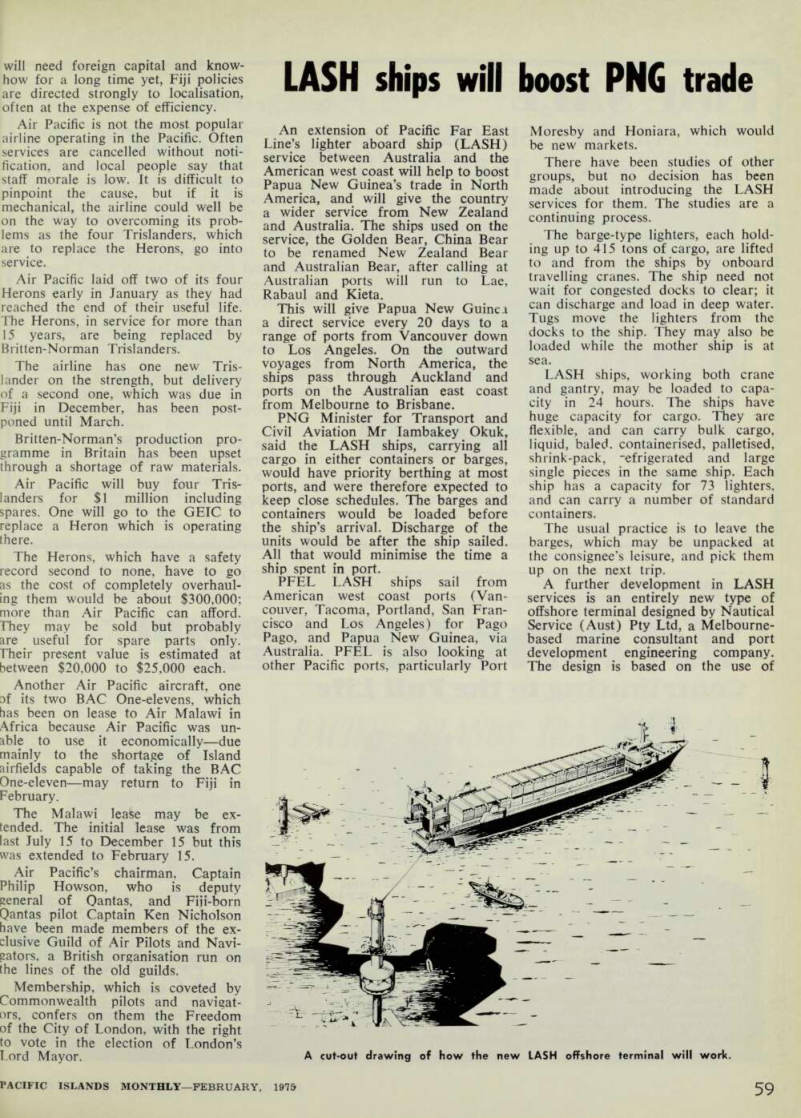
Air Pacific
Fiji now controls Air Pacific. Her interest in the airline recently rose to 60.69 per cent when Nauru and British Airways declined to increase their shareholdings. The original Fiji interest was 22.74 per cent; this rose to a little more than 50 per cent when it took up shares which Qantas and Air New Zealand did not want.
Supplementary estimates recently tabled in the Fiji House of Repre sentatives showed that New Zealand, like Australia, would lend $681,000 to Fiji to buy more Air Pacific shares, at favourable rates of interest —nothing in the first three years, then three per cent, with the loan repayable over eight years.
The Finance Minister, Mr Charles Stinson, said an extra $2 million capital injected into the air line was a rescue operation. Fiji should have had a controlling inter est some years ago, but could not afford it. Air Pacific would retain its regional character, even though Fiji had the controlling interest. Fiji hoped other Islands governments would later add to their sharehold ings.
The Minister for Communications, Works and Tourism, Ratu Sir Penaia Ganilau, said Nauru did not want to increase its shareholding because it had its own national air line. British Airways did not want more shares because its policy was to avoid greater involvement in air lines like Air Pacific.
British Airways, Qantas and Air New Zealand have no regrets about Fiji becoming the major shareholder in Air Pacific. The British Airways attitude to such airlines has always been that it likes to see emerging countries taking a greater interest in their own airlines, and increasing their financial stake in them, a view probably shared by Qantas and Air New Zealand.
Through a recent issue of shares, Fiji gained a 60.69 per cent interest in Air Pacific, while the percentage holdings of other countries and air lines were watered down. There is no suggestion that Qantas will give up management of Air Pacific, but that question depends very much on how much management assistance Air Pacific requires.
There is an intensely nationalistic feeling in Fiji. While recognising it
will need foreign capital and know how for a long time yet, Fiji policies are directed strongly to localisation, often at the expense of efficiency.
Air Pacific is not the most popular airline operating in the Pacific. Often services are cancelled without noti fication, and local people say that staff morale is low. It is difficult to pinpoint the cause, but if it is mechanical, the airline could well be on the way to overcoming its prob lems as the four Trislanders, which are to replace the Herons, go into service.
Air Pacific laid off two of its four Herons early in January as they had reached the end of their useful life.
The Herons, in service for more than 15 years, are being replaced by Britten-Norman Trislanders.
The airline has one new Tris lander on the strength, but delivery of a second one, which was due in Fiji in December, has been post poned until March.
Britten-Norman’s production pro gramme in Britain has been upset through a shortage of raw materials.
Air Pacific will buy four Tris landers for $1 million including spares. One will go to the GEIC to replace a Heron which is operating there.
The Herons, which have a safety record second to none, have to go as the cost of completely overhaul ing them would be about $300,000; more than Air Pacific can afford.
They may be sold but probably are useful for spare parts only.
Their present value is estimated at between $20,000 to $25,000 each.
Another Air Pacific aircraft, one of its two BAG One-elevens, which has been on lease to Air Malawi in Africa because Air Pacific was un able to use it economically—due mainly to the shortage of Island airfields capable of taking the BAG One-eleven —may return to Fiji in February.
The Malawi lease may be ex tended. The initial lease was from last July 15 to December 15 but this was extended to February 15.
Air Pacific’s chairman. Captain Philip Howson, who is deputy general of Oantas, and Fiji-born Qantas pilot Captain Ken Nicholson have been made members of the ex clusive Guild of Air Pilots and Navi gators, a British organisation run on the lines of the old guilds.
Membership, which is coveted by Commonwealth pilots and navigat ors, confers on them the Freedom of the City of London, with the right to vote in the election of London’s Lord Mayor,
Advertisements & other items, p. 72 (1 item)
Braybon
GENERATING SETS
MARINE APPLICATION
Marine Application of Braybon Alternators ensure continuity of operation as these Australian built brushless Alternators are designed for arduous conditions in high ambient temperature.
Capacities of 3 K.V.A. to 100 K.V.A. engine powered or separate are available to specification.
Write for our brochures and prices without obligation. ■P ♦
3J K.V.A. BRAYBON/BRIGGS AND STRATTON
HOUSE LIGHTING
House Lighting Diesel Sets we manufacture in capacities of 2 K.V.A. to approximately 40 K.V.A. as crank start, electric, remote, and fully automatic with air cooled diesel engines.
90 K.V.A. BRAYBON/CUMMINS.
PORTABLE PETROL ELECTRIC
DRIVEN SETS
Portable Petrol Engine Driven Sets for house lighting, builder power tools, floor sander, electric welder, etc., are manufactured in capacities of 1,2, 3J, and 7i K.V.A. 240 volt. Keenly priced, these sets lend themselves to many applications. ♦
Braybon Bros
PTY. LTD.,
2 ROTHWELL AVENUE, CONCORD WEST 2138.
Tel.: 73-3246. m
2 K.V.A. BRAYBON/PETTER.
AUSTRALIAN MANUFACTURERS
ESTABLISHED 40 YEARS 1934-1974.
LASH ships will boost PNG trade
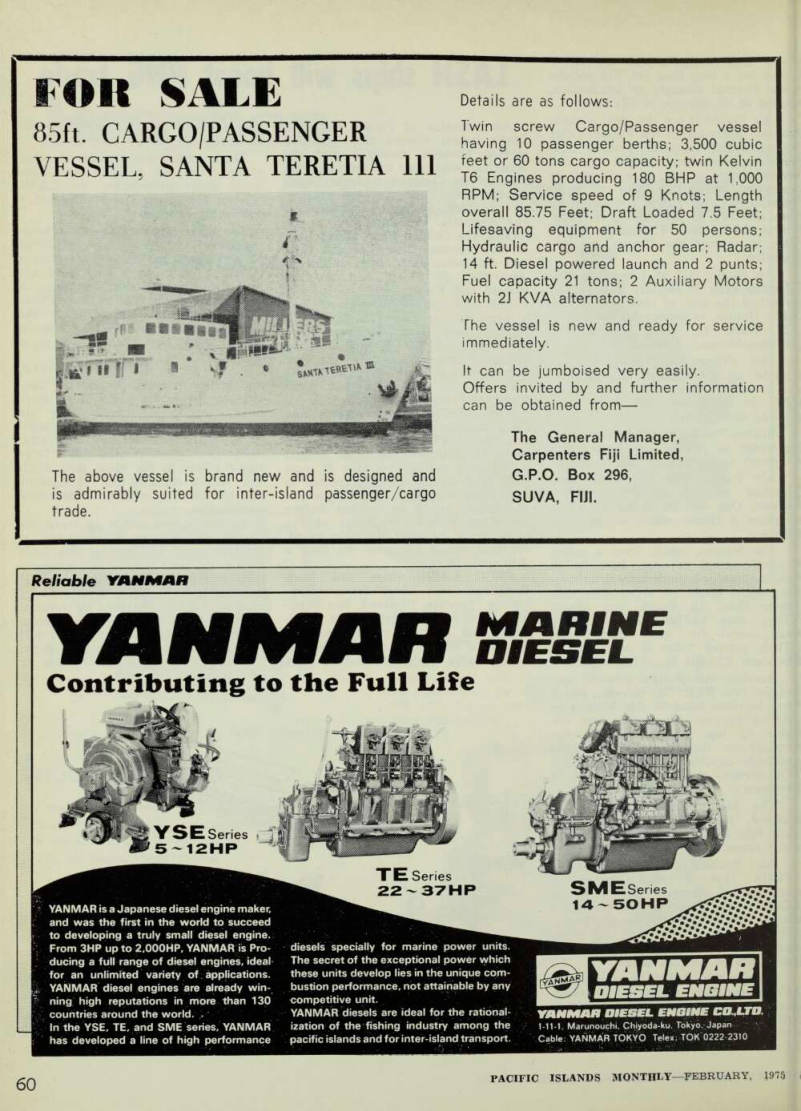
An extension of Pacific Far East Line’s lighter aboard ship (LASH) service between Australia and the American west coast will help to boost Papua New Guineas trade in North America, and will give the country a wider service from New Zealand and Australia. The ships used on the service, the Golden Bear, China Bear to be renamed New Zealand Bear and Australian Bear, after calling at Australian ports will run to Lae, Rabaul and Kieta This will give Papua New Guinea a direct service every 20 days to a range of ports from Vancouver down to Los Angeles. On the outward voyages from North America, the ships pass through Auckland and ports on the Australian east coast from Melbourne to Brisbane.
PNG Minister for Transport and Civil Aviation Mr lambakey Okuk, said the LASH ships, carrying all cargo in either containers or barges, would have priority berthing at most ports, and were therefore expected to keep close schedules. The barges and containers would be loaded before the ship’s arrival. Discharge of the units would be after the ship sailed.
All that would minimise the time a ship spent in port.
PEEL LASH ships sail from American west coast ports (Vancouver, Tacoma, Portland, San Francisco and Los Angeles) for Pago Pago, and Papua New Guinea, via Australia. PFEL is also looking at other Pacific ports, particularly Port
Moresby and Honiara, which would be new markets, There have been studies of other groups, but no decision has been made about introducing the LASH services for them. The studies are a con , inuing pr ocess. —,* 4 , . The barge-type lighters, each hold m 8 U P tons of cargo, are lifted to fr° m the ships by onboard travelling cranes. The ship need not wait for congested docks to clear; it £?n discharge and load in deep water, Tugs move the lighters from the docks to the ship. They may also be loaded while the mother ship is at sea * LASH ships, working both crane and gantry, may be loaded to capa city in 24 hours. The ships have huge capacity for cargo. They are flexible, and can carry bulk cargo, liquid, baled, containerised, palletised, shrink-pack, -efrigerated and large single pieces in the same ship. Each ship has a capacity for 73 lighters, and can carry a number of standard containers.
The usual practice is to leave the barges, which may be unpacked at the consignee’s leisure, and pick them up on the next trip. a further development in LASH services is an entirely new type of offshore terminal designed by Nautical Service (Aust) Pty Ltd, a Melbourne based marine consultant and port development engineering company, The design is based on the use of
A cut-out drawing of how the new LASH offshore terminal will work
four Sarus towers to which specially designed LASH ships are moored offshore, while their barges are loaded and off-loaded.
The towers form a rectangle within which the ship is positioned for mooring. The design allows the ship’s orientation to be altered as much as 60 degrees during adverse weather.
This manoeuvrability eases loading and discharge at the stern in relatively calm conditions.
Basically, a Sarus tower is a vertical cylindrical metal structure, which incorporates a buoyancy chamber joined by a universal coup ling to a seabed deadweight chamber.
The articulated link provides the re quired elasticity, which enables the tower to bow under excessive stress without loss of security of function.
The system, known as the Whitaker Offshore Lash Terminal System, is leased to the Waterman Steamship Corp, of New York. Waterman had three specially designed LASH ships built for the system. Each carries 80 500 ton barges. Forty barges can be offloaded and loaded in 12 hours.
Haapai Will Have
Airfield Soon
Haapai’s airfield, which will give the island aerial links with Tonga tapu and Vavau, is expected to be finished early in February. Late last year enough work had been done to allow a Britten-Norman Islander to land.
Work on the airfield started in January, 1974. The cost of the 2,300 ft coral runway is estimated at $49,000 about 22i per cent above the original estimate. Work was hindered throughout 1974 by bad weather and shipping delays.
Cooks Sampan
Runs Out Of Fuel
The Cook Islands Government fishing sampan Ravakai, returning from the northern Cooks on Decem ber 26, ran out of fuel 60 miles north of Rarotonga. The MV Manu vai, in Avatiu harbour at the time, went to her aid with three drums of diesel fuel and Ravakai made port safely.
On board her were Canadian yachtsmen Dirk Heiss and Gary McKay of the ketch Tangerine, and five official passengers. The Cana dians had agreed to take the vessel north to deliver food supplies and pick up official passengers and a cargo of pearl shell and live turtles.
At Palmerston they off-loaded cabin bread, sugar, fruit and veget ables and uplifted 106 turtles destined to start a turtle farm at Aitutaki Island.
Because bad weather prevented sights from being taken, they had trouble finding Manihiki and used extra fuel to do so.
Fiji's Port System S
Flabby, Says Expert
The waterfront industry in Fiji can expect a big shake-up with the arrival from Singapore of Mr Lou Heng Kee to set up the Fiji Ports Authority. The decision to set up the authority was made after a commission of inquiry into the ports system.
On his arrival in Suva, Mr Lou described the system under which Suva worked as “flabby, depressing”.
It urgently needed a herculean effort to bring it up to overseas standard, That is his main aim—to make the Suva port equal to those of other countries. His first task will be to integrate control of the present fragmented management system under one authority, and provide leadership, motivation, and clear ob jectives.
He recognises congestion as a No 1 problem, which he hopes to partly overcome by setting up buffer zones to cater for most of the surplus cargo on the wharf, and relieve a tight congestion situation. He had the first buffer zone, an inland freight station,
in operation in December in the old RNZAF hangar at Laucala Bay.
He hopes to improve productivity with new concepts. Should he suc ceed he will please the variety of port users, and also the many people who receive a stock answer on in quiring the whereabouts of goods on order—“ They are on the wharf”.
Mr Lou worked for the Singapore Harbour Board for 27 years before going to Fiji. In 1960 he was ap pointed the Singapore board’s traffic manager, and in 1964 he became director of operations. He has writ ten a number of papers on wharf matters.
Bougainville
Takes To The Air
The Bougainville Provincial Government has committed itself to operating air and sea services with the purchase of an airline and a steel cargo ship. Recently, it paid $200,000 to Mission Aviation Fellowship for Bougainville Air Services, and will form it into Bou gainville Air Services Pty Ltd. In volved in the deal were three light aircraft, hangars, housing, vehicles, spare parts and equipment.
Another aircraft will soon be added to the fleet. The new owners intend to introduce scheduled air services around Bougainville. The board of Bougainville Air Services Pty Ltd will comprise four Bougain villeans, and three from Mission Aviation Fellowship, who will pro vide expert knowledge of aviation.
The Bougainvilleans are Aloysius Noga, John Bakeni, John Teosin and Leo Hannett.
The government paid $55,000 to Seafreight, of Lae, for the cargo ship, the Minnesota, which will be renamed Bougainville Chief. The ship will operate to atolls and islands m Bougainville District.
More Bad Luck
For Fiji's Tabu Soro
Trouble continues to dog the $350,000 Tabu Soro, delivered to Fiji recently from Norway. Recently she drifted for more than four hours after the fuel pumps seized. A pass ing ship, which picked up a distress signal flashed out with a mirror, towed the ship out of danger after it looked certain to run on to a reef.
The rescuing ship was the Nei Kuana, which belongs to Rabi Hold ings.
The Tabu Soro was on the way back to Suva after a maiden trip to Labasa. Her delivery voyage from Norway took about seven months.
She had to put into several ports for repairs.
Advertisements & other items, pp. 74-76 (2 items)
60
PACIFIC ISLANDS MQNTRLT—FEBRUARY, 1975
Yam Mar
FOR SALE
85ft. CARGO/PASSENGER
VESSEL, SANTA TERETIA 111
'i' m,
SSmCA ■ SB
,*nnr i >* ;.
1 p JW : * The above vessel is brand new and is designed and is admirably suited for inter-island passenger/cargo trade.
Details are as follows: Twin screw Cargo/Passenger vessel having 10 passenger berths; 3,500 cubic feet or 60 tons cargo capacity; twin Kelvin T 6 Engines producing 180 BHP at 1,000 RPM; Service speed of 9 Knots; Length overall 85.75 Feet; Draft Loaded 7.5 Feet; Lifesaving equipment for 50 persons; Hydraulic cargo and anchor gear; Radar; 14 ft. Diesel powered launch and 2 punts; Fuel capacity 21 tons; 2 Auxiliary Motors with 2J KVA alternators.
The vessel is new and ready for service immediately.
It can be jumboised very easily.
Offers invited by and further information can be obtained from — The General Manager, Carpenters Fiji Limited, G.P.O. Box 296,
SUVA, FIJI.
Reliable Y
YAM MAR
Contributing to the Full Life
YSE Series ?
5-12 HP YANMAR is a Japanese diesel engine maker, and was the first in the world to succeed to developing a truly small diesel engine.
From 3HP up to 2.000 HP, YANMAR is Producing a full range of diesel engines, ideal for an unlimited variety of applications.
YANMAR diesel engines are already winning high reputations in more than 130 countries around the world.
In the YSE, lE, and SME series, YANMAR has developed a line of high performance T m w d
TE Series
22-37 HP
SMESeries
14 50 HP diesels specially for marine power units.
The secret of the exceptional power vyhich these units develop lies in the unique combustion performance, not attainable by any competitive unit.
YANMAR diesels are ideal for the rationalization of the fishing industry among the pacific islands and for inter-island transport.
PWINMAH
'H&JA DIESEL EMPIRE
YANMAR DIESEL ENGINE CD.,LTD.
1-11-1, Marunouchi, Chiyoda-ku. Tokyo. Japan Cable: YANMAR TOKYO Telex; TOK 0222-2310
UNION STEAM SHIP CO. of N.Z.
LIMITED
Serving the Pacific for nearly 100 years.
Regular Sailings by Modern Vessels
From Auckland to Lautoka, Suva, Pago Pago, Apia, Niue, Vavau, Nukualofa. Also from Tauranga to Lautoka, Suva, Apia, Nukualofa. Regular sailings from Australia to New Zealand to enable transhipment of cargo to all the above ports.
Ship your cargo by a Union Company Vessel.
BRANCHES AT ALL MAIN AUSTRALIAN, NEW ZEALAND AND ISLAND PORTS.
PACIFIC ISLANDS TRANSPORT LINE
Owners: Thor Dahls Hvalfangerselskap A/S — Sandefjord, Norway.
MOTOR VESSEL "THORSISLE"
Regular Freight and Passenger Services between Pacific Coast Ports of U.S.A. and Canada and
TAHITI and SAMOA
GENERAL STEAMSHIP CORPORATION LTD.
General Agents 400 California Street, San Francisco, California, U.S.A.
APIA —Borns Philp (South Sea) Company, SYDNEY—Trans-Austral Shipping Pty. Ltd.
Ltd. SUVA —Burns Philp (South Sea) Company, PAPEETE —Agence Maritime Internationale Ltd.
Tahiti. LAE/RABAUL —Burns Philp (New Guinea) Ltd.
PAGO PAGO —G. H. C. Reid & Co. PORT VILA —Comptoirs Francais de Nouvelles NOUMEA —Etablissements Ballande. Hebrides.
ned oyd Koninklijke Nedlloyd bv
REGULAR SAILINGS BY FAST, MODERN CARGO VESSELS from EUROPE via PANAMA fro
PAPEETE, NOUMEA,
APIA, SUVA, LAUTOKA,
NEW ZEALAND.
from NEW ZEALAND via PANAMA fro;
EUROPE
(MEDITERRANEAN & NORTH CONTINENT)
and from AUSTRALIA fro:
CENTRAL AMERICA & CARIBBEAN
INDUCEMENT SAILINGS BY CARCARRIER
heavy-liffr facilities—refrigerated space—cargo deepfranks For further particulars apply to Agents: Ets. Donald Tahiti Papeete.
Agence Maritime et Aerienne Caledonienne S.A. A.M.A.C., Noumea.
D. F. Nelson & Co. Ltd.
Apia.
Island Transport Ltd.
Suva, Lautoka.
Russell & Somers (Wellington) Ltd.
Wellington, N.Z.
Interocean Australia Services Pty. Ltd.
Sydney.
NEDLLOYD
General Representative Pacific Box 194, Wellington, N.Z.
POWERLITE GENERATORS
r 7** % :
15 YEARS PROVEN SERVICE
THROUGHOUT AUSTRALIA
PORTABLE or
STATIONARY
We offer you a choice of AIR or WATER cooled Power units.
DIESEL or PETROL driven by the engine of your choice.
BRUSHLESS or SLIP RING ALTERNATORS made to any requirement or specification in either — Manual, Automatic, Electric and Start-A-Matic.
A full range available from:
1 KVA THROUGH TO 500 KVA
Service and parts readily available.
POWERLITE PTY. LTD.
23A Gordon St., Chipping Norton, N.S.W., 2170, Australia.
Phone: 727-0077. Telex: 24893.
Cruising
Yachts
• SEEKER, 30 ft sloop, carrying Jim Kennedy, was at Lelu Harbour, Kusaie, in December, after some unorthodox adven tures on the way from the Solomon Islands. An attempted stopover at Nauru was thwarted by heavy winds and high seas. Then, while sitting out a squall while waiting to enter Lelu Harbour, the Trust Territory ship, MILITOBI, also riding out the squall, gave chase. The Militobi skipper gave orders to "clear the decks, watch out for gunfire" as he gave chase.
Kennedy was able, however, to calm the
skipper before anything untoward hap
pened, and both vessels sailed quietly into the harbour. Next port after Lelu was Ponape. • ANIDAMO, 27 ft sloop, from the Kwajalein missile range, was in Lelu Harbour, Kusaie, in December, with owner John Wuerz, and crew, Thom Nelson and Mike Lawn. After a reunion with Jim Kennedy, in the Seeker, ANIDAMO re turned to Kwajalein. • SOFIA, 90 ft barque, was an August visitor to Nukualofa and Suva. She has been cruising for five years since two Americans bought her in Sweden. She is west-bound round-the-world, changing crew from time to time. At Nukualofa, be cause of her size, she was unable to berth in the yacht harbour, and had to anchor east of Queen Salote wharf. The ship's pet, Varmit, a Mexican coatimondi, was a star attraction when Sofia tied up in Suva. Many were the guesses about its family—a relative of the racoon was probably the closest. Because of quaran tine regulations Varmit was not allowed ashore; in fact, the crew had to put up a $5OO bond to keep him on board.
• Two yacht clubs—Middle Harbour, Sydney, and Royal Akarana, Auckland— are interested in staging races to Suva in 1976. The Royal Suva Yacht Club will work out a programme so that both races may be held, but in different years. A plan by the Transpac Yacht Club to hold a United States to Suva race has been abandoned. The club decided the course would be unsuitable. • INTERLUDE I, 33 ft steel sloop, arrived at Honolulu in November, after in extended cruise in the South Pacific since leaving Auckland on June 15, 1974.
The New Zealand-owned yacht was skippered by John McKenzie, who was accompanied by Rod Blackburn and Allen Lee. After leaving Auckland she called at Rarotonga, Aitutaki, the Society Islands and the Tuamotus. The yacht is up for sale, but if not sold in Honolulu, she will carry on to the US mainland. • The Niue Island Bluewater Yacht Club is making a bid to get on the itinerary of more cruising "yachties".
They feel the island has a lot to offer, but is not as well known as some of the more "fashionable" ports of call.
There is a concrete jetty at Alofi on the western side of the island, in 80 to 100 ft. A buoy is anchored about 175 yds from the landing and is fitted with a rubber fender strip. There is a radio beacon which transmits continuously.
Nineteen cruising yachts visited the island in 1974. They were Ta Area (J. M.
Walker, US), Eros (M. Hornsby, NZ), Dulci mer (P. J. Grange, Canada), Bandora (S. J.
Taylor, Canada), Manu Ote Mite (H. Cien ciala, Canada), in May; Maupiti (R. Hetzel, US) in June; Sea Star (P. Moorlez, Tahiti); Windaway (A. R. Clements, Canada), Kila Kila (R. Bath, US) in July; Panina (D. Pauls, US), Boomerang (E. Lundgren, Canada), Dove (D. Alfson, US), Puffin (G. Taylor, US), in August; Moonmist (D. Chesbrough, US), Circuit (A. Cotton, Australia), Avilion II (S. Rogotzki, South Africa), in Septem ber; Nunki (1. Keith, US), Bobbes (B.
Jones, Germany), Foxtrot (A. Fox, US) in October.
Advertisements & other items, pp. 77-78 (1 item)
Aitchison Yacht Masts Of
NEW ZEALAND
CONSTRUCT AND SUPPLY FOR YACHTS:
WOODEN MASTS AND SPARS • ALUMINIUM MASTS AND SPARS • ALL SPAR FITTINGS, LIGHTING, ROPES, RIGGING,
WINCHES, STAINLESS STEEL BOAT FITTINGS.
Yachtles for quick experienced service contact the specialist firm with the world wide reputation now II! We air freight and ship all over the islands. Flagpoles also made and supplied.
AITCHISON YACHT MASTS,
71 ROWANDALE AVE., MANUREWA (P.O. BOX 274, MANUREWA),
AUCKLAND, N.Z. Ph: 63-500
DAIWA BANK SERVING YOU THE PACIFIC BASIN * Head Office ; Osaka,Japan With 137 Branches throughout Japan Singapore Representative Office Suite No. 1007, 10th Floor Robina House 1 Shenton Way, Singapore 1 Republic of Singapore Coble Address: SINGDAIWA Affiliated Bank P.T. BANK PERDANIA Djalan Raya Mangga Besar 7&9 Djakarta f Our Correspondent \ Banks are in city— Apia, Suva. Lae, Madang Port Moresby, Rabaul, Wewak. Guam, all Principal cities in Australia and New Zealand Contact your banker or our office.
Los Angeles Agency 555 South Flower St. Suite 4040 Los Angeles, Calif. 90071 Sydney Representative Office Bth Floor Prudential Building 39-49, Martin Place, Sydney
THE DAIWA BANK LTD
Head Office ; 21. Bingomachi 2-chome, Higashi-ku, Osaka, Japan Overseas ; London, New York, Los Angeles, Frankfurt, Sydney, Singapore
Save hundreds of dollars
on Australia’s most efficient
WALK IN, ALUMINIUM
COOLROOMS AND
FREEZE ROOMS
Hundreds already installed! The most economical supplementary cool- 'ooms for bottles and food, providing the largest storage capacity of any comparable coolrooms of the same exterior dimensions. Five sizes —from 90-360 cu. ft. capacity; 16 models offering normal temp., two temp., deep freeze, or for pastry and ice storage applications. White vinyl interior, embossed rustproof aluminium exterior. • SUPPLIED IN EASY-TO-ERECT, DO-IT-YOURSELF KIT FORM.
Available from: AUSTRALIAN NEW CALEDONIA EXPORTS (SILVER & BARDA), 363 George St., Sydney, 2000 and Branches.
BRECKWOLDT & CO., 276 Pitt St., Sydney, 2000 and Branches.
PETER FISHER TRADING PTY. LTD., 321 Pitt St., Sydney, 2000.
HAGEAAEYER (A'SIA), 59 Anzac Pde„ Kensington, 2033 and Branches.
KERR BROS, 65 York St., Sydney, 2000.
Manufactured by:
NELSON & ROBERTSON PTY. LTD., 197 Clarence St., Sydney, 2000.
RABAUL TRADING CO. PTY. LTD., P.O. Box 219, Rabaul and Branches.
ROY GALLIMORE & ASSOCIATES, P.O. Box 179, Vila, New Hebrides.
C. SULLIVAN (EXPORT) PTY. LTD., 60 Margaret St., Sydney, 2000 and Branches.
W. S. TAIT & CO, PTY. LTD., 31 Macquarie Place, Sydney, 2000 and Branches. 199 Parramatta Road, Cnr. Skarratt Street, Auburn, N.S.W. 2144, Australia. Phone 648-1711.
POWERED BY
KELVINATOR.
Five-year warranty on compressor. Early delivery.
Business and Development
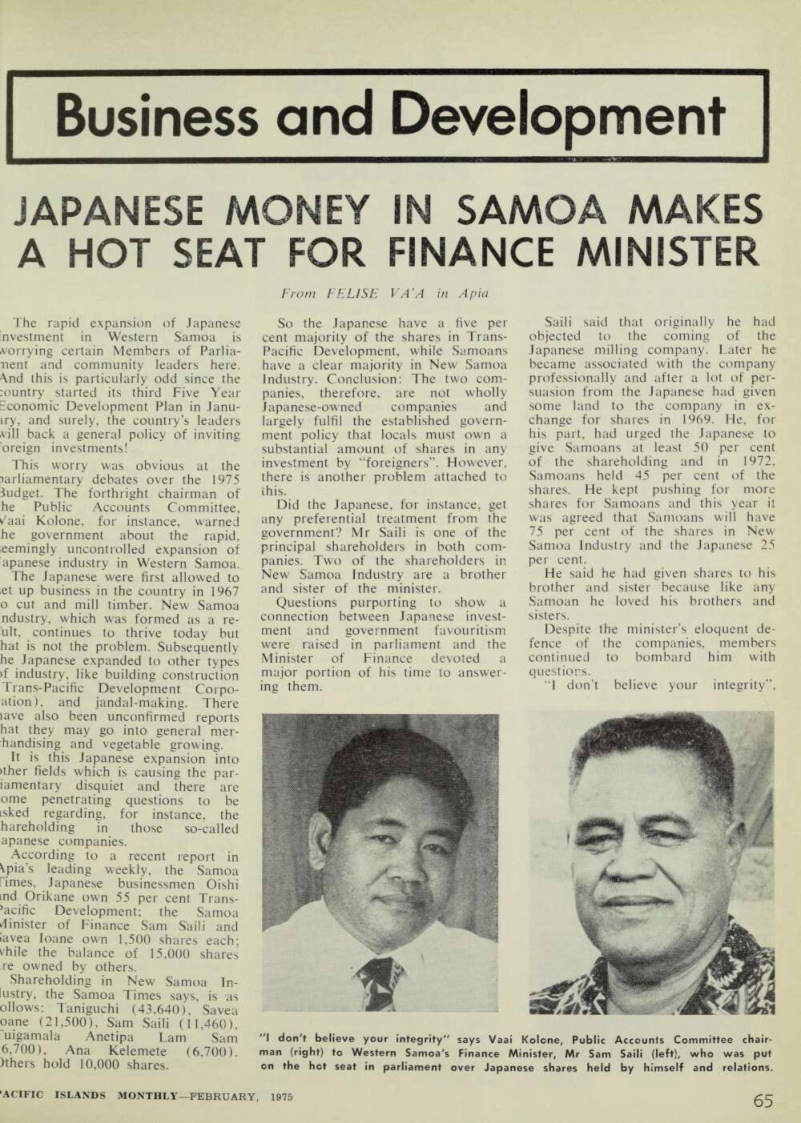
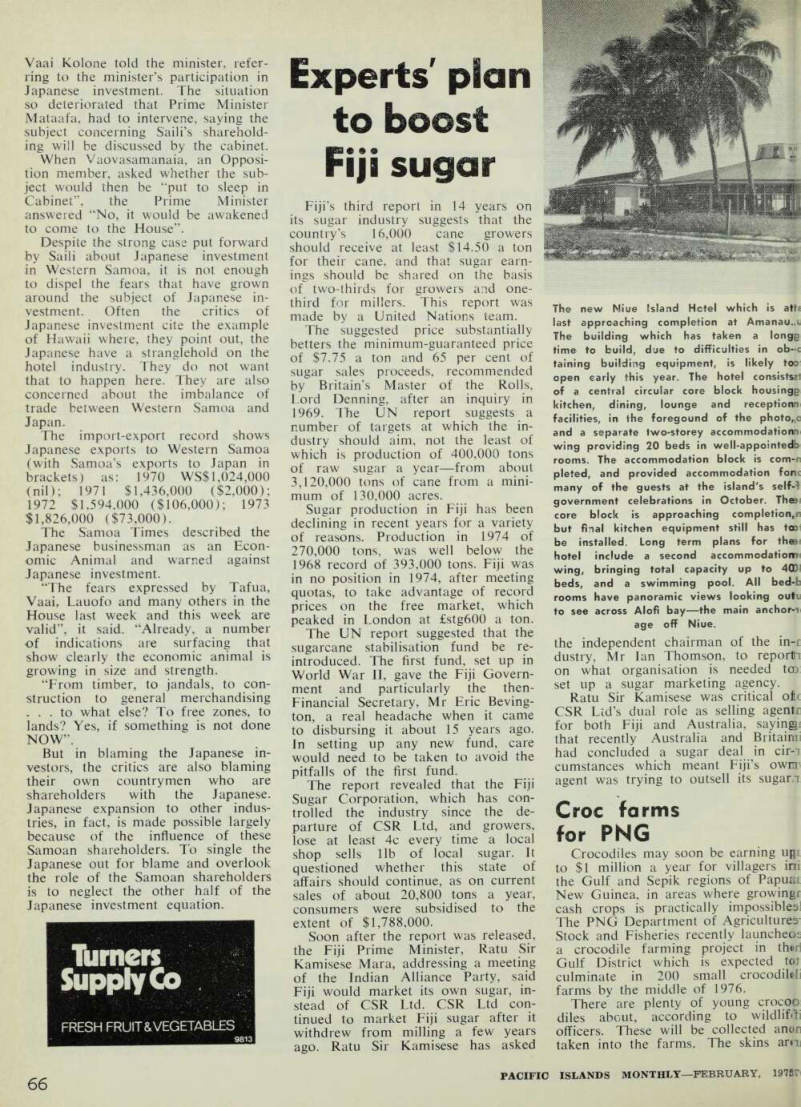
Japanese Money In Samoa Makes
A Hot Seat For Finance Minister
From FELISE VA’A in Apia
The rapid expansion of Japanese investment in Western Samoa is worrying certain Members of Parlia nent and community leaders here. -\nd this is particularly odd since the :ountry started its third Five Year Economic Development Plan in Janu iry, and surely, the country’s leaders will back a general policy of inviting oreign investments!
This worry was obvious at the ?arliamentary debates over the 1975 Budget. The forthright chairman of he Public Accounts Committee, /aai Kolone, for instance, warned he government about the rapid, eemingly uncontrolled expansion of apanese industry in Western Samoa.
The Japanese were first allowed to et up business in the country in 1967 o cut and mill timber. New Samoa ndustry, which was formed as a re ult, continues to thrive today but hat is not the problem. Subsequently he Japanese expanded to other types )f industry, like building construction Trans-Pacific Development Corpo ation), and jandal-making. There lave also been unconfirmed reports hat they may go into general mer handising and vegetable growing.
It is this Japanese expansion into »ther fields which is causing the par iamentary disquiet and there are ome penetrating questions to be isked regarding, for instance, the hareholding in those so-called apanese companies.
According to a recent report in Apia’s leading weekly, the Samoa fimes, Japanese businessmen Oishi ind Orikane own 55 per cent Trans ’acific Development; the Samoa Minister of Finance Sam Saili and iavea loane own 1,500 shares each; vhile the balance of 15,000 shares re owned by others.
Shareholding in New Samoa In iustry, the Samoa Times says, is as ollows: Taniguchi (43,640), Savea pane (21,500), Sam Saili (11,460), uigamala Anetipa Lam Sam 6,700), Ana Kelemete (6,700). )thers hold 10,000 shares.
So the Japanese have a five per cent majority of the shares in Trans pacific Development, while Samoans have a clear majority in New Samoa Industry. Conclusion; The two com panies, therefore, are not wholly Japanese-owned companies and largely fulfil the established govern ment policy that locals must own a substantial amount of shares in any investment by “foreigners”. However, there is another problem attached to this.
Did the Japanese, for instance, get any preferential treatment from the government? Mr Saili is one of the principal shareholders in both com panies. Two of the shareholders in New Samoa Industry are a brother and sister of the minister.
Questions purporting to show a connection between Japanese invest ment and government favouritism were raised in parliament and the Minister of Finance devoted a major portion of his time to answer
ing them.
Saili said that originally he had objected to the coming of the Japanese milling company. Later he became associated with the company professionally and after a lot of per suasion from the Japanese had given some land to the company in ex change for shares in 1969. He, for his part, had urged the Japanese to give Samoans at least 50 per cent of the shareholding and in 1972, Samoans held 45 per cent of the shares. He kept pushing for more shares for Samoans and this year it was agreed that Samoans will have 75 per cent of the shares in New Samoa Industry and the Japanese 25 per cent.
He said he had given shares to his brother and sister because like any Samoan he loved his brothers and sisters.
Despite the minister’s eloquent de fence of the companies, members continued to bombard him with questions.
“I don’t believe your integrity”,
"I don't believe your integrity" says Vaai Kolcne, Public Accounts Committee chair man (right) to Western Samoa's Finance Minister, Mr Sam Saili (left), who was put on the hot seat in parliament over Japanese shares held by himself and relations.
Vaai Kolone told the minister, refer ring to the minister’s participation in Japanese investment. The situation so deteriorated that Prime Minister Mataafa, had to intervene, saying the subject concerning Saili’s sharehold ing will be discussed by the cabinet.
When Vaovasamanaia, an Opposi tion member, asked whether the sub ject would then be “put to sleep in Cabinet”, the Prime Minister answered “No, it would be awakened to come to the House”.
Despite the strong case put forward by Saili about Japanese investment in Western Samoa, it is not enough to dispel the fears that have grown around the subject of Japanese in vestment. Often the critics of Japanese investment cite the example of Hawaii where, they point out, the Japanese have a stranglehold on the hotel industry. They do not want that to happen here. They are also concerned about the imbalance of trade between Western Samoa and Japan.
The import-export record shows Japanese exports to Western Samoa (with Samoa’s exports to Japan in brackets) as: 1970 WS$ 1,024,000 (nil); 1971 $1,436,000 ($2,000); 1972 $1,594,000 ($106,000); 1973 $1,826,000 ($73,000).
The Samoa Times described the Japanese businessman as an Econ omic Animal and warned against Japanese investment.
“The fears expressed by Tafua, Vaai, Lauofo and many others in the House last week and this week are valid”, it said. “Already, a number of indications are surfacing that show clearly the economic animal is growing in size and strength.
“From timber, to jandals, to con struction to general merchandising , . . to what else? To free zones, to lands? Yes, if something is not done
Now”.
But in blaming the Japanese in vestors, the critics are also blaming their own countrymen who are shareholders with the Japanese.
Japanese expansion to other indus tries, in fact, is made possible largely because of the influence of these Samoan shareholders. To single the Japanese out for blame and overlook the role of the Samoan shareholders is to neglect the other half of the Japanese investment equation.
Advertisements & other items, p. 79 (1 item)
65
ACIFIC ISLANDS MONTHLY—FEBRUARY, 1975
Experts' plan
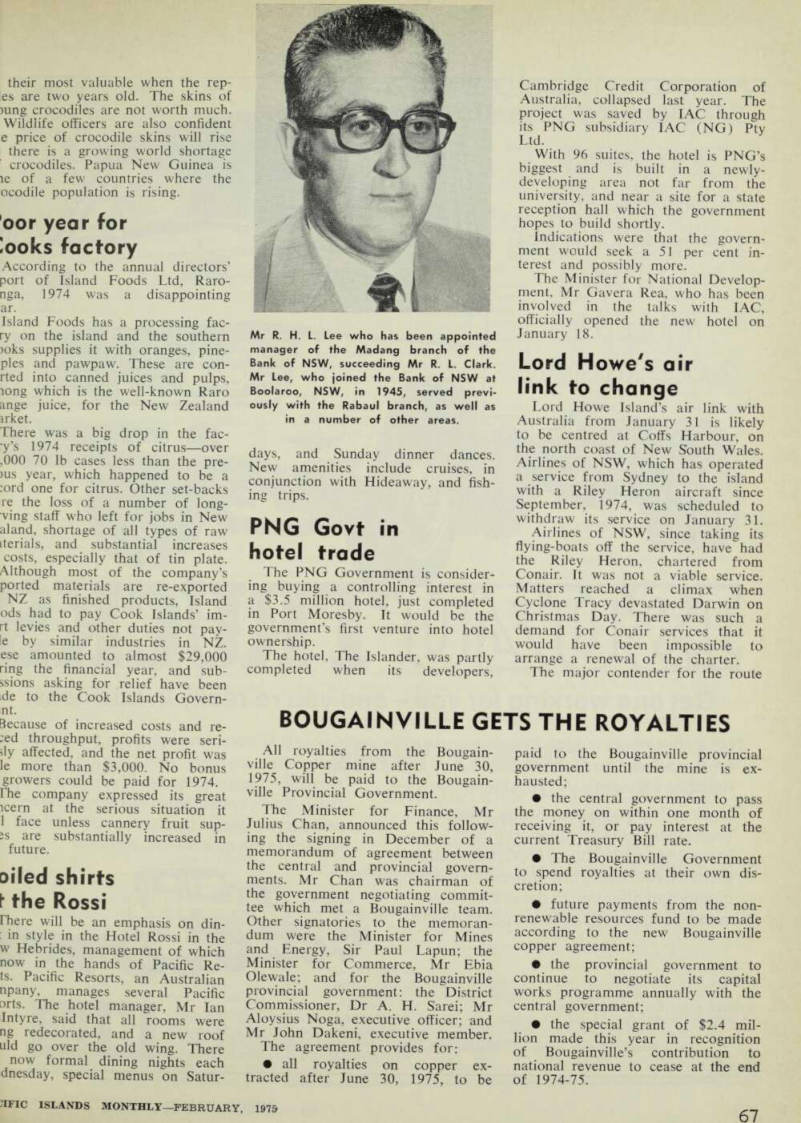

to boost Fiji sugar
Fiji’s third report in 14 years on its sugar industry suggests that the country’s 16,000 cane growers should receive at least $14.50 a ton for their cane, and that sugar earn ings should be shared on the basis of two-thirds for growers and one third for millers. This report was made by a United Nations team.
The suggested price substantially
betters the minimum-guaranteed price of $7.75 a ton and 65 per cent of sugar sales proceeds, recommended by Britain’s Master of the Rolls, Lord Denning, after an inquiry in 1969. The UN report suggests a number of targets at which the in dustry should aim, not the least of which is production of 400,000 tons of raw sugar a year—from about 3.120.000 tons of cane from a mini mum of 130,000 acres.
Sugar production in Fiji has been declining in recent years for a variety of reasons. Production in 1974 of 270.000 tons, was well below the 1968 record of 393,000 tons. Fiji was in no position in 1974, after meeting quotas, to take advantage of record prices on the free market, which peaked in London at £stg6oo a ton.
The UN report suggested that the sugarcane stabilisation fund be re introduced. The first fund, set up in World War 11, gave the Fiji Govern ment and particularly the then- Financial Secretary, Mr Eric Beving ton, a real headache when it came to disbursing it about 15 years ago.
In setting up any new fund, care would need to be taken to avoid the pitfalls of the first fund.
The report revealed that the Fiji Sugar Corporation, which has con trolled the industry since the de parture of CSR Ltd, and growers, lose at least 4c every time a local shop sells lib of local sugar. It questioned whether this state of affairs should continue, as on current sales of about 20,800 tons a year, consumers were subsidised to the extent of $1,788,000.
Soon after the report was released, the Fiji Prime Minister, Ratu Sir Kamisese Mara, addressing a meeting of the Indian Alliance Party, said Fiji would market its own sugar, in stead of CSR Ltd. CSR Ltd con tinued to market Fiji sugar after it withdrew from milling a few years ago. Ratu Sir Kamisese has asked
the independent chairman of the in-r dustry, Mr lan Thomson, to report! on what organisation is needed too; set up a sugar marketing agency.
Ratu Sir Kamisese was critical ofk CSR Ltd’s dual role as selling agentr for both Fiji and Australia, saying) that recently Australia and Britaimi had concluded a sugar deal in cir-i cumstances which meant Fiji’s ownr agent was trying to outsell its sugar.!
Croc farms
for PNG
Crocodiles may soon be earning upi to $1 million a year for villagers ini the Gulf and Sepik regions of Papusr New Guinea, in areas where growingr cash crops is practically impossibles!
The PNG Department of Agricultures* Stock and Fisheries recently launcheos a crocodile farming project in therl Gulf District which is expected tot culminate in 200 small crocodileli farms by the middle of 1976.
There are plenty of young crocoo. diles about, according to wildlifdi officers. These will be collected anon taken into the farms. The skins arnj
The new Niue island Hotel which is at last approaching completion at Amanau.
The building which has taken a long time to build, due to difficulties in ob taining building equipment, is likely to open early this year. The hotel consists of a central circular core block housing kitchen, dining, lounge and reception facilities, in the foregound of the photo, and a separate two-storey accommodation wing providing 20 beds in well-appointed rooms. The accommodation block is com pleted, and provided accommodation for many of the guests at the island's self government celebrations in October. The core block is approaching but final kitchen equipment still has to be installed. Long term plans for the hotel include a second accommodation wing, bringing total capacity up to 40 beds, and a swimming pool. All bed rooms have panoramic views looking out to see across Alofi bay—the main anchor age off Niue.
their most valuable when the rep es are two years old. The skins of )ung crocodiles are not worth much.
Wildlife officers are also confident e price of crocodile skins will rise there is a growing world shortage crocodiles. Papua New Guinea is le of a few countries where the ocodile population is rising.
oor year for
looks factory
According to the annual directors’ port of Island Foods Ltd, Raro nga, 1974 was a disappointing ar.
Island Foods has a processing fae ry on the island and the southern >oks supplies it with oranges, pine pies and pawpaw. These are con rted into canned juices and pulps, long which is the well-known Raro ange juice, for the New Zealand irket.
There was a big drop in the fac e’s 1974 receipts of citrus—over ,000 70 lb cases less than the pre ms year, which happened to be a :ord one for citrus. Other set-backs re the loss of a number of long ving staff who left for jobs in New aland, shortage of all types of raw iterials, and substantial increases costs, especially that of tin plate.
Although most of the company’s ported materials are re-exported NZ as finished products, Island ods had to pay Cook Islands’ im rt levies and other duties not pay le by similar industries in NZ. ese amounted to almost $29,000 ring the financial year, and sub ssions asking for relief have been de to the Cook Islands Govern nt.
Because of increased costs and re ;ed throughput, profits were seri »ly affected, and the net profit was le more than $3,000. No bonus growers could be paid for 1974.
Hie company expressed its great icern at the serious situation it I face unless cannery fruit sup ;s are substantially increased in future.
oiled shirts
I I the Rossi
Fhere will be an emphasis on din in style in the Hotel Rossi in the w Hebrides, management of which now in the hands of Pacific Re ts. Pacific Resorts, an Australian npany, manages several Pacific □rts. The hotel manager, Mr lan Intyre, said that all rooms were ng redecorated, and a new roof uld go over the old wing. There now formal dining nights each dnesday, special menus on Satur-
days, and Sunday dinner dances.
New amenities include cruises, in conjunction with Hideaway, and fish ing trips.
PNG Govt in
hotel trade
The PNG Government is consider ing buying a controlling interest in a $3.5 million hotel, just completed in Port Moresby. It would be the government’s first venture into hotel ownership.
The hotel. The Islander, was partly completed when its developers,
Cambridge Credit Corporation of Australia, collapsed last year. The project was saved by lAC through its PNG subsidiary lAC (NG) Pty Ltd.
With 96 suites, the hotel is PNG’s biggest and is built in a newly developing area not far from the university, and near a site for a state reception hall which the government hopes to build shortly.
Indications were that the govern ment would seek a 51 per cent in terest and possibly more.
The Minister for National Develop ment, Mr Gavera Rea, who has been involved in the talks with lAC, officially opened the new hotel on January 18.
Lord Howe's air
link to change
Lord Howe Island’s air link with Australia from January 31 is likely to be centred at Coffs Harbour, on the north coast of New South Wales.
Airlines of NSW, which has operated a service from Sydney to the island with a Riley Heron aircraft since September, 1974, was scheduled to withdraw its service on January 31.
Airlines of NSW, since taking its flying-boats off the service, have had the Riley Heron, chartered from Conair. It was not a viable service.
Matters reached a climax when Cyclone Tracy devastated Darwin on Christmas Day. There was such a demand for Conair services that it would have been impossible to arrange a renewal of the charter.
The major contender for the route
Bougainville Gets The Royalties
All royalties from the Bougain ville Copper mine after June 30, 1975, will be paid to the Bougain ville Provincial Government.
The Minister for Finance, Mr Julius Chan, announced this follow ing the signing in December of a memorandum of agreement between the central and provincial govern ments. Mr Chan was chairman of the government negotiating commit tee which met a Bougainville team.
Other signatories to the memoran dum were the Minister for Mines and Energy, Sir Paul Lapun; the Minister for Commerce, Mr Ebia Olewale; and for the Bougainville provincial government: the District Commissioner, Dr A. H. Sarei; Mr Aloysius Noga, executive officer; and Mr John Dakeni, executive member.
The agreement provides for: • all royalties on copper ex tracted after June 30, 1975, to be
paid to the Bougainville provincial government until the mine is ex hausted; • the central government to pass the money on within one month of receiving it, or pay interest at the current Treasury Bill rate. , The Bougainville Government to spend royalties at their own dis cretion- ’ • fature Payments from the non renewable resources fund to be made according to the new Bougainville copper agreement; • the provincial government to continue to negotiate its capital works programme annually with the central government; * the special grant of $2.4 mil fion ma( j e this year in recognition 0 f Bougainville’s contribution to national revenue to cease at the end of 1974-75.
Mr R. H. L. Lee who has been appointed manager of the Madang branch of the Bank of NSW, succeeding Mr R. L. Clark.
Mr Lee, who joined the Bank of NSW at Boolaroo, NSW, in 1945, served previ ously with the Rabaul branch, as well as in a number of other areas.
licence from January 31 on was North Coast Airlines, based at Coffs Harbour. This airline, along with a number of others, sought the route when the flying-boats were about to be taken off. Now, it is the only air line operating a commuter service, which can meet all requirements for the service. It has aircraft, crews and experience on a Coffs Harbour-Lord Howe Island charter service.
North Coast Airlines seems cer tain to get the licence, at least on a temporary basis to provide an essen tial link between the island and the mainland, pending any further appli cations for the route coming in and being processed. Allocation of the licence is a joint matter, between the Federal Department of Transport (air transport group) and the NSW Department of Motor Transport.
North Coast Airlines will use Piper Navajo Chieftain aircraft, which can carry nine passengers. It is prepared to operate a daily ser vice.
Tonga's example
to the world
Tonga may be showing the rest of the world how to control inflation.
In the December quarter the cost of living index rose by only 1.7 per cent, compared with 3.1 per cent the previous quarter. The good result stemmed largely from the decision not to devalue the pa’anga when New Zealand and Australia devalued their currencies. This made imported food, most of which is from Aust ralia and New Zealand, slightly cheaper. Higher prices for locally produced food were the main cause of the slight rise in the index.
Fiji's champion
golf course
Fiji’s new golf course at Deuba, on the south coast of Viti Levu will be the venue for an international tournament, the Pacific Harbour Open, on August 7, 8 and 9. The course was officially opened recently by the Fiji Prime Minister, Ratu Sir Kamisese Mara, who is something of a golf enthusiast. The course is a fraction less than 7,000 yards from the championship tees, and the par is 72.
The course is part of the Pacific Harbour resort, which is about 35 miles west of Suva. The course was created from about half a million tons of sand dredged from surround ing lakes and waterways. It is fully sprinklered, irrigated and drained.
The tournament professional is 26year-old Peter Oosterhuis, who has made his name in world circles.
Advertisements & other items, pp. 80-82 (3 items)
Supply Co
Turners Supply Co
FRESH FRUIT & VEGETABLES
9813
67
/IFIC ISLANDS MONTHLY—FEBRUARY, 1975
Rucks
Japan’s
top sellers
backed by
General Motors!
p--.rrw 2083
From
xa
right
to up 000 kg
GVW
21
RUCKS
Get one working for you - and you’re really in business.
No matter what your job there’s an Isuzu ready and waiting to do it for you.
Reliably. Efficiently. And profitably.
Light delivery vehicles. Buses. Tippers.
Twin steers. Fteavy transport trucks.
From 2,083 to 21,000 kg GVW. Isuzu makes them all. And every one shares the same high quality and attention to detail that have made Isuzu the top selling truck in Japan.
General Motors, who know the truck businesss better than anybody, stand behind every Isuzu. And your investment is protected by Isuzu/GM’s unbeatable warranty. Spares and service are available throughout the islands to the dealers listed below.
A 976 FIJI ISLANDS: Burns Philp (South Sea) Co.
TONGA: Burns Philp (South Sea) Co.
PORTUGUESE TIMOR: Sociedade Agricola Patria E Trabalho WESTERN SAMOA: O. F. Nelson & Co. Ltd.
Png To Close Lucrative Loophole
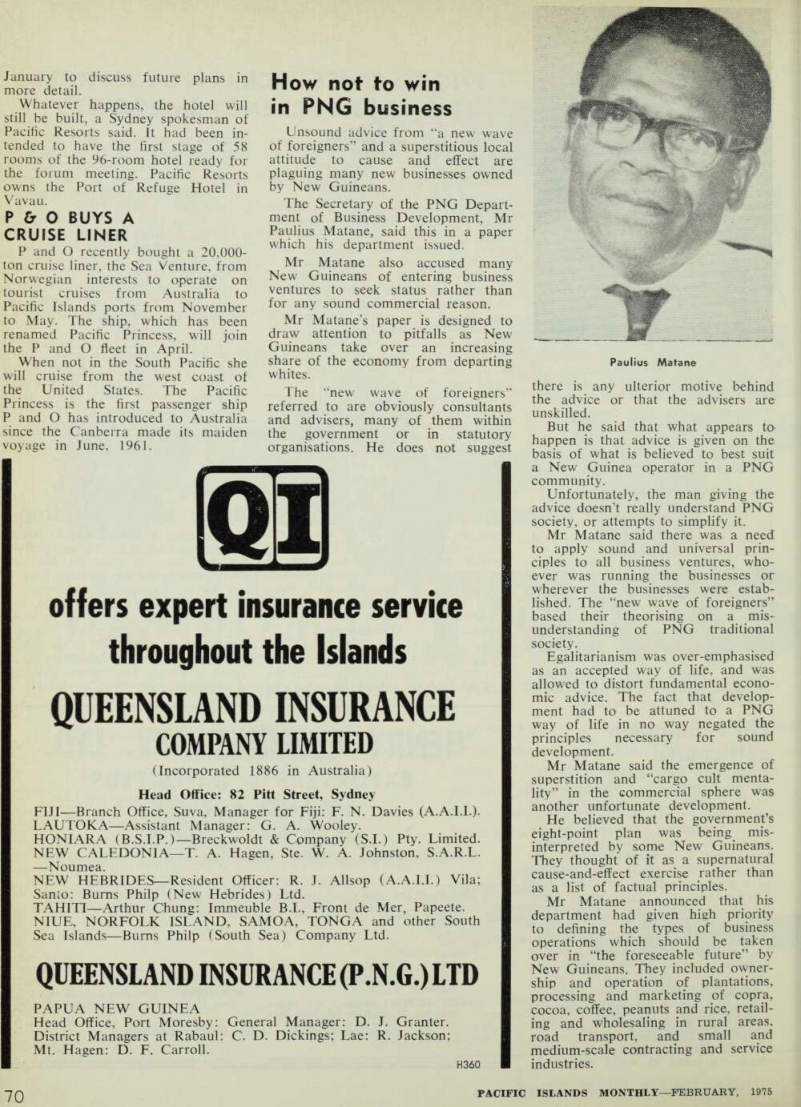
Against Currency Smugglers
Papua New Guinea, which uses Australian currency, is to close a loophole which for many years has allowed travellers to break Australian currency exchange regulations.
The situation could have allowed large sums of Australian currency to leak overseas illegally. The full extent to which the loophole may have been exploited is not known.
However, the PNG Finance Minister, Mr Julius Chan, confirmed in Port Moresby in December that it was known the Australian controls had been broken in PNG. The loophole has been caused by the fact that there have been no currency exchange or control restrictions between Australia and PNG.
This allowed large sums of money to be carried from Australia to PNG without question. But, at the same time. PNG has not made a practice of checking the amount of currency taken from its own ports to destina tions in Australia or anywhere else in the world.
This has allowed an effective, unchecked flow of money out of Australia to other parts of the world when it is staged through PNG, or is carried by Australian residents of
Png.
Questions on the situation were asked in the PNG Parliament early in December by the Member for Wewak, Mr T. O’Shannessy.
Mr Chan confirmed that the regulations had been broken and said that PNG would naturally watch the situation closely where its own cur-
rency was concerned after the cur rency change-over in 13 months time, Meanwhile an immediate scrutiny would be introduced of the amount of Australian currency being carried by travellers leaving PNG.
Mr Chan said travellers would be asked by customs officials to disclose how much currency they were carry ing. This question had not been asked in the past.
Under Australian currency regula tions, SIOO in cash and $4,000 in travellers cheques can be carried by departing passengers, This limit would now be applied j n PNG on Australia’s behalf while Australian currency continued to be in PNG. An equivalent limit would be applied when PNG began using its own currency, The legality of the controls had already been established in PNG banking legislation passed last year, • • , i
KlSllig COStS SJOW
k.iiNlnn uOWn nOtel DllllClSng The resort hotel at Ha’atafu Beach, on the west coast of Tongatapu, will not be ready in time for the next South Pacific Forum in July. Escalat ing costs have caught up with the owners, Pacific Resorts Pty Ltd, who are now having a close look at build ing the hotel progressively. Another plan to help meet costs is to charter a ship to take all materials for the hotel to Tonga. The owners will have a meeting with the architects in
January to discuss future plans in more detail.
Whatever happens, the hotel will still be built, a Sydney spokesman of Pacific Resorts said. It had been in tended to have the first stage of 58 rooms of the 96-room hotel ready for the forum meeting. Pacific Resorts owns the Port of Refuge Hotel in Vavau,
P & O Buys A
Cruise Liner
P and O recently bought a 20,000ton cruise liner, the Sea Venture, from Norwegian interests to operate on tourist cruises from Australia to Pacific Islands ports from November to May. The ship, which has been renamed Pacific Princess, will join the P and O fleet in April.
When not in the South Pacific she will cruise from the west coast of the United States. The Pacific Princess is the first passenger ship P and O has introduced to Australia since the Canberra made its maiden voyage in June, 1961.
How not to win
in PNG business
Unsound advice from “a new wave of foreigners” and a superstitious local attitude to cause and effect are plaguing many new businesses owned by New Guineans.
The Secretary of the PNG Depart ment of Business Development, Mr Paulius Matane, said this in a paper which his department issued.
Mr Matane also accused many New Guineans of entering business ventures to seek status rather than for any sound commercial reason.
Mr Matane’s paper is designed to draw attention to pitfalls as New Guineans take over an increasing share of the economy from departing whites.
The “new wave of foreigners” referred to are obviously consultants and advisers, many of them within the government or in statutory organisations. He does not suggest
there is any ulterior motive behind the advice or that the advisers are unskilled.
But he said that what appears to happen is that advice is given on the basis of what is believed to best suit a New Guinea operator in a PNG community.
Unfortunately, the man giving the advice doesn’t really understand PNG society, or attempts to simplify it, Mr Matane said there was a need to apply sound and universal prin ciples to all business ventures, who ever was running the businesses or wherever the businesses were estab lished. The “new wave of foreigners” based their theorising on a mis understanding of PNG traditional society.
Egalitarianism was over-emphasised as an accepted way of life, and was allowed to distort fundamental econo mic advice. The fact that develop ment had to be attuned to a PNG way of life in no way negated the principles necessary for sound development.
Mr Matane said the emergence of superstition and “cargo cult menta lity” in the commercial sphere was another unfortunate development.
He believed that the government’s eight-point plan was being_ mis interpreted by some New Guineans.
They thought of it as a supernatural cause-and-effect exercise rather than as a list of factual principles.
Mr Matane announced that his department had given high priority to defining the types of business operations which should be taken over in “the foreseeable future” by New Guineans. They included owner ship and operation of plantations, processing and marketing of copra, cocoa, coffee, peanuts and rice, retail ing and wholesaling in rural areas, road transport, and small and medium-scale contracting and service industries.
Paulius Matane
Advertisements & other items, pp. 83-84 (1 item)
Henry Cumines Pty. Ltd.
EXPORTERS • IMPORTERS
ISLAND AGENTS
428 GEORGE ST, SYDNEY
CABLES: HENCO SYDNEY. G.P.O. Box 3949. PHONE: 25-3383.
For specialised and personalised buying service throughout the Pacific Islands and the East.
Represented in; PAPUA: Agencies Pacific Pty Ltd, Box 5044, P. 0.. Boroko, Port Moresby.
Telephone 55261.
NEW GUINEA: Madang, W. Double, P.O. Box 22, Madang. Telephone 2696.
FIJI: K. Witherington Ltd, P.O. 293, Suva. Telephone 22-356.
NEW HEBRIDES: John Lum & Associates, Box 65, P. 0., Santo. Telephone 329.
Resident Agents in other Pacific Territories.
offers expert insurance service
throughout the Islands
QUEENSLAND INSURANCE
COMPANY LIMITED
(Incorporated 1886 in Australia) Head Office: 82 Pitt Street, Sydney FlJl—Branch Office, Suva, Manager for Fiji: F. N. Davies (A.A.1.1.).
LAUTOKA—Assistant Manager: G. A. Wooley.
HONIARA (8.5.1. P.) —Breckwoldt & Company (5.1.) Pty. Limited.
NEW CALEDONIA—T. A. Hagen, Ste. W. A. Johnston, S.A.R.L. —Noumea.
NEW HEBRlDES—Resident Officer: R. J. Allsop (A.A.1.1.) Vila; Santo: Burns Philp (New Hebrides) Ltd.
TAHlTl—Arthur Chung: Immeuble 8.1., Front de Mer, Papeete.
NIUE, NORFOLK ISLAND, SAMOA, TONGA and other South Sea Islands—Bums Philp (South Sea) Company Ltd.
QUEENSLAND INSURANCE (P.N.G.) LTD
PAPUA NEW GUINEA
Head Office, Port Moresby: General Manager: D. J. Granter.
District Managers at Rabaul: C. D. Dickings; Lae: R. Jackson; Mt. Hagen: D. F. Carroll.
H 360
Irian Jaya
Congratulations to you and your contributor for the long overdue critical review of developments in Irian Jaya (PIM, Jan, p 25).
I can assure your contributor that there is a growing number of people in Papua New Guinea, both nationals and foreigners like myself, who share the concern and many of the views expressed in the article. There is no doubt in my mind that the colonial policies which Indonesia is practis ing in Irian Jaya rate among the most harsh which the Pacific Islands region has witnessed.
May I also add that, although PlM’s main interest lies with the central Pacific Islands, there seems to me to be some need for PIM to give attention to the Pacific Islands periphery. I would include here not only Irian Jaya, but those other colonial outposts such as Easter Is, Galapagos Is, the Bonin Is and some in the north-west Pacific. Similarly the role of Pacific- Islanders in New Zealand and Australia deserves scru tiny—and some, I know, has been given.
The Editor's Mailbag

Incidentally, for the record, Dr Roosman, who wrote the earlier article on Irian Jaya criticised by your latest contributor, is not a poli tical scientist. He is a linguist, specialising in Bahasa Indonesia, who is attached for the time being to the Department of Political Studies at the University of Papua New Guinea. He is, of course, an Indonesian.
Paul Grocott.
(Lecturer in Political Studies, University of Papua New Guinea).
A Condominium
Complaint
It was interesting to read in PIM (Dec, p 23) the comments of Mr D. H. Curtis on the article A Con dominium complaint.
One can agree to a certain extent with his view that there is a lack of adequate training opportunities for New Hebrideans, so that the number of men with technical skills and know-how is insufficient for the needs of the country. However, what the writer of the original article meant, I think, was that the Joint Regu lation covering immigration is not being enforced strictly enough, so that, in effect, foreigners, often with no better qualifications than many New Hebrideans, are being given employment. Since French and Brit ish immigration officers work under separate rulings in any case, it often transpires that the immigration policy does not cater for the welfare of the local inhabitants.
Asa member of the National Party I welcome the praise given for its constructive criticism of govern
letters
ment policies and a recent notable achievement is the recent Joint Regu lation allowing appeals from Native Courts to the Joint Court, not to mention the construction of a foot path on the Tagabe road as a mea sure towards road safety, which was the direct result of a National Party demonstration.
I am afraid that as a New Heb ridean I cannot endorse the views of Mr Curtis that other political parties are solely concerned with the wel fare of the New Hebrides. The coalition of UCNH, MANH and Nagriamel was made mainly to com bat the rising influence of the National Party. Members of this coalition include French plantation owners who must have different views from true Na Griamel followers and it is doubtful whether they would be happy bedfellows for long.
Na Griamel in any case is alive only in name since many of its mem bers have deserted their leader Jimmy Stevens. Like a shepherd without his sheep, Jimmy is being used as a puppet of the French government in
an attempt to popularise its policies.
Mr Curtis is a relative newcomer to the New Hebrides and while he is a man of obvious goodwill he has not given himself enough time to study the real set-up in the New Hebrides, especially outside Vila.
Hope the new year will bring him fresher thinking.
Vila Correspondent.
(Name and address supplied).
Beautify The Islands
I lately took a pleasure trip to Polynesia, and I think it is perhaps worthwhile stating my opinion that the matchless scenic beauty of some of the South Pacific islands is about to be spoiled by the disgusting sight of empty bottles and cans washed up by the tide, piled up in the streams or scattered at random in the bush.
While 1 admit that such tiny islands as Bora Bora and Huahine cannot boast a waste disposal unit of their own, I wonder why the ac cumulated refuse is not collected at regular intervals so as to keep the islands clean and attractive.
In other respects, I was also most
disappointed with Polynesia.
When compared with the Carib bean Islands, the South Pacific Islands are mostly lacking in colour
ful flowers. And yet, lots ol orna mental trees and shrubs have been planted of late years, in particular around the new hotels, but they are mercilessly stripped of all their flowers for the benefit of some tour ists, who seem to be at a loss to enjoy their holidays unless they are bedecked at every turn with innumer able wreaths and crowns of flowers.
For my part, I like to see flowers at their best, that is to say in their natural environment. As a keen gardener, I have an idea that a wide range of flowering trees and shrubs could be grown to perfection in the South Pacific Islands.
As far as I know, satisfactory re sults have already been obtained by the School of Tropical Agriculture in Moorea where selected ornamental plants are being grown on trial in the famed Opunohu Valley.
In Rarotonga, a scheme for the beautification of the island is in pro gress and some outstanding varieties of Cassia and Tabebuia (shower and trumpet trees) have been success fully introduced into the Cook Islands.
On several occasions, recommend ations were made that a small part of the mountainous interior of Rarotonga should be set aside as a botanical and scenic reserve. It is
now up to the local authorities to take a sensible decision.
Anyhow, in all probability, the forthcoming South Pacific Confer ence on National Parks and Reserves to be held under the competent leadership of New Zealand, will bring up the subject again and mark an epoch in the preservation of Nature in the whole South Pacific area.
Robert Rousseau.
35 rue Henri Barbusse F 75005 Paris France
Guise, The Trader
Your December issue (p 63) had a review of a book in which the grandfather of Dr John Guise was referred to as a “trader”.
I don’t feel that is really a lower ing of anyone’s status. I have known many “island traders” over the years in the Pacific, most of whom are not bad sorts at all. In fact some, often referred to in times past as “noted Islands traders” have got knight hoods. It is all a matter of degree perhaps.
In the case of John Guise, his grandfather was more than just a trader and I have the testimony of that great solid old figure, who cer tainly fitted the Pacific Islands stage, Bishop Newton, who had no time for romantics and knew only the truth.
On my arrival in Samarai in June, 1934, he was very anxious for me to meet Andrew Guise, John’s father, who served on the mission’s yacht, the Maclaren King. Andrew and I became good friends.
The bishop told me that he had been approached some years before by de Guise, who apparently pro duced proof of his identity and who wanted to be married to his New Guinea partner. (Both the Bourbons and the de Guises were Pretenders to the Throne of France, the balance at this stage with the de Guises.) The bishop, knowing the compli cations of marriage alliances in royal circles, did his best to dissuade him, but he was adamant and Bishop Newton took a perfectly legal service.
Some time later, what the bishop had feared came about. De Guise returned to France and, under pressure, the marriage was dissolved by the Pope, probably on the grounds that it had not been performed by a Roman Catholic priest. I had a feeling that de Guise succeeded to the title, Due de Guise.
The late Bishop Newton was priest-in-charge of Taupoto at the time. When I revisited Papua and had an hour or so at Taupoto in 1957 as we came down the coast, a cutter awaited me with a poignant
little note from John’s father, whom I had not seen for 18 years, regretting his state of health was preventing him from renewing our old associa tions. He was a gentleman and, now departed, had done his best for his family.
The Ven C. W. Whonsbon
Aston.
Castle Hill, NSW.
Hey Yachties!
There is very little available in formation about Niue Island and most of the information yachtsmen have access to concerning Niue is hopelessly out of date. As you know the Niue Government has recently embarked on a programme of pub licity to attract tourists. We would certainly welcome more yachtsmen —in the past they have been our only “bona fide” tourists.
Representatives of Niue Island Bluewater Yacht Club have been trying to improve facilities for yachtsmen and to this end have had a Tee shirt made, on which is printed the name of every yacht which called at Niue in 1974. The shirts are avail able for SNZS each. Since the pro ceeds are for such a worthy cause as yachts and yachting we would appre ciate a little “on the side” free ad vertising.
If readers of PIM wish for further information they should let me know.
Peter Ell.
Nibwyc
PO Box 55, Niue. • Pacific Publications’ Pacific Islands Year Book contains four full pages on Niue Island, its history, geography, demography, government, law and order, land use and develop ment, finances, communications, edu cation, housing, religion; in fact everything about the island with the exception of very recent happenings such as the attaining of self-govern ment (October 19, 1974) and the new hotel, which opened its doors in October, before completion, to house guests attending the self-government celebrations. The Year Book retails at $A9.50 plus postage. — Editor. ® A-PNG Cable is the rather un imaginative name for the new tele communications cable which will run between the Overseas Telecommuni cations Commission (Australia) station in Cairns and the Boroko ex change. The cable, estimated to cost $8.3 million, is a joint venture be tween the PNG Department of Posts and Telegraphs and OTC (A). The cable will have a 480 two-way channel capacity and will supplement the present SEACOM cable link.
Advertisements & other items, pp. 85-86 (1 item)
How to tell a perfect golf course in
two easy lessons
(1) It has a Harvin Electric Automatic System. (2) And. of course, Harvin golf course equipment.
That's why the Fijian Hotel such a perfect golf course.
But don't take our promise.
Take our pictures.
The Harvin "Rain Bird" watering system can be Automatically operated. That means a sizeable saving in labour costs because the sprinkler system can be timed to operate only at night. The course is therefore available for maximum use.
Harvin also leave their mark on golf courses with their equipment. Such things as flag poles, cups, ballwasher units, tee markers and signs are all available.
Harvin "Rain Bird" Automatic Watering System and Harvin Course Equipment The Perfect partners for any golf course. \ i y % » - - . 565 Wairakei Road, Phone 588-029 3 lines P.O. Box 20-030 Bishopdale Branches at Auckland & Palmerston North, New Zealand.
Harvin Limited Head Office
CHRISTCHURCH
are sole agents for fijuj&'B/pa usa Please write for consultation on your watering problem.
RMS have cut corners
in Fiji for years
But only on their Hexagon showcases.
GONDOLA
China,Crockery etc.
Length V 5 m,Heigthl m,Width 0-75 m RMS never cut corners on Workmanship, quality and delivery.
Don’t cut corners,
call RMS shopfitters today.
Head Office: 89-95 Montreal St Christchurch. P.O. Box 1131, Phone 30-732.
Branches at Auckland, Hamilton, Wellington, Dunedin.
HALF GLASS COUNTER
Length Tsm Height 1m Width 0-5 m 28
Complexion beauty that
will last a lifetime
Every woman can now achieve and hold a smoother and younger complexion thanks to the scientific development of a tropically moist oil blend.
This unique beauty fluid penetrates rapidly and has a remarkable ability to maintain just the right level of oil and moisture in the skin, so helping to prevent the formation of ageing skin and wrinkle dryness. By regularly using this oil of Ulan moist oil blend and following these skin care sug gestions you will enjoy more youthful complexion beauty tomorrow and in the years ahead.
A smoother complexion To help prevent the formation of tiny ageing lines and ensure a soft, lovely skin, smooth Oil of Ulan over the face and neck every morning before applying make-up. This light, non-greasy film provides day long protection and is an excellent base for your cosmetics whilst supplement ing moisture reserves. At night before going to bed gently stroke the moist oil blend into the skin using your fingertips in an upward and outward direction, working up from the chin
line to the temples. Skin soon responds to this beauty treatment and rough flaky patches quickly fade away.
Smooth, pretty lips
Remember your lips. To keep them soft and pretty, smooth on a little Oil of Ulan. This light film will help prevent dry lines, protect against weather and keep your lipstick smooth and attractive.
Beautiful eyes The tissue-thin skin area surrounding your eyes needs the gentlest and tenderest of care. Finger-pat your Oil of Ulan around the eyes before you apply make-up, working from the nose and over the upper eyelid, then down and round the eyes towards the nose again. The special properties of this unique moist oil blend make it invaluable for helping keep wrinkle dryness at bay and protecting the youthful appearance of pretty eyes.
Advertisements & other items, p. 88 (1 item)
Kodak pocket
* f*' *\ /' * ■^ : V m .. m
‘Go-anywheie
camera
NowyouTl get the pictures you used to miss* Camera measures: 4 1 /2" x 2" x 1"
Small enough to slip into your pocket. Light Kodak pocket Instamatic camera outfits each complete with wrist strap, Kodacolor II film, magicube and instructions. There’s one enough to carry anywhere. So simple to usejust drop in the new 110-size film cartridge, aim, and shoot. Yet it takes big V/2" x 4 7 /e" color priced to suit your pocket. See your local pictures. Choose from the range of five new island photo dealer.
KODAK (Australasia) PTY. LTD.
K6l/4
Deaths of Islands People
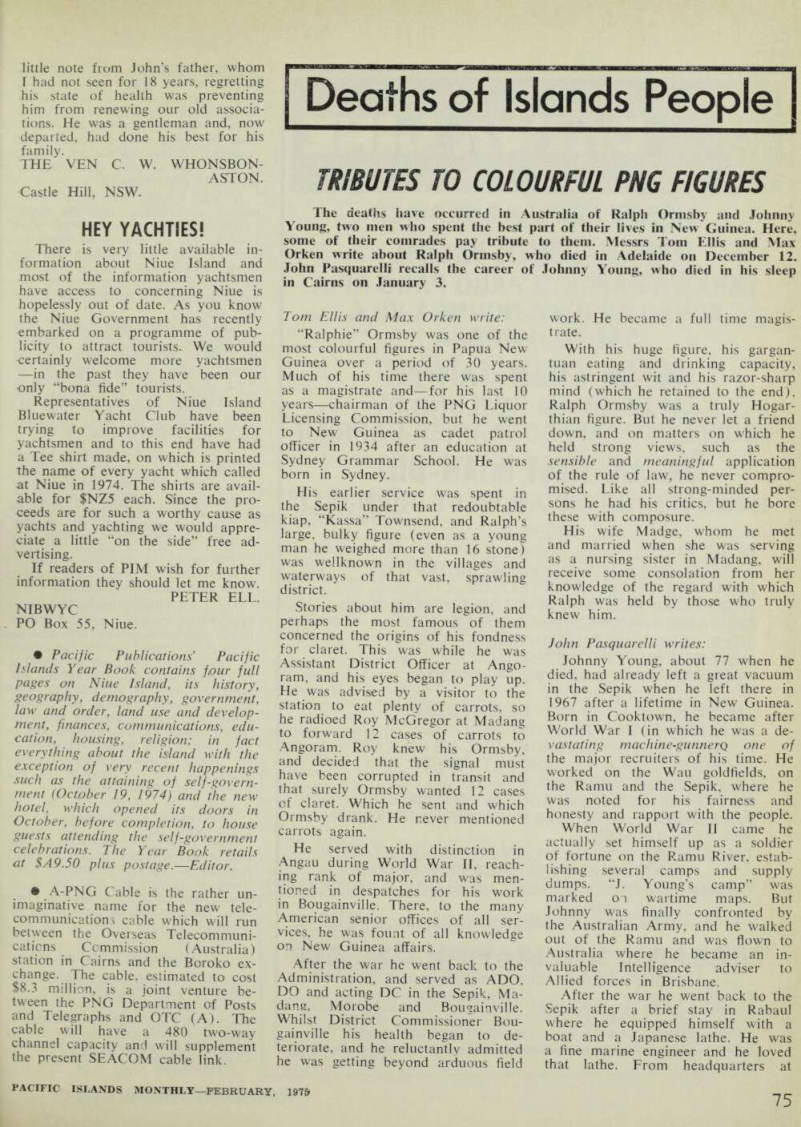
Tributes To Colourful Png Figures
The deaths have occurred in Australia of Ralph Ormsby and Johnny Young, two men who spent the best part of their lives in New Guinea. Here, some of their comrades pay tribute to them. Messrs Tom Ellis and Max Orken write about Ralph Ormsby, who died in Adelaide on December 12.
John Pasquarelli recalls the career of Johnny Young, who died in his sleep in Cairns on January 3.
Tom Ellis and Max Or ken write: “Ralphie” Ormsby was one of the most colourful figures in Papua New Guinea over a period of 30 years.
Much of his time there was spent as a magistrate and—for his last 10 years—chairman of the PNG Liquor Licensing Commission, but he went to New Guinea as cadet patrol officer in 1934 after an education at Sydney Grammar School. He was born in Sydney.
His earlier service was spent in the Sepik under that redoubtable kiap, “Kassa” Townsend, and Ralph’s large, bulky figure (even as a young man he weighed more than 16 stone) was wellknown in the villages and waterways of that vast, sprawling district.
Stories about him are legion, and perhaps the most famous of them concerned the origins of his fondness for claret. This was while he was Assistant District Officer at Ango ram, and his eyes began to play up.
He was advised by a visitor to the station to eat plenty of carrots, so he radioed Roy McGregor at Madang to forward 12 cases of carrots to Angoram. Roy knew his Ormsby, and decided that the signal must have been corrupted in transit and that surely Ormsby wanted 12 cases of claret. Which he sent and which Ormsby drank. He never mentioned carrots again.
He served with distinction in Angau during World War 11, reach ing rank of major, and was men tioned in despatches for his work in Bougainville. There, to the many American senior offices of all ser vices, he was fount of all knowledge on New Guinea affairs.
After the war he went back to the Administration, and served as ADO.
DO and acting DC in the Sepik, Ma dang, Morobe and Bougainville.
Whilst District Commissioner Bou gainville his health began to de teriorate, and he reluctantly admitted he was getting beyond arduous field
work. He became a full time magis trate.
With his huge figure, his gargan tuan eating and drinking capacity, his astringent wit and his razor-sharp mind (which he retained to the end), Ralph Ormsby was a truly Hogar thian figure. But he never let a friend down, and on matters on which he held strong views, such as the sensible and meaningful application of the rule of law, he never compro mised. Like all strong-minded per sons he had his critics, but he bore these with composure.
His wife Madge, whom he met and married when she was serving as a nursing sister in Madang, will receive some consolation from her knowledge of the regard with which Ralph was held by those who truly knew him, John Pasquarelli writes: Johnny Young, about 77 when he died, had already left a great vacuum in the Sepik when he left there in 1967 after a lifetime in New Guinea.
Born in Cooktown, he became after World War I (in which he was a de vastating machine-gunnerQ one of the major recruiters of his time. He worked on the Wau goldfields, on the Ramu and the Sepik, where he was noted for his fairness and honesty and rapport with the people.
When World War II came he actually set himself up as a soldier of fortune on the Ramu River, estab lishing several camps and supply dumps. “J, Young’s camp” was marked on wartime maps. But Johnny was finally confronted by the Australian Army, and he walked out of the Ramu and was flown to Australia where he became an in valuable Intelligence adviser to Allied forces in Brisbane.
After the war he went back to the Sepik after a brief stay in Rabaul where he equipped himself with a boat and a Japanese lathe. He was a fine marine engineer and he loved that lathe. From headquarters at
Angoram he became the chief croc hunter of the area, and played a major part in the croc skin boom, when more than 2,000 outboard motors were in use on the Sepik.
From his most efficient workshop at Angoram he kept the motors turning.
If there were no spare parts, Johnny made the parts himself.
It was Johnny who was instru mental in bringing into the Sepik Dutch skin buyers from West New Guinea, and he saw prices jump by 200 per cent. When Johnny left the Sepik, village after village had un serviceable outboard motors by the score, hanging up, rusting. The boom was over.
Johnny Young’s own shooting skill remained first class, and no crocodile was safe. Witnesses were present when he shot 25 black duck on the wing in consecutive shots, using a .22 repeating rifle, at Timbunke vil lage. Johnny shot them from his moored boat as they flew across the
Sepik River.
There is no doubt that Johnny Young was one of the world’s crack shots, who could have made a good living on the sharpshooting circuit.
But he chose New Guinea, and loved it. He was brother of the equally famous “Flo” Stewart, who still lives in Lae.
Mr Finau Riechelmann Mr Finau Riechelmann, a promi nent Tonga businessman and sports man, died suddenly in Brisbane on January 5, aged 75. After education in Tonga and Auckland he joined a firm established by his father, and remained with it all his life. For many years he operated the launch, Fujave, between Nukualofa and Eua.
In his youth he was a keen sports man. He was a founder-member of the Tonga Horse Racing Club at Matakieua. He is survived by his wife, a son and a daughter.
Sister Mary Albine Sister Mary Albine, one of the longest-serving nuns in Tonga, died recently at Vavau, where she was living in retirement. She arrived in Tonga from France about 60 years ago. She worked in most parts of Tonga.
Miss Irene G. Milne A daughter of Henry Milne, sec retary to King Cakobau and a wit ness of the signing of the Deed of Session of Fiji to Queen Victoria, in 1874, Miss Irene Gertrude Milne died suddenly in hospital at Mosman, NSW, on January 2, while con
ilescing from a broken thigh. She as 88.
Born in Suva, one of nine daugh rs and a son (who died in infancy) f Henry T. Milne and Louisa (nee addock), she made a career in the iji Government service and was varded the 1937 Coronation Medal, ic was private secretary to several jvernors, retiring in 1943.
In her younger days, she was an xomplished horsewoman and led i the tennis and golf championships, ic drove one of the first cars to avel from Suva to Lautoka and ick on the opening of the King’s oad about 1930.
Miss Milne lived most of her life Fiji, moving to Australia in 1970 i be with her remaining close rela ves. She is survived by two sisters, ry Whitehouse, aged 92, and Connie arcourt, aged 86, both in Sydney, id by numerous nieces and nephews.
Mr V. Fox-Strangways Mr V. Fox-Strangways, Resident ommissioner of the GEIC from 941 to 1946, has died at his home i Dorset in England.
He held the rank of colonel as immander of the Gilbert and Ellice ilands Labour Corps and was pre ;nt at the raising of the flag after le Battle of Tarawa. He began the ost-war rehabilitation of the colony.
Chief Suapilimai
High Talking Chief Suapilimai, dnductor of Samoan language and ustoms television classes in Pago ago since 1966, died in December.
He joined the Education Depart lent as a teacher in 1940 and served s a teacher or principal at nine lementary schools and at Leone unior High School. He headed the amoan contingent to the New York World’s Fair in 1965.
Mr K. Masia Mr Kalotiti Masia, of Lelepa, Tate, New Hebrides, well known or his long association with the 'resbyterian Church, has died, aged 5. After four years training as a ;acher-catechist at Tangoa Training 'ollege, he started a teaching career /hich extended over 20 years. In 947 he was appointed elder of the hurch in his village, and served for 1 years in that capacity. He is sur ived by his wife and eight children.
Mrs M. P. Chin Mrs Miriam Pinkoris Chin, mother •f the Papua New Guinea Finance Minister, Mr Julius Chan, has died it Rabaul, aged 65. She was the wife if a well-known businessman, Mr -hin Pak. She came from Nokon
Village, Susungu, in the Namatanai sub-district. She is survived by Mr Chin, three sons and three daughters.
Elder Thomas Elder Thomas, of Taviak, New Hebrides, one of the first people in South-east Ambrym to be converted to Christianity, died recently. He was in his 80s. After his conversion he accompanied the Rev Wilfred Paton, an early missionary, round the villages, converting the people to Christianity. Elder Thomas worked among the people of Maskelyne for many years.
Mr Jimmy Pang Fong
Mr Jimmy Pang Fong, a pioneer Chinese settler in Fiji, died recently in Sydney. He went to Fiji in 1903 as an indentured labourer. Later he traded as a merchant, mostly in the Yasawas, and as a restaurant pro prietor and grocer in Nadi. He migrated to Australia in 1961. He leaves 10 children, who live in Cana da, New Zealand, Australia and Fiji.
Keep an eye
on timetables
Quick shipments are more impor tant than prices, says Mr D. M.
Kamerling, managing director of the well-known marketing organisation of DEMKA (Australia) Pty Ltd, the newly-established company which is continuing the business Mr Kamer ling built up over more than 20 years in the South Pacific with his own company DEMKA Pty Ltd. And quick shipments are important, he says, because, with cost-push inflation everywhere, by the time merchan dise lands at its destination, its “landed cost” is lower than it would be for a repeat order.
DEMKA is closely associated with A. Hartrodt (Australia) Pty Ltd, in ternational forwarding agents with head offices in Hamburg and branches all over Germany, in Holland and Italy.
This connection gives DEMKA wide scope in its exclusive operations around the Islands for a wide circle of customers.
Advertisements & other items, pp. 90-91 (2 items)
Japan-Guam-Taiwan
DIRECT REGULAR SERVICE
JAPAN-SOUTH PACIFIC
TARAWA-PAPEETE-PAGO PAGO-APIA
SUVA-LAUTOKA-NOUMEA-VILA
SANTO-HONIARA
JAPAN-GUAM-TAIWAN
JAPAN-GUAM-KEELUNG BY
EXCELLENT CAR/CONTAINER-CARRIER
JAPAN-WEST IRIAN-DILI
HONG KONG-TAIWAN-WEST IRIAN-DILI
AGENTS;
GUAM: ATKINS, KROLL (GUAM) LTD.
TARAWA; G. & E. I. DEVELOPMENT AUTHORITY.
APIA: BURNS PHILP (SOUTH SEA) CO., LTD.
PAGO PAGO: KNEUBUHL MARITIME SERVICES CORP.
NUKUALOFA; PACIFIC NAVIGATION CO., LTD.
SUVA: BURNS PHILP (SOUTH SEA) CO., LTD.
LAUTOKA: BURNS PHILP (SOUTH SEA) CO., LTD.
NOUMEA: AGENCE MARITIME ET AERIENNE
CALEDONIENNE.
SANTO: BURNS PHILP (NEW HEBRIDES) LTD.
VILA: BURNS PHILP (NEW HEBRIDES) LTD.
HONIARA; BRITISH SOLOMONS TRADING CO., LTD.
PAPEETE: AGENCE MARITIME DE FARA UTE.
HONG KONG; IKE MARITIME CO., LTD.
SINGAPORE; THE BORNEO CO., (SINGAPORE) LTD.
DJAJAPURA; P. N. PELAJARAN NASIONAL INDONESIA.
DILI; SANG TAI HOO
TAIWAN; FOR CARGO BETWEEN JAPAN/GUAM/TAIWAN
FORMOSA SHIPPING & ENTERPRISE CORP.
TAIWAN; FOR CARGO BETWEEN JAPAN/SOUTH PACIFIC/
WEST IRIAN/DILI
MARITIME TRANSPORTATION AGENCIES, LTD.
THE DAIWA M/ari<SATIOM CO.* LTD.
OSAKA: “DAILINE" TOKYO: “FUNEDAILINE”
HEAD OFFICE
NO. 25-1, 4-CHOME MINAMIKYUTARO-
MACHI, HIGASHI-KU, OSAKA
TEL; OSAKA (244) 1281-9
TOKYO OFFICE
NO. 20, 3-CHOME KANDA-NISHIKI-
CHO CHIYODA-KU, TOKYO
TEL: TOKYO (292) 2441-5
Line Advertisements
Per line, $2.50 Aust.
Minimum rate, 4 lines.
FLEETS advise that the office is closed until 1976. After 21 years’ operation Merv Hazell is giving himself 12 months “long service leave’’. Many thanks to our valued Island clients for their friendly patronage; hope to see you in 1975. A special thank you to the PIM advertising staff for their courteous efficiency.
Fleets, 235 Edward St., Brisbane, Qld.
BUTTERFLIES AND BEETLES. Catchers
wanted from all Pacific Islands. Please write in strictest confidence to: Michel Richez, ch. de Binche 2, Mons, Belgium.
CONCRETE BLOCK MACHINES. Makes
blocks, flags, edgings, screen-blocks, garden stools —up to 8 at once and 96 an hour. $A139.00 c.i.f. main ports. Send for leaflets. Forest Farm Research, Londonderry, N.S.W., 2753.
WANTED
An interesting position in the South Pacific for a self starting young, married man. 1 have experience in shipping, customs, international marketing, exporting, importing and am an applicant for a customs agent's licence. I have worked for five years with a Pacific Islands traders Sydney office in a management position.
I will consider any challenging job you may have to offer and all correspondence will be replied to.
Send complete details to: S.G.H., 103 Felton Road, Carlingford, N.S.W. 2118 Australia.
COLONIAL ERA
CEMETERY OF
NORFOLK IS.
Researchers, genealogists, visitors to Norfolk Island and everybody interested in Australia's early history will find it fascinating.
It's fully illustrated and written by R. Nixon Dalkin, a former administrator of Norfolk Island.
PRICE: Australia, $6.00 Aust. plus 85c posted; Pacific Islands and Overseas, $6.00 Aust. plus $l.lO posted; U S A., $10.60 U.S. posted.
Pacific Publications
(Aust.) Pty. Ltd.
G.P.O. Box 3408, Sydney,
N.S.W. 2001.
ASK US FOR QUOTATIONS
FROM HOLLAND
184 SUSSEX STREET,
(3RD FLOOR),
SYDNEY.
CABLE ADDRESS:
DEMKAY, SYDNEY.
• canned hams • cigars, cigarillos • liqueurs O hard boiled sweets and bubble gum • pianos • furniture • household and automotive lamps • shock absorbers • sanding machines, etc., etc.
77
‘ACIFIC ISLANDS MONTHLY—FEBRUARY, 1975
Shipping Information
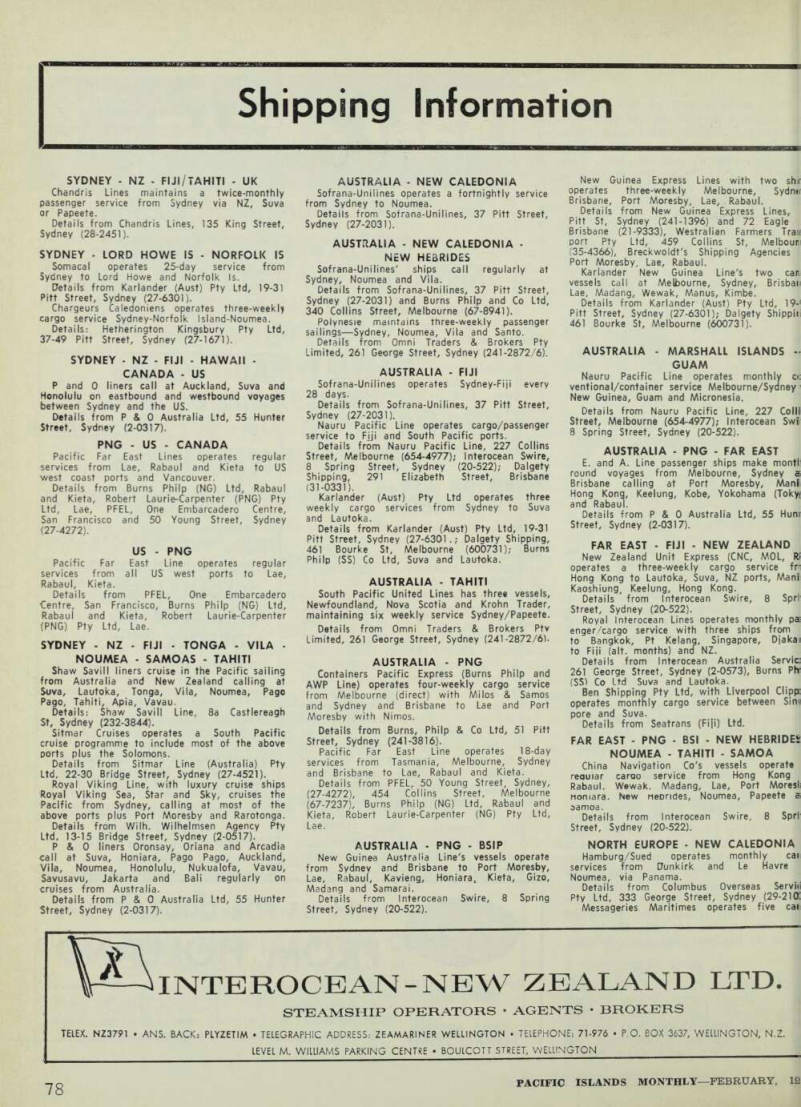
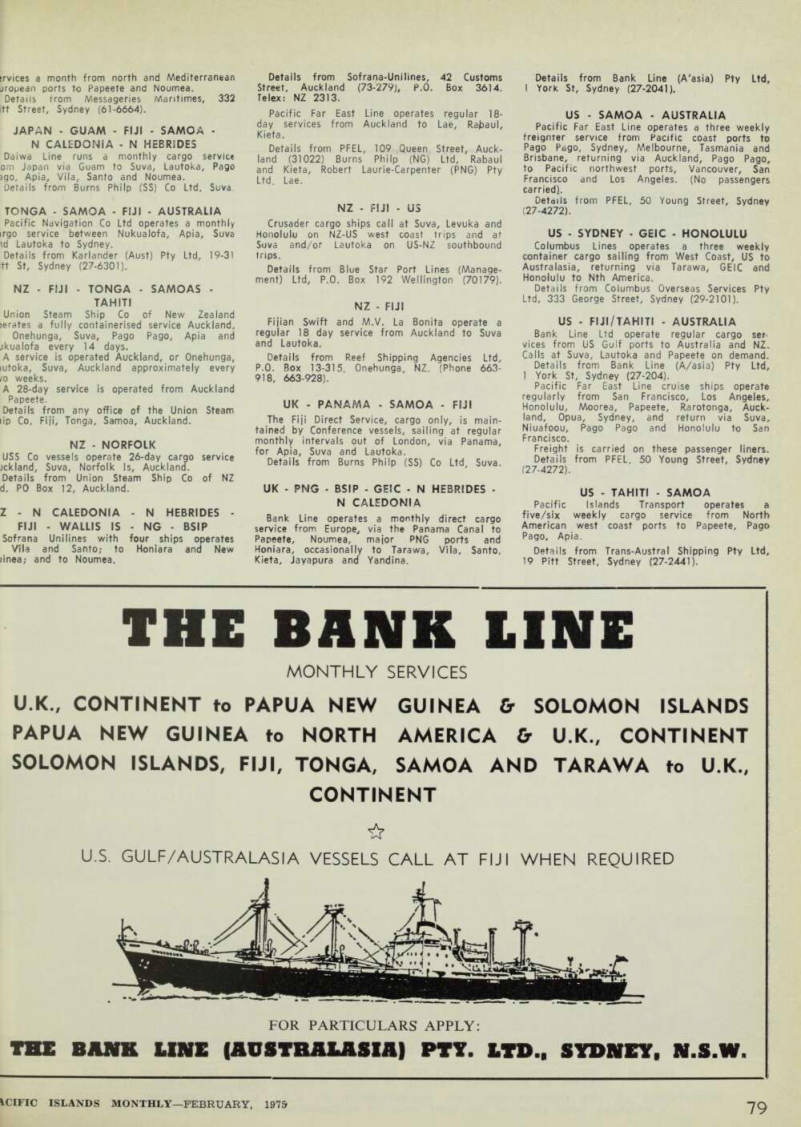
SYDNEY - NZ - FIJI/TAHITI - UK Chandris Lines maintains a twice-monthly passenger service from Sydney via NZ, Suva or Papeete.
Details from Chandris Lines, 135 King Street, Sydney (28-2451).
SYDNEY - LORD HOWE IS - NORFOLK IS Somacal operates 25-day service from Sydney to Lord Howe and Norfolk Is.
Details from Karlander (Aust) Pty Ltd, 19-31 Pitt Street, Sydney (27-6301).
Chargeurs Caledoniens operates three-weeklt cargo service Sydney-Norfolk Island-Noumea.
Details: Hetherington Kingsbury Pty Ltd, 37-49 Pitt Street, Sydney (27-1671).
SYDNEY - NZ - FIJI - HAWAII -
Canada - Us
P and 0 liners call at Auckland, Suva and Honolulu on eastbound and westbound voyages between Sydney and the US.
Details from P & 0 Australia Ltd, 55 Hunter Street, Sydney (2-0317).
Png - Us - Canada
Pacific Far East Lines operates regular services from Lae, Rabaul and Kieta to US west coast ports and Vancouver.
Details from Burns Philp (NG) Ltd, Rabaul and Kieta, Robert Laurie-Carpenter (PNG) Pty Ltd, Lae, PFEL, One Embarcadero Centre, San Francisco and 50 Young Street, Sydney (27-4272).
Us - Png
Pacific Far East Line operates regular services from all US west ports to Lae, Rabaul, Kieta.
Details from PFEL, One Embarcadero Centre, San Francisco, Burns Philp (NG) Ltd, Rabaul and Kieta, Robert Laurie-Carpenter (PNG) Pty Ltd, Lae.
SYDNEY - NZ - FIJI - TONGA - VILA ■
Noumea - Samoas - Tahiti
Shaw Savill liners cruise in the Pacific sailing from Australia and New Zealand calling at Suva, Lautoka, Tonga, Vila, Noumea, Pago Pago, Tahiti, Apia, Vavau.
Details: Shaw Savill Line, 8a Castlereagh St, Sydney (232-3844).
Sitmar Cruises operates a South Pacific cruise programme to include most of the above ports plus the Solomons.
Details from Sitmar Line (Australia) Pty Ltd, 22-30 Bridge Street, Sydney (27-4521).
Royal Viking Line, with luxury cruise ships Royal Viking Sea, Star and Sky, cruises the Pacific from Sydney, calling at most of the above ports plus Port Moresby and Rarotonga.
Details from Wilh. Wilhelmsen Agency Pty Ltd, 13-15 Bridge Street, Sydney (2-0517).
P & 0 liners Oronsay, Oriana and Arcadia call at Suva, Honiara, Pago Pago, Auckland, Vila, Noumea, Honolulu, Nukualofa, Vavau, Savusavu, Jakarta and Bali regularly on cruises from Australia.
Details from P & 0 Australia Ltd, 55 Hunter Street, Sydney (2-0317).
Australia - New Caledonia
Sofrana-Unilines operates a fortnightly service from Sydney to Noumea.
Details from Sofrana-Unilines, 37 Pitt Street, Sydney (27-2031).
Australia - New Caledonia -
New Hebrides
Sofrana-Unilines' ships call regularly at Sydney, Noumea and Vila.
Details from Sofrana-Unilines, 37 Pitt Street, Sydney (27-2031) and Burns Philp and Co Ltd, 340 Collins Street, Melbourne (67-8941).
Polynesie maintains three-weekly passenger sailings—Sydney, Noumea, Vila and Santo.
Details from Omni Traders & Brokers Pty Limited, 261 George Street, Sydney (241-2872/6).
Australia - Fiji
Sofrana-Unilines operates Sydney-Fiji every 28 days.
Details from Sofrana-Unilines, 37 Pitt Street, Sydney (27-2031).
Nauru Pacific Line operates cargo/passenger service to Fjji and South Pacific ports.
Details from Nauru Pacific Line, 227 Collins Street, Melbourne (654-4977); Interocean Swire, 8 Spring Street, Sydney (20-522); Dalgety Shipping, 291 Elizabeth Street, Brisbane (31-0331).
Karlander (Aust) Pty Ltd operates three weekly cargo services from Sydney to Suva and Lautoka.
Details from Karlander (Aust) Pty Ltd, 19-31 Pitt Street, Sydney (27-6301.; Dalgety Shipping, 461 Bourke St, Melbourne (600731); Burns Philp (SS) Co Ltd, Suva and Lautoka.
Australia - Tahiti
South Pacific United Lines has three vessels, Newfoundland, Nova Scotia and Krohn Trader, maintaining six weekly service Sydney/Papeete.
Details from Omni Traders & Brokers Ptv Limited, 261 George Street, Sydney (241-2872/61.
Australia - Png
Containers Pacific Express (Burns Philp and AWP Line) operates four-weekly cargo service from Melbourne (direct) with Milos & Samos and Sydney and Brisbane to Lae and Port Moresby with Nimos.
Details from Burns, Philp & Co Ltd, 51 Pitt Street, Sydney (241-3816).
Pacific Far East Line operates 18-day services from Tasmania, Melbourne, Sydney and Brisbane to Lae, Rabaul and Kieta.
Details from PFEL, 50 Young Street, Sydney, (27-4272), 454 Collins Street, Melbourne (67-7237), Burns Philp (NG) Ltd, Rabaul and Kieta, Robert Laurie-Carpenter (NG) Pty Ltd, Lae.
Australia - Png - Bsip
New Guinea Australia Line's vessels operate from Sydney and Brisbane to Port Moresby, Lae, Rabaul, Kavieng, Honiara, Kieta, Gizo, Madang and Samarai.
Details from Interocean Swire, 8 Spring Street, Sydney (20-522).
New Guinea Express Lines with two shir operates three-weekly Melbourne, Sydmr Brisbane, Port Moresby, Lae, Rabaul.
Details from New Guinea Express Lines, Pitt St, Sydney (241-1396) and 72 Eagle Brisbane (21-9333), Westralian Farmers Traie port Pty Ltd, 459 Collins St, Melboum (35-4366), Breckwoldt's Shipping Agencies Port Moresby, Lae, Rabaul.
Karlander New Guinea Line's two can vessels call at Melbourne, Sydney, Brisban Lae, Madang, Wewak, Manus, Kimbe.
Details from Karlander (Aust) Pty Ltd, 19-< Pitt Street, Sydney (27-6301); Dalgety Shippiti 461 Bourke St, Melbourne (600731).
Australia ■ Marshall Islands -
Guam
Nauru Pacific Line operates monthly ci: ventional/container service Melbourne/Sydney' New Guinea, Guam and Micronesia.
Details from Nauru Pacific Line, 227 Colli Street, Melbourne (654-4977); Interocean Sws 8 Spring Street, Sydney (20-522).
Australia ■ Png - Far East
E. and A. Line passenger ships make montll round voyages from Melbourne, Sydney a Brisbane calling at Port Moresby, Manl Hong Kong, Keelung, Kobe, Yokohama (Toky< and Rabaul.
Details from P & 0 Australia Ltd, 55 Hunt Street, Sydney (2-0317).
FAR EAST - FIJI ■ NEW ZEALAND New Zealand Unit Express (CNC, MOL, operates a three-weekly cargo service frn Hong Kong to Lautoka, Suva, NZ ports, Man!
Kaoshiung, Keelung, Hong Kong.
Details from Interocean Swire, 8 Sprf Street, Sydney (20-522).
Royal Interocean Lines operates monthly ps enger/cargo service with three ships from to Bangkok, Pt Kelang, Singapore, Djakai to Fiji (alt. months) and NZ.
Details from Interocean Australia Servicj 261 George Street, Sydney (2-0573), Burns Phr (SS) Co Ltd Suva and Lautoka.
Ben Shipping Pty Ltd, with Liverpool Clippc operates monthly cargo service between Sinn pore and Suva.
Details from Seatrans (Fiji) Ltd.
FAR EAST - PNG - BSI - NEW HEBRIDES
Noumea - Tahiti - Samoa
China Navigation Co's vessels operate reauiar caroo service from Hong Kong Rabaul. Wewak. Madang, Lae, Port Moresli Honiara. New neondes, Noumea, Papeete s aamoa.
Details from Interocean Swire, 8 Sprf Street, Sydney (20-522).
North Europe - New Caledonia
Hamburg/Sued operates monthly cai services from Dunkirk and Le Havre Noumea, via Panama.
Details from Columbus Overseas Serviii Pty Ltd, 333 George Street, Sydney (29-210: Messageries Maritimes operates five caii
irvices a month from north and Mediterranean jropean ports to Papeete and Noumea.
Details from Messageries Mantimes, 332 tt Street, Sydney (61-6664).
JAPAN - GUAM - FIJI - SAMOA -
N Caledonia - N Hebrides
Daiwa Line runs a monthly cargo service om Japan via Guam to Suva, Lautoka, Pago igo, Apia, Vila, Santo and Noumea.
Details from Burns Philp (SS) Co Ltd, Suva.
TONGA - SAMOA - FIJI - AUSTRALIA Pacific Navigation Co Ltd operates a monthly rgo service between Nukualofa, Apia, Suva id Lautoka to Sydney.
Details from Karlander (Aust) Pty Ltd, 19-31 tt St, Sydney (27-6301).
NZ - FIJI - TONGA - SAMOAS -
Tahiti
Union Steam Ship Co of New Zealand lerates a fully containerised service Auckland, Onehunga, Suva, Pago Pago, Apia and jkualofa every 14 days.
A service is operated Auckland, or Onehunga, utoka, Suva, Auckland approximately every io weeks.
A 28-day service is operated from Auckland Papeete.
Details from any office of the Union Steam iip Co, Fiji, Tonga, Samoa, Auckland.
Nz - Norfolk
USS Co vessels operate 26-day cargo service jckland, Suva, Norfolk Is, Auckland.
Details from Union Steam Ship Co of NZ d, PO Box 12, Auckland.
Z - N CALEDONIA - N HEBRIDES - FIJI - WALLIS IS - NG - BSIP Sofrana Unilines with four ships operates Vila and Santo; to Honiara and New linea,- and to Noumea.
Details from Sofrana-Unilines, 42 Customs Street, Auckland (73-279), P.O. Box 3614.
Telex; NZ 2313.
Pacific Far East Line operates regular 18day services from Auckland to Lae, Rabaul, Kieta.
Details from PFEL, 109 Queen Street, Auck land (31022) Burns Philp (NG) Ltd, Rabaul and Kieta, Robert Laurie-Carpenter (PNG) Pty Ltd, Lae.
Nz - Fiji - Us
Crusader cargo ships call at Suva, Levuka and Honolulu on NZ-US west coast trips and at Suva and/or Lautoka on US-NZ southbound trips.
Details from Blue Star Port Lines (Manage ment) Ltd, P.O. Box 192 Wellington (70179).
Nz - Fiji
Fijian Swift and M.V, La Bonita operate a regular 18 day service from Auckland to Suva and Lautoka.
Details from Reef Shipping Agencies Ltd, P.O. Box 13-315, Onehunga, NZ. (Phone 663- 918, 663-928).
UK ■ PANAMA - SAMOA - FIJI The Fiji Direct Service, cargo only, is main tained by Conference vessels, sailing at regular monthly intervals out of London, via Panama, for Apia, Suva and Lautoka.
Details from Burns Philp (SS) Co Ltd, Suva.
UK - PNG - BSIP - GEIC - N HEBRIDES -
N Caledonia
Bank Line operates a monthly direct cargo service from Europe, via the Panama Canal to Papeete, Noumea, major PNG ports and Honiara, occasionally to Tarawa, Vila, Santo, Kieta, Jayapura and Yandina.
Details from Bank Line (A'asia) Pty Ltd, 1 York St, Sydney (27-2041).
Us - Samoa - Australia
Pacific Far East Line operates a three weekly freignrer service from Pacific coast ports to Pago Pago, Sydney, Melbourne, Tasmania and Brisbane, returning via Auckland, Pago Pago, to Pacific northwest ports, Vancouver, San Francisco and Los Angeles. (No passengers carried).
Details from PFEL, 50 Young Street, Sydney (27-4272).
US - SYDNEY - GEIC ■ HONOLULU Columbus Lines operates a three weekly container cargo sailing from West Coast, US to Australasia, returning via Tarawa, GEIC and Honolulu to Nth America.
Details from Columbus Overseas Services Pty Ltd, 333 George Street, Sydney (29-2101).
Us - Fiji/Tahiti - Australia
Bank Line Ltd operate regular cargo ser vices from US Gulf ports to Australia and NZ.
Calls at Suva, Lautoka and Papeete on demand.
Details from Bank Line (A/asia) Pty Ltd, 1 York St, Sydney (27-204).
Pacific Far East Line cruise ships operate regularly from San Francisco, Los Angeles, Honolulu, Moorea, Papeete, Rarotonga, Auck land, Opua, Sydney, and return via Suva, Niuafoou, Pago Pago and Honolulu to San Francisco.
Freight is carried on these passenger liners.
Details from PFEL. 50 Young Street, Sydney (27-4272).
Us - Tahiti - Samoa
Pacific Islands Transport operates a five/six weekly cargo service from North American west coast ports to Papeete, Pago Pago, Apia.
Details from Trans-Austral Shipping Pty Ltd, 19 Pitt Street, Sydney (27-2441).
Advertisements & other items, pp. 92-96 (3 items)
Interocean-New Zealand Ltd.
STEAMSHIP OPERATORS • AGENTS • BROKERS
TEIEX. NZ3791 • ANS. BACK: PLYZETIM • TELEGRAPHIC ADDRESS: ZEAMARINER WELLINGTON • TELEPHONE: 71-976 • P.O. BOX 3637, WELLINGTON, N.Z LEVEL M. WILLIAMS PARKING CENTRE • BOULCOTT STREET, WELLINGTON
THE BANK LINE
MONTHLY SERVICES
U.K., CONTINENT to PAPUA NEW GUINEA & SOLOMON ISLANDS PAPUA NEW GUINEA to NORTH AMERICA & U.K., CONTINENT SOLOMON ISLANDS, FIJI, TONGA, SAMOA AND TARAWA to U.K.,
CONTINENT
☆ U.S. GULF/AUSTRALASIA VESSELS CALL AT FIJI WHEN REQUIRED
FOR PARTICULARS APPLY:
THE BANK LINE (AUSTBALASI A) PTT. LTD., SYDNEY, N.S.W.
n §e) tnnJ §s) InnJ §s) InnJ 1
Primitive luxury
(Polynesian style) Nestled away in the untouched Kingdom of Tonga is new, luxurious "Port of Refuge" International resort. Here is a unique opportunity for your clients to experience the tranquil and relaxed Tongan atmosphere while they enjoy the picturesque surroundings of the new "Port of Refuse". And only a short flight from Fiji.
Reasonable tariffs from $17.50 with special concessions for children. Agents commission 10 per cent.
Tonga's
Port of Refuge
INTERNATIONAL RESORT
Uava'u Tonfia Cables: "Refuge" Tonga or "Tonqatours"
Sydney. Phone: Sydney 85-1603 or 922-1817
AT A LOSS
TO COMFORT BABY?
Those distressing symptoms that come with teething troubles —sore gums, digestive disorders, intestinal upsets, can be, if used as directed, safely and quickly soothed with Fisher's Teething Powders. You'll be delighted at what an effective and soothing aid they are to baby— and when baby's happy your upsets and nervous tension will be soothed, too. Fisher's Teething Powders are available from your chemist or store, only 30c for 20 powders. Fisher & Co., Manufacturing Chemists (Est. 1876), 17 May St., St. Peters, N.S.W. 2044.
PIM 809/72
3007
Stay at
Aggie Grey's the
South Pacific's legendary hotel Situated right in the heart of Western Samoa. Enjoy Polynesian-style friendliness and service, in cool surroundings, superb entertainment and food. Magnificent white sand beaches only a short drive away.
Airconditioned rooms, swimming pool and full bar facilities.
Bookings through Union Steamship Company of NZ, Pan Am, Air New Zealand or direct to Aggie Grey's, Apia, Western Samoa. Cables: AGGIES, APIA.
SOUTHERN PACIFIC INSURANCE
COMPANY (PNG) LIMITED
(INCORPORATED IN PAPUA NEW GUINEA)
HEAD OFFICE: BANK HAUS, CHAMPION PDE. P.O. BOX 136 PORT MORESBY, PAPUA NEW GUINEA. PH. 2623 • FIRE • FIRE AND VOLCANIC ERUPTION • HOUSEHOLD COMPREHENSIVE • MOTOR VEHICLE • COMPULSORY THIRD PARTY • COMPULSORY WORKERS COMPENSATION
MARINE • PUBLIC LIABILITY • BURGLARY
Enquiries are invited for all classes of insurance from special representatives at: PORT MORESBY: H. A. McKEE, General Manager, Champion Pde., P.O. Box 136, Ph. 2623 or 2075. LAE: K. J. ARMSTRONG, Manager for Lae, Central Ave, P.O. Box 758, Ph. 42-4590 or 42-4256, RABAUL: R. H. MEYER, Manager for Rabaul, Mango Ave., P.O. Box 123, Ph. 92-2417 or 92-2755. $ -'S'
PARK VIEW MOTEL—BRISBANE
Quiet location —opp. Botanic Gardens.
Single, double, family suites, all with refrig., air conditioning, phone, TV, radio tea making facilities, from $l2. Pool and restaurant.
Phone 31-2695—Telex 40270.
Write for coloured brochure — Park View Motel, 128 Alice St, BRISBANE, Old., 4000.
Turners and Growers
FRESH FRUIT&VEGETABLES
COLOURFUL MAPS OF NORFOLK ISLAND AND
LORD HOWE ISLAND
Big fold-out maps in colour showing main points of interest in these islands —both attractive tourist destinations.
Produced by Pacific Maos, and available direct from Pacific Publications (Aust) Pty Ltd, Box 3408 GPO, Sydney 2000, at $1 each or $1.25 each posted.
dfd
SOFRANA'UNILINES
THE SOUTH PACIFIC SHIPPING COMPANY
WHICH SERVES THE SOUTH PACIFIC
The natural Choice.
It’s Honda. Anywhere there’s action. A job to be done.
Fun to be had. Safely and economically. 3 The snappy line-up is studded with star performers.
Easy-to-handle motorbikes that possess a big-hearted spirit. for breezing through traffic or escaping to the country. Rugged reliability that lets you go, go, go.
Little wonder so many people around the world ride Honda.
It’s the all-round natural choice. w -rnmm I** C-90K1 ST-70 PAPUA NEW GUINEA: Steamships Trading Co., Ltd. P.O. Box 74, Papua / U.S. TRUST TERRITORY: J.C. Tenorio Enterprise P.O. Box 137, Saipan / FIJI ISLANDS: Coral Island Motors: Walu Bay Suva Fiji Island. P.O. Box 3179 Lami/TARAWA: The Gilbert & Ellice Islands Development Authority Gilbert & Ellice Islands / WESTERN SAMOA: Motor Distributors (Samoa) Ltd. P.O. Box 576, Apia / AMERICAN SAMOA: Max Haleck Inc. P.O. Box 99.
Pago Pago / TONGA: E.M. Jones Ltd. P.O Box 34, Nukualofa / SOLOMON ISLANDS: British Solomons Trading Co., Ltd. P.O. Box 114, Honiara / NEW CALEDONIA: Establissements Ballande. Noumea / TAHITI: Ets. COMIMPEX P.O. Box 200, Papeete/COOK ISLANDS: Cook Islands Motor Centre Ltd. P.O. Box 74, Rarotonga / NAURU ISLAND: Nauru Cooperative Society 14th Floor, Wales Corner, 227 Collins Street Melbourne Victoria 3000
•* m MS *** 4 I •si * * m n j* c> t I* * 1&»s 1 m* Pm J * i/# Jr’H v ilr And wherever you'll go in over 120 nations throughout the world you’ll find proud DATSUN drivers.
Perhaps the main reason is that DATSUN was designed to meet a wide variety of conditions—mountain roads and super highways, blistering suns and freezing temperatures. DATSUN is indeed the international car that has precision engineering and a stunning string of rally victories behind it.
Its superb handling, safety features and high speed efficiency make DATSUN the choice of young and old alike. DATSUN-the car that really satisfies the world over. a* r->
DATSUN
NISSAN
DATSUN distributor network covers the following areas: Fiji * T.P.N.G. •W. Samoa* New Caledonia • New Hebrides* 8.5.1.P.* Timor* Norfolk A. Samoa • Tahiti • Cook • Nauru • Tonga • Saipan • Guam • Australia • New Zealand
79
VCIFIC ISLANDS MONTHLY—FEBRUARY, 1975
Published by PACIFIC PUBLICATIONS (AUST.) PTY. LTD. 29 Alberta Street Sydney, 20001 (Telephone; 61-9197).
Printed by Mastercraft Printing, 39 Collins Street. Alexandria, NSW, 201&.
REGISTERED AT THE QPO SYDNEY FOR TRANSMISSION BY POST AS A NEWSPAPER - CATEGORY B Australian price given on the front cover is recommended Australian retail price only.