Pacific Islands Monthly

News Magazine Of The South Pacific
March, 1974
AUSTRALIA, N.Z., P.N.G., FIJI, N. HEBRIDES 60c TONGA, W. SAMOA, 8.5.1. P., G.E.I.C. 60c
Cooks, Norfolk, Niue, Nauru 60C
Am. Samoa, Hawaii, Micronesia, Guam $L.Oo
NEW CALEDONIA AND FRENCH POLYNESIA 100 CFP
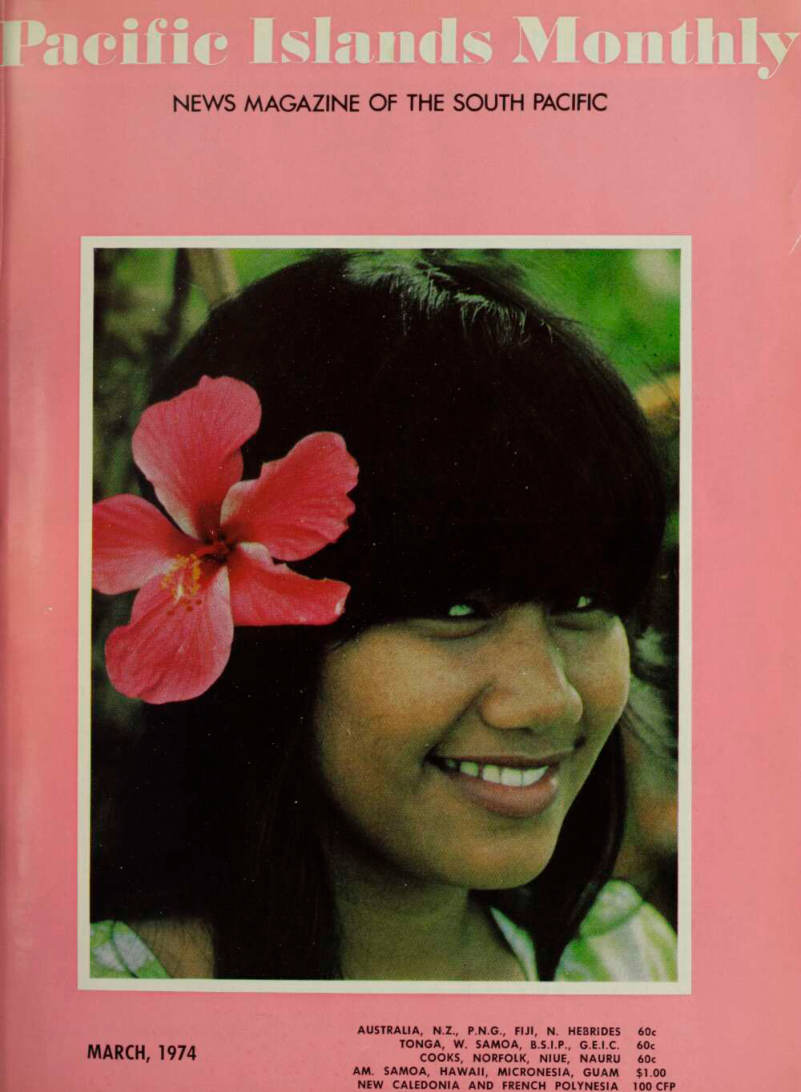
Our Cover
Here’s a winsome lass, who is far from home but, surely, not lonely. She’s Rosy Loo, a Gil bertese teenager, who works as a waitress in a Suva restaurant.
The picture is by Dr Radomir Joura, of Parramatta, NSW.
Advertisements & other items, p. 2 (1 item)
Mazda1000&1200 Pickups.
SB JL
iOQO
pK*!£ :* ■ ■ ;■ ' : . ■ ■ ■:.■ -r;, : * ■ - - A lot of truck for your money.
Check the features for yourself
0 All steel cargo deck with snap shut tailgate 0 Big load carrying capacity 0 Tough, girder-section steel chassis 0 Choice of rugged 1000 or 1200 OHV engine 0 Large, 4-bladed engine fan 0 Laminated safety glass windscreen See your Mazda dealer soon 0 Corrosion-free grille with stylish square headlights 0 2-speed wipers with twin jet washer 0 Roomy bench seat adjustable 6 ways for height and reach 0 Flow-through ventilation system 0 Push in, pull out door lock knobs 0 Easy-to-get-at battery and engine r a real value-for-money buy.
MAZDA
© 1973 TOYO KOGYO CO., LTD.
FIJI Niranjans Autoport Ltd. G.P.O. Box 450, Suva Tel: 22691 NEW CALEDONIA Societe Riviere et Bernanos, 27, Rue de Sebastopol Noumea PAPUA NEW GUINEA P.N.G. Associated Ind. Ltd., P.O. Box 1394, Boroko Tel: 55788 NEW ZEALAND Mazda Motors of Nev Zealand Ltd., Otahuhu, Auckland P.O. Box 22-472 Tel: 69-099 WESTERN SAMOA H. & J. Retzlaff, P.O. Box 195, Apia Tel: 237 NEV HEBRIDES Societe Bourgeois et Cie, P.O. Box 28, Port-Vila PORTUGUESE TIMOR Tai Hoo, Dili AMERICAN SAMOA Ma; Haleck, Incorporation, P.O. Box 99, Pago Pago, American Samoa 96799 Tel: 89231 POLYNESIE FRANCAISE Comptoir Polynesien, B.P 628, Papeete, Tahiti 8.5.1. P. Solomon Motors Ltd., P.O. Box 20, Honiara, British Solomon Islands Protectorate Tel: 313 The trademark MAZDA in this advertisement stands for AUTOMOBILES MAZDA as far as France and her territories are concerned.
In This Issue
Vol 45 No 3 March, 1974
General
Bouth Pacific Forum Conference 11 |The Commonwealth Games 11 ■Queen's visit 14 ■New Melanesian Tourist Federation I chief 45 [Opposition to regional shipping line 77 [American Airlines may continue SP I routes 79 [Further freight surcharge hike 79 More DClOs for Air NZ 81 [Australia's new tariff preferences 93
American Samoa
Air disaster 7 US delegation in Pago 13 Ex-navy boat for Samoa service 77
Cook Islands
New flag flying 23
Fiji
New political party 5 Rescue system to be examined 7 Dockers' leader on theft charge 7 Prince Charles' visit (pic) 14 Civil Service shortcomings 21 Fiji rugby popular with BBC 21 The tipping business 31 Dockworkers' leader fined 79 Korean fishing ship rescued 79 iNew terminal building at Labasa 79 Airline rights talks break down 81 New airstrips for small islands 81 Better earnings for Rotuma 98
French Polynesia
Jim Boyack's Tahiti Letter 16
Gilbert And Ellice Islands
Ellice Islanders to vote on secession 6 Latest census figures 27 How the US almost got Christmas Is. 57
Lord Howe Island
Hanging on to air link 81
Nauru
Workers' complaints 15
New Caledonia
Tough talk in Noumea 9 In search of tourists 19 Plane crash 21 Aircraft carrier's visit 23 Thirsty swimmers 23 1973 nickel figures 93
New Hebrides
Independence foreshadowed 9 Airstrip toll 19 Is a tax haven paradise? 39 French to give back land 39 The budget 43 Demonstration for legal reform 45 Co-op Federation's new project (pic) 93 New abattoir 93
Norfolk Island
Queen's rough ride 14
Papua New Guinea
Greater share of copper profits wanted 3 New stamps (pic) 5
DEPARTMENTS: Up front with the Editor, iii; Editor's Mailbag, 15; Tropicalities 19- Ao° m D lslands PreSS ' 48; Ma 9 azine Section, 57; MANA, 61; Yesterday, 67; Books', or cu- C . Transport ' 77; Cruising Yachts, 83; Business and Deveolpment, 89; Produce, 8; Shipping and Airways Information, 99; Deaths of Islands People 104- Advertisers' Index, 108.
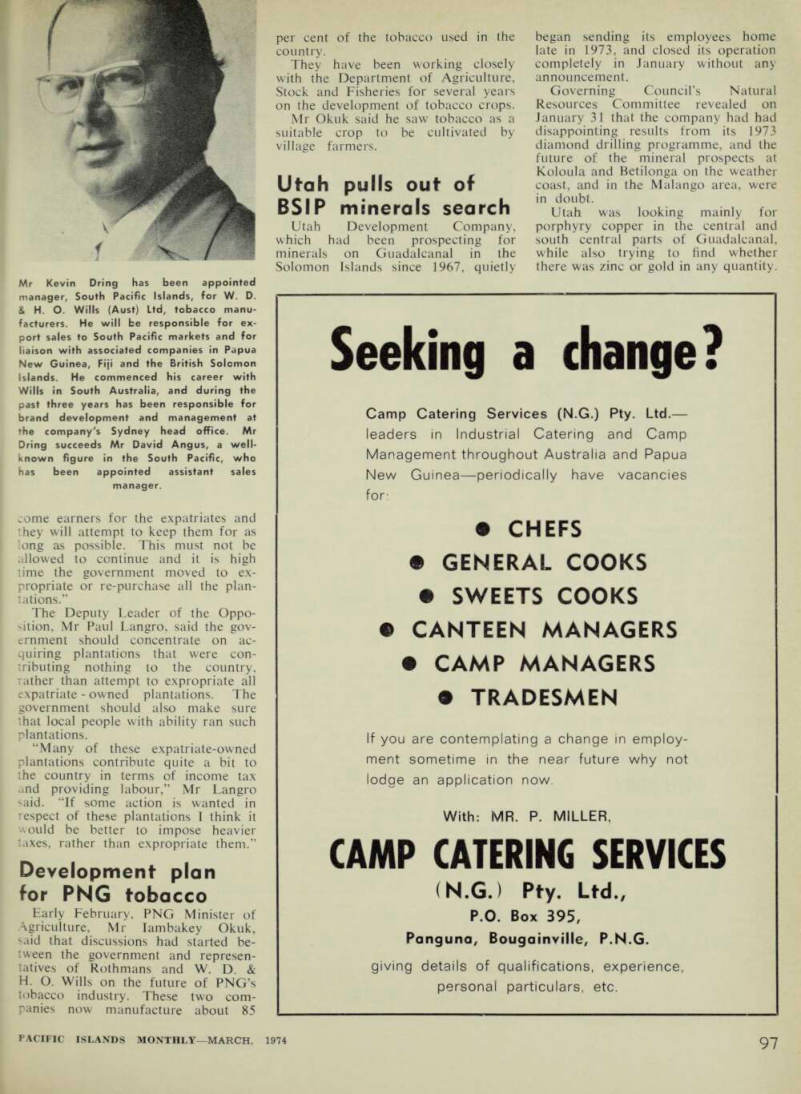
PNG's new constitution 5 PNG's new High Com. 14 Call for duty free shopping 23 Riddle of the Laughing Death 23 Objection to bad publicity 47 Madang's new department store 95 Minister's takeover call 95 Development plan for tobacco 97
Pitcairn Island
Population increase 19
Solomon Islands
Changes in WPHC 13 Schoolboy paints for Queen 21 March on rising prices 25 New charter service 79 Utah ceases minerals search 97
Tonga
Tribute to Father Tremblay 33 King sideswipes Fiji Government 89
United States Trust Territory
Bikinians claim USTT mismanagement 19 Transpac blasted by congressmen 77 New type of fishing boat 79 Free-for-all investment in USTT 89
Western Samoa
Opposition leader speaks out 29 Ex-navy boat for Samoa service 77
Advertisements & other items, p. 4 (1 item)
Opel Kadett
The new
soon shows
you why it’s
Germany’s
N°l seller.
In its native Germany, despite some pretty famous opposition, more people are now buying Opel Kadett than any other car. And their reasons could easily be yours.
Clean and modern styling.
Roomy, relaxing interiors. Tuned suspension. Robust and responsive engines. Rack-and-pinion steering.
Miserly petrol consumption, low maintenance costs. Kadett puts all this and more together.
And does it beautifully. 2-door or 4-door sedans. 3-door CarA Van. Or the dashing Kadett coupe. One of them should be your next car.
See and drive the new Opel Kadett at Joseph Cheval and Cie., Noumea, New Caledonia.
Sociedade Agricola Patria e Trabalho, Lda, Dili, Portugese Timor.
LaiWoa, Papeete, Tahiti.
V
Wmm
Si * A 648
Monthly
Pacific Islands
FOUNDED BY R. W. ROBSON IN 1930
Published Monthly By
Pacific Publications (Aust.) Pty. Ltd.,
29 Alberta St., Sydney, N.S.W., 2000.
I Postal Address: G.P.O. BOX 3408, SYDNEY,
N.S.W., 2001.
Telegraphic Address; PACPUB, Sydney.
Telex 25168.
Telephones: 61-9197, 61-7101, 61-4369.
(Consulting Directors: R. W. Robson, Judy Tudor.
Chief Executives: Manager: Selwyn Hughes.
Publisher: Stuart Inder.
Director of Advertising: W. A. Gasnier.
Pacific Islands Monthly
Editor: Stuart Inder.
Assistant Editor: John Carter.
Advertising Manager: W. A. Gasnier.
Circulation Manager; Barry Badger.
Subscription Rates:
I "Pacific Islands Monthly" is airfreighted to all Isubscribers and agents in the Pacific Islands [ and the U.S.A.; copies to Nauru and other areas go by surface mail.
Australia (incl. Lord Howe and Thursday Is.), ! New Zealand, Papua New Guinea, Fiji, New ; Hebrides, Tonga, Western Samoa, Solomon i Islands, Gilbert & Ellice Islands, Cook Islands, I Norfolk Island, Niue and Nauru Islands: $6.80 [(local currency); American Samoa, Hawaii, [Micronesia and Guam; $12.00 US; New [Caledonia and French Polynesia 1,100 CFP; [US Mainland: $14.00 US; United Kingdom: |£s-10. Elsewhere $B.OO Aust.
Representatives
[Fiji: Advertising—A. F. Woods, Imex (Pacific) [Limited, Suite 2A, Victoria Arcade, Suva, Fiji, iP.O. Box 3117, Lami, SUVA. Telephone: 22-502. [Telex. 2124. Distribution—Desai Book Depot I Ltd., P.U. Box 160, SUVA. Tel.: 311-424.
Papua New Guinea: PORT MORESBY, PNG Print ing Co. Pty. Ltd., P.O. Box 633; LAE, P.O. Box [227; RABAUL, Mr. David Simpson, P.O. Box 164 (c/- Rabaul Photographic. Tel. : 2677.) French Polynesia. Distribution—Hachette Paci fique, 10 Ave Bruat, Papeete.
New Zealand: Pacific Publications, C.P.O. Box 2229, Auckland. 379-494. Representative: John Spedding, Civic House, 291 Queen St., Auckland, Tel.: 379-494.
United Kingdom; Advertising—Overseas Publicity Ltd., 214 Oxford Street, London, WIN OEA.
Phone: 01-636 8296/7. Subscriptions—T. B.
Graham, Park House, 22 Park Street, Croydon,
Cr9 3Np. Tel.: 01-6884177.
Japan: Advertising—Universal Media Corpora tion, C.P.O. Box 46, Tokyo. Tel.: 666-3036.
Victoria: Advertising Pacific Publications (Aust.) Pty. Ltd., 33 Lonsdale Street, Melbourne, Vic. 3006. Telephone: 662-3263.
Queensland: Advertising—Beale Media Services, 232 St. Paul's Terrace, Fortitude Valley, Qld. 4006. Tel.: 52-5827.
Hawaii and U.S. Mainland only: N. Grogan, 3354 Hayden Street, Honolulu, 96815. (Send change of address notices, Form 3579 and new subscriptions to P.O. Box 2193 L Honolulu, Hawaii, U.S.A. 96805).
Second class postage paid at Honolulu, Hawaii.
Copyright ©, 1974,
Pacific Publications (Aust) Pty. Ltd.
March, 1974 Vol. 45, No. 3
Up Front
with the Editor
Back in May, 1963, PlM’s then assistant editor, Robert Langdon, wrote a piece drawing attention to the fact that an ancient cannon had been found embedded in a reef on Amanu atoll in French Polynesia, and said that nobody had been able to explain how it got there.
In January, 1968, in a much longer article and after considerable research of his own. Bob put forward in PIM what we then described as “a startling new theory” that the cannon had come from a Spanish vessel wrecked in 1526, and that the Spanish crew had survived and made an extra ordinary long-term impact on the Polynesians.
And now, almost 11 years after becoming aware of the cannon, and six years after beginning serious re search, Robert Langdon in February completed a 130,000-word manuscript explaining in detail his romantic and sensational theory of how the crew of San Lesmes changed the course of Pacific history. Titled The Lost Caravel, Pacific Publications will pub lish the book towards the end of this year.
Bob, who these days is executive officer of the Pacific Manuscripts Bureau at the Australian National University, contends in what is a fascinating who-dunit, that the 70odd shipwrecked Spaniards introduced many aspects of their culture to Poly nesia, that they became chiefs and established Hispano-Polynesian dynas ties that lasted down to Captain Cook’s time.
He believes they went to extra ordinary lengths to keep their blood lines “pure”. He believes that much of the culture that has previously been attributed to the genius of the Polynesians was, in fact, derived from Eurone.
For example, Langdon pours cold water on the idea that the early Poly nesians of the eastern Pacific were skilful seamen and accomplished navi gators. Instead, he marshals an array of evidence to show that the only islanders who knew anything of con sequence about canoe-building and
navigation in Captain Cook’s time were apparently descendants of the San Lesmes castaways.
Langdon also contends that many of the elaborate ‘Polynesian’ chants were actually derived from the Bible; and he carefully documents his theory that Spanish castaways greatly in fluenced dress, drama, music, the method of counting and the computa tion of time in Polynesia; that they probably abolished cannibalism in some areas; that they substituted hand-shaking for nose-rubbing as a form of greeting; and much else.
The Lost Caravel seriously chal lenges the principal theory of Thor Heyerdahl of Kon Tiki fame—that the light-skinned people of the eastern Pacific were descendants of a tribe of blond Indians driven into the Pacific manv centuries ago. The book even suggests that the mysterious in scribed tablets of Easter Island, which Heyerdahl has attributed to American Indians, may have been derived from the system of writing introduced by San Lesmes castaways.
On the other hand, Langdon’s book offers some unexpected support for Heyerdahl’s views; and this, in itself, is likely to add new fuel to the 200-year-old controversy on where the Polynesians came from. But the main thesis of Langdon’s book will take everyone by surprise— anthropologists, historians, linguists, geneticists and churchmen, not to mention the general reader who has long cherished romantic notions about the Polynesians. Scholars in many disciplines will have to rethink their positions.
It’s all done against the background of early European exploration and penetration of the Pacific, presented in a refreshing way because he has had to look at it from a different angle.
His arguments, in my view, carry so much weight that they must con vert most readers—and they have converted me. But there will be great controversy, which should be half the fun.
Stuart Inder
Advertisements & other items, pp. 6-8 (1 item)
Goodfyear
4
Goodyear’s advanced tire technology is
contributing to many new transportation concepts.
ill
r
VSJ
f t- J 13 The first tires on the moon were built by Goodyear.
The fastest tires on earth were made by Goodyear.
Now, Goodyear produces the world’s largest tires.
Boroko Motors Ltd.
P.O. Box 1259, Boroko Port Moresby, PAPUA NEW GUINEA Coral Island Traders P.O. Box 296, Suva, FIJI Solomon Motors Ltd.
P.O. Box 20, Mendana Avenue, Honiara Guadalcanal, SOLOMON ISLANDS Guam Tire & Supply Co.
P.O. Box 1486, Agana, GUAM Societe Generate d'Automobiles B.P. 554, Noumea
NEW CALEDONIA
Santo Engineers
Santo, NEW HEBRIDES
Morris Hedstrom Ltd.
Apia, WESTERN SAMOA
V Morris Hedstrom Ltd.
Nukualofa, TONGA Service Mobil B.P. 306, Papeete, TAHITI
vyX \
This little flower is your key
to the safe insect killer
One of the safest and most potent insect-killers known to contemporary science is derived from an innocentlooking small white flower, the African Pyrethrum daisy. Pure pyrethrins, as chemists call this substance, is the active ingredient in Pea-Beu insect spray, and the key to its concentrated killing power. Continuing research by the chemists in the laboratories of A.N.I. Chemical Research and by health and environmental authorities throughout the world, confirms that insects do not become immune to pyrethrum. Pea- Beu contains a high concentration of pyrethrins which means that short bursts only are needed to kill flies, mosquitoes and every type of insect pest.
The mosquito—a deadly
trafficker of disease The mosquito’s record as a killer is world recognised. Beside wrecking so pure it’s safe to spray anywhere your night’s sleep with its irritating whine and inflicting its painful toxic bites, the mosquito passes on many serious diseases, including malaria, hepatitis, dengue and yellow fever, disfiguring elephantiasis and encephalitis. Pea-Beu is recommended to kill every mosquito that enters your home, because it is guaranteed completely effective, yet absolutely safe.
No fears near food Your kitchen and food-cupboards are the favourite places for houseflies, especially when attracted by exposed food as you cook or serve.
Of course you’re reluctant to use pungent insecticides, and fear toxic effects. But never hesitate to use Pea-Beu.
Its active ingredient guarantees it harmless to humans and pets, and thanks to the purity of all its ingredients, it is completely safe to spray anywhere in the home.
Pea-Beu the safe, powerful insecticide
NEW CALEDONIA
Pacific Motors S.A.,
B.P. C 2,
NOUMEA CEDEX
BRITISH SOLOMON ISLANDS
Ets, Donald,
P.O. Box 131, PAPEETE
NEW HEBRIDES
CONDOMINIUM
These MF distributors
can show you how the
MF2I Made keeps levelling
and grading costs low
No special operating skill is required with this versatile implement. You’ll be amazed at the way the MF2I handles general dirt moving, road building, ditching, back-filling, levelling, cleaning and dozens of other jobs. The MF2I quickly attaches to an MFl3stractor and depth controlled by the tractors’ hydraulics. Pitch and angle of the blade are adjustable from the tractor seat and blade can be completely reversed for back-filling.
Make a full 6 foot or 8 foot cut with blade extensions.
Grader wheel, side plate and scarifier kits available.
MF Massey Ferguson MF 74011 © © A
have a copper lining
Pacific Islands Monthly
New Guinea storm clouds have a copper lining
Prom a Port Moresby correspondent
One might have thought that the announcement by Bougainville Copper Ltd that it had made a massive profit of $145.8 million for 1973 in its Bougainville operations, which began producing only in April, 1972, would be cause for rejoicing in Papua New Guinea. But the news has made everybody bitchy.
Chief Minister Michael Somare said unless he found a way of getting PNG a greater share he would fail to represent the country’s interests.
Finance Minister Julius Chan said he intended to find a solution that would cover not only Bougainville Copper but other major projects to be de veloped in the near future.
The Australian Minister responsible for PNG affairs, Mr Bill Morrison, visited Port Moresby when the an nouncement was made in February, said he supported renegotiation of the copper agreement, made in 1967.
PNG’s Minister for Justice John Kaputin, and Father John Momis, MHA and deputy chairman of PNG’s constitutional planning committee, speaking jointly they said on behalf of a group of politicians and com munity leaders, demanded that
Bougainville copper immediately pay
80 per cent company tax, that the government take a controlling interest in it through a new authority to be set up to operate it and other mining companies, including the Ok Tedi copper prospect of Western Papua.
They said the American Kennecott (PNG) Pty Ltd must play no part in the development of the Ok Tedi,
because experience in developing
countries showed that foreign countries exploited both the resources and the people. PNG had no need -to seek out foreign companies to ex ploit its resources; it could do its own exploiting with selected, highly com petent, international experts.
The House of Assembly Oppo sition’s shadow minister for finance, Mr John Middleton, sa ; d a review of the Bougainville company’s tax position might be necessary, rather than a renegotiation of the whole
agreement, which could frighten away potential investors. But the Kaputin/ Momis statement, he said, was “Marxist - Leninist rather than nationalist”, and most of its sugges tions would be disastrous in the hard economic facts of life. Some of the pair’s proposals were “mainly naive, undisciplined, uninformed and irre sponsible, and will result in under mining of PNG national interest and credibility to the rest of the world”.
Opposition Leader Tei Abal also attacked Messrs Kaputin/Momis and supported Somare’s “conference table approach”.
Bougainville Copper Ltd is 20 per cent owned by the PNG Govern ment, 52,6 per cent owned by the British-controlled corporation of Con zinc Riotinto of Australia, with the remaining shares in public hands, in cluding the New Guinea public.
Under its agreement it has a tax holi day until 1975, although a withhold ing tax is paid.
The 1973 profit was in fact SISB million, but $13.8 million of this was due to profit on currency exchange.
High recent copper prices are mainly responsible for the huge profit, but even then, CRA doesn’t get the lion’s share of the booty—the banks do. The banks will get about $53 million towards loan repayments; CRA will get about $36 million; PNG will get about $35 million; the public about $lB million.
PNG’s share comprises sl6 million of dividends, $9.5 million in taxes, $9.7 million in royalties, duty and taxes on employees’ wages.
The company is playing it cool about renegotiation.
The possibility was first mooted as long as 12 months ago, and Bougain
ville is aware that it has to talk to the government if the government wants to talk to it. It will wait until it gets to the conference table, but so far it has not been asked.
The reason for this is that Mr Somare wants to know what guide lines will be in the constitutional committee’s report, due in early March, before he gets down to de tails with Bougainville, Kennecott, or any other outside mining interest.
There is a strong view in govern ment, despite the radical noises of Messrs Kaputin and Momis, that it would be shortsighted to take Bougainville to the cleaners now with demands for larger equity, because the overseas bankers will watch closely how the government treats the banks’ first major Papua New Guinea risk, and will tighten up on loans when approached by other big investors. This won’t do much for PNG’s standing in the overseas capital market.
And it particularly won’t do any thing for Kennecott PNG Pty Ltd, which has got neither the money nor the go-ahead for its Ok Tedi develop ment.
The decision to go ahead or not with it, and the conditions under which a contract would be approved, are up to the PNG Government. And they have been up to the government since the middle of 1972, when Ken necott completed both its drilling pro gramme and its engineering survey, and reported to the government that it was ready to 1 talk business.
Negotiations since 1972 haven’t exactlv gone at a cracking pace, due almost entirely to the fact that since mid-1972 the national coalition in PNG has been more fully occupied in
Bougainville,
Kennecott compared
taking over the reins of government.
But the government also has spent some time checking out Kennecott’s facts and figures (with the help of technical advice from the Peru Gov ernment) so as to equip itself for the talks.
The point has been reached where the government is able to sit down with Kennecott and either accept or reject the company’s evaluation of what has been found on the Ok Tedi —and decide what happens next.
The technical and economic facts appear to be that Kennecott since 1968, when it first began testing for copper on the Ok Tedi, has spent sl4 million on its investigations, and fairly well satisfied itself that it has about 150 million tons of mineable copper ore, with some gold credits, under a hill called Mt Fubilan. (Fubilan is 6,800 ft above sea level.) This would produce about 75,000 to 80,000 tons of copper in concentrate per year, but to develop the mine would cost about S3OO million.
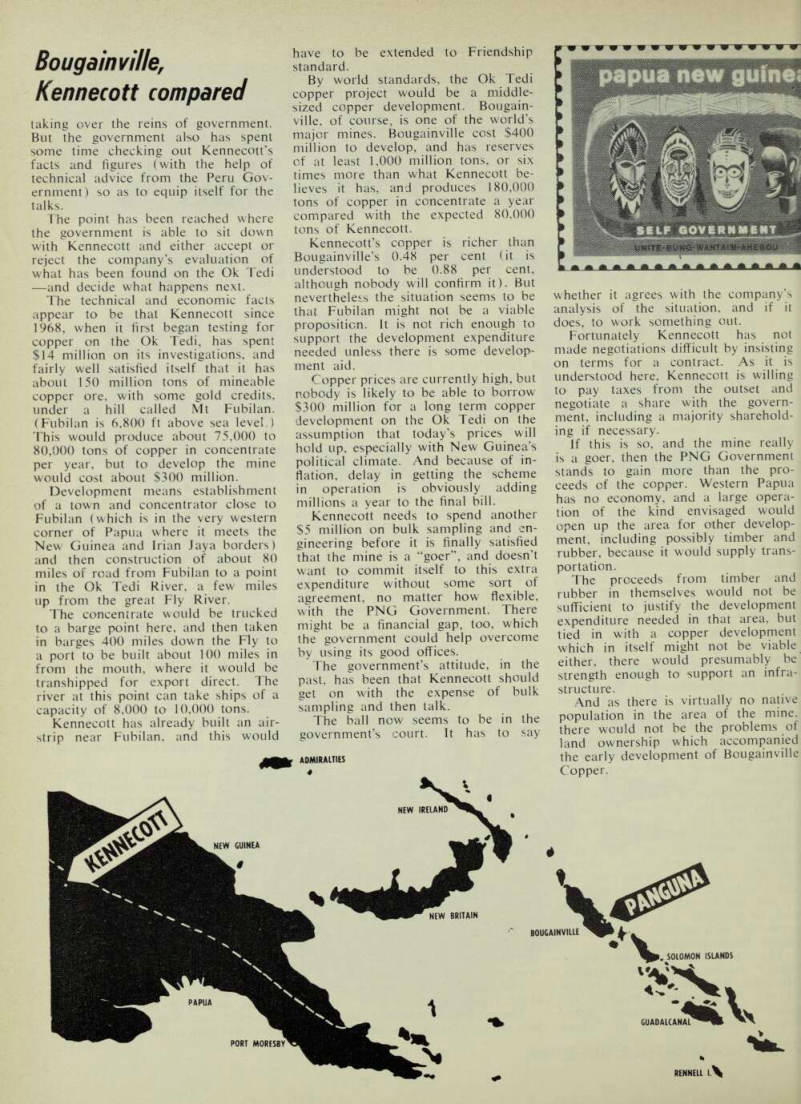
Development means establishment of a town and concentrator close to Fubilan (which is in the very western corner of Papua where it meets the New Guinea and Irian Jaya borders) and then construction of about 80 miles of road from Fubilan to a point in the Ok Tedi River, a few miles up from the great Fly River.
The concentrate would be trucked to a barge point here, and then taken in barges 400 miles down the Fly to a port to be built about 100 miles in from the mouth, where it would be transhipped for export direct. The river at this point can take ships of a capacity of 8,000 to 10,000 tons.
Kennecott has already built an air strip near Fubilan. and this would
have to be extended to Friendship standard.
By world standards, the Ok Tedi copper project would be a middle sized copper development. Bougain ville, of course, is one of the world's major mines. Bougainville cost S4OO million to develop, and has reserves of at least 1,000 million tons, or six times more than what Kennecott be lieves it has, and produces 180,000 tons of copper in concentrate a year compared with the expected 80,000 tons of Kennecott.
Kennecott’s copper is richer than Bougainville’s 0.48 per cent (it is understood to be 0.88 per cent, although nobody will confirm it). But nevertheless the situation seems to be that Fubilan might not be a viable proposition. It is not rich enough to support the development expenditure needed unless there is some develop ment aid.
Copper prices are currently high, but nobody is likely to be able to borrow S3OO million for a long term copper development on the Ok Tedi on the assumption that today’s prices will hold up, especially with New Guinea’s political climate. And because of in flation, delay in getting the scheme in operation is obviously adding millions a year to the final bill.
Kennecott needs to spend another $5 million on bulk sampling and en gineering before it is finally satisfied that the mine is a "goer”, and doesn’t want to commit itself to this extra expenditure without some sort of agreement, no matter how flexible, with the PNG Government. There might be a financial gap, too, which the government could help overcome by using its good offices.
The government’s attitude, in the past, has been that Kennecott should get on with the expense of bulk sampling and then talk.
The ball now seems to be in the government’s court. It has to say
whether it agrees with the company's analysis of the situation, and if it does, to work something out.
Fortunately Kennecott has not made negotiations difficult by insisting on terms for a contract. As it is understood here, Kennecott is willing to pay taxes from the outset and negotiate a share with the govern ment, including a majority sharehold ing if necessary.
If this is so, and the mine really is a goer, then the PNG Government stands to gain more than the pro ceeds of the copper. Western Papua has no economy, and a large opera tion of the kind envisaged would open up the area for other develop ment, including possibly timber and rubber, because it would supply trans
portation.
The proceeds from timber and rubber in themselves would not be sufficient to justify the development expenditure needed in that area, but tied in with a copper development which in itself might not be viable either, there would presumably be strength enough to support an infra structure.
And as there is virtually no native population in the area of the mine, there would not be the problems of land ownership which accompanied the early development of Bougainville Copper.
More Politics, Less Drink
From a Port Moresby correspondent
The all-party constitutional plan ning committee has been working to (the early hours of the morning to get PNG’s draft constitution ready for the House of Assembly meeting which [opens on February 28. It’ll be touch and go, and probably the Assembly iWon't see the finished product until bbout March 7—a week before the meeting is expected to finish. Debate |won’t take place before April, perhaps pane.
In early February the committee's leaders interrupted their main work to discuss, and finally to issue a state ment, deploring a news report in the Sydney Morning Herald by lan Hicks claiming the committee would recom mend that PNG citizenship be re stricted to indigenous people only— and exclude Chinese, whites and mixed-race. Father Momis, deputy chairman of the CPC, angrily de scribed the report as grossly distorted, and said citizenship would be open to any person of any race or nationality, f they were prepared to meet the criteria for naturalisation.
He didn't say what the criteria was, )ut he attacked those who “attempted o interfere in PNG affairs”—which vas probably not so much an attack in Hicks, a former SMH Port Moresby staff correspondent noted or his objectivity, as on those whom Momis believes fed Hicks information or their own political ends—whatever hey may be.
It’s understood here that the pro osal f or banning everybody but adigenes from citizenship was made * an early draft and was rejected, nere will be restrictions on citizen , P’ bu t they won’t be that rough, 'ollowmg talks with Somare, the ommittee agreed there would be no
premature revelation of the citizen ship provisions. • The other important news in PNG during the month was the intro duction on January 31 of new liquor laws throughout the country, follow ing passage of three bills through the House of Assembly last year. After a week’s operation the laws seem to have been well received, even by licensees, but it’s too early to make any useful comment.
New hours for hotels, taverns and clubs are 11 am-2 pm and 4 pm-8 pm weekdays; 10-2 and 4-8 Saturdays; 11-1 and 5-7 Sundays. Liquor stores will close at 6 pm, and bottle-shops two hours before hotels. Bottle-shops are a new concept—licences can be granted to a publican, tavern keeper or club manager and are for the sale of liquor to take away. Liquor to take away now can’t be sold at bars.
Club members and guests can re main after trading hours, but they can't drink liquor.
As hotel and tavern licences come up for renewal, a condition will be that only ale, beer, cider and light alcoholic drinks may be sold in public bars. It will be an offence to drink in a public place.
Advertising of spirits and wines has been banned except on licensed premises or vehicles owned by licensees.
The most interesting change in the laws is one giving District or Local Courts the power to order part of the wages of an habitual drunkard to be paid to his wife or children’s guardian. A near relative of the wife or child, a policeman, a district officer, community development officer or local government councillor can apply to the court for an order.
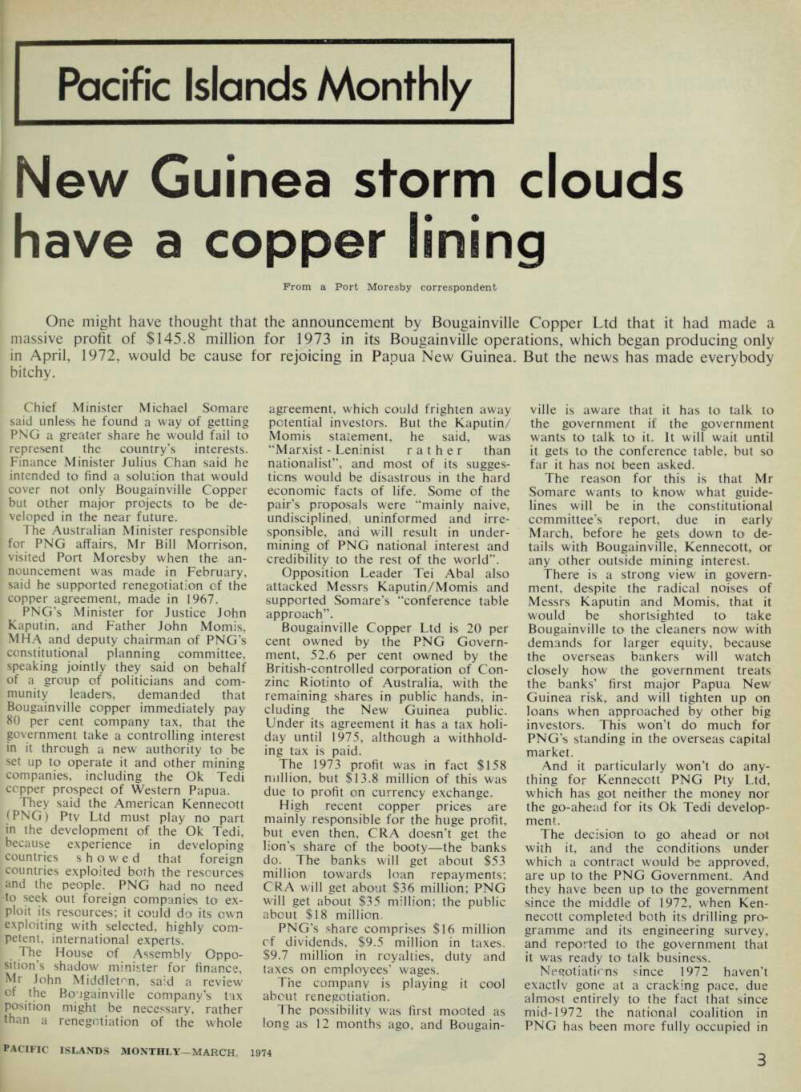
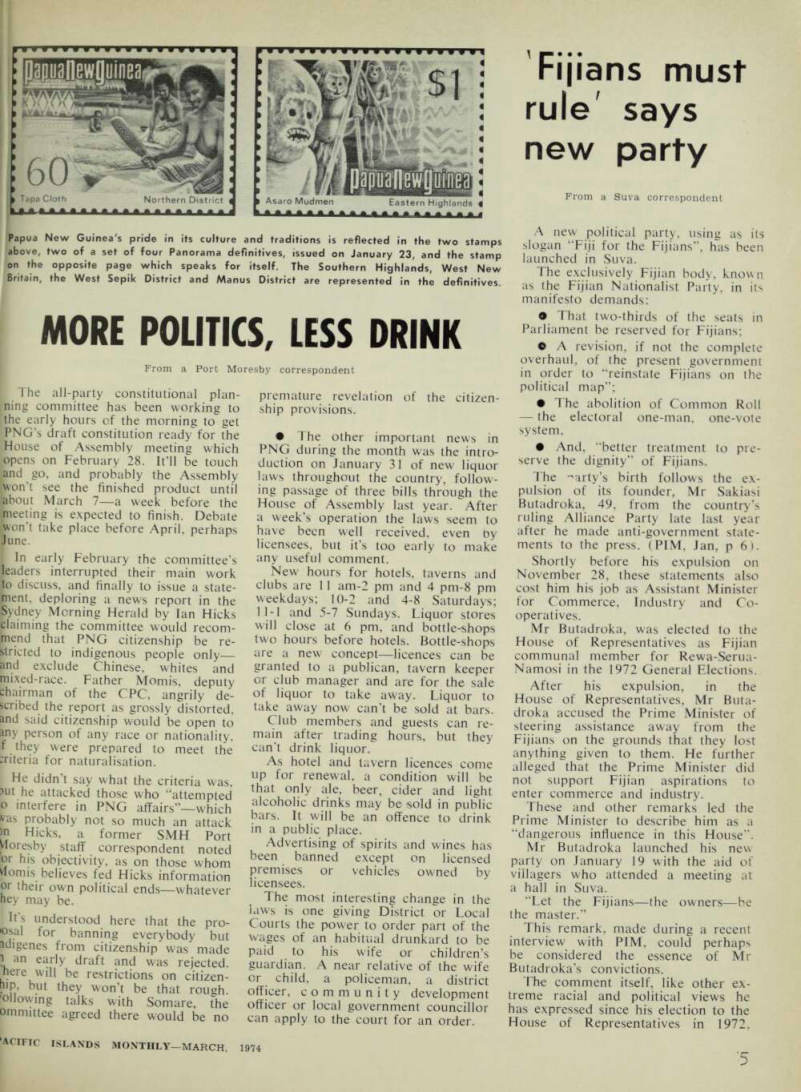
Papua New Guinea's pride in its culture and traditions is reflected in the two stamps above, two of a set of four Panorama definitives, issued on January 23, and the stamp on the opposite page which speaks for itself. The Southern Highlands, West New Britain, the West Sepik District and Manus District are represented in the definitives.
'Fijians must
rule' says new party
From a Suva correspondent
A new political party, using as its slogan “Fiji for the Fijians”, has been launched in Suva.
The exclusively Fijian body, knoun as the Fijian Nationalist Party, in its manifesto demands: o That two-thirds of the seats in Parliament be reserved for Fijians; o A revision, if not the complete overhaul, of the present government in order to “reinstate Fijians on the political map”; • The abolition of Common Roll the electoral one-man, one-vote system, • And, "better treatment to pre serve the dignity” of Fijians.
The •'arty’s birth follows the ex pulsion of its founder, Mr Sakiasi Butadroka, 49, from the country’s ruling Alliance Party late last year after he made anti-government state ments to the press. (PIM, Jan, p 6).
Shortly before his expulsion on November 28, these statements also cost him his job as Assistant Minister for Commerce, Industry and Co operatives.
Mr Butadroka, was elected to the House of Representatives as Fijian communal member for Rewa-Serua- Namosi in the 1972 General Elections.
After his expulsion, in the House of Representatives, Mr Buta droka accused the Prime Minister of steering assistance away from the Fijians on the grounds that they lost anything given to them. He further alleged that the Prime Minister did not support Fijian aspirations to enter commerce and industry.
These and other remarks led the Prime Minister to describe him as a “dangerous influence in this House”.
Mr Butadroka launched his new party on January 19 with the aid of villagers who attended a meeting at a hall in Suva.
“Let the Fijians—the owners—be the master.”
This remark, made during a recent interview with PIM, could perhaps be considered the essence of Mr Butadroka’s convictions.
The comment itself, like other ex treme racial and political views he has expressed since his election to the House of Representatives in 1972.
obviously springs from a strong sense of grievance.
But what led to this . . . and, ultimately, to his dismissal from the post of Assistant Minister for Com merce, Industry and Co-operatives and expulsion from the Alliance Party?
He told PIM that he first con sidered entering politics after reading the objects of the Fijian Association, the Alliance Party’s main constituent body.
He said he felt that in politics he would have a greater opportunity to help further the development of the Co-operatives movement, an organisa tion he had worked for since leaving school. (When he resigned, he was manager of the Central Co-operatives Associa tion.) “When I was elected,” Mr Buta droka said, “I was a great supporter of the multi-racial movement. But when I started pointing out the prob lems of the Fijian people, I was greatly surprised when I was called a racist.
“In my capacity as a Fijian com munal representative, I think I had every right to voice this and I was guided by the objects of the (Fijian) association, of which I am a member.
But every time I brought forward the problems of the Fijian people I was called a racist.
“I don’t think I can reconcile myself with this.”
He said that in the association’s national committee and in the Alliance Party nearly every month, he had raised the issue of develop ment of land by the government, and also of education, commerce, scholar ships and industry as they affected Fijians.
“I felt the government was putting too much money into the hands of the ‘haves’. I didn’t want money from the government for these purposes as a free gift. It could have been in the form of loans.
Asked about his party’s submission that Fijians should have two-thirds representation in Parliament and who he thought should comprise the remaining third —Mr Butadroka said: “Any other races. The Indians are big in population; the Europeans are big in money.
“But let the Fijians—the owners— be the master. This could cause some resentment. But you only have to see what is going on in other parts of the world.”
Asked what alternative to common roll he could suggest, Mr Butadroka said machinery to deal with this could be set up. He did not elaborate.
Asked why he had not tried to promote his case through the existing political framework, Mr Butadroka said; “I did. I tried my 100 per cent
best after I was elected to the House.”
He said he did not know the exact number of members of his new party, “but from what I’ve heard I’ve got thousands of followers. The majority of my constituents are in favour of what I’m doing”.
Asked how many had paid their 50 cents-a-year membership fee, Mr Butadroka again said he could give no exact figure, “but some have paid”.
When referred to suggestions that many of the people he was trying to influence were illiterate or semi literate villagers, Mr Butadroka said that since Independence the lot of the Fijians had dropped back and his supporters had begun to realise this.
“If they wouldn’t listen to me, B would have resigned my seat in the: House. I think if I called another march in two or three months’ time, the streets would be filled.”
He said his next move would be to voice the “Fijian view” in Parlia ment, and that he was now working on some motions to this effect. He did not know when he would get a reply to his party’s submissions, but he added that, even if they were rejected, he would still press ahead with his plans. He felt confident his new party would be a fully effective one by the end of this year.
And if it should fail?
Mr Butadroka thought for c moment, and then said: “I just cam not imagine that happening.”
Footnote: Soon after the launching of Mr Butadroka’s party, Prime Minister Ratu Sir Kamisese Man called on supporters of the Alliance Party’s multi-racial policies to “stam up and be counted”. ?
Speaking as chairman of his party i national council meeting at Nadi, Rati Mara delivered a cutting openinj address aimed at opponents of multi racialism. He referred to the forma tion of the Fijian Nationalist Part as a timely moment for the Allianc to take stock of itself. There was n< room in the party for those witl views opposite to multi-racial ones The idea of Fijians’ interests bein paramount was a firm part of th Fiji Constitution.
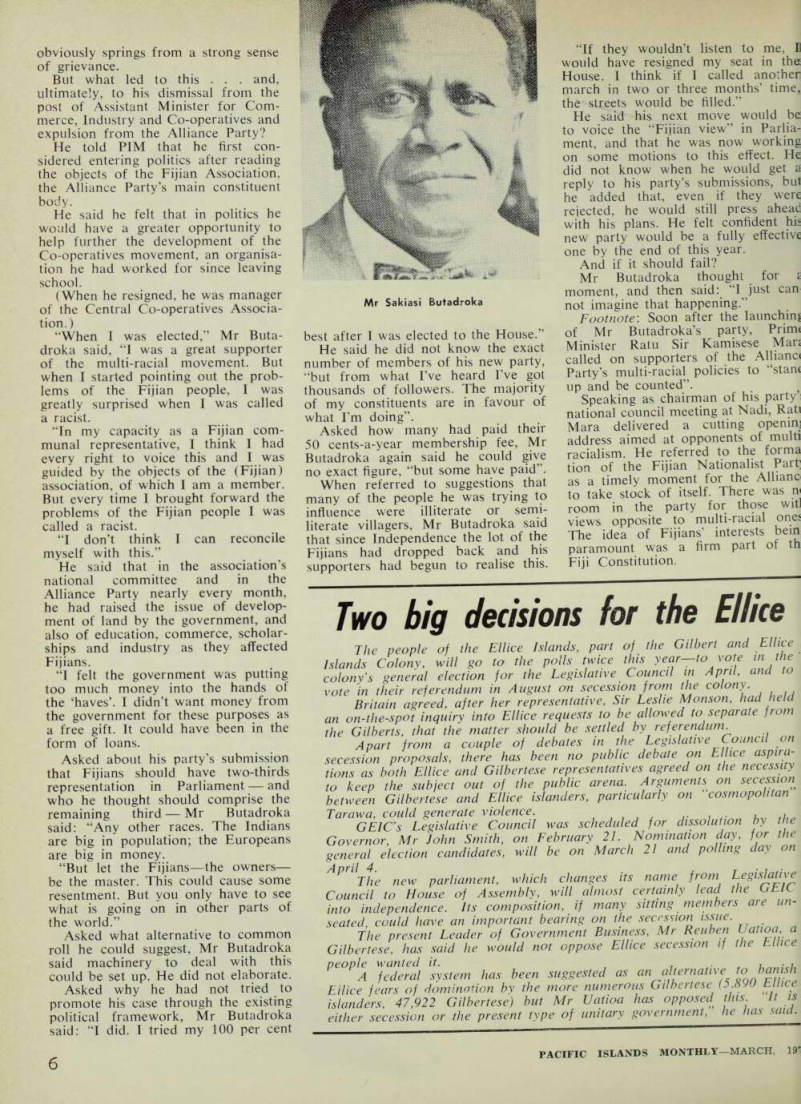
Mr Sakiasi Butadroka
Advertisements & other items, p. 11 (1 item)
5
ACIFIC ISLANDS MONTHLY-MARCH, 1974
Two big decisions for the Ellice
The people of the Ellice Islands, part of the Gilbert and Ellice Islands Colony, will go to the polls twice this year—to vote in the colony’s general election for the Legislative Council in April, and to vote in their referendum in August on secession from the colony.
Britain agreed, after her representative, Sir Leslie Monson, had held an on-the-spot inquiry into Ellice requests to be allowed to separate from the Gilberts, that the matter should be settled by referendum.
Apart from a couple of debates in the Legislative Council on secession proposals, there has been no public debate on Ellice aspira tions as both Ellice and Gilbertese representatives agreed on the necessity to keep the subject out of the public arena. Arguments on secession between Gilbertese and Ellice islanders, particularly on cosmopolitan Tarawa, could generate violence.
GEIC's Legislative Council was scheduled for dissolution by the Governor, Mr John Smith, on February 21. Nomination day, for the general election candidates, will be on March 21 and polling day on AP ‘\he new parliament, which changes its name from Legislative Council to House of Assembly, will almost certainly lead the CEIL into independence. Its composition, if many sitting members are un seated, could have an important bearing on the secession issue.
The present Leader of Government Business, Mr Reuben Vatioa, a Gilbertese, has said he would not oppose Ellice secession if the Ellice l^ stem has been suggeste d as an alternative to banish Ellice fears of domination by the more numerous Gilbertese (5,890 Ellice islanders, 47,922 Gilbertese) but Mr Uatioa has opposed this. It is either secession or the present type of unitary government, he has said.
A fiery death comes for 96
96 at midnight in Samoa
From a Pago Pago correspondent
L A ? C A y Crash °c f a Pan^ American 707 at American Samoans Pago Pago E at r^" atl ? na l Airp °. rt . has left , 96 frmm A de u‘ ? e tS lg je V W f C ? mm § hmmrt w i Ne 'u Zealand and Anc"? f Honolulu, Hawaii and Los W f C Il ll crashed and burned St nn arOUnd mid ' M.nv ? 3 °- k Many of those on board were 7l a r d / eSld f. ntS .U “ n S 16 New Austrians Samoa " s ’ five Austmlians, one Tongan and one AScats nde S IS °Ca k n^nr r % 4 ve Britons, as well as residents of Germany, Janan. Switzerland the Netherlands and China. ’
Ten survivors were taken to Lyndon B Johnson Tropical Medical Centre immediately after the crash, one dying tto%fi: r ter" ival ' Four more died An investigation is underway to determine the cause of the crash, ivhich occurred as hundreds of persons waited at the airport. The investigation is being conducted by he Federal Aviation Administration, he National Safety Transportation Board, and Pan American officials.
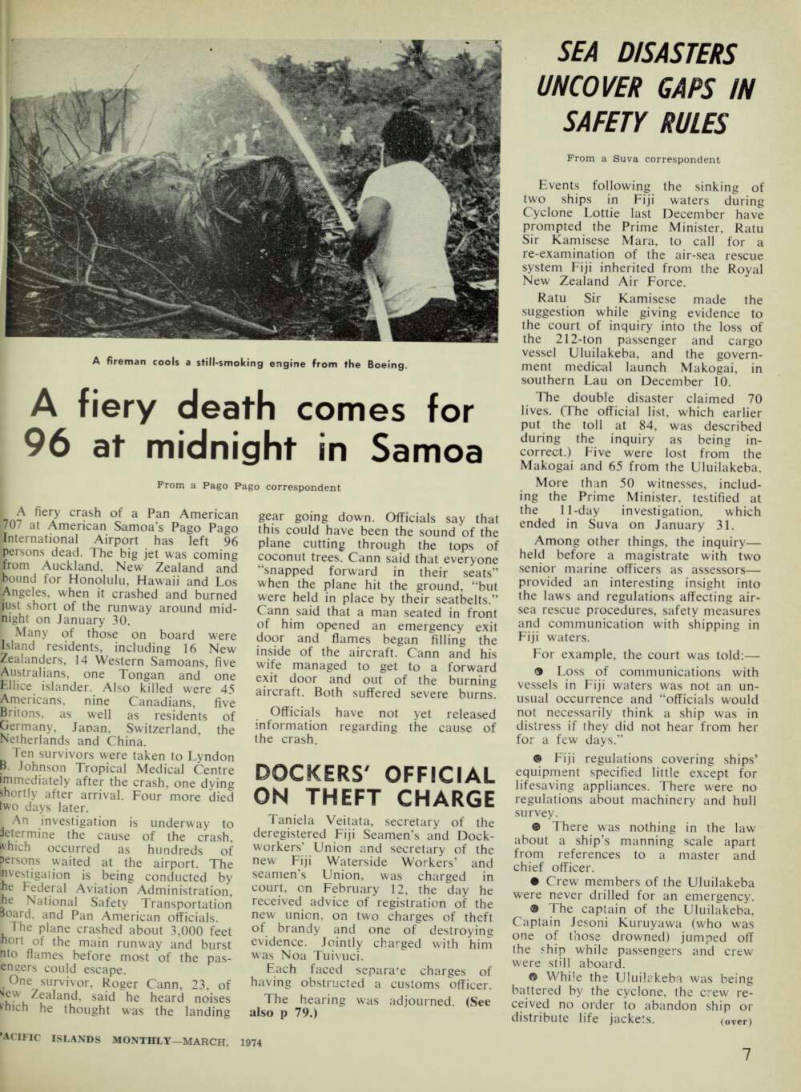
The plane crashed about 3,000 feet ihort of the main runway and burst nto flames before most of the pasenters could escape.
One survivor, Roger Cann, 23, of said heard noises mich he thought was the landing
gear going down. Officials say that this could have been the sound of the plane cutting through the tops of coconut trees. Cann said that everyone “snapped forward in their seats” when the plane hit the ground, “but were held in place by their seatbelts.”
Cann said that a man seated in front of him opened an emergency exit door and flames began filling the inside of the aircraft. Cann and his wife managed to get to a forward exit door and out of the burning aircraft. Both suffered severe burns.
Officials have not yet released information regarding the cause of the crash.
Dockers' Official
On Theft Charge
Taniela Veitata, secretary of the deregistered Fiji Seamen’s and Dock workers’ Union and secretary of the new Fiji Waterside Workers’ and seamen’s Union, was charged in court, on February 12, the day he received advice of registration of the new union, on two charges of theft of brandy and one of destroying evidence. Jointly charged with him was Noa Tuivuci.
Each faced separate charges of having obstructed a customs officer.
The hearing was adjourned. (See also p 79.)
A fireman cools a still-smoking engine from the Boeing.
Sea Disasters
Uncover Gaps In
Safety Rules
From a Suva correspondent
Events following the sinking of two ships in Fiji waters during Cyclone Lottie last December have prompted the Prime Minister, Ratu Sir Kamisese Mara, to call for a re-examination of the air-sea rescue system Fiji inherited from the Royal New Zealand Air Force.
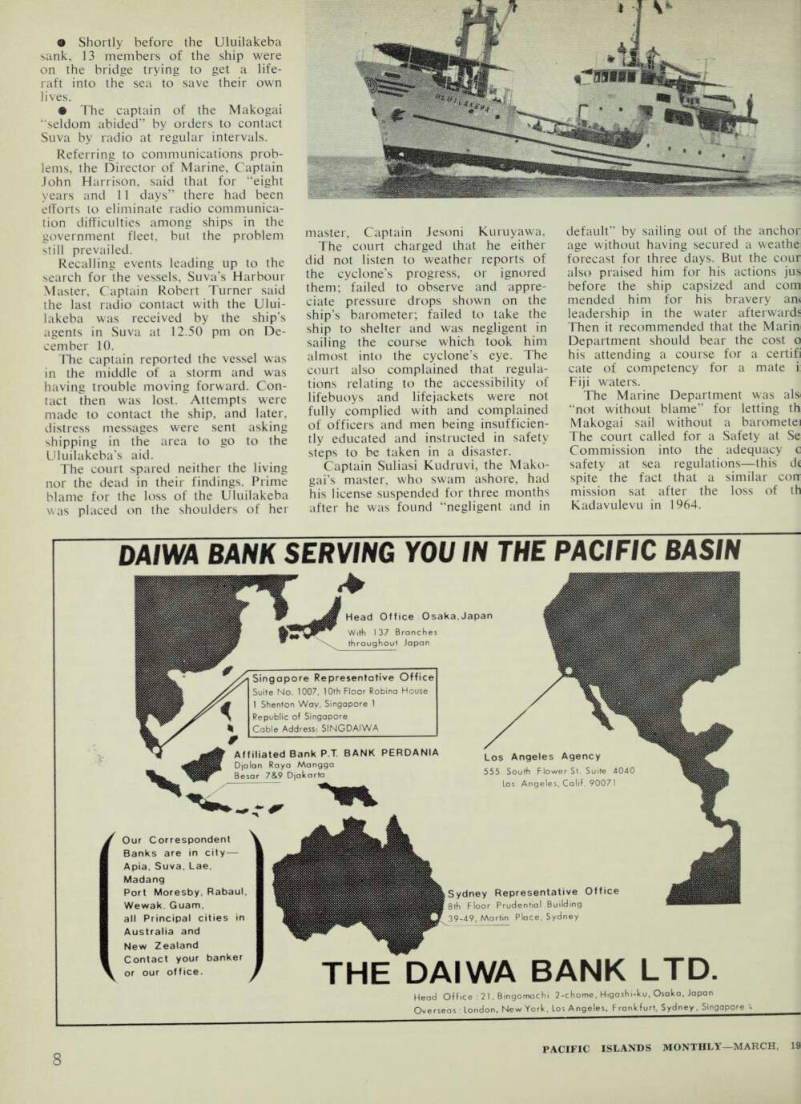
Ratu Sir Kamisese made the suggestion while giving evidence to the court of inquiry into the loss of the 212-ton passenger and cargo vessel Uluilakeba, and the govern ment medical launch Makogai, in southern Lau on December 10.
The double disaster claimed 70 lives. (The official list, which earlier put the toll at 84, was described during the inquiry as being in correct.) Five were lost from the Makogai and 65 from the Uluilakeba.
More than 50 witnesses, includ ing the Prime Minister, testified at the 11-day investigation, which ended in Suva on January 31.
Among other things, the inquiry— held before a magistrate with two senior marine officers as assessors— provided an interesting insight into the laws and regulations affecting air sea rescue procedures, safety measures and communication with shipping in Fiji waters.
For example, the court was told:— 9 Loss of communications with vessels in Fiji waters was not an un usual occurrence and “officials would not necessarily think a ship was in distress if they did not hear from her for a few days.” ® Fiji regulations covering ships’ equipment specified little except for lifesaving appliances. There were no regulations about machinery and hull survey. ® There was nothing in the law about a ship’s manning scale apart from references to a master and chief officer. • Crew members of the Uluilakeba were never drilled for an emergency. ® The captain of the Uluilakeba, Captain Jesoni Kuruyawa (who was one of those drowned) jumped off the ship while passengers and crew were still aboard.
O While the Uluilakeba was being battered by the cyclone, the crew re ceived no order to abandon ship or distribute life jackets. (OV er)
9 Shortly before the Uluilakeba sank, 13 members of the ship were on the bridge trying to get a life raft into the sea to save their own lives. • The captain of the Makogai “seldom abided” by orders to contact Suva by radio at regular intervals.
Referring to communications prob lems, the Director of Marine, Captain John Harrison, said that for “eight years and 11 days” there had been efforts to eliminate radio communica tion difficulties among ships in the government fleet, but the problem still prevailed.
Recalling events leading up to the search for the vessels, Suva’s Harbour Master, Captain Robert Turner said the last radio contact with the Ului lakeba was received by the ship’s agents in Suva at 12.50 pm on De cember 10.
The captain reported the vessel was in the middle of a storm and was having trouble moving forward. Con tact then was lost. Attempts were made to contact the ship, and later, distress messages were sent asking shipping in the area to go to the Uluilakeba’s aid.
The court spared neither the living nor the dead in their findings. Prime blame for the loss of the Uluilakeba was placed on the shoulders of her
master, Captain Jesoni Kuruyawa, The court charged that he either did not listen to weather reports of the cyclone’s progress, or ignored them; failed to observe and appre ciate pressure drops shown on the ship’s barometer; failed to take the ship to shelter and was negligent in sailing the course which took him almost into the cyclone’s eye. The court also complained that regula tions relating to the accessibility of lifebuoys and lifejackets were not fully complied with and complained of officers and men being insufficien tly educated and instructed in safety steps to be taken in a disaster.
Captain Suliasi Kudruvi, the Mako gai’s master, who swam ashore, had his license suspended for three months after he was found “negligent and in
default” by sailing out of the anchor age without having secured a weathe forecast for three days. But the cour also praised him for his actions jus before the ship capsized and com mended him for his bravery am leadership in the water afterwards Then it recommended that the Marin Department should bear the cost o his attending a course for a certifi cate of competency for a mate i Fiji waters.
The Marine Department was alsi “not without blame” for letting th Makogai sail without a barometei The court called for a Safety at Se Commission into the adequacy c safety at sea regulations—this d€ spite the fact that a similar corr mission sat after the loss of th Kadavulevu in 1964.
Advertisements & other items, pp. 13-14 (2 items)
7
•ACIFIC ISLANDS MONTHLY— MARCH, 1974
The Daiwa Bank Ltd.
DAIWA BANK SERVING YOU IN THE PACIFIC BASIN Head Office Osaka,Japan With 137 Branches throughout Japan Singapore Representative Office Suite No. 1007, 10th Floor Robina House 1 Shenton Way, Singapore 1 Republic of Singapore Cable Address: SINGDAIWA Affiliated Bank P.T BANK PERDANIA Djalon Raya Mangga Besar 7&9 Djakarta i Our Correspondent Banks are in city— Apia, Suva, Lae.
Madang Port Moresby, Rabaul Wewak. Guam, all Principal cities in Australia and New Zealand Contact your banker or our office.
Los Angeles Agency 555 South Flower St. Suite 4040 Los Angeles, Calif. 90071 Sydney Representative Office Bth Floor Prudential Building 39-49, Martin Place, Sydney
THE DAIWA BANK LTD.
Head Office : 21. Bingomachi 2-chome, Higashi-ku, Osaka, Japan Overseas : London, New York, Los Angeles, Frankfurt, Sydney, Singapore
Tough talk
in Noumea
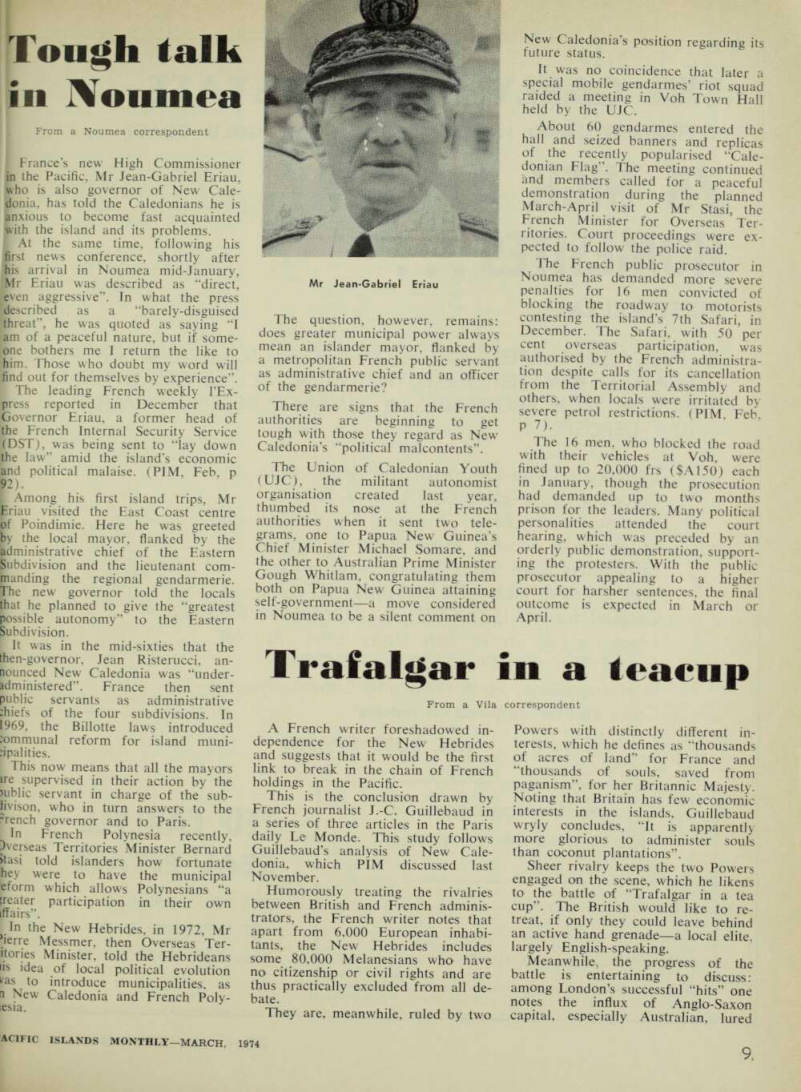
From a Noumea correspondent France’s new High Commissioner in the Pacific, Mr Jean-Gabriel Eriau, who is also governor of New Cale donia, has told the Caledonians he is lanxious to become fast acquainted with the island and its problems. At the same time, following his first news conference, shortly after his arrival in Noumea mid-January, Mr Eriau was described as “direct, even aggressive”. In what the press described as a “barely-disguised threat”, he was quoted as saying “I am of a peaceful nature, but if some one bothers me I return the like to him. Those who doubt my word will find out for themselves by experience”.
I The leading French weekly I’Ex ‘press reported in December that Governor Eriau, a former head of the French Internal Security Service (DST), was being sent to “lay down the law” amid the island's economic and political malaise. (PIM, Feb, p 92). t Among his first island trips, Mr Eriau visited the East Coast centre of Poindimie. Here he was greeted by the local mayor, flanked by the administrative chief of the Eastern Subdivision and the lieutenant com manding the regional gendarmerie.
The new governor told the locals that he planned to give the “greatest possible autonomy” to the Eastern Subdivision.
I It was in the mid-sixties that the then-governor, Jean Ristemcci, an nounced New Caledonia was “under administered”. France then sent public servants as administrative chiefs of the four subdivisions. In 1969, the Billotte laws introduced communal reform for island muni npalities.
This now means that all the mayors ire supervised in their action by the )üblic servant in charge of the sub livison, who in turn answers to the French governor and to Paris.
In French Polynesia recently, Overseas Territories Minister Bernard ftasi told islanders how fortunate hey were to have the municipal eform which allows Polynesians “a [reater participation in their own iffairs”.
I In the New Hebrides, in 1972, Mr ierre Messmer, then Overseas Ter itories Minister, told the Hebrideans ns idea of local political evolution yas to introduce municipalities, as a New Caledonia and French Poly icsia.
The question, however, remains: does greater municipal power always mean an islander mayor, flanked by a metropolitan French public servant as administrative chief and an officer of the gendarmerie?
There are signs that the French authorities are beginning to get tough with those they regard as New Caledonia’s “political malcontents”.
The Union of Caledonian Youth (UJC), the militant autonomist organisation created last year, thumbed its nose at the French authorities when it sent two tele grams, one to Papua New Guinea’s Chief Minister Michael Somare, and the other to Australian Prime Minister Gough Whitlam, congratulating them both on Papua New Guinea attaining self-government—a move considered in Noumea to be a silent comment on
New Caledonia s position regarding its future status.
It was no coincidence that later a special mobile gendarmes’ riot squad raided a meeting in Voh Town Hall held by the UJC.
About 60 gendarmes entered the hall and seized banners and replicas of the recently popularised “Cale donian Flag”. The meeting continued and members called for a peaceful demonstration during the planned March-April visit of Mr Stasi, the French Minister for Overseas Ter ritories. Court proceedings were ex pected to follow the police raid.
The French public prosecutor in Noumea has demanded more severe penalties for 16 men convicted of blocking the roadway to motorists contesting the island’s 7th Safari, in December. The Safari, with 50 per cent overseas participation, was authorised by the French administra tion despite calls for its cancellation from the Territorial Assembly and others, when locals were irritated by severe petrol restrictions. (PIM. Feb.
P 7).
The 16 men, who blocked the road with their vehicles at Voh, were fined up to 20,000 frs (SAISO) each in January, though the prosecution had demanded up to two months prison for the leaders. Many political personalities attended the court hearing, which was preceded by an orderly public demonstration, support ing the protesters. With the public prosecutor appealing to a higher court for harsher sentences, the final outcome is expected in March or April.
Mr Jean-Gabriel Eriau
Trafalgar in a teacup
From a Vila correspondent
A French writer foreshadowed independence for the New Hebrides and suggests that it would be the first link to break in the chain of French holdings in the Pacific.
This is the conclusion drawn by French journalist J.-C. Guillebaud in a series of three articles in the Paris daily Le Monde. This study follows Guillebaud’s analysis of New Caledonia, which PIM discussed last November.
Humorously treating the rivalries between British and French administrators, the French writer notes that apart from 6,000 European inhabitants, the New Hebrides includes some 80,000 Melanesians who have no citizenship or civil rights and are thus practically excluded from all deba te- 1 hey are, meanwhile, ruled by two
Powers with distinctly different in terests, which he defines as “thousands of acres of land” for France and “thousands of souls, saved from paganism”, for her Britannic Majesty.
Noting that Britain has few economic interests in the islands, Guillebaud wryly concludes, “It is apparently more glorious to administer souls than coconut plantations”, Sheer rivalry keeps the two Powers engaged on the scene, which he likens to the battle of “Trafalgar in a tea cup”. The British would like to re treat, if only they could leave behind an active hand grenade—a local elite, largely English-speaking, Meanwhile, the progress of the battle is entertaining to discuss: among London’s successful “hits” one notes the influx of Anglo-Saxon capital, especially Australian, lured
by the local tax haven. As English J {business signs go up along Vila’s main I f street, however, the French scent (“Australian imperialism over the i South Pacific . . . imperialism which I is henceforth inevitably present in ! (the thoughts of) all French adminis trations in Oceania”, j A Gallic counter-shot is the land speculation of American businessmen, supposedly encouraged by France to permit their nationals to get rid of their unprofitable copra plantations, although such sales were later blocked.
During his visit to the islands, the writer noticed a “strange effervescence I stirring the Melanesian tribes”. He I considers the indigene’s preoccupation f with extensive lands “bought” by the I colonising Powers; the resurgence of a Melanesian “personality”, with a re f turn to nature and questioning of the I industrial Western society; a rejec > tion of oppressive Christianity and the emergence of new cults. He de [tects an anti-European sentiment amid 1 a movement which could support the urge for independence.
Guillebaud tells of pressure for in- I dependence encouraged particularly : within the Presbyterian Church. He finds other missions trying to outbid leach other in the same direction. He [notes the Roman Catholic missions [are more tied to the French Adminis tration, through State aid for their schools. But the young priests are on the same wave-length as the Protes tants in the independence drive. [ All forces now being apparently en gaged in this direction, the French [journalist finds the UK and France competing to prepare the way, their ■way, for independence, especially as economic control from outside is likely to persist. He relates that hardly a week goes by in Vila with out a “diplomatic incident” between the two Residences over this issue.
Meanwhile, the main Anglo-French tussle is over education and equip ment for the islands. The French are now trying to catch up on the schools; they have only about 8,000 students, compared with the 12,000 to 15,000 enrolled in English institu tions. This means that almost all the Melanesian elite is still composed of English-speaking students, nearly all of them urging independence.
On expenditure for other public facilities France is ahead, although sometimes her installations are for prestige, whereas the British consider the expense of future upkeep.
Finally, treating the political de velopment of the archipelago, Guille baud notes France is not prepared to give the vote to the Melanesians and create a truly deliberating Assembly, by extending the powers
and representativity of the present Advisory Council. France talks in stead of creating municipal responsi bility, as in New Caledonia and French Polynesia.
The Le Monde writer believes France does not want to give up the New Hebrides for fear it sets off a chain reaction through other French territories. New Caledonia and French Polynesia.
The French solution then lies in de veloping local beef production in the hope that an agricultural New Hebri des, plus Wallis and Futuna Islands could be hitched onto an industrial ised New Caledonia. But for writer Guillebaud, France is creating a poor image by her stand which is hard to justify when even the smallest islands are getting independence. He thus sees the New Hebrides as the first likely link to break in the French chain, unless France wants to declare war on England, to “save” Vila.
Advertisements & other items, pp. 15-16 (2 items)
9
ACIFIC ISLANDS MONTHLY— MARCH, 1974
75 High And Dry
TED CARLYLE REAL ESTATE
RETIREMENT AND INVESTMENT ON THE GOLD COAST
HOMESITES...
FIRST RELEASE
FULLY DEVELOPED —Cleared, Kerbed and Channelled • SEWERED & DRAINED ®WATER & ELECTRICITY ALL SEALED BITUMEN ROADS * WIDE FRONTAGES • FINANCE READILY AVAILABLE
10% DEPOSIT
Situated on the Centre of the GOLD COAST adjacent to top-class Golf Course, Safe Surfing Beach, Main Shopping Centre, Schools & transport nearby. Short drive to Airport.
Fifty miles from State Capital. Residential area adjoins. ALL LOTS APPROVED by Local
Council for MAISONETTE or DUPLEX DWELLINGS.
Ideal for two Strata Title Units. LIVE IN ONE & LET THE OTHER or Let them BOTH!
Designs, plans, quotations and Construction Costs can be supplied on request.
ALL LOTS $15,000.
TED CARLYLE
REAL ESTATE
3013 Gold Coast Highway,
SURFERS PARADISE, Q. 4217
Phone: GOLD COAST 39-0188.
SEND THIS COUPON NOW
FOR SITE PLAN AND FULL DETAILS.
NAME
ADDRESS -
POST CODE TELEPHONE ...
It's the month
for folks
The Fifth Conference of the South Pacific Forum will be held for three days from March 20 on Rarotonga in the Cook Islands.
This is the first full meeting of Island territories in the Cooks but it will not be the last. In September, the Fourteenth South Pacific Conference will also be held in Rarotonga.
The Forum is expected to have three busy days because its Bureau for Economic Co-opera tion (SPEC) will have several reports to table. One, a report on the much-talked-of regional ship ping line, is expected to occupy the Island leaders for some con siderable time.
Four days before the Forum Conference opens, another Island association will have voted itself out of existence. This is the Pacific Islands Producers As sociation (PIPA) which at a two day meeting beginning on March 15 on Rarotonga, will wind up and make way for SPEC. It has been agreed that SPEC should take over PIPA’s functions.
Rarotonga will host a third All- Islands conference this year, the 14th South Pacific Conference, provisionally scheduled for Sep tember 23-October 4. The dates may be affected by the talks in Wellington between March 5-7 over the proposed merger of the Commission and the Conference.
way doesn't

The Pacific way doesn't win medals
From a Christchurch correspondent Two medals, a silver and a bronze, were all that five countries from the Pacific Islands could win at the Com monwealth Games in Christchurch.
Both these medals went to Western Samoans—a silver to Paul Wallwork, who was second in the weightlifting light-heavyweight division, and a bronze to Vai Samu, who reached the semi-finals of the heavyweight boxing.
The reasons for this lack of suc cess, although winning is not every thing, and the Games were reported as being a particularly happy event, were probably threefold: Lack of regular strong competition, the Pacific way of life and lack of coaches.
Except for very small entries in the Olympic Games, and little larger entries in Commonwealth Games, competition for Pacific Islanders is restricted to their own Games.
Captain Stan Brown, manager of the Fiji team, said close contact daily with world-class athletes, impressed on the Fiji team the amount of dedication necessary to become a top sportsman or sportswoman.
The Pacific Islands way of life, generally easygoing, does not provide the spur a sportsman needs to reach world class.
In spite of the lack of success, several islanders received a very good press in New Zealand. One of these was Sanitesi Latu, of Tonga. If he did not win a medal he won the hearts of thousands who watched the track and field events, particularly the gruelling decathlon. He came sth in a field of 16, a remarkable feat for a young man in only his second decathlon.
Two Tongan shooters also attracted attention. Until the games, army sergeants Sesimani Fenukitau and Ha’anga’ana Tau had never shot over more than 30 yards, on the army rifle range, which was laid out only in 1973. Their marksmanship over 600 yards amazed experienced riflemen.
Papua New Guinea featherweight boxer, Steve Meta, made the weight for his fight just before the weigh-in.
Ten minutes before he was due to step on the scales he was 100 grams (between three and four ounces) overweight. No-one could find a skipping rope, but there was a long piece of string available, and using
that as a rope, and wearing three plastic coats, he shed the 100 grams.
Team-mate Bernard Kondeng, who won a bronze medal at the 1970 Games in Edinburgh, was not so fortunate. He was H lb over at the weigh-in and was disqualified. He was the correct weight the day before.
The sudden jump was put down to a big meal on the eve of the weigh-in.
Most of the Islands swimmers did well, while lacking the polish of com petitors from metropolitan countries.
Boxers, weight-lifters, wrestlers and competitors in other events were deficient in technique, which is not a difficult problem to overcome with proper coaching and regular com petition.
This much seems certain.—Those who gained much experience at Christchurch will be forces to be reckoned with at the 1975 South Pacific Games in Guam.
The Games attracted a number of VIPs from the Islands, among them Fiji Prime Minister, Ratu Sir Kamisese Mara, Tonga Prime Minister, Prince Tuipelehake, Western Samoa Prime Minister, Mr Mataafa, and Western Samoa Head of State, Malietoa Tanu malili 11. It took the Games to induce the last-named to make his first official visit to a foreign country since Western Samoa became indepen dent in January 1962.
Advertisements & other items, p. 18 (1 item)
dairyland
LBV3IOI
is your
HI \/m H
dairyland
From Australia comes one of I nature’s finest products JB delicious, nutritious Australian golden butter. Fresh to you from rich, green Australian pastures.
V When you buy dairy products butter, cheese or ghee from your store or supermarket, look for the word “AUSTRALIA’' on the pack. It’s your guarantee of quality and flavour.
All the best —from Australia to you.
Farewell Wphc
The Western Pacific High Commission, created by Britain in 1887, and administering in its time the BSIP, the GEIC and the British section of the New Hebri des, will soon disappear. The Western Pacific High Commiss ioner, Mr D. C. C. Luddington, when the BSIP adopts a new con stitution this year, will become Governor of the BSIP.
The WHPC’s powers over the New Hebrides were transferred on December 1, 1973, to the Commonwealth and Foreign Office in London, and Mr E. N.
Larmour, Deputy Under-Secre tary for Dependent Territories, was appointed High Commiss ioner for the New Hebrides.
The Western Pacific High Commissioner over the years had delegated his responsibility for the New Hebrides to the British Resident Commissioner in Vila. This delegation contin ues with Mr Larmour delegating responsibility to the British Resi dent Commissioner, Mr du Bou lay.
Pago Pago
That governor business in Pago Pago
Frcm a Pago Pago correspondent Members of the United States House Committee on Interior and Insular Affairs, and representatives from the Department of the Interior, were in American Samoa for a four day visit in January. The lawmakers, who have Congressional authority over American Samoa, were on a tour that included American Samoa, Guam, and Micronesia.
The delegation was led by Congress man Phillip Burton, of California, and included Congresswoman Patsy Mink, of Hawaii, and Congressmen Lloyd Meeds and Tom Foley, both from Washington State. Delegate-at- Large A. U. Fuimaono, who represents American Samoa in Washington, DC, was also with the group.
Chairman Burton said the committee was there to “get a first hand im pression of the island, to meet with the Samoan leaders, and to discuss the idea of an elected Samoan governor”. Burton was the author of a bill calling for the election of a Samoan governor, which was intro duced in the United States Congress several years ago. Local elections were held on the issue in 1972 and, again, in 1973. Both times a large majority of the voters were against the idea of an elected Samoan governor. The governor of American Samoa is ap pointed bv the Secretary of the Interior.
Members of the committee held a series of public meetings with the leaders of the American Samoa com munity, as well as a meeting with both houses of the American Samoa Legislature.
At all meetings the idea of a Samoan governor was generally pro moted, but the idea of a directly elected Samoan governor met with opposition. Most of the speakers favoured a Samoan governor selected by the “representatives of the Samoan people”, in accordance with Samoan custom. It was not made clear if the “representatives of the Samoan people” were to be the chiefs or the Legislature.
Calling such an idea “inconsistent with the democratic system”, Con gresswoman Patsy Mink said it was very “important for the idea and the
principle of an elected Samoan governor to be put to the people”. She told the Samoan leaders that they could not “impose a new system of government on the people of Ameri can Samoa without a popular vote”.
Congressman Foley said that a move to select rather than to elect a governor by the people’s popular vote, would "raise questions in Con gress, especially as the Samoan people have voted down the idea for a second time, only recently”.
When asked if the committee would recommend that a governor be selected rather than elected, Con gressman Meeds replied that the idea was “inconsistent”. He said that the people of American Samoa would have to make that decision them selves. He added that he “would not vote for the selection of a governor, rather than the election of a governor”.
Chairman Burton said that he also felt that it was very imnortant for there to be “some expression of the people of American Samoa”.
It was rather obvious in both the public meetings and in the meeting with the Legislature that the com mittee members favoured direct popular election of a Samoan governor, or at least a favourable voter response to the idea of a Samoan governor.
The American Samoa Legislature is now expressing interest in attempting to amend the constitution by their own vote, rather than by popular referendum, to allow for the election of a Samoan governor.
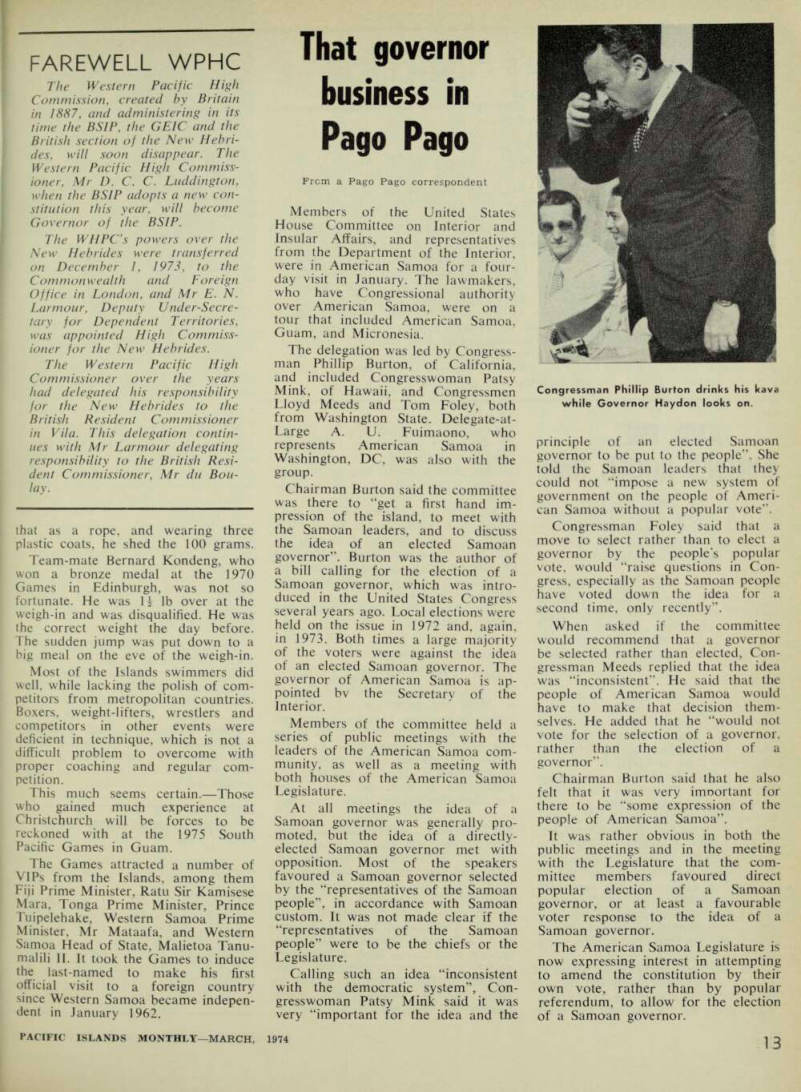
Congressman Phillip Burton drinks his kava while Governor Haydon looks on.
Prince Charlie's Fijian Fling...
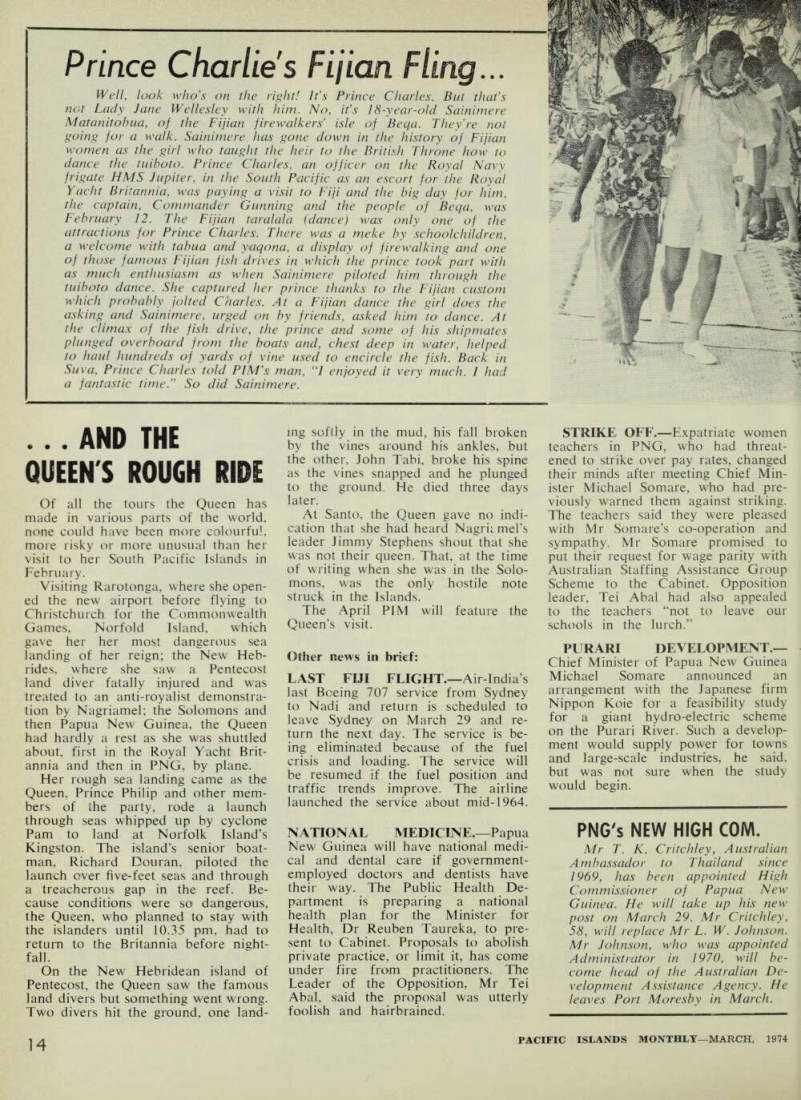
Well, look who’s on the right! It’s Prince Charles. But that’s not Lady Jane Wellesley with him. No, it’s 18-year-old Sainimere Matanitobua, of the Fijian firewalkers’ isle of Beqa. They’re not going for a walk. Sainimere has gone down in the history of Fijian women as the girl who taught the heir to the British Throne how to dance the tuiboto. Prince Charles, an officer on the Royal Navy frigate FI MS Jupiter, in the South Pacific as an escort for the Royal Yacht Britannia, was paying a visit to Fiji and the big day for him, the captain, Commander Gunning and the people of Beqa, was February 12. The Fijian taralala (dance) was only one of the attractions for Prince Charles. There was a meke by schoolchildren, a welcome with tabua and yaqona, a display of firewalking and one of those famous Fijian fish drives in which the prince took part with as much enthusiasm as when Sainimere piloted him through the tuiboto dance. She captured her prince thanks to the Fijian custom which probably jolted Charles. At a Fijian dance the girl does the asking and Sainimere, urged on by friends, asked him to dance. At the climax of the fish drive, the prince and some of his shipmates plunged overboard from the boats and, chest deep in water, helped to haul hundreds of yards of vine used to encircle the fish. Back in Suva, Prince Charles told PI M’s man, “/ enjoyed it very much. I had a fantastic time.” So did Sainimere.
Queen's Rough Ride
. . . And The
Of all the tours the Queen has made in various parts of the world, none could have been more colourful, more risky or more unusual than her visit to her South Pacific Islands in
February.
Visiting Rarotonga, where she open ed the new airport before flying to Christchurch for the Commonwealth Games, Norfold Island, which gave her her most dangerous sea landing of her reign; the New Heb rides, where she saw a Pentecost land diver fatally injured and was treated to an anti-royalist demonstra tion by Nagriamel; the Solomons and then Papua New Guinea, the Queen had hardly a rest as she was shuttled about, first in the Royal Yacht Brit annia and then in PNG, by plane.
Her rough sea landing came as the Queen, Prince Philip and other mem bers of the party, rode a launch through seas whipped up by cyclone Pam to land at Norfolk Island’s Kingston. The island’s senior boat man, Richard Douran, piloted the launch over five-feet seas and through a treacherous gap in the reef. Be cause conditions were so dangerous, the Queen, who planned to stay with the islanders until 10.35 pm, had to return to the Britannia before night fall.
On the New Hebridean island of Pentecost, the Queen saw the famous land divers but something went wrong.
Two divers hit the ground, one land
mg softly in the mud, his fall broken by the vines around his ankles, but the other, John Tabi, broke his spine as the vines snapped and he plunged to the ground. He died three days later.
At Santo, the Queen gave no indi cation that she had heard Nagricmel’s leader Jimmy Stephens shout that she was not their queen. That, at the time of writing when she was in the Solo mons, was the only hostile note struck in the Islands.
The April PIM will feature the Queen’s visit.
Other news in brief: LAST FIJI FLIGHT.— Air-India’s last Boeing 707 service from Sydney to Nadi and return is scheduled to leave Sydney on March 29 and re turn the next day. The service is be ing eliminated because of the fuel crisis and loading. The service will be resumed if the fuel position and traffic trends improve. The airline launched the service about mid-1964.
National Medicine.— Papua
New Guinea will have national medi cal and dental care if government employed doctors and dentists have their way. The Public Health De partment is preparing a national health plan for the Minister for Health, Dr Reuben Taureka, to pre sent to Cabinet. Proposals to abolish private practice, or limit it, has come under fire from practitioners. The Leader of the Opposition, Mr Tei Abal, said the proposal was utterly foolish and hairbrained.
STRIKE OFF. —Expatriate women teachers in PNG, who had threat ened to strike over pay rates, changed their minds after meeting Chief Min ister Michael Somare, who had pre viously warned them against striking.
The teachers said they were pleased with Mr Somare’s co-operation and sympathy. Mr Somare promised to put their request for wage parity with Australian Staffing Assistance Group Scheme to the Cabinet. Opposition leader, Tei Abal had also appealed to the teachers “not to leave our schools in the lurch.”
Purari Development.—
Chief Minister of Papua New Guinea Michael Somare announced an arrangement with the Japanese firm Nippon Koie for a feasibility study for a giant hydro-electric scheme on the Purari River. Such a develop ment would supply power for towns and large-scale industries, he said, but was not sure when the study would begin.
Png's New High Com.
Mr T. K. Critchley, Australian Ambassador to Thailand since 1969, has been appointed High Commissioner of Papua New Guinea. He will take up his new post on March 29. Mr Critchley, 58, will replace Mr L. W. Johnson.
Mr Johnson, who was appointed Administrator in 1970, will be come head of the Australian De velopment Assistance Agency. He leaves Port Moresby in March.
The Editor's Mailbag
Nauruan Workers
The Nauruan Workers’ Organisa tion was recently formed and Mr Bernard Dowiyogo, MP, was elected chairman of this organisation. (It was no surprise to the government because back in 1950 there was the Nauruan Workers’ Organisation which was very instrumental and President Hammer Deßoburt was the chairman of that organisation.) Later after independence, the organisation sud denly lost its sting or more or less became inactive as a result of the fact that some of its members were appointed to the Deßoburt govern ment.
This leaves behind the present members of the Public Service and other interested bodies, such as the employees of the Nauru Phosphate Corporation, the Nauru Local Government Councils’ employees and staff of the Nauru Co-operative Society have to remain content with their outstanding complaints as they lack the means for counselling.
Before the formation of this new organisation, the chairman Mr Dowiyogo had consulted President Deßoburt and Mr Deßoburt had given sanction for the reviving of this organisation. Of course there are many problems at present that are facing it.
It is envisaged that in the near future, this organisation will be fully recognised by the government and its activities sanctioned by the govern ment. Obviously this organisation is contemplating submitting a back log of claims by the members of the Public Service.
So far, the government has failed to entertain the notion that inflation has caused great concern to the public. There is no Prices Justification Tribunal. Emphasis was stressed by the government on recruiting ex patriate staffs from overseas, rather than training members of the Public Service to fill senior positions in the government.
During the Australian administra tion of this country many senior members of the Public Service were sent to Australia for specialised train ing. Moreover, the prices of our staple foodstuffs have doubled since last year and the basic wage has not yet been reviewed. (Last review was made in 1962). There are no means
of regulating the spiralling of prices
of the basic commodities.
The public as a result of mal administration has been made to suffer the consequences. If the government’s attitude remains un changed over the years to come, then, of course, there would be nationwide reaction. It appears at present that the government has focused its planning more on matters of pure “foreign affairs” rather than concerning itself with “internal strife”. This organisa tion has a big plan ahead of it and it is also considering having affilia tions with its neighbours in the Pacific
region.
Detonga Deiye.
Secretary, Nauruan Workers’ Organisation.
High-Class Pidgin
Dr Derek Bickerton (PIM, Jan, p 28) is mistaken, understandably enough, in supposing that the business of PNG’s House of Assembly is transacted in pidgin.
The business of the House is transacted in English. It is debated at great length, and frequently with only marginal relevance, in pidgin.
As in more sophisticated legislatures elsewhere, these debates make little difference to the decisions arrived at, and this is increasingly so in PNG as the party system gains strength.
It is from the purgatorial experience of sitting through these debates for eight years that I have derived my opinion that pidgin is not an ade quate medium for the kind of dis cussions which take place in a mod ern legislature.
I share Dr Bickerton’s high regard for the Summer Institute of Lingui stics. But most of its work has been done in New Guinea. I think that those few SIL linguists who have worked in Papua would support my contention that in the 25 years since Papua and New Guinea were amal gamated, pidgin has achieved very little penetration into Papua, except in urban and border areas. And this was to be expected, as Papua already had its own lingua franca, hiri motu, at the time the amalgamation took place.
With all respect, I do not think that it is meaningful to compare the linguistic situation in PNG today with that in Renaissance Europe. The confrontation between Latin and the European vernaculars took place in a world in which there were few books, comparatively limited vocab ularies and hardly any speculation.
We live in a world of many books, greatly extended vocabularies and a very high degree of specialisation. 1 can only repeat that the creation, almost from scratch, of libraries of books in pidgin adequate for the needs of modern secondary and ter tiary education is not really a prac ticable proposition. Even if it is pos sible language-wise, it is impossible writer-wise, money-wise and time wise. Particularly time-wise. Renaiss ance Europe was not in a hurry.
Papua New Guinea is, and unavoid ably so.
I am well aware of the world-wide communications gap between rulers and ruled, of which Dr Bickerton calls the “linguistic wedge” is just a small part. Basically it is the ever increasing complexity of the global situation which has created this gap.
The man in the street in Sydney or New York and the man in the village in Papua New Guinea alike find it difficult to understand what their rulers are up to.
Admittedly, the problem is seen at its worst in Papua New Guinea.
Our rulers here have the job of com ing to terms with the outside world on behalf of 2i million people, most of whom still live in a quasi-subsis tence economy. This is hard enough, but it is infinitely harder for them to explain what they are doing to people who haven’t a clue as to what makes the outside world tick.
If I am less worried about this problem than Dr Bickerton and his friends are, it is because I think that in the long term it is going to solve itself. In 1976 our present rulers will have to secure re-election if they want to continue to rule us. By and large the candidates and parties who are most successful in bridging the communications gap are the ones who will be elected. Without wishing to appear cynical, I think that the need to secure re-election will prove a more powerful spur to com munication than the homilies of the linguistic scientists.
Percy Chatterton
Sabama, Papua.
Gutter Language
I would like to say that, as a regu lar reader of PIM, I, unlike Mr H.
W. Cummings, have yet to be dis illusioned by anything printed there in.
Mr Cummings strikes me as being high-handed and more than slightly hysterical (PIM, Feb, p 29).
To save his delicate sensibilities further outrage, I suggest that he restrict his readings to Bill and Ben —The Flower Pot Men.
Cairns, Queensland.
Fiona Kirk
Tahiti Letter
Higher taxes , so Papeete goes on strike
From James Boyack In Papeete
Territorial Assembly President Gaston Flosse called it the “Year of the Great Beginning” and everyone agrees, although the heretical alliance of those who would have Tahiti independent, with the working bourgeoisie, be lieves it may be the beginning of the end.
The “Great Beginning” relies on a 1974 territorial budget of 8,774 million CFP, unprecedented in French Polynesian history and approximately double that of last year.
It is the Gaullist-cum-Indepen dent version of a cultural revolu tion which, at best, will make these 120 islands a Europe-sized appen dage of France for a long time to come, and at worst, previews the pro-Paris parties’ designs on re-election in 1977. The budget is the second voted by the pre dominantly Gaullist assembly majority, elected for a five-year term in September, 1972.
At a special assembly session for visiting Overseas Territories Minister Bernard Stasi, in January, President Flosse outlined the majority’s economic and political goals.
Clear objectives
“Our objectives are clear,” he intoned, in French with staccato vowels indicative of his Polynesian linguistic heritage. “They flow from one realisation: despite the presence of the Pacific Experi ments Centre, which still contri butes almost half of our gross national product (59 per cent in ’67, 48 per cent in ’73); despite the brilliant take-off of tourism which, from seven per cent in 1967 grew to 18 per cent of the GNP in 1972; despite aj high standard of living, albeit poorly shared among all social categories, the territorial economy recently has hovered a:t the brink of a dis quieting phase of stagnation, while
dangerous inflation is rampant.”
The time had come, he ex plained, to whip the economy back into shape.
"Whip” is his word for a SA23 million 1974 programme of im provements. This money, like that which Flosse recalled was spent by President Roosevelt on depres sion public works, will filter back to the people and guarantee a new prosperity for those urbanised Polynesians no longer participants in the 19605’ atom-economic boom.
"It is in difficult periods that audacity and imagination are called for, to give the economy the vigour to surmount the crisis,”
Flosse explained.
Minister Stasi agreed. The en tire business community and the assembly minority, did not.
Debonair Stasi
Debonair Minister Stasi took the occasion of his major public ad dress, during his two-week official visit, to confirm what he had already told Flosse and Indepen dent spokesman Frantz Vanizette during their fund-seeking trip to Paris one week earlier . . . the French Government would make sure that the assembly could bor row 2,300 million CFP (SAI7 million) in France. It would pro mote and/or guarantee the loan.
Strong pressure had been applied for Paris to guarantee this large amount. Otherwise there was threat of a breakup in the coalition majority, that political enigma which so adeptly has kept the variously-nationalist minority at bay.
Of course, there was the prob lem of $6 million in additional local taxes which was also decided for 1974. The businessmen of Papeete drove a harder bargain than the central government.
They screamed proverbial bloody murder at the new taxes
and in desperate protest, they closed almost every commercial establishment on the island. Only a government ultimatum to open the shops or face gendarme action curtailed the 99 per cent success ful general strike, and only agree ment by the assembly majority to re-consider new modes of taxation prevented a second threatened strike.
The new taxes included a one to three per cent direct tax on gross business takings and in creased import duties on some luxury items. In opposing these latter measures, businessmen argued that inflation and the oil crisis (18 per cent transportation increase from Europe in one week) might produce the extra revenue at the old tariff. Furthermore, high prices on luxury goods like jewellery and crystal-ware would hurt tourist purchasing power.
The business tax issue had already flared up on two earlier occasions. In 1958 and 1968, direct taxes were challenged by mildly violent public demonstra tions. The ’6B ’‘manifestation”, drawing its scenario from the suc cessful overturning of business tax 10 years previously, made public defiance of a one per cent tax on gross business takings. Rocks were distributed in the offices of a prominent businessman-politician and the incited proletariat took to the streets. As ritual required, the assembly building was stoned.
The governor relented to the ex tent that he postponed the tax one year.
In the present case, local money grabbers argued it was treasonable to reason that those who are making the money should pay: those who are drawing the greatest profit from the French and CEP presence should be taxed the heaviest.
At the same time, the autono mist-independence parties declared the new budget inflationary and a
big bluff. Recalling that last year’s infrastructural budget was only one-sixth of this year’s proposed outlay, the vociferous minority in the assembly said there wasn’t a snowball’s chance in hell of the money being used in 1974.
They accused the Gaullists of playing power-politics with Paris funds, of bribing the electorate, and by so doing creating a fiscal escalation which, in the end, will come out of the consumer’s pocket.
The one criticism of the budget which had the ring of truth was that not enough was earmarked for long-term income-producing investment. For example, $lO million will be spent for low income housing (800 to 900 new homes will be built) for the Papeete slum population which has abandoned traditional agriculture on outer islands—and this is an in dispensable, wise investment. But only $500,000 goes directly to agricultural activities, without which Tahiti cannot feed itself.
Warm reception
Bernard Stasi arrived in Tahiti in the middle of this noisy clamour over taxes and independence. He arrived the very morning the stores closed down, a propitious coincidence, if not a deliberate one, for as much as anything, he came to test the waters into which France will be throwing so much money in the near future.
At his final news conference, he waxed emotionally eloquent about the “genuinely warm” recep tion he received everywhere he went —around Tahiti, to Raiatea, Huahine, Bora Bora and to most of the staunchly pro-French, Catholic Marquesas Islands, on his way back stopping in the Tuamo tus. He was received like a head of state: small brown children sang the Marseillaise; he saw nothing which would cast doubt on the sagacity of the latest French in vestments in this part of Polynesia.
But, he did not meet a delega tion of autonomist-separatist poli ticians led by National Assembly Deputy Francis Sanford and Senator Pouvanaa A Oopa.
This refusal to talk unpleasant political turkey became “the un
fortunate incident” in an otherwise thoroughly appealing Paris con tact with its distant Polynesian kin.
Stasi played soccer in Tahiti, rode horses in the Marquesas and went for a bare-chested paddle in an outrigger canoe with Edna Tepeva, Miss France, 1974, last year’s Miss Tahiti. He danced the tamoure day after day and made a well-publicised journey through one of Papeete’s most squalid neighbourhoods.
But he refused to discuss the possibility of a referendum in which the Polynesians would de termine whether they want to re main French (with or without self government) or whether they de sire independence.
Meets Sanford
There were charges and counter-charges about why this meeting did not take place. The minister surprised his final press conference by saying that he did meet Deputy Sanford early in his visit. It was then, he said, that the deputy requested an interview for a cross-section of autonomist lead ers.
The minister said he refused this meeting because of statements made during a 3,000-strong pro independence, anti-tax rally held the previous Friday night in front of the Papeete City Hall. The minister said that some auto nomist leaders, including the dep uty, had “grossly insulted the President of the republic and the Prime Minister, while passing se vere judgement on the republic it self . . . additionally, I am not authorised to discuss or give in dependence”. (as The Journal de Tahiti pointed out, the delegation only wanted to discuss a referen dum.) Newspaper accounts said Stasi was upset by being called “little kid”, allegedly by one of the ora tors, but at his news conference the man in charge of French over seas holdings denied being a “little kid”, and added “I admit the pos sibility my decision could rein force the politics of Francis San ford”.
This last avowal is a measure of the high competence of the
man. He perhaps recognised, as did some people I know, that the Tahitians are an excessively vain people, little appreciative of total rebuff. Some say this non-meeting could have the unfortunate con sequences of ending forever hope that dialogue might lead to some form of “autonomic interne”, in keeping with long-standing San ford-Pouvanaa proposals.
Independence
It was last July that Francis San ford and Pouvanaa switched gears and began to militate for inde pendence, instead of autonomy. (PIM, Aug p 8.) At that time, this reversal seemed like idle chatter. Neither of the autonomist parties rushed out to support their leader’s un ilateral decision. Sanford said he wanted independence because he interpreted French nuclear tests as the final indication of scorn felt by France for the Polynesians.
This latest rebuff (Ministers Billotte and Rey also refused to talk), can only swell the ranks of those who agree with Sanford.
Curiously, the minister’s re fusal may also precipitate the in ternal self-government that France for six years has denied Sanford and Pouvanaa. The Gaullist ma jority, in the voice of Gaston Flosse, officially requested greater “autogestion” (self-management) of local affairs. In response to Flosse’s assembly welcome speech, the minister said, “Don’t you think, honestly, sincerely, there are really more pressing priorities (than autogestion)?”
An alternative
After “the unfortunate incident”, autogestion may one day become a suitable alternative to a ground swell (however unlikely it seems today) for independence. The minister told the press conference he had agreed to study forms of autogestion—“a serious examina tion,” he promised.
One journalist asked if the new status could be applied in 1975.
Overseas Territories Minister Bernard Stasi replied without hesitation, “Why not?”
Advertisements & other items, p. 24 (1 item)
A.R.C. reinforcing fabric
m i
ffif
a., t w J ' -V-''Vt r-*s £ w * mi
A.R.C. reinforcing fabric
does all your heavy work.
A.R.C. reinforcing fabric is designed and manufactured to do the heavy work in all concrete construction. The resistance welded wire fabric is available in rectangular or square mesh, in flat sheets or rolls and is produced to conform with Australian Standard 1304.
A.R.C. reinforcing fabric permits maximum construction speed and economies while retaining full design strength. The cost and time saved in laying fabric outweighs the use of other reinforcing materials. In addition, A.R.C. manufacture mesh in galvanised and bright wire to suit rural, industrial and domestic applications.
For details and prices of the A.R.C. range of reinforcing fabrics and other meshes contact: The Export Department, A.R.C. Industries Limited, 440 Collins Street, Melbourne, 3000, Victoria, Australia.
Cables: “Benignant”, Melbourne
A.R.C.
m 0224'
Tropicalities

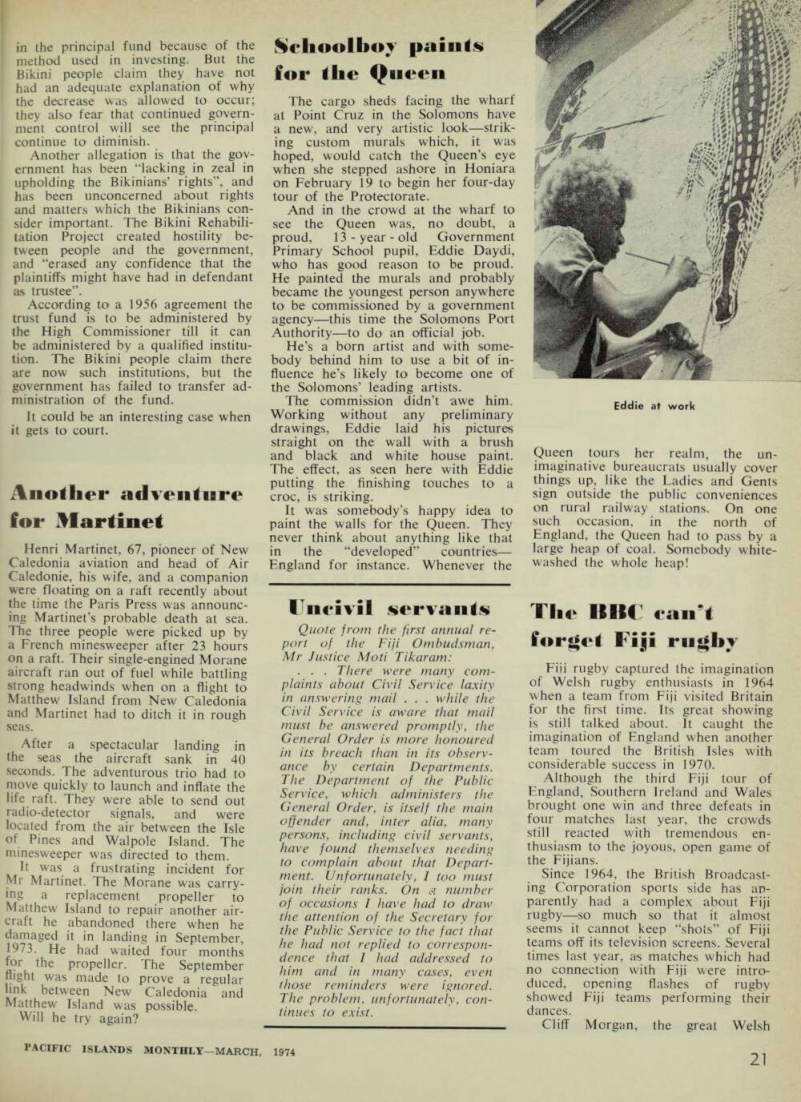

’Dumping 9
in Noumea
Noumea hotelkeepers, concerned at cancellation “fallout” from a likely third nuclear boycott this year, are still recovering from the effects of last year’s action while also bitterly criticising the alleged “dumping tariffs” practised at the new 250 rooms of the Chateau Royal.
Noumea is now equipped with eight comfortable bay-side hotels, which offer 600 rooms, half of them at the Chateau Royal. However, most of them have had difficulty maintaining even a 50 per cent rate of occupancy during the recent summer season.
During this time, the Chateau, sup ported by UTA airlines to which it is linked, has been offering week-long holidays, airfare and room included, for SAI6B which is less than the regular economy airfare alone. This promotional offer to launch the new Chateau rooms has resulted in what other hotelkeepers are regarding as be!ow-the-belt competition.
In what may be regarded as a bluff to get in on the UTA deal, some Noumea hoteliers have indicated they are thinking of organising “inclusive tours” through Air Nauru. However, this airline has only a small capacity on its twice weekly technical stop overs at Tontouta airport.
Meanwhile, as Noumea considers the effects of a likely third boycott, the only encouraging touristic gleam on the horizon is the Chateau Royal casino, with an opening planned for the end of this year. Authorised games will include baccarat, chemin de fer, roulette and blackjack. Entry fee will be 400 CFP per day or 1,500 frs per week, with a year-long entry card at 25,000 frs (SA2OO) for the real mordus —hard-bitten gamblers.
Another move suggested by the hoteliers is that the territory should subsidise their operations until better times for tourism come again. In the
past, when nickel earnings have dropped as they have now, Paris has urged the Caledonians to make a bigger effort for tourism as the island’s second industry. So the hoteliers are likely to remind Paris that now is the time to come to the aid of the party.
Another solution could be to take a leaf out of the shipping companies’ books and, if there’s another cancel lation fallout demand an indemnity like the one the shippers got as com pensation for the bomb boycott.
New Hebrides
iolS airstrip
A man died in the New Hebrides recently—and soon afterwards Tbn goa Island airstrip closed down. Why?
Tongoa airstrip is on land ap parently jointly owned by people from two villages, Pele and Worafiu.
At least that was the case until the single Worafiu owner died. From that moment on, according to scanty evidence to hand, the Condominium Government then began to pay rent due on the airstrip site to the six Pele village claimants to its owner
ship.
Not surprisingly, Worafiu people
felt an injustice had been done some where. So they laid barbed wire across the airfield, putting a stop to incom ing aircraft to this tiny island in the Shepherd Group north-west of Efate.
Adding to the complications, re ports suggest that all is not well in the Pele camp either. One man— by the name of Kakae—is said to have been pocketing all the rent, according to a report in the New Hebrides newspaper Nakamal. Kakae, to whom the rent was apparently being paid for distribution to the other five Pele owners, is reported to have said that payment was “so small that he thought it was for his part of the airfield alone.”
Predictably, the people of Wora fiu, as well as asking that they be put back on the creditors’ list, are demanding more for the land of the deceased. There was no mention of a will.
UiV§ not so laiiir on rilraini The Pitcairn islanders celebrated Bounty Day on January 23, the date cn which it’s believed the mutineers burned the Bounty, eight days after they had landed on the island. As they believe January 23 is a more authentic date than January 15, the great day is January 23. This year, however, there was a happening, an other fire, which will go down in the annals of the island.
Two days before the celebrations began, the Pitcairners fought to save Adamstown from destruction by fire which broke cut in Mrs Lila Young’s cottage and threatened the whole settlement.
“It probably broke out when Mrs Young, who is advanced in years, failed to close the door to her wood ourning range and a firebrand popped out onto the floor,’’ radio officer Tom Christian told the Seventh-day Ad ventist Church radio centre in Cali fornia in his weekly chat over the air.
“The ship’s bell (used to summon the community) rang the alarm and soon all the men were battling the fire. It leapt to a utility pole and that was put out. Then it got into nearby dry sugar cane and a firebreak was cut to prevent the spread to other nearby homes.”
The last fire to destroy a house on the island was in the 19605.
A week later, however, there was a much happier happening—the first birth on the island for nearly 18 months. The proud father is radio officer Tom himself.
The child, Raelene Rare Christian, and mother Betty, are “both doing just fine”, Tom reported. Raelene is the seventh generation from Fletcher Christian. The 2.9 kg (61 lb) dark haired newcomer brings the popula tion to 69 Pitcairners and 11 “foreigners”.
Ko trust in
Trust Goveriimout
The people of Bikini have little love for the Trust Territory Govern ment, particularly over the adminis tration of the $300,000 Bikini Trust Fund. They have filed a suit asking the court to remove the government as trustee of the fund. They allege the government mismanaged the fund and failed to give the people an adequate account of how money was used.
The fund is now worth only $200,000. The government admitted in the past that there was a decrease
in the principal fund because of the method used in investing. But the Bikini people claim they have not had an adequate explanation of why the decrease was allowed to occur; they also fear that continued govern ment control will see the principal continue to diminish.
Another allegation is that the gov ernment has been “lacking in zeal in upholding the Bikinians’ rights”, and has been unconcerned about rights and matters which the Bikinians con sider important. The Bikini Rehabili tation Project created hostility be tween people and the government, and “erased any confidence that the plaintiffs might have had in defendant as trustee”.
According to a 1956 agreement the trust fund is to be administered by the High Commissioner till it can be administered by a qualified institu tion. The Bikini people claim there are now such institutions, but the government has failed to transfer ad ministration of the fund.
It could be an interesting case when it gets to court.
Another adventnre
for Martinet
Henri Martinet, 67, pioneer of New Caledonia aviation and head of Air Caledonie, his wife, and a companion were floating on a raft recently about the time the Paris Press was announc ing Martinet’s probable death at sea.
The three people were picked up by a French minesweeper after 23 hours on a raft. Their single-engined Morane aircraft ran out of fuel while battling strong headwinds when on a flight to Matthew Island from New Caledonia and Martinet had to ditch it in rough seas.
After a spectacular landing in the seas the aircraft sank in 40 seconds. The adventurous trio had to move quickly to launch and inflate the life raft. They were able to send out radio-detector signals, and were located from the air between the Isle of Pines and Walpole Island. The minesweeper was directed to them.
It was a frustrating incident for Mr Martinet. The Morane was carry ing a replacement propeller to Matthew Island to repair another air craft he abandoned there when he damaged it in landing in September, 1973. He had waited four months for the propeller. The September flight was made to prove a regular link between New Caledonia and Matthew Island was possible.
Will he try again?
Schooll»€»v paints
for i he Queen
The cargo sheds facing the wharf at Point Cruz in the Solomons have a new, and very artistic look—strik ing custom murals which, it was hoped, would catch the Queen’s eye when she stepped ashore in Honiara on February 19 to begin her four-day tour of the Protectorate.
And in the crowd at the wharf to see the Queen was, no doubt, a proud, 13 - year - old Government Primary School pupil, Eddie Daydi, who has good reason to be proud.
He painted the murals and probably became the youngest person anywhere to be commissioned by a government agency—this time the Solomons Port Authority—to do an official job.
He’s a born artist and with some body behind him to use a bit of in fluence he’s likely to become one of the Solomons’ leading artists.
The commission didn’t awe him.
Working without any preliminary drawings, Eddie laid his pictures straight on the wall with a brush and black and white house paint.
The effect, as seen here with Eddie putting the finishing touches to a croc, is striking.
It was somebody’s happy idea to paint the walls for the Queen. They never think about anything like that in the “developed” countries— England for instance. Whenever the
Queen tours her realm, the un imaginative bureaucrats usually cover things up, like the Ladies and Gents sign outside the public conveniences on rural railway stations. On one such occasion, in the north of England, the Queen had to pass by a large heap of coal. Somebody white washed the whole heap!
The HIM can’t
forget Fiji rugby
Fiji rugby captured the imagination of Welsh rugby enthusiasts in 1964 when a team from Fiji visited Britain for the first time. Its great showing is still talked about. It caught the imagination of England when another team toured the British Isles with considerable success in 1970.
Although the third Fiji tour of England, Southern Ireland and Wales brought one win and three defeats in four matches last year, the crowds still reacted with tremendous en thusiasm to the joyous, open game of the Fijians.
Since 1964, the British Broadcast ing Corporation sports side has ap parently had a complex about Fiji rugby—so much so that it almost seems it cannot keep “shots” of Fiji teams off its television screens. Several times last year, as matches which had no connection with Fiji were intro duced, opening flashes of rugby showed Fiji teams performing their dances.
Cliff Morgan, the great Welsh
Eddie at work
player now commentator for big tele vised matches, usually manages to get in something about “The breath of fresh air” that Fiji brought to British rugby.
In January, the BBC did it again.
Prefacing a new popular quiz pro gramme about sports, called “A Question of Sport”, flashes on the screen showed quick “shots” of several sports in action—and there among them was yet another of a Fiji team, at Twickenham, entertain ing the crowd with a dance.
If nothing else, the BBC is keeping Fiji rugby “on the map” 12,000 miles from its homeland.
Tourist bait
wanted in PK(«
Duty free shopping is a bait for tourists. Some administrations realise this more quickly than others. One of the slower ones is Papua New Guinea. The latest move for duty free came from the New Britain ’Jburist Association, which advised the Fi nance Minister. Mr Julian Chan, that more cruise ships would call at Papua New Guinea if passengers were offer ed duty free facilities.
More than 40 cruise ships are scheduled to call at Rabaul in 1974, carrying at least 15,000 tourists. The association sees lack of duty free shopping as a stumbling block to in creased tourism from shipping. Visi tors would not only buy duty free goods; they would spend much money on accommodation, food and trans port.
The association concedes that for the whole of Papua New Guinea to have duty free facilities would initially cause a loss of government revenue.
But with development of the indus try, turnover would be increased, and losses would eventually be eliminated.
The experience of most duty free countries dealing largely with impor ted goods, was that an initial loss of customs revenue, was soon offset by higher income and company tax.
The PNG Government has indi cated it will look at duty free shop ping when other priorities have been attended to.
Kiddie of the
Laughing* Death
A unique case of Kuru—the “Laughing Death” disease peculiar to New Guinea—has thrown doubts on the theory that it results from ritual cannibalism.
A Kuru patient has been found in
Rabaul on New Britain who does not come from the Fore ethnic group to which the sickness is confined. And more significant is the fact that the male patient, aged 25 has no heredi tary history of Kuru in his family or
village.
He is from Asaro, which is more than 60 miles from the Fore, and has lived away from his village since 1960 spending eight years in Madang and five in New Britain as a domestic servant for a patrol officer.
The new discovery was made by the district health officer for East New Britain, Dr Vincent Zigas, an epidemiologist who first isolated Kuru in 1957.
Dr Zigas says that until now all cases studied had hereditary connec tions with the Fore people who once practised ritual cannibalism.
It was believed that the suppression of the practice of cannibalism among the Fore through government and mission influence, was the reason for the virtual disappearance of child victims of Kuru under pubity, he said.
“It now seems, after 17 years of intensive study, we may still be on the wrong track,” Dr Zigas said.
He said it appeared that the disease struck in waves, or plagues.
Kuru is a fatal, progressive neuro
logic disease caused by a slow-acting virus, for which no treatment leading to a cure or even to the arrest of the disease has yet been discovered.
Dr Zigas said early symptons were unsteady gait, tremors of the arms, legs, trunk and finally the head. This was followed by uncontrollable, emo tional and pathological giggling.
The last stages were loss of con trol of the bowel, bladder, the in ability to sit up without support and to swallow. Death usually followed.
Dr Zigas said it was restricted to the Fore and those of their neigh bours in the Eastern Highlands with whom they intermarried (a total population of about 30,000).
Usually fatal after six to nine months after onset, Kuru accounted for more than half the deaths beyond infancy in the most affected villages.
Dr Zigas said reprisal murders of sorcerers suspected of causing the disease was the second most frequent cause of death in the region.
He is preparing a paper on his latest findings for the Medical Jour nal of Australia.
Ais i‘xi k rri«c‘
with a message
A massive operation of para troopers, commandos, armoured cars and helicopters swung into action in New Caledonia late January during the island's annual Alize manoeuvres.
The French aircraft carrier, the Jeanne d’Arc, transported troops, while for the first time a contingent of men flew out from the Compagnie Guepard (Cheetah Cat company) based in southern France. This emergency force is claimed to be on the alert to fly off to action in any part of the globe at 10 or 20 hours’ notice.
The Noumea press brought graphic presentations of the combatants and
their military operation straight into
Noumea homes. The action was directed at rebels who had supposedly risen up in the New Hebrides and Loyalty Islands (Ouvea and Lifou).
Press details of the landing of com mandos and their repulse of the enemy gave a fearsome impression of French forces annihilating any rebel elements.
What a pity the Jeanne d’Arc hadn’t landed a contingent of French doctors and nurses in Vila, where the new, air-conditioned French hospital, complete with streamlined medical equipment, has yet to open its doors for business. It isn’t that there’s a shortage of sick people, merely a lack of staff.
Advertisements & other items, p. 26 (1 item)
Cooi Comfort
LUILD COLOURS
1973 FRENCH KNIT RANGE OF CAR SEAT COVERS AND BEACH WEAR ARE THE "IN THING' GIVE YOUR CAR THE BIG LIFT WITH RELAXARIDE ... THE SUPERIOR CAR SEAT COVER
Timm
Knit
■K:
NYLON
RELAXARIDE
■ Hi i i ■R m m . &
AVAILABLE FROM:
FRENCH KNIT PTY. LTD., French Knit House, 18 Commonwealth Street, Sydney, 2000, Cable: Knitmills,
TRADE ENQUIRIES:
PETER FISHER TRADING PTY. LTD., 321 Pitt Street, Sydney, 2000. Cable: Fisherion.
Mercedes Benz 300 SL Roadster by courtesy of Mr. Adrian Ashton, Melbourne, Victoria.
Uncivil servants
Quote from the first annual re port of the Fiji Ombudsman, Mr Justice Moti Tikaram: . . . There were many com plaints about Civil Service laxity in answering mail . , . while the Civil Service is aware that mail must be answered promptly, the General Order is more honoured in its breach than in its observ ance by certain Departments.
The Department of the Public Service, which administers the General Order, is itself the main offender and, inter alia, many persons, including civil servants, have found themselves needing to complain about that Depart ment. Unfortunately, I too must join their ranks. On a number of occasions I have had to draw the attention of the Secretary for the Public Service to the fact that he had not replied to correspon dence that I had addressed to him and in many cases, even those reminders were ignored.
The problem, unfortunately, con tinues to exist.
Advertisements & other items, p. 28 (1 item)
tropic or temperate climate— Fib Refrigerated
units by George & Ashton exceed all requirements P.O. Box 2056, South Dunedin.
New Zealand.
Phones 54-108, 54-109 George & Ashton (P. 1.) Ltd, Box 296, Suva, Fiji.
Phone 26-249. The Fiji Meats unit illustrated is the second supplied to this Company George and Ashton moulded fibreglass refrigerated units are unaffected by rust, rot, fatigue, weathering or corrosion. No joints to harbour vermin, so cleaning is easy. Used static storage units. Ar assembled or in prefat sections for easy shipping and erection on site.
Approved by N.Z. Depts of Health and Agriculture.
GEORGE &
ASHTON
Kerr Bros., the Parker Furniture people
FOR PACIFIC
ISLANDS
Parker Furniture undoubted leader in Australia's domestic furniture industry Manufacturers of modern dining, lounge, occasional and bedroom furniture.
KERR BROTHERS PTY. LTD.
Island Merchants,
65 York Street, Sydney.
CABLES: CAREFULNESS, SYDNEY.
Star-spangled
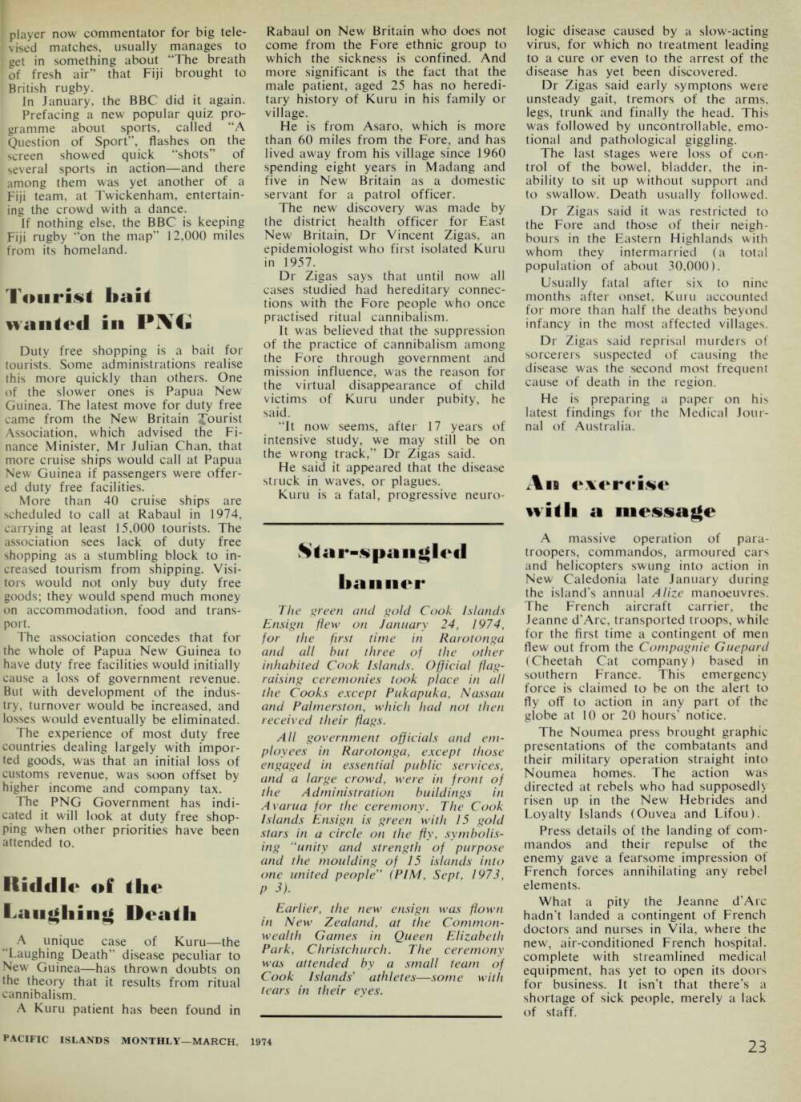
banner
The green and gold Cook Islands Ensign flew on January 24, 1974, for the first time in Rarotonga and all but three of the other inhabited Cook Islands. Official flag raising ceremonies took place in all the Cooks except Pukapuka, Nassau and Palmerston, which had not then received their flags.
All government officials and em ployees in Rarotonga, except those engaged in essential public services, and a large crowd, were in front of the Administration buildings in Avarua for the ceremony. The Cook Islands Ensign is green with 15 gold stars in a circle on the fly, symbolis ing “unity and strength of purpose and the moulding of 15 islands into one united people” (PIM, Sept, 1973, p 3).
Earlier, the new ensign was flown in New Zealand, at the Common wealth Games in Queen Elizabeth Park, Christchurch. The ceremony was attended by a small team of Cook Islands' athletes—some with tears in their eyes.
Advertisements & other items, p. 30 (1 item)
Tvvosdays
Now..
you can fr
Air-lndia
Tvvosdays
From April 2, look forward to adelightful dilemma.
Whether to fly out of Australia with us on a Saturday, as usual. Or whether to take our brand new Tuesday flight* out instead.
Two days to choose from.
Suddenly having twice as many Air India depar-
OUR TRADITIONAL
SATURDAY SERVICE:
Departs Sydney at noon for Perth, Singapore, Madras, Bombay, Kuwait, Rome, Paris, London. ture dates to pick from makes things doubly good for you, of course. But for us, too. Because from now on we’ll be able to give exactly twice as many Australians a taste of our internationally famous hospitality... all the way to wherever they want to go!
OUR ADDITIONAL
TUESDAY SERVICE:
Departs Sydney at noon for Perth, Singapore, Madras, Bombay, Kuwait, Rome, Paris, London. * Subject to Government Approval
A389.28CM5
platform in
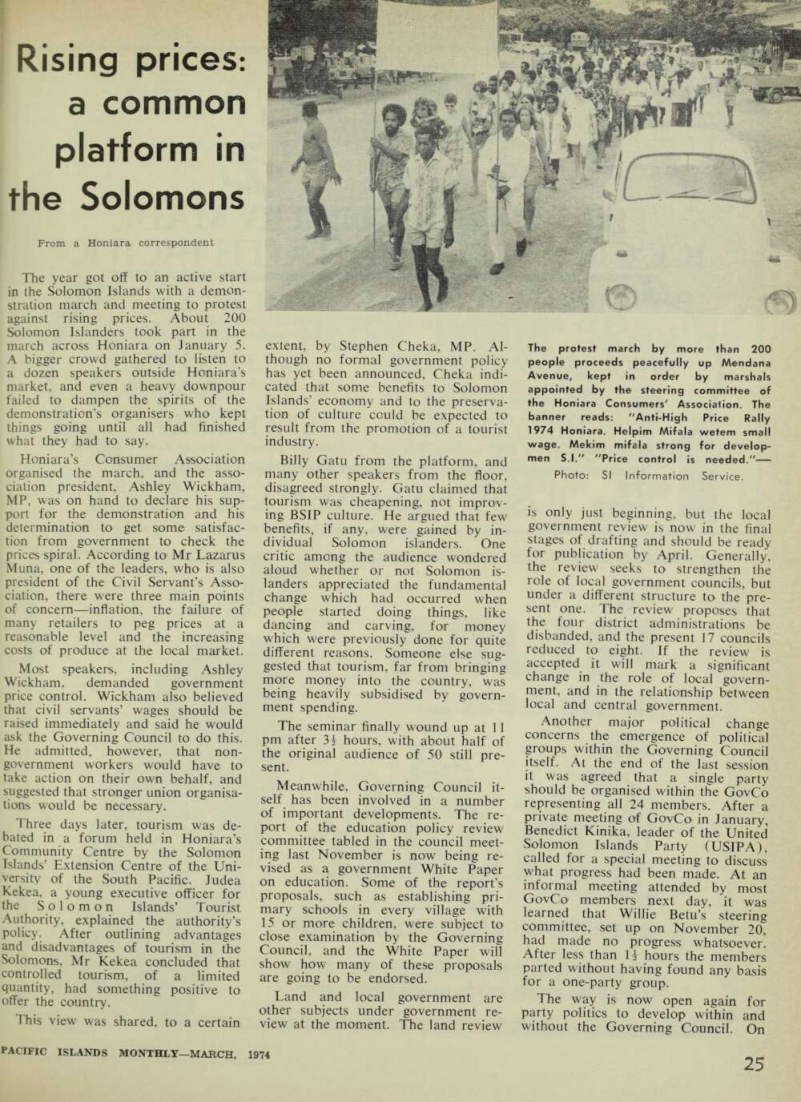
Rising prices: a common platform in the Solomons
From a Honiara correspondent The year got off to an active start in the Solomon Islands with a demon stration march and meeting to protest against rising prices. About 200 Solomon Islanders took part in the march across Honiara on January 5.
A bigger crowd gathered to listen to a dozen speakers outside Honiara’s market, and even a heavy downpour failed to dampen the spirits of the demonstration’s organisers who kept things going until all had finished what they had to say.
Honiara’s Consumer Association organised the march, and the asso ciation president, Ashley Wickham, MP, was on hand to declare his sup port for the demonstration and his determination to get some satisfac tion from government to check the prices spiral. According to Mr Lazarus Muna, one of the leaders, who is also president of the Civil Servant’s Asso ciation, there were three main points of concern—inflation, the failure of many retailers to peg prices at a reasonable level and the increasing costs of produce at the local market.
Most speakers, including Ashley Wickham, demanded government price control. Wickham also believed that civil servants’ wages should be raised immediately and said he would ask the Governing Council to do this.
He admitted, however, that non government workers would have to take action on their own behalf, and suggested that stronger union organisa tions would be necessary.
Three days later, tourism was de bated in a forum held in Honiara’s Community Centre by the Solomon Islands’ Extension Centre of the Uni versity of the South Pacific. Judea Kekea, a young executive officer for the Solomon Islands’ Tourist Authority, explained the authority’s policy. After outlining advantages and disadvantages of tourism in the Solomons, Mr Kekea concluded that controlled tourism, of a limited quantity, had something positive to offer the country.
This view was shared, to a certain
extent, by Stephen Cheka, MP. Al though no formal government policy has yet been announced, Cheka indi cated that some benefits to Solomon Islands’ economy and to the preserva tion of culture could be expected to result from the promotion of a tourist industry.
Billy Gatu from the platform, and many other speakers from the floor, disagreed strongly. Gatu claimed that tourism was cheapening, not improv ing BSIP culture. He argued that few benefits, if any, were gained by in dividual Solomon islanders. One critic among the audience wondered aloud whether or not Solomon is landers appreciated the fundamental change which had occurred when people started doing things, like dancing and carving, for money which were previously done for quite different reasons. Someone else sug gested that tourism, far from bringing more money into the country, was being heavily subsidised by govern ment spending.
The seminar finally wound up at 11 pm after 3J hours, with about half of the original audience of 50 still pre sent.
Meanwhile, Governing Council it self has been involved in a number of important developments. The re port of the education policy review committee tabled in the council meet ing last November is now being re vised as a government White Paper on education. Some of the report’s proposals, such as establishing pri mary schools in every village with 15 or more children, were subject to close examination by the Governing Council, and the White Paper will show how many of these proposals are going to be endorsed.
Land and local government are other subjects under government re view at the moment. The land review
is only just beginning, but the local government review is now in the final stages of drafting and should be ready for publication by April. Generally, the review seeks to strengthen the role of local government councils, but under a different structure to the pre sent one. The review proposes that the four district administrations be disbanded, and the present 17 councils reduced to eight. If the review is accepted it will mark a significant change in the role of local govern ment, and in the relationship between local and central government.
Another major political change concerns the emergence of political groups within the Governing Council itself. At the end of the last session it was agreed that a single party should be organised within the GovCo representing all 24 members. After a private meeting of GovCo in January, Benedict Kinika, leader of the United Solomon Islands Party (USIPA), called for a special meeting to discuss what progress had been made. At an informal meeting attended by most GovCo members next day, it was learned that Willie Betu’s steering committee, set up on November 20, had made no progress whatsoever.
After less than U hours the members parted without having found any basis for a one-party group.
The way is now open again for party politics to develop within and without the Governing Council. On
The protest march by more than 200 people proceeds peacefully up Mendana Avenue, kept in order by marshals appointed by the steering committee of the Honiara Consumers' Association. The banner reads: "Anti-High Price Rally 1974 Honiara. Helpim Mifala wetem small wage. Mekim mifala strong for develop ment S.I." "Price control is needed."— Photo: SI Information Service.
present indications USIPA has 10 firm supporters, plus another three un certain ones—enough to give it a majority. USIPA’s chief rival is Solomon Mamaloni’s People’s Pro gressive Party (PPP) with six firm supporters and one uncertain sup porter. The remaining four GovCo members were still making up their minds at the time of writing.
Although USIPA seems likely to gain a majority in the council, and therefore to be in a position to secure election of one of their members as chief minister, it is by no means cer tain that all five or six new ministers will come from USIPA. More prob able is the emergence of a coalition led by USIPA and including some PPP ministers.
Coalition politics look like being the keynote of the pre-self-government period in a second Melanesian State.
Advertisements & other items, p. 32 (1 item)
at its best...
£ £
THE FINEST COUNTRY MADE
ICE CREAM IN THE SOUTH PACIFIC
BULK ICE CREAM
In assorted flavours and fruited
HOME PACKS
In pints, quarts and 3 pints.
Assorted flavours and fruited.
HELLABY
STROLLAWAY SUNDAES JOLLI LOLLIES
Assorted flavours in large round cartons Assorted flavours: Iced lollies in Polythene Bags
CHILLY CHUNKS STICK LINES
Assorted lee lollies. Milk Ices and Fruit Juices Chocolate coated. In assorted flavours
R.&W HELLABY LTD. oua,sl
Auckland.
for
RUM
at its best... say
OVERPROOF AND UNDERPROOF
to 5 oz. and 13 oz. flasks and 26 oz. and 40 oz. bottles.
BLENDED AND BOTTLED BY JOHN WALKER & SONS LIMITED.
S 6
The lure of Tarawa
The lure of the “bright lights” shows out in the latest GEIC census, which confirms a continued popula tion drift to Tarawa, even at a slightly reduced rate compared with the 1968 census, and a corresponding depopu lation of some of the outer islands.
The census gave the colony a popula tion of 57,960, compared with 53,517 at the 1968 census.
The Gilberts had a population of 47,922 in the latest census, compared with 44,296 in 1968; the Ellice Islands had 5,890, compared with 5,782, the Line Islands 1,468 com pared with 1,180, and ships 374 com pared with 157.
Tarawa’s population at the latest census was 17,188, against 12,642.
The breakdown of the Tarawa figures, with those for 1968 in brackets, is: Rural, 2,275 (2,026); urban, 8,501 (6,025); Tarawa Betio, 6,412 (4,591).
Following Tarawa, the next biggest island populations were, again with the 1968 figures in brackets: Abaiang, 3,282 (3,271 ); Butaritari, 2,973 (2,714); Tabiteuea North, 2,884 (3,303); Bern, 2,418 (2,412); Abe mama, 2,303 (2,126); Marakei, 2,223 (2,180); Nonouti, 2,223 (2,408). The biggest population drop on a per centage basis was on Maiana, down 17.4 per cent —from 1,710 in 1968 to 1,412.
In the Ellice Islands Nanumea still has the biggest population, 977 (down 9.2 per cent from the 1,076 in 1968).
Other Ellice islands with populations of more than 900 were Vaitapu 948 (876 in 1968) and Niutao 908 (796 in 1968).
The population comprises 28,531 men (26,404 in 1968) and 29,429 women (27,113 in 1968).
If they can't drink they can swim
From a Noumea correspondent
The prolonged drought, lasting two summers, continues to cause anxiety among New Caledonian graziers, who claim to have lost over 15,000 head of cattle, 15 per cent of the island’s total herd. Illegal slaughtering, to beat the government’s fixed meat prices, also diminishes the herd.
Energetic appeals have been made to local graziers’ associations to have France declare the drought a “national disaster” with the allocation of appropriate relief measures.
Among the areas most affected is
Bourail, the island’s second largest town, about 110 miles (177 km) north of Noumea. While Bourail residents are urgently clamouring for a proper town water supply, the French administration is planning to spend French funds to build a swim ming pool in this coastal centre. When Territorial Assembly protested *^ at Ihe money would be better spent ° n Providing adequate drinking water, the representatives of the French Ad ministration replied that it was im possible to re-allocate these funds from France.
Advertisements & other items, pp. 33-34 (1 item)
Peter Fisher Trading
PTY. LTD.
321 PITT STREET, SYDNEY, 2000, AUSTRALIA
TELEPHONE; 26-1109 CABLES: "FISHERION", SYDNEY
EXPORTERS TO THE PACIFIC
ISLANDS
Some of the firms and products we represent: GREENLITES waterproof matches LUCKY STAR tinned fish REDHEADS safety matches MAURI BROS, yeast PMU food products TOOHEYS beer
CLUB RUM
ROGOVI VODKA
FRENCH KNIT car seat covers THREE STAR corned beef CRAVEN confectionery BROWNBUILT office furniture ADVANCE containers HARDIE'S building products SEBEL furniture BEARD beds and mattresses KLINKII plywood STERLING bakery machinery WHITE ABBEY Scotch whisky BATA shoes SRC tinned fruit LIFESAVERS confectionery CHILTONIAN biscuits
MACHETTES
ATLAS plastic ware
FOREMOST CONSOLIDATED
BOND'S underwear BOND'S outerwear ANDY spotlights COUNTRY CLUB shirts PAULCALL tools ASTRA razor blades WENGER quality knives VAN DER LAAN tinned meat WARBURTON FRANK! coolrooms DURABUILT prefabricated houses THREE X (XXX) tinned hake BRONTE tinned meat HEINEKEN beer
SHEATH KNIVES
GOLDEN STATE evaporated milk SMALL chocolate GOLDSTEIN—Food equipment MIN IT aerosols SHELLEY'S soft drinks TWISTIES rice snacks ERN MACKIE bakery equipment CHEEZELS cheese flavoured snacks
AND MANY MORE
SPECIALISTS
EXPORT QUALITY...
SHOWERSCREENS
Made with • Sliding Doors • Folding Doors • Pivot Doors • Fixed Panels k
‘SANDY’ ADJUSTABLE
ALUMINIUM VENTILATING
LOUVRE WINDOWS
HR I IF
‘SANDY’ ALUMINIUM
GLAZING BAR FOR
ECONOMICAL SIDEWALL
GLAZING
ALUMINIUM SHOPFRONTS,
ENTRANCES AND WINDOW WALLS
JAffIGS MODV & cov.
637 GARDENERS ROAD, MASCOT, N.S.W., 2020, AUSTRALIA.
Opposition
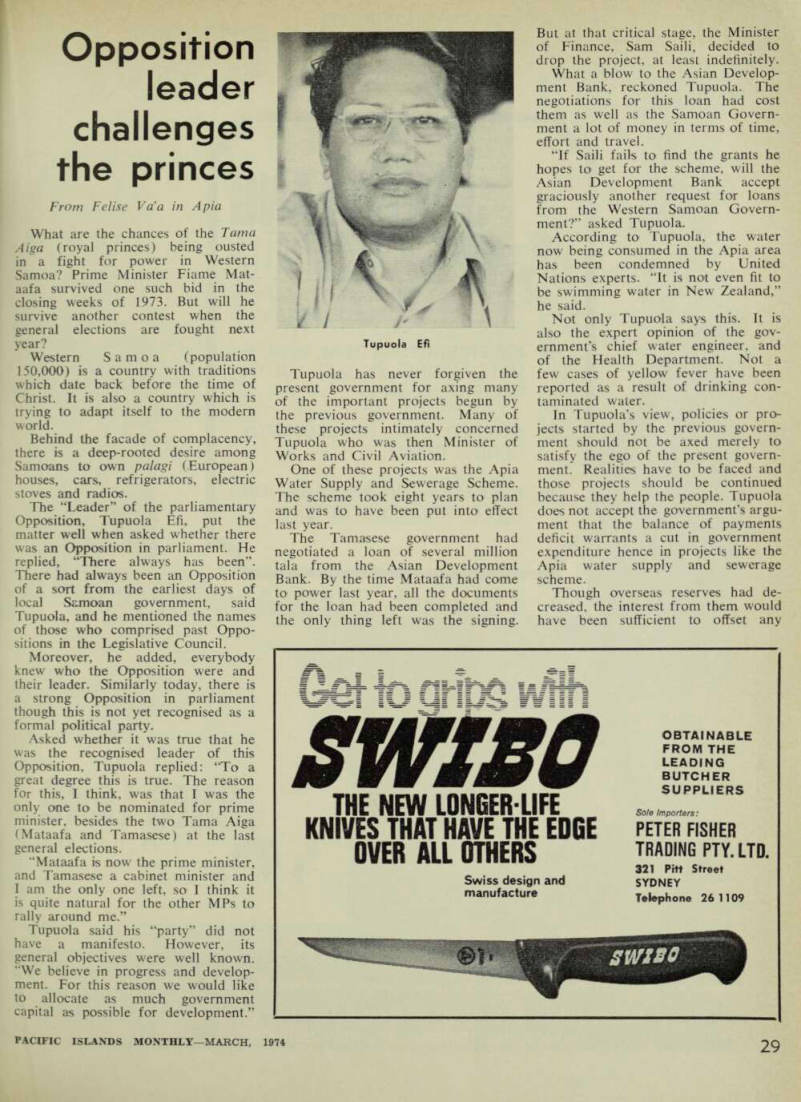
leader challenges the princes
From Felise Va’a in Apia
What are the chances of the Tama Aiga (royal princes) being ousted in a fight for power in Western Samoa? Prime Minister Fiame Mat aafa survived one such bid in the closing weeks of 1973. But will he survive another contest when the general elections are fought next year?
Western Samoa (population 150,000) is a country with traditions which date back before the time of Christ. It is also a country which is trying to adapt itself to the modern world.
Behind the facade of complacency, there is a deep-rooted desire among Samoans to own palagi (European) houses, cars, refrigerators, electric stoves and radios.
The “Leader” of the parliamentary Opposition, Tupuola Efi, put the matter well when asked whether there was an Opposition in parliament. He replied, “There always has been”.
There had always been an Opposition of a sort from the earliest days of local Samoan government, said Tupuola, and he mentioned the names of those who comprised past Oppo sitions in the Legislative Council.
Moreover, he added, everybody knew who the Opposition were and their leader. Similarly today, there is a strong Opposition in parliament though this is not yet recognised as a formal political party.
Asked whether it was true that he was the recognised leader of this Opposition, Tupuola replied: “To a great degree this is true. The reason for this, I think, was that I was the only one to be nominated for prime minister, besides the two Tama Aiga (Mataafa and Tamasese) at the last general elections.
“Mataafa is now the prime minister, and Tamasese a cabinet minister and I am the only one left, so I think it is quite natural for the other MPs to rally around me.”
Tupuola said his “party” did not have a manifesto. However, its general objectives were well known.
“We believe in progress and develop ment. For this reason we would like to allocate as much government capital as possible for development.”
Tupuola has never forgiven the present government for axing many of the important projects begun by the previous government. Many of these projects intimately concerned Tupuola who was then Minister of Works and Civil Aviation.
One of these projects was the Apia Water Supply and Sewerage Scheme.
The scheme took eight years to plan and was to have been put into effect last year.
The Tamasese government had negotiated a loan of several million tala from the Asian Development Bank. By the time Mataafa had come to power last year, all the documents for the loan had been completed and the only thing left was the signing.
But at that critical stage, the Minister of Finance, Sam Saili. decided to drop the project, at least indefinitely.
What a blow to the Asian Develop ment Bank, reckoned Tupuola. The negotiations for this loan had cost them as well as the Samoan Govern ment a lot of money in terms of time, effort and travel.
“If Saili fails to find the grants he hopes to get for the scheme, will the Asian Development Bank accept graciously another request for loans from the Western Samoan Govern ment?” asked Tupuola.
According to Tupuola, the water now being consumed in the Apia area has been condemned by United Nations experts. “It is not even fit to be swimming water in New Zealand,” he said.
Not only Tupuola says this. It is also the expert opinion of the gov ernment’s chief water engineer, and of the Health Department. Not a few cases of yellow fever have been reported as a result of drinking con taminated water.
In Tupuola’s view, policies or pro jects started by the previous govern ment should not be axed merely to satisfy the ego of the present govern ment. Realities have to be faced and those projects should be continued because they help the people. Tupuola does not accept the government’s argu ment that the balance of payments deficit warrants a cut in government expenditure hence in projects like the Apia water supply and sewerage scheme.
Though overseas reserves had de creased, the interest from them would have been sufficient to offset any
Tupuola Efi
Challenge to princes
loans made, which in any case were for expansion purposes.
“How can the government decide to cut down expenditure when the Asian Development Bank, the Inter national Monetary Fund, the World Bank and other world finance institu tions have given their expert opinion that Western Samoa has not even used up 50 per cent of its capacity to make loans?” asked Tupuola.
He accused the present government of underselling the country. “If I have a house worth $B,OOO, I do not go to the bank for purposes of a loan and say it is only worth $4,000,” he said.
Asked why he thought his “no confidence” motion had failed to materialise in the last parliamentary session, Tupuola said it was because the government had offered “goodies” to some of his supporters. In one case, intimidation by government was suspected.
“The government has been trying everything possible to dry up sources of information to the Opposition, but I think they have failed in this.
Though the government has managed to cut off appointment of Opposition members to many positions in com
mittees and other bodies, the Oppo sition, however, have members in the Public Accounts Committee,” said Tupuola.
Tupuola’s observations are in general quite sound. He is right about the history of parliamentary Oppo sition in Western Samoa, for instance.
He is also right about government ex penditure. All world financial authori ties agree that the Western Samoan economy is still capable of absorbing more overseas loans and the best of the local financial experts, for example, Leota Pita, MP (Bachelor of Arts in Economics), Aumua loane (previous Financial Secretary) and Lauofo Meti (previously Secretary to Government) all think the same.
Sam Saili (professional accountant) seems to be alone in his opinion that the Western Samoan economy is des perate and that therefore many pro jects have to be cut, import alloca tions limited, credit made hard to get, etc, etc.
On the political side, Tupuola still has a hard fight. He does not hold a Tama Aiga title like Malietoa, Tuimalealiifano, Mataafa and Tama sese.
Despite that, Tupuola is winning a lot of conservatives over to his side.
He has good men with him, and he believes that ability, not inheritance.
should be the criterion for electing a prime minister.
Another disadvantage is that he is a Nelson, and the Nelsons in Samoa have many enemies, not least of which are some of the Tama Aiga.
Their enemies suspect them of trying to control the country economically
and politically.
Tupuola is aware of these dis advantages, so he has relied more and more on his own personal image.
He wears the native dress, lavalava, at times, and he goes around bare foot, though he is a wealthy Nelson heir.
He is a “sinner” though a sincere Catholic, he admits.
His heart, like that of his father, the late Head of State Tupua Tama sese Meaole, is with the people and he fights for the people, not so much for the matai (chiefs) and perhaps this is one reason why he is not liked by many of the conservatives.
However, if it is true that the people deserve their leader, then un doubtedly when the right time comes, Tupuola will be the leader.
But when that will be is hard to say. Right now with the general dis satisfaction against the Mataafa gov ernment, some observers say Tupuola’s chances of becoming prime minister in the general elections next year are very high.
Advertisements & other items, pp. 35-36 (1 item)
smso
THE NEW LONGER-LIFE
KNIVES THAT HAVE THE EDGE
OVER ALL OTHERS
Swiss design and manufacture
OBTAINABLE
FROM THE
LEADING
BUTCHER
SUPPLIERS
Sole Importers:
PETER FISHER
TRADING PTY.LTO.
321 Pitt Street
SYDNEY
Telephone 26 1109
JONES LANG
iifflMMKI
Property Consultants & Real Estate Agents
•X- EXPERIENCED IN REAL ESTATE
VALUATIONS IN THE SOUTH
PACIFIC ISLANDS
SKILLED IN DEVELOPMENT
CONSULTANCY
EXPERTS IN THE PREPARATION
OF FEASIBILITY STUDIES
* ■ K
The Waving Palms Of Fiji
From Vijendra Kumar in Lautoka
In many tourist hotels in Fiji, if you ordered a glass of beer at 25c you would learn soon that you would be paying more than what the hotel officially charges. The serving waiter would expect a tip of anything up wards of 10c. If you make the mis take of offering anything less—or worse still, nothing at all—you may be insulted and denied service. Word would quickly get around among other attendants that you are a
tightwad.
Tipping, most hotels advise their guests, is not compulsory. But he would be a sorry guest who accepted this advice. Almost everyone in a hotel—except of course management staff—expects a tip for service. And, often their service is nothing to rave
about, either.
A senior hotel staff member of a large hotel on Sigatoka’s Coral Coast says that sometimes employees earn as much if not more than their
weekly wage in tips. The minimum weekly wage is 524, a paltry sum by any standards. And probably it’s the wage structure which has given rise to excessive tipping.
“The tourists most liberal with their money are Americans and Aust ralians,” the hotel man said. “But we’re getting only a small number of Americans these days because of their domestic problems. So the Aussies are the favourites now. Kiwis have a bad name generally with our service staff. They are tight with their money and question and query every bill.”
He said that normally tourists pay 10 per cent of their total bill for a meal or other services as tips. But, according to the hotel man, some visitors have paid up to $25 to their favourite hotel maid, barman or waiter.
“Barmen at cocktail counters prob ably earn more than their wages in tips. Drunken visitors tend to get very free with their money,” he said.
Tipping is so widespread that local people find it hard to get any service in the big hotels. Waiters and barmen tend to ignore them and when angry locals insist on their rights to be ser ved, they get only grudging service.
Besides hotels, taxi drivers are no torious for expecting—and even de manding—tips. Hapless tourists often pay far more than the normal fare for a taxi run and then, on top of it all, are coerced into paying a tip which may run from 50c to anything like $5. However, not all taxi drivers are so greedy. Occasionally, one hears of honest drivers who have returned large amounts of cash which visitors have accidentally left in their cabs.
One section of the tourist industry still not affected by the waving palm is the private restaurant. Most of these are run by Chinese merchants whose honesty and fair dealing are tradit ional. They don’t expect their staff to ask for tips.
Advertisements & other items, pp. 38-39 (1 item)
Every imaginable type of inboard marine engine is
sold and serviced by Clae. And if you believe it to be unimaginable—Clae will tailor-make it to suit your needs.
Clae PD 35: 35 HP □ Clae BD 65: 65 HP □ Clae BD 95; 95 HP □ Clae BD 145: 145 HP □ Detroit 3-53: 100 HP □ Detroit 4-53: 140 HP □ Detroit 6V-53: 216 HP □ Detroit 4-71; 165 HP □ Detroit 6-71: 250 HP □ Detroit BV-71: 350 HP □ Detroit 12V-71:525 HP □ Detroit
16V-71: 635 HP □ De-
troit 12V-149: 800 HP □ Detroit 16V-149:1060 HP.
CONTACT: Clae Engine Sales & Service, 31 Hoskins Avenue,
BANKSTOWN, N.S.W. 2200. Phone: 709 4777
Branches at Brisbane, Rockhampton, Mackay and Townsville.
Distributors and dealers in all states.
Become a part of PlM’s Pacific and subscribe now
Pad lie Islands
Monthly
%/ Keeps you informed on Pacific happenings
Fi// m the details on the attached order form .
When Tonga's Queen

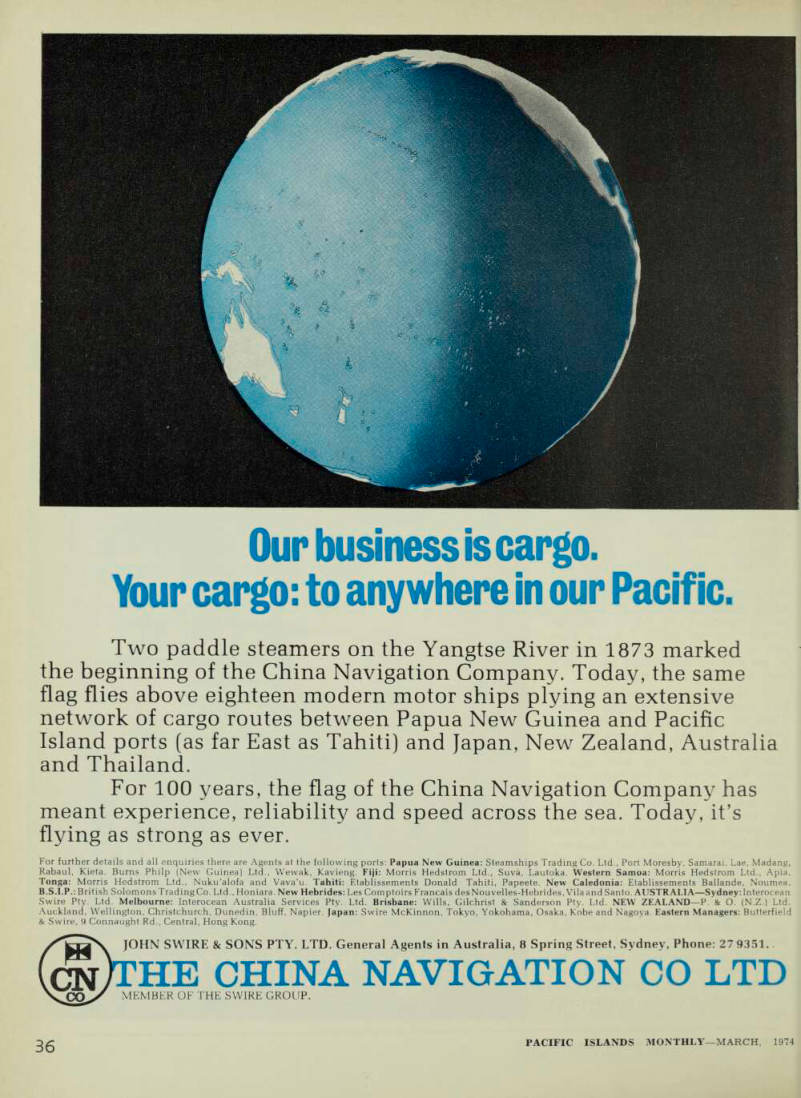
came to the resene
Father Edward Tremblay, for 35 years a well-loved priest in Tonga, died in Oregon, USA, in January. One of Father Tremblay's more famous books was, When You Go to Tonga, published by Daughters of St Paul, Derby, NY m 1954, from which is extracted the following chapter, 7 titled"
God and Tonga are my Heritage". It is chosen because it so warmly illustrates Father Tremblay's regard for the people of Tonga and their regard for him. And there is a footnote added—from Father Tremblay's long-time friend, Patricia Matheson, of Vavau—being her personal tribute on hearing of "Patele's" death.
Time is such a tricky prism. It seems only yesterday that I had the unforgettable thrill of meeting Her Majesty, Queen Salote, for the first time. Actually it was a good twenty years ago. She had come to Haapai for the first time in several years— her first visit since I had been in charge of the Catholic Mission in that twelve-island archipelago.
It was a bright sunny morning in 1932 when all the Catholic people of Lifuka came in a body to pay grateful homage and respect to their Queen, at the nice old wooden house which is always her headquarters when she visits in Lifuka. Leading the procession was our Brass Band.
Then came the smiling convent girls, their legs, arms and faces shining with scented coconut oil. The Sisters fol lowed, accompanied by the other Catholic women, and bringing the Queen a beautifully decorated cake, as well as gifts of mats, fans, etc; and finally the men, attired in their Sunday best and the traditional and distinctive Tongan tao vala (cere monial mat) worn over the ordinary loincloth as a mark of respect.
By the time I arrived at the Queen's house the Sisters and their girls and many of the other women were sitting on the floor of the large veranda which surrounds three sides of the house, all as close as they could get to Her Majesty. But they had left one little space for me, and Queen Salote motioned for me to come and sit down beside her.
As I shook hands with her for the first time, I immediately felt her deep sincerity and maternal solicitude, qualities I admired more and more in her as my years in her Kingdom rolled by. I knew she was interested in our Mission and was glad to be there with us.
As for me, well, I was just simply thrilled through and through. When I
looked out on the “malae” (lawn) and saw what a huge crowd of people was present, I guess I felt like St Paul must have felt in that famous Athens square, the Areopagus. Im mediately and without the least hesi tation, I decided to make a speech.
I whispered to Her Majesty, “May I speak?”
With a big smile, she nodded her approval.
As I watched the complicated and beautiful ceremony of royal kava making, I began to wonder just when I should speak, for I knew there must be a special time for that. I was beginning to be sorry I had made this rash request. It would be em barrassing to address the people in such circumstances and with abso lutely no preparation.
But I turned again to the Queen and said, “Pardon my ignorance of Tongan etiquette. When should I start my speech?”
She whispered reassuringly, “Don’t worry, Patele. I’ll let you know.”
A little later the master of cere monies announced in a thunderous voice that the kava was ready to serve, and Queen Salote whispered to me, “Now is the time.”
As I arose. I sensed a shock of surprise and indignation sweeping through the throng, and suddenly it dawned on me that I had made a faux pas. One must never stand to speak in the presence of Her Majesty! It simply isn’t done at a strictly Tongan ceremony like that where everyone, even the Queen, was sitting on the ground. But it was too late. The disrespectful deed was done.
I had to think fast. There’s nothing like taking the bull by the horns. So, with all outward calmness, I pro ceeded to explain the reason for my action.
“E Afiona (Your Majesty),” I be gan. “I notice a movement of indig-
The treasure which is Tonga's
nant surprise on the faces of this august assembly. How dare I arise to speak in the presence of the Queen of Tonga? Let me hasten to explain. As a white man, according to the white man’s custom I am obliged to arise and remain stand ing. It would not be respectful for me to do otherwise. For the same reason you must remain seated. It is your custom —your mark of respect for your gracious Queen. Please don’t be angry with me. Now you under stand that I stand for no other reason than to show, in the white man’s way, the deepest respect and admiration for Her Majesty, Queen Salote Tupou.”
Thanks to her kindly smile of approval, that little introduction worked wonders. Every face in the crowd was soon shining with peace and attention and eagerness.
“Before I give you the message that 1 have for you today,” I con tinued, “allow me, first of all, to tell you a story.”
Everyone settled down and relaxed.
They just love stories. In that, they are no different from the rest of the world. Everyone loves stories.
“A few months ago,” I told them, “I called at Honolulu, Hawaii. I had a few hours to spare, so I visited the famous Bishop Museum there, which is outstanding for its Poly nesian treasures. An elderly Hawaiian woman was my guide. I spoke Ton gan to her and she spoke Hawaiian to me and we understood each other very well. She knew English too.
“I visited and admired a huge hall known as the Tongan Room.
Then my guide said, with deep emo tion, ‘Now, Father, I’m going to show you the greatest treasures in all Hawaii.’ She led me into another large hall where all the royal para phernalia of the late Queen Liliuoka lani was on exhibition. There were her pearl-inlaid throne, her sceptor, her crown, and her royal cloak made like a Samoan fine mat but decorated with precious red feathers from a cer tain little bird which is now extinct.
This royal garment is valued at a million dollars.
“My guide showed such enthusiasm, such deep veneration and devotion, that I couldn’t help asking the ques tion that had been in my mind all the time, ‘What became of Queen Liliuo kalani? Who is her successor?’
“The woman’s voice quivered with emotion and her eyes filled with tears.
‘She was deposed in 1894,’ she told me. Then she died. We no longer have any Queen. Those happy days of old Hawaii are gone forever.’ ”
My audience was listening tensely now and the silence was profound.
The moment was right for my rhetori cal question: “Sii Kainga o Tonga monuia (dear brethren of blessed Tonga), will there ever be a time, in the future history of Tonga, when the royal robes, the throne, the sceptor and all the personal treasures of your beloved Queen, will be ex hibited in a museum and visitors will be asking, as I asked in Hawaii, ‘Where is your Queen?’ Will some
one answer sadly, There is no longer any Queen or any King in Tonga.
Those happy days are gone forever’?
Will such a time ever come, my friends?”
I paused and the silence was breath less. How they love oratory!
After an impressive moment, I shouted, “No! No! This shall never happen if you remember what I tell you now. Be faithful to your good Tongan customs and language. Be faithful to God and religion. Be faithful to your traditions.
“In Tonga you have no silver mines or gold mines, as some countries have.
But you have a far more precious
treasure, feo’ofoofani (brotherly love).
You have that wonderful family spirit, that willingness to help each other. That is your God-given gold and silver. That is your treasure. That is why the royal coat of arms bears the words: ‘Koe Otua mo Tonga ko hoku Tofia’ (God and Tonga are my heritage).
“Cherish your God-given heritage Don’t lose it by a silly and servile imitation of the white man and his customs and manners. Remember, each nation has its own customs, its own traditions, its own language. Keep yours. Love them. They are part of God’s plan for your happiness. Be faithful to God.
“Now I must warn you of a new ‘religion’ that is growing among you I could sense painful surprise and eager curiosity in my listeners. But the Queen was smiling. Was she guessing what I had in mind? Was she encouraging me to say it?
“Yes, my friends,” I continued, “this new religion is an enemy of the Kingdom of Tonga. Its name is Kumete Kava (the kava dish)!”
I saw dozens of heads going down like a field of golden grain bending under a sudden gust of wind—heads of some of the big chiefs bending in public acknowledgement of guilt. And how Her Majesty was enjoying it! She knew it was for their good.
“Instead of going to church on
Sunday,” 1 continued my indictment, "many of you gather and drink kava!
You are enemies of the state! You are enemies of the Queen! You are hastening the day when her throne will be in a museum, when someone will say, "We have no Queen'.”
Another short, dramatic pause allowed the words to sink into the minds where they were needed. The Queen still smiled. She chuckled with delight when I went on, “Go to church every Sunday! Protestants and Catholics both—go to church! And remember —the doors of the Church are always wide open to welcome everyone!”
When it was all over, Her Majesty thanked me profusely for my little speech. It had pleased her immensely.
We were friends from then on, through all my years in Tonga. Her
kindness to our Catholic people is one of my happiest memories.
Now one last word, an open letter as it were, to Her Majesty, Queen Salote: E Afiona (Your Majesty), do you recall that busy day in August, 1951, when you gave me an audience in your beautiful palace in Nukualofa where I had come to say goodbye before leaving your Kingdom forever?
How kindly and patiently Your Majesty listened to me. How sin cerely you thanked me for my efforts to help your people, who were my people too.
Do you remember, Your Majesty, how just before I left you suddenly arose and, in a spontaneous gesture of motherly gratitude that took me quite by surprise, you kissed me on both cheeks?
God bless your noble heart! May you live to see your grandchildren, the joy and hope of your life, grow up into good and loyal men and women, filled with the love of God and of Christ, Our Blessed Saviour.
May the Prince of Peace ever con tinue His providential protection over your little Kingdom, the happiest little Kingdom in the world. May the words of Your Majesty's splendid motto remain as true in your descen dants, all down through the centuries, as they are in your gracious self:
God And Tonga Are My
Heritage!
Fr Tremblay.
Advertisements & other items, pp. 39-42 (2 items)
33
ACIFIC ISLANDS MONTHLY-MARCH, 1974
multi-purpose building board
Wunderflex is the true
• M * mm K* I You can use versatile Wunderflex asbestos fibre board anywhere. Outside. Inside. For the whole house. For walls, ceilings, extensions, eaves, gables, garages. Painted or unpainted, in combination with almost any building materials. Because Wunderflex bends a little, it practically eliminates on-site breakages. It handles easily. It’s simple to cut and nail. It doesn’t need pre-wetting.
Wunderflex is a fire-resistant, weatherproof and verminproof sheet with all corners correctly right-angled and edges neatly arrised for V-jointing ... 3 ft. by 1 ft right up to a jumbo 10 ft. by 4ft MADE IN AUSTRALIA. MARKETED BY C.S.R. BUILDING MATERIALS EXPORT SALES; 4 O'CONNELL STREET, SYDNEY. AUSTRALIA 2000
AVAILABLE FROM
Papua and New Guinea:
Steamships Trading Company Ltd.
Norfolk Island;
Irvine's Building Supply Centre
Wunderflex
building products that have a
beautiful place in your plans
E3238A
NEW VERSATILITY...
FROM FURUNO
FRS-24
A highly reliable compact solid state radar "for small craft.
Simple installation and maintenance. 7" PPI scope. With magnifying lens. 6 ranges (1/2 24n. miles). Automatic synchronization of display sweep and antenna rotation with no waveguide run between. Operates on DC 12, 24, 32 or 110 V. Low power consumption 160 W. • The future today with FURUNO's electronics technology.
B FURUNO ELECTRIC CO., LTD.
9-52, Ashihara-cho, Nishinomiya City, Japan
CABLE: FURUNO NISHINOMIYA, TELEX: 5644-498
Our business is cargo.
Your cargo: to anywhere in our Pacific.
Two paddle steamers on the Yangtse River in 1873 marked the beginning of the China Navigation Company. Today, the same flag flies above eighteen modern motor ships plying an extensive network of cargo routes between Papua New Guinea and Pacific Island ports (as far East as Tahiti) and Japan, New Zealand, Australia and Thailand.
For 100 years, the flag of the China Navigation Company has meant experience, reliability and speed across the sea. Today, it’s flying as strong as ever.
For further details and all enquiries there are Agents at the following ports: Papua New Guinea: Steamships Trading Co. Ltd., Port Moresby, Samarai, Lae, Madang, Rabaul, Kieta. Burns Philp (New Guinea) Ltd., Wewak, Kavieng. Fiji: Morris Hedstrom Ltd., Suva, Lautoka. Western Samoa; Morris Hedstrom Ltd., Apia.
Tonga: Morris Hedstrom Ltd., Nukualofa and Vava’u. Tahiti: Etablissements Donald Tahiti, Papeete. New Caledonia: Etablissements Ballande, Noumea. 8.5.1. P.: British Solomons Trading Co. Ltd., Honiara. New Hebrides: Les Comptoirs Francais desNouvelles-Hebrides, Vila and Santo. AUSTRALlA—Sydney: lnterocean Swire Pty. Ltd. Melbourne: Interocean Australia Services Pty. Ltd. Brisbane: Wills, Gilchrist & Sanderson Pty. Ltd. NEW ZEALAND —P & O. (N.Z.) Ltd.
Auckland, Wellington, Christchurch, Dunedin, Bluff, Napier. Japan: Swire McKinnon, Tokyo, Yokohama, Osaka, Kobe and Nagoya. Eastern Managers: Butterfield & Swire, 9 Connaught Rd., Central, Hong Kong. m CN CO JOHN SWIRE & SONS PTY. LTD. General Agents in Australia, 8 Spring Street, Sydney, Phone; 27 9351,
HE CHINA NAVIGATION CO LTD
MEMBER OF THE SWIRE GROUP.
tricky prism
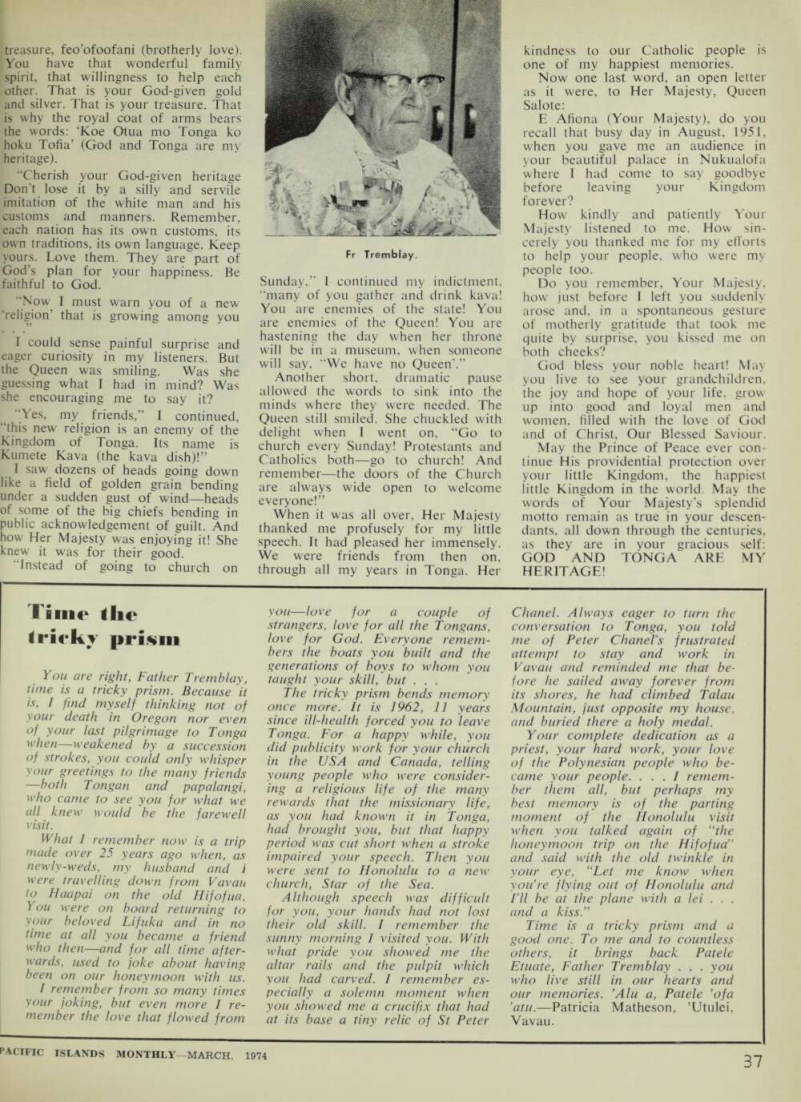
Time the tricky prism
You are right, Father Tremblay, time is a tricky prism. Because it is, I find myself thinking not of your death in Oregon nor even of your last pilgrimage to Tonga when—weakened by a succession of strokes, you could only whisper your greetings to the many friends —both Tongan and papalangi, who came to see you for what we all knew would be the farewell visit.
What I remember now is a trip made over 25 years ago when, as newly-weds, my husband and 1 were travelling down from Vavau to Haapai on the old Hifofua.
You were on board returning to your beloved Lifuka and in no time at all you became a friend who then—and for all time after wards, used to joke about having been on our honeymoon with us.
I remember from so many times your joking, but even more I re member the love that flowed from
you—love for a couple of strangers, love for all the Tongans, love for God. Everyone remem bers the boats you built and the generations of boys to whom you taught your skill, but . . .
The tricky prism bends memory once more. It is 1962, 11 years since ill-health forced you to leave Tonga. For a happy while, you did publicity work for your church in the USA and Canada, telling young people who were consider ing a religious life of the many rewards that the missionary life, as you had known it in Tonga, had brought you, but that happy period was cut short when a stroke impaired your speech. Then you were sent to Honolulu to a new church, Star of the Sea.
Although speech was difficult for you, your hands had not lost their old skill. I remember the sunny morning I visited you. With what pride you showed me the altar rails and the pulpit which you had carved. I remember es pecially a solemn moment when you showed me a crucifix that had at its base a tiny relic of St Peter
Chanel. Always eager to turn the conversation to Tonga, you told me of Peter Chanel's frustrated attempt to stay and work in Vavau and reminded me that be fore he sailed away forever from its shores, he had climbed Talau Mountain, just opposite my house, and buried there a holy medal.
Your complete dedication as a priest, your hard work, your love of the Polynesian people who be came your people. ... I remem ber them all, but perhaps my best memory is of the parting moment of the Honolulu visit when you talked again of “the honeymoon trip on the Hifofua” and said with the old twinkle in your eye, “Let me know when you’re flying out of Honolulu and I’ll be at the plane with a lei . . . and a kiss."’
Time is a tricky prism and a good one. To me and to countless others, it brings back Patele Etuate, Father Tremblay . . . you who live still in our hearts and our memories. ’Alu a, Patele ’ofa ’atu. —Patricia Matheson, ’Utulei, Vavau.
Advertisements & other items, p. 44 (1 item)
S. E. Tatham
& CO. PTY. LTD.
SOME OF THE
WE REPRESENT
FIRMS
ASKEW HOUSE, 364 LONSDALE ST.,
MELBOURNE, 3001, AUSTRALIA.
G.P.O. BOX 8—
CABLES "SET".
TELEPHONE: 601125
ARE
Asia Rubber Works (Singapore Rubber Shoes) Frappier (French Brandy) Huvet (French Brandy) Indika (Belgium Dairy Produce) Durobor S.A. (Belgium Glassware) AAiroiterie Gen. de Belgiqe S.A. (Louvre glass and mirrors) City Engineers (U.K. Bicycles) F.H.I. Japan (Subaru Cars) Kraggs (Wines, Spirits, Ciders) Sunshine Biscuits Sunrise (Confectionery) Flamenco (Instant Coffee & Tea) Quaker Products (Oats, Jets) Hancocks (Spaghetti, Cereals) Melbourne Canning (Jams) Water Wheel (Flour, Sharps, Wheat) Amatil (Twisties, Twirlies) Edward Zorn (Margarine, Cooking Fats) Allens (Confectionery) Red Tulip (Fine Chocolates) Robert Timms (New Guinea Gold Instant Coffees and Teas) Highness (Canned Vegetables, Fruit Juices) S.P.C (Canned Fruit) S.P.C. (Abalone) Wing Lee (See You Sauce) Magnet (Mattresses) Essteel (Cookware) Warner-Drayton (Fans) Mitchell's (Abrasives) Tilbury & Lewis (Sports Trophies & Silverplate) Regent (Swiss watches) Lega Marcasite (Jewellery) Austramax (Pressure Lanterns) Lawn Chair; Tubco (Garden Furniture) Electronic Industries (Electrical Household Appliances) Jex (Steelwool) Arnbro (Folding Beds) James Miller (Blankets) Elmaco (Plastics —Electrical Fittings) B.X. (Plastics) Stegbar (Wooden Louvres) Franklite (Light Fittings) JJ. Cash (Embroidered Labels) Disston (Saws) Supa-Swift (Motor Mowers, Tractors)
BUYERS FOR THE
PACIFIC ISLANDS
2 1 5* 1
DIRECT ENQUIRIES WELCOMED
PAPUA NEW GUINEA: S. E. TATHAM (P.N.G.) PTY. LTD.,
LAE: MALAITA STREET (P.O. BOX 1562).
PORT MORESBY: CNR. GOROA AND MUNAHU STREETS
(P.O. BOX 6733, BOROKO).
FIJI: S. E. TATHAM (FIJI) LTD.,
LAUTOKA: P.O. BOX 366.
SUVA: G.P.O. BOX 671.
YOUR GUARANTEE
~mvo
i
GORDON
T. 2
FOR SERVICE
SINCE 1924
Paradise In The Pacific?


Does A Tax Haven Create A
By Dominick Halliday
Political change may well pass the New Hebrides by for the foreseeable future, in spite of local churchmen who are doing their best to form a National Party in a country where no nationality exists. Two local reverend fathers, Lini and Bani, have tried to catch up with the Presbyterians, but these clergymen are invisible to the business community in Vila, which is fully occupied in digging itself into the increasingly unattractive town of Vila.
Although there is a British “pre sence” on the islands, they are far more a French than a British sphere of influence, and the rapidly expanding French schools on several islands, the high standard of the French lycees on Vate (Efate) and Santo, do a great deal to increase that. The British schools, where they exist, are more on the level of mis sionary bush-classes of 50 years ago, and the occasional student who manages to reach the university in Fiji or New Guinea, does so by a miracle.
France is not going to give self government, much less independence to New Caledonia, where the Euro peans outnumber the Pacific islanders, also largely immigrants. Nor will she (land over Tahiti and its military t>ase to Messrs Sandford and Pou /aana a Oopa nor install a republic a la Nauru in the Wallis islands.
Fhese are the realities which deter mine what France is likely to do in .he New Hebrides, and not the wish mi thinking of journalists reporting meetings of vocal churchmen.
Whether something should be done or the New Hebrideans, is quite an ther matter. Some writers have itated that at their first contact with Europeans early in the XlXth cen ury, there were 800,000 inhabitants.
Hie remaining 70,000 or 80,000 (the official census of 1967 was probably io better than many other official lets in the condominium), remain argely invisible, the ‘man-bush’ of Malekula or the west coast of Espiritu ilanto.
In Vila there is much speculation is to what were the instructions of Mr du Boulay the new UK Resident Commissioner, from HMG. It appears ikely that the choice of a former senior member of HM Embassy in 3 aris, was to work more closely with
the French, rather than systematically against them like his predecessor, Mr Allen, now Governor of the Sey chelles, a more turbulent island para dise.
Mr Stasi, French minister of the TOM (overseas territories), has already been in trouble with Mr Pom pidou for speaking too freely, and was to go to London in February for discussions which would include the New Hebrides. We can conclude that the British will urge movement to wards self-government, that the French will urge indefinite delay, and that as usual when a conjoint decision is required in the condominium, nothing will be done. With Mr Mess mer, a former High-Commissioner of French and West Africa, and ex- Overseas Territories Minister, as Prime Minister, Mr Stasi was not likely to arrive with a brief for rapid self-government of the New Hebrides.
French residents on Vate now note with pleasure, that the European population is growing rapidly, and look forward to a situation, as in New Caledonia, where whites will be in the majority on Vate. Meanwhile the British refuse residential permits to those who have chosen their juris diction, and the French systematically grant them.
However, Mr Peacock, of Hawaii, who obtained money from about 2,000 retired Americans to establish themselves in a new ‘Miami’ at Hog Harbour on Espiritu Santo, although he chose the French jurisdiction, found himself prohibited from grant ing titles to his clients, by the British administration.
Mr Huguet, the baker in Santo, who hoped to set up a bakery in the
new “town”, brought an action against the French Resident, but the court decided in August, 1973, that Mr Peacock had no right to sub divide. The retired Americans cannot now establish themselves in their bush paradise.
The real Anglo-Saxon bridgehead is the business community in Vila; Australians, and British from Nassau and elsewhere, who have established nine banks and four trust companies to give an address to several hundred companies for tax purposes. The ex tent of their business is as unknown as that of Swiss banks, but they ap pear optimistic.
There are, of course, many more ways of channelling money out of Australia to the New Hebrides, than were dreamed of by Minister Gordon M. Bryant. The main Australian weapon against the ‘tax-haven’ has been to allow incoming telex mes sages, but to block all outgoing mes sages between Sydney and Vila.
For those who imagine that a tax haven is a paradise, let it be said that in Vila, where supplies are erratic and where there is no shadow of rent or price control, one would be better off paying Australian prices and taxes. Standards of housing are low and very high-cost; some res taurants and hotels are of bush stan dard; provide you with a whitewashed concrete cell with no air-conditioning for SA2O a night, and the famed cuisine francaise vaunted to tourists, becomes an expensive ($l5 to $2O for two) affair in which all-imported, frozen or tinned products are covered with French-style sauces to conceal their age and tastelessness.
Mr Peacock’s retired Americans,
Haven in Paradise?
who thought they were going to create a Pacific island paradise in thick bush south of Hog Harbour, may have been saved by the last British Resident from a Robinson I Crusoe existence, which would have ended in their running out of whisky and cutting up each other with bush knives borrowed from the rare New Hebrideans.
Now, into this haven comes a Swiss bank. The Geneva-based “Banque Gutzwiller, Kurz, Bungener S.A.”, has opened a branch in the New Hebrides under the name of the Bank Gutzwiller, Kurz, Bungener Overseas (Limited). This is the first New Hebrides affiliate of a Swiss bank.
Although the significance of the bank in Switzerland is hard to judge —because its operations are specialised—two shareholders are the fourth and fifth largest Swiss banks: the Banque Populaire Suisse and Bank Leu. The New Hebrides branch, which opened in December, has a paid-in share capital of half a million Australian dollars.
The bank hopes to help develop a “Pacific-dollar market”, correspond ing to the more familiar Eurodollar and Asiadollar markets. Its main business will be financing and under writing new issues, and the bank ex pects most of its customers to be other banks in Switzerland, in other European countries and the United States.
The Vila branch is registered under British law. A lawyer went to the Slew Hebrides for the negotiations. A oank official in Geneva said there yere some difficulties, but the nego iations did not take “too long”, fhere is, of course, the Australian jovernment’s attitude towards finan :ial operations in the New Hebrides 0 be considered, but the bank ob viously feels that the possibilities of jetting in on the ground floor of a ‘Pacific-dollar market” make the (ranch in Vila worthwhile.
Staff has been sent in for the early tperations, but the bank expects to mploy local people later. The Banque iutzwiller, Kurz, Bungener SA tarted in Geneva in May of 1969, nd also has a branch in the Baha las. • Mr Thomas A. Peckham, 39, :as been appointed passenger liaison fficer for Polynesian Airlines at Nadi Airport. He joined the travel industry 1 1963 as traffic officer of Fiji Air fays, now Air Pacific.
French Give Up Hebridean Land
A French company has undertaken to make large tracts of land avail able for redistribution by the French Government to groups or private indi viduals, in the New Hebrides.
The Societe Francaise des Nouvelles Hebrides (SFNH), one-time largest property owners in the condominium, will begin this year by giving back the first portions which include 50,000 acres on Malekula and 6,000 acres on Santo, which will be allocated to Melanesian villages.
At the end of the redistribution, to extend over three years, the SFNH will retain barely more than four large cattle properties.
This follows the move by the Australian Government (PIM, July, p 9) to transfer 25,000 acres of land held by Australia to the New Hebrideans through a land trust board set up by the British Resident Commissioner.
Advertisements & other items, p. 46 (1 item)
Important ingredient
I m \HI : ■ & % i 1 • ■ - ■ a r ■ i i i# 51 ■*; ■ la mz. v.
k mmn.sM
OF AUSTRALIA
25 KG W£T
■ H * KS '■Mi < 4*
the most
BREAD FLOURS: •
CAKE FLOURS: •
BISCUIT FLOURS: •
SPECIALITY FLOURS: •
Important ingredient
MAINTOP —high protein bread flour ANCHOR —bakers flour • 50/50 MEAL —brown bread MEDIUM —cake and pastry • SPONGE —sponge cakes SPECIAL CAKE —madeira and cup cakes STRONG —cracker biscuits • MEDIUM —Shortbreads SOFT —sweet biscuits RYE flour • RYE meal • KIBBLED RYE SHARPS —roti and chapati flour • 100% STONE GROUND
WHOLEMEAL
GILLESPIE BROS. PTY. LTD.
HEAD OFFICE: BRISBANE OFFICE;
52 UNION ST., PYRMONT, SYDNEY, N.S.W. CABLE ADDRESS: ALBION, BRISBANE, QUEENSLAND. (G.P.O. BOX 2518, SYDNEY, 2001.) "GILLESPIE", (P.O. BOX 8, ALBION, BRISBANE, 4010.) PHONE: 660-4933. SYDNEY AND BRISBANE. PHONE: 6-1121.
Wonders for Your Skin
Modern Science can do Wonders for Your Skin
The beauty of your skin really begins down under the surface, where the tiny oil and moisture glands main tain a fine balance by releasing just the right amounts of natural fluids to nurture the complexion and keep it soft, supple and always with a youth ful, radiant glow.
Early in life, nature supplies these vital secretions in abundance. But with the passing years they slow down, and the complexion thirsts for oil and moisture to supplement the dwindling natural supplies. Without them the skin will soon lose its plumpness and resilience as tiny lines and other tell tale signs of age make a premature appearance.
Beauty secrets revealed Cosmetic chemists formulated a tropically moist oil blend with the remarkable ability to assist nature, by supplying never failing quantities of vital oil and moisture to the skin.
This important scientific break through is helping women all over the world achieve and maintain a youthfully smooth and radiant com plexion. The unique beautifying fluid is available from pharmacies here as Oil of Ulan. It quickly penetrates into the surface layer of the skin and merges readily with the natural fluids, achieving the level necessary to main tain a soft, naturally beautiful com plexion.
To keep your complexion smooth and radiant, generously apply a film of Oil of Ulan over your face and neck every day. It is helpful to every type of complexion because as well as maintaining a balanced level of vital oils and moisture it also sets up an invisible film on the skin sur face to protect against harsh weather elements and the dehydrating effects of artificial air-conditioning. Used as you would a make-up base, Oil of Ulan moist oil blend not only beauti fies and helps protect the skin against wrinkle dryness, but ensures that your make-up smooths on easily and stays soft and matt. Stroked on again at night, paying special attention to the neck and chinline Oil of Ulan will nurture the skin all through the night while you sleep.
Skin care experts advise Every time you laugh, squint, grimace or smile, you stretch the delicate skin around your eyes. There fore this area is particularly prone to lines and wrinkle dryness and needs the gentle care of Oil of Ulan. This moist oil blend should be gently fingerprinted on, in an anti-clockwise motion starting from beneath the eyes and extended onto the temples. Oil of Ulan gently penetrates and helps restore the delicate oil and moisture balance which keeps the skin soft and beautifully smooth.
Advertisements & other items, p. 48 (1 item)
Greatest Stereo on Wheels I
Anybody with an ear for the exciting sounds of modern stereo, should get to hear one of these Clarion sets. They are the sets being chosen by those who want sound as good in their cars as they can get in their homes. Sound them out for yourself, and pick the quality model you prefer for
all-year-round driving pleasures.
PE-651A
Cassette stereo player and AM tuner.
Versatile combination with automatic tape reverse. Tuner picks up popular AM stations with sparkling clarity
PE-810A
The 4-track cassette stereo player that calls you when the tape ends. Quick, smooth operation.
PE-650A
Much, much more! 4-track cassette player with automatic reverse for nonstop play Mono or stereo Plus FM Multiplex tuner. ■yi'Himr . 99999 99999 99999
PE-809A
4-track cassette stereo with a dynamic difference. Automatic reverse for continuous background music. Keep you entertained every mile. • 0999 199999 99999 99999
HE-503P
The cream of the cartridge systems. 3-way entertainer. 8-track cartridges, AM or FM Good for playing anyplace thru triple power source choice...flashlight batteries, AC or car's cig. lighter. Includes two dynamic speakers. Amazing stereo value in a new distinctive style!
CLARION
Manufacturer: CLARION CO.. LTD./ Export Division: CLARION SHOJI CO.. LTD. 3-5, Kojimachi, Chiyoda-ku. Tokyo Tel; (265) 2931 Tele*; J 22908 Overseas Branch Offices: CLARION SHOJI (EUROPA) G.M.B.H. 2000 Hamburg 76. Schbene Aussicht 35. West Germany Tel.: 220-7667. Telex: 214969.
CLARION SHOJI CO., LTD. (U.S.A.) NEW JERSEY 37 Swan St., Ramsey. New Jersey 07446. U.S.A. Tel : 201 825 0880, Telex 13805 CLARION SHOJI CO., LTD. (U.S.A.) LOS ANGELES 2306 Corner Ave.. Los Angeles. Calif.. U.S.A. Tel.: 213-272 1179. Telex: 259103426976.
CLARION (MALAYSIA) SDN. BHD. l/2ms. Bayan Lepas. Penang, Malaysia. Tel.: 87-333. 87-334. Telex: PG 255 IPenang) Fiji Islands BRIJLAL 8. CO. G.P.O. BOX 362, SUVA. FIJI ISLANDS TEL; 22258 Tahiti COMIMPEX RUE DE COMMERCE. BOITE POSTALE 200 PAPEETE TEL; 20477 New Caledonia CALDIS BOITE POSTALE 407, NOUMEA NEW CALEDONIA TEL: 57 89 Australia AMALGAMATED WIRELESS (AUST.) LTD.
CONSUMER PRODUCTS DIVISIONS P.O. BOX 24 ASHFIELD, NSW., AUSTRALIA. TEL: 7975757
Budget takes

shine off luxury living
Tlie New Hebrides had to increase duties for 1974 to bridge a gap of labout 46 million NH francs between [income and expenditure. Overall, the economic picture for the condo minimum is sound. There was a re strained note of optimism in the joint address of the Resident Commissioners to the Budget session of the Advisory Council.
Duty increases for 1974 include: Cars, up from 15 to 20 per cent; beer, up from NHFI2.S to NHFI9 a litre; fine wines, up from NHF2S to NHF3S a litre; cigarettes, up from NHF3SO to NHF4OO a pound; and alcoholic liquor, up from NHF5.25 to NHF7.25 a gallon.
Other measures to raise revenue include an entertainment tax of 10c a ticket on cinema tickets and similar forms of public entertainment, in creased sanitation, water and tele phone charges and an airport tax of NHF2OO for each departing inter national passenger. The new charges are expected to raise the NHF46 million needed to balance receipts with expenditure of NHF7IS million.
Mr R. Langlois, French Resident Commissioner, read the joint address of the commissioners.
They said a general rise in the price of primary products balanced a rise in import prices, reversing a trend which they would not dare hope for at the beginning of 1973.
Copra was NHF 15,000 a ton, de livered Vila and Santo; less than a year earlier it was only NHF4,OOO.
Exports of copra in the first 10 months of 1973 reached 20,027 tons, valued at NHF227.4 million, com pared with 16,164 tons valued at NHF196.7 million in the first 10 months of 1972.
The stability of cocoa prices also led to an increase in production. To the end of October, 1973, 721 tons of copra beans were exported, worth NHF3I.4 million, compared with 206 tons worth NHF6.B million in the corresponding period of 1972.
Other primary products, with com parative figures for 1972 in brackets, for the first 10 months of 1973, sold as follows: Meat (to New Caledonia)—7s2 tons worth NHF55.4 million (530 tons, NHF3S million). Manganese— tons, NHF2O.6 million (30,411 tons, NHF 15.2 million).
Frozen fish—Not expected to change much, with earnings slightly higher.
In 1972 fish exports totalled 15,000 tons.
Exports totalled NHF 1,004,449,000 for the first nine months of 1973.
There was a slowing down in imports because of depressed copra prices earlier in the year, and for the first nine months they were valued at
Nhf 1,569,000,000.
The commissioners said that activities in the tourist industry bore out earlier hopes they placed in it in boosting the economy. The number of passengers arriving in Vila in longdistance flights had almost doubled in three years, the number arriving in
cruise ships had quadrupled in a year, The number of visitors jumped from 22,000 in 1972 to 46,000 in 1973.
Of the 1973 total, about 11,000 arrived by air for an average stay of 10 days.
About NHF4OO million would be invested in the hotel industry in Vila and Santo in the first three months of 1974. Projects in hand would increase the number of hotel rooms to 750 in 1976 and 1,000 in 1977.
Overall, in spite of the shadows cast by inflation and the petrol short age, the prospects for the economy in 1974 were fairly good. As far as could be foreseen, the price of export produce would remain stable.
Advertisements & other items, pp. 49-50 (2 items)
43
’ACIFIC ISLANDS MONTHLY-MARCH, 1974
Portable Sawmill turns
The Forestmil
trees into timber at
the rate oflooosuper
feet per hour.
‘Forestmil’ produces house building or construction size timber direct from the log in the forest. No need to resaw, it’s ready to use. Inter-acting vertical and horizontal blades cut simultaneously for speed and accuracy, (see illustration) ‘Forestmil’ is ideal for cutting usable timber from reject logs.
Produces any size up to 12" x 6" x 18', including boards, framing, bridge sizes, etc.
CHECK THESE FEATURES:
• Dismantles into small sections: • Only 2 men required to operate. • Total weight 1560 lbs. • Erected ready to use in 1 hr. • Powered by petrol or diesel motor.
If W* ■—. • Now easier than ever to operate.
Write for further information to:
MACQUARRIE INDUSTRIES PTV. LTD.
133 Bakers Road Coburg, Victoria, 3058. Australia Phone: 350 3411 Ml-F-'
A little time in
portsaves
you a lot more money.
All our ships spend little time in port.
The reason? Side-port unit-loading. And because we spend so little time in port, we can pass the bonus savings on to you. If you’ve cargo coming to our corner of the Pacific, send it with the line that saves you money on the side.
Our ships: Papuan
Chief, New Guinea Chief, Island Chief, Coral Chief.
Registered Office Port Moresby, Papua New Guinea.
General Agents: PORT MORESBY—Steamships Trading Co. Ltd. SYDNEY —John Swire & Sons Pty. Ltd. Agents: SYDNEY—lnterocean Swire Pty.
Ltd. BRISBANE—WiIIs, Gilchrist & Sanderson Pty. Ltd. PAPUA NEW GUlNEA—Steamships Trading Co. Ltd. (for New Guinea Chief at Rabaul and Island Chief at Kavieng—Burns Philp (N.G.) Ltd.)
AVIENG
\ "rMjl
V HONIARA
DANG
AE
PORT MORESBY y
V SAMARAI
BRISBANE
✓ * f y
SYDNEY
New Guinea
Australia Line
MEMBER OF THE SWIRE GROUP.
brutal say
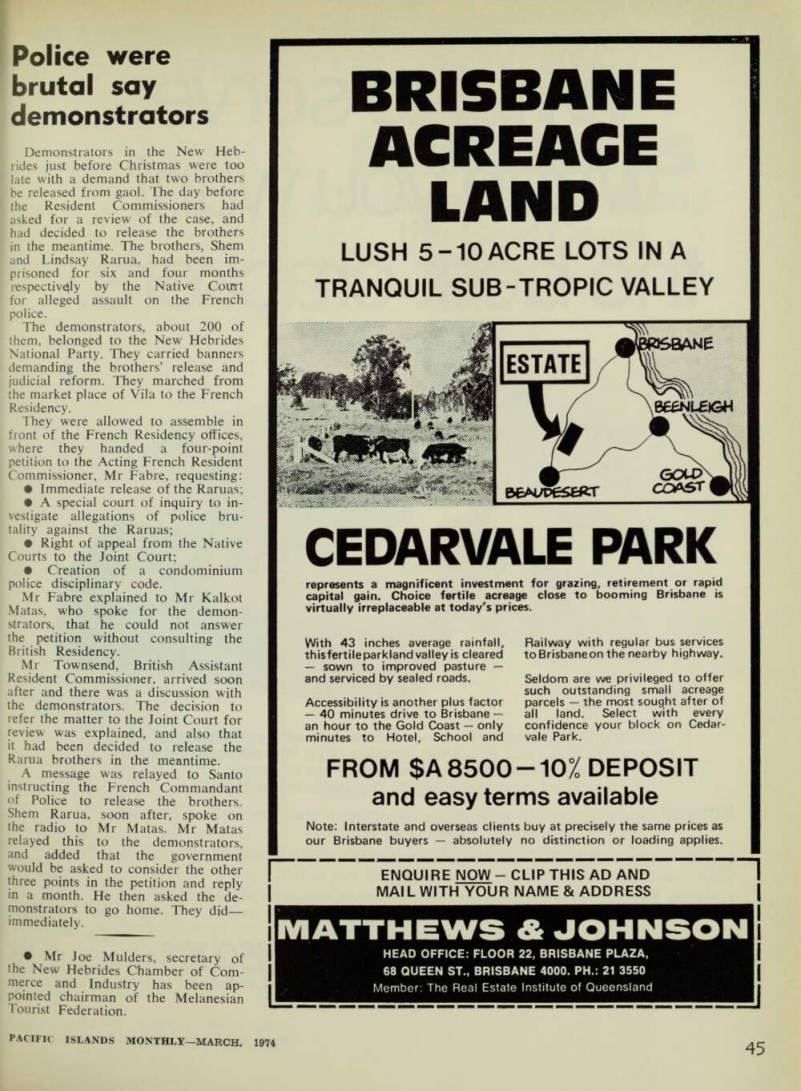
Police were brutal say demonstrators
Demonstrators in the New Heb rides just before Christmas were too late with a demand that two brothers be released from gaol. The day before the Resident Commissioners had asked for a review of the case, and had decided to release the brothers in the meantime. The brothers, Shem and Lindsay Rama, had been im prisoned for six and four months respectively by the Native Court for alleged assault on the French police.
The demonstrators, about 200 of them, belonged to the New Hebrides National Party. They carried banners demanding the brothers’ release and judicial reform. They marched from the market place of Vila to the French Residency.
They were allowed to assemble in front of the French Residency offices, where they handed a four-point petition to the Acting French Resident Commissioner, Mr Fabre, requesting: • Immediate release of the Raruas; • A special court of inquiry to in vestigate allegations of police bru tality against the Raruas; • Right of appeal from the Native Courts to the Joint Court; • Creation of a condominium police disciplinary code.
Mr Fabre explained to Mr Kalkot Matas, who spoke for the demon strators, that he could not answer the petition without consulting the British Residency.
Mr Townsend, British Assistant Resident Commissioner, arrived soon after and there was a discussion with the demonstrators. The decision to refer the matter to the Joint Court for review was explained, and also that it had been decided to release the Rama brothers in the meantime.
A message was relayed to Santo instructing the French Commandant of Police to release the brothers.
Shem Rarua, soon after, spoke on the radio to Mr Matas. Mr Matas relayed this to the demonstrators, and added that the government would be asked to consider the other three points in the petition and reply in a month. He then asked the de monstrators to go home. They did—
immediately.
• Mr Joe Mulders, secretary of the New Hebrides Chamber of Com merce and Industry has been ap pointed chairman of the Melanesian Tourist Federation.
Advertisements & other items, pp. 51-52 (1 item)
Acreage
BRISBANE
LAND
LUSH 5-10 ACRE LOTS IN A
TRANQUIL SUB-TROPIC VALLEY
1 m * . •" . :v-. «•
CEDARVALE PARK
represents a magnificent investment for grazing, retirement or rapid capital gain. Choice fertile acreage close to booming Brisbane is virtually irreplaceable at today's prices.
With 43 inches average rainfall, thisfertile parkland valley is cleared sown to improved pasture and serviced by sealed roads.
Accessibility is another plus factor 40 minutes drive to Brisbane an hour to the Gold Coast only minutes to Hotel, School and Railway with regular bus services toßrisbaneon the nearby highway.
Seldom are we privileged to offer such outstanding small acreage parcels the most sought after of alt land. Select with every confidence your block on Cedarvale Park. r
FROM $A 8500-10°/ DEPOSIT
and easy terms available
Note: Interstate and overseas clients buy at precisely the same prices as our Brisbane buyers absolutely no distinction or loading applies,
ENQUIRE NOW- CLIP THIS AD AND
MAI L WITH YOUR NAME & ADDRESS n
MATTHEWS & JOHNSON
ii
HEAD OFFICE; FLOOR 22, BRISBANE PLAZA,
68 QUEEN ST., BRISBANE 4000. PH.: 21 3550 Member; The Real Estate Institute of Queensland n
What to serve
when you want
the best crackers.
m «'s • 0)00*$ '■y y m m
SAT**
msrn Brockhoff. The quality cracker collection that wins you friends for flavour. Try these four Brockhoff varieties. All a little different, yet all with the same straight-from-the-oven freshness.
Brockhoff make the crackers that make the occasion.
Salada Salada goes with everything. The three-in-one type cracker. Man-size, bite-size, snack-size. Salada is so versatile.
Cheds The slender cracker with plenty of snap. Already topped with toasted cheese.
Ciix Taste as if they’re already buttered. And that’s rich!
Krispy Wheat Wafer The big square wafers with the hearty taste of wheat. Toasted. Try their toasty flavour.
BROCKHOFF BISCUITS
There’s value, variety and quality in Arnott-Brockhoff-Guest Pty. Ltd., Burwood, Victoria, Australia, 3125. Telex 33075. 703
Png Objects
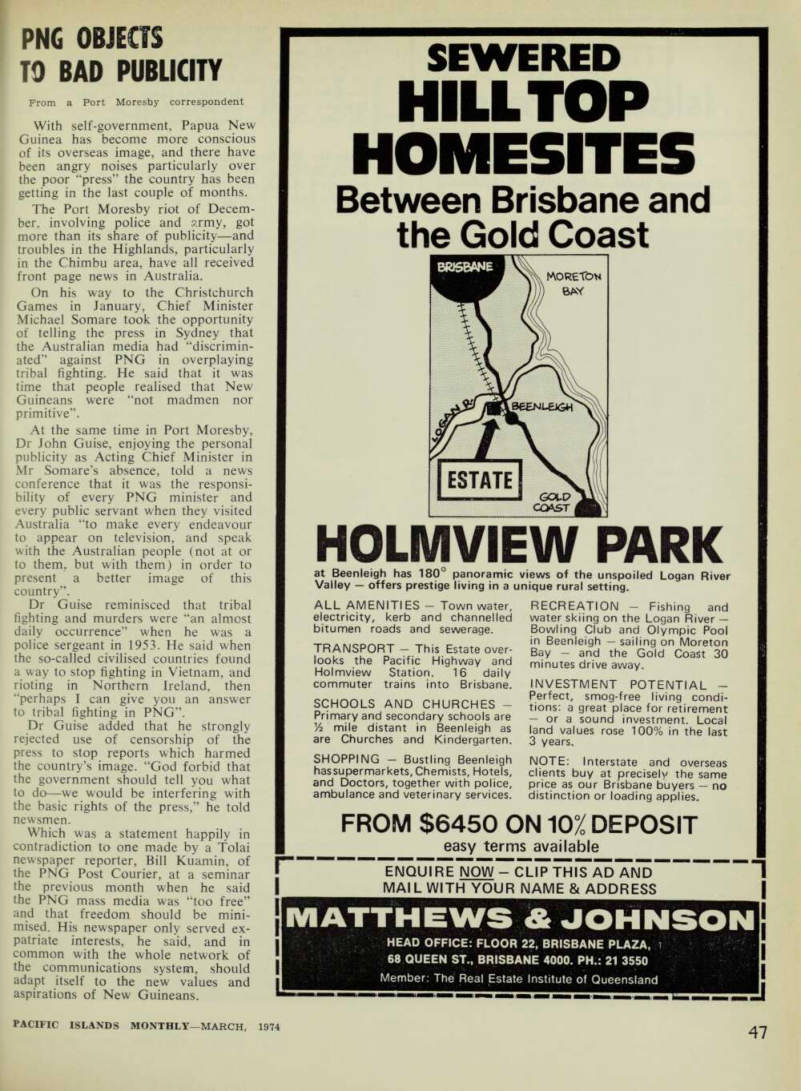
To Bad Publicity
From a Port Moresby correspondent With self-government, Papua New Guinea has become more conscious of its overseas image, and there have been angry noises particularly over the poor “press” the country has been getting in the last couple of months.
The Port Moresby riot of Decem ber, involving police and ?.rmy, got more than its share of publicity—and troubles in the Highlands, particularly in the Chimbu area, have all received front page news in Australia.
On his way to the Christchurch Games in January, Chief Minister Michael Somare took the opportunity of telling the press in Sydney that the Australian media had “discrimin ated” against PNG in overplaying tribal fighting. He said that it was time that people realised that New Guineans were “not madmen nor primitive”.
At the same time in Port Moresby, Dr John Guise, enjoying the personal publicity as Acting Chief Minister in Mr Somare’s absence, told a news conference that it was the responsi bility of every PNG minister and every public servant when they visited Australia “to make every endeavour to appear on television, and speak with the Australian people (not at or to them, but with them) in order to present a better image of this country”.
Dr Guise reminisced that tribal fighting and murders were “an almost daily occurrence” when he was a police sergeant in 1953. He said when the so-called civilised countries found a way to stop fighting in Vietnam, and rioting in Northern Ireland, then “perhaps I can give you an answer to tribal fighting in PNG”.
Dr Guise added that he strongly rejected use of censorship of the press to stop reports which harmed the country’s image. “God forbid that the government should tell you what to do—we would be interfering with the basic rights of the press,” he told newsmen.
Which was a statement happily in contradiction to one made by a Tolai newspaper reporter, Bill Kuamin, of the PNG Post Courier, at a seminar the previous month when he said the PNG mass media was “too free” and that freedom should be mini mised. His newspaper only served ex patriate interests, he said, and in common with the whole network of the communications system, should adapt itself to the new values and aspirations of New Guineans.
Advertisements & other items, pp. 53-62 (3 items)
Homesites
SEWERED
HILLTOP
Between Brisbane and
the Gold Coast
fAORETcm
BAY
06fcNL£k3H I
ESTATE
GOtP
COAST
HOLMVIEW PARK
at Beenleigh has 180° panoramic views of the unspoiled Logan River Valley offers prestige living in a unique rural setting.
ALL AMENITIES - Town water, electricity, kerb and channelled bitumen roads and sewerage.
TRANSPORT This Estate overlooks the Pacific Highway and Holmview Station. 16 daily commuter trains into Brisbane.
SCHOOLS AND CHURCHES -
Primary and secondary schools are 1 /z mile distant in Beenleigh as are Churches and Kindergarten.
SHOPPING Bustling Beenleigh hassupermarkets. Chemists, Hotels, and Doctors, together with police, ambulance and veterinary services.
RECREATION Fishing and water skiing on the Logan River Bowling Club and Olympic Pool in Beenleigh sailing on Moreton Bay and the Gold Coast 30 minutes drive away.
INVESTMENT POTENTIAL -
Perfect, smog-free living conditions: a great place for retirement or a sound investment. Local land values rose 100% in the last 3 years.
NOTE: Interstate and overseas clients buy at precisely the same price as our Brisbane buyers no distinction or loading applies.
FROM $6450 ON 10% DEPOSIT
easy terms available
ENQUIRE Now”"™7“n”
MAI L WITH YOUR NAME & ADDRESS
MATTHEWS & JOHNSON
HEAD OFFICE: FLOOR 22, BRISBANE PLAZA, \ 68 QUEEN ST., BRISBANE 4000. PH.: 21 3550 Member: The Real Estate Institute of Queensland
From the
Islands Press
From the Samoa Times, on New Year's Eve
Bank Holiday:
The Bank of Western Samoa was closed to the public on New Year's Eve. . . . Hundreds of people milled round between the bank and the Post Office on Monday morning waiting for the bank to open. Police had to keep the people to footpaths to allow traffic to flow. When it was obvious the bank was not going to open people cursed and shook the bank's doors until they
nearly came off their hinges.
From an article in the GEIC Atoll Pioneer by Tokia Greig, staff reporter, on his experiences in Australia: ". . Although I miss the bright city lights and the wide variety of entertainment, I found that they were far too often a poor disguise for the hum-drum nature of city life.
Unlike our islanders who work and live in harmony with nature, the Australians rarely find peace in the cities . .
From The Fiji Times (Gemini News feature): Every Saturday morning at 9 o'clock, half of the prisoners in Western Samoa's only gaol go free so that they can return home to their families or friends for the weekend.
Thus, all prisoners—about 150 —get this privilege every other week. The gaoler knows his charges will be back by 4 pm on Sunday. Village chiefs (matais) see the prisoners obey the rules. While they are free they have to stay indoors from 6 pm to 6 am. They must attend church on Sundays and refrain from drinking alcohol or taking part in any entertainments. Samoan prisoners have no guards. No one ever assaulted the gaoler and few have ever overstayed parole or got into trouble while visiting their homes.
From a letter by E. S. George Pakoa of Vila in the New Hebrides Nakamal: Certain forms of social customs should be retained.
One of the most important of these is “la fete” to celebrate the day of marriage as an occasion in which a Human Institution is established. Of course all “la fete” are carried out according to how much the boy and girl or the couple and their families can afford, but in any case a marriage “la fete” is always the happiest time of all. That is not the same as trying to meet the demand for a Bride Price. Many New Hebrideans are still selling their daughters as ordinary goods for up to $6OO cash plus odds and ends such as a second-hand car. This is nothing but greed and evil and must be stopped . .
From a letter by Rev M. S. Basden in The Fiji Times: Although not exactly a scientist, I fancy I may have hit on a solution to the fuel crisis. My solution could affect everyone with a kerosene refrigerator which works.
Quite a cheerful light is given out by the good old kerosene fridge! All you have to do is buy an additional mirror.
Place this close to the burning wick of the refrigerator in such a way that it throws back the light from the wick out on to the kitchen floor. As darkness descends, lie down flat on the kitchen floor. By means of the reflected light, read your book or newspaper in comfort. The amount of fuel you will save by this method should be tremendous From the BSI News Sheet: Police said that New Year throughout the Solomons had been the quietest for crimes for the past three or four years. A spokesman said there were no arrests in any of the four district centres or in Honiara.
He said that this could be because people who could have caused trouble by drinking received their pay earlier and did not have any money left for the New Year.
From the American Samoa News Bulletin: Commissioner of Public Safety Tufele Li’a announced today that a holiday service which proved very successful during the long Christmas weekend has been extended through the New Year’s holiday. Any motorist who feels he has had too much holiday “cheer’’ to safely operate his vehicle may either drive to the Police Department or contact any police car on the road. His vehicle will be locked and stored at the Police Station and the driver will be transported safely home.
Tufele said 66 persons took advantage of the depart ment’s assistance programme during the Christmas weekend—and perhaps many more people should have.
From a letter by Peter Barry, Sydney, in the Tonga
Chronicle, criticising the inter-island ship, Olovaha:
Last week I visited Haapai and returned on Friday.
The return hour voyage could only be described as a "Hell Trip" on a lame, grossly overcrowded ship with inadequate facilities, lack of refreshments and a mountainous sea. On berthing at Vuna Wharf (Nukualofa) it was announced that 400 passengers would disembark, but I esti mated the number nearer 500! Cargo included, plus livestock —pigs, poultry and a cow—makes for a heavily laden ship.
From a letter by Paran Jeet, of Suva, in
The Fiji Times:
By the grace of God and through the dedication of our leaders, we have come to a stage where people of diverse religious, cultural and social backgrounds belong to one nation—our beloved Fiji. We all can boast that ours is a unique case where racial harmony, oneness and tolerance prevails especially under the banner of our beloved statesman, Ratu Sir Kamisese Mara. ... It would be nice to have our separate battalions of teenage armies who could be imbued with martial thought and inspired by all. Our politicians should instil pride in our young people and make conscription compulsory for all females and males above the age of 15 and up to 25. . . .
From Perry Langston's Nature Diary in the GEIC's Atoll Pioneer: Ten Itaaka of Maiana who lives on Kuria can catch the small white dwarf eel using his forefinger as bait! As soon as the small eel bites his forefinger he digs his thumb into the underjaw and pulls the eel out from its hole. He taught a friend this art but his friend ended up with a badly lacerated forefinger.
for extra freshness
Come up to Kool
£ ME ► > L #s 1 r ** #■' ■* T S 8 K B r '</j U597-8/71
Vfter you don’t believe the way the brand
new decks sound, you won’t believe
the way they’re priced.
The beauty of Pioneer’s cassette decks is the way they reproduce high fidelity sound from unbelievably tiny cassettes. In fact, no others on the market with prices comparable to Pioneer’s new CT-5151, CT-4141 A, and CT-3131A give you so much sound for the money. Take, for instance, CT-5151, the top-notch among the three featured here. With a frequency response range from 30 to 16,000 Hz, a built-in *Dolby noise reduction unit, and long life ferrite solid tape head, you’re going to want to compare CT-5151 with most of the expensive reelto-reel decks. CT-5151 is, indeed, loaded with a lot more features like normal/chromium dioxide
tape selector (bias/equalizer
independently
switchable), full-automatic stop mechanism, tape
running pilot light, peak level indicator, over-level limiter, electronically controlled DC motor, and even a memory rewind switch. If you’ve ever doubted the sound quality of cassette tape, now’s the time to hear it all over again. On the CT-5151, CT-4141 A, and CT-3131 A, just a few of many quality high fidelity products made by Pioneer.
To see and listen to any of these, please contact one of the following: Dimensions: 15-5/8(W) x 9-1/2(D) x 3-3/4(H) inches.
Weight: CT-5151 10 lb. 9oz.
CT-4141 A 101 b. 6oz.
CT-3131 A 9 lb. 11 oz. □ □
CT-4141 A
CT-3131 A
lift
CT-5151 Australia Pioneer Electronics Australia Pty. Ltd., 256-8, City Road, South Melbourne, Victoria 3205, Australia, Tel: 696605, Branches in all states Fiji Islands Brijlal & Company, G.P.O. Box No. 362, Suva, Fiji Islands, Tel: 22 258 Lae Hagemeyer (Australasia) 8.V., P.O. Box No. 90, Lae, New Guinea, Tel: 2718 Rabaul Hagemeyer (Australasia) 8.V., P.O. Box No. 63, Rabaul, New Guinea Port Moresby Hagemeyer (Australasia) 8.V., P.O. Box No. 1428, Boroko, Port Moresby, New Guinea Madang Hagemeyer (Australasia) 8.V., P.O. Box No. 673, Madang, T.P.N.G.
Norfolk Islands Nauru Island New Zealand Tee Vee Radio Ltd., P.O. Box No. 5029, Auckland, New Zealand, Tel: 763-064 Burns Philp (South Sea) Co., Ltd., Norfolk Islands, South Pacific Jacob Enterprises, P.O. Box No. 4, Nauru Island Ets. PERFECT, B.P. 594, Papeete, Tahiti, Tel; 20 407 Menard Freres, B.P. 123, Noumea, New Caledonia, Tel: 52-22 Transpac Corporation, P.O. Box 1477, Pago Pago, American Samoa 96799, Tel: 2227 ‘DOLBY” is a trademark of DOLBY LABORATORIES INC.
Tahiti New Caledonia American Samoa
A / I ' <•' / \ A \V • I 1 v.
V * * mi - #. fir v 1 % m‘o:i w?m-
wms ;/-
* * * «r' » ■' V 5 : : m 5 as H
-mill
Wi f»
9tts famous q|s|
There is no Substitute Quality
•/ I# GO. 41 mM i^ss3* 323 F . : £r; JE /«/pr ■ / .
New TOYOTA Corona C"
MH h. : m m 3 r A m
A little Toyota
goes a long way
When you get your hands on a Toyota, you've got hold of a car that's built to last.
You've got a sturdy engine that's great on gas.
Yet sporty enough for all the fun that driving a fine car is about.
You've got a safe, sure braking system. And precise, responsive steering.
And you've got comfort. Real comfort . . . from the design of the seats to the luxury interior that surrounds you.
Talk to your dealer about the model you like most. Ask about the big t makes a Toyota < way. Th it a little
TOYOTA 1000
TOVOTA Corolla
TOYOTA
TIMOR: SANG TAI HOO, Sang Tai Building, Dili,
THE PAdHC'S
BEST WIDE
Tasty Corned Beef The Argentines’ finest ||/||i
CORNED BEEF
• aMHH
111
CORNED BEEF
M
SOLE EXPORTERS TO THE PACIFIC ISLANDS
HAGEMEYER (AUSTRALASIA) B.V.
P.O. Box 49 Kensington N.S.W. 2033 Australia Telephone 662.1222 Telex AA22214 Cables Hagemeyer Sydney Lae P.O. Box 90 Telephone 2718 Rabaul P.O, Box 63 Telephone 2633 Boroko/Porl Moresby P.O. Box 1428 Telephone 56144 Madang P.O. Box 673 Telephone 2445
The blue beyond. The earth below.
A path between the two. That only youth may
Making the endless blue and
bleach*white sands one...
HONDA.
A young man whose desire to reach the summit of success knows no limits. At work or at play, he thrives on new challenges, new ways to satisfy his zest for the active life. Every day more people are finding themselves in HONDA. Leader in motorcycles. Holder of the title of having V 3 of the world’s market. With sales in more than 15
countries. By offering the right
combination of power, performance, and ride in a wide range to suit every individual. It’s all of what it takes to be a world leader in motorcycles
... HONDA!
W .0 ■' m tf •v * -A/'v . * II V World s Largest Motorcycle Manufacturer
MOTOR Cp.. LTD. TOKYO, JAMN
4 *' f « t f n rR #iI« R,TORY: J C - Tenorio Enterprise FLO. Box 137. Saipan J WESTERN SAMOA /c &.Bl®Hsfancr* Ltd p °- Box *5C*/AMERICAN tfafeck Iftc. P.O. Box PagoTfONOA; E M. Jones Ltd. P.O Box 34, Nukualofa / SOLOMON ISLANDST BritisTi Solomons''Tredind Co. LUT P O “ Establissements Bailande. Noumea / TAHITI:„Ets. COMIMPEX - * 1 v P.O. Box 92, Rarotonga / NAURU ISLAND: Nauru < Box 94, Honiara / NEW CALEDONIA; s. CBMIMPEX P.t). Papeete/jCOCJK fSLAIQDS: Cook Islands Trading Corporation Ltd * Cooperative Society v !> . ; ♦ - * 1- . . ■ ‘ '■' * f. L(■
Carnation
coffee.
Try it. Watch how Carnation blends right in like it belongs.
It makes a good cup of coffee a great cup of coffee. All you do is punch and pour. Carnation your coffee.
Everybody’s doing it. * * Carnation-from contented cows’
Magazine Section
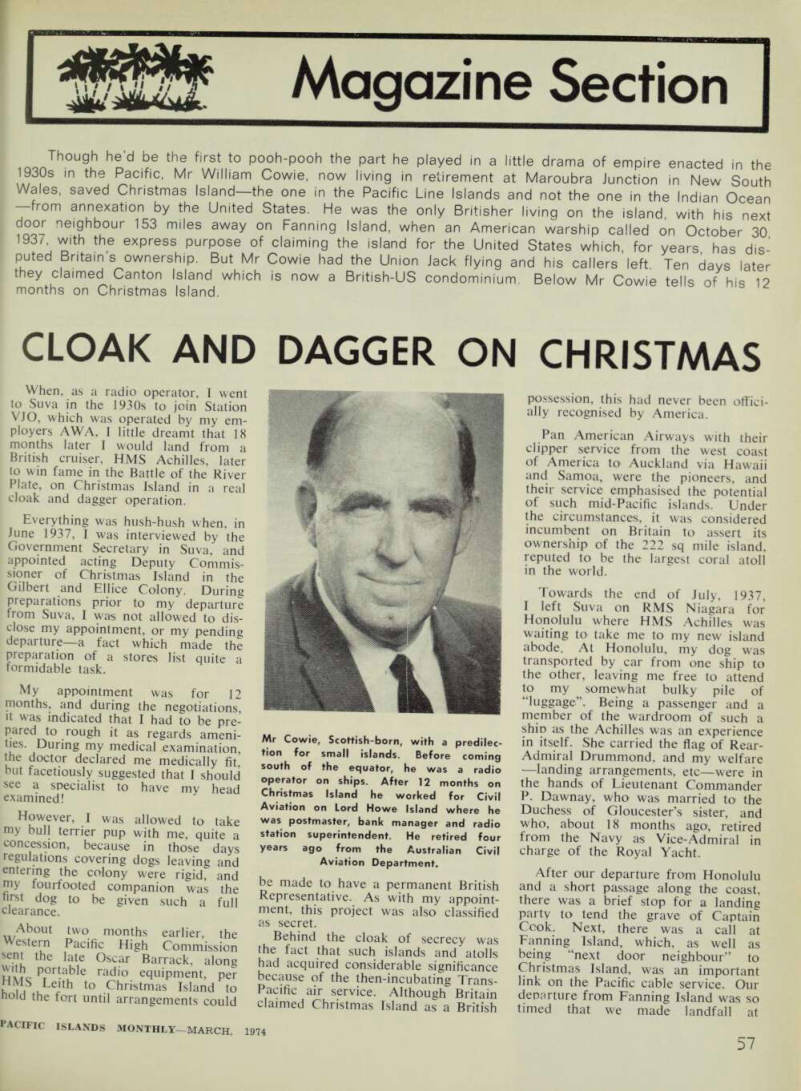
Though he'd be the first to pooh-pooh the part he played in a little drama of empire enacted in the 19308 in the Pacific, Mr William Cowie, now living in retirement at Maroubra Junction in New South Wales, saved Christmas Island—the one in the Pacific Line Islands and not the one in the Indian Ocean —from annexation by the United States. He was the only Britisher living on the island, with his next door neighbour 153 miles away on Fanning Island, when an American warship called on October 30 1937 with the express purpose of claiming the island for the United States which, for years has dis puted Britain s ownership. But Mr Cowie had the Union Jack flying and his callers left. Ten days later they claimed Canton Island which is now a British-US condominium. Below Mr Cowie tells of his 1? months on Christmas Island.
Cloak And Dagger On Christmas
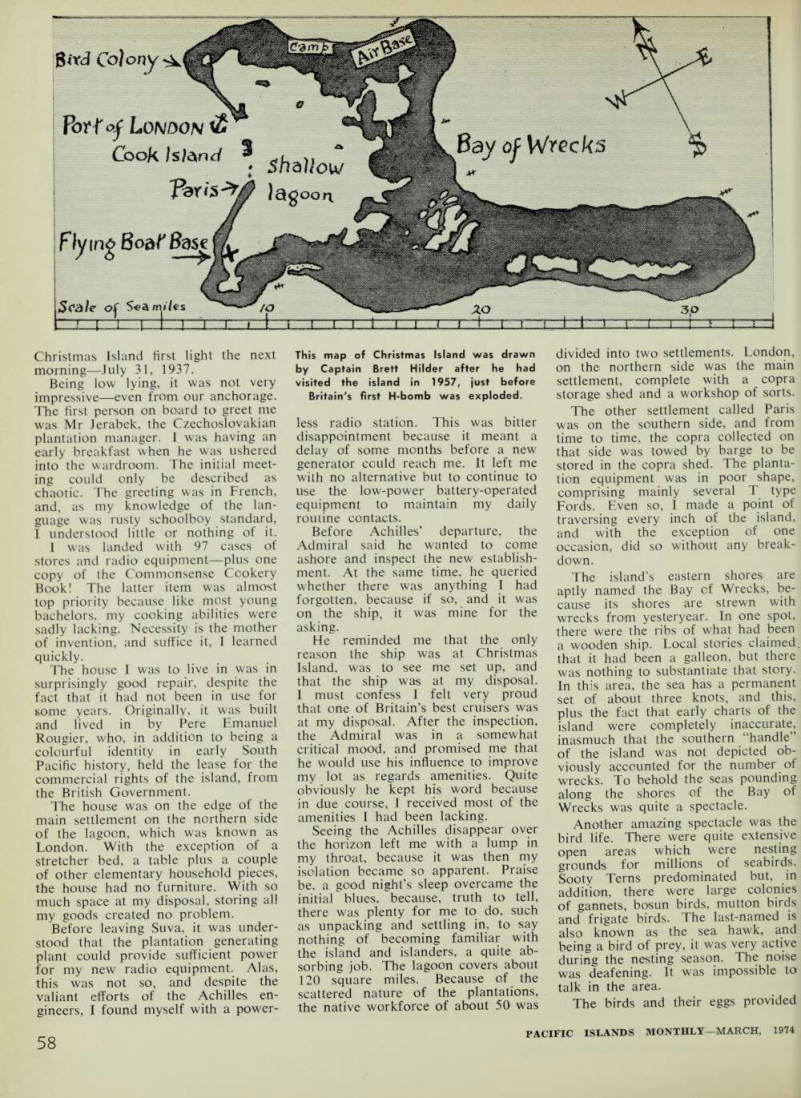
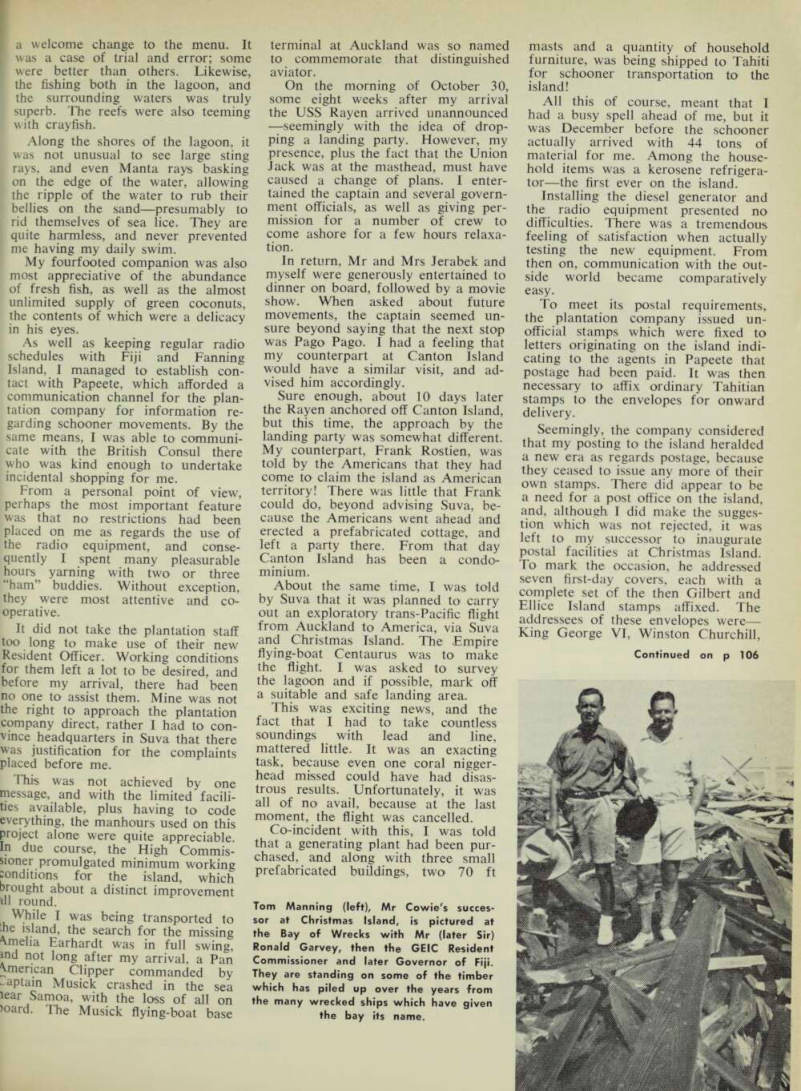
When, as a radio operator, I went to Suva in the 1930 s to join Station VJO, which was operated by my em ployers AWA, I little dreamt that 18 months later I would land from a British cruiser, HMS Achilles, later to win fame in the Battle of the River Plate, on Christmas Island in a real cloak and dagger operation.
Everything was hush-hush when, in June 1937, I was interviewed by the Government Secretary in Suva, and appointed acting Deputy Commis sioner of Christmas Island in the Gilbert and Ellice Colony. During preparations prior to my departure from Suva, I was not allowed to dis close my appointment, or my pending departure—a fact which made the preparation of a stores list quite a formidable task.
My appointment was for 12 months, and during the negotiations, it was indicated that I had to be pre pared to rough it as regards ameni ties. During my medical examination, the doctor declared me medically fit but facetiously suggested that I should see a specialist to have my head examined!
However, I was allowed to take my bull terrier pup with me, quite a concession, because in those days regulations covering dogs leaving and entering the colony were rigid, and my fourfooted companion was the nrst dog to be given such a full clearance.
About two months earlier, the estem Pacific High Commission sent the late Oscar Barrack, along P r or ! able ra dio equipment, per Lii S u Le i th to Christmas Island to noid the fort until arrangements could
be made to have a permanent British Representative. As with my appoint ment, this project was also classified as secret.
Behind the cloak of secrecy was the fact that such islands and atolls had acquired considerable significance because of the then-incubating Trans- Pacific air service. Although Britain claimed Christmas Island as a British
possession, this had never been offici ally recognised by America.
Pan American Airways with their clipper service from the west coast of America to Auckland via Hawaii and Samoa, were the pioneers, and their service emphasised the potential of such mid-Pacific islands. Under the circumstances, it was considered incumbent on Britain to assert its ownership of the 222 sq mile island, reputed to be the largest coral atoll in the world.
Towards the end of July, 1937, I left Suva on RMS Niagara for Honolulu where HMS Achilles was waiting to take me to my new island abode. At Honolulu, my dog was transported by car from one ship to the other, leaving me free to attend to my somewhat bulky pile of “luggage”. Being a passenger and a member of the wardroom of such a shin as the Achilles was an experience in itself. She carried the flag of Rear- Admiral Drummond, and my welfare —landing arrangements, etc—were in the hands of Lieutenant Commander P. Dawnay, who was married to the Duchess of Gloucester’s sister, and who, about 18 months ago, retired from the Navy as Vice-Admiral in charge of the Royal Yacht.
After our departure from Honolulu and a short passage along the coast, there was a brief stop for a landing party to tend the grave of Captain Cook. Next, there was a call at Fanning Island, which, as well as being “next door neighbour” to Christmas Island, was an important link on the Pacific cable service. Our departure from Fanning Island was so timed that we made landfall at
Mr Cowi e, Scottish-born, with a predilec tion for small islands. Before coming south of the equator, he was a radio operator on ships. After 12 months on Christmas Island he worked for Civil Aviation on Lord Howe Island where he was postmaster, bank manager and radio station superintendent. He retired four years ago from the Australian Civil Aviation Department.
Christmas Island first light the next morning—July 31, 1937.
Being low lying, it was not very impressive—even from our anchorage.
The first person on board to greet me was Mr Jerabek, the Czechoslovakian plantation manager. I was having an early breakfast when he was ushered into the wardroom. The initial meet ing could only be described as chaotic. The greeting was in French, and, as my knowledge of the lan guage was rusty schoolboy standard, 1 understood little or nothing of it.
I was landed with 97 cases of stores and radio equipment—plus one copy of the Commonsense Cookery Book! The latter item was almost top priority because like most young bachelors, my cooking abilities were sadly lacking. Necessity is the mother of invention, and suffice it, I learned quickly.
The house I was to live in was in surprisingly good repair, despite the fact that it had not been in use for gome years. Originally, it was built and lived in by Pere Emanuel Rougier, who, in addition to being a colourful identity in early South Pacific history, held the lease for the commercial rights of the island, from the British Government.
The house was on the edge of the main settlement on the northern side of the lagoon, which was known as London. With the exception of a stretcher bed, a table plus a couple of other elementary household pieces, the house had no furniture. With so much space at my disposal, storing all my goods created no problem.
Before leaving Suva, it was under stood that the plantation generating plant could provide sufficient power for my new radio equipment. Alas, this was not so, and despite the valiant efforts of the Achilles en gineers, I found myself with a power
less radio station. This was bitter disappointment because it meant a delay of some months before a new generator could reach me. It left me with no alternative but to continue to use the low-power battery-operated equipment to maintain my daily routine contacts.
Before Achilles’ departure, the Admiral said he wanted to come ashore and inspect the new establish ment. At the same time, he queried whether there was anything I had forgotten, because if so, and it was on the ship, it was mine for the asking.
He reminded me that the only reason the ship was at Christmas Island, was to see me set up, and that the ship was at my disposal.
I must confess I felt very proud that one of Britain’s best cruisers was at my disposal. After the inspection, the Admiral was in a somewhat critical mood, and promised me that he would use his influence to improve my lot as regards amenities. Quite obviously he kept his word because in due course, I received most of the amenities I had been lacking.
Seeing the Achilles disappear over the horizon left me with a lump in my throat, because it was then my isolation became so apparent. Praise be, a good night’s sleep overcame the initial blues, because, truth to tell, there was plenty for me to do, such as unpacking and settling in, to say nothing of becoming familiar with the island and islanders, a quite ab sorbing job. The lagoon covers about 120 square miles. Because of the scattered nature of the plantations, the native workforce of about 50 was
divided into two settlements. London, on the northern side was the main settlement, complete with a copra storage shed and a workshop of sorts.
The other settlement called Paris was on the southern side, and from time to time, the copra collected on that side was towed by barge to be stored in the copra shed. The planta tion equipment was in poor shape, comprising mainly several T type Fords. Even so, I made a point of traversing every inch of the island, and with the exception of one occasion, did so without any break down.
The island’s eastern shores are aptly named the Bay of Wrecks, be cause its shores are strewn with wrecks from yesteryear. In one spot, there were the ribs of what had been a wooden ship. Local stories claimed, that it had been a galleon, but there was nothing to substantiate that story.
In this area, the sea has a permanent set of about three knots, and this, plus the fact that early charts of the island were completely inaccurate, inasmuch that the southern “handle” of the island was not depicted ob viously accounted for the number of wrecks. To behold the seas pounding along the shores of the Bay of Wrecks was quite a spectacle.
Another amazing spectacle was the bird life. There were quite extensive open areas which were nesting grounds for millions of seabirds.
Sooty Terns predominated but, in addition, there were large colonies of gannets, bosun birds, mutton birds and frigate birds. The last-named is also known as the sea hawk, and being a bird of prey, it was very active during the nesting season. The noise was deafening. It was impossible to talk in the area.
The birds and their eggs provided
This map of Christmas Island was drawn by Captain Brett Milder after he had visited the island in 1957, just before Britain's first H-bomb was exploded.
I a welcome change to the menu. It I was a case of trial and error; some I were better than others. Likewise, f the fishing both in the lagoon, and f the surrounding waters was truly I superb. The reefs were also teeming with crayfish.
Along the shores of the lagoon, it I was not unusual to see large sting ; rays, and even Manta rays basking , on the edge of the water, allowing the ripple of the water to rub their bellies on the sand—presumably to rid themselves of sea lice. They are quite harmless, and never prevented me having my daily swim.
My fourfooted companion was also most appreciative of the abundance of fresh fish, as well as the almost unlimited supply of green coconuts, the contents of which were a delicacy in his eyes.
As well as keeping regular radio schedules with Fiji and Fanning Island, I managed to establish con tact with Papeete, which afforded a communication channel for the plan tation company for information re garding schooner movements. By the same means, I was able to communi cate with the British Consul there whp was kind enough to undertake incidental shopping for me.
From a personal point of view, perhaps the most important feature was that no restrictions had been placed on me as regards the use of the radio equipment, and conse quently I spent many pleasurable hours yarning with two or three “ham” buddies. Without exception, they were most attentive and co operative.
It did not take the plantation staff too long to make use of their new Resident Officer. Working conditions for them left a lot to be desired, and before my arrival, there had been no one to assist them. Mine was not the right to approach the plantation company direct, rather I had to con vince headquarters in Suva that there was justification for the complaints placed before me.
This was not achieved by one message, and with the limited facili ties available, plus having to code everything, the manhours used on this project alone were quite appreciable.
In due course, the High Commis sioner promulgated minimum working conditions for the island, which brought about a distinct improvement til round.
While I was being transported to -he island, the search for the missing Amelia Earhardt was in full swing, ind not long after my arrival, a Pan Mnerican Clipper commanded by -aptain Musick crashed in the sea iear Samoa, with the loss of all on )oard. The Musick flying-boat base
terminal at Auckland was so named to commemorate that distinguished aviator.
On the morning of October 30, some eight weeks after my arrival the USS Rayen arrived unannounced —seemingly with the idea of drop ping a landing party. However, my presence, plus the fact that the Union Jack was at the masthead, must have caused a change of plans. I enter tained the captain and several govern ment officials, as well as giving per mission for a number of crew to come ashore for a few hours relaxa tion.
In return, Mr and Mrs Jerabek and myself were generously entertained to dinner on board, followed by a movie show. When asked about future movements, the captain seemed un sure beyond saying that the next stop was Pago Pago. I had a feeling that my counterpart at Canton Island would have a similar visit, and ad vised him accordingly.
Sure enough, about 10 days later the Rayen anchored off Canton Island, but this time, the approach by the landing party was somewhat different.
My counterpart, Frank Rostien, was told by the Americans that they had come to claim the island as American territory! There was little that Frank could do, beyond advising Suva, be cause the Americans went ahead and erected a prefabricated cottage, and left a party there. From that day Canton Island has been a condo minium.
About the same time, I was told by Suva that it was planned to carry out an exploratory trans-Pacific flight from Auckland to America, via Suva and Christmas Island. The Empire flying-boat Centaurus was to make the flight. I was asked to survey the lagoon and if possible, mark off a suitable and safe landing area.
This was exciting news, and the fact that I had to take countless soundings with lead and line, mattered little. It was an exacting task, because even one coral nigger head missed could have had disas trous results. Unfortunately, it was all of no avail, because at the last moment, the flight was cancelled.
Co-incident with this, I was told that a generating plant had been pur chased, and along with three small prefabricated buildings, two 70 ft
masts and a quantity of household furniture, was being shipped to Tahiti for schooner transportation to the island!
All this of course, meant that I had a busy spell ahead of me, but it was December before the schooner actually arrived with 44 tons of material for me. Among the house hold items was a kerosene refrigera tor—the first ever on the island.
Installing the diesel generator and the radio equipment presented no difficulties. There was a tremendous feeling of satisfaction when actually testing the new equipment. From then on, communication with the out side world became comparatively easy.
To meet its postal requirements, the plantation company issued un official stamps which were fixed to letters originating on the island indi cating to the agents in Papeete that postage had been paid. It was then necessary to affix ordinary Tahitian stamps to the envelopes for onward delivery.
Seemingly, the company considered that my posting to the island heralded a new era as regards postage, because they ceased to issue any more of their own stamps. There did appear to be a need for a post office on the island, and, although I did make the sugges tion which was not rejected, it was left to my successor to inaugurate postal facilities at Christmas Island.
To mark the occasion, he addressed seven first-day covers, each with a complete set of the then Gilbert and Ellice Island stamps affixed. The addressees of these envelopes were— King George VI, Winston Churchill,
Continued on p 106
Tom Manning (left), Mr Cowie's succes sor at Christmas Island, is pictured at the Bay of Wrecks with Mr (later Sir) Ronald Garvey, then the GEIC Resident Commissioner and later Governor of Fiji.
They are standing on some of the timber which has piled up over the years from the many wrecked ships which have given the bay its name.
President Roosevelt, Sir Arthur Richards (the then Governor of Fiji), Godfrey Garrick (a philatelist in Fiji), Miss F. M. Thomas (who is now my wife) and himself.
Ever an optimist, 1 even experi mented with gardening, particularly for vegetables, but unfortunately coral sand and a somewhat poor rain fall beat me. Even so, I was suf ficiently convinced about the possi bilities to suggest that my successor should be allowed to bring a number of bags of rich Fiji soil which could be emptied into a large packing case, and the experiment carried on from there. The alternative was hydro ponics.
Some soil was transported, and I learned later, that the experiment was a success. There were fresh water wells on the island, but at the house I was restricted to storage tanks, which did not permit of heavy usage.
While some might view such a life as too isolated, too dull, truth to tell I found the 12 months’ sojourn on the island most interesting, because there was such a variety of things to be attended to, so time did not drag.
My relief, the late Tom Manning (he died in Honiara in 1962) arrived in HMS Wellington. Because I had suggested it some time previously, it had been agreed that Tom’s wife and child should join him on the island.
Our return trip in the Wellington was scheduled to make calls at Malden Island, some 400 miles south of Christmas, and at Puka Puka, or Danger Island as it is sometimes called. Malden was an extraordinary place.
In its day it had been a flourishing source of guano. Seemingly, when the deposits became depleted, thus making it uneconomical to operate, the company controlling it simply abandoned the island leaving every thing standing.
For example, there were three per fectly good motor launches in the boatshed, and the settlement in general was in reasonably good shape: yet there was not a soul on the island. We stopped long enough to go ashore and nail a notice at the base of the flagpole near the jetty, indicating on behalf of His Maiesty that the island had been visited by the Wellington that day.
When Britain exploded its atomic bomb in mid-Pacific, Christmas Island was the operational base, and Malden was the scene of the explosion. One wonders what the place looks like now.
Advertisements & other items, p. 66 (1 item)
:Hi::|j::i
Jr -" ■■ «■ m ... . :::' . ■ ■ " *®|gH
*qhbs
111 :■ i 11 W< r ' • ' •••'•>— . ■■ j[r'j^h'mrriii-rfrih t ,f- ■ -
'SSi
m ■i . lEE k ■ ... ...,,. ** :*. • 11*1* I
RT-296R
Radio/Cassette Recorder un-
:Hi::|j::i
H Hi::
RP-212S
MW/SW
2-band Radio
KT-215C
Cassette Recorder Electric Fan Go ahead, dive into portable sound with dreamed of fidelity. These Toshiba sensations bring your favorite sounds wherever you are.
Don't take chances with a good time, take Toshiba every time.
Check these outstanding features: KT-215C Cassette Recorder: Built-in microphone, 1C head, automatic shut-off, push-button operation, tape counter, AC/DC.
RP-212S MW/SW 2-band Radio; Shortwave and medium wave reception, pulls-in distant stations, extra large speaker built-in and exterior antennas.
RT-296R Radio/Cassette Recorder; Remarkable tonal richness, medium wave and three shortwave bands, simultaneous recording while listening, tuning meter, automatic level control, tape counter, automatic shut-off, dynamic mike, light weight, AC/DC.
On hot summer days and nights, cool off with one of Toshiba's superior and silent electric fans. A full line of fans with many unusual features is available at your Toshiba dealer's.
...In Touch with Tomorrow
Fishermen
Sit Quiet For The
By Joseph Tema
rTHIS is a custom fishing story which might sound nonsensical to any reader but to its followers this tradition is true. I’m one who belieyes in the usefulness of this tradition. The followers of the tradition I am about to relate come trom Rennell and Bellona, two remote Polynesian islands outside the mam Solomon island chain to the south of Guadalcanal. Bellona and Rennell are approximately 10 miles ap l rt> . .. 1 raditionally men, women and their children who wished to go away for several days or weeks fishing, had to camp away from their main villages, usually on a coral or a sandy seacoa A s *l .
After settling down m the new fishmg camp the men would begin preparing their fishing equipment and outrigger canoes for the morrow when the daily fishing trips commenced. After waking up in the mornmg, the fishermen make their final preparations before setting off, and from this time until they disappear out of sight on their trip nobody, not even the children, is allowed to stand up. Only those men who are going fishing may stand.
It is also a big taboo for anyone in the camp to call out at the last minute to the fishing gang requesting permission to go with them if he has not been authorised by the gang’s boss. Anybody who breaks the rule by standing up or by calling out will J ol i tf'ey won’t catch any fish. Even if they fished a whole day they would not catch any fish.
The fishermen might see thousands of fish swimming in the shallow waters but no matter how they try and what fishing style they apply all will turn out negative because their “fishing luck” was “dragged back ashore” by those who broke the rule by calling out when the fishermen were leaving camp, or by standing while the fishing gang was leaving, Believe it or not even a child of two or three years could “drag back” fishing luck if he broke those tra ditional fishing laws, Those left behind must sit still until the canoes are out of sight then you can get on your feet and walk about. If these two important custom fishing laws are observed at each fishing trip, the fishermen can catch hundreds of fish in a short time without much effort. These custo mary fishing laws have nothing to do with the other Solomon Islands, either Melanesian or Polynesian, be cause they have their own traditional fishing laws.
Our traditional fishing laws were strictly observed and were effective in the past but now they’ve been poisoned by foreign modern fishing styles and are dying out. So fishing today on Rennell and Bellona is done with little regard for the traditional fishing laws. Nothing can be done to preserve them for the next generation so we watch this custom fade away forever, remaining only in our memories. I blame the strong pres sure of modern environmental changes these days, and the mixing of cultures, and so on. for the loss
This issue of MANA (which has a new design for the heading) includes poems by Rita Mamavi of New Guinea and Tili Peseta of Western Samoa, a short story by Joseph Tema of the Solomon Islands, and an article on songs about the problems of migrant workers, written with the help of Tahafa Pope Talagi of Niue and Teata Makirere of the Cook Islands. There is also an interview by Samoa's Ata Ma’ia’i with New Guinea’s Minister of Foreign Affairs and author, Albert Maori Kiki.
Migrant Workers
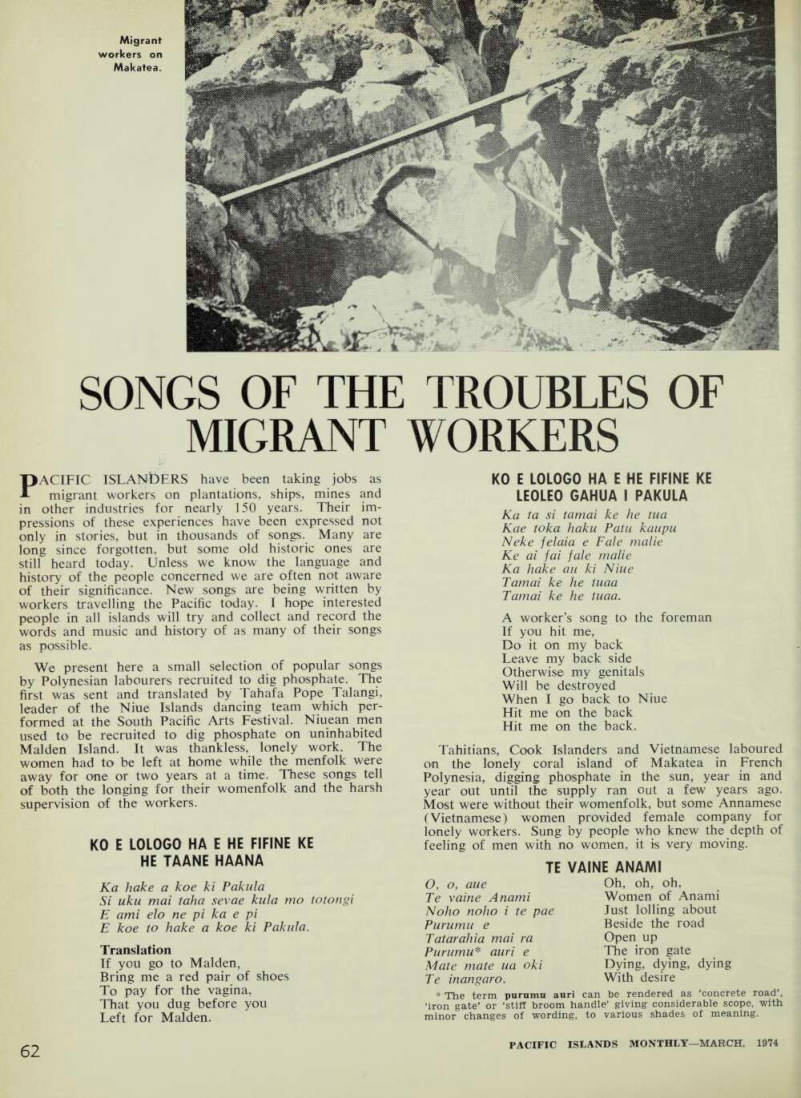
Songs Of The Troubles Of
PACIFIC ISLANDERS have been taking jobs as migrant workers on plantations, ships, mines and in other industries for nearly 150 years. Their im pressions of these experiences have been expressed not only in stories, but in thousands of songs. Many are long since forgotten, but some old historic ones are still heard today. Unless we know the language and history of the people concerned we are often not aware of their significance. New songs are being written by workers travelling the Pacific today. I hope interested people in all islands will try and collect and record the words and music and history of as many of their songs as possible.
We present here a small selection of popular songs by Polynesian labourers recruited to dig phosphate. The first was sent and translated by Tahafa Pope Talangi, leader of the Niue Islands dancing team which per formed at the South Pacific Arts Festival. Niuean men used to be recruited to dig phosphate on uninhabited Malden Island. It was thankless, lonely work. The women had to be left at home while the menfolk were away for one or two years at a time. These songs tell of both the longing for their womenfolk and the harsh supervision of the workers.
KO E LOLOGO HA E HE FIFINE KE
He Taane Haana
Ka hake a koe ki Pakula Si uku mai taha sevae kula mo totongi E ami elo ne pi ka e pi E koe to hake a koe ki Pakula.
Translation If you go to Malden, Bring me a red pair of shoes To pay for the vagina, That you dug before you Left for Malden.
KO E LOLOGO HA E HE FIFINE KE
Leoleo Gahua I Pakula
Kata si tamai ke he tua Kae toka haku Patu kaupu Neke felaia e Fale malie Ke ai fai fale malie Ka hake an ki Niue Tamai ke he tuaa Tamai ke he tuaa.
A worker’s song to the foreman If you hit me, Do it on my back Leave my back side Otherwise my genitals Will be destroyed When I go back to Niue Hit me on the back Hit me on the back.
Tahitians, Cook Islanders and Vietnamese laboured on the lonely coral island of Makatea in French Polynesia, digging phosphate in the sun, year in and year out until the supply ran out a few years ago.
Most were without their womenfolk, but some Annamese (Vietnamese) women provided female company for lonely workers. Sung by people who knew the depth of feeling of men with no women, it is very moving.
Te Vaine Anami
O, o, aue Oh, oh, oh, Te vaine Anami Women of Anami Noho noho i te pae Just lolling about Purumu e Beside the road Tatarahia mai ra Open up Purumu* auri e The iron gate Mate mate ua oki Dying, dying, dying Te inangaro. With desire * The term purumu auri can be rendered as ‘concrete road’, ‘iron gate’ or ‘stiff broom handle’ giving considerable scope, with minor changes of wording, to various shades of meaning.
Migrant workers on Makatea.
Tahiti Nui is perhaps the best-known song in the Pacific Islands. You hear it over the radio everywhere from Port Moresby and Guam to Rarotonga and Hono lulu, and it seems to be played at every party where Islanders gather. Probably not one in 100 of the people who sing it know that it tells the story of a young lad recruited in the Cook Islands to dig phosphate at Makatea. The recruiting ship had to stop for a day at Papeete to clear customs and immigration, before going on to Makatea. This lad met a girl in a bar in Papeete and went home with her, and missed the ship when it sailed for Makatea. The song tells his story:
Tahiti Nui
Tahiti Nui 1 te fare auri Taua here ai.
Ananahi a feruri au e Eaha te huru Aue, aue aue hoi e.
Te rev a nei au Na te moana No to’oe ino ino ia’u 0 tau ia e pea pea nei Aue ra ho’i au e mama e.
In great Tahiti In the gaol There (in Tahiti) we met. 1 began to wonder What tomorrow would bring Oh, woe is me.
I am sailing Over the ocean Because you rejected me That is what’s troubling me Oh! I’ll have to return to Mother!
In another issue of MANA we will look at some of the current political songs that every election generates, from various parts of the Pacific, and then at some historical songs, and some songs about current events.
If you have a favourite song of your island send it in, in the original, a translation in English and a full explanation of what it is about. The translation is the hardest part, because the most meaningful words in many Islands songs have no equivalent in English, and it would take pages to describe the meaning they convey. But we can only try. We can’t learn all each other’s languages.
Contributions
To Mana
AAANA is a vehicle for Pacific Islands" writers and artists to publish their work. It is an organ of the South Pacific Creative Arts Society and its editorial committee comprises writers from many islands.
Material for publication must be sent direct to MANA's editor, Marjorie Crocombe, South Pacific Creative Arts Society, Box 5083, Suva.
The ghosts
By Rita Mam Avi
We all sit around With silence. We await The coming of the dead In patience.
When will you come?
We wait The lime pot is full The basket has plenty of Buai, and daka.
We wait patiently.
Bring your friends Our dead relatives too Then we’ll all sit And chew.
No one in our group Will stop the lime pot From moving.
We will watch it move round Then it will stop at the front
Of our breathing chief
Who will start chewing for us, After you the dead.
Come O dead come. (The belief has been that ghosts of the dead came to such a meeting and chewed betelnut first, then passed it to the chief, who started it around for the living.)
The river
By Till PESETA
You take your time Leisurely, unhurriedly.
Leaves deprived of identity Await your pleasure, Flowing with your will.
So serene, so peaceful, The rocks whisper and you sigh, A soft languorous response.
You speak to me a language. / try to understand, Of beauty unattainable Pleasure for the soul Cry out!
Cry out for perfection.
Calmness as soft as the earth's breath Pursue me along the strength of your face You lie there listening, listening . . .
Loosen the sheet from your fingers, The river murmurs on . . .
Awakening at dawn, Listen . . . forever . . . my soul.
Albert Maori Kiki: Author
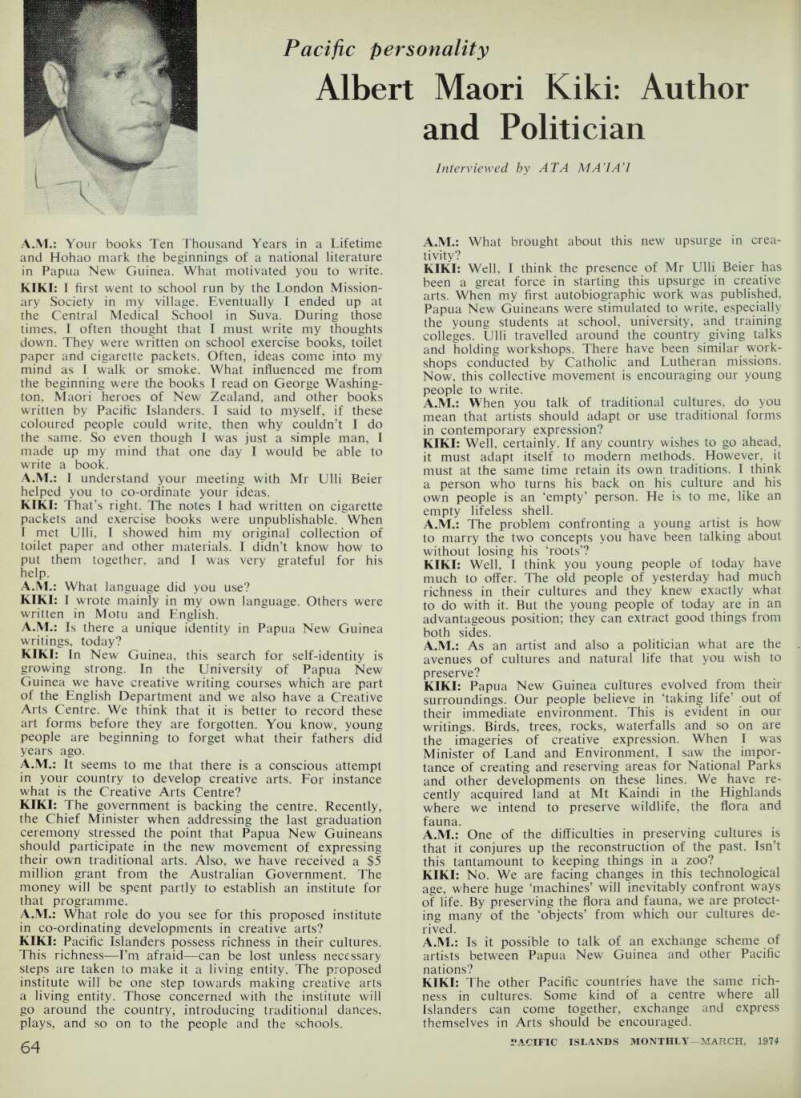
Pacific personality Albert Maori Kiki: Author and Politician
Interviewed by AT A MAT AT
A.M.: Your books Ten Thousand Years in a Lifetime and Hohao mark the beginnings of a national literature in Papua New Guinea. What motivated you to write.
KIKI: I first went to school run by the London Mission ary Society in my village. Eventually I ended up at the Central Medical School in Suva. During those times, I often thought that I must write my thoughts down. They were written on school exercise books, toilet paper and cigarette packets. Often, ideas come into my mind as I walk or smoke. What influenced me from the beginning were the books I read on George Washing ton, Maori heroes of New Zealand, and other books written by Pacific Islanders. I said to myself, if these coloured people could write, then why couldn’t I do the same. So even though I was just a simple man, 1 made up my mind that one day I would be able to write a book.
A.M.: I understand your meeting with Mr Ulli Beier helped you to co-ordinate your ideas.
KIKI: That’s right. The notes I had written on cigarette packets and exercise books were unpublishable. When I met Ulli, I showed him my original collection of toilet paper and other materials. I didn’t know how to put them together, and I was very grateful for his help.
A.M.: What language did you use?
KIKI: I wrote mainly in my own language. Others were written in Motu and English.
A.M.: Is there a unique identity in Papua New Guinea writings, today?
KIKI: In New Guinea, this search for self-identity is growing strong. In the University of Papua New Guinea we have creative writing courses which are part of the English Department and we also have a Creative Arts Centre. We think that it is better to record these art forms before they are forgotten. You know, young people are beginning to forget what their fathers did years ago.
A.M.: It seems to me that there is a conscious attempt in your country to develop creative arts. For instance what is the Creative Arts Centre?
KIKI: The government is backing the centre. Recently, the Chief Minister when addressing the last graduation ceremony stressed the point that Papua New Guineans should participate in the new movement of expressing their own traditional arts. Also, we have received a $5 million grant from the Australian Government. The money will be spent partly to establish an institute for that programme.
A.M.: What role do you see for this proposed institute in co-ordinating developments in creative arts?
KIKI: Pacific Islanders possess richness in their cultures.
This richness—l’m afraid—can be lost unless necessary steps are taken to make it a living entity. The proposed institute will be one step towards making creative arts a living entity. Those concerned with the institute will go around the country, introducing traditional dances, plays, and so on to the people and the schools.
A.M.: What brought about this new upsurge in crea tivity?
KIKI: Well, I think the presence of Mr Ulli Beier has been a great force in starting this upsurge in creative arts. When my first autobiographic work was published, Papua New Guineans were stimulated to write, especially the young students at school, university, and training colleges. Ulli travelled around the country giving talks and holding workshops. There have been similar work shops conducted by Catholic and Lutheran missions.
Now, this collective movement is encouraging our young people to write.
A.M.: When you talk of traditional cultures, do you mean that artists should adapt or use traditional forms in contemporary expression?
KIKI: Well, certainly. If any country wishes to go ahead, it must adapt itself to modern methods. However, it must at the same time retain its own traditions. I think a person who turns his back on his culture and his own people is an ‘empty’ person. He is to me, like an empty lifeless shell.
A.M.: The problem confronting a young artist is how to marry the two concepts you have been talking about without losing his ‘roots’?
KIKI: Well, I think you young people of today have much to offer. The old people of yesterday had much richness in their cultures and they knew exactly what to do with it. But the young people of today are in an advantageous position; they can extract good things from both sides.
A.M.: As an artist and also a politician what are the avenues of cultures and natural life that you wish to preserve?
KIKI: Papua New Guinea cultures evolved from their surroundings. Our people believe in ‘taking life’ out of their immediate environment. This is evident in our writings. Birds, trees, rocks, waterfalls and so on are the imageries of creative expression. When I was Minister of Land and Environment, I saw the impor tance of creating and reserving areas for National Parks and other developments on these lines. We have re cently acquired land at Mt Kaindi in the Highlands where we intend to preserve wildlife, the flora and fauna.
A.M.: One of the difficulties in preserving cultures is that it conjures up the reconstruction of the past. Isn’t this tantamount to keeping things in a zoo?
KIKI: No. We are facing changes in this technological age, where huge ‘machines’ will inevitably confront ways of life. By preserving the flora and fauna, we are protect ing many of the ‘objects’ from which our cultures de rived.
A.M.: Is it possible to talk of an exchange scheme of artists between Papua New Guinea and other Pacific nations?
KIKI: The other Pacific countries have the same rich ness in cultures. Some kind of a centre where all Islanders can come together, exchange and express themselves in Arts should be encouraged.
Advertisements & other items, pp. 71-72 (1 item)
6Established...
Lae
Wewok
Rdbaul
Honiara
Port
Suva
Moresby
KioS
Santo
nevv^^
Wukaalo^
loutoka
Wp
ZZS
new
Raro tongg^
Sydney
& 3New terminals...
6Established...
and more to come.
.. .to ensure regular supply of Speed-e-gas* in the Pacific region three new bulk storage terminals have been opened at Rarotonga, Nukualofa and Lautoka. These terminals join already established bulk storage facilities at Port Moresby, Lae, Wewak, Rabaul, Honiara and Kieta.
And to meet future needs bulk terminals are to be built at Santo and Suva.
These terminals wrll maintain supplies of clean efficient and safe Speed-e-gas all year round.
Speed-e-gas is the most dependable fuel.. .because it's here in bulk. Liquified Petroleum Gas has been proven to be ideal fuel for all cooking and water heating needs. i
SPEEDEGAS
The Gas Supply Company Limited, Head Office - 221 Miller St., North Sydney 2060 Phone: 920-951 and available throughout the Pacific.
A member of the Boral group of companies.
Speed-e-gas is known in New Guinea as Guinea-Gas, in Tonga as Tonga Speed-e-gas and in Fiji as Fiji-Gas.
. <1 r
Round gourmet
Skillet
The handiest newappliance
since trypans
Bacon and eggs for two? With a Sunbeam “Skillet it s easier than ever. Just the right size. Yet “Skillet” is big enough itself to roast a size 8 chicken to perfection. And it washes easier than a plate.
Just remove the control and dunk the whole pan in the sink.
“Skillet” is another great new idea from Sunbeam. Handier for small families and singles. It looks like a frypan, cooks like a frypan. But it has a talent of its own. It’s designed to be versatile, to be both compact and roomy. “Skillet” looks beautiful, cooks beautifully.
Nobody but Sunbeam can offer you a Round Gourmet Skillet. It’s ahsnintplv nn its own. It onlv comes from Sunbeam.
Yesterday
How times change! PlM's cover picture in March, 1954, showed a TEAL flying-boat hostess serving a meal to a Beqa (Fiji) firewalker who was on his way to Auckland with fellow islanders to demonstrate firewalking. Fijians gave exhibitions of firewalking long before Europeans arrived in the South Seas, and if they travelled at all, they paddled their own canoes, and for sustenance sat round a heap of food cooked in a ground oven. TEAL has changed too — in name and type of aircraft. The flying-boats are but a memory, and 600 mph jets are now used for Air New Zealand's many routes.
There was speculation that Qantas would absorb British Commonwealth Pacific Airlines, and that the Australian and New Zealand Governments would buy out the British Government's shares in TEAL. It was also believed that Qantas would sell BCPA's four DC6 aircraft to TEAL for use on the trans-Tasman and Fiji runs instead of Solent flying-boats.
All that duly came to pass, and eventually the NZ Government bought out the Qantas share of TEAL.
The Papua New Guinea Government Gazette, of February 17, 1954, attracted the attention of PIM writers in March.
Virtually all the gazette, more than 50 pages, was devoted to meticulous rules and regulations under which sewerage work might be undertaken. They covered everything—from the definition of a slop-hopper to the form of licence to be issued to sanitary plumbers and sanitary drainers. Somewhere it stated that for natives, an "Asiatic" type of pan could be provided—by which PIM concluded that in those respects, natives and Asiatics were to be regarded as different from Europeans. PIM commented: ". . . As far as we know, there is no sewerage area (within or without 'the meaning of the act') in PNG, nor is any contemplated in the immediate future".
An interesting aftermath of the Royal visit to Fiji, New Zealand and Australia was a report that an Islands trading firm wanted to buy thousands of yards of red and blue cloth used in Sydney for tour decorations. The use—lap laps for Papua New Guineans. And a famous maker of women's foundation garments advertised a new creation under the title "Lap-lap". It is said to
be "with lap-lap thigh ease" and the model in the advertisement was shown skipping around the page in her little elastic girdle.
Raluana natives of New Britain won the first round and looked like winning the second in a bid for inclusion in the village council system. All but the 2,000 Raluana people of the 30,000 Tolais of the Gazelle Peninsula joined the scheme, which was introduced after World War II to encourage the native people to run their own affairs under Administration guidance as a pre liminary to ultimate self-government.
The invariable excuse of the Raluanas for not joining the council was that they were too ignorant to engage in anything so advanced. But PIM had this to say of them: "These natives, however, are intelligent, industrious and have very shrewd leaders, and have shown they are quite capable of running their own affairs. The only difference is that they insist on running them in their own native way".
A proposal that Indian workers should go from Fiji to New Caledonia to solve the labour problem there remained wrapped in official silence. Young Indians interested were frustrated in efforts to get information. Wrote one to a newspaper: "Unless the wage scale is commensurate with the general qualifications of the labourers, and is compatible with their standard of living, and is such as affords ample incentive for ihem to go to an alien country and subject themselves to God-knows what-is-in-store-for-them, our men will never accept any offers, however tempting they may seem on the surface". There was a general impression that the official mission of inquiry from Fiji found that, economically, all that glittered in New Caledonia was not gold—mainly be cause of the inflated csst of living there.
Re-development was under way in Tahiti.
In a programme to replace many old buildings in the business area of Papeete, the block of business premises near the waterfront containing the famous old Tahiti Yacht Club, was soon to be demolished. The building, erected in 1905, was to be replaced by a modern two-storey structure. However, certain old buildings of great historical interest were to be preserved, and they would be reconditioned.
The six Japanese long-line fishing vessels employed by Toky® Marine Products Corporation and fishing on a poundage basis for Van Camp Sea Food Inc, off Pago Pago, were proving beyond a shadow of doubt that there was p'enty of tuna in the South Pacific,
and that the Japanese knew how to catch them. The fish cannery at Pago Pago was canning 48,000 tins a day —right up to capacity. Van Camp was reported to be paying the Japanese $162 a ton for tuna, and slightly more for albacore.
An Ellice Islander, Milaki Tihala, returned home from Suva a qualified Assistant Dental Practitioner. He was the first ADP in the GEIC and his appoint ment was expected to reduce the number of people who went to Fiji for dental treatment.
Another Ellice Islander, Kelepo Kolone, returned at the same time as a sanitary inspector, a subject in which he specialised after being found unsuited for training as an Assistant Medical Practitioner. He had the distinction of being the only sanitary inspector in the GEIC.
Micronesian medical students at the Central Medical School, Suva, might be withdrawn at the end of 1954, according to the official journal of the Trust Territory. While facilities and training at Suva were completely satisfactory, it was felt it would be better in many ways, and possibly less expensive, to train students either at Truk or at the new $5 million hospital being built on Guam. Nineteen TT students were expected to complete training in Suva at the end of 1954.
Tahiti received unwelcome publicity in a court case in Honolulu over the custody of two children. The mother took the children from a mission home in Tahiti where they were held pending settlement of custody, and went to Honolulu. During the proceedings in Honolulu the mother said life for children was insufferable in Tahiti and produced two former residents to support her. Some of her charges about Tahiti were: Billions of rats, billions of mosquitoes, no sanitation, and no doctors she could trust. While the court case went on the Tahiti Tourist Bureau was doing all it could to point out that there were millions more rats and mosquitoes in San Francisco than in Tahiti.
Even 20 years ago land prices were spiralling and this brought a complaint from a correspondent in Rabaul who wrote: "One sometimes wonders just where rising prices will stop. Have just heard that a block of freehold land has changed hands for the sum of £2,700. I expected to hear that a considerable area was involved, but was staggered to find that the land in question was a building block in the town with a street front measurement of 50 ft!"
Advertisements & other items, p. 74 (1 item)
in the South Pacific.'^*"'
The finest Flours and Sharps
Vfi \« 0/ % A % Seafoam Mills at Brisbane, Toowoomba, Roma, Maryborough, Rockhampton
SEAFOAM FLOUR MILLS
Queensland's largest- flour milling organisation a division of
The Queensland Co-op Milling
Assn. Limited
Head office—Box 7, P.O. South Brisbane, Qld.
Phone: 44-1681. Cable Address: "Seafoam,"
Brisbane. manufacturers of
High quality products from Queensland
hard wheats
SEAFOAM (high protein baker's flour) topic (protein rich)
EXCELSIOR
SILVERSPRAY
(export flours)
SHARPS andMEALS
All products manufactured to suit your requirements —Enquiries welcome.
Books, Reviews, Writers
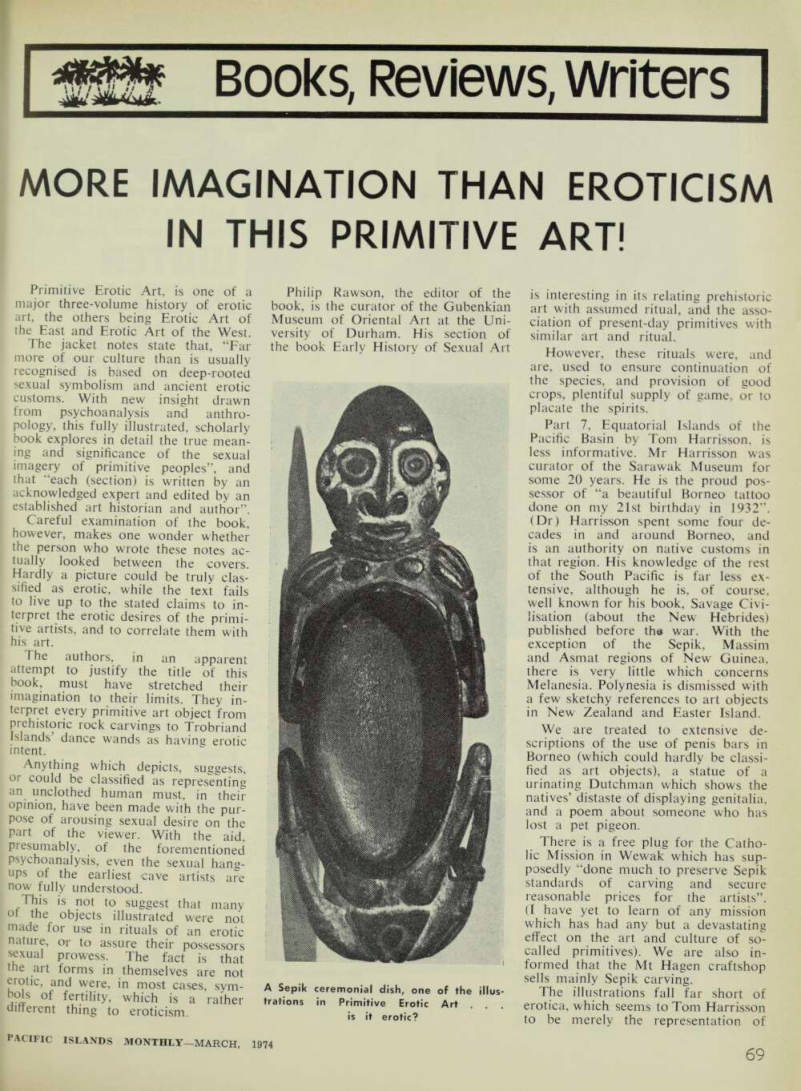

More Imagination Than Eroticism
In This Primitive Art!
Primitive Erotic Art, is one of a major three-volume history of erotic art, the others being Erotic Art of the East and Erotic Art of the West.
The jacket notes state that, “Far more of our culture than is usually recognised is based on deep-rooted sexual symbolism and ancient erotic customs. With new insight drawn from psychoanalysis and anthro pology, this fully illustrated, scholarly book explores in detail the true mean ing and significance of the sexual imagery of primitive peoples”, and that “each (section) is written by an acknowledged expert and edited by an established art historian and author”.
Careful examination of the book, however, makes one wonder whether the person who wrote these notes ac tually looked between the covers.
Hardly a picture could be truly clas sified as erotic, while the text fails to live up to the stated claims to in terpret the erotic desires of the primi tive artists, and to correlate them with his art.
The authors, in an apparent attempt to justify the title of this book, must have stretched their imagination to their limits. They in terpret every primitive art object from prehistoric rock carvings to Trobriand Islands dance wands as having erotic intent.
Anything which depicts, suggests, or could be classified as representing an unclothed human must, in their opinion, have been made with the pur pose of arousing sexual desire on the part of the viewer. With the aid, presumably, of the forementioned psychoanalysis, even the sexual hang ups of the earliest cave artists are now fully understood.
This is not to suggest that many ot the objects illustrated were not made for use in rituals of an erotic nature, or to assure their possessors sexual prowess. The fact is that the art forms in themselves are not erotic, and were, in most cases, sym bols of fertility, which is a rather ditterent thing to eroticism.
Philip Rawson, the editor of the book, is the curator of the Gubenkian Museum of Oriental Art at the Uni versity of Durham. His section of the book Early History of Sexual Art
is interesting in its relating prehistoric art with assumed ritual, and the asso ciation of present-day primitives with similar art and ritual.
However, these rituals were, and are, used to ensure continuation of the species, and provision of good crops, plentiful supply of game, or to placate the spirits.
Part 7, Equatorial Islands of the Pacific Basin by Tom Harrisson, is less informative. Mr Harrisson was curator of the Sarawak Museum for some 20 years. He is the proud pos sessor of “a beautiful Borneo tattoo done on my 21st birthday in 1932”. (Dr) Harrisson spent some four de cades in and around Borneo, and is an authority on native customs in that region. His knowledge of the rest of the South Pacific is far less ex tensive, although he is, of course, well known for his book, Savage Civi lisation (about the New Hebrides) published before the war. With the exception of the Sepik, Massim and Asmat regions of New Guinea, there is very little which concerns Melanesia. Polynesia is dismissed with a few sketchy references to art objects in New Zealand and Easter Island.
We are treated to extensive de scriptions of the use of penis bars in Borneo (which could hardly be classi fied as art objects), a statue of a urinating Dutchman which shows the natives’ distaste of displaying genitalia, and a poem about someone who has lost a pet pigeon.
There is a free plug for the Catho lic Mission in Wewak which has sup posedly “done much to preserve Sepik standards of carving and secure reasonable prices for the artists”. (I have yet to learn of any mission which has had any but a devastating effect on the art and culture of so called primitives). We are also in formed that the Mt Hagen craftshop sells mainly Sepik carving.
The illustrations fall far short of erotica, which seems to Tom Harrisson to be merely the representation of
A Sepik ceremonial dish, one of the illus trations in Primitive Erotic Art . . . is it erotic?
naked male or female figures showing phalli, or, as he repeatedly states, pudenda.
There is reference to the “Men’s ritual club house” or Haus Tambaran at Angoram. This building was never used as a men’s house, but was built as a salesroom for Sepik artifacts. The bulk of the decoration inside and out side is not even representative of the Angoram district. Also, a figure he describes in Angoram was commis sioned, along with several others, as decoration for the hotel yard.
The carver who executed these had what was required described to him by Europeans. Or, as is most evident in one statue, adapted from photos of a Maori carving which is reproduced in this section.
The whole book abounds in un supported theory, and fails to con vince that it is either informative or authoritative. It is definitely not the book for a student of primitive art, or, for that matter, a connoisseur of erotica. Perhaps its purpose was to convince the purchaser of souvenirs from so-called primitive areas that his hitherto unsuspected statue, mask, club or pot is full of erotic imagery.
L. Marshall.
( PRIMITIVE EROTIC ART, edited by Philip Rawson, Weldenfeid and Nicholson, St John’s Hill, London. $17.50).
Advertisements & other items, p. 76 (1 item)
Water
Australia’s largest and most advanced range of ■ w
PRESSURE
SVSTEfRS
ww 0n1, 5130 From
ECON-O-JET
Packaged water systems From Only $lB9 □
dll
s
AQUA GENIE
Out-performs anything in its price range! Only $l3O ‘J” Series High Pressure Unit Range of multi-stage HYDRO-PAK (Left) from $325 TWIN-PAK (Above) from $360 New RM2 range of shallow and deep well models, capacities to 1180 g.p.h pressures to 75 p.s.i. deep and shallow well capacities models, from 200 to 2600 g.p.h., pressures from 20 ton2o p.s.i., depths to 300 ft. From $453 Water Equipment Catalogue 288 Pages—covers pumps ot all types, irrigation, water conditioning, domestic and commercial pool filtration. Price $2, post fcee surface mail (enclose cheque/ money order) VIC.: DUNLOP/IBC LTD., 795 Springvale Rd., Mulgrave, 3170. Ph. 560-6222; NSW.: FLEXHIDEE PTY - LTD 536 Botany Rd., Alexandria, 2015. Ph. 699-8444; TRU FLEX PTY. LTD., 990 Hunter St., Newcastle W., 2302. Ph.
69-1688; OLD.; DUNLOP/IBC LTD., Station Rd.,
Yeerongpilly, 4105. Ph. 40-9011; S.A : DUNLOP/IBC LTD., 98 Churchill Rd., Prospect, 5082. Ph. 44-6944.
NAME -
ADDRESS
PHONE J
rediscovering woter
LBQO4IO I.F.
French postcards?
Psst! Do you want some French postcards?
The French guillotine, with execu tioner standing by, his hand ready to bring down the gleaming blade, would hardly be depicted on postcards of New Caledonia today. No more would one expect them to be accom panied by the gentle greeting, “We hope you are all well.” But such a card did exist, as Patrick O’Reilly ex plains in the introduction to his re cent publication, La Nouvelle Cale donie au temps des Cartes Postales (New Caledonia in the heyday of postcards).
O’Reilly’s album reproduces 235 different Caledonian postcards out of the 2,000-3,000 he estimates were printed to reflect Caledonian life in the heyday of picture postcards, dur ing the first quarters of this century.
With text treating these cards as his torical, even ethnological testimony, Father O’Reilly notes that “Cale donians’ major interests are urban and mining activity.” His postcards, nevertheless, give an extensive view of mainland scenery, Melanesian life, inland settlers, local events and en tertainment besides the mission station.
It is obvious that over the past 50 years some of the postcard scenes have been obliterated—the railway from Noumea to Paita, the gold mines, oil drill at Ouen Toro and convict labour. Some faces and build
ings evoke new connotations today— Nidoish Naisseline, the old Melan esian chief, and the Catalan wine store.
Some personalities seem to have been omitted by the card printers— stockmen, Governor Feillet and nickel-king Higginson. By contrast, the arrival in port of an Australian envoy and also of a messenger from the governor in Sydney are duly pho tographed.
Other cards depict on-going tradi tions which continue today—the fill ing in of the Baie de la Moselle to extend the city of Noumea, immigrat ing New Hebridean workers and appeals for inland hotels and roads to be made more comfortable to attract Australian and New Zealand tourists.
Patrick O’Reilly, now aged 73, visited Noumea in early December to launch his album and attended an exhibition of old postcard blow-ups shown with photographs of the same views as seen today. For the student of things caledoniennes the whole exercise has been a keen testimony to
some 50 years evolution.-
Helen
Rousseau.
(La Nouvelle Caledonie Au
Temps D'p’S Cartes Postales, By
Patrick O’Reilly, for the Societe des Oceanistes, Paris; published by Nouvelles Editions Latines, Paris. Soft cover. Our copy from the publishers, no price avail able.)
Time belong Tumbuna
The many collectors of Glenys Kohnke’s paintings will welcome Time Belong Tumbuna in which they may find reproductions of paintings they own, together with others owned by a number of collectors. In fact each reproduction in the book is from a painting or sculpture in some private collection.
From what I remember of Glenys Kohnke’s work they have been well photographed and printed, and I should imagine that the artist would feel that the reproductions have done justice to her popular paintings.
It is a pity that there are certain annoying matters in the text; for in stance the statement “that inhabitants of New Britain are known as Bain ings” (p 14) when only some of the inhabitants are Bainings; and the
mispelling of Matupit as Matapit (p 12); and, on page xii of her intro duction, the inclusion of painted bark among the art forms of Papua New Guinea seems to need some explan ation. However, in this Age of Mediocrity even arrived-publishers like Jacaranda Press seem to be un troubled by such loose statements.
If the above inaccuracies do not bother you, you will have nothing but praise for the book, and Glenys Kohnke’s paintings are too well known to need any description of them here. I think the price of $5.95 is very reasonable.
Peter Livingston
(Time Belong Tumbuna, Legends
and Traditions of Papua New Guinea, by Glenys Kohnke. The Jacaranda Press. $5.95.)
Advertisements & other items, pp. 77-79 (1 item)
Book Company
HARRIS
(ESTABLISHED 1930)
We carry over 10,000 titles on all subjects in stock and would be pleased to quote for your requirements.
Please send your enquiries to:
HARRIS BOOK COMPANY,
G.P.O. Box 16670, Hong Kong
Reliable YMMMMH
Y»
MARINE DIESELS
Contributing to the Full Life
Series VAN MAR is a Japanese diesel engine maker, and was the first in the world to succeed to developing a truly small diesel engine. From 3HP up to 2,000 HP, YANMAR is producing a full range of diesel engines, ideal for an unlimited variety of applications. YANMAR diesel engines are already winning high reputations in more than 130 countries around the world.
In the YSE,TE, and SME series, YANMAR has developed a line of high performance diesels specially for marine power units. The secret of the exceptional power which these units develop lies in the unique combustion performance, not attainable by any competitive unit.
YANMAR diesels are ideal for the rationalization of the fishing industry among the pacific islands and for inter-island transport.
DEALERSHIPS
YANMAR is seeking dealers on the following •stands. Interested parties located on following islands please contact address given below Fiji. New Hebrides, New Caledonia, Gilbert and Ellice, Tahiti, Tonga, Nauru, American Samoa. Western Samoa, Cook Is. 14~50HP 1 Series 37 HP w K Series «12HP
YANMAR
DIESEL
YANMAR DIESEL ENGINE CD,LTD
1-11-1, Marunouchi, Chiyoda-ku, Tokyo, Japan Cable YANMAR TOKYO Telex: TOK 0222-2310
TO COINCIDE WITH
SELF-GOVERNMENT IN
NEW GUINEA . . .
LITTLE CHIMBU
IN BOUGAINVILLE
NANCY CURTIS
A children's picture story book in full colour!
Little Chimbu, who lives in New Guinea was grumbling because everybody he knew was busy digging holes and would not hunt crocodiles with him or even laze on the river bank under a taro leaf.
The little aeroplane, Little Balus ('barloose') heard him grumbling and offered to take Little Chimbu to see the biggest hole in the world—at Panguna on the island of Bougainville.
His family and all his friends insisted on going too.
The story tells of their adventures with the mighty machines which work in and around the marvellous hole . . the Bougainville Copper Mine. It's Ihe third in Nancy Curtis' widely acclaimed Little Chimbu adventure stories for children. fhe author, Nancy Curtis, is a former Mew Zealand schoolteacher, magazine A/riter and fashion designer, who has lived in Papua New Guinea since 1956. >he began writing Little Chimbu itories for her twin daughters, then iged five.
Fill in the details
on the attached
order form .
Recovering the past for

the Gentle People
When, in 1952, Scripps Institute of Oceanography at La Jolla, Cali fornia, sent an expedition to the Paci fic, it was decreed by the authorities that, insomuch as the expedition was a serious scientific undertaking, no wives would be allowed to sail with it. So, the wives stayed at home—or to be more exact, all but one of them did. The exception was Helen Raitt, a determined young woman who de cided to fly from port to port meeting her husband, Dr Russell Raitt, wherever the expedition stopped.
Helen’s plan worked well until the expedition reached Fiji where it was decided the research vessel would spend some time exploring northern island grouns. Faced with the possi bility of being left alone in Suva, Helen decided to do a bit of ex ploring on her own and set off on a copra ship bound for Tonga.
When, a few days later, she sailed into Vavau, she was immediately struck by the beauty of its harbour.
Ashore, the friendliness of the natives won her heart. In no time at all she had become yet another of the many people who have come to feel that Vavau is a special place.
Being a generous person, Helen was anxious to share her new-found paradise with her husband and his fellow scientists so she sent off a cable imploring them to follow her.
There must have been a special urgency in her words for the expedi tion’s leader, Dr Roger Revelle, altered plans and down the ship came to Vavau.
The scientists found it all that Helen had said and out of gratitude to her for having brought them to a place so full of interest and beauty, lifted the embargo against wives and let her sail with them on the return trip to California. Out of her adven tures on board, she wrote a book, Exploring the Deep Pacific, which gave an excellent inside view of the day-to-day lives of working oceano graphers.
The following years were busy ones for Helen Raitt and it was not until 1971 that she was able to return to Vavau and the other Tongan islands.
Her second trip found her as filled with enthusiasm as she had been on her first. She saw again King Taufa’ahau Tupou IV, whom she had met on her first visit and later en tertained in La Jolla, and met Tongan nobles and officials.
Unlike many visiting papalangis, she was not content to stop there, but
talked also to village people all over the Kingdom, As she did so, she came to realise that memories of the old times of Tonga were growing dim and that the common people, proud though they were of their past, really knew very little of it. Being still a most determined woman, she decided to help them recover their history.
Her help came in the form of books sent to schools, to organisations, to individuals.
Back in California, where the Uni versity of California at San Diego had acquired the important Edwin C.
Hill Collection of Pacific Books and Manuscripts, she reproduced material about the old days. Many of the books she copied are so rare and so costly that had it not been for her, the bits of Tongan history which they contain would have been lost to the very people they are written about.
In 1972, Helen Raitt returned to Tonga laden down with books and Xeroxed copies of Tongan historical materials which, with generous en thusiasm, she distributed to interested people all over the Kingdom.
In Vavau, she met Donna Gerstle, a Peace Corps Volunteer from Louis ville, Kentucky who was in charge of the Teacher Training Centre there.
They were kindred souls. Donna loved Vavau as much as Helen did and was as eager to help the Tongans recapture their past. When Helen dis covered that her young compatriot had the ability to express herself in writing, an idea was born.
The idea materialised in 1973 when, with Donna’s help, Helen founded the Tofua Press which is dedicated to providing, at prices Tongans can afford to pay, books which tell present-day Tongans about their past.
It is altogether fitting that the first volume to be published by Tofua Press is Donna Gerstle’s own Gentle People. It is, very simply, a labour of love in which she attempts to set out, in the words of the early explorers, something of the feeling that she herself during her two years as a PCV came to have about Vavau and its people. Lest anyone be misled, she defines “gentle” as “sensitive and kind, yet proud; respectful and humble, yet dignified; intelligent and determined, yet tolerant; delicate and warm, yet vibrantly alive.”
By some Gentle People has been criticised for not being a complete historical account of Vavau. Of
course, it isn’t that. How could it be, , in 65 short pages?
What it is, is an introduction to J the many explorers—both the early ones and the later ones, who came to I Vavau and who were perceptive enough to appreciate the unique human qualities of its people.
Above all. Gentle People is an ad venture in sharing with Donna the joy that a sensitive, intelligent young person brought up in a busy indus trial civilisation feels for the slower tempo of an island way of life. It is a reminder to people everywhere that what is important is not the things a person acquires, but the way he lives his life and the people he lives it with.
Reading it one does, incidentally, acquire an amazing amount of Ton gan history. In that aim the text is aided by the well-chosen, carefully re produced illustrations. And the cover, with its tapa design, is a pleasing in troduction to the book.
All in all, Gentle People makes one look for further books from Donna Gerstle and makes one wish her and Helen Raitt and the new Tofua Press much luck and many books.— Patricia Matheson. (GENTLE PEOPLE. By Donna Gerstle lofua Press. 10457-F Roselle Street, San Diego, California 92121. $2.20.) IT would be pleasing to state that I- the new paperback World Atlas Jroduced by Pan Reference Books in issociation with Rand McNally In ernational fills the need we all have or a satisfactory cheap atlas. But mfortunately it doesn’t.
At $2.45 for 224 pages of full :olour, it is value for money, and it £ compact and comprehensive, as he publishers claim. But the maps lave had to be reduced to such a mall size for the paperback format hat it is virtually impossible to onsult them without the aid of a aagnifying glass—which is a serious etraction from the book’s usefulness.
Nevertheless there is a (readable) azeteer and 70 pages of quite excel mt (and readable) diagrams giving omparisons of national populations, ■ade, minerals, power resources, and ven languages, plus other useful inon flags and national oundanes beloved of schoolmasters nd quizmasters, which makes the tlas worth the price of admission.
Its just a pity about those maps.
Advertisements & other items, p. 80 (1 item)
aaNTffs
WUI I I III ILCI ll I 1 ICI I
and their Loading Machines
Kw * v \ % r«- > * When it comes to speed in the air, pretty well all cargo services are the same.
But, on the ground, it’s a different matter. This is where Qantas excels.
Because we’re loaded with talent.
With men, machinery and know-how that are second to none.
Together they handle 67 flights a week, with the most modern container handling facilities in the Southern Hemisphere.
With a team like this it’s not surprising that Qantas containers and Unit Load Devices can not only save you money, but time as well.
And, check our special commodity rates, too. Ring your freight forwarde Or Qantas.
The people who know that speed on the ground is just as important as speed in the air.
The
marketing
Edge.
aaNTffs
an Ft ca
Books Received
Some of these titles will be reviewed in forthcoming issues: TCI rnv-TTXTrxT-r * , f ISLAND CONTINENT Aspects of the His toncal Geography of Australia and its Terntones, by A Grenfell Price Angus STRATFrTrs o FOR S p d A n pifA ilw rmll? !™ A 7 EGIES PAPUA NPW GUI NEA, edited by Prof A. Glumes Ross and J.
Mi m urne Melbourne. THE SYNERGY SAGA. A Se * 3 Coll*g, a novel by Ardent PACIFIC IINF S RS° n 'io27 r 7*> S ’ h N6 w /° rk i; PACIFIC LINERS, 1927-72, by Frederick WESTERN W EORT p!i b ,° U T,I
Present, by Tnhur TWofdleyHil‘ol
?VANAW- PU A bll N h „'v n e B , A v AiNArt. A Novel Set in Bougainville, & N . arI THE at VERY C |rvoiS,EV Rab A lu . l !, Pty , Ltd. I, THE VERY BAYONET: A Life of
Sir John Bates Thurstcm, by Deryck Scarr.
Australian National University Press, Can berra. HAWAII 2000: Continuing Lxperi ment in Anticipatory Democracy, edited by George Chaplin and Glenn D. Paige.
University Press of Hawaii. BAEGU: Social and Ecomogical Organisation Malaita.
Solomon Islands, by Harold M. Ross, Illi nois studies in Anthropology, No. 8 of the Universit y of Illinois Press. Urbana new ZEALAND: Pacific Land Down Under, photographs by Walter Imbei editing by ProfLsor berland, A. H. & A. W. Reed Ltd, Sydney DIRE STRAIT; A History of Bass Strait by Charles Bateson, A. H. & A. W. Reed Ltd Sydney CATCH A WAVF- A Sl, L dr »' Hawaii’s Ne» Politics, by Tomm ?HmSs JAPANESE 7 b v7ohl,
"re"*"’ Vw°«R
TRAVELS IN HAWAII hv R n K or t T^,,,
'edit”*"* a’. uS!
versity Press of Hawaii.
Advertisements & other items, pp. 81-82 (2 items)
75
ACIFIC ISLANDS MONTHLY—MARCH, 1974
"Service"
o 2: -o o H lP
76 Years' Experience
Selling
"SERVICE"
to the Pacific Islands
NELSON & ROBERTSON
PTY. LIMITED
(Established
PLANTATION HOUSE, 197 CLARENCE STREET, SYDNEY
CABLES: "IVAN", SYDNEY, BRISBANE. TELEX: AA22381, SYDNEY.
ISLAND MERCHANTS
SHIPPING AGENTS
TRAVEL AGENTS
INSURANCE AGENTS
REAL ESTATE AGENTS
Branch Office: Nelson S Robertson Pty. ltd., 303 Adelaide St., Brisbane. Old.
New Guinea Representatives: Rabaul Trading Co. Pty. Ltd., Rabaul Lae Madang Kieta.
[ EPIGLASS
Why choose
Epiglass marine products
for your boat?
OAF
•~ss. 90 bardium ■'hardener «J *.M» »« I N. 404 -.A m **& Epiglass gives you the biggest range of marine glues, fillers, preservatives, resins, skinning systems and paints going. The biggest.,. and the best.
Laboratory tested-and proven in the wateronthousandsandthousandsof boats! That’s why you can buy Epiglass products with complete confidence.
If it’s Epiglass, it will outlast all others. Just ask the man who uses Epiglass! from 7ftto73ft I epiglass power or sail For further information contact Consolidated Chemicals Limited, P.O. Box 15-104, New Lynn, Auckland, New Zealand.
PACIFIC AREA DISTRIBUTORS
COOK ISLANDS Cook Is. Trading Corp. Ltd NORFOLK ISLAND Irvine Bid. Supply Centre FIJI Burns Philp (SS) Co. Ltd PAGO PAGO Max Haleck Inc.
NEW GUINEA Bougainville Marine Pty Ltd Kieta TAHITI Tahiti Sport Burns Philo (NG) Ltd Madano TONGA Riechelmann Bros.
E lvee S Trad in g - Pty Ltd Rabaul WESTERN SAMOA Burns Philp (SS) Co. Ltd Faulkner & Tait (NG) Pty Ltd Lae E. A Coxon Ltd S A. Heath & Co Pty Ltd Pt Moresby Gold Star Transport Co. Ltd NEW HEBRIDES Burns Philp (NH) Ltd NOUMEA Guy Limousin Morris Hedstrom Ltd SOLOMON ISLANDS George Yee Fai Ltd Pacific Yachting 598
Pacific Transport
Fire Transpac' Demand From
Micronesian Congressmen
Speakers in the Congress of Micro : nesia called for the firing of Trans pacific Lines Inc (Transpac), the government-supported shipping line, during the January session. Their demand was backed up by the House Committee and the Senate Committee on Resources and Development, which asked that “a new and more de pendable shipping arrangement be instituted”.
Mr Sasauo Haruo, chairman of the House Resources and Development Committee, and Senators Olympio Borja, Marianas, and John Mangefel, of Yap, each gave Transpac a tongue lashing.
Mr Haruo, presenting his com mittee’s report about Transpac, spoke of “blunt economic facts” now facing Micronesia. Documented charges against the company included: • Non-adherence to published shipping schedules; • The 60-day service to the eastern districts turned out to be an 80 or 90-day service, if there was a service at all; • The 18-day shuttle service covering Koror, Yap, Guam and Saipan was non-existent; • The direct US west coast service had been discontinued and Micro nesia-bound cargo now rode piggy back on another line’s ships for trans shipment at Guam; • The direct service from the Far hast was irregular and unpredictable; • Transpac’s debt was more than $2 million and could not be amortised in the remaining five years of the
franchise;
. • There was a loss of confidence m Transpac by the public and its creditors; • Together, with all those reasons transpac continued to be mis managed: bills of lading arrived with no cargo, cargo was still off-loaded 3t the wrong ports, and non-payment claims continued.
T'his Congress adopted a report ?? s T r lpping ? earl Y four years ago,”
Mr Haruo said. “If the recommenda tions had been followed by the ship ping company, perhaps we would have had a viable service today.”
r^fi^TVJ. 8 % the * Same r ep ? rt ’ he recalled the title of one of the sec- T^ e Promise and the; Failure”.
Thus describes exactly the history 9? tif S i ad * S i ate of st l, lp P in g services . J 5 as years ’ said. “We have been made many promises, but nTn„ ha^°"l faM l UreS ' The , com ; Ft has faL P HTnU r P r . omls « d - and haFf i\ d ’ d £ ed . mlser / b| y- We Adminktrat^n ny ,rF r T! SeS fr ,° m IF* nrnhlem hnt thpw° t he if so i V M do anvfhina faded to solutions ” g ’ haVC fai ed to hnng < <T . l r ... Qct ” e \i im u^ 0r corr . ectl ve action is P st, Mr Haruo said. It is now time to take a decisive action and make a fresh start. We have made too many studies, recommendations and investigations. We can no longer dream that our wishes might become realities.”
Senator Borja, nresenting the Senate committee’s report, said it was extremely unfortunate that a good idea like Transpac—the intent to create a Micronesian-owned and controlled shipping line—had become the object of scorn and derision.
“Instead of helping Micronesian consumers, it has weighed them down with additional costs,” he said.
“Instead of becoming a viable operation, it is debt-ridden, and a liability to everyone.”
Senator Mangefel urged High Commissioner Edward E. Johnston to end the Transpac franchise and “launch a
new means t( > provide good shipping” for Micronesia.
He supported entirely the recom mendation. Transpac was being kept alive artificially, which did neither the company nor the consumer any good “Doctors sometimes must amputate a limb to save the patient,” he said.
“I think the analogy here is clear— that we must « et rid of Transpac to save the Micronesian people from paying for the mistakes of other people. It is time to let Transpac sink, and it is time to launch a new means to provide good shipping services for our people.”
Py.Kiavy Roat
f A * a* ccDV.rc rUK jAMOA btRVICt A former Royal Navy patrol boat has been acquired by Mr Antonio H.
Steffany, of Western Samoa, to run a service between Apia and Pago Pago. Mr Steffany bought the boat, which he has renamed Antonio, from Marine Charters Co of Singapore, which bought it from the Royal Navy in 1968.
The boat is 117 ft long, 21J ft wide, with a mean draft of 6i ft and is 149 tons (gross). It is capable of covering the distance between Apia and Pago Pago in five hours, a saving of about three hours over the present average running time, Lepou, a Samoan, will be master of the Antonio.
attitude to regional shipping
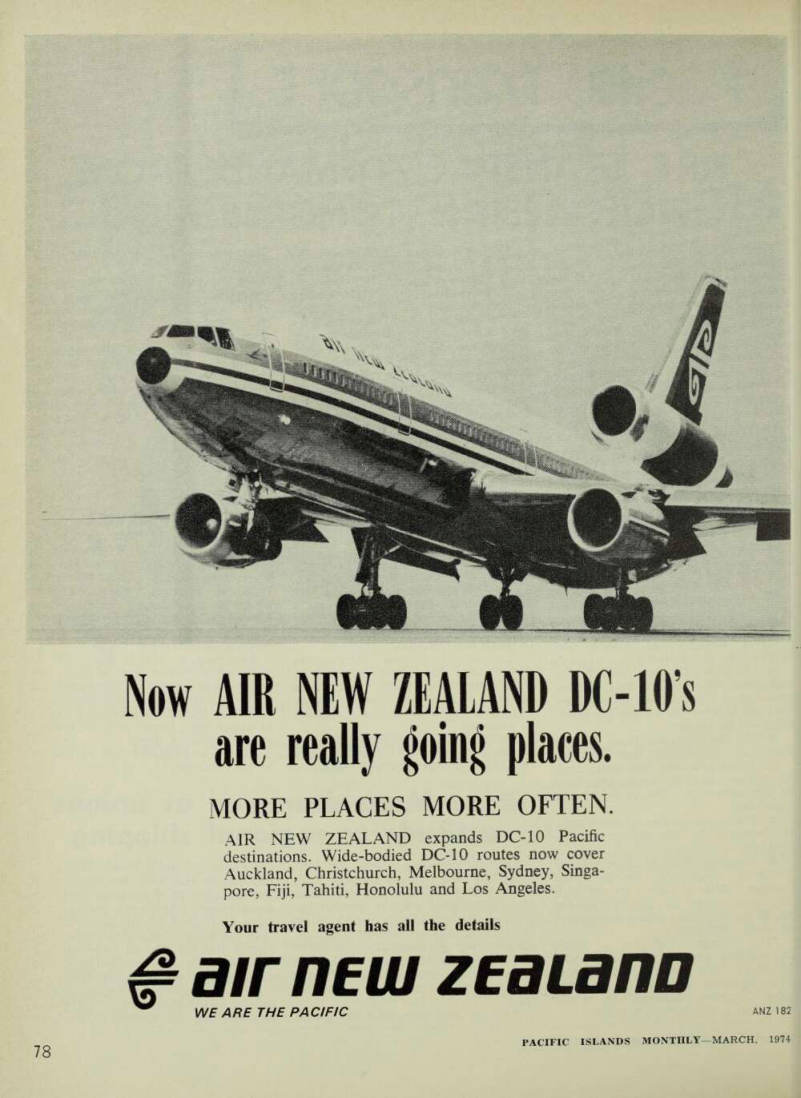
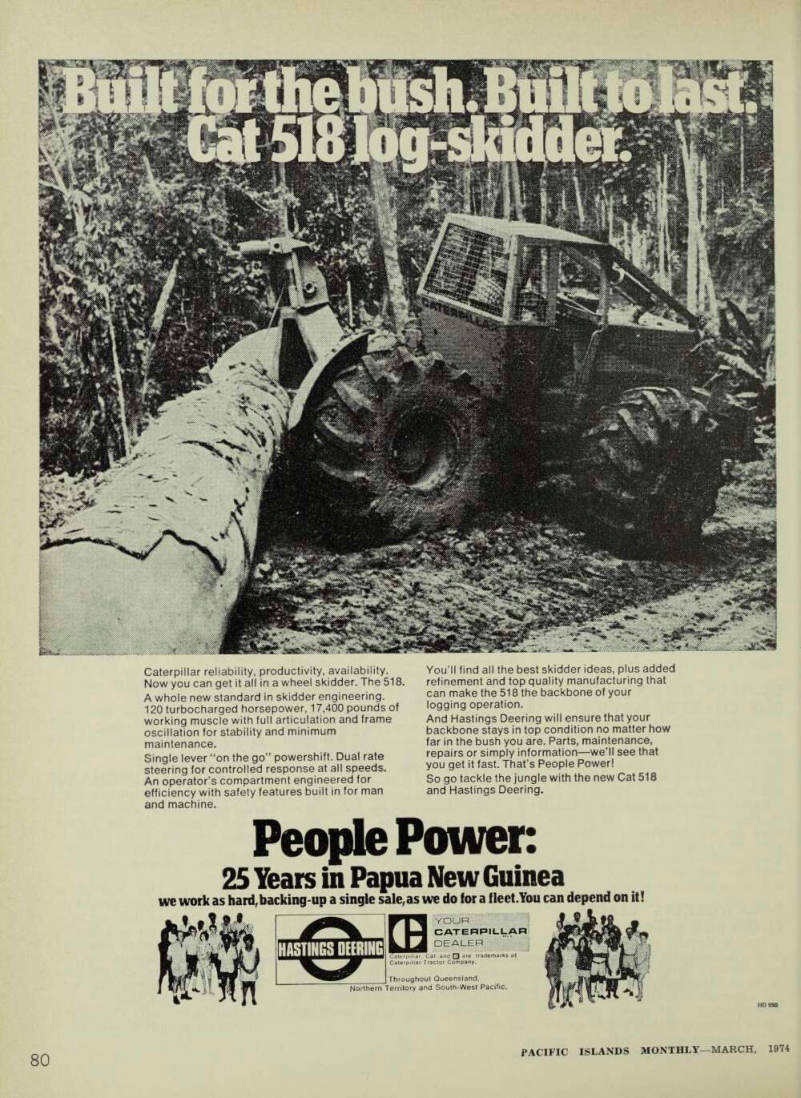
Ratu Mara dismayed at unions' attitude to regional shipping
Militant maritime unions in Australia and New Zealand shocked Fiji’s Prime Minister, Ratu Sir Kamisese Mara, with their attitude towards the idea of Pacific Islands-owned ships.
He said recently in Suva he was concerned about the feasibility of a South Pacific regional shipping line because of opposition from seamen and dock workers in Australia and New Zeaai o ♦ c- • , , Ratu Sir Kamisese, who was speak-
ing about regionally-owned transport, referred to the 1973 ban placed on the Enna G in Wellington, and the more recent Melbourne ban on the same ship over an industrial issue.
In beginning a shipping venture the Pacific Islands should ask whether they would get support, instead of being frustrated, as Nauru was.
Ratu Sir Kamisese’s comments were timely, as the possibility of a regional shipping line will become a live issue
in the next few months. It is likely to get an airing at the next South Pacific Forum, when a special report is discussed.
Speaking about air transport, he said that when Fiji became indepen dent in 1970 he spoke against the idea of a national airline for Fiji be cause it would be a status symbol the country could not afford. Govern ments which succumbed to national enterprises were a real danger to the concept of regional co-operation.
"But I think we are beginning to realise that we can only afford one airline in the region for regional transport, and I hope that through the South Pacific Bureau for Econo mic Co-operation we will move to wards this view,” he said.
His attitude is interesting, and he may have to do some strong talking to convince some of his neighbours who are adopting expansionist ideas for air transport, neighbours like Nauru, Western Samoa and Tonga.
The Enna G came under a ban by maritime unions in January—in sup port of office staff of the Nauru Paci fic Line in Melbourne, who went on strike over a log of claims. Old mariners, after the Enna G’s ex perience in Wellington, would be in clined to say the ship was jinxed.
The ban was lifted after talks be tween officials of the shipping line and the Australian Shipping Officers’
Association ended in a settlement.
But Mr Willy Starr, a spokesman for the line, refused to disclose the terms of settlement.
The Enna G was stranded in Wel lington for several months in 1973 when maritime unions imposed a ban, ostensibly in support of a pay claim for the Fijian crew.
Ex-Navy Officer In
Bsip Charter Service
A former Royal Australian Navy officer. Captain John Robertson, plans to set up a charter service in the BSIP with a yacht built for him in Taiwan.
The vessel is a 41 ft two-masted ketch, which has been named Taholi.
Captain Robertson was in command of the aircraft carrier, Melbourne, when she was involved in a collision with the Voyager in Februarv. 1964.
The second of two royal commissions into the collision absolved Captain Robertson from any blame.
Dockworkers' Leader
Fined For Assault
Taniela Veitata, who was secretary of the deregistered Fiji Dockworkers’ and Seamen’s Union, was fined $3O in Suva Magistrate’s Court recently for criminal trespass. He had also been charged with having assaulted Mirza Namarud Buksh, but when the
case came on for hearing the prose cution said the parties had become reconciled. That charge was with drawn.
Veitata then pleaded guilty to hav ing entered the compound of Vijay Prasad with intent to assault Buksh.
He asked for leniency. He said he was provoked and lost his temper, Veitata is now secretary of the Fiji Waterside Workers’ and Sea men’s Union, which is seeking regis tration.
Korean Ship
Snatched From Reef
The San Pedro No 55, 200 tons, a Korean fishing ship, was dragged from a reef about 60 miles north west of Labasa, Fiji, three days after it grounded in heavy seas whipped up by Cyclone Pam on February 3.
After salvage attempts by sister ships failed, tugs belonging to Marine Paci fic Ltd and Salvage Pacific Ltd were involved. It was a difficult task in big waves. It took about 55 minutes to drag the ship clear.
The hull was badly damaged from a battering on the reef. The rudder and propellers were also badly damaged. The San Pedro is now in Suva for repairs.
A. Airlines May Be
Stuck With Losses
American Airlines may have to continue flying on the unprofitable South Pacific route. Other airlines and the American Samoa Govern ment are objecting to the plan, an nounced late in 1973, for PAA to take over these services in exchange for Caribbean routes.
Mr Ron Hunt, Fiji manager of American Airlines, told a recent meeting of the Fiji Visitors Bureau board of the objections, and added that a decision, from the US Civil Aeronautics Board might be months off. Airlines which objected to the change were Continental, United, Eastern and Allegheny. The Ameri can Samoa Government objected be cause there might be fewer flights through Pago Pago.
Mr Hunt said his company lost $3l million on the South Pacific routes in four years. The loss in the last year was $5 million.
Two of the airlines objecting to the “swap”, Eastern and United, each had a leg in before American was granted the routes by President Nixon in 1969. The CAB recom mended Eastern Airlines, but Presi dent Johnson over-ruled the CAB and selected Continental, only to see his decision upset after he stepped down.
The Adi La Isa
Air Terminal
The new terminal building at La basa Airport, Fiji, has, appropriate ly, been named after the late Adi Laisa Ganilau, wife of Fiji’s Deputy Prime Minister, Ratu Sir Penaia Ganilau. Both were prominent in “northern” affairs. Adi Laisa suffered a heart attack in an aircraft which had taken off from Labasa, and died before the plane was able to get back to the runway.
Work at the airport, extending over 18 months, cost $160,000. This included building the new terminal complex, and strengthening and lengthening the runway to take HS74B aircraft. The terminal build ing consists of a passenger concourse, waiting and seating accommodation, luggage handling facilities and a refreshment bar.
New Type Fish Catcher
For Micronesians
A new type of fishing boat for the US Trust Territory has literally been designed round the bait wells. It is part of a plan aimed at putting quali fied Micronesian fishermen in tuna ships which they can own and operate themselves. The new type of ship will replace the wooden-hulled Okinawan-Japanese type of boat at present in use, which has limitations.
The naval architect of the TT Marine Resources Division, Mr Wen dell H. Calkins, after consulting the Van Camp Sea Food Co, and local fishermen, designed a new steel live bait ship. The design provides for a ship with a range of 1,500 miles, able to travel at nine knots, and carry a crew of 14. It is 61 feet long, and has a 19 ft beam and a 5 ft draft.
The fish capacity is 29 tons in insu lated holds.
The bait wells will allow the ship to carry live bait which will enter the wells through underwater doors.
Another Rise
In Freight Surcharge
The freight rate picture for cargo from Australia to the Pacific Islands is not a pretty one. On February 1. further imposts were added to the 2J per cent surcharge imposed in November because of the fuel shortage.
Since then, the Arab oil sheiks have considerably increased the price, and the effects of that, on top of the earlier shortage, are now beginning to be felt. The surcharge from Australia to Papua New Guinea and Fiji has been increased to 8.9 per cent, and to New Caledonia and the New Heb rides by 6.37 per cent.
Early in February there was a pos sibility of a further increase in the
surcharge to Fiji, at a time when the government is battling inflation.
There is no relief in sight. Fuel prices are not likely to drop, unless there is a change of heart on the part of the Arabs, which will probably mean that the surcharges will be built into the normal freight rates.
In May, the Australian waterside workers are expected to receive a substantial lift in wages, which will probably be passed on in higher freights.
No wonder a shipping manager in Sydney commented that he expected freight rates from Sydney to the Pacific Islands to be 20 per cent higher by the end of 1974. Apart from sending up the cost of living in the Islands, these higher rates apply to Pacific Islands exports, making them dearer in world markets.
Fiji Airline Rights
Talks Break Down
Fiji has had mixed success in ar ranging reciprocal landing rights for Air Pacific. Hard on the heels of sign ing an air service agreement with Britain, Fiji was in disagreement with France and the United States over landing rights for New Caledonia, French Polynesia and Pago Pago.
The Fiji-Britain agreement confirms rights to operate services between Fiji and British territory.
Fiji is also attempting to get land ing rights at Pago Pago for Air Paci fic. So far the Americans have re fused to agree. Pan American Air ways and American Airlines fly through Nadi at present.
Until Fiji reaches agreement with the United States and France, Air Pacific’s jet planes will continue to operate below their capability, but the BAC 1-1 Is will add a new route to their list when work on upgrading the GEIC’s airport at Bonriki is com pleted in the near future. A jet service between Fiji and Tonga (Nukualofa) is already operating but the Tonga runway is not yet up to standard to allow Air Pacific to fly a Fiji-Auckland service via Tonga.
Air Nz Buys More Dclos
Wide-bodied DC 10 jet aircraft will take over the daily Air New Zealand return services between New Zealand and North America in a few weeks.
This follows Air NZ taking posses sion in January of its third DC 10 from the manufacturers, and a de cision to buy three more DC 10s.
The three new aircraft were bought m a package deal, which included spares and support equipment, of SUSBB million. The first of these ]ets will be delivered in December, 1974, the second in March, 1975, and the third at the end of 1975.
Advertisements & other items, pp. 84-86 (1 item)
are really going places.
Now AIR NEW ZEALAND DC-lO's
MORE PLACES MORE OFTEN.
AIR NEW ZEALAND expands DC-10 Pacific destinations. Wide-bodied DC-10 routes now cover Auckland, Christchurch, Melbourne, Sydney, Singapore, Fiji, Tahiti, Honolulu and Los Angeles.
Your travel agent has all the details
air neiu ze
WE ARE THE PA C/F/C anz 182
£ & * v mm mm Caterpillar reliability, productivity, availability.
Now you can get it all in a wheel skidder. The 518.
A whole new standard in skidder engineering. 120 turbocharged horsepower, 17,400 pounds of working muscle with full articulation and frame oscillation for stability and minimum maintenance.
Single lever “on the go” powershift. Dual rate steering for controlled response at all speeds.
An operator’s compartment engineered for efficiency with safety features built in for man and machine.
You’ll find all the best skidder ideas, plus added refinement and top quality manufacturing that can make the 518 the backbone of your logging operation.
And Hastings Deering will ensure that your backbone stays in top condition no matter how far in the bush you are. Parts, maintenance, repairs or simply information —we’ll see that you get it fast. That’s People Power!
So go tackle the jungle with the new Cat 518 and Hastings Deering.
People Power;
25 Years in Papua New Guinea
we work as hard,backing-up a single sale,as we do for a fleet. You can depend on it! n
HASTINGS DEERING
YOUR ;
CATERPILLAR
DEALER
Throughout Queensland, Territory and South-West Pacific.
Lord Howe's precarious
grip on air link
Lord Howe Island’s flying-boat link with Sydney will continue for about two months on a weekly basis after May 31, the deadline Airlines of NSW gave for withdrawal of the service.
The manager of Airlines of NSW, Mr Phillip Steadman, said it was ex pected that the 3,000 ft airstrip being laid by Australian Army sappers would be finished before May 31. The Department of Works expected it would take about two months for the strip to consolidate and become fully operational.
“Because of this we have under taken to keep a flying-boat going to provide an essential link,” Mr Stead man said. “At that time of the year there is only one service a week, and Lord Howe people use that time to take their own holidays or carry out maintenance on their buildings.
Airlines of NSW have two 30-year old Sandringham flying-boats on the service. Some Americans had shown interest in buying them, and it is pos sible that at least one would be sold soon after May 31.
Lord Howe people are perturbed as the date for withdrawal of the service draws closer. At the other end of the scale, the Australian Conserva tion Foundation claims that the air strip could be disastrous for the en vironment.
Two inquiries are sought. One is by the Lord Howe Air Service Com mittee, which has asked Prime Minister Gough Whitlam, and the NSW Premier, Sir Robert Askin, for a committee of inquiry into the island service. The Australian Conservation Foundation, claiming the airstrip could be disastrous for the environ ment, wants a public inquiry into the effects of air transport on the island.
The Lord Howe Air Service Com mittee contradicts statements by Air lines of NSW that the service is not profitable. It claims pilots and crew are available for the service, and that the flying-boats in use are safe, and would be for years to come.
The committee also asked if a survey has been made on the effects of the decision to end the service, particularly as 90 per cent of the island draws all or part of its income from tourism. It claims that island representatives were not invited to meetings at which the problems of an air service were discussed.
Airlines of NSW would probably be prepared to fly a 45-seat Fokker Friendship to Lord Howe Island if the airstrip was suitable. But an emergency strip does not come any
where near the requirements of a Friendship. It is more suitable for aircraft seating up to 10 passengers, and it is extremely doubtful if small aircraft would be a viable proposition.
A thin ray of hope for flying-boats remains. Marin-Air Pty Ltd, of Sydney, has made an approach to the Grumman Corporation, of New York to buy turbo-prop flying-boats, con verted from Albatross amphibians.
These aircraft would carry about 20 passengers a flight. So far no amphibians have been converted.
A Grumman representative, who visited Lord Howe recently to check the lagoon in relation to an Albatross service, said the amphibian drew less water than the Sandringhams. That would give it more flexible landing times than Sandringhams, which have to time landings for suitable tides.
Grumman and Marin-Air mston engine Albatross aircraft could be used as a stopgap, pending conversion of the amphibians.
Transport Briefs
• The Are Are Masina Co, of Malaita, has taken delivery of a new ship, the $25,000 Harutai Masina, which will carry 36 passengers, and 30 tons of copra and other cargo from the main ports of Malaita to Honiara. The Harutai Masina is 53 feet long, and is built of ferro-cement. • Sofrana-Unilines has sold the Capitaine Kermadec to a buyer in the Philippines. The ship, which was on the New Zealand-Papua New Guinea run, was replaced by the Capitaine La Perouse. • The Union Steam Ship Co’s launch Ranadi, a familiar sight in Suva Harbour for 38 years, was crushed by another USS Co vessel, the Pukeko, 1,020 tons, and sank in Walu Bay on January 25. The launch was handling the Pukeko’s lines when the mishap occurred. The USS Co will repair the Ranadi if the hull is not too seriously damaged. • Fiji is steadily building airstrips which will give small islands a link with Suva. This year strips will be laid at Vanua Balavu, in Central Lau, and Kadavu. In the next three years Nabouwalu, in western Vanua Levu, Rotuma and either Matuku or Moala Island, between the Lomaiviti and Lau islands will get strips. Fiji Air Services is ready to start services to Kadavu and Vanua Balavu as soon as the strips are ready.
Advertisements & other items, p. 88 (1 item)
“thank goodness
we have Air Pacific!”
THANK GOODNESS
WE HAVE AIR PACIFIC
stfst w* N> <nrr rriTT ifftTfo'ch t
FAKAFETAI.
KO MAUA
NE MATOU TE
■EA-PASEFIKA'
FAAFETAIILE
EA PASEFIKA
MO LE
GALUEGA LELEI
TAGIO TUMAS
IU Ml KAREM
EA PASIFIK A
TAGIO TUMAS
IU Ml KAREM
EA PASIFIK
ME’A LELEI KO
ETAU MA U E
EA PASIFIK! -
TAGIO TUMAS
IU Ml KAREM
EA PASIFIK -
M !C -J m *4 m ft m Ir t
IMIWUR OMO . ; I.X
ATSIN TURIN * • ■
: AIR PACIFIC’ ..«v. V-,
■tv - *'r
E RABA! EA REKE
I ROURA TE
AIR PACIFIC
E UASIVI DUADUA
NA AIR PACIFIC
When you live in an area as big as our South Pacific you will appreciate having an airline like Air Pacific. Fast, reliable and efficient!
NAURU
SAMOA
ELLICE
ISLANDS
NEW
HEBI
EBRIDES
BRISBANE
the one we know!
Not too big to lose its friendly personal South Seas island touch-and nottoosmalltogive you a crowded feeling.
When you fly Air Pacific - you’ll experience that wonderful welcome back home' feeling from the people you know.
Our impressive route network will give you an idea of our operation. Let us jet you around the islands. am “Jets you around the islands”
P.O. Box 112, Suva, Fiji.
•TONGA
Cruising
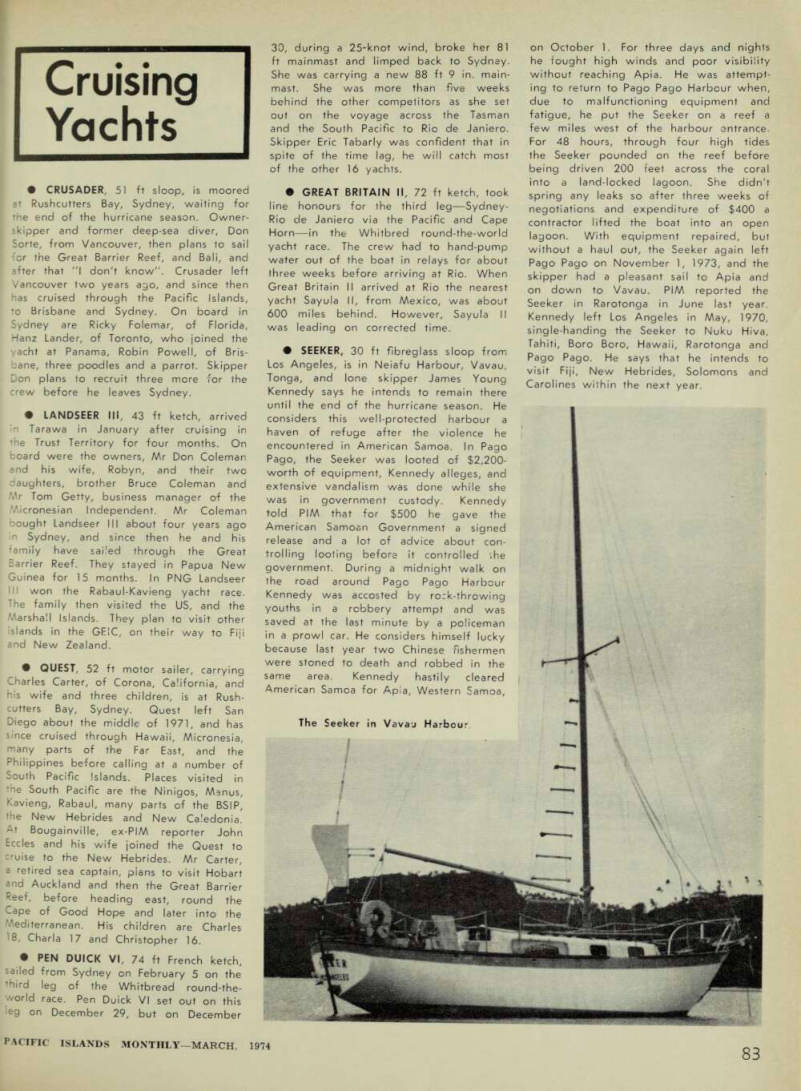
Yachts
• CRUSADER, 51 ft sloop, is moored at Rushcutters Bay, Sydney, waiting for the end of the hurricane season. Owner skipper and former deep-sea diver, Don Sorte, from Vancouver, then plans to sail for the Great Barrier Reef, and Bali, and after that "I don't know". Crusader left Vancouver two years ago, and since then has cruised through the Pacific Islands, to Brisbane and Sydney. On board in Sydney are Ricky Folemar, of Florida, Hanz Lander, of Toronto, who joined the yacht at Panama, Robin Powell, of Bris bane, three poodles and a parrot. Skipper Don plans to recruit three more for the crew before he leaves Sydney. • LANDSEER 111, 43 ft ketch, arrived In Tarawa in January after cruising in the Trust Territory for four months. On board were the owners, Mr Don Coleman and his wife, Robyn, and their two daughters, brother Bruce Coleman and Mr Tom Getty, business manager of the Micronesian Independent. Mr Coleman bought Landseer 111 about four years ago in Sydney, and since then he and his family have sailed through the Great Barrier Reef. They stayed in Papua New Guinea for 15 months. In PNG Landseer 111 won the Rabaul-Kavieng yacht race.
The family then visited the US, and the Marshall Islands. They plan to visit other islands in the GEIC, on their way to Fiji and New Zealand. • QUEST, 52 ft motor sailer, carrying Charles Carter, of Corona, California, and his wife and three children, is at Rush cutters Bay, Sydney. Quest left San Diego about the middle of 1971, and has since cruised through Hawaii, Micronesia, many parts of the Far East, and the Philippines before calling at a number of South Pacific Islands. Places visited in the South Pacific are the Ninigos, Manus, Kavieng, Rabaul, many parts of the BSIP, the New Hebrides and New Caledonia.
At Bougainville, ex-PIM reporter John Eccles and his wife joined the Quest to cruise to the New Hebrides. Mr Carter, a retired sea captain, plans to visit Hobart and Auckland and then the Great Barrier Reef, before heading east, round the Cape of Good Hope and later into the Mediterranean. His children are Charles 18, Charla 17 and Christopher 16. • PEN DUICK VI, 74 ft French ketch, sailed from Sydney on February 5 on the third leg of the Whitbread round-the world race. Pen Duick VI set out on this leg on December 29, but on December
30, during a 25-knot wind, broke her 81 ft mainmast and limped back to Sydney.
She was carrying a new 88 ft 9 in. main mast. She was more than five weeks behind the other competitors as she set out on the voyage across the Tasman and the South Pacific to Rio de Janiero.
Skipper Eric Tabarly was confident that in spite of the time lag, he will catch most of the other 16 yachts. • GREAT BRITAIN 11, 72 ft ketch, took line honours for the third leg—Sydney- Rio de Janiero via the Pacific and Cape Horn —in the Whitbred round-the-world yacht race. The crew had to hand-pump water out of the boat in relays for about three weeks before arriving at Rio. When Great Britain II arrived at Rio the nearest yacht Sayula 11, from Mexico, was about 600 miles behind. However, Sayula II was leading on corrected time. • SEEKER, 30 ft fibreglass sloop from Los Angeles, is in Neiafu Harbour, Vavau, Tonga, and lone skipper James Young Kennedy says he intends to remain there until the end of the hurricane season. He considers this well-protected harbour a haven of refuge after the violence he encountered in American Samoa. In Pago Pago, the Seeker was looted of $2,200worth of equipment, Kennedy alleges, and extensive vandalism was done while she was in government custody. Kennedy told PIM that for $5OO he gave the American Samoan Government a signed release and a lot of advice about con trolling looting before it controlled the government. During a midnight walk on the road around Pago Pago Harbour Kennedy was accosted by rock-throwing youths in a robbery attempt and was saved at the last minute by a policeman in a prowl car. He considers himself lucky because last year two Chinese fishermen were stoned to death and robbed in the same area. Kennedy hastily cleared American Samoa for Apia, Western Samoa,
on October 1. For three days and nights he fought high winds and poor visibility without reaching Apia. He was attempt ing to return to Pago Pago Harbour when, due to malfunctioning equipment and fatigue, he put the Seeker on a reef a few miles west of the harbour entrance.
For 48 hours, through four high tides the Seeker pounded on the reef before being driven 200 feet across the coral into a land-locked lagoon. She didn't spring any leaks so after three weeks of negotiations and expenditure of $4OO a contractor lifted the boat into an open lagoon. With equipment repaired, but without a haul out, the Seeker again left Pago Pago on November 1, 1973, and the skipper had a pleasant sail to Apia and on down to Vavau. PIM reported the Seeker in Rarotonga in June last year.
Kennedy left Los Angeles in May, 1970, single-handing the Seeker to Nuku Hiva, Tahiti, Boro Boro, Hawaii, Rarotonga and Pago Pago. He says that he intends to visit Fiji, New Hebrides, Solomons and Carolines within the next year.
The Seeker in Vavau Harbour
Advertisements & other items, p. 90 (1 item)
Package Convenience
■ You can order complete electric set packages from your Caterpillar Dealer. ■ Plus add-on flexibility with other accessories and options. ■ One source of responsibility. ..optimum economic value from your Caterpillar Dealer. m » J .4 «(#• ij
Support from Your
Caterpillar Dealer..
Final Assurance of Long-Term Satisfaction with Cat Electric Sets (Si na
CARPENTERS
TRACTOR E- EQUIPMENT
YOUR
CATERPILLAR
DEALER
FORMERLY CATERPILLAR DIV. SUVA MOTORS
SERVING THE SOUTH PACIFIC ISLANDS
TELEX: CARPTRAC FJ2190 SUVA. PHONE: 24051-4
Pacific jet news
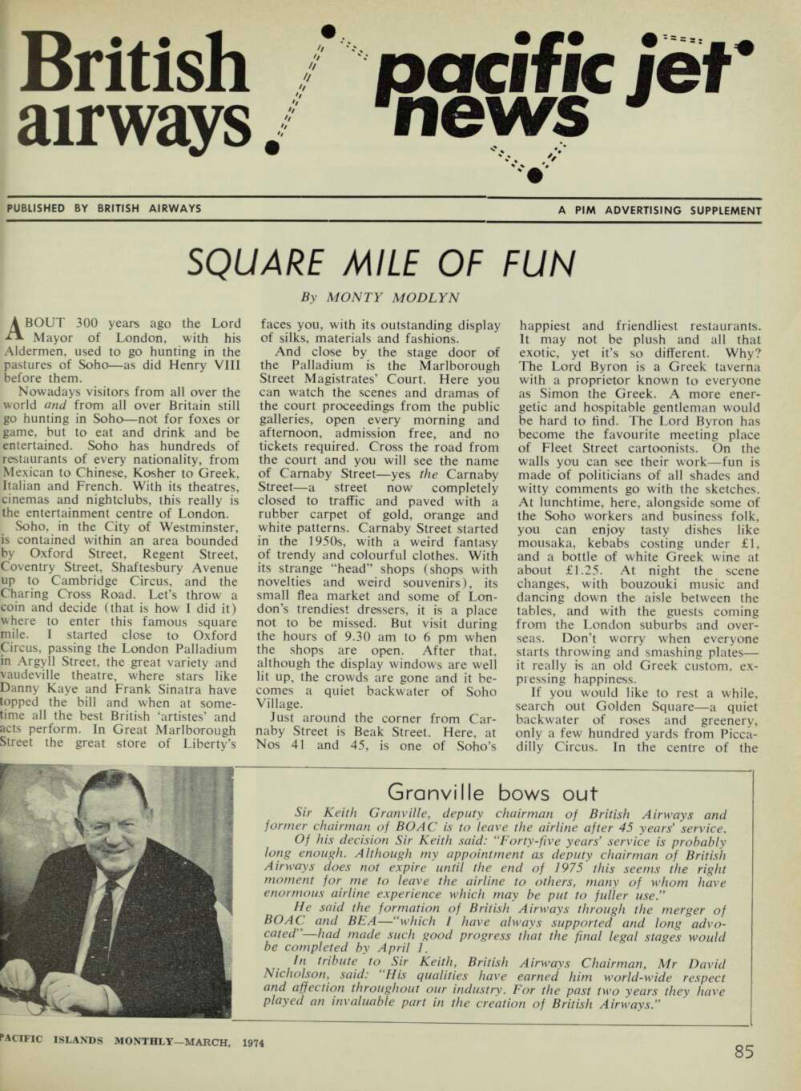
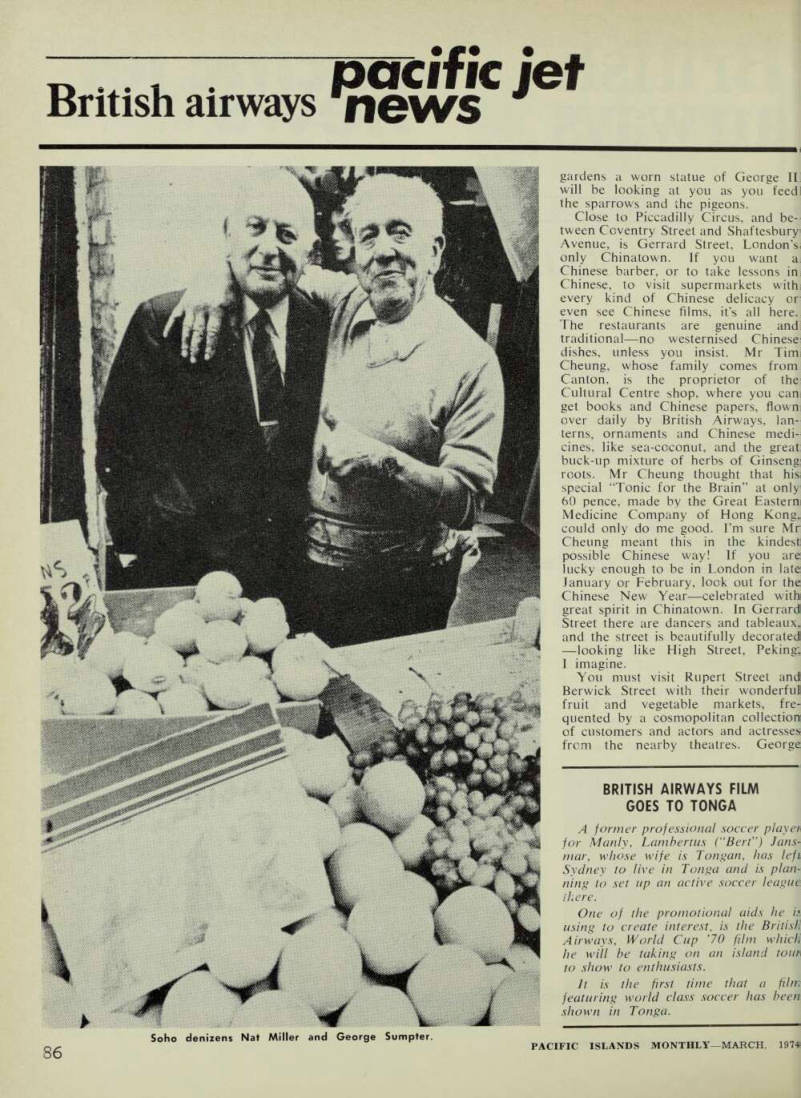
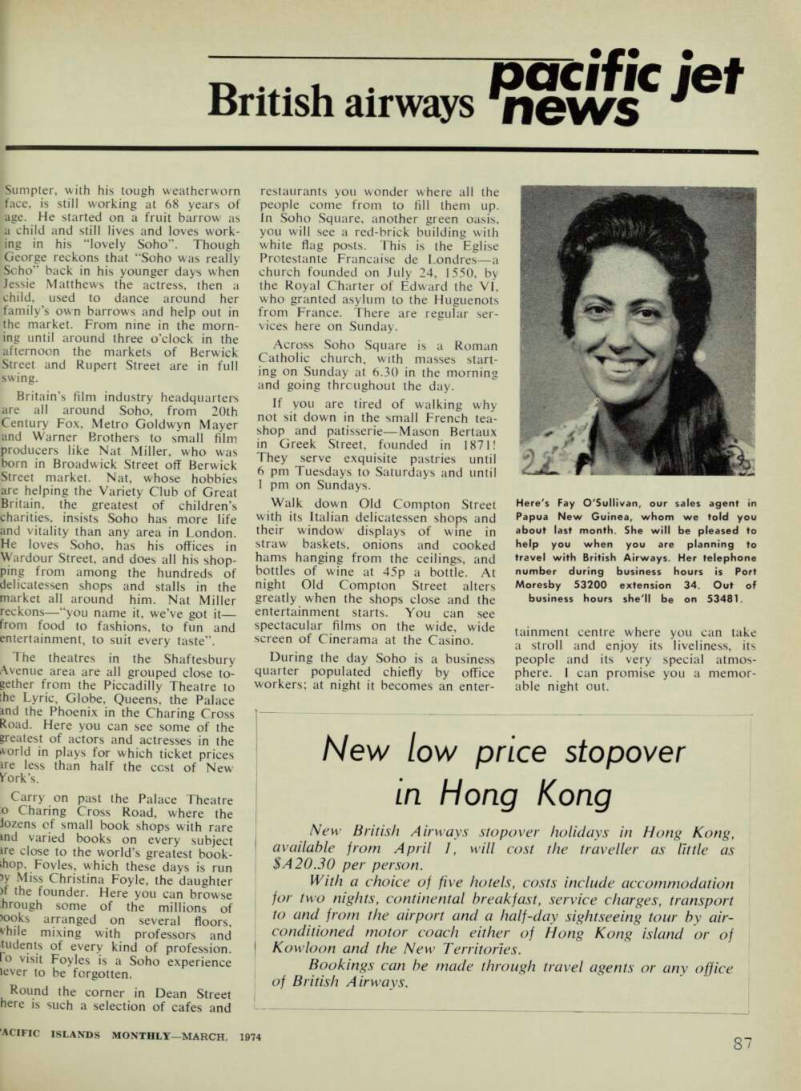
British airways Pacific jet news
Square Mile Of Fun
Published By British Airways
A Pim Advertising Supplement
By Monty Modlyn
ABOUT 300 years ago the Lord Mayor of London, with his Aldermen, used to go hunting in the pastures of Soho—as did Henry VIII before them.
Nowadays visitors from all over the world and from all over Britain still go hunting in Soho—not for foxes or game, but to eat and drink and be entertained. Soho has hundreds of restaurants of every nationality, from Mexican to Chinese, Kosher to Greek, Italian and French. With its theatres, cinemas and nightclubs, this really is the entertainment centre of London.
Soho, in the City of Westminster, is contained within an area bounded by Oxford Street, Regent Street, Coventry Street, Shaftesbury Avenue up to Cambridge Circus, and the Charing Cross Road. Let’s throw a coin and decide (that is how I did it) where to enter this famous square mile. I started close to Oxford Circus, passing the London Palladium in Argyll Street, the great variety and vaudeville theatre, where stars like Danny Kaye and Frank Sinatra have topped the bill and when at some time all the best British ‘artistes’ and acts perform. In Great Marlborough Street the great store of Liberty’s
faces you, with its outstanding display of silks, materials and fashions.
And close by the stage door of the Palladium is the Marlborough Street Magistrates’ Court. Here you can watch the scenes and dramas of the court proceedings from the public galleries, open every morning and afternoon, admission free, and no tickets required. Cross the road from the court and you will see the name of Carnaby Street—yes the Carnaby Street—a street now completely closed to traffic and paved with a rubber carpet of gold, orange and white patterns. Carnaby Street started in the 19505, with a weird fantasy of trendy and colourful clothes. With its strange “head” shops (shops with novelties and weird souvenirs), its small flea market and some of Lon don’s trendies! dressers, it is a place not to be missed. But visit during the hours of 9.30 am to 6 pm when the shops are open. After that, although the display windows are well lit up, the crowds are gone and it be comes a quiet backwater of Soho Village.
Just around the corner from Car naby Street is Beak Street. Here, at Nos 41 and 45, is one of Soho’s
happiest and friendliest restaurants.
It may not be plush and all that exotic, yet it’s so different. Why?
The Lord Byron is a Greek taverna with a proprietor known to everyone as Simon the Greek. A more ener getic and hospitable gentleman would be hard to find. The Lord Byron has become the favourite meeting place of Fleet Street cartoonists. On the walls you can see their work—fun is made of politicians of all shades and witty comments go with the sketches.
At lunchtime, here, alongside some of the Soho workers and business folk, you can enjoy tasty dishes like mousaka, kebabs costing under £l, and a bottle of white Greek wine at about £1.25. At night the scene changes, with bouzouki music and dancing down the aisle between the tables, and with the guests coming from the London suburbs and over seas. Don’t worry when everyone starts throwing and smashing plates— it really is an old Greek custom, ex pressing happiness.
If you would like to rest a while, search out Golden Square—a quiet backwater of roses and greenery, only a few hundred yards from Picca dilly Circus. In the centre of the
gardens a worn statue of George II will be looking at you as you feed! the sparrows and the pigeons.
Close to Piccadilly Circus, and be tween Coventry Street and Shaftesbury' Avenue, is Gerrard Street, London’s; only Chinatown. If you want a.
Chinese barber, or to take lessons in Chinese, to visit supermarkets withi every kind of Chinese delicacy or' even see Chinese films, it’s all here.
The restaurants are genuine and traditional—no westernised Chinese: dishes, unless you insist. Mr Tirm Cheung, whose family comes from Canton, is the proprietor of the Cultural Centre shop, where you cam get books and Chinese papers, flowm over daily by British Airways, lan terns, ornaments and Chinese medi cines, like sea-coconut, and the great: buck-up mixture of herbs of Ginseng: roots. Mr Cheung thought that his; special “Tonic for the Brain” at only 60 pence, made by the Great Eastemi Medicine Company of Hong Kong, could only do me good. I’m sure Mr Cheung meant this in the kindest possible Chinese way! If you are lucky enough to be in London in late January or February, look out for the Chinese New Year —celebrated with great spirit in Chinatown. In Gerrardl Street there are dancers and tableaux, and the street is beautifully decorated! —looking like High Street, Peking; I imagine.
You must visit Rupert Street and Berwick Street with their wonderful! fruit and vegetable markets, fre quented by a cosmopolitan collection of customers and actors and actresses from the nearby theatres. George
Soho denizens Nat Miller and George Sumpter.
Sumpter, with his tough weatherworn face, is still working at 68 years of age. He started on a fruit barrow as a child and still lives and loves work ing in his “lovely Soho’’. Though George reckons that “Soho was really Scho’’ back in his younger days when Jessie Matthews the actress, then a child, used to dance around her family’s own barrows and help out in the market. From nine in the morn ing until around three o’clock in the afternoon the markets of Berwick Street and Rupert Street are in full swing.
Britain’s film industry headquarters are all around Soho, from 20th Century Fox, Metro Goldwyn Mayer and Warner Brothers to small film producers like Nat Miller, who was born in Broadwick Street off Berwick Street market. Nat, whose hobbies are helping the Variety Club of Great Britain, the greatest of children’s charities, insists Soho has more life and vitality than any area in London.
He loves Soho, has his offices in Wardour Street, and does all his shop ping from among the hundreds of delicatessen shops and stalls in the market all around him. Nat Miller reckons —“you name it, we’ve got it— from food to fashions, to fun and entertainment, to suit every taste”.
The theatres in the Shaftesbury Avenue area are all grouped close to gether from the Piccadilly Theatre to the Lyric, Globe, Queens, the Palace and the Phoenix in the Charing Cross Road. Here you can see some of the greatest of actors and actresses in the world in plays for which ticket prices are less than half the cost of New fork’s.
Carry on past the Palace Theatre o Charing Cross Road, where the iozens of small book shops with rare and varied books on every subject are close to the world’s greatest book shop, Foyles, which these days is run Ml ss Christina Foyle, the daughter >f the founder. Here you can browse hrough some of the millions of )ooks arranged on several floors, vhile mixing with professors and tudents of every kind of profession, fo visit Foyles is a Soho experience lever to be forgotten.
Round the corner in Dean Street here is such a selection of cafes and
restaurants you wonder where all the people come from to fill them up.
In Soho Square, another green oasis, you will see a red-brick building with white flag posts. This is the Eglise Protestante Francaise de Londres—a church founded on July 24, 1550, by the Royal Charter of Edward the VI, who granted asylum to the Huguenots from France. There are regular ser vices here on Sunday.
Across Soho Square is a Roman Catholic church, with masses start ing on Sunday at 6.30 in the morning and going throughout the day.
If you are tired of walking why not sit down in the small French tea shop and patisserie—Mason Bertaux in Greek Street, founded in 1871!
They serve exquisite pastries until 6 pm Tuesdays to Saturdays and until 1 pm on Sundays.
Walk down Old Compton Street with its Italian delicatessen shops and their window displays of wine in straw baskets, onions and cooked hams hanging from the ceilings, and bottles of wine at 45p a bottle. At night Old Compton Street alters greatly when the shops close and the entertainment starts. You can see spectacular films on the wide, wide screen of Cinerama at the Casino.
During the day Soho is a business quarter populated chiefly by office workers; at night it becomes an enter-
tainment centre where you can take a stroll and en joy its liveliness, its people and its very special atmos phere. I can promise you a memor able night out.
Here's Fay O'Sullivan, our sales agent in Papua New Guinea, whom we told you about last month. She will be pleased to help you when you are planning to travel with British Airways. Her telephone number during business hours is Port Moresby 53200 extension 34. Out of business hours she'll be on 53481.
Granville bows out
Sir Keith Granville, deputy chairman of British Airways and former chairman of BO AC is to leave the airline after 45 years’ service.
Of his decision Sir Keith said: Forty-five years’ service is probably long enough. Although my appointment as deputy chairman of British Airways does not expire until the end of 1975 this seems the right moment for me to leave the airline to others, many of whom have enormous airline experience which may be put to fuller use.”
He said the formation of British Airways through the merger of BOAC and BEA—“which I have always supported and long advo cated”—had made such good progress that the final legal stages would be completed by April 1.
In tribute to* Sir Keith, British Airways Chairman, Mr David Nicholson, said: “His qualities have earned him world-wide respect and affection throughout our industry. For the past two years they have played an invaluable part in the creation of British Airways.”
British Airways Film
Goes To Tonga
A former professional soccer player for Manly, Lambertus (“Bert") Jans mar, whose wife is Tongan, has left Sydney to live in Tonga and is plan ning to set up an active soccer league there.
One of the promotional aids he in using to create interest, is the British Airways, World Cup '7O film which he will be taking on an island tour to show to enthusiasts.
It is the first time that a film featuring world class soccer has been shown in Tonga.
Advertisements & other items, p. 92 (1 item)
British airways news
86
PACIFIC ISLANDS MONTHLY—MARCH. 1974=
D ... . pacific jet British airways news
in Hong Kong
New low price stopover in Hong Kong
New British Airways stopover holidays in Hong Kong, available from April 1, will cost the traveller as little as $ A 20.30 per person.
With a choice of five hotels, costs include accommodation for two nights, continental breakfast, service charges, transport to and from the airport and a half-day sightseeing tour by air conditioned motor coach either of Hong Kong island or of Kowloon and the New Territories.
Bookings can be made through travel agents or any office of British Airways.
Advertisements & other items, p. 93 (1 item)
British airways
87
ACIFIC ISLANDS MONTHLY—MARCH. 1974
The Name's Different, But
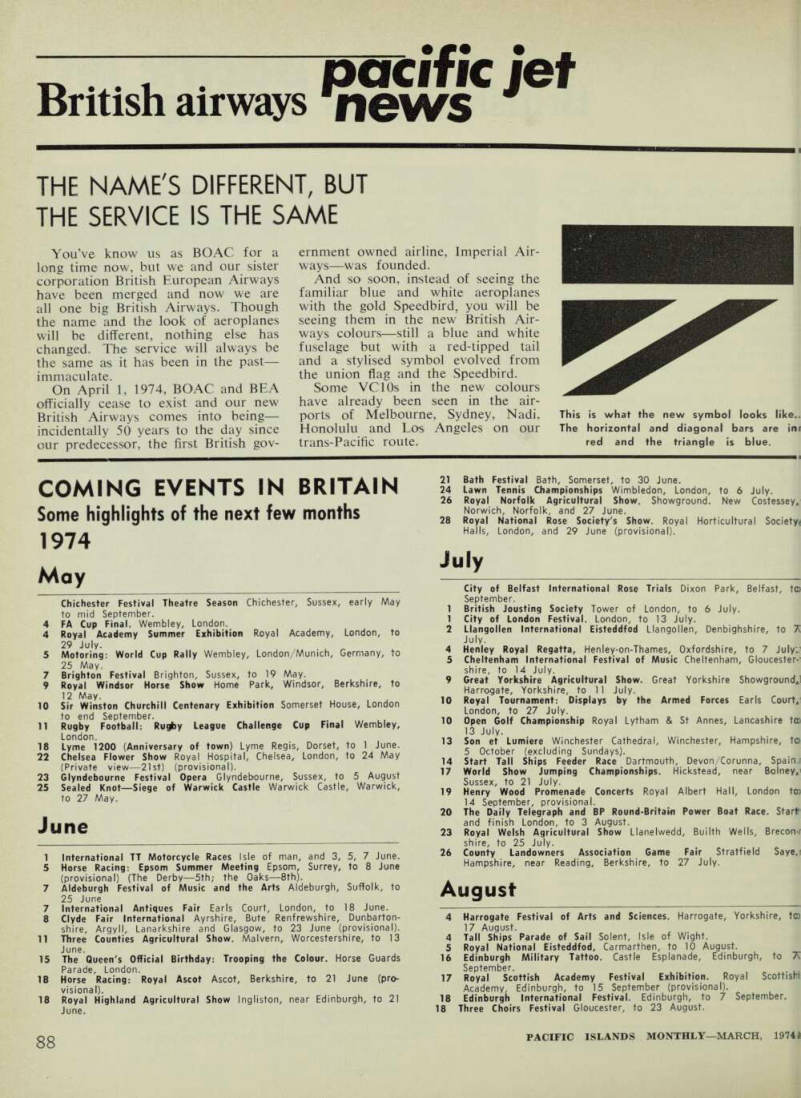
The Service Is The Same
You’ve know us as BOAC for a long time now, but we and our sister corporation British European Airways have been merged and now we are all one big British Airways. Though the name and the look of aeroplanes will be different, nothing else has changed. The service will always be the same as it has been in the past— immaculate.
On April 1, 1974, BOAC and BE A officially cease to exist and our new British Airways comes into being— incidentally 50 years to the day since our predecessor, the first British gov-
ernment owned airline, Imperial Air ways—was founded, And so soon, instead of seeing the familiar blue and white aeroplanes with the gold Speedbird, you will be seeing them in the new British Air ways colours—still a blue and white fuselage but with a red-tipped tail and a stylised symbol evolved from the union flag and the Speedbird.
Some VC 10s in the new colours have already been seen in the air ports of Melbourne, Sydney, Nadi, Honolulu and Los Angeles on our trans-Pacific route.
This is what the new symbol looks like.
The horizontal and diagonal bars are in red and the triangle is blue.
July
Coming Events In Britain
Some highlights of the next few months 1974
May
Chichester Festival Theatre Season Chichester, Sussex, early May to mid September. 4 FA Cup Final. Wembley, London. 4 Royal Academy Summer Exhibition Royal Academy, London, to 29 July. 5 Motoring: World Cup Rally Wembley, London/Munich, Germany, to 25 May. 7 Brighton Festival Brighton, Sussex, to 19 May. 9 Royal Windsor Horse Show Home Park, Windsor, Berkshire, to 12 May. 10 Sir Winston Churchill Centenary Exhibition Somerset House, London to end September. 11 Rugby Football; Ru£y League Challenge Cup Final Wembley, London. 18 Lyme 1200 (Anniversary of town) Lyme Regis, Dorset, to 1 June. 22 Chelsea Flower Show Royal Hospital, Chelsea, London, to 24 May (Private view —2lst) (provisional). 23 Glyndebourne Festival Opera Glyndebourne, Sussex, to 5 August 25 Sealed Knot —Siege of Warwick Castle Warwick Castle, Warwick, to 27 May.
June
1 International TT Motorcycle Races Isle of man, and 3,5, 7 June. 5 Horse Racing; Epsom Summer Meeting Epsom, Surrey, to 8 June (provisional) (The Derby—sth; the Oaks —Bth). 7 Aldeburgh Festival of Music and the Arts Aldeburgh, Suffolk, to 25 June 7 International Antiques Fair Earls Court, London, to 18 June. 8 Clyde Fair International Ayrshire, Bute Renfrewshire, Dunbarton shire, Argyll, Lanarkshire and Glasgow, to 23 June (provisional). 11 Three Counties Agricultural Show. Malvern, Worcestershire, to 13 June. 15 The Queen's Official Birthday: Trooping the Colour. Horse Guards Parade, London. 18 Horse Racing; Royal Ascot Ascot, Berkshire, to 21 June (pro visional). 18 Royal Highland Agricultural Show Inglisten, near Edinburgh, to 21 June.
21 Bath Festival Bath, Somerset, to 30 June. 24 Lawn Tennis Championships Wimbledon, London, to 6 July. 26 Royal Norfolk Agricultural Show. Showground. New Costessey*' Norwich, Norfolk, and 27 June. 28 Royal National Rose Society's Show. Royal Horticultural Halls, London, and 29 June (provisional).
July
City of Belfast International Rose Trials Dixon Park, Belfast, to September. 1 British Jousting Society Tower of London, to 6 July. 1 City of London Festival. London, to 13 July, 2 Llangollen International Eisteddfod Llangollen, Denbighshire, to 7C July. 4 Henley Royal Regatta, Henley-on-Thames, Oxfordshire, to 7 July. 5 Cheltenham International Festival of Music Cheltenham, Gloucester shire, to 14 July. 9 Great Yorkshire Agricultural Show. Great Yorkshire Showground*!
Harrogate, Yorkshire, to 11 July. 10 Royal Tournament: Displays by the Armed Forces Earls Court/ London, to 27 July. 10 Open Golf Championship Royal Lytham & St Annes, Lancashire tm 13 July. 13 Son et Lumiere Winchester Cathedral, Winchester, Hampshire, to 5 October (excluding Sundays). 14 Start Tall Ships Feeder Race Dartmouth, Devon/Corunna, Spain 17 World Show Jumping Championships. Hickstead, near Bolney/ Sussex, to 21 July. 19 Henry Wood Promenade Concerts Royal Albert Hall, London tOJ 14 September, provisional. 20 The Daily Telegraph and BP Round-Britain Power Boat Race. Start!' and finish London, to 3 August. 23 Royal Welsh Agricultural Show Llanelwedd, Builth Wells, Breconr shire, to 25 July. 26 County Landowners Association Game Fair Stratfield Saye, Hampshire, near Reading, Berkshire, to 27 July.
August
4 Harrogate Festival of Arts and Sciences. Harrogate, Yorkshire, to 17 August. 4 Tall Ships Parade of Sail Solent, Isle of Wight. 5 Royal National Eisteddfod, Carmarthen, to 10 August. 16 Edinburgh Military Tattoo. Castle Esplanade, Edinburgh, to 7\ September. 17 Royal Scottish Academy Festival Exhibition. Royal Scottish!
Academy, Edinburgh, to 15 September (provisional). 18 Edinburgh International Festival. Edinburgh, to 7 September. 18 Three Choirs Festival Gloucester, to 23 August.
Advertisements & other items, p. 94 (1 item)
British airways news
88
PACIFIC ISLANDS MONTHLY— MARCH, 1974
„ ..., . pacific jet British airways news
Business and Development
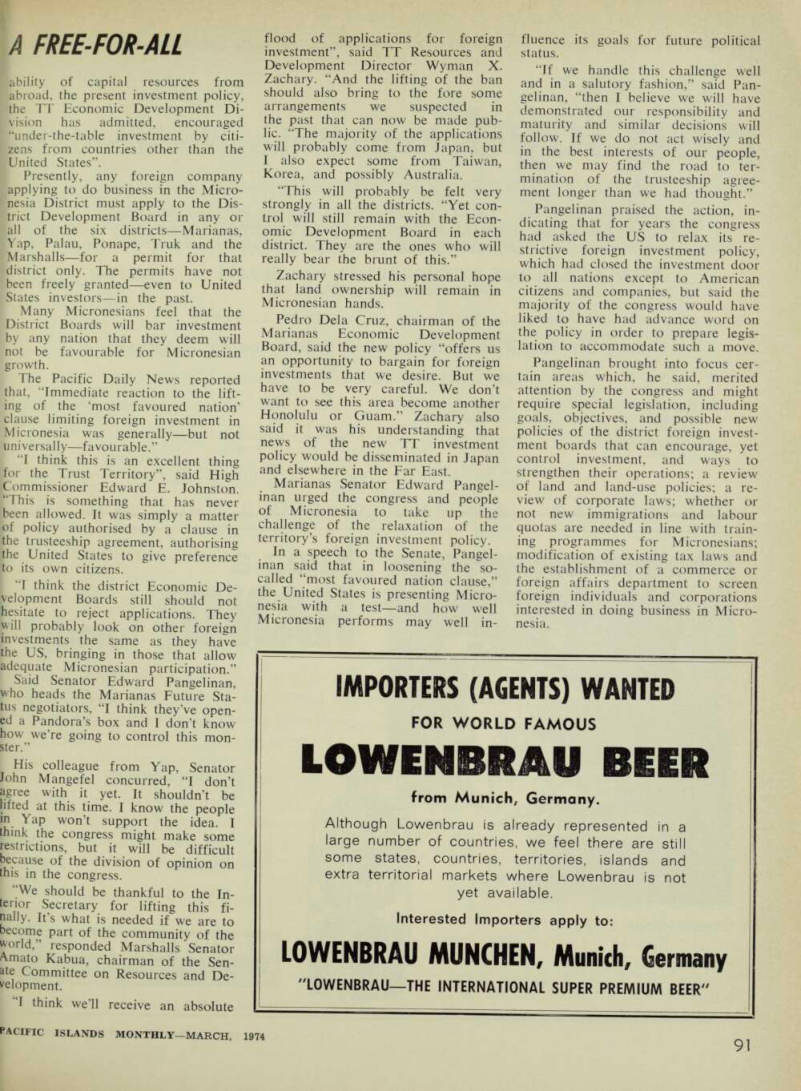
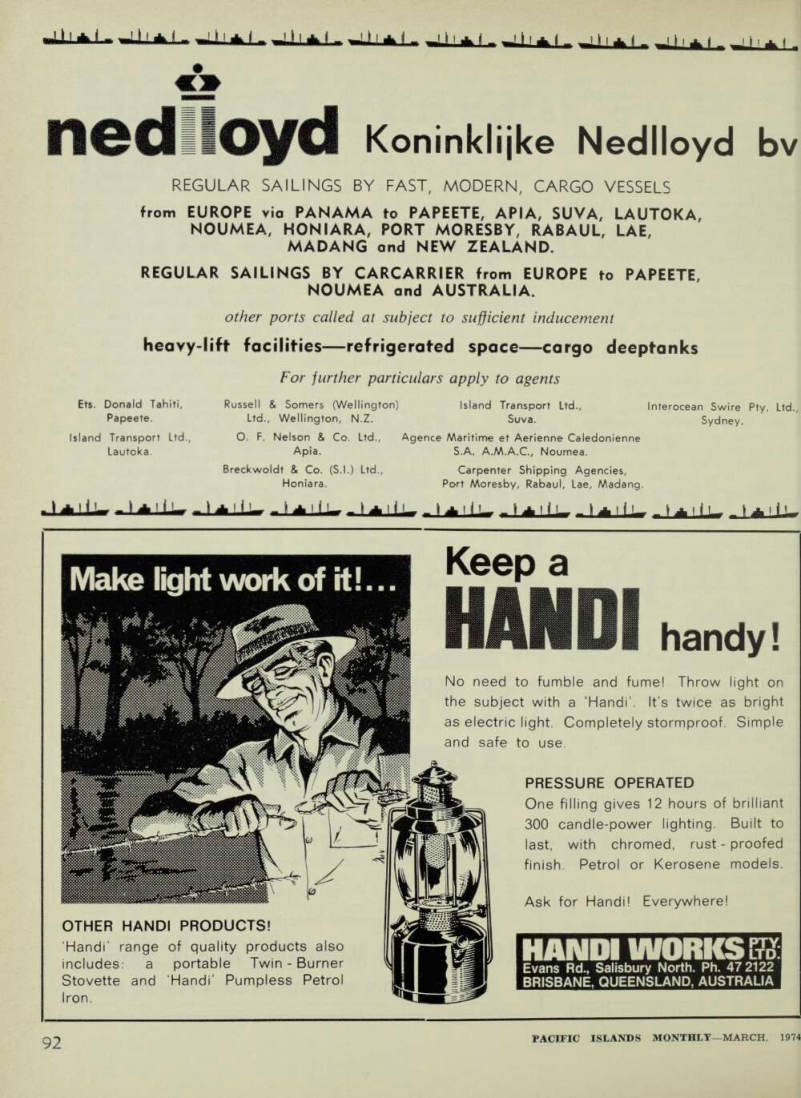
America Makes It A Free-For-All
For Investors In Micronesia
From a Saipan correspondent
In a statement released simultane )usly in Washington and Saipan the JS Department of Interior Secretary, *oger C. B. Morton, announced that he most-favoured-nation concept vill end and the Trust Territory of the *acific Islands will be opened for (usiness and commercial investment ly all nations on April 1. The United itates will not enjoy its present status is the sole foreign investor in Micro icsia.
Morton said: “From that date, idividual and commercial investors rom any of the world’s community f nations will be permitted to apply ar business permits in Micronesia, lore specifically, each district’s Ec nomic Development Board will be ble to consider business applications ’om any nation within the guide nes of (the TTs) own Foreign ivestment Act.
Though Morton’s statement opens ie business door in this area of ie Western Pacific, it is seen by lany here—at least in the western T districts—to mean Japanese in ;stors will be able to participate in projected economic boom in the [arianas, especially Saipan.
Japanese investment and tourism as the major factor in the growth : Guam in recent years.
“I would ask the Congress of ticronesia to review carefully the mifications of this new policy on 'reign investment”, Morton added, tie Micronesian Congress, he said nay decide that additional controls safeguards are necessary to protect icronesian private enterprise”.
Reaction from Congress of Micro tia members though, did not seem indicate more controls are necess y. It may well be that many con essmen already have cosy, under
e-table business relationships with
reign investors, mainly Japanese, id they see this new policy as a dilu m of their dominant role in these mt ventures.
It is rumoured in many quarters that
many congressmen, district legislat ors, municipal councillors and tra ditional leaders have succumbed to the approaches of foreign businesses to become involved in covert business undertakings and land deals in Micro nesia. In fact a Senate Committee of the Congress of Micronesia now has before it the draft bill designed to help expose some of the suspected illegal interests in Micronesian prop erty held by non-citizens.
Declaring that present law requir ing divestiture of these unlawful holdings is “totally inadequate” Sen ator Anton Amaraich of Truk is
proposing that TT citizens involved in clandestine arrangements shoulder the legal burden of disclosing past and future deals or else open them selves to charges of fraud.
Non-TT citizens are prohibited from owning interests in real property in Micronesia. While the relaxation in TT foreign investment policy does not alter the sanctions against non citizens acquiring real property, the past policy limiting outside invest ments only to US businesses has also supposedly spawned its share of ques tionable arrangements.
In addition to narrowing the avail-
A Free-For-All
ability of capital resources from abroad, the present investment policy, the TT Economic Development Di [ vision has admitted, encouraged I “under-the-table investment by citi zens from countries other than the United States”.
Presently, any foreign company applying to do business in the Micro nesia District must apply to the Dis trict Development Board in any or all of the six districts—Marianas, Yap, Palau, Ponape, Truk and the Marshalls—for a permit for that district only. The permits have not been freely granted—even to United States investors—in the past.
Many Micronesians feel that the District Boards will bar investment by any nation that they deem will not be favourable for Micronesian growth.
The Pacific Daily News reported that, “Immediate reaction to the lift ing of the ‘most favoured nation’ clause limiting foreign investment in Micronesia was generally—but not universally—favourable.” “I think this is an excellent thing for the Trust Territory”, said High [Commissioner Edward E. Johnston.
“This is something that has never been allowed. It was simply a matter of policy authorised by a clause in the trusteeship agreement, authorising the United States to give preference to its own citizens.
“I think the district Economic De velopment Boards still should not hesitate to reject applications. They will probably look on other foreign investments the same as they have the US, bringing in those that allow adequate Micronesian participation.”
Said Senator Edward Pangelinan, who heads the Marianas Future Sta tus negotiators, “I think they’ve open ed a Pandora’s box and I don’t know how we’re going to control this mon ster.”
His colleague from Yap, Senator John Mangefel concurred, “I don’t agree with it yet. It shouldn’t be lifted at this time. I know the people m Yap won’t support the idea. I think the congress might make some restrictions, but it will be difficult because of the division of opinion on this in the congress.
“We should be thankful to the In terior Secretary for lifting this fi nally. It’s what is needed if we are to become part of the community of the 'vorld,” responded Marshalls Senator Amato Kabua, chairman of the Sen ate Committee on Resources and De velopment. ‘I think we’ll receive an absolute
flood of applications for foreign investment”, said TT Resources and Development Director Wyman X.
Zachary And the lifting of the ban should also bring to the fore some arrangements we suspected in he past that can now be made pubhe The majority of the applications will probably come from Japan, but I also expect some from Taiwan, Korea, and possibly Australia.
“This will probably be felt very strongly in all the districts. “Yet contro! will still remain with the Economic Development Board in each district. They are the ones who will really bear the brunt of this.
Zachary stressed his personal hope that land ownership will remain in Micronesian hands.
Pedro Dela Cruz, chairman of the Marianas Economic Development Board, said the new policy “offers us an opportunity to bargain for foreign investments that we desire. But we have to be very careful. We don’t want to see this area become another Honolulu or Guam.” Zachary also said it was his understanding that news of the new TT investment policy would be disseminated in Japan and elsewhere in the Far East.
Marianas Senator Edward Pangelman urged the congress and people of Micronesia to take up the challenge of the relaxation of the territory’s foreign investment policy.
In a speech to the Senate, Pangelat * n l° osen * n 8 sou tt . most f avo V re d nation clause,” the United States is presenting Micronesia with a test—and how well Micronesia performs may well in-
fluence its goals for future political status. [f we handle this challenge well and in a sa l u tory fashion," said Pan gelinan, ‘‘then I believe we will have demonstrated our responsibility and maturity and similar decisions will fo ow . If we do not act wisely and in the best interests of our people, the n we may find the road to ter mination of the trusteeship agree merit longer than we had thought.”
Pangelinan praised the action, in dicating that for years the congress had asked the us to relax its re . strictive foreign investment policy, which had closed the investment door to all nations except to American citizens and companies, but said the majority of the congress would have liked to have had advance word on the . policy in order to prepare legis lation to accommodate such a move, Pangelinan brought into focus cer tain areas which, he said, merited attention by the congress and might require special legislation, including goals, objectives, and possible new policies of the district foreign invest ment boards that can encourage, yet control investment, and ways to strengthen their operations; a review of land and land-use policies; a re view of corporate laws; whether or not new immigrations and labour quotas are needed in line with train ing programmes for Micronesians; modification of existing tax laws and the establishment of a commerce or foreign affairs department to screen foreign individuals and corporations interested in doing business in Micro nesia.
Australia opens
import door wider
Pacific Islands goods may now en ter Australia under a new tariff scheme which gives them preference.
The basis of the scheme is to give developing countries a duty rate be low the general rate to help their products become more competitive in Australia.
The new system differs from the previous scheme as it has been con siderably broadened and includes a wide range of primary products. In addition, some items previously the subject to quotas, may now be ex ported to Australia either dutv free or at low duty rates and without quota.
Traditional handicrafts will still be allowed in duty free. Soap, previously on a quota, may now be exported to Australia duty free and without any limitations on quota. Paints and var nishes, previously subject to a quota, are now subject only to low duty.
Among 860 items, roughly a third °f the total number of items in the Australian tariff, are now duty free when imported from developing countries. A wide range of other items may enter at 10 per cent or more below existing general tariff rate.
Excluded from the scheme are items in which developing countries are already competitive, or likely to become competitive at the general tariff rate. For certain other sensitive items, quotas will apply.
These new concessions for de veloping countries are additional to the. 25 per cent reduction in all tariffs, which the Australian Government in troduced in July, 1973.
But island bananas will still not get a look-in.
Mixed fortunes
for Caledonian nickel
New Caledonia’s exports of nickel ore last year rose 24 per cent while shipments of nickel metal fell by 16
per cent. In 1973, the island exported 2.8 million tons of ore to Japan, against 2.2 million tons in 1972.
Production of nickel metal re mained almost constant, reaching 57,235 tons in 1973, against 59,315 tons the previous year. However, metal exports last year totalled 50,142 tons against 60,003 tons in 1972. The difference is largely due to the 1972 decision to create a 10.000-ton nickel stockpile in France.
Meanwhile, in view of the current oil crisis, together with the rising value of the SUS and the effective 5 per cent devaluation of the French franc which began “floating” in January, Caledonians have grown in creasingly pessimistic over the pos sibility of a second nickel factory being built in the north of the island.
Vila gets a
new slaughter house
A new abattoir, costing $388,000, now under construction at Vila, is ex pected to open on April 1 for the slaughter of cattle and pigs. The abattoir could be the forerunner of a large beef industry in the New Hebrides. It will be of particular value to the local people involved with cattle through the co-operative movement.
The abattoir is owned by a Vila registered company, New Hebrides Abattoirs Ltd. The capital was largely subscribed in the New Heb rides, New Caledonia and Tahiti.
Associated with the abattoir are a freezing works, a treatment plant for by-products and a smallgoods section.
Cattle will be killed on behalf of owners, boned and stored. The owners will be responsible for market, ing it. As an alternative, if the cattle owner wishes, New Hebrides Abattoirs will buy cattle on a live weight basis. The company will then be responsible for marketing the beef.
The company expects that most of the cattle will come from French plan ters.
The estimate is that 1,400 head of cattle will be slaughtered in the first year, 2,500 head in the second year and 3,500 head in the third year. Pigs will be supplied by New Hebrides Rural Development Ltd, which operates a piggery at Mele. Killings are estimated at 1,800 in the first year, 2,500 in the second year and 5,000 in the third year.
This is architect Jean-Marie Galimard's design for the New Hebrides Co-operative Federation's newest project a few kilo metres out of Vila—a landscaped com plex comprising shop and offices (left), bulk store (centre) and clubhouse (right).
In charge of the project is English volun teer engineer, Philip Owen, and construc tion is by the first indigenous New Hebridean building firm, Efate Construc tion Co Ltd, owned by Tabia Kalsakau.
It's their biggest job to date, and should be finished by August.
From mission centre
to department store
The former Lutheran Mission sup ply centre at Madang has been trans formed into a flourishing commercial complex with an annual turnover ex ceeding $1 million. The marketing concept is to supply the needs of “the man in the street”. The business is probably the largest department store in Papua New Guinea, catering almost exclusively for local shoppers.
The business is the Madang Supply Centre, jointly owned by the Sullivan group, and Coltra Enterprises, of Mt Hagen. The Lutheran Mission set up the supply house in the late 1940 s to supply the regular needs of the mis sion’s own field staff, following prob lems in securing essential items as required in those difficult days.
In time, the scope of the supply house expanded gradually it grew into wholesale/retail store, involving certain management difficulties. As the Lutheran Mission started to phase out its operations in favour of a local organisation, the Sullivan group and Coltra Enterprises took over the com plex, plus the staff.
Most of the old-established retail stores in Papua New Guinea have traditionally aimed at expatriates. The new directors of Madang Supply Centre anticipating the trend of events, decided that the future of the store lay with the local people. This, of course, meant certain changes in the type of merchandise offered, so the shelves were stocked with items within the reach of shoppers with lower incomes and buying power.
Thus, builders’ supplies were phased out in favour of the handy man’s hardware, clothing and footwear were imported from the Far East, emphasis was placed on, for example, 6 oz cans of milk instead of 14 oz cans, and so on.
PNG minister's
takeover call
Papua New Guinea’s Mr John Kaputin has come down strongly in favour of the government expropriat ing or buying copra plantations “to return to the people”. He took full opportunity of rather a spectacular
achievement by the New Guinea De velopment Corporation Ltd to ex pound his views. Mr Kaputin is chairman of the corporation, and is also Minister of Justice.
The corporation, in about eight months recouped its initial investment in a copra plantation at Vunapit. It
bought the 600-acre plantation from a Chinese businessman for $51,000.
“Unfortunately, in the past, Papuans and New Guineans, have never been in a position to demon strate their own capacity,” Mr Kaputin said. “And now that we have demonstrated this fact, the sooner the government expropriates or re purchases the plantations to return to the people, the better off the country is going to be in the long run.”
“The argument used by the white people that Papuans and New Guineans cannot handle plantations is nothing more than a method of pacifying and brain-washing the people. Plantations are very good in-
The new department store at Madang.
come earners for the expatriates and they will attempt to keep them for as long as possible. This must not be allowed to continue and it is high time the government moved to ex propriate or re-purchase all the plan tations.”
The Deputy Leader of the Oppo sition, Mr Paul Langro, said the gov ernment should concentrate on ac quiring plantations that were con tributing nothing to the country, rather than attempt to expropriate all expatriate - owned plantations. The government should also make sure that local people with ability ran such plantations.
“Many of these expatriate-owned plantations contribute quite a bit to the country in terms of income tax and providing labour,” Mr Langro said. “If some action is wanted in respect of these plantations I think it would be better to impose heavier taxes, rather than expropriate them.”
Development plan
for PNG tobacco
Early February, PNG Minister of Agriculture, Mr lambakey Okuk, said that discussions had started be tween the government and represen tatives of Rothmans and W. D. & H. O. Wills on the future of PNG’s tobacco industry. These two com panies now manufacture about 85
per cent of the tobacco used in the country.
They have been working closely with the Department of Agriculture, Stock and Fisheries for several years on the development of tobacco crops.
Mr Okuk said he saw tobacco as a suitable crop to be cultivated by village farmers.
L
Utah pulls out ot
BSIP minerals search
Utah Development Company, which had been prospecting for minerals on Guadalcanal in the Solomon Islands since 1967, quietly
began sending its employees home late in 1973, and closed its operation completely in January without any announcement.
Governing Council’s Natural Resources Committee revealed on January 31 that the company had had disappointing results from its 1973 diamond drilling programme, and the future of the mineral prospects at Koloula and Betilonga on the weather coast, and in the Malango area, were Utah was looking mainly for porphyry copper in the central and south central parts of Guadalcanal, while also trying to find whether there was zinc or gold in any quantity.
Mr Kevin Dring has been appointed manager, South Pacific Islands, for W. D. & H. O. Wills (Aust) Ltd, tobacco manu facturers. He will be responsible for ex port sales to South Pacific markets and for liaison with associated companies in Papua New Guinea, Fiji and the British Solomon Islands. He commenced his career with Wills in South Australia, and during the past three years has been responsible for brand development and management at the company's Sydney head office. Mr Dring succeeds Mr David Angus, a well known figure in the South Pacific, who has been appointed assistant sales manager.
His Majesty takes a side-swipe
There is likely to be some plain talking at the South Pacific Forum in Rarotonga from March 21 to 23 about Air Pacific. Nauru is itching to spread its wings and now King Taufa’ahau of Tonga is doing some plain speaking over air services.
In a recent special radio broadcast the king explained why Tonga had investigated the possibility of an alliance with Japan for a Tongan airline. The advantages would benefit the Tonga Government and the people of Tonga in many ways, the king said.
An airline would play a most important role in the economic development of Tonga in such fields as tourism, agricultural and handi craft exports. It would develop com munications with the outside world.
TTien His Majesty took a side swipe at the Fiji Government and Air Pacific. He said the Fiji Govern ment was trying to get the islands shareholders in Air Pacific to pool resources with the object of edging out Qantas. BOAC and Air New Zealand. That was all right for Fiji as Air Pacific was based in Fiji, and Air Pacific received the majority of the benefits, he said.
Tonga should not get too involved in such a negotiation; rather it should attempt to set up an airline of its own.
All Nippon Airways sent a high powered team of top executives to Tonga late in January to survey air port facilities and complete negotia tions for the launching of a Tongan airline. The survey followed a recent visit to Japan by King Taufa’ahau Tupou.
Apart from the main airport out side Nukualofa, the party inspected the airfields at Eua and Vavau.
Before leaving for home they were to present a report on their survey, and recommendations for setting up a Tongan airline.
Japan is also interested in the possibility of setting up a colour tele vision network on Tongatapu. An offer has been made by NHK, the largest television and broadcasting service in Japan. To give the Japan ese some idea of what is required a survey is being held throughout Tongatapu. The survey also seeks the number of likely buyers of tele vision sets.
Advertisements & other items, pp. 95-103 (2 items)
89
tCIFIC ISLANDS MONTHLY—MARCH, 1974
Bank of Hawaii
is the bank of the Pacific. \bu can bank on it... in Guam SlTamuning t Koror -fSt Yap Jf Saipan Roi Namur mL Kwajalein JUtPonape Midway-2? Tahiti *-3L*« j* American Samoa.
All in all, we have 70 branches throughout Hawaii and the Pacific offering full banking services. May we help you?
Bank of Hawaii the bank of the Pacific® * affiliate of Banque de Tahiti
IMPORTERS (AGENTS) WANTED
FOR WORLD FAMOUS
LOWENBRAU BEER
from Munich, Germany.
Although Lowenbrau is already represented in a large number of countries, we feel there are still some states, countries, territories, islands and extra territorial markets where Lowenbrau is not yet available.
Interested Importers apply to:
LOWENBRAU MUNCHEN, Munich, Germany
"LOWENBRAU—THE INTERNATIONAL SUPER PREMIUM BEER"
nediiOyd Koninklijke Nedlloyd bv
REGULAR SAILINGS BY FAST, MODERN, CARGO VESSELS from EUROPE via PANAMA to PAPEETE, APIA, SUVA, LAUTOKA,
NOUMEA, HONIARA, PORT MORESBY, RABAUL, LAE,
MADANG and NEW ZEALAND.
REGULAR SAILINGS BY CARCARRIER from EUROPE to PAPEETE,
NOUMEA and AUSTRALIA.
other ports called at subject to sufficient inducement
heavy-lift facilities—refrigerated space—cargo deeptanks
For further particulars apply to agents Ets. Donald Tahiti, Papeete.
Island Transport Ltd., Lautoka.
Russell & Somers (Wellington) Ltd., Wellington, N.Z.
O. F. Nelson & Co. Ltd., Apia.
Breckwoldt & Co. (5.1.) Ltd., Honiara.
Agence Maritime et Aerienne Caledonienne S.A. A.M.A.C., Noumea.
Carpenter Shipping Agencies, Island Transport Ltd., Suva.
Interocean Swire Pty. Ltd., Sydney.
Port Moresby, Rabaul, Lae, Madang.
Make light work of it!
OTHER HANOI PRODUCTS!
Handi’ range of quality products also includes: a Stovette and Iron. portable Twin - Burner ‘Handi’ Pumpless Petrol
Keep a
HANOI handy!
No need to fumble and fume! Throw light on the subject with a ‘Handi’. It’s twice as bright as electric light. Completely stormproof. Simple and safe to use.
PRESSURE OPERATED
One filling gives 12 hours of brilliant 300 candle-power lighting. Built to last, with chromed, rust - proofed finish. Petrol or Kerosene models.
Ask for Handi! Everywhere! i
HANOI WORKS
Evans Rd., Salisbury North. Ph. 47 2122
BRISBANE, QUEENSLAND, AUSTRALIA
im
t»TT UMITED
P.O. BOX 507,
MANLY, N.S.W.
2095.
CABLE ADDRESS;
DEMKAY, SYDNEY.
ASK US FOR QUOTATIONS
FROM BRITAIN
• scotch whisky • vodka • gin • perfumery and cosmetics • bed sheets, pillow cases • wall to wall carpet • decorative hardboard • household and automotive lamps • furniture • tools • road building equipment • concrete mixers, etc., etc.
YOU GET A BETTER DEAL FROM
PACIFIC MACHINERY
c
New and Used Equipment
Parts Availability
Throughout the Pacific
voun
CATERPILLAR
DEALER
HAWAII GUAM
808- 677-9111 746-4479
TRUST TERRITORY OF THE AMERICAN SAMOA
PACIFIC ISLANDS
PACIFIC
MACHINERY, INC.
SUBSIDIARY OF THEO. H. DAVIES & CO., LTD.
TLX 723397 CABLE “PAMACAT”
Save hundreds of dollars
on most efficient
WALK IN, ALUMINIUM
COOLROOMS AND
FREEZE ROOMS
Hundreds already installed! The most economical supplementary coolrooms for bottles and food, providing the largest storage capacity of any comparable coolrooms of the same exterior dimensions. Five sizes —from 90-360 cu. ft. capacity; 16 models offering normal temp., two temp., deep freeze, or for pastry and ice storage applicaiions. White vinyl interior, embossed rustproof aluminium exterior. e SUPPLIED IN EASY-TO-ERECT, DO-IT-YOURSELF KIT FORM • PETROL AND PETROL-ELECTRIC MODELS ARE AVAILABLE FOR AREAS WHERE POWER IS LIMITED OR NON-EXISTENT Available from: AUSTRALIAN NEW CALEDONIA EXPORTS (SILVER & BARDA), 363 George St., Sydney, 2000 and Branches.
BRECKWOLDT & CO., 276 Pitt St., Sydney, 2000 and Branches.
PETER FISHER TRADING PTY. LTD., 321 Pitt St., Sydney, 2000.
HAGEMEYER (A'SIA), 59 Anzac Pde., Kensington, 2033 and Branches.
Manufactured by:
KERR BROS, 65 York St., Sydney, 2000.
NELSON & ROBERTSON PTY. LTD., 197 Clarence St., Sydney. 2000 RABAUL TRADING CO. PTY. LTD., P.O. Box 219, Rabaul and Branches.
ROY GALLIMORE & ASSOCIATES, P.O. Box 179, Vila, New Hebrides.
C. SULLIVAN (EXPORT) PTY. LTD., 60 Margaret St., Sydney, 2000 and Branches.
W. S. TAIT & CO. PTY. LTD., 31 Macquarie Place, Sydney, 2000 and Branches.
WARBURTON FRAHKI
199 Parramatta Road, Cnr. Skarratt Street, Auburn, N.S.W. 2144, Australia. Phone: 648-1711.
Powered by Kelvinator Five-year warranty on compressor. Early delivery.
GOLD COAST
MULTI UNIT
DEVELOPMENT SITE
40 Perches (J acre), with three bedroom fibro residence presently let at $35.00 per week.
ZONED RESIDENTIAL HIGH DENSITY
(320 persons per acre) LOCATION: Between Third and Fourth Avenues, BURLEIGH HEADS right on the
Highway, 200 YARDS FROM THE BEACH
AN EXCELLENT HIGH, DRY, BLOCK.
PRICE: $50,000
R. G. Damman, 142 Marine Parade, Mermaid Beach, Qld., 4218, Aust.
Phone: 35 1293.
I ill
PARCEL POST RATES
TPNG.
& StH.
PAiCIPIC
161 b. 11.20 51.40
MK 111 LIQUID
PRISMATIC
COMPASSES
: r<* I $25 £39 ii Luminous British Army' issue, absolutely brand new. Accurate to under one degree. Stout hinged brass case, external diameter 2 1/4 inche:.
Prism Holder with focussing arrangement. Compass interior contains Mother-of Pearl Azimuth, divided to single degrees, mounted with sapphire centre floating on iquid on an iridium point. Transparent Rotary Scale on case divided to every 5 degrees and figured every 1 degree, can be clamped in any position, luminised for night use. Its steadiness makes it a perfect compass for geologists or surveyors or for taking bearings from boats, cars, aircraft, etc. Units are brand new and fully checked by instrument maker before despatch.
Sells at a fraction of Govt cost Very slightly used and fully checked by instrument maker $ 2.7.50 We have sold these to nearly every Govt, dept., shire Councils, mining coys., surveying coys., etc. in Australia. 11b m
fZ tnOMTNS GVAPWTEi
Brand new English 240 volt A.C. mains operated fans. Make .ideal extractor fans for kitchens, caravans and other domestic and light industrial purposes. Continuously rated, smooth, silent-running induction motor, 4,000 r.p.m., balanced 3-bladed, 6s" fan. Size 6j” dia. x 4" deep. 31b.
OUTBOARD LEG ASSEMBLY
Tremendous purchase of these top quality MK. 11 model complete underwater assembly to suit any model two-stroke "VICTA” MOTOR MOWER ENGINE, lakes 2 minutes to fit engine to leg. Sturdily constructed and trouble-free; has 8” 3- prop. 360 turning. Full 12 months guarantee. A Bargain.
Full range of spares always carried if required in later years. / These are exclusive to us. lo o 4- h.p. outboard motor with "Victa" zip start en Fl l n < |> t months' guarantee $l2-7.00.
‘nTAN’STON ELECTRIC WINCHES
SSSS
These fantastic electric winches have a pull capacity of 10.0001 b. and feature a 225 to 1 reduction geared motor with adjustable multi-plate overload clutch. 12 volt or 24 volt D C. (Please specify which type ) Dimensions: Length 32". Width 5".
Height 8". Fits any vehicle—-Land Rover. Toyota, etc.—and does not hurt battery. Features: 2-way free spooling ratchet. Controlled lefoff by adjustable friction clutch. Drum speed approx. 60 RPM. Drum size 9"x7" supported by two heavy duty pillow block bearings. 3 months' full g'tec l 225 to 1 geared motor. 12v and 24v DC available separately
$155. MOO< CABLE
MOT SUPPLIED
HEAVY DUTY BOAT TRAILER WINCH also available for‘4” or 6 ” rope, drum size 7" x 5”. Free spooling with dog clutch and ratchet— $2lO.
5 TON
JUAN
ICHOR
WINCH
Two models available for through the deck mounting or above deck (please specify which). Model 1 will accommodate decks up to 4" thick. Anchor winches capable of 10,0001 b. line pull. All ball bearing construction. Has heavy angle mounting bracket. Features cast iron capstan for rope or 3/8" chain. 1 1/2" diameter shaft.
Turns approx. 60 r.p.m. Has 225 to 1 reduction geared motor with adjustable multi-plate overload clutch (prevents burn out of motor).
Fully guaranteed for 90 days. $6OO value.
AVAILABLE IN 12 volt D.C.
and 24 volt D.C. Please
specify which.
Net weight 821 b.
Heavy duty D.C. Solenoids, new $9.50. 225 to 1 geared motors used on "Titan" and anchor winches are available separately in 12 volt or 24 volt D.C. $155, 90 day g'tee.
Fantastic performance! Gives over 120 c.f.m. of air, only draws 4 amps. Stainless steel shaft. 31" dia. centrifugal fan. Unit will not corrode in salt water. Bargain! 31b.
12 Volt MARINE BLOWERS
$18.50
3 MONTHS’
GUARANTEE
Exclusive release . . .
FAMOUS AMERICAN
THOMPSON 1,000 G.P.H.
ELECTRIC
PUMPS_&MOTOR
The world s most famous manufacturer of pumps! This is the third release of their pump and motor produced at a Govt, cost of $lB5 Pump and motor only $25.00 Ball Foot Valve $3.95 (21b.) • TERR FIC BUY - U.S. Govt, cost $lB5
ea • AIRCRAFT QUALITY - neo
prene seal, fully ball tearing noncorrosive housing and impeller •
CONTINUOUS DUTY MOTOR -
sealed, ball bearing brush motor
• PUMPS ALL LIQUIDS - wafer,
kero, petrol, diesel fuel, etc. (1” outlet pipe for hose) • LASTING QUALITY - sealed unit, corrosion and explosion proof. Electric motor is for 24/32 volts AC/DC (perfect cn 12 volt) and draws only 5 amps.
Will shift 1,000 g.p.h. at 15 p.s.i.. 800 g.p.h. at 6' head. On 24 volts pump will lift 40ft., less on 12 volts. If primed or with foot valve, will suck 20ft. then lift 20ft., \t r on 12 volts. Pumps have threar' d inlet for 1" waterpipe. Has -wo bolt mounting base. Use purr as water pressure system for t-\ s have on/off switch ($1) near tap. 1 71b.—H .5200
GPU.
95
3 months full
(Guarantee
on all goods
Money cheerfully REFUNDED
if not completely satisfied.
MK. IV LATEST MODEL
5200 G.P.H. BALL BEARING
CENTRIFUGAL PUMPS
Top quality 1 1/4" inlet, 1” outlet (0.D.) corrosion proof all metal centrifugal pump. Capacity up to 5200 g.p.h., pressure up to 85 PSI. Has two heavy duty sealed precision ball bearings to give smooth running and long troublefree life. Features newly designed, replaceable carbon and ceramic seal. Handles heaviest loads and highest speeds designed to pass solids such as sand, silt, dirt, etc., without damage, will pump salt water without harmful effect. Heads to over 170', suction lift to 25’. Spare parts always available. Qur very large production for export enables us to sell at this unbeatable price Ball type foot valve for 1 1/4" hose $3.95, 12oz. 3" oolley to suit $1.75, 6oz.
This pump is also suitable for pressure spraying, use restrictor for reducing output. 51b.
Seeking a change?
Camp Catering Services (N.G.) Pty. Ltd.— leaders in Industrial Catering and Camp Management throughout Australia and Papua New Guinea —periodically have vacancies for:
• CHEFS
• GENERAL COOKS
• SWEETS COOKS
® CANTEEN MANAGERS
• CAMP MANAGERS
• TRADESMEN
If you are contemplating a change in employment sometime in the near future why not lodge an application now.
With: MR. P. MILLER,
CAMP CATERING SERVICES
(N.G.I Pty. Ltd.,
P.O. Box 395, Panguna, Bougainville, P.N.G. giving details of qualifications, experience, personal particulars, etc.
Produce Prices
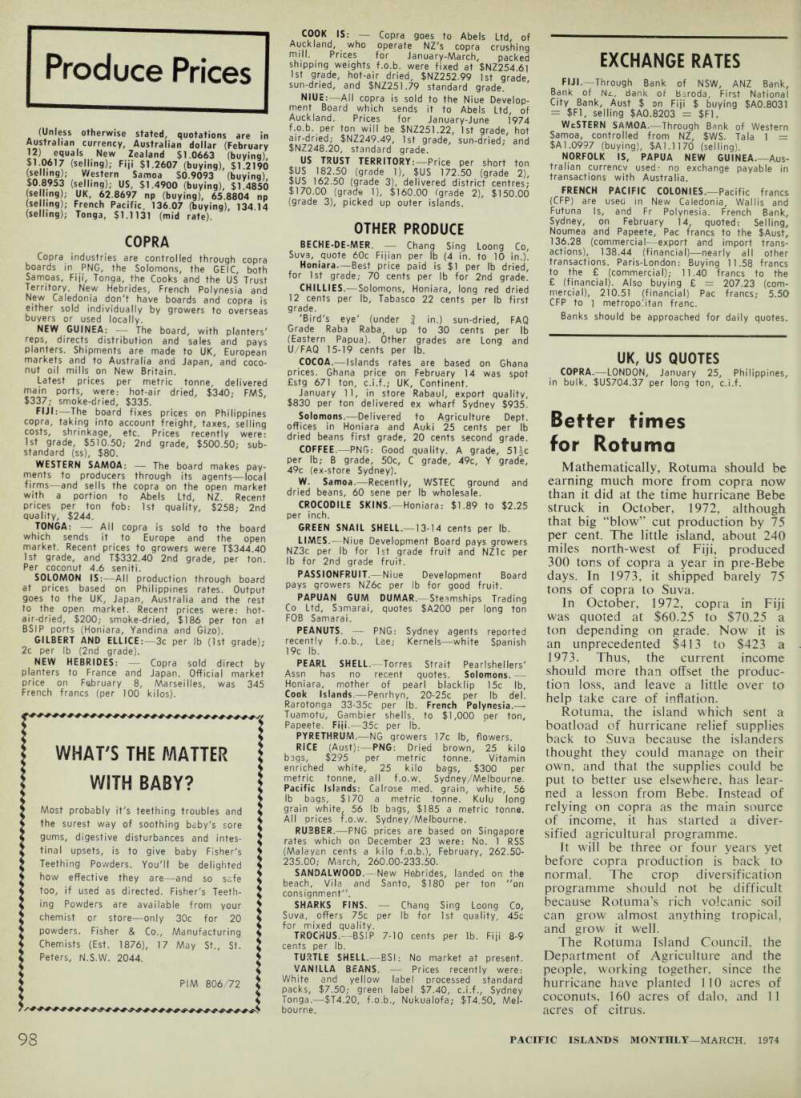
(Unless otherwise stated, quotations are in Australian currency, Australian dollar (February 12) equals New Zealand $1.0663 (buying) $1.0617 (selling); Fiji $1.2607 (buying), $1.2190 Western Samoa $0.9093 (buying), $0.8953 (selling); US, $1.4900 (buying), $1.4850 se mg); UK, 62.8697 np (buying), 65.8804 np (selling); French Pacific. 136.07 (buying), 134 14 (selling); Tonga, $1.1131 (mid rate).
Copra
Copra industries are controlled through copra boards in PNG, the Solomons, the GEIC, both Samoas, Fiji, Tonga, the Cooks and the US Trust Territory. New Hebrides, French Polynesia and New Caledonia don't have boards and copra is either sold individually by growers to overseas buyers or used locally.
NEW GUINEA; The board, with planters' reps, directs distribution and sales and pays planters. Shipments are made to UK, European markets and to Australia and Japan, and coco nut oil mills on New Britain.
Latest prices per metric tonne, delivered main ports, were.- hot-air dried, $340; FMS, $337; smoke-dried, $335.
FIJI: —The board fixes prices on Philippines copra, taking into account freight, taxes, selling costs, shrinkage, etc. Prices recently were: Ist grade, $510.50; 2nd grade, $500.50; sub standard (ss), $BO.
WESTERN SAMOA; The board makes pay ments to producers through its agents—local firms—and sells the copra on the open market with a portion to Abels Ltd, NZ. Recent prices per ton fob: Ist quality, $258; 2nd quality, $244.
TONGA: All copra is sold to the board which sends it to Europe and the open market. Recent prices to growers were T 5344.40 Ist grade, and T 5332.40 2nd grade, per ton.
Per coconut 4.6 seniti.
SOLOMON IS: —All production through board at prices based on Philippines rates. Output goes to the UK, Japan, Australia and the rest to the open market. Recent prices were: hot air-dried, $200; smoke-dried, $lB6 per ton at BSIP ports (Honiara, Yandina and Gizo).
GILBERT AND ELLICE: —3c per lb (Ist grade); 2c per lb (2nd grade).
NEW HEBRIDES: Copra sold direct by planters to France and Japan. Official market price on Fabruary 8, Marseilles, was 345 French francs (per 100 kilos).
COOK IS: Copra goes to Abels Ltd, of Auckland, who operate NZ's copra crushing mill. Prices for January-March, packed shipping weights f.o.b. were fixed at SNZ2S4 61 Ist grade, hot-air dried, $NZ252.99 Ist grade sun-dried, and $NZ251.79 standard grade.
NIUE: —AII copra is sold to the Niue Develop ment Board which sends it to Abels Ltd, of Auckland. Prices for January-June 1974 f.o.b. per ton will be $NZ251.22, Ist grade, hot air-dried; $NZ249.49, Ist grade, sun-dried; and $NZ248.20, standard grade.
US TRUST TERRITORY: —Price per short ton SUS 182.50 (grade 1), SUS 172.50 (grade 2), SUS 162.50 (grade 3), delivered district centres; $170.00 (grade 1), $160.00 (grade 2), $150.00 (grade 3), picked up outer islands.
Other Produce
BECHE-DE-MER. Chang Sing Loong Co, Suva, quote 60c Fijian per lb (4 in. to 10 in.).
Honiara. —Best price paid is $1 per lb dried, for Ist grade; 70 cents per lb for 2nd grade.
CHILLIES. —SoIomons, Honiara, long red dried 12 cents per lb. Tabasco 22 cents per lb first grade.
'Bird's eye' (under in.) sun-dried, FAQ Grade Raba Raba, up to 30 cents per lb (Eastern Papua). Other grades are Long and U/FAQ 15-19 cents per lb.
COCOA. —lslands rates are based on Ghana prices. Ghana price on February 14 was spot £stg 671 ton, c.i.f.; UK, Continent.
January 11, in store Rabaul, export quality, $B3O per ton delivered ex wharf Sydney $935.
Solomons. —Delivered to Agriculture Dept, offices in Honiara and Auki 25 cents per lb dried beans first grade, 20 cents second grade.
COFFEE. —PNG: Good quality. A grade, 51 per lb; B grade, 50c, C grade, 49c, Y grade, 49c (ex-store Sydney).
W. Samoa. —Recently, WSTEC ground and dried beans, 60 sene per lb wholesale.
CROCODILE SKlNS.— Honiara: $1.89 to $2.25 per inch.
GREEN SNAIL SHELL.— I 3-14 cents per lb.
LIMES. —Niue Development Board pays growers NZ3c per lb for Ist grade fruit and NZlc per lb for 2nd grade fruit.
PASSIONFRUIT. —Niue Development Board pays growers NZ6c per lb for good fruit.
PAPUAN GUM DUMAR. —Steamships Trading Co Ltd, Samarai, quotes SA2OO per long ton FOB Samarai.
PEANUTS. PNG: Sydney agents reported recently f.0.b., Lae; Kernels —white Spanish 19c lb.
PEARL SHELL. —Torres Strait Pearlshellers' Assn has no recent quotes. Solomons.
Honiara, mother of pearl blacklip 15c lb.
Cook Islands. —Penrhyn, 20-25 c per lb del.
Rarotonga 33-35 c per lb. French Polynesia. — Tuamotu, Gambier shells, to $l,OOO per ton, Papeete. Fiji. —3sc per lb.
PYRETHRUM. —NG growers 17c lb, flowers.
RICE (Aust): — PNG: Dried brown, 25 kilo bags, $295 per metric tonne. Vitamin enriched white, 25 kilo bags, $3OO per metric tonne, all f.o.w. Sydney/Melbourne.
Pacific Islands: Calrose med. grain, white, 56 lb bags, $l7O a metric tonne. Kulu long grain white, 56 lb bags, $lB5 a metric tonne.
All prices f.o.w. Sydney/Melbourne.
RUBBER. —PNG prices are based on Singapore rates which on December 23 were: No. 1 RSS (Malayan cents a kilo f.0.b.), February, 262.50- 235.00; March, 260.00-233.50.
SANDALWOOD. -New Hebrides, landed on the beach, Vila and Santo, $lBO per ton "on consignment".
SHARKS FINS. Chang Sing Loong Co, Suva, offers 75c per lb for Ist quality, 45c for mixed quality.
TROCHUS.—BSIP 7-10 cents per lb. Fiji 8-9 cents per lb.
TURTLE SHELL.—BSI; No market at present.
VANILLA BEANS. Prices recently were; White and yellow label processed standard packs, $7.50; green label $7.40, c.i.f., Sydney Tonga.—sT4.2o, f.0.b., Nukualofa; $T4.50. Mel bourne.
Uk, Us Quotes
COPRA. —LONDON, January 25, Philippines, in bulk, $U5704.37 per long ton, c.i.f.
Better times
for Rotuma
Mathematically, Rotuma should be earning much more from copra now than it did at the time hurricane Bebe struck in October, 1972, although that big “blow” cut production by 75 per cent. The little island, about 240 miles north-west of Fiji, produced 300 tons of copra a year in pre-Bebe days. In 1973, it shipped barely 75 tons of copra to Suva.
In October, 1972, copra in Fiji was quoted at $60.25 to $70.25 a ton depending on grade. Now it is an unprecedented $413 to $423 a 1973. Thus, the current income should more than offset the produc tion loss, and leave a little over to help take care of inflation.
Rotuma, the island which sent a boatload of hurricane relief supplies back to Suva because the islanders thought they could manage on their own, and that the supplies could be put to better use elsewhere, has lear ned a lesson from Bebe. Instead of relying on copra as the main source of income, it has started a diver sified agricultural programme.
It will be three or four years yet before copra production is back to normal. The crop diversification programme should not be difficult because Rotuma’s rich volcanic soil can grow almost anything tropical, and grow it well.
The Rotuma Island Council, the Department of Agriculture and the people, working together, since the hurricane have planted 110 acres of coconuts, 160 acres of dalo, and 11 acres of citrus.
Exchange Rates
FlJl.— Through Bank of NSW, ANZ Bank, Bank of Nz., Bank of baroda. First National City Bank, Aust $ on Fiji $ buying $A0.8031 = SFI, selling $A0.8203 = SFI.
WcSTERN SAMOA.—Through Bank of Western Samoa, controlled from NZ, SWS. Tala 1 = $A 1.0997 (buying), $A1.1170 (selling).
Norfolk Is, Papua New Guinea Aus
tralian currency used; no exchange payable in transactions with Australia.
FRENCH PACIFIC COLONIES.— Pacific francs (CFP) are used in New Caledonia, Wallis and Futuna Is, and Fr Polynesia. French Bank, Sydney, on February 14, quoted: Selling, Noumea and Papeete, Pac francs to the sAust, 136.28 (commercial —export and import trans actions), 138.44 (financial) —nearly all other transactions. Paris-London: Buying 11.58 francs to the £ (commercial); 11.40 francs to the £ (financial). Also buying £ = 207.23 (com mercial), 210.51 (financial) Pac francs; 5.50 CFP to 1 metropolitan franc.
Banks should be approached for daily quotes.
Advertisements & other items, p. 104 (1 item)
With Baby?
WHAT'S THE MATTER
Most probably it's teething troubles and the surest way of soothing baby's sore gums, digestive disturbances and intestinal upsets, is to give baby Fisher's Teething Powders. You'll be delighted how effective they are—and so safe too, if used as directed. Fisher's Teething Powders are available from your chemist or store—only 30c for 20 powders. Fisher & Co., Manufacturing Chemists (Est. 1876), 17 May St., St.
Peters, N.S.W. 2044.
PIM 806/72
Shipping & Airways Information
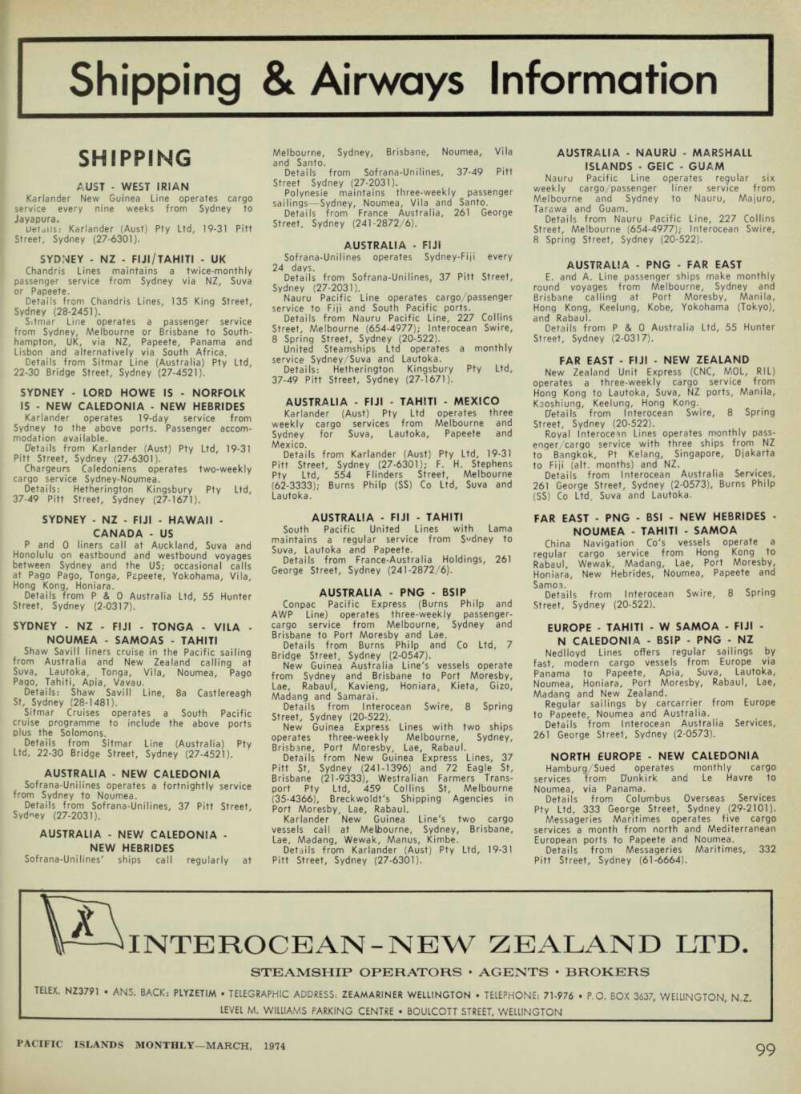
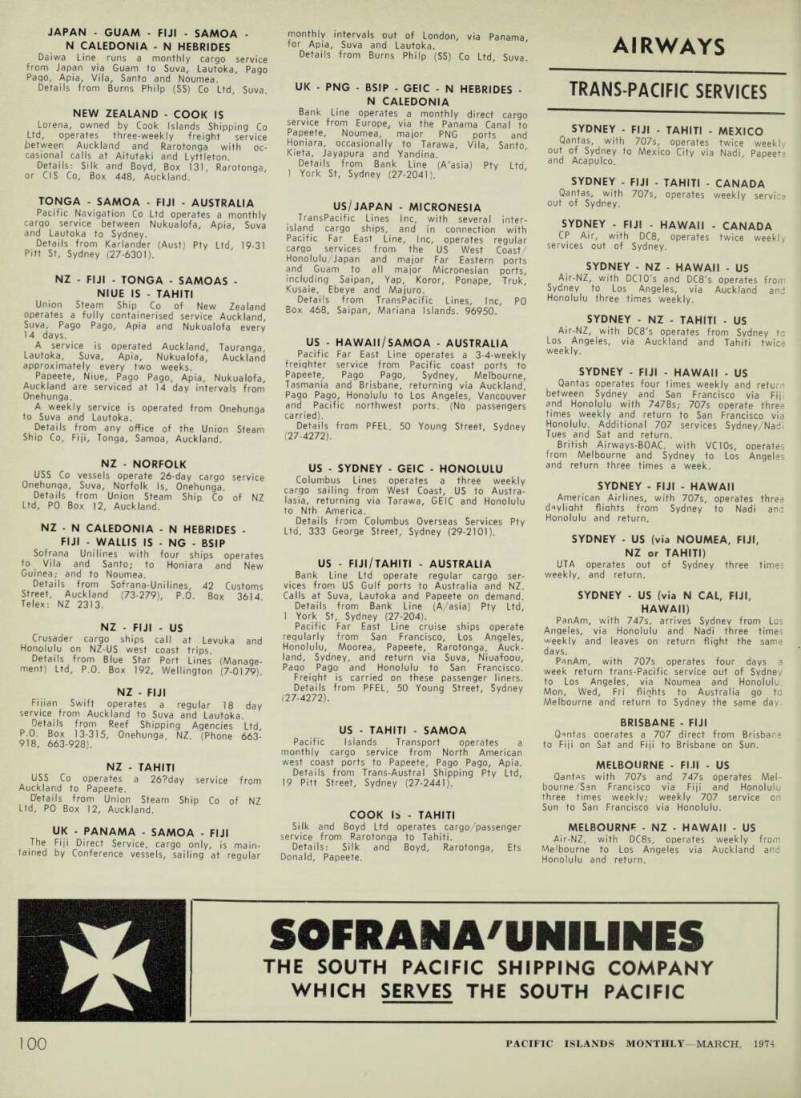
Shipping
Aust - West Irian
Karlander New Guinea Line operates cargo service every nine weeks from Sydney to Jayapura.
Details: Karlander (Aust) Pty Ltd, 19-31 Pitt Street, Sydney (27-6301).
SYDNEY - NZ - FIJI/TAHITI - UK Chandris Lines maintains a twice-monthly passenger service from Sydney via NZ, Suva or Papeete.
Details from Chandris Lines, 135 King Street, Sydney (28-2451).
Sitmar Line operates a passenger service from Sydney, Melbourne or Brisbane to South hampton, UK, via NZ, Papeete, Panama and Lisbon and alternatively via South Africa.
Details from Sitmar Line (Australia) Pty Ltd, 22-30 Bridge Street, Sydney (27-4521).
SYDNEY - LORD HOWE IS - NORFOLK IS - NEW CALEDONIA - NEW HEBRIDES Karlander operates 19-day service from Sydney to the above ports. Passenger accom modation available.
Details from Karlander (Aust) Pty Ltd, 19-31 Pitt Street, Sydney (27-6301).
Chargeurs Caledoniens operates two-weekly cargo service Sydney-Noumea.
Details: Hetherington Kingsbury Pty Ltd, 37-49 Pitt Street, Sydney (27-1671).
SYDNEY - NZ - FIJI - HAWAII -
Canada - Us
P and 0 liners call at Auckland, Suva and Honolulu on eastbound and westbound voyages between Sydney and the US; occasional calls at Pago Pago, Tonga, Papeete, Yokohama, Vila, Hong Kong, Honiara.
Details from P & 0 Australia Ltd, 55 Hunter Street, Sydney (2-0317).
SYDNEY - NZ - FIJI - TONGA - VILA -
Noumea - Samoas - Tahiti
Shaw Savill liners cruise in the Pacific sailing from Australia and New Zealand calling at Suva, Lautoka, Tonga, Vila, Noumea, Pago Pago, Tahiti, Apia, Vavau.
Details: Shaw Savill Line, 8a Castlereagh St, Sydney (28-1481).
Sitmar Cruises operates a South Pacific cruise programme to include the above ports plus the Solomons.
Details from Sitmar Line (Australia) Pty Ltd, 22-30 Bridge Street, Sydney (27-4521).
Australia - New Caledonia
Sofrana-Unilines operates a fortnightly service from Sydney to Noumea.
Details from Sofrana-Unilines, 37 Pitt Street, Sydney (27-2031).
Australia - New Caledonia -
New Hebrides
Sofrana-Unilines' ships call regularly at
Melbourne, Sydney, Brisbane, Noumea, Vila and Santo.
Details from Sofrana-Unilines, 37-49 Pitt Street Sydney (27-2031).
Polynesie maintains three-weekly passenger sailings—Sydney, Noumea, Vila and Santo.
Details from France Australia, 261 George Street, Sydney (241-2872/6).
Australia - Fiji
Sofrana-Unilines operates Sydney-Fiji every 24 days.
Details from Sofrana-Unilines, 37 Pitt Street, Sydney (27-2031).
Nauru Pacific Line operates cargo/passenger service to Fiji and South Pacific ports.
Details from Nauru Pacific Line, 227 Collins Street, Melbourne (654-4977); Interocean Swire, 8 Spring Street, Sydney (20-522).
United Steamships Ltd operates a monthly service Sydney/Suva and Lautoka.
Details: Hetherington Kingsbury Pty Ltd, 37-49 Pitt Street, Sydney (27-1671).
AUSTRALIA - FIJI - TAHITI - MEXICO Karlander (Aust) Pty Ltd operates three weekly cargo services from Melbourne and Sydney for Suva, Lautoka, Papeete and Mexico.
Details from Karlander (Aust) Pty Ltd, 19-31 Pitt Street, Sydney (27-6301); F. H. Stephens Pty Ltd, 554 Flinders Street, Melbourne (62-3333); Burns Philp (SS) Co Ltd, Suva and Lautoka.
Australia - Fiji - Tahiti
South Pacific United Lines with Lama maintains a regular service from Sidney to Suva, Lautoka and Papeete.
Details from France-Australia Holdings, 261 George Street, Sydney (241-2872/6).
Australia - Png - Bsip
Conpac Pacific Express (Burns Philp and AWP Line) operates three-weekly passenger cargo service from Melbourne, Sydney and Brisbane to Port Moresby and Lae.
Details from Burns Philp and Co Ltd, 7 Bridge Street, Sydney (2-0547).
New Guinea Australia Line's vessels operate from Sydney and Brisbane to Port Moresby, Lae, Rabaul, Kavieng, Honiara. Kieta, Gizo, Madang and Samarai.
Details from Interocean Swire, 8 Spring Street, Sydney (20-522).
New Guinea Express Lines with two ships operates three-weekly Melbourne, Sydney, Brisbane, Port Moresby, Lae, Rabaul.
Details from New Guinea Express Lines, 37 Pitt St, Sydney (241-1396) and 72 Eagle St, Brisbane (21-9333), Westralian Farmers Trans port Pty Ltd, 459 Collins St, Melbourne (35-4366), Breckwoldt's Shipping Agencies in Port Moresby, Lae, Rabaul.
Karlander New Guinea Line's two cargo vessels call at Melbourne, Sydney, Brisbane, Lae, Madang, Wewak, Manus, Kimbe.
Details from Karlander (Aust) Pty Ltd, 19-31 Pitt Street, Sydney (27-6301).
Australia - Nauru - Marshall
Islands - Geic - Guam
Nauru Pacific Line operates regular six weekly cargo/passenger liner service from Melbourne and Sydney to Nauru, Majuro, Tarawa and Guam.
Details from Nauru Pacific Line, 227 Collins Street, Melbourne (654-4977); Interocean Swire, 8 Spring Street, Sydney (20-522).
Australia - Png - Far East
E. and A. Line passenger ships make monthly round voyages from Melbourne, Sydney and Brisbane calling at Port Moresby, Manila, Hong Kong, Keelung, Kobe, Yokohama (Tokyo), and Rabaul.
Details from P & 0 Australia Ltd, 55 Hunter Street, Sydney (2-0317), FAR EAST - FIJI - NEW ZEALAND New Zealand Unit Express (CNC, MOL, RIL) operates a three-weekly cargo service from Hong Kong to Lautoka, Suva, NZ ports, Manila, Kaoshiung, Keelung, Hong Kong.
Details from Interocean Swire, 8 Spring Street, Sydney (20-522).
Royal Interocean Lines operates monthly pass enger/cargo service with three ships from NZ to Bangkok, Pt Kelang, Singapore, Djakarta to Fiji (alt. months) and NZ.
Details from Interocean Australia Services, 261 George Street, Sydney (2-0573), Burns Philp (SS) Co Ltd, Suva and Lautoka.
FAR EAST - PNG - BSI - NEW HEBRIDES ■
Noumea - Tahiti - Samoa
China Navigation Co's vessels operate a regular cargo service from Hong Kong to Rabaul, Wewak, Madang, Lae, Port Moresby, Honiara, New Hebrides, Noumea, Papeete and Samoa. .
Details from Interocean Swire, 8 Spring Street, Sydney (20-522).
EUROPE - TAHITI - W SAMOA - FIJI - N CALEDONIA - BSIP - PNG - NZ Nedlloyd Lines offers regular sailings by fast, modern cargo vessels from Europe via Panama to Papeete, Apia, Suva, Lautoka, Noumea, Honiara, Port Moresby, Rabaul, Lae, Madang and New Zealand.
Regular sailings by carcarrier from Europe to Papeete, Noumea and Australia.
Details from Interocean Australia Services, 261 George Street, Sydney (2-0573).
North Europe - New Caledonia
Hamburg/Sued operates monthly cargo services from Dunkirk and Le Havre to Noumea, via Panama.
Details from Columbus Overseas Services Pty Ltd, 333 George Street, Sydney (29-2101).
Messageries Maritimes operates five cargo services a month from north and Mediterranean European ports to Papeete and Noumea.
Details from Messageries Maritimes, 332 Pitt Street, Sydney (61-6664).
JAPAN - GUAM - FIJI - SAMOA -
N Caledonia - N Hebrides
Daiwa Line runs a monthly cargo service from Japan via Guam to Suva, Lautoka, Pago Pago, Apia, Vila, Santo and Noumea.
Details from Burns Philp (SS) Co Ltd, Suva.
New Zealand - Cook Is
Lorena, owned by Cook Islands Shipping Co Ltd, operates three-weekly freight service between Auckland and Rarotonga with oc casional calls at Aitutaki and Lyttleton.
Details: Silk and Boyd, Box 131, Rarotonga, or CIS Co, Box 448, Auckland.
TONGA - SAMOA - FIJI - AUSTRALIA Pacific Navigation Co Ltd operates a monthly cargo service between Nukualofa, Apia, Suva and Lautoka to Sydney.
Details from Karlander (Aust) Pty Ltd, 19-31 Pitt St, Sydney (27-6301).
NZ - FIJI - TONGA - SAMOAS -
Niue Is - Tahiti
Union Steam Ship Co of New Zealand operates a fully containerised service Auckland, Suva, Pago Pago, Apia and Nukualofa every 14 days.
A service is operated Auckland, Tauranga, Lautoka, Suva, Apia, Nukualofa, Auckland approximately every two weeks.
Papeete, Niue, Pago Pago, Apia, Nukualofa, Auckland are serviced at 14 day intervals from Onehunga.
A weekly service is operated from Onehunga to Suva and Lautoka.
Details from any office of the Union Steam Ship Co, Fiji, Tonga, Samoa, Auckland.
Nz - Norfolk
USS Co vessels operate 26-day cargo service Onehunga, Suva, Norfolk Is, Onehunga.
Details from Union Steam Ship Co of NZ Ltd, PO Box 12, Auckland.
NZ - N CALEDONIA - N HEBRIDES - FIJI - WALLIS IS - NG - BSIP Sofrana Unilines with four ships operates to Vila and Santo; to Honiara and New Guinea; and to Noumea.
Details from Sofrana-Unilines, 42 Customs Street, Auckland (73-279), P.0. Box 3614 Telex: NZ 2313.
Nz - Fiji - Us
Crusader cargo ships call at Levuka and Honolulu on NZ-US west coast trips.
Details from Blue Star Port Lines (Manage ment) Ltd, P.0. Box 192, Wellington (7-0179).
Nz - Fiji
Fijian Swift operates a regular 18 day service from Auckland to Suva and Lautoka.
Details from Reef Shipping Agencies Ltd, P O. Box 13-315, Onehunga, NZ. (Phone 663- 918, 663-928).
Nz - Tahiti
USS Co operates a 26?day service from Auckland to Papeete.
Details from Union Steam Ship Co of NZ Ltd, PO Box 12, Auckland.
UK - PANAMA - SAMOA - FIJI The Fiji Direct Service, cargo only, is main tained by Conference vessels, sailing at regular
monthly intervals out of London, via Panama, for Apia, Suva and Lautoka.
Details from Burns Philp (SS) Co Ltd, Suva.
UK - PNG - BSIP - GEIC - N HEBRIDES -
N Caledonia
Bank Line operates a monthly direct cargo service from Europe, via the Panama Canal to Papeete, Noumea, major PNG ports and Honiara, occasionally to Tarawa, Vila, Santo, Kieta, Jayapura and Yandina.
Details from Bank Line (A'asia) Pty Ltd, 1 York St, Sydney (27-2041).
Us/Japan - Micronesia
Transpacific Lines Inc, with several inter island cargo ships, and in connection with Pacific Far East Line, Inc, operates regular cargo services from the US West Coast/ Honolulu/Japan and major Far Eastern ports and Guam to all major Micronesian ports, including Saipan, Yap, Koror, Ponape, Truk, Kusaie, Ebeye and Majuro.
Details from Transpacific Lines, Inc, PO Box 468, Saipan, Mariana Islands. 96950.
Us - Hawaii/Samoa - Australia
Pacific Far East Line operates a 3-4-weekly freighter service from Pacific coast ports to Papeete, Pago Pago, Sydney, Melbourne, Tasmania and Brisbane, returning via Auckland, Pago Pago, Honolulu to Los Angeles, Vancouver and Pacific northwest ports. (No passengers carried).
Details from PFEL, 50 Young Street, Sydney (27-4272).
US - SYDNEY - GEIC - HONOLULU Columbus Lines operates a three weekly cargo sailing from West Coast, US to Austra lasia, returning via Tarawa, GEIC and Honolulu to Nth America.
Details from Columbus Overseas Services Pty Ltd, 333 George Street, Sydney (29-2101).
Us - Fiji/Tahiti - Australia
Bank Line Ltd operate regular cargo ser vices from US Gulf ports to Australia and NZ.
Calls at Suva, Lautoka and Papeete on demand.
Details from Bank Line (A/asia) Pty Ltd, 1 York St, Sydney (27-204).
Pacific Far East Line cruise ships operate regularly from San Francisco, Los Angeles, Honolulu, Moorea, Papeete, Rarotonga, Auck land, Sydney, and return via Suva, Niuafoou, Pago Pago and Honolulu to San Francisco.
Freight is carried on these passenger liners.
Details from PFEL, 50 Young Street, Sydney (27-4272).
Us - Tahiti ■ Samoa
Pacific Islands Transport operates a monthly cargo service from North American west coast ports to Papeete, Pago Pago, Apia.
Details from Trans-Austral Shipping Pty Ltd, 19 Pitt Street, Sydney (27-2441).
Cook Is - Tahiti
Silk and Boyd Ltd operates cargo/passenger service from Rarotonga to Tahiti.
Details: Silk and Boyd, Rarotonga, Ets Donald, Papeete.
Advertisements & other items, pp. 105-106 (1 item)
Interocean-New Zealand Ltd.
STEAMSHIP OPERATORS • AGENTS • BROKERS
TELEX. NZ3791 . ANS. BACK: PLYZETIM • TELEGRAPHIC ADDRESS: ZEAMARINER WELLINGTON • TELEPHONE: 71-976 • P.O. BOX 3637, WELLINGTON, N.Z.
LEVEL M. WILLIAMS PARKING CENTRE • BOULCOTT STREET. WELLINGTON
SOFRANA'UNILINES
THE SOUTH PACIFIC SHIPPING COMPANY
WHICH SERVES THE SOUTH PACIFIC
Airways
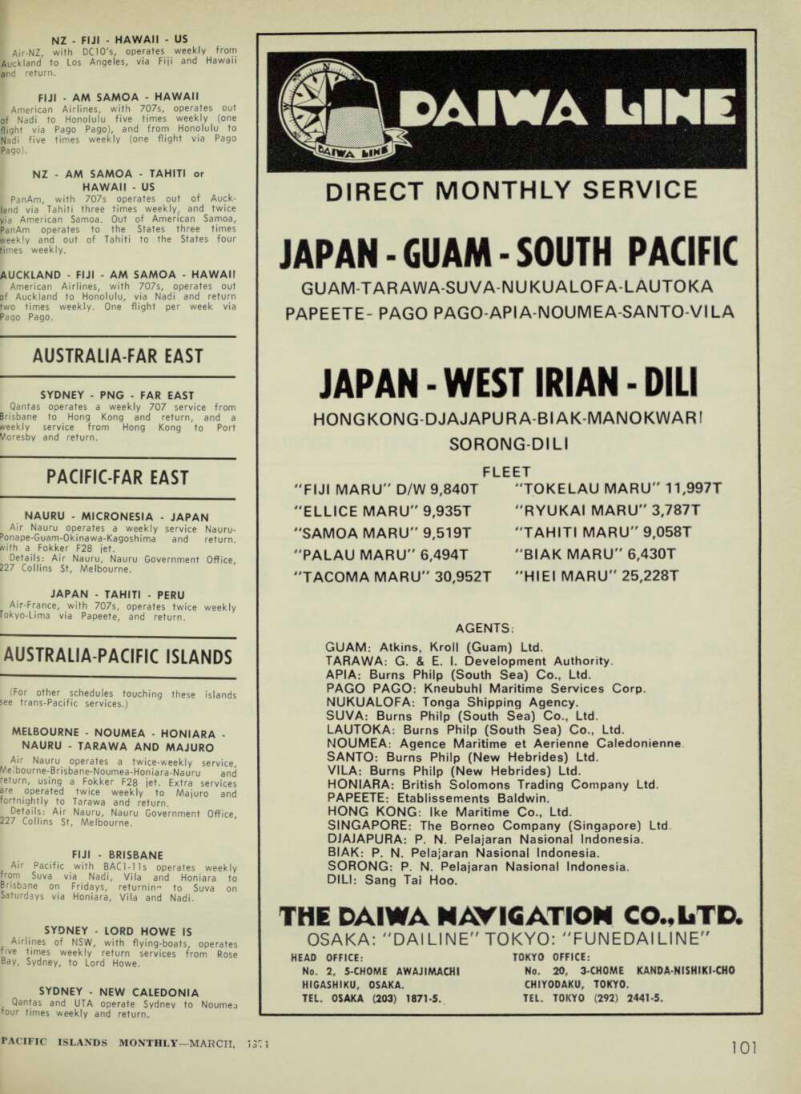
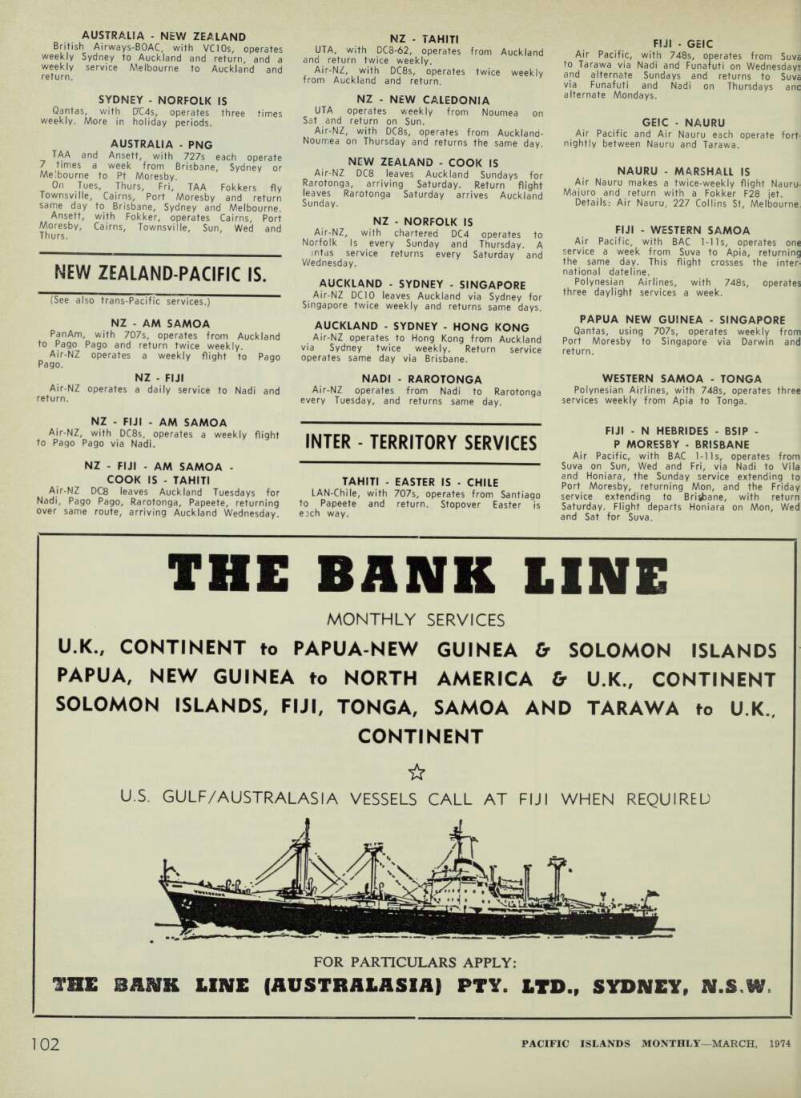
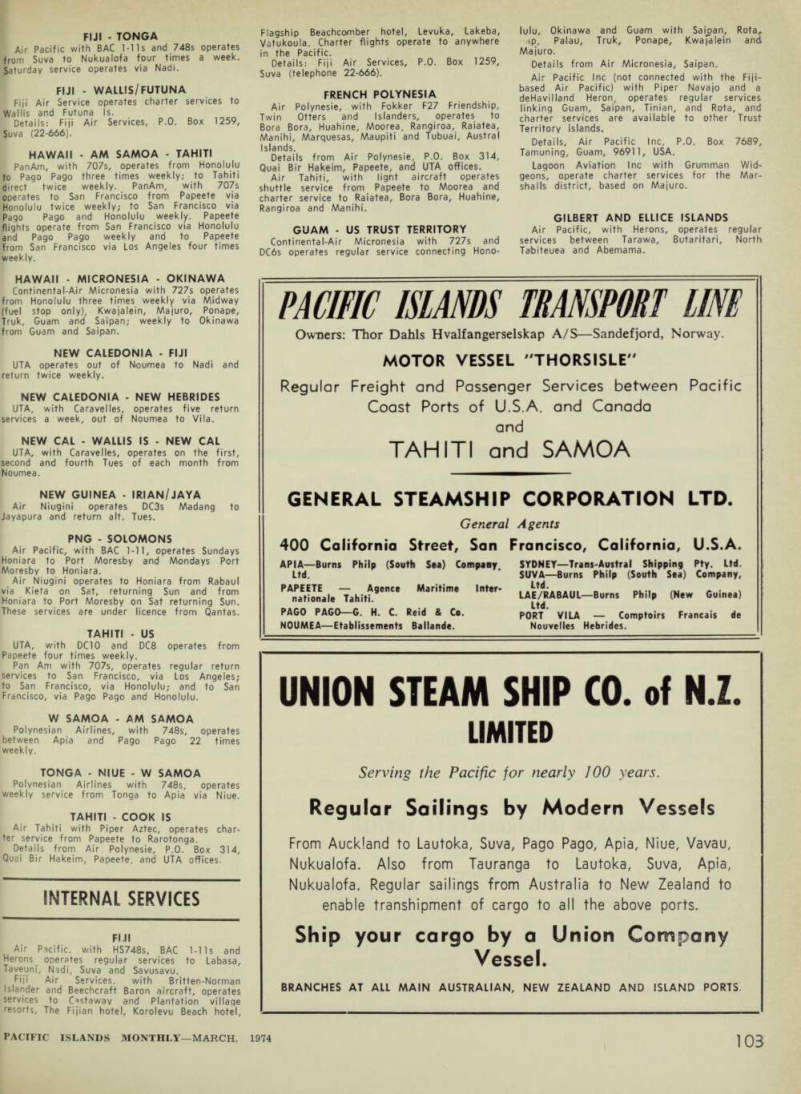
Trans Pacific Services
SYDNEY ■ FIJI - TAHITI - MEXICO Qantas, with 7075, operates twice weekl, out of Sydney to Mexico City via Nadi, Papeete and Acapulco.
SYDNEY - FIJI - TAHITI - CANADA Qantas, with 7075, operates weekly service out of Sydney.
SYDNEY - FIJI - HAWAII - CANADA CP Air, with DCB, operates twice weekly services out of Sydney.
SYDNEY - NZ - HAWAII - US Air-NZ, with DClO's and DCB's operates from Sydney to Los Angeles, via Auckland and Honolulu three times weekly.
SYDNEY - NZ - TAHITI - US Air-NZ, with DCB's operates from Sydney to Los Angeles, via Auckland and Tahiti twice weekly.
SYDNEY - FIJI - HAWAII - US Qantas operates four times weekly and return between Sydney and San Francisco via Fij and Honolulu with 74785; 707 s operate three times weekly and return to San Francisco via Honolulu. Additional 707 services Sydney/Nad lues and Sat and return.
British Airways-BOAC, with VClOs, operates from Melbourne and Sydney to Los Angeles and return three times a week.
Sydney - Fiji - Hawaii
American Airlines, with 7075, operates three daylight fliahts from Sydney to Nadi and Honolulu and return.
Sydney - Us (Via Noumea, Fiji,
Nz Or Tahiti)
UTA operates out of Sydney three times weekly, and return.
SYDNEY - US (via N CAL, FIJI,
Hawaii)
PanAm, with 7475, arrives Sydney from Los Angeles, via Honolulu and Nadi three times weekly and leaves on return flight the same days.
PanAm, with 707 s operates four days a week return trans-Pacific service out of Sydney to Los Angeles, via Noumea and Honolulu.
Mon, Wed, Fri flights to Australia go to Melbourne and return to Sydney the same day.
Brisbane - Fiji
Qantas ooerates a 707 direct from Brisbane to Fiji on Sat and Fiji to Brisbane on Sun.
Melbourne • Fiji ■ Us
Qantas with 707 s and 747 s operates Mel bourne/San Francisco via Fiji and Honolulu three times weekly; weekly 707 service on Sun to San Francisco via Honolulu.
MELBOURNE - NZ - HAWAII - US Air-NZ, with DCBs, operates weekly from Melbourne to Los Angeles via Auckland and Honolulu and return.
NZ - FIJI - HAWAII - US I Air-NZ, with DClO's, operates weekly from Auckland to Los Angeles, via Fiji and Hawaii and return.
Fiji - Am Samoa - Hawaii
American Airlines, with 7075, operates out of Nadi to Honolulu five times weekly (one flight via Pago Pago), and from Honolulu to Nadi five times weekly (one flight via Pago Pago).
NZ - AM SAMOA - TAHITI or
Hawaii - Us
[ PanAm, with 707 s operates out of Auck land via Tahiti three times weekly, and twice via American Samoa. Out of American Samoa, PanAm operates to the States three times weekly and out of Tahiti to the States four
[imes weekly.
AUCKLAND - FIJI - AM SAMOA - HAWAII American Airlines, with 7075, operates out of Auckland to Honolulu, via Nadi and return two times weekly. One flight per week via Pago Pago.
Australia-Far East
Sydney - Png - Far East
Qantas operates a weekly 707 service from Brisbane to Hong Kong and return, and a weekly service from Hong Kong to Port Voresby and return.
Pacific-Far East
Nauru - Micronesia - Japan
Air Nauru operates a weekly service Nauru- Ponape-Guam-Okinawa-Kagoshima and return, with a Fokker F2B jet.
Details: Air Nauru, Nauru Government Office, 227 Collins St, Melbourne.
Japan - Tahiti - Peru
Air-France, with 7075, operates twice weekly Fokyo-Lima via Papeete, and return.
Australia-Pacific Islands
(For other schedules touching these islands see trans-Pacific services.)
Melbourne - Noumea - Honiara -
Nauru - Tarawa And Majuro
Air Nauru operates a twice-weekly service,
Melbourne-Brisbane-Noumea-Honiara-Nauru and
return, using a Fokker F2B jet. Extra services are operated twice weekly to Majuro and fortnightly to Tarawa and return.
Nauru, Nauru Government Office, 227 Collins St, Melbourne.
Fiji - Brisbane
Air Pacific with BACI-lls operates weekly from Suva via Nadi, Vila and Honiara to Brisbane on Fridays, returning to Suva on Saturdays via Honiara, Vila and Nadi.
Sydney - Lord Howe Is
Airlines of NSW, with flying-boats, operates five times weekly return services from Rose Bay, Sydney, to Lord Howe.
Sydney - New Caledonia
Qantas and UTA operate Sydney to Noumea tour times weekly and return.
Australia - New Zealand
British Airways-BOAC, with VClOs, operates weekly Sydney to Auckland and return, and a weekly service Melbourne to Auckland and return.
Sydney - Norfolk Is
Qantas, with D"C4s, operates three times weekly. More in holiday periods.
Australia - Png
TAA and Ansett, with 727 s each operate 7 times a week from Brisbane, Sydney or Melbourne to Pt Moresby.
On Tues, Thurs, Fri, TAA Fokkers fly Townsville, Cairns, Port Moresby and return same day to Brisbane, Sydney and Melbourne.
Ansett, with Fokker, operates Cairns, Port Moresby, Cairns, Townsville, Sun, Wed and Thurs.
New Zealand-Pacific Is.
(See also trans-Pacific services.)
Nz - Am Samoa
PanAm, with 7075, operates from Auckland to Pago Pago and return twice weekly.
Air-NZ operates a weekly flight to Pago Pago.
Nz - Fiji
Air-NZ operates a daily service to Nadi and return.
Nz - Fiji - Am Samoa
Air-NZ, with DCBs, operates a weekly flight to Pago Pago via Nadi.
NZ - FIJI - AM SAMOA -
Cook Is - Tahiti
Air-NZ DCB leaves Auckland Tuesdays for Nadi, Pago Pago, Rarotonga, Papeete, returning over same route, arriving Auckland Wednesday.
Nz - Tahiti
UTA, with DCB-62, operates from Auckland and return twice weekly.
Air-NZ, with DCBs, operates twice weekly from Auckland and return.
Nz - New Caledonia
UTA operates weekly from Noumea on Sat and return on Sun.
Air-NZ, with DCBs, operates from Auckland- Noumea on Thursday and returns the same day.
New Zealand - Cook Is
Air-NZ DCS leaves Auckland Sundays for Rarotonga, arriving Saturday. Return flight leaves Rarotonga Saturday arrives Auckland Sunday.
Nz - Norfolk Is
Air-NZ, with chartered DC4 operates to Norfolk Is every Sunday and Thursday. A mtas service returns every Saturday and Wednesday,
Auckland - Sydney - Singapore
Air-NZ DCIO leaves Auckland via Sydney for Singapore twice weekly and returns same days.
Auckland - Sydney - Hong Kong
Air-NZ operates to Hong Kong from Auckland via Sydney twice weekly. Return service operates same day via Brisbane.
Nadi - Rarotonga
Air-NZ operates from Nadi to Rarotonga every Tuesday, and returns same day.
Inter - Territory Services
Tahiti - Easter Is - Chile
LAN-Chile, with 7075, operates from Santiago to Papeete and return. Stopover Easter is each way.
Fiji - Geic
Air Pacific, with 7485, operates from Suva to Tarawa via Nadi and Funafuti on Wednesdays and alternate Sundays and returns to Suva via Funafuti and Nadi on Thursdays ano alternate Mondays.
Geic - Nauru
Air Pacific and Air Nauru each operate fort nightly between Nauru and Tarawa.
Nauru - Marshall Is
Air Nauru makes a twice-weekly flight Nauru- Maiuro and return with a Fokker F2B jet.
Details: Air Nauru, 227 Collins St, Melbourne.
Fiji - Western Samoa
Air Pacific, with BAC 1-lls, operates one service a week from Suva to Apia, returning the same day. This flight crosses the inter national dateline.
Polynesian Airlines, with 7485, operates three daylight services a week.
Papua New Guinea - Singapore
Qantas, using 7075, operates weekly from Port Moresby to Singapore via Darwin and return,
Western Samoa - Tonga
Polynesian Airlines, with 7485, operates three services weekly from Apia to Tonga.
FIJI - N HEBRIDES - BSIP -
P Moresby - Brisbane
Air Pacific, with BAC 1-lls, operates from Suva on Sun, Wed and Fri, via Nadi to Vila and Honiara, the Sunday service extending to Port Moresby, returning Mon, and the Friday service extending to Brisbane, with return Saturday. Flight departs Honiara on Mon, Wed and Sat for Suva.
Fiji - Tonga
Air Pacific with BAC 1-1 Is and 748 s operates from Suva to Nukualofa four times a week.
Saturday service operates via Nadi.
Fiji - Wallis/Futuna
Fiji Air Service operates charter services to Wallis and Futuna Is.
Details: Fiji Air Services, P.O. Box 1259, Suva (22-666).
Hawaii - Am Samoa - Tahiti
PanAm, with 7075, operates from Honolulu to Pago Pago three times weekly; to Tahiti direct twice weekly. PanAm, with 707 s operates to San Francisco from Papeete via Honolulu twice weekly; to San Francisco via Pago Pago and Honolulu weekly. Papeete flights operate from San Francisco via Honolulu and Pago Pago weekly and to Papeete from San Francisco via Los Angeles four times weekly,
Hawaii - Micronesia - Okinawa
Continental-Air Micronesia with 727 s operates from Honolulu three times weekly via Midway (fuel stop only), Kwajalein, Majuro, Ponape, Truk, Guam and Saipan; weekly to Okinawa from Guam and Saipan.
New Caledonia • Fiji
UTA operates out of Noumea to Nadi and return twice weekly.
New Caledonia - New Hebrides
UTA, with Caravelles, operates five return services a week, out of Noumea to Vila.
NEW CAL - WALLIS IS - NEW CAL UTA, with Caravelles, operates on the first, second and fourth Tues of each month from Noumea.
New Guinea - Irian/Jaya
Air Niugini operates DC3s Madang to Jayapura and return alt. Tues.
Png - Solomons
Air Pacific, with BAC 1-11, operates Sundays Honiara to Port Moresby and Mondays Port Moresby to Honiara.
Air Niugini operates to Honiara from Rabaul via Kieta on Sat, returning Sun and from Honiara to Port Moresby on Sat returning Sun.
These services are under licence from Qantas.
Tahiti - Us
UTA, with DCIO and DCS operates from Papeete four times weekly.
Pan Am with 7075, operates regular return services to San Francisco, via Los Angeles; to San Francisco, via Honolulu; and to San Francisco, via Pago Pago and Honolulu.
W Samoa - Am Samoa
Polynesian Airlines, with 7485, operates between Apia and Pago Pago 22 times weekly.
Tonga - Niue - W Samoa
Polynesian Airlines with 7485, operates weekly service from Tonga to Apia via Niue.
Tahiti - Cook Is
Air Tahiti with Piper Aztec, operates char ter service from Papeete to Rarotonga.
Details from Air Polynesie, P.O. Box 314, Quai Bir Hakeim, Papeete, and UTA offices.
Internal Services
Fiji
Air Pacific, with HS74Bs, BAC 1-11 s and Herons operates regular services to Labasa, Taveuni, Nadi, Suva and Savusavu.
Fiji Air Services, with Britten-Norman Islander and Beechcraft Baron aircraft, operates services to Castaway and Plantation village resorts. The Fijian hotel, Korolevu Beach hotel,
Flagship Beachcomber hotel, Levuka, Lakeba, Vatukoula. Charter flights operate to anywhere in the Pacific.
Details: Fiji Air Services, P.O. Box 1259, Suva (telephone 22-666).
French Polynesia
Air Polynesie, with Fokker F 27 Friendship, Twin Otters and Islanders, operates to Bora Bora, Huahine, Moorea, Rangiroa, Raiatea, Manihi, Marquesas, Maupiti and Tubuai, Austral Islands.
Details from Air Polynesie, P.O. Box 314, Quai Bir Hakeim, Papeete, and UTA offices.
Air Tahiti, with light aircraft operates shuttle service from Papeete to Moorea and charter service to Raiatea, Bora Bora, Huahine, Rangiroa and Manihi.
Guam - Us Trust Territory
Continental-Air Micronesia with 727 s and DC6s operates regular service connecting Hono
lulu, Okinawa and Guam with Saipan, Rota, ap, Palau, Truk, Ponape, Kwajalein and Majuro.
Details from Air Micronesia, Saipan.
Air Pacific Inc (not connected with the Fiji based Air Pacific) with Piper Navajo and a deHavilland Heron, operates regular services linking Guam, Saipan, Tinian, and Rota, and charter services are available to other Trust Territory islands.
Details, Air Pacific Inc, P.O. Box 7689, Tamuning, Guam, 96911, USA.
Lagoon Aviation Inc with Grumman Wid geons, operate charter services for the Mar shalls district, based on Majuro.
Gilbert And Ellice Islands
Air Pacific, with Herons, operates regular services between Tarawa, Butaritari, North Tabiteuea and Abemama.
Papua New Guinea
Air Niugini, with Fokkers and DC3s, operates e network of services between all major centres in Papua New Guinea. These services connect with Ansett and TAA's 727 Australia-PNG services.
DC3 aircraft are available for charter within
Png.
Aerial Tours operates in Central, Western, Gulf and Sepik districts. Aircraft are based at: Port Moresby, Kerema, Daru, Kiunga Vanimo, Wewak.
T.A.L. (GV)—Territory Airlines Pty Limited operates scheduled services and charter flights from Goroka, Kundiawa, Madang, Wewak Vanimo, Mt Hagen, Mepdi to Highlands, Sepik and Coastal areas. Talco Territory Travel Ser vice of Papua New Guinea—Twin Otter Tourist flights throughout Papua New Guinea.
Further details from T.A.L., P.O. Box 108, Goroka, Papua New Guinea.
Macair throughout Papua New Guinea.
Crowley Airways Pty Ltd operates through out Papua New Guinea. Details: P.O. Box 34, Lae. Offices also in Rabaul, Kieta, Kavieng, Hoskins, Port Moresby.
Bougainville Air Services operates daily throughout Bougainville. There are nine regular services Kieta-Buin. Details: Arawa, Phone 956-159; Buka, Phone 16. Box 298, PO, Kieta.
New Caledonia
Air Caledonie with Twin Otters, and Is landers operates regular services to Houal- Iqu, Isle of Pines, Isle Ouen, Kone, Koumac, Lifov, Mare, Noumea, Ouvea Touho, Mueo, Belep, Tiga.
Details from Air Caledonie, Noumea.
New Hebrides
Air Melanesiae with Britten-Norman Islanders and Trislander operates to Santo, Malekula Norsup and Lamap, Aoba (Walaha and Longana), Pentecost (Lonorore), Erromanga, Tongoa’
Aneityum, Tanna, Epi, Sola and Vila. Direct connections are available to and from Santo for all international flights arriving in Vila.
Details from Air Melanesiae P.O. Box 72.
Solomon Islands
Solair, with Beech Barons and Islanders operates to Auki, Avu Avu, Babanakira, Bara koma, Bell-ona Is, Fera Is, Gizo, Honiara, Kira Kira, Marau, Munda, Parasi, Sege, Yandina, Santa Cruz, Mono, Rennell Is, Choiseul Bay, Ballalae and Ringi Cove.
Details from Solomon Islands Airways Ltd, Box 23, Honiara, BSIP.
Tonga
Tonga Tourist and Development Co, with Britten-Norman Islander aircraft, operates from Fua'amotu, (airport for Nukualofa) to Vava'u (daily except Sunday) and Eua (twice daily except Sunday). Aircraft available for sight seeing and regional charters.
Details from Tonga Tourist and Development Co, P 0 Box 91, Nukualofa, Tonga.
Cook Islands
Cook Islands Airways Ltd, with a Britten- Norman Islander, operates seven flights a week between Rarotonga and Aitutaki. Service will be extended to Atiu, Mangaia and Mitiaro when airstrips are built.
Advertisements & other items, pp. 107-110 (1 item)
Daiwa Line
DIRECT MONTHLY SERVICE
JAPAN - GUAM - SOUTH PACIFIC
GUAM-TARAWA-SUVA-NUKUALOFA-LAUTOKA
PAPEETE- PAGO PAGO-APIA-NOUMEA-SANTO-VILA
JAPAN - WEST IRIAN-DILI
HONGKONG-DJAJAPURA-BI AK-MANOKWARI
SORONG-DILI
FLEET
"FIJI MARU" D/W 9,8401
"ELLICE MARU" 9,935 T
"SAMOA MARU" 9,519 T
"PALAU MARU" 6,494 T
"TACOMA MARU" 30.952 T
"TOKELAU MARU" 11,997 T
"RVUKAI MARU" 3/787T
"TAHITI MARU" 9,058 T
"BIAK MARU" 6,430 T
"HIEI MARU" 25,228 T
AGENTS:
GUAM; Atkins, Kroll (Guam) Ltd.
TARAWA: G. & E. I. Development Authority.
APIA: Burns Philp (South Sea) Co., Ltd.
PAGO PAGO: Kneubuhl Maritime Services Corp.
NUKUALOFA; Tonga Shipping Agency.
SUVA: Burns Philp (South Sea) Co., Ltd.
LAUTOKA: Burns Philp (South Sea) Co., Ltd.
NOUMEA: Agence Maritime et Aerienne Caledonienne SANTO: Burns Philp (New Hebrides) Ltd.
VILA; Burns Philp (New Hebrides) Ltd.
HONIARA: British Solomons Trading Company Ltd.
PAPEETE: Etablissements Baldwin.
HONG KONG: Ike Maritime Co., Ltd.
SINGAPORE; The Borneo Company (Singapore) Ltd DJAJAPURA: P. N. Pelajaran Nasional Indonesia.
BIAK: P. N. Pelajaran Nasional Indonesia.
SORONG: P. N. Pelajaran Nasional Indonesia.
DILI: Sang Tai Hoo.
THE DAIWA NAVIGATION CO.. LTD.
OSAKA: "DAILINE" TOKYO: "FUNEDAILINE"
HEAD OFFICE: TOKYO OFFICE:
No. 2, 5-CHOME AWAJIMACHI No. 20, 3-CHOME KANOA-NISHIKI-CHO
HIGASHIKU, OSAKA. CHIYODAKU, TOKYO.
TEL. OSAKA (203) 1871-5. TEL, TOKYO (292) 2441-5.
THE BANK LINE
MONTHLY SERVICES
U.K., CONTINENT to PAPUA-NEW GUINEA & SOLOMON ISLANDS PAPUA, NEW GUINEA to NORTH AMERICA & U.K., CONTINENT SOLOMON ISLANDS, FIJI, TONGA, SAMOA AND TARAWA to U.K.,
CONTINENT
☆ U.S. GULF/AUSTRALASIA VESSELS CALL AT FIJI WHEN REQUIRED /
FOR PARTICULARS APPLY:
THE BANK LINE (AUSTRALASIA) PTY. LTD., SYDNEY, N.S.W
PACIFIC ISLANDS TRANSPORT LINE
Owners: Thor Dahls Hvalfangerselskap A/S—Sandefjord, Norway.
MOTOR VESSEL "THORSISLE"
Regular Freight and Passenger Services between Pacific
Coast Ports of U.S.A. and Canada
and
TAHITI and SAMOA
GENERAL STEAMSHIP CORPORATION LTD.
General Agents 400 California Street, San Francisco, California, U.S.A.
APlA—Burns Philp (Sooth Sea) Company. SYDNEY—Trans-Austral Shipping Pty. Ltd.
Ltd.
PAPEETE Agenee Maritime Inter- SUVA —Burns Philp (South Sea) Company, Ltd. nationale Tahiti.
PAGO PAGO— G. H. C. Reid & Co.
NOUMEA —Etablissements Ballande.
LAE/RABAUL —Burns Philp (New Guinea) Ltd.
PORT VILA Comptoirs Francais de Nouvelles Hebrides.
UNION STEAM SHIP CO. of N.Z.
LIMITED
Serving the Pacific for nearly 100 years.
Regular Sailings by Modern Vessels
From Auckland to Lautoka, Suva, Pago Pago, Apia, Niue, Vavau, Nukualofa. Also from Tauranga to Lautoka, Suva, Apia, Nukualofa. Regular sailings from Australia to New Zealand to enable transhipment of cargo to all the above ports.
Ship your cargo by a Union Company Vessel, BRANCHES AT ALL MAIN AUSTRALIAN, NEW ZEALAND AND ISLAND PORTS
MORE PORTS / MORE OFTEN
with
i€JH RLAIMOER
KARLANDER NEW GUINEA LINE: Serving; Pt. Moresby, Samarai, Lae, Madang, Rabaul, Wewak, Manus Is., Kieta, Honiara, Yandina, Gizo, Vila, Norfolk Is., and Lord Howe Is.
KARLANDER KANGAROO LINE: Serving: Los Angeles, San Francisco,
Auckland, Melbourne, Suva, Lautoka.
AUSTRALIAN TERRITORY LINER SERVICES: Serving, Melbourne,
Sydney, Newcastle, Brisbane, Weipa, Gove, Thursday Is.
Managing Agents
KARLANDER (AUSTRALIA) PTY. LIMITED
19-31 Pitt Street, Sydney
General Agents Brisbane: F. H. Stephens Pty. Ltd.
Melbourne: F. H. Stephens (Vic.) Pty. Ltd.
Pt. Moresby: Carpenter Shipping Agencies.
Samarai: Burns Philp (N.G.) Ltd.
San Francisco: Transpacific Transportation Co.
Los Angeles: Transpacific Transportation Co.
Madang: B. J. Back Pty. Ltd.
Yandina: Levers Pacific Plantations Co. Ltd.
Santo: Burns Philp (N.H.) Ltd.
Lord Howe Is.: R. Wilson Leanda Lei.
Thursday Is.: Torres Industries Ltd.
Manus Is.: Edged & Whiteley Ltd.
Rabaul: Rabaul Trading Co. Ltd.
Honiara: E. V. Lawson Pty. Ltd.
Kieta: Breckwoldt i Co. Pty. Ltd Lae: N.G.G. Trading Company.
Wewak: Burns Philp (N.G.) Ltd.
Fiji; Burns Philp (S.S.) Ltd.
Giro: British Solomon Trading Co.
Vila: Burns Philp (N.H.) Ltd.
Norfolk Is.: Burns Philp (S.S.) Ltd.
Islands People
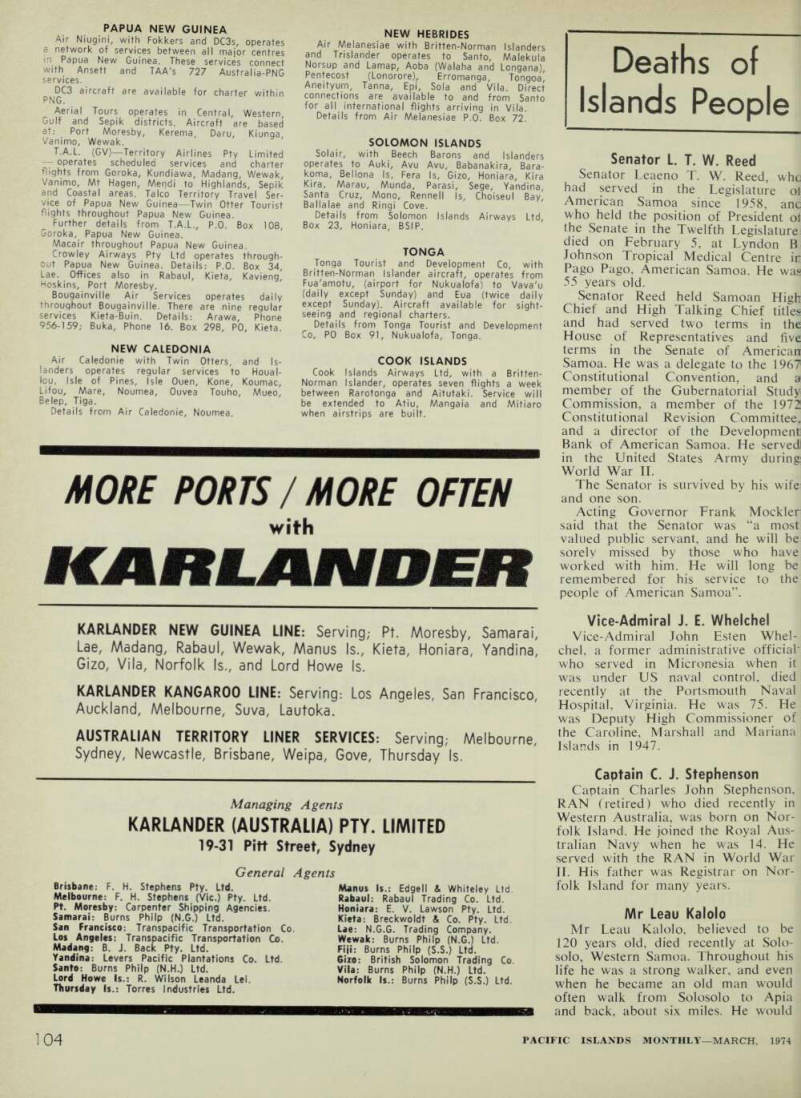
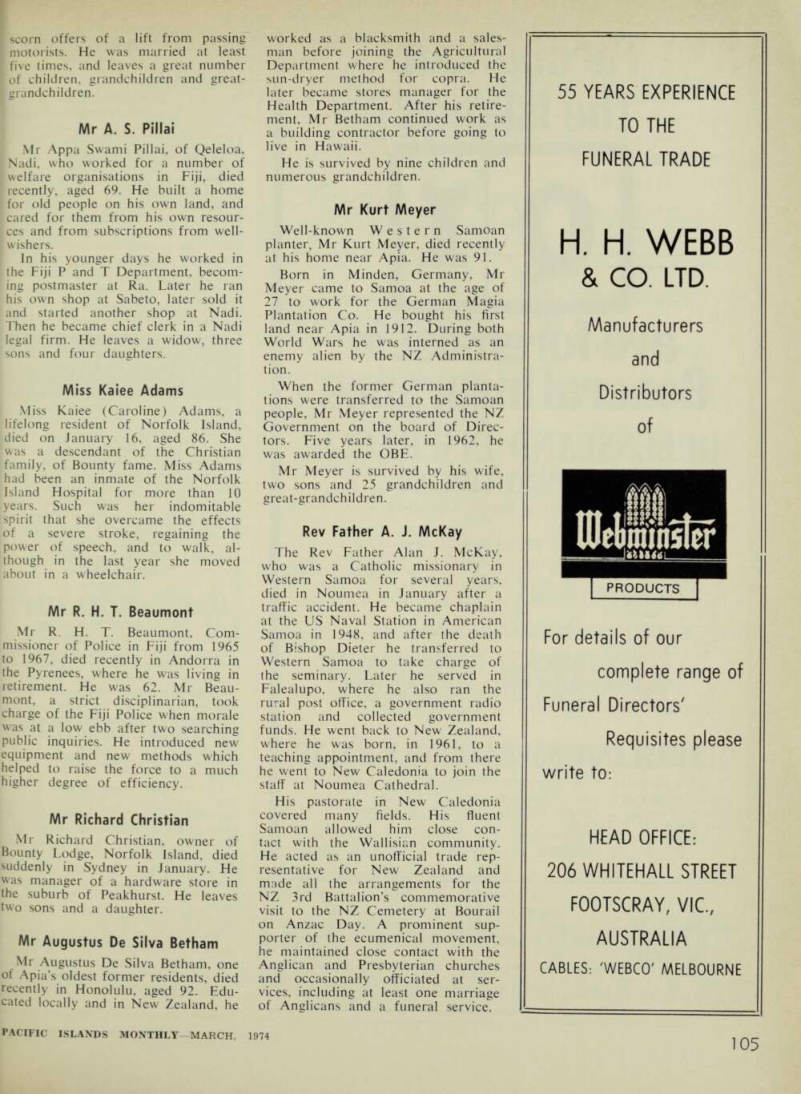
Deaths of Islands People
Senator L. T. W. Reed Senator Leaeno T. W. Reed, whc had served in the Legislature ol American Samoa since 1958, anc who held the position of President ot the Senate in the Twelfth Legislature died on February 5. at Lyndon B Johnson Tropical Medical Centre in Pago Pago, American Samoa. He was 55 years old.
Senator Reed held Samoan High Chief and High Talking Chief titles and had served two terms in the House of Representatives and five terms in the Senate of American Samoa. He was a delegate to the 1967 Constitutional Convention, and a member of the Gubernatorial Study Commission, a member of the 1972 Constitutional Revision Committee, and a director of the Development Bank of American Samoa. He served! in the United States Army during; World War 11.
The Senator is survived by his wife and one son.
Acting Governor Frank Mockler said that the Senator was “a most valued public servant, and he will be sorely missed by those who have worked with him. He will long be remembered for his service to the people of American Samoa”.
Vice-Admiral J. E. Whelchel Vice-Admiral John Esten Whel chel, a former administrative official' who served in Micronesia when it was under US naval control, died recently at the Portsmouth Naval Hospital, Virginia. He was 75. He was Deputy High Commissioner of the Caroline, Marshall and Mariana Islands in 1947.
Captain C. J. Stephenson
Captain Charles John Stephenson, RAN (retired) who died recently in Western Australia, was born on Nor folk Island. He joined the Royal Aus tralian Navy when he was 14. He served with the RAN in World War 11. His father was Registrar on Nor folk Island for many years.
Mr Leau Kalolo Mr Leau Kalolo, believed to be 120 years old, died recently at Solo solo, Western Samoa. Throughout his life he was a strong walker, and even when he became an old man would often walk from Solosolo to Apia and back, about six miles. He would
[ scorn offers of a lift from passing , motorists. He was married at least [ five times, and leaves a great number I of children, grandchildren and great-
I grandchildren.
Mr A. S. Filial Mr Appa Swami Pillai, of Qeleloa, Nadi, who worked for a number of [ welfare organisations in Fiji, died [ recently, aged 69. He built a home I for old people on his own land, and cared for them from his own resour [ces and from subscriptions from well- I wishers.
In his younger days he worked in the Fiji P and T Department, becom ing postmaster at Ra. Later he ran his own shop at Sabeto, later sold it and started another shop at Nadi.
Then he became chief clerk in a Nadi legal firm. He leaves a widow, three sons and four daughters.
Miss Kaiee Adams Miss Kaiee (Caroline) Adams, a lifelong resident of Norfolk Island, died on January 16, aged 86. She was a descendant of the Christian family, of Bounty fame. Miss Adams had been an inmate of the Norfolk Island Hospital for more than 10 years. Such was her indomitable spirit that she overcame the effects of a severe stroke, regaining the power of speech, and to walk, al though in the last year she moved about in a wheelchair.
Mr R. H. T. Beaumont Mr R. H. T. Beaumont, Com missioner of Police in Fiji from 1965 to 1967, died recently in Andorra in the Pyrenees, where he was living in retirement. He was 62. Mr Beau mont, a strict disciplinarian, took charge of the Fiji Police when morale was at a low ebb after two searching public inquiries. He introduced new equipment and new methods which helped to raise the force to a much higher degree of efficiency.
Mr Richard Christian Mr Richard Christian, owner of Bounty Lodge, Norfolk Island, died suddenly in Sydney in January. He was manager of a hardware store in the suburb of Peakhurst, He leaves two sons and a daughter.
Mr Augustus De Silva Betham Mr Augustus De Silva Betham, one of Apia’s oldest former residents, died recently in Honolulu, aged 92. Edu cated locally and in New Zealand, he
worked as a blacksmith and a sales man before joining the Agricultural Department where he introduced the sun-dryer method for copra. He later became stores manager for the Health Department. After his retire ment, Mr Betham continued work as a building contractor before going to live in Hawaii.
He is survived by nine children and numerous grandchildren.
Mr Kurt Meyer Well-known Western Samoan planter, Mr Kurt Meyer, died recently at his home near Apia. He was 91.
Born in Minden, Germany, Mr Meyer came to Samoa at the age of 27 to work for the German Magia Plantation Co. He bought his first land near Apia in 1912. During both World Wars he was interned as an enemy alien by the NZ Administra tion.
When the former German planta tions were transferred to the Samoan people, Mr Meyer represented the NZ Government on the board of Direc tors. Five years later, in 1962, he was awarded the OBE.
Mr Meyer is survived by his wife, two sons and 25 grandchildren and
great-grandchildren.
Rev Father A. J. McKay The Rev Father Alan J. McKay, who was a Catholic missionary in Western Samoa for several years, died in Noumea in January after a traffic accident. He became chaplain at the US Naval Station in American Samoa in 1948, and after the death of Bishop Dieter he transferred to Western Samoa to take charge of the seminary. Later he served in Falealupo, where he also ran the rural post office, a government radio station and collected government funds. He went back to New Zealand, where he was born, in 1961, to a teaching appointment, and from there he went to New Caledonia to join the staff at Noumea Cathedral.
His pastorate in New Caledonia covered many fields. His fluent Samoan allowed him close con tact with the Wallisian community.
He acted as an unofficial trade rep resentative for New Zealand and made all the arrangements for the NZ 3rd Battalion’s commemorative visit to the NZ Cemetery at Bourail on Anzac Day. A prominent sup porter of the ecumenical movement, he maintained close contact with the Anglican and Presbyterian churches and occasionally officiated at ser vices, including at least one marriage of Anglicans and a funeral service.
Advertisements & other items, pp. 111-114 (2 items)
H. H. Webb
55 YEARS EXPERIENCE
TO THE
FUNERAL TRADE
H. H. WEBB
& CO. LTD
Manufacturers and Distributors of I!
PRODUCTS
For details of our complete range of Funeral Directors' Requisites please write to:
HEAD OFFICE:
206 WHITEHALL STREET
FOOTSCRAY, VIC,
AUSTRALIA
CABLES: 'WEBCO' MELBOURNE
Throughout
the Islands
are foremost in
General Insurance
QUEENSLAND INSURANCE
COMPANY LIMITED
(Incorporated 1886 in Australia)
Head Office: 82 Pitt Street, Sydney FIJI —Branch Office, Suva, Manager for Fiji: F. N. Davies (A.A.1.1.).
LAUTOKA—District Manager: U. Singh.
HONIARA (8.5.1. P.) —Breckwoldt & Company (5.1.) Pty.
Limited.
NEW CALEDONIA—T. A. Hagen, Ste. W. A. Johnston, S.A.R.L.—Noumea.
NEW HEBRlDES—Resident Officer; R. J. Allsop (A.A.1.1.) Vila; Santo; Burns Philp (New Hebrides) Ltd.
TAHlTl—Arthur Chung: Immeuble 8.1., From de Mer, Papeete.
NIUE, NORFOLK ISLAND, SAMOA, TONGA and other South Sea Islands—Burns Philp (South Sea) Company Ltd.
QUEENSLAND INSURANCE (P.N.G.) LTD
PAPUA NEW GUINEA
Head Office, Port Moresby: General Manager: D. J. Granter.
District Managers at Rabaul: C. D. Dickings; Lae: R. Jackson; Mt. Hagen: D. F. Carroll.
V339R
FOR SALE
M.V. LIUTASI
HULL: Fibreglass 35.5 feet. BREADTH: 11 feet. DEPTH: 4.5 feet. GROSS TONNAGE: 13.7.
CAPACITY OF FRESH WATER TANKS: 175 galls. CAPACITY OF FUEL TANKS: 195 galls. BUILT AT: Woolwich, Sydney, Australia. DATE BUILT: 1958. AGE OF ENGINE: 1964. TYPE OF ENGINE: Gardner 4 LW 48 B.H.P.
The Vessel is in good condition, and it is anticipated that it will be sold just after its Survey, which will take place at the end of February. PRICE: to be negotiated.
ENQUIRE; To General Secretary, South Sea Evangelical Church, P.O. Box 16 Honiara,
SOLOMON ISLANDS.
n P (s) [nnJ SB3 LnnJ f O C- 1 §s)
[hIFJ
5!
PARK VIEW MOTEL—BRISBANE
Quiet location—opp. Botanic Gardens.
Single, double, family suites, all with refrig., air conditioning, phone, TV, radio, tea making facilities, from $l2. Pool and restaurant.
Phone 31-2695—Telex 40270.
Write for coloured brochure— Park View Motel, 128 Alice St, BRISBANE, Old., 4000.
i ce For Warm and Friendly Samoan Hospitality Apia, Western Samoa Phone; 880. Cable: 'Aggies' Tariff includes all meals.
beachcomber
hotel
PACIFIC HARBOUR, FIJI
Sophistication in the midst of uninhabited natural beauty.
Nestled snugly in a reef-protected bay on 5 miles of classical palm fringed Deuba beach. Far enough from Fiji's capital, Suva, to forget the worries of city life. Near enough to take in the colour and the Duty Free Bazaars.
Every suite is self-contained and airconditioned. The cuisine is as the service, superb.
PO Box 216, Suva. Telephone: Navua 43.
Telex FJ3234. Cables: FLAGTELS, Fiji. For reservations or information contact your travel agent.
INTERNATIONA
DATELINE HOT
TONGA
"Friendly Hotel" of the "Friendly Islands"
Situated along the Nukualofa waterfront. Only five minutes walk from town. Single, double, family suites, airconditioning, and hot and cold water showers. Pool, bar, restaurant, duty-free shop, tour desk and boutique.
Book through your travel agent or write to International Dateline Hotel, P.O. Box 62, Nukualofa Tonga.
Cable Address: "DATELINE".
Represented Overseas by: Charles J. Henry and Associates Pty. Ltd.
Sydney and Melbourne. 797
Primitive luxury
(Polynesian style) ** Nestled away in the untouched Kingdom of Tonga is new, luxurious "Port of Refuge" International resort. Here is a unique opportunity for your clients to experience the tranquil and relaxed Tongan atmosphere while they enjoy the picturesque surroundings of the new "Port of Refuge". And only a short flight from Fiji.
Reasonable tariffs from $17.50 with special concessions for children. Agents commission 10 per cent.
Tonga's
Fort of Refuge
INTERNATIONAL RESORT 0
M- Uava’u Tonga Cables: "Refuge" Tonga or "Tongatours"
Sydney. Phone: Sydney 85-1603 or 282-472
PROPERTY INVESTMENT
SUNSHINE COAST—QUEENSLAND
We invite inquiries regarding living or investment in this area.
We have a full coverage of holiday lettings, flats, motels, homes, farms, businesses and sub-divisional land.
Write direct to MABIN & BLOWERS Pty. Ltd. (Members R.E.1.Q.),
11 BURNETT STREET—BUDERIM, Q., 4556.
AUTHENTIC ISLANDS
ARTIFACTS
• BASKETWARE
• CARVINGS • TEXTILES
• FIGURINES • CURIOS
FROM THE NEW GUINEA
ISLANDS AND OUTLYING
ATOLLS
Catalogue and Price List sent on request.
B. F. DARCEY & COMPANY PTY. LTD.,
TONIVA BEACH,
Post Office Box 162, Kieta,
BOUGAINVILLE ISLAND,
PAPUA NEW GUINEA.
TAHITI AND ITS ISLANDS
Here is a book of the stuff that dreams are made of! 128 pages, 164 full-colour photographs and many informative colour maps of one of the most beautiful areas on earth. This is a book that will appeal to the dreamer or the tourist, and covers all the 120 islands of French Polynesia. Price: Australia and P.N.G., $4.50 Aust., plus $l.OO posted; Overseas countries $4.50 Aust., plus $l.lO posted- U.S.A. $8.40 U.S. posted.
Available from: PACIFIC PUBLICATIONS (AUST.) PTY. LTD.
Box 3408, G.P.0., Sydney, N.S.W., 2001.
Line Advertisements
Per line, $1.35 Aust., Minimum rate. 4 lines.
CONCRETE BLOCK MACHINE. Makes
blocks, flags, edgings, screen-blocks, garden stools —up to 8 at once and 96 an hour. SAIO7 c.i.f. main ports. Send for leaflets. Forest Farm Research, Londonderry. N.S.W., 2753.
FOR SALE. 40-acre Island, planted entirely in coconuts, with small house, British Solomon Islands Protectorate.
Enquiries: P.O. Box 1167 Kamuela, Hawaii,
96743, U.S.A.
PEN FRIENDS OVERSEAS. Individual world wide postal introduction service!
Plus optional illustrated magazine! Write for details today! Five Continents Co. Ltd..
P.O. Box 21219, Henderson. N.Z.
ALL BOOKS AND JOURNALS ON AUST-
RALASIA AND THE PACIFIC BOUGHT
AND SOLD. Catalogues issued and sent free on application. Correspondence invited. Berkelouw, 15-19 Boundary St., Rushcutters Bay, Sydney, 2011. Phone; 31-8215,
SANDY SEAS INVESTIGATIONS. For all
forms of private enquiry and investigation South Pacific area, contact: Box 341, Port Moresby, Papua New Guinea or Phone P.M. 5-3879.
FLEETS. 98 ft. steel landing barge bit. 1967, triple screw, 70 ft. cargo deck, some dry cargo space, 35,000 gals, bulk fuel capacity, hydraulic door & windlass. $50,000. Fleets. Rowe’s Bldg., Edward St., Brisbane, 4000. Cable: “Fleets”, Brisbane.
SOUTHERN PACIFIC INSURANCE
COMPANY LIMITED
Head Office; Equitable Life Building, 80 Alfred Street, Milsons Point, N.S.W., 2061.
Specialising in Pacific island Insurance requirements for over 30 years. • FIRE • FIRE AND VOLCANIC ERUPTION • HOUSEHOLD COMPREHENSIVE • MOTOR VEHICLE • COMPULSORY THIRD PARTY • COMPULSORY WORKERS' COMPENSATION
• PUBLIC LIABILITY • MARINE
Enauiries invited for all classes of insurance from special representatives at: PORT MORESBY: H. A. K. McKee, Manager for Papua New Guinea, Ist Floor, Carpenter's Supermarket, Champion Parade. P.O. Box 136. RABAUL: Mango Avenue. P.O. Box 123.
LAE: R. H. Myer—Manager at Lae, Kam Hong's Building, Central Avenue, P.O. Box 758.
SUVA-FIJI: L. M. Rolls —Manager for Fiji, McGowan's Building, Margaret Street, P.O.
Box 521. 15® ■a^ ss
Turners and Growers
FRESH FRUIT & VEGETABLES
9828
SLADE-ST. CATHARINE'S
An Anglican school for Boys and Girls.
Separate boarding establishments but coeducational classes. Grades 7 to 12.
Still a few vacancies for 1974.
Apply:—The Headmaster, Slade-St. Catharine's
WARWICK, Qld. 4370
3*:
to easy farming. Australia’s finest agricultural
equipment is now illustrated
in one new folder by Grasslands.
Send for your free copy today.
:P
■GRASSLANDS
Bis Fairfield St., Villawood,
i iN.S.W. 2163 AUSTRALIA
Group memoet
> CONSOLIOAUO LID
■ NAME .
■ ADDRESS
P.C. GBIOO
FOR SALE
Business and property on 99 year leasehold. Plot 118 ft x 55 ft.
Situated Main Road Central Honiara.
Two air-conditioned shops and large upstair flat.
Fifteen-year-old, first class softgoods,
jewellery, cosmetics, handicrafts business.
Genuine enquiries only.
Please Apply Lillian A. Dennis (Ent.) Ltd., P.O, Box 200, Honiara, 8.5.1. P.
Turners Supply Co
FRESH FRUIT & VEGETABLES
On Christmas Island
106
On Christmas Island Continued from p 59
PACIFIC ISLANDS MONTHLY—MARCH, 1974
Index to Advertisers
Adams Ind 1, 41 Aggie Grey 107 Air India 24 Air New Zealand 78 Air Pacific 82 Allied Manufacturing & Trading Industries 49 A. 18 Arnott's Biscuits 51 Aust Dairy Board 12 Bank of Hawaii 90 Bank Line 102 Beachcomber Hotel 107 B. 85-88 Bora I 65 Brockhoff's 46 Camp Catering 97 Carnation 56 Carpenter 84 Carlyle 10 Clae Engines 32
Clarion Shoji 42 Consol Chemicals 76 Daiwa Bank 8 Daiwa Line 101 Damman 95 Darcey 107 Demka 95 Direct Disposals 96 Fisher & Co 93 Fisher, Peter 27, 29 French Knit 20 Frigate Rum 26 Furuno 35 G.M.H. ii George & Ashton 22 Gillespie Bros 40 Goodyear iv Grasslands 108 Hagemeyer 54 Handi Works 92 Harris Book Co 71
Hastings Deering 80 Hellaby, R. & W. 26 Honda 55 1.8. C. 70j International Dateline 107 Interocean-N.Z. Ltd 99 Jones, Lang, Wooton 30 Karlander Line 104 Kerr Bros 22 Lowenbrau 91 Mabin & Blowers 107 Macquarrie Industries 43 Massey Ferguson 2 Matthews & Johnson 45, 47 Nedlloyd 92 Nelson & Robertson 75 Nissan cov iv Pacific Machinery 94 Pacific Line 103
Pioneer Electric 50 Qantas 74 Q'ld Co-op Milling 68 Queensland Insurance 106 Sandy, James 28 Sofrana/Unilines 100 Southern Pac Ins 108 Sunbeam 66 Suzuki 59 Swire, John 36, 44 Tatham, S. E. 38 Tonga's Port of Refuge 107 Tokyo Shibaura 60 Toyo Kogyo cov ii Toyota 52, 53 Turners & Growers 108 Turners Supply 108 Union S.S. Co 103 Warburton Franki 94 Webb, H. H. 105 Welcome Homes 22 Wunderlich 34 Yanmar Diesels 72
Advertisements & other items, pp. 114-116 (2 items)
Wholly set up and printed in Australia by PACIFIC PUBLICATIONS (AUST.) PTY. LTD.. 29 Alberta Street, Sydney. 2000
(Telephone: 61-9197).
REGISTERED AT THE GPO SYDNEY FOR TRANSMISSION BY POST AS A NEWSPAPER CATEGORY B, Australian price given on the front cover is recommended Australian retail price only.
Suzuki takes you close-up.
The fun things in life.
I. S 4 What makes Suzuki bikes the popular choice of fun-loving people I everywhere? A tradition of excellence. In the performance that characterizes going with a Suzuki. In the engineering that has made and continues to make Suzuki a choice of Grand Prix and pleasure-day champions. And in safety.
There’s no more sure, nor safer —nor more pleasurable way to get close-up to the fun in life. The same holds true for our other products. Rough-terrain, 4-wheel drive vehicles and outboard motors. On land and water, quality uncompromised when it’s Suzuki. $
SUZUKI
SUZUKI MOTOR CO , LTD
P.O. Box 116, Hamamatsu 430, Japan m m ■ - •*» -r V fJ,T L r E n Y ■ P ° NAP .!™°J :TSCHEIT TARAWA G & E ' COOPERATIVE FEDERATION LTD. -NAURU CAPELLE & PARTNER -FIJI D . GOKAL LIMITED TONGA MORRIS HEDSTROM LTD. NIUE BURNS PHILP (SOUTH SEA COMPANY LTD. -NEW GUINEA «. PAPUA TUTT BRYANT ACIFIC LTD. -NEW HEBRIDES HENRI LEROUX • NEW CALEDONIA SUPERCAL -TAHITI NIPPON AUTOMOTO -NORFOLK
MARTIN’S AGENCIES LTD.
.»" m m Sllli Hi m f * r V J *t
EVI
f* . . <■ And wherever you’ll go in over 120 nations throughout the world you’ll find proud DATSUN drivers.
Perhaps the main reason is that DATSUN was designed to meet a wide variety of conditions—mountain roads and super highways, blistering suns and freezing temperatures. DATSUN is indeed the international car that has precision engineering and a stunning string of rally victories behind it.
Its superb handling, safety features and high speed efficiency make DATSUN the choice of young and old alike. DATSUN—the car that really satisfies the world over.
B*3
DATSUN
NISSAN
DATSUN distributor network covers the following areas: Fiji-T.P.N.G.-W. Samoa-New Caledonia - New Hebrides-8.5.1.P.- Timor-Norfolka Surnna .Tahiti. Conk. Nauru. Tonga «Saipan- Guam -Australia-New Zealand